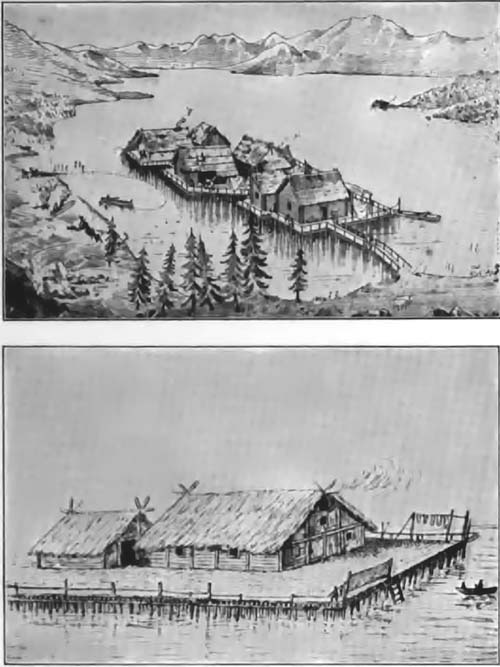
The dawn of history came late in Northern
Europe and the morning was stormy. We see
the Roman Empire struggling in vain to hold
back successive swarms of barbarians, pouring
from a dim, misty, mysterious northland. Centuries
of destruction and confusion follow; then
gradually states and institutions emerge, and
finally our own civilization, which, though still
crude and semibarbarous, has its glories as well
as its obvious defects.
The growth, development, and training of
these remarkable destroyers and rebuilders was
slowly going on through the ages of prehistoric
time. Most of the germs, and many of the determinants,
of our modern institutions and civilization
can be recognized in the habits, customs,
and life of the Neolithic period. Hence
the importance of its study to the historian and
sociologist. It has left us an abundance of records,
if we can decipher and interpret them. It
opens with savages living on shell-heaps along
the Baltic. Later we find the stone monuments
of the dead rising in France, England, Scandinavia,
and parts of Germany. They begin as
small rude shelters and end as temples, like that
at Stonehenge. People were thinking and cooperating,
and there must have been no mean
social organization.
We find agriculture highly developed in the
valleys of the Danube and its tributaries. We
see villages erected on piles along the shores of
the Swiss lakes—probably a later development.
We find implements, pottery, and bones
of animals; charred grains of wheat and barley
and loaves of bread; cloth and ornaments—almost
a complete inventory of the food and furnishings
of the people of this period. We
should call them highly civilized, had they been
able to write their own history. What was
their past and whence had they come?
Implements and pottery tell us of exchange
of patterns and ideas, or may suggest migrations
of peoples, and finally map out long trade-routes.
Some day the study of the pottery will
give us a definite chronology, but not yet.
We can reconstruct, to some extent, these
phases of prehistoric life. Our greatest difficulties
begin when we attempt to combine these
separate parts in one pattern or picture, to trace
their chronological succession or the extent of
their overlappings and their mutual influence
and relations in custom and thought. Here,
we admit, our knowledge is still very vague and
inadequate. Twenty years ago the problem
seemed insoluble; perhaps it still remains so.
But during that time explorations, investigations,
and study have given us many most important
facts and suggestions. Some inferences
we can accept with a fair degree of confidence,
others have varying degrees of probability,
sometimes we can only guess. But guesses do
no harm, if acknowledged and recognized as
such.
I venture to hope that historian and sociologist
may find valuable facts and suggestions in
this book. But, while writing it, I have thought
more often of the eager young student who may
glance over its pages, feel the allurement of some
topic and resolve to know more about it. The
bibliography is prepared especially for him. It
is anything but complete. The literature of the
period is almost endless. I have referred to only
a few of the best and most suggestive works.
They will introduce him to a chain of others.
If he studies their facts and arguments he will
probably reject some of my opinions or theories,
modify others, and form his own. If I can do
any young student this service, my work will
have been amply repaid. America has sent few
laborers into this rich harvest field.
I wish that this little book might play the
part of a good host, and introduce many intelligent,
thoughtful, and puzzled readers to the
company and view-point of the prehistorian.
In prehistory we find man entering upon
course after course of hard and rigid discipline
and training, usually under the spur of necessity,
the best of all teachers. Every course lasts
through millennia. Their chief end is to socialize
and humanize individual men. Environment,
natural or artificial, is a means to this end.
It compels men to struggle, each with himself;
only as men improve is any marked change of
conditions possible or desirable. Men must
“pass” in the lower course before they can be
promoted to the next higher, to find here a
similar field of struggle on a somewhat higher
plane. Human evolution, as a process of humanizing
and socializing man, is and must be
chiefly ethical; for ethics is nothing more nor
less than the science and art of living rightly
with one’s neighbor. And man is incurably religious,
always feeling after the power or powers
in or behind nature, whose essential character
she is compelling him to express, as her inadequate
but only mouthpiece. He will gradually
become like what he is feeling after, dimly recognizing,
and rudely worshipping. These are
the most important departments of the school
of prehistoric man.
The story told us by the evolutionist and prehistorian
is full of surprises. It tells us of the
failure of dominant species of animals and of
promising races of men. It shows men plodding
wearily through hardship and discouragement,
and finding therein the road to success. The
apparently dormant peoples and periods often
prove in the end to have been those of most
rapid advance. “The race is not to the swift
nor the battle to the strong.” But it enables us
to plot the line of human progress by points far
enough apart to allow us to distinguish between
minor and temporary oscillations and fluctuations
and the law of the curve. The torch is
passed from people to people and from continent
to continent, but never falls or goes out.
There is always a “saving remnant.” We have
grounds for a reasonable hope, not of a millennium,
but of success in struggle. The economist,
sociologist, and even the historian, are
lookouts on the ship; evolution and prehistory
must furnish chart and compass, and tell us
our port of destination.
Many or most of the best thoughts in this
book are borrowed. Some of these borrowings
are credited to their owners in the bibliography.
Of many others I can no longer remember the
source. The recollection of successive classes of
students in Amherst College, with whom I have
discussed these topics, will always be a source of
inspiration and gratitude. I owe many valuable
suggestions to my colleagues in the faculty,
especially to Professor F. B. Loomis. To the
unfailing kindness and ability of Mr. and Miss
Erb, of the Library of Columbia University;
to Professor H. F. Osborn for his generous hospitality;
to the staff of the Boston Public Library;
to Doctor L. N. Wilson, of the Library of
Clark University; most of all, to Mr. R. L. Fletcher
and his assistants, of the Library of Amherst
College, my debt is greater than can be expressed
in any word of thanks.
| Page |
| Preface |
vii |
| CHAPTER |
| I. |
The Coming of Man |
3 |
| |
THE ANCESTORS OF MAN. THE PRIMATES AND ARBOREAL
LIFE. THE DESCENT FROM THE TREES.
PITHECANTHROPUS. THE ORIGINAL HOMELAND.
HUMAN RACES AND EARLIEST MIGRATIONS. THE
ARRIVAL IN EUROPE. THE GREAT ICE AGE. HEIDELBERG
MAN. NEANDERTHAL AND CRO-MAGNON
RACES. |
|
| II. |
The Period of Transition. Shell-Heaps |
36 |
| |
THE RETREAT OF THE GLACIERS. DANISH SHELL-HEAPS.
MUGEM. MAGELMOSE. RINNEKALNS.
AZILIAN-TARDENOISIAN EPOCH OF TRANSITION.
CAMPIGNY. THE FIRST IMMIGRANTS. |
|
| III. |
Land Habitations |
53 |
| |
NEOLITHIC CAVE-DWELLERS. PIT-DWELLINGS AND
HUTS. GROSGARTACH. FORTIFIED VILLAGES,
FOREST, AND STEPPE. LOESS. |
|
| IV. |
Lake-Dwellings |
69 |
| |
PLATFORMS AND HOUSES. DOG, CATTLE, PIGS,
SHEEP. CULTIVATED PLANTS. FRUITS, SPINNING
AND WEAVING-EPOCHS. |
|
| V. |
A Glance Eastward |
91 |
| |
CRADLE OF NEOLITHIC CULTURE. BABYLONIA.
ANAU, SUSA. THE BEGINNINGS OF AGRICULTURE.
PLATEAUS AND PIEDMONT ZONES. HOE-TILLAGE.
THE PLOUGH. SUMMARY. |
|
| VI. |
Megaliths |
114 |
| |
DOLMENS. “GALLERY CHAMBERS.” MENHIRS.
DISPOSAL OF THE DEAD. INCINERATION. |
|
| VII. |
Neolithic Industries |
131 |
| |
DRESS. FLINT AND BONE IMPLEMENTS. AXES.
MATTOCKS. FLINT MINES. SALT. GOLD. COPPER.
TRADE. WARES. AMBER. TRADE-ROUTES. POTTERY,
BANDED, CORDED AND CALCYCIFORM, INCRUSTED
POTTERY. |
|
| VIII. |
Neolithic Chronology |
160 |
| |
FINAL RETREAT OF GLACIERS. YOLDIA EPOCH.
ANCYLUS EPOCH—LITTORINA DEPRESSION. DATE
OF BEGINNING AND OF END OF NEOLITHIC PERIOD.
FOREST SUCCESSIONS. MAGELMOSE AND SHELL-HEAPS.
SUCCESSIVE TYPES OF AXE. CHARTS. |
|
| IX. |
Neolithic Peoples and Their Migrations |
179 |
| |
PALÆOLITHIC RACES AND MIGRATIONS. MEDITERRANEAN
RACE. ROUTES OF MIGRATION. AFRICAN,
MEDITERRANEAN, SOUTH RUSSIAN STEPPE ROUTE.
NEOLITHIC PEOPLES AND THEIR DISTRIBUTION.
NORDIC PEOPLES. THE DANUBE VALLEY. THE
“MELTING-POT” OF CENTRAL EUROPE. PIONEER LIFE. |
|
| X. |
Neolithic Religion |
206 |
| |
PALEOLITHIC RELIGION, THE AGE OF WONDER:
NEOLITHIC RELIGION AND EXPERIENCE. RITUAL.
TABOO AND TRIBAL RESPONSIBILITY. GREEK MYSTERIES.
THE COMING OF THE OLYMPIANS, AND
THE RETURN OF THE ANCIENT CULTS, SOURCES
OF THEIR VITALITY. CULT OF THE GODDESS AND
MOTHER-RIGHT. RELATION TO AGRICULTURE.
SOCIAL POSITION OF WOMEN. |
|
| XI. |
Progress |
228 |
| |
THE MEDITERRANEAN AND THE BALTIC. SOURCE
OF PROGRESS NOT IN WAR. AGRICULTURE. HOME
TRAINING. THE NEIGHBORHOOD. RELIGION. PHILOSOPHY.
MINGLING OF CULTURES AND PEOPLES. |
|
| XII. |
The Coming of the Indo-Europeans |
246 |
| |
ARYAN AND EUROPEAN LANGUAGES. ORIGINAL
LANGUAGE; SPREAD AND MODIFICATIONS. EARLIEST
MIGRATIONS. THE ACHÆANS. THE AGE OF
HEROES. CITY-STATES IN GREECE. ABSORPTION
OF INVADERS. HOMELAND. INDO-EUROPEAN RELIGION.
PERSISTENCE OF NEOLITHIC SURVIVALS.
FOLK-LORE AND FAIRY-TALE. COMMON PEOPLE.
LEGISLATION. THE CHURCH. LIFE CURRENTS. |
|
| |
Bibliography |
293 |
| |
Index |
309 |
Reconstructed Lake-Dwellings | Frontispiece |
| |
FACING PAGE |
Human Figures, Spain—Early Neolithic | 32 |
Drawings of Animals (Cro-Magnon) from Altamira | 32 |
Shell-Heap | 40 |
Shell-Heap Axe | 40 |
Shell-Heap Jar | 40 |
Weaving and Plaiting from Lake-Dwellings | 84 |
“Crouching Burial” (Hockerbestattung), Adlerborg,
near Worms | 116 |
Menhir, Carnac, Brittany | 116 |
Dolmen, Haga, Island of Borust | 116 |
Alignment, Carnac, Brittany | 124 |
Modern Albanian Peasants in Neolithic Garments | 132 |
Axes from Lake-Dwellings Showing Attachment to
Handles | 136 |
Boats from Rock Carvings in Bohuslan, Sweden.
(Early Bronze Age) | 146 |
Pottery from Neolithic Graves | 154 |
|
Pottery | 158 |
Successive Stages and Forms of Baltic Sea | 162 |
Forms of Prehistoric Axe | 174 |
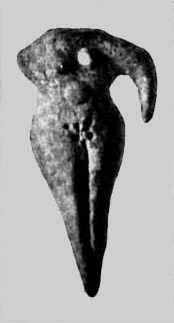
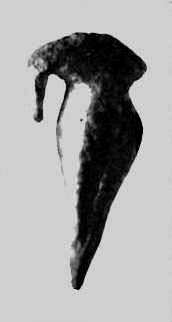
Female Idols, Thrace | 218 |
Female Idol, Anau | 218 |
Ancient Fishermen | 232 |
Early Agriculture | 236 |
|
Migrations of Peoples |
184 |
The first of the two numbers and the letter in the footnotes
designate the position in the Bibliography at the end of the
volume of the title referred to; the second refers to the page of
the book or article.
THE COMING OF MAN
MAN has been described as a “walking
museum of paleontology.” He is like
a mountain whose foundations were
laid in a time so ancient that even the paleontologist
hardly finds a record to decipher; whose
strata testify to the progress of life through
all the succeeding ages; whose surface, deeply
ploughed by the glaciers, is clothed with grass
and forest, flower and fruit, the harvest of the
life of to-day.
Some of his organs are exceedingly old, while
others are but of yesterday; yet all are highly
developed in due proportion, knit and harmonized
in a marvellously tough, vigorous, adaptable
body, the instrument of a thinking and
willing mind. Most surviving animals have
outlived their day of progress; they have “exhausted
their lead,” to borrow a miner’s expression,
and have settled down in equilibrium with
their surroundings. But discontented man is
wisely convinced that his golden age lies in the
future, and that his best possessions are his
hopes and dreams, his castles in Spain. He is
chiefly a bundle of vast possibilities, of great
expectations, compared with which his achievements
and realizations are scarcely larger than
the central point of a circle compared with its
area.
Physically he belongs to the great branch or
phylum of vertebrate animals having a backbone—sometimes
only a rod of cartilage—an
internal locomotive skeleton, giving the possibility
of great strength and swiftness, and of
large size. Large size, with its greater heat-producing
mass relative to its radiating surface,
implies the possibility of warm blood, or
constant high temperature, resulting in greater
activity of all the organs, especially of the
glands and the nervous system. Large size, as
a rule, is accompanied by long life—giving opportunities
for continuous and wide experience,
and hence for intelligence. Yet most vertebrates
have remained cold-blooded, and only a
“saving remnant” even of men is really intelligent.
Man belongs to the highest class of
vertebrates, the Mammals, which produce living
young and suckle them. Among the highest
mammals, the Primates, or apes, the length
of the periods of gestation, of suckling the young,
and of childhood, with its dependence upon the
mother, have become so long that she absolutely
requires some sort of help and protection from
the male parent. From this necessity have
sprung various grades and forms of what we
may venture to call family life, with all its advantages.
How many mammals have attained
genuine family life and how many men have
realized its possibilities?1
The upward march of our ancestors was
neither easy nor rapid. They were anything
but precocious. They were always ready to
balk at progress, stiff-necked creatures who had
to be driven and sternly held in the line of
progress by stronger competitors. The ancestors
of vertebrates maintained the swimming
habit, which resulted in the development of the
internal skeleton and finally of a backbone, not
because it was easiest or most desirable, but because
any who went to the rich feeding-grounds
of the sea-bottom were eaten up by the mollusks
and crabs. Our earliest air-breathing ancestors
were crowded toward, and finally to
the land, and into air-breathing by the pressure
of stronger marine forms like sharks, or by climatic
changes.2 Reptiles, not mammals, dominated
the earth throughout the Mesozoic era,
and harried our ancestors into agility and wariness;
at a later period the apes remained in the
school of arboreal life mainly because the ground
was forbidden and policed by the Carnivora.
They and their forebears were compelled to forego
some present ease and comfort, but always
kept open the door to the future.
In spite of all this vigorous policing, malingerers
and deserters turned aside from the upward
line of march at every unguarded point or
fork in the road, escaped from the struggle, and
settled down in ease and stagnation or degeneration,
like our very distant cousins, the monkeys
and lower apes. Long-continued progress is a
marked exception, not the rule, in the animal
world, and is maintained only by the “saving
remnant.” And these continue to progress
mainly because Nature is “always a-chivying
of them and a-telling them to move on,” as
Poor Joe said of Detective Bucket, and her
guiding wand is the spur of necessity.
The Primates, or apes, are, as we have seen,
the highest order of the great class of mammals.
Most of them, like other comparatively defenseless
vertebrates, are gregarious or even social.3
They have a feeling of kind, if not of kindness,
toward one another. This sociability, together
with the family as a unit of social structure, has
contributed incalculably to human intellectual
and moral development. Man is a Primate, a
distant cousin of the highest apes, though no
one of these represents our “furry arboreal ancestor
with pointed ears.” Arboreal life was
an excellent preparatory training toward human
development. Our primate ancestor was
probably of fair size. In climbing he set his
feet on one branch and grasped with his hands
the branch above his head. Foot and leg were
used to support the body, hand and arm for
pulling. Thus the hand became a true hand
and the foot a genuine foot, opening up the
possibility of the erect posture on the ground
and the adaptation of the hand to higher uses.
Meanwhile the climbing and leaping from branch
to branch, the measuring with the eye of distances
and strength of branches, the power of
grasping the right point at the right instant,
and all the complicated series of movements
combined in this form of locomotion furnished
a marvellous set of exercises not only for the
muscles but for the higher centres in the cortex
of the brain. Very probably gregarious life and
rude play, so common among apes, was an extension
course along somewhat similar lines.
Our ancestors became at home in and well
adapted to arboreal life, but the adaptation was
never extreme. It was rather what Jones4 has
called a “successful minimal adaptation.” They
used arboreal life without abusing it by over-adaptation,
which would have enslaved them,
and made life on the ground an impossibility
when the time came for their promotion to this
new and more advanced stage.
At the close of his arboreal life the ape had
inherited or acquired the following assets: His
vertebrate and mammalian structure had given
him a large, vigorous, compact, athletic, adaptable
body. The mammalian care of the young
had insured their survival, but only at the expense
of great strain and risk of the mother.
Something at least approaching family life was
already attained. Arboreal life with its gymnastic
training had moulded the body, differentiated
hand and foot, given the possibility of
erect posture, emancipating the hand from the
work of locomotion and setting it free to become
a tool-fashioning and tool-using organ.
The ape has keen sense-organs, an eye for distances,
and other conditions; and the use of
these powers has given him a brain far superior
to that of any of his humbler fellows. These
are full of great possibilities and opportunities,
if he will only use them.
But why did our ancestor descend from his
place of safety in the trees and live on the
ground, exposed to the attacks of fierce, swift,
and well-armed enemies? Very few of the
Primates, except the rock and cliff-inhabiting
baboons, ever made this great venture. There
must have been some quite compelling argument
to induce him to take so great a risk. The
change took place probably at some time during
the latter half of the Cenozoic or Tertiary
period, the last great division of geological time,
the Age of mammals.5 The earliest Tertiary
Epoch, the Eocene, was a time of warm and
equable climate, when apes lived far north in
Europe, and doubtless in Asia also. Some of
these apes were of fair or large size, showing
that conditions were favorable and food abundant.
The next epoch, the Oligocene, was similar
but somewhat cooler. The third, the Miocene,
was cooler still and dryer. Palms now
forsook northern Europe, being gradually driven
farther and farther south. Life became more
difficult, food scarcer. Apes could not longer
survive in northern Europe, but had to seek a
warmer, more favorable, environment farther
south, for many of the fruit and food trees had
been crowded out and famine threatened.6
But insects and other small and toothsome animals
remained on the ground, and were abundant
along the shores of rivers and lakes.
There, too, were fruits and berries, roots and
tubers. There the food supply was still more
than sufficient.
Thus far we have glanced at Europe only.
But the same changes are taking place in Asia,
the cradle and home of most placental mammals,
the main area of a huge zoological province
of which Europe was but a westward projection,
and with which America had direct connection
from time to time in the region of
Behring’s Straits. Here, during late Miocene
and early Pliocene times, in the latter part of
the Cenozoic era, a dryer and somewhat harsher
climate had been accompanied by the appearance
of wide plains fitted for grazing animals,
as well as stretches of forest, with all varieties
of landscape favoring great diversity as well as
abundance of mammalian life. It was, perhaps,
the golden age for most mammals, when food
was plenty, climate not too severe, and every
prospect pleased. This slow and gradual, but
fairly steady, lowering of temperature was to
culminate in the Great Ice Age of the Pleistocene
Epoch, so destructive to mammalian life
in the northern hemisphere.
A second climatic change, perhaps even more
important than the lowering temperature, was
the increase of aridity. Even during the Oligocene
Epoch “the flora indicates a lessening
humidity and a clearer differentiation of the
seasons,”7 The great trough of the inland sea
which had stretched from the Mediterranean
to the Indian Ocean began to rise, the first uplift
taking place along the Pyrenees and western
Alps. The Miocene was marked by a series of
great movements. The old inland sea was displaced,
subsidence gave place to uplift, and the
greatest mountain system of the globe, including
the Alps and the Himalayas, began to grow
through vast repeated uplifts in the crust.8
The continents were elevated and widened.
The forest-dwelling types became restricted and
largely exterminated, and animals of the plains,
in the form of horses, rhinoceroses, and the
cloven-hoofed ruminants, expanded in numbers
and in species. This profound faunal change
implies dryer climate. There was now a lesser
area of tropic seas to give moisture to the atmosphere.
The mountains were now effective
barriers, shutting off the moisture-bearing winds
from the interior of the continents.
These changes would have been noticeable in
Europe north of the Alps, but were far more so
in central Asia along the northern face of the
great plateau of Thibet, with its eastern and
western buttresses, and its towering rampart of
the Himalayas on the south, cutting off the
warm moisture of the Indian Ocean. Northward
of this vast plateau and westward over the
far less elevated Iranian plateau and Afghanistan,
forest was fast being replaced by parklands
of mingled groves and glades, or by grassy
plains, or even by dry steppes. Dessication,
aridity of climate, was fast compelling forest
and arboreal mammals to migrate or radically
change their habits of life.9
Almost all the apes found their old environment
and continued their arboreal life by migrating
far southward through India or into
Africa. But at the rear of the retreating host
were forms from the cooler northern regions.
They were hardy and vigorous, and probably
larger than most of their fellows. Possibly some
of them were caught in isolated decreasing areas
of forest surrounded by steppe or plain. Some
of them, at least, began to descend from the
trees, to seek the new food supplies of riversides,
glades, and thickets, and thus gradually
to become accustomed to life on the ground.
It was a very hazardous experiment; only the
most hardy and wary and the quickest in perception,
wit, and movement survived. Among
these were our ancestors, driven like all their
forebears by the spur of necessity into a new
mode of life under trying conditions.
They were still only apes, with long arms and
short legs, and probably scrambled mostly on
all fours. They had heavy brows, retreating
foreheads, projecting jaws, and a brutal physiognomy.
Of the mental life of the man who
was to be descended from them there were few
signs. They were bundles of very slight possibilities.
But let us not “despise the day of small
things.” They were still far from the invisible
line between apedom and manhood. Physically
they resembled man quite closely. They had
hand and foot, and a fair-sized brain, though
they had scarcely begun to realize the possibilities
of these structures.
Arboreal life could teach them little more;
continuance in that school would have meant
a very comfortable stagnation. They were now
promoted to a new school of vastly more difficult
problems, greater risks and dangers, and
more severe and trying discipline. They had
had an excellent course of manual and sensory
training; now they must continue this and add
to it the use of whatever wits they had, under
peril of death. Nature was still compelling
them to “move on.”
This descent to the ground probably was accomplished
either in India or on the Iranian
plateau, or somewhat farther to the northeast,
somewhere in the great horseshoe of parkland
which curved around the western buttress of
the great central Asiatic plateau of Thibet.
Can we locate it somewhat more definitely?10
At this time, during the Pliocene Epoch, there
were being deposited in India the so-called Siwalik
strata—vast, ancient flood-plains, stretching
for a distance of 1,500 miles along the
southern foot-hills of the Himalayas. They are
composed of materials washed down from the
mountains by a system of rivers, persisting with
little change into the present. Says Osborn of
the mammals found here: “It is altogether the
grandest assemblage of mammals the world has
ever seen, distributed through southern and eastern
Asia, and probably, if our vision could be
extended, ranging westward toward Persia and
Arabia into northern Africa. It is the most
truly cosmopolitan aggregation because in its
Upper Pliocene stage it represents a congress of
mammals from four great continents.... The
only continents which do not contribute to this
assemblage are South America and Australia.”11
The older, Miocene, portions of this fauna are
chiefly browsing forest forms, emphasized by
the absence of both horses and Hipparion, as
well as of grazing types of cattle and antelopes.
Grazing forms, showing the decline of the forest
and the spread of open parkland and grassy
areas, become abundant during the Pliocene
Epoch. “Among the Primates we find the
Orang, an ape now confined to Borneo and Sumatra;
also the Chimpanzee, another ape, now
confined to Africa, the Siwalik species displaying
a more human type of dentition than that
of the existing African form.”
In the older, Miocene, portion we find Sivapithecus,
an ape which Pilgrim considers as
more nearly resembling man than any other
genus of anthropoids, while Gregory speaks of
it as belonging to the anthropoid line.12 Somewhat
later, in late Pliocene or early Pleistocene,
there was living not far away, in Java, a far
more renowned form, Pithecanthropus erectus, Du Bois,
which seems to stand almost exactly midway
between higher apes and man. The remains
consisted of two molar teeth, a thigh-bone,
and the top of a skull. The cranium is low, the
forehead exceedingly retreating, giving but very
small space for the frontal lobes of the brain.
But the brain-cast, made from the cranial cavity,
shows, according to Du Bois, that the speech
area is about twice as large as in certain apes,
though only one-half as large as in man. In
size the brain stands somewhat above midway
between the highest recent apes and the lowest
existing men. The thigh-bone shows that
Pithecanthropus could have stood and walked
erect quite comfortably. There has been and
still is much difference of opinion regarding the
position of this most interesting being. Opinion
was long divided nearly equally between
those who considered it as the highest ape
and others who held it to be the very lowest
man.
It is worthy of notice that, when Pithecanthropus
was alive, “Java was a part of the
Asiatic continent; and similar herds of great
mammals roamed freely over the plains from
the foot-hills of the Himalaya Mountains to the
borders of the ancient Trinil River, while similar
apes inhabited the forests. At the same
time the Orang may have entered the forests
of Borneo, which are at present its home.”13
Where man’s distant cousins, the anthropoid
apes, and his still nearer relation, Pithecanthropus,
were all living and some, at least, apparently
progressing, could hardly have been
far from his original home. But the climatic
conditions of that time lead us to seek his original
cradle somewhat farther northward than
India, or even Beluchistan, and nearer to, if
not in, the great steppe zone of central Asia.
We lose sight of our ape-man as he is advancing
toward the threshold of manhood, not far away.
Whether we think that Pithecanthropus was approaching
or had already passed it depends
much upon where we draw the line between
ape and man, a line largely artificial and as
difficult to fix as the day and hour when the
youth becomes of age, and what human characteristics
we select to mark it. In his erect
posture and some other physical traits he seems
already to have attained manhood; mentally
he was probably far inferior to even the lowest
savage races of to-day. We are not sure
whether he was our ancestor or merely a cousin
of our ancestor, once or twice removed; we still
lack foundations for any hypotheses as to exactly
when, where, or how the erect ancestral
ape-man emerged into real manhood.
Millennia passed between the days of Pithecanthropus
and the first human migrations, and
we may imagine primitive man as having become
fairly well accustomed to life on the
ground, and as having mastered his first lessons
in meeting its dangers and difficulties. He
had probably taken possession of a much wider
area than the home of the ape-man, perhaps of
the whole of the parkland zone curving around
the western buttresses of the plateau of Thibet.
From this region routes of migration radiated
in all directions, all the more open because of the
elevation of land which lasted through Upper
Pliocene and early Pleistocene times.14 Sumatra
and Java then formed an extension of the Malay
Peninsula, reaching more than 1,000 miles into
the Indian Ocean; while the Orang seems to
have been able to reach Borneo somewhat
earlier. The way was equally clear westward
into Europe, the Dardanelles being then replaced
by a land bridge, while a second bridge
spanned the Mediterranean over Sicily into
Italy, and a third existed at Gibraltar.15 These
routes were evidently followed by herds of great
herbivora, and probably by the earliest human
emigrants into Europe.
Following Keane,16 we shall divide mankind
into four great groups or races, and then glance
at their radiation from southwestern Asia toward
all parts of the globe. These great primitive
divisions are:
I. Negroids. Color yellowish brown to black,
stature large or very small. Hair short, black
or reddish brown, frizzly, flattened-elliptical
in cross-section. Nose broad and flattened.
Cheek-bones small, somewhat retreating. Examples:
Negritoes, Negroes.
II. Mongoloids. Color yellowish. Stature
below average. Hair coarse, lank, round in
cross-section. Nose very small. Cheek-bones
prominent. Examples: Malays, Chinese, Japanese,
Thibetans, Siberian “Hyperboreans.”
III. Americans. Color reddish or coppery.
Stature large. Hair long, lank, coarse, black,
round in cross-section. Nose large, bridged, or
aquiline. Cheek-bones moderately prominent.
(Probably a branch of II.) Examples: Indians
of North and South America.
IV. Caucasians. Color pale or florid. Hair
long, wavy or straight, elliptical in cross-section.
Nose large, straight or arched. Cheek-bones
small, unmarked. Examples: Hamitic, Semitic,
and European peoples.
We may now imagine quite primitive human
beings starting from their early home and seeking
their fortunes widely apart. They came
under quite different climatic and other physical
conditions. Their environment, problems,
stimuli, and opportunities were unlike. Thus,
having become more or less unlike in the homeland,
they gradually became differentiated into
the present great groups or races already mentioned.
Some started earlier or marched more
rapidly than others. Many proved unequal to
the dangers and difficulties of the journey or new
place of settlement, and disappeared. Many
stagnated or degenerated. Only the comparatively
successful or fortunate have survived.
Hence, our scheme is hardly an adequate expression
of prehistoric racial groups and their
characteristics, except in very general outline.
We have seen that the apes, retreating before
the approach of harsh and dry climatic conditions
and diminished forest areas and food
supply, migrated southward into India and
Africa. The Orang settled in Borneo, Pithecanthropus
in Java, the Chimpanzee and Gorilla
went into Africa. These routes presented the
fewest difficulties and demanded the least readaptation
or change of habit. The climate
was mild and food generally abundant and easily
obtained. Their environment was neither stimulating,
trying, nor exacting. Progress was
hardly to be expected, but survival was far
easier than in more northerly regions.
The Negritos followed almost exactly the
same routes. We find them purest and perhaps
least modified in the “Pygmies” of the
African forests; but also in the Malay Peninsula,
the Andaman Islands, and the Philippines.
De Morgan believes that he has found proofs of
their presence on the Iranian plateau at a comparatively
late date.
Behind them Negroid peoples poured into
Africa, apparently in successive waves. Some
of them went into the Malay Peninsula, probably
generally submerging the Negritos, and
reached New Guinea and Australia. Inhabiting
a series of islands and other more or less isolated
areas, mingling often with Negritos, probably
later also more or less with the Malays, they
became much modified, and their relations to
the African Negroes and to one another are
still anything but clear.
The Mongoloids pushed eastward. The earliest
migrations seem to be those of the Malays,
a great, very interesting, and little-known though
much-studied group of peoples. They followed
the oceanic Negritos along the Malay Peninsula
and occupied the great chains of islands stretching
through the Indian Ocean and far into the
Pacific, through more than ninety degrees of
longitude along the equator. But much of this
spread is probably of quite recent date.
The Mongoloid peoples seem to have passed
along the northern front of the Central Asiatic
plateau into Siberia, China, and Japan, and to
have sent off the great American branch. Even
before the Mongols had started on their eastward
journey the Caucasians may have turned
westward, following the old Negroid route.
There was probably also more or less of an eastern
dispersal, but we cannot consider the problem
of these Oriental Caucasic remnants and
traces. The great body went westward. The
Hamitic peoples distributed themselves along
the southern shore of the Mediterranean, and
many may well have occupied a large part of the
Sahara region, then a land of watercourses
capable of supporting a large population. Behind
them came the Semitic folk. Judging from
their languages the Hamitic and Semitic peoples
seem to have been in contact over a wide
area, and for a long space of time. The
Semites found a new and permanent home in
Arabia, on whose plateaus and surrounding
grasslands they increased and multiplied, and
sent off fresh waves of migration and conquest
in all directions.
We have already noticed that our classification
of races is based upon a study of recent
and still surviving peoples. The very earliest
inhabitants of Europe would find no place in
it. Probably they long antedated the Hamites.
African Negroids and Caucasians came from a
common home, and journeyed for a time over
a common road, though probably at far different
times. It would be strange if the earliest inhabitants
of Europe showed no traces of this
common home and ancestry. Since the remote
period which we are considering Negroes
and Caucasians have become widely different,
and their racial characters have become clear
and sharp. This may not have been altogether
the case with the first peoples to arrive in Europe.
But attempts to relate the Neanderthal
crania with those of modern Australians or
Tasmanians, or any existing race, have met
with no great success. In regard to these questions
we are still in the dark.
Beside the African routes into Europe, along
the south shore of the Mediterranean and over
the Sicilian and Gibraltar land bridges, while
they lasted, two others must be noticed. One
of these extended through Asia Minor and across
the land bridge at the Dardanelles, while the
second led westward along the northern border
of the Caspian and Black Seas and the Caucasus
Mountains. The most southerly of these four
routes through Africa were probably the first
to be travelled, the most northerly last of all.
We shall have to study these routes more closely
in a later chapter.
It was at some time during the Glacial period,
the Great Ice Age, when a vast ice-cap covered
northern Europe with glaciers extending far
southward and advancing or retreating according
to climatic conditions, that man arrived in
Europe. During the first Glacial Epoch the advance
of the ice covered the most northern part
of Great Britain and the Rhine valley almost as
far south as Cologne; Scandinavia was completely
buried, like central Greenland to-day,
and North Germany probably to the Harz
Mountains. Eastward the southern edge of the
ice sheet ran nearly along the line of 50° N. lat.
across Russia. In Siberia the effects were less
marked and the limits were much farther northward.
Between the parallel of 50° and the
northern edge of the Alpine glaciers a zone was
left ice-free, but three-fifths of Germany was
overwhelmed. Southern England and France,
not yet separated by the English Channel,
formed one great habitable province, and but a
small part of France was glaciated. The climate
was tempered by proximity to the sea.17
The average yearly temperature of northern
Europe was probably not more than 4°-6°
Cent. (39°-43° Fahr.), which is colder than at
present. But the formation of these enormous
masses of ice demanded heavy snowfall and a
moist or very damp climate. Hence the edge
of the great ice sheet advanced or retreated according
to climatic conditions.
There were four periods of advance before
the final retreat of the ice, not counting minor
oscillations.18 These are known as the Gunz,
Mindel, Riss, and Wurm Glacial Epochs. Alternating
with these were the interglacial epochs
of ice retreat—the Gunz-Mindel, Mindel-Riss,
and Riss-Wurm; while the final retreat is
usually termed post-glacial. During the first
and second interglacial epochs the climate appears
to have been warmer than at present.
But at times dryness may have contributed to
the retreat of the ice even more than warmth,
and then the climate would have been continental,
harsh, and extreme.
Even during epochs of glacial advance conditions
in France and in the German zone must
have been better than we should expect. Some
kind of grazing or browsing pasturage must have
been rich and abundant to support large animals
like the reindeer or even the woolly mammoths
characteristic of the second and third glacial
epochs, which furnished abundant food for
prehistoric hunters. Farther south the glacial
epochs may well have been times of heavy rainfall,
transforming the Sahara desert and the
dryer steppes and plateaus of Asia into veritable
gardens.
The retreating ice left behind it a land covered
with rocks, clays, gravels, and sands
brought by the glaciers and their streams.
Here and there basins had been gouged out
where lakes or ponds long remained—as in
Maine and Minnesota to-day—to be later
drained, or, if shallow, to be overgrown with
sphagnum and changed into great bogs. Scattered
thickets of shrubs and stunted hardy trees,
poplars, willows, and others occurred. In sheltered
and well-drained valleys and mountainsides
the trees grew larger and even forests began
to appear. This tundra landscape still
characterizes wide areas of northern Canada
and Siberia.19
The tundra was followed by steppe conditions,
where elevation of land to the north and
northwest had cut off the tempering oceanic
winds. The climate was harsh, dry, continental,
with cold winters and hot summers. The winds
carried great storms of dust and piled it up in
drifts in valleys and on suitably situated mountainsides
in the form of loess, so important to
the future agricultural development of Europe,
though its most massive accumulation is seen
in China, which received and held the driftings
from the great elevated plains of central Asia.
As the climate became moister, if the temperature
did not fall too low, steppe finally gave
way to the meadow and forest of modern Europe.
Tundra, steppe, and forest had each its special
types of animal as well as plant life. The characteristic
tundra animal is the reindeer, though
musk-ox, woolly mammoth, and others were
wide-spread at this time. The peculiar steppe
animal is the horse. The characteristic forest
and meadow animals are the deer and their
allies; the wolf and bear; the wild boar and
cattle seem to be at home in forest and glade
and along the streams.
In France, where there was far less glaciation,
the succession of tundra, steppe, and forest
is less apparent. Here we find a mingling of
varied forms which have come in from very
different regions, driven from their original
homes by change of climate or drawn by favorable
conditions.
The first unmistakable relic of man in Europe
is a human lower jaw found in the Mauer sands
near Heidelberg, some seventy-nine feet below
the surface of the bluff.20 It seems to belong to
the second or Mindel-Riss interglacial epoch,
and its age is estimated by Osborn at about
250,000 years. Remains characteristic of the
oldest Paleolithic epochs occur between thirty
and forty-five feet below the surface. If we are
to find an archæological name for this epoch,
there seems to be no better one than Eolithic,
the dawn of the Stone Age, when European man
had hardly more than begun to chip a stone implement,
although we must recognize the unreadiness
of many or most archæologists to find
a place for such rude products.21
The third interglacial period (Riss-Wurm) and
the fourth period of advance (Wurm) cover
what is known as Lower Paleolithic time, which
is the earlier four-fifths or more of the Old Stone
Age or Paleolithic period, extending approximately
from 125,000 B. C., to 25,000 B. C.
During the greater part of this period Europe
was occupied by the Neanderthaloid people.
Neanderthal man had a very large head with
heavy, overhanging eyebrows meeting above
the nose, and a markedly retreating forehead.
The face was high and the large nasal opening
indicates a broad, flat nose. The lower jaw was
heavy and the chin retreating. The trunk was
short, thick, and robust, the shoulders broad;
the limbs short and heavy, the arms and lower
legs relatively short, and the hands very large.
Although the much-discussed Piltdown skull
may quite probably be regarded as belonging to
the earliest part of this period, the finer form of
cranium seems to testify to a higher race of
better mental development than the Neanderthaloids,
huddling in their caves and shelters.
It may easily represent a far more progressive
ancestral race, of which they are somewhat degenerate
descendants, though Osborn dissents
from this view.22
Their remains are found in caves and rock-shelters
all over Europe. Here we find their
hearths; the bones of the animals which they
had hunted for their food; their almond-shaped
flint axes, “hand-stones” (Coups-de-Poing), the
scrapers for dressing skins and shaving wooden
tools, and a variety of other forms. Here they
buried their dead. During the third warm interglacial
epoch they lived in the open, as at the
station of Chelles, which has given its name to
the earliest Paleolithic epoch.23 Their origin and
route of migration is quite uncertain, but it
seems probable that they entered Europe from
the southern shore of the Mediterranean.
The post-glacial period is characterized by
the final retreat of the ice. The change of climate
was not steady but marked by a series of
oscillations, repeating on a much smaller scale
the glacial and interglacial epochs of the long
past. The climatic change is accompanied by
the appearance of tundra and steppe, followed
by meadows and the forest conditions of modern
times. Game was abundant and general conditions
severe but healthy and fairly favorable.
A new race has appeared on the scene which
replaced the Neanderthal folk, and had practically
none of their primitive or degenerate,
ape-like characteristics.24 The Cro-Magnon people
have excited the wonder and admiration of
all anthropologists. They were of tall stature,
had long legs, especially below the knee, giving
swiftness in running. The forehead is broad
and of good height, the features are rugged but
attractive, and the brain is very large. They
seem to represent a new race and new immigration,
probably from Asia, which spread over
Europe.
The Cro-Magnon brain was anything but
dull. In this remote time, more than 20,000
years ago, there sprang up an art never since
surpassed in its own field except, perhaps, by
that of the Greeks. Their bone implements are
adorned with the most lifelike carvings or sculptures.
On the walls of caves we find paintings
as realistic and alive, and often as finely executed
in detail and coloring, as the best animal
painters of our day could produce. These people
must have had a high and keen appreciation
of the beauty of form and proportion. All this
artistic movement must have had its source in
new ideas and conditions, springing from a
thinking as well as a feeling and observing mind.
They also frequently buried their dead, decorated
with strings of perforated shells, and surrounded
by flints or sometimes by a layer of red
earth or ore. With them were the bones of food
animals and the flint weapons needed for the
journey into or use in the life beyond.
The life of the Cro-Magnon hunters on their
arrival in Europe was anything but unendurable,
especially along the Riviera. There were open-air
encampments where men passed at least the
summer months in tents or huts. The race
seems to have culminated during the cold middle
Magdalenian epoch, which indicates that
they were well adapted to its conditions. Game
was abundant and relatively easily captured.
They had food and raiment, fair shelter, excellent
art, alert brains, and probably a fair degree
of social life. They may well have been content,
courageous, and full of hope for themselves
and their descendants.
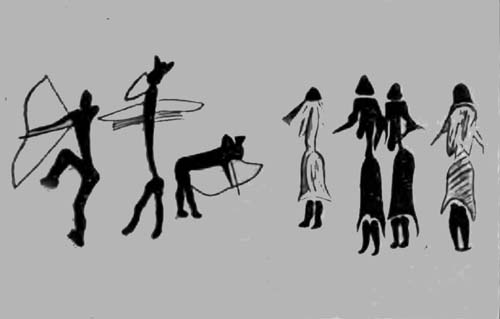
HUMAN FIGURES, SPAIN—EARLY NEOLITHIC
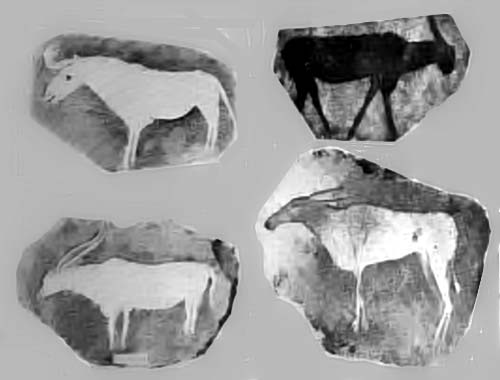
DRAWINGS OF ANIMALS (CRO-MAGNON) FROM ALTAMIRA
Upper Paleolithic time, beginning with the
arrival of the Cro-Magnons, about 25,000 years
ago, is divided into four epochs, or, better, four
culture-stages: Aurignacian, Solutrean, Magdalenian,
and Azilian-Tardenoisian. Even in late
Magdalenian days, after a cold and dry interval
accompanied by steppe conditions and a new
formation of loess, the air became moister and
the temperature gradually moderated until it
became much like that of to-day. Tundra and
steppe animals became more rare; a forest and
meadow fauna took possession of Europe. Instead
of the reindeer we find stag and roe-deer,
cattle, wild boar, bears and wolves, beaver and
otter. These were less easily hunted and probably
less abundant than the reindeer and horse
had been. As hunting became less profitable,
fishing grew more attractive. The streams probably
swarmed with fish, and the salmon was
probably as abundant throughout northern
Europe as in Scandinavia to-day. A change of
life is suggested by the implements. The harpoons
became ruder. The beautifully flaked
lance-heads and the smoothed bone daggers give
place to small flints, “microliths,” less fitted for
attacking large and dangerous animals. The
country seems to have supported a smaller and
decreasing population. Cro-Magnon man had
always been a reindeer hunter, accustomed and
well adapted to the life and conditions of tundra
or steppe. The changes were not in his
favor or to his liking. Many probably left
France and Germany. Those who remained
deserted the rock-shelters and cave-mouths,
where every spring the water seeping down and
dripping through the roof dislodged masses of
stone.25 The shelter was less needed. Men
dwelt more in the open, and fewer records of
their presence were preserved.
But Europe was not deserted. There was no
“hiatus.” Other peoples were coming in, perhaps
better suited to the new conditions, probably
mostly of Asiatic origin. Broad-heads, as
well as new long-heads, appear, less attractive
physically and mentally, but apparently of
tougher fibre and greater staying power than our
more striking and charming Cro-Magnons.26 A
new grand mingling of peoples had already begun
or was in its last stages of preparation already
advancing from afar in successive waves.
In Italy genuine Neolithic culture may already
have been introduced. It steals very slowly into
northern Europe and overspreads it. The Cro-Magnon
race generally migrated or died out,
but left its traces in the physical characters of
the people of Dordogne and elsewhere.
The Azilian-Tardenoisian epoch leads over to
the Neolithic, our chief object of study. Its
relative position in prehistoric time is shown in
the following scheme:
A. Eolithic Period. Stone implements exceedingly
rude, hardly recognizable as artificially
chipped; otherwise like B.
B. Paleolithic Period. Stone implements
chipped or flaked, never polished. No domesticated
plants or animals. No pottery. Man a
collector or hunter, more rarely a fisherman.
C. Transition Period, resembling B in most
respects.
[A, B, and C make up the Old Stone Age,
before the use of metals.]
D. Neolithic Period. Some stone implements
polished. No metal except that copper is introduced
toward the end of the period. Agriculture
with domestic plants and animals. Pottery
but no potter’s wheel. Dawn of Civilization.
E. Bronze Period. Bronze implements or
utensils. Dawn of History. Begins about 2500
B. C. in northern Europe.
F. Iron Period. Iron introduced. Historic
Times. Begins about 1000 B. C. in northern
Europe.
THE PERIOD OF TRANSITION. SHELL-HEAPS
DURING the last great advance of the
ice in the earlier Magdalenian epoch
the Scandinavian peninsula had been
buried beneath a great mass of ice, and resembled
the central portion of Greenland to-day.
A great glacier extended southward, obliterating
the Baltic Sea and crowding into northern Germany.
As the glaciers withdrew, North Germany
became a vast tundra, across which we
may imagine the reindeer and other Arctic and
subarctic mammals retreating northeastward
before the milder forest and meadow conditions
already prevailing in France and Russia.27 The
low temperature of the water of the emerging
Baltic is shown by the presence of an arctic
bivalve, Yoldia arctica, which has given its name
to the epoch. A few scattered bone implements
show the presence of reindeer hunters in Germany
at this time.
Before the close of the Yoldia period Germany
began to pass from tundra to forest—a transformation
which was also now progressing in
Denmark. The temperature moderated slowly.
The land rose in such a way that it separated
the Baltic from the North Sea and the Arctic
Ocean, with which it had been connected, and
made of it a great fresh-water lake. The characteristic
animal of this lake was a small pond
animal, ancylus, which has given its name to
both lake and epoch.
The next epoch—the Litorina (or Tapes)
depression—was characterized by a sinking of
the land in which the barrier between the Baltic
and the North Seas gave place to a wide communication.
The Baltic became more salt than
at present, and the oyster-banks became abundant.
It was during this epoch that the shell-heaps
were accumulated.
The following chart gives a condensed view
of the succession of events (in reverse order):28
WESTERN AND MIDDLE
EUROPE |
NORTHERN EUROPE |
DATE
B. C. |
| 4. Typical Neolithic. |
Typical Neolithic.
Beech and fir forests. |
6000-2500 |
| 3. Daun Stage. |
Litorina Epoch.
Oak forests.
Northern climatic optimum. |
8000 |
| Campignian |
Shell-heaps. |
|
| 2. Gschnitz Stage. |
Ancylus Epoch.
Birch and pine forests. |
10,000 |
| Azilian-Tardenoisian. |
Magelmose. |
|
| 1. Bühl Stage. |
Yoldia Epoch.
Swedish-Finnish Moraines |
16,000 |
| Magdalenian (later) |
Tundra. Dryas Flora. |
|
The growth and succession of the forests of
Denmark, accompanying changes in conditions
of soil and climate, have been clearly traced by
Steenstrup.29 The scene of his investigations
was a moraine country broken by low ranges of
hills in the island of Zealand, north of Copenhagen.
The hills are often strewn with erratic
blocks of rock brought by glaciers, with here
and there small lakes, ponds, or peat-bogs often
giving place to meadow or forest.
Some of these depressions are filled with a
poor variety of peat, dug for fuel, and the sides
are often abrupt, steep, and deep. These sides
furnish a calendar by showing the different layers
which have been formed by successive generations
of tree-growth falling into the bog.
Thus, in the upper layers we find remains of
trees which still flourish in Denmark, while the
deepest strata contain the remains of reindeer.
The thickness of these layers is between five
and seven metres. Their formation, according
to Steenstrup, occupied 10,000 to 12,000 years.(1)
The following layers are found in these “calendars,”
beginning at the surface:
1. Surface layer. Remains of the beech,
which furnishes the chief beauty of the forests
of Denmark to-day.
2. Oak. The beginning of this layer was contemporary
with the Litorina depression.
3. Scotch pine (pinus sylvestris). The earliest
pines were dwarfed, the trunks showing as
many as seventy rings to the inch. In upper
strata their trunks were a metre or so in diameter.
In the Lillemose moor, near Rudesdal, the whole
eastern side, twenty metres deep, was filled
with pines. While no human remains have been
found in these moors, a stone axe embedded in a
pine trunk, and a stone arrow-head in a bone
of the bos primigenius (which, like the auerhahn
or pine partridge lived on the young pine shoots)
have been discovered. The soil best adapted to
the pine is a damp soil, poor in humus, whereas
the present rich, fertile soil of Denmark is best
suited to the beech. This explains the fact
that pine forests no longer grow there.
4. At the bottom, poplars and aspens. The
clay underlying the pines and poplars contains
leaves of arctic willows and saxifrages.
Through these types of strata we may trace
the epochs described at the beginning of the
chapter. The pine characterizes the Azilian-Tardenoisian-Ancylus
Epoch; at the time of the
Litorina depression it was fast giving place to
the oak, which remains characteristic of the
Neolithic and Bronze periods, yielding to the
beech during the Iron Age. But this advance
must have been gradual and the boundary of
advance irregular.
Blytt has traced a very similar succession of
changes in flora and climate in southern Norway,
and Geikie in Scotland.30 These changes are
very important in our study of the traces of
man’s first appearance in Denmark as furnishing
not only their setting but also their chronology.
Shell-heaps are found all over the world in
favorable sheltered localities where sea food is
abundant, especially near clam flats. Hence
they are not characteristic of any one race or
time. Some are very ancient, some comparatively
or very modern. They merely show the
remains of the camping-grounds of people in a
low stage of culture. Every one has its own
history and its own slight or marked peculiarities.
The Danish shell-heaps or kitchen-middens
are mounds generally about fifty metres wide
and one hundred metres long, and perhaps one
metre in thickness. But, as we should naturally
expect, the size varies greatly according to the
advantages of the situation, the number of inhabitants,
and the length of time that it was
inhabited.
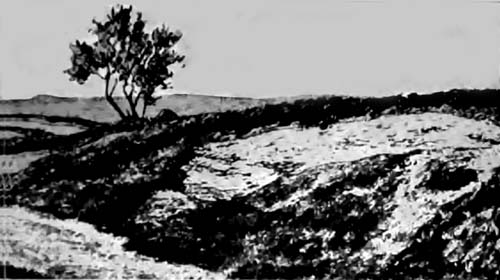
SHELL-HEAP |
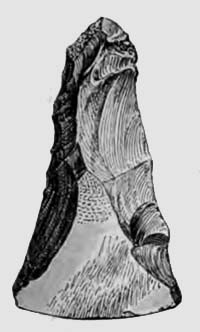
SHELL-HEAP AXE |
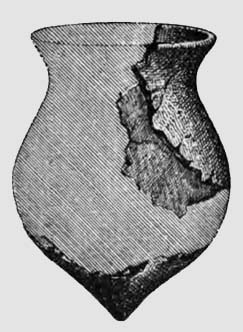
SHELL-HEAP JAR |
The age of these shell-heaps is shown approximately
by the presence of the auerhahn, proving
the neighborhood of pine forests. The charcoal
in the fireplaces came from oak wood,
showing that oak forests are overspreading the
country. The Baltic was more salt than at
present, and the shore line was depressed.
These facts indicate a period of transition from
the Ancylus to the Litorina Epoch. The stone
implements resemble those of western Europe
during the late transition epoch, and do not
occur in the oldest graves. There are no domestic
animals except the dog, and no cultivated
plants except some wheat in the later remains.
All this seems to prove that genuine Neolithic
culture had not yet reached the shores of the
Baltic. They are composed mostly of oyster
shells with a mingling of those of scallops, mussels,
and periwinkles. The oyster has now disappeared
from large parts of the coast and in
others has decreased in size. Land elevation
has narrowed the connection of the Baltic with
the North Sea, and the water contains less salt.
Remains of cod and herring show that the
fishermen who lived on or near these harbors
ventured out to sea in dugouts or on rafts, and
that they must have made lines for fishing in
fairly deep water. Remains of other fish occur.
Bones of birds are often very abundant,
especially swamp, shore, and swimming species;
wild geese and ducks, swans and gulls, the Alca
impennis or wingless auk, now extinct. The
blackcock, or “spruce (pine) partridge,” was
then common, but has now disappeared from
Denmark with the pine whose buds formed a
large part of its food.
Bones of stag, deer, and wild boar form, according
to Steenstrup, 97 per cent of all those
of mammals found at Havelse.31 Bones of seal,
otter, wolf, fox, bear, beaver, and wildcat also
occur. There are no traces of reindeer or musk-ox.
These animals had already migrated or
died out. Steenstrup noticed that the long
bones of birds are about twenty times as numerous
as others of their skeletons, and that the
heads or ends of the long bones of mammals are
generally missing. These were exactly the parts
which are gnawed by dogs, whose remains also
occur. Hence he drew the inference, now universally
accepted, that the dog was domesticated
in Denmark at this time. It was a small
species, apparently akin to the jackal and of
southeastern origin. No remains of other domesticated
animals have been found, nor of
cultivated plants, except a few casts of grains
of wheat in the pottery of the upper layers of
some of the heaps.
Daggers, awls, and needles were made of
bone; also combs apparently used for stretching
sinews into long threads. The flint implements
are rudely chipped, never polished. We
find long flakes used as knives, and numerous
scrapers and borers.32 The axe, if we may call
it so, was of peculiar form, approaching the triangular
and looking as if made out of a circular
disk of flint by breaking away two sides of the
periphery, leaving a somewhat flaring cutting
edge. The middle was thick, the edge tapered
somewhat rapidly, making a rough but quite
durable instrument. Longer implements in the
form of chisels or picks were also roughly flaked
with skilfully retouched edges, often with one
end narrowed or bluntly pointed. In all cases
the work is very rude compared with the best
specimens of Paleolithic time. Arrow-heads are
common, usually with a broad edge instead of
a point, well suited to killing birds and small
mammals. The bone harpoon seems to have
gone out of use.
The pottery is thick, heavy, crude, with practically
no ornament, except finger-prints around
the upper edge. The jars are sometimes of
large size; often the base is pointed instead of
flat or rounded. Hearths of calcined stones
are abundant. Sometimes these are surrounded
by circular depressions in the heaps, which may
mark the form and position of huts or shelters;
or these may have been placed under the lee of
the near-by forests. No graves or human remains
of this period have been found.
Shell-heaps quite similar to those of Denmark
were discovered at Mugem, in Portugal,
in the valley of the Tagus, twenty-five to thirty
metres above sea-level, and thirty to forty miles
from the mouth of the river. The shells are of
marine origin, and indicate a considerable elevation
of land since their accumulation. The
stone implements are very primitive and of
Azilian-Tardenoisian type. Large flat stones,
perhaps for grinding, perhaps for dressing skins,
occur. Pottery occurs only in the upper layers,
where the bones of mammals increase in number.
There are no polished implements, no traces of
domesticated animals, not even of the tame dog.
Graves were found here and there; and while
the skulls were badly contorted, they seemed to
show that the inhabitants were partly long-headed,
partly broad-heads. Remains, apparently
of the same age, have been found in Great
Britain.
Even the Danish shell-heaps are not all of the
same age. According to Forrer, Havno is ancient;
Ertebolle is also old, but was long inhabited,
and some of its uppermost layers may be
full Neolithic; Aalborg and others are younger.
Mugem strikes us as more ancient than the similar
Danish remains. Other remains near the
Baltic suggest very strongly quite marked differences
in age or in the culture of their inhabitants,
or in both these respects. We can notice
only two of these.
Maglemose lies on the west coast of Zealand
near the harbor of Mullerup. Here a peat-bog
has encroached upon a fresh-water lake and
has covered a mud bottom strewn with shells
of pond-snails and mussels. Pines had grown
in the swamp, and their stumps still protrude
into or above the moss. The implements were
found a little above the old lake bottom between
seventy centimetres and one metre below the
surface of the peat. The remains of the settlement
were distributed over an area about one
hundred feet long and broad. The charred or
burned wood was very largely (eighty per cent)
pine, ten per cent hazel, a little elm and poplar.
No oak was found here, but oak-pollen grains
were found in the same level as the settlement,
or slightly higher and later. Flint cracked by
heat and charred fragments of wood were found,
but no definite hearths. Bones of fresh-water
fish and of swamp turtles occur. The shore
could not have been very distant even if it
stood considerably higher, but no bones of
marine fish have been found. Many birds were
hunted. The mammals include boar, deer, stag,
and urus. The dog is the only domesticated
animal.
Flint chips are abundant at Maglemose; long
knife-flakes and axes are rare. Scrapers and
nuclei are numerous. The arrow-heads are long
and pointed instead of broad and edged, as in
the usual Danish shell-heap. Many of these
so-called arrow-heads may have been nothing
more than microliths used for a great variety of
purposes. No flint implements or fragments
show any trace of polishing. Bone implements
are numerous. We find rude harpoons of a very
late Magdalenian type. Also, some of the bone
implements are ornamented with various patterns
of incised lines, and even one or two rude
drawings of animals occur. The culture evidently
differs quite markedly from that of the
ordinary shell-heaps. It is worthy of notice
that the mud of the lake bottom and the overlying
peat were continuous over and around the
whole area of the settlement; there is no sign
of any island at this point and the settlement
was some 350 metres from the original shore of
the lake. There are abundant traces of fire but
no hearths. No traces of piles have been discovered.
All this seems to corroborate Sarauw’s
view that the people lived on a raft all the year
round. Sarauw considers the remains as of the
same age as the oldest shell-heaps. But there
is a wide-spread tendency to consider Maglemose
as considerably older, belonging probably
to the close of the Ancylus Epoch.
Virchow has described a heap composed of
mussel-shells on the outlet of Burtnecker Lake,
east of Riga, called Rinnekalns.33 Its most interesting
feature is its pottery made of clay
mixed with powdered mussel-shells, giving it a
peculiar glitter. It is ornamented with lines
arranged in an angular geometrical pattern encircling
the vessel. Similar pottery can be followed
far southward into Russia and westward
as far as East Prussia, but not farther into Germany.
Bored teeth used for ornaments occur.
Bone implements are numerous, often ornamented
with fine lines in zigzag or network.
We find harpoons also. The flint industry was
poorly and sparingly developed. Graves were
discovered, but their contents proved that they
belonged to a much later period.
The culture is peculiar, paralleled to a certain
extent but not repeated in western Europe.
We still seem to detect the influence of a decadent,
late Magdalenian style of ornament.
Virchow considered them as very late Paleolithic
or very early Neolithic.
The shell-heaps of different regions resemble
one another in general features, but differ and
show their individuality in details of culture.
These peculiarities may be due to difference of
age or of culture or population, or to both. We
must first attempt to find some place for them
in the chronological succession discovered in
France. They cannot be much older than the
French period of transition, when Scandinavia
first became habitable. But good cave-series
covering the transition epoch are rare, and
usually very incomplete. In 1887 Piette found
a remarkable series in a cave or natural tunnel
at Mas d’Azil, near Toulouse.34 The most important
strata were the following:
1. A dark layer evidently Magdalenian.
2. A yellow layer deposited by river floods.
3. Dark Magdalenian layer, with reindeer
harpoons, engravings, and sculptures. Reindeer
becoming rare; stag increasing.
4. Barren yellow layer, like 2.
5. Reddish layer (Azilian). No reindeer.
Stag abundant. Flints nearly all of Magdalenian
types. Flattened stag-horn harpoons
perforated at base. Bone points and smoothers.
Pointed flat pebbles. Bones of stag, bear, boar,
wildcat, beaver.
6. Bones of wild boar, stag, horse. Flints
similar to those in 5. Beginnings of pottery and
of polishing; but not of polished axes. Piette’s
Arisian. Beginning of Neolithic.
7. Neolithic and Bronze remains.
Layer 5 evidently represents a period posterior
to the Magdalenian and anterior to the
real Neolithic. Hence Piette considered it as
marking a distinct Azilian Epoch, resembling the
Magdalenian in most of its flint implements, in
the absence of pottery and of polished axes.
But the reindeer has here given place to the
stag, and the harpoon has changed correspondingly
and is less skilfully made. Bone implements
are decadent.
Another culture, the Tardenoisian, was of exceedingly
wide range. It took its name from
Fère-en-Tardenois, Department of Aisne, northeast
of Paris, and was characterized by its very
small “pygmy” flints of various, usually geometric
forms.35 This microlithic industry was
found in France, Belgium, England, Germany,
Russia, and along the southern shore of the
Mediterranean. The culture was well represented
along rivers and inlets, and seemed
to characterize a fishing rather than hunting
folk.
In 1909 Breuil and Obermaier found in the
grotto of Valle, in northern Spain, a classic
Azilian deposit, forming the lower levels of a
series rich in these microliths or pygmy flints.
The Azilian was more nearly a continuation of
the Magdalenian culture, while the Tardenoisian,
in France, seemed to be an importation
from the Mediterranean region. Since the two
were so closely related in point of time it seemed
safe and wise to combine the two names and
call the epoch the Azilian-Tardenoisian, the
Azilian representing the older portion.
The station of Campigny, on the lower Seine,
seems to be somewhat later than the Azilian-Tardenoisian.36
Here, in a pit oval in outline,
with a long diameter of 4.30 metres, evidently
an ancient dwelling, there were found bits of
pottery, utensils of older stone epochs, no polished
implements, but the tranchet or axe and
the pick (pic) characteristic of the Danish shell-heaps.
These Campignian remains are hardly
widely enough diffused or sufficiently definite
to give name to a distinct epoch. They may
well be nearly contemporaneous with the (older?)
shell-heaps.
The whole transition epoch, which we have
hastily surveyed, shows us a series or mixture
of disconnected cultures, yet with curious and
striking interrelations. This may be partly due
to the fact that the population of Europe was
diminished and scattered. Little groups of people
formed more or less isolated communities,
and developed their own special peculiarities
according to situation, needs, and opportunities.
Connecting links, or intermediate cultures,
which may once have existed, have been completely
lost or still remain to be discovered.
The general desertion of the caves destroyed
one of our best sources of continuous records.
But the cause of this diversity lies deeper.
New cultures and new waves of migration of
peoples were pouring into Europe, especially
into the Baltic region now left free of ice, enjoying
a mild climate, and offering an abundance
of food along the shores of its rivers,
lakes, and seas. The Tardenoisian culture had
spread northward from the Mediterranean. The
broad-headed people of Furfooz, Grenelle, and
Ofret had apparently crossed Europe from the
east and had settled in a long zone extending
northward and southward through Belgium and
France and probably southward into Spain, for
we remember the broad-heads found at Mugem,
in Portugal. But their distribution was far
wider than this strip of territory. New Neolithic
types of culture had already entered Italy,
perhaps as early as Magdalenian times. Series
of waves appear to have passed into Poland,
Russia, and Siberia, and to have moved northward
until they reached the coast in Scandinavia
and to the eastward. In all these cases we may
probably imagine a gradual and perhaps slow
infiltration or “seeping” in of the new population
rather than an invasion in crowds or masses,
such as we are likely to imagine. Vast stretches
of habitable land had been newly opened, and
there was plenty of room for all comers. In
many regions the old population may have remained
comparatively undisturbed until a much
later date. But even they slowly came under
the influence of the new and improved technique
and mode of life. All this collision of culture
and conflict of peoples meant stimuli, awakening,
the jogging of dull minds, a veritable spur
of necessity. A new day was beginning to break.
The dawn was dim and cloudy, but there was
the possibility and prospect of clear shining.
LAND HABITATIONS
OUR history of Paleolithic times is drawn
very largely from the successive strata
of remains found in rock-shelters and
near the mouths of caves, where the succession
of epochs is clear and indubitable. We naturally
look for similar reliable testimony concerning
the chronological succession of Neolithic
utensils, pottery and other remains. Here,
however, we have been disappointed to a large
degree. Paleolithic layers were generally or
frequently overlaid by beds of stalagmite or
fallen rocks, which have saved them from disturbance.
But the Neolithic and Bronze layers
are superficial, usually of no great thickness;
they have been less solidified and protected, and
far more exposed to the disturbing work of burrowing
mammals and of men digging for buried
treasures. These circumstances, combined with
far less continuity of occupation, have greatly
diminished the chronological value of their
study.
Neolithic cave remains occur in somewhat
limited areas scattered all over Europe.37 They
have been studied in England, France, Spain,
Austria, and Germany in at least fairly large
numbers. In Austria the cave province extends
through Galicia, Moravia, and Bohemia. Here
we find primitive pottery; rude stone and numerous
bone implements; domesticated cattle,
goats, and pigs. Game was evidently very
abundant. The cave-dwellers, apparently, were
pioneers in the less habitable regions, living
mostly by hunting and fishing, from the increase
and products of their herds, and from agriculture
to a far less degree. The pottery and implements
remind us somewhat of those of the
earliest lake-dwellings. But we often find bits
of copper and bronze, suggesting a later date or
a series of inhabitants whose relics have become
much mixed. It would not be at all surprising
if primitive manufactures had remained here
longer in use than in less isolated regions. A
deposit of quite similar general character has
been found at Duino, near Monfalcone, at the
head of the Gulf of Trieste.
A second province lies in Bavaria, between
Bamberg and Baireuth. Hoernes considers its
remains as also of the same age as the oldest lake-dwellings,
but with peculiarities due to the different
geographical conditions. The cave provinces
of other countries are equally interesting.
Every one has its own features and problems.
We would naturally expect that these cave-dwellers
would represent the least progressive
and prosperous members of the population of
any country. In our general survey we can
afford to give them only a hasty glance. We can
easily understand that where chalk or other soft
rock occurred artificial grottos were often excavated.38
Remains of dwellings are common all over
Europe, and are likely to be uncovered wherever
excavations are made in grading or for the
foundations of buildings. They are of two
forms: the rectangular house and the round hut.
The rectangular form is the rule in the lake-dwellings,
though with exceptions; on the land
the reverse is true. The pit-dwelling at Campigny
was elliptical in form with a longest diameter
of 4.30 metres. We remember that the
settlement at Campigny is probably little, if at
all, younger than the shell-heaps. But by far the
commoner form of pit-dwelling is circular, with a
diameter rarely exceeding two metres. Such
small circular pits are exceedingly common. At
the bottom we find ashes, bones of animals, implements,
and fragments of clay once forming
a part of the superstructure, baked hard when
the hut was burned, and still having marks of
the twigs and branches over which the clay had
been plastered. We picture to ourselves the
hut as mostly underground, with a diameter
usually not exceeding one and one-half to two
metres, excavated to a depth of one or two metres,
the pit often surrounded by a rude wall of
field stones. In the centre was the hearth.
The superstructure was merely a cone composed
of a framework of poles interlaced with branches
and twigs plastered with clay. In the primitive
hut there was no perpendicular side wall above
ground, though in some the roof may have been
raised somewhat on the earth thrown out from
the pit. Such differences of detail are of slight
importance. The huts are of all ages. They
were probably erected far back in Paleolithic
time. They seem to be figured in Magdalenian
cave-frescoes.39 Even the Chellean hunters could
hardly have erected more primitive shelters.
But equally rude huts are still inhabited in the
Balkan Peninsula,40 and are described by classical
writers as inhabited by the Germans.
Says Tacitus (Germania, XLVI) of the Finns
of his day: “They lead a vagrant life: their food
the common herbage; the skins of beasts their
only clothing; and the bare earth their
resting-place.... To protect their infants from the
fury of wild beasts and the inclemency of the
weather, they make a kind of cradle amidst the
branches of trees interwoven together, and they
know no other expedient. The youth of the
country have the same habitation, and amidst
the trees old age is rocked to rest. Savage as
this way of life may seem, they prefer it to the
drudgery of the field, the labor of building, and
the painful vicissitudes of hope and fear, which
always attend the defense and the acquisition of
property. Secure against the passions of men,
and fearing nothing from the anger of the gods,
they have attained that uncommon state of felicity,
in which there is no craving left to form a
single wish. The rest of what I have been able
to collect is too much involved in fable....”
Let us hope that the reports which Tacitus
had been able to collect concerning the dwellings,
as well as the ferocity, filth, and poverty of the
Finns, were somewhat exaggerated. Evidently
conical, largely subterranean huts have been
common in Europe down to far later than Neolithic
times. The age of any pit-dwelling can
be determined only by its contents.
In addition to these circular pits, long or
short trenches occur. Forrer found at Stutzheim
one cellar more than ten metres long, and
varying from one to three metres in width,
with several lateral enlargements as pantries
and storehouses.41 Forrer considers this as the
home of the chief man, the “manor-house” of
the settlement. Around it he found remains of
huts such as we have already described. Frequently
space for storage as well as dwelling
was gained by clustering small huts. This plan
would have had the advantage of protection
against loss of everything by fires, which must
have been frequent. Such cramped dwellings,
with the garbage scattered over the bottom of
the hut, or in the huts of the most highly cultured
deposited in a special hole in one corner,
could hardly have been attractive, clean, or
sanitary. But they were cool in summer and
warm in winter, and afforded protection against
wind and weather. People asked and expected
no more. Housekeeping was simple, if not easy.
But we can imagine that the return of spring,
allowing them to emerge from their burrows,
must have been hailed with delight.
We have still much to learn concerning these
Neolithic dwellings. They have been discovered
by chance, and usually studied only hastily
and superficially. A pit discovered and examined
may have been only one of a large cluster
or village, of which the rest remained undiscovered.
Wooden houses of logs, or with a
strong frame of poles seem to have existed in
Bronze, or even late Neolithic times. Sophus
Müller42 describes settlements in Denmark where
the abundance of ashes and utensils prove long-continued
habitation, and yet no pits seem to
have been found—this may be due to insufficient
investigation—strongly suggesting, at
least, houses entirely above ground built of
perishable materials. It is very hard to believe
that even a Neolithic family could have lived
through the winter in one, mainly subterranean,
dwelling only two metres in diameter, with a
fireplace in the middle. They would have
been compelled to sleep sitting or standing!
Probably Stutzheim and other similar settlements
which have been discovered, represent
the real general average of pit-dwellings, while
besides these there were many of far superior
style and comfort. The development of the
Greek house is still a problem, much more that
of a North German dwelling.
As an example of late Neolithic settlement of
the better or best class, we may take Grosgartach,
near Heilbronn, in the Neckar valley.43
Here, where now are low meadows, was once a
lake connected with the Neckar. The Neolithic
village was carefully and skilfully explored
by Hofrath Schliz, whose report is a
model of careful observation and clear description.
The situation was very favorable, with loess-clad
hills sloping to rich meadows, and the lake
furnishing fish and a line of communication.
The areas occupied by the houses and stalls were
clearly marked by the dark “culture-earth”
contrasting sharply with the yellow loess. The
principal house was rectangular. The outer
wall was composed of posts with a wattling of
twigs. This was plastered with clay, mixed
with chaff and straw. The inner face of the
wall was smoothly finished, and then “kalsomined”
reddish yellow, and still further decorated
with fresco in geometrical designs. The
house—5.80 metres by 5.35 metres—was divided
into two rooms. The larger part of the
house was occupied by the kitchen, with its floor
about one metre below the surface of the ground,
and entered by an inclined plane or ramp. The
other chamber, the sleeping-room, was nearly a
metre above the kitchen and separated from it
by a partition. Benches cut out of the loess were
found in both kitchen and sleeping-room. Stalls
for cattle and barns or granaries were also found.
Virchow, in his review of Schliz’s monograph,
emphasizes the fact that apparently Grosgartach
was deserted by its inhabitants and fell into
decay without leaving any signs of destruction
by fire or violence.
The villages of Butmir, Lengyel, Jablanica,
and others in southeastern Europe show us a
condition of advanced culture here also.44 Déchelette,
speaking of the culture of this region,
notices “the striking analogies between these old
walled villages of the Balkans and the Danube
valley, and those of the Ægean villages of the
Troad and Phrygia.” Primitive idols, painted
pottery, frequent use of the spiral in decorative
art, all these reappear here and there in the
Neolithic stations of southeastern Europe, and
in the eastern basin of the Mediterranean in
pre-Mycenæan and Mycenæan days. Evidently
houses, settlements, modes of life, and stages of
culture differ greatly during the same epoch of
the Neolithic period in different parts of Europe.
Italy was always far in advance of Europe north
of the Alps. But even in northern Europe there
was great diversity. Shell-heap dwellers still
remained long after a much higher culture prevailed
throughout most of Denmark. The life
and thought of the pioneer hunters of northern
Germany, and still more of northern Russia,
were very different from those of the agriculturists
along the valley of the Danube and in the
Balkan Peninsula. In Greece little city-states
began to arise early. Even in northern Europe
density of population and size of settlements
varied greatly. One illustration of these differences
can be seen in the occurrence of fortified
villages and refuges.45 The age of these fortifications
is as great a problem as that of the remains
found in a pit-dwelling. The village may
be, probably usually is, much older than the
surrounding wall, and an earthen wall may
contain Neolithic or even perhaps Paleolithic
implements. The custom of fortifying villages
evidently spread rapidly during the Bronze and
Iron periods. Sophus Müller tells us that all
walled settlements north of the Alps are far
younger than the Neolithic period.46 This statement,
often disputed or neglected, is probably
an exaggeration, but may well be true of the
region surrounding the Baltic. The sparse and
scattered hunting and pioneer population of
Scandinavia and Germany had no need of
building permanent walls around their single
houses or small villages. They had very little
wealth to protect.
But an agricultural population inhabiting a
fertile region open to attack might well surround
their villages with a wall, or provide a burg, or
fortified place or “refuge,” whither they might
drive their cattle or transport their grain.
Examples of this are Stutzheim and Urmitz, in
the Rhine valley, always a great thoroughfare,
and in Switzerland and along the maritime Alps
villages of this sort seem to have been fairly frequent.
Apparently they were still more numerous
in the valley of the Danube and in the Balkan
Peninsula. It is not at all surprising to find
them in Thessaly, so near to the advanced civilization
of Greece.
Another class of settlements usually well
protected were the workshops (ateliers) and
manufacturing villages, especially those where
flint was mined, or where flint implements were
made in large quantities and distributed by
trade over wide areas.47 During the Neolithic
period these settlements would have held much
the same place and importance as our centres of
coal, iron, manufacturing, and business have
with us to-day. Grand Pressigny and Camp
de Chassey, in France, and Cissbury, in England,
are single examples of a great number of such
fortified mining and manufacturing villages.
For a further study of these very interesting remains
the reader is referred to the manuals of
Déchelette and Hoernes.
Even before the close of the Paleolithic period
tundra and steppe were giving place to forests,
which were advancing even into Scandinavia.
The forest looms large and terrible in the works
of classical writers and German antiquarians.
Says Tacitus: “Who would leave the softer
climes of Asia, Africa, or Italy to fix his abode
in Germany, where Nature offers nothing but
scenes of ugliness, where the inclemency of the
seasons never relents?... The face of the
country, though in some parts varied, presents a
cheerless scene, covered with the gloom of forests,
or deformed with wide-extended marshes.”
He says that the soil produces grain and is
well stocked with cattle, though of small size.
But grain does not grow in primeval forests,
and herds of cattle need at least open glades
for pasturage. It is an extreme picture tinged
by the homesickness of a citizen of sunny Italy.
Northern Europe was generally heavily
forested until long after Tacitus’s time. The
Romans began in earnest the work of deforesting
France, and the work was carried on all over
Europe in mediæval times. The Neolithic immigrants
probably made small clearings with
the aid of fire, especially where the trees were
low and not too thick, as on many light-soiled
areas. They could make but little impression
on the heavy forest growth, though they could
limit its spread. They probably did not need
to make wide clearings of dense forest. There
were many open stretches of country of greater
or less extent awaiting occupants and culture.
This was true especially of districts occupied by
the loess, whose origin from dust drifted by
Paleolithic wind-storms we have already noticed.
Geikie describes loess as typically a “fine-grained,
yellowish, calcareous, sandy loam, consisting
very largely of minute grains of quartz
with some admixture of argillaceous and calcareous
matter.”48 It is for the most part a
wind-blown deposit. It is widely developed
over low-lying regions, but sweeps up to heights
of 200 to 300 feet and more above the bottoms
of the great river valleys. Again, in many
places we find it heaped up under the lee of
hills, the exposed windward slopes of which bear
no trace of it. Wherever there is loess we are
likely to find the remains of steppe plants and
animals. The ancient steppe area which generally
covers, and probably extends considerably
beyond, the loess district, is the region occupied
by most of the primitive settlements. Even
to-day it is less wooded than the rest of northern
Europe. Such steppe regions in the North
German plain are the great diluvial river terraces,
especially the terraces of the Saale and
Elbe and the eastern edge of the Harz Mountains;
in South Germany the lower Alpine “Vorland”
from Switzerland to lower Austria, the
uplands of Suabia and Franconia, the valleys
of the Main and Neckar, and much of northern
Bohemia. These steppe regions of Germany,
northern Austria, and Switzerland extended
southeastward in a zone following the Danube,
widening out in the great Hungarian plain into
the vast steppe region extending eastward from
the Black Sea or Pontus. From this Pontic
steppe a band of more or less open country extended
northward along the Carpathians until
it almost or quite joined the open regions of the
Elbe and along the Harz. A farther extension
of this same band seems to have opened the way
from the Harz region through northwest Germany
into Belgium and northern France, and
very probably into Brittany. We see at once
the importance of these long lines of open or
thinly forested country to the immigrations
and settlement of Neolithic peoples. Periodical
floods or other conditions kept open many river
valleys, whose importance we shall estimate in
a later chapter. All this land, except the uplands
of Suabia and Franconia, and some similar
areas, was comparatively fertile, the loess
areas particularly so, and suited to a primitive
agriculture.
In England the valleys of the Thames and
other rivers were heavily wooded and not populated
until much later. But the long lines of
chalk-downs and oolitic uplands were far less
favorable to forest growth. In Norfolk and
Suffolk there were apparently open spaces.
Yorkshire and Derbyshire had very similar
landscapes. The forest was held back wherever
the porous chalk formation made a large outcrop.
In these places man could settle and find
pasturage for his flocks and attempt a poor sort
of agriculture, even in Neolithic days. Hence
we find these regions dotted with Neolithic settlements.
The immigrants who came in during
the Bronze period settled in the same regions.
Here again clearing of the forest on
any large scale was apparently not attempted
until Roman times, but along its boundaries,
where the forest growth was not too heavy,
these primitive agriculturists may well have
cut off the lighter growth for fuel and buildings,
and thus have gradually appreciably extended
the arable area.
LAKE-DWELLINGS
THE winter of 1853-1854 was exceedingly
cold and dry. The surface of the Swiss
lakes sank lower than at any time during
many preceding centuries. The lowering of
the water tempted the inhabitants along the
shore to erect dikes and thus fill in the newly
gained flats. During this process the workmen
along the edge of the retreating water came
upon the tops of piles, and between those great
quantities of horn and stone implements and
fragments of pottery. Aeppli, a teacher in
Obermeilen, called the attention of the Antiquarian
Society in Zurich to these discoveries.
The society recognized at once their importance,
and under the leadership of its president, Ferdinand
Keller, began a series of most careful
investigations which have contributed more to
our knowledge of life during the Neolithic period
than any discoveries before or since.
The number of these lake-dwellings is very
large. Lake Neuchatel has furnished over 50;
Lake Leman (Geneva) 40; Lake Constance over
40; Lake Zurich 10. The shores of the smaller
lakes have also contributed their full quota.49
In some of the lakes where the shore was favorable,
remains of a lake-dwelling have been found
before almost every modern village. Sometimes
we find the remains of two villages, one
somewhat farther out than the other. In these
cases the one nearer the shore is the older,
usually Neolithic, while the one farther out belongs
to the Bronze period.
These settlements are by no means limited to
Switzerland. They stretch in a long zone along
the Alps from Savoy and southern Germany
through Switzerland into Austria.50 Herodotus
mentions them in the Balkan Peninsula. The
amount of bronze seems to increase as we pass
from east to west. They are found frequently
in the Italian lakes, mostly containing relics of
the Bronze Age, though here the western settlements
contain little or no metal. A second
series has been discovered in Britain and northern
Germany, and extending into Russia. These
are considerably younger. The scheme of the
lake-dwelling was used in historic times in Ravenna
and Venice. Large numbers are still inhabited
in the far east.
A sunny, sheltered shore, protected by hills
from storms and action of waves, was always
an attractive site.51 The character of the land,
if open and suitable for pasturage and cultivation,
was doubtless important. Much depended
on the character of the bottom. Where
the shore shelved off gradually and was composed
of marl or sand, the piles could be easily
driven, and could hold their place firmly. Even
if the shore was somewhat too hard and the
piles could be driven only a little distance,
they were strengthened by piles of stones, often
brought from a considerable distance. When
a suitable location had been discovered and
selected the trees were felled partly by the use
of stone axes, and partly by fire, and one end
of the log was pointed by the same means, according
to Avebury. Their diameter was from
three to nine inches, and their length from fifteen
to thirty feet. During the Bronze period larger
trees were felled and split, and larger piles had
to be used in the deeper water farther from the
shore.52
These rudely sharpened piles were driven into
the bottom by the use of heavy stone mallets.
This must have involved an immense amount
of hard labor, for at the settlement of Wangen
50,000 piles were used, though not all probably
at the same time. Messikommer calculated that
at Robenhausen over 100,000 were used. We
find sometimes a different foundation. It consists
of a solid mass of mud and stones, with
erect and also horizontal logs binding the whole
structure firmly together. This is evidently a
ruder, simpler, and perhaps more primitive,
mode of building. It was less suited to an open
situation, exposed to heavy waves, and seems
to occur more often in smaller lakes now often
filled with peat.53 Wauwyl and Nieberwyl are
good illustrations of such a “Packwerkbau.”
Some have considered them as originally floating
rafts.
When the piles had been firmly driven, cross-pieces
were laid over the top, and on this a
“flooring” of smaller poles, or of halved logs
or even split boards, whose interstices were
probably filled with moss and clay, forming a
solid and fairly even surface, on which the dwellings
could be erected. The framework of the
houses was of small piles, some of which have
been found projecting considerably above the
platforms.54 “The size of the house is further
marked out by boards forced in between the
piles and resting edgeways on the platform, thus
forming what at the present day we should call
the skirting boards (mop-boards) of the hut or
rooms. The walls or sides were made of a wattle
or hurdle work of small branches, woven in
between the upright piles, and covered with a
considerable thickness of loam or clay.” This
is proved by numbers of pieces of clay half-burnt,
or hardened in the fire, with the impressions
of the wattle-work still remaining. These
singularly illustrative specimens are found in
nearly every settlement which has been destroyed
by fire. The houses were rectangular
except in a few cases. They were apparently
thatched with straw or reeds. The hearths
consisted of three or four stone slabs.
These houses were calculated by Messikommer
at Robenhausen to have been about 27 by
22 feet, a very respectable size. One was excavated
at Schussenried, whose side-walls and
floor were fairly well preserved. This was a
rectangle about 33 by 23 feet (10 by 7 metres),
and was divided into two chambers. The front
room, 6-1/2 by 4 metres, opened by a door facing
south, and with remains of a hearth in one corner.
The rear room, 6-1/2 by 5 metres, was
without outer door, and was apparently a bedroom.55
Beside these houses, or forming a part
of them, were stalls for the cattle, granaries,
and probably workshops. (The distribution of
different remains is well shown in Keller’s Lake
Dwellings, I, p. 45.) The stone and bone implements,
and the pottery of the lake-dwellers
can be more conveniently considered in connection
with those of other regions.
We pass now to the remains of animals and
plants found here, especially in their relations
to the food supply of the people.56 Altogether
about 70 species of animals have been discovered.
Of these 10 are fish, 4 reptiles, 26
birds, and 30 mammals, of which 6 were probably
domesticated. The largest of these were
the great Cervus alces or moose—sometimes
called elk—the wild cattle, and the stag (Cervus
elaphus). Bones of the stag and ox are very
numerous and equal those of all others together.
Of the horse very few remains are found until
the Bronze period. Wild horses seem to have
lived on in certain parts of Europe until a late
date, but apparently they had emigrated almost
altogether from this region. The horse of the
Bronze Age was domesticated. The lion had
left this region, but lingered on in the Balkans
down to historic times. The brown bear and
the wolf still roamed in the forest. In the oldest
lake-dwellings the bones of wild animals
make up a far larger proportion of the remains
than in the latest ones.
We find a somewhat small dog (Canis familiaris
palustris) closely resembling that of the
Danish shell-heaps. It was apparently of the
jackal type, and much like the modern Spitz.
This would have been an excellent watch-dog
to give warning of the approach of enemies.
But at the close of the Neolithic, with the increase
of flocks of sheep, a larger dog more
closely related to the wolf seems to have spread
widely through the country (Canis familiaris
matris optimæ Juit). This form was much like,
and probably the ancestor of, our present sheep-dogs.
A third form (Canis intermedius) also
occurs. The origin and relationships of the
various forms of this oldest domesticated animal
are still anything but clear. That they all go
back to the jackal and the wolf rather than to a
form like the Australian dingo, still seems to be
most generally accepted. (But see Schenk.57)
Man gained the dog by domesticating the
jackal and different species of wolves in different
parts of the world and then by crossing, or,
by a more or less unconscious selection, bred
different varieties, until we have at present a
chaos of intermingled forms. Something similar
but on a smaller scale was true of the domestic
cattle. One kind of domestic cattle appears
fully domesticated in the oldest lake-dwellings.
It is unlike any wild European form. This is
the Bos brachyceros. It was almost certainly
imported. Mingled with its forms we find those
of the Bos primigenius, a native of Europe and
North Asia, but apparently not domesticated.
This is the urus, which was common in Europe
in Cæsar’s day, and lasted in central Europe
until 1000 A. D. and still lingers in Poland.58
This was a very large and powerful form with
long spreading horns, whose domestication appears
to have commenced toward the close of
the Neolithic period. It is not improbable that
it was domesticated, or at least tamed, independently
in different countries at quite different
times. Raising of cattle was at its height
during the Bronze Age; afterward the results
seem to decline and the cattle to degenerate.
One of the Vaphio vases of about 1500 B. C.
represents the capture of large, long-horned
cattle in a net, while the second shows similar
animals tamed. Apparently the smaller and
lighter brachyceros was first tamed, and this
success led to a series of experiments with the
larger and more difficult form.59
If we draw a line from northwestern Russia
diagonally across Europe southwestward to the
mouth of the Rhone, it will divide fairly well
the distribution of the descendants of those two
forms. To the eastward in Russia and Austria,
also generally through Germany, and extending
also along the shores of the Baltic, we find the
large, heavy, usually long-horned descendants
of the primigenius stock. The cattle of Spain,
and southward into Africa, of France and England,
are more of the short-horned, light-built,
smaller brachyceros type. Holstein and Jersey
are good representatives of the two types, though
the Holsteins are, perhaps, a somewhat marked
variety. Some regard the cattle of the Scotch
highlands as the best representatives of the
primigenius type, though reduced in size. This
same type, on account of its size and endurance
of harsh climate, has furnished the range cattle
of our Western plains.
Two fairly distinct forms of swine occur in
the lake-dwellings. The first is the so-called
turbary pig (Sus scrofa palustris). This is a
small form with comparatively long legs. It
differs markedly from the wild boar, and was
probably imported already domesticated. Being
more or less left to feed and shift for itself, it
may well have declined in size from its primitive
oriental ancestors. Remains of the larger European
wild boar (Sus scrofa ferus L.) also occur
from the beginning as products of the hunt.
But during the Bronze period domesticated
descendants of this variety grow numerous, and
are crossed with the smaller turbary pig.
“The domestic sheep,” says Brehm, “is a
quiet, gentle, patient, simple, will-less, cowardly,
wearisome animal. It has no character. It understands
and learns nothing; is incapable of
helping itself.”60 It is certainly absolutely dependent
upon man for guidance and protection.
This lies partly in its inherited nature and original
surroundings, but suggests long domestication.
Like the goat, it is originally a mountain
form, but adapts itself readily to the dry
herbage of the steppe. It is not a native of
central Europe but introduced. It is much
rarer than the goat in the oldest lake-dwellings,
but gradually becomes more abundant, especially
in the Bronze period.
The turbary sheep (Ovis aries palustris) is
very small, with slender legs, long narrow skull,
and bones somewhat like those of the goat. It
was certainly not developed in Switzerland, and
before it arrived there it had apparently been
much modified by conditions of life or by crossing.
ing.
Its anatomical characteristics are made
up of at least three wild forms. The first of
these is the goat-like maned sheep (Ovis tragelaphus)
ranging over the mountains of northern
Africa, extending across into Abyssinia. This
form seems to have been domesticated in Egypt
before the middle of the fourth millennium. At
a much later date, in Homeric times, herds of
sheep of a similar form were kept in Greece. It
was much larger than the turbary form.
The arkal (Ovis arkal) is the steppe sheep of
central and western Asia. It is the ancestor
of the oriental and African fat-tailed sheep.
The western Asiatic forms seem to have developed
the fine wool at the expense of the coarse
hair, like that of the goat and of many other
forms.
A third form is the Moufflon, of the mountains
around the Mediterranean and of its larger
islands—here probably introduced. Similar
forms appear in Europe during the Bronze
period.
Other species are found in different parts of
Asia. The balance of probabilities seems to
incline toward the view that the turbary sheep
came into Europe from western and central
Asia with other “turbary” forms, that it had
been long domesticated, and either here or on
its westward migration may have more or less
crossed with the descendants of other varieties.
The oldest domesticated goats seem to be descended
from the Bezoar goat (Capra ægagrus),
from the mountains of southwestern Asia.
The presence of oxen, sheep, and goats is
enough to prove that the people must have
practised agriculture to some extent to have
kept these animals alive through the winter.
That they were kept on the platform is shown
by the presence of manure in the remains underneath.
Whether this was used for fertilizer
we do not know, nor their method of cultivating
the ground. No agricultural implements have
come down to us.
“The small-grained, six-rowed barley (Hordeum
hexastichum sanctum) and the small lake-dwelling
wheat (Triticum vulgare antiquorum)
were the most ancient, most important, and
most generally cultivated farinaceous seeds of
our country. Next to them come the beardless
compact wheat (T. vulg. compactum muticum)
and the larger six-rowed barley (Hordeum hexastichum
densum), with the two kinds of millet,
the common millet (Panicum miliaceum) and
the Italian millet (Setaria italica). The Egyptian
wheat (Triticum turgidum L.), the two-rowed
wheat (emmer, Triticum dicoccum Schr.),
and the one-grained wheat (Trit. monococcum)
were probably, like the two-rowed barley, only
cultivated as experiments in a few places; and
the spelt (Triticum spelta L.), which at present
is one of the most important cereals, and the
oat (Avena sativa L.) appeared later, not till
the Bronze Age, while rye was entirely unknown
among the lake-dwellings of Switzerland.”61
Oats occur in the Bronze period in western,
middle, and northern Europe, in the Alpine
lake-dwellings, and in the Danish islands. The
ancient Egyptians and Hebrews, Indians and
Chinese, did not cultivate them; they were
raised in Asia Minor and America only since historic
times. We remember that wheat and barley
are mentioned in the oldest records of the
Old Testament—as in Gideon’s barley loaf—but
rye and oats not at all.
The grains seem to show a gradual improvement
in productiveness from the very oldest
settlements to those of the Bronze period. They
are found charred and perfectly preserved
wherever the houses were destroyed by fire.
Even the ears and stalks have been saved for
us in the same manner. Charred loaves of
bread, and cake made of poppy-seeds, were also
found. “Bread was made only of wheat and
millet, the latter with the addition of some
grains of wheat, and, for the sake of flavoring
it, with linseed also. Bread made of barley has
not yet been found, and it is probable that barley
was chiefly eaten boiled, or more probably
parched or roasted.”62 Flint sickles made of a
long flake set at a right angle with the wooden
handle have been found in Denmark, and others
whose blade is formed by a row of small, sharp
flints set in the edge of a wooden block occur in
Egypt. The hand-mills or mealing-stones are
very abundant, as might be expected.
The occurrence of the seeds of the Cretan
catchfly (Silene cretica L.) is interesting, as it
is not found wild in Germany or in southeastern
Europe, but over all the countries of the Mediterranean.
Similarly, the corn-bluebottle (Centaura
cyanus L.) is found wild in Sicily. This
seems to show that these plants came in with
the wheat from Italy. But it is still possible
that both Switzerland and Italy received them
from a source somewhat or considerably farther
east or south.
Apples and pears, split and dried, occur abundantly.
Some of the apples are so large that
they suggest a certain amount of care and cultivation.
Sour crabapples, and the stones of
cherries, plums, and sloes are found accompanied
by the seeds of the wild grape; of elderberries,
raspberries, blackberries, and strawberries.
Acorns, beechnuts, and hazelnuts were stored up.
Besides the seeds of the poppy, already mentioned,
those of caraway were used apparently
to flavor the bread. Altogether some 170 plants
have been discovered and determined from these
localities.63
Basket-making and the weaving of mats from
bast-fibres had led up to a highly developed
weaver’s art. Few or no remains of wool have
come down to us from Neolithic time, though
it occurs in graves of the Bronze Age farther
north. It would not preserve by charring, as
all other lake-dwelling organic remains have
been saved for us, and our failure to discover
it is not surprising. We can hardly believe
that these people did not use the wool of their
flocks of sheep, or failed to felt the hair of their
goats. But flax has been found in all stages
of preparation and manufacture in great quantities.
Says Messikommer of Robenhausen:
“Every house had its loom.” We find not only
threads, cords, and ropes, twine and nets, but
cloth of varying pattern and design. Some
pieces were so finely woven and well preserved
that their discoverers could hardly believe that
they were not of modern make. Fringes and
embroidery occur.64
Linen alone could hardly have furnished
sufficient protection against the cold and dampness
of the Swiss winter climate. The more
primitive inhabitants had an abundance of furs.
Garments of sheepskin were doubtless in use.
And probably wool and goat’s-hair were woven
or felted into outer garments. Dye-stuffs of
black, yellow, red, and blue coloring furnished
a variety of tints and shades.
Very few human bones have been found among
those lake-dwelling remains; and only a few burial-places,
or rather tombs, in the neighboring
mainland. The discussion of their mode of
burial and racial characteristics may well be
deferred to a later chapter.
Of their religious cult we know almost nothing.65
No idols or fetiches have been recognized.
Certain “crescents” of clay, supported with the
horns turned upward, have been considered by
some as head-rests, for which purpose they are
still used by certain African tribes. Others
have considered them as representatives of the
crescent moon; still others as conventionalized
ox heads and horns. It seems highly probable
that they had some religious significance, but
its exact nature is still uncertain. We shall
return to them later.
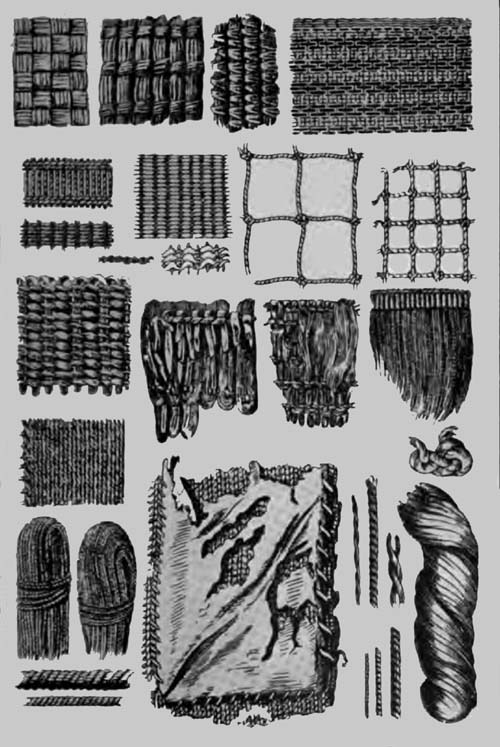
WAVING AND PLAITING FROM LAKE-DWELLINGS
A lake-dwelling of any size is inconceivable
without a well-advanced social development.
It could hardly be founded, builded, or maintained
without close co-operation. Families
had to live closely crowded together, almost as
in our modern cities. Neighbors had learned
to get on with one another and live together in
peace, and to submit to a close regulation or
discipline by law or custom. They seem to have
been a peaceful folk and exposed to no great
dangers from outside attack, at least in Neolithic
time. When the ice fringed the shores or
covered the small lakes, they must have been
easily open to attack. A few brands thrown
into the thatched roof would have brought sure
destruction. Traces of conflagration occur, as
at Robenhausen, which was twice destroyed by
fire.66 But these occurrences are rare. Neolithic
settlements seem to have been more frequently
abandoned because of the growth of
peat than by any sudden or violent destruction.
Conditions probably changed in this respect during
the Bronze period.
Their food was varied and more than fairly
abundant. They had their domestic animals to
furnish flesh, milk, probably butter and cheese.
Agriculture was primitive, but in some cases we
find large stores, we might say granaries, of
wheat; and wild fruits and vegetable foods
were abundant. The forests offered game, and
the lakes were well-stocked with fish. There
may have been times of hardship and dearth,
but famine could hardly have ravaged a people
with these three sources of supply.
The lake offered a thoroughfare for their
canoes, and communication was easy for long
distances. To cite only one illustration: flint
was brought from Grand Pressigny, in France,
and manufactured in certain Swiss localities.
There was much variety and division of labor between
different villages. One manufactured flint
very largely—so at and around Moosseedorf;
while Robenhausen and Wangen have furnished
great quantities of cloth. Others were rather
centres for the manufacture of pottery. Even
in the same village one area is richer in one
product, a second in another. There was much
variety as well as freedom of intercommunication.
The whole region lay a little back from
the great Danube thoroughfare, but near enough
to it to retain connection with the larger world.
Life was not altogether monotonous.
The lake-dwellings have been divided according
to their age into three groups or stages, representing
three epochs more or less marked.67
Stage I. Archaic Epoch.—Axes small and
made out of indigenous material. “Hammer-axes”
and utensils of horn and bone rude. No
decorations on weapons, utensils, nor on the
crude pottery. Plaiting and weaving practised.
Population in Switzerland at this time seems to
have been sparse. Food obtained from hunt
more than from domestic animals. Examples:
Chavannes (Schafis) Moosseedorf, Wauwyl.
People brachycephalic.
Stage II. Middle Neolithic Epoch.—Weapons
and utensils more perfect. Stone axes finely
polished, often with hole for handle, sometimes
very large. Beside the commoner minerals five
to eight per cent of implements made of nephritoids
(nephrite, jadeite, and chloromelanite).
These are almost absent in Epochs I and III.
Pottery of far better material and manufacture,
with traces of ornament. Remains of domestic
and wild animals nearly equal. Domestic
animals are turbary pig, goat, sheep, turbary
cattle, but primigenius form present though less
common. Brachycephalic and dolichocephalic
people nearly equal in number. Examples:
Robenhausen and Concise.
Stage III. Copper Epoch.—Hammer-axes,
beautifully finished. Bone and horn implements.
Nephritoid minerals less used. Pottery
more artistic. Cord-decoration appears. Certain
ornaments, weapons, and implements are
made of copper. Domesticated animals improve
and form a larger part of the food than game.
Cattle especially increase in numbers, and a
new race of sheep has arisen. Long-heads
more numerous than broad-heads. Examples:
Roseax, at Morges. Locraz, Ferril (Vinelz).68
It is interesting to notice that remains of
domestic cattle are abundant in all ages, that
goats are more abundant than sheep in the earliest
lake-dwelling, but that the sheep became
equally numerous in the second epoch, while
they decidedly outnumbered the goats during
the Bronze period. This is what we should
expect from the advance of culture.
Says Keller:69 “The shores of the western portion
of Lake Constance are probably more
thickly studded with settlements than those of
any other Swiss lake. In fact, here are found
happily united all the requirements necessary
for the erection of dwellings of this nature. A
deposit of marl stretches along nearly the whole
of its shores and of tolerable breadth. A rich
tract of country between the shore and the hills
which rise quietly behind; forests of pine and
oak; pleasant bays with a gravelly bottom; a
great abundance of fish in the lake, and a superfluity
of game in the surrounding forests, were
circumstances highly favorable to the colonization
of these shores.”
Could we have sat on one of these village platforms
of a summer afternoon and looked out to
the wheat-fields on the shore, and seen the canoes
come in with fish or game, and the cattle returning
from the mainland pasture; could we
have watched the men fashioning implements
and all manner of woodwork, and the women
grinding the grain or moulding pottery, or spinning
and weaving; we should have found a great
deal to please and interest us. The fruits and
berries, the smell of roasting fish and baking
bread, of cakes well flavored with the oil from
beechnut or flax, or perhaps sifted over with
the seeds of poppy or caraway, would have been
far from disagreeable. We should have felt
that it was a goodly land, and that life was well
worth living. We should not have been disturbed
by shrieking steamboats, puffing and
groaning locomotives, or honking automobiles,
or by telegraphs or telephones, by letters which
must be answered or books which must be read.
There were no stocks and bonds, bills or notes,
strikes or lockouts. There was no labor question;
all simply had to work. No one went to
school, except to nature, and there were no lectures.
“The name of that chamber was peace.”
We ought not to forget in our comfort that
everybody could not live in a lake-dwelling, that
all over Europe there were other settlements or
dwellings, more lonely or isolated, where food
was never abundant and sometimes very scarce,
where labor was unremitting and the reward
scanty. But even in those less civilized regions
there was probably usually much rude
comfort; and if there were times of scarcity
and want, there were also times of feasting and
abundance. All over Europe there were, even
in Neolithic time, children, boys and girls playing
around the houses; and young men and
women looking out on life with the same inexperience
and illusions, courage and hopes,
which lure us onward to-day.
A GLANCE EASTWARD
THE culture of the oldest lake-dwellings
appears suddenly in Europe, and its beginnings
are exotic in all their essentials.
The turbary cattle were quite different from the
wild primigenius race of the surrounding regions;
and we find no remains of the intermediate
forms which should occur if domestication had
taken place here. The same is true of the turbary
pig. Wild sheep are unknown in northern
Europe, and the moufflon of the Mediterranean
islands can hardly have been the ancestor of our
Swiss flocks, and is very possibly descended
from domesticated ancestors which reverted to
wild life. Something very similar may be said
of our oldest cereals, wheat and barley.
We must evidently turn eastward or southward
to find the cradle of the whole culture.
Even if it came partly from Italy, it could hardly
have developed there. Egypt may have made
contributions, but mostly at a later date. We
naturally turn first to Asia, the great centre of
mammalian evolution, probably the oldest seat
of cattle-raising and agriculture, cradle of man
and centre of his earliest development. The
true Neolithic cultures in northern Europe can
hardly be older than about 6000 B. C.; the
lake-dwellings are probably far younger. We
must first inquire into the location, age, and
character of the oldest agriculture in nearer
Asia, where great discoveries have been made
during the last twenty years.
We naturally turn first to Babylonia. Under
the temple of Bel, at Nippur, was an immense
platform constructed of sun-dried bricks, most
of them stamped with the name of Sargon or of
Naram Sin. The date of Sargon seems still
uncertain; many historians place it at 2800
B. C.; others, and apparently most archæologists,
like Obermaier, still hold to the old date,
3750 B. C.70 Without any attempt to decide
this question, we will hold in this chapter to
the older date; and believers in the latter date
can subtract 1,000 from our figures for earlier
times, though this does not apply to Pumpelly’s
estimates.
Says Delitzsch71 of this mound: “In the deepest
layers of these remains, or what amounts to
the same, back many centuries beyond the
fifth millennium, everywhere interesting and valuable
remains of human civilization come to
light, fragments of vessels of copper, bronze,
and clay, a quantity of earthenware so beautifully
lacquered in red and black that we might
consider them of Greek origin, or at least influenced
by Greek art, had they not been found
eight metres deep under Naram Sin’s pavement.”
Here we find the Bronze period, or possibly late
Copper, before 5000 B. C. A city with a high
and complex culture had already arisen. No
one believes that the culture could have originated
in the rank, almost untamable, primitive
jungle of Mesopotamia. Its beginnings must
be sought elsewhere and earlier. But the age
and character of Babylonian civilization encourage
one to seek further in western Asia.
In 1904 Pumpelly72 made most thorough and
careful investigations at Anau, near Askabad
in Turkestan, about 300 miles east of the southeast
corner of the Caspian Sea, and 200 miles
west of Merv. The remarkable results of his
work are described in two large volumes, and
have not received the attention which they deserve.
He excavated in two large Kurgans or
mounds. The north Kurgan is the older and
chiefly concerns us. The Neolithic remains
occur in thin compact strata aggregating some
forty-five feet in thickness. The earliest settle
ment
was a town covering at least five acres,
possibly nearly ten.
At the time of the beginning of the settlement,
which Pumpelly estimated as somewhat
before 8000 B. C., the inhabitants lived in rectangular
houses built of uniform sun-dried bricks.
They were skilful potters, though unacquainted
with the potter’s wheel, making different grades
of coarse and fine vessels. These were unglazed,
but often painted with a definite series
of geometrical patterns. They had the art of
spinning, for whorls are found in all strata from
the lowest up. They cultivated cereals, for the
casts of the chaff of wheat and barley are found
in the clay of the thicker pots. At first they
had no domestic animals, only the bones of
wild forms being found. When ten feet of culture
strata had been accumulated the remains
of a tame Bos namadicus, the Asiatic variety of
the Bos primigenius, or urus, occurred. That
this animal had already been domesticated is
inferred from the less compact microscopic structure
of the bones modified by artificial conditions.
At this time the change of structure, if
not complete, was evident. It had been for
some time under the new conditions. The turbary
pig appears about 7500 B. C.,73 the turbary
sheep about 1500 years later, but preceded by
varieties of the great horned mountain sheep.
The turbary cattle appear to have been a small
variety of the Bos namadicus, somewhat dwarfed
by drought and hardship.
The camel appears at Anau somewhat after
6000 B. C., and seems to be a means of intercourse
and transport far antedating the horse,
in a region already showing signs of dessication.
Spherical mace-heads occur reminding us of
those used in Egypt. But no lance-head or
arrow-point or other stone weapon was found in
the lower levels. We do not know how they
killed or captured the larger animals; they may
have used the sling or bolero. In the lowest
strata we find the bones of young children, but
not of adults, buried in a contracted position
under the floors of the dwellings. The first objects
of copper and lead appear about 6000 B. C.,
and, open the Æneolithic period. Pumpelly
distinguishes a Copper period, here longer and
more distinctly marked than in Europe. The
turquoise bead found in one of the graves came,
in all probability, from the Iranian plateau, as
did probably the copper and lead also.
He has shown us that even on the steppe the
cultivation of cereals precedes the domestication
of sheep and cattle. The nomadic life follows
instead of preceding agriculture. The pioneers
in this region cultivated the zone of steppe, into
which rivers poured from the mountains. When
cattle and sheep and goats had multiplied, the
herdsmen drove them farther and farther on the
rich pasturage of the boundless steppe. Thus
nomads gradually appear. There are also different
varieties of nomadism. Nomadic tribes
were far less active and dangerous neighbors
even after the domestication of the camel than
when, about 2000 B. C., they had domesticated
the horse. The first herdsman may have differed
from the latter nomad almost as much as
the most pacific sheep-herder of our Western
plains differs from the liveliest cowboy.
Pumpelly’s time-estimates have been criticised
by Doctor H. Schmidt, of Berlin.74 He makes
the rate of growth far more rapid than Pumpelly
thought and shortens the periods. In determining
length of periods he relies far more on
artifacts and less on probable rate of accumulation.
The criticisms seem hardly well founded.
Pumpelly’s estimate of rate of increase was
based upon a careful and broad comparison of
accumulations in the deserted city, Anau, in
Merv, and other localities. They seem conservative,
but we must recognize that such estimates
are always only approximate. His estimates
result in a series of dates generally in
close agreement with those of most students of
oriental archæology.
In the Third Culture Epoch there was found
“copper, with sporadic appearance of low percentage
of tin.” This describes well the close
of the Copper period or the beginning of the
Bronze Age, the rest of which is not represented
at Anau, the settlement being deserted, probably
because of aridity. Pumpelly thinks that the
last strata deposited before the desertion comes
down to the Bronze Age, and, assuming the
latest possible date for the beginning of this
period, places it about 2200 B. C. This is
almost surely much too late. Obermaier dates
the beginning of the Bronze period at 4000 B. C.75
(If we substitute the later date, 2750 B. C., for
Sargon’s region, the Bronze period would begin
about 3000 B. C., the date accepted by Montelius.76)
Pumpelly places the beginning of the
Copper Epoch at 5000 B. C., again agreeing
with Montelius. His estimates seem generally
somewhat too conservative, as he doubtless intended
they should be; the earliest remains may
be considerably older than he thought. Investigations
made during the last twenty years seem
generally to lead us to believe that the beginnings
of Neolithic culture are far older in
western Asia than we had supposed, while in
middle and northern Europe they are probably
somewhat younger than we had thought. In
this connection we may well remember that
Evans found eight metres of Neolithic remains
under the palace at Cnossus, in Crete, and estimated
their age at about 14,000 years.
The culture at Anau is very similar in all its
essentials to that of the European lake-dwellers,
and is much older. The same cereals and the
same kinds of domesticated animals appear in
both. The brick houses are better and the very
fine painted pottery is new and peculiar. These
and the art of spinning and the cultivation of
cereals were brought hither by the first settlers;
their development to this stage must have taken
place elsewhere and occupied a long period of
time. Sheep could not have been domesticated
here, for they and the goats are natives of the
mountains, and could not survive wild on the
steppe. Neither is the pig a steppe animal, but
lives naturally in forest glades and along watercourses.
Pumpelly has evidently discovered a
very old and interesting station in the spread
of this ancient culture, but not its cradle. This
was apparently in some mountainous region.
The nearest and most likely place to search for
it is somewhere on the Iranian plateau, to which
the turquoise bead and the later-introduced copper
and lead found at Anau also point.
Here at Susa (Shushan), about one hundred
miles from the apex of the Persian Gulf, de
Morgan excavated in a mound rising about
thirty-four metres above the level of the plain
and continuing some six metres below the surface,
which has been raised that amount since
the first settlement was made.77 The total
thickness of the remains is therefore about
forty metres. The lowest strata as yet have
been only slightly studied. The uppermost
ten to fifteen metres cover a period of about
6,000 years. If the lower strata were accumulated
at the same rate, the first settlement was
begun about 18,000 years ago at a conservative
estimate. Montelius, the best authority on
European prehistoric chronology, basing his
conclusions on de Morgan’s discoveries, places
the date of the beginning of Neolithic culture
in this part of Asia at about 18,000 B. C., or
somewhat earlier.78
Over twenty metres of these remains are
purely Neolithic. There was the usual abundance
of flint nuclei, flakes, and utensils. There
was obsidian, evidently brought from a distance—de
Morgan thinks from Armenia, a thousand
miles away. This is not impossible; we shall
find that trade or barter was far more extensive
at this time than has usually been supposed.
Here again we find abundant pottery in the
lowest strata. It is of a “dark brown pattern
painted on a pale ground, partly imitating basketry
and textiles, partly rendering plants and
animals with childish simplicity.... It resembles
in a striking way a few widely scattered
series which are all that have been secured
hitherto from a very ill-explored area: from a
Neolithic site underlying the Hittite castle at
Sakye-Giezi, in North Syria, from the surface
of early mounds in Cappadocia, and from low
levels of the Hittite capital, at Boghaz-Keui;
and, more surprising still, from an important
site, also Neolithic, at Anau, on the northern
edge of the Persian plateau looking over into
Turkestan; and at a number of points scattered
over the flat lowland on the north side of the
Black Sea, and thence into the Balkan Peninsula
as far south as Macedonia and Thessaly. These
resemblances are general and their value may
be overestimated; there are differences in detail,
but the general similarity seems to link the
peoples over this wide area at the same time in
one region of kindred art and culture, if not of
blood.”79
The discoveries at Susa and elsewhere in this
region seem to prove that compact settlements
of fair size had arisen in western Asia long before
the founding of Anau.80 Such settlements
could have been formed only by sedentary
peoples practising agriculture, not by mere
wandering hunters. Our definite knowledge of
the domestic animals of Susa is very small.
But, as we have just seen, the peculiar, fine,
decorated pottery found in the oldest strata of
Susa, Anau, and many other localities scattered
over a wide area, is certainly a strong argument
for believing that an agriculture in general very
similar to that of the oldest strata at Anau was
wide-spread over the Iranian plateau, Asia Minor,
and elsewhere. Where or when it began
we do not know. We can only conjecture as
to the place and mode of its beginning. It
may not be out of place to mention a very general
hypothesis of this sort, and this we will
now attempt to frame.
The Bühl moraines, in Lake Lucerne, are estimated
as having been deposited between 16,000
and 24,000 B. C., during the Early Magdalenian
stage of post-glacial time, which would, there
fore,
be contemporaneous with the earliest settlement
at Susa.81 The climate of Europe was
then somewhat colder and much moister than
at present. The ice-cap extended much farther
south in middle Europe than in Russia or Siberia.
Under these circumstances central Asia
probably enjoyed a much moister climate than
at present, without extreme cold. The Caspian
and Aral Seas occupied a much larger area than
at present, and were very likely connected.
The Tarim basin may well have been a great
lake surrounded by a zone of garden instead of
the sandy waste which it is to-day. Conditions
of increased moisture would have made the now
parched regions of the Iranian plateau an exceedingly
rich and favored region. Toward the
close of the Post-glacial Epoch the mountains
were probably well forested, but alternating
dryer times would have brought open glades,
with lakes interspersed.
When Europe changed from tundra to forest
man became largely a fisherman, more or less
settled at some favorable spot, and collecting
his vegetable food in all directions. The same
may well have been true of life at this early
date in Persia. The man hunted or fished, the
woman and the children gathered all kinds of
animals and plant food, berries and other fruits,
acorns and other nuts. One of the richest
sources of food must have been the roots, tubers,
and other underground stems. If there were
any patches of richly seeded grasses or grains
on the near-by glade or hill, we may be sure that
the woman did not fail to beat off the ripe seed
with a stick, and carry it home with her. The
primitive family was not dainty or particular
in its appetite. The women were the first botanists,
the first to notice the nutritive, medicinal,
or poisonous qualities of plants, and the first
physicians.82
When she turned homeward with her load of
spoil, some berries, seeds, and small bulbs
doubtless fell to the ground and escaped her
notice. These grew and flourished in the richer
soil around the hut or shelter, for all the garbage
could not have accumulated in the hut. Some
unusually observing woman noticed this, and
protected the plants, or even cultivated them a
little with her digging-stick, and pulled out some
of the largest smothering weeds. She began to
plant a few others, and gradually started a garden.
The garden is older than the farm, and
hoe and digging-stick vastly older than the
plough. This woman had discovered, and almost
created, a new world of science and culture
which was to revolutionize life.
Rice growing wild in large fields under suitable
conditions is still gathered by all savages. This
grain needed no preparation except boiling,
while wheat and barley must be crushed or
ground between stones, probably used at first
for grinding dry nuts. Peas and beans, many
vetches, and other members of this family so
characteristic of the dryer uplands, were gathered
very early, and may have been cultivated before
wheat. Melons and many of the gourds always
must have been eaten. We shall notice later
that the zone of Persia and Asia Minor lay on
the boundary line between two great botanical
provinces, a northern and a southern, and furnished
a very wide range of plants for this
earliest experiment station.83 A great variety of
plants were tested sooner or later, and only a few
of the very best and most capable of improvement
have been retained to our day. On the
steppe at a later date wheat and barley were
most profitable, and most widely cultivated.
But even here hoe-culture was for a long time
the only mode. It still exists in Africa, Asia,
and Japan; and was the only mode of culture
known in America at the time of its discovery.
Hoe-culture was at first, and has generally remained,
woman’s work; ploughing with cattle
was a man’s job. This had far-reaching results
to which we must return in a later chapter.
But we must not think that the Iranian
plateau, with its great zone of piedmont steppe
stretching eastward and westward along its
northern border across the continent of Asia,
was the only place where agriculture could start
and reach a high degree of development in ancient
times. Its possibility lay in the habit
of the woman of collecting the vegetable food
and smaller animals, while the men hunted
and fished. Useful food plants furnishing large
amounts of food are to be found in all continents,
and differ markedly in different soils and climatic
zones. Hence even the beginnings of
agriculture were probably not confined to any
one region, but were wide-spread, manifold, and
independent. The Chinese migrating eastward
and southeastward down the great river valleys
from eastern Turkestan may have carried with
them the cultivation of wheat, or adopted it independently.
The rice culture of China may
have been borrowed from India or independently
evolved. India and the Malay Archipelago
and Africa have every one its own agriculture,
of whose origin and early development
we know nothing.
But western Asia, or more precisely the Iranian
plateau, had another piedmont region beside
the zone stretching along its northern border.
This second piedmont zone of grass-land, or
oasis, as Breasted has pointed out, bends in the
form of a horseshoe along the western slope of
the Iranian plateau, then northward and westward
around the headwaters of the Tigris and
the Euphrates, and southward through Syria.84
Here it dries out in the great Syrian and Arabian
deserts. But these also, as well as the Arabian
plateau stretching along the Red Sea, may have
been well watered and inhabitable in early post-glacial
time. The Arabian plateau and its piedmont
zone in those days may well have been
an independent centre of agricultural development,
which gave place to the nomadism so
characteristic of the Semitic peoples only at a
later date. Of the early history of Arabia we
are still completely ignorant. But in the twilight
of history we see those Semites coming
into the Mesopotamian valley from the west
while the Sumerians entered from the east.
Those two streams of migration, mingling,
founded the great Babylonian Empire, to which
all oriental peoples looked up with an awe and
reverence, as well as fear, which we can scarcely
appreciate. Evidently, and this is the fact of
chief importance to us, parts of the nearer east
were highly civilized before anything better than
savagery had developed in northern Europe.
But far older than these cities of the Mesopotamian
river valleys is the culture of the forests,
glades, lakes, and riversides of the plateaus.
Evidence seems steadily to accumulate that here
we are to seek for the beginnings of agriculture
and the domestication of animals which were
slowly to change the face of the earth and the
life and character of man.
Hoe-tillage of the ground is evidently far older
than cattle-raising or nomadic life. It had been
brought to Anau before 8000 B. C., and had
probably already been practised at Susa and
elsewhere thousands of years earlier. But we
cannot help asking whether other plants may
not have been cultivated long before cereals.
Roots and tubers are much more conspicuous
than the smaller grains. These underground
storehouses of nutriment adapted to give the
plant a quick and sure start, during a short
spring period of growth and flowering, are abundant
everywhere. They still form the staple
crop in many parts of the world. We remember
the potatoes, sweet potatoes, yams, the cassava,
and a host of others. In our northern
regions we still cultivate beets, turnips, and carrots,
though now becoming more and more
food for cattle. These plants also are less
closely limited to the steppes and plateaus.
They occur all through the mountain or shore
regions, and for this reason would have been
likely to attract the attention of “collectors.”
Primitive woman had no plough, only the
digging-stick, the agricultural implement of the
Australians. Later they learned to make a
hoe, sometimes out of a tine of deer’s horn,
sometimes of stone or other material, something
half-way between a hoe and a pick. With such
an implement a fair amount of soil could be
broken up and well stirred. When domestic
animals were introduced into Africa the plough
followed only in the eastern regions; all through
the rest of Africa the old hoe-culture held its
own. Europeans introduced the plough into
America. As a means of breaking up the ground
the plough is infinitely superior; for tillage and
cultivation the hoe is far more useful. When
wheat has once been sown it cares for itself;
further cultivation is unnecessary—it is the
lazy man’s crop. Perhaps that, with a touch of
the spur of necessity, persuaded the male to
undertake ploughing. When the plough was
invented many vegetables formerly cultivated
probably became less profitable or attractive,
and were given up. A revolution took place in
agriculture. Probably the plough was at first
dragged by women. It is impossible to say
just when it was invented. It was used during
the Bronze period, for it is represented in rock-carvings
of that age. Some stone ploughshares
may be Neolithic.
Studying European Neolithic agriculture in
the light of the methods of savage and barbarous
peoples, or even of our pioneer ancestors, we
imagine them living on the border of the forests
which furnished food and wood for buildings
and implements. The first step was to burn
and clear a place where the undergrowth was
not too heavy, and to break up the soil with
pick or hoe. Here the patch of grain was
sowed. The soil fertilized by the ashes gave him
a fair crop, but became exhausted after a few
years of cultivation, and he was compelled to
break up a new field. Some investigators have
thought that the lake-dwellers used the manure
from their cattle on their fields, but in most
parts of Europe cultivation of the soil was probably
crude and superficial. On the chalk downs
of England, chief places of settlement by Neolithic
peoples in this region, we find terraces and
narrow strips which may have been prepared at
this time, though their age is very uncertain.
They often are of a size and form not well
adapted to plough-culture. They have a look
of permanent occupation. These may well have
been fertilized. The evidence is very uncertain.
When the loess soil was of fair depth
cultivation may have gone on for many years
without fertilizers of any sort.
The primitive plough was hardly more than
a pointed stout branch or stub of a tree, whose
longer fork was fastened to the yoke. It made
a furrow triangular in cross-section, broad at
the top and narrowing to an edge at the bottom.
It did not “turn” a strip, and between two furrows
a long ridge was left unbroken. Even in
Roman times cross-ploughing was common or
usual. Even this rude culture needed the
strength of cattle to draw the plough. The
plough is associated in our minds with oxen,
and the first man who made his cow, instead of
his wife, draw the plough was a great benefactor.
Even the domestication of cattle was less easy
than it seems at first sight. Wild animals rarely
reproduce in captivity. Pumpelly thinks that
the way toward the domestication of our larger
cattle may have been paved by a long period of
drought driving them from the steppe into the
better-watered oases, and thus into association
with man. But this could hardly have been
true of the mountain sheep and goats, on which
man may well have experimented before he attempted
the more difficult task of domesticating
the larger, more powerful, and less manageable
Bos namadicus. How did man hit upon the plan
of castrating the bull and thus changing this intractable,
ugly beast into the docile and patient
ox? There seems to be a good amount of plausibility
in Hehn’s brilliant suggestion that this
may have come about in connection with some
ancient systems of religious rites and beliefs.85
There is nothing impossible or very improbable
in this view. But the very brilliancy of the conjecture
and the clearness with which it is expressed,
and the wealth of learning used to support
it, warns us against too ready acceptance.
We can only confess our complete ignorance and
wait for future discoveries as patiently as we
can.
At present nearly all our knowledge of what
was going on in this dim and remote past must
be gained by a study of savages still holding the
customs of the past in a somewhat or greatly
modified form and spirit. Certain very general
inferences may be made without great danger.
But to frame clear and exact conceptions of life
in these remote ages from these sources would
demand a union of the boldest genius with
the most wary caution. All these peoples have
changed greatly during past millennia both for
better and worse, usually probably in the latter
direction. Customs have all been modified by
changed conditions, surroundings, and inferences.
It is exceedingly difficult to distinguish
between what is really primitive and what is
degenerate, perhaps of comparatively recent
origin. The problem bristles with tantalizing
questions, which tempt us to spin fascinating
hypotheses all the more dangerous because of
their attractiveness and apparent simplicity.
Our great need is new facts and discoveries,
and a clearer knowledge and understanding of
old ones.
We may well connect and condense the chief
results of our study in this chapter. It seems
to be clear that a culture essentially similar to
that of the European lake dwellers existed at
Anau, in the piedmont zone, a little north or
northeast of the Iranian plateau, with which it
had trade relations. The oldest turbary forms
of domesticated animals appear here at least
1,500 years before the founding of the Swiss
lake dwellings. They were mostly introduced
from some mountain region, the nearest probable
source being the Iranian plateau, but their
first domestication may have taken place equally
well elsewhere in western or central Asia, or
even in Arabia. Susa shows similar remains
extending back into a far more remote past; and
the similarity or kinship of the pottery in the
oldest strata at Susa and Anau and elsewhere
leads us to believe that a culture similar in other
respects also was widely distributed at this time.
We can hardly doubt that agriculture was practised
by the founders of all these settlements.
We can only frame conjectures as to the origin
of agriculture. It seems to have been introduced
by the women of hunting and fishing
tribes. The first agricultural implement was
probably the digging-stick, which was followed
by the hoe. Hoe-culture is still common in
Asia and Africa. Finally, during the first part
of the Bronze period, or perhaps somewhat
earlier, the plough drawn by cattle and guided
by a man superseded the hoe as a means of
breaking up the soil for the culture of grain.
MEGALITHS
MEGALITHS, those great stone monuments
of prehistoric time, have always
excited the wonder and interest of all
observers.86 Under the name of dolmens or stone
chambers, cromlechs or stone circles, tumuli or
mounds, they form a striking contrast to the
insignificant and ephemeral thatched huts of
wood and clay which formed the homes of the
living. These chambers, especially those of later
date, are often accompanied by circles or radiating
lines of rude pillars, the Menhirs or standing
stones. In the more fertile and densely
populated regions the great blocks have been
removed and used in the foundations of buildings.
They must once have been far more numerous.
But Déchelette reports nearly 4,500
as still existing in France;87 England contains
almost or quite as many; and they are very
numerous in Denmark and Sweden. We will
mainly follow Sophus Müller in his study of
these monuments in Denmark.88
The simplest, and apparently the oldest,
dolmens are the small rectangular chambers consisting
of four stones set up on edge with one
large one forming the roof. These are usually
between 5 and 7 feet in length, 2 to 3-1/2 feet
wide, and 3 to 5 feet in height. One of the end
stones is shorter, leaving an opening under the
roof through which one may reach or even
crawl into the chamber. Somewhat larger
chambers of the same type and having five or
six wall stones are not uncommon.
Even these small chambers were intended for
long use, and to contain more than one body;
some contain the remains of a dozen. The
bones lie in layers covered with flint chips, or
in little heaps where they have been collected
to give room for new interments. Many of the
smaller chambers were too short to allow the
body to lie fully extended; in some it was evidently
placed in a sitting posture leaning against
the wall.
These smaller dolmens were surrounded by a
heap of earth reaching nearly to the top of
the side stones, but not covering the roof, and
hardly deserving to be called a tumulus. The
roof was usually composed of one great stone,
flat below but arching above and forming a
sort of monument. In one chamber this roof-stone
is eleven feet long and three feet thick.
On each side of the doorway a stone is often set
upright to keep back the earth of the tumulus,
and a covering stone may be laid across them.
Here we have a form intermediate between the
small dolmen without entrance-stones and the
large chambers, which we shall consider later.
The earthern tumulus may be round in outline
or elliptical, forming the long grave—the
Hunnenbett of popular German speech. The
round tumuli rarely exceed 40 feet in diameter.
They were as a rule surrounded by a circle of
upright stones, now generally removed. The
long tumuli are rarely more than 5 or 6 feet high,
and 20 to 30 feet wide. The length varies
greatly: usually between 50 and 100 feet, but
infrequently from 100 to 200 feet; one is 500
feet long with over 100 of the marginal stones
still standing.
The chambers in the round and long tumuli
in Denmark are very similar, but in the long
tumuli there are usually two or more dolmens,
often symmetrically located. In other cases it
looks as if a tumulus had been lengthened to
cover chambers added later. A large amount of
variety in such details is not surprising. More
rarely we find two or more small tumuli side by
side, each with one or two chambers. That
those smaller dolmens or chambers are the oldest
is suggested not only by their simplicity
but even more by the pottery and implements
contained in them, though this is not invariably
true, as the small dolmens continued in use
throughout the Neolithic period, in some regions
far later. The gifts which they contain are
usually not numerous and often very scanty.
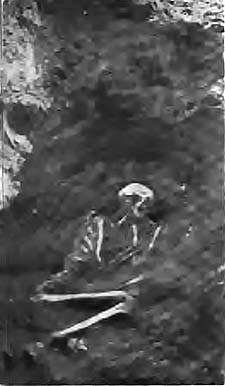
“CROUCHING BURIAL” (HOCKER-BESTATTUNG) ADLERBORG, NEAR WORMS
|
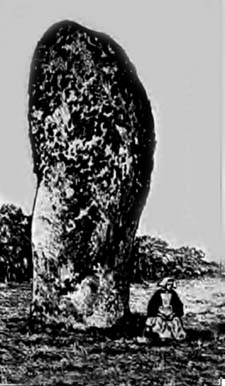
MENHIR, CARNAC, BRITTANY
|
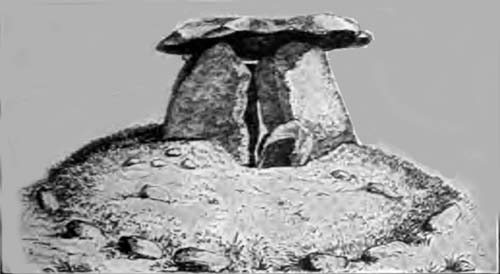
DOLMEN, HAGA, ISLAND OF BORUST |
The wide distribution of these simplest stone
monuments is exceedingly interesting. They
occur in Denmark and Sweden, in North Germany
and Holland, in Great Britain and France,
Portugal and Spain, in North Africa, in the
Ægean Islands, in Palestine and farther eastward,
in Thrace and Crimea, along the eastern
shore of the Black Sea. They are very numerous
in India.89 Throughout this wide extent they
agree not only in general form and structure,
but also in certain interesting details. For instance,
the oriental and southern dolmens frequently
have a round opening in the upper part
of the slab closing the entrance, corresponding
to the wide opening above the door of the Scandinavian
dolmens. The difference in the form
of the opening may be explained by the difficulty
of cutting a circular opening in the hard
granite rocks of the northern area. There was
a general unity of thought in essentials, especially
in those oldest forms. There was much
diversity in execution or expression in later
structures. Some of them took the form of
pyramids in Egypt. In Mycenæ we find the
“Tomb of Atreus,” a magnificent building in the
form of a beehive. The large chambers, “Giant
Chambers” or Riesenstuben of northern Europe,
especially of France, are connected with the
older small dolmens by many intermediate
forms. For example, if another pair of stones is
added to the sides of a fair-sized dolmen, we have
a chamber six to eight feet in length. Such
dolmens always have a covered entrance to the
doorway of at least two pairs of upright stones
extending out through the tumulus. Then the
number of stones in the sides of the chamber is
increased to seven, eight, or nine; and the entrance
passage is at right angles to the main
axis of the chamber, giving a rude T-shaped form
to the whole structure. The number of stones
in the roof of the chamber increases with its
length. Chambers fifteen to twenty feet long
are not uncommon, a length of twenty to thirty
feet is rare, a very few attain forty feet. The
height was between five and seven feet.
The inner surface of the great stones forming
the sides of the chamber is fairly flat. It could
have been no easy matter to find in any region
a sufficient number of suitable great blocks of
the right form. They evidently had some
method of splitting large boulders. In some
chambers both halves of the same block have
been found. These blocks could have been split
by heat or by freezing water in a groove or by
wooden wedges. But we do not know the exact
method. Near the top the blocks often failed
to meet exactly. Large holes were filled with
bits of wall of small stones and small chinks
were stuffed with clay and moss.
It is surprising to find that these smaller and
larger chambers were erected without any deep
foundation for the upright stones. Many of
them have fallen from the heaving of the frost.
The monuments were generally adequately protected
against this by the thick tumulus.
The tumulus was enlarged proportionately
and usually completely covered the chamber.
Its height averages ten to fifteen feet, and
its diameter over ninety. The culvert-like entrance
had to be lengthened accordingly.
But one large chamber did not suffice for successive
generations. It was often extended or
additions were made so that quite complicated
forms occur. In England we find frequently a
row or cluster of small chambers. Here the roof
is sometimes made of successive layers of stone
approaching as they ascended until one slab
covered the “false arch.” In Brittany we find
great diversity as well as complexity of form.
In some parts of France the entrance continues
the main line of the chamber instead of being at
right angles to it. The French have well characterized
these as “Allées couvertes.”
Some of these “gallery chambers” were very
large and contained a large number of bodies;
sometimes from 40 to 60, in one case 100. The
tumulus at Mont St. Michel measures 115 by
58 metres, and forms a veritable hill. Thirty-five
thousand cubic metres of stone were employed
in the construction of the chamber.
Other chambers are from 30 to 50 feet in length.
The celebrated chamber at Bagneux, 25 feet
long, is composed of fourteen great blocks, of
which three form the roof. The great tumulus
at Fontenay-le-Marmion in Normandy covered
eleven chambers in two parallel rows. All the
material for these great structures could hardly
have been found in the same vicinity. In one
case it appears to have been brought from a
quarry two miles away. Some large stones,
weighing thousands of tons, seem to have been
transported many miles.
Some of the latest structures show a certain
amount of degeneration. Certain galleries were
apparently roofed with timber. We find “dry”
masonry, of smaller stones laid in courses but
without mortar, alternating with or replacing
the great blocks, especially in structures of
Æneolithic or Bronze Age. The custom was
declining and soon after this disappeared.90
The age of these stone monuments can generally
be fairly closely determined by the contents,
unless these have been removed or destroyed
by treasure-hunters, as is often the
case. In many cases the objects originally deposited
seem to have been few and insignificant.
Later, secondary interments were often made in
tumuli, but these usually betray their later date
by their position above the original chamber or
near the side of the mound. We must keep in
mind that chambers in the north containing
only stone implements may be often of the same
age as those farther south containing copper or
even bronze, for metal made its way northward
only gradually. The custom of building dolmens
seems to have persisted later in England
than in France. The English round tumuli or
barrows belong to the Bronze period. It is not
surprising that one country should be more conservative
than another, especially if it is somewhat
remote.
In Brittany we find the Menhirs or “standing
stones,” unhewn pillars, regularly accompanying
the dolmens. They are by far most abundant
in northwestern Europe, but occur elsewhere
also. The largest known is the Menhir
of Locmariaquer in Morbihan, now fallen and
broken. It was almost 21 metres long, and
weighed nearly 300,000 kilograms. But specimens
are usually much smaller. They seem to
characterize the Æneolithic Epoch and the early
Bronze Age.
Their meaning is often uncertain. Some of
them standing singly were probably erected
much later, serving merely to mark boundaries.
When associated with dolmens they are probably
objects of a religious cult associated with
the burial, rather than mere monuments to
the dead. They may well be examples of the
world-wide pillar-cult. They remained objects
or centres of worship until late in historic time.
The church had a long and hard battle with
their cult. Some of them appear to have been
thrown down and churches to have been erected
over them. On some of them Christian symbols
have been carved. Among the people they are
still held in reverence or awe. Whatever may
have been their origin, they must have had some
religious significance or association.
These pillars may be grouped in circles, cromlechs,
or in long radiating rows, alignments.
Stone circles occur in the Mediterranean region,
in Syria, Upper Egypt, and in India. But
circles and alignments belong especially to Brittany,
Great Britain, and Scandinavia. The
most noteworthy are the three adjacent or connected
at Carnac, in Morbihan, extending nearly
4,000 metres, and composed of nearly 3,000
Menhirs. Stonehenge and Avebury in England
are almost equally celebrated. They represent
the culmination of megalithic development, but
are essentially places of worship and assembly
rather than of burial, though tumuli may be
clustered around them like graves in a churchyard.
The changes in the mode of disposal of the
dead are evidently the results of changed views
concerning the future life. In early Paleolithic
times man buried his dead with the best flint
axe in his hand, with his ornaments and a supply
of food, and often a quantity of shells
brought from a distance and evidently objects
of value. The dead man took with him his
weapons and all his wealth. For the living to
keep back a portion of what belonged to the
departed was robbery, which might be avenged
by all sorts of evils and plagues; for all this material
wealth and ornament was as much needed
and as useful there as here. Apparently, though
this is anything but certain, the dead were
buried at first in Europe, extended at full
length, and in the caves not far from the abode
of the living.
Soon we find them buried in a crouching position,
with knees and hands brought close to the
chin. Sometimes we find rows of shells, which
may have been attached to cords or bands used
to hold the body in this forced position. This
mode of burial in a contracted or crouching position
(Hockerbestattung) was usual in Europe in
Neolithic time, but has been discovered in all
continents, even in America and Australia.
Very different explanations of this peculiar custom
have been offered by different observers,
e. g., that it saved the labor of digging a larger
grave, an excellent economic argument; that the
dead was laid in its Mother Earth in the same
position which as a fœtus it had maintained in
the maternal body, etc., etc. But the predominant
thought appears to have been that the
spirit remained in, with, or near the body, and
that binding the body prevented the spirit from
walking and returning to see the survivors. To
the same end the most valuable possessions of
the dead had been buried with him. This does
not necessarily argue that there was no affection
of the living for the departed, or no belief in
their possible helpfulness. But the community
generally felt that it was a wise precaution, and
generally well to be on the safe side. This belief
in the possible return of the dead in their
bodily form and presence is still deeply imbedded
in our modern minds, ready to spring up as a
conscious belief; and the departed are still
rarely expected to bring good tidings or benefits.
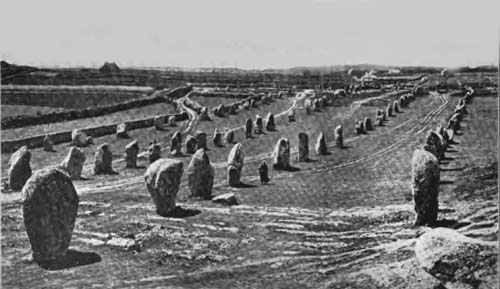
ALIGNMENT, CARNAC, BRITTANY
This mode of burial continued common
through upper Paleolithic time; was very common,
if not the rule during the Neolithic period
in various parts of Europe. Pumpelly found at
Anau children, and only children, buried under
the floors of the houses, and notices that this
custom was general throughout the life of the
Kurgan.91 He gives instances of this custom
reported elsewhere. Whether this custom was
as wide-spread as the pottery of Anau and Susa
seems doubtful. I can find no reports of it.
But conditions at Anau seem to have been unusually
favorable to the preservation of these
perishable remains. It is not impossible that
we have here one of the ways in which the fear
of the dead may have been gradually dispelled.
May we not imagine that one of the first steps
was the refusal of the mother to allow her dead
child to be banished from the house? The
evidence is too slight to allow of more than a
guess.
As time went on and communities became
more closely united leaders must have arisen
for whom the people had only affection, in whose
wisdom and willingness to help they had full
confidence, and who were gratefully remembered
as fathers, elders, and wise in counsel, and
whose return would have been gladly welcomed.
This thought seems to be the foundation of the
wide-spread and ancient cult or worship of ancestors.
Such cases were certainly common at
a somewhat later date, as in the Greek cities,
where the bones of the dead leader or hero were
guarded as the chief protection of the state.
This feeling seems to find expression in the dolmen
or house of the dead, with a carefully prepared
opening in the door as if inviting the spirit
to free egress. Anniversary feasts in honor of
the departed were certainly common in ancient
days. Close friendship and social relations were
cultivated with the departed as knowledge and
culture increased.
The Egyptian pyramids and mummies, the
graves and older dolmens, seem to testify to a
very close and dependent relation between spirit
and body. The spirit hovered around the body
and returned to it, and where the mouldering
bones lay there was the spirit’s home. Its life
was a very direct continuance of the life in the
body. Hence also the food and libations and
the rich burial gifts. But toward the close of
the Neolithic period we find the great stone
chamber giving place to a small cyst or vault,
hardly more than a stone coffin, and entirely
underground. At the same time the great stone
circles seem at least to be changing from burial
places to temples or centres of worship. A new
method of disposal of the dead has appeared in
different parts of Europe, in Brittany, for example.
Up to this time the body has been of
great importance; it has been scrupulously preserved,
and provision made in the grave for the
supply of all bodily needs, though the burial
gifts have steadily diminished in number and
value. Now the body is burned immediately
after death, as if its preservation were no longer
of any importance but a clog and hindrance
from which the spirit was to be set free as soon
as possible. The custom of incineration gains
ground in Europe until in the Bronze Age it is
the rule and inhumation the exception. The
old crass materialistic view has evidently given
place to a far higher and more spiritual conception
of life after death, and probably also before
it. We here catch a fascinating glimpse of the
steady bold working and tendency of the mind
of Neolithic man. It is only a glimpse of one
aspect of his thought and tendency. We lack
the facts to enable us to widen or deepen it.
But it is enough to promise a broad field of
future discoveries.
But one fact leads us to hazard a question.
Not very far in the Bronze Age the first great
wave of Celtic migration seems to have broken
into northern Europe, as the Achæans had already
found their way toward or into Greece.
The Celts seem to have had their Vale of Avalon
and Islands of the Blessed, whither the spirits
of the departed migrated. We remember that
when Ulysses went in search of the spirit of
Achilles, and of other comrades in the war before
Troy, he sought him in no underground
world, but sailed far across the seas into the
west. Such beliefs, and customs like incineration,
are a slow growth, probably far older in
origin than the Indo-European or Aryan migrations,
of which some have thought them characteristic.
May not this old and wide-spread
belief be merely a continuance of views and
conceptions already held by our Neolithic folk?
We have already noticed the wide distribution
of these megalithic structures.92 They
stretch along the shore of the Baltic, North Sea,
and Atlantic Ocean down to the Mediterranean.
Here they form a band along the south shore.
We find them also in Soudan. In Egypt and
Greece a far more precocious culture made it
possible to replace them by pyramids and
“treasure-houses.” We find them in Palestine
and farther eastward, along the Black Sea, and
in India. In Europe they follow the coast lines,
and do not seem to have been erected by the
dwellers in the valley of the Danube. Their
distribution is very similar to that of the great
Mediterranean race and its extensions, but they
extend far beyond the boundaries of any one
tribe or people. They are the expression of a
certain thought or conception which spread
widely. It might be more correct to say that
the general underlying conception was practically
universal, but found expression in this
form in one area, while in other regions it could
not find this expression because conditions were
unfavorable.
It is exceedingly difficult to say just where the
first dolmens were built. Opinions differ widely.
They could have been built only in an area
which had a fairly large and settled population
who could unite in a large and difficult work,
and had the means of carrying it out. The
people were agriculturists who possessed no low
grade of natural material or mental culture.
Many such general considerations lead us to
look for their first appearance somewhere in the
region east of the Mediterranean, which was
evidently the home of many other very ancient
forms of culture.93
NEOLITHIC INDUSTRIES
OUR very hasty glance at different aspects
of Neolithic culture has shown its
marked diversity in different regions.
Its essential and fundamental characteristic was
the introduction of tillage and cattle-raising,
gradually replacing the mere collecting stage of
hunting life, and accompanying a steady growth
of independence or control of nature’s bounty
or stinginess of food supply. This change increased
rather than diminished the diversity of
culture in different regions. In the rich soil of
the loess country and the Danube valley there
were genuine farms; in the north cattle and
hog-raising probably prevailed, gradually shading
over into hunting as one neared the forests.
Along the Baltic and the great lakes of Sweden
and on all the European rivers fishing was an
important source of food. Differences in size,
form, and comfort of dwellings tell the same
story. In the north we find half-underground
huts, probably with shelters of logs or skins in
or along the forests. At Grosgartach and in
the lake-dwellings and elsewhere we find rectangular
houses, veritable homes rather than
mere shelters. Primitive man bound the body
of his dead with thongs and buried it away in
the earth. Then he deposited it in a small
stone hut much like his shelter. He enlarged
and improved it. Finally the great monument
with its circle and alignments seems to have
become a temple, and the body, placed in a
small cyst or vault, is completely buried, or is
burned. These marked changes in burial customs
and rites in western and northern, not in
eastern or central, Europe, must have been accompanied
by changes in the conception of the
after life, whether we can trace and interpret
them or not.
The same must be said of all industrial
products. Every one of them tells a story, if
we can understand and interpret it. We are
not surprised to find in the late Paleolithic
(or early Neolithic) paintings at Cogul women
dressed in waist and short skirt not unlike those
worn to-day. The dress represented in the
idols of southeastern Europe has persisted in the
peasant dress of certain isolated regions, especially
in Albania, almost or quite into the
present.94 We have noticed the spinning, weaving,
and dyeing of the lake-dwellers, and a similar
industry was spread all over Europe. The
costume of the Bronze period has been preserved
in the oak coffins of Scandinavia.95 We
do not know how much it had changed and improved
since Neolithic times. The use of wool
had doubtless increased greatly. Our northern
Neolithic hunters were probably clad largely
in skins and furs.
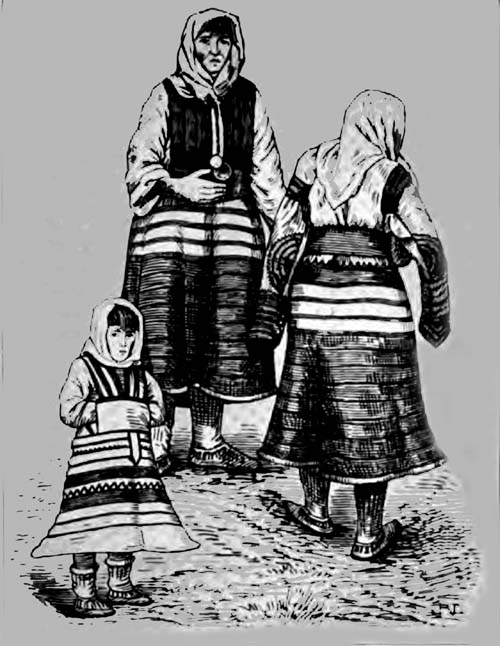
MODERN ALBANIAN PEASANTS IN NEOLITHIC GARMENTS
Two manufactured articles are of especial interest
to the archæologist: the stone axes and
the pottery. They occur in every settlement.
Stone is imperishable, and clay well fired lasts
almost as well. They vary according to age,
place, fashion, and conditions, and form the
foundation for all comparative, “typological”
study.96 Their remains play the same part in
archæology as the characteristic fossils, “Leit-fossilien,”
in paleontology, not only determining
age but throwing light on the migrations,
relations, life, and thought of their makers.
The Neolithic period gained its name from
the polished stone implements which then appeared.
Paleolithic man had learned by long
experience the value of flint as the best material
for his tools. He had learned to chip and flake
it; first by blows, then by pressure, until the
Solutrean lance-heads or “points” showed a
beauty of form and finish unsurpassed by the
best craftsmen of any later date. He had
learned to give it a fair cutting edge by small
“retouches.” It seems never to have occurred
to him to grind or whet the edge of his tools.
If the axe thickened rapidly from the edge and
was somewhat like a wedge, it was a good remedy
against the brittleness of the flint, its great
defect; and he put the more strength into the
blow. The extreme hardness of flint made
polishing very difficult. Most utensils of daily
use were not polished at all. Many of the beautiful
daggers, genuine works of art, were finished
by a uniform, fine flaking down to the close of
the period. Flint implements were not polished
in Italy, Greece, Spain, and large parts of eastern
Europe;97 they increase in abundance in
Scandinavia and England. Other kinds of less
brittle but somewhat softer rock were generally
used for polished axes.
During the upper Paleolithic period, especially
in the Magdalenian Epoch, daggers, lance-heads,
awls, and needles were made of bone. For
pointed implements, flint, while sometimes used,
was far less suitable, except when the point was
very short, as in engraving and carving tools.
These bone implements were scraped into shape
and often well smoothed. It seems but a step
from smoothing a bone to polishing the edge of
an axe, if not of too hard rock. But the chipped
flint axe was very good, and they were accustomed
to it. Forrer thinks that the change
must have been made where flint was scarce
and pebbles abundant.98
In Scandinavia the kitchen-midden period
was followed by an “arctic” culture, so called
because of its distribution in the far north.
Here we find implements of slate or schist polished
only along the edges. This seems like a
very natural intermediate stage. We do not
know just where those attempts were first made.
They may have been made at different points
in Asia and Europe and at different times, and
thus there may have been several independent
centres of discovery and of radiation.
The lake-dwellers used a variety of material;
indeed, they seem to have been quite expert
practical mineralogists. Characteristic is their
use of certain rocks which combined great toughness
and hardness, and were thus superior to
flint; so chloromelanite, saussurite, nephrite, and
jadeite. These minerals are rare, and the implements
made of them were small chisel-like
blades, rarely exceeding an inch in length. They
were usually mounted in a socket of horn fastened
into a wooden handle. We shall see that
the source of these minerals is still anything but
clear.
The axe of the kitchen-midden99 is hardly
more than a disk struck off from a flint nucleus,
with two sides broken off and the top of the
triangular remnant removed. The axe of later
Neolithic time was at first nearly of the shape
of a flattened almond, but gradually changed
and took more of the form of a chisel. The
stages in this process of change are of value in
determining the chronology of the period, and
will be discussed in the next chapter. These
axes were rudely shaped by flaking and then
ground and polished on large flat stones, which
still show the grooves left by the implement as
it was rubbed back and forth. The different
steps in shaping and finishing such axes are well
shown by Hoernes in specimens selected from
the rich collections made at Butmir, Bosnia.
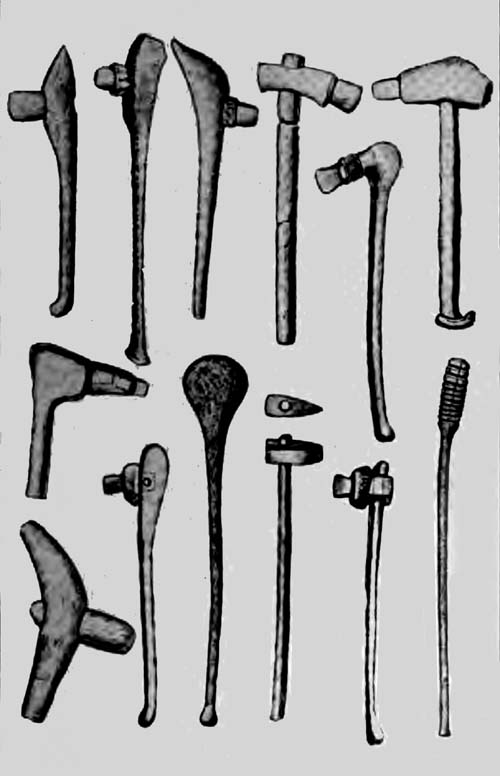
AXES FROM LAKE-DWELLINGS SHOWING ATTACHMENT TO HANDLES
The lake-dwellers followed a different and
improved method. They selected from the bed
of a stream a smooth pebble of somewhat flattened
and elongated egg shape. With a flint
flake or saw100 and sand they cut a groove in the
edge, and split the stone by a sharp blow,
somewhat as a peanut or almond falls apart.
The rounded surface of each half was nearly of
the desired form, and only the flat surface required
much shaping. A skilful workman now
can finish an axe of this kind in half a day.101
We cannot trace the variety of axes characteristic
of different times, places, and uses.
One, which from its resemblance to a shoemaker’s
last has been called by the Germans
the “Schuhleistenbeil,” demands mention.102 This
is a heavy, thick, clumsy implement, with one
end edged or pointed. The lower surface is flat
or slightly concave, the upper nearly semi-circular
in cross-section. It reminds us somewhat
of the grub-hoe or mattock, and probably served
a similar purpose—to break up the ground.
It is very common in the loess regions of southeastern
Europe, but in the more stony soils of
the uplands was generally replaced by a pick
made of a stout tine of deer’s horn. Broader
and flatter hoes are found, and stone ploughshares.
We must clearly recognize the distinction
between the mattock and a somewhat similar
but lighter polished concave axe, with sharp
transverse cutting edge, used along the Baltic
and elsewhere for hollowing out boats. Adze
and mattock are similar in general form, but
the carpenter’s tool is a much finer instrument
than the agricultural implement, and serves a
very different purpose.
Bone was still used for pointed tools and
weapons. A bundle of sharp pointed ribs found
at Robenhausen had probably been used for
hackling flax, Horn was used for sockets for
the smaller chisels, and for a variety of other
purposes. Wooden bowls, scoops, and other
articles occur among the remains of the lake-dwellings.
Flint held much the same place in Neolithic
industry as iron or steel with us. Its quality
varied greatly in different localities. Our Neolithic
ancestors had discovered that it worked
better when freshly mined than when long exposed
and weathered. Hence a mine of flint
of the best quality was as valuable as a field of
iron ore or a gold mine to-day. The most celebrated
source of flint in France was Grand
Pressigny, near Tours, Department of Indre-et-Loire.103
The color and texture of this flint
enables us to recognize it wherever found. It
was exported as far as Brittany, Normandy,
Belgium, and western Switzerland.
At Spiennes, in Belgium, they sunk shafts
sometimes to a depth of forty feet. Here horizontal
galleries extended out into the layers of
chalk containing the best quality of flint. Similar
mines were located at Grimes Graves and
at Cissbury, in England.104 The flint was exported
sometimes in blocks, sometimes as half
or completely finished implements. Around
Grand Pressigny workshops are numerous. But
they are by no means limited to the immediate
vicinity of the mines. In some localities the
manufacture was almost limited to one particular
article. Here the product was exported in finished
form.
During the Bronze period Halle was a seat
of wealth, and the large amount of copper found
here suggests that the production of salt had
begun here before the close of Neolithic times.
Hoernes says that the production of salt at
Hallstadt, a source of great wealth and luxury
during the earliest Iron Epoch, and of no small
extent during the Bronze period, had its beginnings
in Neolithic days. The value of salt in
trade or barter can hardly be overestimated.
A very small amount of gold, mostly in the
form of beads, has been found in the Neolithic
monuments of France erected at the very close
of this period. Occurring native in small nuggets
in the beds of streams and rivers of many
parts of Europe, its color and malleability must
have attracted the notice of the searchers after
new material for implements. Large nuggets
were found in Spain at a much later date with
callais, a mineral resembling turquoise, which
occurs from Portugal to Brittany.105
Objects of copper were found by Pumpelly at
Anau contemporary with the appearance of turbary
sheep, about 6000 B. C.106 It appears in
Egypt perhaps 1,000 years later. We find traces
of it in the oldest city of Troy (Hissarlik). It
may well have entered southeastern Europe by
way of Troy, or northward from Greece through
the Balkan Peninsula to the Danube valley. A
more westerly route lay open through Italy, or
the islands west of it, into Spain. Native metallic
copper seems to fail in Europe proper,
but mines for ore were opened in Tyrol, and
probably elsewhere, before the end of the period.
Copper was very useful for ornaments, especially
rings, armlets, and bracelets; for pointed
objects like needles, pins, awls, and even daggers;
to a certain extent for knives and razors.
Copper axes were modelled at first after old
stone patterns. This metal had one fatal defect,
however; it would not hold an edge. Copper
utensils were beautiful, but generally less
useful than similar ones made of stone. They
were largely for display and luxury, though this
may hardly be true of its use in Egypt and the
Orient. In Europe it could not shake the hold
of the old, established flint. When the copper
ore contained impurities of antimony or zinc,
the alloy was harder. Then we find a very
small percentage of tin, which slowly increases.
There must have been long searching and experimenting
before the classical recipe for bronze,
ninety per cent copper and ten per cent tin, was
established. We cannot well speak of a new
copper culture or period. This began with the
introduction of the harder and more beautiful,
but always rare and expensive bronze. Still
the great characteristic of the Bronze Age lay
not so much in the introduction of a new metal
as in the wider relations, communications, exchange
of goods, and knowledge, and freer
movements of individuals and peoples, which
had brought it about. The discovery of metals,
of salt, of minerals, and other materials useful
for ornament and of the Baltic amber, was
gradually furnishing considerable material which
could be readily exchanged for the products of
other sometimes distant and more advanced
provinces and lands. The centres of distribution
were often at some or considerable distance
from the sources of the raw material, so especially
in the case of flint implements. The
location of the seat of manufacture and distribution
depends largely on freedom and ease of
communication. This leads us to glance at
trade and trade-routes during this period.
We must bear in mind that the means of
transportation were few and inadequate. The
wheeled cart appeared during the Bronze period,
but we have no proof of its use earlier. The
horse was not yet domesticated in Europe, and
did not come into use in the Orient much before
2000 B. C.107 Cattle may have been used
as beasts of burden at an early period, but of
this we know nothing. Roads of a certain kind,
often probably hardly more than mere trails,
almost certainly existed, especially in the neighborhood
of the great stone monuments and
larger villages. The great bar to free communication
was the forest. To avoid this almost
impassable barrier the roads and trails seem
usually to have kept to the uplands, especially
those where the chalk prevented a heavy forest
growth. Certain river valleys, like that of the
Thames, were heavily forested almost or quite
to the shore, and hardly inhabited at this time.
But when the forest drew back somewhat from
the water’s edge there was a most attractive
place for human settlement. The river bottoms
were fertile and easy of cultivation. There was
grass for herds, wood for buildings and fuel.
The rivers swarmed with fish down to recent
times, and there was a great variety and abundance
of smaller animal life. Such valleys
formed natural routes of trade and migration.108
We are not surprised to find that the earliest
settlers of Sweden made their way from shore
to interior along the rivers and lakes, whose
shores are dotted with settlements of this age.109
Déchelette tells us that this was true of the
grouping of the Neolithic stations of France in
three great provinces in the basins of the Seine,
the Garonne, the Rhone, the Saone and the
Loire. We remember the lake-dwellers. The
valley of the Danube has been the great thoroughfare
since the arrival of man in Europe.
The great ancient civilizations of Egypt and
Chaldea arose in the valleys of the Nile and the
Euphrates.
We know that the people of the shell-heaps
must have ventured some distance from shore,
fishing for cod. The transition from Paleolithic
to Neolithic might almost be characterized as a
time of change from a hunting life to one very
largely of fishing. Long before this emigrants,
probably from Asia Minor, had sailed out into
the Mediterranean and settled Crete. Here,
before 3000 B. C., a veritable sea-power had
arisen carrying on trade with Egypt and the
shores of the Ægean. The voyage of the Argonauts,
a “much-sung” story and saga in Homer’s
time, may well have had a historical foundation
in expeditions for trade and plunder along the
shores of the Black Sea, up its rivers, and extending
as far as distant Colchis. Hence the
importance of Troy in ancient times and of
Constantinople to-day.
Returning to the Baltic region,110 we find that
a cave on the island of Stora Karlso, close to
the west shore of Gothland, contained Neolithic
deposits nearly three metres thick. In the
upper layers there were remains of domestic
animals, in the lower only wild forms. This
island lies some thirty miles from Oland, just
off the east coast of Sweden. Montelius tells
us that before the end of the Neolithic period
there was communication between Sweden and
Finland, as well as with Denmark and Germany;
that trade between these regions was
active, and that there is reason for thinking
that there was communication between the
west coast of Sweden and England. It seems
highly probable that boats were creeping along
the coast of Spain and France from harbor to
harbor, although the evidence is here less clear
and compelling.
Our knowledge of Neolithic boats is still very
incomplete.111 Those of the lake-dwellers seem
to have been usually hardly more than dugouts
hollowed by fire. One, however, from
Lake Châlain (Jura) was about thirty feet long
and two and one-half wide, made out of an oak-trunk.
Such boats served well for river navigation,
but were too shallow and clumsy for
the open sea. It would have been a comparatively
easy matter to add one or two planks
along each side of such a dug-out and thus build
up a fairly seaworthy craft. The rock-sculptures
of Bohuslan, Sweden, which probably date
from early in the Bronze Age, represent boats of
fair size carrying as many as thirty men.112
The wares exchanged in this trade were limited
in material and value. Metals and metallic
objects were still unknown, except as copper
and gold came in before the end of the period.
Still, there were many objects which met a
fairly wide demand. We have already seen that
different lake-dwellings differed markedly in
their products. Some were almost purely agricultural.
In others we find remains of pottery
evidently manufactured on the spot in larger
quantities than the village could use. Much of
this must have been exported along the lake,
perhaps farther. Schliz distinguished at Grosgartach
a rude home-made pottery from a finer
ware apparently brought from some centre of
finer and more artistic work. The Neolithic
housewife was probably very proud of this
“china.” The finer grades of cloth manufactured
at Robenhausen and elsewhere were probably
carried far and wide, but it is impossible
to trace it. The flint mined at Grand Pressigny
was transported to greater or less distances, as
well as manufactured at the mouth of the mine.
At the various workshops the implements were
made in great numbers and still more widely
disseminated. This was equally true of flint
regions in other parts of Europe. Stone arm-rings,
mace-heads and other fine articles found
sparsely in northern Europe may well have been
copies of a few articles brought from Italy or
even farther.113
The nephrite and jadeite of the lake-dwellings
were long supposed to be imports from eastern
Asia—until it was discovered that the material
of many of those implements differed in microscopic
structure from the Asiatic, and then were
supposed to be of indigenous material. Probably
both extreme views are untenable. A certain
amount of communication with the Orient
is shown by the occurrence of rings made of
recent shells of Tridacna or Spondylus in Egypt,
throughout the Mediterranean region, in France,
and occasionally in middle Europe. The material
apparently came from the Red Sea or the
Indian Ocean. The same is true of a shell of
Meleagrinia found in a hut-foundation in Rivatella,
Italy.114 Ornaments in the form of Mediterranean
shells strung as necklaces are not uncommon
in France, and occur elsewhere. The
Mediterranean lands were in close communication
with Egypt and Asia Minor; Spain with
Africa, which furnished ivory and carved ostrich
egg-shells carried farther north in rare instances.
Stone palettes similar to those found in Egyptian
graves occur in southern France and elsewhere.
More careful search and study will doubtless
greatly increase the number of similar illustrations.
Scandinavia was already showing its appreciation
of beauty of form and finish, which made
its products unsurpassed during the Bronze
period. Its marvellous flint daggers and hammer-axes
were widely distributed and excite
our admiration to-day. But the product which
it was later to export to Greece and Italy in
payment for the metal and art-treasures of the
south was amber, an admirable material for
jewelry, easily cut, transparent, of various hues,
and taking a brilliant polish. So Homer speaks
of a royal necklace, “golden, adorned with amber,
like a blazing sun.” Far back in Neolithic
times we find jars containing large quantities
of amber in the form of rude beads. One such
hoard contained 4,000 articles, and weighed 17
pounds. The amber was evidently used for
necklaces, and was common in the graves of
the earlier epochs. It seems to have made its
way slowly over North Germany. Amber beads
occur very sparingly in the lake-dwellings.
During the Bronze period it disappears largely
in Scandinavian graves and is here less used for
ornaments, but appears in Greece and Italy,
where its beauty and possibilities could be properly
appreciated. The value of amber in Scandinavia
as an article of export rose to such an
extent that the inhabitants largely gave up the
use of it and exchanged it wholesale for the
more attractive and useful metal. During this
period there was a regular trade-route between
the Baltic and the Mediterranean.
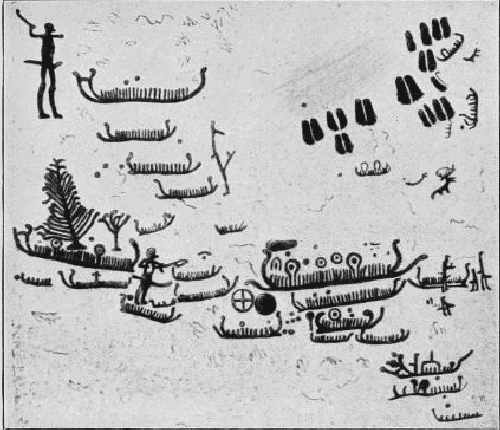
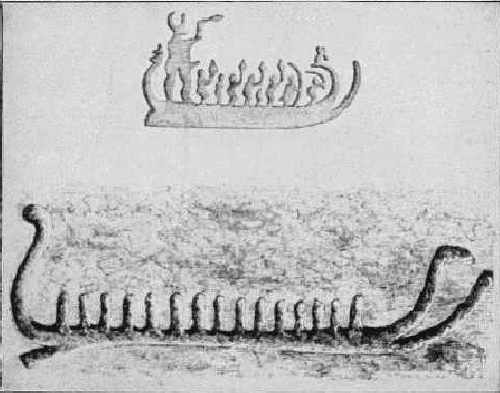
BOATS FROM ROCK CARVINGS IN BOHUSLAN, SWEDEN (EARLY
BRONZE AGE)
As Hoernes115 says, it was this new trade which
brought with it the close of the Neolithic period
in northern Europe. But the change from the
age of stone to that of bronze was anything but
abrupt or sudden; in fact, it extended over more
than 1,000 years. It was apparently not brought
about by the invasion of a conquering race,
though it was accompanied and followed by
marked change and shifting of the population
of central Europe. First we find a few copper
ornaments and implements stealing into France
and southern Europe. Then the metal becomes
more abundant as people increase in wealth and
can afford luxuries. Then bronze comes in from
southeast and south, and very slowly north of
the Alps. It meets the current of amber from
the north.
Thus the two most beautiful, precious, and
desirable materials of the time have come together.
Both are easy of transport. A trade
which has long been preparing or proceeding
on a small scale expands rapidly, perhaps suddenly,
and ushers in a new period, which, after
all, chiefly carries on or brings into prominence
that which had begun or advanced during the
preceding age.
More interesting and, perhaps, more important
than exchange of flint axes and amber
is the spread of patterns, methods, influences;
of new ideas and stimuli from mind to mind
and people to people. A new implement, like
the mace-heads and arm-rings, of which we have
spoken; a new form of axe or dagger; the form
and ornament of pottery; the building of dolmens
or the spread of immigration with the accompanying
change of cult and thought—all
these brought not only economic improvement
but growth of mind. Sophus Müller, and Montelius
in a less degree, may have been somewhat
extreme in their emphasis on the importance of
oriental and Mediterranean influences and leadership,
but their main thesis was correct.116 Civilization
and culture were far older in the Orient
than in Europe, and far more advanced south
than north of the Alps. These were the centres
of radiation of ideas and stimuli as well as
patterns, inventions, and discoveries.
This does not mean that northern Europe
was a passive recipient. It accepted and
adopted whatever and only what it would, and
probably refused many a valuable suggestion.
In many cases it improved on the patterns or
example of its teacher and inspirer. The art of
polishing stone implements and the use of bronze
may not have been indigenous in Scandinavia;
but here, as time went on, genuine works of art
were produced superior to any in the world,
far more artistic than the beautiful technique
of the Egyptians. Prehistoric domestic animals
were almost certainly introduced from the East.
But the lake-dwellers usually improved the
breed by intercrossing with forms derived from
their own fauna. They increased the list of cultivated
plants. The idea or conception passed
from tribe to tribe, but the new stimulus did
its fermenting work differently, according to the
mind or medium into which it fell. There was
always readaptation and more or less change.
To be a wide borrower and at the same time
to usually improve on one’s teacher requires
something very close to genius, though the originality
may be less obtrusive. We have no reason
to be ashamed of our Neolithic ancestors.
The result of this exchange of products and
ideas will be more apparent during the next
period. Trade-routes and lines of communication
will then become far more clear and
fixed. But it is important to notice that these
routes are already opening in all directions,
perhaps more numerous because still experimental,
tentative, and somewhat vague. The
routes of transportation during prehistoric times,
as usually in pioneer periods, were mainly along
river valleys. Where basins almost or quite
touch one another centres of contact and distribution
naturally arise. Hence the prosperity
of the Department of Saone-et-Loire, in France.
A study of any good relief-map of Europe will
show the chief routes of trade almost at a glance.
The great east-and-west artery is the valley of
the Danube, with its tributaries extending far
northward, almost touching the headwaters of
rivers flowing into the North Sea or Baltic.
The westernmost north-and-south route is by
sea along the Atlantic coast from Spain to England
or Denmark. A second was formed by
the Rhone and Rhine, eastward and parallel to
the French highlands extending from the Mediterranean
to Belgium, broken by the pass of
Belfort. A third ran up the valley of the Elbe
and down the Moldau to the Danube. This
was the most important route in Europe, especially
for amber. A fourth, from the Baltic
to the Black Sea, followed the Vistula and the
Dniester. From ancient times the Black Sea
and its tributaries have been the great route of
communication between the Ægean and southern
Russia as well as parts of the Balkan Peninsula.
During the greater part of the Neolithic period
it was probably only a sluggish and irregular
current of trade which trickled along most of
these routes, put it was the beginning and
promise of larger and better things, and must
not be despised or neglected.
In any study of the industries of this period
the manufacture of pottery is of the greatest
interest and most fundamental importance.
Pottery is to the archæologist what characteristic
fossils are to the paleontologist. It is almost
indestructible. In its texture, form, and
ornament it affords wide scope for individual or
tribal skill and invention, and yet over wide
areas the general type shows a remarkable unity
and persistency. A single sherd may often tell
a long and reliable story. The pottery of the
Mediterranean basin and of many oriental localities
is a fairly sure guide to the age of a long-buried
settlement and to the relations of its
people with other, often distant regions. The
chronology and much of the history of Egypt,
Troy, and Crete, and many ancient settlements
of Greece and Italy, are based largely on the
study of their pottery. It is far more expressive
and informing than the average stone or bone
implement.
The time is not yet ripe, however, for such
deductions from the study of the pottery of
northern and middle Europe. A good foundation
has been laid, much material gathered
which is being built up into a firm system. But
in this pioneer work many rash generalizations
have been based upon a foundation of facts
drawn from a very narrow area, often incompletely
understood. Here we must proceed cautiously
and can give only a very brief and inadequate
outline sketch of the most important
results in which we may have a fair degree of
confidence and which are needed in our further
study.
Pottery appears first in the transition epoch
from Paleolithic to Neolithic, at Campigny and
in the kitchen-middens. Long before this time
there must have been containers for fluids. A
concavity in the rock may have been the first
reservoir and a mussel-shell the first drinking-cup.
Wherever gourds occurred they were
doubtless hollowed out and made most convenient
jars and dishes. Vessels of bark and
wood probably came into use early in the north.
Skins of animals tightly sewn with sinew and
with well-greased seams formed excellent bottles,
still used in the Orient. Where the art of
plaiting twigs, splints, or reeds into mats and
baskets had been discovered, it was not a long
step to coat the inside with clay and dry or
finally burn it before the fire. The potter’s
wheel did not come into use until the Bronze
period. Pottery had been used in the Orient
long before this time. It is found well made
and beautifully decorated in the oldest strata
at Susa. The art may have been introduced
from Asia or lost during the long migration
and then reacquired. Here we are still in the
dark.
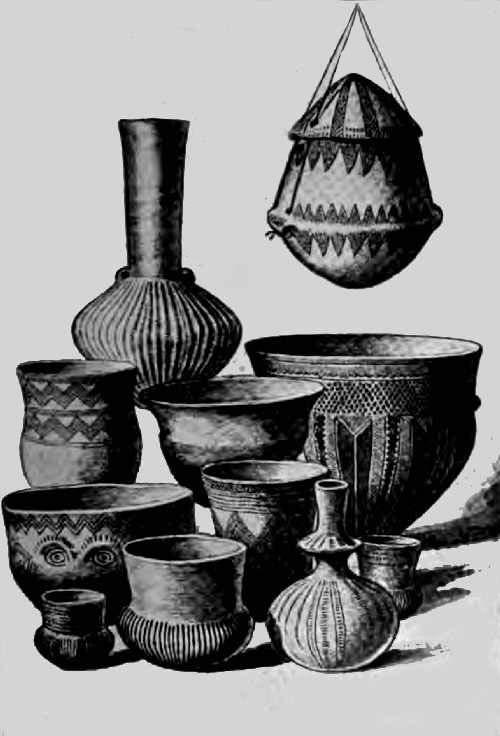
POTTERY FROM NEOLITHIC GRAVES
The pottery of northern Europe can be distributed
into a few groups or general types,
every one of which is wide-spread and fairly distinct,
though mixture or combination of types
is not uncommon, especially along the boundaries
of distribution where two types meet.
There is much difference of opinion and discussion
concerning details, but general agreement
as to fundamentals and essentials.117
Intermediate or “hybrid” forms also occur.
The classification is hardly natural and is responsible
for much confusion and dispute. It
can have only temporary and provisional value.
These three groups are:
1. Banded pottery, Céramique rubanée, Bandkeramik.
2. Corded pottery, Céramique cordée, Schnurkeramik.
3. Calyciform pottery, Vases caliciforms, Zonenbecher.
They differ mostly in ornamentation, but often
also as distinctly in form.
1. Banded pottery occurs all over Europe except
northeast of the Oder, perhaps also in Great
Britain. Its shape is usually that of a spheroidal
gourd with the upper fourth removed;
and its system of ornament may have been
derived from the system of cords by which the
jar was once suspended. Sometimes we find a
low neck, rim, or collar around the large mouth.
The ornament in what seems to be its most
primitive form consists of lines marked in the
clay, arranged parallel to one another in bands
covering most of the body of the jar. These
bands, either broad or narrow, run in a zigzag
or saw-tooth pattern horizontally around the
base. By doubling each saw-tooth we get a
diamond-shaped area. Even this simple ornament
admits of a large variety of patterns. But
the bands may be curved instead of angular,
forming scrolls, meanders, or spirals. Logically,
these should represent the latest development
of the type. But the spiral may yet prove to
be actually older than the angle. The bands
may be raised and projecting (Bosnia) or be
merely painted on a flat, sometimes burnished,
surface. The incised lines may be plain or
filled with a white material (encrusted). The
briefest consideration shows that we have here
a very generalized type or group of types which
made its first appearance in Europe on the lower
Danube and then underwent development by
simplification or sometimes, perhaps, by increased
complexity, as it radiated from this
centre, becoming more and more modified as it
went westward or northward.
The banded pottery of southwest Germany
and the Rhine region is found in dwellings as
well as graves, usually accompanied by the
mattock or the deer-horn pick, but lance-heads
fail. The rectangular houses belonged to people
of a settled and quite advanced agriculture.
We find cellars, and barns or granaries. The
dwellings are single or in groups, sometimes, as
at Grosgartach, forming quite a village or town.
They are situated by preference on the loess
terraces of the streams and rivers, near enough
to the water for boat communication. The pottery
varies in fineness and beauty according to
the size of the dwelling and therefore the wealth
of its owner. Social differences, rank, and
fashion are appearing in truly modern form.
2. Corded Pottery. The most characteristic
and, perhaps, culminating form is the Amphora
or flasklike vase with wide neck, which starts
abruptly from a globose portion with flat base.
Its prototype may have been the leathern flask
or bottle. Here the ornament consists of parallel
lines arranged in a band or in bands around
the neck, but often extending somewhat on to
the upper surface of the bulb. The lines look
as if made by winding a cord around the neck
while the clay was still soft; hence the name of
the group. It seems to have been originally a
purely northern product, which toward the close
of the Neolithic period was carried southward
by a distinct movement of population. It is
found almost entirely in graves, often accompanied
by calyciform cups. Schliz says that it
is never found in remains of dwellings. The
household pottery was apparently crude and
coarse, with no distinctive type of ornament.
The carriers of the culture were apparently
herdsmen rather than tillers of the soil, and
always more or less hunters. Their finest implements
were their weapons.
3. Calyciform Pottery, Zonen-or Glocken-becher,
has been by some united with Corded Pottery.
It has the shape of a goblet or inverted
bell with flaring rim and flat base.
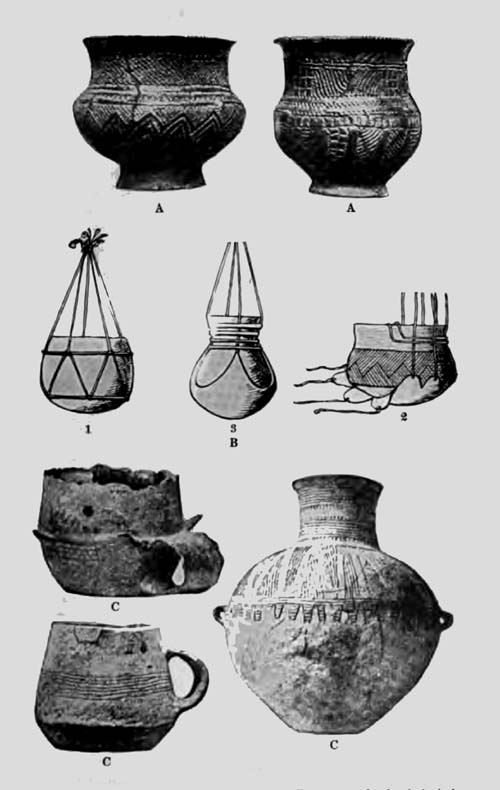
POTTERY
| A. |
Banded pottery. |
| B. |
1. Origin of banded ornament from cords suspending a more or less hemispherical
vessel derived from the hollow gourd. |
| |
2. Corded ornament derived from suspension of flask (Amphora). |
| C. |
Cups and Kugelamphore (globular flask) from Groszgartach. |
The ornament is in circular zones separated
by bands of well-polished surface covering the
whole outside. It is found in Asia Minor,
Egypt, Italy, and in western Europe along the
whole zone of megalithic monuments, whence
it spread northward and eastward into middle
Europe.
The incrusted pottery characterized by incised
lines filled with a white material may have
had a distinct origin and development, though
its technique has often been borrowed and applied
to other types. The pottery of the oldest
lake-dwellers is crude, coarse, with little or no
ornament. Hence it is difficult to connect it
with any other type.
Form and shape of pottery are often quite or
very persistent. We cannot understand why
the base of so many jars was left rounded, or in
some old lake-dwellings pointed, when it might
easily have been flattened, apparently to good
advantage. But even the form, and still more
the ornament, changes according to time, place,
and fashion; hence these are very useful in tracing
periods and cultures and their relations.
Where different types meet there is usually more
or less change or modification, often difficult to
interpret. Our knowledge of European pottery
is still small and unsatisfactory, but it has
already been of much use in tracing migrations
of culture and relations between provinces often
widely separated.
NEOLITHIC CHRONOLOGY
“WE must imagine Europe in upper
Paleolithic times again as a terminal
region, a great peninsula toward
which the human emigrants from the east and
from the south came to mingle and to superpose
their cultures. These races took the grand
migration routes which had been followed by
other waves of animal life before them; they
were pressed upon from behind by the increasing
populations from the east; they were attracted
to western Europe as a fresh and wonderful
game country, where food in the forests, in the
meadows, and in the streams abounded in unparalleled
profusion.... Between the retreating
Alpine and Scandinavian glaciers Europe
was freely open toward the eastern plains of the
Danube, extending to central and southern
Asia; on the north, however, along the Baltic,
the climate was still too inclement for a wave
of human migration, and there is no trace of
man along these northern shores until the close
of the Upper Paleolithic, nor of any residence
of man in the Scandinavian peninsula until the
great wave of Neolithic migration established
itself in that region.”118
We must now attempt to determine the succession
of these great changes in the climate
and face of Europe, and then see if we can fix
any dates for some of the changes and for the
introduction of new cultures.
In the oscillations of the ice-front marking the
final retreat of the Alpine glaciers there were
three epochs of advance. Two of these, the
Bühl and Gschnitz advances, with the interval
of retreat between them, were occupied by the
Magdalenian or last epoch of Upper Paleolithic
time. The third advance, the Daun Epoch,
or perhaps the latter part of the Gschnitz and
the first part of the Daun, is represented by the
Azilian-Tardenoisian Epoch, a period of transition
from Paleolithic to Neolithic time. These
changes have been clearly traced by Osborn.119
We are most closely concerned with the
changes which took place around the Baltic in
Denmark and Scandinavia during this post-glacial
retreat of the ice. Here also we find the
same disappearance of the tundra and “barren-ground”
fauna already noticed in France, and
the appearance of a park-flora of forests interspersed
with open glades or meadows. But we
need not be surprised if we find that the retreat
of the great Baltic or Scandinavian ice-sheet
does not keep step exactly with that of the
Alpine.120
1. The last ice-sheet had covered most of
Scandinavia except the western half of Denmark
and, perhaps, the most southern portion of
Sweden. But a broad mass of ice covered most
of Schleswig, at least the eastern half of Holstein,
and a fairly wide zone of land south of
and more or less parallel to the south shore of
the Baltic. To the eastward and northward a
great sea extended to the Arctic Ocean. This
earliest stage marked the farthest advance of
the ice just before the final retreat.
2. Slowly and gradually the ice retreated until
finally it occupied only the mountains of the
backbone of Scandinavia. The region of the
Baltic Sea and the Gulf of Bothnia, a large part
of Sweden and a good portion of Finland were
covered by a great sheet of water, the Yoldia
Sea, connected by a broad sound at the present
Skager Rack with the North Sea and Atlantic,
and still opening widely into the Arctic Ocean
northeastward. The submerged regions had
been greatly depressed, especially in the north.
The clays deposited along the shores of the sea
are now raised often to a height of one hundred
metres above tide-level. But to the southward
the depression was only slightly marked.
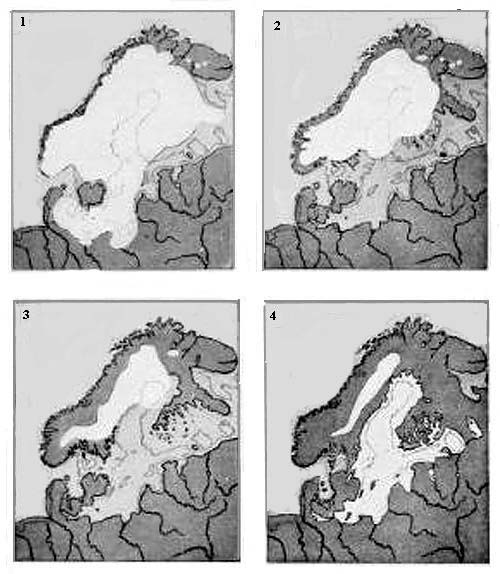
SUCCESSIVE STAGES AND FORMS OF BALTIC SEA
1. Culmination of last advance of ice.
2. Yoldia Sea during retreat of ice.
3. Yoldia Sea at greatest size.
4. Scandinavia during Ancylus Epoch.
(The white represents the ice; dark gray represents the land; light gray the Baltic Sea.)
It is important to our later study to notice
that these clays, which are thick and fine-grained,
are composed of thin layers of alternating
dark material deposited in fall or winter,
and lighter, more sandy, brought down by the
spring freshets. The temperature of the sea
could hardly have been much above freezing-point,
as is shown by the presence of arctic forms
of mollusks, like Yoldia arctica and Astarte borealis.
The land-plants of this epoch, the so-called
Dryas flora, are dwarf cold tundra forms,
now occurring in Spitzbergen, Lapland, and
Arctic Russia and Siberia. But certain plants,
especially in Sweden, lead us to infer that while
the winters were long and severe, the short
summers were warm or even hot. This does
not surprise us in northern tundra regions.
Reindeer still lived in the region. This Yoldia
Epoch is our second great post-glacial stage.
Man had apparently not yet reached Denmark,
though some reindeer hunters probably roamed
over Germany.
3. Toward the end of the Yoldia Epoch the
land rose in southwest Sweden, connecting this
country with Denmark and cutting the connection
of the remains of the Yoldia Sea with the
North Sea. A similar emergence in Finland
completed the change of this sea into a great
landlocked body of water called the Ancylus
Lake, from the most common and characteristic
mollusk, Ancylus fluviatilis. The glaciers had
shrunken to a narrow band covering the mountains
between Norway and Sweden. The climate,
while moderating, was still cold. The
Arctic flora retreated northward and was followed
in Denmark by woods and even forests
of willows, aspens, and poplars, entering from
the south and southeast. These were followed
by pines, especially in the dryer districts, later
by alders, coming from the east across Finland,
according to Hoops.121 The Ancylus Epoch
forms our third stage. The settlement at
Maglemose probably took place toward its
close.
4. The elevation and emergence of land so
characteristic of the Ancylus Epoch was followed
by a depression of this region, especially
in its southern portions. That part of the Ancylus
Lake corresponding to the Baltic regained
broader and deeper connections with the North
Sea than it has at present. Hence the waters
of the Baltic contained a larger percentage of
salt than now. The marine life, Littorina littorea,
Tapes, and others, testifies to a rise in
temperature since the Ancylus Epoch. Oaks
had already begun to crowd out the pines, and
will be followed after a time by the beeches loving
a soil rich in humus, rather than the sandy
barrens occupied by the pines. A similar evidence
is furnished by other plants, some of
which reached a higher latitude than now. The
summer temperature was perhaps 2-1/2º Cent.
higher than at present, an “optimum temperature”
for the plant life of this region. This
improvement of climate is most marked in
northeastern Europe and seems far less noticeable
even in Germany. Our fourth stage is
marked by a greatly improved climate and the
spread of the shell-heaps.
5. A fifth stage ushers in the full Neolithic
period. Between the Littorina stage and the
genuine Neolithic culture of lake-dwellings and
megaliths there is a considerable gap in our
knowledge, a period during which agriculture
and domestic animals were brought in and
utensils and pottery and general conditions were
greatly improved.
We may now venture to attempt to gain an
absolute chronology of more or less definite
dates for the appearance of the cultures which
we have noticed. We must clearly recognize
that our best results can be only tentative and
provisional. A careful study and comparison
of the pottery of northern Europe will some day
furnish data for a reliable system. For the sake
of convenience we will begin by attempting to
set a date for the close, rather than the beginning,
of the whole Neolithic period. We have
seen that this was brought about by the introduction
of the metal bronze. Copper had come
into use somewhat or considerably earlier, but
it seems hardly worth while to consider it as
characterizing a distinct period. It is rather
the last phase of the Stone Age, when wider
communications and trade were making the
transition to the use of metals like bronze and
iron.
According to Montelius,122 who is our best authority
on chronology, the use of bronze in sufficient
quantities to mark the beginning of a new
period took place in different countries at the
dates given in the second column of the following
table, the first column showing the date
of the first use of copper:123
| REGION |
YEAR B. C. |
| |
COPPER |
BRONZE |
| Egypt and Chaldæa |
5000 |
3000 |
| Troy, Greece, and Sicily |
3000 |
2500 |
| Hungary and Spain |
3000 |
2000 |
| Middle Europe and France |
2500 |
2000 |
| North Germany and Scandinavia |
2500 |
1900 |
These dates mark the beginning of the more
or less general use of metals, not the first appearance
of a few imported articles. Some authorities
would place the beginning of the
Bronze period a few centuries earlier, and that
of the introduction of copper some 500 years
earlier.124 Forrer dates the beginning of both
epochs a little later than Montelius. The date
2000 B. C. would seem to mark the end of the
Neolithic period in middle Europe with approximate
accuracy.
In attempting to determine the date of the
beginning of the Neolithic period we may begin
with a remote point of departure for comparison
and select the Bühl stage and the beginning of
the Magdalenian Epoch. Nuesch made a careful
estimate from the deposits at Schweizersbild
near Schaffhausen, Switzerland. His method of
estimating is described fully by Obermaier.125
He places the beginning of the Neolithic deposits
here at 6000 B. C., and considers 20,000
years as a fair estimate for the time elapsed since
the first occupation of this locality by Magdalenian
hunters at some time during the Bühl
Epoch. Obermaier, summing up the evidence,
concludes that the beginning of the Magdalenian
Epoch could not have been later than
16,000-18,000 B. C., and that it ended not far
from 12,000 B. C. Osborn says: “Bühl moraines
in Lake Lucerne are estimated as having
been deposited between 16,000 and 24,000 years
B. C.” He also appears to place the Maglemose
culture at about 7000 B. C.126
We may now turn to the great Scandinavian
ice-sheet, whose retreat may have begun somewhat
later and proceeded more slowly on account
of its more northerly position. Here De
Geer has made a report based on a very careful
study of the annual layers of deposition formed
during the glacial retreat. We have already
seen that the material brought down by the
spring freshets differs in color and texture from
that of late summer and autumn. Hence these
annual layers are almost as distinct and as
easily counted as the rings in the trunk of a
tree. This method promises great accuracy
of results, and the thickness and character of
the layers and their included organic remains
throw much light on the climatic and other
conditions under which they were laid down.
But even here the length of certain periods of
halt in the glacial retreat can be only very
roughly approximated. The number of annual
layers of deposit in the Swedish Lake Ragunda
lately drained shows the number of years since
the lake was uncovered almost at the end of the
retreat of the Scandinavian ice.
Says Sollas: “The Ancylus Lake was in existence
at a time when the ice had very nearly,
though not quite, accomplished its full retreat,
i. e., a little more than 7,000 years ago (the length
of post-glacial time); and Baron de Geer, although
he has not yet been able to bring the
beach of the lake into connection with his system
of measurements, thinks, as he has kindly
informed me, that its probable date may be
7,500 years counting from the present.”127
Menzel, in a chart embodying the results of his
study of De Geer’s work, places the beginning
of the retreat of the ice in Germany at 21,000
B. C., the maximum of the Littorina depression
and epoch of kitchen-middens at 6000 B. C.,
full Neolithic at 4500 B. C., beginning of Bronze
period 1700 B. C.128
Keilhack, basing his study on the silting and
dune-formation at Swinepforte, estimates that
the time elapsed since the maximum of the Littorina
depression down to the present has been
about 7,000 years, making the date of the depression
about 5000 B. C. He considers his estimate
as somewhat more probable than De Geer’s.
Anderson has called attention to the change
of position of the earth’s axis at different times.
When the position of the earth’s axis was such
as to give most sunlight in Sweden, the midnight
sun was above the horizon at Karesuanda, the
most northern astronomical station, 62 days.
During the time of most unfavorable position
it was above the horizon only 38 days, a difference
of 24 days. This change should influence
climate and vegetation. The period of maximum
sunshine, according to this view, was 9,000
years ago, about 7000 B. C., somewhat earlier
than the maximum of the Littorina depression.
It would tend to give a climatic optimum at
nearly the same time as estimated by Menzel.
Steenstrup129 discovered the succession of forest
growths in the peat-bogs or moors of Zealand,
north of Copenhagen. In the layers of some of
the depressions he found what seemed to be almost
a complete record of forest life from the
time of the retreat of the glaciers. The upper
layers of peat contained remains of trees still
flourishing in the surrounding country: alders,
birches, and beeches. Then came oaks, and
still deeper the pines. Beneath these were aspens,
arctic willows, and other plants of the far
north. Remains of the reindeer occur in their
lowest layer. The pines hardly, if at all,
reached Denmark before the Ancylus Epoch,
preceding periods showing only the Dryas flora.
The pines had a hard struggle for life at first.
They are dwarfed and their rings of annual
growth are very thin, sometimes as many as
seventy to the inch of thickness. Still some of
these dwarfs attain the very respectable age of
300 to 400 years. Gradually they prospered,
and in the upper layers there are trunks more
than a metre in diameter. All these facts point
to early and long occupation. Steenstrup reckoned
the age of the oldest layers of these accumulations
at 10,000 to 12,000 years, dating
their beginnings therefore at 8000 to 10,000
B. C. Pine was still growing in the neighborhood
of the shell-heaps, or the capercailzie or
pine partridge would probably not have occurred.
But in the shell-heaps we find only oak charcoal,
not pine. This was at least beginning to
retreat and give place to the oak. At Maglemose
we find pine charcoal but oak pollen
grains in layers apparently of the same age as
the settlement. Placing the shell-heaps in the
early part of the pine epoch would date them
as early as 7000 B. C., or even earlier, according
to this chronometer. Hence the older
writers, who placed the shell-heaps in the pine
epoch, dated them considerably farther back
than we do now.
Steenstrup’s study, a work of genius, is entirely
compatible with and probably implies a
considerably later date than we used to accept.
The following table shows the dates assigned
by different students to Maglemose and the
shell-heaps:
| |
|
B. C. |
|
B. C. |
| Obermaier |
Maglemose, |
10,000 |
Shell-heaps, |
8000 |
| Forrer |
|
|
Shell-heaps, |
8000-6000 |
| Sollas |
Maglemose, |
7,500 |
|
|
| Osborn |
Maglemose, |
7,000 |
|
|
| Menzel (Chart) |
|
|
Shell-heaps, |
6000 |
| Keilhack |
|
|
Shell-heaps, |
5000 |
The shell-heaps and Maglemose hardly seem
to differ in age as much as Obermaier thinks;
De Geer’s study was very careful and certainly
demands respectful attention. The tendency
toward later dates for these cultures seems to
be strong and increasing. If we place Maglemose
at 7000 to 7500 B. C., and the shell-heaps
6500 to 6000 we have probably made them as
ancient as the facts can well allow. It is better
to hold judgment still somewhat in suspense.
Even if Obermaier should yet prove to be correct
in his apparently extreme dates, it is still
evident that the Neolithic period began late
and was of short duration compared with the
millennia in which Paleolithic time was reckoned.
Our records are scanty for the earlier portions
of the more or less than 5,000 years which we
have allowed for the Neolithic period.130 We
find the shell-heap culture spreading from Denmark
into Sweden and Norway. Following
closely, or overlapping it, crossing Norway from
the region of Christiania, we find the Nostvet
and Arctic cultures, perhaps nearly related,
perhaps distinct, but leading over to the genuine
Neolithic Scandinavian culture. Here we find
forms intermediate between the axe and “pick”
of the shell-heap and the axes of later epochs.
We have already described the rude, somewhat
triangular axe of the shell-heaps. The
axe of Paleolithic time had had nearly the shape
of an almond. We will compare the pointed end
to the back, and the cutting edge to the edge of
our axe or carpenter’s hatchet. The earliest
polished axes of Denmark still retained nearly
the shape of a somewhat long and thin almond.131
Their cross-section might be compared to an
ellipse with pointed instead of rounded ends.
This is the “spitznackiges Beil” of Müller and
Montelius. It occurs all over Europe and still
farther, while the two following forms have a
continually more restricted distribution. It is
not found in the village settlements or stone
graves, and evidently characterizes a period between
these and the shell-heaps.
The second form, the dunn—or schmalnackiges
Beil—may be compared to a long and
flattened almond with a small part at the pointed
end removed and a narrow strip cut off from
each side. The flatter surfaces nearly meet at
the end opposite the cutting edge, leaving this
end thin. The surfaces have become much
more nearly flat, and the cross-section a rectangle
with somewhat short ends and slightly
curved sides. These belong to the period of the
earliest stone graves or still earlier. They could
be easily fastened in a wooden handle. This
form is very common in Scandinavia.
The third form, the breit—or dick—nackiges
Beil, has almost exactly the shape of a thick
chisel-blade with broad and thick back opposite
the edge, and is rectangular in cross-section. It
appears in the later megalithic tombs and the
underground stone vaults or cists.
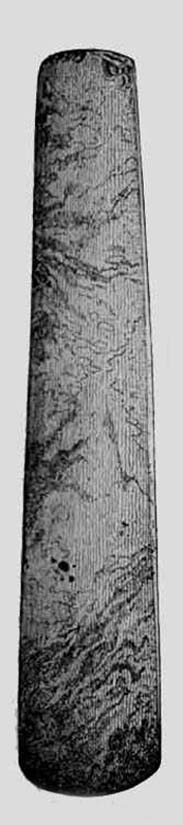
Thin-backed axe.
Dunn-nackiges Beil—Early
and Mid-Neolithic. |
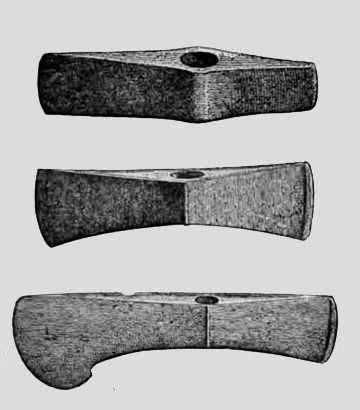
Hammer axes—Late Neolithic. |
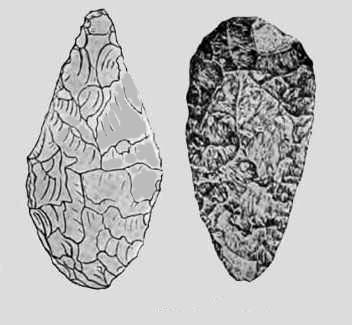
Palæolithic hand-stones—“Coups-de-Poing.” |
FORMS OF PREHISTORIC AXE
Late in the Neolithic period, usually after the
introduction of copper, we find an axe—or
“hammer-axe”—shorter and much thicker,
somewhat in the shape of a very light stonemason’s
hammer, and with a hole for the handle.
These axes sometimes had two cutting edges,
sometimes one edged and the other blunt for
hammering. Many of them were exceedingly
beautiful in form, design, and finish. But this
method of fastening the head to the handle
greatly weakened the brittle stone. Many of
them were probably merely articles of luxury
or adornment. The hole was made by twirling
a stick or bone, with plenty of sand, water, and
patience.
We have thus in the axes and the megaliths
a well-established sequence of forms, but no
means of fixing dates except at the beginning
and end of the whole period. Apparently there
was a long time between the Scandinavian shell-heaps
and the fully established Neolithic culture,
of which we have practically no records.
Peculiar types of axes (except the mattock),
and the megaliths do not occur in the province
of the banded pottery, which itself will probably
some day give us the clew to a system of chronology.
The pottery of Thessaly, Thrace, and
certain parts of the Balkan Peninsula is being
gradually synchronized with that of Mycenæan
and pre-Mycenæan Greece. Important discoveries
seem reasonably certain in a not distant
future. We can only wait for them with what
patience we can assume.
Our real and definite knowledge of the age of
the lake-dwellings is hardly better. Hoops
tells us that they belong to the Beech period of
the Swiss flora. But this period may be much
older in Switzerland than in Scandinavia; how
much older we do not know. The underground
stone burial-cysts of Switzerland look late. The
small number of the villages containing no trace
of copper and the high grade of household arts
and technique in even the oldest of them suggest
the same conclusion. Here again it seems
dangerous to even conjecture a date.
Montelius, whose opinion on these subjects is
certainly of great value, says: “All things considered,
I am convinced that the first stone
graves were erected here in the north more than
3,000 years before Christ.”132 (It may be safe,
therefore, to date them provisionally between
3000 and 4000 B. C.) “The epoch of the dolmens
with covered entrance (Gangräber) begins
about the middle of the third millennium B. C.,
and the epoch of the stone vaults or cysts (Steinkisten)
corresponds to the centuries about 2000
B. C.”
RETREAT OF ICE AND CHANGES
| SCANDINAVIA |
WESTERN AND
MIDDLE EUROPE |
PARALLELS IN
ASIA AND
ELSEWHERE133 |
DATE |
| |
1. Aachen Stage. |
|
24,000 (to
40,000) B. C.134 |
Ice-retreats in northern Germany. |
Solutrean. Dry and Cold.
Steppe and Tundra Fauna. |
|
|
Swedish-Finnish Moraines. |
2. Bühl Stage.
Early Magdalenian. Moist and cold. Tundra. |
|
16,000 (to
24,000) B. C.135 |
Yoldia Period.
Dryas Flora. |
Middle Magd. Steppe Loess formed. |
Susa founded. |
|
Glaciers in Mountains.
Ancylus Lake. Dryas, Birch, Pine Maglemose. |
3. Gschnitz Stage.
Late Magdalenian. |
Anau founded.136
Neolithic Settlements in Crete. |
10,000 B. C.?137 |
Littorina Depression. |
4. Daun Stage. |
|
6,000 B. C.? |
Optimum Climate. |
Azilian-Tard. |
|
(7,000) B. C.? |
Oak. Shell-heaps. |
Campignian. |
Sumerians in Babylonia. |
|
Full Neolithic. Beech. |
Full Neolithic. |
Predynastic Egyptians. Copper Period. |
4,000
(-6,000) B. C.? |
Bronze Period. |
Bronze Period. |
XI-XIII Egyptian Dynasties. |
1,900-
2,500 B. C. |
1. Arctic climate. Temperature about 8° Cent. Younger
Yoldia layers, Older Dryas period. Flora: Dryas
octopetala, Salix polaris.
2. Subarctic climate. Temp. 8°-12° Cent. Older Dryas.
Flora as in 1.
3. Climate becomes moderate, continental. First maximum
temp. 12°-15° Cent. Birches, poplars, junipers.
4. Climate subarctic. Temp. 8°-12° Cent. Birches.
5. Climate arctic. Temp. 8° Cent. Salix polaris.
6. Climate subarctic. Temp. 8°-12°. Younger Dryas period.
7. Temperature moderates. Dry continental climate. a.
Aspen Epoch; b. Pine period with oaks beginning to
appear=Ancylus period.
8. Moderate insular climate. Temp. 15°-17° Cent. Climatic
optimum. Older Tapes layers, Maximum of Littorina
depression. Shell-heaps.
9. Temp. 15°-17° Cent. Probably slightly cooler than 8.
Oak Epoch. Beech begins to appear but is still rare.
Younger Tapes (Dosinia) layers.
10. Moderate insular climate about 16.1° Cent. Beech Epoch.
Mya layers.
These climatic changes seem to argue for a comparatively
recent date for the Littorina depression and the shell-heaps.
NEOLITHIC PEOPLES AND THEIR
MIGRATIONS
THE study of history without a thorough
knowledge of geography is almost as
futile as the hope of interpreting the
structure of the ape without thinking of his arboreal
life.139 Contour lines are of vast, often
dominant, importance in the life of every nation.
John Bull has been moulded, if not made, by
his island. Italy could never be safe until its
boundary followed the crest of the Alps. Great
mountain chains mark limits, and river valleys
are thoroughfares. Whoever holds Constantinople
controls the trade of a boundless area. If
this is true to-day, it must have been far more
important in prehistoric times, when man had
only begun to gain a certain degree of independence
or mastery of nature. Culture was then
very largely determined by position and routes
of communication. The Alps and Pyrenees
formed a long, impassable barrier between northern
and southern Europe, broken only by the
Rhone valley; and northern Europe was split
into an eastern or middle and a western province
by the Juras, the Vosges, and the forested Ardennes.
Then, as now, the Pass of Belfort was
the narrow opening, and Belgium, always the
battle-ground of nations, the great thoroughfare
between middle Europe and France. From the
south, and to a certain degree from the west,
middle Europe was not easy of access. But to
the eastward there are few or no natural boundaries
as it goes over into the great Russian plain,
of which North Germany is practically a westward
projection. We might possibly go farther
and accept literally the somewhat exaggerated
statement that all Europe is only a peninsula
of Asia.
Osborn has called attention to the fact that
from Paleolithic to Neolithic time Europe gave
rise to no new races.140 The immigrants entered
their new home with all their physical and mental
characters already fixed or determined. The
routes of migration of the successive waves of
lower Paleolithic immigrants are still unknown.
Remains of Chellean and Acheulean cultures are
rich and widely distributed everywhere around
the Mediterranean, especially in northern Africa,
at this time well watered. The entrance of
Neanderthal man into Europe may well have
been from this direction.
The Cro-Magnon race very probably came
along the northern or southern shores of the
Mediterranean, and then pushed northward into
France; though the evidence is far from compelling.
The race is evidently Asiatic in its
physical characters, reminding us of tribes still
living along the Himalayas, most strikingly of
the Sikhs. If they entered from the south,
northern Africa was a station on their march,
not their original home. The Solutrean culture
may have been brought by the Brünn people,
who probably came through Hungary and up
the Danube, but its origin and route of migration
is still very obscure. Breuil’s arguments
for the migration of Magdalenian culture from
Poland across Europe are very strong, and his
view seems to accord well with the facts, though
Osborn seems to lean toward a somewhat different
interpretation.141 The broad-headed people
of Furfooz and Grenelle apparently came by the
central European route. The only race showing
any Negroid characters is that of Grimaldi,
apparently accompanying the Cro-Magnons,
few in number and having little or no influence
on the population of Europe. Evidently the
Mediterranean region was far more precocious
than northern Europe, and the genuine Mediterranean
race may have arrived here bringing the
Neolithic culture almost or quite as early as the
beginning of the Upper Paleolithic Epoch in
France.
Sergi is of the opinion, though he does not
press it, that the Mediterranean race originated
in Africa, perhaps in the region of the great lakes,
and that its most primitive representatives of
to-day are the Hamitic peoples along the
southern shore of the Mediterranean.142 His
definition of the race is based less upon mere
breadth and length of skull than upon contours
and form and development of regions. It was
a work of observation, insight, and genius, and
was a landmark in the progress of the science of
anthropology.
The area of distribution of the race takes the
form of a Y, the arms following the north and
south shores of the Mediterranean while the
stem or lower portion extends through Asia
Minor. It includes the Hamitic peoples, also
the Pelasgi and the Hittites, but leaves out the
Semites.
Huxley had described the distribution of his
Melanochrooi, or dark Europeans, very similarly,
except that in his group the stem of the Y lay
farther south and extended into Arabia. In locating
the origin of the Mediterranean race in
Africa, Sergi was doubtless influenced by the
opinion of Darwin and others that man’s birthplace
was in Africa. Nearly all paleontologists
to-day favor the Asiatic origin; and the stem of
the Y stretching eastward toward Asia Minor
or Arabia points to a possible or probable primitive
route of migration. The Asiatic cradle is
really in better accord with Sergi’s theory, and
meets some objections or difficulties better, than
the African.
We vaguely located this Asiatic cradle somewhere
westward or northwestward of the great
plateau of Thibet. We may call it the Iranian
plateau, using the term in the broadest possible
sense, including Afghanistan and perhaps western
Turkestan: a great area extending more than
1000 miles from northwest to southeast, where
it sinks into the valley of the Euphrates. We
found a branch of the great Negroid race starting
very early from this region and migrating
westward past Arabia into Africa. This was
an easy line of least resistance through regions
where the moist, cooler climate of the glacial
period brought only blessing instead of calamity
and curse. The Hamitic and Semitic peoples
naturally followed the same route, travelling as
one people or nearly together, if the relations
between the languages are as fundamental and
close as some good authorities think. The Semites
settled in Arabia, while the Hamites went
on westward and found a home along the southern
shore of the Mediterranean. We do not
know when this migration took place.
This route was easy and wide, and led into
a broad, favored continent. It would not be
surprising if for a very long time most of the
travel went this way. We may venture to
guess that Neanderthal man may have followed
it long before the beginning of the Hamitic-Semitic
migrations, but this is only a guess.
While rich, well-watered, and probably park-like
in its flora during the moist climate of the
glacial epochs, it was sure to degenerate into
desert as the climate became warmer and dryer;
as the Sahara Desert is dotted with the remains
of Paleolithic settlements where the explorer
to-day is in danger of perishing from thirst.
Any traveller by this southern route must pass
through Italy or Spain before reaching northern
Europe.
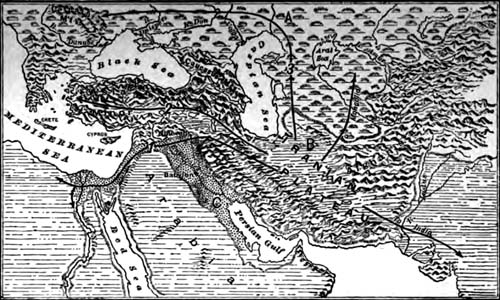
F. B. Loomis, del.
MIGRATIONS OF PEOPLES
1. The southernmost route to the Mediterranean and Africa. The middle part of this route follows roughly Breasted’s “Fertile Crescent,”
as shown in his History of the Ancient World, around the headwaters of the Euphrates and Tigris. 2. Middle route through Asia
Minor. 3. Northern route around Caspian Sea to Carpathians. A. Grass-lands and steppe. B. Iranian Plateau (central portion).
C. Valley of Mesopotamia.
A second great western route must have begun
very early to compete with the African. This
led along the curve of the mountain ranges of
Persia and Armenia, with Breasted’s fertile crescent
at their base, up the valley of the Euphrates
and elsewhere into Asia Minor. This route
continued in use as a great thoroughfare for
migrating peoples and invading armies through
historic times. Xenophon and his 10,000 explored
it. It is surrounded on three sides by
water, although mountain chains cut off the
influence of the sea to some extent. It is a
plateau of glade and forest, though the forests
have now largely disappeared. It has the
features of a semitropical climate; here the flora
of northern and southern provinces meet and
overlap. One great characteristic of the region
is the abundance and variety of its fruit-trees.
It was apparently the original home of apricot,
peach, fig, and orange, as well as of other fruits
introduced into Italy from this region by the
Romans. The vine is luxurious. Somewhere
along the line of this great thoroughfare the wild
olive was domesticated, improved, and transformed.
Oaks, walnuts, chestnuts, and many
smaller growths furnish a variety of nuts. The
open glades tempted to agriculture and furnished
no small contributions of grain to Rome.
Though suffering from dessication, it may yet
again become the garden of the world.
When once a wave of westward migration had
entered Asia Minor it was walled in on the
north and south by mountain and sea. There
were no by-roads. Crowded and pressed from
behind, it could not stop until they reached the
shores of the Ægean Sea.
Here there were two possible outlets. One
was by sea, using as stations the islands with
which the sea is dotted and leading to Crete
and to Greece. Crete, according to Evans, was
settled some 14,000 years ago, and is on the
whole less easily reached by short voyages than
Attica. A second outlet led across the Hellespont
and around the Ægean Sea into Greece,
or still farther northward and westward around
the Adriatic and down into Italy. We might
add still a third fork of this great highway running
northward to the Danube. When we remember
how Neolithic settlements in northern
Europe clustered around the lakes and dotted
the river valleys, the primitive minor routes of
communication, how early islands like Crete in
the south and Gothland in the Baltic were settled,
we can imagine the importance of a city—or
even a village—like Troy even in prehistoric
times. Here a sea route running east and
west crossed a great land route running north
and south. Here was a point of exchange,
trade, and transshipment—if we may use the
word. We do not wonder that before the close
of the Neolithic period, and perhaps far earlier,
patterns and influences were radiating through
the Balkan region, far up the Danube, and we
know not how far into Russia.
It is hardly an exaggeration to say that
Greece, and Italy to a less extent, were in climate
and many other features bits of Asia Minor,
almost shut off from northern Europe by the
great Alpine barrier. The two regions were entered
by different routes, each of which had left
its mark on its travellers. Immigrants seeped
into Italy and Greece through broken and rough
mountain regions. Great invasions were difficult
or impossible. They were sunny, smiling
lands compared with the grim and dreary north.
Men living in this milder climate did not need
to be gross eaters. They lived from the fruits
of their orchards to a far larger extent. Nuts
were in early times almost a surrogate for grain.
The olive furnished a delicious oil, and the
grapes wine. The butter and cheese of northern
Europe were neither needed nor desired.143 Most
of these habits, tastes, and desires had become
fixed during the march through Asia Minor.
The peoples which gradually went westward
from the Iranian plateau through Asia Minor,
across or around the Ægean Sea into Greece and
Italy and Spain, generally found a very similar
environment from beginning to end of their
long journey. There was little in food, climate,
or conditions to compel or stimulate change.
Everything tended to more firmly fix in their
structure the already long-inherited characters
of their Iranian ancestors. These characteristics
thus fixed have become stable and persistent,
and have remained so in modern times
in spite of repeated invasions and infusions of
northern blood. We are perhaps justified in
speaking of a Mediterranean race.
It seems strange that Sergi should find traces
of his Mediterranean race in Russia. Did these
find their way so far northward directly from the
Mediterranean area or are they merely sporadic
groups more resistant to modifying influences;
or are they perhaps groups which have separated
from the westward migration at the Hellespont
and turned northward? The Nordic peoples of
Europe are perhaps after all not so far from
their Mediterranean cousins. The Mediterranean
race still holds its own around the Mediterranean.
In France its blood is much mixed
and greatly diluted with later infusions. In
England it has generally been almost completely
swamped by Aryan invasions.
Neither of the two routes already sketched
leads directly into middle or northern Europe.
The trend in both is toward the Mediterranean.
We must now consider the third and last route,
which is of chief interest to us. We have already
seen that the Black Sea prevented all migrations
northward from Asia Minor except at
the Hellespont. Eastward from the Black Sea
lies the Caspian, probably much larger in glacial
times. The two seas are separated by the forbidding,
almost unbroken, mountain barrier of
the Caucasus; but a narrow passage at each
end is left. East of the Caspian Sea must lie
the point where a more northerly westward
route diverges from the road through Asia
Minor. Our third route starts, therefore, from
the northern edge of the Iranian plateau, perhaps
mostly from Turkestan, and runs westward
north of the great barrier of seas and
mountains just described. It follows the great
steppe or prairie which stretches through southern
Siberia and Russia into Hungary. Its western
portion lies along the valley of the lower
Danube, the great east and west artery of communication
and migration through Europe. It
lies farther north than any other great route,
and leads over steppe instead of through forest.
As the Arabia-Africa route was the first to be
traversed, this may well have been the last.
Furthermore, the route through Asia Minor,
ending in a sort of cul de sac, may easily have
become well inhabited and hence less open before
the Neolithic period had begun in northern
Europe.
It was by no means the most attractive route.
It offered far less to people in the collecting stage
than the well-watered parklands of Asia Minor.
The steppe offers to the hunter few means of
concealment or approach to the game. The
animals are swift and wary. In any migration
of peoples toward the frontier, the hunters lead
the advance and spread out like an army of
scouts. Every river which crossed the steppe
would offer to them a tempting by-road leading
off into the forests of Siberia or Russia. How
deeply they would penetrate into the primeval
forest or away from the river valleys is still a
question. Very likely they would find their best
hunting-grounds not very far from the northern
edge of the steppe, where the forest is less dense.
This question we cannot yet answer. But most
of European Russia is well watered, and here
these hunters would find themselves at home.
The main route of the steppe would be left for a
very different population. The piedmont zone
of grasslands in Turkestan was an ideal land for
primitive agriculturists practising a hoe-culture,
as at Anau. The northern edge of this steppe
zone, where it joined the forest, may have been
equally favorable.
But the piedmont zone and the river banks
of the steppe must have been occupied by agriculturists
before 10,000 B. C., probably much
earlier. Pumpelly’s explorations seem to warrant
this view. Alongside of agriculture, but at
a somewhat later date, sheep-herding and cattle-raising
were practised. But the nomad of these
days was a less dangerous neighbor than at later
times because the horse had not yet been domesticated.
During these post-glacial times he
would be less dangerous here than farther south
around Arabia, when the dryness which finally
produced the Arabian desert was making itself
felt, burning up the pastures and leaving only
the choice between starvation and migration
in mass. Again comparing this migration with
the pioneer movements of peoples in historic
times, we have good reason to believe that the
sheep-herders and cattle men—and they were
probably both at the same time—advanced
faster than the agriculturists, who were more
bound to the soil. Between herdsmen and
farmers there were almost certainly many intermediate
grades. We may be fairly confident,
therefore, that the movement or tide along this
route did not take the form of a procession
marching in lock-step, but of a series of waves,
generally with hunters in front and along the
forest flank, herdsmen in the middle, and farmers
bringing up the rear and making permanent
settlements at favored spots.
Hunters had been spreading northward at
least as early as the beginning of Upper Paleolithic
times. Farming on the lowest grades of
agriculture is essentially Neolithic. A town
or village had risen at Susa 20,000 years ago.
Neolithic civilization probably reached Crete
nearly or quite 15,000 years ago. Small Sumerian
cities were being founded in southern
Babylonia at or before 5000 B. C. Population
was increasing in density in the Iranian plateau,
as almost every mountain region with its healthy
atmosphere and low death-rate quickly becomes
overpopulated. Our pioneer column was continually
pressed forward by new recruits from
the rear as well as by its natural increase. We
have practically no records of the march. But
our sketch is no mere invention of fancy. It
applies to every great migration of peoples extending
over centuries or millennia. The last
illustration was the great westward movement
in America beginning a century or two ago, and
still far from completed.
The Hungarian plain is the last extension of
the great south Russian steppe far into Europe.
West of this anything like nomadic life was
practically impossible. Here our pioneers scattered
and followed the river valleys, settling
more or less permanently the loess deposits as
farmers, but on less favorable soils devoting
themselves more largely to cattle-raising. The
latter form of life seems to have been more
common on the great North German plain,
though accompanied by much hunting, a genuine
pioneer life.
We may now turn to Europe and consider
the distribution of its races and peoples.
Of the route of migration of the Neanderthal
race we have no sure knowledge. The wide and
rich distribution of ancient Paleolithic implements
in Egypt and northern Africa tempts us
to guess that it represents a very early migration
along the Arabian route after the negroids
and before the Hamites and Semites. We have
glanced at the origin of the Cro-Magnon people,
and have discovered our uncertainty. The
Tardenoisian culture, with its pygmy flints, is
exceedingly wide-spread,144 and seems to have
started in Europe in the Mediterranean region,
arriving from still farther east. We are tempted
to guess that the great bulk of westward migrations
in Paleolithic times followed the southern,
Arabian, route, but there were probably exceptions.
Coming down to Neolithic times we find the
Hamitic peoples in Africa, apparently representing
the first wave in the migration of the Mediterranean
race. It may well have arrived at
its present home long before the beginning of
the Neolithic period. It had followed the southern
route. Peoples physically and racially
closely akin to the Hamites followed, probably
in successive waves. The Tardenoisian people,
if their culture was carried by a distinct
people, may represent an early wave. The bulk
of the population of Greece, Italy, and Spain
followed, but migration seems to shift gradually
from the Arabian route to that through Asia
Minor, as the zone of most favorable climatic
conditions moved slowly northward. Before
the close of the Neolithic period the relations
between Greece, Crete, and western Asia Minor
have become so marked and close that they almost
represent one culture and people.
The Mediterranean race, thus established in
Europe, spread northward. It could not cross
the Alpine barrier. It followed the Rhone
valley and the Atlantic coast, and furnished the
basic population in France and Great Britain,
though here frequently crowded back into corners
or submerged by later invasions, peaceful
or otherwise. It furnished the great link or
means of communication between the Mediterranean
basin and the far north of Europe.
Schliz has some reason for calling these megalith
people largely traders.
In a cave near Furfooz, Belgium, there were
found crania, probably of Azilian-Tardenoisian
time, noticeably distinct from those of the long-headed
or dolichocephalic Paleolithic peoples
in being short—and broad-headed, brachycephalic.145
Brachycephalic crania, perhaps early
Neolithic, were also found at Grenelle near
Paris. We remember their occurrence in the
shell-heaps at Mugem, Portugal. Similar crania
were found of about the same age at Ofnet,
Bavaria, on a tributary of the Danube.
Somewhat later we find broad-headed people
occupying the higher lands of southeastern
France, the Massif, Juras and Vosges, forming
thus a north-and-south zone separating France
from middle Europe. They seem later to have
gradually spread westward, somewhat irregularly,
and to have mingled with the Mediterranean
peoples of France.
The relation of these “Protobrachycephals”
to the great Alpine race, most of which arrived
later, is still a matter of discussion, and the
whole problem of the brachycephalic peoples
bristles with interesting questions. They seem
to have originated in the mountain regions of
western Asia, possibly in or near the Armenian
highlands, though this has been disputed.146 It
looks as if they came originally from a region bordering
on or overhanging the steppe route and
came into Europe by way of the valley of the
Danube. There were certainly several if not
many waves of brachycephalic migrations into
Europe, of which this was the first. Other waves
may have come from different parts of a great
area, and hence show modifications of type.
Everywhere the Neolithic brachycephals seem to
inhabit mountainous or rough country, perhaps
because of preference, perhaps because as they
gradually made their way they found these regions
unoccupied. They seem to be an unassuming,
unpretentious, peaceable, exceedingly persistent
and enduring stock, which has held on its
way with remarkable pertinacity. Some still
maintain that brachycephaly is everywhere
largely an adaptation to conditions and habits of
life.147 The rough country, generally heavily forested,
and well populated with this quiet but
firm and solid people, greatly hindered free communication
between France and central Europe.
No human remains have been found in the
Danish kitchen-middens, which may well have
been heaped up by broad-heads from Belgium
but apparently mingled with eastern immigrants
who brought with them the domesticated dog
not found at Mugem. They left their axes and
picks in Sweden and across into Norway. Behind
them came people bearing the Nostvet
culture.148 Our knowledge of Russian prehistory
is still very scanty. But we find here a variety
of cultures, such as we should expect from a confusion
of hunting tribes far from their original
home much broken up and remingled during
the long migration. We find in Poland the remains
of a culture akin in its carvings to the
Magdalenian culture of western Europe.
It would hardly have crossed Europe from the
west. Breuil149 seems to consider it as the station
from whence it was carried to France.
The question is exceedingly interesting and important,
but is one to which we can give no sure
answer. The carved bone implements are certainly
to be found in Poland and to the northward.
Behind these bits and wrecks of tribes and
cultures, for they were hardly more, came the
first great recognizable body of Nordic peoples,
probably also in successive waves mingling on
this northern coast toward which they had been
drawn by the climatic optimum. Kossina,150
who has given an excellent account of these
early northern migrations, speaks of them as
Urfinnen and Urgermanen, primitive Finns and
Germans. Urskandinavier, primitive Scandinavians,
would seem to be a more appropriate
name. For the centre of the least mixed blood
of this group is to be found in the Scandinavian
peninsula.
These Scandinavian representatives of the so-called
Nordic race or stock are characterized by
tall stature, blond complexion, light hair, blue
eyes, and long head and face. Their origin is
still a matter of much discussion. Kossina and
others derive them from Cro-Magnon people,
following the reindeer in its migration northeastward
from France at or toward the end of
the Magdalenian epoch. Some suggest that the
Cro-Magnon people were also blonds. If this
were so they formed a marked exception to the
color of Paleolithic stocks coming from and
through southern regions. The possibility cannot
be denied. But, if the Cro-Magnons were
light-colored, they have left no traces of this in
their descendants at Perigeux and elsewhere.
The face of the Cro-Magnon was short and
broad, that of the Scandinavian long and narrow.
It might have changed but has not done
so at Perigeux. The Cro-Magnon race was already
declining in physique and numbers during
the Magdalenian. Even if all migrated, could
they have furnished enough descendants to give
rise to the Scandinavian population? It seems
to me far more probable that the Scandinavians
were hunters or partially herdsmen, who had
wandered by the steppe route through the forests
or along their edge, and had lost the dark
pigmentation in the northern climate. This has
been noticed, perhaps to a less extent among
Asiatic steppe-dwellers.
The study of prehistoric anthropology in
Russia, a vast territory, is still in its infancy.
We have touched upon only one or two of the
questions concerning this so-called Nordic race,
which is probably hardly more than a name for
a mixture of peoples.151 We must not forget
that even in Scandinavia we find traces of a
very early immigration of short-headed people.152
We still know little concerning life in North
Germany during the Neolithic period. It was
probably what we should call pioneer life, where
hunting and cattle-raising and a rude tillage
combined to furnish support.
We must now turn to the valley of the Danube.
Here we find a population characterized by similar
ground form of skull, although according to
Schliz153 showing two fairly distinct varieties, a
longer and a shorter cranium. Probably this
population arrived in several successive waves.
Its culture is evidently homogeneous. They are
agriculturists forming fixed and permanent settlements,
practising farming of a high grade.
The characteristic implement is the mattock.
Daggers and lance-heads are rare, or fail. They
were a peaceful folk settling by preference,
though not exclusively, in the loess districts, as
at Grosgartach. We find, as we had every reason
to expect, that northern Germany and Scandinavia
were peopled by a pioneer folk not yet completely
agricultural. The Danube people represent
the farmers of the steppe whose migration
probably went on more slowly and gradually,
and who always remained more homogeneous
physically and culturally. They may, or
may not, have reached the Danube valley as
early as the Germans and Scandinavians arrived
at the Baltic, for they had far less distance to
march. They spread out westward and northward.
Here we trace them by their pottery.
Starting from Hungary and the surrounding regions
we find them in Moravia, Bohemia, Silesia,
across south and middle Germany as far as the
Rhine. We have already noticed that the
banded pottery covered all this region, while the
home of the corded pottery was North Germany.
But, while the form of the banded pottery is
quite constant, the ornament varies greatly.
We find the plain, often rude, saw-tooth pattern,
the meander and scroll, the spiral-painted pottery—sometimes
in the southeast plant patterns,
perhaps introduced. I regret that I cannot find
any clear or definite theory as to the exact relations
of any of this pottery to that of Anau or
Susa. The greatest variety, as well as the
most complex patterns, seem to occur in most
southeasterly regions, which, at least in later
Neolithic times, were much under the influence
of the Ægean culture, just as western
Europe borrowed from Italy and Spain.
Here there was evidently a great and very
complex mixture of cultures, and probably of
peoples all of one great primitive stock, shown
least modified in the Mediterranean race, here
more influenced, changed, and varied by steppe
climate and conditions, and more or less admixture.
Along the Swiss lakes we find the lake-dwellers.
The few human remains from the
earliest lake-dwellings are all brachycephalic—short-heads.
Then in the period when copper
was beginning to come in we find long-heads
arriving in greater numbers, but the short-heads
regain their superiority during the Bronze period.
The weight of evidence seems to favor the view
that these settlers did not come from the zone
of “proto-brachycephals” inhabiting eastern
France, but represent a new immigration from
the east, and, according to Schliz, founded fortified
settlements on the heights of Baden, Wurtemberg,
and along the valley of the Rhine as
far as Cologne.154 We have seen that the pottery
of these earliest immigrants was crude and
almost or quite without definite ornament.
Northern and central Europe seem to have
been settled mainly or almost entirely directly
from the east, along western Russia and the
Danube valley. But, especially toward the
close of the period, people from the megalithic
zone seem to have penetrated much farther
southward into Germany than their monuments
would prove. Schliz thinks that he has recognized
their skulls as well as calyciform pottery
over a wide region. Their presence seems fairly
clear, but whether they were comparatively
very few in number, or fairly numerous, is still
uncertain.
There seems to be good reason for believing
that in late Paleolithic time the population of
middle Europe north of the Alps was very sparse
and the Baltic region hardly inhabited. A hunting
population without domestic animals except
the dog pressed northward through Russia in
waves and fragments, and along the Baltic
mingled with a strain coming from the west,
probably broad-heads from Belgium. The great
Scandinavian and North German peoples followed
with a frontier culture, a combination of
hunting, fishing, cattle-raising, and agriculture
mingled in proportions varying according to
time and place. Their exact route of migration
from the region of the steppes must yet be
traced. But the weight of evidence favors an
eastern origin. At a time probably not so very
far from their arrival in the north, agriculturists—we
might safely speak of them as farmers—were
coming into the Danube valley and spreading
along its tributaries. Apparently somewhat
or considerably later the lake-dwellers appear
along the northern piedmont zone of the Alps as
broad-heads, marking the arrival of the advance
guard of the great Alpine race of to-day. But
here again our certainty is not as firm as we
could wish. They extend northward toward and
along the Rhine valley. The close of the period
is marked by the southward spread of peoples
from northern Germany crowding back the
farmers characterized by the banded pottery.
This movement is augmented somewhat, perhaps
very little, by recruits from the megalithic
zone of northwestern Europe and Denmark.
All these people are closing in on central or
middle western Europe. In the Rhine valley
along the middle of the course of the river we
find a region of mingling or overlapping cultures
which have not yet been satisfactorily disentangled.
We have spoken of them as pioneers. It was
a time and place of pioneer, frontier life. And
frontier men and life have their peculiar physical,
cultural, mental, and temperamental characteristics,
almost apart from time and place.
The people have something, at least, in common
with the great American westward migrations
and frontiersmen of a far later date. We have
the successive waves of hunters, herdsmen, and
farmers often overlapping or mingling. We have
a grand mixing of peoples and cultures, if not
of races. Many a fine art or technique is left
behind. Life is rude, hard, vigorous, vital, joyous.
It was so yesterday, it was probably so
millennia ago. For the stratum of frontiersman
and barbarian—not to say savage—lies just
below the surface in us all, and a scratch exposes
it. This was a period of vitality, hope,
and promise.
NEOLITHIC RELIGION
MAN’S ancestors, as we have seen, owed
their progress to their training, policing,
and harassing by stronger and
better-armed competitors. The earliest vertebrates
developed a notochordal rod of cartilage,
and then a backbone, by the habit of swimming
forced upon them by the mollusks and crustacea
which held the rich feeding-grounds of the ocean
bottom along the shores. In early Paleozoic
time the sharks crowded the ganoids in successive
waves toward and into fresh water, until
finally some crawled out on the shore as amphibia.
Land life and air-breathing gave the possibility
of warm blood and high development of
brain, and a strong tendency toward viviparous
and finally intrauterine development of the embryo.
Reptiles harassed mammals into the attainment
of a certain amount of wariness and
intelligence. The comparatively weak Primates
were kept in the trees and forced to develop
hand and brain by the fierce and well-armed
Carnivora. Only a “saving remnant” has progressed,
and these mostly under stern and
strenuous pressure. The “aspiring” ape exists
only in our imagination.
The apes had become accustomed to life in
the trees, and found it safe and comfortable.
A change of climate compelled those dwelling
farthest north to seek their living on the ground.
Most of them fled southward, many became
extinct, a few came down and adapted themselves
to the new mode of life. Nature was in
no sense a “fairy god-mother” to them, but a
stern, harsh disciplinarian whose method of education
was “not a word and a blow and the blow
first, but the blow without the word, leaving
the pupil to find out why his ears had been
boxed”155; and nature’s cuffs were frequently fatal.
The pupil had to learn by others’ experience.
Paleolithic man lived in France poorly armed
and ill-protected against a threatening climate
steadily changing for the worse. Food may have
been abundant, but enemies hunting for him
were also numerous. He was compelled to be
keen, watchful, prying, wary; to discover distant
danger, and to notice every trace of its
approach. He learned the habits and behavior
of animals, and the ways of things—an excellent
course of study. He had to rely on his
wits, and they were none too keen or many.
Some things he could understand: he learned
to avoid or to ward off many dangers. Others
seemed altogether beyond his understanding or
control. Here he could only wonder; but the
wise old Greeks knew that wonder was the
mother of wisdom. He wondered at storm,
lightning, hail, and flood; at disease and death,
and a hundred other things. He sat in the
mouth of his cave and watched that strange
creature fire devouring the wood and sending
smoke and sparks skyward. He thought a very
little in a dull, stupid way, dozed and dreamed
and awaked to wonder again. Or he saw fire
raging through the forest and fled for his life.
But it was warming and fascinating, and somehow
akin to himself. Did it not devour wood
and lap up water on the hearth?
He seems to have come to feel rather than
recognize that he was surrounded by invisible
powers, in some respects like himself but vastly
more powerful, who knew what he was doing,
and who would hurt him if he did certain
things and might help him if he did others.
Certain places were to be strictly avoided, certain
objects must not be touched, certain things
must never be done, or could be permitted only
at certain times. They were taboo. He has
started on a long journey of exploration, experiment,
and discovery.
How had he come to believe this? Largely
through hard experience of nature’s buffets,
whenever he acted contrary to this hypothesis
or feeling. His religion was largely one of fear
fitted for a savage mind, though not without a
mingling of hope.
Of course in us cultured folk perfect love,
sentimentality, softness of fibre, heedlessness,
forgetfulness, and general superficiality of life—to
make a very inadequate list—have combined
to cast out fear, “for fear hath torment”; and
we thank God loudly that we are so much wiser
than our benighted ancestors. Even our New
England fathers feared God, though they feared
nothing else, but we fear only everything else
except God and law. But the unlucky scientific
wight living and working in the shadow of
adamantine law remains in hopeless bondage to
fear.
“Nach ewigen ehernen, grossen Gesetzen
Mussen wir alle unseres Daseins Kreise vollenden.”156
These great powers might not necessarily be
hopelessly hostile. They might be appeased or
won over, possibly controlled. What could he
do to please them? For something must be
done. Here ritual arises.157 Possibly he offers to
one or more of them a share in the feast which
he so much enjoys after a successful hunt. In
time this may become a sacrifice, sent up and
out on the wings of fire.158 Or he practises a
wind or rain dance as the outlet and expression
of his intense desire; and to awaken, encourage,
and help the powers of these elements. He
holds a hunting-dance to rehearse and gain
power for the killing of the bear. Call it objectification
of his heart’s desire, or magic if you
prefer. Magic and religion grow up side by
side, and probably from the same root in these
early stages: as alchemy and chemistry, astrology
and astronomy will spring up later.
The pictures on the cave-walls of France probably
had a magical or religious purpose. Here
we find very few representations of human
beings. But in a rock-painting at Cogul, possibly
Neolithic though probably older, we see a
group of women apparently engaged in some
rite of magic or religion. The occurrence of
amulets also does not surprise us.
We cannot make a study of primitive ritual
magic and religion, their origin, form, and content.
But even our hasty glance shows us that
man had been wondering and thinking about
this subject during millennia before our Neolithic
time, had been forced to accept many
profound convictions, containing germs of sublime
truth overlaid, like our own, with many
errors; he had elaborated a system of ritual,
and had travelled far along the road of religious
experience and discoveries long before this comparatively
recent epoch.
The conspicuous features of the religion of
this ancient period of primeval stupidity, or
Urdummheit, to borrow the German word, were
the host of invisible powers or dæmons, and the
law of taboo, the forbidden thing. Breach of
taboo rendered not only the individual lawbreaker
but the whole tribe, however innocent,
liable to punishment. The whole community
was responsible for every deed of any and every
one of its members, and suffered or prospered
accordingly. When Agamemnon had wronged
the priest of Apollo, the god shot his arrows not
at Agamemnon but throughout the innocent
Greek host. The children of Israel were routed
at Ai, because Achan had taken the devoted or
forbidden thing. This stage of tribal responsibility
seems to be practically universal. It gave
the law an iron grip on the people, tamed them,
and made them march in lock-step, a necessary
stage of terrible discipline. But only under the
protection and stimulus of this tribal feeling of
common responsibility and resulting tribal conscience
could the individual conscience be gradually
awakened and developed, and finally break
through the cake or crust of custom into freedom
and light.
All these forces and influences were acting
throughout the Neolithic and later periods, and
are still with us. Perhaps we can gain a tolerably
distinct and correct view of Neolithic religion
among the Mediterranean peoples by a
glance at the ancient Greek mysteries. Students
of Greek art and literature quite naturally
have been very slow to take interest in these
crude, often ugly and indecent, rituals. But for
this very reason the primitive stands out all the
more sharply defined against the brilliant, beautiful,
artistic Olympian religion of Greek art
and literature, and particularly of Homer.
Students like Professor Murray could hardly
be expected to explore these lower strata with
great sympathy. For this very reason, as
somewhat unwilling witnesses to whatever is
good or great in primitive Greek ritual, their
testimony is all the more valuable, though probably
hardly as just as that of Miss Harrison.159
We shall follow mainly Professor Murray’s vivid
portrayal.160 In his Saturnia Regna he pictures
the ritual and belief of the ancient Greeks before
the arrival of Achæans or Hellenes in any
strict sense of the word. Strictly speaking, it is
a description of the religion of the Bronze Age
during the earlier part of the second millennium
B. C. It has been growing, developing, and
undergoing modifications since Neolithic time,
but in all its essential features it is ancient.
We find here very few traces of the chief
Olympian divinities, which belong to a later age
than the objects of worship or cult of these ancient
peoples whom we venture to call Pelasgi.
They worshipped powers or dæmons in indefinite
numbers, but with no individual names: represented,
if at all, by emblems or symbols, very
rarely in bodily human form. Of these spirits
of death, disease, madness, and calamity there
were “thousands upon thousands, from whom
man can never escape or hide.” So much is
mainly a heritage from Paleolithic times. But
the conception of spirit has grown more clear,
distinct, and elevated, as we saw in our study of
burial rites.
But Neolithic men lived in communities and
devoted themselves largely to tillage of the
ground and to raising sheep, goats, swine, and
cattle. Their life was still precarious. “Their
food depended on the crops of one tiny plot of
ground. All the while they knew almost nothing
of the real causes that made crops succeed or fail.
They only felt sure it was a matter of pollution,
of unexpiated defilement. It is this state of
things that explains the curious cruelty of agricultural
works, which like most cruelty had its
roots in terror, terror of the breach of taboo—the
‘Forbidden Thing.’”
Neolithic man, with his new discoveries and
industries, had given new hostages to fortune,
and a new and wider scope of application to
the old doctrine of taboo and of tribal responsibility.
This strengthened the hold of the priest
or magician on the hopes, fears, and faith of
his people. The law is going deeper as well as
wider. There arises an individual feeling of pollution
and of the need of expiation which will
blaze out in the oldest Greek tragedies as almost
a veritable sense of sin. We might almost say
that a sense of morality toward the spirit world
is now appearing in a religion previously almost
or quite unmoral. We may easily overestimate
the extent and power of the change, but
we can hardly be mistaken in recognizing its
dawn and the vast germinal possibilities of this
dim feeling or conception.
In agriculture and throughout nature seed-time
was followed by harvest, fall, and winter’s
gloom and death. Then in the next spring there
was a return, a rebirth or a resurrection. If the
seed failed to come up, if the blade withered or
was blighted, it was because the vegetation spirit
or dæmon had failed to reappear or had been reborn
weak or sickly, and all this because some one
had broken taboo, had touched the forbidden
thing. This must be prevented at all cost, they
must help the spirit. Hence there must be every
year a time of purification, of renovation, when
the old garments and utensils and everything
which could carry the pollution of death were
cast off or cleansed.
All these conclusions, and some others of
equal importance to which we will return later,
are expressed or symbolized in the great Dromena,
festivals, mysteries, or whatever you may
call these rites of pre-Homeric Greece. Then,
for a time, they are partially, though never
totally, eclipsed, by the brilliant beauty of the
Olympian religion with its glorious temples,
statues, and other works of art.
The Olympian gods had conquered the world.
They practise neither agriculture nor industry,
nor any honest work. They fight and feast and
drink and play. They are conquering chieftains,
royal buccaneers. The Olympian religion had
its time and place, and did its work. It swept
out many indecent features of the older cults,
many superstitions and abuses. It suited the
Achæans and their civilization exactly, and we
can never forget its “sheer beauty,” But it
went bankrupt, lost its hold on men’s minds and
hearts, failed and faded out. Professor Murray
compares its end to that of a garden of rare
exotic flowers overrun by the rank weeds which
it had temporarily displaced. Miss Harrison
more justly compares it to a flower withering
because cut off from its roots.
There was vastly more vitality in the ancient
crude symbols and chaos of conceptions than
in the ordered and artistic Olympian hierarchy
with its marvellous representations of the gods
in human or superhuman form and beauty.
Even its art and literature could not save it.
It had lost its mysticism. The old Neolithic
religion, handed down by peasants and artisans
reoccupied the field, transformed sometimes almost
beyond recognition, like the Ugly Duckling
of the fairy tale. It returned triumphant
through sheer power of unlimited vitality and
adaptability. Plato draws his finest illustrations
from its mysteries, out of which, also, the Greek
drama arose. Paul quotes from them or from
a similar stratum of belief.
Some of the many sources of its vitality are
obvious. It was rooted in the firm conviction
of the existence of a spiritual world toward and
into which its every rootlet was forcing its way
and from which it drew nourishment and power.
We might better change the illustration and say
that it was slowly developing a spiritual eye
which peered into a higher world and developed
in keenness and clearness of vision in response
to the higher pulsations. By patient experiment
and experience, which produced a hope
that could not make ashamed and a faith in
which hope and experiment combined, it was
feeling its way into spiritual knowledge. It
knew nothing of practical science or of material
cause and effect. But its world pulsated with
the universal life. It recognized the law of forbidden
things and the sure penalty of law-breaking.
It had a tribal conscience and recognized
the need of purification. It had the
promise, at least, of individual conscience and
consciousness of sin.
Its symbol was the mystery which lifted only
a corner of the veil and left an abundant opportunity
for wonder, imagination, thought, and
mysticism, which was entirely lacking in the
perfect statue and the finished creed. It made
man, through its sympathetic magic, a co
worker with his divinities or dæmons in gaining
the answer to an intensive desire or prayer
acted by all the members of the community
with all their united might, instead of expressed
merely in words, the utterance of his whole
being and life. Such a system or chaos overflows
with sublime possibilities.
The introduction of agriculture had produced
another most important change in religious
views and ritual. In tillage the earth brought
forth and gave birth to the crops which furnished
their chief food supply, and probably, in their
view, to animals and men also; just as the
human mother gives birth to the child. Hence
there was a wide-spread belief in, and cult of,
an earth divinity, of course female, or in a
goddess or dæmon of fertility. She is sometimes
or usually accompanied by a male partner,
companion or son, but he occupies a lower
place.
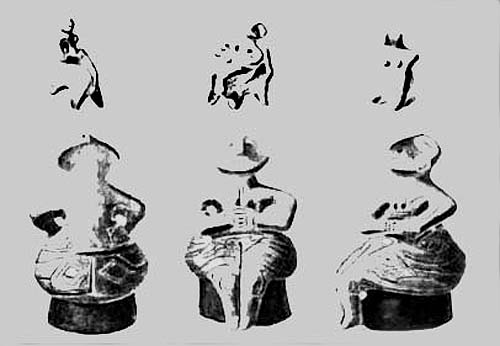
FEMALE IDOLS, THRACE |
|
|
|
FEMALE IDOL, ANAU
Reproduced from “Explorations in Turkestan.” Carnegie Institute of Washington,
Publishers. |
This cult of the goddess seems to have been
a marked feature of Neolithic religion.161 We
find it in the remains of the Minoan periods in
Crete; Isis and her companion god Osiris were
very prominent in Egypt. The cult was wide-spread
throughout Asia Minor: Diana, or better
Artemis, of the Ephesians, Ma in Anatolia, the
great goddess of the Hittites are a few examples.
Farther eastward we find Astarte. Pumpelly
found a female idol (Astarte?) at Anau. The
cult dots, if it does not cover, the old middle
migration route. We remember the wide-spread
distribution of the painted pottery from Susa
to Anau and over to Boghaz-keui in the land of
the Hittites. Art and religion are closely related
during the early times and a wide-spread
type of art suggests, though it does not prove,
an accompanying form of religion similar
throughout the same wide area. In Greece we
find Demeter, and in “Pelasgic Athens” the
goddess Athena always held the highest place.
Hera may well have been another great goddess
of the Pelasgi. When the conquering Achæans
came in and their chieftains wedded the princesses
of the land, they married their god Zeus
to the goddess of the land. Hence this cult has
been displaced and its records blotted out by
later changes. That so many traces of it outlasted
the Bronze Age is a proof of its firm hold
and great vitality.
We have studied these ancient cults in Greece
and the Mediterranean basin because here they
are easily discovered and can be restored. They
are covered by only a thin layer of later cults
which could not destroy their vitality. When
we attempt to explore northern Europe the
situation is quite different. Christianity blotted
out all traces of the worship of Odin and Thor;
what it could not blot out it took over into its
own service in a modified form. Behind Thor
and Odin we see the shadowy form of Dyaus
(Ziu?), perhaps a sky-god akin to the Hellenic
Zeus, whose name has come down to us in our
weekday, Tuesday. Behind all these we must
search for traces of the deeply buried and almost
obliterated genuine Neolithic cults. These
traces could persist only as superstitions of
peasants.
We notice first of all that we find one race
extending northward along the coast of France
into England and Denmark, the zone of the
megalithic monuments. In this zone we find
figurines and carvings of divinities. Here Déchelette
tells us that the female divinity was
undoubtedly preferred as the guardian of the
tombs.162 This zone was so closely connected
with the Mediterranean region that we should
expect nothing else.
In southeastern Europe, around the valley of
the Danube, at Cucuteni, Jablanica, and elsewhere,
we find figurines, and here again the female
divinity is at least the more prominent, if
not decidedly dominant.163 Déchelette tells us as
to its source: “From the earliest times striking
analogies have been proven between the old
villages of the Danube and the Balkans and the
Ægean settlements of the Troad and Phrygia.
Primitive idols, painted pottery, frequent employment
of the spiral in decorative art: all
these occur scattered through the stations of
southeastern Europe in Neolithic times and in
the eastern Mediterranean basin in pre-Mycenæan
and Mycenæan days. Between Butmir
(near Sarajevo, Bosnia) and Hissarlik (Troy)
these discoveries mark the routes which without
doubt were already opening communication between
the pre-Hellenic peoples and the pre-Celtic
tribes.” Reinach adds: “Eastern Europe,
part of Asia Minor and of Egypt, have been revealed
as very intense centres of Neolithic civilization.”164
They may be traced in rare examples
still farther northward into Bohemia and
even in Thuringia. But their distribution outside
of southeastern Europe is very sparse.
Traces of the worship of an earth mother,165
though vague and few, can still be discovered
in the superstitions of the peasant folk of northern
Germany. A primitive belief in spirits of
the earth, of vegetation, of fertility—of dæmons
who preside over the crops, who die in the
autumn or winter and reappear in the spring—is
common in the folk-lore and customs of the
peasants in many parts of Europe. Our Maypole
has an interesting history and is probably
the last survival of an ancient cult. Still other
more interesting illustrations might easily be
cited.166
The Balder-myth is familiar to us all. He is
a “rare exotic,” entirely out of place in that
circle of berserker gods and brutal giants who
lived in or over against the Norse Valhalla, but
would have found himself at home in the land
and times of Dionysus. Have we possibly here
an intrusion of a far more ancient religious element
which even the rude dwellers in a harsh
Northland could not forget, and would not
allow to die?
Usually accompanying the cult of the goddess
we find frequent and wide-spread traces of
a related trend of thought, mother-right (Mutterrecht),
maternal kinship, matriarchy: under
which were generally included the reckoning of
descent in the female line, rights of inheritance
by the daughter, hence female rights of property
and general high social and economic position
of woman. These features need not be united—they
may appear separately, one here and another
there. We are probably not studying a
system of thought or law, but a general tendency
of life.167
Mother-right, to use the most general term,
survived, partially at least, down to historic
time in Egypt. It persisted in Asia Minor.
Perhaps it crops out in the story of the Amazons.
We find traces of it in ancient law and custom
in northern Europe. Says Hoernes: “Among
the Greeks, Romans, Celts, Germans, and Slavs,
remains of mother-right occur even in historic
times.”168 Wundt thinks that maternal kinship
was once universal.169 We have no time or room
to discuss the origin of mother-kinship. We
may yet find that it and mother-right represent
distinct forms of a deep-seated universal
tendency, often of independent origin, occurring
usually together but sometimes separate.
Something akin to mother-right, and to a
high position and dominating influence of woman
in the family and in society, is only what we
should expect at this time. We have seen that
women were the first great discoverers and inventors;
discoverers and founders of all our
household arts and crafts as well as of most
of our science. Women were the first spinners
and weavers, the first potters. They were the
first herbalists and botanists and the first
household physicians. In the care of the children
they were compelled to be alert, quick-minded,
ready for all sorts of emergencies.
Paleolithic man was a mere hunter; the rest of
the time he ate and loafed. The woman provided
the vegetable food, as well as much of the
animal, and became the first gardener or farmer.
She introduced tillage of the ground, and thus
became economically by far the more important
member of the partnership, and she probably had
by far the more alert, quick-witted brain.
The establishment of agriculture was followed
by the cult of the earth-mother, who gave birth
to all the fruits of the ground and probably to
all life. The goddess, with or without a male
companion, was the head of the hierarchy.
This again could not have been without its influence.
Says Miss Harrison: “Woman to primitive
man is a thing at once weak and magical,
to be oppressed, yet feared. She is charged with
powers of child-bearing denied to man, powers
only half understood, sources of attraction but
also of danger and repulsion, forces that all over
the world seem to fill him with dim terror.
The attitude of man to woman and, though perhaps
to a less degree, of woman to man is still
essentially magical. Man cannot escape being
born of woman: but he can, and if he is wise
he will, as soon as he comes to manhood, perform
ceremonies of riddance and purgation.”170
One other fact deserves notice. In times of
dearth the savage man always eats up all the
grain reserved as seed for the next year, and
there is none to sow. This is the rock on which
attempts to introduce agriculture among savages
or nomads have usually been shipwrecked.
Here the priest, or perhaps priestess, of the goddess
came to her aid, armed with the weapon
of taboo. Against this alliance the poor, stupid,
clumsy, and slow-witted Neolithic man struggled
in vain. He could vent his fury by pulling his
wife about by the hair, but this availed little or
naught. He had to submit and be resigned.
Female magic increases in power as we approach
the frontier and frontier life. At the
fall of the Roman Empire northern tribes swept
away the old civilization. Grass grew in the
ruined cities, only villages remained inhabited.
The priests, by a liberal preaching of hell and
other dire torments, attempted to subdue these
barbarians to law and to introduce order. Agriculture
and industry rearose or returned slowly.
Finally after the “dark ages” great cathedrals
sprang up, dedicated not to apostles or martyrs
but to the Virgin, Queen of Heaven. Mr.
Adams tells us that at this time the women of
France were the real leaders. Is this apparent
parallelism mere chance, or is it due to a certain
amount of similarity in conditions?
Some one has said that our Neolithic ancestors,
especially the megalith-builders, were priest-ridden.
If he had added that they were tamed
and led, and very possibly diligently hen-pecked,
by a veritable matriarchate, I suspect that he
would have discovered and correctly estimated
the two great sources of their marvellous progress.
For at this stage, as at some others, the
priests and the women were the élite, and the
government was, therefore, ideal for its day.
But the tendency was based upon something
far broader and deeper than changing social and
economic conditions and religious feeling. Even
the “mere man” must admit that it was biological
and natural. “Nature,” says Humboldt,
“has taken woman under her special protection.”
She has always been partial to the
female. Throughout the long period of mammalian
evolution she has showed very little regard
for the males. The more they fight and
kill one another off, the fewer useless individuals
to feed. The same tendency reaches its logical
conclusion in the parthenogenesis of insects.
Havelock Ellis says of woman: “She bears the
special characteristics of humanity in a higher
degree than man, and represents more nearly
than man the human type which man is approximating.”
He boldly asserts that man
seems to be the “weaker vessel,” and brings
strong arguments for his assertion.171
“Das Ewig-weibliche
Zieht uns hinan.”
The buried Pelasgic religion regained its rightful
place. It had more vital reality than the
Olympian. Has the great Roman Catholic
Church, in its worship of the Virgin, retained at
least the symbol of an element of vital reality
which we Protestants, in our recoil from so-called
“Mariolatry,” have neglected to our
cost in favor of a purely paternal conception of
God? We leave this question to the theologians.
PROGRESS
IT is a far cry and long and weary road from
the ape descending from the trees and the
ape-man shuffling over the ground, keeping
close to his arboreal refuge, to the lake-dweller
and builder of stone monuments. There was
very little in the appearance or structure of the
ape-man to encourage great hopes for the future.
The sleek, graceful, wiry, well-armed cats were
far more attractive, promising, and thrilling actors
on the world’s stage. Why did not they
progress, win the future, and insure that all the
future meetings of art and learning should be
held on the back fence? They certainly did
not progress—that is a stubborn fact.
They had largely or completely exhausted the
possibilities of their special line of development;
as cats they were perfect and could dominate the
portion of the world in which as cats they were
solely interested. This was an impassable bar
to progress. Why should they change? They
were so thoroughly conformed to the environment
of their time and conditions that any
marked change would have been a disadvantage.
But when conditions did change, and the fashion
of the world which had produced them passed
away, they became out of fashion, “back numbers,”
incapable of meeting new emergencies
and crises—like men, parties, and governments
in all ages of human history. They suffered
from over-adaptation and the resulting limitations.
Man did not make this mistake. Isolated
tribes and even races might settle down in contentment,
become completely adapted to easy
conditions of life, and stagnate or degenerate.
But a saving remnant was always marching
out into new physical or social surroundings,
exposed to new needs, fears, and opportunities,
and readapting itself to meet and profit by them.
Man was not, and could not be, precocious.
He was always a bundle of possibilities and
great expectations, which he has even now only
begun to realize.
Overpopulation, or other pressure in his primeval
home, resulted in great racial migrations,
sending him all over the world to seek his fortune.
He became one of the very few physically
cosmopolitan animals, living everywhere from
the equator to the Arctic zone. He became
toughened and hardened and adaptable, able
to live under the most trying circumstances.
Everywhere he had to be a close observer, watch
ful
and wary. He was weak and defenseless,
and his life depended upon his quick recognition
of “nature’s signs of displeasure,” upon the full
exercise of his few small wits. He learned to be
faithful in a few things. We need not repeat
or review this weary chapter of his history.
“There were years that no one talked of. There were times of horrid doubt.
There was faith and hope and whacking and despair.”
Man was experimenting with all kinds of climates
and conditions. It was in the hard and
cold northern regions that he developed farthest,
though less rapidly at first. We have already
glanced at the educational results of language,
of family life in the rock-shelter around the fire,
of the fashioning and use of tools, of his love of
ornaments and display, of his dawning and clearing
self-consciousness, of the beginnings of ownership.
We have noticed his burial rites and
their suggestions. All these may have been
rude and crude, but they contained the germs
of vast possibilities, though painfully slow of
development. His “castles in Spain” were his
richest possessions, though he probably never
knew or suspected them. One hundred thousand
years of human life in Europe produced
nothing higher than Neanderthal man.
Suddenly, at the beginning of Upper Paleolithic
time Cro-Magnon man appeared. His
splendid physique and large brain, his production
and appreciation of art, and many other
qualities, have led some one to speak of him as
the “prehistoric Greek.” In our enthusiasm we
may easily overestimate his powers; but, as we
study him and his work, we feel that here was
a great race, and that now some great human
possibilities are to be fully attained and made
permanent. Apparently he had come from the
plateau region of western Asia. Near his birthplace
there must have been other peoples capable
of great things. We remember that Susa
was probably founded not much later than the
beginning of the Magdalenian epoch in Europe.
But the Cro-Magnon folk decreased in numbers,
in stature, apparently also in ability and vitality.
During the period of transition to Neolithic time
Europe was occupied only by a sparse population
of fishermen along the rivers, while barbarous
hunting tribes were working their way northward
toward the Baltic. The shell-heaps of
Denmark are the monuments of the attainments
of this epoch.
A higher civilization had already entered the
Mediterranean basin. It was building houses,
villages, possibly forerunners of the Greek city-states.
Especially in Greece they were sufficiently
separated to allow independence of development
and great variety, and yet near
enough to one another to prevent the ill effects
of complete isolation. Here there was rapid
interchange and improvement of physical and
mental attainments, mental stimulation and
rivalry, change and progress. Implements,
weapons, pottery; new discoveries, inventions,
ideas, arts, and habits of life and thought spread
slowly and gradually from these centres of progressing
culture far to the northward. This was
undoubtedly one important source of stimuli.
But we must not overestimate its influence.172
It spread through France into England and
Denmark. As time went on this northward
current increased and strengthened until, during
the Bronze period, the Baltic region, especially
Denmark, became almost a second Mediterranean
centre of culture and art; just as at a
far later time Flemish cities became the Venices
of the north. But the north was never a beggarly
dependent and imitator of the south. It
selected and accepted only what it would, almost
always modified and frequently improved what
it had selected.
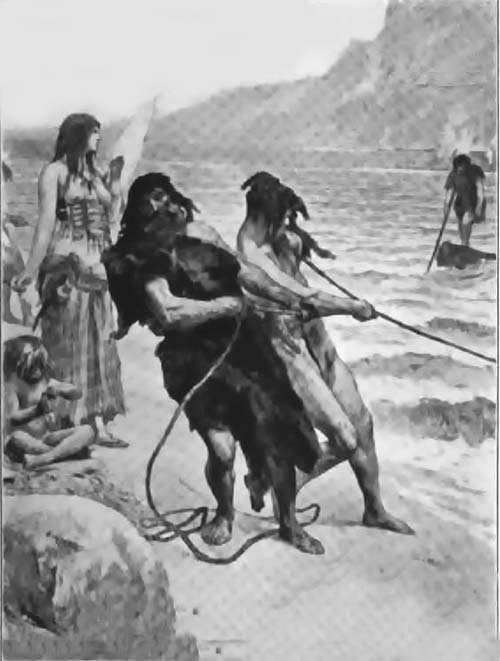
ANCIENT FISHERMEN
From the mural painting by Fernand Cormon in the Muséum d’Histoire Naturelle, Paris.
The larger part of central and northern
Europe lay outside of this great current and was
reached by it only slightly and very indirectly.
These regions or provinces were largely working
out their own civilization and culture.
What then was the real source of Neolithic
progress?173 It is not to be sought in great wars
and revolutions. Genuine wars are carried on
by nations with a national government, and as
yet there were no nations, and even tribal government—outside
of religion, the great bond of
tribal unity at this stage—was probably weak,
loose, and inefficient. There were no such
strong towns or city-states as sprang up later
in Greece. There were here no nomadic hordes
to be driven by drought from their withering
pastures to migrate en masse and force their
way into less thirsty and starving regions.
There was, as yet, no great overpopulation of
mountainous areas compelling raids or forays
into piedmont zones. The nearest approach to
this condition is the slow, evidently peaceful
penetration of parts of France by broad-heads
from its eastern uplands filtering in and mixing
with the long-headed older population, and betraying
their arrival mainly by a change in form
of head and rise of cephalic index.
There was little wealth to tempt invasion.
There were no cities or large towns to plunder.
There were wide stretches of land thinly or not
at all populated and open to any newcomer.
All that we know of Neolithic religion, far more
dominant in tribal life and action than the very
feebly developed political or social organization,
the cult of the goddess, and the accompanying
mother-right, suggest peace. The great invasions
of the Bronze and Iron periods introduced
or stimulated the cult of war gods and patriarchal
family life and kinship. But these were still in
the future. The picture of Europe at this time
as a great arena of roving savages, thirsting for
blood and always at war, seems to be a caricature.
The people of the banded pottery were evidently
peaceful. They left no weapons except
mattocks and hammers. No one, I believe,
has ever accused the broad-heads of blood-thirst.
The graves of northern hunters with
corded pottery are all about Grosgartach. The
little village was deserted and decayed. It
showed no signs of having been burned. The
lake-dwellings were open to attack at all times,
especially after the ice had formed during the
winter. Robenhausen during its long history
burned several times; hardly as often as most of
our New England villages. Here a single brand
or fire-tipped arrow in a thatched roof would
have destroyed the whole settlement.
Only in northern Europe, in the country of
the corded pottery, do we find great attention
paid to the making of fine weapons like the flint
daggers and axes. Here we have chiefly herdsmen
and hunters. Here there were probably
village incompatibilities—Donnybrook fairs,
cattle-lifting, and forays. But these should
hardly be dignified with the name of wars. We
find then some North German peoples at the
very end of the Neolithic period pushing southward,
often by peaceable infiltration, sometimes
perhaps by violent incursions, when the resistance
was great.174
Says Wundt:175 “So long as he is not obliged
to protect himself against peoples that crowd
in upon him, primitive man is familiar with the
weapon only as an implement of the chase.
The old picture of a war of all with all, as Thomas
Hobbes once sketched the natural state of man,
is the very reverse of what obtained. The natural
condition is one of peace, unless this is disturbed
by external circumstances, one of the
most important of which is contact with a higher
culture.”
We remember, also, the fewness of fortified
villages in northern Europe until toward the end
of the Neolithic period, and then mainly along
great routes of migration; and around mines and
workshops. They seem to fail altogether in
Scandinavia at this time. Even the wars, battles,
or quarrels which occurred probably hindered
progress far more than they aided it.
Haeckel in his younger days was fierce in his
denunciations of the stupidity of war.
Political or economic revolutions could hardly
occur when there was probably little organized
government and even less wealth and class
difference.
Conditions in France may have been somewhat
different. Here the great stone monuments
suggest a denser population under a more
advanced organization, religious or political, or
both, reminding us of conditions in the Mediterranean
region, with whose culture it was closely
connected. Here fortifications seem to have
been quite numerous.176 But our knowledge is
too slight to allow even a conjecture.
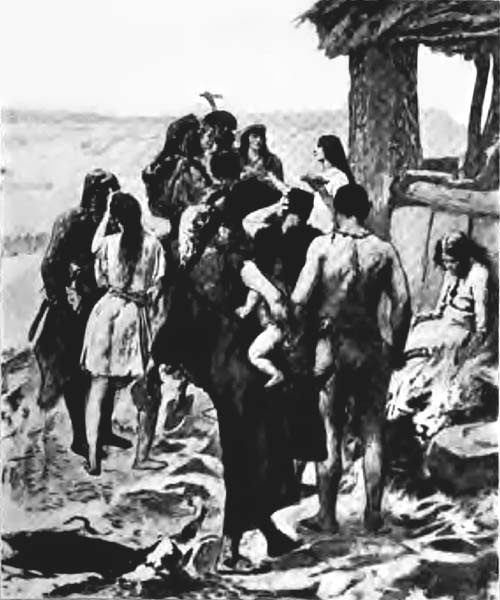
EARLY AGRICULTURE
From the mural painting by Fernand Cormon in the Muséum d’Histoire Naturelle, Paris.
In the southeastern part of Europe we find
the people of the banded pottery who practised
an advanced form of agriculture. Here apparently
the men as well as the women worked
in the fields. We find their stone mattocks and
ploughshares. Hoe-culture was giving place to
ploughing. Here men were receiving a very
different education and training from the hunters,
fishermen, and herdsmen of the north,
though there also a gradual increase of tillage
was doubtless taking place. They were tilling
the ground laboriously, monotonously, doing
what was wearisome and disagreeable for a reward
sometimes large, sometimes scanty. The
peasant farmer learns forethought, thrift, economy,
industry, and a host of homely virtues,
far less known to hunter or herdsman. He is
no more a collector taking what he finds: he has
gone into partnership with nature. He is studying
her ways, moods, and whims. He amasses
a steadily increasing store of most valuable lore
concerning climate, weather, soil, plants, animals,
and things. He is rooted in a little patch
of ground. His outlook is narrow and he is
slow to change. But he learns his lessons thoroughly.
He may enter the school unwillingly
but he stays in it.
He has a permanent home even if it is hardly
more than a hut, which is the centre of his life
and thought. It is a hard, healthy life, and
population increases rapidly under such conditions.
He probably has a large family of children,
and they educate and socialize him and
one another. He is trained and moulded by
“home surroundings.” Is not this the history
of the frontiersman or homesteader everywhere
at all times? The home and family attachments
and instincts are deeply rooted because
very ancient and entirely natural.
He lives in a village or neighborhood, which is
hardly more than a great patriarchal family,
closely united by intermarriage, and by the
pressure of common work to satisfy common
needs, common ownership of the soil, mutual
aid in hard times. The religious rites and ceremonies,
the feasts and mysteries, the prayers or
magic, are all community affairs. Many of the
divinities are local. These religious bonds are
all the firmer and more compelling because, in
the lack of any developed and permanent political
organization, religion is the great tribal
bond. We easily forget the civilizing, refining,
and improving unremitting pressure and power
of these simple, uninteresting peasant influences.
He is learning to get on with the members of
the family and neighborhood. He is experimenting
upon his neighbors: his experiments and
experiences may often be very trying to himself
and them; the results may sometimes be discouraging.
But he is not only practising the
essentials and fundamentals of morality, very
incomplete and without code; but a sort of preparatory
course in government. It may easily
be self-government in these small villages. The
town-meeting originated here or somewhat farther
north.
We have already seen that his religion had
grown out of the experiences of his daily life.
May we not claim that science and a sort of
philosophy may have sprung from the same
source? He knew nothing of cause and effect
in the material world. But he was seeking
diligently the invisible bond of relations of
things and events. The relation, according to
his views, was mainly of a spiritual character
through the agency of dæmons. His ritual, call it
magic if you will, was the expression of his conviction
that results in the material world might
be modified by his lending a helping hand to
all the beneficent spirits. He indulged freely
in hypotheses, but these were the outgrowth of
millennia of experience and life, a very healthy
form of pragmatism. He who has never laughed
at a modern scientific theory, useful and fruitful
in its time but now outgrown and replaced by
a somewhat better one, may cast the first stone
at his “benighted” Neolithic ancestor.
We might even venture to suspect that in his
own crude way he was a philosopher. He must
have had something like a philosophy of life,
even if it was hardly more than a dumb instinct.
Says Miss Harrison: “Dike” (usually translated
justice), “in common Greek parlance is the
way of life, normal habit. Dike is the way of
the world, the way things happen, and Themis
is that specialized way for human beings which
is sanctioned by the collective conscience, by
herd instinct. A lonely beast in the valley,
a fish in the sea, has his Dike, but it is
not till man congregates together that he has
his Themis. Greeks and Indians alike seem to
have discovered that the divine way was also
the truth and the life. This notion of the way,
which was also the truth and the life, seems to
have existed before the separation of Indian
from Iranian. Closely allied to Dike and to
Vedic Rta is the Chinese Tao, only it seems less
moralized and more magical. Deep-rooted in
man’s heart is the pathetic conviction that moral
goodness and material prosperity go together,
that if man keep the Rta, he can magically
affect for good nature’s ordered going.”177
Thus primitive man, long before the dawn of
anything like civilization, was seeking, finding,
clearing, and treading out the “way” to an ordered,
right, and healthy individual and social
life—not through, but to, codes of morals and
systems of philosophy. His thought was more
or less chaotic, perhaps; it was crudely, often
indecently, expressed in ugly form or action;
but it was always acted upon, kept close to life.
We might possibly call him an “Ur-pragmatist,”
if you will pardon the barbarism. He had
neither the language nor the “conveniences for
thinking” and other things, to write out a cool,
logical abstract system in long words. In this
we have outrun him until we have left him out
of sight. His philosophy was not a guidebook
or map, but a rough and often miry trail.
We have tried to express briefly the results
of a glance at the agriculturists of southeastern
Europe. Before the close of the Neolithic
period they were in fairly close communication
with Ægean culture and owed considerable or
much progress to stimuli from this source. In
the great essentials of human training and development
something quite similar might be
said of the lake-dwellers and the broad-heads
of eastern France. North Germany had a different
culture and probably somewhat different
religious cults and general views and conceptions.
France and England, too, represented
a quite distinct province whose peoples were
always under Mediterranean influence. Denmark
was already a meeting-place for a variety
of cultures, thoughts, and influences.
Peoples were gradually closing in from all
directions on the central provinces of northern
Europe, and here apparently they met. We find
here a mixture of head-forms, of culture; mixture
or modifications of styles of ceramic ornament,
of burial customs—all suggesting a mingling
of peoples of a variety of cultures. Here at
or toward the end of the Neolithic period was the
“melting-pot” for the fusion of these peoples and
their cultures. There was conflict of customs
and ideas, of ways of life. There was probably
much incompatibility, many broken heads. The
pacific people of the banded pottery seem largely
to have withdrawn, or been driven out, before
the infiltration or invasions of northern folk.
It was hardly a comfortable place for conservative
pacificists. There were doubtless battles in
many regions—perhaps now and here we might
speak of wars. In some places there may have
been extermination of the fighting men. But in
most parts there was large fusion, and out of
this mixture of cultures, ideas, thoughts, and
habits of life came the culture of the beginning
of the Bronze Age.
The great characteristic of Neolithic culture
seems to be a rude, often barbarous, sometimes
ugly but generally healthy, always hardy and
vigorous growth—it grew “like a weed”—the
manifestation of an intense vitality. Because
it was healthy it was essentially and generally
fairly sane, matter-of-fact, whole, and balanced.
The Neoliths were certainly no “reversed cripples,”
in whom one or two of the less essential
powers had outgrown and dwarfed the man. It
was an adaptable stock giving rise to many
marked and vigorous varieties, from whose intercrossing
something great and good could
hardly fail to arise.
Green refuses to write a “trumpet-and-drum
history of England.” “Happy the people—here
we cannot say nation—that has no annals.”
Here is surely a certain amount of
truth which we may be in danger of forgetting.
In plants, and often in men, a long period of
silent unnoticeable growth usually precedes the
brief season of flowers and fruit. Is this the
rule in racial, or internal, development?
Is it true, as some historians tell us, that a
dormant period of national history best repays
investigation, and that dormant peoples will
bear watching? Is the dormant nation often
storing up nutriment, strength, vitality, just as
the plant is doing in its ugly underground roots
and stem? Are fallow periods necessary to its
fertility and apparently dormant times essential
to its life and growth? Must periods of energetic
action and effort be followed by times of
exhaustion and rest, as in the history of the
strong athlete rejoicing to run a race?
Is China awakening from just such a dormant
period? What of India, still the home of
philosophy? Because a nation, after bearing a
marvellous harvest of culture, thought, art, or
religion, seems barren and exhausted, does this
discourage or arouse the hope that it will some
day produce an equal or greater fruitage?
How about “darkest Africa”? Here surely
we have a case of degeneration beyond all hope
of recovery, not to mention a great future. But
is this quite as certain as some of us seem to
think? Is not much of our so-called Occidental
progress really an orgy of wasted energy, neurotic
excitement, half-camouflaged decadence,
which will end in degeneration? We do not
know yet. May there some day be a family
rather than league of nations to which every
one will contribute according to its special
ability? If this be granted, will Huxley’s statement
concerning the individual be applicable to
races and peoples: “Its aim will be not so much
the survival of the fittest as the fitting of
as many as possible to survive”? These are
sphinx questions demanding an answer from
statesmen. Unfortunately most of our statesmen
are only waiting to be gathered to their
fathers in the graveyard of dead politicians.
We will turn homeward after our excursion,
gladly leaving our little bundle of facts and
questions at the door of the philosopher of history.
But one question confronts us directly. Is
our whole estimate and valuation of Neolithic
life, work, and progress extreme and practically
worthless? Were they, in spite of all our arguments,
a mob of crude, worthless barbarians,
undeserving of any gratitude or sympathy, much
less of respect? Do we really owe anything to
them?
One historic event of great importance had its
growth and rise during the Neolithic period out
of Neolithic life, conditions, and culture. This
was the Aryan culture of Persia and India, of
Greece and Rome, and of our northern ancestors.
No one seems to deny its importance and value.
We must glance at its origin and growth, and
see if it supports at all the tentative and often
conjectural conclusions at which we have arrived.
This will be the object of our work and
study in the next and closing chapter.
THE COMING OF THE INDO-EUROPEANS
SAID Max Müller in his Biographies of
Words: “I have declared again and again
that, if I say Aryan, I mean neither blood
nor bones, nor hair nor skull; I mean simply
those who speak an Aryan language. The same
applies to Hindus, Greeks, Romans, Germans,
Celts, and Slavs. When I speak of them I
commit myself to no anatomical characteristics.
The blue-eyed and fair-haired Scandinavians
may have been conquerors or conquered, they
may have adopted the language of their darker
lords or their subjects, or vice versa. I assert
nothing beyond their language.... To me
an ethnologist who speaks of Aryan race, Aryan
blood, Aryan eyes and hair, is as great a sinner
as a linguist who speaks of a dolichocephalic
dictionary or a brachycephalic grammar.”
We may well take this warning to heart, and
remember that the first and most noticeable, if
not the one essential, characteristic of the
Aryans was their language. For the sake of
convenience and clearness, and of avoiding misunderstanding
or prejudice, we will use the
word Indo-European for the whole group of
languages to which Müller applied the word
Aryan. These languages fall into two great
divisions or branches: (1) the Indian and Iranian
(Persian), which we will call Aryan; and
(2) the European branch, including Greek, Latin,
German, Slavic, and others. Our first question
is: what inferences can we safely draw from a
study and comparison of these different European
and Asiatic languages? Evidently they
have all sprung from a parent language no longer
adequately represented by any one of them.
They have all been considerably or greatly modified
during the lapse of time. They, and others
whose names we have omitted, are all sister
languages descended or developed from a parent
language which must once have been spoken by
a people, very probably representing a mixture
of races, having a definite local habitation,
cradle, or home. Here the language originated
as the expression of a certain culture or civilization,
and from this region, large or small, it
spread into Persia and India and throughout
Europe. The wide spread of the language testifies
to the superiority in some important respects
of either language, culture, people, or all
three. We may well recognize two homes, the
first, original cradle of the language and culture,
and the second homeland, far more extensive,
over which the original language, probably
with well-marked dialects, was used just before
the final separation and dispersal.
In its distribution from India to western
Europe it must often have wandered far from
its original home. Its introducers must often
have been few compared with the large and dense
populations among which they came. The
Aryans could have been hardly more than a
handful among the peoples of India. Something
similar may be said of its introduction into
Europe about the close of the Neolithic period.
Middle Europe was at this time fairly well populated,
at least in its more fertile regions. The
bearers of the new language must have represented
a ruling, conquering, or otherwise very
influential class, else it would never have been
accepted by the mass of the people.
When the original or modified Indo-European
language, perhaps in several distinct dialects,
was introduced into Europe, it was carried to
peoples of several or many stocks and languages.
These had to learn and acquire it as we acquire
a foreign language, but only as a spoken, unwritten
language. Probably no one of them
acquired it exactly in its original form. It was
almost impossible for them to pronounce all its
consonants or combinations, its “shibboleths.”
They retained much of the stress and accent
and more of the cadence of their own tongue.
Similarly at a far later date Latin developed
into the various Romance Languages of modern
Europe.
Under the new conditions content and meanings
changed as well as forms of language.
Words little used in the new home, especially
names of objects, might easily be lost, while
others would be replaced by favorite apt words
from the aboriginal language. A name might
be applied to a new object and thus change its
meaning. To cite a familiar modern instance,
the robin redbreast of America is quite a different
bird from that of England. For a long
time it was supposed that the occurrence of the
root of the word “beech” in the European languages
proved beyond doubt that the language
must have originated in a region where the
beech-tree was common. But the Greek word
derived from the same root means oak; a similar,
perhaps not the same, root word in Kurdish
means elm. Our knowledge of the original
meaning of the word is very uncertain. Through
all the languages there runs a single word for
weaving or plaiting, but whether the original
word referred to the weaving of cloth or to the
plaiting of mats or baskets we do not know.
The work of discovering and restoring the
original language is difficult and far from finished.
But the comparative philologists or
“linguistic paleontologists” have established
certain facts, or at least theories, on which we
may rely with a fair degree of confidence. We
find names for all the most important domestic
animals, including the horse. There are words
for the wagon, its wheels, and various other parts.
Words for tillage and land cultivation agree in
the Western branch, but are far less noticeable
in the Aryan languages. Here the vocabulary
is rather that of the herdsman. This seems to
allow us to conclude that, when Eastern and
Western branches separated, and probably long
before that time, the Eastern people were herdsmen
paying slight attention to agriculture: the
Western predominantly tillers of the ground.
The linguist, as we have already seen, is frequently
or usually unable to discover the exact
meaning of the word in the original language,
and hence is uncertain as to the degree of development
of any art or technique. But the
culture, as far as discovered, seems to be that of
the average of Neolithic peoples, perhaps fairly
well represented by that of the Swiss lake-dwellers.
It may have varied in different areas
or provinces. The language seems to represent
most clearly features of the undivided life and
settlement of the people or peoples when it had
spread over a wide territory and become the
property of a large population, otherwise it
would be impossible to explain the successive
great waves of Indo-European migration. The
cradle where the language originated and took
form must have been far more limited and the
culture simpler.
The original language contains words for
summer and winter, ice and snow; it tells of a
fairly cold climate. They had a common word
for metal, probably copper, hence they were
living together after the introduction of this
metal. They lived in villages apparently surrounded
by a hedge or wall, or some sort of
fortification.
The family was decidedly patriarchal. Of
the older mother-right scarcely more than traces
remain, survivals from an older alien culture.
The goddess is no longer supreme. A new divinity,
a sky-god, or sun-god, or manifestation of
light or brightness had already appeared—the
Greek Zeus, Latin Ju-piter, with the same root
appearing in all the languages. The earth-goddess
is not banished, but remains as consort
of the male divinity. The supreme divinity of
the religious cult is no longer local. There is in
it an element or germ of universality overleaping
all provincial boundaries, in many respects
a vast improvement over the old Neolithic religions.
It generally held its own, but only
by adopting much from the older native religions
on which it was superimposed, as was
the case in Greece.
Indo-Europeanism must have had something
to recommend it and make it highly attractive
to enable it to spread so fast and far. The
language itself, while apparently somewhat
clumsy, was certainly rich in conceptions and
shades of expression. The clearness and beauty
of the religious cult may have attracted some,
though this seems doubtful. All these features
are inadequate to explain the rapidity and extent
of its spread. We must leave this problem
for the present.
Even the original language frequently describes
the same object or even action by words
having very different roots. It shows great
variety in synonyms and inflections. Feist
compares it with English and considers it a
“mixed language” almost from the start, and
many facts seem to favor this view. This does
not surprise us when we remember that its
growth and development were late, during the
latter half of Neolithic time, when great movements
and minglings of people were taking place
and long routes of trade and communication
had opened.
The date of the earliest migrations of Indo-European
peoples is roughly indicated by the
presence of a word for metal, probably copper,
in the original undivided language. Aryan
names appear in western Asia about 1400 or
1500 B. C. Meyer says that the Achæans had
arrived in the southern Balkans as early as
2000 B. C. and reached Greece about 1200 or
1300 B. C.; the Dorians followed about 1100
B. C. We can hardly be far from the truth if
we consider that they were in their original home
until about 2000 B. C., and that the separation
began very soon after. Their development was
a product of the Neolithic period, their spread
was the striking event of earliest historic times.
Inasmuch as their migrations are so recent,
especially when compared with those of the
Semites, it ought to be possible for us to discover
certain traits which they brought with
them from the homeland. The Achæans had
apparently marched southward from Hungary
or thereabouts through the Balkans into Greece,
arriving there not far from 1200 B. C. They
did not come in one invading horde but in successive
waves, each crowding the other before
it. Behind the Achæans came the Dorians,
behind them were the Thracians and other
wayfarers. Their unit of organization was the
band, brotherhood, or clan, each with its own
leader, reminding us of the Scotch clans of a
century or two ago. They came with their
horses and carts, perhaps with war-chariots.
They were the “horse-taming” Achæans. They
were youthful, red-blooded, irresponsible and
irresistible, careless, untamed barbarians, swaggering
in from hard battles and long campaigns,
having seen the manners and tested the might
of many peoples. They came in contact with
ancient, settled, staid, conservative Pelasgic
wealth and culture. They were the rough
riders of their day. They were hard drinkers
and fighters; loud, boastful talkers, good-natured
if not opposed; good “mixers.”
Their chieftains married the princesses of the
old régime, who seem to have held the right of
succession in the kingdom or city-state. The
wooing was rough and more or less forceful; but
I suspect that the princesses yielded not altogether
unwillingly, even if the course of true
love did not always continue to run smooth in
after years. They married their gods to the
goddesses of the land, and made little further interference
with the old Ægean religion or popular
life.
In comparison with the native peoples who
had builded Tiryns and Mycenæ the Achæans
were probably few, scattered over Greece.
They probably robbed the subject peoples with
one hand, but with the other they defended
them against the forays of sea-pirates and other
enemies. They were no worse than former native
rulers, far better watch-dogs of the city, attractive
leaders of an admiring crowd, the best
possible missionaries of a new culture and language.
They turned the old Neolithic world
upside down. Evolution had brought revolution:
old things passed away and, for a time,
all things became new. We cannot easily overestimate
the extent and importance of the
change.
The leaders, and naturally their followers to
a less degree, show clearly the characteristics of
the new era, which Wundt has called the Age of
Heroes in distinction from the Age of Totemism
and the iron supremacy of tribal custom. The
chief feature was the rise, development, and
dominance of individual personality in the leaders
and the enthusiastic, individual loyalty of the
members of the brotherhood or clan. Up to
this time the individual has been entirely submerged
in the customs and culture of the tribe,
whose control has been mostly in the hands of
the old men and the priests; now the young warrior
and champion has grasped the reins. In
all Homer’s pictures the ranks of the common
people, however firm, count for little. The
battle is won in single, hand-to-hand combat by
the leader—a dour giant of an Ajax, a dashing
Menelaus, “good at the rescue,” a crafty Ulysses,
a heroic Hector. The wisdom of old Nestor is
endured with kindly tolerance, hardly with enthusiasm.
It is an age of young men with all
their virtues and vices. But every leader is
a distinctly marked individual; no two are
alike.
City-states are beginning to appear, but their
success depends very largely on the wisdom and
power of the ruler, who seems at first to be largely
irresponsible, a despot in the ancient sense of
the word. It is anything but a true democracy,
but it is government by the élite of their day
and world. The new era or Zeitgeist is putting
its stamp on all its peoples. Homer’s description
of the Achæans would apply almost equally
well to the Celts when they first appear in history;
and kindred spirits are marching and fighting
in India and Persia. All seem to represent
a new type which all brought from the common
homeland.
The chieftains, with this clan or brotherhood
of warlike followers, came into a country occupied
by agriculturists or peasants unused and
untrained to war, such as we have found in the
Mediterranean region and in most of northern
Europe. Conquest was usually easy and left
little bitterness. There was no national consciousness
or pride to arouse resistance. It was
a totally different kind of invasion from that of
nomadic Semites in Asia, or of Mongols into
Europe. It came almost as a new movement,
a renaissance for which the people were ready.
Celt and Greek alike were usually absorbed and
lost in the masses of the people to whom they
came. Physically they produced little permanent
change in the people with whom they
mingled. They seem to have accepted fully as
much as they contributed, and may often have
received credit for many improvements which
they really had little share in bringing about.
We have already seen that Greek philosophy
and religion, while retaining much of the Olympian
or Indo-European form, sprang essentially
from the old Pelasgic cults with their greater
vitality. How far were Achæans and Dorians
responsible for the glory of Greek art, especially
in “Pelasgic Athens”? The answer can hardly
be as obvious and sure as it has appeared to
some.
How far was Roman government and law due
to Indo-European influence? Neither Greeks
nor Celts seem to have been very successful in
founding great or permanent states. Italy was
far less easy of access from the north than from
Greece, and Rome lay well southward beyond
the Apennines. Some of its most important
political features seem to have sprung from uprisings
of the Plebs, the common people, probably
mostly of native stock; others, perhaps,
from the Etruscans. I cannot attempt to answer
this question or any one of many similar
ones. The Indo-Europeans brought in a new
era and started a new world; but just what
was their definite and permanent contribution
to European culture?
Europe had been long enough in the school
of Neolithic discipline. Agriculture and settled
home life had trained peasants to do many
things which they disliked to do, to observe
taboo and to obey ancient custom, to march in
rank and file, and even in lock-step. It was a
hard school in which savage man had been tamed,
home-broken, and socialized, and he had learned
its lessons thoroughly. It was high time that
men should be promoted to a higher grade of
education the aim of whose training should be
the development of free and vigorous personality.
The crust or cake of custom must yield or be
broken and allow the individual to enter upon
the possession of his rights.
It was a critical and revolutionary change.
It had been rendered easier by the accumulation
of wealth, and of a certain amount of personal
property in cattle and other goods. In centres
of trade the individual was thrown more and
more on his own resources and initiative. With
exchange of goods came exchange of knowledge,
ideas, and methods undermining the ancient
customs and traditions. Movements or migrations
of peoples or smaller bands called for leadership
by the most capable. And those became
more and more numerous about the close of the
Neolithic period. Neolithic culture had been
largely the product of peace and isolation; it
was inadequate to the new conditions. Matriarchy
and the cult of the goddess were unsuited
to times of struggle and migration; with the rise
of the chieftain comes the worship of the war-god.
Where did this change or revolution and the
rise of this new language and culture and remarkable
people take place? All agree that
the cradle or original homeland must have been
somewhere on our third route of migration, the
great zone of steppe and parkland stretching
from western Turkestan westward along the
Caspian and Black Seas into the valley of the
Danube, and from the Hungarian extension of
the Asiatic steppe northward to the great plain
of North Germany and to Scandinavia. In our
study of racial migrations we found that the
great Mongoloid branch went eastward from the
neighborhood of the Iranian plateau, while successive
waves of migration turned westward into
Europe, both following a zone of steppe and
parkland enjoying unusually favorable climatic
conditions in early Post-glacial times.
The discovery of Sanskrit and the belief that
it represented the parent of the Indo-European
languages led students to place the original
centre of their dispersal far toward the eastern
end of this zone. When it became evident that
this view of Sanskrit was untenable, they began
to locate the centre in Europe. Finally some
or many students have sought it in the extreme
west and north in Germany or also in Scandinavia.
When careful and thorough scholars
have arrived at so many and so different conclusions,
we may well be cautious and remember
that new discoveries may necessitate a change
in our own views.
The chief argument in favor of the North
German homeland is anthropological. The earliest
Indo-Europeans both in Europe and Asia
were apparently blonds, with light hair and eyes;
and such people have lived along the shore of
the Baltic since early Neolithic times.
The claim that the ancient Celts and Achæans
were physically more like Germans and Scandinavians
than any other European people is certainly
not without foundation. It has been
urged that the Indo-Europeans were acquainted
with the sea and with the eel, which is said to
be unknown in the tributaries of the Black and
Caspian Seas, as also their acquaintance with
the beech. Other arguments can be found in
special articles. We have seen that arguments
based on the meaning of words like beech, eel,
and sea, rest on a very insecure foundation.
The Finns are almost as blond as the Germans,
and Kossina178 places them with the Germans as
ancestors of the Indo-Europeans. There are in
Europe also blond brachycephals, generally acknowledged
to have been of western Asiatic
origin. The arguments for a Germanic origin
are attractive, but hardly convincing, and anything
but conclusive.
The objections to this view are weighty. One
marked feature of Indo-European culture was
the use of the horse, which held the highest rank
among their domestic animals. But the domestic
horse seems to have been introduced into
Europe from the East. The few traces of its
presence in northern Europe during Neolithic
times are usually explained as remains of wild
animals killed in the hunt. If they played so
large a part in Indo-European culture, it is
strange that they have left so few remains.
Kossina, in one of his studies, places the cradle
of Indo-European culture in “Scandinavia, Denmark,
and northwest Germany, wherever megalithic
monuments with their characteristic pottery
occur.” Wherever such monuments occur
we find incineration coming in late in Neolithic
time, or more exactly with the Bronze period,
except in Brittany and England, of which later.
But incineration seems to accompany the progress
of the European branch, and must have
come into use among these peoples well back in
their history to explain its wide occurrence.
The word town, in the original language, seems
to signify a settlement surrounded by a hedge
or wall, or some sort of defense. But fortified
towns are hardly known in North Germany at
this time. All these cultural features seem to
appear somewhat or considerably too late in
North Germany to suit Kossina’s theory.
A second feature of Indo-European culture is
the rise of the chieftain. But the Germans seem
to have borrowed the name for king and other
expressions for military organizations, as well
as many culture-words, from the Celts. This
fact has led some good authorities to declare
that the Germans received their Indo-European
language from the Celts.
The homeland of the Indo-Europeans must
have supported a large population to send out
all the tribes which went out from it. Only
such a region can satisfy our requirements, and
such was Germany, an Officina gentium, some
2,000 years later. But we notice that the migrations
of peoples have always set westward into
Europe, not in the reverse direction. Similarly
the new discovery or idea has come westward
or northward from western Asia or from the
Mediterranean region. The north has almost
never been a centre of origination of new ideas
and movements. It has borrowed from the
richer south. We would not expect that the
Indo-European movement would form an exception
to this rule. Moreover, the peoples of
the banded pottery who had filled southeastern
Europe, coming in, as is generally acknowledged,
from the East, had brought with them a good
knowledge of agriculture which could support
a large population.
Now Kossina finds evidence of the spread of
the corded pottery southward at the close of the
Neolithic period, and infers that it was carried
by a migration from the north. I am inclined
to think that his conclusion is correct, though
it may be doubtful whether the invasion went
so far into the province of the banded pottery
as he thinks. He sees in this the first stage of the
Indo-European movement which was to sweep
eastward as far as India. The people of the
banded pottery apparently retreated eastward
before this movement, and thus tended still
further to increase the density and power of
resistance in these regions. Furthermore, had
this southeastward movement continued, it
would have met the first of a series of waves
of invasion which would surely have turned it
backward.
We have seen that all through the Neolithic
period brachycephals of the Furfooz or Grenelle
race have been spreading from Belgium and the
rough eastern part of France. At the end of
the Neolithic period they are being crowded by
the long-heads. During the Bronze Age the
cephalic index rises all over middle and western
Europe. At its very beginning we find a new
people in England—tall, rugged, heavy-faced
round-heads, who burned their dead and deposited
the ashes in round barrows. They seem
to have come from the Rhine valley, and may
well have introduced incineration into Brittany,
where it appears early. They differ markedly
in stature and features from the Furfooz people.
They have quite certainly come from the east,
perhaps from the region of the Armenian highlands.
They have crossed Europe in sufficient
numbers and compactness to retain their anthropological
characters until they strike England
and crowd back the old Iberian or Mediterranean
peoples. The movement looks like an
invasion in mass, not like a quiet, slow infiltration.
They were the forerunners of a general
advance and spread of the broad-heads.
Were these people Celts or at least partially
celticized? To express an opinion on a Celtic
question is to accept an invitation to a Donnybrook
fair. Anthropologically they differ markedly
from the later Celtic invaders. But their
custom of incineration is certainly suggestive,
and it is not at all impossible that they spoke a
Celtic dialect. They certainly seem to prove
that the westward migration from the region
of the Black Sea or from farther eastward had
not ceased or been turned backward at this
time. The spread of North German people
southward at this time would have brought
them where they would mingle with Celts coming
westward and receive their first lesson in
Indo-European language and culture, if it came
from the east.
There is at present a strong tendency to seek
the original Indo-European homeland neither
in the extreme east or extreme west or north,
but somewhere in the open country of southern
Russia lying to the north of the Black Sea
or farther eastward toward the Caspian. Here
they locate them mainly in a long zone of parkland
extending along the southern edge of the
forest zone and in the valleys of the great rivers.
Here at a much later date Scythians were settled
who raised large quantities of wheat, while
others were nomadic. We remember that Neolithic
trade-routes followed mainly rivers and
seashore. The islands of the Mediterranean
were occupied early and sea commerce found a
centre in Crete. A great centre of trade arose
very early at Troy (Hissarlik), on the high
way
between the Ægean and the settlements
along the shores of the Black Sea and in the
valleys of the rivers descending from the interior.
Déchellette has called attention to the striking
analogies in form of settlement, in primitive
idols, in pottery with painting and spiral ornament
between the villages of the Balkans, Troy
(Hissarlik) and of the Troad and Phrygia, and of
the pre-Mycenæan culture of Crete and Greece.
“Between Butmir and Hissarlik these discoveries
mark the routes which already undoubtedly
connected pre-Hellenic peoples and pre-Celtic
tribes.”
Meyer tells us that the banded pottery shows
the same motives in ornament in Butmir and
Tordos as in Troy and the Ægean, and spreads
thence northward and westward; and that
painted pottery in Europe starts at the end of
the Neolithic (2500-2000 B. C.) in the great
plain east of the Carpathians in the region of
the Dniester and Dnieper, a region of high culture
in other respects. “Here the connection
with the Ægean world is evident (augenfällig).”
This people was agricultural. They burned
their dead, and Meyer thinks that incineration
spread northward and westward from this centre.
They show no use of metal. Their culture
breaks off suddenly at the end of the Neolithic
period.
Here is a region which stands in free communication
with the agricultural population of
the parkland zone, open to influences from the
steppe, accepting the higher civilization of
Phrygia and the Ægean. It is a people of advanced
agriculture, hence probably of rapidly
increasing population, open to trade and commerce.
Here wide and free communications
would be likely to prevent the formation of an
unyielding cake or crust of custom. People
meeting from all lands and cultures might well
make and use a language capable of expressing
a great variety of shades of thought peculiar to
a variety of peoples and cultures; we might
safely call it a mixed language springing from
a mixture of peoples. Here, as in the Ægean
region, the more or less fortified town or village
would be a necessity. Here the horse and
wagon would be early introduced from the east.
Here the patriarchate, so characteristic of nomadic
tribes, would be early imported from the
steppe, or may have been developed independently.
There is a universality in the Indo-European
religion, a sanity and proportion in their whole
mode of thought, a broad sympathy, a willingness
to accept new ideas and conditions—in
general, a breadth of mind which could hardly
be the product of isolation but rather of men
who had “seen the customs of many men and
many cities,” and could look with tolerance
and charity on alien cultures and fully appreciate
their worth and advantages. Our Teutonic
ancestors carried their mental and cultural
environment with them wherever they
went. They were apostles of purity of blood
and hence of isolation. They were never good
mixers, as were Celt and Achæan. All three
migrated and conquered far and wide, and both
usually disappeared in the alien population.
But the Teuton left little impression on the
alien culture, while Achæan and Celt leavened
the whole mass. Here, as in other respects,
Celt and Teuton show an incompatibility and
oppositeness which strongly suggest difference
of origin.
But we must carefully avoid too great certainty
and definiteness of assertion. The weight
of probability seems to be against any theory
which locates the first, original homeland in the
far east or in the far northwest. But we deal
only with probabilities, and may well “carry
our theories on our finger-tips.” If the cradle
was somewhere in southern Russia north of the
Black Sea, or somewhat farther east or west,
its second homeland just before the great dispersal
was vastly larger. Myres thinks that it
extended far to the eastward of the Volga,
which perhaps was the boundary between the
eastern and western branches, and whose upper
waters drained a very early home of the Finns.
The Indo-Europeans were settled in a goodly
land capable with their improved agriculture
of supporting a very large population. Why
did they migrate in all directions? Here,
again, we are left much in the dark. But Pumpelly,
in his explorations at Anau, found the
settlement deserted during the Bronze period
about the same time when we find the Indo-Europeans
leaving the homeland. At Anau
there are signs that the desertion was due primarily
to aridity or to disturbances accompanying
such a change. It seems highly probable
that climatic changes may have played a most
important part in this movement, as they seem
to have done in the later historical migrations
from this region or from farther eastward.
We may close this chapter of uncertainties
with one deduction which seems fairly evident.
If the Germans were the first and original
Indo-Europeans, the movement developed here
directly out of preceding Neolithic conditions.
If, as seems more probable, it originated farther
to the southeast, and was introduced by the
Celts, or in connection with the amber trade,
it made little marked interruption in the development
of the Germans. They and the
Scandinavians continued to take from the south
whatever they would, but their development
was largely independent. A complete conquest
of Germany and Scandinavia by the Celts seems
very improbable.
The Teutonic and Scandinavian peoples were
not precocious, and appear in history very late.
But here apart, in the misty northland, a people
was very slowly developing who, after the decadence
and fall of Rome, could come forward
and slowly and wearily rebuild a civilization
better than that which had fallen, and a government
of, by, and for the people, guaranteeing
to the individual the right of free action and
development, the grandest feature of Indo-European
culture. This, rather than any precocity,
is the glory of the northern peoples.
Once again we find history in the making in an
inconspicuous people during an apparently dormant
period.
He that believeth will not despise the day of
small things, neither will he make haste. If the
vision tarries long, he will wait for it. “It shall
come and shall not tarry.” It will probably
come by the way which he least suspects.
There seems to be a wide-spread opinion that
the rise of the Indo-Europeans was the first
dawn of day in a benighted world. Their migrations
were a missionary movement on a
grand scale. They dispelled darkness, ignorance,
and superstitions, broke the crust of a
stagnant conservatism, overthrew outworn customs,
brought an entirely new culture, and revolutionized
life and the world. We might call
attention to the fact that Indo-European culture
and life were a product of Neolithic experience,
that it was the blossoming of Neolithic
growth, that it represented only one part or
phase of Neolithic attainment. “The best traditions
make the best rebels.”179 The question
remains: Was Neolithic thought and feeling destroyed
by their coming, or did it still persist,
like a river flowing underground, and is most of
our deepest life to-day a fairly direct continuation
of the older current only somewhat modified
by the revolution?
We notice first of all the commonness or community
of Neolithic feeling and life, its almost
monotonous uniformity, over Europe, eastern
Asia, and probably even far wider areas. We
may easily exaggerate this. The cultures of the
Mediterranean basin, of Spain and France, of
the Danube valley, of northern Germany and
Scandinavia, not to mention smaller, more isolated
provinces, showed well-marked differences.
There was probably more diversity in the people
of every one of these provinces, especially
at centres of trade, even in every larger village,
than our hasty study would lead us to suspect.
But in fundamental characters there was wide-spread
and marked similarity; and this, like the
wide range of dominant genera and species of
animals, is a sign of vitality and fitness.
The Neolithic period coincides roughly with
the latter part of Wundt’s Totem Age: the
Bronze period ushered in his Age of Heroes.180
During the first period the individual counted
for very little, everything was tribal. In the
second period the great leaders of popular migrations
emerge, young, vigorous, hot-blooded.
With the appearance of these “kings of men”
comes the rise of nations. Tribal control wanes,
and the slow development of individual, personal
judgment and conscience, self-control, and
responsibility replaces it to a great extent.
We read in the history of Israel that the long
Egyptian bondage of a stiff-necked nomad people,
being broken to the rudiments of order and
civilization, was followed by an exodus and a
period of judges or popular leaders, when “there
was no king in Israel, but every man did that
which was right in his own eyes.” It was a
period of lawlessness and anarchy; recovery was
slow and painful, and finally only partially attained
by the appointment of a king. A similar
education, on a vastly larger scale both of
area and time, was going on all over Europe.
Prehistoric man was guided and controlled
by feelings usually expressing the dictates of a
long experience out of which instincts had crystallized.
His feelings were his instinctive responses
to new emergencies. He could not
analyze them, reason or argue about them; he
was spared the “malady of thought.” He had
little or no logic or science; his philosophy, as
we have seen, was a way smoothed by the feet
of his ancestors. He was a man of taste in the
literal sense of the word. He knew what he
liked and what he disliked; probably he could
not have explained the reason for either feeling.
He was wise in following these instinctive feelings
and tastes; they represented the accumulated
and assimilated experience of millennia.
Of course the experience had been that of individuals.
Neolithic man’s school and laboratory
of education was mostly the family and
the neighborhood. Here he had to learn to
get on with other individuals, to live and let
live, to practise co-operation and mutual aid.
Here he learned the first and grandest lessons in
morals; that he would be done by as he did,
and hence that it was best to do as he would
be done by. He has never lost or forgotten the
lessons learned in this excellent “dame’s school.”
Most of his higher education—and hence of
his feeling, conscience, religion, and life—was
tribal. Laws, or rather customs, were propounded
by the elders of the tribe or priests,
an exceedingly conservative court. The chief
aim was not rapidity of progress, but confirming
and practising that which long experience
had proved to be good. Slowly but surely the
fund of wisdom increased. “It is the three-per-cent
man who gets all the money in the
end.”
Responsibility was tribal. The man who tried
experiments or “fooled” with the forbidden
thing was a common nuisance summarily and
thoroughly abated by the tribe.
Land was common property, though the individual
had probably gained some rights of use.
It is doubtful whether he could use the whole
or any part of it entirely as he would. Even
at a much later date his use was largely limited
and controlled by ancient custom.
The ritual which still made up most of his
religion was also tribal.181
Dance and song were
practised by the whole community. His creed,
so far as he had one, was a belief in spiritual
beings, dæmons, of great power and marvellous
efficiency. Some or many were beneficent;
more were probably maleficent; but those might
be appeased, mollified, bribed, won over, or controlled,
if rightly approached through magical
rites or ceremonies.
These dæmons seem to have been supposed
to be almost innumerable. No one was supreme,
but some were more important than
others. Here then was room for variety of
opinion, of ritual, of the spirit occupying the
most important place; hence also of change and
development. The gods in one country were
those of the hills; in another, those of the plains;
in a third, of the forest. Fishing and agricultural
tribes had different dæmons. The wandering
trader, passing from tribe to tribe, in his own
heart respected or neglected all alike. Every
land had its own gods or goddesses. When a
man migrated to another country he usually
left his old gods at home. If he was adopted
into the brotherhood of another tribe, he changed
his religious allegiance also.
A religious hierarchy seems to have grown
up during the Neolithic period headed by the
goddess-mother of life. Her rise seems to have
accompanied the introduction of agriculture,
which must have brought great changes in religious
ritual and belief. Dæmons who had
heretofore held a high place in the fear or affection
of hunting tribes gradually lost their supremacy
or were neglected.
The dethronement of gods or dæmons was
usually not sudden or revolutionary. The new
mode of life and its accompanying cult gained
ground slowly. Probably it was at first an extension
or modification of some older one. The
dethroned divinity long retained his hold on the
fears or affections of many of the tribe. Finally
he was remembered only by certain old wives
in remote or isolated settlements. With the
rest of the people he, or she, was fast becoming
an imp, kobold, or fairy—the subject of fascinating
stories, still tinged with mystery, joy, or
fear, but not to be taken too seriously.
Here, apparently, is one, by no means the
only, source of folk-lore and fairy-tale. Folk-lore
is an exceedingly wide field and our path
leads through only a little corner of it. It was
the growth of millennia. It preserves for us
remnants of ancient beliefs and practices, whose
original meaning had been forgotten long before
the birth of the story-teller. Fossil beliefs of
the most widely separated ages may be found
jumbled together in the same story.
It was always intended to be told to a group
of sympathetic listeners or to the whole community.
It is genuine literature, but when reduced
to writing or cold print it chills and dies.
The story-teller must feel at once the sympathy
or coldness of his listeners. The substance may
remain unchanged, but the shading and emphasis
must vary with the feeling and temper of the
audience. Thus in a very true sense it was
moulded by the people. If a story survived
with certain forms and content, it was because
it was essentially common and human, appealing
to that which is not individual but at least
tribal or racial.
Says Mr. Chesterton: “Our modern novels,
which deal with men as they are, are chiefly
produced by a small and educated section of the
society. But this other literature (the kind now
called folk-lore, the literature of the people)
deals with men greater than they are—with
demigods and heroes—and that is far too important
a matter to be trusted to the educated
classes. The fashioning of these portents is a
popular trade, like ploughing or bricklaying;
the men who made bridges, the men who made
ditches, were the men who made deities. Men
could not elect their kings, but they could elect
their gods. So we find ourselves faced with a
fundamental contrast between what is called
fiction and what is called folk-lore. The one
exhibits an abnormal degree of dexterity, operating
within our daily limitations; the other
exhibits quite normal desires extended beyond
those limitations. Fiction means the common
things as seen by the uncommon people. Fairy-tales
mean the uncommon things as seen by the
common people.
“As our world advances through history
toward its present epoch, its becomes more specialist,
less democratic, and folk-lore turns gradually
into fiction. But it is only slowly that the
old elfin fire fades into the light of common realism.
For ages after our characters have dressed
up in the clothes of mortals they betray the
blood of the gods.”182
The charm and wisdom of folk-lore and fairy-tale
are mostly due to the commonness, in the
best sense, of their subject, thought, and feeling.
They suit all times and places, and are immortal
and timeless like their heroes. When we attempt
to reclothe them in modern form or language
to suit “private interpretation” their
strength is departed from them.
Neolithic feeling, belief, ritual, religion; its
music, art, and literature; its customs, institutions,
morals, ways, and life—all these sprang
from the life and experience of the tribe or
community. They were essentially growths in
and from the mass of the people, usually owing
comparatively little to the genius of any individual
inventor or discoverer. We have called
them Neolithic, but some or many of them were
old far back in Paleolithic time. Like the tree
Ygdrasil their roots lay hold on the foundations
of the world.
So deeply rooted a growth or culture is almost
ineradicable, though it has a marvellous adaptability
and possibilities of growth and modification.
It could never have been destroyed by
its own Indo-European children, however rebellious.
It must survive somewhere though
probably changed for the better. We have
found reasons to doubt whether Roman capacity
for discipline and government, Roman
laws and institutions, were predominantly of
Indo-European origin. We were still more
doubtful whether the glory of Teutonic or
Scandinavian history is due to its being Indo-European,
or whether it was the result of a
continuous, unbroken development from Neolithic
times. If ever any culture seems largely
native and indigenous, responsive to outside
influences but always retaining its independent
self-determination and power of selection and
choice as to what and how far it will assimilate,
that culture is to be found in northern Germany
and Scandinavia.
We have seen the fate of Olympian religion
and Achæan thought in Greece. The Achæans
were a small minority completely outnumbered
by an exceedingly conservative native population.
They were absorbed and became a part
of the Greek people, and their contribution
must not be underestimated. We have noted
the marvellous vitality of the old Neolithic
thought, its re-emergence, its influence on Greek
philosophy. We remember that the great seat
of progress was not in Dorian Sparta but in
“Pelasgic Athens,” almost unknown to Homer.
The Celt was, if anything, a better “mixer”
and more adaptable than even the Achæan.
His prejudices and zeal in regard to morals and
religion seem not to have been deep or strong.
The Celts were finally absorbed, affecting the
temper of the people far more than their daily
life.
Through all these revolutions, as well as those
which were to follow, family and neighborhood
retained their compact unity, perhaps with all
its mutual attractions strengthened by the pressure
of the conquerors. They were still the controlling
influence in the life and education of
the individual, as they probably remain to this
day. The power of these smaller communities
may have waxed, as tribal control waned.
What they had lost in the mutual support within
the tribe they made good by leaning more
closely on their neighbors.
This solidarity makes the common people
very stiff-necked, in an excellent sense of the
word. Like the Neolithic folk of Scandinavia,
they select and accept from their more cultured
neighbors only that which they can assimilate
to the stores of experience and instincts which
they already possess. The fickleness, of which
they are often accused, is characteristic of a very
different class or stratum of the population,
and of far later origin and development. Their
own development is naturally slow, gradual, and
continuous.
We have ventured the opinion that the essentials
of Neolithic culture survived the conquests
of the Indo-Europeans in a but slightly
modified form. If this is granted, we have
every reason to think that the effects of all succeeding
invasions and conquests, changes of
dynasties and governments, international or
national policies, internal legislation and reforms,
have been even more temporary, slight,
and superficial. Modern revolutions have been
more and more uprisings of the people asserting
the inalienable rights and privileges of their
dignity as men. The trend of popular life and
feeling has resembled the flow of a river or the
incoming of the tide. It turns or winds as it
meets obstacles in its path, but keeps in the
main to a fairly clear course and direction.
The people may not be against the government,
they merely go their way regardless of it. But
we must not trespass on the field of the historian.
During the Neolithic period everybody, except
perhaps certain priests and elders, belonged
to the common people. But accumulation of
wealth, the rise of leaders, the conquest of new
lands developed a distinct aristocracy of birth,
wealth, prowess, leadership, and genius. The
common people of to-day, whom, as Mr. Lincoln
said, “God must have loved or he never
would have made so many of them,” seem to
be the whole population minus the uncommon
aristocracy. It is not easy to see just where we
ought to draw the line between mass and class.
All the virtues, brains, and possibilities of
progress can hardly be confined to this upper
stratum. Can we define or describe our common
people? They are a very mixed multitude.
There is probably more individual variety than
among the conventional refined and cultured,
and this makes them more original and interesting.
Hence any composite picture is usually
a blur; a definite picture of any group or part
would be partial and one-sided, very possibly
a caricature of the whole. We dare not try to
offer one.
Men and women like Mr. Robert Woods, of
Boston, and Miss Jane Addams, of Chicago,
have set themselves patiently, persistently, sympathetically,
respectfully, and wisely to study
and help these people. They can and will describe
them, if we will listen. Their faith in
the people seems to be deep and strong.
We all recognize that in times of trial and
emergency, when great testing moral issues are
at stake, the people are practically unanimous
in recognizing and supporting the cause of justice
and right, unless befogged, divided, or misled
by statesmen. Their taste for right ends is
keen and reliable. Their feelings ring true, and
they act accordingly, whatever the cost.
They are not inarticulate, though their speech
is often interjectory. They are only beginning
to produce a large number of spokesmen. Now
and then their demands are voiced by a prophet,
asserting that what Jehovah demands is “to do
justly, to love mercy, and to walk humbly with
thy God”; or the prophecy is sung by a poet,
like Burns. They may sometimes or often be
misled; but if their heart and feeling is not
healthy we may well despair of the republic.
But the true prophet is very rarely a statesman.
His feeling and taste for ends is marvellously
good. Here his word, like the feeling of
the people from whom he sprang, is almost infallible.
But the choice of means and policy,
the selection of the next step toward the attainment
of the end, is the real business of the
statesman.
The élite of wealth, learning, and culture
to-day have generally given up the search for
ends in life. The old question: “What is man’s
chief end?” sounds archaic. We are doubtful
as to the existence or desirability of such a
thing. We are, in the language of the broker,
very “long” on means, but terribly “short”
on ends, for which there is no market. Some
day we shall again find a place for end and purpose
in our philosophy and science, as in the
systems of Paul, Plato, and especially of Aristotle,
with his “passion for the obvious,” but at
present these thinkers are back numbers. Yet
we must have ends of life beyond mere survival,
comfort, or luxury, and getting a living. Some
scale of values, not solely and purely mercantile,
would also be useful.
If the aristocracy of wealth, learning, and culture
can provide us no adequate system of ends
and values in life, would it not be well for us
to borrow temporarily a few from the people?
Might we not to good advantage even go into
partnership with them, cordially accepting their
ends, and loyally and honestly attempting to
find the means of attaining them? The result
might be a solidarity of thought, feeling, action,
and final attainment superior even to those of
our Neolithic ancestors.
You may possibly say: “We in America are
already living under a democratic form of government—‘of
the people, by the people, and
for the people.’” Is this the statement of an
accomplished fact or the definition of a dim, far-off
event toward which we hope we are moving?
How far did the framers of our Constitution
desire or intend that the will of the people should
govern? Was the method of choosing and
electing the President of the United States, as
originally devised, intended to make that election
popular or not? We have changed that.
Did they intend that the Senate of the United
States should be a means of carrying out the
will of the people, or rather that it should defer
or check its becoming the law of the land?
Does our governmental action to-day represent
the will of the people? Is it truly representative?
Perhaps our ancestors were wise in their
caution. Perhaps a change has become advisable.
We are asking how far government
changes or modifies the people; how far governmental
action, change of President or controlling
party, their legislation and policies,
affect the deeper currents of character and life.
The people seem to me to be still continuing to
go their own way and to follow quietly but
firmly their own line of development, largely regardless
of the votes of national Congress or
State legislature, perhaps sometimes with a slight
sigh of relief at their adjournment. It may be
best that it is so. The independence and continuity
of popular development is still maintained
to-day as throughout prehistoric times.
How far do our vast accumulations of learning
and discovery, our deep or superficial systems
of philosophy, our splendid or decadent
fin de siècle art and literature reach and affect
these people? Their chief characteristic is an
attempt at distinction, an artificial uncommonness,
a self-consciousness entirely foreign to the
thinker of the common mind.
The institution which has the widest and
deepest influence on their feeling, thought, and
life is the church. They generally love it, for
they are “incurably religious.” It is conservative
in the best sense of the word. It represents,
of course imperfectly, the feelings, aspirations,
and hopes of all men everywhere in all
ages—in one word, of humanity. It stands for
the worth, dignity, and brotherhood of man,
and the fatherhood of God. It is almost alone
to-day in recognizing that there are ends in
life. It offers a way of progress and a reasonable
ground of hope in a somewhat weary age
inclined to indulge in criticism, fault-finding, and
pessimism. The fact that it is generally roundly
abused for its defects, mistakes, and sins of
omission, for its inability to accomplish the impossible,
is a sign of the great hope and confidence
which we have rightly reposed in it.
The discordant chorus of mutually destructive
criticisms arising from the cultured and intellectual
classes seems to show that it is following
fairly well a straight, right, and wise
course, as Mr. Lincoln is said to have suggested
concerning his own experience, plans,
and leadership in a similar situation. “Wisdom
is justified of her children,” but the families of
the elect are small. That the church does not
conform to all the theories—not to say vagaries
and fads—of to-day is no discredit.
Most of them will be very unfashionable to-morrow.
“The fashion of this age passeth
away.”
The existence of our nation evidently depends
far more upon the fundamental and essential,
nay obvious, old and common human virtues of
very common people than upon our art and
learning, the shrewdness of our politicians and
profiteers, the amount of our wealth and exports,
our inventions or luxuries, the winning
of an election, or the defeat of any party. In
one word, which we have already repeated ad
nauseam, our chief business to-day is to continue
the line of development clearly marked
out by our benighted ancestors of prehistoric
days—to exercise, develop, and strengthen the
best instincts and feelings crystallized out of
millennia of experience; to see to it that they
are expressed in the law and practices of the
land and commonwealth; and that they are not
smothered under a mass of inventions of yesterday
and of conventions of to-day. The fact
that all this is entirely obvious should not conceal
its importance.
The old message comes to us: “If thou altogether
holdest thy peace at this time, then shall
there enlargement and deliverance arise from
another place; but thou and thy father’s house
shall be destroyed; and who knoweth whether
thou art come to the kingdom for such a time
as this?”
In the northern ocean we see icebergs moving
slowly southward. They are not driven by the
winds which to-day are blowing against their
broad fronts. The most conspicuous feature
of our field of vision is the white foam capping
the waves. To-morrow it will be blown away,
evaporate, and disappear in the shifting winds
which have tossed it into view. The berg is
carried by the great polar current, silent, inconspicuous,
irresistible, unchanging in its
course, guided by still deeper and more ancient
and permanent cosmic forces.
We know something about oceanic currents.
Of the current of the evolution of life we know
almost nothing; but hope that our theories are
no more inadequate than the feelings of our
Neolithic ancestors. Certainly the current has
not yet been charted. We catch glimpses of
the direction of its sweep. Over what stormy
and dangerous seas and to what undiscovered
island or continent it is carrying us we do not
know. It seems to set toward fairer climes
beyond our vision. We set sail millions of
years ago; we shall not arrive to-morrow.
The first series of books referred to in the following lists
(A-O) are general, and every one covers a large field. The
works of Déchelette and Hoernes (A and B) contain a very rich
bibliography down to 1907 or 1908. They should be carefully
studied first of all; afterward the remainder of the list. I have
omitted from the following list many excellent articles to which
they refer. This list will satisfy the needs of the ordinary
reader.
The second list (1-378) contains references to articles or
books on special subjects which I have been obliged to treat
very briefly in this small book. These will introduce the reader
to other writers on the same subject. He is urged to make his
own bibliography, and will find that he has started on an endless
chain of most fascinating research, for which I hope he
may form an insatiable appetite.
The following list of abbreviations and corresponding complete
titles may save the reader some inconvenience. In this
connection he may well consult the Introduction to Déchelette’s
Manuel (A) I, pp. xv-xix.
| Amer. Nat. |
American Naturalist. |
| Amer. Anth. |
American Anthropologist. |
| Sci. Mo. |
Science Monthly. (Continuation of
Popular Science Monthly.) |
| A. f. A. (Arch. f. Anth.) |
Archiv für Anthropologie. |
| Zts. f. Eth. |
Zeitschrift für Ethnologie. |
| L’Anth. |
L’Anthropologie. |
| R. E. A. |
Revue d’école d’Anthropologie, Paris. |
| Rev. Arch. |
Revue Archéologique. |
| Korr.-bl. d. d. Ges. |
Korrespondenz-blatt der deutschen
Gesellschaft für Anthropologie. |
| Cong. Int. |
Congrès international d’Anthropologie
et d’Archéologie. |
A. Déchelette, J. Manuel d’Archéologie Préhistorique. Paris,
1908. 3 vols. Vol. I. Archéologie Préhistorique.
B. Hoernes, M. Natur-und Urgeschichte des Menschen. Vienna,
1909. 2 vols.
C. —— Urgeschichte des Menschen, Vienna, 1892.
D. Obermaier, H. Der Mensch aller Zeiten. Berlin, 1911-12.
Vol. I. Der Mensch der Vorzeit.
E. Forrer, R. Urgeschichte des Europäers. Stuttgart, 1908.
F. —— Reallexikon der prähistorischen, klassichen und frühchristlichen
Alterthümer. Stuttgart, 1907-08.
G. Müller, S. Nordische Älterthumskunde (trans. Jiriczek).
Strassburg, 1897. Vol. I. Steinzeit-Bronzezeit.
H. —— Urgeschichte Europas (trans. Jiriczek). Strassburg,
1905.
I. —— L’Europe préhistorique (trans. Philipot). Paris,
1907.
J. Montelius, O. Kulturgeschichte Schwedens. Leipsic, 1906.
K. —— Les Temps préhistoriques en Suède (trans. Reinach).
Paris, 1895.
L. Avebury, Lord (Sir John Lubbock). Prehistoric Times.
New York, 1913.
M. Elliot, G. F. S. Prehistoric Man and His Story. London,
1915.
N. Schwantes, G. Aus Deutschland’s Urzeit. Leipsic, 1913.
O. Wundt, W. Elements of Folk Psychology (trans. Schaub,
E. L.). London, 1915.
1. Lull, R. S. Organic Evolution. New York, 1917.
2. Wilder, H. H. History of the Human Body. New York,
1909.
3. Cope, E. D. Primary Factors of Evolution. Chicago,
1895, p. 150.
5. Osborn, H. F. Age of Mammals. New York, 1910.
6. Loomis, F. B. “Adaptation of Primates,” Amer. Nat.,
XLV, 1911, 479.
7. Gregory, W. K. “Studies in the Evolution of Primates,”
Bull. Amer. Mus. Nat. Hist., XXV, 1916, Art. XIX, 239.
8. Barrell, J. “Probable Relations of Climatic Changes to
Origin of Tertiary Ape-Man,” Sci. Mo., N. S., IV,
1917, 16.
9. Matthew, W. D. “Climate and Evolution,” Ann. N. Y.
Acad. Sci., XXIV, 1915, 170.
10. Pilgrim, G. E. “New Siwalik Primates,” Records of Geol.
Survey of India, XLIII, 1913, Part IV, 264.
11. Chamberlain, T. C., and Salisbury, R. D. Geology. New
York, 1904, Vol. III, 534.
12. Lydekker, L. K. Geographical History of Mammals.
Cambridge, 1896, 201, 265, 288, 334.
13. Pirsson, L. V., and Schuchert, C. Text-Book of Geology.
New York, 1915, Part II, 925, 948, 964, 976.
14. Smith, G. E. Presidential Address, Brit. Assoc. Adv. Sci.
Dundee, 1912, 575.
15. Heinemann, T. W. Physical Basis of Civilization. Chicago,
1908.
16. Fiske, J. Destiny of Man. Boston, 1884.
17. Drummond, H. Ascent of Man. New York, 1894.
18. Kropotkin, P. A. Mutual Aid a Factor in Evolution. New
York, 1903.
19. Jones, F. W. Arboreal Man. New York and London,
1916.
PITHECANTHROPUS
See A, I, 273; B, I, 181; D, I, 370; 40, 73.
24. Du Bois, E. Smithson. Report, 1897-98, 445.
25. Berry, E. W. “Environment of Ape-Man,” Sci. Mo.,
N. S., III, 1906, 161.
26. Keith, A. Ancient Types of Man. New York, 1911.
PRIMITIVE HUMAN MIGRATIONS
30. Keane, A. H. Ethnology. Cambridge, 1901.
31. Deniker, J. Races of Man. London, 1900.
32. Haddon, A. C. The Wanderings of Peoples. Cambridge,
1911.
33. —— Races of Man and Their Distribution. New York,
1910.
MAN’S ARRIVAL IN EUROPE
40. Osborn, H. F. Men of the Old Stone Age. New York, 1915.
41. Ranke, J. Der Mensch. Leipsic, 1900.
42. Geikie, J. Antiquity of Man in Europe. Edinburgh, 1914.
43. —— The Great Ice Age. 3d ed. London, 1894.
44. Reinhardt, L. Der Mensch zur Eiszeit in Europa. Munich,
1906.
45. Geikie, J. “Tundras and Steppes of Prehistoric Europe,”
Smithson. Report, 1897-98, 321.
46. Nehring, A. Tundren u. Steppen der Jetzt-und Vor-zeit.
Berlin, 1890.
47. Schöetensack, O. Der Unterkiefer des “Homo Heidelbergensis.”
Leipsic, 1908.
48. MacCurdy, G. G. “The Eolith Problem,” Amer. Anth.,
N. S., VII, 1905, 425.
49. Sollas, W. J. Ancient Hunters. 2d ed. London, 1915.
60. Hoops, J. Waldbäume und Kulturpflanzen, im german.
Alterthum. Strassburg, 1905.
Danish Shell-heaps. See D, 465-476; G, I, 4; L, 226.
61. Steenstrup, J. Arch. f. Anth., XIX, 1891, 361.
62. Sarauw, F. C. “Maglemose,” Prähist. Zeits., III, 1911,
52; VI, 1914, 1.
63. Virchow, R. “Rinnekalns,” Korresp.-blatt. der deutschen
Ges. f. Anthrop., XXVIII, 1897, 147.
64. Ebert, M. “Die baltischen Provinzen,” Prähist. Zeits.,
V, 1913, 498; Mugem, C, 232.
65. Cartailhac, E. Ages préhistoriques de l’Espagne et du Portugal,
p. 48.
66. Munro, R. Palæolithic Man and Terramara Settlements in
Europe. New York, 1912.
67. Morlot, A. Société Vandoise des Sci. Nat., VI, No. 46.
“Etudes géologico-archéologiques.” (Shell-heaps and
Lake-dwellings.) Lausanne, 1860.
CAVE-DWELLINGS
B, 31; C, 258; E, 120, 139.
75. Dawkins, W. B. Cave Hunting. London, 1874.
76. Fraipont, J. Les Cavernes et leurs Habitants. Paris, 1896.
HUTS AND VILLAGES
B, 51, 65, 84.
80. Montelius, O. “Zur ältesten Geschichte des Wohnhauses in Europa,” Arch. f. Anth., XXIII, 1895, 451. Cf. H, 25, 68; J, 15.
81. Schliz, A. “Der Bau vorgeschichtlicher Wohnanlagen,” Mitt. d. Anth. Ges. Wien, 1903, 301.
82. Castelfranco, P. “Les Fonds des Cabanes,” Rev. d’Anth., XVI, 1887, 182. Cf. A, 347, 350; E, 139.
83. Schliz, A. Das steinzeitliche Dorf Grosgartach. Stuttgart, 1901.
Rev. Virchow, R., Arch. f. Anth., XXVII, 1892, 435.
Rev. Reinach, S., L’Anth., XII, 1901, 704.
84. Possler, W. “Die Abarten des Altsächsischen Bauernhauses,” Arch. f. Anth., XXXVI, 1909, 157.
85. Mielke, R. “Entwickelungsgeschichte der sächsischen Hausform,” Zts. f. Eth., XXXV, 1903, 509.
90. Munro, R. Lake Dwellings of Europe. London, 1890. Full Bibliography until 1890.
See also L, 180; A, 363; E, 158; B, 98; C, 234; D, 515.
91. Keller, F. Lake Dwellings of Switzerland. 2d ed. London, 1878.
92. Troyon, F. Habitations lacustres du Lac de Neuchâtel. Paris, 1865.
93. Gross, V. Les Protohelvéites. Paris, 1883.
94. Schuhmacher. Arch. f. Anth., N. F., VII, 1903, 254.
95. Heierlei, J. Urgeschichte der Schweiz. Zurich, 1901.
96. Schenk, A. La Suisse Préhistorique. Lausanne, 1912.
97. Bölsche, W. Mensch der Pfahlbauzeit. 8th ed. Stuttgart, 1911.
98. Heer, O. Die Pflanzen der Pfahlbauten, 1886. See 91, I, 518.
Cf. 60.
110. Pumpelly, R. Explorations in Turkestan, Carnegie Inst. Pub., Washington, No. 73, 1904, 2 vols., vol. I, p. 50, chaps. I, III, V.
111. Rev. by Schmidt, H. Prähist. Zeits., I, 1909-10, 413.
112. Capitan, L. “L’Histoire d’Élam,” Rev. d’éc. d’Anth., XII, 1902, 187.
113. Düssaud, R. “Anciennes Civilisations orientales,” Rev. d’éc. d’Anth., XVII, 1907, 97.
114. Schrader, Fr. “Questions d’Orient,” Rev. d’éc. d’Anth., XVIII, 1908, 267; XX, 1910, 73.
115. Delitzsch, F. Rep. Smithson. Inst., 1900, 535.
116. Morgan, J. de. Premières Civilisations. Paris, 1909.
117. Mémoires de la Delegation en Perse, I, 1900, 181-190 (Susa).
118. Mémoires de la Delegation en Perse I (Tepeh Moussian), VIII, 1906. Cf. B, II, 168.
119. Morgan, J. de. “Les Ages de la Pierre dans l’Asie mineure,” Bull. Soc. d’Anth. Paris, Ser. V, III, 1902,
708.
121. King, L. W. History of Babylonia and Assyria, Part I. New York, 1910.
122. Sayce, A. H. Archæology of Cuneiform Inscriptions. London, 1907, 67-100.
123. Hall, H. R. “Discoveries in Crete, and Their Relations to Palestine and Egypt,” Proc. Soc. Bib. Arch., XXXI, 1909, 311.
124. Myres, J. L. Dawn of History. New York, 1911, 121, 202.
125. Breasted, J. H. Ancient Times. New York, 1914, 100.
See B, I, 535-591; M, chaps. XII, XIII.
135. Reinhardt, L. Die Erde und die Kultur. Munich, 1912(?).
a. Vol. I, Die Erde und ihr Wirthschaftsleben.
b. Vol. II, Kulturgeschichte des Menschen.
c. Vol. III, Kulturgeschichte der Nutzthiere.
d. Vol. IV, Kulturgeschichte der Pflanzen.
136. La Grande Encycl., Art. “Agriculture.”
137. Hehn, V. Kulturpflanzen und Hausthiere. Berlin, 1911.
138. Mason, O. T. Woman’s Share in Primitive Culture. New York, 1907, 146, chap. II.
139. Buschan, G. “Heimat und Alter der europäischen Kulturpflanzen,” Korr.-bl. d. d. Ges., XVIII, 1889, 128.
140. Roth. “Origin of Agriculture,” Journ. Anth. Inst., XVI, 102.
141. Zaborowski, M. S. “Le Blé en Asie et en Europe,” Rev. d’éc. d’Anth., XVI, 1906, 359.
142. Much, M. “Vorgeschichtliche Nähr-und Nutz-Pflanzen in Europa,” Mitt. Anth. Ges. Wien, XXXVIII, 1908, 195 ff. Favors European origins.
See A, I, chap. III; B, II, 440; D, 500; G, chap. V; J, 43; L, chap. V.
150. Peet, T. E. Rude Stone Monuments and Their Builders. New York, 1912.
151. Windle, B. C. A. Remains of Prehistoric Age in England. London, 1904.
152. Krause, E., und Schötensack, O. “Die megalithischen Gräber Deutschlands,” Zts. f. Eth., XXV, 1893, 105.
153. Lienau, M. M. “Megalithgräber u. sonstige Grabformen der Lüneburger Gegend,” Mannusbib., XIII, 1914.
154. Montelius, O. Orient und Europa. Stockholm, 1899.
155. Wilke, G. “Sudwesteurop. Megalithkultur,” Mannusbib. VII.
156. Hermet (Abbé), “Statues-Menhirs,” L’Anth., XII, 1901, 595.
157. Cartailhac, E. La France Préhistorique. Paris, 1889.
164. Helm, K. Altgermanische Religionsgeschichte. Heidelberg, 1913, 132, Bib.
165. Schliz, A. “Steinzeitliche Bestattungsformen in Südwestdeutschland,” Korr.-bl. d. d. Ges., XXXII, 1901, 60.
166. Andrée, R. “Hockerbestattung und Ethnologie,” A. f. A., XXXIV, 1907, 282, 303.
167. Schötensack, O. “Bedeutung der Hockerbestattung,” Zts. f. Eth., XXXII, 1901, 522.
168. Götze, A. “Ueber Hockergräber,” Korr.-bl. d. d. Ges., 1899, 321.
169. Olshausen, O. “Leichenverbrennung,” Zts. f. Eth., 1892, 129.
170. Seger, H. “Entstehung der Leichenverbrennung,” Korr.-bl. d. d. Ges., XLI, 1910, 115.
179. Veblen, T. The Instinct of Workmanship. New York, 1914.
Clothing. G, I, 268; J, 19; 90, F.
Ornaments. B, II, 328; A, II, 570.
Implements. A, 513; B, II, 168; D, 472, 478; E, 178; F, Art. “Axt”; G, 22; 46, 133; J, 24.
Salt. B, II, 23, 89; F, Art. “Salz”; N, 114.
Gold. A, 627; B, II, 207; C, 320.
Copper. A, II; B, II, 546; D, 494, 499, 545; E, 278.
180. Much, M. Die Kupferzeit in Europa. 2 Auf. Jena, 1893.
181. Hampel, J. “Neue Studien über die Kupferzeit,” Zts. f. Eth., XXVIII, 1896, 57.
182. Montelius, O. “Die Chronologie der ältesten Bronzezeit,” Arch. f. Anth., XXV, 443; XXVI.
Ships, rock-carvings of. J, 126; C, 389; G, 466; E, 347.
Nephrite and Jadeite. A, I, 519, 573; B, II, 504; D, 510; 95, 116; 96, Index.
185. Mehlis, C. “Exotische Steinbeile der neol. Zeit,” Arch. f. Anth., XXVII, 1902, 519.
186. Peet, T. E. Stone and Bronze Ages of Italy. Oxford, 1909.
Amber. A, 623; B, I, 513; II, 345, 353; D, 556; G, I, 52.
Trade. B, II, 466-529; A, I, 619; 228; 154.
Pottery. A, 547; D, 481; 116, 195-207; F, Art. “Gefässe,” 95, 184.
190. Hoernes, M. “Die neol. Keramik in Oestreich,” Zts. f. Eth., 1903, 438.
191. Smith, R. A. “Development of Neolithic Pottery,” Archæologia, LXII, 340.
192. Meyer, E. Geschichte des Alterthums, II, 824. 2d ed. Stuttgart, 1909.
193. Schuchhardt, C. “Das technische Element in den Anfängen der Kunst,” Prähist. Zeits., I, 37.
194. Verworn, M. Kulturkreis der Bandkeramik. II, 145.
195. Reche, O. “Zur Anthropologie der jüngeren Steinzeit in Böhmen,” Arch. f. Anth., XXXV, 1908, 220.
196. Seger, H. “Steinzeit in Schlesien,” Arch. f. Anth., N. F. V., 1906.
197. Götze, A. “Neolithische Kugelamphoren,” Zts. f. Eth., XXXII, 154, 1900.
198. ——“Eintheilung der neol. Periode in Mitteleuropa,” Korr.-bl. d. d. Ges., XXXI, 1900, 133.
199. Schuchhardt, C. “Neol. Häuser bei Lissdorf,” Zts. f. Eth., XLIII, 1911, 998.
200. Wosinsky, M. Die inkrustierte Keramik. Berlin, 1904.
201. Closmadeuc, G. de. “La Céramique dans les Dolmens de Morbihan,” Rev. Arch., I, 257.
202. Schmidt, H. “Vorgeschichte Spaniens,” Zts. f. Eth., XLV, 238, 1913.
203. Volkow, Th. “L’Industrie prémycénienne des Stations néolithiques de l’Ukraine,” L’Anth., XIII, 1902, 57.
204. Zaborowski, M. S. “Industrie Égéenne sur le Dnieper et le Dniester,” Bull. Soc. Anth., Paris, 1900, 481.
214. Menzel, H. “Geologische Entwickelungsgeschichte der älteren Postglacialzeit,” Zts. f. Eth., XLVI, 1914, 206-240.
215. Montelius, O. “Chronologie der jüngeren Steinzeit in Skandinavien,” Korr.-bl. d. d. Ges., XXII, 1891, 99-105.
216. ——“Chronologie der ältesten Bronzezeit,” Arch. f. Anth., XXVI, 1899, 905.
217. ——“Preclassical Chronology of Greece and Italy,” Journ. Anth. Inst., 1897.
218. ——“Chronologie préhistorique,” Cong. Int. d’Anth. et d’Arch., XII, 339. Cf. Müller, S. Ibid., X. Paris, 228.
219. Scheitelig, H. “Vorgeschichte Norwegens,” Mannus., III, 1911, 29.
220. Kossina, G. “Urfinnen und Urgermanen,” Mannus., I, 17.
221. Worsaae, J. J. A. “Arctic Cultures,” Cong. Int. d’Anth. et d’Arch. Stockholm, VII, 1874, 208.
Also, J, 63; M, 317 and Bib., 323.
222. Types of Axe, G, I, 48; B, II, 184; A, I, 334; F, Art “Aexte.” Cf. also “Zeitalter.”
223. Montelius, O. “Les differents Types des Haches,” Cong. Int. d’Anth. et d’Arch. Stockholm, VII, I, 238.
226. Schmidt, R. R. “Die Grundlagen für die Diluviale Chronologie u. Paläethnologie Westeuropas,” Zts. f. Eth., XLIII, 1911, 945. Cf. Korr.-bl. d. d. Ges., XLI, 1910.
227. Holst. “Commencement et Fin de la Période Glacieuse,” L’Anth., XXIV, 1913, 353.
228. Wilke, G. “Kulturbeziehungen zwischen Indien, Orient und Europa,” Mannusbibliothek, X, 1913.
229. Schmidt, H. “Troja, Mykene, Ungarn,” Zts. f. Eth., XXXVI, 1904, 608, 645.
230. Anthes, E. “Alte und neue steinzeitliche Funde aus Hessen,” Prähist. Zeits., II, 1910, 60.
ATLASES
240. Bartholemew, J. G. Advanced Atlas of Physical and Political Geography. London, 1917.
241. —— International Student’s Atlas. London,——?
242. See 40, 489; 457 and 278, 261, 300, 500;
B, I, 241, 268-360;
Bib. E, 256;
J, 57;
M, chaps. X-XIV, 211;
Bib. 49, 435.
243. Breuil, L’Abbé, H. “Les Subdivisions du Paléolithique supérieur et leur Signification,” Cong. Int. d’Anth. et d’Arch. Session XIV, Genève, 1912, 165.
244. Sergi, G. The Mediterranean Race, London, 1901, chaps. II, X, 40.
245. Myres, J. L. Essay II, 51-54, in Marvin, F. S. The Unity of Western Civilization.
246. Ripley, W. L. The Races of Europe. New York, 1899.
247. Deniker, J. “Les Races Européennes,” Journ. Anth. Inst., XXIV.
248. ——“Les six Races composant la Population de l’Europe,” ibid.
250. Schliz, A. “Vorgeschichtliche Schädeltypen deutschen Länder,” Arch. f. Anth., XXXVI (N. F. IX), 1910, 239. Cf. B, II, 101.
251. ——“Beiträge zur prähistorischen Ethnologie,” Prähist. Zeits., IV, 1912, 36.
252. ——“Bedeutung der somatischen Anthropologie,” Korr.-bl. d. d. Ges., XL, 1909, 66.
253. ——“Vorstufen der Nordisch-europäischen Schädelbildung,” Arch. f. Anth., XLI, 1914, 169.
254. ——“Der schnurkeramische Kulturkreis,” Zts. f. Eth., XXXVIII, 1906, 312.
260. Reche, O. “Zur Anthropologie der jüngeren Steinzeit in Schlesien und Böhmen,” Arch. f. Anth., 1908.
261. See 351.
262. Klassen, K. Die Völker, Europas zur jüngeren Steinzeit. Stuttgart, 1912, Bib.
263. Fleure, H. J. Human Geography in Western Europe. London, 1918.
264. Montelius, O. “Die Einwanderung unserer Vorfahrer im Norden,” Arch. f. Anth., XVII, 151.
265. ——“Sur les Tombeaux et la Topographie de la Suède pendant l’âge de pierre,” Cong. Int. d’Anth. et d’Arch., Session VII, Stockholm, I, 74.
266. Virchow, R. “Altnordische Schädel zu Kopenhagen,” Arch. f. Anth., 1870.
——“Die ältesten Einwohner von Nordeuropa,” Arch. f. Anth., XXV, 1898, 88.
267. Arbo, C. O. E. “Anthropo-ethnologie des Südwestnorwegens,” Arch. f. Anth., XXXI, 1905, 313.
268. Hervé, G. “L’Ethnographie des populations françaises,” R. E. A., VI, 1896, 97.
269. ——“Les brachycephales néolithiques,” Rev. Ec. An., IV, 1894, 393; V, 1895, 18.
270. Hamy, E. T. “L’Anthropologie de Nord-France,” L’Anth., XIX, 1908, 46.
271. Bloch, A. “Origines des brachycephales en France,” L’Anth., XII, 1901, 541.
272. Luschan, F. von. “Beziehung zwischen der Alpinen Bevölkerung und den Vorderasiaten,” Korr.-bl. d. d. Ges., XLIV, 1915, 118.
272a. A, 482; B, 298-303; 246.
273. Studer, T. H., und Bannwarth, E. Crania Helvetica antiqua. Leipsic, 1894. Reviewed R. E. A., IV, 1894, 410.
274. Hervé, G. “Les populations lacustres,” R. E. A., V, 1895, 137.
275. Ratzel. Anthropogeographie. 3te Auf. Stuttgart, 1909.
276. Semple, E. Influences of Geographical Environment. New York.
277. Demolins, E. Les Français d’Aujourd’hui. Paris, 1898.
278. —— Les grandes Routes des Peuples. Paris, 1901.
290. Huxley, T. H. Science and Education, Essays. New York, 1897, p. 85.
291. —— Method and Results, Essays. New York, 1901. Essay I, p. 18.
292. Goethe, J. W. Gedichte, Das Göttliche.
293. Harrison, J. E. Ancient Art and Ritual. New York, 1913.
294. Smith, W. R. Religion of the Semites. Edinburgh, 1889. Origin of Religion. See O, 75.
295. Durkeim, E. Elementary Forms of the Religious Life. Trans. J. W. Swain, London, Bib.
296. Tylor, E. B. Primitive Culture. 4th ed. New York, 1903.
297. —— Anthropology. New York, 1916.
298. Frazer, J. G. The Golden Bough. 3d ed. London, 1914, Bib.
299. Müller, F. M. Origin and Growth of Religion. New York, 1879.
300. Bagehot, W. Physics and Politics. New York and London.
301. Montgomery, J. E. (Editor). Religions of the Past and Present. Philadelphia, 1918. Bib.
302. Lang, A. Myth, Ritual and Religion. London, 1901.
307. Murray, G. Four Stages of Greek Religion. New York, 1912.
308. Harrison, J. E. Themis. Cambridge, 1912.
309. —— Prolegomena to Greek Religion. Cambridge, 1903.
O, Index “Maternal descent”; B, II, 584.
315. Farnell, L. R. Greece and Babylon. Edinburgh, 1911, chap. V.
316. Dietrich, R. Muttererde. Berlin, 1905.
317. Frazer, J. G. Adonis, Attis, Osiris, Studies in History of Oriental Religion. London, 1906. See Index, “Mother-right.”
318. Hartley, C. G. (Mrs. W. M. Gallichan). The Position of Woman in Primitive Society. London, 1914.
319. Bennett, F. M. “Religious Cults Associated with Amazons,” Col. Univ. Press. New York, 1912.
320. Reinach, S. “La Station néolithique,” Le Jablanica l’Anth., 1901, 333.
321. Smith, W. R. Kinship and Marriage in Early Arabia. Cambridge, 1885.
322. Mannhard, W. Wald-und Feld-kulte. 2d ed. Berlin, 1905.
323. Helms, K. Altgermanische Religionsgeschichte. Heidelberg, 1913, I. Cf. 179, 93.
325. Ellis, H. Man and Woman. London, 1894. Cf. 4th ed., 1917.
335. Marvin, F. S., Editor. Unity of Western Civilization. London, 1915.
336. —— Progress and History. London, 1916.
337. —— The Living Past. 2d ed. Oxford, 1915.
338. Murray, G. Religio Grammatici. Boston, 1918.
340. Müller, F. Max. Biographies of Words and Home of Aryans. London, 1888.
341. Meillet, A. Les Langues dans l’Europe nouvelle. Paris, 1918.
342. —— Les Dialectes Indo-européens. Paris, 1908.
343. —— Introduction à l’Étude comparative des Langues Indo-européennes. 4th ed. Paris, 1915.
346. Meyer, E. Geschichte des Alterthums. 2d ed. Stuttgart, 1909. Vol. I, Pt. 2, p. 722.
347. Schrader, O. Reallexikon der indogermanischen Alter-thumskunde. Strassburg, 1902.
348. —— Sprachvergleichung und Urgeschichte. 3d ed. Jena, 1906.
349. —— Die Indogermanen. Leipsic, 1911, 165 pp.
—— (Trans. Jevons, F. B.) Prehistoric Antiquities of the Aryan Peoples. London, 1890.
350. Feist, S. Kultur. Ausbreitung und Herkunft der Indogermanen. Berlin, 1913.
351. —— Europa im Lichte der Vorgeschichte. Berlin, 1910.
352. Hirt, H. Die Indogermanen. 2 vols. Strassburg, 1905-07.
353. Kossina, G. “Die indogermanische Frage archäologisch beantwortet,” Zts. f. Eth., XXXIV (1902), 161, N. B. Cf. 220.
354. Much, M. Heimat der Indogermanen. 2d ed. Berlin, 1904.
355. Reinach, S. Origine des Aryens. Paris, 1892.
356. Wilser, L. Die Germanen. Leipsic, 1903.
357. —— Herkunft und Urgeschichte der Arier. Heidelberg, 1899.
358. Zaborowski, Moindron S. “La Patrie originaire des Aryens,” R. E. A. Paris, XIII (1903), 253.
359. —— Les Peuples aryens d’Asie et d’Europe. Paris, 1908.
360. Brunnhofer, G. H. Arische Urzeit. Bern, 1909.
361. Laponge, G. V. de. L’Aryen, Son Rôle social. Paris, 1899.
362. Hehn, V. Kulturpflanzen und Hausthiere. 5th ed. Berlin, 1887.
363. Holmes, T. R. Ancient Britain. Oxford, 1907. Chap. III and pp. 424-455.
364. Veblen, T. Imperial Germany and the Industrial Revolution. New York, 1915.
365. Huntington, E. The Pulse of Asia. Boston, 1911.
366. —— Palestine and Its Transformations. Boston, 1907.
367. —— World Power and Evolution. New Haven, 1919.
375. Murray, G. Euripides and His Age. New York, 1913.
376. Chesterton, G. K. Charles Dickens. London, 1917.
377. Lang, A. Custom and Myth. New York, 1885.
378. Gummere, F. B. The Beginnings of Poetry. New York, 1901.
- Achæans, 253, 281.
- Adaptation, extreme, 228.
- Agriculture, origin of, 101, 108;
- Amber, 148.
- Anau, 93, 100, 125.
- Ancylus Epoch, 37, 164, 169.
- Apes, 4, 12.
- Arboreal life, 7, 13.
- Aryans, 246.
- Asia, 10, 91.
- Axe, 43, 136, 173.
- Azilian-Tardenoisian, 39, 48, 193.
-
- Babylonia, 92.
- Balder, myth of, 222.
- Balkans, 61, 100, 267.
- Baltic culture, 131, 144, 203, 232, 271.
- Baltic Sea, changes of, 36, 41, 161.
- Barley, 80, 94.
- Boats, 145.
- Brachycephals, 44, 51, 181, 195, 262;
- Bread, 82.
- Bronze, 141;
- Burial of dead, 31, 123.
-
- Campigny, 50.
- Cattle, domestic, 76, 91, 110.
- Cave frescoes, 31;
- Celts, 128, 263.
- Chronology, 37, 94, 101, 160, 166, 192, 253.
- Climatic changes, 4, 26, 32, 102.
- Copper, 140; age of, 166.
- Crescents of clay, 84.
- Crete, 144, 186.
- Cro-Magnon race, 29, 181, 231.
-
- Dæmons, 213, 276.
- Danube, 200.
- Dead, disposal of, 31, 123, 127.
- Dog, 42, 75.
- Dolichocephals, 44, 87, 198.
- Dolmens, 114.
- Domestic animals, 91, 110, 112.
- Dormant periods and nations, 243.
- Dress, 132.
-
- Education, Neolithic 237, 275.
-
- Family, Aryan, 251.
- Flax, 83.
- Flint, 86, 134, 138.
- Folk-lore and fairy-tales, 277.
- Forests, 32, 64;
- succession of, in Denmark, 38.
- Fortifications, 62, 236, 263.
-
- Glacial period, 24.
- Goddess, cult of, 220.
- Gold, 139.
- Greek mysteries, 212.
- Grosgartach, 59, 157, 234.
-
- Hamites, 19, 22, 182.
- Heidelberg man, 28.
- Hoe-culture, 104.
- Horse, 74.
- Houses and huts, 55, 72.
-
- Incineration, 127.
- Indo-Europeans, 247;
- Industries, 131.
- Iranian plateau, 12.
-
- Lake-dwellings, 69, 202.
- Littorina Epoch, 37, 165.
- Loess, 27, 65.
-
- Magelmose, 45, 172.
- Mattock, 137.
- Mediterranean race, 182, 187, 194;
- Megaliths, 114.
- Menhirs, 122.
- Microliths, 49.
- Migrations, Indo-European, 253;
- Millet, 80.
- Mother-right, 223.
- Mugem, 44.
-
- Neanderthal race, 29.
- Neolithic culture, persistence of, 272, 280.
- Nephrite and Jadeite, 146.
-
- Oaks in Denmark, 37, 171.
- Oats, 81.
-
- Paleolithic Age, Lower, 29;
- Peace, 85, 235.
- Pelasgi, 257.
- Piedmont zones, 105.
- Pig, 77.
- Piltdown skull, 29.
- Pines in Denmark, 37, 171.
- Pioneer life, 191, 204, 237.
- Pithecanthropus, 15.
- Plough, 108.
- Pottery, 43, 88, 100, 153, 201.
- Primates, 6, 20.
- Progress, 228.
-
- Races, human, 19;
- Paleolithic 180;
- Neolithic 193.
- Religion, Paleolithic, 208;
- Neolithic, 206, 276;
- of lake-dwellings, 84;
- of Indo-Europeans, 268, 276.
- Rinnekalns, 47.
- Ritual, 210.
- River-valleys as trade-routes, 143, 190.
- Roman law, 258.
-
- Sahara, once well-watered, 22.
- Salt, 139.
- “Schuhleistenbeil” (mattock), 137.
- Semites, 19, 22, 106.
- Sheep, 78, 91.
- Shell-heaps, 40, 172, 197.
- Siwalik strata, 14.
- Social development, 85.
- Steppe, 27, 32, 65, 189.
- Stutzheim, 57, 59.
- Susa, 99.
-
- Taboo, 211.
- Tertiary period, 9.
- Trade, 144;
- Tribal education, 275.
- Tridachna shells in Europe, 147.
- Tumuli, 116.
- Tundra, 26, 36.
-
- Weaving, 83.
- Wheat, 80, 94.
- Women, position in Neolithic time, 224, 249.
-
- Yoldia Epoch, 37, 162.
In the Bibliography, p. 294, under "CHAPTER I", there was no number 4 in the
original.