Lowestoft is situated upon the most Easterly point of land in
England. It stands upon a lofty eminence, and commands an
extensive prospect of the German Ocean.
Enthroned upon an ancient hill it rests;
Calmly it lifts its time-worn head; and first
Of all Old England’s busy towns, whispers
Its orisons, and greets the rising morn.
It stands upon a dry soil, upon the summit of a cliff, and
enjoys a most salubrious air—keen, but bracing; and not
being exposed to any of those unwholesome damps and vapours,
which generally arise from low grounds and marshes, it is
rendered not only a pleasant, but a very healthy situation.
The
principal street, three-quarters of a mile in length, running in
a gradual descent nearly North and South, is on the brow of the
hill. The houses built on the Eastern side of the street
have all a view of the sea; many of them have an extensive
prospect, and most have, in addition, terraced gardens which
slope downwards towards the sea: these gardens, when viewed from
the beach, present a very pleasing appearance, thickly planted as
some of them are with fruit and ornamental trees, and shrubs, the
roots of which, binding the soil, prevent it from being
precipitated into the regions beneath. A considerable
number of the houses on this side of the street are, in
consequence of these natural advantages, let in the summer season
to individuals and families frequenting the town; those on the
western side of the street, having no special advantages of this
kind, are not so much in request.
Below the cliff, or terraced gardens, the fish-houses are to
be found, where the greater part of the staple business of the
town is carried on.
To the North and South of the town there are large sandy
plains, called the denes, which probably were originally covered
by the sea. Towards Corton they are very extensive, and are
covered with a peculiar vegetation: there, and near the beach, may be
found amongst others, the following plants—
The Eryngium Maritimum
|
(Sea Eryngo)
|
„ Glaucium Luteum
|
(Yellow-horned Poppy)
|
„ Ononis Spinosa
|
(Prickly rest-harrow)
|
,, Cochleria Anglica
|
(English scurvy Grass)
|
„ Tussilago Farfara
|
(Colt’s Foot)
|
and under the fish-houses and old walls,
|
The Urtica Pilulifera
|
(Roman Nettle)
|
which is a rare plant of a noli-me-tangere character,
having a very severe sting.
Lowestoft is the only market town in the island of
Lothingland, which island is situated in the North-east corner of
the county of Suffolk, and is formed by the German Ocean on the
East, by the river Yare on the North, by the Waveney on the West,
and Lake Lothing on the South. Its length from North to
South is about ten miles; and its breadth, from East to West
about six miles. It contains sixteen parishes, and during
the Saxon heptarchy was part of the kingdom of the East
Angles.
This last remark very naturally introduces us to consider some
circumstances connected with
And Lowestoft has materials for a history. That history,
like all which worthily bears the name, reaches far back into the
ages that are past. Old Romans, brave Saxons, fierce Danes,
have left some vestiges of their connexion with the place,
however faint they may, at this distance of time, have
become. It has had its feuds with men who dwelt across the
Yare, and nobly defended its own natural rights; it took no
silent part in the civil commotions of the middle of the
seventeenth century; and was no craven in the latter half of that
century, in the wars with the Dutch and others.
Its religious history partakes of the various characteristics
of the several ages as they have passed. Priories and
candles are dimly seen in the dark ages; image worship in the
time of popery; image breaking in the time of puritanism; learned
dissent in the time when liberty arose; warm-hearted methodism in
the time of revival; vicars varying in their tenets, from the
unmitigated Romanism of Scroope, to the learned Arianism of
Whiston; and from that, to the Evangelicism of the present
regime.
Its
domestic history contains notices of plagues, fires, and storms,
among the more terrific incidents; and of royal visits,
among its pageants. Among its improvements,
we notice the erection of light-houses, the formation of the
harbour, etc., all which will require more particular attention
as we proceed.
But before we make any lengthened remarks on these points, it
may not be amiss to make
Perhaps the reader lodges at the new and commodious houses,
built for the accommodation of visitors by the enterprising Mr.
Fisher, known as Marine Terrace. Let him, after leaving the
house, proceed southward to the Railway station and bridge, turn
towards the sea on the Lowestoft side of the harbour, and,
leaving Baron Alderson’s abode on the left, proceed to the
Battery green; here he may see the Bath house, occupied by Mr.
Jones, where hot and cold baths can be obtained; where also, in
the Reading room, the principal newspapers may be consulted at a
moderate charge.
Thence sallying forth refreshed, directing his course to the
beach, and turning to the left, he may see the lower Light-house; and out at
sea, the Stanford floating light.
Keeping along the beach, if at the commencement of the
fisheries, he may see the boats launched; if during the fishing
season, he may see the fish brought on shore; if at the close of
the season, he may see the boats hauled up and arranged on the
beach.
The Fish-houses here present themselves, ranged at the bottom
of the cliff; and the denes afford the visiter several specimens
of their peculiar vegetation. Continuing his course to the
Ness, he will find a post indicating the extreme Eastern point of
England; this is near the East Battery.
He may now turn round and direct his course towards the hills;
by walking to the left, he will come to the Warren house, to the
west of which is a piece of water, where there were formerly
pumps and an overshot mill, erected for the purposes of the china
manufacture carried on in the town.
If he ascend the cliff, he will have an extensive prospect of
the ocean with its shipping; he will also have before him a
pleasant walk towards the town along the edge of the cliff, and
to his right a beautiful landscape.
Crossing the gat ways, (which have been made for the purpose of
admitting carts to the beach and fish-offices,) at the bottom of
which are land springs, and a rippling streamlet, he may enter
the town by the north Light-house; leaving it and Dr.
Whewell’s residence on his left, the first house he passes
on the same side is Mr. Preston’s, the next is Mrs.
Reeve’s, further on is the Vicarage, indicated by a brass
plate on the door, and opposite to it is the Baptist Chapel.
Further down, on either side of the way, are two public
houses, which give evidence of having been formerly portions of
monastic buildings; lower down on the left, is a
bookseller’s shop, all that remains of the Swan Inn,
Cromwell’s head quarters; opposite is the Town Hall, near
which are seen the Market Place, the Queen’s Head, and
Crown Hotels; further down is the Star Inn, having an extensive
sea view, and at the top of the score near it, may be seen a
brass plate inscribed to the memory of the Revolution of 1688;
and nearly opposite is the Post Office.
Further down still, on the left, is a flint house, built in
1587, the residence of Mr. Took, the master of Wylde’s
school; at the back of this is Annot’s school; nearly
opposite Wylde’s school is the Independent Chapel.
Let him
still proceed, and, leaving the High street, turn to the right,
he will then see the Old Market plain, instead of crossing which,
if he keep to the left, he will pass St. Peter’s
Chapel.
Still bearing to the left, if he walk along the Beccles road,
he will come to Rotterdam house, once a public house, bearing the
sign of “the town of Rotterdam.”
If he has not been to the Church, he may get there from this
point by a foot path across the fields; or, instead of going to
the church, he may take the road opposite Rotterdam house, and
either proceed straight forward to the Railway and the various
works connected with it, or, vaulting a stile on his left, he may
enter a pleasant foot path conducting him towards the town; this
path will lead him over a rising ground, from which he may obtain
a splendid prospect, (let him turn himself round and admire the
views by land and sea!) and will then bring him out upon the
turnpike road, nearly opposite the spot from which he started; he
may now go in and read what we have further to say about the
town.
As perhaps the visitor may wish to make a special pilgrimage
to the church, his better plan will be to start off for that
purpose from the upper part of the town, where, at the end of the
pavement, he will find a lane which leads directly to the
building he is in search of. As he walks along this
lane he may notice on his right, another leading to the
hills (i.e. to the common at the north of the town) which,
having found, let him make a note of, and then proceed.
After leaving the church he may return by the road, he will then
have the piece of ground in which are the Basket Wells on his
right, and the Infirmary opposite; he may then enter the High
Street again by either of the streets which are before him.
The Romans had a station in the neighbourhood of Lowestoft
called Garianonum; its present name is Burgh Castle. Whilst
there, it is probable that they frequented the coast at
Lowestoft, as, from its situation, it afforded them a post of
observation which they would not be likely to neglect. This
probability is strengthened by the fact, that some years ago, a
Roman urn containing bones, was found in a piece of ground now traversed by
the Railway. It has been supposed that they obtained their
knowledge of herrings from their connexion with this spot.
The Danes are supposed to have given the town, and island on
which the town is situated, a name. The tradition is
briefly this:—Lothbroch of royal blood, when hawking on the
coast of Denmark, was overtaken by a tempest and driven across
the German Ocean, into the Yare, where he was taken and brought
before Edmund, King of the East Angles. The King and
Lothbroch were pleased each with the other, so much so, that the
Dane continued an inmate of the king’s palace. He
conceived a great relish for hunting, in which exercise he took
lessons from Berno the king’s huntsman, and soon eclipsed
his teacher in the chase. Berno, envious on account of his
proficiency, secretly murdered him; his body was discovered by
means of his Greyhound, which kept watch beside the body, and
left it only when, urged by hunger, he occasionally visited the
palace for food. The dog was followed, the body found;
Berno was suspected, and being found guilty, was put on board
Lothbroch’s boat, and committed to the mercy of the winds
and waves. He was carried to Denmark, where he affirmed
that Lothbroch had been murdered by Edmund, the king of the East
Angles. The sons of Lothbroch came over to avenge their
father’s death. Edmund was taken prisoner, was bound
to a stake, and shot to death with arrows in the year 871, and
with him expired the kingdom of the East Angles.
“After the death of Edmund” says Ives, “the
Danes settled themselves in Lothingland, to which tract of land
they are supposed to have given that name, in remembrance of
their ancestor Lothbroch.” The town itself was
anciently called Lothu Wistoft, which name may have been given to
it as the town of Lothingland—the land of
Lothbroch,—at any rate, the three names begin with an L,
and that, in an etymological discussion, is something.
The following extract from the town book, taken from Camden,
is given in Gillingwater’s History and
transferred to our pages, as containing valuable information on
our present subject.
“About the year of our Lord 1100, about 500
years past,” (i.e. about A.D. 600) “it pleased God to lay
the first foundation of the east town of Yarmouth into firm land,
even out of the main sea. Which place was then called and
known by the name of Sardike sand, and Sardike shore; and in a
short time it proved to be a fit and commodious place for a town
to be built, meet for sea-faring men to inhabit in. And by
the permission of many noble kings in this land, his majesties
progenitors, many did resort thither, and began to build the
same, and to enclose it with a stone wall on the east side of the
town (the haven being on the west side), insomuch, that, within a
short time the same grew populous.”
“And long before Yarmouth town was incorporated, the
barons of the five ports did yearly hold a free fair in the three
towns of Yarmouth (that is to say) Easton, Weston, and Southton,
beginning the said fair on the feast of St. Michael, and so
continued forty days together.”
“And by the authority of the king, they did then use to
make their repair thither, on purpose for the governing of the
said fair. And in those days there was yearly
sent from the brotherhood of the five ports, and the ancient
towns, nine or ten bailiffs who governed the fair. And it
is to be noted that long before any liberties were granted to
Yarmouth, the towns of Lowestoft and Kirkley, in the County of
Suffolk, were built, and populously inhabited; and the then town
of Kirkley being the greatest town of account, and the most
ancient upon the coast, and being a haven town before that
Yarmouth was Yarmouth, and thereupon the whole fishing seas upon
the confines of Suffolk and Norfolk, take the name of Kirkley
seas.”
“And to this day the seas upon those coasts are called
or known by the French fishermen coming there to fish, by the
name of Kirkley seas. And long since, before Yarmouth was
incorporated there was such trading and merchandizing of herrings
at Lowestoft, and the same was by the Yarmouth men so much
envied, that civil wars subsisted for a long time between them,
with much bloodshed, until it pleased God to take the matter into
his own hands, who ended the strife with such a great mortality
of people, that there died of the plague in Yarmouth, 7000
persons, and then the war ceased.”
The sand on which Yarmouth was founded, was dry in the
year 495 when Cerdick the Saxon first landed there, and shortly
after Yarmouth began to be erected by the Saxons.
In process of time Yarmouth obtained a charter, and after a
while the Yarmouthians attempted so to explain that charter, as
to exclude the merchants of Lowestoft from purchasing herrings in
the seas near their own town. A violent rupture between the
two towns ensued, and so far did their resentments go, that they
fitted out armed vessels, commenced hostilities on each
other’s property, and even committed bloodshed. The
case was in the end brought before the house of Lords and finally
determined in favour of Lowestoft. [14]
All history gives a higher antiquity to Lowestoft than to
Yarmouth, and on this point the townsmen have been not a little
jealous: the controversy with its junior neighbour, nevertheless,
was not a controversy for pre-eminence, but for an independent
existence; this it has secured, and now, though long repressed,
Lowestoft seems girding itself anew to run the race of honorable
competition with its more fortunate rival.
Probably the fact that, in these wars, Yarmouth was
Parliamentarian, had no small influence in determining the men of
Lowestoft to be so decidedly Royalist. We will not,
however, deny them the praise, such as it is, of being devotedly
attached to the cause of the mis-guided Charles.
Lion-hearted, noble minded Oliver, whose character has been
blackened by the accumulated injustice of two hundred years,
here, in the early part of his career, performed essential
service for the Parliament. Hearing that Sir John Pettus
and others entertained a design of forming a counter-association,
to oppose that into which the Eastern counties had entered on the
part of the Parliament, he marched with the utmost expedition to
Lowestoft, surprised them and frustrated their purpose.
Whilst here, at least two honest men met together, who, whilst
they differed, could sympathise with, and understand each
other. Cromwell sent for Sir John Pettus, and interrogated
him respecting the design of the counter-association; at the same
time he requested that he (Sir John) would inform him to which party
he would adhere; Sir John replied that he should act for the
King. Oliver highly applauded his frankness and sincerity,
and dismissed him with the remark, that he wished every other man
in the kingdom would be as open and sincere in declaring his real
sentiments and intentions. [16]
Cromwell, as was natural under the circumstances, took
possession of guns and ammunition to a considerable extent, and
made several of the principal inhabitants prisoners of war: the
town also suffered from the license given to the soldiers, who
lived at free quarters and plundered the inhabitants.
Yarmouth and Lowestoft having espoused opposite sides in this
contest, each party fitted out armed vessels for the annoyance of
the other. Lowestoft seemed at first to have the advantage,
but Yarmouth, having received assistance from Parliament,
recovered its position. In January, 1648, Captain Allen
boldly sailed into Yarmouth harbour, avowedly to destroy the
town, but, from some cause or other, determined on sailing away
again without attempting to accomplish his object. This
story puts us very much in mind of the feat, so pleasantly and graphically
described in the well known lines,—
The King of France, with twice ten thousand
men,
Marched up the hill, and then marched down again.
Discretion is confessedly the better part of valour, and
possibly the Captain, in this instance, without prejudice to his
character for bravery, shewed that he was not destitute of
prudence, a quality indispensable in a good commander.
Admiral Sir Thomas Allen, a native of this town, first
commenced hostilities against the Dutch, in 1665, by attacking
their Smyrna fleet.
In the great sea fight of June 3rd, in that year, off
Lowestoft, Admiral Allen, Admiral Utber, and Captain Utber,
Lowestoft men, were all engaged. The Duke of York commanded
the English, Admiral Opdam the Dutch fleet. In this action
the Dutch had 18 ships taken and 14 sunk, exclusive of those
which were burnt or blown up; they lost 6000 men, including 2300
taken prisoners. The English lost only the
Charity of 46 guns, had 250 men killed, and 340
wounded. Our Lowestoft heroes were also present in several
other engagements, and aided in obtaining other splendid
victories in the further prosecution of this war.
Sir John Ashby, another native, was engaged in war with
France, in the reign of William III.
Other eminent Commanders belonged to this town, viz.—Sir
Andrew Leake, Vice-Admiral James Mighells, and Captain Thomas
Arnold; their exploits are mostly recorded on the monuments
erected to their memory in the church, to which we refer the
reader.
The next section will refer to miscellaneous matters connected
with
And first we will notice some of the calamities with which it
has been visited; these have been principally of four kinds:
Plague, Fires, Civil dissentions, and Storms.
The Plague was felt in this town very severely at
several times: probably in 1349, and certainly in 1547. In
1579, twice as many people died in Lowestoft as in 1578; and in 1579 the
Plague raged at Yarmouth; the inference is pretty clear, this
unwonted mortality was occasioned by the Plague. In 1603,
280 persons were buried in five months; and in 1635, the number
of deaths during the year was considerably above the average,
amounting to 170.
Several severe Fires have happened in the town.
In 1606 the vicarage was destroyed, and with it, the town
records. In March, 1644–45, property was consumed by
fire to the value of £10,300; several fires of less
magnitude have also done considerable damage.
The town could not engage in the various skirmishes with
Yarmouth, Cromwell, and others, without suffering some of the
natural evil consequences of War; but as we have already
directed the attention of our readers to the engagements
themselves, and to the nature of the contests in which the
townsmen have striven, it may, perhaps, not be presuming too
much, to leave it to their own imagination to realise the injury
done to life and limb, and to public and private interests, by
this greatest scourge of all, with which a town or kingdom can be
visited.
It
remains then for us to present a few memorials of the havoc
committed by that element, the contiguity of which to our town,
gives it the greatest charm in the eye of the visiter.
That mighty ocean which, for the most part, rolls so
harmlessly on the beach, is sometimes excited and whipt into a
fury, and then scenes of awful majesty, and sometimes of terror,
are witnessed. These Storms are not so seldom
experienced, as absolutely to necessitate the constant repetition
of the same story to illustrate their fearful consequences; but
there is one which,—though it has been several times
printed—as it has been related by an eye-witness, with all
that vividness with which an eye-witness alone could relate it,
we think it most suitable to present. Our highly respected
townsman, the late Robert Reeve, Esq., describing the storm of
December 1770, says:—
“The dreadful storm on Wednesday the 19th
instant, began about one o’clock in the morning, and
continued with increasing violence till five; when the wind
suddenly changed from the south-west to the north-west, and for
two hours raged with a fury that was hardly ever equalled.
Anchors and cables proved too feeble a security for the ships,
which instantly parting from them, and running on board each other,
produced a confusion, neither to be described nor conceived: not
a few immediately foundered; others were dismasted, and none
escaped unhurt. At daylight a scene of the most tragic
distress was exhibited. Those who first beheld it assert,
that no less than eighteen ships were on the sand before this
place at one and the same time; and many others were seen to
sink. Of those on the sand, one-half were entirely
demolished, with their crews, before nine o’clock; the rest
were preserved a few hours longer: but this dreadful pause served
only to aggravate the destruction of the unhappy men who belonged
to them, who betook themselves to the masts and rigging.
These continually breaking, eight or ten were not unfrequently
seen to perish at a time, without the possibility of being
assisted. Fifteen only, about two in the afternoon, were
taken off one of the wrecks; and about as many more were saved by
taking to their boats, or getting on board other ships when they
boarded each other. It is impossible to collect with
certainty how many lives, or how many ships, were lost in this
terrible hurricane. Twenty-five at least, perhaps thirty
ships, and two hundred men, do not seem to be an exaggerated account. This, indeed, is too small a calculation,
if credit is to be given to one of the seamen, who declares he
saw six vessels sink not far without the Stanford, among which
was a large ship bound for Lisbon, with sixty or seventy
passengers on board. One or two of the ships which are lost
belong to Yarmouth, and one to Plymouth; but the generality are
colliers, and belong to Sunderland, Shields, and other places in
the north.
“The concern this destructive scene occasioned to the
spectators of it, was increased by the following
circumstance. When the masts of one of the ships, on which
were eight or nine men, fell, two of them were some time
afterwards seen struggling among the wreck; and at length, after
unremitted efforts, got upon the hull. In the afternoon, a
pilot boat ventured from the shore; but it was found
impracticable to administer any relief to the unfortunate
sufferers, whom they were compelled to leave in their forlorn
state; an approaching dark, cold, stormy night, heightened the
horrors of their situation. The next day, to the
astonishment of every body, one of the men was observed to be
alive; and about noon the boat again attempted to save him, and
approached so near as to ask the poor fellow several questions;
but the
hull on which he was, being surrounded with wreck, and the sea
running very high, it was impossible to rescue him from the
impending danger. He was at the stern of the ship: towards
her head the sailors conceived it barely possible to board her
with safety. This they told the unhappy man they would
attempt, and bid him walk to the place; but replying that he was
too weak to change his situation, they were again obliged to
leave him, making signs of his inconceivable distress. The
ensuing night put a period to his misfortunes and
life.”
The following extracts from letters, written at the time, by
the late Rev. B. Ritson, and the late G. Everett, Esq., and
inserted in the public journals, have been supplied by Mr. H. B.
Disney, one of the actors in the several scenes described.
The letters indicate at once the humanity of the writers, the
fearful character of the danger to which the unfortunate
sufferers were exposed; and the heroic bravery of the hearts
which faced the storms, to rescue fellow men from watery
graves.
The following accounts are by the late Rev. B. Ritson, many
years Curate of Lowestoft.
“On Sunday morning last (Oct. 22nd, 1820) a
heavy gale of wind from SS. W. was experienced at Lowestoft,
which, towards noon, had increased almost to a hurricane; the
whole sea was one continued foam, and a most tremendous surf
broke upon the shore. About twelve o’clock, the
inhabitants of the town had the pain of witnessing the distress
of a vessel, which, in attempting to gain the inner roads through
the Stanford channel, struck upon a sand called the Beacon Ridge,
and, in about seven minutes went to pieces, and all hands on
board perished. A second vessel soon after followed, and,
in making the same attempt, met with the same melancholy fate,
and all the crew were lost. The loss of these two vessels,
(names unknown) was so awfully sudden as to afford no time for
assistance from shore.
“A third vessel, a sloop called the Sarah and
Caroline, of Woodbridge, laden with coals, struck upon a
sand called the Newcombe, and remained thereon with her mast
standing; but, soon filling with water, the crew, consisting of
five persons, took refuge in the shrouds. Here their
situation was most perilous; for as it was only half ebb tide,
with the wind tremendously strong, no assistance from shore could
be afforded them until the following flood, supposing the vessel
should hold together so long. In the mean time, every
necessary preparation was made to render assistance, as
soon as such an attempt should be in any measure
practicable. The Lowestoft life-boat, belonging to the
“Suffolk Humane Society,” was got out and manned
under the direction of Lieutenant T. S. Carter, R.N. and when
launched, was towed a considerable way to the southward, to bring
her on a bearing with the vessel in distress. Still,
however, when the tow was let go, the boat fell to leeward of the
Wreck; and it was not until the tide began to flow, that she made
any way towards attaining her object. At length, after the
most persevering and strenuous exertions, she succeeded in
gaining the wreck, and providentially took the poor fellows from
the shrouds, just as one of them was about to drop from his hold
through fatigue and cold.
“In approaching the sloop, the life-boat passed, and was
hailed by a brig, coal laden, which, on her return she boarded,
and found in a sinking state. She proved to be the
George, of London, John Dixon, master, with seven hands on
board. These were also taken into the life-boat; and, about
six o’clock in the evening, the whole twelve persons were
safely landed on the beach at Lowestoft, without the smallest
accident whatever, amidst the congratulatory cheers and greetings
of the anxious multitude who had been witnesses of the
distress. The sloop’s mast fell about an hour after
the men left it, and the brig sunk soon after.
“Too much praise cannot be given to Lieut. Carter, the
pilots, and men on board the lifeboat, for their cool, steady,
and intrepid conduct on this very trying emergency; to whom
individually the Suffolk Humane Society have returned their
thanks.” [26]
“On Friday, the 13th of January, 1815, at daybreak some
of the Lowestoft Boatmen being on the look out, perceived a wreck
lying among the breakers on the Corton sand, otherwise called the
home sand, the wreck bearing E. S. E. from the Lowestoft Upper
Light-house, and distant from shore about two miles. Three
of the pilot yawls were soon manned and put off, to visit the
wreck to ascertain whether there were any persons on board, and
if so, to render whatever necessary assistance might be in their
power. Upon approaching the wreck, the people in the yawls
discovered three men on it, but at the same time found, to their
great mortification, that by reason of a tremendous sea upon the
sand, and the high surf and broken water surrounding, and
frequently breaking over the wreck, it would be impossible for
any yawl to get nearer without manifest hazard of being dashed to
pieces. A signal being thrown out by one of the yawls that
there were persons on the wreck, the life boat was got out and
manned with the utmost expedition. The alacrity with which
the brave seamen [27] leaped on board the life-boat is
scarcely to be described; after encountering much difficulty and
danger in passing through the breakers, they came near to the
vessel in sight of hundreds of spectators, who, from the heights
were beholding with astonishment their admirable nautical skill
and dauntless courage; at the same time trembling between hope
and fear for their safety, and lifting up a silent fervent prayer
for the successful termination of their perilous undertaking. Heaven
in its mercy smiled propitious on their endeavours, and rewarded
the exertions of these brave men with success, and they had the
heartfelt joy of bringing the three shipwrecked mariners to shore
without any accident. The sloop was the Jeanie of
Hull, laden with potatoes, and bound to London. She sailed
from Hull on Thursday morning, and about twelve at night, when
off Hasborough Gat, sprung a leak which gained so fast upon the
crew that they were obliged to run on the sand to prevent her
foundering.”
The late George Everitt, Esq. writes as follows—
“On the 26th of January, 1842, about one
P.M., a vessel was observed to be
in great distress, on the sand called the Inner Newcome, the wind
at the time blowing a hurricane, and the sea running
“mountains high.” The Lowestoft life-boat with
a crew of nineteen men, commanded by Lieut. T. S. Carter, R.N.,
assisted by Mr. H. B. Disney, Trinity pilot, was most promptly
launched, and proceeded to her relief. By the greatest
exertion and skill, a communication, by means of a life line was
established with the distressed men, who had fled to the rigging
for safety; the sea at the time making quite over the life-boat,
and filling her with water. Mr. Disney was washed overboard, but
providentially did not loose his hold of the safety line, and was
again drawn into the boat. Seven out of the eight men on
board the wreck were hauled through the surf into the life-boat,
a distance of perhaps twenty yards. At this time, the
anchor of the life-boat came home, and with great difficulty and
danger, the boat was sheered under the bowsprit of the wreck,
when the cable was cut, and she then proceeded to the shore full
of water, landing her own crew and the rescued men in
safety. Lieut. Carter was carried in a very exhausted state
to a house near, where the usual means having been resorted to,
he was, after a few hours, so far restored as to be able to
return to his residence in a chaise.
“Meantime, the Pakefield life-boat, manned by a crew
endowed with the same high courage and good seamanship, which had
characterized their neighbours, made further effort to save the
poor fellow who was left on the wreck, and had the happiness of
rescuing him from a watery grave. [29]
“Our Society, assisted by our brave seamen, has again the
high satisfaction of being made the means of saving the lives of
eight fellow creatures; and at a Committee meeting summoned for
that purpose, on the morning of the following day, gave its
“mite” of reward to the crews of the boats engaged in
the perilous service, and their hearty thanks to Lieut. Carter
and Mr. Disney. The Lowestoft life-boat sustained damage to
a considerable amount.
“The Suffolk Humane Society (President, Sir T. S. Gooch,
Bart.,) maintains and keeps in repair the two life-boats, and
gives a stated sum to the crews whenever called into service, out
of funds raised entirely by private subscriptions from Lowestoft
and its neighbourhood, but which cannot afford adequate reward to
the men for their intrepid service.”
The preceding quotations have sufficiently shewn the value of
the Life-boat, and of that society by which it is maintained; no
other eloquence, than that of such facts, is needed to commend
the society to the kind consideration of the generous and
humane.
Connected with the life-boat there are other contrivances, the
object of which is, to render assistance to the shipwrecked
mariner, when boats cannot approach sufficiently near: they are
known as
In a note in his 69th page, Gillingwater says: “The most
probable method of rescuing seamen from those unfortunate
situations, that I can think of, is that of a kite. When
the storm is so abated that a boat is able to approach pretty
near the wreck, let a line (which may soon after easily convey a
strong rope) be carried by the kite over the vessel, and then let
fall. Thus a communication may be obtained between the
wreck and the boat, and by that means, the seaman may be drawn
through the water from the ship to the boat.” Now,
that which the kind hearted man threw out as a possibility, has
been shewn to be practicable; a communication is obtained by
means of this apparatus; a rope is attached to a ball which is
projected from a mortar, and thrown over the vessel in distress:
the apparatus is kept in the boat house, which is situated on the
beach, near the lower part of the town. During the summer
season, visiters are sometimes gratified by a sight of the method
in which this apparatus effects its object.
We now
direct attention to various improvements and benevolent
devices.—The Light-houses, Harbour, etc.
are at once highly useful, and present striking objects of
interest to the visiter.
The Upper Light-house is a neat and ornamental building,
situated at the northern extremity of the High street, on a
commanding eminence, and may be seen to advantage by a person
entering the town from the Yarmouth side. It was erected in
1676, by the Brethren of the Trinity House, and subsequently
repaired and improved in the years 1778, 1825, and 1840. It
is fitted up with large plated reflectors in a lantern of plate
glass.
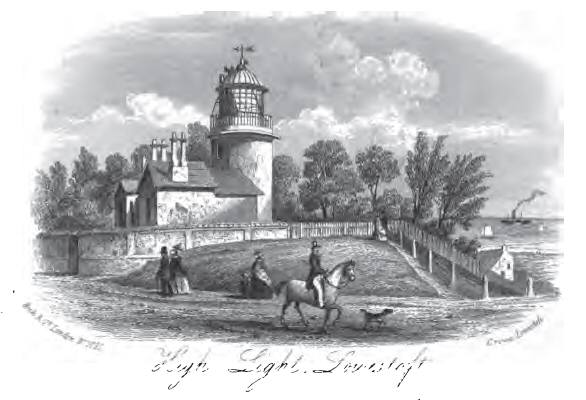
The Lower Light situated on the beach, towards the south of
the town, consists simply of a lantern, fitted with lamps and
reflectors, as in the case of the upper light, elevated on a
framework of wood; it has received this structure in order that
it may be easily removed: it has been found necessary sometimes
to change its place, as the sands—to warn against danger
from which, the light-houses have been erected—are continually
shifting. Mariners steering in a line with these two
lights, can safely pass between the Holme and Barnard sands, the
channel between which, is not more than a quarter of a mile
wide.
The purposes now answered by the light-houses were, prior to
1676, imperfectly effected by two beacons, one of which stood on
the site now occupied by the upper light, the other stood on the
north side of the passage going down the Swan score.
There is a Floating Light called the ‘Stanford,’
anchored upon the Stanford sand; it is fitted up with two lamps,
which are suspended upon two masts raised for the purpose.
This light answers a similar purpose to that of the others.
In foggy weather, when the lights are not visible, a gong is
beaten at short intervals, to warn vessels of their approach to
the sands.
The instructions given to the persons superintending the
lights are very minute. The lanterns and reflectors must be
kept constantly cleaned, and the lamps must be trimmed every few
hours; a book is kept in which the time when the lamps are
trimmed is regularly entered. The persons who attend to the
floating light are constantly on board the vessel during the time they are
in charge: there are two sets of men, (six in a set) each set
having remained a month is then relieved.
The Waveney originally emptied itself into the sea between
Lowestoft and Kirkley, but being a shallow stream, could not
resist the gradual formation of a mound of sand raised by the
prevailing east winds, which, in time, effectually cut off the
communication between the sea and Lake Lothing. At spring
tides, however, the sea would frequently break over the barrier,
rush into the lake and over the low lands, carrying away whatever
was not sufficiently durable to resist its torrent. Mutford
Bridge has been twice carried away by the waters of the sea,
though at a distance of two miles from the beach. In 1831
the river and the sea were again united. The harbour was
formed under the auspices of Mr. Cubitt, at the estimated cost of
£87,000. This harbour and navigation afterwards fell
into the hands of Government, and were purchased of the Exchequer
Loan Commissioners in 1842, by Messrs. J. Cleveland, G. and W.
Everitt, J. S. Lincoln, J. W. Hickling, and W. Roe.
These Gentlemen made various improvements, and kept possession
till October 1844, when they sold the property to S. M. Peto,
Esq.
The act for improving the harbour and forming the Railway, was
passed in the early part of 1845. Messrs. Stephenson and
Bidder were appointed the Engineers in chief, Mr. Hodges the
resident Engineer, and Mr. Peto, the general contractor. In
the enterprise of Mr. Peto originated this great work.
Having purchased the harbour and navigation in 1844, he, with
other gentlemen, chiefly in the neighbourhood, formed for the
above purpose a company with a capital of £200,000.
The new Harbour of refuge is formed by two immense piers,
extending for 1300 feet into the sea, enclosing the old harbour
and an area of 20 acres. The width between the piers, and
consequently of the harbour is 800 feet, and the average depth of
water in it is 20 feet. The old entrance within the piers
will be cleared away up to the stone work, so that there will be
a spacious basin, large enough to accommodate 600 or 700
vessels. The piers consist of a stupendous timber
framework, (creasoted by Bethel’s patent process to keep
out the worm,) on each side of the harbour, 14 feet high above
the water,
and 30 feet in width, filled up with immense blocks of stone from
one to six tons in weight; these sides present a solid mass of
masonry. As the thousands of tons of stone required have to
be brought from a great distance in vessels, and by railway, the
filling in goes on slowly. When this work is completed, a
platform or flooring of four-inch planking, will be made on the
top of each pier.
The north pier, after extending straight out east for 700
feet, bends to the south-east for 300 feet, and then bends again
to the south for 300 feet more making in all 1300 feet.
This pier is intended entirely for business; a double tramway has
been laid along it with a large turning table at each bend.
The south pier extends from the shore for 1300 feet straight
out into the sea, and is intended for a grand promenade.
The head of each pier is circular, and 60 feet in diameter;
Light-houses have been erected in the centre of the circle at the
head of each pier, and at night a brilliant red light is
exhibited.
The entrance to the harbour between the two piers is towards
the south-east; it is 160 feet wide, with a depth of 21 feet at
low water.
Beyond
the south pier a sea wall has been built, with towers of flint
and stone, and at the back of it, a broad embankment has been
formed for the esplanade, which is a quarter of a mile in length,
and 25 feet wide, and affords a splendid view of the sea.
The fine Hotel at the northern extremity of the esplanade,
presents, in its internal arrangements, a study for the lovers of
the curious and the comfortable. Its contiguity to the
railway station and the harbour, will cause it to be greatly
frequented.
The inner harbour has been dredged to a depth of 14 feet in
the channel at low water, and this dredging will be extended up
to Mutford bridge. A substantial machine has lately been
built, for the purpose of excavating the harbour, which, by her
powerful aid, will be rendered accessible to vessels of 15 feet
draught, at any state of the tide. She is of 200 tons
burthen; her engines are of 20 horse power, capable of working in
20 feet of water; she is calculated to raise 1000 tons of soil
per day. Her form, engines, and mode of operations, are in
accordance with the latest improvements of the age.
The new wharfing, the various buildings, the offices, engine
houses, machinery for sawing timber, work shops, creasote works,
coke ovens, coal works, warehouses, stations, and about six lines of
railway branching from the piers on the north side of the inner
harbour, occupy a space of about sixty acres; altogether this
improvement will present one of the finest combinations of
railway and sea communication in the country.
The Railway passes from the terminus near the harbour, over
Lake Lothing, and through several Villages till it joins the
Norwich and Yarmouth line at Reedham. Thus, when all
arrangements are completed, vessels may unlade their merchandize
at the pier, it may be immediately placed in the railway carriage
and transported to Norwich, London, or any part of England with
the greatest facility.
is situated at the western extremity of the town on the road
leading to the church. The society by which this building
has been erected was formed in 1822, but the building itself was
not erected till 1839. It comprises two spacious wards,
well ventilated and warmed, and other necessary
conveniences. It has attached to it, a small museum of
morbid anatomy, presented by W. C. Worthington, Esq., Surgeon to
the Infirmary. Funds are now much required for providing
suitable food for the distressed inmates, whose means frequently do
not allow them to procure what is necessary for them, whilst
receiving the medical assistance afforded by the institution.
is a neat series of six cottages built below the town, for
aged and infirm fishermen. The cost of the whole erection
was £600.
The giver of two houses (formerly four, but two were destroyed
by fire in 1707) in the Fair lane, originally part of the parish
work-house, is unknown. The giver of a house towards the
south end of the High street, is also unknown.
James Hocker, a labourer, who died in 1710, gave his
All, about £120; with part of which, a stone and
brick house in the Fair lane was bought, which is now occupied by
such persons as the churchwardens appoint.
Martin Brown, merchant, of Rotterdam, left a sum of money,
under the management of Mr. Wilde, sufficient to erect four
houses for poor persons; with which the alms-houses at the west
end of Bell lane were erected in 1716.
Before
leaving this division of our history, we direct our readers to an
episode or two of widely opposite characters; the first is
One of the dark spots resting upon the townspeople of
more ancient times, is the share some of them took in the
persecution of the “threescore witches” who were
hanged in Suffolk. In 1663, Mr. Samuel Pacey commenced a
prosecution against Rose Cullender and Amy Duny, two poor old
widows, for witchcraft practised—as it was said—on
his two daughters, children, respectively of the ages of eleven
and nine years. After being placed in the stocks, and
suffering other indignities, they were formally indicted at the
lent assizes, held at Bury, on the 10th of March, 1664, before
Sir Matthew Hale, Lord Chief Baron of the Exchequer, for
bewitching, amongst others, the aforesaid children. Being
arraigned, they pleaded not guilty; but after a long course of
the most absurd evidence, the poor creatures were found guilty,
and sentenced to death. They suffered accordingly, on
Monday, the 17th of March following. It appears, that the
good sense of many persons present rejected the evidence, and they
would very probably have been acquitted, had not the learned
opinion of Dr. Brown, a physician of Norwich, who was desired by
the court to give his sentiments concerning the prisoners, turned
the scale against them. The Doctor stated “that he
was clearly of opinion that the two girls were bewitched; for
that in Denmark there had been lately a great discovery of
witches, and from some books that had been published in that
kingdom, it appears that the witches there had used the same
method of afflicting persons as had been practised by the
prisoners.”
We have next to invite our readers to consider
This town is not like common towns, obliged to be content with
rendering a general homage to the throne, but was part of the
ancient demesne of the crown, and has in consequence been
entitled to many privileges, particularly exemptions from toll,
stallage, chiminage, pontage, pannage, picage, murrage, lastage,
and passage. These, in the growth of the nation have become
obsolete. One profitable exemption, however, the
townsmen yet enjoy, that is, from serving on juries, either at
the assizes or quarter sessions.
Lowestoft has once seen a king: George II. landed here on his
return from Hanover, January, 14th, 1736–7, and when the
royal barge approached the shore, a body of sailors belonging to
the town waded into the sea, took the barge and its freight upon
their shoulders, and carried it to the beach. J. Jex, Esq.,
with his carriage, met his majesty on the shore, and acted as
coachman on the occasion. His majesty (as appears from a
notice on the staircase) was entertained at the house opposite
the town hall, now occupied by Mr. Chaston, draper.
The town was favoured with another royal visit,
“That is to say it would have been,
If it had not been prevented.”
for the royal yacht which brought to England Charlotte, the
consort of George III., would have landed here, as George II. did
on his return from Hanover, had not the wind suddenly
changed.
next claims our notice, and as the religious denominations are
intimately connected with their several places of worship, the
places and people will he spoken of together.
1. The Episcopalians. In this parish, as in
most others, episcopacy has flourished under its two forms,
Romish and Protestant, and the parish church has been its home,
which even now presents many mementos of the time when Romanism
held an undivided sovereignty over the minds and hearts of the
inhabitants: but there are records and traditions of places of
worship of earlier date than the present parish church, which we
must first notice. There was Good Cross chapel, situated in
the south-east part of the town, probably near the lane, called
to this day chapel lane; this has been washed away by the
sea. There was also another chapel which occupied the site
of the present town hall; it was originally built on arches, and
was but a poor thatched building, which, after having been long
disused, was fitted up in 1570, as a place of protestant worship,
for the convenience of the inhabitants. In 1698 this
chapel was re-built, since which time it has undergone various
alterations, and has recently been converted into a town hall, in
front of which is the town chamber, where parish business is
transacted. The building may be instantly recognised by the
clock, which is attached to its front, projecting over the
street.
Near the town hall may be seen the fragments of a flintstone
building, in which exist the weather mouldings of one or two
arches, apparently in the style of Henry VII. Gillingwater
conjectures that it is the remnant of a cell belonging to the
priory of St. Bartholomew in London, to which the Impropriation
of Lowestoft belonged; other appearances in the immediate
neighbourhood, and especially the discovery of the arms of the
priory, on a piece of timber dug up there a few years ago, seem
to favour the conjecture.
Having now spoken of the ecclesiastical buildings, which
either no longer exist, or have been appropriated to common
purposes, we turn to the parish church and matters connected
particularly with it.
The benefice of Lowestoft is a vicarage, endowed with the
great tithes, through the exertions of the Rev. John Tanner, a
former vicar, who, with great trouble and perseverance, collected
money for the purchase of the Impropriation, which purchase he
effected in 1721.
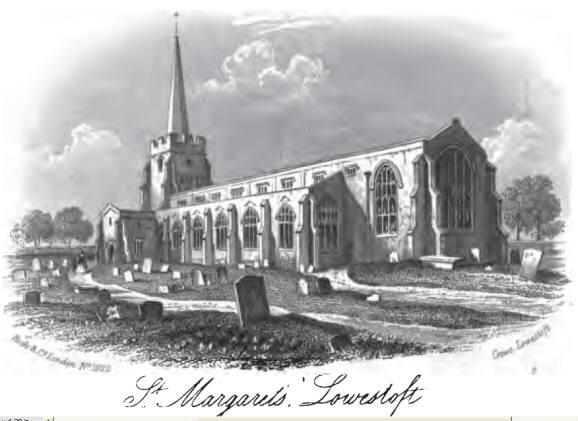
The church ‘standing by the roadside in its own little
garden of Gethsemane,’ is a fine old building dedicated to
St. Margaret, situated about half a mile westward of the town,
towards which all the streets on the west side tend, as to a
common centre. The present building is supposed to have
been founded about the middle of the fourteenth century, (on the
site of a more ancient fabric, to which the tower, from its
inferior proportions and mean construction, is concluded to have
belonged,) though much of the tracery which enriches its windows,
is supposed to be referable to a later era.
The church is with good reason supposed to have been built by
the funds supplied from the treasury of the priory of St.
Bartholomew, to which establishment the impropriation of the town
belonged. The dimensions of the church are as
follows:—Its length, 182 feet; width, 62 feet; height, 43
feet. It comprises a nave, chancel, two aisles, north and
south
porches, and a square tower, surmounted by a tapering spire of
timber, covered with lead, the extreme height of which is 120
feet. On the roof of the south porch are to be seen the
popish emblems of the Holy Trinity, and of our Lord’s
passion; and over the porch is a room called the “maids
chamber,” formerly inhabited by two maiden sisters who
lived a recluse life, and who left money for the sinking of two
wells, situated between the church and the infirmary, called the
Basket Wells; Basket being a corruption of Bess and Kate, the
names of the donors. Under the chancel floor is a well
wrought crypt of stone, entered by a winding staircase from the
interior of the north wall; and at the west end of the nave is a
long narrow arch, supposed to have been originally used as a
penitent’s porch, agreeably to the custom of the ancient
church.
The great east window is filled with stained glass, painted,
and presented by Mr. Robert Allen, a bookseller of Lowestoft,
whose first attempt at staining may be seen over his shop, in the
High street, now occupied by Mr. Thos. Crowe.
A large brass eagle, formerly used as a lecturn, stands with
outspread wings in the chancel, supporting an old Black letter
Bible.
The
Font is very elegant, but has been much defaced. The rich
series of figures with which it was, and still is, partially
adorned, were mutilated by one Francis Jessope, who, with a
commission from the Earl of Manchester to take away from
gravestones all inscriptions on which he found “orate
pro anima” (pray for the soul), tore up most of the
ancient brasses which were in the church, and visited the images
of the saints with his peculiar displeasure.
One inscription escaped his search.
Orate p.aia dne Margarete Parker qe
obitt po
die marciz ao dni mo bco bizo cui aie ppiciet de.
It has frequently been our lot to hear the most opprobrious
epithets applied to the Iconoclasts of the times of Reformation;
but, however much we may regret the indiscriminate manner in
which they performed their mission, we must remember, that
“their backs were yet sore with the burdens which had been
laid upon them; their indignation fierce at the impostures and
rapine which they had actually witnessed: theirs would have been
a lukewarm zeal indeed, had it not urged them to abolish even the
innocent memorials of that wickedness, which had been wrought in
their eyesight, on every hill and under every tree. Another
period succeeds, in which the vices of a system are no longer
distinctly remembered, and contemplated only through the
softening medium of antiquity, and the services of the Iconoclast
and the motives on which he acted are all forgotten; and he is
regarded with mere horror as an incarnate spirit of
destruction.” [48]
In the chancel lies buried Thomas Scroope, Bishop of Dromore
in Ireland, and vicar of this parish. His effigy in brass,
habited in his episcopal robes, with a crosier in one hand, and
his pastoral staff in the other, was formerly to be seen on a
large stone, surrounded by a circumscription, and ornamented with
divers heraldic devices, but all have long since disappeared.
He was first a monk of the order of St. Benedict; passed to
the profession of a Dominican; then became a Carmelite, and
preached the gospel in hair and sackcloth round the country; then
became an Anchorite and so continued twenty years; was made Bishop of
Dromore by the Pope; then quitted his bishoprick; came into these
eastern counties, and went abroad in the neighbourhood barefoot,
preaching, teaching, and dispensing alms; and died in Lowestoft,
January 15th, 1491, at the age of a hundred years.
In the church there are many Monuments, the inscriptions of
which will interest and amuse the reader; some are simple
narrative, others are written in the inflated style peculiar to
the age in which they were composed; most of them tell their own
tales, it is not necessary, therefore, to transfer them to our
pages. One, however, very short, begs to be noticed; it is
found in the middle aisle; a small brass simply bears the
initials,

On the stone which bears this brass, there was formerly the
effigy of a person standing in a praying position, with an
inscription underneath, but these brasses are all stripped from
their matrices. This is most probably the index to the
grave of Robert Inglesse or Ingloss, Esq., who died in 1365, and
was buried
in this church. This, from its antiquity, is worth a
special notice.
“In the churchyard are a few flowers and much green
grass; and daily the shadow of the church spire, with its long
tapering finger, counts the tombs, representing a dial plate of
human life, on which the hours and minutes are the graves of
men.” Here is the tomb of John Barker, Esq.; [50] the resting place of Sir J. E. Smith,
the celebrated botanist; the grave of the Rev. James Alderson, a
dissenting minister; and the dust of the Rev. B. Ritson, an
estimable clergyman: here, all ranks and conditions of men mingle
their undistinguishable dust; here, are high and low, rich and
poor, together; here, it seems as though all strifes are hushed
and discords forgotten—one stone, however, close to the
wall, on the west side of the churchyard, lifts its querulous
head to perpetuate the remembrance of a family disagreement; it
is raised to the memory of Charles Ward, and informs the visiter,
who goes to meditate among the tombs that his heart may be made
better, that “it is not erected by Susan his (i.e.
Mr. Ward’s) wife; she erected a stone to John Salter, her
second
husband, forgetting the affection of her first husband,” it
moreover begs that “no one may disturb his
bones.”
At the east side of the churchyard and towards the northern
corner, may be found two or three versions of the sailor’s
favourite epitaph, wherein “Boreas’s blasts”
are very powerful ingredients.
The other building in which worship is conducted in the
Episcopalian mode, is St. Peters Chapel, which is a neat
building, in the street leading from the south part of the town
to the Beccles road. The first stone was laid on the 6th of
August, 1832, by the Rev. F. Cunningham, the vicar of
Lowestoft. The building was consecrated by Dr. C. Sumner,
Lord Bishop of Winchester, on the 15th of August, 1833.
Church rates are not levied in this parish, the lands
belonging to the church being amply sufficient to keep it in
repair. This being the case, those unseemly feuds, which
frequently arise in parishes where this obnoxious tax is imposed,
do not trouble the inhabitants. Suckling wishes it to be
understood that “church rates have been occasionally
raised,” and quotes only one instance, and that, as far
back as 1716: the memory of this might as well have been buried
in the “tomb of all the Capulets.”
The
deceased Vicars of note, are Scroope, before mentioned; William
Whiston, who succeeded Sir Isaac Newton at Cambridge; John
Tanner, brother of Bishop Tanner, who purchased the
impropriation; Robert Potter, the translator of the three great
writers of greek drama.
2. The Independents have long had a place of
worship in the town. Before the erection of their present
chapel in 1695, they worshipped in a barn, situated in the Blue
Anchor lane, where the Rev. Mr. Emlyn, a learned man, was for a
short time minister: since that time there has been a long
succession of ministers, and the congregation has experienced
many vicissitudes. The chapel has, within the last few
years, been altered and greatly improved, and has now a very
respectable appearance. It is situated in the High street,
near the old market plain.
3. The Wesleyan Society in this town was formed
in 1761, under the auspices of the Rev. John Wesley, who first
preached on a spot of ground in Martin’s score, near the
Star hotel.
In 1776 their present place of worship was opened on November
the 19th, when the Rev. John Wesley preached in the morning, from
Rev. xx.
10; and in the afternoon, from Isaiah lxvi. 8 and 9. The
society is in a flourishing condition. Their place of
worship is situated in Frary lane, at the back of the Crown and
Anchor hotel.
4. The Baptists have a chapel opposite the
vicarage. It was built in 1813, chiefly through the
generosity of R. Kemp, Esq. of Yarmouth. S. M. Peto, Esq.,
M. P., has taken great interest in the prosperity of the cause,
has built a commodious school room, and contemplates the erection
of a larger chapel in a more convenient situation. The Rev.
J. E. Dovey is the present minister.
5. The Primitive Methodists have a place of
worship situated on the beach, (near the bottom of Denny’s
score,) among that class of the inhabitants who are generally
least disposed to go in quest of religious instruction, and here
they usefully employ themselves in their important work.
The Public Schools in the town provided for the poor are
numerous, and generally well conducted. The principal are
Wilde’s, Annot’s, and the British School.
John Wilde left several estates, together
with the rents and profits thereof, to be applied for a virtuous
and learned schoolmaster, who shall teach forty boys to write and
read and cast accounts, and shall also teach them the Latin
tongue.
Thomas Annot, merchant of this
town, also left money for founding a grammar school at Lowestoft;
and by a decree, given in Gillingwater, it is ordered “that
the same school shall consist of a schoolmaster, learned in the
art and knowledge of grammar, and able to instruct and teach the
rules and principles thereof, and the Latin tongue, and other
things incident, necessary, and belonging to the said art, to be
master, tutor, and teacher of the scholars in the said school,
consisting of forty scholars and not above, to be taught and
instructed within the said school.”
Henry Wilde, known by the name of the Arabian Tailor, was
master of this school. He was a great proficient in the
oriental languages, and was sent by Dean Prideaux to Oxford,
where he gained a poor living by teaching languages; he
afterwards removed to London, where he died. Mr. Rogers is
the present master.
The British School is a neat building, on the south
turnpike, which was opened in 1844, on the liberal principle of
educating the children of all, without distinction of sect or
party. It is principally supported by the Independents and
Wesleyans, assisted by the munificence of S. M. Peto, Esq.
M.P. Mr. M. Hinde is the efficient master.
Sabbath Schools are connected with most of the places of
worship in the town.
At present there are two fishing seasons during the year.
The Herring season begins about a fortnight before Michaelmas,
and continues till Martinmas. At the beginning of the
season the boats sail off to sea, about thirteen leagues
north-east of Lowestoft, to meet the shoals of fish. Having
arrived on the fishing ground, the fishermen shoot their nets,
(extending about 2,200 yards in length, and eight in depth,
which, by simple means, are made to swim in a position
perpendicular to the surface of the water,) in which the fish are
entangled. As soon as the fish are brought on shore they
are taken to the fish houses and salted; they remain in salt two
or three days, are then washed; then spitted; (i.e. an
osier wand, about four feet long, is thrust through the gills of
as many as can hang freely upon it,) the spits are then hung upon
rafters, with which the upper part of the fish houses are fitted
up; fires of oak billet are made on the floors of the houses, by
which the fish are at once dried and smoked; the herrings hang
thus about a fortnight, and then they are fit for market. [56]
The Mackerel season begins about the middle of May, and
continues to the end of June. At the beginning of this
season the boats sail to the north-east, in order to meet the
fish at the beginning of their annual revolution round the
British Isles. A blustering stormy season is best suited to
the successful prosecution of this fishery, for only then do the
fish rise in large quantities, within reach of the nets, the
meshes of which are larger than those used in the herring
fishery. The fish are generally brought in every day.
Small
boats called ‘along shore boats,’ generally the
property of those who use them, are employed in catching whatever
fish will come to their nets; these are speedily brought into the
town, and disposed of for the consumption of the inhabitants.
There were formerly two other fisheries, the North sea and
Iceland fisheries, but they have long since been entirely
neglected.
The vicar of the parish makes a claim of half a guinea from
each boat on its return from the herring fishery; and half a
dole,—i.e. one three-hundredth part of the whole
catch—from the mackerel boats at the close of their
season. The legality of these claims is disputed, and, in
the case of the latter, legal proceedings were instituted in
1845, by the Rev. F. Cunningham against Mr. John Roberts, who
declined payment of the demand. Those persons who are
interested in the affair may obtain a sight of the argument, as
maintained by the legal adviser of the plaintiff, in
Suckling’s History, in loco; and of the argument, as
maintained by the defendant, in a Lecture delivered and published
at the time, by the Rev. J. Browne.
Before Kett’s insurrection in the year 1549, there were
six pieces of cannon for the defence of the town; these were
carried off by the insurgents to batter the walls of
Yarmouth. To replace these, Queen Elizabeth presented to
the people of Lowestoft four pieces of cannon and two slings;
these appear to have been carried away by Cromwell in 1643, but
afterwards he found it necessary to build a fort and plant four
guns upon it; some time after, the platform on which these guns
were placed was destroyed by the sea, but the guns were rescued;
after which, another platform was erected which shared the same
fate; on this occasion also the guns were preserved.
In later times it was found expedient to build three
Batteries; that on the south was begun and finished in
1782. The fort consists of a ditch mounted with chevaux
de frize; the magazine (in the north-west angle of the fort,
thirty feet long and twelve broad,) is sunk beneath the surface
of the earth, and is bomb proof. To the east of this fort
is the promenade, and the green known by the name of the Battery
Green.
In the
same year a fort was erected at the north end of the town, about
one hundred yards to the north of the light-house; this battery
was intended to act with another erected during the same year on
the beach, near the ness, the bounds and breastwork of which are
still clearly visible.
There was, some years since, a manufactory of Porcelain or
China-ware in this town, but it has fallen away and become
extinct. Specimens of the ware may be frequently purchased
in the cottages in the neighbourhood.
was established in 1818, for the purpose of affording to
sailors, journeymen, and others, especially to the females of
Lowestoft and its vicinity, a secure place where they may deposit
the small savings they may be able to make from their wages;
which deposits are repaid with interest at £2 18s. 10d. per
centum per annum, agreeably to certain rules.
The
office for this Institution is kept at the town chamber in the
town hall, and is open every Wednesday from twelve till one
o’clock. Mr. T. Bird is the clerk.
was established in June 1843, for the following
purposes—first, the diffusion of useful knowledge;
secondly, the promotion amongst the inhabitants of the
town and neighbourhood, of that harmony and good feeling which
ought to exist among all men.
The means used for attaining these objects are—a library
for circulation; the delivery of lectures on literary and
scientific subjects; and the adoption of such other means as,
from time to time, are deemed expedient by the committee of
management. The library is increasing both in the number
and value of its books. The subscription is one shilling
per quarter. S. S. Brame, Esq., is the President of the
Institution.
Annually a Bazaar is held in the bath rooms, to which the
ladies in the neighbourhood contribute principally articles of their own
manufacture. The proceeds of the sale are usually divided
between the Church schools and the Infirmary funds.
During the summer evenings the denes usually present a very
lively appearance; the members of the several cricket clubs are
practising, not only for their own amusement, but that they may
be prepared to meet other gentlemen who, residing in the
neighbouring towns, cherish a friendly rivalry in the art of bat
and ball.
the satirist, who flourished in the reign of Elizabeth, was
born at Lowestoft. He wrote a play called “Lenton
Stuffe; or, the Praise of the Red Herring,” published in
1599, in quarto; he was also “the author of a slight
dramatic piece, mostly in blank verse, but partly in prose, and
having also some lyrical poetry interspersed, called
‘Summers’ Last Will and Testament,’ which was
exhibited before Queen Elizabeth at Norwich, in 1592; and he also assisted
Marlow, in his tragedy of ‘Dido, Queen of Carthage,’
which, although not printed till 1594, is supposed to have been
written before 1590. But his satire was of a higher order
than his dramatic talent. There never was, perhaps, poured
forth such a rushing and roaring torrent of wit, ridicule, and
invective, as in the rapid succession of pamphlets which he
published in the year 1589, against the Puritans and their famous
champion (or rather knot of champions) who bore the name of
Martin Mar-Prelate; unless in those in which he began, two years
after, to assail poor Gabriel Harvey, his persecution of, and
controversy with whom, lasted a much longer time, till, indeed,
the Archbishop of Canterbury (Whitgift) interfered, in 1597, to
restore the peace of the realm, by an order that all
Harvey’s and Nash’s books should be taken wherever
they might be found, ‘and that none of the said books be
ever printed hereafter.’” [62]


