PREFACE.
Before undertaking the present work I had no experience
as an editor. It is unnecessary for me to say,
therefore, that, were I now to undertake it, I should
pursue a somewhat different course from that which
I have pursued. The New English Canaan is, in many
respects, a singular book. One of its most singular features is the
extent of ground it covers. Not only is it full of obscure references
to incidents in early New England history, but it deals directly
with the aborigines, the trees, animals, fish, birds and geology of
the region; besides having constant incidental allusions to literature,—both
classic and of the author’s time,—to geography, and to then
current events. No one person can possess the knowledge necessary
to thoroughly cover so large a field. To edit properly he must have
recourse to specialists.
It was only as the labor of investigation increased on my hands
that I realized what a wealth of scientific and special knowledge was
to be reached, in the neighborhood of Boston, by any one engaged in
such multifarious inquiry. Were I again to enter upon it I should
confine my own labors chiefly to correspondence; for on every point
which comes up there is some one now in this vicinity, if he can only
be found out, who has made a study of it, and has more information
than the most laborious and skilful of editors can acquire.
In this edition of the New Canaan I have not laid so many of
these specialists as I now wish, under requisition; and yet the list is
a tolerably extensive one. In every case, also, the assistance asked for
has been rendered as of course, in the true scientific spirit. My correspondence
has included Messrs. Deane, Winsor and Ellis on events
in early New England history; Professor Whitney on geographical
allusions; Professors Lane and Greenough, Dr. Everett and Mr. T.
W. Higginson, on references to the Greek and Latin classics, or quotations
from them; and the Rev. Mr. Norton on Scriptural allusions.
Mr. J. C. Gray has hunted up for me legal precedents five centuries
old, and Mr. Lindsay Swift has explained archaic expressions, to the
meaning of which I could get no clew. On the subject of trees and
herbs I called on Professors Gray and Sargent; in regard to birds,
Mr. William Brewster was indefatigable; Mr. Allen, though in very
poor health, took the chapter on animals; Professor Shaler disposed
of the geology; Messrs. Agassiz and Lyman instructed me as to fish,
and Professor Putnam as to shell-heaps. I met some allusions to
early French and other explorers, and naturally had recourse to
Messrs. Parkman and Slafter; while in regard to Indian words and
names, I have been in constant correspondence with the one authority,
Mr. J. Hammond Trumbull, who has recognized to the fullest
extent the public obligation which a mastery of a special subject
imposes on him who masters it.
In closing a pleasant editorial task, my chief regret, therefore, is
that the notes in this volume contain so much matter of my own.
They should have been even more eclectic than they are, and each
from the highest possible authority on the subject to which it
relates.
C. F. A., Jr.
Quincy, Mass., April 4, 1883.
MORTON OF MERRY-MOUNT.
In the second book of his history of Plymouth
Plantation, Governor Bradford, while dealing
with the events of the year 1628 though writing
at a still later period, says:—
“Aboute some three or four years before this time, ther came over one
Captaine Wolastone (a man of pretie parts), and with him three or four more
of some eminencie, who brought with them a great many servants, with provisions
and other implaments for to begine a plantation; and pitched themselves
in a place within the Massachusets, which they called, after their
Captains name, Mount-Wollaston. Amongst whom was one Mr. Morton,
who, it should seeme, had some small adventure (of his owne or other mens)
amongst them.”[1]
There is no other known record of Wollaston than that
contained in this passage of Bradford.[2] His given name
even is not mentioned. It may be surmised with tolerable
certainty that he was one of the numerous traders, generally
from Bristol or the West of England, who frequented the
fishing grounds and the adjacent American coast during the
early years of the seventeenth century. Nothing is actually
known of him, however, until in 1625 he appeared in Massachusetts
Bay, as Boston Harbor was then called, at the head
of the expedition which Bradford mentions.
His purpose and that of his companions was to establish
a plantation and trading-post in the country of the Massachusetts
tribe of Indians. It was the third attempt of the
kind which had been made since the settlement at Plymouth,
a little more than four years before. The first of these
attempts had been that of Thomas Weston at Wessagusset,
or Weymouth, in the summer of 1622. This had resulted
in a complete failure, the story of which is told by Bradford
and Winslow, and forms one of the more striking pages in
the annals of early New England. The second attempt,
and that which next preceded Wollaston’s, had closely followed
the first, being made in the summer of 1623, under
the immediate direction of the Council for New England.
At the head of it was Captain Robert Gorges, a younger
son of Sir Ferdinando Gorges. Weston’s expedition was a
mere trading venture, having little connection with anything
which went before or which came after. That of Gorges,
however, was something more. As will presently be seen,
it had a distinct political and religious significance.
Robert Gorges and his party arrived in Boston Bay in
1623, during what is now the latter part of September.
They established themselves in the buildings which had
been occupied by Weston’s people during the previous winter,
and which had been deserted by them a few days less
than six months before. The site of those buildings cannot
be definitely fixed. It is supposed to have been on Phillips
Creek, a small tidal inlet of the Weymouth fore-river, a short
distance above the Quincy-Point bridge. The grant made
to Robert Gorges by the Council for New England, and
upon which he probably intended to place his party, was on
the other side of the bay, covering ten miles of sea-front and
stretching thirty miles into the interior. It was subsequently
pronounced void by the lawyers on the ground of
being “loose and uncertain,” but as nearly as can now be
fixed it covered the shore between Nahant and the mouth
of the Charles, and the region back of that as far west as
Concord and Sudbury, including Lynn and the most thickly
inhabited portions of the present county of Middlesex.
Reaching New England, however, late in the season,
Gorges’s first anxiety was to secure shelter for his party
against the impending winter, for the frosts had already
begun. Fortunately the few savages thereabouts had been
warned by Governor Bradford not to injure the Wessagusset
buildings, and thus they afforded a welcome shelter
to the newcomers. These were people of a very different
class from those who had preceded them. Among them
were men of education, and some of them were married
and had brought their wives. Their settlement proved a
permanent one. Robert Gorges, it is true, the next spring
returned to England disgusted and discouraged, taking back
with him a portion of his followers. Others of them
went on to Virginia in search of a milder climate and a
more fertile soil. A few, however, remained at Wessagusset,[3]
and are repeatedly referred to by Morton in the
New Canaan[4] as his neighbors at that place.
When, therefore, Wollaston sailed into the bay in the
early summer of 1625, its shores were not wholly unoccupied.
His party consisted of himself and some three or
four partners, with thirty or more servants, as they were
called, or men who had sold their time for a period of years
to an employer, and who stood in the relation to him of
apprentice to master. Rasdall, according to Bradford, was
the name of one of the partners, and Fitcher would seem to
have been that of another. Thomas Morton, the author of
the New English Canaan, was a third.
Not much more is known of Morton’s life prior to his
coming to America than of Wollaston’s. He had certainly
an education of that sort which was imparted in the schools
of the Elizabethan period, for he had a smattering knowledge
of the more familiar Latin authors at least, and was fond
of classic allusion. Governor Dudley, in his letter to the
Countess of Lincoln, says that while in England he was an
attorney in “the west countries.”[5] He further intimates that
he had there been implicated in some foul misdemeanor, on
account of which warrants were out against him. Nathaniel
Morton in his Memorial[6] says that the crime thus referred
to was the killing of a partner concerned with him, Thomas
Morton, in his first New England venture. Thomas Wiggin,
however, writing in 1632 to Sir John Cooke, one of
King Charles’s secretaries for foreign affairs and a member
of the Privy Council, states, upon the authority of Morton’s
“wife’s sonne and others,” that he had fled to New England
“upon a foule suspition of murther.”[7] While, therefore, it
would seem that grave charges were in general circulation
against Morton, connecting him with some deed of violence,
it is necessary to bear in mind that considerable allowance
must be made before any accusation against him can be accepted
on the word of either the Massachusetts or the Plymouth
authorities, or those in sympathy with them. Yet
Morton was a reckless man, and he lived in a time when
no great degree of sanctity attached to human life; so that
in itself there is nothing very improbable in this charge.
It is possible that before coming to America he may have
put some one out of the way. Nevertheless, as will presently
be seen, though he was subsequently arrested and in
jail in England, the accusation never took any formal shape.
That he was at some time married would appear from the
letter of Wiggin already referred to, and the allusions in the
New Canaan show that he had been a man passionately fond
of field sports, and a good deal of a traveller as well. He
speaks, for instance, of having been “bred in so genious a
way” that in England he had the common use of hawks in
fowling; and, in another place, he alludes to his having been
so near the equator that “I have had the sun for my zenith.”[8]
On the titlepage of his book he describes himself as “of
Cliffords Inne gent.,” which of course he would not have ventured
to do had he not really been what he there claimed to
be; for at the time the New Canaan was published he was
living in London and apparently one of the attorneys of the
Council for New England.[9] Bradford, speaking from memory,
fell into an error, therefore, when he described him as
a “kind of petie-fogger of Furnefells Inne.”[10] That in
1625 he was a man of some means is evident from the fact
that he owned an interest in the Wollaston venture; though
here again Bradford takes pains to say that the share he
represented (“of his owne or other mens”) was small, and
that he himself had so little respect amongst the rest that he
was slighted by even the meanest servants.
In all probability this was not Morton’s first visit to Massachusetts
Bay. Indeed, he was comparatively familiar with it,
having already passed one season on its shores. His own statement,
at the beginning of the first chapter of the second book
of the Canaan, seems to be conclusive on this point. He there
says: “In the month of June, Anno Salutis 1622, it was my
chance to arrive in the parts of New England with thirty servants,
and provision of all sorts fit for a plantation; and, while
our houses were building, I did endeavor to take a survey of
the country.”[11] There was but one ship which arrived in New
England in June, 1622, and that was the Charity;[12] and the
Charity brought out Weston’s party, which settled at Wessagusset,
answering in every respect to Morton’s description
of the party he came with. Andrew Weston, a younger
brother of the chief promoter of the enterprise, had then
come in charge of it, and is described as having been “a
heady yong man and violente.”[13] After leaving Weston’s
company at Plymouth, the Charity went on to Virginia,
but returned from there early in October, going it would
seem directly to Boston Bay and Wessagusset.[14] One part
of the colonists had then been there three months, and
it was during those three months that Morton apparently
took the survey of the country to which he refers. As the
Wessagusset plantation was now left under the charge of
Richard Greene, it would seem that young Weston went back
to England in the Charity, and the inference is that Morton,
who had come out as his companion, went back with him.
In any event, the impression produced on Morton by this
first visit to New England was a strong and favorable one. It
looked to him a land of plenty, a veritable New Canaan.
Accordingly, he gave vent to his enthusiasm in the warm
language of the first chapter of his second book.[15] With
the subsequent fate of Weston’s party he seems to have had
no connection. He must at the time have heard of it, and
was doubtless aware of the evil reputation that company left
behind. This would perfectly account for the fact that he
never mentions his having himself had anything to do with
it. Yet it may be surmised that he returned to England
possessed with the idea of connecting himself with some
enterprise, either Weston’s or another, organized to make a
settlement on the shores of Boston Bay and there to open
a trade in furs. He had then had no experience of a New
England winter; though, for that matter, when he afterwards
had repeated experiences of it, they in no way changed
his views of the country. To the last, apparently, he thought
of it as he first saw it during the summer and early autumn
of 1622, when it was a green fresh wilderness, nearly devoid
of inhabitants and literally alive with game.
News of the utter failure of Weston’s enterprise must have
reached London in the early summer of 1623. Whether
Morton was in any way personally affected thereby does not
appear, though from his allusions to Weston’s treatment
by Robert Gorges at Plymouth, during the winter of 1623-4,
it is not at all improbable that he was.[16] During the following
year (1624) he is not heard of; but early in 1625 he had
evidently succeeded in effecting some sort of a combination
which resulted in the Wollaston expedition.
The partners in this enterprise would seem to have been
the merest adventurers. So far as can be ascertained, they
did not even trouble themselves to take out a patent for the
land on which they proposed to settle,[17] in this respect showing
themselves even more careless than Weston.[18] With the
exception of Morton, they apparently had no practical
knowledge of the country, and their design clearly was to
establish themselves wherever they might think good, and
to trade in such way as they saw fit.
When the party reached its destination in Massachusetts
Bay, they found Wessagusset still occupied by such as were
left of Robert Gorges’s company, who had then been there
nearly two years. They had necessarily, therefore, to establish
themselves elsewhere. A couple of miles or so north of Wessagusset,
on the other side of the Monatoquit, and within the
limits of what is now the town of Quincy, was a place called
by the Indians Passonagessit. The two localities were separated
from each other not only by the river, which here
widens out into a tidal estuary, but by a broad basin which
filled and emptied with every tide, while around it were
extensive salt marshes intersected by many creeks. The upland,
too, was interspersed with tangled swamps lying between
gravel ridges. At Passonagessit the new-comers established
themselves, and the place is still known as Mount
Wollaston.
In almost all respects Passonagessit was for their purpose
a better locality than Wessagusset. They had come there
to trade. However it may have been with the others, in
Morton’s calculations at least the plantation must have been
a mere incident to the more profitable dealing in peltry.
A prominent position on the shore, in plain view of the
entrance to the bay, would be with him an important consideration.
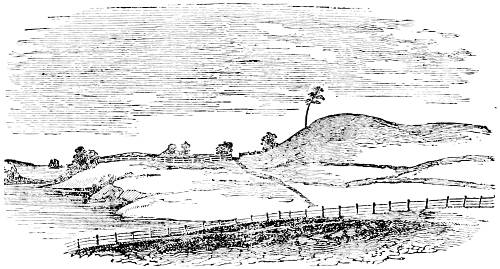
This was found at Passonagessit. It was a spacious
upland rising gently from the beach and, a quarter of
a mile or so from it, swelling into a low hill.[19] It was not
connected with the interior by any navigable stream, but
Indians coming from thence would easily find their way to
it; and, while a portion of the company could always be
there ready to trade, others of them might make excursions
to all points on the neighboring coast where furs were to be
had. Looking seaward, on the left of the hill was a considerable
tidal creek; in front of it, across a clear expanse of
water a couple of miles or so in width, lay the islands of the
harbor in apparently connected succession. Though the anchoring
grounds among these islands afforded perfect places
of refuge for vessels, Passonagessit itself, as the settlers there
must soon have realized, labored, as a trading-point, under
one serious disadvantage. There was no deep water near
it. Except when the tide was at least half full, the shore
could be approached only in boats. On the other hand, so
far as planting was concerned, the conditions were favorable.
The soil, though light, was very good; and the spot, lying
as it did close to “the Massachusetts fields,” had some years
before been cleared of trees by the Sachem Chickatawbut,
who had made his home there.[20] He had, however, abandoned
it at the time when the great pestilence swept away
his tribe, and tradition still points out a small savin-covered
hummock, near Squantum, on the south side of the Neponset,
as his subsequent dwelling-place. Morton says that
Chickatawbut’s mother was buried at Passonagessit, and
that the Plymouth people, on one of their visits, incurred his
enmity by despoiling her grave of its bear skins.[21] So far as
the natives were concerned, however, any settlers on the
shores of Boston Bay, after the year 1623, had little cause
for disquietude. They were a thoroughly crushed and broken-spirited
race. The pestilence had left only a few hundred
of the whole Massachusetts tribe, and in 1631 Chickatawbut
had but some fifty or sixty followers.[22] It was a dying
race; and what little courage the pestilence had left them
was effectually and forever crushed out by Miles Standish,
when at Wessagusset, in April, 1623, he put to death seven
of the strongest and boldest of their few remaining men.
Having selected a site, Wollaston and his party built their
house nearly in the centre of the summit of the hill, on
a gentle westerly slope. It commanded towards the north
and east an unbroken view of the bay and all the entrances
to it; while on the opposite or landward side, some four or
five miles away, rose the heavily-wooded Blue Hills. Across
the bay to the north lay Shawmut, beyond the intervening
peninsulas of Squantum and Mattapan. Wessagusset was to
the south, across the marshes and creeks, and hidden from
view by forest and uplands.
During their first season, the summer of 1625, Wollaston’s
party must have been fully occupied in the work of building
their houses and laying out their plantation. The winter
followed. A single experience of a winter on that shore
seems to have sufficed for Captain Wollaston, as it had
before sufficed for Captain Gorges. He apparently came to
the conclusion that there was little profit and no satisfaction
for him in that region. Accordingly, during the early months
of 1626, he determined to go elsewhere. The only account of
what now ensued is that contained in Bradford; for Morton
nowhere makes a single allusion to Wollaston or any of his
associates, nor does he give any account of the origin, composition
or purposes of the Wollaston enterprise. His silence
on all these points is, indeed, one of the singular features
in the New Canaan. Such references as he does make are
always to Weston and Weston’s attempt;[24] and he seems to
take pains to confound that attempt with Wollaston’s. Once
only he mentions the number of the party with which he
landed,[25] and the fact that it was subsequently dissolved;[26] but
how it came to be dissolved he does not explain. The inference
from this is unavoidable. Morton was free enough
in talking of what he did and saw at Passonagessit, of his
revels there, of how he was arrested, and persecuted out of
the country. That he says not a word of Wollaston or his
other partners must be due to the fact that the subject was
one about which he did not care to commit himself. Nevertheless
Bradford could not but have known the facts, for not
only at a later day was Morton himself for long periods of
time at Plymouth, but when the events of which he speaks
occurred Bradford must have been informed of them by the
Wessagusset people, as well as by Fitcher. As we only
know what Bradford tells us, it can best be given in his own
words:—
“Having continued there some time, and not finding things to answer their
expectations, nor profit to arise as they looked for, Captain Wollaston takes a
great part of the servants and transports them to Virginia, where he puts them
off at good rates, selling their time to other men; and writes back to one Mr.
Rasdall, one of his chief partners and accounted their merchant, to bring another
part of them to Virginia likewise; intending to put them off there, as he
had done the rest. And he, with the consent of the said Rasdall, appointed
one Fitcher to be his Lieutenant, and govern the remains of the plantation till
he, or Rasdall, returned to take further order thereabout. But this Morton,
abovesaid, having more craft than honesty, in the others’ absence watches an
opportunity, (commons being but hard amongst them,) and got some strong
drink and other junkets, and made them a feast; and after they were merry,
he began to tell them he would give them good counsel. ‘You see,’ saith he,
‘that many of your fellows are carried to Virginia; and if you stay till this
Rasdall returns, you will also be carried away and sold for slaves with the
rest. Therefore, I would advise you to thrust out this Lieutenant Fitcher;
and I, having a part in the plantation, will receive you as my partners and
consociates. So may you be free from service; and we will converse, trade,
plant and live together as equals, and support and protect one another:’ or
to like effect. This counsel was easily received, so they took opportunity
and thrust Lieutenant Fitcher out a-doors, and would suffer him to come no
more amongst them; but forced him to seek bread to eat, and other relief,
from his neighbors, till he could get passage for England.”[27]
Wollaston’s process of depletion to Virginia had reduced
the number of servants at Passonagessit from thirty or thirty-five,
as Morton variously states it,[28] to six at most.[29] It was as
the head of these that Morton established himself in control
at Merry-Mount, as he called the place,[30] sometime, it
would seem, in the summer of 1626. He had now two distinct
objects in view: one was enjoyment, the other was
profit; and apparently he was quite reckless as to the methods
he pursued in securing either the one or the other. If
he was troubled by his former partners appearing to assert
their rights, as he probably was, no mention is made of it.
There were no courts to appeal to in America, and those of
Europe were far away; nor would it have been easy or
inexpensive to enforce their process in New England. Accordingly
nothing more is heard of Wollaston or Rasdall,
though Bradford does say that Morton was “vehemently
suspected for the murder of a man that had adventured
moneys with him when he first came.”[31] There is a vague
tradition, referred to John Adams, that Wollaston was subsequently
lost at sea;[32] but as a full century must have
elapsed between the occurrence of the event and the birth of
John Adams, this tradition is quite as unreliable as traditions
usually are.
Passionately fond of field sports, Morton found ample opportunity
for the indulgence of his tastes in New England.
He loved to ramble through the woods with his dog and
gun, or sail in his boat on the bay. The Indians, too, were his
allies, and naturally enough; for not only did he offer them
an open and easy-going market for their furs, but he was
companionable with them. They shared in his revels. He
denies that he was in the habit of selling them spirits,[33] but
where spirits were as freely used as Morton’s account shows
they were at Merry-Mount, the Indians undoubtedly had
their share. Nor were his relations confined to the Indian
men. The period of Elizabeth and James I. was one of
probably as much sexual incontinency as any in English
history. Some of the earlier writers on the New England
Indians have spoken of the modesty of the women,—Wood,
in his Prospect, for instance, and Josselyn, in the
second of his Two Voyages.[34] Morton, however, is significantly
silent on this point, and the idea of female chastity in
the Indian mind, in the rare cases where it existed at all,
seems to have been of the vaguest possible description.[35]
Morton was not a man likely to be fastidious, and his reference
to the “lasses in beaver coats”[36] is suggestive. Merry-Mount
was unquestionably, so far as temperance and morality
were concerned, by no means a commendable place.[37]
Morton’s inclination to boisterous revelry culminated at
last in that proceeding which scandalized the Plymouth elders
and has passed into history. In the spring of 1627 he
erected the May-pole of Merry-Mount. To erect these poles
seems at that time to have been a regular English observance,
which even the fishermen on the coast did not neglect.
When, for instance, the forerunners of Weston’s colony at
Wessagusset reached the Damariscove Islands, in the spring
of 1622, the first thing they saw was a May-pole, which the
men belonging to the ships there had newly set up, “and
weare very mery.”[38] There is no room for question that in
England, during the sixteenth and seventeenth centuries,
May-day festivities were associated with a great deal of
license. They were so associated in the minds of Governor
Bradford and his fellows. Christmas was at least a Christian
festivity. Not so May-day. That was distinctly Pagan
in its origin. It represented all there was left of the Saturnalia
and the worship of the Roman courtesan. May-day
and May-day festivities, accordingly, were things to be altogether
reformed. They were by no means the innocent,
grateful welcoming of spring which modern admirers of the
so-called good old times—which, in point of fact, were very
gross and brutal times—are wont to picture to themselves.
“I have heard it credibly reported,” wrote Stubbes in his
Anatomy of Abuses, “(and that viva voce) by men of great
gravitie, credite and reputation, that of fourtie, three score, or
a hundred maides goyng to the woode over night [a-Maying],
there have scarcely the thirde parte of them returned home
againe undefiled.”[39] All this it is necessary to now bear in
mind, lest what Bradford wrote down in his history of Morton’s
doings should seem grotesque. He was speaking of
what represented in his memory a period of uncleanness, a
sort of carnival of the sexes.
Morton’s own account of the festivities at Merry-Mount
on the May-day of 1627, which came on what would now be
the 11th of the month, will be found in the fourteenth chapter
of the third book of the Canaan.[40] It does not need to
be repeated here. Bradford’s account was very different:
“They allso set up a May-pole, drinking and dancing aboute it many days
togeather, inviting the Indean women, for their consorts, dancing and frisking
togither, (like so many fairies, or furies rather,) and worse practises. As if
they had anew revived and celebrated the feasts of the Roman Goddes Flora,
or the beasly practieses of the madd Bacchinalians. Morton likwise (to shew
his poetrie,) composed sundry rimes and verses, some tending to lasciviousnes,
and others to the detraction and scandall of some persons, which he affixed to
this idle or idoll May-polle.”[41]
Morton’s verses can be found in their proper place in
the New Canaan, but the principal charge now to be made
against them is their incomprehensibility. Judged even by
the standard of the present day, much more by that of the
day when they were written, they are not open to criticism
because of their “lasciviousnes.” They are decent enough,
though very bad and very dull. As to the “detraction and
scandall of some persons,” alleged against them,—if indeed
they contained anything of the sort,—it was so very carefully
concealed that no one could easily have understood
it then, and Morton’s own efforts at explanation fail to make
it intelligible now.
The festivities around the May-pole were, however, but
Morton’s amusements. Had he confined himself to these he
might, so far as the people at Plymouth at least were concerned,
to the end of his life have lived on the shores of Boston
Bay, and erected a new pole with each recurring spring.
The only resistance he would have had to overcome would
have been a remonstrance now and then, hardly less comical
than it was earnest. The business methods he pursued were
a more serious matter. He had come to New England to
make money, as well as to enjoy the license of a frontier
life. He was fully alive to the profits of the peltry trade,
and in carrying on that trade he was restrained by no
scruples. The furs of course came from the interior,
brought by Indians. In his dealings with the Indians
Morton adopted a policy natural enough for one of his
reckless nature, but which imperilled the existence of every
European on the coast. The two things the savages most
coveted were spirits and guns,—fire-water and fire-arms.
Beads and knives and hatchets and colored cloth served very
well to truck with at first. But these very soon lost their
attraction. Guns and rum never did. For these the Indians
would at any time give whatever they possessed. The trade
in fire-arms had already attained some proportions when, in
1622, it was strictly forbidden by a proclamation of King
James, issued at the instance of the Council for New England.
The companion trade in spirits, less dangerous to the whites
but more destructive to the savages, was looked upon as
scandalous, but it was not prohibited. Morton cared equally
little for either law or morals. He had come to New England
for furs, and he meant to get them.
“Hearing what gain the French and fishermen made by trading of pieces,
powder and shot to the Indians, he, as the head of this consortship, began
the practice of the same in these parts. And first he taught them how to use
them, to charge and discharge, and what proportion of powder to give the
piece, according to the size and bigness of the same; and what shot to use
for fowl and what for deer. And having thus instructed them, he employed
some of them to hunt and fowl for him, so as they became far more active in
that employment than any of the English, by reason of their swiftness of foot
and nimbleness of body; being also quick sighted, and by continual exercise
well knowing the haunts of all sorts of game. So as when they saw the execution
that a piece would do, and the benefit that might come by the same,
they became mad, as it were, after them, and would not stick to give any
price they could attain to for them; accounting their bows and arrows but
bawbles in comparison of them.”[42]
This was Bradford’s story, nor does Morton deny it. That
he would have denied it if he could is apparent. The practices
complained of were forbidden by a royal proclamation,
issued at the instance of Sir Ferdinando Gorges. In his
speech in defence of the great patent, before the House of
Commons in Committee of the Whole, in 1621, Gorges had
emphatically dwelt on the sale of arms and ammunition to
the savages as an abuse then practised, which threatened the
extinction of the New England settlements.[43] Fifteen years
later, when he wrote the New Canaan, Morton was a dependent
of Gorges. The fact that he had dealt in fire-arms,
in contemptuous defiance of the proclamation, was openly
charged against him. He did deny that he had sold the
savages spirits. These, he said, were the life of trade; the
Indians would “pawn their wits” for them, but these he
would never let them have. In the matter of fire-arms, however,
he preserved a discreet and significant silence. He
made no more allusion to them than he did to Wollaston or
his partners at Merry-Mount.
In the whole record of the early Plymouth settlement,
from the first skirmish with the Cape Cod savages, in December,
1620, to the Wessagusset killing, there is no mention of
a gun being seen in an Indian’s hands. On the contrary,
the savages stood in mortal terror of fire-arms. But now at
last it seemed as if Morton was about not only to put guns
in their hands, but to instruct them in their use.
“This Morton,” says Bradford, “having thus taught them the use of pieces,
he sold them all he could spare; and he and his consorts determined to send
for many out of England, and had by some of the ships sent for above a score.
The which being known, and his neighbors meeting the Indians in the woods
armed with guns in this sort, it was a terror unto them, who lived straglingly,
and were of no strength in any place. And other places (though more remote)
saw this mischief would quickly spread over all, if not prevented.
Besides, they saw they should keep no servants, for Morton would entertain
any, how vile soever, and all the scum of the country, or any discontents,
would flock to him from all places, if this nest was not broken; and they
should stand in more fear of their lives and goods (in short time) from this
wicked and debauched crew than from the savages themselves.”[44]
Thus, in the only branches of trade the country then
afforded, Morton was not only pressing all the other settlers
hard, but he was pressing them in an unfair way. If the
savages could exchange their furs for guns, they would not
exchange them for anything else. Those not prepared to
give guns might withdraw from the market. The business,
too, conducted in this way, was a most profitable one. Morton
says that in the course of five years one of his servants
was thought to have accumulated, in the trade in beaver
skins, no less than a thousand pounds;[45] and a thousand
pounds in 1635 was more than the equivalent of ten thousand
now. This statement was undoubtedly an exaggeration;
yet it is evident that at even ten shillings a pound in
England, which Morton gives as the current price, though
Bradford says he never knew it less than fourteen, beaver
skins, which cost little or nothing in America, yielded a large
profit. As Morton expressed it, his plantation “beganne to
come forward.”[46] When, in 1625, the Plymouth people
found their way up into Maine,[47] and first opened a trade
with the savages there, Morton was not slow in following
them. In 1628 they established a permanent station on the
Kennebec,[48] yet apparently as early at least as 1627, if not in
1626, Morton had forestalled them there, and hindered them
of a season’s furs.[49]
The injury done to the other settlers in a trading point of
view, however, serious as it unquestionably was, became insignificant
in comparison with the consequences which must
result to them from the presence on the coast of such a resort
as Merry-Mount. The region was vast, and in it there was
no pretence of any government. It was the yearly rendezvous
of a rough and lawless class of men, only one step removed
from freebooters, who cared for nothing except immediate
gain. Once let such a gathering-place as that of which
Morton was now head become fixed and known, and soon it
would develop into a nest of pirates. Of this there could be
no doubt; the Plymouth people had good cause for the
alarm which Bradford expressed. It mattered not whether
Morton realized the consequences of what he was doing, or
failed to realize them; the result would be the same.
It gradually, therefore, became apparent to all those dwelling
along the coast, from the borders of Maine to Cape Cod,
that either the growing nuisance at Merry-Mount must be
abated, or they would have to leave the country. The course
to be pursued in regard to it was, however, not equally clear.
The number of the settlements along the coast had considerably
increased since Wollaston’s arrival.[50] The Hiltons and
David Thomson had established themselves at Dover Neck
and Piscataqua as early as 1623; and sometime in 1625
apparently, Thomson, bringing with him his young wife and
a servant or two, had moved down into Boston Bay, and
established himself, only a mile or two away from Mount
Wollaston, on the island which still bears his name. He
had died a little while after, and in 1628 his widow was
living there alone, with one child and some servants. In
1625 or 1626 the Wessagusset settlement had divided.
Those of Gorges’s following who remained there had never
been wholly satisfied. It was no place for trade. Accordingly
Blackstone, Maverick and Walford, the two last being
married and taking their wives with them, had moved across
the bay, and established themselves respectively at Shawmut
or Boston, at Noddle’s Island or East Boston, and at Mishawum
or Charlestown. Jeffreys, Bursley and some others had
remained at Wessagusset, and were Morton’s neighbors at
that place, whom he says he was in the custom of visiting
from time to time, “to have the benefit of company.”[51] At
Hull, already known by that name,[52] there were the Grays and
a few other settlers. These had been joined by Lyford and
Oldham and their friends, when the latter were expelled from
Plymouth in the spring of 1625; but the next year, finding
the place probably an uninviting one, Lyford had crossed
over to Cape Ann, and thence a year later passed on to
Virginia. Oldham still remained at Nantasket.
Such were those neighbors of Morton, the chiefs of the
straggling plantations, referred to by Bradford as being of
“no strength in any place.” Together they may possibly
have numbered from fifty to an hundred souls. The Plymouth
settlement was, comparatively speaking, organized and
numerous, consisting as it did of some two hundred persons,
dwelling in about forty houses, which were protected by a
stockade of nearly half a mile in length. Nevertheless even
there, by the summer of 1627, the alarm at the increase of
fire-arms in the hands of the savages began to be very great.
They had spread “both north and south all the land over,”[53]
and it was computed that the savages now possessed at least
sixty pieces. One trader alone, it was reported, had sold
them a score of guns and an hundred weight of ammunition.
Bradford thus takes up the story:—
“So sundry of the chiefs of the straggling plantations, meeting together,
agreed by mutual consent, to solicit those of Plymouth, (who were then of
more strength than them all,) to join with them to prevent the further growth
of this mischief, and suppress Morton and his consorts before they grew to
further head and strength. Those that joined in this action, (and after contributed
to the charge of sending him to England,) were from Piscataqua,
Naumkeag, Winnisimmet, Wessagusset, Nantasket, and other places where any
English were seated. Those of Plymouth being thus sought to by their messengers
and letters, and weighing both their reasons and the common danger,
were willing to afford them their help, though themselves had least cause of
fear or hurt. So, to be short, they first resolved jointly to write to him, and,
in a friendly and neighborly way, to admonish him to forbear these courses;
and sent a messenger with their letters to bring his answer. But he was so
high as he scorned all advice, and asked—Who had to do with him?—he had
and would trade pieces with the Indians in despite of all: with many other
scurrilous terms full of disdain.
“They sent to him a second time, and bade him be better advised, and
more temperate in his terms, for the country could not bear the injury he did;
it was against their common safety, and against the King’s proclamation. He
answered in high terms, as before; and that the King’s proclamation was no
law: demanding, what penalty was upon it? It was answered, more than he
could bear, his Majesty’s displeasure. But insolently he persisted, and said
the King was dead, and his displeasure with him; and many the like things;
and threatened, withal, that if any came to molest him, let them look to themselves;
for he would prepare for them.”[54]
However it may have been with the position he took as a
matter of public policy, Morton at least showed himself in
this dispute better versed in the law of England than those
who admonished him. On the first of the two points made
by him he was clearly right. King James’s proclamation was
not law. This had been definitely decided more than fifteen
years before, when in 1610, in a case referred to all the
judges, Lord Coke, in reporting their decision, had stated
on his own authority that “the King cannot create any
offence, by his prohibition or proclamation, which was not
an offence before, for that was to change the law, and to
make an offence, which was not; for ubi non est lex, ibi non
est transgressio; ergo, that which cannot be punished without
proclamation cannot be punished with it.”[55]
In regard to the second point made by Morton, that the
King’s proclamation died with him, the same distinction
between statutes and proclamations, that the former were of
perpetual obligation until repealed and that the latter lost
their force on the demise of the crown,—this distinction was,
a century and a half later, stated by Hume[56] to have existed
in James’s time. Lord Chief Justice Campbell has, however,
exclaimed against the statement as a display of ignorant
“audacity,” and declares that he was unable to find
in the authorities a trace of any such doctrine.[57] On this
point, therefore, the law of Thomas Morton was probably as
bad as that of David Hume. Nevertheless the passage in
Bradford affords a curious bit of evidence that some such
distinction as that drawn by Hume, though it may not have
got into the books, did exist in both the legal and the public
mind of the first half of the seventeenth century.
Whether Morton’s law on the subject of proclamations
was or was not found mattered little however. It was not
then to be debated, as the question with the settlers was one
of self-preservation. The Plymouth magistrates had gone
too far to stop. If they even hesitated, now, there was an
end to all order in New England. Morton would not be
slow to realize that he had faced them down, and his insolence
would in future know no bounds.
“So they mutually resolved to proceed, and obtained of the Governor of
Plymouth to send Captain Standish, and some other aid with him, to take
Morton by force. The which accordingly was done; but they found him to
stand stiffly in his defence, having made fast his doors, armed his consorts,
set divers dishes of powder and bullets ready on the table; and, if they had
not been over armed with drink, more hurt might have been done. They
summoned him to yield, but he kept his house, and they could get nothing
but scoffs and scorns from him; but at length, fearing they would do some
violence to the house, he and some of his crew came out, but not to yield,
but to shoot. But they were so steeled with drink as their pieces were too
heavy for them; himself, with a carbine (overcharged and almost half filled
with powder and shot, as was after found) had thought to have shot Captain
Standish; but he stept to him, and put by his piece and took him. Neither
was there any hurt done to any of either side, save that one was so drunk that
he ran his own nose upon the point of a sword that one held before him as
he entered the house; but he lost but a little of his hot blood.”[58]
Morton’s own account of “this outragious riot,” as he
calls it, is contained in the fifteenth chapter of the third
book of the New Canaan.[59] It differs considerably from
Bradford’s, but not in essentials. He says that the occurrence
took place in June; and as Bradford’s letters of explanation,
sent with the prisoner to England, are dated the 9th
of June,[60] it must have been quite early in the month. He
further says that he was captured in the first place at Wessagusset,
“where by accident they found him;” but escaping
thence during the night, through the carelessness of those
set on guard over him, he made his way in the midst of a
heavy thunder-storm to Mount Wollaston, going up the
Monatoquit until he could cross it. The whole distance from
point to point was, for a person familiar with the country,
perhaps eight miles. Getting home early the next morning
he made his preparations for resistance in the way described
by Bradford. Of the whole party at Merry-Mount
more than half, four apparently, were then absent in the
interior getting furs. This fact, indeed, was probably well
known to his neighbors, who had planned the arrest accordingly.
Standish, having eight men with him, followed
Morton round to Mount Wollaston, probably by water, the
morning succeeding his escape; and what ensued seems to
have been sufficiently well described by Bradford. One at
least of the Merry-Mount garrison got extremely tipsy before
the attacking party appeared, and Morton, seeing that resistance
was hopeless, surrendered, after in vain trying to make
some terms for himself.
Having been arrested he was at once carried to Plymouth,
and a council was held there to decide upon the disposition
to be made of him. According to his own account certain
of the magistrates, among whom he specially names Standish,
advocated putting him to death at once, and so ending
the matter. They were not in favor of sending him to
England. Such a course as this was, however, wholly out
of keeping with the character of the Plymouth colony, and
it is tolerably safe to say that it was never really proposed.
Morton imagined it; but he also circumstantially asserts that
when milder councils prevailed, and it was decided to send
him to England, Standish was so enraged that he threatened
to shoot him with his own hand, as he was put into the
boat.[61]
Either because they did not care to keep him at Plymouth
until he could be sent away, or because an outward-bound
fishing-vessel was more likely at that season to be
found at the fishing-stations, Morton was almost immediately
sent to the Isles of Shoals. He remained there a month;
and of his experiences during that time he gives a wholly
unintelligible account in the New Canaan.[62] At last a chance
offered of sending him out in a fishing-vessel bound to
old Plymouth, England. He went under charge of John
Oldham, who was chosen to represent the associated planters
in this matter, and who carried two letters, in the nature of
credentials, prepared by Governor Bradford, the one addressed
to the Council for New England and the other to
Sir Ferdinando Gorges personally.[63] In these letters Bradford
set forth in detail the nature of the offences charged
against Morton, and asked that he might be brought “to his
answer before those whom it may concern.” These letters
were signed by the chiefs of the several plantations, at whose
common charge the expenses of Oldham’s mission, as well
as Standish’s arrest, were defrayed, and towards this charge
they contributed as follows, though Bradford says the total
cost was much more:—
| | £ | s |
| From | Plymouth, | 2 | 10 |
| „ | Naumkeag, | 1 | 10 |
| „ | Piscataqua, | 2 | 10 |
| „ | Wessagusset, | 2 |
| „ | Nantasket, | 1 | 10 |
| „ | David Thomson’s widow, | | 15 |
| „ | William Blackstone, | | 12 |
| „ | Edward Hilton,[64] | 1 |
| £12 | 7 |
Oldham and Morton reached Plymouth during the later
summer or early autumn of 1628. They must, therefore,
have passed the outward-bound expedition of Endicott, the
forerunners of the great Puritan migration of 1630-7, in
mid-ocean, as on the 6th of September the latter reached
Naumkeag. The grant of the Massachusetts Company, which
Endicott represented, had been regularly obtained from the
Council for New England, and bore date the 19th of March,
1628. It covered the sea-front within the space of three
English miles to the northward of the Merrimack and to
the southward of the Charles, “or of any and every part of
either of these streams;” while it extended “from the Atlantick
and Western Sea and Ocean on the East Parte, to
the South Sea on the West Parte.” It also included everything
lying within the space of three miles to the southward
of the southernmost part of Massachusetts, by which was
meant Boston Bay.[65] It was clear, therefore, that Mount
Wollaston was included in this grant.
Morton’s establishment was thus brought within Endicott’s
government. Its existence and character must already have
been well known in England, and it is not at all improbable
that its suppression had been there decided upon. Whether
this was so or not, however, Endicott certainly learned, as
soon as he landed at Naumkeag, of the action which had
been taken three months before. It commended itself to
him; though he doubtless regretted that more condign punishment
had not been administered to Morton and his crew
on the spot, and did not delay to take such steps as were
still in his power, to make good what in this respect had
been lacking. As Bradford says, “visiting those parts [he]
caused that May-polle to be cutt downe, and rebuked them
for their profannes, and admonished them to looke ther
should be better walking; so they now, or others, changed
the name of their place againe, and called it Mounte-Dagon.”[66]
Morton and Oldham, meanwhile, were in England. As
Oldham bore letters to Gorges and landed at Plymouth, of
which place the latter then was and for many years had
been the royal governor, there can be no doubt that Morton
was at once brought before him. As respects New England
Gorges’s curiosity was insatiable. Any one who came
from there, whether a savage or a sea-captain, was eagerly
questioned by him; and his collection of charts, memoirs,
letters, journals and memorials, relating to the discovery of
those parts, is said to have been unequalled.[67] Oldham and
Morton had lived there for years. They knew all that was
then known about the country and its resources. They both
of them had unlimited faith in its possibilities, and talked
about an hundred per cent profit within the year, as if it
were a thing easily compassed.[68] Talk of this kind Gorges
liked to hear. It suited his temperament; and it would
seem not improbable that Morton soon found this out, and
bore himself accordingly.
Meanwhile it was not possible for the Council for New
England and the Massachusetts Company to long move in
harmony. The former was an association of courtiers, and
the latter one of Puritans. The Council planned to create
in the New World a score or two of great feudal domains
for English noblemen; the Company proposed to itself a
commonwealth there. Accordingly difficulties between the
two at once began to crop out. The original grant to the
Company of March 19, 1628, had been made by the Council,
with the assent of Gorges. The tract already conceded to
Robert Gorges, in 1622, was included in it; but Sir Ferdinando
insisted that the subsequent and larger grant was
made with a distinct saving of all rights vested under the
prior one.[69] This the Company was not prepared to admit;
and, as the business of the Council was habitually done in a
careless slipshod way, the record was by no means clear. A
question of title, involving some three hundred square miles
of territory in the heart of the Company’s grant, was therefore
raised at once.
Captain Robert Gorges meanwhile had died, and the title
to his grant had passed to his brother John. It would seem
that Oldham, who was a pushing man, had come out to England
with some scheme of his own for obtaining a patent
from the Council, and organizing a strong trading company
to operate under it. The result was that John Gorges now
deeded to him a portion of the Robert Gorges grant, being
the whole region lying between the Charles and the Saugus
rivers, for a distance of five miles from the coast on the
former and three miles on the latter. This deed may and
probably did bear a date, January 10, 1629, similar to that
of another deed of a yet larger tract out of the same grant,
which John Gorges executed to Sir William Brereton.
The lands thus conveyed were distinctly within the limits
covered by the grant to the Massachusetts Company, and a
serious question of title was raised. The course now pursued
by the Company could not but have been singularly
offensive to Gorges. They outgeneralled him in his own
field of action. They too had friends at court. Accordingly
they went directly to the throne. A royal confirmation
of their grant from the Council was solicited and
obtained. On the 4th of March, 1629, King Charles’s charter
of the Massachusetts Company passed the seals.
It now became a race, for the actual possession of the disputed
territory, between the representatives of the Company
on the one side and the Gorges grantees on the other. The
former, under advice of counsel, denied the validity of the
Robert Gorges grant of 1622. It was, they claimed, void
in law, being “loose and uncertain.”[70] They instructed Endicott
to hurry a party forward to effect an actual occupation.
This he at once did; and the settlement of Charlestown,
in the summer of 1629, was the result. Meanwhile
Oldham, having in vain tried to coax or browbeat the Company
into an arrangement satisfactory to himself, was endeavoring
to fit out an expedition of his own.[71] He had
not the means at his disposal; and, convinced of this at last,
he gave up the contest.
At an early stage in these proceedings he would seem
to have wholly lost sight of so much of the business he
had in hand as related to Thomas Morton. Bradford’s
expression, in referring to what took place, is that Morton
“foold” Oldham.[72] Morton himself, however, says[73] that Oldham
did the best he could, and tried to set the officers of the
law at work, but was advised that Morton had committed
no crime of which the English courts could take cognizance.
He had at most only disregarded a proclamation. All this
seems very probable. Nevertheless, for violating a proclamation,
he could at that time have been proceeded against
in the Star Chamber. It is true that in their decision in
1610, already referred to,[74] the twelve judges had said, “Lastly,
if the offence be not punishable in the Star Chamber, the
prohibition of it by proclamation cannot make it punishable
there.”[75] This, however, was the language of the bench in
the days of James, when Coke was Chief Justice. In 1629
the current of opinion was running strongly in the opposite
direction. Sir Nicholas Hyde, as Chief Justice, was then
“setting law and decency at defiance” in support of prerogative,[76]
and a few years later Sir John Finch was to announce
“that while he was Keeper no man should be so
saucy as to dispute these orders” of the Lords of the
Council.[77] Law or no law, therefore, Morton could easily
have been held to a severe account in the Star Chamber,
had Gorges been disposed to press matters against him there.
He clearly was not so disposed. The inference, therefore, is
that Morton had succeeded in thoroughly ingratiating himself
with Gorges; and Oldham, as he was now a grantee of
Gorges’s son, did not see his account in pressing matters.
Accordingly Bradford’s letters and complaints were quietly
ignored; and his “lord of misrule,” and head of New England’s
first “schoole of Athisme,”[78] escaped without, so far as
could be discovered, even a rebuke for his misdeeds.
Nor was this all. Isaac Allerton was at that time in
London, as the agent of the Plymouth colony. The most
important business he had in hand was to procure a new
patent for the Plymouth people, covering by correct bounds
a grant on the Kennebec, with which region they were now
opening a promising trade. They also wanted to secure, if
possible, a royal charter for themselves like that which had
just been issued to the Massachusetts Company. In the
matter of the patent, Allerton had to deal with the Council
for New England; the granting of the charter lay at Whitehall.
Altogether it was a troublesome and vexatious business,
and the agent soon found that he could make no headway
except through favor. The influence of Gorges became
necessary. In the light of subsequent events it would seem
altogether probable that Morton now made himself useful.
At any rate, when Allerton returned to New England, in
1629, with the patent but without a charter, he astonished
and scandalized the Plymouth community by bringing Morton
back with him. They apparently landed sometime in
August,[79] and we have two accounts of Morton’s reception at
Plymouth; one his own, and the other Governor Bradford’s.
Both are characteristic. Morton says that
“Being ship’d againe for the parts of New Canaan, [he] was put in at
Plimmouth in the very faces of them, to their terrible amazement to see him
at liberty; and [they] told him hee had not yet fully answered the matter they
could object against him. Hee onely made this modest reply, that he did
perceave they were willfull people, that would never be answered: and he derided
them for their practises and losse of laboure.”[80]
Bradford, looking at the transaction from the other point
of view, says:—
“Mr. Allerton gave them great and just ofence in bringing over this year,
for base gaine, that unworthy man, and instrumente of mischeefe, Morton, who
was sent home but the year before for his misdemenors. He not only
brought him over, but to the towne, (as it were to nose them,) and lodged him
at his owne house, and for a while used him as a scribe to doe his bussines.”[81]
In view of Morton’s escape from all punishment in England,
and his return a little later to Mount Wollaston, Bradford
speaks of the trouble and charge of his arrest as having
been incurred “to little effect.”[82] This, however, was
not so. On the contrary, it is not often that an act of government
repression produces effects equally decisive. The
nuisance was abated and the danger dispelled; the fact that
there was a power on the coast, ready to assert itself in the
work of maintaining order, was established and had to be
recognized; and, finally, a wholly unscrupulous competitor
was driven out of trade. These results were well worth all
that Morton’s arrest cost, and much more.
It does not appear how long Morton now remained at
Plymouth. It could not, however, have been more than a
few weeks before Allerton, who himself went back to England
the same season, was, as Bradford puts it, “caused to
pack him away.” He then returned to Mount Wollaston,
where he seems to have found a remnant of his old company,—apparently
the more modest of them and such as
had looked to their better walking. Hardly, however, had
he well gotten back when he was in trouble with Endicott.
The first difficulty arose out of the jealousy which existed
between the “old planters,” as they were called, and those
who belonged to the Massachusetts Company. The old
planters were the very men who had associated themselves,
eighteen months before, to bring about the suppression of
the establishment at Mount Wollaston. Now they also were
beginning to feel the pressure of authority, and they did
not like it. In their helpless anger they even spoke of themselves
as “slaves” of the new Company.[83] They could no
longer plant what they chose or trade with whom they
pleased.
On these points Endicott had explicit instructions. They
were contained in the letters of Cradock of April 17 and
May 28, 1629, which are to be found in Young’s Chronicles
of Massachusetts, and contain the policy of the company, set
forth in clear vigorous English. In pursuance of those instructions,
Endicott seems to have summoned all the old
planters dwelling within the limits of the patent to meet in a
General Court at Salem, sometime in the latter part of 1629.
There he doubtless advised them as to the policy which the
Company intended to pursue; and Morton says that he
then tendered all present for signature certain articles which
he and the Rev. Samuel Skelton had drawn up together.
The essence of those articles was that in all causes, ecclesiastical
as well as political, the tenor of God’s word should be
followed.[84] The alternative was banishment.
Morton claims that he alone of those present refused to
put his hand to this paper, insisting that a proviso should
first be added in these words, “So as nothing be done contrary
or repugnant to the laws of the Kingdom of England.”
These are almost the exact words of King Charles’s charter;[85]
and it would seem as though Morton, in proposing them,
sought an opportunity to display his legal acumen. Whether
his suggestion was adopted, and the articles modified accordingly,
does not appear. It probably was, though the
change was not one which Endicott would have looked
upon with favor. If he assented to it he certainly did so
grimly. The matter of regulating the trade in beaver skins
was next brought up. This was intended to be a Company
monopoly, to meet the charge of providing churches and
forts.[86] It was accordingly proposed that a sort of general
partnership for the term of one year should be effected to
carry it on. Morton says that on this matter also he stood
out, and it seems altogether probable that he did. It is
safe to say that he was there to make whatever trouble he
could. On the other hand it was not possible for Endicott
to mistake his instructions. They were as plain as words
could make them. He was to see to it that “none be partakers
of [the Company’s] privileges and profits, but such as
be peaceable men, and of honest life and conversation, and
desirous to live amongst us, and conform themselves to good
order and government.” And further, if any factious spirit
developed itself he was enjoined “to suppress a mischief
before it take too great a head ... which, if it may be
done by a temperate course, we much desire it, though with
some inconvenience, so as our government and privileges be
not brought in contempt.... But if necessity require a
more severe course, when fair means will not prevail, we
pray you to deal as in your discretions you shall think fittest.”
Such instructions as these, in Endicott’s hands to execute,
boded ill for Morton.
Matters soon came to a crisis. Morton paid no regard to
the Company’s trade regulations. The presumption is that he
was emboldened to take the course he now did by the belief
that he would find support in England. He unquestionably
was informed as to all the details of the trouble between the
Massachusetts Company and the Council for New England,
and knew that Oldham, whom he by the way speaks of as
“a mad Jack in his mood,”[87] held a grant from John Gorges,
and was straining every nerve to come out and take adverse
possession of the territory covered by it. He probably hoped,
day by day, to see Oldham appear at the head of a Gorges
expedition. There is reason to suppose that he was himself
at this time an agent of Gorges,—that, indeed, he had come
back to New England as such, and was playing a part very
much like that of a spy. He was certainly in such correspondence
with Sir Ferdinando as the means of communication
permitted, and the confidant of his plans.[88]
When, therefore, he offered all the opposition to Endicott
which he dared, and thwarted him so far as he could, he was
not acting for himself alone. He represented, in a degree at
least, what in England was a powerful combination. Accordingly,
with an over-confidence in the result born of his sanguine
faith in the power and influence of his patron, he now
seems to have gone back to the less objectionable of his old
courses. He did not renew the trade in fire-arms and ammunition,
for he probably had none to spare, and experience
had taught him how dangerous it was. He did, however,
deal with the savages as he saw fit, and on his own account,
openly expressing his contempt for Endicott’s authority, and
doing all he could to excite the jealousy and discontent of
the “old planters.”[89] His own profits at this time were, he
says, six and seven fold.
This state of things could not continue. Accordingly, as
the year drew to a close, Endicott made an effort to arrest
him. Morton, however, was now on his guard. Getting
wind of what was intended, he concealed his ammunition
and most necessary goods in the forest; and, when the messengers,
sent across the bay to seize him, landed on the
beach at the foot of Mount Wollaston, he was nowhere to
be found. He says that they ransacked his house, and took
from it all the provender they could find; but when they
were gone he replenished his supplies with the aid of his
gun, and “did but deride Captain Littleworth, that made
his servants snap shorte in a country so much abounding
with plenty of foode for an industrious man.” This happened
about Christmas, 1629.[90]
Could Endicott now have laid hands upon him there can
be little room for doubt that Morton would have been summarily
dealt with; but for the present the deputy-governor’s
attention was otherwise occupied. This was that
winter of 1629-30, the famine and sickness of which came so
near to bringing the Salem settlement to a premature end.
During that struggle for existence the magistrate had no
time to attend to Morton’s case. But he was not the man
to forget it.
With the following summer the great migration, which
was to fix the character of New England, began. Instead
of a vessel fitted out for Oldham under the patronage of
Gorges, the Mary & John, chartered by the Massachusetts
Company and having on board 140 passengers from the
West of England, anchored off Hull on the 30th of May.
A fortnight later Governor Winthrop reached Salem, and
on the 17th of June he also came into Boston Harbor; and
Morton, from Mount Wollaston, must have watched his
vessel with anxious eyes as, in full view from his house, it
made its way up the channel to the mouth of the Mystic.
He must also have realized that its appearance in those
waters boded him no good.
In a few days more the whole fleet, numbering twelve
sail in all, was at anchor off Charlestown, and the work of discharging
passengers was going actively on. Of these there
were nearly a thousand;[91] and now the busy and fatal summer
experience of 1630 was fairly entered upon.
For a few weeks longer Morton continued to live undisturbed
at Mount Wollaston. The confusion and bustle of
landing, and afterwards the terror and sense of bereavement
which followed hard on pestilence, protected him. It was
not until the 23d of August, or the present 2d of September,
that the magistrates held any formal session. They then met
at the great house at Charlestown,[92] as it would seem, Winthrop,
Dudley, Saltonstall, Pynchon, Bradstreet and others
being present. After some more important business had been
disposed of, “It was ordered, that Morton, of Mount Woolison,
should presently be sent for by processe.”[93] Of the circumstances
of his arrest under the warrant thus issued Morton
has given no account. Apparently he felt it was useless to
try to evade the messengers, and resistance was wholly out of
the question. At the next session of the magistrates, held
two weeks later, on what would now be the 17th of September,
he was formally arraigned. In addition to those already
named as being at the earlier meeting, Endicott was now
present. He had probably come down from Salem to give
his personal attention to Morton’s case. It must from the
outset have been apparent to the prisoner that the tribunal
before which he stood was one from which he had nothing
to hope. The proceedings were in fact summary. It would
seem, from his own account of them,[94] that he endeavored to
humble himself, and, that failing, he made a sort of plea to
the jurisdiction of the Court. Neither submission nor plea
produced any effect. On the contrary he was apparently
cut short in his defence and his protest by impatient exclamations,
and even bidden to hold his peace and hearken to
his sentence. It appears in the records as follows:—
“It is ordered by this present Court, that Thomas Morton, of Mount Walliston,
shall presently be sett into the bilbowes, and after sent prisoner into
England, by the shipp called the Gifte, nowe returning thither; that all his
goods shalbe seazed upon to defray the charge of his transportation, payment
of his debts, and to give satisfaction to the Indians for a cannoe hee unjustly
tooke away from them; and that his howse, after the goods are taken out, shalbe
burnt downe to the ground in the sight of the Indians, for their satisfaction,
for many wrongs hee hath done them from tyme to tyme.”[95]
Unfortunately, Winthrop’s admonitory remarks in imposing
this sentence have not been preserved. There is, however,
in the New Canaan, an expression which apparently
formed a part of them.[96] It is that in which it is assigned as
a reason for the destruction of the house at Mount Wollaston,
that “the habitation of the wicked should no more
appear in Israel.” In compliance with the terms of this
sentence, Morton was set in the stocks; and while there, he
tells us, the savages came and looked at him, and wondered
what it all meant. He was not, however, sent back to England
in the Gift, as the master of that vessel declined to
carry him; for what reason does not appear. It was not in
fact until nearly four months after his arrest that a passage
was secured for him in the Handmaid. Even then, Maverick
afterwards stated that Morton, obdurate to the last,
refused to go on board the vessel, upon the ground that he
had no call to go there, and so had to be hoisted over her
side by a tackle.[97] His house also was burned down; but the
execution of this part of his sentence, he asserts,—and his
assertion is confirmed by Maverick,—was vindictively delayed
until he was on his way into banishment, when it was
executed rather in his sight, it would seem, than in that of
the savages. Of the voyage to England there is an account
in the New Canaan that is rather more rambling and incoherent
than is usual even with Morton.[98]
The Handmaid appears to have been unseaworthy, and
insufficiently supplied. She had a long and tempestuous
passage, in the course of which Morton came very near
starving, no provision having been made for his subsistence
except a very inadequate one out of his own supplies.
The second arrest of Morton was equally defensible with
the first. According to his own account he had systematically
made himself a thorn in Endicott’s side. He had
refused to enter into any covenants, whether for trade or
government, and he had openly derided the magistrate and
eluded his messengers. This could not be permitted. He
dwelt within the limits of the Massachusetts charter, and the
Company was right when it instructed Endicott that all living
there “must live under government and a like law.”
It was necessary, therefore, that Morton should either give in
his adhesion, or that he should be compelled to take himself
off. This, however, was not the ground which the magistrates
took. Nothing was said in the sentence of any disregard of
authority or disobedience to regulation. No reference was
made to any illicit dealings with the Indians, or to the trade
in fire-arms. Offences of this kind would have justified the
extreme severity of a sentence which went to the length of
ignominious physical punishment, complete confiscation of
property and banishment; leaving only whipping, mutilation
or death uninflicted. No such offences were alleged.
Those which were alleged, on the contrary, were of the most
trivial character. They were manifestly trumped up for the
occasion. The accused had unjustly taken away a canoe from
some Indians; he had fired a charge of shot among a troop
of them who would not ferry him across a river, wounding one
and injuring the garments of another; he was “a proud, insolent
man” against whom a “multitude of complaints were
received, for injuries done by him both to the English and
the Indians.”[99] Those specified, it may be presumed, were
examples of the rest. They amount to nothing at all, and
were afterwards very fitly characterized by Maverick as
mere pretences. Apparently conscious of this, Dudley, the
deputy-governor, in referring to the matter a few months
later in his letter to the Countess of Lincoln, says that
Morton was sent to England “for that my Lord Chief
Justice there so required, that he might punish him capitally
for fouler misdemeanors there perpetrated.” Bradford
also, in referring to the matter, states that Morton was
“vehemently suspected” of a murder, and that “a warrant
was sent from the Lord Chief Justice to apprehend him.”[100]
There can be no doubt that there was a warrant from the
King’s Bench against Morton in Winthrop’s hands,[101] but in
all probability it was nothing more nor less than a sort of
English lettre de cachet. Morton’s record in New England
was perfectly well known in London at the time Winthrop
was making his preparations to cross. His relations with
Oldham and Gorges must often have been discussed at the
assistants’ meetings, and they were not ignorant of the fact
that he had gone back to Plymouth with Allerton. They
must have suspected that he went back as an agent or emissary
of Gorges, and they may have known that he so went
back. In any event, they did not propose to have him live
within the limits of their patent. He was an undesirable
character. The warrant, therefore, was probably obtained
in advance, on some vague report or suspicion of a criminal
act, to be at hand and ready for use when needed.[102] It could
not legally run into New England, any more than it could
into Scotland or Ireland.[103] Then, and at no later time, would
Winthrop have recognized it in any other case; and, even
in this case, no reference is made to it in the colony records.
Had it been so referred to, it might have been cited as a
precedent.
Moreover such a requisition, though it might have warranted
the return of Morton to England, certainly did not
warrant the confiscation of all his property and the burning
of his house in advance of trial and conviction there. In
point of fact the requisition was a mere pretext and cover.
The Massachusetts magistrates, so far as Morton was concerned,
had made up their minds before he stood at their bar.
He was not only a “libertine,” as they termed it, but he was
suspected of being a spy. His presence at Mount Wollaston
they did not consider desirable, and so they proposed to purge
the country of him; and if not in one way, then in another.
His case is not singular in Massachusetts annals; it is merely
the first of its kind. It established a precedent much too
often followed thereafter. Morton was one of those who, as
it was expressed in a tract of the time printed in London,
“must have elbow-roome, and cannot abide to be so pinioned
with the strict government in the Commonwealth, or discipline
in the church. Now why should such live there? As
Ireland will not brooke venomous beasts, so will not that
land [New England] vile persons and loose livers.”[104]
Many times, in the years which followed, the country was
purged of other of these “vile persons and loose livers,” in
much the same way that it was now purged of Morton. It
may, however, well be questioned whether it ever derived benefit
from the process. Certainly Morton’s case was as strong
as any case well could be. There was absolutely nothing to
be said in his favor. He was a lawless, reckless, immoral
adventurer. And yet, as the result will show, in sending Morton
back to England, the victim of high-handed justice, the
Massachusetts magistrates committed a serious blunder. They
had much better have left him alone under the harrow of
their authority. At Mount Wollaston he was at worst but a
nuisance. They drove him away from there and sent him
back to London; and at Whitehall he became a real danger.
This part of history is now to be told.
Bradford says, and he is generally correct in his statements,
that when at last Morton reached England “he lay
a good while in Exeter jail.”[105] There is no allusion to anything
of the sort in the New Canaan; and it would not seem
that he could have been very long a prisoner, as the next
assizes and jail-delivery must have set him free. There could
have been nothing on which to make him stand a trial.
Accordingly the following year he was at liberty and busily
concerned in Gorges’s intrigues for the overthrow of the
Massachusetts charter.
The house in which Gorges lived—as formerly it had
been the point of gathering of all who had visited the American
coast, or could add anything to the stock of information
concerning it—was now the headquarters for those who had
any complaint to make or charges to prefer against the
magistracy of Massachusetts. Acting in concert with Captain
John Mason, the patentee of New Hampshire, he was exerting
himself to the utmost to secure a revocation of King Charles’s
charter. The attack was made on the 19th of December,
1632, and it was a formidable one. It assumed the shape of
a petition to the Privy Council, asking the Lords to inquire
into the methods through which the royal charter for the
Massachusetts Bay had been procured, and into the abuses
which had been practised under it. Besides many injuries
inflicted on individuals in their property and persons, the
Company was also charged with seditious and rebellious
designs, subversive alike of church and of state. The various
allegations were based on the affidavits of three witnesses,—Thomas
Morton, Philip Ratcliff and Sir Christopher Gardiner.
Behind these was the active and energetic influence
of Gorges and Mason.[106]
It is not necessary in this connection to go into any
detailed statement of the wrongs complained of by Ratcliff
and Gardiner. They were of the same nature, though even
more pronounced than those of Morton. The country had
in fact been purged of all three of these individuals. The
original document in which they set forth their cases, and
made accusation against the magistrates, has unfortunately
been lost. In referring to it afterwards Winthrop said that
it contained “some truths misrepeated.”[107] Apart from severe
judgments on alleged wrong-doers, including whipping,
branding, mutilating, banishment and confiscation of property,
the burden of the accusation lay in the disposition to
throw off allegiance to the mother country, which was distinctly
charged against the colony.
A harsh coloring was doubtless given in the petition to
whatever could be alleged. So far as casting off their allegiance
to the mother country was concerned, nothing can
be more certain than that neither the leaders nor the
common people of New England entertained at that time
any thought of it; but it is quite equally certain that the
leaders at least were deeply dissatisfied with the course public
affairs were then taking in England. They were Puritans,
and this was the period of the Star Chamber and the High
Commission. No parliament had been called since 1629,
and it was then publicly announced at Court that no
more parliaments were to be called. There is no reason
to suppose that the early settlers of Massachusetts were a
peculiarly reticent race. On the contrary it is well known
that they were much given to delivering themselves and
bearing evidence on all occasions; and in doing so they
unquestionably railed and declaimed quite freely against
those then prominent in the council-chamber and among
the bishops. That there was a latent spirit in New England
ripe for rebellion was also, probably, asserted in the lost
document. However Winthrop might deny it, and deny it
honestly, this also was true; and subsequent events, both in
Massachusetts and in England, showed it to be so. In the
light of their sympathies and sufferings, Morton and Gardiner
probably realized the drift of what they had heard said
and seen done in New England a good deal better than
Winthrop.
The result of the Morton-Gardiner petition was the appointment
of a committee of twelve Lords of the Council,
to whom the whole matter was referred for investigation and
report. The committee was empowered to send for persons
and papers and a long and apparently warm hearing ensued.
The friends of the Company found it necessary to at once
bestir themselves. Cradock, Saltonstall and Humfrey filed a
written answer to the complaint, and subsequently, at the
hearing, they received efficient aid from Emanuel Downing,
Winthrop’s brother-in-law, and Thomas Wiggin, who lived
at Piscataqua, but now most opportunely chanced to be in
London.
At the Court of Charles I. everything was matter of influence
or purchase. The founders of Massachusetts were men
just abreast of their time, and not in advance of it. There
is good ground on which to suspect that they did not hesitate
to have recourse to the means then and there necessary
to the attainment of their ends. It has never been explained,
for instance, how the charter of 1629 was originally secured.[108]
When Allerton, at the same time, tried to obtain a similar
charter for the Plymouth colony, he found that he had to
buy his way at every step, and Bradford complained bitterly
of the “deale of money veainly and lavishly cast away.”[109] That
the original patentees of Massachusetts bribed some courtier
near the King, and through him bought their charter, is
wholly probable. Every one bribed, and almost every one
about the King took bribes. That the patentees had powerful
influence at Court is certain; exactly where it lay is not
apparent. The Earl of Warwick interested himself actively
in their behalf. It was he who secured for them their patent
from the Council for New England. But Warwick, though
a powerful nobleman, was “a man in no grace at Court;”
on the contrary, he was one of those “whom his Majesty had
no esteem of, or ever purposed to trust.”[110] Winthrop says
that in the Morton-Gardiner hearing his brother-in-law,
Emanuel Downing, was especially serviceable.[111] Downing
was a lawyer of the Inner Temple.[112] There is reason to
suppose that he had access to influential persons,—possibly
Lord Dorchester may have been amongst them.[113] However
this may be, whether by means of influence or bribery, the
hearing before the Committee of the Privy Council was
made to result disastrously for the complainants. Gorges
took nothing by his motion. In due time the Committee
reported against any interference with the Company at that
time. Such grounds of complaint as did not admit of explanation
they laid to the “faults or fancies of particular men,”
and these, they declared, were “in due time to be inquired
into.” King Charles himself also had evidently been labored
with through the proper channels, and not without effect.
Not only did he give his approval to the report of the Committee,
but he went out of his way to further threaten with
condign punishment those “who did abuse his governor and
the plantation.”
Gorges’s carefully prepared attack had thus ended in complete
failure. The danger, however, had been great, nor
was its importance underestimated in Massachusetts. This
clearly appears in Winthrop’s subsequent action; for when,
four months later, in May, 1633, information of the final
action of the Council reached him, he wrote a letter of grave
jubilation to Governor Bradford, giving him the glad news,
and inviting him to join “in a day of thanksgiving to our
mercifull God, who, as he hath humbled us by his late correction,
so he hath lifted us up, by an abundante rejoysing in
our deliverance out of so desperate a danger.”[114]
Though badly defeated, and for the time being no doubt
discouraged, Gorges and Morton were not disposed to desist
from their efforts. As the latter expressed it, they had been
too eager, and had “effected the business but superficially.”[115]
They had also committed the serious mistake of underestimating
the strength and influence of their antagonists. If
Gorges, however, was at home anywhere, he was at home
just where he had now received his crushing defeat,—in the
antechambers of the palace. All his life he had been working
through Court influences. Through them, after the
Essex insurrection, he had saved his neck from the block.
If Court influence would have availed to secure it, in 1623
he would have pre-empted the whole territory about Boston
Bay as the private domain of himself and his descendants.
At Whitehall he was an enemy not lightly to be disregarded;
and this Winthrop and his colleagues soon had
cause to realize.
Thwarted by strong influences in one direction, Gorges
went to work to secure stronger influences in another direction.
He knew the ground, and his plan of operations was
well conceived. To follow it out in detail is not possible.
Here and there a fact appears; the rest is inference and surmise.
The King was the objective point. Of him it is not
necessary here to speak at length, for his character is too
well understood. Dignified in his bearing, and in personal
character purer than his times,—a devout, well-intentioned
man,—Charles was a shallow, narrow-minded bigot, with a
diseased belief in that divinity which doth hedge a king. He
would have made an ideal, average English country gentleman.
After the manner of small, obstinate men, he believed
intensely in a few things. One was his own royal supremacy
and his responsibility, not to his people but to his kingship.
He was nothing of a statesman, and as a politician
he was his own worst enemy. His idea of government was
the Spanish one: the king had a prime-minister, and that
prime-minister was the king’s other and second self. In
Charles’s case Buckingham was at first prime-minister; and,
when Buckingham was assassinated, he was in due time succeeded
by Laud. Abbot, Archbishop of Canterbury, had
not died until August 4, 1633, and a few days later Laud
was appointed to succeed him. He thus became primate
almost exactly eight months after the first attack on the
charter. It was through him that Gorges now went to work
to influence the King and to control the course of events
in New England. His method can be explained in four
words: Laud hated a Puritan.
At first the secret connection of Gorges and Morton with
the events which now ensued is matter of pure surmise.
There is no direct evidence of it in the records or narratives.
At a later period it becomes more apparent. As a
matter of surmise, however, based on the subsequent development
of events, it seems probable that in February, 1634, the
attention of the Archbishop, and through him that of the
Privy Council, was called to the large emigration then going
on to New England of “persons known to be ill-affected and
discontented, as well with the civil as ecclesiastical government.”[116]
As Gorges himself expressed it, “numbers of people
of all sorts flocked thither in heaps.”[117] Several vessels, already
loaded with passengers and stores, were then lying in the
Thames. An Order in Council was forthwith issued staying
these vessels, and calling upon Cradock to produce the Company’s
charter. So far as the vessels were concerned it soon
appeared that the Company was still not without friends in
the Council; and, “for reasons best known to their Lordships,”
they were permitted to sail.[118] Doubtless this detention,
as the subsequent more rigid restraint, was “grounded
upon the several complaints that came out of those parts of
the divers sects and schisms that were amongst them, all contemning
the public government of the ecclesiastical state.”
Ratcliff was now looked upon as a lunatic,[119] and Gardiner
had disappeared. Morton alone remained; and it is safe to
surmise that he was the fountain-head of these complaints,
as Gorges was the channel which conveyed them to Laud.
As respects the charter, Cradock made reply to the order
for its production that it was not in his hands,—that Winthrop,
four years before, had taken it to New England. He
was directed to send for it at once. Here the matter rested,
and to all appearances Gorges had met with one more
check. The release of the vessels was ordered on the last
day of February, 1634.
A new move on the chess-board was now made by some
one. Who that some-one was is again matter of surmise.
Hitherto the few matters which from time to time came up,
relating to the colonies, had been considered in the full
Privy Council. There the Massachusetts Company had
shown itself a power. Special tribunals, however, were at
this juncture greatly in vogue at Whitehall. The Council
of the North, the Star Chamber, the Court of High Commission,
were in full operation. To them all political work
was consigned, and in the two last Laud was supreme. Up
to this time, however, the need of any special tribunal to
look after the affairs of the colonies had not made itself felt.
The historians of New England have philosophized a great
deal over the considerations of state which, during the reign
of Charles, dictated the royal policy towards New England;[120]
but it is more than doubtful whether considerations of state
had anything to do with that policy. The remoteness and
insignificance of early New England, so far as the English
Court was concerned, is a thing not easy now to realize. It
may be taken for certain that King and Primate rarely gave
a thought to it, much less matured a definite or rational policy.
Their minds were full of more important matters.
They were intent on questions of tonnage and poundage,
on monopolies, and all possible ways and means of raising
money; they were thinking of the war with Spain, of Wentworth’s
Irish policy, of the English opposition, and the
Scotch church system. So far as New England was concerned
they were mere puppets to be jerked to and fro by
the strings of Court influence,—now granting a charter at
the instance of one man, and then restraining vessels at the
instance of another,—defending “our governor” one day,
and threatening to have his ears cropped the next.
In certain quarters it seems now, however, to have been
decided that this condition of affairs was to continue no
longer. A special tribunal should be created, to take charge
of all colonial matters. This move seems to have grown
out of the Order in Council of February 21, and to have
been directed almost exclusively to the management of
affairs in New England, whence complaint mainly came.
Accordingly, on the 10th of April, a commission passed the
great seal establishing a board with almost unlimited power
of regulating plantations. Laud was at the head of it.
There would seem to be every reason to assume that this
tribunal was created at the suggestion of Laud, and in consequence
of the undecided course pursued by the Council as
a whole, two months before, in the matter of the detained
vessels. A further inference, from what went before and
what followed, is that Laud’s action was stimulated and
shaped by Gorges. He was the active promoter of complaints
and scandals from New England. In other words,
the organization of this colonial board, through Laud’s influence
and with Laud supreme in it, was Gorges’s first move
in the next and most formidable attack on the charter of the
Massachusetts Bay.
The plan now matured by Gorges was a large one. He
had no idea of being balked of the prize which it had been
the dream and the effort of his life to secure. He meant
yet to grasp a government for himself, and an inheritance
for his children, in New England. So far as the settlement
of that country was concerned, what he for thirty years
had been vainly ruining himself to bring about was now
accomplishing itself; but it was accomplishing itself not only
without his aid, but in a way which gravely threatened his
interests. The people who were swarming to New England
refused to recognize his title, and abused and expelled his
agents. It was clear that the Council for New England was
not equal to dealing with such a crisis. It was necessary to
proceed through some other agency. The following scheme
was, therefore, step by step devised.
The territory held under the great patent of the Council
for New England extended from Maine to New Jersey.
This whole region was, by the action of the Council, to be
divided in severalty among its remaining members, and the
patent was then to be surrendered to the King, who thereupon
was to confirm the division just made.[121] The Council
being thus gotten out of the way, the King was to assume
the direct government of the whole territory, and was to
appoint a governor-general for it. Sir Ferdinando Gorges
was to be that governor-general.[122] He would thus go out
to his province clothed with full royal authority; and
the issue would then be, not between the settlers of Massachusetts,
acting under the King’s charter, and that “carcass
in a manner breathless,” the Council for New England, but
between a small body of disobedient subjects and the King’s
own representative. The scheme was a well-devised one.
It was nothing more nor less than the colonial or New England
branch of Strafford’s “Thorough.” It was a part,
though a small part, of a great system.
The first step in carrying out the programme was to secure
the appointment of the Commission of April 10. The influence
of the Archbishop being assured, there was no difficulty
in this. The board was composed of twelve members of the
Privy Council. Laud himself was at the head of it, and with
him were the Archbishop of York, the Earls of Portland,
Manchester, Arundel and Dorset, Lord Cottington, Sir
Thomas Edmunds, Sir Henry Vane, and Secretaries Cooke
and Windebank. Any five or more of these Commissioners
were to constitute a quorum, and their powers were of the
largest description. They could revoke all charters previously
granted, remove governors and appoint others in the
places of those removed, and even break up settlements if
they deemed it best so to do. They could inflict punishment
upon all offenders, either by imprisonment, “or by loss of life
or member.” It was in fact a commission of “right divine.”
It embodied the whole royal policy of King Charles, as formulated
by Wentworth and enforced by Laud. The new
Commission was not slow in proceeding to its appointed work,
and the potency of Gorges’s influence in it was shown by his
immediate designation as governor-general.[123] How close
Morton then stood to him may be inferred from the following
letter, which shows also that he was well informed as to all
that was going on.[124] It was written exactly three weeks after
the appointment of the Commission, and was addressed to
William Jeffreys at Wessagusset:—
My very good Gossip,—If I should commend myself to you, you reply
with this proverb,—Propria laus fordet in ore: but to leave impertinent salute,
and really to proceed.—You shall hereby understand, that, although, when I
was first sent to England to make complaint against Ananias and the brethren,
I effected the business but superficially, (through the brevity of time,) I have
at this time taken more deliberation and brought the matter to a better pass.
And it is thus brought about, that the King hath taken the business into his own
hands. The Massachusetts Patent, by order of the council, was brought in
view; the privileges there granted well scanned upon, and at the council board
in public, and in the presence of Sir Richard Saltonstall and the rest, it was
declared, for manifest abuses there discovered, to be void. The King hath
reassumed the whole business into his own hands, appointed a committee of
the board, and given order for a general governor of the whole territory to be
sent over. The commission is passed the privy seal, I did see it, and the same
was 1 mo. Maii sent to the Lord Keeper to have it pass the great seal for
confirmation; and I now stay to return with the governor, by whom all complainants
shall have relief:[125] So that now Jonas being set ashore may safely
cry, repent you cruel separatists, repent, there are as yet but forty days. If
Jove vouchsafe to thunder, the charter and kingdom of the separatists will fall
asunder. Repent you cruel schismatics, repent.[126] These things have happened,
and I shall see, (notwithstanding their boasting and false alarms in the Massachusetts,
with feigned cause of thanksgiving,) their merciless cruelty rewarded,
according to the merit of the fact, with condign punishment for coming into
these parts, like Sampson’s foxes with fire-brands at their tails.[127] The King
and Council are really possessed of their preposterous loyalty and irregular
proceedings, and are incensed against them: and although they be so opposite
to the catholic axioms, yet they will be compelled to perform them, or
at leastwise, suffer them to be put in practice to their sorrow. In matter of
restitution and satisfaction, more than mystically, it must be performed visibly,
and in such sort as may be subject to the senses in a very lively image. My
Lord Canterbury having, with my Lord Privy Seal, caused all Mr. Cradock’s
letters to be viewed, and his apology in particular for the brethren here, protested
against him and Mr. Humfrey, that they were a couple of imposterous
knaves; so that, for all their great friends, they departed the council chamber
in our view with a pair of cold shoulders. I have staid long, yet have not
lost my labor, although the brethren have found their hopes frustrated; so
that it follows by consequence, I shall see my desire upon mine enemies: and
if John Grant had not betaken him to flight, I had taught him to sing clamavi
in the Fleet before this time, and if he return before I depart, he will pay
dear for his presumption. For here he finds me a second Perseus: I have
uncased Medusa’s head, and struck the brethren into astonishment. They
find, and will yet more to their shame, that they abuse the word and are to
blame to presume so much,—that they are but a word and a blow to them
that are without. Of these particulars I thought good, by so convenient a
messenger, to give you notice, lest you should think I had died in obscurity,
as the brethren vainly intended I should, and basely practised, abusing justice
by their sinister practices, as by the whole body of the committee, una voce,
it was concluded to be done, to the dishonor of his majesty. And as for Ratcliffe,
he was comforted by their lordships with the cropping of Mr. Winthrop’s
ears: which shows what opinion is held amongst them of King Winthrop with
all his inventions and his Amsterdam fantastical ordinances, his preachings,
marriages, and other abusive ceremonies, which do exemplify his detestation
to the Church of England, and the contempt of his majesty’s authority and
wholesome laws, which are and will be established in these parts, invitâ Minervâ.
With these I thought fit to salute you, as a friend, by an epistle, because
I am bound to love you, as a brother, by the gospel, resting your loving
friend.
THOMAS MORTON.[128]
Dated 1 Mo. Maii, 1634.
Morton is always confused and inaccurate in his statements,
and this letter afforded no exception to the rule. It
is impossible to be quite sure of what particular occasions he
refers to in it. He may in the same breath be speaking of
different things. Whether, for instance, the hearing to
which he alludes, at which the patent “was brought in
view,” was the same or another meeting from that in which
Cradock’s letters were produced, is not clear. It would
seem as though he were speaking of the February hearing
before the whole Council, and yet he may be describing a
subsequent hearing in April before the Lords Commissioners.
He speaks of the “council chamber” and of “the whole
body of the Committee,” and then alludes to the presence of
Saltonstall, Humfrey and Cradock. Now these persons
were before the Council in the hearing of 1632, and they
may all of them, as Cradock certainly was, have been before
it in February 1634; but Humfrey could hardly have appeared
before the Lords Commissioners, as he seems to have
sailed for New England early in the month during which
they were appointed. The meeting which Morton describes,
therefore, was probably that of February 28, 1634; and it
would seem to have savored strongly of the Star Chamber
and High Commission. Cradock and Humfrey were apparently
scolded and abused by Laud in the style for which he
was famous, and the admission by the former, that the charter
had gone to America, had led to his being called “an
imposterous knave,” and sharply told to send for it back at
once. The well-known foibles of the Primate had been
skilfully played upon by accounts of Winthrop’s “Amsterdam
fantastical ordinances, his preachings, marriages, and
other abusive ceremonies;” and they had much the effect that
a red flag is known to have on a bull. Nothing was now
heard of the King’s intention of severely punishing those
who abused “his governor;” but, on the contrary, Ratcliffe
was “comforted with the cropping of Mr. Winthrop’s ears.”
Gorges was governor-general, and with him Morton expected
soon to depart.
Cradock’s letter, enclosing the order of the Council for
the return of the charter, reached Boston in July. Winthrop
was then no longer governor, having been displaced
by Dudley at the previous May election. As is well known
to all students of New England history, the famous parchment,
still in the office of the secretary of the Puritan Commonwealth,
was not sent back.[129] It is unnecessary, however,
to here repeat the story of the struggle over it. Presently
Governor Edward Winslow of Plymouth was despatched to
England, as the joint agent of the two colonies, to look after
their endangered interests. He reached London in the
autumn of 1634, bringing with him an evasive reply to
the demand contained in Cradock’s letter.
Winslow sailed in the middle or latter part of July, and a
few days later, on the 4th of August,[130] Jeffreys came over from
Wessagusset to Boston, bringing to Winthrop the letter which
he had shortly before received from Morton. It was the first
intimation the magistrates had of the Commission and of the
appointment of a governor-general. Winthrop communicated
the news to Dudley and the other members of the
Council, and to some of the ministers; and, doubtless, for a
time they all nursed an anxious hope that the exaggerations
in the letter were even greater than they really were. The
General Court met on the 25th of August. While it was
still in session, vessels arrived bringing tidings which dispelled
all doubt, and confirmed everything material that Morton
had said. He whom the magistrates had so ignominiously
punished, and so contemptuously driven away, was evidently
in a position to know what those in authority intended. It
began to be evident that the Massachusetts magistrates had
underestimated an opponent.
A full copy of the Order in Council establishing the board
of Lords Commissioners of Plantations, was now received,
and the colonists were further advised, through their private
letters, that ships were being furnished, and soldiers gotten
ready for embarkation in them. It was given out that these
troops and vessels were intended for Virginia, whither a new
governor was about to be sent; but Winthrop wrote that
in Massachusetts the preparation was “suspected to be
against us, to compel us by force to receive a new governor,
and the discipline of the church of England, and the
laws of the commissioners.[131]”
The answer which best expressed the spirit of the colony,
in reply to Laud’s threats, was now found, not in the missive
which Winslow had in charge, but in the act of Morton’s
old oppressor, Endicott, when a few weeks later at Salem he
cut the red cross from the standard. It was an act, however,
which seemed to indicate that there was more truth than
Winthrop was disposed to admit in Gardiner and Morton’s
charge that “the ministers and people did continually rail
against the state, church and bishops.”[132] Six months of great
alarm and strenuous preparation now ensued. Steps were
taken to get together arms and ammunition, and defences
were ordered at Dorchester and Charlestown, as well as at
Castle Island. The magistrates were even empowered to
impress laborers for the work. In January the ministers were
summoned to Bolton, and the question formally submitted to
them: “What ought we to do if a general governor should
be sent out of England?” The reply was that “we ought
not to accept him, but defend our lawful possessions if we are
able.” In April a rumor of strange vessels hovering off
Cape Ann threw the whole province into a tumult. It was
supposed that Governor-general Gorges, with Morton in his
train, was at the harbor’s mouth. It proved to be a false
alarm, and after that the excitement seems gradually to have
subsided.
This was in the spring of 1635. Meanwhile Winslow had
reached England sometime early in the previous autumn.
Though he had not brought the charter with him, its production
does not seem to have been again immediately
called for. He probably held out confident assurances that
it would be sent over in the next vessel, as soon as the
General Court met; but it is also probable that, in view of
the course which had now been decided upon, an examination
of it was no longer deemed necessary. The ensuing
spring, that of 1635, had been fixed upon by Gorges and
Mason as the time for decisive action. The charter was
then to be vacated, and Gorges was to go out to New England
with a force sufficient to compel obedience. All this,
however, implied considerable preparation. Shipping had
to be provided in the first place. A large vessel was accordingly
put upon the stocks. Rumor said, also, that the new
governor-general was to take out with him a force of no less
than one thousand soldiers.[133] Whether this was true or not,
there can be little doubt that all through the winter of
1634-5 active preparations were on foot in England intended
against the Massachusetts colony.
Besides watching these proceedings Winslow had other
business in London which required his appearance before the
Lords Commissioners. He had presented to them a petition
on behalf of the two colonies for authority to resist certain
Dutch and French encroachments. This proceeding Winthrop
had not thought well advised,[134] as he very shrewdly
argued that it implied an absence of authority without such
special authorization, and might thus be drawn into a precedent.
Winslow, however, had none the less submitted the
petition, and several hearings were given upon it. Fully
advised as to everything that was going on before the Lords
Commissioners, Gorges did not favor this move. It authorized
military or diplomatic action, the conduct of which by
right belonged to him as governor-general of the region
within which the action was to be taken. He accordingly
went to work to circumvent Winslow. What ensued throws
a great deal of light on Morton’s standing at the time, and
the use that was made of him; and it also explains the significance
of certain things in the New Canaan.
Laud, it will be remembered, was the head and moving
spirit of the Lords Commissioners. His word was final in
the Board. Upon him Gorges depended to work all his results;
which included not only his own appointment as
governor-general, with full power and authority as such,
but also the necessary supply of men and money to enable
him to establish his supremacy. To secure these ends it was
necessary to play continually on the Primate’s dislike of the
Puritans, and his intense zeal in behalf of all Church forms
and ceremonies, including the use of the Book of Common
Prayer. The whole political and historical significance of
the New Canaan lies in this fact. It was a pamphlet designed
to work a given effect in a particular quarter, and
came very near being productive of lasting results. Dedicated
in form to the Lords Commissioners, it was charged
with attacks on the Separatists, and statements of the contempt
shown by them to the Book of Common Prayer.
Finally it contained one chapter on the church practices
in New England, which was clearly designed for the special
enlightenment of the Archbishop.[135] In this chapter it is set
down as the first and fundamental tenet of the New England
church “that it is the magistrate’s office absolutely, and
not the minister’s, to join the people in lawful matrimony;”
next, that to make use of a ring in marriage is a relic of
popery; and then again “that the Book of Common Prayer
is an idol; and all that use it idolaters.” It now remains to
show how cunningly, when it came to questions of state, Laud
was worked upon by these statements, and what a puppet he
became in the hands of Gorges and Morton.
Winslow’s suit had prospered. He had submitted to the
Lords Commissioners a plan for accomplishing the end
desired without any charge being imposed on the royal
exchequer, and he was on the point of receiving, as he
supposed, a favorable decision. Suddenly the secret strings
were pulled. Bradford best tells the story of what ensued.
“When Mr. Winslow should have had his suit granted, (as indeed upon the
point it was,) and should have been confirmed, the Archbishop put a stop
upon it, and Mr. Winslow, thinking to get it freed, went to the Board again.
But the Bishop, Sir Ferdinando and Captain Mason had, as it seems, procured
Morton to complain. To whose complaints Mr. Winslow made answer
to the good satisfaction of the Board, who checked Morton, and rebuked him
sharply, and also blamed Sir Ferdinando Gorges and Mason for countenancing
him. But the Bishop had a further end and use of his presence, for he
now began to question Mr. Winslow of many things, as of teaching in the
church publicly, of which Morton accused him and gave evidence that he
had seen and heard him do it; to which Mr. Winslow answered that sometimes
(wanting a minister) he did exercise his gift to help the edification of
his brethren, when they wanted better means, which was not often. Then
about marriage, the which he also confessed, that, having been called to place
of magistracy, he had sometimes married some. And further told their lordships
that marriage was a civil thing, and he found nowhere in the word of
God that it was tied to ministry. Again they were necessitated so to do,
having for a long time together at first no minister; besides, it was no new
thing, for he had been so married himself in Holland, by the magistrates in
their Stadt-House. But in the end, to be short, for these things the Bishop, by
vehement importunity, got the Board at last to consent to his commitment.
So he was committed to the Fleet, and lay there seventeen weeks, or thereabout,
before he could get to be released. And this was the end of this petition
and this business; only the others’ design was also frustrated hereby, with
other things concurring, which was no small blessing to people here.”[136]
For the time being, however, “the others’ design,” as Bradford
describes Gorges’s scheme, so far from being frustrated,
moved on most prosperously. All the friends and agents
of the colony were now driven from the field. Cradock,
Saltonstall and Humfrey had departed the council-chamber
with “a pair of cold shoulders.” Winslow was a prisoner.
Morton had demonstrated that his boast in the letter to Jeffreys,
that he would make his opponents “sing clamavi in
the Fleet,” was not an idle one. He had not exaggerated
his power. Gorges’s course was now clear, and his plan
developed rapidly. At a meeting of those still members
of the Council for New England, held at Lord Gorges’s
house on the 3d of February, 1635, the next step was taken.
The redivision of the seacoast was agreed upon. It was
now divided into eight parcels, instead of twenty as at the
original abortive division of 1623; and these parcels were
assigned to eight several persons, among whom were the
Duke of Lenox, the Marquis of Hamilton, and the Earls of
Arundel, Carlisle and Sterling. Arundel alone of these was
one of the Lords Commissioners. Gorges received Maine
as his portion; and Mason got New Hampshire and Cape
Ann. Massachusetts, south of Salem, was assigned to Lord
Gorges.
The division thus agreed on was to take effect simultaneously
with the formal surrender by the Council of its great
patent. Ten weeks later, on the 18th of April, at another
meeting at Lord Gorges’s house, a paper was read and entered
upon the records, in which the reasons for surrendering
the patent were set forth. At a subsequent meeting on
the 26th a petition to the King was approved, in which it
was prayed that separate patents might be issued securing to
the associates in severalty the domains they had assigned to
each other. A declaration from the King was also then
read, in which the royal intention of appointing Sir Ferdinando
Gorges governor-general of New England was formally
announced. Speaking by the mouth of the King, the
Primate did not propose “to suffer such numbers of people to
run to ruin, and to religious intents to languish, for want of
timely remedy and sovereign assistance.” Curiously enough,
also, this typically Laudian sentiment was enunciated at
Whitehall the very day, the 26th of April, 1635, upon which,
on the other side of the Atlantic, the Marblehead fishermen
had brought in word of strange vessels hovering mysteriously
upon the coast, causing the Governor and assistants
to hurry to Boston and an alarm to be spread through all
the towns.[137]
Before proceeding to eject the present occupants of the
New England soil, or to force them to some compromise as
an alternative thereto, it remained for the grantees of the
now defunct Council to perfect their new titles. Proceedings
to this end were not delayed. The division had been
agreed upon on the 3d of February, and on the 26th of
April the new patents had been petitioned for. Ten days
later Thomas Morton was “entertained to be solicitor for
confirmation of the said deeds under the great seal, as also
to prosecute suit at law for the repealing of the patent belonging
to the Massachusetts Company. And is to have for
fee twenty shillings a term, and such further reward as
those who are interested in the affairs of New England shall
think him fit to deserve, upon the judgment given in the
cause.” A month later, on the 7th of June, 1635, the formal
surrender of its patent by the Council took place.[138]
Morton, however, was not destined to land at Boston in
the train of Governor-general Gorges. The effort of 1634-5
was a mere repetition, on a larger and more impressive scale,
of the effort of 1623. The latter had resulted in the abortive
Robert Gorges expedition, and the former now set all
the courts at Westminster in solemn action. Neither of
them, however, came to anything. They both failed, also,
from the same cause,—want of money. The machinery in
each case was imposing, and there was a great deal of it.
Seen from New England it must have appeared simply overpowering.
The King, the Primate, the Lords Commissioners,
the Attorney General, the Court of King’s Bench, the
Great Seal, and a governor-general representing the Duke
of Lenox, the Marquis of Hamilton and the Earls of Arundel,
Carlisle and Sterling, royal proprietors, were all at work
together to bring about the destruction of an infant colony.
When, however, it came to accomplishing anything in a
practical way, it grew apparent by degrees that behind all
this tremendous display of machinery there was nothing but
Sir Ferdinando Gorges,—an active-minded, adventurous
soldier, skilled in Court ways, persistent and full of resource,
but with small means of his own, and no faculty of obtaining
means from others. When it became therefore a question
of real action, calling for the sinews of war, the movement
flopped dead in 1635, just as it had stopped in 1623. In
1635 it is true, Gorges had the assistance of Captain John
Mason, who was an energetic man with means at his command,
and it was through him that a ship was to be provided.[139]
The building of this ship, however, without doubt
strained to the utmost the resources of all concerned; and
when, in launching, it suffered a mishap, again probably
from insufficient means, they could not make the damage
good. The royal exchequer was then as empty as Gorges’s
own purse. The King was living on benevolences, and on
fines levied upon the great nobles for encroachments on the
royal forests. The writs to collect ship-money were issued
in this very year. The next year public offices were sold.
Under these circumstances no assistance could for the present
be looked for from Charles or Laud. As for the noble
associates, among whom the New England coast had just
been parcelled out, while perfectly willing to accept great
domains in America, they would venture nothing more to
take actual possession of them in 1635 than they had ventured
in 1623. Nothing at all was to be obtained from that
quarter. Speaking of Gorges and Mason, and the failure
of their plans at this time, Winthrop wrote, “The Lord
frustrated their design.” This was the pious way of putting
it. In point of fact, however, the real safety of Massachusetts
now depended on more homely and every-day considerations.
Gorges and Mason could not raise the money absolutely
necessary to carry their design out.
Nevertheless, though this delay was disappointing, there
was no occasion for despair. Things moved slowly; that
was all. Gorges represented the New England part of that
royal system which was to stand or fall as a whole. In the
spring and summer of 1635 it looked very much as if it
was destined to stand. There was then no thought of a
parliament at Court, or expectation of one among the patriots.
The crown lawyers were hunting up precedents which
would enable the King to levy taxes to suit himself. Wentworth
had brought Ireland into a state of perfect subjection.
Laud was supreme in England. The prospects for “Thorough”
were never so good. If “Thorough” prevailed in
England it would in Massachusetts. There could be no
doubt of that. Meanwhile, though lack of ready means
had put it out of Gorges’s power to go to New England at
once, there was no break or delay in legal proceedings. In
June, 1635, the attorney-general filed in the King’s Bench a
writ of quo warranto against the Massachusetts Bay Company.
This was the work which Thomas Morton had a
month before been “entertained to prosecute,” and the
promptness of the attorney-general would seem to indicate
that on Morton’s part at least there was no failure in activity.
The plan was to set the charter aside, not because of
any abuse of the powers lawfully conferred in it, but on
the ground that it was void ab initio. Every title to land
held under it would thus be vitiated. In answer to the summons
some of the original associates came in and pleaded,
while others made default. Cradock made default. In his
case, therefore, judgment was given at the Michaelmas, or
September term, 1635, and the charter was declared void,
all the franchises conveyed in it being resumed by the King.[140]
This portion of the legal work in hand, therefore, that
more particularly entrusted to Morton, seems to have been
promptly and efficiently done. As respects the patents for
the domains granted under the last partition, things do not
seem to have moved so rapidly, for towards the close of November
a meeting of the associates of the now dissolved
Council was held at the house of Lord Sterling, and a vote
passed that steps should be taken to get patents to the
individual patentees passed the seals as soon as possible.
Morton was in fact reminded of his duties.
A heavy blow was however impending over Gorges. He
himself was now an elderly man, verging close upon seventy
years.[141] He could not have been as active and as energetic
as he once had been, and even his sanguine disposition
must have felt the usual depressing influence of hope
long deferred. Mason had of late been the mainstay of
his enterprise. Only a year before, that resolute man had
sent out a large expedition, numbering some seventy men, to
Piscataqua, and he was contemplating extensive explorations
towards Lake Champlain. Morton eulogized him as a “very
good Commonwealth’s man, a true foster-father and lover of
virtue,”[142] and Winthrop referred to him as “the chief mover
in all the attempts against us.”[143] In December, 1635, Mason
died,[144] and not improbably it was the anticipation of his death
which led to that meeting of the Council at which the speedy
issuing of the individual patents was urged. However this
may be, the loss of Mason seems to have been fatal to Gorges’s
hopes; it was the lopping off of the right arm of his
undertakings. From that time forward there was obviously
no source from which he could hope to get the money
necessary to enable him to effect anything, except the royal
treasury. Of this, for two or three years yet, until the
Scotch troubles destroyed the last chance of the success of
the ship-money scheme, there seemed a very good prospect.
Gorges, however, could not afford to wait. His remaining
time was short. Accordingly, after Mason’s death, little is
heard of him or of the Lords Commissioners.
During the next seven years, consequently, the traces of
Morton are few. There is a passing glimpse obtained of
him in March, 1636, through a letter from Cradock to Winthrop,[145]
from which it appears he was then in London and
actively scheming against the Massachusetts Company. He
would seem at this time to have been in the pay of one
George Cleaves, a man of some importance and subsequently
quite prominent in the early history of Maine.
Cleaves apparently had proposed some scheme to Cradock
touching the Massachusetts Company, and Morton came to
see him about it. Thereupon Cradock says, “I having no
desire to speak with Morton alone put him off a turn or
two on the exchange, till I found Mr. Pierce,” etc. Further
on in the same letter he speaks of his “greyffe and
disdayne” at the abuse heaped on the Company, and of the
“heavey burdens, there lode on me by T. M.;” and adds,
“God forgive him that is the cause of it.”
Early in 1637, and in consequence probably of the quo
warranto proceedings, a commission of some sort would
appear to have been granted to certain persons in New
England for the government of that country.[146] How or under
what circumstances this was obtained is nowhere told.
There is a mystery about it. Gorges afterwards assured
Winthrop that he knew nothing of it,[147] and only a copy ever
reached America, the original, Winthrop says, being “staid
at the seal for want of paying the fees.” He further says
that Cleaves procured this commission, as also a sort of
patent, or, as he calls it, “a protection under the privy signet
for searching out the great lake of Iracoyce.” From all
this it would appear that the whole thing was some impotent
and inconsequential move on the part of Morton; for not
only does Winthrop say that the document was “staid at the
seal,” but Cradock wrote that the matter in reference to
which Morton wanted to see him, on behalf of Cleaves, related
to paying the charge “in taking out somewhat under
the seale.” Gorges speaks of Morton as being at that time
Cleaves’s agent; and in the New Canaan, which either had
just been published or was then in the press, there is a
glowing account of the “great lake Erocoise,” and its boundless
wealth of beaver,[148] to which apparently the imaginative
author had directed Cleaves’s attention sufficiently to induce
him to take out the “protection” which Winthrop
alludes to.
The year 1637 was the turning-period in the fortunes of
King Charles and of Archbishop Laud, and consequently of
Gorges and Morton. Up to that time everything had gone
sufficiently well, if not in Massachusetts, at least in England,
Ireland, and even Scotland. Now, however, the system began
to break down; giving way first, as would naturally enough
be the case, at its weakest point. This was in Scotland, where
the attempt to force Episcopacy on the people resulted
in the famous “stony Sabbath” on the 23d of July. The
New Canaan was probably going through the press during
the deceitful period of profound calm which preceded that
eventful day. Though now published, there is strong internal
evidence that the book was written in 1634. Not only
does this appear from the extract from its last page in the
letter to Jeffreys, already referred to,[149] but in another place[150]
there is reference to the expedition of Henry Josselyn for
the more complete discovery of Lake Champlain, which is
mentioned as then in preparation. Henry Josselyn left
England about the time Morton was writing to Jeffreys, or
a little earlier, and reached Piscataqua in June, 1634.[151]
Mason, on the other hand, is mentioned as then living,
and as having fitted out the expedition of Josselyn. Mason,
however, it has already been seen, died in December, 1635.
Written consequently after May, 1634, the New Canaan, it
would seem, received no revision later than 1635. It represented
Morton’s feelings during the time when he was most
confident of an early and triumphant return to New England.
It was published just when the affairs of Charles and
Laud were at their full flood, and before the tide had begun
to ebb.
No mention is found of the New Canaan at the time of
its publication. It is not known, indeed, that a single copy
was sent out to New England. Though it must have caused
no little comment and scandal among the friends and correspondents
of the colonists, there is no allusion to it in their
published letters or in the documents of the time, and in 1644
Winthrop apparently had never seen it. Bradford energetically
refers to it as “an infamouse and scurillous booke
against many godly and cheefe men of the cuntrie; full
of lyes and slanders, and fraight with profane callumnies
against their names and persons, and the ways of God.”[152] A
copy of it may, therefore, have been brought over to Plymouth
by one of the agents of the colony, and there passed
from hand to hand. It does not appear, however, that at
the time it attracted any general or considerable notice in
America; while in England, of course, it would have interested
only a small class of persons.
There is one significant reference which would seem to
indicate that the publication of the New Canaan was not
agreeable to Gorges. However much he might attack the
charter of the Massachusetts Company, Sir Ferdinando always
showed himself anxious to keep on friendly terms with
the leading men of the colony. In the Briefe Narration
he takes pains to speak of “the patience and wisdom of
Mr. Winthrop, Mr. Humphreys, Mr. Dudley, and others
their assistants;”[153] and with Winthrop he was in correspondence,
even authorizing him and others to act for him in
Maine. He deceived no one by this, for Winthrop afterwards
described him as “pretending by his letters and
speeches to seek our welfare;”[154] but he evidently had always
in mind that he was to go out some day to New England
as a governor-general, and that it would not do for him to
be too openly hostile to those over whom he proposed to rule.
He regarded them as his people. When, therefore, he had
occasion to write to Winthrop in August, 1637, though he
made no reference to the New Canaan, which had probably
been published early in the year, he took pains to say that
Morton was “wholely casheered from intermedlinge with
anie our affaires hereafter.”[155]
It is however open to question whether, in making this
statement, Gorges was not practising a little of that king-craft
for which his master, James I., had been so famous. In
1637 Morton may have been in disgrace with him; but if
so it was a passing disgrace. Four years later, in 1641, Sir
Ferdinando, as “Lord of the Province of Maine,” indulged
his passion for feudal regulation by granting a municipal
charter to the town of Acomenticus, now York. A formidable
document of great import, this momentous state paper
was signed and delivered by the Lord Paramount, much as
an English sovereign might have granted a franchise to his
faithful city of London; and accordingly it was countersigned
by three witnesses, one of them a member of his own
family. First of the three witnesses to sign was Thomas
Morton.[156] He evidently was in no disgrace then.
With the exception of this signature to the Acomenticus
charter, there is no trace to be found of Morton between
August 1637, when Gorges wrote that he had “casheered”
him, and the summer of 1643, when he reappeared once
more at Plymouth. During the whole of that time things
evidently went with him, as they did with Charles and Laud,
from bad to worse. Once only had the Lords Commissioners
given any signs of life. This was in the spring of 1638,
when on the 4th of April the Board met at Whitehall. The
record of the meeting states that petitions and complaints
from Massachusetts, for want of a settled and orderly government,
were growing more frequent. This is very possible,
for the Antinomian Controversy was then at its height,
and indeed, the very day the Lords Commissioners met, Mrs.
Hutchinson, having left Boston in obedience to Governor
Winthrop’s mandate a week before, was on her way to join
her husband and friends in Rhode Island. Under these circumstances,
calling to mind the futile order for the return of
the charter, sent to Winthrop in 1634 through Cradock, and
taking official notice of the result of the quo warranto proceedings,
the Board resolved upon a more decided tone.
The clerk in attendance was instructed to send out to Massachusetts
a peremptory demand for the immediate surrender
of the charter. It was to be sent back to London by the
return voyage of the vessel which carried out the missive of
the Board; “it being resolved,” so that missive ran, “that
in case of any further neglect or contempt by them shewed
therein, their Lordships will cause a strict course to be
taken against them, and will move his Majesty to reassume
into his own hands the whole plantation.”[157]
If, as was probably the case, Morton was the secret mover
of this action, it proved to be his last effort. It was completely
fruitless also. When the order reached Boston, sometime
in the early summer of 1638, it naturally caused no
little alarm, for the apprehension of a general governor
had not yet disappeared. Indeed, on the 12th of April,
“a general fast [had been] kept through all the churches, by
advice from the Court, for seeking the Lord to prevent evil
that we feared to be intended against us from England by a
general governor.”[158] With the missive of the Lords Commissioners,
however, came also tidings of “the troubles which
arose in Scotland about the Book of Common Prayer and
the canons which the King would have forced upon the
Scotch churches.”[159] The result was that in August, instead
of sending out the charter, Governor Winthrop, at the direction
of the General Court, wrote “to excuse our not sending
of it; for it was resolved to be best not to send it.”[160]
Archbishop Laud molested the colony no further. Doubtless
Morton yet endeavored more than once to stir him up
to action, and the next year he received from New England
other and bitter complaints of the same character as those
which had come to him before. This time it was the Rev.
George Burdet—a disreputable clergyman, subsequently a
thorn in Gorges’s side as now in that of Winthrop—who
wrote to him. The harassed and anxious Primate could,
however, only reply that “by reason of the much business
now lay upon them, [the Lords Commissioners] could not
at present ... redress such disorders as he had informed
them of.”[161] Events in England and Scotland were then
moving on rapidly as well as steadily to their outcome, and
Massachusetts was bidden to take care of itself.
Nothing more is heard of Morton until the summer of
1643. The Civil War was then dragging along in its earlier
stages, before Fairfax and Cromwell put their hands to it.
It was the summer during which Prince Rupert took Bristol
and the first battle of Newbury was fought,—the summer
made memorable by the deaths of Hampden and Falkland.
Gorges had identified himself with the Royalist side, and now
Morton seems to have been fairly starved out of England.
When or how he came to Plymouth we do not know; but,
on the 11th of September, Edward Winslow, whom he had
eight years before “clapte up in the Fleete,”[162] thus wrote to
Winthrop:—
“Concerning Morton, our Governor gave way that he should winter here,
but begone as soon as winter breaks up. Captain Standish takes great offence
thereat, especially that he is so near him as Duxbury, and goeth sometimes a
fowling in his ground. He cannot procure the least respect amongst our people,
liveth meanly at four shillings per week, and content to drink water, so
he may diet at that price. But admit he hath a protection, yet it were worth
the while to deal with him till we see it. The truth is I much question his
pretended employment; for he hath here only showed the frame of a Common-weale
and some old sealed commissions, but no inside known. As for
Mr. Rigby if he be so honest, good and hopefull an instrument as report
passeth on him, he hath good hap to light on two of the arrantest known
knaves that ever trod on New English shore to be his agents east and west,
as Cleaves and Morton: but I shall be jealous on him till I know him better,
and hope others will take heed how they trust him who investeth such with
power who have devoted themselves to the ruin of the country, as Morton
hath. And for my part, (who if my heart deceive me not can pass by all the
evil instrumentally he brought on me,) would not have this serpent stay
amongst us, who out of doubt in time will get strength to him if he be suffered,
who promiseth large portions of land about New Haven, Narragansett, &c.,
to all that will go with him, but hath a promise but of one person who is old,
weak and decrepid, a very atheist and fit companion for him. But, indeed,
Morton is the odium of our people at present, and if he be suffered, (for we
are diversely minded,) it will be just with God, who hath put him in our hands
and we will foster such an one, that afterward we shall suffer for it.”[163]
The Rigby referred to in this letter was Mr. Alexander
Rigby, an English gentleman of wealth who, besides being
a strong Puritan, was a member of the Long Parliament,
and at one time held a commission as colonel in the army.
Cleaves was the George Cleaves already mentioned as having
come out in 1637, with a protection under the privy signet.[164]
He had then appeared as an agent of Gorges, but subsequently
he had got possession in Maine of the “Plough patent,”
so called, under which the title to a large part of the province
was claimed adversely to Gorges.[165] This patent Cleaves
induced Rigby to buy, and the latter was now endeavoring
to get his title recognized, and ultimately succeeded in so
doing. Cleaves, as well as Morton, enjoyed the reputation
of being “a firebrand of dissension,”[166] and the two had long
acted together. As Gorges had joined his fortunes to the
Royalist side, Morton clearly had nothing to gain by pretending
at Plymouth to be his agent or under his protection.
So he seems to have tried to pass himself off as a Commonwealth’s
man, commissioned by Rigby to act in his behalf.
Winslow was probably quite right in suspecting that this was
all a pretence. Rigby’s claim was for territory in Maine. It
is not known that he ever had any interests in Rhode Island
or Connecticut. There can, in short, be little doubt that
Morton was now nothing more than a poor, broken-down,
disreputable, old impostor, with some empty envelopes and
manufactured credentials in his pocket.
At Plymouth, as would naturally be supposed, Morton
made no headway. But the province of Maine was then in
an uneasy, troubled condition, and there was reported to be
a strong party for the king in the neighborhood of Casco
Bay. Thither accordingly Morton seems to have gone in
June, 1644.[167] His movements were closely watched, and Endicott
was notified that he would go by sea to Gloucester,
hoping to get a passage from thence to the eastward. A
warrant for his arrest was at once despatched, but apparently
he eluded it; nor if he went there, which, indeed, is doubtful,
did Morton long remain in Maine. In August he was
in Rhode Island, and on the 5th of that month he is thus
alluded to in a letter from Coddington to Winthrop:—
“For Morton he was [insinuating] who was for the King at his first coming
to Portsmouth, and would report to such as he judged to be of his mind
he was glad [to meet with] so many cavaliers; ... and he had lands to
dispose of to his followers in each Province, and from Cape Ann to Cape Cod
was one.... And that he had wrong in the Bay [to the] value of two hundred
pounds, and made bitter complaints thereof. But Morton would let it
rest till the Governor came over to right him; and did intimate he knew
whose roast his spits and jacks turned.”[168]
Prospering in Rhode Island no more than at Plymouth,
Morton is next heard of as a prisoner in Boston. How he
came within the clutches of the Massachusetts magistrates is
not known; his necessities or his assurance may have carried
him to Boston, or he may have been pounced upon by Endicott’s
officers as he was furtively passing through the province.
In whatever way it came about, he was in custody on
the 9th of September, just five weeks from the time of Coddington’s
letter to Winthrop, and the latter then made the
following entry in his Journal:[169]—
“At the court of assistants Thomas Morton was called forth presently after
the lecture, that the country might be satisfied of the justice of our proceeding
against him. There was laid to his charge his complaint against us at
the council board, which he denied. Then we produced the copy of the bill
exhibited by Sir Christopher Gardiner, etc., wherein we were charged with
treason, rebellion, etc., wherein he was named as a party or witness. He
denied that he had any hand in the information, only was called as a witness.
To convince him to be the principal party, it was showed: 1. That Gardiner
had no occasion to complain against us, for he was kindly used and dismissed
in peace, professing much engagement for the great courtesy he found here.
2. Morton had set forth a book against us, and had threatened us, and had
prosecuted a quo warranto against us, which he did not deny. 3. His letter
was produced,[170] written soon after to Mr. Jeffreys, his old acquaintance and
intimate friend.”
This passage is characteristic both of the man and of the
time. The prisoner now arraigned before the magistrates
had been set in the stocks, all his property had been confiscated,
and his house had been burned down before his eyes.
He had been sent back to England, under a warrant, to stand
his trial for crimes it was alleged he had committed. In
England he had been released from imprisonment in due
course of law. Having now returned to Massachusetts, he
was brought before the magistrates, “that the country might
be satisfied of the justice of our proceeding against him.”
As the result of this proceeding, which broke down for want
of proof, the alleged offender is again imprisoned, heavily
fined, and narrowly escapes a whipping. Under all these
circumstances, it becomes interesting to inquire what the
exact offence alleged against him was. It was stated by Winthrop.
He had made a “complaint against us at the council
board.”
“The council board” thus referred to was the royal Privy
Council. It represented the king, the supreme power in
the state, the source from whence the charter of the Massachusetts
Bay Company was derived. The complaint, therefore,
charged to have been made, was made to the common superior,
and it alleged the abuse, by an inferior, of certain powers
and privileges which that superior had granted. It would
seem to have been no easy task for the magistrates to point
out, either to the prisoner or to the country it was proposed
to satisfy, any prescriptive law, much less any penal statute,
which made a criminal offence out of a petition to the
acknowledged supreme power in the state, even though that
petition set forth the alleged abuse of charter privileges.
But it is not probable that this view of the matter ever
even suggested itself to Winthrop and his associates. It
does not seem even to have been urged upon them by the
prisoner. On the contrary he appears to have accepted the
inevitable, and practically admitted that a complaint to the
king was in Massachusetts, as Burdet had some years before
asserted, “accounted a perjury and treason in our general
courts,”[171] punishable at the discretion of the magistrates.
Morton, therefore, denied having made the complaint, and
the magistrates were unable to prove it against him. The
most singular and unaccountable feature in the proceedings
is that the New Canaan was not put in evidence. Apparently
there was no copy of it to be had. Could one have
been produced, it is scarcely possible that the avowed author
of the libellous strictures on Endicott, then himself governor,
should have escaped condign punishment of some sort from
a bench of Puritan magistrates. But Winthrop merely mentions
that he had “set forth a book against us,” and Maverick
says that this was denied and could not be proved.[172] Had
a copy of the New Canaan then been at hand, either in
Boston or at Plymouth, a glance at the titlepage would have
proved who “set [it] forth” beyond possibility of denial.
The only entry in the Massachusetts records relating to
this proceeding is as follows:—
“For answer to Thomas Morton petition, the magistrates have called him
publicly, and have laid divers things to his charge, which he denies; and
therefore they think fit that further evidence be sent for into England, and
that Mr Downing may have instructions to search out evidence against him,
and he to lie in prison in the mean time, unless he find sufficient bail.”[173]
This entry is from the records of the General Court, held
in November 1644. Among the unpublished documents in
the Massachusetts archives is yet another petition from Morton,
bearing no date, but, from the endorsement upon it, evidently
submitted to the General Court of May, 1645, six
months later, when Dudley was governor. This petition is as
follows:—
To the honored Court at Boston assembled:
The humble petition of Thomas Morton, prisoner.
Your petitioner craveth the favour of this honored Court to cast back
your eies and behould what your poore petitioner hath suffered in these
parts.
First, the petitioner’s house was burnt, and his goodes taken away.
Secondly, his body clapt into Irons, and sent home in a desperat ship,
unvittled, as if he had been a man worthy of death, which appeared contrary
when he came there.
Now the petitioner craves this further that you would be pleased to consider
what is laid against him: (taking it for granted to be true) which is
not proved: whether such a poore worme as I had not some cause to crawle
out of this condition above mentioned.
Thirdly, the petitioner craves this favoure of you, as to view his actions
lately towards New England, whether they have not been serviceable to
some gentlemen in the country; but I will not praise my selfe.
Fourthly, the petitioner coming into these parts, which he loveth, on
godly gentlemen’s imployments, and your worshipps having a former jelosy
of him, and a late untrue intelligence of him, your petitioner has been imprisoned
manie Moneths and laid in Irons to the decaying of his Limbs;
Let your petitioner finde soe much favoure, as to see that you can passe by
former offence, which finding the petitioner hopes he shall stand on his
watch to doe you service as God shall enable him.
Upon this document, certainly humble enough in tone,
appear the following endorsements:—
The house of Deputies desire the honored magistrates to return them a
reason, wherefore the petitioner came not to his triall the last quarter
Courte according to graunte (as they conceave) of a former petition presented
to the Courte by him.
ROBT. BRIDGES.
The reason why he came not to his tryall was the not cominge of evidence
out of England against him which we expect by the next ship.
THO: DUDLEY Govr
The house of Deputies have made choyce of Major Gibbons, and Captain
Jennison to treate with the honored magistrates about this petition of
Morton.
ROBT. BRIDGES.
Singularly enough the Major Gibbons to whom Morton’s
petition was thus referred had, in former years, been one of
his followers at Merry-Mount. He was a man of ability
and energy, the whole of whose singular career, as traced in
an interesting note of Palfrey’s, will not bear a too close
scrutiny.[174] At the time of Morton’s arrest by Miles Standish,
in 1629, Gibbons was probably one of those belonging to the
Merry-Mount company who had then “gone up into the inlands
to trade with the savages.”[175] During that summer he
experienced religion in a quite unexpected way, and now, in
1645, while his old master was rotting in the Boston jail, Gibbons
was a prosperous merchant, a deputy to the General
Court, and “chief military officer of the train-band of the
town.” Higher military honors and severe business vicissitudes
were in store for him. It nowhere appears whether
under these circumstances Major Gibbons had either the
will or the ability to be of service to his former chief, and
Winthrop is the only authority for what remains of Morton’s
story. It is soon told.
“Having been kept in prison about a year in expectation of further evidence
out of England, he was again called before the court, and after some
debate what to do with him, he was fined 100 pounds, and set at liberty.
He was a charge to the country, for he had nothing, and we thought not
fit to inflict corporal punishment upon him, being old and crazy, but thought
better to fine him and give him his liberty, as if it had been to procure his
fine, but indeed to leave him opportunity to go out of the jurisdiction, as
he did soon after, and he went to Acomenticus, and living there poor and
despised, he died within two years after.”[176]
Morton himself asserted that the harsh treatment he
underwent in prison, while waiting for that evidence from
England which was to convict him of some crime, broke
down his health and hastened his end. If he was indeed,
as Maverick subsequently stated,[177] kept in jail and, as he
himself says, in irons, through an entire New England
winter, on the prison fare of those days, and without either
fire or bedding, this seems wholly probable.
There was about Thomas Morton nothing that was
remarkable. On the contrary he was one of a class of men
common enough in the days of Elizabeth and the Stuarts
to have found their way into the literature of the period, as
well as into that more modern romance which undertakes to
deal with it. It is the Alsatian Squire and Wildrake type.
Morton chanced to get out of place. He was a vulgar Royalist
libertine, thrown by accident into the midst of a Puritan
community. He was unable or unwilling to accept the
situation, or to take himself off; and hence followed his
misfortunes and his notoriety. Had he in 1625, or even in
1629, gone to Virginia or to New York, he would have lived
in quiet and probably died in poverty, leaving nothing
behind to indicate that he had ever been. As it is, he
will receive a mention in every history of America.
More recently also certain investigators, who have approached
the subject from a Church of England point of
view, have shown some disposition to adopt Morton’s cause
as their own, and to attribute his persecution, not to his
immoral life or illicit trade, but to his devotion to the Book
of Common Prayer.[178] It is another article in the long impeachment
of the founders of New England, and it has
even been alleged that “it still remains for Massachusetts to
do justice to Morton, who had his faults, though he was not
the man his enemies, and notably Bradford, declared him
to be.”[179]
The New English Canaan is the best and only conclusive
evidence on this point. In its pages Morton very clearly
shows what he was, and the nature of “his faults.” He
was a born Bohemian, and as he passed on in life he became
an extremely reckless but highly amusing old debauchee and
tippler. When he was writing his book, Archbishop Laud
was the head of the board of Lords Commissioners. On
the action of that board depended all the author’s hopes.
In view of this fact, there are, in the New Canaan, few more
delightful or characteristic passages than that in which, describing
his arrest by Standish, Morton announces that it was
“because mine host was a man that endeavored to advance
the dignity of the Church of England; which they, on the
contrary part, would labor to vilify with uncivil terms; envying
against the sacred Book of Common Prayer, and mine
host that used it in a laudable manner amongst his family
as a practice of piety.”[180]
The part he was endeavoring to play when he wrote this
passage was one not very congenial to him, and he makes an
awkward piece of work of it. The sudden tone of sanctimony
which he infuses into the words quoted, hardly covers
up the leer and gusto with which he had just been describing
the drunkenness and debauchery of Merry-Mount,—how
“the good liquor” had flowed to all comers, while “the lasses
in beaver-coats” had been welcome “night and day;” how
“he that played Proteus, with the help of Priapus, put their
noses out of joint;” and how that “barren doe” became fruitful,
who is mysteriously alluded to as a “goodly creature of
incontinency” who had “tried a camp royal in other parts.”
Though, from the point of view before alluded to, it has been
asserted that the Massachusetts magistrates “invented ... insinuations
respecting [Morton’s] treatment of [the Indian]
women, whom, in reality, he had fought to instruct in the
principles of religion,”[181]—though this and other similar
assertions have been made with apparent gravity, yet it is
impossible to read the third book of the New Canaan, saturated
as it is with drunkenness, ribaldry and scoffing, without
coming to the conclusion that Don Quixote, Rabelais
and the Decameron are far more likely to have been in request
at Merry-Mount than the Bible or the Book of Common
Prayer.
Not that the New Canaan is in itself an obscene or even
a coarse book. On the contrary, judged by the standard of
its time, it is singularly the reverse. Indeed it is almost
wholly free from either word or allusion which would offend
the taste of the present day. Yet the writer of the New
Canaan was none the less a scoffer, a man of undevout
mind. As to the allegation that his devotion to the Church
of England and its ritual was the cause of his arrest by the
Plymouth authorities, the answer is obvious and decisive.
Blackstone was an Episcopalian, and a devout one, retaining
even in his wilderness home the canonical coat which told of
his calling.[182] Maverick and Walford were Episcopalians;
they lived and died such. The settlers at Wessagusset were
Episcopalians. In the dwellings of all these the religious
services of the times, customary among Episcopalians, were
doubtless observed, for they were all religious men. Yet not
one of them was ever in any way molested by the Plymouth
people; but, on the contrary, they one and all received aid
and encouragement from Plymouth. Episcopalians as they
were, they all joined in dealing with Morton as a common
enemy and a public danger; and such he unquestionably
was. It was not, then, because he made use of the Common
Prayer that he was first driven from the Massachusetts Bay;
it was because he was a nuisance and a source of danger.
That subsequently, and by the Massachusetts authorities, he
was dealt with in a way at once high-handed and oppressive,
has been sufficiently shown in these pages. Yet it is by no
means clear that, under similar circumstances, he would not
have been far more severely and summarily dealt with at a
later period, when the dangers of a frontier life had brought
into use an unwritten code, which evinced even a less regard
for life than, in Morton’s case, the Puritans evinced for
property.[183]
As a literary performance the New Canaan, it is unnecessary
to say, has survived through no merits of its own. While
it is, on the whole, a better written book than the Wonder-Working
Providence, it is not so well written as Wood’s
Prospect; and it cannot compare with what we have from the
pens of Smith or Gorges,—much less from those of Winslow,
Winthrop and, above all, Bradford. Indeed, it is
amazing how a man who knew as much as Morton knew of
events and places now full of interest, could have sat down
to write about them at all, and then, after writing so much,
have told so little. Rarely stating anything quite correctly,—the
most careless and slipshod of authors,—he took a
positive pleasure in concealing what he meant to say under
a cloud of metaphor. Accordingly, when printed, the New
Canaan fell still-born from the press, the only contemporaneous
trace of it which can be found in English literature
being Butler’s often quoted passage in Hudibras, in which
the Wessagusset hanging is alluded to.[184] It is even open to
question whether this reference was due to Butler’s having
read the book. The passage referred to is in the second
part of Hudibras, which was not published until 1664,
twenty-seven years after the publication of the New Canaan.
It is perfectly possible that Butler may have known Morton;
for in 1637 the future author of Hudibras was already
twenty-five years old, and Morton lingered about London
for six or seven years after that. There are indications that
he knew Ben Jonson;[185] and, indeed, it is scarcely possible that
with his sense of humor and convivial tastes Morton should
not often have met the poets and playwrights of the day at
the Mermaid. If he and the author of Hudibras ever did
chance to meet, they must have proved congenial spirits, for
there is much that is Hudibrastic in the New Canaan. Not
impossibly, therefore, the idea of a vicarious New England
hanging dwelt for years in the brain of Butler, not as the
reminiscence of a passage he had read in some forgotten
book, but as a vague recollection of an amusing story which
he had once heard Morton tell.
It is, indeed, the author’s sense of humor, just alluded to,
which gives to the New Canaan its only real distinction
among the early works relating to New England. In this
respect it stands by itself. In all the rest of those works, one
often meets with passages of simplicity, of pathos and of
great descriptive power,—never with anything which was
both meant to raise a smile, and does it. The writers seemed
to have no sense of humor, no perception of the ludicrous.
Bradford, for instance, as a passage “rather of mirth than
of weight,” describes how he put a stop to the Christmas
games at Plymouth in 1621. There is a grim solemnity in
his very chuckle. Winthrop gives a long account of the
penance of Captain John Underhill, as he stood upon a stool
in the church, “without a band, in a foul linen cap pulled
close to his eyes,” and “blubbering,” confessed his adultery
with the cooper’s wife.[186] Yet he evidently recorded it with
unbroken gravity. Then, in 1644, he mentions that “two of
our ministers’ sons, being students in the college, robbed two
dwelling-houses, in the night, of some 15 pounds. Being
found out, they were ordered by the governors of the college
to be there whipped, which was performed by the
president himself—yet they were about twenty years of
age.”[187] If Morton had recorded this incident, he could not
have helped seeing a ludicrous side to it, and he would have
expressed it in some humorous, or at least in some grotesque
way. Winthrop saw the serious side of everything, and the
serious side only. In this he was like all the rest. Such
solemnity, such everlasting consciousness of responsibility to
God and man, is grand and perhaps impressive; but it
grows wearisome. It is pleasant to have it broken at last,
even though that which breaks it is in some respects not
to be commended. A touch of ribaldry becomes bearable.
Among what are called Americana, therefore, the New
Canaan is and will always remain a refreshing book. It is
a connecting link. Poor as it may be, it is yet all we have
to remind us that in literature, also, Bradford and Winthrop
and Cotton were Englishmen of the time of Shakespeare and
Jonson and Butler.

It remains only to speak of the bibliography of the New
Canaan, which at one time excited some discussion, and of
the present edition. Written before the close of 1635, the
New Canaan was printed at Amsterdam in 1637. It has
been reprinted but once,—by Force, in the second volume of
his American Tracts. The present is, therefore, the second
reprint, and the first annotated edition. For a number of
years it was supposed that copies of the book were in existence
with an alternative titlepage, bearing the imprint of
Charles Greene, and the date of 1632.[188] This supposition
was, however, very carefully examined into by Mr. Winsor
in the Harvard University Literary Bulletins (Nos. 9 and 10,
1878-9, pp. 196, 244), and found to be partially, at least,
groundless. It was due to the fact that Force made his
reprint from a copy of the book in his collection, now in the
Library of Congress. That copy lacked a portion or the
whole of the titlepage; and the missing parts seem to have
been supplied, without mention of the fact being made, from
the entry of the book under 1632 in White Kennet’s Bibliothecæ
Americanæ Primordia. Apparently the error originated
in the following way. The New Canaan was entered
for copyright in the Stationers’ Registers in London,
November 18, 1633, in behalf of Charles Greene, the printer.
There is no reason to suppose that it was then completed,
as it may have been entered by its title alone. If it
was, however, completed in part in 1633, the internal evidence
is conclusive that it was both revised[189] and added to[190]
as late as 1634; and, indeed, the Board of Lords Commissioners
for regulating Plantations, to which it is formally
dedicated, was not created until April 10th of that year.
Greene did not print the book; though, as will presently
be seen, a certain number of copies may possibly have been
struck off for him with titlepages of their own. The entry
in the Stationers’ Registers was, however, afterwards discovered,
and seems then to have supplied by inference the
date of publication, which could not be learned from certain
copies, the titlepages to which were defective or wanting.
The dates given in Lowndes’s Manual would seem to
be simply incorrect.[191] Meanwhile, for reasons probably of
economy, though notice of publication had been given in
London, the book was actually printed in Holland, and the
regular titlepage reads: “Printed at Amsterdam by Jacob
Frederick Stam, in the year 1637.” There are copies, however,
the titlepages of which read: “Printed for Charles
Greene, and are sold in Pauls Churchyard,” no date being
given.[192] It is not known that these copies differ in any other
respect from those bearing the usual imprint. The conclusion,
therefore, would seem to be that, as already stated, a
number of copies may have been struck off for Greene
with a distinct titlepage. Properly speaking, however, there
seems to have been but one edition of the book. With the
exception of the Force titlepage, which has been shown
to be erroneous, there is no evidence of any copy being
in existence bearing an earlier date than the usual one of
Amsterdam, 1637.
Copies of the New Canaan are extremely rare. Savage,
in his notes to Winthrop (vol. i. p. *34), said that he had
then, before 1825, never heard of but one copy, “which was
owned by his Excellency John Q. Adams.” It is from that
copy that the present edition is printed. Mr. Adams purchased
it while in Europe prior to the year 1801. It was
that copy also which was temporarily deposited in the Boston
Athenæum in 1810, as mentioned in the Monthly Anthology
of that date (vol. viii. p. 420), referred to in the Harvard
University Library Bulletin, (No. 9, p. 196). The Rev.
George Whitney, in his History of Quincy written in 1826,
says (p. 11) that another “copy was lately presented to the
Adams Library of the town of Quincy by the Rev. Thaddeus
Mason Harris.”[193] In addition to these, some dozen or twenty
other copies in all are known to exist in various public and
private collections in America and Europe, several of which
are enumerated in the Literary Bulletin just referred to.
Very many of the errors both in typography and punctuation,
with which the New Canaan abounds, are obviously due
to the fact that it was printed in Amsterdam. The original
manuscript it would seem was no more legible than the manuscript
of that period, as it has come down to us, is usually
found to be. At best it was not easy to decipher. The
copy of the New Canaan was then put in the hands of a
compositor imperfectly, if at all, acquainted with English;
and, if the proof-sheets were ever corrected by any one, they
certainly were not corrected by the author or by a proof-reader
really familiar with his writing, or even with the
tongue in which he wrote. Accordingly pen flourishes were
mistaken for punctuation marks, and these were inserted
without any regard to the context; familiar words appeared
in unintelligible shapes;[194] small letters were mistaken for capitals,
and capitals for small letters, and one letter was confounded
with another. In addition to these numerous mistakes
in deciphering and following the manuscript, ordinary
typographical errors are not uncommon; though in this
respect the New Canaan is less marked by blemishes than
under the circumstances would naturally be supposed.
Neither is this explanation of the curiously bad press-work
of the New Canaan a mere conjecture. One other
composition of Morton’s has come down to us in the letter
to Jeffreys, preserved by Winthrop.[195] Let any one compare
this letter with a chapter from the New Canaan, and he will
see at once that, while both are manifestly productions from
the same pen, they have been preserved under wholly different
circumstances. Take, for instance, the following identical
passages,—the one from the New Canaan and the other
from the letter to Jeffreys, and they will sufficiently illustrate
this point.
NEW CANAAN.
Book III. Chapter 31.
And now mine Host being merrily
disposed, haveing past many perillous
adventures in that desperat Whales
belly, beganne in a posture like Ionas,
and cryed Repent you cruell Seperatists
repent, there are as yet but 40.
dayes if Iove vouchsafe to thunder,
Charter and the Kingdome of the
Seperatists will fall a sunder: Repent
you cruell Schismaticks repent.
LETTER TO JEFFREYS.
Savage’s Winthrop, vol. II. p. *190.
So that now Jonas being set ashore
may safely cry, repent you cruel separatists,
repent, there are as yet but
forty days. If Jove vouchsafe to
thunder, the charter and kingdom of
the separatists will fall asunder. Repent
you cruel schismatics, repent.
The letter to Jeffreys is curiously characteristic of Morton.
It is written in the same inflated, metaphorical, enigmatic
style as the New Canaan. It is, however, perfectly intelligible
and even energetic. The reason is obvious. It was correctly
copied by a man who understood what the writer was
saying. Accordingly it is as clear as Winthrop’s own text.
The New Canaan would have been equally clear had it been
deciphered at the compositor’s form by a man with Winthrop’s
familiarity with English.
There is some reason to think that the fancy for exact
reproduction in typography has of late years been carried to
an extreme. Not only have peculiarities of spelling, capitalization
and type, which were really characteristic of the past,
been carefully followed, but abbreviations and figures have
been reproduced in type, which formerly were confined to
manuscripts, and are certainly never found in the better
printed books of the same period. It is certainly desirable in
reprinting quaint works, which it is not supposed will ever
pass into the hands of general readers, to have them appear
in the dress of the time to which they belong. Indeed they
cannot be modernized in spelling, the use of capitals, or
even, altogether, in punctuation, without losing something
of their flavor. Yet, this notwithstanding, there is no good
reason why gross and manifest blunders, due to the ignorance
of compositors and the carelessness of proof-readers,
should be jealously perpetuated as if they were sacred things.
This assuredly is carrying the spirit of faithful reproduction
to fanaticism. It is Chinese.
The rule followed, therefore, in the present edition has
been to reproduce the New Canaan as it appeared in the
Amsterdam edition of 1637, correcting only the punctuation,
and such errors of the press as are manifest and unmistakable.
Very few changes have been made in the use of capitals,
and those only where it is obvious that a letter of one
kind in the copy was mistaken by the compositor for a letter
of another kind. An example of this is found at the top of
page *14, where “Captaine Davis’ fate,” in the author’s
manuscript, is made to appear as “Captain Davis Fate,” in
the original text. The compositor evidently mistook the
small f, written with the old-fashioned flourish, for an initial
capital. The spelling has in no case been changed except
where the error, as in the case already cited of “muit” for
“mint,” is manifestly due to printers’ blunders. Mistakes of
the press, such as “legg” for “logg” (p. *77) and “vies” for
“eies” (p. *152), have been made right wherever they could
be certainly detected.
No conjectural readings whatever have been inserted in
the text. The few passages, not more than four or five in
number, in which, owing probably to the failure of the compositor
to decipher manuscript, the meaning of the original
is not clear, are reproduced exactly. No liberties whatever
have been taken with the original edition in these cases, and
all guesses which are indulged in as to the author’s meaning,
whether by the editor or others, are confined to the
notes. In a few places the text is obviously deficient.
Words necessary to the meaning are omitted in printing.
Wherever these have been conjecturally inserted, the inserted
words are in brackets. In a very few cases, words, which
could clearly have found their way into the original only
through inadvertence, have been omitted. Attention is
called in the notes to every such omission.
The effort in the present edition has, in short, been to
make it a reproduction of the New Canaan; but the reproduction
was to be an intelligent, and not a servile one.
The first Booke. — Chap. I.
NEW ENGLISH CANAAN,
OR
NEW CANAAN.
Containing the originall of the Natives, their
manners & Customes, with their tractable
nature and love towards the English.
Prooving New England the principall part of all America,
and most commodious and fitt for habitation.
The wise Creator of the universall Globe
hath placed a golden meane betwixt two extreames;
I meane the temperate Zones, betwixt
the hote and cold; and every Creature, that
participates of Heavens blessings with in
the Compasse of that golden meane, is made most
{12} apt
and fit for man to use, who likewise by that wisedome is
ordained to be the Lord of all. This globe may be his glasse,
to teach him how to use moderation and discretion, both in
his actions and intentions. The wise man sayes, give mee
neither riches nor poverty; why? Riches might make him
proud like Nebuchadnezar, and poverty despaire like Iobs
wife; but a meane betweene both.
Vse of vegetatives.
So it is likewise in the
use of Vegetatives, that which hath too much Heate or too
much Colde, is said to be venenum: so in the use of sensitives,
all those Animals, of what genus or species soever they
be, if they participate of heate or cold in the superlative are
said to be
Inimica naturæ, as in some Fishes about the Isle
of Sall, and those Ilandes adjoyninge between the Tropickes;
Fish poysonous
about the Isle
of Sall.
their participatinge of heate and cold, in the superlative, is
made most manifest, one of which poysoned a whole Ships
company that eate of it.
[202] And so it is in Vipers, Toades, and
Snakes, that have heate or cold in the superlative degree.
Therefore the Creatures that participate of heate and cold
in a meane, are best and holsomest: And so it is in the choyse
of love, the middell Zone betweene the two extreames is best,
Zona temperata,
the Golden
meane.
and it is therefore called
Zona temperata, and is in the
golden meane; and all those landes lying under that Zone,
most requisite and fitt for habitation. In Cosmography, the
two extreames are called, the one
Torrida Zona, lying betweene
the Tropickes, the other
Frigida Zona, lying neare
the poles: all the landes lying under either of these
Zones, by reason they doe participate too
{13} much of
heate or cold, are very inconvenient, and are accompanied
with many evils. And allthough I am not of opinion
with Aristotle,
[203] that the landes under
Torrida Zona are
alltogether uninhabited, I my selfe having beene so neare
the equinoctiall line that I have had the Sunn for my Zenith
and seene proofe to the contrary, yet cannot I deny but that
it is accompanied with many inconveniences, as that Fish
and Flesh both will taint in those partes, notwithstanding
the use of Salt which cannot be wanting there, ordained by
natures hande-worke;
Salt aboundeth
under the
Tropicks.
And that is a great hinderance to the
settinge forth and supply of navigation, the very Sinewes of
a florishing Commonwealth. Then barrennesse, caused
through want of raines, for in most of those partes of the
world it is seldome accustomed to raine untill the time of the
Tornathees (as the Portingals
[204] phrase is, who lived there) and
Raine 40.
dayes about August
betweene
Cancer and the
Line.
then it will raine about 40. dayes together, which moisture
serveth to fructify the earth for all the yeare after, duringe
which time is seene no raine at all: the heate and cold, and
length of day and night, being much alike, with little difference.
And these raines are caused by the turning of the
windes, which else betweene the Tropickes doe blow Trade,
that is allwayes one way. For next the Tropicke of Cancer
it is constantly North-East, and next the Tropicke of Capricorne
it is Southwest; so that the windes comming from the
Poles, do keepe the aire in those partes coole, and make it
temperate and the partes habitable, were it not for those and
other inconveniences.
{14} This Torrida Zona is good for Grashoppers: and
Zona Temperata for the Ant and Bee. But Frigida
Zona [is] good for neither, as by lamentable experience of
Capt. Davis
froze to death.
Captaine Davis fate is manifest, who in his inquest of the
Northwest passage for the East India trade was frozen to
death.[205] And therefore, for Frigida Zona, I agree with Aristotle
that it is unfit for habitation:[206] and I know by the
Course of the cælestiall globe that in Groeneland, many Degrees
Groene Land
too cold for
habitation.
short of the Pole Articke, the place is too cold, by
reason of the Sunns absence almost six monethes, and the
land under the continuall power of the frost; which thinge
many more Navigators have prooved with pittifull experience
of their wintringe there, as appeareth by the history.
I thinke they will not venture to winter there againe for an
India mine.
Sir Ferdinando
Gorges the
originall cause
of plantinge
New England.
And as it is found by our Nation under the Pole Articke,
so it is likewise to be found under the Antarticke Pole; yet
what hazard will not an industrious minde and couragious
spirit undergoe, according to that of the Poet: Impiger extremos
currit Mercator ad Indos per mare pauperiem fugiens,
per saxa, per ignes.[207] And all to gett and hord up like the
Ant and the Bee; and yet, as Salomon saith,[208] he cannot tell
whether a foole or a wise man shall enjoy it. Therefore let
us leave these two extreames, with their inconveniences, and
indeavour to finde out this golden meane, so free from any
one of them. Behold the secret wisedome of allmighty
God, and love unto our Salomon, to raise a man of a lardge
hart, full of worthy abilities, to be the Index or
Loadstarre, that doth point out {15} unto the English
Nation with ease and comfort how to finde it out.
And this the noble minded Gentleman, Sir Ferdinando
Gorges,[209] Knight, zealous for the glory of God, the honor of
his Majesty and the benefit of the weale publicke, hath done
a great worke for the good of his Country.
The Salvages
dyed of the
plague.
And herein this, the wondrous wisedome and love of God,
is shewne, by sending to the place his Minister, to sweepe
away by heapes the Salvages; and also giving him length
of dayes to see the same performed after his enterprise was
begunne, for the propagation of the Church of Christ.
This judicious Gentleman hath found this goulden meane
to be scituated about the middle of those two extreames,
and for directions you may proove it thus: Counting the
space betweene the Line and either of the Poles, in true
proportion, you shall finde it to be 90. Degrees: then must
we finde the meane to be neare unto the Center of 90. and
that is about 45. Degrees, and then incline unto the Sotherne
side of that Center, properly for the benefit of heate,
remembringe that Sol & Homo generàt hominem; and then
keepe us on that same side, and see what Land is to be found
there, and we shall easily discerne that new England is on
the South side of that Center.
New Engl. is
placed in the
golden meane.
For that Country doth beginne her boundes at 40. Degrees
of Northerne latitude, and endes at 45. Degrees of the same
latitude, and doth participate of heate and cold indifferently,
but is oppressed with neither: and therefore may be truly
sayd to be within the compasse of that golden meane,
most apt and fit {16} for habitation and generation, being
placed by Allmighty God, the great Creator, under
that Zone called Zona temperata; and is therefore most fitt
for the generation and habitation of our English nation, of
all other, who are more neere neighbours to the Northerne
Pole, whose Land lyeth betweene 50. and 54. Degrees of the
selfesame latitude: now this new England, though it be
New England
10. Degrees
neerer the line
then old England.
nearer to the line then that old England by 10. Degrees
of latitude, yet doth not this exceede that other in heate
or cold, by reason of the cituation of it; for as the Coast
lyeth, being circularly Northeast and Southwest, opposite
towards the Sunnes risinge, which makes his course over the
Ocean, it can have litle or no reflecting heat of the Sun-beames,
by reason of the continuall motion of the waters
makinge the aire there the cooler and the constanter; so
that for the temperature of the Climent, sweetnesse of the
aire, fertility of the Soile, and small number of the Salvages
(which might seeme a rubb in the way off an effeminate
minde,) this Country of new England is by all judicious
men accounted the principall part of all America for habitation
and the commodiousnesse of the Sea, Ships there not
being subject to wormes as in Virginea and other places,
and not to be paraleld in all Christendome.
The Massachussets
in the
middel of New
England.
The Massachussets,
being the middell part thereof, is a very beautifull
Land, not mountany nor inclininge to mountany, lyeth in
42. Degrees, and 30. minutes, and hath as yet[210] the greatest
number of inhabitants; and hath a very large bay to
it divided by Islands into 4 great bayes,[211] where shippinge
may safely ride, {17} all windes and weathers, the
The Windes
not so violent
in New England.
windes in those partes being not so violent as in England
by many Degrees: for there are no shrubbs seene to leane
from the windes, as by the Sea Coast of England I have seene
them leane, and the groundage is a sandy sleech,[212] free from
rockes to gaule Cables, but is good for anchorage: the rest
of the Planters are disperst among the Coasts betweene 41.
and 44. Degrees of Latitude, and as yet, have [made] very
little way into the inland.[213] The riches of which Country I
have set forth in this abstract as in a Landskipp, for the
better information of the Travellers; which hee may peruse
and plainely perceave by the demonstration of it, that it is
nothing inferior to Canaan of Israel, but a kind of paralell
to it in all points.
Chap. II.
Of the originall of the Natives.
In the yeare since the incarnation of Christ, 1622, it was
my chance to be landed in the parts of New England,[214]
where I found two sortes of people, the one Christians, the
other Infidels; these I found most full of humanity, and
more friendly then the other: as shall hereafter be made
apparant in Dew-Course by their severall actions from time
to time, whilest I lived among them. After my arrivall
in those partes, I endeavoured by all the wayes and meanes
that I could to find out from what people, or nation,
the Natives of {18} New England might be conjectured
originlly to proceede; and by continuance and conversation
amongst them, I attaned to so much of their language,
as by all probable conjecture may make the same manifest:
for it hath been found by divers, and those of good
judgement, that the Natives of this Country doe use very
many wordes, both of Greeke and Latine, to the same signification
The Natives
have a mixed
language.
that the Latins and Greekes have done; as en animia,[215]
when an Indian expresseth that hee doth anything with a
good will; and Pascopan[216] signifieth gredy gut, this being the
Pasco Pan
greedy gutt.
name of an Indian that was so called of a Child, through
the greedinesse of his minde and much eating, for Pasco in
Latine signifieth to feede, and Pan in Greeke signifieth all;
and Pasco nantum,[217] quasi pasco nondum, halfe starved, or not
eating, as yet; Equa coge,[218] set it upright; Mona[219] is an Island
Mona an Island.
in their language, quasi Monon, that is alone, for an Island
is a peece or plott of ground standing alone, and devided
from the mane Land by force of water.
Cos a Whetstone.
Cos[220] is a Whetstone with them. Hame[221] an instrument to
take fish. Many places doe retaine the name of Pan, as
Pantneket[222] and Matta pan,[223] so that it may be thought that
these people heretofore have had the name of Pan in great
Pan the Shepheards
God.
reverence and estimation, and it may bee have worshipped
Pan the great God of the Heathens: Howsoever they doe
use no manner of worship at all now: and it is most likely
that the Natives of this Country are descended from people
bred upon that part of the world which is towardes
{19} the Tropicke of Cancer, for they doe still retaine the
memory of some of the Starres one that part of the
Cælestiall Globe, as the North-starre, which with them is
called Maske,[224] for Maske in their Language signifieth a
Beare: and they doe divide the windes into eight partes,
and it seemes originally have had some litterature amongst
them, which time hath Cancelled and worne out of use.
And whereas it hath beene the opinion of some men,
which shall be nameles, that the Natives of New-England
may proceede from the race of the Tartars, and come from
Tartaria into those partes,[225] over the frozen Sea, I see no
Not to proceede
from the Tartars.
probality for any such Conjecture; for as much as a people
once setled must be remooved by compulsion, or else tempted
thereunto in hope of better fortunes, upon commendations
of the place unto which they should be drawne to remoove:
and if it may be thought that these people came over the
frozen Sea, then would it be by compulsion? if so, then by
whome, or when? or what part of this mane continent may
No part of
America
knowne to be
neare Tartary.
be thought to border upon the Country of the Tartars, it is
yet unknowne: and it is not like, that a people well enough
at ease will of their one accord undertake to travayle over
a Sea of Ice, considering how many difficulties they shall
encounter with; as first, whether there be any Land at the
end of their unknowne way, no Land beinge in view; then
want of Food to sustane life in the meane time upon
that Sea of Ice; or {20} how should they doe for Fuell,
to keepe them at night from freezing to death, which
will not bee had in such a place. But it may perhaps be
granted that the Natives of this Country might originally
come of the scattred Trojans: For after that Brutus, who
Why Brutus
left Latium.
was the forth from Aneas, left Latium upon the conflict
had with the Latines, (where although hee gave them a
great overthrow, to the Slaughter of their grand Captaine
and many other of the Heroes of Latium, yet hee held it
more safety to depart unto some other place and people,
then by staying to runne the hazard of an unquiet life or
doubtfull Conquest, which as history maketh mention hee
performed,) this people were dispersed: there is no question
but the people that lived with him, by reason of their
conversation with the Græcians and Latines, had a mixed
language that participated of both, whatsoever was that
which was proper to their owne nation at first I know not:
for this is commonly seene where 2. nations traffique together,
the one indevouring to understand the others meaning
makes them both many times speak a mixed language,
Two nations
meetinge make
a mixt language.
as is approoved by the Natives of New England, through
the coveteous desire they have to commerce with our nation
and wee with them.
And when Brutus did depart from Latium, we doe not
finde that his whole number went with him at once, or
arrived at one place; and being put to Sea might encounter
with a storme that would carry them out of sight of Land,
and then they might sayle God knoweth whether, and
so might be put upon this {21} Coast, as well as any
other. Compasse I beleeve they had none in those
dayes; Sayles they might have, (which Dædalus the first
Dædalus the
first that used
Sayles.
inventor thereof left to after ages, having taught his Sonne
Icarus the second
that used
Sayles.
Icarus the use of it, who to this Cost found how dangerous it
is for a Sonne not to observe the precepts of a wise Father,
so that the Icarian Sea now retaines the memory of it to this
day,) and Victuals they might have good store, and many
other things fittinge; oares without all question they would
store themselves with, in such a case; but for the use of
Compasse, there is no mention made of it at that time
(which was much about Sauls time, the first that was made
Troy destroyed
about Sauls
time.
King of Israell.) Yet it is thought (and that not without
good reason for it) that the use of the Loadstone and Compasse
was knowne in Salomons time, for as much as hee sent
The Loadstone
in Salomons
time.
Shippes to fetch of the gould of Ophir, to adorne and bewtify
that magnificent Temple of Hierusalem by him built for the
glory of Almighty God, and by his speciall appointment:
and it is held by Cosmographers to be 3. yeares voyage
from Hierusalem to Ophir, and it is conceaved that such a
voyage could not have beene performed, without the helpe
of the Loadstone and Compasse.
And why should any man thinke the Natives of New
England to be the gleanings of all Nations, onely because
by the pronunciation and termination their words seeme to
trench upon severall languages, when time hath not furnished
him with the interpretation thereof. The thinge
that must induce a man of reasonable capacity to any
maner of conjecture of {22} their originall, must be the
sence and signification of the words, principally to
frame this argument by, when hee shall drawe to any conclusion
thereupon: otherwise hee shall but runne rounde about
a maze (as some of the fantasticall tribe use to do about the
tythe of mint[226] and comin.) Therefore, since I have had
the approbation of Sir Christopher Gardiner,[227] Knight, an
able gentl. that lived amongst them, and of David Tompson,[228]
a Scottish gentl. that likewise was conversant with those
people, both Scollers and Travellers that were diligent in
taking notice of these things, as men of good judgement,
and that have bin in those parts any time, besides others of
lesse, now I am bold to conclude that the originall of the
Natives of New England may be well conjectured to be
from the scattered Trojans, after such time as Brutus departed
from Latium.[229]
Chap. III.
Of a great mortality that happened amongst the Natives of
New England, neere about the time that the English came
there to plant.
It fortuned some few yeares before the English came to inhabit
at new Plimmouth, in New England, that upon some
distast given in the Massachussets bay by Frenchmen, then
trading there with the Natives for beaver, they set upon
the men at such advantage that they killed manie of
them, burned their shipp, {23} then riding at Anchor by
an Island there, now called Peddocks Island,[230] in memory
of Leonard Peddock[231] that landed there, (where many
wilde Anckies[232] haunted that time, which hee thought had bin
tame,) distributing them unto 5. Sachems, which were Lords
of the severall territories adjoyninge: they did keepe them so
longe as they lived, onely to sport themselves at them, and
Five Frenchmen
kept by
the Salvages.
made these five Frenchmen fetch them wood and water,
which is the generall worke that they require of a servant.[233]
One of these five men, out livinge the rest, had learned so
much of their language as to rebuke them for their bloudy
deede, saying that God would be angry with them for it,
and that hee would in his displeasure destroy them; but
the Salvages (it seemes boasting of their strenght,) replyed
and sayd, that they were so many that God could not kill
them.[234]
The Plague
fell on the Indians.
But contrary wise, in short time after the hand of God
fell heavily upon them, with such a mortall stroake that they
died on heapes as they lay in their houses; and the living,
that were able to shift for themselves, would runne away and
let them dy, and let there Carkases ly above the ground
without buriall. For in a place where many inhabited,
there hath been but one left a live to tell what became of the
rest; the livinge being (as it seemes) not able to bury the
The livinge not
able to bury the
dead.
dead, they were left for Crowes, Kites and vermin to pray
upon. And the bones and skulls upon the severall places
of their habitations made such a spectacle after my comming
into those partes, that, as I travailed in that Forrest
nere the Massachussets, it seemed to mee a new found
Golgatha.
{24} But otherwise, it is the custome of those Indian
people to bury their dead ceremoniously and carefully,
and then to abandon that place, because they have no
desire the place should put them in minde of mortality: and
this mortality was not ended when the Brownists of new
Plimmouth were setled at Patuxet in New England: and
by all likelyhood the sicknesse that these Indians died of
was the Plague, as by conference with them since my arrivall
and habitation in those partes, I have learned.[235] And by this
meanes there is as yet but a small number of Salvages in
New England, to that which hath beene in former time, and
2 Sam. 24.
the place is made so much the more fitt for the English
Nation to inhabit in, and erect in it Temples to the glory
of God.
Chap. IV.
Of their Houses and Habitations.
The Natives of New England are accustomed to build
them houses much like the wild Irish; they gather
Poles in the woodes and put the great end of them in the
ground, placinge them in forme of a circle or circumference,
and, bendinge the topps of them in forme of an Arch, they
bind them together with the Barke of Walnut trees, which
is wondrous tuffe, so that they make the same round
on the Topp {25} for the smooke of their fire to assend
and passe through; these they cover with matts, some
made of reeds and some of longe flagges, or sedge, finely
sowed together with needles made of the splinter bones of a
Cranes legge, with threeds made of their Indian hempe,
which their groueth naturally, leaving severall places for
dores, which are covered with mats, which may be rowled up
and let downe againe at their pleasures, making use of the
severall dores, according as the winde sitts.[236] The fire is
alwayes made in the middest of the house, with winde fals
commonly: yet some times they fell a tree that groweth
neere the house, and, by drawing in the end thereof, maintaine
the fire on both sids, burning the tree by Degrees
shorter and shorter, untill it be all consumed; for it burneth
night and day. Their lodging is made in three places of
the house about the fire; they lye upon plankes, commonly
about a foote or 18. inches aboue the ground, raised upon
railes that are borne up upon forks; they lay mats under
them, and Coats of Deares skinnes, otters, beavers, Racownes,
and of Beares hides, all which they have dressed
and converted into good lether, with the haire on, for their
coverings: and in this manner they lye as warme as they
desire.[237] In the night they take their rest; in the day time,
either the kettle is on with fish or flesh, by no allowance, or
else the fire is imployed in roasting of fishes, which they
delight in.[238] The aire doeth beget good stomacks, and they
feede continually, and are no niggards of their vittels; for
they are willing that any one shall eate with them.
Nay, if any one that shall come into their {26} houses and
there fall a sleepe, when they see him disposed to lye
downe, they will spreade a matt for him of their owne accord,
and lay a roule of skinnes for a boulster, and let him lye. If
hee sleepe untill their meate be dished up, they will set a
wooden boule of meate by him that sleepeth, and wake him
saying, Cattup keene Meckin[239]: That is, If you be hungry,
there is meat for you, where if you will eate you may. Such
is their Humanity.[240]
Likewise, when they are minded to remoove, they carry
away the mats with them; other materiales the place adjoyning
will yeald. They use not to winter and summer in one
place, for that would be a reason to make fuell scarse; but,
after the manner of the gentry of Civilized natives, remoove
for their pleasures; some times to their hunting places, where
they remaine keeping good hospitality for that season; and
sometimes to their fishing places, where they abide for that
season likewise: and at the spring, when fish comes in plentifully,
they have meetinges from severall places, where they
exercise themselves in gaminge and playing of juglinge
trickes and all manner of Revelles, which they are deligted
in; [so] that it is admirable to behould what pastime they
use of severall kindes, every one striving to surpasse each
other.[241] After this manner they spend their
time.
Chap. VI.
Of the Indians apparrell.
The Indians in these parts do make their apparrell of
the skinnes of severall sortes of beastes, and commonly
of those that doe frequent those partes where they doe live;
yet some of them, for variety, will have the skinnes of such
beasts that frequent the partes of their neighbors, which they
purchase of them by Commerce and Trade.
The Indians
make good
lether.
These skinnes they convert into very good lether, making
the same plume and soft. Some of these skinnes they
dresse with the haire on, and some with the haire off; the
hairy side in winter time they weare next their bodies, and
in warme weather they weare the haire outwardes: they
make likewise some Coates of the Feathers of Turkies,
which they weave together with twine of their owne makinge,
very prittily: these garments they weare like mantels
knit over {29} their shoulders, and put under their arme:
they have likewise another sort of mantels, made of
Mose skinnes, which beast is a great large Deere so bigge
as a horse; these skinnes they commonly dresse bare, and
Indians ingenious
workemen
for their
garments.
make them wondrous white, and stripe them with size round
about the borders, in forme like lace set on by a Taylor, and
some they stripe with size in workes of severall fashions very
curious, according to the severall fantasies of the workemen,
wherein they strive to excell one another: And Mantels
made of Beares skinnes is an usuall wearinge, among the
Natives that live where the Beares doe haunt: they make
shooes of Mose skinnes, which is the principall leather used
to that purpose; and for want of such lether (which is the
strongest) they make shooes of Deeres skinnes, very handsomly
and commodious; and, of such deeres skinnes as they
dresse bare, they make stockinges that comes within their
shooes, like a stirrop stockinge, and is fastned above at their
belt, which is about their middell; Every male, after hee
The modesty of
the Indian
men.
attaines unto the age which they call Pubes, wereth a belt
about his middell, and a broad peece of lether that goeth
betweene his leggs and is tuckt up both before and behinde
under that belt; and this they weare to hide their secreats
of nature, which by no meanes they will suffer to be seene,
so much modesty they use in that particular; those garments
they allwayes put on, when they goe a huntinge, to
keepe their skinnes from the brush of the Shrubbs: and
when they have their Apparrell one they looke like
Irish in {30} their trouses, the Stockinges joyne so to
their breeches. A good well growne deere skin is of
great account with them, and it must have the tale on, or else
they account it defaced; the tale being three times as long
as the tales of our English Deere, yea foure times so longe,
this when they travell is raped round about their body, and,
Indians travaile
with materials
to strike
fire at all times.
with a girdle of their making, bound round about their middles,
to which girdle is fastned a bagg, in which his instruments
be with which hee can strike fire upon any occasion.[246]
Thus with their bow in their left hand, and their quiuer
of Arrowes at their back, hanging one their left shoulder
with the lower end of it in their right hand, they will runne
away a dogg trot untill they come to their journey end;
and, in this kinde of ornament, they doe seeme to me to be
hansomer then when they are in English apparrell, their
gesture being answerable to their one habit and not unto
ours.
Their women have shooes and stockinges to weare likewise
when they please, such as the men have, but the mantle
they use to cover their nakednesse with is much longer then
that which the men use; for, as the men have one Deeres
skinn, the women have two soed together at the full lenght,
and it is so lardge that it trailes after them like a great
Ladies trane; and in time I thinke they may have their
Pages to beare them up; and where the men use but one
Beares skinn for a Mantle, the women have two soed together;
and if any of their women would at any time shift one,
they take that which they intend to make use of, and
{31} cast it over them round, before they shifte away the
other, for modesty, being unwilling to be seene to discover
The Indians
ashamed of
their nakednesse.
their nakednesse; and the one being so cast over,
they slip the other from under them in a decent manner,
which is to be noted in people uncivilized; therein they
seeme to have as much modesty as civilized people, and
deserve to be applauded for it.[247]
Chap. IX.
Of their pretty conjuring tricks.
If we doe not judge amisse of these Salvages in accounting
them witches, yet out of all question we may be bould
to conclude them to be but weake witches, such of them as
wee call by the names of Powahs: some correspondency
they have with the Devil out of al doubt, as by some of
their accions, in which they glory, is manifested. Papasiquineo,[255]
that Sachem or Sagamore, is a Powah of greate estimation
amongst all kinde of Salvages there: hee is at their
Revels (which is the time when a great company of Salvages
meete from severall parts of the Country, in amity with their
neighbours) hath advaunced his honor in his feats or jugling
tricks (as I may right tearme them) to the admiration of the
spectators, whome hee endevoured to perswade that he would
goe under water to the further side of a river, to broade for
any man to undertake with a breath, which thing hee performed
by swimming over, and deluding the company with
casting a mist before their eies that see him enter in and
come out, but no part of the way hee has bin seene: likewise
by our English, in the heat of all summer to make Ice
appeare in a bowle of faire water; first, having the water set
before him, hee hath begunne his incantation according to
their usuall accustome, and before the same has bin
ended a thick Clowde has darkned the {35} aire and, on a
sodane, a thunder clap hath bin heard that has amazed
the natives; in an instant hee hath shewed a firme peece of
Ice to flote in the middest of the bowle in the presence of
the vulgar people, which doubtles was done by the agility
of Satan, his consort.
And by meanes of these sleights, and such like trivial
things as these, they gaine such estimation amongst the rest
of the Salvages that it is thought a very impious matter for
any man to derogate from the words of these Powahs. In
so much as hee that should slight them, is thought to commit
a crime no lesse hainous amongst them as sacriledge is with
us, as may appeare by this one passage, which I wil set forth
for an instance.
A Salvage entertained
a factor.
A neighbour of mine that had entertain’d a Salvage into
his service, to be his factor for the beaver trade amongst his
countrymen, delivered unto him divers parcells of commodities
fit for them to trade with; amongst the rest there was
one coate of more esteeme then any of the other, and with
this his new entertained marchant man travels amongst his
countrymen to truck them away for beaver: as our custome
hath bin, the Salvage went up into the Country amongst his
neighbours for beaver, and returned with some, but not enough
answerable to his Masteers expectation, but being called to an
accompt, and especially for that one Coate of speciall note,
made answer that he had given that coate to Tantoquineo, a
Powah: to which his master in a rage cryed, what have I to
doe with Tantoquineo? The Salvage, very angry at the
matter, cryed, what you speake? you are not a very good
man; wil you not give Tantoq. a coat? whats this? as
if he had offered {36} Tantoquineo the greatest indignity
that could be devised: so great is the estimation and
reverence that these people have of these Iugling[256] Powahs,
who are usually sent for when any person is sicke and ill
at ease to recover them, for which they receive rewards
as doe our Chirgeons and Phisitions; and they doe make a
An Englishman
cured of
a swelling.
trade of it, and boast of their skill where they come:[257] One
amongst the rest did undertake to cure an Englishman of
a swelling of his hand for a parcell of biskett, which being
delivered him hee tooke the party greived into the woods
aside from company, and with the helpe of the devill, (as
may be conjectured,) quickly recovered him of that swelling,
and sent him about his worke againe.
{38} Chap. XI.
Of the maintaining of their Reputation.
Reputation is such a thing that it keepes many men in
awe, even amongst Civilized nations, and is very much
stood upon: it is (as one hath very well noted) the awe of
great men and of Kings. And, since I have observed it to
be maintained amongst Salvage people, I cannot chuse but
give an instance thereof in this treatise, to confirme the
common receaved opinion thereof.
The Sachem or Sagamore of Sagus made choise, when
hee came to mans estate, of a Lady of noble discent, Daughter
to Papasiquineo, the Sachem or Sagamore of the territories
neare Merrimack River, a man of the best note and
estimation in all those parts, and (as my Countryman Mr.
A marriage.
Wood declares in his prospect) a great Nigromancer; this
Lady the younge Sachem with the consent and good liking
of her father marries, and takes for his wife.[258] Great entertainement
hee and his receaved in those parts at her fathers
hands, where they weare fested in the best manner that
might be expected, according to the Custome of their nation,
with reveling and such other solemnities as is usuall amongst
them. The solemnity being ended, Papasiquineo causes a
selected number of his men to waite upon his Daughter
home into those parts that did properly belong to her Lord
and husband; where the attendants had entertainment by
the Sachem of Sagus and his Countrymen: the solemnity
being ended, the attendants were gratified.
Not long after the new married Lady had a great
{39} desire to see her father and her native country, from
whence shee came; her Lord willing to pleasure her
and not deny her request, amongst them thought to be reasonable,
commanded a selected number of his owne men to
conduct his Lady to her Father, wher, with great respect,
they brought her; and, having feasted there a while, returned
to their owne country againe, leaving the Lady to continue
there at her owne pleasure, amongst her friends and old acquaintance;
where shee passed away the time for a while, and
in the end desired to returne to her Lord againe. Her father,
An ambassage
sent from Papasiquineo
to
his sonne in
law, a Sachem.
the old Papasiquineo, having notice of her intent, sent some
of his men on ambassage to the younge Sachem, his sonne in
law, to let him understand that his daughter was not willing
to absent her selfe from his company any longer, and therfore,
as the messengers had in charge, desired the younge
Lord to send a convoy for her; but hee, standing upon
tearmes of honor, and the maintaining of his reputation,
returned to his father in law this answere, that, when she
departed from him, hee caused his men to waite upon her to
her fathers territories, as it did become him; but, now shee
had an intent to returne, it did become her father to send
her back with a convoy of his own people; and that it stood
not with his reputation to make himself or his men so servile,
to fetch her againe. The old Sachem Papasiquineo, having
this message returned, was inraged to think that his young
son in law did not esteeme him at a higher rate then to
capitulate with him about the matter, and returne[d] him
this sharpe reply; that his daughters bloud and birth deserved
more respect then to be so slighted; and, therefore,
if he would have her company, hee were best to send or
come for her.
{40} The younge Sachem, not willing to under value
himselfe and being a man of a stout spirit, did not
stick to say that hee should either send her by his owne
Convey, or keepe her; for hee was determined not[259] to stoope
so lowe.
So much these two Sachems stood upon tearmes of reputation
with each other, the one would not send her, and the
other would not send for her, least it should be any diminishing
of honor on his part that should seeme to comply, that
the Lady (when I came out of the Country) remained still
with her father; which is a thinge worth the noting, that
Salvage people should seeke to maintaine their reputation so
much as they doe.
Chap. XII.
Of their trafficke and trade one with another.
Although these people have not the use of navigation,
whereby they may trafficke as other nations, that are
civilized, use to doe, yet doe they barter for such commodities
Beads instead
of Money.
as they have, and have a kinde of beads, insteede of
money, to buy withall such things as they want, which they
call Wampampeak: and it is of two sorts, the one is white,
the other is of a violet coloure. These are made of the shells
of fishe. The white with them is as silver with us; the other
as our gould: and for these beads they buy and sell, not
onely amongst themselves, but even with us.
The name of
their beads
Wampampeak.
{41} We have used to sell them any of our commodities
for this Wampampeak, because we know we can have
beaver againe of them for it: and these beads are currant in
all the parts of New England, from one end of the Coast
to the other.
And although some have indevoured by example to have
the like made of the same kinde of shels, yet none hath ever,
as yet, attained to any perfection in the composure of them,
but that the Salvages have found a great difference to be
in the one and the other; and have knowne the counterfett
beads from those of their owne making; and have, and doe
slight them.[260]
The skinnes of beasts are sould and bartered, to such
people as have none of the same kinde in the parts where
they live.[261]
Likewise they have earthen potts of divers sizes, from a
quarte to a gallon, 2. or 3. to boyle their vitels in; very
stronge, though they be thin like our Iron potts.
They have dainty wooden bowles of maple, of highe
price amongst them; and these are dispersed by bartering
one with the other, and are but in certaine parts of the
Country made, where the severall trades are appropriated to
the inhabitants of those parts onely.
So likewise (at the season of the yeare) the Salvages that
live by the Sea side for trade with the inlanders for fresh
water, reles curious silver reles,[262] which are bought up of such
as have them not frequent in other places: chestnuts,
and such like usefull {42} things as one place affordeth,
are sould to the inhabitants of another, where they are
a novelty accompted amongst the natives of the land.[263] And
there is no such thing to barter withall, as is their Whampampeake.
Chap. XIV.
These people are not, as some have thought, a dull, or
slender witted people, but very ingenious, and very
subtile. I could give maine instances to maintaine mine
opinion of them in this; but I will onely relate one, which
is a passage worthy to be observed.
{44} In the Massachussets bay lived Cheecatawback,[267]
the Sachem or Sagamore of those territories, who had
large dominions which hee did appropriate to himselfe.
Into those parts came a greate company of Salvages from
the territories of Narohiganset, to the number of 100. persons;
and in this Sachems Dominions they intended to
winter.
When they went a hunting for turkies they spreade over
such a greate scope of ground that a Turkie could hardily
escape them: Deare they killed up in greate abundance, and
feasted their bodies very plentifully: Beavers they killed by
no allowance; the skinnes of those they traded away at Wassaguscus
They trade
away beavers
skinnes for
corne.
with my neighboures[268] for corne, and such other
commodities as they had neede of; and my neighboures had
a wonderfull great benefit by their being in those parts.
Yea, sometimes (like genious fellowes) they would present
their Marchant with a fatt beaver skinne, alwayes the tayle
was not diminished, but presented full and whole; although
A beaver skinne
with his tayle
on of great
estimacion.
the tayle is a present for a Sachem,[269] and is of such masculaine
vertue that if some of our Ladies knew the benefit
thereof they would desire to have ships sent of purpose to
trade for the tayle alone: it is such a rarity, as is not more
esteemed of then reason doth require.
But the Sachem Cheecatawbak, (on whose possessions they
usurped, and converted the commodities thereof to their
owne use, contrary to his likeing,) not being of power to
resist them, practised to doe it by a subtile stratagem.
A subtile plot of a Sachem.
And to that end {45} gave it out amongst us, that the
cause why these other Salvages of the Narohigansets
came into these parts, was to see what strength we were of,
and to watch an opportunity to cut us off, and take that
which they found in our custody usefull for them; And
added further, they would burne our howses, and that they
had caught one of his men, named Meshebro, and compelled
him to discover to them where their barnes, Magazines, or
storehowses were, and had taken away his corne; and seemed
to be in a pittifull perplexity about the matter.
And, the more to adde reputation to this tale, desires
that his wifes and children might be harbered in one of our
howses. This was graunted; and my neighbours put on
corslets, headpeeces, and weapons defensive and offensive.
This thing being knowne to Cheecatawback, hee caused
some of his men to bring the Narohigansets to trade, that
they might see the preparation. The Salvage, that was
a stranger to the plott, simply comming to trade, and findding
his merchants lookes like lobsters, all cladd in harnesse,
was in a maze to thinke what would be the end of it.
Haste hee made to trade away his furres, and tooke anything
for them, wishing himselfe well rid of them and of the company
in the howse.
A Salvage
scared.
But (as the manner has bin) hee must eate some furmety[270]
before hee goe: downe hee sits and eats, and withall had an
eie on every side; and now and then saw a sword or a dagger
layd a thwart a head peece, which hee wondered at,
and asked his {46} giude whether the company were not
angry. The guide, (that was privy to his Lords plot)
answered in his language that hee could not tell. But the
harmelesse Salvage, before hee had halfe filled his belly,
started up on a sodayne, and ranne out of the howse in such
hast that hee left his furmety there, and stayed not to looke
behinde him who came after: Glad hee was that he had
escaped so.
The subtile Sachem, hee playd the tragedian, and fained
a feare of being surprised; and sent to see whether the enemies
(as the Messenger termed them) were not in the howse;
and comes in a by way with his wifes and children, and
stopps the chinkes of the out howse, for feare the fire might
be seene in the night, and be a meanes to direct his enemies
where to finde them.
And, in the meane time, hee prepared for his Ambassador
to his enemies a Salvage,[271] that had lived 12. moneths in England,
to the end it might adde reputation to his ambassage.
A Salvage that
had lived 12.
Moneths in
England sent
for an Ambassador.
This man hee sends to those intruding Narohigansets, to tell
them that they did very great injury to his Lord, to trench
upon his prerogatives: and advised them to put up their
pipes, and begon in time: if they would not, that his Lord
would come upon them, and in his ayd his freinds the
English, who were up in armes already to take his part, and
compell them by force to be gone, if they refused to depart
by faire meanes.
This message, comming on the neck of that which
{47} doubtlesse the fearefull Salvage had before related of
his escape, and what hee had observed, caused all those
hundred Narohigansets (that meant us no hurt) to be gone
with bagg, and baggage. And my neighboures were gulled
A good opportunity
of traffick
lost by the
subtility of a
Sachem.
by the subtilety of this Sachem, and lost the best trade of
beaver that ever they had for the time; and in the end
found theire error in this kinde of credulity when it was
too late.
Chap. XV.
Of their admirable perfection, in the use of the sences.
This is a thinge not onely observed by mee and diverse
of the Salvages of New England, but, also, by the
French men in Nova Francia, and therefore I am the more
incouraged to publish in this Treatice my observation of
them in the use of theire sences: which is a thinge that I
should not easily have bin induced to beleeve, if I my selfe
had not bin an eie witnesse of what I shall relate.
The Salvages
have the sence
of seeinge better
then the English.
I have observed that the Salvages have the sence of seeing
so farre beyond any of our Nation, that one would allmost
beleeve they had intelligence of the Devill sometimes, when
they have tould us of a shipp at Sea, which they have
seene {48} soener by one hower, yea, two howers sayle,
then any English man that stood by of purpose to
looke out, their sight is so excellent.
Their eies indeede are black as iett; and that coler is
accounted the strongest for sight. And as they excell us in
this particular so much noted, so I thinke they excell us in
all the rest.
This I am sure I have well observed, that in the sence of
smelling they have very great perfection; which is confirmed
by the opinion of the French that are planted about Canada,
who have made relation that they are so perfect in the
use of that sence, that they will distinguish between a Spaniard
Salvages that
will distinguish
a Spaniard
from a frenchman
by the
smell of the
hand.
and a Frenchman by the sent of the hand onely.[272] And
I am perswaded that the Author of this Relation has seene
very probable reasons that have induced him to be of that
opinion; and I am the more willing to give credit thereunto,
because I have observed in them so much as that comes to.
I have seene a Deare passe by me upon a neck of Land,
and a Salvage that has pursued him by the view. I have
accompanied him in this pursuite; and the Salvage, pricking
the Deare, comes where hee findes the view of two deares
A Deare pursued
by the
view of the
foote, hee was
found and
killed.
together, leading several wayes. One, hee was sure, was
fresh, but which (by the sence of seeing) hee could not judge;
therefore, with his knife, hee diggs up the earth of one; and,
by smelling, sayes, that was not of the fresh Deare: then
diggs hee up the other; and viewing and smelling to that,
concludes it to be the view of the fresh Deare, which hee
had pursued; and thereby followes the chase, and
killes that {49} Deare, and I did eate part of it with him:
such is their perfection in these two sences.
Chap. XVI.
Of their acknowledgment of the Creation, and immortality of
the Soule.
Although these Salvages are found to be without Religion,
Law, and King (as Sir William Alexander hath
well observed,[273]) yet are they not altogether without the
knowledge of God (historically); for they have it amongst
them by tradition that God made one man and one woman,
and bad them live together and get children, kill deare,
beasts, birds, fish and fowle, and what they would at their
pleasure; and that their posterity was full of evill, and made
God so angry that hee let in the Sea upon them, and
drowned the greatest part of them, that were naughty men,
(the Lord destroyed so;) and they went to Sanaconquam,
The beleefe of
the Salvages.
who feeds upon them (pointing to the Center of the Earth,
where they imagine is the habitation of the Devill:) the
other, (which were not destroyed,) increased the world, and
when they died (because they were good) went to the howse
of Kytan, pointing to the setting of the sonne;[274] where they
eate all manner of dainties, and never take paines (as now)
to provide it.
The Sonne
called Kytan.
Kytan makes provision (they say) and saves them that
laboure; and there they shall live with him forever,
{50} voyd of care.[275] And they are perswaded that Kytan
is hee that makes corne growe, trees growe, and all
manner of fruits.
And that wee that use the booke of Common prayer doo it
to declare to them, that cannot reade, what Kytan has commaunded
us, and that wee doe pray to him with the helpe
of that booke;[276] and doe make so much accompt of it, that a
Salvage (who had lived in my howse before hee had taken a
wife, by whome hee had children) made this request to mee,
(knowing that I allwayes used him with much more respect
A Salvage desired
to have his
sonn brought
up to learne the
booke of common
prayer.
than others,) that I would let his sonne be brought up in my
howse, that hee might be taught to reade in that booke:
which request of his I granted; and hee was a very joyfull
man to thinke that his sonne should thereby (as hee said)
become an Englishman; and then hee would be a good
man.
I asked him who was a good man; his answere was, hee
that would not lye, nor steale.
These, with them, are all the capitall crimes that can be
imagined; all other are nothing in respect of those;[277] and
hee that is free from these must live with Kytan
for ever, in all manner of
pleasure.
Chap. XVIII.
Of their Custome in burning the Country, and the reason
thereof.
The Salvages are accustomed to set fire of the Country
in all places where they come, and to burne it twize
a yeare, viz: at the Spring, and the fall of the leafe. The
reason that mooves them to doe so, is because it would
The Salvages
fire the
Country
twice a yeare.
other wise be so overgrowne with underweedes that it would
be all a coppice wood, and the people would not be able
in any wise to passe through the Country out of a beaten
path.
The meanes that they do it with, is with certaine minerall
stones, that they carry about them in baggs made for that
purpose of the skinnes of little beastes, which they convert
into good lether, carrying in the same a peece of
touch wood, very excellent {53} for that purpose, of their
owne making.[280] These minerall stones they have from
the Piquenteenes, (which is to the Southward of all the
plantations in New England,) by trade and trafficke with
those people.
The burning of the grasse destroyes the underwoods, and
so scorcheth the elder trees that it shrinkes them, and hinders
their grouth very much: so that hee that will looke to
finde large trees and good tymber, must not depend upon
the help of a woodden prospect to finde them on the upland
ground;[281] but must seeke for them, (as I and others have
done,) in the lower grounds, where the grounds are wett,
when the Country is fired, by reason of the snow water that
remaines there for a time, untill the Sunne by continuance
of that hath exhaled the vapoures of the earth, and dried up
those places where the fire, (by reason of the moisture,) can
have no power to doe them any hurt: and if he would
endevoure to finde out any goodly Cedars, hee must not
seeke for them on the higher grounds, but make his inquest
for them in the vallies, for the Salvages, by this custome of
theirs, have spoiled all the rest: for this custome hath bin
continued from the beginninge.
And least their firing of the Country in this manner
should be an occasion of damnifying us, and indaingering
our habitations, wee our selves have used carefully about the
same times to observe the winds, and fire the grounds about
our owne habitations; to prevent the Dammage that might
happen by any neglect thereof, if the fire should come neere
those howses in our absence.
{54} For, when the fire is once kindled, it dilates and
spreads it selfe as well against, as with the winde;
burning continually night and day, untill a shower of raine
falls to quench it.
And this custome of firing the Country is the meanes to
make it passable; and by that meanes the trees growe here
and there as in our parks: and makes the Country very
beautifull and commodious.
Chap. XX. {55}
That the Salvages live a contended life.
A Gentleman and a traveller, that had bin in the parts
of New England for a time, when hee retorned againe,
in his discourse of the Country, wondered, (as hee said,) that
the natives of the land lived so poorely in so rich a Country,
like to our Beggers in England. Surely that Gentleman
had not time or leasure whiles hee was there truely to
informe himselfe of the state of that Country, and the happy
life the Salvages would leade weare they once brought to
Christianity.
The Salvages
want the art
of navigation.
I must confesse they want the use and benefit of Navigation,
(which is the very sinnus of a flourishing Commonwealth,)
yet are they supplied with all manner of needefull
things for the maintenance of life and lifelyhood. Foode
and rayment are the cheife of all that we make true use of;
and of these they finde no want, but have, and may have,
them in a most plentifull manner.[283]
If our beggers of England should, with so much ease as
they, furnish themselves with foode at all seasons, there
would not be so many starved in the streets, neither would
so many gaoles be stuffed, or gallouses furnished with poore
wretches, as I have seene them.
{56} But they of this sort of our owne nation, that are fitt
to goe to this Canaan, are not able to transport themselves;
and most of them unwilling to goe from the good ale
tap, which is the very loadstone of the lande by which our
English beggers steere theire Course; it is the Northpole
to which the flowre-de-luce of their compasse points. The
more is the pitty that the Commonalty of oure Land are of
such leaden capacities as to neglect so brave a Country, that
doth so plentifully feede maine lusty and a brave, able men,
women and children, that have not the meanes that a Civilized
Nation hath to purchase foode and rayment; which
that Country with a little industry will yeeld a man in a
very comfortable measure, without overmuch carking.
I cannot deny but a civilized Nation hath the preheminence
of an uncivilized, by meanes of those instruments that
are found to be common amongst civile people, and the
uncivile want the use of, to make themselves masters of
those ornaments that make such a glorious shew, that will
give a man occasion to cry, sic transit gloria Mundi.
Now since it is but foode and rayment that men that live
needeth, (though not all alike,) why should not the Natives
of New England be sayd to live richly, having no want of
either? Cloaths are the badge of sinne; and the more variety
of fashions is but the greater abuse of the Creature: the
beasts of the forrest there doe serve to furnish them at any
time when they please: fish and flesh they have in greate
abundance, which they both roast and boyle.
{57} They are indeed not served in dishes of plate with
variety of Sauces to procure appetite; that needs not
there. The rarity of the aire, begot by the medicinable
quality of the sweete herbes of the Country, alwayes procures
good stomakes to the inhabitants.
I must needs commend them in this particular, that,
though they buy many commodities of our Nation, yet they
keepe but fewe, and those of speciall use.
They love not to bee cumbered with many utensilles, and
although every proprietor knowes his owne, yet all things,
(so long as they will last), are used in common amongst
them: A bisket cake given to one, that one breakes it
equally into so many parts as there be persons in his company,
and distributes it. Platoes Commonwealth is so much
practised by these people.
According to humane reason, guided onely by the light
of nature, these people leades the more happy and freer
They leade a
happy life,
being voyd of
care.
life, being voyde of care, which torments the mindes of so
many Christians: They are not delighted in baubles, but
in usefull things.
Their naturall drinke is of the Cristall fountaine, and
this they take up in their hands, by joyning them close together.
They take up a great quantity at a time, and drinke
at the wrists. It was the sight of such a feate which made
Diogenes hurle away his dishe, and, like one that would
have this principall confirmed, Natura paucis contentat, used
a dish no more.
{58} I have observed that they will not be troubled with
superfluous commodities. Such things as they finde
they are taught by necessity to make use of, they will make
choise of, and seeke to purchase with industry. So that, in
respect that their life is so voyd of care, and they are so
loving also that they make use of those things they enjoy,
(the wife onely excepted,) as common goods, and are therein
They make
use of ordinary
things,
one of anothers
as
common.
so compassionate that, rather than one should starve through
want, they would starve all. Thus doe they passe awaye the
time merrily, not regarding our pompe, (which they see dayly
before their faces,) but are better content with their owne,
which some men esteeme so meanely of.
They may be rather accompted to live richly, wanting
nothing that is needefull; and to be commended for leading
a contented life, the younger being ruled by the Elder, and
the Elder ruled by the Powahs, and the Powahs are ruled by
the Devill;[284] and then you may imagin what good
rule is like to be amongst
them.
FINIS.
The second Booke. — Chap. I.
NEW ENGLISH CANAAN, {59}
OR
NEW CANAAN.
Containing a description of the bewty of the Country
with her naturall indowements, both in
the Land and Sea; with the great Lake of
Erocoise.
The generall Survey of the Country.
In the Moneth of Iune, Anno Salutis 1622,
it was my chaunce to arrive in the parts of New
England with 30. Servants, and provision of all
sorts fit for a plantation: and whiles our howses
were building, I did indeavour to take a survey of the
{60} Country: The more I looked, the more I liked it.
A famous
Country.
And when I had more seriously considered of the bewty
of the place, with all her faire indowments, I did not thinke
that in all the knowne world it could be paralel’d, for so
many goodly groues of trees, dainty fine round rising hillucks,
delicate faire large plaines, sweete cristall fountaines,
Their fountaines
are as
cleare as
Cristall.
and cleare running streames that twine in fine meanders
through the meads, making so sweete a murmering noise to
heare as would even lull the sences with delight a sleepe, so
pleasantly doe they glide upon the pebble stones, jetting
most jocundly where they doe meete and hand in hand
runne downe to Neptunes Court, to pay the yearely tribute
which they owe to him as soveraigne Lord of all the springs.
Greate store
of fowles, fish
and turtledoves.
Contained within the volume of the Land, [are] Fowles in
abundance, Fish in multitude; and [I] discovered, besides,
Millions of Turtledoves one the greene boughes, which sate
pecking of the full ripe pleasant grapes that were supported
by the lusty trees, whose fruitfull loade did cause the armes to
bend: [among] which here and there dispersed, you might
see Lillies and of the Daphnean-tree: which made the Land
to mee seeme paradice: for in mine eie t’was Natures Masterpeece;
Her cheifest Magazine of all where lives her store: if
this Land be not rich, then is the whole world poore.
What I had resolved on, I have really performed; and
I have endeavoured to use this abstract as an instrument, to
bee the meanes to communicate the knowledge which I
have gathered, by my many yeares residence in those
parts, unto my Countrymen: {61} to the end that they
may the better perceive their error, who cannot imagine
that there is any Country in the universall world which
may be compared unto our native soyle. I will now discover
unto them a Country whose indowments are by learned
men allowed to stand in a paralell with the Israelites Canaan,
which none will deny to be a land farre more excellent then
Old England, in her proper nature.
This I consider I am bound in duety (as becommeth a
Christian man) to performe for the glory of God, in the first
place; next, (according to Cicero,) to acknowledge that, Non
nobis solum nati sumus, sed partim patria, partim parentes,
partim amici vindicant.[285]
For which cause I must approove of the indeavoures of my
Country men, that have bin studious to inlarge the territories
of his Majesties empire by planting Colonies in America.
And of all other, I must applaude the judgement of those
that have made choise of this part, (whereof I now treat,)
being of all other most absolute, as I will make it appeare
hereafter by way of paralell. Among those that have setled
themselvs in new England, some have gone for their conscience
sake, (as they professe,) and I wish that they may plant
the Gospel of Iesus Christ, as becommeth them, sincerely
and without satisme or faction, whatsoever their former or
present practises are, which I intend not to justifie: howsoever,
they have deserved (in mine opinion) some commendationes,
in that they have furnished the Country so commodiously
in so short a time; although it hath bin but for their
owne profit, yet posterity will taste the sweetnes of it, and
that very sodainly.
{62} And since my taske, in this part of mine abstract, is
to intreat of the naturall indowments of the Country, I
will make a breife demonstration of them in order, severally,
according to their severall qualities: and shew you what
they are, and what profitable use may be made of them by
industry.
Chap. II.
What trees are there and how commodious.[286]
1. Oake.
Oakes are there of two sorts, white and redd;[287] excellent
tymber for the building both of howses and shipping:
and they are found to be a tymber that is more tough then
the oak of England. They are excellent for pipe-staves, and
such like vessels; and pipe-staves at the Canary Ilands are a
prime commodity. I have knowne them there at 35. p. the
1000,[288] and will purchase a fraight of wines there before any
commodity in England, their onely wood being pine, of
which they are enforced also to build shippinge; of oackes
there is great abundance in the parts of New England, and
they may have a prime place in the Catalogue of commodities.
2. Ashe.
Ashe[289] there is store, and very good for staves, oares or
pikes; and may have a place in the same Catalogue.
3. Elme.
Elme: of this sort of trees there are some; but there hath
not as yet bin found any quantity to speake of.
4. Beech.
{63} Beech there is of two sorts, redd and white;[290] very
excellent for trenchers or chaires, and also for oares;
and may be accompted for a commodity.
5. Walnutt.
Wallnutt: of this sorte of wood there is infinite store, and
there are 4 sorts:[291] it is an excellent wood, for many uses
approoved; the younger trees are imployed for hoopes, and
are the best for that imployement of all other stuffe whatsoever.
The Nutts serve when they fall to feede our swine,
which make them the delicatest bacon of all other foode:
and is therein a cheife commodity.
6. Chestnuts.
Chestnutt: of this sorte there is very greate plenty, the
tymber whereof is excellent for building; and is a very
good commodity, especially in respect of the fruit, both for
man and beast.
7. Pine.
Pine: of this sorte there is infinite store in some parts of
the Country.[292] I have travelled 10. miles together where is
little or no other wood growing.[293] And of these may be made
rosin, pitch and tarre, which are such usefull commodities
that if wee had them not from other Countries in Amity with
England, our Navigation would decline. Then how great
the commodity of it will be to our Nation, to have it of our
owne, let any man judge.
8. Cedar.
Cedar:[294] of this sorte there is abundaunce; and this wood
was such as Salomon used for the building of that glorious
Temple at Hierusalem; and there are of these Cedars, firre
trees and other materialls necessary for the building of many
faire Temples,[295] if there were any Salomons to be at the Cost
of them: and if any man be desirous to finde out in
what part of the {64} Country the best Cedars are, he
must get into the bottom grounds, and in vallies that
are wet at the spring of the yeare, where the moisture preserves
them from the fire in spring time, and not in a woodden
prospect.[296] This wood cutts red, and is good for bedsteads,
tables and chests; and may be placed in the Catalogue of
Commodities.
9. Cypres.
Cypres:[297] of this there is great plenty; and vulgarly this
tree hath bin taken for another sort of Cedar; but workemen
put a difference betweene this Cypres, and the Cedar, especially
in the colour; for this is white and that redd white:
and likewise in the finenes of the leafe and the smoothnes
of the barque. This wood is also sweeter then Cedar, and,
(as it is in Garrets[298] herball,) a more bewtifull tree; it is of all
other, to my minde, most bewtifull, and cannot be denied to
passe for a commodity.
10. Spruce.
Spruce[299]: of these there are infinite store, especially in the
Northerne parts of the Country; and they have bin approoved
by workemen in England to be more tough then
those that they have out of the east country: from whence
wee have them for masts and yards of shippes.
The Spruce
of this Country
are found
to be 3. & 4.
fadum
aboute.
The Spruce of this country are found to be 3. and 4.
fadum about: and are reputed able, single, to make masts
for the biggest ship that sayles on the maine Ocean, without
peesing; which is more than the East country can afford.[300]
And seeing that Navigation is the very sinneus of a flourishing
Commonwealth, it is fitting to allow the Spruce tree a
principall place in the Catalogue of commodities.
11. Alder.
{65} Alder: of this sorte there is plenty by rivers sides,
good for turners.
12. Birch.
Birch: of this there is plenty in divers parts of the Country.
Of the barck of these the Salvages of the Northerne
parts make them delicate Canowes, so light that two men
will transport one of them over Land whither[301] they list; and
yet one of them will transporte tenne or twelffe Salvages by
water at a time.
13. Maple.
Mayple:[302] of those trees there is greate abundance; and
these are very excellent for bowles. The Indians use of it
to that purpose; and is to be accompted a good commodity.
14. Elderne.
Elderne:[303] there is plenty in that Country; of this the
Salvages make their Arrowes, and it hath no strong unsavery
sent like our Eldern in England.
15. Hawthorne.
Hawthorne: of this there is two sorts, one of which beares
a well tasting berry as bigg as ones thumbe, and lookes like
little Queene apples.
16. Vines.
Vines: of this kinde of trees there are that beare grapes
of three colours: that is to say, white, black and red.[304]
The Country is so apt for vines, that, but for the fire at
the spring of the yeare, the vines would so over spreade the
land that one should not be able to passe for them;[305] the fruit
is as bigg, of some, as a musket bullet, and is excellent in
taste.
17. Plummes.
Plumtrees:[306] of this kinde there are many; some that beare
fruit as bigg as our ordinary bullis: others there be that doe
beare fruite much bigger than peare plummes; their colour
redd, and their stones flat; very delitious in taste.
18. Cherries.
{66} Cheritrees there are abundance; but the fruit is as
small as our sloes; but if any of them were replanted
and grafted, in an orchard, they would soone be raised by
meanes of such; and the like fruits.
19. Roses.
There is greate abundance of Muske Roses in divers places:
the water distilled excelleth our Rosewater of England.
20. Sassafras and 21. Sarsaperilla.
There is abundance of Sassafras[307] and Sarsaperilla,[308] growing
in divers places of the land; whose budds at the spring
doe perfume the aire.
Other trees there are not greatly materiall to be recited
in this abstract, as goose berries, rasberies, and other beries.
There is Hempe[309] that naturally groweth, finer then our
Hempe of England.
Chap. IV.
Of Birds, and fethered fowles.[311]
Now that I have breifly shewed the Commodity of the
trees, herbes, and fruits, I will shew you a description
of the fowles of the aire; as most proper in ordinary
course.
Swannes.
And first of the Swanne,[312] because shee is the biggest of all
the fowles of that Country. There are of them in Merrimack
River, and in other parts of the country, greate store
at the seasons of the yeare.
The flesh is not much desired of the inhabitants, but the
skinnes may be accompted a commodity fitt for divers uses,
both for fethers and quiles.
Geese, pide,
white, and
gray.
There are Geese of three sorts, vize: brant Geese[313] which
are pide, and white Geese[314] which are bigger, and gray Geese[315]
which are as bigg and bigger then the tame Geese of England,
with black legges, black bills, heads and necks black;
the flesh farre more excellent then the Geese of England,
wild or tame; yet the purity of the aire is such that the
biggest is accompted but an indifferent meale for a couple
of men. There is of them great abundance. I have had
often 1000. before the mouth of my gunne. I never
saw any in {68} England, for my part, so fatt as I have
killed there in those parts; the fethers of them makes
a bedd softer then any down bed that I have lyen on, and is
Fethers pay
for powther
and shott.
there a very good commodity; the fethers of the Geese, that
I have killed in a short time, have paid for all the powther
and shott I have spent in a yeare, and I have fed my doggs
with as fatt Geese there as I have euer fed upon my selfe
in England.
Ducks pide,
gray, & black.
Ducks there are of three kindes, pide Ducks, gray Ducks,
and black Ducks in greate abundance: the most about my
habitation were black Ducks:[316] and it was a noted Custome
at my howse, to have every mans Duck upon a trencher;
and then you will thinke a man was not hardly used: they
are bigger boddied then the tame Ducks of England: very
fatt and dainty flesh.
The common doggs fees were the gibletts, unlesse they
were boyled now and than for to make broath.
Teales, greene
and blew.
Teales there are of two sorts, greene winged, and blew
winged:[317] but a dainty bird. I have bin much delighted with
a rost of these for a second course. I had plenty in the
rivers and ponds about my howse.
Widggens.
Widggens[318] there are, and abundance of other water foule,
some such as I have seene, and [some] such as I have not
seene else where before I came into those parts, which are
little regarded.
Simpes.
Simpes[319] there are like our Simpes in all respects, with
very litle difference. I have shot at them onely to see what
difference I could finde betweene them and those of my
native Country, and more I did not regard them.
Sanderlings.
{69} Sanderlings[320] are a dainty bird, more full boddied
than a Snipe; and I was much delighted to feede on
them because they were fatt and easie to come by, because
I went but a stepp or to for them: and I have killed betweene
foure and five dozen at a shoot, which would loade
me home.
Their foode is at ebbing water on the sands, of small seeds
that grows on weeds there, and are very good pastime in
August.
Cranes.
Cranes[321] there are greate store, that ever more came there
at S. Davids day, and not before: that day they never would
misse.
These sometimes eate our corne, and doe pay for their presumption
well enough; and serveth there in powther, with
turnips, to supply the place of powthered beefe, and is a
goodly bird in a dishe, and no discommodity.
Turkies.
Turkies[322] there are, which divers times in great flocks have
sallied by our doores; and then a gunne, being commonly
in a redinesse, salutes them with such a courtesie, as makes
them take a turne in the Cooke roome. They daunce by
the doore so well.
Of these there hath bin killed that have weighed forty
eight pound a peece.[323]
They are by mainy degrees sweeter then the tame Turkies
of England, feede them how you can.
I had a Salvage who hath taken out his boy in a morning,
and they have brought home their loades about noone.
{70} I have asked them what number they found in the
woods, who have answered Neent Metawna,[324] which is
a thosand that day; the plenty of them is such in those parts.
They are easily killed at rooste, because, the one being killed,
the other sit fast neverthelesse; and this is no bad commodity.
Pheisants.
There are a kinde of fowles which are commonly called
Pheisants,[325] but whether they be pheysants or no, I will not
take upon mee to determine. They are in forme like our
pheisant henne of England. Both the male and the female
are alike; but they are rough footed, and have stareing fethers
about the head and neck; the body is as bigg as the
pheysant henne of England; and are excellent white flesh,
and delicate white meate, yet we seldome bestowe a shoote at
them.
Partridges
bigger in body
as those of
England.
Partridges[326] there are, much like our Partridges of England;
they are of the same plumes, but bigger in body.
They have not the signe of the horseshoe on the brest, as the
Partridges of England; nor are they coloured about the
heads as those are. They sit on the trees, for I have seene
40. in one tree at a time: yet at night they fall on the
ground, and sit untill morning so together; and are dainty
flesh.
Quailes bigger
in body
as those in
England.
There are quailes[327] also, but bigger then the quailes in
England. They take trees also: for I have numbered 60.
upon a tree at a time. The cocks doe call at the time of the
yeare, but with a different note from the cock quailes of
England.
The Larkes
sing not.
The Larkes[328] there are like our Larkes of England in all
respects: sauing that they do not use to sing at all.
Owles.
{71} There are Owles of divers kindes: but I did
never heare any of them whop as ours doe.
The Crowes
smell & tast
of Muske in
summer, but
not in winter.
There are Crowes,[329] kights and rooks that doe differ in
some respects from those of England. The Crowes, which I
have much admired what should be the cause, both smell
and taste of Muske in summer, but not in winter.
Hawkes of
five sorts.
There are Hawkes in New England of 5. sorts;[330] and these
of all other fether fowles I must not omitt to speake of, nor
neede I to make any Apology for my selfe concerning any
trespasse that I am like to make upon my judgement, concerning
the nature of them, having bin bred in so genious
a way that I had the common use of them in England: and
A Lannaret.
at my first arrivall in those parts practised to take a Lannaret,[331]
which I reclaimed, trained and made flying in a fortnight,
the same being a passenger at Michuelmas. I found
that these are most excellent Mettell, rank winged, well conditioned,
and not tickleish footed; and, having whoods, bels,
luers, and all things fitting, was desirous to make experiment
of that kinde of Hawke before any other.
And I am perswaded that Nature hath ordained them to
be of a farre better kinde then any that have bin used in
England.[332] They have neither dorre[333] nor worm to feed upon,
(as in other parts of the world,) the Country affording none;
the use whereof in other parts makes the Lannars there
more bussardly[334] then they be in New England.
Fawcons.
There are likewise Fawcons[335] and tassell gentles,[336] admirable
well shaped birds; and they will tower up {72}
when they purpose to pray, and, on a sodaine when
they esspie their game, they will make such a cancellere
that one would admire to behold them. Some there are
more black then any that have bin used in England.
The Tassell gent, (but of the least size,[337]) is an ornament
for a person of estimation among the Indians to weare in the
knot of his lock, with the traine upright, the body dried and
stretched out. They take a great pride in the wearing of
such an ornament, and give to one of us, that shall kill them
one for that purpose, so much beaver as is worth three
pounds sterling, very willingly.
These doe us but little trespas, because they pray on such
birds as are by the Sea side, and not on our Chickens. Goshawkes
there are, and Tassels.
Goshawkes
well shaped.
The Tassels are short trussed bussards;[338] but the Goshawkes[339]
are well shaped, but they are small; some of white male,
and some redd male, I have seene one with 8. barres in the
traine. These fall on our bigger poultry: the lesser chicken,
I thinke they scorne to make their pray of; for commonly
the Cocke goes to wrack. Of these I have seene many;
and if they come to trespasse me, I lay the law to them with
the gunne, and take them dammage fesant.
Marlins
small and
greate.
There are very many Marlins;[340] some very small, and some
so large as is the Barbary Tassell.
I have often beheld these pretty birds, how they have
scoured after the black bird, which is a small sized Choffe[341]
that eateth the Indian maisze.
Sparhawkes.
Sparhawkes[342] there are also, the fairest and {73} best
shaped birds that I have ever beheld of that kinde
those that are litle, no use is made of any of them, neither
are they regarded. I onely tried conclusions with a Lannaret
at first comming; and, when I found what was in that bird,
I turned him going; but, for so much as I have observed of
those birds, they may be a fitt present for a prince, and for
goodnesse too be preferred before the Barbary, or any other
used in Christendome; and especially the Lannars and Lannarets.
A Hunning
bird, is as
small as a
Beetle. His
bill as sharp
as a needle
point, and his
fethers like
silke.
There is a curious bird to see to, called a hunning bird,[343]
no bigger then a great Beetle; that out of question lives
upon the Bee, which hee eateth and catcheth amongst Flowers:
For it is his Custome to frequent those places. Flowers
hee cannot feed upon by reason of his sharp bill, which
is like the poynt of a Spannish needle, but shorte. His
fethers have a glosse like silke, and, as hee stirres, they shew
to be of a chaingable coloure: and has bin, and is, admired
for shape, coloure and size.
Chap. V.
Of the Beasts of the forrest.[344]
Now that I have made a rehearsall of the birds and
fethered Fowles, which participate most of aire, I will
give you a description of the beasts; and shew you what
beasts are bred in those parts, and what my experience
hath gathered by observation of {74} their kinde and
nature. I begin with the most usefull and most
beneficiall beast which is bredd in those parts, which is
the Deare.
Deare of 3.
kindes.
There are in this Country three kindes of Deare, of which
there are greate plenty, and those are very usefull.
Mose or red
deare.
First, therefore, I will speake of the Elke, which the Salvages
call a Mose:[345] it is a very large Deare, with a very faire
head, and a broade palme, like the palme of a fallow Deares
horne, but much bigger, and is 6. footewide betweene the
tipps, which grow curbing downwards: Hee is of the bignesse
of a great horse.
Mose or
deare greater
than a horse,
the height of
them 18.
hand fulles.
There have bin of them seene that has bin 18. handfulls
highe: hee hath a bunch of haire under his jawes: hee is
not swifte, but stronge and large in body, and longe legged;
in somuch that hee doth use to kneele, when hee feedeth
on grasse.
They bringe
forth three
faunes at one
time.
Hee bringeth forth three faunes, or younge ones, at a
time; and, being made tame, would be good for draught,
and more usefull (by reason of their strength) then the Elke
of Raushea.[346] These are found very frequent in the northerne
parts of New England: their flesh is very good foode, and
much better then our redd Deare of England.
They make
good lether of
the hides of
Deare.
Their hids are by the Salvages converted into very good
lether, and dressed as white as milke.
Of this lether the Salvages make the best shooes; and use
to barter away the skinnes to other Salvages that have
none of that kinde of bests in the parts where they
live. Very good buffe may be made of the {75} hids. I
have seene a hide as large as any horse hide that can
be found. There is such abundance of them that the Salvages,
at hunting time, have killed of them so many, that they
have bestowed six or seaven at a time upon one English man
whome they have borne affection to.
The midling
Deare or fallow
Deare.
There is a second sort of Deare[347] (lesse then the redd Deare
of England, but much bigger then the English fallow Deare)
swift of foote, but of a more darke coloure; with some griseld
heares, when his coate is full growne in the summer season;
his hornes grow curving, with a croked beame, resembling
our redd Deare, not with a palme like the fallow Deare.
These bringe 3. fawnes at a time,[348] spotted like our fallow
Deares fawnes; the Salvages say, foure; I speake of what I
know to be true, for I have killed in February a doe with
three fawnes in her belly, all heared, and ready to fall; for
these Deare fall their fawnes 2. moneths sooner then the
fallow Deare of England. There is such abundance of
them that an hundred have bin found at the spring of the
yeare, within the compasse of a mile.
Trappes to
catch the
Deare.
The Salvages take these in trappes made of their naturall
Hempe, which they place in the earth where they fell a
tree for browse; and when hee rounds the tree for the
browse, if hee tread on the trapp hee is horsed up by the
legg, by meanes of a pole that starts up and catcheth him.[349]
Their hides the Saluages use for cloathing, and will give
for one hide killed in season, 2. 3. or 4. beaver skinnes,
which will yeild pounds a peece in that Coun{76}try: so
much is the Deares hide prised with them above the
beaver. I have made good merchandize of these. The
flesh is farre sweeter then the venison of England: and hee
feedeth fatt and leane together, as a swine or mutton, where
as our Deare of England feede fatt on the out side: they
doe not croake at rutting time, nor spendle shafte, nor is
their flesh discoloured at rutting. Hee, that will impale
ground fitting, may be brought once in the yeare where with
bats and men hee may take so many to put into that parke,
as the hides will pay the chardge of impaleinge. If all
these things be well considered, the Deare, as well as the
Mose, may have a principall place in the catalogue of commodities.
The Humbles
was the
doggs fee.
I for my part may be bould to tell you, that my howse
was not without the flesh of this sort of Deare winter nor
summer: the humbles was ever my dogges fee, which by the
wesell[350] was hanged on the barre in the chimney, for his diet
only: for hee has brought to my stand a brace in a morning,
one after the other before sunne rising, which I have killed.
Roe bucks or
Rayne Deare.
There is likewise a third sorte of deare,[351] lesse then the
other, (which are a kinde of rayne deare,) to the southward
of all the English plantations: they are excellent good flesh.
And these also bring three fawnes at a time; and in this
particular the Deare of those parts excell all the knowne
Deare of the whole world.
Wolfes pray
upon Deare.
On all these the Wolfes doe pray continually. The best
meanes they have to escape the wolfes is by swimming
to Islands,[352] or necks of land, whereby {77} they
escape: for the wolfe will not presume to follow them
untill they see them over a river; then, being landed, (they
wayting on the shore,) undertake the water, and so follow
with fresh suite.
Beaver.
The next in mine opinion fit to be spoaken of, is the
Beaver;[353] which is a Beast ordained for land and water both,
and hath fore feete like a cunny, her hinder feete like a
goese, mouthed like a cunny, but short eared like a Serat.
[He feeds on] fishe in summer, and wood in winter; which
hee conveyes to his howse built on the water, wherein hee
sitts with his tayle hanging in the water, which else would
over heate and rot off.
The Beavers
cut downe
trees, with his
fore teeth.
Hee cuts the bodies of trees downe with his fore-teeth,
which are so long as a boares tuskes, and with the help of other
beavers, (which hold by each others tayles like a teeme of
horses, the hindmost with the logg on his shoulder stayed by
one of his fore feete against his head,) they draw the logg to
the habitation appoynted, placing the loggs in a square; and
so, by pyling one uppon another, they build up a howse,
which with boghes is covered very strongly, and placed in
some pond, to which they make a damme of brush wood,
like a hedge, so stronge that I have gone on the top of it
crosse the current of that pond. The flesh of this beast is
excellent foode. The fleece is a very choise furre, which,
(before the Salvages had commerce with Christians,) they
burned of the tayle: this beast is of a masculine vertue for
the advancement of Priapus,[354] and is preserved for a dish for
the Sachems, or Sagamores; who are the princes of the
people, but not Kings, (as is fondly supposed.)
Beaver at
10. shil.
a pound.
{78} The skinnes are the best marchantable commodity
that can be found, to cause ready money to be brought
into the land, now that they are raised to 10. shillings a
pound.[355]
In 5 yeares
one man gott
together
1000 p. in
good gold.
A servant of mine in 5. yeares was thought to have a 1000.
p. in ready gold gotten by beaver when hee dyed;[356] whatsoever
became of it. And this beast may challenge preheminence
in the Catalogue.
The Otter in
winter hath
a furre as
black as Iett.
The Otter[357] of those parts, in winter season, hath a furre so
black as jett; and is a furre of very highe price: a good
black skinne is worth 3. or 4. Angels of gold. The Flesh
is eaten by the Salvages: but how good it is I cannot shew,
because it is not eaten by our Nation. Yet is this a beast
that ought to be placed in the number amongst the Commodities
of the Country.
The Luseran
as bigg as a
hound.
The Luseran, or Luseret,[358] is a beast like a Catt, but so bigg
as a great hound: with a tayle shorter then a Catt. His
clawes are like a Catts. Hee will make a pray of the Deare.
His Flesh is dainty meat, like a lambe: his hide is a choise
furre, and accompted a good commodity.
The Martin
is about the
bignesse of a
Fox.
The Martin[359] is a beast about the bignes of a Foxe. His
furre is chestnutt coloure: and of those there are greate store
in the Northerne parts of the Country, and is a good commodity.
Racowne.
The Racowne[360] is a beast as bigg, full out, as a Foxe, with
a Bushtayle. His Flesh excellent foode: his oyle precious
for the Syattica:[361] his furre course, but the skinnes serve the
Salvages for coats, and is with those people of more
esteeme then a coate of beaver, {79} because of the tayles
that (hanging round in their order) doe adorne the
garment, and is therefore so much esteemed of them. His
fore feete are like the feete of an ape; and by the print
thereof, in the time of snow, he is followed to his hole, which
is commonly in a hollow tree; from whence hee is fiered
out, and so taken.
The Foxes
red and gray.
The Foxes are of two coloures; the one redd, the other
gray:[362] these feede on fish, and are good furre:[363] they doe not
stinke, as the Foxes of England, but their condition for their
pray is as the Foxes of England.
The Wolfes
of diverse
coloures.
The Wolfes are of divers coloures;[364] some sandy coloured,
some griselled, and some black: their foode is fish, which
they catch when they passe up the rivers into the ponds to
spawne, at the spring time. The Deare are also their pray,
and at summer, when they have whelpes, the bitch will fetch
a puppy dogg from our dores to feede their whelpes with.
They are fearefull Curres, and will runne away from a man,
(that meeteth them by chaunce at a banke end,) as fast as
any fearefull dogge.[365] These pray upon the Deare very much.
The skinnes are used by the Salvages, especially the skinne
of the black wolfe, which is esteemed a present for a prince
there.
The skin of a
black wolfe
a present for
a prince.
When there ariseth any difference betweene prince and
prince, the prince that desires to be reconciled to his neighboring
prince does endeavour to purchase it by sending
him a black wolfes skinne for a present, and the acceptance
of such a present is an assurance of reconciliation betweene
them; and the {80} Salvages will willingly give
40. beaver skinnes for the purchase of one of these
black Wolfes skinnes:[366] and allthough the beast himselfe be
a discommodity, which other Countries of Christendome are
subject unto, yet is the skinne of the black wolfe worthy the
title of a commodity, in that respect that hath bin declared.
The Beares
afraid of a
man.
If I should not speake something of the beare,[367] I might
happily leave a scruple in the mindes of some effeminate
persone who conceaved of more dainger in them then there
is cause. Therefore, to incourage them against all Feare
and Fortifie their mindes against needles danger, I will
relate what experience hath taught mee concerning them:
they are beasts that doe no harme in those parts; they feede
upon Hurtleburies, Nuts and Fish, especially shell-fish.
The Beare is a tyrant at a Lobster, and at low water
will downe to the Rocks and groape after them with great
diligence.
The Salvages
seeing a beare
chase him
like a dogg
and kill him.
Hee will runne away from a man as fast as a litle dogge.
If a couple of Salvages chaunce to espie him at his banquet,
his running away will not serve his turne, for they will coate
him, and chase him betweene them home to theire howses,
where they kill him, to save a laboure in carrying him farre.
His Flesh is esteemed venison, and of a better taste then
beefe.[368]
His hide is used by the Salvages for garments, and is
more commodious then discommodious; and may passe,
(with some allowance,) with the rest.
Muskewashe.
The Muskewashe[369] is a beast that frequenteth the
ponds. What hee eats I cannot finde. Hee is {81} but
a small beast, lesse then a Cunny, and is indeede in
those parts no other then a water Ratte; for I have seene
the suckers of them digged out of a banke, and at that age
they neither differed in shape, coloure, nor size, from one of
our greate Ratts. When hee is ould, hee is of the Beavers
coloure; and hath passed in waite with our Chapmen for
Beaver.
The Male of them have stones, which the Salvages, in uncaseing
of them, leave to the skinne, which is a most delicate
perfume, and may compare with any perfume that I
know for goodnesse: Then may not this be excluded the
Catalogue.
Porcupines.
This Country, in the North parts thereof, hath many Porcupines,[370]
but I doe not finde the beast any way usefull or
hurtfull.
Hedghoggs.
There are in those Northerne parts many Hedgehoggs,
of the like nature to our English Hedghoggs.[371]
Conyes of severall
sorts.
Here are greate store of Conyes[372] in those parts, of divers
coloures; some white, some black, and some gray. Those
towards the Southerne parts are very small, but those to the
North are as bigg as the English Cony: their eares are very
short. For meate the small rabbit is as good as any that I
have eaten of else where.
Squirils of
three sorts.
There are Squirils of three sorts,[373] very different in shape
and condition; one[374] is gray, and hee is as bigg as the lesser
Cony, and keepeth the woods, feeding upon nutts.
Another is red, and hee haunts our howses and will rob
us of our Corne; but the Catt many times payes him the
price of his presumption.
A Flying
Squirill.
{82} The third is a little flying Squirill, with batlike
winges, which hee spreads when hee jumpes from tree
to tree, and does no harme.
Snakes.
Now because I am upon a treaty of the beasts, I will place
this creature, the snake, amongst the beasts, having my warrant
from the holy Bible; who, (though his posture in his
passage be so different from all other, being of a more subtile
and aidry nature, that hee can make his way without feete,
and lifte himselfe above the superficies of the earth, as hee
glids along,) yet may hee not bee ranked with any but the
beasts, notwithstanding hee frequents the water, as well as
the land.
There are of Snakes divers and of severall kindes, as be
with us in England; but that Country hath not so many as
in England have bin knowne.[375]
The generall Salvage name of them is Ascowke.[376]
The rattle
Snakes.
There is one creeping beast or longe creeple, (as the name
is in Devonshire,) that hath a rattle at his tayle that does
discover his age; for so many yeares as hee hath lived,
so many joynts are in that rattle, which soundeth (when
it is in motion,) like pease in a bladder; and this beast
is called a rattle Snake; but the Salvages give him the
name of Sesick,[377] which some take to be the Adder; and
it may well be so, for the Salvages are significiant in their
denomination of any thing, and [it] is no lesse hurtfull
than the Adder of England, nor no more. I have had my
dogge venomed with troubling one of these, and so swelled
that I had thought it would have bin his death: but with
one Saucer of Salet oyle powred downe his throate
he {83} has recovered, and the swelling asswaged by the
next day. The like experiment hath bin made upon
a boy that hath by chaunce troad upon one of these, and the
boy never the worse. Therefore it is simplicity in any one
that shall tell a bugbeare tale of horrible, or terrible Serpents,
that are in that land.[378]
Mise.
Mise there are good store, and my Lady Woodbees black
gray-malkin may have pastime enough there: but for Rats,
the Country by Nature is troubled with none.[379]
Lyons alwaies
in hot
Clymats, not
in cold.
Lyons there are none in New England:[380] it is contrary to
the Nature of the beast to frequent places accustomed to
snow; being like the Catt, that will hazard the burning of
her tayle rather than abide from the fire.
Chap. VI.
Of Stones and Minerals.[381]
Now, (for as much as I have in a breife abstract shewed
you the Creatures whose specificall Natures doe simpathise
with the elements of fire and aire,) I will come to
speake of the Creatures that participate of earth more then
the other two, which is stones.
Marble.
And first of the Marble for building; whereof there is
much in those parts, in so much there is one bay in the land
that beareth the name of Marble harber, because of the
plenty of Marble there:[382] and these {84} are usefull for
building of Sumpteous Pallaces.
Limestone.
And because no good building can be made permanent,
or durable, without Lime, I will let you understand that
there is good Limestone neere to the river of Monatoquinte,[383]
at Uttaquatock,[384] to my knowledge; and we hope other places
too, (that I have not taken so much notice of,) may have
the like, or better: and those stones are very convenient
for building.
Chalk.
Chalke stones there are neere Squantos Chappell,[385] shewed
me by a Salvage.
Slate.
There is abundance of excellent Slate[386] in divers places of
the Country; and the best that ever I beheld for covering
of howses: and the inhabitants have made good use of these
materials for building.
Whetstones.
There is a very usefull Stone in the Land, and as yet
there is found out but one place where they may be had, in
the whole Country: Ould Woodman, (that was choaked at
Plimmouth after hee had played the unhappy Markes man
when hee was pursued by a carelesse fellow that was new
come into the Land,) they say laboured to get a patent of
it to himselfe. Hee was beloved of many, and had many
sonnes that had a minde to engrosse that commodity. And
I cannot spie any mention made of it in the woodden
prospect.[387]
Therefore I begin to suspect his aime, that it was for
himselfe; and therefore will I not discover it: it is the
Stone so much commended by Ovid, because love delighteth
to make his habitation in a building of those materials,
where hee advises those that seeke for love to doe it, Duris
in Cotibus illum.[388]
This stone the Salvages doe call Cos;[389] {85} and of
these, (on the North end of Richmond Iland,) are
store, and those are very excellent good for edg’d tooles.[390] I
envy not his happinesse. I have bin there:[391] viewed the
place: liked the commodity: but will not plant so Northerly
for that, nor any other commodity that is there to be had.
Loadstones.
There are Loadestones[392] also in the Northerne parts of the
land: and those which were found are very good, and are a
commodity worth the noteing.
Ironstones.
Iron stones[393] there are abundance: and severall sorts of
them knowne.
Lead.
Lead ore[394] is there likewise, and hath bin found by the
breaking of the earth, which the Frost hath made mellow.
Blacklead.
Black Leade[395] I have likewise found very good, which the
Salvages use to paint their faces with.
Read lead.
Red Leade[396] is there likewise in great abundance.
Boll.
There is very excellent Boll Armoniack.[397]
Vermilion.
There is most excellent Vermilion.[398] All these things the
Salvages make some litle use of, and doe finde them on the
circumference of the Earth.
Brimstone.
Brimstone[399] mines there are likewise.
Tinne.
Mines of Tinne[400] are likewise knowne to be in those parts:
which will in short time be made use of: and this cannot be
accompted a meane commodity.
Copper.
Copper mines[401] are there found likewise, that will enrich
the Inhabitants. But untill theire younge Cattell be growne
hardy labourers in the yoake, that the Plough and the
Wheate may be seene more plentifully, it is a worke must be
forborne.
Silver.
{86} They say there is a Silver, and a gold mine[402] found
by Captaine Littleworth:[403] if hee get a patent of it to
himselfe hee will surely change his name.
Chap. VII.
Of the Fishes, and what commodity they proove.[404]
Among Fishes, first I will begin with the Codd, because
it is the most commodious of all fish, as may appeare
by the use which is made of them in forraigne parts.
Codd.
The Codd fishing is much used in America, (whereof New
England is a part,) in so much as 300. Sayle of shipps,
from divers parts, have used to be imployed yearely in that
trade.
15. Shipps at one time for Codd.
I have seene in one Harboure,[405] next Richmond Iland, 15.
Sayle of shipps at one time, that have taken in them driyed
Codds for Spaine and the Straights, and it has bin found
that the Saylers have made 15. 18. 20. 22. p. share for a
common man.
The Coast aboundeth with such multitudes of Codd[406] that
the inhabitants of New England doe dunge their grounds
with Codd; and it is a commodity better than the golden
mines of the Spanish Indies; for without dried Codd the
Spaniard, Portingal and Italian would not be able to vittel
of a shipp for the Sea; and I am sure at the Canaries it is
the principall commodity: which place lyeth neere
New Eng{87}land, very convenient for the vending of
this commodity, one hundred of these being at the
price of 300. of New found land Codds: greate store of
Oyle mayd of
the livers of
the Codd.
traine oyle[407] is mayd of the livers of the Codd, and is a commodity
that without question will enrich the inhabitants of
New England quicly; and is therefore a principall commodity.
A 100 Basse
sould for 5. p.
The Basse[408] is an excellent Fish, both fresh and Salte; one
hundred whereof salted, (at a market,) have yeilded 5. p.
They are so large, the head of one will give a good eater a
dinner; and for daintinesse of diet they excell the Mary-bones
of Beefe. There are such multitudes, that I have
seene stopped into the river close adjoyning to my howse,
with a sand at one tide, so many as will loade a ship of a
100. Tonnes.
Other places have greater quantities, in so much as wagers
have bin layed that one should not throw a stone in the
water but that hee should hit a fish.
I my selfe, at the turning of the tyde, have seene such
multitudes passe out of a pound, that it seemed to mee that
one might goe over their backs drishod.
These follow the bayte up the rivers, and sometimes are
followed for bayte and chased into the bayes, and shallow
waters, by the grand pise:[409] and these may have also a prime
place in the Catalogue of Commodities.
Mackarell
are baite for
Basse.
The Mackarels are the baite for the Basse, and these
have bin chased into the shallow waters where so many
thousands have shott themselves a shore with the surfe of the
Sea, that whole hogges-heads have bin taken up on
the Sands; and for length, they excell {88} any of other
parts: they have bin measured 18. and 19. inches in
length and seaven in breadth: and are taken with a drayle,[410]
(as boats use to passe to and froe at Sea on businesse,) in very
greate quantities all alonge the Coaste.
The Fish is good, salted, for store against the winter, as
well as fresh; and to be accounted a good Commodity.
Sturgeon.
This Sturgeon in England is regalis piscis;[411] every man in
New England may catch what hee will: there are multitudes
of them, and they are much fatter then those that are
brought into England from other parts, in so much as by
reason of their fatnesse they doe not looke white, but yellow,
which made a Cooke presume they were not so good as
them of Roushea: silly fellow that could not understand
that it is the nature of fish salted, or pickelled, the fatter the
yellower being best to preserve.[412]
For the taste, I have warrant of Ladies of worth, with
choise pallats for the commendations, who liked the taste so
well that they esteemed it beyond the Sturgeon of other
parts, and sayd they were deceaved in the lookes: therefore
let the Sturgeon passe for a Commodity.
Salmon.
Of Salmons there is greate abundance: and these may be
allowed for a Commodity, and placed in the Catallogue.
Herrings.
Of Herrings there is greate store, fat and faire: and,
(to my minde,) as good as any I have seene; and these
may be preserved, and made a good commodity at the
Canaries.
Great plenty
of Eeles.
{89} Of Eeles there is abundance, both in the Salt-waters
and in the fresh: and the fresh water Eele
there, (if I may take the judgement of a London Fishmonger,)
is the best that hee hath found in his life time. I have
with 2.[413] eele potts found my howsehold, (being nine persons,
besides doggs,) with them, taking them every tide, (for 4.
moneths space,) and preserving of them for Winter store:[414]
and these may proove a good commodity.
Smelts.
Of Smelts there is such abundance that the Salvages doe
take them up in the rivers with baskets, like sives.
Shadds or
Allizes taken
to dunge
ground.
There is a Fish, (by some called shadds, by some allizes,)[415]
that at the spring of the yeare passe up the rivers to spaune
in the ponds; and are taken in such multitudes in every
river, that hath a pond at the end, that the Inhabitants
doung their ground with them. You may see in one towneship
a hundred acres together set with these Fish, every acre
taking 1000. of them: and an acre thus dressed will produce
and yeald so much corne as 3. acres without fish: and,
least any Virginea man would inferre hereupon that the
ground of New England is barren, because they use no fish
in setting their corne, I desire them to be remembred the
cause is plaine, in Virginea they have it not to sett. But
this practise is onely for the Indian Maize, (which must be
set by hands,) not for English graine: and this is therefore
a commodity there.
Turbut or
Hallibut.
There is a large sized fish called Hallibut, or Turbut:[416]
some are taken so bigg that two men have much a
doe to hale them into the boate; but there is {90} such
plenty, that the fisher men onely eate the heads and
finnes, and throw away the bodies: such in Paris would
yeeld 5. or 6. crownes a peece: and this is no discommodity.
Plaice.
There are excellent Plaice,[417] and easily taken. They,
(at flowing water,) do almost come ashore, so that one may
stepp but halfe a foote deepe and prick them up on the
sands and this may passe with some allowance.
Hake.
Hake[418] is a dainty white fish, and excellent vittell fresh;
and may passe with other commodities, because there are
multitudes.
Pilchers.
There are greate store of Pilchers:[419] at Michelmas, in
many places, I have seene the Cormorants[420] in length 3. miles
feedinge upon the Sent.
Lobsters.
Lobsters are there infinite in store in all the parts of the
land, and very excellent. The most use that I made of
them, in 5. yeares after I came there, was but to baite my
Hooke for to catch Basse; I had bin so cloyed with them
the first day I went a shore.
This being knowne, they shall passe for a commodity to
the inhabitants; for the Salvages will meete 500, or 1000.
at a place where Lobsters come in with the tyde, to eate,
and save dried for store; abiding in that place, feasting and
sporting, a moneth or 6. weekes together.[421]
Oysters.
There are greate store of Oysters in the entrance of all
Rivers: they are not round as those of England, but excellent
fat, and all good. I have seene an Oyster banke a mile
at length.
Mustles.
Mustles there are infinite store; I have often gon
{91} to Wassaguscus, where were excellent Mustles, to eate
for variety, the fish is so fat and large.[422]
Clames.
Clames is a shellfish, which I have seene sold in Westminster
for 12. pe. the skore. These our swine feede upon, and
of them there is no want; every shore is full; it makes the
swine proove exceedingly, they will not faile at low water to
be with them. The Salvages are much taken with the
delight of this fishe, and are not cloyed, notwithstanding the
plenty: for our swine we finde it a good commodity.
Rarer fish.
Rarer fishes there are.
Freele.
Freeles there are, Cockles and Scallopes;[423] and divers
other sorts of Shellfishe, very good foode.
Now that I have shewed you what commodities are there
to be had in the Sea, for a Market; I will shew what is in
the Land, also, for the comfort of the inhabitants, wherein it
doth abound. And because my taske is an abstract, I will
discover to them the commodity thereof.
Fresh fish,
Trouts,
Carpes,
Breames,
Pikes, Roches,
Perches,
Tenches,
and Eeles.
There are in the rivers, and ponds, very excellent Trouts,
Carpes, Breames, Pikes, Roches, Perches, Tenches, Eeles,
and other fishes such as England doth afford, and as good
for variety; yea, many of them much better; and the Natives
of the inland parts doe buy hookes of us, to catch
them with: and I have knowne the time that a Trouts
hooke hath yeelded a beaver skinne, which hath bin a good
commodity to those that have bartered them away.
These things I offer to your consideration, (curteous
Reader,) and require you to shew mee the like in any part of
the knowne world, if you can.
{92} Chap. VIII.
Of the goodnes of the Country and the Waters.
Foode and
Fire.
Now since it is a Country so infinitely blest with foode,
and fire, to roast or boyle our Flesh and Fish, why
should any man feare for cold there, in a Country warmer
in the winter than some parts of France, and neerer the
Sunne: unles hee be one of those that Salomon bids goe to
the Ant and the Bee.
Noe Boggs.
There is no boggy ground knowne in all the Country,
from whence the Sunne may exhale unwholsom vapors:
Perfumed
aire with
sweet herbes.
But there are divers arematicall herbes and plants, as Sassafras,
Muske Roses, Violets, Balme, Lawrell, Hunnisuckles,
and the like, that with their vapors perfume the aire; and it
has bin a thing much observed that shipps have come from
Virginea where there have bin scarce five men able to hale a
rope, untill they have come within 40. Degrees of latitude
and smell the sweet aire of the shore, where they have suddainly
recovered.[424]
Of Waters.
And for the water, therein it excelleth Canaan by much;
for the Land is so apt for Fountaines, a man cannot digg
amisse: therefore if the Abrahams and Lots of our times
come thether, there needs be no contention for wells.
Besides there are waters of most excellent vertues, worthy
admiration.
The Cure of
mellancolly at
Maremount.
{93} At Ma-re-Mount there was a water,[425] (by mee discovered,)
that is most excellent for the cure of Melancolly
probatum.
The cure of
Barrennesse.
At Weenasemute is a water, the vertue whereof is to
cure barrennesse. The place taketh his name of that Fountaine
which signifieth quick spring, or quickning spring
probatum.[426]
Water procuring
a
dead sleepe.
Neere Squantos Chappell,[427] (a place so by us called,) is a
Fountaine that causeth a dead sleepe for 48. howres to those
that drinke 24. ounces at a draught, and so proportionably.
The Salvages, that are Powahs, at set times use it, and reveale
strang things to the vulgar people by meanes of it. So
New Engl.
excels Canaan
in fountaines.
that in the delicacy of waters, and the conveniency of them,
Canaan came not neere this Country.
Milke and
Hony supplied.
As for the Milke and Hony, which that Canaan flowed
with, it is supplyed by the plenty of birds, beasts and Fish;
whereof Canaan could not boast her selfe.
A plain paralell
to Canaan.
Yet never the lesse, (since the Milke came by the industry
of the first Inhabitants,) let the cattell be chereshed that are
at this time in New England, and forborne but a litle, I will
aske no long time, no more but untill the Brethren have converted
one Salvage and made him a good Christian, and I
may be bold to say Butter and cheese will be cheaper there
then ever it was in Canaan. It is cheaper there then in old
England at this present; for there are store of Cowes,
considering the people, which, (as my intelligence gives,) is
12000.[428] persons: and in gods name let the people have
their desire, who write to their freinds to come out of
Sodome to the land of Canaan, a land that flowes with
Milke and Hony.
The Request
for the Nomination
of
New Canaan.
{94} And I appeale to any man of judgement, whether
it be not a Land that for her excellent indowments of
Nature may passe for a plaine paralell to Canaan of Israell,
being in a more temporat Climat, this being in 40. Degrees
and that in 30.
Chap. IX.
A Perspective to view the Country by.
The Soyle.
As for the Soyle, I may be bould to commend the fertility
thereof, and preferre it before the Soyle of England,
(our Native Country); and I neede not to produce
more then one argument for proffe thereof, because it is so
infallible.
The grouth
of Hempe.
Hempe is a thing by Husband men in generall ageed
upon to prosper best in the most fertile Soyle: and experience
hath taught this rule, that Hempe seede prospers so
well in New England that it shewteth up to be tenne foote
high and tenne foote and a halfe, which is twice so high as
the ground in old England produceth it; which argues New
England the more fertile of the two.[429]
The aire.
As for the aire, I will produce but one proffe for the maintenance
of the excellency thereof; which is so generall, as I
assure myselfe it will suffice.
No cold
cough or
murre.
No man living there was ever knowne to be troubled with
a cold, a cough, or a murre; but many men, comming sick
out of Virginea to New Canaan have instantly recovered
with the helpe of the purity {95} of that aire;[430] no
man ever surfeited himselfe either by eating or drinking.
The plenty
of the Land.
As for the plenty of that Land, it is well knowne that no
part of Asia, Affrica or Europe affordeth deare that doe
bring forth any more then one single faune; and in New
Canaan the Deare are accustomed to bring forth 2. and 3.
faunes at a time.[431]
Besides, there are such infinite flocks of Fowle and Multitudes
of fish, both in the fresh waters and also on the Coast,
that the like hath not else where bin discovered by any
traveller.
Windes.
The windes there are not so violent as in England; which
is prooved by the trees that grow in the face of the winde by
the Sea Coast; for there they doe not leane from the winde
as they doe in England: as we have heard before.[432]
Raine.
The Raine is there more moderate then in England;
which thing I have noted in all the time of my residence to
be so.
The Coast.
The Coast is low Land, and not high Land: and hee is of
a weake capacity that conceaveth otherwise of it, because it
cannot be denied but that boats may come a ground in all
places along the Coast, and especially within the Compas of
the Massachusets patent, where the prospect is fixed.[433]
Harboures.
The Harboures are not to be bettered for safety and
goodnesse of ground, for ancorage, and, (which is worthy
observation,) shipping will not there be furred; neither are
they subject to wormes, as in Virginea and other places.
Scituation.
{96} Let the Scituation also of the Country be considered,
(together with the rest which is discovered in the
front of this abstract,) and then I hope no man will hold this
land unworthy to be intituled by the name of the second
Canaan.
The Nomination.
And, since the Seperatists are desirous to have the denomination
thereof, I am become an humble Suter on their
behalfe for your consents, (courteous Readers,) to it, before I
doe shew you what Revels they have kept in New Canaan.[434]
Chap. X.
Of the Great Lake of Erocoise in New England, and
the commodities thereof.
Westwards from the Massachusetts bay, (which lyeth in
42. Degrees and 30. Minutes of Northerne latitude,)
is scituated a very spacious Lake, (called of the Natives the
Lake of Erocoise[435]) which is farre more excellent then the
Lake of Genezereth, in the Country of Palestina, both in
respect of the greatnes and properties thereof, and likewise
of the manifould commodities it yealdeth: the circumference
of which Lake is reputed to be 240. miles at the least: and
it is distant from the Massachussetts bay 300. miles, or there
Fowle innumerable.
abouts:[436] wherein are very many faire Islands, where innumerable
flocks of severall sorts of Fowle doe breede, Swannes,
Geese, Ducks, Widgines, Teales, and other water Fowle.
{97} There are also more abundance of Beavers, Deare
and Turkies breed about the parts of that lake then in
any place in all the Country of New England; and also such
Multitudes of
Fish.
multitudes of fish, (which is a great part of the foode that the
Beavers live upon,) that it is a thing to be admired at: So
The prime
place of New
Canaan.
that about this Lake is the principallst place for a plantation
in all New Canaan, both for pleasure and proffit.
Here may very many brave Townes and Citties be erected,
which may have intercourse one with another by water, very
commodiously: and it is of many men of good judgement
accounted the prime seate for the Metropolis of New Canaan.[437]
From this Lake, Northwards, is derived the famous
Canada, so
named of
Monsier de
Cane.
River of Canada, (so named of Monsier de Cane,[438] a French
Lord that first planted a Colony of French in America,
there called Nova Francia,) from whence Captaine Kerke[439]
of late, by taking that plantation, brought home in one
shipp, (as a Seaman of his Company reported in my hearing,)
25000. Beaver skinnes.[440]
Patomack.
And from this Lake, Southwards, trends that goodly
River, called of the Natives Patomack, which dischardgeth
herselfe in the parts of Virginea; from whence it is navigable
by shipping of great Burthen up to the Falls, (which
lieth in 41. Degrees and a halfe of North latitude,) and
from the Lake downe to the Falls by a faire current. This
River is navigable for vessels of good Burthen; and thus
much hath often bin related by the Natives, and is of late
found to be certaine.[441]
Great heards
of Beasts as
bigg as Cowes.
{98} They have also made description of great heards
of well growne beasts, that live about the parts of this
Lake, such as the Christian world, (untill this discovery,)
hath not bin made acquainted with. These beasts are of the
bignesse of a Cowe; their Flesh being very good foode, their
hides good lether, their fleeces very usefull, being a kinde
of wolle as fine almost as the wolle of the Beaver; and the
Salvages doe make garments thereof.
It is tenne yeares since first the relation of these things
came to the eares of the English: at which time wee were
but slender proficients in the language of the Natives, and
they, (which now have attained to more perfection of English,)
could not then make us rightly apprehend their
meaninge.[442]
Wee supposed, when they spake of Beasts thereabouts as
high as men, they have made report of men all over hairy
like Beavers, in so much as we questioned them whether
they eate of the Beavers, to which they replyed Matta,[443] (noe)
saying they were almost Beavers Brothers. This relation at
that time wee concluded to be fruitles, which, since, time
hath made more apparent.
About the parts of this Lake may be made a very greate
Commodity by the trade of furres, to inrich those that shall
plant there; a more compleat discovery of those parts is, (to
my knowleadge,) undertaken by Henry Ioseline,[444] Esquier,
sonne of Sir Thomas Ioseline of Kent, Knight, by the approbation
Henry Ioseline
imployed
for discovery.
and appointement of that Heroick and very good
Common wealths man, Captaine Iohn Mason,[445] Esquier,
a {99} true foster Father and lover of vertue, (who at his
owne chardge,) hath fitted Master Ioseline and imployed
him to that purpose; who no doubt will performe as
much as is expected, if the Dutch, (by gettinge into those
parts before him,) doe not frustrate his so hopefull and
laudable designes.
It is well knowne they aime at that place, and have a possibility
to attaine unto the end of their desires therein, by
meanes of the River of Mohegan, which of the English is
named Hudsons River, where the Dutch have setled two
well fortified plantations already. If that River be derived
from the Lake, as our Country man in his prospect[446] affirmes
it to be, and if they get and fortifie this place also, they will
gleane away the best of the Beaver both from the French
and the English, who have hitherto lived wholely by it; and
very many old planters have gained good estates out of small
beginnings by meanes thereof.
The Dutch
have a great
trade of Beaver
in Hudsons
River.
And it is well knowne to some of our Nation that have
lived in the Dutch plantation that the Dutch have gained
by Beaver 20000. pound a yeare.[447]
The Salvages make report of 3. great Rivers that issue
out of this Lake, 2. of which are to us knowne, the one to
be Patomack, the other Canada: and why may not the
third be found there likewise, which they describe to trend
westward, which is conceaved to discharge herselfe into the
South Sea? The Salvages affirme that they have seene
shipps in this Lake with 4. Masts, which have taken from
thence for their ladinge earth, that is conjectured to be
some minerall stuffe.
{100} There is probability enough for this; and it may
well be thought that so great a confluxe of waters as are
there gathered together, must be vented by some great Rivers;
and that if the third River, (which they have made mention
of,) proove to be true, as the other two have done, there
The passage
to the East-Indies.
is no doubt but that the passage to the East India may be
obtained without any such daingerous and fruitlesse inquest
by the Norwest, as hetherto hath bin endeavoured: And
there is no Traveller of any resonable capacity but will
graunt that about this Lake must be innumerable springes,
and by that meanes many fruitfull and pleasant pastures all
about it. It hath bin observed that the inland part, (witnes
Neepnet,[448]) are more pleasant and fertile then the borders of
the Sea coaste. And the Country about Erocoise is, (not
The Country
of Erocois as
fertile as
Delta in Ægypt.
without good cause,) compared to Delta, the most fertile
parte in all Ægypt, that aboundeth with Rivers and Rivalets
derived from Nilus fruitfull channell, like vaines from the
liver; so in each respect is this famous Lake of Erocoise.
And, therefore, it would be adjudged an irreparable oversight
to protract time, and suffer the Dutch, (who are but
intruders upon his Majesties most hopefull Country of New
England,) to possesse themselves of that so plesant and
commodious Country of Erocoise before us: being, (as appeareth,)
the principall part of all New Canaan for plantation,
and not elsewhere to be paralelld in all the knowne
world.
Chap. III.
Of a Battle fought at the Massachussets, between the English
and the French.[455]
The Planters of Plimmouth, at their last being in those
parts, having defaced the monument of the ded at Pasonagessit,
(by taking away the herse Cloath, which was two
greate Beares skinnes sowed together at full length, and
propped up over the grave of Chuatawbacks mother,[456]) the
Sachem of those territories, being inraged at the same,
stirred up his men in his bee halfe to take revenge: and,
having gathered his men together, hee begins to make an
The Sachems
Oration.
oration in this manner. When last the glorious light
of all the {107} skey was underneath this globe, and Birds
grew silent, I began to settle, (as my custome is,) to
take repose; before mine eies were fast closed, mee thought
A spirit
mooving the
Sachem to
Warre.
I saw a vision, (at which my spirit was much troubled,) and,
trembling at that dolefull sight, a spirit cried aloude behold,
my sonne, whom I have cherisht, see the papps that gave
thee suck, the hands that lappd thee warme and fed thee
oft, canst thou forget to take revenge of those uild people
that hath my monument defaced in despitefull manner, disdaining
our ancient antiquities and honourable Customes?
See now the Sachems grave lies like unto the common people
of ignoble race, defaced; thy mother doth complaine,
implores thy aide against this theevish people new come
hether; if this be suffered I shall not rest in quiet within
my everlasting habitation. This said, the spirit vanished;
and I, all in a sweat, not able scarce to speake, began to
gett some strength, and recollect my spirits that were fled:
all which I thought to let you understand, to have your
Councell, and your aide likewise; this being spoken, straight
way arose the grand Captaine and cried aloud, come, let us
The grand
Captaine
makes a
speech.
to Armes, it doth concerne us all, let us bid them Battaile;
so to Armes they went, and laid weight for the Plimmouth
boate; and, forceinge them to forsake their landinge place,
they seeke another best for their convenience; thither the
Salvages repaire, in hope to have the like successe; but all
The maine
Battaile.
in vaine, for the English Captaine warily foresaw, and, perceavinge
their plot, knew the better how to order his men
fit for Battaile in that place; hee, bouldly leading his
men on, rainged about the feild to and fro, {108} and,
taking his best advantage, lets fly, and makes the
Salvages give ground: the English followed them fiercely
on, and made them take trees for their shelter, (as their
custome is,) from whence their Captaine let flie a maine; yet
no man was hurt; at last, lifting up his right arm to draw
a fatall shaft, (as hee then thought to end this difference),
received a shott upon his elbow,[457] and straight way fled;
by whose example all the army followed the same way,
The feild
wonne by the
English.
and yealded up the honor of the day to the English party;
who were such a terror to them after that the Salvages durst
never make to a head against them any more.
Chap. IV.
Of a Parliament held at Wessaguscus, and the Actes.
Some lazy
people.
Master Westons Plantation beinge setled at Wessaguscus,
his Servants, many of them lazy persons that would
use no endeavour to take the benefit of the Country, some
of them fell sicke and died.
A lusty
fellow.
One amongst the rest, an able bodied man that ranged
the woodes to see what it would afford, lighted by accident
on an Indian barne, and from thence did take a capp full of
corne; the Salvage owner of it, finding by the foote some
English had bin there, came to the Plantation, and made
complaint after this manner.
A poore complaint.
Edward
Iohnson a
cheife Iudge.
Maide a
hainous fact.
{109} The cheife Commander of the Company one this
occation called a Parliament of all his people, but
those that were sicke and ill at ease. And wisely now they
must consult upon this huge complaint, that a privy knife or
stringe of beades would well enough have qualified; and
Edward Iohnson was a spetiall judge of this businesse; the
fact was there in repetition; construction made that it was
fellony, and by the Lawes of England punished with death;
and this in execution must be put for an example, and likewise
to appease the Salvage: when straight wayes one arose,
mooved as it were with some compassion, and said hee could
not well gaine say the former sentence, yet hee had conceaved
within the compasse of his braine an Embrion that
was of spetiall consequence to be delivered and cherished;
hee said that it would most aptly serve to pacifie the Salvages
complaint, and save the life of one that might, (if neede
should be,) stand them in some good steede, being younge
and stronge, fit for resistance against an enemy, which might
come unexspected for any thinge they knew. The Oration
made was liked of every one, and hee intreated to proceede
to shew the meanes how this may be performed: sayes hee,
A fine device.
you all agree that one must die, and one shall die; this
younge mans cloathes we will take of, and put upon one
A wise Sentence.
that is old and impotent, a sickly person that cannot escape
death, such is the disease one him confirmed that die hee
To hange a
sick man in
the others
steede.
must; put the younge mans cloathes on this man, and let
the sick person be hanged in the others steede: Amen sayes
one; and so sayes many more.
{110} And this had like to have prooved their finall
sentence, and, being there confirmed by Act of Parliament,
to after ages for a President: But that one with a
ravenus voyce begunne to croake and bellow for revenge;
and put by that conclusive motion, alledging such deceipts
might be a meanes hereafter to exasperate the mindes of
the complaininge Salvages, and that by his death the Salvages
should see their zeale to Iustice; and therefore hee
Very fit
Iustice.
should die: this was concluded; yet neverthelesse a scruple
was made; now to countermaund this act, did represent
itselfe unto their mindes, which was, how they should doe to
get the mans good wil? this was indeede a spetiall obstacle:
for without that, they all agreed it would be dangerous for
A dangerous
Attempt.
any man to attempt the execution of it, lest mischeife should
befall them every man; hee was a person that in his wrath
did seeme to be a second Sampson, able to beate out their
branes with the jawbone of an Asse: therefore they called
Iesting
turned to
earnest.
the man, and by perswation got him fast bound in jest; and
then hanged him up hard by in good earnest,[458] who with a
weapon, and at liberty, would have put all those wise judges
of this Parliament to a pittifull non plus, (as it hath beene
credibly reported,) and made the cheife
Iudge of them all buckell to
him.
{111} Chap. V.
Of a Massacre made upon the Salvages at Wessaguscus.
After the end of that Parliament, some of the plantation
there, about three persons,[459] went to live with Checatawback
Good quarters
with the Salvages.
and his company; and had very good quarter, for all
the former quarrell with the Plimmouth planters: they are
not like Will Sommers,[460] to take one for another. There
they purposed to stay untill Master Westons arrivall: but the
Plimmouth men, intendinge no good to him, (as appered by
the consequence,) came in the meane time to Wessaguscus,
A plott from
Plimmouth.
and there pretended to feast the Salvages of those partes,
bringing with them Porke and thinges for the purpose,
which they sett before the Salvages. They eate thereof
without suspition of any mischeife, who were taken upon a
watchword given, and with their owne knives, (hanging
Salvages
killed with
their one
weapons.
about their neckes,) were by the Plimmouth planters stabd
and slaine: one of which were hanged up there, after the
slaughter.[461]
News carried.
In the meane time the Sachem had knowledge of this accident,
by one that ranne to his Countrymen, at the Massachussets,
and gave them intelligence of the newes; after which
time the Salvages there, consultinge of the matter, in the
A revenge.
night, (when the other English feareles of danger were a
sleepe,) knockt them all in the head, in revenge of the
death of their {112} Countrymen: but if the Plimmouth
Planters had really intended good to Master Weston,
or those men, why had they not kept the Salvages alive in
Custody, untill they had secured the other English? Who,
by meanes of this evill mannaginge of the businesse, lost
their lives, and the whole plantation was dissolved thereupon;
as was likely, for feare of a revenge to follow, as a
relatione to this cruell antecedent; and when Master Weston
came over hee found thinges at an evill exigent, by meanes
thereof: But could not tell how it was brought about.
The Salvages of the Massachussets, that could not imagine
from whence these men should come, or to what end, seeing
them performe such unexpected actions; neither could tell
by what name properly to distinguish them; did from that
time afterwards call the English Planters Wotawquenange,[462]
which in their language signifieth stabbers, or Cutthroates:
The Salvages
call the English
cutthroats.
and this name was received by those that came there after
for good, being then unacquainted with the signification
of it, for many yeares following; untill, from a Southerly
Indian that understood English well, I was by demonstration
made to conceave the interpretation of it, and rebucked these
other that it was not forborne: The other callinge us by
the name of Wotoquansawge, what that doth signifie, hee
said, hee was not able by any demonstration to expresse;
and my neighbours durst no more, in my hearinge, call us
by the name formerly used, for feare of my
displeasure.
{113} Chap. VI.
Of the surprizinge of a Merchants Shipp in Plimmouth
harbour.
The Merchant
with
Supply.
This Merchant, a man of worth, arrivinge in the parts
of New Canaan and findinge that his Plantation was
dissolved, some of his men slaine, some dead with sicknes,
and the rest at Plimmouth, hee was perplexed in his minde
about the matter; comminge as hee did with supply, and
meanes to have rased their fortunes and his one exceedingly:
and seeinge what had happened resolved to make some stay
in the Plimmouth harbour.[463] And this suted to their purpose;
wherefore the Brethren did congratulate with him
at his safe arrivall, and their best of entertainement for a
A glosse upon
the false text.
swetning cast, deploring the disaster of his Plantation, and
glozing upon the text, alledging the mischeivous intent of
the Salvages there, which by freindly intelligence of their
neighbours was discovered before it came to be full summed:
so that they lost not all, allthough they saved not all: and
this they pretended to proceede from the Fountaine of love
and zeale to him and Christianity, and to chastise the insolency
of the Salvages, of which that part had some dangerous
persons. And this, as an article of the new creede
of Canaan, would they have received of every new commer
there to inhabit, that the Salvages are a dangerous
people, subtill, secreat and mischeivous; and that it
is dangerous to live seperated, but {114} rather together:
and so be under their Lee, that none might trade for
Beaver, but at their pleasure, as none doe or shall doe there:
nay they will not be reduced to any other song yet of the
Salvages to the southward of Plimmouth, because they
would have none come there, sayinge that hee that will sit
downe there must come stronge: but I have found the
Massachussets Indian more full of humanity then the Christians;
and haue had much better quarter with them; yet I
observed not their humors, but they mine; althoug my
great number that I landed were dissolved, and my Company
as few as might be:[464] for I know that this falls out
infallibly where two Nations meete, one must rule and the
Where two
nations meet
one must rule
the other
must be ruled
or no
quietnes.
other be ruled, before a peace can be hoped for: and for a
Christian to submit to the rule of a Salvage, you will say,
is both shame and dishonor: at least it is my opinion, and
my practice was accordingly, and I have the better quarter
by the meanes thereof. The more Salvages the better
quarter, the more Christians the worser quarter, I found; as
all the indifferent minded Planters can testifie. Now, whiles
the Merchant was ruminatinge on this mishapp, the Plimmouth
Planters perceivinge that hee had furnished himselfe
with excellent Commodities, fit for the Merchandise of the
A Machivell
plot.
Country, (and holding it good to fish in trobled waters, and
so get a snatch unseene,) practised in secret with some other
in the land, whom they thought apt to imbrace the benefit
The Vaile.
of such a cheat, and it was concluded and resolved upon that
all this shipp and goodes should be confiscated, for businesse
done by him, the Lord knowes when, or where:[465]
{115} a letter must be framed to them, and handes unto
it, to be there warrant; this should shadow them.
That is the first practise; they will insane a man, and then
pretend that Iustice must be done. They cause the Merchant
(secure) to come a shore, and then take him in hold,
shewing they are compelled unto it legally, and enter strait
abord, peruse the Cargazowne, and then deliver up the
Shipp and
goodes confiscated.
Charge of her to their Confederates: and how much lesse
this is then Piraty, let any practise in the Admiralty be
judge. The Merchant, his shipp and goodes confiscated,
himselfe a prisoner and threatned so to be sent and conveyed
to England, there to receave the somme of all that did
belonge to him a malefactor, (and a great one to); this hee,
good man, indured with patience longe time, untill the best
When every
Conspirator
had his share
the shipp delivered
againe.
of all his goodes were quite dispersed, and every actor [had]
his proportion; the Merchant was [then] inlarged; his
shipp, a burthen to the owner now, his undertakinges in
these partes beinge quite overthrowne, was redelivered, and
Bonds taken
not to prosecute.
bondes of him were taken not to prosecute: hee, being
greived hereat, betakes him to drive a trade betweene that
and Virginea many yeares. The brethren, (sharpe witted,)
had it spread by and by amongst his freinds in England, that
Report Mr.
Weston was
mad in New
England.
the man was mad. So thought his wife, so thought his
other freindes that had it from a Planter of the Towne. So
was it thought of those, that did not know the Brethren
Honest men
in particular.
could dissemble: why, thus they are all of them honest men
in their particular, and every man, beinge bound to seeke
anothers good, shall in the generall doe the best hee
can to effect it, and so they may be excused I thinke.
{116} Chap. VII.
Of Thomas Mortons entertainment at Plimmouth, and
castinge away upon an Island.[466]
This man arrived in those parts, and, hearing newes of a
Towne that was much praised, he was desirous to goe
thither, and see how thinges stood; where his entertainement
Brave entertainement
in
a wildernes.
was their best, I dare be bould to say: for, although they
had but 3. Cowes in all,[467] yet had they fresh butter and a
sallet of egges in dainty wise, a dish not common in a wildernes.
There hee bestowed some time in the survey of this
plantation. His new come servants, in the meane time,
were tane to taske, to have their zeale appeare, and questioned
what preacher was among their company; and finding
none, did seeme to condole their estate as if undone,
because no man among them had the guift to be in Ionas
The meanes.
steade, nor they the meanes to keepe them in that path so
hard to keepe.
Our Master, say they, reades the Bible and the word of
God, and useth the booke of common prayer: but this is not
the meanes, the answere is: the meanes, they crie, alas,
poore Soules where is the meanes? you seeme as if betrayed,
to be without the meanes: how can you be stayed from fallinge
headlonge to perdition? Facilis descensus averni:[468] the
booke of common prayer, sayd they, what poore thinge is
that, for a man to reade in a booke? No, no, good sirs, I
Booke learning
despised.
would you were neere us, you might receave comfort
by in{117}struction: give me a man hath the guiftes of
the spirit, not a booke in hand. I doe profess sayes
one, to live without the meanes is dangerous, the Lord doth
know.
By these insinuations, like the Serpent, they did creepe
and winde into the good opinion of the illiterate multitude,
that were desirous to be freed and gone to them, no doubdt,
(which some of them after confessed); and little good was to
be done one them after this charme was used: now plotts and
factions how they might get loose: and here was some 35.
stout knaves; and some plotted how to steale Master Westons
Villanous
plots of
knaves.
barque, others, exasperated knavishly to worke, would practise
how to gett theire Master to an Island, and there leave
him; which hee had notice of, and fitted him to try what
would be done; and steps aborde his shallop bound for
Cape Anne, to the Massachussets, with an Hogshead of
Wine; Sugar hee tooke along, the Sailes hoist up, and one
of the Conspirators aboard to steere; who in the mid way pretended
foule weather at the harboure mouth, and therefore,
for a time, hee would put in to an Island neere, and make
some stay where hee thought to tempt his Master to walke
the woods, and so be gone: but their Master to prevent
them caused the sales and oares to be brought a shore, to
Prevented
by discretion.
make a tilt if neede should be, and kindled fire, broched
that Hogshed, and caused them fill the can with lusty liqour,
Claret sparklinge neate; which was not suffered to grow
pale and flatt, but tipled of with quick dexterity: the Master
And discovered
in drinke.
makes a shew of keepinge round, but with close
lipps did seeme {118} to make longe draughts, knowinge
the wine would make them Protestants; and so the
plot was then at large disclosed and discovered, and they made
drowsie; and the inconstant windes shiftinge at night did
force the kellecke home,[469] and billedge the boat, that they
The Shallop
billedged.
were forced to leave her so, and cut downe trees that grew
by the shore, to make Caffes: two of them went over by
Two men of
the Company
cast away
swim to
shore upon
trees.
helpe of a fore saile almost a mile to the maine; the other
two stayed five dayes after, till the windes would serve to fill
the sailes. The first two went to cape Ann by land, and had
fowle enough, and fowle wether by the way; the Islanders
had fish enough, shel-fish and fire to roast, and they could not
perish for lacke of foode, and wine they had to be sure; and
by this you see they were not then in any want: the wine
and goodes brought thence; the boat left there so billedgd
that it was not worth the labor to be mended.
Chap. VIII.
Of the Banishment of Master Iohn Layford, and Iohn
Oldam from Plimmouth.[470]
A Minister
required to
renounce his
callinge.
Master Layford was at the Merchants chardge sent to
Plimmouth plantation to be their Pastor: But the
Brethren, before they would allow of it, would have him
first renounce his calling to the office of the Ministery, received
in England, as hereticall and Papisticall, (so hee confest,)
and then to receive a new callinge from them,
after their fantasticall invention:[471] {119} which hee refused,
alledging and maintaining that his calling as it stood
was lawfull, and that hee would not renounce it; and so
Iohn Oldam, his opinion was one the affirmative; and both
together did maintaine the Church of England to be a true
Church, although in some particulars, (they said,) defective;
concludinge so against the Tenents there: and by this
meanes cancelled theire good opinion amonst the number
of the Seperatists, that stay they must not, lest they should
be spies: and to fall fowle on this occation the Brethren
thought it would betray their cause, and make it fall under
censure, therefore against Master Layford they had found
out some scandall to be laid on his former corse of life, to
blemish that; and so, to conclude, hee was a spotted beast,
and not to be allowed where they ordained to have the Passover
kept so zealously: as for Iohn Oldam, they could see
hee would be passionate and moody, and proove himselfe a
mad Iack in his mood, and as soone mooved to be moody,
and this impatience would Minister advantage to them to be
ridd of him.
Hanniball when hee had to doe with Fabius was kept in
awe more by the patience of that one enemy, then by the
Impatience
confuted by
example.
resolution of the whole army: A well tempered enemy is a
terrible enemy to incounter. They injoyne him to come to
their needeles watch howse in person, and for refusinge
give him a cracked Crowne for presse money, and make the
New Plimmouth
presse
money.
blood run downe about his eares; a poore trick, yet a good
vaile, though Luscus may see thorough it; and, for his further
behaviour in the Case, proceed to sentence {120} him
with banishment, which was performed after a solemne
invention in this manner: A lane of Musketiers was made,
The Solemnity
of banishment.
and hee compelled in scorne to passe along betweene, and to
receave a bob upon the bumme be every musketier; and
then a board a shallop, and so convayed to Wessaguscus
shoare, and staid at Massachussets: to whome Iohn Layford
and some few more did resort; where Master Layford freely
executed his office and preached every Lords day, and yet
maintained his wife and children foure or five upon his industry
there, with the blessing of God and the plenty of the
Land, without the helpe of his auditory, in an honest and
laudable manner; till hee was wearied and made to leave
the Country.[472]
Chap. IX.
Of a barren doe of Virginea growne fruithfull in New
Canaan.[473]
Children, and the fruit of the Wombe, are said in holy
writt to be an inheritance that commeth of the Lord;
then they must be coupled in Gods name first, and not as
this, and some other, have done.
A great happines
comes
by propagation.
They are as arrowes in the hand of a Gyant; and happy,
saith David, is the man that hath his quiver full of them;
and by that rule, happy is that Land, and blessed to, that is
apt and fit for increase of children.
I have shewed you before, in the second part of the discourse,
how apt it is for the increase of Minerals, Vegetables,
and sensible Creatures.
Now I will shew you how apt New Canaan is like{121}wise
for the increase of the reasonable Creatures;
Children, of all riches, being the principall: and I
give you this for an instance.
This Country of New Canaan in seaven yeares time could
show more Children livinge, that have beene borne there,
then in 27. yeares could be shewen in Virginea;[474] yet here
are but a handful of weomen landed, to that of Virginea.
More Children
in New
Canaan in 7.
yeares, then
in Virginea
in 27.
The Country doth afford such plenty of Lobsters and
other delicate shellfish, and Venus is said to be borne of the
Sea; or else it was some sallet herbe proper to the Climate,
or the fountaine at Weenaseemute[475] made her become teeming
here that had tried a campe royall in other partes where
shee had been; and yet never the neere, till shee came in
to New Canaan.
Delivered
neare Bussards
bay.
Shee was delivered, (in a voyage to Virginea,) about Bussardes
bay, to west of Cape Cod, where shee had a Sonne
Dead and
buried.
borne, but died without baptisme and was buried; and
being a thinge remarkable, had this Epitaph followinge made
of purpose to memorize the worth of the persons.
EPITAPH.
Time, that bringes all thinges to light,
Doth hide this thinge out of sight:
Yet fame hath left behinde a story,
A hopefull race to shew the glory:
For underneath this heape of stones
Lieth a percell of small bones;
What hope at last can such impes have,
That from the wombe goes to the grave.
{122} Chap. X. [476]
Of a man indued with many spetiall guifts sent over to be
Master of the Ceremonies.
This was a man approoved of the Brethren, both for
his zeale and guiftes, yet but a Bubble, and at the publike
Chardge conveyed to New England, I thinke to be
Master of the Ceremonies betweene the Natives, and the
Stenography
one guift.
Planters: for hee applied himselfe cheifly to pen the language
downe in Stenography: But there for want of use,
which hee rightly understood not, all was losse of labor;
somethinge it was when next it came to view, but what hee
could not tell.
This man, Master Bubble, was in the time of Iohn Oldams
absence made the howse Chaplaine there, and every
night hee made use of his guifts, whose oratory luld his auditory
Oratory another
guift.
fast a sleepe, as Mercuries pipes did Argus eies: for,
when hee was in, they sayd hee could not tell how to get
out; nay, hee would hardly out till hee were fired out, his
zeale was such: (one fire they say drives out another): hee
would become a great Merchant, and by any thinge that
A great Merchant
a third
guift.
was to be sold so as hee might have day and be trusted never
so litle time: the price it seemed hee stood not much upon,
but the day: for to his freind hee shewed commodities, so
priced as caused him to blame the buyer, till the man this
Bubble did declare that it was tane up at day,
{123} and did rejoyce in the bargaine, insistinge on the
day; the day, yea, marry, quoth his friend, if you
have doomesday for payment you are then well to passe.
But if he had not, it were as good hee had; they were payed
all alike.
His day
made a common
prouerbe.
And now this Bubbles day is become a common proverbe.
Hee obtained howse roome at Passonagessit and remooved
thether, because it stood convenient for the Beaver trade:
and the rather because the owner of Passonagessit had no
Corne left, and this man seemed a bigg boned man, and
therefore thought to be a good laborer, and to have store of
corne; but, contrary wise, hee had none at all, and hoped
upon this freind his host: thithere were brought the trophies
Trophies of
honor.
of this Master Bubbles honor, his water tankard and
his Porters basket, but no provision; so that one gunne did
serve to helpe them both to meat; and now the time for
fowle was almost past.
His long
grace made
the meat
cold.
This man and his host at dinner, Bubble begins to say
grace; yea, and a long one to, till all the meate was cold;
hee would not give his host leave to say grace: belike, hee
thought mine host past grace, and further learned as many
other Schollers are: but in the usage and custome of this
blinde oratory his host tooke himselfe abused, and the whiles
fell to and had halfe done before this man Bubble would
open his eies to see what stood afore him, which made him
more cautius, and learned that brevis oratio penetrat Cælum.
Together Bubbles and hee goes in the Canaw to Nut Island[477]
for brants, and there his host makes a shotte and
breakes the winges of many: Bubble, {124} in hast and
single handed, paddels out like a Cow in a cage: his
host cals back to rowe two handed like to a pare of oares;
and, before this could be performed, the fowle had time to
swimme to other flockes, and so to escape: the best part of
the pray being lost mayd his host to mutter at him, and so to
parte for that time discontended.
{126} Chap. XII.
Of a voyadge made by the Master of the Ceremonies of New
Canaan to Neepenett, from whence hee came away; and of
the manifold dangers hee escaped.
This woorthy member Master Bubble, a new Master of
the Ceremonies, having a conceipt in his head that
hee had hatched a new device for the purchase of Beaver,
beyond Imagination, packes up a sacke full of odde implements,
and without any company but a couple of Indians for
Two Salvage
guides
conduct Iohn,
to Neepenett
alone.
guides, (and therefore you may, if you please, beeleive they
are so dangerous as the Brethren of Plimmouth give it out,)
hee betakes him to his progresse into the Inlande for Beaver,
with his carriadge on his shoulders like Milo: his guides and
hee in processe of time come to the place appointed, which
was about Neepenett,[479] thereabouts being more Beavers to be
had then this Milo could carry, and both his journey men:
glad hee was good man, and his guides were willing to pleasure
him: there the Salvages stay: night came on, but, before
they were inclined to sleepe, this good man Master Bubble
had an evation crept into his head, by misapplying the Salvages
actions, that hee must needs be gone in all hast, yea and
without his errand: hee purposed to doe it so cunningely
that his flight should not {127} be suspected: hee
leaves his shooes in the howse, with all his other
implements, and flies: as hee was on his way, to increase
his feare, suggestinge himselfe that hee was pressed[480] by a
company of Indians and that there shafts were let fly as thick
as haile at him, hee puts of his breeches and puts them one
his head, for to save him from the shafts that flew after him
so thick that no man could perceave them, and cryinge out,
avoyd Satan, what have yee to doe with mee! thus running
one his way without his breeches hee was pittifully scratched
with the brush of the underwoods, as hee wandred up and
downe in unknowne wayes: The Salvages in the meane
time put up all his implements in the sack hee left behinde
and brought them to Wessaguscus, where they thought to
have found him; but, understanding hee was not returned,
were ferefull what to doe, and what would be conceaved of
the English was become of this mazed man, the Master of
the Ceremonies; and were in consultation of the matter.
One of the Salvages was of opinion the English would suppose
him to be made away; fearefull hee was to come in
sight. The other, better acquainted with the English, (having
lived some time in England,[481]) was more confident, and
hee perswaded his fellow that the English would be satisfied
with relation of the truth, as having had testimony of his
fidelity. So they boldly adventured to shew what they had
They take a
note of what
was in the
sack.
brougt and how the matter stood. The English, (when the
sack was opened,) did take a note in writing of all the particulers
that were in the sack; and heard what was by
the Salvages related of the acci{128}dents: but, when his
shoes were showne, it was thought hee would not have
departed without his shoes; and therefore they did conceave
that Master Bubble was made away by some sinister practise
of the Salvages, who unadvisedly had bin culpable of a crime
which now they sought to excuse; and straightly chardged
the Salvages to finde him out againe, and bring him dead,
Mr. Bubble
must be
found againe
or else they
shall be destroyed.
or alive, else their wifes and children should be destroyed.
The poore Salvages, being in a pittifull perplexity, caused
their Countrymen to seeke out for this maz’d man; who,
being in short time found, was brought to Wessaguscus;
where hee made a discourse of his travels, and of the perrillous
passages, which did seeme to be no lesse dangerous then
these of that worthy Knight Errant, Don Quixote,[482] and how
miraculously hee had bin preserved; and, in conclusion,
lamented the greate losse of his goods, whereby hee thought
himselfe undone.
Not any
thing diminished.
The perticuler whereof being demaunded, it appeared that
the Salvages had not diminished any part of them; no, not
so much as one bit of bread: the number being knowne,
and the fragments laid together, it appeared all the bisket
was preserved, and not any diminished at all: whereby the
Master of the Ceremonies was overjoyed, and the whole
Company made themselves merry at his discourse of all his
perrillous adventures.
And by this you may observe whether the Salvage people
are not full of humanity, or whether they are a dangerous
people, as Master Bubble and the rest of his tribe would perswade
you.
{129} Chap. XIII.
Of a lamentable fit of Mellancolly that the Barren doe fell
into, (after the death of her infant, seeing herselfe despised
of her Sweete hart,) whereof shee was cured.
Whether this goodly creature of incontinency went to
worke upon even termes like Phillis, or noe, it does
not appeare by any Indenture of covenants then extant;
whereby shee might legally challenge the performance of
any compleate Marriage at his hands that had bin tradeing
with her, as Demopheon here to fore had bin with his
ostis.[483]
Neverthelesse, (for his future advantage,) shee indeavoured,
(like Phillis,) to gaine this Demopheon all to herselfe;
who, (as it seemes,) did meane nothing lesse by leaving
her for the next commer, that had any minde to coole his
courage by that meanes; the whipping post, (as it seemes,)
at that time not being in publike use for such kinde of Cony
katchers; but seeing herselfe rejected, shee grew into such a
passion of Mellancolly, on a sodaine, that it was thought shee
would exhibit a petition for redresse to grim Pluto, who had
set her a worke; and knowing that the howse of fate has
Shee cannot
one the sodaine
resolve
which dore
to goe in att.
many entrances, shee was pusseld to finde the neerest way.
Shee could not resolve on a sodaine which doore would
soonest bring her to his presence handsomely.
{130} If shee should make way with a knife, shee thought
shee might spoyle her drinking in after ages; if by
poyson, shee thought it might prolonge her passage thether;
if by drowning, shee thought Caron might come the while
with his boate, and waft her out of sight; if shee should tie
up her complaint in a halter, shee thought the Ropmakers
would take exceptions against her good speede. And in this
manner shee debated with herselfe, and demurred upon the
matter: So that shee did appeare willing enough, but a
woman of small resolution.
Which thing when it was publikely knowne, made many
come to comfort her. One amongst the rest was by hir
requested, on her behalfe, to write to her late unkinde Demopheon.
The Gentleman, being merrily disposed, in steed
of writing an heroicall Epistle composed this Elegi, for a
memoriall of some mirth upon the Circumstance of the matter,
to be sent unto hir, as followeth:
CARMEN ELEGIACVM.
Melpomene, (at whose mischeifous love
The screech owles voyce is heard the mandraks grove,)
Commands my pen in an Iambick vaine
To tell a dismall tale, that may constraine
The hart of him to bleede, that shall discerne
How much this foule amisse does him concerne.
Alecto, (grim Alecto,) light thy tortch
To thy beloved sister next the porch
{131} That leads unto the mansion howse of fate,
Whose farewell makes her freind more fortunate.
A Great Squa Sachem can shee poynt to goe
Before grim Minos; and yet no man know
That knives and halters, ponds, and poysonous things
Are alwayes ready, when the Divell once brings
Such deadly sinners to a deepe remorse
Of conscience selfe accusing, that will force
Them to dispaire, like wicked Kain, whiles death
Stands ready with all these to stopp their breath.
The beare comes by that oft hath bayted ben
By many a Satyres whelpe; unlesse you can
Commaund your eies to drop huge milstones forth,
In lamentation of this losse on earth
Of her, of whome so much prayse wee may finde,
Goe when shee will, shee’l leave none like behinde;
Shee was too good for earth, too bad for heaven.
Why then for hell the match is somewhat even.
After this, the water of the fountaine at Ma-re Mount was
thought fit to be applyed unto her for a remedy, shee willingly
used according to the quality thereof.
And when this Elegy came to be divulged, shee was so
conscious of her crime that shee put up her pipes, and with
the next shipp shee packt away to Virginea, (her former
habitation,) quite cured of her mellancolly, with the helpe of
the water of the fountaine
at Ma-re Mount.
{132} Chap. XIV.
Of the Revells of New Canaan.[484]
The Inhabitants of Pasonagessit, (having translated the
name of their habitation from that ancient Salvage
name to Ma-re Mount,[485] and being resolved to have the new
name confirmed for a memorial to after ages,) did devise
amongst themselves to have it performed in a solemne manner,
with Revels and merriment after the old English custome;
[they] prepared to sett up a Maypole upon the festivall day
A Maypole.
of Philip and Iacob, and therefore brewed a barrell of excellent
beare and provided a case of bottles, to be spent, with
other good cheare, for all commers of that day. And because
they would have it in a compleat forme, they had prepared a
song fitting to the time and present occasion. And upon
Mayday they brought the Maypole to the place appointed,
with drumes, gunnes, pistols and other fitting instruments,
for that purpose; and there erected it with the help of Salvages,
that came thether of purpose to see the manner of our
Revels. A goodly pine tree of 80. foote longe was reared
up, with a peare of buckshorns nayled one somewhat neare
unto the top of it: where it stood, as a faire sea marke for
directions how to finde out the way to mine Hoste of Ma-re
Mount.
And because it should more fully appeare to what end it
was placed there, they had a poem in readines made, which
was fixed to the Maypole, to shew the new name confirmed
upon that plantation; which, allthough it were made
according to the occurrents {133} of the time, it, being
Enigmattically composed, pusselled the Seperatists most
pittifully to expound it, which, (for the better information
of the reader,) I have here inserted.
THE POEM.
Rise Oedipeus, and, if thou canst, unfould
What meanes Caribdis underneath the mould,
When Scilla sollitary on the ground
(Sitting in forme of Niobe) was found,
Till Amphitrites Darling did acquaint
Grim Neptune with the Tenor of her plaint,
And causd him send forth Triton with the sound
Of Trumpet lowd, at which the Seas were found
So full of Protean formes that the bold shore
Presented Scilla a new parramore
So stronge as Sampson and so patient
The man
who brought
her over was
named Samson
Iob.
As Job himselfe, directed thus, by fate,
To comfort Scilla so unfortunate.
I doe professe, by Cupids beautious mother,
Heres Scogans choise
[486] for Scilla, and none other;
Though Scilla’s sick with greife, because no signe
Can there be found of vertue masculine.
Esculapius come; I know right well
His laboure’s lost when you may ring her Knell.
The fatall sisters doome none can withstand,
nor Cithareas powre, who poynts to land
With proclamation that the first of May
At Ma-re Mount shall be kept hollyday.
{134} The setting up of this Maypole was a lamentable
spectacle to the precise seperatists, that lived at new
Plimmouth. They termed it an Idoll; yea, they called it
The Maypole
called an Idoll
the Calfe of
Horeb.
the Calfe of Horeb, and stood at defiance with the place,
naming it Mount Dagon; threatning to make it a woefull
mount and not a merry mount.
The Riddle, for want of Oedipus, they could not expound;
onely they made some explication of part of it, and sayd it
was meant by Sampson Iob, the carpenter of the shipp that
brought over a woman to her husband, that had bin there
longe before and thrived so well that hee sent for her and her
children to come to him; where shortly after hee died: having
no reason, but because of the sound of those two words;
when as, (the truth is,) the man they applyed it to was altogether
unknowne to the Author.
There was likewise a merry song made, which, (to make
their Revells more fashionable,) was sung with a Corus, every
man bearing his part; which they performed in a daunce,
hand in hand about the Maypole, whiles one of the Company
sung and filled out the good liquor, like gammedes
and Iupiter.
THE SONGE.
Cor.
Drinke and be merry, merry, merry boyes;
Let all your delight be in the Hymens ioyes;
Jô to Hymen, now the day is come,
About the merry Maypole take Roome.
Make greene garlons, bring bottles out
And fill sweet Nectar freely about.
{135} Vncover thy head and feare no harme
For hers good liquor to keepe it warme.
Then drinke and be merry, &c.
Iô to Hymen, &c.
Nectar is a thing assign’d
By the Deities owne minde
To cure the hart opprest with greife,
And of good liquors is the cheife.
Then drinke, &c.
Iô to Hymen, &c.
Give to the Mellancolly man
A cup or two of ’t now and than;
This physick will soone revive his bloud,
And make him be of a merrier moode.
Then drinke, &c.
Iô to Hymen, &c.
Give to the Nymphe thats free from scorne
No Irish stuff nor Scotch over worne.
Lasses in beaver coast come away,
Yee shall be welcome to us night and day.
To drinke and be merry &c.
Jô to Hymen, &c.
This harmeles mirth made by younge men, (that lived in
hope to have wifes brought over to them, that would save
them a laboure to make a voyage to fetch any over,) was
much distasted of the precise Seperatists, that keepe much
a doe about the tyth of Muit and Cummin, troubling their
braines more then reason would require about things that
are indifferent: and from that time sought occasion
against my {136} honest Host of Ma-re Mount, to overthrow
his ondertakings and to destroy his plantation
quite and cleane. But because they presumed with their
imaginary gifts, (which they have out of Phaos box,[487]) they
could expound hidden misteries, to convince them of blindnes,
as well in this as in other matters of more consequence,
I will illustrate the poem, according to the true intent of the
authors of these Revells, so much distasted by those Moles.
Oedipus is generally receaved for the absolute reader of
riddles, who is invoaked: Silla and Caribdis are two dangerous
places for seamen to incounter, neere unto Vennice;
and have bin by poets formerly resembled to man and wife.
The like licence the author challenged for a paire of his
nomination, the one lamenting for the losse of the other as
Niobe for her children. Amphitrite is an arme of the Sea,
by which the newes was carried up and downe of a rich
widow, now to be tane up or laid downe. By Triton is the
fame spread that caused the Suters to muster, (as it had bin
to Penellope of Greece;) and, the Coast lying circuler, all
our passage to and froe is made more convenient by Sea
then Land. Many aimed at this marke; but hee that played
Proteus best and could comply with her humor must be the
man that would carry her; and hee had need have Sampsons
strenght to deale with a Dallila, and as much patience
as Iob that should come there, for a thing that I did observe
in the life-time of the former.
But marriage and hanging, (they say,) comes by desteny
and Scogans choise[488] tis better [than] none at all.
Hee that {137} playd Proteus, (with the helpe of Priapus,)
put their noses out of joynt, as the Proverbe is.
And this the whole company of the Revellers at Ma-re
Mount knew to be the true sence and exposition of the
riddle that was fixed to the Maypole, which the Seperatists
were at defiance with. Some of them affirmed that the first
institution thereof was in memory of a whore;[489] not knowing
that it was a Trophe erected at first in honor of Maja, the
Lady of learning which they despise, vilifying the two
universities with uncivile termes, accounting what is there
obtained by studdy is but unnecessary learning; not considering
that learninge does inable mens mindes to converse
with eliments of a higher nature then is to be found within
the habitation of the Mole.
Chap. XV.
Of a great Monster supposed to be at Ma-re-Mount; and
the preparation made to destroy it.[490]
The Seperatists, envying the prosperity and hope of the
Plantation at Ma-re Mount, (which they perceaved
beganne to come forward, and to be in a good way for gaine
in the Beaver trade,) conspired together against mine Host
especially, (who was the owner of that Plantation,) and made
up a party against him; and mustred up what aide they
could, accounting of him as of a great Monster.
{138} Many threatening speeches were given out both
against his person and his Habitation, which they
divulged should be consumed with fire: And taking advantage
of the time when his company, (which seemed little to
regard theire threats,) were gone up into the Inlands to trade
with the Salvages for Beaver, they set upon my honest host
at a place called Wessaguscus, where, by accident, they found
him. The inhabitants there were in good hope of the subvertion
of the plantation at Mare Mount, (which they principally
aymed at;) and the rather because mine host was a
man that indeavoured to advaunce the dignity of the Church
of England; which they, (on the contrary part,) would
laboure to vilifie with uncivile termes: enveying against the
sacred booke of common prayer, and mine host that used it
in a laudable manner amongst his family, as a practise of
piety.
There hee would be a meanes to bringe sacks to their mill,
(such is the thirst after Beaver,) and helped the conspiratores
to surprise mine host, (who was there all alone;) and they
chardged him, (because they would seeme to have some reasonable
cause against him to sett a glosse upon their mallice,)
with criminall things; which indeede had beene done by such
a person, but was of their conspiracy; mine host demaunded
of the conspirators who it was that was author of that information,
that seemed to be their ground for what they now
intended. And because they answered they would not tell
him, hee as peremptorily replyed, that hee would not say
whether he had, or he had not done as they had bin
informed.
{139} The answere made no matter, (as it seemed,)
whether it had bin negatively or affirmatively made;
for they had resolved what hee should suffer, because, (as they
boasted,) they were now become the greater number: they
had shaked of their shackles of servitude, and were become
Masters, and masterles people.
It appeares they were like beares whelpes in former time,
when mine hosts plantation was of as much strength as theirs,
but now, (theirs being stronger,) they, (like overgrowne
beares,) seemed monsterous. In breife, mine host must indure
to be their prisoner untill they could contrive it so that they
might send him for England, (as they said,) there to suffer
according to the merrit of the fact which they intended to
father upon him; supposing, (belike,) it would proove a hainous
crime.
Much rejoycing was made that they had gotten their cappitall
enemy, (as they concluded him;) whome they purposed
to hamper in such sort that hee should not be able to uphold
his plantation at Ma-re Mount.
The Conspirators sported themselves at my honest host,
that meant them no hurt, and were so joccund that they feasted
their bodies, and fell to tippeling as if they had obtained a
great prize; like the Trojans when they had the custody of
Hippeus pinetree horse.
Mine host fained greefe, and could not be perswaded
either to eate or drinke; because hee knew emptines would
be a meanes to make him as watchfull as the Geese kept in
the Roman Cappitall: whereon, the contrary part, the conspirators
would be so drowsy that hee might have an
opportunity to give them a {140} slip, insteade of a tester.
Six persons of the conspiracy were set to watch him
Mine Host
got out of
prison.
at Wessaguscus: But hee kept waking; and in the dead of
night, (one lying on the bed for further suerty,) up gets
mine Host and got to the second dore that hee was to passe,
which, notwithstanding the lock, hee got open, and shut it
after him with such violence that it affrighted some of the
conspirators.
The word, which was given with an alarme, was, ô he’s
gon, he’s gon, what shall wee doe, he’s gon! The rest, (halfe
a sleepe,) start up in a maze, and, like rames, ran theire heads
one at another full butt in the darke.
The Captain
tore his
clothes.
Theire grande leader, Captaine Shrimp, tooke on most furiously
and tore his clothes for anger, to see the empty nest,
and their bird gone.
The rest were eager to have torne theire haire from theire
heads; but it was so short that it would give them no hold.
Now Captaine Shrimp thought in the losse of this prize,
(which hee accoumpted his Master peece,) all his honor
would be lost for ever.
Mine host
got home to
ma-re mount.
In the meane time mine Host was got home to Ma-re
Mount through the woods, eight miles round about the head
of the river Monatoquit that parted the two Plantations,
finding his way by the helpe of the lightening, (for it thundred
as hee went terribly;) and there hee prepared powther,
three pounds dried, for his present imployement, and
foure good gunnes for him and the two assistants left at his
Hee provides
for his enemies.
howse, with bullets of severall sizes, three hounderd or thereabouts,
to be used if the conspirators should pursue
{141} him thether: and these two persons promised theire
aides in the quarrell, and confirmed that promise with
health in good rosa solis.
Now Captaine Shrimp, the first Captaine in the Land, (as
hee supposed,) must doe some new act to repaire this losse,
and, to vindicate his reputation, who had sustained blemish
by this oversight, begins now to study, how to repaire or survive
his honor: in this manner, callinge of Councell, they
conclude.
Hee takes eight persons more to him, and, (like the nine
Worthies of New Canaan,) they imbarque with preparation
against Ma-re-Mount, where this Monster of a man, as theire
phrase was, had his denne; the whole number, had the rest
not bin from home, being but seaven, would have given Captaine
Shrimpe, (a quondam Drummer,) such a wellcome as
would have made him wish for a Drume as bigg as Diogenes
tubb, that hee might have crept into it out of sight.
Now the nine Worthies are approached, and mine Host
prepared: having intelligence by a Salvage, that hastened in
love from Wessaguscus to give him notice of their intent.
One of mine Hosts men prooved a craven: the other had
prooved his wits to purchase a little valoure, before mine
Host had observed his posture.
{142} The nine worthies comming before the Denne of
this supposed Monster, (this seaven headed hydra, as
they termed him,) and began, like Don Quixote against the
A Parly.
Windmill, to beate a parly, and to offer quarter, if mine Host
would yeald; for they resolved to send him for England;
and bad him lay by his armes.
But hee, (who was the Sonne of a Souldier,) having taken
up armes in his just defence, replyed that hee would not lay
by those armes, because they were so needefull at Sea, if hee
should be sent over. Yet, to save the effusion of so much
worty bloud, as would haue issued out of the vaynes of these
9. worthies of New Canaan, if mine Host should have played
upon them out at his port holes, (for they came within danger
like a flocke of wild geese, as if they had bin tayled one
to another, as coults to be sold at a faier,) mine Host was
content to yeelde upon quarter; and did capitulate with
them in what manner it should be for more certainety,
because hee knew what Captaine Shrimpe was.
Captaine
Shrimpe promiseth
that
no violence
should bee
offered to his
person.
Hee expressed that no violence should be offered to his
person, none to his goods, nor any of his Howsehold: but
that hee should have his armes, and what els was requisit
for the voyage: which theire Herald retornes, it was agreed
upon, and should be performed.
But mine Host no sooner had set open the dore, and issued
out, but instantly Captaine Shrimpe and the rest of the worties
stepped to him, layd hold of his armes, and had
him downe: and so eagerly was every {143} man bent
against him, (not regarding any agreement made with
such a carnall man,) that they fell upon him as if they would
have eaten him: some of them were so violent that they
would have a slice with scabbert, and all for haste; untill
The Worthies
rebuked for
their unworthy
practises.
an old Souldier, (of the Queenes, as the Proverbe is,) that
was there by accident, clapt his gunne under the weapons,
and sharply rebuked these worthies for their unworthy
practises. So the matter was taken into more deliberate
consideration.
Captaine Shrimpe, and the rest of the nine worthies,
made themselves, (by this outragious riot,) Masters of mine
Hoste of Ma-re Mount, and disposed of what hee had at his
plantation.
This they knew, (in the eye of the Salvages,) would add
to their glory, and diminish the reputation of mine honest
Host; whome they practised to be ridd of upon any termes,
as willingly as if hee had bin the very Hidra of the time.
Chap. XVII.
Of the Baccanall Triumphe of the nine worthies of New
Canaan.
The Seperatists were not so contended, (when mine
Host of Ma-re-Mount was gone,) but they were as much
discontended when hee was retorned againe: and the rather
because theire passages about him, and the businesse, were so
much derided and in songes exemplified: which, (for better
satisfaction of such as are in that kinde affected,) I have set
forth, as it was then in use by the name of the Baccanall
Triumphe, as followeth:
Master Ben:
Iohnson.
I sing th’ adventures of nine worthy wights,
And pitty ’tis I cannot call them Knights,
Since they had brawne and braine, and were right able
To be installed of Prince Arthures table;
Yet all of them were Squires of low degree,
The Magi tould of a prodigeous birth
That shortly should be found upon the earth,
By Archimedes art, which they misconster
Vnto their Land would proove a hiddeous monster;
Seaven heades it had, and twice so many feete,
Arguing the body to be wondrous greate,
Besides a forked taile heav’d up on highe
As if it threaten’d battell to the skie.
The Rumor of this fearefull prodigy
Did cause th’ effeminate multitude to cry
For want of great Alcides aide, and stood
Like People that have seene Medusas head.
Great was the greife of hart, great was the mone,
And great the feare conceaved by every one
Of Hydras hiddeous forme and dreadfull powre,
Doubting in time this Monster would devoure
All their best flocks, whose dainty wolle consorts
It selfe with Scarlet in all Princes Courts.
Not Iason nor the adventerous youths of Greece
Did bring from Colcos any richer Fleece.
In Emulation of the Gretian force
These Worthies nine prepar’d a woodden horse,
{147} And, prick’d with pride of like successe, divise
How they may purchase glory by this prize;
And, if they give to Hidreas head the fall,
It will remaine a plat forme unto all
Theire brave atchivements, and in time to comme,
Per fas aut nefas, they’l erect a throne.
Cloubs are turn’d trumps: so now the lott is cast:
With fire and sword to Hidras den they haste,
Mars in th’ assendant, Soll in Cancer now,
And Lerna Lake to Plutos court must bow.
What though they [be] rebuk’d by thundring Iove,
Tis neither Gods nor men that can remove
Their mindes from making this a dismall day.
These nine will now be actors in this play
And Sumon Hidra to appeare anon
Before their witles Combination:
But his undaunted spirit, nursd with meate
Such as the Cecrops gave their babes to eate,
Scorn’d their base accons; for with Cecrops charme
Hee knew he could defend himselfe from harme
Of Minos, Eacus, and Radamand,
Princes of Limbo; who must out of hand
Consult bout Hidra, what must now be done:
Who, having sate in Counsell, one by one
Retorne this answere to the Stiggean feinds;
And first grim Minos spake: most loving freinds,
Hidra prognosticks ruine to our state
And that our Kingdome will grow desolate;
But if one head from thence be tane away
The Body and the members will decay.
{148} To take in hand, quoth
[495] Eacus, this taske,
Is such as harebraind Phaeton did aske
Of Phebus, to begird the world about;
Which graunted put the Netherlands to rout;
Presumptious fooles learne wit at too much cost,
For life and laboure both at once hee lost.
Sterne Radamantus, being last to speake,
Made a great hum and thus did silence breake:
What if, with ratling chaines or Iron bands,
Hidra be bound either by feete or hands,
And after, being lashd with smarting rodds,
Hee be conveyd by Stix unto the godds
To be accused on the upper ground
Of Lesæ Majestatis, this crime found
T’will be unpossible from thence, I trowe,
Hidra shall come to trouble us belowe.
This sentence pleasd the friends exceedingly,
That up they tost their bonnets, and did cry,
Long live our Court in great prosperity.
The Sessions ended, some did straight devise
Court Revells, antiques and a world of joyes,
Brave Christmas gambols:
[496] there was open hall
Kept to the full, and sport, the Divell and all:
Laboure’s despised, the loomes are laid away,
And this proclaim’d the Stigean Holliday.
In came grim Mino, with his motly beard,
And brought a distillation well prepar’d;
And Eacus, who is as suer as text,
Came in with his preparatives the next;
Then Radamantus, last and principall,
Feasted the Worthies in his sumptuous hall.
{149} There Charon Cerberous and the rout of feinds
Had lap enough: and so their pastims ends.
THE ILLVSTRATIONS.
Now to illustrate this Poem, and make the sence more
plaine, it is to be considered that the Persons at
Ma-re-Mount were seaven, and they had seaven heads and
14. feete; these were accounted Hidra with the seaven heads:
and the Maypole, with the Hornes nailed neere the topp,
was the forked tayle of this supposed Monster, which they
(for want of skill) imposed: yet feared in time, (if they hindred
not mine Host), hee would hinder the benefit of their
Beaver trade, as hee had done, (by meanes of this helpe,) in
Kynyback river finely, ere they were awares; who, comming
too late, were much dismaide to finde that mine Host
his boate had gleaned away all before they came; which
Beaver is a fitt companion for Scarlett: and I beleeve that
Iasons golden Fleece was either the same, or some other
Fleece not of so much value.
This action bred a kinde of hart burning in the Plimmouth
Planters, who after sought occasion against mine
Host to overthrowe his undertakings and to destroy his
Plantation; whome they accoumpted a maine enemy to
theire Church and State.
{150} Now when they had begunne with him, they
thought best to proceede: forasmuch as they thought
themselves farre enough from any controule of Iustice, and
therefore resolved to be their owne carvers: (and the rather
because they presumed upon some incouragement they had
from the favourites of their Sect in England:) and with
fire and sword, nine in number, pursued mine Host, who
had escaped theire hands, in scorne of what they intended,
and betooke him to his habitation in a night of great
thunder and lightening, when they durst not follow him, as
hardy as these nine worthies seemed to be.
It was in the Moneth of Iune that these Marshallists had
appointed to goe about this mischeifous project, and deale
so crabbidly with mine Host.
After a parly, hee capitulated with them about the quarter
they proffered him, if hee would consent to goe for England,
there to answere, (as they pretended,) some thing they could
object against him principall to the generall: But what it
would be hee cared not, neither was it any thing materiall.
Yet when quarter was agreed upon, they, contrary wise,
abused him, and carried him to theire towne of Plimmouth,
where, (if they had thought hee durst have gone to England,)
rather then they would have bin any more affronted
by him they would have dispatched him, as Captaine Shrimp
in a rage profest that hee would doe with his Pistoll, as mine
Host should set his foote into the boate. Howsoever, the
cheife Elders voyce in that place was more powerfull
than any of the rest, who concluded {151} to send mine
Host without any other thing to be done to him.
And this being the finall agreement, (contrary to Shrimpe
and others,) the nine Worthies had a great Feast made, and
the furmity[497] pott was provided for the boats gang by no
allowance: and all manner of pastime.
Captaine Shrimpe was so overjoyed in the performance of
this exployt, that they had, at that time, extraordinary merriment,
(a thing not usuall amongst those presisians); and
when the winde served they tooke mine Host into their
Shallop, hoysed Saile, and carried him to the Northern
parts; where they left him upon a Island.
Chap. XVIII.
Of a Doctor made at a Commencement in New Canaan.[498]
The Church of Plimmouth, having due regard to the
weale publike and the Brethren that were to come over,
and knowing that they would be busily imployed to make
provision for the cure of Soules, and therefore might neglect
the body for that time, did hold themselves to be in duety
bound to make search for a fitting man, that might be able,
(if so neede requir’d,) to take the chardge upon him in that
place of imployment: and therefore called a Counsell of the
A Councell
called.
whole Synagoge: amongst which company, they chose out a
man that long time had bin nurst up in the tender
bosome of the Church: one that had {152} speciall gifts:
hee could wright and reade; nay, more: hee had
tane the oath of abjuration, which is a speciall stepp, yea,
and a maine degree unto perferment. Him they weane,
and out of Phaos boxe[499] fitt him with speciall guifts of no
lesse worth: they stile him Doctor, and forth they send him
to gaine imployement and opinion.
What luck is it I cannot hit on his name: but I will give
you him by a periphrasis, that you may know him when you
meete him next.
Hee was borne at Wrington, in the County of Somerset,
where hee was bred a Butcher. Hee weares a longe beard,
and a Garment like the Greeke that beggd in Pauls
Church.[500] This new made Doctor, comes to Salem to congratulate:[501]
where hee findes some are newly come from Sea,
and ill at ease.
He takes the patient, and the urinall: eies the State
there; finds the Crasis Syptomes, and the attomi natantes:
and tells the patient that his disease was winde, which
hee had tane by gapeing feasting over board[502] at Sea; but hee
would quickly ease him of that greife, and quite expell the
winde. And this hee did performe, with his gifts hee had:
and then hee handled the patient so handsomely, that hee
eased him of all the winde hee had in an instant.
And yet I hope this man may be forgiven, if hee were
made a fitting Plant for Heaven.
How hee went to worke with his gifts is a question; yet
hee did a great cure for Captaine Littleworth, hee cured
him of a disease called a wife:[503] and yet I hope this man
may be forgiven, if shee were made a fitting plant for
heaven.
{153} By this meanes hee was allowed 4. p. a moneth,
and the chirgeon’s chest, and made Phisition generall
of Salem: where hee exercised his gifts so well, that of full
42. that there hee tooke to cure, there is not one has more
cause to complaine, or can say black’s his eie. This saved
Captaine Littleworths credit, that had truck’d away the
vittels: though it brought forth a scandall on the Country
by it: and then I hope this man may be forgiven, if they
were all made fitting plants for Heaven.
But in mine opinion, hee deserves to be set upon a palfrey
and lead up and downe in triumph throw new Canaan, with
a coller of Iurdans about his neck, as was one of like desert
in Richard the seconds time through the streets of London,
that men might know where to finde a Quacksaluer.[504]
{155} Chap. XX.
Of the Practise of the Seperatists to gett a snare to hamper
mine Host of Ma-re-Mount.
Although the nine Worthies had left mine Hoste upon
an Island,[510] in such an inhumane manner as yee heard
before; yet when they understood that hee had got shipping
and was gone to England of his owne accord, they dispatched
letters of advise to an Agent they had there: and
by the next shipp sent after to have a snare made, that
might hamper mine Host so as hee might not any more
trouble theire conscience: and to that end made a generall
The generall
collection
made.
collection of Beaver to defray the chardge,[511] and hee was not
thought a good Christian that would not lay much out for
that imployment.
Some contributed three pounds, some foure, some five
pounds; and procured a pretty quantity by that Devise,
which should be given to a cunning man that could make
a snare to hamper him.
The Agent, (according to his directions,) does his endeavoure,
(in the best manner hee could,) to have this instrument
Noe cost spared
for the
getting of a
skillfull man.
made: and used no little diligence to have it effected.[512] His
reputation stood upon the taske imposed upon him against
mine Host, the onely enemy (accounted) of their Church
and State.
Much inquiry was made in London, and about, for a
skillfull man that would worke the feate. Noe cost
{156} was spared, for gold hee had good store: first hee
inquires of one, and then another: at the last hee
heard newes of a very famous man, one that was excellent
at making subtile instruments, such as that age had never
bin acquainted with.
Hee was well knowne to be the man, that had wit and
wondrous skill to make a cunning instrument where with to
save himselfe and his whole family, if all the world besides
should be drown’d; and this the best; yea, and the best
cheap too, for, no good done, the man would nothing take.
To him this agent goes, and praies his aide: Declares his
cause, and tells the substance of his greivance, all at large,
and laid before his eies a heape of gold.
When all was shewd, that could be she’d, and said, what
could be said, and all too little for to have it done, the agent
The heape of
gold.
then did see his gold refused, his cause despised, and thought
himselfe disgraced to leave the worke undone: so that hee
was much dismaid, yet importun’d the cunning [man], who
found no reason to take the taske in hand.
Hee thought, perhaps, mine Host, (that had the slight to
escape from the nine Worthies, to chaine Argus eies, and by
inchauntment make the doores of the watch tower fly open
at an instant,) would not be hampered, but with much a
doe: and so hee was unwilling to be troubled with that
taske.
The agent wondring to see that his gold would doe no
good, did aske the cunning man if hee could give him no
advise? who said, hee would: and what was that,
thinke you? To let mine Host alone. Who, {157} being
ship’d againe for the parts of New Canaan, was put
Mine Host
arrived againe
in Plimmouth.
in at Plimmouth in the very faces of them, to their terrible
amazement to see him at liberty: and told him hee had not
yet fully answered the matter they could object against him.
Hee onely made this modest reply, that hee did perceave
they were willfull people, that would never be answered:
and derided them for their practises and losse of laboure.[513]
Chap. XXI.
Of Captaine Littleworth his new devise for the purchase of
Beaver.
In the meane time, whiles these former passages were,
there was a great swelling fellow, of Littleworth, crept
over to Salem, (by the helpe of Master Charter party,[514] the
Charter party
Treasorer.
Tresorer, and Master Ananias Increase,[515] the Collector for the
Company of Seperatists,) to take upon him their imployments
for a time.
Hee, resolving to make hay whiles the Sonne did shine,
first pretended himselfe to be sent over as cheife Iustice of the
Massachussets Bay and Salem, forsoth, and tooke unto him a
councell; and a worthy one no doubt, for the Cowkeeper of
Salem was a prime man in those imployments; and to ad
a Majesty, (as hee thought,) to his new assumed dignity, hee
caused the Patent of the Massachussets, (new brought into
the Land,) to be carried where hee went in his progresse
to and froe, as an embleme of his authority: which
{158} the vulgar people, not acquainted with, thought it to
be some instrument of Musick locked up in that covered
case,[516] and thought, (for so some said,) this man of little-worth
had bin a fidler, and the rather because hee had put
into the mouthes of poore silly things, that were sent alonge
with him, what skill hee had in Engines, and in things of
quaint devise: all which prooved in conclusion to be but
impostury.
Warrants
made by
Capt. Littleworth
in his
name.
This man, thinking none so worthy as himselfe, tooke
upon him infinitely: and made warrants in his owne name,
(without relation to his Majesties authority in that place,)
and summoned a generall apparance at the worshipfull towne
of Salem:[517] there in open assembly was tendered certaine
Articles, devised betweene him and theire new Pastor Master
Eager,[518] (that had renounced his old calling to the Ministry
receaved in England, by warrant of Gods word, and taken a
new one there, by their fantasticall way imposed, and conferred
upon him with some speciall guifts had out of Phaos
boxe.)[519]
To these Articles every Planter, old and new, must signe,
or be expelled from any manner of aboade within the Compas
of the Land contained within that graunt then shewed:
which was so large it would suffice for Elbow roome for more
then were in all the Land by 700000. such an army might
have planted them a Colony with [in] that cirquit which hee
challenged, and not contend for roome for their Cattell.
But for all that, hee that should refuse to subscribe, must
pack.
The tenor of the Articles were these: That in all
{159} causes, as well Ecclesiasticall as Politicall, wee should
follow the rule of Gods word.
Mine Host
subscribed
not.
This made a shew of a good intent, and all the assembly,
(onely mine Host replyed,) did subscribe: hee would not,
unlesse they would ad this Caution: So as nothing be done
contrary or repugnant to the Lawes of the Kingdome of England.
These words hee knew, by former experience, were
necessary, and without these the same would proove a very
mousetrapp to catch some body by his owne consent, (which
the rest nothing suspected,) for the construction of the worde
would be made by them of the Seperation to serve their
owne turnes: and if any man should, in such a case, be
accused of a crime, (though in it selfe it were petty,) they
might set it on the tenter hookes of their imaginary gifts,
and stretch it to make it seeme cappitall; which was the reason
why mine Host refused to subscribe.
The Patent.
It was then agreed upon that there should be one generall
trade used within that Patent, (as hee said,) and a generall
stock: and every man to put in a parte: and every man, for
his person, to have shares alike: and for their stock, according
to the ratable proportion was put in: and this to continue
for 12. moneths, and then to call an accompt.
All were united, but mine Host refused: two truckmasters
were chosen; wages prefixed; onely mine Host put in a
All consented
but mine
Host.
Caviat that the wages might be paid out of the cleare
proffit, which there in black and white was plainely put
downe.
{160} But before the end of 6. moneths, the partners in
this stock, (handled by the Truckmasters,) would
have an accoumpt: some of them had perceaved that Wampambeacke
could be pocketted up, and the underlings, (that
went in the boats alonge,) would bee neere the Wiser for
any thinge, but what was trucked for Beaver onely.
Insteed of
proffit dis-proffit.
The accoumpt being made betweene Captaine Littleworth,
and the two Truckmasters, it was found that instead
of increasing the proffit, they had decreased it; for the
principall stock, by this imployment, was freetted so, that
there was a great hole to be seene in the very middle of it,
which cost the partners afterwards one hundred markes to
stopp and make good to Captaine Littleworth.
But mine Host, that sturred not his foote at all for the
matter, did not onely save his stock from such a Cancar, but
gained sixe and seaven for one: in the meane time hee
derided the Contributers for being catch’d in that snare.
Chap. XXIII.
Of a great Bonfire made for ioy of the arrivall of great
Iosua, surnamed Temperwell, into the Land of Canaan.[522]
Seaven shipps set forth at once, and altogether arrived
in the Land of Canaan, to take a full possession thereof:
What are all the 12. Tribes of new Israell come? No,
none but the tribe of Issacar, and some few scattered Levites
of the remnant of those that were descended of old
Elies howse.
And here comes their Iosua too among them; and they
make it a more miraculous thing for these seaven shipps to
set forth together, and arrive at New Canaan together, then
it was for the Israelites to goe over Iordan drishod: perhaps
it was, because they had a wall on the right hand and
a wall on the left hand.
{163} These Seperatists suppose there was no more
difficulty in the matter then for a man to finde the
way to the Counter at noone dayes, betweene a Sergeant
and his yeoman: Now you may thinke mine Host will be
hamperd or never.
Men that
come to ridd
the land of
pollution.
These are the men that come prepared to ridd the Land
of all pollution. These are more subtile then the Cunning,
that did refuse a goodly heap of gold.[523] These men have
brought a very snare indeed; and now mine Host must suffer.
The book of Common Prayer, which hee used, to be despised:
and hee must not be spared.
Now they are come, his doome before hand was concluded
on: they have a warrant now: A cheife one too: and now
mine Host must know hee is the subject of their hatred: the
Snare must now be used; this instrument must not be brought
by Iosua in vaine.[524]
A Courte
called about
mine Host.
A Court is called of purpose for mine host: hee there
convented, and must heare his doome before hee goe: nor
will they admitt him to capitulate, and know wherefore they
are so violent to put such things in practise against a man
they never saw before: nor will they allow of it, though hee
decline their Iurisdiction.
A divellish
sentence against
him.
There they all with one assent put him to silence, crying
out, heare the Governour, heare the Govern: who
gave this sentence against mine Host at first sight: that he
should be first put in the Billbowes, his goods should be all
confiscated, his Plantation should be burned downe to the
ground, because the habitation of the wicked should
no more appeare in Israell, and {164} his person banished
from those territories; and this put in execution with
all speede.[525]
The Salvages
reproove
them.
The harmeles Salvages, (his neighboures,) came the while,
(greived, poore silly lambes, to see what they went about,)
and did reproove these Eliphants of witt for their inhumane
deede: the Lord above did open their mouthes like Balams
Asse, and made them speake in his behalfe sentences of
unexpected divinity, besides morrallity; and tould them that
god would not love them that burned this good mans howse;
and plainely sayed that they who were new come would finde
the want of such a howses in the winter: so much themselves
to him confest.
Epictetus
summa totius
Philosophiæ.
The smoake that did assend appeared to be the very
Sacrifice of Kain. Mine Host, (that a farre of abourd a ship
did there behold this wofull spectacle,) knew not what hee
should doe in this extremity but beare and forbeare, as Epictetus
sayes[526]: it was bootelesse to exclaime.
Hee did consider then these transitory things are but ludibria
fortunæ,[527] as Cicero calls them. All was burnt downe to
the ground, and nothing did remaine but the bare ashes as
an embleme of their cruelty: and unles it could, (like to
the Phenix,) rise out of these ashes and be new againe, (to
the immortall glory and renowne of this fertile Canaan the
new,) the stumpes and postes in their black liveries will
mourne; and piety it selfe will add a voyce to the bare
remnant of that Monument, and make it cry for recompence,
(or else revenge,) against the Sect of cruell Schismaticks.
{165} Chap. XXIV.
Of the digrading and creating gentry in New Canaan.[528]
There was a zealous Professor in the Land of Canaan,
(growne a great Merchant in the Beaver trade,) that
came over for his conscience sake, (as other men have done,)
and the meanes, (as the phrase is,) who in his minority had
bin prentice to a tombe maker; who, comming to more
ripenes of yeares, (though lesse discretion,) found a kinde of
scruple in his conscience that the trade was in parte against
the second commandement:[529] and therefore left it off wholely,
and betooke himselfe to some other imployments.
In the end hee settled upon this course, where hee had
hope of preferrement, and become one of those things that
An Elder.
any Iudas might hange himselfe upon, that is an Elder.
Hee had bin a man of some recconing in his time, (as
himselfe would boast,) for hee was an officer, just under the
Exchequer at Westminster, in a place called Phlegeton: there
hee was comptroller, and conversed with noe plebeians, I
tell you, but such as have angels or their attendance, (I
meane some Lawyers with appertenances, that is, Clarks,)
with whome a Iugg of Beare and a crusty rolle in the terme
is as currant as a three penny scute at Hall time.
{166} There is another place thereby, called sticks: these
are two daingerous places, by which the infernall gods
doe sweare: but this of Sticks is the more daingerous of the
two, because there, (if a man be once in,) hee cannot tell how
to get out againe handsomely.
I knew an under sheriff was in unawaires, and hee laboured
to be free of it: yet hee broake his back before he got so
farre as quietus est: There is no such danger in Phlegeton,
where this man of so much recconing was comptroller.
Iosua displeased.
Hee being here, waited an opportunity to be made a
gentl. and now it fell out that a gentl. newly come into the
land of Canaan, (before hee knew what ground hee stood
upon,) had incurred the displeasure of great Iosua so highly
that hee must therefore be digraded.
No reconciliation could be had for him: all hopes were
past for that matter: Where upon this man of much recconing
(pretending a graunt of the approach in avoydance,)
helpes the lame dogge over the stile, and was as jocund on
the matter as a Magpie over a Mutton.
Wherefore the Heralls, with Drums, and Trumpets, proclaiming
in a very solemne manner that it was the pleasure of
Master
Temperwell.
great Iosua, (for divers and sundry very good causes and considerations,
Master Temperwell thereunto especially mooving,)
to take away the title, prerogative and preheminence
of the Delinquent, so unworthy of it, and to place the same
upon a Professor of more recconing: so that it was
made {167} a penall thing for any man after to lifte the
same man againe on the top of that stile, but that
hee should stand perpetually digraded from that prerogative.
And the place by this meanes being voyde, this man, of so
much more reckoning, was receaved in like a Cypher to fill
up a roome, and was made a Gentleman of the first head;
and his Coate of Armes, blazon’d and tricked out fit for that
purpose, in this Poem following.
THE POEM.
What ailes Pigmalion? Is it Lunacy;
Or Doteage on his owne Imagery?
Let him remember how hee came from Hell,
That after ages by record may tell
The compleate story to posterity.
Blazon his Coate in forme of Heraldry.
Put it this
way.
Hee beareth argent alwaies at commaund,
A barre between three crusty rolls at hand,
And, for his crest, with froth, there does appeare
Dextra Paw Elevant a Iugg of beare.
Now, that it may the more easily be understood, I have
here endeavoured to set it forth in these illustrations following:
Pigmalion was an Image maker, who, doteing on his
owne perfection in making the Image of Venus, grew to be
a mazed man, like our Gentleman here of the first head: and
by the figure Antonomasia[530] is hee herein exemplified.
Hee was translated from a tombe maker to be the
{168} tapster at hell, (which is in Westminster, under the
Ex-Chequer office,) for benefit of the meanes hee
translated himselfe into New England, where, by the help of
Beaver and the commaund of a servant or two, hee was
advaunced to the title of a gentleman; where I left him
to the exercise of his guifts.
Chap. XXV.
Of the manner how the Seperatists doe pay debts to them
that are without.[531]
There was an honest man, one Mr. Innocence Fairecloath,[532]
by Mr. Mathias Charterparty sent over into
New Canaan, to raise a very good marchantable commodity
for his benefit; for, whiles the man was bound by covenant
to stay for a time, and to imploy such servants as did there
belong to Mr. Charterparty,[533] hee disdained the tenents of the
Seperatists: and they also, (finding him to be none,) disdained
to be imployed by a carnall man, (as they termed
him,) and fought occasion against him, to doe him a mischeife.
Intelligence was conveyed to Mr. Charterparty that
this man was a member of the Church of England, and
therefore, (in their account,) an enemy to their Church and
state. And, (to the end they might have some coloure
against him,) some of them practised to get into his debte,
which hee, not mistrusting, suffered, and gave credit for such
Commodity as hee had sold at a price. When the day of
payment came, insteede of monyes, hee, being at that time
sick and weake and stood in neede of the Beaver hee had
Goode Payement.
contracted for, hee had an Epistle full of zealous
exhortations to provide for the soule; and {169} not to
minde these transitory things that perished with the
body, and to bethinke himselfe whether his conscience would
be so prompt to demaund so greate a somme of Beaver as
had bin contracted for. Hee was further exhorted therein to
consider hee was but a steward for a time, and by all likely
hood was going to give up an accompt of his stewardship:
and therfore perswaded the creditor not to load his conscience
with such a burthen, which hee was bound by the
Gospell to ease him of (if it were possible;) and for that cause
hee had framed this Epistle in such a freindly maner to put
him in minde of it. The perusall of this, (lap’d in the paper,)
was as bad as a potion to the creditor, to see his debtor Master
Subtilety (a zealous professor as hee thought) to deride
him in this extremity, that hee could not chuse, (in admiration
of the deceipt,) but cast out these words:
Are these youre members? if they be all like these, I
beleeve the Divell was the setter of their Church.
This was called in question when Mr. Fairecloath least
thought of it. Capt. Littleworth must be the man must
presse it against him, for blasphemy against the Church of
Salem: and to greate Iosua Temperwell hee goes with a
Blasphemy
an example
for carnall
men.
bitter accusation, to have Master Innocence made an example
for all carnall men to presume to speake the least word
that might tend to the dishonor of the Church of Salem;
yea, the mother Church of all that holy Land.
And hee convented was before their Synagoge, where no
defence would serve his turne; yet was there none to be
seene to accuse him, save the Court alone.
{170} The time of his sicknes, nor the urgent cause,
were not allowed to be urg’d for him; but whatsoever
could be thought upon against him was urged, seeing hee
was a carnall man, of them that are without. So that it
seemes, by those proceedings there, the matter was adjudged
before he came: Hee onely brought to heare his sentence
in publicke: which was, to have his tongue bored through;
his nose slit; his face branded; his eares cut; his body to
be whip’d in every severall plantation of their Iurisdiction;
and a fine of forty pounds impos’d, with perpetuall banishment:
and, (to execute this vengeance,) Shackles,[534] (the Deacon
of Charles Towne,) was as ready as Mephostophiles, when
Doctor Faustus was bent upon mischeife.
Hee is the purser generall of New Canaan, who, (with his
whipp, with knotts most terrible,) takes this man unto the
Counting howse: there capitulates with him why hee should
be so hasty for payment, when Gods deare children must pay
as they are able: and hee weepes, and sobbes, and his handkercher
walkes as a signe of his sorrow for Master Fairecloaths
sinne, that hee should beare no better affection to the
Church and the Saints of New Canaan: and strips Innocence
the while, and comforts him.
Though hee be made to stay for payment, hee should not
thinke it longe; the payment would be sure when it did
come, and hee should have his due to a doite; hee should
Notable Pay.
not wish for a token more; And then tould it him downe
in such manner that hee made Fairecloaths Innocent back
like the picture of Rawhead and blowdy bones, and
his shirte like a {171} pudding wifes aperon. In this
imployment Shackles takes a greate felicity, and glories
in the practise of it. This cruell sentence was stoped in
part by Sir Christopher Gardiner, (then present at the execution,)
by expostulating with Master Temperwell: who was
content, (with that whipping and the cutting of parte of his
eares,) to send Innocence going, with the losse of all his
goods, to pay the fine imposed, and perpetuall banishment
out of their Lands of New Canaan, in terrorem populi.
Loe this is the payment you shall get, if you be one of
them they terme, without.
Chap. XXVI.
Of the Charity of the Seperatists.
Charity is sayd to be the darling of Religion, and is
indeed the Marke of a good Christian: But where we
doe finde a Commission for ministring to the necessity of the
Saints, we doe not finde any prohibition against casting our
bread upon the waters, where the unsanctified, as well as the
sanctified, are in possibility to make use of it.
I cannot perceave that the Seperatists doe allowe of helping
our poore, though they magnify their practise in contributing
to the nourishment of their Saints; For as much
as some that are of the number of those whom they terme
without, (though it were in case of sicknesse,) upon
theire landing, when a little fresh {172} victuals would
have recovered their healths, yet could they not finde
any charitable assistance from them. Nay, mine Host of
Ma-re-Mount, (if hee might have had the use of his gunne,
powther and shott, and his dogg, which were denied,) hee
doubtles would have preserved such poore helples wretches
as were neglected by those that brought them over; which
Lame charity.
was so apparent, (as it seemed,) that one of their owne tribe
said, the death of them would be required at some bodies
hands one day, (meaning Master Temperwell.)
But such good must not come from a carnall man: if it
come from a member, then it is a sanctified worke; if otherwise,
it is rejected as unsanctified.
But when Shackles[535] wife, and such as had husbands,
parents or freinds, happened to bee sick, mine Hosts helpe
was used, and instruments provided for him to kill fresh
vittell with, (wherein hee was industrious,) and the persons,
having fresh vittell, lived.
So doubtles might many others have bin preserved, but
they were of the number left without; neither will those
precise people admit a carnall man into their howses, though
they have made use of his in the like case; they are such
antagonists to those that doe not comply with them, and
seeke to be admitted to be of their Church, that in scorne
they say, you may see what it is to be without.
Chap. XXVII.
Of the practise of their Church.[536]
The Church of the Seperatists is governed by Pastors,
Elders and Deacons, and there is not {173} any of these,
though hee be but a Cow keeper, but is allowed to exercise
his guifts in the publik assembly on the Lords day,[537]
so as hee doe not make use of any notes for the helpe of
his memory:[538] for such things, they say, smell of Lampe
oyle, and there must be no such unsavery perfume admitted
to come into the congregation.
These are all publike preachers. There is amongst these
people a Deakonesse, made of the sisters, that uses her guifts
at home in an assembly of her sexe, by way of repetition or
exhortation:[539] such is their practise.
The Pastor, (before hee is allowed of,) must disclaime his
former calling to the Ministry, as hereticall; and take a new
calling after their fantasticall inventions: and then hee is
admitted to bee their Pastor.
The manner of disclaimeing is, to renounce his calling
with bitter execrations, for the time that hee hath heretofore
lived in it: and after his new election, there is great joy conceaved
at his commission.[540]
And theire Pastors have this preheminence above the
Civile Magistrate: Hee must first consider of the complaint
made against a member: and if hee be disposed to
give the partie complained of an admonition, there is no
more to be said: if not; Hee delivers him over to the
Magistrate to deale with him in a course of Iustice, according
to theire practise in cases of that nature.[541]
{174} Of these pastors I have not knowne many:[542] some
I have observed together with theire carriage in New
Canaan, and can informe you what opinion hath bin conceaved
of theire conditions in the perticuler. There is one
who, (as they give it out there that thinke they speake it to
advaunce his worth,) has bin expected to exercise his gifts in
an assembly that stayed his comming, in the middest of his
Iorney falls into a fitt, (which they terme a zealous meditation,)
and was 4. miles past the place appointed before hee
came to himselfe, or did remember where abouts hee went.
And how much these things are different from the actions of
mazed men, I leave to any indifferent man to judge; and
if I should say they are all much alike, they that have seene
and heard what I have done, will not condemne mee altogether.
Now, for as much as by the practise of theire Church every
Elder or Deacon may preach, it is not amisse to discover their
practise in that perticuler, before I part with them.[543]
It has bin an old saying, and a true, what is bred in the
bone will not out of the flesh, nor the stepping into the
pulpit that can make the person fitt for the imployment.
The unfitnes of the person undertaking to be the Messenger
Lewes the
II. sent a
Barber Embassador.
has brought a blemish upon the message, as in the time of
Lewes the Eleventh, King of France, who, (having advaunced
his Barber to place of Honor, and graced him with eminent
titles), made him so presumptuous to undertake an Embassage
to treat with forraine princes of Civile affaires.
But what was the issue? Hee behaved himselfe so
{175} unworthily, (yet as well as his breeding would give
The Embassage
despised.
him leave,) that both the Messenger and the message
were despised; and had not hee, (being discovered,) conveyed
himselfe out of their territories, they had made him pay for
his barbarous presumption.[544]
Socrates sayes, loquere ut te videam. If a man observe
these people in the exercise of their gifts, hee may thereby
discerne the tincture of their proper calling, the asses eares
will peepe through the lyons hide. I am sorry they cannot
discerne their owne infirmities. I will deale fairely with
them, for I will draw their pictures cap a pe, that you may
discerne them plainely from head to foote in their postures,
that so much bewitch, (as I may speake with modesty,) these
illiterate people to be so fantasticall, to take Ionas taske[545]
upon them without sufficient warrant.
A Grocer.
One steps up like the Minister of Iustice with the ballance
onely, not the sword for feare of affrighting his auditory.
Hee poynts at a text, and handles it as evenly as hee can;
and teaches the auditory, that the thing hee has to deliver
must be well waied, for it is a very pretious thing, yes, much
more pretious then gold or pearle: and hee will teach them
the meanes how to way things of that excellent worth; that
a man would suppose hee and his auditory were to part
stakes by the scale; and the like distribution they have used
about a bag pudding.
A Taylor.
Another, (of a more cutting disposition,) steps in his steed;
and hee takes a text, which hee divides into many parts: (to
speake truly) as many as hee list. The fag end of it hee
pares away, as a superfluous remnant.
{176} Hee puts his auditory in comfort, that hee will
make a garment for them, and teach them how they
shall put it on; and incourages them to be in love with it,
for it is of such a fashion as doth best become a Christian
man. Hee will assuer them that it shall be armor of proffe
against all assaults of Satan. This garment, (sayes hee,) is
not composed as the garments made by a carnall man, that
are sowed with a hot needle and a burning thread; but it is
a garment that shall out last all the garments: and, if they
will make use of it as hee shall direct them, they shall be
able, (like saint George,) to terrifie the greate Dragon, error;
and defend truth, which error with her wide chaps would
devoure: whose mouth shall be filled with the shredds and
parings, which hee continually gapes for under the cutting
bourd.
A Tapster.
A third, hee supplies the rome: and in the exercise of his
guifts begins with a text that is drawne out of a fountaine
that has in it no dreggs of popery. This shall proove unto
you, (says hee,) the Cup of repentance: it is not like unto
the Cup of the Whore of Babilon, who will make men drunk
with the dreggs thereof: It is filled up to the brim with
comfortable joyce, and will proove a comfortable cordiall to
a sick soule, sayes hee. And so hee handles the matter as
if hee dealt by the pinte and the quarte, with Nic and
Froth.[546]
A Cobler.
An other, (a very learned man indeed,) goes another way
to worke with his auditory; and exhorts them to walke
upright, in the way of their calling, and not, (like
carnall men,) tread awry. And if they should {177} fayle
in the performance of that duety, yet they should
seeke for amendement whiles it was time; and tells them it
would bee to late to seek for help when the shop windowes
were shutt up: and pricks them forward with a freindly
admonition not to place theire delight in worldly pleasures,
which will not last, but in time will come to an end; but
so to handle the matter that they may be found to wax
better and better, and then they shall be doublely rewarded
for theire worke: and so closes up the matter in a comfortable
manner.
But stay: Here is one stept up in haste, and, (being not
minded to hold his auditory in expectation of any long
discourse,) hee takes a text; and, (for brevities sake,) divides
it into one part: and then runnes so fast a fore with the
matter, that his auditory cannot follow him. Doubtles his
Father was some Irish footeman;[547] by his speede it seemes
A very patorick.
so. And it may be at the howre of death, the sonne, being
present, did participat of his Fathers nature, (according to
Pithagoras,)[548] and so the vertue of his Fathers nimble feete
being infused into his braines, might make his tongue out-runne
his wit.
Well, if you marke it, these are speciall gifts indeede:
which the vulgar people are so taken with, that there is no
perswading them that it is so ridiculous.
This is the meanes, (O the meanes,) that they pursue:
This that comes without premeditation; This is the Suparlative:
and hee that does not approove of this, they say is a
very reprobate.
{178} Many vnwarrantable Tenents they have likewise:
some of which being come to my knowledge I wil
here set downe: one wherof, being in publicke practise
maintained, is more notorious then the rest. I will therefore
beginne with that, and convince them of manifest error by
the maintenance of it, which is this:
Tenent I.
That it is the Magistrates office absolutely, (and not the
Minsters,) to joyne the people in lawfull matrimony.[549] And
for this they vouch the History of Ruth, saying Boas was
married to Ruth in presence of the Elders of the people.
Herein they mistake the scope of the text.
2. That it is a relique of popery to make use of a ring in
marriage: and that it is a diabolicall circle for the Divell to
daunce in.[550]
3. That the purification used for weomen after delivery
is not to be used.[551]
4. That no child shall be baptised whose parents are not
receaved into their Church first.[552]
5. That no person shall be admitted to the Sacrament of
the Lords supper that is without.[553]
6. That the booke of Common prayer is an idoll: and all
that use it, Idolaters.[554]
7. That every man is bound to beleeve a professor upon
his bare affirmation onely, before a Protestant upon oath.
8. That no person hath any right to Gods creatures, but
Gods children onely, who are themselves: and that all
others are but usurpers of the Creatures.
9. And that, for the generall good of their Church and
commonwealth, they are to neglect father, mother and all
freindship.
{179} 10. Much a doe they keepe about their Church
discipline, as if that were the most essentiall part of
their Religion. Tythes are banished from thence, all except
the tyth of Mint and Commin.[555]
11. They differ from us something in the creede too, for
if they get the goods of one, that is without, into their hands,
hee shall be kept without remedy for any satisfaction: and
they beleeve that this is not cosenage.[556]
12. And lastly they differ from us in the manner of
praying; for they winke[557] when they pray, because they thinke
themselves so perfect in the highe way to heaven that they
can find it blindfould: so doe not I.[558]
Chap. XXIX.
How mine Host was put into a whales belly.
The Seperatists, (after they had burned Ma-re-Mount
they could not get any shipp to undertake the carriage
of mine Host from thence, either by faire meanes or fowle,)
they were inforced, (contrary to their expectation,) to be
troubled with his company:[560] and by that meanes had time
to consider more of the man, then they had done of the
matter: wherein at length it was discovered that they, (by
meanes of their credulity of the intelligence given them in
England of the matter, and the false Carecter of the man,)
had runne themselves headlonge into an error, and had done
that on a sodaine which they repented at leasure, but
could not tell which way to help it {181} as it stood now.
They could debate upon it and especially upon two
difficult points, whereof one must be concluded upon: If
they sent mine Host away by banishment, hee is in possibility
to survive, to their disgrace for the injury done: if they
suffer him to stay, and put him in statu quo prius, all the
vulgar people will conclude they have bin too rashe in
burning a howse that was usefull, and count them men
unadvised.
So that it seemes, (by theire discourse about the matter,)
they stood betwixt Hawke and Bussard: and could not tell
which hand to incline unto. They had founded him secretly:
hee was content with it, goe which way it would. Nay
Shackles[561] himselfe, (who was imployed in the burning of the
howse, and therefore feared to be caught in England,) and
others were so forward in putting mine Host in statu quo
prius, after they had found their error, (which was so apparent
that Luceus eies would have served to have found it
out in lesse time,) that they would contribute 40. shillings a
peece towards it; and affirmed, that every man according to
his ability that had a hand in this black designe should be
taxed to a Contribution in like nature: it would be done
exactly.
Now, (whiles this was in agitation, and was well urged by
some of those partys to have bin the upshot,) unexpected,
(in the depth of winter, when all shipps were gone out of
the land,) in comes Mr. Wethercock, a proper Mariner; and,
they said, he could observe the winde: blow it high, blow it
low, hee was resolved to lye at Hull[562] rather than incounter
such a storme as mine Host had met with: and this was a
man for their turne.
{182} Hee would doe any office for the brethren, if they
(who hee knew had a strong purse, and his conscience
waited on the strings of it, if all the zeale hee had) would
beare him out in it: which they professed they would.
Hee undertakes to ridd them of mine Host by one meanes
or another. They gave him the best meanes they could,
according to the present condition of the worke, and letters
of credence to the favoures of that Sect in England; with
which, (his busines there being done, and his shipp cleared,)
hee hoyst the Sayles and put to Sea: since which time mine
Host has not troubled the brethren, but onely at the Counsell
table: where now Sub iudice lis est.
Chap. XXX.
Of Sir Christopher Gardiner Knight, and how hee spedd
amongst the Seperatists.
Sir Christopher Gardiner,[563] (a Knight, that had bin a traveller
both by Sea and Land; a good judicious gentleman
in the Mathematticke and other Sciences usefull for
Plantations, Kimistry, &c. and also being a practicall Enginer,)
came into those parts, intending discovery.
But the Seperatists love not those good parts, when they
proceede from a carnall man, (as they call every good Protestant);
in shorte time [they] had found the meanes to pick
a quarrell with him. The meanes is that they pursue to
obtaine what they aime at: the word is there, the meanes.
So that, when they finde any man like to proove an
enemy to their Church and state, then straight {183} the
meanes must be used for defence. The first precept
in their Politiques is to defame the man at whom they aime,
and then hee is a holy Israelite in their opinions who can
spread that same brodest, like butter upon a loafe: no matter
how thin, it will serve for a vaile: and then this man,
(who they have thus depraved,) is a spotted uncleane leaper:
hee must out, least hee pollute the Land, and them that are
cleane.
If this be one of their guifts, then Machevill[564] had as good
gifts as they. Let them raise a scandall on any, though
never so innocent, yet they know it is never wiped cleane
out: the staind marks remaines; which hath bin well
observed by one in these words of his,
Stick Candles gainst a Virgin walls white back;
If they’l not burne yet, at the least, they’l black.
And thus they dealt with Sir Christopher: and plotted by
all the wayes and meanes they could, to overthrow his
undertakings in those parts.
And therefore I cannot chuse but conclude that these
Seperatists have speciall gifts: for they are given to envy
and mallice extremely.
The knowledge of their defamacion could not please the
gentleman well, when it came to his eare; which would
cause him to make some reply, as they supposed, to take
exceptions at, as they did against Faire cloath:[565] and this
would be a meanes, they thought, to blow the coale, and
so to kindle a brand that might fire him out of the Country
too, and send him after mine Host of Ma-re-Mount.
They take occasion, (some of them,) to come to his
howse when hee was gone up into the Country, and
{184} (finding hee was from home,) so went to worke that
they left him neither howse nor habitation nor servant,
nor any thing to help him, if hee should retorne: but
of that they had noe hope, (as they gave it out,) for hee was
gone, (as they affirmed,) to leade a Salvage life, and for that
cause tooke no company with him: and they having considered
of the matter, thought it not fit that any such man
should live in so remoate a place, within the Compas of their
patent. So they fired the place, and carried away the persons
and goods.
Sir Christopher was gone with a guide, (a Salvage,) into
the inland parts for discovery: but, before hee was returned,
hee met with a Salvage that told the guide, Sir Christopher
would be killed: Master Temperwell, (who had now found
out matter against him,) would have him dead or alive.
This hee related; and would have the gentleman not to goe
to the place appointed, because of the danger that was
supposed.
But Sir Christopher was nothing dismaid; hee would on,
whatsoever come of it; and so met with the Salvages: and
betweene them was a terrible skermish: But they had the
worst of it, and hee scaped well enough.
The guide was glad of it, and learnd of his fellowes that
they were promised a great reward for what they should doe
in this imployment.
Which thing, (when Sir Christopher understood,) hee gave
thanks to God; and after, (upon this occasion to sollace
himselfe,) in his table booke hee composed this sonnet, which
I have here inserted for a memoriall.
{185} THE SONNET.
Wolfes in Sheeps clothing, why will ye
Think to deceave God that doth see
Your simulated sanctity?
For my part, I doe wish you could
Your owne infirmities behold,
For then you would not be so bold.
Like Sophists, why will you dispute
With wisdome so? You doe confute
None but yourselves. For shame, be mute,
Least great Jehovah, with his powre,
Do come upon you in a howre
When you least think, and you devoure.
This Sonnet the Gentleman composed as a testimony of his
love towards them, that were so ill-affected towards him;
from whome they might have receaved much good, if they
had bin so wise to have imbraced him in a loving fashion.
But they despise the helpe that shall come from a carnall
man, (as they termed him,) who, after his retorne from those
designes, finding how they had used him with such disrespect,
tooke shipping, and disposed of himselfe for England;
and discovered their practises in those parts towards his
Majesties true harted Subjects, which they made
wery of their aboade in those parts.
{186} Chap. XXXI.
Of mine Host of Ma-re-Mount how hee played Ionas after
hee had bin in the Whales belly for a time.
Mine Host of Ma-re-Mount, being put to Sea, had delivered
him, for his releefe by the way, (because the shipp
was unvitteled, and the Seamen put to straight allowance,
which could hold out but to the Canaries,) a part of his
owne provision, being two moneths proportion; in all but 3.
small peeces of porke, which made him expect to be famished
before the voyage should be ended, by all likelyhood.
Yet hee thought hee would make one good meale, before
hee died: like the Colony servant in Virginea, that, before
hee should goe to the gallowes, called to his wife to set on
the loblolly pot, and let him have one good meale before hee
went; who had committed a petty crime, that in those dayes
was made a cappitall offence.
And now, mine Host being merrily disposed, on went the
peeces of porke, wherewith hee feasted his body, and cherished
the poore Sailers; and got out of them what Mr. Wethercock,
their Master, purposed to doe with him that hee had
no more provision: and along they sailed from place to place,
from Iland to Iland, in a pittifull wether beaten ship, where
mine Host was in more dainger, (without all question,) then
Ionas, when hee was in the Whales belly; and it was the
great mercy of God that they had not all perished. Vittelled
they were but for a moneth, when they wayd Ancor and left
the first port.
{187} They were a pray for the enemy for want of
powther, if they had met them: besides the vessell
was a very slugg, and so unserviceable that the Master called
a counsell of all the company in generall, to have theire
opinions which way to goe and how to beare the helme, who
all under their hand affirmed the shipp to be unserviceable:
so that, in fine, the Master and men and all were at their
wits end about it: yet they imployed the Carpenters to
search and caulke her sides, and doe theire best whiles they
were in her. Nine moneths they made a shifte to use her,
and shifted for supply of vittells at all the Islands they
touched at: though it were so poorely, that all those helpes,
and the short allowance of a bisket a day, and a few Lymons
taken in at the Canaries, served but to bring the vessell in
view of the lands end.
They were in such a desperat case, that, (if God in his
greate mercy had not favoured them, and disposed the
windes faire untill the vessell was in Plimmouth roade,) they
had without question perished; for when they let drop an
Anchor, neere the Island of S. Michaels,[566] not one bit of
foode left, for all that starving allowance of this wretched
Wethercock, that, if hee would have lanched out his beaver,
might have bought more vittells in New England then he,
and the whole ship with the Cargazoun, was worth, (as the
passingers hee carried who vittelled themselves affirmed).
But hee played the miserable wretch, and had possessed his
men with the contrary; who repented them of waying
anchor before they knew so much.
Mine Host of Ma-re-Mount, (after hee had bin in
{188} the Whales belly,) was set a shore, to see if hee
would now play Ionas, so metamorphosed with a
longe voyage that hee looked like Lazarus in the painted
cloath.
But mine Host, (after due consideration of the premisses,)
thought it fitter for him to play Ionas in this kinde, then
for the Seperatists to play Ionas in that kinde as they
doe. Hee therefore bid Wethercock tell the Seperatists,
that they would be made in due time to repent those
malitious practises, and so would hee too; for hee was
a Seperatist amongst the Seperatists, as farre as his wit
would give him leave; though when hee came in Company
of basket makers, hee would doe his indevoure to make
them pinne the basket, if hee could, as I have seene him.
And now mine Host, being merrily disposed, haveing past
many perillous adventures in that desperat Whales belly,
beganne in a posture like Ionas, and cryed, Repent you
cruell Seperatists, repent; there are as yet but 40. dayes, if
Iove vouchsafe to thunder, Charter and the Kingdome of the
Seperatists will fall asunder: Repent you cruell Schismaticks,
repent. And in that posture hee greeted them by
letters retorned into new Canaan; and ever, (as opportunity
was fitted for the purpose,) he was both heard and seene in the
posture of Ionas against them, crying, repent you cruel
Seperatists, repent; there are as yet but 40. dayes; if Iove
vouchsafe to thunder, the Charter and the Kingdome of the
Seperatists will fall a sunder: Repent, you cruell Schismaticks,
repent. If you will heare any more of this proclamation
meete him at the next markettowne, for
Cynthius aurem vellet.[567]

PUBLICATIONS OF THE SOCIETY. — VOLUMES IN PREPARATION.
New England’s Prospect.
A true, lively and experimentall description of that part of America, commonly called
Nevv England: discovering the State of that Countrie, both as it stands to our new-come
English Planters; and to the old Natiue Inhabitants. By William Wood. London,
1634. Preface by Charles Deane, LL.D.
The Hutchinson Papers.
A Collection of Original Papers relative to the History of the Colony of Massachusetts-Bay.
Reprinted from the edition of 1769. Edited by William H. Whitmore, A.M., and
William S. Appleton, A.M. 2 vols.
John Dunton’s Letters from New England.
Letters written from New England A.D. 1686. By John Dunton in which are
described his voyages by Sea, his travels on land, and the characters of his friends
and acquaintances. Now first published from the Original Manuscript in the Bodleian
Library, Oxford. Edited by William H. Whitmore, A.M.
The Andros Tracts.
Being a Collection of Pamphlets and Official Papers issued during the period between
the overthrow of the Andros Government and the establishment of the second Charter of
Massachusetts. Reprinted from the original editions and manuscripts. With a Memoir
of Sir Edmund Andros, by the editor, William H. Whitmore, A.M. 3 vols.
Sir William Alexander and American Colonization.
Including three Royal Charters, issued in 1621, 1625, 1628; a Tract entitled an
Encouragement to Colonies, by Sir William Alexander, 1624; a Patent, from the Great
Council for New England, of Long Island, and a part of the present State of Maine; a
Roll of the Knights Baronets of New Scotland; with a Memoir of Sir William Alexander,
by the editor, the Rev. Edmund F. Slafter, A.M.
John Wheelwright.
Including his Fast-day Sermon, 1637; his Mercurius Americanus, 1645, and other
writings; with a paper on the genuineness of the Indian deed of 1629, and a Memoir by
the editor, Charles H. Bell, A.M.
Voyages of the Northmen to America.
Including extracts from Icelandic Sagas relating to Western voyages by Northmen in
the tenth and eleventh centuries, in an English translation by North Ludlow Beamish;
with a Synopsis of the historical evidence and the opinion of Professor Rafn as to the
places visited by the Scandinavians on the coast of America. Edited, with an Introduction,
by the Rev. Edmund F. Slafter, A.M.
The Voyages of Samuel de Champlain.
Including the Voyage of 1603, and all contained in the edition of 1613, and in that of
1619; translated from the French by Charles P. Otis, Ph.D. Edited, with a Memoir and
historical illustrations, by the Rev. Edmund F. Slafter, A.M. 3 vols.
New English Canaan, or New Canaan.
Containing an abstract of New England, composed in three books. I. The first setting
forth the Originall of the Natives, their Manners and Customes, together with their tractable
Nature and Love towards the English. II. The Natural Indowments of the Countrie,
and what Staple Commodities it yieldeth. III. What People are planted there, their
Prosperity, what remarkable Accidents have happened since the first planting of it, together
with their Tenents and practice of their Church. Written by Thomas Morton of Cliffords
Inne, Gent, upon ten Years Knowledge and Experiment of the Country, 1632. Edited,
with an Introduction and historical illustrations, by Charles Francis Adams, Jr., A.B.
1. Captain John Mason, the founder of New Hampshire, including his Tract on Newfoundland,
1620, the several American Charters in which he was a Grantee, and other
papers; and a Memoir by the late Charles W. Tuttle, Ph.D. Edited, with historical illustrations,
by John Ward Dean, A.M.
2. Sir Ferdinando Gorges, including his Tract entitled A Brief Narration, 1658,
American Charters granted to him, and other papers; with historical Illustrations and
a Memoir by the Rev. Edmund F. Slafter, A.M.
3. Sir Humphrey Gilbert, including his Discourse to prove a Passage by the North-West
to Cathaia and the East Indies; his Letters Patent to discover and possess lands in
North America, granted by Queen Elizabeth, June 11, 1578. With historical Illustrations
and a Memoir.
4. Sir Walter Ralegh and his Colony in America. Containing the Royal
Charter of Queen Elizabeth to Sir Walter Ralegh for discovering and planting of new
lands and countries, March 25, 1584, with letters, discourses, and narratives of the
Voyages made to Virginia at his charges, with original descriptions of the country, commodities,
and inhabitants. Edited, with a Memoir and historical illustrations, by the
Rev. Increase N. Tarbox, D.D.