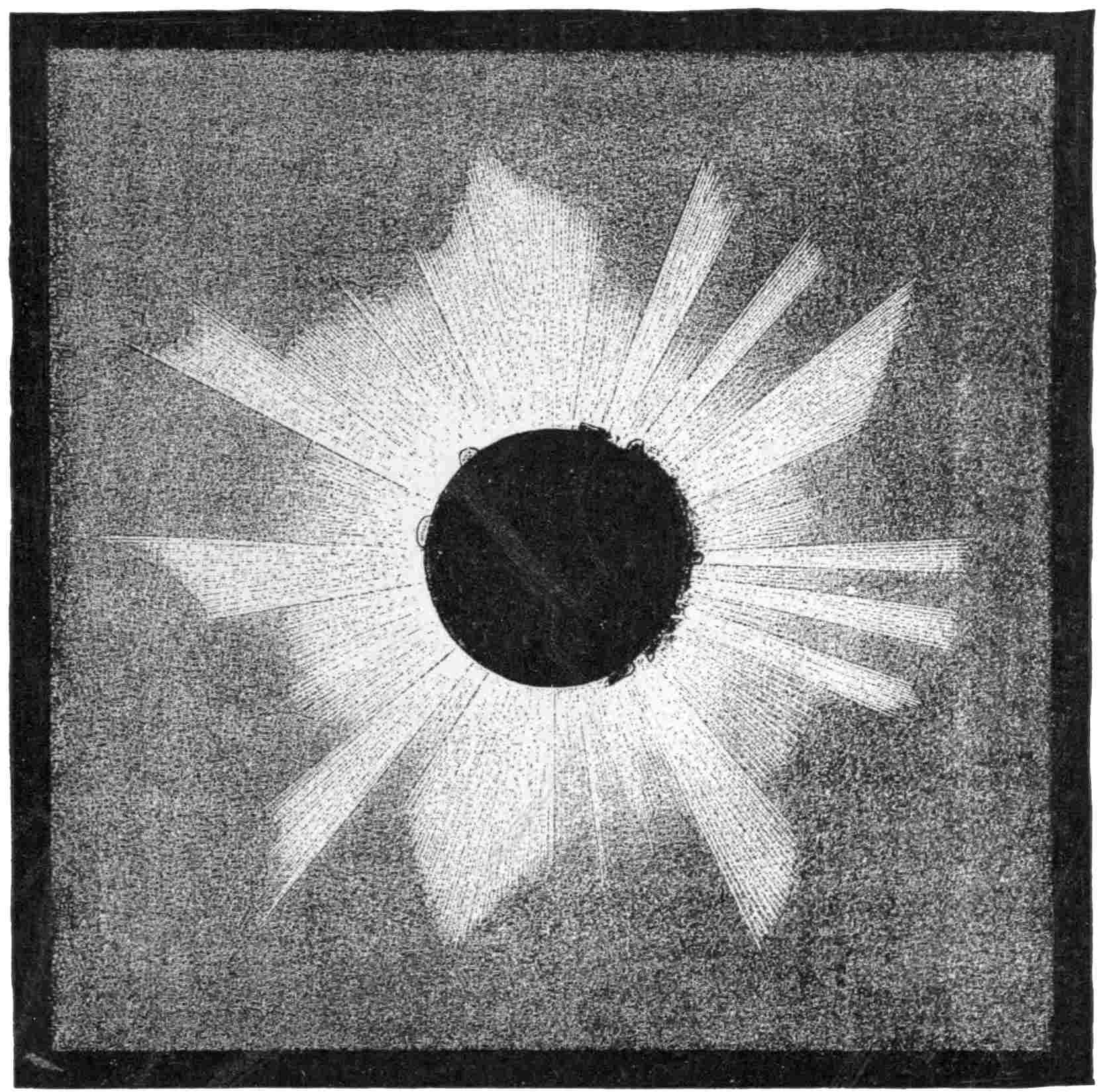
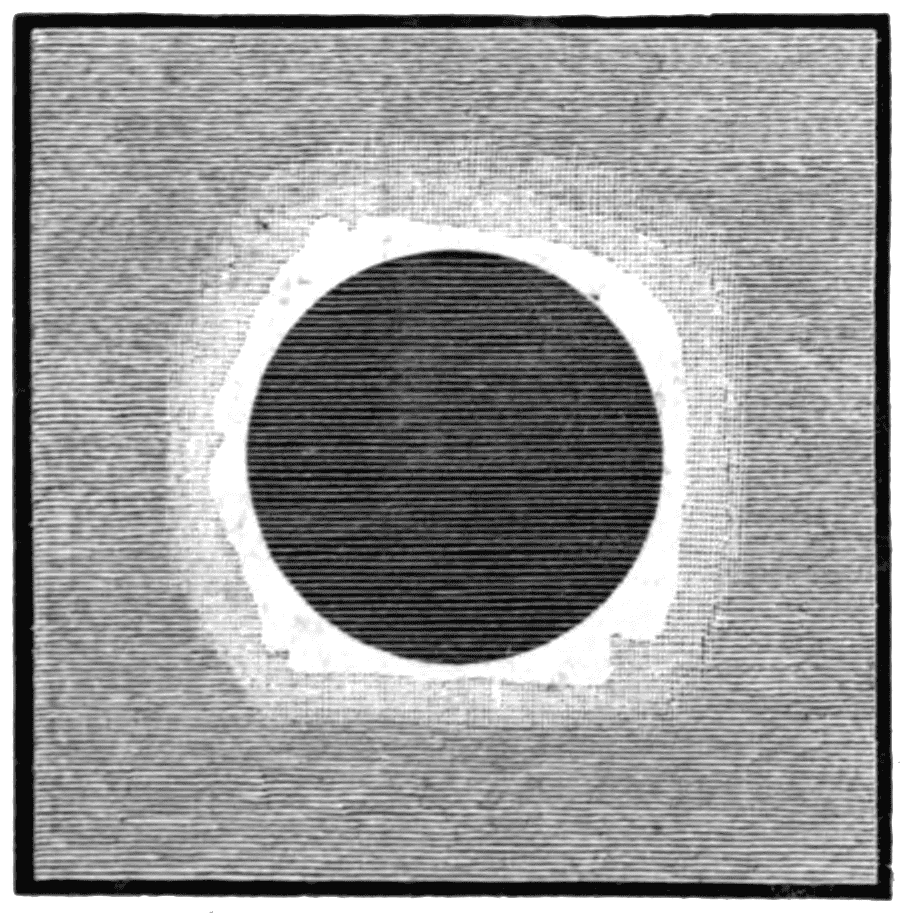
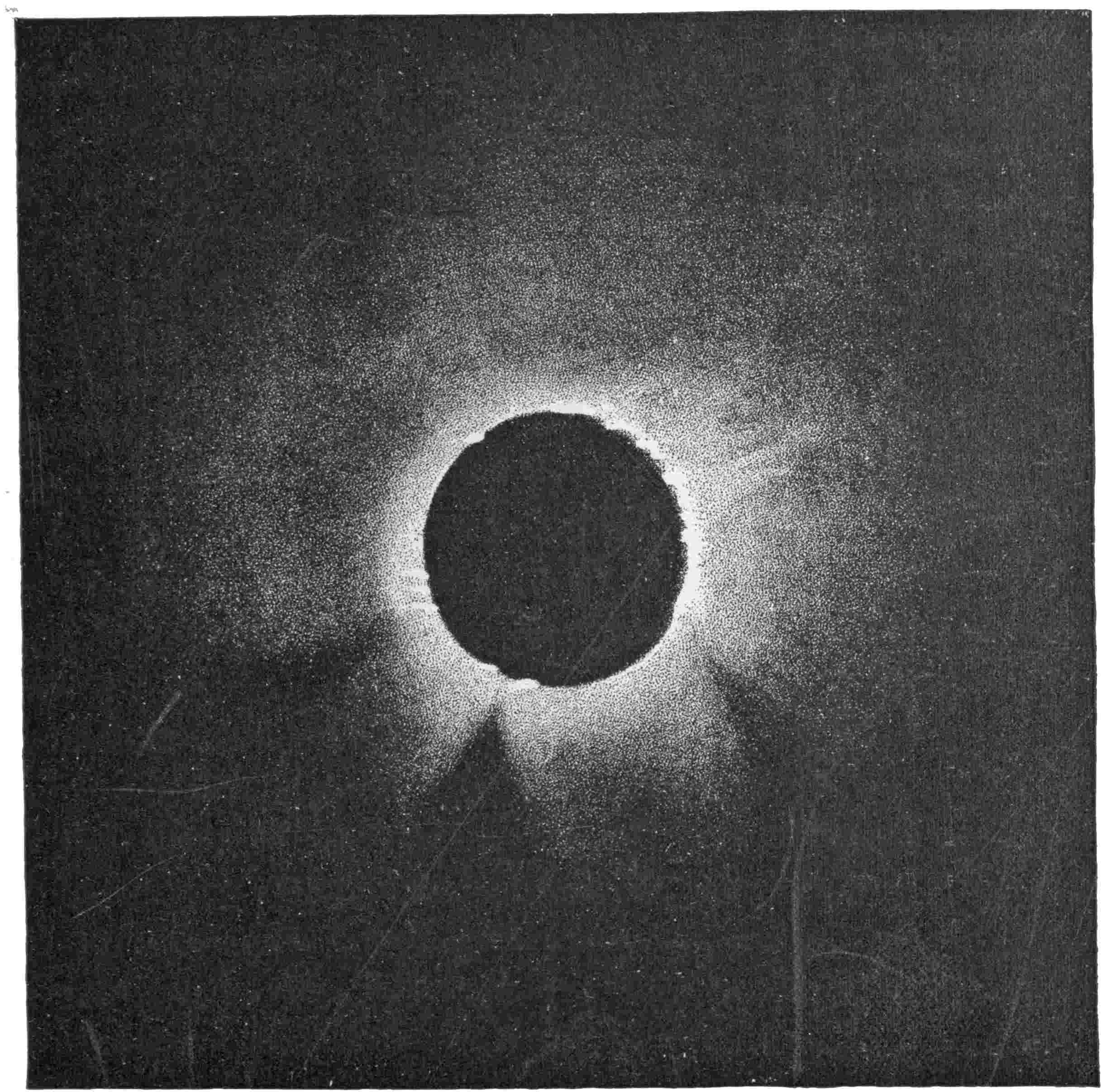
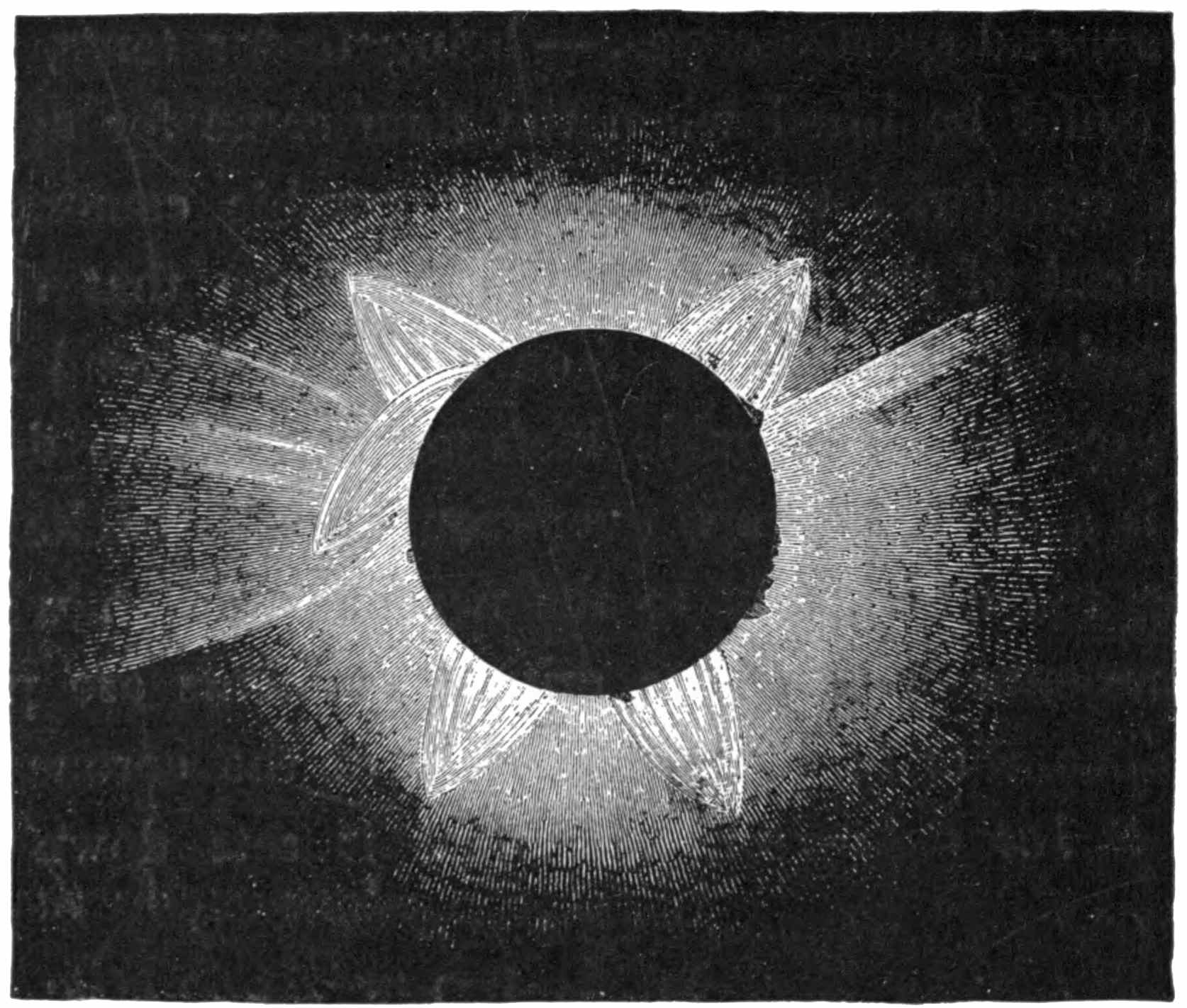
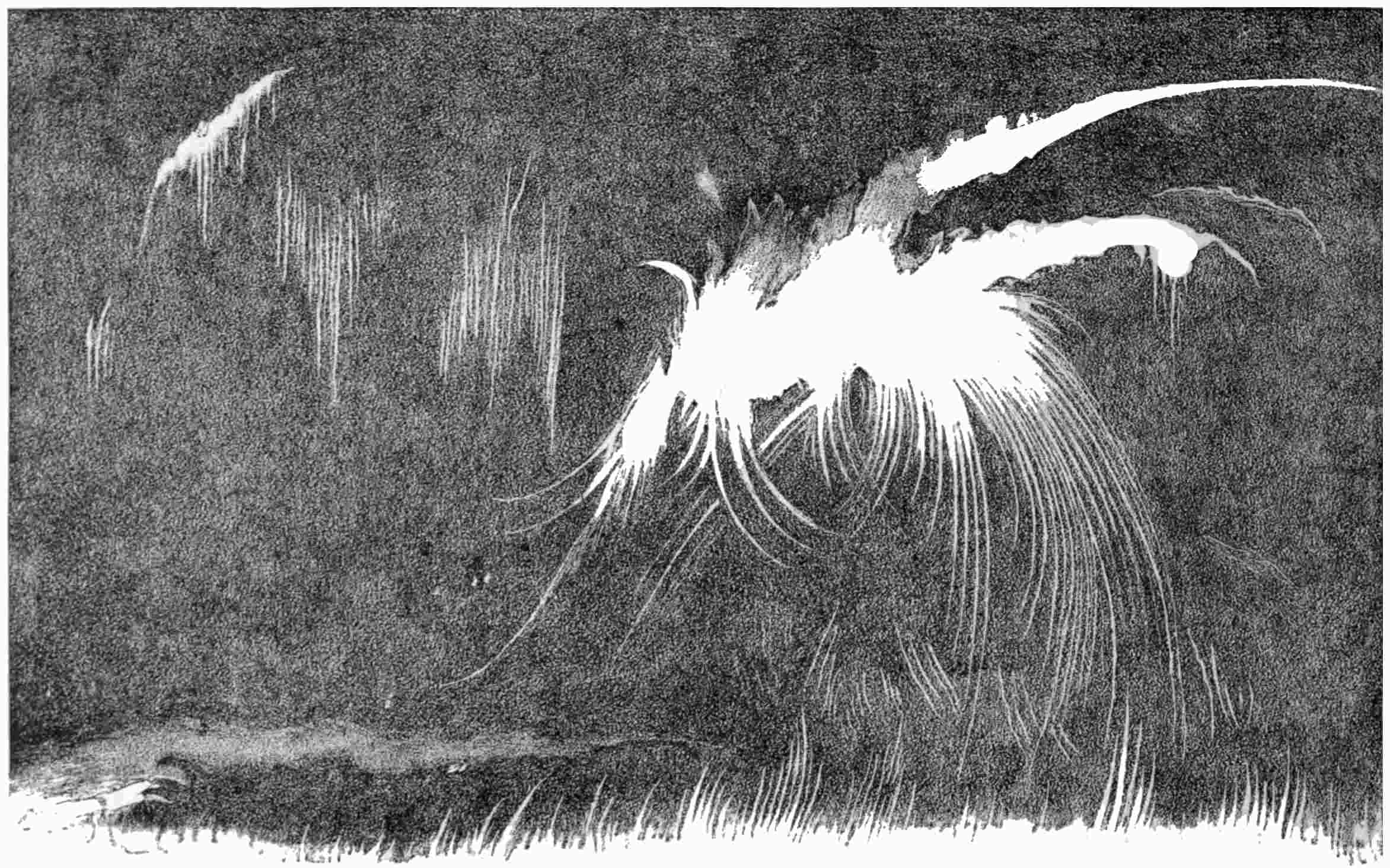
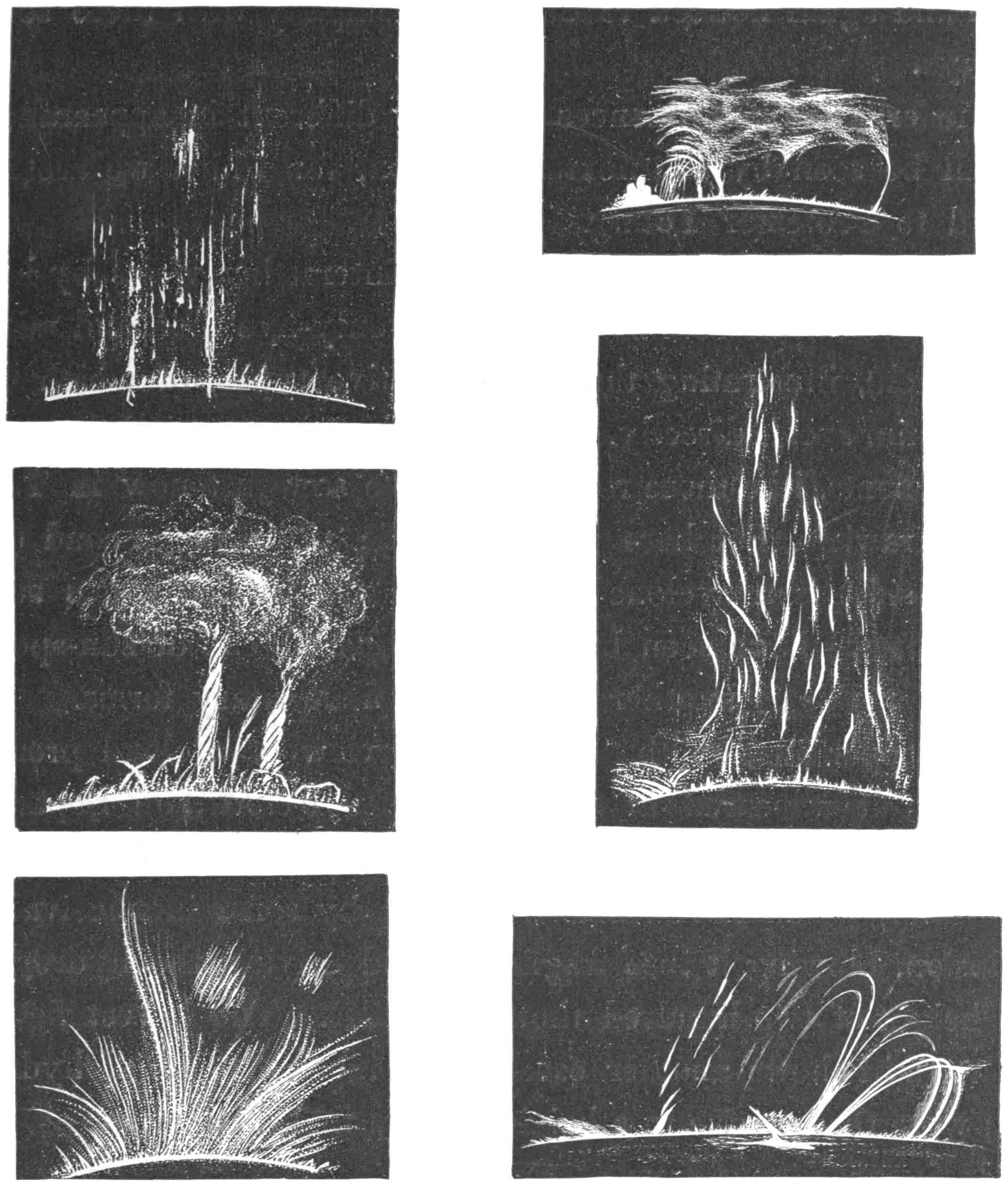
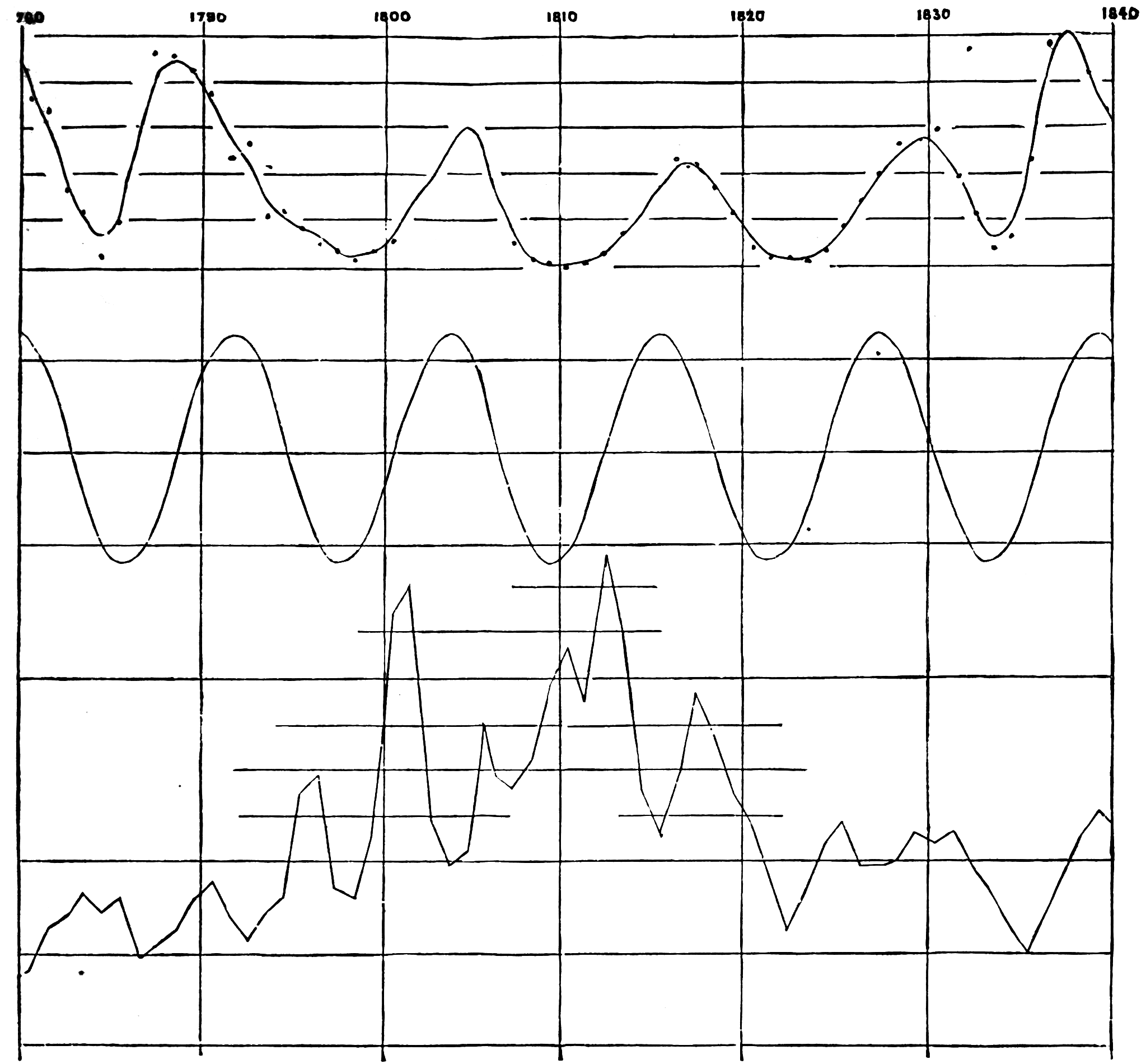
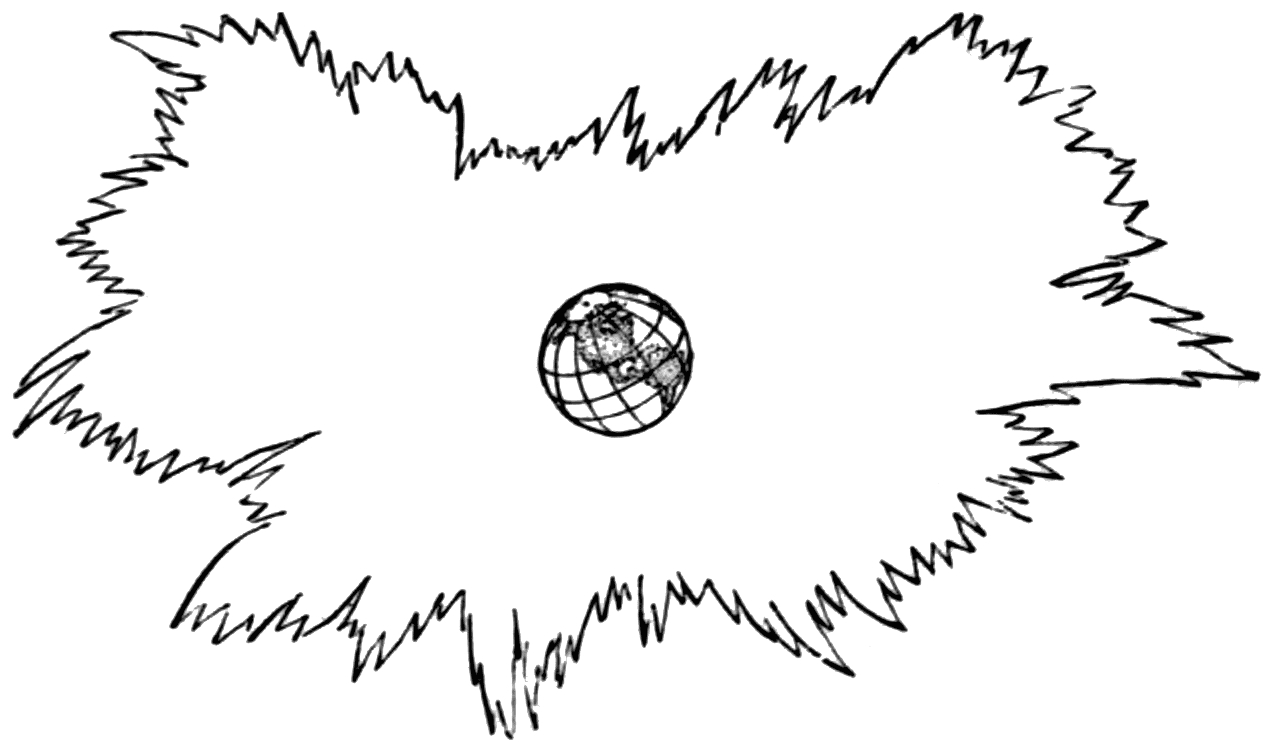
Cover created by Transcriber, using an image
from the original book, and placed in the
Public Domain.
Larger versions of most illustrations may be seen by right-clicking them
and selecting an option to view them separately, or by double-tapping and/or
stretching them.
THE NEW ASTRONOMY
BY
SAMUEL PIERPONT LANGLEY, Ph.D., LL.D.
DIRECTOR OF THE ALLEGHENY OBSERVATORY, MEMBER NATIONAL ACADEMY,
FELLOW ROYAL ASTRONOMICAL SOCIETY, ETC., ETC.
Illustrated
BOSTON. TICKNOR AND COMPANY 211 Tremont Street 1888
Copyright, 1884, 1885, 1886, and 1887, by the Century Co.;
and 1887, by S. P. Langley.
All rights reserved.
University Press: John Wilson and Son, Cambridge.
PREFACE.
I have written these pages, not for the professional reader,
but with the hope of reaching a part of that educated
public on whose support he is so often dependent for the
means of extending the boundaries of knowledge.
It is not generally understood that among us not only the
support of the Government, but with scarcely an exception
every new private benefaction, is devoted to “the Old” Astronomy,
which is relatively munificently endowed already;
while that which I have here called “the New,” so fruitful in
results of interest and importance, struggles almost unaided.
We are all glad to know that Urania, who was in the beginning
but a poor Chaldean shepherdess, has long since become
well-to-do, and dwells now in state. It is far less known than
it should be that she has a younger sister now among us,
bearing every mark of her celestial birth, but all unendowed
and portionless. It is for the reader’s interest in the latter
that this book is a plea.
The visitor to Salisbury Plain sees around him a lonely
waste, utterly barren except for a few recently planted
trees, and otherwise as desolate as it could have been when
Hengist and Horsa landed in Britain; for its monotony is still
unbroken except by the funeral mounds of ancient chiefs, which
dot it to its horizon, and contrast strangely with the crowded life
and fertile soil which everywhere surround its borders. In the
midst of this loneliness rise the rude, enormous monoliths of
Stonehenge,—circles of gray stones, which seem as old as time,
and were there, as we now are told, the temple of a people which
had already passed away, and whose worship was forgotten,
when our Saxon forefathers first saw the place.
In the centre of the inner circle is a stone which is believed
once to have been the altar; while beyond the outmost ring,
quite away to the northeast upon the open plain, still stands a
solitary stone, set up there evidently with some special object
by the same unknown builders. Seen under ordinary circumstances,
it is difficult to divine its connection with the others;
but we are told that once in each year, upon the morning of the
longest day, the level shadow of this distant, isolated stone is
projected at sunrise to the very centre of the ancient sanctuary,
and falls just upon the altar. The primitive man who devised
this was both astronomer and priest, for he not only adored the
risen god whose first beams brought him light and warmth, but
he could mark its place, and though utterly ignorant of its nature,
had evidently learned enough of its motions to embody
his simple astronomical knowledge in a record so exact and so
enduring that though his very memory has gone, common men
are still interested in it; for, as I learned when viewing the
scene, people are accustomed to come from all the surrounding
country, and pass in this desolate spot the short night preceding
the longest day of the year, to see the shadow touch the altar
at the moment of sunrise.
Most great national observatories, like Greenwich or Washington,
are the perfected development of that kind of astronomy
of which the builders of Stonehenge represent the infancy.
Those primitive men could know where the sun would rise on
a certain day, and make their observation of its place, as we see,
very well, without knowing anything of its physical nature. At
Greenwich the moon has been observed with scarcely an intermission
for one hundred and fifty years, but we should mistake
greatly did we suppose that it was for the purpose of seeing
what it was made of, or of making discoveries in it. This immense
mass of Greenwich observations is for quite another purpose,—for
the very practical purpose of forming the lunar
tables, which, by means of the moon’s place among the stars,
will tell the navigator in distant oceans where he is, and conduct
the fleets of England safely home.
In the observatory at Washington one may see a wonderfully
exact instrument, in which circles of brass have replaced circles
of stone, all so bolted between massive piers that the sun can be
observed by it but once daily, as it crosses the meridian. This
instrument is the completed attainment along that long line of
progress in one direction, of which the solitary stone at Stonehenge
marks the initial step,—the attainment, that is, purely of
precision of measurement; for the astronomer of to-day can still
use his circles for the special purpose of fixing the sun’s place
in the heavens, without any more knowledge of that body’s
chemical constitution than had the man who built Stonehenge.
Yet the object of both is, in fact, the same. It is true that
the functions of astronomer and priest have become divided in
the advance of our modern civilization, which has committed the
special cultivation of the religious aspect of these problems to
a distinct profession; while the modern observer has possibly
exchanged the emotions of awe and wonder for a more exact
knowledge of the equinox than was possessed by his primitive
brother, who both observed and adored. Still, both aim at the
common end, not of learning what the sun is made of, but of
where it will be at a certain moment; for the prime object of
astronomy, until very lately indeed, has still been to say where
any heavenly body is, and not what it is. It is this precision
of measurement, then, which has always—and justly—been
a paramount object of this oldest of the sciences, not only as a
good in itself, but as leading to great ends; and it is this which
the poet of Urania has chosen rightly to note as its characteristic,
when he says,—
“That little Vernier, on whose slender lines
The midnight taper trembles as it shines,
Tells through the mist where dazzled Mercury burns,
And marks the point where Uranus returns.”
But within a comparatively few years a new branch of
astronomy has arisen, which studies sun, moon, and stars for
what they are in themselves, and in relation to ourselves. Its
study of the sun, beginning with its external features (and full of
novelty and interest, even, as regards those), led to the further
inquiry as to what it was made of, and then to finding the unexpected
relations which it bore to the earth and our own daily
lives on it, the conclusion being that, in a physical sense, it made
us and re-creates us, as it were, daily, and that the knowledge of
the intimate ties which unite man with it brings results of the
most practical and important kind, which a generation ago were
unguessed at.
This new branch of inquiry is sometimes called Celestial
Physics, sometimes Solar Physics, and is sometimes more
rarely referred to as the New Astronomy. I will call it here
by this title, and try to tell the reader something about it which
may interest him, beginning with the sun.
FIG. 1.—THE SUN’S SURROUNDINGS.
The whole of what we have to say about the sun and stars
presupposes a knowledge of their size and distance, and we may
take it for granted that the reader has at some time or another
heard such statements as that the moon’s distance is two hundred
and forty thousand miles, and the sun’s ninety-three million
(and very probably has forgotten them again as of no practical
concern). He will not be offered here the kind of statistics
which he would expect in a college text-book; but we must
linger a moment on the threshold of our subject—the nature
of these bodies—to insist on the real meaning of such figures
as those just quoted. We are accustomed to look on the sun
and moon as far off together in the sky; and though we know
the sun is greater, we are apt to think of them vaguely as things
of a common order of largeness, away among the stars. It
would be safe to say that though nine out of ten readers have
learned that the sun is larger than the moon, and, in fact, larger
than the earth itself, most of them do not at all realize that the
difference is so enormous that if we could hollow out the sun’s
globe and place the earth in the centre, there would still be so
much room that the moon might go on moving in her present
orbit at two hundred and forty thousand miles from the earth,—all
within the globe of the sun itself,—and have plenty of room
to spare.
As to the distance of ninety-three million miles, a cannon-ball
would travel it in about fifteen years. It may help us to remember
that at the speed attained by the Limited Express on our
railroads a train which had left the sun for the earth when the
“Mayflower” sailed from Delftshaven with the Pilgrim Fathers,
and which ran at that rate day and night, would in 1887 still be
a journey of some years away from its terrestrial station. The
fare at the customary rates, it may be remarked, would be
rather over two million five hundred thousand dollars, so that
it is clear that we should need both money and leisure for the
journey.
Perhaps the most striking illustration of the sun’s distance is
given by expressing it in terms of what the physiologists would
call velocity of nerve transmission. It has been found that sensation
is not absolutely instantaneous, but that it occupies a very
minute time in travelling along the nerves; so that if a child
puts its finger into the candle, there is a certain almost inconceivably
small space of time, say the one-hundredth of a second,
before he feels the heat. In case, then, a child’s arm were long
enough to touch the sun, it can be calculated from this known
rate of transmission that the infant would have to live to be a
man of over a hundred before it knew that its fingers were
burned.
Trying with the help of these still inadequate images, we
may get some idea of the real size and distance of the sun. I
could wish not to have to dwell upon such figures, that seem,
however, indispensable; but we are now done with these, and
are ready to turn to the telescope and see what the sun itself
looks like.
FIG. 2.—VIEW OF THE SUN ON SEPT. 20, 1870.
FIG. 3.—THE SUN ON SEPT. 22, 1870.
(FROM A PHOTOGRAPH)
The sun, as we shall learn later, is a star, and not a particularly
large star. It is, as has been said, “only a private in the
host of heaven,” but it is one of that host; it is one of those
glittering points to which we have been brought near. Let us
keep in mind, then, from the first, what we shall see confirmed
later, that there is an essentially similar constitution in them all,
and not forget that when we study the sun, as we now begin to
do, we are studying the stars also.
If we were called on to give a description of the earth and all
that is on it, it would be easily understood that the task was
impossibly great, and that even an account of its most striking
general features might fill volumes. So it is with the sun; and
we shall find that in the description of the general character of
its immediate surface alone, there is a great deal to be told.
First, let us look at a little conventional representation (Fig. 1),
as at a kind of outline of the unknown regions we are about to
explore. The circle represents the Photosphere, which is simply
what the word implies, that “sphere” of “light” which we have
daily before our eyes, or which we can study with the telescope.
Outside this there is a thin envelope, which rises here and there
into irregular prominences, some orange-scarlet, some rose-pink.
This is the Chromosphere, a thin shell, mainly of crimson and
scarlet tints, invisible even to
the telescope except at the time
of a total eclipse, when alone
its true colors are discernible,
but seen as to its form at all
times by the spectroscope. It
is always there, not hidden in
any way, and yet not seen,
only because it is overpowered
by the intenser brilliancy of the
Photosphere, as a glow-worm’s
shine would be if it were put
beside an electric light. Outside all is the strange shape, which
represents the mysterious Corona, seen by the naked eye in a
total eclipse, but at all other times invisible even to telescope
and spectroscope, and of whose true nature we are nearly ignorant
from lack of opportunity to study it.
FIG. 4.—THE SUN ON SEPT. 26, 1870.
Disregarding other details, let us carry in our minds the three
main divisions,—the Photosphere, or daily visible surface of
the sun, which contains nearly all its mass or substance; the
Chromosphere; and the unsubstantial Corona, which is nevertheless
larger than all the rest. We begin our examination
with the Photosphere.
There are records of spots having been seen with the naked
eye before the invention of the telescope, but they were supposed
to be planets passing between us and the surface; and the
idea that the sun was pure fire, necessarily immaculate, was
taught by the professors of the Aristotelian philosophy in mediæval
schools, and regarded almost as an article of religious faith.
We can hardly conceive, now, the shock of the first announcement
that spots were to be found on the sun, but the notion
partook in contemporary minds at once of the absurd and the
impious; and we notice here, what we shall have occasion to
notice again, that these physical discoveries from the first affect
men’s thoughts in unexpected ways, and modify their scheme
of the moral universe as well as of the physical one.
FIG. 5.—SEPT. 19, 1870.
FIG. 6.—SEPT. 20, 1870.
(ENGRAVED FROM A PHOTOGRAPH BY RUTHERFURD.)
Very little indeed was added to the early observations of
Fabricius and Galileo until a time within the remembrance of
many of us; for it is since the advent of the generation now on
the stage that nine-tenths of the knowledge of the subject has
been reached.
Let us first take a general view of the sun, and afterward
study it in detail. What we see with a good telescope in this
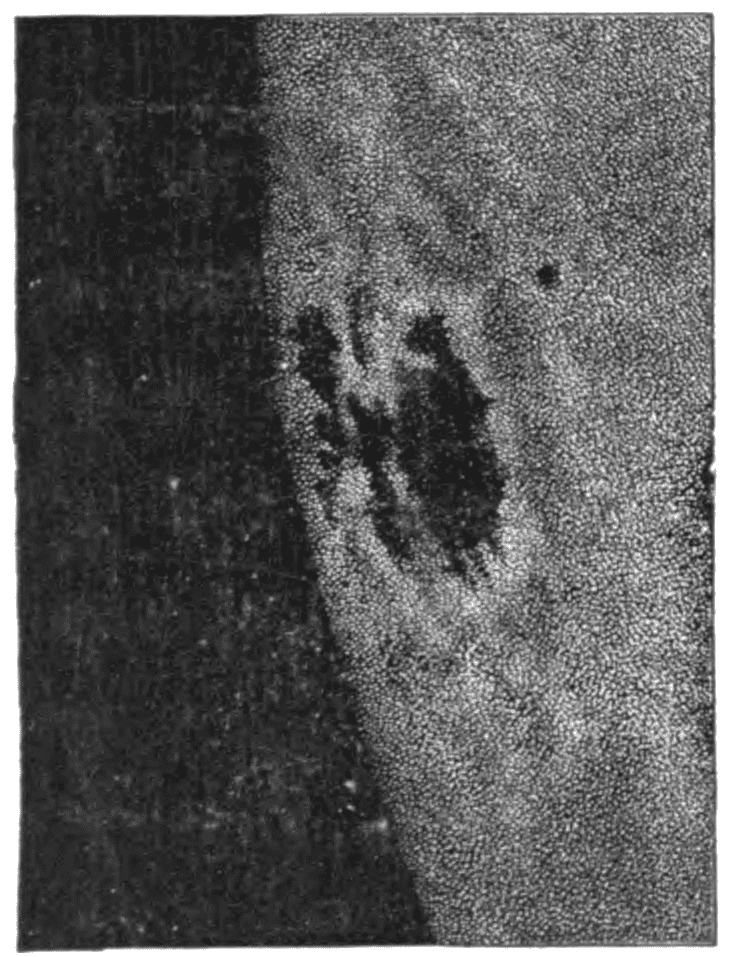
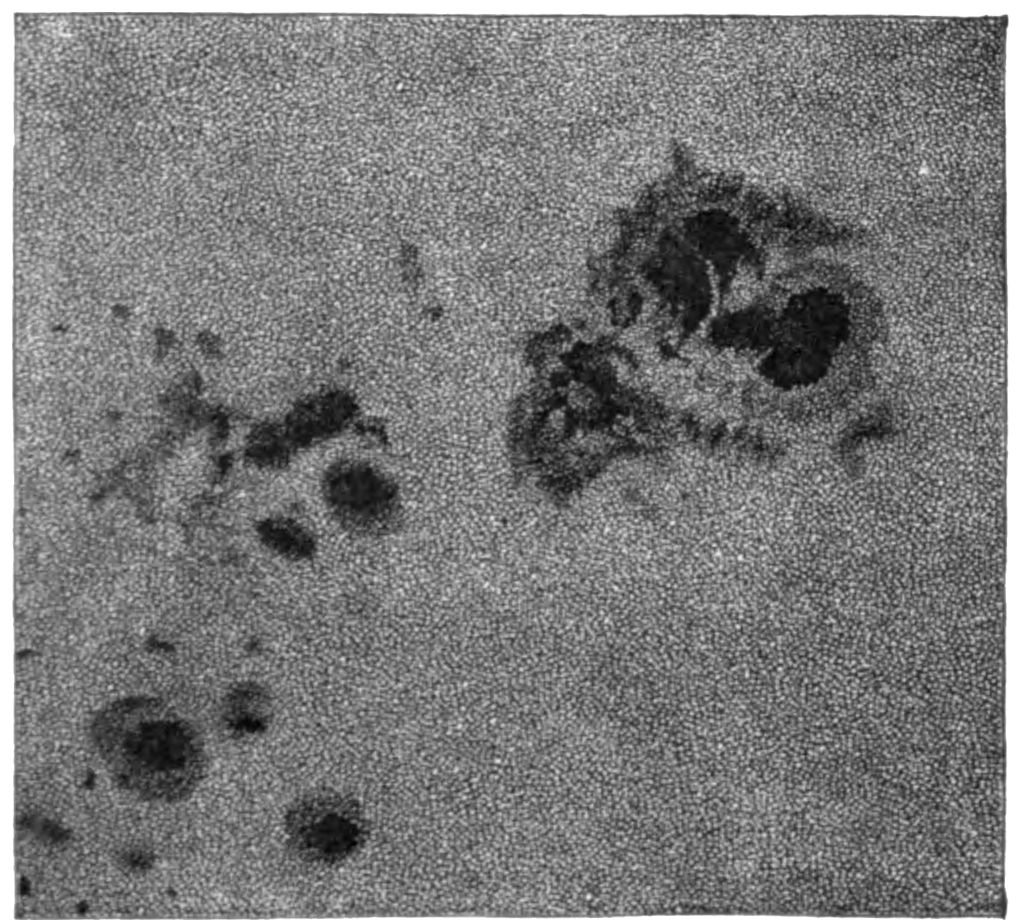
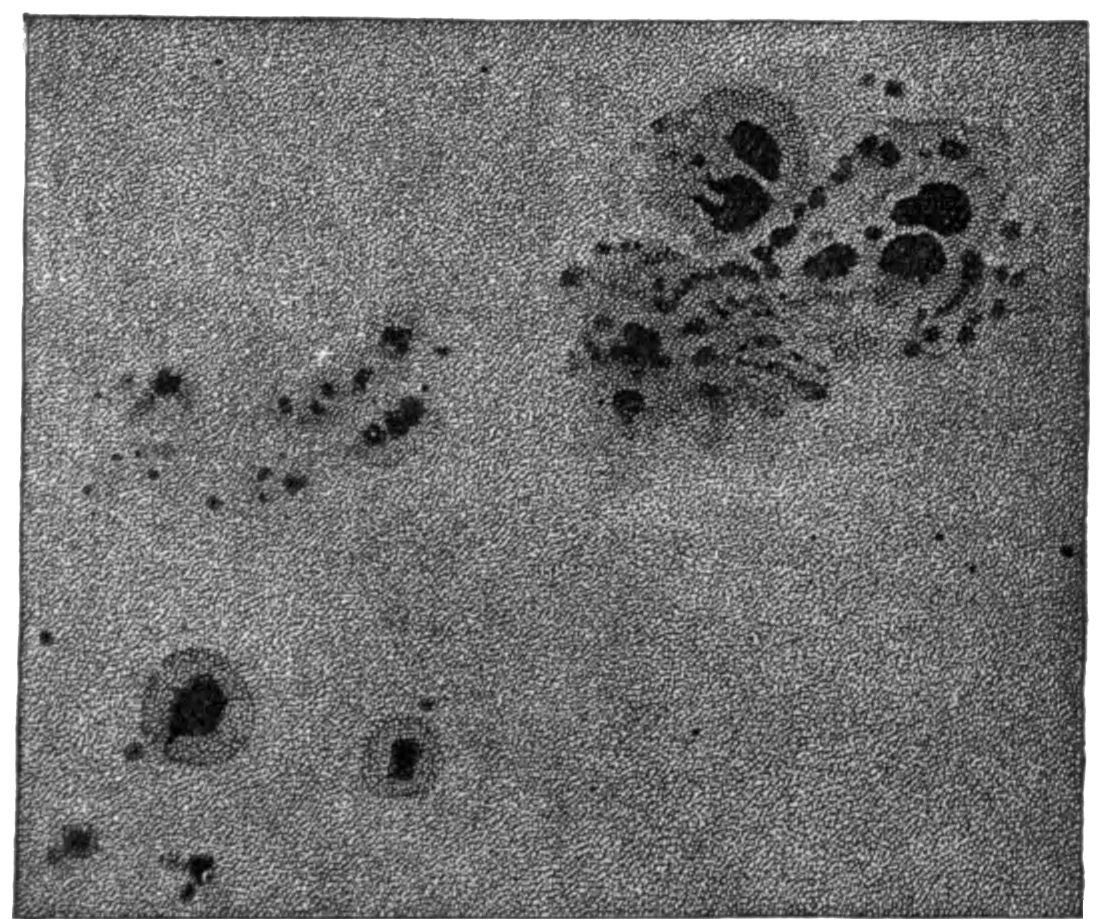
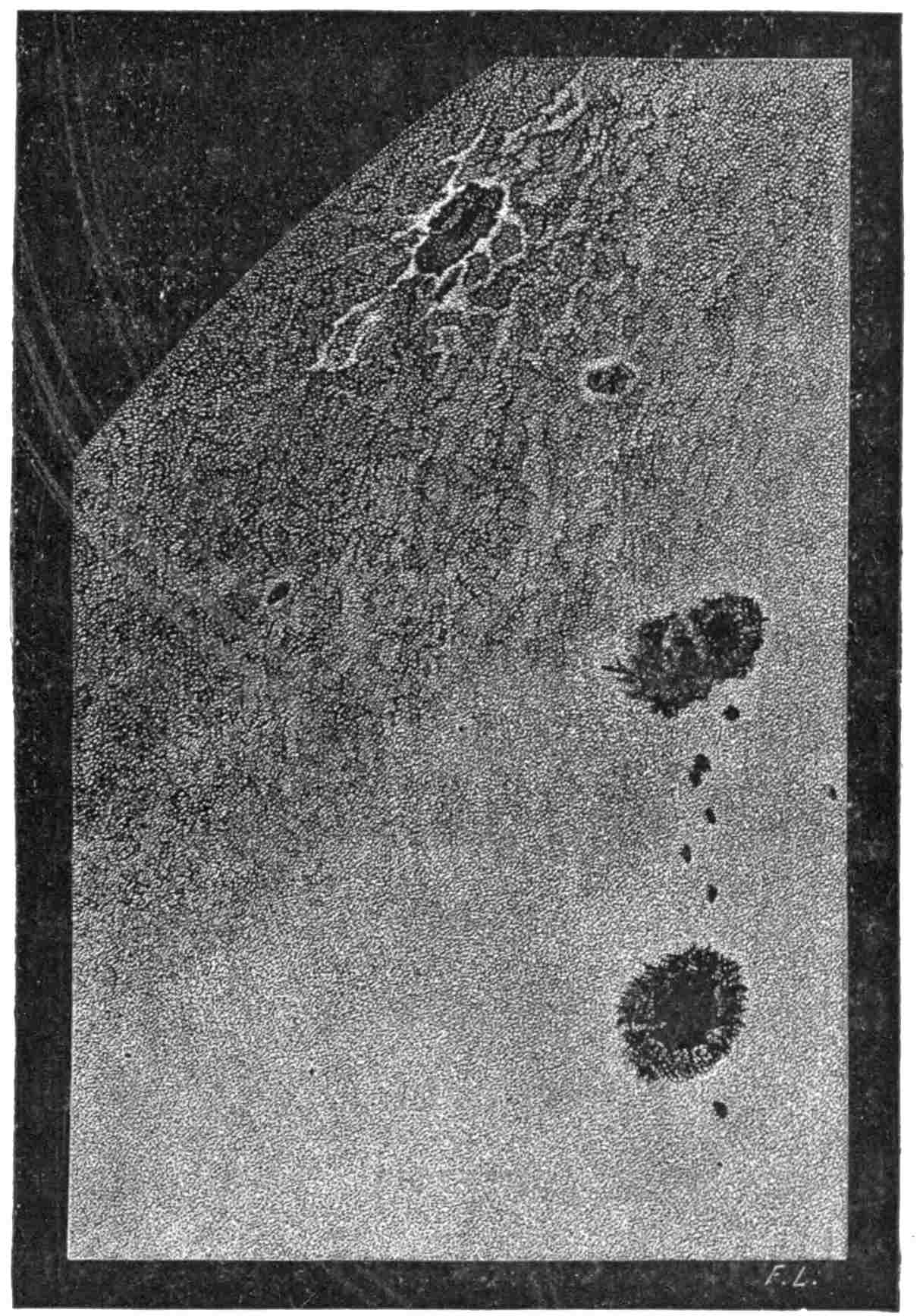
general view is something like this. Opposite are three successive
views (Figs. 2, 3, 4) taken on three successive days,—quite
authentic portraits, since the sun himself made them; they being,
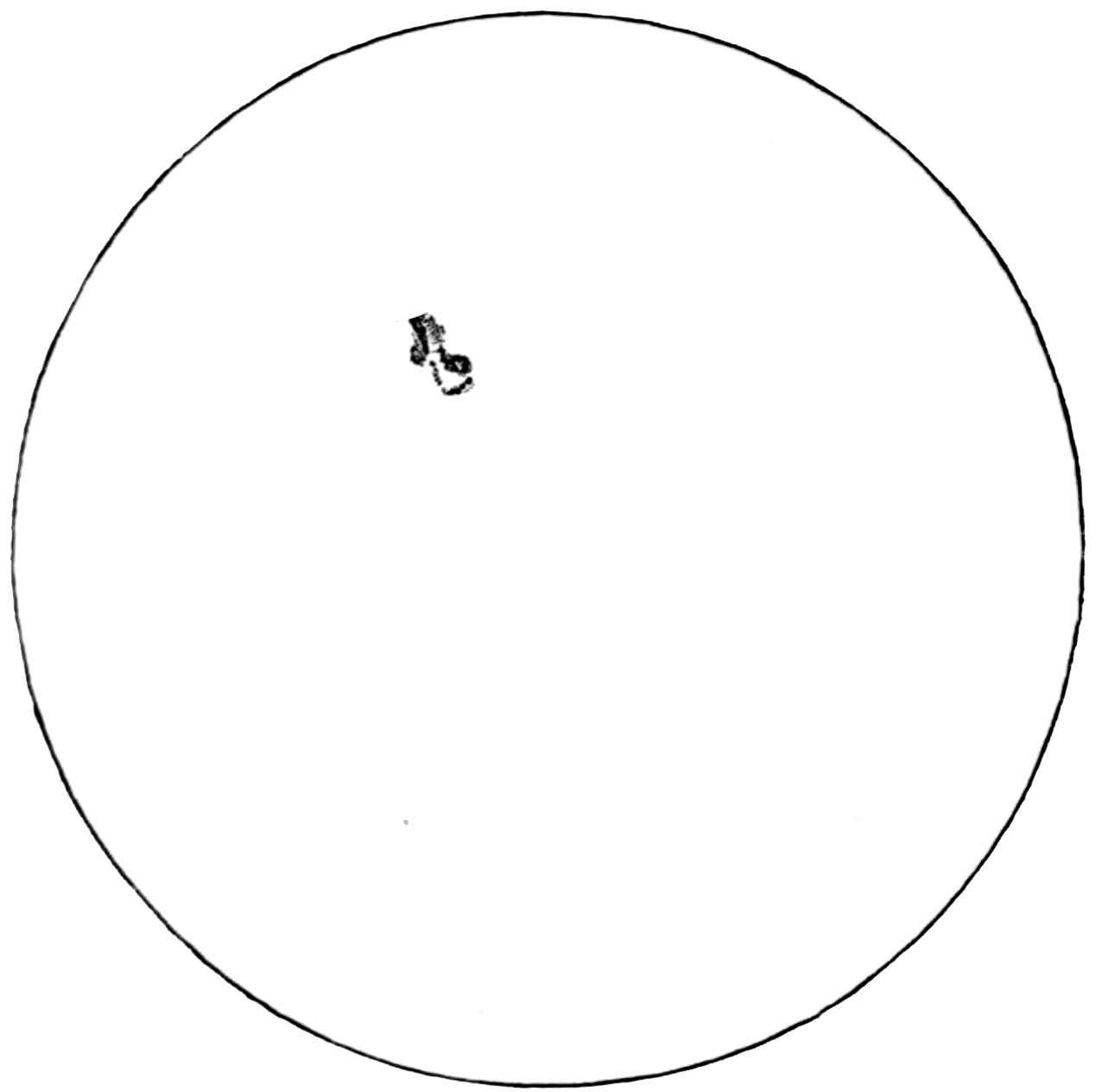
in fact, projected telescopic images which have been fixed for us
by photography, and then exactly reproduced by the engraver.
The first was taken (by Mr. Rutherfurd, of New York) on the
20th of September, 1870, when a remarkably large spot had
come into view. It is seen here not far from the eastern edge
(the left hand in the engraving), and numerous other spots are
also visible. The reader should notice the position of these,
and then on turning to the next view (Fig. 3, taken on September
22d) he will see that they have all shifted their places, by a
common motion toward the west. The great spot on the left
has now got well into view, and we can see its separate parts;
the group which was on the left of the centre has got a little to
the right of it, and so on. From the common motion of them
all, we might suspect that the sun was turning round on an axis
like the earth, carrying the spots with it; and as we continue to
observe, this suspicion becomes certainty. In the third view
(Fig. 4), taken on September 26th, the spot we first saw on the
left has travelled more than half across the disk, while others we
saw on September 20th have approached to the right-hand edge
or passed wholly out of sight behind it. The sun does rotate,
then, but in twenty-five or twenty-six of our days,—I say
twenty-five or twenty-six, because (what is very extraordinary)
it does not turn all-of-a-piece like the earth, but some parts
revolve faster than others,—not only faster in feet and inches,
but in the number of turns,—just as though the rim of a carriage
wheel were to make more revolutions in a mile than the
spokes, and the spokes more than the hub. Of course no solid
wheel could so turn without wrenching itself in pieces, but that
the great solar wheel does, is incontestable; and this alone is a
convincing proof that the sun’s surface is not solid, but liquid or
gaseous.
FIG. 7.—SEPT. 21, 1870.
FIG. 8.—SEPT. 22, 1870.
But let us return to the great spot which we saw coming
round the eastern edge. Possibly the word “great” may seem
misapplied to what was but the size of a pin-head in the first
engraving, but we must remember that the disk of the sun
there shown is in reality over 800,000 miles in diameter. We
shall soon see whether this spot deserves to be called “great”
or not.
FIG. 9.—SEPT. 23, 1870.
FIG. 10.—SEPT. 26, 1870.
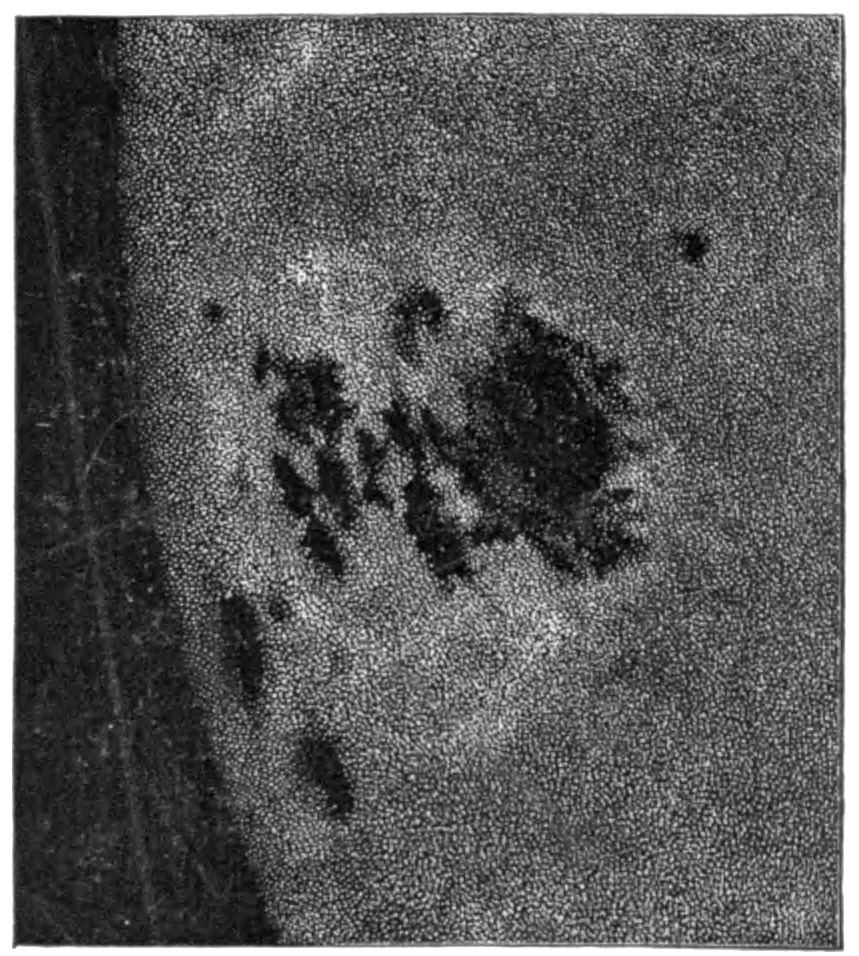
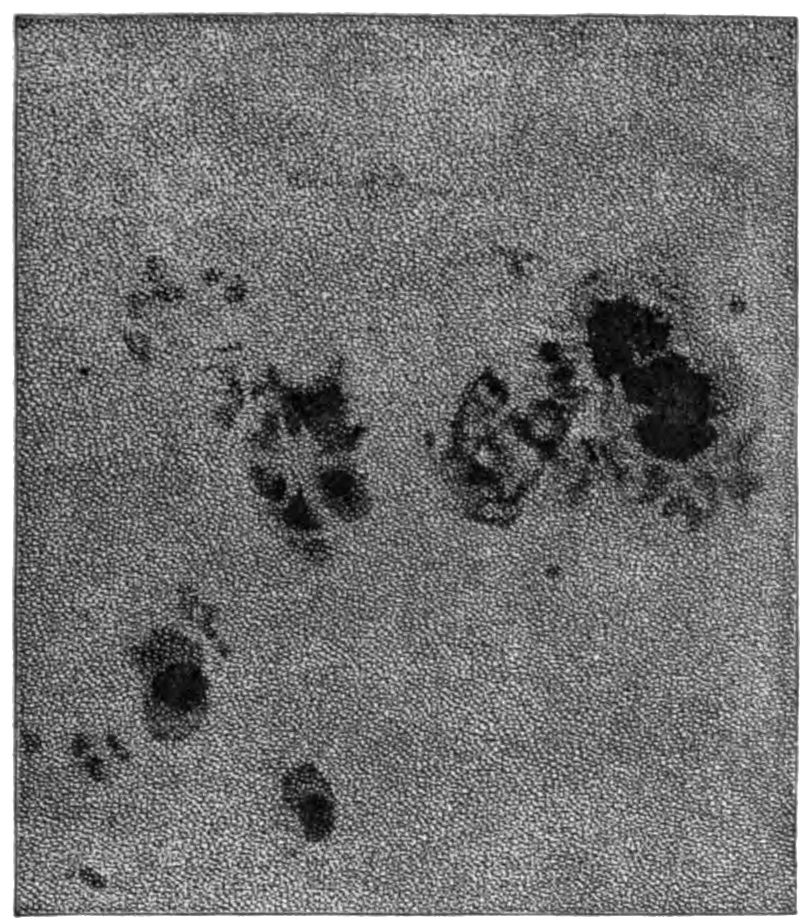
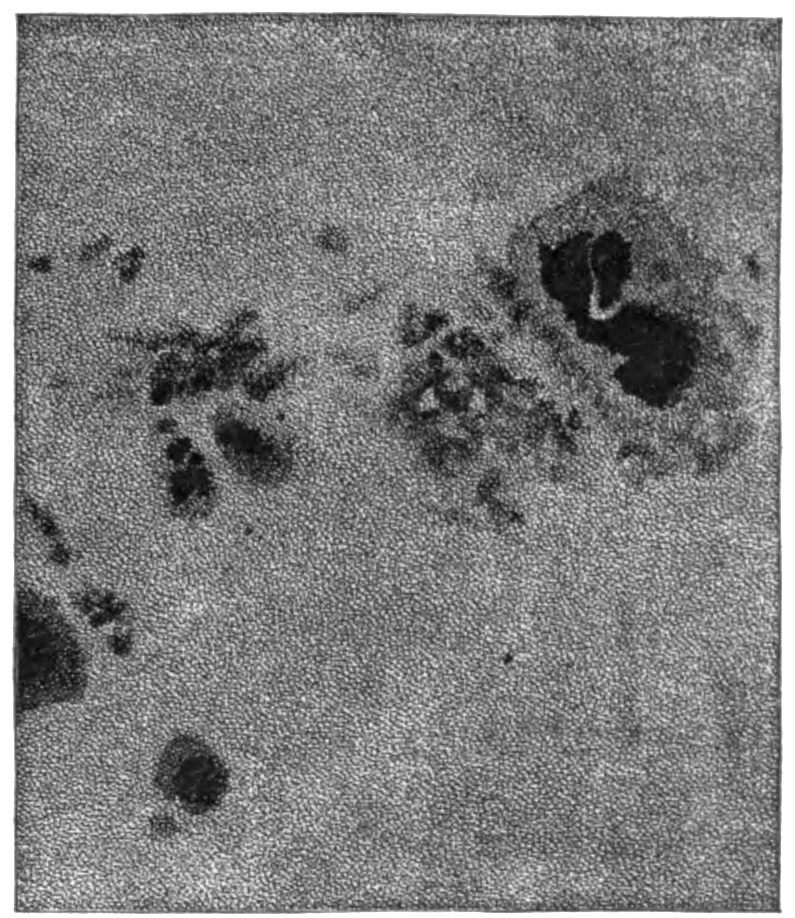
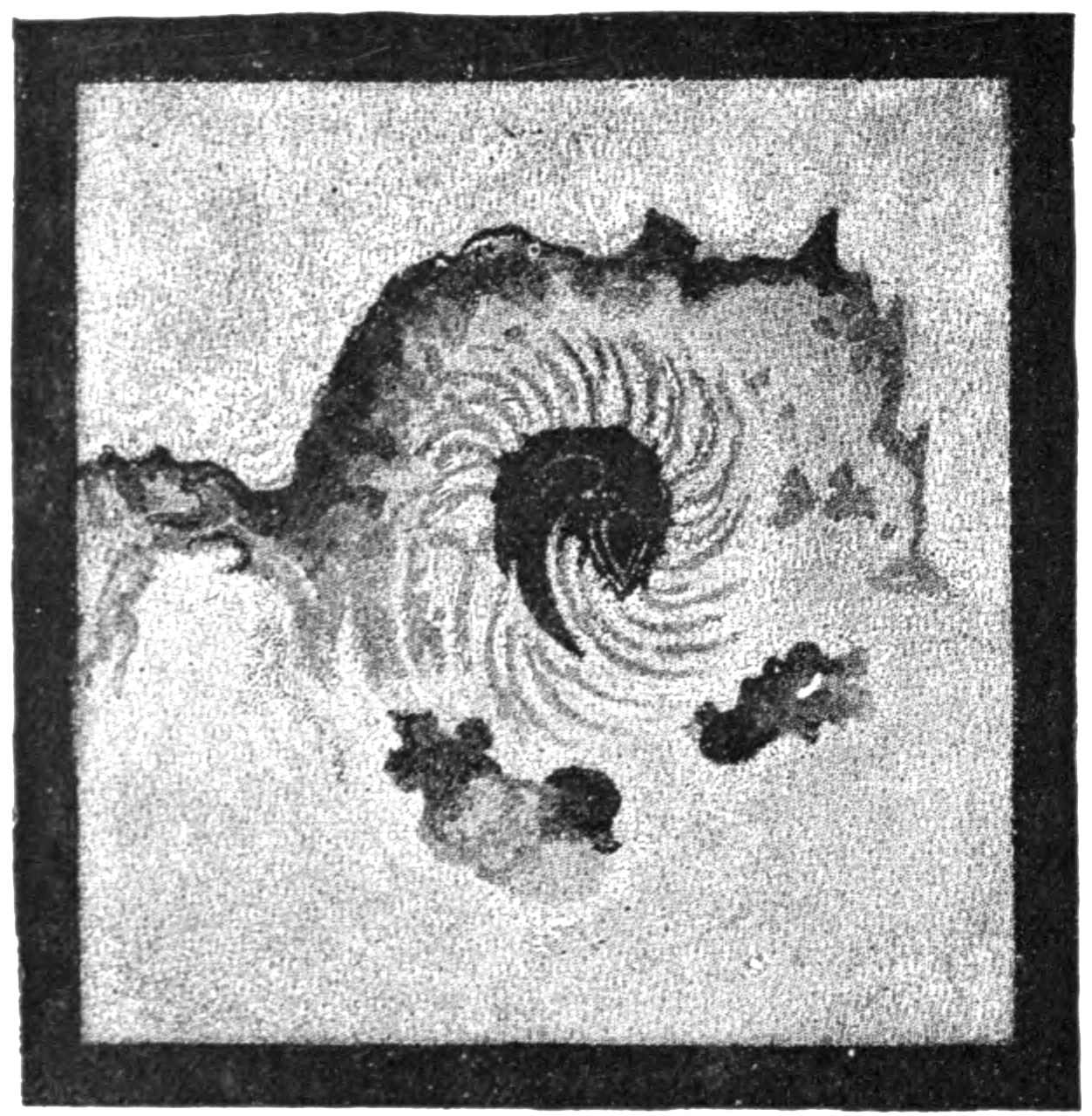
Next we have six enlarged views of it on the 19th, 20th, 21st,
22d, 23d, and 26th. On the 19th it is seen very near the eastern
limb, showing like a great hole in the sun, and foreshortened as
it comes into view around the dark edge; for the edge of the
sun is really darker than the central parts, as it is shown here,
or as one may see even through a smoked glass by careful
attention. On the 20th we have the edge still visible, but on
the 21st the spot has advanced so far that the edge cannot be
shown for want of room. We see distinctly the division of the
spot into the outer shades which constitute the penumbra, and
the inner darker ones which form the umbra and nucleus. We
notice particularly in this enlarged view, by comparing the
appearances on the 21st, 22d, and 23d, that the spot not only
turns with the sun (as we have already learned), but moves and
changes within itself in the most surprising way, like a terrestrial
cloud, which not only revolves with the rest of the globe, but
varies its shape from hour to hour. This is seen still more
plainly when we compare the appearance on the 23d with that
on the 26th, only three days later, where the process has begun
by which the spot finally breaks up and forever disappears. On
looking at all this, the tremendous scale on which the action
occurs must be borne in mind. On the 21st, for instance, the
umbra, or dark central hole, alone was large enough to let
the whole globe of our own earth drop in without touching the
sides! We shall have occasion to recur to this view of the 21st
September again.
FIG. 11.—NASMYTH’S WILLOW LEAVES. (FROM HERSCHEL’S “OUTLINES OF ASTRONOMY.”)
In looking at this spot and its striking changes, the reader
must not omit to notice, also, a much less obvious feature,—the
vaguely seen mottlings which show all over the sun’s surface,
both quite away from the spots and also close to them, and
which seem to merge into them.
I think if we assign one year rather
than another for the birth of the youthful
science of solar physics, it should be
1861, when Kirchhoff and Bunsen published
their memorable research on
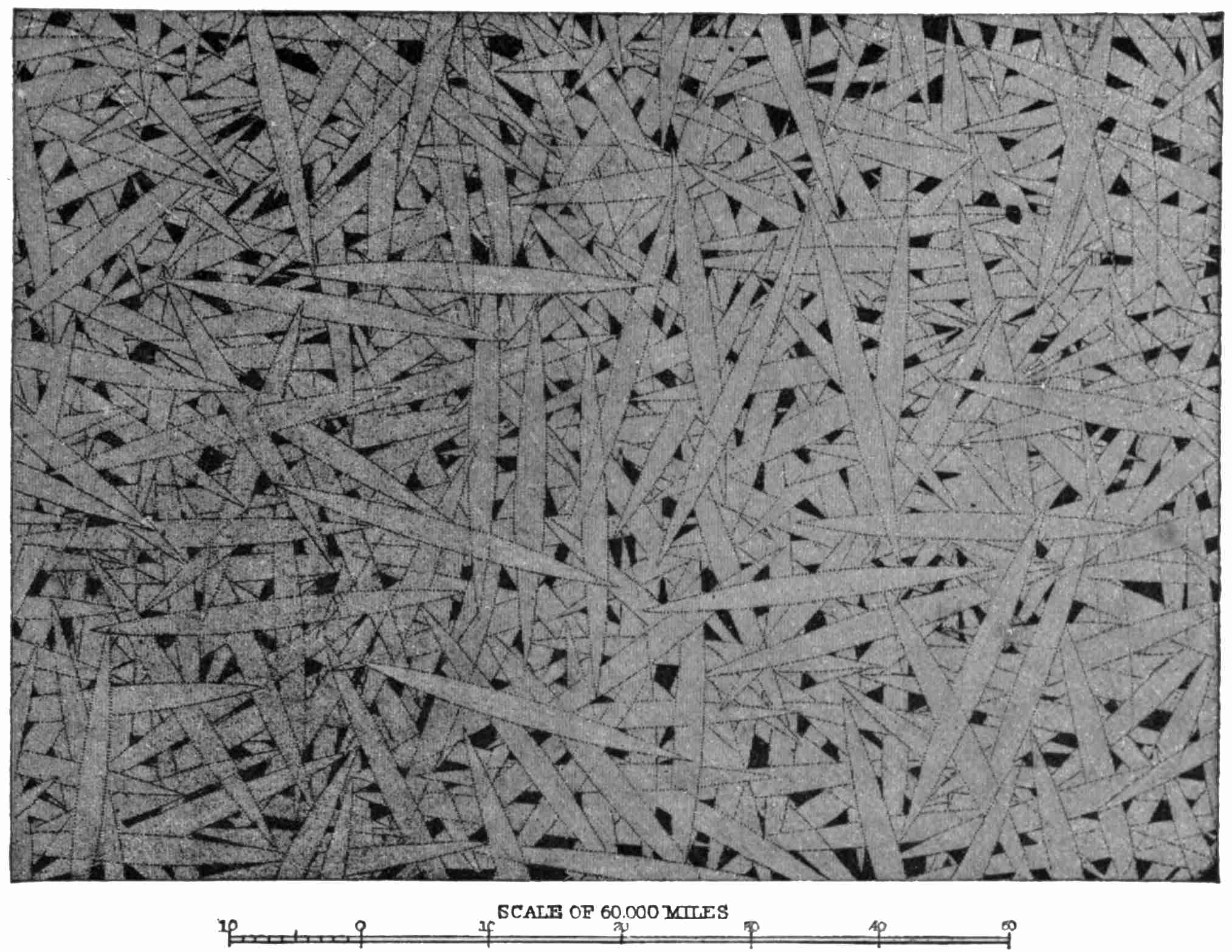
Spectrum Analysis, and when Nasmyth
observed what he called the “willow-leaf”
structure of the solar surface (see
Fig. 11). Mr. Nasmyth, with a very powerful
reflecting telescope, thought he had
succeeded in finding what these faint
mottlings really are composed of, and
believed that he had discovered in them
some most extraordinary things. This is
what he thought he saw: The whole sun is, according to him,
covered with huge bodies of most definite shape, that of the
oblong willow leaf, and of enormous but uniform size; and
the faint mottlings the reader has just noticed are, according to
him, made up of these. “These,” he says, “cover the whole
disk of the sun (except in the space occupied by the spots) in
countless millions, and lie crossing each other in every imaginable
direction.” Sir John Herschel took a particular interest
in the supposed discovery, and, treating it as a matter of
established fact, proceeded to make one of the most amazing
suggestions in explanation that ever came from a scientific
man of deserved eminence. We must remember how much
there is unknown in the sun still, and what a great mystery
even yet overhangs many of our relations to that body which
maintains our own vital
action, when we read the
following words, which are
Herschel’s own. Speaking
of these supposed spindle-shaped
monsters, he says:
“The exceedingly definite
shape of these objects, their
exact similarity to one another,
and the way in which they lie
across and athwart each other,—all
these characters seem
quite repugnant to the notion
of their being of a vaporous, a
cloudy, or a fluid nature. Nothing
remains but to consider
them as separate and independent
sheets, flakes, or scales,
having some sort of solidity.
And these ... are evidently the immediate sources of the solar light and
heat, by whatever mechanism or whatever processes they may be enabled
to develop, and as it were elaborate, these elements from the bosom of the
non-luminous fluid in which they appear to float. Looked at in this point
of view, we cannot refuse to regard them as organisms of some peculiar
and amazing kind; and though it would be too daring to speak of such
organization as partaking of the nature of life, yet we do know that vital
action is competent to develop at once heat and light and electricity.”
FIG. 13.—EQUATORIAL TELESCOPE AND
PROJECTION.
Such are his words; and when we consider that each of these
solar inhabitants was supposed to extend about two hundred by
one thousand miles upon the surface of the fiery ocean, we may
subscribe to Mr. Proctor’s comment, that “Milton’s picture of
him who on the fires of hell ‘lay floating many a rood,’ seems
tame and commonplace compared with Herschel’s conception of
these floating monsters, the least covering a greater space than
the British Islands.”
FIG. 14.—POLARIZING EYE-PIECE.
I hope I may not appear wanting in respect for Sir John
Herschel—a man whose memory I reverence—in thus citing
views which, if his honored life could have been prolonged, he
would have abandoned. I
do so because nothing else
can so forcibly illustrate
the field for wonder and
wild conjecture solar physics
presented even a few
years ago; and its supposed
connection with that
“Vital Force,” which was
till so lately accepted by physiology, serves as a kind of landmark
on the way we have come.
This new science of ours, then, youthful as it is, has already
had its age of fable.
After a time Nasmyth’s observation was attributed to imperfect
definition, but was not fairly disproved. He had, indeed, a
basis of fact for his statement, and to him belongs the credit of
first pointing out the existence of this minute structure, though
he mistook its true character. It will be seen later how the real
forms might be mistaken for leaves, and in certain particular
cases they certainly do take on a very leaf-like appearance.
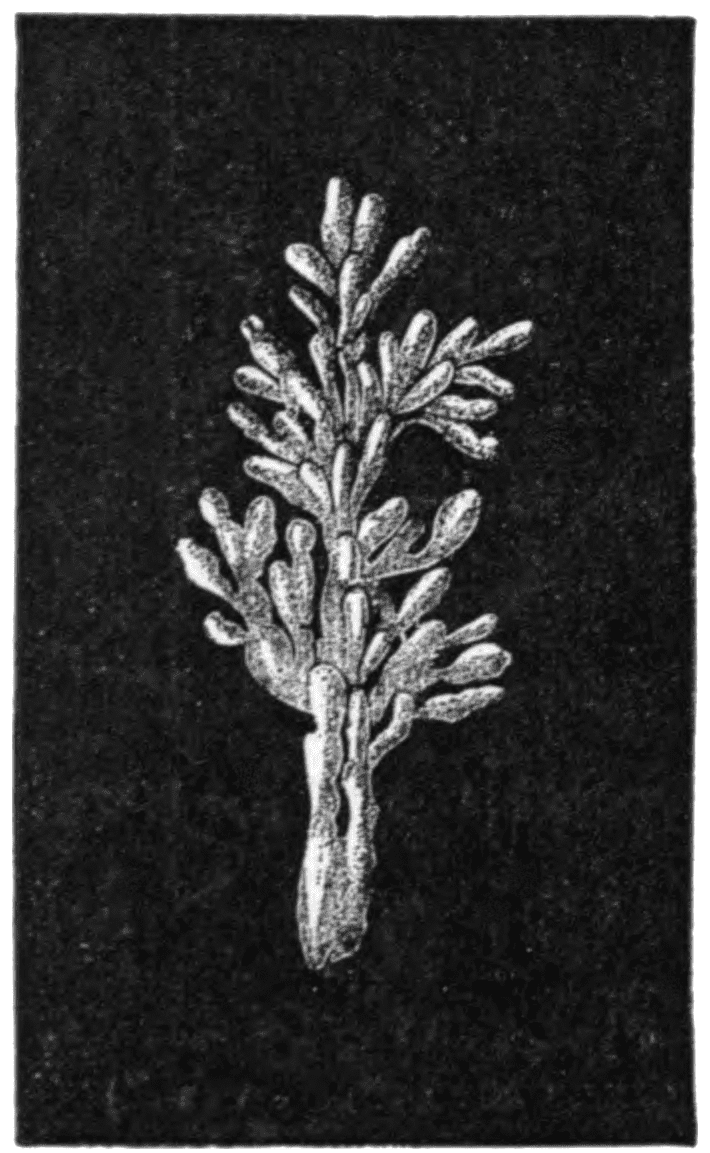
Here is a drawing (Fig. 12) which Father Secchi gives of some
of them in the spot of April 14, 1867, and which he compares
to a branch of cactus. He remarks somewhere else that they
resemble a crystallization of sal-ammoniac, and calls them veils
of most intricate structure. This was the state of our knowledge
in 1870, and it may seem surprising that such wonderful statements
had not been proved or disproved, when they referred
to mere matters of observation. But direct observation is here
very difficult on account of the incessant tremor and vibration
of our own atmosphere.
FIG. 15.—SPOT OF SEPT. 21, 1870. (REDUCED FROM AN ORIGINAL DRAWING BY S. P. LANGLEY.)
FIG. 16.—SPOT OF MARCH 5, 1873. (REDUCED FROM AN ORIGINAL DRAWING BY S. P. LANGLEY.)
The surface of the sun may be compared to an elaborate
engraving, filled with the closest and most delicate lines and
hatchings, but an engraving which during ninety-nine hundredths
of the time can only be seen across such a quivering
mass of heated air as makes everything confused and liable to
be mistaken, causing what is definite to look like a vaguely seen
mottling. It is literally true that the more delicate features we
are about to show, are only distinctly visible even by the best
telescope during less than one-hundredth of the time, coming
out as they do in brief instants when our dancing air is momentarily
still, so that one who has sat at a powerful telescope all
day is exceptionally lucky if he has secured enough glimpses
of the true structure to aggregate five minutes of clear seeing,
while at all other times the attempt to magnify only produces
a blurring of the image. This study, then, demands not only
fine telescopes and special optical aids, but endless patience.
FIG. 17.—SUN ON MARCH 5, 1873. (FROM A DRAWING
BY S. P. LANGLEY.)
My attention was first particularly directed to the subject in
1870 (shortly after the regular study of the Photosphere was
begun at the Allegheny Observatory by means of its equatorial
telescope of thirteen inches’ aperture), with the view of
finding out what this vaguely seen structure really is. Nearly
three years of constant watching were given to obtain the results
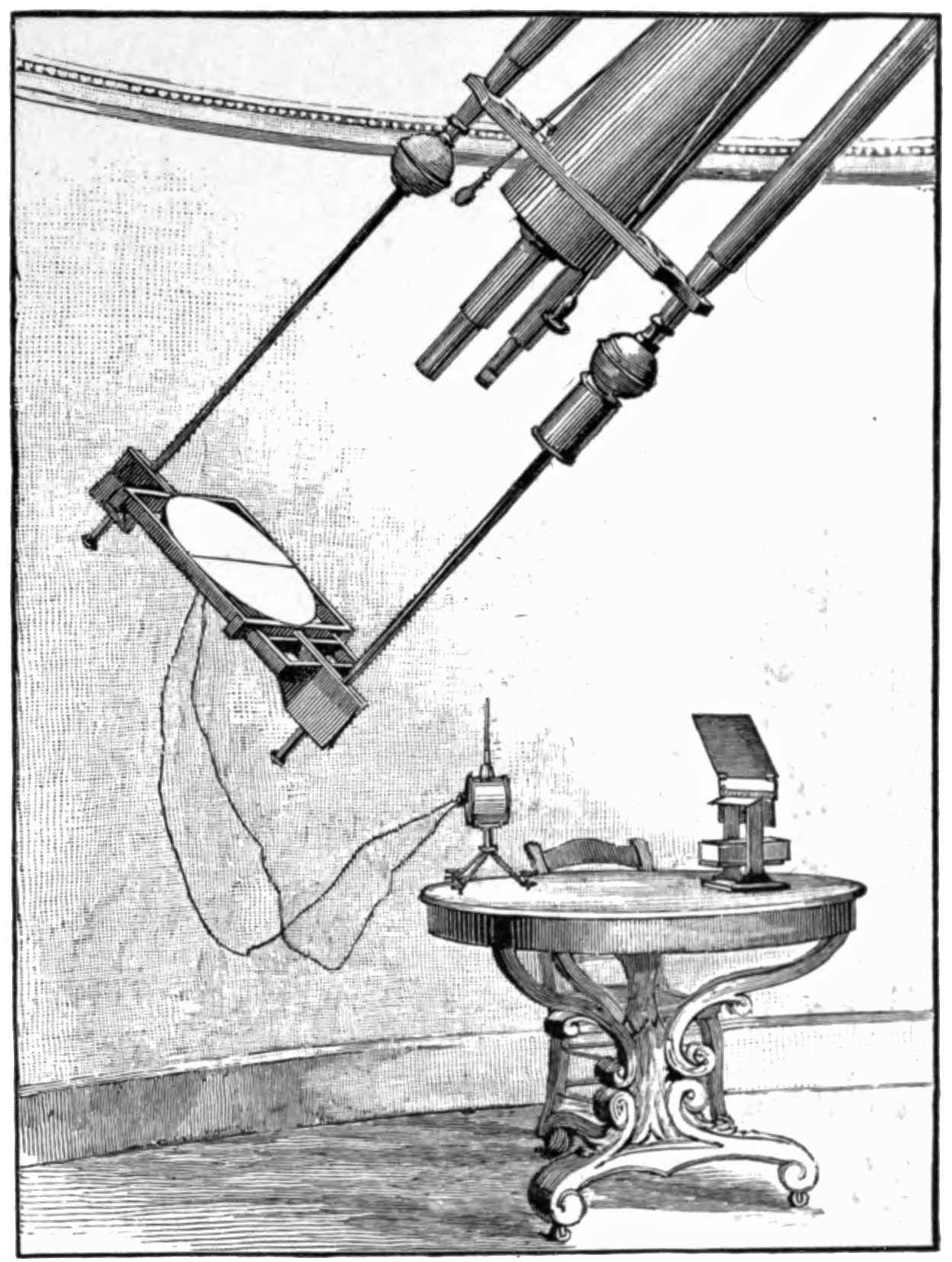
which follow. The method I have used for it is indicated in the
drawing (Fig. 13), which shows the preliminary step of projecting
the image of the sun directly upon a sheet of paper, divided
into squares and attached to the eye-end of a great equatorial
telescope. When this is directed to the sun in a darkened dome,
the solar picture is formed upon the paper as in a camera
obscura, and this picture can be made as large or as small as
we please by varying the lenses which project it. As the sun
moves along in the sky, its image moves across the paper; and
as we can observe how long the whole sun (whose diameter in
miles is known) takes to cross, we can find how many miles
correspond to the time it
is in crossing one of the
squares, and so get the
scale of the future drawing,
and the true size in
miles of the spot we are
about to study. Then a
piece of clock-work attached
to the telescope is
put in motion, and it begins
to follow the sun
in the sky, and the spot
appears fixed on the paper.
A tracing of the
spot’s outline is next
made, but the finer details are not to be observed by this
method, which is purely preliminary, and only for the purpose
of fixing the scale and the points of the compass (so to speak) on
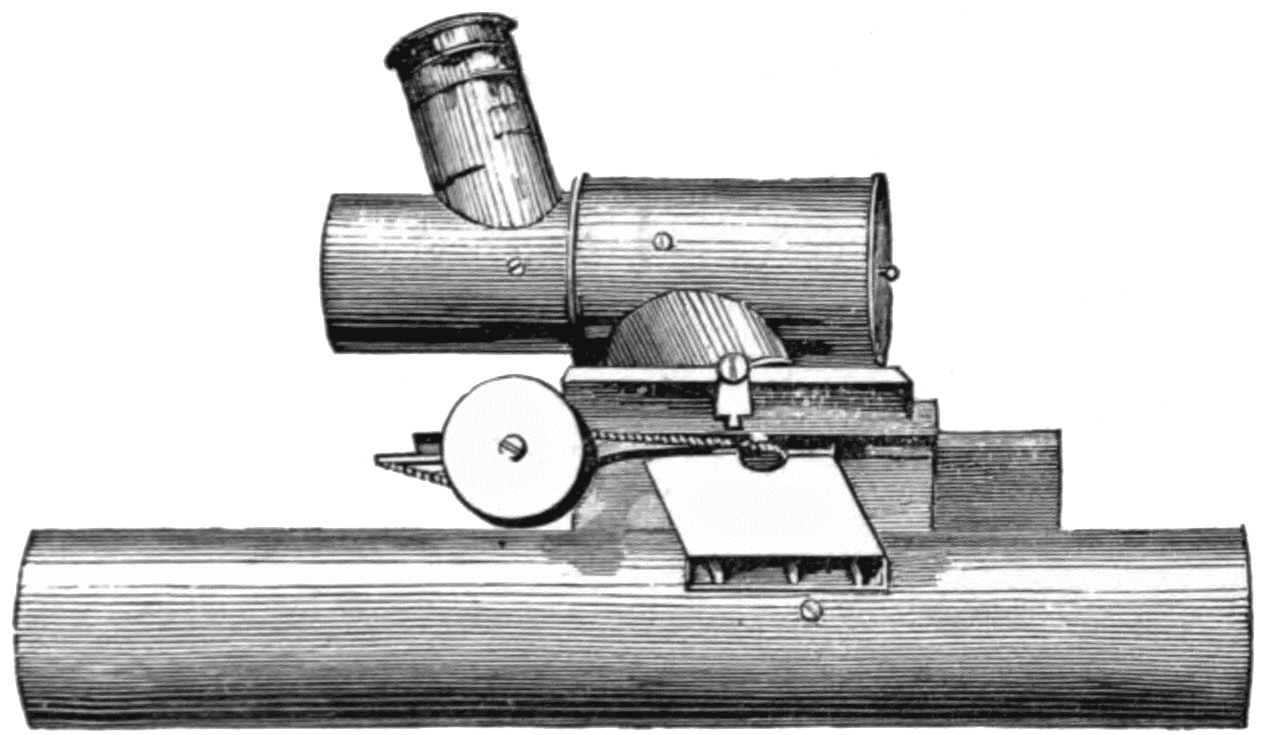
the sun’s face. The projecting apparatus is next removed and
replaced by the polarizing eye-piece. Sir William Herschel
used to avoid the blinding effects of the concentrated solar light
by passing the rays through ink and water, but the phenomena
of “polarization” have been used to better advantage in modern
apparatus. This instrument, one of the first of its kind ever
constructed, and in which the light is polarized with three successive
reflections through the three tubes seen in the drawing
(Fig. 14), was made in Pittsburgh as a part of the gift of apparatus
by one of its citizens to the Observatory, and has been
most useful. By its aid the eye can be safely placed where the
concentrated heat would otherwise melt iron. In practice I
have often gazed through it at the sun’s face without intermission
from four to five hours, with no more fatigue or harm to
the eye than in reading a book. By its aid the observer fills in
the outline already projected on the paper.
FIG. 18.—“THE PLUME” SPOT OF MARCH 5 AND
6, 1873. (FROM AN ORIGINAL DRAWING BY S. P.
LANGLEY.)
The photograph has transported us already so near the sun’s
surface that we have seen details there invisible to the naked
eye. We have seen that
what we have called “spots”
are indeed regions whose
actual vastness surpasses
the vague immensity of a
dream, and it will not cause
surprise that in them is a
temperature which also surpasses
greatly that of the
hottest furnace. We shall
see later, in fact, that the
whole surface is composed
largely of metals turned
into vapor in this heat, and
that if we could indeed
drop our great globe itself upon the sun, it would be dissipated
as a snow-flake. Now, we cannot suppose this great space is
fully described when we have divided it into the penumbra,
umbra, and nucleus, or that the little photograph has shown us
all there is, and we rather anticipate that these great spaces must
be filled with curious things, if we could get near enough to see
them. We cannot advantageously enlarge our photograph further;
but if we could really come closer, we should have the
nearer view that the work at Allegheny, I have just alluded to,
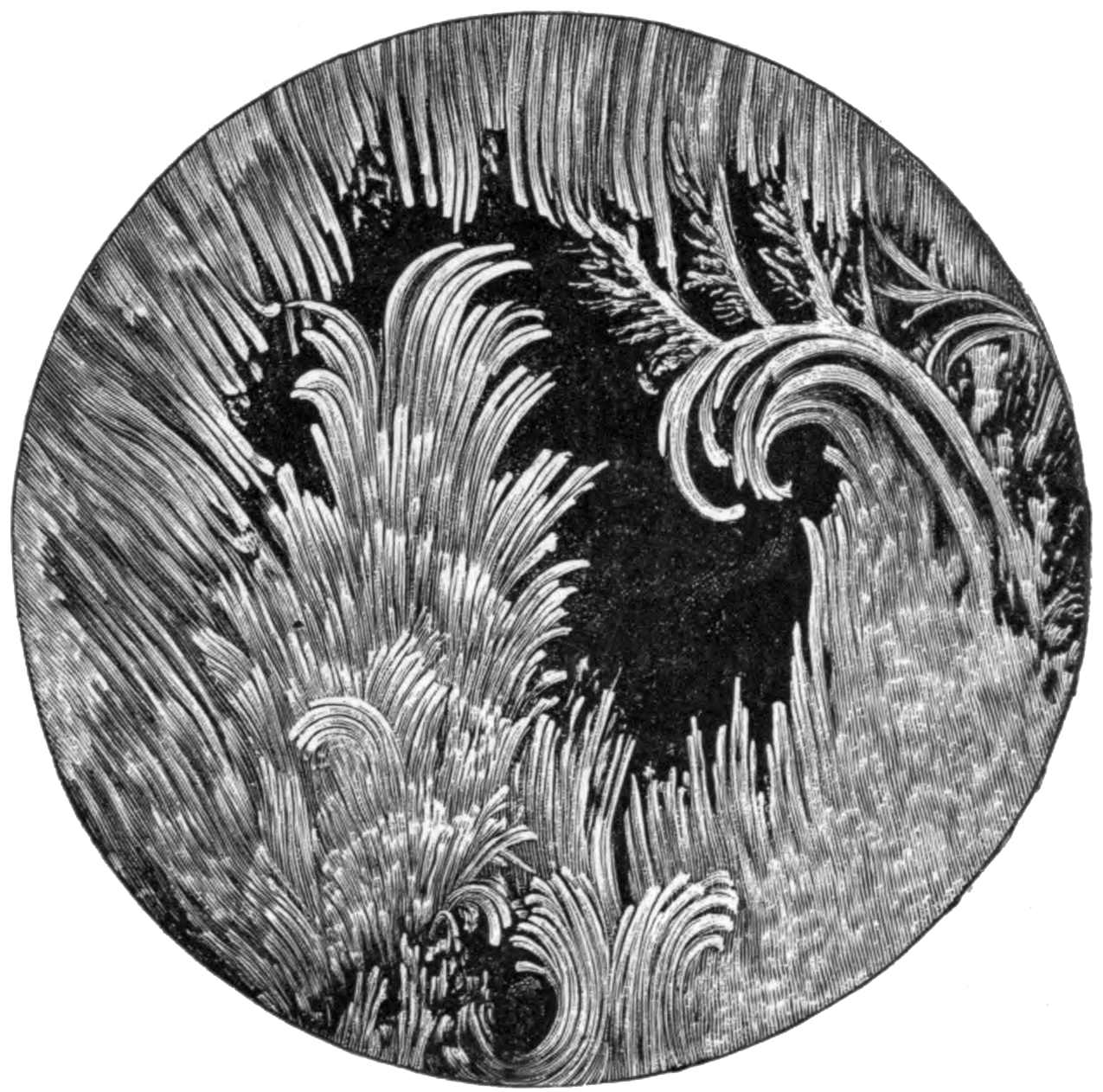
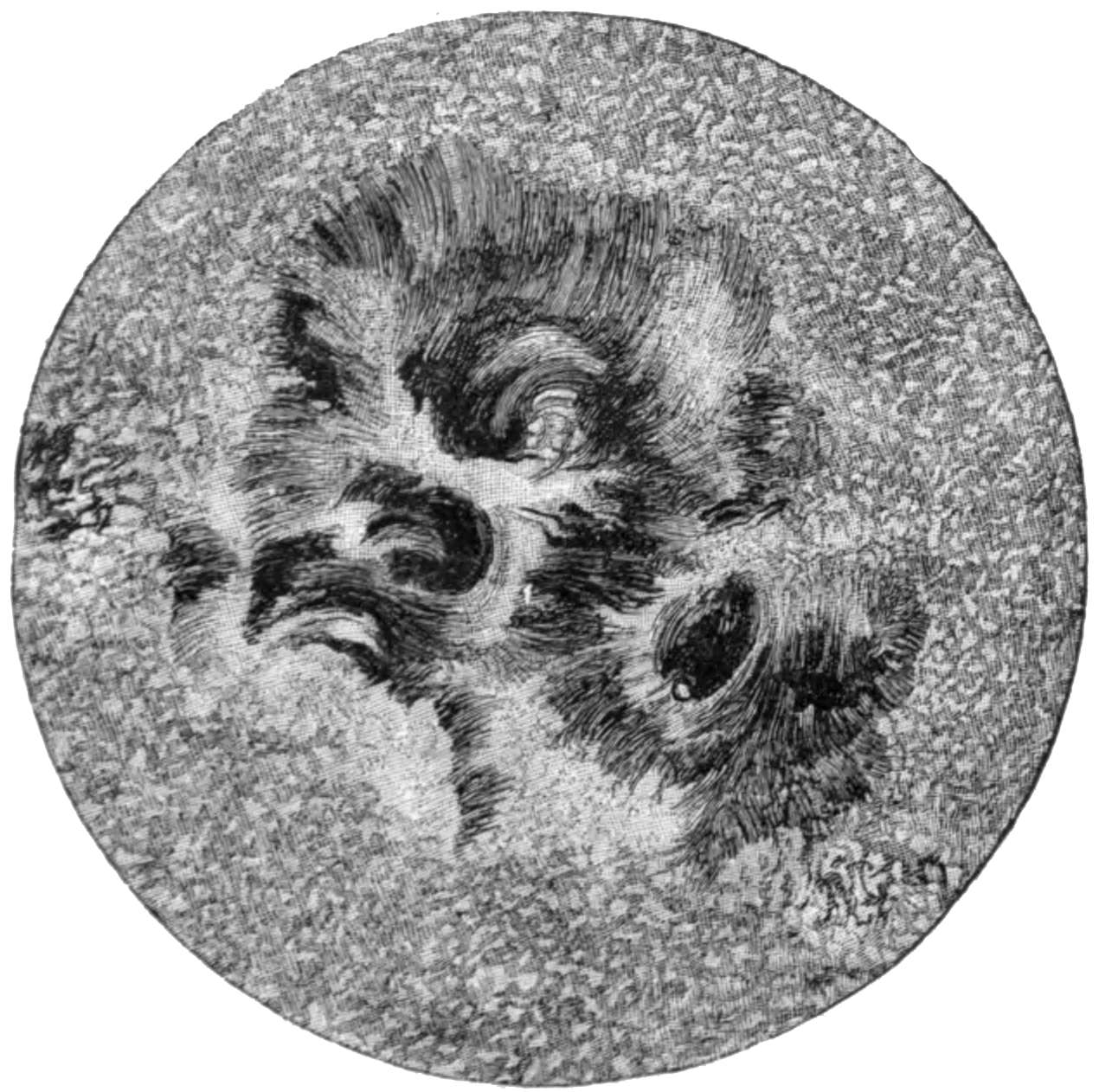
now affords. The drawing (Fig. 15) of the central part of
the same great spot, already cited, was made on the 21st of September,
1870, and may be compared with the photograph of
that day. We have now a greatly more magnified view than
before, but it is not blurred by the magnifying, and is full of
detail. We have been brought within two hundred thousand
miles of the sun, or rather less than the actual distance of the
moon, and are seeing for ourselves what was a few years since
thought out of the reach of any observer. See how full of intricate
forms that void, black, umbral space in the photograph has
become! The penumbra is filled with detail of the strangest
kind, and there are two great “bridges,” as they are called,
which are almost wholly invisible in the photograph. Notice
the line in one of the bridges which follows its sinuosities
through its whole length of twelve thousand miles, making us
suspect that it is made up of smaller parts as a rope is made up
of cords (as, in fact, it is); and look at the end, where the cords
themselves are unravelled into threads fine as threads of silk,
and these again resolved into finer fibres, till in more and more
web-like fineness it passes beyond the reach of sight! I am
speaking, however, here rather of the wonderful original, as I so
well remember it, than of what my sketch or even the engraver’s
skill can render.
FIG. 19.—TYPICAL SUN SPOT OF DECEMBER, 1873.
(REDUCED FROM AN ORIGINAL DRAWING BY S. P. LANGLEY.)
FIG. 20.—FROST CRYSTAL.
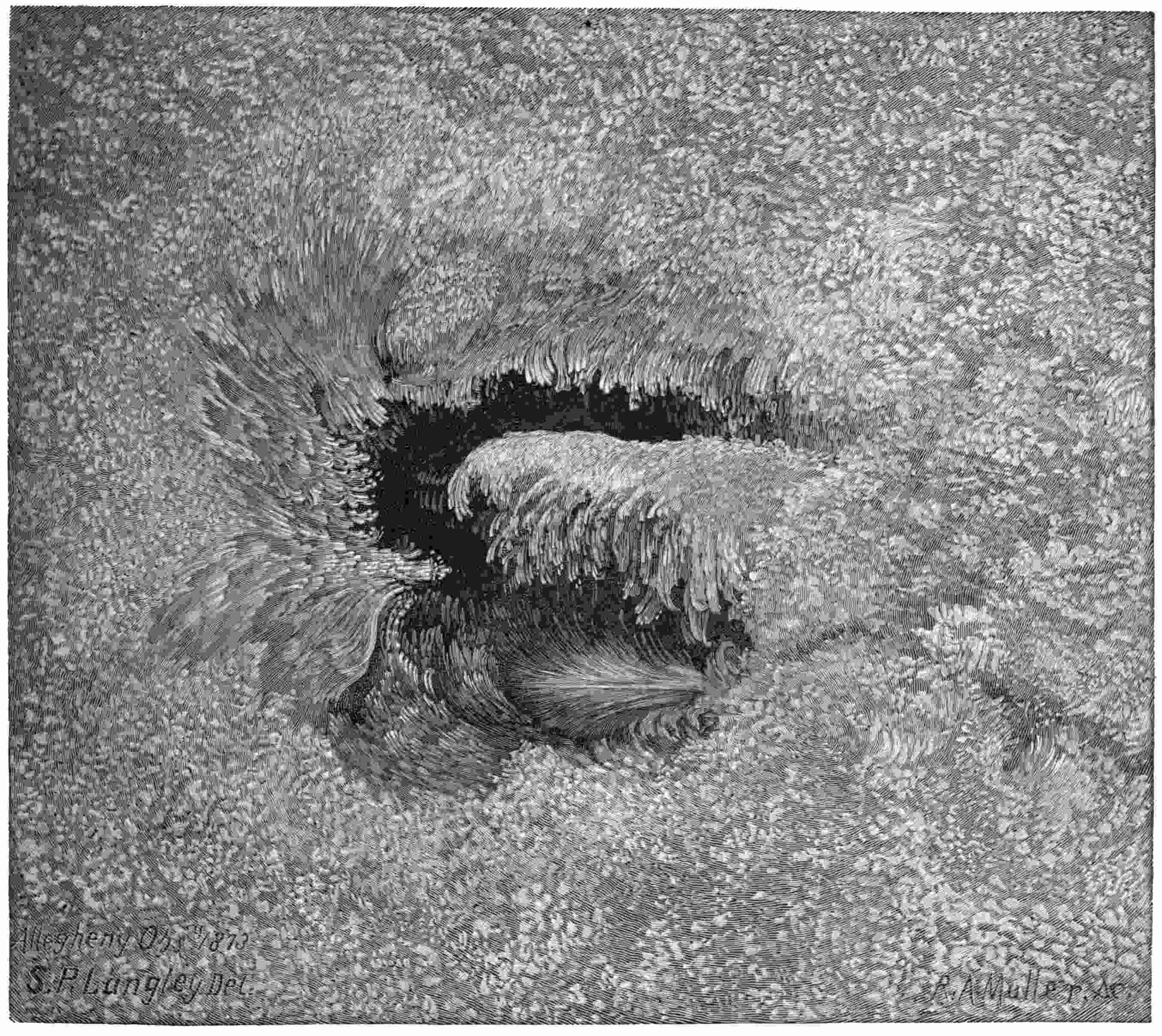
Next we have quite another “spot” belonging to another
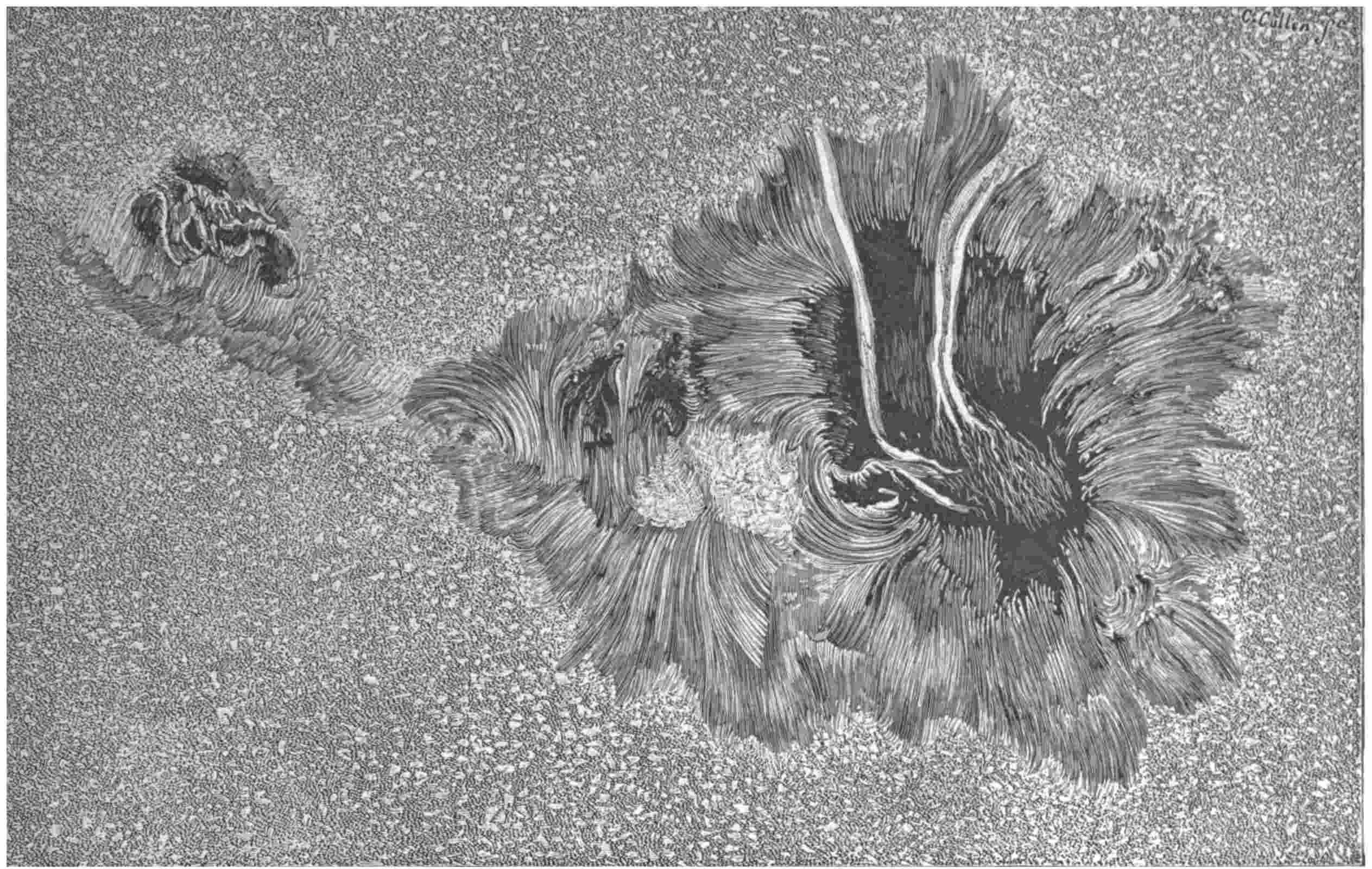
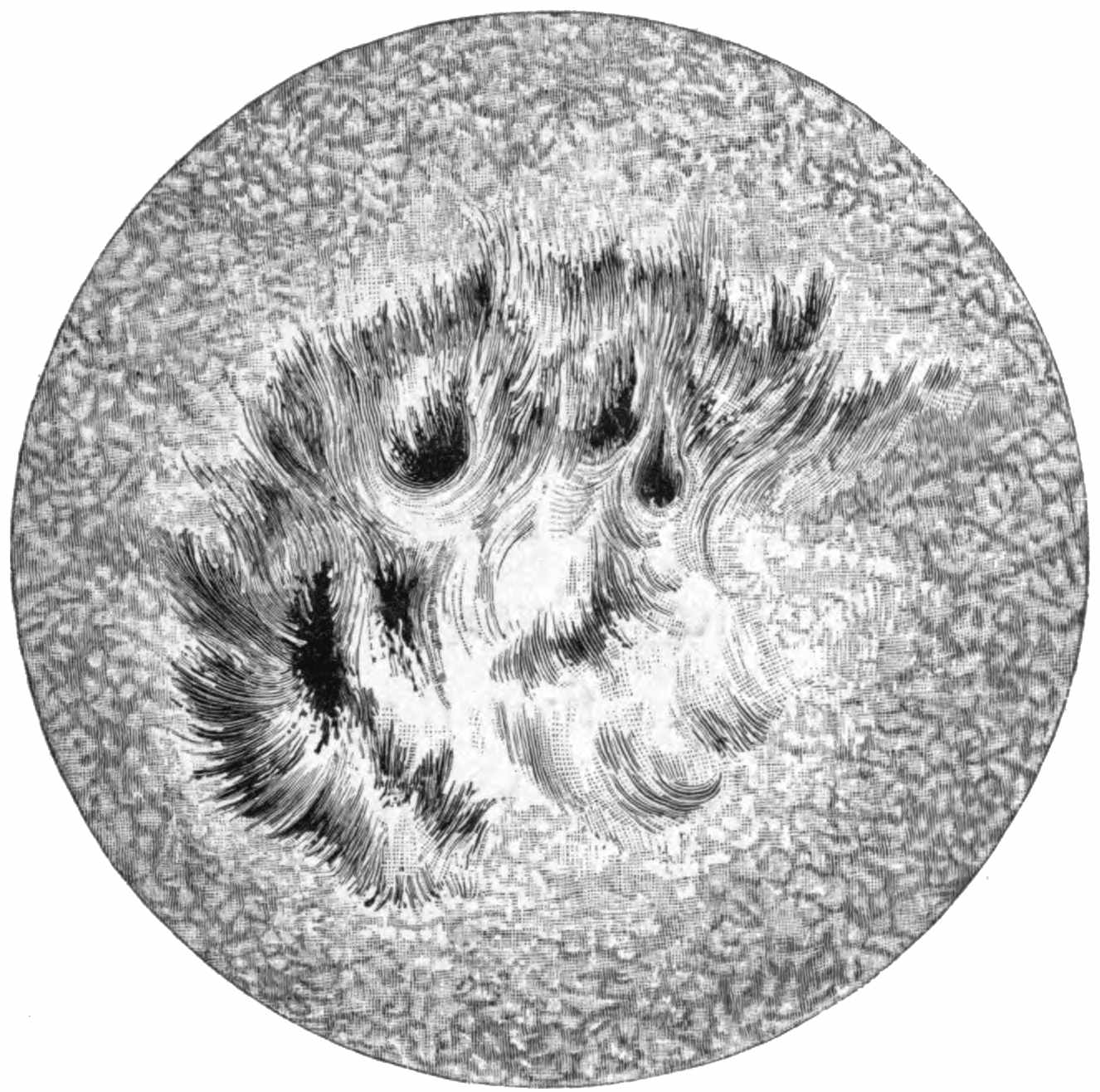
year (1873). First, there is a view (Fig. 17) of the sun’s disk
with the spot on it (as it would appear in a small telescope), to
show its relative size, and then a larger drawing of the spot
itself (Fig. 16), on a scale of twelve thousand miles to the inch,
so that the region shown to the reader’s eyes, though but a
“spot” on the sun, covers an area of over one billion square
miles, or more than five times the entire surface of the earth,
land, and water. To help us to conceive its vastness, I have
drawn in one corner the continents of North and South America
on the same scale as the “spot.” Notice the evidence of solar
whirlwinds and the extraordinary “plume” (Fig. 16), which is a
something we have no terrestrial simile for. The appearance of
the original would have been described most correctly by such
incongruous images as “leaf-like” and “crystalline” and “flame-like;”
and even in this inadequate sketch there may remain
some faint suggestion of the appearance of its wonderful archetype,
which was indeed that of a great flame leaping into spires
and viewed through a window covered with frost crystals.
Neither “frost” nor “flame” is really there, but we cannot
avoid this seemingly unnatural union of images, which was fully
justified by the marvellous thing itself. The reader must bear in
mind that the whole of this was actually in motion, not merely
turning with the sun’s rotation, but whirling and shifting within
itself, and that the motion was in parts occasionally probably as
high as fifty miles per second,—per second, remember, not per
hour,—so that it changed under the gazer’s eyes. The hook-shaped
prominence in the lower part (actually larger than the
United States) broke up and disappeared in about twenty minutes,
or while the writer was engaged in drawing it. The
imagination is confounded in an attempt to realize to itself the
true character of such a phenomenon.
FIG. 21.—CYCLONE SPOT. (DRAWN BY FATHER
SECCHI.)
On page 19 is a separate view of the plume (Fig. 18), a fac-simile
of the original sketch, which was made with the eye at
the telescope. The pointed
or flame-like tips are not a
very common form, the terminals
being more commonly
clubbed, like those
in Father Secchi’s “branch
of cactus” type given on
page 12. It must be borne
in mind, too, if the drawing
does not seem to contain
all that the text implies,
that there were but a few
minutes in which to attempt
to draw, where even a
skilled draughtsman might have spent hours on the details
momentarily visible, and that much must be left to memory.
The writer’s note-book at the time contains an expression of
despair at his utter inability to render most of what he saw.
Let us now look at another and even more wonderful example.
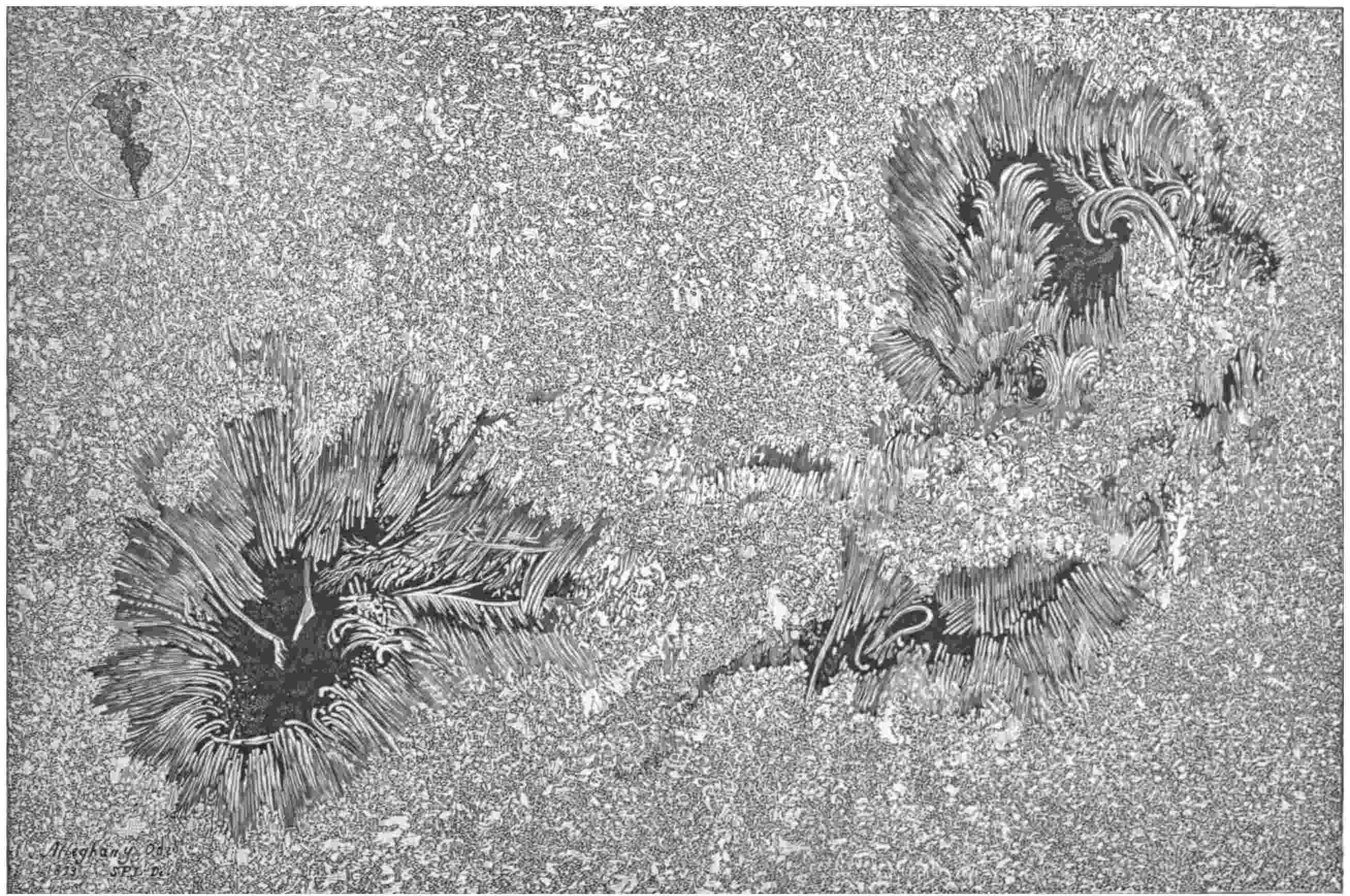
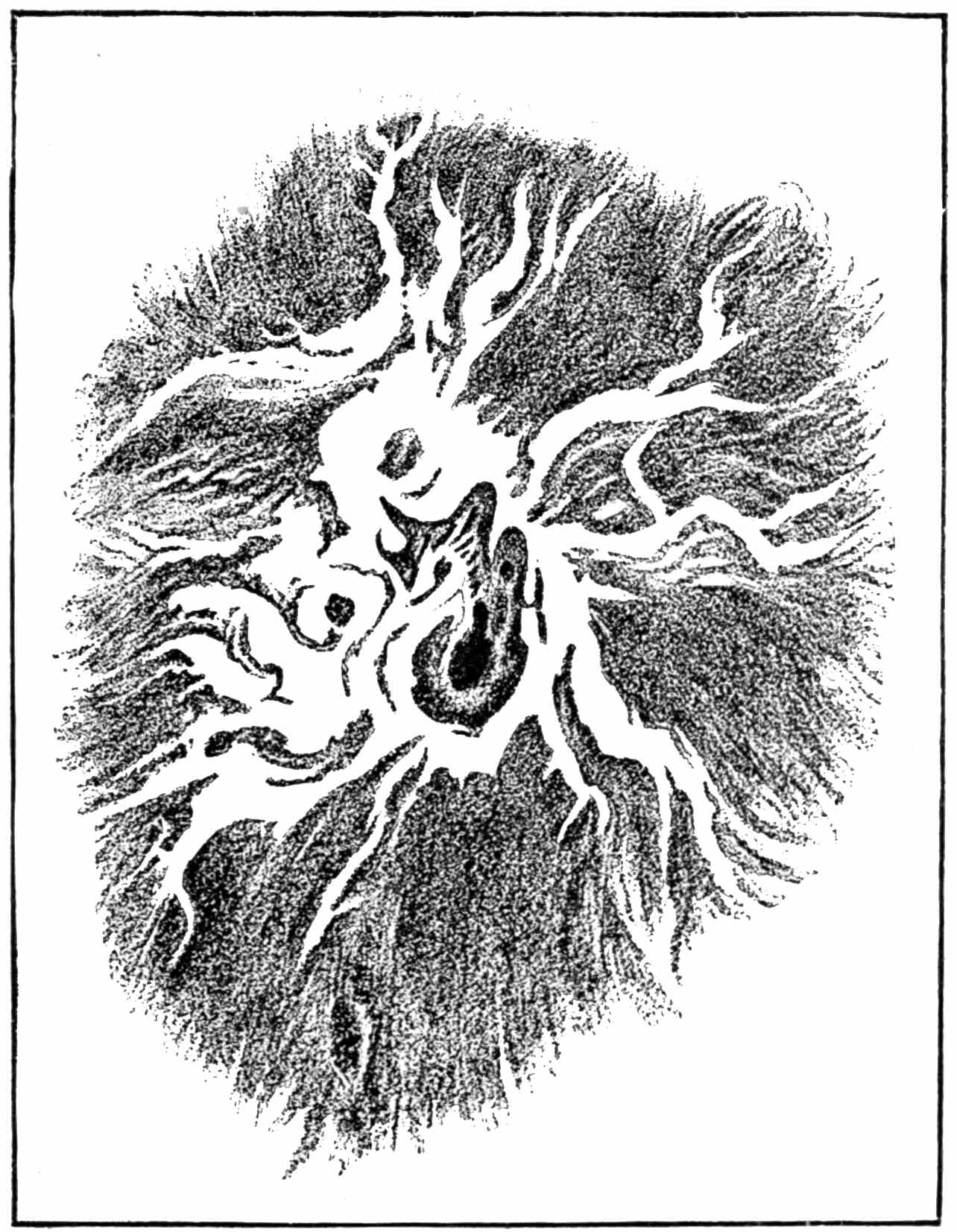
Fig. 19 shows part of a great spot which the writer drew
in December, 1873, when the rare coincidence happened of a
fine spot and fine terrestrial weather to observe it in. In this,
as well as in the preceding drawing, the pores which cover the
sun’s surface by millions may be noted. The luminous dots
which divide them are what Nasmyth imperfectly saw, but we
are hardly more able than he to say what they really are.
Each of these countless “dots” is larger than England, Scotland,
and Ireland together! The wonderful “crystalline” structure
in the centre cannot be a real crystal, for it is ten times the
area of Europe, and changed slowly while I drew it; but the
reader may be sure that its resemblance to some crystallizations
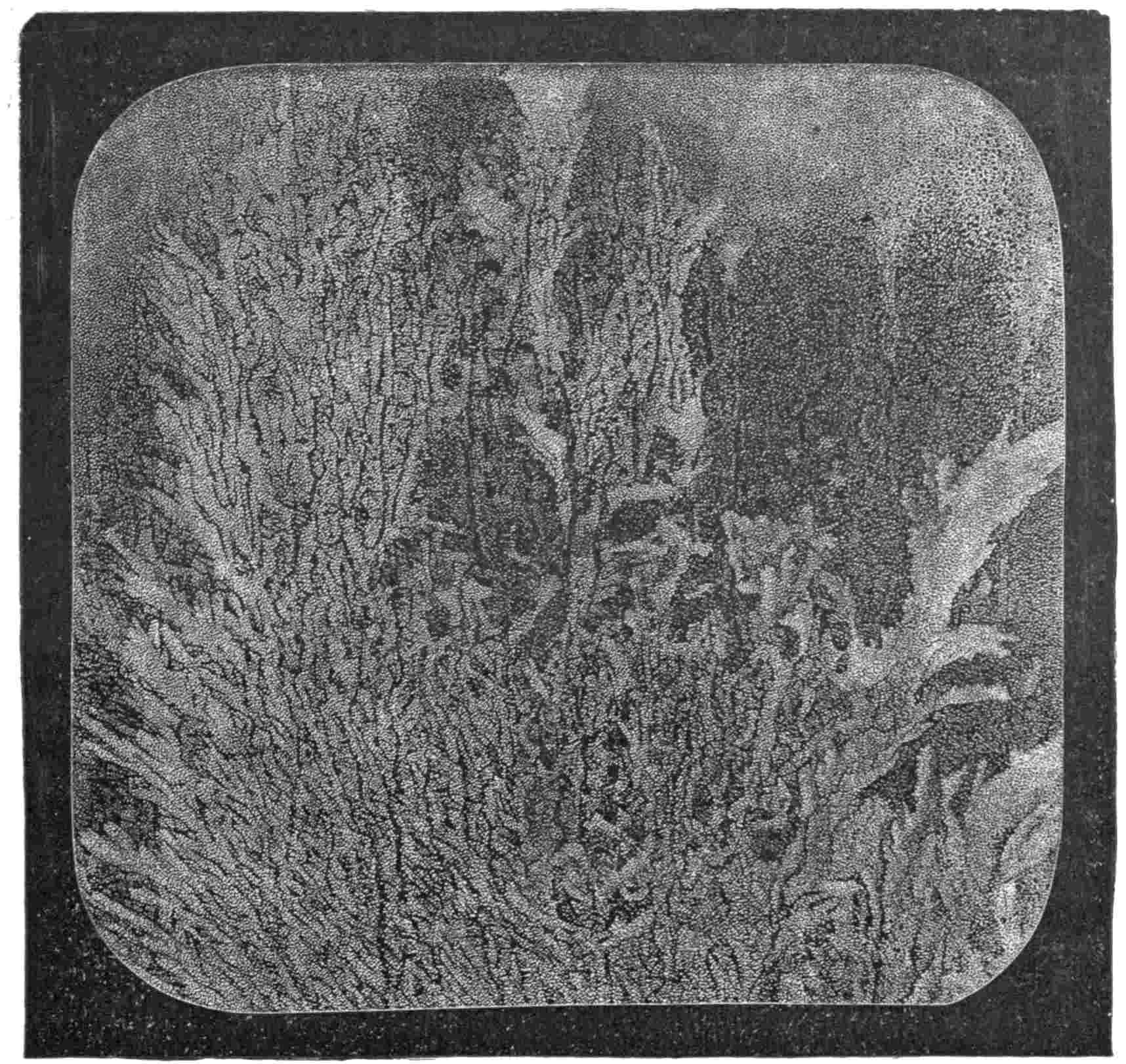
has not been in the least exaggerated. I have sought to study
various actual crystals for comparison, but found none quite
satisfactory. That of sal-ammoniac
in some remote
way resembles it,
as Secchi says; but perhaps
the frost crystals on
a window-pane are better.
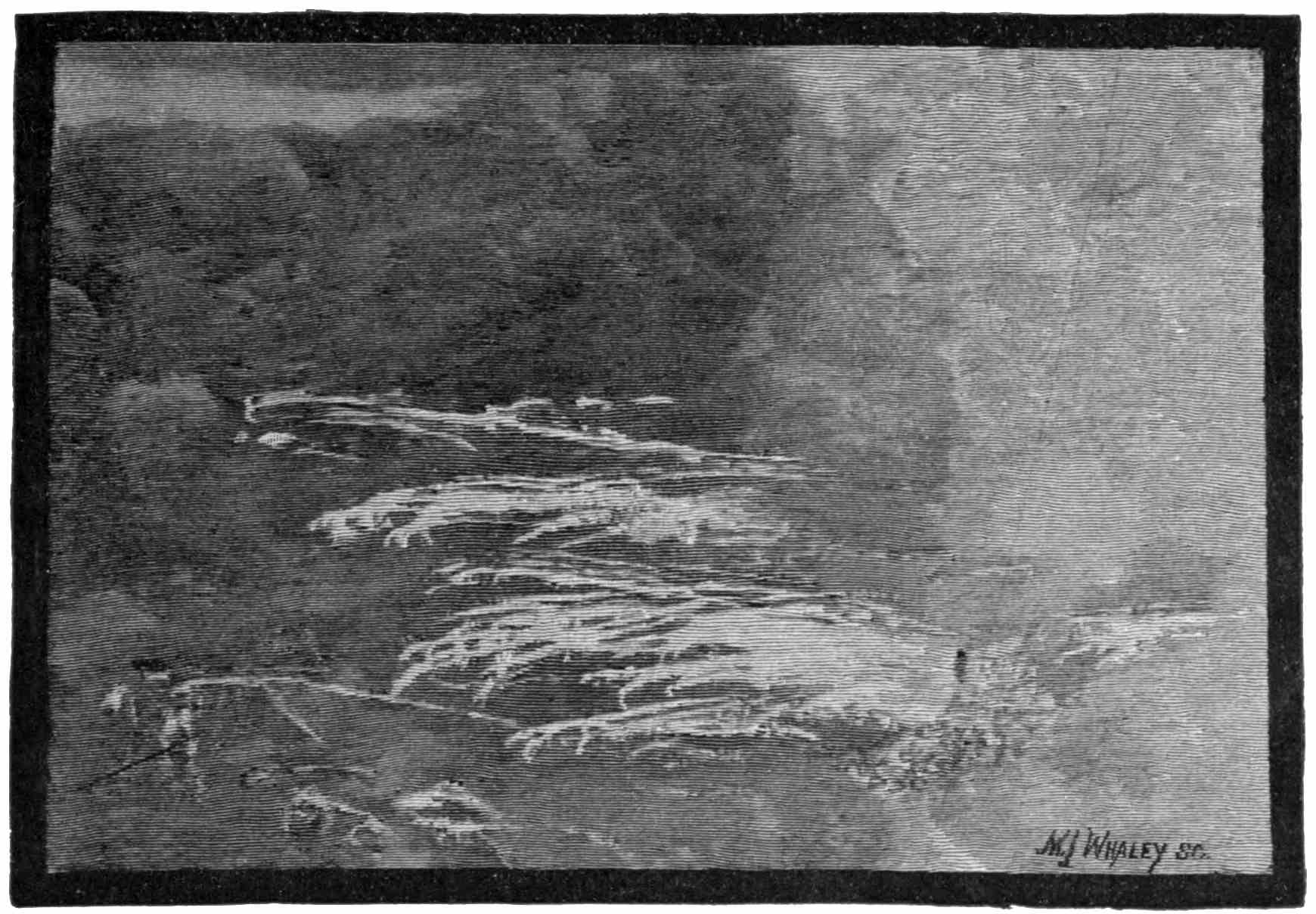
Fig. 20 shows one
selected among several
windows I had photographed
in a preceding
winter, which has some
suggestions of the so-called
crystalline spot-forms
in it, but which
lacks the filamentary
thread-like components presently described. Of course the
reader will understand that it is given as a suggestion of the
appearance merely, and that no similarity of nature is meant
to be indicated.
FIG. 22.—SPOT OF MARCH 31, 1875. (FROM AN
ORIGINAL DRAWING BY S. P. LANGLEY.)
There were wonderful fern-like forms in this spot, too, and
an appearance like that of pine-boughs covered with snow; for,
strangely enough, the intense whiteness of the solar surface in
the best telescopes constantly suggests cold. I have had the
same impression vividly in looking at the immense masses of
molten-white iron in a great puddling-furnace. The salient
feature here is one very difficult to see, even in good telescopes,
but one which is of great interest. It has been shown in the
previous drawings, but we have not enlarged on it. Everywhere
in the spot are long white threads, or filaments, lying
upon one another, tending in a general sense toward the centre,
and each of which grows brighter toward its inner extremity.
These make up, in fact, as we now see, the penumbra, or outer
shade, and the so-called “crystal” is really affiliated to them.
Besides this, on closer looking we see that the inner shade, or
umbra, and the very deepest shades, or nuclei, are really made
of them too. We can look into the dark centre, as into a funnel,
to the depth of probably over five thousand miles; but as far as
we may go down we come to no liquid or solid floor, and see
only volumes of whirling vapor, disposed not vaguely like our
clouds, but in the singularly definite, fern-like, flower-like forms
which are themselves made of these “filaments,” each of which
is from three to five thousand miles long, and from fifty to two
hundred miles thick, and each of which (as we saw in the first
spot) appears to be made up like a rope of still finer and finer
strands, looking in the rare instants when irradiation makes an
isolated one visible, like a thread of gossamer or the finest of
cobweb. These suggest the fine threads of spun glass; and
here there is something more than a mere resemblance of form,
for both appear to have one causal feature in common, due to a
viscous or “sticky” fluid; for there is much reason to believe
that the solar atmosphere, even where thinner than our own air,
is rendered viscous by the enormous heat, and owes to this its
tendency to pull out in strings in common with such otherwise
dissimilar things as honey, or melted sugar, or melted glass.
We may compare those mysterious things, the filaments, to
long grasses growing in the bed of a stream, which show us the
direction and the eddies of the current. The likeness holds in
more ways than one. They are not lying, as it were, flat upon
the surface of the water, but within the medium; and they do
not stretch along in any one plane, but they bend down and up.
Moreover, they are, as we see, apparently rooted at one end, and
their tips rise above the turbid fluid and grow brighter as they
are lifted out of it. But perhaps the most significant use of the
comparison is made if we ask whether the stream is moving in
an eddy like a whirlpool or boiling up from the ground. The
question in other words is, “Are these spots themselves the sign
of a mere chaotic disturbance, or do they show us by the disposition
of these filaments that each is a great solar maelstrom,
carrying the surface matter of the sun down into its body? or,
finally, are they just the opposite,—something comparable to
fiery fountains or volcanoes on the earth, throwing up to the
surface the contents of the unknown solar interior?”
FIG. 23.—CIRROUS CLOUD. (FROM A PHOTOGRAPH.)
Before we try to answer this question, let us remember that
the astonishing rapidity with which these forms change, and still
more the fact that they do not by any means always change by
a bodily removal of one part from another, but by a dissolving
away and a fading out into invisibility, like the melting of a
cloud into thin air,—let us remember that all this assimilates
them to something cloud-like and vaporous, rather than crystalline,
and that, as we have here seen, we can ourselves pronounce
from such results of recent observation that these are not lumps
of scoriæ floating on the solar furnace (as some have thought
them), and still less, literal crystals. We can see for ourselves,
I believe, that so far there is no evidence here of any solid, or
even liquid, but that the surface of the sun is purely vaporous.
Fig. 23 shows a cirrous cloud in our own atmosphere, caught
for us by photography,
and which the reader
will find it interesting
to compare with the apparently
analogous solar
cloud-forms.
FIG. 24.—SPOT OF MARCH 31, 1875. (FROM AN
ORIGINAL DRAWING BY S. P. LANGLEY.)
“Vaporous,” we call
them, for want of a better
word, but without
meaning that it is like
the vapor of our clouds.
There is no exact terrestrial
analogy for these extraordinary
forms, which
are in fact, as we shall
see later, composed of iron and other metals—not of solid
iron nor even of liquid, but iron heated beyond even the
liquid state to that of iron-steam or vapor.
With all this in mind, let us return to the question, “Are
the spots, these gigantic areas of disturbance, comparable to
whirlpools or to volcanoes?” It may seem unphilosophical to
assume that they are one or the other, and in fact they may
possibly be neither; but it is certain that the surface of the sun
would soon cool from its enormous temperature, if it were not
supplied with fresh heat, and it is almost certain that this heat
is drawn from the interior. As M. Faye has pointed out,1 there
must be a circulation up and down, the cooled products being
carried within, heated and brought out again, or the sun would,
however hot, grow cold outside; and, what is of interest to us,
the earth would grow cold
also, and we should all die.
No one, I believe, who has
studied the subject, will
contradict the statement
that if the sun’s surface
were absolutely cut off
from any heat supply from
the interior, organic life in
general upon the earth
(and our own life in particular)
would cease much
within a month. This solar circulation, then, is of nearly as much
consequence to us as that of our own bodies, if we but knew it;
and now let us look at the spots again with this in mind.
1 To Mr. Herbert Spencer must be assigned the earliest suggestion of the necessity
of such a circulation.
FIG. 25.—TYPICAL ILLUSTRATION OF FAYE’S THEORY.
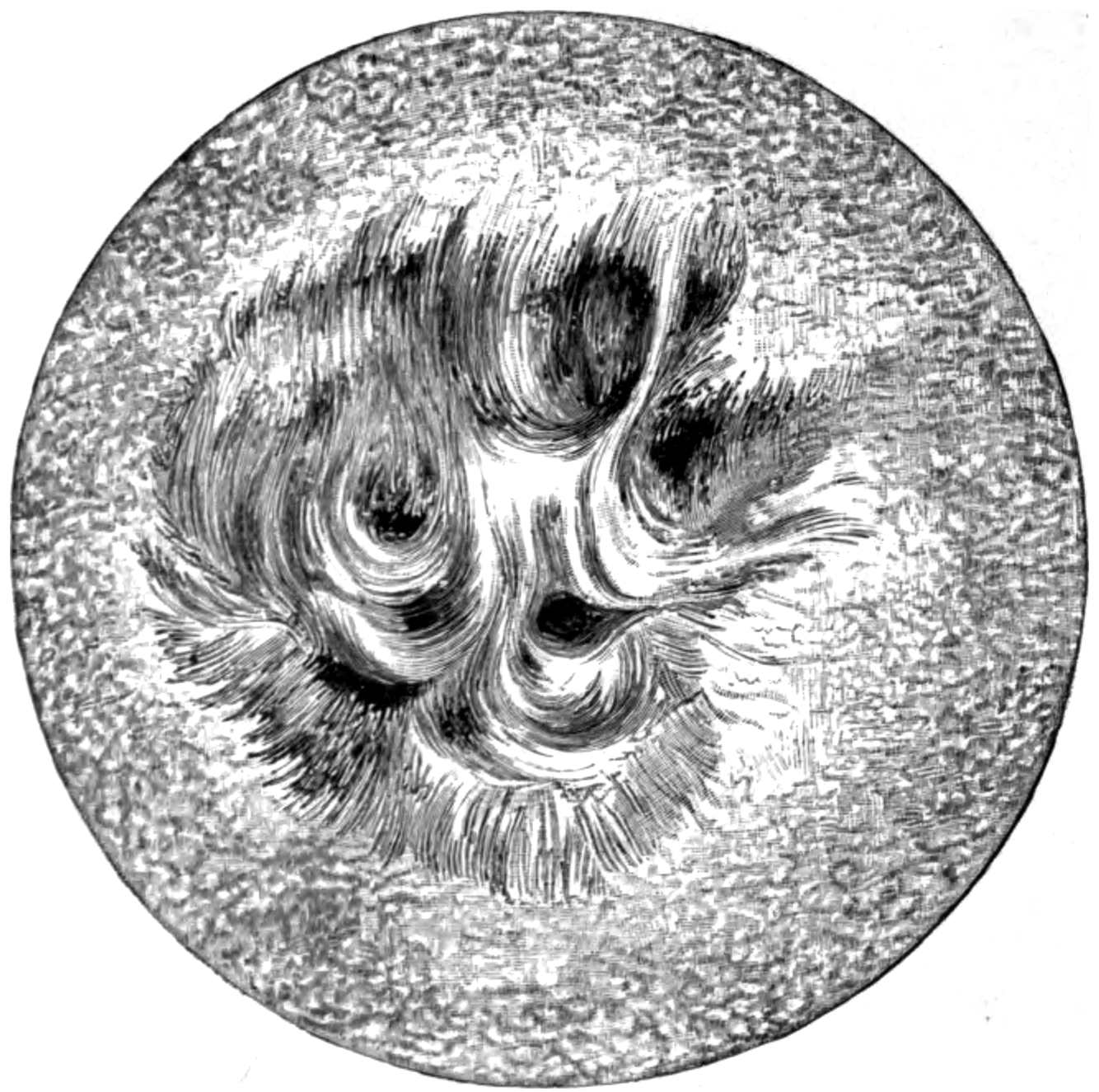
Fig. 21 shows a drawing by Father Secchi of a spot in 1854;
and it is, if unexaggerated, quite the most remarkable case of
distinct cyclonic action recorded. I say “if unexaggerated”
because there is a strong tendency in most designers to select
what is striking in a spot, and to emphasize that unduly, even
when there is no conscious disposition to alter. Every one who
sketches may see a similar unconscious tendency in himself or
herself, shown in a disposition to draw all the mountains and
hills too high,—a tendency on which Ruskin, I think, has
remarked. In drawings of the sun there is a strong temptation
to exaggerate these circular forms, and we must not forget this
in making up the evidence. There is great need of caution, then,
in receiving such representations; but there certainly are forms
which seem to be clearly due to cyclonic action. They are
usually scattered, however, through larger spots, and I have
never, in all my study of the sun, seen one such complete type
of the cyclone spot as that first given from Secchi. Instances
where spots break up into numerous subdivisions by a process
of “segmentation” under the apparent action of separate whirlwinds
are much more common. I have noticed, as an apparent
effect of this segmentation, what I may call the “honeycomb
structure” from its appearance with low powers, but which with
higher ones turns out to be made up of filamentary masses disposed
in circular and ovoid curves, often apparently overlying
one another, and frequently presenting a most curious resemblance
to vegetable forms, though we appear to see the real
agency of whirlwinds in making them. I add some transcripts
of my original pencil memoranda themselves, made with the eye
at the telescope, which,
though not at all finished
drawings, may be trusted
the more as being quite
literal transcripts at first
hand.
FIG. 26.—SPOT OF OCT. 13, 1876. (FROM ORIGINAL
DRAWING BY S. P. LANGLEY.)
Figs. 22 and 24, for instance,
are two sketches of
a little spot, showing what,
with low powers, gives the
appearance I have called
the honeycomb structure,
but which we see here to
be due to whirls which have
disposed the filaments in these remarkable forms. The first was
drawn at eleven in the forenoon of March 31, 1875, the second
at three in the afternoon of the same day. The scale of the
drawing is fifteen thousand miles to the inch, and the changes
in this little spot in these few hours imply a cataclysm compared
with which the disappearance of the American continent from the
earth’s surface would be a trifle.
The very act of the solar whirlwind’s motion seemed to pass
before my eyes in some of these sketches; for while drawing
them as rapidly as possible, a new hole would be formed where
there was none before, as if by a gigantic invisible auger boring
downward.
FIG. 27.—PHOTOGRAPH OF EDGE OF SUN. (BY PERMISSION
OF WARREN DE LA RUE, LONDON.)
M. Faye, the distinguished
French astronomer, believes
that, owing to the fact that
different zones of the sun
rotate faster than others,
whirlwinds analogous to our
terrestrial cyclones, but on a
vaster scale, are set in motion,
and suck down the
cooled vapors of the solar
surface into its interior, to be
heated and returned again,
thus establishing a circulation
which keeps the surface
from cooling down. He
points out that we should
not conclude that these whirlwinds
are not acting everywhere, merely because our bird’s-eye
view does not always show them. We see that the spinning
action of a whirlpool in water becomes more marked as we go
below the surface, which is comparatively undisturbed, and we
often see one whirl break up into several minor ones, but all
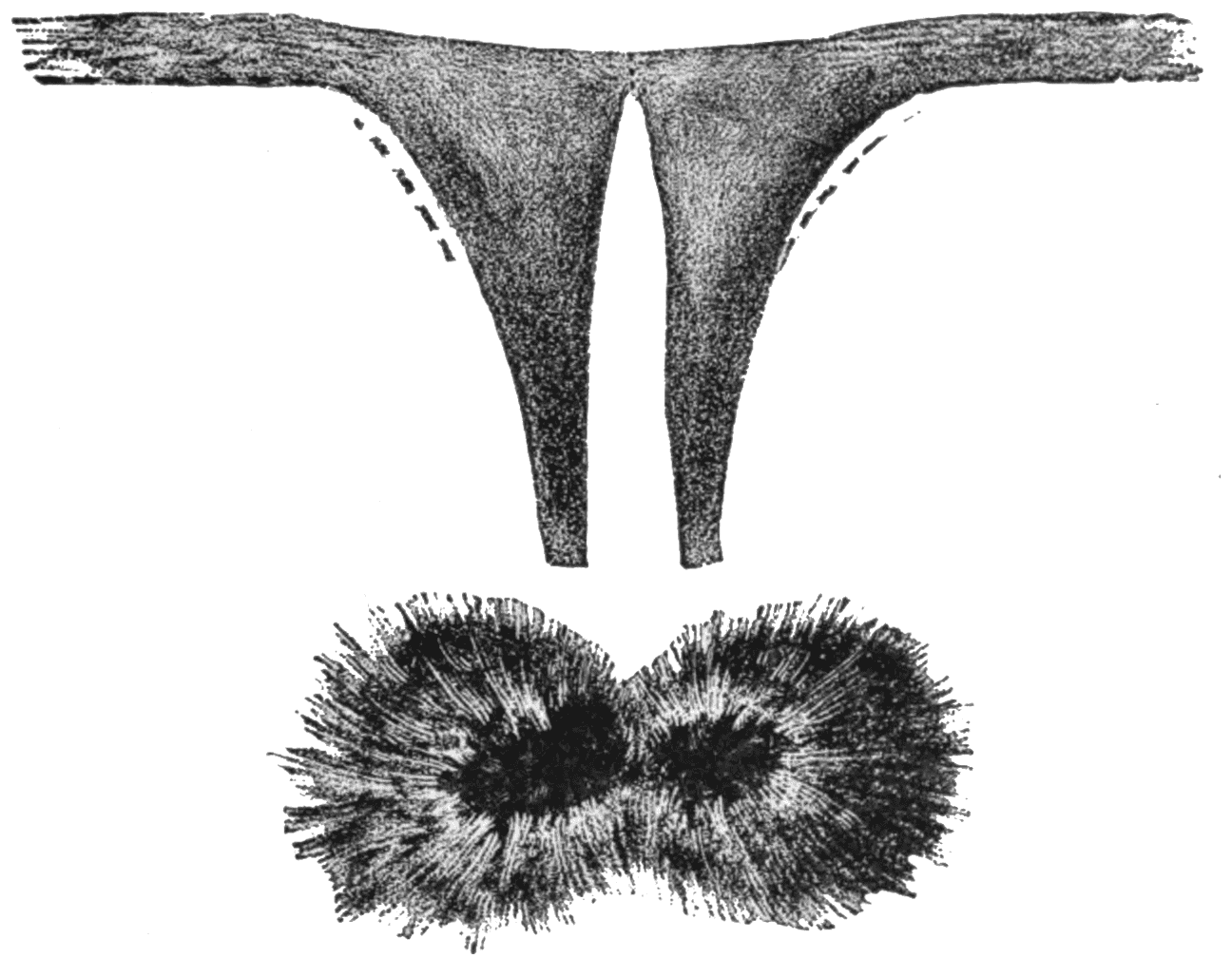
sucking downward and never upward. According to M. Faye,
something very like this takes place on the sun, and in Fig. 25
he gives this section to show what he believes to occur in the
case of a spot which has “segmented,” or divided into two, like
the one whose (imaginary) section is shown above it. This
theory is to be considered in connection with such drawings
as we have just shown, which are themselves, however, no way
dependent on theory, but transcripts from Nature.
I do not here either espouse or oppose the “cyclonic” theory,
but it is hardly possible for any one who has been an eyewitness
of such things to refuse to regard some such disturbance as a
real and efficient cause in such instances as this.
Fig. 26, on nearly the same scale as the last, shows a spot
which was seen on Oct. 13, 1876. It looked at first, in the telescope,
like two spots without any connection; then, as vision
improved and higher powers were employed, the two were seen
to have a subtle bond of union, and each to be filled with the
most curious foliage-forms, which I could only indicate in the
few moments that the good definition lasted. The reader may
be sure, I think, that there is no exaggeration of the curious
shapes of the original; for I have been so anxious to avoid the
overstatement of curvature that the error is more likely to be in
the opposite direction.
We must conclude that the question as to the cyclonic
hypothesis cannot yet be decided, though the probabilities from
telescopic evidence at present seem to me on the whole in favor
of M. Faye’s remarkable theory, which has the great additional
attraction to the student that it unites and explains numerous
other quite disconnected facts.
Turning now to the other solar features, let us once more
consider the sun as a whole. Fig. 27 is a photograph taken
from a part of the sun near its edge. We notice on it, what we
see on every careful delineation of the sun, that its general surface
is not uniformly bright, but that it grows darker as we
approach the edge, where it is marked by whiter mottlings called
faculæ, “something in the sun brighter than the sun itself,” and
looking in the enlarged view which we present of one of them
(Fig. 28), as if the surface of partly cooled metal in a caldron
had been broken into fissures showing the brighter glow beneath.
These “faculæ,” however, are really above the solar surface, not
below it, and what we wish to direct particular attention to is
that darkening toward the edge which makes them visible.
FIG. 28.—FACULA. (FROM A DRAWING BY
CHACORNAC.)
This is very significant, but its full meaning may not at first
be clear. It is owing to an atmosphere which surrounds the sun,
as the air does the earth.
When we look horizontally
through our own air, as at
sunrise and sunset, we gaze
through greater thicknesses
of it than when we turn
our eyes to the zenith. So
when we look at the edge
of the sun, the line of sight
passes through greater
depths of this solar atmosphere,
and it dims the
light shining behind it
more than at the centre,
where it is thin.
This darkening toward
the edge, then, means that
the sun has an atmosphere
which tempers its heat to us. Whatever the sun’s heat supply is
within its globe, if this atmosphere grow thicker, the heat is more
confined within, and our earth will grow colder; if the solar atmosphere
grow thinner, the sun’s energy will be expended more
rapidly, and our earth will grow hotter. This atmosphere, then,
is in considerable part, at least, the subject of the action of the
spots; this is what they are supposed to carry down or to
spout up.
We shall return to the study of it again; but what I want to
point out now is that the temperature of the earth, and even the
existence of man upon it, depends very much upon this, at first
sight, insignificant phenomenon. What, then, is the solar atmosphere?
Is it a permanent thing? Not at all. It is more light
and unsubstantial than our own air, and is being whirled about
by solar winds as ours toss the dust of the streets. It is being
sucked down within the body of the sun by some action we do
not clearly understand, and returned to the surface by some
counter effect which we comprehend no better; and upon this
imperfectly understood exchange depends in some way our own
safety.
There used to be recorded in medical books the case of a boy
who, to represent Phœbus in a Roman mask, was gilded all
over to produce the effect of the golden-rayed god, but who died
in a few hours because, all the pores of the skin being closed by
the gold-leaf, the natural circulation was arrested. We can count
with the telescope millions of pores upon the sun’s surface, which
are in some way connected with the interchange which has just
been spoken of; and if this, his own natural circulation, were
arrested or notably diminished, we should see his face grow cold,
and know that our own health, with the life of all the human
race, was waiting on his recovery.
II. THE SUN’S SURROUNDINGS.
As I write this, the fields glitter with snow-crystals in the
winter noon, and the eye is dazzled with a reflection of
the splendor which the sun pours so fully into every nook that
by it alone we appear to see everything.
Yet, as the day declines, and the glow of the sunset spreads
up to the zenith, there comes out in it the white-shining evening
star, which not the light, but the darkness, makes visible; and
as the last ruddy twilight fades, not only this neighbor-world,
whose light is fed from the sunken sun, but other stars appear,
themselves self-shining suns, which were above us all through
the day, unseen because of the very light.
As night draws on, we may see the occasional flash of a
shooting-star, or perhaps the auroral streamers spreading over
the heavens; and remembering that these will fade as the sun
rises, and that the nearer they are to it the more completely
they will be blotted out, we infer that if the sun were surrounded
by a halo of only similar brightness, this would remain forever
invisible,—unless, indeed, there were some way of cutting off
the light from the sun without obscuring its surroundings. But
if we try the experiment of holding up a screen which just conceals
the sun, nothing new is seen in its vicinity, for we are also
lighted by the neighboring sky, which is so dazzlingly bright
with reflected light as effectually to hide anything which may
be behind it, so that to get rid of this glare we should need to
hang up a screen outside the earth’s atmosphere altogether.
FIG. 29.—LUNAR CONE SHADOW.
Nature hangs such a screen in front of the earth when the
moon passes between it and the sun; but as the moon is far
too small to screen all the earth completely, and as so limited a
portion of its surface is in complete shadow that the chances are
much against any given individual’s being on the single spot
covered by it, many centuries usually elapse before such a total
eclipse occurs at any given point; while yet almost every year
there may be a partial eclipse, when, over a great portion of the
earth at once, people may be able to look round the moon’s edge
and see the sunlight but partly cut off. Nearly every one, then,
has seen a partial eclipse of the sun, but comparatively few a
total one, which is quite another thing, and worth a journey
round the world to behold; for such a nimbus, or glory, as we
have suggested the possibility of, does actually exist about the
sun, and becomes visible to the naked eye on the rare occasions
when it is visible at all, accompanied by phenomena which are
unique among celestial wonders.
The “corona,” as this solar crown is called, is seen during a
total eclipse to consist of a bright inner light next the invisible
sun, which melts into a fainter and immensely extended radiance
(the writer has followed the latter to the distance of about ten
million miles), and all this inner corona is filled with curious
detail. All this is to be distinguished from another remarkable
feature seen at the same time; for close to the black body of the
moon are prominences of a vivid crimson and scarlet, rising up
like mountains from the hidden solar disk, and these, which will
be considered later, are quite distinct from the corona, though
seen on the background of its pearly light.
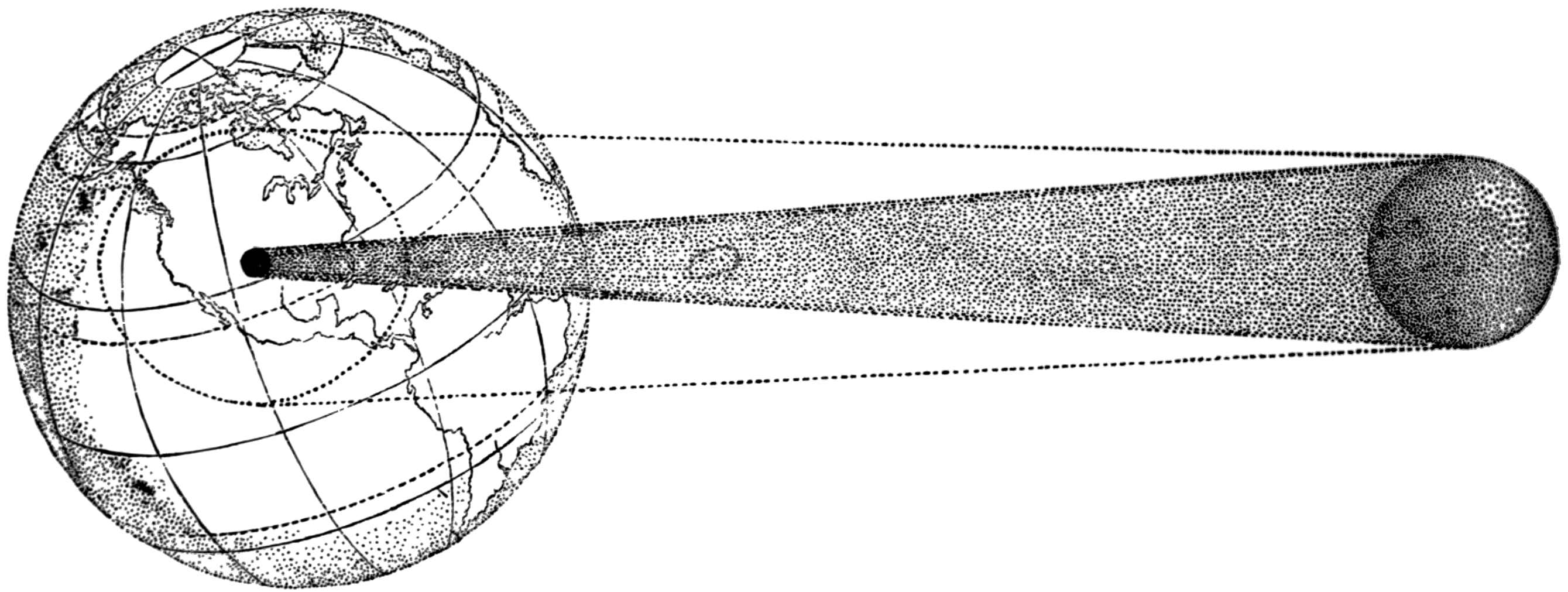
To understand what the lunar screen is doing for us, we may
imagine ourselves at some station outside the earth, whence we
should behold the moon’s shadow somewhat as in Fig. 29,
where we must remember that since the lunar orbit is not
a circle, but nearly an ellipse, the moon is at some times farther
from the earth than at others. Here the extremity of
its shadow is represented as just touching the surface of the
globe, while it is evident that if the moon were at its greatest
distance, its shadow might come to a point before reaching the
earth at all. We speak, of course, only of the central cone of
shade; for there is an outer one, indicated by the faint dotted
lines, within whose much more extended limits the eclipse is
partial, but with the latter we have at present nothing to do.
The figure however, for want of room, is made to represent the
proportions incorrectly, the real ones of the shadow being actually
something like those of a sewing-needle,—this very long
attenuated shadow sometimes, as we have just said, not reaching
the earth at all, and when it does reach it, covering at the most
a very small region indeed. Where this point touches, and
wherever it rests, we should, in looking down from our celestial
station, see that part of the earth in complete shadow, appearing
like a minute dark spot, whose lesser diameter is seldom over a
hundred and fifty miles.
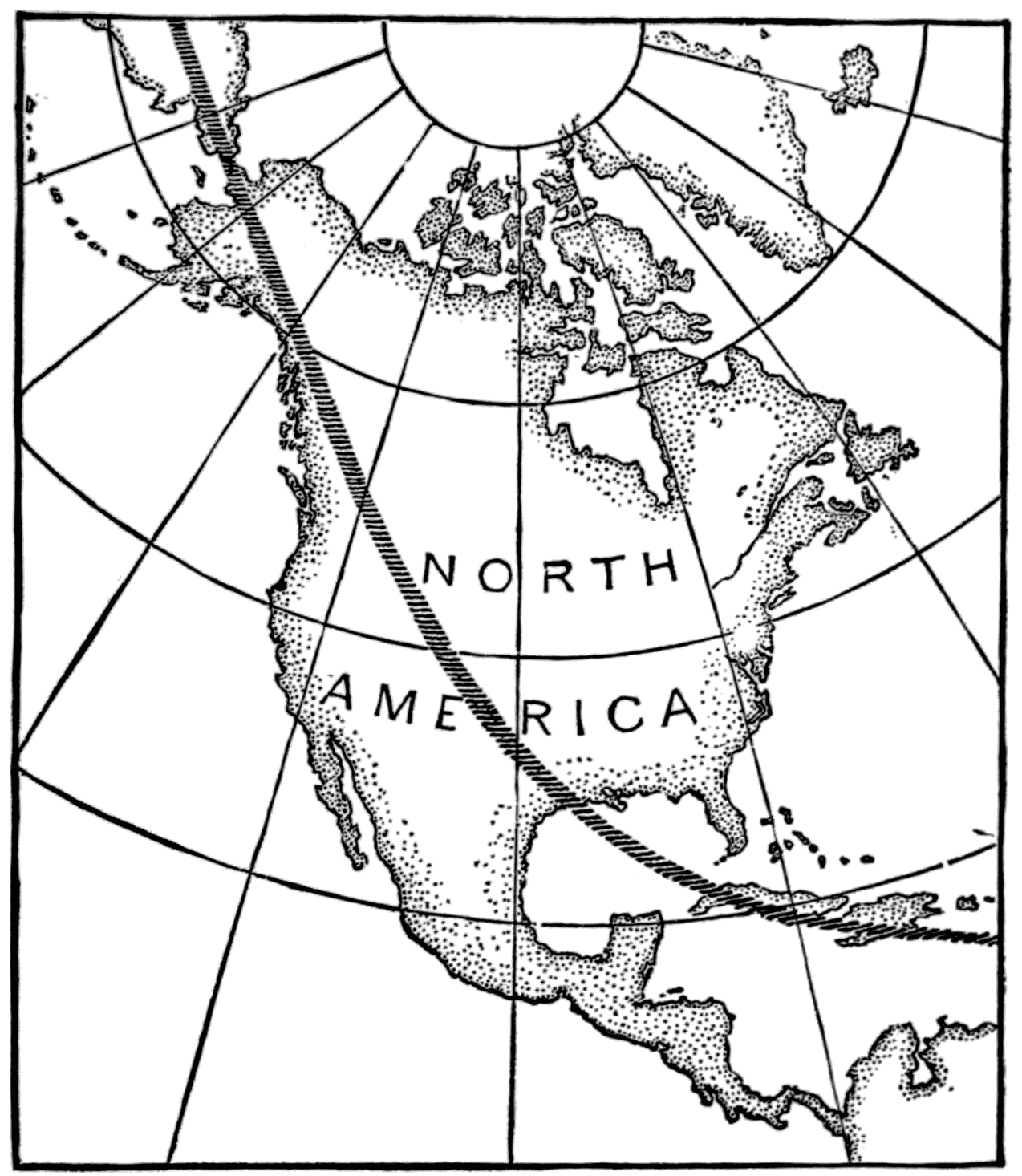
The eclipse is total only to those inhabitants of the earth
within the track of this dark spot, though the spot itself travels
across the earth with the speed of the moon in the sky; so that
if it could leave a mark, it would in a few hours trace a dark
line across the globe, looking like a narrow black tape curving
across the side of the world next the sun. In Fig. 30, for instance,
is the central track of the eclipse of July 29, 1878, as it
would be visible to our celestial observer, beginning in Alaska
in the forenoon, and ending in the Gulf of Mexico, which it
reached in the afternoon. To those on the earth’s surface within
this shadow it covered everything in view, and, for anything
those involved in it could see, it was all-embracing and terrible,
and worthily described in such lines as Milton’s,—
“As when the sun ...
In dim eclipse, disastrous twilight sheds
On half the nations, and with fear of change
Perplexes monarchs.”
We may enjoy the poet’s vision; but here, while we look
down on the whole earth at once, we must admit that the actual
area of the “twilight” is very small indeed. Within this area,
however, the spectacle is one of which, though the man of science
may prosaically state the facts, perhaps only the poet could
render the impression.
We can faintly picture, perhaps, how it would seem, from a
station near the lunar orbit, to see the moon—a moving world—rush
by with a velocity greater than that of the cannon-ball
in its swiftest flight; but with equal speed its shadow actually
travels along the earth. And now, if we return from our imaginary
station to a real one here below, we are better prepared to
see why this flying shadow is such a unique spectacle; for, small
as it may be when seen in relation to the whole globe, it is
immense to the observer, whose entire horizon is filled with it,
and who sees the actual velocity of one of the heavenly bodies,
as it were, brought down to him.
The reader who has ever ascended to the Superga, at Turin,
will recall the magnificent view, and be able to understand the
good fortune of an observer (Forbes) who once had the opportunity
to witness thence this phenomenon, and under a nearly
cloudless sky. “I perceived,” he says, “in the southwest a
black shadow like that of a storm about to break, which obscured
the Alps. It was the lunar shadow coming toward us.”
And he speaks of the “stupefaction”—it is his word—caused
by the spectacle. “I confess,” he continues, “it was the most
terrifying sight I ever saw. As always happens in the cases of
sudden, silent, unexpected
movements, the spectator
confounds real and relative
motion. I felt almost giddy
for a moment, as though
the massive building under
me bowed on the side of
the coming eclipse.” Another
witness, who had
been looking at some
bright clouds just before,
says: “The bright cloud
I saw distinctly put out
like a candle. The rapidity
of the shadow, and the
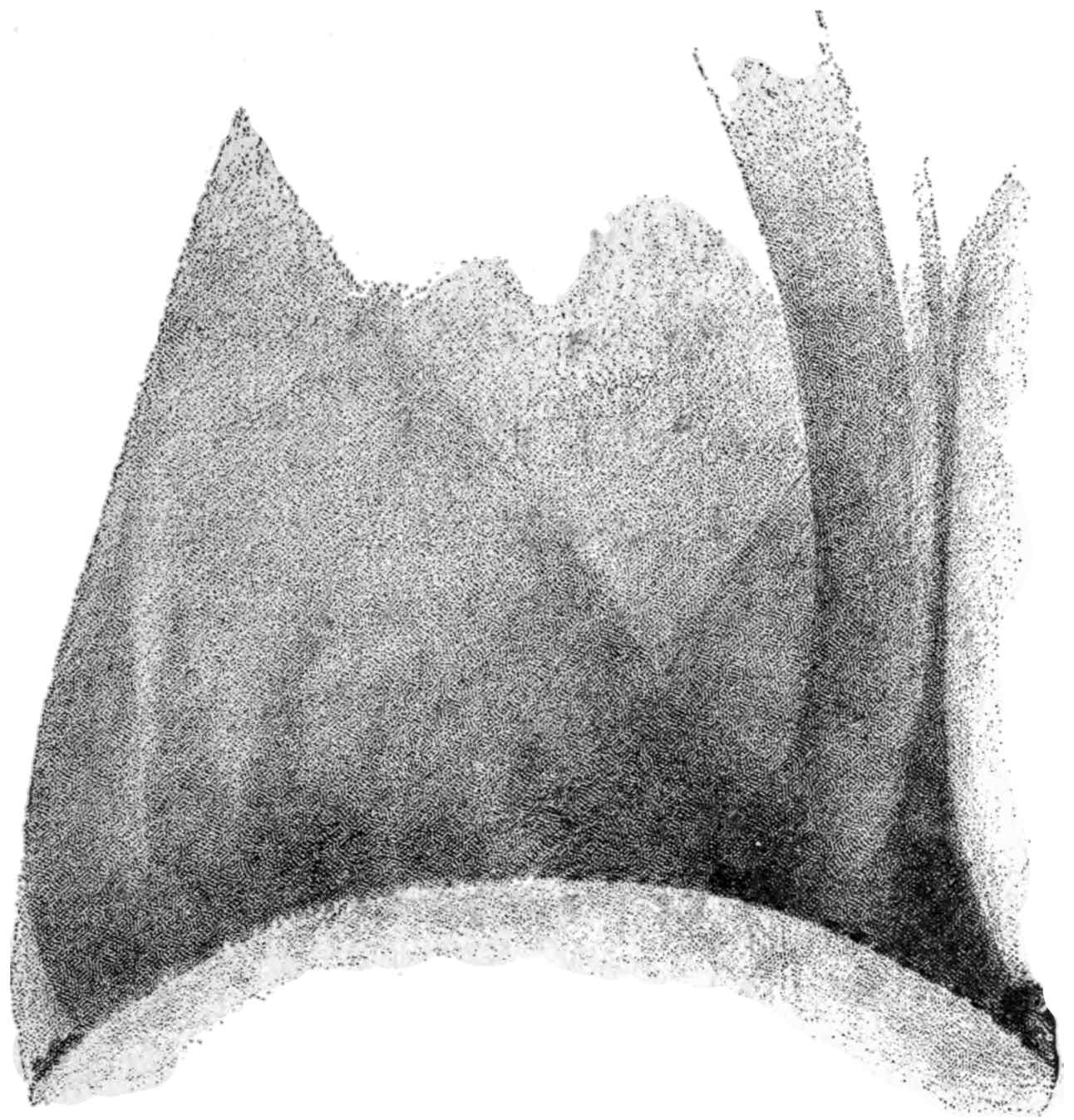
intensity, produced a feeling
that something material was sweeping over the earth at a
speed perfectly frightful. I involuntarily listened for the rushing
noise of a mighty wind.”
FIG. 30—TRACK OF LUNAR SHADOW.
Each one notes something different from another at such a
time; and though the reader will find minute descriptions of the
phenomena already in print, it will perhaps be more interesting
if, instead of citations from books, I invite him to view them
with me, since each can tell best what he has personally seen.
FIG. 31.—INNER CORONA ECLIPSE OF 1869. FROM
SHELBYVILLE PHOTOGRAPH. (ROYAL ASTRONOMICAL
SOCIETY’S MEMOIRS.)
I have witnessed three total eclipses, but I do not find that
repetition dulls the interest. The first was that of 1869, which
passed across the United States and was nearly central over
Louisville. My station was on the southern border of the
eclipse track, not very far from the Mammoth Cave in Kentucky,
and I well remember that early experience. The special
observations of precision in which I was engaged would not interest
the reader; but while trying to give my undivided attention
to these, a mental photograph
of the whole spectacle
seemed to be taking
without my volition. First,
the black body of the
moon advanced slowly on
the sun, as we have all
seen it do in partial eclipses,
without anything noticeable
appearing; nor till the
sun was very nearly covered
did the light of day
about us seem much diminished.
But when the
sun’s face was reduced to
a very narrow crescent, the change was sudden and startling,
for the light which fell on us not only dwindled rapidly,
but became of a kind unknown before, so that a pallid appearance
overspread the face of the earth with an ugly livid
hue; and as this strange wanness increased, a cold seemed
to come with it. The impression was of something unnatural;
but there was only a moment to note it, for the sun went
out as suddenly as a blown-out gas-jet, and I became as suddenly
aware that all around, where it had been, there had
been growing into vision a kind of ghostly radiance, composed
of separate pearly beams, looking distinct each from each,
as though the black circle where the sun once was, bristled
with pale streamers, stretching far away from it in a sort of
crown.
This was the mysterious corona, only seen during the brief
moments while the shadow is flying overhead; but as I am
undertaking to recall faithfully the impressions of the instant,
I may admit that I was at the time equally struck with a circumstance
that may appear trivial
in description,—the extraordinary
globular appearance of the moon
herself. We all know well enough
that the moon is a solid sphere,
but it commonly looks like a bright,
flat circle fastened to the concave
of the starry vault; and now, owing
to its unwonted illumination,
the actual rotundity was seen for
the first time, and the result was
to show it as it really is,—a
monstrous, solid globe, suspended
by some invisible support above
the earth, with nothing apparent to keep it from tumbling on
us, looking at the moment very near, and more than anything
else like a gigantic black cannon-ball, hung by some miracle
in the air above the neighboring cornfield. But in a few seconds
all was over; the sunlight flashed from one point of the
moon’s edge and then another, almost simultaneously, like suddenly
kindled electric lights, which as instantly flowed into one,
and it was day again.
FIG. 32.—SKETCH OF OUTER CORONA,
1869. (U. S. COAST SURVEY REPORT.)
I have spoken of the “unnatural” appearance of the light
just before totality. This is not due to excited fancy, for there
is something so essentially different from the natural darkness
of twilight, that the brute creation shares the feeling with us.
Arago, for instance, mentions that in the eclipse of 1842, at
Perpignan, where he was stationed, a dog which had been kept
from food twenty-four hours was, to test this, thrown some bread
just before “totality” began. The dog seized the loaf, began
to devour it ravenously, and then, as the appearance already
described came on, he dropped it. The darkness lasted some
minutes, but not till the sun came forth again did the poor creature
return to the food. It is no wonder, then, that men also,
whether educated or ignorant, do not escape the impression. A
party of the courtiers of Louis XV. is said to have gathered
round Cassini to witness an eclipse from the terrace of the Paris
observatory, and to have been laughing at the populace, whose
cries were heard as the light began to fade; when, as the unnatural
gloom came quickly on, a sudden silence fell on them too,
the panic terror striking through their laughter. Something
common to man and the brute speaks at such times, if never
before or again; something which is not altogether physical
apprehension, but more like the moral dismay when the shock
of an earthquake is felt for the first time, and we first know that
startling doubt, superior to reason, whether the solid frame of
earth is real, and not “baseless as the fabric of a vision.”
But this is appealing for illustration to an experience which
most readers have doubtless been spared,2 and I would rather
cite the lighter one of our central party that day, a few miles
north of me, at Shelbyville. In this part of Kentucky the
colored population was large, and (in those days) ignorant of
everything outside the life of the plantation, from which they
had only lately been emancipated. On that eventful 8th of
August they came in great numbers to view the enclosure and
the tents of the observing party, and to inquire the price of the
show. On learning that they might see it without charge from
the outside, a most unfavorable opinion was created among
them as to the probable merits of so cheap a spectacle, and
they crowded the trees about the camp, shouting to each other
sarcastic comments on the inferior interest of the entertainment.
“Those trees there,” said one of the observers to me the next
day, “were black with them, and they kept up their noise till
near the last, when they suddenly stopped, and all at once, and
as ‘totality’ came, we heard a wail and a noise of tumbling, as
though the trees had been shaken of their fruit, and then the
boldest did not feel safe till he was under his own bed in his
own cabin.”
2 This was written before the “Charleston earthquake” occurred.
FIG. 33.—TACCHINI’S DRAWING OF CORONA OF 1870.
(SECCHI’S “LE SOLEIL.”)
It is impossible to give an exact view of what our friends at
Shelbyville saw, for no drawings made there appear to have
been preserved, and photography at that time could only indicate
feebly the portion of the corona near the sun where it is
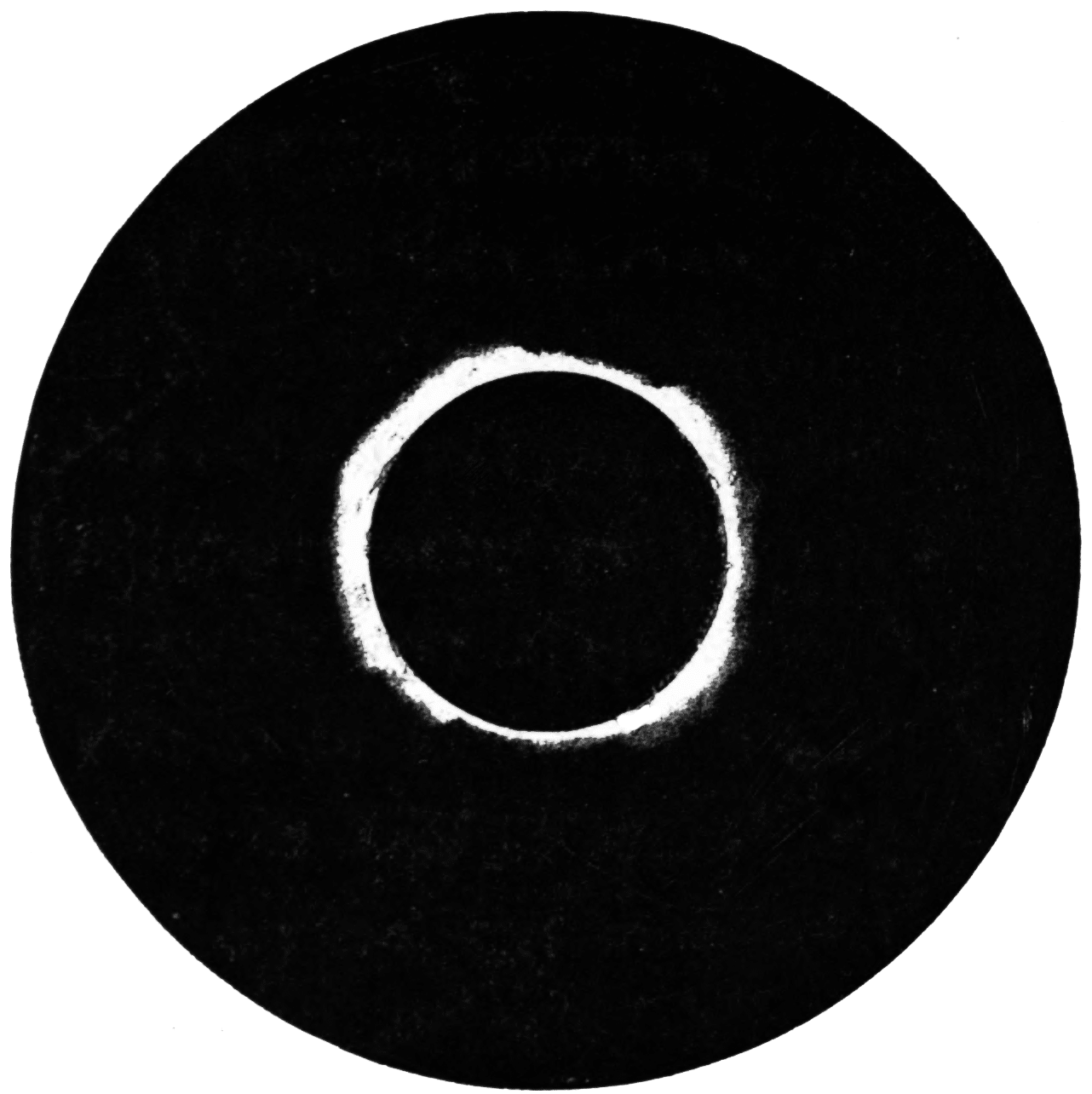
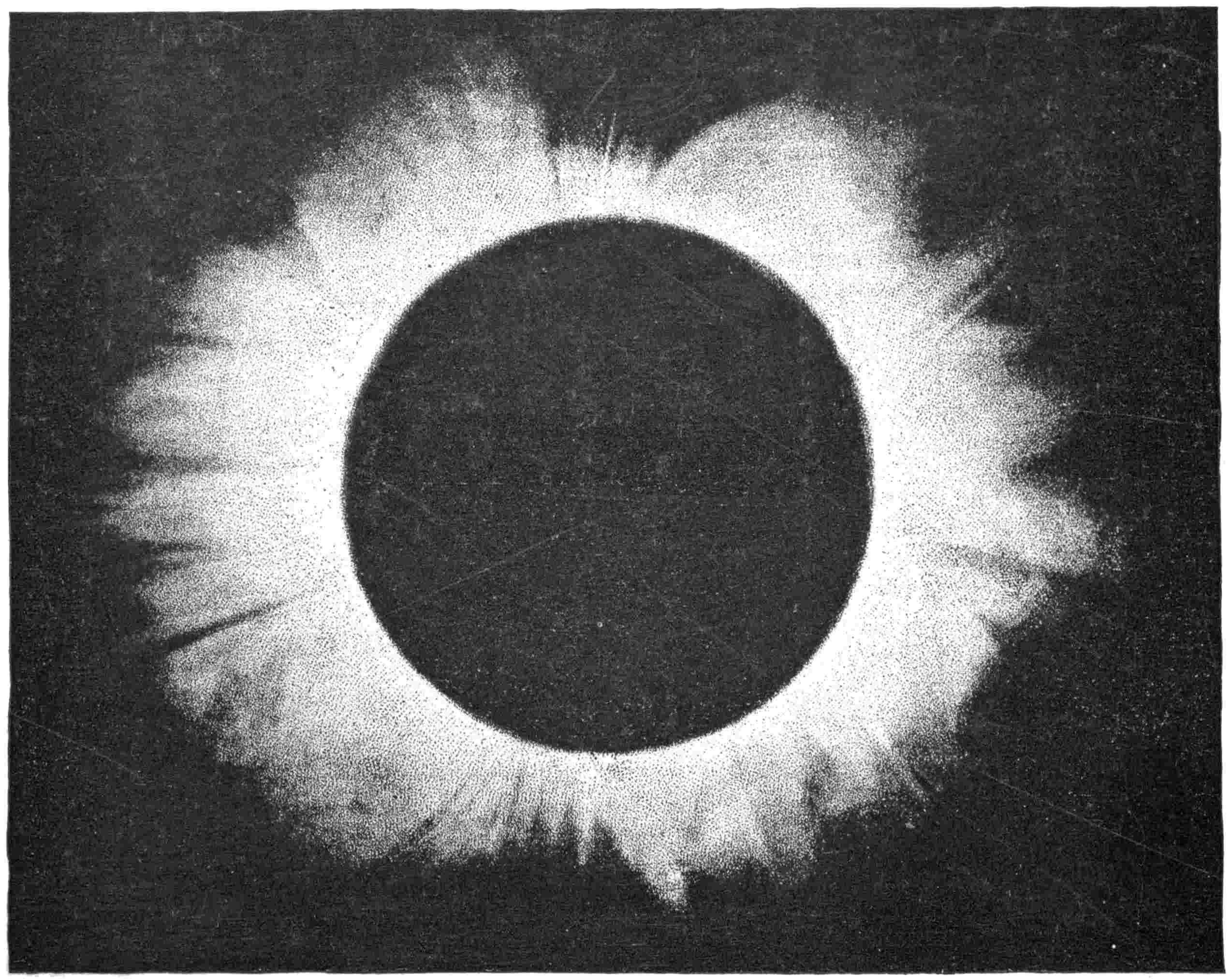
brightest. Fig. 31 is a fac-simile of one of the photographs
taken on the occasion, which is interesting perhaps as one of
the early attempts in this direction, for comparison with later
ones; but as a picture it is very disappointing, for the whole
structure of the outer corona we have alluded to is missed altogether,
the plate having taken no impression of it.
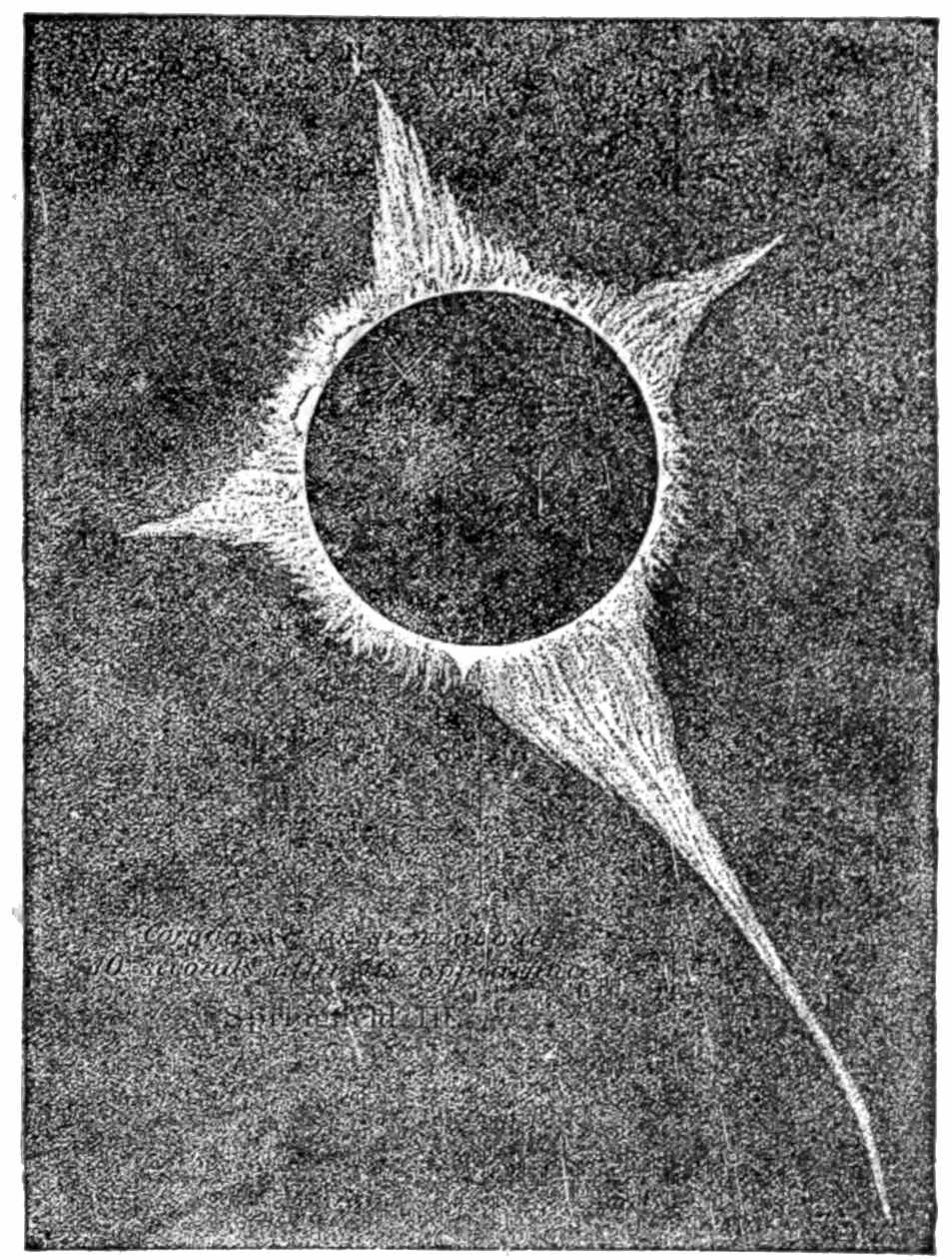
A drawing (Fig. 32) made by another observer, Mr. M’Leod,
at Springfield, represents more of the outer structure; but the
reader must remember that all drawings must, in the nature of
the case (since there are but two or three minutes to sketch in),
be incomplete, whatever the artist’s skill.
FIG. 34.—WATSON’S NAKED-EYE DRAWING
OF CORONA OF 1870. (U. S. COAST SURVEY
REPORT.)
Up to this time it was still doubtful, not only what the corona
was, but where it was; whether it was a something about
the sun or moon, or whether, indeed, it might not be in our
own atmosphere. The spectroscopic observations of Professors
Young and Harkness at this same eclipse of a green line in its
spectrum, due to some glowing gas, showed conclusively that
it was largely, at any rate, a solar appendage, and partly, at
least, self-luminous; and these and
other results having awakened general
discussion among astronomers in Europe
as well as at home, the United
States Government sent an expedition,
under the direction of the late
Professor Pierce, to observe an eclipse
which in the next year, on Dec. 8,
1870, was total in the south of Spain.
There were three parties; and of the
most western of these, which was at
Xeres under the charge of Professor Winlock, I was a member.
FIG. 35.—PHOTOGRAPH SHOWING COMMENCEMENT OF OUTER CORONA.
(ROYAL ASTRONOMICAL SOCIETY’S MEMOIRS.)
The duration of totality was known beforehand. It would
last two minutes and ten seconds, and to secure what could be
seen in this brief interval we crossed the ocean. Our station
was in the midst of the sherry district, and a part of the instruments
were in an orange-grove, where the ground was covered
with the ripe fallen fruit, while the olive and vine about us in
December reminded us of the distance we had come to gather
the results of so brief an opportunity.
To prepare for it, we had all arrived on the ground some
weeks beforehand, and had been assiduously busy in installing
the apparatus in the observing camp, which suggested that of a
small army, the numerous instruments, some of them of considerable
size,—equatorials, photographic apparatus, polariscopes,
photometers, and spectroscopes,—being under tents, the fronts
of which could be lifted when the time came for action.
To the equatorial telescopes photographic cameras are attached
instead of the eye-pieces, in the hope that the corona
may be made to impress itself on the plate instead of on the
eye. The eye is an admirable instrument itself, no doubt; but
behind it is a brain, perhaps overwrought with excitement, and
responding too completely to the nervous tension which most
of us experience when those critical moments are passing so
rapidly. The camera can see far less of the corona than the
man, but it has no nerves, and what it sets down we may
rely on.
At such a time each observer has some particular task
assigned to him, on which, if wise, he has drilled himself for
weeks beforehand, so that no hesitation or doubt may arise in
the moment of action; and his attention is expected to be devoted
to this duty alone, which may keep him from noting any
of the features which make the occasion so impressive as a
spectacle. Most of my own particular work was again of a
kind which would not interest the reader.
Apart from this, I can recall little but the sort of pain of
expectation, as the moment approached, till within a minute
before totality the hum of voices around ceased, and an utter
and most impressive silence succeeded, broken only by a low
“Ah!” from the group without the camp, when the moment
came. I remember that the clouds, which had hung over the
sun while the moon was first advancing on its body, cleared
away before the instant of totality, so that the last thing I saw
was a range of mountains to the eastward still bright in the
light; then, the next moment, the shadow rushed overhead and
blotted out the distant hills, almost before I could turn my face
to the instrument before me.
FIG. 36.—ECLIPSE OF 1857, DRAWING BY LIAIS. (ROYAL ASTRONOMICAL
SOCIETY’S MEMOIRS.)
The corona appeared to me a different thing from what it did
the year before. It was apparently confined to a pearly light of
a roughly quadrangular shape, close to the limb of the sun,
broken by dark rifts (one of which was a conspicuous object);
while within, and close to the limb, was what looked like a
mountain rising from the hidden sun, of the color of the richest
tint we should see in a rose-leaf held up against the light,
while others were visible of an orange-scarlet. After a short
scrutiny I turned to my task of analyzing the nature of the
white light.
The seconds fled, the light broke out again, and so did the
hubbub of voices,—it was all over, and what had been missed
then could not be recovered. The sense of self-reproach for
wasted opportunity is a common enough feeling at this time,
though one may have done his best, so little it seems to each
he has accomplished; but when all the results had been brought
together, we found that the
spectroscopes, cameras, and
polariscopes had each done
their work, and the journey
had not been taken in vain.
In one point only we all
differed, and this was about
the direct ocular evidence,
for each seemed to have
seen a different corona, and
the drawings of it were singularly
unlike. Here are
two (Figs. 33 and 34) taken
at this eclipse at the same
time, and from neighboring
stations, by two most experienced astronomers, Tacchini and
Watson. No one could guess that they represented the same
object, and a similar discrepancy was common.
FIG. 37.—ENLARGEMENT OF PART OF FIG. 38.
Considering that these were trained experts, whose special
task it was, in this case, to draw the corona, which therefore
claimed their undivided attention, I hardly know a more striking
instance of the fallibility of human testimony. The evidence of
several observers, however, pointed to the fact that the light
really was more nearly confined to the part next the sun than
the year before, so that the corona had probably changed during
that interval, and grown smaller, which was remarkable enough.
The evidence of the polariscope, on the whole, showed it to be
partly due to reflected sunlight, while the spectroscope in the
hands of Professor Young confirmed the last year’s observation,
that it was also, and largely, self-luminous. Finally, the photographs,
taken at very distant stations, showed the same dark
rifts in the same place, and thus brought confirmatory evidence
that it was not a local phenomenon in our own atmosphere.
A photograph of it, taken by Mr. Brothers in Sicily, is the
subject of the annexed illustration (Fig. 35), in which the very
bright lights which, owing to “photographic irradiation,” seem
to indent the moon, are chiefly due to the colored flames I have
spoken of, which will be described later.
It may be observed that the photographs taken in the next
year (1871) were still more successful, and began to show still
more of the structure, whose curious forms, resembling large
petals, had already been figured by Liais. His drawing (Fig. 36),
made in 1857, was supposed to be rather a fanciful sketch
than a trustworthy one; but, as it will be seen, the photograph
goes far to justify it.
Figures 37 and 38 are copies published by Mr. Ranyard of
the excellent photographs obtained in 1871, which are perhaps
as good as anything done since, though even these do not show
the outer corona. The first is an enlargement of a small portion
of the detail in the second. It is scarcely possible for wood-engraving
to reproduce the delicate texture of the original.
FIG. 38.—FAC-SIMILE OF PHOTOGRAPH OF CORONA OF 1871.
(ROYAL ASTRONOMICAL SOCIETY’S MEMOIRS.)
The years brought round the eclipse of 1878, which was again
in United States territory, the central track (as Fig. 30 has already
shown) running directly over one of the loftiest mountains
of the country, Pike’s Peak, in Colorado. Pike’s Peak, though
over fourteen thousand feet high, is often ascended by pleasure
tourists; but it is one thing to stay there for an hour or
two, and another to take up one’s abode there and get acclimated,—for
to do the latter we must first pass through the
horrors (not too strong a word) of mountain-sickness. This
reaches its height usually on the second or third day, and is
something like violent sea-sickness, complicated with the sensations
a mouse may be supposed to have under the bell of an air-pump.
After a week the strong begin to get over it, but none
but the very robust should take its chances, as we did, without
preparation; for on the night before the eclipse the life of one
of our little party was pronounced in danger, and he was carried
down in a litter to a cabin at an altitude of about ten thousand
feet, where he recovered so speedily as to be able to do good service
on the following day. The summit of the “Peak” is covered
with great angular bowlders of splintered granite, among
which we laid logs brought up for firewood, and on these, sacks
of damp hay, then stretching a little tent over all and tying it
down with wire to the rocks, we were fain to turn in under
damp blankets, and to lie awake with incessant headache, drawing
long, struggling breaths in the vain attempt to get air, and
wondering how long the tent would last, as the canvas flapped
and roared with a noise like that of a loose sail in a gale at sea,
with occasional intervals of a dead silence, usually followed by
a gust that shoved against the tent with the push of a solid
body, and if a sleepers shoulders touched the canvas, shouldered
him over in his bed. The stout canvas held, but the
snow entered with the wind and lay in a deep drift on the pillow,
when I woke after a brief sleep toward morning, and, looking
out on the gray dawn, found that the snow had turned to
hail, which was rattling sharply on the rocks with an accompaniment
of thunder, which seemed to roll from all parts of the
horizon. The snow lay thick, and the sheets of hail were like
a wall, shutting out the sight of everything a few rods off, and
this was in July! I thought of my December station in sunny
Andalusia.
FIG. 39.—“SPECTRES.”
Hail, rain, sleet, snow, fog, and every form of bad weather
continued for a week on the summit, while it was almost always
clear below. It was often a remarkable sight to go to the edge
and look down. The expanse of “the plains,” which stretched
eastward to a horizon line over a hundred miles distant, would
be in bright sunshine beneath, while the hail was all around and
above us; and the light coming up instead of down gave singular
effects when the clouds parted below, the plains seeming
at such times to be opalescent with luminous yellow and green,
as though the lower world were translucent, and the sun were
beneath it and shining up through. Fig. 39 is a picture of
three of us on the mountain-top, who saw a rarer spectacle;
for directly opposite the setting sun, and on the mist over the
gulf beyond us, was a bright ring, in whose centre were three
phantom images of our three selves, which moved as we moved,
and then faded as the sun sank. It was “the spectre of the
Brocken.” These ghostly presentments were tolerably defined,
as in the sketch, but did not seem to be gigantic, as some have
described them. We rather thought them close at hand; but
before we could determine, the vision faded.
The clouds, to our good fortune, rolled away on the 29th;
and a number of pleasure-seekers, who came up to view the
eclipse and the unwonted bright sunshine, made a scene which
it was hard to identify with the usual one. This time my business
was to draw the corona; and the extreme altitude and the
clearness of the air, with perhaps some greater extension than
usual in the object itself, enabled it to be followed to an unprecedented
distance. During totality the sun was surrounded by
a narrow ring—hardly more than a line—of vivid light, presenting
no structure to the naked eye (but a remarkable one in
the telescope); and this faded with great suddenness into a circular
nebulous luminosity between two and three diameters of
the sun wide, but without such marked plumes, or filaments, as
I had seen in 1869. The most extraordinary thing, however,
was a beam of light, inclined at an angle of about forty-five
degrees, about as wide as the sun, and extending to the distance
of nearly six of its diameters on one side and over twelve on the
other; on one side alone, that is, to the amazing distance of over
ten million miles from its body. Substantially the same observation
was made, as it appeared later, by Professor Newcomb,
at a lower level. The direction, when more carefully measured,
it was interesting to note, coincided closely with that of the
Zodiacal light, and a faint central rib added to its resemblance
to that body. It is noteworthy, in illustration of what has
already been said as to the conflict of ocular testimony, that
though I, with the great majority of observers below, saw only
this beam, two witnesses whose evidence is unimpeachable, Professors
Young and Abbe, saw a pale beam at right angles to it;
and that one observer did not see the beam in question at all.
Fig. 40 is a sketch made from my own, but necessarily on a
scale which can show only its general features.
With the telescope, the whole of the bright inner light close
to the sun was found to be made up of filaments, more definite
even than those described in a previous chapter as seen in sun-spots,
and bristling in all directions from the edge; not concealing
each other, as we might expect such things to do, upon a
sphere, but fringing the sun’s edge in definite outline, as though
it were really but a disk.
FIG. 40.—OUTER CORONA OF 1878. (U. S. NAVAL OBSERVATORY.)
Those who were at leisure to watch the coming shadow of
the moon described its curved outline as distinctly visible on
the plains. “A rounded ball of darkness with an orange-yellow
border,” one called it. Those, again, who looked down on the
bright clouds below say the shadow was preceded by a yellow
fringe, casting a bright light over the clouds and passing into
orange, pink, rose-red, and dark-red, in about twenty seconds.
This beautiful effect was noticed by nearly all the amateur
observers present, who had their attention at liberty, and was
generally unseen by the professional ones, who were shut up
in dark tents with photometers, or engaged otherwise than in
admiring the glory of the spectacle as a spectacle merely. This
strange light, forming a band of color about the shadow as seen
from above, must have really covered ten miles or more in
width, and have occupied a considerable fraction of a minute
in passing over the heads of those below, to whom it probably
constituted that lurid light on their landscape I have spoken
of as so peculiar and “unnatural.” It seems to be due to the
colored flames round the sun, which shine out when its brighter
light is extinguished. I should add that on the summit of Pike’s
Peak the corona did not entirely disappear at the instant the sun
broke forth again, but that its outlying portions first went and
then its brighter and inner ones, till our eager gaze, trying to
follow it as long as possible, only after the
lapse of some minutes saw the last of the
wonderful thing disappear and “fade into
the light of common day.”
FIG. 41.—SPECTROMETER SLIT
AND SOLAR IMAGE. (FROM
“THE SUN,” BY YOUNG.)
There have been other eclipses since;
but, in spite of all, our knowledge of the
corona remains very incomplete, and if the
most learned in such matters were asked
what it was, he could probably answer truthfully, “I don’t
know.”
FIG. 42.—SLIT AND PROMINENCES.
(“THE SUN,” BY YOUNG.)
This will not be wondered at when it is considered that as
total eclipses come, about every other year, and continue, one
with another, hardly three minutes, an astronomer who should
devote thirty years exclusively
to the subject, never missing an
eclipse in whatever quarter of
the globe it occurred, would in
that time have secured, in all,
something like three-quarters of
an hour for observation. Accordingly,
what we know best
about the corona is how it looks,
what it is being still largely
conjecture; and it is for this
reason that I have thought the
space devoted to it would be best used by giving the unscientific
reader some idea of the visible phenomena as they present
themselves to an eyewitness. Treatises like Lockyer’s “Solar
Physics,” Proctor’s “The Sun,” Secchi’s “Le Soleil,” and Young’s
“The Sun” (the latter is most recent), will give the reader who
desires to learn more of the little that is known, the fuller information
which this is not the place for; but it may be said very
briefly that it is certain that the corona is at times of enormous
extent (the whole length of the longer beam seen on Pike’s Peak
must have been over fourteen million miles), that it almost certainly
changes in its shape and dimensions from year to year
(possibly much oftener, but this we cannot yet know), and that
it shines partly by its own and partly by reflected light. When
we come to ask whether it is a gas or not, the evidence is conflicting.
The appearance of the green coronal line, and other
testimony we have not alluded to, would make it seem almost
certain that there must be a gas here of extreme tenuity, reaching
the height of some hundred thousand miles, at the least;
while yet the fact that such light bodies as comets have been
known to pass through it, close to the sun, without suffering any
visible retardation, such as would come even from a gas far
lighter than hydrogen, appears to throw doubt on evidence
otherwise strong. It is possible to conceive of the corona, and
especially of the outer portion, as very largely made up of
minute particles such as form the scattered dust of meteoric
trains, and this seems to be the most probable constitution of its
outlying parts. It is even possible to conceive that it is in some
degree a subjective phenomenon, caused, as Professor Hastings
has suggested, by diffraction upon the edge of the moon,—the
moon, that is, not merely serving as a screen to the sun to reveal
the corona, but partly making the corona by diffracting the light,
somewhat as we see that the edge of any very distant object
screening the sun is gilded by its beams. This effect may be
seen when the sun rises or sets unusually clear, for objects on
the horizon partly hiding it are then fringed for a moment with
a line of light,—an appearance which has not escaped Shakspeare,
where he says,—
“But when from under this terrestrial ball
He fires the tall tops of the eastern pines.”
Still, in admitting the possibility of some such contributory
effect on the part of the moon, we must not, of course, be understood
as meaning that the corona as a whole does not have a
real existence, quite independent of the changes which the presence
of the moon may bring; and in leaving the wonderful
thing we must remember that it is, after all, a reality, and not
a phantasm.
FIG. 43.—TACCHINI’S CHROMOSPHERIC CLOUDS. (“MEMORIE DEGLI SPETTROSCOPISTI ITALIANI.”)
FIG. 44.—TACCHINI’S CHROMOSPHERIC CLOUDS. (“MEMORIE DEGLI SPETTROSCOPISTI ITALIANI.”)
I have already described how, at the eclipse of 1870, I (with
others) saw within the corona what seemed like rose and scarlet-colored
mountains rising from the sun’s edge, an appearance
which had first been particularly studied in the eclipse of 1868,
two years before, and which, it might be added, Messrs. Lockyer
and Janssen had succeeded in observing without an eclipse by
the spectroscope. Besides the corona, it may be said, then, that
the sun is surrounded by a thin envelope, rising here and there
into prominences of a rose and scarlet color, invisible in the telescope,
except at a total eclipse, but always visible through the
spectroscope. It is within and quite distinct from the corona,
and is usually called the “chromosphere,” being a sort of sphere
of colored fire surrounding the sun, but which we can usually
see only on the edge. “The appearance,” says Young, “is as
if countless jets of heated gas were issuing through vents and
spiracles over the whole surface, thus clothing it with flame,
which heaves and tosses like the blaze of a conflagration.” Out
of this, then, somewhat like greater waves or larger swellings of
the colored fires, rise the prominences, whose place, close to the
sun’s edge, has been indicated in many of the drawings and
photographs just given of the corona, on whose background they
are seen during eclipses; but as they can be studied at our
leisure with the spectroscope, we have reserved a more particular
description of them till now. They are at all times directly before
us, as well as the corona; but while both are yet invisible
from the overpowering brightness of the sunlight reflected from
the earth’s atmosphere in front of them, these red flames are so
far brighter than the coronal background, that if we could only
weaken this “glare” a little, they at least might become visible,
even if the corona were not. The difficulty is evidently to find
some contrivance which will weaken the “glare” without enfeebling
the prominences too; and this the spectroscope does by
diffusing the white sunlight, while it lets the color pass nearly
unimpaired. For the full understanding of its action the reader
must be referred to such works as those on the sun already mentioned;
but a general idea of it may be gathered, if we reflect
that white light is composed of every possible variety of colors,
and that the spectroscope, which consists essentially of a prism
behind a very narrow slit through which the light enters, lets
any single color pass freely, without weakening it or altering it
in anything but its direction, but gives a different direction to
each, and hence sorts out the tints, distributing them side by
side, every one in its own place, upon the long colored band
called the spectrum. If this distribution has spread the colors
along a space a thousand times as wide as the original beam, the
average light must be just so much weaker than the white light
was, because this originally consisted of a thousand (let us say a
thousand, but it is really an infinite number) mingled tints of
blue, green, yellow, orange, and red, which have now been thus
distributed. If, however, we look through the prism at a rose-leaf,
and it has no blue, green, yellow, or orange in it, and
nothing but pure red, as each single color passes unchanged,
this red will, according to what has been said, be as bright after
it has passed as before. All depends, then, on the fact that these
prominences do consist mainly of light of one color, like the
rose-leaf, so that this monochromatic light will be seen through
the spectroscope just as it is, while the luminous veil of glaring
white before it will seem to be brushed away.
If a large telescope be directed toward the sun, the glass at
the farther end will, if we remove the eye-piece, form a little
picture of the sun, as a picture is formed in a camera-obscura;
and now, if we also fasten the spectroscope to this eye-end, where
the observer’s head would be were he looking through, the edge
of the solar image may be made to fall just off the slit, so that
only the light from the prominences (and the white glare about
them) shall pass in. To see this more clearly, let us turn our
backs to the sun and the telescope, and look at the place where
the image falls by the spectroscope slit, which in Fig. 41 is
drawn of its full size. This is a brass plate, having a minute
rectangular window, the “slit,” in it. The width of this slit is
regulated by a screw, and any rays falling into the narrow aperture
pass through the prism within, and finally fall on the observer’s
eye, but not till they have been sorted by the prism in
the manner described. Formed on the brass plate, just as it
would be formed on a sheet of paper, or anything else held in
the focus, we see the bright solar image, a circle of light perhaps
an inch and a half in diameter,—a miniature of the sun with its
spots. The whole of the sun (the photosphere) then is hidden
to an observer who is looking up through the slit from the other
side, for, as the sun’s edge does not quite touch the slit, none of
its rays can enter it; but if there be also the image here of a
prominence, projecting beyond the edge, and really overhanging
the slit (though to us invisible on account of the glare about it),
these rays will fall into the slit and pass down to the prism,
which will dispose of it in the way already stated.
FIG. 45.—VOGEL’S CHROMOSPHERIC FORMS. (“BEOBACHTUNGEN,” DR. H. C. VOGEL.)
And now let us get to the other side, and, looking up through
the prism with the aid of a magnifying-glass, see what it has
done for us (Fig. 42). The large rectangular opening here is
the same as the small one which was visible from the outside,
only that it is now magnified, and what was before invisible is
seen; the edge of the sun itself is just hidden, but the scarlet
flames of the chromosphere have become visible, with a cloudy
prominence rising above them. The “flames” are flame-like
only in form, for their light is probably due not to any combustion,
but to the glow of intensely heated matter; and as its light
is not quite pure red, we can, by going to another part of the
spectrum, see the same thing repeated in orange, the effect being
as though we had a number of long narrow windows, some
glazed with red, some with orange, and some with other colors,
through which we could look out at the same clouds. I have
looked at these prominences often in this way; but I prefer, in
the reader’s interest, to borrow from the description by Professor
Young, who has made these most interesting and wonderful
forms a special study.
Let us premise that the depth of the crimson shell out of
which they rise is usually less than five thousand miles, and
that though the prominences vary greatly, the majority reach
a height of nearly twenty thousand miles, while in exceptional
cases this is immensely exceeded. Professor Young has seen
one which grew to a height of three hundred and fifty thousand
miles in an hour and a half, and in half an hour more had faded
away.
These forms fall into two main classes,—that of the quiet and
cloud-like, and that of the eruptive,—the first being almost exactly
in form like the clouds of our own sky, sometimes appearing
to lie on the limb of the sun like a bank of clouds on the
horizon, sometimes floating entirely free; while sometimes “the
whole under surface is fringed with down-hanging filaments,
which remind one of a summer shower hanging from a heavy
thunder-cloud.”
Here are some of the typical forms of the quieter ones:—
Fig. 43, by Tacchini, the Director of the Roman Observatory,
represents an ordinary prominence, or cloud-group in the
chromosphere, whose height is about twenty-five thousand miles.
The little spires of flame which rise, thick as grass-blades, everywhere
from the surface, are seen on its right and left.
FIG. 46.—TACCHINI’S CHROMOSPHERIC FORMS. (“MEMORIE DEGLI SPETTROSCOPISTI
ITALIANI.”)
Fig. 44 (Tacchini) is one where the agitation is greater and
the “filamentary” type is more marked. Besides the curiously
thread-like forms (so suggestive of what we have already seen
in the photosphere), we have here what looks like an extended
cloudy mass, drawn out by a horizontally moving wind.
Fig. 45 (by Vogel, at Bothkamp) represents another of these
numerous types.
The extraordinary Fig. 46 is from another drawing, by Tacchini,
of a protuberance seen in 1871 (a time of great solar
disturbance), and it belongs to the more energetic of its class.
FIG. 47.—ERUPTIVE PROMINENCES. (“THE SUN,” BY YOUNG.)
This fantastic cloud-shape, “if shape it might be called that
shape had none,” looking like some nightmare vision, was about
fifty thousand miles long and sixty thousand high above the
surface. The reader will notice also the fiery rain, like the
drops from a falling rocket, and may add to it all, in imagination,
the actual color, which is of a deep scarlet.
It may add to the-interest such things excite, to know that
they have some mysterious connection with a terrestrial phenomenon,—the
aurora,—for the northern lights have been
again and again noticed to dance in company with these solar
displays.
The eruptive prominences are very different in appearance,
as will be seen by the next illustration, for which we are indebted
to Professor Young.
In Fig. 47 we have a group of most interesting views by him
(drawn here on the common scale of seventy-five thousand miles
to an inch), illustrating the more eruptive types, of which we
will let him speak directly. The first shows a case of the vertical
filaments, like those rocket-drops we saw just, now in Tacchini’s
drawing, but here more marked; while the second (on
the left side) is a cyclone-form, where the twisted stems suggest
what we have seen before in the “bridges” of sun-spots,
and below this is another example of filamentary forms.
The upper one, on the right, is the view of a cloud prominence
as it appeared at half-past twelve o’clock, on Sept. 7,
1871. Below it is the same prominence at one o’clock (half an
hour later), when it has been shattered by some inconceivable
explosion, blowing it into fragments, and driving the hydrogen
to a height of two hundred thousand miles. The lowest figure
on the right shows another case where inclined jets (of hydrogen)
were seen to rise to a height of fifty thousand miles.
Professor Young says of these:—
“Their form and appearance change with great rapidity, so that the
motion can almost be seen with the eye. Sometimes they consist of
pointed rays, diverging in all directions, like hedgehog-spines. Sometimes
they look like flames; sometimes like sheaves of grain; sometimes
like whirling water-spouts, capped with a great cloud; occasionally they
present most exactly the appearance of jets of liquid fire, rising and falling
in graceful parabolas; frequently they carry on their edges spirals
like the volutes of an Ionic column; and continually they detach filaments
which rise to a great elevation, gradually expanding and growing
fainter as they ascend, until the eye loses them. There is no end to the
number of curious and interesting appearances which they exhibit under
varying circumstances. The velocity of the motions often exceeds a
hundred miles a second, and sometimes, though very rarely, reaches
two hundred miles.”
In the case of the particular phenomenon recorded by Professor
Young in the last illustration, Mr. Proctor, however, has
calculated that the initial velocity probably exceeded five hundred
miles a second, which, except for the resistance experienced
by the sun’s own atmosphere, would have hurled the ejected
matter into space entirely clear of the sun’s power to recall it,
so that it would never return.
It adds to our interest in these flames to know that they at
least are connected with that up-rush of heated matter from the
sun’s interior, forming a part of the circulation which maintains
both the temperature of its surface and that radiation on which
all terrestrial life depends. The flames, indeed, add of themselves
little to the heat the sun sends us, but they are in this
way the outward and visible signs of a constant process within,
by which we live; and so far they seem to have a more immediate
interest to us, though invisible, than the corona which surrounds
them. But we must remember when we lift our eyes to
the sun that this latter wonder is really there, whether man sees
it or not, and that the cause of its existence is still unknown.
We ask for its “object” perhaps with an unconscious assumption
that the whole must have been in some way provided to
subserve our wants; but there is not as yet the slightest evidence
connecting its existence with any human need or purpose, and
as yet we have no knowledge that, in this sense, it exists to any
“end” at all. “As the thought of man is widened with the
process of the suns,” let us hope that we shall one day know
more.
III. THE SUN’S ENERGY.
“It is indeed,” says good Bishop Berkeley, “an opinion
strangely prevailing amongst men that ... all sensible
objects have an existence ... distinct from their being perceived
by the understanding. But ... some truths there are,
so near and obvious to the mind, that a man need only open
his eyes to see them. Such I take this important one to be,
namely, that all the choir of heaven and furniture of the earth—in
a word, all those bodies which compose the mighty frame of
the world—have not any subsistence without a mind.”
We are not going to take the reader along “the high priori
road” of metaphysics, but only to speak of certain accepted
conclusions of modern experimental physics, which do not themselves,
indeed, justify all of Berkeley’s language, but to which
these words of the author of “A New Theory of Vision” seem
to be a not unfit prelude.
When we see a rose-leaf, we see with it what we call a color,
and we are apt to think it is in the rose. But the color is in us,
for it is a sensation which something coming from the sun excites
in the eye; so that if the rose-leaf were still there, there
would be no color unless there were an eye to receive and a
brain to interpret the sensation. Every color that is lovely in
the rainbow or the flower, every hue that is vivid in a ribbon or
sombre in the grave harmonies of some old Persian rug, the
metallic lustre of the humming-bird or the sober imperial yellow
of precious china,—all these have no existence as color apart
from the seeing eye, and all have their fount and origin in the
sun itself.
“Color” and “light,” then, are not, properly speaking, external
things, but names given to the sensations caused by an
uncomprehended something radiated from the sun, when this
falls on our eyes. If this very same something falls on our face,
it produces another kind of sensation, which we call “heat,” or
if it falls on a thermometer it makes it rise; while if it rests long
on the face it will produce yet another effect, “chemical action,”
for it will tan the cheek, producing a chemical change there;
or it will do the like work more promptly if it meet a photographic
plate. If we bear in mind that it is the identically same
thing (whatever that is) which produces all these diverse effects,
we see, some of us perhaps for the first time, that “color,”
“light,” “radiant heat,” “actinism,” etc., are only names given
to the diverse effects of some thing, not things themselves; so
that, for instance, all the splendor of color in the visible world
exists only in the eye that sees it. The reader must not suppose
that he is here being asked to entertain any metaphysical subtlety.
We are considering a fact almost universally accepted
within the last few years by physicists, who now generally
admit the existence of a something coming from the sun, which
is not itself light, heat, or chemical action, but of which these
are effects. When we give this unknown thing a name, we call
it “radiant energy.”
How it crosses the void of space we cannot be properly said
to know, but all the phenomena lead us to think it is in the
form of motion in some medium,—somewhat (to use an imperfect
analogy) like the transmission through the air of the vibrations
which will cause sound when they reach an ear. This, at
any rate, is certain, that there is an action of some sort incessantly
going on between us and the sun, which enables us to
experience the effects of light and heat. We assume it to be a
particular mode of vibration; but whatever it is, it is repeated
with incomprehensible rapidity. Experiments recently made by
the writer show that the slower heat vibrations which reach us
from the sun succeed each other nearly 100,000,000,000,000
times in a single second, while those which make us see, have
long been known to be more rapid still. These pass outward
from the sun in every direction, in ever-widening spheres; and
in them, so far as we know, lies the potency of life for the
planet upon whose surface they fall.
Did the reader ever consider that next to the mystery of
gravitation, which draws all things on the earth’s surface down,
comes that mystery—not seen to be one because so familiar—of
the occult force in the sunbeams which lifts things up? The
incomprehensible energy of the sunbeam brought the carbon out
of the air, put it together in the weed or the plant, and lifted
each tree-trunk above the soil. The soil did not lift it, any
more than the soil in Broadway lifted the spire of Trinity. Men
brought stones there in wagons to build the church, and the sun
brought the materials in its own way, and built up alike the
slender shaft that sustains the grass blade and the column of
the pine. If the tree or the spire fell, it would require a certain
amount of work of men or horses or engines to set it up again.
So much actual work, at least, the sun did in the original building;
and if we consider the number of trees in the forest, we see
that this alone is something great. But besides this, the sun
locked up in each tree a store of energy thousands of times
greater than that which was spent in merely lifting the trunk
from the ground, as we may see by unlocking it again, when we
burn the tree under the boiler of an engine; for it will develop
a power equal to the lifting of thousands of its kind, if we
choose to employ it in this way. This is so true, that the tree
may fall, and turn to coal in the soil, and still keep this energy
imprisoned in it,—keep it for millions of years, till the black
lump under the furnace gives out, in the whirling spindles of
the factory or the turning wheel of the steamboat, the energy
gathered in the sunshine of the primeval world.
The most active rays in building up plant-life are said to be
the yellow and orange, though Nature’s fondness for green
everywhere is probably justified by some special utility. At
any rate, the action of these solar rays is to decompose the
products of combustion, to set free the oxygen, and to fix the
carbon in the plant. Perhaps these words do not convey a
definite meaning to the reader, but it is to be hoped they will,
for the statement they imply is wonderful enough. Swift’s
philosopher at Laputa, who had a project for extracting sunbeams
out of cucumbers, was wiser than his author knew; for
cucumbers, like other vegetables, are now found to be really in
large part put together by sunbeams, and sunbeams, or what is
scarcely distinguishable from such, could with our present scientific
knowledge be extracted from cucumbers again, only the
process would be too expensive to pay. The sunbeam, however,
does what our wisest chemistry cannot do: it takes the
burned out ashes and makes them anew into green wood; it
takes the close and breathed out air, and makes it sweet and fit
to breathe by means of the plant, whose food is the same as our
poison. With the aid of sunlight a lily would thrive on the
deadly atmosphere of the “black hole of Calcutta;” for this
bane to us, we repeat, is vital air to the plant, which breathes
it in through all its pores, bringing it into contact with the chlorophyl,
its green blood, which is to it what the red blood is to
us; doing almost everything, however, by means of the sun
ray, for if this be lacking, the oxygen is no longer set free or
the carbon retained, and the plant dies. This too brief statement
must answer instead of a fuller description of how the
sun’s energy builds up the vegetable world.
But the ox, the sheep, and the lamb feed on the vegetable,
and we in turn on them (and on vegetables too); so that,
though we might eat our own meals in darkness and still live,
the meals themselves are provided literally at the sun’s expense,
virtue having gone out of him to furnish each morsel we put in
our mouths. But while he thus prepares the material for our
own bodies, and while it is plain that without him we could not
exist any more than the plant, the processes by which he acts
grow more intricate and more obscure in our own higher organism,
so that science as yet only half guesses how the sun makes
us. But the making is done in some way by the sun, and so
almost exclusively is every process of life.
It is not generally understood, I think, how literally true this
is of every object in the organic world. In a subsequent illustration
we shall see a newspaper being printed by power directly
and visibly derived from the sunbeam. But all the power derived
from coal, and all the power derived from human muscles,
comes originally from the sun, in just as literal a sense; for the
paper on which the reader’s eye rests was not only made primarily
from material grown by the sun, but was stitched together
by derived sun-power, and by this, also, each page was
printed, so that the amount of this solar radiation expended for
printing each chapter of this book could be stated with approximate
accuracy in figures. To make even the reader’s hand
which holds this page, or the eye which sees it, energy again
went out from the sun; and in saying this I am to be understood
in the plain and common meaning of the words.
Did the reader ever happen to be in a great cotton-mill,
where many hundreds of operatives watched many thousands
of spindles? Nothing is visible to cause the multiplied movement,
the engine being perhaps away in altogether another
building. Wandering from room to room, where everything is
in motion derived from some unseen source, he may be arrested
in his walk by a sudden cessation of the hum and bustle,—at
once on the floor below, and on that above, and all around him.
The simultaneousness of this stoppage at points far apart when
the steam is turned off, strikes one with a sense of the intimate
dependence of every complex process going on upon some remote
invisible motor. The cessation is not, however, absolutely
instantaneous; for the great fly-wheel, in which a trifling part of
the motor power is stored, makes one or two turns more, till the
energy in this also is exhausted, and all is still. The coal-beds
and the forests are to the sun what the fly-wheel is to the
engine: all their power comes from him; they retain a little of
it in store, but very little by comparison with the original; and
were the change we have already spoken of to come over the
sun’s circulation,—were the solar engine disconnected from us,—we
could go on perhaps a short time at the cost of this store,
but when this was over it would be over with us, and all would
be still here too.
Is there not a special interest for us in that New Astronomy
which considers these things, and studies the sun, not only in
the heavens as a star, but in its workings here, and so largely
in its relations to man?
* * * * *
Since, then, we are the children of the sun, and our bodies a
product of its rays, as much as the ephemeral insects that its
heat hatches from the soil, it is a worthy problem to learn how
things earthly depend upon this material ruler of our days. But
although we know it does nearly all things done on the earth,
and have learned a little of the way it builds up the plant, we
know so little of the way it does many other things here that
we are still often only able to connect the terrestrial effect with
the solar cause by noting what events happen together. We are
in this respect in the position of our forefathers, who had not yet
learned the science of electricity, but who noted that when a
flash of lightning came a clap of thunder followed, and concluded
as justly as Franklin or Faraday could have done that
there was a physical relation between them. Quite in this way,
we who are in a like position with regard to the New Astronomy,
which we hope will one day explain to us what is at
present mysterious in our connection with the sun, can as yet
often only infer that when certain phenomena there are followed
or accompanied by others here, all are really connected as products
of one cause, however dissimilar they may look, and however
little we know what the real connection may be.
There is no more common inquiry than as to the influence of
sun-spots on the weather; but as we do not yet know the real
nature of the connection, if there be any, we can only try to
find out by assembling independent records of sun-spots and of
the weather here, and noticing if any changes in the one are
accompanied by changes in the other; to see, for instance, if
when sun-spots are plenty the weather the world over is rainy
or not, or to see if when an unusual disturbance breaks out in
a sun-spot any terrestrial disturbance is simultaneously noted.
FIG. 48.—SUN-SPOTS AND PRICE OF GRAIN. (FROM “OBSERVATIONS OF SOLAR SPOTS.”)
When we remember how our lives depend on a certain circulation
in the sun, of which the spots appear to be special examples,
it is of interest not only to study the forms within them,
as we have already been doing here, but to ask whether the
spots themselves are present as much one year as another. The
sun sometimes has numerous spots on it, and sometimes none at
all; but it does not seem to have occurred to any one to see
whether they had any regular period for coming or going, till
Schwabe, a magistrate in a little German town, who happened
to have a small telescope and a good deal of leisure, began for
his own amusement to note their number every day. He commenced
in 1826, and with German patience observed daily for
forty years. He first found that the spots grew more numerous
in 1830, when there was no single day without one; then the
number declined very rapidly, till in 1833 they were about
gone; then they increased in number again till 1838, then again
declined; and so on, till it became evident that sun-spots do not
come and go by chance, but run through a cycle of growth and
disappearance, on the average about once in every eleven years.
While amusing himself with his telescope, an important sequence
in Nature had thus been added to our knowledge by the obscure
Hofrath Schwabe, who indeed compares himself to Saul, going
out to seek his father’s asses and finding a kingdom. Old records
made before Schwabe’s time have since been hunted up, so
that we have a fairly connected history of the sun’s surface for
nearly a hundred and fifty years; and the years when spots will
be plentiful or rare can now be often predicted from seeing
what has been in the past. Thus I may venture to say that the
spots, so frequent in 1885, will have probably nearly disappeared
in 1888, and will be probably very plentiful in 1894. I do not
know at all why this is likely to happen; I only know that it
has repeatedly happened at corresponding periods in the past.
“Now,” it may be asked, “have these things any connection
with weather changes, and is it of any practical advantage to
know if they have?”
Would it be, it may be answered, of any practical interest to
a merchant in bread-stuffs to have private information of a reliable
character that crops the world over would be fine in 1888
and fail in 1894? The exclusive possession of such knowledge
might plainly bring “wealth beyond the dreams of avarice” to
the user; or, to ascend from the lower ground of personal
interest to the higher aims of philanthropy and science, could
we predict the harvests, we should be armed with a knowledge
that might provide against coming years of famine, and make
life distinctly happier and easier to hundreds of millions of
toilers on the earth’s surface.
“But can we predict?” We certainly cannot till we have,
at any rate, first shown that there is a connection between sun-spots
and the weather. Since we know nothing of the ultimate
causes involved, we can only at present, as I say, collect records
of the changes there, and compare them with others of the
changes here, to see if there is any significant coincidence.
To avoid columns of figures, and yet to enable the reader
to judge for himself in some degree of the evidence, I will
give the results of some of these records represented graphically
by curves, like those which he may perhaps remember
to have seen used to show the fluctuations in the value of
gold and grain, or of stocks in the stock-market. It is only
fair to say that mathematicians used this method long before
it was ever heard of by business men, and that the stockbrokers
borrowed it from the astronomers, and not the astronomers
from them.
In Fig. 48, from Carrington’s work, each horizontal space
represents ten years of time, and the figures in the upper part
represent the fluctuations of the sun-spot curve. In the middle
curve, variations in vertical distances correspond to differences
in the distance from the sun of the planet Jupiter, the possibility
of whose influence on sun-spot periods can thus be examined.
In the third and lowest, suggested by Sir William Herschel, the
figures at the side are proportional to the price of wheat in the
English market, rising when wheat ruled high, falling when it
was cheap. In all three curves one-tenth of a horizontal spacing
along the top or bottom corresponds to one year; and in this
way we have at a glance the condensed result of observations
and statistics for sixty years, which otherwise stated would fill
volumes. The result is instructive in more ways than one.
The variations of Jupiter’s distance certainly do present a striking
coincidence with the changes in spot frequency, and this
may indicate a real connection between the phenomena; but
before we decide that it does so, we must remember that the
number of cycles of change presented by the possible combination
of planetary periods is all but infinite. Thus we might
safely undertake, with study enough, to find a curve, depending
solely on certain planetary configurations, which yet would
represent with quite striking agreement for a time the rise and
fall in any given railroad stock, the relative numbers of Democratic
and Republican congressmen from year to year, or anything
else with which the heavenly bodies have in reality as
little to do. The third curve (meant by the price of wheat to
test the possible influence of sun-spots on years of good or bad
harvests) is not open to the last objection, but involves a fallacy
of another kind. In fact the price of wheat depends on many
things quite apart from the operations of Nature,—on wars and
legislation, for instance; and here the great rise in the first
years of the century is as clearly connected with the great continental
wars of the first Napoleon, which shut up foreign ports,
as the sudden fall about 1815, the year of Waterloo, is with the
subsequent peace. Meanwhile an immense amount of labor has
been spent in making tables of the weather, and of almost every
conceivable earthly phenomenon which may be supposed to
have a similar periodic character, with very doubtful success,
nearly every one having brought out some result which might
be plausible if it stood alone, but which is apt to be contradicted
by the others. For instance, Mr. Stone, at the Cape of Good
Hope, and Dr. Gould, in
South America, consider
that the observations taken
at those places show a little
diminution of the earth’s
temperature (amounting to
one or two degrees) at a
sun-spot maximum. Mr.
Chambers concludes, from
twenty-eight years’ observations,
that the hottest are those of most sun-spots. So each of
these contradicts the other. Then we have Gelinck, who, from
a study of numerous observations, concludes that all are wrong
together, and that there is really no change in either way.
FIG. 49.—SUN-SPOT OF NOV. 16, 1882, AND EARTH.
I might go on citing names with no better result. One
observer tabulates observations of terrestrial temperature, or
rain-fall, or barometer, or ozone; another, the visitations of
Asiatic cholera; while still another (the late Professor Jevons)
tabulates commercial crises with the serious attempt to find a
connection between the sun-spots and business panics. Of
making such cycles there is no end, and much study of them
would be a weariness I will not inflict.
FIG. 50.—GREENWICH RECORD OF DISTURBANCE OF MAGNETIC NEEDLE, NOV. 16 AND 17, 1882.
Our own conclusion is, that from such investigations of
terrestrial changes nothing is yet certainly known with regard
to the influence of sun-spots on the weather. There is, however,
quite another way; that is, to measure their effect at the origin
in the sun itself. The sun-spot is cooler than the rest of the
surface, and it might be thought that when there are many the
sun would give less heat. As far as the spots themselves are
concerned, this is so, but in a very small degree. I have been
able to ascertain how much this deprivation of heat amounts to,
and find it is a real but a most insignificant quantity, rising to
about two-thirds of one degree Fahrenheit every eleven years.
This, it will be remembered, is the direct effect of the spots
considered merely as so many cool patches on the surface, and
it does not imply that when there are most spots the sun will
necessarily give less heat. In fact there may be a compensating
action accompanying them which makes the radiation greater
than when they are absent. I will not enter on a detailed
explanation, but only say that in the best judgment I can form
by a good deal of study and direct experiment, there is no
certain evidence that the sun is hotter at one time than at
another.
If we investigate, however, the connection between spots
and terrestrial magnetic disturbances, we shall find altogether
more satisfactory testimony. This evidence is of all degrees of
strength, from probability up to what may be called certainty,
and it is always obtained, not by a priori reasoning, but by the
comparison of independent observations of something which has
happened on the sun and on the earth. We will first take an
instance of what we consider the weakest degree of evidence
(weak, that is, when any such single case is considered), and
we do so by simply quoting textually three records which were
made at nearly the same time in different parts of the world
in 1882.
A certain spot had been visible on the sun at intervals for
some weeks; but when on the 16th of November a glimpse was
caught of it after previous days of cloudy weather, the observer,
it will be seen, is struck by the great activity going on in it,
and, though familiar with such sights, describes this one as
“magnificent.”
1. From the daily record at the Allegheny Observatory, November
16, 1882:—
“Very large spot on the sun; ... great variety of forms; inrush
from S. E. to S. W.; tendency to cyclonic action at several points. The
spot is apparently near its period of greatest activity. A magnificent
sight.”
At the same time a sketch was commenced which was interrupted
by the cloudy weather of this and following days. The
outline of the main spot only is here given (Fig. 49). Its area,
as measured at Allegheny, was 2,200,000,000 square miles; at
Greenwich its area, inclusive of some outlying portions, was
estimated on the same day to be 2,600,000,000 square miles.
The earth is shown of its relative size upon it, to give a proper
idea of the scale.
2. From the “New York Tribune” of November 18th (describing
what took place in the night preceding the 17th):—
AN ELECTRIC STORM.
TELEGRAPH WIRES GREATLY AFFECTED.
THE DISTURBANCE WIDE-SPREAD.
... At the Mutual Union office the manager said, “Our wires are
all running, but very slowly. There is often an intermission of from one
to five minutes between the words of a sentence. The electric storm is
general as far as our wires are concerned.”... The cable messages were
also delayed, in some cases as much as an hour.
The telephone service was practically useless during the day.
Washington, Nov. 17.—A magnetic storm of more than usual
intensity began here at an early hour this morning, and has continued
with occasional interruptions during the day, seriously interfering with
telegraphic communication.... As an experiment one of the wires of
the Western Union Telegraph Company was worked between Washington
and Baltimore this afternoon with the terrestrial current alone, the
batteries having been entirely detached.
Chicago, Nov. 17.—An electric storm of the greatest violence raged
in all the territory to points beyond Omaha.... The switch-board here
has been on fire a dozen times during the forenoon. At noon only a single
wire out of fifteen between this city and New York was in operation.
And so on through a column.
3. In Fig. 50 we give a portion of the automatic trace of the
magnetic needles at Greenwich.3 These needles are mounted
on massive piers in the cellars of the observatory, far removed
from every visible source of disturbance, and each carries a
small mirror, whence a spot of light is reflected upon a strip of
photographic paper, kept continually rolling before it by clock-work.
If the needle is still, the moving strip of paper will have
a straight line on it, traced by the point of light, which is in this
case motionless. If the needle swings to the right or left, the
light-spot vibrates with it, and the line it traces becomes sinuous,
or more and more sharply zigzagged as the needle shivers under
the unknown forces which control it.
3 It appears here through the kindness of the Astronomer Royal. We regret to say
that American observers are dependent on the courtesy of foreign ones in such matters,
the United States having no observatory where such records of sun-spots and magnetic
variation are systematically kept.
The upper part of Fig. 50 gives a little portion of this automatic
trace on November 16th before the disturbance began, to
show the ordinary daily record, which should be compared with
the violent perturbation occurring simultaneously with the telegraphic
disturbance in the United States. We may, for the
reader’s convenience, remark that as the astronomical day begins
twelve hours later than the civil day, the approximate Washington
mean times, corresponding to the Greenwich hours after
twelve, are found by adding one to the days and subtracting
seventeen from the hours. Thus “November 16th, twenty-two
hours” corresponds in the eastern United States nearly to five
o’clock in the morning of November 17th.
The Allegheny observer, it will be remembered, in his
glimpse of the spot on November 16th, was struck with the
great activity of the internal motions then going on in it. The
Astronomer Royal states that a portion of the spot became
detached on November 17th or 18th, and that several small
spots which broke out in the immediate neighborhood were
seen for the first time on the photographs taken November
17th, twenty-two hours.
“Are we to conclude from this,” it may be asked, “that what
went on in the sun was the cause of the trouble on the telegraph
wires?” I think we are not at all entitled to conclude so from
this instance alone; but though in one such case, taken by itself,
there is nothing conclusive, yet when such a degree of coincidence
occurs again and again, the habitual observer of solar
phenomena learns to look with some confidence for evidence of
electrical disturbance here following certain kinds of disturbance
there, and the weight of this part of the evidence is not to be
sought so much in the strength of a single case, as in the
multitude of such coincidences.
We have, however, not only the means of comparing sun-spot
years with years of terrestrial electric disturbance, but
individual instances, particular minutes of sun-spot changes, with
particular minutes of terrestrial change; and both comparisons
are of the most convincing character.
First, let us observe that the compass needle, in its regular
and ordinary behavior, does not point constantly in any one direction
through the day, but moves a very little one way in
the morning, and back in the afternoon. This same movement,
which can be noticed even in a good surveyor’s compass, is
called the “diurnal oscillation,” and has long been known. It
has been known, too, that its amount altered from one year to
another; but since Schwabe’s observations it has been found that
the changes in this variation and in the number of the spots went
on together. The coincidences which we failed to note in the
comparison of the spots with the prices of grain are here made
out with convincing clearness, as the reader will see by a simple
inspection of this chart (Fig. 51, taken from Professor Young’s
work), where the horizontal divisions still denote years, and the
height of the continuous curve the relative number of spots,
while the height of the dotted curve is the amount of the magnetic
variation. Though we have given but a part of the curve,
the presumption from the agreement in the forty years alone
would be a strong one that the two effects, apparently so widely
remote in their nature, are really due to a common cause.
FIG. 51.—SUN-SPOTS AND MAGNETIC VARIATIONS.
Here we have compared years with years; let us next compare
minutes with minutes. Thus, to cite (from Mr. Proctor’s
work) a well-known instance: On Sept. 1, 1869, at eighteen minutes
past eleven, Mr. Carrington, an experienced solar observer,
suddenly saw in the sun something brighter than the sun,—two
patches of light, breaking out so instantly and so intensely
that his first thought was that daylight was entering through
a hole in the darkening screen he used. It was immediately,
however, made certain that something unusual was occurring
in the sun itself, across which the brilliant spots were moving,
travelling thirty-five thousand miles in five minutes, at the end
of which time (at twenty-three minutes past eleven) they disappeared
from sight. By good fortune, another observer a few
miles distant saw and independently described the same phenomenon;
and as the minute had been noted, it was immediately
afterward found that recording instruments registered a
magnetic disturbance at the same time,—“at the very moment,”
says Dr. Stewart, the director of the observatory at Kew.
“By degrees,” says Sir John Herschel, “accounts began to
pour in of ... great electro-magnetic disturbances in every
part of the world.... At Washington and Philadelphia, in
America, the telegraphic signal men received severe electric
shocks. At Boston, in North America, a flame of fire followed
the pen of Bain’s electric telegraph.” (Such electric disturbances,
it may be mentioned, are called “electric storms,” though
when they occur the weather may be perfectly serene to the
eye. They are shown also by rapid vibrations of the magnetic
needle, like those we have illustrated.)
On Aug. 3, 1872, Professor Young, who was observing at
Sherman in the Rocky Mountains, saw three notable paroxysms
in the sun’s chromosphere, jets of luminous matter of intense
brilliance being projected at 8h. 45m., 10h. 30m., and 11h. 50m.
of the local time. “At dinner,” he says, “the photographer of
the party, who was making our magnetic observations, told me,
before knowing anything about what I had been observing, that
he had been obliged to give up work, his magnet having swung
clear off the limb.” Similar phenomena were observed August
5th. Professor Young wrote to England, and received from
Greenwich and Stonyhurst copies of the automatic record,
which he gives, and which we give in Fig. 52. After allowing
for difference of longitude, the reader who will take the pains
to compare them may see for himself that both show a jump of
the needles in the cellars at Greenwich at the same minute in
each of the four cases of outburst in the Rocky Mountains.
FIG. 52.—GREENWICH MAGNETIC OBSERVATIONS, AUG. 3 AND 5, 1872.
While we admit that the evidence in any single case is rarely
so conclusive as in these; while we agree that the spot is not so
much the cause of the change as the index of some other solar
action which does cause it; and while we fully concede our
present ignorance of the nature of this cause,—we cannot refuse
to accept the cumulative evidence, of which a little has
been submitted.
It is only in rare cases that we can feel quite sure; and yet,
in regard even to one of the more common and less conclusive
ones, we may at least feel warranted in saying that if the reader
forfeited a business engagement or missed an invitation to dinner
through the failure of the telegraph or telephone on such an
occasion as that of the 17th of November, 1882, the far-off sun-spot
was not improbably connected with the cause.
Probably we should all like to hear some at least equally
positive conclusion about the weather also, and to learn that
there was a likelihood of our being able to predict it for the next
year, as the Signal Service now does for the next day; but there
is at present no such likelihood. The study of the possible connection
between sun-spots and the weather is, nevertheless, one
that will always have great interest to many; for even if we set
its scientific aim aside and consider it in its purely utilitarian
aspect, it is evident that the knowledge how to predict whether
coming harvests would be good or bad, would enable us to do
for the whole world what Joseph’s prophetic vision of the seven
good and seven barren years did for the land of Egypt, and
confer a greater power on its discoverer than any sovereign now
possesses. There is something to be said, then, for the cyclists;
for if their zeal does sometimes outrun knowledge, their object
is a worthy one, and their aims such as we can sympathize with,
and of which none of us can say that there is any inherent impossibility
in them, or that they may not conceivably yet lead
to something. Let us not, then, treat the inquirer who tries to
connect panics on ‘Change with sun-spots as a mere lunatic; for
there is this amount of reason in his theory, that the panics,
together with the general state of business, are connected in
some obscure way with the good or bad harvests, and these
again in some still obscurer way with changes in our sun.
We may leave, then, this vision of forecasting the harvests
and the markets of the world from a study of the sun, as one of
the fair dreams for the future of our science. Perhaps the dream
will one day be realized. Who knows?
IV. THE SUN’S ENERGY ( Continued ).
If we paused on the words with which our last chapter closed,
the reader might perhaps so far gather an impression that
the whole all-important subject of the solar energy was involved
in mystery and doubt. But if it be indeed a mystery when
considered in its essence, so are all things; while regarded separately
in any one of its terrestrial effects of magnetic or chemical
action, or of light or heat, it may seem less so. Since there is
not room to consider all these aspects, let us choose the last,
and look at this energy in its familiar form of the heat by which
we live.
We, the human race, are warming ourselves at this great fire
which called our bodies into being, and when it goes out we
shall go too. What is it? How long has it been? How long
will it last? How shall we use it?
To look across the space of over ninety million miles, and to
try to learn from that distance the nature of the solar heat, and
how it is kept up, seemed to the astronomers of the last century
a hopeless task. The difficulty was avoided rather than met by
the doctrine that the sun was pure fire, and shone because “it
was its nature to.” In the Middle Ages such an idea was universal;
and along with it, and as a logical sequence of it, the
belief was long prevalent that it was possible to make another
such flame here, in the form of a lamp which should burn forever
and radiate light endlessly without exhaustion. With the
philosopher’s stone, which was to transmute lead into gold, this
perpetual lamp formed a prime object of research for the alchemist
and student of magic.
We recall the use which Scott has made of the belief in this
product of “gramarye” in the “Lay of the Last Minstrel,”
where it is sought to open the grave of the great wizard in
Melrose Abbey. It is midnight when the stone which covers
it is heaved away, and Michael’s undying lamp, buried with him
long ago, shines out from the open tomb and illuminates the
darkness of the chancel.
“I would you had been there to see
The light break forth so gloriously;
That lamp shall burn unquenchably
Until the eternal doom shall be,”
says the poet. Now we are at liberty to enjoy the fiction as a
fiction; but if we admit that the art which could make such a
lamp would indeed be a black art, which did not work under
Nature’s laws, but against them, then we ought to see that as the
whole conception is derived from the early notion of a miraculous
constitution of the sun, the idea of an eternal self-sustained
sun is no more permitted to us than that of an eternal self-sustained
lamp. We must look for the cause of the sun’s heat
in Nature’s laws, and we know those laws chiefly by what we
see here.
Before examining the source of the sun’s heat, let us look a
little more into its amount. To find the exact amount of heat
which it sends out is a very difficult problem, especially if we
are to use all the refinements of the latest methods in determining
it. The underlying principle, however, is embodied in
an old method, which gives, it is true, rather crude results, but
by so simple a treatment that the reader can follow it readily,
especially if unembarrassed with details, in which most of the
actual trouble lies. We must warn him in advance that he is
going to be confronted with a kind of enormous sum in multiplication,
for whose general accuracy he may, however, trust to
us if he pleases. We have not attempted exact accuracy, because
it is more convenient for him that we should deal with
round numbers.
FIG. 53.—ONE CUBIC
CENTIMETRE.
FIG. 54.—POUILLET’S
PYRHELIOMETER.
The apparatus which we shall need for the attack of this
great problem is surprisingly simple, and moderate in size. Let
us begin by finding how much sun-heat falls in a small known
area. To do this we take a flat, shallow vessel,
which is to be filled with water. The amount it
contains is usually a hundred cubic centimetres (a
centimetre being nearly four-tenths of an inch), so
that if we imagine a tiny cubical box about as
large as a backgammon die, or, more exactly,
having each side just the size of this (Fig. 53), to
be filled and emptied into the vessel one hundred times, we
shall have a precise idea of its limited capacity.
Into this vessel we dip a thermometer, so as to
read the temperature of the water, seal all up so
that the water shall not run out, and expose it so
that the heat at noon falls perpendicularly on it.
The apparatus is shown in Fig. 54, attached to
a tree. The stem of the instrument holds the
thermometer, which is upside down, its bulb being
in the water-vessel. Now, all the sun’s rays do
not reach this vessel, for some are absorbed by
our atmosphere; and all the heat which falls on
it does not stay there, as the water loses part of
it by the contact of the air with the box outside,
and in other ways. When allowance is made for these losses,
we find that the sun’s heat, if all retained, would have raised the
temperature of the few drops of water which would fill a box
the size of our little cube (according to these latest observations)
nearly three degrees of the centigrade thermometer in
one minute,—a most insignificant result, apparently, as a measure
of what we have been told is the almost infinite heat of
the sun! But if we think so, we are forgetting the power
of numbers, of which we are about to have an illustration as
striking in its way as that which Archimedes once gave with
the grains of sand.
There is a treatise of his extant, in which he remarks (I cite
from memory) that as some people believe it possible for numbers
to express a quantity as great as that of the grains of sand upon
the sea-shore, while others deny this, he will show that they
can express one even larger. To prove this beyond dispute, he
begins by taking a small seed, beside which he ranges single
grains of sand in a line, till he can give the number of these latter
which equal its length. Next he ranges seeds beside each
other till their number makes up the length of a span; then he
counts the spans in a stadium, and the stadia in the whole world
as known to the ancients, at each step expressing his results in
a number certainly greater than the number of sand-grains which
the seed, or the span, or the stadium, or finally the whole world,
is thus successively shown to contain. He has then already got
a number before his reader’s eyes demonstrably larger than that
of all the grains of sand on the sea-shore; yet he does not stop,
but steps off the earth into space, to calculate and express a
number greater than that of all the grains of sand which would
fill a sphere embracing the earth and the sun!
We are going to use our little unit of heat in the same way,
for (to calculate in round figures and in English measure) we
find that we can set over nine hundred of these small cubes side
by side in a square foot, and, as there are 28,000,000 feet in a
square mile, that the latter would contain 25,000,000,000 of the
cubes, placed side by side, touching each other, like a mosaic
pavement. We find also, by weighing our little cup, that we
should need to fill and empty it almost exactly a million times to
exhaust a tank containing a ton of water. The sun-heat falling
on one square mile corresponds, then, to over seven hundred
and fifty tons of water raised every minute from the freezing-point
to boiling, which already is becoming a respectable
amount!
But there are 49,000,000 square miles in the cross-section of
the earth exposed to the sun’s rays, which it would therefore
need 1,225,000,000,000,000,000 of our little dies to cover one
deep; and therefore in each minute the sun’s heat falling on
the earth would raise to boiling 37,000,000,000 tons of water.
We may express this in other ways, as by the quantity of
ice it would melt; and as the heat required to melt a given
weight of ice is 79/100 of that required to bring as much water
from the freezing to the boiling point, and as the whole surface
of the earth, including the night side, is four times the cross-section
exposed to the sun, we find, by taking 526,000 minutes
to a year, that the sun’s rays would melt in the year a coating
of ice over the whole earth more than one hundred and sixty
feet thick.
We have ascended already from our small starting-point to
numbers which express the heat that falls upon the whole planet,
and enable us to deal, if we wish, with questions relating to
the glacial epochs and other changes in its history. We have
done this by referring at each step to the little cube which we
have carried along with us, and which is the foundation of all
the rest; and we now see why such exactness in the first determination
is needed, since any error is multiplied by enormous
numbers. But now we too are going to step off the earth and
to deal with numbers which we can still express in the same way
if we choose, but which grow so large thus stated that we will
seek some greater term of comparison for them. We have just
seen the almost incomprehensible amount of heat which the sun
must send the earth in order to warm its oceans and make green
its continents; but how little this is to what passes us by! The
earth as it moves on in its annual path continually comes into
new regions, where it finds the same amount of heat already
pouring forth; and this same amount still continues to fall into
the empty space we have just quitted, where there is no one
left to note it, and where it goes on in what seems to us utter
waste. If, then, the whole annual orbit were set close with
globes like ours, and strung with worlds like beads upon a
ring, each would receive the same enormous amount the earth
does now. But this is not all; for not only along the orbit,
but above and below it, the sun sends its heat in seemingly
incredible wastefulness, the final amount being expressible in
the number of worlds like ours that it could warm like ours,
which is 2,200,000,000.
We have possibly given a surfeit of such numbers, but we
cannot escape or altogether avoid them when dealing with this
stupendous outflow of the solar heat. They are too great, perhaps,
to convey a clear idea to the mind, but let us before leaving
them try to give an illustration of their significance.
Let us suppose that we could sweep up from the earth all the
ice and snow on its surface, and, gathering in the accumulations
which lie on its Arctic and Antarctic poles, commence building
with it a tower greater than that of Babel, fifteen miles in diameter,
and so high as to exhaust our store. Imagine that it could
be preserved untouched by the sun’s rays, while we built on
with the accumulations of successive winters, until it stretched
out 240,000 miles into space, and formed an ice-bridge to the
moon, and that then we concentrated on it the sun’s whole radiation,
neither more nor less than that which goes on every moment.
In one second the whole would be gone, melted, boiled,
and dissipated in vapor. And this is the rate at which the solar
heat is being (to human apprehension) wasted!
Nature, we are told, always accomplishes her purpose with
the least possible expenditure of energy. Is her purpose here,
then, something quite independent of man’s comfort and happiness?
Of the whole solar heat, we have just seen that less
than 1/2,000,000,—less, that is, than the one twenty-thousandth part
of one per cent,—is made useful to us. “But may there not
be other planets on which intelligent life exists, and where this
heat, which passes us by, serves other beings than ourselves?”
There may be; but if we could suppose all the other planets
of the solar system to be inhabited, it would help the matter
very little; for the whole together intercept so little of the great
sum, that all of it which Nature bestows on man is still as nothing
to what she bestows on some end—if end there be—which
is to us as yet inscrutable.
How is this heat maintained? Not by the miracle of a perpetual
self-sustained flame, we may be sure. But, then, by what
fuel is such a fire fed? There can be no question of simple
burning, like that of coal in the grate, for there is no source of
supply adequate to the demand. The State of Pennsylvania,
for instance, is underlaid by one of the richest coal-fields of the
world, capable of supplying the consumption of the whole country
at its present rate for more than a thousand years to come.
If the source of the solar heat (whatever that is) were withdrawn,
and we were enabled to carry this coal there, and shoot it into
the solar furnace fast enough to keep up the known heat-supply,
so that the solar radiation would go on at just its actual rate, the
time which this coal would last is easily calculable. It would
not last days or hours, but the whole of these coal-beds would
demonstrably be used up in rather less than one one-thousandth
of a second! We find by a similar calculation that if the sun
were itself one solid block of coal, it would have burned out to
the last cinder in less time than man has certainly been on the
earth. But during historic times there has as surely been no
noticeable diminution of the sun’s heat, for the olive and the
vine grow just as they did three thousand years ago, and the
hypothesis of an actual burning becomes untenable. It has
been supposed by some that meteors striking the solar surface
might generate heat by their impact, just as a cannon-ball fired
against an armor-plate causes a flash of light, and a heat so
sudden and intense as to partly melt the ball at the instant of
concussion. This is probably a real source of heat-supply so far
as it goes, but it cannot go very far; and, indeed, if our whole
world should fall upon the solar surface like an immense projectile,
gathering speed as it fell, and finally striking (as it
would) with the force due to a rate of over three hundred miles
a second, the heat developed would supply the sun for but little
more than sixty years.4
4 These estimates differ somewhat from those of Helmholtz and Tyndall, as they
rest on later measures.
It is not necessary, however, that a body should be moving
rapidly to develop heat, for arrested motion always generates it,
whether the motion be fast or slow, though in the latter case the
mass arrested must be larger to produce the same result. It is
in the slow settlement of the sun’s own substance toward its
centre, as it contracts in cooling, that we find a sufficient cause
for the heat developed.
This explanation is often unsatisfactory to those who have
not studied the subject, because the fact that heat is so generated
is not made familiar to most of us by observation.
Perhaps the following illustration will make the matter
plainer. When we are carried up in a lift, or elevator, we
know well enough that heat has been expended under the
boiler of some engine to drag us up against the power of
gravity. When the elevator is at the top of its course, it is
ready to give out in descending just the same amount of power
needed to raise it, as we see by its drawing up a nearly equal
counterpoise in the descent. It can and must give out in coming
down the power that was spent in raising it up; and though
there is no practical occasion to do so, a large part of this power
could, if we wished, be actually recovered in the form of heat
again. In the case of a larger body, such as the pyramid of
Ghizeh, which weighs between six and seven million tons,
all the furnaces in the world, burning coal under all its engines,
would have to supply their heat for a measurable time to lift it a
mile high; and then, if it were allowed to come down, whether
it tell at once or were made to descend with imperceptible slowness,
by the time it touched the earth the same heat would be
given out again.
Perhaps the fact that the sun is gaseous rather than solid
makes it less easy to realize the enormous weight which is consistent
with this vaporous constitution. A cubic mile of hydrogen
gas (the lightest substance known) would weigh much more
at the sun’s surface than the Great Pyramid does here, and the
number of these cubic miles in a stratum one mile deep below
its surface is over 2,000,000,000,000! This alone is enough
to show that as they settle downward as the solar globe
shrinks, here is a possible source of supply for all the heat the
sun sends out. More exact calculation shows that it is sufficient,
and that a contraction of three hundred feet a year (which in ten
thousand years would make a shrinkage hardly visible in the
most powerful telescope) would give all the immense outflow of
heat which we see.
There is an ultimate limit, however, to the sun’s shrinking,
and there must have been some bounds to the heat he can
already have thus acquired; for—though the greater the
original diameter of his sphere, the greater the gain of heat
by shrinking to its present size—if the original diameter be
supposed as great as possible, there is still a finite limit to the
heat gained.
Suppose, in other words, the sun itself and all the planets
ground to powder, and distributed on the surface of a sphere
whose radius is infinite, and that this matter (the same in
amount as that constituting the present solar system) is allowed
to fall together at the centre. The actual shrinkage cannot
possibly be greater than in this extreme case; but even in this
practically impossible instance, it is easy to calculate that the
heat given out would not support the present radiation over
eighteen million years, and thus we are enabled to look back
over past time, and fix an approximate limit to the age of the
sun and earth.
We say “present” rate of radiation, because, so long as the
sun is purely gaseous, its temperature rises as it contracts, and
the heat is spent faster; so that in early ages before this temperature
was as high as it is now, the heat was spent more
slowly, and what could have lasted “only” eighteen million
years at the present rate might have actually spread over an
indefinitely greater time in the past; possibly covering more
than all the æons geologists ask for.
If we would look into the future, also, we find that at the
present rate we may say that the sun’s heat-supply is enough to
last for some such term as four or five million years before it
sensibly fails. It is certainly remarkable that by the aid of our
science man can look out from this “bank and shoal of time,”
where his fleeting existence is spent, not only back on the almost
infinite lapse of ages past, but that he can forecast with some
sort of assurance what is to happen in an almost infinitely distant
future, long after the human race itself will have disappeared
from its present home. But so it is, and we may say—with
something like awe at the meaning to which science points—that
the whole future radiation cannot last so long as ten million
years. Its probable life in its present condition is covered by
about thirty million years. No reasonable allowance for the fall
of meteors or for all other known causes of supply could possibly
at the present rate of radiation raise the whole term of its
existence to sixty million years.
This is substantially Professor Young’s view, and he adds:—
“At the same time it is, of course, impossible to assert that there has
been no catastrophe in the past, no collision with some wandering star
... producing a shock which might in a few hours, or moments even,
restore the wasted energy of ages. Neither is it wholly safe to assume
that there may not be ways, of which we as yet have no conception, by
which the energy apparently lost in space may be returned. But the
whole course and tendency of Nature, so far as science now makes
out, points backward to a beginning and forward to an end. The
present order of things seems to be bounded both in the past and in
the future by terminal catastrophes which are veiled in clouds as yet
inscrutable.”
There is another matter of interest to us as dwellers on this
planet, connected not with the amount of the sun’s heat so much
as with the degree of its temperature; for it is almost certain
that a very little fall in the temperature will cause an immense
and wholly disproportionate diminution of the heat-supply. The
same principle may be observed in more familiar things. We
can, for instance, warm quite a large house by a very small furnace,
if we urge this (by a wasteful use of coal) to a dazzling
white heat. If we now let the furnace cool to half this white-heat
temperature, we shall be sure to find that the heat radiated
has not diminished in proportion, but out of all proportion,—has
sunk, for instance, not only to one-half what it was (as we
might think it would do), but to perhaps a twentieth or even
less, so that the furnace which heated the house can no longer
warm a single room.
The human race, as we have said, is warming itself at the
great solar furnace, which we have just seen contains an internal
source for generating heat enough for millions of years to come;
but we have also learned that if the sun’s internal circulation
were stopped, the surface would cool and shut up the heat
inside, where it would do us no good. The temperature of the
surface, then, on which the rate of heat-emission depends, concerns
us very much; and if we had a thermometer so long that
we could dip its bulb into the sun and read the degrees on the
stem here, we should find out what observers would very much
like to know, and at present are disposed to quarrel about. The
difficulty is not in measuring the heat,—for that we have just
seen how to do,—but in telling what temperature corresponds
to it, since there is no known rule by which to find one from the
other. One certain thing is this—that we cannot by any contrivance
raise the temperature in the focus of any lens or mirror
beyond that of its source (practically we cannot do even so
much); we cannot, for instance, by any burning-lens make the
image of a candle as hot as the original flame. Whatever a
thermometer may read when the candle-heat is concentrated on
its bulb by a lens, it would read yet more if the bulb were
dipped in the candle-flame itself; and one obvious application
of this fact is that though we cannot dip our thermometer in the
sun, we know that if we could do so, the temperature would at
least be greater than any we get by the largest burning-glass.
We need have no fear of making the burning-glass too big; the
temperature at its solar focus is always and necessarily lower
than that of the sun itself.
For some reason no very great burning-lens or mirror has
been constructed for a long time, and we have to go back to the
eighteenth century to see what can be done in this way. The
annexed figure (Fig. 55) is from a wood-cut of the last century,
describing the largest burning-lens then or since constructed
in France, whose size and mode of use the drawing clearly
shows. All the heat falling on the great lens was concentrated
on a smaller one, and the smaller one concentrated it
in turn, till at the very focus we are assured that iron, gold,
and other metals ran like melted butter. In England, the
largest burning-lens on record was made about the same time
by an optician named Parker for the English Government, who
designed it as a present to be taken by Lord Macartney’s embassy
to the Emperor of China. Parker’s lens was three feet
in diameter and very massive, being seven inches thick at the
centre. In its focus the most refractory substances were fused,
and even the diamond was reduced to vapor, so that the
temperature of the sun’s surface is at any rate higher than
this.
FIG. 55.—BERNIÈRES’S GREAT BURNING-GLASS. (AFTER AN OLD FRENCH PRINT.)
(What became of the French lens shown, it would be interesting
to know. If it is still above ground, its fate has been
better than that of the English one. It is said that the Emperor
of China, when he got his lens, was much alarmed by it, as
being possibly sent him by the English with some covert
design for his injury. By way of a test, a smith was ordered
to strike it with his hammer; but the hammer rebounded from
the solid glass, and this was taken to be conclusive evidence
of magic in the thing, which was immediately buried, and probably
is still reposing under the soil of the Celestial Flowery
Kingdom.)
We can confirm the evidence of such burning-lenses as to
the sun’s high temperature by another class of experiment,
which rests on an analogous principle. We can make the
comparison between the heat from some artificially heated
object and that which would be given out from an equal area
of the sun’s face. Now, supposing like emissive powers, if the
latter be found the hotter, though we cannot tell what its
temperature absolutely is, we can at least say that it is greater
than that of the thing with which it is compared; so that we
choose for comparison the hottest thing we can find, on a
scale large enough for the experiment. One observation of
my own in this direction I will permit myself to cite in illustration.
Perhaps the highest temperature we can get on a large scale
in the arts is that of molten steel in the Bessemer converter. As
many may be as ignorant of what this is as I was before I tried
the experiment, I will try to describe it.
FIG. 56.—A “POUR” FROM THE BESSEMER CONVERTER.
The “converter” is an enormous iron pot, lined with fire-brick,
and capable of holding thirty or forty thousand pounds
of melted metal; and it is swung on trunnions, so that it can
be raised by an engine to a vertical position, or lowered by
machinery so as to pour its contents out into a caldron. First
the empty converter is inclined, and fifteen thousand pounds
of fluid iron streams down into the mouth from an adjacent
furnace where it has been melted. Then the engine lifts the
converter into an erect position, while an air-blast from a
blowing-engine is forced in at the bottom and through the
liquid iron, which has combined with it nearly half a ton of
silicon and carbon,—materials which, with the oxygen of the
blast, create a heat which leaves that of the already molten iron
far behind. After some time the converter is tipped forward,
and fifteen hundred pounds more of melted iron is added to that
already in it. What the temperature of this last is, may be
judged from the fact that though ordinary melted iron is dazzlingly
bright, the melted metal in the converter is so much
brighter still, that the entering stream is dark brown by comparison,
presenting a contrast like that of chocolate poured into a
white cup. The contents are now no longer iron, but liquid
steel, ready for pouring into the caldron; and, looking from the
front down into the inclined vessel, we see the almost blindingly
bright interior dripping with the drainage of the metal running
down its side, so that the circular mouth, which is twenty-four
inches in diameter, presents the effect of a disk of molten metal
of that size (were it possible to maintain such a disk in a vertical
position). In addition, we have the actual stream of falling
metal, which continues nearly a minute, and presents an area
of some square feet. The shower of scintillations from this cataract
of what seems at first “sunlike” brilliancy, and the area
whence such intense heat and light are for a brief time radiated,
make the spectacle a most striking one. (See Fig. 56.)
The “pour” is preceded by a shower of sparks, consisting of
little particles of molten steel which are projected fully a hundred
feet in the direction of the open mouth of the converter.
In the line of this my apparatus was stationed in an open window,
at a point where its view could be directed down into the
converter on one side, and up at the sun on the other. This
apparatus consisted of a long photometer-box with a porte-lumière
at one end. The mirror of this reflected the sun’s rays through
the box and then on to the pouring metal, tracing their way to
it by a beam visible in the dusty air (Fig. 57). In the path of
this beam was placed the measuring apparatus, both for heat and
light. As the best point of observation was in the line of the
blast, a shower of sparks was driven over the instrument and
observer at every “pour;” and the rain of wet soot from chimneys
without, the bombardment from within, and the moving
masses of red-hot iron around, made the experiment an altogether
peculiar one. The apparatus
was arranged in such a way that the
effect (except for the absorption of its
beams on the way) was independent of
the size or distance of the sun, and depended
on the absolute radiation there,
and was equivalent, in fact, to taking a
sample piece of the sun’s face of equal
size with the fluid metal, bringing them
face to face, and seeing which was the
hotter and brighter. The comparison,
however, was unfair to the sun, because
its rays were in reality partly absorbed
by the atmosphere on the way, while
those of the furnace were not. Under
these circumstances the heat from any
single square foot of the sun’s surface
was found to be at least eighty-seven
times that from a square foot of the
melted metal, while the light from the
sun was proved to be, foot for foot, over
five thousand times that from the molten
steel, though the latter, separately considered,
seemed to be itself, as I have
said, of quite sunlike brilliancy.
FIG. 57.—PHOTOMETER-BOX.
We must not conclude from this that the temperature of the
sun was five thousand times that of the steel, but we may be
certain that it was at any rate a great deal the higher of the two.
It is probable, from all experiments made up to this date, that
the solar effective temperature is not less than 3,000 nor more
than 30,000 degrees of the centigrade thermometer. Sir William
Siemens, whose opinion on any question as to heat is entitled to
great respect, thought the lower value nearer the truth, but this
is doubtful.
FIG. 58.—MOUCHOT’S SOLAR ENGINE. (FROM A FRENCH PRINT.)
* * * * *
We have, in all that has preceded, been speaking of the sun’s
constitution and appearance, and have hardly entered on the
question of its industrial relations to man. It must be evident,
however, that if we derive, as it is asserted we do, almost all
our mechanical power from this solar heat,—if our water-wheel
is driven by rivers which the sun feeds by the rain he sucks up
for them into the clouds, if the coal is stored sun-power, and if,
as Stevenson said, it really is the sun which drives our engines,
though at second hand,—there is an immense fund of possible
mechanical power still coming to us from him which might be
economically utilized. Leaving out of sight all our more important
relations to him (for, as has been already said, he is in a
physical sense our creator, and he keeps us alive from hour to
hour), and considering him only as a possible servant to grind
our corn and spin our flax, we find that even in this light there
are startling possibilities of profit in the study of our subject.
From recent measures it appears that from every square yard of
the earth exposed perpendicularly to the sun’s rays, in the absence
of an absorbing atmosphere, there could be derived more
than one horse-power, if the heat were all converted into this
use, and that even on such a little area as the island of Manhattan,
or that occupied by the city of London, the noontide heat
is enough, could it all be utilized, to drive all the steam-engines
in the world. It will not be surprising, then, to hear that many
practical men are turning their attention to this as a source of
power, and that, though it has hitherto cost more to utilize the
power than it is worth, there is reason to believe that some of
the greatest changes which civilization has to bring may yet be
due to such investigations. The visitor to the last Paris Exposition
may remember an extraordinary machine on the grounds
of the Trocadéro, looking like a gigantic inverted umbrella
pointed sunward. This was the sun-machine of M. Mouchot,
consisting of a great parabolic reflector, which concentrated the
heat on a boiler in the focus and drove a steam-engine with it,
which was employed in turn to work a printing-press, as our
engraving shows (Fig. 58). Because these constructions have
been hitherto little more than playthings, we are not to think of
them as useless. If toys, they are the toys of the childhood of a
science which is destined to grow, and in its maturity to apply
this solar energy to the use of all mankind.
Even now they are beginning to pass into the region of
practical utility, and in the form of the latest achievement of
Mr. Ericsson’s ever-young genius are ready for actual work on
an economical scale. We present in Fig. 59 his new actually
working solar engine, which there is every reason to believe is
more efficient than Mouchot’s, and probably capable of being
used with economical advantage in pumping water in desert
regions of our own country. It is pregnant with suggestion of
the future, if we consider the growing demand for power in the
world, and the fact that its stock of coal, though vast, is strictly
limited, in the sense that when it is gone we can get absolutely
no more. The sun has been making a little every day for
millions of years,—so little and for so long, that it is as though
time had daily dropped a single penny into the bank to our
credit for untold ages, until an enormous fund had been thus
slowly accumulated in our favor. We are drawing on this fund
like a prodigal who thinks his means endless, but the day will
come when our check will no longer be honored, and what shall
we do then?
FIG. 59.—ERICSSON’S NEW SOLAR ENGINE, NOW IN PRACTICAL USE IN NEW YORK.
The exhaustion of some of the coal-beds is an affair of the
immediate future, by comparison with the vast period of time we
have been speaking of. The English coal-beds, it is asserted,
will, from present indications, be quite used up in about three
hundred years more.
Three hundred years ago, the sun, looking down on the England
of our forefathers, saw a fair land of green woods and quiet
waters, a land unvexed with noisier machinery than the spinning-wheel,
or the needles of the “free maids that weave their threads
with bones.” Because of the coal which has been dug from its
soil, he sees it now soot-blackened, furrowed with railway-cuttings,
covered with noisy manufactories, filled with grimy
operatives, while the island shakes with the throb of coal-driven
engines, and its once quiet waters are churned by the wheels of
steamships. Many generations of the lives of men have passed
to make the England of Elizabeth into the England of Victoria;
but what a moment this time is, compared with the vast lapse of
ages during which the coal was being stored! What a moment
in the life of the “all-beholding sun,” who in a few hundred
years—his gift exhausted and the last furnace-fire out—may
send his beams through rents in the ivy-grown walls of deserted
factories, upon silent engines brown with rust, while the mill-hand
has gone to other lands, the rivers are clean again, the harbors
show only white sails, and England’s “black country” is
green once more! To America, too, such a time may come,
though at a greatly longer distance.
Does this all seem but the idlest fancy? That something
like it will come to pass sooner or later, is a most certain fact—as
certain as any process of Nature—if we do not find a new
source of power; for of the coal which has supplied us, after a
certain time we can get no more.
Future ages may see the seat of empire transferred to regions
of the earth now barren and desolated under intense solar heat,—countries
which, for that very cause, will not improbably
become the seat of mechanical and thence of political power.
Whoever finds the way to make industrially useful the vast sun-power
now wasted on the deserts of North Africa or the shores
of the Red Sea, will effect a greater change in men’s affairs than
any conqueror in history has done; for he will once more people
those waste places with the life that swarmed there in the best
days of Carthage and of old Egypt, but under another civilization,
where man no longer shall worship the sun as a god, but
shall have learned to make it his servant.
V. THE PLANETS AND THE MOON.
When we look up at the heavens, we see, if we watch
through the night, the host of stars rising in the east
and passing above us to sink in the west, always at the same
distance and in unchanging order, each seeming a point of light
as feeble as the glow-worm’s shine in the meadow over which
they are rising, each flickering as though the evening wind
would blow it out. The infant stretches out its hand to grasp
the Pleiades; but when the child has become an old man the
“seven stars” are still there unchanged, dim only in his aged
sight, and proving themselves the enduring substance, while it
is his own life which has gone, as the shine of the glow-worm in
the night. They were there just the same a hundred generations
ago, before the Pyramids were built; and they will tremble there
still, when the Pyramids have been worn down to dust with the
blowing of the desert sand against their granite sides. They
watched the earth grow fit for man long before man came, and
they will doubtless be shining on when our poor human race
itself has disappeared from the surface of this planet.
Probably there is no one of us who has not felt this solemn
sense of their almost infinite duration as compared with his own
little portion of time, and it would be a worthy subject for our
thought if we could study them in the light that the New Astronomy
sheds for us on their nature. But I must here confine
myself to the description of but a few of their number, and
speak, not of the infinite multitude and variety of stars, each a
self-shining sun, but only of those which move close at hand;
for it is not true of quite all that they keep at the same distance
and order.
Of the whole celestial army which the naked eye watches,
there are five stars which do change their places in the ranks,
and these change in an irregular and capricious manner, going
about among the others, now forward and now back, as if lost
and wandering through the sky. These wanderers were long
since known by distinct names, as Mercury, Venus, Mars, Jupiter,
and Saturn, and believed to be nearer than the others; and
they are, in fact, companions to the earth and fed like it by the
warmth of our sun, and like the moon are visible by the sunlight
which they reflect to us. With the earliest use of the telescope,
it was found that while the other stars remained in it
mere points of light as before, these became magnified into
disks on which markings were visible, and the markings have
been found with our modern instruments, in one case at least, to
take the appearance of oceans and snow-capped continents and
islands. These, then, are not uninhabitable self-shining suns,
but worlds, vivified from the same fount of energy that supplies
us, and the possible abode of creatures like ourselves.
FIG. 60.—SATURN. (FROM A DRAWING BY TROUVELOT).
“Properly speaking,” it is said, “man is the only subject of
interest to man;” and if we have cared to study the uninhabitable
sun because all that goes on there is found to be so intimately
related to us, it is surely a reasonable curiosity which
prompts the question so often heard as to the presence of life on
these neighbor worlds, where it seems at least not impossible
that life should exist. Even the very little we can say in answer
to this question will always be interesting; but we must
regretfully admit at the outset that it is but little, and that with
some planets, like Mercury and Venus, the great telescopes of
modern times cannot do much more than those of Galileo, with
which our New Astronomy had its beginning.
Let us leave these, then, and pass out to the confines of the
planetary system, where we may employ our telescopes to better
advantage.
The outer planets, Neptune and Uranus, remain pale disks
in the most powerful instruments, the first attended by a single
moon, the second by four, barely visible; and there is so very
little yet known about their physical features, that we shall do
better to give our attention to one of the most interesting objects
in the whole heavens,—the planet Saturn, on which we can at
any rate see enough to arouse a lively curiosity to know more.
When Galileo first turned his glass on Saturn, he saw, as he
thought, that it consisted of three spheres close together, the
middle one being the largest. He was not quite sure of the fact,
and was in a dilemma between his desire to wait longer for
further observation, and his fear that some other observer might
announce the discovery if he hesitated. To combine these incompatibilities—to
announce it so as to secure the priority, and
yet not announce it till he was ready—might seem to present
as great a difficulty as the discovery itself; but Galileo solved
this, as we may remember, by writing it in the sentence, “Altissimum
planetam tergeminum observavi” (“I have observed the
highest planet to be triple”), and then throwing it (in the
printer’s phrase) “into pi,” or jumbling the letters, which
made the sentence into the monstrous word
SMAJSMRMJLMEBOETALEVMJPVNENVGTTAVJRAS,
and publishing this, which contained his discovery, but under
lock and key. He had reason to congratulate himself on his
prudence, for within two years two of the supposed bodies disappeared,
leaving only one. This was in 1612; and for nearly
fifty years Saturn continued to all astronomers the enigma
which it was to Galileo, till in 1656 it was finally made clear
that it was surrounded by a thin flat ring, which when seen
fully gave rise to the first appearance in Galileo’s small telescope,
and when seen edgewise disappeared from its view altogether.
Everything in this part of our work depends on the
power of the telescope we employ, and in describing the modern
means of observation we pass over two centuries of slow advance,
each decade of which has marked some progress in the
instrument, to one of its completest types, in the great equatorial
at Washington, shown in Fig. 61.
FIG. 61.—THE EQUATORIAL TELESCOPE AT WASHINGTON.
The revolving dome above, the great tube beneath, its massive
piers, and all its accessories are only means to carry and
direct the great lens at the further end, which acts the part of
the lens in our own eye, and forms the image of the thing to be
looked at. Galileo’s original lens was a single piece of glass,
rather smaller than that of our common spectacles; but the lens
here is composed of two pieces, each twenty-six inches in diameter,
and collects as much light as a human eye would do if over
two feet across. But this is useless if the lens is not shaped
with such precision as to send every ray to its proper place
at the eye-piece, nearly thirty-five feet away; and, in fact, the
shape given its surface by the skilful hands of the Messrs.
Clark, who made it, is so exquisitely exact that all the light
of a star gathered by this great surface is packed at the distant
focus into a circle very much smaller than that made by the dot
on this i, and the same statement may be made of the great Lick
glass, which is three feet in diameter,—an accuracy we might
call incredible were it not certain. It is with instruments of
such accuracy that astronomy now works, and it is with this
particular one that some of the observations we are going to
describe have been made.
In all the heavens there is no more wonderful object than
Saturn, for it preserves to us an apparent type of the plan on
which all the worlds were originally made. Let us look at it
in this study by Trouvelot (Fig. 60). The planet, we must remember,
is a globe nearly seventy thousand miles in diameter,
and the outermost ring is over one hundred and fifty thousand
miles across, so that the proportionate size of our earth would be
over-represented here by a pea laid on the engraving. The
belts on the globe show delicate tints of brown and blue, and
parts of the ring are, as a whole, brighter than the planet; but
this ring, as the reader may see, consists of at least three main
divisions, each itself containing separate features. First is the
gray outer ring, then the middle one, and next the curious
“crape” ring, very much darker than the others, looking like
a belt where it crosses the planet, and apparently feebly transparent,
for the outline of the globe has been seen (though not
very distinctly) through it. The whole system of rings is of the
most amazing thinness, for it is probably thinner in proportion
to its size than the paper on which this is printed is to the width
of the page; and when it is turned edgewise to us, it disappears
to all but the most powerful telescopes, in which it looks then
like the thinnest conceivable line of light, on which the moons
have been seen projected, appearing like beads sliding along
a golden wire. The globe of the planet casts on the ring a
shadow, which is here shown as a broken line, as though the
level of the rings were suddenly disturbed. At other times (as
in a beautiful drawing made with the same instrument by Professor
Holden) the line seems continuous, though curved as
though the middle of the ring system were thicker than the
edge. The rotation of the ring has been made out by direct
observations; and the whole is in motion about the globe,—a
motion so smooth and steady that there is no flickering in the
shadow “where Saturn’s steadfast shade sleeps on its luminous
ring.”
FIG. 62.—JUPITER, MOON, AND SHADOW. (BY PERMISSION OF WARREN DE LA RUE.)
What is it? No solid could hold together under such conditions;
we can hardly admit the possibility of its being a liquid
film extended in space; and there are difficulties in admitting
it to be gaseous. But if not a solid, a liquid, or a gas, again
what can it be? It was suggested nearly two centuries ago
that the ring might be composed of innumerable little bodies
like meteorites, circling round the globe so close together as to
give the appearance we see, much as a swarm of bees at a distance
looks like a continuous cloud; and this remains the most
plausible solution of what is still in some degree a mystery.
Whatever it be, we see in the ring the condition of things
which, according to the nebular hypothesis, once pertained to
all the planets at a certain stage of their formation; and this,
with the extraordinary lightness of the globe (for the whole
planet would float on water), makes us look on it as still in the
formative stage of uncondensed matter, where the solid land as
yet is not, and the foot could find no resting-place. Astrology
figured Saturn as “spiteful and cold,—an old man melancholy;”
but if we may indulge such a speculation, modern
astronomy rather leads us to think of it as in the infancy of
its life, with every process of planetary growth still in its future,
and separated by an almost unlimited stretch of years from the
time when life under the conditions in which we know it can
even begin to exist.
* * * * *
Like this appears also the condition of Jupiter (Fig. 62), the
greatest of the planets, whose globe, eighty-eight thousand
miles in diameter, turns so rapidly that the centrifugal force
causes a visible flattening. The belts which stretch across its
disk are of all delicate tints—some pale blue, some of a crimson
lake; a sea-green patch has been seen, and at intervals of late
years there has been a great oval red spot, which has now
nearly gone, and which our engraving does not show. The
belts are largely, if not wholly, formed of rolling clouds, drifting
and changing under our eyes, though more rarely a feature like
the oval spot just mentioned will last for years, an enduring
enigma. The most recent observations tend to make us believe
that the equatorial regions of Jupiter, like those of the sun,
make more turns in a year than the polar ones; while the darkening
toward the edge is another sunlike feature, though perhaps
due to a distinct cause, and this is beautifully brought out
when any one of the four moons which circle the planet passes
between us and its face, an occurrence also represented in our
figure. The moon, as it steals on the comparatively dark edge,
shows us a little circle of an almost lemon-yellow, but the effect
of contrast grows less as it approaches the centre. Next (or
sometimes before), the disk is invaded by a small and intensely
black spot, the shadow of the moon, which slides across the
planet’s face, the transit lasting long enough for us to see that
the whole great globe, serving as a background for the spectacle,
has visibly revolved on its axis since we began to gaze.
Photography, in the skilful hands of the late Professor Henry
Draper, gave us reason to suspect the possibility that a dull
light is sent to us from parts of the planet’s surface besides what
it reflects, as though it were still feebly glowing like a nearly
extinguished sun; and, on the whole, a main interest of these
features to us lies in the presumption they create that the giant
planet is not yet fit to be the abode of life, but is more probably
in a condition like that of our earth millions of years since, in a
past so remote that geology only infers its existence, and long
before our own race began to be. That science, indeed, itself
teaches us that such all but infinite periods are needed to prepare
a planet for man’s abode, that the entire duration of his
race upon it is probably brief in comparison.
* * * * *
We pass by the belt of asteroids, and over a distance many
times greater than that which separates the earth from the sun,
till we approach our own world. Here, close beside it as it
were, in comparison with the enormous spaces which intervene
between it and Saturn and Jupiter, we find a planet whose size
and features are in striking contrast to those of the great globe
we have just quitted. It is Mars, which shines so red and looks
so large in the sky because it is so near, but whose diameter
is only about half that of our earth. This is indeed properly to
be called a neighbor world, but the planetary spaces are so immense
that this neighbor is at closest still about thirty-four
million miles away.
FIG 63.—THREE VIEWS OF MARS.
FIG 64.—MAP OF MARS.
Looking across that great gulf, we see in our engraving
(Fig. 63)—where we have three successive views taken at intervals
of a few hours—a globe not marked by the belts of Jupiter
or Saturn, but with outlines as of continents and islands, which
pass in turn before our eyes as it revolves in a little over
twenty-four and a half of our hours, while at either pole is a
white spot. Sir William Herschel was the first to notice that
this spot increased in size when it was turned away from the
sun, and diminished when the solar heat fell on it; so that we
have what is almost proof that here is ice (and consequently
water) on another world. Then, as we study more, we discern
forms which move from day to day on the globe apart from
its rotation, and we recognize in them clouds sweeping over
the surface,—not a surface of still other clouds below,
but of what we have good reason to believe to be land and
water.
By the industry of numerous astronomers, seizing every
favorable opportunity when Mars comes near, so many of these
features have been gathered that we have been enabled to make
fairly complete maps of the planet, one of which by Mr. Green
is here given (Fig. 64).
Here we see the surface more diversified than that of our
earth, while the oceans are long, narrow, canal-like seas, which
everywhere invade the land, so that on Mars one could travel
almost everywhere by water. These canals seem also in some
cases to exist in pairs or to be remarkably duplicated. The
spectroscope indicates water-vapor in the Martial atmosphere,
and some of the continents, like “Lockyer Land,” are sometimes
seen white, as though covered with ice: while one island
(marked on our map as Hall Island) has been seen so frequently
thus, that it is very probable that here some mountain or tableland
rises into the region of perpetual snow.
The cause of the red color of Mars has never been satisfactorily
ascertained. Its atmosphere does not appear to be dark
enough to produce such an effect, and perhaps as probable an
explanation as any is one the suggestion of which is a little
startling at first. It is that vegetation on Mars may be red instead
of green! There is no intrinsic improbability in the idea,
for we are even to-day unprepared to say with any certainty
why vegetation is green here, and it is quite easy to conceive of
atmospheric conditions which would make red the best absorber
of the solar heat. Here, then, we find a planet on which we
obtain many of the conditions of life which we know ourselves,
and here, if anywhere in the system, we may allowably inquire
for evidence of the presence of something like our own race;
but though we may indulge in supposition, there is unfortunately
no prospect that with any conceivable improvement in
our telescopes we shall ever obtain anything like certainty. We
cannot assert that there are any bounds to man’s invention, or
that science may not, by some means as unknown to us as the
spectroscope was to our grandfathers, achieve what now seems
impossible; but to our present knowledge no such means exist,
though we are not forbidden to look at the ruddy planet with
the feeling that it may hold possibilities more interesting to our
humanity than all the wonders of the sun, and all the uninhabitable
immensities of his other worlds.
Before we leave Mars, we may recall to the reader’s memory
the extraordinary verification of a statement made about it more
than a hundred years ago. We shall have for a moment to
leave the paths of science for those of pure fiction, for the words
we are going to quote are those of no less a person than our old
friend Captain Gulliver, who, after his adventures with the Lilliputians,
went to a flying island inhabited largely by astronomers.
If the reader will take down his copy of Swift, he will
find in this voyage of Gulliver’s to Laputa the following imaginary
description of what its imaginary astronomers saw:—
“They have likewise discovered two lesser stars or satellites which
revolve about Mars, whereof the innermost is distant from the centre
of the primary planet exactly three of its diameters, and the outermost
five; the former revolves in the space of ten hours, and the latter in
twenty-one and a half.”
Now, compare this passage, which was published in the year
1727, with the announcement in the scientific journals of August,
1877 (a hundred and fifty years after), that two moons
did exist, and had just been discovered by Professor Hall, of
Washington, with the great telescope of which a drawing has
been already given. The resemblance does not end even here,
for Swift was right also in describing them as very near the
planet and with very short periods, the actual distances being
about one and a half and seven diameters, and the actual times
about eight and thirty hours respectively,—distances and periods
which, if not exactly those of Swift’s description, agree with it
in being less than any before known in the solar system. It is
certain that there could not have been the smallest ground for
a suspicion of their existence when “Gulliver’s Travels” was
written, and the coincidence—which is a pure coincidence—certainly
approaches the miraculous. We can no longer, then,
properly speak of “the snowy poles of moonless Mars,” though
it does still remain moonless to all but the most powerful
telescopes in the world, for these bodies are the very smallest
known in the system. They present no visible disks to measure,
but look like the faintest of points of light, and their size
is only to be guessed at from their brightness. Professor Pickering
has carried on an interesting investigation of them. His
method depended in part on getting holes of such smallness
made in a plate of metal that the light coming through them
would be comparable with that of the Martial moons in the
telescope. It was found almost impossible to command the skill
to make these holes small enough, though one of the artists employed
had already distinguished himself by drilling a hole
through a fine cambric needle lengthwise, so as to make a tiny
steel tube of it. When the difficulty was at last overcome, the
satellites were found to be less than ten miles in diameter, and
a just impression both of their apparent size and light may be
gathered from the statement that either roughly corresponds to
that which would be given by a human hand held up at Washington,
and viewed from Boston, Massachusetts, a distance of
four hundred miles.
We approach now the only planet in which man is certainly
known to exist, and which ought to have an interest for us superior
to any which we have yet seen, for it is our own. We are
voyagers on it through space, it has been said, as passengers on a
ship, and many of us have never thought of any part of the vessel
but the cabin where we are quartered. Some curious passengers
(these are the geographers) have visited the steerage, and some
(the geologists) have looked under the hatches, and yet it remains
true that those in one part of our vessel know little, even
now, of their fellow-voyagers in another. How much less, then,
do most of us know of the ship itself, for we were all born on it,
and have never once been off it to view it from the outside!
No world comes so near us in the aerial ocean as the moon;
and if we desire to view our own earth as a planet, we may
put ourselves in fancy in the place of a lunar observer. “Is
it inhabited?” would probably be one of the first questions
which he would ask, if he had the same interest in us that we
have in him; and the answer to this would call out all the
powers of the best telescopes such as we possess.
An old author, Fontenelle, has put in the mouth of an imaginary
spectator a lively description of what would be visible in
twenty-four hours to one looking down on the earth as it turned
round beneath him. “I see passing under my eyes,” he says,
“all sorts of faces,—white and black and olive and brown.
Now it’s hats, and now turbans, now long locks and then shaven
crowns; now come cities with steeples, next more with tall, crescent-capped
minarets, then others with porcelain towers; now
great desolate lands, now great oceans, then dreadful deserts,—in
short, all the infinite variety the earth’s surface bears.” The
truth is, however, that, looking at the earth from the moon, the
largest moving animal, the whale or the elephant, would be utterly
beyond our ken; and it is questionable whether the largest
ship on the ocean would be visible, for the popular idea as to
the magnifying power of great telescopes is exaggerated. It is
probable that under any but extraordinary circumstances our
lunar observer, with our best telescopes, could not bring the
earth within less than an apparent distance of five hundred
miles; and the reader may judge how large a moving object
must be to be seen, much less recognized, by the naked eye
at such a distance.
Of course, a chief interest of the supposition we are making
lies in the fact that it will give us a measure of our own ability
to discover evidences of life in the moon, if there are any such
as exist here; and in this point of view it is worth while to
repeat, that scarcely any temporary phenomenon due to human
action could be even telescopically visible from the moon under
the most favoring circumstances. An army such as Napoleon
led to Russia might conceivably be visible if it moved in a dark
solid column across the snow. It is barely possible that such
a vessel as one of the largest ocean steamships might be seen,
under very favorable circumstances, as a moving dot; and it is
even quite probable that such a conflagration as the great fire of
Chicago would be visible in the lunar telescope, as something
like a reddish star on the night side of our planet; but this is
all in this sort that could be discerned.
By making minute maps, or, still better, photographs, and
comparing one year with another, much however might have
been done by our lunar observer during this century. In its
beginning, in comparison to the vast forests which then covered
the North American continent, the cultivated fields along its
eastern seaboard would have looked to him like a golden fringe
bordering a broad mantle of green; but now he would see that
the golden fringe has encroached upon the green farther back
than the Mississippi, and he would gather his best evidence
of change from the fact (surely a noteworthy one) that the
people of the United States have altered the features of the
world during the present century to a degree visible in another
planet!
Our observer would probably be struck by the moving panorama
of forests, lakes, continents, islands, and oceans, successively
gliding through the field of view of his telescope as the
earth revolved; but, travelling along beside it on his lunar
station, he would hardly appreciate its actual flight through
space, which is an easy thing to describe in figures, and a hard
one to conceive. If we look up at the clock, and as we watch
the pendulum recall that we have moved about nineteen miles
at every beat, or in less than three minutes, over a distance
greater than that which divides New York from Liverpool, we
still probably but very imperfectly realize the fact that (dropping
all metaphor) the earth is really a great projectile, heavier than
the heaviest of her surface rocks, and traversing space with a
velocity of over sixty times that of the cannon-ball. Even the
firing of a great gun with a ball weighing one or two hundred
pounds is, to the novice at least, a striking spectacle. The massive
iron sphere is hoisted into the gun, the discharge comes, the
ground trembles, and, as it seems, almost in the same instant,
a jet rises where the ball has touched the water far away.
The impression of immense velocity and of a resistless capacity
of destruction in that flying mass is irresistible, and justifiable
too: but what is this ball to that of the earth, which is a globe
counting eight thousand miles in diameter, and weighing about
six thousand millions of millions of millions of tons; which, if our
cannon-ball were flying ahead a mile in advance of its track,
would overtake it in less than the tenth part of a second; and
which carries such a potency of latent destruction and death in
this motion, that if it were possible instantly to arrest it, then,
in that instant, “earth and all which it inherits would dissolve”
and pass away in vapor?
Our turning sphere is moving through what seems to be all
but an infinite void, peopled only by wandering meteorites, and
where warmth from any other source than the sun can scarcely
be said to exist; for it is important to observe that whether the
interior be molten or not, we get next to no heat from it. The
cold of outer space can only be estimated in view of recent
observations as at least four hundred degrees Fahrenheit below
zero (mercury freezes at thirty-nine degrees below), and it is the
sun which makes up the difference of all these lacking hundreds
of degrees to us, but indirectly, and not in the way that we
might naturally think, and have till very lately thought; for
our atmosphere has a great deal to do with it beside the direct
solar rays, allowing more to come in than to go out, until
the temperature rises very much higher than it would were
there no air here. Thus, since it is this power in the atmosphere
of storing the heat which makes us live, no less than the sun’s
rays themselves, we see how the temperature of a planet may
depend on considerations quite beside its distance from the sun;
and when we discuss the possibility of life in other worlds, we
shall do well to remember that Saturn may be possibly a warm
world, and Mercury conceivably a cold one.
We used to be told that this atmosphere extended forty-five
miles above us, but later observation proves its existence at a
height of many times this; and a remarkable speculation, which
Dr. Hunt strengthens with the great name of Newton, even
contemplates it as extending in ever-increasing tenuity until it
touches and merges in the atmosphere of other worlds.
FIG. 65.—THE MOON.
(FROM A PHOTOGRAPH BY L. M. RUTHERFURD, 1873, PUBLISHED BY O. G. MASON.)
But if we begin to talk of things new and old which interest
us in our earth as a planet, it is hard to make an end. Still we
may observe that it is the very familiarity of some of these
which hinders us from seeing them as the wonders they really
are. How has this familiarity, for instance, made commonplace
to us not only the wonderful fact that the fields and forests, and
the apparently endless plain of earth and ocean, are really parts
of a great globe which is turning round (for this rotation we
all are familiar with), but the less appreciated miracle that we
are all being hurled through space with an immensely greater
speed than that of the rotation itself. It needs the vision of a
poet to see this daily miracle with new eyes; and a great poet
has described it for us, in words which may vivify our scientific
conception. Let us recall the prologue to “Faust,” where the
archangels are praising the works of the Lord, and looking at
the earth, not as we see it, but down on it, from heaven, as it
passes by, and notice that it is precisely this miraculous swiftness,
so insensible to us, which calls out an angel’s wonder.
So, indeed, might an angel see it and describe it!
* * * * *
We may have been already led to infer that there is a kind
of evolution in the planets’ life, which we may compare, by a
not wholly fanciful analogy, to ours; for we have seen worlds
growing into conditions which may fit them for habitability,
and again other worlds where we may surmise, or may know,
that life has come. To learn of at least one which has completed
the analogy, by passing beyond this term to that where all life
has ceased, we need only look on the moon.
* * * * *
The study of the moon’s surface has been continued now
from the time of Galileo, and of late years a whole class of
competent observers has been devoted to it, so that astronomers
engaged in other branches have oftener looked on this as a field
for occasional hours of recreation with the telescope than made
it a constant study. I can recall one or two such hours in earlier
observing days, when, seated alone under the overarching iron
dome, the world below shut out, and the world above opened,
the silence disturbed by no sound but the beating of the equatorial
clock, and the great telescope itself directed to some hill
or valley of the moon, I have been so lost in gazing that it
seemed as though a look through this, the real magic tube, had
indeed transported me to the surface of that strange alien world.
Fortunately for us, the same spectacle has impressed others with
more time to devote to it and more ability to render it, so that
we not only have most elaborate maps of the moon for the professional
astronomer, but abundance of paintings, drawings, and
models, which reproduce the appearance of its surface as seen
in powerful telescopes. None of the latter class deserves more
attention than the beautiful studies of Messrs. Nasmyth and
Carpenter, who prepared at great labor very elaborate and, in
general, very faithful models of parts of its surface, and then
had them photographed under the same illumination which fell
on the original; and I wish to acknowledge here the special
indebtedness of this part of what I have to lay before the
reader to their work, from which the following illustrations are
chiefly taken.
Let us remember that the moon is a little over twenty-one
hundred miles in diameter; that it weighs, bulk for bulk, about
two-thirds what the earth does, so that, in consequence of this
and its smaller size, its total weight is only about one-eightieth
of that of our globe; and that, the force of gravity at its surface
being only one-sixth what it is here, eruptive explosions can
send their products higher than in our volcanoes. Its area is
between four and five times that of the United States, and its
average distance is a little less than two hundred and forty
thousand miles.
FIG. 66.—THE FULL MOON.
This is very little in comparison with the great spaces we
have been traversing in imagination; but it is absolutely very
large, and across it the valleys and mountains of this our nearest
neighbor disappear, and present to the naked eye only the vague
lights and shades known to us from childhood as “the man in
the moon,” and which were the puzzle of the ancient philosophers,
who often explained them as reflections of the earth
itself, sent back to us from the moon as from a mirror. It, at
any rate, shows that the moon always turns the same face toward
us, since we always see the same “man,” and that there must
be a back to the moon which we never behold at all; and, in
fact, nearly half of this planet does remain forever hidden from
human observation.
The “man in the moon” disappears when we are looking in
a telescope, because we are then brought so near to details that
the general features are lost; but he can be seen in any photograph
of the full moon by viewing it at a sufficient distance, and
making allowance for the fact that the contrasts of light and
shade appear stronger in the photograph than they are in reality.
If the small full moon given in Fig. 66, for instance, be looked at
from across a room, the naked-eye view will be recovered, and
its connection with the telescopic ones better made out. The
best time for viewing the moon, however, is not at the full,
but at the close of the first quarter; for then we see, as in
this beautiful photograph (Fig. 65) by Mr. Rutherfurd, that
the sunlight, falling slantingly on it, casts shadows which bring
out all the details so that we can distinguish many of them
even here,—this photograph, though much reduced, giving the
reader a better view than Galileo obtained with his most powerful
telescope. The large gray expanse in the lower part is the
Mare Serenitatis, that on the left the Mare Crisium, and so on;
these “seas,” as they were called by the old observers, being no
seas at all in reality, but extended plains which reflect less light
than other portions, and which with higher powers show an
irregular surface. Most of the names of the main features of
the lunar surface were bestowed by the earlier observers in the
infancy of the telescope, when her orb
“Through optic glass the Tuscan artist ‘viewed’
At evening from the top of Fiesole
Or in Valdarno, to descry new lands,
Rivers, or mountains in her spotty globe.”
Mountains there are, like the chain of the lunar Apennines,
which the reader sees a little below the middle of the moon, and
to the right of the Mare Serenitatis, and where a good telescope
will show several thousand distinct summits. Apart from the
mountain chains, however, the whole surface is visibly pitted
with shallow, crater-like cavities, which vary from over a hundred
miles in diameter to a few hundred yards or less, and
which, we shall see later, are smaller sunken plains walled
about with mountains or hills.
One of the most remarkable, of these is Tycho, here seen on
the photograph of the full moon (Fig. 66), from which radiating
streaks go in all directions over the lunar surface. These streaks
are a feature peculiar to the moon (at least we know of nothing
to which they can be compared on the earth), for they run
through mountain and valley for hundreds of miles without any
apparent reference to the obstacles in their way, and it is clear
that the cause is a deep-seated one. This cause is believed by
our authors to be the fact that the moon was once a liquid sphere
over which a hard crust formed, and that in subsequent time the
expansion of the interior before solidification cracked the shell as
we see. The annexed figure (Fig. 67) is furnished by them to
illustrate their theory, and to show the effects of what they
believe to be an analogous experiment, in minimis, to what Nature
has performed on the grandest scale; for the photograph
shows a glass globe actually cracked by the expansion of an
enclosed fluid (in this case water), and the resemblance of the
model to the photograph of the full moon on page 141 is
certainly a very interesting one.
FIG. 67.—GLASS GLOBE, CRACKED.
We are able to see from this, and from the multitude of
craters shown even on the general view, where the whole face
of our satellite is pit-marked, that eruptive action has been more
prominent on the moon in ages past than on our own planet,
and we are partly prepared for what we see when we begin to
study it in detail.
We may select almost any part of the moon’s surface for this
nearer view, with the certainty of finding something interesting.
Let us choose, for instance, on the photograph of the half-full
moon (Fig. 65), the point near the lower part of the Terminator
(as the line dividing light from darkness is called) where a minute
sickle of light seems to invade the darkness, and let us apply in
imagination the power of a large telescope to it. We are brought
at once considerably within a thousand miles of the surface,
over which we seem to be suspended, everything lying directly
beneath us as in a bird’s-eye view, and what we see is the
remarkable scene shown in Fig. 68.
We have before us such a wealth of detail that the only trouble
is to choose what to speak of where every point has something to
demand attention, and we can only give here the briefest reference
to the principal features. The most prominent of these is
the great crater “Plato,” which lies in the lower right-hand part
of the cut. It will give the reader an idea of the scale of things
to state that the diameter of its ring is about seventy miles; so
that he will readily understand that the mountains surrounding
it may average five to six thousand feet in height, as they do.
The sun is shining from the left, and, being low, casts long
shadows, so that the real forms of the mountains on one side
are beautifully indicated by these shadows, where they fall on
the floor of the crater. In the lower part of the mountain wall
there has been a land-slide, as we see by the fragments that
have rolled down into the plain, and of which a trace can be
observed in our engraving. The whole is quite unlike most
terrestrial craters, however, not only in its enormous size, but
in its proportions; for the floor is not precipitous, but flat, or
partaking of the general curvature of the lunar surface, which
it sinks but little below. I have watched with interest in the
telescope streaks and shades on the floor of Plato, not shown in
our cut; for here some have suspected evidences of change, and
fancied a faint greenish tint, as if due to vegetation, but it is
probably fancy only. Notice the number of small craters
around the big one, and everywhere on the plate, and then
look at the amazingly rugged and tumbled mountain heaps on
the left (the lunar Alps), cut directly through by a great valley
(the valley of the Alps), which is at the bottom about six
miles wide and extraordinarily flat,—flatter and smoother even
than our engraving shows it, and looking as though a great
engineering work, rather than an operation of Nature, were in
question. Above this the mountain shadows are cast upon a
wide plain, in which are both depressed pits with little mountain
(or rather hill) rings about them, and extraordinary peaks, one
of which, Pico (above the great crater), starts up abruptly to
the height of eight thousand feet, a lunar Matterhorn.
If Mars were as near as the moon, we should see with the
naked eye clouds passing over its face; and that we never do
see these on the moon, even with the telescope, is itself a proof
that none exist there. Now, this absence of clouds, or indeed
of any evidence of moisture, is confirmed by every one of the
nearer views like those we are here getting. We might return
to this region with the telescope every month of our lives without
finding one indication of vapor, of moisture, or even of air;
and from a summit like Pico, could we ascend it, we should
look out on a scene of such absolute desolation as probably no
earthly view could parallel. If, as is conceivable, these plains
were once covered with verdure, and the abode of living creatures,
verdure and life exist here no longer, and over all must
be the silence of universal death. But we must leave it for
another scene.
FIG. 68.—PLATO AND THE LUNAR ALPS.
South of Plato extends for many hundred miles a great plain,
which from its smoothness was thought by the ancient observers
to be water, and was named by them the “Imbrian Sea,” and
this is bounded on the south and west by a range of mountains—the
“lunar Apennines” (Fig. 69)—which are the most striking
on our satellite. They are visible even with a spy-glass,
looking then like bread-crumbs ranged upon a cloth, while with
a greater power they grow larger and at the same time more
chaotic. As we approach nearer, we see that they rise with a
comparatively gradual slope, to fall abruptly, in a chain of
precipices that may well be called tremendous, down to the
plain below, across which their shadows are cast. Near their
bases are some great craters of a somewhat different type from
Plato, and our illustration represents an enlarged view of a
part of this Apennine chain, of the great crater Archimedes,
and of its companions Aristillus and Autolycus.
Our engraving will tell, more than any description, of the
contrast of the tumbled mountain peaks with the level plain
from which they spring,—a contrast for which we have scarcely
a terrestrial parallel, though the rise of the Alps from the plains
of Lombardy may suggest an inadequate one. The Sierra
Nevadas of California climb slowly up from the coast side, to
descend in great precipices on the east, somewhat like this; but
the country at their feet is irregular and broken, and their
highest summits do not equal those before us, which rise to
seventeen or eighteen thousand feet, and from one of which
we should look out over such a scene of desolation as we
can only imperfectly picture to ourselves from any experience
of a terrestrial desert. The curvature of the moon’s surface
is so much greater than ours, that it would hide the spurs
of hills which buttress the southern slopes of Archimedes, leaving
only the walls of the great mountain ring visible in the
extremest horizon, while between us and them would extend
what some still maintain to have been the bed of an ancient
lunar ocean, though assuredly no water exists there now.
Among the many fanciful theories to account for the forms
of the ringed plains, one (and this is from a man of science
whose ideas are always original) invokes the presence of water.
According to it, these great plains were once ocean beds, and
in them worked a coral insect, building up lunar “atolls” and
ring-shaped submarine mountains, as the coral polyp does here.
The highest summits of the great rings thus formed were then
low islands, just “a-wash” with the waves of the ancient lunar
sea, and, for aught we know, green with feathery palms. Then
came (in the supposition in question) a time when the ocean
dried up, and the mountains were left standing, as we see,
in rings, after the cause of their formation was gone. If it be
asked where the water went to, the answer is not very obvious
on the old theories; but those who believe in them point to the
extraordinary cracks in the soil, like those our engraving shows,
as chasms and rents, by which the vanished seas, and perhaps
also the vanished air, have been absorbed into the interior.
FIG. 69.—THE LUNAR APENNINES: ARCHIMEDES.
If there was indeed such an ancient ocean, it would have
washed the very feet of the precipices on whose summits we
are in imagination standing, and below us their recesses would
have formed harbors which fancy might fill with commerce,
and cities in which we might picture life and movement where
all is now dead. It need hardly be said that no telescope has
ever revealed their existence (if such ruins, indeed, there are),
and it may be added that the opinion of geologists is, as a
whole, unfavorable to the presence of water on the moon, even
in the past, from the absence of any clear evidence of erosive
action; but perhaps we are not yet entitled to speak on these
points with certainty, and are not forbidden to believe that
water may have existed here in the past by any absolute testimony
to the contrary. The views of those who hold the larger
portion of the lunar craters to have been volcanic in their formation
are far more probable; and perhaps as simple an evidence
of the presumption in their favor as we can give is directly to
compare such a lunar region as this, the picture of which was
made for us from a model, with a similar model made from
some terrestrial volcanic region. Here (Fig. 70) is a photograph
of such a modelled plan of the country round the Bay of Naples,
showing the ancient crater of Vesuvius and its central cone,
with other and smaller craters along the sea. Here, of course,
we know that the forms originated in volcanic action, and a comparison
of them with our moon-drawing is most interesting. To
return to our Apennine region (Fig. 69), we must admit, however,
when we consider the vast size of these things (Archimedes
is fifty miles in diameter), that they are very different in proportion
from our terrestrial craters, and that numbers of them
present no central cone whatever; so that if some of them seem
clearly eruptive, there are others to which we have great difficulties
in making these volcanic theories apply. Let us look,
for instance, at still another region (Fig. 71). It lies rather
above the centre of the full moon, and may be recognized also
on the Rutherfurd photograph; and it consists of the group of
great ring-plains, three of which form prominent figures in
our cut.
Ptolemy (the lower of these in the drawing) is an example of
such a plain, whose diameter reaches to about one hundred and
fifteen miles, so that it encloses an area of nearly eight thousand
square miles (or about that of the State of Massachusetts), within
which there is no central cone or point from which eruptive
forces appear to have acted, except the smaller craters it encloses.
On the south we see a pass in the mountain wall opening
into the neighboring ring-plain of Alphonsus, which is only
less in size; and south of this again is Arzachel, sixty-six miles
in diameter, surrounded with terraced walls, rising in one place
to a height greater than that of Mont Blanc, while the central
cone is far lower. The whole of the region round about, though
not the roughest on the moon, is rough and broken in a way beyond
any parallel here, and which may speak for itself; but
perhaps the most striking of the many curious features—at
least the only one we can pause to examine—is what is called
“The Railway,” an almost perfectly straight line, on one side of
which the ground has abruptly sunk, leaving the undisturbed
part standing like a wall, and forming a “fault,” as geologists
call it. This is the most conspicuous example of its kind in the
moon, but it is only one of many evidences that we are looking
at a world whose geological history has been not wholly unlike
our own. But the moon contains, as has been said, but the one-eightieth
part of the mass of our globe, and has therefore cooled
with much greater rapidity, so that it has not only gone through
the epochs of our own past time, but has in all probability already
undergone experiences which for us lie far in the future;
and it is hardly less than justifiable language to say that we are
beholding here in some respects what the face of our world may
be when ages have passed away.
FIG. 70.—VESUVIUS AND NEIGHBORHOOD OF NAPLES.
To see this more clearly, we may consider that in general we
find that the early stages of cosmical life are characterized by
great heat; a remark of the truth of which the sun itself furnishes
the first and most obvious illustration. Then come
periods which we appear to have seen exemplified in Jupiter,
where the planet is surrounded by volumes of steam-like vapor,
through which we may almost believe we recognize the dull
glow of not yet extinguished fires; then times like those which
our earth passed through before it became the abode of man;
and then the times in which human history begins. But if this
process of the gradual loss of heat go on indefinitely, we must
yet come to still another era, when the planet has grown too
cold to support life, as it was before too hot; and this condition,
in the light of some very recent investigations, it seems probable
we have now before us on the moon.
We have, it is true, been taught until very lately that the
side of the moon turned sunward would grow hotter and hotter
in the long lunar day, till it reached a temperature of two hundred
to three hundred degrees Fahrenheit, and that in the
equally long lunar night it would fall as much as this below
zero. But the evidence which was supposed to support this
conclusion as to the heat of the lunar day is not supported by
recent experiments of the writer; and if these be trustworthy,
certain facts appear to him to show that the temperature of the
moon’s surface, even under full perpetual sunshine, must be
low,—and this because of the absence of air there to keep the
stored sun-heat from being radiated away again into space.
As we ascend the highest terrestrial mountains, and get partly
above our own protecting blanket of air, things do not grow
hotter and hotter, but colder and colder; and it seems contrary
to the teachings of common sense to believe that if we could
ascend higher yet, where the air ceases altogether, we should
not find that it grew colder still. But this last condition (of airlessness)
is the one which does prevail beyond a doubt in the
moon, on whose whole surface, then, there must be (unless there
are sources of internal heat of which we know nothing) conditions
of temperature which are an exaggeration of those we experience
on the summit of a very lofty mountain, where we
have the curious result that the skin may be burned under the
solar rays, while we are shivering at the same time in what the
thermometer shows is an arctic cold.
We have heard of this often; but a personal experience so
impressed the fact on me that I will relate it for the benefit of
the reader, who may wish to realize to himself the actual conditions
which probably exist in the airless lunar mountains and
plains we are looking at. He cannot go there; but he may go
if he pleases, as I have done, to the waterless, shadeless waste
which stretches at the eastern slope of the Sierra Nevadas (a
chain almost as high and steep as the lunar Apennines), and live
some part of July and August in this desert, where the thermometer
rises occasionally to one hundred and ten degrees in
the shade, and his face is tanned till it can tan no more, and he
appears to himself to have experienced the utmost in this way
that the sun can do.
The sky is cloudless, and the air so clear that all idea of the
real distance and size of things is lost. The mountains, which
rise in tremendous precipices above him, seem like moss-covered
rocks close at hand, on the tops of which, here and there, a white
cloth has been dropped; but the “moss” is great primeval
forests, and the white cloths large isolated snow-fields, tantalizing
the dweller in the burning desert with their delusive nearness.
When I climbed the mountains, at an altitude of ten
thousand feet I already found the coolness delicious, but at the
same time (by the strange effect I have been speaking of) the
skin began to burn, as though the seasoning in the desert
counted for nothing at all; and as the air grew thinner and
thinner while I mounted still higher and higher, though the
thermometer fell, every part of the person exposed to the solar
rays presented the appearance of a recent severe burn from an
actual fire,—and a really severe burn it was, as I can testify,—and
yet all the while around us, under this burning sun and
cloudless sky, reigned a perpetual winter which made it hard
to believe that torrid summer still lay below. The thinner the
air, then, the colder it grows, even where we are exposed to the
sun, and the lower becomes the reading of the thermometer.
Now, by means of suitable apparatus, it was sought by the
writer to determine, while at this elevation of fifteen thousand
feet, how great the fall of temperature would be if the thin air
there could be removed altogether; and the result was that the
thermometer would under such circumstances fall, at any rate,
below zero in the full sunshine.
FIG. 71.—PTOLEMY AND ARZACHEL.
Of course, all this applies indirectly to the moon, above
whose surface (if these inferences be correct) the mercury in
the bulb of a thermometer would probably freeze and never
melt again during the lunar day (and still less during the lunar
night),—a conclusion which has been reached through other
means by Mr. Ericsson,—and whose surface itself cannot be very
greatly warmer. Other and direct measures of the lunar heat
are still in progress while this is being written, but their probable
result seems to be already indicated: it is that the moon’s
surface, even in perpetual sunshine, must be forever cold. Just
how cold, is still doubtful; and it is not yet certain whether ice,
if once formed there, could ever melt.
Here (Fig. 72) is one more scene from the almost unlimited
field the lunar surface affords.
The most prominent things in the landscape before us are
two fine craters (Mercator and Campanus), each over thirty
miles in diameter; but we have chosen this scene for remark
rather on account of the great crack or rift which is seen in the
upper part, and which cuts through plain and mountain for a
length of sixty miles. Such cracks are counted by hundreds on
the moon, where they are to be seen almost everywhere; and
other varieties, in fact, are visible on this same plate, but we will
not stop to describe them. This one varies in width from an
eighth of a mile to a mile; and though we cannot see to the
bottom of it, others are known to be at least eight miles deep,
and may be indefinitely deeper.
The edge of a cliff on the earth commonly gets weather-worn
and rounded; but here the edge is sharp, so that a traveller along
the lunar plains would come to the very brink of this tremendous
chasm before he had any warning of its existence. It is
usually thus with all such rifts; and the straightness and sharpness
of the edge in these cases suggest the appearance of an ice-crack
to the observer. I do not mean to assert that there is
more than a superficial resemblance. I do not write as a geologist;
but in view of what we have just been reading of the lunar
cold, we may ask ourselves whether, if water ever did exist here,
we should not expect to find perpetual ice, not necessarily glittering,
but covered, perhaps, with the deposits of an air laden
with the dust-products of later volcanic eruptions, or even covered
in after ages, when the air has ceased from the moon, with
the slow deposit of meteoric dust during millions of years of
windless calm. What else can we think will become of the
water on our own earth if it be destined to pass through such
an experience as we seem to see prophesied in the condition of
our dead satellite?
The reader must not understand me as saying that there is
ice on the moon,—only that there is not improbably perpetual
ice there now if there ever was water in past time; and he is not
to suppose that to say this is in any way to deny what seems
the strong evidence of the existence of volcanic action everywhere,
for the two things may well have existed in successive
ages of our satellite’s past, or even have both existed together,
like Hecla, within our own arctic snows; and if no sign of any
still active lunar volcano has been discovered, we appear to read
the traces of their presence in the past none the less clearly.
I remember that at one time, when living on the lonely upper
lava-wastes of Mount Etna, which are pitted with little craters,
I grew acquainted with so many a chasm and rent filled with
these, that the dreary landscape appeared from above as if a bit
of the surface of the moon I looked up at through the telescope
had been brought down beside me.
FIG. 72.—MERCATOR AND CAMPANUS.
I remember, too, that as I studied the sun there, and watched
the volcanic outbursts on its surface, I felt that I possibly
embraced in a threefold picture as many stages in the history of
planetary existence, through all of which this eruptive action was
an agent,—above in the primal energies of the sun; all around
me in the great volcano, black and torn with the fires that still
burn below, and whose smoke rose over me in the plume that
floated high up from the central cone; and finally in this last
stage in the moon, which hung there pale in the daylight sky,
and across whose face the vapors of the great terrestrial volcano
drifted, but on whose own surface the last fire was extinct.
We shall not get an adequate idea of it all, unless we add to
our bird’s-eye views one showing a chain of lunar mountains as
they would appear to us if we saw them, as we do our own Alps
or Apennines, from about their feet; and such a view Fig. 74
affords us. In the barren plain on the foreground are great
rifts such as we have been looking at from above, and smaller
craters, with their extinct cones; while beyond rise the mountains,
ghastly white in the cold sunshine, their precipices
crowned by no mountain fir or cedar, and softened by no
intervening air to veil their nakedness.
If the reader has ever climbed one of the highest Alpine
peaks, like those about Monte Rosa or the Matterhorn, and
there waited for the dawn, he cannot but remember the sense
of desolation and strangeness due to the utter absence of everything
belonging to man or his works or his customary abode,
above all which he is lifted into an upper world, so novel and,
as it were, so unhuman in its features, that he is not likely to
have forgotten his first impression of it; and this impression
gives the nearest but still a feeble idea of what we see with the
telescope in looking down on such a colorless scene, where too
no water bubbles, no tree can sigh in the breeze, no bird can
sing,—the home of silence.
FIG. 73.—WITHERED HAND.
But here, above it, hangs a world in the sky, which we
should need to call in color to depict, for it is green and yellow
with the forests and the harvest-fields that overspread its continents,
with emerald islands studding its gray oceans, over all
of which sweep the clouds that bring the life-giving rain. It is
our own world, which lights up the dreary lunar night, as the
moon does ours.
FIG. 74.—IDEAL LUNAR LANDSCAPE AND EARTH-SHINE.
The signs of age are on the moon. It seems pitted, torn, and
rent by the past action of long-dead fires, till its surface is like a
piece of porous cinder under the magnifying-glass,—a burnt-out
cinder of a planet, which rolls through the void like a ruin of
what has been; and, more significant still, this surface is wrinkled
everywhere, till the analogy with an old and shrivelled face
or hand or fruit (Figs. 73 and 75), where the puckered skin is
folded about a shrunken centre, forces itself on our attention,
and suggests a common cause,—a something underlying the
analogy, and making it more than a mere resemblance.
FIG. 75.—WITHERED APPLE.
The moon, then, is dead; and if it ever was the home of a
race like ours, that race is dead too. I have said that our New
Astronomy modifies our view of the moral universe as well as of
the physical one; nor do we need a more pregnant instance than
in this before us. In these days of decay of old creeds of the
eternal, it has been sought to satisfy man’s yearning toward it
by founding a new religion whose god is Humanity, and whose
hope lies in the future existence of our own race, in whose collective
being the individual who must die may fancy his aims
and purpose perpetuated in an endless progress. But, alas for
hopes looking to this alone! we are here brought to face the
solemn thought that, like the individual, though at a little further
date, Humanity itself may die!
Before we leave this dead world, let us take a last glance at
one of its fairest scenes,—that which we obtain when looking at
a portion on which the sun is rising, as in this view of Gassendi
(Fig. 76), in which the dark part on our right is still the body of
the moon, on which the sun has not yet risen. Its nearly level
rays stretch elsewhere over a surface that is, in places, of a
strangely smooth texture, contrasting with the ruggedness of
the ordinary soil, which is here gathered into low plaits, that,
with the texture we have spoken of, look
“Like marrowy crapes of China silk,
Or wrinkled skin on scalded milk,”
as they lie, soft and almost beautiful, in the growing light.
Where its first beams are kindling, the summits cast their
shadows illimitedly over the darkening plains away on the right,
until they melt away into the night,—a night which is not
utterly black, for even here a subdued radiance comes from the
earth-shine of our own world in the sky.
Let us leave here the desolation about us, happy that we can
come back at will to that world, our own familiar dwelling,
where the meadows are still green and the birds still sing, and
where, better yet, still dwells our own kind,—surely the world,
of all we have found in our wanderings, which we should ourselves
have chosen to be our home.
FIG. 76.—GASSENDI. NOV. 7, 1867.
VI. METEORS.
What is truth? What is fact, and what is fancy, even
with regard to solid visible things that we may see and
handle?
Among the many superstitions of the early world and credulous
fancies of the Middle Ages, was the belief that great stones
sometimes fell down out of heaven onto the earth.
Pliny has a story of such a black stone, big enough to load
a chariot; the Mussulman still adores one at Mecca; and a mediæval
emperor of Germany had a sword which was said to
have been forced from one of these bolts shot out of the blue.
But with the revival of learning, people came to know better!
That stones should fall down from the sky was clearly, they
thought, an absurdity; indeed, according to the learned opinion
of that time, one would hardly ask a better instance of the difference
between the realities which science recognized and the
absurdities which it condemned than the fancy that such a thing
could be. So at least the matter looked to the philosophers of
the last century, who treated it much as they might treat certain
alleged mental phenomena, for instance, if they were alive to-day,
and at first refused to take any notice of these stories, when
from time to time they still came to hand. When induced to
give the matter consideration, they observed that all the conditions
for scientific observation were violated by these bodies,
since the wonder always happened at some far-off place or at
some past time, and (suspicious circumstance!) the stones only
fell in the presence of ignorant and unscientific witnesses, and
never when scientific men were at hand to examine the facts.
That there were many worthy, if ignorant, men who asserted
that they had seen such stones fall, seen them with their very
eyes, and held them in their own hands, was accounted for by
the general love of the marvellous and by the ignorance of the
common mind, unlearned in the conditions of scientific observation,
and unguided by the great principle of the uniformity of
the Laws of Nature.
Such a tone, of course, cannot be heard among us, who never
hastily pronounce anything a departure from the “Laws of
Nature,” while uncertain that these can be separated from the
laws of the fallible human mind, in which alone Nature is seen.
But in the last century philosophers had not yet become humble,
or scientific men diffident of the absoluteness of their own knowledge,
and so it seemed that no amount of evidence was enough
to gain an impartial hearing in the face of the settled belief that
the atmosphere extended only a few miles above the earth’s surface,
and that the region beyond, whence alone such things
could come, was an absolute void extending to the nearest
planet.
FIG. 77.—THE CAMP AT MOUNT WHITNEY.
(FROM “PROFESSIONAL PAPERS OF THE SIGNAL SERVICE,” VOL. XV.)
It used to be supposed that we were absolutely isolated, not
only from the stars but from other planets, by vast empty spaces
extending from world to world,—regions altogether vacant except
for some vagrant comet; but of late years we are growing
to have new ideas on this subject, and not only to consider space
as far from void or tenantless, but to admit, as a possibility at
least, that there is a sort of continuity between our very earth’s
surface, the air above it, and all which lies beyond the blue
overarching dome of our own sky. Our knowledge of the
physical nature of the universe without has chiefly come from
what the spectroscope, overleaping the space between us and
the stars, has taught us of them; as a telegram might report to
us the existence of a race across the ocean, without telling anything
of what lay between. It would be a novel path to the
stars, and to the intermediate regions whence these once mythical
stones are now actually believed to come, if we could take
the reader to them by a route which enabled us to note each
step of a continuous journey from the earth’s surface out into
the unknown; but if we undertake to start upon it, he will understand
that we must almost at the outset leave the ground of
comparative certainty on which we have hitherto rested, and
need to speak of things on this road which are still but probabilities,
and even some which are little more than conjectures,
before we get to the region of comparative certainty again,—a
region which, strange to say, exists far away from us, while that
of doubt lies close at hand, for we may be said without exaggeration
to know more about Sirius than about the atmosphere
a thousand miles above the earth’s surface; indeed, it would be
more just to say that we are sure not only of the existence but
of the elements that compose a star, though a million of times
as far off as the sun, while at the near point named we are not
sure of so much as that the atmosphere exists at all.
To begin our outward journey in a literal sense, we might
rise from the earth’s surface some miles in a balloon, when we
should find our progress stayed by the rarity of the air. Below
us would be a gray cloud-ocean, through which we could see
here and there the green earth beneath, while above us there
would still be something in the apparently empty air, for if
the sun has just set it will still be light all round us. Something
then, in a cloudless sky, still exists to reflect the rays towards
us, and this something is made up of separately invisible specks
of dust and vapor, but very largely of actual dust, which probably
forms the nucleus of each mist-particle. That discrete
matter of some kind exists here has long been recognized from
the phenomena of twilight; but it is, I think, only recently that
we are coming to admit that a shell of actual solid particles in
the form of dust probably encloses the whole globe, up to far
above the highest clouds.
In 1881 the writer had occasion to conduct a scientific expedition
to the highest point in the territories of the United States,
on one of the summits of the Sierra Nevadas of Southern California,
which rise even above the Rocky Mountains.
The illustration on page 177 represents the camp occupied by
this party below the summit, where the tents, which look as if in
the bottom of a valley, are yet really above the highest zone of
vegetation, and at an altitude of nearly twelve thousand feet.
Still above these rise the precipices of barren rock seen in the
background, their very bases far above the highest visible dust-clouds,
which overspread like a sea the deserts at the mountain’s
foot,—precipices which when scaled lift the observer into what
is, perhaps, the clearest and purest air to be found in the world.
It will be seen from the mere looks of the landscape that we are
far away here from ordinary sources of contamination in the
atmosphere. Yet even above here on the highest peak, where
we felt as if standing on the roof of the continent and elevated
into the great aerial currents of the globe, the telescope showed
particles of dust in the air, which the geologists deemed to have
probably formed part of the soil of China and to have been
borne across the Pacific, but which also, as we shall see later,
may owe something to the mysterious source of the phenomena
already alluded to.
It is far from being indifferent to us that the dust is there;
for, to mention nothing else, without it, it would be night till
the sunrise, and black night again as soon as the sun’s edge
disappeared below the horizon. The morning and the evening
twilight, which in northern latitudes increase our average time
of light by some hours, and add very materially to the actual
days of man’s life, are probably due almost wholly to particles
scarcely visible in the microscope, and to the presence of such
atoms, smaller than the very motes ordinarily seen in the sunbeam,
which, as Mr. Aitken has shown, fill the air we breathe,—so
minute and remote are the causes on which the habits of life
depend.
Before we can see that a part of this impalpable, invisible
dust is also perhaps a link between our world and other members
of the solar system, we must ask how it gets into the atmosphere.
Is it blown up from the earth, or does it fall down out
of the miscalled “void” of space?
If we cast a handful of dust into the air, it will not mount
far above the hand unless we set the air in motion with it, as in
ascending smoke-currents; and the greatest explosions we can
artificially produce, hurl their finer products but a few hundred
feet at most from the soil. Utterly different are the forces of
Nature. We have on page 183 a reproduction from a photograph
of an eruption of Vesuvius,—a mere toy-volcano compared
to Etna or Hecla. But observe the smoke-cloud which
rises high in the sunshine, looking solid as the rounded snows
of an Alp, while the cities and the sea below are in the shadow.
The smoke that mounts from the foreground, where the burning
lava-streams are pouring over the surface and firing the woods,
is of another kind from that rolling high above. This comes
from within the mountain, and is composed of clouds of steam
mingled with myriads of dust-particles from the comminuted
products of the earth’s interior; and we can see ourselves that it
is borne away on a level, miles high in the upper air.
But what is this to the eruption of Sumbawa or Krakatao?
The latter occurred in 1883, and it will be remembered that the
air-wave started by the explosion was felt around the globe, and
that, probably owing to the dust and water-vapor blown into the
atmosphere, the sunsets even in America became of that extraordinary
crimson we all remember three years ago; and coincidently,
that dim reddish halo made its appearance about the
sun, the world over, which is hardly yet gone.6 Very careful
estimates of the amount of ashes ejected have been made; and
though most of the heavier particles are known to have fallen
into the sea within a few miles, a certain portion—the lightest—was
probably carried by the explosion far above the lower
strata of the atmosphere, to descend so slowly that some of it
may still be there. Of this lighter class the most careful estimates
must be vague; but according to the report of the official
investigation by the Dutch Government, that which remained
floating is something enormous. An idea of its amount may
be gained by supposing these impalpable and invisible particles
to condense again from the upper sky, and to pour down on
the highest edifice in the world, the Washington Monument. If
the dust were allowed to spread out on all sides, till the pyramidal
slope was so flat as to be permanent, the capstone of the
monument would not only be buried before the supply was
exhausted, but buried as far below the surface as that pinnacle
is now above it.
Of the explosive suddenness with which the mass was hurled,
we can judge something (comparing small things with great) by
the explosion of dynamite.
It happened once that the writer was standing by a car in
which some railway porters were lifting boxes. At that moment
came an almost indescribable sound, for it was literally stunning,
though close and sharp as the crack of a whip in one’s
hand, and yet louder than the nearest thunder-clap. The men
leaped from the car, thinking that one of the boxes had exploded
between them; but the boxes were intact, and we saw what
seemed a pillar of dust rising above the roof of the station, hundreds
of yards away. When we hurried through the building,
we found nothing on the other side but a bare plain, extending
over a mile, and beyond this the actual scene of the explosion
that had seemed to be at our feet. There had been there, a few
minutes before, extensive buildings and shops belonging to the
railroad, and sidings on which cars were standing, two of which,
loaded with dynamite, had exploded.
FIG. 78.—VESUVIUS DURING AN ERUPTION.
Where they had been was a crater-like depression in the
earth, some rods in diameter; the nearest buildings, great solid
structures of brick and stone, had vanished, and the more distant
wooden ones and the remoter lines of freight-cars on the side-tracks
presented a curious sight, for they were not shattered
so much as bent and leaning every way, as though they had
been built of pasteboard, like card-houses, and had half
yielded to some gigantic puff of breath. All that the explosion
had shot skyward had settled to earth or blown away
before we got in sight of the scene, which was just as quiet
as it had been a minute before. It was like one of the changes
of a dream.
Now, it is of some concern to us to know that the earth holds
within itself similar forces, on an incomparably greater scale.
For instance, the explosion which occurred at Krakatao, at five
minutes past ten, on the 27th of August, 1883, according to official
evidence, was heard at a distance of eighteen hundred miles,
and the puff of its air-wave injured dwellings two hundred miles
distant, and, we repeat, carried into the highest regions of the
atmosphere and around the world matter which it is at least
possible still affects the aspect of the sun to-day from New York
or Chicago.
Do not the great flames which we have seen shot out from
the sun at the rate of hundreds of miles a second, the immense
and sudden perturbations in the atmosphere of Jupiter, and the
scarred surface of the moon, seem to be evidences of analogous
phenomena, common to the whole solar system, not wholly
unconnected with those of earthquakes, and which we can still
study in the active volcanoes of the earth?
If the explosion of gunpowder can hurl a cannon-shot three
or four miles into the air, how far might the explosion of Krakatao
cast its fragments? At first we might think there must
be some proportionality between the volume of the explosion
and the distance, but this is not necessarily so. Apart from the
resistance of the air, it is a question of the velocity with which
the thing is shot upward, rather than the size of the gun, or the
size of the thing itself, and with a sufficient velocity the projectile
would never fall back again. “What goes up must come
down,” is, like most popular maxims, true only within the limits
of ordinary experience; and even were there nothing else in the
universe to attract it, and though the earth’s attraction extend to
infinity, so that the body would never escape from it, it is yet
quite certain that it would, with a certain initial velocity (very
moderate in comparison with that of the planet itself), go up
and never come back; while under other and possible conditions
it might voyage out into space on a comet-like orbit, and be
brought back to the earth, perhaps in after ages, when the original
explosion had passed out of memory or tradition. But because
all this is possible, it does not follow that it is necessarily
true; and if the reader ask why he should then be invited to
consider such suppositions at all, we repeat that in our journey
outward, before we come to the stars, of which we know something,
we pass through a region of which we know almost
nothing; and this region, which is peopled by the subjects of
conjecture, is the scene, if not the source, of the marvel of the
falling stones, concerning which the last century was so incredulous,
but for which we can, aided by what has just been said,
now see at least a possible cause, and to which we now return.
Stories of falling stones, then, kept arising from time to time
during the last century as they had always done, and philosophers
kept on disbelieving them as they had always done, till
an event occurred which suddenly changed scientific opinion to
compulsory belief.
On the 26th of April, 1803, there fell, not in some far-off part
of the world, but in France, not one alone, but many thousand
stones, over an area of some miles, accompanied with noises like
the discharge of artillery. A committee of scientific men visited
the spot on the part of the French Institute, and brought back
not only the testimony of scores of witnesses or auditors, but the
stones themselves. Soon after stones fell in Connecticut, and
here and elsewhere, as soon as men were prepared to believe,
they found evidence multiplied; and such falls, it is now admitted,
though rare in any single district, are of what may be
called frequent occurrence as regards the world at large,—for,
taking land and sea together, the annual stone-falls are probably
to be counted by hundreds.
It was early noticed that these stones consisted either of a
peculiar alloy of iron, or of minerals of volcanic origin, or both;
and the first hypothesis was that they had just been shot out
from terrestrial volcanoes. As they were however found, as in
the case of the Connecticut meteorite, thousands of miles from
any active volcanoes, and were seen to fall, not vertically down,
but as if shot horizontally overhead, this view was abandoned.
Next the idea was suggested that they were coming from volcanoes
in the moon; and though this had little to recommend it,
it was adopted in default of a better, and entertained down to a
comparatively very recent period. These stones are now collected
in museums, where any one may see them, and are to
be had of the dealers in such articles by any who wish to buy
them. They are coming to have such a considerable money
value that, in one case at least, a lawsuit has been instituted for
their possession between the finder, who had picked the stones
up on ground leased to him, and claimed them under the tenant’s
right to wild game, and his landlord, who thought they were
his as part of the real estate.
Leaving the decision of this novel law-point to the lawyers,
let us notice some facts now well established.
The fall is usually preceded by a thundering sound, sometimes
followed or accompanied by a peculiar noise described as
like that of a flock of ducks rising from the water. The principal
sound is often, however, far louder than any thunder, and
sometimes of stunning violence. At night this is accompanied
by a blaze of lightning-like suddenness and whiteness, and the
stones commonly do not fall vertically, but as if shot from a
cannon at long range. They are usually burning hot, but in
at least one authenticated instance one was so intensely cold
that it could not be handled. They are of all sizes, from tons
to ounces, comparatively few, however, exceeding a hundred-weight,
and they are oftenest of a rounded form, or looking like
pieces of what was originally round, and usually wholly or
partly covered with a glaze formed of the fused substance itself.
If we slowly heat a lump of loaf sugar all through, it will form
a pasty mass, while we may also hold it without inconvenience
in our fingers to the gas-flame a few seconds, when it will be
melted only on the side next the sudden heat, and rounded by
the melting. The sharp contrast of the melted and the rough
side is something like that of the meteorites; and just as the
sugar does not burn the hand, though close to where it is
brought suddenly to a melting heat, a mass of ironstone may
be suddenly heated on the surface, while it remains cold on the
inside. But, however it got there, the stone undoubtedly comes
from the intensely cold spaces above the upper air; and what is
the source of such a heat that it is melted in the cold air, and in
a few seconds?
FIG. 79.—METEORS OBSERVED NOV. 13 AND 14, 1868, BETWEEN MIDNIGHT
AND FIVE O’CLOCK, A. M.
Everybody has noticed that if we move a fan gently, the air
parts before it with little effort, while, when we try to fan violently,
the same air is felt to react; yet if we go on to say that
if the motion is still more violent the atmosphere will resist like
a solid, against which the fan, if made of iron, would break in
pieces, this may seem to some an unexpected property of the
“nimble” air through which we move daily. Yet this is the
case; and if the motion is only so quick that the air cannot get
out of the way, a body hurled against it will rise in temperature
like a shot striking an armor-plate. It is all a question of speed,
and that of the meteorite is known to be immense. One has
been seen to fly over this country from the Mississippi to the
Atlantic in an inappreciably short time, probably in less than
two minutes; and though at a presumable height of over fifty
miles, the velocity with which it shot by gave every one the impression
that it went just above his head, and some witnesses of
the unexpected apparition looked the next day to see if it had
struck their chimneys. The heat developed by arrested motion
in the case of a mass of iron moving twenty miles a second can
be calculated, and is found to be much more than enough, not
only to melt it, but to turn it into vapor; though what probably
does happen is, according to Professor Newton, that the melted
surface-portions are wiped away by the pressure of the air and
volatilized to form the luminous train, the interior remaining
cold, until the difference of temperature causes a fracture, when
the stone breaks and pieces fall,—some of them at red-hot heat,
some of them possibly at the temperature of outer space, or far
below that of freezing mercury.
Where do these stones come from? What made them? The
answer is not yet complete; but if a part of the riddle is already
yielding to patience, it is worthy of note, as an instance of the
connection of the sciences, that the first help to the solution
of this astronomical enigma came from the chemists and the
geologists.
The earliest step in the study, which has now been going on
for many years, was to analyze the meteorite, and the first result
was that it contained no elements not found on this planet. The
next was that, though none of these elements were unknown,
they were not combined as we see them in the minerals we dig
from the earth. Next it was found that the combinations, if unfamiliar
at the earth’s surface and nowhere reproduced exactly,
were at least very like such as existed down beneath it, in lower
strata, as far as we can judge by specimens of the earth’s interior
cast up from volcanoes. Later, a resemblance was recognized
in the elements of the meteorites to those found by the spectroscope
in shooting stars, though the spectroscopic observation of
the latter is too difficult to have even yet proceeded very far.
And now, within the last few years, we seem to be coming near
to a surprising solution.
It has now been shown that meteoric stones sometimes contain
pieces of essentially different rocks fused together, and
pieces of detritus,—the wearing down of older rocks. Thus, as
we know that sandstone is made of compacted sand, and sand
itself was in some still earlier time part of rocks worn down by
friction,—when it is shown, as it has been by M. Meunier, that
a sandstone penetrated by metallic threads (like some of our terrestrial
formations) has come to us in a meteorite, the conclusion
that these stones may be part of some old world is one that,
however startling, we cannot refuse at least to consider. According
to this view, there may have been a considerable planet
near the earth, which, having reached the last stage of planetary
existence shown in the case of our present moon, went one step
further,—went, that is, out of existence altogether, by literal
breaking up and final disappearance. We have seen the actual
moon scarred and torn in every direction, and are asked to
admit the possibility that a continuance of the process on a
similar body has broken it up into the fragments that come to
us. We do not say that this is the case, but that (as regards
the origin of some of the meteorites at least) we cannot at
present disprove it. We may, at any rate, present to the novelist
seeking a new motif that of a meteorite bringing to us the story
of a lost race, in some fragment of art or architecture of its lost
world!
We are not driven to this world-shattering hypothesis by the
absence of others, for we may admit these to be fragments of a
larger body without necessarily concluding that it was a world
like ours, or, even if it were, that the world which sent them to
us is destroyed. In view of what we have been learning of the
tremendous explosive forces we see in action on the sun and
probably on other planets, and even in terrestrial volcanoes to-day,
it is certainly conceivable that some of these stones may
have been ejected by some such process from any sun, or star,
or world we see. The reader is already prepared for the suggestion
that part of them may be the product of terrestrial
volcanoes in early epochs, when our planet was yet glowing
sunlike with its proper heat, and the forces of Nature were
more active; and that these errant children of mother earth’s
youth, after circulating in lengthened orbits, are coming back to
her in her age.
Do not let us, however, forget that these are mostly speculations
only, and perhaps the part of wisdom is not to speculate
at all till we learn more facts; but are not the facts themselves
as extraordinary as any invention of fancy?
Although it is true that the existence of the connection between
shooting stars and meteorites lacks some links in the
chain of proof, we may very safely consider them together;
and if we wish to know what the New Astronomy has done for
us in this field, we should take up some treatise on astronomy
of the last century. We turn in one to the subject of falling
stars, and find that “this species of Star is only a light Exhalation,
almost wholly sulphurous, which is inflamed in the free Air
much after the same manner as Thunder in a Cloud by the
blowing of the Winds.” That the present opinion is different,
we shall shortly notice.
All of us have seen shooting stars, and they are indeed something
probably as old as this world, and have left their record
in mythology as well as in history. According to Moslem tradition,
the evil genii are accustomed to fly at night up to the
confines of heaven in order to overhear the conversation of
the angels, and the shooting stars are the fiery arrows hurled
by the latter at their lurking foes, with so good an aim that
we are told that for every falling star we may be sure that
there is one spirit of evil the less in the world. The scientific
view of them, however, if not so consolatory, is perhaps more
instructive, and we shall here give most attention to the
latter.
To begin with, there have been observed in history certain
times when shooting stars were unusually numerous. The night
when King Ibrahim Ben Ahmed died, in October, 902, was
noted by the Arabians as remarkable in this way; and it has
frequently been observed since, that, though we can always see
some of these meteors nightly, there are at intervals very special
displays of them. The most notable modern one was on Nov.
13, 1833, and this was visible over much of the North American
continent, forming a spectacle of terrifying grandeur. An eyewitness
in South Carolina wrote:—
“I was suddenly awakened by the most distressing cries that ever
fell on my ears. Shrieks of horror and cries for mercy I could hear
from most of the negroes of the three plantations, amounting in all to
about six hundred or eight hundred. While earnestly listening for the
cause I heard a faint voice near the door, calling my name. I arose,
and, taking my sword, stood at the door. At this moment I heard the
same voice still beseeching me to rise, and saying, ‘O my God, the world
is on fire!’ I then opened the door, and it is difficult to say which
excited me the most—the awfulness of the scene, or the distressed cries
of the negroes. Upwards of one hundred lay prostrate on the ground,—some
speechless and some with the bitterest cries, but with their hands
raised, imploring God to save the world and them. ‘The scene was truly
awful; for never did rain fall much thicker than the meteors fell toward
the earth; east, west, north, and south, it was the same.”
The illustration on page 189 does not exaggerate the number
of the fiery flashes at such a time, though the zigzag course
which is observed in some is hardly so common as it here
appears.
When it was noted that the same date, November 13th, had
been distinguished by star-showers in 1831 and 1832, and that
the great shower observed by Humboldt in 1799 was on this
day, the phenomenon was traced back and found to present
itself about every thirty-three years, the tendency being to a
little delay on each return; so that Professor Newton and others
have found it possible with this clew to discover in early Arabic
and other mediæval chronicles, and in later writers, descriptions
which, fitted together, make a tolerably continuous record of this
thirty-three-year shower, beginning with that of King Ibrahim
already alluded to. The shower appeared again in November,
1867 and 1868, with less display, but with sufficient brilliance
to make the writer well remember the watch through the night,
and the count of the flying stars, his most lively recollection
being of their occasional colors, which in exceptional cases
ranged from full crimson to a vivid green. The count on this
night was very great, but the number which enter the earth’s atmosphere
even ordinarily is most surprising; for, though any
single observer may note only a few in his own horizon, yet,
taking the world over, at least ten millions appear every night,
and on these special occasions very many more. This November
shower comes always from a particular quarter of the sky,
that occupied by the constellation Leo, but there are others,
such as that of August 10th (which is annual), in which the
“stars” seem to be shot at us from the constellation Perseus;
and each of the numerous groups of star-showers is now known
by the name of the constellation whence it seems to come, so
that we have Perseids on August 10th, Geminids on December
12th, Lyrids, April 20th, and so on.
The great November shower, which is coming once more in
this century, and which every reader may hope to see toward
1899, is of particular interest to us as the first whose movements
were subjected to analysis; for it has been shown by the labors
of Professor Newton, of Yale, and Adams, of Cambridge, that
these shooting stars are bodies moving around the sun in an
orbit which is completed in about thirty-three years. It is
quite certain, too, that they are not exhalations from the earth’s
atmosphere, but little solids, invisible till they shine out by the
light produced by their own fusion. Each, then, moves on its
own track, but the general direction of all the tracks concurs;
and though some of them may conceivably be solidified gases,
we should think of them not as gaseous in form, but as solid
shot, of the average size of something like a cherry, or perhaps
even of a cherry-stone, yet each an independent planetoid, flying
with a hundred times the speed of a rifle-bullet on its separate
way as far out as the orbit of Uranus; coming back three times
in a century to about the earth’s distance from the sun, and
repeating this march forever, unless it happen to strike the atmosphere
of the earth itself, when there comes a sudden flash of
fire from the contact, and the distinct existence of the little body,
which may have lasted for hundreds of thousands of years, is
ended in a second.
If the reader will admit so rough a simile, we may compare
such a flight of these bodies to a thin swarm of swift-flying birds—thin,
but yet immensely long, so as to be, in spite of the rapid
motion, several years in passing a given point, and whose line of
flight is cut across by us on the 13th of November, when the
earth passes through it. We are only there on that day, and
can only see it then; but the swarm is years in all getting by,
and so we may pass into successive portions of it on the anniversary
of the same day for years to come. The stars appear to
shoot from Leo, only because that constellation is in the line of
their flight when we look up to it, just as an interminable train
of parallel flying birds would appear to come from some definite
point on the horizon.
We can often see the flashes of meteors at over a hundred
miles, and though at times they may seem to come thick as
Hakes of falling snow, it is probable, according to Professor
Newton, that even in a “shower” each tiny planetoid is more
than ten miles from its nearest neighbor, while on the average it
is reckoned that we may consider that each little body, though
possibly no larger than a pea, is over two hundred miles from
its neighbor, or that to each such grain there is nearly ten
million cubic miles of void space. Their velocity as compounded
with that of the earth is enormous, sometimes forty
to fifty miles per second (according to a recent but unproved
theory of Mr. Denning, it would be much greater), and it is
this enormous rate of progress that affords the semblance of an
abundant fall of rain, notwithstanding the distance at which one
drop follows another. It is only from their light that we are
able to form a rough estimate of their average size, which is, as
we have seen, extremely small; but, from their great number,
the total weight they add to the earth daily may possibly be a
hundred tons, probably not very much more. As they are as
a rule entirely dissipated in the upper air, often at a height of
from fifty to seventy miles, it follows that many tons of the
finest pulverized and gaseous matter are shot into the earth’s atmosphere
every twenty-four hours from outer space, so that here
is an independent and constant supply of dust, which we may
expect to find coming down from far above the highest clouds.
Now, when the reader sees the flash of a shooting star, he
may, if he please, think of the way the imagination of the East
accounts for it, or he may look at what science has given him
instead. In the latter case he will know that a light which
flashed and faded almost together came from some strange little
entity which had been traversing cold and vacant space for untold
years, to perish in a moment of more than fiery heat; an
enigma whose whole secret is unknown, but of which, during
that instant flash, the spectroscope caught a part, and found evidence
of the identity of some of its constituents with those of the
observer’s own body.
VII. COMETS.
Of comets, the Old Astronomy knew that they came to the
sun from great distances in all directions, and in calculable
orbits; but as to what they were, this, even in the childhood of
those of us who are middle-aged, was as little known as to the
centuries during which they still from their horrid heads shook
pestilence and war. We do not know even now by any means
exactly what they are, for enough yet remains to be learned
about them still to give their whole study the attraction which
belongs to the unknown; and yet we learn so much, and in a
way which to our grandfathers would have been so unexpected,
connecting together the comet, the shooting star, and the meteorite,
that the astronomer who perhaps speaks with most authority
about these to-day was able, not long ago, in beginning a
lecture, to state that he held in his hand what had been a part
of a comet; and what he held was, not something half vaporous
or gaseous, as we might suppose from our old associations, but a
curious stone like this on page 203, which, with others, had
fallen from the sky in Iowa, a flashing prodigy, to the terror
of barking dogs, shying horses, and fearful men, followed by
clouds of smoke and vapor, and explosions that shook the houses
like an earthquake, and “hollow bellowings and rattling sounds
mingled with clang and clash and roar,” as an auditor described
it. It is only a fragment of a larger stone which may have
weighed tons. It looks inoffensive enough now, and its appearance
affords no hint of the commotion it caused in a peaceable
neighborhood only ten years ago. But what, it may be asked,
is the connection between such things and comets?
To answer this, let us recall the statement that the orbit of
the November meteor swarm has been computed; which means
that those flying bodies have been found to come only from one
particular quarter out of all possible quarters, at one particular
angle out of all possible angles, at one particular velocity out of
all possible velocities, and so on; so that the chances are endless
against mere accident producing another body which agreed in
all these particulars, and others besides. Now, in 1867 the remarkable
fact was established that a comet seen in the previous
year (Comet 1, 1866) had the same orbit as the meteoroids,
which implies, as we have just seen, that the comet and the
meteors were in some way closely related.
The paths of the August meteors and of the Lyrids also have
both been found to agree closely with those of known comets,
and there is other evidence which not only connects the comets
and the shooting stars, and makes it probable that the latter are
due to some disintegration of the former, but even looks as
though the process were still going on. And now with this in
mind we may, perhaps, look at these drawings with more
interest.
7 The five engravings of the Comet of Donati are from “Annals of the Astronomical Observatory of Harvard College.”
We have all seen a comet, and we have all felt, perhaps,
something of the awe which is called up by the thought of its
immensity and its rush through space like a runaway star. Its
head is commonly like a small luminous point, from which
usually grows as it approaches the sun a relatively enormous
brush or tail of pale light, which has sometimes been seen to
stretch across the whole sky from zenith to horizon. It is useless
to look only along the ecliptic road for a comet’s coming;
rather may we expect to see it rushing down from above, or up
from below, sometimes with a speed which is possibly greater
than it could get from any fall—not so much, that is, the speed
of a body merely dropping toward the sun by its weight, as
that of a missile hurled into the orderly solar system from some
unknown source without, and also associated with some unknown
power; for while it is doubtful whether gravity is sufficient
to account for the velocity of all comets, it seems certain
that gravity can in no way explain
some of the phenomena of
their tails.
FIG. 81.—“A PART OF A COMET.”
Thousands of comets have
been seen since the Christian
era, and the orbits of hundreds
have been calculated since the
time of Newton. Though they
may describe any conic section,
and though most orbits are
spoken of as parabolas, this is
rather a device for the analyst’s
convenience than the exact representation
of fact. Without
introducing more technical language,
it will be enough to say
here that we learn in other cases
from the form of the orbit whether the body is drawn essentially
by the sun’s gravity, or whether it has been thrown
into the system by some power beyond the sun’s control, to
pass away again, out of that control, never to return. It
must be admitted, however, that though several orbits are so
classed, there is not any one known to be beyond doubt of
this latter kind, while we are certain that many comets, if not
all, are erratic members of the solar family, coming back
again after their excursions, at regular, though perhaps enormous,
intervals.
But what we have just been saying belongs rather to the
province of the Old Astronomy than the New, which concerns
itself more with the nature and appearance of the heavenly
bodies than the paths they travel on. Perhaps the best way for
us to look at comets will be to confine our attention at first to
some single one, and to follow it from its earliest appearance
to its last, by the aid of pictures, and thus to study, as it were,
the species in the individual. The difficulty will be one which
arises from the exquisitely faint and diaphanous appearance of
the original, which no ordinary care can possibly render, though
here the reader has had done for him all that the wood-engraver
can do.
We will take as the subject of our illustration the beautiful
comet which those of us who are middle-aged can remember
seeing in 1858, and which is called Donati’s from the name of its
discoverer. We choose this one because it is the subject of an
admirable monograph by Professor Bond of the Harvard College
Observatory, from which our engravings have, by permission,
been made.
Let us take the history of this comet, then, as a general type
of others; and to begin at the beginning, we must make the
very essential admission that the origin of the comet’s life is unknown
to us. Where it was born, or how it was launched on its
eccentric path, we can only guess, but do not know; and how
long it has been traversing it we can only tell later. On the
2d of June, 1858, this one was discovered in the way most comets
are found, that is, by a comet-hunter, who detected it as a
telescopic speck long before it became visible to the naked eye,
or put forth the tail which was destined to grow into the beautiful
object many of us can remember seeing. For over a century
now there has been probably no year in which the heavens
have not been thus searched by a class of observers who make
comet-hunting a specialty.
FIG. 82.—COMET OF DONATI, SEPT. 24, 1858. (TELESCOPIC VIEW OF HEAD.)
The father of this very valuable class of observers appears to
have been Messier, a Frenchman of the last century and of the
purest type of the comet-hunters, endowed by Nature with the
instinct for their search that a terrier has for rats. In that
grave book, Delambre’s “History of Astronomy,” as we plod
along its dry statements and through its long equations, we
find, unexpected as a joke in a table of logarithms, the following
piece of human nature (quoted from Messier’s contemporary,
La Harpe):—
“He [Messier] has passed his life in nosing out the tracks of comets.
He is a very worthy man, with the simplicity of a baby. Some years ago
he lost his wife, and his attention to her prevented him from discovering
a comet he was on the search for, and which Montaigne of Limoges got
away from him. He was in despair. When he was condoled with on
the loss he had met, he replied, with his head full of the comet, ‘Oh,
dear! to think that when I had discovered twelve, this Montaigne
should have got my thirteenth.’ And his eyes filled with tears, till,
remembering what it was he ought to be weeping for, he moaned, ‘Oh,
my poor wife!’ but went on crying for his comet.”
Messier’s scientific posterity has greatly multiplied, and it is
rare now for a comet to be seen by the naked eye before it has
been caught by the telescope of one of these assiduous searchers.
Donati had, as we see, observed his some months before it became
generally visible, and accordingly the engraving on page
201 shows it as it appeared on the evening of September 16,
1858, when the tail was already formed, and, though small, was
distinct to the naked eye, near the stars of the Great Bear. The
reader will easily recognize in the plate the familiar “dipper,” as
the American child calls it, where the leading stars are put down
with care, so that he may, if he please, identify them by comparison
with the originals in the sky, even to the little companion
to Mizar (the second in the handle of the “dipper,” and which
the Arabs say is the lost Pleiad). We would suggest that he
should note both the length of the tail on this evening as compared
with the space between any two stars of the “dipper”
(for instance, the two right-hand ones, called the “pointers”)
and its distance from them, and then turn to page 209, where
we have the same comet as seen a little over a fortnight later,
on October 3d. Look first at its new place among the stars.
The “dipper” is still in view, but the comet has drifted away
from it toward the left and into other constellations. The large
star close to the left margin of the plate, with three little stars
below and to the right, is Arcturus; and the western stars of
the Northern Crown are just seen higher up. Fortunately the
“pointers,” with which we compared the comet on September
16th, are still here, and we can see for ourselves how it has not
only shifted but grown. The tail is three times as long as
before. It is rimmed with light on its upper edge, and fades
away so gradually below that one can hardly say where it ends.
But,—wonderful and incomprehensible feature!—shot out from
the head, almost as straight as a ray of light itself, but fainter
than the moonbeam, now appears an extraordinary addition, a
sort of spur, which we can hardly call a new tail, it is so unlike
the old one, but which appears to have been darted out into
space as if by some mysterious force acting through the head
itself. What the spur is, what the tail is, even what the nucleus
is, we cannot be said really to know even to-day; but of the tail
and of the nucleus or speck in the very head of the comet (too
small to be visible in the engraving), we may say that the hairy
tail (comes) gives the comet its name, and is the comet to popular
apprehension, but that it is probably the smallest part of the
whole mass, while the little shining head, which to the telescope
presents a still smaller speck called the nucleus, contains, it now
seems probable, the only element of possible danger to the earth.
While admitting our lack of absolute knowledge, we may, if
we agree that meteorites were once part of a comet, say that it
now seems probable that the nucleus is a hard, stone-like mass,
or collection of such masses, which comes from “space” (that
is, from we don’t know how far) to the vicinity of the sun, and
there is broken by the heat as a stone in a hot fire. (Sir Isaac
Newton calculates, in an often quoted passage of the Principia,
that the heat which the comet of 1680 was subjected to in its
passage by the sun was two thousand times that of red-hot
iron.) We have seen the way in which meteoric stones actually
do crack in pieces with heat in our own atmosphere, partly,
perhaps, from the expansion of the gases the stone contains, and
it seems entirely reasonable to suppose that they may do so
from the heat of the sun, and that the escaped gases may contribute
something toward the formation of the tail, which is
always turned away from the sun, and which always grows
larger as that is approached, and smaller as it is receded from.
However this may be, there is no doubt that the original solid
which we here suppose may form the nucleus is capable of mischief,
for it is asserted that it often passes the earth’s orbit with
a velocity of as much as one hundred times that of a cannon-ball;
that is, with ten thousand times the destructive capacity of
a ball of the same weight shot from a cannon.
FIG. 83.—COMET OF DONATI, OCT. 3, 1858.
One week later, October 9th, the comet had passed over Arcturus
with a motion toward our left into a new region of the
sky, leaving Arcturus, which we can recognize with the upper
one of its three little companions, on the right. Above it is the
whole sickle of the Northern Crown, and over these stars the extremity
of the now lengthened tail was seen to spread, but with
so thin a veil that no art of the engraver can here adequately
represent its faintness. The tail then, as seen in the sky, was
now nearly twice its former size, though for the reason mentioned
it may not appear so in our picture. It should be understood,
too, that even the brightest parts of the original were far
fainter than they seem here in comparison with the stars, which
in the sky are brilliant points of light, which the engraver can
only represent by dots of the whiteness of the paper. This
being observed, it will be better understood that in the sky itself
the faintest stars were viewed apparently undimmed through the
brighter parts of the comet, while we can but faintly trace here
another most faint but curious feature, a division of the tail into
faint cross-bands like auroral streamers, giving a look as if it
were yielding to a wind, which folded it into faint ridges like
those which may be seen in the smoke of a steamer as it lags far
behind the vessel. In fact, when we speak of “the” tail, it must
be understood, as M. Faye reminds us, to be in the same sense
that we speak of the plume of smoke that accompanies an ocean
steamer, without meaning that it is the same thing which we are
watching from night to night, more than we do that the same
smoke-particles accompany the steamer as it moves across
the Atlantic. In both cases the form alone probably remains;
the thing itself is being incessantly dissipated and renewed.
There is no air here, and yet some of these appearances in the
original almost suggest the idea of medium inappreciably thin
as compared with the head of the comet, but whose resistance is
seen in the more unsubstantial tail, as that is drawn through it
and bent backward, as if by a wind blowing toward the celestial
pole.
The most notable feature, however, is the development of a
second ray or spur, which has been apparently darted through
millions of miles in the interval since we looked at it, and an
almost imperceptible bending backward in both, as if they too
felt the resistance of something in what we are accustomed to
think of as an absolute and perfect void. These tails are a
peculiarly mysterious feature. They are apparently shot out
in a direction opposite to the sun (and consequently opposed
to the direction of gravity) at the rate of millions of miles a
day.
FIG. 84.—COMET OF DONATI, OCT. 9, 1858.
Beyond the fact that the existence of some repulsive force in
the sun, a “negative gravity” actually existent, not in fancy,
but in fact, seems pointed at, astronomers can offer little but
conjecture here; and while some conceive this force as of an
electrical nature, others strenuously deny it. We ought to admit
that up to the present time we really know nothing about it,
except that it exists.
At this date (October 9th) the comet had made nearly its
closest approach to the earth, and the general outline has been
compared to that of the wing of some bird, while the actual size was
so vast that even at the distance from which it was seen it filled
an angle more than half of that from the zenith to the horizon.
All the preceding drawings have been from naked-eye views;
but if the reader would like to look more closely, he can see on
page 217 one taken on the night of October 5th through the
great telescope at Cambridge, Mass. We will leave this to tell
its own story, only remarking that it is not possible to reproduce
the phantom-like faintness of the original spur, here also distinctly
seen, or indeed to indicate fairly the infinite tenuity of
the tail itself. Though millions of miles thick, the faintest star
is yet perceptibly undimmed by it, and in estimating the character
and quantity of matter it contains, after noting that it is
not self-luminous, but shines only like the moon by reflected
sunlight, we may recall the acute observation of Sir Isaac
Newton where he compares the brightness of a comet’s tail with
that of the light reflected from the particles in a sunbeam an
inch or two thick, in a darkened room, and, after observing that
if a little sphere of common air one inch in diameter were rarified
to the degree which must obtain at only four thousand miles
from the earth’s surface it would fill all the regions of the planets
to far beyond the orbit of Saturn, suggests the excessively small
quantity of vapor that is really requisite to create this prodigious
phantom.
The writer has had occasion for many years to make a special
study of the reflection of light from the sky; and if such studies
may authorize him to express any opinion of his own, he would
give his adhesion to the remark of Sir John Herschel, that the
actual weight of matter in such a cometary tail may be conceivably
only an affair of pounds or even ounces. But if this
is true of the tail, it does not follow of the nucleus, just seen in
this picture, but of which the engraving on page 205 gives a
much more magnified view. It is a sketch of the head alone,
taken from a telescopic view on the 24th of September. Here
the direction of the comet is still toward the sun (which must be
supposed to be some indefinite distance beyond the upper part
of the drawing), and we see that the lucid matter appears to be
first jetted up, and then forced backward on either side, as if by
a wind from the sun, to form the tail, presenting successive
crescent-shaped envelopes of decreasing brightness, which are
not symmetrical, but one-sided, while sometimes the appearance
is that of spurts of luminous smoke, wavering as if thrown out
of particular parts of the internal nucleus “like a squib not held
fast.” Down the centre of the tail runs a wonderfully straight
black line, like a shadow cast from the nucleus. Only the
nucleus itself still evades us, and even in this, the most magnified
view which the most powerful telescope till lately in existence
could give, remains a point.
Considering the distance of the comet and the other optical
conditions, this is still perfectly consistent with the possibility
that it may have an actual diameter of a hundred miles or more.
It “may” have, observe, not it “has,” for in fact we know nothing
about it; but that it is at any rate less than some few
hundred miles in diameter, and it may, for anything we can
positively say, not be more than a very large stone, in which
case our atmosphere would probably act as an efficient buffer if
it struck us; or it may have a mass which, coupled with its terrible
speed, would cause the shock of its contact not so much to
pulverize the region it struck, as dissipate it and everything on
it instantly into vapor.
FIG. 85.—COMET OF DONATI, OCT. 5, 1858. (TELESCOPIC VIEW.)
Of the remarkable investigations of the spectroscope on
comets, we have only room left to say that they inform us
that the most prominent cometary element seems to be carbon,—carbon,
which Newton two hundred years before the spectroscope,
and before the term “carbonic-acid gas” was coined,
by some guess or divination had described in other words as
possibly brought to us by comets to keep up the carbonic-acid-gas
supply in our air,—carbon, which we find in our own
bodies, and of which, according to this view, the comets are
original sources.
That we may be partly made of old and used-up comets,—surely
it might seem that a madder fancy never came from the
brain of a lunatic at the full of the moon!
Science may easily be pardoned for not giving instant reception
to such an idea, but let us also remember, first, that it is a
consequence of that of Sir Isaac Newton, and that in the case
of such a man as he we should not be hasty to think we understand
his ignorance, when we may be “ignorant of his
understanding;” and, second, that it has been rendered at least
debatable by Dr. Hunt’s recent researches whether it is possible
to account for the perennial supply of carbon from the earth’s
atmosphere, without looking to some means of renewal external
to the planet.
The old dread of comets is passing away, and all that science
has to tell us of them indicates that, though still fruitful sources
of curiosity and indeed of wonder, they need no longer be
objects of terror. Though there be, as Kepler said, more
comets in the sky than fish in the ocean, the encounter of
the earth with a comet’s tail would be like the encounter with
a shadow, and the chance of a collision with the nucleus is
remote indeed. We may sleep undisturbed even if a new comet
is announced every month, though it is true that here as elsewhere
lie remote possibilities of evil.
The consideration of the unfamiliar powers certainly latent
in Nature, such as belong to a little tremor of the planet’s surface
or such as was shown in that scene I have described, when
the comparatively insignificant effect of the few tons of dynamite
was to make solid buildings unrealities, which vanished away
as quickly as magic-lantern pictures from a screen, may help us
to understand that the words of the great poet are but the possible
expression of a physical fact, and that “the cloud-capped
towers, the gorgeous palaces, the solemn temples,”—and we
with them,—may indeed conceivably some day vanish as the
airy nothings at the touch of Prospero’s wand, and without
the warning to us of a single instant that the security of our
ordinary lives is about to be broken. We concede this, however,
in the present case only as an abstract possibility; for the
advance of astronomical knowledge is much more likely to show
that the kernel of the comet is but of the bigness of some large
meteorite, against which our air is an efficient shield, and the
chance of evil is in any case most remote,—in any case only
such as may come in any hour of our lives from any quarter,
not alone from the earthquake or the comet, but from “the
pestilence that walketh in darkness;” from the infinitely little
below and within us, as well as from the infinite powers of
the universe without.
VIII. THE STARS.
In the South Kensington Museum there is, as everybody
knows, an immense collection of objects, appealing to all
tastes and all classes, and we find there at the same time people
belonging to the wealthy and cultivated part of society lingering
over the Louis Seize cabinets or the old majolica, and
the artisan and his wife studying the statements as to the relative
economy of baking-powders, or admiring Tippoo Saib’s
wooden tiger.
There is one shelf, however, which seems to have some
attraction common to all social grades, for its contents appear
to be of equal interest to the peer and the costermonger. It is
the representation of a man resolved into his chemical elements,
or rather an exhibition of the materials of which the human
body is composed. There is a definite amount of water, for
instance, in our blood and tissues, and there on the shelf are
just so many gallons of water in a large vessel. Another jar
shows the exact quantity of carbon in us; smaller bottles contain
our iron and our phosphorus in just proportion, while others
exhibit still other constituents of the body, and the whole reposes
on the shelf as if ready for the coming of a new Frankenstein
to re-create the original man and make him walk about again
as we do. The little vials that contain the different elements
which we all bear about in small proportions are more numerous,
and they suggest, not merely the complexity of our constitutions,
but the identity of our elements with those we have
found by the spectroscope, not alone in the sun, but even in
the distant stars and nebulæ; for this wonderful instrument of
the New Astronomy can find the traces of poison in a stomach
or analyze a star, and its conclusions lead us to think that the
ancients were nearly right when they called man a microcosm,
or little universe. We have literally within our own bodies
samples of the most important elements of which the great
universe without is composed; and you and I are not only like
each other, and brothers in humanity, but children of the sun
and stars in a more literal sense, having bodies actually made
in large part of the same things that make Sirius and Aldebaran.
They and we are near relatives.
FIG. 86.—TYPES OF STELLAR SPECTRA.
But if near in kind, we are distant relatives in another way,
for the sun, whose remoteness we have elsewhere tried to give
an idea of, is comparatively close at hand; quite at hand, one
may say, for if his distance, which we have found so enormous,
be represented by that of a man standing so close beside us that
our hand may rest on his shoulder, to obtain the proportionate
distance of one of the nearest stars, like Sirius, for instance, we
should need to send the man over a hundred miles away. It is
probably impossible to give to any one an adequate idea of the
extent of the sidereal universe; but it certainly is especially hard
for the reader who has just realized with difficulty the actual
immensity of the distance of the sun, and who is next told that
this distance is literally a physical point as seen from the nearest
star. The jaded imagination can be spurred to no higher flight,
and the facts and the enormous numbers that convey them will
not be comprehended.
Look down at one of the nests of those smallest ants, which
are made in our paths. To these little people, we may suppose,
the other side of the gravel walk is the other side of the world,
and the ant who has been as far as the gate, a greater traveller
than a man who comes back from the Indies. It is very hard to
think not only of ourselves as relatively far smaller than such
insects, but that, less than such an ant-hill is to the whole landscape,
is our solar system itself in comparison with the new
prospect before us; yet so it is.
All greatness and littleness are relative. When the traveller
from the great star Sirius (where, according to the author of
“Micromegas,” all the inhabitants are proportionately tall and
proportionately long-lived), discovered our own little solar system,
and lighted on what we call the majestic planet Saturn, he
was naturally astonished at the pettiness of everything compared
with the world he had left. That the Saturnian inhabitants
were in his eyes a race of mere dwarfs (they were only a
mile high, instead of twenty-four miles like himself) did not
make them contemptible to his philosophic mind, for he reflected
that such little creatures might still think and reason; but when
he learned that these puny beings were also correspondingly
short-lived, and passed but fifteen thousand years between the
cradle and the grave, he could not but agree that this was like
dying as soon as one was born, that their life was but a span,
and their globe an atom. Yet it seems that when one of these
very Saturnian dwarfs came afterward with him to our own little
ball, and by the aid of a microscope discovered certain animalculæ
on its surface, and even held converse with two of them,
he could not in turn make up his own mind that intelligence
could inhere in such invisible insects, till one of them (it was an
astronomer with his sextant) measured his height to an inch, and
the other, a divine, expounded to him the theology of some of
these mites, according to which all the heavenly host, including
Saturn and Sirius itself, were created for them.
Do not let us hold this parable as out of place here, for what
use is it to write down a long series of figures expressing the
magnitude of other worlds, if it leave us with the old sense
of the importance to creation of our own; and what use to
describe their infinite number to a human mite who reads, and
remains of the opinion that he is the object they were all
created for?
Above us are millions of suns like ours. The Milky Way
(shown on page 225) spreads among them, vague and all-surrounding,
as a type of the infinities yet unexplored, and of
the world of nebulæ of which we still know so little. Let us
say at once that it is impossible here to undertake the description
of the discoveries of the New Astronomy in this region, for we
can scarcely indicate the headings of the chapters which would
need to be written to describe what is most important.
FIG. 87.—THE MILKY WAY. (FROM A STUDY BY E. L. TROUVELOT).
The first of these chapters (if we treated our subjects in the
order of distance) would be one on space itself, and our changed
ideas of the void which separates us from the stars. Of this we
will only say in passing, that the old term “the temperature of
space” has been nearly abrogated; for while it used to be supposed
that more than half of the heat which warmed the earth
came from this mysterious “space” or from the stars, it is now
recognized that the earth is principally warmed only by the sun.
Of the contents of the region between the earth and the stars,
we have, it must be admitted, still little but conjecture; though
perhaps that conjecture turns more than formerly to the idea that
the void is not a real void, but that it is occupied by something
which, if highly attenuated, is none the less matter, and something
other and more than the mere metaphysical conception of
a vehicle to transmit light to us.
Of the stars themselves, we should need another chapter to
tell what has been newly learned as to their color and light,
even by the old methods, that is, by the eye and the telescope
alone; but if we cannot dwell on this, we must at least refer,
however inadequately, to what American astronomers are doing
in this department of the New Astronomy, and first in the photometry
of the stars, which has assumed a new importance of
late years, owing to the labors carried on in this department at
Cambridge.
That one star differs from another star in glory we have long
heard, but our knowledge of physical things depends largely on
our ability to answer the question, “how much?” and the value
of this new work lies in the accuracy and fulness of its measures;
for in this case the whole heavens visible from Cambridge to
near the southern horizon have been surveyed, and the brightness
of every naked-eye star repeatedly measured, so that all
future changes can be noted. This great work has taxed the
resources of a great observatory, and its results are only to be
adequately valued by other astronomers; but Professor Pickering’s
own investigations on variable stars have a more popular
interest. It is surely an amazing fact that suns as large or
larger than our own should seem to dwindle almost to extinction,
and regain their light within a few days or even hours;
yet the fact has long been known, while the cause has remained
a mystery. A mystery, in most cases, it remains still; but in
some we have begun to get knowledge, as in the well-known
instance of Algol, the star in the head of Medusa. Here it has
always been thought probable that the change was due to something
coming between us and the star; but it is on this very
account that the new investigation is more interesting, as showing
how much can be done on an old subject by fresh reasoning
alone, and how much valuable ore may lie in material which has
already been sifted. The discussion of the subject by Professor
Pickering, apart from its elevated aim, has if, in its acute analysis
only, the interest belonging to a story where the reader first sees
a number of possible clews to some mystery, and then the
gradual setting aside, one by one, of those which are only loose
ends, and the recognition of the real ones which lead to the
successful solution. The skill of the novelist, however, is
more apparent than real, since the riddle he solves for us is
one he has himself constructed, while here the enigma is of
Nature’s propounding; and if the solution alone were given
us, the means by which it is reached would indeed seem to
be inexplicable.
This is especially so when we remember what a point there
is to work on, for the whole system reasoned about, though it
may be larger than our own, is at such a distance that it appears,
literally and exactly, far smaller to the eye than the point
of the finest sewing-needle; and it is a course of accurate reasoning,
and reasoning alone, on the character of the observed
changing brightness of this point, which has not only shown the
existence of some great dark satellite, but indicated its size, its
distance from its sun, its time of revolution, the inclination of
its orbit, and still more. The existence of dark invisible bodies
in space, then, is in one case at least demonstrated, and in this
instance the dark body is of enormous size; for, to illustrate by
our own solar system, we should probably have to represent it
in imagination by a planet or swarm of planetoids hundreds of
times the size of Jupiter, and (it may be added) whirling around
the sun at less than a tenth the distance of Mercury.
Of a wholly different class of variables are those which have
till lately only been known at intervals of centuries, like that
new star Tycho saw in 1572. I infer from numerous inquiries
that there is such a prevalent popular notion that the “Star of
Bethlehem” may be expected to show itself again at about the
present time, that perhaps I may be excused for answering these
questions in the present connection.
In the first place, the idea is not a new, but a very old one,
going back to the time of Tycho himself, who disputed the
alleged identity of his star with that which appeared to the shepherds
at the Nativity. The evidence relied on is, that bright
stars are said to have appeared in this constellation repeatedly at
intervals of from three hundred and eight to three hundred and
nineteen years (though even this is uncertain); and as the mean
of these numbers is about three hundred and fourteen, which
again is about one-fifth of 1572 (the then number of years from
the birth of Christ), it has been suggested, in support of the old
notion, that the Star of Bethlehem might have been a variable,
shining out every three hundred and fourteen or three hundred
and fifteen years, whose fifth return would fall in with the appearance
that Tycho saw, and whose sixth return would come in
1886 or 1887. This is all there is about it, and there is nothing
like evidence, either that this was the star seen by the Wise
Men, or that it is to be seen again by us. On the other hand,
nothing in our knowledge, or rather in our ignorance, authorizes
us to say positively it cannot come again; and it may be stated
for the benefit of those who like to believe in its speedy return,
that if it does come, it will make its appearance some night in
the northern constellation of Cassiopeia’s chair, the position
originally determined by Tycho at its last appearance, being
twenty-eight degrees and thirteen minutes from the pole, and
twenty-six minutes in right ascension.
We were speaking of these new stars as having till lately
only appeared at intervals of centuries; but it is not to be inferred
that if they now appear oftener it is because there are
more of them. The reason is, that there are more persons looking
for them; and the fact is recognized that, if we have observers
enough and look closely enough, the appearance of
“new stars” is not so very rare a phenomenon. Every one at
all interested in such matters remembers that in 1866 a new star
broke out in the Northern Crown so suddenly that it was shining
as bright as the Polar Star, where six hours before there had
been nothing visible to the eve. Now all stars are not as large
as our sun, though some are much larger; but there are circumstances
which make it improbable that this was a small or near
object, and it is well remembered how the spectroscope showed
the presence of abnormal amounts of incandescent hydrogen, the
material which is perhaps the most widely diffused in the universe
(and which is plentiful, too, in our own bodies), so that
there was some countenance to the popular notion that this was
a world in flames. We were, at any rate, witnessing a catastrophe
which no earthly experience can give us a notion of, in a
field of action so remote that the flash of light which brought the
news was unknown years on the way, so that all this—strange
but now familiar thought—occurred long before we saw it
happen. The star faded in a few days to invisibility to the
naked eye, though not to the telescope; and, in fact, all these
phenomena at present appear rather to be enormous and sudden
enlargements of the light of existing bodies than the creation of
absolutely new ones; while of these “new stars” the examples
may almost be said to be now growing numerous, two having appeared
in the last two years.
Not to enlarge, then, on this chapter of photometry, let us
add, in reference to another department of stellar astronomical
work, that the recognized master in the study of double stars the
world over is not an astronomer by profession, at the head of
some national observatory in Berlin or Paris, but a stenographer
in the Chicago law-courts, Mr. W. S. Burnham, who, after his
day’s duties, by nightly labor, prolonged for years with the small
means at an amateur’s command, has perhaps added more to our
knowledge of his special subject in ten years than all other living
astronomers.
FIG. 88.—SPECTRA OF STARS IN PLEIADES.
We have here only alluded to the spectroscope in its application
to stellar research, and we cannot now do more than to
note the mere headlines of the chapters that should be written
on it.
First, there is the memorable fact that, after reaching across
the immeasurable distances, we find that the stars are like us,—like
in their ultimate elements to those found in our own sun,
our own earth, our own bodies. Any fuller view of the subject
than that which we here only indicate, would begin with
the evidence of this truth, which is perhaps on the whole the
most momentous our science has brought us, and with which no
familiarity should lessen our wonder, or our sense of its deep
and permanent significance.
Next, perhaps, we should understand that, invading the province
of the Old Astronomy, the spectroscope now tells us of the
motions of these stars, which we cannot see move,—motions in
what we have always called the “fixed” stars, to signify a state
of fixity to the human eye, which is such, that to it at the close
of the nineteenth century they remain in the same relative positions
that they occupied when that eye first looked on them, in
some period long before the count of centuries began.
In perhaps the earliest and most enduring work of man’s
hands, the great pyramid of Egypt, is a long straight shaft, cut
slopingly through the solid stone, and pointing, like a telescope,
to the heavens near the pole. If we look through it now we
see—nothing; but when it was set up it pointed to a particular
star which is no longer there. That pyramid was built when
the savages of Britain saw the Southern Cross at night; and the
same slow change in the direction of the earth’s axis, that in
thousands of years has borne that constellation to southern
skies, has carried the stone tube away from the star that it
once pointed at. The actual motion of the star itself, relatively
to our system, is slower yet,—so inconceivably slow that we
can hardly realize it by comparison with the duration of the
longest periods of human history. The stone tube was pointed
at the star by the old Egyptians, but “Egypt itself is now become
the land of obliviousness, and doteth. Her ancient civility
is gone, and her glory hath vanished as a phantasma. She
poreth not upon the heavens, astronomy is dead unto her, and
knowledge maketh other cycles. Canopus is afar off, Memnon
resoundeth not to the Sun, and Nilus heareth strange voices.”
In all this lapse of ages, the star’s own motion could not have so
much as carried it across the mouth of the narrow tube. Yet a
motion to or from us of this degree, so slow that the unaided eve
could not see it in thousands of years of watching, the spectroscope,
first efficiently in the hands of the English astronomer,
Dr. Huggins, and later in those of Professor Young of Princeton,
not only reveals at a look, but tells us the amount and direction
of it, in a way that is as strange and unexpected, in the view of
our knowledge a generation ago, as its revelation of the essential
composition of the bodies themselves.
FIG. 89.—SPECTRUM OF ALDEBARAN.
FIG. 90.—SPECTRUM OF VEGA.
Again, in showing us this composition, it has also shown us
more, for it has enabled us to form a conjecture as to the relative
ages of the stars and suns; and this work of classifying them,
not only according to their brightness, but each after his kind,
we may observe was begun by a countryman of our own, Mr.
Rutherfurd, who seems to have been among the first after
Fraunhofer to apply
the newly-invented instrument
to the stars,
and quite the first to
recognize that these
were, broadly speaking,
divisible into a few
leading types, depending
not on their size
but on their essential
nature. After him Secchi
(to whom the first
conception is often
wrongly attributed)
developed it, and gave
four main classes into
which the stars are in
this way divisible, a
classification which has
been much extended by
others; while the first
carefully delineated
spectra were those of
Dr. Huggins, who has
done so much for all
departments of our science
that in a fuller
account his name would
reappear in every chapter
of this New Astronomy,
and than whom
there is no more eminent
living example of
its study. Owing to
their feeble light, years
were needed when he began his work to depict completely so
full a single spectrum as that he gives of Aldebaran, though
he has lived to see stellar spectrum photography, whose use
he first made familiar, producing in its newest development,
which we give here, the same result in almost as many minutes.
Before we present this latest achievement of celestial
photography, let us employ the old method of an engraving
made from eye-drawings, once more, to illustrate on page 222
the distinct character of these spectra, and their meaning. In
the telespectroscope, the star is drawn out into a band of colored
light, but here we note only in black and white the lines which
are seen crossing it, the red end in these drawings being at the
left, and the violet at the right; and we may observe of this
illustration, that though it may be criticised by the professional
student, and though it lack to the general reader the attraction
of color, or of beautiful form, it is yet full of interest to any one
who wishes to learn the meaning of the message the star’s light
can be made to yield through the spectroscope, and to know
how significant the differences are it indicates between one star
and another, where all look so alike to the eye. First is the
spectrum of a typical white or blue-white star, Sirius,—the very
brightest star in the sky, and which we all know. The brighter
part of the spectrum is a nearly continuous ribbon of color,
crossed by conspicuous, broad, dark lines, exactly corresponding
in place to narrower ones in our sun, and due principally to
hydrogen. Iron and magnesium are also indicated in this class,
but by too fine lines to be here shown.
Sirius, as will be presently seen, belongs to the division of
stars whose spectrum indicates a very high temperature, and in
this case, as in what follows, we may remark (to use in part Mr.
Lockyer’s words) that one of the most important distinctions
between the stars in the heavens is one not depending upon
their mass or upon anything of that kind, but upon conditions
which make their spectra differ, just in the way that in our
laboratories the spectrum of one and the same body will differ
at different temperatures.
What these absolutely are in the case of the stars, we may
not know; but placing them in their most probable relative
order, we have taken as an instance of the second class, or
lower-temperature stage, our own sun. The impossibility of
giving a just notion of its real complexity may be understood,
when we state that in the recent magnificent photographs by
Professor Rowland, a part alone of this spectrum occupies something
like fifty times the space here given to the whole, so that,
crowded with lines as this appears, scarcely one in fifty of those
actually visible can be given in it. Without trying to understand
all these now, let us notice only the identity of two
or three of its principal elements with those found in other
stars, as shown by the corresponding identity of some leading
lines. Thus, C and F (with others) are known to be caused by
hydrogen; D, by sodium; b, by magnesium; while fainter
lines are given by iron and by other substances. These
elements can be traced by their lines in most of the different
star-spectra on this plate, and all those named are constituents
of our own frames.
The hydrogen lines are not quite accurately shown in the
plate from which our engraving is made, those in Sirius, for
instance, being really wider by comparison than they are here
given; and we may observe in this connection, that by the particular
appearance such lines wear in the spectrum itself we can
obtain some notion of the mass of a star, as well as of its chemical
constitution. We can compare the essential characteristics
of such bodies, then, without reference to their apparent size, or
as though they were all equally remote; and it is a striking
thought, that when we thus rise to an impartial contemplation
of the whole stellar universe, our sun, whose least ray makes the
whole host of stars disappear, is found to be not only itself a
star, but by comparison a small one,—one at least which is
more probably below than above the average individual of its
class, while some, such as Sirius, are not impossibly hundreds of
times its size.
Then comes a third class, such as is shown in the spectrum of
the brightest star in Orion, looking still a little like that of our
sun; but yet more distinctively in that of the brightest star in
Hercules, looking like a columnar or fluted structure, and concerning
which the observations of Lockyer and others create the
strong presumption, not to say certainty, that we have here a
lower temperature still. Antares and other reddish stars belong
to this division, which in the very red stars passes into the fourth
type, and there are more classes and subclasses without end; but
we invite here attention particularly to the first three, much as
we might present a child, an adult, and an old man, as types of
the stages of human existence, without meaning to deny that
there are any number of ages between. We can even say that
this may be something more than a mere figure of speech,
and that a succession in age is not improbably pointed at in
these types.
FIG. 91.—GREAT NEBULA IN ORION. (FROM A PHOTOGRAPH BY A. A. COMMON, F. R. S.)
We may have considered—perhaps not without a sort of
awe at the vastness of the retrospect—the past life of the
worlds of our own system, from our own globe of fluid fire as
we see it by analogy in the past, through the stages of planetary
life to the actual condition of our present green earth, and
on to the stillness of the moon. Yet the life history of our sun,
we can hardly but admit, is indefinitely longer than this. We
feel, rather than comprehend, the vastness of the period that
separates our civilization from the early life of the world; but
what is this to the age of the sun, which has looked on and seen
its planetary children grow? Yet if we admit this temperature
classification of the stars, we are not far from admitting that the
spectroscope is now pointing out the stages in the life of suns
themselves; suns just beginning their life of almost infinite
years; suns in the middle of their course; suns which are growing
old and casting feebler beams,—all these and many more it
brings before us.
Another division of our subject would, with more space, include
a fuller account of that strange and most interesting
development of photography which is going on even while we
write; and this is so new and so important, that we must try to
give some hint of it even in this brief summary, for even since
the first numbers of this series were written, great advances have
taken place in its application to celestial objects.
Most of us have vague ideas about small portions of time; so
much so, that it is rather surprising to find to how many intelligent
people, a second, as seen on the clock face, is its least
conceivable interval. Yet a second has not only a beginning,
middle, and end, as much as a year has, but can, in thought at
least, be divided into just as many numbered parts as a year
can. Without entering on a disquisition about this, let us try
to show by some familiar thing that we can at any rate not
only divide a second in imagination into, let us say, a hundred
parts, but that we can observe distinctly what is happening in
such a short time, and make a picture of it,—a picture which
shall be begun and completed while this hundredth of a second
lasts.
Every one has fallen through at least some such a little distance
as comes in jumping from a chair to the floor, and most of
us, it is safe to say, have a familiar impression of the fact that it
takes, at any rate, less than a second in such a case from the
time the foot leaves its first support till it touches the ground.
Plainly, however large or small the fall may be, each fraction of
an inch of it must be passed through in succession, and if we
suppose the space to be divided, for instance, into a hundred
parts, we must divide in thought the second into at least as
many, since each little successive space was traversed in its own
little interval of time, and the whole together did not make a
second. We can even, as a matter of fact, very easily calculate
the time that it will take anything which has already fallen, let
us say one foot, to fall an inch more; and we find this, in the
supposed instance, to be almost exactly one one-hundredth of a
second. On page 243 is a reproduction of a photograph from
Nature, of a man falling freely through the air. He has dropped
from the grasp of the man above him, and has already fallen
through some small distance,—a foot or so. If we suppose it
to be a foot, since we can see that the man’s features are not
blurred, as they would undoubtedly have been had he moved
even much less than an inch while this picture was being taken,
it follows, from what has been said, that the making of the whole
picture—landscape, spectators, and all—occupied not over one
one-hundredth of a second.
We have given this view of “the falling man” because,
rightly understood, it thus carries internal evidence of the limit
of time in which it could have been made; and this will serve as
an introduction to another picture, where probably no one will
dispute that the time was still shorter, but where we cannot give
the same kind of evidence of the fact.
“Quick as lightning” is our common simile for anything occupying,
to ordinary sense, no time at all. Exact measurements
show that the electric spark does occupy a time, which is almost
inconceivably small, and of which we can only say here that the
one one-hundredth of a second we have just been considering is
a long period by comparison with the duration of the brightest
portion of the light.
FIG. 92.—A FALLING MAN.
On page 245 we have the photograph of a flash of lightning
(which proves to be several simultaneous flashes), taken last
July from a point on the Connecticut coast, and showing not
only the vivid zigzag streaks of the lightning itself, but something
of the distant sea view, and the masts of the coast survey
schooner “Palinurus” in the foreground, relieved against the sky.
We are here concerned with this interesting autograph of the
lightning, only as an illustration of our subject, and as proving
the almost infinite sensitiveness of the recent photographic processes;
for there seems to be no limit to the briefness of time
in which, these can so act in some degree, whether the light
be bright or faint, and no known limit to the briefness of
time required for them to act effectively if the light be bright
enough.
What has just preceded will now help us to understand how
it is that photography also succeeds so well in the incomparably
fainter objects we are about to consider, and which have been
produced not by short but by long exposures. We have just
seen how sensitive the modern plate is, and we are next to notice
a new and very important point in which photographic action in
general differs remarkably from that of the eye. Seeing may be
described, not wholly inaptly, as the recognition of a series of
brief successive photographs, taken by the optic lens on the
retina; but the important difference between seeing and photographing,
which we now ask attention to, is this: When the eye
looks at a faint object, such as the spectrum of a star, or at the
still fainter nebula, this, as we know, appears no brighter at
the end of half an hour than at the end of the first half-second.
In other words, after a brief fraction of a second, the visual effect
does not sensibly accumulate. But in the action of the photograph,
on the contrary, the effect does accumulate, and in the
case of a weak light accumulates indefinitely. It is owing to
this precious property, that supposing (for illustration merely)
the lightning flash to have occupied the one-thousandth part of a
second in impressing itself on the plate, to get a nearly similar
effect from a continuous light one thousand times weaker, we
have only to expose the ¡date a thousand times as long, that is,
for one second; while from a light a million times weaker we
should get the same result by exposing it a million times as
long, that is, for a thousand seconds.
And now that we come to the stars, whose spectra occupy
minutes in taking, what we just considered will help us to
understand how we can advantageously thus pass from a
thousandth of a second or less, to one thousand seconds or
even more, and how we can even,—given time enough,—conceivably,
be able to photograph what the eye cannot see
at all.
FIG. 93.—A FLASH OF LIGHTNING. (FROM A PHOTOGRAPH BY DR. H. G. PIFFARD.)
We have on page 231 a photograph quite recently taken at
Cambridge from a group of stars (the Pleiades) passing by the
telescope. Every star is caught as it goes, and presented, not in
its ordinary appearance to the eye, but by its spectrum. There
is a general resemblance in these spectra from the same cluster;
while in other cases the spectra are of all types and kinds, the
essential distinction between individuals alike to the eve, being
more strikingly shown, as stars apparently far away from one
another are seen to have a common nature, and stars looking
close together (but which may be merely in line, and really far
apart) have often no resemblance; and so the whole procession
passes through the field of view, each individual leaving its own
description. This self-description will be better seen in the remarkable
photographs of the spectra of Vega and Aldebaran,
which are reproduced on page 235 from the originals by a process
independent of the graver. They were obtained on the
night of November 9, 1886, at Cambridge, as a part of the work
pursued by Professor Pickering, with means which have been
given from fitting hands, thus to form a memorial of the late Dr.
Henry Draper. We are obliged to the source indicated, then,
for the ability to show the reader here the latest, and as yet inedited,
results in this direction; and they are such as fully to
justify the remark made above, that minutes, by this new process,
take the place of years of work by the most skilful astronomer’s
eye and hand.
The spectrum of Vega (Alpha Lyræ) is marked only by a
few strong lines, due chiefly to hydrogen, because these are all
there are to be seen in a star of its class. Aldebaran (the bright
star in Taurus), on the contrary, here announces itself as belonging
to the family of our own sun, a probably later type, and distinguished
by solar-like lines in its spectrum, which may be
counted in the original photograph to the number of over two
hundred. There is necessarily some loss in the printed reproduction;
but is it not a wonderful thing, to be able to look up,
as the reader may do, to Aldebaran in the sky, and then down
upon the page before us, knowing that that remote, trembling
speck of light has by one of the latest developments of the New
Astronomy been made, without the intervention of the graver’s
hand, to write its own autograph record on the page before
him?
In the department of nebular astronomy, photography has
worked an equal change. The writer well remembers the weeks
he has himself spent in drawing or attempting to draw nebulæ,—things
often so ghost-like as to disappear from view every time
the eye turned from the white paper, and only to be seen again
when it had recovered its sensitiveness by gazing into the darkness.
The labors of weeks were, literally, only represented by
what looked like a stain on the paper; and no two observers,
however careful, could be sure that the change between two
drawings of a nebula at different dates was due to an alteration
in the thing itself, or in the eye or hand of the observer, though
unfortunately for the same reason it is impossible fully to render
the nebulous effect of the photograph in engraving. We cannot
with our best efforts, then, do full justice to the admirable one
of Orion, on page 239, which we owe to the particular kindness
of Mr. Common, of Ealing, England, whose work in this
field is as yet unequalled. The original enlargement measures
nearly two square feet in area, with fine definition. It is
taken by thirty-nine minutes’ exposure, and its character can
only be indicated here; for it is not too much to say here
of this original also, that as many years of the life of the most
skilled artist could not produce so trustworthy a record of this
wonder.
The writer remembers the interest with which he heard Dr.
Draper, not long before his lamented death, speak of the almost
incredible sensitiveness of these most recent photographic processes,
and his belief that we were fast approaching the time
when we should photograph what we could not even see. That
time has now arrived. At Cambridge, in Massachusetts, and at
the Paris Observatory, by taking advantage of the cumulative
action we have referred to, and by long exposures, photographs
have recently been taken showing stars absolutely invisible to
the telescope, and enabling us to discover faint nebulæ whose
previous existence had not been suspected; and when we consider
that an hour’s exposure of a plate, now not only secures
a fuller star-chart than years of an astronomer’s labor, but a
more exact one, that the art is every month advancing perceptibly
over the last, and that it is already, as we may say,
not only making pictures of what we see, but of what
we cannot see even with the telescope,—we have before us
a prospect whose possibilities no further words are needed to
suggest.
We have now, not described, but only mentioned, some division
of the labors of the New Astronomy in its photometric,
spectroscopic, and photographic stellar researches, on each of
which as many books, rather than chapters, might be written, to
give only what is novel and of current interest. But these are
themselves but a part of the modern work that has overturned
or modified almost every conception about the stellar universe
which was familiar to the last generation, or which perhaps we
were taught in our own youth.
* * * * *
In considering the results to be drawn from this glance we
have taken at some facts of modern observation, if it be asked,
not only what the facts are, but what lessons the facts themselves
have to teach, there is more than one answer, for the
moral of a story depends on the one who draws it, and we may
look on our story of the heavens from the point of view either
of our own importance or of our own insignificance. In the one
case we behold the universe as a sort of reflex of our own
selves, mirroring in vast proportions of time and space our own
destiny; and even from this standpoint, one of the lessons of our
subject is surely that there is no permanence in any created
thing. When primitive man learned that with lapsing years the
oak withered and the very rock decayed, more slowly but as
surely as himself, he looked up to the stars as the types of
contrast to the change he shared, and fondly deemed them
eternal; but now we have found change there, and that probably
the star clusters and the nebulæ, even if clouds of suns
and worlds, are fixed only by comparison with our own brief
years, and, tried by the terms of their own long existence, are
fleeting like ourselves.
“We have often witnessed the formation of a cloud in a serene sky.
A hazy point barely perceptible—a little wreath of mist increases in
volume and becomes darker and denser, until it obscures a large portion
of the heavens. It throws itself into fantastic shapes, it gathers a glory
from the sun, is borne onward by the wind, and as it gradually came, so,
perhaps, it gradually disappears, melting away in the untroubled air.
But the universe is nothing more than such a cloud,—a cloud of suns
and worlds. Supremely grand though it may seem to us, to the infinite
and eternal intellect it is no more than a fleeting mist. If there be a
succession of worlds in infinite space, there is also a succession of worlds
in infinite time. As one after another cloud replaces clouds in the skies,
so this starry system, the universe, is the successor of countless others
that have preceded it,—the predecessor of countless others that will
follow.”
These impressions are strengthened rather than weakened
when we come back from the outer universe to our own little
solar system; for every process which we know, tends to the
dissipation, or rather the degradation, of heat, and seems to
point, in our present knowledge, to the final decay and extinction
of the light of the world. In the words of one of the most
eminent living students of our subject, “The candle of the sun
is burning down, and, as far as we can see, must at last reach
the socket. Then will begin a total eclipse which will have no
end.
‘Dies iræ, dies illa,
Solvet sæclum in favilla.’”
Yet though it may well be that the fact itself here is true, it
is possible that we draw the moral to it, unawares, from an unacknowledged
satisfaction in the idea of the vastness of the
funeral pyre provided for such beings as ourselves, and that it
is pride, after all, which suggests the thought that when the
sun of the human race sets, the universe will be left tenantless,
as a body from which the soul has fled. Can we not bring ourselves
to admit that there may be something higher than man
and more enduring than frail humanity, in some sphere in which
our universe, conditioned as it is in space and time, is itself embraced;
and so distrust the conclusions of man’s reason where
they seem to flatter his pride?
May we not receive even the teachings of science, as to the
“Laws of Nature,” with the constant memory that all we know,
even from science itself, depends on our very limited sensations,
our very limited experience, and our still more limited
power of conceiving anything for which this experience has
not prepared us?
* * * * *
I have read somewhere a story about a race of ephemeral
insects who live but an hour. To those who are born in the
early morning the sunrise is the time of youth. They die of old
age while his beams are yet gathering force, and only their descendants
live on to midday; while it is another race which sees
the sun decline, from that which saw him rise. Imagine the sun
about to set, and the whole nation of mites gathered under the
shadow of some mushroom (to them ancient as the sun itself) to
hear what their wisest philosopher has to say of the gloomy
prospect. If I remember aright, he first told them that, incredible
as it might seem, there was not only a time in the world’s
youth when the mushroom itself was young, but that the sun in
those early ages was in the eastern, not in the western, sky.
Since then, he explained, the eyes of scientific ephemera had followed
it, and established by induction from vast experience the
great “Law of Nature,” that it moved only westward; and he
showed that since it was now nearing the western horizon, science
herself pointed to the conclusion that it was about to disappear
forever, together with the great race of ephemera for
whom it was created.
What his hearers thought of this discourse I do not remember,
but I have heard that the sun rose again the next
morning.
Punctuation, hyphenation, and spelling were made
consistent when a predominant preference was found
in the original book; otherwise they were not changed.
Simple typographical errors were corrected; unbalanced
quotation marks were remedied when the change was
obvious, and otherwise left unbalanced.
Illustrations in this eBook have been positioned
between paragraphs and outside quotations. In versions
of this eBook that support hyperlinks, the page
references in the List of Illustrations lead to the
corresponding illustrations.
The index was not checked for proper alphabetization or correct page
references. References to unnumbered pages (usually images) have been
linked to adjacent numbered pages.