3
Importance of the study of the nature of man—The nature
of man as the foundation of morality—Greek worship of
human nature—Matriopathy of ancient philosophers—Rationalism
of the eighteenth and nineteenth centuries—Degradation
of human nature by religious doctrines—Influence
of these conceptions on actual life and on art—Reaction
of the Reformation against the degradation of
human nature—Mutilation of the human body by
primitive races
Notwithstanding the real advance made by science,
expressions of discontentment with it are familiar. Science,
it is said, no doubt has ameliorated the material conditions
of human life, but is powerless to solve those moral and
philosophical questions that interest cultured people so
deeply. In this region science has done no more than to
destroy the foundations of religion. It has robbed mankind
of the consolations of religion without being able to
replace them with anything more exact or more enduring.
It cannot be disputed that a general uneasiness disturbs
the world of to-day. Although his environment is most
favourable to the fulfilment of many of his capacities, man
finds himself without orientation when he has to determine
the course of his life, or to explain to himself his true relation
to such categories of humanity as family, nation,
4race and human race. This uneasiness reveals itself as
discontentment, and it leads to pessimism or to mysticism.
Most of the philosophical systems of the nineteenth century
were steeped in melancholy, and led straight to a
denial of the possibility of happiness and even to an advocacy
of extinction. The frequency of suicide has increased
greatly among all the civilised peoples. There is no need
to tabulate proofs of a notorious fact.[1]
A remedy for this malady of the age has been sought
in the attempt to restore religious and mystical faith.
On all sides have sprung up efforts to found new religions
or to amend the old. Many defenders of science have
gone the length of admitting its incapacity to solve the
problem of the existence of man; they have held that that
problem was insoluble for the human mind. Such a depressing
conclusion has been formulated in spite of many attempts
to reach a rational conception of the universe and of man.
It is no new thing to ask if there be nothing but faith
to control human conduct and to lead mankind towards
universal happiness. Men of science and philosophers,
in many ages, have thought that human nature itself could
provide all the materials for a rational morality.
In the ancient world and, above all, among the Greeks,
human nature was held in high esteem. The Oriental
races, predecessors of the Greeks in civilisation, generally
represented their gods as fantastic or grotesque beings,
composites of men and animals. The Greeks made gods
5in their own image, giving them all the most beautiful
qualities of the human race. Such a conception was a
dominant factor in ancient Greek life and civilisation.
The adoration of Man embraced the human body, and led
to the despising of every mode of tampering with the
natural body. Thus, for instance, shaving[2] of the face
was regarded as a humiliation, for a smooth chin gave an
unnatural, womanish cast to the face of a man.
The adoration of human nature by the Greeks appeared
in Greek plastic art, and was the cause of its excellence.
The ideal of art was to copy, in the most faithful way,
the most perfect example of the human body, and Greek
artists made measurements of the body so accurately
that modern science has confirmed their chief results.[3]
As sculpture most completely realised the Greek ideal of
the human body, it became almost a national art among
the Greeks.
Greek philosophy had an equally high opinion of human
nature, of the human body, and of representations of the
human body. Just as Greek art aimed at the presentation
of the body of man, so Greek philosophy proclaimed the
nobility of all human qualities, and inculcated the doctrine
of a harmonious development of all sides of human
nature.[4] Such a doctrine was formulated by Plato, and
became a fundamental principle of the Old Academy;
the New Academy assumed it, and handed it on to the
Sceptics. According to Xenocrates (fourth century), who
6belonged to the Old Academy, happiness consisted not
only in the possession of human virtue, but in the accomplishment
of all natural acts.[5]
The principle of a worship of human nature is in itself
rather vague, and it is not surprising that disputes and contradictions
arose in relation to its application. Thus Plato
excluded pleasure from his conception of the good, while
Aristotle, Plato’s pupil, held a contrary opinion. For the
latter pleasure was the natural motive of human action, and
its attainment was associated as intimately with the perfect
life as beauty and health were associated with the perfect
human body.[6]
Under the name Matriopathy there arose, in the ancient
world, a doctrine the object of which was the study of
the goal of natural morality. This doctrine was held by
many philosophers, but these applied it to the details of
actual life in very different fashions. Thus, for the Stoics,
the summum bonum and happiness, the most lofty aim,
could not be found except by conforming life to nature.
Conduct was to be brought into harmony with the rational
order of nature in such a fashion that every conscious and
rational being would perform no actions that could not be
deduced from the general law.[7] The same principle of
a life in harmony with nature led the Epicureans to the
conclusion that “pleasure is a natural good, that is to
say, a condition conformable with nature, and so bringing
with it intrinsic contentment.”[8] Setting out from the same
fundamental principle, the theories of the Stoics and Epicureans
led in opposite directions.
7The Roman philosophers adopted the principle of a life
strictly natural. Seneca, for instance,[9] enunciated the
maxim: “Take nature as your guide, for so reason bids you
and advises you; to live happily is to live naturally.”
Without following through the centuries the development
of the idea in detail, I may content myself with saying
that resort has been made to it, wherever there was sought,
outside the sanction of religion, a rational principle to guide
human conduct. It recurs even among those convinced
Christians who rebelled against the asceticism and hatred
of human nature that became prevalent in the early centuries
of the Christian era.
The Greek conception of a life in harmony with nature
found its most complete development in the rationalism
of the Renaissance, and of the centuries that followed it.
Hutcheson,[10] a Scotch philosopher of the eighteenth century,
insisted that right was with the thinkers of the
naturalistic school, and that the realisation of their ideal
was to be considered as the highest virtue. He thus placed
himself directly against the Scotch clergy who asserted the
greatest contempt for human nature. Buckle[11] proclaimed
that it was a high honour for Hutcheson to have been the
first Scotchman to raise his voice publicly against the
degrading views of his time.
The French philosophers of the eighteenth century, who
sought to replace the religious foundations of conduct by
rational principles, again had recourse to human nature.
Not long before the French Revolution there appeared a
treatise in three volumes, written by Baron d’Holbach,
and entitled, “Universal Morality, or the Duties of Man
8based on Nature.”[12] Frankly a materialist and atheist,
that writer laid it down as an axiom that “to be universal,
the moral law must be founded on the essential nature of
man, that is to say, on the properties and qualities found
constantly in the human being, and that distinguish him
from other animals.” To be well assured, “morality
presumes a science of human nature.”[13]
The principle of ancient philosophy reappeared in the
works of rationalists of the nineteenth century. Wilhelm
von Humboldt declared that “the ultimate ideal of man,
the ideal prescribed for him by the irrefutable and eternal
laws of reason, consisted in a development as harmonious
as possible of all his qualities in their entirety.” The
modern historian, Lecky,[14] defines the aim of life as the
full development of all that exists in the proportions determined
by nature.
Philosophers and historians are not alone in the adoption
of Greek rationalism. Many naturalists, and among these
some very distinguished authors, have spoken in the same
sense. It is easy to see the Greek principle in such phrases
as those of Darwin[15] when he wrote: “The term general
good may be defined as the means by which the greatest
possible number of individuals can be reared in full vigour
and health, with all their faculties perfect, under the conditions
to which they are exposed.”
Georges Seidlitz,[16] an advocate of the great English
naturalist, got still nearer to the conception of the ancients.
9According to him, the moral and rational life consisted in
“the accomplishment of all the functions of the body, in
due but full proportion.”
Herbert Spencer,[17] in analysing the aim of existence,
came to the conclusion that morality should be adjusted
so as to make life as full and complete as possible. As a
criterion of physical perfection, the English philosopher
would accept only the complete devotion of all the organs
to the accomplishment of all their functions, while his
criterion of moral perfection was contribution to the general
good. These views are plainly, if not exactly, expressions
of the Greek ideal.
While, then, rational philosophers in all the ages have
sought the foundation of morality in human nature itself, and
have held human nature to be good, or even perfect, many religious
doctrines have displayed a very different view. Human
nature was regarded as being composed of two hostile
elements, a body and a soul. The soul alone was to be
honoured, while the body was regarded as the vile source
of evils. Such a view led to the flagellations and torturings
of the body which form so strange and so widespread a
phenomenon. The Hindu fakirs who swing themselves on
hooks, the dervishes and Mussulman Assouans who beat
in their skulls with clubs, the Russian Skoptsy who emasculate
themselves, and many other instances make it plain that
natural perfection is not taken as the basis for conduct.
Buddha[18] in the clearest way showed his belief that
human nature was base. Coming out from the apartments
of the women, there came to him a “vivid idea
of the impurity of the body, a feeling of repulsion from it,
10and of blame of it; regarding his own body and seeing
its wretchedness, he began to despise it, and to formulate
conceptions of impurity and purity; from the sole of the
feet to the crown of the head, to the limit of the brain, he saw
that the body was born in impurity, came from impurity, and
always let itself be drawn to impurity.” These reflections
led him to the conclusion: “What wise man, having regarded
his own body, will not see in it an enemy?”
Towards the end of the old world, the Greek theory
of human nature yielded to a very different conception.
The opposition between the opinions of the Stoics on
morality, and their admiration of human nature, led Seneca,
one of the last Roman Stoics and a celebrated contemporary
of Jesus Christ, to break completely away from the ancient
doctrine. Convinced of the moral weakness and imperfection
of man, and of the persisting power of evil, Seneca
declared that human nature contained a vicious and essentially
evil element. This element was seated in the body,
which he regarded as so essentially vile that it is to be
despised. Our body was no more than the dwelling of the
soul, its temporary home, a place in which it cannot be
at rest. The body was a burden which the soul would be
rid of, a prison-house from which it would escape. According
to Seneca[19] the soul must wrestle with the body, for
the body brings to it nothing but suffering, while the soul is
essentially pure and spotless, and as much above the body
as divinity is above matter.
A dualism still more pronounced was characteristic of
the early Christian view of human nature, and led to the
depreciation of the body as compared with the soul. In
the fourth and fifth centuries of our era such a view was
so dominant that a struggle against the material side of
11our nature became a rule of life. The most absolute asceticism
spread throughout the Christian world.[20] A struggle
against hunger, thirst, and desire for sleep, rejection of all
pleasures that come from impressions of sight, of hearing,
or of the palate, and, above all, abstention from sexual
intercourse, became, in the opinion of believers, the true
aim of human life. The conviction that human nature
was essentially corrupt led to a declaration of war against
it; all the pleasures were forbidden, even the most innocent
of them being thought vicious. What could be more in
contrast with the calm and joyous philosophy of the Greeks,
for whom there did not exist the idea of a struggle against
the supposed corruption and imperfection of man? The
dualistic theory made such demands on its proselytes that
these, absorbed in the salvation of their souls, sank from
the physical point of view to the level of wild beasts. Hermits
resorted to the lairs of animals, abandoned their clothing
and went about naked with shaggy and disordered hair.
In Mesopotamia and a part of Syria there arose a sect
of eaters of grass; these were people who had no dwellings
and who ate neither bread nor vegetables, but wandered
on the hills and fed on the herbage. Cleanliness of the
body was regarded as an indication of corruptness of the
soul, and among the most highly venerated of the saints
were those who took no care of the body. Athanasius
relates with approval that when St. Antony, the father of
monks, became old he never washed his feet.[21]
Such doctrines soon brought about a most serious perversion
of the innate instincts of the human race. The
senses of family and of society became so weakened that
fanatical Christians were more than indifferent to their
12kinsmen and countrymen. One saint was venerated because
he was hard and cruel only to his relatives. It is told
of the Abbot Siseuss that on a believer asking to be received
into the convent, he inquired if the suppliant had any one
akin to him. “I have only a son,” said the Christian.
“Well, then,” said the abbot, “take your son and cast
him into the river, for thus only may you become a monk.”
The father set about to do the bidding of the abbot, and
it was only at the last moment that the order was recalled.
For admission into a Christian community it was necessary
to renounce one’s country.[22]
Such ideas have struck a deep and enduring root. In
the opinion of the ministers of the Scotch Church of the
seventeenth century, according to Buckle,[23] there was
nothing so surprising as that the earth could contain itself
in the presence of that horrid spectacle, man, and that it
did not gape, as in former days, to swallow him in the
midst of his wickedness. For certainly, in the created
universe, there could be nothing so monstrous and so horrible
as man.
It was to be expected that when such conceptions
prevailed, celibacy and repudiation of the reproductive
instinct should have been made obligatory on the clergy.
The words, reported by St. Matthew (xix. 11, 12), that
“there be eunuchs who have made themselves eunuchs
for the kingdom of heaven’s sake” were interpreted by
some as implying a voluntary renunciation of marriage,
while others insisted on the literal meaning and in
consequence mutilated themselves more or less completely.
The breasts of women were removed to eradicate the
maternal instincts. But it is only the sect of Skoptsy, by
13no means a small body in Russia, that applies the gospel
command in this stringent fashion. The wish announced by
St. Paul (Corinthians vii. 7), “I say therefore to the unmarried
and widows, it is good for them if they abide even
as I; but if they cannot contain, let them marry, for it is
better to marry than to burn,” soon became a command,
and since the fourth century the Catholic Church has advocated
celibacy of the clergy, although it was not enforced
until the eleventh century (under Gregory VII.). A low
view of human nature has survived in the Catholic Church
even to our own times. Pope Leo XIII., in his “Encyclical
on Freemasons,” proclaimed it.[24] “Human nature,”
he said, “was contaminated by the Fall, and as it is therefore
much more prone to vice than to virtue, in order to
attain virtue it is absolutely necessary to restrain the wild
impulses of the soul, and to control the appetites by reason.”
Art has reflected the Christian conception of human
nature. Sculpture, which played so great a part in the
ancient world, and which was intimately associated with
Greek ideals, began to decline rapidly in the Christian era.
It lasted longer in the Roman Empire of the East, but in
Italy it was almost completely forgotten by the eighth
century. Painting survived, but not without undergoing
an extraordinary degeneration. All the Italian works of
art of the Carlovingian period, displayed the utmost indifference
to natural form, and a loss of the sense of harmony
and beauty. Later on, Italian art fell lower still. “No
one dreamed any longer of studying nature or of observing
the human body. An epoch in which the interference of
supernatural forces was generally accepted, and in which
14the conception of the universe was founded on a contrast
between the natural and the supernatural, could not admit
in its art the rule of natural law or a natural order of
events.”[25]
The intimate connection between the depreciation of
human nature due to Christian doctrine and the inferiority
of the art of the middle ages cannot be denied. Taine[26]
writes of the period as follows: “If one considers the
stained-glass windows or the images in the cathedrals, or
the rude paintings, it appears as if the human race had
become degenerate and its blood had been impoverished;
pale saints, distorted martyrs, virgins with flat chests, feet
too long and bony hands, hermits withered and unsubstantial,
Christs that look like crushed and bleeding earthworms,
processions of figures that are wan, and stiffened,
and sad, upon whom are stamped all the deformities of
misery and all the shrinking timidity of the oppressed.”
The art of the middle ages fell lower and lower until the
Renaissance, with its return to the Greek ideal, brought
new vigour. The great masters of the Renaissance were in
addition scientific men who had studied mathematics and
who employed the technique of mensuration; such were
Alberti, Leonardo da Vinci, Michel Angelo, and others.
The return to the Greek ideals and to nature brought with
it the taste for beauty.
When the ancient spirit was born again, its influence
reached science and even religion, and the Reformation
was a defence of human nature. The Lutheran doctrines
resumed the principle of a “development as complete as
15possible, of all the natural powers” of man, and saw in that
ideal a guide for humanity. Compulsory celibacy was
abolished, and free play was given to all the tendencies in
conformity with the laws of nature.[27]
Besides those whose religion led them to despise the
human body, there have been many savage races and
tribes who have practised mutilations of the body. It
would be a long list were I to set out all the modes in which
the human body has been disfigured. Treatises on Ethnography
and the volumes of travellers contain a multitude
of details of this sort. The hair, the teeth and the lips have
been subjected to treatment with the object of making
them as unlike the natural condition as is possible. Many
of the lower races discolour their teeth, or remove some of
them, or file them to points. Others insert in the lips
pieces of wood, of stone, or of bone. A whole chapter
might be occupied with an account of the disfiguring
devices of tattooers. The skull, the breasts, and the feet,
have all been subjected to deforming treatment.
Although there is not enough evidence to set down these
practices to the existence of definite and self-conscious
religious or philosophic doctrine, it is at least certain that
the people among whom they occur are far from revering
human nature in the fashion of the Greeks, but rather
attempt to distort it in accordance with their own taste.
Discontent with the natural conditions of existence is, as
we have seen, so widespread that there is good reason for
an inquiry as to the existence of some general principle
underlying this diversity of opinion regarding human
nature. I have already shown that this question of human
nature has for long interested mankind, and has shared
16largely in the formation of ideas of the good and the beautiful.
It is not too soon to submit the problem to rational
investigation, using those rigid methods of science which
have been learned in our epoch. I shall try to give an
exposition of human nature in its strength and in its weakness.
But before passing to man, I shall survey the lower
forms of life, hoping to fix some landmarks that will be
useful in the study of the larger problem.
17
The organised world before the appearance of man on the
earth—Absence of a law of universal progress—Fertilisation
of vanilla—The part played by insects in the fertilisation of
orchids—Mechanism by which insects carry the pollen of
orchids—Habits of fossorial wasps—Harmonies in nature—Useless
organs—Rudiments of the pollinia of orchids—Disharmonies
in nature—Unadapted insects—Aberration
of instincts—Perversion of sexual instinct—Attraction of
insects by light—Luminous insects—Law of natural selection—Happiness
and unhappiness in the organised world
Long before man appeared on the earth animals and
plants were distributed over it. Some of these were endowed
with but vague senses, while others had well-developed
instincts, and some even a certain degree of intelligence
which they applied for their self-preservation and for the
propagation of their own kind.
Many species, well adapted for the resistance of external
influences, have survived from very early times to the
present day. In the Carboniferous period birds and mammals
did not yet exist, and the thick forests, with undergrowths
of gigantic ferns, were inhabited by large numbers of articulated
animals, amongst which were scorpions and insects.
The scorpions of that time resemble in every way those
that actually live at the present day in tropical countries;
and amongst the insects of that early epoch were some very
18like the cockroaches of to-day. Certain tree-like ferns of
the present time are also very similar to those of the coal
period. Amongst the animals the bodies of which are protected
by a shell, such as foraminifera and mollusca,
certain species have survived even from an earlier time than
the coal period.
In contrast with this extraordinary survival, there are
instances of the complete disappearance of numbers of
species of animals and plants. In early times, during the
Tertiary epoch, the virgin forests of Europe were inhabited
by a large number of monkeys, of which fossil remains are
now found, especially in Greece. These formerly existed
even in Europe, and some anthropoid apes (Dryopithecus)
have left traces in the tertiary deposits of France.[28] These
animals, notwithstanding that their organisation was superior
to that of scorpions and cockroaches, have not been
able to adapt themselves to the altered conditions of modern
Europe. A similar fate has come upon some of the higher
mammals, such as the mammoth and the mastodon.
These facts do not bear testimony to the prevalent idea
that there exists in nature a law of universal progress tending
to the production of organisms more and more perfect from
the point of view of complexity of structure. It is incontestable
that forms higher in the scale of life have developed
only after the appearance of lower forms. But it does not
follow that development always takes a progressive march.
Man is one of the later species that have appeared upon
the earth, but there are others of still more recent date.
It is very probable that certain species of lice have appeared
subsequent to man, particularly the clothes-louse (Pediculus
vestimenti). Amongst the true parasites which live only
in the human body are some that have acquired their
19specific characters after the appearance of man. Such are
certain tape-worms and microbes, such as a species of gonococcus.
It is therefore amongst parasites and not to man
that we must look for the latest products of creation.
In nature, then, there is no blind tendency towards progress.
Organisms almost innumerable are born every day
with variable characters. Those amongst them which are
adapted to existing circumstances survive and produce offspring
like themselves, but many do not reach maturity, and,
living only for a short time, die without leaving issue.
To give the reader a better idea of adaptations and
of their importance to living creatures, it will, perhaps, be
as well to devote some space to an account of examples of
them. Amongst organisms that attract our attention by
their pleasing aspect, there are not many that can rival
flowering plants. Every one admires the great beauty of
the blossom of orchids. There can be no doubt that these
flowers have not been developed to satisfy the æsthetic
tastes of man, for the simple reason that orchids existed for
a long time before man’s appearance.
Among orchids there is one which, for more than half
a century, has been cultivated by man in many tropical
countries. This is the Vanilla, the fruit of which produces
one of the sweetest of spices.
In former days the pods of only the wild vanilla, which
is an undergrowth of the forests of Mexico and South
America, were gathered. But the employment of vanilla
to flavour chocolate has rendered its artificial culture
lucrative; consequently the plant has been transported to
several warm countries where it could be acclimatised. It
has flourished and borne numerous blossoms, but it has
never produced fruit from which alone the aroma is obtained.
As the question of the sterility of the vanilla was of great
20practical interest to the cultivator, the matter was investigated,
and it was found that the flower remained sterile
because the female and male parts could not come in contact.
The pistils and stamens of the flower are well developed, but
between these sexual organs is a membrane which prevents
fertilisation. After this discovery was made, the idea
occurred that the pollen of the vanilla flower might be
transferred artificially to the stigma of the pistil so as to
bring about “artificial” fertilisation. A young black
slave, Edmond Albius, a native of Réunion, discovered
in 1841 a practical method by which the male and
female elements of the vanilla could be put in contact;
and from this discovery there came a great extension of
the cultivation of the orchid in many countries. At a
certain period a small bamboo point or the tooth of a comb
is introduced into the vanilla flower, and in this way, in
a short time, a quantity of flowers may be fertilised and
so made capable of bearing mature pods.[29]
In the original home of the vanilla the intervention of
man is unnecessary. In Guiana and Mexico fertilisation
of the flower is the work of small bees (of the genus Melipona).
They frequent the vanilla flowers to extract nectar,
the material of their honey. Small humming-birds also
hover over the vanilla blossoms, and by introducing their
bills into the sexual organs of the flowers bring about contact
of the male and female elements.
Sterility of the vanilla in the countries to which it has
been introduced, before the employment of artificial fecundation,
is easily explained by the fact that in these countries
there are no insects nor humming-birds capable of transporting
the pollen.
But it is not only the vanilla that requires the co-operation
21of living beings to produce its fruits. It is the case
with many other orchids. In the flowers of these the pollen
is massed together and cannot be transported by the air.
It needs the aid of insects, as had already been pointed out
by Sprengell in the eighteenth century, and above all by
Darwin, whose splendid investigations are the basis of the
following passages.[30]
Insects, belonging to different groups, such as bees,
wasps, flies, certain beetles, and many butterflies and moths,
visit orchids to sip the nectar produced by the plants and
stored in definite parts of the flowers. In order that their
proboscis may reach the stores of sweet juice, the insects
inevitably touch first the upper parts of the flowers, where
the anthers are present. The pollen grains are clustered
in masses, known as pollinia, and these adhere to the body
of the visiting insect by means of an adhesive fluid which
is secreted by an organ of the flower known as the rostellum.
In this way the pollinia adhere firmly, it may be to the
proboscis of butterflies, or to the head or any other part of
the body of insects. They can leave the flower and fly
away without losing the adhering pollinia, and in this
manner they serve as the agents for sexual contact
and for fertilisation of the orchids. Ménière relates that
a person who kept bees near the garden of the Faculté de
Toulouse complained that they returned from the garden
with their heads covered with tiny yellow bodies which he
was unable to clean off from them. It was easy to recognise
in these bodies the pollinia of orchids very firmly
attached to the bees’ heads.[31]
22When an insect, bearing these pollinia, introduces itself
into another flower of the same species of orchid, it inevitably
comes in contact with the female apparatus, more
particularly with the viscous surface of the stigma. Some
of the grains of pollen contained in the pollen-mass adhere
to the stigma and are thus enabled to fertilise the ovule.
This carriage of pollen from one flower to another brings
about a crossing which is necessary for the production of
good seed. On the other hand, the seed which is the result
of self-fertilisation of a flower is inferior.
An examination of the structure and form of the flowers
of many orchids show that they are adapted in a truly
marvellous way to the visits of insects that convey pollen.
In each part of these flowers one can discern some useful
arrangement to secure cross-fertilisation.
For the proper transmission of pollen it is necessary that
the pollinia should adhere very firmly to the body of the
insects, and that the viscous substance which holds them
together should have time to solidify. It is thus of great
advantage to the plant if the insects remain for a considerable
time on the flower. In several orchids the nectar is
not easily accessible, and frequently the insect has to search
for a long time before finding what it desires, and sometimes
it even has to pierce a membranous covering before
reaching the fluid. The operation takes a certain time,
and this is long enough to allow the mucus by which the
pollinia adhere to the insect to set firmly.
In the case of orchids the mucus of which sets instantaneously,
there is no reason for the visit of the insect to
be prolonged. In such cases the nectar is easy to extract,
and the insect finds it without loss of time.
Darwin, after describing these facts, proceeds to say:[32]
23“In these five species” (in which the viscid matter “is
so adhesive that it serves to attach the pollinia firmly to
the insects without getting hard”), “and in these alone, we
find copious nectar ready stored for rapid suction in open
nectaries. On the other hand, whenever the viscid matter
gets hard by exposure for a short time to the air, it would
manifestly be advantageous to the plant if insects were
delayed in obtaining the nectar; and in all such species
the nectar is lodged within intercellular spaces, so that
it can be obtained only by the inner membrane being penetrated
at several points, and this will require time. If
this double relation is accidental, it is a fortunate accident
for the plants; but I cannot believe it to be so, and it
appears to me one of the most wonderful cases of adaptation
which has ever been recorded.”
Some orchids secrete instead of nectar a clear liquid like
water. This fluid is collected in a petal inserted at the
lower part of the flower and shaped into a deep cup-shaped
receptacle. It does not attract insects, but by wetting
their wings compels them to leave the flower by a different
exit which passes close to the reproductive organs (i.e.,
the anther and the stigma). The soft linings of the cup
are greedily devoured by certain insects, particularly by
bees. Dr. Cruger, who observed this, has often seen bees
fall into the cup whereupon their wings became so wet as
to prevent their flying away, and they have been obliged
to get out by the channel that carries off the waste from
the reservoir. As the saturated bees creep along the narrow
passage after their involuntary immersion, they come
inevitably in contact with the stigma and the masses of
pollen. The latter adhere to the bodies of the bees and
can be conveyed to the sticky stigma of a neighbouring
flower.
24
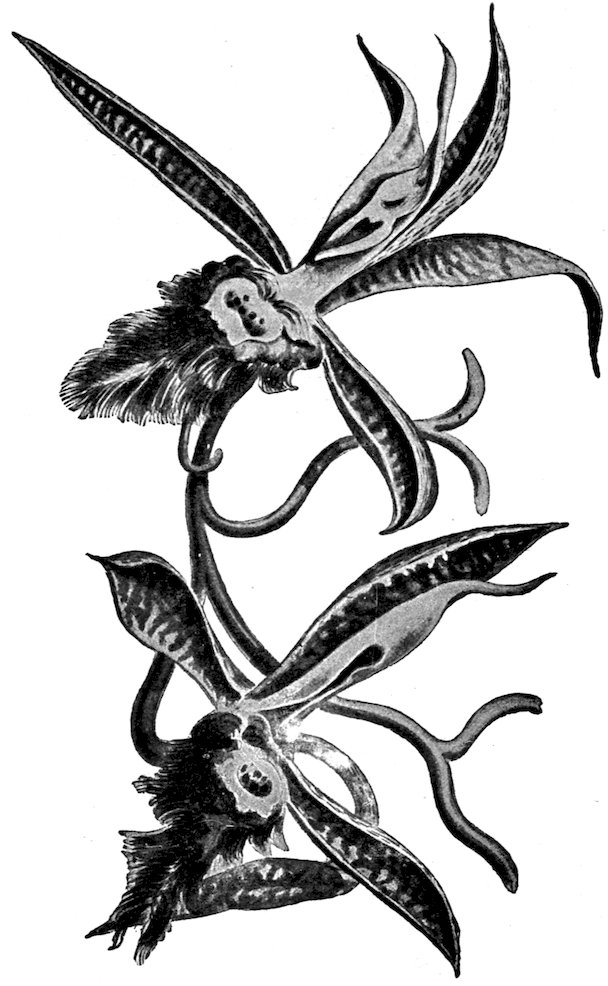
Fig. 1.—Catasetum saccatum (from “La Lindenia,” Gand, 1890).
25In other orchids (Catasetum, Fig. 1), the male elements
are discharged by a spring-like arrangement on the body
of insects. When certain parts of the flowers are touched,
the pollinia are thrown off like arrows, which, in the place
of the barbs, have viscid swellings. “The insect, disturbed
by so sharp a blow, or after having eaten its fill, flies sooner
or later away to a female plant and, whilst standing in the
same position as before, the pollen-bearing end of the arrow
is inserted into the stigmatic cavity, and a mass of pollen
is left on its viscid surface.”[33]
After giving detailed descriptions of the cross-fertilisation
of flowers by such peculiar means, Darwin makes the
following remark: “Who would have been bold enough
to have surmised that the propagation of a species depended
on so complex, so apparently artificial, and yet so admirable
an arrangement?”[34]
One orchid (Herminium monorchis, Fig. 2), which bears
very small flowers, is remarkable for the way in which it
is fertilised by insects. Only very small insects are able
to penetrate the flowers. The space being very limited
these minute insects can enter the flower only in a particular
way, and at one of the corners. This causes the pollinia
to become attached always to the same place, which is on
the outer side of one of the two front legs. When the
insect, the carrier of the pollinia, enters a second flower,
it can scarcely fail to fertilise the stigma, which is on the
corresponding side. Darwin said that it would be difficult
to find a case in which there was so marvellously complete
an adaptation to a very peculiar mode of fertilisation as
the little flower of Herminium.
26
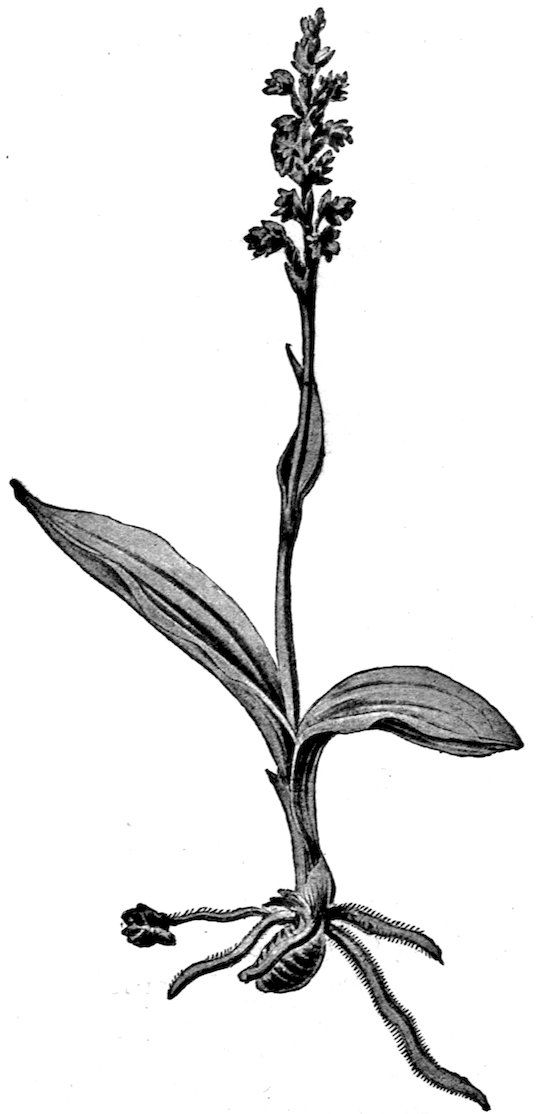
Fig. 2.—Herminium monorchis
(after Sowerby, “English Botany,” ix. 1869)
In addition to orchids, there are other flowers the
organisation of which is adapted in a remarkable way to
fertilisation by insects. But to find perfect harmony in
the nature of living beings it is not necessary to confine
27our observations to flowers. The animal world furnishes us
with numerous examples. To avoid going into the details
of these, I shall content myself with a description of the
most remarkable instances.
Every one has seen, flying near the ground, small, slender,
and pretty wasps. From time to time these bury themselves
in the earth or sand, and re-appear in a few minutes.
These are the fossorial wasps, the interesting habits of which
have been studied by Mr. J. H. Fabre, of Avignon. They
are not gregarious, but lead solitary lives and differ in their
habits from their congeners. Bees feed their larvæ with
honey and pollen which they take to them during the whole
period of their development. Wasps are carnivorous,
predatory insects, and bring their spoils to their brood of
soft and feeble larvæ which are unable to provide for
themselves. Bees and most wasps look after the welfare
of their young ones in the fashion of human parents in
nurseries.
Fossorial wasps act differently; they never see their
young. They lay their eggs in burrows, sunk in the soil
and hermetically sealed. The larvæ are hatched underground
and are never seen by the mother. Provision
sufficient for their development, however, is made in
advance. Before depositing eggs, the females sink the
burrows, and fill them with the spoils of the chase, which
consist sometimes of spiders and sometimes of crickets or
other insects. Each species of fossorial wasps preys on
a particular kind of insect or on its allies, for the purpose
of provisioning the burrows. These wasps are most fastidious
in the choice of their food, and behave like collectors
whose interest is only in a single or a few species of small
animals. Léon Dufour, the well-known entomologist, was
much struck by the ability displayed by certain wasps
28(Cerceris, Fig. 3) in seeking out and capturing the pretty
beetles of the genus Buprestis, which he had great difficulty
in finding himself. In making a study of these
beetles he collected the material from the burrows of
Cerceris, and so avoided the laborious task of obtaining
them in the natural state of freedom.
The burrows were filled
with motionless, but perfectly
well preserved, Buprestes. Although
dead Coleoptera dried up
in a short time, those recovered
from the burrows remained in a
good state of preservation for
weeks. Léon Dufour came to the
conclusion that the Cerceris kill
their prey, but inject into them some antiseptic liquid
which perfectly preserves their flesh and intestines.
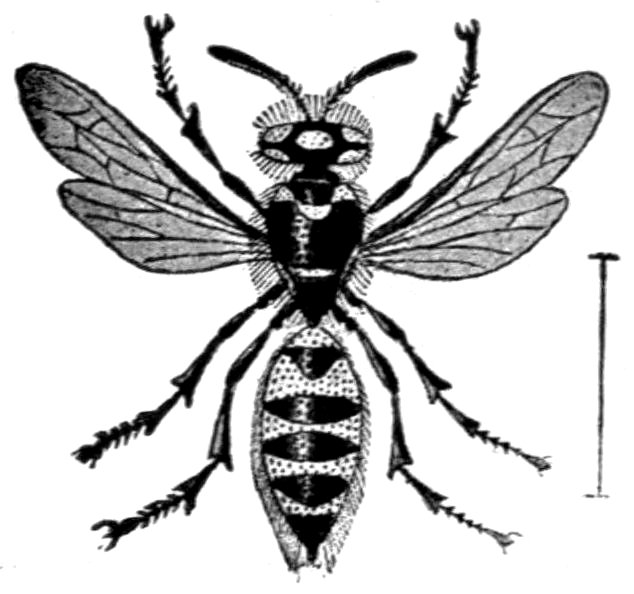
Fig. 3.—Cerceris (after Buffon).
J. H. Fabre pursued the study of the habits of fossorial
wasps further. He ascertained that the captured insects
were not dead, but only paralysed. The continuance of the
function of certain organs demonstrated that the Buprestes,
the weevils and other small creatures collected in the burrows
of fossorial wasps, were alive. They could even perform
some slight movements, but they were incapable of locomotion,
and so could not escape. The mechanism of this
paralysis, as far as could be ascertained by Fabre, is one
of the most remarkable phenomena in nature. The fossorial
wasps, guided by their instinct, immediately after
having seized an insect or spider, bury their sting in the
nervous centre which controls the movements of the legs.
When animals with soft bodies, such as spiders and young
crickets, are attacked, the operation does not present any
difficulties. But Coleoptera in general, and the Buprestes
29and weevils in particular, are furnished with a very hard
covering which cannot be perforated by the small and
slender sting of a fossorial wasp. To gain their object the
wasps probe exactly between the first and second pair of
legs in the median line of the under surface of the thorax.
The skin is thinner at this spot, and they introduce their
sting into the ganglia from which arise the nerves of the
legs. In the case with the Buprestes these ganglia are
set close to one another, and a single prick suffices to affect
the nervous centres of three pairs of legs. Once the sting
has been inserted in this way the Buprestis becomes paralysed,
but lives for many days. “The Cerceris which preys
on Coleoptera,” writes Fabre,[35] “appears to have made its
choice according to the dictates of an exact physiology and
anatomy. It is impossible to see in its proceedings the
results of happy chance; more than chance is required to
explain adaptations so precise.”
After having filled the burrow with a sufficient quantity
of insects or spiders, fossorial wasps lay their eggs and carefully
close up the entrance. In due course the larva is
hatched, and devours the food that it finds close at hand.
If the gathered insects were not paralysed, they could
easily escape from their prison; if they were dead,
putrefaction or desiccation (according to circumstances)
would render them unfit for the larvæ. It is therefore
sheer necessity that is the factor in the development of
this marvellous instinct that induces the fossorial wasps
to attack the nervous centres of their prey. When one
insect has been devoured, the larva proceeds to another,
and so on, until it is fully grown, whereupon it envelops
itself in a case that protects it during the winter and
30following spring. In summer it changes at first into a
chrysalis, and later into a perfect insect. It frees itself from
the cocoon, takes to flight, and enters upon life like that
of its mother, which it has never seen.
Of the harmonious phenomena in nature it is indeed
difficult to find other examples so perfect as those of the habits
of these fossorial wasps, or of the mechanism for the fertilisation
of orchids. These harmonies in nature are
constantly met with in the world of living beings, and it
is not astonishing that they have for a long time attracted
the attention of many observers and philosophers. As it
seemed impossible to attribute them to the organisms themselves,
because of the low rank and lack of intelligence of
these, it has seemed only natural to set them down as a
manifestation of a superior force which organises and
directs all natural phenomena. This argument, however,
omits one side of the medal.
Any close investigation of organisation and life reveals
that, beside many most perfect harmonies, there are facts
which prove the existence of incomplete harmony or even
absolute disharmony. The examination of the flowers of
orchids would lead one to the belief that each part, even the
smallest and apparently most insignificant, has its rôle in
the mechanism for fertilisation and cross-fertilisation. In
reality it is not so. There are in certain orchids organs
which do not fulfil any function.
Even among the species of Catasetum, in which the pollinia
are thrown with force on the bodies of insects, there are
some female flowers in which the male organs are rudimentary
and without utility. In these flowers, according to
Darwin,[36] “the two membranous sacks containing the
rudimentary pollen-masses never open, but they easily
31separate from each other and from the anther. The tissue
of which they are formed is thick and pulpy. Like most
rudimentary parts, the pollen-masses vary much in size
and form; they are only about one-tenth of the bulk of
those of the male.” There are then, without doubt, some
structures that are of no service.
The existence of these rudimentary pollinia, incapable
of being transported or of fertilising the female element, is
easily explained by the supposition that formerly the
flowers of the Catasetum were true hermaphrodites, but that
in the course of time the male organs have become incompletely
atrophied in certain flowers, in which, on the other
hand, the female part has increased. The occurrence of
an actual degeneration is shown by the existence of rudiments
of the pollinia too insignificant to accomplish their
normal functions.
Rudimentary and useless organs are widely distributed,
and we find them in many places. Familiar instances are
the atrophied eyes of animals that live in the dark, and
the sometimes rudimentary sexual organs of many plants
and animals.
Not only are orchids and other flowers adapted to fertilisation
by means of insects, but many insects display
special adaptations to their habit of visiting flowers. Butterflies,
bees, and many other insects, possess mouth organs
modified for the purpose of penetrating flowers to secure
nectar or pollen. Other insects, again, are not so fortunate
in this respect. Darwin[37] on one occasion “found an
extremely minute Hymenopterous insect vainly struggling
to escape, with its head cemented by the hardened viscid
matter to the crest of the rostellum and to the tips of the
pollinia (of an orchid, Listera ovata, Fig. 4). The insect
32was not so large as one of the pollinia, and after causing the
explosion had not strength enough to remove
them; it was punished for attempting
a work beyond its strength, and
perished miserably.”

Fig. 4.—Listera ovata (after Barla, “Flora of Nice,” 1868).
Many insects, well adapted for the purpose,
delight themselves by sucking the
nectar of flowers. Many others would wish
to do the same, but their want of adaptation
baffles them. A small “lady-bird”
loves the sweet juice of flowers; it tries
often to suck the nectar of the dandelion,
but without success. Hermann Müller[38]
has described the behaviour of this insect
in procuring the nectar of Erodium cicutorium.
“The awkward way in which this
beetle, unadapted to feed on the plants,
endeavours to obtain the honey, is too
ludicrous not to be mentioned. After taking
up a position on the petal, it puts its
mouth in the direction of one of the honeycups
which are situated on both sides of
the base of the petal. The petal soon
breaks off, upon which the insect fixes
itself on a neighbouring sepal or falls to
the ground with the petal. In the first
case it proceeds to creep over the flower
and ends by detaching all the petals; in
the other case, on recovering from the
shock, it quickly ascends another stem of
the same plant and begins again. I have
seen the same lady-bird fall four times in
33succession with petals which it had detached without gaining
wisdom.”
The instincts of insects, well developed for certain functions,
often present aberrations more or less whimsical and
remarkable. The caterpillars of some butterflies, before
changing into chrysalids, envelop themselves in a wellwoven
cocoon capable of protecting them from noxious
influences. Protected by this covering, the caterpillar
changes into a chrysalid, and later into a butterfly, which
perforates the end of the cocoon in order to emerge. When
any external agency destroys the cocoon, normal metamorphosis
becomes impossible, and the larva dies before
its maturity. Fabre[39] questioned whether the caterpillar
during the time of the weaving of the cocoon was capable
of repairing it if it was damaged. For this object he cut
with a pair of scissors the end of a cocoon in the course
of construction by the caterpillar of the beautiful peacock-butterfly.
In spite of the hole thus produced, the caterpillar
continued its ordinary work without suspicion that
it would be of no avail. On this occasion “the caterpillar
of the peacock-butterfly, notwithstanding the certain fate
of the future butterfly, continued peaceably to spin, without
in the least modifying the regular progress of its labour;
when the time had arrived for the putting in of the last
defensive stitches it placed them in the perilous breach,
but neglected to mend the destroyed part of the barricade.
It performed its vain task, ignoring what was indispensable
for success.”
Even amongst fossorial wasps, the instincts of which are
so admirably developed, harmony is far from perfect. Fabre
endeavoured to ascertain what effect was produced on these
insects by taking away the egg laid in the burrow. He
34chose for this experiment the fossorial wasp Pelopæus
(Fig. 5), which preys on spiders. He took away the egg which
had been deposited in a carefully-prepared burrow, and
watched the subsequent manœuvres. “The Pelopæus continued
to store up spiders for the
stolen egg; it gathered provisions
that were not to be eaten; it
redoubled its efforts to replenish
a larder that I was constantly
robbing with my forceps.” The
insect neither discontinued its
fruitless task nor appeared to be
aware of its fruitlessness. Here,
then, is an example of a foiled
maternal instinct that gained no
useful end.
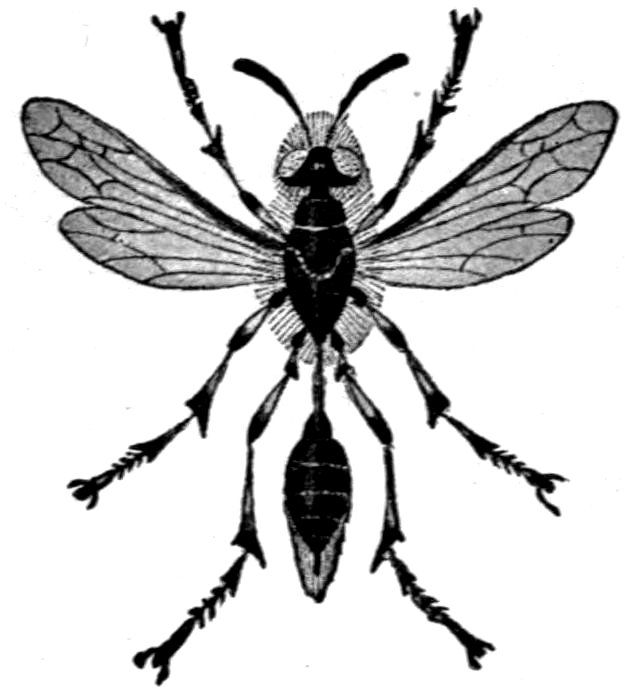
Fig. 5.—Pelopæus (after Buffon).
In connection with such a slaughter for the benefit of a
progeny that will never exist, I may mention observations
relating to a quite different order of phenomena. There
are many creatures that kill and devour their progeny. Not
infrequently rabbits kill and devour all their progeny, or
leave them to die without food or care. Sometimes
the culprits are young rabbits without experience; but
this aberration of instinct is also met with in old rabbits,
which once and for all have contracted the habit of abandoning
or eating their young. Some females of other species
of mammals and of birds have often been surprised in the
act of deserting or of killing their offspring.
Perversion of sexual instinct is frequent enough amongst
animals. Huber[40] states that when male ants have a lack
of females they ravish the workers, the attacks being fatal,
35as the sexual organs are incompletely developed and
functionally incapable. Abnormal pairing has also been
observed in the stag-beetle of the genus Lucanus, in bees,
and, above all, in cockchafers.[41] Higher animals, such as
dogs, furnish analogous examples of sexual perversion.
Onanism is well known amongst mammals. It is frequent
among monkeys in menageries, and also in rutting
stags, the latter discharging the seminal fluid by friction
with trees. Stallions and mares have often been observed
in the act of satisfying their sexual appetites by abnormal
means. There are several other species (dogs, bears, chamois,
elephants, parrakeets, etc.,) which resort to onanism.[42]
These disharmonious instincts do not in the least cause
the death of the animals that manifest them. But there
exist in nature instinctive aberrations much more dangerous.
Who has not seen in the summer numerous insects gathered
round lamps and candles, attracted by the light? Among
these are Coleoptera, Neuroptera (Phryganea), Ephemera, and,
most frequently of all, small nocturnal Lepidoptera. After
flying round and round the light several times, they singe
their wings and die in numbers. This instinct is so constant
and so developed amongst many of these insects, that
it has been used against them for their own destruction.
Thus amongst the means advocated for destroying a moth,
Botys sticticalis, the caterpillars of which devour cereals and
beetroot,[43] is the lighting of numerous fires in the fields.
The moths, attracted by the light, fall in the flames and
die in quantities.
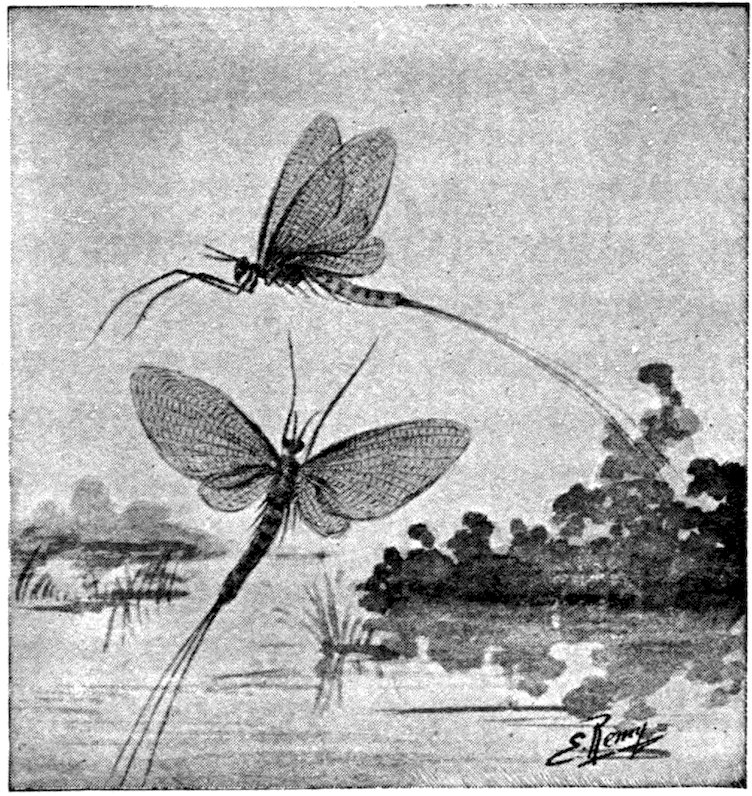
When the usual swarms of may-flies emerge from the
water, fishers make straw fires on their boats, and the
36insects singe their wings. The innumerable bodies incapable
of flight fall into the water, and provide a coveted
food for the fish.[44] This disharmonious and fatal instinct is
displayed chiefly by nocturnal insects that rest during the
day and do not leave their retreats till after sunset. In
the cornfields Coleoptera of the genera Anisoplia and Rhizotrogus,
resembling each other in form and general appearance,
are to be found. When a fire is lighted in the darkness
of the night it is only the Rhizotrogus that approaches it
at the risk of its life. The Anisoplia remains quiet in the
midst of the corn. The latter kind of beetle pairs during
the day, while the Rhizotrogi satisfy their sexual desires
during the night. Moreover, it is the males only of this
species that fly about in the darkness and approach the
fire, whilst the females rest at home in the plants.[45] It is
probable, therefore, that light induces a sort of sexual excitement
in these male beetles. The males, searching for the
female, believe her to be in the midst of the flames, towards
which they fly without being conscious of the danger they
incur.
Such an interpretation of this disharmonious and suicidal
instinct is confirmed by the fact that the moths attracted
by fire are also almost exclusively males. Moreover, entomologists
have advised against the lighting of fires by agriculturists
in the belief that they destroy the noxious Botys,
as they maintain that the females are not attracted. These
latter therefore live on, and, being capable of laying eggs,
produce a generation of voracious caterpillars.
Of the Ephemera attracted by fire in such great quantities
males are by far the more numerous. It is therefore really
very probable that the mad excitement which leads to the
37destruction of so many male insects, represents a sort of
sexual aberration. In this connection it is to be remembered
that, amongst Coleoptera, species exist of which the
females, hidden in the grass, produce intense light which
attracts the males. In the common glow-worm, the female,
which is devoid of wings, alone shines with the familiar
greenish glitter. Even in species of which the two sexes
are luminous, the female shines more vividly. It is true
that there are some beetles with luminous larvæ, a fact that
led Darwin[46] to remark that the production of light by
insects may serve to frighten enemies. This is possible,
and it is also possible that certain insects make use
of their luminosity to light their way in the darkness.[47]
But, notwithstanding this, the sexual character of the
luminous organ is so manifest in certain species that it is
impossible to doubt its function as a means of attracting
the male.
In conclusion I may say that it is not my purpose at
present to discuss the meaning of an instinct so fatal to
insect life. I wish only to point out the frequency of the
natural occurrence of disharmony, so that the satisfaction
of an instinct is fatal to so many of its possessors.
It is plain that an instinct, or any other form of disharmony
leading to destruction, cannot increase, or even endure
very long. The perversion of the maternal instinct tending
to abandonment of the young is destructive to the stock.
In consequence, individuals affected by it do not have the
opportunity of transmitting the perversion. If all rabbits,
or a majority of them, left their young to die through
neglect, it is evident that the species would soon die out.
38On the contrary, mothers, guided by their instinct to nourish
and foster their offspring, will produce a vigorous generation
capable of transmitting the healthy maternal instinct so
essential for the preservation of the species. For such a
reason harmonious characters are more abundant in nature
than injurious peculiarities. The latter, because they are
injurious to the individual and to the species, cannot perpetuate
themselves indefinitely.
In this way there comes about a constant selection of
characters. The useful qualities are handed down and
preserved, while noxious characters perish and so disappear.
Although disharmonies tend to the destruction of a species,
they may themselves disappear without having destroyed
the race in which they occur.
This continuous process of natural selection, which offers
so good an explanation of the transmutation and origin of
species by means of preservation of useful and destruction
of harmful characters, was discovered by Darwin and
Wallace, and was established by the splendid researches
of the former of these.
Long before the appearance of man on the face of the
earth, there were some happy beings well adapted to their
environment, and some unhappy creatures that followed
disharmonious instincts so as to imperil or to destroy their
lives. Were such creatures capable of reflection and communication,
plainly the fortunate among them, such as
orchids and fossorial wasps, would be on the side of the
optimists; they would declare this the best of all possible
worlds, and insist that, to secure happiness it is necessary
only to follow natural instincts. On the other hand, the
disharmonious creatures, those ill adapted to the conditions
of life, would be pessimistic philosophers. Consider the case
of the lady-bird, driven by hunger and with a preference
39for honey, which searches for it on flowers and meets
only with failure, or of insects driven by their instincts into
the flames, only to lose their wings and their lives; such
creatures, plainly, would express as their idea of the world
that it was fashioned abominably, and that existence was
a mistake.
As for man, the creature most interesting to us, in what
category does he fall? Is he a being whose nature is in
harmony with the conditions in which he has to live, or is
he out of harmony with his environment? A critical
examination is needed to answer these questions, and to
such an examination the pages to follow are devoted.
40
Relationship of the human species with anthropoid apes—Analogies
in the dentition, in the organisation of the limbs
and of the brain—Resemblance of the vermiform appendage
of man and anthropoids—Analogy between the placenta
and fœtus of man and anthropoid apes—Blood relationship
of man and monkeys shown by serums and precipitates—Transmutation
of species—Sudden transition
from monkey to man—J. Inaudi, the calculator, as an
example of the sudden appearance of characters in the
human species—Rudimentary organs in man—Proportion
of progressive and retrogressive organs in the organisation
of man
To understand human nature it is necessary first to give
an account of the origin of man. This question has preoccupied
mankind for ages, and for a long time it was
believed that a solution of the problem was to be found in
religious dogmas. Man was regarded as being of supernatural
origin, the result of a special creation. Scientific
criticism has now shown that there are no grounds for such
a conclusion.
Nearly half a century ago Darwin applied to man his
discovery of the principle of natural selection, and of the
part played by that in the origin and transmutation of
species. Soon after the publication of the “Origin of
Species,” attention was given to the special case of man.
41In 1863 Huxley[48] gave an admirable review of the problem
in his work on “Man’s Place in Nature.” He brought
forward arguments of the highest scientific validity in
support of the thesis that man is descended from animals,
and that he is a mammal most nearly related to monkeys,
and among these to the anthropoid apes. In spite of this
masterly exposition, there are still persons of high intelligence
and superior education who declare that science has
not yet answered the question as to whence he came, and
that the theory of evolution will never provide an answer.[49]
Close examination of the structure of man has proved, in
the most definite fashion, the existence of a near kinship
with the higher monkeys, or anthropoids. When the chimpanzee
and the ourang-outang were discovered, comparison
became inevitable, and many naturalists, including the great
Linnæus, saw that the human race must find its place in
classification near the anthropoids.
Now that all the details of the human organisation have
been studied, and the anatomical structures of man and
large monkeys without tails have been compared, bone
with bone and muscle with muscle, a truly astonishing
analogy between these organisms is made manifest, an analogy
apparent in every detail. It is known that in the natural
history of mammals the teeth play an important part as
a means of determining differences and relationships. The
dentition of man bears a very great resemblance to that
of anthropoids. Every one knows the milk teeth and the
permanent teeth of man. The anthropoid apes bear in this
respect an astonishing likeness to man. The number
(thirty-two in the adult), the form and general arrangement
42of the crown, are identical in man and anthropoid apes.
The differences are to be found only in minor details, such
as the exact shape and relative dimensions and the number
of cusps. It can be said in a general way that in the anthropoid
apes the teeth are more strongly developed than in
man. The canines are much longer and the roots of the
pre-molars are more complex in the gorilla than in man.
But the fact must not be lost sight of, that all these differences
are less pronounced than those which exist between
the dentition of anthropoid apes and that of all other
monkeys. Even in the cynocephalous monkeys, those that
most nearly approach the anthropoids, the teeth exhibit
marked differences. Thus, the forms of the upper molars
are quite different in the baboon and in the gorilla. The
canines are longer, and the pre-molars and molars are still
more complex in the baboon.
In the monkeys of the New World, the dentition differs
still more from that of man and anthropoids. Instead of
thirty-two teeth, they possess thirty-six in the adult condition.
The number of pre-molars is twelve instead of
eight. The general form and the crowns of the molars are
very different from those of anthropoid apes.
These considerations led Huxley to conclude that “it
is obvious that, greatly as the dentition of the highest ape
differs from that of man, it differs far more widely from that
of the lower and lowest apes.”[50]
Another character which shows that anthropoids are
nearer man than other monkeys is furnished by the anatomy
of the sacrum. In monkeys as a whole the sacrum
is composed of three, or rarely four, vertebræ, while in
anthropoid apes it contains five, that is to say just as many
as in man.
43The whole skeleton, and particularly the skull of man, and
the higher monkeys, present certainly some marked differences;
but here again the differences are less than those
between the anthropoid apes and other monkeys. As
regards the osteology the proposition laid down by Huxley
is just. “So that, for the skull, no less than for the skeleton
in general, the proposition holds good, that the differences
between man and the gorilla are of smaller value than those
between the gorilla and some other apes.”[51]
The believers in the doctrine that the human species is
essentially distinct from all the known monkeys have laid
great stress on the difference between the foot of man and
that of anthropoid apes. This difference cannot be denied.
Man assumes the direct posture habitually, while monkeys,
even the highest of them, walk on two legs only occasionally.
There has followed from this a greater development
of the feet in monkeys. Yet this difference ought not to
be exaggerated. It has been sought to prove that monkeys
are “quadrumanous,” and that their hind legs terminate
in “hind-hands.” But it is clearly shown that in all essential
respects the hinder limb of the gorilla terminates in as
true a foot as that of man.[52] “The hind limb of the gorilla,
therefore, ends in a true foot, with a very movable great
toe. It is a prehensile foot, indeed, but is in no sense a
hand; it is a foot which differs from that of man not in
any fundamental character, but in mere proportions, in
the degree of mobility, and in the secondary arrangement
of its parts.”[53]
In all these cases the argument is confirmed, “that be
the differences between the hand and foot of man and those
of the gorilla what they may, the differences between
44those of the gorilla and those of the lower apes are much
greater.”[54]
The comparison of muscles and of other internal organs
leads to the same conclusion; the differences between
monkeys are more varied and greater than those between
anthropoids and man. The
anatomy of the brain has
been much discussed with
regard to this. Several
distinguished zoologists,
amongst them Owen in
particular, have insisted
on the absence in all
monkeys of certain parts
of the brain peculiarly
characteristic of man.
Such are the posterior
lobe, the posterior cornu,
and the lesser hippocampus. Controversy on this topic has
been animated; but, ultimately, the opinion of Owen did
not triumph, and now it is unanimously accepted that the
parts of the brain in question are “precisely those structures
which are the most marked cerebral characters common to
man with the apes. They are among the most distinctly
simian peculiarities which the human organism
exhibits.”[55]
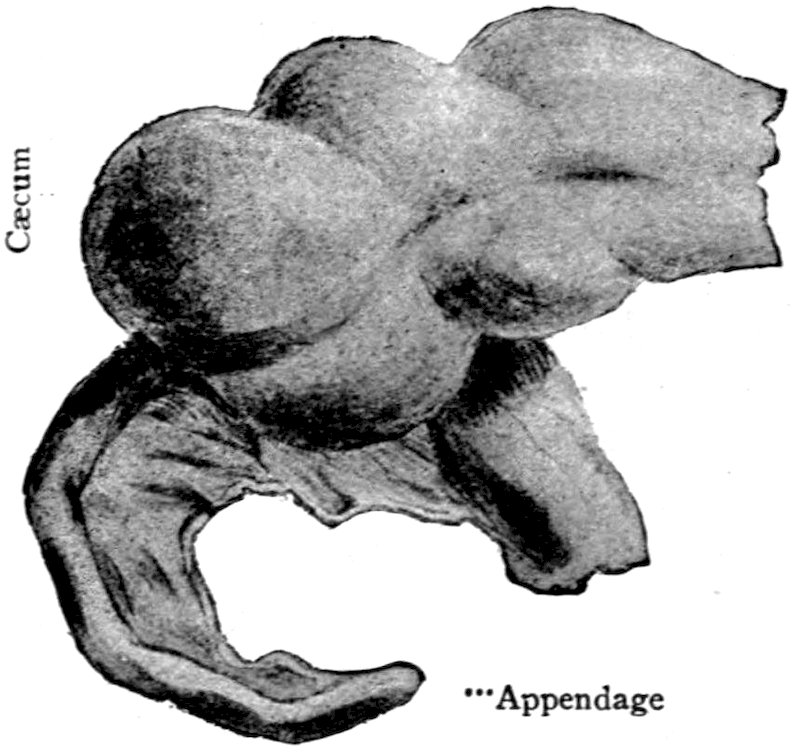
Fig. 6.—Cæcum and vermiform appendage of man (after Ewald).
As regards the brain, the differences between man and
anthropoid apes are certainly less marked than those that
exist between the higher and lower monkeys.
The digestive tract affords another argument in favour
of the affinity of anthropoid apes to man. The human
45cæcum is furnished with the very remarkable and strange
vermiform appendage which often is the cause of a grave
and prevalent illness known as appendicitis. Now, it is
quite remarkable that this organ is practically identical
with the vermiform appendage of anthropoid apes. A glance
at the accompanying
figures (6 and
7) will convince
the reader of this.
Yet none of the
other monkeys
present any such
resemblance with
man.
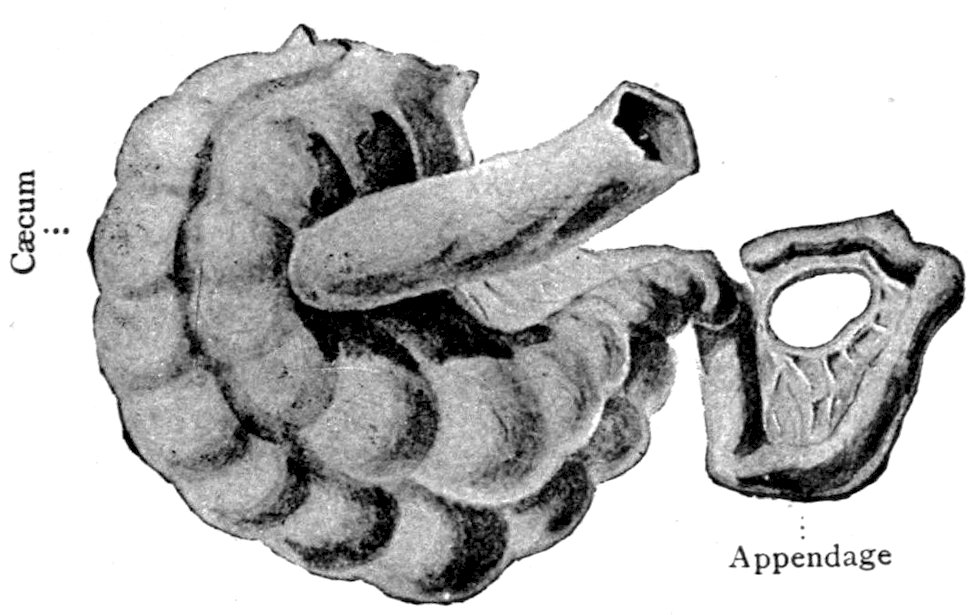
Fig. 7.—Cæcum and vermiform appendage of the chimpanzee (from a preparation in the Paris Museum of Natural History).
It is not surprising,
in the face of
resemblances so
numerous, that forty years’ science has proclaimed the existence
of a close affinity between man and the anthropoid apes.
The view has become an established doctrine, now that
no single fact has been brought against it. Since the
theory was enunciated we have learned much regarding
the natural history of these apes. Generally, when a theory
is false, a new set of facts overthrows it. Attempts may be
made to trim the new facts to the existing theory, but such
attempts are doomed to failure, and the theory disappears. It
is of special interest, then, to confront the simian theory of
the origin of man with a series of facts gathered by science
since the theory was propounded.
When Huxley wrote, the embryological history of anthropoid
apes was practically unknown. Darwin, Vogt, and
Haeckel, in their attempts to support the theory of the
animal origin of man, had not sufficient knowledge of the
46embryology of monkeys. It is only recently that important
work on this subject has been published.
It is known that the history of development is very often
an excellent guide in tracing the relationship of organisms.
It is therefore interesting to examine the established facts
concerning the embryology of anthropoid apes. The
material for these studies is very difficult to obtain, and
it is not astonishing that even our present state of knowledge
is still imperfect.
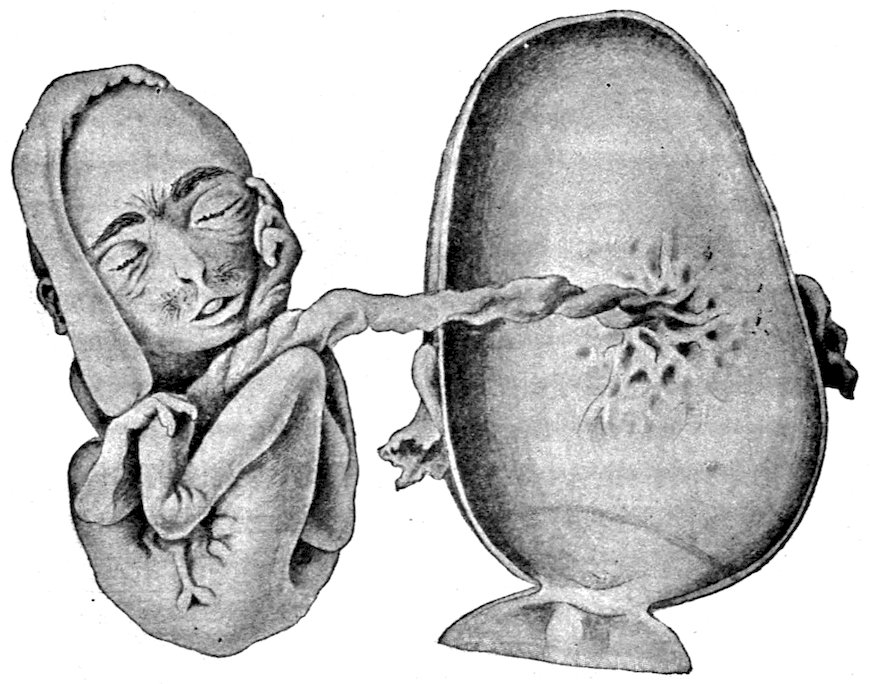
Fig. 8.—Fœtus of gibbon (after Selenka).
The placenta often gives information of great importance
in the classification of mammals. It is sufficient to glance
at the zonary placenta of dogs and seals to be convinced
of the relationship of these two species, which at first sight
seem so different. Now, the placentas of all the anthropoid
apes examined up to the present are of the same discoid
type as that of man. The arrangement of the umbilical
47cord of man, which was formerly considered as quite peculiar
to him, is found in anthropoid apes, as has been
established by Deniker[56] and Selenka[57] It is striking
that the anthropoids resemble man rather than the lower
monkeys in the relation of the fœtus to the fœtal membranes.
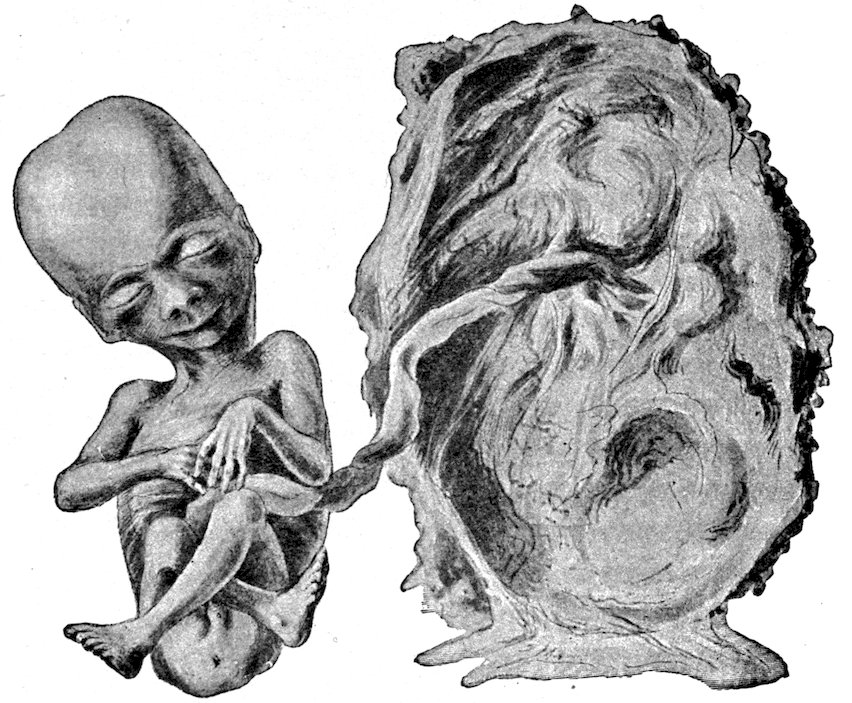
Fig. 9.—Human fœtus of three months and a half.
With regard to the embryos themselves, the similarity
between those of monkeys and of man is very great. Selenka
insists on the fact that the youngest stages of human development
that have been obtained can hardly be distinguished
from those of the lower monkeys either in position
or in shape. More advanced stages exhibit greater differentiation,
and the later embryos of man resemble those of
48anthropoids much more closely than those of the lower
monkeys. The fœtus of the gibbon, figured by Selenka
(Fig. 8), presents the most striking likeness to a corresponding
human fœtus (Fig. 9).
Later on, the characters that distinguish man from even
the highest of the apes become more and more pronounced.
In the anthropoids the facial portion becomes more and more
prominent, and betrays a bestiality absent from the human
form. None the less the resemblance between the nearly
mature fœtus of anthropoids and human embryos of about
the sixth month is evident enough. M. Deniker had the
good fortune to obtain the late fœtus of a gorilla—a very rare
piece of fortune—and he has made an elaborate investigation
of its structure. The general appearance (Fig. 10) is
quite enough to show the close relationship with a human
fœtus of a corresponding age (Fig. 11). It is plain, moreover,
that the young gorilla is more human-like than is the adult.
Detailed anatomical investigation only confirms this conclusion.
The skulls of the young stages of anthropoids are much
more human in their character than the adult skulls. Selenka
states that such young skulls of different anthropoids not
only resemble one another more closely, but are more
human. As soon as the teeth begin to appear, the individual
characters are assumed so rapidly, and become so
marked, that, in the absence of the intermediate stages,
it would be difficult to establish the kinships.
The data derived from embryology do not point to any
one of the existing genera of monkeys as the ancestor of
man. They lead us to infer, rather, that man and the
anthropoid apes had a common origin, and palæontological
evidence must be scanned to find this ancestor. The greatest
importance has been attached to a discovery in Java, made
49in 1894 by Eugène Dubois. The remains, consisting of the
crown of a skull, two teeth and a femur, belonging to a
creature for which the name Pithecanthropus erectus[58] has
been invented, have been interpreted by several anatomists
as those of a form intermediate between man and the
anthropoid apes. However, as the facts about this creature
are meagre and have been interpreted differently, I shall
not make use of them in my argument. Even apart from
them, the simian origin of man may be taken as proved.
The series of facts that I have been employing as evidence
of the relationship between men and anthropoid apes has
been drawn from the observations of anatomists and embryologists.
Darwin, seeking to broaden the basis of the argument,
called attention to the resemblances of the parasites
of men and apes, as evidence of a close similarity of physiological
processes in the creatures. In the last few years,
investigations in a very different field seem capable of
throwing a novel light on the question.
When the blood of one mammal is injected into the body
of another, the latter shows remarkable modifications.
When there is added to a serum, prepared from the blood
of a rabbit and consisting of a colourless transparent liquid,
a few drops of blood drawn from another rodent (for instance
a guinea-pig), nothing unusual happens. The blood of the
guinea-pig preserves its normal colour, and its corpuscles
remain practically unaltered. If, instead of adding guinea-pig’s
blood to the serum of rabbit’s blood, we add a serum
drawn from the blood of the guinea-pig, still no special
change occurs.
50
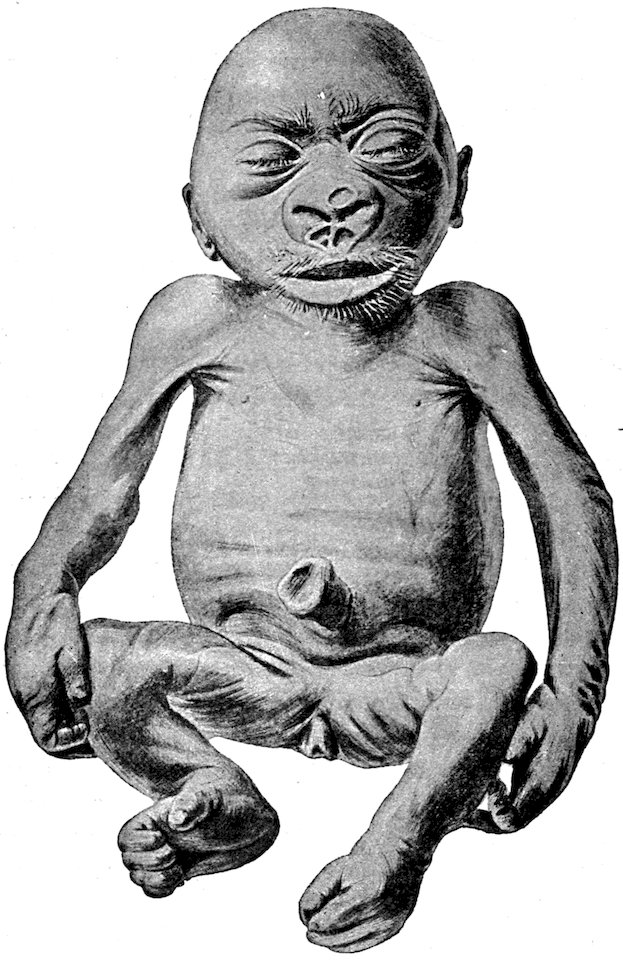
Fig. 10.—Fœtus of gorilla (after Deniker).
If, however, a serum be prepared from the blood of a
rabbit into which there had first been injected the blood
of a guinea-pig, the serum shows new and striking qualities.
The addition to it of some drops of guinea-pig’s blood
brings about, in a very short time, a changed appearance.
The red liquid, at first opaque, becomes transparent. The
51mixture of the prepared serum of the rabbit with the blood
of the guinea-pig will assume the colour of claret mixed
with water. The change is due to solution of the red
corpuscles of the guinea-pig in the blood serum of the rabbit.
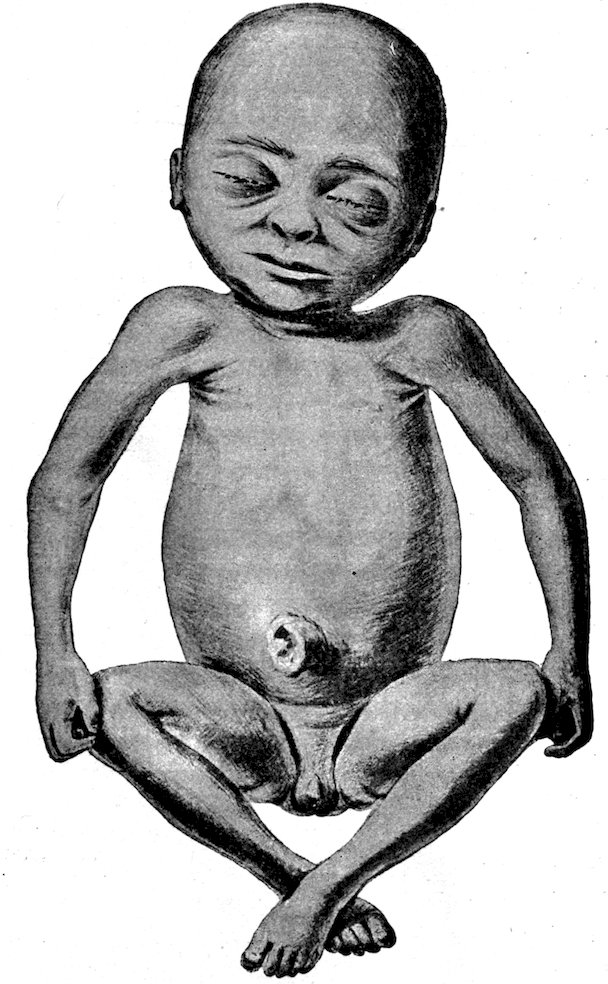
Fig. 11.—Human fœtus of about five months.
52This serum has still another property not less worthy of
attention. If there is added to it not pure blood but only
blood serum of the guinea-pig, a disturbance in the mixture
occurs almost at once, and leads to the forming of a precipitate
more or less abundant.
The injection of the blood of the guinea-pig into a rabbit
has therefore changed the serum of the latter by introducing
new properties: that of dissolving the red corpuscles
of the guinea-pig and of giving a precipitate with the blood
serum of the same animal.
Frequently the blood serum of animals prepared by previous
injections of the blood of other species of animals is
strictly specific. In such cases the serum only gives a
precipitate with the serum of the species which has furnished
the blood for the injections, and only dissolves the red
corpuscles of this same species. But there are some instances
in which a serum of a prepared animal dissolves, not only
the red corpuscles of the species which has furnished the
injected blood, but those of allied species. Thus the blood
serum of the rabbit, after some injections of blood of the
chicken, becomes capable of dissolving not only the red
corpuscles of the chicken but also those of the pigeon,
although in a less degree.
It has been suggested that assistance could be rendered
to forensic medicine by making use of this property
of serums, to discover the origin of a certain blood. As
is well known, it is often very important to decide whether
a stain was caused by the blood of man or of another animal.
Until quite recently it was not known how to distinguish
human blood from that of other mammals. Experiments
have been made to discover if the red corpuscles found in
the blood stain could be dissolved by the serum of animals
which had previously been injected with the blood of man.
53In a certain case the human origin of the stain in question
was shown. But it was soon discovered that this method
was not infallible. It is now found that the method of
precipitates gives much more conclusive results. It is done
in this way: Human blood is injected several times into
any animal (rabbit, dog, sheep, horse). Some time afterwards
the animal is bled, and a clear and limpid serum,
quite devoid of corpuscles, is prepared. When there is
added to this serum one or several drops of human serum,
it forms immediately a precipitate which falls to the bottom.
In this way it is discovered whether the prepared serum
is sufficiently active. It then becomes possible to recognise
even dried human blood. A little of such blood is dissolved
in normal salt solution, and placed in a tube containing
the serum of an animal prepared by means of the injections
of human blood. If a precipitate forms in the liquid in a
short time, the fact indicates that the stain is really human
blood. This method is being practised in forensic medicine.
This reaction is of great interest to us because it is of
assistance in revealing the relationship between species.
The serum of an animal prepared with the blood of the
fowl gives a precipitate, not only with the serum of the
fowl itself, but also with that of the pigeon; on the other
hand, it remains undisturbed when the serum of mammals
is added. The reaction indicates then that there is a sufficiently
marked degree of relationship between the fowl and
the pigeon. Here is another example: the serum of an
animal prepared with the blood of an ox gives an abundant
precipitate when there is added to it a little blood serum
of the ox, but it does not produce this reaction with the
serum of any of the other mammals, not even with that
of the sheep, stag and deer.[59] The relationship between
54the Bovidæ and these other ruminants is then not so close
as that between the fowl and the pigeon.
How does the serum of animals which has been injected
with human blood behave? The serum capable of giving a
precipitate with human serum does not produce the same
reaction except with the serum of some monkeys (the small
Papio).[60]
Gruenbaum, of Liverpool,[61] has been fortunate enough to
procure a considerable quantity of the blood of three large
anthropoid apes—the gorilla, chimpanzee, and ourang-outang.
He has been able to prove that the serum of
animals injected with man’s blood gives a precipitate not
only with this blood but also with that of the above-mentioned
apes. It was impossible for him “to distinguish this
precipitate as regards quality and quantity from that
which is obtained with human blood.”
To verify this result, Gruenbaum prepared the serum of
animals injected with the blood of the gorilla, chimpanzee,
and ourang-outang. These three kinds of serum gave precipitates
with the blood of these three apes, and to the same
extent with the blood of man. It is therefore evident that
there exists between the human species and the anthropoid
apes not only a superficial analogy of body and of the
principal organs, but a close blood relationship.
Facts of this kind could not be foreseen when the theory
of the simian origin of man was put forward. In spite of
this they have arisen to confirm it in a truly astonishing
way.
It is therefore impossible to doubt that man is a member
of the group of primates having a close connection with the
55higher monkeys of the present time. This result is of great
importance in all questions relating to human nature.
It would certainly be of considerable interest to know
more exactly what steps were followed in this simian descent
of man. On this question our knowledge is still very imperfect.
In his researches on anthropoid apes, Selenka insists
on a more intimate relationship between the chimpanzee
and man. “The great resemblance of the pre-molars and
of the molars in the permanent dentition of the chimpanzee
with human teeth appears to indicate that the chimpanzee
and man have a common origin, and descend from extinct
forms like Dryopithecus. This conclusion, however, is contradicted
by the fact that the milk teeth of the chimpanzee
are much nearer those of the ourang-outang than those of
man.”[62]
It is evident that to clear up this question it would be
necessary to have a greater knowledge of fossil anthropoids
such as Dryopithecus and its allies. In the present state
of knowledge only a very general hypothesis can be formulated
as to the exact mode of human descent.
We have already shown that the fœtus of man and of
the anthropoid monkeys resemble each other much more
than the adult forms, and that the young of these apes also
bear a greater likeness to man than do the adults. The great
development of the skull as compared with the face is
characteristic of young monkeys and of man young or old.
The jaws continue to develop in the anthropoids, while in
man there occurs in this respect a certain arrest of development.
The hairs, so small in man, also show a similar
arrest. Generally they remain during the whole life in a
state of incomplete development. It is especially on the
back of man that this feeble development of hairs occurs.
56As this part of the body in monkeys, on the contrary, is
much more hairy than the under surface, it has been held
to constitute an essential difference between man and
monkeys. But embryological study enables us to settle
this apparent contradiction. The fœtus of the gorilla examined
by M. Deniker possessed an almost entirely smooth
back. “The fœtus had true hairs only on the head, the
anterior surface, and around the lips and the genital organs,
and the eyelashes and eyebrows. The remainder of the
body was smooth or covered with down not exceeding a
millimetre in length.”[63]
The skin of the under surface, smooth around the navel,
was covered with small hairs more thickly than on the back.
The abundance of hairs on the posterior aspect of the body
of monkeys is a later acquisition, which develops but tardily
during fœtal life.
As regards the distribution of these hairs man resembles
much more the embryos of monkeys than adult monkeys.
This fact, instead of shaking the theory of relationship
between man and apes, gives us strong evidence as to the
mode of his descent. Putting the known facts together,
we may infer that man is a case of the arrested development
of some simian of ancient days, as it were, a simian
monster from the zoological point of view, although not
from the æsthetic. Man may be regarded as a prodigy
sprung from an ape, born with a larger brain and an intelligence
more highly developed than occurred in his parents.
Such a view is in accordance with known facts.
It must be admitted that certain kinds of organisms,
instead of evolving at a very slow pace, spring up suddenly,
and that in such a case nature proceeds with a considerable
stride. Darwin foresaw this possibility, but it has been
57made plain to us by the remarkable researches of the
botanist Hugo de Vries.[64]
De Vries cultivated for fifteen years the Evening Primrose,
a plant of American origin (Œnothera lamarckiana).
He obtained, suddenly, a set of flowers quite distinct
from those of the original plant. They presented such
great differences that he could separate them as several
quite distinct species. During the first few years De Vries
obtained three species (Œnotera lata, Œn. nanella, and
sometimes Œn. scintillans), but variation becoming more
and more prevalent, he ultimately distinguished a dozen
new species. These were grown from seed, and transmitted
their specific characters to their descendants. De Vries,
in this way, was a witness of the sudden appearance of
new species.
It is probable that man owes his origin to a similar phenomenon.
Some anthropoid ape having at a certain period
become varied in specific characters, produced offspring
endowed with new properties. The brain, of abnormal
size, placed in a spacious cranium, allowed a rapid development
of intellectual faculties much more advanced than
those of the parent and those of the original species. This
peculiarity would be transmitted to the descendants, and,
as it was of very considerable advantage in the struggle
for existence, the new race would hold its own, propagate
and prevail. The extraordinary development of intelligence
necessarily led to perfections in the choice of nourishment,
perfections which approached the art of preparing
more digestible food. The jaws, under these conditions,
had not such a difficult task as before, and, moreover, they
were no longer required for attack or defence. They
became less developed than in the true anthropoid apes.
58These suggestions involve a conception of the mind that
is in harmony with known facts. From time to time prodigies
are born with some talent far greater than the
gifts possessed by the parents.
About twelve years ago a young native of Piedmont,
Jacques Inaudi by name, became famous in Paris on account
of his extraordinary power of calculation. He had an
astonishing memory for figures, and could perform mathematical
calculations with surprising rapidity.[65] Two
minutes were sufficient for him to multiply two numbers
composed of seven and six figures. Other arithmetical
calculations, such as the extraction of roots, gave him but
little trouble.
To attain this result, Inaudi made use of his extraordinary
memory for figures, founded on the persistence of auditory
images. When he heard the numbers pronounced, he
remembered them. Inaudi declared to the Commission
convened by the Academy of Sciences, that when he tried
to recall the numbers he heard them as if repeated aloud,
in the tone of his own voice, and that he could hear them
for the greater part of the day. “In an hour, or in two
hours’ time, if I thought of the number that was uttered, I
should be able to repeat it as exactly as I have done before
the Commission.”
Now this very extraordinary and rare auditory memory
was developed in an altogether abrupt way. Inaudi, the
son of poor peasants of Piedmont, passed the first years
of his life as a shepherd. At the age of six his wonderful
faculty of calculating figures appeared. He did not know
at this time how to read or to write. At eleven years of
age he astonished the members of the Anthropological
59Society of Paris by his phenomenal memory, and it was
only much later, at the age of twenty, that he learnt to
read and write. Neither of the parents of Inaudi had shown
in the slightest degree a calculating faculty like that of little
Jacques. It must then be admitted that it was developed as
suddenly as the new qualities in the Evening Primrose that
we have already mentioned.
The first men, also, were probably ingenious children,
born of anthropoid parents. This hypothesis very well
explains the fact that man is more like the fœtus and the
young of anthropoid apes than the adult animals, and
exhibits only a trace of many organs which are much more
developed in simian species.
A very distinguished German anatomist, Wiedersheim,[66]
has given in a pamphlet a resumé of our actual knowledge
of the organs of man from the point of view of their descent.
He has found fifteen organs which show in the human
species a considerable advance on those of anthropoid apes.
The chief of these are the lower limb, well adapted for a
constant erect carriage of the body; the strengthening of
the pelvis and of the sacrum, as well as the broadening of
the more slender pelvis of the female; the curvature of the
lumbar part of the vertebral column; the development of
the buttocks and of the calves; the difference of certain
muscles of the face; the nose; certain strands from the
brain to the spinal cord; the occipital lobe of the brain;
the greater development of the cerebral cortex, and, lastly,
the considerable differentiation of the muscles of the larynx
which permit speech.
But besides these progressive organs, Wiedersheim has
counted seventeen decaying organs, still able to fulfil
their physiological function in a more or less incomplete
60manner (amongst these are the decadent muscles of the
leg and foot; the eleventh and twelfth pairs of ribs,
the toes, the cæcum, etc.), and not less than one hundred
and seven rudimentary organs which serve no useful physiological
purpose (to this category belong the coccyx—the
vestige of a tail—the thirteenth pair of ribs in the adult,
the muscles of the ear, the vermiform appendage, etc.).
We have already shown in the preceding chapter the
great importance of rudimentary organs as aids to the
tracing of the genealogy of organisms. These organs, useless
at present, are the vestiges of similar but more developed
organs, which fulfilled a useful function in our ancestors.
The extraordinary quantity of rudimentary organs in
man furnishes another proof of his animal origin, and puts
at the disposal of science information of great value for the
philosophic conception of human nature.
61
Perfection of the human form—The covering of hair—The
dentition in general and the wisdom teeth—The
vermiform appendage—Appendicitis and its gravity—Uselessness
of the cæcum and of the large intestine—Instance
of a woman without a large intestine—Ancestral
history of this portion of the digestive tract—Injurious
effect of the microbes of the large intestine—Frequency
of cancer of the large intestine and of the stomach—Limited
usefulness of the stomach—The instinct of choice
of food—Futility of this instinct in man
Although he is a recent arrival on the earth, man has made
great progress as compared with his ancestors, the anthropoid
apes. A comparison between even the lower races
of man, such as the Hottentots or the aborigines of Australia
and higher types such as the inhabitants of Europe
and of North Africa, shows that a very great advance has
been made.
Human art has been able to surpass nature in many
instances. No natural sound is so perfect as some of the
more beautiful pieces of modern music. Even in the production
of form, man has triumphed over nature. Breeders
of flowers or of birds seek to produce new varieties. With
this object they often frame a conception of what they desire
to produce, and, so to speak, set about to realise their programme.
They prepare ideal images to serve them as
62guides in the process of production. By the method of
artificial selection they often succeed in their wishes, and
add to their collections some remarkable form. In such
fashions aviculture and horticulture have produced birds
and flowers more beautiful than any found in nature.
In regard to the human body, attempts have been made
to surpass nature and to represent a body corresponding
to an artistic ideal. To arrive at something more beautiful
than man, the wings of birds or the characters of some
other creatures have been added to his presentment. Such
attempts have had no other result than to show that the
human form, as created by nature, cannot be surpassed.
The ancient conception of the human body as the artistic
ideal has been fully justified. The views of those religious
fanatics who have thrown contempt on the body by representing
it in degraded forms, must be rejected.
It is impossible, however, to apply this result to our conception
of the nature of man in general. The beautiful
form of the human body appears only in youth and in
maturity. In old age, the bodies of men and women are
generally ugly, and in extreme old age it is almost impossible
to see the traces of former beauty.
Nor can conceptions of perfection drawn from the human
face and body be extended to the whole of man’s organisation.
A glance at some of the organic systems will make
this plain.
The human skin is covered with little hairs, the history
of which is interesting. In one stage of embryonic life nearly
the whole of the body is clad with hairs. This covering
is known as the lanugo, and consists of strands of hair, disposed
very regularly all over the body, save on the nose and
the hands and feet. There is no doubt but that this is
functionless, and is no more than an inheritance from the
63old ape-like condition. Later on, it falls out and is replaced
by the ordinary downy covering of the body. In adult life,
and particularly in old age, the hairs of the second coat
tend to grow very long and so to form a covering that is
neither beautiful nor in the least degree useful. We may
take this as a first example of a disharmonious condition in
the human body. Hairs, incapable of protecting the body
from cold, survive merely as an ancestral relic and may
become even harmful.
The human skin is constantly exposed to the microbes in
dust; and the follicles of the hairs, in which these microbes
lodge, form receptacles very favourable to their multiplication.
In the hollows of the follicles, certain microbes,
as for instance some of the Staphylococci, multiply rapidly
and give rise to acne and to pimples. The process may
even go the length of producing a chronic skin-disease very
unpleasant and even dangerous if it be associated with
suppuration.
In the human race, intelligence, that is to say, the activity
of the brain, supplants many other functions, and man is
able to protect himself against the inclemencies of weather
much better than his furry ancestors were capable of doing.
He is able to do this through his invention of clothing which
may be varied with the nature of the weather. But the
obstinate laws of inheritance burden him with a covering of
hair, not only useless but frequently harmful. And this is
only one example among many.
Although, in an extreme case, man is able to survive
the total loss of the teeth, it cannot yet be said that teeth
are useless or harmful. None the less, a study of the human
dentition reveals that this set of organs is out of harmony
with the fundamental needs of our race. The monkeys of
the old world (Catarrhines), although they belong obviously
64to the brute creation, already exhibit a tendency to
reduction in the number of teeth. While American monkeys
(Platyrrhines) may possess thirty-six teeth, the old world
forms do not possess more than thirty-two in all, at least
as a normal occurrence. Selenka[67] has shown that among
gorillas and ourangs individuals with a fourth pair of molars,
bringing up the number of teeth to thirty-six, are not rare.
He found these additional molars in 20 per cent. of one
hundred and ninety-four adult skulls of ourangs. On the
other hand, in the cases of the chimpanzee and the gibbon,
the third pair of molars differ from the others in smaller
size and occasional absence. This reduction is to be associated
with the smaller jaws and less powerful mastication
of these anthropoids.
Cases of supplementary molars are very rare in man, and
occur more frequently in the lower races, such as negroes,
Australians, and natives of New Caledonia.[68] On the other
hand, absence of the third pair of molars, that is to say,
of the wisdom teeth, is quite frequent, especially in the
white races. Nearly 10 per cent. of Europeans throughout
their lives have no more than twenty-eight teeth, the wisdom
teeth being absent. This absence is more common in the
upper jaw, where it occurs in from 18 to 19 per cent. of
men. The loss of the wisdom teeth[69] is on the whole to be
regarded as an advantage. Certainly from the “physiological
point of view the part played by the wisdom teeth
is subordinate. Their power of masticating is feeble; the
loss does not appreciably interfere with mastication. The
complete absence of all four has no influence on mastication.”[70]
65These teeth are cut very late, often not appearing
until the thirtieth year and sometimes being delayed to
extreme old age.
Even if they were only useless, the wisdom teeth would
furnish an instance of disharmony in the human body. But
these teeth often are a source of trouble which, although
it is not often serious, may lead to grave diseases and even
to death. No other teeth are so subject to accident. This
is due partly to the slowness with which they develop and
to the difficulty they encounter in cutting the mucous
membrane. Dental caries, moreover, is specially frequent
in them.[71] The membrane surrounding them is specially
subject to small lesions by which the infection spreads to
adjacent parts. Inflammatory conditions frequently arise
from these teeth, and tumours, caries of the jaw-bone and
even diffused suppuration, leading to death, may be sequelæ
of wounds of the wisdom teeth. Galippe[72] has described
a case in which one of these teeth, failing to cut the gum
in the normal position, made its way through the cheek.
This produced an inflammatory suppuration of the cheek
with numerous fistulæ and an inflammation of the masseter
muscle which made it impossible for the mouth to open.
Notwithstanding the extraction of the wisdom tooth that
had been the cause of all these troubles, the patient died
of meningitis, which had started from the tooth. Other
cases have been described in which a difficult eruption of
the tooth led to formation of an abscess in the bone, from
which there arose a fatal abscess of the brain.
Wisdom teeth may be the starting-point even of cancerous
66tumours. Magitot[73] writes that very many neoplasms of
the jaw may be traced to a source of origin in the socket of
the wisdom tooth.
There is no useful function of these teeth to set against
their disadvantages. It was our remote ancestors, masticating
hard food, that had the advantages of these additional
teeth. In man they are rudimentary organs, and provide
another proof of our simian origin.
The cæcal or vermiform appendage is another rudimentary
organ in the human body, and is interesting from many
points of view. I have already referred to its importance
as definite evidence of our origin from lower animals, and
shown how striking is the resemblance of the human organ
to that of the anthropoid apes. It consists of a thick wall,
containing glands, a muscular layer and lymphoid clumps.
That it performs no function useful to man is made clear
by the existence of undisturbed health in persons from whom
it has been removed. Thanks to the advances of modern
surgery, this organ has been removed very often, and sometimes
even in cases where it did not appear to have been
diseased. In a great majority of the cases, the removal
of the organ succeeded well, and the patients experienced
no harm, but appeared to carry on all the processes of
digestion with equal completeness.
On the other hand, the cæcal appendage in man is frequently
obliterated, there being no trace of the normal
aperture, so that there is no connection between it and the
general digestive cavity. According to Ribbert,[74] nearly
one person in four possesses the appendage in an obliterated
condition, the condition being particularly frequent in the
67aged. In young persons and infants the aperture of the
appendage is usually open. In cases where there is no communication
with the cavity of the digestive tract, the processes
of digestion appear to be normal. It is logical to
conclude that in the human being the function of the cæcum
is either absent or very slight.
Even in the anthropoid apes the appendage of the cæcum
appears to be a rudimentary structure, with a function at
most accessory to that of the lymphoid clumps. In lower
old world monkeys the vermiform appendage does not usually
exist, cases such as that of Cercopithecus sabaeus, in which
it is present as a little boss, being rare. It is necessary to
seek the purpose of this structure still lower in the scale
of life. In some herbivorous creatures the cæcum is large,
and ends in a portion richly provided with lymphoid tissue,
and similar to the vermiform appendage. The rabbit and
certain marsupials are good examples. Undoubtedly, in
their cases, the portion of the digestive canal which corresponds
to the vermiform appendage of man is active in the
digestion of vegetable matter. The organ is a very old
part of the constitution of mammals, and it is because it
has been preserved long after its function has disappeared
that we find it occurring in the body of man.
Rudimentary organs for the most part display a congenital
lack of the power of resistance, and, as Darwin
suggested, for this reason they are frequently the seats of
disease. When Darwin wrote his work on the “Descent of
Man,” more than a quarter of a century ago, many fatal
cases of inflammation of the appendage had not been recorded.
Darwin quoted only two cases as known to him. Since
then, appendicitis (the name given by American surgeons
to the first acute or to the chronic inflammation of the
appendage) has become a well-known disease in Europe and
68America, and occupies considerable space in treatises on the
pathology of the digestive tract.
To give an idea of the prevalence of appendicitis, I may
mention that in a single Paris hospital (Hôpital Trousseau)
four hundred and forty-three cases of the disease have been
treated in the five years 1895–1899.[75] In many of these
cases the subjects were infants, as these as a rule are much
more subject to appendicitis than are the aged. According
to Treves,[76] the well-known English surgeon, 36 per cent.
of the observed cases were under twenty years of age. Among
old men, on the other hand, appendicitis is a rare exception.
The varying incidence of the disease at different ages no
doubt depends on the fact that in old age the appendage
is often obliterated. The more easy communication with
the other portion of the gut may be, the more chance
there is for inflammation to occur. As it has a muscular
layer, the appendage is able to void its fœcal contents; and
a Scotch surgeon, Parker Syms,[77] has seen an appendage that
he had removed, in the act of writhing about like an earthworm.
Such movements, undoubtedly, would aid the discharge
of the contents of the cavity.
The movements of the appendage, however, are usually
feeble, and thus stagnation of the contents is common.
Foreign matter is often found in the cavity, such as the
pips of fruit, seeds, hairs, thorns, and in rare cases pins or
even tin-tacks. Such bodies are capable of wounding the
inner wall of the appendage, and so giving an opportunity
to the microbes that abound in the digestive tube, with the
result that microbial infection and inflammation of the
69organ is produced. Often, too, intestinal worms pass into
the appendage and become the carriers of pathogenic
organisms.
Appendicitis is usually a grave disease, and is fatal in
from 8 to 10 per cent. of cases. It would be difficult to
find anywhere else in the human body so flagrant a case
of natural disharmony. The organ in question may be
obliterated or removed without disturbance of function,
and, moreover, in its normal condition is a frequent cause
of serious illness!
The vermiform appendage is not the only part of the
digestive canal that is out of harmony with the maintenance
of life and health. The cæcum itself, of which the
appendage is only a portion, is degenerating in the human
body, as I stated in the last chapter. The human cæcum,
in fact, is very little developed in comparison with
the cæcum of most herbivorous animals, in which it is a
true organ of digestion. In the human embryo the cæcum
and the appendage are relatively better developed than they
are in the adult.
Disharmony is exhibited in the human body not only
by rudimentary organs such as the wisdom teeth and the
appendage, or by degenerating organs such as the cæcum.
Some very large parts of our alimentary canal must be
regarded as useless inheritances, bequeathed to us by our
animal ancestors. It is no longer rash to say that not only
the rudimentary appendage and the cæcum but the whole
of the large intestine are superfluous, and that their
removal would be attended with happy results. So far as
digestion goes, the latter portion of the alimentary tract is
of little importance. Even from the point of view of absorption
of the products of digestion its importance is strictly
secondary. And so it is not astonishing to find that the
70removal or disappearance of nearly the whole of the large
intestine can be supported well by man.
As one result of the astonishing progress of surgery, it
has been found possible to excise certain parts of the gut,
and particularly of the large intestine. Thus, in one case,
Körte[78] removed, along with part of the small intestine,
a considerable part of the large intestine, leaving in place
only the terminal portion. The patient, who underwent
eight successive abdominal operations, recovered. In the
case[79] of another patient, operated on by Wiesinger, two
coils of the large intestine (the transverse and descending
colons) which were ulcerated, were isolated from the remainder
of the gut, while the upper portion of the large
intestine (the cæcum and the ascending colon) was sutured
to the rectum. In spite of these serious interferences with
natural structure, the patients recovered, and appeared to
derive great advantage from the loss of the large intestine.
I have quoted only two out of many similar cases. However,
apart from surgical evidence, there exists proof of the
uselessness of the large intestine in man. The best argument
in favour of the proposition may be drawn from the
case of a woman who for thirty-seven years discharged
the waste matter from the alimentary canal through an
intestinal fistula. The latter had opened spontaneously, as
the result of an abscess seated on the right side of the abdomen.
Her complaint, however, had not prevented her from
marrying, from bearing three children, nor from pursuing
an arduous calling. The person in question, who was a
workwoman in Varsovie, was examined by a surgeon, M.
Ciechomski,[80] thirty-five years after the establishment of
71the fistula. The surgeon proposed to operate, hoping to
restore her to the normal condition, and the woman consented.
However, when the abdominal cavity was opened,
it appeared that the large intestine had atrophied along the
whole length, from the cæcum to the rectum; the inner
orifice of the fistula had passed into the digestive tract
above the cæcum, opening into the small intestine. In the
circumstances it was impossible to close the fistula, and the
surgeon had to close up the abdominal wall, leaving the
patient in her former condition. The woman recovered
rapidly, and continued her usual mode of life. She came
under observation again two years later, but since then had
been lost sight of. The fact that a human being was capable
of carrying on an apparently normal life for thirty years
in the absence of a large intestine is good proof that the
organ in question is not necessary to man, although it has
not yet become rudimentary. In this case again, to find
the useful stage of the structure, we have to go to our
remote ancestors.
The large intestine is much better developed in most
herbivorous mammals than it is in carnivorous forms.
Although it is useless in the digestion of animal food, it has
an undisputed importance in the digestion of vegetable
matter. It has a very large calibre in herbivorous creatures,
and the voluminous cavity contains quantities of microbes
which are able to digest cellulose. As cellulose is a material
that resists the ordinary processes of digestion, it is easy
to see the advantage derived from the harbouring of the
microbes. It is more than probable that in the horse, the
rabbit, and in some other mammals, that live exclusively
on grain and herbage, the large intestine is necessary for
normal life.
On the other hand, the large intestine discharges a
72function similar to that of the urinary bladder. The urine,
which is being secreted continuously by the kidneys, accumulates
in the large reservoir provided by the bladder.
Similarly the waste matter from the processes of digestion
accumulate in the large intestine and remain there for a
longer or shorter period.
In studying the natural history of the large intestine,
it striking that this portion of the gut is well developed only
among mammals. These animals, for the most part, lead
an extremely active terrestrial life. Most of them have to
move about very quickly, the predacious forms in pursuit
of their prey, the herbivorous forms to escape from their
enemies. In such a mode of life, the need to stop in order
to empty the intestines would be a serious disadvantage,
and the possibility of retaining the dejecta in a large reservoir
would be very useful.[81]
Such are the causes that have determined the growth of
the large intestine among mammals. Birds, which live,
so to speak, in the air, and which do not need to arrest their
locomotion in order to void their excreta, have no large
intestine. Reptiles and amphibia, although they live a
terrestrial life, do not require a voluminous large intestine,
and such is not found among them. These animals do not
have a fixed temperature; they are what we know as “cold-blooded,”
and in consequence are small eaters. Most of
them are sluggish, and do not lead an active existence like
that of mammals.
In the legacy acquired by man from his animal ancestors,
there occur not only rudimentary organs that are useless or
harmful, but fully developed organs equally useless. The
73large intestine must be regarded as one of the organs possessed
by man and yet harmful to his health and his life. The
large intestine is the reservoir of the waste of the digestive
processes, and this waste stagnates long enough to putrefy.
The products of putrefaction are harmful. When fæcal
matter is allowed to remain in the intestine, as in cases of
constipation, a common complaint, certain products are
absorbed by the organism and produce poisoning, often of
a serious nature. Every one knows that a high temperature
may be the result of constipation in women after childbirth,
or in patients recovering from an operation. This
is due to an absorption of substances produced by the
microbes of the large intestine. Similar products may be
the cause of an attack of acne or of other skin diseases.
In fine, the presence of a large intestine in the human
body is the cause of a series of misfortunes. The organ
is the seat of many grave diseases, among which dysentery
is notable. In some tropical climates dysentery is a
serious scourge. According to Rhey,[82] it is “the greatest
danger to which a European is subjected in Tonkin.
It is responsible for more than 30 per cent. of the
deaths caused by disease.” European troops pay it a
large annual toll in the colonies of the French and
English.
Malignant tumours seem to display a predilection for this
region of the digestive tract. Thus, among 1148 cases of
cancer of the alimentary tract recorded in the Prussian
hospitals in 1895 and 1896, 1022, or 89 per cent., affected
the large intestine, including the rectum and cæcum.[83] The
small intestine is the only part of the digestive tract
that is indispensable, and it is attacked to a much smaller
74extent, providing only 11 per cent. of the cases of intestinal
cancer. The probable explanation of these facts is that
the contents of the gut remain in the small intestine a
shorter time than in the large.
Stagnation is a familiar cause of disease, and is the probable
cause of the frequency of cancer of the stomach. Of
10,537 cases of cancer of all parts of the digestive tract
recorded in the Prussian hospitals in the same period, 4288,
or more than 40 per cent., affected the stomach. The latter
organ is one that the human body would do well to be rid of.
It is not so useless as the large intestine, since it is the chief
seat of digestion of albuminous substances, but the small
intestine could take its place. Moreover, cases are known
in which surgeons have removed cancerous stomachs.
The results of such operations were favourable, to the extent
that the patients survived and were able to absorb
sufficient nourishment. They had to eat rather more
frequently, and performed the processes of digestion
by means of the secretions of the small intestine and
pancreas.
It is not surprising to find so many instances of useless
or harmful organs in the alimentary tract. Our ancestors
were creatures that fed on crude and rough materials,
such as wild plants and unprepared flesh. Man has learned
to cultivate plants that are digested easily, and to prepare
his meats in such a fashion as to be readily digested. The
organs that were adapted to the mode of life of the animal
predecessors of man have become to a large extent superfluous.
Many creatures that have found the opportunity
of obtaining their nutriment in a highly digestible condition
have lost, more or less completely, the digestive organs.
Many parasites are instances of this, as for example the
tape-worms, which live in the human digestive tract, bathed
75by a nutritive fluid which they absorb directly; they have
lost the digestive tract completely.
In the case of man such an evolution has not occurred,
and there remains in the body a harmful organ like the
large intestine. In consequence, it is impossible for him
to take his nutriment in the most perfect form. If he were
only to eat substances that could be almost completely
absorbed, the large intestine would be unable to empty
itself, and serious complications would be produced. A
satisfactory system of diet has to make allowance for this,
and in consequence of the structure of the alimentary canal,
has to include in the food bulky and indigestible materials
such as vegetables.
At this point I may refer to a topic of considerable general
interest. Animals, in the choice of food for themselves or
for their young, are guided by a blind and innate instinct.
As I have shown in my second chapter, creatures like the
fossorial wasps select only particular species of spiders or
insects. Instinct directs them to the kind of food best
suited to the wants of their progeny. Bees are attracted
by the sweet juices of flowers; the silkworm instinctively
devours the leaves of the mulberry and rejects most
other plants. In higher animals, instinct plays the chief
part in the choice of food. The difficulty of getting rats
to eat poisoned food is well known; an instinct warns
them of the danger of the material offered to them.
In the same way dogs refrain from food that has been
poisoned.
Every one has seen the minute attention bestowed by a
monkey on food before beginning to eat it. It turns over
what is offered, smells it carefully, cleans it, and before
beginning to eat, subjects it to an examination that seems
to us ridiculous. Monkeys often throw away food without
76even biting it. None the less, in spite of an instinct so
highly developed, monkeys poison themselves with all sorts
of dangerous substances, even when these exhale a strange
odour. I have seen monkeys die poisoned by the phosphorus
of matches, or even by iodoform which they had
contrived to steal.
In the case of man, aberrations of instinct in the choice
of food are common. As soon as babies begin to walk, they
lay hold of everything and try to eat it. Bits of paper,
lumps of sealing-wax, the mucous matter from the nose,
all appear to them to be things to eat. Constant guard
has to be kept to prevent them from doing themselves an
injury. Fruits and berries they cannot resist. Cases of
poisoning very naturally are extremely frequent, and as
every one must know of instances, I shall mention only a
single case. “Messrs. Beadle and Sons, oil manufacturers
at Boston, had thrown out, from the door of their establishment,
a quantity of castor beans that were decayed and
useless. Some children playing in the street mistook the
seeds for pistachio nuts, and shared them with their friends.
All the children seem to have eaten of them, with the result
that more than seventy showed serious symptoms of
poisoning.”[84]
The consumption of ergotised rye and of maize contaminated
with certain leguminous plants (Lathyrus) frequently
produces epidemics of poisoning without instinct
intervening to protect the victims.
While the large intestine, acting as an asylum of harmful
microbes, is a source of intoxication from within, the aberrant
instinct of man leads him to poison himself from without
with alcohol and ether, opium and morphia. The widespread
77results of alcoholism show plainly the prevalent
existence in man of a want of harmony between the instinct
for choosing food and the instinct of preservation.
The digestive apparatus, then, affords abundant proof
of the imperfection and disharmony of our nature. Moreover,
there are many other proofs, as I shall show in
the chapters to follow.
78
The digestive organs are not alone amongst the parts of
the human body in exhibiting a greater or lesser disharmony.
More than fifty years ago, a great German physiologist,
Johannes Müller, showed that although the human
eye was regarded as a very perfect organ, its power of
correction for aberration of light was poor. Helmholz,
another famous German man of science, stated that the
optical study of the eye brought complete disillusion.
“Nature,” he said, “seems to have packed this organ with
mistakes, as if with the avowed purpose of destroying any
possible foundation for the theory that organs are adapted
to their environment.” Not only the eye, but the other
organs by means of which we are conscious of the outside
world, present natural disharmony. Therein lies the cause
of our want of certainty about the sources of our perceptions.
Memory, the faculty that registers our mental
processes, becomes active much later than other faculties
lodged in the brain. If the new-born human child were
79relatively as well developed as the young guinea-pig, it is
probable that we should know far more as to the history
of our consciousness of the external world. But without
lingering over the disharmonies in our senses and faculties,
I shall pass at once to a consideration of the apparatus for
maintaining the species.
I have shown that the alimentary tract, the chief organ
involved in the maintenance of the individual life, affords
no proof of the theory that human nature is perfect. Is it
the case that the organs of reproduction give a better
result? When I wished to describe the most perfect
examples of harmony to be found amongst plants, I chose
the mechanism by which fertilisation is accomplished in
flowers. The persistence of the species is secured, in the
case of flowers, by a marvellous series of structures and
functions.
Is the maintenance of the human species similarly provided
for? A detailed investigation of the male and
female human reproductive organs shows that these contain
parts of diverse origin. The apparatus contains portions
of extremely ancient origin, and portions that have been
acquired recently. The internal organs display traces of
a remote hermaphroditism. In the male, there occur traces
of the female apparatus, rudiments of the uterus and fallopian
tubes. In the female, on the other hand, rudiments
of the male structure persist. These traces date very far
back in the history of the race, for they occur also in most
other vertebrates. The facts seem to indicate that, at a
very remote period, the ancestral vertebrates were hermaphrodite,
and that they became divided into males and
females only gradually, still retaining in each sex traces of
the other sex. Such traces occur frequently, even in adult
man, in the form of rudimentary organs (known as the
80organs of Weber, of Rosenmüller, and so forth). The
rudiments not only are functionless but sometimes, as frequently
happens with atrophied structures, form the starting-point
of monstrous growths, or of tumours that interfere
with health. Thus the hypertrophy of a part of the male
prostate gland (the organ of Weber) brings about the formation
of a uterus masculinus, and so produces a sort of
abnormal hermaphroditism. The rudimentary organs in
the male reproductive apparatus frequently are the starting-points
of hydatid cysts. In the female, cysts such as those
of the parovaria are produced by the proliferation of rudimentary
structures. These, although usually benign, not
infrequently become malignant. Lawson Tait,[85] a celebrated
English surgeon, has published a case of this kind.
He removed from a young woman a parovarian cyst that
was apparently benign, but in six weeks symptoms of cancer
arose, and the patient died of cancer in three months.
A comparison of the rudimentary organs in the human
reproductive apparatus with those in the similar structures
of lower animals, shows that many relics have degenerated
further in man than in other animals. Thus the duct of
the embryonic kidney (known as the Wolffian body) is of
rare occurrence in adult man, although it is retained throughout
life in the case of some herbivorous animals, in which it
is known as Gaertner’s duct. There are, however, many
rudimentary organs in the human reproductive apparatus,
organs that are always useless and not infrequently more
or less harmful to health and life.
Alongside organs which have been useless from time
immemorial, the reproductive system of man possesses
structures of recent acquisition. These deserve special
81attention, as it might have been supposed that in them
would have been found special instances of adaptation to
the reproductive function.
I have already referred (chap. iii.) to the discussions
that have taken place over the simian origin of man. All
attempts to demonstrate the presence in the human brain
of parts that were absent in the simian brain have failed.
It is a curious fact that man displays a more marked difference
from monkeys in the structure of the reproductive
system than in the structure of the brain. There is no os
penis in man. This bone, which facilitates intromission,
occurs in many vertebrates, not only among rodents and
carnivora, which are widely separated from man, but in
many monkeys, and most notably in anthropoid apes.[86] For
some reason impossible to establish, man has lost this bone.
It may be that certain ossifications of most rare occurrence[87]
may represent an atavistic inheritance from our remote
ancestors.
In the male sex the difference between man and the
anthropoid ape is the loss of an organ; in the female sex
it is the acquisition of an organ. The hymen, the physical
indication of virginity, is peculiar to the human race. That
organ would serve the purpose of those disputants who make
every effort to discover the existence of a structure peculiarly
human, far better than the posterior lobe of the brain, or
the hippocampus minor. Bischoff[88] has determined its
absence in the anthropoid apes, and his result has been
82confirmed by other observers. Deniker[89] failed to find
it either in the fœtal gorilla or in the young gorilla. In
the case of the fœtus of the gibbon, he found a slight elevation
round the entrance to the vagina “which might be
homologised with the hymen,”[90] but which, however, was
not the membrane in question. Deniker[91] himself decided
that the “membrane was absent in anthropoid apes at all
ages.” Weidersheim, in his summary of the organisation
of the human body,[92] also sets down the fact that “in
monkeys a hymen is not present.”
The fact that this structure appears late in the development
of the female fœtus bears out the supposition that it
has been acquired recently by the race. According to
several observers, who agree in this matter, the membrane
does not develop until at least the nineteenth week of
fœtal life.
Although organs very ancient in origin, and now become
degenerate rudiments, may be useless, it is to be expected
that an organ of recent appearance and still in a progressive
condition, would have an important function. Of what
utility is this membrane to a woman? Wiedersheim[93]
remarks that its function has not been made out.
The hymen sometimes plays a large part in family and
social relations, and, regarded as the evidence for virginity,
has had moral significance bestowed on it. A minute
examination of this structure is frequently a part of the
judicial procedure in cases of supposed rape and so forth.
The destruction of the hymen has led to the death of many
hundreds of men and women.
From our point of view, however, it is the possible physiological
83function of this structure that is interesting. It
seems impossible to conclude otherwise than that in existing
races it has practically no functional value. Its atrophy
as the result of sexual congress not only is no bar to sexual
relations, but removes an unpleasant impediment. In
many races the structure is removed as soon as possible.
In some parts of China it is destroyed as part of the toilet
of young children, and indeed many Chinese physicians are
ignorant of its existence. A similar state of affairs occurs
in some parts of India. In Brazil, among the tribe of
Machacuras, virgins, in the European sense, do not exist,
for the mothers destroy the hymen in female children soon
after birth. In Kamchatka the aborigines regard it as
disgraceful to be married with the hymen intact, and the
mothers operate on their daughters.[94] Among other races,
again, the disagreeable duty of defloration is assigned to
special persons. Among the natives of the Philippines
there formerly existed well-paid public officials the duty of
whom was to destroy the virginity of the girls and so to
make marriage pleasanter for the husbands. A similar
custom occurs among the inhabitants of New Caledonia,
and Moncelon states that there virginity is held in little
esteem. “I have proof of the curious circumstance,” he
wrote, “that when a husband shrinks from destroying the
virginity of his wife, he employs some one from a regular
profession to take his place.”
Such examples, selected from amongst many, may be
taken as proof that even such a peculiar and recently
acquired organ has not a physiological use.
On the other hand, especially among Christians and
Mahomedans, the existence of the hymen in an intact
84condition is regarded as very important. The ancient Jews
began to set a high value on virginity. According to the
old Mosaic law, if, at the time of her marriage, a young girl
were found to be no longer a virgin, “Then they shall bring
out the damsel to the door of her father’s house, and the
men of her city shall stone her with stones that she die;
because she hath wrought folly in Israel, to play the whore
in her father’s house” (Deut. xxii. 21). The religions that
have sprung from Judaism have retained this old view
of virginity, although in an attenuated form. Among some
Christian peoples, material proofs of virginity at the time of
marriage are demanded, and among some Mahomedans such
proofs are exhibited to friends and relations on the day
after marriage. However, the actual defloration is not
always left to the husband, but among Arabs and Copts and
amongst the natives of Egypt, the operation is performed
by a specially selected matron.[95]
It is plain, then, that this membrane is of no direct service
in the sexual process. It may even give rise to more or
less serious misfortune. Thus, when it is unusually rigid,
the adjacent peritoneum may be torn and the results may
be disastrous. Occasionally the rupture of an abnormally
vascular membrane may give rise to bleeding of a prolonged
and even fatal character.[96] Moreover the membrane is a
frequent seat of ulcers, specific or otherwise.[97]
I have already mentioned that among some races a
rigorous toilet involves the destruction of the hymen. It
is plain that the existence of the membrane interferes
with strict hygiene of the vagina, especially at the periods.
85Probably some blood is retained by the membrane and
furnishes a soil for microbes that may be dangerous to health.
It is quite possible that certain forms of anæmia, as for
instance the chloranæmia of virgins, may be produced by
microbial growth. This would easily explain why marriage
is the readiest cure for such anæmia, as marriage involves
destruction of the membrane, and so makes possible the
complete discharge of fluid from the vagina.[98]
What then can be the meaning of this organ, useless as
it is for the sexual functions, sometimes dangerous to health,
an organ that is no ancestral heritage and that must be
destroyed by the act of sexual union? Formerly, when it
was accepted that characters acquired in individual life
could be transmitted to offspring, the question was asked
as to why this membrane had not disappeared. The
instance was one of those which helped to overthrow the
dogma of the inheritance of acquired characters.
Although it is useless to existing man, this organ may yet
come to be explained by science. As yet we have to fall
back on suppositions. The hypothesis which seems most
probable is that in the earlier period of the existence of the
human race, sexual relations were begun at a very early
age, before the male organs were mature. Under such
circumstances the hymen would not only not have been
a barrier, but would have made congress more satisfactory.
Gradually the hymen would have become dilated without
being torn, until it was capable of admitting the adult organ.
This hypothesis implies that in early times the membrane
was not brutally torn, but that it was gradually dilated and
that violent rupture is a modern necessity. In support of
86the hypothesis it may be mentioned that amongst certain
living races sexual union begins at a very early age. In
Ceylon, marriage takes place when the boys are from seven
to ten years old and when the girls are from four to six
years, according to Roer, or about eight years according to
Beierlein. After the actual wedding ceremony the bride
returns to the house of her parents, and it is only a few
years later, when she is adult, that she goes to her husband.
Roer states that he has seen cases where a father and son
were attending school together.
Among the Vedas, a low caste of tropical India, boys
marry at the age of from fifteen to sixteen years, certainly
before the sexual organs have attained their full dimensions.
The missionary Etern was struck with the agitation of the
natives of Keradif (in Abyssinia) when they were ordered
within fourteen days to marry all their boys more than
fourteen years old to girls more than nine.[99] In Madagascar,
in the beginning of the seventeenth century, it was
the custom for boys to marry at an age of from ten to
twelve years. The natives of German New Guinea marry
their boys at the age of fourteen to fifteen. Even in
England a law still exists permitting marriage to boys
fourteen years old. The law is now a dead letter, but is
evidence of the ancient practice.
It is known that even at the present time the hymen is
not always ruptured in sexual congress. Budin has recorded
its existence in seventeen per cent. of primiparous women.
Among seventy-five cases of women in their first confinements
he found the hymen intact in thirteen cases. Since provision
for children has fallen on fathers these have taken
to deferring marriage to a later age than when children
were left to the mother. That is the probable reason why
87there are now fewer married boys. Thus, formerly, the
proportion of women who at the first childbirth still possessed
unruptured hymens, was much greater, and it is not
difficult to suppose that in still earlier times such a condition
was normal. It is plain that there is here an instance of
a very recently acquired disharmony.
The homology between certain portions of the male and
female reproductive apparatus is well known. The male
homologue of the female hymen is a little fold that hinders
the mingling of urine with the seminal fluid during emission,
and that is known to anatomists as the caput gallinaginis
or colliculus seminalis. It is very much smaller than
the hymen, so that we cannot regard the latter as a rudimentary
homologue of a useful organ. However, the prepuce
of the male is a clear instance of the presence in the
male organs of useless parts. It is removed by circumcision
among very many races, such as the Hebrews and Arabs,
and other Mahomedans, and amongst Persians, negroes,
Hindus, Tartars, and its absence seems to bring about no
inconvenience.
Notwithstanding their imperfections, the human organs of
reproduction are able to fulfil their functions. A close
scrutiny, however, shows that there are many sides on
which they are disharmonious or badly adapted.
The occurrence of bleeding is usually a sign of disease.
88Bleeding from the nose or of the lungs or intestines or
kidneys is an indication of disease more or less serious.
Discharge of blood from the female reproductive organs
may also be an indication of disease, as for instance when
due to tumours of the uterus. The only exception to the
rule is the periodic flow in the case of women, by which they
lose hundreds of grammes of blood (100 to 600 gr.). There
is something paradoxical in such a physiological occurrence,
and it deserves minute consideration.
These periodic losses, unlike the possession of a hymen,
are not a peculiarity of the human female. “Heat” in
lower animals is analogous, although in that case the chief
indications are swellings of the mucous membrane with a
slight discharge of fluid, hardly tinged with blood. The state
indicates the awakening of the sexual instinct and readiness
for coition.[100] Among monkeys there has been observed a
flow much more closely resembling that of woman. In the
case of macaques and cercopitheci, it has been observed
even that the flow is monthly. Heape,[101] while in British
India, took advantage of a valuable opportunity for making
observations on this subject.
Among two hundred and thirty females of Macacus rhesus
of which the greater number were adult or nearly so, seventeen
displayed signs of menstruation, consisting of a swelling
of the genitalia accompanied by the discharge of a pale and
viscid fluid. Usually the flow assumed a pale rose tint, due
to the presence in it of blood corpuscles, but cases where
it was highly coloured were rare.
Although they are distinctly analogous to the menstrual
89flows of women, these occurrences in monkeys are distinguished
by the predominance of the swelling of the genitalia,
the viscid character of the discharge, and the relative
absence of blood. They present a condition intermediate
between the “heat” of lower animals and the human
phenomena.
In anthropoid apes a similar menstruation has been
observed. Bolau, Ehlers, and Hermes, record it in the case
of the chimpanzee. “At this period,” wrote Hartmann,[102]
“swelling and reddening of the genitalia occurred. The
labiæ majores, which are usually inconspicuous, enlarged
greatly, and a similar increase took place in the labiæ minores
and the clitoris.”
In the case of women swelling of the genitalia is very
slightly marked, and the chief occurrence is the flow of
blood. It is plain, then, that something new has been
acquired in the menstruation of women.
The condition of the flow at the present time is probably
the result of modifications acquired recently in the history
of the race. Among primitive peoples sexual union occurred
at a very early age, and pregnancy occurred before menstruation.
The latter did not appear during pregnancy nor in
the time of suckling, and probably the latter was hardly
over before a new pregnancy had occurred. In that way
there was no opportunity for the onset of menstruation.
The human capacity for procreation throughout the year
made the race extremely prolific. Probably this prolificness
is the reason why man has spread over the surface of the
earth, and has multiplied so enormously, in spite of the
barriers to his progress and the high rate of mortality to
which he is subjected.
90Instances are known from recent observation of pregnancies
occurring before the onset of menstruation. According
to Rhode, among the Guatos, Indians inhabiting the
mouth of the Rio Sâo Lourenzo in Paraguay, married women
not more than five to eight years of age are to be met with,
and these must have married before menstruation. Among
the Vedas of tropical India, girls marry before they are nine
years of age, and have relations with their husbands before
sexual maturity. In Chiras in Persia, girls marry before
puberty, and while their chests are still flat. In Syria,
according to Robson, girls marry at the age of ten, and so
before puberty. Du Chaillu related that the Achira of
West Africa did not defer marriage until after the appearance
of puberty. Abbadie, while on his voyage in Nubia,
found that men bought young girls and had sexual relations
with them before the time of menstruation. Among the
Atjeh of Sumatra, girls marry at an age certainly before
that of puberty, as they have hardly lost their first set of
teeth. Although the husbands are a few years older, they
are still unfitted for sexual union. The couples sleep together,
and attempt sexual union before they are fitted for it.
Among the islanders of Viti, again, marriage takes place
before puberty.
The ancient Hindoos married at a very early age. Bötlingk
quotes from the Sanscrit poems in which hell was
awarded to the fathers of girls who had not been married
when puberty came on. In other verses it was written
that not only the father but also the mother and the elder
brother were to be carried down into hell if the daughter
began to menstruate before she had been married; the girl
herself was to descend to the lowest degree of Çûdrâ, and
was never to be taken as a wife.
There is no doubt as to the possible fertility of marriages
91contracted at these early ages. Polak[103] gives examples
taken from Persia. It is not necessary for impregnation that
it should have been preceded by a menstrual flow. Facts
making this clear have occurred not only in warm climates
but in our own latitude. Rakhmanoff,[104] in Russia, attended
in childbirth a woman not more than fourteen years of age,
of poor constitution, and badly nourished, and with features
still infantine. Menstruation had not yet taken place; the
confinement was normal.
It is reasonable to suppose that in former times these
early marriages of girls under the age of puberty were more
common, if indeed they were not customary. In such circumstances
menstruation would have been a rare phenomenon.
It must be remembered that the examples of menstruation
observed in the case of monkeys were taken from creatures
living in abnormal conditions, isolated in zoological gardens
and passing their lives in captivity. It is highly probable that
the periods as they exist to-day, with copious sanguineous
discharge, are a recent acquisition of the human race.
As he emerged from the primitive condition man had
to restrain his prolificness. The history of savages and of
civilisations shows that progress and culture have been
accompanied by a rise in the age for marriage. In this way
the menstrual periods could develop without check, and
attain the present condition. In these circumstances it is
not wonderful that menstruation should appear so abnormal
and even pathological. A copious discharge of blood, preceded
and accompanied by pain and by nervous and mental
distress as so frequently happens, has no apparent kinship
with the processes of normal life.
92It is now easy to see why among so many races there are
special rules made for women during this period. Most of
the races of the earth, says Ploss, regard menstruating
women as impure. The occurrence is so widespread that
it is unnecessary to adduce particular cases, but a few with
some point of special interest may be noticed. Thus, among
the Hindoos a high-caste woman is regarded as a pariah in
the first day of the period, and as one of the murderers of
Buddha on the second day. Among many races a woman
in this condition is forbidden to come near men, or to touch
a number of objects, as she is regarded as capable of setting
up many diseases and of doing serious damage. The Germans
of the eighteenth century believed that the hair of a menstruating
woman buried in manure would engender snakes.
It is not surprising that the origin of menstruation has
been attributed frequently to evil spirits. The Iranians held
that it appeared first in Dchahi, the goddess of immorality.[105]
Such opinions implied vaguely that there was something
abnormal in the process. The history of the evolution of
menstruation explains well the origin of such a notion.
Another bizarre and apparently abnormal feature of the
reproductive processes receives explanation in the history
of its evolution. The feature in question is the painfulness
of childbirth. It is truly astonishing and singular to find
a phenomenon essentially normal from the point of view
of physiology accompanied by pain of so marked a character.
No doubt other animals suffer during labour, but
among the mammalia woman undergoes the severest pain.
Observations made on several Europeans who have been
brought to bed at an abnormally early age have shown
that, contrary to all expectation, parturition was easy and
the sequelæ normal.[106] Moreover, Dr. Dionij has stated his
93opinion that of two cases of a first childbirth at the ages
respectively of fifteen and of forty years, he would prefer
the earlier age. The daughters of the colonists in the
Antilles were accustomed to marry at very early ages. In
1667 Du Tertre related that a young woman of that region
had informed him that the birth of her first child took place
when she was twelve years and a half of age, and that the
process lasted no more than a quarter of an hour and
had been painless. The missionary Beierlein practised for
long in Madras, where marriages were very early, and found
that parturition was much more easy than in Europe.[107]
On the other hand, certain facts show that too young
mothers are subject to a very heavy rate of mortality during
childbirth, and soon after it. The most salient fact in this
connection is furnished by Hassenstein, who has stated that
the mortality of labour cases in Abyssinia is 30 per cent.,
and who has attributed this death-rate to the circumstance
that marriage takes place before the body of the woman is
sufficiently developed.[108] In British India the disadvantages
of precocious marriage have been repeatedly urged;
and in a petition relating to this subject, Dr. Mansell referred
to the case of a woman of twelve years of age in whom
parturition was interfered with by the undeveloped condition
of the pelvis, so that the head of the child had to be
destroyed.
Matthews Duncan, the well-known English obstetrician,
paid much attention to the mortality of labour cases, with
the object of deciding the best age for marriage. He came
to the conclusion that women from twenty to twenty-four
years of age were best fitted for labour, that is to say, showed
the lowest rate of mortality during labour or as a result of
labour. He also showed that such women were most fertile,
94and that the development of the pelvic bones was completed
at that period of life. Women who were of a lower or
higher age showed a greater mortality rate in connection
with childbirth.
The facts of which I have just given a summary lead
directly to a most striking instance of disharmony exhibited
in the order of the development of the human reproductive
apparatus. Puberty declares itself in a woman by the
beginning of menstruation at a time when girls still possess
infantile characters and when the bones of the pelvic basin
are not yet fully developed. Obviously there is a disharmony
between puberty and the general maturity of the body,
that is to say, the nubile condition.
This disharmony becomes still more evident upon a closer
examination of the phases of development of the different
reproductive functions. In the human race, reproduction
is brought about by the union of the sexes suggested by
sympathy or mutual love. The sexual union makes it
possible for the male elements or spermatozoa to reach the
eggs and fertilise them by passing into them. It might
have been expected that the different steps in the process
would have been attuned so as to act in harmony. As a
matter of fact there is no such relation. The different
factors of the sexual function develop independently and
unharmoniously.
Love and the sexual sense in the human race appear
before the other factors in the process. Ramdohr,[109] in the
eighteenth century, stated that little boys frequently exhibit
amorousness towards women. They are capable of being
strongly affected by jealousy and by desire of exclusive
possession of the coveted woman. This fact is well known,
and has been related of famous personages. Thus Dante,
95at the age of nine, fell in love with Beatrice; Canova was in
love when he was little more than six years of age, and Lord
Byron was in love with Mary Duff at the age of seven.[110]
Sexual excitability appears at an age when there is no
question but that the sexual elements are undeveloped. In
infants still in the cradle, observers have noticed movements
and attitudes showing the presence of sexual excitability.
Curschmann and Fürbringer,[111] both competent clinicians,
have noticed these feelings in children under the age of
five. Later on in life, the development of the sensibility
is more common, and is practically universal among boys
before the time at which the spermatozoa are ripe.
This disharmony is the cause of onanism, which is common
everywhere among boys. Before ordinary sexual congress
is possible for them, boys experience the characteristic
pleasure of the sexual sensations, and by a kind of natural
instinct learn self-gratification. Onanism is sometimes
defined as a “gratification of the sexual desire by unnatural
means.”[112] But it is man’s constitution itself that permits
the development of the sensation precociously, before the
development of sexual maturity. Letourneau is right when
he says that such sexual aberrations are abnormal, but not
unnatural, as they occur among animals.
In the case of young boys the habit is so common that,
according to Christian,[113] “very few are able to say that
they have avoided it completely.” The same writer asks
the question: “If it be remembered that onanism among
certain peoples, at certain times, has been recognised as an
96ordinary event, it is difficult to avoid asking if there be
not a latent vice, hidden in the depths of human nature, and
ready to be provoked into activity by very small causes?”
The answer is sufficiently plain. The cause of onanism,
this “vice” or “crime,” as Tissot and other authors have
called it, undoubtedly is the result of a natural disharmony
in the human constitution, of a premature development of
sexual sensation. Among the most civilised races and the
lowest savages the mode of satisfying the premature demand
is equally common.
It is to be noticed that onanism is more common and
earlier developed in the male sex. The development of
sexual irritability in the female occurs very irregularly. In
some races onanism is so much a custom among little girls
that no attempt is made to conceal the practice. This occurs,
for instance, among certain Hottentot tribes, and is referred
to openly in talk and legends.[114] Similar instances occur
elsewhere, but in most races the practice is thought wrong,
and is concealed as much as possible.
Among girls,[115] onanism is less frequent than in the case
of boys, a circumstance in relation with the fact that sexual
sensation usually appears much later in the female sex. It
is almost a general rule that girls who have arrived at sexual
maturity have not acquired sexual irritability, while to
many it comes only gradually after marriage. Sometimes
it does not occur until after the first child has been born.
On the other hand, love begins very early in young girls,
although it long retains a platonic character and is not
associated with sexual sensation until much later.
97The maturity of the spermatozoa in the male comes long
after the development of sexual irritability and of love.
None the less, it comes before the organism of the male
is actually ready. It happens, in consequence, especially
among the highly civilised peoples, that marriage and
regular unions are impossible at the right time. The youth
has his education to finish, his profession to choose, and he
must be ready to support children before he is able to
marry. As civilisation advances, the age of marriage
becomes later and later. In the case of Europeans, sexual
maturity occurs in the male at the age of twelve to fourteen
years, while the average age at the first marriage is shown
in the following table:—
| Table of Age at First Marriage.[116] |
|---|
| |
|
|
| Nationality. |
Age in years of males. |
Age in years of females. |
| English |
25.94 |
24.69 |
| French |
28.41 |
25.32 |
| Norwegians |
28.51 |
26.98 |
| Dutch |
29.15 |
27.78 |
| Belgians |
29.94 |
28.19 |
These figures show clearly what a gap there is between the
coming of sexual maturity and the age at which marriage
can be undertaken.
The decay of the reproductive functions shows a series
of disharmonies similar to those that occur during development.
Spermatozoa continue to be formed throughout the
greater part of the life of a man, and may still be found
even in very old men. Pawloff, for instance, discovered
that they were present in abundance in the case of a man
at the age of ninety-four, and this observation is not unique.[117]
98But the presence of ripe spermatozoa is not the only condition
necessary for functional virility. In the case of old
men it happens frequently that there is incapacity to make
normal use of the spermatozoa that are produced. This
brings about a series of discomforts in the sexual functions
of advanced life which, however, do not prevent the retention
of the specific sensation and desire until a very extreme
old age. Doctors, in hospitals devoted to old men, have
noticed to what an extent their patients are engrossed by
sexuality. Even some of the ancient authors have noticed
how the amorous sentiments of old men turn into a perverted
attraction to youths.
Sexual irritability and amorousness not only appear
before sexual maturity and general fitness of the organism
for marriage, but they remain after the disappearance of
these. It is remarkable to notice how profound is the difference
between the disharmonies of the reproductive functions
in man and the perfect condition of adaptation of the same
functions in the higher plants. In the case of the higher
plants, as I described in my second chapter, the arrangements
are complicated on account of the necessary mediation
of insect life. Notwithstanding this, the perfection of
the adaptation is remarkable. At the exact time when the
reproductive products are ripe, the petals open and the
nectar is secreted, while, in addition, at this time many
flowers discharge odours agreeable to insects. Attracted by
the scents and colours, the insects visit the flowers in quest
of pollen or nectar, and, becoming dusted with pollen, carry
it to the stigmas of the next flowers they visit. As soon as
99fertilisation has taken place the petals fade, the scents are
no longer produced, and the insects cease to visit the flowers
to which they are no longer necessary.
It is not surprising that the disharmonies in the human
reproductive apparatus are a frequent source of trouble.
Little children, in whom sexual irritability has awakened
prematurely, learn to satisfy it by means called “unnatural.”
In many cases damage rapidly follows. “In the child,”
wrote Dr. Christian, “there is no secretion of spermatozoa,
and it is in the child that the results of onanism are most
disastrous to the organism, and disastrous almost in inverse
proportion to the age.[118] It is in early infancy that this aberration
merits the evil reputation that it has acquired; it
compromises health, intelligence, and even life. Quite
young children wither, becoming pale, stupid, and fragile,
when they have acquired this disastrous habit. The evil
is almost entirely a consequence of the unripeness of the
organism for sexuality.” Happily these evil occurrences
are rare.
A publication by Tissot, a Swiss doctor, on the subject of
onanism, made a sensation in the eighteenth century. The
book was full of exaggeration, and it was very inexact, but
it contained interesting confessions from persons who had
contracted the habit. A woman wrote to Tissot in the
following terms: “But for the restraint of religion, I should
have put an end to my life, which is ruined by my own fault.”
Not infrequently the vice leads to melancholia.
Other unfortunate results come from the ripening of the
sexual products before the organism is ready for marriage,
and before the character has been formed. As men cannot
contract marriage before they are ready for it, irregular and
frequently harmful sexual aberration may occur.
100The survival of this specific irritability until too late a
period of life is another source of disaster. Old men who
can neither excite passion nor satisfy it, often become
victims of their own amorousness and unassuaged passions.
It has been shown that passion may survive after the complete
atrophy of the functions of the organs. Similarly it
is the case that women from whom the ovaries have been
removed, may continue to retain sexual irritability completely.
Disharmony of sexuality may also occur between persons
of different sexes. The fact that sexuality is usually more
precocious in the male sex often produces a disharmony in
the case of married persons. At the time when a woman
is still in full possession of this specific irritability, the appetite
in the man may be on the wane. From this disharmony
there often follows conjugal infidelity or passion between
persons of the same sex.
Schopenhauer devoted attention to this subject and wrote
as follows: “That nature herself may produce a condition
totally opposed to the natural function offers a paradoxical
problem of very deep interest.”[119] It is clear, however, when
we consider the disharmonies in the development and activities
of the functions in question, that the apparently
paradoxical and strange aberrations of sexuality are natural
enough.
The existing disharmony gives rise to many evils from
earliest youth to advanced age, and, consequently, it is
not surprising to find that religions have denounced sexuality
more or less severely. Dr. Christian expresses his
astonishment “that in nearly all religions it has been
considered a homage to the Deity to abstain from sexual
101intercourse.”[120] It is simply because the disharmonies
of sexuality lead to sexual aberrations that religions have
found cause for denouncing human nature as vile.[121]
As the functions of reproduction are seated deep in the
organic world and none the less present cases of striking
disharmony in mankind, it is not surprising to find similar
want of adaptation in the family instincts of man, as these
instincts have been acquired more recently and are less
widespread in the living world.
It has been shown that the animal world provides many
examples of onanism and of aberrations of sexual congress.
On the other hand, there are no cases in the animal world
in which pregnancy is destroyed by aberrant instincts.
To the human race belongs the distinction of having
invented modes of sexual congress which are necessarily
barren. No doubt the loss of the os penis has made such
occurrences more easy, as the presence of that bone would
render interruption of coition more difficult. But there are
many ways in which the spermatozoa may be prevented
from accomplishing their function, and these are so common
and so familiar that it is unnecessary to enumerate them.
In civilised countries procreation is limited chiefly by such
means. In its early days, the human race must have been
distinguished by its unusual procreative capacity, but with
the growth of civilisation many devices have been employed
to limit that.
102Savages and races of low civilisation have recourse to
artificial abortion rather than to means for preventing
fertilisation, and abortion is almost universal among them.
The great treatise of Ploss, “Das Weib,” to which I
have made repeated reference, contains a whole chapter[122] on
this subject. Deliberate abortion with the object of limiting
the number of children is customary all over the globe.
In most primitive races and among peoples of low civilisation
it is practised openly without the smallest restraint.
Many of these peoples have adopted the custom of limiting
the family to two children by procuring abortion in subsequent
pregnancies. The aborigines of Kaisar and of the
islands of Watubela observe the rule strictly. Among the
natives of the islands of Aaru it is rare to find more than
three children in a family, because any others are destroyed
by artificial abortion.
A similar custom is widespread in India, being quite as
common among the Hindoos who are ruled by England as
among independent races. In the peninsula of Kutch,
women frequently procure abortion, and one woman boasted
to Macmurdo that she had made use of the practice five
times. Abortion is equally common in Africa and America.
Even in Europe there are nations amongst which abortion
is permitted within certain limits. The Turks do not
regard a fœtus as being really alive until after the fifth
month, and have no scruple in causing its abortion. Even
at later stages, when the operation becomes criminal, it is
frequently practised. In 1872, at Constantinople, more than
three thousand cases of abortion were brought before the
Courts in a period of ten months. Under such circumstances
it is not surprising that illegitimate children are
rare in the East.
103Artificial abortion is not a modern invention, but was
common in ancient times. The old Greeks practised it
openly, without any legal restraint. Plato regarded it as
within the province of the midwife, and Aristotle permitted
it to married people when a pregnancy that was not desired
took place.
Steller, writing of the natives of Kamchatka of the
eighteenth century, stated that among them marriage was
contracted rather for sensual gratification than for the
procreation of children, because they interfered with pregnancies
by various kinds of medicaments and by violent
operative interferences.
The arts by which abortion has been produced are numerous
and varied. In addition to the administration of drugs,
chiefly of vegetable origin, implements have been employed.
The natives of Greenland use the ribs of seals or of the
walrus, and the Hawaians of the Sandwich Islands employ
for the purpose a wooden implement fashioned as a deity.
On the other hand, certain races have strongly opposed
the practice of abortion. In the ancient world such races were
the Medes, the Bactrians, the Persians, and Jews. Among
the ancient Incas, abortion was a crime punished with death.
Later on, the Christian nations followed this view. However,
the reprobation of abortion occurs only in a comparatively
small number of the nations of the earth, and even amongst
these the practice is common in secret.
Animals which are unable to procure abortion very often
destroy their young, as I described in the second chapter
of this volume. In the human race, infanticide is too
common. The Greeks and Romans did not regard the
newly born infants as possessing any right to live. The
old Germans held themselves free to expose their infants.
The Arabs, before the faith of Islam had spread to them,
104were in the habit of burying many female children alive.
In India a similar custom is common, and in China it is
notorious. According to figures collected by Eitel,[123] the
Chinese of the province of Canton very often kill female
children immediately after birth. “It may be said,” he
wrote, “that the murder of female infants is the general
rule among the Hak-lo, and especially among the Hak-ka
of the agricultural classes. The Hak-ka themselves estimate
the number of female children exposed as about two-thirds
of those born.” In a little village in which the author
lived for several years, an investigation, made with the help
of some Christians, showed that without exception women
who had given birth to two children had killed at least one
of them.
In Tahiti two-thirds of new-born children are killed,
those of the female sex making up the greater part of the
numbers. The first three infants and all twins are killed,
and as a rule not more than two or at most three are actually
reared.[124] Among the Melanesians the custom of infanticide
is very common. “It must also be assumed,” said Ratzel,[125]
“that in Ugi (Solomon Islands) all the infants are killed, to
be replaced by the Bauros.”
It is not surprising that such a widespread occurrence of
artificial abortion and of infanticide among primitive races
is bringing about a rapid diminution in the numbers of
these, and may lead even to their extinction. This is taking
place in the case of the natives of New South Wales, of
New Guinea, and of the islands of Aaru. Nothing could
show more plainly the feebleness of the human family instinct.
105In more highly civilised nations, the rude proceedings of
savages have been replaced by clever devices to prevent
conception, and infanticide has become rare. Artificial
abortion is excited by modern methods suggested by the
progress of science. The embryonic membranes are pierced
not by the ribs of seals or hair-pins, but by sterilised sounds,
and the operation is performed with strict asepsis. In averting
the natural results of passion the woman is subjected to
the smallest possible risk.
It is indubitable that more than one race has perished
because of its lack of the instinct of family. However, it
need not be feared that the human race itself will disappear
because of the failure of procreation. But it is plain that
the readiness with which devices to prevent the production of
children have been adopted shows the weakness of the family
instinct in man, and opens up a problem to which the attention
of moralists and legislators may well be directed.
The family instinct is deeply seated, as it arose among
animals more ancient than man; none the less it exhibits
disturbances and aberrations in the human race capable of
bringing about the extinction of peoples or nations. It is,
however, strong enough to secure that man will persist in
the future.
Man certainly is a social animal, but the instinct impelling
him towards union with his fellows is of recent origin. Such
animal societies as are to be found among insects are not
comparable with human associations. Among mammals, the
nearest allies of man, the social instincts are developed only
to a slight extent, and even the anthropoid apes show very
little progress in this direction. Many of these creatures
have shown in captivity the aptitude to become friendly
with man or with other animals, and thus have displayed
the beginnings of the capacity to form societies. But, in
106the wild condition, anthropoids live only in families, and
these contain few individuals. As regards the social capacities
of the chimpanzee Dr. Savage wrote:[126] “They cannot
be called gregarious, seldom more than five, or ten at most,
being found together. It has been said on good authority
that they occasionally assemble in large numbers in gambols.
My informant asserts that he saw once not less than fifty
so engaged; hooting, screaming, and drumming with sticks
on old logs, which is done in the latter case with equal
facility by the four extremities.”
We have little acquaintance with the social life of the
anthropoids, but, so far as we know, these creatures present
only the merest beginnings of the social instinct. Man has
moved much beyond them in that direction. Even the
lowest races and the most primitive of living peoples such
as, for instance, the Bushmen or the aborigines of Australia,
display a well-developed social instinct.[127]
The universal presence of the social instinct among human
beings would seem to afford the basis of a happy life. In
the numerous attempts made to find a purely rational
principle that may serve as the basis for morality without
the intervention of supernatural sanction, abundant use has
been made of man’s craving to live in association with his
fellows. Those who have tried to deduce moral law from
the essential constitution of man have relied largely upon
the innate sympathy between man and his fellows. Such
a line of argument is so common and has been employed so
frequently that I need not spend much space in developing
it. I shall limit myself to a few examples.
Towards the end of last century Büchner,[128] a German
107physician, published a materialistic code of morality that
made a considerable sensation. He wrote as follows on the
question now before us: “What we term the moral sense
arose from the social instincts and habits which, under pain of
extinction, are developed in every society of men and animals.
Morality depends on sociability, and varies with the
peculiar conditions of each particular association. As man
is essentially a social animal, and to be regarded, apart from
society, merely as a wild beast, it is plain that the needs of
the community must impose on him certain restrictions and
directions that in time will pass into a settled code of morals.”
Half a century later practically the same idea was
repeated. Haeckel,[129] the well-known German naturalist,
expressed it as follows in a volume that appeared a few
years ago:—
“Modern science shows that the feeling of duty does not
rest on an illusory ‘categorical imperative,’ but on the solid
ground of social instinct, as we find it in the case of all the
social animals. It regards as the highest aim of all morality
the re-establishment of a sound harmony between egoism
and altruism, between self-love and the love of one’s neighbour....
If a man desire to have the advantage of living
in an organised community he has to consult not only his
own fortune but also that of the society and of the ‘neighbours’
who form the society. He must realise that its
prosperity is his own prosperity, and that it cannot suffer
without his own injury. This fundamental law of society
is so simple and so inevitable that one cannot understand
how it can be contradicted in theory or in practice; and
yet that is done to-day and has been done for thousands
of years.”
108The sexual and family instincts may be satisfied in many
different ways, and this is also the case with the social
instincts. Onanism and perverted passion may satisfy the
sexual instinct; celibacy, artificial abortion and infanticide
exist alongside the love of the wife and the parental cares.
So also the social instinct of a criminal may be satisfied by
his association with other criminals. It is well known that
the most hardened criminals have their own codes, and
they join faithfulness to their own companions to an
atrocious attitude towards the rest of the world.
It is not enough then merely to give scope to the social
instincts that we all possess. We have to determine how
far, and towards which of our fellow creatures, we are to
exercise such instincts, and it is here that the difficulty arises
which as yet has not been resolved by religion or rationalism.
Must our social instincts reach to our relatives near or
distant, or to our fellow townsmen, or compatriots, or to all
white men, or to all men, white and black, or to the good
only, or to the good and bad alike? Perhaps we should
limit the operation of the instinct to those of our own
religion, or who share our views of life? The instinctive
feeling is quite silent on these points, and it is precisely on
them that the difficulties arise. It is well known that at
different epochs and in different circumstances very different
answers have been given to such questions. When religion
was predominant, a common faith was a bond transcending
patriotism. Later on, patriotism itself became the dominant
bond. In recent days, a conception of international solidarity
began to appear. Thus, for instance, there was recently a
combination of different nations against China, and nationality
was forgotten. Some of the European nations banded
themselves together and even assumed an Asiatic race in
the union, with the object of punishing a common enemy.
109What was the bond that united nations so different? It
was not religion, for the bond included Catholics and Protestants,
orthodox Christians and Buddhists. Most probably
the bond of union was a community of interest, the
result of similar civilisation and military and political
organisation.
It has been suggested occasionally that the social instinct,
or human sympathy, for the terms are practically identical,
may stretch further and further and become so widespread
that all the members of the human stock will unite and
act only for the common good. But the problem is complex.
Sympathy, when pushed too far, may become harmful.
Nations have taken part in a campaign, impelled by some
feeling of sympathy, and have brought harm on themselves.
Sympathy extended to criminals and wicked persons is
equally harmful. The social instinct itself must be regulated
for the good of the community which it holds
together.
Ought we to extend our sympathy to all humanity, or to
limit it to some particular section? Theorists have spoken
of the solidarity of all humanity, believing it possible to
extend our sympathy to the races furthest removed from
us. In countries in which different races are brought in
contact, very practical difficulties are encountered by the
theorists. In America and in some other countries, for
instance, laws have been passed against the Chinese, excluding
the latter from the consideration granted to other races.
The negro question also is very difficult in those countries
in which the black race dwells amongst whites. In Europe
it has been the custom to condemn the action of civilised
races in taking their land from natives of primitive type.
Sutherland, the author of a striking work on the origin and
development of morality, justifies such arbitrary conduct.
110To the question, “Was it right for the whites to take possession
of the Australian forests of the blacks?” he replied
in the affirmative. “No doubt,” he said, “there is a moral
instinct against it, but the action undoubtedly was right.”[130]
In a summary of his conclusions he lays down that moral
conduct is a compromise between the individual and social
instincts that so often are opposed. But he has no more
to say than his predecessors as to the rational basis of the
compromise.
The social instinct has been acquired by mankind too
recently, and it is still too feeble, to be a trustworthy guide
in all conduct. To obviate this difficulty, at many different
times, divine sanction has been evoked to control the relations
among men. The categorical law has been formulated
with the same object. Thus by one means or another, some
kind of social order has been kept up. The efficacy of these
additional guides is seen clearly on those rare occasions when
some special combination of circumstances has set people free
from them. Thus at Moscow, in 1812, before the arrival
of the French army restored authority, and lately, after
the eruption in Martinique, the ordinary authority lapsed,
the anti-social instincts of the people were loose, and a clear
idea was given of the inherent weakness of the human social
instinct.
I have shown that in man the instinct for choosing food
and the sexual and social instincts are still so weak that it is
impossible to trust to them in the absence of other guidance.
It is as equally necessary to determine what kind of food
is most suitable for men in different conditions of life, and
what means are best fitted to satisfy rationally his sexual
and family instincts. So also it is urgent to determine
exactly the direction and object of the social instinct. For
111the love of our fellow creatures we should seek the best
ways of making them happy.
But what is happiness? Is it the feeling of well-being
experienced by the individual himself, or is it the judgment
of others on his sensations? It is notoriously difficult to
pronounce on the happiness of another. From the outside,
when a man seems to enjoy health, to have a family and
comfortable means of subsistence, we are inclined to call him
happy; but the individual himself may have a very different
opinion about himself. It is often impossible to rely
on the judgment of others. On the other hand, the opinion
of an individual himself on his own condition may be equally
fallacious. Very often the feeling of well-being is a symptom
of general paralysis, as may be inferred from the following
quotation: “The patient is well pleased with himself,
and delighted with his constitution and circumstances. He
boasts without ceasing of his robust health, his muscular
strength, the clearness of his complexion and of his general
‘fitness.’ His clothing is magnificent and his residence
palatial. In a more advanced stage of the disease, the
exaggeration becomes extreme. He believes that he is able
to blow down the walls with his breath, or that he could
carry a ton, or drink a hogshead of wine, or that nothing
could tire him out. Then megalomania begins, and the
patients believe themselves in possession of titles, of power,
and wealth. They are members of parliament, noblemen,
princes, generals, kings, emperors, and popes, or God
Himself.”[131]
As general paralysis is a result of syphilis, in order to
make a large number of persons believe themselves thoroughly
112happy, it would be necessary only to spread this disease.
Without lingering on this paradox, I may at least point
out that the problem of happiness, which is associated
intimately with social life, is extremely difficult.
The social instinct is equally powerless to solve the
problem of justice in its relation to the general interest of
humanity. It is plain enough that, in the existing condition
of human knowledge, we all inflict and undergo
injustices of different degrees. This misfortune is a consequence
of the disharmony of human nature.
From what I have already said, it must be clear that
before we can find a rational guide to direct us in the operation
of our social instinct, we should have to determine
exactly the nature of true happiness for the individual and
of true justice. Then only should we be in a position to
set about making human life as happy as is possible.
113
The instinct of self-preservation in animals—Man’s instinctive
love of life—Indifference to life during childhood—Buddhist
legend on instinctive self-preservation and
the fear of death—Fear of death treated in literature—Confessions
of Tolstoi regarding the fear of death—Other
opinions on the subject—The fear of death an instinctive
phenomenon—Development in man of a love of life—Treatment
of the aged—Murder of old people—Suicide of old
men—Absence of harmony between the love of life and the
conditions of human existence—The part played by the fear
of death in religions and systems of philosophy
It is not to be wondered at that man’s social instinct exhibits
so many imperfections and disharmonies, seeing that it is
still in an unsettled condition, and is a recent acquisition.
On the other hand, we should expect to find that love of
life and the instinct of self-preservation had reached a high
degree of harmony, since these have been in process of
development throughout the whole animal series that
culminated in man. Even in the lowest forms of life many
contrivances exist for purposes of protection. Creatures,
the bodies of which are merely microscopic drops of protoplasm,
the living material, may be protected by shells from
external influences which threaten their destruction. Plants
protect themselves, sometimes by means of thorns which
prevent them from being eaten, sometimes by secretions
114either merely irritant in character or actually poisonous.
Among animals the means employed for self-preservation
are even more numerous. Shields and shells, the secretion
of fluids exhaling unpleasant odours, or facilitating escape by
clouding the water, as in the case of the ink of the cuttlefish,
offensive weapons, strong teeth, and many other characters,
serve no other purpose than to protect the individual life. The
exposition of this subject would involve writing a complete
treatise on the comparative anatomy of plants and animals.
Among lower animals the preservation of life is accomplished
without mental connivance, conscious or unconscious.
Soon, however, protective instincts begin to appear.
Simple cases of these are flight at the approach of danger,
protection by a covering of slimy froth secreted by the
creatures themselves, or built up from this excreta, or
from foreign matter. Such facts show that the love of life
and the instinct of self-preservation are almost universal
in the living world.
All these devices for the avoidance of danger and escape
from death could have been developed in animals before
these had any distinct idea as to what death was. We
know that some animals can distinguish between living and
dead prey. Some carnivora recognise the smell of dead
bodies. Those which are accustomed to feed on living
creatures refuse all others, detecting the difference by the
absence of movement. As in such cases the idea of death
is imperfect, it is easy to deceive the creatures by offering
carcases artificially set in motion, or living prey rendered
motionless by some means or other. In order to escape
from enemies so readily imposed upon, many insects when
alarmed become motionless and feign death; and that may
be regarded as yet another instance in the category of
natural means for the protection of individual life.
115Moreover, the higher animals, such as mammals, exhibit
a profound ignorance of death, many of them remaining
completely undisturbed in the presence of dead companions,
or even devouring the latter at the risk of contracting a
fatal disease. Rats, for instance, eat the bodies of rats
which have died of plague, and while appeasing their hunger
themselves contract the disease which they transmit to
other animals, particularly to human beings. Unlike those
animals, however, which are indifferent to the death of
their kind, there are others that instinctively shrink at seeing
the dead bodies of their own species. Horses on passing
a dead horse show signs of discomfort, and attempt to
run away. Bullocks when witnessing the slaughter of
others also exhibit evidences of distress and fear. In spite
of these examples, however, it is quite certain that animals,
even those highest in the scale of life, are unconscious of
the inevitability of death, and of the ultimate fate of all
living things. This knowledge is a human acquisition.
In man, the instinct of self-preservation is well developed.
Hardly appreciable during infancy, it manifests itself in a
marked degree in young children. At the sight of a human
corpse, children become panic-stricken, as though confronted
by a wild beast or snake.
In young adults this instinct of self-preservation, which
is closely connected with an instinctive fear of death, is
not fully developed. It often takes some special circumstance
to awaken it, such as a dangerous illness, an
accident, or the perils of war. Young people who while in
good health believe their lives to be in danger, often take it
to heart so as to make themselves really ill. Relating his
impressions during the siege of Sebastopol, Tolstoi, who
at that time was only twenty-six years of age, writes as
follows: “Notwithstanding the distractions offered by
116various and urgent duties, the instinct of self-preservation,
and the longing to quit this horrible place of death was
present in the hearts of all. This desire was equally strong
in all; in those mortally wounded, and in the volunteer
rushing with all his might into the centre of the fray to
open a path for the horse of the general, in the general
himself as he directed and controlled his men. The officer
of marines, in the middle of a battalion in action, crushed
so that he could hardly breathe, felt it equally with
the wounded man carried on a stretcher by four soldiers
until, further progress being impossible, he had been set
down just under the Nicolai battery, or the artilleryman
who had served his gun for sixteen years.” In the normal
course of life, however, the young do not show an instinctive
clinging to life in any marked degree. They often risk
their lives for trifling reasons, and commit all sorts of indiscretions
hurtful to life or health without a thought of the
consequences. They may be inspired by the highest
motives, but they are equally ready to fritter strength away
in the gratification of the lowest appetites. Youth is the
age of disinterested sacrifice, but also of indulgence in all
kinds of excesses, alcoholic, sexual and others. Youths seem
to think that they will always attach the same value to
life, and that between death at thirty years of age and
death at sixty, there is a difference only of time. As their
love of life is indifferently developed, young people are often
extremely exacting, the pleasure they enjoy being but
moderate, whilst the suffering provoked in them by the
slightest annoyance is intense. They consequently become
epicureans in the lowest sense of the word, or else abandon
themselves to exaggerated pessimism.
“Edite, bibite, post mortem nulla voluptas” was the
motto of German students, greedy for pleasure, and unknowing
117that a love of life develops with age in every human
being. On the other hand, in order to keep the balance
between joy and sorrow, youth, true to its instincts, undervalues
the former and exaggerates the latter, thus arriving
at a pessimistic view of life, and declaring that existence
is a misfortune in itself. It is significant that Schopenhauer
published his theory of pessimism at the age of thirty-one.
His successor, R. Hartmann, when twenty-six years old, proclaimed
that human existence is an evil which one should
get rid of at all costs. Optimistic theories, on the other
hand, have been set forth either by persons advanced in
years or by persons whom special circumstances have caused
to appreciate the joy of living. As a counterbalance to the
pessimism of German philosophers, Duhring formulated a
theory of optimism in his book “Der Wert des Lebens,” but
was himself blind at the time. Sir John Lubbock published
some years ago a book entitled “The Pleasures of Life,”
which opens with the following sentence: “Life is a great
gift.” His attitude towards life is entirely opposed to that
of the pessimists, but then he formulated it at the age of
fifty-three.
It has long been recognised that the old attach a higher
value to life than do the young. J. J. Rousseau, for instance,
says: “Life becomes dearer to us as its joys pass away.
The old cling to it more closely than the young.”[132]
This reflection is absolutely correct, and is proved by a
number of facts. I once knew very intimately a scientific
man who had passed a very unhappy youth. Being hypersensitive
to pain, he tried to assuage it by every means in
his power. Some trifling annoyance sufficing to throw him
into a state of utter prostration, he was in the habit of
118resorting to the aid of narcotics. In order to escape from
mental anguish he inoculated himself with poisons. By
the time he had arrived at an advanced age his hypersensitiveness
gave place to feelings much less acute. He
ceased to resent the ills of life so bitterly as he did in his
youth; while he came to appreciate better the positive side
of life, and even in moments of unhappiness he did not
contemplate putting an end to his existence.
In youth he was pessimistic, and insisted upon the preponderance
of evil over good. As he became older, his
attitude towards existence became entirely modified.
I do not say, however, that it is necessary to be old in
order to realise the misfortune of death. “He who pretends
to face death without fear is a liar,” said J. J. Rousseau.
“That all men fear to die is the great law dominating the
thinking world, and without which all living things would
soon cease to exist. This fear is a natural impulse, and is
not merely an accident but an important factor in the whole
order of things.”[133]
One often hears people express their indifference to death,
but an examination into their real feelings on the subject
soon shows the true state of affairs. I once happened to be
present when a lady, already well advanced in years, expressed
a wish for death, and said that she had no fear of
it whatever. On acquiring a fuller knowledge of her case,
I recognised that she was seriously ill, and that she regarded
death as the only possible termination to her sufferings.
As soon as she found that recovery was possible, she manifested
intense delight at the prospect of a prolonged life
freed from incessant pain.
Instinctive love of life, and fear of death, which is only
a manifestation of the former, are of an importance in the
119study of human nature impossible to over-estimate; it is
therefore necessary to consider a few instances throwing
light upon the subject. Even the ancients were interested
in the problem. The subject is perhaps as well dealt
with in a Buddhist legend as anywhere.[134] “The young
Prince Çakya-Mouni, the founder of the Buddhist faith,
being desirous of discovering the true meaning of life,
expressed a wish to leave the world and devote himself to
a religious life. In order to turn him from his purpose, his
father built him a magnificent palace, wherein he could
indulge in every sort of pleasure, and in which he would be
protected from all sorrow. Under this system he never saw
old people, nor those who were diseased, nor the dead. In
spite of being thus strictly guarded, the young prince often
contrived to escape into the outer world in order to drive
about. During his first drive, he met a broken-down,
decrepid old man, with varicose veins, decayed teeth, a
wrinkled skin, and grey hair, bent double with age like
the roof of a house, leaning upon a stick; all traces of youth
had departed from him, only inarticulate words came from
his throat, his procumbent body resting on the stick,
and his limbs and every part of them trembling.” Having
learnt from his coachman that this was an old man, and
that “in all living creatures age creeps upon youth,” that
every one came to it and that “there was no way out of
it,” the prince was so deeply impressed that he said to his
coachman, “What a misfortune to be a weak foolish person,
whose intelligence, blinded by the pride of youth, sees nothing
of old age. Turn round my chariot. I would return. What
are games and pleasures to me whose body is the future
dwelling-place of old age?” Another time Çakya-Mouni
met on the road a man consumed by fever, his body weakened,
120his breathing difficult. Informed by his coachman that the
man was suffering from disease, the young prince exclaimed;
“Health, then, is a mere dream, and the fear of disease
takes a terrible form. What wise man, having seen such
a phase of human existence, could continue to be gay and
happy?” Shortly after Çakya-Mouni went out for the
third time, and “saw a dead man placed on a bier covered
by a pall, surrounded by his relations, all weeping, lamenting,
wailing, their hair disordered, placing dust upon
their heads, and beating their breasts.” The violent emotion
produced by the sight of the dead man caused the
prince to say to himself: “Woe to youth threatened with
old age! Woe to health, the prey of every kind of disease!
Woe to the life of man which lasts but a little while! Woe
to the attractions of pleasure which seduce the hearts of
the wise.” These reflections of Çakya-Mouni are the basis
upon which Buddhism is founded, and that religious philosophy
is impregnated with pessimistic doctrines relating to
human life.
Modern pessimists hold views resembling Buddhism.
Schopenhauer from early youth was engrossed by the great
problems of human life. His mother, in a letter to him[135]
reproached him with “grumbling at the inevitable,” which
shows that at twenty-seven years of age he had revolted
against the idea of death. The problem of mortality was
one of those in which he was most deeply interested, and
his fear of disease and death was such that he left Berlin at
the first outbreak of cholera in 1831 (influenced by the death
of Hegel, who succumbed to the disease), and went to live at
Frankfort, a town unvisited by the epidemic. He affirms[136]
121that “the greatest, and generally speaking the worst, misfortune
that can befall any one is to die, and there is no fear
equal to the fear of death.” It was the impossibility of escape
that suggested to him the idea of a pessimistic philosophy.
The literatures as well as the philosophies of all periods
have dealt with the problem of death. Edmond de Goncourt
tells in his “Journal” how, in conversation with his
friends, this question was always recurring. The following
is an account of one of these conversations:[137] “Our old
established dinner of five took place to-day. Flaubert was
missing, so there were only Tourguéneff, Zola, Daudet, and
me. The ethical ennui of some of us, the physical sufferings
of the others, led the conversation to death, which we discussed
until eleven o’clock, sometimes passing to other
subjects, but always coming back to the gloomy topic.
Daudet declared that in his case it was an obsession, a
poisoning of his life, and that he never moved into a new
house without looking round for the place where his coffin
would come to lie. Zola told us that his mother had died
at Médan, and that, as the staircase proved too narrow,
the coffin had had to be lowered from a window; he declared
that he never looked at that window without wondering who
would be taken out that way next, he or his wife. “Yes,”
he said, “ever since that day death has always been in the
background of our thoughts, and very often during the
night, looking at my sleepless wife, I feel that like me she is
thinking of it, and we lie quietly without saying aloud
what is in our minds—for shame, yes, for very shame—Oh!
it is terrible, that thought—and the terror of it becomes
visible! There have been nights when I have leapt suddenly
out of bed, and held myself for a second or two in a state
of abject terror.”
122Jean Finot[138] was told in confidence by E. de Goncourt
that if he could banish the thought of death from his mind
life would be relieved of an almost intolerable burden. Jean
Finot also relates that in the course of a memorable evening
spent with Victor Hugo at the house of the latter, nearly
all of the distinguished persons who were present, when
questioned as to their ideas on the subject of death, frankly
admitted that the thought of it inspired them with fear and
sadness. Amongst modern authors Count Léon Tolstoi
has dealt most with the problem of death. In many of his
works whole pages of memorable reflections on the subject are
to be found, but the most harrowing and terrible picture he
ever painted is contained in his “Confessions.”[139] The reader
will pardon my propensity for quoting passages relating to
death. He will recall the account of the Siege of Sebastopol
already quoted by me, in which every one was described as
fearing death when faced by danger; but this fear, as the
author was a young man of twenty-six, was not wholly
absorbing.
Shortly before he attained his fiftieth year, Tolstoi became
bitterly tormented by the thought of death. He describes
the beginning of this mental crisis in the following words:
“First there came moments of perplexity, of arrest of vital
force, as though I had lost the power of living and moving;
I felt utterly lost, and fell into a state of complete dejection.
This passed away, however, and I continued to live on as
before. Before long the moments of perplexity became
more frequent; the arrest of my living energies was always
manifested by a renewal of the same questions, ‘Why? and
What comes after?’”[140] For some time Tolstoi did not pay
123much attention to his mental condition, but by degrees he
began to analyse it, and reached the following conclusion:
“The fact is that life is a blind alley. I had lived, worked
and marched onward, and had arrived at the edge of an
abyss, and nothing remained to me but to fall into it. And
yet I could neither stop nor retrace my footsteps, nor shut
my eyes in order not to see suffering and inevitable death.
It was a void, a complete annihilation.”[141] “In this condition
I felt that I must cease to live, and, fearing death,
I had to employ various ruses to prevent myself from
taking my life.”[142] “I could attach no reasonable meaning
to any action of my life. I was merely astonished to think
I had failed to realise the position from the beginning. All
that, I said to myself, must have been patent to all the
world long ago. If not to-day, then to-morrow, disease
and death—they are already here—will attack elderly
persons—me—and there will remain only corruption and
worms. My deeds, whatever they may be, will be forgotten
sooner or later, and I shall be no more. Why then take
pains about anything? How a man can know all this and
yet go on living amazes me. One can only go on living just
so long as one is intoxicated with life; once sober, however,
one cannot fail to see what an idiotic fraud it all is. It is
also true that there is nothing even amusing or intelligent
about it; it is simply stupid and cruel and nothing more.”
Seeing no way out of this, Tolstoi turned his reflections on
family love: “My family ... I say to myself ... but
then my family, my wife, and children are also merely human
beings! They live under the same conditions as I myself.
They have the choice between living a lie or facing the
horrible truth. Why then should they live at all? Why
should I love, cherish, and protect them? In order that
124they may experience the same despair, or that they may
go through life like idiots? Loving them, I cannot conceal
the truth from them; every step forward in knowledge
leads to this truth; and the truth is death.”[143] To conclude
this series of quotations, which must have given the
reader some idea of the love of life and the fear of death,
I shall give one more example, taken, not from the pen of
a master but from daily life.[144] It refers to the death in the
Christian community of a “minister of God, who was pious
as a S. Francis of Assisi, candid as a young girl, of a rigid
asceticism, and renowned for his charity.” Logically speaking,
the death of such a man should have been peaceful.
Had he been a fictitious character, his author would not have
described his death except in the conventional fashion.
This is what really occurred, according to the letters of an
intimate friend of the dying man, who wrote as follows:
“Our poor friend is fighting death inch by inch in a way
that is positively tragic. He who was so full of resignation,
so serene, so perfectly at peace with his own soul, is terrified
by the approach of death. It is a horrible sight, that moves
one to tears. We are powerless not only to afford him
physical relief but to console the terrible anguish which
assails the clear intellect that clings so desperately to life,
and which death will claim while fully alive. ‘I could still,’
he cried, ‘give a course of lectures on theology or political
economy, and I must die.... It is terrible to be fully conscious....
How much better it would be if I could not
think!... And what is it that we ask of God? Eternal
happiness! It is just as if one of your workpeople came
and asked you for a thousand francs for a day’s work!’
You would answer him, ‘What nonsense you talk, you
125must be mad, my friend!’ It is hard to die. I confess
to you, my friend, that this makes one reconsider religion
and philosophy.... The goodness of God is not what we
think ... there is a mystery over us.... Is death then
truly the King of Terrors for those who have led good
lives?”
What is this love of life which makes death so terrible?
It is a very interesting question, and Tolstoi himself has
published an essay on “the fear of death.”[145]
He tries to prove that the feeling arises from a false conception
of life. “Those who fear death,” he says, “fear
it because it seems an empty darkness, but the darkness
and emptiness present themselves merely because they have
a false conception of life.”[146] According to Tolstoi man
should have no greater fear of death than of any of the
other changes to which it is subjected by life. “No one
is afraid of falling asleep,” he says, “and yet the phenomena
of sleep are like those of death—there is the same
loss of consciousness. Man does not fear sleep, although the
arrest of consciousness is as complete as in death.”[147]
Tolstoi thinks that the fear of death is a superstition,
and that it disappears when we see life as it is.[148]
Tokarsky,[149] another Russian writer, a few years ago published
a treatise on the fear of death, and tried to show
how little reason there was for it. The writer was a physician
for the insane, and knew himself to be afflicted with
an incurable and fatal disease. His observations on the
fear of death were probably based on his own feelings.
126Judging from the evidence of a number of persons who had
been in mortal danger, Tokarsky declared that death had
no terror, and that it was unnecessary to fear it.
Tokarsky’s theory was supported in recent years by
Finot[150] whose arguments in its favour were similar to those
of his predecessor. He held that man himself created the
fear of death, and that the prospect of an unknown future
played a considerable part in it. “Beyond that which we
see,” says Finot, “there is always something that we cannot
see, and it is the invisible that we fear.”[151] The idea that
death is generally attended by pain seems to Finot quite
erroneous, and he comes to the conclusion that “our ignorances
and prejudices are responsible for the creation of this
superstition, so terrible to contemplate, so far removed
from the truth.”[152] Instances which have occurred of people
threatened with death and suddenly restored to life, give
proofs, according to Finot, that death, far from being painful,
is attended by pleasant sensations. With regard to this,
Heim, a Swiss savant, says that tourists who have had
serious falls while mountaineering, and have been so near to
death that they experienced all the premonitory symptoms,
felt above all a sensation of ecstasy.
It cannot be denied that some forms of death are pleasant,
but it is no less certain that in many other cases, and these
too the majority—the sensation of approaching death is,
on the contrary, extremely painful. This question, however,
is not necessarily connected with the fear of death
that may come to those who are not yet about to die. But
it is precisely the latter mode of fear that is so important
a factor in human life. Men who are dying of starvation
do not feel painfully hungry at the moment of death. The
127actual pain of hunger lasts only for a limited period,
probably, in the case of man, only about twenty hours,
after which it is succeeded by a condition of lassitude and
general weakness, which however is different from painful
hunger. The fear of death is similar, for in certain cases it
does not last up to the end of life. The pain of thirst, on
the other hand, is much more persistent, lasting up to
the end.
Finot discussed the instinctiveness of the fear of death.
“The question,” he wrote, “is important. For if the fear
be instinctive, it is independent of our will and not to be
controlled by reason. It would then break out in every
case at the approach of death. Now the evidence of many
persons who have no more than escaped mortal danger is
clearly against the view.”[153] Hunger is certainly instinctive,
and yet is not always felt when the body is exhausted by
want of food or menaced by death from starvation.
Closer investigation leaves no doubt but that the fear of
death is truly an instinct. In some of the higher animals
it exhibits itself in the same fashion as other instincts. The
intimate friend, whom I have already mentioned, was for
years in constant expectation of death, and faced its approach
with perfect calmness. Believing that he had played his part
in life to the best of his power, not only did he think it quite
natural that he should cease to live, but he regarded the
possibility of a decrepid and painful old age with the greatest
possible repugnance. In his case, neither reason nor desire
led to a fear of death. When, however, it was definitely
diagnosed that he suffered from a disease which might prove
fatal, there was aroused in him a certain sensation which
must have been the fear of death. Analysis of Tolstoi’s
statements in his “Confessions” makes it clear that his
128sensations on reflecting that he too would cease to be, and
that there would be left only corruption and worms, were
no other than the instinctive fear of death, a fear that his
reason was powerless to control. To follow Tolstoi in
telling any one that the fear of death is a form of superstition
which must be subdued by the intelligence, is no better than
to attempt to console a woman about to undergo ovariotomy
by telling her that as in future she will be unable to bear
children she ought to subdue her sexual instincts. She will
find out that her desire is not under control of the will but
is a pure instinct.
The fear of death has long been recognised as an instinct.
Schopenhauer,[154] for instance, interpreted it in that way.
According to him, “from the point of view of intelligence
there is no ground for fearing death. Reason, which is the
outcome of knowledge, does not present death to us as an evil.
It is certainly not the rational, conscious part of ourselves
which fears death; the fuga mortis which pervades all living
beings is an emanation of the blind will.” This “blind
will” is no other than a pure instinct which is independent
of our rational will.
I need not pursue the subject, but I may recall that Lord
Byron came to the conclusion that the fear of death is an
instinctive manifestation of the soul. In “Cain” he
expressed this view sufficiently clearly:—
I live,
But live to die; and living, see nothing
To make death hateful, save an innate clinging,
A loathsome, and yet all invincible
Instinct of life, which I abhor, as I
Despise myself, yet cannot overcome—
And so I live.
129Later on in the same poem Byron makes Cain say of his
father Adam:—
Ere he plucked
The knowledge, he was ignorant of death.
Alas, I scarcely now know what it is;
And yet I fear it, fear I know not what.
It is then indubitable that among the instincts of man
there is one which loves life and fears death. This instinct
develops slowly and progressively with age. In that respect
it is astonishingly different from other instincts. When
hunger or thirst or sexual desire is gratified a sensation of
satisfaction is experienced, and this readily passes into satiety
or even indifference. The mood lasts for a certain time,
and then the instinctive needs reawaken. The instinct of
life, however, behaves very differently. In most human
beings it develops slowly and becomes stronger and stronger
as the years pass by. In childhood and early youth we are
very anxious to “grow up,” but when we are adult we have
no desire to grow old. We are greatly disturbed by the
appearance of wrinkles and grey hair. Instead of being
glad to have finished a great part of our mortal career, we
feel sad at being nearer the inevitable end. Old age, as
it usually presents itself, is marked by ugly features, and
often by repugnant or even horrible characters. Little
children are usually terrified by the appearance of very old
persons, and it is a familiar nursery threat to send for an
old man.
The murder of the aged is a custom widespread amongst
the lower races. The natives of Fiji bury their old men
alive, on the pretext that they have become utterly useless.
The custom is in existence throughout Melanesia, and occurs
in New Caledonia and in most of the adjacent Polynesian
islands. Old age is universally despised in that part of the
130world. The natives of Australia respect old people so long
as they retain their activity, but once they become unable
to take care of themselves they are abandoned. Often
they are killed and eaten, and this custom is favoured by
their religious beliefs.[155] The ancient inhabitants of Germany,
according to the investigations of Grimm, “killed the old
and the sick, and often buried them alive.”
The modern civilised world has certainly made considerable
progress. The old are no longer killed; they are tolerated,
and accorded liberty to commit suicide. In many countries
work is often refused to the old on the plea that they are
not strong enough for it, and at the same time they are
refused admission to almshouses on the pretext that they
are not yet old enough. Dealing with the question of the
average life and of the normal life, Paul Bert[156] expressed
himself with regard to the aged as follows: “They deserve
congratulations, care and consideration, but the prolongation
of their lives does not demand any special solicitude from
society.”
However, in spite of the characters of old age which make
it horrible and useless, and at best no more than to be tolerated,
and in spite of the physical and intellectual weakness that
accompany it, the instinctive love of life is preserved in the
aged in its strongest form. To make quite certain about this
I have visited almshouses for the aged, and it was easy to
see that all the inmates hoped that their days might be prolonged.
In a Home occupied by fairly well-educated
persons, I discovered that one and all felt as if they were
131continually being threatened by death, as if they were
convicts awaiting the day of execution. At the Salpêtrière,
where there are a number of very old women,
septuagenarians are regarded almost as young girls. The
great ambition of women of eighty is to live to one hundred,
and the desire to live is almost universal.
This seems a contradiction of another fact demonstrated
by statistics, that age increases the frequency of suicide.
It is certain that more old men commit suicide than young
men, but on careful inquiry into the statistics of the subject,
it becomes evident that the chief incentive to suicide
does not lie in the cessation of the will to live, but in the
difficulties experienced by old people of earning a living,
and in the frequent presence of disease in the aged.
Deprived of the means of existence, refused the shelter of
charitable institutions, old men are apt to fall back upon
a rope or the fumes of charcoal. Statistics relating to the
suicide of the aged show that the greatest number of victims
belong to the poorer classes. The suicide of rich old men
is generally prompted by the presence of incurable disease.
There is, however, need for much wider inquiry into the
subject. It would be interesting, for instance, to obtain
more detailed information regarding the motives which
urge the old to put an end to themselves. In recent times
the suicide of Max von Pettenkofer aroused public attention.
After a distinguished scientific career, he resigned his post
of Professor at the University of Munich at the age of seventy-six.
He went to live a little way outside the town on a property
where he devoted himself to gardening and other
country pursuits. Although a sufferer from diabetes, his
intellect remained unimpaired, but he became a prey to
extreme melancholy, owing to the death of some friends to
whom he was greatly attached. Moreover, during the
132latter part of his life he suffered from a septic affection of
the neck. This disease, not fatal in itself, was the indirect
cause of Pettenkofer’s death, which occurred by suicide at
the age of eighty-three. The post-mortem examination[157]
showed a fairly well preserved organic system, healthy,
with the exception of chronic inflammation of the membranes
of the brain and atheroma of the cerebral arteries.
The circumstances relating to this particular case of suicide
are unusually well known, and yet there are many obscure
points about it which are of the highest importance. The
chronic meningitis from which the aged scientist suffered
conclusively precluded the theory that the motives which
led him to commit suicide were prompted by the phenomena
of normal life. On the other hand, instances are not wanting
of old men of good education and refined surroundings who
cling tenaciously to life, even at a much more advanced
age than the Munich professor.
The instinctive love of life resembles the sexual instinct
in a great many women. Just as the love of life goes on
increasing when the best of life is past, sexual pleasure
is often unfelt by women until their beauty is already
faded.
Another character common to the love of life and the
sexual instinct is that they both persist throughout old
age, although they can no longer be satisfied.
Edmond de Goncourt relates in his diary that at his
réunions of literary celebrities (Zola, Daudet, and Tourgéneff),
the conversation turned most frequently upon
the subjects of love, life and women. “Death or love,
strangely enough,” says Edmond de Goncourt, “are always
what we talk about after dinner.”[158] Old age was even then
133knocking at the doors of the distinguished writers mentioned,
and so it is quite natural that their interest should
have been wholly absorbed by the two instincts which
exhibit such enigmatic and paradoxical tenacity.
We saw in the preceding chapter how disharmonious is
the sexual instinct which often only develops at, and nearly
always persists until, a period of life when its normal and
regular functional activity is no longer possible. We saw,
too, the ill resulting from this disharmony in the reproductive
apparatus. The ill, however, although serious, only
amounts in that case to an inconvenience which can be
endured.
Far worse is the disharmony of the instinctive love of
life which manifests itself when death is felt to be near at
hand. It is then incomprehensible and particularly terrible,
and humanity, from time immemorial, has sought the key
to the tragic puzzle, and tried by all the means in its power
to unravel the mystery. The religions of all times have
been concerned with the problem. “Religion,” says
Guyau,[159] “consists for the most part of meditation upon
death. If we had not to die there would probably
be still more superstitions among men, but there would
probably be no systematised superstitions nor religions.”
Philosophy also has tried to solve the question of death.
Some ancient philosophers held the opinion that philosophy
is only a meditation upon death. Socrates and Cicero[160]
have well said that “the life of a philosopher is a continual
meditation upon death.” In our own day Schopenhauer
developed the same theory. “Death,” he said,[161] “is the
real inspiring genius of philosophy.... Without death it
134is doubtful if philosophy would exist at all. It is therefore
quite natural that a special essay on Death should preface
the last, the most serious, and the most important of my
books.”
Judging from the facts set forth in the last three chapters,
there can be no doubt but that the human constitution,
although in many ways perfect and sublime, exhibits
numerous and serious disharmonies, which are the
source of all our troubles. Not being so well adapted to
the conditions of life as orchids are, for example, in the
matter of their fertilisation by the mediation of insects,
or the burrowing wasps for the protection of their young,
humanity resembles rather those insects the instinct of
which guides them towards the flame which burns their
wings.
Even at a time when humanity had attained no definite
knowledge of itself, a vague suspicion prevailed as to the
existence of disharmonies, and an effort was made to remedy
the evil. The following chapters will show what man has
done with a view to remedying the natural disharmonies
of his constitution.