The River Teffé — Rambles through
Groves on the Beach — Excursion to the House of a
Passé Chieftain — Character and Customs of the
Passé Tribe — First Excursion to the Sand Islands of
the Solimoens — Habits of Great River-turtle — Second
Excursion — Turtle-fishing in the Inland Pools — Third
Excursion — Hunting-rambles with Natives in the Forest
— Return to Ega.
I will now proceed to give some account of the
more interesting of my shorter excursions in the neighbourhood of
Ega. The incidents of the longer voyages, which occupied each
several months, will be narrated in a separate chapter.
The settlement, as before described, is built on a small tract
of cleared land at the lower or eastern end of the lake, six or
seven miles from the main Amazons, with which the lake communicates
by a narrow channel. On the opposite shore of the broad expanse
stands a small village, called Nogueira, the houses of which are
not visible from Ega, except on very clear days; the coast on the
Nogueira side is high, and stretches away into the grey distance
towards the southwest. The upper part of the river Teffé is
not visited by the Ega people, on account of its extreme
unhealthiness, and its barrenness in sarsaparilla and other wares.
To Europeans it would seem a most surprising thing that the people
of a civilised settlement, a hundred and seventy years old, should
still be ignorant of the course of the river on whose banks their
native place, for which they proudly claim the title of city, is
situated. It would be very difficult for a private individual to
explore it, as the necessary number of Indian paddlers could not be
obtained. I knew only one person who had ascended the Teffé
to any considerable distance, and he was not able to give me a
distinct account of the river. The only tribe known to live on its
banks are the Catauishís, a people who perforate their lips
all round, and wear rows of slender sticks in the holes: their
territory lies between the Purús and the Juruá,
embracing both shores of the Teffé. A large, navigable
stream, the Bararuá, enters the lake from the west, about
thirty miles above Ega; the breadth of the lake is much contracted
a little below the mouth of this tributary, but it again expands
further south, and terminates abruptly where the Teffé
proper, a narrow river with a strong current, forms its head
water.
The whole of the country for hundreds of miles is covered with
picturesque but pathless forests, and there are only two roads
along which excursions can be made by land from Ega. One is a
narrow hunter’s track, about two miles in length, which
traverses the forest in the rear of the settlement. The other is an
extremely pleasant path along the beach to the west of the town.
This is practicable only in the dry season, when a flat strip of
white sandy beach is exposed at the foot of the high wooded banks
of the lake, covered with trees, which, as there is no underwood,
form a spacious shady grove. I rambled daily, during many weeks of
each successive dry season, along this delightful road. The trees,
many of which are myrtles and wild Guavas, with smooth yellow
stems, were in flower at this time; and the rippling waters of the
lake, under the cool shade, everywhere bordered the path. The place
was the resort of kingfishers, green and blue tree-creepers,
purple-headed tanagers, and hummingbirds. Birds generally, however,
were not numerous. Every tree was tenanted by Cicadas, the reedy
notes of which produced that loud, jarring, insect music which is
the general accompaniment of a woodland ramble in a hot climate.
One species was very handsome, having wings adorned with patches of
bright green and scarlet. It was very common; sometimes three or
four tenanting a single tree, clinging as usual to the branches. On
approaching a tree thus peopled, a number of little jets of a clear
liquid would be seen squirted from aloft. I have often received the
well-directed discharge full on my face; but the liquid is
harmless, having a sweetish taste, and is ejected by the insect
from the anus, probably in self-defence, or from fear. The number
and variety of gaily-tinted butterflies, sporting about in this
grove on sunny days, were so great that the bright moving flakes of
colour gave quite a character to the physiognomy of the place. It
was impossible to walk far without disturbing flocks of them from
the damp sand at the edge of the water, where they congregated to
imbibe the moisture. They were of almost all colours, sizes, and
shapes: I noticed here altogether eighty species, belonging to
twenty-two different genera. It is a singular fact that, with very
few exceptions, all the individuals of these various species thus
sporting in sunny places were of the male sex; their partners,
which are much more soberly dressed and immensely less numerous
than the males, being confined to the shades of the woods. Every
afternoon, as the sun was getting low, I used to notice these gaudy
sunshine-loving swains trooping off to the forest, where I suppose
they would find their sweethearts and wives. The most abundant,
next to the very common sulphur-yellow and orange-coloured kinds,
were about a dozen species of Eunica, which are of large size, and
are conspicuous from their liveries of glossy dark-blue and purple.
A superbly-adorned creature, the Callithea Markii, having wings of
a thick texture, coloured sapphire-blue and orange, was only an
occasional visitor. On certain days, when the weather was very
calm, two small gilded-green species (Symmachia Trochilus and
Colubris) literally swarmed on the sands, their glittering wings
lying wide open on the flat surface. The beach terminates, eight
miles beyond Ega, at the mouth of a rivulet; the character of the
coast then changes, the river banks being masked by a line of low
islets amid a labyrinth of channels.
In all other directions my very numerous excursions were by
water; the most interesting of those made in the immediate
neighbourhood were to the houses of Indians on the banks of retired
creeks; an account of one of these trips will suffice.
On the 23rd of May, 1850, I visited, in company with Antonio
Cardozo, the Delegado, a family of the Passé tribe, who live
near the head waters of the Igarapé, which flows from the
south into the Teffé, entering it at Ega. The creek is more
than a quarter of a mile broad near the town, but a few miles
inland it gradually contracts, until it becomes a mere rivulet
flowing through a broad dell in the forest. When the river rises it
fills this dell; the trunks of the lofty trees then stand many feet
deep in the water, and small canoes are able to travel the distance
of a day’s journey under the shade, regular paths or alleys
being cut through the branches and lower trees. This is the general
character of the country of the Upper Amazons; a land of small
elevation and abruptly undulated, the hollows forming narrow
valleys in the dry months, and deep navigable creeks in the wet
months. In retired nooks on the margins of these shady rivulets, a
few families or small hordes of aborigines still linger in nearly
their primitive state, the relicts of their once numerous tribes.
The family we intended to visit on this trip was that of
Pedro-uassú (Peter the Great, or Tall Peter), an old
chieftain or Tushaúa of the Passés.
We set out at sunrise, in a small igarité, manned by six
young Indian paddlers. After travelling about three miles along the
broad portion of the creek—which, being surrounded by woods, had
the appearance of a large pool—we came to a part where our course
seemed to be stopped by an impenetrable hedge of trees and bushes.
We were some time before finding the entrance, but when fairly
within the shades, a remarkable scene presented itself. It was my
first introduction to these singular water-paths. A narrow and
tolerably straight alley stretched away for a long distance before
us; on each side were the tops of bushes and young trees, forming a
kind of border to the path, and the trunks of the tall forest trees
rose at irregular intervals from the water, their crowns
interlocking far over our heads, and forming a thick shade. Slender
air roots hung down in clusters, and looping sipós dangled
from the lower branches; bunches of grass, tillandsiæ, and
ferns sat in the forks of the larger boughs, and the trunks of
trees near the water had adhering to them round dried masses of
freshwater sponges. There was no current perceptible, and the water
was stained of a dark olive-brown hue, but the submerged stems
could be seen through it to a great depth. We travelled at good
speed for three hours along this shady road; the distance of
Pedro’s house from Ega being about twenty miles. When the
paddlers rested for a time, the stillness and gloom of the place
became almost painful: our voices waked dull echoes as we
conversed, and the noise made by fishes occasionally whipping the
surface of the water was quite startling. A cool, moist, clammy air
pervaded the sunless shade.
The breadth of the wooded valley, at the commencement, is
probably more than half a mile, and there is a tolerably clear view
for a considerable distance on each side of the water-path through
the irregular colonnade of trees; other paths also, in this part,
branch off right and left from the principal road, leading to the
scattered houses of Indians on the mainland. The dell contracts
gradually towards the head of the rivulet, and the forest then
becomes denser; the water-path also diminishes in width, and
becomes more winding, on account of the closer growth of the trees.
The boughs of some are stretched forth at no great height over
one’s head, and are seen to be loaded with epiphytes; one
orchid I noticed particularly, on account of its bright yellow
flowers growing at the end of flower-stems several feet long. Some
of the trunks, especially those of palms, close beneath their
crowns, were clothed with a thick mass of glossy shield-shaped
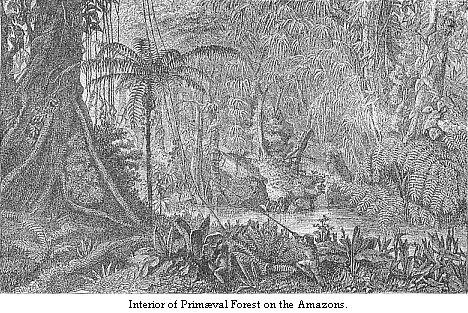
Pothos plants, mingled with ferns. Arrived at this part we were, in
fact, in the heart of the virgin forest. We heard no noises of
animals in the trees, and saw only one bird, the sky-blue
chatterer, sitting alone on a high branch. For some distance the
lower vegetation was so dense that the road runs under an arcade of
foliage, the branches having been cut away only sufficiently to
admit of the passage of a small canoe. These thickets are formed
chiefly of bamboos, whose slender foliage and curving stems arrange
themselves in elegant, feathery bowers; but other social
plants,—slender green climbers with tendrils so eager in aspiring
to grasp the higher boughs that they seem to be endowed almost with
animal energy, and certain low trees having large elegantly-veined
leaves, contribute also to the jungly masses. Occasionally we came
upon an uprooted tree lying across the path, its voluminous crown
still held up by thick cables of sipó, connecting it with
standing trees; a wide circuit had to be made in these cases, and
it was sometimes difficult to find the right path again.
At length we arrived at our journey’s end. We were then in
a very dense and gloomy part of the forest: we could see, however,
the dry land on both sides of the creek, and to our right a small
sunny opening appeared, the landing place to the native dwellings.
The water was deep close to the bank, and a clean pathway ascended
from the shady port to the buildings, which were about a furlong
distant. My friend Cardozo was godfather to a grandchild of
Pedro-uassú, whose daughter had married an Indian settled in
Ega. He had sent word to the old man that he intended to visit him:
we were therefore expected.
As we landed, Pedro-uassú himself came down to the port
to receive us, our arrival having been announced by the barking of
dogs. He was a tall and thin old man, with a serious, but benignant
expression of countenance, and a manner much freer from shyness and
distrust than is usual with Indians. He was clad in a shirt of
coarse cotton cloth, dyed with murishi, and trousers of the same
material turned up to the knee. His features were sharply
delineated—more so than in any Indian face I had yet seen; the
lips thin and the nose rather high and compressed. A large, square,
blue-black tattooed patch occupied the middle of his face, which,
as well as the other exposed parts of his body, was of a light
reddish-tan colour, instead of the usual coppery-brown hue. He
walked with an upright, slow gait, and on reaching us saluted
Cardozo with the air of a man who wished it to be understood that
he was dealing with an equal. My friend introduced me, and I was
welcomed in the same grave, ceremonious manner. He seemed to have
many questions to ask, but they were chiefly about Senhora Felippa,
Cardozo’s Indian housekeeper at Ega, and were purely
complimentary. This studied politeness is quite natural to Indians
of the advanced agricultural tribes. The language used was Tupi: I
heard no other spoken all the day. It must be borne in mind that
Pedro-uassú had never had much intercourse with whites; he
was, although baptised, a primitive Indian who had always lived in
retirement, the ceremony of baptism having been gone through, as it
generally is by the aborigines, simply from a wish to stand well
with the whites.
Arrived at the house, we were welcomed by Pedro’s wife: a
thin, wrinkled, active old squaw, tattooed in precisely the same
way as her husband. She also had sharp features, but her manner was
more cordial and quicker than that of her husband: she talked much,
and with great inflection of voice; whilst the tones of the old man
were rather drawling and querulous. Her clothing was a long
petticoat of thick cotton cloth, and a very short chemise, not
reaching to her waist. I was rather surprised to find the grounds
around the establishment in neater order than in any sitio, even of
civilised people, I had yet seen on the Upper Amazons; the stock of
utensils and household goods of all sorts was larger, and the
evidences of regular industry and plenty more numerous than one
usually perceives in the farms of civilised Indians and whites. The
buildings were of the same construction as those of the humbler
settlers in all other parts of the country. The family lived in a
large, oblong, open shed built under the shade of trees. Two
smaller buildings, detached from the shed and having mud-walls with
low doorways, contained apparently the sleeping apartments of
different members of the large household. A small mill for grinding
sugar-cane, having two cylinders of hard notched wood, wooden
troughs, and kettles for boiling the guarápa (cane
juice) to make treacle, stood under a separate shed, and near it
was a large enclosed mud-house for poultry. There was another hut
and shed a short distance off, inhabited by a family dependent on
Pedro, and a narrow pathway through the luxuriant woods led to more
dwellings of the same kind. There was an abundance of fruit trees
around the place, including the never-failing banana, with its
long, broad, soft green leaf-blades, and groups of full-grown
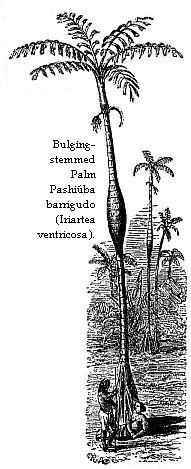
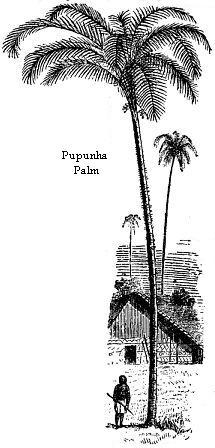
Pupúnhas, or peach palms. There was also a large number of
cotton and coffee trees. Amongst the utensils I noticed baskets of
different shapes, made of flattened maranta stalks, and dyed
various colours. The making of these is an original art of the
Passés, but I believe it is also practised by other tribes,
for I saw several in the houses of semi-civilised Indians on the
Tapajos.
There were only three persons in the house besides the old
couple, the rest of the people being absent; several came in,
however, in the course of the day. One was a daughter of
Pedro’s, who had an oval tattooed spot over her mouth; the
second was a young grandson; and the third the son-in-law from Ega,
Cardozo’s compadre. The old woman was occupied, when
we entered, in distilling spirits from cará, an edible root
similar to the potato, by means of a clay still, which had been
manufactured by herself. The liquor had a reddish tint, but not a
very agreeable flavour. A cup of it, warm from the still, however,
was welcome after our long journey. Cardozo liked it, emptied his
cup, and replenished it in a very short time. The old lady was very
talkative, and almost fussy in her desire to please her visitors.
We sat in tucúm hammocks, suspended between the upright
posts of the shed. The young woman with the blue mouth—who,
although married, was as shy as any young maiden of her race—soon
became employed in scalding and plucking fowls for the dinner near
the fire on the ground at the other end of the dwelling. The
son-in-law, Pedro-uassú, and Cardozo now began a long
conversation on the subject of their deceased wife, daughter, and
comadre.[1]
It appeared she had died of consumption—“tisica,” as they
called it, a word adopted by the Indians from the Portuguese. The widower
repeated over and over again, in nearly the same words, his account of her
illness, Pedro chiming in like a chorus, and Cardozo moralising and condoling.
I thought the cauím (grog) had a good deal to do with the flow of talk
and warmth of feeling of all three; the widower drank and wailed until he
became maundering, and finally fell asleep.
I left them talking, and took a long ramble into the forest,
Pedro sending his grandson, a smiling well-behaved lad of about
fourteen years of age, to show me the paths, my companion taking
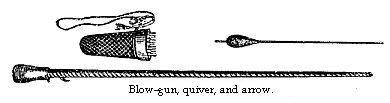
with him his Zarabatana, or blow-gun. This instrument is
used by all the Indian tribes on the Upper Amazons. It is generally
nine or ten feet long, and is made of two separate lengths of wood,
each scooped out so as to form one-half of the tube. To do this
with the necessary accuracy requires an enormous amount of patient
labour, and considerable mechanical ability, the tools used being
simply the incisor teeth of the Páca and Cutía. The
two half tubes, when finished, are secured together by a very close
and tight spirally-wound strapping, consisting of long flat strips
of Jacitára, or the wood of the climbing palm-tree; and the
whole is smeared afterwards with black wax, the production of a
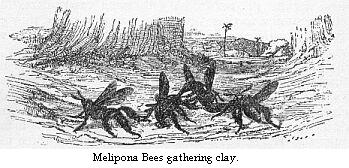
Melipona bee. The pipe tapers towards the muzzle, and a cup-shaped
mouthpiece, made of wood, is fitted in the broad end. A full-sized
Zarabatana is heavy, and can only be used by an adult Indian
who has had great practice. The young lads learn to shoot with
smaller and lighter tubes. When Mr. Wallace and I had lessons at
Barra in the use of the blow-gun, of Julio, a Jurí Indian,
then in the employ of Mr. Hauxwell, an English bird-collector, we
found it very difficult to hold steadily the long tubes. The arrows
are made from the hard rind of the leaf-stalks of certain palms,
thin strips being cut, and rendered as sharp as needles by scraping
the ends with a knife or the tooth of an animal. They are winged
with a little oval mass of samaüma silk (from the seed-vessels
of the silk-cotton tree, Eriodendron samauma), cotton being too
heavy. The ball of samauma should fit to a nicety the bore of the
blowgun; when it does so, the arrow can be propelled with such
force by the breath that it makes a noise almost as loud as a
pop-gun on flying from the muzzle. My little companion was armed
with a quiver full of these little missiles, a small number of
which, sufficient for the day’s sport, were tipped with the
fatal Urarí poison. The quiver was an ornamental affair, the
broad rim being made of highly-polished wood of a rich cherry-red
colour (the Moira-piránga, or redwood of the Japurá).
The body was formed of neatly-plaited strips of Maranta stalks, and
the belt by which it was suspended from the shoulder was decorated
with cotton fringes and tassels.
We walked about two miles along a well-trodden pathway, through
high caapoeira (second-growth forest). A large proportion of the
trees were Melastomas, which bore a hairy yellow fruit, nearly as
large and as well flavoured as our gooseberry. The season, however,
was nearly over for them. The road was bordered every inch of the
way by a thick bed of elegant Lycopodiums. An artificial
arrangement of trees and bushes could scarcely have been made to
wear so finished an appearance as this naturally decorated avenue.
The path at length terminated at a plantation of mandioca, the
largest I had yet seen since I left the neighbourhood of
Pará. There were probably ten acres of cleared land, and
part of the ground was planted with Indian corn, water-melons, and
sugar-cane. Beyond this field there was only a faint hunter’s
track, leading towards the untrodden interior. My companion told me
he had never heard of there being any inhabitants in that direction
(the south). We crossed the forest from this place to another
smaller clearing, and then walked, on our road home, through about
two miles of caäpoeira of various ages, the sites of old
plantations. The only fruits of our ramble were a few rare insects
and a Japú (Cassicus cristatus), a handsome bird with
chestnut and saffron-coloured plumage, which wanders through the
tree-tops in large flocks. My little companion brought this down
from a height which I calculated at thirty yards. The blow-gun,
however, in the hands of an expert adult Indian, can be made to
propel arrows so as to kill at a distance of fifty and sixty yards.
The aim is most certain when the tube is held vertically, or nearly
so. It is a far more useful weapon in the forest than a gun, for
the report of a firearm alarms the whole flock of birds or monkeys
feeding on a tree, whilst the silent poisoned dart brings the
animals down one by one until the sportsman has a heap of slain by
his side. None but the stealthy Indian can use it effectively. The
poison, which must be fresh to kill speedily, is obtained only of
the Indians who live beyond the cataracts of the rivers flowing
from the north, especially the Rio Negro and the Japurá. Its
principal ingredient is the wood of the Strychnos toxifera, a tree
which does not grow in the humid forests of the river plains. A
most graphic account of the Urarí, and of an expedition
undertaken in search of the tree in Guiana, has been given by Sir
Robert Schomburgk.[2]
When we returned to the house after mid-day, Cardozo was still
sipping cauim, and now looked exceedingly merry. It was fearfully
hot; the good fellow sat in his hammock with a cuya full of grog in
his hands; his broad honest face all of a glow, and the
perspiration streaming down his uncovered breast, the unbuttoned
shirt having slipped half-way over his broad shoulders.
Pedro-uassú had not drunk much; he was noted, as I
afterwards learned, for his temperance. But he was standing up as I
had left him two hours previous, talking to Cardozo in the same
monotonous tones, the conversation apparently not having flagged
all the time. I had never heard so much talking amongst Indians.
The widower was asleep; the stirring, managing old lady with her
daughter were preparing dinner. This, which was ready soon after I
entered, consisted of boiled fowls and rice, seasoned with large
green peppers and lemon juice, and piles of new, fragrant farinha
and raw bananas. It was served on plates of English manufacture on
a tupé, or large plaited rush mat, such as is made by the
natives pretty generally on the Amazons. Three or four other
Indians, men and women of middle age, now made their appearance,
and joined in the meal. We all sat round on the floor: the women,
according to custom, not eating until after the men had done.
Before sitting down, our host apologised in his usual quiet,
courteous manner for not having knives and forks; Cardozo and I ate
by the aid of wooden spoons, the Indians using their fingers. The
old man waited until we were all served before he himself
commenced. At the end of the meal, one of the women brought us
water in a painted clay basin of Indian manufacture, and a clean
coarse cotton napkin, that we might wash our hands.
The horde of Passés of which Pedro-uassú was
Tushaúa or chieftain, was at this time reduced to a very
small number of individuals. The disease mentioned in the last
chapter had for several generations made great havoc amongst them;
many had also entered the service of whites at Ega, and, of late
years, intermarriages with whites, half-castes, and civilised
Indians had been frequent. The old man bewailed the fate of his
race to Cardozo with tears in his eyes. “The people of my
nation,” he said, “have always been good friends to the
Caríwas (whites), but before my grandchildren are old like
me the name of Passé will be forgotten.” In so far as
the Passés have amalgamated with European immigrants or
their descendants, and become civilised Brazilian citizens, there
can scarcely be ground for lamenting their extinction as a nation;
but it fills one with regret to learn how many die prematurely of a
disease which seems to arise on their simply breathing the same air
as the whites. The original territory of the tribe must have been
of large extent, for Passés are said to have been found by
the early Portuguese colonists on the Rio Negro; an ancient
settlement on that river, Barcellos, having been peopled by them
when it was first established; and they formed also part of the
original population of Fonte-boa on the Solimoens. Their hordes
were therefore, spread over a region 400 miles in length from cast
to west. It is probable, however, that they have been confounded by
the colonists with other neighbouring tribes who tattoo their faces
in a similar manner. The extinct tribe of Yurimaúas, or
Sorimóas, from which the river Solimoens derives its name,
according to traditions extant at Ega, resembled the Passés
in their slender figures and friendly disposition. These tribes
(with others lying between them) peopled the banks of the main
river and its by-streams from the mouth of the Rio Negro to Peru.
True Passés existed in their primitive state on the banks of
the Issá, 240 miles to the west of Ega, within the memory of
living persons. The only large body of them now extant are located
on the Japurá, at a place distant about 150 miles from Ega:
the population of this horde, however, does not exceed, from what I
could learn, 300 or 400 persons. I think it probable that the lower
part of the Japurá and its extensive delta lands formed the
original home of this gentle tribe of Indians.
The Passés are always spoken of in this country as the
most advanced of all the Indian nations in the Amazons region.
Under what influences this tribe has become so strongly modified in
mental, social, and bodily features it is hard to divine. The
industrious habits, fidelity, and mildness of disposition of the
Passés, their docility and, it may be added, their personal
beauty, especially of the children and women, made them from the
first very attractive to the Portuguese colonists. They were,
consequently, enticed in great number from their villages and
brought to Barra and other settlements of the whites. The wives of
governors and military officers from Europe were always eager to
obtain children for domestic servants; the girls being taught to
sew, cook, weave hammocks, manufacture pillow-lace, and so forth.
They have been generally treated with kindness, especially by the
educated families in the settlements. It is pleasant to have to
record that I never heard of a deed of violence perpetrated, on the
one side or the other, in the dealings between European settlers
and this noble tribe of savages.
Very little is known of the original customs of the
Passés. The mode of life of our host Pedro-uassú did
not differ much from that of the civilised Mamelucos; but he and
his people showed a greater industry, and were more open, cheerful,
and generous in their dealings than many half-castes. The authority
of Pedro, like that of the Tushaúas, generally was exercised
in a mild manner. These chieftains appear able to command the
services of their subjects, since they furnish men to the Brazilian
authorities when requested; but none of them, even those of the
most advanced tribes, appear to make use of this authority for the
accumulation of property; the service being exacted chiefly in time
of war. Had the ambition of the chiefs of some of these industrious
tribes been turned to the acquisition of wealth, probably we should
have seen indigenous civilised nations in the heart of South
America similar to those found on the Andes of Peru and Mexico. It
is very probable that the Passés adopted from the first to
some extent the manners of the whites. Ribeiro, a Portuguese
official who travelled in these regions in 1774-5, and wrote an
account of his journey, relates that they buried their dead in
large earthenware vessels (a custom still observed amongst other
tribes on the Upper Amazons), and that, as to their marriages, the
young men earned their brides by valiant deeds in war. He also
states that they possessed a cosmogony in which the belief that the
sun was a fixed body, with the earth revolving around it, was a
prominent feature. He says, moreover, that they believed in a
Creator of all things; a future state of rewards and punishments,
and so forth. These notions are so far in advance of the ideas of
all other tribes of Indians, and so little likely to have been
conceived and perfected by a people having no written language or
leisured class, that we must suppose them to have been derived by
the docile Passés from some early missionary or traveller. I
never found that the Passés had more curiosity or activity
of intellect than other Indians. No trace of a belief in a future
state exists amongst Indians who have not had much intercourse with
the civilised settlers, and even amongst those who have it is only
a few of the more gifted individuals who show any curiosity on the
subject. Their sluggish minds seem unable to conceive or feel the
want of a theory of the soul, and of the relations of man to the
rest of Nature or to the Creator. But is it not so with totally
uneducated and isolated people even in the most highly civilised
parts of the world? The good qualities of the Passés belong
to the moral part of the character: they lead a contented,
unambitious, and friendly life, a quiet, domestic, orderly
existence, varied by occasional drinking bouts and summer
excursions. They are not so shrewd, energetic, and masterful as the
Mundurucús, but they are more easily taught, because their
disposition is more yielding than that of the Mundurucús or
any other tribe.
We started on our return to Ega at half-past four o’clock
in the afternoon. Our generous entertainers loaded us with
presents. There was scarcely room for us to sit in the canoe, as
they had sent down ten large bundles of sugar-cane, four baskets of
farinha, three cedar planks, a small hamper of coffee, and two
heavy bunches of bananas. After we were embarked, the old lady came
with a parting gift for me—a huge bowl of smoking hot banana
porridge. I was to eat it on the road “to keep my stomach
warm.” Both stood on the bank as we pushed off, and gave us
their adios: “Ikuána Tupána eirúm”
(Go with God): a form of salutation taught by the old Jesuit
missionaries. We had a most uncomfortable passage, for Cardozo was
quite tipsy, and had not attended to the loading of the boat. The
cargo had been placed too far forward, and to make matters worse,
my heavy friend obstinately insisted on sitting astride on the top
of the pile, instead of taking his place near the stern, singing
from his perch a most indecent love-song, and disregarding the
inconvenience of having to bend down almost every minute to pass
under the boughs of hanging sipós as we sped rapidly along.
The canoe leaked, but not, at first, alarmingly. Long before
sunset, darkness began to close in under those gloomy shades, and
our steersman could not avoid now and then running the boat into
the thicket. The first time this happened a piece was broken off
the square prow (rodella); the second time we got squeezed between
two trees. A short time after this latter accident, being seated
near the stern with my feet on the bottom of the boat, I felt
rather suddenly the cold water above my ankles. A few minutes more
and we should have sunk, for a seam had been opened forward under
the pile of sugar-cane. Two of us began to bale, and by the most
strenuous efforts managed to keep afloat without throwing overboard
our cargo. The Indians were obliged to paddle with extreme slowness
to avoid shipping water, as the edge of our prow was nearly level
with the surface; but Cardozo was now persuaded to change his seat.
The sun set, the quick twilight passed, and the moon soon after
began to glimmer through the thick canopy of foliage. The prospect
of being swamped in this hideous solitude was by no means pleasant,
although I calculated on the chance of swimming to a tree and
finding a nice snug place in the fork of some large bough wherein
to pass the night. At length, after four hours’ tedious
progress, we suddenly emerged on the open stream where the
moonlight glittered in broad sheets on the gently rippling waters.
A little extra care was now required in paddling. The Indians plied
their strokes with the greatest nicety; the lights of Ega (the oil
lamps in the houses) soon appeared beyond the black wall of forest,
and in a short time we leapt safely ashore.
A few months after the excursion just narrated, I accompanied
Cardozo in many wanderings on the Solimoens, during which he
visited the praias (sand-islands), the turtle pools in the forests,
and the by-streams and lakes of the great desert river. His object
was mainly to superintend the business of digging up turtle eggs on
the sandbanks, having been elected commandante for the year by the
municipal council of Ega, of the “praia real” (royal
sand-island) of Shimuní, the one lying nearest to Ega. There
are four of these royal praias within the Ega district (a distance
of 150 miles from the town), all of which are visited annually by
the Ega people for the purpose of collecting eggs and extracting
oil from their yolks. Each has its commander, whose business is to
make arrangements for securing to every inhabitant an equal chance
in the egg harvest by placing sentinels to protect the turtles
whilst laying, and so forth. The pregnant turtles descend from the
interior pools to the main river in July and August, before the
outlets dry up, and then seek in countless swarms their favourite
sand islands; for it is only a few praias that are selected by them
out of the great number existing. The young animals remain in the
pools throughout the dry season. These breeding places of turtles
then lie twenty to thirty or more feet above the level of the
river, and are accessible only by cutting roads through the dense
forest.
We left Ega on our first trip to visit the sentinels whilst the
turtles were yet laying, on the 26th of September. Our canoe was a
stoutly built igarité, arranged for ten paddlers, and having
a large arched toldo at the stern under which three persons could
sleep pretty comfortably. Emerging from the Teffé we
descended rapidly on the swift current of the Solimoens to the
south-eastern or lower end of the large wooded island of
Bariá, which here divides the river into two great channels.
We then paddled across to Shimuní, which lies in the middle
of the north-easterly channel, reaching the commencement of the
praia an hour before sunset. The island proper is about three miles
long and half a mile broad: the forest with which it is covered
rises to an immense and uniform height, and presents all round a
compact, impervious front. Here and there a singular tree, called
Pao mulatto (mulatto wood), with polished dark-green trunk, rose
conspicuously amongst the mass of vegetation. The sandbank, which
lies at the upper end of the island, extends several miles and
presents an irregular, and in some parts, strongly-waved surface,
with deep hollows and ridges. When upon it, one feels as though
treading an almost boundless field of sand, for towards the
south-east, where no forest line terminates the view, the white,
rolling plain stretches away to the horizon. The north-easterly
channel of the river lying between the sands and the further shore
of the river is at least two miles in breadth; the middle one,
between the two islands, Shimuní and Bariá, is not
much less than a mile.
We found the two sentinels lodged in a corner of the praia,
where it commences at the foot of the towering forest wall of the
island, having built for themselves a little rancho with poles and
palm-leaves. Great precautions are obliged to be taken to avoid
disturbing the sensitive turtles, who, previous to crawling ashore
to lay, assemble in great shoals off the sandbank. The men, during
this time, take care not to show themselves and warn off any
fishermen who wishes to pass near the place. Their fires are made
in a deep hollow near the borders of the forest, so that the smoke
may not be visible. The passage of a boat through the shallow
waters where the animals are congregated, or the sight of a man or
a fire on the sandbank, would prevent the turtles from leaving the
water that night to lay their eggs, and if the causes of alarm were
repeated once or twice, they would forsake the praia for some other
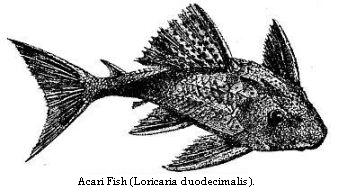
quieter place. Soon after we arrived, our men were sent with the
net to catch a supply of fish for supper. In half an hour, four or
five large basketsful of Acari were brought in. The sun set soon
after our meal was cooked; we were then obliged to extinguish the
fire and remove our supper materials to the sleeping ground, a spit
of sand about a mile off; this course being necessary on account of
the mosquitoes which swarm at night on the borders of the
forest.
One of the sentinels was a taciturn, morose-looking, but sober
and honest Indian, named Daniel; the other was a noted character of
Ega, a little wiry Mameluco, named Carepíra (Fish-hawk);
known for his waggery, propensity for strong drink, and
indebtedness to Ega traders. Both were intrepid canoemen and
huntsmen, and both perfectly at home anywhere in these fearful
wastes of forest and water. Carepíra had his son with him, a
quiet little lad of about nine years of age. These men in a few
minutes constructed a small shed with four upright poles and leaves
of the arrow-grass, under which Cardozo and I slung our hammocks.
We did not go to sleep, however, until after midnight: for when
supper was over, we lay about on the sand with a flask of rum in
our midst, and whiled away the still hours in listening to
Carepíra’s stories.
I rose from my hammock by daylight, shivering with cold; a
praia, on account of the great radiation of heat in the night from
the sand, being towards the dawn the coldest place that can be
found in this climate. Cardozo and the men were already up watching
the turtles. The sentinels had erected for this purpose a stage
about fifty feet high, on a tall tree near their station, the
ascent to which was by a roughly-made ladder of woody lianas. They
are enabled, by observing the turtles from this watch-tower, to
ascertain the date of successive deposits of eggs, and thus guide
the commandante in fixing the time for the general invitation to
the Ega people. The turtles lay their eggs by night, leaving the
water when nothing disturbs them, in vast crowds, and crawling to
the central and highest part of the praia. These places are, of
course, the last to go under water when, in unusually wet seasons,
the river rises before the eggs are hatched by the heat of the
sand. One could almost believe from this that the animals used
forethought in choosing a place; but it is simply one of those many
instances in animals where unconscious habit has the same result as
conscious prevision. The hours between midnight and dawn are the
busiest. The turtles excavate with their broad, webbed paws, deep
holes in the fine sand: the first corner, in each case, making a
pit about three feet deep, laying its eggs (about 120 in number)
and covering them with sand; the next making its deposit at the top
of that of its predecessor, and so on until every pit is full. The
whole body of turtles frequenting a praia does not finish laying in
less than fourteen or fifteen days, even when there is no
interruption. When all have done, the area (called by the
Brazilians taboleiro) over which they have excavated is
distinguishable from the rest of the praia only by signs of the
sand having been a little disturbed.
On rising, I went to join my friends. Few recollections of my
Amazonian rambles are more vivid and agreeable than that of my walk
over the white sea of sand on this cool morning. The sky was
cloudless; the just-risen sun was hidden behind the dark mass of
woods on Shimuní, but the long line of forest to the west,
on Bariá, with its plumy decorations of palms, was lighted
up with his yellow, horizontal rays. A faint chorus of singing
birds reached the ears from across the water, and flocks of gulls
and plovers were drying plaintively over the swelling banks of the
praia, where their eggs lay in nests made in little hollows of the
sand. Tracks of stray turtles were visible on the smooth white
surface of the praia. The animals which thus wander from the main
body are lawful prizes of the sentinels; they had caught in this
way two before sunrise, one of which we had for dinner. In my walk
I disturbed several pairs of the chocolate and drab-coloured
wild-goose (Anser jubatus) which set off to run along the edge of
the water. The enjoyment one feels in rambling over these free,
open spaces, is no doubt enhanced by the novelty of the scene, the
change being very great from the monotonous landscape of forest
which everywhere else presents itself.
On arriving at the edge of the forest I mounted the
sentinel’s stage, just in time to see the turtles retreating
to the water on the opposite side of the sand-bank, after having
laid their eggs. The sight was well worth the trouble of ascending
the shaky ladder. They were about a mile off, but the surface of
the sands was blackened with the multitudes which were waddling
towards the river; the margin of the praia was rather steep, and
they all seemed to tumble head first down the declivity into the
water.
I spent the morning of the 27th collecting insects in the woods
of Shimuní; and assisted my friend in the afternoon to beat
a large pool for Tracajás, Cardozo wishing to obtain a
supply for his table at home. The pool was nearly a mile long, and
lay on one side of the island between the forest and the sand-bank.
The sands are heaped up very curiously around the margins of these
isolated sheets of water; in the present case they formed a
steeply-inclined bank, from five to eight feet in height. What may
be the cause of this formation I cannot imagine. The pools always
contain a quantity of imprisoned fish, turtles, Tracajás,
and Aiyussás.[3]
The turtles and Aiyussás crawl out voluntarily in the course of a few days, and
escape to the main river, but the Tracajás remain and become an easy prey to
the natives. The ordinary mode of obtaining them is to whip the water in every
part with rods for several hours during the day; this treatment having the
effect of driving the animals out. They wait, however, until the night
following the beating before making their exit. Our Indians were occupied for
many hours in this work, and when night came they and the sentinels were placed
at intervals along the edge of the water to be ready to capture the runaways.
Cardozo and I, after supper, went and took our station at one end of the pool.
We did not succeed, after all our trouble, in getting many
Tracajás. This was partly owing to the intense darkness of
the night, and partly, doubtless, to the sentinels having already
nearly exhausted the pool, notwithstanding their declarations to
the contrary. In waiting for the animals, it was necessary to keep
silence: not a pleasant way of passing the night; speaking only in
whispers, and being without fire in a place liable to be visited by
a prowling jaguar. Cardozo and I sat on a sandy slope with our
loaded guns by our side, but it was so dark we could scarcely see
each other. Towards midnight a storm began to gather around us. The
faint wind which had breathed from over the water since the sun
went down, ceased; thick clouds piled themselves up, until every
star was obscured, and gleams of watery lightning began to play in
the midst of the black masses. I hinted to Cardozo that I thought
we had now had enough of watching, and suggested a cigarette. Just
then a quick pattering movement was heard on the sands, and
grasping our guns, we both started to our feet. Whatever it might
have been it seemed to pass by, and a few moments afterwards a dark
body appeared to be moving in another direction on the opposite
slope of the sandy ravine where we lay. We prepared to fire, but
luckily took the precaution of first shouting “Quem vai
lá?” (Who goes there?) It turned out to be the
taciturn sentinel, Daniel, who asked us mildly whether we had heard
a “raposa” pass our way. The raposa is a kind of wild
dog, with very long tapering muzzle, and black and white speckled
hair. Daniel could distinguish all kinds of animals in the dark by
their footsteps. It now began to thunder, and our position was
getting very uncomfortable. Daniel had not seen anything of the
other Indians, and thought it was useless waiting any longer for
Tracajás; we therefore sent him to call in the whole party,
and made off ourselves, as quickly as we could, for the canoe. The
rest of the night was passed most miserably; as indeed were very
many of my nights on the Solimoens. A furious squall burst upon us;
the wind blew away the cloths and mats we had fixed up at the ends
of the arched awning of the canoe to shelter ourselves, and the
rain beat right through our sleeping-place. There we lay, Cardozo
and I, huddled together, and wet through, waiting for the
morning.
A cup of strong and hot coffee put us to rights at sunrise, but
the rain was still coming down, having changed to a steady drizzle.
Our men were all returned from the pool, having taken only four
Tracajás. The business which had brought Cardozo hither
being now finished, we set out to return to Ega, leaving the
sentinels once more to their solitude on the sands. Our return
route was by the rarely frequented north-easterly channel of the
Solimoens, through which flows part of the waters of its great
tributary stream, the Japurá. We travelled for five hours
along the desolate, broken, timber-strewn shore of Bariá.
The channel is of immense breadth, the opposite coast being visible
only as a long, low line of forest. At three o’clock in the
afternoon we doubled the upper end of the island, and then crossed
towards the mouth of the Teffé by a broad transverse channel
running between Bariá and another island called
Quanarú. There is a small sand-bank at the north-westerly
point of Bariá, called Jacaré; we stayed here to dine
and afterwards fished with the net. A fine rain was still falling,
and we had capital sport, in three hauls taking more fish than our
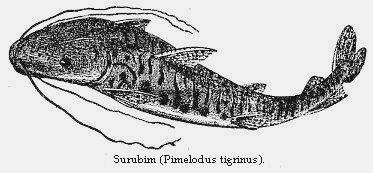
canoe would conveniently hold. They were of two kinds only, the
Surubim and the Piraepiéüa (species of Pimelodus), very
handsome fishes, four feet in length, with flat spoon-shaped heads,
and prettily-spotted and striped skins.
On our way from Jacaré to the mouth of the Teffé
we had a little adventure with a black tiger or jaguar. We were
paddling rapidly past a long beach of dried mud, when the Indians
became suddenly excited, shouting “Ecuí
Jauareté; Jauarípixúna!” (Behold the
jaguar, the black jaguar!) Looking ahead we saw the animal quietly
drinking at the water’s edge. Cardozo ordered the steersman
at once to put us ashore. By the time we were landed the tiger had
seen us, and was retracing his steps towards the forest. On the
spur of the moment, and without thinking of what we were doing, we
took our guns (mine was a double-barrel, with one charge of BB and
one of dust-shot) and gave chase. The animal increased his speed,
and reaching the forest border, dived into the dense mass of
broad-leaved grass which formed its frontage. We peeped through the
gap he had made, but, our courage being by this time cooled, we did
not think it wise to go into the thicket after him. The black tiger
appears to be more abundant than the spotted form of jaguar in the
neighbourhood of Ega. The most certain method of finding it is to
hunt assisted by a string of Indians shouting and driving the game
before them in the narrow restingas or strips of dry land in
the forest, which are isolated by the flooding of their
neighbourhood in the wet season. We reached Ega by eight
o’clock that night.
On the 6th of October we left Ega on a second excursion; the
principal object of Cardozo being, this time, to search certain
pools in the forest for young turtles. The exact situation of these
hidden sheets of water is known only to a few practised huntsmen;
we took one of these men with us from Ega, a Mameluco named Pedro,
and on our way called at Shimuní for Daniel to serve as an
additional guide. We started from the praia at sunrise on the 7th
in two canoes containing twenty-three persons, nineteen of whom
were Indians. The morning was cloudy and cool, and a fresh wind
blew from down river, against which we had to struggle with all the
force of our paddles, aided by the current; the boats were tossed
about most disagreeably, and shipped a great deal of water. On
passing the lower end of Shimuní, a long reach of the river
was before us, undivided by islands; a magnificent expanse of water
stretching away to the south-east. The country on the left bank is
not, however, terra firma, but a portion of the alluvial land which
forms the extensive and complex delta region of the Japurá.
It is flooded every year at the time of high water, and is
traversed by many narrow and deep channels which serve as outlets
to the Japurá, or at least, are connected with that river by
means of the interior water-system of the Cupiyó. This
inhospitable tract of country extends for several hundred miles,
and contains in its midst an endless number of pools and lakes
tenanted by multitudes of turtles, fishes, alligators, and water
serpents. Our destination was a point on this coast situated about
twenty miles below Shimuní, and a short distance from the
mouth of the Ananá, one of the channels just alluded to as
connected with the Japurá. After travelling for three hours
in midstream we steered for the land, and brought to under a
steeply-inclined bank of crumbly earth, shaped into a succession of
steps or terraces, marking the various halts which the waters of
the river make in the course of subsidence. The coast line was
nearly straight for many miles, and the bank averaged about thirty
feet in height above the present level of the river: at the top
rose the unbroken hedge of forest. No one could have divined that
pools of water existed on that elevated land. A narrow level space
extended at the foot of the bank. On landing the first business was
to get breakfast. Whilst a couple of Indian lads were employed in
making the fire, roasting the fish, and boiling the coffee, the
rest of the party mounted the bank, and with their long hunting
knives commenced cutting a path through the forest; the pool,
called the Aningal, being about half a mile distant. After
breakfast, a great number of short poles were cut and were laid
crosswise on the path, and then three light montarias which we had
brought with us were dragged up the bank by lianas, and rolled away
to be embarked on the pool. A large net, seventy yards in length,
was then disembarked and carried to the place. The work was done
very speedily, and when Cardozo and I went to the spot at eleven
o’clock, we found some of the older Indians, including Pedro
and Daniel, had begun their sport. They were mounted on little
stages called moutas, made of poles and cross-pieces of wood
secured with lianas, and were shooting the turtles as they came
near the surface, with bows and arrows. The Indians seemed to think
that netting the animals, as Cardozo proposed doing, was not lawful
sport, and wished first to have an hour or two’s
old-fashioned practice with their weapons.
The pool covered an area of about four or five acres, and was
closely hemmed in by the forest, which in picturesque variety and
grouping of trees and foliage exceeded almost everything I had yet
witnessed. The margins for some distance were swampy, and covered
with large tufts of a fine grass called Matupá. These tufts
in many places were overrun with ferns, and exterior to them a
crowded row of arborescent arums, growing to a height of fifteen or
twenty feet, formed a green palisade. Around the whole stood the
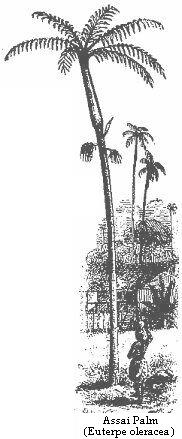
taller forest trees; palmate-leaved Cecropiæ slender Assai
palms, thirty feet high, with their thin feathery heads crowning
the gently-curving, smooth stems; small fan-leaved palms; and as a
background to all these airy shapes, lay the voluminous masses of
ordinary forest trees, with garlands, festoons, and streamers of
leafy climbers hanging from their branches. The pool was nowhere
more than five feet deep, one foot of which was not water, but
extremely fine and soft mud.
Cardozo and I spent an hour paddling about. I was astonished at
the skill which the Indians display in shooting turtles. They did
not wait for their coming to the surface to breathe, but watched
for the slight movements in the water, which revealed their
presence underneath. These little tracks on the water are called
the Sirirí; the instant one was perceived an arrow flew from
the bow of the nearest man, and never failed to pierce the shell of
the submerged animal. When the turtle was very distant, of course
the aim had to be taken at a considerable elevation, but the
marksmen preferred a longish range, because the arrow then fell
more perpendicularly on the shell and entered it more deeply.

The arrow used in turtle shooting has a strong lancet-shaped
steel point, fitted into a peg which enters the tip of the shaft.
The peg is secured to the shaft by twine made of the fibres of
pineapple leaves, the twine being some thirty or forty yards in
length, and neatly wound round the body of the arrow. When the
missile enters the shell, the peg drops out, and the pierced animal
descends with it towards the bottom, leaving the shaft floating on
the surface. This being done, the sportsman paddles in his montaria
to the place, and gently draws the animal by the twine, humouring
it by giving it the rein when it plunges, until it is brought again
near the surface, when he strikes it with a second arrow. With the
increased hold given by the two cords he has then no difficulty in
landing his game.
By mid-day the men had shot about a score of nearly full-grown
turtles. Cardozo then gave orders to spread the net. The spongy,
swampy nature of the banks made it impossible to work the net so as
to draw the booty ashore; another method was therefore adopted. The
net was taken by two Indians and extended in a curve at one
extremity of the oval-shaped pool, holding it when they had done so
by the perpendicular rods fixed at each end; its breadth was about
equal to the depth of the water, its shotted side therefore rested
on the bottom, whilst the floats buoyed it up on the surface, so
that the whole, when the ends were brought together, would form a
complete trap. The rest of the party then spread themselves around
the swamp at the opposite end of the pool and began to beat, with
stout poles, the thick tufts of Matupá, in order to drive
the turtles towards the middle. This was continued for an hour or
more, the beaters gradually drawing nearer to each other, and
driving the host of animals before them; the number of little
snouts constantly popping above the surface of the water showing
that all was going on well. When they neared the net the men moved
more quickly, shouting and beating with great vigour. The ends of
the net were then seized by several strong hands and dragged
suddenly forwards, bringing them at the same time together, so as
to enclose all the booty in a circle. Every man now leapt into the
enclosure, the boats were brought up, and the turtles easily
captured by the hand and tossed into them. I jumped in along with
the rest, although I had just before made the discovery that the
pool abounded in ugly, red, four-angled leeches, having seen
several of these delectable animals, which sometimes fasten on the
legs of fishermen, although they, did not, on this day, trouble us,
working their way through cracks in the bottom of our montaria.
Cardozo, who remained with the boats, could not turn the animals on
their backs fast enough, so that a great many clambered out and got
free again. However, three boat-loads, or about eighty, were
secured in about twenty minutes. They were then taken ashore, and
each one secured by the men tying the legs with thongs of bast.
When the canoes had been twice filled, we desisted, after a very
hard day’s work. Nearly all the animals were young ones,
chiefly, according to the statement of Pedro, from three to ten
years of age; they varied from six to eighteen inches in length,
and were very fat. Cardozo and I lived almost exclusively on them
for several months afterwards. Roasted in the shell they form a
most appetising dish. These younger turtles never migrate with
their elders on the sinking of the waters, but remain in the tepid
pools, fattening on fallen fruits, and, according to the natives,
on the fine nutritious mud. We captured a few full-grown
mother-turtles, which were known at once by the horny skin of their
breast-plates being worn, telling of their having crawled on the
sands to lay eggs the previous year. They had evidently made a
mistake in not leaving the pool at the proper time, for they were
full of eggs, which, we were told, they would, before the season
was over, scatter in despair over the swamp. We also found several
male turtles, or Capitarí0s, as they are called by the
natives. These are immensely less numerous than the females, and
are distinguishable by their much smaller size, more circular
shape, and the greater length and thickness of their tails. Their
flesh is considered unwholesome, especially to sick people having
external signs of inflammation. All diseases in these parts, as
well as their remedies and all articles of food, are classed by the
inhabitants as “hot” and “cold,” and the
meat of the Capitarí is settled by unanimous consent as
belonging to the “hot” list.
We dined on the banks of the river a little before sunset. The
mosquitoes then began to be troublesome, and finding it would be
impossible to sleep here, we all embarked and crossed the river to
a sand-bank, about three miles distant, where we passed the night.
Cardozo and I slept in our hammocks slung between upright poles,
the rest stretching themselves on the sand round a large fire. We
lay awake conversing until past midnight. It was a real pleasure to
listen to the stories told by one of the older men, they were given
with so much spirit. The tales always related to struggles with
some intractable animal—jaguar, manatee, or alligator. Many
interjections and expressive gestures were used, and at the end
came a sudden “Pa! terra!” when the animal was
vanquished by a shot or a blow. Many mysterious tales were
recounted about the Bouto, as the large Dolphin of the Amazons is
called. One of them was to the effect that a Bouto once had the
habit of assuming the shape of a beautiful woman, with hair hanging
loose to her heels, and walking ashore at night in the streets of
Ega, to entice the young men down to the water. If any one was so
much smitten as to follow her to the waterside, she grasped her
victim round the waist and plunged beneath the waves with a
triumphant cry. No animal in the Amazons region is the subject of
so many fables as the Bouto; but it is probable these did not
originate with the Indians, but with the Portuguese colonists. It
was several years before I could induce a fisherman to harpoon
Dolphins for me as specimens, for no one ever kills these animals
voluntarily, although their fat is known to yield an excellent oil
for lamps. The superstitious people believe that blindness would
result from the use of this oil in lamps. I succeeded at length
with Carepira, by offering him a high reward when his finances were
at a very low point, but he repented of his deed ever afterwards,
declaring that his luck had forsaken him from that day.
The next morning we again beat the pool. Although we had proof
of there being a great number of turtles yet remaining, we had very
poor success. The old Indians told us it would be so, for the
turtles were “ladino” (cunning), and would take no
notice of the beating a second day. When the net was formed into a
circle, and the men had jumped in, an alligator was found to be
inclosed. No one was alarmed, the only fear expressed being that
the imprisoned beast would tear the net. First one shouted,
“I have touched his head;” then another, “he has
scratched my leg;” one of the men, a lanky Miránha,
was thrown off his balance, and then there was no end to the
laughter and shouting. At last a youth of about fourteen years of
age, on my calling to him from the bank to do so, seized the
reptile by the tail, and held him tightly until, a little
resistance being overcome, he was able to bring it ashore. The net
was opened, and the boy slowly dragged the dangerous but cowardly
beast to land through the muddy water, a distance of about a
hundred yards. Meantime, I had cut a strong pole from a tree, and
as soon as the alligator was drawn to solid ground, gave him a
smart rap with it on the crown of his head, which killed him
instantly. It was a good-sized individual, the jaws being
considerably more than a foot long, and fully capable of snapping a
man’s leg in twain. The species was the large cayman, the
Jacaré-uassú of the Amazonian Indians (Jacare
nigra).
On the third day, we sent our men in the boats to net turtles in
a larger pool about five miles further down the river, and on the
fourth, returned to Ega.
It will be well to mention here a few circumstances relative to
the large Cayman, which, with the incident just narrated, afford
illustrations of the cunning, cowardice, and ferocity of this
reptile.
I have hitherto had but few occasions of mentioning alligators,
although they exist by myriads in the waters of the Upper Amazons.
Many different species are spoken of by the natives. I saw only
three, and of these two only are common: one, the
Jacaré-tinga, a small kind (five feet long when full grown),
having a long slender muzzle and a black-banded tail; the other,
the Jacaré-uassú, to which these remarks more
especially relate and the third the Jacaré-curúa,
mentioned in a former chapter. The Jacaré-uassú, or
large Cayman, grows to a length of eighteen or twenty feet, and
attains an enormous bulk. Like the turtles, the alligator has its
annual migrations, for it retreats to the interior pools and
flooded forests in the wet season, and descends to the main river
in the dry season. During the months of high water, therefore,
scarcely a single individual is to be seen in the main river. In
the middle part of the Lower Amazons, about Obydos and Villa Nova,
where many of the lakes with their channels of communication with
the trunk stream dry up in the fine months, the alligator buries
itself in the mud and becomes dormant, sleeping till the rainy
season returns. On the Upper Amazons, where the dry season is never
excessive, it has not this habit, but is lively all the year round.
It is scarcely exaggerating to say that the waters of the Solimoens
are as well stocked with large alligators in the dry season, as a
ditch in England is in summer with tadpoles. During a journey of
five days which I once made in the Upper Amazons steamer, in
November, alligators were seen along the coast almost every step of
the way, and the passengers amused themselves, from morning till
night, by firing at them with rifle and ball. They were very
numerous in the still bays, where the huddled crowds jostled
together, to the great rattling of their coats of mail, as the
steamer passed.
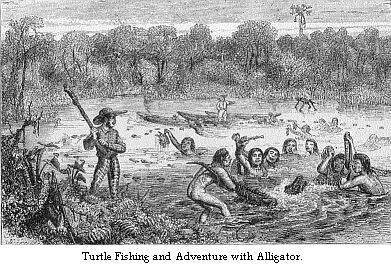
The natives at once despise and fear the great cayman. I once
spent a month at Caiçara, a small village of semi-civilised
Indians, about twenty miles to the west of Ega. My entertainer, the
only white in the place, and one of my best and most constant
friends, Senhor Innocencio Alves Faria, one day proposed a
half-day’s fishing with net in the lake,—the expanded bed of
the small river on which the village is situated. We set out in an
open boat with six Indians and two of Innocencio’s children.
The water had sunk so low that the net had to be taken out into the
middle by the Indians, whence at the first draught, two
medium-sized alligators were brought to land. They were disengaged
from the net and allowed, with the coolest unconcern, to return to
the water, although the two children were playing in it not many
yards off. We continued fishing, Innocencio and I lending a helping
hand, and each time drew a number of the reptiles of different ages
and sizes, some of them Jacaré-tingas; the lake, in fact,
swarmed with alligators. After taking a very large quantity of
fish, we prepared to return, and the Indians, at my suggestion,
secured one of the alligators with the view of letting it loose
amongst the swarms of dogs in the village. An individual was
selected about eight feet long: one man holding his head and
another his tail, whilst a third took a few lengths of a flexible
liana, and deliberately bound the jaws and the legs. Thus secured,
the beast was laid across the benches of the boat on which we sat
during the hour and a half’s journey to the settlement. We
were rather crowded, but our amiable passenger gave us no trouble
during the transit. On reaching the village, we took the animal
into the middle of the green, in front of the church, where the
dogs were congregated, and there gave him his liberty, two of us
arming ourselves with long poles to intercept him if he should make
for the water, and the others exciting the dogs. The alligator
showed great terror, although the dogs could not be made to
advance, and made off at the top of its speed for the water,
waddling like a duck. We tried to keep him back with the poles, but
he became enraged, and seizing the end of the one I held in his
jaws, nearly wrenched it from my grasp. We were obliged, at length,
to kill him to prevent his escape.
These little incidents show the timidity or cowardice of the
alligator. He never attacks man when his intended victim is on his
guard; but he is cunning enough to know when this may be done with
impunity: of this we had proof at Caiçara, a few days
afterwards. The river had sunk to a very low point, so that the
port and bathing-place of the village now lay at the foot of a long
sloping bank, and a large cayman made his appearance in the shallow
and muddy water. We were all obliged to be very careful in taking
our bath; most of the people simply using a calabash, pouring the
water over themselves whilst standing on the brink. A large trading
canoe, belonging to a Barra merchant named Soares, arrived at this
time, and the Indian crew, as usual, spent the first day or two
after their coming into port in drunkenness and debauchery ashore.
One of the men, during the greatest heat of the day, when almost
everyone was enjoying his afternoon’s nap, took it into his
head whilst in a tipsy state to go down alone to bathe. He was seen
only by the Juiz de Paz, a feeble old man who was lying in his
hammock in the open verandah at the rear of his house on the top of
the bank, and who shouted to the besotted Indian to beware of the
alligator. Before he could repeat his warning, the man stumbled,
and a pair of gaping jaws, appearing suddenly above the surface,
seized him round the waist and drew him under the water. A cry of
agony “Ai Jesús!” was the last sign made by the
wretched victim. The village was aroused: the young men with
praiseworthy readiness seized their harpoons and hurried down to
the bank; but, of course it was too late, a winding track of blood
on the surface of the water was all that could be seen. They
embarked, however, in montarias, determined upon vengeance; the
monster was traced, and when, after a short lapse of time, he came
up to breathe—one leg of the man sticking out from his jaws—was
despatched with bitter curses.
The last of these minor excursions which I shall narrate, was
made (again in company of Senhor Cardozo, with the addition of his
housekeeper Senhora Felippa) in the season when all the population
of the villages turns out to dig up turtle eggs, and revel on the
praias. Placards were posted on the church doors at Ega, announcing
that the excavation on Shimuní would commence on the 17th of
October, and on Catuá, sixty miles below Shimuní, on
the 25th. We set out on the 16th, and passed on the road, in our
well-manned igarité, a large number of people, men, women,
and children in canoes of all sizes, wending their way as if to a
great holiday gathering. By the morning of the 17th, some 400
persons were assembled on the borders of the sand-bank; each family
having erected a rude temporary shed of poles and palm leaves to
protect themselves from the sun and rain. Large copper kettles to
prepare the oil, and hundreds of red earthenware jars, were
scattered about on the sand.
The excavation of the taboleiro, collecting the eggs and
purifying the oil, occupied four days. All was done on a system
established by the old Portuguese governors, probably more than a
century ago. The commandante first took down the names of all the
masters of households, with the number of persons each intended to
employ in digging; he then exacted a payment of 140 reis (about
fourpence) a head, towards defraying the expense of sentinels. The
whole were then allowed to go to the taboleiro. They arranged
themselves around the circle, each person armed with a paddle to be
used as a spade, and then all began simultaneously to dig on a
signal being given—the roll of drums—by order of the commandante.
It was an animating sight to behold the wide circle of rival
diggers throwing up clouds of sand in their energetic labours, and
working gradually towards the centre of the ring. A little rest was
taken during the great heat of midday, and in the evening the eggs
were carried to the huts in baskets. By the end of the second day,
the taboleiro was exhausted; large mounds of eggs, some of them
four to five feet in height, were then seen by the side of each
hut, the produce of the labours of the family.
In the hurry of digging, some of the deeper nests are passed
over; to find these out, the people go about provided with a long
steel or wooden probe, the presence of the eggs being discoverable
by the ease with which the spit enters the sand. When no more eggs
are to be found, the mashing process begins. The egg, it may be
mentioned, has a flexible or leathery shell; it is quite round, and
somewhat larger than a hen’s egg. The whole heap is thrown
into an empty canoe and mashed with wooden prongs; but sometimes
naked Indians and children jump into the mass and tread it down,
besmearing themselves with yolk and making about as filthy a scene
as can well be imagined. This being finished, water is poured into
the canoe, and the fatty mess then left for a few hours to be
heated by the sun, on which the oil separates and rises to the
surface. The floating oil is afterwards skimmed off with long
spoons, made by tying large mussel-shells to the end of rods, and
purified over the fire in copper kettles.
The destruction of turtle eggs every year by these proceedings
is enormous. At least 6000 jars, holding each three gallons of the
oil, are exported annually from the Upper Amazons and the Madeira
to Pará, where it is used for lighting, frying fish, and
other purposes. It may be fairly estimated that 2000 more jars-full
are consumed by the inhabitants of the villages on the river. Now,
it takes at least twelve basketsful of eggs, or about 6000 by the
wasteful process followed, to make one jar of oil. The total number
of eggs annually destroyed amounts, therefore, to 48,000,000. As
each turtle lays about 120, it follows that the yearly offspring of
400,000 turtles is thus annihilated. A vast number, nevertheless,
remain undetected; and these would probably be sufficient to keep
the turtle population of these rivers up to the mark, if the people
did not follow the wasteful practice of lying in wait for the
newly-hatched young, and collecting them by thousands for eating;
their tender flesh and the remains of yolk in their entrails being
considered a great delicacy. The chief natural enemies of the
turtle are vultures and alligators, which devour the newly-hatched
young as they descend in shoals to the water. These must have
destroyed an immensely greater number before the European settlers
began to appropriate the eggs than they do now. It is almost
doubtful if this natural persecution did not act as effectively in
checking the increase of the turtle as the artificial destruction
now does. If we are to believe the tradition of the Indians,
however, it had not this result; for they say that formerly the
waters teemed as thickly with turtles as the air now does with
mosquitoes. The universal opinion of the settlers on the Upper
Amazons is, that the turtle has very greatly decreased in numbers,
and is still annually decreasing.
We left Shimuní on the 20th with quite a flotilla of
canoes, and descended the river to Catuá, an eleven
hours’ journey by paddle and current. Catuá is about
six miles long, and almost entirely encircled by its praia. The
turtles had selected for their egg-laying a part of the sand-bank
which was elevated at least twenty feet above the present level of
the river; the animals, to reach the place, must have crawled up a
slope. As we approached the island, numbers of the animals were
seen coming to the surface to breathe, in a small shoaly bay. Those
who had light montarias sped forward with bows and arrows to shoot
them. Carepíra was foremost, having borrowed a small and
very unsteady boat, of Cardozo, and embarked in it with his little
son. After bagging a couple of turtles, and whilst hauling in a
third, he overbalanced himself; the canoe went over, and he with
his child had to swim for their lives in the midst of numerous
alligators, about a mile from the land. The old man had to sustain
a heavy fire of jokes from his companions for several days after
this mishap. Such accidents are only laughed at by this almost
amphibious people.
The number of persons congregated on Catuá was much
greater than on Shimuní, as the population of the banks of
several neighbouring lakes were here added. The line of huts and
sheds extended half a mile, and several large sailing vessels were
anchored at the place. The commandante was Senhor Macedo, the
Indian blacksmith of Ega before mentioned, who maintained excellent
order during the fourteen days the process of excavation and oil
manufacture lasted. There were also many primitive Indians here
from the neighbouring rivers, amongst them a family of
Shumánas, good-tempered, harmless people from the Lower
Japurá. All of them were tattooed around the mouth, the
bluish tint forming a border to the lips, and extending in a line
on the cheeks towards the ear on each side. They were not quite so
slender in figure as the Passés of
Perdo-uassú’s family; but their features deviated
quite as much as those of the Passés from the ordinary
Indian type. This was seen chiefly in the comparatively small
mouth, pointed chin, thin lips, and narrow, high nose. One of the
daughters, a young girl of about seventeen years of age, was a real
beauty. The colour of her skin approached the light tanned shade of
the Mameluco women; her figure was almost faultless, and the blue
mouth, instead of being a disfigurement, gave quite a captivating
finish to her appearance. Her neck, wrists, and ankles were adorned
with strings of blue beads. She was, however, extremely bashful,
never venturing to look strangers in the face, and never quitting,
for many minutes together, the side of her father and mother. The
family had been shamefully swindled by some rascally trader on
another praia; and, on our arrival, came to lay their case before
Senhor Cardozo, as the delegado of police of the district. The mild
way in which the old man, without a trace of anger, stated his
complaint in imperfect Tupi quite enlisted our sympathies in his
favour. But Cardozo could give him no redress; he invited the
family, however, to make their rancho near to ours, and in the end
gave them the highest price for the surplus oil which they
manufactured.
It was not all work at Catuá; indeed there was rather
more play than work going on. The people make a kind of holiday of
these occasions. Every fine night parties of the younger people
assembled on the sands, and dancing and games were carried on for
hours together. But the requisite liveliness for these sports was
never got up without a good deal of preliminary rum-drinking. The
girls were so coy that the young men could not get sufficient
partners for the dances without first subscribing for a few flagons
of the needful cashaca. The coldness of the shy Indian and Mameluco
maidens never failed to give way after a little of this strong
drink, but it was astonishing what an immense deal they could take
of it in the course of an evening. Coyness is not always a sign of
innocence in these people, for most of the half-caste women on the
Upper Amazons lead a little career of looseness before they marry
and settle down for life; and it is rather remarkable that the men
do not seem to object much to their brides having had a child or
two by various fathers before marriage. The women do not lose
reputation unless they become utterly depraved, but in that case
they are condemned pretty strongly by public opinion. Depravity is,
however, rare, for all require more or less to be wooed before they
are won. I did not see (although I mixed pretty freely with the
young people) any breach of propriety on the praias. The
merry-makings were carried on near the ranchos, where the more
staid citizens of Ega, husbands with their wives and young
daughters, all smoking gravely out of long pipes, sat in their
hammocks and enjoyed the fun. Towards midnight we often heard, in
the intervals between jokes and laughter, the hoarse roar of
jaguars prowling about the jungle in the middle of the praia. There
were several guitar-players amongst the young men, and one most
persevering fiddler, so there was no lack of music.
The favourite sport was the Pira-purasséya, or
fish-dance, one of the original games of the Indians, though now
probably a little modified. The young men and women, mingling
together, formed a ring, leaving one of their number in the middle,
who represented the fish. They then all marched round, Indian file,
the musicians mixed up with the rest, singing a monotonous but
rather pretty chorus, the words of which were invented (under a
certain form) by one of the party who acted as leader. This
finished, all joined hands, and questions were put to the one in
the middle, asking what kind of fish he or she might be. To these
the individual has to reply. The end of it all is that he makes a
rush at the ring, and if he succeeds in escaping, the person who
allowed him to do so has to take his place; the march and chorus
then recommences, and so the game goes on hour after hour.
Tupí was the language mostly used, but sometimes Portuguese
was sung and spoken. The details of the dance were often varied.
Instead of the names of fishes being called over by the person in
the middle, the name of some animal, flower, or other object was
given to every fresh occupier of the place. There was then good
scope for wit in the invention of nicknames, and peals of laughter
would often salute some particularly good hit. Thus a very lanky
young man was called the Magoary, or the grey stork; a moist
grey-eyed man with a profile comically suggestive of a fish was
christened Jarakí (a kind of fish), which was considered
quite a witty sally; a little Mameluco girl, with light-coloured
eyes and brown hair, got the gallant name of Rosa Blanca, or the
white rose; a young fellow who had recently singed his eyebrows by
the explosion of fireworks, was dubbed Pedro queimado (burnt
Peter); in short every one got a nickname, and each time the
cognomen was introduced into the chorus as the circle marched
round.
Our rancho was a large one, and was erected in a line with the
others near the edge of the sand-bank which sloped rather abruptly
to the water. During the first week the people were all, more or
less, troubled by alligators. Some half-dozen full-grown ones were
in attendance off the praia, floating about on the lazily-flowing,
muddy water. The dryness of the weather had increased since we had
left Shimuní, the currents had slackened, and the heat in
the middle part of the day was almost insupportable. But no one
could descend to bathe without being advanced upon by one or other
of these hungry monsters. There was much offal cast into the river,
and this, of course, attracted them to the place. One day I amused
myself by taking a basketful of fragments of meat beyond the line
of ranchos, and drawing the alligators towards me by feeding them.
They behaved pretty much as dogs do when fed; catching the bones I
threw them in their huge jaws, and coming nearer and showing
increased eagerness after every morsel. The enormous gape of their
mouths, with their blood-red lining and long fringes of teeth, and
the uncouth shapes of their bodies, made a picture of unsurpassable
ugliness. I once or twice fired a heavy charge of shot at them,
aiming at the vulnerable part of their bodies, which is a small
space situated behind the eyes, but this had no other effect than
to make them give a hoarse grunt and shake themselves; they
immediately afterwards turned to receive another bone which I threw
to them.
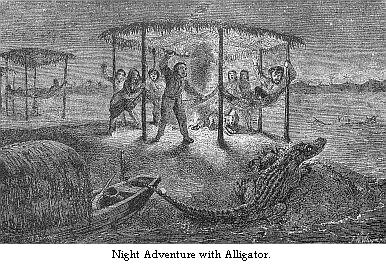
Every day these visitors became bolder; at length they reached a
pitch of impudence that was quite intolerable. Cardozo had a poodle
dog named Carlito, which some grateful traveller whom he had
befriended had sent him from Rio Janeiro. He took great pride in
this dog, keeping it well sheared, and preserving his coat as white
as soap and water could make it. We slept in our rancho in hammocks
slung between the outer posts; a large wood fire (fed with a kind
of wood abundant on the banks of the river, which keeps alight all
night) being made in the middle, by the side of which slept Carlito
on a little mat. Well, one night I was awoke by a great uproar. It
was caused by Cardozo hurling burning firewood with loud curses at
a huge cayman which had crawled up the bank and passed beneath my
hammock (being nearest the water) towards the place where Carlito
lay. The dog had raised the alarm in time; the reptile backed out
and tumbled down the bank to the water, the sparks from the brands
hurled at him flying from his bony hide. To our great surprise the
animal (we supposed it to be the same individual) repeated his
visit the very next night, this time passing round to the other
side of our shed. Cardozo was awake, and threw a harpoon at him,
but without doing him any harm. After this it was thought necessary
to make an effort to check the alligators; a number of men were
therefore persuaded to sally forth in their montarias and devote a
day to killing them.
The young men made several hunting excursions during the
fourteen days of our stay on Catuá, and I, being associated
with them in all their pleasures, made generally one of the party.
These were, besides, the sole occasions on which I could add to my
collections, whilst on these barren sands. Only two of these trips
afforded incidents worth relating.
The first, which was made to the interior of the wooded island
of Catuá, was not a very successful one. We were twelve in
number, all armed with guns and long hunting-knives. Long before
sunrise, my friends woke me up from my hammock, where I lay, as
usual, in the clothes worn during the day; and after taking each a
cup-full of cashaça and ginger (a very general practice in
early morning on the sand-banks), we commenced our walk. The waning
moon still lingered in the clear sky, and a profound stillness
pervaded sleeping camp, forest, and stream. Along the line of
ranchos glimmered the fires made by each party to dry turtle-eggs
for food, the eggs being spread on little wooden stages over the
smoke. The distance to the forest from our place of starting was
about two miles, being nearly the whole length of the sand-bank,
which was also a very broad one; the highest part, where it was
covered with a thicket of dwarf willows, mimosas, and arrow grass,
lying near the ranchos. We loitered much on the way, and the day
dawned whilst we were yet on the road, the sand at this early hour
feeling quite cold to the naked feet. As soon as we were able to
distinguish things, the surface of the praia was seen to be dotted
with small black objects. These were newly-hatched Aiyussa turtles,
which were making their way in an undeviating line to the water, at
least a mile distant. The young animal of this species is
distinguishable from that of the large turtle and the Tracaja, by
the edges of the breast-plate being raised on each side, so that in
crawling it scores two parallel lines on the sand. The mouths of
these little creatures were full of sand, a circumstance arising
from their having to bite their way through many inches of
superincumbent sand to reach the surface on emerging from the
buried eggs. It was amusing to observe how constantly they turned
again in the direction of the distant river, after being handled
and set down on the sand with their heads facing the opposite
quarter. We saw also several skeletons of the large cayman (some
with the horny and bony hide of the animal nearly perfect) embedded
in the sand; they reminded me of the remains of Ichthyosauri
fossilised in beds of lias, with the difference of being buried in
fine sand instead of in blue mud. I marked the place of one which
had a well-preserved skull, and the next day returned to secure it.
The specimen is now in the British Museum collection. There were
also many footmarks of jaguars on the sand.
We entered the forest, as the sun peeped over the tree-tops far
away down river. The party soon after divided, I keeping with a
section which was led by Bento, the Ega carpenter, a capital
woodsman. After a short walk we struck the banks of a beautiful
little lake, having grassy margins and clear dark water, on the
surface of which floated thick beds of water-lilies. We then
crossed a muddy creek or watercourse that entered the lake, and
then found ourselves on a restinga, or tongue of land
between two waters. By keeping in sight of one or the other of
these, there was no danger of our losing our way: all other
precautions were therefore unnecessary. The forest was tolerably
clear of underwood, and consequently, easy to walk through. We had
not gone far before a soft, long-drawn whistle was heard aloft in
the trees, betraying the presence of Mutums (Curassow birds). The
crowns of the trees, a hundred feet or more over our heads, were so
closely interwoven that it was difficult to distinguish the birds:
the practised eye of Bento, however, made them out, and a fine male
was shot from the flock, the rest flying away and alighting at no
great distance. The species was the one of which the male has a
round red ball on its beak (Crax globicera). The pursuit of the
others led us a great distance, straight towards the interior of
the island, in which direction we marched for three hours, having
the lake always on our right.
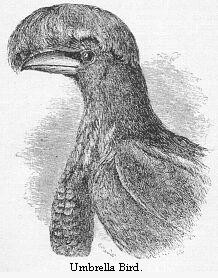
Arriving at length at the head of the lake, Bento struck off to
the left across the restinga, and we then soon came upon a treeless
space choked up with tall grass, which appeared to be the dried-up
bed of another lake. Our leader was obliged to climb a tree to
ascertain our position, and found that the clear space was part of
the creek, whose mouth we had crossed lower down. The banks were
clothed with low trees, nearly all of one species, a kind of araca
(Psidium), and the ground was carpeted with a slender delicate
grass, now in flower. A great number of crimson and
vermilion-coloured butterflies (Catagramma Peristera, male and
female) were settled on the smooth, white trunks of these trees. I
had also here the great pleasure of seeing for the first time, the
rare and curious Umbrella Bird (Cephalopterus ornatus), a species
which resembles in size, colour, and appearance our common crow,
but is decorated with a crest of long, curved, hairy feathers
having long bare quills, which, when raised, spread themselves out
in the form of a fringed sunshade over the head. A strange
ornament, like a pelerine, is also suspended from the neck, formed
by a thick pad of glossy steel-blue feathers, which grow on a long
fleshy lobe or excrescence. This lobe is connected (as I found on
skinning specimens) with an unusual development of the trachea and
vocal organs, to which the bird doubtless owes its singularly deep,
loud, and long-sustained fluty note. The Indian name of this
strange creature is Uirá-mimbéu, or fife-bird,[4]
in allusion to the tone of its voice. We had the good luck, after remaining
quiet a short time, to hear its performance. It drew itself up on its perch,
spread widely the umbrella-formed crest, dilated and waved its glossy
breast-lappet, and then, in giving vent to its loud piping note, bowed its head
slowly forwards. We obtained a pair, male and female; the female has only the
rudiments of the crest and lappet, and is duller-coloured altogether than the
male. The range of this bird appears to be quite confined to the plains of the
Upper Amazons (especially the Ygapó forests), not having been found to the east
of the Rio Negro.
Bento and our other friends being disappointed in finding no
more Curassows, or indeed any other species of game, now resolved
to turn back. On reaching the edge of the forest, we sat down and
ate our dinners under the shade; each man having brought a little
bag containing a few handsfull of farinha, and a piece of fried
fish or roast turtle. We expected our companions of the other
division to join us at midday, but after waiting till past one
o’clock without seeing anything of them (in fact, they had
returned to the huts an hour or two previously), we struck off
across the praia towards the encampment. An obstacle here presented
itself on which we had not counted. The sun had shone all day
through a cloudless sky untempered by a breath of wind, and the
sands had become heated by it to a degree that rendered walking
over them with our bare feet impossible. The most hardened
footsoles of the party could not endure the burning soil. We made
several attempts; we tried running, having wrapped the cool leaves
of Heliconiæ round our feet, but in no way could we step
forward many yards. There was no means of getting back to our
friends before night, except going round the praia, a circuit of
about four miles, and walking through the water or on the moist
sand. To get to the waterside from the place where we then stood
was not difficult, as a thick bed of a flowering shrub, called
tintarána, an infusion of the leaves of which is used to dye
black, lay on that side of the sand-bank. Footsore and wearied,
burthened with our guns, and walking for miles through the tepid
shallow water under the brain-scorching vertical sun, we had, as
may be imagined, anything but a pleasant time of it. I did not,
however, feel any inconvenience afterwards. Everyone enjoys the
most lusty health whilst living this free and wild life on the
rivers.
The other hunting trip which I have alluded to was undertaken in
company with three friendly young half-castes. Two of them were
brothers, namely, Joao (John) and Zephyrino Jabutí:
Jabutí, or tortoise, being a nickname which their father had
earned for his slow gait, and which, as is usual in this country,
had descended as the surname of the family. The other was
José Frazao, a nephew of Senhor Chrysostomo, of Ega, an
active, clever, and manly young fellow, whom I much esteemed. He
was almost a white, his father being a Portuguese and his mother a
Mameluca. We were accompanied by an Indian named Lino, and a
Mulatto boy, whose office was to carry our game.
Our proposed hunting-ground on this occasion lay across the
water, about fifteen miles distant. We set out in a small montaria,
at four o’clock in the morning, again leaving the encampment
asleep, and travelled at a good pace up the northern channel of the
Solimoens, or that lying between the island Catuá and the
left bank of the river. The northern shore of the island had a
broad sandy beach reaching to its western extremity. We gained our
destination a little after daybreak; this was the banks of the
Carapanatúba,[5]
a channel some 150 yards in width, which, like the Ananá already mentioned,
communicates with the Cupiyó. To reach this we had to cross the river, here
nearly two miles wide. Just as day dawned we saw a Cayman seize a large fish, a
Tambakí, near the surface; the reptile seemed to have a difficulty in securing
its prey, for it reared itself above the water, tossing the fish in its jaws
and making a tremendous commotion. I was much struck also by the singular
appearance presented by certain diving birds having very long and snaky necks
(the Plotus Anhinga). Occasionally a long serpentine form would suddenly
wriggle itself to a height of a foot and a half above the glassy surface of the
water, producing such a deceptive imitation of a snake that at first I had some
difficulty in believing it to be the neck of a bird; it did not remain long in
view, but soon plunged again beneath the stream.
We ran ashore in a most lonely and gloomy place, on a low
sand-bank covered with bushes, secured the montaria to a tree, and
then, after making a very sparing breakfast on fried fish and
mandioca meal, rolled up our trousers and plunged into the thick
forest, which here, as everywhere else, rose like a lofty wall of
foliage from the narrow strip of beach. We made straight for the
heart of the land, John Jabutí leading, and breaking off at
every few steps a branch of the lower trees, so that we might
recognise the path on our return. The district was quite new to all
my companions, and being on a coast almost totally uninhabited by
human beings for some 300 miles, to lose our way would have been to
perish helplessly. I did not think at the time of the risk we ran
of having our canoe stolen by passing Indians, unguarded montarias
being never safe even in the ports of the villages, Indians
apparently considering them common property, and stealing them
without any compunction. No misgivings clouded the lightness of
heart with which we trod forward in warm anticipation of a good
day’s sport.
The tract of forest through which we passed was Ygapó,
but the higher parts of the land formed areas which went only a
very few inches under water in the flood season. It consisted of a
most bewildering diversity of grand and beautiful trees, draped,
festooned, corded, matted, and ribboned with climbing plants, woody
and succulent, in endless variety. The most prevalent palm was the
tall Astryocaryum Jauarí, whose fallen spines made it
necessary to pick our way carefully over the ground, as we were all
barefooted. There was not much green underwood, except in places
where Bamboos grew; these formed impenetrable thickets of plumy
foliage and thorny, jointed stems, which always compelled us to
make a circuit to avoid them. The earth elsewhere was encumbered
with rotting fruits, gigantic bean-pods, leaves, limbs, and trunks
of trees; fixing the impression of its being the cemetery as well
as the birthplace of the great world of vegetation overhead. Some
of the trees were of prodigious height. We passed many specimens of
the Moratinga, whose cylindrical trunks, I dare not say how many
feet in circumference, towered up and were lost amidst the crowns
of the lower trees, their lower branches, in some cases, being
hidden from our view. Another very large and remarkable tree was
the Assacú (Sapium aucuparium). A traveller on the Amazons,
mingling with the people, is sure to hear much of the poisonous
qualities of the juices of this tree. Its bark exudes, when hacked
with a knife, a milky sap, which is not only a fatal poison when
taken internally, but is said to cause incurable sores if simply
sprinkled on the skin. My companions always gave the Assacú
a wide berth when we passed one. The tree looks ugly enough to
merit a bad name, for the bark is of a dingy olive colour, and is
studded with short and sharp, venomous-looking spines.
After walking about half a mile we came upon a dry watercourse,
where we observed, first, the old footmarks of a tapir, and, soon
after, on the margin of a curious circular hole full of muddy
water, the fresh tracks of a Jaguar. This latter discovery was
hardly made when a rush was heard amidst the bushes on the top of a
sloping bank on the opposite side of the dried creek. We bounded
forward; it was, however, too late, for the animal had sped in a
few minutes far out of our reach. It was clear we had disturbed, on
our approach, the Jaguar, whilst quenching his thirst at the
water-hole. A few steps further on we saw the mangled remains of an
alligator (the Jacarétinga). The head, fore-quarters, and
bony shell were the only parts which remained; but the meat was
quite fresh, and there were many footmarks of the Jaguar around the
carcase; so that there was no doubt this had formed the solid part
of the animal’s breakfast. My companions now began to search
for the alligator’s nest, the presence of the reptile so far
from the river being accountable for on no other ground than its
maternal solicitude for its eggs. We found, in fact, the nest at
the distance of a few yards from the place. It was a conical pile
of dead leaves, in the middle of which twenty eggs were buried.
These were of elliptical shape, considerably larger than those of a
duck, and having a hard shell of the texture of porcelain, but very
rough on the outside. They make a loud sound when rubbed together,
and it is said that it is easy to find a mother alligator in the
Ygapó forests by rubbing together two eggs in this way, she
being never far off, and attracted by the sounds.
I put half-a-dozen of the alligator’s eggs in my game-bag
for specimens, and we then continued on our way. Lino, who was now
first, presently made a start backwards, calling out
“Jararáca!” This is the name of a poisonous
snake (genus Craspedocephalus), which is far more dreaded by the
natives than Jaguar or Alligator. The individual seen by Lino lay
coiled up at the foot of a tree, and was scarcely distinguishable,
on account of the colours of its body being assimilated to those of
the fallen leaves. Its hideous, flat triangular head, connected
with the body by a thin neck, was reared and turned towards us:
Frazao killed it with a charge of shot, shattering it completely,
and destroying, to my regret, its value as a specimen. In
conversing on the subject of Jararácas as we walked onwards,
every one of the party was ready to swear that this snake attacks
man without provocation, leaping towards him from a considerable
distance when he approaches. I met, in the course of my daily
rambles in the woods, many Jararácas, and once or twice
narrowly very escaped treading on them, but never saw them attempt
to spring. On some subjects the testimony of the natives of a wild
country is utterly worthless. The bite of the Jararácas is
generally fatal. I knew of four or five instances of death from it,
and only of one clear case of recovery after being bitten; but in
that case the person was lamed for life.
We walked over moderately elevated and dry ground for about a
mile, and then descended (three or four feet only) to the dry bed
of another creek. This was pierced in the same way as the former
water-course, with round holes full of muddy water. They occurred
at intervals of a few yards, and had the appearance of having been
made by the hand of man. The smallest were about two feet, the
largest seven or eight feet in diameter. As we approached the most
extensive of the larger ones, I was startled at seeing a number of
large serpent-like heads bobbing about the surface. They proved to
be those of electric eels, and it now occurred to me that the round
holes were made by these animals working constantly round and round
in the moist, muddy soil. Their depth (some of them were at least
eight feet deep) was doubtless due also to the movements of the
eels in the soft soil, and accounted for their not drying up, in
the fine season, with the rest of the creek. Thus, whilst
alligators and turtles in this great inundated forest region retire
to the larger pools during the dry season, the electric eels make
for themselves little ponds in which to pass the season of
drought.
My companions now cut each a stout pole, and proceeded to eject
the eels in order to get at the other fishes, with which they had
discovered the ponds to abound. I amused them all very much by
showing how the electric shock from the eels could pass from one
person to another. We joined hands in a line whilst I touched the
biggest and freshest of the animals on the head with the point of
my hunting-knife. We found that this experiment did not succeed
more than three times with the same eel when out of the water; for,
the fourth time the shock was scarcely perceptible. All the fishes
found in the holes (besides the eels) belonged to one species, a
small kind of Acari, or Loricaria, a group whose members have a
complete bony integument. Lino and the boy strung them together
through the gills with slender sipós, and hung them on the
trees to await our return later in the day.
Leaving the bed of the creek, we marched onwards, always towards
the centre of the land, guided by the sun, which now glimmered
through the thick foliage overhead. About eleven o’clock we
saw a break in the forest before us, and presently emerged on the
banks of a rather large sheet of water. This was one of the
interior pools of which there are so many in this district. The
margins were elevated some few feet, and sloped down to the water,
the ground being hard and dry to the water’s edge, and
covered with shrubby vegetation. We passed completely round this
pool, finding the crowns of the trees on its borders tenanted by
curassow birds, whose presence was betrayed as usual by the
peculiar note which they emit. My companions shot two of them. At
the further end of the lake lay a deep watercourse, which we traced
for about half a mile, and found to communicate with another and
smaller pool. This second one evidently swarmed with turtles, as we
saw the snouts of many peering above the surface of the water: the
same had not been seen in the larger lake, probably because we had
made too much noise in hailing our discovery on approaching its
banks. My friends made an arrangement on the spot for returning to
this pool, after the termination of the egg harvest on
Catuá.
In recrossing the space between the two pools, we heard the
crash of monkeys in the crowns of trees overhead. The chase of
these occupied us a considerable time. José fired at length
at one of the laggards of the troop, and wounded him. He climbed
pretty nimbly towards a denser part of the tree, and a second and
third discharge failed to bring him down. The poor maimed creature
then trailed his limbs to one of the topmost branches, where we
descried him soon after, seated and picking the entrails from a
wound in his abdomen; a most heart-rending sight. The height from
the ground to the bough on which he was perched could not have been
less than 150 feet, and we could get a glimpse of him only by
standing directly underneath, and straining our eyes upwards. We
killed him at last by loading our best gun with a careful charge,
and resting the barrel against the tree-trunk to steady the aim. A
few shots entered his chin, and he then fell heels over head
screaming to the ground. Although it was I who gave the final shot,
this animal did not fall to my lot in dividing the spoils at the
end of the day. I regret now not having preserved the skin, as it
belonged to a very large species of Cebus, and one which I never
met with afterwards.
It was about one o’clock in the afternoon when we again
reached the spot where we had first struck the banks of the larger
pool. We hitherto had but poor sport, so after dining on the
remains of our fried fish and farinha, and smoking our cigarettes,
the apparatus for making which, including bamboo tinder-box and
steel and flint for striking a light, being carried by every one
always on these expeditions, we made off in another (westerly)
direction through the forest to try to find better hunting-ground.
We quenched our thirst with water from the pool, which I was rather
surprised to find quite pure. These pools are, of course, sometimes
fouled for a time by the movements of alligators and other tenants
in the fine mud which settles at the bottom, but I never observed a
scum of confervæ or traces of oil revealing animal
decomposition on the surface of these waters, nor was there ever
any foul smell perceptible. The whole of this level land, instead
of being covered with unwholesome swamps emitting malaria, forms in
the dry season (and in the wet also) a most healthy country. How
elaborate must be the natural processes of self-purification in
these teeming waters!
On our fresh route we were obliged to cut our way through a long
belt of bamboo underwood, and not being so careful of my steps as
my companions, I trod repeatedly on the flinty thorns which had
fallen from the bushes, finishing by becoming completely lame, one
thorn having entered deeply the sole of my foot. I was obliged to
be left behind; Lino, the Indian, remaining with me. The careful
fellow cleaned my wounds with his saliva, placed pieces of isca
(the felt-like substance manufactured by ants) on them to staunch
the blood, and bound my feet with tough bast to serve as shoes,
which he cut from the bark of a Mongúba tree. He went about
his work in a very gentle way and with much skill, but was so
sparing of speech that I could scarcely get answers to the
questions I put to him. When he had done I was able to limp about
pretty nimbly. An Indian when he performs a service of this kind
never thinks of a reward. I did not find so much disinterestedness
in negro slaves or half-castes. We had to wait two hours for the
return of our companions; during part of this time I was left quite
alone, Lino having started off into the jungle after a peccary (a
kind of wild hog) which had come near to where we sat, but on
seeing us had given a grunt and bounded off into the thickets. At
length our friends hove in sight, loaded with game; having shot
twelve curassows and two cujubims (Penelope Pipile), a handsome
black fowl with a white head, which is arboreal in its habits like
the rest of this group of Gallinaceous birds inhabiting the South
American forests. They had discovered a third pool containing
plenty of turtles. Lino rejoined us at the same time, having missed
the peccary, but in compensation shot a Quandú, or
porcupine. The mulatto boy had caught alive in the pool a most
charming little water-fowl, a species of grebe. It was somewhat
smaller than a pigeon, and had a pointed beak; its feet were
furnished with many intricate folds or frills of skin instead of
webs, and resembled very much those of the gecko lizards. The bird
was kept as a pet in Jabutí’s house at Ega for a long
time afterwards, where it became accustomed to swim about in a
common hand-basin full of water, and was a great favourite with
everybody.
We now retraced our steps towards the water-side, a weary walk
of five or six miles, reaching our canoe by half-past five
o’clock, or a little before sunset. It was considered by
everyone at Catuá that we had had an unusually good
day’s sport. I never knew any small party to take so much
game in one day in these forests, over which animals are everywhere
so widely and sparingly scattered. My companions were greatly
elated, and on approaching the encampment at Catuá, made a
great commotion with their paddles to announce their successful
return, singing in their loudest key one of the wild choruses of
the Amazonian boatmen.
The excavation of eggs and preparation of the oil being
finished, we left Catuá on the 3rd of November.
Carepíra, who was now attached to Cardozo’s party, had
discovered another lake rich in turtles, about twelve miles
distant, in one of his fishing rambles, and my friend resolved,
before returning to Ega, to go there with his nets and drag it as
we had formerly done the Aningal. Several Mameluco families of Ega
begged to accompany us to share the labours and booty; the
Shumána family also joined the party; we therefore, formed a
large body, numbering in all eight canoes and fifty persons.
The summer season was now breaking up; the river was rising; the
sky was almost constantly clouded, and we had frequent rains. The
mosquitoes also, which we had not felt whilst encamped on the
sand-banks, now became troublesome. We paddled up the
north-westerly channel, and arrived at a point near the upper end
of Catuá at ten o’clock p.m. There was here a very
broad beach of untrodden white sand, which extended quite into the
forest, where it formed rounded hills and hollows like sand dunes,
covered with a peculiar vegetation: harsh, reedy grasses, and low
trees matted together with lianas, and varied with dwarf spiny
palms of the genus Bactris. We encamped for the night on the sands,
finding the place luckily free from mosquitoes. The different
portions of the party made arched coverings with the toldos or
maranta-leaf awnings of their canoes to sleep under, fixing the
edges in the sand. No one, however, seemed inclined to go to sleep,
so after supper we all sat or lay around the large fires and amused
ourselves. We had the fiddler with us, and in the intervals between
the wretched tunes which he played, the usual amusement of
story-telling beguiled the time: tales of hair-breadth escapes from
jaguar, alligator, and so forth. There were amongst us a father and
son who had been the actors, the previous year, in an alligator
adventure on the edge of the praia we had just left. The son,
whilst bathing, was seized by the thigh and carried under water: a
cry was raised, and the father, rushing down the bank, plunged
after the rapacious beast, which was diving away with his victim.
It seems almost incredible that a man could overtake and master the
large cayman in his own element; but such was the case in this
instance, for the animal was reached and forced to release his
booty by the man’s thrusting his thumb into his eye. The lad
showed us the marks of the alligator’s teeth on his thigh. We
sat up until past midnight listening to these stories and assisting
the flow of talk by frequent potations of burnt rum. A large,
shallow dish was filled with the liquor and fired; when it had
burned for a few minutes, the flame was extinguished and each one
helped himself by dipping a tea-cup into the vessel.
One by one the people dropped asleep, and then the quiet murmur
of talk of the few who remained awake was interrupted by the roar
of jaguars in the jungle about a furlong distant. There was not one
only, but several of the animals. The older men showed considerable
alarm and proceeded to light fresh fires around the outside of our
encampment. I had read in books of travel of tigers coming to warm
themselves by the fires of a bivouac, and thought my strong wish to
witness the same sight would have been gratified to-night. I had
not, however, such good fortune, although I was the last to go to
sleep, and my bed was the bare sand under a little arched covering
open at both ends. The jaguars, nevertheless, must have come very
near during the night, for their fresh footmarks were numerous
within a score yards of the place where we slept. In the morning I
had a ramble along the borders of the jungle, and found the tracks
very numerous and close together on the sandy soil.
We remained in this neighbourhood four days, and succeeded in
obtaining many hundred turtles, but we were obliged to sleep two
nights within the Carapanatúba channel. The first night
passed rather pleasantly, for the weather was fine, and we encamped
in the forest, making large fires and slinging our hammocks between
the trees. The second was one of the most miserable nights I ever
spent. The air was close, and a drizzling rain began to fall about
midnight, lasting until morning. We tried at first to brave it out
under the trees. Several very large fires were made, lighting up
with ruddy gleams the magnificent foliage in the black shades
around our encampment. The heat and smoke had the desired effect of
keeping off pretty well the mosquitoes, but the rain continued
until at length everything was soaked, and we had no help for it
but to bundle off to the canoes with drenched hammocks and
garments. There was not nearly room enough in the flotilla to
accommodate so large a number of persons lying at full length;
moreover the night was pitch dark, and it was quite impossible in
the gloom and confusion to get at a change of clothing. So there we
lay, huddled together in the best way we could arrange ourselves,
exhausted with fatigue and irritated beyond all conception by
clouds of mosquitoes. I slept on a bench with a sail over me, my
wet clothes clinging to my body, and to increase my discomfort,
close beside me lay an Indian girl, one of Cardozo’s
domestics, who had a skin disfigured with black diseased patches,
and whose thick clothing, not having been washed during the whole
time we had been out (eighteen days), gave forth a most vile
effluvium.
We spent the night of the 7th of November pleasantly on the
smooth sands, where the jaguars again serenaded us, and on the
succeeding morning we commenced our return voyage to Ega. We first
doubled the upper end of the island of Catuá, and then
struck off for the right bank of the Solimoens. The river was here
of immense width, and the current was so strong in the middle that
it required the most strenuous exertions on the part of our
paddlers to prevent us from being carried miles away down the
stream. At night we reached the Juteca, a small river which enters
the Solimoens by a channel so narrow that a man might almost jump
across it, but a furlong inwards expands into a very pretty lake
several miles in circumference. We slept again in the forest, and
again were annoyed by rain and mosquitoes; but this time Cardozo
and I preferred remaining where we were to mingling with the
reeking crowd in the boats. When the grey dawn arose a steady rain
was still falling, and the whole sky had a settled, leaden
appearance, but it was delightfully cool. We took our net into the
lake and gleaned a good supply of delicious fish for breakfast. I
saw at the upper end of this lake the native rice of this country
growing wild.
The weather cleared up at ten o’clock a.m. At three p.m.
we arrived at the mouth of the Cayambé, another tributary
stream much larger than the Juteca. The channel of exit to the
Solimoens was here also very narrow, but the expanded river inside
is of vast dimensions: it forms a lake (I may safely venture to
say), several score miles in circumference. Although prepared for
these surprises, I was quite taken aback in this case. We had been
paddling all day along a monotonous shore, with the dreary
Solimoens before us, here three to four miles broad, heavily
rolling onward its muddy waters. We come to a little gap in the
earthy banks, and find a dark, narrow inlet with a wall of forest
overshadowing it on each side; we enter it, and at a distance of
two or three hundred yards a glorious sheet of water bursts upon
the view. The scenery of Cayambé is very picturesque. The
land, on the two sides visible of the lake, is high, and clothed
with sombre woods, varied here and there with a white-washed house,
in the middle of a green patch of clearing, belonging to settlers.
In striking contrast to these dark, rolling forests, is the vivid,
light green and cheerful foliage of the woods on the numerous
islets which rest like water-gardens on the surface of the lake.
Flocks of ducks, storks, and snow-white herons inhabit these
islets, and a noise of parrots with the tingling chorus of
Tamburí-parás was heard from them as we passed. This
has a cheering effect after the depressing stillness and absence of
life in the woods on the margins of the main river.
Cardozo and I took a small boat and crossed the lake to visit
one of the settlers, and on our return to our canoe, whilst in the
middle of the lake, a squall suddenly arose in the direction
towards which we were going, so that for a whole hour we were in
great danger of being swamped. The wind blew away the awning and
mats, and lashed the waters into foam, the waves rising to a great
height. Our boat, fortunately, was excellently constructed, rising
well towards the prow, so that with good steering we managed to
head the billows as they arose, and escaped without shipping much
water. We reached our igarité at sunset, and then made all
speed to Curubarú, fifteen miles distant, to encamp for the
night on the sands. We reached the praia at ten o’clock. The
waters were now mounting fast upon the sloping beach, and we found
on dragging the net next morning that fish was beginning to be
scarce. Cardozo and his friends talked quite gloomily at breakfast
time over the departure of the joyous verao, and the setting
in of the dull, hungry winter season.
At nine o’clock in the morning of the 10th of November a
light wind from down river sprang up, and all who had sails hoisted
them. It was the first time during our trip that we had had
occasion to use our sails: so continual is the calm on this upper
river. We bowled along merrily, and soon entered the broad channel
lying between Bariá and the mainland on the south bank. The
wind carried us right into the mouth of the Teffé and at
four o’clock p.m. we cast anchor in the port of Ega.