Definition of the Terms—Force and Nature—The Universal
Soul of Progress—Man the Instrument and not the Element
of Progress—Origin of Progressional Phenomena—The Agency
of Evil—Is Civilization Conducive to Happiness?—Objective
and Subjective Humanity—Conditions Essential to Progress—Continental
Configurations—Food and Climate—Wealth
and Leisure—Association—War, Slavery, Religion, and Government—Morality
and Fashion—The Development of Progressional Law.
The terms Savage and Civilized, as applied to races
of men, are relative and not absolute terms. At best
these words mark only broad shifting stages in human
progress; the one near the point of departure, the other
farther on toward the unattainable end. This progress
is one and universal, though of varying rapidity and
extent; there are degrees in savagism and there are
degrees in civilization; indeed, though placed in opposition,
the one is but a degree of the other. The Haidah,
whom we call savage, is as much superior to the
Shoshone, the lowest of Americans, as the Aztec is
superior to the Haidah, or the European to the Aztec.
Looking back some thousands of ages, we of to-day
are civilized; looking forward through the same duration
of time, we are savages.
Nor is it, in the absence of fixed conditions, and
amidst the many shades of difference presented by the
nations along our western seaboard, an easy matter to
tell where even comparative savagism ends and civilization
begins. In the common acceptation of these
terms, we may safely call the Central Californians
savage, and the Quichés of Guatemala civilized; but
between these two extremes are hundreds of peoples,
each of which presents some claim for both distinctions.
Thus, if the domestication of ruminants, or some knowledge
of arts and metals, constitute civilization, then
are the ingenious but half-torpid Hyperboreans civilized,
for the Eskimos tame reindeer, and the Thlinkeets
are skillful carvers and make use of copper; if the
cultivation of the soil, the building of substantial
houses of adobe, wood, and stone, with the manufacture
of cloth and pottery, denote an exodus from savagism,
then are the Pueblos of New Mexico no longer savages;
yet in both these instances enough may be seen, either
of stupidity or brutishness, to forbid our ranking them
with the more advanced Aztecs, Mayas, and Quichés.
We know what savages are; how, like wild animals,
they depend for food and raiment upon the spontaneous
products of nature, migrating with the beasts and
birds and fishes, burrowing beneath the ground, hiding
in caves, or throwing over themselves a shelter of bark
or skins or branches or boards, eating or starving as
food is abundant or scarce; nevertheless, all of them
have made some advancement from their original
naked, helpless condition, and have acquired some aids
in the procurement of their poor necessities. Primeval
man, the only real point of departure, and hence
the only true savage, nowhere exists on the globe to-day.
Be the animal man never so low—lower in skill
and wisdom than the brute, less active in obtaining
food, less ingenious in building his den—the first step
out of his houseless, comfortless condition, the first
fashioning of a tool, the first attempt to cover nakedness
and wall out the wind, if this endeavor spring
from intellect and not from instinct, is the first step
toward civilization. Hence the modern savage is not
the pre-historic or primitive man; nor is it among the
barbarous nations of to-day that we must look for the
rudest barbarism.
DEFINITION OF THE TERMS.
Often is the question asked, What is civilization?
and the answer comes, The act of civilizing; the state
of being civilized. What is the act of civilizing? To
reclaim from a savage or barbarous state; to educate;
to refine. What is a savage or barbarous state? A
wild uncultivated state; a state of nature. Thus far
the dictionaries. The term civilization, then, popularly
implies both the transition from a natural to an artificial
state, and the artificial condition attained. The
derivation of the word civilization, from civis, citizen,
civitas, city, and originally from cœtus, union, seems
to indicate that culture which, in feudal times, distinguished
the occupants of cities from the ill-mannered
boors of the country. The word savage, on the other
hand, from silva, a wood, points to man primeval;
silvestres homines, men of the forest, not necessarily
ferocious or brutal, but children of nature. From
these simple beginnings both words have gradually
acquired a broader significance, until by one is understood
a state of comfort, intelligence, and refinement;
and by the other, humanity wild and bestial.
Guizot defines civilization as an "improved condition
of man resulting from the establishment of social
order in place of the individual independence and
lawlessness of the savage or barbarous life;" Buckle
as "the triumph of mind over external agents;" Virey
as "the development more or less absolute of the moral
and intellectual faculties of man united in society;"
Burke as the exponent of two principles, "the spirit of
a gentleman and the spirit of religion." "Whatever
be the characteristics of what we call savage life," says
John Stuart Mill, "the contrary of these, or the
qualities which society puts on as it throws off these,
constitute civilization;" and, remarks Emerson, "a
nation that has no clothing, no iron, no alphabet, no
marriage, no arts of peace, no abstract thought, we
call barbarous."
Men talk of civilization and call it liberty, religion,
government, morality. Now liberty is no more a sign
of civilization than tyranny; for the lowest savages are
the least governed of all people. Civilized liberty, it
is true, marks a more advanced stage than savage
liberty, but between these two extremes of liberty
there is a necessary age of tyranny, no less significant
of an advance on primitive liberty than is constitutional
liberty an advance on tyranny. Nor is religion
civilization, except in so far as the form and machinery
of sacerdotal rites, and the abandonment of fetichism
for monotheism become significant of intenser thought
and expansion of intellect. No nation ever practiced
grosser immorality, or what we of the present day
hold to be immorality, than Greece during the height
of her intellectual refinement. Peace is no more
civilization than war, virtue than vice, good than evil.
All these are the incidents, not the essence, of civilization.
That which we commonly call civilization is not an
adjunct nor an acquirement of man; it is neither a
creed nor a polity, neither science nor philosophy nor
industry; it is rather the measure of progressional
force implanted in man, the general fund of the
nation's wealth, learning, and refinement, the storehouse
of accumulated results, the essence of all best
worth preserving from the distillations of good and
the distillations of evil. It is a something between
men, no less than a something within them; for neither
an isolated man nor an association of brutes can by
any possibility become civilized.
CIVILIZATION A WORKING PRINCIPLE.
Further than this, civilization is not only the measure
of aggregated human experiences, but it is a living
working principle. It is a social transition; a moving
forward rather than an end attained; a developing
vitality rather than a fixed entity; it is the effort or
aim at refinement rather than refinement itself; it is
labor with a view to improvement and not improvement
consummated, although it may be and is the metre
of such improvement. And this accords with latter-day
teachings. Although in its infancy, and, moreover,
unable to explain things unexplainable, the science of
evolution thus far has proved that the normal condition
of the human race, as well as that of physical
nature, is progressional; that the plant in a congenial
soil is not more sure to grow than is humanity with
favorable surroundings certain to advance. Nay, more,
we speak of the progress of civilization as of something
that moves on of its own accord; we may, if we
will, recognize in this onward movement, the same
principle of life manifest in nature and in the individual
man.
To things we do not understand we give names,
with which by frequent use we become familiar, when
we fancy that we know all about the things themselves.
At the first glance civilization appears to be a simple
matter; to be well clad, well housed, and well fed, to
be intelligent and cultured are better than nakedness
and ignorance; therefore it is a good thing, a thing
that men do well to strive for,—and that is all.
But once attempt to go below this placid surface,
and investigate the nature of progressional phenomena,
and we find ourselves launched upon an eternity of
ocean, and in pursuit of the same occult Cause, which
has been sought alike by philosophic and barbaric of
every age and nation; we find ourselves face to face
with a great mystery, to which we stand in the same
relation as to other great mysteries, such as the origin
of things, the principle of life, the soul-nature. When
such questions are answered as What is attraction,
heat, electricity; what instinct, intellect, soul? Why
are plants forced to grow and molecules to conglomerate
and go whirling in huge masses through space?—then
we may know why society moves ever onward
like a river in channels predetermined. At present,
these phenomena we may understand in their action
partially, in their essence not at all; we may mark
effects, we may recognize the same principle under
widely different conditions though we may not be able
to discover what that principle is. Science tells us
that these things are so; that certain combinations of
certain elements are inevitably followed by certain
results, but science does not attempt to explain why
they are so. Nevertheless, a summary of such few
simple thoughts as I have been able to gather upon
the subject, may be not wholly valueless.
FORCE AND MATTER.
And first, to assist our reflections, let us look for a
moment at some of the primal principles in nature, not
with a view to instruct in that direction, but rather to
compare some of the energies of the material world
with the intellectual or progressional energy in man;
and of these I will mention such only as are currently
accepted by latter-day science.
Within the confines of the conceivable universe one
element alone is all-potential, all-pervading,—Force.
Throughout the realms of space, in and round all
forms of matter, binding minutest atoms, balancing systems
of worlds, rioting in life, rotting in death, under
its various aspects mechanical and chemical, attractive
and repulsive, this mighty power is manifest; a unifying,
coalescing, and flowing power, older than time,
quicker than thought, saturating all suns and planets
and filling to repletion all molecules and masses.
Worlds and systems of worlds are sent whirling,
worlds round worlds and systems round systems, in a
mazy planetary dance, wherein the slightest tripping,
the least excess of momentum or inertia, of tension or
traction, in any part, and chaos were come again.
Every conceivable entity, ponderable and imponderable,
material and immaterial, is replete with force.
By it all moving bodies are set in motion, all motionless
bodies held at rest; by it the infinitesimal atom
is held an atom and the mass is held concrete, vapory
moisture overspreads the land, light and heat animate
senseless substance; by it forms of matter change,
rocks grow and dissolve, mountains are made and
unmade, the ocean heaves and swells, the eternal hills
pulsate, the foundations of the deep rise up, and seas
displace continents.
One other thing we know, which with the first
comprises all our knowledge,—Matter. Now force and
matter are interdependent, one cannot exist without
the other; as for example, all substance, unless held
together—which term obviously implies force—would
speedily dissolve into inconceivable nothingness. But
no less force is required to annihilate substance than to
create it; force, therefore, is alike necessary to the existence
or non-existence of matter, which reduces the
idea of a possible absence of either force or matter to
an absurdity; or, in other words, it is impossible for
the human mind to conceive of a state of things wherein
there is no matter, and consequently no force.
Force has been called the soul of nature, and matter
the body, for by force matter lives and moves and has
its being.
Force like matter, is divisible, infinitely so, as far as
human experience goes; for, though ultimates may
exist, they have never yet been reached; and it would
seem that all physical phenomena, endlessly varied
and bewildering as they may appear, spring from a few
simple incomprehensible forces, the bases of which are
attraction and repulsion; which may yet, indeed,
derive their origin from One Only Source. In the
morphological and geometrical displays of matter
these phenomena assume a multitude of phases; all
are interactive and interdependent, few are original or
primary,—for example, heat and electricity are the
offspring of motion which is the result of attractive
and repulsive force.
What is force and what matter, whether the one is
the essence of a self-conscious Creator and the other
his handiwork, or whether both are the offspring of a
blind chance or fate—which latter hypothesis is simply
unthinkable—it is not my purpose here to consider.
I propose in this analysis to take things as I find
them, to study the operations rather than the origin
of phenomena, to determine what man does rather
than what he ought to do, and to drop the subject at
the confines of transcendentalism. When, therefore, I
speak of force as the life of matter, it no more implies
a self-existant materialism in man, than the soul of
man implies a pantheistic self-existant soul in nature.
Omnipotence can as easily create and sustain a universe
through the media of antagonistic and interdependent
forces as through any other means, can as easily
place nature and man under the governance of fixed
laws as to hold all under varying arbitrary dispensations,
and can reconcile these laws with man's volition.
Wells of bitterness are dug by disputants under meaningless
words; scientists are charged with materialism
and religionists with fanaticism, in their vain attempts
to fathom the ways of the Almighty and restrict his
powers to the limits of our weak understanding.
It has been said that, in the beginning, the
sixty and odd supposed several elements of matter
were in a chaotic state; that matter and force were
poised in equilibrium or rioted at random throughout
space, that out of this condition of things sprang form
and development; regular motion and time began;
matter condensed into revolving masses and marked
off the days, and months, and years; organization and
organisms were initiated and intellectual design became
manifest. The infinitesimal molecules, balanced by
universal equilibrium of forces, which before motion
and time were but chaotic matter and force, were
finally supposed to have been each endowed with an
innate individuality. However this may be, we now
see every atom in the universe athrill with force, and
possessed of chemical virtues, and, under conditions,
with the faculty of activity. As to the Force behind
force, or how or by what means this innate energy
was or is implanted in molecules, we have here nothing
to do. It is sufficient for our purpose that we find it
there; yet, the teachings of philosophy imply that this
innate force is neither self-implanted nor self-operative;
that whether, in pre-stellar times, infinitesimal particles
of matter floated in space as nebulous fluid or
objectless vapor without form or consistence, or whether
all matter was united in one mass which was set revolving,
and became broken into fragments, which were sent
whirling as suns and planets in every direction; that
in either case, or in any other conceivable case, matter,
whether as molecules or masses, was primordially, and
is, endowed and actuated by a Creative Intelligence,
which implanting force, vitality, intellect, soul, progress,
is ever acting, moving, mixing, unfolding, and
this in every part and in all the multitudinous combinations
of matter; and that all forces and vitalities
must have co-existed in the mass, innate in and around
every atom.
THEORIES OF NEWTON AND LAPLACE.
Thus, in his great theory of the projectile impulse
given to heavenly bodies in counteraction of the attractive
impulse, Sir Isaac Newton assumes that both
impulses were given from without; that some power
foreign to themselves projected into space these heavenly
bodies and holds them there. So, too, when
Laplace promulgated the idea that in pre-planetary
times space was filled with particles and vapors, solar
systems existing only in a nebulous state and this
nebula set revolving in one mass upon its own axis
from west to east, and that as the velocity of this
mass increased suns and planets were, by centrifugal
force, thrown off and condensed into habitable but still
whirling worlds, some impulse foreign to the revolving
mass setting it in motion is implied.
With organization and motion, the phases of force,
called heat, light, electricity and magnetism, hitherto
held dormant in molecules are engendered; composition
and decomposition ensue; matter assumes new
and varying forms; a progressional development, which
is nothing but intelligently directed motion, is initiated,
and motion becomes eternal.
It is a well-established principle of physics that
force cannot be created or lost. The conservation of
force is not affected by the action or energies of
moving bodies. Force is not created to set a body in
motion, nor when expended, as we say, is it lost. The
sum of all potential energies throughout the universe
is always the same, whether matter is at rest or in
motion. It is evident that so long as every molecule
is charged with attractive force no atom can drop out
into the depths of unoccupied and absolute space and
become lost or annihilated; and so long as force is
dependent on matter for its perceivable existence, force
cannot escape beyond the confines of space and become
lost in absolute void.
Not only are forces interdependent, but they are
capable of being metamorphosed one into another.
Thus intellectual energy invents a machine which
drives a steamship across the ocean. This invention
or creation of the mind is nothing else than a vitalization
or setting at liberty of mechanical forces, and
without this vitalization or applied intellectual force
such mechanical force lies dormant as in so-called dead
matter. Gravitation is employed to turn a water-wheel,
caloric to drive a steam-engine, by means of
either of which weights may be raised, heat, electricity,
and light produced, and these new-created forces
husbanded and made to produce still other forces or
turned back into their original channels. And so in
chemical and capillary action, the correlation of forces
everywhere is found.
INTIMACY OF MIND AND MATTER.
Between mind and matter there exists the most
intimate relationship. Immateriality, in its various
phases of force, life, intellect, so far as human consciousness
can grasp it, is inseparable from materiality.
The body is but part of the soil on which it treads,
and the mind can receive no impressions except
through the organs of the body. The brain is the
seat of thought and the organ of thought; neither
can exist in a normal state apart from the other. As
a rule, the power of the intellect is in proportion to
the size and quality of the brain. Among animals,
those of lowest order have the least brains; man, the
most intellectual of animals, has relatively, if not
absolutely, the largest brain. True, in some of the
largest animals the cerebral mass is larger than in
man, but, in its chemical composition, its convolutions,
shape, and quality, that in man is superior; and it is
in the quality, rather than in the quantity of the nervous
tissues, that their superiority consists. Intelligence
enters the brain by the organs of the senses, and
through the nervous system its subtle influence radiates
to every part of the body. All human activities are
either mental or mechanical; nor will it be denied
that mental activity is produced by mechanical means,
or, that mechanical activity is the result of mental
force. Corporeal motion is mental force distributed to
the various parts of the body.
The action of immaterial forces on the material substances
of the human body manifestly accords with
the action of immaterial forces elsewhere. All the
physical and mechanical actions of the human body
accord with the physical and mechanical forces elsewhere
displayed. Man, we are told, was the last of
all created things, but in the making of man no new
matter was employed; nor in setting the body in
motion can we discover that any new force was invented.
Thus the heart beats upon mechanical principles;
the eye sees, and the voice speaks in accordance
with the general laws of optics and acoustics.
To the observer, organic activity is but the product
of combined inorganic forces. The same processes are
at work, and in the same manner, in living and in so-called
dead matter. Life, to all appearance, is but the
result of combined chemical and mechanical processes.
Assimilation, digestion, secretion, are explainable by
chemistry, and by chemistry alone. The stomach is a
chemical retort, the body a chemical laboratory. Carbon,
oxygen, hydrogen, nitrogen, combine and separate
in the body as out of the body. The blood circulates
upon purely mechanical principles; all muscular action
is mechanical. In the phenomena of life, the only
perceptible difference is in the combinations of fundamental
elements; yet chemistry and mechanics cannot
produce a live body.
With the foregoing well-recognized principles before
us, let us now notice some few parallelisms between
mechanical and social energetics.
Man, like every other natural substance, is a compound
of force and matter. "Respiration," says Liebig,
"is the falling weight, the bent spring, which keeps
the clock in motion; the inspirations and respirations
are the strokes of the pendulum which regulates."
Atoms of matter, through the instrumentality of living
force, cohere and coalesce under endless complex
conditions into endless varieties of form and substance;
so also the activities of man, corporeal and intellectual,
result in vast accumulations of experiences, which accumulations
become the property of the whole society.
Society, like matter, is composed of units, each possessing
certain forces, attractive and repulsive; societies
act upon each other, like celestial bodies, in proportion
to their volume and proximity, and the power of the
unit increases with the increase of the mass. In association
there is a force as silent and as subtle as that
which governs atoms and holds worlds in equipoise;
its grosser forms are known as government, worship,
fashion, and the like; its finer essence is more delicate
than thought. It is this social force, attractive and
repulsive, that binds men together, tears them asunder,
kneads, and knits, and shapes, and evolves; it is
the origin of every birth, the ultimate of every activity.
Mechanical forces are manifest in machines, as the
lever, the wheel, the inclined plane; professional force
is manifest in intellectual ingenuity, literature, art,
science, which are the machines of human progress.
MATERIALITY ACTING ON THE MIND.
How many of all our joys and sorrows, our loves
and hates, our good and evil actions, spring from
physical causes only? Even material substances display
moods and affections, as when heated, electrified,
decomposed, or set in motion; the sea at rest presents
a different mood from the sea raging. Jean-Jacques
Rousseau's idea that the soul might be governed
for its good by material things working through
the media of the senses, is not so extravagant after all.
"The gospel according to Jean-Jacques," as Carlyle
puts it, runs as follows on this point—and, indeed, the
great Genevan evangelist at one time intended to
devote a book to the subject under the title of La
Morale Sensitive:—"The striking and numerous observations
that I had collected were beyond all dispute;
and, in their physical origin, they appeared to me
proper for furnishing an exterior regimen, which, varied
according to circumstances, should be able to place or
maintain the soul in the state most favorable to virtue.
How many wanderings one might save the reason,
how many vices might be hindered birth, if one could
but force the animal economy to favor the moral order
that it troubles so often. Climates, seasons, sounds,
colors, darkness, light, the elements, food, noise, silence,
movement, repose, all act on our bodily frame, and,
by consequence, on our soul; all offer us a thousand
firm holds to govern, in their origin, those sentiments
by which we allow ourselves to be dominated."
In contemplating the numerous activities by which
we are surrounded, again and again we are called upon
to wonder at the marvelous regularity which characterizes
all their movements. So regular are these
movements, so sure are certain conditions to accompany
certain results, that in physics, in chemistry, in physiology,
and even in society, facts are collected and
classified, and from them laws are discovered as fixed
and irrevocable as the facts themselves, which laws,
indeed, are themselves facts, no less than the facts
from which they are deduced.
Highly cultivated nations frame laws that provide
for many contingencies, but the code of nature
has yet finer provisions. There are conditions that
neither political nor social laws reach, there are none
not reached by physical law; in society, criminals sometimes
evade the law; in nature, never. So subtle
are the laws of nature, that even thought cannot follow
them; when we see that every molecule, by virtue
of its own hidden force, attracts every other molecule,
up to a certain point, and then from the same inherent
influence every atom repels every other atom; when
by experiments of physicists it has been proved that
in polarization, crystallization, and chemical action,
there is not the slightest deviation from an almost
startling regularity, with many other facts of like import,
how many natural laws do we feel to be yet unrevealed
and, from the exquisite delicacy of their nature,
unrevealable to our present coarse understanding.
It would be indeed strange, if, when all the universe
is under the governance of fixed laws—laws which
regulate the motion of every molecule, no less than
the revolutions of suns—laws of such subtle import,
as for instance, regulate the transformations of heat,
the convertibility and correlation of force; it would be
strange, I say, if such laws as these, when they reached
the domain of human affairs should pause and leave
the world of man alone in purposeless wanderings.
ANALOGIES BETWEEN MAN AND NATURE.
To continue our analogies. As, latent in the atom,
or in the mass, there are energies releasable only by
heat or friction,—as in charcoal, which holds, locked
up, muriatic acid gas equivalent to ninety times its volume;
or in spongy platinum, which holds in like manner
oxygen, equal to eight hundred times its volume; so,
latent in every individual, are numberless energies,
which demand the friction of society to call them out.
Force comprises two elements, attraction and repulsion,
analagous to the principles commonly called good
and evil in the affairs of human society; take away
from mechanical force either of these two oppugnant
elements, and there could be neither organism nor life,
so without both good and evil in human affairs there
could be no progress.
If none of the forces of nature are dissipated or lost,
and if force can no more be extinguished than matter,
and like matter passes from one form into another, we
may conclude that intellectual force is never dissipated
or lost, but that the potential energies of mind and soul
perpetually vibrate between man and nature.
Or, again, if, as we have seen, energy of every kind
is clothed in matter, and when employed and expended
returns again to its place in matter; and if the mind
draws its forces from the body, as it appears to do,
both growing, acting, and declining simultaneously;
and if the body draws its energy from the earth, which
is no less possible; then may not intellectual and progressional
force be derived from man's environment, and
return thither when expended? Every created being
borrows its material from the storehouse of matter, and
when uncreated restores it again; so every individual
born into society becomes charged with social force,
with progressional energy, which, when expended,
rests with society. Winslow's opinion on this subject
is, that "all electric and magnetic currents originate
in—are inducted from—and radiate either directly
or indirectly out of the globe as the fountain
of every form and constituency of mechanical force,
and that abstract immaterial mechanical energy, as we
have thus far discussed and developed its dual principles,
is absolutely convertible through molecular motion
into every form and expansion of secondary force,
passing successively from heat through electricity,
magnetism, etc., and vice versa, it follows that this
same mechanical energy itself, as hypostatical motive
power, must proceed out of the globe also."
Thus is loaded with potential energy the universe of
matter, generating life, mind, civilization, and hence we
may conclude that whatever else it is, civilization is a
force; that it is the sum of all the forces employed to
drive humanity onward; that it acts on man as mechanical
force acts on matter, attracting, repelling,
pressing forward yet holding in equilibrium, and all
under fixed and determined laws.
From all which it would appear that nothing is found
in man that has not its counterpart in nature, and that
all things that are related to man are related to each
other; even immortal mind itself is not unlike that subtle
force, inherent in, and working round every atom.
In this respect physical science is the precursor of
social science. Nature produces man; man in his
earlier conception of nature, that is in his gods, reproduces
himself; and later, his knowledge of intrinsic
self depends upon his knowledge of extrinsic agencies,
so that as the laws that govern external nature are
better understood, the laws that govern society are
more definitely determined. The conditions of human
progress can be wrought into a science only by pursuing
the same course that raises into a science any
branch of knowledge; that is, by collecting, classifying,
and comparing facts, and therefrom discovering laws.
Society must be studied as chemistry is studied;
it must be analyzed, and its component parts—the
solubilities, interactions, and crystallizations of religions,
governments and fashions, ascertained. As in the
earlier contemplations of physical nature, the action of
the elements was deemed fortuitous, so in a superficial
survey of society, all events appear to happen by
chance; but on deeper investigation, in society as in
physics, events apparently fortuitous, may be reduced
to immutable law. To this end the life of mankind
on the globe must be regarded as the life of one man,
successions of societies as successions of days in that
life; for the activities of nations are but the sum of
the activities of the individual members thereof.
PHYSICAL LAWS AND SOCIAL LAWS.
We have seen that man's organism, as far as it may
be brought under exact observation, is governed by
the same processes that govern elemental principles in
inorganic nature. The will of man attempting to
exert itself in antagonism to these laws of nature is
wholly ineffectual. We are all conscious of a will,
conscious of a certain freedom in the exercise of our
will, but wholly unconscious as to the line of separation
between volition and environment. Part of our actions
arise from fixed necessity, part are the result of
free will. Statistics, as they are accumulated and arranged,
tend more and more to show that by far the
greater part of human actions are not under individual
control, and that the actions of masses are, in the main,
wholly beyond the province of the human will.
Take the weather for a single day, and note the
effect on the will. The direction of the wind not unfrequently
governs one's train of thought; resolution
often depends upon the dryness of the atmosphere,
benevolence upon the state of the stomach; misfortunes,
arising from physical causes, have ere now
changed the character of a ruler from one of lofty
self-sacrifice, to one of peevish fretfulness, whereat his
followers became estranged and his empire lost in
consequence. In the prosecution of an enterprise, how
often we find ourselves drifting far from the anticipated
goal. The mind is governed by the condition
of the body, the body by the conditions of climate and
food; hence it is that many of our actions, which we
conceive to be the result of free choice, arise from
accidental circumstances.
It is only in the broader view of humanity that
general laws are to be recognized, as Dr Draper
remarks: "He who is immersed in the turmoil of a
crowded city sees nothing but the acts of men; and, if
he formed his opinion from his experience alone, must
conclude that the course of events altogether depends
on the uncertainties of human volition. But he who
ascends to a sufficient elevation loses sight of the passing
conflicts, and no longer hears the contentions. He
discovers that the importance of individual action is
diminishing as the panorama beneath him is extending;
and if he could attain to the truly philosophical,
the general point of view, disengage himself from all
terrestrial influences and entanglements, rising high
enough to see the whole at a glance, his acutest vision
would fail to discern the slightest indication of man,
his free will, or his works."
Let us now glance at some of the manifestations of
this progressional influence; first in its general aspects,
after which we will notice its bearing on a few of the
more important severalties intimately affecting humanity,
such as religion, morality, government, and commerce,—for
there is nothing that touches man's
welfare, no matter how lightly, in all his long journey
from naked wildness to clothed and cultured intelligence,
that is not placed upon him by this progressional
impulse.
MANIFESTATIONS OF PROGRESSIONAL IMPULSE.
In every living thing there is an element of continuous
growth; in every aggregation of living things
there is an element of continuous improvement. In
the first instance, a vital actuality appears; whence,
no one can tell. As the organism matures, a new germ
is formed, which, as the parent stock decays, takes its
place and becomes in like manner the parent of a successor.
Thus even death is but the door to new
forms of life. In the second instance, a body corporate
appears, no less a vital actuality than the first; a
social organism in which, notwithstanding ceaseless
births and deaths, there is a living principle. For while
individuals are born and die, families live; while families
are born and die, species live; while species are
born and die, organic being assumes new forms and
features. Herein the all-pervading principle of life,
while flitting, is nevertheless permanent, while transient
is yet eternal. But above and independent of
perpetual birth and death is this element of continuous
growth, which, like a spirit, walks abroad and mingles
in the affairs of men. "All our progress," says Emerson,
"is an unfolding, like the vegetable bud. You
have first an instinct; then an opinion, then a knowledge,
as the plant has root bud and fruit."
Under favorable conditions, and up to a certain
point, stocks improve; by a law of natural selection
the strongest and fittest survive, while the ill-favored
and deformed perish; under conditions unfavorable to
development, stocks remain stationary or deteriorate.
Paradoxically, so far as we know, organs and organisms
are no more perfect now than in the beginning;
animal instincts are no keener, nor are their habitudes
essentially changed. No one denies that stocks improve,
for such improvement is perceptible and permanent;
many deny that organisms improve, for if there
be improvement it is imperceptible, and has thus far
escaped proof. But, however this may be, it is palpable
that the mind, and not the body, is the instrument
and object of the progressional impulse.
Man in the duality of his nature is brought under
two distinct dominions; materially he is subject to
the laws that govern matter, mentally to the laws
that govern mind; physiologically he is perfectly made
and non-progressive, psychologically he is embryonic
and progressive. Between these internal and external
forces, between moral and material activities there
may be, in some instances, an apparent antagonism.
The mind may be developed in excess and to the detriment
of the body, and the body may be developed in
excess and to the detriment of the mind.
The animal man is a bundle of organs, with instincts
implanted that set them in motion; man intellectual
is a bundle of sentiments, with an implanted soul that
keeps them effervescent; mankind in the mass, society,—we
see the fermentations, we mark the transitions;
is there, then, a soul in aggregated humanity as
there is in individual humanity?
The instincts of man's animality teach the organs
to perform their functions as perfectly at the first as at
the last; the instincts of man's intellectuality urge him
on in an eternal race for something better, in which
perfection is never attained nor attainable; in society,
we see the constant growth, the higher and yet higher
development; now in this ever-onward movement are
there instincts which originate and govern action in
the body social as in the body individual? Is not
society a bundle of organs, with an implanted Soul of
Progress, which moves mankind along in a resistless
predetermined march?
Nations are born and die; they appear first in a
state of infancy or savagism; many die in their childhood,
some grow into manhood and rule for a time the
destinies of the world; finally, by sudden extinction,
or a lingering decrepitude, they disappear, and others
take their place. But in this ceaseless coming and
going there is somewhere a mysterious agency at work,
making men better, wiser, nobler, whether they will
or not. This improvement is not the effect of volition;
the plant does not will to unfold, nor the immature
animal to grow; neither can the world of human kind
cease to advance in mind and in manners. Development
is the inevitable incident of being. Nations,
under normal conditions, can no more help advancing
than they can throw themselves into a state of
non-existence; than can the individual stop his corporeal
growth, or shut out from the intellect every
perception of knowledge, and become a living petrification.
And in whatever pertains to intellectual man
this fundamental principle is apparent. It underlies
all moralities, governments, and religions, all industries,
arts, and commerce; it is the mainspring of every
action, the consequence of every cause; it is the great
central idea toward which all things converge; it is
the object of all efforts, the end of all successes; it
absorbs all forces, and is the combined results of innumerable
agencies, good and evil.
Before the theory of Dr von Martius and his followers,
that the savage state is but a degeneration from
something higher, can become tenable, the whole order
of nature must be reversed. Races may deteriorate,
civilized peoples relapse into barbarism, but such
relapse cannot take place except under abnormal conditions.
We cannot believe that any nation, once
learning the use of iron would cast it away for stone.
Driven from an iron-yielding land, the knowledge of
iron might at last be forgotten, but its use would
never be voluntarily relinquished. And so with any
of the arts or inventions of man. Societies, like individuals,
are born, mature, and decay; they grow old
and die; they may pause in their progress, become
diseased, and thereby lose their strength and retrograde,
but they never turn around and grow backward or
ungrow,—they could not if they would.
BRUTES CANNOT PROGRESS.
In the brute creation this element of progress is
wanting. The bird builds its nest, the bee its cell,
the beaver its dam, with no more skill or elaboration
to-day, than did the bird or bee or beaver primeval.
The instinct of animals does not with time become
intellect; their comforts do not increase, their sphere
of action does not enlarge. By domestication, stocks
may be improved, but nowhere do we see animals
uniting for mutual improvement, or creating for themselves
an artificial existence. So in man, whose nature
comprises both the animal and the intellectual, the
physical organism neither perceptibly advances nor
deteriorates. The features may, indeed, beam brighter
from the light of a purer intellectuality cast upon them
from within, but the hand, the eye, the heart, so far as
we know, is no more perfect now than in the days of
Adam.
As viewed by Mr Bagehot, the body of the accomplished
man "becomes, by training, different from
what it once was, and different from that of the rude
man, becomes charged with stored virtue and acquired
faculty which come away from it unconsciously." But
the body of the accomplished man dies, and the son can
in no wise inherit it, whereas the soul of his accomplishments
does not die, but lives in the air, and becomes
part of the vital breath of society. And, again, "power
that has been laboriously acquired and stored up as statical
in one generation" sometimes, says Maudsley,
"becomes the inborn faculty of the next; and the
development takes place in accordance with that law of
increasing speciality and complexity of adaption to
external nature which is traceable through the animal
kingdom; or, in other words, that law of progress,
from the general to the special, in development, which
the appearance of nerve force amongst natural forces
and the complexity of the nervous system of man
both illustrate." On the other side John Stuart Mill
is just as positive that culture is not inherent. "Of
all vulgar modes," he remarks, "of escaping from the
consideration of the effect of social and moral influences
on the human mind, the most vulgar is that of attributing
the diversities of conduct and character to inherent
natural differences;" and, says Mr Buckle, "we cannot
safely assume that there has been any permanent improvement
in the moral or intellectual faculties of man,
nor have we any decisive ground for saying that those
faculties are likely to be greater in an infant born in
the most civilized part of Europe, than in one born in
the wildest region of a barbarous country."
Whether or not the nervous system, which is the
connective tissue between man's animality and his
intellectuality, transmits its subtle forces from one
generation to another, we may be sure that the mind
acts on the nerves, and the nerves on every part of the
system, and that the intelligence of the mind influences
and governs the materialism of the body, and the consequences
in some way are felt by succeeding generations;
but that the mind becomes material, and its
qualities transmitted to posterity, is an hypothesis yet
unestablished.
IMPROVEMENT PURELY INTELLECTUAL.
Moreover we may safely conclude that the improvement
of mankind is a phenomenon purely intellectual.
Not that the improvement of the mind is wholly independent
of the condition of the body; for, as we shall
hereafter see, so intimate is the connection between
the mind and the body, that the first step toward
intellectual advancement cannot be taken until the
demands of the body are satisfied. Nervous phenomena
are dependent upon the same nutritive processes
that govern physical development; and that this nerve
force, through whose agency the system is charged
with intellectuality, as the molecule is charged with
mechanical force, does exist, is capable, to some extent,
of transmitting acquirements or artificial instincts
from parent to child, we have every reason to believe;
but, so far as we know, intellectual force, per se, is no
more a transmittable entity than is the flesh-quivering
of the slain ox life.
The strangest part of it all is, that though wrought
out by man as the instrument, and while acting in the
capacity of a free agent, this spirit of progress is
wholly independent of the will of man. Though in
our individual actions we imagine ourselves directed
only by our free will, yet in the end it is most
difficult to determine what is the result of free will,
and what of inexorable environment. While we think
we are regulating our affairs, our affairs are regulating
us. We plan out improvements, predetermine the
best course and follow it, sometimes; yet, for all that,
the principle of social progress is not the man, is not
in the man, forms no constituent of his physical or
psychical individual being; it is the social atmosphere
into which the man is born, into which he brings nothing
and from which he takes nothing. While a member
of society he adds his quota to the general fund
and there leaves it; while acting as a free agent he
performs his part in working out this problem of social
development, performs it unconsciously, willing or
unwilling he performs it, his baser passions being as
powerful instruments of progress as his nobler; for
avarice drives on intellect as effectually as benevolence,
hate as love, and selfishness does infinitely more for
the progress of mankind than philanthropy. Thus is
humanity played upon by this principle of progress,
and the music sometimes is wonderful; green fields as
if by magic take the place of wild forests, magnificent
cities rise out of the ground, the forces of nature are
brought under the dominion of man's intelligence, and
senseless substances endowed with speech and action.
It is verily as Carlyle says; "under the strangest
new vesture, the old great truth (since no vesture can
hide it) begins again to be revealed: That man is what
we call a miraculous creature, with miraculous power
over men; and, on the whole, with such a Life in him,
and such a World round him, as victorious Analysis,
with her Physiologies, Nervous Systems, Physic and
Metaphysic, will never completely name, to say nothing
of explaining."
Thus, to sum up the foregoing premises: in society,
between two or more individuals, there is at work a
mysterious energy, not unlike that of force between
molecules or life in the organism; this social energy is
under intelligent governance, not fortuitous nor causeless,
but reducible to fixed law, and capable of being
wrought into a science; is, moreover, a vital actuality,
not an incident nor an accident, but an entity, as
attraction and repulsion are entities; under this agency
society, perforce, develops like the plant from a germ.
This energy acts on the intellect, and through the intellect
on the organism; acts independently of the will,
and cannot be created or destroyed by man; is not
found in the brute creation, is not transmittable by
generation through individuals, is wrought out by
man as a free-will agent, though acting unconsciously,
and is the product alike of good and evil.
CAUSES OF MAN'S DEVELOPMENT.
As to the causes which originate progressional phenomena
there are differences of opinion. One sees in
the intellect the germ of an eternal unfolding; another
recognizes in the soul-element the vital principle of
progress, and attributes to religion all the benefits of
enlightenment; one builds a theory on the ground-work
of a fundamental and innate morality; another discovers
in the forces of nature the controlling influence
upon man's destiny; while yet others, as we have seen,
believe accumulative and inherent nervous force to be
the media through which culture is transmitted.
Some believe that moral causes create the physical,
others that physical causes create the moral.
Thus Mr Buckle attempts to prove that man's
development is wholly dependent upon his physical
surroundings. Huxley points to a system of reflex
actions,—mind acting on matter, and matter on mind,—as
the possible culture-basis. Darwin advances the
doctrine of an evolution from vivified matter as the
principle of progressive development. In the transmution
of nerve-element from parents to children,
Bagehot sees "the continuous force which binds age
to age, which enables each to begin with some improvement
on the last, if the last did itself improve;
which makes each civilization not a set of detached
dots, but a line of color, surely enhancing shade by
shade." Some see in human progress the ever-ruling
hand of a divine providence, others the results of man's
skill; with some it is free will, with others necessity;
some believe that intellectual development springs
from better systems of government, others that wealth
lies at the foundation of all culture; every philosopher
recognizes some cause, invents some system, or brings
human actions under the dominion of some species
of law.
As in animals of the same genus or species, inhabiting
widely different localities, we see the results of
common instincts, so in the evolutions of the human
race, divided by time or space, we see the same general
principles at work. So too it would seem, whether
species are one or many, whether man is a perfectly
created being or an evolution from a lower form, that
all the human races of the globe are formed on one
model and governed by the same laws. In the customs,
languages, and myths of ages and nations far
removed from each other in social, moral, and mental
characteristics, innumerable and striking analogies
exist. Not only have all nations weapons, but many
who are separated from each other by a hemisphere
use the same weapon; not only is belief universal, but
many relate the same myth; and to suppose the bow
and arrow to have had a common origin, or that all
flood-myths, and myths of a future life are but offshoots
from Noachic and Biblical narratives is scarcely
reasonable.
It is easier to tell what civilization is not, and what
it does not spring from, than what it is and what its
origin. To attribute its rise to any of the principles,
ethical, political, or material, that come under the
cognizance of man, is fallacy, for it is as much an entity
as any other primeval principle; nor may we, with
Archbishop Whately, entertain the doctrine that civilization
never could have arisen had not the Creator
appeared upon earth as the first instructor; for, unfortunately
for this hypothesis, the aboriginals supposedly
so taught, were scarcely civilized at all, and compare
unfavorably with the other all-perfect works of creation;
so that this sort of reasoning, like innumerable
other attempts of man to limit the powers of Omnipotence,
and narrow them down to our weak understandings,
is little else than puerility.
SOCIETY ESSENTIAL TO INTELLECT.
Nor, as we have seen, is this act of civilizing the
effect of volition; nor, as will hereafter more clearly
appear, does it arise from an inherent principle of good
any more than from an inherent principle of evil.
The ultimate result, though difficult of proof, we take
for granted to be good, but the agencies employed for
its consummation number among them more of those
we call evil than of those we call good. The isolated
individual never, by any possibility, can become civilized
like the social man; he cannot even speak, and
without a flow of words there can be no complete flow
of thought. Send him forth away from his fellow-man
to roam the forest with the wild beasts, and he would
be almost as wild and beastlike as his companions; it
is doubtful if he would ever fashion a tool, but would
not rather with his claws alone procure his food, and
forever remain as he now is, the most impotent of
animals. The intellect, by which means alone man
rises above other animals, never could work, because
the intellect is quickened only as it comes in contact
with intellect. The germ of development therein
implanted cannot unfold singly any more than the
organism can bear fruit singly. It is a well-established
fact that the mind without language cannot fully develop;
it is likewise established that language is not
inherent, that it springs up between men, not in them.
Language, like civilization, belongs to society, and is
in no wise a part or the property of the individual.
"For strangely in this so solid-seeming World," says
Carlyle, "which nevertheless is in continual restless
flux, it is appointed that Sound, to appearance the
most fleeting, should be the most continuing of all
things." And further, as remarked by Herbert Spencer:
"Now that the transformation and equivalence of
forces is seen by men of science to hold not only
throughout all inorganic actions, but throughout all
organic actions; now that even mental changes are
recognized as the correlatives of cerebral changes,
which also conform to this principle; and now that
there must be admitted the corollary, that all actions
going on in a society are measured by certain antecedent
energies, which disappear in effecting them, while they
themselves become actual or potential energies from
which subsequent actions arise; it is strange that there
should not have arisen the consciousness that these
higher phenomena are to be studied as lower phenomena
have been studied—not, of course, after the
same physical methods, but in conformity with the
same principles."
We may hold then, a priori, that this progressional
principle exists; that it exists not more in the man
than around him; that it requires an atmosphere in
which to live, as life in the body requires an atmosphere
which is its vital breath, and that this atmosphere
is generated only by the contact of man with
man. Under analysis this social atmosphere appears
to be composed of two opposing principles—good and
evil—which, like attraction and repulsion, or positive
and negative electricity, underlie all activities. One
is as essential to progress as the other; either, in excess
or disproportionately administered, like an excess of
oxygen or of hydrogen in the air, becomes pernicious,
engenders social disruptions and decay which continue
until the equilibrium is restored; yet all the while
with the progress of humanity the good increases while
the evil diminishes. Every impulse incident to humanity
is born of the union of these two opposing
principles. For example, as I have said, and will
attempt more fully to show further on, association is
the first requisite of progress. But what is to bring
about association? Naked nomads will not voluntarily
yield up their freedom, quit their wanderings, hold
conventions and pass resolutions concerning the greatest
good to the greatest number; patriotism, love,
benevolence, brotherly kindness, will not bring savage
men together; extrinsic force must be employed, an
iron hand must be laid upon them which will compel
them to unite, else there can be no civilization; and to
accomplish this first great good to man,—to compel
mankind to take the initial step toward the amelioration
of their condition,—it is ordained that an evil, or
what to us of these latter times is surely an evil, come
forward,—and that evil is War.
EVIL AS A STIMULANT OF PROGRESS.
Primeval man, in his social organization, is patriarchal,
spreading out over vast domains in little bands
or families, just large enough to be able successfully
to cope with wild beasts. And in that state humanity
would forever remain did not some terrible cause
force these bands to confederate. War is an evil,
originating in hateful passions and ending in dire
misery; yet without war, without this evil, man would
forever remain primitive. But something more is
necessary. War brings men together for a purpose,
but it is insufficient to hold them together; for when
the cause which compacted them no longer exists, they
speedily scatter, each going his own way. Then
comes in superstition to the aid of progress. A successful
leader is first feared as a man, then reverenced
as a supernatural being, and finally himself, or his
descendant, in the flesh or in tradition, is worshiped
as a god. Then an unearthly fear comes upon mankind,
and the ruler, perceiving his power, begins to
tyrannize over his fellows. Both superstition and
tyranny are evils; yet, without war superstition and
tyranny, dire evils, civilization, which many deem the
highest good, never by any possibility, as human
nature is, could be. But more of the conditions of
progress hereafter; what I wish to establish here is,
that evil is no less a stimulant of development than
good, and that in this principle of progress are manifest
the same antagonism of forces apparent throughout
physical nature; the same oppugnant energies,
attractive and repulsive, positive and negative, everywhere
existing. It is impossible for two or more
individuals to be brought into contact with each other,
whether through causes or for purposes good or evil,
without ultimate improvement to both. I say whether
through causes or for purposes good or evil, for, to the
all-pervading principle of evil, civilization is as much
indebted as to the all-pervading principle of good.
Indeed, the beneficial influences of this unwelcome
element have never been generally recognized. Whatever
be this principle of evil, whatever man would be
without it, the fact is clearly evident that to it civilization,
whatever that may be, owes its existence. "The
whole tendency of political economy and philosophical
history," says Lecky, "which reveal the physiology
of society, is to show that the happiness and welfare
of mankind are evolved much more from our selfish
than what are termed our virtuous acts." No wonder
that devil-worship obtains, in certain parts, when to
his demon the savage finds himself indebted for skill
not only to overthrow subordinate deities, but to cure
diseases, to will an enemy to death, to minister to the
welfare of departed friends, as well as to add materially
to his earthly store of comforts. The world, such
as it is, man finds himself destined for a time to
inhabit. Within him and around him the involuntary
occupant perceives two agencies at work; agencies
apparently oppugnant, yet both tending to one end—improvement;
and Night or Day, Love or Crime,
leads all souls to the Good, as Emerson sings. The
principle of evil acts as a perpetual stimulant, the
principle of good as a reward of merit. United in
their operation, there is a constant tendency toward a
better condition, a higher state; apart, the result
would be inaction. For, civilization being a progression
and not a fixed condition, without incentives, that
is without something to escape from and something to
escape to, there could be no transition, and hence no
civilization.
Had man been placed in the world perfected and
sinless, obviously there would be no such thing as
progress. The absence of evil implies perfect good,
and perfect good perfect happiness. Were man sinless
and yet capable of increasing knowledge, the incentive
would be wanting, for, if perfectly happy, why should
he struggle to become happier? The advent of civilization
is in the appearance of a want, and the first act
of civilization springs from the attempt to supply the
want. The man or nation that wants nothing remains
inactive, and hence does not advance; so that it is not
in what we have but in what we have not that civilization
consists. These wants are forced upon us, implanted
within us, inseparable from our being; they
increase with an increasing supply, grow hungry from
what they feed on; in quick succession, aspirations,
emulations, and ambitions spring up and chase each
other, keeping the fire of discontent ever glowing, and
the whole human race effervescent.
The tendency of civilizing force, like the tendency of
mechanical force, is toward an equilibrium, toward a
never-attainable rest. Obviously there can be no
perfect equilibrium, no perfect rest, until all evil disappears,
but in that event the end of progress would
be attained, and humanity would be perfect and sinless.
Man at the outset is not what he may be, he is
capable of improvement or rather of growth; but
childlike, the savage does not care to improve, and
consequently must be scourged into it. Advancement
is the ultimate natural or normal state of man; humanity
on this earth is destined some day to be relatively,
if not absolutely, good and happy.
The healthy body has appetites, in the gratification
of which lies its chiefest enjoyment; the healthy mind
has proclivities, the healthy soul intuitions, in the exercise
and activities of which the happiest life is attainable;
and in as far as the immaterial and immortal in our
nature is superior to the material and mortal, in so far
does the education and development of our higher
nature contribute in a higher degree to our present
benefit and our future well-being.
LABOR A CIVILIZING AGENT.
There is another thought in this connection well
worthy our attention. In orthodox and popular parlance,
labor is a curse entailed on man by vindictive
justice; yet viewed as a civilizing agent, labor is
man's greatest blessing. Throughout all nature there
is no such thing found as absolute inertness; and, as
in matter, so with regard to our faculties, no sooner do
they begin to rest than they begin to rot, and even in
the rotting they can obtain no rest. One of the chief
objects of labor is to get gain, and Dr Johnson holds
that "men are seldom more innocently employed than
when they are making money."
Human experience teaches, that in the effort is
greater pleasure than in the end attained; that labor is
the normal condition of man; that in acquisition,
that is progress, is the highest happiness; that passive
enjoyment is inferior to the exhilaration of active
attempt. Now imagine the absence from the world
of this spirit of evil, and what would be the result?
Total inaction. But before inaction can become more
pleasurable than action, man's nature must be changed.
Not to say that evil is a good thing, clearly there is a
goodness in things evil; and in as far as the state of
escaping from evil is more pleasurable than the state of
evil escaped from, in so far is evil conducive to happiness.
The effect of well-directed labor is twofold; by exercise
our faculties strengthen and expand, and at the
same time the returns of that labor give us leisure in
which to direct our improved faculties to yet higher
aims. By continual efforts to increase material comforts,
greater skill is constantly acquired, and the mind
asserts more and more its independence. Increasing
skill yields ever increased delights, which encourage
and reward our labor. This, up to a certain point; but
with wealth and luxury comes relaxed energy. Without
necessity there is no labor; without labor no advancement.
Corporeal necessity first forces corporeal
activity; then the intellect goes to work to contrive
means whereby labor may be lessened and made more
productive.
EVIL TENDS TO DISAPPEAR.
The discontent which arises from discomfort, lies
at the root of every movement; but then comfort is a
relative term and complete satisfaction is never
attained. Indeed, as a rule, the more squalid and
miserable the race, the more are they disposed to
settle down and content themselves in their state of
discomfort. What is discomfort to one is luxury to
another; "the mark of rank in nature is capacity for
pain"; in following the intellectual life, the higher the
culture the greater the discontent; the greater the
acquisition, the more eagerly do men press forward
toward some higher and greater imaginary good. We
all know that blessings in excess become the direst
curses; but few are conscious where the benefit of a
blessing terminates and the curse begins, and fewer
still of those who are able thus to discriminate have
the moral strength to act upon that knowledge. As
a good in excess is an evil, so evil as it enlarges outdoes
itself and tends toward self-annihilation. If we
but look about us, we must see that to burn up the
world in order to rid it of gross evil—a dogma held by
some—is unnecessary, for accumulative evils ever tend
towards reaction. Excessive evils are soonest remedied;
the equilibrium of the evil must be maintained, or the
annihilation of the evil ensues.
Institutions and principles essentially good at one
time are essential evils at another time. The very
aids and agencies of civilization become afterward the
greatest drags upon progress. At one time it would
seem that blind faith was essential to improvement, at
another time skepticism, at one time order and morality,
at another time lawlessness and rapine; for so it
has ever been, and whether peace and smiling plenty,
or fierce upheavals and dismemberments predominate,
from every social spasm as well as fecund leisure,
civilization shoots forward in its endless course. The
very evils which are regarded as infamous by a higher
culture were the necessary stepping-stones to that
higher life. As we have seen, no nation ever did or
can emerge from barbarism without first placing its
neck under the yokes of despotism and superstition;
therefore, despotism and superstition, now dire evils,
were once essential benefits. No religion ever attained
its full development except under persecution. Our
present evils are constantly working out for humanity
unforeseen good. All systems of wrongs and fanaticisms
are but preparing us for and urging us on to a
higher state.
If then civilization is a predestined, ineluctable, and
eternal march away from things evil toward that
which is good, it must be that throughout the world
the principle of good is ever increasing and that of
evil decreasing. And this is true. Not only does
evil decrease, but the tendency is ever toward its
disappearance. Gradually the confines of civilization
broaden; the central principle of human progress
attains greater intensity, and the mind assumes more
and more its lordly power over matter.
The moment we attempt to search out the cause of
any onward movement we at once encounter this principle
of evil. The old-time aphorism that life is a
perpetual struggle; the first maxim of social ethics
'the greatest happiness to the greatest number'; indeed,
every thought and action of our lives points in the
same direction. From what is it mankind is so
eager to escape; with what do we wrestle; for what
do we strive? We fly from that which gives pain to
that which gives pleasure; we wrestle with agencies
which bar our escape from a state of infelicity; we
long for happiness.
IS CIVILIZATION CONDUCIVE TO HAPPINESS?
Then comes the question, What is happiness? Is
man polished and refined happier than man wild and
unfettered; is civilization a blessing or a curse?
Rousseau, we know, held it to be the latter; but not
so Virey. "What!" he exclaims, "is he happier than
the social man, this being abandoned in his maladies,
uncared for even by his children in his improvident
old age, exposed to ferocious beasts, in fear of his own
kind, even of the cannibal's tooth? The civilized man,
surrounded in his feebleness by affectionate attention,
sustains a longer existence, enjoys more pleasure and
daily comforts, is better protected against inclemencies
of weather and all external ills. The isolated man
must suffice for himself, must harden himself to endure
any privation; his very existence depends upon his
strength, and if necessity requires it of him, he must
be ready to abandon wife and children and life itself
at any moment. Such cruel misery is rare in social
life, where the sympathies of humanity are awakened,
and freely exercised."
Continue these simple interrogatories a little farther
and see where we land. Is the wild bird, forced to
long migrations for endurable climates and food, happier
than the caged bird which buys a daily plentiful
supply for a song? Is the wild beast, ofttimes hungry
and hunted, happier than its chained brother of the
menagerie? Is the wild horse, galloping with its fellows
over the broad prairie, happier than the civilized
horse of carriage, cart, or plow? May we not question
whether the merchant, deep in his speculating ventures,
or the man of law, poring over his brain-tearing
brief, derives a keener sense of enjoyment than
does the free forest-native, following the war-path or
pursuing his game?
As I have attempted to show, civilization is not an
end attained, for man is never wholly civilized,—but
only the effort to escape from an evil, or an imaginary
evil—savagism. I say an evil real or imaginary, for
as we have seen, the question has been seriously discussed
whether civilization is better or worse than
savagism. For every advantage which culture affords,
a price must be paid,—some say too great a price.
The growth of the mind is dependent upon its cultivation,
but this cultivation may be voluntary or involuntary,
it may be a thing desired or a thing abhorred.
Every nation, every society, and every person has
its or his own standard of happiness. The miser delights
in wealth, the city belle in finery, the scholar in learning.
The Christian's heaven is a spiritual city, where
they neither marry, nor are given in marriage;
the Norse-man's a Valhalla of alternate battle and
wassail; the Mahometan's, a paradise of houris and
lazy sensuality. The martyr at the stake, triumphant
in his faith, may be happier than the man of fashion
dying of ennui and gout; the savage, wandering through
forest and over plain in pursuit of game, or huddled in
his hut with wives and children, may be happier than
the care-laden speculator or the wrangling politician.
Content, the essence of all happiness, is as prevalent
among the poor and ill-mannered, as among the rich,
refined and civilized. Ubi bene, ibi patria, where it is
well with me, there is my country, is the motto of the
Indian,—and to be well with him signifies only to be
beyond the reach of hunger and enemies. Ask the
savage which is preferable, a native or a cultured state,
and he will answer the former; ask the civilized man,
and he will say the latter. I do not see any greater
absurdity in the wild man saying to the tamed one:
Give up the despotisms and diseases of society and
throw yourself with me upon beauteous, bounteous
nature; than in the European saying to the American:
If you would find happiness, abandon your filth and
naked freedom, accept Christianity and cotton shirts,
go to work in a mission, rot on a reservation, or beg
and starve in civilized fashion!
Of all animals, man alone has broken down the barriers
of his nature in civilizing, or, as Rousseau
expresses it, in denaturalizing himself; and for this denaturalization
some natural good must be relinquished;
to every infringement of nature's law, there is a penalty
attached; for a more delicate organism the price
is numberless new diseases; for political institutions
the price is native freedom. With polished manners
the candidate for civilization must accept affectation,
social despotism; with increasing wealth, increasing
wants; civilization engenders complexity in society,
and in its turn is engendered thereby. Peoples the
most highly cultured are moved by the most delicate
springs; a finer touch, the result of greater skill, with a
finer tone, the result of greater experience, produces
music more and yet more exquisite.
SUBJECTIVE AND OBJECTIVE HUMANITY.
Were man only an animal, this denaturalization
and more, would be true. The tamed brute gives up
all the benefits of savagism for few of the blessings
of civilization; in a cultured state, as compared to a
state of wild freedom, its ills are numberless, its advantages
infinitesimal. But human nature is twofold,
objective and subjective, the former typical of the
savage state, the latter of the civilized. Man is not
wholly animal; and by cultivating the mind, that is,
by civilizing himself, he is no more denaturalized than
by cultivating the body, and thereby acquiring greater
physical perfection. We cannot escape our nature; we
cannot re-create ourselves; we can only submit ourselves
to be polished and improved by the eternal spirit
of progress. The moral and the intellectual are as
much constituents of human nature as the physical;
civilization, therefore, is as much the natural state of
man as savagism.
Another more plausible and partially correct assertion
is, that by the development of the subjective part
of our nature, objective humanity becomes degenerated.
The intellectual cannot be wrought up to the highest
state of cultivation except at the expense of the physical,
nor the physical fully developed without limiting
the mental. The efforts of the mind draw from the
energies of the body; the highest and healthiest vigor
of the body can only be attained when the mind is at
rest, or in a state of careless activity. In answer to
which I should say that beyond a certain point, it is
true; one would hardly train successfully for a prize
fight and the tripos at the same time; but that the
non-intellectual savage, as a race, is physically superior,
capable of enduring greater fatigue, or more skillful in
muscular exercise than the civilized man is inconsistent
with facts. Civilization has its vices as well as its
virtues, savagism has its advantages as well as its
demerits.
The evils of savagism are not so great as we imagine;
its pleasures more than we are apt to think. As we
become more and more removed from evils their magnitude
enlarges; the fear of suffering increases as
suffering is less experienced and witnessed. If savagism
holds human life in light esteem, civilization
makes death more hideous than it really is; if savagism
is more cruel, it is less sensitive. Combatants
accustomed to frequent encounter think lightly of
wounds, and those whose life is oftenest imperiled
think least of losing it. Indifference to pain is not
necessarily the result of cruelty; it may arise as well
from the most exalted sentiment as from the basest.
Civilization not only engenders new vices, but proves
the destroyer of many virtues. Among the wealthier
classes energy gives way to enjoyment, luxury saps
the foundation of labor, progress becomes paralyzed,
and with now and then a noble exception, but few
earnest workers in the paths of literature, science, or
any of the departments which tend to the improvement
of mankind, are to be found among the powerful
and the affluent, while the middle classes are absorbed
in money-getting, unconsciously thereby, it is true,
working toward the ends of civilization.
That civilization is expedient, that it is a good, that
it is better than savagism, we who profess to be civilized
entertain no doubt. Those who believe otherwise must
be ready to deny that health is better than disease, truth
than superstition, intellectual power than stupid ignorance;
but whether the miseries and vices of savagism, or
those of civilization are the greater, is another question.
The tendency of civilization is, on the whole, to purify
the morals, to give equal rights to man, to distribute
more equally among men the benefits of this world, to
melioriate wholesale misery and degradation, offer a
higher aim and the means of accomplishing a nobler
destiny, to increase the power of the mind and give it
dominion over the forces of nature, to place the material
in subservience to the mental, to elevate the
individual and regulate society. True, it may be
urged that this heaping up of intellectual fruits tends
toward monopoly, toward making the rich richer and
the poor poorer, but I still hold that the benefits of
civilization are for the most part evenly distributed;
that wealth beyond one's necessity is generally a curse
to the possessor greater than the extreme of poverty,
and that the true blessings of culture and refinement
like air and sunshine are free to all.
Civilization, it is said, multiplies wants, but then
they are ennobling wants, better called aspirations, and
many of these civilization satisfies.
If civilization breeds new vices, old ones are extinguished
by it. Decency and decorum hide the hideousness
of vice, drive it into dark corners, and thereby
raise the tone of morals and weaken vice. Thus
civilization promotes chastity, elevates woman, breaks
down the barriers of hate and superstition between
ancient nations and religions; individual energy, the
influence of one over the many, becomes less and less
felt, and the power of the people becomes stronger.
Civilization in itself can not but be beneficial to
man; that which makes society more refined, more
intellectual, less bestial, more courteous; that which
cures physical and mental diseases, increases the comforts
and luxury of life, purifies religions, makes juster
governments, must surely be beneficial: it is the universal
principle of evil which impregnates all human
affairs, alloying even current coin, which raises the
question. That there are evils attending civilization as
all other benefits, none can deny, but civilization itself
is no evil.
CONDITIONS ESSENTIAL TO PROGRESS.
If I have succeeded in presenting clearly the foregoing
thoughts, enough has been said as to the nature
and essence of civilization; let us now examine some
of the conditions essential to intellectual development.
For it must not be forgotten that, while every department
of human progress is but the unfolding of a
germ; while every tendency of our life, every custom
and creed of our civilization finds its rudiment in
savagism; while, as man develops, no new elements of
human nature are created by the process; while, as the
organism of the child is as complex and complete as the
organism of the man, so is humanity in a savage state
the perfect germ of humanity civilized,—it must not
be forgotten in all this, that civilization cannot unfold
except under favorable conditions. Just as the plant,
though endowed with life which corresponds to the
mind-principle in progress, requires for its growth a
suitable soil and climate, so this progressional phenomenon
must have soil and sunshine before it yields
fruit; and this is another proof that civilization is not
in the man more than around him; for if the principle
were inherent in the individual, then the Hyperborean,
with his half year of light and half year of underground
darkness, must of necessity become civilized
equally with the man born amidst the sharpening
jostles of a European capital, for in all those parts that
appertain solely to the intrinsic individual, the one
develops as perfectly as the other. A people undergoing
the civilizing process need not necessarily, does not
indeed, advance in every species of improvement at
the same time; in some respects the nation may be
stationary, in others even retrograde. Every age and
every nation has its special line of march. Literature
and the fine arts reached their height in pagan Greece;
monotheism among the Hebrews; science unfolded in
Egypt, and government in Rome.
In every individual there is some one talent that can
be cultivated more advantageously than any other; so
it is with nations, every people possesses some natural
advantage for development in some certain direction
over every other people, and often the early history
of a nation, like the precocious proclivities of the child,
points toward its future; and in such arts and industries
as its climate and geographical position best
enable it to develop, is discovered the germ of national
character. Seldom is the commercial spirit developed
in the interior of a continent, or the despotic spirit
on the border of the sea, or the predatory spirit in a
country wholly devoid of mountains and fastnesses.
It cannot be said that one nation or race is inherently
better fitted for civilization than another; all may not
be equally fitted for exactly the same civilization, but
all are alike fitted for that civilization which, if left to
itself, each will work out.
Mankind, moreover, advances spasmodically, and in
certain directions only at a time, which is the greatest
drawback to progress. As Lecky remarks: "Special
agencies, such as religious or political institutions,
geographical conditions, traditions, antipathies, and
affinities, exercise a certain retarding, accelerating, or
deflecting influence, and somewhat modify the normal
progress." Perfect development only is permanent,
and that alone is perfect which develops the whole
man and the whole society equally in all its parts; all
the activities, mental, moral, and physical, must needs
grow in unison and simultaneously, and this alone is
perfect and permanent development. Should all the
world become civilized there will still be minor differences;
some will advance further in one direction and
some in another, all together will form the complete
whole.
Civilization as an exotic seldom flourishes. Often
has the attempt been made by a cultivated people to
civilize a barbarous nation, and as often has it failed.
True, one nation may force its arts or religion upon
another, but to civilize is neither to subjugate nor annihilate;
foreigners may introduce new industries and
new philosophies, which the uncultured may do well
to accept, but as civilization is an unfolding, and not
a creation, he who would advance civilization must
teach society how to grow, how to enlarge its better
self; must teach in what direction its highest interests
lie.
Thus it appears that, while this germ of progress is
innate in every human society, certain conditions are
more favorable to its development than others,—conditions
which act as stimulants or impediments to progress.
Often we see nations remain apparently stationary,
the elements of progress evenly balanced by
opposing influences, and thus they remain until by
internal force, or external pressure, their system
expands or explodes, until they absorb or are absorbed
by antagonistic elements. The intrinsic force of the
body social appears to demand extrinsic prompting
before it will manifest itself. Like the grains of wheat
in the hand of Belzoni's mummy, which held life
slumbering for three thousand years, and awoke to
growth when buried in the ground, so the element of
human progress lies dormant until planted in a congenial
soil and surrounded by those influences which
provoke development.
This stimulant, which acts upon and unfolds the
intellect, can be administered only through the medium
of the senses. Nerve force, which precedes intellectual
force, is supplied by the body; the cravings of man's
corporeal nature, therefore, must be quieted before the
mind can fix itself on higher things. The first step
toward teaching a savage is to feed him; the stomach
satisfied he will listen to instruction, not before.
Cultivation of at least the most necessary of the
industrial arts invariably precedes cultivation of the
fine arts; the intellect must be implanted in a satisfied
body before it will take root and grow. The mind must
be allowed some respite from its attendance on the body,
before culture can commence; it must abandon its state
of servitude, and become master; in other words, leisure
is an essential of culture.
As association is the primal condition of progress,
let us see how nature throws societies together or
holds them asunder. In some directions there are
greater facilities for intercommunication (another essential
of improvement) than in other directions. Wherever
man is most in harmony with nature, there he
progresses most rapidly; wherever nature offers the
greatest advantages, such as a sea that invites to commerce,
an elevated plateau lifting its occupants above
the malaria of a tropical lowland, a sheltering mountain
range that wards off inclement winds and bars out
hostile neighbors, there culture flourishes best.
OBJECTIVE AND SUBJECTIVE STIMULANTS.
So that humanity, in its twofold nature, is dependent
for its development upon two distinct species of
stimulants, objective and subjective. Material causations,
or those forces which minister to the requirements
of man's material nature but upon which his intellectual
progress is dependent, are configurations of surface,
soil, climate, and food. Those physical conditions
which, when favorable, give to their possessors wealth
and leisure, are the inevitable precursors of culture.
Immaterial causations are those forces which act more
directly upon man's immaterial nature, as association,
religion, wealth, leisure, and government. Continuing
the analysis, let us first examine physical stimulants.
Admitting readily two of M. Taine's primordial humanity-moving
forces, 'le milieu' or environment, and
his 'le moment' or inherited impulse, we will pass over the
third force 'la race';—for inherent differences in race,
in the present stage of science, are purely hypothetical;
it remains yet to be proved that one nation is primarily
inherently inferior or superior to another nation. That
man once created is moulded and modified by his
environment, there can be no doubt. Even a cursory
survey of the globe presents some indications favorable
and unfavorable to the unfolding of the different forms
of organic being.
Great continents, for instance, appear to be congenial
to the development of animal life; islands and
lesser continents to the growth of exuberant vegetation.
Thus, in the eastern hemisphere, which is a
compact oval, essentially continental, with vast areas
far removed from the influence of the ocean, flourish
the elephant, the hippopotamus, the rhinoceros, the
courageous lion, the fierce tiger, the largest and lordliest
of animal kind, while in the more oceanic
western hemisphere inferior types prevail. Cold and
dryness characterize the one; heat and humidity the
other; in one are the greatest deserts, in the other the
greatest lakes and rivers. Warm oceanic currents
bathe the frosty shores of the northern extremities of
the continents and render them habitable; the moisture-laden
equatorial atmosphere clothes the adjacent
islands and firm land in emerald verdure. Upon the
same parallel of latitude are the great Sahara Desert
of Africa, and the wilderness of luxuriant billowy foliage
of the American Isthmus. In warm, moist
climates, such species of animal life attain the fullest
development as are dependent upon the aqueous and
herbous agencies. In tropical America are seen the
largest reptiles, the most gorgeous insects,—there the
inhabitants of warm marshes and sluggish waters
assume gigantic proportions, while only upon the
broad inland prairies or upon elevated mountain ranges,
away from the influences of warm waters and humid
atmospheres, are found the buffalo, bear, and elk. The
very complexion and temperament of man are affected
by these vegetative and umbrageous elements. Unprotected
from the perpendicular rays of the sun, the
African is black, muscular, and cheerful; under the
shadow of primeval forest, man assumes a coppery hue,
lacking the endurance of the negro, and becomes in
disposition cold and melancholy.
And again, if we look for the natural causes which
tend to promote or retard association, we find in
climates and continental configurations the chief
agencies. The continent of the two Americas, in its
greatest length, lies north and south, the eastern continental
group extends east and west. Primitive
people naturally would spread out in those directions
which offered the least change of climate from that of
the primitive centre. Obviously, variations of climate
are greater in following a meridian than along a parallel
of latitude. Thus, the tropical man passing along
a meridian is driven back by unendurable cold, while a
continent may be traversed on any parallel, elevations
excepted, with but little variation in temperature. A
savage, exposed and inexperienced, not knowing how to
protect himself against severe changes of climate,
could not travel far in a northerly or southerly direction
without suffering severely from the cold or heat;
hence, other things being equal, the inhabitants of a
country whose greatest length lay east and west, would
intermingle more readily than those whose territory
extended north and south.
CLIMATE AND MOUNTAIN RANGES.
That the eastern hemisphere attained a higher degree
of civilization than the western, may be partly
due to the fact, that the former presents wider spaces
of uniform climate than the latter. The climatic zones
of the New World, besides being shorter, are intersected
by mountain barriers, which tend to retard
the intercourse that would otherwise naturally follow.
Thus the Mexican table-land, the seat of Aztec civilization,
is a tierra fria situated above the insalubrious
tierra caliente of either coast and the healthful tierra
templada of the slopes, but below the mountain ranges
which rise from this table-land, forming a tierra
frígida, a region of perpetual snow. To this day, the
natives of the Mexican plateau cannot live on the
sea-coast, though less than a day's journey distant.
Between the climatic zones which extend through
Europe and Asia, there are contrasts as marked and
changes as sudden, but these differences are between
the different zones rather than between longitudinal
sections of the same zone. Hence, in the old world,
where climatic zones are separated by mountain ranges
which make the transition from one to the other sudden
and abrupt, we see a greater diversity of race than in
America, where the natural barriers extend north and
south and intersect the climatic zones, thereby bringing
the inhabitants along a meridian in easier communication
than those who live in the same latitude but who
are separated by mountains, table-lands and large rivers.
That is, if color and race are dependent on climate,
America should offer greater varieties in color and
race than Europe, for America traverses the most
latitudes; but the mountain barriers of America extend
north and south, thereby forcing its people to intermingle,
if at all, in that direction, while the chief
ranges of the eastern continent extend east and west,
parallel with climatic zones, thereby forming in themselves
distinctly marked lines between peoples, forcing
the African to remain under his burning sun, and the
northmen in their cooler latitudes; so that in the
several climatic zones of the old world, we see the
human race distinctly marked, Aryan, Semitic, and
Turanian—white, black, and yellow—while throughout
the two Americas, from Alaska to Tierra del Fuego,
type and color are singularly uniform.
Who can picture the mighty tide of humanity,
which, while the eastern hemisphere has been developing
so high a state of culture, in America has ebbed
and flowed between barbarisms and civilizations?
Through what long and desperate struggles, continuing
age after age through the lives of nations, now advancing,
now receding, have these peoples passed? Asia,
from its central position and favorable climate, would
seem naturally to encourage a redundant population
and a spontaneous civilization; the waters of the
Mediterranean invite commerce and intercommunication
of nations, while the British Isles, from their
insular situation and distance from hypothetical primitive
centres, would seem necessarily to remain longer
in a state of barbarism. In the Pacific States of
North America we find the densest population north
along the shores of the ocean, and south on the cordillera
table-land, from the fact that the former offers
the best facilities for food and locomotion until the
latter is reached, when the interior presents the most
favorable dwelling-place for man.
Climate affects both mental and moral endowments,
the temperament of the body, and the texture of the
brain; physical energy, and mental vigor. Temperate
climates are more conducive to civilization, not for the
reason given by Mr Harris, "as developing the higher
qualities, and not invigorating the baser feelings", for
the Hyperborean is as unchaste and as great a slave
to passion as the sub-equatorial man—but because a
temperate climate, while it lures to exertion, rewards
the laborer.
THE INFLUENCE OF FOOD.
Next, let us consider the agency of food in human
development. The effect of food is to supply the body
with caloric, which is essential to its life, and to repair
the muscular fibres which are constantly undergoing
waste in our daily activities. These two effects are
produced by two different kinds of diet; carbonized
food, such as animal flesh, fish, oils and fats, and oxidized
food, which consists chiefly of vegetables. In hot
climates, obviously, less carbonized food is required to
keep up the necessary temperature of the body than
in cold climates. Hence it is, that hyperborean nations
subsist on whale's blubber, oil, and flesh, while the
tropical man confines himself almost exclusively to a
vegetable diet.
It is not my purpose here to enter into the relative
effects of the different kinds of food on physiological
and mental development; I desire, however, to call
attention to the comparative facility with which carbonized
and oxidized food is procured by man, and to
note the effect of this ease or difficulty in obtaining a
food supply, upon his progress. In warm, humid
climates vegetation is spontaneous and abundant; a
plentiful supply of food may, therefore, be obtained
with the smallest expenditure of labor. The inhabitants
of cold climates, however, are obliged to pursue, by
land and water, wild and powerful animals, to put
forth all their strength and skill in order to secure a
precarious supply of the necessary food. Then, again,
besides being more difficult to obtain, and more uncertain
as to a steady supply, the quantity of food consumed
in a cold climate is much greater than that
consumed in a hot climate. Now as leisure is essential
to cultivation, and as without a surplus of food
and clothing there can be no leisure, it would seem to
follow naturally that in those countries where food
and clothing are most easily obtained culture should
be the highest; since so little time and labor are
necessary to satisfy the necessities of the body, the
mind would have opportunity to expand. It would
seem that a fertile soil, an exuberant vegetation, soft
skies and balmy air, a country where raiment was
scarcely essential to comfort, and where for food the
favored inhabitant had but to pluck and eat, should
become the seat of a numerous population and a high
development. Is this the fact? "Wherever snow
falls," Emerson remarks, "there is usually civil freedom.
Where the banana grows, the animal system is
indolent, and pampered at the cost of higher qualities;
the man is sensual and cruel;" and we may add that
where wheat grows, there is civilization, where rice is
the staple, there mental vigor is relaxed.
Heat and moisture being the great vegetative
stimulants, tropical lands in proximity to the sea are
covered with eternal verdure. Little or no labor is
required to sustain life; for food there is the perpetually
ripening fruit, a few hours' planting, sometimes,
being sufficient to supply a family for months; for
shelter, little more than the dense foliage is necessary,
while scarcely any clothing is required.
But although heat and moisture, the great vegetative
stimulants, lie at the root of primitive progress,
these elements in superabundance defeat their own
ends, and in two ways: First, excessive heat enervates
the body and prostrates the mind, languor and inertia
become chronic, while cold is invigorating and prompts
to activity. And in tropical climates certain hours of
the day are too hot for work, and are, consequently,
devoted to sleep. The day is broken into fragments;
continuous application, which alone produces important
results, is prevented, and habits of slackness and
laxity become the rule of life. Satisfied, moreover,
with the provisions of nature for their support, the
people live without labor, vegetating, plant-like, through
a listless and objectless life. Secondly, vegetation,
stimulated by excessive heat and moisture, grows with
such strength and rapidity as to defy the efforts of
inexperienced primitive man; nature becomes domineering,
unmanageable, and man sinks into insignificance.
Indeed the most skillful industry of armed
and disciplined civilization is unable to keep under
control this redundancy of tropical vegetation. The
path cleared by the pioneer on penetrating the dense
undergrowth, closes after him like the waters of the sea
behind a ship; before the grain has time to spring up,
the plowed field is covered with rank weeds, wild flowers,
and poisonous plants no less beautiful than pernicious.
I have seen the very fence-posts sprouting up and
growing into trees. So destructive is the vegetation
of the Central American lowlands, that in their
triumphal march the persistent roots penetrate the
crevices of masonry, demolish strong walls, and obliterate
stupendous tumuli. The people whose climate
makes carbonized food a necessity, are obliged to call
into action their bolder and stronger faculties in order
to obtain their supplies, while the vegetable-eater may
tranquilly rest on bounteous nature. The Eskimo
struggles manfully with whale, and bear, and ice, and
darkness, until his capacious stomach is well filled
with heat-producing food, then he dozes torpidly in
his den while the supply lasts; the equatorial man
plucks and eats, basks in the open air, and sleeps.
UNMANAGEABLENESS OF REDUNDANT NATURE.
Here we have a medley of heterogeneous and antagonistic
elements. Leisure is essential to culture;
before leisure there must be an accumulation of wealth;
the accumulation of wealth is dependent upon the food-supply;
a surplus of food can only be easily obtained
in warm climates. But labor is also essential to development,
and excessive heat is opposed to labor. Labor,
moreover, in order to produce leisure must be remunerative,
and excessive cold is opposed to accumulation.
It appears, therefore, that an excess of labor and an
excess of leisure are alike detrimental to improvement.
Again, heat and moisture are essential to an abundant
supply of oxidized food. But heat and moisture,
especially in tropical climates, act as a stimulant upon
other rank productions, engendering dense forests,
tangled brush-wood, and poisonous shrubs, and filling
miasmatic marshes with noxious reptiles. These enemies
to human progress the weaponless savage is unable
to overcome.
It is, therefore, neither in hot and humid countries,
nor in excessively cold climates, that we are to look for
a primitive civilization; for in the latter nature lies
dormant, while in the former the redundancy of nature
becomes unmanageable. It is true that in the tropics
of America and Asia are found the seats of many
ancient civilizations, but if we examine them one
after the other, we shall see, in nearly every instance,
some opposite or counteracting agency. Thus,
the Aztecs, though choosing a low latitude in proximity
to both oceans, occupied an elevated table-land,
in a cool, dry atmosphere, seven or eight thousand
feet above the level of the sea. The river Nile, by
its periodic inundations, forced the ancient Egyptians
to lay by a store of food, which is the very first
step toward wealth. The rivers of India are, some of
them, subject to like overflowings, while the more
elevated parts are dry and fertile.
Egypt was the cradle of European development.
Long before the advent of Christianity, the fertile
banks of the Nile, for their pyramidal tombs, their
colossi, their obelisks and catacombs and sphinxes and
temples, were regarded by surrounding barbarians as
a land of miracles and marvels. Thence Greece derived
her earliest arts and maxims. The climate of
Egypt was unchangeable, and the inundations of the
Nile offered a less uncertain water-supply than the
rains of many other districts, and thus agriculture,
while offering to the laborer the greater part of the
year for leisure, was almost certain to be remunerative.
Common instincts and common efforts, uniformity of
climate and identity of interests produced a homogeneous
people, and forty centuries of such changeless
coming and going could not fail to result in improvement.
MR BUCKLE'S THEORY.
Mr Buckle, in his attempt to establish a universal
theory that heat and moisture inevitably engender
civilization, and that without those combined agencies
no civilization can arise, somewhat overreaches himself.
"In America, as in Asia and Africa," he says,
"all the original civilizations were seated in hot countries;
the whole of Peru, proper, being within the
southern tropic, the whole of Central America and
Mexico within the northern tropic." The fact is, that
Cuzco, the capital city of the Incas, is in the cordilleras,
three hundred miles from and eleven thousand
feet above the sea. For the latitude the climate is
both cold and dry. The valley of Mexico is warmer
and moister, but cannot be called hot and humid.
Palenque and Copan approach nearer Mr Buckle's
ideal than Cuzco or Mexico, being above the tierra
caliente proper, and yet in a truly hot and humid
climate.
The Hawaiian Islands,—an isolated group of lava
piles, thrown up into the trade winds on the twentieth
parallel, and by these winds deluged on one side with
rain, while the other is left almost dry, with but little
alluvial soil, and that little exceedingly fertile,—at the
time of their discovery by Captain Cook appeared to
have made no inconsiderable advance toward feudalism.
Systems of land tenure and vassalage were in
operation, and some works for the public weal had
been constructed. Here were the essentials for a low
order of improvement such as was found there, but
which never, in all probability, would have risen much
higher.
Again, Mr Buckle declares that, "owing to the
presence of physical phenomena, the civilization of
America was, of necessity, confined to those parts
where alone it was found by the discoverers of the New
World." An apparently safe postulate; but, upon
any conceivable hypothesis, there are very many
places as well adapted to development as those in which
it was found. Once more: "The two great conditions
of fertility have not been united in any part of the
continent north of Mexico." When we consider what
it is, namely, heat and humidity, upon which Mr Buckle
makes intellectual evolution dependent, and that not
only the Mexican plateau lacked both these essentials,
in the full meaning of the term, but that both are
found in many places northward, as for instance, in
some parts of Texas and in Louisiana, a discrepancy in
his theory becomes apparent. "The peculiar configuration
of the land," he continues, "secured a very
large amount of coast, and thus gave to the southern
part of North America the character of an island." An
island, yes, but, as M. Guyot terms it, an "aerial
island;" bordered on either side by sea-coast, but by
such sea-coast as formed an almost impassable barrier
between the table-land and the ocean.
"While, therefore," adds Mr Buckle, "the position
of Mexico near the equator gave it heat, the shape of
the land gave it humidity; and this being the only part
of North America in which these two conditions were
united it was likewise the only part which was at all
civilized. There can be no doubt, that if the sandy
plains of California and Southern Columbia, instead of
being scorched into sterility, had been irrigated by the
rivers of the east, or if the rivers of the east had been
accompanied by the heat of the west, the result of either
combination would have been that exuberance of soil,
by which, as the history of the world decisively proves,
every early civilization was preceded. But inasmuch
as, of the two elements of fertility, one was deficient in
every part of America north of the twentieth parallel,
it followed that, until that line was passed, civilization
could gain no resting place; and there never has been
found, and we may confidently assert never will be
found, any evidence that even a single ancient nation,
in the whole of that enormous continent, was able to
make much progress in the arts of life, or organize
itself into a fixed and permanent society." This is a
broad statement embodying precipitate deductions
from false premises, and one which betrays singular
ignorance of the country and its climate. These same
"sandy plains of California" so far from being "scorched
into sterility", are to-day sending their cereals in every
direction—to the east and to the west—and are capable
of feeding all Europe.
WHY WERE CALIFORNIANS NOT CIVILIZED?
I have often wondered why California was not the
seat of a primitive civilization; why, upon every converging
line the race deteriorates as this centre is
approached; why, with a cool, salubrious seaboard, a
hot and healthful interior, with alternate rainy and
dry seasons, alternate seasons of labor and leisure
which encourage producing and hoarding and which
are the primary incentives to accumulation and wealth,
in this hot and cool, moist and dry, and invigorating
atmosphere, with a fertile soil, a climate which in no
part of the year can be called cold or inhospitable,
should be found one of the lowest phases of humanity
on the North American continent. The cause must be
sought in periods more remote, in the convulsions of
nature now stilled; in the tumults of nations whose
history lies forgotten, forever buried in the past. Theories
never will solve the mystery. Indeed, there is
no reason why the foundations of the Aztec and
Maya-Quiché civilizations may not have been laid
north of the thirty-fifth parallel, although no architectural
remains have been discovered there, nor other
proof of such an origin; but upon the banks of the
Gila, the Colorado, and the Rio Grande, in Chihuahua,
and on the hot dry plains of Arizona and New Mexico,
far beyond the limits of Mr Buckle's territory where
"there never has been found, and we may confidently
assert never will be found" any evidence of progress,
are to-day walled towns inhabited by an industrial and
agricultural people, whose existence we can trace back
for more than three centuries, besides ruins of massive
buildings of whose history nothing is known.
Thus, that California and many other parts of North
America could not have been the seat of a primitive
civilization, cannot be proved upon the basis of any
physical hypothesis; and, indeed, in our attempt to
elucidate the principles of universal progress, where
the mysterious and antagonistic activities of humanity
have been fermenting all unseen for thousands of ages,
unknown and unknowable, among peoples of whom our
utmost knowledge can be only such as is derived from
a transient glimpse of a disappearing race, it is with
the utmost difficulty that satisfactory conclusions can
in any instance be reached.
It is in a temperate climate, therefore, that man
attains the highest development. On the peninsulas
of Greece and Italy, where the Mediterranean invites
intercourse; in Iran and Armenia, where the climate
is cold enough to stimulate labor, but not so cold as to
require the use of all the energies of body and mind in
order to acquire a bare subsistence; warm enough to
make leisure possible, but not so warm as to enervate
and prostrate the faculties; with a soil of sufficient
fertility to yield a surplus and promote the accumulation
of wealth, without producing such a redundancy of
vegetation as to be unmanageable by unskilled, primitive
man—there it is that we find the highest intellectual
culture.
It sometimes happens that, in those climates which
are too vigorous for the unfolding of the tender germ,
cultivation is stimulated into greater activity than in
its original seats. It sometimes happens that, when
the shell of savagism is once fairly broken, a people
may overcome a domineering vegetation, and flourish
in a climate where by no possibility could their development
have originated. Even in the frozen regions
of the north, as in Scandinavia, man, by the intensity
of his nature, was enabled to surmount the difficulties
of climate and attain a fierce, rude cultivation.
The regions of Northern Europe and Northern America,
notwithstanding their original opposition to man,
are to-day the most fruitful of all lands in industrial
discoveries and intellectual activities, but in the polar
regions, as in the equatorial, the highest development
never can be reached.
The conditions which encourage indigenous civilization
are not always those that encourage permanent
development, and vice versa. Thus, Great Britain in
her insulation, remained barbarous long after Greece
and Italy had attained a high degree of cultivation,
yet when once the seed took root, that very insulation
acted as a wall of defense, within which a mighty
power germinated and with its influence overspread
the whole earth.
Thus we have seen that a combination of physical
conditions is essential to intellectual development.
Without leisure, there can be no culture, without
wealth no leisure, without labor no wealth, and without
a suitable soil and climate no remunerative labor.
Now, throughout the material universe, there is no
object or element which holds its place, whether at
rest or in motion, except under fixed laws; no atom of
matter nor subtle mysterious force, no breath of air,
nor cloudy vapor nor streak of light, but in existing
obeys a law. The Almighty fiat: Be fruitful and multiply,
fruitful in increase, intellectual as well as physical,
was given alike to all mankind; seeds of progress
were sown broadcast throughout all the races human;
some fell on stony places, others were choked with
weeds, others found good soil. When we see a people
in the full enjoyment of all these physical essentials to
progress yet in a state of savagism, we may be sure
that elements detrimental to progress have, at some
period of their history, interposed to prevent natural
growth. War, famine, pestilence, convulsions of nature,
have nipped in the bud many an incipient civilization,
whose history lies deep buried in the unrecorded past.
ASSOCIATION AN ELEMENT OF PROGRESS.
The obvious necessity of association as a primary
condition of development leaves little to be said on
that subject. To the manifestation of this Soul of
Progress a body social is requisite, as without an individual
body there can be no manifestation of an individual
soul. This body social, like the body individual,
is composed of numberless organs, each having its
special functions to perform, each acting on the others,
and all under the general government of the progressional
idea. Civilization is not an individual attribute,
and though the atom, man, may be charged with stored
energy, yet progress constitutes no part of individual
nature; it is something that lies between men and not
within them; it belongs to society and not to the individual;
man, the molecule of society, isolate, is inert
and forceless. The isolated man, as I have said, never
can become cultivated, never can form a language,
does not possess in its fullness the faculty of abstraction,
nor can his mind enter the realm of higher
thought. All those characteristics which distinguish
mankind from animal-kind become almost inoperative.
Without association there is no speech, for speech is but
the conductor of thought between two or more individuals;
without words abstract thought cannot flow,
for words, or some other form of expression, are the
channels of thought, and with the absence of words the
fountain of thought is in a measure sealed.
At the very threshold of progress social crystallization
sets in; something there is in every man that
draws him to other men. In the relationship of the
sexes, this principle of human attraction reaches its
height, where the husband and wife, as it were, coalesce,
like the union of one drop of water with another, forming
one globule. As unconsciously and as positively
are men constrained to band together into societies as
are particles forced to unite and form crystals. And
herein is a law as palpable and as fixed as any law in
nature; a law, which if unfulfilled, would result in the
extermination of the race. But the law of human
attraction is not perfect, does not fulfill its purpose
apart from the law of human repulsion, for as we have
seen, until war and despotism and superstition and
other dire evils come, there is no progress. Solitude
is insupportable, even beasts will not live alone; and
men are more dependent on each other than beasts.
Solitude carries with it a sense of inferiority and
insufficiency; the faculties are stinted, lacking completeness,
whereas volume is added to every individual
faculty by union.
COÖPERATION AND THE DIVISION OF LABOR.
But association simply, is not enough; nothing
materially great can be accomplished without union
and coöperation. It is only when aggregations of
families intermingle with other aggregations, each
contributing its quota of original knowledge to the
other; when the individual gives up some portion of
his individual will and property for the better protection
of other rights and property; when he entrusts
society with the vindication of his rights; when he
depends upon the banded arm of the nation, and not
alone upon his own arm for redress of grievances, that
progress is truly made. And with union and coöperation
comes the division of labor by which means each,
in some special department, is enabled to excel. By
fixing the mind wholly upon one thing, by constant
repetition and practice, the father hands down his
art to the son, who likewise, improves it for his descendants.
It is only by doing a new thing, or by
doing an old thing better than it has ever been done
before, that progress is made. Under the régime of
universal mediocrity the nation does not advance; it
is to the great men,—great in things great or small,
that progress is due; it is to the few who think, to the
few who dare to face the infinite universe of things and
step, if need be, outside an old-time boundary, that
the world owes most.
Originally implanted is the germ of intelligence, at
the first but little more than brute instinct. This
germ in unfolding undergoes a double process; it
throws off its own intuitions and receives in return
those of another. By an interchange of ideas, the experiences
of one are made known for the benefit of another,
the inventions of one are added to the inventions of
another; without intercommunication of ideas the intellect
must lie dormant. Thus it is with individuals,
and with societies it is the same. Acquisitions are
eminently reciprocal. In society, wealth, art, literature,
polity, and religion act and react on each other;
in science a fusion of antagonistic hypotheses is sure
to result in important developments. Before much
progress can be made, there must be established a
commerce between nations for the interchange of
aggregated human experiences, so that the arts and
industries acquired by each may become the property
of all the rest, and thus knowledge becomes scattered
by exchange, in place of each having to work out every
problem for himself. Thus viewed, civilization is a
partnership entered into for mutual improvement;
a joint stock operation, in which the product of every
brain contributes to a general fund for the benefit
of all. No one can add to his own store of knowledge
without adding to the general store; every invention,
and discovery, however insignificant, is a contribution
to civilization.
In savagism, union and coöperation are imperfectly
displayed. The warriors of one tribe unite against
the warriors of another; a band will coöperate in pursuing
a herd of buffalo; even one nation will sometimes
unite with another nation against a third, but such
combinations are temporary, and no sooner is the particular
object accomplished than the confederation
disbands, and every man is again his own master. The
moment two or more persons unite for the accomplishment
of some purpose which shall tend permanently
to meliorate the condition of themselves and others,
that moment progress begins. The wild beasts of the
forest, acting in unison, were physically able to rise up
and extirpate primitive man, but could beasts in reality
confederate and do this, such confederation of wild
beasts could become civilized.
THE SAVAGE HATES CIVILIZATION.
But why does primitive man desire to abandon his
original state and set out upon an arduous never-ending
journey? Why does he wish to change his mild
paternal government, to relinquish his title to lands as
broad as his arm can defend, with all therein contained,
the common property of his people? Why does he
wish to give up his wild freedom, his native independence,
and place upon his limbs the fetters of a social
and political despotism? He does not. The savage
hates civilization as he hates his deadliest foe; its
choicest benefits he hates more than the direst ills of
his own unfettered life. He is driven to it; driven to
it by extraneous influences, without his knowledge
and against his will; he is driven to it by this Soul of
Progress. It is here that this progressional phenomenon
again appears outside of man and in direct opposition
to the will of man; it is here that the principle
of evil again comes in and stirs men up to the accomplishment
of a higher destiny. By it Adam, the first
of recorded savages, was driven from Eden, where
otherwise he would have remained forever, and remained
uncivilized. By it our ancestors were impelled
to abandon their simple state, and organize more
heterogeneous complex forms of social life. And it is
a problem for each nation to work out for itself. Millions
of money are expended for merely proselyting
purposes, when if the first principles of civilization
were well understood, a more liberal manner of teaching
would prevail.
Every civilization has its peculiarities, its idiosyncrasies.
Two individuals attempting the same thing
differ in the performance; so civilization evolving under
incidental and extraneous causes takes an individuality
in every instance. This is why civilizations will not
coalesce; this is why the Spaniards could make the
Aztecs accept their civilization only at the point of the
sword. Development engendered by one set of phenomena
will not suit the developments of other circumstances.
The government, religion, and customs
of one people will not fit another people any more than
the coat of one person will suit the form of another.
Thought runs in different channels; the happiness of
one is not the happiness of another; development
springs from inherent necessity, and one species cannot
be engrafted on another.
Let us now examine the phenomena of government
and religion in their application to the evolution of
societies, and we shall better understand how the
wheels of progress are first set in motion,—and by
religion I do not mean creed or credulity, but that
natural cultus inherent in humanity, which is a very
different thing. Government is early felt to be a need
of society; the enforcement of laws which shall bring
order out of social chaos; laws which shall restrain the
vicious, protect the innocent, and punish the guilty;
which shall act as a shield to inherent budding morality.
But before government, there must arise some
influence which will band men together. An early evil
to which civilization is indebted is war; the propensity
of man—unhappily not yet entirely overcome—for killing
his fellow-man.
GOVERNMENT AND RELIGION.
The human race has not yet attained that state of
homogeneous felicity which we sometimes imagine;
upon the surface, we yet bear many of the relics of
barbarism; under cover of manners, we hide still more.
War is a barbarism which civilization only intensifies,
as indeed civilization intensifies every barbarism which
it does not eradicate or cover up. The right of every
individual to act as his own avenger; trial by combat;
justice dependent upon the passion or caprice of the
judge or ruler and not upon fixed law; hereditary feuds
and migratory skirmishes; these and the like are
deemed barbarous, while every nation of the civilized
world maintains a standing army, applies all the arts
and inventions of civilization to the science of killing,
and upon sufficient provocation, as a disputed boundary
or a fancied insult, no greater nor more important than
that which moved our savage ancestors to like conduct,
falls to, and after a respectable civilized butchery of
fifty or a hundred thousand men, ceases fighting, and
returns, perhaps, to right and reason as a basis for the
settlement of the difficulty. War, like other evils
which have proved instruments of good, should by
this time have had its day, should have served its
purpose. Standing armies, whose formation was one
of the first and most important steps in association and
partition of labor, are but the manifestation of a lingering
necessity for the use of brute force in place of
moral force in the settlement of national disputes.
Surely, rational beings who retain the most irrational
practices concerning the simplest principles of social
life cannot boast of a very high order of what we are
pleased to call civilization. Morality, commerce, literature,
and industry, all that tends toward elevation of
intellect, is directly opposed to the warlike spirit. As
intellectual activity increases, the taste for war
decreases, for an appeal to war in the settlement of
difficulties is an appeal from the intellectual to the
physical, from reason to brute force.
Despotism is an evil, but despotism is as essential
to progress as any good. In some form despotism is
an inseparable adjunct of war. An individual or an
idea may be the despot, but without cohesion, without
a strong central power, real or imaginary, there can be
no unity, and without unity no protracted warfare.
In the first stages of government despotism is as
essential as in the last it is noxious. It holds society
together when nothing else would hold it, and at a time
when its very existence depends upon its being so held.
And not until a moral inherent strength arises sufficient
to burst the fetters of despotism, is a people fit
for a better or milder form of government; for not until
this inherent power is manifest is there sufficient cohesive
force in society to hold it together without being
hooped by some such band as despotism. Besides thus
cementing society, war generates many virtues, such
as courage, discipline, obedience, chivalrous bearing,
noble thought; and the virtues of war, as well as its
vices, help to mould national character.
Slavery to the present day has its defenders, and
from the first it has been a preventive of a worse
evil,—slaughter. Savages make slaves of their prisoners
of war, and if they do not preserve them for
slaves they kill them. The origin of the word, servus,
from servare, to preserve, denotes humane thought
rather than cruelty. Discipline is always necessary to
development, and slavery is another form of savage
discipline. Then, by systems of slavery, great works
were accomplished, which, in the absence of arts and
inventions, would not have been possible without slavery.
And again, in early societies where leisure is so necessary
to mental cultivation and so difficult to obtain,
slavery, by promoting leisure, aids elevation and refinement.
Slaves constitute a distinct class, devoted
wholly to labor, thereby enabling another class to live
without labor, or to labor with the intellect rather
than with the hands.
Primordially, society was an aggregation of nomadic
families, every head of a family having equal rights,
and every individual such power and influence as he
could acquire and maintain. In all the ordinary avocations
of savage life this was sufficient; there was
room for all, and the widest liberty was possessed by
each. And in this happy state does mankind ever
remain until forced out of it. In unity and coöperation
alone can great things be accomplished; but men
will not unite until forced to it. Now in times of war—and
with savages war is the rule and not the exception—some
closer union is necessary to avoid extinction;
for other things being equal, the people who are most
firmly united and most strongly ruled are sure to prevail
in war. The idea of unity in order to be effectual
must be embodied in a unit; some one must be made
chief, and the others must obey, as in a band of wild
beasts that follow the one most conspicuous for its
prowess and cunning. But the military principle alone
would never lay the foundation of a strong government,
for with every cessation from hostilities there would be
a corresponding relaxation of government.
GOVERNMENT FORCED UPON MAN.
Another necessity for government here arises, but
which likewise is not the cause of government, for
government springs from force and not from utility.
These men do not want government, they do not want
culture; how then is an arm to be found sufficiently
strong to bridle their wild passions? In reason they
are children, in passion men; to restrain the strong
passions of strong non-reasoning men requires a power;
whence is this power to come? It is in the earlier
stage of government that despotism assumes its most
intense forms. The more passionate, and lawless, and
cruel the people, the more completely do they submit to
a passionate, lawless, and cruel prince; the more ungovernable
their nature, the more slavish are they in
their submission to government; the stronger the
element to be governed, the stronger must be the government.
The primitive man, whoever or whatever that may
be, lives in harmony with nature; that is, he lives as
other animals live, drawing his supplies immediately
from the general storehouse of nature. His food he
plucks from a sheltering tree, or draws from a sparkling
stream, or captures from a prolific forest. The
remnants of his capture, unfit for food, supply his
other wants; with the skin he clothes himself, and
with the bones makes implements and points his
weapons. In this there are no antagonisms, no opposing
principles of good and evil; animals are killed not
with a view of extermination, but through necessity,
as animals kill animals in order to supply actual wants.
But no sooner does the leaven of progress begin to work
than war is declared between man and nature. To
make room for denser populations and increasing comforts,
forests must be hewn down, their primeval
inhabitants extirpated or domesticated, and the soil
laid under more direct contribution. Union and coöperation
spring up for purposes of protection and aggression,
for the accomplishment of purposes beyond the
capacity of the individual. Gradually manufactures
and commerce increase; the products of one body of
laborers are exchanged for the products of another, and
thus the aggregate comforts produced are doubled to
each. Absolute power is taken from the hands of the
many and placed in the hands of one, who becomes the
representative power of all. Men are no longer dependent
upon the chase for a daily supply of food; even
agriculture no longer is a necessity which each must
follow for himself, for the intellectual products of one
person or people may be exchanged for the agricultural
products of another. With these changes of occupation
new institutions spring up, new ideas originate,
and new habits are formed. Human life ceases to be
a purely material existence; another element finds
exercise, the other part of man is permitted to grow.
The energies of society now assume a different shape;
hitherto the daily struggle was for daily necessities,
now the accumulation of wealth constitutes the chief
incentive to labor. Wealth becomes a power and
absorbs all other powers. The possessor of unlimited
wealth commands the products of every other man's
labor.
But in time, and to a certain extent, a class arises
already possessed of wealth sufficient to satisfy even
the demands of avarice, and something still better,
some greater good is yet sought for. Money-getting
gives way before intellectual cravings. The self-denials
and labor necessary to the acquisition of wealth
are abandoned for the enjoyment of wealth already
acquired and the acquisition of a yet higher good.
Sensual pleasure yields in a measure to intellectual
pleasure, the acquisition of money to the acquisition
of learning.
Where brute intelligence is the order of the day,
man requires no more governing than brutes, but when
lands are divided, and the soil cultivated, when wealth
begins to accumulate and commerce and industry to
flourish, then protection and lawful punishment become
necessary. Like the wild horse, leave him free, and
he will take care of himself; but catch him and curb
him, and the wilder and stronger he is the stronger
must be the curb until he is subdued and trained, and
then he is guided by a light rein. The kind of government
makes little difference so that it be strong enough.
THE SUPERNATURAL IN CIVILIZATION.
Granted that it is absolutely essential to the first
step toward culture that society should be strongly
governed, how is the first government to be accomplished;
how is one member of a passionate, unbridled
heterogeneous community to obtain dominion absolute
over all the others? Here comes in another evil to
the assistance of the former evils, all for future good,—Superstition.
Never could physical force alone compress
and hold the necessary power with which to burst
the shell of savagism. The government is but a reflex
of the governed. Not until one man is physically or
intellectually stronger than ten thousand, will an independent
people submit to a tyrannical government, or
a humane people submit to a cruel government, or a
people accustomed to free discussion to an intolerant
priesthood.
At the outset, if man is to be governed at all, there
must be no division of governmental force. The cause
for fear arising from both the physical and the supernatural
must be united in one individual. In the absence
of the moral sentiment the fear of legal and that
of spiritual punishments are identical, for the spiritual
is feared only as it works temporal or corporal evil.
Freedom of thought at this stage is incompatible with
progress, for thought without experience is dangerous,
tending towards anarchy. Before men can govern
themselves they must be subjected to the sternest discipline
of government, and whether this government
be just or humane or pleasant is of small consequence
so that it be only strong enough. As with polity so
with morality and religion; conjointly with despotism
there must be an arbitrary central church government,
or moral anarchy is the inevitable consequence. At
the outset it is not for man to rule but to obey; it is
not for savages, who are children in intellect to think
and reason, but to believe.
And thus we see how wonderfully man is provided
with the essentials of growth. This tender germ of
progress is preserved in hard shells and prickly coverings,
which, when they have served their purpose are
thrown aside as not only useless but detrimental to
further development. We know not what will come
hereafter, but up to the present time a state of bondage
appears to be the normal state of humanity; bondage,
at first severe and irrational, then ever loosening,
and expanding into a broader freedom. As mankind
progresses, moral anarchy no more follows freedom of
thought than does political anarchy follow freedom of
action. In Germany, in England, in America, wherever
secular power has in any measure cut loose from
ecclesiastical power and thrown religion back upon
public sentiment for support, a moral as well as an
intellectual advance has always followed. What the
mild and persuasive teachings and lax discipline of
the present epoch would have been to the Christians
of the fourteenth century, the free and lax government
of republican America would have been to republican
Rome. Therefore, let us learn to look charitably upon
the institutions of the past, and not forget how much
we owe to them; while we rejoice at our release from
the cruelty and ignorance of mediæval times, let us
not forget the debt which civilization owes to the
rigorous teachings of both Church and State.
MORALITY AND CREED.
Christianity, by its exalted un-utilitarian morality
and philanthropy, has greatly aided civilization. Indeed
so marked has been the effect in Europe, so great
the contrast between Christianity and Islamism and
the polytheistic creeds in general, that Churchmen
claim civilization as the offspring of their religion.
But religion and morality must not be confounded
with civilization. All these and many other activities
act and react on each other as proximate principles in
the social organism, but they do not, any or all of them,
constitute the life of the organism. Long before morality
is religion, and long after morality religion sends
the pious penitent to his knees. Religious culture is a
great assistant to moral culture as intellectual training
promotes the industrial arts, but morality is no more
religion than is industry intellect. When Christianity,
as in the early settlement of Mexico and Central
America, falls into the hands of unprincipled adventurers
or blind zealots who stand up in deadly antagonism
to liberty, then Christianity is a drag upon
civilization; and therefore we may conclude that in so
far as Christianity grafts on its code of pure morality
the principle of intellectual freedom, in so far is civilization
promoted by Christianity, but when Christianity
engenders persecution, civilization is retarded thereby.
Then Protestantism sets up a claim to the authorship
of civilization, points to Spain and then to England,
compares Italy and Switzerland, Catholic America
and Puritan America, declares that the intellect can
never attain superiority while under the dominion of
the Church of Rome; in other words, that civilization
is Protestantism. It is true that protestation against
irrational dogmas, or any other action that tends
toward the emancipation of the intellect, is a great
step in advance; but religious belief has nothing whatever
to do with intellectual culture. Religion from its
very nature is beyond the limits of reason; it is emotional
rather than intellectual, an instinct and not an
acquisition. Between reason and religion lies a domain
of common ground upon which both may meet and join
hands, but beyond the boundaries of which neither
may pass. The moment the intellect attempts to penetrate
the domain of the Supernatural all intellectuality
vanishes, and emotion and imagination fill its place.
There can be no real conflict between the two, for
neither, by any possibility, can pass this neutral ground.
Before the mind can receive Christianity, or Mahometanism,
or any other creed, it must be ready to accept
dogmas in the analysis of which human reason is powerless.
Among the most brilliant intellects are found
Protestants, Romanists, Unitarians, Deists, and Atheists;
judging from the experiences of mankind in ages
past, creeds and formulas, orthodoxy and heterodoxy,
have no inherent power to advance or retard the intellect.
Some claim, indeed, that strong doctrinal bias
stifles thought, fosters superstition, and fetters the
intellect; still religious thought, in some form, is inseparable
from the human mind, and it would be very
difficult to prove that belief is more debasing than
non-belief.
DEVELOPMENT OF THE RELIGIOUS IDEAL.
Religion at first is a gross fetichism, which endows
every wonder with a concrete personality. Within
every appearance is a several personal cause, and to
embody this personal cause in some material form is
the first effort of the savage mind. Hence, images are
made in representation of these imaginary supernatural
powers. Man, of necessity, must clothe these supernatural
powers in the elements of some lower form.
The imagination cannot grasp an object or an idea beyond
the realms of human experience. Unheard-of
combinations of character may be made, but the constituent
parts must, at some time and in some form,
have had an existence in order to be conceivable. It
is impossible for the human mind to array in forms of
thought anything wholly and absolutely new. This
state is the farthest remove possible from a recognition
of those universal laws of causation toward which
every department of knowledge is now so rapidly tending.
Gods are made in the likeness of man and beast,
endowed with earthly passions, and a sensual polytheism,
in which blind fate is a prominent element, becomes
the religious ideal. Religious conceptions are
essentially material; all punishments and rewards are
such as effect man as a material being; morality, the
innate sense of right and wrong, lies stifled, almost
dormant.
Thrown wholly upon himself, without experience to
guide him, the savage must, of necessity, invest nature
with his own qualities, for his mind can grasp none
other. But when experience dispels the nearer illusions,
objects more remote are made gods; in the sun
and stars he sees his controlling destinies; the number
of his gods is lessened until at last all merge into one
God, the author of all law, the great and only ruler of
the universe. In every mythology we see this impersonation
of natural phenomena; frost and fire, earth
and air and water, in their displays of mysterious
powers, are at once deified and humanized. These
embodiments of physical force are then naturally formed
into families, and their supposed descendants worshiped
as children of the gods. Thus, in the childhood of society,
when incipient thought takes up its lodgment
in old men's brains, shadows of departed heroes mingle
with shadows of mysterious nature, and admiration
turns to adoration.
Next arises the desire to propitiate these unseen
powers, to accomplish which some means of communication
must be opened up between man and his deities.
Now, as man in his gods reproduces himself, as all his
conceptions of supernatural power must, of necessity,
be formed on the skeleton of human power, naturally it
follows that the strongest and most cunning of the
tribe, he upon whom leadership most naturally falls,
comes to be regarded as specially favored of the gods.
Powers supernatural are joined to powers temporal,
and embodied in the chieftain of the nation. A grateful
posterity reveres and propitiates departed ancestors.
The earlier rulers are made gods, and their descendants
lesser divinities; the founder of a dynasty, perhaps,
the supreme god, his progeny subordinate deities.
The priesthood and kingship thus become united;
religion and civil government join forces to press mankind
together, and the loose sands of the new strata
cohere into the firm rock, that shall one day bear
alone the wash of time and tide.
Hence arise divine kingship, and the divine right
of kings, and with the desire to win the favor of this
divine king, arise the courtesies of society, the first
step toward polish of manners. Titles of respect and
worship are given him, some of which are subsequently
applied to the Deity, while others drop down into the
common-place compliments of every-day life.
Here then, we have as one of the first essentials of
progress the union of Church and State, of superstition
and despotism, a union still necessarily kept up
in some of the more backward civilizations. Excessive
loyalty and blind faith ever march hand in hand. The
very basis of association is credulity, blind loyalty to
political powers and blind faith in sacerdotal terrors.
In all mythologies at some stage temporal and spiritual
government are united, the supernatural power
being incarnated in the temporal chief; political despotism
and an awful sanguinary religion,—a government
and a belief, to disobey which was never so much as
thought possible.
See how every one of these primary essentials of
civilization becomes, as man advances, a drag upon
his progress; see how he now struggles to free himself
from what, at the outset, he was led by ways he knew
not to endure so patiently. Government, in early
stages always strong and despotic, whether monarchical,
oligarchical, or republican, holding mankind under
the dominion of caste, placing restrictions upon commerce
and manufactures, regulating social customs,
food, dress,—how men have fought to break loose
these bonds! Religion, not that natural cultus instinctive
in humanity, the bond of union as well under
its most disgusting form of fetichism, as under its
latest, loveliest form of Christianity; but those forms
and dogmas of sect and creed which stifle thought
and fetter intellect,—how men have lived lives of sacrifice
and self-denial as well as died for the right to
free themselves from unwelcome belief!
RELATION OF GOVERNMENT TO CIVILIZATION.
In primeval ages, government and religion lay lightly
on the human race; ethnology, as well as history,
discloses the patriarchal as the earliest form of government,
and a rude materialism as the earliest religious
ideal; these two simple elements, under the form of
monsters, became huge abortions, begotten of ignorance,
that held the intellect in abject slavery for thousands
of years, and from these we, of this generation, more
than any other, are granted emancipation. Even
wealth, kind giver of grateful leisure, in the guise of
avarice becomes a hideous thing, which he who would
attain the higher intellectual life, must learn to despise.
Government, as we have seen, is not an essential
element of collective humanity. Civilization must
first be awakened, must even have passed the primary
stages before government appears. Despotism, feudalism,
divine kingship, slavery, war, superstition, each
marks certain stages of development, and as civilization
advances all tend to disappear; and, as in the
early history of nations the state antedates the government,
so the time may come in the progress of
mankind when government will be no longer necessary.
Government always grows out of necessity; the intensity
of government inevitably following necessity. The
form of government is a natural selection; its several
phases always the survival of the fittest. When the
federalist says to the monarchist, or the monarchist to
the federalist: My government is better than yours,
it is as if the Eskimo said to the Kaffir: My coat, my
house, my food, is better than yours.
The government is made for the man, and not the
man for the government. Government is as the prop
for the growing plant; at first the young shoot stands
alone, then in its rapid advancement for a time it
requires support, after which it is able again to stand
alone. What we term the evils of government are
rather its necessities, and are, indeed, no evils at all.
The heavy bit which controls the mouth of an untamed
horse is to that horse an evil, yet to the driver a
necessity which may be laid aside as the temper of the
animal is subdued. So despotism, feudalism, slavery,
are evils to those under their dominion, yet are they
as necessary for the prevention of anarchy, for the
restraint of unbridled passions, as the powerful bit
to the horse, and will as surely be laid aside when no
longer required. Shallow-minded politicians talk of
kingcraft, arbitrary rule, tyrants, the down-trodden
masses, the withholding of just rights; as though the
government was some independent, adverse element,
wholly foreign to the character of the people; as
though one man was stronger than ten thousand; as
though, if these phases of society were not the fittest,
they would be tolerated for a moment. The days of
rigorous rule were ever the best days of France and
Spain, and so it will be until the people become
stronger than the strength of rulers. Republicanism
is as unfit for stupid and unintellectual populations,
as despotism would be for the advanced ideas and liberal
institutions of Anglo-Saxon America. The subject
of a liberal rule sneeringly crying down to the
subject of an absolute rule his form of government, is
like the ass crying to the tiger: Leave blood and meat;
feed on grass and thistles, the only diet fit for civilized
beasts! Our federal government is the very best for
our people, when it is not so it will speedily change;
it fits the temper of American intelligence, but before
it can be planted in Japan or China the traditions and
temper of the Asiatics must change.
We of to-day are undergoing an important epoch in
the history of civilization. Feudalism, despotism, and
fanaticism have had each its day, have each accomplished
its necessary purpose, and are fast fading away.
Ours is the age of democracy, of scientific investigation,
and freedom of religious thought; what these may
accomplish for the advancing intellect remains to be
seen. Our ancestors loved to dwell upon the past, now
we all look toward the future.
LATTER-DAY PROGRESSION.
The sea of ice, over which our forefathers glided so
serenely in their trustful reliance, is breaking up.
One after another traditions evaporate; in their application
to proximate events they fail us, history ceases
to repeat itself as in times past. Old things are passing
away, all things are becoming new; new philosophies,
new religions, new sciences; the industrial spirit
springs up and overturns time-honored customs;
theories of government must be reconstructed. Thus,
says experience, republicanism, as a form of government,
can exist only in small states; but steam and
electricity step in and annihilate time and space. The
Roman republic, from a lack of cohesive energy, from
failure of central vital power sufficient to send the
blood of the nation from the heart to the extremities,
died a natural death. The American republic, covering
nearly twice the territory of republican Rome in
her palmiest days, is endowed with a different species
of organism; in its physiological system is found a new
series of veins and arteries, the railway, the telegraph,
and the daily press,—through which pulsates the life's
blood of the nation, millions inhaling and exhaling
intelligence as one man. By means of these inventions
all the world, once every day, are brought
together. By telegraphic wires and railroad iron
men are now bound as in times past they were bound
by war, despotism, and superstition. The remotest
corners of the largest republics of to-day, are brought
into closer communication than were the adjoining
states of the smallest confederations of antiquity. A
united Germany, from its past history held to be an
impossibility, is, with the present facilities of communication,
an accomplished fact. England could
as easily have possessed colonies in the moon, as
have held her present possessions, three hundred years
ago. Practically, San Francisco is nearer Washington
than was Philadelphia when the foundations of
the Capitol were laid. What is to prevent republics
from growing, so long as intelligence keeps pace with
extension? The general of an army may now sit before
his maps, and manœuvre half a score of armies a
hundred or a thousand miles apart, know hourly the
situation of every division, the success of every battle,
order an advance or a retreat, lay plots and make combinations,
with more exactness than was once possible
in the conduct of an ordinary campaign.
MORALS, MANNERS, AND FASHION.
A few words about morals, manners, and fashion,
will further illustrate how man is played upon by his
environment, which here takes the shape of habit. In
their bearing on civilization, these phenomena all
come under the same category; and this, without
regard to the rival theories of intuition and utility in
morals. Experience teaches, blindly at first yet daily
with clearer vision, that right conduct is beneficial,
and wrong conduct detrimental; that the consequences
of sin invariably rest on the evil-doer; that for an
unjust act, though the knowledge of it be forever
locked in the bosom of the offender, punishment is
sure to follow; yet there are those who question the
existence of innate moral perceptions, and call it all
custom and training. And if we look alone to primitive
people for innate ideas of morality and justice I
fear we shall meet with disappointment. Some we find
who value female chastity only before marriage, others
only after marriage,—that is, after the woman and
her chastity both alike become the tangible property
of somebody. Some kindly kill their aged parents,
others their female infants; the successful Apache
horse-thief is the darling of his mother, and the hero
of the tribe; often these American Arabs will remain
from home half-starved for weeks, rather than suffer
the ignominy of returning empty-handed. Good, in the
mind of the savage, is when he steals wives; bad, is when
his own wives are stolen. Where it is that inherent
morality in savages first makes its appearance, and in
what manner, it is often difficult to say; the most
hideous vices are everywhere practiced with unblushing
effrontery.
Take the phenomena of Shame. Go back to the
childhood of our race, or even to our own childhood,
and it will be hard to discover any inherent quality
which make men ashamed of one thing more than
another. Nor can the wisest of us give any good and
sufficient reason why we should be ashamed of our
body any more than of our face. The whole man was
fashioned by one Creator, and all parts equally are
perfect and alike honorable. We cover our person
with drapery, and think thereby to hide our faults
from ourselves and others, as the ostrich hides its
head under a leaf, and fancies its body concealed
from the hunter. What is this quality of shame if it
be not habit? A female savage will stand unblushingly
before you naked, but strip her of her ornaments
and she will manifest the same appearance of shame,
though not perhaps so great in degree, that a European
woman will manifest if stripped of her clothes.
It is well known how civilized and semi-civilized
nations regard this quality of propriety. Custom,
conventional usage, dress and behavior, are influences
as subtle and as strong as any that govern us, weaving
their net-work round man more and more as he
throws off allegiance to other powers; and we know
but little more of their origin and nature than we do
of the origin and nature of time and space, of life and
death, of origin and end.
Every age and every society has its own standard
of morality, holds up some certain conduct or quality
as a model, saying to all, Do this, and receive the much-coveted
praise of your fellows. Often what one people
deem virtue is to another vice; what to one age is
religion is to another superstition; but underlying all
this are living fires, kindled by Omnipotence, and destined
to burn throughout all time. In the Spartan
and Roman republics the moral ideal was patriotism;
among mediæval Churchmen it took the form of asceticism;
after the elevation of woman the central idea
was female chastity.
In this national morality, which is the cohesive
force of the body social, we find the fundamental principle
of the progressional impulse, and herein is the
most hopeful feature of humanity; mankind must progress,
and progress in the right direction. There is
no help for it until God changes the universal order of
things; man must become better in spite of himself;
it is the good in us that grows and ultimately prevails.
As a race we are yet in our nonage; fearful of the
freedom given us by progress we cling tenaciously to
our leading-strings; hugging our mother, Custom, we
refuse to be left alone. Liberty and high attainments
must be meted out to us as we are able to receive
them, for social retchings and vomitings inevitably
follow over-feedings. Hence it is, that we find ourselves
escaped from primeval and mediæval tyrannies
only to fall under greater ones; society is none the less
inexorable in her despotisms because of the sophistry
which gives her victims fancied freedom. For do we
not now set up forms and fashions, the works of our
own hands, and bow down to them as reverently as
ever our heathen ancestors did to their gods of wood
and stone? Who made us? is not the first question
of our catechism, but What will people say?
ORIGIN AND SIGNIFICANCE OF DRESS.
Of all tyrannies, the tyranny of fashion is the most
implacable; of all slaveries the slavery to fashion is
the most abject; of all fears the fear of our fellows
is the most overwhelming; of all the influences that
surround and govern man the forms and customs which
he encounters in society are the most domineering.
It is the old story, only another turn of the wheel
that grinds and sharpens and polishes humanity,—at
the first a benefit, now a drag. Forms and fashions
are essential; we cannot live without them. If we
have worship, government, commerce, or clothes, we
must have forms; or if we have them not we still must
act and do after some fashion; costume, which is but
another word for custom, we must have, but is it
necessary to make the form the chief concern of our
lives while we pay so little heed to the substance? and
may we not hope while rejoicing over our past emancipations,
that we shall some day be free from our
present despotisms?
Dress has ever exercised a powerful influence on
morals and on progress; but this vesture-phenomenon
is a thing but imperfectly understood. Clothes serve
as a covering to the body of which we are ashamed,
and protect it against the weather, and these, we infer,
are the reasons of our being clothed. But the fact is,
aboriginally, except in extreme cases, dress is not
essential to the comfort of man until it becomes a
habit, and as for shame, until told of his nakedness,
the primitive man has none. The origin of dress lies
behind all this; it is found in one of the most deep-rooted
elements of our nature, namely, in our love of
approbation. Before dress is decoration. The successful
warrior, proud of his achievement, besmears
his face and body with the blood of the slain, and
straightway imitators, who also would be thought
strong and brave, daub themselves in like manner; and
so painting and tattooing become fashionable, and pigments
supply the place of blood. The naked, houseless
Californian would undergo every hardship, travel a
hundred miles, and fight a round with every opposing
band he met, in order to obtain cinnabar from the
New Almaden quicksilver mine. So when the hunter
kills a wild beast, and with the tail or skin decorates
his body as a trophy of his prowess, others follow his
example, and soon it is a shame to that savage who
has neither paint, nor belt, nor necklace of bears' claws.
And so follow head-flattenings, and nose-piercings, and
lip-cuttings, and, later, chignons, and breast-paddings,
and bustles. Some say that jealousy prompted the
first Benedicks to hide their wives' charms from their
rivals, and so originated female dress, which, from its
being so common to all aborigines, is usually regarded
as the result of innate modesty. But whatever gave
us dress, dress has given much to human progress.
Beneath dress arose modesty and refinement, like the
courtesies that chivalry threw over feudalism, covering
the coarse brutality of the barons, and paving the way
to real politeness.
ETIQUETTE, MORALITY, LAWS.
From the artificial grimaces of fashion have sprung
many of the natural courtesies of life; though here,
too, we are sent back at once to the beginning for the
cause. From the ages of superstition and despotism
have descended the expressions of every-day politeness.
Thus we have sir, from sieur, sire, seigneur, signifying
ruler, king, lord, and aboriginally father. So madam,
ma dame, my lady, formerly applied only to women of
rank. In place of throwing ourselves upon the ground,
as before a god or prince, we only partially prostrate
ourselves in bowing, and the hat which we touch to an
acquaintance we take off on entering a church in token
of our humility. Again, the captive in war is made
a slave, and as such is required to do obeisance to his
master, which forms of servility are copied by the people
in addressing their superiors, and finally become
the established usage of ordinary intercourse. Our
daily salutations are but modified acts of worship, and
our parting word a benediction; and from blood, tomahawks,
and senseless superstitions we turn and find all
the world of humanity, with its still strong passions
and subtle cravings, held in restraint by a force of
which its victims are almost wholly unconscious,—and
this force is Fashion. In tribunals of justice, in
court and camp etiquette, everywhere these relics of
barbarism remain with us. Even we of this latter-day
American republicanism, elevate one of our fellows to
the chieftainship of a federation or state, and call him
Excellency; we set a man upon the bench and plead
our cause before him; we send a loafer to a legislature,
and straightway call him Honorable,—such divinity
doth hedge all semblance of power.
Self-denial and abstinence lie at the bottom of etiquette
and good manners. If you would be moral,
says Kant, you must "act always so that the immediate
motive of thy will may become a universal rule
for all intelligent beings," and Goethe teaches that
"there is no outward sign of courtesy that does not
rest on a deep, moral foundation."
Fine manners, though but the shell of the individual,
are, to society, the best actions of the best men
crystallized into a mode; not only the best thing, but
the best way of doing the best thing. Good society
is, or ought to be, the society of the good; but fashion
is more than good society, or good actions; it is more
than wealth, or beauty, or genius, and so arbitrary in
its sway that, not unfrequently, the form absorbs the
substance, and a breach of decorum becomes a deadly
sin.
Thus we see in every phase of development the
result of a social evolution; we see men coming and going,
receiving their leaven from the society into which
by their destiny they are projected, only to fling it
back into the general fund interpenetrated with their
own quota of force. Meanwhile, this aggregation of
human experiences, this compounding of age with age,
one generation heaping up knowledge upon another;
this begetting of knowledge by knowledge, the seed so
infinitesimal, the tree now so rapidly sending forth its
branches, whither does it tend? Running the eye
along the line of progress, from the beginning to the
end, the measure of our knowledge seems nearly full;
resolving the matter, experience assures us that, as
compared with those who shall come after us, we
are the veriest barbarians. The end is not yet; not
until infinity is spanned and eternity brought to an end,
will mankind cease to improve.
Out of this conglomeration of interminable relationships
concordant and antagonistic laws are ever
evolving themselves. Like all other progressional
phenomena, they wait not upon man; they are self-creative,
and force themselves upon the mind age
after age, slowly but surely, as the intellect is able
to receive them; laws without law, laws unto themselves,
gradually appearing as from behind the mists
of eternity. At first, man and his universe appear
to be regulated by arbitrary volitions, by a multitude
of individual minds; each governs absolutely his
own actions; every phenomenon of nature is but the
expression of some single will. As these phenomena,
one after another, become stripped of their mystery,
there stands revealed not a god, but a law; seasons
come and go, and never fail; sunshine follows rain,
not because a pacified deity smiles, but because the
rain-clouds have fallen and the sun cannot help shining.
Proximate events first are thus made godless,
then the whole host of deities is driven farther and
farther back. Finally the actions of man himself are
found to be subject to laws. Left to his own will, he
wills to do like things under like conditions.
As to the nature of these laws, the subtle workings
of which we see manifest in every phase of society,
I cannot even so much as speak. An infinite ocean
of phenomena awaits the inquirer; an ocean bottomless,
over whose surface spreads an eternity of progress,
and beneath whose glittering waves the keenest
intellect can scarcely hope to penetrate far. The universe
of man and matter must be anatomized; the
functions of innumerable and complex organs studied;
the exercise and influence of every part on every other
part ascertained, and events apparently the most capricious
traced to natural causes; then, when we know
all, when we know as God knoweth, shall we understand
what it is, this Soul of Progress.
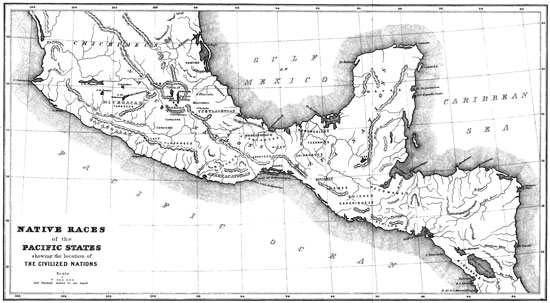

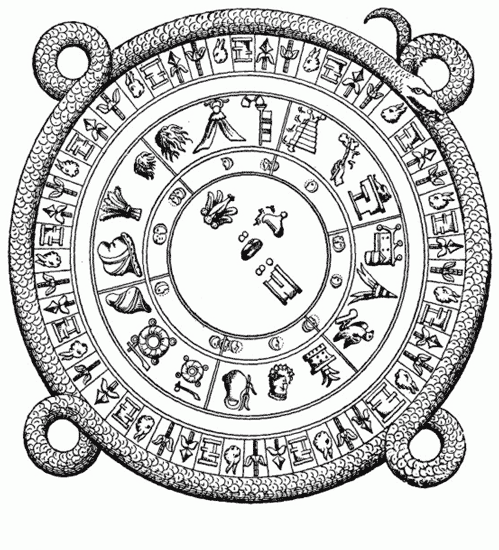
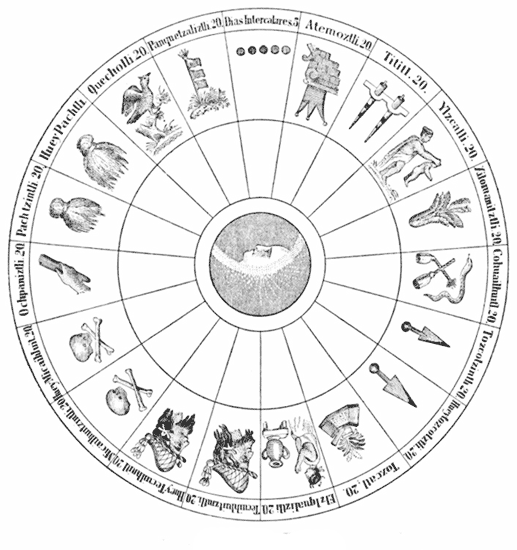
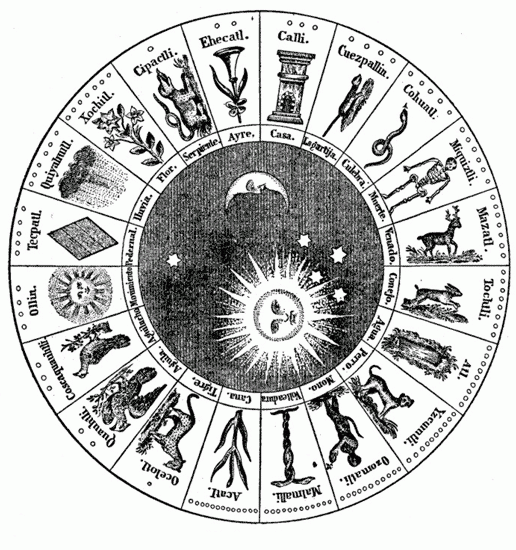
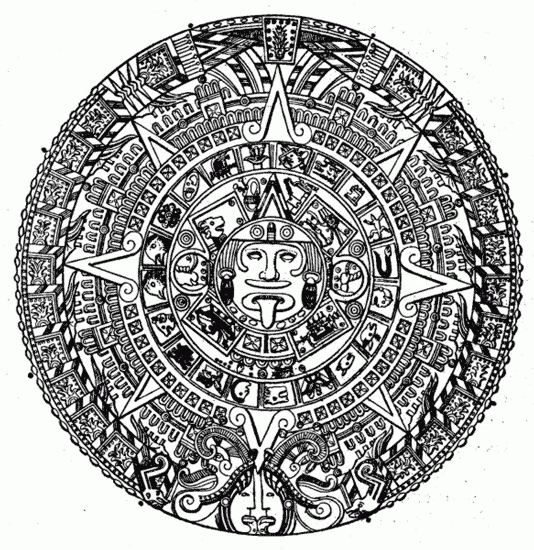
 might express a human hand, or as the
system is perfected, a large, small, closed, black, or
red hand; and finally 'Big Hand,' an Indian chief;
and all this would be equally intelligible to American
or Asiatic, savage or civilized, without respect to
language.
might express a human hand, or as the
system is perfected, a large, small, closed, black, or
red hand; and finally 'Big Hand,' an Indian chief;
and all this would be equally intelligible to American
or Asiatic, savage or civilized, without respect to
language. , and then
the 'h' of the alphabet.
, and then
the 'h' of the alphabet.