The narrative of an explorer in tropical south Africa
Whole book · 16 sections
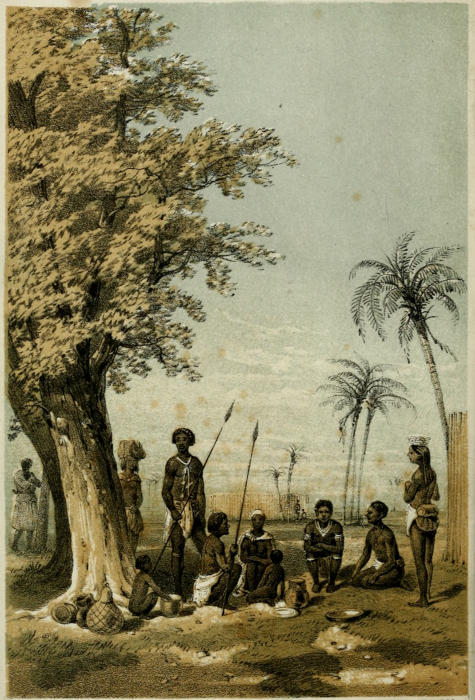
NATIVE GROUP.
Damaras. Ovampo.
Drawn on Stone by W. L. Walton. Printed by Hullmandel & Walton.
John Murray, Albemarle Street, 1853
THE
NARRATIVE OF AN EXPLORER IN TROPICAL SOUTH AFRICA.
BY FRANCIS GALTON, Esq.
WITH COLOURED MAPS, PLATES, AND WOODCUTS.
LONDON:
JOHN MURRAY, ALBEMARLE STREET.
1853.
LONDON:
BRADBURY AND EVANS, PRINTERS, WHITEFRIARS.
PREFACE. — DATES OF MY JOURNEYINGS. — LATITUDES AND LONGITUDES OF PRINCIPAL POINTS. — ITINERARY OF MY PRINCIPAL ROUTES.
The following pages contain the description of a
part of Africa hitherto unknown to Europeans, but
which has recently been travelled over and explored
by the Author. His journey was a tedious and a
very anxious one, but happily brought to a close
without loss of life or serious accident to any
member of his large party, which altogether amounted
to nearly forty men.
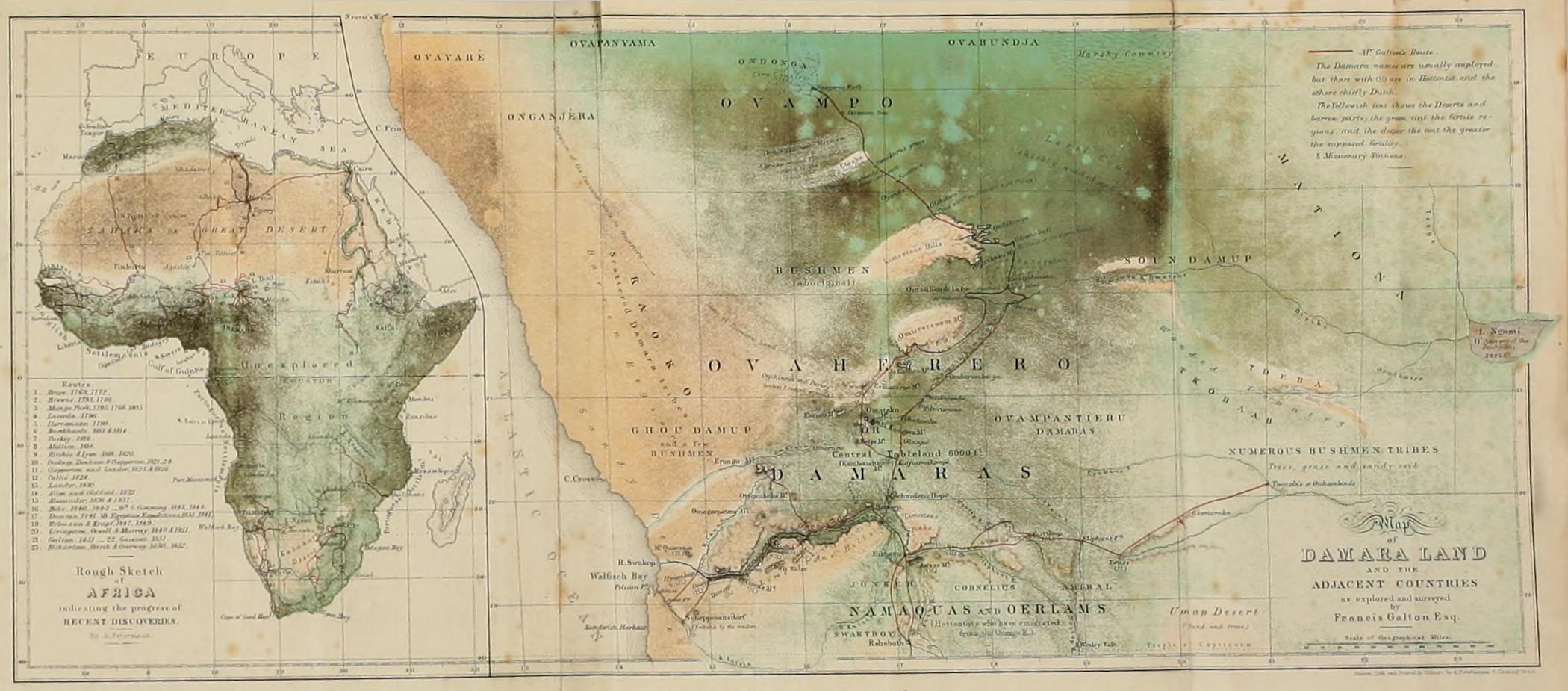
The result of this excursion has been to fill up
that blank in our maps which, lying between the
Cape Colony and the western Portuguese settlements,
extends to the interior as far as the newly discovered
Lake ’Ngami.
The country of the Damaras—warlike, pastoral
Blacks—was in the first instance explored; beyond
them he found a broad tract, inhabited by aboriginal
Hottentots; and, again, to the north of these, the
Ovampo, a race of intelligent and kindly negroes, who
are careful agriculturists, and live in a land of great
fertility.
On his return southwards, a quick journey was
made into the interior, near the line of the southern
tropic, until a road, which had recently been travelled
from the borders of the Cape Colony to Lake ’Ngami,
was reached, and in this way a practicable route
between the Lake and the Atlantic was proved to
exist.
Few new objects of natural history were either
collected or heard of, as the tract in question was
for the most part a high barren plateau, that supported
but little variety of either animal or vegetable
life.
The journey may perhaps produce a useful result,
by indicating a very favourable opening to missionary
enterprise, namely, among the Ovampo. The writer
has no wish to commit himself to extreme views
either on this or on kindred subjects, but, if philanthropists
continue anxious to promote African civilisation,
the remarkable advantages of Ovampo-land, as
a leverage ground in these matters, should not be
lost sight of. The healthiness of the climate, the
position of the country, the intelligence and orderly
habits of the natives, their travelling and trading
propensities, and, lastly, the ready access which it
admits of from a healthy sea-coast, form most cogent
recommendations. In addition to these, though
bordering on slave-producing countries, Ovampo-land
is itself exempt from that scourge, and there would
be one prejudice the less for Christian teachings to
encounter.
A traveller who, starting with the same views that
the Author did, chose to start from Little Fish Bay,
or elsewhere, in Benguela, and explore to the eastwards
and southwards, would be likely to make a very
successful journey. He would find shooting in abundance,
and have opportunities of learning everything
about as highly interesting a race of negroes as is
probably to be found in the whole of Africa. The
Author’s fate certainly led him over a great deal of
barren country, and many monotonous days were
passed; still he cannot regret that he undertook the
journey, for, besides the enjoyment of robust health
in Africa, habits of self-reliance in rude emergencies
were acquired, which are well worth possessing,
though an English education hardly tends to promote
them.
A question is commonly put to explorers, “Why
could you not go further when you had already
succeeded in going so far?” and the answer to this
is, that several independent circumstances concur in
stopping a man after he has been travelling for a
certain time and distance. He must refit, for his
cattle become worn out; his articles of exchange,
which are his money, expended; and, indeed, the
medium of currency among the people he at last
reaches being unknown to him, has of course been
unprovided for. His clothes, necessaries, luxuries,
all become exhausted, and the capital out of which he
has to support himself fast disappears. On the other
hand, infinite difficulty is found in acquiring the
confidence of a strange nation; a new language has
to be learnt; native servants refuse, and are unfitted,
to accompany their master in countries strange and
probably hostile to them, and whom months of joint
labours had educated into a kind of sympathy with
his cause; and so, when an explorer intends to cross
the frontier of a neighbouring tribe, he finds that all
his old travelling arrangements are more or less
broken up, and that the further progress of the
expedition will require nearly as many preparations
and as much delay as if it were then about quitting the
borders of civilisation. But his energies are reduced,
and his means become inadequate to the task, and
therefore no alternative is left him but to return
while it is still possible for him to do so.
It is therefore not to be expected that any large
part of the vast unexplored region before us will
yield its secrets to a single traveller, but, rather, that
they will become known step by step through various
successive discoveries; and as the experience of
nearly a century corroborates these views, it is
probable that for years to come there will still remain
ample room in Africa for men inclined for adventure
to carry out in them, if nowhere else, the métier of
explorers.
FRANCIS GALTON.
8, St. James’s Place, April 27th, 1853.
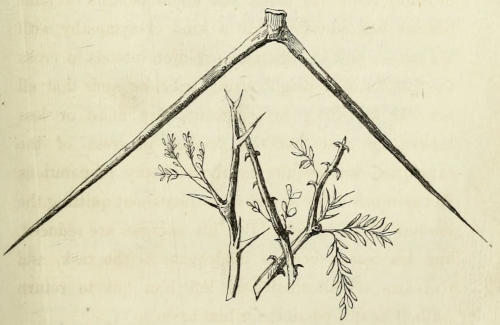
The four Mimosas that, to the exclusion of nearly every other tree or bush,
form the vegetation of Damara-land.
1850
August
Sail from Cape Town and land at Walfisch Bay.
September
Travel with cart and mules to Otjimbinguè.
October }
Buy oxen and send them down to fetch the waggons,
while I stay at Otjimbinguè and at Barmen.
November }
December
Make an excursion on ride-oxen to Erongo.
1851
January
Take waggons to Schmelen’s Hope, and ride thence to beyond Rehoboth.
February
Interviews at Schmelen’s Hope; adjacent country is explored.
Meet the Ovampo caravan, and return with them on ride-oxen to Ondonga.
June
Stay a fortnight at Nangoro’s, then go back to Okamabuti.
July
Return southwards with the waggons by the Omoramba.
August
Reach Barmen and go on to Jonker’s.
September
Take waggon to Elephant Fountain, ride thence on ox-back to Okomavaka.
October
Cross plain to ’Tounobis; stay a week and return.
November
Travel with waggons down towards the coast.
December
Reach Walfisch Bay and wait for the ship.
See p. 161, vol. xxii., “Journal of Royal Geographical Society,” for
details of the calculations and for further latitudes.
South Latitude.
East Longitude.
Schmelen’s Hope
22° 0′
16° 56′
Okamabuti
19° 31′
18° 20′
Nangoro’s Werft in Ondonga
17° 59′
16° 14′
Elephant Fountain
22° 27′
18° 59′
’Tounobis (or Otchombindè)
21° 55′
21° 55′
From WALFISCH BAY to
NANGORO’S
719
English Miles.
””
’TOUNOBIS
518
”
The hours given are those of actual travelling, exclusive of all delays. I
allow 2½ English miles for each hour; but, reckoning as the crow flies from
point to point, 2 geographical miles will be found to be very near the truth.
Hours.
Walfisch Bay to Barmen. 207 Miles.
Hours.
Barman to Omanbondè. 219 Miles.
From Walfisch Bay to—
From Barmen to—
1
Sand Fountain.
8
Schmelen’s Hope.
5
Scheppmansdorf.
1¾
Okandu.
16
Oosop Gorge. [No W.]
5¼
Okamabondè,
9
Daviéep Gorge.
4½
Kutjiamakompè.
13
Mouth of Tsobis R. [W.]
6½
Okandjoë. [No W.]
7
Tsobis.
6¼
Omoramba R. [No W.]
7¾
Kurrikoop. [No W.]
2½
Okatumba.
2
Otjimbinguè.
2½
Otjikururumè.
3½
In river-bed.
2½
Ontekeremba.
5
Okandu.
5
Wells.
2
Ondjiadjikennè.
3
Ozukaro.
4
Etamondjua.
5¼
Ombarombonga.
4
Reedy Fountain.
8¾
Wells. [No W.]
3½
Barmen.
20
Okavarè (or Omanbondè) [W.]
82¾
or 207 miles.
91¾
or 228 miles.
Hours.
Barmen to ’Tounobis. 310 Miles.
Hours.
Omanbondè to Nangoro’s. 284 Miles.
From Barmen to—
From Omanbondè to—
3
Foot of first hills.
10
Okatjokeama, S. Vley. [W.]
11½
Katjimahas old kraal. [W.]
4¾
Okapukua.
4
Eikhams.
4¼
Otjamuneè.
12¼
Wells on Quieep R [W.]
3¼
Okamabuti.
5
Bend of Quieep R.
4
Namboshua.
18½
Noosop R. [No W.]
6
Ootui.
2½
Kurrikoop.
8
Otchikango. [No W.]
1¾
Water in Noosop R.
12
Otchikoto. [No W.]
13
Elephant Fountain. [No W.]
9¼
Otjando. [No W.]
11½
Twas. [No W.]
14½
Omutchamatunda. [No W.]
9
Okaietoura. [W.]
10½
Wells in Flat. [No W. for 9½ hrs.]
6½
Okanyindu [W.]
21
Vleys, 2 hours in Ondonga. [No W.]
5½
Okomavaka.
6
Nangoro’s Werft.
20½
’Tounobis. [No W.]
124½
or 311 miles.
113½
or 284 miles.
The letters in brackets affixed to those stages which exceed 5 hours, mean as
follows:—[W.] that there is water sufficient in quantity for cattle on the road in
one or more places, [No W.] that there is not.
CONTENTS.
Page
CHAPTER I.
Determine to travel in Africa.—Motives for the Journey.—Preparations.—Stock
in Trade.—An Emigrant Ship.—Arrival at Cape Town.—Dangers
of the Road.—Change of Route.—Determine to proceed
by Walfisch Bay.—Necessary Outfit.—Prospects of the Route.—Travelling
Cortège.—Servants and Dogs.—Arrival at Walfisch
Bay.—The Natives.—Extraordinary Mirage.—The Kuisip
River.—Tobacco.—Ride-Oxen.—Disembarking.—Misadventure at
Starting.—Perils of the Desert.—The ’Nara.—The Mission at
Scheppmansdorf
Sand Fountain.—A Lesson to the Natives.—A Present.—News of a
Lion.—Scheppmansdorf.—A narrow Escape.—A Missionary’s
Establishment.—Native Huts.—Missions.—A Lion Hunt.—Preparations
for the Road.—Native Trees.—The Hottentots.—Character
of the Country.—Mode of breaking in an Ox.—Arrangement
of the Baggage.—A Prosperous Start.—The Swakop.—Night
Bivouac.—Labours of the March.—Loss of a Horse and a
Mule.—The Lions’ Chase.—Attempt to avenge the Loss.—Animal
Food.—The Ghou Damup.—Erongo Mountain.—Intense
Heat.—The Tsobis River.—Ride-Oxen.—Native
Servants.—Their Cape Town Life.—A Giraffe Hunt.—Change
of Country.—An Ostrich Egg.—Approach to Otjimbinguè.—Hans
Larsen
Hear ill News.—Engage Hans.—Ride to Barmen.—En route.—Oxen
versus Mules.—Arrive at Barmen.—Jonker’s Attack.—Previous
History.—Oerlams and Europeans.—Hottentots and Bushmen.—Establishment
of Missions.—Native Feuds.—Dislike to Missions.—Obstruction
to Travellers.—Write to Jonker.—Buy Oxen from
Hans.—Breaking them in.—Attacks of Distemper.—Complete
my Encampment.—Damara Digging.—Native Hunting.—Oxen
sent to the Bay.—I go to Barmen.—Damara Thorn-trees.—Jonker
writes to me.—My Plans.—The Ovampo.—First Rain.—Hottentot
Beauties.—Hyena’s Insolence.—Damara Ferocity.—Cruel
Murder.—Mutilated Victim.—Message to Chiefs.—Their
Replies
I go to meet the Waggons.—Start for Erongo.—En route.—Damara
features.—Gabriel in a Scrape.—The Mountain Erongo.—Chase
Zebras.—Ghou Damup Huts.—A Black Coquette.—Return to
Waggons.—Leave Otjimbinguè.—Mishaps.—How to encamp and
water Oxen.—Arrive at Barmen, thence to Schmelen’s Bay.—Ride
to Eikhams.—A doomed Sufferer.—Visit Jonker.—Conference
with him.—Swartboy and Amiral.—Ride on to Rehoboth.—Umap’s
Judgment.—Obtain Interpreters.—Return to Rehoboth.—Murder
a Dog and pay for it.—Conference at Eikhams.—Legislating.—Proposed
Conference.—Mules run quite away.—Schmelen’s
Hope.—Dates
Personnel.—Commissariat.—Daily Allowances.—Start on the Expedition.—Damara
Obtuseness.—Inability to count.—Information
withheld.—Kahikenè sends to us.—Arrive on the high Tableland.—Superstitions
on Food.—Meet Kahikenè.—His Difficulties.—Gives
me Advice.—Information about the Road.—Four Oxen
stolen.—The Culprits are punished.—Recognising lost Oxen.—Hear
of another Road.—Reach Omatako.—African Puma.—Eshuameno.—Chipping
the front Teeth.—View from the Hill.—Ja
Kabaca.—Climb Omuvereoom.—A Snake.—Seriously
obstructed by the Thorns.—Reach Otjironjuba.—How to make
Soap.—We catch some Bushmen.—Learn a little and travel on.—Doubts
about our route.—Arrive at a Werft.—Are guided
onwards.—Omanbondè.—Hippopotami
Mistake a Lion for an Antelope.—Explore a Road.—Reach Palms.—Return
and bring the Waggons.—Experiences of African Travel.—Guide
decamps and we find another.—Settle at Okambuti.—The
first Elephant.—Waggon breaks down.—Make a Strong Camp.—Chapupa’s
History.—Savages versus Europeans.—Ride on to the
Ovampo.—Method of searching for Water.—Damaras are bad
Guides.—Find some Bushmen.—We start, but are ordered back.—The
Ovampo Caravan.—Chikorongo-onkompè.—Pronunciation
of the letter L.—Salt, not a Necessary of Life.—Damaras never
eat it.—Return to Chapupa’s Werft.—Arrange a Present for
Nangoro.—Dressed and tanned Leather.—Hear of Kahikenè’s
Death.—Damara Creed.—Eandas and Omakuru.—Ceremonies.—Huts
and Finery.—Chaunts and Music.—Damara Language.—Prefixes
Damara Helpmates.—Marriage Tie.—Caravan to Ovampo-land.—Yearly
Traffic.—Otchikoto.—Improvised Chaunts.—Reach an
Ovampo Cattle-post.—Archery Practice.—The Parent Tree.—We
reach Ondonga.—Corn, Beans, and Palms.—Fruit-trees.—Native
Beer.—Density of the Population.—Encamp by Nangoro’s Village.—Cannot
obtain Pasturage.—Nangoro pays us a Visit.—Ovampo
Belles.—We go to a Ball.—Description of Dances.—Charms
and Counter-charms.—Nangoro’s Palace.—The Great River.—Prospects.—The
King is crowned.—His lawful Successors.—The
Queens’ Duties.—Ovampo Dentists.—Surgical Practice
We are ordered to return.—Hesitation.—The Slave dealings here.—Future
of Ovampo-land.—A Field for Missionaries.—Best way
of getting there.—Slavery and Servitude.—Giving Men away.—Arrange
my Packs.—Start Homeward.—Leave Ondonga.—The
Oxen suffer severely.—Reach Okamabuti.—The Waggons are
safe.—Start for Omaramba.—Okavarè.—Elephants visit us.—Ice
every night.—Pass Omagundè.—Reach Barmen
The Waggons are condemned.—Messengers to the Cape.—The
Kaoko.—History of Damara-land.—Ghou Damup Genealogies.—Start
for Elephant Fountain.—Excessive Drought.—Engage
Eybrett.—Sell my Cart and Mules.—Travel from Eikhams.—Shooting
Giraffes in the Dusk.—Elephant Fountain.—Numerous
Pitfalls.—Plundering Expeditions.—The Kubabees reach ’Ngami.—Trouble
of taking Observations.—Leave Waggon and ride to the
East.—Engage Saul.—Hans and a Lion.—We enter the Bushman
Tract.—Rhinoceros Skulls.—Hear of the Kubabees Hottentots.—Start
for ’Tounobis.—Shoot a White Rhinoceros.—Reach
’Tounobis.—Elephant in a Pitfall.—Prepare for Sport.—Night-Watching
for Game.—Rhinoceros Veal.—Opera-glasses.—Herd of
Elephants.—Fights and Frolics.—Bulk of the Rhinoceros.—A
Picturesque Finale.—Spring Hares.—Remarks on my Route.—Unicorns
and Cockatrices.—Bushmen Springes.—Setting Guns
at Night.—Description of Plate.—Poisoned Arrows
Hear the Fate of my Two Oxen.—Plan an Attack to avenge them.—Make
an Attack on Two Werfts.—Catch some Culprits.—Hottentot
Passion for Onslaught.—Return to Eikhams.—Best
sort of Travelling Compass.—MS. and other Almanacs.—Watches
and Alarums.—Large Packs of Lions.—A Tale learnt from
Tracks.—Accidents with Guns.—Methods of carrying them on
Horse-back.—Description of the Plate.—Saddle Arrangements.—Travelling
Dress.—Colours most suited for Sportsmen.—Bright
Colours of Skulking Animals.—Rationale of them.—Join Hans’
Party.—Begin to break up the Expedition.—Travel down the
Swakop.—Reach Walfisch Bay.—Whales, Sharks, and Ostriches.—Retrospects.—Leave
Africa
Determine to travel in Africa.—Motives for the Journey.—Preparations.—Stock
in Trade.—An Emigrant Ship.—Arrival at Cape Town.—Dangers
of the Road.—Change of Route.—Determine to proceed
by Walfisch Bay.—Necessary Outfit.—Prospects of the Route.—Travelling
Cortège.—Servants and Dogs.—Arrival at Walfisch
Bay.—The Natives.—Extraordinary Mirage.—The Kuisip
River.—Tobacco.—Ride-Oxen.—Disembarking.—Misadventure at
Starting.—Perils of the Desert.—The ’Nara.—The Mission at
Scheppmansdorf.
It was in 1849 that I determined upon a long travel
in Africa. I had been there once; and then, landing at
Alexandria, sailed or rode far beyond all the deserts,
temples, and cataracts of Egypt, until I had fairly
entered the “Soudan,” or country of the Blacks—that
zone of the tropical vegetation, to which the name of
Central Africa properly applies.
It was a tour hastily performed, but still sufficient
to imbue or poison me with that fascination for further
enterprise, which African tourists have so especially
felt—a fascination which has often enough proved its
power by urging the same traveller to risk his comfort,
his health, and his life, over and over again, and to
cling with pertinacity to a country which after all seems
to afford little else but hazard and hardships, ivory
and fever.
The motive which principally induced me to undertake
this journey was the love of adventure. I
am extremely fond of shooting, and that was an
additional object; and lastly such immense regions of
Africa lie utterly unknown, that I could not but feel
that there was every probability of much being discovered
there, which, besides being new, would also
be useful and interesting. A large field lay open to
any explorer who might wish to attempt the enterprise,
and I chose to undertake the task.
The discovery that was made of Lake Ngami, in
South Africa, gave a direction to my plans; and in
the beginning of 1850 I fixed on the Cape as the
point at which to enter Africa.
Many South African travellers and sportsmen were
then in London; so that I received every information
about the Bechuana country up to 300 or 400 miles
north of the Orange River, which has been most
successfully shot over by several of our countrymen;
and through the very kind interest which several
influential members of the Geographical Society took
in my proceedings, I was readily enabled to start,
perfectly au fait as to what was known and what
was wanted to be known in South Africa.
I now began my preparations in good earnest.
Mr. Andersson, a Swedish gentleman and a naturalist,
consented to accompany me; and to his perseverance
and energy I have since been in the highest degree
indebted. I collected together all the things I could
think of, or that my friends were kind enough to suggest
to me, as advisable to take.
I knew that at least the first part of my journey
would have to be undertaken in waggons, in each of
which I was assured four thousand pounds’ weight
could be carried without risk across the country, so far
as it had been penetrated, and therefore I was not
necessarily stinted in the quantity of comforts I could
carry from Europe; but as to the latter part of my
expedition I was aware that the probability was that
I should have to leave my waggons, and to travel
either by boat or on the backs of some beasts of
burden, or possibly even to walk, in which case I
should have to content myself with far less luggage.
I therefore collected my things together, on the principle
of having them as light as possible, and in
duplicate, the half of which I could leave en cache,
when I had to quit my waggons, as a store to fall
back upon should I happen to meet with robbery or
accident.
In my perfect ignorance of what would be the most
acceptable presents, and what were the best articles of
exchange among the people I should meet with, I
made a great collection of all sorts of ornaments, so
that I had a store like a pedlar’s shop; for besides
the more staple articles of guns, beads, knives, and
gaudily printed calico, I bought or collected looking-glasses,
accordions, hunting-coats, my friends’ old
uniforms, burning-glasses, swords, gilt belts, immense
bracelets, anklets, yards of picture chains for necklaces,
Jews’-harps, mosaic rings; lastly, I explored
the shops of Drury Lane for some theatrical finery,
and a magnificent crown rewarded my search, which
I vowed to place on the head of the greatest or
most distant potentate I should meet with in Africa.
On the 5th of April, 1850, everything was prepared;
I and my boxes were on board an East Indiaman;
my last adieu was said, the very last line sent off
by the pilot boat, and we were off for the Cape.
I had plenty of occupation on board ship in arranging
my things, trying to learn the Bechuana language,
practising with a sextant, and reading up books; so
that the time passed as agreeably as can be expected
in a sea voyage. It so happened that the ship in
which I had taken my berth carried a number of
emigrants—a fact which the careful agent only let us
find out at the last moment—but I liked the crowding
and bustle of it amazingly. The emigrants were not
in the least in the way of the cabin passengers, for we,
of course, had the poop to ourselves; and looking
down from it, the deck had all the appearance of a
crowded fair.
The emigrants were a squalid starved-looking set at
first, but six weeks of rest and good feeding made a
wonderful change in their condition; and as we sailed
into the warm weather, and they could sit about the
decks, they began to think of their personal appearance,
and to wash and tidy themselves and put their clothes
to rights. It was amusing to see how soon they
divided themselves into cliques, and how high and
mighty the party that sat under the left corner of
the poop were, and how they looked down on those
who sat elsewhere. Anyhow we had a pleasant
sail, though some eighty days had passed before we
were in Table Bay, and among the white stone and
green-shuttered houses of Cape Town.
I intended to make a stay here of a few weeks,
and then to sail on to Algoa Bay, whence my land
journey was to have been commenced. I therefore
took the earliest opportunity of presenting my letters
of introduction, and I hoped that chance would soon
throw much information, valuable to me, within my
reach. I cannot sufficiently express how much kindness
I received during my stay in Cape Town from all
my acquaintance there. Everybody that I was thrown
with seemed to take the greatest interest in my
excursion, and I was referred and introduced to all
those whose experience or information might be of
any use to me.
I had not, however, arrived many days, when news
came that materially affected my plans, and in the
end gave them a somewhat different direction. The
emigrant Boers—those Dutch colonists who had
rebelled and run away from us—had broken out into
open revolt. They invested the whole breadth of the
habitable country, north of the Orange River, through
which the direct way to Lake Ngami lies; and
information was received that they had resolutely
refused the passage of any stranger from the colony
through their country; that they had already turned
back some travellers, and that in all probability they
would send a “commando” to take immediate and
exclusive possession of the lake country. Sir Harry
Smith, then Governor of the Cape, was so good as
to put me in immediate possession of the news, and
strongly dissuaded me from attempting to pass them,
not because there was any risk to my life, but because
after the tedious journey of six weeks or two months
that led to their country, I should be met by these
Boers, and almost to a certainty stopped, robbed, and
turned back. There was no road to the left of these
people, because they live up to the verge of the great
Karrikarri desert, which takes up all the middle of
South Africa, whilst any party taking the road to their
right would have to pass in the first instance through
the whole length of the Caffre country, and then to
the fever-stricken neighbourhood of the west coast.
In fact when the Boers chose to stop all communication
from the Colony northwards, by the usual
route, they were perfectly able to do so.
In a few days the intelligence that had before been
received about the Boers’ intentions became more fully
confirmed, and I had to think of other ways of getting
to the tropical lands of South Africa. My first thought
was to try the east coast, by Delagòa Bay, but that plan
was instantly abandoned on account of the fearful
unhealthiness of the district. Next I thought of the
Mozambique, and of landing at Quillirmaine—a plan
which was warmly advocated by a Portuguese gentleman
of the highest standing at that place, Signore
Isidore Pereira.
His father had crossed Africa from Mozambique to
Benguela, and he himself had travelled much, and was
in intimate relation with the chiefs of many of the
surrounding parts. He chanced to be passing through
Cape Town when I was there en route to Rio. He took
the kindest interest in my plans, gave me very full
information upon what he knew of the interior, and
subsequently furnished me with credentials to different
Portuguese gentlemen at the more distant of their
settlements. If I had been under no sort of tie, I
should have slaved at learning Portuguese in Cape
Town until the first ship sailed for Mozambique, and
then have gone by her—but I was engaged to take my
travelling companion by some means of conveyance,
by which he could bring home a complete collection of
the Natural History of the country; and Signore Pereira
told me that no beasts of burden were used in the
interior of Mozambique, but that all luggage was
carried on men’s backs, and the traveller himself in a
palanquin. This way of travelling would never have
answered the object Andersson had in view, and I
therefore did not feel justified in proposing it to him.
At last a plan was suggested, and very strongly urged
upon me, chiefly by some merchants, of sailing to
Walfisch Bay, and thence travelling with waggons;
this was the idea I finally adopted. I heard that
though all was desert by the sea-coast between the
Cape Colony and Benguela, yet that beyond this desert
not only habitable but very fertile country was to be
found. As to distance, Walfisch Bay was of all places
most favourably situated for an excursion into the
interior, and there were Missionary establishments
already formed from near the coast to many days’
journey inwards. I was referred to a person who had
carried on for some years a cattle trade between
Walfisch Bay and the countries near it and the Cape.
He had built a store at the Bay, and had had a vessel
of his own there; sometimes he sent the cattle by her
to St. Helena, sometimes he sold them to the whalers
and guano ships which then were numerous, and often
put in to him for provisions, and lastly he had driven
large herds of them overland to the Cape—by a road to
the west of that Karrikarri desert, of which I spoke a
few lines back, and to the east of which the Boers and
Bechuanas reside. All about this line of country the
Namaqua Hottentots live, and up it some fifteen or
twenty years ago Sir James Alexander was the first to
explore a waggon-road. My informant, the cattle-trader,
had himself seen nothing but arid worthless
country, but he strongly stated his belief in the fertility
of Damara-land, into which no white man had ever
penetrated, but on the borders of which the Missionary
stations are placed.
I then went to the agents and friends of the Missionary
Societies to which those stations belonged, and
the trader’s account was very fully confirmed by them.
I was informed that the Damaras were considered by
the Missionaries as a most interesting nation, and one
well worthy of exploring, and that an expedition had
long been contemplated by them to go through Damara-land,
to see what field might lie open for their labours
beyond it. I was very kindly assured of every
assistance on their part, and my friends insisted on the
great advantage that I should have, if the first stage of
my journey was made in company with persons who
had experience of the country and acquaintance with
the language. Moreover, a novice had just arrived
from Germany, and was waiting for the earliest opportunity
of being shipped off to join his future fellow
labourers. So far matters seemed promising enough;
but one point was certain, that everything I might
want must be taken from Cape Town, as nothing
whatever but oxen could be bought where the Missionaries
were.
Servants, waggons, and things of every kind, I must
take with me, for the ship would land me on the desert
sand—four tedious months’ journey from Cape Town;
and when she sailed away all communication thence
would, for at least a year, be at an end. Now if I
had been going to travel in any of the usual ways, as
with pack-horses, mules, camels, boats, and so forth,
and with people I knew something about, I should not
have had the least anxiety; but oxen were creatures I
had no experience with, or of Cape half-castes either.
Cape Town is proverbially the worst place in the
Colony to get waggon drivers and leaders from, and
I did not much fancy the undertaking; but still go
somewhere I must, and I could think of no other
alternative but Walfisch Bay. I therefore consoled
myself with the idea that, if the whole affair broke
down at the very first, Andersson and I would still find
protection from the Missionaries, and that if on the
other hand we could push on at all, we could probably
get a great way. So I began resolutely to make my
preparations.
I will try to put in a few words the whole of the
information that I could get, and upon which I had to
act. Walfisch Bay was perfectly desert, though
traders had lived there. The nearest water was three
miles off, and that in very small quantities. The
nearest place where cattle could thrive was between
twenty and thirty miles from the coast. This was the
first Missionary station,—it was called Scheppmansdorf.
Thence a journey of ten or twelve days inland over
wretched country led to two other stations; they were
the furthest; and all beyond them northwards was
unknown. These last were in Damara-land; the
Namaqua Hottentots lived between them and the Cape.
A small pen and ink map was also shown me, but it was
blotted and not very intelligible. No oxen could be
bought until I arrived at the furthest stations. If I
bought them from the Damaras they were untaught; if
from the Namaquas taught oxen; the horse distemper
was very severe, and no horse would live throughout the
year. The Namaquas were always fighting with the
Damaras, and it was very doubtful whether having
travelled amongst the one tribe, the other would permit
me to pass through their country. No money was used
or known, nothing but articles of barter,—iron things
for the most part among the Damaras, clothing and
guns among the Namaquas. Lastly, that the great man
of all the country, who could do what he liked, and
of whom everybody stood in awe, was Jonker Africaner.
It was said that he had a wholesome dread of the English
Government, and unlimited respect for a large letter
with a large seal, but that I had much better keep
out of his way. This I think is a faithful summary
of all that I could learn, and I soon set to work to
act upon it.
Cape Town abounds with mules, small well-bred
looking things, so I made inquiries and bought eight
that had been well broken into harness, and were
in good condition; I could only buy one pack-mule,
which made my ninth. Mules had withstood the distemper
so well in Bechuana country, that I trusted that
at least half of them would live until my wanderings
were ended. I then bought a large strongly-built cart
for them to draw, and with it I purposed to make my first
expedition up the country, carrying the heavy articles of
exchange and bringing back oxen. I also bought two
waggons—I believe the only two travelling waggons
in Cape Town—for now-a-days the march of intellect
has inspired even the ponderous Dutchmen, and they
make good roads and use lighter vehicles. These
were to be drawn by the oxen that I intended to buy
in the country, and the mules, as I calculated, would
be strong enough to pull them from Walfisch Bay to
Scheppmansdorf, the first station, and thence to go on
with the cart and articles of exchange. As there was no
grass at Walfisch Bay, I took plenty of corn for my
cattle, and a cask of good water for ourselves; the
mules would drink at Sand Fountain, the place three
miles off. I only took two horses, as I knew they
would be victims to distemper before the important
part of my journey commenced; and I bought but few
additional articles of exchange for I hoped to obtain
enough game to supply us with daily food, in addition
to the few sheep we should take with us as slaughter-cattle.
This was a sad mistake, as I found out afterwards.
I was aware I should require at least sixty
waggon oxen,—two spans of from fourteen to sixteen
for each waggon. As Namaqua-land was out of my
intended route, and as I had been so strongly advised
not to go there, I took only enough clothing, &c., to
buy some forty or sixty oxen there, and iron things
enough to buy 150 from the Damaras; the surplus
beyond what I immediately wanted being meant to
cover the unavoidable expenses of travelling. I had,
as I mentioned before from England, a large and indeed
an expensive set of “presents” but my great error was
in not taking far more things of known exchangeable
value, and in having taken those “presents” which the
natives really cared very little for.
I felt quite sure that everything connected with my
waggons was right, because I got more than one experienced
friend to look them over; and having engaged
my vessel, a schooner of some 100 tons, all except my
servants were at length in readiness. I wanted, in
the first instance, a headman—one who had travelled
with oxen and knew the work—a man with a character
that he could not afford to lose, under whom I could
put every detail, and whom I would pay highly; but
I could find no such person in Cape Town. I, however,
engaged a Portuguese, John Morta, a most
thoroughly trustworthy man, who, though he did not
in the least fulfil the conditions I have just mentioned,
was honest in the extreme, and with whom I received
an excellent character; next, I hired Timboo, a black,
liberated by one of our cruisers years ago, on capturing
a slave-ship in the Mozambique. He, too, had an
admirable character, and could do a little of everything.
I do not think he would have joined me had he not
been suspected of too active interference (on the loyal
side) during the late anti-convict movement, which
made it convenient for him to leave Cape Town for
a season. There was some story about his having
had a personal conflict with an influential leader of
the opposition. Timboo was an excellent groom, and
had some acquaintance with oxen. Besides him, I got
John St. Helena, as waggon-driver, and his brother, for
leader; John Williams, a square-built, impudent,
merry fellow, and a right useful servant, was another
leader; and a young scamp, Gabriel, who clung to my
heels wherever I went in Cape Town, and who undertook
to be agent in getting me dogs, horses, or anything
else, begged so earnestly to go with me, that I enrolled
him also in my corps. I still wanted a second waggon-driver,
and at the last moment took a man out of a
waggon-maker’s shop, though I did not much like him.
As for dogs, although I was assured that I could find
any number in the country, still I thought that a few
Cape Town mongrels would be of no harm, and Gabriel
brought me a whole pack for approval, at an uniform
rate of 2s. 6d. each; one good dog was given to
Andersson, and by entreating that a sentence of execution,
which was passed on a fine-looking Newfoundland,
for trespassing in the barracks, might be commuted
to transportation for life, I obtained him also. I had
a fancy to take a small dog which could be carried in
the waggon all day, and would be wakeful at night, so I
bought a spaniel, on which I lavished infinite affection,
and who rejoiced in the name of Dinah.
Andersson was most busy in packing and arranging
my things. I don’t know how I should have got
through the work myself: the confusion seemed endless.
At length, after we had been for three weeks or a month
in Cape Town, the schooner was brought close into
shore; the kicking mules were boated into her; the
heaps of wheels, axletrees, &c., that belonged to the
four vehicles of the Missionary and myself disappeared
off the quay; all the boxes were on board, and, last
of all, a cab-full of lamenting curs were embarked and
sent away.
In the second week of August, 1850, we set sail, and
on the eve of the 20th the low sandy shore of the land
we were bound for came in sight. We rounded Pelican
Point (on which pelicans were certainly sitting), and
came into a wide bay, the shores of which were dancing
with mirage, and presented the appearance of the utmost
desolation. The store-house was a wretched affair to
have received so grand a name—being a wooden shanty,
about the size of a small one-storied cottage—which
we could not for a long time see from on board our
ship. The name of the bay, “Walfisch,” is Dutch, and
means whale-fish: the sailors have corrupted it to
Walwich, and, lastly, to Woolwich Bay, all which aliases
may be found in different maps. There are a great many
whales of the sort called “humpbacks” all about this
coast; in coming here we passed through a “school”
or herd. It was a magnificent sight; for the whole
sea around us was ploughed up by them. We went up
the Bay very cautiously, for it has never been properly
surveyed; and different charts give most widely
different plans of it. At night-fall, we anchored a
mile or so off shore. We could see no natives; and
not a sign of life anywhere, excepting in the immense
flocks of pelicans and of flamingos and other sea-birds.
And this, it appears, is the character of the entire
coast between the Orange River and the Portuguese
territory—a physical barrier which has saved the natives
who live behind it from the infliction of a foreign
slave-trade.
The books of sailing directions say that no fresh
water can be obtained on the coast for the whole of that
distance; but this is a mistake, as in Sandwich Harbour,
some twenty miles south of Walfisch Bay, there is, at
least at present, a copious supply.
In the morning we saw some savages about, and
brought the schooner as close in shore as seemed safe,
about one-third of a mile from the store-house; and at
midday, the captain, the new Missionary, and ourselves
landed. A row of seven dirty squalid natives came to
meet us. Three had guns: they drew up in a line, and
looked as powerful as they could; and the men with guns
professed to load them. They had Hottentot features,
but were of a darker colour, and a most ill-looking
appearance: some had trousers, some coats of skins, and
they clicked, and howled, and chattered, and behaved
like baboons. This was my first impression, and that
of all of us; but the time came when, by force of
comparison, I looked on these fellows as a sort of link
to civilisation. They were well enough acquainted with
sailors; and the advent of a ship was of course a great
godsend for them, as they bartered, for tobacco, clothes,
and all sorts of luxuries, the goats’ milk and oxen
which a few of them had; but they had been savagely
ill-used more than once, and had occasionally retaliated.
The captain of them soon made his appearance, and
we became very amicable, and walked towards Sand
Fountain, signs and smiles taking the place of spoken
language. A letter was sent on to the Missionary at
Scheppmansdorf, a cotton handkerchief and a stick of
tobacco being the payment to the messenger for his
twenty-five miles’ run. We passed over a broad flat,
flooded in spring-tides, following the many waggon-tracks
that here seemed so permanent as not to be
effaced by years. We were surrounded by a mirage
of the most remarkable intensity. Objects 200 yards
off were utterly without definition: a crow, or a bit of
black wood, would look as lofty as the trunk of a tree.
Pelicans were exaggerated to the size of ships with the
studding-sails set; and the whole ground was wavy
and seething, as though seen through the draught of a
furnace. This was in August, the month in which
mirage is most remarkable here; it is excessive at all
times, and has been remarked by every one who has
seen the place. A year and a half later I tried on two
occasions to map the outline of the Bay, which was
then comparatively clear, but still the mirage quite
prevented me; an object which I took as a mark from
one point being altogether undistinguishable when I
had moved to my next station.
After proceeding half a mile we came to the bed
of the Kuisip, a river that only runs once in four or
five years, but, when it does, sweeps everything before
it. The bed was very broad, and hardly definable:
there were marks here and there like the bottom of
dried-up pools, where the ground has been made into a
paste and afterwards cracked by the drought. Bushes
(Dabby bushes I have always heard them called) not
unlike fennel, but from eight to twelve feet high, grew
plentifully; a prickly gourd, the ’Nara, with long
runners, covered numerous sand-hillocks; and lastly,
high shifting sand-dunes, on either side, completed
the scene. We were so much out of condition, that
the depth of the sand and the heat of the sun (at
least, what we then thought was heat) gave us a
good tiring, and we were heartily glad when Sand
Fountain and its watering-place came in sight.
My imagination had pictured, from its name, a
bubbling streamlet; but in reality it was a hole, six
inches across, of green stagnant water. It was perfectly
execrable to taste, as many years had elapsed
since the Kuisip last ran, and the water which drains
from its damp sand to the hollow here, had become
almost putrid, and highly saline. However, it was
drinkable, and I was satisfied that with plenty of
digging enough could be obtained to water my mules.
Some years ago, when the trader lived here, the water
was copious and very good; but all these sort of wells are
very uncertain, even more so than the flow of the river
on which they depend. We came back much as we
went, and bought five ostrich eggs that were brought
to us, giving seven sticks of tobacco for the lot, but
this was a piece of extravagance, five being the proper
price. Cavendish tobacco is that which has been nearly
always bartered here; it is, as most smokers know, in
sticks, each stick weighing about an ounce, and worth
a penny. I had taken only a hundredweight with me;
but five hundredweight would not have proved at all
too much. We took the captain and an ill-looking
Hottentot, who appeared to be a relation of his, on
board, as the two were inseparable; and we employed
ourselves in picking bush tics from our persons, for
the bushes swarmed with them.
During the night a gun was heard on shore, and a
fire was lighted, which proved to be made by the
Missionary, Mr. Bam, and Stewartson, who had been a
cattle-trader, but had lately lost everything, so that he,
his wife, and children could not afford to return to Cape
Town, but lived at the same station with Mr. Bam.
We had sent the letter at midday; they received it
about night-fall, and had ridden down on oxen in five
hours. I had up to that moment no conception that
oxen ever were, or had been, used as hacks, except
possibly as a joke; but here were two fine-looking
beasts, saddled, and with sticks through their noses,
and a thin bridle fastened to the stick, and tied to a
log of wood, and really they looked uncommonly well,
and not at all out of their element.
We at once proceeded to disembark. The horses
and mules had to swim: the sailors managed it rather
clumsily, and nearly drowned one; but at last the
creatures were all got on shore. Heavy packages had
next to be landed in the dingy, and we got through a
deal of work. In the evening I rode with Mr. Bam to
the Hottentot kraal, by Sand Fountain, and of course
listened with great interest to all he had to tell me
of the country. With the Damaras he had little or
no acquaintance. He was born in the Cape; had
made several overland journeys; spoke much of the
difficulty of travelling here, both from want of food
and the badness of the road; and did not hold out
to me the slightest encouragement as regarded my
journey.
After sunset Mr. Bam returned on board to sleep,
and to get a good substantial dinner there, which is not
to be despised by a resident in these parts. I pitched
my tent on shore, and slept in guard of the things. My
men had worked with very good spirit through the day
in landing them, though it was hard work, and they
were wet all the time. Some slept on shore and some
on board. I had a heavy spar, which lay on the beach,
carried under the lee of the store-house, and picketed
my mules and horses to it. The night was very chilly,
damp, and windy, and the animals extremely restless.
In the morning we found that my two horses had broken
loose, and escaped. Timboo and John St. Helena
went directly on their tracks; but as hours passed, and
they did not return, I became much alarmed. On
Mr. Bam’s coming on shore he advised me at once
to send some natives with provisions after the men, as
all was desert for forty miles and more round the Bay;
the horses would never perhaps be overtaken by the
men, who would possibly follow their tracks till they
were exhausted, and so be themselves unable to return.
I therefore sent two natives directly,—Mr. Bam interpreting
for me—one with provisions, and the other with
orders to go on after the tracks, and bring the animals
back. Late in the afternoon my men made their
appearance, looking sadly exhausted. They had gone
very far, until they dared not go further; and then,
intending to return by a short cut back, soon became
bewildered among the sand-hills, and quite lost their
course. They were on the point of going altogether
wrong, when the mist cleared away, and showed them
the sea and the Bay, with the schooner in it, in the
far distance. After a long walk they came to the
waggon-tracks, which took them to Sand Fountain,
where they obtained water, and there the Hottentots
met them.
The sailors had landed some of my things very
carelessly indeed, dropping bags of flour into the sea.
I made a great row, with much effect, about it. Some
goats were driven down to sell. I bought two kids for
a second-hand soldier’s coat, without the buttons: I
had three dozen, and gave sixpence each for them
at a Jew’s shop in Cape Town.
The horses were still missing. I sent the captain,
“Frederick,” and another man, on their ride-oxen
upon the spoor, for I became extremely anxious
for their lives; there is not a blade of grass or a drop
of water where they are gone. Frederick would not
go unless I promised him and his friend a really
respectable coat and a pair of trousers, to be paid if
they brought the horses back—not otherwise. The
agreement was made, and off they started. I wish I
had brought more old clothes. Two coats and the
etceteras are a sad drain upon my wardrobe. Another
accident happened: my large white dog, that I begged
from the barracks, took fright at the waggon-whips
which we had landed, and were cracking: he ran straight
away, and was never seen by us again. Flamingos
gathered here in immense flocks; their flight is very
curious; the long projecting neck in front, and the long
legs behind, make them look in the distance more like
dragon-flies than birds. I broke a pelican’s wing with
a cartridge of swan-shot, and had a chase of a good
mile after him before I came up: the Hottentots eat
him. The Bay seems, from all accounts, to swarm
with fish; but, though I have a small seine-net, I have
no time now to set it.
August 23.—The horses are found! They had
strayed nearly forty miles (I saw their tracks long afterwards),
and Frederick drove them to Scheppmansdorf
for food and water, as it was much nearer for them than
the Bay. He came to claim his apparel: I grudgingly
enough gave him the only coats I could; they were
the workmanship of Stultz: I had intended them for
full-dress occasions at Missionary chapel-meetings, &c.
But it could not be helped; and the greasy savages
put them on, exulting in their altered appearance.
I have mentioned above the ’Nara, a prickly gourd,
which grows here: it is the staple food of these
Hottentots, and a very curious plant. In the first
place, it seems to grow nowhere except in the Kuisip
and in the immediate environs of Walfisch Bay;
and, in the second place, every animal eats it; not
only men, cattle, antelopes, and birds, but even dogs
and hyenas. It is a very useful agent towards fixing
the sands; for as fresh sand blows over, and covers
the plant, it continually pushes on its runners up to
the air, until a huge hillock is formed, half of the
plant, half of sand. I do not much like its taste; it is
too rich and mawkish.
The waggons that belonged to the Missionaries in
the country came down to the beach to carry away their
supplies, which had arrived by my ship. A vessel
would have been chartered for them if I had not
previously engaged it. They had arranged that one
should be sent every two years to bring them their
things of barter—clothes and groceries, and whatever
else they might want; for the overland journey was
found to be more expensive and less practicable, as it
takes quite four months to reach Cape Town from
Walfisch Bay, and the roads are so rocky that a
waggon is seriously risked by the journey. The oxen,
too, are probably much worn out, and, after all, only
some 1500lb., net weight, can be carried in each waggon.
On the other hand, a vessel from the Cape arrives in a
week, and can, of course, carry anything. The trip
costs about 100l.: it would be much less if it was not
that the prevalent winds make it a matter of some four
weeks to return. Chance vessels hardly ever arrive
now-a-days at Walfisch Bay: not one had come for
more than a year.
All our things were at length landed; the wells at
Sand Fountain yielded enough water for the mules;
the storehouses both there and at the Bay were unlocked,
and cleared out to receive my luggage; the
waggons and cart were pieced together; and the
schooner sailed away.
CHAPTER II.
Sand Fountain.—A Lesson to the Natives.—A Present.—News of a
Lion.—Scheppmansdorf.—A narrow Escape.—A Missionary’s
Establishment.—Native Huts.—Missions.—A Lion Hunt.—Preparations
for the Road.—Native Trees.—The Hottentots.—Character
of the Country.—Mode of breaking in an Ox.—Arrangement
of the Baggage.—A Prosperous Start.—The Swakop.—Night
Bivouac.—Labours of the March.—Loss of a Horse and a
Mule.—The Lions’ Chase.—Attempt to avenge the Loss.—Animal
Food.—The Ghou Damup.—Erongo Mountain.—Intense
Heat.—The Tsobis River.—Ride-Oxen.—Native
Servants.—Their Cape Town Life.—A Giraffe Hunt.—Change
of Country.—An Ostrich Egg.—Approach to Otjimbinguè.—Hans
Larsen.
The Missionary who had come with us from Cape
Town went off at once to Scheppmansdorf with
Mr. Bam, whose oxen fetched his waggon and all his
things, and who very kindly promised to give me a help
with mine, when the oxen were sufficiently rested, if I
would first get the luggage as far as Sand Fountain.
The mules were therefore harnessed, and worked
excellently, carting my heavy things through the deep
sand; and they made sometimes two and sometimes
three trips a day between that place and the Bay.
Andersson and myself slept at Sand Fountain. John
Morta cooked for us, and the others drove the cart,
and took care of my store at the Bay.
Mr. Bam told me I should have great trouble in
first going up the country, unless I had a person to
guide me, and that there was not a Hottentot with him
who could go. I had no interpreter for them, and they
were frightened at the Damaras. Stewartson said that
he was going in about two months, and would then be
very happy to show me the way. It appeared, on
further conversation, that the business which detained
him from going at once was, that he had to make a
fence round his garden to keep it from Mr. Bam’s pigs.
So I arranged with two of my men that they should
go and help him to get through the work quickly, while
my others were employed with me. After a week everything
was returned to Sand Fountain. Andersson and
myself had employed ourselves in walking about,
superintending the work. The Hottentots of course
crowded round us every day, but they did not at all
trouble us: only one or two of them were impudent,
and, as I did not know how much thrashing they would
stand, I let them alone. I took some pains to exhibit
and explain to them the mechanism of a spring rat-trap,
and when they sufficiently comprehended its
object, I gave them to understand that my boxes were
all guarded by rat-traps, so that if they put their hands
into them to steal, they would infallibly be caught.
The black and white crows almost attacked our
larder for food. They live on the dead fish that lie
about the beach, which indeed is almost the only food
hereabouts for them. The natives brought us milk
every morning to barter for tobacco, and also some
goats. Mr. Bam very kindly sent me a slaughter ox.
It seemed to me the most princely of presents. Meat
keeps wonderfully well here in this season (August and
September), and even dries instead of tainting; but I
subsequently found it otherwise in December. I had
taken plenty of salt meat with me from Cape Town,
and rice and biscuits—quite two months’ provisions—for
I knew it must be a long time before we could fall
into the ways of the country, and find our own commissariat
there.
I gave the mules a day’s rest, and then started
with my first load to Scheppmansdorf. Andersson
remained behind. Mr. Bam had sent me word that a
lion had come over from the Swakop River, and was
prowling about and very daring, and that a hunt should
be got up at once. As we travelled sometimes in the
soft sand of the river-bed, sometimes on the gravelly
plain, through which it runs, we kept a sharp look-out
for the track that had been seen there: we
found it after we had travelled ten miles. The natives
amused themselves by cleverly imitating it; they half
clenched their fist and pressed their knuckles into
the sand. It was curious to see to what a distance
the lion kept to the waggon-road, walking down the
middle of it as though it had been made for him.
I listened deferentially to Timboo and John St. Helena,
who were quite learned on the subject of tracking.
Except some ostriches scudding about, some crows,
lizards, and a few small birds, there was no other
sign of animal life, but we saw spoors now and then
of the little steinbok, a very pretty gazelle some
sixteen inches high.
We followed the waggon path till an hour after night-fall,
when the damp feel of the air, distant lights and
barking of dogs, announced that we had arrived at
Scheppmansdorf. Mr. Bam welcomed me most kindly,
introduced me to his wife, gave me an outhouse for my
boxes and myself, and we formed a very pleasant party
that evening, more especially as I heard that my horses
were quite well and fat. We talked over the lion, and
it seemed that he had been prowling about the station
continually;—that he was a well-known beast, who
usually hunted the lower part of the Swakop, and
had killed an immense number of cattle;—many a time
have I heard them reckoned over,—fifty oxen, three
horses, one donkey, and innumerable calves and dogs.
He had often been chased but was too wary to be shot—and
so forth. We talked over the lion at Mr. Bam’s
till a late hour: he assured me that the animal would
prowl about that night, as he had done so every day
for a week, and that if I wanted to try my rifle, I
could track him in the morning. He and Stewartson
had taken my horses the day before to hunt him,
and they found him and gave chase; at last he came
to bay, when they rode to the top of a sand-hill
immediately above him, where the beast not waiting
to be fired at charged them. Mr. Bam galloped off,
but Stewartson’s horse being thoroughly blown, would
not stir a step, until the lion’s head appeared over
the sand-hill just above the astonished animal, who
probably had no idea of what was taking place, for
Stewartson seems to have been “craning” over the
ridge of the bank. I was glad to learn, not only on
account of Stewartson’s safety, but also as a proof of
the discretion and speed of my horse, that the next
second of time left the lion behind at a safer
distance.
Mr. Bam’s household, which I may as well describe,
as it gives a good idea of a Missionary establishment,
was as follows—Himself, Mrs. Bam, a numerous family,
and an interpreter, who helped at the schools, could
drive a waggon, and was the factotum, made the party
that took their meals together, the interpreter being
very deferential, and only speaking when spoken to.
Besides these were a few hangers-on, more or less
trustworthy, and always ready for a job. The house is
a tolerably sized cottage or bothy, all on one floor, built
of course by the Missionary himself, as well as he was
able to build it; the workmanship was naturally very
rough, but as it takes far less labour to use trees for
the uprights and rafters than planks, it is also very
strong. Chairs, a table, and a bureau, were imported
from Cape Town; the bed, bookshelves and so forth,
made here. The wife does the whole house work,
cleaning the rooms, managing the children, cooking the
dinner, and, what I never liked, waiting at table.
These ladies have the hardest and rudest of occupations,
but, I must candidly say, they seem to like this life
extremely, and I am sure that Missionaries must find
great favour in the eyes of the fairer sex, judging from
the charming partners that they have the good fortune
to obtain. As to the natives, they make their huts as
they like, and where they like; they plant sticks in a
circle of six feet across, then bend the tops together
and tie them with strips of bark; lastly, they wattle
the sides and plaster them up.
Scheppmansdorf is prettily situated on a kind of
island in the middle of the Kuisip River bed near a
clump of fine trees, somewhat resembling elms. At
one side stands the Missionary’s and Stewartson’s
houses, in the middle is the white-washed chapel, and
round the other sides lie the huts twenty or thirty
in number. All around is sand; to the south there
a perfect sea of sand-dunes from 100 to 150 feet high,
to the north the Naanip plain. A small streamlet
rises from the ground, and runs through the place,
watering about three acres of garden and field, and
losing itself half a mile off in a reedy pond full of
wild fowl.
The natives crowd the church and sing the hymns,
which, being about three quarters articulate and one
quarter clicks, produce a very funny effect. The
Missionary is, to all intents and purposes, Lord paramount
of the place, though he is modest, and refers
matters as much as possible to the captain of the tribe.
Savage countries are parcelled out by a tacit understanding
between different Missionary Societies, priority
of occupation affording the ground of claim, it not being
customary for one sect to establish its stations in a land
where another sect is already settled. Mr. Bam and the
other gentlemen I was thrown amongst belonged to a
German Mission, and were all of them Germans or
Dutch. Further to the interior, and communicating
with the Cape, not by the sea, but overland, are some
English Wesleyan stations. Subsequently, I passed
through these, but at the time of my visit they were
unoccupied.
To return to the lion. When I turned into bed I
listened long for a roar or some token of his presence,
but in vain; and at last I dropped asleep. In the
morning we found his tracks all about us, he had paid
particular attention to a hut that was lying rather
apart from the others, and had been prowling all round
it. Stewartson volunteered to accompany me, he
disapproved of horse-back, and mounted his trusty
ox. Mr. Stewartson’s profession in early life was
that of a tailor—though subsequently a dissenting
minister, and afterwards a cattle-trader. I confess that
I felt, as I rode by his side, I had rather have been
introduced to the genus “lion” by a person of
almost any other calling, and carried by any other
kind of animal than my bucolic friend’s. I took
two of my men with me, and off we set with a
few natives. The lion had walked backwards and
forwards so much in the night, that it was long before
we found the last tracks he had made. We followed
them very quickly, as his broad foot-print was unmistakeable
on the sand; there was a growing interest as
we found how he had stopped and looked down and
considered whether a bush by one side would suit
him or not, but had decided in the negative and
gone slowly on. We peered about and marched very
silently; the bushes got thicker, and the pace slower,
when we stopped short at a well-trodden part whence
the lion had evidently just risen, for the sand was still
warm from his touch. Had he gone away, or was he
close by, was the question. We were all mixed up
together. Of a sudden the lion stood up, twelve paces
in front, looked over his shoulder at us, made an easy
noiseless bound, and was gone. His action was so
steady, so smooth, so entirely devoid of hurry, that I
could perfectly understand how a person might be
seized through miscalculating the speed of his advance.
As it was, he disappeared before one of our guns was
well up to our shoulders. I am sure, if he had come
at us, he could have done what mischief he liked.
My horse would have shied on to the horns of
Stewartson’s ox, and in the narrow pass we should all
have tumbled about and rolled one on another. The
cover into which he went, and on the border of which
he had been lying, was far too thick to be practicable
for our further pursuit, though we did make several
good attempts at dislodging him. I returned very
crest-fallen at our want of success, but I had now seen
the animal and better understood the elements of
hunting him.
As we rode back across the plain we saw vast
numbers of old gemsbok tracks, although there are
but few of these fine antelopes in the neighbourhood;
but impressions made on this crisp gravelly soil take
years to efface; they seem to be almost stereotyped;
and a very few animals and waggons have produced
an extraordinary number of spoors.
I mentioned that Scheppmansdorf was built in a rude
circle. To the middle of this the oxen of the place come
of their own accord every night as the evening sets in,
and lie there till the early morning; they find shelter
from the wind, and are certainly sensible of protection.
Besides this the ox is a sociable domestic animal, and
loves fires and the neighbourhood of men. The oxen,
therefore, lay close up to the doorway of the outhouse
in which I slept, and the night was pitch dark. Now,
after we had all gone to bed and were fast asleep,
there was a rush and an outcry, and people hallooing
and dogs barking, for the lion had got into the midst
of the oxen. I confess I was glad there was a door
to my outhouse, for fear the lion should walk in;
however, all became quiet, and I soon went to sleep
again.
A grand hunt was determined on in the morning;
every available native was pressed into the service.
Mr. Bam rode one horse, I the other, and Stewartson
his ox. Johannis, Captain Frederick, and some other
Hottentots, came mounted on their oxen, and we
went off after breakfast with as many cur dogs as
would follow us. The proceedings were much the
same as before. After eight miles his spoor went
into a bush; we threw stones in and shouted, and up
he got about one hundred yards off. I purposely
did not fire, as my horse was in a bad position for
me to take as good an aim as I wished, and nobody
else fired either; but we galloped after him in full
view, the object being to bring him to bay, or to get a
nearer shot as he ran. This last I hardly expected
whilst he was moving, for my horses were not accustomed
to be shot from, and it took so much time to
pull them up, that the lion had gained a long start
again before I could do so. The bushes were in his
favour, and we nearly lost him; but by most skilful
tracking the Hottentots came up and often helped
us out when we were at fault. Some hours elapsed
when, as Mr. Bam and myself were cantering on, we
turned the corner of a sand-hill and saw the lion about
sixty yards ahead, trotting on, looking over his
shoulder. I got my long rifle up, and, sincerely
praying that my horse would not kick me off when I
fired, I pulled the trigger; the horse was too blown
to start, and I placed my two-ounce bullet well into
the lion’s quarter. He growled and snarled, and bit
the wound, but evidently had not heart to chase me,
but turned to bay under a bush. There was a sand-hill
opposite. We waited till the stragglers came up,
and then went behind the sand-hill and dismounted;
and Stewartson and ourselves crawled up to the top
of it, right above the lion. He was in a tearing
passion, and fifty paces from us, yet I could not see
him as clearly as I could wish—wild beasts have such
a readiness of availing themselves of the smallest bush
or tuft of grass as a screen, which he did on this
occasion; his head was between his paws, and his tail
whirling up the sand. One single shot at the head
struck him stone dead. He was a huge gaunt beast,
miserably thin, and had a dog of Stewartson’s in his
inside, which he had snapped up on the werft the
night before. The dog was in only five pieces, not at
all chewed or even digested; it had been bolted in a
hurry, and had probably disagreed with him. The lion
was soon skinned. My bullet had passed right alongside
the backbone, breaking its way through nearly
half its length. Neither the oxen nor the horses
showed that dread of his smell, which they generally
do. I even rolled up his hide like a valisse, and carried
it behind my saddle, without my steed showing any
objection. I cannot to this day imagine why we dismounted
and climbed up the sand-hill; but I put
myself under the orders of my more experienced friends.
It would have been much easier and much safer to
have given the animal his finishing wound from horse-back.
The next day I had the skin dressed; it was necessary
that the load which the cart had to carry up the
country should be lessened, and I therefore was driven
to pack-oxen, and wanted a hide to cover my saddle-bags;
Stewartson was to make them for me, and the
lion’s skin came as a godsend, for I had only one
other. I bought two oxen, a black and a red one,
from Stewartson, both of which he engaged to break
in, so far as to carry such things as would not injure
if kicked off. He also hired out to me another ox,
and I bought a yellow ride-ox, by name Ceylon, from
Johannis, the interpreter. Groceries and a gown for
his wife settled my account with Stewartson, and a
common gun that with Johannis. The four oxen were
to carry five or six cwt. between them, which would
materially lighten the cart, but still leave it a load of
about 1000lbs. I heard constantly from Andersson,
who remained at Sand Fountain with most of my men,
guarding the boxes till Mr. Bam’s oxen were fresh
enough to go down and take them. They had a monotonous
time of it. A hyena paid them two visits at
night, but got away in the dark unscathed. Little else
happened.
September 12th.—The waggons were sent for,
full of things, and as some were still left behind,
Mr. Bam kindly lent me his light waggon to fetch
them. The oxen could hardly get it back, and to my
extreme regret when they did so the axletree was
found to have been strained; it was, of course, a great
annoyance to my worthy host, as no seasoned wood
was to be had, from which my carpenter could make
another one. There are, indeed, only two kinds of
timber trees in Damara and the greater part of
Namaqua-land; one is the unna, which grows about
Scheppmansdorf, and looks something like an elm;
the other is the camelthorn, which also is a fine
tree, but more gnarled. Unna wood is soft and porous,
and of very little use; camelthorn is almost too
hard to be worked, it is very heavy indeed, and very
brittle; still for want of better wood it has to be
used for most carpentering work. We therefore made
an expedition with the cart in search of a tree, as
none grew within some six miles of Scheppmansdorf.
Mr. Bam, my carpenter, and myself, went with tools.
After a long search we found one, and my best axe
splintered sadly in cutting it down; it was quite a
long job to fell it. As it lay we roughly shaped it;
and even then had to use all our strength to lift the
future axletree into the cart.
When we got it home, I learnt how to season wood
in a hurry: a trench was dug, a good fire made in it,
and after a time the ashes swept out; then water was
poured in, which steamed the hot earth; lastly, the
wood was placed in the trench, covered up, and left to
lie for a day.
After two days’ hard work, the axletree was formed
into shape, the necessary holes were bored through
it, and Mr. Bam laid it by, so that if his present one
fairly broke, he could, with a day’s work and ordinary
tools, put in the new one, which, in the meantime, was
left to season thoroughly.
I began now to see something of the character of
my men, and what they were fit for. They had on
the whole worked willingly and well; but a great
deal of pilfering had been going on. In the constant
loading and unloading of my many things, it was
impossible but that several occasions should occur
for the servants to steal them, and some had certainly
done so. However, I said nothing, but Andersson
and myself both kept a sharp look-out. Mr. Bam
had assured me of the general honesty of the
natives at his station, in such strong terms, that I
felt I could safely accept a kind offer that he made,
and leave all my boxes with him, in the outhouse
that I had occupied, and take the whole of my men
with me.
It seems that these Hottentots have a great
respect for locks and keys; the wooden store-house of
the bay has been left entirely without protection for
months, and although the natives knew that it was
then full of the very things they valued so highly, no
occasion was known of their having broken into it.
The sandy soil is a great check upon dishonesty, for
the spoor remains to tell of the thief and his whereabouts.
I had made my first attempts at mapping. From
the sand-hills above Scheppmansdorf, Walfisch Bay
could be seen clearly; and as many distant mountains
were visible from both stations, I could begin triangulating.
The mountains of the Swakop, on the other
side of the desert plain to our north, were clear in the
blue distance. A few peaked hills were more in the
foreground, and I took the bearings, as well as the
natives could point out, of the place we were first to
aim for. Our first stage is a very difficult one. It
occupies sixteen hours’ actual travelling, exclusive
of all stoppages. There is no grass for the oxen,
or water either; though a few cup-fulls of the latter
can be found in a granite rock after the first twelve
hours’ journey; and there is generally so thick a
mist on the plain, that, travelling, as people generally
do, all through the night, there is every probability of
losing the path. The consequence is, that the plain is
covered with false waggon-roads in every direction, and
a great number of oxen have died on the way. The
natives of the place are no better than the strangers;
as soon as they lose their road they go wandering
about, not only till daylight, but till the fog clears
away and shows them where they are. Losing the
way is the rule here, and not the exception; and a
person who has crossed the plain without doing so,
rather plumes himself upon the feat.
Stewartson, on his ox, was to be the guide. My
men were all to walk; Andersson and myself to ride
the horses, giving a mount now and then to the men.
The chestnut mule and four oxen were to be packed
with my belongings, one other ox with Stewartson’s.
The ceremony of breaking in the black ox had next
to be performed, and in this way; the whole herd was
driven close up together, and then, Stewartson, with a
long thong of leather (a reim), noosed like a lasso,
crept in amongst the creatures, and pushed the noose
with a stick round the leg of the victim, holding on at
the other end of the thong like grim death. The ox
bellowed and kicked and galloped on three legs; the
herd dispersed, everybody ran to help, and soon the
animal, looking highly wroth and disgusted at the
treatment, was brought to a stand-still, and another
noose thrown over his horns; then, by lugging at the
thongs, the beast was tumbled over, his nose pierced
with a stick: some old worthless bags were filled with
sand, and tied firmly on his back, and he was let go, to
plunge and bellow, and to vent his sulkiness on, and
tell his story to, his fellow oxen.
Next morning, the packing operation was again gone
through, as the pack had become loose; and this was
repeated for two or three more days. Now that the ox
had a nose-stick, it was much easier to secure him; for
when once lassoed by the leg, an active individual
could soon snatch the stick. In this way the beast was
secured fore and aft, and unless from sulkiness he lay
down, could be packed standing. The little red ox
was a far more awkward customer than the other. I
never witnessed greater vice than the creature showed;
and his horns were sadly annoying.
At length, after various delays, the day on which
we were destined to start arrived.
The things taken were distributed as follows:—
Pack-Oxen.
Load carried.
Gross Weight.
In Cart drawn by 8 Mules.
lbs.
lbs.
Common guns
112
Barrel full of presents
56
6 pots and 2 kettles
110
Assegais
56
Hatchets and spear-heads
25
Fore and after chests, containing small things, knives, tobacco,
tinder-boxes, flints, choppers, and also calico and dresses
196
Biscuits
53
Tools
23
4 shooting guns (we carried the others)
36
Clothes, books, and personal effects of Andersson and myself
120
Astronomical instruments, &c.
50
Natural history instruments
42
Men’s sleeping things and clothes, about 30 lbs. per man
210
1089
Ceylon
Canvass Bag, No. 1,—
Peas,
45 lbs.
}
Sugar,
48 ”
}
97
Stewartson’s Ox.
Canvass Bag, No. 2.—
Rice,
42 lbs.
}
Coffee,
42 ”
}
Spelter,
25 ”
}
110
Black Ox.
Skin Bag, No. 1,—
Spelter,
75 lbs.
}
Dresses, &c.
}
135
Red Ox.
Skin Bag, No. 2,—
Bullets,
}
Moleskin Clothes,
}
2 Bars lead
}
Shot, Powder,
}
130
Mule
Tent,
40 lbs.
}
Water, &c.
20 ”
}
90
Everything was weighed with a
steel-yard that I had taken.
For meat, I only took with me five or six thin
goats, as I was quite confident of finding game in the
Swakop, where vast quantities had been formerly shot.
The day was cool, and we started about eleven o’clock
in the forenoon. We had been packing the red and
black oxen since the early morning; for as fast as the
bags were tied on, they kicked them off or loosened
them. The red ox could not be held: he was lashed
to a tree, and there packed. As soon as they let him
loose, the brute ran about, looking for somebody handy
to be tossed: he caught sight of me first, just as I
was mounting, and trotted up. I had no idea he
meant mischief till he was close by, when he made
a most vicious dash at me; and if I had not had
spurs, I could never have twisted my horse round
enough in time to avoid his aim, for, as it was, the
curve of his short sharp horn glanced along and bruised
my thigh and the horse’s shoulder; but we both escaped
its point.
The crisp sand of the desert was very pleasant to
travel on; and we made great progress: the mules pulled
very well, and all went cheerily. After night-fall we
floundered about a little amongst some broken ground,
and Stewartson lost his way for a time; but by keeping
steadily on by compass, the rounded head of the
Granite Rock showed itself against the clear sky, and
we off-packed and outspanned at eleven o’clock to
drink coffee and to sleep.
We were up before daylight; and the oxen, being
very tired, were submissive, and we were off about half-past
six. After four hours, we entered into the broken
country that borders the Swakop; and, making our
bivouac at the head of a steep path that led down to
the river-bed, sent the animals down some four miles
to eat and drink.
This was the premier pas of my journey; and I
am sure we were all highly delighted at its success.
The only drawback was, that the wretched goats were
quite knocked up; and when we went down to the
river-bed, we could perceive no signs of game. The first
sight of the Swakop, in its deep hollow, charmed us;
the plain on which we had travelled was nine or ten
hundred feet above our head, and the crumbling rocks
that flanked the gorge, which the river had made for
itself, were magnificently abrupt. The bed was as
smooth as a lawn, and as green with grass—a little
sand peeping out here and there,—a thick fringe of
high reeds bordered the river-bed, clumps of fine
camelthorn trees were clustered wherever there was
room for them, and a small rivulet of water trickled
along; skulls of numerous buffaloes were lying about;
and Oosop, for that was the name of the place, seemed
a scene in Rasselas’ Happy Valley.
We stopped all day enjoying ourselves, and had a
good bathe in a hollow beneath a huge rock, which the
rivulet had filled with water. There was not a sign of
game; not a spoor that was not many days old; and
those that were there were chiefly of buffaloes, and all
going down towards the mouth of the river.
The Swakop is the artery of half Damara and
Namaqua-land; all the best watering-places are in it.
It is the frontier between those two nations. There
are three Missionary stations on its banks; and along
its side is the only road that is known to be practicable
at all seasons from the sea to the interior. The
Kuisip leads into Namaqua-land; but the watering-places
are few and uncertain: the road by it is
execrable in places, and cannot bear comparison with
the Swakop. No people inhabit Oosop, or the lower
part of the river, except some straggling Ghou
Damup, who live, like jackdaws, up in the hills.
These are a very peculiar and scattered race of
Negroes, who speak no language but Hottentot,
and are frequently slaves to the Bushmen. Who
they are, and where they came from, has been a
standing enigma; but I subsequently found out much
that was interesting about them.
The Hottentots come over now and then from the Bay,
when the ’Naras are not in season, and bring their
cows and oxen to give them a good feed. The place is
not suited for savages; for there are no roots for them
to grub up and feed upon, and the river-bed is so deep
and the rocks so abrupt, that nothing would be easier
than to entrap a drove of oxen in it. Anywhere else,
when a plundering attack is made, men and oxen
scamper off in all directions, but here they would be
“pounded.”
I had hitherto generally slept under cover, because
at Scheppmansdorf there was no place for a bivouac,
and the night air was damp and chilly; but here
I began to discard my tent, and to sleep by the side
of the fire. A large driving-apron, water-proofed
on one side and drugget on the other, made my rug,
and a blanket and an eider-down quilt, my coverlets.
My men had pieces of oiled canvas, which I took
for them to sleep on, and blankets or old horse-rugs
to cover them. We slept round a fire as large as
we could get fuel to make it, and on the lee-side of a
bush. The cart stood five or six yards off, and the
mules were tied by their halters, and the oxen by their
nose-bridles, to the cart and whatever else they could
be tied to. My mules were very restless and noisy,
kicking each other, and whinnying all night long; but
the oxen were far more sedate, and lay down, looking
at the fire with their large eyes, and chewing the cud.
The stars were clear, the air was keen and bracing: we
had been eating our last goat, and the mules were
stuffed full of reeds and green grass.
September 21st.—We were off at seven, for packing
and harnessing took us about one hour and a half, and
daylight now breaks about half-past five. We only
managed to get a cup of coffee before starting. We
had bivouacked on the plain, just at the entrance of
the gorge that leads down to Oosop, and our course
to-day was parallel to the Swakop, and on to Daviéep,
another gorge, but not so deep a one as that of Oosop.
The sun, from the first, was extremely hot; we
seemed to have quite changed our climate, and the
cool sea-breezes were evidently shut out. As the day
wore on, the mules showed evident effects of their late
change of diet from hard food (corn and dry grass) to
green grass and reeds;—all animals, when travelling,
are extremely affected by causes like this, and the
necessity of the change is often one of the great difficulties
of a traveller. We had crossed a ridge; and a
huge, rounded mountain (Tinkhas), that faced us, was
the principal feature in the landscape. The ground
we travelled on was still a crisp gravel, and extended
far away to our right; on our left lay broken rocky
ground, then the deep cutting of the river-bed, which
we often could see nothing of, though so near to it,
and beyond, a complete chaos of broken crags and
rugged hills; while level with the tops of these crags,
and far beyond them, we could clearly see long reaches
of another barren plain, the counterpart of the one we
were travelling over.
The fact is, we were in wretched travelling condition.
An indolent life of high feeding and perfect
rest on board ship, is a bad preparation for a journey
like ours. Now, on a sudden, we had begun to live
without stimulants of any sort, to work hard, and to
endure a sun which exhausted what little nervous
energy was left us. We went down to the water,
leaving the packs as before, at the top of the descent,
which here is only two miles long, and drank excessively.
The water seemed to do us some good; but
as soon as we had walked a short distance from it,
the thirst, and hunger, and faintness, came on again,
and we went back to drink, time after time. We could
not see a sign of game, except the same buffalo tracks,
which spoke of the beasts having passed by, and
migrated to the mouth of the river some days since.
There was no spoor of wild beasts, or any signs of life,
except a few doves, that we tried in vain to shoot,
by cutting up a bullet into slugs: they were too wary
for us.
After sundown, the cart came: the men had left
three mules behind, that had lain down, and would go
no further. Andersson, Timboo, and John St. Helena,
took a hasty meal, and very pluckily went after them.
They were absent two hours, but returned without the
mules: who it seemed had got up again as the evening
became cool, and had strayed, and were nowhere
to be found. There were many old zebra tracks
about the plain, which are as like those of mules as
can be, and in the night quite undistinguishable from
them. As for the six mules that had arrived, they
were, by Stewartson’s advice, sent down into the river
to eat and rest themselves all night. He assured me
there would be little danger, that we had seen no
tracks of wild animals to injure them, and, what was
very true, they must have food. I think it was the
most foolish thing that I was guilty of during the
whole journey, to leave the poor animals to shift for
themselves, two miles from us, and without the
slightest protection; but I was new to the country,
and thought it a far better plan to put myself under
the entire guidance of my worthy friend, until I had
gained some experience, than to make a mess of the
whole thing by trying to manage for myself. I ought
to have gone with two or three men to the river, and
watched the mules whilst they fed for a couple of
hours; then tied them up, and given them a good rest
the next day. As it was, I slept in happy ignorance of
the fate that awaited them.
In the morning I sent a man down to drive them
up: he was a long time absent, and at last returned
with piteous news. He had found no mules, but,
instead of them, the tracks of several lions; and going
on, he came to where he saw the tracks of all the mules
going full gallop, and by the side of them those of the
lions. A little further on he heard something in the
bushes, and found my poor chestnut pack-mule half
eaten, and a hyena devouring the remains of the carcase.
At a short distance lay my largest horse, and a lion by
him; the lion looked so savage, and walked so slowly
away, that my man crept up the rocks, and waited
there for a long time, which accounted for his delay,
and then ran back to tell us.
Andersson and myself took up our guns directly and
ran down, and the others after us. We went to the
chestnut mule—she had been left behind the night
before, and her instinct led her to climb down to the
river-bed, into which she seems to have been watched,
and seized by the lions the moment she got there. We
then followed the tracks on to the dead horse, the
mules and horses had all been galloping together:
there were distinct tracks of six lions galloping by
their side, and then had been the fatal spring, and the
dead horse lay half eaten. The other lions gave over
their pursuit after a few paces. We next followed
the mule tracks until they lay sufficiently clear of one
another for us to count them, and see whether any
more besides the two animals we had seen were dead.
I was delighted to find nine tracks; so that not only
the six mules, that had drawn the cart, and the little
horse were safe, but also the two remaining cart mules
which had been left on the road had found out their
fellows during the night, and joined them. I sent
Timboo and another man to fetch them back, and the
rest of us returned to cut off as much meat from the
mule and the horse as we could eat or carry, for we
were now without any animal food. We then climbed
up the cliff that overhung the place where the mule
lay, to hide it out of the way of the hyenas and jackals,
until we were going back to the waggons.
We hunted about the whole day after the lions, but
their spoors were lost among the rocks, and we could
not see one of them. Andersson and I, therefore,
determined to sit up and watch for them, as they
were sure to return to the carcases in the night.
There were two spots, where we might lie in wait;
the one a camelthorn tree, about fifty yards from the
mule, but with a most difficult trunk to climb, so
thick and straight, that ropes would be necessary; the
other, a ledge in the rock, at the very spot where we
had been hiding the meat. The cliff rose abruptly
above us—a man could easily climb it; but we agreed,
in our innocence, that a lion could not. So, when the
strayed mules and horses had been recovered in safety,
we went to the cart, had our dinner, and brought down
our warm coats and spare guns, as the evening closed
in. Stewartson, with two or three hands, came with
us to carry back the horse-meat. It became rapidly
twilight, as the sun set behind the crags, throwing the
deep gorge of the Swakop into shadow; and there was
no time to be lost in getting down the meat and in
choosing our positions, for the lions were due at
night-fall. We walked quickly to the dead mule, and
as we went, the men pointed out five or six deer, or
something like them, that we could not clearly see,
bounding along the rocks above us and parallel to us.
We came to the place, the mule lay as we had left
her. Andersson had gone to the other side of the
river to reconnoitre something, and I left my guns,
&c., at the bottom of the rock, with Stewartson and
the men, and ran up to fetch the meat. I was busy
tugging out the last shoulder of my trusty steed, when
the men called out, “Good God, sir, the lion’s above
you!” I did feel queer, but I did not drop the joint,
I walked steadily down the rock, looking very
frequently over my shoulder; but it was not till I
came to where the men stood that I could see the
round head and pricked ears of my enemy, peering
over the ledge under which I had been at work.
Stewartson made a very good shot at him, but too low,
splintering the stones under his chin. It was far too
dark for a good aim. It then appeared that the
creatures we had thought were deer, were really the
lions. It was now useless to lie out where we had
intended, as the lions knew all about us, and proved
to be far better rock-climbers than ourselves; and,
as we could not get up the tree, we returned thoroughly
out-generalled.
In the evening a waggon came down. It was en route
from the Missionary station of Mr. Hahn to the Bay.
The waggon-driver had a small flock of slaughter sheep
for his own consumption by the way; he kindly sold us
two of them, which was all he could spare.
In the morning, with a heavy heart and diminished
cavalcade, we proceeded onwards, sometimes Andersson
and sometimes I rode—but I had much the most riding
of the two. The next day one of my sheep had to be
killed for meat—for some of the men had a most
unaccountable prejudice against horse and mule flesh.
The mule, I grant, was stringy, for she was old, and had
done a great deal of work. But the horse was what
butchers would describe as “prime.”
September 25th.—We came to a water-hole in the
sandy river-bed, at a place where it was flanked with
deep reeds. Stewartson had made us travel in the
middle of the day, and right in the midst of the deep
sand of the river—he seemed to have a most marvellous
dread of lions, though at this season of the
year night is the only fit time for travel, and I saw
clearly that the mules were knocked up; indeed we
only travelled three hours a day. There were lions
roaring about us all night, and as there was a long
reach of dry reeds, we set fire to it. It makes a
glorious bonfire, frightens the wild beasts, and improves
the pasturage very much.
26th.—Intensely hot. We passed some Rhinoceros
spoors, and had a long chase after him, walking or
running many miles, but without success; the chase,
fortunately, led us parallel to our course, so that we
regained the cart pretty easily. In the middle of the
day we met some Ghou Damup, and persuaded four
of them join us. I had a great curiosity about these
natives. It was so peculiar to see Negroes speaking
the language of a light-coloured race, the Hottentots,
and that too in a far more northern part of Africa
than Hottentots were believed to exist in. All published
maps up to the last two or three years, place a dotted
line no great distance north of the Orange River, with
the remark, that that is the northern limit of the
Hottentot race. Now not only were the Hottentots
by Walfisch Bay natives in the country, but here were
black people, a race living in amity with, but as
inferiors to these very Hottentots, and also speaking
their language without any other of their own. It
seemed that these Ghou Damup have a stronghold of
their own, a large table-mountain, inaccessible except
by one or two passes, which a white man in the
country, by name Hans, of whom I shall have much to
say by and by, had visited and gone up; he gave me a
very interesting account of it. This mountain I had
made Stewartson promise to accompany me to, to buy
goats, after I had reached the Missionary station ahead.
Now these very Ghou Damup belonged to it, and
therefore we engaged them as guides. I found also the
advantage of having natives to do the troublesome
work, as carrying wood, watching cattle,—which they
have an aptitude for, and which similar servants do
not like, and cannot be spared to perform.
Erongo is the name of the mountain; it was described
as two days’ journey, either from hereabouts or from
the next Missionary station (Otjimbinguè) that of
Mr. Rath’s. We had no difficulty in explaining our
wants to the Ghou Damup, although Stewartson’s
vocabulary was extremely limited; few interjections,
twenty or thirty substantives, and infinite gesticulation,
are amply sufficient for a dexterous traveller to convey
to an intelligent native his views and wishes on a
marvellous variety of subjects.
My thermometers had been packed so carefully that
I had never hitherto looked at them, but to-day it felt
very hot, and I took them out. I could not have conceived
the heat—143° in sun at three o’clock, and 95° in
the shade. The poor mules cannot get on through
the horrible sand. Andersson very nearly had a
sun-stroke. I found him very ill, and with a racking
headache, under a tree to which he had staggered—it
was the only shade near—and a very lucky chance for
him that he reached it. In a quarter of an hour he
was able to ride on, but was extremely poorly for the
evening.
We slept at the mouth of the Tsobis River bed, and
eat our last meal of animal food. We had shot
nothing, not even fired at game in the Swakop. The
days passed by rather heavily, for we were not yet
acclimated, but out of health and fevered. The least
cut or scratch festered, and we were not fit for much
exertion. Stewartson told us innumerable anecdotes
of events in the country since he had resided there.
He showed me all the points of an ox; explained how
immeasurably superior that beast was in every respect
to a horse—a fact which I cannot endorse—and every
now and then gave me a mount. My first impression
in riding an ox was, that the saddle was ungirthed, for
his skin is so loose, that hold on as you will, it is
impossible to be as steady as on horse-back. I hated
the animal’s horns; they were always annoying the rider
or somebody else, but nevertheless are dearly prized by
Hottentots as an ornament. I learnt it would cast
infinite ridicule upon me, in their eyes, if when I had
ride-oxen of my own, I should saw off their tips. The
footfall of an ox is peculiarly soft.
My men, I was glad to see, worked together pretty
amicably, but there was no one amongst them with
sufficient influence over the rest to be made into a
head servant. John Morta, who had far the most
character of them all, was unfitted to head the others,
from his ignorance of oxen and horses, and the whole
of that very work that I especially wanted a head
servant to undertake for me; I therefore made him
cook and housekeeper, and gave him the principal
charge of the stores. Timboo had attached himself
to me from the first, as henchman and valet-de-chambre—that
is to say, if I called out for anything, he would
not let anybody but himself bring it—and he made my
bed and saddled my horse, and so forth. I had
intended Gabriel for that sort of work, but the poor
lad was quite bewildered and frightened. He was also a
great scamp. In Cape Town he had been the most
impudent, self-possessed, and good-looking of young
rogues, but the hard work and sense of anxiety quite
dashed his spirits and his assurance, and he had
relapsed into a timid frightened boy, and used to talk
to the men in a piteous way about his mother.
Listening to the conversation of the men at our
bivouacs, I was quite shocked at the low tone of
honour that pervaded it, and yet they must be taken as
above the average of the working class in Cape Town.
They were perpetually talking of the prison there,
which they literally seemed to consider as a kind of
club or head-quarters, where a person had an excellent
opportunity of meeting his friends and of forming
fresh intimacies, but where he was at the same time subjected
to considerable inconvenience. They positively
reckoned dates by the epochs in which either they or
their mutual friends had been confined. They had no
shame in alluding to these matters, even when I was
joining in the conversation—in fact, the gaol was the
chief thing that they talked about. I have no doubt
that if, as an amusement, I had proposed that each man
should tell a story, the beginning would usually have
been—“When I was in prison,” &c. &c. This feature
in their character corroborated the suspicion of pilfering
that I had entertained. But I soon saw that some
were very far worse than the others, and I determined
to take the first opportunity of weeding these out. I
especially mistrusted one man, whom I believe to have
been a regular gaol bird, and who had the worst of
influence over the rest. John Morta’s most perfect
honesty, through any temptation, I was assured of, and
though I had had less opportunity of observing him, I
fully believed in Timboo’s. I only wanted to get rid
of two men, and to replace them if I could, and then I
had hopes I should get on very well with the others.
Our seventh day’s march was an affair of six hours,
and up the Tsobis river-bed. For the second time, we
had no animal food left; but immediately that we
started we saw the fresh spoor of a giraffe. I doubted
whether or no to go after it, as my horse was very thin
and weak, and I could not tell where the giraffe might
have gone to, probably far beyond reach; so we
travelled slowly on. However, as I rode some little
distance in front of the cart, I found that the track
went straight up the river-bed, which being now
hemmed in with impracticable cliffs, the giraffe’s path
and our own must necessarily be the same. This
made a great alteration in the case, and I cantered
slowly on the spoor. My rifle was a little one (only
36 bore), but loaded with steel-pointed bullets. I
was afraid of losing all chance of a shot if I wasted
time by returning to the cart and getting a larger gun,
and therefore I went on, as much for the pot as the
sport. After four hours’ travel, during which I had
kept a couple of miles in front of the rest of the party,
so as to be well away from the sound of the whip and
of the men’s talking, the tracks turned sharp to the
right, up a broad ascent, which there led out of the
river, and in the middle of this, among some bushes,
and under a camelthorn tree stood my first giraffe.
I took immediate advantage of a bush, and galloped
under its cover as hard as I could pelt, and was within
one hundred yards before the animal was fairly off.
I galloped on, but she was almost as fast as I, and the
bushes, which she trampled cleverly through, annoyed
my horse extremely; I therefore reined up, and gave
her a bullet in her quarter, which handicapped her
heavily, and took some three miles an hour out of her
speed. Again I galloped, loading as I went, but
excessively embarrassed by the bushes, and fired
again, whilst galloping, at thirty yards’ distance, and
I believe missed the animal. The riding at that time
was really difficult, and my horse shied very much.
Again I loaded, but my horse was becoming blown,
and I rode parallel to the beast, intending to overtake
and confront her. There was a water-course in the
way, quite jumpable, but my poor beast made a mess
of it, and chested the opposite side; yet I somehow
got him over, and then rode with all the skill I could.
At last I steadily gained on the giraffe, then beat her,
and passed her. The giraffe obstinately made for her
point. I was forty yards in advance, and pulled up
full in her path. She came on: my horse was far too
blown to fidget, and was standing with his four legs
well out. I waited as long as I dare—too long, I
think, for her head was almost above me when I fired,
and she really seemed coming at me with vice. I put
my bullet full in her face: she tossed her head back,
and the blood streamed from her nostril as she turned
and staggered, slowly retracing her path. I dare
not fire again, lest I should fail in killing her, and only
excite her to another run, which my horse was not fit
to engage in. I therefore rode slowly after the
wounded beast, and I drove her back to near where
she came from, and there she stopped under a high
tree. My horse was now frightened, and would not
let me take my aim for the finishing blow at the brain,
as it is but a small mark to shoot at; so I got off, and
the unhappy creature looked down at me with her
large lustrous eyes, and I felt that I was committing a
kind of murder, but for all that, I was hungry, and she
must die; so I waited till she turned her head, and
then dropped her with a shot.
There was now a fine holiday feast for us. When
the party came up, we set to work flaying and cutting
large steaks from the meat, and securing the marrow-bones,
until as much was heaped on the cart as the
mules could possibly struggle on with. Our Ghou
Damup guides ran on to Tsobis, where many of their
people lay, and who brought us six ostrich eggs and
sweet gum, in return for the meat we had left behind.
We now emerged from the deep gorges and high cliffs
that for so long a time had shut us in, and could
breathe more freely in the open country that lay about
us. We had left the arid Naanip plain behind, and
were arrived to where thorn-bushes and scanty grass
overspread the sandy country. Fantastically peaked
rocks rose on every side, and huge masses of mountains,
that indicated the course of the Swakop, made a
grand succession of distances; but there was a want,
even painfully felt, of life in the landscape. The grass
was withered, the bushes stunted and sear. No birds
could be seen or heard; and every feature looked still
and dead, under that most saddening of lights, a
blazing sun in an unclouded sky.
September 28th.—We rested a day, to have a really
good breakfast and dinner. I have read in some old-fashioned
books of fiction, entitled “Natural History,”
that an ostrich egg would feed six men; but I know
that Stewartson, Andersson, and myself, finished one
very easily for breakfast, before beginning upon the
giraffe. I confess, however, that we enjoyed the
blessing of a good appetite.
My mules had become sadly distressed: one was
very ill; he had nearly been drowned when landed at
Walfisch Bay, and never recovered the accident; he
was therefore seldom harnessed, but was driven along
with any other mule that I might be anxious to spare.
I tried harnessing my horse once, but his pace and
step were so different to those of his comrades, that
the work was too much for him.
We were now only two days’ journey from the
missionary station Otjimbinguè, in which a man of the
name of Hans Larsen was now encamped (he who had
been to Erongo), of whom I had heard very much, and
whom I had been most strongly urged by Mr. Bam to
engage in my service, if I could do so, as he was
excellently qualified to take charge of my expedition.
My own waggon-men were very thoughtless and
careless in their duty, and wanted strict overseering.
Hans had been in the service of two cattle-dealers,
who successively had ruined themselves by their speculations.
He had received payment of his wages partly
in goods and partly in cattle, and was now living about
the country an independent man, shooting, enjoying
the possession of his cattle, and doing odd jobs for the
missionaries. He intended to drive his stock down to
Cape Town as soon as the rains had set in, and to
make what money he could by them. Hans had
originally been a sailor, but begged to leave a ship
that he had become disgusted with, and was allowed to
do so at Walfisch Bay, where he entered into the
service of the traders I mentioned above. Having
been seven years living about the Swakop, he had had
very many adventures there; and as it appeared
subsequently, had utterly shot off all the game in it.
As it was very doubtful if the mules could struggle on
much further, we determined, if they came to a stand-still,
to send on for Hans.
The first day’s journey from Tsobis was got through
pretty well, but on the second the mules and cart
came to a dead lock, in a broad sandy tributary of the
Swakop, that we had to cross. We rode on to
Otjimbinguè, found Hans, who went directly back with
oxen and yokes, and, before sundown, we were all
encamped on the Swakop, at the Missionary station of
Otjimbinguè. But now there was this difference, that
no more yellow faces of Hottentots were about us, as
at Walfisch Bay, but we had come among the negroes—the
Damaras—and a country that was, in a certain
sense, generally habitable, stretched before us instead
of a sand-desert.
CHAPTER III.
Hear ill News.—Engage Hans.—Ride to Barmen.—En route.—Oxen
versus Mules.—Arrive at Barmen.—Jonker’s Attack.—Previous
History.—Oerlams and Europeans.—Hottentots and Bushmen.—Establishment
of Missions.—Native Feuds.—Dislike to Missions.—Obstruction
to Travellers.—Write to Jonker.—Buy Oxen from
Hans.—Breaking them in.—Attacks of Distemper.—Complete
my Encampment.—Damara Digging.—Native Hunting.—Oxen
sent to the Bay.—I go to Barmen.—Damara Thorn-trees.—Jonker
writes to me.—My Plans.—The Ovampo.—First Rain.—Hottentot
Beauties.—Hyena’s Insolence.—Damara Ferocity.—Cruel
Murder.—Mutilated Victim.—Message to Chiefs.—Their
Replies.
Otjimbinguè is well situated for a Missionary station.
Water, the first necessary of life, is here in sufficient
quantity, as a small streamlet runs down the bed of
the river. Grass, the next essential in the eyes of a
pastoral people like the Damaras, is also in abundance,
for the Swakop, at this place, instead of lying between
abrupt cliffs, runs through a wide plain, that shelves
for miles down its bed; and which, though covered
with thorn-bushes, affords a fair allowance of grass-bearing
soil. The mission-house was a temporary
affair, a mud wall six feet high, and over it a round-tented
ceiling of matwork, in shape like a waggon roof.
A gigantic house was being built by Mr. Rath, the
missionary, on the top of a little cliff close by. Mr.
Rath and his wife received me with great kindness,
and as this place, or its neighbourhood, was to be my
head-quarters for some time, I chose my encampment
with some deliberation. It was among a group of fine
trees, and close by a good spring of water. The
natives about the station were excessively annoying
and troublesome, and I was strongly inclined to make
an example of some of them; but I still followed
a pacific policy. When my encampment had been
planned, and the tent pitched, and bushes placed in a
wide circle round the cart, I went to spend the
evening with the missionary, and to hear the news of
the country. The first intelligence shocked me very
much; it was, that quite recently the neighbouring
Namaqua Hottentots had attacked Schmelen’s Hope
(three long days’ journey ahead), had murdered and
mutilated the Damaras that lived there, and, naturally
enough, terrified the resident missionary into leaving
the place. The cause of this outrage, as far as I could
learn, was simply savage barbarism, a little robbery,
and a demonstration of dislike to the missionary cause.
I mentioned, at the beginning of the book, the
name of Jonker Africaner, as the most important man
among the Hottentots; it was he who headed the
expedition.
The effect of this attack, which had occurred after a
long peace or pause from fighting, was to frighten
every Damara who had cattle to lose, into the far
interior, so that hardly an ox was grazing within two
days’ journey north of the Swakop, and to seriously
alarm the missionaries, who had hitherto depended on
these very Hottentots for protection from Damara
insult. The Damaras that I saw were paupers who
had no cows—people who chiefly lived, not on milk,
but on roots like pig-nuts, and who collected round a
white man with a vague hope of protection from him
against their countrymen.
I determined to start immediately for Barmen, the
head seat of intelligence as regards Damara and
Hottentot movements, and called upon Hans, the next
morning, to get, not horsed, but “oxed,” for the
journey. I found him in the neatest of encampments,
with an old sail stretched in a sailor-like way to keep
the sun off, and in an enclosure of thick reeds, that
were cut and hedged all round. The floor was covered
with sheep-skin mats: shooting things, knick-knacks,
and wooden vessels were hung on the forked branches
of the sticks, that propped up the whole. A very
intelligent English lad was acting as his “help.”
Natives squatted round at a respectful distance, and
Hans sat on an ottoman, looking like a Mogul. I had
some conversation with him, and saw at once that he
was not only willing to accompany me, but that also
he was the very man I wanted. I had heard but one
opinion of his efficiency and honesty from the
Europeans that I had seen, which satisfied me on
those points, and the style of the man was exactly
what I desired, for he was quiet, sedate, but vigorous
and powerfully framed, showing in all his remarks the
shrewdest common sense, and evidently, from the order
around him, an excellent disciplinarian. We very
soon came to terms, which were, that he should go
with me to Barmen on trial, and that, if we suited, I
would employ him as head servant. I was strongly
urged to make a good enclosure (kraal) for mules and
men, as the lions were extremely numerous about the
low ground, in which I had encamped, for the sake
of the shade, though they seldom prowled upon
the bare cliff on which Hans and the Damara
huts were scattered. I therefore collected all the
natives together that I could, and set vigorously to
work, cutting down all the bushes I could find, to
strengthen my kraal with, and two days passed very
busily. I then left Andersson in charge, and rode on
with Stewartson and Hans towards Barmen, in the
afternoon of the second day. Our little caravan consisted
entirely of Hans’ animals, for all of mine required
rest; besides our ride-oxen, we had one ox packed and
one loose, three sheep, and two Damaras; our pace
was a jog-trot, and the Damaras drove the sheep and
two oxen in front, while we rode behind and drove on
the Damaras. We off-packed after three hours, but it
was dark when we did so, and the sheep ran loose
and we could not drive them in together; one ran
quite away, and was eaten, I presume, by the hyenas,
who disturbed us a good deal; one we killed, and the
other we tied to a bush. Hans made me a much more
comfortable bed than I had previously enjoyed,
showing me how to cut the bushes and make a dead
hedge of them; then he smoothed the ground, and
plucking dry grass, strewed it thickly about; upon
that he laid two or three sheepskins, over them my
mackintosh, and, lastly, my eider-down quilt. This
had become torn to rags by the thorns, and I intended
on the first opportunity to get a caross instead of it.
Sheepskins and carosses are no incumbrance in
travelling with pack-oxen, for they are carefully placed
under the saddle-bags, and their use in keeping the
animal’s back from being galled is more than compensation
for their weight. I listened with much interest
to Hans’ tales and anecdotes. He had been the most
successful sportsman in the country, and had lived
the last two or three years in sole charge of an
immense drove of oxen, once amounting to 700, with
only one or two native lads to help him in the care of
them. He had shot a great many lions out of the
Swakop, six in the preceding year, and made it a much
safer place than it used to be, to drive cattle in. From
his account, that river-bed must have swarmed with
game, when it was first seen by Europeans, but I can
easily fancy, from the confined character of the
country, how in a short time one or two guns would
entirely exterminate them.
In the morning our remaining sheep could not be
driven; he was too scared, and as time was much more
precious than mutton, we killed him, took out his
inside, and strapped him across one of the oxen with
hardly any delay. I was well mounted on an old ox,
and really liked his walking pace very much. I think
I can sit more hours on ox-back than on horse-back,
supposing in both cases the animals to walk. An ox’s
jog-trot is not very endurable, but anything faster
abominable. The peculiarity of the creature is, that
he will not go alone, from his disposition being so very
gregarious. He is distressed beyond expression, when
any attempt succeeds for a time in separating him from
the herd. It is with great difficulty that an ox can be
found willing to go ahead of the others, even though he
knows that his fellows are just behind him. Whipping
and spurring has hardly any effect on the animal: he
feels every cut most sensitively, as the rider cannot but
be aware of; but the obstinacy of his nature is so wonderfully
great, that pain has little or no influence upon
his determination. His character is totally different
from that of a horse, and very curious to observe; he
is infinitely the more sagacious of the two, but never
free from vice. The gregariousness of oxen and of
sheep is of great advantage to the traveller; for it is
not necessary to be perpetually counting the animals,
to see if any have strayed; and at night, when the
oxen are all loose about him, a constant anxiety is
taken off the owner’s mind, by knowing that if he sees
one, all are there. My mules had given me a great
deal of trouble, by requiring much more watching
than the oxen; and I hardly know how I could have
travelled with a large drove of those animals. I
should not dare to let them be loose at night; and
the country seldom affords enough trees to tether
them to.
We made a tedious ride to-day, taking something to
eat at noon, and going on in the evening. I began to
see that being able to endure severe exertion for half
the day without the breakfast we always have in
England, was essential to our sort of life. At first
it is very trying. In temperate climates it is easy
enough; but in tropical ones, when you begin work
in the fresh cool of the morning, and become hungry
and exhausted at the very time that the sun is
beginning to blaze most powerfully, the want of a
restorative is more particularly felt. It is impossible
in practice to ensure breakfast before you start; and
constantly, when you least expect it, a series of
accidents occur that keep you mounted, and put it off
till two or three o’clock in the afternoon; but coffee,
so long as you have any, can always be made before
starting.
We passed over very broken ground, and slept under
some magnificent camelthorn trees: the meat we killed
in the morning seemed a little tainted; so we cooked
as much as we could in our iron pot, to prevent it from
becoming worse, and gave all the rest to our two or
three natives for a grand feast. The evening of the
next day found us at Barmen, which, if I was to avoid
the Hottentots, would probably be the starting-point of
my exploring expedition. Mr. Hahn, a Russian by
birth, and married to an English lady, and a missionary
of considerable influence, was the founder of this
station.
Mr. Kolbe and his young wife, who had been
attacked by the Hottentots at Schmelen’s Hope, had
come here for refuge. They had lost nearly everything.
It seems they had quite recently occupied the
place, and that the poorer natives had settled in great
numbers by them. Kahikenè, one of the four or five
principal chiefs in Damara-land, had also trecked there
with many of his men and large herds of cattle. He
had always behaved in a very friendly way to the
missionaries; but this was the first time that either
he, or any of the influential Damaras, had encamped
within easy reach of a mission station. Kahikenè
showed no distrust, but lived in the friendliest
relations with Mr. and Mrs. Kolbe; and they had
sincerely hoped by his means to get a firmer footing
than they then had in Damara-land. Just at this time,
one night a troop of mounted Hottentots galloped up
to the place, firing at and murdering all they could
catch. Kahikenè narrowly escaped; the Hottentots
scoured the country in every direction, and a most
fearful night was passed. In the early morning, Jonker
came reeling drunk to the mission-house, ordered the
door to be unbarred, and behaved in the coolest way,—demanded
some breakfast, and so forth; and then
departed with his men, and the oxen, and what else
they had robbed. It is very difficult to find out how
many people are killed or wounded in occasions like
these, as hyenas soon devour the dead bodies, and
those who survive scatter in all directions; so that
no clue remains towards the numbers missing. I
saw two poor women, one with both legs cut off at her
ankle joints, and the other with one. They had
crawled the whole way on that eventful night from
Schmelen’s Hope to Barmen, some twenty miles. The
Hottentots had cut them off after their usual habit, in
order to slip off the solid iron anklets that they wear.
These wretched creatures showed me how they had
stopped the blood, by poking the wounded stumps
into the sand. A European would certainly have
bled to death under such circumstances. One of
Jonker’s sons, a hopeful youth, came to a child that
had been dropped on the ground, and who lay
screaming there, and he leisurely gouged out its eyes
with a small stick.
I had no reason to think that this outrage on
Mr. Kolbe’s station was any worse than the usual
attacks that the Hottentots and Damaras make upon
one another; but the Damaras are savages, and are
not supposed to know better, while Jonker is a British
subject, born in the colony, and his best men are
British subjects too. Missionaries and teachers in
great numbers have been amongst them, or their
fathers, for years and years; and the home of these
people, though now they have trecked on to the
tropics, is properly on the borders of the Orange
River.
I was very anxious to obtain something like an
authentic history of these Hottentots, and of the
Damaras, during the last few years, and I begged Mr.
Hahn, who was eminently qualified to give me one,
to do so; and as it will illustrate my story I will now
give its substance, mixed up and corrected with what I
have since gathered from various quarters, or made out
for myself.
The agents in this history are Namaqua “Oerlams,”
or Namaquas born, in or near the colony, often having
Dutch blood and a good deal of Dutch character in
their veins. Among these, Jonker is a chief. The
Namaqua “Hottentots” look at these Oerlams with great
jealousy, and consider them almost as aliens; they do not
approve of their intelligence and mixed blood, but
nevertheless make common cause with them against
the Damaras.
It must be recollected that Hottentots are yellow,
and not at all black. I could pick out many complexions
far fairer than that of my own sunburnt face
among them. But the Damaras are quite dark, though
their features are good and seldom of the negro type.
Oerlam was a nickname given by Dutch colonists to
the Hottentots that hung about their farms; it means a
barren ewe—a creature good neither for breeding nor
fattening, a worthless concern, one that gives trouble
and yields no profit. However all things are relative,
and what these Oerlams were to the Dutchmen, that
the Namaqua Hottentots are to the Oerlams.
The Europeans that have visited the country between
the latitudes of Angra Pequana and Barmen, are some
ten missionaries, the same number of traders, five or
six runaway sailors, who have acted as servants to
these, and two travelling parties besides my own.
The first was that of Sir James Alexander, who
explored this country upwards from the Orange River
fifteen or twenty years ago, and whom the traders and
missionaries followed; the other was that of Mr.
Ruxton, the well-known American traveller, who sailed
to Walfisch Bay, but was prevented by the traders that
were there from entering further into the land, and
who had to return in the same ship that brought him.
There is no difference whatever between the Hottentot
and the Bushman, who lives wild about the hills in
this part of Africa, whatever may have been said or
written on the subject. The Namaqua Hottentot is
simply the reclaimed and somewhat civilised Bushman,
just as the Oerlams represent the same raw material
under a slightly higher degree of polish. Not only
are they identical in features and language, but the
Hottentot tribes have been, and continue to be,
recruited from the Bushmen. The largest tribe of
these Namaqua Hottentots, those under Cornelius, and
who muster now 1000 guns, have almost all of them
lived the life of Bushmen. In fact, a savage loses his
name, “Saen,” which is the Hottentot word, as soon as
he leaves his Bushman’s life and joins one of the larger
tribes, as those at Walfisch Bay have done; and therefore
when I say Oerlam Hottentot or Bushman, the
identically same yellow, flat-nosed, woolly-haired,
clicking individual must be conjured up before the
mind of my kind reader, but differing in dirt, squalor,
and nakedness, according to the actual term employed;
the very highest point of the scale being a creature
who has means of dressing himself respectably on
Sundays and gala-days, and who knows something
of reading and writing; the lowest point, a regular
savage.
Of the very smallest tribe of Bushmen I met none
in my travels.
The Oerlams, then, some thirty years since, were
near the Orange River, and Jonker was a chief of
secondary importance amongst them. He fought his
way into notoriety, and with success his little tribe
received fresh recruits. The Namaqua Hottentots
asked his assistance in attacking their northern
neighbours, the Damaras, the pretext being constant
quarrels, the ill-treatment that their kindred the
Bushmen were receiving throughout the country, and
last, not least, the fine herds of oxen that only waited
to be plundered. Jonker accordingly trecked up,
helped the Hottentots, and then settled alongside of
them. His tribe now became larger and more efficient;
he bought guns and horses from the Cape with the
oxen that he stole, and continued robbing the Damaras
on his own account.
In consequence of a representation sent by Sir James
Alexander to two Missionary societies, stations were
formed at Jonker’s head-quarters; and, in 1840, he
had been so far influenced, that he agreed to leave the
Damaras at rest, and to take care that the other
Hottentots should do the same, for he had become by
far the most important chief among them all. The
way in which peace was made and kept for three years
was highly creditable to the missionaries concerned in
it; a great deal of trade was carried on in Jonker’s
werft. A blacksmith’s shop was put up there, and iron
things, assegais, choppers for cutting wood, beads, and
so forth, were made in great quantities and sold for
cattle, which again were exchanged with traders from
the Cape for clothes, guns, and such-like things. But
this did not long last; the traders sold their goods on
credit; Jonker and the others became deeply in debt,
and as the only way of paying it off involved themselves
once again in the endless Damara quarrels. It appeared
that one Damara chief and his tribe had been invited
to a feast, and when these were attacked, and nearly
all killed, Jonker after much persuasion got a commando
together to revenge the injured party, and started.
Once on a raid, the Hottentots did not much care whom
they attacked, and began by robbing a werft under
Kasheua, who had nothing to do with the matter in
question, drove off their cattle, and rode after the
natives—men, women, and children, shooting them
down in all directions; this he repeated elsewhere till
a large herd of cattle were brought together, and then he
returned. Cornelius’s tribe of Hottentots hearing of
Jonker’s success, followed his example; they rode in a
friendly way to one of Kahikenè’s villages, (Mr. Kolbe’s
friend at Schmelen’s Hope) and as the Damaras were
employed in bringing them milk after the usual
fashion, they attacked them and massacred all they
could. From this time up to the Schmelen’s Hope
affair, nothing else had occurred but fightings and
retaliations between the Namaquas and Damaras.
I have the details in full of many of them, but they
are all alike, with little more than the name and
place varied. The consequence is, that although the
Namaquas have no trade whatever with the Damaras,
a steady export of Damara oxen goes on southwards
to our colony in droves of from 200 to 800 head of
cattle, which are bought here with far too little
inquiry as to how they have been obtained. In fact
I am assured in every quarter that of late years the
news of a trader’s waggon being on the road has been
the signal for a general raid upon the Damaras.
Jonker had up to the present time acted very fairly,
but rather despotically to all the whites. He had
always protected their persons and property, and had
often stood their friend against the other Hottentots.
Even the Damara missionaries were greatly indebted
to him for the security they enjoyed; for the belief was,
that any harm done to them would be instantly
retaliated by the much-dreaded horsemen of the
Hottentots. But Jonker liked to have his own way,
and soon became heartily tired of advice and admonition;
and more lately his plundering disposition and
that of the Hottentots had become so thoroughly
roused, that the rebuking presence of the missionaries
was felt to be extremely irksome and galling, and he
constantly expressed his determination to rid himself
of them. Still they entertained no personal cause for
alarm, but the attack on Schmelen’s Hope had placed
the matter on a different footing, and their position
was become avowedly very perilous.
The Damaras, from their suspicious nature, always
believed the missionaries and other white people to be
merely a species of Hottentot, and acting as spies to
Jonker. They argue thus,—“You come and go
without harm, passing through their country; you
must therefore be as one of their people;” and now
that the Damaras had been killed all round Mr. Kolbe,
and he himself not murdered, they firmly believed that
he went there merely as a decoy to bring Kahikenè
within Jonker’s reach. There was nothing revolting
in such a line of conduct in the Damara mind, for they
seem to have no perceptible notion of right and wrong,
but it was considered to be a simple fact, and as such
they acted upon it, by entirely gutting the Schmelen’s
Hope house the instant that Mr. and Mrs. Kolbe had
made their hurried retreat from that place to Barmen.
Jonker had never, even when on the best terms with
the whites, permitted any of them to enter Damara-land;
the traders were peremptorily refused permission
to go there; and more lately, when Mr. Hahn had got
everything in readiness at Barmen to explore the
interior, a troop of men were sent who drove away all
his ride, pack, and waggon oxen, and detained them
till the season for travelling was gone by; the
reason being, that if a free intercourse were established
between the whites and Damara-land, the
Damaras would soon buy guns and weapons, which
would place them on more equal terms with the
Hottentots. It can easily then be conceived with what
temper Jonker and the others had heard of my landing,
and intention to explore; a plan of sending men down
to Walfisch Bay, and to cut me off there, was, as I found
out afterwards, publicly discussed. Help or countenance
from the Damaras was the last thing I could
expect, for they would treat me as a Hottentot, and
again, my men were so totally undisciplined and devoid
of pluck, and had already cast back so many longing
regrets towards the Cape, that I felt that the least
check, in the first instance, to my success would dash
the whole enterprise.
At the Cape my plans had already been thwarted by
the emigrant Boers, who chose to cut off all communication
with the north by the one side of the
Karrikarri desert; and here were the Oerlams, their
offset as it were, trying to do the same on the other.
The cases were as similar as could be; both parties
were guided by British subjects,—both were effectually
barring out civilisation and commerce from Central
Africa, and what I felt most peculiarly vexatious, both
were barring out me.
Now when I was in Cape Town there was a very
general feeling that the interior of South Africa would
become an extensive and open field for colonial
commerce; since the discovery of Lake ’Ngami had
shown a way to it. Hence it was doubly annoying that
the emigrant Boers, whose treatment of the blacks was
not very many shades better than that of the Oerlams,
should not only keep us from these countries, but also
generate a hatred on the part of the blacks against
white faces, which years of intercourse on our part
might not efface. His excellency the Governor, guided
by these views, took advantage of my intended expedition,
and also of Mr. Oswell’s, who was then in the
neighbourhood of Lake ’Ngami, by formally requesting
each of us to establish “friendly relations” on the
part of the Cape Government with the black tribes
who were subject to the attacks of these marauders.
We were simply to convey expressions of good-will and
strong assurances that the proceedings of the Boers
met with no countenance on the part of the colony.
I, therefore, knowing that Jonker still felt some fear
of and respect for the Cape Government, wrote him a
long letter in legible characters, which I was assured
could be deciphered by some of his people. I told
him how much displeasure the emigrant Boers had
caused,—that his actions were as bad as theirs,—and
that therefore he would probably be regarded with the
same displeasure as they, if he persisted in attacking
the Damaras now that he had been warned. I ended
with an assurance that I should call the Damara chiefs
together, and express to them what I had been requested
to do in the case of the nations threatened by the
emigrant Boers.
After I had written my letter in English, I had it
translated into simple Dutch, and written on a magnificent
sheet of paper, and, finding a messenger, sent it
by him to Jonker, who lived fifty miles off, under a high
range of hills which was distinctly visible from Barmen.
Mr. Hahn spoke highly of Hans, and strongly
advised me not only to take him into my service, but
also to buy up his stock of oxen and sheep, as it would
save me infinite trouble; and this I did. I paid him,
by cheque on Cape Town, 71l. for fifty oxen and a
hundred sheep and goats. Of these about fifteen were
more or less trained, and two or three were ride-oxen.
It was the best bargain I could possibly have made,
for a month’s barter among the Damaras would never
have bought so many. The poverty of the land began
to strike me, and the extreme inconvenience of having
no currency, which makes bartering a very different
matter from buying at a shop. I was grieved, too, to
find that very many of my articles of exchange were ill-chosen
and worthless, and also that I should require a
very large troop of slaughter oxen, as hardly any game
seemed to exist in this part of the country.
I only staid one whole day at Barmen, and then
returned to my cart at Otjimbinguè, riding the sixty
miles between the two places in a day and a half, which
is very fair travelling for an ox.
I found everything in order under Andersson’s
management. I heard that the night I left them some
lions were roaring in the most awful manner close
round the encampment. They seemed to be trying to
get at the mules, who luckily did not break loose. The
men were excessively frightened, as well they might
be, for they could see nothing in the dark night, and
the lions could at any moment have leaped over the
slight fence into the midst of them. The morning
showed their spoors, as they had crawled round, and
close to the bushes that made the fence.
Hans was now formally installed in his office, and
the breaking in of the new oxen for the waggons began.
Yokes were borrowed from the missionary, and a heavy
tree felled for the animals to draw. The first ox that
we lassoed by the leg was very vicious: he threw
himself down, and broke his thigh-bone, and I had
to shoot him. The next sprained his ankle, and
then got savage, and chased everybody, running upon
three legs. He at length took refuge among some
thick dabby bushes, which were thronged with hornets,
and, what between the mad charges of the animal and
the stings of the hornets, we were fairly beaten off, and
had to leave him the whole day by himself.
This was a bad beginning; but after infinite labour
three or four were inspanned: they were caught,
then made fast between two tame oxen, and there
yoked. The same operation was repeated for a few
days; but we did not make much progress, the animals
were so very fresh and vicious. It must be recollected
that Damara cattle are far wilder animals than those
we see in England, and infinitely more difficult to
break in. There is a game-like and thorough-bred
look about them. Many of them will face and charge
a lion, as a buffalo would. My ride-ox, Frieschland,
who had once been badly scratched and bitten, became
furious if he heard a lion’s cry near him. Hans
suggested driving them down to the Bay, and then,
when a little tired by the journey, and accustomed
to having a number of white men about them, they
would be more submissive; I decided on trying this
plan, and an early day was fixed for the start.
In the meantime we had ceased to stare at the
strangeness of our new friends, the Damaras. Numbers
came to my kraal every day, to look in at us in a
friendly manner, and to see if there was anything for
them to pilfer. Timboo began to make himself intelligible
to them, and was quite delighted at each word
or phrase that he found to be the same as in his own
language.
The mules and horses were just recovering their
condition, when that fatal scourge, the distemper, broke
out amongst them. First one fine mule was found
to be ill, and to stand with difficulty; a little froth
gathered about his nose and mouth; in an hour he
was lying on the ground, and in another hour dead.
I was distressed beyond measure, as I knew the disease
would not rest with him; neither did it,—two more
mules were infected, and died also; but my last horse
still was in good health. He gave me one good gallop
after a giraffe. I saw him far off, coming down the
long slope on the other side of the river, and cantered
round him. As I got nearer and rode gently, I passed
two other individuals, each stalking the same beast;
one was my faithful Hans, and the other, a brute of a
lion. I gallopped up to the giraffe, and put a large
bullet through his ribs, which sickened him at once.
I then rode in front of him, as he slowly kept on his
road at a pace between a walk and a trot; but when
I began to re-load, I found to my intense disgust,
that my powder-horn had jolted out of my pocket.
I could not turn the giraffe; he forged steadily on at
about seven miles an hour, and, as the evening was
closing in, I had to leave him to go where he pleased.
I offered a good reward for my powder-flask, which I
could not easily spare; and men, women, and boys
ran off the next day on my horse’s spoor, and found
it. I never carried a powder-flask loose in my pocket
again. Other Damaras followed, and got my giraffe for
themselves.
In return for the meat of the dead mules, the
Damaras worked at strengthening my kraal, building
me a hut in it, and digging a well. I had logs of wood
or branches of trees planted upright in the ground at
intervals all round, and plenty of dabby bushes wattled
in between them. I made a good gate to the whole;
for I wished to feel, that when Timboo, John Morta,
and I remained behind, and the rest of the party
were gone down to the Bay to fetch the waggons, I
might have a place of security against pilferers and
night marauders.
When the holes had to be dug for planting the
uprights, I was infinitely amused at the adroitness
with which the Damaras made them. I should have
used spades, and, in default of those, I really do not
know what I should have done, but the natives each
took a common stick, pointed at one end, and, holding
it like a dagger, broke up the ground with it; they
then scratched out the loose earth with their left hand,
working in this way until holes were burrowed deeper
than the elbow, and only some six inches in diameter.
Savages have so many occasions for scratching up the
ground, as in digging for deep roots, for water, when
the wells are partly choked up, and such-like, that
the Damaras often carry a stick for the purpose among
their arrows, in their quiver. The Bushmen do the
same, and this method of digging is called in Dutch
patois “crowing” the ground; thus, “crow-water,”
means water that you have to crow for, and not an
open well, or spring.
To return to my horse; the day arrived when he
was doomed, and the fatal distemper made him its
last victim. It appears that distemper is most fatal
in the months of September, October, and November,
and that it generally ceases with the first rains. The
Hottentots were hardly able to contend with it at first,
but by degrees places were found in the Hottentot
country, one on a high table-mountain, where the
sickly season could be passed by them in safety; some
few horses had had the distemper and recovered, and
these were kept at hand. Jonker had always a few of
these about him. The exchange price of a horse
among the Hottentots here is from eight to ten oxen,
but they were hardly ever sold, as a horse is invaluable
for marauding purposes. Cattle cannot be swept off
by a few men without their aid, for as soon as the
attack is made, the oxen run off in all directions, and
it is quite out of the power of a man on foot to overtake
and turn them, but they are quite at the mercy of
a few horsemen.
There were large herds of zebras about, that came
down nearly every afternoon to drink, but I soon gave
over trying to shoot them. It here required a very
long stalk, as the broad open river-bed had first to be
crossed; and there were four or five hangers-on about
the place with their guns, who would run down and
have their shots; besides these, there were savages
with their bows and arrows. Often, after an hour’s
hard and careful manœuvring, the game was seen to
be startled, and a ball from a zealous sportsman was
whizzing at them from some ridiculous distance.
The captain of the werft made good and steady bags
of game with his bow and arrows, getting a zebra
about every other day; but then he had to slave at it,
and often follow the wounded animal’s spoor for great
distances. The lions also killed several, and they
supplied the natives pretty well. The Damaras were
always on the look-out, and, guided by the vultures,
appropriated in the morning whatever beasts the lions
had left half eaten.
I employed myself in breaking in my remaining
mules to carry packs and saddles; they were too few
now to draw my cart, but use might be made of
them in some other way. They were troublesome,
sensible creatures, not kicking at random, but always
with an aim. We had several tumbles, but succeeded
in teaching them the elements of their duty.
It is much more difficult to break in animals in the
open country than it is in an enclosure, because, when
you let them go, which you cannot help doing sometimes,
they gallop off, and it takes a very long time,
often an hour, and plenty of running, to turn and catch
them again; besides this, each chase scares and
frightens them all the more.
Eight days had now passed since I had returned
from Barmen, and a fortnight since the cart first
arrived here, in Otjimbinguè. The time had been spent
pretty actively, a great deal had been learnt, one very
bad character weeded from among my men, and on the
evening of the ninth day all the party, except Timboo,
John Morta, and myself, went down under the care of
Andersson to the waggons. They took all the oxen
and a sufficiency of slaughter sheep with them,
the remainder being in charge of John Allen, the
English lad whom I found living with Hans, and
doing work for him. John Allen was not yet in my
service, but I engaged him afterwards; he was a most
trustworthy, hard-working clever lad, and originally a
sailor. There was now no anxiety about the food and
safety of the Bay party, for Hans knew every inch of
the road, and was thoroughly au fait in all that related
to oxen; but I did anticipate with much fear that the
animals would never be broken in within any reasonable
time. Everybody prophesied ill; but they had
done so from the beginning, and I felt convinced that
the hardest part of the journey, the first step, was over.
I now had an establishment of oxen and men, and a
few good servants amongst them, and it was precisely
in possessing myself of an establishment that my
great difficulty had lain.
There was a ride-ox for every man that went to the
Bay, and they trotted off on the evening of October
17th. Stewartson went back with them. I was very
sorry to part with him, as he had been an amusing
comrade and of great service to me. My proposed
expedition to Erongo had therefore to be postponed,
and I determined to go there on Hans’s return.
I now lived in great part at Mr. Rath’s house,
copying his dictionary of Damara words, and hearing
the results of his observations on the people. Timboo
continued learning the language; and I waited with
anxiety for an answer from Jonker. The time passed
pleasantly enough. I put my map of the country, so far
as I had gone, into order, practised a good deal with
my sextant, but made very little progress indeed in the
language; I could find no pleasure in associating and
trying to chat with these Damaras, they were so filthy
and disgusting in every way, and made themselves
very troublesome. My mules were watched and taken
out to graze by two natives, whom I fed and paid at
the rate of a yard of iron wire per month.
After a time, no reply having arrived from Jonker,
I engaged a Hottentot, who had four or five trained
oxen, to take me to Barmen. He was a respectable
old gentleman, who spoke Dutch perfectly, and every
now and then earned something by doing odd jobs for
the missionaries. His honesty was unimpeachable;
his family large; the ladies of it were thoroughly
Hottentot, and the younger ones were dressed in
leather skirts, that showed off their peculiar shapes
to great advantage. Half of my things were put on
ox-back, half on the mules. Timboo and I rode an
ox and a mule between us. John Morta got a mount
now and then, but he disliked both animals exceedingly.
The mule curved his back and cocked his
ears and switched his tail much more than was
pleasant among the sharp rocks and abominable
hakis thorns. These hakis thorns have overspread
the whole country on this side of Tsobis; the tree
is seldom more than fifteen feet high, with a short
straight stem and a spreading bushy head; the thorns
are all curved (hakis is the Dutch for hook), and, consequently,
they do not hurt you like other thorns
when you tumble into a bush, but only when you
try to get out of it. My hands were cruelly torn
with these thorns, and as I was still in bad condition,
all the scratches festered; it was very painful, I could
hardly close my hands for pain. Besides these, there
were the “black thorn” and the “white thorn” (I take
the names as I heard them); the first produces crisp
tasteless gum in great abundance, the other a very
sweet gum, that tastes and feels exactly like jujubes,
but has a great tendency to ferment.
We travelled on very quietly to Barmen, as John
Morta was lame, and there was no hurry. We were
four days in going there. I like gipsying work
excessively, making a temporary home of a pretty spot
and then going on without regret at leaving it.
A heavy thunder-storm swept by us, the first we
had yet seen, and the harbinger of the rainy weather
that was to provision me, as far as water was concerned,
for my approaching journey. Deluges of rain
and peals of thunder passed down the Swakop, such as
only tropical countries can show.
Jonker’s answer reached me at Barmen; it was
rambling and unsatisfactory, begging that I would
come to his town and discuss the matters. The letter,
instead of having been sent by a direct messenger,
had been passed from one person to another, so that
it had occupied a month in travelling from the blue
hills that bounded the horizon before me. I thought
this highly disrespectful, and hardly knew how to act,
when three days later brought intelligence of a
Hottentot raid of a more murderous and extensive
description than any that had taken place previously.
Eleven whole werfts had been swept away; the
Hottentots had passed within twenty miles of where I
was, and fugitives came from every side telling of their
misfortunes. Now this was too bad; but I determined
to have patience for a little time—a traveller
must learn patience—and I wrote Jonker another civil
letter. I took the ground of supposing that he had
not understood my last one, and I explained myself
over again. My intentions were simply these: if he
still intended to obstruct the way to Damara-land, in
spite of the long, the carefully worded and well indited
letters that I had sent him, and which explained fairly
enough what the feelings were with which the Cape
Government regarded marauders like himself, I would
try if I could not do something personally to further
my own plans of exploring as I liked. I had no idea
of undertaking a piece of Quixotism in behalf of the
Damaras, who are themselves a nation of thieves and
cut-throats; but I was determined that Jonker’s
contempt of white men should not be carried so far
as to jeopardise my own plans. In fact, if he did not
care a straw for me, as the bearer of the wishes of our
common Government, I would take my own line as an
individual who had a few good guns at command, and
would do my best to force my point.
Whatever I was to do must be postponed till my
men came, so I busied myself as usual with the milder
occupations of latitudes and longitudes, and mapping.
I built a wall, on the top of which I mounted my
tent; a hut was made opposite for my two men, and
the whole was well bushed in with thorns. I dined
most days with Mr. Hahn, who gave me most full and
accurate information about both Damaras and Hottentots.
Timboo improved very much in the language,
and was the life and soul of the place, while John
Morta watched over my kraal like a dragon, and
made the very children cry out with terror when he
scowled at them. Mr. Hahn and I had numbers of
the natives up to question them about the country
to the north, but very little could be learnt. At last
a man came to Mr. Hahn and said there was a great
lake ten days off, of which he heard I had been in
search, and that he would take me there, and the
name of the lake was Omanbondè. Its direction was
somewhere between north and east. This was just
what I wanted—a point to aim at, something to
search for and explore. It seemed so very absurd to
bring a quantity of men and oxen, and charge the
scarcely penetrable hakis thorns which hemmed us in
on every side, without something definite to go after.
The name was pretty; the idea of a lake in this dusty
sun-dried land was most refreshing, and, according to
my temperament, I became immediately sanguine and
determined to visit it.
A nation called the Ovampo were said to live in
that direction, a very interesting agricultural people,
who, according to Damara ideas, were most highly
civilised. I wished much to go to them; they were the
only people worth visiting that I could hear of; but I
could find out very little regarding them. These
savages were as ignorant of the country two days’
journey off as an English labourer usually is. My
friend, who told me of Omanbondè, told me also that I
could get to the Ovampo by way of that lake, and he
told me much more. He mentioned most particularly
a remarkable nation, who were deficient in joints both
at the elbow and knees. They were therefore unable
to lift anything to their mouths by themselves; but
when they dined, they did so in pairs, each man feeding
his vis-à-vis.
We had, after a long drought, a most terrific thunder-storm:
the lightning flashed so continuously that I
could read a newspaper by its light without stopping,
my eye taking in enough words by one flash to enable
me to read steadily on until the next one. It lightened
in three different parts, and we were in the middle.
There were some flowers in front of me, and the
lightning was so vivid, and its light so pure, that I
could not only see the flowers, but also their colours.
I believe this is a very rare thing with lightning.
There were four savages running in a line, about 100
yards off, on their way to their huts: after one of the
flashes, only three remained; the other was struck
dead. Mr. Hahn and I picked him up. It is curious
how little a negro’s features are changed by death;
there is no paleness. His widow howled all night;
and was engaged to be married again the succeeding
day.
The Swakop ran violently after this storm, pouring
vast volumes of turbid and broken water for three days
down what had hitherto been an arid sandy channel.
Mr. Hahn’s household was large. There was an
interpreter, and a sub-interpreter, and again others;
but all most excellently well-behaved, and showing to
great advantage the influence of their master. These
servants were chiefly Hottentots, who had migrated
with Mr. Hahn from Hottentot-land, and, like him, had
picked up the language of the Damaras. The sub-interpreter
was married to a charming person, not only
a Hottentot in figure, but in that respect a Venus
among Hottentots. I was perfectly aghast at her
development, and made inquiries upon that delicate
point as far as I dared among my missionary friends.
The result is, that I believe Mrs. Petrus to be the lady
who ranks second among all the Hottentots for the
beautiful outline that her back affords, Jonker’s wife
ranking as the first; the latter, however, was slightly
passée, while Mrs. Petrus was in full embonpoint. I
profess to be a scientific man, and was exceedingly
anxious to obtain accurate measurements of her shape;
but there was a difficulty in doing this. I did not
know a word of Hottentot, and could never therefore
have explained to the lady what the object of my foot-rule
could be; and I really dared not ask my worthy
missionary host to interpret for me. I therefore felt in
a dilemma as I gazed at her form, that gift of bounteous
nature to this favoured race, which no mantua-maker,
with all her crinoline and stuffing, can do otherwise
than humbly imitate. The object of my admiration
stood under a tree, and was turning herself about to
all points of the compass, as ladies who wish to be
admired usually do. Of a sudden my eye fell upon
my sextant; the bright thought struck me, and I
took a series of observations upon her figure in every
direction, up and down, crossways, diagonally, and so
forth, and I registered them carefully upon an
outline drawing for fear of any mistake; this being
done, I boldly pulled out my measuring-tape, and
measured the distance from where I was to the place
she stood, and having thus obtained both base and
angles, I worked out the results by trigonometry and
logarithms.
Mr. Hahn gave me a very interesting account of the
first establishment of the Damara mission. He was
permitted to leave Jonker’s place after much trouble,
and encamped amongst the negroes in company with
Mr. Rath and Mr. Bam. None of them knew a word
of the language. No European had ever as yet learnt
it, and the natives laughed at them, and annoyed them
most excessively; they were mobbed and could do
scarcely anything. At last, a lazy fellow, with his nose
half-bitten off by a hyena, attached himself to them.
He happened, besides being lazy, to be also a particularly
intelligent man, and soon understood what the
missionaries were driving at, when they endeavoured
to get at the pronouns and tenses of this tongue of
prefixes. He was of the greatest use to them, and,
mainly through his aid, they have, after five or six
years’ labour, fully acquired the language. Their
grammar and dictionary were to have been sent in
1852, to the professor of philology at Bonn, and have
probably been received by this time.
This man’s nose was seized by a hyena while he was
asleep on his back—very unpleasant, and an excellent
story to frighten children with. I could hardly believe
it until a case occurred—quite à-propos. An old
Bushwoman, who encamped under the lee of a few
sticks and reeds that she had bent together, after the
custom of those people, was sleeping coiled up close
round the fire, with her lank feet straggling out in the
dark, when a hyena, who was prowling about in the
early morning, laid hold of her heel, and pulled her
bodily half out of the hut. Her howls alarmed the
hyena, who quitted his hold; and she hobbled up the
next morning to us for plaisters and bandages. The
very next night the old lady slept in the same fashion
as before, and the hyena came in the same way, and
tugged at her heel just as he had done the previous
evening. The poor creature was in a sad state; and I
and one of Mr. Hahn’s men sat up the next night to
watch for the animal. I squatted in the shade of her
house; my companion covered a side-path, and the
woman occupied her hut as a bait. It was a grand
idea, that of baiting with an old woman. The hyena
came along the side-path, and there received his
quietus.
All along the country about us was in the utmost
confusion; but we were not annoyed at Barmen. Once
indeed men came with the news that a body of Damaras
had been seen prowling behind the rocks that form a
broken background to the station; and we got everything
ready for an attack, and watched through the
night, but nothing came.
The fugitives from a lately dispersed werft were
staying at Barmen; their cattle had been scattered all
about the country, and three men went out on a three
or four days’ excursion to look after them. When they
returned they came to the station yelling and leaping,
and the whole population turned out and joined them
in their war-dance. I never witnessed a more demoniacal
display; their outrageous movements, their
barking cries, the brandishing of the assegais, and the
savage exultation of man, woman, and child at the
thoughts of bloodshed, formed a most horrible scene.
We heard that the meaning of it all was, that the
Damaras, who were looking after their lost cattle, had
found two of the robbers in the act of driving some
of their herd a few miles from this place, and that they
had caught the men and killed them. The story
seemed improbable on very many accounts, and as the
scene of the slaughter was no great distance off, the
interpreter and two or three men were sent on the
spoor to find out what they could. They returned
with the tale that in the middle of a river-bed they had
come to a place where the sand was much trodden
down, and some blood was dashed about, and from
that spot footsteps led in two directions, and with each
set of footsteps there was the mark of something being
dragged; the first spoor led to a bush on one side of
the river where a man lay dead, the other to a thick
hakis thorn cover, but nothing could be seen under it
though the sand was disturbed. Looking further they
found a spoor that went thence by itself right up the
river-bed. The interpreter followed it; it was that of
a person crawling and dragging himself, and the
wretched man whose track it was was found a mile
off under a tree in a most pitiable state, with the back
of his neck cut through to the bone. It was in the
forenoon of the day before that he had been wounded,
and it was now past the early morning, but he was still
able to speak. He said—and further inquiries corroborated
the story—that he and the man that lay dead
were loitering about digging roots, when they saw a
fire and the three Damaras, from Barmen, eating
meat over it; an ox lay slaughtered by their side. They
offered to feed them if they would help to carry as
much meat to Barmen as they could, so they agreed
and went on. Arriving at the river-bed, the three
men fell upon their two porters, knocked them down
with their knob kerries, and struck them till they were
nearly insensible, and then hacked at their necks with
their assegais. This one was left for dead, but he
recovered, and succeeded in crawling from under the
thorn bush to where he was found. The tenacity of
life in a negro is wonderful. The object of the murder
proved to be simply this—The three Damaras had
found cattle belonging to their werft but not to themselves;
they were hungry and killed an ox to have a
good gorge, and then, not knowing how to get out of
the scrape of having killed their friends’ cattle, they
determined to lay the guilt upon these two unhappy
men, and therefore murdered them. It would never
do to leave this man to die where he was, so I went
with water, a litter and some bandages. The first
man’s throat was cut quite through, and he had long
been dead; the second man I found under the shadow
of a tree with his head between his two hands on his
knees and insensible, but we roused him up, his lips
were cracked with thirst and he could not speak. I
could never have believed that a man with a wound like
this could have survived an hour; all the back sinews
of his neck were severed to the bone, and the cut
went quite round his neck, but only skin deep near
the jugular vein and windpipe. The head was perfectly
loose upon his shoulders, and heavily bruised, and his
skin was torn with the hakis thorns. I put him on
the litter, but his head rolled so shockingly from side
to side as the litter moved that I was obliged to make
two cushions of grass, one on each side of his head, to
steady it. At Barmen he was not able to give any
further account, as he became delirious and died in a
few hours.
I had sent messages to the different chiefs trying to
explain what the instructions were that I had received
at Cape Town. The way of authenticating messages
in this part of the world is curious; it is by giving
some token to the messenger which he shows as a
guarantee that he really comes from the person he
professes to represent, just as our ancestors who were
not clever at writing sent their signet rings. I could
not tell what to send; it ought to be something very
characteristic and not worth stealing—an article that
neither grease, rain, nor dirt could spoil, and impossible
to be broken. All my things were reviewed, but none
were suitable except a great French cuirassier’s sword
in a steel scabbard, one that I had bought years
before in Egypt. This was just the thing. The
Damaras adore iron as we adore gold; and the brightness
of the weapon was charming in their eyes. They
had no idea of its use, as swords are unknown to
them, but they considered it as a large knife. I
therefore girded my messenger with it in the presence
of his companion, and Mr. Hahn translated for me
a short message to this effect—That I came from a
great chief and a large nation who did not rob as the
Namaquas did, but wished to be friends and not
enemies with the Damaras, and to send traders into
their country; that our land was very fertile, and we
did not want any other, but we wanted cattle, and our
traders would bring iron and buy them; that the
Damaras must not think when our people come that
they are spies, for they are friends, and they must
treat them kindly. The messengers then repeated
what they had heard, to show that they recollected it,
and were given a sheep to cut up and carry for their
provision, and started off. I received civil answers
on the messengers’ return; but the Damaras are all
so hostile to each other, tribe against tribe, that I
found it impossible to bring the chiefs together. Still
I was glad that I had sent my messages, as it was
a demonstration, and that might be of some immediate
good to me.
CHAPTER IV.
I go to meet the Waggons.—Start for Erongo.—En route.—Damara
features.—Gabriel in a Scrape.—The Mountain Erongo.—Chase
Zebras.—Ghou Damup Huts.—A Black Coquette.—Return to
Waggons.—Leave Otjimbinguè.—Mishaps.—How to encamp and
water Oxen.—Arrive at Barmen, thence to Schmelen’s Bay.—Ride
to Eikhams.—A doomed Sufferer.—Visit Jonker.—Conference
with him.—Swartboy and Amiral.—Ride on to Rehoboth.—Umap’s
Judgment.—Obtain Interpreters.—Return to Rehoboth.—Murder
a Dog and pay for it.—Conference at Eikhams.—Legislating.—Proposed
Conference.—Mules run quite away.—Schmelen’s
Hope.—Dates.
In the last week of November I received the
welcome news of Andersson’s arrival at Otjimbinguè
with the waggons. The oxen had taken them up in
five long stages from Scheppmansdorf, working by night
and resting thirty-six hours between each pull. It
was impossible for me to leave Barmen, as matters
were now pending between me and the native chiefs,
and I daily expected to hear some news of Jonker’s
movements. On December 4th, Andersson rode over
to me, and his and Hans’ performances with the
unbroken oxen and two heavy waggons were loudly
praised by everybody. All had gone well; Andersson
had shot his first rhinoceros, my men had worked
fairly, all except one waggon-driver, who, besides
laziness and insolence, had been caught in the act of
stealing to a great extent. He was a man I had
determined to get rid of some time before, and I now
only waited until I could engage somebody to take his
place before I did so.
Nothing in particular transpired. I failed in
learning more about Omanbondè, and returned to
Otjimbinguè.
I went a few days before Andersson, as I wished to
visit Erongo with Hans, before starting with the
waggons. I left the mules at Barmen, and rode back
on ride-oxen which Andersson had brought for me.
The mules were troublesome creatures, requiring too
much watching; they constantly tried to run away,
and when off, their pace was so good that the men had
runs of many hours before they could overtake and
bring them back. They gave me great anxiety at first,
but now I was quite tired of their tricks and hardly
cared what became of them.
I arrived at Otjimbinguè about the 10th of December,
and found the waggons drawn up on the cliff under
a thick roofing of reeds, and with reeds stacked all
round them. Every thing looked most perfectly in
order, and I felt delighted with Hans’ management.
My waggon gear had required much putting in order;
the trek-tows or ropes to which the yokes were
fastened were quite rotten; they were remarkably
good pieces of rope when I bought them in Cape
Town, so much so as to attract the critical eye of the
sailors; but nothing of hemp or cotton stands this
climate. I do not know why, but string, yarn, shirts,
and thread all become useless after a short exposure
to the air. Hans had therefore saved the hide of
every ox that had been slaughtered, and had either
dressed it to make reims and such-like things, or else
twisted it up raw to make into a trek-tow. We still
wanted one hide, which a gnu was kind enough to
afford us. Hans wounded him after a long stalk; but
though the animal got off for the time, he was steadily
followed by Hans and John Allen for hours, till night-fall;
they then slept on the track and took it up
again the next morning; in a couple of hours they
found the beast on three legs, at bay, under a stone,
where he was shot and flayed. Gnu is literally the
only hide, besides that of oxen and koodoos, that is
fit for a trek-tow; almost all other animals have either
too small and too thin skins, or else the opposite
extreme, while gemsbok and zebra hides, which are of
the right thickness, are the worst of leather.
I stopped a day at Otjimbinguè, and then rode off
with Hans, John St. Helena, and Gabriel, to the
mountain Erongo; it was partly an excursion to buy
oxen and sheep for my journey, and partly to see the
country, and that remarkable stronghold of the Ghou
Damup. The drought was so great, no constant rain
having fallen, that troops of Damaras were flocking in
from all sides to the comparatively abundant water of
the Mission station. One of the captains, who was in
advance of the rest of his people, offered to go back
with me as guide. He said he would take us to
different werfts on our road, where we might barter as
much as we liked, but that he dare not take us to
Erongo, as his people and the Ghou Damup who lived
there were always fighting together. I took a few
articles of exchange, some of each of the different
things that I had, and we all started in the afternoon.
Our native followers included two Ghou Damups,
who were to introduce us to their relatives on Erongo,
in the same way as the captain was to recommend us
to his friends on the road.
We emerged from the broad valley of the Swakop,
after three hours’ travelling, then scrambled along a
very stony road, off-packed for a couple of hours in a
water-course, and travelled on till day-break, when we
came to the first Damara village, where, after a good
deal of explanation and long waiting, we were tolerated
and allowed some milk. Hans was my only interpreter.
A little bartering took place here, and some sheep
were bought. We then rode on down a broad grassy
plain, bounded on the left by high mountains, and
some more bartering took place at midday; our oxen
on each occasion being put under the charge of the
captain of the tribe, who had them watered and sent
out to grass. I felt nervous at being amongst such
numbers of armed ill-looking scoundrels as these
Damaras are; their features are usually placid, but the
least excitement brings out all the lines of a savage
passion. They always crowded round us and hemmed
us in, and then tried to hustle us away from our bags
and baggage. They have an impudent way of handling
and laying hold of every thing they covet, and of
begging in an authoritative tone, laughing among
themselves all the time. It is very difficult to keep
them off; the least show of temper would be very
hazardous among such a set of people, and it is hardly
possible to amuse and keep them in order without a
ready command of their language. I must say that
these savages are magnificent models for sculptors,
for they are tall, cleanly made, and perfectly upright;
their head is thrown well back, and their luxuriant
but woolly hair is clustered round an open forehead;
their features are often beautifully chiselled, though
the expression in them is always coarse and disagreeable.
Their whole body shines with grease and red
paint (if they can afford those luxuries), and though
they are the dirtiest and most vermin-covered of
savages, yet the richer class among them are well
polished up, and present an appearance which at a
short distance is very imposing and statuesque.
They call clothes by the same name that they give to
the scum of stagnant water; and I must say that, in
personal appearance, these naked savages were far less
ignoble objects than we Europeans in our dirty shirts
and trousers.
We arrived at our guide’s werft in the afternoon, and
I was thoroughly fatigued from heat and want of sleep,
and a pretty long ride; but Hans kept watch and
bartered perpetually. I could find no shade—there
scarcely ever is shade in Damara-land—but dropped
asleep for two or three hours in the full sun, which
made me sick and poorly. Gabriel had recovered a
little of the spirits that he had lost by travelling, and
was now becoming impudent to the Damaras; he had
a quick angry temper when annoyed, (having already
tried to stab two of his fellow servants), and now that
the Damaras were thronging round us and teasing us a
great deal, I was in much alarm lest some imprudence
of the lad’s should give them a pretext for an attack.
If fighting had once commenced, we should have been
as full of assegais as St. Sebastian ever was of arrows,
and our guns would have availed but little. Just at
this time, as we were all squatting in a ring, except
Hans and John St. Helena, who were a little to one
side and out of the way, some hungry native dogs paid
our saddle-bags a visit, and gnawed at the leather.
Gabriel took a rhinoceros-hide whip to frighten them
off, and one snarled, but retreated to his master through
the middle of the ring. Gabriel rushed, quite daft,
after the dog, and gave a tremendous slash with the
long supple whip at him, but he quite over-reached his
aim, and the chief got the benefit of the cut full on his
legs. Another instant and Gabriel was prostrate,
while the chief, like a wild beast, glared over him; the
muscle of every Damara was on the stretch. Every
man had his assegai. My gun lay by my side, but I
had sense enough not to clutch at it. I tried with all
my power to look as steady and unconcerned as I could,
and I must partly thank the sun which had baked my
face into a set expression, for success. It was a fearfully
anxious time to me, though it lasted but for a
moment; gradually the savage’s grasp relaxed, the
Damaras around fell back into nonchalant attitudes,
and at length the ferocious expression of the chief’s
face somewhat smoothed down, and he rose and
allowed the disconcerted Gabriel to sneak off, but kept
the whip as a trophy, and possibly as a memento of
wrongs received. When we were about to start, I made
myself as civil as I could, and then gently took hold of
the whip, and he allowed me to coax it out of his hand,
so all ended well.
We had bought four or five oxen and a few sheep,
which we intended to drive with us to Erongo, the
broad table-mountain that now lay eight hours in front
of us and bounded the horizon. It was five hours’
travel to the next water, but it took us much longer, for
we had some hunting by the way. The heat became
fearful, and fever was upon me; I could hardly sit the
journey out, and was extremely glad to get to the bed
of the Canna river, (a tributary of the Swakop) where
an hour’s “crowing” and digging gave enough water
for the oxen. After a good meal, as the evening was
clear, we were again in the saddle, and pushed on for
the mountains, the length of whose escarpment from
east to west was fifteen miles. Its height by rough
sextant measurement was 2800 feet. In one part of it
there was a break, the mountains rising like parapets
on either hand, and to this break we steered. It was
pitch dark when we got there, and glad I was to lay my
throbbing head to rest.
In the morning I dispatched the two Ghou Damups
up the hill to tell the inhabitants of our arrival, and to
request guides from them. I spent the morning in
sleeping under huge overhanging slabs of limestone,
enjoying to the full “the shadow of a broad rock in a
thirsty land.” In the afternoon we rambled about
trying to climb the hill, and to obtain a good view of
the adjacent country. The rocks that composed
Erongo were here in huge smooth white masses—often
hundreds of feet without a fissure—the hill seemed
built by some Cyclopean architect. Immense round
boulders of the same stones were strewed here and
there at its base. Our Ghou Damup returned in the
evening with a promise that guides should be sent us
early the next day. We put our articles of exchange
into small packs, as men had to carry them up the
steep mountain by the footroad. When cattle are
sent up, they are driven round to a different and more
distant entrance, which we did not care to visit. It is
just practicable for oxen and no more.
TRAVELLER WITH PACK-OXEN.
Drawn on Stone by W. L. Walton. Printed by Hullmandel & Walton.
We had a grand chase after some zebras in the early
morn; a large herd had ventured into the recess in
which we were encamped during the night, and as they
returned smelt our fire and headed back. We heard
them, and everybody ran to cut them off, some with
guns and some without; the zebras made a round and
galloped through a narrow gorge within arm’s length of
those who were there. We could not carry our sleeping
things up the mountain, as they were too heavy, but I
took a small plaid. I was very unwell, but tried to
battle off my fever. John St. Helena, Gabriel, and the
Damaras, were left to watch the cattle below—while
Hans and I and the Ghou Damup climbed for two
hours over smooth slabs, most of the time without
shoes for fear of slipping. The slabs over which the
only path lay were disjointed from the main rock, and
enormous fissures lay between them and it. When we
travelled along the side that sloped towards these
fissures it was to me very nervous work, for my feet
would not grasp the rock, and if I had tumbled I
should have explored much more of the mountain than
I desired. The measurement of these slabs is not in
feet but in hundreds of feet. Once on the top, the air
was deliciously cool, and the boulders strewn about
gave shade to sit under when we pleased. Leopards
are very numerous here; they have nothing wild to feed
on except baboons and steinboks—however the Ghou
Damup have plenty of sheep and goats, and these the
leopards attack. The summit of Erongo is a succession
of ravines clothed with thorn-coppice, and a great deal
of cactus; the effect is pretty, and I should much like
to live there for summer quarters. Along the ravines,
a few wild fig-trees grow. After a couple of hours of
up and down walking, in which we started a magnificent
leopard, we arrived at the chief’s werft, and I liked its
situation and effect very much,—it was not in the open
flat, like those of the Damaras, who fear the neighbourhood
of any cover which might conceal an advancing
enemy, but among trees. It was also built more
durably. The Damara huts have but one room; they
are like those I described at Walfisch Bay; these were
rather complicated. The frame-work of the hut was
generally made by growing trees, a clump of which
was selected and their lower branches thinned; then
the tops were bent down and pleached together; the
trees in the middle dividing the huts into two or even
three rooms. The shape on the outside was like a
snail-shell, the entrance faced to the leeward. Going
into the chief’s hut, the entrance led straight into the
main apartment, on either side of which were rooms,
one of them for the chief’s wife. There were plenty
of utensils about, such as wooden milk-bowls, pipes,
and so on: there was a stuffed ottoman, and the whole
place had a great appearance of comfort. The chief
was a gentleman, and very courteous. Though
Hottentot was his language, yet he spoke a little
Damara, in which language we talked to him. He had
a charming daughter, the greatest belle among the
blacks that I had ever seen, and a most thorough-paced
coquette. Her main piece of finery, and one
that she flirted about in a most captivating manner,
was a shell of the size of a penny-piece. She had
fastened it to the end of a lock of front hair, which
was of such a length as to permit the shell to dangle to
the precise level of her eyes. She had learnt to move
her head with so great precision as to throw the shell
exactly over whichever eye she pleased, and the lady’s
winning grace consisted in this feat of bo-peep, first
eclipsing one eye and languishing out of the other, and
then with an elegant toss of the head reversing the
proceedings.
Her papa would sell me no oxen nor sheep; he
insisted that he had none, though the place was full
of tracks. But these people are very cunning to
strangers, lest the stranger should think proper to
steal their cattle. I very much regretted that I had
not a good interpreter, as I had taken a fancy to the
chief, and should have liked to have had a long conversation
with him. He was not paramount over the
mountain, but there were one or two more captains.
Indeed, he assured me he could not give me guides
over the hill, as his men dare not travel about it. I
was obliged to return, for I had my time limited in
many ways; else I should have liked to have fully
explored the place. The fever that was on me
increased hourly, and I was anxious to return. The
night was bitterly cold, but I curled myself in my
thin plaid round the fire, and got through the long
hours somehow or other. The chief and I interchanged
presents; we bought a few goats, and
returned as we came. The rocky slabs looked more
dangerous and slippery than ever, but no accident
occurred. The next evening we slept at the werft,
where Gabriel had distinguished himself. I felt
wandering, and was delirious during most of the
night, but could sit on ox-back well enough the next
day—it was Christmas day, but I dared not stop to do
it honour. We rode on five hours. Hans shot four
zebras. The Damaras gave us milk in exchange for
their meat, and that was our dinner. The next night
I was again ill, but less so than before; and the
ensuing day I rode through to Otjimbinguè: the
distance between it and Erongo is about twenty hours’
travel. The result of my journey was, that I bought
twenty-five oxen and thirty or forty sheep (four
common guns had been bartered for twenty oxen),
which was a material addition to my stock.
Andersson, who had had a slight fever like myself, was
there in full vigour; he had been in an almost hand-to-hand
combat with a lion, for the beast was on one
side of a small bush, growling at him, whilst he was
on the other. He shot the lion. A stirring night
scene had occurred here, which Andersson witnessed.
As the evening closed in, some people saw a lion kill a
giraffe on the opposite side of the river: the alarm
was given; everybody took firebrands; and it was
quite dark when the mob arrived at the place. They
ran unconcernedly up to the giraffe, and frightened the
lion off it, who kept roaring and prowling about them
close by, whilst they cut up the meat.
I determined to leave my cart at Otjimbinguè, as I
had hardly mules enough to take it; neither could
I spare Timboo to drive it. It was thatched over
against the side of the Mission house; and Mr. Rath
kindly took charge of the mule’s harness.
Two days after my return from Erongo, my first
experience in waggon travelling began: I hated it
from the first, and never became reconciled to it: I
disliked its slowness, and the want of independence
about it. In a rugged and wooded country long
détours have to be made to avoid obstacles which ride
and pack-oxen go across without difficulty. Roads
have to be explored, bushes cut down, and the great
stones rolled out of the way. The waggon is a crushing,
cumbrous affair, and according to my ideas,
totally unfitted for the use of an explorer, except in
moderately level countries. I was never happier than
when I left it behind, and took to the saddle.
The oxen were excessively wild, and seemed to
have quite forgotten what they had learnt. It took us
from an hour and a half to two hours to inspan the
two waggons, notwithstanding we had so great a force
of men, most of whom were acknowledged to be
thoroughly acquainted with the management of oxen.
We had a succession of mishaps the whole way to
Barmen: it took us seven days to go the seventy
miles; and my men had no light work of it. The
rainy season was daily expected, and when it comes,
violent torrents constantly sweep down the Swakop:
this was unpleasant, as its bed had to be crossed perpetually,
and it was invariably in the midst of its deep
sand that the oxen came to a halt, and resolutely
refused more work for that day. On one occasion the
sticking-point was a steep sand-pitch, of about six feet
high, out of the river-bed. The oxen drew the waggon
till its fore-wheels reached the top of the pitch, and
there it stuck. We tried everything, but the pull was
entirely beyond their power; indeed, they were far too
wild to exert themselves together. It really seemed
as though we should remain fixed there, till the oxen
had been thoroughly broken in by other means, or till
the river swept us away; however, I recollected the
manner in which our ancestors, in the times of the
Druids, are said to have managed their large stones,
and tried that plan on my waggon: that is to say, I
lifted one wheel with the lifter, and had a flat stone
put under it, then the other, and did the same to that,
and so I continued raising the hind-wheels alternately,
until the back end of the waggon was lifted up some
three feet on two piles of stones. I had of course to
be careful in making my buildings very firm, and in
scotching the fore-wheels, lest the waggon should run
back. I now built a causeway from the piles up to
the fore-wheels, and lastly, put smooth stones not only
under these, but also for a few paces in advance of
them. That completed the task, which only required
two hours to execute, for there were plenty of flat
stones about, and I had ten or twelve men to carry
them. I then inspanned a team, who trotted away
with the waggon quite easily along my pavement.
The water was all “crow-water,” and my herd of
oxen and sheep were all watered by hand. The way
we set about choosing our place for encampment, and
making it, was this: as the waggon still moved on, we
kept a look-out along the river-bed, till some indications
were seen of water, such as holes or small wells dug
by Damaras, who had been camping about. If the
yield of water appeared sufficient, and if there was
any show of grass near, the waggons were outspanned.
The place chosen was by a tree or at the side of some
bush, where the requisites of a smooth ground to sleep
upon, shelter from the wind, abundant thorn-bushes
to make a sheep’s kraal of, and neighbouring firewood,
were best combined. The Damaras were then sent
with axes to cut thorn-bushes for the kraal; the white
men went with spades to dig a couple of wells out, and
make them broad and deep, and the cattle-watchers were
off with the oxen and sheep to grass—two men to
each flock or herd. They often fed a couple of miles
away from us. Any idle hand fetched enough firewood
to start two cooking fires, on one of which the iron
pots for the dinners of myself, Andersson, Hans, and
John Morta, were placed; on the other, those of the
waggon-men. The Damaras had an iron pot between
them, but they never had food given them till late, or
else they stopped working, in order to eat it at once.
Usually we had to slaughter something. The waggon-driver
and the men’s cook generally killed the sheep;
if an ox was wanted I shot him. Thus a great many
different things were going on at the same time: the
men were digging wells, slaughtering and cutting up,
cooking at two fires; the Damaras were watching
cattle, cutting thorn-bushes, and carrying firewood.
When the wells were deepened sufficiently, a hollow
trough was scooped out in the sand, and a piece of
canvass laid on it; the oxen were then sent for; and
while Damaras stood in the well with a wooden
“bamboose,” a sort of bucket, ladling out water into
the canvass, the oxen were driven up by threes to
drink. But unless the ground is very porous the
canvass sheet is hardly necessary. In this way one
gives drink at the rate of about an ox a minute at each
well—and sheep drink very fast indeed; it seldom
required an hour to water my herd after the wells were
once cleared out.
The thorn-branches for the kraal are laid round a
circle, each alongside the other, in the direction of
radii: the cut ends are inwards, and the broad bushy
heads, not the sides of the branch, make the outer circumference.
Sheep and goats pack into so small a
space, that their kraal has never to be more than
twenty feet diameter; but they must have one, or
else every kind of accident would occur, for they are by
no means so domestic as oxen, and very stupid. If it
were not for a kraal the hyenas, who serenade us every
night, would be sure to do constant mischief, and
scatter the flock over the country. Oxen, unless
thirsty, or hungry, or cold, or in a restless, homesick
state of mind, never leave the waggons, but lie in a
group round the fire, chewing the cud, with their large
eyes glaring in the light, and apparently thinking.
We made no kraal for them. To continue: as the
evening closes in the sheep are driven into their kraal,
the door is bushed up, the Damaras get their meat,
and make their own sleeping-places, and we get our
dinner. Then I make a few observations with my
sextant, which occupies an hour or so, and everybody
else has some mending or some other employment.
Timboo gets out my rug and sleeping things; the
firewood is brought close to the fire; and we lie down
in two large groups, Andersson, Hans, John Morta,
and myself, round one fire, and the waggon-men and
Damaras round the other, and all gradually drop off to
sleep, the Damaras invariably being the last awake.
It is a great mistake to suppose that “early to bed
and early to rise” is the rule among savages. All
those that I have seen, whether in the north or south,
eat and talk till a very late hour. I grant that they
get up early, but then they sleep half the day.
When we outspanned a few hours from Barmen, I
rode on in the evening, very anxious to learn if anything
new had been heard from Jonker. It was all
very unfavourable. No actual attack had taken place,
but the Damaras were scattered, and bands of them
were prowling about their country. Not one of
my Damaras would go on with me. A guide that I
had picked up at Otjimbinguè refused to proceed.
There was a growing fear among my own men; and
Jonker’s previous personal threats to me, such as they
were, were corroborated. I therefore determined to
make some sort of demonstration which would bring
him into better order: and in doing this I was confirmed
by a rather humble request which I had
received from him when I was at Barmen, that I
would visit him at his place, from which I gathered,
either that he intended to play some tricks upon me
there, or else that he felt he had gone too far, and was
penitent. In either case my presence would bring
matters to a crisis, and get rid of that uncertainty and
delay which would breed discouragement among my
men, and be fatal to my scheme of travel. I wished
to force some open admission from the man that his
late conduct towards the missionaries and the Damaras
had been infamous, and to do it in such a way that
the Damaras should hear about it, and understand that
I was in no mood either to abet or to obey the
Hottentots.
Barmen was a bad place for me to encamp at, as
grass was extremely scarce; so I moved on to Schmelen’s
Hope, which was the Ultima Thule of discovery
in Damara-land; there a strong ox-kraal was made,
and the deserted and half pulled-down house put in
order; and leaving Andersson in charge, I took Hans,
John Morta, and one of the waggon-men, who spoke
very good Dutch, and started for Jonker. I previously
gave it out among the Damaras that I was gone to
make peace between the Hottentots and them. I
packed up my red hunting-coat, jack-boots, and cords,
and rode in my hunting-cap: it was a costume
unknown in these parts, and would, I expected, aid in
producing the effect I desired. I started on the 16th
of December. It was about a three days’ ride; but as
none of us knew the road, we strayed a little, which
made us longer. I saw a horrible sight on the way,
which has often haunted me since. We had taken a
short cut, and were a day and a half from our waggons,
when I observed some smoke in front, and rode to see
what it was: an immense blackthorn tree was
smouldering, and from the quantity of ashes about,
there was all the appearance of its having burnt for a
long time: by it were tracks that we could make
nothing of; no footmarks, only an impression of a
hand here and there. We followed them, and found
a wretched woman, most horribly emaciated; both her
feet were burnt quite off, and the wounds were open
and unhealed. Her account was that many days back
she and others were encamping there; and when she
was asleep, a dry but standing tree, which they had
set fire to, fell down, and entangled her among its
branches: there she was burnt before she could extricate
herself, and her people left her. She had since
lived on gum alone, of which there was vast
quantities about; it oozes down from the trees, and
forms large cakes in the sand. There was water close
by, for she was on the edge of a river-bed. I did not
know what to do with her; I had no means of conveying
her anywhere, or any place to convey her to.
The Damaras kill useless and worn-out people: even
sons smother their sick fathers; and death was
evidently not far from her. I had three sheep with
me, so I off-packed, and killed one. She seemed
ravenous; and though I purposely had off-packed some
two hundred yards from her, yet the poor wretch kept
crawling and dragging herself up to me, and would not
be withheld, for fear I should forget to give her the
food I promised. When it was ready, and she had
devoured what I gave her, the meat acted, as it often
does in such cases, and fairly intoxicated her: she
attempted to stand, regardless of the pain, and sang,
and tossed her lean arms about. It was perfectly
sickening to witness the spectacle. I did the only
thing I could: I cut the rest of the meat in strips, and
hung it within her reach, and where the sun would
jerk (i.e. dry and preserve) it. It was many days’
provision for her. I saw she had water, firewood, and
gum in abundance, and then I left her to her fate.
We had a little shooting on our way, and I also had
an opportunity of climbing a high hill, which is a very
conspicuous landmark, whence I had a wonderfully
fine view both of the country I had visited and also a
glimpse of that which I hoped soon to explore. We
scrambled over some very rugged and thorny ground
for five hours, having quite lost our way, but making
a cast, came down on the waggon-road at a place which
was recognised by Hans as being three or four hours
from Eikhams, Jonker’s village: it was an immense
kraal, formed by a strong stockade, in which Katjimasha
(a Damara chief) intrenched himself once when he
and Jonker were allies, and robbed the other Damaras
in company. Some years back they had dissolved
partnership, and Katjimasha not feeling safe, absconded
with all his men to Damara-land, of which he
is now one of the principal chiefs: here I made my
toilet, and refreshed my trusty ox, and in the cool of
the evening rode down upon Eikhams. Hans knew
the place, though not the road we had travelled to it,
and pointed out a hill, round the corner of which the
village lay. Even Ceylon (my ox) caught the excitement,
and snuffed the air like a war-horse. We
formed together, gained the corner of the hill; Hans
recognised Jonker’s hut, and we, I cannot say dashed,
but jogged right at it. An obstacle occurred, and
happily was surmounted, which might have much
disconcerted the assault: it was a ditch, or little
ravine, that a torrent had made; it was rather deep,
and four feet wide; but I was in hunting costume, and
I am sure Ceylon knew it, for he shook his head, and
took it uncommonly well; in fact, oxen, if you give
them time, are not at all bad leapers. The others
followed in style. So far was well. The huts of the
place were all in front, and Jonker’s much the largest.
Everybody saw us, and was looking at us. There is
great etiquette in these parts about coming to a
strange place, but we defied all that, and I rode and
rode, until my ox’s head not only faced, but actually
filled the door of the astonished chief. Conceive the
effect. My Dutch was far from fluent, so I rated him
in English, and after a while condescended to use an
interpreter. He never dared look me in the face, as I
glared down upon him from my ox. I then rode away
in a huff, and took up my quarters in the village, and
received in great state the humble messages which he
sent me.
Now all this may seem laughable, but Oerlams
are like children, and the manner which wins respect
from them is not that which has most influence with
us. To go a step higher,—to the burly broad-limbed
Dutch colonists: I must relate a rather amusing
instance of the views some acquaintances of mine
among them entertained of the physique of those
high officials in England, whose enactments wielded
their destiny. It was after the anti-convict agitation;
and the friends I allude to expressed the utmost
surprise, and even disbelief, at hearing that the then
Colonial Minister was not a person of six foot stature,
else how could he have dared to oppose their wishes.
I inquired further, and found that report commonly
painted his lordship as a kind of ogre or violent giant.
I desired Jonker to come to me with his chief
people, and I lectured them soundly. We had three
or four interviews. I spoke in English, and was
interpreted both into Dutch and Hottentot. I saw
clearly that I had made a favourable impression upon
them. I insisted upon a full and ample apology being
written to Mr. Kolbe, and an assurance given of future
forbearance and justice being shown towards the
Damaras. Jonker begged that Cornelius, the chief of
the red people, should be called to his place, and such
other people of importance in these parts as could be
brought together; and he also mentioned his willingness
to enter into any feasible plan for the establishment
of better order in the country. The four
chiefs hereabouts are Jonker and Amiral, who are
Oerlams; Swartboy and Cornelius, who are pure
Hottentots. Messengers were at once despatched to
Cornelius and Amiral; and I, wishing to see
Rehoboth, rode over there, and undertook to bring
back Swartboy. His tribe is a large but not a strong
one. A long time ago he was as bad as any of the
rest, if not worse; but Sir James Alexander, when he
came into the country, frightened him into order,
and since that time missionaries have settled in his
place, and obtained considerable influence over him.
Swartboy’s present position was merely a passive one;
but his character carried much weight with it, and I
desired to make him a party to what Jonker and
Cornelius should arrange together. I wished also to
make him friendly to myself. The other chief, Amiral,
an Oerlam, was far off. He had always treated the
whites particularly well; but his son and heir and part
of his tribe were said to have been robbing the Damaras
of late. Neither Jonker nor any other Hottentot has
supreme power in his tribe; for these people are most
tenacious republicans, and insist upon a council of
elders finally ratifying everything that is proposed.
But Jonker is by far the most influential man in the
whole country, and has his own way in everything. I
believe that on great emergencies he dispenses with
the deliberations of the council. I had a long conversation
with Jonker upon those parts of Damara-land
which he had seen. He had made two long excursions
with a large body of men on each occasion: one by
Erongo, to somewhere near Cape Cross; the other, in
which he tried to reach the Ovampo, but was unable to
proceed further than Omanbondè, on account of the
exhausted state of his oxen. He and his men had
brought back all kinds of wonderful and impossible
reports about the lake Omanbondè; but the information
which he gave me himself was, so far as it went,
perfectly accurate. He spoke much of the native
Bushmen that he found there, and who went freely
among the Ovampo. This surprised me much, as I
had no idea that the Hottentot race existed so far to
the north. Jonker was perfectly familiar by report
with the river that formed the further boundary of the
Ovampo.
A very intelligent Englishman, a blacksmith, who
lived at Rehoboth, was returning there at the time I
proposed starting from Jonker’s, and I travelled in his
waggon. A great part of the distance, we went through
broad plains, bordered by high and distant hills, and
full of grass, but hardly any water. The last stage,
from water to water, was eleven hours’ travel, with a
little pool from a previous storm in the middle; but
this failed on our return. Rehoboth is situated on a
bare white limestone rock, with a hot spring of mineral
water gushing out—a situation anything but pleasant;
yet the village is very orderly and neat.
I heard the full particulars of a late judgment and
punishment by Umap, an independent chief of a very
small tribe, though he had, at least, an equal claim
with Cornelius to the chiefdom of the red people.
Umap’s son became ill, and wasted away; the guilt
was fastened on some neighbouring Bushmen, who
were accused of charming away his life. Umap, therefore,
had a pit dug, about five feet across, and seven or
eight deep, and he made a bonfire in it; then he took
the eight Bushmen and women, on whom his suspicion
had fallen, and put them down alive into this pit,
covered them over with hot earth, and made a second
fire above their grave. The incident occurred before I
landed at Walfisch Bay, but I had not had the story
corroborated till now. Umap is not considered otherwise
than as a very respectable Hottentot; but he is
classed as one of the old school.
I met Swartboy travelling in his waggon, and we had
a couple of hours’ conversation, in which I was very
favourably impressed with him. He was a reasonable,
good-hearted, but rather timid old man. He promised
to use his influence, as far as he could, towards
furthering any arrangements which would lead to
peace in the country, and said he would meet the
other captains at Eikhams at the time appointed. I
was excessively annoyed to hear of the doings of the
man I had discarded as being a confirmed bad character.
He had been making an improper use of my name,
declaring that I had sent him on some special message;
and that unless he was well fed and taken care of,
I should come with a complete army of men, &c. &c.
He had frightened Swartboy’s people into great civility,
and then stole cattle from them, and drove them off,
while Swartboy’s people dared not punish him. He
was said to be fifteen hours’ off, and, though I had but
two days and three nights to spare, I was determined
to ride after and catch him if I could. I am for
flogging men for stealing, or attempt at murder; and
this was a case that came within my code, so I borrowed
oxen and was off. The night was too dark to
start in, till about one o’clock in the morning, when I
rode very fast in three stages to the place, which we
were able to reach during the late afternoon of the next
day. To my grief the fellow had trecked southwards
in the morning, and was now many hours further;
and had also stated his intention of travelling steadily
on. My oxen were knocked up, and so were we; and
overtaking him now was out of the question, hungry as
we were. As soon as the pot was put on the fire, we
all fell fast asleep, and forgot our dinner till the midnight
chill awoke us. Trotting on ox-back for many
hours is very severe work, if the animals as they
usually do, require much urging. The creatures had
eaten, and were fit to return on the forenoon of the
next day; and we returned late in the night to
Rehoboth.
I there obtained some valuable additions to my stock
of oxen. Timmerman, the one I had just ridden, I
bought off-hand: he was a tame, sturdy ox; I also got
two couple of front oxen, and some hind oxen. These
are the important ones of the team; and if good, the rest
are easily made to do their work. I also hired a black
waggon-driver, Phlebus, who knew nothing of his own
language, but had been a trained Hottentot and Dutch
interpreter; and Swartboy very kindly gave me his
henchman, Onesimus, who, besides being by profession
his life-guardsman, was his interpreter to the Damaras.
These two were most accurate renderers of whatever
they were told to say, as could be easily judged from
the answers of the persons addressed. Timboo interpreted
loosely from either English or Dutch into
Damara, but he knew none of these languages well: he
had a patois of his own. People at first find conversation
by interpreters a bore; but after a little use it
becomes no greater hindrance, as it is no greater
delay, than dictating or writing a letter. Savages, who
are naturally sententious, fall very readily into the
system; and here, where the Hottentots and Damaras
are so often brought into contact, every chief is well
accustomed to it.
We were a good deal troubled for the want of water
on our return; the little pool I mentioned was dried-up,
and we had taken no water with us, for want of a
vessel to carry it in. Our Damaras, who drove the
cattle, were quite knocked up under the excessive heat,
and a Ghou Damup, whose charge it was to carry the
iron pot, lay down somewhere altogether exhausted.
At night we arrived, and all of us drank water till we
were quite ill. I continued resolving to drink no more,
and then rewarded my resolution with one more
mouthful. One cannot help drinking, the water seems
to have no effect in quenching the thirst. The next
day we rode but a short distance, as we had to wait
for the two men who were missing, and they might be
badly put to it. However, they never came. We
thought the Ghou Damup had stolen the pot, and
absconded in an old soldier’s coat, with which I had
just rewarded his fidelity. There was considerable
doubt if we should find water for the remainder of the
journey; and, as our stomachs had been thrown out of
order, I hardly liked to go so far without taking some:
I could not think what to use as a water vessel, when
my eye fell upon a useless cur of ours, that never
watched, and only frightened game by running after
them, and whose death I had long had in view. Dog-skin
is the most waterproof of hides, so I despatched
the cur and skinned him. His death was avenged
upon me in a striking manner, for during the night a
pack of wild dogs came upon us, scattered our sheep
who were not well kraaled in, and killed them all. We
traced the carcasses of some in the morning by the
vultures that settled upon them. Two goats alone
remained, which I had bought at Eikhams. Oddly
enough, just as we were starting, the goats disappeared:
we beat every bush for half an hour, but
could not find them. At last we became tired of the
search, and continued our journey, reaching Eikhams
at night. To our wonder and amazement, as soon as
we arrived, we met the faithful lost Ghou Damup, not
only with the iron pot on his head, like a helmet, as he
usually wore it, and red coat on his back, but also
driving the identical goats we had lost, and which
were under his peculiar charge. He had found them
walking along the waggon spoor; they must have
run on ahead before we first lost them, and then
fallen into the hands of the Ghou Damup, who had
himself passed us without knowing it. He felt he had
done wrong in staying behind, but he said he was
very tired. He had found some roots on the way, and
lived on them. After his story, he brought me a
whacking big stick, quite as a matter of course, that I
should beat him for what he had done.
The water-skin I had made was not of much use, as
the day was comparatively cool. Being fresh from the
animal, it had to be used with the hair inside. It held
the water very well, but gave a “doggy” taste to it.
Swartboy and Cornelius were waiting for me; the
latter was anything but a chief, either in manner or
appearance. Nothing had been heard from Amiral;
it was barely possible that any answer should have
been received, owing to the distance.
Besides the three chiefs present, there were a great
number of the influential men. I used as interpreters,
Phlebus, my new waggon-driver, a missionary schoolmaster,
and a Griqua: these all spoke Hottentot and
Dutch perfectly, and the last two a little English also.
I knew enough Dutch myself to be able to check any
gross mistake in the rendering from English to that
language, and the three interpreters were checks upon
one another in the rest. The schoolmaster spoke; the
others interrupted if he was not accurate.
We met together more than once. The meetings
were long and very orderly, many people speaking,
and all to the point. These men evidently felt they
had gone much too far, and openly acknowledged that
the system of robbing had done much mischief to
themselves. No planting or sowing was going on; the
Hottentots were idle and restless; there was no law in
the country; and the Damaras harassed them with
frequent retaliation. They begged me to suggest some
system on which they could proceed; and also to draw
up some laws which would at least meet the common
cases of cattle robbing and murder. I was rather
diffident of success; but in these wild parts a trained
legislator is hardly to be expected to travel, and the best
must be made of what materials are at hand; so being
convinced that I had already gained a favourable footing
amongst them, and that what I said would be attended
to, I thought the matter well over, and made my début
as a lawgiver.
As every one of my new friends were robbers by
profession it would never do to make much ado about
theft, for if I did nobody would enforce the law. I
therefore simply made theft finable at double the
number of oxen stolen, together with a mulct upon the
people of the werft to which the criminal belonged, if,
as was usually the case, they concealed him. The
spoor is so certain and honest a witness, and facts
become so notorious, that there is little difficulty about
questions of evidence. In this spirit I drew up a few
laws which Cornelius and Jonker discussed, and to
which they fully assented. I also endeavoured to
restrain the jealousies and quarrels between the
Oerlams and Hottentots by inducing Cornelius and
Jonker to make a mutual agreement that criminals
should be punished by the captain of the country
where the crime was committed, and not, as heretofore,
by his own captains.
The greater part of the Hottentots about me
had that peculiar set of features which is so characteristic
of bad characters in England, and so general
among prisoners that it is usually, I believe, known
by the name of the “felon face;” I mean that
they have prominent cheek bones, bullet shaped head,
cowering but restless eyes, and heavy sensual lips, and
added to this a shackling dress and manner. The
ladies have not universally that very remarkable
development which was so striking in Petrus’ wife at
Barmen. It is a peculiarity which disappears when
one of the parents have European blood, while other
points, more especially the absence of white at the
root of the finger nails, remain after many crosses
with the Dutch. Some few of the lads and girls
have remarkably pleasing Chinese-looking faces.
Jonker is decidedly a talented man, and seems in
full vigour though upwards of sixty years of age; his
remarks were particularly shrewd, and his descriptions
concise and graphic. He came out quite as a diplomatist
in the long conversations I had with him,
artfully trying to turn the conversation to his own
ends. I could not make out that there were more than
forty horses belonging to Jonker and his men; neither
they nor any others would sell me one; they said they
could not possibly spare them. Those I had seen
were sorry, half-starved creatures, but with many good
points about them. They were all from the country
about the Orange River. I endeavoured to appoint a
general meeting at Schmelen’s Hope for the Hottentot
and Damara chiefs, where I would feed them well, and
cement peace between them, as far as such an affair
could do it. A time was fixed—about a fortnight
thence—but it never came off. Everybody mistrusted
his neighbours, and only Swartboy, who was my guest
there for a couple weeks, was present. Kahikenè sent
a very friendly message, and I was quite enough
satisfied with what I had done. The missionaries
were highly gratified at my good fortune, and I had
great pleasure in sending to Mr. Kolbe the apology
and the promise that I had made Jonker write to him.
Matters now looked more sunshiny. There were
nearly 100 oxen in my kraal, and 60 or 70 sheep. My
waggon-driver, who had stolen and who latterly had
been insolent, I paid in articles of exchange and dismissed.
Gabriel, at his own wish was left behind. A
dozen Damaras agreed to go with us up the country,
and Kahikenè, our friend, lay in our way. Hans and I
rode short exploring excursions to find a road by which
we could take the waggon out of the bed of the Swakop,
and found one with great difficulty. Andersson then
rode a wider sweep to see whether the country away
from the Swakop looked open enough for a waggon.
He went over a great deal of country, and returned
with favourable news in five days, but he hardly saw
a Damara, the land was so thinly peopled. We then
made ready for our start, though the five mules had
run quite away; they were traced through Barmen
and Otjimbinguè to Tsobis, a distance of more than
100 miles, and there the chase was given up. I may
as well anticipate my story and mention that they, or
rather three of them, arrived at Scheppmansdorf; they
had crossed the Naanip plain by instinct. The whole
distance these runaways had travelled by themselves,
viz., that from Schmelen’s Hope to Scheppmansdorf,
is eighty-five hours’ travel very nearly, which at
the rate of two and a half miles per hour gives
212 miles.
A few incidents occurred at Schmelen’s Hope; first a
plague of caterpillars that covered the ground, then a
swarm, but not an utterly destructive one, of locusts,
and, lastly, a flight of migratory storks, who made
great war upon the locusts. We were perpetually
teased by some hyenas—they came most impudently
in amongst us as their peculiar spoors showed (the
hind and fore feet being of unequal size), but we never
could catch them; at last the dogs overtook one on a
bright moonlight night and held him at bay. I was
asleep and was quite undressed when their sharp barks
awoke me, and I had only time to put on my shoes.
The dogs and hyena were on the other side of the
Swakop, which here is exceedingly broad, about 300
yards, and by the time we had floundered through the
sand to the other side the animal had retreated among
the rocks and hakis thorns into the deep shade, but
the dogs held well to him. I sorely regretted the
leather trowsers that were left behind, as my bare legs
were scarified and bleeding. I could not see the hyena,
except one glimpse when he brushed against my leg.
At last the dogs surrounded him in a patch of moonshine,
four or five feet from where I was, and I put a
bullet through his back bone. The chase and the
skurry made as exciting a piece of sport as I ever
witnessed. We had some rifle shooting at geese and
ducks, and Andersson slew a pan—the African bustard,
and probably the best flavoured and most tender game
that exists: John Morta cooked it with the utmost
skill. I had returned from Jonker’s on the 8th of
February, and for three weeks we remained at
Schmelen’s Hope, waiting for the Damara chiefs,
breaking in the oxen and hoping for the rains. It is
a charming place, and almost a sufficiency of game was
killed to feed us.
CHAPTER V.
Personnel.—Commissariat.—Daily Allowances.—Start on the Expedition.—Damara
Obtuseness.—Inability to count.—Information
withheld.—Kahikenè sends to us.—Arrive on the high Tableland.—Superstitions
on Food.—Meet Kahikenè.—His Difficulties.—Gives
me Advice.—Information about the Road.—Four Oxen
stolen.—The Culprits are punished.—Recognising lost Oxen.—Hear
of another Road.—Reach Omatako.—African Puma.—Eshuameno.—Chipping
the front Teeth.—View from the Hill.—Ja
Kabaca.—Climb Omuvereoom.—A Snake.—Seriously
obstructed by the Thorns.—Reach Otjironjuba.—How to make
Soap.—We catch some Bushmen.—Learn a little and travel on.—Doubts
about our route.—Arrive at a Werft.—Are guided
onwards.—Omanbondè.—Hippopotami.
The morning of March the 3rd found us packed up,
and starting for our exploring journey. We tugged
along the heavy Swakop sand, and outspanned after
three hours at a fountain, passing at length into a
country which, I believe, no European eye had ever
before witnessed.
I may now review our caravan: it consisted of two
waggons, both filled with things; the large one had a
solid deck over all, and was curtained into two compartments;
Andersson slept in the front one and I in
the back if the ground was wet. Spare guns were
lashed inside this waggon, and canvass bags for books
and for other etceteras, but we could never make the
waggon a place to read in with any comfort, for it was
far too full of articles of exchange. The small waggon
was the receptacle for the men’s sleeping clothes,
besides its regular freight. Nobody slept in it except
during heavy rains. John St. Helena drove the large
waggon and led the way; Phlebus the small one.
John Williams, Onesimus, and John Allen were all
engaged as leaders, but in practice Onesimus always
led the large waggon and any odd Damara led the
other. Hans, John Morta and Timboo were the
remaining servants. My natives were constantly
changing. I am quite unable to give the names
of the Ghou Damups, for two reasons: the first,
perhaps a sufficient one, is that they are totally
unpronounceable to any European mouth, and altogether
beyond the powers of our alphabet to represent;—the
second, that they were invariably christened
afresh by my men as soon as they entered my service.
The sort of names these negroes answered to will
perhaps convey a better notion of their character and
style than a longer description—there was a “Grub,”
a “Scrub,” a “Nicodemus,” a “Moonshine,” and a
“Toby.” The Damaras generally retained their own
names; they were much the more stylish of the two. My
Damara party at starting was something as follows:—
Name.
Use.
Where from.
Kambanya
Generally useful
“Given” me by Mr. Hahn.
“Rhinoster”
A Guide
Hired from Otjimbinguè.
“Bill”
Andersson’s henchman.
Picked up by chance.
Kernerootie
Excellent runner, used on every emergency
Sent me by Mr. Rath.
Kahoni
Anything
Picked up by chance.
Old Kahoni
Nothing
”””
His Son
Cattle Watcher
”””
Piet from Mozambique
Conversational
Timboo’s friend, a runaway slave.
The grown-up ladies were the wives of Kambanya,
“Rhinoster,” and old Kahoni. There were numbers
of occasions on which I should have turned old
Kahoni away, if he had not been possessed of a little
daughter, the nicest, merriest, and slimmest of
Damara girls, about eight or nine years old. She
won my heart, and I was obliged to tolerate the rest
of the family that I might retain her. Besides these
twelve I have mentioned, there were two or three
others, hangers-on, whom I have forgotten, and perhaps
never knew, and the women had three babies, so
my party may be considered as about ten Europeans
and eighteen natives, or twenty-eight in all.
As regards commissariat, my biscuit and every
kind of vegetable food was eaten up. I had much too
great a weight to carry to be enabled to lade the
waggons with provisions also. I had plenty of tea,
coffee, and a very little sugar; there were some few
trifles besides. The oxen and sheep we drove with us
were to be our sustenance, and they alone, excepting
now and then a chance head of game. If these oxen
strayed by night, and were lost, we should be little
better than the crew of a ship in the broad Pacific,
who had broached their last cask. The charge of
these quadrupeds was now to be my anxiety and care,
day and night, for a loose ox in Damara-land is as
quickly appropriated as a dropped sovereign in the
streets of London.
In estimating cattle as so many days’ provision, the
calculation I acted on was as follows. A sheep gives
twenty meals, no bread or other vegetables being
allowed, and a man cannot work well with less than
two meals a day. A sheep therefore feeds ten people
for one day. An average ox is equivalent to seven
sheep, and it therefore feeds seventy people for one
day, or thirty-five for two, or twenty-four for three.
I cannot accurately say what the quantity of food is
that different kinds of game afford, as waste always
goes on when one is slaughtered, but, as a rough
allowance, I considered—
1
Springbok, or roebuck
equal to
1
sheep.
1
Hartebeest
”
2
”
1
Zebra, or gnu, or gemsbok
”
4
”
1
Giraffe
”
2
oxen.
1
Black or Keitloa rhinoceros
”
3
”
1
White
”
4
”
I possessed seventy-five oxen and one calf; of
these fifty-seven had been inspanned, including the
ride and pack-oxen. My ride-oxen were Frieschland,
Ceylon, Timmerman, Buchau and Fairland. Andersson
had Spring. All these would also carry packs as a
matter of course, but there were others simply pack-oxen.
Hans had three ride-oxen, six cows, and five
calves; John Allen had two ride-oxen. There were
also two heifers that belonged to some of the other
men. Gross total of oxen, and cows and calves,
ninety-four; but my own flock of sheep was reduced
to twenty-four. I had therefore (allowing twenty
slaughter oxen) full provisions for two and a half
months for all my party, independently of game. This
was not nearly as much as I should have liked, but I
trusted to buy more on my journey, and also to get
some shooting.
March 4th.—This was our most difficult day: the
Swakop ran through a gorge so broken and narrow,
as not to admit a waggon, and the only road we could
find out of it lay for some considerable distance along
a narrow ridge of jagged rock with a precipitous fall
on our left. Hakis thorns and ravines made the
country quite impenetrable everywhere else; our road
was horrible; the waggon crashed and thundered and
thumped, but somehow or other got safe over. If I
had to undergo two or three more such days of journeyings,
the waggons would have to be left behind.
The oxen were dreadfully wild; there was no guiding
or restraining them down hill, but they tossed themselves
about and charged like wild buffaloes; it still
took us an hour and a half to inspan the two
waggons, and every man was actively employed. We
went only three hours, and slept at the furthest
watering-place that Hans and I had explored. Now
we had to trust to the guides, whose ideas of time and
distance were most provokingly indistinct; besides
this, they have no comparative in their language, so
that you cannot say to them, “which is the longer
of the two, the next stage or the last one?” but you
must say, “the last stage is little; the next, is it great?”
The reply is not, it is a “little longer,” “much
longer,” or “very much longer;” but simply, “it is
so,” or “it is not so.” They have a very poor notion
of time. If you say, “Suppose we start at sunrise,
where will the sun be when we arrive?” they make
the wildest points in the sky, though they are something
of astronomers, and give names to several stars.
They have no way of distinguishing days, but reckon
by the rainy season, the dry season, or the pig-nut
season. When inquiries are made about how many
days’ journey off a place may be, their ignorance of all
numerical ideas is very annoying. In practice,
whatever they may possess in their language, they
certainly use no numeral greater than three. When
they wish to express four, they take to their fingers,
which are to them as formidable instruments of
calculation as a sliding-rule is to an English school-boy.
They puzzle very much after five, because no
spare hand remains to grasp and secure the fingers
that are required for “units.” Yet they seldom lose
oxen: the way in which they discover the loss of one,
is not by the number of the herd being diminished,
but by the absence of a face they know. When
bartering is going on, each sheep must be paid for
separately. Thus, suppose two sticks of tobacco to be
the rate of exchange for one sheep, it would sorely
puzzle a Damara to take two sheep and give him four
sticks. I have done so, and seen a man first put two
of the sticks apart and take a sight over them at one
of the sheep he was about to sell. Having satisfied
himself that that one was honestly paid for, and
finding to his surprise that exactly two sticks remained
in hand to settle the account for the other sheep, he
would be afflicted with doubts; the transaction seemed
to come out too “pat” to be correct, and he would
refer back to the first couple of sticks, and then his
mind got hazy and confused, and wandered from one
sheep to the other, and he broke off the transaction
until two sticks were put into his hand and one sheep
driven away, and then the other two sticks given him
and the second sheep driven away. When a Damara’s
mind is bent upon number, it is too much occupied
to dwell upon quantity; thus a heifer is bought from
a man for ten sticks of tobacco; his large hands being
both spread out upon the ground, and a stick placed
on each finger, he gathers up the tobacco; the size
of the mass pleases him, and the bargain is struck.
You then want to buy a second heifer: the same process
is gone through, but half sticks instead of whole
ones are put upon his fingers; the man is equally
satisfied at the time, but occasionally finds it out
and complains the next day. Once, while I watched
a Damara floundering hopelessly in a calculation on
one side of me, I observed Dinah, my spaniel, equally
embarrassed on the other. She was overlooking half
a dozen of her new-born puppies, which had been
removed two or three times from her, and her anxiety
was excessive, as she tried to find out if they were
all present, or if any were still missing. She kept
puzzling and running her eyes over them backwards
and forwards, but could not satisfy herself. She
evidently had a vague notion of counting, but the
figure was too large for her brain. Taking the
two as they stood, dog and Damara, the comparison
reflected no great honour on the man. Hence, as
the Damaras had the vaguest notions of time and
distance, and as their language was a poor vehicle
for expressing what ideas they had, and, lastly, as
truth-telling was the exception and not the rule,
I found their information to be of very little practical
use.
I had spent more hours than an untravelled European
would easily give me credit for, in questioning and
cross-questioning Damaras about the distances we
had to go over. Mr. Hahn and Mr. Rath severally,
at Barmen and Otjimbinguè, had helped me to the
utmost of their ability, and yet, on starting, I could
not tell whether Omanbondè lay five days off or six
weeks. As a proof of the extreme difficulty of
worming out facts from the Damaras, I may mention
that Okandu Fountain, which lay only five miles from
Schmelen’s Hope, and where we slept the first day,
was unknown by the missionaries. At Schmelen’s
Hope itself there is only vley (pool) water and wells,
which a dry season might exhaust, and though
abounding in grass, trees, and garden land, the place
was reluctantly abandoned, and the head-quarters of
the Mission were established at Barmen, which has
much fewer natural advantages. When Mr. Kolbe,
at a subsequent period, went to Schmelen’s Hope,
he merely occupied it as a branch station. Now,
constant inquiries have been made for years as to
whether there were any fountains near Schmelen’s
Hope, but without success, and yet this one, lying in
full sight and right in the middle of the river-bed,
had never been spoken of to the Missionaries or
discovered by them. This is not at all an isolated
case of the difficulty of getting the information you
want from the savages; they are intensely stupid, and
lie for lying’s sake. One man at Otjimbinguè told me,
that if I started now to Omanbondè, and travelled as
fast as I could, it would take me so long that I should
be an old man when I came back.
My plan of journeying was this; to move steadily
on, and whenever I came across water, after three
hours’ travel, to stop; in this way my oxen would keep
fresh for any severe exertion they might be called
upon to make, and I should also have more time to
learn particulars about the country, which would be
of essential use if I returned in the dry season. The
necks of the oxen had also to become hardened to the
yoke; if a raw was established the beast would be
useless.
On the third day’s travel, the long slope, which is
the water-shed of the Swakop, was surmounted, and
quite new scenery lay before us. In front rose the
two magnificent cones of Omatako, each appealing as
perfect as that of Teneriffe; to the far left were
many broken mountains, some of which must look
down upon Erongo; more northerly lay the long
escarpment of another Ghou Damup mountain,
Koniati; and to the westward of north, a very distant
blue hill was seen, which had to be passed on our way
to Omanbondè. The sandy soil was covered with thin
dry grass, and a scanty thorn-coppice, without under-wood,
overspread the land.
As we travelled on, some messengers met us. They
were sent from the Chief Kahikenè, who begged
me to visit him. He lay at a large vley in front,
whither he had moved to meet me. The messenger
brought a magnificent black ox as a present from him;
it was larger than any in my drove, though I had some
fine ones amongst them.
We had now finally lost sight of Jonker’s hills and
all the broken ground of the Swakop, the summits of
whose highest mountains were below us. We had
mounted steadily up, and were journeying on a high
plateau 6000 feet above the level of the sea, as
measured by a boiling-point thermometer. On this
plateau Omatako, Koniati, and other hills stood.
Almost immediately after leaving a large tributary
of the Swakop, we came upon a river-bed, running in
exactly the opposite direction, and this we followed;
it is called Okaroschekè, or “naked” river—the story
being, that one rainy season, when the water was
flowing waist-high, some Damara women tried to cross
it to get at the berry-trees which grew on the opposite
bank, and stripped to do so, leaving their skin aprons
on the ground; when they were on the other side
a torrent of water came down which swept their aprons
away, and left them without clothing. The Damaras
are very particular about wearing something, however
little it may be, and look upon complete nakedness as
a great disgrace. Another somewhat refined practice
that they have is, that no hunger will drive them to
eat raw or even underdone meat. They have numberless
superstitions about meat, which are very troublesome:
in the first place, each tribe, or rather family,
is prohibited from eating cattle of certain colours,
savages “who come from the sun” eschewing sheep
spotted in a particular way, which those “who come
from the rain” have no objection to. As there are
five or six different “eandas” or descents, and I had
men from most of them with me, I could hardly ever
kill a sheep that everybody would eat; many were
martyrs for a long time to their consciences, but
hunger converted them all at last. Goats are an abomination
to every Damara, whatever his eanda may be.
Another superstition is that meat is common property.
Every slaughter is looked upon as a kind of sacrifice
or festal occasion. Damaras cannot conceive that
people should eat meat as their daily food. Their
chiefs kill an ox when a stranger comes, or half a
dozen oxen on a birth or circumcision feast, or any
great event, and then everybody present shares the
meat. When I stayed near werfts I could not at first
ensure my men getting food enough to eat, for the
strange Damaras came about them and begged their
share, “cursing” them if they refused. The curse is
supposed to have a withering and blighting effect.
For this reason meat is never an article of exchange
at anything like its real value in Damara-land. A
freshly killed ox would not buy a live sheep. Damaras
have a great respect, almost reverence, for oxen.
They keep them to look at, as we keep fallow deer;
and though a nine-shilling gun will buy five fine oxen,
yet that is no proof of the cheapness of cattle with the
Damaras, but rather of the dearness of guns amongst
them. Any man, not himself possessed of cattle,
may be murdered without fear of the consequences,
if payment of two oxen be made to his relations, as
that by the custom of the country is amply sufficient
blood-money. Milk, the great article of diet among
the richer Damaras, though used in such profusion,
can rarely be bought, for there are some superstitions
about it also. Each Damara, who lives entirely or
chiefly on milk, the rest of his food being pig-nuts,
drinks from one to two gallons daily. Now it is
reasonable to suppose that a day’s provision of meat
would be exchangeable for one of milk, especially as
meat is more prized, and the greater dainty of the
two; but it is not so, nor indeed anything like it. If
a head of game be shot and bartered with the natives,
it will be found a difficult matter to obtain a single
gallon of milk for a whole gnu or zebra. Sweet milk
can hardly be ever obtained, because Damaras, like all
other milk-drinking nations, use it only when sour,
and the cow is milked into the tainted vessels. They
firmly believe that a cow’s milk will fail her if they
milk her into anything freshly washed and clean.
The milk of these cows actually does fail them if the
calf be taken away. It is the same with those in parts
of South America.
March 12th.—We had arrived at the place where
Kahikenè waited for us. He and about forty magnificently
made and well-armed Damaras were standing
under the trees. As the waggons came near, the men
all fell into a single file, according to their usual
custom, which Kahikenè headed, and they walked up
to me. He had quite the manners of a chief, and
received me very well. I gave him some gilt ornaments
as presents, which, although he was in
mourning, he put on in compliment to me: the
Damaras strip off their ornaments when in mourning.
He had been in great distresses of late. After Jonker
had attacked him, and scattered his people at
Schmelen’s Hope, Omagundè’s son, who was encamped
two days in front of us, followed up the attack, and
killed some of his children, and took others prisoners,
leaving only one lad with him. The greater number
of his oxen were also taken, and he was left almost
destitute, with but the remnant of a tribe, and was
now about to make a last desperate attack upon his
enemy. A few years ago, Kahikenè was the most
powerful chief in Damara-land, and, like Katjimasha,
had once allied himself with, and afterwards had
separated from, Jonker. Subsequent to this separation,
Jonker attacked him, and he made a bold
retaliation the next night. Ever since that he had
been a marked man with the Hottentots, and werft
after werft of his had been swept away, until he was
reduced to the condition in which I found him.
He was the only friend among the Damaras that the
missionaries ever had, and his friendliness and frankness
to me and my men interested all of us without
exception most thoroughly in his favour.
He had brought his men together to make one quick
and last attack upon the werft of Omagundè’s son, and
the usual superstitious ceremony was gone through of
dragging a berry bush after him wherever he went. I
offered to go to Omagundè’s son and see if I could not
get his children and some oxen back for him; for it is
a very common custom among the Damaras that when
one tribe has utterly ruined another they should then
give them back a part of what they had taken, as an
act of clemency, which should secure them against
retaliation; and it was but natural that Damara chiefs
should pay some little deference to my mediation, since
I had just checked the Hottentots from laying hands
on their cattle. But Kahikenè was too proud to receive
back part and compromise the matter, though he said
that he knew his expedition was but a forlorn hope,
and that he would be killed. He said that his best
soldiers were gone, and that those with him were but
arrant cowards, who would leave him at the first
danger. He made these complimentary speeches quite
loud, while all his men were sitting around us. He
showed us all the scars and cuts with which he was
covered, and gave the history of them in an easy chatty
way. He criticised my arrangements, and said that I
was much too careless in the way I travelled and
encamped—that I ought never to allow many Damaras
to mix in with my men, because if they made one of
their sudden attacks I should be overpowered directly.
He recommended the greatest caution in trusting the
Damaras. I knew too well the truth of much that he
said, but my waggon-men were far too negligent for
me to keep up anything like the discipline I should
have wished amongst them. At very little trifles they
were ready to show discontent, and if I had pushed
them too much they would have turned back and left
me. Kahikenè assured me, and I had heard from
other quarters also, that Omagundè’s son would not
let us pass through his country. I wished to send
messengers to him, but no Damara dared to go. His
feelings were anything but favourable towards whites;
not long before he had sent men who stole Mr. Hahn’s
cattle. After a great deal of expostulation had passed
he condescended to return them, but cut their tails off
before doing so, and kept them as trophies.
I asked Kahikenè about the country ahead, and he
gave me much information very concisely and well; his
intellect and manner contrasted most strongly with
those of the other Damaras. Indeed a chief over
many men, whether savages or not, must have something
in him, or he could never keep them together.
He said that he used to send trading excursions to the
Ovampo, but not by Omanbondè, and to quite a
different part of their country to that which I proposed
visiting. His trading parties kept alongside but far
from the sea. There were different points on the route
from which it could be seen. The journey to the
Ovampo occupied two months (moons). The men
stayed one month there and then returned. The
Damaras were friendly along that route, and so were
they at Omanbondè, but between where we then were
and Omanbondè, Omagundè’s tribe cut off all communication.
He said that the road was very broken, and
that I should never get my waggons along it.
An incident occurred in which Kahikenè behaved
very well to me. One morning three of my best front
oxen and another slaughter ox were gone. They were
instantly spoored, and the tracks of Damaras driving
them found by their sides. I called Kahikenè up and
told him that I did not for a moment believe that he
was privy to the theft, but that they were taken from
me when under his protection, and that he must get
them back. I am sure that he was very much touched
by my giving him credit for sincerity, for of late he
had been hearing of nothing else but distrust and
desertion on every side. He sent instantly after the
cattle, and half a dozen of my own Damaras went also.
My men returned after a day’s absence, as they were
afraid of going further, but Kahikenè’s men had kept
to the spoor. Intelligence at length came that three
of the four oxen were recovered, and one front ox had
been killed; six thieves were taken and were detained
a little distance off till further orders. Kahikenè
regretted extremely the loss of the front ox; he said he
knew that it was as disastrous an accident to our team
as cutting off a leg is to a man, but that any oxen of his
that I chose to take were quite at my service. Then
as to what should be done with the thieves; he looked
about him till a stout horizontal bough of one of the
large camelthorn trees caught his eye, and he proposed
to hang them in a row upon it. Against this scheme
I used all my eloquence, as I did not like such strong
measures; at length Kahikenè stated the case fairly
enough; he said the thieves had been guilty both to
me and to him—to me for the theft, to him for their
audacity in taking oxen when I was under his protection;
that the punishment due to them for the first
part of the matter was my affair, and that I could
remit it or not as I pleased, but that for his part he
must vindicate his own rights. I could of course make
no answer to this, so he sent men who clubbed or
assegaied four of the culprits, but two escaped. I
never could learn the full particulars of the matter.
Of the two that escaped one was brought to me a few
days after, when I was on the road; he was brought in
the evening, and I did not like punishing and letting him
go then, as he might revenge himself in the night. It
is not easy to secure a powerful supple-limbed negro,
so that he cannot slip loose, but in this case I hand-cuffed
his wrists, one on each side of the stem of a tree,
and made my fire near him that he might not be too
much chilled during the night, and in the morning I
gave him a most severe flogging and let him go. One
of the four culprits who had been left for dead we also
found. He was fearfully bruised with the clubs, and
perfectly stripped, but had crawled to the same watering-place—a
vley—that I was encamped at. His
punishment had been, I thought, amply sufficient,
and I gave him a meal, and let him go, but I sadly
fear, from what I heard long subsequently, that some of
my Damaras followed and assegaied him.
Kahikenè’s men had in the meantime frightened
mine about Omagundè’s people, and they were quite
panic-struck and mutinous, and fairly refused to go
any further. Andersson here was of the greatest
assistance to me. He would have accompanied me
alone, and Timboo I think would not have failed us.
The waggon-men knew I was in their power. If the
cattle had been moderately tame, and the country at
all open, Andersson and I could ourselves have taken
the waggons back to Barmen, and, leaving them there,
ridden on; but the character of the expedition and of
the country made us as dependent on a large body of
men as a frigate is upon a large crew. Hans had not
been long enough with me to become thoroughly
attached to my cause, and he had a very disagreeable
time of service, owing to the laziness and jealousies of
the waggon-men, and would then have been very glad
to have discontinued it. I earnestly longed to place a
broad tract of country between me and the Mission
stations, and then I knew that the waggon-men would
hesitate before they ran away and crossed it alone. I
persuaded the men, instead of going north through the
hostile country, to turn to the left and travel westwards
to Kahikenè’s head-quarters. We passed by a great
many kraals, in few of which were there more than ten
houses, generally only five or six—probably 100
head of cattle and not more, belonged to each kraal.
Of these, twenty or thirty were the chief’s own property,
taken care of by the people who occupied the huts,
together with the other oxen which were their own.
The perquisites for taking care of the chief’s cattle
consisted of the milk of the cows, and occasionally a
calf or lamb.
The Damaras have a wonderful faculty of recollecting
any ox that they have once seen, and whenever I came
to a new werft the natives always went up and down
among my oxen to see if any that had been stolen
from them were among the number. I found a great
advantage in having bought the majority of mine from
Hans, for they had been in his hands for four years,
and no Damara could lay a claim to any of them, but in
those I bought myself I had to be very careful, as they
were pretty sure to have been stolen at some time
or another, and might, according to the custom of
the land, be reclaimed at any moment by their former
possessors.
Hans and John Allen were very quick at recollecting
oxen: I never could succeed in doing so myself: but
it is perfectly essential to a traveller here that some
trustworthy persons of his party should be able to pick
out his own oxen from any drove in which they have
become mixed; for, depend upon it, the strange
Damaras will give no help on those occasions. When
fresh oxen are bought, the old ones butt and fight them
for a few days before admitting them into their society,
and during the time of probation the new oxen are
always trying to run off and get home again. Now the
tribe from whom they were bought may be lying at
eight or ten scattered kraals, to any one of which the
ox that had been bought but a few hours before and
seen for a few minutes only, may have made his escape.
He has to be picked out from among 500 or 600 head
of cattle, and this the Damaras can do with perfect
certainty. They do not seem to know the sheep or to
care much about them, but their thoughts and conversation
run upon oxen for the greater part of the day.
By dint of excessive badgering and cross-questioning
I found out that it might be possible after all to turn
Omagundè’s flank. I had now two or three Damaras
who had once been that way, and my men were willing
to go on. We bought a few oxen here. Some zebras
were shot and given to Kahikenè’s people. He made
a last endeavour to persuade me not to go up the
country, but in vain; and we separated with some regret,
I going on my journey and he to his hopeless attempt
against Omagundè’s people. I took a few men from
his werft, and by dint of constant bartering, started
with 100 oxen, twenty-seven goats and thirty sheep.
Poor Kahikenè! of all the Damaras I saw in my year
and a half journey, none had so thoroughly ingratiated
himself with my party as he had. We tolerated a few
others, but became really attached to him.
March 18th.—The high cones of Omatako were full
in front of us, and the next wells were a long distance
on the other side; however we met with pools of rain-water
and trekked on in three or four hour stages.
At one place John Morta was beginning to make his
fire under a bush, when he retreated in great alarm,
as he found the place occupied by a puff-adder. The
next day we saw our first herd of wild animals; I
counted about 100 hartebeests in one place, and
Andersson 400 gnus in another. We shot some game,
and Andersson started what he thought was a puma.
The natives talk a great deal about such an animal
existing; they describe it as a very shy creature, and
hardly ever moving about in the day-time, of the same
colour and general shape as a lion, but smaller, and
with no mane. The animal Andersson caught a
glimpse of answered the description perfectly. It
might have been a young lion, but its movements
were not those of a cub. It jumped up close by him,
but was among the thick bushes and out of sight
before there was time to fire.
We had a very fatiguing day in going round
Omatako. The ground was open, but heavy, and the
oxen sadly exhausted. We came to a small river-bed
on the other side of it, which Andersson had reached
in his long ride from Schmelen’s Hope, and encamped
by a pool of water that remained in that part of its
course. The stream was running breast high with
water when Andersson saw it, but it was now utterly
dry.
The next day, after crossing the river-bed with
difficulty, as its banks were so high, we arrived at the
wells that we had heard of, and to which the Damaras
guided us straight enough. Now was the question
how to proceed; we had been travelling due north
from Kahikenè’s werft, but the next certain water-place
was by a hill (Ja Kabaca) that looked very
distant indeed to the north-east, and the sun was so
powerful and the ground so sandy, that vley water
could in no way be depended on. In front of us, to
the north, was the hill Eshuameno, so called from a
grand feast the Damaras once held there, on occasion
of “chipping” the front teeth of a number of
children. Most negroes, as is well known, chip their
teeth, and in different ways, according to their tribe.
The Damaras knock out a wedge-shaped gap between
their two front teeth; the ladies say, it makes them
lisp charmingly.
I left the waggons at the wells and rode on with a
couple of men for five hours, till I got to Eshuameno.
We found no water there, but off-packed among some
thick thorns, where the most pitch dark of nights
brought us to a stand-still. In the morning I went
up the hill, both to view the country and to get
bearings of Ja Kabaca, by which I could determine its
distance from the waggons, and whether or no it would
be practicable to reach it in a single stage, should
water fail us. I was very anxious about the matter,
so I took a protractor up the hill with me, and protracted
all my bearings on the spot, by which I had
a better idea of the country than I could obtain before
for want of well-selected observing stations. I had
a very wide prospect indeed from the top of
Eshuameno. Southwards I could clearly see Diambotodthu,
which is only some twenty-five miles from
Schmelen’s Hope. Northward extended a wide flat
of the most barren country. There seemed to be no
grass whatever upon it, but it was studded over with
low scrubby bushes; while eastwards, in which
direction we had to travel, the ground was covered
with trees and grass. The results of the survey were
satisfactory to me, and I determined to risk going
across the plain to Ja Kabaca. I was assured of
plenty of water being found there. As we returned
the rain fell in torrents, in a perfect sheet of water.
This was delightful, as it would fill the vleys for us;
but we felt rather cold and hungry when we arrived,
after our five hours’ ride through it. The little
waggon was too full of things for the men to use it
for shelter, but they had contrived some tenting, which
was sufficient for the occasion.
March 22nd.—We were again en route. In four
hours a fine vley was discovered, and there of course
I stopped. I cannot take liberties with my oxen; they
are disheartened as easily as my men, and I am always
afraid of their sticking in the bushes. As for the
men, they drink like fishes. I can only carry four
meals of water for them.
The next day we arrived at some large wells, in which
again there was a sufficiency of water. The cattle
were very restless at night, and constantly straying;
Hans preferred their lying loose and picking up
grass during the night to making a kraal, but I was
sadly afraid that some morning they might be missing,
and have fallen into the hands of Omagundè’s people.
Except my cattle, I had not one day’s provision; no
biscuit, no flour, nor anything of the sort; I felt that
I had now committed myself in earnest. There was
no certain water between these wells and where I first
met Kahikenè. A month of drought would exhaust
every vley on the road, and then unless I rode right
through Omagundè’s country, the journey would be
quite impossible even for ride-oxen. I told a great
many stories, I am afraid, to my men. I impressed
upon them the certainty of soon arriving at a better
country, and talked a great deal about some large
fountains near Omatako, as a baiting place on our
way home, but which I had not really much faith in.
The next day, by starting early and keeping a
steady even pace, we arrived at Ja Kabaca, and passing
along its rugged base and between it and Omuvereoom,
arrived late in the afternoon at a wretched vley, which
we discovered after an anxious search. It would be
a waste of time to enlarge on the horrible stuff one
often had to drink at these small vleys, as it can so
easily be conceived. Fancy a shallow pool from ten
to twenty yards across, and from six to twelve inches
deep, in which a herd of wild animals, say fifty zebras,
have been splashing and rolling themselves all night,
and which they have left in every respect like the
water pumped out of a farm-yard; and where wild
animals are wanting, the oxen, in spite of every
precaution, will do the same.
The two mountains between which we were now
encamped, Omuvereoom and Ja Kabaca, were said to
be great strongholds of Bushmen and Ghou Damup,
so Hans, Andersson, and I, made an expedition up
the first of these, to see if we could catch any, and
persuade or compel them to guide us. The first name
means “a door,” or “a pass;” the second is derived
from a proper name.
Since leaving Kahikenè we had not seen a single
person beyond our own party. We rode our oxen to
the foot of Omuvereoom, which was about an hour and
a half off, and leaving them with our Damaras, went
up a hill, in some parts the most rugged that I ever
climbed. We first steered for a green patch, in which
the telescopes had shown us water: there we found
deserted huts, but nothing else, neither could we see
any recent tracks; but at one place, hearing what we
thought was a halloo, Hans and I scampered up hill
after it. I was utterly blown, and had just mounted
up on a kind of natural step, when, while I was
balancing myself, I found that I had put my foot on
the tail of a great dark-green snake, who was up in an
instant, with his head as high as my chest, and confronting
me. I had, though used up with my run, just
sense and quickness enough left to leap over the side
of the rock, and came with a great tumble among some
bushes; the snake, too, came over after me, I can
hardly suppose in chase, because he did not follow me
when we were at the bottom together; but I ran after
him a long way, for I was not hurt, throwing stones at
the reptile. A Damara, who was some way behind,
was carrying my gun, and I had not even a stick.
Resuming our search, we came to where the hill was
so broken that I could not get on. Huge jagged
rough stones, many as big as a small house, were piled
up, and thrown about in all directions, with deep
fissures between them; just the place for a man to fall
and break his legs. We found altogether two or three
small fountains, but no people. There were some giraffe-spoors
high on the hills. Giraffes are wonderful climbers:
koodoos are the best; but I think that giraffes come
next to them, even before the zebras. From the hill
we swept the country with our telescopes, and caught
the glimmer of distant water between the trees: there
was to be our next halt. The Damaras pointed north-east,
as the direction of Omanbondè, but said that it
still lay a great way off. We “marked” the vley as
well as we could, and took the waggon there,—three
hours’ travel before breakfast. The water-shed was
now obviously to the eastward, the distant country
dropping down most perceptibly. I had been hoping
to see fewer thorn-trees, but here they were worse than
ever. My oxen would not face them: a single bush
threw the whole team into confusion: the oxen plunged
and tossed, and got their heads out of the yokes; and
often the waggon-men could not get up to the fighting
creatures on account of the thorns. Flogging is of
little or no use; the animal is essentially perverse
and vicious, and calls for almost superhuman patience.
From eleven A.M., till night-fall, we were labouring
through the thorns, that threatened soon to become
impervious. Our clothes and hands were sadly torn;
but still we pushed on steadily. Not a blade of grass
was to be seen; and when we outspanned, a pitch dark
night had set in; the oxen were roaming about,—we
could hardly see them in the thick cover. When the
morning broke, a few oxen remained, and the rest
were gone. Away went half the men, without any
breakfast, running a steady pace, for we feared the
oxen might get back even to Kahikenè’s werft. They
were overtaken beyond the vley, as they were walking
steadily back. In the meantime I had gone on to see
how far we were from the stream Otjironjuba, our next
watering-place. To my delight, I found it close by,
only an hour and a half off, full of running water, and
like a trout-stream, with meadows of grass about it.
It came out from a cliff of Omuvereoom.
In the evening we brought the waggons up, and
encamped beside it, about two miles from the hill.
Here we staid two days, in happy idleness, climbing
the hill, bathing, shooting francolines, and having a
good clothes-washing.
I must here make a digression on the subject of
soap, an article that we had to make for ourselves, as
I found that I had not brought nearly enough from
Cape Town. This is one instance out of a vast
number in which the missionary or the traveller is
thrown upon his own resources. Our process of
making it took a week or ten days to complete. It was
as follows: the cook having saved as much fat as he
could from the meat, until his store accumulated to
half a bucket-full, or more, and a great quantity of
wood, or shrub-ashes, having been collected, those
plants alone being used whose ashes taste acrid, a
savage was set to work at making two very large clay
pots, which is an easy thing to do when proper clay
can be obtained; in one of these we put the ashes, and
let water stand upon them; in the other, under which
a fire-place was built, we placed the fat. A Damara of
sedentary disposition was then employed to superintend
the process to the end, he or she having simply to keep
up the fire under the grease-pot, and from time to time to
ladle into it a spoonfull of the ash-water, or ley. This
ash-water is sucked up by the grease; and in ten days
the stuff is transformed into good white soap. The
difficulty lies in selecting proper ashes. Those of
most plants make the soap too hard; those of others
too soft; but when the juste milieu is hit, all goes
on excellently. The missionaries have now brought
their soap-making to perfection; they only use the
ashes of two plants, both of which grow in abundance
near Otjimbinguè; and practice has taught them the
exact proportion in which they should be mixed to
make “a superior article.”
From the top of Omuvereoom, about Otjironjuba,
nothing but a wide bushy extent could be seen. The
brook sprang from several boggy spots, and fell in
pretty cascades down the hill.
March 29th.—We started very early from our agreeable
resting-place, and followed the Otjironjuba: it
soon disappeared in its sandy bed; and after three
hours the country had become so arid, that I outspanned,
to let the oxen take a good drink at the last
pool of water we could see. The rain now came down
in such deluges that the harness, of undressed leather,
became too soppy to handle, and the men could not
hold the oxen in the reins when they had caught them;
so we stopped there all night.
March 30th.—We again started early, and strayed a
great deal; for we had no certain point to aim for, and
our chief object was endeavouring to avoid the thorns.
The guides were sulky, and could not, or would not, tell
us anything. We pulled on for many hours with thick
thorn-bushes about us, and not a drop of water to be seen,
as the sandy soil had sucked up the rain: however, the
oxen went well. Towards evening we turned down a
long vista, and the waggon was moving noiselessly
over the soft ground, when we saw five or six Bushmen
and women squatted in a row on the ground, with
their backs towards us, crowing pig-nuts. They did
not see us till we were close upon them. We caught a
man and woman, and made them show us the water.
A little man, who got away from us, was very funny,
and stuck to his wife manfully. He danced about her
with a bow and arrow, making offers to shoot at us,
and was in a wonderfully excited state of mind. We
did not approve of the arrow, and let him and his wife
go their ways. These people were thorough Namaquas
in feature, but darker in colour, exactly like the
Walfisch Bay people. The man we caught was tall,
certainly above six feet. One sees now and then very
tall, bony men among the Hottentots; though, as a
race, they are diminutive. He had his wallet full of
young birds, just taken out of the nest, linnets and
such-like, to eat. He gave us much better information
than the Damaras. Phlebus said that the man talked
backwards and forwards, and that he could hardly
make out what he said. Anyhow, when he did, the
answers were very direct. The Bushman name for
Omanbondè is Sareesab: as to its size, I heard exactly
the same variety of accounts that I did among the
Damaras. The man said that the water of it was as
broad as the heavens; the woman, that it was
perfectly dry; but both agreed that there were hippopotami
in it. There could be no doubt about the
animal meant; they used the ordinary Hottentot word
for them, and mimicked their actions so completely,
that it was evident they had seen them; and where
hippopotami are there water must be. They gave us a
very true account of its distance, calling it four long
days for a man on foot.
Phlebus and Hans shot a brace of gemsboks. The
water we slept by lay among reeds, and seemed to be
the head of an ill-defined water-course, down which
we went.
March 31st.—We picked up the gemsboks by the
way, and passed a large and deep vley, in which there
were some red and white geese. There are geese and
ducks on every large pool of rain-water. They must
be taking advantage of the rainy season, and travelling
hither in search of food. We saw a very large heron,
or crane, an immense creature, and Andersson shot
him. The guides sauntered about two miles behind
the waggons, and the Damaras were become very slack
and careless: one of them, Kahoni, was impertinent,
and refused to answer me, or to do what he was told,
so I had him down on the ground very quickly; but
this time I did not whip him, because he became
penitent and communicative.
We came to a halt at a vley, where the water-course
led northerly, and the thickest of thorn-bushes penned
us in elsewhere. The guides wanted us to go due
south, and strike upon the Omaramba river-bed. It
was on the upper part of this river-bed that Omagundè’s
son lay; but the point where we now should strike
it would be far out of his reach. This Omoramba ran
into or out of Omanbondè,—I had never been able to
make out which—and there never was a want of well-water
along it. We held a council on our plans; but
the thorns were so thick to the southward, and the
distance we had to go so uncertain,—it might be one
day, it might be five,—that I abandoned the idea of
attempting it. I thought the water-course we were on
must be a tributary of the Omoramba, and determined
to follow it, especially as its direction was straight
towards our point. We were losing sight of all landmarks;
nothing was to be seen but a wide undulating
plain, black with dense thorn-bushes; to the west was
Ja Kabaca, and by its side commenced the long range
of Omuvereoom, high and escarped at first, but fining
down by slow degrees towards the level of the plain.
As we continued en route next day, the water-course
still befriended us: its bed was never sand, but hard
ground, covered with sward, and here and there
holding a pool of rain-water; and the thick bushes
were crowded on either side. It seemed as though we
were travelling along “a ride,” cut through a thick
cover. We now, for the first time, came upon elephant
spoors,—huge things, indeed. There were about
twenty tracks made where the ground was soft; but
it now was hardened, and the waggon jolted heavily
over them.
April 2nd.—We came upon ox-tracks, and other
indications of a Damara werft, and following a path,
came upon it. The men dispersed in great consternation,
but we caught some women, who were too heavily
laden with anklets to run fast, and pacified them with
tobacco. In a short time the men came back, and we
were soon excellent friends. A fine tall Damara, about
six feet seven inches in height, offered, in the course of
conversation, to guide us to Omanbondè. He said that
we should arrive there in three days. We still were
perfectly unable to understand how large the water
was, as no two people said the same thing.
April 3rd.—Six hours took us to another werft.
After the first two hours we left our old friend, the
Vley River, as we called it; and the bushes being
more open, and fewer thorn-trees among them, we
followed our guide across country. The captain of this
werft was a very shrewd fellow, and a jolly, humorous
sort of man. He was convinced that we were Hottentot
spies; but for all that, we became great friends.
At about the point where we now were Omuvereoom
was identified with the plain. There were no thorns
at all about here, but the country was covered with
high green-leaved bushes; the wood was very brittle,
so that the waggon crashed through trees whose stem
was as thick as a man’s thigh, and we had not to use
the axes. Indeed, we have very seldom had occasion
to employ them, considering the country that we have
pushed through. The captain told us all sorts of tales
about the Ovampo and their king, Nangoro. He had
visited them two or three times. Nangoro, he said,
was the fattest man in the world, and larger than
either of my waggons. His size has made a great
impression upon the sparely-built Damaras, for whenever
I talk about him they allude to it. Every man I
have talked to about the Ovampo speaks well of them.
April 4th.—We started in company with our tall
guide, travelling three and a half hours—slept without
water. The next day we were to reach our goal.
Infinite were the conjectures on the size and appearance
of Omanbondè. We had looked over my mackintosh
boat to see that it was in good order, and agreed
to settle on its banks and have a fortnight or three
weeks pleasant shooting in return for all the trouble
and annoyance that we had undergone. We tried not
to expect very much of a lake for fear of disappointment,
but agreed that it could not be less than fifteen miles
by eight. Five hours’ travelling over undulating ground
brought us on the brow of a hill, below which lay a
broad grassy river-bed 500 yards across—this was the
Omoramba; up it was a projecting rock, and round that
Omanbondè. On a hill-top in front was a cluster of
camelthorn trees, (Omanbondè means camelthorn
trees,) and below that the lake was said to lie. Forwards
we went with our nerves strung to the highest pitch of
excitement; we rattled the waggon on as fast as we
could walk, turned the corner, but another provoking
reach of the river-bed was before us. Then we plunged
through a field of dry reeds, and were walking on,
when the guide loitered behind and seemed to be
looking about for something. The truth slowly dawned
upon our minds that we were then in Omanbondè, and
that the guide was actually looking for the water. It
was really too ridiculous that our magnificent lake
should be reduced to this. However there proved to
be perfect truth in the story of the hippopotami. The
fact is, that a country like Damara-land is as different
after a heavy rainy season to what it is after a dry one,
as the sea-beach is at different times of the tide. Our
ill-luck was that we travelled in one of the driest years
known; and Omanbondè, which is a reach of the broad
Omoramba, of some nine miles long, bears every mark
of having been full of water. The course of the
Omoramba, as I found out long afterwards, is towards
the great river of the Mationa country, and up it during
the rainy season hippopotami travel; many have been
killed at Omanbondè; one a few years back actually
travelled up to Okaroschekè, and thence his spoor led
into the Swakop, that is not more than a couple of
miles apart from it. He died in the Swakop, and his
carcase was washed down and eaten by the Ghou
Damup at Tsobis. Many Hottentots who were
familiar with hippopotami, from having been born on the
Orange River, which used to abound with them, saw
fragments of the animal; Jonker told me the story and
I have no reason to disbelieve it, but from the appearance
of Damara-land during the dry season, one would
as soon expect a hippopotamus to have travelled across
the great Sahara as from Omanbondè to Tsobis. There
is not a drop of water, except in wells, (which the beast
could not get at,) between Omanbondè and the little
fountain two hours from Schmelen’s Hope. We
encamped by the side of Omanbondè near some wells
of excellent water, to which hundreds of desert
partridges flew every night. My men had had enough
of travelling, and wanted to return; however I had my
own way with them. I made them what presents I
could. Their shirts were torn to rags, and I served
out all the calico which I had taken as an article of
exchange to make them new ones. I gave an assegai
to each of my Damaras, and did my best to put the
men into good humour, and then made ready to go on
to the Ovampo.
CHAPTER VI.
Mistake a Lion for an Antelope.—Explore a Road.—Reach Palms.—Return
and bring the Waggons.—Experiences of African Travel.—Guide
decamps and we find another.—Settle at Okambuti.—The
first Elephant.—Waggon breaks down.—Make a Strong Camp.—Chapupa’s
History.—Savages versus Europeans.—Ride on to the
Ovampo.—Method of searching for Water.—Damaras are bad
Guides.—Find some Bushmen.—We start, but are ordered back.—The
Ovampo Caravan.—Chikorongo-onkompè.—Pronunciation
of the letter L.—Salt, not a Necessary of Life.—Damaras never
eat it.—Return to Chapupa’s Werft.—Arrange a Present for
Nangoro.—Dressed and tanned Leather.—Hear of Kahikenè’s
Death.—Damara Creed.—Eandas and Omakuru.—Ceremonies.—Huts
and Finery.—Chaunts and Music.—Damara Language.—Prefixes.
Thus closed an era in the journey; the first great
point was reached, the furthest that the Hottentots
from Namaqua-land had ever seen—for they had
travelled as far as Omanbondè in one great expedition;
they went in great numbers and returned in some
distress after a few months’ absence.
Curiously enough I arrived at Omanbondè the day
year that I had left England.
Now that my oxen were becoming a little more
manageable, and the men accustomed to travelling, I
had hopes of making better progress than I had done,
and of soon reaching a far more interesting country
than that which I had now nearly crossed. I staid two
days at Omanbondè walking about, putting my map in
order, and strolling with my little rifle to shoot guinea-fowls
or francolines. There was very little game about,
and I had neither patience nor endurance to run on their
spoors till I found them. One day as I was sauntering
about in this way, I had rather a fright; my rifle was
loaded with the merest puff of powder and a round
ball, when I caught a sudden glimpse of an animal
standing on a mound about 200 yards off. I saw him
through the thick boughs of a bush, dropped to the
ground directly, and made a careful stalk. I fancied it
was a koodoo, and I hoped that I might secure the
animal if I could get very near to him. I crawled for
about ten minutes amongst the abominable thorns and
never showed myself once until about forty or fifty
yards from the mound, and then I poked my rifle very
gently between the branches of a thorn-tree, and raised
myself up slowly on a level with it. To my bewilderment
I saw that my game was no koodoo, but a fine black
lion with a glorious mane, standing like a statue and
looking right at me. His attitude was picturesque,
but armed as I was I should much rather have viewed
him at a telescopic distance. There was nothing to
be done but to put a bold face upon the matter, so I
showed myself at once and walked slowly away. I was
in an awful flight; I was sure the animal must be
hungry, as there was so little game about. He let me
walk some fifty yards without stirring in the slightest.
He might have been daguerreotyped as he stood. Then
he made a bound and trotted away, certainly as much
astonished at the interview as myself, for unless he was
a great traveller he could never before have seen a
white man or one dressed in clothes.
I am not sure whether or no Omanbondè is the
head of that branch of the Omoramba; it begins quite
abruptly, but I found that it also ended abruptly, and
yet after a short distance the river-bed recommenced;
in fact the place is like a trough with sides and ends
to it. The Omoramba, eastward of the place, is a
succession of troughs, but whether there are others to
the west of Omanbondè I do not know; there are two,
and very likely more, that lie parallel to it and at a
short distance to the northward. We arrived on the
5th of April, and on the 8th I was again in my
saddle, and set out on my trusty Ceylon to explore
a road out of the Omoramba, which, seemed even more
impracticable, with regard to thorns, than any place I
had yet seen. I longed for the free and luxuriant
vegetation of the tropics, and to emerge from a country
that was scorched with tropical heat, but unrefreshed
with truly tropical rains. Timboo, John Allen, two or
three Damaras, and the tall guide accompanied me; we
rode three or four hours down the Omoramba and then
turned to the left, and in four or five hours off-packed
by the side of one of the most agreeable of objects—as
the harbinger of richer vegetation—a magnificent palm.
Three hours the next day took us past a large pool of
water, and up to another where there was a werft.
Here I felt very much at the mercy of my teasing
hosts, who took the liberty of annoying me in every
way. I had no meat, and they would neither sell nor
give me anything, and I feared we should have to
return without food.
We were too tired to watch all night, but slept
almost without a fire, lying on our valuables, and with
the oxen tied short up to us, as we feared some theft.
The next morning, having been satisfied of the goodness
of the road, I returned and rode in eleven hours
back to Omanbondè, where I arrived before dusk on the
10th. On the 12th the waggons started, and were taken
successfully out of the river-bed. An accident to my best
rifle—a long two-ounce one—happened in the evening;
some giraffes were coming near us, and we ran through
the bushes and surrounded them. Andersson, who
had the rifle, crawled near to one that Hans had
wounded and knocked him over, but the rifle burst or
rather cracked with the shot; the breech giving way
just beneath the nipple. I suspect that the bullet
had become slightly dislodged by the jolting. We
encamped of course by the carcase and had a feast.
I see now that the best way of feeding savages is not
to give them a steady allowance, so many pounds of
meat a day, but to starve them the greatest part of
their tune, and to gorge them now and then: besides,
it is much the most convenient way of feeding them.
There is no doubt that alternate privation and luxury
is congenial to most minds.
The two waggons somehow became separated; mine
was as usual ahead, but the other tried a short cut to
overtake us, and lost our spoor. We were playing at
cross purposes, each trying to find the other for hours;
at last we encamped at Okatjokeama, the werft I had
before explored.
The Damaras who had been so impudent to me and
my small party were, as usual, highly civil to my large
one; had it been much greater they would have given
me presents. I saw clearly the truth of what a
Portuguese traveller, whom I have quoted before, told
me, that it was not safe to beg but better to force the
natives to be hospitable, and that if Africa is ever to
be thoroughly explored, the only way to do it is in
company with a well-armed force of men (natives of
course).
In a despotic country travelling is easy enough if
the good-will of the reigning savage be once obtained,
but in a place like Damara-land, where every chief is
independent, and has to be persuaded or coerced, the
case is very different, and when tribes are changed it
will take years to persuade the new tribe that the
traveller is not a spy. A large body of men forces
its way, and the man who commands it can say to a
chief—“I wish to be friends, and here are presents
for you to show that I am friendly, and also here are
things of exchange to buy what I want. Bring me
these or I take them.” Many Portuguese traders
travel after this way, but stronger measures have to be
resorted to in enforcing the discipline of the travelling
party, and in compelling civility from the natives, than
Englishmen generally would like to adopt. It would
be a tedious journey indeed for a man, however well
qualified, to attempt to travel as a native would, and to
go far into Africa. He would be stopped for months or
years at each frontier. We can see this from the case
of the missionaries, who have every opportunity of
winning respect and regard from the natives they are
amongst, of learning their language and their customs,
and who have also every desire of extending their
spheres of action; yet a long time elapses between each
step that their stations advance, and when they do so
it invariably is under the strong influence of some
chief that they are even then led on. The traveller
who tries to dash at it has many difficulties indeed to
encounter.
These scoundrel Damaras wanted to misdirect us,
and to send us eastwards instead of northwards, to
find out the Ovampo, but the women of the tribe let
out the secret to the wives of my Damaras, and the
wives of course told it to their husbands, who told it
to me, so that their plans failed. The tall guide took
great pains to explain to us how innocent he was of
all guile, and that he would take us on to the Ovampo
and do everything we wanted, and also that it would
be very convenient if I paid the calf I had promised
him in advance, as he had an opportunity of sending
it home now, which he would not have again. I mistrusted
my friend—I never did trust a Damara out
of my sight—but he teased me and I gave him the
calf. Timboo was quite won by his agreeable address,
and lent him his horse-rug to sleep upon. The rascal
of course sent away the calf, and decamped with the
rug the next night. Another savage took us on, and
we came to a little bit of a water-hole, then to another,
on the succeeding day, where there was a large werft,
and we fraternised strongly with the people of it.
They confirmed what we had heard, of there being
elephants ahead, and pointed out a number of coppice-covered
knolls, all about which the animals were said
to be feeding at that very time. We had passed
through a broad belt of palms, high, magnificent
trees, with fan-shaped leaves and prickly stems,
bearing clusters of fruit exactly like that of the North
African doum palm, that is to say, a ruddy, dry fruit,
with a fibrous kernel that no power we had at command
could make any impression upon. I brought
some specimens home with me, and they are planted
at Kew Gardens. Ivory was very common as an
ornament among these Damaras, our present guide
sported a long string of ivory beads, which he wore
like a halter, it dangled from his neck down his back
as far as his heels. The size of these beads, which
were carefully made, tapered gradually down, from
nearly the size of billiard-balls to that of hazel-nuts.
He would not sell his cherished ornament, though he
very kindly offered to lend it to me for a day or two, if
I wished to wear it.
April 17th.—We arrived at Okambuti, where the
werft of the principal chief of these parts, Chapupa,
was then lying. We were assured that there were
elephants about, who drank regularly at some neighbouring
fountains, and we found the spoors of five.
One was said to be a savage, single-tusked, old bull,
and we made a long but unsuccessful hunt after him;
as he walked faster than we could, a whole day’s
severe labour was on that occasion unrewarded. Some
time later, the Damaras went out in a large body to
attack him with assegais, for he had come close up to
their werft. They surrounded the animal in that
daring way in which African savages are used to attack
them; but although several arrows were shot and
assegais thrown, no serious harm was done to him. A
dog belonging to one of the natives ran in upon the
elephant, and while the owner was trying to get the
dog back, the elephant caught the man with his trunk
and threw him violently to the ground. All his ribs
seemed to be broken, and he soon died. There were no
guns on the spot at the time of the occurrence. The
elephant went away for a few days, but returned again,
and came close up to the waggons. He received seven
bullets, but the two last were unnecessary, for he was
evidently dying after receiving the fifth. The Damaras
had a grand feed off him.
I did not wish to waste time in Damara-land, and
tried to persuade Chapupa to give me a guide to the
Ovampo, but after many excuses he flatly refused.
Okamabuti is on the Damara frontier, and a Bushman
tract of considerable breadth separates the two
countries. I had heard every imaginable account of
the distance hence to Nangoro’s place, but settled in
my own mind that it must be somewhere between a
five and a twenty days’ journey. I therefore made
ready to trek on to one of the fountains that the
elephants frequented, and to stay there for a little until
I could bribe a guide to show me the way on. There
were a great many things to be done which required at
least a fortnight’s rest; the waggon sails, which were
torn in shreds, had to be well mended, ox-hides had to
be dressed and then cut up into reims; saddle-bags
were wanting, the men’s shoes were worn out; more
ride and pack-oxen had to be broken in, and I had a
great deal of country to map up, and several observations
to work out.
On the 19th of April we had started for the fountains
when an accident occurred that detained me much
longer than I had expected. I ought to have premised
that the character of the country had entirely changed;
instead of small bushes some magnificent timber
trees began to appear, forming belts of forest as
regular in shape as the designs of an ornamental
gardener could have made them, but offering a very
considerable impediment to waggon travelling. The
oxen were very fresh, and as soon as they were
inspanned bolted down a slight descent with the waggon;
there was a stump in the way; it looked a rotten
affair, such as we had constantly crushed over, but it
really was a hard sound piece of wood. The off fore
wheel of the large waggon came against it, and crash
went the axletree and ever so much more of the wood-work—and
there we were!
CHAPUPA, A DAMARA CHIEF.
We did not sit one moment with our hands in our
pockets and lament, but brought the other waggon up
alongside, and at a proper distance off, and then outspanning
worked diligently at making a regular encampment.
It would never have done to appear disheartened.
We were in a complete jungle, but that we soon cleared
sufficiently out of our way; a space was then hedged in
round the waggons, half of which was made into a
strong ox-kraal, and round this I made my five married
couples of savages build their huts at equal distances,
that they might act as a watch over it. In this sort of
work the day passed, and I most heartily congratulated
myself that the accident had happened where it did,
near water and near friendly Damaras, and in almost
the only place that we had seen, since Schmelen’s Hope,
where wood fit for a new axletree could be obtained.
I did not dare to trust myself to one of unseasoned
wood, as it would not have stood a day’s work through
such country as that we were now travelling over, and
if the next break-down should be in a spot far from
trees, grass, or water, we might find ourselves in very
great difficulty. I therefore determined to ride with
Andersson on to the Ovampo, and to leave Hans
behind in charge of the waggons—which he undertook
to repair. Curiously enough, though there were so
many timber trees, yet we searched for hours before we
could find two that were fit for our purpose—straight,
not too large, and not worm-eaten. These were cut
down at once and brought to the camp. The next day
found us busily engaged in strengthening the encampment
and making it comfortable. The space between
the waggons was awned over, the stumps of bushes
rooted out of the ground, the fore part of the broken
waggon prized up, the wheels &c. taken away, and
stones built under it, and some very active days were
thus spent.
Chapupa passed most of the time with us; he had
been much indebted to Nangoro for assistance in some
Damara squabbles and fightings, and was tolerably
intelligent and friendly. It seemed that the Ovampo
carry on a cattle trade with the Damaras at this point.
Two Ovampo caravans, each consisting of from twenty
to thirty men on foot, come here with beads, shells,
assegais, wood-choppers, and such-like things, which
they exchange for cattle. They obtain the beads and
some of the assegais from the half-caste Portuguese
traders who frequent their northern frontier. Some
years back the then principal Damara chief received
the Ovampo with great civility, and allowed them,
as usual, to travel about and barter as they liked; but
when they had sold everything and brought a fine
drove of cattle together, the chief attacked and robbed
them. Chapupa was at that time a second-rate captain,
and having been himself robbed he sent to Nangoro
for help, which was given; their men joined together,
killed the obnoxious chief, and then divided his cattle
between them; and Chapupa now lives in great plenty,
and shows the greatest respect towards all the Ovampo.
He evidently did not wish to take the responsibility of
himself sending me on to Nangoro, as he feared that I
might be a spy, and that Nangoro would find fault with
him for allowing me an opportunity of learning the
road; but he begged that I would wait till the next
Ovampo caravan came, when I should have an excellent
opportunity of returning with it.
However, on the 25th of April, a man offered himself
as guide; I asked him how soon he would be ready:
he replied, as was very true, that he had nothing to
pack up, only his assegai to take with him, and would
start directly. These savages look with great contempt
at our wants, and indeed no European could be
a match for them in fatigue-work for two or three days;
yet, on the other hand, in a long steady journey the
savages very quickly knock up, unless they adopt some
of our usages. They cannot endure the cold for many
nights without a rug to cover them. The midday sun
gives them a headache, and they require a cap. Their
sandals do not keep out the thorns, and they have to
make shoes, and they cannot do more than a week’s
work on pig-nut diet. A savage who makes a dash at
work for three or four days gets through it well
enough, and a long rest sets him to rights again after
his forced exertions; but where there is no such rest,
but in its place a steady continuous strain, then he
fails unless to a considerable degree he adopts our
dress and habits.
April 26th.—We started; John St. Helena, Timboo,
John Williams, Andersson, and myself were all on
ride-oxen; we had three carrying packs, and a few
others loose, with a small drove of sheep: I also took
half a dozen Damaras with me. We passed vast
numbers of old elephant tracks, but saw no fresh
spoors, and halted after proceeding a short distance,
but the next day we made a long tedious journey from
sunrise to sunset, getting among hills and quite losing
our way. We passed a magnificent set of pitfalls,
which the bushmen who live about these hills had
made; the whole breadth of the valley was staked and
bushed across. At intervals the fence was broken,
and where broken deep pitfalls were made. The
strength and size of the timber that was used gave me
a great idea of Bushman industry, for every tree had
to be burnt down and carried away from the hills, and
yet the scale of the undertaking would have excited
astonishment in far more civilised nations. When a
herd of animals was seen among the hills the Bushmen
drove them through this valley up to the fence; this
was too high for them to jump, so that they were obliged
to make for the gaps, and there tumbled into the pitfalls.
We had seen no people about, but at night when we
off-packed, the hill-top in front of us blazed with fires.
I presume that more trees were being burnt to make a
second set of pitfalls. It was no encouragement to us
to see these fires, for three or four bushmen, each
with one meal’s provision of water, might have walked
over from a great distance, and made them, and
therefore I had no reason to expect to find near at hand
the water that we already were in want of for the oxen.
April 28th.—After some hours’ travel the guide
confessed that he had no idea where we were; so we
separated to look for tracks, some climbing one hill
and some another. The day was hazy, but Andersson
made out something like green grass, five or six miles
to the north-west, and the guide found a bushman who
directed him in that very course; so we went there, and
found not only dry rushes but also a troop of baboons.
This was a sure sign of there being water somewhere
near, and after looking about a little we came upon wells.
We generally found water by observing geese, ducks,
baboons, parrots, doves, and little birds (not linnets)
in flocks. Guinea fowl are seldom more than three
hours from water. Plovers I have seen much further.
Fresh converging tracks of men or animals of course
indicate it, but old paths only mislead; these generally
are made when the ground is soft during the rainy
season, and lead to some vley which is dry at all other
times. In practice, when looking out for water, the
first sign that gives hope is a flock of Guinea fowls,
then following the lay of the country every distant
tree is carefully scanned until a parrot is seen, which,
as the bird is fond of perching on the very topmost
branches, is, even at great distances, a conspicuous
object. A parrot is seldom more than half an hour
from water, nor baboons either. Continuing a sharp
look-out, and taking a likely course doves are seen
flying about, and little birds are found in all the bushes,
and they are close upon it.
The well and fountain that we were at was called
Otchikango; a bold range of hills bounded it on one
side, and along their foot a considerable sheet of water
appeared to have lain in the rainy seasons. The guide
recognised the place as the station he had wanted to
take us to, and promised that there should now be no
further mistakes.
April 29th.—We went on, and after straying for
three and a half hours, came again to a nonplus; we
had cleared the mountains, and a thick mass of shrubs
lay before us. The guide had been following an old
elephant, or some other wild beast path, instead of the
Ovampo track. I made him climb a pretty stiff hill
with me, the cactus and broken stones of which he did
not at all like,—but it was of no use to us. A wide
forest extended below, without a landmark, so we came
down and returned to Otchikango.
The Damaras are bad guides considering that they
are savages, and ought to have the instincts of locality
strongly developed. On subsequent occasions, in
retracing our routes over wide extents of country, it
was a common amusement to try each other’s recollection
of the road by asking what would be the next
object or next turn of the path that we should come
to. But it is difficult to compare a European’s idea of
a country with that of these savages, as they look at it
in such different ways, and have their attention
attracted to such entirely different objects. A Damara
never generalises; he has no one name for a river, but a
different name for nearly every reach of it; thus the
Swakop is a Namaqua name; there is no Damara word
for it. A Damara who knew the road perfectly from
A to B, and again from B to C, would have no idea of
a straight cut from A to C: he has no map of the
country in his mind, but an infinity of local details.
He recollects every stump or stone, and the more
puerile the object the more strongly does he seem to
recollect it. Thus, if you say; “I intend to sleep by
the side of the great hill where the river-bed runs close
under its foot,” he would never recognise the place by
the description, but if you said, “under the tree, a
little way on the other side of the place where the
black and white ox lowed when the red ox was in front
of him, and Koniati dropped his assegai,” &c. &c.
every savage in the party would understand the exact
locality. The Damaras pick out their way step by step;
they never dream of taking a course and keeping to it.
All their observations are directed to spoors, sticks and
stones, and they perpetually look down on the ground
and not round about them.
We had, as usual, been such early risers, that plenty
of daylight remained, which we occupied in watching
the baboons and climbing about their hills. We had
made so zigzag a journey that I mapped out this
mountainous region very satisfactorily. Towards
evening I saw Andersson walking like a chief, with a
long string of Bushmen at his heels; they had come
together on the hill-side, and he brought them to the
camp. We lavished favours of tobacco and such-like
things upon them, showed them their faces in a looking-glass
that I always carried with me, chiefly for that
purpose, and finally succeeded in persuading some of
the party to guide me to the next place—Otchikoto.
One Bushman was to remain all night as a hostage;
the others were to tell his wife, and to bring next day
what they required for the journey. I am sure that
Bushmen are, generally speaking, hen-pecked. They
always consult their wives. The Damaras do not.
Our new friend became uneasy at night-fall when his
companions had left him alone, so we watched him
alternately throughout the night to see that he did not
run away. I do not think the poor fellow slept a wink.
I am sure he did not in my watch, for I constantly
caught his bright eye gleaming distrustfully round,
whilst he pretended to be asleep. In the morning we
went on with him, and stopped at a place which was
full of grass, about an hour off, till his companions
should come to us by a short cut over the hills. After
a little time three Blacks were seen running from the
direction of Otjikongo. As soon as we could make
them out clearer, the Bushmen and Damaras all called
out “Ovampo,” and so it was.
They were part of the long-expected caravan which
had arrived immediately after we had started, and as
our spoors and way of camping of course excited the
greatest curiosity among them, three men were
despatched to bring us back. They were ugly fellows,
immensely muscular, and most determined looking;
they insisted that we should go back; we laughed at
them; they took our Bushman aside, and used all kinds
of threats to him, till he hardly dared proceed. In
the mean time I was much struck by the cool fearless
bearing of the men and their peremptory, yet not
uncivil manner; and seeing at once that I had quite a
different style of men to deal with from either Bushmen
or Damaras, I acknowledged that it was but
reasonable that they should desire to know something
of a stranger before they could allow him to pass into
their country, and I returned with them to the encampment
we had that morning left.
My new acquaintances were entirely a different
looking race from the Damaras, but very like the Ghou
Damup. They were ugly, bony men, with strongly
marked features, and dressed with a very funny scantiness
of attire. Their heads were shaved, and one
front tooth was chipped out. They carried little light
bows three and a half feet long, and a small and well-made
assegai in one hand. On their backs were
quivers, each holding from ten to twenty well-barbed
and poisoned arrows, and they carried a dagger-knife
in a neat sheath, which was either fixed to a girdle
round the waist, or else to a band that encircled the
left arm above the elbow. Their necks were laden
with necklaces for sale, and every man carried a long
narrow smoothed pole over his shoulder, from either
end of which hung a quantity of packages. These
were chiefly little baskets holding iron articles of
exchange, packets of corn for their own eating, and
water bags.
The Ovampo were twenty-four in number, with a
tall enterprising-looking young man as captain. I
admired greatly the neatness and order of their encampment,
and their demeanour was really polished. We
soon became good friends, and I killed a young ox for
them and for ourselves; they added some corn, which
was a most grateful change of diet to us. They paid
us every attention, but refused most decidedly to let
any of their party guide us, and insisted that we should
return with them to Chapupa’s werft, promising at the
same time that when they had finished their bartering
and returned they would take us with them. The first
question that Chikorongo-onkompè (their captain) asked
us, was whether we were rain-makers. I regretted that
we were not, else we could travel when we liked and
where we liked, and be independent of guides. He
told us a long and minutely circumstantial lie—at least
he afterwards denied every word of it—to the effect
that rain-makers were in great request in Ovampo-land,
and that a tribe of them lived by the great river that
bounded it to the north, and that Nangoro sent a
woman with several presents to these people. If rain
was scarce in any year they killed and eat the woman,
and had a fresh one sent to them. He also said that
the Bushmen on our road to Nangoro’s were very
ferocious, and that he and his companions had been
fighting with them as they came by, and that now they
were more exasperated than ever. These were the
only two lies that I have ever heard from an Ovampo.
The second was natural enough; as to the first I cannot
yet understand why he took such pains to invent and
tell it.
Chikorongo-onkompè, or “Chik,” as I will for
brevity’s sake call him, spoke Damara language
perfectly, but with an accent, and so did Katondoka and
Netjo, the next in command, but the others could
barely make themselves intelligible. Their own
language is most musical and liquid, and they speak it
in a slow singing manner. It seems nothing but L’s,
which is curious, as the Damaras do not possess that
letter and cannot pronounce it. It is odd enough that
Damara children, who say L as all other children do
when they try to pronounce R, should as they grow
older reverse matters, and forgetting how to pronounce
the L, always say R instead of it; thus Mr. Kolbe’s
name was changed to Korube; my man, whom we
nick-named Bill, was called by the Damaras “Biro.”
They took infinite pains to master my name, which
after various transformations settled into Bortonio—the
“io” being an affectionately diminutive affix.
Andersson’s name was too full of consonants for them;
they gave it up in despair, and called him Kabandera,
(the bird-killer). Many of the Ovampo and Damara
words are much alike; thus if you say “bring fire,” it
is “et omuriro” in Damara, “ella omuliloo” in
Ovampo.
The Ovampo way of encamping is very characteristic,
for they do not sleep by the side of a large burning
log of wood, but instead of that go to great pains in
collecting stones about the size of bricks, and make
two or three rows of small fires, perhaps five in each
row, placing the stones round each of them in a rude
circle of two feet diameter, so as to confine the ashes
and keep the brands from falling about; then they lie
down and go to sleep between the fire-places. They
arrange these encampments with great regularity, and
the plan of them is certainly a good one in countries
where there may be a sufficiency of dry sticks and
brush, but no large firewood; for by keeping up the
fires throughout half of the night, which one or two
men can easily do, the stones become hot enough to
radiate for some hours longer when the fuel has become
exhausted and every body has dropped off to sleep;
again, from the men sleeping so close in between the
hearths, they receive the full benefit of whatever heat is
afforded. We, like the Damaras, simply made a
roaring fire and slept to the windward of it, for we
always had plenty of firewood. I never liked sleeping
between two large fires on account of the smoke, and
of the great danger of sparks. Hans’ bed was more
than half burnt under him one night, but some sheepskins
that he was lying on kept him from being scorched,
and saved his powder-flask. When a heavy log that
is half-burnt through breaks and falls with a crash,
it scatters burning cinders all about, which the wind
will often carry some distance.
The Ovampo had little pipkins to cook in, and eat
corn (milice) steeped in hot water; they also eat some
salt, which the Damaras never take by any chance.
In fact the Damaras could not get it, for there is no
salt in their land. There are salt-springs in the lower
part of the Swakop, near where we first struck it
when we left Scheppmansdorf, and there are large saltpans,
as I afterwards found out, in Ovampo-land, and
also in the far east, but none whatever in Damara-land.
In Europe it is generally supposed that salt is a
necessary of life, but here we never found it so; I was
once on a riding excursion with Andersson and three
other men for six weeks, and a pill-box full of salt was
all we used. We had then nothing else whatever but
meat and coffee, the latter of which, after a certain
degree of “condition” has been obtained, is also a very
unnecessary superfluity, and one that I could at any
time abandon without regret. The Namaquas occasionally
use salt, but they set no store upon it. There
is no doubt that people who live on meat and milk
would require salt much less than those who live on
vegetables, but half the Damaras subsist simply on
pig-nuts,—the most worthless and indigestible of food,
and requiring to be eaten in excessive quantities to
afford enough nourishment to support life. The
Hottentots by Walfisch Bay, who live almost entirely
on the ’nara gourd, and who have the sea on one side
and salt-springs in front of them, hardly ever take the
trouble to collect salt, which they certainly would do if
they felt that craving for it which distresses many
Europeans. The last fact that I have to mention with
reference to salt, is that the game in the Swakop do
not frequent the salt rocks to lick them, as they do in
America. I visited these salt rocks (below Oosop)
when there had been plenty of game about, and when
the spoors of a month old were perfectly distinct, yet
no tracks led to the salt which hung down like
stalactites from the rock, from one to twenty feet
above the ground, at a place where a small brack-spring
dribbles over it, and which was perfectly
accessible, and in full view.[1]
The Ovampo were very quiet and sociable; they
always seemed to make a point of giving orders in a
low tone of voice, and if possible aside. They can
count, for they explained to me at once the number of
Nangoro’s wives, 105, using their fingers rapidly to
show the number. They also counted my oxen as
quickly as I could have done it myself. The next day
we returned with them, and on the morrow reached my
werft. The Ovampo traders then separated into bands,
and went about the country bartering. Chik alone
remained behind and received such oxen as were from
time to time sent to him. He spent most of his time
with me, and told me a great deal about the Ovampo
and Nangoro. We found that it would require more
than a fortnight’s steady travel to get there. My
cattle were becoming very thin, and I could ill spare
the three weeks that the Ovampo kept me waiting.
The grass on this side of the Omoramba was different
to that on the other, and the sheep fell off sadly from
the change of food, and were hardly worth eating; their
tails, once so full of luscious fat, as is the case with all
African sheep, were now reduced to cords. There was
no game about for us to shoot, and the steady consumption
of an ox in every three days told heavily upon
my slaughter-cattle. Chapupa would not sell me anything.
I think he dared not for fear of offending his
old customers—the Ovampo—and the market was not
extensive enough for all of us. I therefore saw clearly
that my head-quarters had no chance of being removed
further to the north unless I met with a sufficiency of
game in Ovampo-land to support my party, or unless
my articles of exchange would buy me an abundance
of provisions there. I exhibited all that I had to
Chik, and he told me what to take, and what to leave
behind; but showed very little rapture about anything
except some red beads and some bars of iron. At
my request he arranged a present for Nangoro. An
ox was essential, then a handful of red beads, and I
added my steel-scabbarded sword, a looking-glass, and
a few other things. I took the great crown, but said
nothing about it.
I had always plenty of employment for my men;
they dressed some hides and made them into good
saddle-bags, and also into packing reims, which have
to be no less than sixty feet long. It is perfectly
impossible to pack-oxen with a short reim, for their
hide is so loose, and their sides so shaky, that the
packs require eight or ten turns of reim round them
on the ox’s back before they are properly fastened.
The tugging that is necessary is enormous. It
requires two skilled hands and one native to pack an
ox. The native holds him by his nose-reim (or thong);
the things are placed on his back, the middle of the
reim on the top of them, and the loose ends are pulled
under the ox’s belly from the opposite side. Then
each packer puts his foot against the ox’s ribs, and,
holding tightly his end of the reim, pulls at it with all
his might and main, till the ox’s waist is considerably,
and even fashionably, compressed; then the reims are
crossed over his back, and the loose ends again drawn
through under his belly, and another pull is given
and so on, till the reim is exhausted; finally the
ends are tied.
My savages never could pack; they had not strength
enough to do it. It is true that Damaras do sometimes
put things on the back of an old worn-out ox
that has not energy enough to kick them off; but they
could never pack, as we did, 150 pounds’ weight on
young oxen that had to be driven through thick cover,
and amused themselves with trying to rub their pack
off against every trunk or bough of a tree that they
could get at.
We never had a sufficiency of leather to make reims
of; in fact, we always wanted leather, and I would
gladly at any time have exchanged a live ox for a
dressed skin. It takes at least two days to dress an
ox-hide, and two days’ provision is nearly one ox. If
game was slaughtered, the Damaras eat so much that
they could not work at dressing the hide, which is a
most laborious job to undertake, and must be entered
upon willingly, or the hide is spoilt. When a hide is
dressed, in order to cut it into reims, the projecting
edges are first trimmed off, and then with a knife the
remaining part is cut spirally round and round the
whole way from the circumference to the centre. The
reim or band for packing purposes ought to be about
an inch thick, and of very regular breadth throughout.
A reim, or any other piece of ox-hide that is dressed,
is more limp than if it had been tanned; but it feels
greasy, and is a nasty thing to handle. Tanned
leather is abused by Hottentots and Dutchmen, but
I conceive that is simply because it is an innovation
upon their ideas. If I travelled again, I should invest
largely in it, and only use dressed leather when I had
nothing better. Wet ruins the latter, for it makes it
soppy and extensible; drought makes tanned leather
rotten, but not if a very little fat be rubbed in occasionally.
All my tanned leather things lasted admirably,
and far outwore the rest.
I had, whilst waiting for the Ovampo, some fresh
oxen broken in, and among them Kahikenè’s fine
black ox. I did so because news arrived one evening
that Kahikenè was killed, and I wished to keep a
memento of him, and not to eat his present. It
appeared that he went to Omagundè’s son’s werft
immediately after we had parted, and made a bold
charge. When the fighting was at its thickest, all
Kahikenè’s men dropped off, and ran away, leaving
him and his son alone. My old servant, Piet, from
Mozambique, remained a little time with him, and shot
two men with his gun, but then became frightened,
and made his escape. An arrow struck Kahikenè;
and as he fell to the ground, Omagundè’s men speared
him through and through with their assegais. His
son, a fine intelligent lad, rushed up to him in despair,
and was murdered by his side.
As I have brought my narrative to the time when we
were about to leave Damara-land behind us; and as
we had already lived five months in it, and of course
had seen much of the manners and habits of the
people, it will be a good opportunity for me to
mention them in order, and more fully than I could
have done before, without anticipating or breaking the
thread of my story.
To commence with their name. It is in their own
language “Ovaherero,” or the “Merry People;” but
those who are settled towards the interior are always
called “Ovampantieru,” or the “Deceivers;” for what
reason I am totally unable to find out. Damup, which
is the Namaqua name for the people generally, has
been corrupted by the Oerlams and Dutch traders into
“Damara,” and by this title they have always been
known to the whites. Like the word “Caffre,” it is an
established name, and also a convenient one; for it
supersedes all distinctions of locality and of tribes,
which Ovaherero does not; in addition to this, it is
very pronounceable, and therefore I prefer adhering to
established usage, and calling these savages by it,
rather than by words in their own language.
Next, as to their jumble of ideas, which, for want of
a better name must be dignified by that of their
religion or creed—
In the beginning of things there was a tree (but the
tree is somehow double, because there is one at
Omaruru, and another near Omutchamatunda), and
out of this tree came Damaras, Bushmen, oxen, and
zebras. The Damaras lit a fire, which frightened
away the Bushmen and the oxen; but the zebras
remained. Hence it is that Bushmen and wild beasts
live together in all sorts of inaccessible places, while
the Damaras and the oxen possess the land. The
tree gave birth to everything else that lives; but has
not been prolific of late years. It is of no use waiting
by the side of the tree in hopes of capturing such oxen
and sheep as it might bear.
DAMARA WOMAN.
Again, notwithstanding that everything comes out of
the tree, men have in some separate manner a special
origin or “eanda.” There are six or seven eandas,
and each eanda has some peculiar rites. The tribes
do not correspond with the eandas, as men of every
descent are to be found in each tribe. The chiefs of
tribes have some kind of sacerdotal authority—more so
than a military one. They bless the oxen; and their
daughters sprinkle the fattest ones with a brush dipped
in water every morning as they walk out of the kraal.
They have no expectation of a future state; yet they
pray over the graves of their parents for oxen and
sheep,—fat ones, and of the right colour. There is
hardly a particle of romance, or affection, or poetry,
in their character or creed; but they are a greedy,
heartless, silly set of savages. Independently of the
tree and the eanda, there is also Omakuru; he can
hardly be called a deity, though he gives and withholds
rain. He is buried in several different places, at all of
which he is occasionally prayed to.
The Damaras have a vast number of small superstitions,
but these are all stupid, and often very gross;
and there is not much that is characteristic in them.
Messengers are greased before they set out on a
journey, and greased again when they come back; of
one sort of ox only grown men eat; out of one particular
calabash of milk only grown men drink, and so
on ad infinitum. A new-born child is washed—the
only time he is ever washed in his life—then dried
and greased, and the ceremony is over. Some time
during boyhood the lads are circumcised, but at no
particular age. Marriage takes place at what appears
to be the ages of 15 or 16, but as the Damaras keep
no count of years it is scarcely possible to be certain
of their ages; my impression was that the Damaras
were not so precocious as black people usually are.
The teeth are chipped with a flint when the children
are young. After death the corpse is placed in a
squatting posture, with its chin resting on its knees,
and in that position is sewn up in an old ox-hide (the
usual thing that they sleep on), and then dropped down
into a hole that is dug for it, the face being turned to
the north, and covered over; lastly, the spectators
jump backwards and forwards over the grave to keep
the disease from rising out of it. A sick person meets
with no compassion; he is pushed out of his hut
by his relations away from the fire into the cold; they
do all they can to expedite his death, and when he
appears to be dying, they heap ox-hides over him till he
is suffocated. Very few Damaras die a natural death.
The huts are wretched affairs—I have already slightly
described them—the women are the builders. They
first cut a number of sticks eight or nine feet high, and
also strip off quantities of bark from the trees which
they shred and use as string; holes are then “crowed”
in a circle of eight or ten feet across, in which the
sticks are planted upright, their tops are next bent
together and pleached and lashed with the bark shreds—this
makes the frame-work; round about it brushwood
is woven and tied until the whole assumes a
compact surface; a hole for a door three feet by two, is
left in one side, and a forked prop is placed in the
middle of the hut to support the roof; the whole is
then daubed and plastered over, and the work is
completed. As the roof becomes dried and cracked
with the heat of the fire, and indeed as it generally has
a hole in it for a chimney, the Damaras lay old ox-hides
on the outside upon its top, weighting them with
stones that they may not be blown off; these they draw
aside when they want ventilation, but pull them over
at night when they wish to make all snug. The
furniture of the hut consists of a couple of ox-hides
for lying and sitting on, three or four wooden vessels,
a clay cooking pot, a bag of pig-nuts, a leathern box
containing a little finery, such as red iron earth to
colour themselves with, and a small skin of grease.
There may perhaps be an iron knife and a wood
chopper; everything else is worn on the persons, or
buried secretly in the ground. When they sleep, the
whole population of the hut lie huddled up together
like pigs, and in every imaginable position round the
small fire. They have nothing to cover themselves
with. The children, before they can walk, are carried
in a kind of leather shawl at the mother’s back; afterwards
they are left to shift for themselves, and pick up
a living amongst the pig-nuts as well as they can. They
all have dreadfully swelled stomachs, and emaciated
figures. It is wonderful how they can grow up into
such fine men. The Damaras do not dance much,
only on great occasions, when they perform war-dances;
neither do they sing together, although they are very
fond of chaunting solos in a sing-song air, inventing
the words as they go on, and having a chorus to break
in now and then. I have seen one guitar amongst
them, but it was I think an Ovampo importation; their
only musical instrument is their bow. They tie a
piece of reim round the bow-string and the handle,
and bind them up tight together, then they hold the
bow horizontally against their teeth, and strike the
tense bow-string with a small stick. A good performer
can produce great effect with it; they attend more to
the rhythm than the notes, and imitate with its music
the gallop or trotting of different animals to perfection.
The baboon’s clumsy canter is the chef d’œuvre,
and when well executed makes everybody roar with
laughter.
The natural colour of the Damaras is by no means
easy to determine, except during the heavy rains which
wash off the layers of grease and red pigment with
which they so plentifully besmear themselves. In dry
weather the Damara comes out ruddy and glossy,
like an old well-polished mahogany table; he is then
reeking with oil, his features are plump and smooth,
his appearance genial and warm, but a few hours’
steady deluge quite alters the man. His skin becomes
dead-looking and devoid of all lustre—there is not a
tinge of ruddiness in it; it is not even black, but of a
pale slate colour, or like old iron railings that want
fresh painting, and the Damara, when cleaned, becomes
a most seedy-looking object.
Concerning their language I shall say little, as it can
only interest philologists, and for their benefit a most
copious manuscript grammar and dictionary has already
been sent by the Rev. Messrs. Hahn and Rath, to
Bonn. Its grammar is much the same as that of the
Sichuana and Caffre languages; which are said to be
kindred to that of nearly every known negro language
in Africa. It is highly flexible, so that when a new
word is once obtained they can express immediately
and intelligibly every derivative from it. Thus if they
learnt the word “bread” they would have no difficulty
in forming the word a “baker.” The great clumsiness
of the language is its want of comparatives and of
adjectives. It has one great but not peculiar beauty
in the prefix which every substantive possesses. These
prefixes have all a special power which it is not easy
to define, but which is soon caught up by the learner.
To take a simple instance, Omu is the prefix that
signifies manhood; Otji, a thing. Now Omundu is
simply a man; but by saying Otjimundu, the idea of
an inanimate thing is superadded to the idea of a man,
and the word expresses an old crone. The prefix of
the substantive which governs the sentence is continued
or hinted at through all the declinable words
in it, and gives a bond of union to the whole. The
vocabulary is pretty extensive; it is wonderfully copious
on the subject of cattle; every imaginable kind of
colour—as brindled, dappled, piebald—is named. It is
not strong in the cardinal virtues; the language
possessing no word at all for gratitude; but on looking
hastily over my dictionary I find fifteen that express
different forms of villainous deceit.
DAMARA WEAPONS, ETC.
CHAPTER VII.
Damara Helpmates.—Marriage Tie.—Caravan to Ovampo-land.—Yearly
Traffic.—Otchikoto.—Improvised Chaunts.—Reach an
Ovampo Cattle-post.—Archery Practice.—The Parent Tree.—We
reach Ondonga.—Corn, Beans, and Palms.—Fruit-trees.—Native
Beer.—Density of the Population.—Encamp by Nangoro’s Village.—Cannot
obtain Pasturage.—Nangoro pays us a Visit.—Ovampo
Belles.—We go to a Ball.—Description of Dances.—Charms
and Counter-charms.—Nangoro’s Palace.—The Great River.—Prospects.—The
King is crowned.—His lawful Successors.—The
Queens’ Duties.—Ovampo Dentists.—Surgical Practice.
May 22nd.—The Ovampo and ourselves were all in
readiness, and we travelled for a couple of hours to a
place of general rendezvous. I was very curious to
see what our caravans would consist of, as it would
give an accurate idea of the amount of trade and
communication that goes on northwards from Damara-land.
There are four of these caravans yearly,—two
to Chapupa’s werft, and two that travel between those
Ovampo and Damaras that severally live near the sea.
Kahikenè had told me of these last; and I have since
heard much fuller particulars about them.
We had fifteen ride and pack-oxen, eight slaughter;
two cows, one calf, thirty sheep, and three goats.
Goats are very useful to furnish leather, in case anything
should be torn, or bags have to be made; they
do not, however, travel quite so well as sheep.
We encamped as usual at night, letting the oxen
graze about us, not dreaming of any accident, when a
Damara, who was going through the trees, luckily
came upon a lion, who was crouching at one of my
ride-oxen, almost within springing distance. The lion,
of course, decamped, as lions always do when they are
discovered at their wicked practices; and we had the
satisfaction of hearing him roar hungrily throughout
the night. The cry of a lion as he walks about, when
he is baulked of sport, is plaintive, and not unmusical;
but I never hear them utter it in the menageries in
England. It was quite a new sound to me when I
first listened to it; and I should never then have
guessed it had come from a lion unless I had been
told so. Another very peculiar cry is that of the
zebra; at a distance it sounds more like the roo-coo-cooing
of a dove than anything else. We cut bushes
and kraaled in the oxen during the dark; and as I had
now only a small drove with me, and plenty of
Damaras, I came to a resolution to make a kraal every
night for the oxen, and so relieve myself of all anxiety
about them. I had found it such a luxury both at
Schmelen’s Hope and Okamabuti, to have kraals to drive
the cattle safe into at night-fall, for, dismissing from our
minds all care about them, we could then sleep undisturbed
throughout the night. The men of my party
were, besides myself and Andersson, John Allen, John
St. Helena, and Timboo. I had five picked Damaras
with four wives. The women are very useful, for they
carry the men’s things, and make their huts, and cook
for them, leaving the men unhampered and disengaged,
ready to run and drive the oxen, and do anything that
might be wanted. Damara women have not much to
complain of: they are valuable helpmates; and divorce
themselves as often as they like. The consequence is
that the marital rule depends not upon violence nor
upon interest, but upon affection. A wife costs a
Damara nothing, for she “crows” her own pig-nuts,
and she is of positive use, because she builds and
plasters his hut, cooks his victuals, and carries his
things when he moves from place to place. A Damara
seldom beats his wife much; if he does, she decamps.
This deference of husband to wife was a great difficulty
in the way of discipline; for I often wanted to punish
the ladies of my party, and yet I could not make their
husbands whip them for me, and of course I was far too
gallant to have it done by any other hands. They bored
me to death with their everlasting talking; but I must
own that there were many good points in their character.
They were extremely patient, though not
feminine, according to our ideas: they had no strong
affections either for spouse or children; in fact, the
spouse was changed almost weekly, and I seldom
knew, without inquiry, who the pro tempore husband of
each lady was at any particular time. One great use
of women in my party was to find out any plan or
secret that the natives I was encamped amongst were
desirous of hiding. Experience tells us of two facts:
first, that women delight in communicating everybody
else’s secrets to each other; secondly, that husbands
and wives mutually tell one another all they know.
Hence the married women of my party, whenever I
staid near a werft, had very soon made out all the
secrets of the inhabitants, which they retailed directly
to their husbands, and they to me. It was a system
of espionage which proved most effectual. A difficulty
arising from women’s gossipings had occurred at
Okamabuti, in which Chik behaved very well. My
man Kambanya told his wife, who told other wives,
who told their husbands, that the Ovampo intended to
rob and murder me as soon as I arrived in their
country. The story, by passing through so many
hands, had acquired several circumstantial details,
quite enough to make it worth inquiring into; so I,
not knowing the origin of the tale, had Chik up in
judgment before me, and taxed him with what I had
heard. He protested his innocence; and then I said
that to clear himself he must investigate the report,
which he did in a most masterly manner; and traced
the whole affair down to the unhappy Kambanya, who
had fabricated the story to dissuade me from going,
and from taking him to Ovampo-land, so Kambanya
was whipped, and my friendship with Chik cemented all
the stronger.
May 23rd.—We rode on six hours, to the second
place of rendezvous, Ootui, and there found all the
Ovampo at their encampment, and parties of Damaras
under every bush; and as we travelled on next day,
I counted in our caravan 86 Damara women, nearly
half of whom had yelling babies on their backs, and
10 Damara men. Our party consisted of 14, and the
Ovampo of 24; making about 170 souls in all; 206
head of horned cattle were driven along, independently
of my own, and were the result of Ovampo barter; and
of these three-fourths were cows or heifers.
The 86 women went on various speculations,—some
to get work in Ovampo-land, some to try and get husbands,
others merely to sell their ostrich-shell corsets.
Chik thought the caravan a little above the average;
therefore, as there are altogether four caravans, we may
consider 800 oxen as the annual export of Damara-land
to the north; in exchange for which at least half
of the Damaras are kept supplied with weapons and
ornaments, the other half deriving theirs from the
Namaquas and the missionaries to the south. The
Damaras have no communication whatever with any
other country, a broad land dividing them from the
natives to the east, and the sandy tract by the sea-shore
bounding them to the west.
May 24th.—Arrived at Otchikango, the baboon-fountain,
passing a very curious circular hole in the
middle of a chalky patch of ground; it was exactly
like a bucket, ninety feet across, and thirty feet deep:
its name was Orujo: the sides were perpendicular, the
bottom flat; and in the middle was a small well, down
to which a person could easily scramble. All the
ground about is limestone; and wherever there is a
bare patch of it, numbers of circular holes, like miniature
Orujos, are to be seen: generally they are about
the size that would just admit a round lucifer-box;
some a few sizes larger; several about a foot across;
and in these trees are often growing just as they would
in a flower-pot: those that are open make dangerous
pitfalls. The effect is very curious. Mr. Oswell tells me
that by Lake ’Ngami he has met with the same things.
May 25th.—For the third time we left Otchikango,
and travelled all day, till four P.M., passing over some
very rugged ground and dense thorns, such as no
waggon could get across: it was a pass over a low
chain of hills. The encampments at night were very
pretty. There were fires in all directions. Everybody
was in the best of spirits. The Ovampo sang
their manly chorusses with charming effect. We had
no water, but were to reach a wonderful place,
Otchikoto, on the morrow, at eleven,—which we did.
May 26th.—Without the least warning we came suddenly
upon that remarkable tarn, Otchikoto. It is a deep
bucket-shaped hole, exactly like Orujo, but far larger,
for it is 400 feet across: deep down below us lay a
placid sheet of water, which I plumbed, leaning over
from the cliff above, to the enormous depth of 180
feet, the same depth within five or six feet at four
different points of its circumference. The water
could be reached by a couple of broken foot-paths, to
the top of one of which the oxen were driven to drink
out of a trough, and a line of men handed up bambooses
of water from one to another to fill it. There were
small fish in the water; it is curious how they got
there. I was told that fish were also to be found in
the fountain-head of Otjironjuba, but I did not see
them. There were infinite superstitions about
Otchikoto, the chief of which was, that no living thing
which ever got into it could come out again. However,
John Allen, Andersson, and myself, dispelled that
illusion from the savage mind, by stripping and swimming
all about it, under the astonished gaze not only of the
whole caravan, but also of quantities of Bushmen who
lived about the place, and who came to greet the
Ovampo, with whom they are on the best of terms.
Although the Ovampo live on the borders of a
great river, yet none had ever been seen swimming. It
appeared that alligators were so numerous in its waters
that the natives feared to venture in. Chik had
been extremely friendly up to the present time, but
he now began to look with some suspicion upon us;
the fact of our having swum about Otchikoto alarmed
him—it looked like magic. Again my Damaras were
always teasing the others by saying that we were
cleverer than the Ovampo—a fact which these would
not admit; but now it was proved beyond doubt, and
the whole eighty-six females sang songs about us;
one matron improvised, and all the others joined in
a shrill chorus, like “tirri-tirri-tirri.” The self-esteem
of the Ovampo had certainly been wounded. Chik at
first ridiculed guns. He had seen guns in Benguela,
but they must have been worthless affairs, and badly
handled, for he laughed at any comparison between
them and arrows; however, by degrees he became
frightened at seeing what they really could do. There
was a duck swimming about the water, not more than
sixty yards off, but it looked very much further, as
things below one always do, and I shot him very
neatly with my little rifle: and again, the next day,
Andersson was shooting some birds on the wing for
specimens, and Chik became so frightened that he
would not pick them up. We had great fun at
Otchikoto; there was a cave there full of bats and
owls, which we swam to and explored. The place
swarmed with doves, and every now and then a white
hawk swooped in amongst them. The Bushman
captain fraternised with me, and we interchanged
smiles and small presents.
May 27th.—We travelled through the everlasting
thorns and stones for nine hours, and off-packed at
wells—wretched affairs, that we had to sit up half
the night to clean and dig out.
May 29th.—We came on ox spoors. Old Netjo,
who is a family man, was beside himself with joy, and
kept by my side pointing out all the indications of the
neighbouring Ovampo. Passing a reedy, boggy fountain,
we came an hour after to Omutchamatunda,
which then was thronged with the Ovampo and their
cattle. We were received very hospitably, and had a
tree assigned us to camp under. The Ovampo gave
us butter to grease ourselves with; but as it was clean,
and as they also brought corn, I preferred eating it.
There was a little game about, and we had some
shooting, and also a bathe and a battue of ducks and
partridges. No corn was grown here, neither were
there any women; it was simply a cattle-post, and far
from the corn country of the Ovampo.
May 30th.—We passed the grave of the god,
Omakuru; the Damaras all threw stones on the cairn
that covered it, singing out Tati-kuru! Tati-kuru!
(Father Omakuru). Came to Etosha, a great salt-pan.
It is very remarkable in many ways. The borders are
defined and wooded; its surface is flat and effloresced,
and the mirage excessive over it; it was about nine
miles in breadth, but the mirage prevented my
guessing at its length; it certainly exceeded fifteen
miles. Chik said it was quite impassable after the
rainy season; and it must form a rather pretty lake
at that time. We arrived late in the evening at
another werft, on the south border of the grand flat,
Otchihako-wa-Motenya, which appears to extend as a
grassy treeless estuary between wooded banks the
whole way hence to near the sea. The Ovampo here
could not believe that I was able to express sounds by
writing on paper, so I jotted down the names of a number
of people, one after the other, and then read them out.
I may as well give a few of them, as a guide to the
rhythm of the language: Kangŭrà, Entongò, Epingà,
Angèrò, Andāhè, Akoosà. I planned a shooting
match; there were a great many naturalised Bushmen
on the spot, and as all the Ovampo carry bows, I had
a large archery meeting. I put up a sheep-skin
(which gives a target of about three feet by two), and
placed the men eighty paces from it. The prize was
tobacco; there were twenty competitors, and each
shot six arrows, so that 120 shots were made; but out
of these 120 only one hit the target fairly, and another
brushed it. At very near distances, as from five to
ten yards, the men shot perfectly. I have frequently
given prizes to Damaras, Bushmen, and Ovampo, to
shoot for, but I have only seen wretched archery
practice, far worse than that of our societies in
England. I suppose I have been unfortunate; but
though I have taken some trouble to see good practice,
not only with bows and arrows, but also with rifles,
I have never witnessed performances that approached
to the accuracy which shooters often profess to attain,
although I certainly have seen lucky shots made, and
indeed have made them myself. Andersson made a
beautiful one at an ostrich in Damara-land. The bird
was standing 280 yards from him, in a thick but
rather low cover, which concealed its body, while its
neck stood high, in bold relief. Andersson stalked
up to within that distance, but as the creature was
alarmed, and the ground immediately in front was
exposed, he could not get nearer. He aimed, of
course, high up the neck, intending to hit the body, but
the elevation was a little too great, yet the aim proved
so perfect, that he shot him dead through the neck.
Katondoka was sent on to tell Nangoro the news of
the approach of the caravan, and to carry a message
from me to him; and now came our hardest stage of
all. It was nineteen hours’ actual travel, and told
cruelly on the oxen; for they were weak, and had been
badly off for grass on the road. We crossed the flat in
four hours, keeping close by its easternmost margin;
to the west it widened out, and stretched to the far
horizon. Four hours from the north border of the
flat we passed a magnificent tree. It was the parent of
all the Damaras. The caravan stopped awhile, and
the savages danced round and round it in great delight.
We slept without water. In the morning we had
some delays with the oxen, but travelled from early
day-break, passing an empty well at eleven, and
another a little later. We pushed through thick
thorns the whole time, and had begun to disbelieve in
Ondonga, when quite of a sudden the bushes ceased:
we emerged out of them, and the charming corn country
of the Ovampo lay yellow and broad as a sea
before us. Fine dense timber trees, and innumerable
palms of all sizes, were scattered over it; part was
bare for pasturage, part was thickly covered with high
corn stubble; palisadings, each of which enclosed a
homestead, were scattered everywhere over the country.
The general appearance was that of most abundant
fertility. It was a land of Goshen to us; and even
my phlegmatic waggon-driver burst out into exclamations
of delight. Old Netjo’s house was the nearest,
and he therefore claimed the right of entertaining me
the first, and to it we went. He had two or three wives,
and a most wonderfully large family, to every member
of which he presented us. Then he took Andersson
and myself over the establishment, and showed us his
neat granaries and thrashing-floors, and his cocks and
hens: the pigs, he regretted, had been sent out of the
way; and lastly, Mrs. Netjo, No. 1, produced a dish of
hot dough and a basin of sour milk, on which we set
to work, burning our fingers as we pulled off large bits,
which we dipped into the milk and swallowed. Then
we went on to Chik’s house, who encamped us under a
magnificent tree, and took our cattle under his charge.
He told me that we were still a long day’s journey
from Nangoro, and that the whole of our way there
would lie through a corn country like this.
The harvest was now over; but the high stubble
was still standing, and in it the oxen were allowed to
feed. There was at this time hardly any other pasturage
for them. The Ovampo have two kinds of corn;
one is the Egyptian doura (or exactly like it), a sort of
hominy; and the other is a corn that was new to me,
but kindred, as I am told, to the Indian “badjera:”
its head is cylindrical, and full of small gray seeds,
which, though not larger than those of millet, are
so numerous that each head contains a vast deal of
nutriment. Both kinds of corn grow to much the
same height, about eight feet; and in harvesting the
reapers bend down the stalks and only cut off the
heads. As we journeyed on the next day our surprise
at the agricultural opulence of the country was in no
way decreased. Chik told us a great deal about the
tenure of the farms, and the way they dig them. Each
farmer has to pay a certain proportion of the tobacco
that he grows to Nangoro (tobacco is the chief circulating
medium in Ovampo-land); but the corn can be
planted without any drawback upon it. The fields are
hoed over before each sowing season, and the corn
planted. The manure from the cattle kraal is spread
over the ground. They plant beans and peas, but
adopt no systematic rotation of crops. The palms
that grew here were of the same sort as those that
I saw near Omanbondè; but the fruit of these was
excellent, exactly like those of the Egyptian doum,
while that of the others was bitter. The other trees
that I observed were fruit trees: they were sparingly
scattered over the country; but nearly all that I saw
were of magnificent size, as large as those in any
English park; their foliage was so dense and green
that a real shade from the sun could be obtained,
which never is the case in Damara-land, as the
straggling stunted thorn, with its few shrivelled leaves,
offers little more of a screen to its rays than an English
tree in winter time. The fruits are of two kinds, one,
which I never saw myself as it was not the season for
it, was a kind of cherry, according to Timboo’s authority,
who recognised at once all the produce of his own
country (Masapa, by Moviza) here in Ovampo-land.
The other is a very acid fruit, not unlike an apple in
shape, colour, smell, and size, but with a stone in it.
No other tree stands in the corn country of the Ovampo,
or at least gives any feature to the landscape.
Ondonga, for that is the name of the land, is most
uniform in its appearance; and I should think no
stranger could recollect his way for any distance in it.
I don’t know what we should have done here, if I had
brought my waggons. We could never have taken them
across the Ovampo fields, trespassing everywhere. The
roads that the natives and we travelled were only pathways
through the stubble; and we were particularly
requested to keep to them. There was hardly any grass
whatever, it was perfectly eaten up; and the Ovampo
oxen had been sent away to distant cattle-posts on
every side to get food. They were now being driven
back in small herds to eat off the stubble upon the
farms of their owners. By each homestead were five
or six cows and a quantity of goats, very small, but
yielding a great deal of milk. To give water even to
these was a great difficulty, for the wells have to be
dug twenty or thirty feet deep through the sandy soil
before water is reached; and then it oozes out so slowly
that only a very limited supply can be obtained. There
had been great trouble in getting even my small drove
of cattle watered; but Chik said that there were some
vleys still left, which were Nangoro’s property; but to
which he would probably allow my oxen to be driven.
The Ovampo make a great fuss about water; if I wanted
any to drink I had to buy it with beads. I was greatly
pleased with the mutual good-will and cordiality that
evidently existed among the Ovampo; they were all
plump and well fed; even the blind old people, who are
such wretched objects in Damara-land, were here well
tended and fat. They looked shy at me; but Chik
had been impressing upon me during the whole of our
journey that his countrymen would all keep away until
Nangoro had seen and approved of me, then they would
come from all sides, and be as civil as possible. Chik
introduced me to some of his most particular friends,
who were very hospitable indeed, stopping us on the
road, and giving us beer and biscuits, and such-like
luxuries. The beer is not to be despised, although it
is very thin and sweet; it is made from crushed corn
and water, and takes two or three days before it is
quite ready. I should think that a person must drink
immense quantities before he could become intoxicated
with it, but two or three tumblers full make one sleepy.
We travelled short stages, sleeping one night at the
house of one of Chik’s friends who kraaled our oxen
in. I was much afraid of their straying in the night,
as if they did so they might cause all sorts of damage.
I felt ill at ease in Ovampo-land, because I was no
longer my own master. Everybody was perfectly
civil, but I could not go as I liked, nor where I liked;
in fact I felt as a savage would feel in England. My
red coat was the delight of all the little boys and girls,
plump merry little things, who ran after me shouting and
singing as happy as could be. The Ovampo took much
interest in seeing the oxen packed and ridden; they had
never seen them used in that way before, and carefully
examined the saddle-bags, and the way they were put on.
To gain some idea of the amount of the Ovampo
population I counted the number of homesteads that I
passed, and found that I saw, on an average, thirty in
each hour’s ride, about three miles. From the undulating
nature of the country, and from the number of
palms, I considered that I could only see a mile and a
half on either side of me, and therefore these thirty
farms would take up a square of three miles in the
side, or nine square miles; that is, in round numbers,
three farms would occupy a square mile; allowing from
thirty to forty souls in each farm, it gives a population
of a hundred persons to a square mile. There
is no town whatever in Ondonga, for the population
is entirely rural.
Travelling on we passed a few Damaras who had
lately arrived, from Omaruru to make amends to
Nangoro for some thefts which the natives on that
side of the country had been committing against the
Ovampo. A little further we met four Ovapangari who
had come south from the great river; they were
frightened and suspicious, and Chik would not interpret
for me to them.
At last a particularly fine clump of trees came in
sight, and there Chik said we were ordered to stay,
Nangoro’s palisading being only a quarter of a mile
further. Here we off-packed, and made a kind of
encampment. I pitched my tent, and we made as good
a screen as we were able with the saddle-bags, and a
few palm branches, but we had hardly any firewood,
grass, or water. After a great deal of trouble I made
Chik obtain for us the use of some wells close by, but
we had to wait half the day till they were disengaged.
Then I could find no place to send my oxen to feed.
No kind offer was made of a stubble field, and Chik
would not bestir himself much. He was always saying,
“You must wait; Nangoro will come down and see
you to-morrow, and then he will arrange everything;”
but in the meantime my oxen were starving. The
Ovampo kept away from us, and Chik was almost the
only person that we were allowed to communicate
with. We all felt uncomfortable, I never for a moment
expected any attack from the Ovampo, but I had
considerable misgivings that they purposely intended
to keep my oxen in low condition that I might be
less independent.
CAMP IN OVAMPO-LAND.
John Murray, Albemarle Street, 1853
Ondonga is a very difficult place to get away from.
Indeed if anything had occurred to make it advisable
for me to force a quick retreat I hardly know how I
should have done it. It would have been very
questionable if we could have found our way back by
Netjo’s house; for, as I mentioned before, the country
is remarkably uniform, intersected with paths, and
quite destitute of natural features to guide us. It is also
slightly undulating, enough so to limit the view to a
mile or two ahead. There was vley water, if we did
not miss it, near to Netjo’s; and thence there remained
a journey of twenty-one hours, two hours in Ondonga,
and nineteen in the thorns and flats, without water;
and as part of this lay over a bleak country the stage
was too severe a one for any weak ox to endure. I
found that some Ovampos had been tampering with my
Damara cattle-watchers; one, a man whom I had taken
from Chapupa’s werft, became impudent, and instead
of driving my cattle to grass, kept them on a bare
place for half the day; so I took active measures upon
his back and shoulders, to an extent that astonished
the Ovampo and reformed the man.
June 6th.—Nangoro did not come, but sent us a
little corn as a present, and requested us to fire off our
guns, as he wished to hear what kind of noise they
made. We had plenty of ammunition, and therefore
amused ourselves with some rifle practice, which
several Ovampo watched from a short distance with
great interest.
June 7th.—The oxen looked dreadfully thin. I began
to fear that they would die, and then we should have
to abandon our luggage and get back on foot—an
exertion which I had little fancy for. However about
midday Chik came in great excitement to tell me that
Nangoro was on his way to me, so I smartened things
and made ready for him. There was a body of men
walking towards us, and in the middle of them an
amazingly fat old fellow laboured along; he was very
short of breath, and had hardly anything on his
person. This was the king himself. He waddled up
looking very severe, and stood in the middle of his
men staring at us, and leaning on a thin stick very
neatly shaped, that he seemed to carry about as a
sceptre. I hardly knew what to do or what to say,
for he took no notice of an elegant bow that I made to
him, so I sat down and continued writing my journal
till the royal mind was satisfied. After five or six
minutes Nangoro walked up, gave a grunt of approbation,
and poked his sceptre into my ribs in a friendly
sort of manner, and then sat down. He could, I believe,
understand Damara well enough, but he persisted in
making Chik interpret for me into Ovampo. Nangoro
had quite a miniature court about him; three particularly
insinuating and well-dressed Ovampo were
his attendants in waiting; they were always at his
elbow and laughed immoderately whenever he said
anything funny, and looked grave and respectful
whenever he uttered anything wise, all in the easiest
and most natural manner. I gave Nangoro the things
that I had brought as a present for him, regretting
excessively that I could spare him nothing better. In
fact all my gilt finery was but little cared for by these
people. It would look as outré for an Ovampo to wear
any peculiar ornament as it would for an Englishman
to do so. The sway of fashion is quite as strong
among the negroes as among the whites; and my
position was that of a traveller in Europe, who had
nothing to pay his hotel bill with but a box full of
cowries and Damara sandals. I would have given
anything for ten pounds’ worth of the right sort of
beads; half of that value would have made a really
good present to Nangoro, and franked me into the good
graces of all his people. As it was he was rather
sulky, for it is considered a kind of insult to an African
chief to visit him, and make use of his country without
commencing acquaintance by sending a tribute. He
insisted upon my giving him a cow which I, or rather
John Allen, had with me, besides the ox I had
presented him with; and as there was no help for it,
the cow went. We then had a short conversation; he
looked at our guns and made us shoot with them,
chatted a little, and then left us, saying that we were
free to buy and sell with his people as much as we
liked. Immediately crowds of the Ovampo, who had
been gathering during the interview, poured down
upon us, laughing and talking, but taking the greatest
care not to touch our things, or to annoy us in any
way. They were a merry set, and all of them dressed,
or rather ornamented, very tidily. They wore a great
quantity of beads and rings, but scarcely anything else
except a kind of cartouche box, in which they kept a
tuft of hair for painting and powdering themselves.
The ladies were buxom lasses, having all the appearance
of being good drudges. Their hair was worn
short in front, but spread out behind into a broad
fan. They were decidedly nice-looking; their faces
were open and merry, but they had rather coarse
features, and shone all over with butter and red
pigment. They seemed to be of amazingly affectionate
dispositions, for they always stood in groups with
their arms round each other’s necks like Canova’s
graces. They hummed sentimental airs all day long,
swaying themselves about to the tune, and completely
ruined the peace of mind of my too susceptible
attendants. I began to buy corn and beans from
them; the women brought small baskets full, often
only a handful each, and were paid in beads. I had
brought a bar of iron, half an inch thick, and four
feet long, that procured me 100 pounds of corn at
once. Timboo was the most successful bargainer; he
sat in the middle among the beads, and twenty or
thirty corn-selling damsels crowded about him. He
was in his glory, chaffing and chattering in a most
original patois all the day long, for he had picked
up a few Ovampo words, and many of the Ovampo
knew a little of Damara.
Every night Nangoro gives a ball, to which the élite
of Ovampo-land have a free entrée. He kindly
sent me an invitation by Tippoo, that one of his
three courtiers under whose protection we had been
especially placed. As soon as night sets in, the
guests throng together from all sides, and as the
country is full of palms, one member of each party
generally picks up a dried, broken-off branch, and
lights it as a torch. It gives a brilliant flame, and the
effect of the many lights on every side is particularly
pretty. I went, about eight o’clock, down the sanded
walk, between quickset hedgerows, that leads to
Nangoro’s palisading. When we had entered it, we
turned to the right, into the dancing-court, which was
already filled with people who talked and flirted just
as though they were in an English ball-room.
There was a man with a feeble guitar, or banjo,
in one corner, and a powerful performer on the tom-tom
in front of him. The first dance was remarkable
as a display of dexterity, though I hardly think of
elegance; it was undertaken by twelve or fourteen
gentlemen, all the others looking on. The dancers
were ranked in double files, and dos-à-dos; they then
“passéed” from side to side with a tripping operatic
step, but a wary and cautious eye. Every now and
then one of the performers spun suddenly round,
and gave a most terrific kick right at the seat of
honour of the gentleman whom he then found in front
of him. This was the dance; there was a great deal
of dexterity shown both in delivering and avoiding the
kick which, when successfully planted, hit with the
force of a donkey’s hoof. I observed that the three
courtiers danced very well and very successfully, indeed
I would not have found myself dos-à-dos with Tippoo
for any consideration. The ladies applauded the
dance most vociferously. After this came a promenade;
we were all jammed together into a compact
mass, and then stepped round and round the court
to the sound of the tom-tom, tapping the ground with
our feet in regular time. Dance number three was
for the Bushmen, a large kraal of whom lay close by
Nangoro’s palisading; they are his body-guard. This
dance was entirely mimicry, either of animal steps or
anything else they liked, and then a grand promenade
closed the evening. I saw only thirty or forty of
Nangoro’s wives there. I suppose that the others,
being old, did not dance. They wear a copper armlet
as a sign of distinction.
I had a difficulty with Nangoro, from not having
complied with one of the principal Ovampo customs,
on first entering the country. I did not like it, though
if I had had a proper idea of its importance, I should,
I suppose, have submitted with the best grace I could.
The Ovampo are, as all blacks and most whites, very
superstitious; a particular fear seems to possess them
of a stranger charming away the life of a person he
may happen to eat with. Why dinner time should
be the season when the charm has most power I do not
know; but such is considered to be the case. Accordingly,
counter-charms are used; sometimes one is in
fashion, sometimes another; now, Nangoro, when a
young man, being a person of considerable imagination,
framed a counter-charm for his own particular use, and
this being of course taken up by the court, is at present
the fashion of the whole of Ovampo-land, and it was to
this counter-charm that I personally objected. The
stranger sits down, closes his eyes, and raises his face to
heaven; then the Ovampo initiator takes some water
into his mouth, gargles it well, and, standing over his
victim, delivers it full in his face. This ceremony having
once been performed, all goes on smoothly, though I
am inclined to think that, like vaccination, it requires
to be repeated at intervals, as its effect dies away. Old
Netjo yielded to my objections the day I dined in his
house, as Chik had done when I first met him, and
compromised the matter by rubbing butter between
my eyes instead. But Nangoro’s mind was not so
easily satisfied; he was harassed with suspicions; and
though he invited me to drink beer at his palace, yet
he contrived to be out of the way when the beer was
brought in, and made the three courtiers sit down
with me instead.
The plan of all the Ovampo houses is intricate, but
Nangoro’s was a perfect labyrinth, and I could never
find my way about it. Conceive walls of palisading
eight or nine feet high, the poles of which are squared,
smoothed, and driven in so close together, that it is
only here and there that an arrow could be shot out
between them. With these an irregularly circular
place of about one hundred yards across is walled, one
entrance being left, and to that entrance a broad
double pathway leads, which is marked and divided
by slight hedges. Within the outer circle other walls
of palisading are placed in various ways; on one side
a passage leads to the cattle kraal, in another place
there is one leading to the dancing-court; passages
lead to Nangoro’s rooms, to the granaries, to the
threshing floors, to the women’s apartments, and to
those of the attendants and of the three courtiers. I
tried to sketch out the plan several times, but my
head would never take it in.
Nangoro came to my encampment one morning for
a chat, and to see the guns fired; we talked about the
countries to the north, and of the great river, which was
four long or five easy days’ journey ahead, but towards
visiting which I could obtain no offer of assistance
from him. He told me that the traders (Portuguese)
who went there never crossed it, but that his people
went to them and were ferried across by the
Ovapangari. I had become quite familiar with this
river by hearsay, as nearly every Ovampo had been
there, and many Damaras also. There were some
runaway slaves from Benguela who knew all the
places marked in the usual maps, as Caconda, Bihe,
Quinbumba, and so forth, and spoke of the houses of
many stories with great wonder. The river runs from
east to west, and with a very rapid current, so much
so that boats never went up it, but only ferried from
side to side; the breadth of the river was so great,
that though a man’s shouting could be heard perfectly
across it, yet his words could not. They said it was
very deep, and full of alligators. It ran down to near
the sea, and there it ended in a large pool, percolating,
of course, like very many other large African rivers,
through the sands. In this pool were great numbers
of hippopotami, and the sand between it and the sea
was so soft and treacherous that people could not
walk over it. The names of the people who lived
along it I have put down on the map at the places they
were described to inhabit. The Damaras call them
all “Ovampo.” The traders who go down to this
river to barter have occasionally horses (their spoor,
neigh, and gallop, all being mimicked to me). They
bring brandy, beads, and assegais, to exchange for
ivory and cattle. These traders must be very nearly
black, because not only the colour of our skin but the
straightness of our hair was a constant marvel to the
Ovampo. They wondered if we were white all over,
and I victimised John Allen, who had to strip very
frequently to satisfy the inquisitiveness of our hosts.
Nangoro positively refused to believe in the existence
of any country which was inhabited by whites alone.
He seemed to consider them as rare migratory animals
of unaccountable manners but considerable intelligence,
who were found here and there, but who existed
in no place as lords of the land.
In all the inquiries that I made I had much trouble
in worming out my information, for Nangoro was not
at all communicative; and Chik, from some cause or
other, became daily more distant and reserved. The
subject of the oxen was always a sore one. Nangoro
would not give me the use of his stubble-fields, or the
right of watering my oxen at the wells before his own
had drunk; the consequence was that they remained
hanging about till noon, and then were driven off two
or three miles to a piece of ground as barren as
Greenwich Park in summer-time. They came home
every evening thinner than they were the day before,
and were now in a wretched state: the poor things
were becoming very weak indeed, and we were perpetually
talking over the chances of their breaking
down on the return journey. It was exactly eighty
hours actual travelling from Okamabuti, or allowing
two miles and three quarters an hour, two hundred
and twenty miles; of this, nearly sixty miles, partly
choked with thorns, partly as bleak as Salisbury
Plain, had to be travelled without water. This, of
course, would be nothing to animals in good condition,
and in a European climate; but it was a very different
matter to me in Africa. I had been given to understand
from the first that I must neither go back nor
go on without Nangoro’s express permission; so that
we were always under some anxiety. Of course I did
all I could to please him; but still, either from want
of consideration on his part or intentionally, things
did not go on smoothly. Once when he was in a good
humour I produced my theatrical crown, which I had not
shown him before, and gave him a long discourse upon
it. I told him that the great captains of our country
usually wore a head-dress of that description, and that
I therefore begged he would do me the favour of
wearing it, as a memento of my visit to him. It had
a contrivance behind for altering its size, and I
stretched it to its full extent, for Nangoro’s head was
like a bullock’s, and then put it on him with great
solemnity, patting it down to make it sit tight. I must
say that he looked every inch a king. The three
courtiers were in ecstasy, and Nangoro himself gave
every sign of self-satisfaction when I held up a looking-glass
before him to show the effect; and afterwards
carefully sketched him. Nangoro, in the first instance,
had views with reference to me to which I confess I
showed but little inclination; it is really a great
drawback to African explorings that a traveller cannot
become on friendly terms with a chief without being
requested and teased to receive a spare wife or a
daughter in marriage, and umbrage taken if he does
not consent. It is, I know, very ungallant to betray
tender secrets, and I would not do so on any account,
if the charming Chipanga was ever likely to read this
book; but I cannot help hinting at the subject, as it
not only illustrates a phase of African life, but also
indicates a direction in which any adventurous fortune-hunter
may successfully push his addresses. For the
benefit of those gentlemen I must explain how matters
stand. Nangoro is king by virtue of his deceased first
wife; by her he has no children. Chipanganjarà married
that lady’s sister, who also is dead, leaving one
daughter as heiress to the kingdom; and this daughter
is Chipanga. She, greasy negress as she was, never
forgave me the “spretæ injuria formæ.”
NANGORO, KING OF THE OVAMPO.
I observed that some wild ducks and geese flew over
our encampment every morning and evening, and
begged Tippoo that I might be allowed to go to the
water where they drank. We walked a couple of
hours due east, and came to a long succession of vleys,
where droves of Nangoro’s cattle were watered. There
was no grass near, or else I should have insisted on
encamping there. Beyond the vleys the thorns began
again. Elephants come down at times in great numbers,
and do much mischief to the corn. I fancy that
game is very abundant in the neighbourhood of the
great river, although there must be a great deal of
cultivated ground adjacent to it. The course of the
river is very long, and its stream is undoubtedly swift,
because although a considerable slope might be
allowed for from Nangoro’s werft northwards to its
bed, still the height of the bed at that place above the
sea can hardly be less than 3000 feet. To the westwards
of north the river is formed by the confluence of
three others; and in that country the Ovabundja live:
it is marshy and flooded, and the people live in houses
built on poles.
It is very remarkable that between Chapupa’s werft
(where the waggons were left) and Nangoro’s, a
distance of 220 miles, we had not crossed a single
river-bed. There was the mark of one little rivulet
about four feet wide, near Otchikoto, and that was
literally all. I could obtain no answer from Nangoro
as to whether or not I might proceed. Chik, who was
our only medium of communication, put off everything
with a “to-morrow.” We were so teased with his
procrastination, that we christened him “Mahuka,”
which was his favourite word. I went to Nangoro’s to
see his wives at work, threshing corn. They make
meal by pounding the grain in a stone mortar; everything
was scrupulously clean and tidy. The granaries
are in shape and manufacture exactly like our common
bee-hives, though considerably larger, about four feet
in diameter; these are placed with the point downwards,
each in a rough frame-work on three legs, which raises
it a foot from off the ground; into the bee-hive the
grain is put, and the whole is thatched and plastered
over: in Nangoro’s granary rows and rows of these
were standing.
I have no fancy for their houses; they are so
absurdly small. They are circular, five and a half feet
across, and three feet high, with a conical thatched roof
above all; the door is two feet high, and one and a
half broad. Nangoro sleeps in the open air under a
shed, as he is too fat to creep into one of these houses.
Each hut is occupied by an entire family: a husband,
a wife, and a few small children; and when the door is
closed by the mat, and a cozy fire made in the middle
of the hut, they must find the atmosphere particularly
genial and sweet. Their utensils are remarkably neat;
they have wooden cups, beer ladles, spoons, and so
forth. I regretted much that I had not enough things
of exchange to buy some of these which took my
fancy. Their dagger-knives were creditably made, and
very pretty. The knife was set into a wooden handle,
and fitted into a wooden sheath; but both handle and
sheath were in part covered with copper plating, and in
part wound round with copper wire beaten square.
There is plenty of copper in this country. The
Bushmen brought us quantities of ore at Otchikoto.
Tippoo took me to see a blacksmith; but his bellows
were scarcely larger than an accordian, and were
worked in a similar manner. He was not a successful
artificer. I had occasion to make inquiries for a professional
gentleman, a dentist, as one of my teeth had
ached so horribly that I could hardly endure it. He
was employed at a distance; but I subsequently witnessed,
though I did not myself undergo the exercise
of his skill. He brought a piece of the back sinew of
a sheep, which forms a kind of catgut, and tied this
round the unhappy tooth; the spare end of the catgut
was wound round a stout piece of stick, and this he
rolled up tight to the tooth, and then prised with all
his force against the jaw till something gave way. I
saw the wretched patient sitting for the rest of the day
with his head between his knees, and his hands against
his temples.
The practice of surgery is rather rude among the
Ovampo. Timboo had run a thorn very deeply into
his hand; it did not remain in, but the prick caused a
painful abscess, which pointed and partly broke. He
applied to the Ovampo doctor, whose measures were
simple: he squatted down, resting Timboo’s hand upon
his knee, and then grasped a tough stick with both
hands, with which he energetically kneaded down the
swelling. Timboo endured the operation without a
cry; but a black can bear anything.
There are no diseases in these parts except slight
fever, frequent ophthalmia, and stomach complaints. I
kept a bottle full of eye-water for the sufferers from
ophthalmia, and stuck a feather into the bottom of its
cork, with which I could paint the eyes of a whole row
of patients one after the other.
OVAMPO WEAPONS, UTENSILS, ETC.
CHAPTER VIII.
We are ordered to return.—Hesitation.—The Slave dealings here.—Future
of Ovampo-land.—A Field for Missionaries.—Best way
of getting there.—Slavery and Servitude.—Giving Men away.—Arrange
my Packs.—Start Homeward.—Leave Ondonga.—The
Oxen suffer severely.—Reach Okamabuti.—The Waggons are
safe.—Start for Omaramba.—Okavarè.—Elephants visit us.—Ice
every night.—Pass Omagundè.—Reach Barmen.
On one occasion Nangoro told me that he would
send Chik back with me to my country. I promised to
take him as far as that of the Hottentots, where he could
see some of my countrymen; but that my country was so
far off, that if he went to it, he would never find his
way back again; besides, it was cold, and he would die
there; so it was agreed that Chik should go back with
me to Barmen. I was very glad of this arrangement, as
I wanted to obtain fuller information from him than I
possessed. I wished to make a small vocabulary of
the language of the Ovampo, and learn something more
than I could observe of their manners and customs;
but here in Ovampo-land Chik would scarcely answer
a single question. He constantly replied, “You must
not ask these things; Nangoro will think that you
want to take away his life.” And he became quite sulky
if he was pressed. Indeed, I have no conception to
this day whether or no the Ovampo have any religion,
for Chik was frightened and angry if the subject of
death was alluded to.
My articles of exchange were now reduced to a few
handfuls of beads; and I could not stay longer in the
country. A man can no more travel without things of
exchange here than he can without money in England.
I therefore insisted upon being allowed to leave
Ondonga, where my cattle were dying by inches, and
where I was eating up my food, and could afford to
stay no longer; and I begged hard for a guide to take
me on to the river, or to some place where I should find
pasturage and game.
June 13th.—Nangoro sent me word “that day I
might buy and sell; that the next day I must come
and take leave of him; and the day after that I must
go back to Damara-land.”
Now came the question what was to be done. The
river was four long days ahead. It was a goal to reach,
and in itself probably well worth visiting. Its commercial
importance might be great, as it appears to
offer a high road into the very centre of Africa, through
countries which, if as healthy as Ovampo or Damara-land,
leave nothing to be desired on that score. It was
precisely the most interesting point of my whole journey.
Ought then a visit to it to be abandoned because
Nangoro would not let us go? Or ought we to push
on for it at all hazards? On the other hand, the river
was well known to, and frequented by traders from
Benguela; there would therefore be no difficulty in
fully exploring it from that side; and probably infinitely
more could be learnt by inquiries properly made at
Mossamedes than anything that I could report from
having seen it with my own eyes during so cursory a
visit as I proposed. Now, as to the risk I should run
by temporising with Nangoro until I had obtained permission
to go there. My oxen would entirely knock
up, and probably die; and then what could I do?
Even if I walked back to the waggons, leaving things
of the greatest value to me in Ovampo-land, the want
of ride-oxen would be felt most seriously throughout
the return journey. They were everything to me. It
was on them that I explored the roads, followed
tracks, and made the most successful expeditions. If
Omagundè, through whose pasture grounds I must
return, was to attack us, as I thought he most probably
would, it must be by the ride-oxen alone that we should
have a chance of escaping. I could not spare them
nor risk losing them. It would be impossible to
replace them before many months, as it is not one ox
out of forty that will make a ride-ox, for only those are
fit to break in that show far less gregariousness of
disposition than oxen ordinarily do. The beasts that
walk first, and lead the herd, are the only oxen that
can be ridden with any comfort or success; the others
jib and crowd together, and fight with their horns, when
you try to urge them on, and the whole caravan comes
to a stand-still. It takes half a year to break in an ox
to anything like travelling purposes; he has not only
to learn to be quiet, but also to bear a weight on his
shoulders. Now, with great trouble I had collected
together fifteen efficient ride and pack-oxen: they were
the stay of my party in cases of difficulty or danger, and
I would not for any but the weightiest considerations
run the risk of losing them. With no better supply
of water and pasturage than they were now allowed,
I felt sure that though they might reach the river, and
even return to Nangoro’s, yet that they would never
see Damara-land again. I also feared that the
Portuguese traders might play me some tricks, as
these half-castes are by no means scrupulous, even
less so than traders are elsewhere; and I could not
help thinking of the way in which our own countrymen
had behaved to the late Mr. Ruxton, when he
landed at Walfisch Bay, with a view to explore the
interior. I confess that greatly annoyed as I was at
being unable to visit the river, I could not help feeling
that Nangoro’s refusal to let me proceed was all for
the best, and I accommodated myself to his orders,
and put myself in readiness to start on my return.
I made many inquiries as to whether there were any
slave-dealings between the Ovampo and the Portuguese;
but I was always answered in the negative. I afterwards
heard at St. Helena that slaves were not
exported from the south of Benguela, because they
never thrived when taken away, but became homesick
and died. This is exactly what I should conceive of
the Ovampo; they evidently have strong local and
personal attachments; they are also very national, and
proud of their country.
I should feel but little compassion if I saw all the
Damaras under the hand of a slave-owner, for they
could hardly become more wretched than they now are,
and might be made much less mischievous; but it
would be a crying shame to enslave the Ovampo. To
me, as a stranger, they did not behave with full
cordiality; and it was natural enough that they should
not; but among themselves the case was quite
different. They are a kind-hearted, cheerful people,
and very domestic. I saw no pauperism in the
country; everybody seemed well to do; and the few
very old people that I saw were treated with particular
respect and care. If Africa is to be civilised, I have
no doubt that Ovampo-land will be an important point
in the civilisation of its southern parts. It is
extremely healthy, and most favourably situated for
extending its influence. From the sea-coast it must
be accessible; and inquiries really should be made at
Mossamedes about the river which bounds it. A ship
cruising along the sea-shore there can see nothing at
all, for the coast is a low sandy desert, which extends
quite out of ken of people afloat: it is behind this
strip of desert that the habitable country begins, and
probably through the sand of it that the river percolates.
It is very much to be wished that some explorer
would make an attempt from Little Fish Bay, or thereabouts.
It would be a far easier undertaking than that
which I have gone through, because the starting-point
is an inhabited place, where every necessary can be
bought with money. Full information could be
obtained there on all the articles of exchange, and
horses could be procured. Black men, who speak
Portuguese, can readily, I am assured, be found; and
there is so large an export of skins and ivory (according
to Portuguese authorities) from Benguela, that there
must be excellent shooting somewhere in the country.
I will guarantee the healthiness of the lands to the
south of the river; and the Portuguese declare the same
of those to the north.[2] I also earnestly recommend this
land to the notice of all who are interested in missionary
enterprise. The Ovampo have infinitely more
claims on a white man’s sympathy than savages like
the Damaras, for they have a high notion of morality
in many points, and seem to be a very inquiring race.
It would be an easy country to secure a footing in, as
the king’s good-will has alone to be gained, and not
that of numbers of independent captains, who never
settle by the missionaries, but come suddenly with
their cattle, eat off all the grass near, and then move
on to a fresh pasturage.
I should have said that I use the word Ovampo in
the Damara sense, in which it includes all the corn-growing
tribes to their north. These seem to be
of precisely the same race, manners, and customs;
and they speak one language. I have seen men from
several of them; and whenever I asked the Ovampo,
they said that all their neighbours were just like
themselves.
On my voyage back to England, as I was very
anxious to determine the question of how the Ovampo
river was connected with the sea, and whether it
afforded a good road up the country, I waited a
month at St. Helena for the chance of a vessel to take
me to Little Fish Bay; owing, however, to the suppression
of the slave-trade, none of our cruisers called
there as they used frequently to do, neither was it
expected that they would do so: I therefore abandoned
the attempt.
But a traveller who, starting from the north, desired
to make the expedition, should go in the first instance
to Rio, and thence plenty of opportunities would offer
of crossing over to Africa.
Though no slaves are exported from the countries
in which I travelled, yet there is a kind of slavery in
the countries themselves. It is not easy to draw a line
between slavery and servitude; but I should say that
the relation of the master to the man was, at least in
Damara and Hottentot-land, that of owner rather than
employer.
I cannot speak with certainty of the exact standing
in which the Damaras and the Bushmen severally live
among the Ovampo. The first are employed principally
as cattle-watchers; the second, who are even
more ornamented than the Ovampo themselves, are a
kind of standing army; but I have great reason to
doubt whether either the one or the other class is
independent. The Ovampo, as I have mentioned,
looked down with much contempt on the Damaras;
and there is not a single instance, so far as I could
learn, of an Ovampo-woman marrying a Damara, and
settling in Damara-land; but the reverse is a very
common case. The Bushmen appear to be naturalised
among the negro-tribes, and free in the border-lands
between them to a distance very far north of Ondonga.
I cannot say how far; but I certainly think to the
latitude of Caconda. I believe them to be a very widely
spread race. Of the Ghou Damup I lost all trace in
Ovampo-land. The Namaqua Hottentots and Oerlams,
in all their plundering excursions, capture and
drive back with them such Damara youths as they take
a fancy to, and they keep them, and assert every kind
of right over them. They punish them just as they
please, and even shoot them, without any one
attempting to interfere. Next in the scale of slavery
are those Damaras, Ghou Damup, or Bushmen, who
place themselves under Hottentot “protection,” and
on much the same footing as those among the
Hottentots, are the paupers that are attached to
different werfts among the Damaras. These savages
court slavery. You engage one of them as a servant,
and you find that he considers himself your property,
and that you are, in fact, become the owner of a slave.
They have no independence about them, generally
speaking, but follow a master as spaniels would.
Their hero-worship is directed to people who have wit
and strength enough to ill-use them. Revenge is a
very transient passion in their character: it gives way to
admiration of the oppressor. The Damaras seem to me
to love nothing: the only strong feelings they possess,
which are not utterly gross and sensual, are those of
admiration and fear. They seem to be made for
slavery, and naturally fall into its ways. Their usual
phrase with reference to the missionaries is, “Oh,
they are wise, but weak;” but Jonker and the Hottentots
are, I could almost say, their delight. They
wonder at their success.
All over Africa one hears of “giving” men away:
the custom is as follows. A negro has chanced to live
a certain time in another’s employ; he considers himself
his property, and has abandoned the trouble of
thinking what he is to do from day to day; but leaves
the ordering of his future entirely to his employer.
He becomes too listless to exist without a master.
The weight of independence is heavier than he likes,
and he will not bear it. He feels unsupported and
lost if alone in the world, and absolutely requires
somebody to direct him. Now, if the employer
happens to have no further need of the man, he
“gives” him, that is to say, he makes over his interest
in the savage to a friend or acquaintance; the savage
passively agrees to the bargain, and changes his place
without regret; for, so long as he has a master at all,
the primary want of his being is satisfied. A man is
“given” either for a term or for ever; and it was on
this tenure that I held several of my men. Swartboy
gave me his henchman; Kahikenè, a cattle-watcher;
Mr. Hahn, a very useful man, Kambanya. As a
definition of the phrase “giving a man,” I should
say it meant “making over to another whatever
influence one possessed over a savage; the individual
who is given not being compelled, but being
passive.”
Before starting on my return I bought as much corn
as I could carry back, which also proved to be exactly
as much as I could buy with my stock of beads. I
knew by this time pretty well what weights the
different oxen could carry, and arranged their saddle-bags
accordingly. I always carried a couple of spring
balances with me when on ride-oxen, and as they each
marked up to forty pounds, by using the two together
I could weigh up to eighty pounds, which was as
much as I ever wanted on this occasion, though
afterwards when ivory had to be earned I was put to
shifts for weighing it. It saves infinite trouble in
packing to have the two saddle-bags of exactly the same
weight, and I am sure that no practice will train the
hand to judge with certainty whether they are so; a
small heavy thing always feels lighter than its real
weight, and a bulky thing heavier. I have constantly
tested the guesses that practised muleteers and camel-drivers
have made of the weights of things, and often
convicted them of great mistakes. In my waggon I
carried a steel-yard, and knew and registered the
weight of everything I carried.
I mentioned that the Ovampo had fowls; they are
very pretty small bantams, and I bought three—thinking
that being a new breed they might have
some points about them which would be valuable to
poultry fanciers; they eat very little, and laid eggs
every day. I put them in an Ovampo basket, covered
it with a piece of skin, and made one of the Damara
women carry it on her head.
June 15th.—We left Nangoro’s in company with
Chik, and with Tippoo, who did the honours for
Nangoro. The oxen kicked excessively with their
packs. Kahikenè’s black ox ripped up with his horns
two of the bags of corn that he carried, and galloped
about, kicking and tossing like mad. We caught him
at last, and had him down, and sawed off the tips of
his horns on the spot. We were about three hours in
doing four miles, and had to encamp under a tree; the
first start is always the most troublesome part of a
journey.
June 16th.—Travelled four hours and slept at the
vley. The oxen were so stiff that I had to take them
on by easy stages. They strayed in the night, and
were not recovered till past midday. Spooring is out
of the question in Ondonga, as the ground is trodden
up everywhere. Luckily the oxen had done no damage,
only a little trespass, and we went on to Chik’s house,
where we stopped. There was evidently no means of
getting water for the cattle before leaving Ondonga, so
we made ready to be off very early. The morning
came, and, to our surprise, Chik would not go with us.
We persuaded him to go as far as Netjo’s, whom we
knocked up out of his snug hut in the chill early
morning, and wishing him and his family an affectionate
adieu, gave him the last beads that we had, and started
away on our old track to Damara-land.
It was with the greatest relief that I once again
felt myself my own master, and could go when I liked
and as I liked; anything for liberty, even though
among the thorn-bushes.
I was sincerely grieved that Chik would not return
with us, as he was a person of great consequence
in the country, and I had hoped that by his means
the Damara-land Missionaries would be enabled
easily to extend their stations among the Ovampo,
which was an object they had long hoped for. They
would also have had leisure to learn from him
enough of the Ovampo language to make themselves
independent of an interpreter. I believe Chik
wanted to go, but he could persuade no companions
to join him, and, naturally enough, did not like to
go alone.
The oxen went very steadily and quickly, and
although we had often to adjust their packs, yet we
made eight hours’ actual travelling by four o’clock;
they seemed to know they were going home; we then
stopped in a grassy place, and the oxen had the first
good meal they had enjoyed for more than a fortnight.
It was quite pleasant to watch their lank sides distending.
There was no time to be lost, so that we
were up and packed and off before day-break. The
night was bitterly cold, and when we started the
Damaras and ourselves carried firebrands, breathing
their smoke to keep us warm. We travelled five hours
and came to the edge of the flat. There are wells of
brackish water there. The oxen were utterly tired, for
we had gone quickly, and the sun was intensely hot after
a cold night. I thought the oxen might choose to drink
the water though we could not, so I off-packed and
tried them, but they refused although now forty-eight
hours without water. They would not eat either.
We packed up again after noon and struggled over
the flat. The oxen were dead-tired; they tripped
their legs together and looked as miserable as could
be, but just before night-fall we reached the wells;
there is no shelter nor firewood here, but the bleak
wind sweeps over the flat, and tired as we were we
had to watch the oxen all night. They drank excessively,
and then wandered restlessly about in the
dark, so that during my watch I could hardly keep
them together, though running and walking a great
part of the time.
That night fairly broke the constitutions of
Frieschland, Timmerman, Buchau, and Kahikenè’s
ox, and severely tried all the others. The first four
were never the same oxen again that they had been
before. We stayed at the wells till the forenoon of
the next day, and then pushed through the Ovampo
werft at the south border of the flat, and off-packed at
Etosha.
June 21st.—We arrived at Omutchamatunda, which
we now found deserted, except by a few Bushmen.
We pushed on the day after to beyond Otjando, and
then following our old spoor we arrived safely at
Otchikoto; there we took a day’s rest, and amused
ourselves in bathing. I made some fish-hooks out
of needles, and caught about a hundred small fish,
which we eat. We could hear nothing of the waggons
from the Bushmen. News travels very slowly in these
parts.
Even at Otchikango no information could be
obtained. Ootui was deserted, and we were sick with
anxiety. If Chapupa had played false with Hans,
what should we do?—a handful of men on worn-out
beasts, with all the savage Damaras and a dried-up
country in front.
June 30th.—Three hours from Okamabuti, we came
upon Damaras; they said that the waggons were to
have started that very morning to rejoin Chapupa,
who had changed his encampment some days previously.
Hans, they said, was well, but they knew
nothing more. We rode to Namboshua, took a drink
of water there, and then, two hours after, came upon
our waggons’ spoor, and upon Okamabuti at the same
time. We anxiously examined the now deserted kraal
for tokens that all was right. We found John Morta’s
cooking fire still burning, and unmistakable signs
of his handiwork about, so that no harm had
happened to him. Phlebus’ spoor was recognised
directly; he had a large foot and walked flatly, and we
found some signs of John Williams. As the cattle kraal
was well trodden down, my oxen were probably all well;
after a long search and comparing remarks, we rested
satisfied that no great mishap could have befallen the
party, and that Hans had trekked on, either for better
pasturage or for some other good reason. It was clear,
from what the Damaras said, that the waggons were
not very far off; and as the news of our arrival would
reach them the same night, I off-packed the tired
beasts and intended to give them a good feed in the
morning—waiting till Hans either sent me some
Damaras or came himself to take me on. As we were
off-packing, to my dismay I found that we were one
pack ox short, and he was the animal that carried my
MSS., nautical almanac, gun tools, bullet moulds,
and numberless nick-nacks, that were particularly
necessary to me. One never counts oxen on the road;
they are so gregarious, that, as a general rule, it is quite
unnecessary. In this case we had all been pressing
forwards and riding in front of the drove, and none
of us could tell whether we had seen the lost one
since our first start. It was a very awkward case, for
the country was stony in part, and, where not stony,
ploughed up with the spoors of the lately migrating
Damara oxen. Tired as they were, two of my men
and three Damaras went back after him, and, strangely
enough, at Namboshua, and by one of those chances
that travellers are so often indebted to, one of these
Damaras came right upon him as he was lying down,
tired, among some thick trees; he was, of course,
brought back in triumph.
The next morning a posse of my Damaras came
running joyfully to me; they had heard of my arrival at
the waggons the previous night, and came to tell me the
news and escort me to them. My party had trekked
on with Chapupa, to be near him for the sake of
protection, as the Bushmen had of late been stealing a
great deal in the neighbourhood.
July 1st.—After three or four hours’ ride, I recognised
the burly form of my faithful servant Hans,
on the look-out at the top of a hill. To my extreme
relief I learnt that all had gone on well; that Chapupa,
although troublesome, had done no mischief; that
several sheep had been bought, that the oxen were
well, and the axletree was as successful a piece of
carpenter’s work as the one that had been broken.
Chapupa had bought things and never paid for them,
and, being in disgrace, sneaked away from me.
Kasupi was our principal friend now; he said that it
was absurd to try to go back the way we came, as of
all the watering-places at which we drank between
Kutjiamakompè and Omanbondè, a journey of three
weeks, not more than two now remained that were not
dry. He said that we must return by the Omaramba,
where we should find both water and grass, and that
he would guide us there and start us. A lad made
his appearance, who said that he knew the Omaramba
road perfectly, and under these escorts we proceeded.
Numbers of Damaras wished to join me: I allowed a
few to do so, and my party now numbered thirty-four.
We returned by our old road to Okatjokeama, and
then turned to the left. At a werft there I found my
old guide who had stolen the horse-rug and run away
from me. He had the impudence to wear it before
my eyes. He was six feet seven inches high, and
large in proportion, and therefore too heavy for me
to give a shaking to, and I dared not whip him, so I
only pulled the rug off his back and rated him
soundly.
We hit the Omoramba and followed it to the confluence
of its two branches. Game began now to
show, and we had no need to kill any oxen. We had
some charming hunts—one after wild boars. Kasupi
could not, any more than the other Damaras, give me
much information about the road down the Omoramba.
It seemed most unfavourable to waggon travelling.
They said the Omoramba ran between hills where
Ghou Damup lived, and the Damaras dare not go
there.
If my ride-oxen had not been so entirely worn out,
and the country so arid, I should have much liked an
excursion in that direction, which, as I have since
discovered, would be a most interesting route. Now,
however, it was out of the question.
July 12th.—My entire werft at Okavarè consisted of
eighty cattle, and 110 sheep and goats; of these many
belonged to the men, and not to me. I had only
seventy cattle and eighty sheep and goats: of these
about forty were useful waggon oxen, and fifteen ride
and pack, leaving me a surplus of fifteen slaughter
oxen and the eighty small cattle. My articles of
exchange were at a very low ebb indeed, although I
had a small further supply at Walfisch Bay. I had no
reason to expect getting more than ten oxen with
them in Damara-land; but when I arrived among the
Hottentots, I intended to sell one of my waggons for
forty or fifty oxen, which can always be done; and
thus becoming independent, should have amply enough
for a second excursion on a smaller scale.
We now trekked steadily up the Omoramba, and
one day’s work was like another’s. There were wells
every two, three, or four hours, but deep ones, and
choked with sand, which we had on every occasion to
clear out, working for hours, and often half through
the night. The river-bed is sometimes a broad reach
of sand with high banks, sometimes imperceptible,
except to a very practised eye. Thorns of course
hem it in.
The few incidents that occurred on our return
journey were these. One night we slept close to
water-holes: our encampment was anything but a
quiet one; and the dogs barked all night, as they
almost invariably did. We had watered the oxen out
of a heavy wooden trough that Damaras had made and
left at the wells, and this trough blocked up the pathway
down to the largest well. In the morning, to our
surprise, we found elephant spoors all about us: three
large ones and two calves. They had pushed the
trough to one side, and walked down to the well till
their trunks could reach the water, and had stamped
the sand in, and made a great mess of our handiwork.
Then they had walked close round us till their minds
were satisfied, and finally moved off straight away
across country.
A very large springbok was shot, which we weighed
against a large and fat sheep that we killed. The first
was 120 pounds; the second, 112 pounds. Damara
sheep stand much higher than our English sheep, and
have no wool; the hair of their hides is like that of a
calf. Hans sold two of his curs to some of the
Damaras for two oxen each. I cannot conceive what
could have induced them to make such a bargain.
They were keen upon dogs, for they offered four oxen
for another one, “Watch;” but he was too useful to
me in worrying night marauders to be spared.
We had a fine night for chevying hyenas. After one
was killed, and everything was silent, I sent a Damara
out among the bushes to imitate their howl, that we
might hear the others answer, and know where they
were. He did it so successfully, that all the dogs were
at him in an instant, and he was bitten.
July 17th.—Our old friend the hill Omuvereoom
came into sight. The air was very thick and cold at
nights. The sky had quite an English November appearance.
We found ice about us nearly every morning
since leaving Ondonga. For the last three weeks I
have observed that there is a vast deal of electricity in
the air, every woollen thing crackles when rubbed with
the hand. My large black dog “Wolf” is quite a powerful
electrical machine when his back is stroked down.
July 25th.—We arrived at Ontikeremba, where there
are a great many deep wells, about four feet in
diameter, and thirty feet deep. A row of four men
contrived to hand up the water out of them; but it
was as much as they could do. I can hear nothing of
the proceedings of the Hottentots, during my absence,
but learnt the full particulars of Kahikenè’s death.
The bed of the Omoramba is now that of a small
sandy streamlet; yet wells are found in numbers
along it.
July 26th.—At Otjikururumè we came in full sight of
Diambotodthu, and Omatako was right before us.
July 28th.—Left the Omoramba, along which we
had been travelling every day (except two) for more
than a fortnight; and on July 29th arrived at
Okandjoë.
We had now passed through the midst of Omagundè’s
country; but he had moved to where Kahikenè had
been staying, and therefore I saw nothing of him.
Crowds of Damaras and nearly one thousand head of
cattle were at Okandjoë, where there is copious well-water.
I sent in a civil way to beg the use of two wells
for my cattle; but the Damaras were very impudent,
and refused. We therefore seized upon the wells, and
the Damaras became obliging and highly courteous.
It gave us quite a home feeling to see the hills that
we knew so well round about us. I was now safe as
regards water; for by my map I knew the distance to
Kutjiamakompè, and thence, happen what might, I
could pass through to Schmelen’s Hope. We heard
some news of the missionaries here, that Mr. Hahn
had been to Omaruru, and also that the Hottentots
had been quiet, and not plundering.
July 31st.—Arrived at Kutjiamakompè, and were
once again on our old waggon-spoors. It was strange
to see how the dry season had altered the place: I
should never have recognised it at a cursory glance.
The fine sheet of vley water was now baked earth, and
we drove over it to wells which were on the other side.
August 1st.—In the clear evening we passed over
the ridge which separates the water-shed of the Swakop
from that of the Omoramba. The Schmelen’s Hope
Hills, and those by Jonker, and opposite to Barmen,
rose into view at once, and we took our farewell leave
of the beautiful cones of Omatako and the other high
landmarks that had so long guided us. We found
water at Okamabondè, and next day at Okandu,
whence I sent a messenger on to Barmen with a note.
August 3rd.—We rested at Schmelen’s Hope, and,
August 4th, arrived safely at Barmen, being a year all
but ten days from the time when I sailed from Cape
Town, and five months from the day that the waggons
left Schmelen’s Hope; of these five months ninety
days were employed in journeying onwards, independently
of such excursions as were made from time
to time to look out for roads. It occupied fifty days of
travel to reach Nangoro’s from Schmelen’s Hope, and
forty days to come back again. The return distance
was 168 hours, or about 462 miles, and we were forty-nine
days on the road, nine of them being days of rest
or necessary delay. This gives, including stoppages,
an average of nine and a half miles a day, which is
very fair travelling for a continuance, even over known
roads.
CHAPTER IX.
The Waggons are condemned.—Messengers to the Cape.—The
Kaoko.—History of Damara-land.—Ghou Damup Genealogies.—Start
for Elephant Fountain.—Excessive Drought.—Engage
Eybrett.—Sell my Cart and Mules.—Travel from Eikhams.—Shooting
Giraffes in the Dusk.—Elephant Fountain.—Numerous
Pitfalls.—Plundering Expeditions.—The Kubabees reach ’Ngami.—Trouble
of taking Observations.—Leave Waggon and ride to the
East.—Engage Saul.—Hans and a Lion.—We enter the Bushman
Tract.—Rhinoceros Skulls.—Hear of the Kubabees Hottentots.—Start
for ’Tounobis.—Shoot a White Rhinoceros.—Reach
’Tounobis.—Elephant in a Pitfall.—Prepare for Sport.—Night-Watching
for Game.—Rhinoceros Veal.—Opera-glasses.—Herd of
Elephants.—Fights and Frolics.—Bulk of the Rhinoceros.—A
Picturesque Finale.—Spring Hares.—Remarks on my Route.—Unicorns
and Cockatrices.—Bushmen Springes.—Setting Guns
at Night.—Description of Plate.—Poisoned Arrows.
During my absence some little news had been
received from Europe, for an Englishman had arrived
by ship and settled near Walfisch Bay, to try his hand
at cattle-trading; and one newspaper had been
received through his means. Of my own family I heard
no tidings, and of course had been unable to receive
any since I had left England, a year and four months
previous to this time.
The missionaries receive their communications once
in every two years, unless, by some chance accident,
a post can be dispatched by ship from Cape
Town. They tried to establish sets of messengers
from Rehoboth to the Orange River, but the road is so
long and difficult that the plan had to be abandoned.
One of these messengers murdered his comrade, and
said that he had been eaten by a lion; at another time
the letters were spoilt by the rains: on every occasion
there was some delay or accident.
I was delighted to find that the Hottentots had
remained very peaceable, only those under Cornelius
having done any mischief to the Damaras during my
absence. Confidence was being restored, and troops
of Damaras were gathered about the watering-places
and pasturages of the Swakop, which had long been
abandoned on account of their dangerous proximity to
Jonker.
Now, as regards my own plans, the waggons were
pronounced scarcely fit for an overland journey to the
Cape. The tires of the wheels were worn out; the
mended axletree was of doubtful wood; and the
waggons were altogether become rickety. On the
other hand, the missionaries expected a vessel some
time not earlier than December, and we were now at
the beginning of August. If, then, I returned by the
ship, I should have August, September, October, and
half November, to do what I liked in, and leaving
Barmen not later than the end of the first fortnight in
November, I could easily push down to the bay in time
to join the vessel.
As a way of ridding myself of the waggons and all
my remaining properties, I should arrange with Hans
to act as agent for me to convert them into oxen, and
drive them for sale down to the colony, by which
means I should recover some part of their value.
Then in order to occupy the fifteen weeks that I had
to spare, I intended to make a quick journey to the
eastward, both for the purpose of seeing something of
the Hottentots, and also to find out whether, as I had
at first been assured was the case, the Karrikarri
Desert was interposed as an impracticable barrier
between the sea-coast countries and Lake ’Ngami.
I divided my party into two: one waggon went down
with Hans to the bay, to bring back all the articles of
exchange that I had left there; and the other waggon,
together with all my ride-oxen, went with me by
Jonker’s village on my road to the east.
To make matters more secure, I dispatched messengers
to the Orange River, in obtaining whom Swartboy
very kindly assisted me; and among my letters, I
wrote one to the agent of the missionaries in Cape
Town, offering to bear a certain part of the expense of
the vessel, on condition that it was dispatched not
earlier than the 1st of December, or later than the last
of January. We then busied ourselves for a week in
packing, and in repairs, and in enjoying Mr. Hahn’s
kind hospitality.
Mr. Hahn had made an excursion to Omaruru
during my absence, in company with Katjimaha’s sons.
It is a spring, situated in the neighbourhood of
extensive pasturage, a very important place to the
Damaras, and about four and a half days’ travel
from Barmen, being a little way beyond Erongo,—the
Ghou Damup mountain that I have already
mentioned. Omaruru is a rendezvous for the caravans
that travel between the Damaras and the sea-side
Ovampo; and immediately north of it begins a broad
barren tract called the Kaoko, which those caravans
have to cross, and which, though now very thinly
inhabited, appears to have been the original home
of the Damara nation.
I heard of the safety of three of my mules who had
travelled down to Scheppmansdorf and taken up their
quarters there; they grazed, strayed, and slept just
where they pleased, for the Hottentots could not
manage them. They were five in number when they
ran away from me at Schmelen’s Hope, but two of
them must have been killed on the road by lions; they
certainly did not die of starvation, for the other three
arrived at Scheppmansdorf very plump and in good
condition.
I ought to mention that the horse distemper does
not appear to exist at Scheppmansdorf: five or six
horses have at different times been kept there, but
none have suffered from the disease.
I had much satisfaction in comparing the results of
my inquiries with those of Mr. Hahn, with regard
to the earlier history of Damara-land. It appears
undoubted that seventy years ago not a single Damara
existed in the parts where I had been travelling, but
that they all lived in the Kaoko, while tribes of
Bushmen and Ghou Damup possessed the entire
country between the Orange River and the Ovampo,
excepting only the Kaoko on the north-west, and the
central Karrikarri desert on the east.
The Ghou Damup, though treated kindly by the
Bushmen, were always considered as inferiors, and the
two races never intermarried. The Ghou Damup
lived then, as they do now, about the hills, and the
Bushmen on the plains. I saw an old Damara, and
an old Ghou Damup who remembered this state of
things, and several who were born just after it was
put an end to; among these was Katjimaha himself
who looks about sixty-five years old.
The Damaras at that time made a sweeping invasion
eastwards, right across the country, to the very neighbourhood
of Lake ’Ngami, and attacked the Mationa
(as they call the people who live there).
Subsequently the Mationa retaliated and invaded
the land as far as Barmen on one occasion, and on a
second attack passed up the Omoramba as far as
Omanbondè. The last Mationa invasion took place
about twenty-two years ago. The result of all this
fighting was that the Bushmen tribes have been
exterminated or driven out of the whole pasture
country between Barmen and Okamabuti (the place
where the waggon broke down), and the Damaras
inhabit it in their stead. Eastwards, they are now
separated from the Mationa by only a broad strip
of barren country. The Ghou Damup live in large
communities about a mountainous district on the
lower part of the Omoramba, where they appear
to be by no means an impoverished nation, but
agriculturists and traders with the Ovampo and other
nations to the north. My own belief is, that very long
ago the Ghou Damup were the aborigines not only
of the present Damara-land but also of the whole
country to the south of it half way down to the Orange
River, and that they are of a race in every respect
kindred to the Ovampo. The Bushmen appear to
have invaded and thoroughly conquered the Ghou
Damup, for they not only exist as the superior caste
of the two, but have also taught them their language,
to the entire exclusion of whatever other one they may
at some former period have possessed. Those Ghou
Damup that I saw have no tradition of any other
language than that they used; but the tribes who live
on the lower parts of the Omoramba were described as
speaking several languages; and some of these were
said to be ignorant of Hottentot.
All these bits of information were derived from very
many sources; some I received from persons in Damara-land,
some from Ghou Damup among the Namaquas,
and the rest from Bushmen who lived far to the east
of them. The Ghou Damup are abused and tyrannised
over by everybody, but servitude has become their
nature, and the very name of Ghou which they
themselves adopt and use is far from complimentary.
Like many other Hottentot names it is not translatable
to ears polite. The missionaries for delicacy’s sake call
them “Hill” Damaras, because they live on the hills.
A standing joke against the Ghou Damup is, that
they trace their descent from the monkey tribe. An
old man amongst them gave me the following history
of his family; he worded it very neatly:—“My great
uncle was a baboon, and lived on excellent terms with
the rest of the family, but the following occurrence
caused his separation from it. My grandfather had
been gambling, and lost all the ornaments, &c., that he
had on his person, but wishing to continue the game,
requested his brother the baboon to go to my great
grandfather, the famous Hadji-Aybib, and beg enough
beads from him to form another stake. My great
uncle the baboon went, but passing a Hottentot werft
by the way, in which were many fierce dogs, before
unknown in the country, he became so alarmed at
their barking and snapping at him that he ran to the
hills, and never dared face man again. Why should not
we and the baboons be brothers?” said the old gentleman.
“Everybody persecutes us alike. We both live
on the hills, eat the same roots, and ‘crow’ for them
with our hands in the same manner!” Hadji-Aybib,
my friend’s great grandfather, married a Bushwoman
for his second wife, who annoyed her step sons by her
hauteur, and twitted them on account of their vulgar
habits and low connections. Influenced by her, Hadji-Aybib
cruelly treated his Damup progeny, and they on
their part earnestly longed for his death. One day he
was missing, rumour gave out that he was killed, and
the sons gave way to the greatest paroxysms of merriment,
during which they behaved in such an unseemly
manner before the eyes of their fine lady Hottentot
connections that on Hadji-Aybib’s return,—for he was
not killed after all,—they were obliged, from absolute
shame, to hide themselves away from his presence, and
fled to the hills, bearing with them the reproachful
name of Ghou Damup.
August 13th.—Our party separated, one detachment
en route to the bay, and Andersson, Timboo, John
Morta, Phlebus, and myself, travelling towards Lake
’Ngami. I took only five or six of the most active
Damaras with me, and appointed the neighbourhood
of Jonker’s werft as a place of rendezvous for both
parties at the beginning of November.
The dryness of the country was now really alarming;
all the watering-places that remained were crowded
with cattle, and every blade of grass within miles of
them was being eaten off. Over a great part of
Damara-land rain had not fallen more than ten times
during the whole rainy season; and a mortality from
actual starvation had already begun among the cattle,
and the year will probably be remembered and named
by the Damaras as that of the great drought.
It was therefore no easy matter for me to travel
about; but I had one advantage on my side, which
was, that on the road, when far away from watering-places
and the grazing limits of the cattle by them,
I often found grass, and there I outspanned to sleep,
and let the oxen feed, then travelling on in the
morning I came to the next watering-place at the
middle of the day, when the cattle of the natives were
all sent off to the fields, and the wells were disengaged.
I thus ensured an evening’s meal to the oxen, and
also one in the early morning, if they chose to eat it,
and water in the middle of the day, but no more.
On the road to Jonker we found hardly any grass,
and I do not know how I should have been able to
keep my cattle at his place, if it were not that a valley
was left unoccupied, owing to a superstitious feeling
arising from a cattle-watcher having been lately
murdered there by the Damaras. Jonker received
me very kindly, and I expressed to him how glad I
was to hear of the excellent manner in which he had
kept order among his people during my absence. He
had, I knew, been put to very great trouble in doing
so, as the disposition to pillage is general among the
Hottentots, and requires a far more despotic ruler to
repress than Jonker or anybody else in this republican
part of the world is allowed to be.
I found a man settled here who was of great use
to me, and whom I engaged; he was white, and born
in the Cape; spoke English and Dutch perfectly,
and was brought by the missionaries here as half-carpenter,
half-schoolmaster. He, however, did not
suit them, and had for a long time been dismissed
their service; I found him installed as Jonker’s prime
minister. He spoke Hottentot very fairly, and had
a winning manner about him that vastly smoothed
down the minor difficulties of my way; and though he
was always getting himself and us into scrapes, yet he
had a marvellous faculty of creeping out of them
again. Eybrett, for that was his name, undertook to
guide me to Elephant Fountain, a deserted station on
the northern frontier of Amiral’s tribe. No waggon
had passed that road for years, and the way led along
a country which was rarely travelled over, owing to its
being a border district between the Damaras and
Namaquas.
Elephant Fountain and the country immediately
adjacent had been the Ultima Thule of missionaries
and traders, but the Oerlams, under Amiral, had
recently extended themselves about forty miles further
to the east, and on their late shooting excursions had
reached a point considerably more distant. I was
assured that the appearance of the land would be
found to alter considerably, the thorns and rugged
hills of Damara-land giving place to broad plains, and
grass, and timber trees. Beyond was the desert
which had hitherto been considered quite impassable,
except for men on foot, after the rainy season, and
which therefore barred out the lands of the west coast
from those of Central Africa.
It was principally with a view to try if this desert
were really impassable that I proposed now to travel,
and my object was to strike upon some road that led
from the colony up to Lake ’Ngami. The Lake itself
I was indifferent about reaching, for it is of no great
size, and might prove a very unhealthy place for us,
who had been accustomed so long to the pure air
of a high plateau. It was two years since its discovery,
and there was every reason to suppose that it was
by this time perfectly well known. Lastly, I should
never get on amongst the blacks there without an
interpreter, being, as they are, deadly enemies to the
Damaras, from whose side I should have come. I
also looked forward with much pleasure to a little
sport, for game had been so scarce in Damara-land
that it made shooting a real toil.
I sold my cart and harness which were lying at
Otjimbinguè, and the three mules which were at
Scheppmansdorf, to Jonker; he gave me twenty oxen
and forty milch goats for them; but all my efforts to
buy horses were unavailing. He, however, gave me
a mount to Rehoboth, where I went to induce
Swartboy to meet Jonker and Cornelius, and settle
many matters that were in dispute between them, and
also to overawe Cornelius and keep him in better
order, for he had lately been stealing a great deal of
Damara cattle.
My Hottentot interpreters now were Eybrett and
Phlebus; but Eybrett was an educated man, and could
interpret from English to Hottentot at once, so that I
generally employed him. He was an excellent interpreter
into Dutch when he chose to take pains.
We had between us a motley command of languages;
for including those of Europe, one or other
of the party could converse fluently in nine different
languages—English, French, Swedish, Dutch, Danish,
Portuguese, Hottentot, Damara, and Movisa; besides
having some acquaintance with German, Arabic,
Caffre, and a smattering of Ovampo.
It will be tedious to describe my journey now as
minutely as I did that in Damara-land, for it was
much the same thing over again—uncertainty of the
way and want of water; but we had become far
quicker and more self-confident in emergencies, and
were altogether a very active and efficient body of men.
Among my Damaras I had two of the smartest men
and best runners that could be found in the country;
all of them, indeed, were picked men, and they had
become much attached to us, and worked very well,
and willingly.
In a few hours from Eikhams we had emerged from
the valley of the Swakop on to the high plateau.
Thence we followed the Quieep River easterly: this
we left for the Noosop, crossing a broad plain, and
having some shooting; we then followed the Noosop,
and game began to appear in abundance. We passed
one great herd of springboks that were migrating;
they eat up the grass almost as locusts would on their
way. It was by no means so numerous a herd as is
often seen in Bechuana country; but the tufts of white
hair on the backs of the males were as thickly scattered
over the country as daisies on a lawn. We never had
to kill oxen,—only sheep now and then, for the sake of
the fat; for all the game was very dry; and where you
have no vegetables, fat becomes an essential element
of food.
It was a great drawback to us that elands were
hardly ever seen in this country: they are the staple
food of sportsmen in Bechuana-land, and are very fat.
We discovered how to shoot giraffes on foot from
Andersson having gone successfully after a herd in
the dusk of the evening, when we found that they
allowed him to stalk close up to them. They see very
indistinctly in the dark. He shot at two, who did not
run far when wounded, but seemed bewildered. He
fired all his bullets away at them, and brought one to
a stand-still, and the other to a slow walk; but they
would not fall. He could only find one pebble in the
sandy soil to fire out of the gun, instead of a bullet,
and that seemed to have no effect upon the animal:
he then thought of hamstringing them; but though he
nicked the skin of one deeply, yet as he struck out
both with his horns and heels when he did so, it was
too dangerous to continue the attempt. In despair, he
took his rifle-barrel (which was a common thick thing)
from the stock, and kept flinging it at the giraffe’s head
like a knob-kerrie, and at length the beast dropped.
In the morning the other one had walked away; and
though he was tracked a couple of miles, yet he could
not be found. We jerked the giraffe, that is, cut the
flesh that we did not eat into strips, and dried them in
the sun. The skin was of great service to us, as our
shoes were worn out, and wanted new soles. It is
strange to see in how small a compass the meat of the
whole animal packs up when it is dried.
Something was shot every day till we came to
Kurrikoop, and there we slept out by the water.
A buffalo, a gnu, five zebras, two hartebeests, and three
roebucks were “bagged” in two nights. The natives
of the place had a grand feast: and so had we.
At Elephant Fountain we found Amiral, and about
forty men, who had just arrived there, en route for a
shooting excursion to the east. They take their
waggons with them for some days, and then make an
encampment, whence they journey short distances on
ride-oxen, and shoot what they can, bringing the meat
back jerked to the waggon. It was delightful to hear
people talk familiarly of the rhinoceros as an everyday
kind of game, and we longed for a raid upon them.
I had not yet seen a single rhinoceros. One was shot
by Andersson and Hans when they went down to
the bay, but I was not then present. On the last
shooting excursion Amiral’s men had “bagged” forty
of them.
Elephant Fountain is a rather copious spring on the
side of a black thorny hill, above a narrow river-bed.
Herds of animals come here to drink; and the ground
at the principal place is bored full of pitfalls. By
arranging the bushes in different ways, different sets of
paths and pitfalls can be used at pleasure, and the
animals are unscared by the smell of the blood of
their companions, who may have been caught and
slaughtered the preceding evening. No less than
thirty-four zebras were entrapped in one night. We
could not of course shoot here, as it might frighten the
game away, and there was no great temptation, as only
zebras and roebucks came to drink. There were a
great many lions about, some of whom had lately taken
two men, who had sat up watching for game; but none
troubled us. In the day-time, while we were waiting
for Amiral, a few animals were shot, and jerked as food
for the party that was to stay with the waggon, for
I intended to let it stop here, and to ride on with
Andersson, Eybrett, and Timboo, leaving John Morta
and Phlebus behind.
Elephant Fountain acquired its name from the
enormous number of tusks that were found in the
water of this place. When the Hottentots settled
there, the pool into which the water runs was overgrown
with reeds, and harboured lions and hyenas, and
all kinds of wild beasts. So the reeds were burnt
down, and the pool cleared out: it was not at all a
large one, perhaps twenty-five paces across; but in
the mud at the bottom of it they found quantities of
elephants’ bones and tusks, so that a trader bought
enough ivory to fill more than one, and I think two
waggons with it. Elephants were then numerous at
the place, but they have now quitted it.
A very fatal intermittent fever occurs here, and has
depopulated the place more than once; it breaks out
in April, and rages for two or three months. It does
not extend to the west of the place; I cannot say
whether or no it does to the east. Amiral told me
that the Mationa, or Bechuanas, as he called them,
occasionally visited him; but that, having no interpreter,
he could not converse with them. One large
party of chiefs had just left Wesley Vale. He said
that the Bushmen had always told him that the desert
to the east was impassable; but that from time to time
they had found springs in their hunting excursions;
and that very likely there was a way across it, if the
Bushmen would only choose to point it out. It seemed
that the desert was bare sand opposite to Wesley Vale,
four days south of Elephant Fountain, but covered
with grass at this latitude. I therefore had good
reason to hope that we should turn its flank. Last
year a large party of Kubabees Hottentots (who live a
few days east of Bethany) rode up to the north, passing
alongside of Amiral’s country; but far to the east of it,
they came to a place called “Tounobis,” whence they
made plundering excursions on all sides: some against
the Damaras, and some against the Mationa, who lived
on Lake ’Ngami itself. A nephew of Amiral’s, who
could write Dutch, was in the expedition, and sent
Amiral a letter about it. He described the boats that
were there, and said much about the alligators, who
killed very many of their dogs. The Hottentots made
a most murderous excursion, having fallen upon a
village that was situated on the river, connected with
the west of the lake, and cut every person’s throat they
could lay hands on. They then robbed the huts and
decamped with their booty. Carosses, made of skins
that were unknown to them, were amongst the plunder.
The lake itself they did not dare to go to; a hill or
mountain was pointed out to them, at the foot of which
not only the lake, but a large werft of natives were;
and these they did not venture to approach. I was
told that I should probably see the Bushmen, who
guided them. Amiral was very anxious to lay hold
of these Bushmen, and require them not to guide
strangers, as the harm which the Kubabees Hottentots
had done would probably be retaliated on his head.
It was most likely on a visit of expostulation, or as
spies, that the Mationa chiefs had been to Wesley
Vale; but as no interpreter could be found, the interview
ended in nothing but an exchange of presents.
I heard that there was a woman born among the
Mationa, but now naturalised in Amiral’s tribe; and
I sent messengers long distances to try and bring her,
but she was not to be found—only her two half-caste
children, who knew nothing but Hottentot.
The country appeared to have become quite devoid
of all landmarks, only a few rising heads and long
undulating ridges being visible, which I could make no
use of in triangulating. I had brought my triangulations
to within eleven hours of Elephant Fountain,
and, indeed, with a slight gap, to Elephant Fountain
itself; but here it seemed that they must cease, so I
took a great number of lunars, to fix as accurately as
I could the position of the place. I had done the same
at Okamabuti, which was the northern limit, or near to
it, of my network of triangles; that of Walfisch Bay was
given by Captain Owen’s survey, and I had taken many
sets at Barmen, as a check upon the whole. These were
all observed with a large sextant, for which I had contrived
a stand; but in travelling on ox-back I was obliged
to leave this behind, as being much too cumbrous to
carry, and packed a small but excellent circle among
plenty of stockings, &c., in a fishing-basket, which I
made a man strap on his back. With this circle I had
already taken sets for longitude at Ondonga, and I
proposed now doing the same at the most eastern
point I should arrive at, filling up the intermediate
places by a careful dead reckoning, checked by latitudes.
I had so few subjects of interest in the journey,
that taking sets of observations, which would be a
great nuisance to a person under any other circumstances,
was to me a source of occupation and a great
pleasure, and I slaved at it. It requires some care
to “pit” one observation against another, so as to
eliminate the error of a doubtful instrument.
The packing and unpacking is troublesome, and an
instrument cannot be left for a moment unguarded, or
the goats will butt at it, the sheep and dogs run over it,
or the oxen brush against it; and it is cold work,
having to leave the fire, that its glare may be avoided,
and to wait for the culminating of one star after
another.
We were detained longer than we ought to have
been at Elephant Fountain, by a break-down of
Amiral’s waggon, just as he was starting, but, as it
was a light vehicle and the roads were level, a piece
of green wood was made into an axletree, and we were
ready to proceed in two days. Our dates were, left
Jonker, August 30th; arrived at Elephant Fountain,
September 14th; proceeded, September 19th.
Hardly a Hottentot lived at Elephant Fountain,
but there were large werfts of Berg Damaras there,
who of course belonged to Amiral. I therefore felt
no fear whatever at leaving my two men, for there
is security of life in the country of the Hottentots,
and we parted in high spirits for a six weeks’ tour,
my time being limited by the expected arrival of the
ship at Walfisch Bay, from which I was now distant
156 hours (390 miles), or, with a single span of oxen,
at least a month’s journey off.
We rode over to ’Twas in eleven hours, following
the track of Amiral’s waggon, and there we found a
large werft. I engaged a Dutchman, by name Saul,
whom I found there. He was to take two or three
pack-oxen, and to pack them himself, and to help my
party in everything. He was a well-known shot, spoke
Hottentot perfectly, and was just the man I wanted.
It seemed to me that, small as Amiral’s tribe was,
it was infinitely the most civilised of all I had seen,
and seemed possessed of more resources by far than
either Swartboy’s or Cornelius’. I mean that, with
the usual articles of exchange, whatever was wanted,
might be found and bought there with far more
facility than elsewhere. The others keep no “stock
in hand” of anything, but scramble on from hand to
mouth. If you want a pair of leather trousers made,
the goat must be killed and the skin dressed, for
nobody cares to keep a spare piece of leather. In
the same way with carosses, each man has his own
sleeping things, but no overplus by him to sell.
Every Hottentot has his ride-ox, which he will not
dream of parting with until he has broken in another
one to take its place, and there is a want of capital
everywhere, so that although a traveller may be
abundantly supplied with articles of exchange, and the
natives around him by no means badly off, yet it does
not at all follow that he will find anybody to barter
with him as he journeys through their country.
September 24th.—We left ’Twas on our shooting
excursion. I took no dogs: mine were useless curs
for anything else but night-watching; and under the
guidance of Saul we travelled five hours and a half,
passing a succession of little springs on our way.
Early the next morning we went three hours to the
place of rendezvous, and Amiral came shortly afterwards:
numbers of other Hottentots soon dropped in,
and we had a very merry evening, telling tales, and
talking about the habits of animals. Of course we had
lion and elephant stories in abundance. I was curious
to know what animals here were the most fatal to man,
and we counted over all the deaths that we could think
of. Buffaloes (though not common here) killed the
most, then rhinoceroses, and lastly, lions. Areep, the
predecessor of Cornelius, as chief of his tribe, was
killed by a black rhinoceros. It is curious how many
people are wounded by lions, though not killed. A very
active Damara, who was some time with me in
Damara-land, but who stayed behind as I journeyed
up the country, was in a dreadfully mangled state
when I returned. He had found a lion in the act of
striking down his ox, and rushed at him with his
assegai: he gave him a wound that must have proved
mortal, for the assegai went far into his side; but the
lion turned upon him, and seizing him, bit one elbow-joint
quite through, and continued worrying him until
some other Damaras ran up and killed the animal.
My servant, Hans, had a very narrow escape some time
since. He was riding old Frieschland (the most useful
ox I had, but now worn out by the Ondonga journey)
along the Swakop, when he saw something dusky by
the side of a camelthorn tree, two hundred yards off.
This was a lion, that rose and walked towards him:
Hans had his gun in his gun-bag by the side of his
saddle, and rode on, for there is no use in provoking
hostilities single-handed with a lion, unless some object
has to be gained by it, as every sportsman at last
acknowledges. The coolest hand and the best shot
are never safe, for a bullet, however well aimed, is not
certain to put the animal hors de combat. After the
lion had walked some twenty or thirty yards, Frieschland,
the ox, either saw or smelt him, and became
furious. Hans had enough to do to keep his seat; for
a powerful long-horned ox tossing his head about and
plunging wildly is a most awkward hack for the best
of jockeys. The lion galloped up. He and Hans
were side by side. The lion made his spring, and one
heavy paw came on the nape of the ox’s neck, and
rolled him over; the other clutched at Hans’ arm, and
tore the sleeve of his shirt to ribbons, but did not
wound him, and there they all three lay. Hans,
though he was thrown upon his gun, contrived to
wriggle it out, the lion snarling and clutching at him
all the time; but for all that, he put both bullets into
the beast’s body, who dropped, then turned round, and
limped bleeding away into the recesses of a broad
thick cover; and of course Hans, shaken as he was, let
him go. There were no dogs to follow him, so he was
allowed to die in peace; and subsequently his spoor
was taken up, and his remains found.
Probably many more people are killed by lions than
one hears of, for the most frequent victims are paupers
who scatter themselves about the country, squatting on
the ground and crowing pig-nuts; they become so
absorbed in their occupation that a lion could easily
crouch behind and spring upon them. Numbers of
people are reported to be missing in Damara-land, but
no one cares to search out their fate. I made a list once
of the people I had met with who had been wounded by
lions, but I have lost it. It was a very long one. The
wounds were always bad ones to heal. They frequently
became almost well, and then broke out afresh.
26th.—We were now fairly en route, and had entered
the Bushman country; we travelled along the brow of
a long ridge that rose insensibly to perhaps 1000 feet
above a wide plain, which stretched far away to the
east, and was covered with timber trees;—this was the
margin of the great desert. I was told that we should
continue journeying along this ridge till we reached
the furthest point that Amiral’s men had yet travelled
to, and thence our course would, if we intended to go
to ’Tounobis, lie across this plain.
The news of our shooting expedition had spread far
and wide, and Damaras flocked like crows from all
quarters to share in the food. The place where we
slept on the 26th was a charming spot, among blackthorn
trees, lighted up by fires in all directions, round
each of which were grouped parties of our guests. We
steadily rode on, keeping ahead of Amiral’s party,
and on the evening of the second day we arrived at the
first great shooting-place. It was a picturesque
gorge in the ridge which led down to the plain, and in
which was a succession of small springs. Rhinoceros
skulls were lying in every direction, but strangely
enough only one spoor could be seen. The whole of
that night did Saul and I watch without seeing anything
but a jackal. It was very disappointing, but the
animals clearly were not there. We therefore pushed
on. Saul had told us that the rhinoceroses would
begin trooping in at night-fall, and that we should
continue firing at them till day-break, and I had believed
him. Forty were killed here about a month since; I
could not doubt it, for I counted in a small space
upwards of twenty heads; but I suppose that a vast
number were also wounded, and that the whole game
was fairly scared from the place. Amiral’s men were
hard up for food; each man came on his ride-ox, and
carried nothing with him.
On the 28th we arrived at the furthest place the
Namaquas had explored to. We saw about a dozen
fresh spoors of elephants, and a few of rhinoceroses.
I tried all I could to make the people encamp out of
ear-shot of the water but they would not. No elephants
came that night, but a rhinoceros, a lion, a hyena,
and a gnu were “bagged.” The Damaras were only
allowed the carrion, as Amiral’s suite of forty men all
had to be fed: these poor people were in a sad state;
they searched for pieces of old rhinoceros hide, the skin
of animals that had been slaughtered here before, and
which had dried in the sun before wild beasts had
had time to devour it. This cooked in the fire and
beaten with stones to make it soft enough to chew is
not at all bad, and I have often eaten it; but there
was not enough of it to feed the whole crew of
Damaras, neither were there pig-nuts here for them to
crow, and they were, consequently, in great distress.
Several Bushmen came to us here, of the tribe that
lived at ’Tounobis; the Namaquas can hardly understand
them; they laugh excessively at the odd double
way in which they pronounce their clicks. One man,
the son of the chief whose name means “Buffalo,” was
much the most intelligible, and I engaged him at once
as guide. He told us all about the Kubabees
Hottentots, how they came, and where they went,
whom they killed, and whom they robbed, and gave us
every particular. All the Bushmen were well acquainted
with the great waters to the north-east (the lake
’Ngami and its rivers), and described the boats on
them, and mimicked the alligators and hippopotami.
They had heard also of the Soun Damup, that tribe of
Ghou Damup that live in an independent state along
the lower part of the Omoramba, and pointed out the
direction of their country. They knew of waggons
having gone to Lake ’Ngami, and said that they had
some things which were given to them by the people
who travelled in them, whom they particularly
described. They however protested that the country
was, in this peculiarly dry season, impassable beyond
’Tounobis.
How far this place was we could not well make out,
but it certainly was a long journey without water;
tired and footsore as the oxen were, I was determined
however to attempt it. The Bushmen declared that
the game was all scared away from where we were;
but that we should see immense quantities at
’Tounobis. One informant asserted that the buffaloes
were so thick upon the ground that we should have
great difficulty in driving the waggons through them.
But they all agreed that near ’Tounobis it would be
dangerous to travel at night, as the wild animals
would certainly charge us and our oxen when we met
them on the way.
We started for ’Tounobis on the afternoon of
Oct. 1st with Amiral and half of his men; after
about three hours we came to a little well that the
Hottentots who were before us had just drank dry,
and, going on, to our delight saw two huge white
rhinoceroses, three or four hundred yards on one
side of us. They are indeed immense creatures, so
far longer than the black ones, and their horns so
much larger. The rhinoceros now in the Regent’s
Park Gardens is a black rhinoceros; it is much the
most vicious of the two kinds, but nothing like the size
of the other. We all tumbled off our oxen, some
twenty of us (the others had returned to Amiral’s
waggons), and ran helter-skelter through the bushes,
each his own way, till we were pretty near them, and
then, as one trotted up to see what was the matter,
a volley was blazed into him, that bowled him over
like a hare. The other one took a sweep and escaped
unshot. The rapidity with which the slaughtered one
was cut up was perfectly astonishing. I minuted the
whole occurrence; it only took twenty minutes, and
we were in our saddles again thirty-five minutes after
we had left them. It must be recollected that three-penny
pocket-knives are not the best of instruments
to make an impression on rhinoceros hide. There
is no knife so good as a common butcher’s knife; as
a general rule, soft steel, or even iron, is far better
than hard steel, because you can sharpen the first on
any bit of stone, and the metal does not splinter when
it comes against a bone.
We followed an elephant path, which went as
straight as a Roman road. I took its direction several
times with an azimuth compass, and it did not vary
four degrees. We travelled till past nine, having been
on the move for six and a quarter hours.
The next day, starting very early, poor Timmerman
and Frieschland both knocked up; they had never
recovered the Ondonga journey: we drove them as
far as we could, but it was no use, and as we of course
could not wait in the middle of the plain without
water, we had to leave the poor creatures to their fate.
This day we managed eleven hours’ actual travelling,
and could have easily pushed on again at midnight,
but the Bushmen begged us not, as we were coming
to where the rhinoceroses were very numerous, and
assured us that if we started in the morning we should
arrive at ’Tounobis before the heat of the day. This
we did; we passed along a labyrinth of wild beasts’
paths, put up one rhinoceros, and, after four hours,
a valley in front where smoke rose among the trees
announced that we had arrived at ’Tounobis. We
hurried to the water to look for spoors, and now we
were, without any doubt, in a game-country. The
river-bed was trodden like the ground in a cattle fair
by animals of all descriptions. The water lay in
pools among rocks, and there were evident marks of
where the water had stood at the preceding evening,
and the depth to which it had been drunk out by the
animals during the night; by the sides of these holes
were the circular walls of loose stones, two or three
feet high, that the Kubabees Hottentots had built up
as screens, from behind which to shoot.
A little way off were crowds of Bushmen; we went
to them, and found them clustered round one of a
series of deep uncovered wells, about twelve feet across
and eight or ten deep, and very close together, into
which an elephant had been pushed the preceding
night by his comrades, as they had scrambled in
droves to drink, and there he lay, just killed, and great
pieces of flesh were being cut off and hauled up from
his carcase.
All this was delightful, and we off-packed our lean
oxen in the highest spirits about a quarter of a mile
from the water, in the midst of a thick grove of trees.
Amiral encamped near us; we made a kraal and
settled down for at least a week’s pleasuring. As soon
as the elephant was disposed of, I collected all the
chief Bushmen in a ring, and gave them tobacco and
so forth, and began asking them about the country
further on ahead. One of my men came to say that
he had just found a Bushman cooking with a large
iron pot; this was a sure sign of the neighbourhood
of civilised man. The Bushman said that it was
given to them by people from a waggon some distance
to the east, and who had gone to the lake during the
previous rainy season. The man who had guided
the Kubabees Hottentots lived here—Toes-u-wap was
his melodious name. He and the other Bushman
wore great numbers of elephant hair necklaces, with
three or four beads strung on each of them; they are,
as I now find, worked after the manner that the
English ladies call “tatting.” Old Buffaloe’s son
and Toes-u-wap were the only two who could understand
much of the language of the Hottentots; they
interpreted for us to the other Bushmen as well as
they could, but our conversation was far from fluent.
Several of these Bushmen knew the Mationa language,
and as I had a little MS. Sichuana dictionary with
me, I asked the Sichuana names for sixty words; of
these about twenty were identical with those in my
dictionary, twenty were somewhat like them, and the
other twenty I could not find. I presume, therefore,
that their language is Sichuana, or a dialect of it.
The Bushmen were unanimous in saying that our
next stage to the east was longer than the one we
had just travelled. The season was so excessively
dry that all the wells were exhausted. The Kubabees
Hottentots had passed by this place in the dry season,
but it was subsequent to an ordinarily rainy summer,
and they left ’Tounobis in the afternoon, travelled all
night, and next midday drank water with reeds, after
their manner, from a place where the sand was damp;
on the ensuing day they came to a Bushman werft,
and so on every day till the fifth, when they reached
a Mationa cattle-post; they call it Eisis in Hottentot,
Chuèsa in Mationa language; from there the hills
that border the great water (river or lake I am not
sure which) can be seen. There is said to be much
game there.
We had great difficulty in making the Bushmen
distinguish between the lake and the rivers; they
called the whole water-country by one name—Tl’
Annee. However, I will not enter at length into these
details, as more accurate information will certainly be
received before long from the whites, or whiter races,
who are now steadily pushing northwards.
We repaired the circular walls of loose stones that
were to form our shooting-screens. The lower they
are the better, generally speaking, as being less likely
to attract attention; but when it can be managed, a
wall about two feet nine inches high is much the
most convenient to shoot over, as a man’s position is
not cramped when he kneels down and fires from
behind one of these: they ought to be six or seven
feet across. A hole in the ground is sometimes made
instead of a wall; but generally speaking, the neighbourhood
of large watering-places in these parts is a mass
of limestone rock, into which one cannot dig.
It is one of the most strangely exciting positions
that a sportsman can find himself in, to lie behind one
of these screens or holes by the side of a path leading to
a watering-place so thronged with game as ’Tounobis.
Herds of gnus glide along the neighbouring paths in
almost endless files: here standing out in bold relief
against the sky, there a moving line, just visible in the
deep shades; and all as noiseless as a dream. Now
and then a slight pattering over the stones makes you
start; it jars painfully on the strained ear, and a troop
of zebras pass frolicking by. All at once you observe,
twenty or thirty yards off, two huge ears pricked up high
above the brushwood; another few seconds, and a sharp
solid horn indicates the cautious and noiseless approach
of the great rhinoceros. Then the rifle or gun is
poked slowly over the wall, which has before been
covered with a plaid, or something soft, to muffle all
grating sounds; and you keep a sharp and anxious
look-out through some cranny in your screen. The
beast moves nearer and nearer; you crouch close up
under the wall, lest he should see over it and perceive
you. Nearer, nearer still; yet somehow his shape is
indistinct, and perhaps his position unfavourable to
warrant a shot. Another moment, and he is within
ten yards, and walking steadily on. There lies a stone,
on which you had laid your caross and other things,
when making ready to enter your shooting-screen; the
beast has come to it, he sniffs the taint of them, tosses
his head up wind, and turns his huge bulk full broadside
on to you. Not a second is to be lost. Bang!
and the bullet lies well home under his shoulder.
Then follows a plunge and a rush, and the animal
charges madly about, making wide sweeps to right and
left with his huge horn, as you crouch down still and
almost breathless, and with every nerve on the stretch.
He is off; you hear his deep blowing in the calm
night; now his gallop ceases. The occasional rattling
of a stone alone indicates that he is yet a-foot; for a
moment all is still, and then a scarcely audible
“sough” informs you that the great beast has sunk
to the ground, and that his pains of death are over.
The animals are picked up in the morning; but it is
not very easy to find them. Spooring is, in most
cases, quite out of the question, on account of the
numberless tracks. The Bushmen jerked every
particle of the meat of all the animals that we
killed, excepting that which we used ourselves. I like
rhinoceros flesh more than that of any other wild
animal. A young calf, rolled up in a piece of spare
hide, and baked in the earth is excellent. I hardly
know which part of the little animal is the best, the
skin or the flesh.
The Hottentots shot away a great many bullets
at rhinoceroses, and did, I dare say, a great deal of
mischief; for they lie six or seven together in each
shooting-screen, and blaze volleys at long distances—often
thirty or forty yards—at the rhinoceros. The
consequence is that they “bag” but very few, compared
to the number that they fire at; the others most likely
linger on for a few days, and then lie down and die
elsewhere. One night Andersson and myself were
lying out together when a rhinoceros came, that I fired
at. Something smaller was following at its heels;
but we could not see what, on account of the shade of
the dark bushes. It was a brilliant moonlight; and
we were foolish enough to leave our screen, and poke
about after the animal, which luckily we never found.
In the early morning Andersson went to look for the
game that had been shot; and first followed the spoor
of the rhinoceros we had been seeking. He soon
found the animal lying dead among the bushes; and he
walked carelessly up, with rifle over his shoulder,
when as he was just upon the animal, a full-grown calf
rushed out from behind its dead mother right at him.
He had a very narrow escape, for the creature brushed
by him in the narrow pathway: he was about as large
as an ox, and his spoor was half size. Had we come
upon them the preceding night, we should have run
some risk. On one occasion a rhinoceros that he fired
at, brushed down the stones of one side of his shooting-place.
If I were to travel again on a shooting-tour, I should
certainly take a large opera-glass with me. It is one
of the most perfect of night-glasses, besides being the
most useful of telescopes. I should think it would put
a man’s sight in the dusk on a par with that of wild
beasts generally; and it is so portable and manageable
an instrument, that I should never lie out watching for
animals without one.
Since my return to England I have often amused
myself at night in trying their powers, which certainly
are marvellous. At sea they are coming into general
use, and more than one naval officer of considerable
experience, in chasing slavers, has assured me of
their great superiority over the ordinary cumbrous
night telescope. Talking of these things, I may
add, that a powerfully magnifying telescope is of
very little use in tropical Africa; the air is always
seething and waving from the heat, so that images
are seldom sufficiently distinct to be worth magnifying.
I generally used the “direct” telescope of my
sextant for day purposes; it is in fact a small single
opera-glass, and I liked it very much.
Elephant shooting was out of the question at
’Tounobis for men in our position, without horses and
without dogs. The river-bed is perfectly bare, and
very light in colour, from the quantity of slabs of
limestone. I should be extremely sorry to be chased
by any animal over it. The Hottentots made such
a noise that the elephants only came down twice whilst
I was there; the first time we ran up to them and
fired among their legs; there were fourteen in the herd,
fine fellows, standing in a row fronting us in the open
moonshine. None of us dared go nearer than sixty
yards; we there had the shelter of a low slab in the
limestone, but beyond the ground was quite flat.
I should think the legs were the best part to fire at
in these cases, because if the bullet strikes the bone
it is sure to break it, and an elephant on three legs
is like a waggon on three wheels, quite brought to a
stand-still; and, again, if the bone be missed, the
wound, if any, is only a flesh wound, and does not kill
the animal. Our shots produced no effect, except
some very angry trumpeting from the elephants, who
first faced us and then decamped. The second time
we let them alone, and a young bull fell into one of
the wells, which we shot. I think I would have given
anything for horses at ’Tounobis. I should have
enjoyed myself amazingly if I had had them.
There were no lions whatever there; they and
rhinoceroses do not hit it off together, and are
seldom found in numbers at the same place. A
rhinoceros is a sulky morose brute, and it is very
ridiculous to watch a sedate herd of gnus bullied by
one of them. He runs among them and pokes about
with his horn, while they scamper and scurry away
from him in great alarm. He surely must often kill
them.
For my own taste, I should like to spend nights
perched up in some tree with a powerful night glass
watching these night frolics and attacks. I really do
not much care about shooting the animals, though it
makes a consummation to the night work, as the death
of the fox does to a fox hunt, but it is the least
pleasurable part of the whole. Great fun seems to
go on among the different animals; jackals are always
seen and are always amusing; their impudence is
intolerable; they know that you do not want to shoot
them, and will often sit in front of your screen and
stare you in the face. Sometimes, whilst straining
your eyes at the dimly seen bushes about you, the
branched stem of one gradually forms itself into the
graceful head of some small antelope. The change is
like that of a dissolving view, the object had been under
your notice for a minute, yet you could not tell when
it ceased to be a bush and became an animal. The
young rhinoceroses must be much chased by the
hyenas and wild dogs, for you never find one, either
young or old, whose ears do not show marks of having
been sadly bitten.
I do not think an elephant gives anything like the
idea of bulk and power that the white rhinoceros does.
An elephant is so short, and so high upon his legs, that
he looks what jockeys would call “weedy” in comparison
to the low and solid rhinoceros. The largest
of these that we shot was eighteen feet long and six high;
the head and neck forming, I should say, a third of the
entire length. If a creature of this size be imagined
against the wall of a room, an idea may be formed of his
immense size. Their rush is wonderfully quick; they
seem to me to get up their speed much quicker than
a horse or any other animal I know. I really think
that if a rhinoceros and horse caught sight of one
another at the same instant, when not more than ten
yards apart, the beast would catch the steed. Their
movements are amazingly rapid when they receive a
bullet.
Oct. 7th. I had a most picturesque finale to a rhinoceros
hunt. The Bushmen came to tell me that a black
rhinoceros was lying wounded under some trees, about
an hour off, and very savage, so I went to him and
put him up with a bullet as he lay twenty-five yards
from me. After the scrimmage which ensued, I ran
after him, he going a lame trot and I as hard as
I could pelt, putting three or four bullets into him
at long distances, and loading as I ran. At length
we came to the edge of an open flat that was about
200 hundred yards across. At the further side of
that was a mound, on the top of which stood a fine
overshadowing tree, and in the middle of the flat
was a scraggy rotten stump, and two or three dead
branches. The rhinoceros went across this, climbed
the mound, and stood at bay under the tree. I did
not much like crossing the open flat, but I thought I
could certainly run two yards to his three, which would
take me back in safety among the bushes, so I went
my best pace to the middle of the flat, keeping the
dead branches between me and him; they were a
mere nothing, but a rhinoceros’ sight is never keen,
and his eyes were, I dare say, dim from his wounds.
As soon as I came to the tree, I dropped down on my
knee, steadied my shaking hand against one bough,
for I had run very far and was exhausted, and, resting
the muzzle of my heavy rifle in the fork of another,
took a quick shot and gave the beast a smart sharp
sounding blow with a well-placed bullet. He did not
start nor flinch, but slowly raised his head, and then
dropping it down, poured volumes of crimson blood
from his mouth. He did this again and again; at
length he staggered a very little, then he put his fore
legs out and apart from each other, and so stood for
some seconds, when he slowly sunk to the ground
upon his broad chest and died. I sketched the scene
from memory when I returned, regretting that I had
not had a pencil with me at the time to do it more
justice, for the dying beast with the branched tree
above him was quite a study for an artist. Having
shot animals till we were tired, a pleasant moonlight
evening was spent on much smaller game—the spring-hare,
as the Dutch call it. It is a creature about two
feet long, shaped like a kangaroo in body and tail,
but with a different head; it burrows and lives in holes
all day, but at night frisks about and grazes.
We and the Bushmen arranged ourselves in large
circles, enclosing fresh patches of ground each time,
and then beat up towards the centre. We generally
enclosed two or three of these funny creatures, who
hopped about in the oddest way, and we rushed in
and assassinated them with sticks. The sinews of
their powerful tails form excellent materials for sewing
carosses.
I worked hard to fix the longitude of ’Tounobis,
which I did more successfully than I could have
hoped, as my instrument was a small and not very
legible one, and for want of oil I had to read off the
observations by firelight.
The Bushmen assured me that the character of the
country between that place and the lake was of
exactly the same description as that around us, a
sandy soil with not unfrequent dried-up vleys, and
covered with trees, but by no means so thickly as to
impede the progress of a waggon.
In fact, if a person wanted to go from Walfisch
Bay to the lake, he would have an excellent waggon-road
after he had left Eikhams (Jonker’s place), one
day behind him. He should follow the Quieep River
as far as it goes eastwards, and then make a straight
course for Kurrikoop, taking the chance of vley water
by the road; from Kurrikoop, through Elephant’s
Fountain to ’Twas, all is excellent; thence he should
follow the foot of the ridge and not the top of it, as
we had done, sending the oxen to water up the gorges.
In the twenty-one hours’ journey to ’Tounobis, three
or four large vleys are passed, in which water would
lie for many months. From there onwards I should
have no fear whatever in the rainy season, even if the
Bushmen refused to guide me, because the character
of the country is adapted for holding water; but from
Damara-land to the Ovampo no person could think
of travelling without guides, unless there was a recent
track to follow. If he once strayed from the path
he would be hopelessly involved in the thorn thicket.
I fancy that the Bushmen spoke truth about the
want of water ahead, as the droves of animals who
had congregated in the neighbourhood of ’Tounobis
continued drinking every night, the repeated firing
being insufficient to drive them away; it seemed as
though they had no other neighbouring watering-place
to go to.
As the Bushmen learnt to understand our Hottentot
a little better, we had some long talks about the
animals on the river that joins the western end of the
lake; that there are many there quite new to the
Hottentots is beyond doubt, as several carosses were
stolen by the Kubabees and brought back south,
and the skins that many of these were made from
were quite unknown to them. The Bushmen, without
any leading question or previous talk upon the subject,
mentioned the unicorn. I cross-questioned them
thoroughly, but they persisted in describing a one-horned
animal, something like a gemsbok in shape
and size, whose horn was in the middle of its forehead,
and pointed forwards. The spoor of the animal
was, they said, like that of a zebra. The horn was in
shape like a gemsbok’s, but shorter. They spoke of
the animal as though they knew of it, but were not at
all familiar with it. It will indeed be strange if, after
all, the creature has a real existence. There are
recent travellers in the north of tropical Africa who
have heard of it there, and believe in it, and there is
surely plenty of room to find something new in the vast
belt of terra incognita that lies in this continent.
Of another fabulous monster, the cockatrice, a most
widely spread belief exists. The Ovampo, the
Bushmen of this place, and Timboo, all protested that
there is such a creature, and that they had often seen
it. They described it as a snake, sometimes twelve
feet long, and as thick as the arm; slender for its
length, with a brilliantly variegated skin; it has a
comb on the head exactly like a guinea-fowl, but red,
and has also wattles; its cry is very like the noise
that fowls make when roosting—I do not mean crowing,
but a subdued chucking; its bite is highly venomous,
and it is a tree snake. I heard an instance of ten
cows having been bitten one after the other; they said
that sometimes people when on their way home at
night hear a chucking in the tree, and think that
their fowls have strayed, and as they are peering about
under the branches to see where they are, the snake
darts down upon them and bites them. It appears
to be a particularly vicious snake. I have generally
heard it called “hangara.” I never heard of its
possessing wings.
Since my return I have had my attention directed
to a recent book, Mr. Gosse’s “Notes of a Naturalist
in Jamaica,” in which he mentions the prevalence of
the same belief there, and relates several reported
facts relative to the creature. In the Penny Cyclopædia,
under the head cockatrice, many old drawings
of these snakes are reproduced, and are worth looking
at; they differ much in character from one another,
and seem to have been derived from different originals.
I can give no clue to the fable of the cockatrice’s
eggs.
The Bushmen of ’Tounobis are far superior to the
Damaras in the art of catching animals; their springe
is a very simple one. I admired the simplicity of
the method by which the antelopes were induced to
leap into the middle of it; an unpractised hand would
have made a fence as though he were laying out a
steeple-chase course, but the Bushmen simply bend
a twig across the pathway, which does not in the least
frighten the animal, but which, in the gaiety of his
heart, he overleaps. The pitfalls are neatly made;
there is, however, nothing in them which an English
gamekeeper would not contrive as well.
I must take this opportunity of explaining to the
uninitiated how to set a common gun (as a spring-gun)
to shoot game in the night. The use of such a contrivance
is obvious. Hyenas, perhaps, vex and
trouble you night after night, and it is a horrid bore
to sit up through the cold when sleep is in these
tropical climes so peculiarly grateful, simply for the
chance of shooting the worthless animal; it is far
simpler to have a gun in his path, and let him pull
the trigger himself, to his own destruction. Again,
as to lions, they do real mischief; and, after all, they
are not noble animals whose character entitles them
to the privilege of a code of honour, but skulking,
troublesome creatures, who give infinite annoyance,
and will seldom wait to be shot at. In England one
thinks differently, but a traveller who has large herds
of cattle with him is only too glad to exterminate lions
out of the land, and a spring-gun is the best way of
doing this. This is my creed, though I personally
am guiltless of its use upon the king of beasts. The
way of setting a gun is very simple; everybody has
a sort of general conception how an animal when he
chests a string shall in some way pull the trigger,
and be shot, but without a more definite notion considerable
difficulty would in practice be found in making
the necessary adjustments. The plate (next page)
will explain how to do it. A piece of stick is lashed
across the narrow part of the stock of the gun in such
a way as to have a slight play backwards and forwards;
a string from the lower part of the stick is fastened
to the trigger, one from the upper leads through the
ramrod tubes (the ramrod being taken out), and passes
across the pathway; it is evident that when an animal
pushes the string the gun will go off. A few points
have to be observed; one is, that the string should
not be too tight, else as soon as it is touched the
trigger will be pulled, and the bullet make only a
skin wound in front of the animal’s chest. The other,
a very important point, is that the height to which
the gun is lashed should be such as to send the bullet
through the beast’s heart, or thereabouts. The rule
is, that for a hyena the barrel should be as high as
a man’s knee from the ground, but for a lion a span (or
eight inches) higher. Neither the string nor the stick
that is lashed to the stock, and which acts as a lever,
should be too strong, lest, if the animal carries all
before him in a rush, they should not break, but the
gun be torn from its supports and smashed.
When a lion’s death is determined upon by means
of a spring-gun, advantage is taken of the first animal
that he kills; this is probably found half eaten, and the
lion is sure to return to his prey the ensuing night.
Bushes are then put round the carcase, a doorway is
made to one side of a couple of posts, against these
two posts the gun is lashed, and the trigger-string passes
across the doorway to the opposite side (see plate).
SETTING A COMMON GUN AS A SPRING-GUN.
HOTTENTOT METHOD OF CARRYING A GUN ON HORSE OR OX-BACK.
Drawn on Stone by W. L. Walton. Printed by Hullmandel & Walton.
John Murray, Albemarle Street, 1853
I have never seen instances of native poison doing
much mischief; that of the Damaras is in practice very
harmless. I have seen plenty of people who had been
wounded by poisoned arrows, and have dressed their
wounds, but saw no great harm experienced from them.
The poison becomes so hard and dry on the arrows
that it will not dissolve. The Bushman poison is far
stronger and more complicated; the manufacture of it
is kept secret, but many ingredients are put into the
composition. Beside vegetable poisons the Bushmen
assured me that the poisonous black spider (a kind of
tarantula) is an important ingredient. It seems to be
for its size, the most venomous of creatures. Death
is very frequently the consequence of its bite. Amiral’s
son, who was with me, had lingered between life and
death for a long time after having been bit by one, and
his escape was considered as a singular piece of good
fortune. I saw one once; it happened to be among
my bed clothes, and was a nasty creature with huge
nippers; though a very quick runner it had comparatively
short legs. When I teased it with a little twig
it snapped its nippers together and made quite a noise
with them.
Throughout our journey we have had great good
luck as regards poisonous animals, nobody but Timboo
having been bitten, and that only by a scorpion, but
we suffered pretty severely from hornet’s stings, both
at Otjimbinguè and elsewhere; the oil from our tobacco
pipes was the panacea in all these cases.
CHAPTER X.
Hear the Fate of my Two Oxen.—Plan an Attack to avenge them.—Make
an Attack on Two Werfts.—Catch some Culprits.—Hottentot
Passion for Onslaught.—Return to Eikhams.—Best
sort of Travelling Compass.—MS. and other Almanacs.—Watches
and Alarums.—Large Packs of Lions.—A Tale learnt from
Tracks.—Accidents with Guns.—Methods of carrying them on
Horse-back.—Description of the Plate.—Saddle Arrangements.—Travelling
Dress.—Colours most suited for Sportsmen.—Bright
Colours of Skulking Animals.—Rationale of them.—Join Hans’
Party.—Begin to break up the Expedition.—Travel down the
Swakop.—Reach Walfisch Bay.—Whales, Sharks, and
Ostriches.—Retrospects.—Leave Africa.
In a week the Hottentots became tired of ’Tounobis;
they said that their wives were left without provisions,
&c., and Amiral said that he must return. I had no
object in staying longer, for I became tired of massacring
the animals, and it is better when on a journey
not to rest oxen longer than a week, unless you can
afford at least a month’s delay, as their galled backs
become half healed, and they lose their working condition,
without having time to really recruit their
strength. My oxen were all in a very poor way, but
I now cared little, as I was homeward bound. We
left ’Tounobis Oct. 10th, and arrived safely at Okomavaka,
with no incident except a fright from all the
oxen having run away the second night that we were
on the road.
My first inquiries were about the fate of poor
Timmerman and Frieschland, and I at last found out
their history from some wandering Damaras, for they
never can keep a secret. The two oxen had both
returned to Okomavaka, but a lion caught Timmerman,
and in the morning the Damaras found him half eaten;
they then spoored and found Frieschland whom they
stabbed and eat. I discovered who the man was that
actually killed my ox; he was Kaipanga, the captain of
a werft of these wandering Damaras, and who naturally
had decamped when he heard of our arrival.
I therefore held a consultation with Amiral on the
subject, whose eyes glistened with pleasure at the
notion of a raid upon the Damara werft. I, of course,
stipulated that we should have no firing, but only
catch the culprits and flog them. I had been desirous
of witnessing the arrangement of a Hottentot attack,
and this case occurred opportunely, so I desired Amiral
to manage everything in exactly his own way, which
he did. He found out where Kaipanga was staying;
it was opposite to a gorge two hours ahead of us, and
down in the flat at the foot of the ridge, but far from
it and among the trees, and quite two and a half hours
away from the watering-place there.
Amiral then told everybody that we were going
home as quickly as we could, for we had no time to
spare to make further inquiries about the lost oxen,
and on we went. Our first day was three hours, and
we purposely overshot the gorge which was our mark,
that the Damaras who were on a keen look-out might
be convinced that we knew nothing of Kaipanga’s
rascality, and were really going home in good earnest.
Amiral’s men slept a couple of miles away from mine,
so as to disarm all notion of a concerted expedition,
but at one o’clock in the morning the old scamp got
up quietly with about half his men and joined me.
I left sufficient people behind to resist any Damaras
in case they attacked the camp during my absence, and
we were all off under the escort of Amiral’s spy at
two. It was a very dark night, and we scrambled
down the gorge and through the trees of the plain
till about four o’clock, when we stopped, as there was
some doubt as to where we were, and runners were
sent ahead in all directions to explore the country for
a mile or two round. Just as the first streaks of
light appeared in the sky the wished-for information
came; there was no time to be lost, and we all ran in
a glorious state of excitement across the country. The
light quickly increased, and by the time that the sky
was grey we were all behind a mound, watching keenly
for some indication of the exact position of the werft,
which we were assured was close by us. At length a
slender column of smoke was seen, and instantly the
charge was ordered. Amiral, Andersson, and myself,
with four or five others, were to go straight on; ten
men were to make a sweep, and run down upon the
werft on the right and ten on the left. Nobody was
to fire unless the natives used their assegais. Off
they were; our party walked slowly to give the
others time, but the dogs of the werft heard us; in
an instant the alarm was given, and no time was to be
lost, so we in the centre were obliged to make a rush
prematurely; almost every Damara was off helter-skelter.
We caught a few women and one man; they
said that Kaipanga, the chief, whom we were in search
of, was at another werft close by; that he had killed
the ox and his men had eaten it, and that if we would
spare them and not kill them they would show us the
way. All this questioning and answering took little
more time to say than it does to read, and we were
off again, but the daylight had become quite strong,
and before we were at the next werft the sun was
about to rise. We could not hope to encircle it, so
we ran crouching through the bushes on and into
it with much better success than we could have
expected. The Damaras were not half a minute out of
it when we arrived, and were running in all directions.
The country was rather open, and there was a mound
close by, to the top of which some of our men ran
directly. This acted like flying a kite over a moor;
it made all the runaway Damaras lie still at once, lest
they should be seen, and in this way we gained time
to examine their werft for proofs of guilt, and were able
to spoor them more leisurely. We found no meat in
the huts, but a broken marrow-bone was there. In
the main hut was a large piece of ox-hide, half
dressed, from which the hairs, as usual, had been
removed; we took it out to the light; a few scattered
hairs remained, and they were whitish-yellow, which
was Timmerman’s peculiar colour. A woman who
was found in the werft confessed to the skin, and away
we went in chase as before. The huts were such
wretched affairs that it was not worth while to destroy
them in retaliation for the robbery. We had now
some long and severe running; with horses we could
have done what we liked, but on foot the naked
Damaras were more than a match for us. However,
we took two men captive, whose looks almost warranted
their being hung without any other proofs of their
guilt, and we tied them together and drove them home
with several women, whom we kept in different detachments.
It was a long time before we were all
collected together, as the men were dispersed over
the country, and we had no water till ten o’clock, nor
did we arrive at the encampment with our prisoners
till midday.
After an hour’s rest we tried the men, examining
them separately. Amiral’s shrewdness astonished me
beyond measure. He was quite in his element, and
wormed out the whole story with the greatest dexterity,
and the judicial scene was closed with a business-like
application of a new rhinoceros-hide whip.
I had gained quite an insight into Hottentot
onslaught by these few hours’ experience, and could
perfectly understand how engrossing must be the
excitement which they yield to savage minds. Compared
with these, shooting lions and rhinoceroses must
be poor sport to them. The last brings simply into
play the faculties of a sportsman, and is an occupation
dangerous enough to be disagreeable, but negroes are
the woodcocks of Africa, the beau ideal of the game
tribe, and they are pursued not with that personal
indifference every one must feel towards quadrupeds,
but with revenge, hatred, and cupidity. The Hottentot
runs to the raid boiling with passion and hungry
for spoils. He is matched with an equal in sight,
hearing, speed, and ingenuity; the attack and the
pursuit call forth the whole of his intelligence. If the
negro has a perfect knowledge of the country on his
side to aid his escape, the Hottentot has had time for
forethought and preparation in the attack to match
that advantage. The struggle is equal until the
closing scene when the deadly gun confronts the
assegai. Then come the tears and supplication and
prayers for mercy, which must be music to the ears
of the Hottentot, as he revels in his victory and pauses
before he consummates it. I have a pretty fixed idea
that if English justice were administered throughout
these parts of Africa, a small part only of the population
would remain unhung. But we must not be too
hard upon the negro and Hottentot morale on that
account, for we little know what fearful passions exist
in our own European minds until they are thoroughly
roused. A young terrier or kitten seems the most
harmless and mildest of creatures until he has been
brought into contact with rats and learnt the luxury
and taste of blood, and many an instance may be
found along the distant coasts of this wide world where
a year or two has converted the Saxon youth, who left
his mother all innocence and trust, into as diabolical
and reckless a character as ever stabbed with a
bowie-knife.
Two more ride-oxen were now knocked up; they
were Buchau and Sweetland. I left them under the
care of Saul, near to whose werft we had now arrived,
and whom I paid off. Travelling on we managed to
take the remaining oxen to Elephant Fountain, which
we reached 22nd of October; we had left ’Tounobis
10th of October; the entire distance between the places
is 53 hours, or 146 miles, which gives our pace
of travelling as usual, viz. ten and a half miles a
day. It is very remarkable how steady the pace of
travelling is. I minuted with great care all our
journeys from Omanbondè to Ovampo-land, and the
whole way from Ovampo-land to ’Tounobis, and thence
again to Eikhams, invariably registering the time of
every stoppage. The going and returning journeys
seldom differed one hour in thirty. Thus, from
Okomavaka to ’Tounobis we were twenty-one and a
half hours going, and twenty-one and a quarter returning,
and so on; but when the hours are reduced into
miles, much less accuracy must be expected. I allow
two and three-quarter miles an hour, which is near
enough to give general ideas of distance; indeed, if a
traveller has the geographical positions of the main
points of his journey laid down, and also knows how
long in actual travelling it will take him to get from
one point to another, he is furnished with all the
information he can require.
I had by this time reduced my method of travelling
over unknown ground to a principle which I will
mention here, for want of a better opportunity. When
a given direction has to be followed, which is learnt
by the pointing of the natives, the compass is of course
the guide by day, but it is very important to have
one that is not too delicate, or when you rein up to
look at it, so long a time elapses before it settles that
the animal becomes fidgetty and disturbs the needle
again. By far the best pocket-compass to have, is
one that has a glass bottom as well as a glass top to
it, like those which are commonly hung up in the
cabins of ships, only, of course very much smaller,
say one inch across. The pivot on which the needle
turns is fixed in a hole drilled through the bottom
glass. Concentric with the needle, and turning stiffly
round its cap, is a small piece of brass, shaped, say,
like a fish, so that its head could never, even by the
faintest light, be mistaken for its tail. The top glass
of the compass should unscrew.
Before starting, having determined in which direction
you intend to proceed, take off the top glass and
adjust the head of the fish so that it shall point in
that direction; there is now no chance of error or
confusion; you forget all about the needle and only
think of the fish. When it becomes dark, you have
simply to hold up the compass between your eye and
the sky, and the fish can be seen quite plainly; but
an ordinary compass can never be deciphered after
dusk. If any doubt remains, the light of a cigar or
a piece of white paper held below the compass will,
when you look down upon it, bring out the fish quite
clear and distinct. It is much better to hang the
compass by three threads, like a scale-pan, than simply
to hold it in the hands; the threads take the place of
gimbals, and, besides, being more compact in the
pocket, are also less likely to get out of order. For
a pocket-compass, no great accuracy is required; if the
traveller can depend upon it to a point, that is quite
sufficient. Where any bearings for mapping purposes
are wanted, nothing inferior to an azimuth compass
should be used, and one of these I invariably carried
in a case sewn on to my shooting-belt, so as to lie
in the small of the back. An almanac should be
calculated and written out for the latitudes and
longitudes in which the traveller intends to go. A
simple approximation to accuracy is all one wants,
and the same almanac would do for hundreds of miles;
the information required is as to the times of sunrise
and set, and of moonrise and set, the bearings of all
these; and if the same particulars be given for a few
zodiacal stars, it will be found of great use. Again,
the times of culmination and the proximate altitude
of three or four latitude stars should be stated for
every night, and for a given latitude—those stars I
mean which come to the meridian soon after dusk,
and are of such meridian altitudes as to come within
the range of a sextant. Occultations should of course
be put down, and, if the traveller has a telescope large
enough to observe them, the eclipses of Jupiter’s
satellites also: one lunar distance to the nearest
degree should be copied for every day, in order to
check the date; but for longitude purposes recourse
must be had to that surpassingly excellent but most
cumbrous and ill-bound of English publications, the
“Nautical Almanac”—a work printed on blotting-paper,
that is spoilt by rain and torn by wind, and
which requires as much care in packing and in using
as the instruments it is designed to accompany. All
the times made use of should be apparent times. The
chance is greatly against a traveller’s watch going with
sufficient accuracy to keep mean time. I set mine
every sunrise and sunset, keeping another one in
reserve, snugly packed up among soft things, to use
during lunar and other time observations. In any
moderately flat country the error one is liable to,
by setting the watch in this way, lies within five
minutes, and that is quite accurate enough even for
latitude purposes. It is a great satisfaction to have
all the particulars about the moonlight in your MS.
almanac, for when one travels, it is of much importance;
the quickest journeying being done by it.
Knowing the bearings of the principal celestial bodies
when they are near the horizon, is a great check upon
one’s course by night; a man soon becomes familiar
with these if he has occasion to make use of them. I
should strongly urge travellers to provide themselves
with alarum watches, or alarums, in some shape or
another. Over and over again have we lost our
natural rest through fear of oversleeping our time;
besides awaking the sleepers, they are of great use
in attracting attention when it is time to commence
to do anything, such as watching for a star, &c. &c.
It was a great comfort returning to the faithful John
and to his pots and saucepans, for we had lived on
tough diet since we left him. Immense quantities of
animals had been caught in the pitfalls at Elephant
Fountain during our absence; they appear to have
been migrating in herds, for they are not always
found in the same abundance. As my waggon was
light, I bought what little ivory I could from Amiral’s
people, and took it away with me. I sold it afterwards
at St. Helena for about 70l. We returned by
the way which a few pages back I mentioned as the
one that I recommended for waggons to travel upon.
We had a little shooting, but not much; at one place
we put up eight lions; they were not close together,
but within a space about 200 yards across, through
which we happened to drive. It was the largest
pack I had seen. Fourteen is the largest I have ever
heard of. These eight were all full-grown beasts;
five of them were females. We had two falls of rain,
enough to supply the Quieep River well; indeed, we
found a pool with enough water to swim in at the place
where we outspanned.
After the first showers the landscape looked
charming; the sere leaves of the trees freshened up,
and the air was laden with the fragrance of the
acacias. For the sportsman, the rain makes a tabula
rasa of the sand of the country, by obliterating all
old tracks and disposing the ground to admit the
sharpest and most distinct foot-mark impressions,
which it is quite a luxury to follow. It is wonderful
how much may be learnt from spoors; a few tracks
will tell a long tale. Thus, a short time since, some
of Amiral’s men came upon the track of a giraffe,
grazing, and others of the party upon that of a lion
crouching. Of course the spoors were followed. Of
a sudden the lion’s tracks entirely disappeared, and
those of the giraffe showed he was at full gallop; a
small slippery place, caused by a slight shower, lay
in his path; by the side of it was an ugly sharp stump,
the solid relic of a thorn-tree that had been broken
down. In the slippery place the giraffe’s feet had
slid, and the animal had fallen; on the stump was
blood and lion’s hair; beyond, on one side of it, were
the tracks of the lame marauder, as he limped slowly
away; on the other side, those of the giraffe at full
gallop. It was therefore evident that the lion had
sprung on the back of the giraffe, and was carried by
him till he slipped and fell. The fall dislodged the
lion, who was flung upon the stump, and was injured
too severely to be able to continue the attack. The
giraffe seemed not to have been much hurt, as his
gallop was a steady one, and there was no blood on
his tracks.
The October rains can never be depended on; they
seldom supply the country with more than one day’s
water; they are very partial, and mere showers.
These rains do more harm than good to a traveller,
for, without materially increasing his supplies of water,
they cause the dry grass, which overspreads the
ground, to rot, and no food can in many places be
obtained for the oxen. The true rainy season does
not begin till the end of December; and even then it
requires many falls before the arid country is so
drenched by rain as to allow the water to lie upon its
surface.
As we travelled on, reports reached us of a shocking
and fatal accident which had happened to a trader,
who had, while lifting up his gun, caused it to go
off, and had shot himself through the arm and side.
The accident occurred among Cornelius’s tribe, and as
they were a very suspicious set, I feared that some
foul play might have been the cause of his death;
however, Cornelius took great pains in forwarding
messengers to me, with full particulars of the case,
and I could not hear that any robbery had been committed
upon him. The cause of this accident was
that of four-fifths of those that occur, namely, the
cock being allowed to lie down upon the nipple
instead of being kept at half-cock. As the unfortunate
man, while sitting in the waggon, drew his gun up
to him by the muzzle, it appears that the cock caught
against one of the spokes of the wheel, which lifted it
a little, so that, when released, it snapped back and
the gun went off. Few as the people are who possess
percussion-guns in this remote corner of the world,
there have been three deaths and one bad accident
with them.
For travelling purposes, I do not approve of carrying
a gun half-cock, because, in the very careless way
that the men persist in holding their fire-arms, the
half-cock very frequently becomes full cock without
their knowing it, and the cap also is liable to fall off.
I think the safest plan with a common gun is to put
a piece of thick rag on the cap, and to let the cock
down upon it. But I much prefer having a third
nick cut in the “tumbler,” by which a very low half
or quarter cock is produced, the cock just clearing the
nipple and securing the cap from being dislodged;
many pistols are made in this way. I have adopted
this plan for a very long time in my travelling guns,
and confidently recommend it. As to carrying guns
on horse-back, nobody that I am aware of, except a
Hottentot, and occasionally a Dutchman, knows how
to do it.
Theirs is a most simple and effectual plan, which,
strangely enough, has never been adopted or perhaps
even proposed for our mounted troops, and which is
incomparably superior in practice to any of the usual
plans, with all of which I am pretty well familiar.
Carrying a gun with a belt across the shoulders is
objectionable in every way; the gun jogs excessively
about, and its weight is wearisome to a degree; the
rider has to go through a vast deal of struggling before
he can slip it over his head and get it in hand;
and, lastly, in case of a fall, it might injure him
severely.
The next plan—that of carrying the gun muzzle
downwards in a bucket in the position that a sportsman
would carry his gun over his arm—is most unsafe;
the bullet is perpetually liable to be dislodged, and if
dislodged the gun is pretty sure to burst; besides
this, a complication of straps are requisite to secure
the gun to the belt of the rider, which I find in
practice a great inconvenience. Another method is,
to sling the gun, which in this case must be a short
one, muzzle downward to the back part of the saddle;
so that when the rider is on his seat the stock of the
gun is behind him, and the muzzle in a bucket below
his feet. In this plan, as in the last, the bullet is
liable to be dislodged, and also the projecting stock
of the gun, over which the leg has to be thrown when
mounting, is excessively in the way of a person who has
to do with a restive or frightened horse. There are
straps also in this case, which are as troublesome as
in the former. Moreover, in all of these there is a
jingling and a rattling when the horse trots or canters,
which is a very unsportsmanlike sound, although
it may be thought by some to be soldierlike and
dashing.
Now the Hottentot plan that I recommend I
consider perfect: it is to have a case of strong leather
(see plate, p. 286) of such a size and shape as to admit
the gun-stock a little stiffly; this case, which I will
call the “gun-bag,” is fastened tightly above to rings
or dees in the pommel of the saddle; below, it is
altogether unsupported except by a thong, which
passes round the saddle-girth and keeps the gun-bag
from tilting too far forwards; the gun is pushed
stock downwards into the bag, the barrel passes
between the right arm and the side, while the muzzle
is so entirely clear of the person, that even in taking
a drop-leap, that of an ordinarily-sized gun never
shifts into a dangerous position. Some time is taken
before a person unused to it will find out the best
adjustments for both fastenings, as they should be
varied according to the rider’s seat, but when once
determined they have never to be changed. There is
no objection whatever to this plan; the hands of the
rider are free, and the gun is safe and quite out of
the way. It does not cumber him, but he feels it
nestling by his side, as an inseparable and faithful
companion should do; the cocks are in full sight; a
cover to keep the rain out is most easily put on; in
a moment the gun is out of the gun-bag and in the
hand, almost as quickly a whip could be raised, and
it can be left on the animal’s back when the rider
dismounts. I do not think the general effect is at all
unsightly.
I should not mind riding any reasonable horse
across country with a gun carried in this way; indeed
it is an invaluable plan to a traveller, for any sized
weapon may be put in it; either a little pea-rifle that
could be shot off with one hand, as a pistol, or a long
heavy two-ounce weapon. A common long shooting
gun is perhaps the easiest to carry, though all are
easy enough. The other convenient saddle arrangements
for a travelling hack, are a bag to hold odds
and ends on the left side of the pommel, or where
advisable, a holster for a “revolver;” behind the left
leg a sabretash, for writing materials may be hung; on
the crupper of the saddle there is no harm in having
small saddle-bags, and above them a waterproof cape,
with leggings, if the season be very rainy, wrapped up
in it. With these things, gun, saddle, and all, a man
would ride two and a half stone heavier than he walks,
which is nothing for a steady travelling expedition;
but if he wants to gallop off, shooting, he must of
course limit himself to a saddle and gun-bag. No
two people travel in the same dress; my own fancy
lies in leather trousers, jack-boots, a thick woollen
jersey, a cotton shirt over it, and a cap. A belt
supplies pocket room.
In foot expeditions, the jack-boots must be replaced
by shoes. In Southern Africa I never could walk
barefooted; independently of the thorns, there was
something in our state of health which made small
wounds difficult to heal, and caused scratches in the
foot and hand to fester. Our very Damaras could
not travel even with their own sandals, much less
could we leave off shoes entirely. I was the more
surprised at this, as in previous travelling in North
Africa I had become nearly independent of them. I
recollect climbing Jebel Barkal, which is a well-known
rugged hill, with very sharp stones in it, near the
fourth cataract of the Nile, barefooted.
Without shoes and stockings I think I could not
even lay my feet to the ground during the hottest
time of the year. Once, owing to a mistake, I had
dismounted at a small spring of water and turned my
ox loose, who rejoined his comrades, and was driven
on with them to a more copious watering-place, a
couple of miles ahead; I had no stockings on at that
time, only shoes. When I started on foot after the
party, the heat of the sand was so intense that I
positively was but just able to walk, although my skin
was pretty well case-hardened. I underwent real
suffering in that short distance, but the cool of thick
woollen socks, the thickest that English sailors ever
wear, was delicious when they were pulled on to my
blistered feet.
I do not think that a perfect head-dress has yet
been invented by man. A light hunting-cap is very
convenient among thick trees, but it cannot be used
as a nightcap in the bivouac. As regards colours of
the dress, infinite misunderstanding generally prevails,
as may at once be perceived by the colour of the
uniform in which our rifle corps are clothed. People
have an idea that because shadows are dark, and
because people who crouch in ambuscade are generally
in shadows, that therefore their clothes should be dark
also. They forget that the same shade which deepens
the tint of the trees gives at the same time an extra
depth to the colour of the man’s clothes. As a first
approximation to obtaining the best-coloured dress
for the purposes of concealment, one would say, let
it be of the prevailing hue of the country it is to be
used in; so that, if the clothes were dropped on the
ground, they would be positively undistinguishable
from it at a short distance, whatever blaze of light or
depth of shadow fell on it. I am acquainted with no
country in the world in which “rifle-green” would
answer this requirement. But, going a step further,
we find that in no case hardly is the colour of the
land one uniform hue, but that a cloth of any one
colour, even though it be of the prevailing tint, catches
the eye from its mass. It is therefore better that the
colour of the dress should not be the same throughout,
but irregularly broken, and that too in a manner
which does not contrast too strongly with the disposition
of the scenery, as for instance, the stripes on a
tiger’s hide being vertical are far less conspicuous
among the upright stems and reeds than if nature
had disposed them horizontally. A little experimentalizing
will show another curious and very unexpected
result, namely, that if the very brightest colours are
used in spots or stripes, or in any other design,
but in such proportion that their actual mixture
would have produced the sober tint required, then, at
rifle distances, unless the pattern be too large, all
individuality of the colours will be found to have
disappeared, and they will have merged into exactly
the same tint that would have been produced had the
same colours been mixed together in the same proportion
on the pallet. It will also be found that a
very large pattern may be used if the margins of the
various bands or spots of colour be a little shaded off.
In this way we can in a great degree account for the
gaudy liveries with which the most skulking of animals
are usually dressed. The cat tribe is almost universally
decked out with spots or bars. Snakes and
lizards are the most brilliant of animals; but all these,
if viewed at a distance, or with an eye whose focus
is adjusted, not exactly at the animal itself, but to an
object more or less distant than it, become apparently
of one hue, and lose all their gaudiness. No more
conspicuous animal can well be conceived, according
to common idea, than a zebra; but on a bright star-light
night the breathing of one may be heard close
by you, and yet you will be positively unable to see
the animal. If the black stripes were more numerous
he would be seen as a black mass; if the white, as a
white one; but their proportion is such as exactly to
match the pale tint which arid ground possesses
when seen by moonlight. I therefore protest against
the usual notion that people have, as exemplified in
the choice of a rifleman’s dress. It is infinitely too
dark; and this, in addition to the squareness of the
hat, makes an object of him that is particularly calculated
to attract attention. It would be, I am sure, hopeless
to stalk wary animals in such a costume, unless the
character of the country gave most peculiar facilities
for doing so. A man who wishes to dress for stalking
may indulge his smart fancies to a great extent, but
should test every pattern that he selects by viewing
its effect at a slight distance, say twenty yards, the
main point of all being, that the depth of tint (leaving
every consideration of colour aside) should be neither
too light nor too dark. I have frequently amused
myself by cutting out in paper figures of men, all of
the same size and shape, and painting one a rifle-green,
and the others bright blue, yellow, and red, in
spots or patterns. I have then stuck up these figures
against the face of a landscape painting, and retreating
ten or twelve yards, the dark-green form of the
rifleman, place it where I would, remained a prominent
unmistakable mass, while the others faded as it
were into the foliage, and could not be distinguished
from it. It requires a few trials to hit off the
proportions of the different colours used to produce
a perfect result. I may add, in case the reader might
wish to experimentalise, that it saves much running
backwards and forwards in doing it to place a looking-glass
some distance in front, and, as the painting goes
on, to hold the sketch up from time to time and
observe the effect in the distant reflection.
To return from this long digression to my narrative.
On the 1st of November, the eighth day after leaving
Elephant Fountain, we heard a report about Hans,
which, though untrue, alarmed me exceedingly; it was
to the effect that he had shot himself, and that the
waggons lay on this side of Eikhams. I was so
anxious, that I pushed the oxen through the night,
and with but little intermission we were again on the
road in the morning; we there found Damaras, who,
to my great relief, assured me that he was alive and
well, and I therefore left the waggon oxen with the
men, to have drink and food, and started on first, and
walked till I had the pleasure of seeing Hans again,
who, after all, had had no accident whatever; he had
every thing in perfect order, and, as usual, had to
show me some result of careful thrift and hard work.
The sense of oxen is wonderful; the two sets,
mine and his, that had been separated nearly three
months, knew each other again perfectly, and passed
the night together in the most amicable way, instead
of fighting and knocking their horns together as new
acquaintances always do on their first introduction
to each other’s society. I was badly off for small
cattle; of the forty goats that I had bought from
Jonker, hardly one was alive; they had all died of a
distemper one after the other. Hans gave me a
terrible account of the state of the roads south; he
said that literally there was no grass whatever for
great distances together. In coming up to meet
me, the oxen that he had were knocked up entirely,
and he had to send first to Jonker’s and then to
Mr. Hahn’s, a journey of many days, for assistance.
My oxen were fresh enough, for they had had a long
rest at Elephant Fountain, and plenty of grass, so I
had but little fear of getting on to the Bay, especially
as the road thither is entirely down hill.
November 5th.—I arrived at Jonker’s, and had long
conversations with him, and we parted excellent
friends. There seemed a reasonable hope that a more
peaceful state of things was now entered upon, although
I had failed in obtaining from Cornelius that compensation
for the cattle he had stolen from the
Damaras, which I had desired.
My plans about my personal effects were now
arranged. Andersson kept half, and with the other
half I made part payment to Hans of the debt for
wages and cattle that I owed him. I took this
opportunity to sell one waggon to Jonker for forty
oxen, and to buy others besides. Phlebus was
dismissed, that he might return home to Rehoboth.
As Barmen was to be the head-quarters of Andersson
and of Hans also, after I had left the country, we took
on Jonker’s waggon by ourselves to that place, and
there all its contents were placed in store. Wishing
the Missionaries a final farewell, I travelled on to
Otjimbinguè with the large waggon, whose axletree
had been replaced at Okamabuti, but had recently, in
jolting over a stone, split lengthways; I therefore
made ready to leave it behind, if necessary, and push
on with ride-oxen; in fact, I had no time to spare,
for the animals were fast knocking up from hunger;
however, by blacksmithing and carpentering as well as
we could, the waggon was made strong enough to travel
on with us.
We passed rapidly through Otjimbinguè, for there
was no grass there, and on the 21st of November
reached Tsobis. Now I felt safe; happen what might,
I could reach the Bay in time to save the ship. The
oxen were very thin and weak, but there were plenty
of reeds in the Swakop for them to eat. As we moved
down the Tsobis River, by the place where the first
giraffe was shot, some natives warned us of the next
watering-holes at the mouth of the river, for the Ghou
Damup had poisoned the water to kill the buffaloes
that then were there. We had arrived at the Swakop
before we were aware of it; the oxen rushed, as they
often do, wildly to the watering-holes, and though we
drove them away before any one had drunk enough
to hurt them seriously, yet one dog was very nearly
killed. He rolled about in agonies from the poison.
The oxen became still weaker, the change of food from
dry grass to reeds quite upset them, so that we had to
rest the following day.
November 24th.—We could just move on through
the sand with hard struggling, and the next day we
arrived at a place where old Piet was encamped, and
were luxuriously treated with milk. We slept at
Annāas on the 27th, at Daviéep on the 28th; there
was not a relic to be found of my poor horse and
mule that the lions had eaten there. We now
travelled principally by night. From Daviéep we
arrived safely at Oosop, after rather a hazardous
jolting which the waggon underwent in going down a
steep bank, and we were then only one day’s journey
from the Bay. Andersson rode directly across the
plain to Scheppmansdorf, to make inquiries after
news and to rearrange some of the packages. He was
to send back word to me immediately on his arrival.
There was plenty of grass at Oosop, and I stayed
there two days, and then went on to Hycomkap, where
Andersson’s messenger reached me, saying that the
ship had not arrived.
As we had slept at Oosop on the 29th, we could,
if I had chosen, have reached the Bay on the 30th.
We left ’Tounobis October 10th, so that the entire
journey would have taken us fifty-three days; but,
had the country been in a good state for travelling,
I am sure that I could have done it in ten days less,
or forty-three days. I had calculated on thirty-seven
days’ actual travel, and four of rest, or forty-one days.
With a change of oxen at Eikhams or Elephant
Fountain, I think Lake ’Ngami ought to be reached
in fifty days from Walfisch Bay, and with a change
at Otjimbinguè and again at Elephant Fountain,
a light well-driven waggon might do it in forty days.
At Hycomkap we had some pretty foot-chases after
gemsbok calves, and killed a few. The whole number
of oxen in the drove were now 133. Jonker had still
some to pay, when he received the mules.
December 4th.—We left Hycomkap in the afternoon
for the Bay, and walked the whole night through and
the following morning besides, with only half an hour’s
intermission. The cool sea breeze fanned our faces
about eight o’clock, and to my intense delight I
saw in the distance two vessels at anchor in Walfisch
Bay. We arrived there at ten in the forenoon, not
a bit tired, but highly excited. The vessels were
whalers; all the Scheppmansdorf party were on the
beach, and seeing and talking to so many people
seemed quite another world to me, after my long
and almost solitary ramble. These whalers were the
very first vessels, excepting one, which had touched
at the Bay since my arrival in the country. I
now put the store-house into habitable order, and
settled down, awaiting the arrival of the ship I
expected, which was to bring me all my letters, my
clothes, and everything that I had left behind me at
Cape Town.
Days passed, the cold was bitter, and I passed most
of the day-time rolled up in my caross. The wind
whistled through every cranny, and though the sun
was vertical at noon, yet its rays never seemed to
touch us. I employed myself fishing with a seine-net,
doing a little whale fishery in the bay, and in
trying to harpoon small sharks out of my mackintosh
pontoon; one gave me a capsize. I shot and captured
one, and slew but lost three others; at least, though
habitués of the place, they never reappeared. I rode
one day with Andersson to Scheppmansdorf, when
we saw a brood of young ostriches, each about a foot
high, with their parents, and gave chase. The
creatures could run very nearly as fast as we, and had
quite as good a wind, so, having a long start, they
gave us a severe chase before we came up to them,
when we slew six. Returning from Scheppmansdorf
I drove the three miles in a cart that Mr. Bam had
made himself, and as we were cantering over the plain
I again saw the ostriches, and went after them in my
chariot. I soon came up with them, and, jumping
out, captured six more.
Christmas and New Year’s Day had passed, when,
early in January, 1852, as the morning haze cleared
away, the sails of a schooner loomed large before us;
in a moment I was in my pontoon and paddled out to
her, jumped on board, and received my letters of a
year and nine months’ interval. They were not indeed
unchequered by melancholy news; but for the intelligence
they conveyed of my own family circle I had
every reason to be grateful. Thus closed my anxieties
and doubts. I had much indeed to be thankful for.
I had not lost one of my many men either through
violence or through sickness in the long and harassing
journey I had made. It was undertaken with servants
who, at starting, were anything but qualified for their
work, who grumbled, held back, and even mutinied,
and over whom I had none other than a moral control.
I had to break in the very cattle that were to carry
me, and to drill into my service a worthless set of
natives, speaking an unknown tongue. The country
was suffering from all the atrocities of savage war
when I arrived, and this state of things I had to put
an end to before I could proceed. All this being
accomplished, I found myself without any food to
depend upon, except the oxen that I drove with me,
which might, on any evening, decamp or be swept off
in a night attack by the thieving and murderous
Damaras. That all this was gone through successfully,
I am in the highest degree indebted both to
Andersson and to Hans, for single-handed, I hardly
know what I should have done.
On the 16th of January I said my last adieu, and
in company with Timboo, John Williams, and John
Morta, sailed away to St. Helena. The rest remained
in the country. Hans intended to make a venture in
cattle and ivory, and Andersson to investigate the
natural history of the lake district. Of the natural
history of Damara-land he had made a complete
collection, but the barrenness of the country admitted
of no great scope to the naturalist. The flowers
were very few and wretched-looking. I really only
know one that would look presentable in an English
garden. What few seeds I brought from Ovampo-land
are now planted in the gardens at Kew. My Ovampo
fowls survived a stormy passage homewards, and laid
eggs constantly, until they came to English latitudes,
and then they all died; and my faithful cur, Dinah,
is the only living animal of the expedition, besides
myself, that fate has as yet allowed to revisit Europe.
THE END.
BRADBURY AND EVANS, PRINTERS, WHITEFRIARS.
FOOTNOTES
[1] I am informed that certain New Zealand tribes not only eat without
salt, but actually look upon it with distaste and aversion.
[2] Translation from Josè Joaquim Lopez de Lima’s work on the
Portuguese Settlements in Western Africa. 1846. (Page 196.)
“To the southward of the river Longa is the fertile province of
Benguela, where, instead of sandy plains, rich meadows watered by
mountain-streams display themselves before the eye, covered with
cattle and sheep, the principal riches of its pastoral inhabitants. The
soil produces all the grains and fruits of Africa, America, and Europe,
while from amid these favoured plains arise the magnificent mountains
of the Naunos, whose lofty heads are lost in the clouds. From these
mountains rush down fertilising streams; in their bowels are found
iron, copper, sulphur, and other valuable productions, and the forests
afford protection to herds of elephants, to rhinoceroses, stags, and a
thousand different descriptions of wild animals, whose spoils constitute
a principal portion of the gains of the merchants of Benguela and
Mosammedes. This fertility extends over the cultivated plains of
Bihe, Quilengues, Bumbo, Huila, Enjau, Caconda, Galengue, and
Sambos, being bounded by the country of the Mocoands, which
separates the Portuguese possessions from the illimitable deserts of
sand which form the ne plus ultra of our dominion.”
N.B. I protest not only against the “illimitable deserts of sand,” but
also against the southern portion of the map which accompanies the
book, in which a magnificent but apocryphal river is made to meander
through them, and over the very ground which I have crossed and
recrossed.—F. G.
Transcriber’s Note: Map is clickable for a
larger version.
Map of DAMARA-LAND AND THE ADJACENT COUNTRIES
RECENT VOYAGES AND TRAVELS.
TWO VISITS TO THE TEA COUNTRIES OF CHINA
AND INDIA. By ROBERT FORTUNE. Third Edition. With Map and
Woodcuts. 2 vols. post 8vo. 18s.
JOURNAL OF A WINTER’S TOUR IN INDIA. With a
Visit to the Court of Nepaul. By the Hon. CAPT. EGERTON, R.N. With
Woodcuts. 2 vols. post 8vo. 18s.
VISITS TO THE MONASTERIES OF THE LEVANT.
By the Hon. ROBERT CURZON. With numerous Illustrations. Fourth
Edition. Post 8vo. 15s.
FIVE YEARS’ HUNTING ADVENTURES AMONG THE
WILD BEASTS AND SAVAGE ANIMALS OF SOUTH AFRICA. By
R. GORDON CUMMING. Third Edition. With Woodcuts. 2 vols. post 8vo.
24s.
LETTERS FROM SIERRA LEONE. Written to Friends at
Home. By A LADY. Edited by Mrs. Norton. Post 8vo. 6s.
THE ISLANDS OF THE WESTERN PACIFIC, including
the Feejees, and others inhabited by the Polynesian Negro Races. By
CAPT. JOHN ERSKINE, R.N. With Plates and Woodcuts. 8vo. 16s.
LIFE IN ABYSSINIA: Being the Personal Narrative of an
Englishman during Three Years’ Residence in Abyssinia. By MANSFIELD
PARKYNS. With Map and Illustrations. 2 vols. 8vo.
NOTES DURING A TOUR IN THE UNITED STATES
AND CANADA. By SEYMOUR TREMENHEERE. Map. Post 8vo. 10s. 6d.
TRAVELS AND RESEARCHES IN ASIA MINOR, more
particularly in the Province of Lycia. By SIR CHARLES FELLOWS.
Second Edition. Maps and Plates. Post 8vo. 9s.
SOLITARY RAMBLES AND ADVENTURES OF A
HUNTER IN THE PRAIRIES. By JOHN PALLISER, Esq. With Illustrations.
Post 8vo.
NARRATIVE OF AN EXPLORER IN TROPICAL SOUTH
AFRICA. By FRANCIS GALTON, Esq. With Maps and Plates. Post 8vo.
TEN MONTHS AMONG THE TENTS OF THE TUSKI,
and Incidents of an Arctic Boat Expedition in Search of Sir John
Franklin. By LIEUT. HOOPER, R.N. Map and Plates. 8vo.
NINE YEARS’ RESIDENCE IN TASMANIA. By Mrs.
CHARLES MEREDITH. Woodcuts. 2 vols. post 8vo. 18s.
CITIES AND CEMETERIES OF ETRURIA. Being a
Description of Existing Monuments of Etruscan Art. By Mr. GEORGE
DENNIS. With Maps, Plans, and Woodcuts. 2 vols. 8vo. 42s.
HUNGARY AND TRANSYLVANIA; with Remarks on
their Condition, Social, Political, and Economical. By JOHN PAGET.
Second Edition. With Map and Woodcuts. 2 vols. 8vo. 24s.
DALMATIA AND MONTENEGRO; with a Journey to
Mostar in Hertzegovina, and Remarks on the Sclavonic Nations. By
Sir J. G. WILKINSON. Map and Plates. 2 vols. 8vo. 42s.
NINEVEH AND BABYLON; with Travels in Armenia,
Kurdistan, and the Desert. A Second Expedition to Assyria. By AUSTEN
H. LAYARD, M.P. With 300 Plates and Woodcuts. 8vo. 21s.
THE SAXON IN IRELAND; or, Rambles of an Englishman
in Search of a Settlement. Second Edition. Map. Post 8vo. 6s.
TRAVELS IN TURKEY. Made expressly with the view to
examine into the True State of that Country. By CHARLES MACFARLANE.
2 vols. 8vo. 28s.
A VISIT TO NEPAUL AND JUNG BAHADOOR, THE
NEPAULESE AMBASSADOR. By LAURENCE OLIPHANT. Map.
Fcap. 8vo. 2s. 6d.
PORTUGAL AND MADEIRA; with an Itinerary of the
most interesting parts, and Information for the Traveller or the Invalid
Visitor. 2 vols. post 8vo. 12s.May be had separately.
TRAVELS IN NORTH AMERICA, 1841-2, with Geological
Observations, Together with a Second Visit to the United States, 1845-6.
By SIR CHARLES LYELL. Second Edition. 4 vols. post 8vo. 39s.