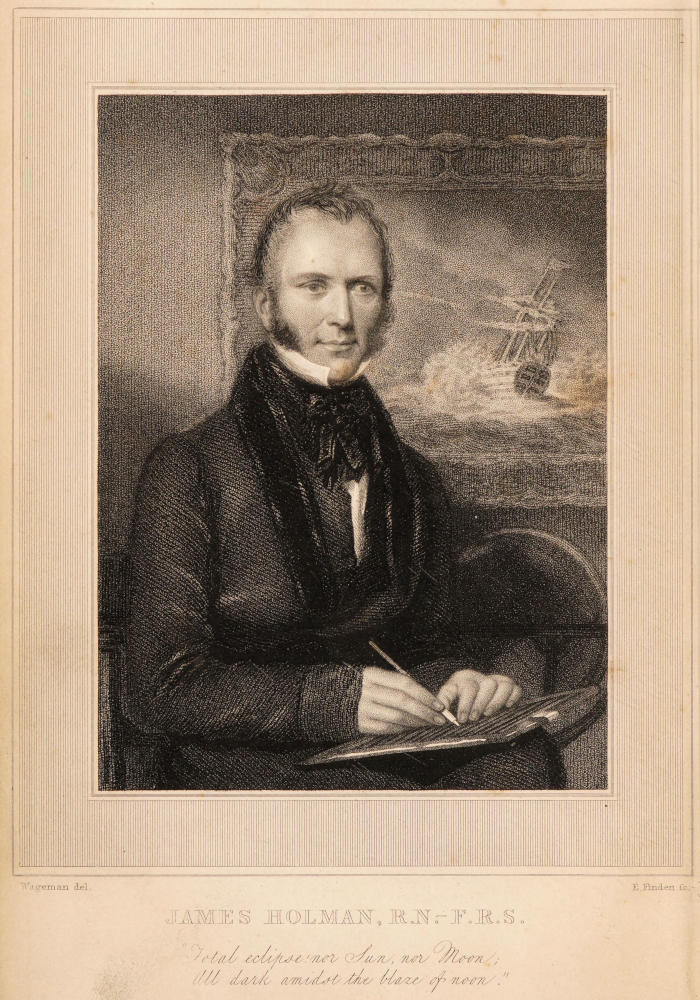
PREFACE.
The very peculiar circumstances under which the
Author professes to obtrude the present volume
upon public notice, appear to require some explanation,
were it only to obviate suspicions which
might arise, that the general detail of circumstances
which it comprises, has been the production
of an active imagination, rather than a relation
of the occurrences of real life; for he is fully
aware, that such a construction might be put
upon the apparent anomaly of the travels of one,
whose loss of sight, a source of information naturally
considered indispensable in such an undertaking,
must greatly limit his power of acquiring
the legitimate materials, necessary to give his
work body and consistency.
On this account, it may not be superfluous, to
enter upon a brief history of his misfortune, as introductory
to an explanation of the motives which
have influenced him in bringing forward the present
publication.
Destined to the naval service of his country,
his exclusive attention, for some years, was devoted
to the attainment of that professional knowledge,
which he hoped might lead to honourable
distinction; how far these views were likely to
have been crowned with success, it will now be
useless to state; it is sufficient to say, that at the
age of twenty-five, while in the very bloom of expectation,
his prospects were irrecoverably blighted
by the effects of an illness, resulting from his
professional duties, and which left him deprived
of all the advantages of “heavens prime decree,”—wholly—and,
he fears, permanently blind.
“Total eclipse! nor sun; nor moon;
All dark amidst the blaze of noon.”
After the distressing feelings which accompanied
the first shock of this bodily privation, had
in some measure subsided, the active mind began
to seek occupation and amusement, amongst the
many resources which a beneficent Providence
had still left uncurtailed. These he has happily
found, not only abundant, but apparently inexhaustible;
and the lapse of ten years, has not
merely softened down the sense of misfortune,
but even reconciled him to an affliction, which
some view as the severest that can befal humanity.
“⸺though sight be lost,
Life yet hath many solaces, enjoyed
Where other senses want not their delights.”
Amongst the various pursuits which have served
to cheer, and sooth him throughout this protracted
day of darkness, the book of nature has been
largely opened to his mental view; nor has he
failed to cultivate the pleasing fields of literature;
and he may exclaim with our admired poet, when
he so pathetically bewails the loss of this most
precious organ:
“So thick a drop serene hath quenched their orbs,
Or dim suffusion veiled; yet not the more
Cease I to wander where the Muses haunt
Clear spring, or shady grove, or sunny hill.”
In time he began to acquire greater facility of
locomotion than he could have anticipated, and
which was succeeded by an almost irresistible
inclination to visit different parts of his native
country, in quest of knowledge or amusement;
notwithstanding the limited information, which it
may be imagined he would thus derive, he found
the impressions produced, afford him not only
present, but permanent gratification. To some,
this may appear incredible; it must, however, not
be forgotten, that the loss of one sense, is uniformly
compensated by superior powers of those
that remain unimpaired, in consequence of their
being more called into action; and it is well
known, that the sense of touch, in particular,
acquires so great a delicacy, as to afford degrees
of information, which under ordinary states it is
incapable of: besides this advantage, he acquired
an undefinable power, almost resembling instinct,
which he believes in a lively manner gives
him ideas of whatever may be going forward
externally.
In the year 1819, his health having for some
time suffered from causes which it is unnecessary
to mention, the Author became assured that nothing
would tend more to re-establish it, than a
visit to the highly favoured clime of the southern
parts of Europe: while at the same time, and
which was, perhaps, paramount to all other considerations,
he would be gratifying his desire of
obtaining information; he therefore, with this
double view, determined to undertake the journey
which forms the subject of the present pages;—and
is happy to say, that in neither of these objects
has he met with disappointment.
It may be more difficult to assign satisfactory
reasons, for laying before his readers the various
incidents which befel him, in this pursuit of health
and occupation; for he is not vain enough to imagine,
that they could feel interested in his acquisition
of the one, or participate with him in the
enjoyment of the other.
The compilation was, in the first instance, entered
upon as a matter of employment and selfish
pleasure. None but those who have travelled
through countries, and amidst circumstances novel
to them, can appreciate the delight experienced
from recalling in this way the interesting points
of an interesting journey, and fighting as it were,
their battles over again. On shewing a portion of
the notes thus collected to his friends, their too
kind partiality (for such he fears it has been) induced
them to think that if published, they might
not prove wholly unacceptable to the public, and
their solicitations and assurances at length determined
him to adopt their suggestions.
The Author will not profess to be ignorant of
the presumptuous nature of his attempt; or unconscious
of the numerous deficiencies and inaccuracies
with which his work abounds; many of these
are necessarily attributable to the disadvantages
under which he has laboured; his very outset was
amidst unfavourable circumstances, as he was then
almost wholly unacquainted with that language,
which could alone enable him to acquire the information
he was seeking for: this must be his
apology for the want of observation and incident,
which are more particularly manifest throughout
the first months of his residence in France.
The want of vision must frequently make his
observations and descriptions imperfect; to compensate
for this, he has availed himself of such
intelligence as he could derive from others; and,
for the same reasons, has introduced a variety of
extracts from interesting authors, which appeared
desirable to elucidate or enliven his narrative.
He rests his chief hope of the approbation of
the public, upon having given a plain and faithful
statement of a journey, which must be regarded
as possessing a degree of originality, arising from
the peculiar circumstances under which it was
accomplished.
He now concludes his prefatory matter, by soliciting
the indulgence of his readers, and entreating
them not to criticise with too much severity,
a work which, he trusts, has some claims
upon their forbearance; and which, if it happens
to repay their perusal by any pleasurable emotion,
or to excite a kind sympathy for his own situation,
will have answered the fullest expectation
of its author.
Windsor,
May 1st, 1822.
THE NARRATIVE, &c. — CHAP. I. DEPARTURE FROM ENGLAND, AND JOURNEY TO PARIS.
My friends expressed considerable surprise, when
I announced my actual determination to undertake
a continental tour, and I believe many of
them, to the last moment, were inclined to doubt
whether I seriously intended it; they did not fail
to question how I proposed, with my personal
defects, to make progress through a strange country,
unaccompanied by even a servant to assist
and protect me, and with an almost total ignorance
of the languages of the various people I was
about to visit. I urged in reply, that the experience
of more than twenty years, during which I
had been, as it were, a citizen of the world, and
a great part of which had been spent in foreign
climes, would be sufficient to direct me through
the common occurrences and incidents, to which
the traveller is exposed; that for the rest, I was
content to leave it to God, upon whose protection,
in the midst of dangers, I had the most implicit
reliance, and under whose providential guidance,
I doubted not to attain the completion of
the various objects of my journey, remembering,
as Cowper happily expresses it, that
“To reach the distant coast,
The breath of Heaven must swell the sail,
Or all our toil is lost.”
It may be difficult to say, under what description
of traveller I proposed to class myself.
Sterne enumerates the following species of the
wandering tribe. “Idle travellers; inquisitive
travellers; lying travellers; proud travellers; vain
travellers; splenetic travellers; travellers of necessity;
the delinquent and felonious traveller;
the unfortunate and innocent traveller; the simple
traveller; and last of all (if you please), the
sentimental traveller.” Now I do not think any
of these titles strictly applicable to myself; I
shall not, however, attempt to determine the point,
but leave it to the courteous reader to apply that
which he may consider most appropriate.
I reached Dover on the evening of the 14th of
October, 1819, and on the following morning embarked
with a fair wind for Calais. This day is
the more remarkable to me, as being, in addition
to the present incident, the anniversary of my
birth, as well as the same day of the year in which,
after my loss of sight, I first set out for Edinburgh,
to commence a course of studies at that celebrated
university. In little more than three hours we
arrived off the harbour of Calais, when the tide
not answering for our making the pier, a boat
came out for the mail, and I availed myself of
the opportunity of going on shore; for this earlier
accommodation I was charged five francs, a sum
nearly equal to half the fare across the channel.
Behold me, then, in France! surrounded by a
people, to me, strange, invisible, and incomprehensible;
separated from every living being who
could be supposed to take the least interest in my
welfare, or even existence; and exposed to all
the influence of national prejudice, which is said
to prompt this people to take every advantage of
their English neighbours. To counteract these
disadvantages, I had nothing but the common
feelings of humanity, assisted by the once boasted
politesse of the great nation, and which might
be expected to operate in favour of an afflicted
stranger.
My commencement however proved auspicious,
for I found an English valet-de-place, or commissionaire,
on the pier, who assisted me through the
ceremonials of the Custom-house, where they did
me the favour to take two francs as a remuneration
for their trouble in inspecting my luggage.
He then conducted me to the Grand Cerf Hotel;
and after I had taken refreshment, went with me
to facilitate my inquiries respecting the diligences
to Paris, for which place I proposed setting off on
the following morning. After this, we extended
our walk through the town, and visited the ramparts
and banks of the canal to St. Omer.
On returning to the Hotel, I partook for the
first time of a French dinner; and, the commissionaire
having left me, had the advantage of being
waited upon by Paul the garçon, who did not understand
one word of English; I had no little difficulty
in getting through the routine of this important
repast. Afterward I repeated my walk
through the town, and on my return was surprised
to learn that a person had been enquiring for me.
It proved to be the waiter of the Hotel where I
had breakfasted at Dover, who had crossed the
channel in pursuit of a French gentleman who
had taken his breakfast at the same table with
me, and whom a friend of mine had endeavoured
to interest in my favour. This gentleman had
received from the waiter a ten pound note in exchange
instead of a smaller one, and the latter
was anxious to recover his lost property. I was
sorry that I could give him no satisfactory information,
for notwithstanding he had promised to
shew me all possible attention before leaving
Dover, and even regretted he could not give
me a place in his carriage to Paris, he kept himself
quite aloof after getting on shipboard, so that
in short I heard no more of him.
In the evening Virginie, the fille de chambre,
attended to put me to bed, and appeared literally
to have expected to assist in the various operations
of disrobing, &c. I was, however, enabled,
through the medium of the commissionaire, to
assure her, that it was quite unnecessary to give
her that trouble. So, dismissing my attendants
with the candle, I secured the door, and retired
to rest.
In the morning I arose early, and inhaled the
fresh breeze upon the pier, a wooden structure,
which extends itself for a considerable distance
into the sea. At the extremity near the town, is
a pillar, erected by the loyal people of Calais, in
commemoration of the landing of Louis XVIII.
immediately after the first subjection of Napoleon,
and near to it a brass plate, with the figure
of a foot cast in it, fixed upon the very spot where
this monarch first trod the French ground, after
so long an absence from his affectionate subjects.
Breakfast was scarcely concluded, when it became
necessary to take my place in the diligence
for Paris; I occupied a seat in the cabriolet,
which, in this coach, was unusually large, being
sufficiently commodious to accommodate six persons,
and where I had the pleasure of finding two
of my countrymen, each with a son, proceeding
to some school near Paris.
It may be worth while to mention, that upon
the information of my commissionaire, I had paid
forty-five francs for my fare. This was indeed the
regular charge, but I have found, by taking advantage
of certain opposition carriages, the expense
might have been materially lessened. One
of my companions, in fact, had bargained for forty
francs for himself and his son; and the other
had secured his two places for thirty-five only.
The usual hour for the departure of the diligence
was ten o’clock; but we anticipated this
time, and set out at half-past nine, in consequence
of its being a fête day, when the gates of the town
are closed from ten till noon, during the performance
of high mass.
About two o’clock we reached Boulogne, where
we dined, and took into our vacant place a journeyman
bootmaker, who was going to Paris. We
now proceeded without stopping, except to change
horses, until midnight, when we reached Abbeville.
On arriving at this place, the passengers
in the body of the coach, which, cumbrous as it
was, had but two wheels, hastily and unexpectedly
jumping out, without apprising the cabriolet,
the whole weight of ourselves and the carriage
was thrown forward, to such excess, upon the
backs of the horses, that, unable to sustain the
pressure, they sunk under it, and were with difficulty
raised again.
We were at this place thankful for a refreshment
of cold meat and wine, as we had tasted
nothing since leaving Boulogne, except some sour
apples, which our young gentlemen had knocked
down on the sides of the road; it was necessary,
however, to disturb three or four houses before
we succeeded in procuring it.
The morning gave us “token of a goodly day.”
At eleven o’clock we halted for breakfast at Beauvais,
and were apprised that an excellent one, a
la fourchette, was prepared at the hotel where our
carriage rested; but the party agreeing to give
the preference to coffee, the bootmaker offered to
conduct us where we should get it both good and
cheap. We consented to follow him, and were
regaled with a large bowl of coffee, with as much
milk, sugar, and toasted bread, as we pleased;
for which they charged us at the extraordinary
rate of five sous per head.
At noon we pursued our journey, and at seven
in the evening arrived at Paris. When the business
of the coach was arranged, the conducteur
walked with me to the Hotel de Suede, near the
Palais-Royal, to which I had been recommended.
CHAP. II. PARIS.
While supper was in preparation, I walked to
the Rue de la Paix, to call upon a lady whom I had
known in England, and was at first surprised to
learn, it being Sunday evening, that she was gone
to a ball; but it is the custom in France to participate
in amusements on Sunday more than on
any other day in the week. It rejoiced me, however,
to know, that my friend was in Paris.
At supper, the maitre d’hotel, a Swede, but acquainted
with the English language, waited upon
me himself, and enumerated with such encomiums
his fine stock of wine, that I could do no less
than order a bottle of Burgundy, which I found
deliciously refreshing; and thought it economical
enough, as it was charged only two francs.
In consequence of the fatigue which I had experienced
on my journey, I was glad to retire
early to bed. On entering my chamber, I could
not but be impressed by its cold comfortless feel;
the floor was of stone, the tables marble, the
wash-hand basin long, oval, and shallow, like an
old fashioned salad dish, and all the furniture of
correspondent antiquity. But I had determined
not to give way to gloomy reflections; therefore,
I wished my host a good night, and being left to
myself, soon regained that contented frame of
mind, which is indispensable to those who mean
to pass smoothly, and happily, through this scene
of mortality. On the present occasion I convinced
myself that I had every reason to be grateful
to that Power, which had so far conducted me
in safety through my journey, and whose blessings
and mercies have been so largely, I may say incessantly,
extended over me.
A part of the succeeding morning was appropriated
to calling upon friends for whom I had
letters. The one I first inquired for was gone to
the south of France; but I had the pleasure of
meeting with my old shipmate L⸺ and a friend
of his, both of whom had been fellow students
with me in Edinburgh. I then repeated my visit
to Miss L⸺, at whose house I had called on the
preceding evening, and found she had returned
that call during my absence; she expressed
much surprise and pleasure at seeing me, and engaged
me to dine with her on the following day.
I returned to our table d’hôte dinner, and had
the unexpected pleasure of finding there a friend
whom I had left in Bath the previous spring.
There was also another English gentleman at
table, who invited me to walk with him to the
Palais-Royal. We accordingly took our coffee
at one of the numerous caffés, with which that
quarter abounds. My companion was a stranger
in Paris as well as myself; in consequence of
which we contrived to lose our way, and had considerable
difficulty in regaining our hotel; we escaped,
however, all the dangers, and supercheries,
of this very notorious place.
On Tuesday morning, my friend L⸺ called,
for the express purpose of accompanying me to
inquire after the conveyances to Bordeaux. We
were informed, that two coaches leave Paris daily
for that place; one at three o’clock, from the
Messagerie-Royal, running by way of Tours,
where it rests on the second night for a few hours,
and occupying four days, and as many nights, in
the journey, the fare sixty francs; the other taking
the route of Orleans, five days on the road,
and the fare fifty francs. The former is considered
the best appointed, and the roads and hotels,
with which it is connected, much preferable.
But, as it cannot fail to be irksome to travel
three or four hundred miles at one sitting, with
the exception of the short rest at Tours, I would
recommend the English traveller to accomplish
some part of his journey in a voiture de voyage,
and then rest for a day or two; or perhaps he
might, in the first instance, take a place in a regular
coach, termed a jumeaux, which travels
to Tours in two days; after which the journey
may be prosecuted to Poitiers in a voiture or diligence,
where the chance must be taken of being
carried forward to Bordeaux in the same manner.
After this inquiry, I had to keep my appointment
for dinner with Miss L⸺, where I met a
young lady, her niece, who resided with her, and
Colonel M⸺, a gentleman to whom my friend
was on the point of marriage. I enjoyed my visit
much, but took leave at an early hour, under the
promise of breakfasting with her, at twelve in the
morning, a la fourchette.
This lady was anxious that, instead of leaving
Paris immediately for Bordeaux, as I had intended,
I should place myself for a week in a boarding-house,
with a view of gaining, before I commenced
so long a journey, some slight acquaintance
with the French language. This advice
appeared so excellent, that I determined to follow
it; and after breakfast, Miss L⸺ was kind
enough to accompany me to a house which she
recommended, and where I immediately took up
my residence.
I should feel myself inexcusable, if I neglected,
in this place, to express the lively sense I entertain,
of the many kind attentions, which I received
from this amiable lady, and which rather
indicated the affectionate regards of a sister, than
the notices of an accidental acquaintance. I regretted
that this was the last opportunity I had
of seeing her in Paris, as she was obliged immediately
to leave town for Fontainbleau, and did
not return before my departure.
“Sweet friendship, solace of mankind,
Come! with thy presence warm my heart,
And when a kindred soul I find,
Oh never, never let us part.
They call thee changing, sordid, vain,
On earth scarce known, and rare to see;
And when they feel base treach’ry’s pain,
They lay the heavy blame on thee.
’Tis true there are whom interest blind,
That prostitute thy sacred name;
Their souls to narrow views confined,
They never felt thy noble flame.”
During the week I remained in Mr. Fetherstone’s
boarding-house, the weather was wet and
cold, so that we were much confined within doors;
but as our party consisted of twenty individuals,
there was no want of amusement, and the continued
intercourse necessarily kept up amongst us,
tended materially to promote my object of acquiring
the language. The following anecdote will
serve to shew, how much I was in need of improvement
in this respect.
On the morning after my entrance into this
family, I rang the bell of my bed-chamber, and
requested a French servant to bring me hot water;
in answer to this he replied, “toute a l’heure,”
with the meaning of which I was at the time
totally ignorant: after waiting a quarter of an
hour, I rang again, and received the same reply,
“toute a l’heure,” but with no better result: I
again repeated my application, it was still “toute
a l’heure:” at length, after, the lapse of an hour,
he brought the water. At breakfast, I took the
opportunity of inquiring the signification of this
convenient expression, requesting to be informed,
whether it implied any specific time, when they
told me it meant “immediately.” I thought, however,
in the present instance, that the action did
not suit the word.
It may be expected, that I should make some
remarks concerning the Parisian theatres, and
other places of amusement; however my ignorance
of the language, and want of vision, as well
as the state of the weather, diminished the ardour
of the desires which I possessed, on entering
Paris, to visit these scenes; however, the many recent
accounts that have been published, leave me
no cause to regret the omission. For similar
reasons I am prevented from attempting any description
of this grand city; and, therefore, in lieu
of it, beg leave to offer the following laconic and
popular petite chanson.
Amour; marriage; divorce;
Naissance; mort; enterrement;
Fausse vertu; brillante écorce;
Petit esprit; grand sentiment;
Dissipateurs; prèteurs sur gages;
Hommes de lettres; financiers;
Financiers; créanciers; maltotiers, et rentiers;
Tiedes amis; femmes volages; riches galants;
Pauvres maris. Voilà Paris! Voilà Paris!
Là des commères qui bavardent;
Là des viellards; là des enfans;
Là des aveugles qui regardent
Ce que leur donnent les passant;
Restorateurs; apoticaires; commis; pedants;
Taileurs; voleurs; rimailleurs, ferrailleurs;
Aboyeurs; juges de paix, et gens de guerre;
Tendrons vendu, quittè, repris.
Voilà Paris! Voilà Paris!
Maints gazetiers; maints impostures;
Maints enneuyeux; maints ennuyés;
Beaucoup de fripons en voitures;
Beaucoup d’honnêtes gens à pied;
Les jeunes gens portent lunettes;
Le vieux visage rajeuni;
Rajeunis bien garnis, bien garnis de vernis;
Acteurs; ventes; marionettes; grand melodrames;
Plats ecris. Voilà Paris! Voilà Paris!
The week now drawing to a close, I prepared
to quit Paris; in particular, I had my passport
arranged, a point frequently attended with much
trouble, as it must in the first instance be procured
from the police, then presented for the signature
of the English ambassador, after which it
is returned to the police, and some other office,
for their definitive signatures, before the individual
is permitted to depart.
CHAP. III. JOURNEY TO BORDEAUX.
Having engaged a place in the diligence, which
took the way of Tours, in the afternoon of the
27th of October, I commenced my journey to
Bordeaux, after bidding farewell
“To the few, I might leave with regret.”
In order to guard against the same irregularity
of meals, which I had suffered from on my way
to Paris, I took care to be provided with a
tongue, fruit, and a bottle of wine. My companions
were three Frenchmen, and of course I
could anticipate little conversation, at least they
were sure soon to find me a dead letter; but notwithstanding,
I doubted not but that I should
derive occupation and amusement from my own
reflections, and determined to avail myself of all
the opportunities of social intercourse which
might offer themselves. As may be imagined,
the afternoon passed off very silently on my part:
at night I contrived to dose a little, and my companions
accorded with me perfectly in this respect.
On the following day we dined at Blois, where
they gave us some of the finest grapes I had yet
partaken of in France. In the evening the weather
proved rainy; at midnight we arrived at Tours,
from whence, after resting a few hours, we proceeded
on our journey at five o’clock in the morning;
at eight o’clock we halted at a small town
for breakfast, where I derived some gratification
from meeting with a person who could speak English,
an Irish horse-dealer, travelling with his
string of horses from Rochelle to Paris.
We reached Poitiers for dinner, at the late hour
of eight in the evening, but my companions did
not appear to be annoyed at this late postponement
of their favourite repast. It appears very
immaterial to a Frenchman when he gets his
meals, he is not only toujours prêt, but endures
fasting with better grace by far than an Englishman.
On the following day we passed through
Limoges and Angoulême. In the afternoon of
this day, we took up a woman and her daughter,
aged about seventeen, with a child; these were
the only females I had yet met with in a diligence
in France, and I could not but feel irritated at the
ungallant treatment they received from their countrymen.
The young lady having placed herself
in the seat of one of them, he very rudely insisted
upon her restoring it: I regretted that I was unable
to advocate her cause: but possibly this feeling
might be dictated by some selfish motive, as
a desire to resent certain indignities to which I
had been subjected by the same individual, who
frequently annoyed me with the fumes of his
segar, and once had the impudence to puff them
in my face; I felt not a little inclined to give him
personal chastisement, but prudence restrained
me.
About nine o’clock on the following morning,
being Sunday, the 31st of October, one of our
company exclaimed, “Voilà Bordeaux!” The
sound revived me exceedingly, for I was become
irritable and impatient, from the length and fatigue
of the journey. At twelve o’clock the coach
halted, and my fellow-passengers immediately
jumped out, leaving me to shift for myself. Of
course I concluded that we had arrived at the
coach-office, and began to call loudly for the
conducteur to come and assist me in getting out.
He immediately presented himself, uttered the
now well-known “toute a l’heure,” and left me.
Although I perfectly recollected the unlimited
signification of this word in Paris, what could I
do? Had I jumped out, I should not have known
what step to have taken next, and the rain was
falling in torrents. There appeared no remedy,
but to sit patiently until it might please some one
to come to my assistance. In a while I heard at
least thirty people around the coach, talking a
loud and unintelligible gibberish, quite unlike
any language of the country which I had hitherto
heard; soon afterwards I perceived the carriage
undergoing an extraordinary, and irregular kind
of motion; the people occasionally opened the
door, and made me move from one side to the
other, as if they were using me for shifting ballast;
I inferred that they were taking off the
wheels, with a view of placing the carriage under
cover. After this I became sensible of a noise of
water splashing, as if they were throwing it from
out of hollows, where it had collected in consequence
of the rain. It was in vain that I endeavoured
to gain an explanation of my being thus
left behind in the coach, the only satisfaction I
could derive was “tout a l’heure,” and the conviction
that nothing remained for me but to be
patient.
“But patience is more oft the exercise
Of saints, the trial of their fortitude.”
At length the motion began to increase, and
to my great surprise, after an hour’s suspense, I
heard the horses again attaching to the carriage;
the passengers re-entered the coach, and we once
more proceeded on our journey!
It was afterwards explained to me, that these
unaccountable proceedings arose, on our having
arrived on the banks of the river Dordogne, which
enters the Garonne, near Bordeaux, from the necessity,
at this point, of transporting the carriage
on a raft for some distance down the stream; that
the passengers had crossed the river in a ferry-boat,
to a coach waiting for them on the other
side, leaving me to float down with the carriage
on the raft, or sink to the bottom as fate might
determine; in short, I found that, while I supposed
myself sitting in the coach-office yard at
Bordeaux, I had actually travelled four miles by
water, without having entertained the least idea
of such an adventure.
In a quarter of an hour after this, we actually
arrived at the coach office. On alighting, I was
accosted by a man, who in the English language
informed me, that he was a traiteur (or the keeper
of an eating and lodging-house), and who did me
the favour of recommending to me, in very strong
terms, both his house and his wife; the latter, he
said, was an American, spoke English well, and
would provide me an excellent bed, as well as
every thing else I might wish for; but as I had a
particular introduction to a friend, I determined
to decline these tempting offers, until I had consulted
him: taking the traiteur’s card therefore,
and requesting him to procure a hackney-coach,
I drove straightway to the house of my friend,
who recommended me to take lodgings in preference.
I lost no time in adopting his suggestion,
and taking immediate possession of my apartments,
experienced the great luxury and refreshment
of changing my dress, after four days’
uninterrupted travelling.
After this, my friend accompanied me to dine
at a traiteur’s, first bargaining that we should be
allowed to select any four dishes from the carte,
for which, with a small bottle of wine, and pain
a discrétion, we were to pay about fifteen-pence
each. In the first place, we were served with
soup in silver basins; then came an entré of ragoûts,
and afterwards a roast chicken, followed
by a dessert. When we had done, we gave the
waiter three or four sous, with which he appeared
highly satisfied.
On the following morning, at the urgent instance
of my friend, I consulted an eminent oculist
of this place, respecting my eyes, who appeared
to entertain the same opinion as most of my medical
attendants in England; namely, that a cataract
existed, but not sufficiently matured, to be
operated upon, with advantage, for the present.
My friend, however, was not satisfied with this
opinion, and insisted upon taking me to the wife
of an umbrella-maker, famous for her skill in
restoring sight, and who recommended a long
course of herb medicines, and other nostrums;
but I wanted faith in her power to serve me, and
moreover, was satisfied with the opinions, in which
my medical friends had concurred, as well as reconciled
to my deprivation, and resigned to the
will of Providence.
“Who finds not Providence all good and wise,
Alike in what it gives, and what denies.”—Pope.
My next attention, was to ascertain the modes
of conveyance to Toulouse. We found that the
diligence sets out every other day at ten in the
morning, occupying two days, and two nights on
the road, the fare forty-five francs; there was,
however, also a voiture from Paris, leaving on the
following morning, and which would be five days
on the journey, resting always at night; and by
the recommendation of my friend, I determined
to give it the preference; in short, I was pleased
with the idea of this new mode of travelling. An
agreement in writing was drawn up, to which the
proprietor affixed his signature, and according to
which, amongst other stipulations, I was to be
taken up from my lodgings, and provided, during
my journey, with a bed-room to myself every
night. We were informed that an officer and his
wife were to be of the party, and the latter happening
to be present, offered to render me every
assistance in her power; this, I must admit, was
an additional inducement with me, for the attentions
of the softer sex are peculiarly acceptable
under my present affliction; and it is but a just
tribute to their kindness, to say, that I have
abundantly experienced them; and farther, I am
convinced that the sympathy I have so often met
with, is perfectly congenial with the innate principles
of the female character.
“Man may the sterner virtues know,
Determined justice, truth severe;
But female hearts with pity glow,
And woman holds affliction dear.”—Crabbe.
CHAP. IV. JOURNEY TO TOULOUSE.
My stay in Bordeaux was too brief to enable me
to acquire any knowledge of this ancient and celebrated
city, nor indeed, had it been prolonged,
do my inclinations, or powers, qualify me for topographical
description; the chief object of the present
narrative, being to relate the incidents of a
journey, which at the time greatly interested me,
and to give as faithful representations of men and
manners, as the opportunities which presented
themselves, and my personal disadvantages would
admit of; in short, to
“Eye nature’s walks, shoot folly as it flies,
And catch the manners living as they rise.”
I was apprised by a porter, at three o’clock, that
the voiture was in readiness, and after bustling to
be in time, was by no means pleased to find that I
had been disturbed an hour too soon; nor was my
dissatisfaction diminished, when the porter, by
signs, gave me to understand, that I must traverse
the greater part of the city with him to the coach-office;
it was in vain to remonstrate with a person
who could not understand me, and insist upon the
fulfilment of my agreement; at length, however,
to cut short the argument, my conductor, with a
mixture of passion and impatience, seized my portmanteau,
and gave me to understand, that I had
no alternative but to accompany him, or lose my
passage. In fine, I was obliged to submit, and
after half an hour’s walk, we reached the voiture
in safety. The next measure was to place my portmanteau
in security, and which, unless I had interfered,
would have been exposed on the outside of
the voiture. Travellers in France should always
superintend the stowage of their luggage, as it is
not unusual to have it stolen from the exterior of
the carriage. Dr. O⸺, a gentleman, whom I
had the pleasure of meeting in the summer of 1820,
at Aix in Provence, in travelling from Lyons to Geneva,
lost his trunk, containing valuable collections
he had made in Italy, and other property,
worth some thousand francs, from the outside of
the diligence. He was induced to commence an
action against the proprietors, either to stimulate
them to recover his property, or to make them
compensate his loss; but finding that, after a tedious
and expensive process, the utmost he could
recover, would be a thousand francs, he thought
it most prudent to abandon it.
At length our arrangements being completed,
the voiturier made the customary signal with his
whip, and we bade adieu to Bordeaux.
One of the earliest, and most obvious attentions
of the traveller in a public stage, is to reconnoitre
his companions, and endeavour to ascertain whether
it be possible to elicit information or amusement
from them; the group with which I was now
thrown into collision, was not unlikely to be productive
of interest; I was soon convinced, from
the nature of their conversation, that my companions
were not of the genteelest stamp. The women
were at home in speaking patois, and the only
one who could not join in this, was the person
who, I suppose from his wearing a large cocked-hat,
had been taken for an officer, but who, I afterwards
found, had been a bootmaker in one of
Bonaparte’s cavalry regiments.
At ten o’clock we halted, and were regaled with
a breakfast a la fourchette, consisting of soup
bouillè, ragoûts, roasted fowls, and little birds;
the compliments of the table were paid me; my
companions did not sit down until I had nearly
finished; and the voiturier placed himself by my
side, serving me with every dish as it was brought
in, and appearing to expect me to partake of all
of them. I confined myself chiefly to the soup
and rôti; the little birds would have relished well,
had not a slice of bacon placed on the breast of
each, destroyed their natural flavour.
At one o’clock we recommenced our journey,
and at six in the evening, reached our resting place
for the night. After a delay of two hours, a profuse
supper was served up in regular courses, and
concluded by a dessert of grapes, pruins, apples,
pears, nuts, and small sponge cakes. I was not a
little surprised at their mode of cooking a cauliflower
which I had inquired for; after a great
many “toute a l’heure’s,” it made its appearance,
boiled as soft as batter, and mixed up with oil,
vinegar, and pepper, like a salad!
The wine was excellent, and the glass circulated
freely. Who thought I, would not travel in a voiture,
to live thus cheerily, and at so trifling an expense,
for it will scarcely appear credible, that the
proprietor had engaged to convey me to Toulouse,
a distance of one hundred and twenty-five miles,
occupying five days on the journey, and providing
me with every necessary, beds included, for thirty-five
francs, equal to about five shillings and ten
pence English money per day!
Our supper party consisted of nine or ten persons,
not indeed of the most select kind, but I
had no right to complain, as with a view of avoiding
trouble, and imposition, and at the same time,
with some prospect of deriving gratification from
the melange of characters I expected to meet with,
I had engaged to put up with the general fare.
My companions appeared to enjoy their repast,
and every additional glass evidently produced increased
animation, as they talked louder and
faster. They were, however, particularly attentive
to myself, my want of sight probably exciting
their sympathy.
At length, fatigued with the scene, I gave them
to understand that I wished to retire, and was
conducted to a chamber which was furnished with
several beds, and had the pleasure of finding the
one that had been selected for my repose, good
and commodious. But an important dilemma now
presented itself: taking the fille-de-chambre by the
hand, in order to ascertain that she was carrying
the candle away with her, a point I am always
particular in attending to, as, when it has been
left behind, I have occasionally burnt my fingers,
and once even made an extinguisher of my chin;
and then making a motion to lock her out, that
I might, according to the especial clause in my
agreement to that effect, appropriate the room entirely
to myself, I was surprised to find her as
strenuously oppose this measure, as most of the
fair sex, I have no doubt, would an attempt to
lock them in. It was useless endeavouring to comprehend
her meaning, and only by returning to
the supper-room, did I learn, that the room in
question, was intended for the accommodation of
the whole party. It is not easy to conceive the
confusion which ensued, on my evincing a steady
determination not to pass the night by the side
of the conducteur, or even the ladies of our party;
I persisted, however, in my resolution, and folding
my arms, and closing my eye-lids, reclined,
in the posture of repose, in a large easy chair in
which I happened to be placed.
At length, the bootmaker’s wife, taking me by
the hand, conducted me to a single-bedded room,
from which, after having assisted in my arrangements,
and warmed my bed, she permitted me
to lock her out.
I cannot but express myself grateful, for the
interest this kind-hearted woman evinced in my
favour, on the present occasion; but this is not the
only time, that I have been indebted for support
and success, to a fair advocate.
At four in the morning we were summoned by
the conducteur, and the soldier’s wife kindly came
to assist me down stairs. The party were assembled
in the parlour, and fortifying themselves,
against the fatigues of the day, with bread and
brandy, but I gave the preference to some grapes.
At eleven, we halted for breakfast, and, according
to the usual custom, rested two hours in the middle
of the day; after this we pursued our journey,
the conducteur mounting under cover in front of
the voiture, to protect him from the rain, which
was falling heavily. About three o’clock, while
proceeding so quietly, that it might almost be presumed,
that not only the conducteur and his passengers,
but the horses themselves were fast asleep,
we were aroused by the very interesting incident
of our whole equipage, including the horses, being
overturned into a deep ditch. I shall not attempt
to describe the noise and confusion which succeeded;
the party were almost frantic with terror;
at length, having succeeded in extricating ourselves
from this unpleasant situation, I was placed
for shelter under a large tree, while the rest assisted
the conducteur in raising up the coach and
horses. This operation took up half-an-hour, during
which, I could hear our guide contributing
abundantly, both with his whip and imprecations.
Fortunately no serious injury was sustained, and
I felt strong reason to congratulate myself, for I
had heard in the morning, that we were to cross
the Garonne this afternoon, and my first impression
was, that we were falling into this river; nor
had I forgotten my adventures on the Dordogne.
The carriage being at length righted, the conducteur
urged forward his jaded horses with little
mercy, probably stimulated by revenge for the
late occurrence, which was mainly attributable to
his own negligence. At six o’clock we crossed the
Garonne, and in consequence of delays and accidents,
did not arrive at our auberge until eight
o’clock, when we dispatched a hasty supper, and
retired to bed. I here found the advantage of
my resolution on the preceding evening, having
an undisputed bed-room to myself.
We resumed our journey at the usual hour in
the morning. Before we set out, the conducteur
requested me to advance him a part of his fare,
and which I believe is usual, if not generally necessary,
as these people are so miserably poor,
that, otherwise, they would be unable to bear
the unavoidable expenses of the journey; but in
my case, as it was agreed that he should be paid
by my banker, on my safe arrival at Toulouse, he
had no right to expect the indulgence. This arrangement
had been adopted from my wish to
have it supposed that I was travelling without
money, notwithstanding, I had the precaution,
as a resource against accidents, not only to have
a few napoleons in my portmanteau, but also some
in a girdle round my waist, so that I had a double
chance of not being left destitute.
In the present case, in order to put this surly
fellow into good humour, I thought well to advance
him a couple of five franc pieces, but without producing
the effect I had anticipated; for finding
myself suffering from headach, which I attributed
to want of due exercise, I made signs for him to
halt, while I might get out of the coach, with the
intention of walking for a time; he only, however,
replied, with much coolness, “toute a l’heure;” and
notwithstanding my repeated request, was quite
indisposed to accommodate me, until I manifested
my intention of jumping out: he now thought
well to stop his horses, and proffer his assistance;
however, I refused it, and succeeded in finding
the back part of the coach, where I secured my
hold by means of a piece of cord (which when
travelling I make a rule to carry always in my
pocket), and which, in the present instance, served
me as a leading string; I then followed, in this
way, on foot for several miles, to the no small
amusement of the villagers, who laughed heartily,
and even shouted after me. I had, however, the
satisfaction of getting rid of my headach, and succeeded
in completely tiring myself. We did not
reach our breakfast point before two o’clock, and
proceeding again at four, arrived proportionately
late at the end of the day’s journey.
The succeeding morning proved remarkably
fine, and we prosecuted our journey with additional
pleasure. I found the conducteur more humble,
and my companions, in general, more attentive
to me than usual. The advantage I had derived
from exercise on the preceding day determined
me to walk again, and the bootmaker civilly offered
me his arm. After proceeding some distance,
he proposed entering a wine-shop, to which
I assented; we tried three, however, before we
found any wine to our taste: in consequence of
the time thus lost, the voiture got considerably
the start of us, so that we were obliged to exert
ourselves to regain it.
On producing our wine, the provision-bags
were also brought forward; we became merry as
gypsies, and my cocked-hat friend particularly
facetious. Soon after one o’clock, we arrived,
in high glee, at our breakfasting-place, where we
found a voiture full of students, on their way to the
university of Toulouse. These young gentlemen
paid me a marked attention during our repast,
assisting me liberally to the produce of the table,
and replenishing my glass before it was empty.
When the voiture was ready, I walked forward
with the soldier’s wife, who appeared a far more
respectable woman, than from her situation in life
might have been expected. I now learnt, partly
by words, and partly by signs, the situation and
circumstances of her husband; that subsequently
to the peace, he had attempted to support himself
in Germany by his trade; but difficulties arising,
he was removing to Toulouse, her native place,
in hopes of proving more successful.
In the course of our walk, we ascended a
considerable hill, from which, my companion informed
me, the prospect was most extensive and
beautiful. The air at this spot I found so soft,
balmy, and exhilarating, that I felt assured I had
now reached the south of France. After crossing
a river, at seven o’clock we reached our quarters
for the evening. The students had preceded us,
and in consequence of their occupying the attention
of the house, we had to wait a long time for
our supper.
On the following morning we resumed our journey
in high spirits, from the prospect of arriving
at Toulouse in the evening. We reached Agen
for breakfast, which I understood to be a very fine
city: I was at this place so much charmed with
the manners and attentions of some young ladies
at the inn, that I admit I did not depart without
regret. Had I the same talents for acquiring
languages, as Joseph Scaliger, who was a native
of this place, possessed, I might by this time
have known sufficient of the French to have benefitted
by the agreeable conversation of these
ladies. At six in the evening we entered Toulouse,
and were set down at a miserable inn,
termed the Three Mules.
While our supper was getting ready, I went,
under protection of the soldier’s wife, to call upon
Mrs. W⸺, a lady who had kindly offered to assist
in procuring me a reception, for the winter,
in some respectable French family. I was fortunate
enough to find her at home; when she expressed
much surprise at the manner in which I
had travelled so far, and informed me, that preparatory
arrangements had been made for my
residence in the family of Colonel du B⸺. In
returning to the inn we experienced some embarrassment;
for my conductress had been so long
absent from her native city, that we had much
difficulty, in consequence of the narrowness and
intricacy of the streets, in finding our way back
to the inn.
After supper I was conducted to one of the
most comfortless rooms that could be imagined;
every thing felt so damp, so antiquated, and dusty:
some of the chairs were without legs, others without
backs; and the windows were broken: but as
there was no remedy, I was obliged to make the
best of it, and congratulated myself on having
reached my destined winter residence, and thus
far, negatived the doubts, and kind apprehensions
of my friends.
CHAP. V. TOULOUSE.
On the following morning, Mr. F⸺, a friend of
Mrs. W⸺’s, called upon me, to state the full
particulars of the arrangements for my reception
into the family of Colonel du B⸺, to whom I
was to be introduced on the morrow; and in the
evening, this kind lady sent two gentlemen to
conduct me to her residence, when I had the
pleasure of being introduced to a small circle of
her acquaintance.
In the morning, Mr. F⸺ called upon me, in
company with Colonel du B⸺, when it was
settled, that I was to become an inmate, in the
family of the latter, on the following day. These
gentlemen did me the favour to settle for my journey
with the voiturier, and gave him a severe reprimand
for his want of humanity; and I took the
opportunity of convincing the soldier’s wife, who
was present, of my sense of her kindness.
I now soon found myself happily situated in the
house of Colonel du B⸺, with whom I proposed
to remain, until the approach of spring might invite
me to pursue my tour, and under the expectation,
in the interim, of improving my health, and
acquiring a knowledge of the French language.
The former point was admirably promoted by the
kind attentions, and domestic arrangements, of
Madame du B⸺; the latter would not fail to
result from so extended a residence in a family
wholly unacquainted with English, and where
necessity, and the force of habit, must concur in
instructing me. I cannot, however, but acknowledge
the patient assistance which I received from
the whole family; and my views were also promoted
by a pretty regular attendance on the lectures
delivered at the royal college of this place.
Our domestic circle consisted of M. and Madame
du B⸺, their two sons and daughters, with the
father and a sister of Madame B⸺. Madame
B⸺ was what, in England, we should call a
notable woman, who superintended personally the
arrangements of housekeeping. The colonel possessed
a mechanical taste, which with reading
constituted his leading pursuit; he was a hearty
feeder, with, however, a supposed indifferent appetite;
for instance, he would breakfast, about
noon, upon an immense quantity of bread and
cold meat, hard dried sausages, or rich fromage
de cochon, with a large bottle of wine, and afterward
complain of a disinclination for his dinner.
But perhaps the more interesting feature of the
family group, was Mademoiselle la Sœur. This
lady, somewhat advanced beyond the noontide of
life, was a diminutive woman, with one eye, and
largely attached to the charms of tabac, which
contributed to give her voice a strong nasal tone;
but in addition to this penchant for snuff, she enjoyed
also the pleasures of the table; was fond of
high-seasoned dishes, onions, garlic, and wine;
her converse was of the merry kind; she was fond
of whispering into one’s private ear; and with
these talents, seemed also wonderfully adapted
for sociality, as she cultivated a large circle of
acquaintance in the town, and made it a rule to
return with a whole budget full of news for our
amusement.
Toulouse, in point of extent, is considered the
third town in France, but in proportion to that
extent, far less populous than many other of its
cities: it possesses some good public buildings,
as well as modern private houses, but the general
appearance is very antiquated; the streets are
narrow and dirty, and what is a great annoyance
in walking along them, when it rains you are almost
sure to be spouted upon from the tops of the
houses, in consequence of pipes sticking out to
conduct the water towards the middle of the
streets.
There are in this city some good squares, particularly
the Place Royal, in which are situated
the town-house and theatre; the Place St. George;
the Place St. Stephen, containing the cathedral;
and also the Place de Bourbon, which with its
neighbourhood is the more eligible point for the
residence of a stranger.
Some of the walks around the town are very fine,
but the access to them unpleasant, in consequence
of the offensive smells proceeding from the narrow
streets in their vicinity; this is particularly the case
as you approach the fine bridge over the Garonne.
Lodgings, such as they are, are reasonable, and
the necessaries of life, of all kinds, abundant, good,
and cheap. The town is supplied with water
from the river; this indispensable article being
carted about in casks through the streets at all
hours. The stranger will also notice a number of
asses, which are driven about the town, to supply
invalids with their milk.
I declined participating much in the society of
the place, but both the French and English residents
are sociably inclined. It is not, however, the
fashion among the former, to make morning visits,
or give dinner parties, but their houses are open
for their friends every evening, and on appointed
nights they visit in large parties, and amuse themselves
with conversation, singing, cards, or dancing.
A theatre was open during a part of the winter,
and we had two or three public concerts, as well
as a variety of private ones by amateur performers,
particularly during the season of the carnival,
which finished on the 14th of February, and exhibited
all its usual variety of masks, grotesque
characters, and buffoonery; these concerts were
only given on the Sunday afternoon.
There are a few customs, and points of etiquette,
which it may be interesting to notice.
When a stranger arrives at Toulouse, and wishes
to enter into society, he leaves his card with the
prefect, who, after returning his call, sends him
invitations to the public parties, which he gives
once or twice in the week, when he has the opportunity
of seeing the best company of the place.
On new-years-day, it is the custom (although I
believe the same is common to most parts of the
continent) to call on all friends, and present the
ladies with fruits, toys, trinkets, or bon-bons, under
some ingenious deceptions, and which it is generally
expected, will be accompanied by a salute;
therefore if you have an extensive acquaintance,
it is indispensable to set out, at an early hour,
loaded with smiles, compliments, and presents.
I scarcely feel competent to speak of the various
ceremonies of the Gallican church here, but when
an Englishman dies, it is customary to send the
following notice, to the various residents from his
country, requesting their attendance at the funeral.
“M⸺
Vous êtes prié par M⸺ et M⸺ de
leur faire l’honneur d’assister à l’inhumation de
M⸺ qui aura lieu le ⸺ à ⸺ heure du ⸺.
Le convoi sortira de sa maison d’habitation.
Pax illi ⸺”
There is only one burial ground for Protestants,
at Toulouse, situated at some distance from the
city.
Early in February, the news arrived of the death
of our late venerable and beloved king; the intelligence
was received by the English in this place,
with every possible mark of respect, and a public
mourning immediately took place.
Soon afterward, the city of Toulouse was
thrown into a high state of consternation, in consequence
of the assassination of the Duc de Berri;
the imaginations of the inhabitants recurred to
the sanguinary scenes of the French revolution,
in which this town had no small share, and anticipated
a return of its horrors. After this event,
the following invitation was addressed to the various
English residents:
“Eglise reformée de Toulouse.
Nos tres chers frères en Jesus Christ.
Vous avez tous gémis sur l’horrible attentat commis
sur la personne de S. A. R. Monseigneur Le
Duc de Berri, attentat qui a privé la France et l’auguste
famille des Bourbons, de leur espoir le plus
précieux; nous vous invitons à vous rendre vendredi
24 de ce mois, à onze heure du matin, dans le temple,
pour exprimer, devant Dieu, la vive douleur que nous
en èprouvons.
Les Membres du Consistoire.
CHABRAND, President, &c. &c. &c.”
Toulouse, le 22 Mars, 1820.
This city abounds with beggars, many of them
objects of real charity; as it is impossible that
persons with limited incomes, can afford a sous
for each, it is not unusual to give them one, and
take change out of it.
The winter proved unusually severe; from the
middle of November to the end of December, it
continued wet; from this time to the latter part
of February, it was excessively cold; and at the
end of January, the ground was covered with
snow for a fortnight together. For an uninterrupted
week, during some part of the twenty-four
hours, Fahrenheit’s thermometer stood at from
9° to 11° below Zero. The Garonne for the first
time for thirty years, was frozen over, the ice
being found to the thickness of nine inches. The
end of March, and beginning of April, however,
became so fine and warm in the middle of the day,
as to make walking irksome.
I now began to contemplate breaking up my
winter quarters, in order to proceed to Montpellier.
On inquiry, I found two modes of conveyance
to this place, one by the Grand Canal de
Languedoc, the other by diligence; and having
made my arrangements for being conveyed by
the latter, I prepared, on the 13th of April, to
bid adieu to Toulouse.
I must not, however, leave this city, without
paying a due tribute of respect to the worthy family
with whom I have been resident, whose innumerable
acts of kindness, and attention to a
whimsical invalid, will ever claim his gratitude.
But let me not exclude my English friends from
this expression of feeling. Mrs. W⸺ and Miss
S⸺ are, in particular, entitled to my sincerest
acknowledgments; and who were not only the
first to receive me at Toulouse, but the last to
take leave of me. They will ever retain a place
in the recollections of a grateful heart.
CHAP. VI. MONTPELLIER.
We left Toulouse in the afternoon, and travelling
during the whole night, reached Narbonne on the
following day for dinner; at nine o’clock in the
evening we halted for a short time at Beziers,
where we were left, under cover from a heavy rain,
in a kind of stable-yard, while our conducteur transacted
some business in the town. After this we
again proceeded throughout the night, and at day-break
arrived in sight of the Mediterranean Sea,
afterward reaching Montpellier about ten o’clock.
On leaving the coach, I accompanied a gentleman
with whom I had been acquainted at Toulouse,
and who had been a fellow-traveller on the
present occasion, to his lodgings in this town; but
on his arrival, he met with the following disappointment.
During his absence, on legal business, he
had permitted some friends to occupy his rooms,
one of whom happened to die in his best chamber.
Now it is customary in France, on such an occasion,
to burn the bedding and other furniture, and
in case of this happening in lodgings, the friends
of the deceased are expected to pay for them; the
charge, in the present instance, was eight hundred
francs, and the furniture had not been replaced;
my friend, therefore, was induced to provide
himself with fresh rooms: formerly this was
not the only tax upon the property of a foreigner
who died in France, for by the droit d’Aubaine,
which has only been abolished since the return
of Louis XVIII., his whole property became confiscated
to the King, under the erroneous idea that
it must have been acquired in his dominions.
For the first three days, I lived with this gentleman
at his lodgings, having however my sleeping-room
at the Hotel de Midi; after which time, I
had the good fortune to place myself in the family
of Madame the Countess de M⸺, who occupied
a noble mansion, agreeably situated near the town,
replete with every convenience, and comprising
beautiful gardens, embellished with terrace walks,
fountains, and a bosquet, where, to my surprise,
the nightingale sang all day long. For some reason
or other, Madame found it convenient to dispose
of a part of her house; one portion was
occupied by two French officers with their families,
and another by a Russian officer. The suites
of apartments were, however, perfectly distinct,
and there was little intercourse between the above
and her own family, which inhabited the better
part of the house, and consisted of herself, two
daughters, and a relative, M. de C⸺.
I was exceedingly happy in this family, and
with the friend who accompanied me from Toulouse,
made various excursions into the surrounding
neighbourhood; we particularly enjoyed the
walks on the banks of the river and lake, where
the air was much cooler and more agreeable, than
on the road, at this time becoming dusty and
troublesome. The scenery, about two or three
miles from the city, is said to be romantically beautiful.
On our return, we used, occasionally, to
take a warm bath, which was peculiarly refreshing,
and with respect to which, I noticed a luxury,
which I had never before remarked,—namely, a
clean sheet thrown over the surface of the bath,
which you descend into, and are enveloped in.
There are also some delightful public walks
about the town, as the Perût, whence is a view of
the Mediterranean, and Cevennes mountains; the
esplanade; and the botanic gardens. The city is
also surrounded by boulevards, of which I was
able to make the tour in forty minutes. The
markets at Montpellier are well supplied with
meats and fish of all kinds; with poultry, vegetables,
and fruits in abundance. The vin ordinaire
of the country, is termed vin de St. George, which
is good, and full bodied, and sold from the cask
as low as five or six sous the full quart bottle,
although, after bottling and refining, the wine
merchant charges twenty sous for a small wine
quart. There is, however, another sort, termed
vin de Lednon, which is lighter, but highly flavoured,
and consequently more estimated, selling
at thirty sous the bottle. A variety of other
wines may also be procured.
Montpellier has a theatre, to which it is singular
that the officers in the garrison here, are obliged
to subscribe, whether they attend it or not; besides
the above, there are a great variety of other
amusements.
Madame de M⸺, and her eldest daughter,
went one evening to a ball given by general B⸺,
where the young lady had the fortune to make
a conquest of an officer, with whom she danced;
on the following day he paid her a visit, and
shortly after made his proposals in form, which
were accepted; after this, according to the custom
of that part of the country, he was considered
as one of the family, which was an additional
pleasure to me, as he was a sensible gentleman-like
companion. The marriage, however, did not
take place until after my departure from Montpellier.
This love affair leads me to relate an affecting,
romantic, and even tragical incident, which occurred
in the family of Madame M⸺, during my
residence with her.
Her youngest daughter, Clementine, was a lovely
girl, about seventeen years of age; but, alas!
it is impossible that I can do justice to charms
which it was forbidden me to behold! A young
gentleman one day walking accidently near the
house, observed this interesting girl leading a
goat, tied with a string, over a rising ground, near
the bosquet; struck with her beauty and simplicity,
his imagination took fire, and a passion the
most ardent possessed his soul; his constant delight
was to wander near the spot which contained
the object of his affections, and amply was he repaid,
when he could thus steal a glimpse of her
beloved form. But he was soon compelled to
tear himself away to prosecute his studies in Paris;
her image pursued him, and dwelt incessantly
within his mind; and he returned to Montpellier
with unabated affection. The diffidence so
characteristic of pure and ingenuous love, prevented
him, for a time, from declaring his passion;
at length, however, he summoned sufficient resolution
to demand an interview with the countess,
but as he refused to send up his name and object,
she declined seeing him; in a while he repeated
the call, declaring that he had something particular
to communicate, but still refusing to give
his name; the countess consequently again refused
to see him, but sent Clementine to inquire the
nature of his business.
Those who know how to love, may imagine his
sensations, on finding the object of his ardent
passion, thus unexpectedly placed before him;
his perturbation amounted to a stupid confusion;
he was incapable of utterance; and the unconscious
maid left him without receiving the least
explanation. His only consolation was now to
repeat his wanderings around her habitation. One
night I was myself alarmed by the sound of footsteps
under my window, and for some time laboured
under the impression, that an attempt
was making upon the house. It was the unfortunate
lover; who frequently spent whole nights
around the spot, where he first saw his adored
mistress.
On the morning of the 24th of June, I was disturbed
from my sleep, by the sound of many persons
talking in the house and garden, in a manner
which convinced me that something dreadful had
occurred; I immediately hurried on my clothes,
and hastened to ascertain the cause, when, on
opening the door of my room, which led into the
hall, Mademoiselle de M⸺ instantly advanced
towards me in tears, exclaiming, in the most
pitiful tone, that a gentleman had killed himself
in the garden, and then proceeding with the following
relation: That her mother having risen
early for the purpose of bathing, while the bath
was in preparation, had walked into the garden
in company with M. de C⸺, who was just returned
from a party in the town, with whom he
had been passing the preceding night; that, at
this juncture, they saw through some bushes, a
gentleman sitting on the grass, and whom she was
on the point of approaching to accost, when he
rose up, took out a large knife, and plunged it
into his breast. M. de C⸺ immediately sprang
across the path, exclaiming, “Mon Dieu! Mon
ami, why have you done this!” The only reply
from the unfortunate man was, “Clementine!
Clementine!” The countess ran to procure assistance,
and the whole house was soon in confusion.
The most sympathizing inquiries were
made into the motives for committing so rash a
deed, when, exhausted with loss of blood, he
exclaimed, “Ah! Clementine! for you I die! I
feel you can never be mine, nor can I live without
you!” He was now conveyed to a neighbouring
house; a surgeon and the police officers soon
arrived; the former reported, that the knife had
been turned aside by a rib, but that he was in imminent
danger. The police officer then proceeded
in his duty, emptying his pockets, and conveying
their contents to the Bureau. A letter was found,
directed to Madame de M⸺, with another enclosed
for Clementine, and I was informed they
were both written with very great propriety, and
expressive of his unhappy passion.
I quitted Montpellier a week after this event,
at which time, the unfortunate lover continued
in a hopeless state.
Both as sources of amusement and instruction,
I frequently attended the lectures on chemistry,
mineralogy, and botany, at the college, and had
reason to feel gratified by the general attention
paid me, both by the professors and students.
Montpellier appears a most desirable situation for
prosecuting a course of study, as it abounds with
excellent public lectures, literary societies, and
good libraries. In short, it must be an agreeable
winter’s residence under any circumstances,—to
those who wish to be gay, it offers a continual
routine of balls, plays, and other amusements,
public as well as private; and the valetudinarian
will find as pure air, and agreeable walks and
rides, as he can desire.
The time I had allotted for my residence at this
delightful place, was now drawing to a close, and
having provided a fresh supply of Herries and
Farquhar’s notes, from my punctual and obliging
bankers in London, I prepared to proceed to Aix
in Provence, where I proposed to bathe for the
remainder of the summer, staying a few days only
at Nismes, on my way.
I shall avail myself of this opportunity of recommending
to travellers the superior advantages of
Herries and Farquhar’s notes, in preference to letters
of credit, and which I cannot do better than
state in their own words.
“The object of this plan is to supply travellers
with money, whenever they may require it, without
there being any necessity of determining the
route beforehand. For this purpose, a correspondence
is established with all the principal places
of Europe. The traveller is furnished with a general
letter or order, addressed to the different
agents of the house, which letter, while it serves
to identify him, gives a claim to any attention or
good offices he may stand in need of.”
A variety of clear and explicit arrangements are
made, to facilitate the immediate supplies of the
traveller, whenever he may need them; and excellent
precautions adopted, to prevent forgeries, impositions,
and the extravagant expenses, commissions,
and discounts, which attend the negotiation
of bills on merchants’ houses.
CHAP. VII. NISMES.
A short time before my departure from Montpellier,
I had the misfortune to sprain my ancle,
which abridged materially my usual pleasure of
walking, but did not prevent me pursuing my original
intention of proceeding to Aix.
M. de C⸺ was kind enough to accompany me
to the coach, and, with the best possible motives,
recommended me to the care of the passengers
and conducteur, but which I must admit I would
rather have declined, as it disarmed me of that
independence I wished to feel; I fancied it was
placing me in the light of a school-boy; or perhaps
of a package of “Glass.—Keep this side uppermost.”
I would prefer being treated with the
little ceremony of a woolpack, which by its accommodating
elasticity, not only avoids injury from
slighter contact, but under more decided and ruder
pressure, becomes so solid, so confirmed, so compact,
as effectually to oppose additional restraint,
and probably at length by its innate powers, to
throw off the superincumbent weight, and immediately
regain its original state; in short, I find
less difficulty, and inconvenience, in travelling
amongst strangers, than people imagine, and prefer
being left to my own resources; habit has
given me the power of acquiring, by a kind of undefinable
tact, as correct ideas of objects as the
most accurate descriptions would give; and unbiassed
by the opinions of others, I feel more facility
in forming my estimates of human nature.
After an unpleasant journey, owing to the heat
of the weather and fulness of the coach, and passing
through the neat town of Lunelle, famous for
its wines, we arrived about noon at Nismes, where
I took up my residence at a traiteur’s, in a particularly
airy situation near the esplanade; this
situation I felt of importance, as from its position
on an extensive plain, this city suffers intolerably
from the heats of summer.
On the following day, being Sunday, I attended
divine service at one of the Protestant churches,
in company with Mrs. and Miss L⸺, with whom
I had previously been acquainted at Toulouse and
Montpellier; we were shewn into the corporation
seat, and I am afraid gave much trouble to its
proper occupiers, who, with great politeness, incommoded
themselves to accommodate us. We
were much pleased with the discourse of the
preacher, as well as the indications of devotion
on the part of the congregation.
Nismes abounds with Protestants, who indeed
constitute a large proportion of its more industrious
and opulent population; a circumstance to
which the sanguinary political scenes, of which it
has so frequently been the theatre, are to be attributed.
The Roman religion has undoubtedly
a tendency to check the energetic industry of its
professors, by the encouragement which its numerous
fêtes give to habits of amusement, idleness,
and dissipation; and, alas! it is too correspondent
with the dispositions of fallen human
nature, for rapine and fraud to spring out of such
vitiated soil, and avail themselves of the advantages
attained by honest industry.
But far be it from me, to decry the importance
of religious observances, and rational relaxation
from the toils of suffering humanity; or to throw
the least censure on that admirable and divine institution,
which, according to our admired Spectator,
rubs off the rust of the preceding week, and
leads the poor man to a close acquaintance with
his best friend. The institutions of catholicism,
or rather papalism, are in this respect essentially
contradictory to the divine command, which has
solemnly declared, amidst the awful denunciations
of Mount Sinai,—“Six days shalt thou labour;
but the seventh day is the sabbath of the
Lord thy God;” for who of its more strict professors
does not pay as much religious observance
to the fifth day, as to the one indicated by
the merciful Creator.
While at Nismes, my ancle proved extremely
painful, and I felt otherwise indisposed, so as to
be incapable for a time of taking my usual walks;
I was, in consequence, induced to consult a
French apothecary, who had talked me into a
favourable opinion of his skill, by expatiating, in
what I considered a philosophical way, upon the
virtues of his medicines. I was, consequently,
placed upon a course of ptisan refraichissant,
without which French practice would be at a
loss, but which, begging the pardon of this French
Æsculapius, although it might do very well in
mild cases, I should be loath to intrust my safety
to in a desperate one, where nature might possibly
want urging forward, or severe correction,
rather than treating with such a complaisance;
so much for my smattering of physic: but, notwithstanding,
I must do my apoticaire the justice
to admit, that with the aid of his ptisan, and
other means, I was in a few days sufficiently improved
to be able to resume, in some measure,
my customary walks.
Nismes, originally the Nemausum of the Romans,
is a city of considerable antiquity, of which
sufficient remains are still to be found, to attest
its former grandeur.
I visited some of these august remains, particularly
the celebrated amphitheatre, built in the
Tuscan order, of such size as to have been capable
of containing twenty thousand spectators. It is
considered one of the finest monuments of antiquity,
and has survived the ravages of nearly
twenty centuries. I had also that exquisite piece
of Corinthian architecture described to me, now
termed the Maison Quarrée, which exhibits some
of the most beautiful specimens of architecture
still existing, and which had been supposed by
many to have been built by the Emperor Hadrian,
a great benefactor to this city, but by
an inscription, discoverable to that effect, is
now proved to have been erected by the good
people of Nismes in honour of the two young
princes, Caius and Lucius Cæsar, grandsons of
Augustus, by his daughter Julia, the wife of
Agrippa.
A number of peculiar large square basins, which
the common people use to bathe in, are to be seen
at Nismes, near the public walk named the Coursè;
they are placed at equal distances from each other,
and formed by enlargements of a canal that runs
through them, the water supplying which, issues
from under the rock on which the castle stands;
after passing through these reservoirs, the stream
is conducted, by pipes and smaller canals, throughout
the town, and converted to different purposes
of economy and manufacture.
Anxious for the benefit I expected to derive
from the waters of Aix, I hastened my departure
from Nismes on the 11th of July. I had only a
single companion in the diligence, an interesting
young student of seventeen or eighteen years of
age, on his way from college to meet some friends
at Beaucaire, and as highly delighted with his
emancipation from scholastic trammels, as a
young midshipman at going on shore after a long
cruise. At one place we took a glass of liqueur
together, and on my offering to pay for it, he
laughed at me, and said I was joking. At eight
o’clock we reached Beaucaire, where he left me.
At this place great preparations were making for
the annual fair, which lasts about three weeks,
and is of much importance, as merchants attend
it from all parts of Europe.
We here crossed the Rhone on a bridge of
boats, and proceeded through Tarrascon. At
midnight we stopped for supper, when a cold
chicken being produced, the conducteur contrived
to dispose, with great celerity, of the
larger part of it, leaving only a leg and wing for
my share; after this, a most exorbitant demand
was made upon me, being charged with the whole
fowl, and the bottle of wine, although I had only
shared a couple of glasses of the latter; but following
the example of my young friend the student,
I joked them into reason, and offering half
the money, they thought proper to be contented
with it. I am convinced, from experience, that
this is a better mode, than arguing a point of
charge passionately with a French innkeeper;
hear with patience his torrent of explanation, and
then putting on your gloves coolly, reply with a
smile, “I dare say you are right, my good friend,
but I make it a rule never to pay so much, and
cannot do it now.” Above all, take care that you
do not, like Smollet, give a louis to change, and
then ask them what you have to pay; first, get
your change, and then only part with your gold.
But the best way of all to prevent disputes, is to
make a bargain beforehand.
About seven in the evening I arrived at Aix, and
had the pleasure of meeting my friend Mr. W⸺,
with a brother of his, lately arrived from England,
and also some of my fair countrywomen, with
whom I had been acquainted at Toulouse, and
who had passed me at Montpellier.
CHAP. VIII. AIX—MARSEILLES.
Mr. W⸺ pressed me to take up my residence
at Aix with himself and his brother, but I was
still too anxious to pursue my studies of the French
language, and character, amongst the natives, to
accept of his offer; notwithstanding, it was impossible
that I could have been placed more satisfactorily
to my feelings; his general information
and good sense, highly qualified him to impart
knowledge, and his uncommon urbanity of manners,
made it particularly delightful to receive it
from him.
“How much in every state man owes
To what kind courtesy bestows,
To that benign engaging art,
Which decorates the human heart;
To every act it gives a grace,
And adds a smile to every face;
E’en goodness ’self we better see,
When drest by gentle courtesy.”
I availed myself, however, of my friend’s kindness,
until I succeeded in procuring accommodations
in a French family, accustomed to receive
students in the law en pension. These gentlemen,
however, only made their appearance at meal-times,
nor did the resident family associate with
us according to my expectation; I felt disappointed,
and after staying ten days determined to
change my quarters.
It was not easy to find a family like that of the
Countess de M⸺, at Montpellier, particularly
at this season, when every one who could afford
to support the smallest establishment in the country,
was, on account of the excessive heat, gone
out of town. At length I fixed myself with Madame
R⸺, the widow of an officer of dragoons,
with three children, the eldest a girl of fourteen.
A rich old gentleman, her cousin, M. B⸺, also
resided with her, and they kept, in conjunction,
two carriages and three horses, and occupied
three different country houses.
I had the pleasure, one day, of accompanying
Madame R⸺ on horseback, to visit one of her
country seats, and was not a little surprised to
find that she rode after the manner of gentlemen,
with a horse-cloth doubled under her, instead of
a saddle. It is, however, seldom that ladies in
France ride on horseback, and they were not a
little astonished, after the peace, to see our fair
countrywomen riding in their usual manner with
side-saddles, an accommodation they were not familiar
with. I must acknowledge, I should not
have liked exhibiting in the same way in Hyde
Park; we did not, however, pass through the town
in this manner, for our horses were led out of it
before we mounted, and on our return, we dismounted
before re-entering it.
A few days after my arrival, I commenced using
the mineral baths of Aix, which I persevered in
during my residence, and I think with much advantage,
although I could not bear drinking the
waters, which I fancied to be of a chalybeate nature;
I endeavoured, but in vain, to get a correct
analysis of them; the resident physician, appointed
by government, either could not, or would not
inform me; he referred me to a large octavo
volume, sold at the baths, but I found it contain
nothing except eulogies on their virtues, in almost
every disease to which the human body is incidental.
The temperature of the water is about
97° Fahrenheit.
The baths are situated in the Fauxbourg, or
higher part of the town; the best situation for
the invalid who wishes to take advantage of them,
is near the Hotel de Prince, on the Coursé, which
is the pleasantest part of the town.
The Coursé, is a double walk, with rows of lime-trees
on both sides, and a carriage road between
them; these walks form the fashionable promenade
of the place on a summer’s evening. There
are also good boulevards; Aix upon the whole,
however, is defective in public walks, and the
streets are narrow and very dirty. It is far from
being an agreeable residence in summer, as the
town is empty and dull; and in winter it is cold,
in consequence of its situation on an extensive
plain, exposed to the vents de bise from the neighbouring
mountains.
There is a line cathedral at Aix, one of the
doors of which is considered an exquisite piece of
workmanship; in consequence, it is preserved in
a case, and a particular application required to
get admitted to a sight of it. I attended the service
of the cathedral one fête day, and heard some
very fine vocal and instrumental music.
The college here is as famous for law, as that
of Montpellier for physic; and there is a public
library which contains some English books, presented
by one of our countrymen. The town also
possesses a museum of natural history, and some
good private collections of paintings.
My intercourse was chiefly confined to the family
with which I resided, and a few English
friends; I am, therefore, unable to say much respecting
the social habits of the place, but understood
that it was by no means defective in these
respects; although there are no public amusements
during the summer, the winter brings with
it theatrical, and other entertainments.
Provisions are abundant and cheap, and the
bread is so excellent as to be sent in large quantities
to other places.
I was anxious to visit the celebrated city of
Marseilles, distant only fifteen miles, and proceeded
with Mr. H. W⸺, and another gentleman,
to put this design in execution; on our arrival
we placed ourselves at the Hotel des Ambassador,
in the Rue Beauveau, near the Place
Moliere, where the theatre stands.
The commerce of this great mercantile city
was at this time much depressed, owing to the
heavy duties imposed upon goods imported by
American vessels; which however they managed
to evade, in some degree, by unshipping their cargoes
at Nice, or Genoa, into French coasters.
We visited the coral manufactory; the corals
used in which, are said to be very fine, and brought
by the fishermen direct from the coast of Barbary;
I should have been glad to have purchased
some, but was apprehensive of imposition, and,
moreover, found that I could not take them into
Italy, and elsewhere, without paying very heavy
duties, or incurring great risk of seizure.
It is customary at Marseilles, for the inhabitants
in great numbers, to go to the outsides of
the harbour early in the morning to bathe, for
which purpose the females take the left hand, and
the men the right. We were induced to follow this
good example, and found the bathing delightful;
we were carried by boats into about five feet water,
with a fine sandy bottom, and steps were then
thrown out to enable us conveniently to get into
the water, and out again; but I preferred throwing
myself from off the gunwale and diving for
some yards, after which, I swam out to sea, to
the astonishment of my friends and the surrounding
strangers, who were rendered sensible of my
loss of sight, by my occasionally calling out to
ascertain the direction of the boat.
On the eve of our return to Aix, Mr. H. W⸺,
a spirited young naval officer, determined to repeat
his bathing in the close of the evening, and
notwithstanding our solicitations to the contrary,
insisted upon going alone, although quite unacquainted
with the French language. His impetuosity
led him into an adventure, which might
have terminated in fatal results, and, at all events,
compelled us to hasten our departure, under circumstances
in some degree equivocal. On quitting
his boat, he offered the man who belonged
to it, the same remuneration he had on former
occasions paid, which however was refused; my
friend walked off, and the man followed him, talking
loudly in an unintelligible manner; at length
he laid hold of him by the skirt of his coat, when
W⸺, turning round, knocked him down; a mob
soon collected, who taking the boatman’s part,
proceeded to beat our young friend most unmercifully,
and probably would have murdered him,
had not some gentlemen interfered and extricated
him; one of these had the kindness to accompany
him home, and requested we would not venture
into the streets, until the affair had been
arranged with the police, to whom he offered to
accompany us on the following morning. We acknowledged
his kindness, but concealed our intention
of quitting Marseilles at five o’clock in the
morning; in short, we thought it better to avail
ourselves of this chance of getting rid of the affair,
not however, without some apprehension of
being pursued.
In fact, in two or three days after our return to
Aix, it was announced, that a person from Marseilles
was enquiring for two gentlemen who had
lately been at the Hotel des Ambassador, in that
place; we immediately pictured to our imaginations,
a police officer, with a warrant in his hand,
but it proved to be one of the waiters, who had
called to apprise us of a mistake of six francs,
against us, in making out our bill, which we paid
with much satisfaction, as flattering ourselves that
we had now fully outwitted the police.
The month of September having considerably
advanced, and the weather becoming sensibly
colder, I began to think of suspending the use of
the hot baths, and removing to a milder climate.
I had the pleasure, however, of thinking my health
materially improved, my eyes in particular felt
lighter, and I fancied that I could occasionally
discern a flash of light from the under part of the
left one. I selected Nice for my winter’s residence,
and on the 14th of September left Aix in
the diligence, for Antibes, taking leave of the last
town in France, where I proposed making any
extended residence.
It is not easy to describe my emotions in quitting
a people, with whose language and habits I
was now becoming well acquainted, and to whom
I felt a degree of attachment, grounded, if not
upon congeniality of sentiment, at least upon a
grateful sense of repeated acts of kindness, and
attention, which I had experienced from them.
It is true, that I was fully alive to all the anticipated
enjoyments of a land of promise; the favoured
Italy, highly gifted by nature and art; the
cradle of genius; the birth-place of poets, orators,
and warriors; and once the sole arbitress of the
fate of the world.
I sought consolation in reflections of this nature,
and in repeating the lines of a favourite poet.
“Hope must brighten days to come
While memory gilds the past.”
CHAP. IX. JOURNEY TO NICE.
On leaving Aix, our coach, besides myself, contained
two gentlemen, sons of General M⸺,
who had been residing for eight years at a college
near Toulouse. We breakfasted at Luc,
where we took up two or three more passengers;
from hence we passed on to Frejus, and thence
over the Estralès, formerly noted for numerous
banditti. At Cannes General M⸺ came out
with his daughter, in his carriage, to meet his
sons, whom we here parted from. The remaining
passengers also quitted us about this time,
so that before we entered Antibes I had the
whole carriage to myself.
At Antibes I got my passport signed, to enable
me to enter his Sardinian majesty’s dominions;
but this gave little trouble, as a person negotiated
the affair for the remuneration of one franc.
I remained at the inn where the diligence put
up, in consequence of finding that the one for
Nice set off from it on the following morning.
I got my supper at the table d’hôte, in company
with two or three officers; the fare was very indifferent,
and the charge exorbitant, in consequence
of not having made my bargain beforehand.
After supper I retired early to bed, in hopes of
compensating for my loss of sleep on the preceding
night in the coach; but, alas! I reckoned
without my host, for it proved a night of misery;
a multitude of mosquitoes tormented me without
intermission, and with joy did I welcome the arrival
of the moment, which announced that the
diligence was preparing to depart.
At four o’clock we left the inn, but the town-gates
were yet closed, and some time elapsed
before they were opened to us; at length an
officer came and accomplished this with military
ceremony; but we were still unable to proceed,
for a whole drove of asses and mules, laden with
fruits, vegetables, &c. had stationed themselves in
the pass on the other side, and began to enter
amidst the smacking of whips, and hallooing of
muleteers; this occupied at least ten minutes.
Shortly afterward we took up a man who had
fought in the battle of Trafalgar, but was now a
traiteur at Nice, and had been into the country to
purchase grapes, in order to manufacture his own
wine: he seemed pleased on discovering that I
had served in the British navy, of which he spoke
very highly.
We now arrived on the banks of the Var, which
separates the kingdoms of France and Sardinia,
and, with little interruption from the custom-house
officers, immediately crossed the frontiers.
We here received the addition to our party, of
two very genteel ladies and a gentleman, who
proved for the remainder of the journey, most
agreeable companions; I was so much interested
in their conversation, that, almost without being
sensible of the progress, we arrived at the Hotel
des Etranger, at Nice.
I am unwilling, finally, to take my leave of
France, without expressing an opinion of the
character of a people, with whom I had been so
long resident; the unfavourable circumstances,
however, under which only I could contemplate
them, make me diffident in advancing my opinion,
as I am fully conscious of an inability to give the
picture that energy and justice of colouring which
it requires. I shall, therefore, confine myself to
a few general remarks.
There is something highly fascinating in the
exterior, manners, and converse of a Frenchman;
courteous in his behaviour, he evinces a strong
desire to please and be pleased; but although he
manifests the speciousness of ardent friendship,
his heart is not the soil, in which this quality is
capable of taking a firm and unshaken root; as
soon as the source, from which it has emanated,
and been supported, ceases to be present, the
previous impressions disappear, and a void is offered
for the reception of new ones, equally vivid,
but equally superficial.
This mixture of susceptibility and indifference
makes the Frenchman a gay and pleasing, but, at
the same time, an uncertain companion; he does
not, like the Englishman, dwell on the enjoyments
of the past, and entangle his mind with useless and
prolonged regrets, but is ever ready to enliven
new scenes of social intercourse; in short, he
can ill sustain a state of tristesse, which he considers
all his reflecting moments, and whether
thrown into contact with his countrymen, or
strangers, is a sensualist in his social feelings,
and must seek for pleasure and amusement, for
in this “he lives and has his being,” and that
man is his dearest friend, who most contributes
to his gratification.
With respect to the fair sex, they are generally
lively and fascinating, and possessed of susceptible
feelings, capable of being converted into
strong attachments. These are some of the essential
requisites for forming an amiable, and virtuous
character; but, alas! the good is perverted
by the influence of an injudicious and trifling system
of education, extended at most to superficial
literary acquisitions, which barely serve for the
dictation of an ungrammatical billetdoux, or the
copying of a song. The most devoted attention
is given to the art of pleasing, and the study of
dress, which, with the auxiliaries of music and
embroidery, form the leading occupations of
young French females.
In conversation they are acute, playful, and
frequently sensible, but it cannot be wondered
at, when the defects of education are taken into
account, that there should be little which sinks
deep into the heart, and leaves an impression, or
promise, of future matron-like virtue.
Many ladies, however, are educated in convents,
where they acquire a temporary spirit of
bigotry, which wears off after they return into
the world, and frequently leaves behind it a proportionate
want of religious feeling.
They, generally, marry young enough to enable
a judicious husband to form a character if defective,
or to correct it if deformed; but here they
are truly to be pitied; for they soon experience a
culpable neglect from those men who ought to
be their inseparable protectors and advisers, and
who, preferring the society of others, leave them
incautiously to their own pursuits and feelings.
Is it to be wondered at that they should cease to
cultivate the domestic virtues?
To conclude; the French female contains within
her those principles, which, under proper cultivation,
would produce excellent wives, and
estimable women; and it is a serious reflection
upon the national character, that such principles
should be sacrificed by the indifference, and neglect
of those whose duty, as well as interest it is,
to elicit and establish her virtues.
CHAP. X. ST. ROSALIE.
My first object, on arriving at Nice, was to ascertain
whether Mr. L⸺, lately one of my acquaintance
at Aix, was yet at Nice, where he had
been for a time residing, and of which I was doubtful,
as I knew that he was about this time intending
to proceed farther into Italy. I had been
apprised that I should hear of him at the house of
Madame M⸺ at St. Rosalie, about a mile and
a half distant from the town; and, as I was aware
that he had paved the way to an introduction for
me to this lady, I procured a valet-de-place to
conduct me thither. I had the happiness to find
him still in the neighbourhood, residing at a very
short distance from Madame M⸺, although on
the point of proceeding on his proposed tour.
Through his recommendation, I was immediately
received as an inmate in the family of Madame
M⸺, consisting of herself, two daughters,
and a young English lady, Miss T⸺.
The mansion of this lady was an attachment to
the adjoining church of St. Rosalie, now fallen into
disuse, except as a family storeroom; the bells,
and other ecclesiastical articles, had been presented
by Madame, to the neighbouring church
of Cimea, formerly a Roman settlement, with still
some interesting remains of an amphitheatre,
baths, aqueduct, and a temple of Apollo; and
amongst which, ancient coins are still occasionally
discovered.
The domain of St. Rosalie is delightfully situated,
and furnished with shady walks, which offer
a cool retreat amidst the severest heats of summer:
there was one formed of trellis-work, over-shadowed
with the vine, which was peculiarly
grateful; here we frequently walked during the
heats of the day, or amused ourselves with the
pleasures of reading; to gratify my inclination
for which my amiable companion Miss T⸺
would kindly devote many hours of the day to
the perusal of such authors as most interested
me; indeed I can never express sufficient gratitude
for the many sacrifices she made for my accommodation
and amusement.
We here proposed to continue, until the nearer
approach of winter, would make a town-residence
more agreeable. Our time passed away in the
most happy manner; Madame was busily occupied
by the vintage, and in laying up a stock of
fruits, preserves, &c. in which the young ladies
occasionally assisted; nor could I remain an idle
personage, and I proved myself far more dexterous
in cutting down the bunches of grapes, than
my companions were willing to have given me
credit for. It was necessary that as little time
as possible, should be lost in this operation, as
exposure to wet, during the gathering of the
grapes, injures the flavour of the wine: we succeeded
in completing our task in two days.
The process of making the wine is as follows:—The
grapes being selected and picked, are put
into a large vat, where they are well trodden down
by the naked feet; after which, the liquor is drawn
off from below; the bruised grapes are then put
into a press, and the remaining liquor extracted.
The whole of the juice is now transferred into
casks with their bungs open, and allowed to
ferment, and discharge its impurities for twelve,
fifteen, or twenty days, according to the strength
of the grape; the waste occasioned by the discharge
being constantly supplied with fresh liquor.
The casks are then carefully closed, and in about
a month the wine is considered fit for drinking.
When the grapes are of a bad, meagre kind,
the wine-dealers mix the juice with quicklime, in
order to give it a spirit which nature has denied,
or, possibly, to take off acidity.
About this time, Dr. Skirving, an English physician,
whom I had the pleasure of knowing in
Edinburgh, and an intimate acquaintance of Madame
M⸺, arrived with a view of establishing
himself in practice at Nice. He had originally
become known at this place, in consequence of
having been detained in it by the illness of a
friend, who in an intended voyage from Civita
Vecchia to Marseilles, ruptured a blood-vessel
on his lungs, by the exertions of sea-sickness,
and was compelled to make this port, where, after
lingering some months, he died. Pleased with the
situation, and at the solicitations of his friends,
he determined to make Nice his permanent residence,
and having arranged his affairs in England,
was now arrived to carry the plan into execution.
With a cultivated and liberal mind, Dr. S⸺
is possessed of superior professional abilities; I
had the pleasure of witnessing an interesting recovery,
under his care, in the person of a lady who
had an abscess on her lungs. At one time she
was considered so near dissolution, that some of
her friends were importunate to have the last
consolations of religion administered to her; but
my friend, aware of the danger of agitating her
mind at this critical moment, entreated that the
measure might be deferred, and she was afterward
restored to comparative good health. If
any apology is necessary for this digression, it
must be placed to the score of the warmest friendship;
indeed, I should feel myself ungrateful, did
I neglect to acknowledge this gentleman’s undeviating
kindness to myself.
The 15th of October now arrived, which, being
St. Therese’s day, was the fête of Madame M⸺,
as well as the anniversary of my birth. The former
circumstance it may be necessary to explain.
It is customary in this country to name children
after some favourite saint, to whose especial protection
they may thus be supposed to be committed;
and hence, when the annual fête of their
patron arrives, it is made a day of congratulation
to themselves.
When it happens to be the fête of the father,
or mother of a family, their children prepare a
nosegay, and bring it to them the first thing in
the morning, presenting it with some pretty and
appropriate address; after which, the day is spent
in innocent pastime and amusement. But the
above tokens of respect are not confined to the
children; the friends, and dependants, also participate
in offering them. In the present instance,
I prepared my nosegay, and offered it to my fair
hostess with undefinable sensations of pleasure,
and of course did not allow so favourable an opportunity
to pass, without adding that well-merited
compliment, which politeness, and gratitude
for her attentions prompted. Now Madame was
a pretty little sensible woman, who knew how to
receive a compliment from a gentleman, in a
graceful and agreeable manner; and, I really
cannot wonder that the priests should appoint so
many fêtes, if they are to be attended with such
agreeable circumstances to them, as I experienced
on this occasion.
Soon after this, the peasantry employed on Madame
M⸺’s estate, came with their nosegays,
accompanied by presents of fruit, and were regaled
with breakfast; the day unfortunately
proved rainy, or we should have enjoyed a dance
on the green. We had afterward a party to
dinner; and the evening concluded with singing,
and other amusements. On Madame M⸺’s
brother being requested to sing he favoured us
with the following, first drawing his chair close
to that of Miss T⸺, to whom he appeared to
address the sentiment.
J’avais juré que de l’amour
Je ne porterais plus la chaine,
Redoutant les maux qu’il entraî
Je voulais le fuir sans retour
Mais de sa puissance divine,
Tout mortel se rit vainement.
Lorsque je faisais ce serment
Je n’avais pas vu ma voisine.
Depuis long temps ce Dieu malin
Piqué de mon indifference,
Preparait tout bas sa vengeance:
Voyez combien l’amour est fin.
Sous les traits d’Aglae, et d’Aline,
Ne pouvant effleurer mon cœur,
Pour réussir le seducteur,
Prend ceux de ma belle voisine.
Si j’avais le talent heureux
De Zeuxis, ou de Praxitele,
Je peindrais la vertu si belle,
Qu’elle plairait à tous les yeux.
Elle aurait les traits de Cyprine,
De Junon l’air majestueux,
D’Hebé le souris gracieux;
Mais non! je piendrais ma voisine.
Qu’un soldat aime les lauriers,
Qu’on cueille au champ de la victoire;
Qu’un savant sur son vieux grimoire,
Se confonde des jours entiers,
Qu’un buveur, que rien ne chagrine,
A boire mette son plaisir.
Moi je ne forme qu’un desir,
C’est d’être aimé de ma voisine.
The air becoming sensibly cooler, it was determined
to remove to our winter-quarters in Nice,
leaving St. Rosalie to its peasantry, now about to
commence getting in the olives, and express the
oil, which is the richest part of their harvest. The
best olives are those which grow wild, but the
quantity of these is inconsiderable; they begin
to collect them in the early part of November, and
this is repeated at intervals until March or April;
the fruit is beaten off the trees with long canes as
it ripens, which is known by its turning from a
light green to a very dark colour. The oil must be
expressed immediately, and before the olives fade
or grow wrinkled, otherwise it will not be good.
The whole are, in the first instance, ground into
paste by a millstone, set edgeways in a circular
stone trough, and turned by a mule or the power
of water; this paste is then put into cases, made
of the same kind of grass which is so much used
in the Mediterranean for the manufacture of ropes
and cables; six or eight of which are piled one over
the other, and then subjected to a powerful press
for a few minutes, by which the oil is forced out,
and received into a stone reservoir placed beneath
it. While the oil is passing from the press, hot
water is frequently dashed over it, to make it flow
the better. The whole fluid is now transferred into
a wooden vat, half filled with water, in which the
dregs fall to the bottom, while the supernatant oil
is skimmed off, and stored up in small oblong casks.
The remnant is now thrown into a large stone
cistern containing water, and allowed to continue
there twelve or fourteen days, frequently stirring
it during that time; a coarser oil is then taken from
its surface, which serves for the purpose of burning
in lamps, or in manufactories. After these processes,
they separate an oil still more coarse and fetid,
and occasionally grind the paste down with hot
water, which extracts a yet greater quantity of oily
matter, but which in this case soon grows rancid.
The dregs which remain after these operations,
when dried, are used as a fuel; particularly for
warming, by means of brasieres, apartments without
chimneys.
There is, however, a very peculiarly fine preparation,
called virgin oil, and which is a great delicacy,
eating like the sweetest butter; this is made
from green olives, and sold at a high price, as a
great quantity of the fruit yields but little oil.
The summer fruits, as grapes, figs, peaches, &c.
were now over, but we had great stores preserved
for the winter’s use. There were, however, neither
oranges nor lemons this season, the unusually severe
frost of the preceding winter having killed
all the trees: throughout France, and about
Genoa, most of the olive-trees also perished; but
at Nice they were more fortunate.
It may be interesting, to advert to the mode of
life of the peasantry of this district, and the nature
of the tenure by which they hold their land,
as well as the manner of cultivating it.
The Nicean peasant is frugal and industrious,
he takes no regular meal, not even a breakfast,
until after the conclusion of the labours of the
day, contenting himself with an occasional refreshment
of bread, wine, and fruit; at night he makes
amends for this abstinence, but even now rarely
partakes of animal food, his favourite and indispensable
fare being soup, prepared with macaroni
and vegetables, and mixed up with a large quantity
of oil.
The land around the city is divided into small
parcels or farms, seldom consisting of more than
twelve or fourteen acres each, and which are principally
covered with vines, olives, and fruit-trees,
the intermediate spaces being filled up with abundance
of vegetables, and small quantities of grain,
the chief supply of this important article being
derived from different parts of the Mediterranean.
The proprietor retains the actual possession of
the farm, but the fermier cultivates it, collects its
produce, and carries it to market; he is bound
also to plant, every year, a stipulated number of
vines, from three to six hundred, according to the
size of the farm; and at his sole expense to repair
the walls and fences. The proprietor provides
him a house, pays the contribution foncier, and
incurs half the expense of manure, and of the animals
necessary for carrying on the various operations
of the concern. The proprietor and fermier
then share the produce in equal proportions,
except as relates to the olives, of which the
former takes three-fifths.
The ground is entirely cultivated by a kind of
hoe, termed piochê; the valuable instrument, the
plough, being unknown in the whole country;
nor do they here seem acquainted with the use
of carts, as even the manure is conveyed in
baskets, or barrels, on the backs of mules.
We now took leave of St. Rosalie; nor could I,
without the highest regret, tear myself away from
its rural charms, not least amongst which was the
vine covered alley, “impervious to the noontide
ray,” which had so often offered us delightful
shade, and refreshment, during the most intense
atmospheric heats; and where so many happy
moments had glided away in interesting conversation,
and the rational amusement of reading,
frequently enlivened by the vocal powers of Madame
M⸺ and her youngest daughter.
I thought I could have reposed for ever in this
semblance of an earthly paradise; and yet there
was something which, in my situation, I felt still
wanting to make me completely blest.
“Rapt in the soft retreat, my anxious breast
Pants still for something unpossessed;
Whence springs this sudden hope, this warm desire?
To what enjoyment would my soul aspire?
’Tis love! extends my wishes and my care,
Eden was tasteless ’till an Eve was there.
Almighty Love! I own thy powerful sway,
Resign my soul, and willingly obey.”—Church.
CHAP. XI. NICE.
We took up our residence at Nice, on the 17th of
October in the house of M. Audoli, situated in the
suburb called St. John the Baptist: opposite to
us, a plank lay across the Paglion, which, when
the water was low afforded a ready access to the
town; the bridge leading into it, being situated at
a considerable distance higher up.
Nice is far from being a large city, as I was
able to make the tour of its ramparts in twenty
minutes; nor is it an interesting one; the streets
are narrow, and mostly on a level, with the exception
of one or two which lead to a part of the town
situated in a hollow, and which have a step every
two or three yards to break the declivity.
In many streets you are annoyed by the thumping
of machinery, employed in the manufacture of
macaroni, and which is required to force it into
its tubular form. The following is the process for
manufacturing the ordinary kind of macaroni or
vermicelli: Equal parts of fine and coarse flour
are mixed together, and made into a paste with
water, to which a small quantity of saffron has
been added to give it a yellow tinge. The whole
is then kneaded into a stiff paste, by means of a
beam of wood, which is worked by two or three
men on the principle of the lever; after which it
is put into a strong cylinder of copper, with perforations
in its bottom, of such size as may be
necessary to give the form of macaroni or vermicelli,
which ever may be intended. It is then
forced through these apertures into its tubular
shape by a powerful screw, and cut of proper
lengths as it comes out, after which it is hung up
in the air to harden.
One street, termed Rue de Juif, is exclusively
appropriated to the Jews, who are not allowed to
reside in any other part of the town.
The places, St. Dominico and Victoire, are respectable
squares: the York hotel is situated in
the former, which affords visitors superior, and at
the same time equally reasonable, accommodation,
with the Hotel des Etranger.
The most general residence for strangers, however,
is beyond the suburb of St. John the Baptist,
at a part termed the Croix de Marbre, where
a number of houses, superior, in point of comfort,
to the residence of the natives, are kept for the
purpose of accommodating them: houses may,
however, also be procured on the Cimea Hill, near
the Port, in the Places, and by the Terrace, as
well as in other parts of the town. The prices
are variable, according to the season, situations,
and demand for them; and what you pay will be
materially influenced by your skill in bargaining:
the prudent plan is to offer only half what they
ask, and from thence ascend, as they descend,
until both agree, or you are satisfied that you have
proposed a fair price; and then if you stick to
your point, they will most probably accede to it.
This is a better way of arranging the business,
than through the medium of your banker, who
will probably offer his services as an agent.
Nice has excellent markets, well supplied with
provisions of all kinds, at reasonable prices: viz.
beef, five sous per pound; mutton, six sous; veal
and lamb, seven sous; but the pound consists only
of twelve ounces, and not, as in France, of from
sixteen to twenty-two. The price of butchers’
meat is fixed by the magistracy, and therefore
invariable, whereas that of poultry and butter fluctuates,
these articles being brought from the plains
of Piedmont over the Col de Tende, at times impassable;
which circumstance of course enhances
the value. Game is scarce, and nearly as dear as
in England; six francs being given for a brace of
woodcocks: hares, however, are more moderate
in proportion. Fish is plentiful, when the weather
is favourable, and sells from six to sixteen sous per
pound. Vegetables and fruits are grown abundantly
in the environs.
Nice produces very fair wines, both red and
white; but the most valuable kind is that named
Billit.
The accommodations for bathing are indifferent;
the beach is rough and stony, and there are
no machines. On summer evenings, after it is
dark, the females take possession of the beach, on
one side of the entrance of the harbour, and there
bathe, while the men go to a distant point.
There are, however, two sets of warm baths in
the town, the one constructed of marble, the other
with copper; the former, situated near the Place
St. Dominico, are long, narrow, and shallow;
when in them, you only want a cover to make a
good coffin—the latter, on the contrary, situated
on the ramparts between the bridge and the Place
Victoire, are so short and deep, that although you
cannot lie down in them, you may sit, and have
the water up to your chin; in fact they form
excellent boilers, which would serve to stew you
down, if required.
Among the many beautiful walks about Nice,
the Terrace ranks foremost; it is crowded on a
summer’s evening, but during the winter is delightful
throughout the whole day, particularly
on a Sunday afternoon, when a military band
occasionally attends for an hour or two. The
walks to the Port, and around the ramparts, are
also very agreeable.
In the environs of the town, a great deal of
beautiful scenery will be found, embellished with
aqueducts, temples, and other Roman remains,
particularly in the direction of the Cimea road;
and that leading to Genoa, from which there is a
most commanding view of the sea, Nice, and its
neighbourhood, with the Paglion flowing in the
valley beneath, the Turin road lying by the side
of it, over which, on the opposite side of the river,
stands the Cimea Hill.
Only three good carriage roads will be found at
Nice, one leading to the Var, another to Turin,
and the third to Genoa; there is also one to Villa
Franca, but so steep, that many do not like to
venture up it; the preferable way of visiting this
latter place, is to row there in a boat or felucca,
and return on foot.
Villa Franca is a small, but strongly fortified
town, distant about two miles from Nice, built at
the extremity of a fine harbour, in a situation admirably
adapted for the site of a more important
place. It consists of very indifferent buildings,
and its streets are narrow, and wretchedly paved.
Nice and its environs do not offer a very extensive
field to the naturalist. The surrounding
mountains are, however, covered with a great
variety of plants during the whole year; and, of
course, the botanist will find ample amusement.
The mineralogy of the neighbourhood is but limited,
the whole of the hills around the city consisting
chiefly of limestone, with some few beds of
gypsum. In the beds of the mountain torrents,
portions are occasionally found of granite, gneiss,
clay-slate, flinty-slate, serpentine and feltspar;
but these specimens so small and so much
weathered, that it is often difficult to distinguish
them.
The geology of Nice is more interesting; the
calcareous rocks afford many specimens of what
the French call the breche osseuse, in which small
fragments of bones are cemented together by argillaceous
matter, which has acquired a reddish
colour from the presence of iron. Near Villa Franca
some of the limestone contains a great number
of shells, the species of many of which still exist
in the Mediterranean. The rising grounds near
the Var are wholly formed of a coarse breccia,
the cement of which is argillaceous, impregnated
with iron; extensive excavations have here
been made to procure clay for the manufacture
of tiles, in which great numbers of shells
are found imbedded, with occasional vegetable
remains.
I believe the sea-shore produces a number of
shells which would be interesting to the conchologist.
I shall now make some remarks respecting the
state of society at Nice. There were English residents
enough to form sufficiently large circles
amongst themselves, besides numerous others
who visited the place, en passant, to and from
Italy. A few German, and Russian, families were
also spending their winter here, who associated
largely with the English. These visited each other,
and gave dinner, and evening parties, and balls
occasionally. The natives, however, were not excluded
from this society, although the incomes
of few would permit their returning the invitation
in equal stile. The hospitality, however, of the
governor, made amends for the deficiency. This
officer, only gave dinner parties to the gentlemen;
but had balls for the ladies once a week during
the Carnival; and evening parties, in the same
way, throughout the remainder of the winter, paying
both by himself, and his aid-de-camps, the
greatest possible attention to his visitors. He
had, however, no regular government-house, and
the one which he occupied was scarcely large
enough for the accommodation of his numerous
guests. The only ceremony necessary to enable
a stranger to receive his attentions, was to leave
his card, which the governor always acknowledged
in person.
The nobility of Nice, never think of visiting
their countrymen who have not titles, notwithstanding
many of them are people of great respectability,
as professional men, merchants, &c.;
at the same time, they have no objection to meet
them at the houses of strangers. It might have
been conceived that the experience of the French
revolution would have taught them differently;
besides, it is a matter of no difficulty to procure a
title, for I am informed that it only costs sixty
louis to purchase that of a count, and twenty-five
to become a baron. But let me not be mistaken
for a leveller of distinctions, no one has a greater
respect for the Patrician order than myself, when
its dignities have been the meed of talent or of
virtue.
“Order is Heaven’s first law, and this confest,
Some are, and must be, greater than the rest.”
It is, contemptible, however, to witness the pride
of upstart gentility, with nothing but the mere
garnish of wealth to adorn it.
But possibly I may have been led by the force
of circumstances to contemplate the present subject
in too strong a light; for alas! I have long
been incapable of being deceived by the outward
appearance of things, and habituated to estimate
men by their manners, and conversation, rather
than their external and visible signs.
Now peace to the nobles: may they wisdom acquire,
Should their titles have come from their fathers or sire.
I was much surprised one day by a visit from
a particular friend, Mrs. R⸺, lately arrived
from Paris, whom I had not seen for the last seven
years, and supposed to be in the West Indies.
This lady did me the favour to introduce me to
Mr. and Mrs. K⸺, the friends whom she had
accompanied from Paris. Soon after I had the
pleasure of becoming acquainted with General
B⸺, Mrs. A⸺, and a number of other English
residents, whose names it would be tiresome to the
reader to enumerate, from whom I afterwards
received a series of kind and friendly attentions,
for which I feel greatly indebted to them. I cannot,
however, avoid particularizing Mr. and Mrs.
S⸺, whose permission to make use of their
valuable collection of books, proved a source of
the highest satisfaction to me.
A very pretty, but small theatre, has been erected
at Nice, which was not opened for dramatic representations
during my residence there. It was,
however, made use of for two grand balls, given by
a select party of the nobles and gentlemen of Nice,
to the stranger residents; we were also entertained
with a public concert in it; we had, besides this,
several private amateur concerts, in a large room
appropriated for such occasions, and supported by
subscription, each subscriber being allowed to introduce
a certain number of persons.
Before giving a dance at a private house, it is
necessary, unless you intend to break up by ten
o’clock, to ask permission of the police, who
charge six francs for their licence, and then a soldier
is placed at the door of the house.
I accompanied a party of ladies, one Sunday, to
the cathedral, to hear an eminent French preacher,
which is an unusual occurrence here, for they generally
preach either in Italian, or the patois of the
country, which is the most harsh and barbarous
dialect I ever heard, worse than the patois of Provence,
which is bad enough, although somewhat
similar. It is however, the common language of
the natives when conversing together, notwithstanding
most of the respectable inhabitants
speak both French and Italian.
I shall now notice various natural and meteorological
occurrences which took place during my
residence in this city.
On the 3rd of January, the waters of the Paglion
came down with so much force, as to carry away
the embankment, raised for the protection of the
workmen employed at the foundation of a new
bridge, just commenced over the river, and which
was expected to require two years to complete.
On the evening of the 6th of February, the shock
of an earthquake was sensibly perceived in some
parts of the town, more particularly on the side of
the Turin gate; and on the 8th, the wind suddenly
rose to a violent gale, which lasted three
or four hours; at the commencement of which,
Reaumur’s thermometer suddenly rose from 3° to
10°. An American vessel which had left the port
the day before, for Marseilles, was upset during
this gale, off Cannes, but the crew were fortunately
saved.
The coldest day experienced during the season,
was on the 20th of February, but even then, the
lowest point at which Reaumur’s thermometer
was noticed, was 1° above freezing point, or equal
to 34¼° of Fahrenheit.
The following is a register of the temperature
of the atmosphere, noted by Dr. S⸺, three
times each day, during the first week of January.
| January, 1820. |
8 a.m. |
2 p.m. |
8 p.m. |
| Reaum. |
Fahrt. |
Reaum. |
Fahrt. |
Reaum. |
Fahrt. |
| 1st |
3° |
38¾° |
7° |
47¾° |
2° |
36½° |
| 2nd |
2° |
36½° |
6½° |
46⅝° |
5° |
43½° |
| 3rd |
5½° |
44¾° |
7° |
47¾° |
9° |
52½° |
| 4th |
7° |
47¾° |
9° |
52½° |
7½° |
48⅞° |
| 5th |
7° |
47¾° |
8½° |
51⅛° |
9° |
52½° |
| 6th |
8° |
50° |
1½° |
35¾° |
6° |
45½° |
| 7th |
5° |
43½° |
9° |
52½° |
7½° |
48⅞° |
With respect to the climate of Nice, if I might
be allowed, after five months’ residence, to hazard
an opinion, I conceive it the most delightful one
in Europe, and, indeed, preferable to any I have
yet experienced, unless the Bermuda islands are
excepted. Some object to the heat during summer,
but it is possible to avoid the inconvenience,
by retiring for this season, amongst the mountains.
At a small town, named Rochabiliare,
twenty-five miles inland, are mineral springs,
containing nitre and sulphur, and of different
temperatures, the highest being 100° Fahrenheit.
I endeavoured, but in vain, to procure a correct
analysis of these waters.
My friends at Nice, with the exception of Dr.
S⸺, thought me insane, when, on the approach
of spring, I declared my intention of proceeding
southward, to make the tour of Italy, as the whole
of the country was in an agitated state, in consequence
of the advance of the Austrians upon Naples,
hostilities having actually commenced on the
frontiers. In addition, the Milanese and Piedmont
were supposed to be highly discontented,
and an insurrection was anticipated throughout
the whole of Italy; but when my resolution is
fixed, I do not allow myself to be deterred by the
anticipation, or dread of difficulties; in the event
of the fears of my friends being realized, I was
disposed to think I should have an equal, or
better chance of getting safely away from Florence,
than from Nice; for instance, I could, in
a few hours reach Leghorn, at which place there
would be every probability of my being able to
embark on board an English vessel, or of getting
to the neighbouring island where Lord Byron desires
Bonaparte to hasten, concluding his verse
with a just compliment to his own country.
“Then haste thee to thy sullen isle,
And gaze upon the sea;
That element may meet thy smile,
It ne’er was ruled by thee.”
On the contrary, in the event of a revolution
at Nice, there would be little chance of getting
away, by sea or land. My ideas, in this respect,
were in some degree realized; a revolution did
take place there, and for three days the greatest
consternation prevailed, as there was an embargo
laid upon all horses at Nice, in order to facilitate
the movements of the king and his government;
and at the same time not an English vessel off
the port.
On arriving at Florence, it was my intention to
regulate my future movements according to circumstances,
and the alternatives of these it was
not difficult to foresee. In the event of the Austrians
being successful in the first instance, the
war was certain to be of short duration; whereas,
on the other hand, if the Neapolitans proved able
to support the onset, there was little doubt but
that the whole of Italy would be in arms, to assert
its independence, and to compel a free constitution
from its rulers.
Influenced by these considerations, I determined
to proceed, nor have I found any reason
to regret the decision.
CHAP. XII. VOYAGE TO GENOA.
On the 26th of February, 1821, I left Nice in the
Divine Providence felucca, of eleven tons, bound
to Genoa, with a freight of passengers only, not
having been able to procure a cargo.
Some time elapsed, after getting on board, before
I felt able to inquire into the persons, or
characters of my fellow-passengers; my mind was
too deeply absorbed in the painful emotions, occasioned
by taking leave of a family with whom I
had so long and happily resided, and for whom I
must ever entertain an affectionate regard. In
time, however, I found that, besides myself, our
vessel contained three English gentlemen, who,
indeed, had taken their passage at my suggestion,
instead of pursuing their journey to Genoa, over
land, with mules, as they had intended. It was,
however, their third attempt to get farther into
Italy by sea. They had first endeavoured to reach
Leghorn in an American vessel, which, on some
account or other, put back to Villa Franca: after
this they sailed for Civita Vecchia, but a contrary
wind, and roughish sea arising, after they had left
port a few hours, the master of the vessel became
frightened, and notwithstanding, every argument
to induce him to persevere, returned to port. In
order to make progress, it is preferable to coast
it in small vessels, rather than trust to the open
sea in larger traders, for they never keep out in
bad weather, if it is possible to reach a port.
Besides these gentlemen, our party consisted
of three Frenchmen, and two ladies, one French,
and the other an Italian.
After leaving the harbour, the wind was light
and variable, and the water smooth, so that by
dint of rowing and sailing, we proceeded at the
rate of three miles an hour. On arriving off the
town, and principality of Monaco, we stood towards
the shore, and took on board three sailors,
belonging to a Sardinian frigate, lying at Genoa,
who had been visiting their friends at Monaco,
and agreed to work their passage back to the
former place.
At sunset, the captain provided each of us with
a straw mattress for our repose; my companions,
accordingly, laid themselves down for the night
on the floor of the cabin, but I placed mine in
preference, on the bench upon which I had been
sitting.
We glided on smoothly until midnight, when
the wind changed to the eastward, accompanied
by small rain. The master expecting bad weather,
now bore up for a small port called Cerf, where
we anchored about three o’clock in the morning;
at seven, we landed at the town of Cerf, situated
on the side of so steep a hill, that the streets
consist of continued flights of steps. We were
conducted to a small auberge, the best however
in the place, where we got some hot water, and
refreshed ourselves, after our miserable night,
with tea, cold meat, &c. of which we had been cautious
to lay in good stores before leaving Nice.
The care of my friends had supplied myself with
no less than a couple of large tongues, a dozen
loaves, smoked herrings, coffee, sugar, wines, &c.
I name these particulars, because their kind consideration,
in the sequel, proved important to me.
After breakfast, the whole of our party, except
the Italian lady and myself, set off on mules for
Genoa, we having determined to remain in hopes
of the wind shortly becoming favourable, in which
case, we doubted not, by pursuing our original
plan, still to reach Genoa before them, and avoid
a difficult and expensive journey by land.
To amuse myself in the interim, I visited the
church, and also a miserable auberge, where our
captain took me. We here found a number of
low-lived fellows, some playing at cards, and
others smoking, drinking, and quarrelling. On
my return to the auberge, I found the Italian lady
solitary, and out of spirits, in consequence of our
detention. At five o’clock, we were asked to take
refreshment, and informed, that they could give
us soup and macaroni, but, on tasting the former,
it was composed chiefly of water, with some
onions and vermicelli, and a large quantity of oil
floating upon the surface; this fare I could not
relish, and determined to wait until we returned
on board, as we intended to do shortly, in order
to take advantage of any favourable change in
the weather, and when I could avail myself of
my own stores.
After returning to the vessel, and making a
hearty meal, we lay down upon our mattresses as
on the preceding night, myself on the bench, the
lady on the floor, and the captain and crew in the
forepart of the vessel.
The wind, which throughout the night had continued
fresh, in the morning became more moderate
and favourable; soon after day-light we
weighed anchor, stood out of the harbour, and
beat up along shore during the day, making what
sailors call a long leg and a short one, or perhaps
what will be more intelligible, a long tack and a
short one, the wind being three points on the
right side of our noses; about evening it freshened,
and was fed by small rain. A Swedish brig
passed us at two p.m. which was running out of
the gulf of Genoa, with a fine fair wind. About
eight in the evening, the wind had increased in
such a degree, that the captain thought it necessary
to seek shelter for the night, but it was become
so dark, that in running for a place he had
been accustomed to, the vessel took ground, under
the lee of some small uninhabited island.
The whole crew, including himself, now made
such a hue-and-cry, that one would have thought,
nothing less than immediate destruction was to
be the result of this mistake; however, we made
shift to secure the vessel to the rocks, with an
anchor, and it was fortunate that we succeeded
in effecting this, for the wind soon increased to a
tremendous gale, with heavy rain, which continued
through the present night, and the following
day and night also.
I had now plenty of occupation in calming the
fears of my companion, who, as may be imagined,
became dreadfully alarmed; partly with this intention,
and partly from necessity, I changed my
mattress from the bench to the floor; for the
former station was too much exposed to the cold
wind and rain, to make it longer tenable. Our
cabin was not a close room, but covered over
with a tilted roof like a waggon, and had temporary
canvas screens, at each end, to secure us
from the weather.
At length I had the pleasure of succeeding in
my attempts to restore the lady’s confidence, and
she afterward amply compensated me by her
cheerful manners, and agreeable conversation.
Sterne may dilate upon the delicacy of his situation
by land, when shut up for eight hours in a
room, half as large as our whole ship, and a third
person in an adjoining closet, with a widow lady
of thirty, who could coolly draw up articles to regulate
their conduct; but what was his case compared
with mine, enclosed, as I was, for two
nights and a day in the cabin of a vessel, and
scarcely within hearing of a living soul, with a
young married female of five-and-twenty, and
whom my imagination might lead me to suppose
beautiful as an Houri. The whole of this time
passed away like a night to me; for as it was
cold, we shut ourselves up close, to keep out the
wind and rain; like our sailors on the northern
expedition, during this state of confinement, it
made no difference, whether we dined in the
night or day, for it was just as easy for me to
serve out our provisions in the former, as in the
latter; and with respect to sleep, I think I had
the best of it in the day-time, as the lady’s fears
were less on the qui vive, for whenever the sea at
night struck us a little harder than usual, she
would cry out in terror, “Monsieur! Monsieur!
nous sommes contre les rochers,” and I must have
had indeed a heart of rock, had I not poured in
all possible consolation: I had the pleasure indeed
of thinking that the assurances of my animated
tongue, were not less serviceable to her, than the
enjoyment of my lingua mortua, which no doubt
contributed very efficaciously to support her
strength and spirits, for I soon found by the lightness
of the basket, that her own stores were
insufficient for so prolonged a voyage, or as sailors
would express it, that she was in danger of experiencing
a southerly wind in the bread-bag.
It was true that this was Friday, but my fair
companion was not in a situation to think of
maigre day, even had it been Vendrédi saint itself.
I believe the influence of the French Revolution,
has contributed materially to lessen the superstitions
of the Catholic countries, which have been
exposed to its action. I have heard a French officer
remark, that for his part he had met with a
sufficient number of maigre days during the war,
and could now afford no more, but must live gras
to make up for what he had lost. The priests
still contrive to make many women, children, and
servants, observe their ordinances, but the men
have ventured, pretty generally, to throw off their
restraint.
On Saturday, soon after day-break, the lady,
peeping out of a hole in the canvas screen, found
that the vessel was moving along, by observing the
masts pass by the trees on shore; and immediately
called out aloud for the captain. We at first attributed
her exclamations to her fears; but soon
perceived that the ship was actually drifting from
the shore, and taking the anchor with her. All
hands were called, and the anchor got in, when
we fortunately found that the wind, although far
from fair, had become moderate enough, to allow
us to make sail, and as the day advanced, it became
still more propitious. About four in the
afternoon, we got round cape Noli, being obliged
however to make a few tacks to accomplish it; at
this point I heard the sea beating against the
rocks, and roaring in the hollow caverns, and
could perceive, by the motion of the vessel, that
we were near breakers; but so long as our sailors
expressed no fears, I felt no apprehension, as I
was satisfied, that while they could use their eyes
they would run no risk. The character of the
Italian, differs widely from that of the British
sailor; the former loses his presence of mind by
his fears, and makes confusion more confused;
the latter, so long as his ship continues unbroken,
retains his undaunted spirit, and only contemplates
how to apply his energies with most
effect.
“⸺E’en should danger round his fenceless head,
Her threatening weight of mountain surges spread,
He, like a whale, amid the tempest’s roar,
Smiles at the storm, nor deigns to wish it o’er.”
After weathering cape Noli, the wind became
more favourable, and allowed us to shape our
course for Genoa, and had we pursued it properly,
I am persuaded that we might have made the
lighthouse of that place in four hours, but our
captain, in reply to my urgency in this respect,
stated, what was certainly not unreasonable, that
as his provision was exhausted, if by any chance
we should be blown off the coast, the vessel might
be lost, or the crew perish from hunger. He therefore
determined to put into Noli, off which place
we anchored at nine o’clock, when, with a part of
his crew, he immediately went on shore to procure
provisions, and amuse himself.
Noli was formerly a place of some repute, constituting
a republic of fishermen: it is now a mere
fishing-town. The castle still remains.
The captain returned between ten and eleven
o’clock, and, according to my request, brought
with him some bread and wine to increase my little
store. The bread had a peculiar sweet taste, which,
I was informed, was in consequence of chesnuts
being mixed with the wheaten flour. The wine was
good, and made us merry before lying down for
the night, and we felt happy in the prospect of
reaching our destined port on the following day.
In the early part of the next morning, on passing
Savona, the captain went on shore, to order some
new sails, which he stated were to be procured
cheaper there than at Genoa, and returned at
twelve o’clock; when a contrary breeze having
sprung up, he declared his intention of running
into that port, as he was confident that we were
going to have bad weather, and should be obliged
to put back to it at last. Thus we had the mortification
of being again detained at the distance of
thirty miles from Genoa, and only ten from the
port we had left in the morning, after having
already occupied six days in a voyage, which, with
a fair passage, ought to have been completed in
forty-eight hours, and has sometimes been effected
in sixteen.
We anchored at Savona about one o’clock, and
experienced a delightful afternoon. The port at
this place is by nature very fine, and was formerly
capable of receiving vessels of war, but has been
obstructed materially at its entrance, by the jealousy
of the Genoese, under the specious pretence
of preventing its harbouring hostile shipping.
As there was no prospect of continuing our voyage
to-day, my companion and myself went on
shore, after dinner, and amused ourselves with a
walk in the country; after an hour’s march, we
reached a small town, named Albisola, remarkable
for its porcelain manufactory; my companion saw,
however, nothing but black plates: on our way,
we fell in with a genteel young man, a native of
Albisola, who gave us much local information;
after which, we passed a lady and gentleman, who,
we were informed, were the mayor of the place
and his lady, on their way to a concert at Savona.
We found Savona a small neat town, pleasantly
situated, and entering some of the shops, made a
few trifling purchases, and were remarkably struck
with the politeness of the Italian shop-keepers.
On inquiring the time of day, we were answered,
“twenty-three hours and a half;” this appeared a
very extraordinary manner of noting the time:
the fact is, however, that, in Italy, their calculation
always commences at sun-set, which
is their twenty-fourth hour, and consequently,
must vary according to the varying seasons of
the year, which makes their mode of computation
exceedingly difficult for a stranger to
comprehend. In addition to the above, I had
another indication of being in Italy, from the
universal use of that language; in short, my
companion conversed with every one in Italian,
and then translated it for me into French; and
I was much pleased with the specimen I here
received both of the manners and language of
the country.
In the evening we returned to our vessel to
sleep, in order to be prepared for any favourable
change in the wind, but determined, in case of its
not shifting, to disembark with our baggage in
the morning, and proceed to Genoa by land. We
were cheerful and happy in the prospect of our
difficulties being soon terminated, and after regaling
the crew with wine, retired to rest.
We rose with day-break, and finding the wind
still adverse, after settling with the captain, went
on shore, and taking places in the voiture to
Genoa, determined no longer to be the sport of
the winds. There were but two vacancies in the
coach, and finding our anxiety to proceed with it,
the conducteur would fain have taken advantage
of it, but the lady managed the affair well, for
offering what she knew to be the usual sum, viz.
five francs for each of us; on their refusal to accept
it, under the plea that there was no other
coach that day, we walked off, and pretended to
be indifferent about it: this manœuvre brought
them to, and before we had proceeded the length
of a street, the conducteur came running after us,
to say that he was willing to take us; after this,
however, we had some trouble to get our luggage
to the carriage, and were obliged to walk part of
the way out of town, in doing which we were followed
by the most importunate host of beggars
I had ever witnessed in my life; my companion
was so confused that she could with difficulty
count out her money to pay the porters, &c. At
length our supplicants dropped off, one by one,
until we literally out-walked them all.
I ought not to take leave of Savona, without
mentioning, that at this point the maritime Alps
terminate, and the Apennines commence.
About four o’clock, we passed through a village,
stated to be the birth-place of Columbus:
this information excited much interest in my
mind: I was led to reflect upon the manner in
which his extraordinary genius had surmounted
the various obstacles opposed to his discovery of
a new world, and to regret the supineness of my
own country, which might otherwise have had
the honour of participating in so important an
event; but the enlivening conversation of our
party, would not admit of my indulging freely
in such speculations, and ere long we made our
entry through the gates of Genoa.
CHAP. XIII. GENOA.—VOYAGE TO LEGHORN, AND JOURNEY TO FLORENCE.
The narrowness of the streets prevented our coach
from setting me down at the hotel to which I had
been recommended; this is not, however, to be
regarded as any evidence of its want of respectability,
for the same objection lies against almost
every other hotel in Genoa: for there are but
three streets in the whole city which will admit
of carriages passing each other, and which are,
the Strada balba, the Strada nuova, and the Strada
novissima, consisting entirely of ranges of palaces.
I was disappointed in not finding accommodation
at the hotel in question, and therefore, on the
solicitations of a man who had followed me all
the way from the coach, went to the Piccolo
Paregé, a large house near the port, with a tower
on the top of it, from whence there is a fine view
of the harbour and shipping. After enjoying the
luxury of what was formerly directed by some of
the ancients as a religious ceremony, ablution, I
retired to a comfortable bed, for the first time
since I left Nice.
In the morning, after calling at the post-office
and at the British consul’s to ascertain the state
of the Neapolitan war, I proceeded to explore the
town; the weather was, however, wet, cold, and
uncomfortable, and I was sensible of a very different
climate from that of Nice; indeed, I was informed
that, during some of our finest days at the
latter place, it rained or snowed at Genoa.
The succeeding day was the last of the Carnival,
and a great number of people were parading the
streets masked, and in all the fantastic garb of
the season; the business, however, appeared to be
kept up with more spirit than at Toulouse on the
preceding winter. In the course of the evening
a person with whom I was walking addressed a
female mask, who said she was cook in a gentleman’s
family, and that she must hasten home to
wash the dishes; on parting, we induced her to
shake hands with us; and if I am a judge of the
affair, I pronounce that her hand had never been
in dish-water, for a prettier formed, or more delicate
one, I never touched in my life. In the
evening, the festival concluded with masked-balls
at the theatres, and other amusements.
On the following day (Wednesday), the weather
was still unfavourable. Several gentlemen, to
whom I had forwarded letters from their friends
at Nice, called upon me, two of whom conducted
me to various parts of the city, and described its
beauties. It is surrounded by two walls; an
inner one, taking in a circumference of six or
seven miles, and an outer one, making a boundary
of not less than thirteen miles, and enclosing various
rising grounds which command the city:
there are two fine bridges over small rivers, one in
the eastern, the other in the western part of the
town.
Independent of the three streets which I have
already named, Genoa consists of little better than
lanes, so numerous and intricate, that a stranger is
constantly losing his way; and even those who
have been some time resident are not unfrequently
at a loss. The cathedral, churches, Doge’s
palace, and various other public as well as private
buildings, are very fine, and well worth the attention
of the traveller.
There is an Italian proverb relative to Genoa,
which says, that it has “sea without fish; land
without trees; and men without faith.” The
first of these accusations I am satisfied is without
foundation: for I was given to understand that
fish, as well as all other provisions, were plentiful,
and even cheaper than at Nice. The wine of
the country is not considered good, but excellent
Italian and French wines may be purchased at a
reasonable rate; the best and cheapest way of
procuring them is to go on board some vessel in
the port, taste the different qualities, and select
what pleases the palate; any quantity may then
be ordered, but it is advisable to be provided
with a porter or two to carry it away immediately,
and to take care not to lose sight of it, until it
reaches home in safety, or it will run great risk of
being changed.
After spending two or three days longer at
Genoa, I engaged for my passage in a felucca to
Leghorn, and what is singular, it had the same
name, the Divine Providence, as the one I had so
lately sailed in from Nice. A great number of
vessels of this kind are continually passing from
hence to Leghorn, and the felucca men, if they
have an idea of any one being about to undertake
the voyage, are extremely troublesome in pestering
him, as he passes along the streets, to sail with
them, and will even fish the servants at his hotel,
to gain intelligence of his intended proceedings.
In arranging the point of fare with them, it is
necessary to be very cautious, as they will ask
four times the usual rate.
I agreed for twelve francs, the sum which the
master of the felucca had found out, that I had
paid for my passage from Nice; it cost me, however,
half as much more in gratuities, and other
expenses, and I had afterward the mortification
to find, that other passengers had secured the
same accommodations, for only five francs each.
About six o’clock on the evening of Saturday,
March the 11th, the captain came to apprize me
that the vessel was waiting. On getting on board
there was very little wind, so that throughout the
night, we were obliged to make use of our oars
as well as sails; at day-break a breeze sprang up
from the eastward, which obliged us to turn back
for fifteen miles, towards Porto Fino, where we
anchored at ten o’clock, and went on shore to a
miserable auberge.
Among our passengers were two French gentlemen
who were friends, but of very opposite characters;
the one was volatile, and thoughtless,
and talked of proceeding to Naples, and offering
his services to the patriot army, the other who, we
understood, had been a merchant, was sedate and
thoughtful, so that, I dare say, pounds, shillings, and
pence might have been read in his face. The lively
one amused us, not a little, with his eccentricity;
he spoke of having a mistress at Genoa, whom he
had engaged to marry that very morning, but he
stated that the present was not the first time of
his having proved faithless to her, and seemed to
exult in her disappointment; it, however, appeared
in the sequel that he could not reconcile himself
to give her up, for after we entered Porto Fino,
he began to repent, and earnestly solicit his friend
to return to Genoa with him, offering to pay all
expenses; at length, the other acceded to his
wishes, and they left us, which was to myself a
source of considerable regret as I lost, at least,
one amusing companion, whose language I could
understand, and had no one left with whom I
could converse. In order to get back to Genoa,
these gentlemen had to pull five or six miles, in
the midst of a heavy rain, and in an open boat, in
a contrary direction, until they reached the new
road making between Genoa and Spezzia.
This road when completed, will be an incalculable
advantage to the communications with the
southern parts of Italy; the old road to Florence,
over the mountains, being a very indirect one;
although an expensive undertaking, there is little
doubt but that this will be compensated, as many
thousands, who in order to reach southern Italy,
now go by sea to Lerici and Leghorn, will then
prefer the journey by land; and in the event of
an equally good communication being formed between
Genoa and Nice, a strong inducement will
be offered to the traveller, to enter this country
by that route, particularly in the winter season.
This has been partially effected under the auspices
of Bonaparte; the present Sardinian government,
however, are not disposed to carry it forward,
as they are naturally jealous of affording
their neighbours, the French, so easy an access
into the heart of their country.
Throughout the remainder of this, and part of
the next day, the weather continued unfavourable,
and we made no attempt to leave Porto Fino;
however, in the afternoon of the latter we sailed,
but in the evening it fell calm, and we took to our
oars throughout the night; about noon, on the following
day, a light and favourable air sprang up,
which soon increased to a moderate breeze; about
three o’clock we arrived at the entrance of the Gulf
of Spezzia, where to my great concern, notwithstanding
I said every thing to induce him to push
on as the wind was fair, the captain persisted in
coming to an anchor, when every one went on
shore, excepting two seamen and myself;—had we
continued our course, we should probably have
reached Leghorn before daylight on the following
morning; whereas, from the neglect, our voyage
was rendered a most tedious one. The fact was,
that the captain and many of his crew, were at
this place, in the midst of their friends.
In the middle of the Gulf of Spezzia there is a
constant spring of fresh water, which is a matter
of astonishment to most people, but the phenomenon
is not difficult to account for; as the ancients
who were well acquainted with this gulf, by them
termed Porta Luna, do not name it, it is probably
of subsequent occurrence and volcanic origin, and
perhaps supplied from reservoirs contained within
the adjacent Apennine mountains.
I was informed by the sailors, that a new light-house
is nearly completed at the entrance of this
gulf, which must be a most important security to
vessels passing that way.
The town of Carrara, so celebrated for its quarries
of beautiful marble, used for the purposes of
sculpture, is situated in this neighbourhood.
We were tacking about all the following day,
and at times assisted with the weather oars, at
which I occasionally took my place, by way of
exercise; in the forenoon we passed the mouth of
one river, and in the evening arrived at the entrance
of another, the Sier, distant about eight
miles from the Arno, and twenty from Leghorn.
We entered the mouth of this river, and secured
our vessel under a fort, with the object of procuring
provisions, for our Genoa stores were now
nearly exhausted. We had an additional view, to
seek for protection and security, for the weather
had become very cloudy, and the captain felt
assured that the night would prove stormy, which
in fact it did, a severe gale, with heavy rain, coming
on at ten o’clock.
The whole of the next morning, we had high
wind with heavy rain, and I began to meditate,
in case the weather cleared up, walking to Pisa
with the captain, which place was nine miles
distant from the fort, and then taking coach for
Leghorn. The captain had, this morning, to go
a league and a half to procure provisions for his
crew; these coasting vessels seldom carry more
then three or four days store with them, and in
case of necessity trust to getting into some port
for supply, and which they appear particularly
fond of doing. When on the contrary, I urged
the captain to proceed, he would silence me by
asking, why he should wish to go into port, when
it would expedite the voyage, and save the extra
expenses of maintaining his crew, to keep out of it?
About noon we had the pleasure of finding it
become quite fair, and the wind favourable; we
weighed anchor at two o’clock, and stood towards
the Arno, for the purpose of discharging part of
the cargo, consisting of goods for Pisa; this detained
us about an hour; after which we made
sail for Leghorn, with as fresh a breeze as our
vessel could stagger under, and made the port in
fine style, running a distance of twelve miles, in
less than an hour and a half. I could hardly
credit the circumstance, when they wanted to
thrust me into the boat like a bale of goods; the
fact was, that it was necessary, before we could
be allowed to quit the vessel, to be examined at
the health-office, and it wanted but a few minutes
before this would be closed, in which case we
should have been detained on board till morning.
I left the vessel, without my baggage, which the
captain promised should be taken on shore immediately
after me; but here he deceived me, for after
getting on shore, I was given to understand that
it could not be sent before morning; he offered
however, to accompany me wherever I might
wish to go, and I lost no time in making my way
to the Aquila Nira, where I proposed to take up
my residence.
After the luxury of washing, and partaking of
a good dinner, I retired to rest, in a bed large
enough to contain at least four persons, and where
I was for some hours, incapable of sleeping from
excess of enjoyment. In the morning my baggage
was brought according to promise, and the
day being fine, I engaged a valet-de-place to deliver
some letters of introduction, but had the
misfortune to find all the gentlemen to whom
they were addressed out of the way; after this I
amused myself in exploring the town.
At the table d’hôte we had a party of twenty-five
natives of various nations, many of whom like myself,
had been enjoying the pleasures of felucca travelling,
of which they gave woful accounts. Among
them was a merchant from Saxony, who, hearing
that I intended to set off by diligence for Florence
on the following morning, recommended me to take
a place in a voiture de voyage in preference, as both
cheaper, and more expeditious, in consequence of
its taking a shorter route, and at the same time
offering to secure me a place in company with
himself. This proposal was very agreeable to me,
and after dinner we walked together to the voiture
office, but the clerk was not within; the merchant,
however, assured me, that I need feel no
uneasiness respecting a place, and that all events
he would, if necessary, give me up his own, and
take the outside. I then left him, and proceeded
with my valet to visit the English burial ground,
where, amongst many other neat tombs, may be
seen that of Smollet, who has here a small monument
erected to his memory; I was not a little
affected in tracing, under such circumstances, the
character of this man as deduced from his writings,
but I could not spare time for extending my
reflections. A few of the tombs were surrounded
by cypress-trees, others by neat railings of cane-work
enclosing a variety of flowers; the ground
is protected by a wall, and the entrance kept locked,
the key being placed under the care of a person,
who preserves every thing neat and clean,
and of course expects a small gratuity for shewing
it. I should have been glad to have spent more
time in examining this interesting spot, but had
an engagement to meet a gentleman at my hotel,
the time for which was approaching.
Besides this burial ground, there are many objects,
in Leghorn, worthy the notice of the stranger;
as the cathedral, a number of churches, the
Greek and Armenian chapels, the Jews’ synagogue,
the coral manufactories, lazarettos, &c. &c.
In the course of this walk, I met two of the
English gentlemen, who had sailed in company
with me from Nice, and left us at Cerf; on comparing
notes, I found they had very little the start
of me, notwithstanding my protracted felucca
voyage.
The harbour of Leghorn is divided into two
ports, the outer one defended by a pier; large vessels,
however, anchor in the roads, about two miles
from this pier; there is a light-house built on a
rock, called the Malora, situated in the open sea,
a mile distant from the mole, and which is lighted
every night by means of thirty-two lamps; there
is also a smaller light on the outer pier, within
which the merchant-ships lie, the inner harbour,
from its shallowness, being only adapted for boats,
and very small craft.
From the accounts which I received of this
city, I should have been glad to have prolonged
my stay in it a few days longer, had I not arranged
to set out for Florence in the morning.
Before leaving Leghorn, I called upon Dr. P⸺
a Scotch medical gentleman, practising at this
place. While at his house, Dr. D⸺ of Florence,
for whom I had letters, came in, having just arrived
in charge of the corpse of Captain Broughton of
the royal navy, who had died in that city, and
which he had brought for burial at Leghorn.
Early in the morning I got ready for the voiture,
but had the mortification, notwithstanding
the assurances of the Saxony merchant, to find
myself left behind, as it was stated to be quite
full; I had, however, a resource in the diligence,
which fortunately was on the point of starting,
with a vacant place, which I immediately secured,
paying twenty-five pauls for my fare.
We stopped at the gates of the town to have our
passports and baggage examined, and I may take
this opportunity of remarking, that in both these
respects, I suffered less inconvenience at Leghorn
than usual in consequence of being un militaire.
In this case, the passport has only to be signed
by the commandant, who does it with much civility,
and without any charge; my baggage was
neither inspected on entering or leaving the town.
We had no conducteur to Florence, and changed
the postillion at every post, who, as in England,
expected a gratuity at the end of it; I had an instance
here of the indisposition of native passengers,
to give information to strangers, to prevent
their being imposed upon; for one to whom I applied,
on this occasion, evaded a direct answer for
a length of time, before he could be brought to
state, that it being a long stage, and equal to a
double post, he should give a paul, being at the
rate of half a paul for each post.
We were driven the first post from Pisa tolerably
well, but afterwards, for a time, made very slow
progress, contrary to what I had understood respecting
the rapidity of Florentine travelling. On
inquiry, it was stated, that we should get on faster
by paying the postillion extra, which we then
agreed to do, and I am not aware, that I was ever
better driven in my life, than after this compromise.
In about nine hours we arrived at the gates of
Florence, where we were detained some time in
the examination of passports and baggage. I here
attempted to take advantage of my experience,
at Leghorn, of the value of a military character,
but it would not do; after irritating the Italian officer,
whose language I could not comprehend,
but my pretending for some time not to understand
his demand to inspect my baggage, I was
obliged to descend, and lay open my portmanteau.
This soon settled the business, and we shortly
after arrived at the Swiss Pension, kept by Madame
Hembert, to which I had been recommended
by my slippery Saxony merchant, and for which
at least, I afterwards found my acknowledgments
were due to him.
CHAP. XIV. FLORENCE, AND JOURNEY TO ROME.
I congratulated myself on having arrived safely
at this universally admired city, and had the additional
pleasure of finding the hotel, to which I
had been recommended, exceedingly comfortable;
the establishment was excellent, and the charges,
at the same time, reasonable; every thing was
conducted upon a fixed system, the prices for
rooms and meals being undeviating; nor did they
charge for any thing which was not actually partaken
of. The rates were as follows:—breakfast,
a paul and a half (the paul being little more
than five pence sterling); there was a table d’hôte
at two o’clock, chiefly frequented by merchants
of all nations; and another at five, for the accommodation
of those who were travelling for amusement,
comprising amongst other articles a good
substantial English dinner; for each of which,
with a good bottle of wine, the charge was five
pauls, somewhat less than half-a-crown sterling;
and the bedroom was charged three pauls per
night.
The table d’hôte was nearly over when I arrived,
but I contrived to make a good dinner from the
remains of a roasted turkey, during which I recognised
the voice of the Saxony merchant entering
the house, and of whom I had gained ground half
an hour; but he did not come near me, for the
two or three days that he remained at this hotel.
I was not disposed to consider my present visit
to this city, more than en passant on my way to
Rome, intending to take it more at leisure on my
return; my present observations are therefore to
be regarded as very casual ones.
Madame H⸺ had the kindness to procure me
a servant, but it was not easy to gain much information
from him, as he was an Italian, and not in
the least acquainted with the French language;
however by his naming, as he had been ordered,
each street and public building, as we passed
along, I soon began to acquire a general idea of
the town, and contrived to go wherever I wished,
so as to call upon my friends and explore most
parts of the city; the weather, however, was unfavourable,
and, notwithstanding the advanced state
of the spring, both cold and wet, so that for the nine
days I staid at Florence, we were only one day exempt
from rain more or less: as compared with
Nice, it might be considered an English climate.
The cathedral is a beautiful edifice, paved with
fine marble, as is also the Duke’s chapel, which is
said to contain some exquisite paintings over the
altar. On Sunday I was present at the ceremonies
of this chapel, where I heard some fine vocal
and instrumental music; after which I proceeded
to attend divine service at the house of our ambassador,
which is opened for that purpose to English
residents and visitors: and I could not avoid
contrasting its devout and simple solemnity, with
the pompous ritual of the Roman church.
There were few public places of amusement
open, during my stay at Florence, it being the
season of the Carême, or Lent. I visited the Theatre
Cocomero, and heard the Barber of Seville,
an opera so well known, that it would be superfluous
to enter into any description of it; but I
cannot resist stating the extraordinary effect produced
upon me by the singing of the prima Donna.
I thought I could have given the world to have
seen her pretty face and figure; the tones and expression
of her voice, however, appeared to connect
themselves in my mind, by pure sympathy,
with exact delineations of her person and attitudes,
and to excite the most intense desire to possess
the power of vision, which I ever recollect
to have experienced since I had the misfortune to
lose it. I heard, I felt, I saw or imagined I saw,
every thing which words, gestures, and actions
could convey: I rose, leaned forward, and felt an
almost irresistible impulse to spring upon the
stage, to ascertain whether my ideas were illusive
or real; and what may be thought more strange
my desire to see, appeared to originate from a
wish to convince myself that I could not see. I
may be thought to overcharge this description
with too vivid or affected sentiment, but I can assure
the reader, that it contains only a small portion
of the exquisite feelings which I experienced.
I am unable to give any account of the state of
society at Florence, my intercourse being confined
to a very few friends, who were chiefly former
acquaintance.
I met with a gentleman just arrived from Rome,
who assured me that every thing was quiet and safe
there, and I consequently determined, whatever
might be the result of the Austrian and Neapolitan
war, to advance forward to that place; but my determination
was still more confirmed, the day before
my proposed departure, by the official news
which arrived, of the Austrians having entered the
Neapolitan states, without any considerable opposition.
At the same time we received intelligence
of a revolution having broken out at Turin, Genoa,
and Nice, and I could not but feel an equal
concern for my friends at the latter place, with
what they had previously felt for me; but my apprehensions
on this score soon subsided, on finding
the effort immediately checked by the Austrians
stepping into Piedmont; so that in fact they appear
to have taken upon themselves the guardianship
of all Italy.
On the 27th of March, I left Florence for Rome,
by way of Sienna, in company with an English
gentleman, Mr. W. S⸺, and two Italians. It
rained very hard, and the roads were consequently
heavy, but our coach was large and comfortable;
the horses were indifferent ones, and I observed
one of our Italian companions express his dissatisfaction,
on finding that we were not to be carried
forward by mules, which are more capable of
undergoing fatigue, and, I believe, in this country,
twice as valuable as horses. We did not halt for
breakfast until two o’clock in the afternoon, and
as I had taken nothing before leaving Florence, I
was really so unwell about twelve o’clock, that I
entreated the driver to allow me to partake of a
piece of bread, which I heard him eating, but he
told me he had just finished it; I felt however sufficiently
revived after a hearty breakfast of mutton-chops,
coffee, &c. to be able to walk a few
miles, which we could do at times, as the weather
in the afternoon cleared up. One of our Italian
companions was a Roman, and professed himself
attached to mineralogy, and a great traveller, having
been amongst the Turks, Greeks, Egyptians,
Persians, and also over the greater part of Europe:
he had, however, yet to visit England, from which
he promised himself great gratification. The plain
English of this probably was, that he was an itinerant
dealer in precious stones. Towards evening
the rain came on again, and we had a very
heavy journey to Sienna, which we did not reach
until after nine o’clock, when we made a hearty
supper, and retired to bed.
Sienna is described as a pleasant summer residence,
but it must from its vicinity to the Apennines
be very wet and cold in winter. There are several
good public as well as private buildings; the
streets are tolerably handsome, but many of them
exceedingly steep. The inhabitants are stated to
be hospitable and polished, and to speak the purest
Italian of any modern state. There are said to be
many English residents. The present pope Pius
VII. is a native of this place. The cathedral is magnificent,
and particularly famous for its pavement
of white marble, inlaid with Scripture pieces of
grey marble, amongst which is Abraham’s intended
sacrifice of his son Isaac. Another piece,
representing Moses striking the Rock, is also
greatly admired: the whole, indeed, are of exquisite
workmanship, which it took ages to complete.
But as I can give little other personal account of
this place, than what I might derive from my
dreams, having passed nearly the whole of the
short time I continued here in bed, I shall say no
more respecting it. At six in the morning we
recommenced our journey, notwithstanding which
early hour, our good and pious coachman had
been to mass to pray for a safe journey.
We breakfasted at Buono Convento, where the
Emperor Henry VII. was poisoned by a monk with
the sacramental wafer, in the year 1314.
The morning was again wet, and the roads rendered
very heavy, but in the afternoon the weather
cleared up, and we were enabled to walk for a
couple of hours. At six in the evening, we arrived
at an auberge, named La Scala, where we were
to spend the night; it was a single house, placed
at the foot of the hill, and leading up to the village
of Radicofani, situated considerably farther
up the mountain, of that name, at a point inaccessible
for carriages; still higher up beyond the
village is a rock of singular form projecting over
it, on the top of which stands the castle Radicofani,
the whole forming a most picturesque scene.
Before our arrival at La Scala, a servant had
preceded us, and secured the best apartments for
the use of a lady and her family, who were travelling
in another voiture. The lady was stated to be
Madame Frimont, wife of the Austrian general of
that name, on her way from Milan to join her husband
at Naples; it is probable, however, that this
might be only a ruse de guerre, to secure greater
attention; we were glad, however, to get a supper
as we could, and I was obliged to sleep in the
same room with our vittureno, otherwise the poor
fellow must have lain down with his horses in the
stable, which it would have been cruel to have
compelled him to have done, particularly as he
was the most civil and accommodating driver I had
yet met with; indeed I would sooner have given up
the whole room, than deprived him of half of it.
In the morning, we set off at five o’clock with
six horses to ascend the tremendous hill of Radicofani,
and a very severe duty it was for them;
nor could we reasonably relieve them of part of
their weight by walking, as it both rained heavily,
and the wind was at the same time boisterous,
and, as we approached the summit, extremely
cold. At nine o’clock, when we had partly descended
on the other side, we stopped at the last
village in the Tuscan states, where custom-house
officers are stationed to examine the baggage and
passports of travellers; we escaped however inspection
of the former by the payment of a paul
each; after this we proceeded to enter the earthly
dominions of his holiness the pope. Soon after
the road became execrably bad, and we stuck so
fast in the mud and ruts, that the poor horses had
the greatest difficulty in dragging the carriage
forward; I am informed that this place is in winter
frequently quite impassible; we attempted to
walk, but could not proceed without the risk of
being half buried, so that before we resumed our
places, our Italian companions began to cry out
for St. Antonio, and half a score more saints, to
come to their assistance.
About noon, we reached the first post in the
Roman states, where we breakfasted at a miserable
inn, Madame Frimont making her appearance
soon after us. The day now turned out uncommonly
fine, and we proceeded in good spirits; we
were shortly after checked by the custom-house
officers belonging to his holiness, whose scruples,
however, were readily silenced by the sight of a
paul from each of us. Shortly afterwards we were
detained, to have our passports examined, at the
village of Aquapendente, famous for being the
birth-place of the great anatomist Fabricius.
This detention mortified us exceedingly, as in the
interim, Madame Frimont, of whom we had previously
the start, passed without interruption, and
thus got irretrievably a-head of us. This exemption
our driver attributed to the military connexion
of the lady, and I believe that, on the same score,
I might have refused an examination of my passport;
they had, however, the assurance to charge
us a paul for inspecting them. The road now
became very good, and enabled us to walk for a
considerable distance; and the conversation of
the party, who all spoke French, proved very
agreeable. We met, however, with some unpleasant
incidents on the way; amongst which I may
name the mangled limbs of a fellow creature
who had been executed, exposed on the road side.
This unfortunate wretch had no doubt been a
robber, perhaps a murderer, and a disgrace to
human nature; but granting all this, it appears
repugnant to Christian feeling, to exhibit so disgusting
a spectacle to the purer part of the community.
To check the progress of crime, it is
doubtless necessary to inflict punishments, and to
make the example more efficacious, to accomplish
this before the public eye; but when the penalty
has been paid, surely it would be preferable to
withdraw the remains of mortality, and place them
where they may unoffensively mingle with their
parent dust, rather than to leave
“What better to oblivion were resign’d,
Still hung on high to poison half mankind.”
Our detention at Aquapendente caused the
evening to close in upon us before we expected,
and it became so dark, when we were about a
league from our destined resting-place for the
night, that the driver was obliged to walk at the
head of his horses, and guide them in the right
road. Before we had proceeded far in this way,
we were obstructed by a number of persons with
lights in front of us. We had received various
intimations of the dangerous nature of the country
we were now in, as infested with banditti, and
which no doubt is attributable to the poverty of
the peasantry, and number of fishermen inhabiting
the borders of the lake of Bolsena, which we were
passing at no great distance. We were, however,
relieved from our fears, on finding that the circumstance
arose from a vehicle having broken
down in the middle of the road, and which had
detained even our consort voiture, that had
passed us at Aquapendente. It was some time
before we could proceed, and we were then
obliged to be guided on our way with lights for
two miles, until we reached the town of Bolsena.
The Austrian lady’s servant, however, had preceded
us, and secured all the best apartments, so
that we were obliged to make shift with what
were left: my companions were better able to
take care of themselves than I was, so that I
fared worse than any, and was obliged to sleep
in the passage at the head of the stairs.
We certainly thought the lady very inconsiderate,
for she not only secured bed-rooms for herself
and children, but had taken one with four
beds in it as a sitting-room, which she might have
dispensed with, particularly as she knew that
there was a coach-full of passengers arrived at
the same time. We did not fail to express our
sentiments loudly, both in French and Italian,
and in such a manner, that we were sure of her
becoming acquainted with them. In addition,
we had to wait for our supper until she had
finished, and this so long, that Mr. W. S. tired of
the delay, went to bed without refreshment.
At six in the morning we recommenced our
journey through Montefiascone, celebrated for its
wines, and reached Viterbo for breakfast. A party
of Austrians returning from Naples, unfortunately
followed us into the inn, and carried away the attentions
of our host and his myrmidons. After
breakfast, Mr. W. S. and myself set off before our
coach, and walked up the mountain of Viterbo, and
when we reached the top experienced a delightfully
refreshing breeze, and my companion was
gratified with a most magnificent view of villas
and villages, with lake Vico on the right, which
at first he mistook for the sea. At a distance on
the left, was a palace of the king of Naples. We
now re-entered the coach, and descended the hill
with rapidity, contesting the race with Madame
Frimont’s voiture. I cannot say, however, the
companionship afforded us any gratification, as
we had all the disadvantages without the pleasures
of it; for we had not once the honour of conversing
with the lady, or of course the merit of voluntarily
sacrificing our comforts for her accommodation;
it was all one whether we got in first or last,
there appeared to be so good an understanding between
her servant, the drivers, and the people of the
inn, that we were sure to come off only second best.
We reached Ronciglione for the night. At this
place, we had the pleasure of meeting with Mr.
John Bull, lately from England, but last of all,
from Rome, where he had been studying the
finer arts, that is, the arts of eating and drinking,
and who was now on his return to his native city
of London, by way of Florence. He had engaged
a voiture of the same description with the one we
were travelling in, for the exclusive use of himself
and his servant, William Simple, who did not presume
to speak any other language than what his
mother had thought right to teach him, while Mr.
Bull, by three months’ practice, and the assistance
of a dictionary, had acquired sufficient Italian to
enable him to call for the various objects of his
affection. He was loud in his complaints against
his Italian coachman, Antonio Sulky, who, contrary
to the assurances of the person from whom he
had hired his carriage at Rome, was disposed to
do everything to please himself, but nothing which
he, Mr. Bull, was desirous should be done. Poor
Simple, however, appeared to come more immediately
under his displeasure, for, having neglected
to secure himself a bed, and which he endeavoured
to excuse, by saying that he did not know how to
ask for one; “Why you fool,” retorted the master,
“go up stairs, look out for an empty room, lock
the door, and put the key in your pocket.”
Notwithstanding the waiter was too much hurried
to think that he had any right to be civil, I got
a pretty good supper and bed, nor was I without
bed-fellows, and had I been as active as they were
lively, the dancing of St. Vitus would not have been
comparable with my exertions. But I comforted
myself with the certainty of its being the last night
of the journey, whereas, poor Mr. Bull had but
just commenced his. I cannot but acknowledge,
that I amused myself highly with the thoughts of
the manner in which he would be jerked out of
the Roman into the Tuscan states, an operation
of which, I am sure he could himself have no idea.
On the following morning, Saturday, March the
31st, we set off at six o’clock, under the delightful
prospect of reaching Rome in the afternoon, being
now only twenty-five miles distant. After a rainy
morning, we arrived about noon for breakfast at a
house nine miles from the city; here Mr. W. S⸺,
meeting some friends, took his leave of us. We
had a party of Austrian officers to breakfast at the
same table, who treated me with marked attention,
reminding me of our having met at Florence.
At half past one, we pursued our journey, and at
length reached the Ponte Molle, where we crossed
the far-famed Tiber,
“⸺whose yellow water flows
Around these fields, and fattens as it goes,
⸺among the rolling floods,
Renown’d on earth—esteemed amongst the gods.”
After this, our road lay for two miles along the
ancient Via Flaminia, to the gate formerly of the
same name, but now degraded to the vulgar appellation
of Porto del Popolo,—that gate, which
once poured forth a race of heroes, almost the
rivals of the gods themselves, the founders of the
glory of Rome, and supporters of its virtue.
“Illustrious names! that once in Latium shin’d,
Born to instruct, and to command mankind;
Chiefs, by whose virtue, mighty Rome was raised,
And poets, who those chiefs sublimely praised.”
It is impossible to describe the feelings which
overpowered me, when after passing through this
gate, I found myself in the midst of that city, to
which my most ardent wishes had been directing
me—the once celebrated, and yet interesting
Rome,—which
“Propt on seven hills, sat like a sceptered queen,
And aw’d the tributary world to peace.”
Now, alas! little more than a monument, and shadow,
of her former greatness. “How art thou cut
down to the ground, which didst weaken the nations.”
Before concluding the present chapter, it may
not be unacceptable to such travellers, as propose
to pass from Florence to Rome, by way of Sienna,
to state various circumstances, which may be useful
in directing their proceedings. In the first
place, I shall allude to the contract I had made with
the proprietor of the voiture. My bargain was,
that we should leave Florence on a fixed day, and
proceed forward to Rome, occupying five days and
four nights on the journey, resting on the successive
nights at the following places, viz. Sienna, La
Scala, Bolsena, and Ronciglione. He was to convey
myself and luggage, providing me with coffee
every morning before setting out, breakfast about
noon, and a supper and bed at night; bearing every
expense, excepting custom-house fees; for these advantages,
I agreed to pay him three Napoleons and
a half, with a buona mana of five francs on arriving
at Rome, in case he conducted himself properly.
From experience, I would now recommend as
a modification of the above plan, after reaching
Sienna on the first night, to rest there for a day
or two, which not only gives an opportunity of seeing
this interesting town, but serves to recruit the
horses, or mules, so as to expedite the remainder
of the journey. It will be desirable to leave Sienna
at four o’clock in the morning, in order to reach
La Scala in time to secure good accommodations;
in addition, by arriving early, the horses will have
a prolonged rest, before undertaking, the next
morning, the fatiguing journey over Radicofani:
after staying the third night at Bolsena, it is very
necessary to set off early on the following morning,
to enable you to reach Ronciglione; for although
better accommodation might be found at
Viterbo, this place is too distant, to make it easy
to reach Rome on the following evening, and there
is no town between these points which offers any
comfortable accommodation.
On arriving at the gates of Rome, your carriage
will be taken possession of by custom-house officers,
termed doganieri, who conduct you to the
custom-house, where a close inspection of baggage
takes place; but it is possible to avoid this detention,
by writing to your banker, to obtain a lascia
passare, or permission to pass, which should be
left directed for you at the gate.
Possibly, instead of contracting with the vittureno
to perform the journey in a limited time, it
might be preferable to engage with him by the day.
In this case, you might rest for any time on the
road, when points of interest presented themselves;
or if he behaved ill, or from any cause became
unable to proceed, he might be discharged.
CHAP. XV. ROME.
I took up my residence at Francis’s hotel, in the
Strada Conducto; this house has a table d’hôte,
said to be the only one in Rome, ready at four
o’clock, and consisting of partly an Italian, and
partly an English dinner, for which, with a bottle
or more of good wine, they charge six pauls, equal
to about two shillings and nine pence sterling.
The house being very full, I did not succeed in
getting so good a bed-room as I could have wished.
In the morning, I engaged a servitore de piazza,
or valet de place, and sallied forth to deliver the
letters with which I had been intrusted, and particularly
to call upon Dr. Clarke, to whom I had
an introduction. After attending the English
divine service, I visited that most magnificent of
all Christian temples, the church of St. Peter’s,
in which every Christian country in the world, at
the time of its erection, may fairly claim a proprietorship,
as each contributed largely to its edification.
On entering it, I felt myself impressed
with awe and veneration, and notwithstanding the
distinctions of ceremony, did not fail to offer up my
humble adoration and thanks to the Almighty, for
his protection, and mercies so abundantly bestowed
upon me, since the first moment of my
existence.
It would be ridiculous in me to attempt a description
of this grand and magnificent structure, while
so many correct and interesting delineations exist.
I spent the evening at Dr. Clarke’s, where I had
the pleasure of meeting a gentleman, Mr. L⸺,
who had been robbed three nights before, on his
return from Tivoli. He did me the favour to relate
the circumstances, which were as follow:
Having, with three other gentlemen, engaged a
carriage for the day, to see the falls of Tivoli, the
party imprudently deferred their return, until the
approach of evening. On arriving within two
miles of Rome, they were compelled to turn out
for a short distance, into a temporary road, in
consequence of the main one being under repair;
here, from the darkness of the night, which had
become so intense that they could not see their
horses’ heads, the coachman lost his way, and
was obliged to make inquiries of various charcoal
drivers, whom they fell in with; as they were on
the point of regaining the main road, the coachman
cried out “Genti, Genti,” immediately upon
which, the carriage was surrounded by banditti.
The gentlemen attempted to rush out of the carriage,
in hopes of escaping through the darkness
of the night, but, with the exception of Mr. L⸺,
were immediately secured and plundered. The
latter gentleman, after having a musket discharged
at him, the fire of which singed his coat
and waistcoat, while the ball passed so near as to
leave a black mark on his side, succeeded in getting
to a dry ditch, bounded by a wall, which he
in vain attempted to scale; he therefore determined
to lie quiet until the affair was over, taking
a valuable watch out of his pocket, and concealing
it in one of his gaiters: shortly after, he
heard his friends calling him by name, and concluding
that the robbers were gone, quitted his
place of concealment, in order to rejoin them,
when, to his great surprise, he was seized and
plundered. They felt for his watch, which he
pretended not to have with him, but this would
not do; with a dagger at his breast, they menaced
instant death if it was not produced; he then
stated that he had left it at his place of concealment,
and begged them to accompany him to
search for it, when after pretending to seek for
it, he gave it up, requesting that one particular
seal might be returned: this however, after a
consultation with their captain, was refused.
The banditti now departed, directing them not
to stir until they were off the ground, when they
proceeded without farther interruption to Rome.
The reason of Mr. L⸺ being called by his
friends to be robbed, was this; that the banditti,
fully aware of a fourth person having escaped,
threatened to murder the whole of the three, unless
he was produced, so that they found it necessary
for their own safety to discover him. One
of the gentlemen was slightly wounded in the
hand by a stiletto, in his attempt to escape. On
reaching Rome, they immediately repaired to the
police, who expressed concern, but took the matter
very cooly, and instead of sending out a party
in pursuit, desired them to call again in the morning;
and here the affair ended. Strong suspicion
fell on the charcoal drivers, for they had passed
many of their carts just before; and such persons,
as well as the peasantry of this country, are notorious
robbers, whenever a convenient opportunity
offers.
I shall follow up the above anecdote, with an
account of another occurrence of the same nature,
that took place about this time.
A French ship of war having put into Civita
Vecchia, the captain, with his surgeon and another
officer, engaged a carriage to take them to Rome;
at one o’clock they stopped to dine at a small village,
and set off again at three; soon after this
they all fell into a sleep, from which they were
roused by four peasant-like fellows, armed with
muskets, who made them get out of the coach,
and lie on the ground upon their faces, one man
standing sentry over each officer, while the fourth
plundered the carriage; while this was proceeding,
the captain ventured to propose to his companions,
in French, which the banditti did not understand,
that each should spring up, at a signal, and seize
his guard by surprise, expressing his belief that
he could overpower his man before the one from
the coach could get to assist him, in which case
he should be ready for his reception; the proposal
was acceded to; the word given, and the attack
made; after a severe struggle they succeeded in
disarming the whole four, who scampered off, the
Frenchmen firing after them in their retreat, and
wounding one of them; they then entered Rome
with the captured muskets in triumph.
On the following day, after delivering letters
and arranging some private business, I visited
Monte Cavallo, so named from two colossal statues
representing Castor and Pollux, each holding
a horse. The figures of these gods are remarkably
fine antiques, the one supposed to be
the production of Phidias, the other of Praxiteles,
and once adorned Athens. The horses are very
inferior, and of modern workmanship. Afterward
I returned to dinner at my hotel, and had the
pleasure of meeting there Count K⸺, whom I
had known at Nice. Two English ladies also dined
to-day at our table d’hôte; and some American
naval officers belonging to the Peacock sloop, who
had been cruizing off the coast of Barbary; these
gentlemen, from the similarity of their uniform,
were, by some of the English, mistaken for
British officers.
As I proposed to spend at least a month in
Rome, and found the bustle of an hotel unpleasant,
Dr. Clark did me the favour to procure me comfortable
lodgings in the Piazza di Spagnia, and
within a very short distance of his own residence.
I cannot too strongly acknowledge the kindness
of this gentleman and his lady, during my
residence in this city.
On Wednesday, the fourth of April, I began, in
company with two friends, to examine the remains
of antiquity which abound in this city. We first
directed our steps to Trajan’s pillar, in our way
to which we passed a parade of his holiness’s soldiers;
they were fine bodied men, but their state
of discipline evidenced the degeneracy of the
warriors of modern Rome.
We now ascended the pillar of Trajan, by a
spiral staircase of one hundred and eighty-three
steps, cut out of solid marble, twenty-three blocks
of which, placed horizontally one over the other,
compose the column; from the summit, which is
surrounded by an iron railing, there is a fine view
of the city. This beautiful pillar had formerly a
gilded bronze statue of the emperor Trajan placed
on its summit, with a globe in his hand, containing
his own ashes, which was, by Pope Sextus
the Fifth, exchanged for one of St. Peter. At
its lower extremity the pillar is twelve feet in diameter,
gradually diminishing as it ascends to ten;
the height, from the base to the top of the statue,
is one hundred and thirty-three feet; the outside
of the column is beautifully ornamented in basso
relievo, with a representation of the Dacian war,
admirably wrought on a continued spiral line from
the bottom of the column to its top, as a memorial
of his success in which, the Roman senate
erected and dedicated this noble structure to the
emperor, whose name it still bears. The spot,
on which it stands, was formerly the centre of
the forum of Trajan.
After this we walked over what was once the
celebrated Forum Romanum, originally built by
Romulus, and where the courts of justice were
held. This once important square, now known
by the name of the Campo Vaccino, was supposed
to have been seven hundred and fifty feet in
length and five hundred broad.
From hence we extended our walk to the Palatine-hill,
passing near the Via Sacra, which lay
about eight or ten feet below us, and from which
the rubbish had been cleared to make it visible;
we then pursued our way to the baths of Livy;
the Coliseum; and the tomb of Cestius, which is
a pyramidal structure, one hundred and twenty
feet in height, and ninety square at its base; it is
situated adjoining to the wall of the city, very
near the burial ground for foreigners, amongst
the various tombs of which my companions
noticed several with English inscriptions.
We now passed on to Monte Testaccio, which
has derived its existence and name, from the
quantities of broken vases, mixed with rubbish,
which have been deposited upon its site. The
top of this mound is surmounted by a cross.
Although our Ciceroni were much fatigued with
their excursion, we could not forbear visiting the
Tarpeian Rock, and the Pantheon. On our return,
as it was too late for Francis’s table d’hôte,
we dined at a trattorias, where a variety of dishes
are kept ready cooked, or ready for cooking at a
moment’s notice. They have also a great variety
of good wines, and amongst the rest, we here
tasted the Orvieto, so justly extolled as a delicious
beverage, and which reminded me forcibly of
good bottled Devonshire cider.
During my residence at Rome, I generally preferred
dining at one of these houses, as possessing
some advantages over the table d’hôte; strangers
find here a great facility in acquiring the language,
as the conversation is carried on almost
exclusively in the Italian tongue; while, at the
same time, an Englishman is sure to meet with
numbers of his countrymen. The present was
the season of Lent, when Rome is generally
thought to be badly supplied with provisions; I
was not, however, conscious of any deficiency,
except in the article of lamb, which is forbidden
to be sold or made use of during this season; but
they contrive to have young kid as a substitute,
and which is made use of in great abundance. I
am told that different houses of entertainment pay
the pope for a licence to serve heretics, during the
season of Lent, with forbidden viands.
On the following day, being Thursday, I visited
the Vatican for the first time: this museum is
open for public inspection every Thursday and
Sunday, but it is possible to gain admittance on
any other day, and also to see it in the evening by
torch-light, although by a late regulation, the nocturnal
parties are restricted to twelve persons at a
time, as many as can see the rooms with advantage.
My feelings on entering the museum of the
finest sculpture in the world, were not of that rapturous
nature, which I hear every amateur of this
beautiful and interesting art, or even a common
observer, express. No! it was not with me as
with others, who, on entering the room, are struck
by a collection of the finest statues bursting on
their view, not knowing what first, or most to admire,
being for a time lost in the confusion of delightful
variety, and viewing them collectively,
before they can fix their attention on any single
object; how different were my feelings! for when
it was announced that I was in the midst of these
exquisite works of art, although my imagination
was raised to the highest pitch, and well adapted
to supply the deficiency of visual organs, it could
but faintly convey to my mind, the impressions
which an ocular inspection, as above described,
must have excited. This coup d’œil, with me,
was not only wanting, but I had to walk up to
each statue in rotation, and listen to a tame description
of its beauties. I was even not allowed
the advantage of examining by the touch, as soldiers
were placed in each apartment, to prevent
such violation: had I been freely permitted this
kind of examination, I doubt not, that I might
have been as highly gratified as those who saw,
for the sense of touch conveys to my mind as
clear, or at least as satisfactory, ideas of the form,
and I think I may add, the force of expression,
as sight does to others. I did occasionally examine
them in this way by stealth, when I was
apprised that the soldiers’ backs were turned towards
me.
After leaving the Vatican, I walked with a
friend in the gardens of the Villa Medici, where
we met the Cardinal Pacca, to whom I had the
honour of being introduced, and who behaved in
the most polite and affable manner, conversing
with me for some time in French.
On Saturday, the 12th of April, a criminal was
guillotined in the Piazza del Popolo, for committing
various robberies and murders, notwithstanding,
he was only twenty-three years of age. Criminals
are not here arraigned before their judge
and accusers, but the charge is examined, and the
sentence awarded in private; nor is the convict
acquainted with the nature of his sentence, if the
punishment of death is decreed, until the middle
of the night before execution, when a priest gives
the information, and urges him to confession, in
which case, the sentence is carried into effect at
nine o’clock in the morning; otherwise, if he refuses
to confess, it is deferred until three in the
afternoon.
In the middle of the night, of the 11th and 12th
of April, a fire broke out in the house where one
of my particular friends, Mr. H⸺, resided, and
which compelled him to remove Mrs. H⸺, his
family, and valuable effects, in the first instance,
into the middle of the street, and afterwards to the
residence of a friend. The accident originated
in the apartment of an Italian lawyer, who resided
on the floor above Mr. H⸺, and, in consequence
of a drunken servant dropping a candle
on his straw mattress; the whole room was soon
in flames, which burst out from the windows, and
made a most frightful appearance, but were at
length extinguished by throwing in buckets of
water, and without communicating beyond the
room in which they commenced. Perhaps I ought
rather to say, they extinguished themselves for
want of more fuel, having lasted until the few
contents of the room were consumed, being prevented
from extending, in consequence of the
stone floors and staircase, and the thickly plastered
walls. The engines were brought, and immense
crowds of people assembled, evidently
for amusement, for although Mr. H⸺ exerted
himself to the utmost to extinguish the flames, he
could not induce the by-standers to give the least
assistance. In the morning, his family returned
to their apartments, without having sustained any
other injury than the fright.
On Sunday I attended divine service, at the
English place of worship, which was a large room
in the house of Mrs. L⸺. After this I visited
the Capitol, where I met with no one to prevent
my touching the statues, &c. In the evening, we
had some delightful music and singing in the
Chiesa Nuova, the operatic character of which,
however, impressed me more with the idea of a
theatre, than a church. After this we concluded
the day at Dr. C⸺’s.
We had now several rainy days, which prevented
my getting out as usual. On Thursday
the 12th, I again visited the Vatican, with increased
pleasure, as I was enabled to recognise
many of the statues as old acquaintances. On
the following day, Mr. C⸺ and myself visited the
churches of St. Pietro in Vinculis; Sta. Maria Maggiore;
St. Martin; and the chapel of Remus.
We afterward explored the baths of Titus, the
Forum, and the Coliseum. At the latter, we
remained some time examining the Arena; we
ascended the long staircases; traversed the encircling
corridors; looked into the baker’s oven;
and carried off, as sacred relics, a small piece of
brick pavement, and one of the many wild plants,
which grew upon the walls. During this research,
a monk, attended by a number of followers, entered
the Amphitheatre, took his station near the
centre, and treated us with an exhibition of very
correspondent character, to what had so frequently
been displayed on this spot, during the
periods of the glory of Rome. He paced backwards
and forwards upon the space of a few yards,
ranting most violently, and accompanying his
voice with such gesticulations and actions, that
he might, by a slight effort of imagination, have
been readily mistaken for a wild beast displaying
on the Arena. I am almost ashamed to acknowledge,
that a ludicrous comparison of former, with
present times, suggested itself to our minds while
he was detailing to an admiring and approving
audience, in this roaring manner, the virtues of
the blessed Virgin, and asserting her claims to be
worshipped in preference to our Saviour himself,
and every other power in heaven or on earth, above
or below; the only cool spectators besides ourselves,
were three German artists, who, however,
paid a greater compliment to the orator than we
did, for although they continued their sketches of
the building, they took off their hats out of respect
for the religion of the country.
CHAP. XVI. ROME.
The ensuing week was the holy one preceding
Easter, and of course observed at Rome with extraordinary
solemnity.
On the Sunday, being Palm-Sunday, the pope
entered the Sistine chapel about nine o’clock,
when the ceremony commences; but I shall not
attempt to describe the various arrangements of
the great and little palm-branches, or the number
of kisses bestowed on the pontiff’s hand and toe.
On Monday we had a rainy morning, but it
cleared off in the afternoon. About four o’clock
the king of Naples arrived on his way from Florence,
and was received with salutes of cannons,
bands of music, and other honours.
Tuesday was also a rainy day, and I did not attend
the ceremonies of the Roman church. To-day
a select party of friends dined at Francis’s hotel,
and amongst the rest a young American physician,
Dr. G⸺, who had been a companion of
my friend Mr. C⸺ and his son, in a felucca
voyage from Naples, and for the last three weeks
had been laid up in the house with a fever, taken
from exposure on their journey to the Malaria,
or exhalations arising from the marshy grounds
about the mouth of the Tiber, where they were
detained two days, by the necessity of obtaining
permission from Cardinal Gonsalvi to land. The
vessel they had engaged, had previously been employed
in the charcoal trade, and the gentlemen
having ordered a quantity of clean straw to be
placed in the hold as a more commodious birth,
the consequence was, that the coal dust, from
the motion of the vessel, worked up into the straw
from the chinks between the boards, so that in
the morning, when they turned out, they were
astonished to find they were become as dirty and
swarthy as Neapolitan sailors themselves.
There are three misereres performed in Passion
week: the first was sung on Wednesday; the second
on Thursday, and the last on Good Friday;
all of which I attended. To describe as they
merit, these exquisite pieces of vocal music, requires
a power which I do not possess; they must
be heard to be comprehended; it appears to me
beyond the reach of art, to bring an assemblage
of human voices to the perfection which was here
attained; and to produce such modulations of
heavenly harmony: had I not been assured to the
contrary, I could not have believed but they must
have been assisted by the finest-toned instruments:—
“Can any mortal mixture of earth’s mould
Breathe such divine enchanting ravishment?”
Much as I had heard of the rapturous effect; it
far exceeded any expectation I had formed; notwithstanding,
it is unusual to find the objects of
extravagant eulogy, afford a real, or proportionate,
gratification.
“⸺such a sacred and home-felt delight
Such sober certainty of waking bliss,
I never heard till now⸺”
On Good Friday, after the last miserere, we
went to St. Peter’s, where a most brilliantly illuminated
cross was suspended; we did not however,
continue there long, being almost satiated
with these raree-shows. I then had the pleasure
of spending a quiet evening with my friends Mr.
and Mrs. H⸺, to whose interest I had been
indebted for securing my places at each of the
misereres, as well as for many other kind attentions
during my stay in Rome.
Easter Sunday at length arrived, which in every
respect, and particularly in point of pageantry, is
the greatest festival observed by the Roman
church throughout the year. The two first grand
ceremonies of the procession, and the pope’s benediction,
I did not attend. I was present, however,
at the illumination of St. Peter’s, and the
exhibition of fire-works at the castle of St. Angelo;
but, alas! denied the gratification of seeing
the brilliant spectacles. I cannot, however, resist
the inclination to transcribe the following
animated description of these enchanting scenes,
as well as the preceding ceremonies, extracted
from a late publication, entitled “Rome in the
Nineteenth Century.”
“On this day the church puts forth all her pomp
and splendour. The pope assists at high mass,
and there is a procession, which, seen to the
highest advantage in that noble church, is as
grand as any such procession can be. A pen was
erected for the ladies on the left of the high
altar, for wherever the pope comes, they are always
cooped up for fear of accidents. Luckily,
however, it was unprovided with a grate, so they
could see more to perfection. It was, in all respects,
a happy liberation from the gloomy imprisonment
they had been sustaining, day after day,
behind the grate, in the sistine chapel. The sable
robes that they wore during the last week, were
now universally thrown aside, and the gayer—the
more catholicly orthodox—were they.
“The church was lined with the Guarda Nobili,
in their splendid uniforms of gold and scarlet, and
nodding plumes of white ostrich feathers; and the
Swiss guards, with their polished cuirasses and
steel helmets. The great centre aisle was kept
clear by a double wall of armed men, for the grand
procession, the approach of which, after much
expectation, was proclaimed by the sound of a
trumpet, from the farther end of the church. A
long band of priests advanced, loaded with still
augmenting magnificence, as they ascended to the
higher orders. Cloth of gold and embroidery of
gold and silver, and crimson velvet, and mantles
of spotted ermine, and flowing trains, and attendant
train-bearers, and mitres, and crucifixes
glittering with jewels, and priests, and patriarchs,
and bishops, and cardinals, dazzled our astonished
eyes, and filled the long length of St. Peter’s.
Lastly came the pope in his crimson chair of
state, borne on the shoulders of twenty Palefrenieri,
arrayed in robes of white, and wearing
the tiara, or triple crown of the conjoined Trinity,
with a canopy of cloth of silver, floating over his
head, and preceded by two men, carrying enormous
fans, composed of large plumes of ostrich
feathers, mounted on long gilded wands. He
stopped to pay his adorations to the miraculous
Madonna, in her chapel, about half way up; and
this duty, which he never omits, being performed,
he was slowly borne past the high altar, liberally
giving his benediction with the twirl of his fingers
as he passed. They sat him down upon a magnificent
stool, in front of the altar, on which he
knelt, and the crown being taken off, and the
cardinals taking off their little red scull-caps, and
all kneeling in a row, he was supposed to pray.
Having remained in this attitude a few minutes,
they took him to the chair prepared for him, on
the right of the throne. There he read, or seemed
to read, something out of a book, for it was impossible,
that without his spectacles, he could
really make it out; and then he was again taken
to the altar, on which his tiara was placed; and
bareheaded, he repeated, or as by courtesy they
call it, sang a small part of the service, threw up
clouds of incense, and was removed to the crimson
canopied throne, and high mass was celebrated
by a cardinal and two bishops, at which he assisted,
that is, he got up and sat down, in particular
parts.
“During the whole service, I could not help observing,
that the only part of the congregation who
where in the least attentive, were the small body
of English, whom curiosity, and perhaps sense of
decorum, rendered so. All the Italians seemed
to consider it quite as much of a pageant as ourselves,
but neither a new, nor an interesting one;
and they were walking about, and talking, and
interchanging pinches of snuff with each other,
exactly as if it had been a place of amusement,
till the tinkling of a little bell, which announced
the elevation of the Host, changed the scene.
Every knee was now bent to the earth; every
voice was hushed; the reversed arms of the military
rung with an instantaneous clang on the
marble pavement, as they sunk on the ground,
and all was still as death. This did not last above
two minutes. The Host was swallowed; and so
begun and ended the only thing that bore even
the smallest outward aspect of religion. They
brought the pope, however, again to the footstool
to pray. Two cardinals always support him, some
priestly attendants bear up his train, and others
busy themselves about his drapery, while two or
three others put on and off his tiara and mitre;
and so conduct him to and fro, between the altar
and the throne, where he sits at the top of his
magnificent temple, exactly like an idol dressed
up to be worshipped. The long silver robes, the
pale, dead, inanimate countenance, and helpless
appearance of the good old man, tend still more
to give him the air of a thing without any will of
its own, but which is carried about, and set in
motion, and managed by the priests, and taught
by them to make certain movements.
“At last they put him again into the chair, set
the crown upon his head, and, preceded by the
great ostrich feather fans, he was borne out of
the church. We made all possible expedition up
to the loggia,—a temporary sort of gallery, erected
on the top of the colonnade, opposite to that occupied
by the royal families,—and secured places
in the front row. An expecting crowd had long
covered the broad expanded steps, and platform
of the church, and spread itself over the piazza.
The military now poured out of St. Peter’s and
formed an immense ring, before its spacious front,
behind which the horse guards were drawn up,
and an immense number of carriages, filled with
splendidly dressed women, and thousands of people
on foot, were assembled. But the multitude
almost shrunk into insignificance in the vast area
of the piazza; and neither piety, curiosity, nor
even that all universal gregarious passion, that
makes people crowd wherever there is a crowd,
had collected together sufficient numbers to fill it.
The tops of the colonnades all round, were, however
thronged with spectators; and it was a curious
sight to see such a mixture of all ranks and
nations,—from the coronetted heads of kings, to
the poor cripple who crawled along the pavement,—assembled
together to await the blessing
of an old man, their fellow-mortal, now tottering
on the brink of the grave. Not the least picturesque
figures among the throng, were the Contadini,
who, in every variety of curious costume,
had flocked in from their distant mountain villages,
to receive the blessing of the holy father,
and whose bright and eager countenances, shaded
by their long dark hair, were turned to the balcony
where the pope was to appear. At length the
two white ostrich feather fans, the forerunners of
his approach, were seen, and he was borne forward
on his throne above the shoulders of the cardinals
and bishops, who filled the balcony. After an
audible prayer, he arose, and elevating his hands
to heaven, invoked a solemn benediction upon
the assembled multitude, and all the people committed
to his charge. Every head was uncovered,
the soldiers, and many of the spectators, sunk on
their knees on the pavement to receive the blessing.
That blessing was given with impressive
solemnity, but with little gesture and parade.
Immediately the thundering of cannon from the
castle of St. Angelo, and the peal of bells from
St. Peter’s, proclaimed the joyful tidings to the
skies. The pope was borne out, and the people
rose from their knees; but at least one half of them
had never knelt at all, which greatly diminished
the impressive effect of the whole. I forgot to
say, that, after the benediction, several papers
were thrown down by one of the cardinals, which
contained, I understand, the indulgence granted
to the different churches, and a most pious scuffle
ensued among the people to catch them. The
pope’s benediction this day, the Italians say, extends
all over the world, but on Thursday, it only
goes to the gates of Rome. On Thursday too,
previous to the benediction, one of the cardinals
curses all Jews, Turks, and heretics, ‘by bell,
book, and candle.’ The little bell is rung, the
curse is sung from the book, and the lighted taper
thrown down amongst the people. The pope’s
benediction immediately follows upon all true
believers. At Ave Maria we took our station on
the right of the farther extremity of the piazza of
St. Peter’s, so as to lose the deformity of the dark
dingy Vatican Palace. The gathering shades of
night, rendered the illumination every moment
more brilliant.
“The whole of this immense church,—its
columns, capitals, cornices, and pediments,—the
beautiful swell of the lofty dome, towering into
heaven, the ribs converging into one point at top,
surmounted by the lantern of the church, and
crowned by the cross,—all were designed in lines
of fire; and the vast sweep of the circling colonnades,
in every rib, line, mould, cornice, and column,
were resplendent in the same beautiful light.
“While we were gazing upon it, suddenly a bell
chimed. On the cross, at the top, waved a brilliant
light, as if wielded by some celestial hand,
and instantly ten thousand globes, and stars of
vivid fire, seemed to roll spontaneously along the
building, as if by magic; and self-kindled, it
blazed in a moment into one dazzling flood of
glory. Fancy herself, in her most sportive mood,
could scarcely have conceived so wonderful a
spectacle, as the instantaneous illumination of
this magnificent fabric. The agents by whom it
was effected were unseen, and it seemed to be the
work of enchantment. In the first instance, the
illuminations had appeared to be complete, and
one could not dream, that thousands, and tens of
thousands of lamps were still to be illuminated.
Their vivid blazes harmonized beautifully with
the softer, milder light of the lanternoni.
“The brilliant glow of the whole illumination
shed a rosy light upon the fountains, whose silver
fall, and ever-playing showers, accorded well with
the magic of the scene. Viewed from the Trinita
de’ Monti, its effect was unspeakably beautiful.
It seemed to be an enchanted palace, hung in air,
and called up by the wand of some invisible spirit.
“We did not, however, drive to the Trinita de’
Monti, till after the exhibition of the girandola,
or great fireworks, from the castle of St. Angelo,
which commences by a tremendous explosion,
that represented the raging eruption of a volcano.
Red sheets of fire seemed to blaze upwards into
the glowing heavens, and then to pour down their
liquid stream upon the earth. This was followed
by an incessant, and complicated display of every
varied device that imagination could figure,—one
changing into another, and the beauty of the first,
effaced by that of the last. Hundreds of immense
wheels turned round with a velocity that almost
seemed as if demons were whirling them, letting
fall thousands of hissing dragons, and scorpions,
and fiery snakes, whose long convolutions, darting
forward as far as the eye could reach in every direction,
at length vanished into air. Fountains,
and jets of fire, threw up their blazing cascades
into the skies.
“The whole vault of heaven shone with the
vivid fires, and seemed to receive into itself innumerable
stars and suns, which shooting up into
it, in brightness almost insufferable,—vanished—like
earth-born hopes. The reflection in the
depth of the calm clear water of the Tiber, was
scarcely less beautiful than the spectacle itself,
and the whole ended in a tremendous burst of fire,
which, while it lasted, almost seemed to threaten
conflagration to the world.
“The expense of the illumination of St. Peter’s,
and of the girandola, when repeated two successive
evenings, as they invariably are at the festival
of St. Peter, is one thousand crowns; when only
exhibited one night, they cost seven hundred.
Eighty men were employed in the instantaneous
illuminations of the lamps, which to us seemed
the work of enchantment. They were so posted
as to be unseen.”
The conclusion of these ceremonies impresses
one forcibly, with the same feelings as the termination
of a theatrical performance, when the green
curtain descends, and conceals from view the various
actors of the drama, all as yet retaining their
appropriate situations, and ready to recommence
the exhibition, when the appointed period again
comes round; while the spectators hasten away
to their respective homes carrying with them vivid
ideas of the pageantry with which they have
been amused: thus was it with Rome, which, like
a vast amphitheatre, now began to pour forth in
all directions, the crowds of visitors, whom this
scene of pleasure, or sentiments of devotion, had
attracted.
It was not a little interesting to contrast these
religious spectacles of modern, with the gigantic
and martial amusements of ancient Rome; nor is
it possible to receive otherwise than a melancholy
impression, of the comparative littleness of the
former, as well as the mistaken policy, which has
perverted the pure simplicity of a religion, primitively
plain and unadorned as that of Christianity,
into the ground-work, and vehicle, of affected ceremonial
and gorgeous pageantry, for the purpose
of enslaving the human mind. Nor, after all,
does any part of this imposing scene strongly affect
the imagination, so as to realize the ideal
expectation of its participators, except indeed the
all powerful and sublime misereres; the illumination
of St. Peter’s; and the fireworks of St. Angelo.
These, indeed, work upon the mind with
magic charms, and transport it into a fairy world,
beyond the limits of mortality.
I had a great desire to ascend to the summit
of St. Peter’s, notwithstanding a prohibition had
lately been issued against persons going up to
the cross, on account, it was said, of a young
English midshipman having ascended late one
evening, and attached privately to it an union
Jack, which he had carried in his pocket; so that
next morning the British flag was seen flying over
the once mighty city of Rome. I should rather
however imagine, that the prohibition arose from
fear of accidents.
On leaving the church, we ascended a broad
staircase formed of stone steps, so easy of ascent,
that you might have rode up or down with perfect
safety, which led to the upper part of the body of
the church, whence its dome springs, and where
you are astonished by the vast extent of the roof,
with ranges of small houses and workshops upon
it. Stone seats are also placed for the accommodation
of visitors, from whence may be seen the
cupolas of the side chapels, which are invisible
from below. I determined, however, to proceed
into the ball, which every one is permitted to do.
From this point we ascended the wonderful,
and stupendous dome, by a succession of staircases,
each terminating in a gallery, from whence
a noble view of the city and surrounding country
is to be seen.
The staircases gradually decreased as we ascended,
until, at length, they became so contracted,
as scarcely to be capable of admitting a man of
more than ordinary size, and who, if he did succeed
in reaching the copper ladder which leads
immediately into the ball, must have then disencumbered
himself of his dress, to have made good
his entry into that place.
On arriving within the ball, we found it capacious
enough to contain several persons, and were
told that no less than from sixteen to twenty had
been within it at the same time; but they must
have been of the same quality with Pharaoh’s
lean kine; or, as I have heard Scotchmen express
it, “a heap of fellows.”
During my stay in Rome, I frequently repeated
my visits to its more interesting points, as the Capitol,
St. Peter’s, and the Pantheon, and traversed
the city and its neighbourhood; by which repetitions
I imagine that I gained almost as correct
ideas, as if I had actually seen these objects.
That beautiful and venerable building, the Pantheon,
must not be passed over without a more
particular notice.
“Mark, how the dread Pantheon stands,
Amid the domes of modern hands,
Amid the toys of idle state,
How simply—how severely great.”
This temple, which from its round form, has
obtained the name of the Rotunda, is a hundred
and fifty feet in height, and about the same in
diameter; it is divided into eight parts, one of
which forms the entrance gate: each of the other
seven compartments, consists of two fluted Corinthian
pillars, and as many pilasters of Giallo Antico.
The capitals and bases are of white marble,
and support a circular entablature. The wall is
perpendicular for half the height of the temple,
and then gradually slopes off as it ascends, forming
a dome, the centre of which consists of an aperture
twenty-five feet in diameter.
There are no windows, the above opening at
the top, admitting a sufficiency of light, and producing
a finer effect than windows could have
done. No great inconvenience can result from
this opening; the conical form of the temple prevents
the rain from falling near the walls where
the altars now are, and where the statues of the
gods were formerly placed. The rain which falls
in the middle, immediately passes through holes
which perforate a large piece of porphyry, that
forms the centre of the pavement; the whole of
which consists of various pieces of marble, agate,
and other materials, which have been picked up
from the ruins, and now compose a singular kind
of Mosaic work.
The portico was added by Agrippa, the son-in-law
of Augustus; it is supported by sixteen pieces
of granite, five feet in diameter, and each consisting
of single pieces. Upon the frieze in the front, is
an inscription relative to its founder.
Some are of opinion that the Pantheon is much
more ancient than the Augustan age, and that the
portico, which is the only part they admit to be
the work of Agrippa, though beautiful in itself,
does not correspond with the simplicity of the
body of the temple.
But as it is not possible that I can convey any
thing like a correct idea of its beauties and magnificence,
I shall venture to transcribe the following
account of this celebrated structure.
“Of the surviving edifices at Rome, the principal
is the Pantheon itself. It still retains its
majestic portico, and presents its graceful dome
uninjured; the pavement laid by Agrippa and
trodden by Augustus, still forms its floor; the
compartments, and fluted pillars of rich marble,
that originally lined its walls, still adorn its inward
circumference; the deep tints that age has
thrown over it, only contribute to raise our dignity
and augment our veneration; and the traveller enters
its portal, through which thrice twenty generations
have flowed in succession, with a mixture
of awe and religious veneration. Yet the Pantheon
has suffered greatly during the last eighteen centuries.
The flight of steps that conducted to its
threshold, the marbles that clothed it, the statues
that graced its cornice, the bronze that blazed on
its dome, that vaulted its portico, and formed its
sculptured doors, and the silver that lined the compartments
of its roof within, and dazzled the spectator
with its brightness, all have disappeared.”
My observations on this interesting city having
extended themselves beyond my expectation, I
shall decline entering into any description of the
society and manners of its inhabitants, as also of
the state of the arts and science of modern Rome,
since these points have been so frequently and
ably treated of by other authors.
Having now partaken freely of the rich intellectual
feast, which this venerable city affords, I
prepared, in the first instance, to return to Florence,
getting my passport signed for that purpose,
and arranging with an intelligent friend, the
Reverend ⸺ C⸺, to have the pleasure of accompanying
him to that city; but the nearer the
moment of our proposed departure approached,
the more intense did I find an inclination to visit
Naples. This disposition was confirmed by the
opinion of Dr. Clarke, that the sulphurous vapour-baths
of that place would be serviceable to
my health, although he strictly urged me not to
continue there longer than a month, in order to
escape the injurious effects of the malaria arising
from the Pontine marshes, which would after that
time become aggravated by the heats of summer,
and to which I must have been exposed on my
return, in case I should take the land route
through Rome; it is true they might have been
avoided, by making a sea voyage to Leghorn, as
I in some measure contemplated.
Having thus been induced to alter my arrangements,
I had my passports made out accordingly,
and secured my place in a cabriolet, which was to
set out on the following morning.
I was provided with some letters of introduction,
and amongst the rest, one to Mr. C⸺, a
gentleman whom I afterwards felt assured, as it
proved, had been a most intimate friend of my
own some years before, at which time we crossed
the Atlantic together from North America to England.
I was delighted with the supposed recognition,
and in the sequel it will be seen, that the
renewal of our friendship proved most gratifying,
and advantageous to me.
CHAP. XVII. JOURNEY TO NAPLES.
Taking our leave of Rome early on the morning
of the first of May, we reached Albano for breakfast,
distant sixteen miles. Our party from Rome,
besides myself, consisted of an Italian gentleman,
a German, and a Frenchman; we were also accompanied
by a lady, said to be a princess, and
attended by a handsome man-servant; after
breakfast we received another and our last passenger,
who was a Roman officer. My companion
in the cabriolet was the German, whom I took
to be an artist, but who was by no means communicative,
although he had some knowledge of the
French, and a perfect one of the Italian language.
At four o’clock we reached Veletri, where it
was intended we should rest for the night; but,
notwithstanding this early hour, we were not indulged
with supper until eight o’clock, and then
it was too scanty to satisfy our hunger, I believe
in consequence of the arrival of two English ladies,
shortly before it was served up for us. In the
interim, we amused ourselves with exploring the
city, which my companions reported to be a fine
old town, but neglected, and thinly inhabited.
After supper, I retired to the hardest bed which
I have met with on my tour; but passengers in
voitures are not to consider themselves entitled
to the best apartments; the Roman officer, Frenchman
and myself, slept in one room; the princess
and her servant, I was informed, occupied another;
while the German was probably quartered with
the vittureno.
In the morning at five o’clock, we left Veletri;
and, as it was fine, I walked some distance in
company with the German. We had now to travel
along the famous Via Appia, originally a paved
causeway extending from Rome to Capua, and
constructed by Appius Claudius the censor, in the
year of Rome, 441; the original bed still remains
perfect in various places. We soon, at the village
of Cisterna, entered upon the Pontine marshes,
formed by an accumulation of the waters from
various streams arising on the neighbouring mountains,
and prevented from running off, by a want
of declivity in the ground, so as to constitute a
swampy fen, formerly thirty miles in length and
eight broad, and which is still in some degree, a
fertile source of infectious miasma, which not unfrequently
spreads disease and destruction into
the very heart of the capital itself. Through many
centuries, the whole energies of the Roman people,
under their various consuls, emperors, and
pontiffs, were in vain called into action to drain
them; the glory of success was reserved for the
late Pope Pius VI. who, in the year 1788, effectually
removed this scourge of Rome. The Appian
road runs through the middle of these marshes,
bounded on the sides by canals, and shaded by
double rows of elms and poplars. In the middle of
the marshes we stopped to breakfast about eleven
o’clock, at a very poor inn. Soon after which
a carriage arrived containing the two English ladies
who had slept at Veletri at the same inn
where we did; but as they had taken breakfast
previous to their departure, they were not induced
to leave their carriage.
About two or three miles before arriving at
Terracina, we passed the celebrated fountain of
Feronia, situated within a few paces of the road,
and where the goddess of that name, formerly had
a temple dedicated to her, but which has now
disappeared,—not a vestige,—not even a stone
remaining; while the once sacred grove by which
it was surrounded, has dwindled away; one single
tree hanging a solitary mourner over the violated
fountain. It was here, that this goddess of
liberty, and donatrix of personal freedom, bestowed
the boon of emancipation upon the slaves of ancient
Rome, and which was confirmed by peculiar
ceremonies performed at her altar. The divinity
of the place—unlike its temple—imperishable and
immortal—has taken flight to a more genial soil,
from whence it is diffusing blessings over the
greater portion of a once suffering world. Yes!
Spirit of Liberty!
“⸺the Britannia’s isles adores.”
⸺
“Oh! could I worship ought beneath the skies,
That Earth has seen, or Fancy could devise,
Thine altar, sacred Liberty! should stand,
Built by no mercenary, vulgar hand,
With fragrant turf, and flow’rs as wild and fair
As ever dress’d a bank, or scented summer air.”—Cowper.
We arrived at Terracina at eight o’clock, and
at five in the morning recommenced our journey.
After travelling five or six miles, we crossed the
barriers between the Roman and Neapolitan
states, where our passports were examined by
the commandant of a small fort placed there.
After this, the country expands itself into the vale
of Fondi, the mountains retiring in such way, as
to form a beautiful amphitheatre, richly clothed
with luxuriant and diversified woods. Our road
passed through the middle of this vale; a fine
lake formed by the waters of innumerable mountain
streams, which run through the plain, bounding
it on the right,—beyond which lay the sea.
At Fondi, a small town situated in the above
vale, the Appian road exists in its original state,
composed of broad rough flag stones closely laid
together, but without any cement interposed between
them. The town of Fondi, like most
southern towns, has a gloomy appearance, in
consequence of the narrowness of the streets, and
unglazed state of the windows. We now passed
through Castelone, and after descending a steep
hill, reached Mola de Gaieta, where we breakfasted
at an excellent inn, delightfully situated,
and commanding a fine view of the sea. Near
this place, on the right of the road, we passed an
ancient tower, said to be the tomb of Cicero,
erected on the spot where he was murdered.
“Mola is in itself an insignificant place, but it
derives interest, if not grandeur from its beautiful
site; it consists of one street, formed by the Via
Appia on the side, at the foot of a range of broken
picturesque hills and mountains, covered with
corn, vines, and olive-trees, and topped with rocks,
churches, and towers. The waters that stream
from these hills, unite and gush forth in a fountain
close to the town. The most conspicuous
and striking object from the town of Mola, is
the fortress of Gaieta, crowning the rocky promontory
of the same name, with its white ramparts
and batteries.”
On leaving Gaieta, we passed over the river Garigliano
by means of a wooden bridge. Our road
after this, lay through the defiles of Mount Massicus,
which communicates with those of Callicula,
a mountain covered with forests, and we reached
St. Agado about seven in the evening, when we
took up our quarters for the night; here I was compelled
to sleep in the same room with a man whom
we had accidentally taken up on the road, and to
which, being satisfied he was an indifferent, character,
I at first strenuously objected, but finding
I could get no other accommodation, I at length
acceded, on condition that a third bed in the
room should be also occupied; which was then
filled by the servant of the Italian lady.
We set out from St. Agado at four o’clock in
the morning, and at ten reached Capua for breakfast;
here our vittureno drove us into the stable-yard,
and left us to get our breakfast where we
could, for the inn was fully occupied by Austrian
officers, who were quartered at this place: there
was no resource, but to put up with a bad breakfast
at a miserable coffee-house.
We were informed, that an English carriage
had been stopped by banditti the preceding evening,
about a post on the other side of St. Agado,
one of the horses shot dead, and their courier
wounded; but the robbers becoming alarmed,
took to flight before they had secured their booty.
We congratulated ourselves upon an escape, having
passed over the same ground only two hours
before this actually occurred.
Capua is a small unimportant town, distinct
from the ancient city of that name, which was
situated at some distance, where remains of an
amphitheatre are still visible, and which before
the building of that of Vespasian, was considered
superior to any in Rome itself; indeed old Capua
is said, at one time, to have vied with Rome and
Carthage themselves, in size and magnificence.
It was here that the victorious army of Hannibal,
is said to have been enervated by the luxuries
of Italy. The alliance which this fated city formed
with the Carthaginians, in opposition to its former
mistress, proved its ruin; in the spirit of insulted
majesty and retributive justice, it was besieged by
the Consular armies. In vain did Hannibal exert
his high military talents for the relief of his new
friends; he could not force the Romans to abandon
the siege, and at length the unfortunate
Capuans were compelled to bow under the yoke
of their conquerors.
Capua is distant sixteen miles from Naples, the
intermediate country comprising one of the most
fertile tracts of Italy, upon which nature has abundantly
lavished her beauties and advantages.
About half way to Naples, we passed through
the neat and modern town of Averso, remarkable
for having one of the best regulated and most
interesting lunatic asylums in the world, the results
of which, as tending to the restoration of the
patients, have been most felicitous. The system
of treatment embraces an extended plan of amusement,
of which the charms of music form an important
feature.
“There is a charm, a pow’r that sways the breast,
Bids every passion revel and be still;
Inspires with rage, or all your cares dissolves;
Can soothe distraction, and almost despair;
That pow’r is music.”—Armstrong.
We reached Naples about four o’clock in the
afternoon, and after the customary formalities of
examining the baggage and passports, the former
of which was much facilitated by some trifling
pecuniary arguments, we were allowed to proceed
to our respective quarters.
CHAP. XVIII. NAPLES.
“Vedi Napoli e po mori,[1]” says a patriotic proverb
of the country, in which I was now residing;
for the good people flatter themselves there
is nothing in the world worth seeing afterward:
a farther instance of their national partiality is
contained in another adage, expressive of the
following sentiment: “When a Neapolitan is out
of humour, he has only to open his window and
look at his country, to restore his complacency.”
And yet, alas! how wretchedly have these people
defended that country!
Whatever might be the sensations with which I
was affected on entering this city, produced by my
conceptions of its beauty and magnificence, I could
not avoid feeling rejoiced, at the circumstance of
having reached in safety, this boundary of my proposed
pilgrimage, and the ne plus ultra of the generality
of European travellers. But it was some time
before I could get comfortable accommodations.
Our driver probably imagining I should not be able
to see into his stratagem, took every other passenger
to his destined point, before he would attend
to myself, because the Largo Castello, to which I
had directed him, happened to be near his own
quarters; consequently, it was six o’clock before I
arrived, and then I had the mortification to find
the house too full to receive me. I was compelled
to search for apartments elsewhere, and only with
great difficulty at length succeeded, and was happy,
after taking refreshment, to get into a more comfortable
bed than I had met with since I left Rome.
Naples, or Napoli, was originally called Parthenope,
a name said to have been given by the Phœnicians,
in consequence of its delightful situation.
This city is so ancient, that its original foundation
is involved in the obscurity of the earliest periods.
It is reported to have been founded by the Argonauts,
thirteen centuries before the Christian
era, and afterwards strengthened and enriched, by
colonies from Rhodes, Athens, and Chalcis.
The impression I received on entering this city,
was that of commercial importance, from the
bustle and confusion which I heard in some of
the streets through which we passed: but as all
strangers are, in the first instance, forcibly struck
by the beauty of its situation, and magnificent appearance,
I cannot do better than quote the description
given of it by a favourite author, Dr. Moore.
“Naples is supposed to be founded by the
Greeks. The charming situation they have
chosen, is one proof among thousands of the
fine taste of that ingenious people.
“The bay is about thirty miles in circumference,
and twelve in diameter; it has been named
Crater, from its supposed resemblance to a bowl.
This bowl is ornamented with the most beautiful
foliage, with vines, with olives, mulberry and
orange-trees, with hills, dales, towns, villas, and
villages.
“At the bottom of the bay of Naples, the
town is built in the form of an amphitheatre,
sloping from the hills towards the sea.
“If, from the town, you turn your eyes to the
east, you see the rich plains leading to Mount Vesuvius
and Portici. If you look to the west, you
have the grotto of Pausilippo, the mountain on
which Virgil’s tomb is placed, the fields leading
to Puzzoli, and the coast of Baia. On the north,
are the fertile hills, gradually rising from the
shore to the Campagna Felice. On the south is
the bay, confined by the two promontaries of
Misenum and Minerva; the view being terminated
by the island of Procida, Ischia, and Caprea; and
as you ascend to the castle of St. Elmo, which is
situated on a mountain of the same name, you
have all these objects under your eye at once, with
the addition of a great part of the Campagna.
“Independent of its happy situation, Naples is
a very beautiful city. The style of architecture it
may be confessed, is superior to what prevails at
Rome; but though Naples cannot vie with that
city, in the number of palaces, or in the grandeur or
magnificence of the churches, the private houses,
in general, are better built, and more uniformly
convenient; the streets are broader, and better
paved. No street in Rome equals in beauty the
Strada di Toledo at Naples; and still less can any
of them be compared with those beautiful streets
which open to the bay. This is the native country
of the Zephyrs; here the excessive heat of the
sun is often tempered with sea breezes, and with
gales, wafting the perfumes of the Campagna
Felice.
“The houses in general are five or six stories
high, and flat at the top; on which are placed
numbers of flower vases, or fruit-trees, in boxes of
earth, producing a very gay and agreeable effect.
“The garrison stationed at the fortress of St.
Elmo have the entire command of the town, and
could lay it in ashes at pleasure, being built on the
mountain of the same name. A little lower on the
same mountain is a convent of Carthusians. The
situation of this convent is as advantageous and
beautiful as can be imagined; and much expense
has been lavished to render the building, the apartments,
and the gardens, equal to the situation.”
On the morning which succeeded my arrival,
(Saturday, March 5th), after engaging a servitore
de piazza, and delivering some letters of introduction,
I had the good fortune to arrange with one
gentleman, Dr. K⸺, whom I called upon with
the latter view, to be accommodated with apartments
in his house; and farther, we agreed to
mess together, whenever it suited our convenience
to dine at home; under which arrangement,
we continued to live in all possible harmony, during
the remainder of my stay in Naples.
As the doctor dined out on the following day,
I preferred taking my repast at a trattoria’s, called
the Villa de Paregi, and had the unexpected
pleasure of being placed between two gentlemen,
brothers, whom I had known at Nice. Unfortunately,
they were quitting Naples that evening:
I spent, however, a couple of hours very agreeably
with them, at their lodgings.
In the course of my walk on the following day, I
met my friend Lady C⸺ with Miss L⸺, and
afterwards dined with Dr. K⸺ at the Villa di
Roma, where I had the gratification of finding
Count K⸺ whom I have before mentioned, as
well as two or three other acquaintances. I was
much pleased with the situation of this trattoria’s
house. It stands by the sea-side, in that part
of Naples termed Santa Lucia; there is a room
built directly over the sea, where one not only
enjoys the refreshing breeze, but also the additional
cooling sensation of the waves under-foot.
The entertainment of the house is excellently
good, and after taking refreshment, it is delightful
to walk by the sea-side, or a boat may be had
to sail upon the bay if it is preferred.
On the next day, Mr. C⸺, the gentleman whom
I have mentioned as being acquainted with formerly
in America, called upon me. I had been at
his house, but did not find him at home; I left however,
my letter of introduction. This reminds me
of some lines of one of the most pleasing poets of
our day, whose society I have had the pleasure of
enjoying, written under somewhat similar circumstances.
“Tho’ late the word of friendship came,
Thanks be to him who said it;
Impatient of the tardy claim,
Your friend was mine—before he read it.”
We walked together to the Grotto del Piede,
and I had the pleasure, and I may say advantage,
of finding him, in addition to his original stock of
general information, become a most intelligent
and agreeable Ciceroni. We measured the entrance
of the grotto, and found it seven good
paces; it extends in length, nearly a mile through
the mountain, to its termination on the other side.
At certain points in the tunnel are apertures,
which admit an imperfect light from above; the
deficiency is supplied by tapers placed near the
centre, which at the same time serve to illuminate
a figure of the Virgin Mary.
After my walk I took an artificial sulphur bath,
and in the evening drank from the spring at St.
Lucia, which is impregnated with sulphuretted
hydrogen; I proposed continuing this plan occasionally
during my residence here. After this, I
dined with Lady C⸺, and in the evening took a
drive with the family on the Strada Nuova.
I had arranged with Mr. C⸺ to accompany
him, and two Neapolitan gentlemen, to the royal
palace at Caserta, which we had the prospect of
seeing to advantage, as the king was yet at Rome,
and his chief agent at that place, brother to one of
our companions. We fixed on Saturday the 12th
for our excursion. We left Naples between four
and five in the morning, and arrived at Caserta
about eight o’clock, being distance of fifteen
miles. In the first place, we inspected a smaller
palace at St. Lucia, about a mile distant from the
large one, where his Majesty generally resides in
perfect retirement. The house is small, and by no
means well furnished; but in one room we noticed
one of the greatest luxuries of a hot climate, a
marble bath, twelve or fourteen feet square, and
railed round, with little gates leading to the steps
by which you descend into it. We did not prolong
our stay at this palace, which contains little
worth seeing, but retiring to the house of our
companion’s brother, were regaled with an excellent
breakfast, but rather a peculiar one; the
first part consisted of eggs, cream and other
cheeses, with radishes, rolls and butter, and excellent
wines; after which, coffee was introduced,
and then a variety of fresh and preserved fruits,
with two kinds of the finest liqueurs, one of which
was said to be only made at the convent of St.
Rosa, probably by the hands of fair nuns, at least,
whether this was the case or not, the idea gave an
additional zest to the gout. It may seem inconsistent,
that nuns and monks should employ themselves
in the composition of any thing to intoxicate
the brain, and contribute to gross and worldly
enjoyments; but, I believe, it is almost to them exclusively,
that we are indebted for the introduction
of aqua vita, and other strong liquors, one of the
earliest receipts for making which will be found in
the Rosa Anglica of John of Gaddesden, a celebrated
medical monk, and the first court physician
appointed in England, at the time of Edward the
Second; John is, however, so cautious respecting
it, that he begs the secret may neither be divulged
to women or laymen, or the delicious compound
tasted by them, unless a handsome fee has been
first paid for the gratification.
After breakfast we visited the king’s manufactory
of silks and velvets, in which eight hundred
persons are employed; the works and spinning
machines are conducted upon similar principles
with those of Lyons and Spitalfields; in short, the
director has passed some years at both these
places, in order to attain a thorough acquaintance
with the various processes. As far as I could
judge, the quality and texture of the articles manufactured
here, were equal to any I had examined
in England or France. The larger wheels
are, however, not put into motion by the action of
steam or water, but by two women walking within
them. The manufacturers reside in the adjoining
village of Santa Lucia, and are regulated by particular
laws, and have privileges different from
what are possessed in any other parts of the
kingdom, and which were given them by the present
king in his own hand-writing.
We now proceeded through the royal grounds,
which are abundantly stocked with game of every
kind, to San Sylvestre, where is the king’s dairy,
and a small house, called his hunting box, situated
in the middle of a beautiful park well planted
with the chesnut, and fine young oaks. After this
we visited the gardens, stored with the choicest
fruit-trees, and ornamented with flowers of every
description. We here found, as guards, two beautiful
mastiffs, who were said to be in royal pay,
each receiving six ducats per month, which is
wholly expended in provisions for them, as they
happen to require no other clothing than what
nature has liberally provided.
After this we passed through a woody walk to
the cascade, formed by the waters from the Ponte
Madeloni, six miles distant, which I shall hereafter
describe. This cascade issuing from a reservoir situated
on an eminence termed Gazzano, is precipitated
into a plain, where, formed into a long straight
canal well stocked with mullet, and losing its rapidity,
it is conducted by a succession of artificial
falls to the palace; from whence it is conveyed by
pipes under-ground to Naples, affording a supply
of the best water which that city possesses.
After a most delightful walk, enhanced by the
fineness of the day, we reached the palace of Caserta,
said to be the largest royal residence in Europe,
and which we found a truly noble and magnificent
structure. The building comprises nearly a
square, and as the kitchens and offices are under-ground,
there is as much contained beneath, as
above the surface. After passing through a magnificent
hall, we ascended a marble staircase, fine
without a parallel, the massy balustrade composed
of the richest workmanship, and of the whitest
marble, said to be taken from an ancient temple
near Naples. The entrance upon the staircase on
each side is guarded by a lion of the same description
of marble.
At the head of the first flight of stairs, apartments
branch off in different directions, which,
however, were only slightly furnished. The first
room we entered was a chapel, most elegantly although
only partially fitted up. After this we
were ushered into a suit of spacious saloons and
bed-chambers, with baths, &c.
The ground-floor contains a beautiful theatre,
on the model of the present one of St. Carlos,
and so contrived as to admit of a side being
thrown open, to exhibit the natural scenery of the
country around. This palace also has a circular
road from the bottom to the top, to allow the
king to ride up or down at pleasure.
Our time was too short, to enable us to take
more than a cursory view of this immense pile of
building, as we had determined to visit the aqueduct
of Madeloni, before our return to Naples,
and which was some miles out of the direct road.
The palace of Caserta was commenced by
Charles III. of Spain, in the year 1757, under the
celebrated architect Vanvitelli, and is not complete
at the present day. I shall finish my account of it
with the following description from Dr. Moore.
“This palace is built on a plain where ancient
Capua stood. It was thought prudent to found a
building, on which such sums of money were to
be lavished, at a considerable distance from Mount
Vesuvius. It were to be wished, that the contents
of the cabinet of Portici were removed from the
same dangerous neighbourhood. That he might
not be limited in ground for the gardens, may
have been his Spanish majesty’s motive for
choosing that his palace should be at a distance
from Naples; and that it might not be exposed
to insult from an enemy’s fleet, was probably the
reason that determined him to place it at a distance
from the sea.
“This immense building is of a rectangular
form, seven hundred and fifty English feet, by five
hundred and eighty; about one hundred and
twelve feet high, comprehending five habitable
stories, which contain such a number of apartments
as will accommodate the most numerous
court without any accessary buildings.
“The rectangle is divided into four courts, each
of about two hundred and fifty-two feet, by one
hundred and seventy. In each of the two principal
fronts, are three corresponding gates, forming
three openings, which pierce the whole
building. The middle gate forms the entry to a
magnificent portico, through which the coaches
drive. In the middle of that, and in the centre of
the edifice, there is a vestibule, of an octagonal
form, which opens into the four grand courts at
four sides of the octagon; two other sides open
into the portico, one to the staircase; and at the
eighth side there is a statue of Hercules crowned
by victory with this inscription;
VIRTUS POST FORTIA FACTA CORONAT.
The grand staircase is adorned with the richest
marble; the upper vestibule to which you ascend
by the grand staircase, is an octagon also, and
surrounded by twenty-four pillars of yellow marble,
each of which is one piece of eighteen feet
high, without including the pedestals or capital.”
After quitting the palace, we were detained
some time by dinner at the village of Caserta,
and which our exertions had made indispensable;
after this we visited the governor, a friend of one
of our companions, who received us with politeness,
and paid a high compliment to the discipline
and bravery of the British army, which he had
witnessed in Calabria and Sicily.
We did not arrive at the Aqueduct before the
evening began to close in, and our driver, in consequence
of the risk of banditti, became solicitous
for our returning to Naples, now seventeen miles
distant. We descended however from our carriage,
and walked under one of the arches, followed
by a number of beggars and Ciceroni. This wonderful
structure consists of three rows of arches,
elevated over each other, and filling up an extensive
chasm between two approximating mountains,
over which it conveys a whole river of the
purest water, the channel for which is about four
feet wide, and covered over by an excellent road
of sufficient breadth to allow carriages of every
description to pass.
The lower tier consists of nineteen, the second
of twenty-seven, and the upper one of forty-three
arches, and the whole built of brick from the designs
of Vanvitelli, in magnitude and effect surpassing
all similar works of ancient or modern
construction. Of the former we may in some
measure gain an estimate by drawing a comparison
between the present and the famous Roman
aqueduct, the Pont de Guard near Nismes, of
which I may give the following description.
“It was raised in the Augustan age, by the Roman
colony, at Nismes, to convey a stream of
water between two mountains, for the use of that
city. It stands over the river Gardon, which is a
beautiful pastoral stream, roaring among rocks,
which form a number of pretty natural cascades,
and over-shadowed on each side with trees and
shrubs, which greatly add to the rural beauties of
the scene. This work consists of three bridges, or
tier of arches, one over another; the first of six,
the second of eleven, and the third of thirty-six.
The height, comprehending the aqueduct at the
top, amounts to one hundred and forty-seven feet
three inches; and the length between the two
mountains which it unites, extends to 723 feet.
The order of the architecture is the Tuscan, but
the symmetry of it is inconceivable.”
Thus it will be seen that the Ponte di Madeloni
loses nothing in comparison, as respects its height,
and length, and number of arches, in all of which
points it exceeds the Pont de Guard; as to architectural
qualities, I must leave it to better judges
to determine, which of the two has the advantage.
My friend C⸺ was so delighted with the
beauty and magnificence of this aqueduct, that we
could not induce him to leave it, until the obscurity
of evening made a longer stay unavailing;
when we commenced our return to Naples. On
our way we had some reason to think the driver’s
fears not altogether groundless, as when within
four miles of the city, we were surprised by three
fellows making their appearance upon a heath,
who followed the carriage for some distance, and
kept looking at us as if to reconnoitre our force.
One of them even attempted to spring up behind
the carriage, but my friend C⸺ calling out
loudly in the Italian language, he desisted, and
with his companions made off immediately. We
certainly acted imprudently in travelling near Naples
at so late an hour, for although the city was
kept quiet by Austrian troops, it was well known,
that numbers of disbanded soldiers, and discontented
peasantry, were spread all over the country.
We did not arrive at Naples until half after ten
o’clock, when I went immediately to my lodgings,
leaving my companion to settle the customary
dispute of fare with the coachman; and which I
understood was not concluded until midnight,
and then terminated in our paying a dollar more
than had been stipulated for.
CHAP. XIX. NAPLES.
During my residence in this city I frequently
walked on the delightful promenade of the Villa
Reale, which happened to be near my lodgings in
the Strada Bassiniana, and in the vicinity of Santa
Lucia and the Caio, two places, which for strangers,
are preferable to any other part of Naples.
In this garden is a bust of Tasso, the features of
which the sentinel one day permitted me to examine,
when I was much struck with the contour.
The traveller will also see here the celebrated
group, called Il Toro Farnese, originally brought
to Rome from Rhodes, and found in Caracallas
baths, from whence it was removed to the Farnese
palace. It was supposed to represent Amphion
and Zetus, who, by order of their mother Antiope,
are binding Dirce to the horns of a wild bull.
Apollonius is said to have executed much of this
group, which has however been restored in so
many parts, that little of the antique work remains,
the bull excepted.
On the 15th, the king of Naples, about three
o’clock in the afternoon, made his public entry into
his capital, after regaining possession of his dominions,
under two triumphal arches erected for the
purpose, one at the Botanic Garden, a short distance
from the city, the other in the middle of the
Toledo. The whole way to the palace was lined
with Austrian and Neapolitan soldiers, who were
ordered to prevent cheering, and it was even said
that some lazaroni, who attempted it, were placed
in custody.
In the evening the city was illuminated, although
this was partially done, and chiefly confined
to the public offices, and residences of such
individuals as were more particularly anxious to
manifest their loyalty. This was repeated on the
two succeeding nights.
The entrance of the king, appeared to be the
signal for the removal of such persons as were
supposed inimical to his government; many were
simply ejected from their situations, while others
were imprisoned, or had passports sent to them,
with notice to quit the kingdom before a certain
day; I am not aware that the punishment of death
was inflicted on any.
On the 18th we experienced a very hot day;
after breakfast, my friend C⸺, Dr. R⸺, and
myself, set out to visit Virgil’s tomb; which, notwithstanding
they had been there before, we
contrived to pass beyond; returning back we discovered
it, and having entered a door which led
through a small vineyard, began to descend a
number of steps, which terminated near the entrance
of a stone vault, in which were a number
of recesses for the reception of sepulchral urns,
each about two feet high and eighteen inches
broad; these were formed on a level with the floor,
one on either side of the entrance, three in each
lateral wall, and two in front, being ten in all.
Some antiquarians have disputed, whether the
ashes of the great Mantuan bard ever reposed in
this vault; this philosophically and abstractedly
taken, perhaps, is a matter of as little consequence
to posterity, as to Virgil himself; but in a sentimental
point of view, unless they can point out
indisputably, the spot where the precious exuviæ of
this immortal spirit were actually deposited, it is
but a cruel martyrdom of feeling, to attempt to deprive
us, the hapless Ciceroni of the day, of the exquisite
gratification of an imaginary sepulchretum.
Shortly after this interesting excursion, we determined
to cross the bay of Naples to Sorento,
the birth-place of Tasso, at the distance of about
eighteen miles. Our party consisted of Lieut.
B⸺, Mr. D⸺, and myself; we had a short
and pleasant passage, and just before the sails
were taken in, the crew sung a hymn to the Virgin
Mary, to thank her for their safe arrival, and
then brought round a box for our contributions to
a libation in honour of her. We now found that
the town was two miles farther on, and the master
prepared a small boat, with part of his crew, to
take us there, for which he gave us to understand,
we were to pay as much as for the voyage across
the bay; notwithstanding he had informed us that
his was a Sorento boat, and we had engaged to be
taken there. My friends were unwilling to dispute
the point; whereas, had it been left to myself, he
should not have received a grain beyond his contract,
or even that, until he had landed us at the
point stipulated for. The impositions to which
strangers are subjected in this country, are unbounded,
and it requires much art and manœuvring
to defend oneself; not that this is particular to
Italy, for we have only to look at home, where we
find our hackney-coachmen and watermen, ready
to avail themselves of a similar licence. My plan
is, in the first instance, to gain all possible information
as to the proper distances and charges; and
then, throwing myself accidentally, as it were, in
the way of those persons I wish to engage, to allow
them to make the first attack, which they will be
sure to do, and which I receive with an indifferent
air, laughing at their price, which I know, and declare
to be unreasonable, and offering them a very
low one;—if it is not accepted, I then walk away,
for it is endless staying to argue with them; they
will be sure to follow and learn my address, and
make more reasonable proposals; in which case,
with an appearance of liberality, it is easy to say,
that as I am pleased with their civil manners,
it induces me to give something more than the
regular fare, when the bargain is readily concluded.
On landing, our first object was to make out a
comfortable inn for dinner, but we were grievously
disappointed. The best one was full and unable
to receive us; the second contained nothing
to eat; and in the third we found a dirty old man,
getting out of one of the six beds, which the room
we were to have dined in contained, and from
which issued so disgusting a smell, that notwithstanding
the keenness of our appetites, we could
not reconcile ourselves to continue there. We
had recourse to our only alternative, which was
to proceed to the house of a gentleman, Captain
S⸺, at the distance of two miles, with whom
Lieut. B⸺ wished to treat, for summer apartments
for his family, thinking we might elicit information
as to where a dinner could be procured.
Captain S⸺ was dining from home, but we had
the pleasure of seeing his lady, whose account of
the accommodations of the neighbourhood put us
quite in despair. She insisted, however, upon
sending for her husband, and had the kindness to
give us a refreshment of bread, wine, and oranges,
which was truly acceptable. Captain S⸺, on
his arrival, with the greatest kindness, offered us
not only a dinner, but beds, which, although with
reluctance, we felt compelled to accept of.
In the interim, while dinner was in preparation,
we walked out to call on an English friend of Mr.
B⸺’s, who resided two miles farther off; he was,
however, from home; but the attempt to see him,
gave us an opportunity of exploring the country;
which my friends described as very beautiful, although
only visible through occasional interruptions
to high stone walls on either side, and which
universally bound the roads in this part of the
country; and which are so narrow, that it must be
impossible for a common-sized waggon to pass
along them; they serve, however, at least one
good purpose, that of affording shelter from the
scorching rays of the sun.
Soon after eight o’clock our dinner was announced,
and an excellent one it proved; although,
I believe, we should all, under our feelings of
hunger, have given the preference to a few mutton
chops hastily provided; but the order of things
must not be deranged; as we proposed to set off
at four in the morning, we were glad to retire to
bed immediately after dinner.
In the morning Captain S⸺ had the kindness
to get up to see us off, when he sent his servant
to conduct us to a much nearer point than Sorento,
and which proved to be the individual spot
where we had first arrived on the preceding day.
We did not reach Naples until nine o’clock, having
little wind, so that we had to pull a considerable
part of the distance.
On the 26th, Lieut. B⸺ and myself, accompanied
Count K⸺ on board the Austrian flagship,
lying off this port. This vessel, named the
Austria, was a frigate of forty-four guns, built by
the French at Venice, and afterwards taken possession
of by the Austrians. We found an English
sailor on board, who had entered from one of
our merchantmen in the Mediterranean, and who
gave us no very favourable account of the naval
tactics of the Austrians. The officers appeared to
want that smartness which we are accustomed
to in a British man-of-war; that is, there was a
heavy manner about them. We were treated,
however, with civility, although we did expect
more attention, having been introduced as British
naval officers.
On the 29th, one of the two Austrian frigates
lying here, with two Neapolitan frigates, having
under convoy about forty smaller vessels, with
eight thousand Austrian troops on board, sailed
for Palermo. My friends were highly delighted
with this spectacle.
Having heard much of the island of Ischia, distant
twenty-four miles from Naples, I was induced
to cross over to it, in company with Mr. J. O⸺,
an English gentleman, who was purposing to
spend some time there, on account of his health.
We had intended setting off some days before, but
the Sirocco wind prevented us, being attended by
a heavy swell setting into the bay, so that no boat
would venture out. We left Naples at six o’clock
in the morning of the 30th of May, and after passing
by the islands of Nicida and Prochyta, on the
former of which stands the Lazaretto, and on the
latter one of the king’s palaces, we landed about
half after eleven, at the village of Ischia. We
were immediately surrounded by a number of
fellows having asses with them, which they, with
much insolence, urged us to hire. Mr. O⸺ took
one for his little nephew whom he had brought
with him, and setting him forward, we followed
on foot until we arrived at Sentinella, a distance
of three or four miles. We were pursued, however,
for a considerable time by a drove of these donkey
men, in expectation that we might hire their
animals; but at length, finding themselves disappointed,
they gradually gave up the point, hooting
and holloing after us as they departed.
On laying my hand on one of these asses, I was
astonished at the silkiness of its skin; but I believe
the hair of all animals is proportionately softer in
southern climates, probably in consequence of the
superficial pores being more open. I have heard,
and it appears probable, that the nerves of the
cuticle, as of the finger, are more sensible in warm
latitudes; and that this is the reason why the
silks, and other fine works, in such countries, are
of more delicate texture, than what are manufactured
elsewhere.
This island, formerly known by the names of
Enaria and Pithecusa, is exceedingly fertile, rich,
and populous, the whole of it is conceived to be of
volcanic origin; indeed it was formerly famous for
its frequent eruptions, although they have now
entirely ceased. The town of Ischia, from whence
it derives its present name, is situated in a small
bay, which is protected by a castle, built on a rock
projecting into the sea, and separated from the
main island by a ridge of sand.
Sentinella is a single house, standing on a rock
which overhangs the sea; it belongs to a public
notary, who receives visitors that come to the
island for the benefit of its baths, and who are
accommodated with board and lodging at the rate
of a dollar per day; as a situation, it is far preferable
to the adjoining village of Lucio, which is a
shabby place, standing low on the shore, and consequently
excessively hot, and infested by mosquitoes;
whereas, at Sentinella, there is a fine sea
breeze by day, and fresh air from the mountains
at night. The proprietor has several daughters,
agreeable young women, who study the comforts
of their visitors; he has, besides, a brother, a
medical man, residing in the village. In the evening,
the young ladies entertained us with music
and dancing.
The baths are situated at the village. There
are two springs, one termed Aqua del occhio, from
which the baths are supplied; the other is called
the Aqua Caponi; I drank a couple of tumblers
full of the latter, the taste of which reminded me
of a weak solution of Cheltenham salts.
After returning from the baths, we rested quietly
for the remainder of the day, amusing ourselves
with reading; in the evening, we walked to a village
named Piazza, and on our return, were again
entertained with music and dancing.
On the following morning, I took leave of Sentinella,
where I should have felt happy to have
prolonged my stay, in order to have enjoyed more
of the society of Mr. O⸺, whom I left behind
me. The pursuits of this gentleman, were much
in unison with my own; that is, he occupied his
time with an alternation of exercise and reading,
the one so condusive to health, the other to happiness;
nor were these pursuits directed to the
mere attainment of vacant pleasure, but to the
more satisfactory acquisition of useful information;
and Horace says,
“Omne tulit punctum qui miscuit utile dulci.”
At ten o’clock I embarked for Naples, which,
however, we did not reach before six in the evening,
for we had light or contrary winds throughout
the day, and, notwithstanding the use of our
oars, made but slow progress.
On the following day a fine morning was succeeded,
about noon, by a cloudy atmosphere, and
in returning from the custom-house, where I had
accompanied a gentleman, we were overtaken by
a dreadful thunderstorm, attended by torrents of
rain. We succeeded, however, in gaining shelter.
On this occasion, I missed my pocket handkerchief,
and whether it had been filched away by
the rude wind, or some of the light-fingered
gentry, with whom this city abounds, it is impossible
for me to say, although I am inclined to
suspect the latter. It was, however, the only loss
of the kind I sustained during my journey.
Sunday, June 3d, Mr. C⸺ and myself hired
a curriculo or gig, and drove to Capo di Monte, to
visit Mr. and Mrs. M⸺. This is a most delightful
summer residence, standing on very elevated
ground, although only two miles distant
from the city. The king has a palace here, as he
has in almost every fine situation; in short, the
royal residences are so numerous, that one can
scarce wonder at the heavy income-tax of twenty-five
per cent. as well as the immense duties, imposed
on his subjects.
CHAP. XX. NAPLES.—POMPEII.
Monday, June 4th, promising to be favourable
for my intention of visiting the remains of Pompeii,
distant about fourteen miles from Naples,
my friend C⸺, and myself, engaged a curriculo
to take us over to that spot; for this conveyance,
we paid only twelve carlines, equal to about
four shillings; but when it is recollected, that
my driver could support himself and his horse
through the day, for one-eighth part of that sum,
the compensation ceases to be a contemptible
one.
We left Naples a little before six, and after resting
for breakfast at Torre del Annunciata, arrived
at Pompeii about nine o’clock. Our road lay
through rich vineyards, and over various beds of
lava, the remains of different eruptions from Mount
Vesuvius. In 1794, one town through which we
passed, Torre del Greco, was destroyed by one of
these awful visitations, and yet such is the attachment
of the infatuated people to this situation,
that a new one has arisen on the self-same spot.
We entered the suburbs of Pompeii, by the
villa of the Roman, whose skeleton was found
in the garden, with a purse of gold in his hand,
with which he appears to have been endeavouring
to escape, when arrested by the overwhelming
shower of ashes. After passing these suburbs,
in which we noticed a number of monuments, and
receptacles for the ashes of the dead, we entered
under an ancient gateway into the city itself. It
is not easy to describe the sensations which
rushed upon my soul, on finding myself within
this monumental city, or to give that lucid description
which it requires; I shall therefore not
apologize for borrowing an account, which corresponds
with the ideas I was personally led to
form of it. I shall, however, premise, that the
order of our exploration, varied from the one
usually adopted by the Cicerones, who take you
first to the amphitheatre; on the contrary, we
commenced with those points, which strangers
generally finish with, leaving the theatres and
amphitheatre for the last objects of research, and
thus, as it were, proceeding from small things to
great ones.
“The remains of this town afford a truly interesting
spectacle. It is like a resurrection from
the dead; the progress of time and decay is arrested,
and you are admitted to the temples, the
theatres, and the domestic privacy of a people,
who have ceased to exist for seventeen centuries.
Nothing is wanting but the inhabitants: still, a
morning’s walk through the silent streets of Pompeii,
will give you a livelier idea of their modes of
life, than all the books in the world. They seem
like the French of the present day, to have existed
only in public. Their temples, theatres, basilicas,
and forums, are on the most splendid
scale, but in their private dwellings, we discover
little, or no attention to comfort. The houses in
general, have a small court, round which the
rooms are built, which are rather cells than
rooms; the greater part are without windows, receiving
light only from the door. There are no
chimneys; the smoke of the kitchen, which is
usually low and dark, must have found its way
through a hole in the ceiling.
“The doors are so low, that you are obliged to
stoop to pass through them. There are some
traces of Mosaic flooring, and the stucco paintings,
with which all the walls are covered, are
but little injured; and upon their being wetted,
they appear as fresh as ever. Brown, red, yellow,
and blue, are the prevailing colours. It is a pity
that the contents of the houses could not have
been allowed to remain in the state in which they
were found: but this would have been impossible.
Travellers are the greatest thieves in the world.
As it is, they will tear down, without scruple, the
whole side of a room, to cut out a favourable specimen
of the stucco painting. If it were not for
this pilfering propensity, we might now see every
thing as it really was left at the time of this great
calamity; even to the skeleton which was found
with a purse of gold in its hand. In the stocks
of the guard-room, which was used as a military
punishment, the skeletons of four soldiers
were found sitting; but these poor fellows have
now been released from their ignominious situation,
and the stocks, with every thing else
that was moveable, have been placed in the
museum; the bones being consigned to their parent
clay. Pompeii, therefore, exhibits nothing
but bare walls, and the walls are without roofs;
for these have been broken in, by the weight of
the shower of ashes and pumice stones, that
caused the destruction of the town.
“The amphitheatre is very perfect, as indeed
are the two other theatres, intended for dramatic
representations, though it is evident that they had
sustained some injury from the earthquake, which,
as we learn from Tacitus, had already much damaged
this devoted town, before its final destruction
by the eruption of Vesuvius. ‘Et motu terræ
celebre Campaniæ oppidum Pompeii magna ex
parte proruit.’—Tac. Ann. 15. c. 22.
“The paintings on the walls of the amphitheatre,
represent the combats of gladiators and wild
beasts, the dens of which remain just as they were
seventeen hundred years ago. The two theatres
for dramatic entertainments, are as close together
as our own Drury Lane and Covent Garden. The
larger one which might have contained five thousand
persons, like the amphitheatre had no roof,
but was open to the day. The stage is very much
circumscribed—there is no depth, and consequently
there are no side scenes; the forms and
appearance are like that of our own theatres, when
the drop scene is down, and forms the extent of
the stage. In the back scene of the Roman stage,
which instead of canvas, is composed of unchangeable
brick and marble, are three doors;
and there are two others on the sides, answering
to our stage-doors. It seems that it was the theatrical
etiquette, that the premiers roles should
have their exits and entrances, through the doors
of the back scene, and the inferior ones through
those on the sides.
“The little theatre is covered, and in better
preservation than the other; and it is supposed
that this was intended for musical entertainments.
The temple of Isis has suffered little injury;
the statues alone have been taken away.
You see the very altar on which the victims were
offered, and you may now ascend without ceremony
the private stairs, which led to the sanctum
sanctorum of the goddess; where those mysterious
rites were celebrated, the nature of which
may be shrewdly guessed from the curiosities
discovered there, and which are now to be seen
in the Museo Borbonico. In a niche on the outside
of the temple, was the statue of Harpocraes,
the God of silence—who was most appropriately
placed here; but
‘Foul deeds will rise
Though all the earth o’erwhelm them to men’s eyes.’
“The streets are very narrow; the marks of
wheels on the pavement shew that carriages were
in use, but there must have been some regulation
to prevent their meeting each other; for one carriage
would have occupied the whole of the street,
except the narrow trottoir raised on each side for
foot passengers, for whose accommodation, there
are also raised stepping stones, in order to cross
from one side to the other. The distances between
the wheel traces, are four feet three inches.
“There is often an emblem over the door of a
house, that determines the profession of its former
owner. The word ‘Salve’ on one, seems to
denote that it was an inn, as we have in our days
the sign of ‘The Salutation.’ In the outer brick-work
of another, is carved an emblem, which
shocks the refinement of modern taste; but
which has been an object even of religious adoration
in many countries, probably as a symbol
of creative power. The same device is found on
the stucco of the inner court of another house,
with this intimation, ‘Hic habitat Felicitas,’ a
sufficient explanation of the character of its inhabitants.
Many of the paintings on the walls
are very elegant in the taste and design, and they
often assist us in ascertaining the uses for which
the different rooms were intended. For example,
in the baths, we find Tritons, and Naiads; in the
bed-chambers, Morpheus scatters his poppies;
and in the eating-room, a sacrifice to Esculapius
teaches us, that we should eat, to live;—and not
live, to eat.
“In one of these rooms, are the remains of a
triclinium. A baker’s shop is as plainly indicated,
as if the loaves were now at his window. There
is a mill for grinding the corn, and the oven for
baking; and the surgeon, and the druggist, have
also been traced, by the quality of the articles
found in their respective dwellings.
“But the most complete specimen that we have
of an ancient residence, is the villa which has been
discovered, at a small distance without the gate.
It is on a more splendid scale, than any of the
houses in the town itself, and it has been preserved
with scarcely any injury. Some have
imagined that this was the Pompeianum—the
Pompeian villa of Cicero. Be this as it may, it
must have belonged to a man of taste. Situated
on a sloping bank, the front entrance opens, as it
were, into the first floor; below which, on the
garden side, into which the house looks—for the
door is the only aperture on the road side—is a
ground floor, with spacious arcades, and open
rooms, all facing the garden; and above are the
sleeping-rooms. The walls and ceilings of this
villa are ornamented with paintings of very elegant
design, all which have a relation to the uses
of the apartments in which they are placed. In the
middle of the garden there is a reservoir of water,
surrounded by columns, and the ancient well still
remains. Though we have many specimens of
Roman glass in their drinking vessels, it has been
doubted, whether they were acquainted with the
use of it in the windows. Swinburne, however
in describing Pompeii, says, ‘In the window of a
bed-chamber some panes of glass are remaining.
This would seem to decide the question;—but
they remain no longer.’
“The host was fond of conviviality, if we may
judge from the dimension of his cellar, which extends
under the whole of the house, and the arcades
also, and many of the amphoræ remain, in
which the wine was stowed. It was here that the
skeletons of seven-and-twenty poor wretches were
found, who took refuge in this place from the fiery
shower that would have killed them at once, to
suffer the lingering torments of being starved to
death. It was in one of the porticos leading to
the outward entrance, that the skeleton, supposed
to be that of the master of the house, was found
with a key in one hand, and a purse of gold in
the other. So much for Pompeii.”—Matthews.
“⸺Thus deep beneath
Earth’s bosom, and the mansions of the graves
Of men, are graves of cities. Such of late,
From its long sleep of darkness disenterr’d,
Pompeii, with its low and buried roofs,
Rose dark upon the miner’s progress, like
A city of the dead! a tomb perchance
Where living men were buried! Tyrant Death!
How didst thou triumph then! thou us’d’st to steal
Behind thy sallow harbinger disease,
Or take thine open and determinate stand
In battle’s ranks, with danger at thy side
Forewarning gallant breasts prepar’d to die;
But there—thy spect’ral visage darken’d forth,
Amid the joyous bosom-scenes of life,
From its invisible ambush! There it found,
The myriad fantasies of hearts, and brains,
Young loves, and hopes, and pleasures, all abroad,
Spreading their painted wings, and wantoning,
In life’s glad summer-breeze, from flower to flower;
And, with the fatal spell of one dread glance.
Blasted them all!—how sunk the tender maid,
Then silent to the still and stiffening clasp
Of her dead lover! Echo had not ceas’d
To catch love’s inarticulate ecstasies,
Strain’d in a first embrace—for ever, then,
Fix’d statue-like in Death’s tremendous arms
A hideous contrast! One fell moment still’d
Lovers and foes alike; workers of good,
And guilty wretches:—then the statesman’s brain,
Stopp’d in its calculation, and the bard
Sunk by his lyre;—the loud procession
Before the Temple—all the cares of life,
With action and contrivance, through the streets
Thronged multitudinous, in their busy time
Of bustle and magnificence,—and all
Life’s thousands were abroad, and the high sounds
Of civic pomp rose audible from far:—
But louder rose the terrible voice of ruin
Over their mirth, ‘be still’d,’ and all was hush’d!
Save the short shudd’ring cries that rose unheard—
The up-turn’d glances from a thousand homes,
Thro’ the red closing surge! awful groan
Of agitated Nature! while beneath,
Ten thousand victims turn’d to die:—above
Bright sunbeams lit the plain—a nameless tomb.”—Maturin.
Absorbed in feelings of the most melancholy,
but tenderest nature, we commenced our return
to Naples, where we arrived about five o’clock in
the evening.
We experienced much thunder and lightning
for a day or two, which, on the 7th were succeeded
by a clear hot day. In the evening, I
took a drive in a carriage, in company with Dr.
K⸺ to the Lake Agnano. On our way, we
passed the Grotto del Cani, or Dog’s Cave, which
has the quality of being fatal to that animal when
taken into it, whereas the human subject can remain
within it uninjured. The cause of this phenomenon
admits of easy explanation. A quantity
of carbonic acid gas is disengaged from apertures,
or chinks in the sides of the cavern, and
from its greater specific gravity than atmospheric
air, falls to the floor which is somewhat lower
than the entrance: it is consequently retained
there, producing its peculiar noxious effects on
animals of low stature when introduced into it,—as
a common-sized dog; while others of a superior
height, not having their organs of respiration immersed
in the injurious fluid, remain in the cave
with impunity. Thus readily does philosophy, in
this instance, overturn the errors of superstition;
for the peculiarities of this cavern, were formerly
attributed to the influence of a vengeful deity.
I did not enter the grotto, my friend having
neglected to inform me of our approach to it, although
the examination of it was a leading object
of my evening’s drive. I should, however, have
found no gratification, could I have witnessed the
convulsive agonies of one of the unfortunate animals,
who are kept for the purpose of demonstrating
the properties of the cave, and who, after being
immersed until life is nearly extinct, are then returned
into a purer atmosphere, to reserve them
for repeated exhibition. The exhibitors have a
peculiar mode of assisting the recovery in this
case; namely, to throw the poor creature into the
lake. It is not easy to conceive, under suspension
of vitality from such a source, how this is to
contribute to its restoration. On our return, one
of these dogs, consisting literally of skin and bone,
was lying on the ground near the mouth of the
cave. I could not but wish, that the numerous
persons who visit this simple natural phenomenon,
would provide themselves with bread to feed
these poor animals, instead of wantonly amusing
themselves with so cruel an experiment of its
effects.
On approaching the Lake Agnano, my organ of
smell became strongly affected, by the sulphurous
exhalation proceeding from its surface, and
the marshy grounds around it, and which I readily
recognised to be sulphuretted hydrogen. I was
astonished by the extraordinary croaking of the
numerous frogs, which inhabit this lake, far exceeding
any thing I had ever heard from the various
froggeries of France or Italy. One would
have thought that Aaron’s rod had been extended
over it; they appeared to be all around, so that I
fancied every step I had to take, must have
crushed more or less of them to death. There was
no habitation near, or the description of Exodus,
chap. VIII. verse 3, must have been realized with
respect to it.
CHAP. XXI. MOUNT VESUVIUS.
Notwithstanding the representations made to
me on all sides of the difficulties which must attend
it, my desire to visit Mount Vesuvius was of
so ardent a nature, that I certainly should have
made the attempt alone, had not a friend, Mr. M.,
kindly volunteered to accompany me, but from
whom, I have the vanity to say, I rather looked
for amusement and information, than guidance
and protection.
My friends endeavoured to dissuade me from this
arduous undertaking, and when, after fully deciding
upon the measure, I inquired in what way it
was customary for others to make the ascent, replied,
“Oh! they could see their way up.” “Well,
then,” I retorted, “I have little doubt of being able
to feel mine.” I must acknowledge myself annoyed
by having suggestions of difficulties persisted in,
which, I feel sensible in my own bosom, do not
insuperably exist; nor can I admit any person, not
in the same situation with myself, capable of estimating
the powers, which, under the curtailment
of one sense, another, in consequence, acquires.
We set off from Naples about five o’clock in the
afternoon, with a view of seeing the mountain by
moonlight; after passing through Portici, we
reached Resina about seven o’clock, where we left
the carriage to await our return, and reconvey us
to Naples. Taking a conductor from the house of
Salvatori, whose family are esteemed the most respectable
guides of the mountain, we immediately
commenced our ascent. A number of asses are
constantly in attendance at this point, for the purpose
of assisting such as are incapable of walking,
or apprehensive of fatigue, and which are able to
convey their riders two-thirds of the way towards
the summit; but, in order that I might acquire a
more correct idea of the nature of the road, we
gave the preference to walking.
We proceeded along a fair road, until we arrived
at a house about half way to the hermitage,
where we rested a short time, and refreshed ourselves
with wine and water; after this the road
gradually became worse, and at length so bad
that if I had not, on former occasions, witnessed
the astonishing powers of asses and mules, I
should have conceived it impossible for them
to have ascended it. We reached the hermitage
about half after eight o’clock, and at the
suggestion of our guide, recruited ourselves
with some of the hermit’s bread and wine; and
then began the more arduous part of our journey.
The road soon became very soft, being constituted
of the light dust which had been thrown
out from the crater; interspersed, however, with
large and sharp stones, ejected from the same
source; some of which were of such immense size,
that did we not bear in mind the astonishing
powers of elementary fire, we could scarcely credit
the possibility of such masses being hurled to this
distance, from out of the bowels of the mountain.
One of the greatest inconveniences I found in
this ascent, was from the particles of ashes insinuating
themselves within my shoes, and which
annoyed my feet so much, that I was repeatedly
compelled to take them off, in order to get rid of
the irritating matter. Hence I would recommend
future travellers to ascend in white leathern boots.
At length we reached the only part of the mountain,
which was at this time in a burning state, and
which was throwing out flames and sulphurous
vapour; when the guide taking me by the arm,
conducted me over a place where the fire and
smoke issued from apertures between the stones
we walked upon, and which we could hear crackling
under our feet every instant, as if they were
going to be separated, and to precipitate us into
the bowels of the mountain. The sublime description
of Virgil did not fail to occur to my recollection.
“By turns a pitchy cloud she rolls on high,
By turns hot embers from her entrails fly,
And flakes of mounting flames lick the sky;
Oft from her bowels massy rocks are thrown,
And shiver’d from their force come piecemeal down.
Oft liquid fires of burning sulphur glow,
Nurs’d by the fiery spring that burns below.”—Dryden.
My imagination, I admit, was actively alive to
the possible accidents which might have occurred;
I followed, however, with all the confidence which
my conviction of being under the care of a cautious
leader, did not fail to inspire. My guide appeared
highly gratified with the incident, asserting that
it was the first time one deprived of sight had ever
ventured there; and adding, that he was sure it
would much surprise the king, when the circumstance
became known to him, in the report which
is daily made of the persons who visit the mountain.
The ground was too hot under our feet, and
the sulphurous vapour too strong to allow of our
remaining long in this situation; and when he
thought he had given us a sufficient idea of the
nature of this part of the mountain, we retired to
a more solid and a cooler footing; previous to
which, however, he directed my walking-cane towards
the flames, which shrivelled the ferrule,
and charred the lower part;—this I still retain as
a memorial.
From hence we were conducted to the edge of
a small crater, now extinguished, from whence
about two months before, the Frenchman, rivalling
the immortality of Empedocles—
“Deus immortalis haberi,
Dum cupit Empedocles ardentem frigidus Ætuam
Insiluit.—”—Hor.
and desirous of the glory of dying a death worthy
of the great nation, plunged into the fiery abyss.
The guide placed my hand on the very spot
where he was stated to have last stood, before he
thus rashly entered upon eternity.
I was anxious to have proceeded up the cone to
the border of the superior and large crater, but
our guide objected, indeed refused to conduct us
to it, unless we awaited the dawn of morning; the
moon, he said, was fast descending, so that we
should be involved in darkness before we could
attain it; and that consequently it would be attended
with risk in the extreme to make the
attempt.
This was a check to the completion of my
anxious wishes, but our arrangements at Naples
neither made it convenient to my friend, or myself,
to remain until morning; nor would it have
been pleasant to have spent some hours here
without refreshment, more particularly as I had
left my coat behind near the hermitage, and at
this elevation we found it extremely cold.
After spending a short time in examining some
of the immense masses of calcined rock, some of
them forming solid cubes of twenty feet diameter,
and which had been at different times thrown out
by the volcanic power; we began to retrace our
steps towards the hermitage, distant, as our guide
informed us, four miles, but which must have
been an over-rated estimate. As we approached
this latter place, we met a party ascending the
mountain, with an intention of waiting the break
of day, so as to enable them to reach the very
summit.
We now partook freely of the good hermit’s
provisions, and enjoyed his Lachrymæ Christi,
both white and red; which of course he had no
objection to, as he expected to be well paid for it;
he is probably influenced by motives of this nature
in residing here, although he is said to enjoy a
small pension from the king. The present hermit
has not been long resident; the former, a very old
man, having retired a few years since to spend the
remnant of his days in the bosom of his family.
Of course the tenant of this seclusion is a monk,
but in the present day we have few instances of
voluntary and solitary retirement from the busy
haunts of men, on the mere score of religious feeling,
and we can scarcely, in the present instance,
attribute a lonely residence, in the midst of such
dangerous circumstances, to this principle alone.
But the danger of the situation is probably not
so great as might be imagined: to the common
eruptions our recluse must be accustomed, and of
course has had experience of their comparative
innocence; and with respect to the more important
ones, it is certain, that a variety of indicating circumstances
have generally preceded them, well
understood by those who are exposed to their
agency, and which give timely and sufficient warning;
besides, our hermit is not so solitary a being
as many who move on the busy stage of life; for
the number of parties that visit his cell, must afford
him considerable intercourse with society, and was
it otherwise, we know how much we are the creatures
of habit, which can even reconcile us to incompatibles.
Some think a ship a prison, nay, Dr.
Johnson says, it is “the worst of prisons, for you
have no means of escaping,” and yet there are
many, who, from custom, are never more happy
than in one.
The hermit placed his book before us, containing
the names of those who had visited his cell,
and we found them accumulated from all nations,
and largely interspersed with observations in verse
and prose; but as for their beauty and point I
shall leave this to be determined by those who
may think well to inspect them. My friend was
anxious that I should contribute my mite to this
book of scraps, when, as my mind was not a little
elate, with the idea of having so easily surmounted
the difficulties which my friends had urged against
my present excursion, I put down a couplet to
the following effect:
Some, difficulties, meet full many;
I find them not, nor seek for any.
It was in this book the Frenchman wrote his intention
of destroying himself, and fortunate was
it for the guide, that he made it known in this
manner, and exonerated him from the suspicion,
which would otherwise have attached to him, of
having been implicated in his death. I understood
that the agitation, into which the poor fellow
was thrown from the circumstance itself, and
his apprehensions of the consequences, threw him
into a fever, from which he was not sufficiently
recovered to be able, at this time, to leave his bed.
The hermit unfortunately was unacquainted with
the French language, or the dreadful catastrophe
might have been prevented. The book was sent
to the police, and the leaf in question taken out,
and retained, and every enquiry made to prove
and account for the circumstance.
Shortly after this period, I met with an English
gentleman at Florence, Mr. H⸺, who had travelled
from France to Naples with this unfortunate
man, and lodged for a length of time in the
same house with him, and who informed me that
he was a merchant of Nants, which place, in consequence
of his affairs becoming embarrassed, he
had quitted with such money as he was enabled
to collect; and which being expended, his necessities
impelled him to this deliberate act of suicide,
forgetting that in thus terminating his sublunary
cares, he was sacrificing his hopes and interest
in a future world.
“Shall worldly glory impotent and vain,
That fluctuates like the billows of the main?
Shall this with more respect thy bosom move,
Than zeal for crowns that never fade above?
Avert it Heaven! be here thy will resign’d
Religion claims this conquest o’er the mind.”
While we were upon the mountain, a party of
Austrians had arrived with the intention of reposing
on the couches, which the hermit is provided
with for that purpose, and setting out for the crater
at day-break. This is perhaps a preferable
plan to the one which we had adopted.
After remaining an hour at the hermitage we
re-commenced our journey to Resina by torch-light,
the moon having sunk below the horizon.
About three o’clock we re-entered our carriage,
and at four in the morning arrived at Naples.
Before quitting the subject of Mount Vesuvius,
it may be interesting to give the following extract
of a description of this now quiescent volcano,
when under a state of turbulence, with some
observations on the causes of this interesting natural
phenomenon.
“Exclusive of those periods when there are
actual eruptions, the appearance and quantity of
what issues from the mountain are various; sometimes,
for a long space of time together, it seems
in a state of almost perfect tranquillity; nothing
but a small quantity of smoke ascending from the
volcano, as if that vast magazine of fuel, which has
kept alive for so many ages, was at last exhausted,
and nothing remained but the dying embers; then,
perhaps, when least expected, the cloud of smoke
thickens, and is intermixed with flame; at other
times, quantities of pumice-stones and ashes, are
thrown up with a kind of hissing noise. For near
a week the mountain has been more turbulent than
it has been since the small eruption, or rather
boiling over of lava, which took place about two
months ago; and while we remained at the top,
the explosions were of sufficient importance to
satisfy our curiosity to the utmost. They appeared
much more considerable there, than we had imagined
while at a greater distance; each of them
was preceded by a noise like thunder within the
mountain, a column of thick black smoke then
issued out with great rapidity, followed by a blaze
of flame; and immediately after, a shower of
cinders, and ashes, or red hot stones, were thrown
into the sky. This was succeeded by a calm of
a few minutes, during which, nothing issued but
a moderate quantity of smoke and flame, which
gradually increased, and terminated in thunder
and explosion as before. These accesses and
intervals continued with varied force while we
remained.
“When we first arrived, our guides placed us at
a reasonable distance from the mouth of the volcano,
and on the side from which the wind came,
so that we were no way incommoded by the smoke.
In this situation the wind also bore to the opposite
side, the cinders, ashes, and other fiery substances,
which were thrown up; and we ran no
danger of being hurt, except when the explosion
was very violent, and when red hot stones, and such
heavy substances, were thrown like sky-rockets,
with a great, and prodigious force, into the air;
and even these make such a flaming appearance,
and take so much time in descending that they
are easily avoided.”—Moore’s View, &c.
“There is no volcanic mountain in Europe,
whose desolating paroxysms have been so fatally
experienced, and so accurately transmitted to us,
as those of Vesuvius. This mountain is well
known to constitute one of the natural wonders
of the kingdom of Naples. Like Parnassus, it has
been said to consist of two summits, one of which,
situated in a westward direction, is called by the
natives Somma; and the other, running in a southern
line, Proper Vesuvius, or Vesuvio; and it is
this last alone, which emits fire and smoke. The
two hills, or summits, are separated by a valley
about a mile in length, and peculiarly fertile in
its production.
“The eruptions of this mountain have been
numerous in almost every age of the Christian era,
and on many occasions prodigiously destructive.
The eruptions of volcanoes are usually attended
by some shocks like those of earthquakes, although
commonly less violent. Open volcanoes continually
throw out, in more or less abundance, smoke,
ashes, and pumice-stones, or light cinders, but
their most formidable effects are produced by a
torrent of ignited lava, which, like a vast deluge
of liquid, or semi-liquid fire, lays waste the country
over which it runs, and buries all the work of
human art. In March, 1767, Vesuvius began to
throw out a considerable quantity of ashes and
stones, which raised its summit in the course of
the year no less than two hundred feet, forming
first a little mountain of pumice-stones within the
crater, which, by degrees, became visible above
the margin. The smoke, which was continually
emitted, was rendered luminous at night, by the
light derived from the fire burning below it. In
August, some lava had broken through this mountain,
and in September, it had filled the space left
between it and the former crater. On the 13th and
14th of October, there were heavy rains, which,
perhaps, supplied the water concerned in the eruption
that shortly followed.
“On the morning of the 19th, clouds of smoke
were forced, in continual succession, out of the
mouth of the volcano, forming a mass like a large
pine-tree, which was lengthened into an arch, and
extended to the island of Caprea, twenty-eight
miles off; it was accompanied by much lightning,
and by an appearance of meteors like shooting
stars. A mouth then opened below the crater, and
discharged a stream of lava, which Sir William
Hamilton ventured to approach within a short distance,
imagining that the violence of the confined
materials, must have been exhausted; but on a
sudden, the mountain opened with a great noise
at a much lower point, about a quarter of a mile
from the place where he stood, and threw out a
torrent of lava, which advanced straight towards
him, while he was involved in a shower of small
pumice-stones and ashes, and in a cloud of smoke.
The force of the explosions were so great, that
doors and windows were thrown open by them at
the distance of several miles. The stream of lava
was in some places two miles broad, and sixty or
seventy feet deep; it extended about six miles from
the summit of the mountain, and remained hot
for several weeks.
“In 1794, a still more violent eruption occurred;
it was expected by the inhabitants of the neighbourhood,
the crater being nearly filled, and the
water in the wells having subsided; showers of
immense stones were projected to a great height,
and ashes were thrown out so copiously, that they
were very thick at Taranto, two hundred and fifty
miles off; some of them were also wet with salt
water. A heavy noxious vapour, supposed to be
carbonic acid, issued in many places from the
earth, and destroyed the vineyards in which it was
suffered to remain stagnant. A part of the town
of Torre de Greco was overwhelmed by a stream
of lava, which ran through it into the sea.
“The shocks of earthquakes and the eruptions
of volcanoes, are, in all probability, modifications
of the effects of one common cause: the same
countries are subject to both of them; and where
the agitation produced by an earthquake extends
farther than there is any reason to suspect a subterraneous
commotion, it is probably propagated
through the earth nearly in the same manner as
a noise conveyed through the air.
“Volcanoes are found in almost all parts of the
world, but most commonly in the neighbourhood
of the sea; and especially in small islands: for
instance, Italy, Sicily, Japan, the Caribbees, the
Cape Verd islands, the Canaries, and the Azores:
there are also numerous volcanoes in Mexico, and
Peru, especially Pichincha, and Cotopaxi. The
subterraneous fires, which are constantly kept up
in an open volcano, depend, perhaps in general,
on sulphurous combinations, and decompositions,
like the heating of a heap of wet pyrites, or an
union of sulphur and iron filings: but in other
cases, they may, perhaps, approach more nearly
to the nature of common fires. A mountain of
coal has been burning in Siberia for nearly a century,
and most probably has undermined, in some
degree, the neighbouring country.
“The immediate cause of an eruption appears
to be very frequently an admission of water from
the sea, or from subterraneous reservoirs; it has
often happened that boiling water has frequently
been discharged in great quantities from a volcano;
and the force of steam, is, perhaps, more
adequate to the production of violent explosions,
than any other power in nature. The consequence
of such an admission of water, into an immense
collection of ignited materials, may, in some measure,
be understood, from the accidents which
occasionally happen in foundries; thus, a whole
furnace of melted iron was a few years ago dissipated
into the air in Colebrook Dale, by the effects
of a flood which suddenly overflowed it.
The phenomena of earthquakes and volcanoes are
amply illustrated by the particular accounts,
transmitted to the Royal Society by Sir William
Hamilton, of those which have happened at different
times in Italy.”—Polehampton.
Notwithstanding the extraordinary exertions of
the preceding night, I arose at nine o’clock on the
following morning, without being sensible of any
inconvenience, and commenced my preparations
for leaving Naples. My friend C⸺ had engaged
to accompany me, which promised to be,
indeed, an important accession to my comforts
and gratifications, as I was sure of not only a
warmly attached friend, but a most amusing and
intelligent fellow-traveller, from whom I was certain
to derive essential advantages, as he was well
acquainted with almost every European language.
Perhaps few had experienced more vicissitudes
of fortune than this gentleman, or been exposed
to a greater variety of dangers and adventures,
many of which bordered not a little on the romantic.
The following incidents, which are of recent
occurrence, appear so interesting, that I cannot
deny myself the pleasure of relating them. On
returning from South America, in the beginning
of the year 1815, he visited Paris; and soon afterwards
Bonaparte regained possession of it. One
day as he was passing through an encampment
near the city, his passport was demanded by the
soldiers, when he presented them with an American
one; he was immediately accused of being a
spy, and taken before the commandant, who debated
whether he should be instantly put to death,
or sent a prisoner to Paris: the latter plan was,
however, adopted. On their way, his escort of infantry
were overtaken by a party of intoxicated
dragoons, who wanted to take their prisoner from
them, and who on being refused, made attempts
to effect their purpose by force. They were however
disappointed, the infantry placing my friend
against a wall, and protecting him from their efforts
to cut him down with their sabres; they
succeeded at length in conducting him safe to the
General Commandant at Paris. This officer was
soon satisfied with his innocence, and liberated
him, directing at the same time one of his aid-de-camps
to accompany him into the street, and
there shake hands with him, in order to convince
the mob that he was a friend.
The other adventure was during the late Neapolitan
and Sicilian revolution; Mr. C⸺ happened
to lodge in the same house with our countryman,
General Church, who commanded the Sicilian
troops, forming the garrison of Palermo.
One evening the general had fallen into a personal
affray with some of his insubordinate soldiers,
and with difficulty disengaged himself from them
uninjured; supposing that he had retired to his
hotel, they made an attack upon it, and in their
rage and disappointment destroyed the whole of
its furniture. My friend, and two other English
gentlemen, were at the time in the house. The
former was lying in bed, seriously ill; they obliged
him, however, to rise, and while one of the ruffians
stood with a dagger at his breast, the others emptied
his trunks, and took away everything except
his pantaloons and a great coat, and threatened to
murder him if he did not produce more money,
stating that they were sure an Englishman must be
better provided. One of the other gentlemen was
also ill, but being warned by the noise, that something
unpropitious was going forward, he contrived
to conceal his writing-desk, with his money and
papers, under the pillow; when, getting into bed,
he made them believe by well groaning, and the
assistance of a naturally pale and ghastly-looking
face, that he was dying; they were actually afraid
to touch him, and walked off, contenting themselves
with what they could find about the room.
The third gentleman was treated with tolerable
civility; one of the robbers disrobed himself, and
putting on the clothes which were lying on a chair,
made a simple exchange of property, which some
consider no robbery. They cleared the table of his
money, and various other articles which he had
laid upon it the night before; amongst the rest,
however, was a small bit of printed paper, which
considering of no value, they threw on the floor;
this was one of Hammersley’s bills for fifty pounds.
My friend had the misfortune of being deaf, as
well as suffering otherwise from ill health; it may
be regarded as a curious incident in our travelling
connexion,—that I should want sight, and he hearing;
the circumstance is somewhat droll, and afforded
considerable amusement to those whom
we travelled with, so that we were not unfrequently
exposed to a jest on the subject, which we
generally participated in, and sometimes contributed
to improve.
We agreed with a vittureno to leave Naples on
Monday, June 11, and took leave of our friends,
and made our other arrangements accordingly;
but on returning home on the Sunday evening, I
found the vittureno had been to state the danger
of setting off alone, on account of the number of
robbers on the road; and that they should wait to
accompany another voiture, which was to set off
on the Tuesday; we accordingly reconciled ourselves
to the delay, notwithstanding some of our
friends, acquainted with the ways of these fellows,
expressed their opinion that we should be teased
in this manner for at least two or three days, notwithstanding
we had a written agreement for our
departure, signed by the proprietor; we now, however,
to make more certain for the following day,
had another drawn up, with a legal stamp to it,
and in which it was stipulated, that if he failed
to set off on the next morning, he should forfeit
half his fare.
On Tuesday morning we were in readiness at
four o’clock, expecting the coach every moment;
at five, however, the vittureno came to state that
one of his passengers was taken very ill, and could
not proceed, and that he must defer going until
the next day, when he hoped the gentleman would
be able to set off. This was provoking, and we
could not help doubting the truth of the story, but
on sending our servant to the gentleman’s lodgings,
he returned with a confirmation, and we
thought best to acquiesce. We made him sign,
however, a yet stronger obligation, by which we
were empowered, if he did not set off on the Wednesday,
to take post-horses at his expense. We
kept very close to-day, not wishing to be laughed
at by our friends; in the evening, however, we
walked down to the mole, amongst the shipping,
where we saw an embarkation of horses for the
Austrian army in Sicily; and a Neapolitan seventy-four-gun-ship,
the Capri, secured to the wharf,
and near to the remains of another seventy-four-gun-ship,
the St. Ferdinand, which, a short time
before had taken fire, and been burned down to
the water’s edge.
We felt a strong inclination to avail ourselves
of this last evening to visit the magnificent theatre
of San Carlos, which had only very lately been
opened; but the advantage of retiring early to
bed, in order to prepare for our journey on the
morrow, induced us to forego the gratification.
I had, however, lately been to the Il Fondo,
which some prefer to the larger theatre, as its
size is better adapted to give effect to the performances.
As, however, I could not understand
the language, the music alone interested me; but
this was indeed exquisite, and fully sufficient to
afford the most heart-touching gratification. It
was of that kind which
“Thrills through imagination’s tender frame
From nerve to nerve: all naked and alive
They catch the spreading rays: till now the soul
At length discloses every tuneful spring,
To that harmonious movement from without
Responsive. Then the inexpressive strain
Diffuses its enchantment: Fancy dreams
Of sacred fountains and Elysian groves,
And vales of bliss: the intellectual power
Bends from his awful throne a wondering ear,
And smiles: the passions, gently sooth’d away,
Sink to divine repose, and love and joy
Alone are waking; love and joy serene
As airs that fan the summer.”—Akenside.
CHAP. XXII. JOURNEY FROM NAPLES TO ROME AND FLORENCE.
At length, on Wednesday the 13th of June, we
commenced our journey from Naples, although
not without much insolence and altercation on the
part of the vittureno, with respect to our fare; we
finally settled this, by agreeing to pay six dollars
each for our conveyance, dinners and beds included;
which, as we were to occupy four days
on the journey, was not unreasonable.
We had, however, to provide our own breakfasts,
for which purpose we took with us the requisite
materials for one in the English fashion
and in particular a supply of butter, an article
which is rarely to be met with in travelling through
this country; even the bread is not always eatable,
as the corn of which it is made, is thrashed out
by horses or oxen trampling upon it, and then
gathered up with not a little of the accompanying
dirt, and which they are not always careful to
purify it from, before sending it to the mill.
The innkeepers on the road, however, looked
shy at our travelling provisions; but contrived,
whenever they supplied us with eggs or milk, to
make us pay exorbitantly for them.
We set off in company with the voiture for
which we had delayed our journey on the Monday,
but did not get clear of Naples before seven
o’clock; after which we breakfasted at Capua,
and reached St. Agatha in the evening; at the
latter place we witnessed a violent quarrel between
two Austrian officers, which however was
carried through with the same weapons that it
commenced with—their tongues.
Before setting off in the morning, we were informed
that the courier from Rome to Naples,
had been obliged to return to Mola on the previous
night, to procure a stronger escort, in consequence
of intelligence from a peasant, that he
was way-laid by a band of thirteen robbers, near
the spot where Mrs. A⸺’s carriage had been
attempted at the time of my journey to Naples.
On our way, we observed a number of sledges
loaded with hay, and which were similar to those
used for travelling over the snow in North America.
We breakfasted at Mola, and arrived at
Terracina about eight in the evening, after a considerable
detention at Fondi, by custom-house
officers, and which was repeated on entering the
papal territories; throughout the Neapolitan
states, we passed numerous parties of Austrian
soldiers posted on the road.
At Terracina our passports were again examined,
but we avoided the inspection of baggage by getting
the trunks leaded with the custom-house
stamps; and afterwards, unexpectedly escaped
inspection at Rome, in consequence of one of
our party having had the precaution to write for
a lascia passare. This gentleman was the person
whose illness had detained us a day longer in Naples;
and which, after we came to know him, we
had no cause to regret, as he proved a most agreeable
gentlemanly companion. Major le Chevalier
de S⸺, was gentleman of the chamber, and aid-de-camp
to the king of Denmark; and we had afterwards
the gratification of a considerable intercourse
with him. It is singular that many years
before, I should have had the pleasure of waiting
upon his father, who was governor of St.
Thomas’s at the time I visited that island in a
British frigate.
On Friday the 15th, the morning being fine, we
walked several miles by the side of the voiture,
until our driver found it necessary to push on faster.
After this we arrived for breakfast, in the middle
of the Pontine marshes, where we were put into
an apartment only fit for the accommodation of
cattle, and congratulated ourselves in being provided
with our own breakfast. The afternoon
proved cold and wet. At seven o’clock we reached
Veletri, where from our bed-room windows might
be seen extensive views over the Pontine marshes,
reaching as far as Terracina.
On Saturday, we arrived at Albano for breakfast,
when my friend C⸺ walked to the lake, to
view the famous tunnel constructed by the ancient
Romans, to convey water by a magnificent aqueduct
to Rome. At three o’clock in the afternoon
we arrived at the latter city; at the gates whereof
Major S⸺ found his lascia passare which enabled
us to proceed without delay to C⸺’s old lodgings,
where we not only met with accommodations for
ourselves, but also for Major S⸺, who was induced
to attach himself to our party: after securing this
point, we dined together at the Armellino.
We spent only three days in the, now comparatively
deserted, city of Rome; during which time
we occupied ourselves, chiefly, in preparations for
our journey to Florence, and purchasing little articles
of mosaic, &c. for our friends. The only time
devoted to vertu, was on the Monday, when we accompanied
Major S⸺ to Count Therwaston’s collection
of statues. In one room, in order to ascertain
whether I knew the difference, my friends
placed my hand on the leg of a living man, put into
a posture for having a mould taken from him, and
this without apprising me that it consisted of animate,
instead of inanimate nature. In this collection,
amongst others, were busts of Lord Byron,
and the crown prince and princess of Denmark.
On Tuesday the 19th, we took our departure
from Rome for Florence, by way of Perrugia, at
six o’clock in the morning. When we had proceeded
about sixteen miles, before descending a hill for
Baccano, my friends had a last view of this once
famous, and yet interesting city. Besides Mr.
C⸺, and Major S⸺, and myself, our voiture contained
a Prussian medical officer, a very intelligent
agreeable gentleman, and a member of the regency,
who had travelled in our consort voiture
from Naples, and with whom we had in consequence,
a previous acquaintance, so that we were
as comfortable as if we had occupied our own carriage,
although we had to pay only ten dollars each
for a seven days’ journey, supper and beds included.
We breakfasted at Baccano, contrary to the
wish of our driver, which we afterwards regretted
that we did not comply with, as, according to his
representation, we found a most insolent unaccommodating
landlord. After this, we passed over
Monte Rosi, through the deserted looking town of
Nepi, and arrived at Civita Castellana between
seven and eight in the evening. In the course of
this afternoon, we passed a beautiful female on
horseback, riding after the fashion of men.
After sleeping at Civita Castellana, where our
supper and bed were both intolerably bad, we recommenced
our journey at day-break, and passed
through Borghetto, when we crossed the Tiber
at Ponte Felice, a stately bridge, built by the popes
Sextus V. and Clement VIII. upon the ruins of the
old and magnificent one of Augustus.
From hence we proceeded to Otricoli and Narsi.
At noon, we reached the once celebrated city of
Terni, anciently Interamnia, which, however, has
now only to boast of its former greatness, and of
having given birth to Tacitus the historian, and
the emperors Tacitus and Florian. After a hasty
breakfast, we engaged a small open carriage, and
went to view the falls of the Velino, distant about
five miles. This river, formed by various streams
and mountain torrents, from the Appennines,
flows quietly for some miles, along a nearly level
plain, which at length terminates in one precipitous
fall of three hundred feet in depth, exclusive
of minor ones, one of which is two hundred, and
another eighty feet perpendicular; over these, the
stream rushes with tremendous force, dashing
upon the rocky bed below with such violence, that
a vast cloud of watery smoke is raised around it,
and which, to the eye of the spectator placed
above, appears to throw the bottom into profundity.
From this point, the river runs foaming over
a rocky bed, successively tumbling over the minor
precipices, until shortly afterwards, it finishes
its course in the Nera.
This grand and romantic spectacle will be best
witnessed from below, to which a guide should be
taken to conduct you, by a narrow steep footway,
the carriage returning and awaiting your arrival at
the termination of the falls; there will be however,
a considerable distance to walk.
We did not return to Terni before five o’clock,
when, at the instance of our driver, although contrary
to my own inclinations, my companions were
induced to drive on to Spoletto, to accomplish
which journey, we had an additional horse for the
first post, and afterwards a pair of oxen attached to
our voiture, to enable us to ascend to Mount Somma,
said to be two thousand feet in height; it was,
however, too dark to see, from this elevated spot,
the delightful scenery around it, and over the beautiful
plains of Terni, which we had just quitted, and
Clitumnus, on which we were entering.
At ten o’clock, we arrived at Spoletto, which appeared
to be a fine ancient town, with a beautiful
cathedral, fountains, and other public buildings.
The inhabitants are not a little proud of their city
having held out against Hannibal, when he besieged
it, after his signal defeat of the Romans at
Thrasymene.
At Spoletto we had a comfortable bed and supper,
in comparison to what we enjoyed the preceding
night, when we were unfortunate enough to
be anticipated by a large party of English ladies,
attended by one gentleman; and I suppose we
should have been placed in the same situation,
throughout our journey, had not the latter been
taken so seriously ill at Terni, as to be unable to
proceed.
On Thursday, we set out with day-light; breakfasted
at Foligno, and reached Perrugia at nine in
the evening, between which places, the road turns
off on the right for Lorretto, Ancona, and Venice.
On our arrival, it was so cold, that, notwithstanding,
we were in the centre of Italy at Midsummer,
it was necessary to order a fire; indeed the sensation
was so urgent, that, I believe, had we been
compelled to give up this or our supper, the latter
would have been abandoned. Perrugia is situated
on very elevated ground, so that we were
obliged to call in the assistance of a couple of
oxen, for the last hour, to drag us up to it, and had
experienced cold heavy rain throughout the greater
part of the day. In the course of the afternoon,
we were rather surprised at having once more to
cross the Tiber.
The following morning was exceedingly cold as
we left Perrugia, but as the day advanced, and we
descended into a more champaign country, the day
became finer, as well as comfortably warm. We
now, after passing through the village of Torricelli,
arrived at the borders of the renowned lake of
Thrasymene, where we travelled by its side, along
a tolerably level road, through Passignano, from
whence we passed over a small plain to Borghetto,
the lake being constantly on our left, and the Appennine
mountains surrounding this plain on our
right.
“It was in the centre of this plain, that Hannibal
encamped at the head of the African and
Spanish troops; the Baleares, and the light-armed
forces, he placed on the recesses of the mountains
all around, while his cavalry were commissioned
to occupy a defile in rear of the Romans, as soon
as they had passed through it. The consul entered
by Borghetto, with his characteristic rashness and
impetuosity, and hastened to attack the army
which he beheld in front; when a sudden shout
bursting all around, informed him that he was beset
on all sides; a thick mist rising from the lake,
darkened the air; noise, confusion, dismay, defeat,
and slaughter, immediately followed.”
We breakfasted at Casa del Piano, and after the
various ceremonies of entering the Tuscan territories,
reached Castiglione Fiorentino at half after
seven in the evening. This is a beautiful village,
and we could not avoid contrasting, as I believe
all other travellers do, the appearance of the country
and people, with the Roman states. We had
a good supper, and some excellent wine of Monte
Pulciano, and moreover, the felicity of being
waited upon by a neat, interesting young female.
On the following morning, as we were preparing
to depart, we found our fair attendant had laid out
a breakfast of coffee, &c., in so clean and inviting
a manner, that we could not resist breaking
through our usual custom of travelling a stage before
we took breakfast. We found it so good, compared
to what we had for some days been accustomed
to, that we could not refrain from loudly
expressing our preference of Tuscany. After this
repast, we felt inclined for walking, and as the
morning was delightful, Major S⸺ and myself, accompanied
our voiture in this way for ten miles,
until, near Arezzo, the inconvenience of several
droves of cattle, intended for a fair at that place,
induced us to re-enter the carriage. At this place,
we regretted parting from Major S⸺, who left
us for Sienna, promising however to rejoin us in
a few days at Florence, where, he said, he had a
brother, belonging to the Danish navy, with whom
he should be happy to make us acquainted.
It was at this town that a monk, named Guido
l’Aretino, in the eleventh century, first invented
the present scale of musical notes. Our vittureno
did not appear in haste to leave it, because he was
desirous of picking up, if possible, a couple of passengers,
to fill the now vacant places of Major S⸺
and his servant. This gave us nearly three hours to
explore the place, which we found a pretty large
and pleasing town.
At eleven we set out again, when just out of town,
our driver took up a female into the cabriolet, accompanied
by a man, probably her husband, who
afterwards kept up with the carriage on foot, all
the way to Florence. After passing through a
variety of towns and villages, at nine in the evening,
we reached the village of Piano, where we
stopped at the post-house. On the following morning,
Sunday the 24th, we left Piano at four o’clock,
and after travelling through a very hilly country
for four hours, got upon a fine plain, which carried
us to the gates of Florence, where we arrived about
ten o’clock, and having the custom-house stamps
on our luggage, were only detained to inspect the
passports, after which we proceeded directly to
my old quarters, the house of Madame Hembert.
Having now travelled between Florence and
Rome, both by way of Sienna and Perrugia, I feel
in some degree competent to give an opinion of
the comparative advantages of each route. It is
almost worth while, to pass once by the former,
to enjoy the luxury of returning by the latter, the
roads and accommodations of which are so infinitely
superior. The way by Sienna may answer
very well to do penance upon, and I know no
other sentimental consideration which would induce
a man to undertake it a second time. It is
true, by Perrugia, the distance is more than fifty
miles greater, but notwithstanding, the journey
maybe completed in quite as short a space of time.
CHAP. XXIII. FLORENCE—AND JOURNEY TO MILAN.
Madame Hembert of the Pension de Suisse, is a
most pleasant and attentive woman, and so well
calculated for her situation, that her house has
been, for some time, a favourite resort of the visitors
to this city. Finding it too small to accommodate
her friends, she had, just before our arrival,
taken a magnificent palace, called the Maladura,
delightfully situated on the banks of the Arno,
which she was now busily occupied in removing to.
As it was not the most agreeable thing in the world,
to reside in the midst of so confused a scene, we
determined to take lodgings for the week of our
proposed stay in Florence. While we were meditating
this arrangement, who should we meet but
Mr. F⸺, a gentleman to whom I was greatly indebted
for various kind attentions at Rome, and
who instantly proposed that we should place ourselves
in the same house, where he himself lodged.
This was so agreeable to our inclinations, that we
requested him immediately to make the necessary
arrangements, and on the following morning took
possession of our rooms, situated in the Strada
Mal-Aurange.
After this, my friend wished to see a race contested
by horses without riders, but we found the
ground so wet and uncomfortable, that we returned
without waiting for the exhibition; which I was far
from regretting, as I know no species of amusement,
that, in my present situation, would have
less interested me; nor was it novel to my friend.
We dined at a trattoria’s, after which I had the
pleasure of accidentally meeting, at the library,
with Mr. F⸺, with whom I had sailed in the
felucca, from Nice, and was also introduced to Mr.
H⸺, the gentleman whom I before mentioned,
as having travelled with the French merchant, who
threw himself into the crater of Vesuvius.
Florence is said to owe its origin to a Roman
colony, composed of selected veterans from Cæsar’s
legions; but in its modern state, you would
scarcely imagine it the offspring of the camp; for
its whole appearance bespeaks gentility, and its
inhabitants are possessed of so courteous an air,
that we cannot wonder it should be selected by
our countrymen, as a residence preferable to
every other in Italy. The society, both among the
natives and foreigners is excellent; and the city
abounds with literary institutions, and museums
of natural history, and the fine arts. Good houses
are easily procured, and provisions and necessaries
of all kinds abundant and cheap.
The town itself, both as relates to its public and
private buildings, is not only handsome, but in
many respects magnificent, and the streets spacious
and well paved. It is justly entitled to its
appellation of La bella Fiorenza. The only fault
attached to it, in my opinion, is its climate; beyond
this nothing is wanting.
The week which we passed in this delightful
capital flew away with rapidity, and left behind
it the impressions of a magic dream; indeed we
found ourselves under a state something similar
to fascination, so that the longer we remained, the
more agreeable its pleasures and society became;
and the more enjoyment we partook of, the more
appeared to remain unenjoyed. The most prudent
plan which suggested itself, was to engage
places in a voiture beforehand, for a fixed day, by
which means we should find ourselves compelled
to depart.
I can scarcely particularize all our employment
in the interim, which was devoted to utility as well
as amusement. We spent our mornings at the
studios, museums, churches, &c.; the afternoon,
in the society of the many friends whom we found
here. On the Tuesday evening there was a grand
procession in the piazza del duomo, or square of
the cathedral, a large open place well paved with
flag-stones; after which we attempted to visit the
large theatre, called the Pergola, but were disappointed,
as the house was full in every part, in consequence
of the performance being for the benefit
of their principal actor David, whose father, an old
man of seventy-five, and long since retired from
the stage, came forward to sing on the occasion.
We were the more concerned at the disappointment,
as it was certain that we should have no future
night to appropriate to the same purpose.
Friday was St. Peter’s day, and observed as a
grand fête, although with nothing like the magnificence
displayed at Rome, where it is considered,
next to Easter, the grandest festival of the year:
the church of St. Peter’s is at the latter place illuminated
on this occasion, and an old bronze figure
of the saint dressed up in papal robes, decorated
with immense numbers of diamonds; they are
obliged, however, to protect him with soldiers,
lest some of his worshippers should carry their
zeal so far, as to endeavour to appropriate these
ornaments for their private devotions.
On Saturday we paid our last visit to the celebrated
gallery of Florence; but it must not be
expected, that I can detail the various statues,
and other curiosities, which this museum of the
fine arts contains: was I to make the attempt, it
would only embrace a repetition of what former
travellers have largely, and perhaps many of them
tediously, detailed.
Of course the Venus di Medici was the first object
of our attention; but I must candidly confess,
that I would prefer the possession of a plain amiable
countrywoman of my own, whose mind I
could admire, to this paragon of beauty, or all the
Venuses, animate or inanimate, which Italy possesses.
Not but that I am willing to profess myself
fully sensible to the magic of beauty, and to
admit that Italy possesses its share, as well as
many amiable and estimable women; notwithstanding
the manners, habits, and system of
education, of the country is generally unpropitious
to their production.
After the Venus, we were introduced to the
Whetter, the Wrestler, the Dancing Fawn, the
little Apollo, the flying Mercury, and the unhappy
family of Niobe; as well as various others,
whose names I cannot remember.
Before leaving Florence, I found it necessary to
get a new passport from our ambassador; the old
one having been filled up at every point with signs
and countersigns, until the original writing was
nearly lost in the midst of marginal additions, as
well as unintelligible from the length of service it
had undergone. After getting the new passport
from our ambassador, it was necessary to procure
the signatures of two departments of the police,
the pope’s legate (to pass through a part of the
Roman states,) the Austrian, Piedmontese ambassadors,
and also the agent of the Swiss cantons,
in expectation of getting through all these
states without farther trouble; but our expectations
in this respect were not realized; for they
always contrive, in large towns, to create some
necessity or other for additional signatures.
At length the day arrived for our departure for
Milan, and, on Tuesday the 3rd of July, we took
a final leave of Florence. In the early part of the
day, before we began to ascend the Apennines, it
was warm and pleasant, but after we reached
these more elevated regions, it became so cold and
cloudy, that we expected a fall of snow. In the
afternoon we quitted the Tuscan territory with
little trouble, but on arriving within the Roman
states, were detained for some time, and all our
baggage examined and leaded: this they made us
pay for; but it had the good effect of enabling us
to pass through Bologna, and out of the pope’s
territories, without farther interruption. We stopped
for the night at a solitary house in the Apennines,
thirty-eight miles from Florence, which as
we had five successive days to travel, although our
horses and the roads were particularly good, was
too long a day’s journey in so mountainous a
country.
At noon, on the following day, we reached Bologna,
where two of our passengers left us for
Ferrara. Our remaining companions were an old
gentleman with a young wife, returning home to
Piacenza; he was a captain in the army of the
Dutchess of Parma. Bologna impressed us as a
dull, although a fine, city. We ascended to the
top of a brick tower, from whence there is a commanding
view of the country, with the Apennines
forming a fine bold feature on one side, and the
plains of Lombardy on the other. This tower,
built by the family of Givelli, and said to be three
hundred and sixty-five feet in height, is mounted
by a wooden staircase of four hundred and fifty
steps; the whole in so ruinous a state, that it was
scarcely safe to ascend it. One would almost wonder
that so large a structure should not have been
thought worthy of a stone, or even marble, staircase,
in a country where the latter material is so
plentiful.
Within the entrance we found a shoemaker at
work, who said he had the care of the building;
an office, however, of which it seemed difficult to
conceive the duties, unless, indeed, it was to prevent
persons from attempting to ascend the
tower. We had not time to visit the churches
and paintings in this fine town.
On quitting Bologna, we travelled along a
nearly level road shaded with rows of trees, and
which convinced us that we had entered upon
the plains of Lombardy.
In the evening, we arrived at Salmogie, a solitary
house, where they regaled us with an excellent
supper and wines; amongst other dainties,
we were treated with Bologna sausages, and certainly
thought them very fine, although, in general,
I am not partial to salmagundi messes. It occurred
to me, whether salmagundi might not be a corruption
of the name of this house, which is famous
for these sausages, and which are nothing more
than salmagundi enclosed in a skin; great quantities
of them are purchased by travellers, as well
as sent to Bologna, and other neighbouring towns.
After leaving Salmogie, we passed from the
popes territories into those of the Duke of Modena.
We only stopped at the city of Modena long
enough to shew them our passports and natural
faces, nor did we purchase any masks to conceal
them in, notwithstanding the place is very famous
for the manufacture of such articles. We breakfasted
at Reggio, after a journey of twenty miles
from Salmogie. This city was once of importance,
and still of considerable size, although it appeared
partly deserted. Towards noon, the weather gave
indications of an approaching storm, which came
on shortly after three o’clock, with heavy rain,
thunder, and lightning; but it was not of long duration,
and was succeeded by a very fine evening.
At six o’clock, we entered the states of the unfortunate
Maria Louisa, dutchess of Parma, where the
custom-house officers accepted a small fee, to exempt
us from the trouble of examining our baggage.
In little more than an hour after this, we arrived
at the city of Parma, where, during the preparation
for our supper, we visited the cathedral, at this
time under repair; the evening was too far advanced
to enable my friend to see the paintings
of the cupola executed by Correggio, who was a
native of this place; from thence, we bent our
steps to the palace of the dutchess, a large mean
looking structure, with nothing like the magnificence
of a royal residence about it. It was much
surpassed in respectability of appearance by some
of the neighbouring buildings. The unhappy Maria
Louisa had been a leading subject of our thoughts
and conversation since we left Florence, and every
thing we are able to glean from our companions,
and other sources, contributed to inspire a more
than ordinary degree of sympathy and commiseration
for her misfortunes. The lines of Lord Byron
did not fail to recur to our imagination.
“And she proud Austria’s mournful flower,
Thy still imperial bride,
How bears her breast the torturing hour?
Still clings she to thy side?
Must she too bend, must she too share
Thy late repentance, long despair,
Thou throneless Homicide!
If still she loves thee, hoard that gem,
’Tis worth thy vanish’d diadem!”
A gentleman of the dutchess’s household, a
friend of our companions, supped with us, and expressed
himself in the highest terms respecting
her affability and kindness to her subjects, to
whom she was in the habit of giving balls twice
every week. She has placed about her, either as
a nurse or a keeper, an old Austrian general, who
watches all her movements. Had we arrived somewhat
earlier, we should have had the gratification
of seeing, or, I should rather say, as relates to
myself, examining many of the presents made to
her by Bonaparte; as, for instance, her bed, the
king of Rome’s cradle, and dressing-table; jewellery,
and various other articles.
Provisions are said to be good and cheap at
Parma, which we had no reason to call in question;
we did not, however, much admire the cheese
they gave us, although that produced by this
country is so celebrated amongst all gourmands;
possibly here, as in other places, the best is sent
abroad: the land is rich, and, without doubt, excellent
cheese is made in abundance from it.
Proceeding on our journey, we crossed the next
day, at five miles from Parma, the bed of the river
Carro, now entirely destitute of water; immediately
above the place of passing, was a very fine
bridge of twenty arches, commenced under the
auspices of Maria Louisa, and now nearly completed.
After breakfast, it turned out very cold
and rainy: throughout our progress over the
plains of Lombardy, we had anticipated much inconvenience
from heat; we, however, found more
reason to complain of cold. We fancied the peasantry
also in expectation of warmer weather,
as they were in general very lightly clad; the
more common costume being black small-clothes,
without either shoes or stockings.
At an early hour, we arrived at Placentia, where
our companion and his lady left us, having arrived
at their own residence; their characters
appeared to be of a negative kind: he, a quiet,
good sort of an old man; she, a pleasant and
amiable young woman, sufficiently silent and reserved,
probably from the laudable motive of not
wishing to give rise to any unpleasant feeling in
his mind; and, actuated by such motives, they
might be, and probably were, as happy as if no
disparity of years had existed: for it is in the
qualities of the mind, and not of the person, that
conjugal felicity is dependant.
“It is the secret sympathy,
The silver link, the silken tie;
Which heart to heart, and mind to mind,
In body and in soul doth bind.”
We arrived at the inn amidst a heavy fall of
rain, and every thing felt cold and dismal; our
horses and driver were apparently wearied out,
although we had only travelled thirty-two miles,
and this over a good level road.
Placentia, or Piacenza, is a fine city on the
banks of the Po, but the state of the weather prevented
us from exploring it.
On the following morning, our driver did not
call us until six o’clock, and then it was accompanied
by an intimation, that we should have
plenty of time to breakfast, whence we inferred,
that he was looking out for passengers to fill his
now vacant places; but the real cause soon appeared,
for in an hour after he apprized us, with
great concern, that one of his horses was quite
lame, and, totally unable to proceed; but that he
had found another voiture, which would carry us
to Milan; and for our fare in which, he would arrange
with its driver, so that it would make no
manner of difference to us. We were glad to comply
with this proposal, although we regretted
changing our driver, whom we had found a very
civil and attentive man: this inability to proceed,
was, undoubtedly, to be attributed to his having
driven us too far on the first day, in order to oblige
two gentlemen of Ferrara, by getting on the second
day to Bologna for breakfast instead of supper.
Our new voiture was a much lighter carriage,
than the one we had parted from. Before we left
the town, we took up an Italian lady and gentleman,
who proved very pleasant and respectable
people:—the lady about twenty-two, with a pair
of such bewitching black eyes, that my friend
C⸺ was scarcely able to sustain their glances.
The gentleman, who appeared to be her relative,
was about thirty, and conversed in a very sensible,
but free manner, on the political state of his country,
and patriotically anticipated the time when she
would be enabled to throw off the yoke of foreign
despotism, and assert her liberty and independence:
we had, however, only the pleasure of their
company as far as Padoglia,—about ten miles.
On leaving Placentia, we crossed the Po, on a
bridge of pontoons. The stream was rapid, and
the breadth of the river much the same as that of
the Thames at London-bridge. We were strongly
reminded of Addison’s poetical description of this
noble river, whose banks, both in ancient and
modern history, have been the scene of so many
sanguinary contests.
“Fir’d with a thousand raptures, I survey
Eridanus, thro’ flowery meadows stray,
The king of floods! that, rolling o’er their plains,
The towering Alps of half their moisture drains,
And proudly swoll’n with a whole winter’s snows,
Distributes wealth and plenty where it flows.”
Soon after this we entered the Milanese territories,
and were impressed with the propriety of
manner in which our baggage was inspected by
the Austrian troops; there was no disposition to
neglect their public duty for private interest, no
sneaking after bribes; they maintained the necessity
of examination, but it was effected, without
reward, in an unvexatious manner, and with a
proper consideration and respect for the feelings
of the proprietors. The only charge made was a
regular government fee for the attachment of
stamped leads, to enable our luggage to pass
throughout all other stations belonging to this
government without farther interruption.
I am happy in being able to concur with a number
of my countrymen, in doing justice to the
integrity of the Austrians in their various transactions
with English travellers: that the natives
should inveigh against them is not surprising;
since it could scarcely be expected, under their
relative political situation, and amidst the great
distinction of character and habits, that the two
nations should assimilate cordially together. Although
the Milanese now profess to give the
preference to the French government, the time
was, during the superior influence of that nation,
that they were as averse to its domination, as
they are now to that of Austria. Such is the versatility
of human nature!
When we were within four miles of Lodi, one
of the wheels of our carriage flew off, in consequence
of the linchpin becoming disengaged; we
spent some time in looking for it, but in vain, and
were obliged to substitute a piece of wood, which,
however, carried us safely to Lodi. We immediately,
on our arrival, proceeded to visit the celebrated
bridge, immortalized by the victory of
Bonaparte over the Austrians, and which was
mainly gained by his own bravery and personal
exertions. We found it nearly two miles distant
from where our carriage stopped; but to have left
it unnoticed, would have been as unpardonable as
to have gone to Loretto, without seeing the casa
santa of the blessed Virgin.
I cannot do better than give the following concise
account of this day, so important to the
destinies of the future ruler of France.
“Beaulieu had drawn up his forces behind the
Adda, and fortified, with thirty pieces of cannon,
a long bridge, in front of which was the town of
Lodi, defended by his advanced posts: these Bonaparte
attacked, and, after a sharp contest, drove
into the town; from whence they passed the
bridge, and joined the main body of their army.
A battalion of French grenadiers, who had hitherto
borne down all before them, now reached the
bridge, shouting, “Vive la Republique,” but the
dreadful fire kept up by the enemy having stopped
their progress, Generals Berthier, Massena, Cervoni,
&c. rushed forward: still, however, even
their presence might have proved ineffectual, if it
had not been for the gallantry of Bonaparte, who,
snatching a standard from the hand of a subaltern,
placing himself in front, animating his soldiers
by his actions and gesticulations, for his
voice was drowned by the noise of musquetry and
cannon; till these intrepid fellows, led on by their
beloved commander, passed the bridge, amidst
showers of cannon balls, silencing the artillery,
and throwing the main body of Beaulieu’s army
in such disorder, that he fled with haste towards
Mantua; having lost in this action twenty field
pieces, and in killed, wounded, and prisoners,
above two thousand men.”
Although pressed for time, we could not deny
ourselves the pleasure of passing over this renowned
bridge; on arriving at the opposite side,
we had the additional gratification of meeting with
a beautiful maid of Lodi, at the wash-tub; and
who appeared to interest my friend greatly, although
he remarked that he had already seen
several handsome females at Lodi.
After a hasty dinner at the Gambero, or sign of
the Lobster, our vittureno came to inform us, that he
was unable to get his coach repaired in time, but
that another was waiting, which would take us on
to Milan. Thus we were transferred to a third
coach; we had some suspicion that this last was a
convenient arrangement between the two drivers, to
enable the one who had brought us from Placentia
to avoid going on with two passengers only; while,
at the same time, it gave the other a full complement.
However, we had no reason to complain, the
road was good, and our new driver ran us into
Milan, a distance of twenty miles, in three hours,
and with a single pair of horses only.
CHAP. XXIV. MILAN.
On arriving at Milan, we took up our residence
at the Croci di Malta, which is one of the most
convenient houses in this place for foreigners, as
it has an excellent table d’hôte. The next day,
Sunday, was exceedingly cold, notwithstanding
which, we commenced our examination of this
fine old city.
We first visited the magnificent cathedral, built
entirely of white marble; to the very top of which
we ascended, by a flight of five hundred and
twelve steps. But it is better that I should borrow
a description of this most noble edifice, than
attempt an imperfect one of my own.
“It is situated almost in the centre of the city,
and occupies part of the great square; it is of
Gothic architecture, and its materials are white
marble. In magnitude, this edifice yields to few
in the universe. Inferior only to St. Peter’s of
Rome; it equals in length, and in breadth surpasses
the cathedrals of Florence and St. Paul’s:
in the interior elevation, it yields to both; but
in its exterior, it exceeds both; in its fretwork,
carving, and statues, it goes beyond all churches
in the world, St. Peter’s itself not even excepted.
Its double aisles, its lofty arches, the lustre of its
walls, its numerous niches all filled with marble
figures, give it an appearance novel, even in Italy,
and singularly majestic. In the front of the
chancel, and almost immediately above the steps,
rises on four additional steps the altar, and behind
it the choir, in a semicircular form. The pillars
of the cathedral of Milan are more than ninety
feet in height, and about eighty in diameter.
The dimensions of the church at large are as follow:
in length, four hundred and ninety feet, in
breadth, two hundred and ninety-eight, in interior
elevation under the dome, two hundred and
fifty-eight, and four hundred in exterior, that is, to
the summit of the tower. The pavement is formed
of marble of different colours, disposed in various
patterns and figures. The number of niches
are very great, and every niche has its statue,
which, together with those placed on the ballustrade
of the roof, are reported to amount to more
than four thousand; and many among them are
said to be of great merit.
“Over the dome rises a tower or spire; in ascending
this, the traveller will observe that the
roof of the church is covered with solid blocks of
marble, which are connected together by a powerful
cement, which possesses not only the durability
and hardness, but the colour also of the
marble itself; so that the eye of the observer
scarcely perceives the points and lines in which
the joinings are made, and the whole roof appears
to be composed of one immense sheet of the finest
white, and polished marble. The singularity
and uncommon splendour of this roof, cannot
perhaps be adequately described. The prospect
of the surrounding country, and objects from the
summit of this tower, is grand and very extensive;
it includes the whole city, and the luxuriant plain
of Milan; shews its intersection in every part,
with rivers and canals, its beautiful display of gardens,
orchards, vineyards, and groves; and its
numerous and interesting villages and towns; and
extends to the neighbouring Alps, which unite
their bleak ridges with the milder, and more distant
Appennines, and seem to compose a grand
and natural frame, to this picture of beauty and
interest. In its materials, the cathedral of Milan
certainly surpasses all the churches in the universe,
the noblest of which are only lined and
coated with marble, while this is entirely built,
paved, vaulted, and roofed, with the same substance,
and that of the whitest, and most resplendent
kind.”
After examining the cathedral, we visited the
gardens in the neighbourhood of the Porta Orientale,
where there are frequently dancing and a variety
of other entertainments, on a Sunday evening,
but the day was unfavourable for these diversions.
From hence, we extended our walk to
Porta Roma along the new boulevards, formed
by the Austrians within the last two years, and
which are become the fashionable promenade,
and drive, of Milan.
The next day was also an unpropitious one;
indeed it appears, that the neighbourhood of the
Alps has a most unfavourable influence on the
climate; and in winter must make it extremely
cold and damp. We visited this morning the
theatre of La Scala, at the time under repair.
Walking over the pit and stage, we took the opportunity
of comparing its size, with that of St.
Carlos at Naples; at first my friend imagined it
smaller, but before we left, he was inclined to
think the point doubtful; but it must be recollected,
that the estimate was made under very
different circumstances, the latter being lighted
up and full of company, while the present one
was empty, and en dishabille.
We met with many friends at Milan, and spent
our time agreeably enough, but from circumstances,
were induced to hasten our departure sooner
than we intended; in consequence we were prevented
from visiting some of the most interesting
parts of the city, as the various churches, the coliseum
of Napoleon, and the triumphal arch, erected
in honour of him, over one of the gates; the
lazaretto, the mint, the museum, the minor theatres,
and various other places. The city itself,
is one of the most intricate I ever met with, the
streets so numerous, short, and narrow, that we
had never been more perplexed to find our way.
We were induced to leave Milan, as I before
remarked, sooner than at first intended; this was
in consequence of the difficulty experienced in
procuring a satisfactory conveyance to Geneva.
We had flattered ourselves, that we could have
made arrangements to accompany some Swiss
gentlemen in their voiture, which would have afforded
us an opportunity of gaining much agreeable
information from them, but in this we were
disappointed. As a preparatory measure, a day
or two before we proposed to depart, we entered
into various negotiations with different vitturenos,
all of which we were obliged to conduct with the
greatest caution, and which became abortive, from
some determination or other to impose upon us.
We had actually engaged one to convey us to
Geneva, for a considerable sum, under the full
explanation of its being intended to cover the
usual expenses of supper, &c. but when he was
desired to sign the agreement, he pretended that
these necessaries were not to be included.
At length, on Tuesday the 10th, we met a vittureno,
who was departing in the morning, with the
intention of taking the route of Turin; when viewing
the little chance we had of getting any conveyance,
which would take the passage of the
Simplon for some days, we determined to embrace
the opportunity, and immediately entered into an
arrangement with him, to convey us to Geneva,
resting two days at Turin, bearing our expenses
for supper and beds each night, while actually travelling,
for which we agreed to pay him four Napoleons
and a half each; this as the journey would
occupy nine days, we thought a reasonable bargain.
The expense of travelling is considered to increase
on leaving Italy, and passing through Switzerland,
particularly by the way of the Simplon, in consequence
of the great number of barriers on that
road; but I became convinced from experience,
that the real difference of expense, is nothing
equal to what the proprietors of the voitures would
wish one to suppose. The Swiss drivers appear
far more acute than the French or the Italians,
for the cunning of the latter is easily detected;
while the manners of the former are more sagacious
and collected. One in particular, impressed
me so strongly with his archness of expression,
that my imagination leads me to suppose, if my
powers of sight would admit of a use of the pencil,
I could at this instant depict his portrait, as correctly
as if I had actually seen him.
CHAP. XXV. JOURNEY FROM MILAN BY TURIN, AND OVER MOUNT CENIS TO GENEVA.
We left Milan on Tuesday, July the 11th, early in
the morning of a very fine day, in the largest, and
most elegant voiture which I had met with in
France or Italy, having only two companions;
one, a lady with her lap-dog, who, although she
was not very young, was witty and amusing;
the other, a singular character of a Frenchman,
an ex-colonel of the army of Bonaparte, and who
amused us by his eccentricities. He had fought
in the battle of Waterloo, and afterwards, been
deprived of his pension and half pay, as well as
for a time banished the kingdom. He had received
a variety of wounds in Egypt, and other
parts of the world. My friend informed me that
his appearance was shabby, although he talked of
having a very rich wife at Lyons. According to
his own account, he was at this time carrying on,
in a large way, the business of a horse-dealer; and
boasted of supplying various princes, and noblemen,
with Arabian and other fine horses. Soon
after leaving Milan, we passed a voiture, from the
outside of which, a trunk had just been stolen.
Fifteen miles from Milan, we crossed the Tesseno,
which cost us eight centimes per head. This river
takes its rise from Mount St. Gothard, and falls
into the Po. Soon afterwards, we entered the
Piedmontese states, and after the customary examinations,
reached Novara for breakfast, having
travelled thirty-five miles from Milan. Novara is
an ancient city, but of no great note. After breakfast,
we proceeded on our journey, and in the
afternoon, crossed two small rivers, where they
took a toll, not only for our carriage and horses,
but ourselves also. About six o’clock, we arrived
at Verceil, a very ancient city, with narrow, ill-paved
streets, and a scanty population. A number
of Austrian troops, who had occupied Piedmont
in support of the royalist party, were quartered at
this place, and sacrilegiously using the cathedral
as stables. We understood that all the principal
towns, with the exception of Turin itself, probably
in consequence of a particular request, or as a
point of delicacy, were at this time under the
charge of the Austrians.
On the following morning, we breakfasted at
St. Germano, and passed several rivers, with good
modern bridges over them. Whenever we inquired
how they came by such fine roads and bridges,
the reply always attributed them to Bonaparte,
so that if he had robbed their churches and monasteries,
he had left them many a recompense; and
they were willing to admit, that he usefully employed
the poor in improving their country,
and liberally patronized the arts.
Between seven and eight in the evening, we
entered Turin, and in the morning directed our
first attention to getting our passports properly
arranged for our future journey; with this view
we attended the police; and afterwards the Sardinian
minister, where they demanded four francs
from each of us for his signature. After this we
walked about the town, where my friend expressed
himself uncommonly pleased with the grandeur,
beauty, and regularity of the buildings, streets,
squares, and shops. The inhabitants generally
addressed us in French, which gave us much the
impression of a French town. After dinner we
visited the queen’s villa, situated on the top of a
hill, half a mile out of the town, in our way to
which we crossed the Po (which has its source
twenty-five miles above Turin, in the recesses of
Monte Viso), over a magnificent bridge of five
arches, built by the French, the approach to
which was through a noble street, bearing the
name of the river, with arcades on either side of
it. The villa possesses a most commanding view
of the city, river, and country around it, but contains
nothing particularly good, except that the
gardens are well laid out. After this we returned
to the city, and promenaded the bank of the river,
but were obliged to desist from extending our
ramble by the coming on of a rainy evening.
After breakfast the next day, we renewed our examination
of the city, visiting the boulevards, and
other parts, but were again compelled to return
by the weather. On this account we took shelter
in a caffé, where we observed in the papers, the
first official account of the death of Napoleon, a
rumour of which had reached us before we left
Florence.
“If thou had’st died as honour dies,
Some new Napoleon might arise
To shame the world again—
But who would soar the solar height,
To set in such a starless night?”
It continued raining the remainder of the day,
and we employed ourselves in writing letters, and
making preparations for our departure on the
morrow, being obliged to forego visiting the
churches, palaces, theatres, and other interesting
objects of the place. It is true, we looked into
two or three churches, but they seemed to possess
nothing out of the ordinary way. The streets
of Turin, particularly the new part, being laid
out at right angles, makes it easy to traverse the
town; we could not but notice the thinness of
population, notwithstanding we knew the city
was proportionally thickly inhabited—this was
no doubt to be partly accounted for, from numbers
having, during the summer season, retired to
their country-seats, and partly to the late political
occurrences, which have created a great distrust,
and suspicion of those who remained, many of
whom were at this time apprehensive of arrest
and imprisonment, on account of their conduct or
opinions, so that they were afraid to stir from out
of their houses—nay, many had actually absconded
on these accounts. But I do not profess
to detail the political history of the countries
I visited.
On Sunday, the 15th of July, we took our
leave of Turin, with six new passengers in our
voiture. We passed through Rivoli, which has a
royal palace, to Ambrogia, where we breakfasted;
we now entered defiles of mountains, the road
becoming heavy; the rain, however, which had
been before incessant through the morning, began
to clear off, and we had a fine afternoon,
which in some respects compensated for the badness
of the roads. A new road from Turin to
Susa, has lately been laid out by the Sardinian
government, part of which we traversed, but
found it at present very uncomfortable, consisting
of a mere bed of stones. We reached Susa,
about seven o’clock, an ancient town, situated
amidst rocky eminences, on the banks of the
Dura, here a small stream, but before it reaches
Turin, increased into a considerable river.
The town of Susa is more respectable than we
had expected to find it, but thinly inhabited, as
notwithstanding it was a fine Sunday’s evening,
very few people were walking about. My friend
remarked, both here and in the places we had
passed through this day, that the men were of
diminutive stature, and ludicrously dressed, wearing
cocked-hats, very long tails, and black
breeches, and frequently without either shoes or
stockings.
In the morning we set out from Susa at three
o’clock, with the voiture drawn by five mules, our
driver reserving his horses until we had ascended
Mount Cenis. Soon after leaving Susa, we travelled
over an alternation of moderate acclivity
and level ground, until we passed Novalese, when
the road became steep, notwithstanding it was
sound and good, and occasionally took a winding
direction to diminish the labour of ascent. About
half-way up, we passed a miserable village, named
Ferrieres. At this point we rested a while, that
my friend might contemplate the stupendous and
sublime scenery, amidst which we had been for
some time making our progress.
“⸺pleas’d at first, the towering Alps we try,
Mount o’er the vales, and seem to tread the sky,
Th’ eternal snows appear already past,
And the first clouds and mountains seem the last,
But those attain’d, we tremble to survey
The growing labours of the lengthened way,
Th’ increasing prospect tires our wand’ring eyes,
Hills peep o’er hills, and alps on alps arise.”
From hence to the summit, we observed several
detached habitations at short distances from each
other, intended for the residences of the people
stationed here by government, to keep open the
road during the winter, by clearing away the falls
of snow, and rocks which might shelve down
from the surrounding mountains; or to give
shelter to the way-worn or benighted traveller.
These men are thought to be well paid, receiving
three francs a day, but they fully deserve it, for
their situation is, in my opinion, most unenviable.
My friend observed a gallery cut out of the
solid rock, which had formerly been used as a
road, but which from apprehension of danger in
that direction, had fallen into disuse.
At the top of this mountain is situated a plain
termed San Nicolo, a stone terminus placed on
which, by its inscription, informs the traveller
that he is now quitting Italy, and entering Savoy.
Then farewell Italy! we exclaimed;—but I shall
leave to the reader’s imagination, the feelings with
which we quitted this highly favoured country;
nor shall I, for good reasons, attempt to depict
the magnificent scene which is to be witnessed
from this commanding elevation of six thousand
feet above the level of the sea, over the beautiful
plains of Piedmont in the distance, with the sublime
Alpine features, which were extended around
us, and beneath our feet; but in lieu of this, I
shall beg leave to introduce the spirited description
of Lord Byron, in his translation of Dante’s
prophecy.
“Thou, Italy! so fair, that Paradise,
Revived in thee, blooms forth to man restored;
Ah! must the sons of Adam lose it twice?
Thou, Italy I whose ever-golden fields,
Plough’d by the sunbeams solely, would suffice
For the world’s granary; thou, whose sky heaven gilds
With brighter stars, and robes with deeper blue;
Thou, in whose pleasant places summer builds
Her palace, in whose cradle empire grew,
And form’d the eternal city’s ornaments
From spoils of kings whom freemen overthrew;
Birth-place of heroes, sanctuary of saints,
Where, earthly first, then heavenly glory made
Her home; thou, all which fondest fancy paints,
And finds her prior vision but pourtray’d
In feeble colours, when the eye—from the Alp
Of horrid snow, rock, and shaggy shade
Of desert-loving pine, whose emerald scalp
Nods to the storm—dilates, and dotes o’er thee.”
We found the air on Mount Cenis particularly
keen, and it failed not to produce a corresponding
effect upon our appetites, nor was this to be wondered
at, as we had now been travelling seven
hours without breakfast. Our driver was, however,
quite unwilling to indulge us with a quarter
of an hour for the purpose of quieting these sensations;
nor did we carry the point, until we insisted
upon it peremptorily. After all, we could
only get a hasty repast of tea and bread and
butter; whereas we were strongly tempted by
some beautiful trout, which had just arrived from
out of a neighbouring lake of considerable size
and unfathomable depth, situated in the centre of
the plain.
The plain of San Nicolo is about six miles in
length, and four broad; and notwithstanding its
great elevation, was at this time free from snow,
and covered with flowers and verdure. It is encompassed
on all sides by the Alpine ridges, the
highest of which rises three thousand feet still
above it, and is clothed with eternal snow. It was
from the top of this plain that Hannibal is said to
have pointed out the rich fields of Italy to his
wearied army.
At the distance of about a mile from the inn
where we had taken refreshment, we arrived at a
fort, within the walls of which stands the convent
of Saint Bernard. We were detained here to have
our passports examined. On the plain a considerable
quantity of stone was lying on the road side,
which was white as snow; my companions fancied
it marble; it felt, however, to me of closer texture,
and both heavier and harder than any marble
I had ever met with; I carried off a piece, as
a specimen, which proves to be a peculiarly hard
sulphate of lime.
At length we began to descend the north side
of the mountain, and at the foot of it entered the
town of Lanslebourg, where we had our regular
breakfast. At this place our party were imposed
upon by an old woman, who pretended to be a
hundred and seven years of age, and which she
professed to prove by a certificate of her grandmother’s
baptism, which she passed off as her
own; before we left, our landlady exposed the imposition,
informing us, that she obtrudes this
certificate upon all travellers who pass that way.
The road, this afternoon, was hilly, narrow, and
rough; we made, however, only a short stage,
stopping to sleep at Modane. The inn at this
place was full of Sardinian troops, on which account
we took the precaution to have our baggage
removed into our bed-rooms, for my friend
C⸺ had the cord whipped from off his trunk
before he could look around him. We found a
peculiar difficulty in explaining our wishes to have
this arrangement effected, to the female who
waited upon us; my friend, who was a very superior
linguist, essayed in vain to make her
comprehend our intentions, until at length we
discovered that she was both deaf and dumb; she
possessed, however, extraordinary acuteness, and
could be made to understand almost any thing
by signs; she afterwards waited upon us well at
supper, and in conveying our luggage to the
coach on the following morning.
We breakfasted the next day at St. Jean de
Maurienne, a small town, with narrow streets,
situated in the middle of the Alps. On our way
from hence to Aigue Bella, where we rested for
the night, we passed an unfinished fort, which
his Sardinian majesty is by treaty compelled to
erect at this spot.
Wednesday the 18th was a fine warm day. We
breakfasted at Montmelian, famous for its wines,
both white and red, and particularly the latter.
Since descending Mount Cenis, the roads have
been very indifferent, but the country highly romantic;
to-day we passed a number of waterfalls,
and repeatedly crossed the river R⸺; at half
after one we arrived at Chambery, the capital of
Savoy, where we dined, and staid all night. This
town is delightfully situated, and has many
pleasant walks about it; the streets are, however,
narrow, and the pavements bad. We were informed
that it abounded with the necessaries of
life, which were to be purchased at a reasonable
rate. The whole of our journey from Mount
Cenis had impressed us with the feeling of being
in France, as we heard nothing but that language,
and the patois of the country.
Our companions from Turin all quitted us at
Chambery; but in the morning we took up two
young gentlemen from Lyons, who were going to
the baths of Aix; one of them, however, when we
had proceeded five miles, found out that he had
left his portmanteau behind him at Chambery,
and returned to look after it.
We arrived at Aix les Baignes for breakfast,
after which we took a cursory view of the town
and baths, which were built by the Emperor
Gratian, and with both of which we were much
pleased. I attempted in vain, to ascertain the
nature of the waters; they referred me to a book-seller,
who shewed me a treatise in praise of their
virtues, but all the information I could gain respecting
the point in question, was, that they contained
sulphur; which we had previously detected
by the test of our noses.
After leaving Aix, we proceeded to Ramilly;
about midway between these places is a waterfall
on the right, but at a distance from the road,
which is visited by most of the strangers who
take the waters at Aix.
In the evening we reached Frangy, where, notwithstanding
we had travelled by ourselves in the
voiture, we were not without a supper party, for
we were favoured with the company of no less
than four vitturenos. They were so far pleasant
company, that they treated us with respect, and
amused us with their conversation respecting the
number of their passengers, fares, &c.
On Friday, the 20th of July, we set off in great
spirits, in the prospect of reaching Geneva for
breakfast; soon after leaving Frangy, which lies
in a deep galley, we began to ascend a steep
mountain, the top of which, it took us four hours
to arrive at; this accomplished, we descended
again, and shortly afterwards entered Switzerland,
that country—
“Where rougher climes a nobler race display;
Where the bleak Swiss their stormy mansion tread,
And force a churlish soil for scanty bread.”
At eleven o’clock we made our entry into the
city of Geneva.
CHAP. XXVI. GENEVA.—LAUSANNE.
On arriving at Geneva, we took up our residence
at the Hotel de Corona, and discharged our vittureno,
a little dark-looking Savoyard, but with a
great oddity of temper, being either in the extreme
of sulkiness, or good humour; he was, however,
so quietly disposed, that he slept the greater part
of the way, either on his horses or in the cabriolet.
The manner in which he took his leave of us was
singular enough; after inquiring whether we were
satisfied with his attentions, and being answered
in the affirmative, he proceeded to say that he did
not ask for a buona-mana, as he knew such a donative
was excluded by our agreement, but that
he hoped we would give something, no matter
whether a franc or a Napoleon, to prove that we
were satisfied with him.
When at Edinburgh, I had formed an acquaintance
with a gentleman of this place, Dr. P⸺;
one of my first objects was to find him out, and I
had the pleasure of succeeding: after expressing
much surprise, he kindly offered me his services
during our stay at Geneva.
The short time we remained at this interesting
place, made it impossible that we could enjoy all
the gratifications which it was capable of affording;
we determined, however, to make the most
of the little time which we could afford.
Amongst the incidents which I reflect upon with
the greatest pleasure, I must place the very interesting
visit we paid to M. Huber, so well known
in the literary world for his acute observations in
Natural History, and, particularly, his patient and
extraordinary investigation of the habits and economy
of that valuable insect, the common honey-gathering
bee. There existed a sympathy and
fellow-feeling, between this amiable man and myself,
of no common kind, for we had both of us
long been excluded from all enjoyment of the
“visual ray;” forty years before, and in the prime of
life, M. Huber had the misfortune to lose his
sight. Besides his superior acquaintance with
natural history, M. Huber is a deep mathematician,
and accomplished musician.
Before the present personal introduction, we
were, however, not entirely unknown to each
other, as through the medium of Dr. P⸺, when
at Edinburgh, we had exchanged mutual compliments.
At this time he was residing at his country
house, about a mile and a half from Geneva. We
here found him walking alone in his garden, for
which purpose, he has a string extended along a
particular walk, which assists in guiding his steps
with confidence, when engaged in deep mental
research.
But, notwithstanding the public and literary
character of M. Huber is so highly estimated, it
is in the bosom of his family that his worth is
most to be appreciated: his integrity, benevolence,
and urbanity, have secured the respect and affection
of all around him. He has been particularly
fortunate in the companion of his domestic happiness.
We had the pleasure of being introduced
to Madame H⸺, the following traits of whose
character cannot fail to do her the highest honour.
M. H⸺ and herself had formed an attachment
for each other, before his loss of sight; after this
misfortune, her friends urged her to think no
more of him; but neither her affection nor magnanimity
would allow her to desert in adversity
that being whom she had loved in prosperity;
they were married, and she has had the exalted
gratification of having bestowed a comfortable independence
upon a worthy man, with whom she
has now most happily descended far into the vale
of life.
One of the sons of M. H⸺, emulating the literary
character of his father, has distinguished
himself by an Essay on the Economy of the Ant;
a work which has been thought worthy of translation
into foreign languages.
M. Huber’s reception of me was cordial and
flattering; and, after too short a visit for the full
gratification of my feelings, I was obliged to tear
myself away, impressed with indelible sentiments
of respect and veneration for this truly amiable
man, and indefatigable philosopher.
The town of Geneva, which contains twenty-three
thousand inhabitants, is by no means highly
impressive in its appearance and buildings; it derives
its interest, chiefly, from the beauty and
grandeur of the surrounding scenery, and the
energies of its inhabitants, having been the favoured
residence of some of the most celebrated characters
that have existed.
The inhabitants are, almost to an individual,
possessed of superior intellectual powers; no
doubt the result of the extended system of education
which prevails, and which is supported by various
charities, both public and private, so that
the poorest native has opportunities of acquiring,
what may almost be termed, a liberal education.
I could not be otherwise than forcibly impressed,
with the similarity of character and pursuits, between
the inhabitants of this town and those of
Edinburgh.
There is a celebrated academy at Geneva, which
possesses twelve professors, and no less than six
hundred students, and is adorned by an immense
and valuable library, to which the pupils have
free access.
The female part of the community also shew
a superiority of intellect, of which I experienced
various instances. We found the ladies
whom we had the pleasure of being acquainted
with, almost universally well versed in polite
literature, and frequently acquainted with the
English and German languages. I was much
amused with the acuteness displayed by the
young woman of a shop, which I entered to purchase
a straw hat; and which was, at the same
time, combined with great simplicity and naiveté.
I can scarcely express the quickness and readiness
of manner with which she attended to my
wants, and the determination she shewed that
I should be suited. She was both young and
pretty, and I could not forbear venturing an inquiry,
whether she was married, by asking her,
if I was correct in addressing her as Mademoiselle,
to which she frankly replied, with an air of
evident satisfaction, almost amounting to exultation,
“Non Monsieur, Je ne suis pas marié encore,
mais je serai dans un mois.” And I believe the
favoured swain was not far distant, for my friend
observed a handsome young man on the qui vive
about the door, with his eyes frequently directed
towards her.
On Sunday, we were favoured with an invitation
to breakfast with Dr. P⸺, whose father is
a banker of this city; our entertainment was of
a splendid kind, à la fourchette. Breakfast being
concluded, we left the ladies, and went to hear
divine service, with the manner of performing
which we were highly pleased. After this we
walked upon the ramparts. Geneva, however, is
only partially fortified, and not capable of sustaining
an energetic siege; as it was found, in the
revolutionary war, to be commanded by the high
grounds around it.
The town, as is well known, is situated on the
banks of the Rhone, and near to the magnificent
lake which now bears its name. It was formerly
termed Lake Leman, or Lacus Lemanus, and is
formed by the waters of the Rhone, which discharge
themselves into this expanded form near
Villeneuve; it is said to lie eleven or twelve hundred
feet above the level of the sea, surrounded
by the Alps; amongst which Mont Blanc, with
its two remarkable ridges on each side, or epaules
as they are termed, towers conspicuously.
At length we were compelled, with much reluctance,
to prosecute our journey. We had
hoped to have found conveyances to Lausanne by
water, along the beautiful lake, but were disappointed,
as the passage is considered dangerous,
in consequence of the sudden gusts of wind which
come down the valleys. The only vessels which
are used on the lake, are for the purposes of fishing
and conveying wood, &c. I suggested the
advantages of the steam-boat, which the smoothness
of the water seemed particularly adapted
for; but it was objected that the intercourse between
the two places, was not sufficient to compensate
the measure. They seemed unaware
that the establishment of such a conveyance,
would be the means of forming the necessary intercourse.
In short the Swiss have not the principles
of a maritime nation amongst them.
We engaged our places for Lausanne in the
post diligence, which cost us each five francs
Swiss, equal to seven francs and a half French;
before, however, we entered the coach, they made
an additional and heavy charge for the baggage,
which, after in vain remonstrating against, we
were compelled to pay. We might have travelled
to Lausanne, not only without this expense, but
even for a minor fare, had we looked out for one
of the voitures which are constantly running between
these places.
We left Geneva, in company with three ladies,
one of whom was of a certain age, and appeared
to have the other two, who were much younger,
under her protection; the elder of the young ladies
spoke English fluently, and undoubtedly had
had a superior education; the youngest, who was
more reserved, was a languishing beauty, with a
pair of such expressive and brilliant black eyes,
that my friend, who unfortunately sat directly opposed
to their effects, was completely dazzled
and confused. I was myself unfortunately unconscious
of a proximity to such attractive orbs.
Our conversation was chiefly carried on in English,
which was not using the elderly lady fairly,
as she was totally unacquainted with that language.
Amongst other inquiries, we requested the
explanation of a circumstance which had much
impressed us at Geneva; namely, why the ladies
are generally seen on the public walks in large
groupes, without any gentleman in company with
them. This we were told was to be attributed to
the gentlemen, being almost universally members
of some learned society or other; the intercourse
with which they prefer, to the more sentimental
conversation of the ladies. In revenge for this
neglect, however, the ladies have also their exclusive
associations, which, they maintain, afford
them more pleasure and independence, than they
could derive from converse with the other sex.
I must confess myself sceptical as to the actual
indifference of the ladies; and pity most sincerely
the Genevese gentlemen, for thus rejecting the
influence of the softer sex.
“Oh, woman! lovely woman! Nature made ye to temper man—
We had been brutes without you.”
The road to Lausanne lies alongside the lake,
through a delightful country abounding with
vineyards, which produce the esteemed vin de la
Côte. We passed through the little towns of
Nyons, Rouge, and Morges, taking leave of our
agreeable companions at the latter, and arriving
at Lausanne between two and three o’clock in
the afternoon. Before entering the town, we
were amused with the economical ostentation of
our driver, who threw off a shabby old travelling
dress, and put on a fine red coat.
We found the Lion d’Or, to which we had been
recommended, quite full; when recollecting that I
had an old college friend, Dr. V⸺, residing at
this place, we bent our steps to his house, with a
view of requesting him to recommend us an hotel;
accordingly he had the kindness to send his servant,
to secure apartments at the Hotel D’Angleterre;
at the same time insisting upon our dining
with him. After dinner, Dr. V⸺ conducted us to
the Jardin d’Arc, where a society of gentlemen
archers assemble in the evening for their amusement:
this is the spot from whence the panoramic
view of Lausanne, lately exhibited in
London, was taken.
On the following day we visited the cathedral,
and walked over the town; the former is an ancient
building, standing upon very high ground,
but which by its commanding view, I am informed,
fully repays the trouble of ascent.
In the evening we entered the circle literaire, an
establishment furnished with a good library, and
where the newspapers and many other periodical
publications are taken in. One of the rules of
this society is, that no stranger can be admitted
twice.
On Friday the 27th, we set out at an early hour,
in a carriage called a char, resembling a sofa
placed lengthways on wheels, with a curtained
canopy over head, and an apron below, to protect
the traveller from the weather, to visit my friend
R⸺, whom I have before mentioned both at
Toulouse and Montpellier, and who had since
taken a wife, and fixed himself near Vevay.
The road to Vevay throughout lies by the side
of the lake, and is so narrow, being bounded by
a wall on each side, that it is impossible that two
carriages could pass each other. The sides of the
mountains that bound the road on the left, and
which are so steep as to appear inaccessible, are
richly clothed with vineyards, artfully formed into
terraces, rising in tiers, one above the other.
These terraces are formed by strong and high
stone walls, which preserve the soil from shelving
down, and are ascended by flights of steps. The
vineyards thus formed, are exposed to frequent
injuries, and often to utter destruction, by the
rapid impulse of the mountain torrents descending
from above, and which occasionally sweep away
wall, terrace, and vines, in one indiscriminate
ruin. These natural visitations are, however, borne
by the Swiss peasant with resignation; and notwithstanding
he may have lost the whole harvest
of his hopes, he immediately applies himself, to
repair the injury, burying the past in the anticipation
of the future.
On arriving at Vevay, we found my friend on
the look out for us, and were immediately conducted
to his house two miles beyond the town,
and introduced to his lady. After breakfast he
took us to the famous prison of Chillon, the subject
of one of Lord Byron’s eccentric poems, and
which was three miles distant. Here, in the year
1530, the patriot Bonnivard was doomed, by the
duke of Savoy, to a confinement of six years, in
one of its most dismal dungeons.
“Lake Leman lies by Chillon’s walls;
A thousand feet in depth below,
Its massy waters meet and flow;
Thus much the fathom-line was sent
From Chillon’s snow-white battlement,
Which round about the wave enthrals.
A double dungeon, wall and wave
Half made, and like a living grave.
Below the surface of the lake
The dark vault lies⸺”
We entered this celebrated vault, and examined
the seven “pillars of Gothic mould,” but which,
at present, retain only four of the seven rings
described by our poet, three pillars being without
them; the chains, said to have been connected
with these rings, have entirely disappeared.
After spending a very happy day, we were
obliged, but with the greatest regret, to leave our
kind friend at an early hour, as we had to prepare
for our intended departure from Lausanne
early on the following morning.
But we were disappointed in our latter views,
owing partly to the weather, and partly to the
difficulty of procuring a suitable conveyance; we
secured, however, places in a voiture for the following
morning, and made ourselves perfectly
ready for setting out.
In the morning, at an early hour, we were prepared
for our journey. We waited until six o’clock,
when a man came to look at our luggage, after
which, a variety of excuses were sent, which terminated
in our being informed, that the voiture
would not go that day, but that we might be sent
in a char to Berne, for which town, we had taken
our places. For a time, we insisted on the fulfilment
of our agreement, but, beginning to apprehend
we should otherwise be prevented from
getting away to-day, we at length agreed to put
up with the char. It was accordingly brought
forward; on placing, however, my friend’s trunk
behind it, this was found too large to be attached,
without a risk of injury on both sides. In consequence,
they were obliged eventually to convey
us in the voiture; I am convinced, that in obtaining
this point, we were indebted entirely to their
fears of offending Dr. V⸺.
I cannot leave Lausanne without paying the
due tribute of gratitude to this gentleman and
his worthy father, for their kind attentions during
our stay at that place.
CHAP. XXVII. FROM LAUSANNE TO STRASBURG.
After leaving Lausanne, we arrived at Maudon
about noon, where we dined with an English party
that came in soon after ourselves. We afterwards
proceeded to Payerne, where we rested for
the night. At this place, a small, but short down-bed
was placed loosely over the coverlet, so that
one slept both under a bed, and over a bed; this
is not uncommon in various parts of the continent;
but however comfortable the custom may
be in winter, it was by no means agreeable at
midsummer.
On the following morning, after leaving Payerne,
we passed through the ancient town of Avenche,
and the neat one of Morat, close to a lake of
the same name. We stopped to dine at the village
of Gummingen, situated on the banks of the
Sarine, over which, there is a covered wooden
bridge, and which is distant about four leagues
from Berne. From hence we ascended a steep
hill, from the top of which, the town and lake of
Neuchatel are visible. At half after six in the
evening, we arrived at Berne, where, finding the
principal inn full, we were obliged to put up with
a secondary one; however we were well accommodated.
We employed the following morning in examining
this interesting city: we promenaded the ramparts,
and the fine public walk near to the cathedral,
which is greatly admired for its commanding
view. This was once the only public walk
which the town possessed, but a new one said to
surpass it in magnificence, has been formed along
a high bank on the side of the Aar, which looks
proudly upon the city and country, with the Glaciers
in their vicinity.
Berne is built with much regularity and some
magnificence; the houses are chiefly of white
free-stone, and uniform in their height and appearance;
in the principal streets, piazzas are
erected on each side, over foot-paths elevated
some height above the carriage road, through the
centre of which, runs a small and rapid stream
led off from the Aar, which gives a refreshing
coolness to this part of the town, and, at the
same time, promotes its cleanliness.
The public buildings are particularly fine, especially
the cathedral, churches, and the arsenal.
My friend was much amused with the costume
of the Bernoise females, and in particular the
peasantry from the country, who came to supply
the markets; their head-dress was very peculiar,
and they wore curious black cloth petticoats, so
short as not to reach the knee, with white stockings.
The ladies and towns-women, however,
have adopted the greater length of petticoat.
On Wednesday, the 1st of August, we set off in
a carriage, termed a berlin, for Basle, distant
eighteen leagues, paying as many francs each for
our places, and in company with a French gentleman,
and a Bernoise woman, in the dress of her
canton. We arrived at Soleure for dinner, which
is an agreeable little town on the banks of the
Aar; the houses are particularly neat and clean,
and at the same time built with considerable taste.
We visited the catholic cathedral, which is a remarkably
neat modern structure.
The country between Soleure and Basle is
very hilly, and regarded as beautiful beyond description.
We slept at a village five leagues from
Basle, at which place we arrived about noon on
the following day.
We took up our residence at the Three Kings,
situated on the banks of the Rhine, over which
majestic river, the windows of our apartment
projected. This town, except in point of situation,
is very inferior to Berne.
After dinner, we crossed the river by a wooden
bridge to Little Basle, with a view of inquiring
into the possibility of getting down the Rhine by
boat; for we found there were no passage boats,
as we had been led to expect. We were informed
that a boat was loading, which would probably
set off in a day or two days’ time; but, upon consideration,
were induced to prefer accompanying
the French gentleman with whom we had travelled
from Berne, and who was proceeding by
diligence on the following morning.
We remarked a custom peculiar to this place,
which, however, has, I believe, been noticed by
several travellers, that of keeping the clock one
hour in advance of the regular time. The following
explanation of the origin of this custom has
been given. The magistrates having received information
of a plan to make a sudden attack on
the city at one o’clock on the morning, ordered
the town-clock to be put forward an hour.
The enemy, hearing it strike two, considered that
their design had been discovered, and abandoned
the attempt. In commemoration of the event, it
has ever since been kept an hour in advance.
We left Basle for Strasburg, at eight o’clock in
the morning of the 3rd of August, and entered
France at the little town of St. Louis, where our
baggage underwent the strictest examination
which we had yet experienced, in consequence
of the extensive illicit introduction of Swiss manufactures,
and particularly cambrics, into France.
A merchant, who was in our company, informed
us, that when once travelling in a carriage of his
own, the officers threatened to break it to pieces,
unless he declared in what part the illicit goods,
which they were convinced he had with him, were
concealed, stating that they had information of
its having been constructed for that express purpose;
they were only prevented from putting
their threats into execution, by his declaring, that
as it contained nothing contraband, he would certainly
compel them to make good the damage.
We dined at Mulhausen, famous for its fine
printed cambrics, silks, and calicoes, and where
we were amused, as well as benefited, by the
economy of one of our French companions, who
proposed, as it was an early hour for dinner, that
we should take only a petit dinér, and which
would be charged half-price: we assented to his
proposal, and certainly had as good and full a
dinner as we could wish, consisting of soup,
entré, rôti, vegetables, a dessert, and un demi-bottaile
du vin.
We reached Colmar about seven o’clock, where
we rested three hours, after which we travelled
all night, arriving at Strasburg at four o’clock in
the morning, and taking up our quarters at the
Maison Rouge. After dinner we walked to a bridge
of pontoons over the Rhine, about a league distant
from the city, which we crossed, to the gates of
the small town of Kehl; on our way back, we
found the bar of a bridge over one of the tributary
streams to the Rhine closed; our passage was
thus obstructed, but we got over it without difficulty,
an offence for which we only escaped arrest
by pleading, as strangers, our ignorance of the regulation.
On our arrival at Strasburg, also, we
were but just in time to enter before the gates were
shut; had we been a little later, we must inevitably
have been excluded for the night.
On the next day, Sunday, we visited the noble
Gothic cathedral, which possesses the highest and
finest steeple in the world, the summit being five
hundred and seventy-four feet from the ground.
This we ascended, and I had the temerity to mount
some feet higher than my companions, which procured
me a severe lecture; I had no small difficulty
to convince them that the sense of touch, on which
I depended, was less likely to deceive than the
eye, when the dizzy height would make the
“⸺brain turn, and the deficient sight
Topple down headlong.”
This cathedral is remarkable for the numerous
allegorical figures about it, intended to expose the
licentious and crafty characters of the Monks of
former times. We had the works of the renowned
clock, once one of the wonders of Europe, laid
open to us, and which describes the various revolutions
of the heavenly bodies.
On our return, we found a military parade in
the place where our hotel stood, the band of
which played a variety of fine airs.
On inquiring respecting conveyances down the
Rhine, they informed us, that the Coche d’Eau,
which only goes once a week, had unfortunately
set out the morning of our arrival; and as the
diligence goes but twice a week (on Mondays
and Thursdays) we lost no time in securing our
places for the morrow, as far as Spire, being led
to hope that we should find water conveyance,
from that place to Mayence.
We might indeed have gone down the river in
a trading boat, numbers of which are frequently
going from, or passing by Strasburg; but the accommodations
are not to be depended upon, and
there was some uncertainty in their arrival and
departure.
In the evening, after securing our places, we
walked into the public gardens, from whence a
balloon was sent off, and which was constructed
in the shape of a wine cask, with a Bacchus
astride it. This was succeeded by a display of
fire-works, with music and dancing.
CHAP. XXVIII. STRASBURG TO COBLENTZ.
We left Strasburg at half after six in the morning
still in company with our former French companion.
In addition, we had, in our diligence, two
elderly French ladies, who were very chatty and
agreeable; they quitted us, however, in the afternoon,
when in lieu of them, we took in a very
nice young woman going to her husband at Gemmingen;
and a merchant’s clerk, who had previously
been occupying the cabriolet. At eight in
the evening we arrived at Landau, were we slept
at a most comfortable inn.
The whole of the next day was alternately fine
and showery. When we had travelled two leagues
from Landau, the spring of the carriage broke
down, and detained us two hours. We noticed
that the wife of the blacksmith, who repaired it,
assisted her husband throughout the process, and
appeared even the more dexterous of the two.
On entering Gemmingen, however, their work
gave way, and we were in consequence detained
two hours longer; even this afterwards broke out
again, but fortunately just as we reached the end
of our journey. These delays were mortifying
enough, as we did not reach Spire until three in
the afternoon, instead of nine o’clock in the
morning, as we had expected.
On our arrival at Spire, we might have proceeded
forward immediately in the diligence
to Mayence, and which our French companion
availed himself of, but we preferred waiting until
morning, in the hope of finding a conveyance by
water. We were however disappointed, and
obliged in the morning to leave Spire in a double
bodied diligence, the back part of which we had
to ourselves. We breakfasted at the Red Lion at
Frankendal, a circumstance which I more particularly
mention, because I was highly pleased
with the attentive and feeling manner in which
an interesting young woman waited upon me.
About two leagues beyond this place, there is
a bridge over the Rhine, leading to the beautiful
town of Manheim, situated on the opposite bank
of the river. After this we passed through Oppenheim,
Worms and Inheim, dining at the latter,
and then proceeding to Mayence, where we
arrived about five o’clock, and took up our quarters
at the Three Crowns, an excellent inn, to
which we had been recommended by our French
friend, who had left us at Spire, under a promise
of rejoining us here. He shortly afterwards came
in and informed us, that besides arranging his
own business, he had ascertained that a large
boat sets out for Coblentz every morning at six
o’clock, the fare in which was six francs, with an
additional trifle for the luggage; this vessel, after
stopping to dine at Bingen, arrives at Coblentz,
a distance of eighteen leagues, between six and
nine o’clock in the evening, according to the
state of the wind; for sails are made use of whenever
the latter is favourable. In consequence of
this report, we determined to secure our passage
for the morrow.
Mayence is an interesting town, and the
bridge over the Rhine, fortifications, and promenades,
worthy the attention of the traveller. There
are a number of water-mills moored on the river,
which make a singular appearance. The town
was at this time garrisoned by a medley of Austrian,
Prussian, and Brandenburgh troops.
The morning proved, unfortunately, both cold
and showery, and of course unfavourable for our
journey by water. At six o’clock we left Mayence.
Notwithstanding the disadvantages of weather
my friend was highly interested by the beautiful
scenery displayed on the banks of this magnificent
river, consisting of castles, ruins, villages,
and picturesque cottages, bounded by vine-clad
mountains. On the right we passed the mountain
of Johansberg, celebrated for its wines.
While dining at Bingen, twenty miles below
Mentz, the grand duke Nicholas of Russia passed
through, on his way from the baths of Emms, to
visit the duke of Nassau, whose castle is situated
on the right banks of the Rhine, about four miles
below Mentz.
Our dinner party consisted of a motley group
of various nations, some of the individuals composing
which, were pleasant, agreeable people.
Amongst them were, what is in some measure unusual,
two or three loquacious Germans; and
also a humorous old Dutchman, from whom my
friend elicited much information respecting the
best route to Amsterdam. We felt inclined to
have prosecuted our journey into Holland with
this latter person, in order to have availed ourselves
of his local information; but it is questionable
whether a plan of this kind generally answers,
for, on the continent, one does not always find liberality
enough in fellow-travellers to put one on
his guard against the impositions of their countrymen.
We had a strong illustration of this
about the present time. I have frequently mentioned
a French gentleman with whom we had
been travelling from Berne, and to whose kind
attentions and gentlemanly conduct, we felt ourselves
on a variety of occasions, highly indebted:
one day, another Frenchman who had also been
travelling with us, proposed to him to direct the
landlord of the inn where we dined, to charge
C⸺ and myself double the established price,
so as to let them off without payment. Our friend
most indignantly rejected the proposal, asserting
that he was a disgrace to his country, and that it
was the conduct of such scoundrels, which led to
the traduction of its character.
I must name one other individual of our dinner
party at Bingen,—a watchmaker, with a pack-full
of watches, some of which he exhibited to us;
his prices were from six francs, to twice as many
Louis, each; several of our companions purchased
of him at the former rate. How he could afford
to sell upon such terms, it is not easy to account
for, without supposing that he must have stolen
his goods. He was a civil middle-aged man, and
had travelled over a great part of Europe, and, in
particular, followed the French army into Russia,
where he sold great numbers of his watches to
the soldiers in exchange, I suppose, for their plunder.
After dinner we recommenced our journey,
and at half past eight arrived at Coblentz.
We were recommended by some of our fellow-passengers
to fix ourselves at the Pomme d’Or at
this place, which proved, however, to be only a
second rate inn; and we afterwards learnt that
the hotel of the Three Swiss is the preferable one
for travellers proceeding by the Coche d’Eau.
On the following morning, we made a party
with two young Germans to visit the baths of
Emms, distant about three leagues on the other
side of the Rhine; for this purpose we engaged
a coach, to convey us over one of the worst roads
we had yet met with.
The bathing establishment at this place is perhaps
the most commodious in the world. The
main building contains two hundred and twenty
lodging-rooms, at different rates; the prices of
each being marked on the doors; it comprises,
besides, several beautiful saloons for tables d’hôte,
&c. We found a party of no less than three hundred
dining in one of them, as well as smaller parties
in other rooms. The ground floor is laid out
in elegant shops and baths. In a newly attached
part, there is a most noble coffee-room, with billiard
and faro rooms.
The scenery around this spot is extremely beautiful,
and bounded by mountains rising majestically
into the clouds, clothed to their very summits
with rich vineyards. These baths are the
property of the duke of Nassau, whose capital is
about a league distant, and half a mile from the
village of Emms, through which my friend and
myself passed on our return in the evening, having
left our German companions behind us.
CHAP. XXIX. COBLENTZ TO UTRECHT.
On the 11th of August, at six o’clock in the morning,
we left Coblentz in the Coche d’Eau. Amongst
the companions who most interested us, was a
young Polish gentleman, undoubtedly a man of
family, and who had been studying at one of the
universities on the Rhine; we were much pleased
with his merry convivial manners, and apparent
liberality of sentiment; he seemed desirous of
gaining general information, and was probably
travelling with that intention, as he was well acquainted
with the French and German languages,
and spoke of visiting Italy and other parts of the
continent within no distant period.
At eleven o’clock we rested an hour for dinner,
and at three landed for a short time at Born, at
which place we received on board, for the diversion
of the party, a fiddler, who, for at least three
hours, tortured our ears with a variety of the most
discordant strains, both vocal and instrumental,
that can be imagined. A French gentleman and
lady also entered our vessel at this place, and accompanied
us for a few miles, when they disembarked
at an interesting part of the river; they
were making a journey along the Rhine upon this
principle, and an excellent mode to us of enjoying
its beauties. After leaving Born, we passed
a large and beautiful island, with a convent upon
it. About four o’clock, the country suddenly
changed from a mountainous into a rich champaign
appearance. At eight in the evening we
reached Cologne, and placed ourselves at the
Hotel de Mayence. We here, in the newspapers,
met with a first account of the Queen’s illness,
and which was accompanied by a report of her
death.
We had no time to visit the churches and other
interesting objects at Cologne; amongst which,
one of the most celebrated, is the house where
Rubens was born. Nor could we examine the
flying, or rather floating bridge over the Rhine,
formed by two immense barges fastened together,
and which are decked, and railed round to prevent
accidents, and said to be sufficiently capacious
to receive at least one thousand persons, besides
carriages, &c. at one time; it is secured
from passing down the stream, by an anchor in
the middle of the river; on the tinkling of a bell,
the whole is set at liberty, when the force of the
current, assisted by the rudder, carries it to the
other side; this is repeated every quarter of an
hour.
Cologne is a dull old town, containing many
narrow ill-paved streets. Every one is acquainted
with its celebrity for the manufacture of the favourite
perfumed spirit, the eau de Cologne. Originally
there was only a single manufactory of this
article, but the demand has now so greatly increased,
that ten different establishments are engaged
in it. We were informed that it sells here
for eight francs the case, containing six bottles.
We were anxious to have purchased a few for the
benefit of our fair friends, but the risk of seizure
deterred us from gratifying our wishes.
At this place our agreeable French companion,
who had accompanied us from Berne, took leave
of us; his name was M. Gerard Mignon, a Champagne
wine-merchant of Rheims, and had been a
captain in the French army; he intended passing
by Aix la Chapelle to Brussels, at which latter
place I promised myself the pleasure of again
meeting with him.
We had proposed following the course of the
Rhine as far as we could towards Amsterdam, to
which place I had agreed to accompany my friend
on his way to Russia; but on inquiry we found
there was no regular water conveyance, and
therefore determined to avail ourselves of a return
Berlin to Cleves, for which we were to pay
sixteen francs each; and as the journey would
occupy two days, this was perhaps reasonable
enough for this country.
At nine o’clock on Sunday morning we set out
from Cologne, and travelled throughout the day
over heavy sandy roads; on this account our driver
shewed great consideration for his horses, as he
stayed to refresh them every two hours with bread
and water; with this view he had provided a number
of loaves before setting out, and which at first
we supposed were intended for his own use. We
dined at a town named Nais, and halted for the
night at Crevelt, a small but well built town, celebrated
for its manufactory of silks and velvets.
Our apartments at this place were so grand,
that we thought proper to inquire the price of them,
which greatly hurt the landlord’s feelings, and led
him into a long explanation of his honourable
principles; he said he had fixed prices; and I must
admit, that on leaving, we had no cause to think
them unreasonable. We had, however, an additional
charge made upon us, in consequence of
declining to take supper. The German innkeepers
are sure to be offended if you inquire their charges.
It was Sunday evening, and our host politely invited
us to accompany him to their weekly ball,
but we preferred going to bed.
On Monday morning, after an early breakfast,
we recommenced our journey; and again resting
our horses every two hours, arrived about twelve
o’clock at a small village, where we dined. In the
afternoon, we fell in with a return vehicle, a kind
of cabriolet with two horses, going to Nimeguen,
which kept company with us till four o’clock;
when our driver succeeded in persuading us, that
by taking this opportunity we should reach
Nimeguen to-night; as the driver would turn off,
leaving Cleves on the left, and make a nearer cut
by a league; whereas, otherwise we should not be
able to advance farther than the latter place this
evening, and unable to proceed by diligence, before
noon next day. Anxiety to get forward, induced
us to avail ourselves of this push; but I
think we never, in our whole lives, travelled in so
uneasy a vehicle, or over more wretched roads;
in addition, it began to rain very fast, and the
curtains of our carriage were unable to protect us.
After passing through a wood, about seven
o’clock, we reached a decent kind of town, where
our driver fed his horses well; first with bread,
and afterwards with chopped hay and corn,
placed before them in the street in a portable
manger. After this we proceeded on to Nimeguen,
through an exceedingly heavy sandy road. A
short time before we reached this place, we left
the Prussian and entered the Dutch territories,
without the least interruption from the custom-house
officers: instead of the usual bureau, we
only found an inn for entertainment; nor were we
detained in the least on this account, on entering
Nimeguen, although it is a strongly fortified and
frontier town. We drove to an inn, called the
Post Waggon, which, however, we found so full,
that we were obliged to have beds made up in
our sitting-room; the civility with which we were
here treated, induced us to give this arrangement
the preference to seeking out another inn.
Before retiring to bed, we secured our places for
Utrecht in the diligence, or, as it is here called,
the Post Waggon, and which was to depart at
half after six in the morning.
On Tuesday, soon after leaving Nimeguen, we
crossed the Waal (a branch of the Rhine) on a
flying bridge, which had two or three small cabins
built upon it, and masts with flags flying. We
here completed our complement of passengers,
and had much disputation respecting places,
which a man belonging to the coach settled in a
very rough authoritative manner. We were tolerably
fortunate in our situation, for the carriage
was a clumsy inconvenient machine, with a front,
back, and middle seat, intended for nine passengers,
and the roof timbers without lining.
This unfortunate outset was, however, succeeded
by an unexpected interesting conversation:
amongst other agreeable companions, we found a
professor of the university of Leyden, who advocated
with great warmth the literary character of
his country; and asserted, in particular, that it had
produced a number of poetical works of higher
merit than the world were disposed to admit
of; that even his own countrymen had not duly
appreciated them; but that he trusted the efforts,
which were then making at Leyden, to collect and
make them public, would tend to remove this
stigma. As none of us were acquainted with the
authors he enumerated, he remained, of course,
undisputed master of the field.
The professor’s wife, and their son, were also
of the party; the latter was a handsome lad of
fifteen, who sat in the cabriolet, and occupied
himself in smoking a pipe nearly half as long as
himself. We expressed our surprise at his being
allowed to indulge himself in this manner, but
his mother stated that he had entered the college,
and therefore was of the age when it was customary
to commence inhaling the fumes of this
deleterious herb.
“Pernicious weed! whose scent the fair annoys,
Unfriendly to society’s chief joys;
Thy worst effect is banishing for hours,
The sex whose presence civilizes ours.”—Cowper.
But the ladies of Holland are too much used
to this custom, to find it disagreeable; not only
habit, but an opinion of its utility, tends to reconcile
them to it. If it possesses any quality in
destroying contagion, I am disposed to imagine
that this must depend upon the stronger poison
subduing the weaker, like Aaron’s serpent swallowing
up the rest.
We had also, in our party, a mild, pleasant, and
well-informed Swiss clergyman, the pastor of a
protestant church at Hamburgh.
After dining hastily at a village on the road,
we continued our journey through a country,
which my friend C⸺ described as beautiful,
and possessing a novel character; we passed
Dry Bergen, or three hills, a place much frequented
in summer by the richer inhabitants of
Amsterdam and Utrecht; and afterwards a beautiful
village, where there is a magnificent chateau
inhabited by Moravian missionaries; although
the roads were excellent, in consequence of frequently
baiting our horses, we did not reach
Utrecht before half after four o’clock; having
occupied ten hours in accomplishing a journey of
only forty-two miles.
CHAP. XXX. UTRECHT—AMSTERDAM.
On arriving at Utrecht, we were prevented from
proceeding to Amsterdam by boat, the same evening,
as we had intended, in consequence of heavy
rains; and, by the recommendation of one of our
passengers, took up our quarters at an inferior inn,
near which the diligence stopped. The fire-pan,
tobacco, and other accompaniments for smoking,
were very shortly placed before us for our entertainment,
and the good people seemed much
astonished that we should prefer the more simple
enjoyment of tea.
This city is celebrated for having been the first
to shake off the galling yoke of Spain in the year
1579. It was here that the seven provinces formed
their alliance, under the counsels of William,
prince of Orange, in a conference known as the
treaty of Utrecht.
In the morning, we prepared early to set off
by the barge or treckschuyt for Amsterdam; but,
before leaving, we were destined to meet with a
specimen of Dutch manners. The master of the
inn made a most exorbitant charge, and, when
my friend questioned it, he repeated the sum in
a rough manner, without deigning to give any
other answer, at the same time, approaching
with a menacing aspect; my friend took him by
the shoulder and pushed him off; this lowered
his tone, but he was aware that we had no time
to contest it, as we must either set off instantly
to gain the barge, or lose our passage, and therefore
obstinately adhered to his original demand,
and upon the principle of choosing the least of
two evils, we thought prudent to comply with it.
After traversing a great part of the city, we
fortunately reached the barge just as it was on
the point of starting. There were three cabins,
of different prices, and we had the honour of being
placed in the best or aftermost, for our conveyance
in which, and luggage, we were charged
thirty-one stivers each, equal to about half-a-crown;
this, for a journey of twenty miles, we
could not complain of. The scenery along this
canal, my friend stated to be beautiful in the extreme;
in short, it is regarded as the most interesting
and characteristic picture that this country
displays, and realizes the description of our
amiable poet, Goldsmith.
“The slow canal, the yellow-blossom’d vale,
The willow-tufted bank, the gliding sail,
The crowded mart, the cultivated plain.”
We heard them very merry in the fore cabin,
but had the one we occupied to ourselves until
about noon, when two elderly Dutch ladies, who
were conversant in French, joined us, and proved
agreeable companions, although they were negative
characters.
We rested for a short time at a house of entertainment
on the banks of the canal, where we
were refreshed with buttered rolls, which had
slices of cheese laid between the divided halves.
At half after two, we arrived at Amsterdam, and
took up our residence at the Wapen van Amsterdam,
instead of the City of Hamburg Hotel, to
which we had been recommended, a mistake we
were not aware of until some hours afterwards;
however, it was one of the best inns in the place,
so that we had no reason to feel disappointed.
At the table d’hôte, charged thirty stivers per
head, we met with a countryman of ours, Mr. W.,
with his wife and daughter; and after dinner,
were conducted by him to a coffee-house, where,
from the English papers, we became acquainted
with the particulars of her late majesty’s death.
On the following day, August the 16th, notwithstanding
it was disposed to be rainy, we accompanied
Mr., Mrs., and Miss W⸺ to Broeck,
and Saardam. After passing in a ferry-boat to
Brocksluyh, we engaged a tilted carriage, capable
of containing nine persons, constructed like
a caravan, the sides with neat open work, and
canvas curtains to keep out the weather.
We arrived at Broeck for breakfast, and the
day now proving fine, our party were delighted
with the novel and extraordinary appearance, and
cleanliness of this little paradise. In each house,
there is one particular door which is always kept
closed, except on the occasion of a wedding or
funeral. The gardens are the very picture of
elegant neatness; in some of them the shrubs
are arranged and cut into the shapes of tables
and chairs, or other fanciful forms; the ground
is laid out in pleasing walks and parterres, and
the eye enchanted with the most beautiful variety
of flowers.
We now proceeded to Saardam, where the first
circumstance which attracted our notice, was a
new married couple, returning from church to
take coffee, previous to enjoying the wedding
dinner; on this occasion, we were informed that
the bride’s fortune was a number of windmills, an
article that Amsterdam and its neighbourhood
abounds with. Our leading object, however, was
to visit the house once occupied by Peter the
Great, consisting of two small rooms with an enclosed
recess for a bed; the door of which we
opened, while some of us stepped within the
frame on which the bed had rested. A board
was suspended from the ceiling, with an inscription
in the Dutch and Russian languages, of which,
the following is a translation.
“Nothing is too little for a great man.”
The Emperor Alexander visited this spot in
the year 1813, and left two Latin inscriptions on
marble, commemorative of the event.
After this, we walked about the village, visited
the church, and returned to Amsterdam for a late
dinner, highly gratified with our day’s excursion.
We devoted the greater part of the next day
to examining the city of Amsterdam, which is so
intersected with streets, canals, and bridges, bearing
a strong similarity to each other, that it is
not an easy matter to gain an accurate knowledge
of it. It takes its name from the river Amstel,
and Dam, signifying a mound, raised to prevent
this river from overflowing the surrounding country.
The city is principally built upon piles,
driven into the morass to form a solid foundation,
and of which it is said, that no less than thirteen
thousand are fixed under the Stadt-house alone.
We visited the Exchange, one of the finest buildings
of the kind in Europe. After this, we entered
a Jew’s synagogue, the noisy and discordant
devotion of which, soon tired us, so that we
were glad to take our departure, particularly as
we had no expectation of being permitted to bid
for the key of the sanctum sanctorum. We regretted
this day, parting from our new and agreeable
acquaintance, Mr. W⸺ and his family,
who left us for Utrecht.
On the following morning, one of the partners
of the bank of Messrs. Melvil and Co. with whom
I had done business the day before, called to rectify
some trifling error in the discounts, and
understanding that I was proceeding alone, kindly
gave me a letter of introduction to a friend at the
Hague.
The time was now approaching, when my friend
C⸺ felt compelled to separate from me; he had
from day to day deferred his departure for St.
Petersburg, in hopes of effecting a more agreeable
arrangement for his journey, than had previously
offered itself; for he would have been
obliged to have pursued his journey partly by
canal, and partly by land, and the latter night
and day, for nearly a week unremittingly, through
a wild country, and along dreadful roads. He
had, however, some prospect, as far as Hamburg,
of the company of the Swiss clergyman, who
travelled with us from Nimeguen to Utrecht, but
here he was disappointed, for this gentleman
was uncertain when he could depart, and on account
of the advanced state of the summer, and
possibility of the winter setting in early, my friend
thought it imprudent to delay any longer; he
therefore concluded upon setting out in the evening
of Sunday the 19th, by a vessel which crosses
the Zuyder sea to Lemner, from whence he was
to proceed by diligence or canal to Groningen,
where he would find a conveyance to Bremen and
Hamburg.
On Sunday morning, we visited the new church,
the organ of which is said to be the largest in
Europe, and to exceed the celebrated one at
Haarlem. After this, we went to the Stadt-house,
one of the most magnificent buildings in Europe;
the foundation-stone of which, was laid in the
year 1648; it is built of freestone, two hundred
and eighty-eight feet in length, two hundred and
thirty-five broad, and one hundred and sixteen in
height, to the top of the roof. The grand saloon
is one hundred and twenty feet long, and one
hundred high. We ascended the tower, the view
from whence my friend C⸺ described to be
most extensive, and extremely beautiful, commanding
the whole of the town and harbour, and
a considerable surface both of land and water.
We were anxious to have visited the dock-yard,
and a variety of other places in this interesting
city, but it became necessary that we should prepare
for our respective departures, as I had determined
to set off to Haarlem, on my way to
Brussels, at five in the evening; and much of
our time was frittered away in the unavoidable
arrangements for conveyances, &c. I was induced,
in preference to taking the diligence for
Rotterdam, to pass by the barge through the
Hague, as this would afford me the better opportunity
of gaining an acquaintance with the
country and its inhabitants.
I shall not attempt to enter into any particular
description of the city of Amsterdam, but merely
observe, that I was forcibly impressed with an
idea of its similarity to Venice; both are situated
on marshy grounds, in the immediate vicinity of
the sea, and intersected by canals, which divide
them into innumerable small islands; but the
farther parallel is certainly in favour of the latter;
for although Pope tells us, that
“Venice from dirt, and sea-weeds rose;”
yet I think the natural salubrity of its climate, as
well as the general superiority of its buildings, and
more extensive display of specimens of the fine arts,
would prove greater attractions in the eyes of the
stranger. With respect to the point of salubrity,
the canals of Venice are more uniformly covered
with water than those of Amsterdam, which offer
a surface of mud, and hence fewer noxious exhalations
are here generated; not that I am ignorant
that Venice is far from being a healthy summer
residence, in consequence of injurious miasmata,
raised from its very foundations, by the
intensity of the solar ray.
The atmosphere of Amsterdam is greatly impregnated
with moisture, and the place necessarily
very damp, which must favour the production
and aggravation of rheumatic disease; the liability
to which, is perhaps the best excuse that
can be made for the general use of tobacco by
its inhabitants.
It is true, that the above custom also suits the
calculating notions of the Dutch. I am on this
point forcibly reminded of the observation of a
solitary and smoking Dutchman, when Dr. Moore
had expressed, through the medium of an interpreter,
his regret at being unable to converse with
him, in consequence of his ignorance of the Dutch
language; and which was to this effect: “They
ought to console themselves for the accident of
not understanding each other; for as they had
no connexions, or dealings in trade together, their
conversing could not possibly answer any useful
purpose.”
The moment now arrived, when I was to be
separated from my very kind friend, with whom
I had, on the present tour, travelled more than
fourteen hundred miles; we cheered the painful
moments of parting, by the anticipations of soon
meeting again. We fortunately had little time to
spend in useless regrets, for the boat, when we
reached the canal, was on the point of setting off,
and they make it a rule to wait for no one; even
an English gentleman, who was in expectation
of the momentary arrival of two friends to accompany
him, was obliged to stay behind, because
they would not tarry an instant after the signal
bell had rung. This was a source of regret to
my friend, as he had taken much pains to interest
him in my favour, and, indeed, I promised myself
some pleasure from travelling in his company.
Not that my heart was sufficiently frenchified, to
be capable of suddenly expanding to the warmth
of a new friendship; no! I preferred indulging
in the delightful emotions inspired in it, by the
recollections of my late amiable companion; of
whose uniform kindness, and anxious concern for
me, I shall never—never cease to be most sensible.
CHAP. XXXI. JOURNEY FROM AMSTERDAM TO BRUSSELS.
I was now once more left to my own resources,
and shortly ascertained, that there were two
young Dutchmen on board who were acquainted
with English. Their father, I afterward found,
was a merchant, retired from business in order
to secure, under the present depressed state of
trade, the fruits of his former industry. The
sons had learnt English, as a necessary accomplishment
for the duties of their father’s office,
the concerns of which lay chiefly in England.
Haarlem is distant seven miles from Amsterdam,
and the journey occupies nearly three hours;
about midway we arrived at a village, where we
had to change both the canal and barge, walking
through the town, our luggage being conveyed
by barrowmen. On our arrival at Haarlem, the
captain, after arranging with his other passengers,
accompanied me to the Lion d’Or, to which I
had been recommended. Before entering the
inn, I was not a little surprised by the landlord’s
daughter inquiring from me in English, where
my friend was. I replied that I was alone; and
she asked whether I had not had a friend with
me; on satisfying her, and saying that he was
gone to Hamburg, she offered to take care of me,
and in case I was proceeding to the Hague and
Rotterdam, to give me letters to houses where I
should receive every attention. Of course I endeavoured
to learn how she had acquired any
knowledge of me, which she explained by stating,
that her father had been the day before, at our
inn at Amsterdam, and had become acquainted
with my intention of visiting Haarlem, and that
they looked out for me as an uncommon traveller.
While I was taking refreshment, the gentlemen
with a lady, who had been disappointed in their
passage by our barge, arrived, and as they were
proceeding to Leyden on the following morning,
I determined to avail myself of their invitation
to accompany them.
We arose early in the morning to walk over
the town, which is of great antiquity, having been
a flourishing place as early as 1155; but the
most interesting object, is the statue of Lawrence
Coster, once an alderman of this city, and the
asserted inventor of the art of printing, and which
stands in the grand place. It is true that the
honour of the above invention is disputed with
Coster and Haarlem, by various other towns of
Germany, as Mentz, Strasburg, &c.; but there is
strong ground to consider Coster entitled to the
priority of claim, as the dates of some of the
books of his printing are anterior to those of
Faust, or any other of his competitors. Adrianus
Junius, who was born at Hoorn, in 1507, tells us,
that Coster hit upon this invention as he was
walking in a wood near Haarlem, by cutting the
bark of beech-trees into letters, and then stamping
them upon paper as a seal; and that he afterwards
extended and improved his discovery, and
set up a printing office in his house, and that
Faust, or Fust, who was a servant of his, one
day, while the family were at church, stole away
his types and other materials, and fled with them
to Mentz, where he commenced business as a
printer.
The first book which Coster brought out, and
his original types, are preserved in the Stadt-house
for the inspection of the curious; we had
not, however, time to examine them, nor even to
hear the celebrated organ of this city, for we did
not arrive on the day before until after evening
service had concluded; and to hear it at any
other time, is a gratification which must be handsomely
paid for.
Immediately after breakfast, we set off to take
the treckschuyt for Leyden, to which the landlord’s
daughter insisted on accompanying me,
notwithstanding I was now kindly assisted by
my countrymen. I took leave of her, of course,
with feelings and expressions of gratitude for her
uncommon attention. The barges on these canals
are towed by horses, the rope passing from
the top of a mast, in order to carry it clear of the
ground, and which mast is fixed on a swivel joint
to admit of its being lowered at pleasure in passing
under bridges. There were in the present boat
three cabins, the aftermost, which is considered
the best, being occupied by a private party: we
were in the middle one, which was very commodious,
and had but few companions, and those
not very loquacious, for the natives of this country
shew little disposition to enter into conversation
with strangers. We had a laugh or two
at one of our companions, who, finding his seat
too hard, requested a cushion, for which accommodation
they afterwards made an extra charge;
at another time, he got out to walk on the bank,
and had much difficulty to keep up with the boat,
before an opportunity offered of getting in again.
The day was fine, and the country around us said
to be highly luxuriant. At twelve o’clock we arrived
at Leyden, being a distance of four leagues.
Both this town and Haarlem are famous for the
long sieges they supported against the Spaniards,
under Frederic, son of the duke of Alva, in the
year 1573.
After ordering dinner at the Golden Lion, we
sallied forth to examine the town, of which it is
impossible I can give any thing like a description,
from so slight a perambulation, as it is said to
comprise eight gates, twenty-four canals, fifty
islands, one hundred and eighty streets, and one
hundred and forty-five bridges. It was here that
the electric battery, named the Leyden Jar, was
first invented, and that the illustrious Boerhaave,
filled with an eclat never surpassed, the professorship
of medicine in this celebrated university.
This great man was born at Voorhoot, a village
near this place, in the year 1688, and died in
1738. There is a proverb of his which deserves
a marked attention, “The sparks of calumny
will presently be extinct of themselves, unless
you blow them.”
I should have felt pleasure in staying longer at
this place, but that I was desirous of getting to
Brussels without delay. I therefore, in company
with Mr. T—, one of the English gentlemen, the
other staying behind with his lady, set off by the
barge to the Hague. In our way, we passed the
village of Leysendam, which we walked through
to another barge, on the right of which is Catwick,
where the last branch of the Rhine, which
retains its original name, loses itself in the sands.
At eight o’clock in the evening we reached the
Hague, after a journey of three hours, and took
up our quarters at the hotel of Marshal Turenne.
On the following morning, Tuesday, Aug. 21st,
we arose early, and took a walk through the town
before breakfast, and which we afterwards extended
to Scheveling. The road to this place is
excellent, shaded on both sides by trees. The
village itself is large and extremely neat, situated
near the sea, and much resorted to as a bathing-place
during the summer; the sea, however, is
not visible from the town, a sand-hill being interposed
between these points.
We returned from our walk in sufficient time
to set out by the treckschuyt for Rotterdam, which
is thirteen miles distant from the Hague. My
companion was much pleased with the palaces
and walks about this place, which he thought
must be a delightful residence.
After travelling about an hour and a quarter,
we reached Delft, where we landed, and traversed
the city to another barge on the opposite side of
it. Delft is a fine clean city, with canals running
through the streets, and rows of trees on each
side of them. In one of the churches are deposited
the remains of William the First of Nassau,
prince of Orange, who, at the instigation of Philip
the Second, was assassinated at this place. Delft
is also famous as the birth-place of Hugo Grotius,
the immortal author of a Treatise on the Truth
of the Christian Religion, as well as of many
other works of high estimation; and every one
has heard of its manufactory of earthenware,
termed Delft China.
From Delft, we proceeded in a very large and
handsome barge to Rotterdam. At four o’clock
we passed Schiedam, leaving it a mile on our
right, and at five arrived at Rotterdam. It happened
to be the day of a fair, and we had to traverse
a great part of the city, through the midst
of a mass of people, before we reached the bath-house
hotel, to which we had been recommended.
This house was full of company, but they found
us accommodations in a detached building in the
garden.
On making inquiries respecting the conveyances
to Antwerp, I found there were two every
day, one by Breda, the other by Bergen-op-Zoom;
I preferred the latter, and secured my place for
twenty-five francs.
On entering the common sitting-room of our
hotel, I almost fancied myself transported into
an English boarding-house, the party present
being all countrymen or Americans. We retired
early to our bed-room, and had the mortification
to find the sheets wringing wet. This is not unfrequently
the case in Holland, where the table
linen and napkins are very commonly sent in perfectly
damp; it is no doubt attributable to the
humid state of the atmosphere on the one hand,
and the expense of fuel to dry with on the other.
We summoned the chamber-maid, waiter, and
master of the inn in succession, who all endeavoured
to convince us that they were perfectly
dry. We had no alternative but to make the best
use we could of the warming-pan; and it is fortunate
that we sustained no injury.
My stay at Rotterdam was too brief to enable
me to say much about the city. It is a place of
considerable commercial importance, and, in some
respects, has advantages over Amsterdam; as
the merchant vessels have only to come fifteen
miles up a fine river, and are able to discharge
their cargoes at the very doors of the warehouses.
I was informed, that it enjoys a more extended
trade than either Amsterdam or Antwerp. It is
also considered the handsomest city in Holland,
and obtains no little renown from having been
the birth-place of the celebrated Erasmus, whose
statue in bronze, ornaments the city.
On Wednesday, the 22nd of August, I left
Rotterdam for Antwerp, at five in the morning.
We were conveyed, in a temporary carriage, to
the banks of a river, which we crossed to the
island of Ysselmond, where the regular diligence
was awaiting our arrival. After traversing this
island, we embarked on a flying bridge, and were
transported across the Maese to the island of
Voorn; from the opposite side of which we
crossed an arm of the sea, named Holland’s Diep,
to Williamstadt, a strong fortified town, built by
the unfortunate William before mentioned, as
having been assassinated at Delft. This place
held out successfully against the French in 1793.
After leaving Williamstadt, we crossed a fourth,
and then a fifth river, when we arrived at Steenbergen;
a small, but strongly fortified town, surrounded
by double walls and ditches, and distant
seven miles from Bergen-op-Zoom. We reached
the latter place at two o’clock for dinner. This
town is only noted for its strong fortifications, being
defended by double walls, with immense
ditches, and confirmed by extensive outworks.
I could not avoid a melancholy retrospection of
the unfortunate attack made upon this place, by
my brave countrymen in the late war. We recommenced
our journey at three o’clock, and soon
afterwards entered the Netherlands, when the
road became so sandy and heavy, that we could
not proceed at a greater rate than a foot’s pace;
when, however, we arrived within three miles of
Antwerp, it changed into a pavê, which continued
until we reached that town at half after eight in
the evening; when I accompanied an English
gentleman, Mr. S⸺, who had travelled with us
all day, to the Hotel d’Angleterre.
As I only rested thirty-six hours in this fine
and extensive city, it would be presumptuous to
attempt a description of it. The beauty of the
town, cathedral, and various churches, and the
richness of its cabinets of paintings, and the fine
arts, are well known. An academy of painting
has lately been formed, or rather re-established
here, under the title of Rueben’s school.
At the table d’hôte, which was crowded with
people of various nations, I was fortunately placed
near one of my countrymen, who, hearing that I
had lately arrived from Italy, entered into conversation
with me respecting some friends, and
in particular a cousin of his, whom I had
known at Naples; he afterwards contributed to
make the remainder of the day pass away pleasantly.
He informed me, that Antwerp was not unlikely
to regain a considerable degree of its former
commercial importance. It was already vying
with Rotterdam, and was expected to surpass it
as a trading town, in consequence of a law having
passed to lower the transit duties, and which
was to take effect in January 1822.
Before retiring early to-bed, I secured my place
in the diligence to Brussels, for the following
morning; at which place I proposed to rest for
some time, after so long a series of travelling;
during which, in the course of three months, I
had never slept more than four nights in the same
bed; and farther, I was induced to select this
place, for my repose, as I hoped to meet with
some old friends there.
We commenced our journey at seven o’clock;
about ten we stopped to change horses at Mechlin,
the city so celebrated for its manufacture of
fine lace of that name. The cathedral here is
said to be a very grand structure and well worth
seeing. About noon, we arrived at Brussels, after
a journey of twenty-five miles from Antwerp.
CHAP. XXXII. BRUSSELS, GHENT, OSTEND, AND RETURN TO ENGLAND.
On the recommendation of M. G. Mignon, the
French gentleman with whom I had travelled
from Berne to Cologne, and who had arrived in
Brussels the day before myself, I fixed my residence
at the Hotel de la Paix, Rue Violet.
The great anxiety of various countries to become
the masters of this city, may alone be regarded
as a strong indication of its importance.
It is extensive, handsomely built in an eligible
situation, and its inhabitants regarded as a polished
people; their politeness towards the English
visitors, has, however, been latterly no little
tempered by political or commercial jealousy,
arising from our being able to furnish better and
cheaper commodities than they can manufacture;
while, at the same time, they have been subjected
to heavy imposts, and deprived of the advantage
of exchanging their productions for French wines
and goods. They do not hesitate to express their
preference of the French government, under
which they had been so long subjected, and even
the wish to return to it; indeed their habits and
characters assimilate more with the French than
the Dutch, with whom they are now connected.
The manufactories of carpets, lace, &c. carried
on at this place, are well known; few of the
former are, however, actually the productions of
this city, but made in a number of the towns
around, particularly Tournay; they are conveyed,
however, into the merchants’ stores at this place,
and then come out as real Brussels carpets.
Brussels appears to have had a particular partiality
for the number seven; hence there were
formerly seven public fountains; seven principal
streets that centre in the great market-place;
seven parish churches; seven principal noble families;
and seven gates of Doric architecture.
There is a canal encircling the town, and forming
it into a kind of island, planted with trees,
and which runs to Willibrook, a village on the
Scheldt, at the distance of fifteen miles; along
the banks of this canal lies an excellent road,
shaded with four rows of trees on each side, upon
which the ladies of Brussels take the air in their
carriages. The treckschuyts pass by this canal
from Brussels to Antwerp, twice every day.
The great market-place is one of the most beautiful
squares in Europe. One side is occupied by
the Stadt-house. The states of Brabant used formerly
to meet in a palace in this square, which
was most richly adorned. In three large rooms
the resignation of his empire, by Charles the Fifth,
is wrought in tapestry. The other rooms, which
belonged to this august assembly, were embellished
with fine original paintings. In this square
are also situated the halls of the various trading
companies of Brussels, the fronts of which are
adorned with exquisite sculpture and workmanship.
The herb-market is also a fine square, as well
as the horse-market or sablon; both of which are
environed by some excellent buildings. The Place
Royal, situated near the palace and park, is an airy
situation, and contains the two principal hotels,
the Bellevue, and the Hotel de Flandres. The
museum, and the botanic garden are also situated
by this square; in the former is deposited the cradle
of Charles the Fifth, and the chair in which
“The Spaniard, when the lust of sway
Had lost its quickening spell,
Cast crowns for rosaries away,
An empire for a cell.”
This museum contains also a number of interesting
objects of nature and art; amongst the
former a good collection of minerals, and amongst
the latter, an extensive one of paintings; and
which comprises a few valuable originals.
In company with a friend, Mr. M’M⸺, to
whom my warmest acknowledgments are due
for his unceasing attentions in conducting me
to, and explaining its various parts, I made the
complete tour of this city along the ramparts,
commencing at the gate of Namur. These ramparts
appeared in a bad state, not calculated
for a fashionable promenade; we passed an
old fort with a very few guns upon it, and
these certainly not in fighting order. We did
not complete the tour on the first day, but left
off at what was lately named Port Napoleon,
but now Port Guillaume; this is a handsome
modern structure.
On the following day we completed our tour,
finishing at Port Namur; in the course of this
walk we passed a number of persons employed
in making a boulevard, and building a wall from
a depth of six feet to the surface to support it.
One afternoon we went to examine the environs
around the royal palace of Lacken, and
might without much difficulty have been admitted
into the palace itself, had it not been too late in
the afternoon; we were informed, however, that
it offered nothing particularly magnificent or interesting;
with its grounds it is enclosed within
a wooden fence, which altogether does not comprise
an area of two miles in circumference,
certainly not an extensive domain for a royal
residence, in the neighbourhood of so fine a
city.
The churches at Brussels are very fine, particularly
that of St. Gudulo, which is a magnificent
building with two steeples. There are two
places of worship, where the English service is
performed in an impressive manner, by their respective
preachers; the one the church of St.
Augustine, for morning, the other a chapel in the
Place Royal, for evening service.
Brussels is almost wholly supplied with firing,
from the forest of Soignè, which covers a tract
of sixteen or seventeen thousand acres of land,
one sixtieth part of which is allowed to be cut
down annually, and thus a constant supply ensured.
Lodgings and all kinds of provision are very
reasonable, but French wines now comparatively
dear. We one day went to a coach-maker’s,
where we saw vehicles of every description, which
my friend on examining into, declared were as
well got up as they generally are in England,
and at about two-thirds of the customary English
prices. We visited also the lace manufactories,
where my companion made some purchases, but
I did not choose to run the risk of being laughed
at, for taking back the produce of my own country,
which, I am assured, is now frequently put
off as the manufacture of Flanders.
One evening I went to the larger theatre, with
Mr. S⸺, for the express purpose of hearing the
celebrated Mademoiselle Mars, in the character
of the Femme Colère in the play of that name.
I thought the piece very inferior, and to comprise
common place incidents, and trifling dialogues.
The plot is founded upon the stratagem of a
peaceable kind of husband, to quell the turbulent
temper of his wife, and who succeeds in convincing
her of her folly, by shewing the impropriety
of such conduct in himself; for this purpose, on
one occasion, when she has been enraged at her
waiting-maid, he throws himself into a still
greater passion; upsets the tables, chairs, and
every thing that comes in his way; she hears,
sees, and is astonished at his violence, becoming
proportionately tame, as his rage increases, and
at length convinced of her error, determines to
reform.
The stage of this theatre I thought not sufficiently
advanced towards the audience, the greater
part of the sound appearing to be retained upon it.
One day, amongst other amusements in the
suburbs, I was present at that of shooting the
popinjay, which consists in placing the figure of a
bird at the top of a long pole, and shooting at it
with bows and arrows; the person who succeeds
in displacing the mark, is remunerated with a
gold or silver watch, or whatever prize may be
contended for; it did not appear, however, an
easy matter to effect this, as it was four o’clock
when we were there, and they had been engaged
the whole day, without being able to remove the
popinjay.
During my stay at Brussels, I discovered very
few symptoms of gaiety, although the royal family
were at the time resident. The English families
were many of them gone to different bathing
places. I had, however, the gratification of finding
there my friend, Admiral D⸺, whose great
condescension and hospitality, demand my warmest
acknowledgments, and have left an indelible
impression of gratitude and esteem; nor can I forget
the kind attentions of his friend Mr. P. H⸺.
On the 10th of September, I received a letter
from my friend C⸺, dated at the port of Lubec,
describing his progress towards St. Petersburg,
and which gave me unfeigned pleasure.
Being desirous of reaching England, before the
equinoctial gales might come on, on the 12th of
September I took my place for Ghent, in one of
the many coaches that go daily to that city; after
an early dinner, I left Brussels at half past two
o’clock, occupying the same seat with an English
gentleman and his dog; the middle seat was
taken up by a Dutch captain, from Batavia, with
a parrot and dog; while a pair of monkies belonging
to him, enjoyed the fresh air on the roof,
and amused the people as they passed along. We
arrived at the fine city of Ghent about half past
eight o’clock, and, at the recommendation of
Admiral D⸺, I went to the Hotel de Vienne,
in the merché au blê, where, in consequence of
using his name, I was treated with particular attention,
and charged reasonably for very superior
accommodations.
This city derives no little of its celebrity from
having been the birth-place of Charles the Fifth,
as well as our John of Gaunt, duke of Lancaster,
and son of Edward the Third.
We were now in what was formerly called Flanders,
the Austrians possessing the larger part with
this city for their capital; the French, the south-west,
comprising Lisle and Dunkirk; and the
Dutch, the north-east, with the strong fortress
of Sluys.
On the following morning we breakfasted at
seven o’clock, and, after taking a short walk into
the town, set off for the barge to Bruges, which
lay at a considerable distance from the hotel, and
starts at nine o’clock in the morning. The day
was unfavourable; it blew hard, and we had frequent
showers of rain; however, we were better
situated for these gales than had we been in the
packet midway between Ostend and Margate.
Between twelve and one o’clock, a better dinner
was placed before us, than I had met with at any
table d’hôte in France, Germany, or the Low
Countries, and the wine was universally praised.
I certainly had as good a pint of Burgundy as I
had met with on the continent, for which, with
my dinner, and the fare for thirty miles’ journey,
including the conveyance of baggage, I was only
charged seven francs and a half. Our dinner
concluded with a magnificent dessert; we had
more baskets of peaches than we could make use
of, grapes (the first I had met with this season),
and abundance of the more common fruits. We
arrived at Bruges at half-past three, and, without
tarrying, immediately traversed the city to the
barge for Ostend, on a canal at the opposite side
of it. All I know of this place is, that we walked
through the town for nearly two miles before we
reached the boat.
Our barge from Bruges, as well as our party,
was much smaller than the one we had travelled
with from Ghent; soon after seven o’clock we
arrived at Sas van Ghent, a small village, about a
mile from Ostend, where we rested a few minutes,
after which we proceeded into the town, when
about eight o’clock I reached the Wellington hotel,
an inn conveniently situated for the custom-house,
and the packets sailing to and from England, and
which has been established by an Englishman,
lately the head waiter from Nicholson’s hotel.
On our arrival at Ostend we found two packets
intending to sail for England, a private one for
Margate and London, on the following day, and
a government one for Dover on the succeeding
day to that; those to whom time is of importance,
however, unless a vessel is on the point of sailing
from hence, and the wind favourable, will do well
to take the barge to Dunkirk, and travel from that
place to Calais by the diligence.
On the Friday the wind was unfavourable, and
we had nothing to do but amuse ourselves as we
pleased; in the morning we walked about the
town, and in the evening visited again the village
of Sas van Ghent, with the object of examining
Paren’s museum, which, as the sole collection of
a humble individual, the proprietor of a small inn
at this place, is by no means contemptible. He
had great variety of land and sea animals, several
of the former coming under the head of lusus
naturæ. No remuneration is expected for seeing
his curiosities; but we could not do less than take
refreshment at his house of business; and I presented
him with a small piece of Mosaic work
which I had brought from Rome, with which he
appeared highly pleased, never having seen any
before. On returning to our hotel we found the
captain intending to sail at midnight, and therefore
we did not go to-bed until we ascertained
that he had abandoned this intention.
On Saturday the morning was delightful, and
the wind favourable; at one o’clock, a.m. we took
leave of the town and harbour of Ostend, in the
Fox packet, commanded by Captain Fox, with
whom I engaged to be landed at Margate. The
Dover packet immediately followed, but soon
steered a more westerly course. The wind, at
first fresh, gradually decreased until midnight,
when it became calm, and the weather foggy. At
day-break a slight breeze sprung up; at eleven
o’clock the fog cleared off; we found ourselves
close under the North Foreland; and at twelve
myself and a few other passengers were put on
board a lugger, which soon landed us upon the
pier of Margate.
The indescribable delight with which I hailed
my native land, after so long an absence, was not
a little enhanced by the general improvement my
health had experienced; the restoration of which,
had formed one of my leading motives for undertaking
the journey.
On a retrospective view of the various incidents
and circumstances to which I had been exposed,
I found no reason to think that my tour had been
defective in interest, or that I had returned without
commensurate advantages. Amongst other
results, I felt enabled to contrast the advantages
of our happy isle, with the less substantial comforts,
and more specious characters, of its continential
neighbours, and to appreciate its superiority;
an inference, which, should it be deemed
erroneous or unphilosophical, I am proud to attribute
to that spirit of patriotism, which ought
to pervade every human bosom, and like the magnetic
influence, incline its affections to their native
pole.
“Such is the patriot’s boast! where’er we roam,
His first, best country, ever is at home.”
FINIS.
Printed by W. Woodcock, St. Helena Place, Spa Fields.