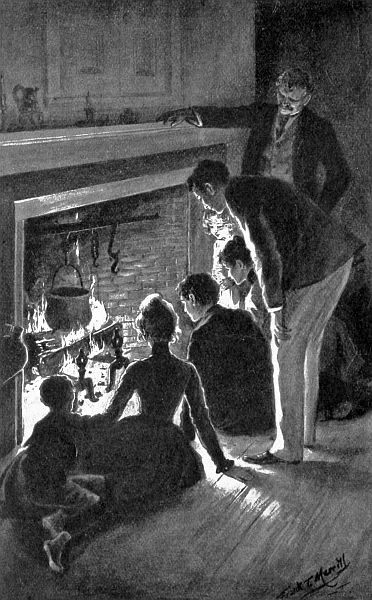
“A woman’s story at a winter’s fire.”—Macbeth.
We come now to those things considered
as distinctly unlucky, and to be avoided
accordingly. How common is the peevish exclamation
of “That’s just my luck!” Spilling
the salt, picking up a pin with the point
toward you, crossing a knife and fork, or giving
any one a knife or other sharp instrument,
are all deemed of sinister import now,
as of old.
One must not kill a toad, which, though
“ugly and venomous,
Wears yet a precious jewel in its head,”
or a grasshopper, possibly by reason of the
veneration in which this voracious little insect
was held by the Athenians, whose favorite
symbol it was, although it is now outlawed,
and a price set upon its head as a pest, to
be ruthlessly exterminated, by some of the
Western states. So, too, with the warning
not to kill a spider, against which, nevertheless,
the housemaid’s broom wages relentless
war. If, on the contrary, you do not kill
the first snake seen in the spring, bad luck
will follow you all the year round. Be it
ever so badly bruised, however, the belief
holds fast in the country that the reptile will
not die until sunset, or with the expiring day,
“That like a wounded snake drags its slow length along.”
The peacock’s feathers were supposed to be
unlucky, from an old tradition associating its
gaudy colors with certain capital sins, which
these colors were held to symbolize. Nevertheless,
this tall and haughty feather has been
much the fashion of late years as an effective
mantel ornament, showing how reckless some
people can be regarding the prophecy of evil.
Getting married before breakfast is considered
unlucky. It would be quite as logical
to say this of any other time of the day; hence
unlucky to get married at all, though it is not
believed all married people will cordially subscribe
to this heresy.
May is an unlucky month to be married in.
So, also
“If you marry in Lent
You will live to repent.”
Old Burton says, “Marriage and hanging go
by destiny; matches are made in heaven.”
Getting out of bed on the wrong side bodes
ill luck for the rest of the day. A common
remark to a person showing ill-humor is, “I
guess you got out of the wrong side of the bed
this morning.” It has in fact become a
proverb.
To begin dressing yourself by putting the
stocking on the left foot first would be trifling
with fortune. I know a man who would not do
so on any account. It is also unlucky to put
a right foot into a left-hand shoe, or vice versa.
These are necessary corollaries of the “right-foot-foremost”
superstition.
According to that merry gentleman, Samuel
Butler:—
“Augustus having b’oversight
Put on his left shoe for his right,
Had like to have been slain that day,
By soldiers mutining for their pay.”
Cutting the finger nails on the Sabbath is a
bad omen. There is a set of rhymed rules for
the doing of even this trifling act. Apparently,
the Chinese know the omen, as they do not
cut the nails at all.
Of the harmless dragon-fly or devil’s darning-needle,
country girls say that if one flies in your
face it will sew up your eyes.
In some localities I have heard it said that if
two persons walking together should be parted
by a post, a tree, or a person, in their path,
something unlucky will surely result—
“Unless they straightway mutter,
‘Bread and butter, bread and butter.’”
Low, the pirate, would not let his crew work
on the Sabbath, not so much, we suppose, from
conscientious scruples, as for fear it would bring
him bad luck. The rest of the Decalogue did
not seem to bother him in the least.
After having once started on an errand or a
journey, it is unlucky to go back, even if you
have forgotten something of importance. All
persons afflicted with frequent lapses of memory
should govern themselves accordingly.
This belief seems clearly grounded upon the
dreadful fate of Lot’s wife.
It was always held unlucky to break a piece
of crockery, as a second and a third piece
shortly will be broken also. This is closely
associated with the belief respecting the number
three, elsewhere referred to. In New England
it is commonly said that if you should
break something on Monday, bad luck will follow
you all the rest of the week.
To stumble in going upstairs is also unlucky;
perhaps to stumble at any other time. Friar
Lawrence says, in “Romeo and Juliet,”—
“They stumble that run fast.”
Two persons washing their hands in the same
basin or in the same water will quarrel unless
the sign of the cross be made in the water.
It is considered unlucky to take off a ring
that was the gift of a deceased person, an engagement,
or a marriage ring.
The term “hoodoo,” almost unknown in the
Northern United States a few years ago, has
gradually worked its way into the vernacular,
until it is in almost everybody’s mouth. It is,
perhaps, most lavishly employed during the
base-ball season, as everyone knows who reads
the newspapers, to describe something that has
cast a spell upon the players, so bringing about
defeat. The term is then “hoodooing.” The
hoodoo may be anything particularly ugly or
repulsive seen on the way to the game—a
deformed old woman, a one-legged man, a lame
horse, or a blind beggar, for instance. Most
players are said to give full credit to the power
of the hoodoo to bewitch them. Indeed, the
term has been quite widely taken up as the
synonym for bad luck, or, rather, the cause of
it, even by the business world. If this is not,
to all intents, a belief in witchcraft, it certainly
comes very close to what passed for witchcraft
two hundred years ago.
This vagrant and ill-favored word “hoodoo”
is, again, a corruption of the voudoo of the ignorant
blacks of the South, with whom, in fact, it
stands, as some say, for witchcraft, pure and
simple, or, perhaps, the Black Art, as practised
in Africa; while others pronounce it to be a
religious rite only. More than this, the voudoo
also is a mystic order, into whose unholy mysteries
the neophyte is inducted with much barbaric
ceremony. In the case of a white woman
so initiated in Louisiana, this consisted in the
elect chanting a weird incantation, while the
novitiate, clad only in her shift, danced within a
charmed circle formed of beef bones and skeletons,
toads’ feet and spiders, with camphor and
kerosene oil sprinkled about it. All those present
join in the dance to the accompaniment of
tom-toms and other rude instruments, until physical
exhaustion compels the dancers to stop.
In its main features we find a certain resemblance
between the voudoo dance of the ignorant
blacks and the ghost dance practised by
some of the wild Indians of the West, and by
means of which they are wrought up to the
highest pitch of frenzy, so preparing the way
for an outbreak, such as occurred a few years
ago with most lamentable results.
While the sporting fraternity is notoriously
addicted to the hoodoo superstition, yet it is by
no means confined to them alone. Not long
ago a statement went the rounds of the newspapers
to the effect that the superstitious wife
of a certain well-known millionnaire had refused
to go on board of their palatial yacht because
one of the crew had been fatally injured by falling
down a hatchway. In plain English, the
accident had hoodooed the ship.
But the power of the hoodoo would seem not
to be limited to human beings, according to this
statement, taken from the columns of a reputable
newspaper: “A meadow at Biddeford,
Maine, is known as the hoodoo lawn, for the
reason that rain follows every time it is mowed,
before the grass can be cured. It is said that
this has occurred for twenty-five consecutive
years.”
To break the spell of the hoodoo, it is as
essential to have a mascot, over which the
malign influence can have no power, as to
have an antidote against poisons. Therefore
most ball-players carry a mascot with them.
Sometimes it is a goat, or a dog, or again a
black sheep, that is gravely led thrice around
the field before the play begins.
It is not learned whether or not the different
kinds of mascot have ever been pitted
against each other. Perhaps the effect would
be not unlike that described by Cicero in his
treatise on divination. He says there that
Cato one day met a friend who seemed in a
very troubled frame of mind. On being asked
what was the matter, the friend replied: “Oh!
my friend, I fear everything. This morning
when I awoke, I saw, shall I say it? a mouse
gnawing my shoe.” “Well,” said Cato, reassuringly,
“calm yourself. The prodigy
really would become frightful if the shoe had
been gnawing the mouse.”
Naval ships often carry a goat, or some
other animal, as a mascot, in deference to
Jack’s well-known belief in its peculiar efficacy;
and in naval parades the goat usually gravely
marches in the procession, and comes in for
his share of the applause. Simple-minded
Jack christens his favorite gun after some
favorite prize-fighter. And why not? since
the great Nelson, himself, carried a horseshoe
nailed to his mast-head, and since even some
of our college foot-ball teams bring their mascots
upon the field just like other folk.
The war with Spain could hardly fail of
bringing to light some notable examples of
the superstitions of sailors concerning mascots.
The destruction of Admiral Cervera’s fleet,
off Santiago de Cuba, by the American fleet,
under command of Admiral Sampson, is freshly
remembered. One of the destroyed Spanish
ships was named the Colon. Twenty-six days
after the battle, the tug-boat Right Arm of the
Merritt-Chapman Wrecking Company visited
the Colon, for the purpose of raising the Spanish
cruiser. The only living thing aboard was
a black and white cat. For nearly a month it
had been the sole crew and commander of the
wrecked battle-ship.
The crew of the Right Arm took possession
of the cat, adopted it as a mascot and
named it Tomas Cervera. But Cervera brought
ill luck. When Lieutenant Hobson raised the
Maria Teresa the rescued cat was placed
aboard her, to be brought to America.
The Maria Teresa never reached these shores,
and when the vessel grounded off the Bahamas
the cat fell into the hands of the natives. He
was rescued the second time, and at last
reached America, a passenger on the United
States repair ship Vulcan.
It will be admitted that this cat did not
belie that article of the popular belief, which
ascribes nine lives to his tribe. But poor
Tomas Cervera did not long survive the various
hardships and perils to which he had been
subjected. He gave up the ghost shortly
after all these were happily ended.
Speaking of ships and sailors, it is well
known to all seafaring folk that the reputation
of a ship for being lucky, or unlucky, is
all important. And this reputation may begin
at the very moment when she leaves the stocks.
Should she, unfortunately, stick on the ways,
in launching, a bad name is pretty sure to
follow her during the remainder of her career,
and to be an important factor in her ability
to ship a crew. Even the practice of christening
a ship with a bottle of wine is neither more
nor less than a survival of pagan superstition
by which the favor of the gods was invoked.
The superstition regarding thirteen persons
at the table also boasts a remarkable vitality.
Just when or how it originated is uncertain.
It has been surmised, however, that the Paschal
Supper was the beginning of this notion,
for there were thirteen persons present then,
and what followed is not likely to be forgotten.
It has, perhaps, been the subject of greater
ridicule than any other popular delusion, probably
from the fact of its touching convivial
man in his most tender part,—to wit, the
stomach. In London some of the literary and
other lights even went to the trouble of forming
a Thirteen Club for the avowed purpose
of breaking down the senseless notion that if
thirteen persons were to sit down to dinner
together, one of them would die within a twelvemonth.
The motto of this club should have
been, “All men must die, therefore all men
should dine.” If the club’s proceedings showed
no lack of invention and mother wit, we still
should very much doubt their efficacy toward
achieving the avowed end and aim of the
club’s existence, for surely such extravagances
could have no other effect than to raise a
laugh. We reproduce an account of the affair
for the reader’s amusement:—
“At the dinner of the club, above mentioned,
there were thirteen tables, a similar number of
guests being seated at each table. The serving
of the meal was announced by the “shivering”
of a mirror placed on an easel, a ceremony performed
by two cross-eyed waiters! Having put
on green neckties and placed a miniature skeleton
in their button-holes, the guests passed
under a ladder into the dining room. The
tables were lighted with small lamps placed on
plaster skulls; skeletons were suspended from
the candles, which were thirteen in number on
each table; the knives were crossed; the salt-stands
were in the shape of coffins, with headstones
bearing the inscription, ‘In memory of
many senseless superstitions, killed by the
London Thirteen Club, 1894.’ The salt-spoons
were shaped like a grave-digger’s spade.
“After the dinner was fairly started, the
chairman asked the company to spill salt with
him, and later on he invited them to break looking-glasses
with him, all of which having been
done, he presented the chairmen of the different
tables with a knife each, on condition that
nothing was given for them in return. An
undertaker, clothed in a variety costume, which
would have done credit to a first-class music
hall, was then introduced ‘to take orders,’ but
he was quickly shuffled out of the room.”
These unbelieving jesters, who so audaciously
defied the fatal omen, did not seem to realize
that a popular superstition is not to be laughed
out of existence in so summary a manner.
Equally futile was the attempt to put it to a
scientific test, as, if tried by that means, it appears
that, of any group of thirteen persons, the
chances are about equal that one will die within
the year. Therefore, the attempt to break the
spell by inviting a greater number of persons
could have the effect only of increasing, rather
than diminishing, the probability of the event so
much dreaded.18
It has been stated in the newspapers, from
which I take it, that there are many hotels in
New York which contain no room numbered thirteen.
There are other hotels and office buildings
wherein the rooms that are so numbered cannot
be leased except once in a great while. In
large hotels one custom is to letter the first
thirteen rooms and call them parlors. Another
custom is simply to skip the unpopular number,
and call the thirteenth room “No. 14.” A man
who had just rented an office which bears the
objectionable number, in a down-town building,
asserts that though he has no superstitious
dread of the number, he finds that others will
not transact business with him in that office. I
also find it stated as a fact that the new monster
passenger steamship Oceanic has no cabin or
seat at the table numbered thirteen.
It was again instanced as a deathblow to a
certain candidate’s hopes of a reëlection to the
United States Senate, that repeated ballotings
showed him to be just thirteen votes short of the
required number. From the same state, Pennsylvania,
comes this highly significant announcement
in regard to a base-ball team:
“Because the team left here on a very rainy day,
and on a train that pulled out from track No. 13,
the superstitious local fans (sic) are in a sad
state of mind to-night, regarding the coincidence
as an evil omen.” Again the small number of
six, in the graduating class of a certain high
school, was gravely referred to as owing to there
having originally been thirteen in that class.
At the same time there are exceptions which,
however, the superstitious may claim only go to
prove the rule. For instance the Thirteen Colonies
did not prove so very unlucky a venture.
As regards the superstitions of actors and
actresses, the following anecdote, though not
new, probably as truly reflects the state of
mind existing among the profession to-day as
it did when the incident happened to which it
refers. When the celebrated Madame Rachel
returned from Egypt in 1857, she asked
Arsène Houssaye, within a year thereafter,
the question: “Do you recollect the dinner
we had at the house of Victor Hugo? There
were thirteen of us,—Hugo and his wife, you
and your wife, Rebecca and I, Girardin and
his wife, Gerard de Nerval, Pradier, Alfred de
Musset, Perrèe, of the Siècle, and the Count
d’Orsay, thirteen in all. Well, where are they
to-day? Victor Hugo and his wife are in
Jersey, your wife is dead, Madame de Girardin
is dead, my sister Rebecca is dead, De
Nerval, Pradier, Alfred de Musset, and
d’Orsay are dead. I say no more. There
remain but Girardin and you. Adieu, my
friends. Never laugh at thirteen at a table.”
The world, however, especially that part of
it represented by diners out, goes on believing
in the evil augury just the same. A dinner
party is recalled at which two of the invited
guests were given seats at a side table on
account of that terrible bugbear “thirteen at
table.” When mentioning the circumstance
to a friend, he was reminded of an occasion
where an additional guest had been summoned
in haste to break the direful spell.
Unquestionably, the newspapers might do
much toward suppressing the spread of superstition
by refusing to print such accounts as
this, taken from a Boston daily paper, as probably
nothing is read by a certain class with
greater avidity. It says “that engine No. 13
of the Boston, Hoosac Tunnel & Western
Railroad has, within three weeks, killed no
less than three men. The railway hands fear
the locomotive, and say that its number is
unlucky.” It is true, we understand, that the
standard number of a wrecked locomotive,
that has been in a fatal accident, is not unfrequently
changed in deference to this feeling
on the part of the engine-men.
It is held to be unlucky to pass underneath
a ladder, an act which indeed might be dangerous
to life or limb should the ladder fall.
But it is even harder to understand the philosophy
of the dictum that to meet a squinting
woman denotes ill luck.
The bird was formerly accounted an unlucky
symbol, perhaps from the fact that
good fortune, like riches, is apt to take to
itself wings. The hooting of an owl, the
croaking of a raven, the cry of a whip-poor-will,
and even the sight of a solitary magpie
were always associated with malignant influences
or evil presages. Poe’s raven furnishes
the theme for one of his best-known poems.
And the swan was long believed to sing her
own death-song. Be that as it may, the fact
is well remembered that a ring, bearing the
device of a bird upon it, or any other object
having the image of the feathered kind, was
not considered a suitable gift to a woman.
That article of superstition, like some others
that could be mentioned, has vanished before
the resistless command of fashion, so completely
indeed, that birds of every known
clime and plumage have since been considered
the really proper adornment for woman’s headgear.
There is, however, an odd superstition connected
with the magpie, an instance of which
is found related by Lord Roberts, in “Forty-one
Years in India.” We could not do better
than give it in his own words: “On the 15th
July Major Cavagnari, who had been selected
as the envoy and plenipotentiary to the Amir
of Kabul, arrived in Kuram. I, with some
fifty officers who were anxious to do honor
to the envoy and see the country beyond
Kuram, marched with Cavagnari to within
five miles of the crest of Shutargardan pass,
where we encamped, and my staff and I dined
that evening with the mission. After dinner
I was asked to propose the health of
Cavagnari and those with him, but somehow
I did not feel equal to the task: I was so
thoroughly depressed, and my mind filled with
such gloomy forebodings as to the fate of
these fine fellows, that I could not utter a
word.
“Early next morning the Sirdar, who had
been deputed by the Amir to receive the mission,
came into camp, and soon we all started
for the top of the pass.... As we ascended,
curiously enough, we came across a solitary
magpie, which I should not have noticed had
not Cavagnari pointed it out and begged me
not to mention the fact of his having seen
it to his wife, as she would be sure to consider
it an unlucky omen.
“On descending to the (Afghan) camp, we
were invited to partake of dinner, served in
the Oriental fashion on a carpet spread on
the ground. Everything was done most lavishly
and gracefully. Nevertheless, I could
not feel happy as to the prospects of the mission,
and my heart sank as I wished Cavagnari
good-by. When we had proceeded a
few yards in our different directions, we both
turned round, retraced our steps, shook hands
once more, and parted forever.”
The sequel is told in the succeeding chapter.
“Between one and two o’clock on the morning
of the 5th of September, I was awakened by
my wife telling me that a telegraph man had
been wandering around the house and calling
for some time, but that no one had answered
him. The telegram told me that my worst fears
had been only too fully realized.” Cavagnari
and his party had been massacred by the
Afghans.
Again, there are certain things which may
not be given to a male friend (young, unmarried
ministers excepted), such, for example, as
a pair of slippers, because the recipient will be
sure, metaphorically speaking, to walk away
from the giver in them.
There is also current in some parts of New
England a belief that it is unlucky to get one’s
life insured, or to make one’s will, under the
delusion that doing either of these things will
tend to shorten one’s life. This feeling comes
of nothing less than a ridiculous fear of facing
even the remote probability involved in the act;
and is of a piece with the studied avoidance of
the subject of death, or willing allusion in any
way, shape, or form to the dead, even of one’s
own kith and kin, quite like that singular belief
held by the Indians which forbade any allusion
to the dead whatsoever.
Spilling the salt, as an omen of coming misfortune,
is one of the most widespread, as well
as one of the most deeply rooted, of popular
delusions. It is said to be universal all over
Asia, is found in some parts of Africa, and is
quite prevalent in Europe and America to-day.
Vain to deny it, the unhappy delinquent who
is so awkward as to spill salt at the table
instantly finds all eyes turned upon him. Worse
still, the antidote once practised of flinging
three pinches of salt over the left shoulder is
no longer admissible in good society. Instantly
every one present mentally recalls the omen.
His host may politely try to laugh it off, but all
the same, a visible impression of something
unpleasant remains.
Something was said in another place about
the potency of the number “three” to effect
a charm either for good or for evil. Firemen
and railroad men are more or less given to the
belief that if one fire or one accident occurs, it
will inevitably be followed by two more fires or
accidents. A headline in a Boston newspaper,
now before me, reads, “The same old three
fires in succession,” and then hypocritically
exclaims, “How the superstitious point to the
recurrence!”
The superstition about railroad accidents is
by no means confined to the trainmen, or other
employees, but to some extent, at least, is shared
even by the higher officials, who point to their
past experiences in the management of these
iron highways as fully establishing, to their
minds, certain conditions. One of these gentlemen
once said to me, after a bad accident
on his road, “It is not so much this one particular
accident that we dread, as what is coming
after it.” I also knew of a conductor who
asked for a leave of absence immediately after
the occurrence of a shocking wreck on the
line.
Although periodically confronted with a long
series of most momentous events in the world’s
history that have happened on that day of
the week, the superstition in regard to Friday,
as being an unlucky day, has so far withstood
every assault. It will not down. Whether it
exists to so great an extent as formerly may
be questioned, but that it does exist in full
force, more especially among sailors, is certain.
We have it on good authority that this self-tormenting
delusion grew out of the fact that
the Saviour was crucified on Friday, ever after
stigmatized as “hangman’s day,” and, therefore,
set apart for the execution of criminals,
now as before time.
It is not wholly improbable that some share
of the odium resting upon Friday may arise
from the fact of its being so regularly observed
as a day of fasting, or at least maigre,
by some religionists.
In some old diaries are found entries like the
following: “A vessel lost going out of Portland
against the advice of all; all on board,
twenty-seven, drowned.” It is easy to understand
how such an event would leave an indelible
impression upon the minds of a whole
generation.
Notwithstanding the belief is openly scouted
from the pulpit, and is even boldly defied by
a few unbelieving sea-captains, the fact remains
that there are very many sober-minded persons
who could not be induced on any account to
begin a journey on Friday. There are others
who will not embark in any new enterprise, or
begin a new piece of work on that day; and
still others who even go so far as to say that
you must not cut your nails on Friday. A man
could be named who could not be tempted to
close a bargain on any other day of the week
than Thursday. It is a further fact, which all
connected with operating railroads will readily
confirm, that Friday is always the day of least
travel on their lines. This circumstance alone
seems conclusive as to the state of popular
feeling. Apparently a brand has been set
upon the sixth day of the week for all time.
Numerous instances might be given to show
that men of the strongest intellect are as fallible
in this respect as men of the lowest; but
one such will suffice. Lord Byron once refused
to be introduced to a lady because it was Friday;
and on this same ill-starred day he would
never pay a visit.
“See the moon through the glass,
You’ll have trouble while it lasts.”
This warning couplet is still a household
word in many parts of New England. It has
been observed that even those sceptical persons
who profess to put no faith in it whatever, generally
take good care to keep on the right side
of the window-glass. As bearing upon this
branch of the general subject an incident is
related by a reputable authority, as having
occurred at a party given, not many years ago,
by a gentleman holding a considerable station
in life. It is therefore repeated here word for
word.
“In the midst of a social chat, at the close of
the day, a footman rather briskly entered the
drawing-room, and walked up to the back of
the chair of the hostess and whispered something
in her ear; she immediately closed her
eyes and gave her hand to the man, and was
forthwith led by him from the room. The
guests were rather astonished, but after the
lapse of a few moments the lady returned and
resumed her seat.
“Her sudden departure having occasioned a
rather uneasy pause in the conversation, she
felt it necessary to state the cause of her singular
conduct. She then told us that the New
Harvest Moon had just made its appearance,
and it was her custom to give a crown to any
of her servants that first brought the information
to her when that event occurred; and that
the reason why she closed her eyes, and was
led by the footman out of the room to the open
air, was that she might avoid the evil consequences
that were sure to happen to her if she
obtained her first glimpse of the Harvest Moon
through a pane of glass. This lady was highly
accomplished, and possessed remarkable sagacity
upon most subjects, but was nevertheless
a slave to a groundless fear of evil befalling her
if she saw this particular New Moon in any
other way than in the open air.”
It is passing strange, however, that the
gentle and beautiful Queen of the Night
should have been mostly associated with a
malignant influence. Juliet pleads with Romeo
not to swear by the “inconstant moon.” The
traditional witch gathers her simples only by
the light of the moon, as at no other time do
they possess the same virtues to work miraculous
cures or potent spells. It is also an old
belief that if a person goes to sleep with the
moonbeams shining full upon his uncovered
face, he will be moonstruck, or become an
idiot. I well remember to have seen the officer
of the watch awaken a number of sleepers, who
had taken refuge on the deck of a vessel from
the stifling heat below. Milton speaks of
“Moping melancholy
And moonstruck madness,”
which has become incorporated with the language
under the significant nickname of
“luny.”
When we consider the already long list of
material or immaterial objects threatening us
with dire misfortune, the wonder is how poor
humanity should have survived so many dangers
ever impending over it like the sword of
Damocles. Really, we seem “walking between
life and death.” The catalogue is, however, by
no means exhausted. A picture, particularly if
it be a family portrait, falling down from the
wall, bodes a death in the family, or at least
some great misfortune. This incident, somewhat
startling, it must be confessed, to weak
nerves, has been quite effectively used in
fiction.
Notwithstanding it is the national color of
Ireland, green has the name of being unlucky.
More strange still is the statement made by
Mr. Parnell’s biographer that the famous Irish
leader could not bear the sight of green.
Queer notion this, in a son of the Emerald
Isle! Mr. Barry O’Brien goes on to say that
Parnell “would not pass another person on the
stairs; was horror-stricken to find himself sitting
with three lighted candles; that the fall of
a picture in a room made him dejected for the
entire afternoon; and that he would have nothing
to say to an important bill, drawn up by a
colleague, because it happened to contain thirteen
clauses.” It is added that the sight of
green banners, at the political meetings he
addressed, often unnerved him.
The singular actions of a pet cat have
recently gained wide currency and wider comment
in connection with the ill-fated steamer
Portland, which went down with all on board,
during the great gale of November 27, 1898.
Not a soul was left to tell the tale. It was
remarked that puss came off the boat before
the regular hour for sailing had arrived, and
though she had never before been known to
miss a trip, she could not be called or coaxed
back on board, and the doomed craft therefore
sailed without her. As a matter of fact, it has
been noticed that in times of great disasters,
like that just related, superstition that has lain
dormant for a time, always shows a new vigor,
and finds a new reason for being.
In the course of my rambles along the New
England coast, I found many people holding to
beliefs of one sort or another, who hotly resented
the mere suggestion that they were superstitious.
The quaint and curious delusions which
have become ingrained in their lives from generation
to generation, they do not regard in
that light. For one thing they believe that if a
dead body should remain in the house over
Sunday, there will be another death in the
family before the year is out.
The ticking of the death-watch, once believed
to forebode the approaching dissolution of some
member of the family, so terrifying to our fathers
and mothers, is now, fortunately, seldom
heard or little regarded. While the superstition
did prevail, there was nothing so calculated
to strike terror to the very marrow of the
appalled listeners as the noise of this harmless
little beetle, only a quarter of an inch long,
tapping away in the decaying woodwork of an
ancient wainscot.
There is no end of legendary matter concerning
clocks. Sometimes nervous people have
been frightened half out of their wits at hearing
a clock that had stopped, suddenly strike the
hour. Clocks have been known to stop, too,
at the exact hour when a death took place in
the house. But even more startling was an
instance, lately vouched for by reputable witnesses,
of a clock, of the coffin pattern, of
course, from which the works had been removed,
playing this same grewsome trick. The first
case might be accounted for, rationally, by some
fault in the mechanism, or some rusty spring
suddenly set in motion; but all theories necessarily
fail with clocks without works. Admonitions
or warnings are often associated with
clocks, as has been noticed in connection with
marriage customs. And the mystical relation
between time and eternity is often brought to
mind by the stopping of the watch in a drowned
person’s pocket, or the relation of some curious
legend like the following, without comment or
qualification, in a reputable newspaper:—
“There is a curious legend about the old
clock, which is to be superseded by a new one,
at Washington, Pennsylvania. It is stated that
about twenty years ago a person was hung in
the courtyard. The clock, which had always
tolled out the hour regularly, stopped at the
hour of two o’clock, being the hour at which
the drop fell that sent the unfortunate into
eternity. Since that time, many aver, the clock
has never struck again.”
So, also, the howling of a dog, either by day
or by night, under a sick person’s window, is to
this day held by the weak-minded to portend
the death of that person. Some writers think
they have traced this belief to the symbolism
of ancient mythology, where the dog stands for
the howling night-wind, on which the souls of
the dead rode to the banks of the Styx, but this
hypothesis seems quite far-fetched.
The winding-sheet in the candle is another
self-tormenting belief of evil portent, now happily
gone out with the candle.
Then again, to pass from this subject, a
single case of nosebleed often excites the liveliest
fears on the part of nervous people, on
account of a very old belief that it was a sure
omen of a death taking place in the family.
Not long ago the following choice morsel met
my eye while reading in a book: “Our steward
has this moment lost a drop of blood, which
involuntarily fell from his pug nose. ‘There,’
said he, ‘I have lost my mother—a good
friend.’”
Breaking a looking-glass denotes that a death
will take place in the family within the year.
This mode of self-torture is supposed to derive
its origin from the great use formerly made of
mirrors by magicians and other obsolete impostors
in carrying on their mystical trade.
Astrologers also made use of the looking-glass
in practising the art of divination or foretelling
events, probably by means of some such cunning
contrivances as are now employed with
startling effects by our own “wizards” and
“necromancers.” Quite naturally the innocent
glass itself came to be looked upon by the
ignorant with superstitious awe, and the breaking
of one as the sure forerunner of calamity.
We do not think, however, that this old superstition
is by any means as widely prevalent as it
once was.
It is pleasing to chronicle the total disappearance
of that terrible bugaboo, the Evil Eye,
which so long kept our ancestors in a state of
nervous apprehension fearful to contemplate.
It is now only perpetuated by a saying. So
with that other equally repulsive belief in the
efficacy of touching a dead body, as a means of
convicting a suspected murderer by the fresh
bleeding from the wound. Both of these superstitions
were fully accepted by the first settlers
of New England, and perhaps also in other of
the colonies. John Winthrop relates a very
harrowing case of infanticide, in which this
monstrous test was put in practice to convict
the erring mother.19 The superstition is said to
be of German origin.
The following very curious piece of superstition
is found in Colonel May’s Journal of his
trip to the Ohio, early in the century. It
seems that a man had fallen into the river
and was drowned before help could reach him.
The following method was employed to recover
the body. First they took the shirt which the
drowned man had last worn, put a whole loaf
of good, new bread, weighing four pounds, into
it, and tied it up carefully into a bundle. The
bundle was then taken in a boat to the place
where the man had fallen in, a line and tackle
attached to it, and then set afloat on the water.
The rescuers said that the bread would float
until it should come directly over the body,
when it would sink and thus discover the location
of the dead man. Unfortunately, the line
was not long enough, so that when the loaf
filled with water and sank, the tackle disappeared
with it.
X OF HAUNTED HOUSES, PERSONS, AND PLACES
“Three times all in the dead of night,
A bell was heard to ring.”—Tickell.
Haunted houses have proved an insuperable
stumbling-block to those wiseacres
who no sooner insist that superstition has
died out than the familiar headline in the daily
paper, “A haunted house,” stares them full in
the face. It is believed that many such houses
stand tenantless to-day because of the secret
fear they inspire in the minds of the timid or
superstitious, who, quite naturally, shrink from
living under the same roof with disembodied
spirits. It has already been noted that M.
Camille Flammarion is a firm believer in
haunted houses. Here is what he has to say
upon that much debated subject:—
“There is no longer any room to doubt the
fact that certain houses are haunted.
“I began the scientific studies of these questions
on November 15, 1861, and I have continued
it ever since. I have received more than
four thousand letters upon these questions from
the learned men of every land, and I am glad
to be able to say that some of the most interesting
letters come from America.”
For every haunted house there must, of
course, be an invisible intruder who comes
only in the small hours, when the effects of
its unwelcome presence would, of course, be
most terrifying to weak nerves. But it is to
be remarked that we hear nothing nowadays
of the old-time, hair-raising, blood-curdling
ghost whose coming forebode something terrible
about to happen, or who had some awful
revelation to make. That type of ghost has
passed away. The modern ghost never makes
set speeches in a sepulchral voice or leaves a
palpable smell of brimstone behind. It comes
rather in a spirit of mischief-making, shown in
such petty annoyances as setting the house bells
ringing, overturning articles of furniture, twitching
the bedclothes from off a sleeping person in
the coldest of cold nights, putting out the lights,
or making a horrible racket, first in one room,
then in another, as if it revelled in pure wantonness
of purpose. In short, there is no limit
to the ingenious deviltries perpetrated by this
nocturnal disturber of domestic peace and
quiet.
After two or three sleepless nights, followed
by days of quaking apprehension, the occupants
usually move out, declaring that they
would not live in the house if it were given
to them. And so it stands vacant indefinitely,
shunned by all to whom its evil reputation has
become known, a visible monument of active
superstition.
That all these things have happened as
lately as in this year of grace (1900) is too
well known to be denied. And as most people
would desire to shun publicity in such a matter,
there are probably very many cases that never
reach the public eye at all. One such is reported
of a family at Charlestown, Massachusetts,
being disturbed by strange noises, as of
some one pounding on the walls or floors at
all hours of the night. Even the police, when
summoned, failed to lay hands on the invisible
tormentor, who, like the ghost in Hamlet,
was here, there, and nowhere in a jiffy.
One of the most singular cases that have
come to my knowledge, perhaps because the
unaccountable disturbances happened in the
daytime, whereas they habitually occur only in
the night-time, when churchyards are supposed
to yawn, was that of a haunted schoolhouse.
This was downright bravado. If we do not err,
in this case a bell was repeatedly rung during
the regular sessions, by no visible agency, to
the amazement of both teachers and scholars.
After a vain search for the cause, the schoolhouse
was shut up, and so remained for a considerable
time, a speechless but tangible witness
to the general belief that the devil was at the
bottom of it all.
Not many generations ago, when ghosts were
perhaps more numerous than at present, there
were professional exorcists who could be hired
to clear the premises of ghosts or no pay; but
this is now a lost art. As Shakespeare says:—
“No exorciser harm thee!
Nor no witchcraft charm thee!
Ghost unlaid forbear thee!”
While upon this interesting subject it may be
instructive to know what our ancestors sometimes
suffered from similar visitations. We
take the following extract from Ben Franklin’s
New England Courant, of 1726:—
“They write from Plymouth, that an extraordinary
event has lately happened in that neighborhood,
in which, some say, the Devil and the
man of the house are very much to blame.
The man it seems, would now and then in a
frolic call upon the Devil to come down the
chimney; and some little time after the last invitation,
the goodwife’s pudding turned black in
the boiling, which she attributed to the Devil’s
descending the chimney, and getting into the
pot upon her husband’s repeated wishes for
him. Great numbers of people have been to
view the pudding, and to inquire into the circumstances;
and most of them agree that so
sudden a change must be produced by a preternatural
power. However, ’tis thought it will
have this good effect upon the man, that he will
no more be so free with the Devil in his cups,
lest his Satanic Majesty should again unluckily
tumble into the pot.”
But houses are by no means the only things
subject to these astounding visitations. Dark
and secluded ponds, thick swamps, and barren
hillsides often bear that unsavory reputation
to-day, it may be from association with some
weird tale or legend, or mayhap because such
places seldom fail, of themselves, to produce a
certain effect upon an active imagination. Let
any such person, who has ever been lost in some
thick forest, recall his sensations upon first
making the unwelcome discovery. The solemn
old woods then seem all alive with—
“The dim and shadowy armies of our unquiet dreams,
Their footsteps brush the dewy fern and print the shaded streams.”
As regards haunted ships, the following incident,
taken down as literally as I could transcribe
it at the time, from the lips of a seafaring
friend, speaks for itself:—
“‘Twas some dozen year ago, may be less,
may be more—beats all how time travels when
you’ve turned the half-century post—I was
aboard of the old Paul Pry—queer name, now,
warn’t it? We was a lyin’ in Havana harbor,
all snug, about a mile from shore. Well, the
mate he was on watch. In port, you know,
ships always keep slack watch. Our’n was light,
nothin’ in her, hold all swep’ out clean that very
day, ’cause we was to begin takin’ in sugar and
molasses in the mornin’. All hands were off in
the ship’s boat visitin’ another ship—all ’cept
the steward. The old man, he was ashore.
“I’m slow, but you just hold your hosses.
All to once’t the mate thought he heern somebody
walkin’ back’ards and for’ards plumb down
in the hold. He walked to the open hatch and
called down, ‘Who’s there?’ No answer. He
listened. No sound. Thinkin’ it might possibly
have been the steward getting his firewood,
the mate went for’ard to the steward’s room to
see if it was so, and found him fast asleep in his
bunk. That settled it. Nobody aboard but
them two.
“The mate he said nothin’ to nobody, but got
a lantern and slipped quietly down the ladder
into the hold, determined to find out who was
skylarkin’ there, for I tell you the mate he was
a game one all the time, and don’t you b’leeve
he warn’t!
“He hunted high and low, from the fore-peak
to the run, but not a soul was to be seen
anywhere; but just as soon as he stood still
he would hear those myster’ous footsteps go
trampin’ fore and aft, fore and aft, as plain as
day, right by him, where he stood.
“By this time the mate had got pretty well
worked up, I want you to know, so he just gin
one kinder skeered look around him, and then
hustled himself off up that ladder just a leetle
mite faster than he came down, wonderin’ to
himself what it all could mean, and thinkin’ all
sorts of things to once’t.
“Then he went and woke up the steward, and
both on ’em went and listened fust at one hatch,
then at t’other, and sure enough that consarned
tramp, tramp, tramp, was a-goin’ on agin just
the same as before. Then they pulled on the
hatches. But, Lor’ bless you, it warn’t no use.
Them critters down below had the bulge on ’em
every time.
“The mate he said nothin’ ’cept to the old
man, who looked as black as a new-painted
deadeye with the lanyards unrove when he
heerd it; but somehow it leaked out among the
crew before we sailed, and one or two ran away
and laid low till the ship was clean out of the
harbor.
“It was gen’lly b’leeved fore and aft that them
there footsteps was a warnin’. Hows’ever, the
thing quieted down some in a day or two, so
nothin’ more was heerd of the walkin’ match
down below; but on the third day out, I think
it was, we was struck by one of them northers,
and in spite of all we could do we was drove
ashore on a reef off the Bermudys, where the
Paul Pry brought up all standin’, and there she
left her old bones. The wreckers they came
and took off the crew, and fetched ’em all safe
into Nassau. Now if that ship warn’t haunted,
I miss my guess. You can’t most always tell
about them things, I know; but ef it was skylarkin’,
all I’ve got to say is, it was a purty neat
job, and don’t you forget it.”
There are also places, as well as houses,
which have the reputation of being haunted,
sometimes through the commission of a horrible
crime in that particular locality, sometimes
through the survival of some obscure
local tradition. It matters not. Once give the
place a bad name, and local tradition preserves
the memory of it for many generations. Every
schoolboy is familiar with the weird legend of
Nix’s Mate, a submerged island at the entrance
to Boston Harbor, where pirates were formerly
hung in chains. Appledore Island, on the
coast of New Hampshire, once had the name
of being haunted by the uneasy ghost of one
of Captain Kidd’s piratical crew. The face of
the spectre was said by those who had seen it,
or who thought they had seen it, to be dreadful
to behold, and the neck to bear the livid mark
of the hangman’s noose. Once, no islander
could be found hardy enough to venture himself
on Appledore after dark. Indeed, such places
of fearsome reputation are found all over New
England. For example, there is the shrieking
woman of Marblehead, a remarkable spook,
who at certain intervals of time could be heard
uttering the most heartrending cries for mercy
to her inhuman murderers. Then, again, there
is the legend of Harry Main, reputed pirate and
wrecker, who, by means of false lights, decoyed
simple mariners to destruction on the shoals of
Ipswich Bar, to which for his many crimes the
wretch was doomed to be chained down to the
fatal spot to which he had lured his unsuspecting
victims.20
Quite naturally these legends mostly cluster
about the seacoast, but now and then one is
found in the interior. One corner of the town
of Chester, New Hampshire, lifts into view an
eminence known as Rattlesnake Hill, one rocky
side of which is pierced entirely through, thus
forming a cavern of great notoriety in all the
country round. This cavern is known as the
Devil’s Den, and many were the frightful
stories told around winter firesides of the
demons who, of yore, haunted it, and who, all
unseen of mortal eyes, there held their midnight
orgies within the gloomy recesses of the
mountain.
There are two entrances to this cavern, both
leading to an interior, subterranean chamber,
whose vaulted roof is thickly studded with
pear-shaped protuberances that are said to
shine and sparkle when the flame of a torch
sheds a ruddy glow upon them. According to
popular tradition the path leading to the cavern
was always kept open, summer and winter.
Many years ago the poet Whittier put the
legend into verse:—
“’Tis said that this cave is an evil place—
The chosen haunt of a fallen race—
That the midnight traveller oft hath seen
A red flame tremble its jaws between,
And lighten and quiver the boughs among,
Like the fiery play of a serpent’s tongue:
That sounds of fear from its chambers swell—
The ghostly gibber,—the fiendish yell;
That bodiless hands at the entrance wave—
And hence they have named it the Demon’s Cave.”
The persistent life of such local traditions as
these fully attests to the belief of former generations
of men in the active agency of the Evil
One in human affairs. And not only this, but
this omnipresent devil has actually left his
mark, legibly stamped, in so many places, and
his name in so many others, that to doubt his
actual presence were not only unreasonable but
ungenerous. Even his footprints are found
here and there, yet strange to say, few represent
a cloven foot. The sonorous names,
Devil’s Pulpit and Devil’s Cartway, are found
within a few miles of each other on the coast
of Maine. Moreover, do we not know from a
perusal of the testimony given at the celebrated
witchcraft trials, that the arch-fiend had been
both seen and spoken with in propria persona?
It used to be a not uncommon threat with
quick-tempered people to say that if their
wishes or expectations were not gratified to
their liking, they would “haunt you” when
they died. I myself have often heard this
expression used either in jest or in earnest;
and when used it never failed to leave a disagreeable
impression on the listener.
It is not a great many years ago since an
account was telegraphed all over the country,
and duly appeared in the daily newspapers, of
an honest citizen, a resident of one of the largest
towns in Pennsylvania, whose wife “while
yet in good health, frequently admonished her
friends that she did not wish her body to be
buried in a certain wet graveyard. She threatened
to ‘speak to them’ if her wish was not
granted, and went so far as to tell them how
she would haunt them by coming back in
ghostly form. The wife died, and her body
was buried in the graveyard she had disliked.
Now, strange as it may appear, her husband
alleges that, since the funeral took place, she
has appeared at his bedside several times each
week, always looking at him, and always making
motions with her bony hands, as a mark of
her displeasure. The husband says he is unable
to sleep, and also that he is sure the strange
midnight visitor is none other than his wife.
He declares that whatever other people may
think of it, he himself firmly believes that he
has brought the enmity of the spirit upon himself
and children by their refusal to grant the
wife’s last request. The children’s beds are
also visited by her, as they say, and as a consequence
the family is kept in constant alarm.
One of the nearest neighbors has also seen the
‘spook’ several times, and corroborates the
family in every particular. The terrified husband
relates the facts himself, and it is the
responsibility of the man that warrants publishing
his story of the appearance of the
spook. He gives the account of the strange
happenings in a straightforward manner, which
impresses a person with its truth, and he further
says it is not imagination, a dream, or an
attack of nightmare, but that the spook always
comes when he is wide awake. The women
and children of the neighborhood are in great
terror, and the people hardly venture out of
doors after dark.”
Upon the heels of this experience comes the
following telegram to the Associated Press,
thus disseminating, through its thousand channels,
superstition broadcast:—
[“Copyright, 1899, by The Associated Press.]
“London, March 4, 1899. Another link in
the chain of illfortune which has followed
the famous Newstead Abbey was forged this
week. It seems that a curse rests on the
abbey, and that the eldest has never succeeded
to the estate.
“Byron sold it to Col. Wildman in 1808, who
died childless. The trustees sold it to Webb,
the famous sportsman, whose eldest son died
this week. Byron had the skull which was
reported to have belonged to the ghost that
haunted the abbey, and he used it as a punch
bowl. Webb buried the skull, hoping to lay
the ghost.”
As related to the general subject, it is too
well known that certain persons to-day profess
the power of conversing with disembodied
spirits, to need more than a passing reference
to this particular form of belief, which some
hold to as firmly as to an article of religious
faith, while others consider it a delusion or
worse. Forty odd years ago spirit rappings
convulsed society from one end of the country
to the other. Spiritual séances were vehemently
denounced from the pulpit, and while
fully reported also by the press, the mediums
were charged with being rank impostors, humbugs,
and the like. Alleged exposure followed
exposure. Yet somehow the belief, such as it
is, has contrived to outlive ridicule, calumny,
and persecution—the common lot of every
new and startling departure from the older
beliefs—until to-day it has acquired not only
the right to live, but also that of calm discussion.
Dr. Samuel Johnson once asked the pertinent
question, “If moral evil be consistent with the
government of the Deity, why may not physical
evil be consistent with it?” The solemn declaration
that the sins of the fathers shall be visited
upon the children unto the third and fourth
generations, sometimes recurs to us with startling
force, more especially when the awful
anathema is brought so near home to us as it is
by the following veracious incident.21
There is a certain well-known locality in
Essex County, Massachusetts, which has long
borne the evil reputation of being haunted,
owing to the tradition that a cruel murder was
committed there. According to some of the
old people from whom I had the story, strange
sights and sounds have been both seen and
heard near the spot where the crime took place.
For instance, a child would be heard crying out
most pitifully, though nothing could be seen.
One belated horseman positively declared that
when passing this accursed place he had seen
a child’s coffin moving along the road, as
he moved; and that the spectre followed
him almost into the town of Ipswich. It is
said to be a fact that many of the old folks
were afraid to pass this place of dread after
dark.
As to the origin of the story, with its highly
dramatic features, accounts differ somewhat;
but considerable pains have been taken to arrive
at the truth, since it is a matter of general notoriety
in the neighborhood referred to, although
the actual facts may have no relation whatever
to the “skeleton in the closet” disclosed by the
story itself.
The story goes back to colonial times, and
chiefly has to do with the two daughters of a
family in good social standing. These young
women had for a serving-maid a negro slave,
who was treated with marked severity by her
haughty mistresses.
In time, the slave woman bore a child.
Angered at the coming of the luckless little
waif, the cruel sisters resolved to put it out of
the way. One day the mother found it hid
away in a hogshead of flax, in the garret. Failing
in this attempt, the sisters then took the
child, stuck pins into its veins, and tried to
smother it between two feather beds. When
the infant was thought to be quite dead, the
body was thrown into a brook, under a nearby
bridge which spanned it. Life, however, was
not quite extinct, so that the child’s cries were
heard by a passing traveller, who rescued it, but
it soon after bled to death from the wounds
inflicted upon it.
Half crazed by this dastardly act, the forlorn
mother then and there called down the curse of
God upon the inhuman sisters and their sons to
all future generations.
This is substantially the legend. Now for
the sequel. It is said to be a fact that all the
sons of the daughters of that family, and no
others, have ever since been afflicted with a
strange and incurable malady, the principal
feature being a tendency to profuse bleeding
from the most trifling cuts or wounds. After
some days have elapsed, a mere scratch will
begin to bleed copiously and so continue until
the sufferer has lost so much blood that in some
cases it is said he has bled to death. From
this circumstance the persons so afflicted are
known by the name of “bleeders.”
Mr. Felt asserts that the family in which this
singular hemorrhage first appeared brought it
with them from England; which, if true, would
summarily dispose of the legend; but his statement
does not accord with the story as told on
the spot. It is here related as it was told to
me.
Reference was earlier made to the old-time,
respectable ghost of our fathers, who like the
ghost in Hamlet, made his unwelcome appearance
only to subserve the ends of justice. This
practical generation hardly realizes, we think,
how lately the ghost was accepted in that character,
or how trustworthy his evidence was
deemed by the purveyors of public intelligence.
On turning over the files of the New England
Weekly Journal of December 1, 1729, we came
across the following ghost story, here reproduced
verbatim:—
“Last week, one belonging to Ipswich came
to Boston and related that some time since he
was at Canso in Nova Scotia, and that on a
certain day there appeared to him an apparition
in blood and wounds, and told him that at
such a time and place, mentioning both, he
was barbarously murdered by one, who was at
Rhode Island, and desired him to go to the
said person and charge him with the said murder,
and prosecute him therefor, naming several
circumstances relating to the murder; and
that since his arrival from Canso to Ipswich
the said apparition had appeared to him again,
and urged him immediately to prosecute the
said affair. The abovesaid person having
related the matter was advised and encouraged
to go to Rhode Island and engage
therein, and he accordingly set out for that
place on Thursday last.”22
Dr. Timothy Dwight, in his “Travels,” records,
with approval, the following singular
superstition relative to the barberry, which is
so common in New England. “This bush,”
he remarks, “is, in New England, generally
believed to blast both wheat and rye. Its
blossoms, which are very numerous, and continue
a considerable time, emit very copiously
a pungent effluvium believed to be so acrimonious
as to injure essentially both these kinds of
grain.
“In Southborough, a township in the county
of Worcester, a Mr. Johnson sowed with rye
a field of new ground. At the south end of
this field also grew a single barberry bush.
The grain was blasted throughout the whole
length of the field, on a narrow tract commencing
at the bush and proceeding directly
in the course, and to the extent, to which the
blossoms were diffused by the wind.”
Certes, that was a most extraordinary belief
held by the simple country folk in a
certain quiet corner of New England, that
candles made of the tallow obtained from a
dead body, would, when lighted, render the
person carrying them invisible; and furthermore
that a lighted candle of this description,
if placed within a bedroom, would effectually
prevent a sleeping person from waking until
it should be extinguished. This I had from
the lips of a most intelligent and estimable
lady, who knew whereof she spoke.
I confess that on hearing this statement I
realized that I had now found more than I
was looking for. But incredible as it may
seem at first, all doubts were set at rest by the
following article found among some fragments
of old superstition in a certain treatise on that
subject. Here is the article verbatim:—
“The Hand of Glory is a piece of foreign
superstition common in France, Germany, and
Spain; and is a charm used by housebreakers
and assassins. It is the hand of a hanged man,
holding a candle made of the fat of a hanged
man, virgin wax, and siasme of Lapland. It
stupefies those to whom it is presented, and
renders them motionless, insomuch that they
could not stir, any more than if they were
dead.”
I do not find any recent mention of the
appearance of that ancient bugbear known as
the Will-o’-the-wisp, or magical Jack-o’-lantern,
associated with the unearthly light sometimes
seen flitting about ancient graveyards. Science
has practically accounted for this natural
phenomenon to the general acceptance; but
science has not yet been able to do away with
the instinctive dread with which the vicinity
of a graveyard is associated in most minds. I
well remember how, when a lad, I dreaded to
pass a graveyard after dark. There was a
sickly feeling of something lurking among
those ghostly looking tombstones. I looked
another way. I whistled, I looked behind me.
Vain effort! I ran from the spot as if all the
ghosts my fears had conjured up were close
at my heels.
XI OF PRESENTIMENTS
“Methinks I hear, methinks I see
Ghosts, goblins, fiends.”—Burton.
We approach a still different class of
evil omens, or such as are believed by
many to “cast their shadows before,” in such
a manner as to prey upon the spirits, or
show their visible effects in the daily actions
of men, usually well balanced, with a feeling
akin to respectful fear. Let other forms of
superstition be never so mirth-provoking, the
reality of this one, at least to those of an
imaginative or highly impressible nature, is
such that we are sobered at once. What
concerns such momentous events as life and
death is really no jesting matter.
There may be, probably is, a scientific explanation
for those fancies that sometimes
come over us, with a sinking feeling at the
heart. Men usually keep silent. Women
more often give utterance to their feelings.
How many times have we heard this remark:
“O dear, I feel as if something was going
to happen!”
There is still another phase of the subject.
Probably hundreds, perhaps thousands, could
be found, who, at some time or other, have
passed through some strange experience, which
they are wholly unable to account for on any
rational theory or ground whatever. Perhaps
it has been to the inner man what the skeleton
in the closet is to the family home.
Unfortunately, it is only in moments when
men lay bare their inmost thoughts to each
other that these things, so valuable from the
standpoint of psychology, leak out. What
is, then, the secret power, which, in our waking
hours, our sober consciousness, is able to
oppress our spirits like some hideous nightmare?
In its nature it seems most often a
warning of coming evil or future event,—in
fact, an omen of which we obtain the knowledge
by accident, or without design or premeditation.
Were it not for the fear of
ridicule, we are persuaded that a multitude
of persons could testify to some very interesting
phenomena of this kind, drawn from their
own experiences.
There was a woman whom I knew very well,
in a little seaport of Maine, a respectable,
middle-aged matron, who asserted that no one
ever died in that village unless she had a warning.
Precisely what the nature of that warning
was she would never divulge; but it is nevertheless
a fact that she was often consulted
by her neighbors when any one was taken
seriously ill, and that her oracular dictum
received full and entire credit among them.
In that same little seaport the superstition is
current that a sick person will not die till
ebb tide. As that goes out, so does the life.
This particular article of superstitious faith
still holds in some parts of England, we
understand, and is made use of by Dickens
in “David Copperfield.”
The following incident came to my knowledge
while I was in the near neighborhood
of the place where a recent shocking railroad
accident had happened. Naturally, it was the
one topic of conversation, far and near. The
engine-man, an old and trusted servant of
the company, went down with his engine in
the wreck. While being dug out from under
his engine, crushed and bleeding, the poor
fellow said to his rescuers: “Three times I’ve
seen a man on the track at this very place,
and three times I’ve stopped my engine. I
said this morning that I wouldn’t go over the
road again; but couldn’t get any one to take
my place, and here I am.”
That a sinister presentiment should cross
one in moments of extreme peril, may be
easily conceived, but why it should occur, and
does occur, at times when no known danger
threatens, or any mental or physical condition
would seem to warrant it, is not so easily
understood. Yet history is full of such examples,
related, too, not of the weaker sort,
but of the strongest characters. Mr. Motley,
in his “John of Barneveld,” gives a vivid
picture of Henry IV. of France just before
his death. The great monarch was on the
point of departure, at the head of the best
appointed army he had ever commanded, for
the war against Spain. “But he delayed for a
few days to take part in the public festivities
in honor of the coronation of his queen.
These festivities he dreaded, and looked forward
to them with gloomy forebodings. He
was haunted with fears that they involved his
own life, and that he should not survive
them. He said many times to his favorite
minister, Sully: ‘I know not how it is, but
my heart tells me that some misfortune is to
befall me. I shall never go out of it.’ He
had dreams, also, which assumed to him the
force of revelations, that he was to die in a
carriage, and at the first magnificent festival
he gave. Sully asked him why he did not
abandon the proposed festivities at the coronation,
and actually went to the queen to persuade
her to countermand them. But she
refused in high indignation, being, as is now
supposed, in the conspiracy against his life.
The result is well known: the king was
assassinated in his carriage by Ravaillac, as
the festivities were in progress.”
Every one remembers the curious incident
in regard to Lord Thomas Lyttleton’s vision, as
related in Boswell’s “Johnson,” predicting the
time of his death, and its exact fulfilment;
and Johnson’s solemn comments thereon. “It
is the most extraordinary thing that has happened
in my day. I heard it with my own
ears from his uncle, Lord Westcote.” Lord
Byron once observed that several remarkable
things had happened on his birthday, as they
also had to Napoleon. Marie Antoinette, too,
was a firm believer in these presentiments.
She thus declares herself in language that
now seems prophetic: “At my wedding something
whispered to me that I was signing my
death warrant. At the last moment I would
have retreated if I could have done so.”
Our early New England historian, Winthrop,
mentions a singular case of presentiment of
death, experienced by one Baker, of Salem.
This man, on going forth to his work, in the
morning, told his wife he should never see
her more. He was killed by a stick of timber,
falling upon him, that same day.
It is quite true that we do not attach nearly
as much importance to events happening a
long time ago as to those occurring in our
own day; for one thing, perhaps, because
they do not seem so easy of verification; for
another, because we choose to believe that
they merely reflect the ignorance of a past
age. That there is really no difference in the
susceptibility of man to such premonitions, so
long as he shall be the creature of feeling,
is proved by the most irrefragable testimony.
The poet Whittier, who took a peculiar delight
in the legendary tales of New England, has
related one or two incidents that came within
his own knowledge, to this effect. “A very
honest and intelligent neighbor of mine,” says
the narrator, “once told me that at the precise
moment when his brother was drowned
in the Merrimack River, many miles distant, he
felt a sudden and painful sensation—a death-like
chill upon the heart, such as he had
never before experienced. And,” adds the
poet, “I have heard many similar relations.”
The following, he says, “are the facts,”
relative to another incident that happened in
his vicinity. “In September, 1831, a worthy
and highly esteemed inhabitant of this town
(Haverhill, Mass.) died suddenly on the bridge
over the Merrimack, by the bursting of a blood-vessel.
It was just at daybreak, when he was
engaged with another person in raising the
draw of the bridge for the passage of a sloop.
The suddenness of the event, the excellent
character of the deceased, and above all, a
vague rumor that some extraordinary disclosure
was to be made, drew together a
large concourse at the funeral. After the
solemn services were concluded, Thomas, the
brother of the dead man—himself a most
exemplary Christian—rose up and desired to
relate some particulars regarding his brother’s
death. He then stated—and his manner was
calm, solemn, impressive—that more than a
month previous to his death, his brother had
told him that his feelings had been painfully
disturbed by seeing, at different times on the
bridge, a quantity of human blood; that sometimes
while he was gazing upon it, it suddenly
disappeared, as if removed by an invisible
hand; ... that many times in the dusk of
the evening, he had seen a vessel coming
down the river, which vanished just as it
reached the draw; and that, at the same time,
he had heard a voice calling in a faint and
lamentable tone, ‘I am dying!’ and that the
voice sounded like his own: that then he
knew the vision was for him, and that his
hour of departure was at hand. Thomas,
moreover, stated that a few days before the
melancholy event took place, his brother, after
assuring him that he would be called upon to
testify to the accounts which he had given of
the vision on the bridge, told him that he had
actually seen the same vessel go up the river
whose spectral image he had seen in his
vision, and that when it returned the fatal
fulfilment would take place.”
Though of still earlier date, the remarkable
premonition of Rev. Samuel Newman, of
Rehoboth, will bear being repeated here.
According to his biographer, he not only felt
a certain presage of the approach of death, but
seemed to triumph in the prospect of its being
near. Yet he was apparently in perfect health,
and preached a sermon from Job xiv. 14, “All
the days of my appointed time will I wait till
my change come.” In the afternoon of the
following Lord’s Day, he asked the deacon to
pray with him, saying he had not long to live.
As soon as he had finished his prayer he said
the time was come when he must leave the
world; but his friends seeing no sign of
approaching dissolution, thought it was merely
the effect of imagination. Immediately he
turned away, saying, “Angels, do your office!”
and expired on the spot.
Lord Roberts of Kandahar relates the following
of himself: “My intention, when I left
Kabul, was to ride as far as the Khyber Pass;
but suddenly a presentiment, which I have
never been able to explain to myself, made me
retrace my steps and hurry back toward Kabul—a
presentiment of coming trouble which I can
only characterize as instinctive.
“The feeling was justified when, about halfway
between Butkhak and Kabul, I was met
by Sir Donald Stewart and my chief of the
staff, who brought me the astounding news of
the total defeat by Ayab Khan of Brigadier-general
Burrows’s brigade at Malwand, and
of Lieutenant-general Primrose, with the remainder
of his force, being besieged at Kandahar.”23
Most people are familiar with the story told
by President Lincoln to a friend,—told too, in
his own half-playful, half-pathetic way, as if to
minimize the effect upon that friend’s mind.
It is given in the words of that friend:—
“It was just after my election in 1860, when
the news had been coming in thick and fast all
day and there had been a great ‘hurrah, boys,’
so that I was well tired out and went home to
rest, throwing myself down on a lounge in my
chamber. Opposite where I lay was a bureau
with a swinging glass upon it (and here he got
up and placed furniture to illustrate the position),
and looking in that glass I saw myself
reflected nearly at full length; but my face, I
noticed, had two separate and distinct images,
the tip of the nose of one being about three
inches from the tip of the other. I was a little
bothered, perhaps startled, and got up and
looked in the glass, but the illusion vanished.
On lying down again, I saw it a second time,
plainer if possible, than before; and then I
noticed that one of the faces was a little paler—say,
five shades—than the other, I got up,
and the thing melted away; and I went off, and
in the excitement of the hour forgot all about it—nearly,
but not quite, for the thing would
once in a while come up and give me a little
pang, as if something uncomfortable had happened.
When I went home again that night, I
told my wife about it, and a few days afterward
I made the experiment again, when (with a
laugh), sure enough! the thing came again; but
I never succeeded in bringing the ghost back
after that, though I once tried very industriously
to show it to my wife, who was somewhat worried
about it. She thought it was a ‘sign’ that
I was to be elected to a second term of office,
and that the paleness of one of the faces was an
omen that I should not see life through the last
term.”
These are by no means isolated cases. It is
said that General Hancock, who had faced the
King of Terrors on too many battle-fields to fear
him, was pursued by a presentiment of this sort,
only too soon to be fully verified. While present
as an honored guest at a dinner, surrounded by
his old comrades in arms, the general remarked
to a friend that he had come there with a premonition
that it would be his last visit, and that he
had but a short time longer to live. In fact, his
lamented death occurred within a short time after.
Instances of fatal presentiments before going
into battle are familiar to every veteran of our
great Civil War. I have heard many of them
feelingly rehearsed by eye-witnesses. The same
thing has occurred, under precisely similar conditions,
during the late war with Spain. But
here is a tale of that earlier conflict, as published
broadcast to the world, without question
or qualification:—
“In a research for facts bearing upon psychology,
Mrs. Bancroft (a daughter-in-law of
the historian) has brought to light a strange
story relating to either the record of odd ‘spirit
communications’ or coincidences. On July 2,
1863, the wives of Major Thomas Y. Brent and
Captain Eugene Barnes, two Confederate officers,
were together at a wedding in Fayette
County, each wearing her bridal dress. While
dressing for the occasion Mrs. Brent’s companion
discovered a blood spot upon the dress of
the major’s wife, which could not be accounted
for, and somewhat excitedly exclaimed, ‘It is a
bad omen!’ Two days after Mrs. Brent experienced
a severe pain in the region of her heart,
although at the time in the best of health. This
occurred at the birthplace of her husband. Two
days later she heard that, while storming a
Federal fortification, her husband was killed on
July 4, 1863, as far as she could learn, at the
identical time that she had experienced the
heart pain. The major was shot in the breast
by a Minié ball and instantly killed.”
There lies before me, as I write, the authoritative
statement of an army officer, a survivor
of the terrible charge up San Juan Hill, before
Santiago de Cuba, to the effect that just before
advancing to the charge a brother officer had
confided to him a conviction that the speaker
would be killed, entreating his friend to receive
his last messages for his relatives. In this
case, too, the fatal premonition was fully verified.
The doomed man was shot while bravely
storming the Spanish stronghold.
Still another story of this war has been widely
published, so lately as this chapter was begun.
It has reference to the death of the bandmaster
of the United States ship Lancaster, then cruising
in the South Atlantic. Upon learning that
the Lancaster was to touch at Rio de Janeiro
the bandmaster requested his discharge, giving
as his reason that he had for years been under
the presentiment that if he went to that port he
would die of yellow fever. A discharge was
refused him. The ship entered the harbor of
Rio, and the bandmaster immediately took to
his bed with all the symptoms of yellow fever.
The identity of the malady soon established
itself. He was taken to the plague hospital on
shore and there died. One of the bandsmen
who kissed him as he was being removed from
the ship also died. The account goes on to say
that “these two are the only cases reported at
Rio for months. The fever has not spread,
and no man besides the unfortunate bandsman
caught the fever, the health of the ship’s crew
remaining excellent.”
The number of persons who have testified
to having seen the apparitions or death wraiths
of dying or deceased friends is already large,
as the records of various societies for psychical
research bear witness. These phenomena are
not in their nature forewarnings of something
that is about to happen, but announcements of
something that already has happened. They
therefore can have no relation to what was
formerly known as “second sight.”
In spite of all that our much-boasted civilization
has done in the way of freeing poor, fallible
man from the thraldom of superstition,
there is indubitable evidence that a great many
people still put faith in direct revelations from
the land of spirits. In the course of a quiet
chat one evening, where the subject was under
discussion, one of the company who had listened
attentively, though silently all the while,
to all manner of theories, spiced with ridicule,
abruptly asked how we would account for the
following incident which he went on to relate,
and I have here set down word for word:—
“My grandparents,” he began, “had a son
whom they thought all the world of. From all
accounts I guess Tom was about one of the likeliest
young fellows that could be scared up in a
day’s journey. Everybody said Tom was bound
to make his mark in the world, and at the time
I speak of he seemed in a fair way of doing it,
too, for at one and twenty he was first mate of
the old Argonaut which had just sailed for Calcutta.
This would make her tenth voyage.
Well, as I am telling you, the very day after
the Argonaut went to sea, a tremendous gale
set in from the eastward. It blew great guns.
Actually, now, it seemed as if that gale would
never stop blowing.
“As day after day went by, and the storm
raged on without intermission, you may judge
if the hearts of those who had friends at sea
in that ship did not sink down and down with
the passing hours. Of course, the old folks
could think of nothing else.
“Let me see; it was a good bit ago. Ah,
yes; it was on the third or fourth night of
the gale, I don’t rightly remember which, and
it don’t matter much, that grandfather and
grandmother were sitting together, as usual,
in the old family sitting-room, he poring over
the family Bible as he was wont to do in such
cases, she knitting and rocking, or pretending
to knit, but both full of the one ever present
thought, which each was trying so hard to
hide from the other.
“Dismally splashed the raindrops against
the window-panes, mournfully the wind whined
in the chimney-top, while every now and then
the fire would spit and sputter angrily on the
hearth, or flare up fitfully when some big
gust came roaring down the chimney to fan
the embers into a fiercer flame. Then there
would be a lull, during which, like an echo of
the tempest, the dull and distant booming of
the sea was borne to the affrighted listener’s
ears. But nothing I could say would begin
to give you an idea of the great gale of 1817.
“Well, the old folks sat there as stiff as two
statues, listening to every sound. When a big
gust tore over the house and shook it till it
rocked again, gran’ther would steal a look
at grandmother over his specs, but say never a
word. The old lady would give a start, let her
hands fall idly upon her lap, sit for a moment
as if dazed, and then go on with her knitting
again as if her very life depended on it.
“Unable at length to control her feelings,
grandmother got up out of her chair, with her
work in her hand, went to the window, put
aside the curtain, and looked out. I say
looked out, for of course all was so pitch-dark
outside that nothing could be seen, yet
there she stood with her white face pressed
close to the wet panes, peering out into the
night, as if questioning the storm itself of the
absent one.
“All at once she drew back from the window
with a low cry, saying in a broken voice:
‘My God, father, it’s Tom in his coffin!
They’re bringing him up here, to the house.’
Then she covered her face with her hands,
to shut out the horrid sight.
“‘Set down ’Mandy!’ sternly commanded
the startled old man. ‘Don’t be making a
fool of yourself. Don’t ye know tain’t no
sech a thing what you’re sayin’? Set down,
I say, this minnit!’
“But no one could ever convince grandmother
that she had not actually seen, with
her own eyes, her dear boy Tom, the idol of
her heart, lying cold in death. To her indeed
it was a revelation from the tomb, for the
ship in which Tom had sailed was never
heard from.”