Each of the three Elements of Religion, again multiple. The
two main functions of each.
We have so far considered religion as constituted, on its
human side, by the interaction of three modalities,—the
Historical, the Intellectual, the Experimental. But it is of
course clear that each of these is again, just because it is a
living force, a Multiplicity in Unity. The first distinction we
can find in each would break each up into two parts.
The Historical modality readily gives us the function busy
with the Historical Person and the function occupied with
the Historical Thing. The former function will insist upon
all the temporal and local sayings, doings, and happenings,
that together make up the picture and memory of the
Prophet or Founder; the latter will transmit certain rites and
symbols instituted or occasioned by him. And either the
suppression of these latter things, or the taking them apart
from the person from whom they issued and to whom they
ever should lead back, will turn out equally impoverishing:
the very friction of this Thing, coming from a Person, and
leading to a Person, and operating within our own personality,
will be found to help to make the latter truly such.
The Intellectual modality will as readily split up into the
Analytic and the Synthetic. The former will busy itself with
distinguishing and weighing, and with reducing everything as
far as possible to its constituent elements. The latter will
attempt to reconstitute the living whole, as far as may be,
in such terms of clear reason. The former will have more
affinity with the discursive reason, the second with the
contemplative; the former with religious History, and
the approaches to religious Philosophy,—Physiology and
Experimental Psychology and the Theory of Knowledge; the
latter with Religious Philosophy proper,—the Metaphysics of
Religion.
The Experimental modality, finally, will as readily break
up into Intuitions and Feelings of every mental and moral
kind, and Willings, the determinations of which, close as they
are to the feelings, are not identical with them, but often
exist more or less without or even against them.
And this whole series of six movements exists only in
Persons; it begins with an at least incipient Person and ends
in the fullest self-expression of Personality, the determination
of the will. And Things—both external (Institutions) and
internal (analytic and synthetic Abstractions)—are but
ever operative, necessary means towards the firm constitution
and expansion of that rich life of the living soul within which
the first apprehension and ordering of such thinkings and
doings took their rise.
Now it is the fact of the Multiplicity in Unity, to be found
in each of these modalities of religion, that makes it desirable
to study each of them, as far as may be, separately. And of
these the deepest and most near to our living selves, and
hence also most far away from our clear analysis, is the
Experimental. It is this Element then that I propose to
study in a particular concrete instance: St. Catherine of
Genoa.
1. Disadvantages of such a method and of this particular
instance.
The disadvantage arising from such a method of procedure
is obvious: no one life, even were it the richest and most
completely knowable, can exhaust, can indeed do more than
simply suggest, the true questions, let alone the adequate
answers. But such a biographical study can hope to arouse
attention and interest in the living facts of religion, in a
manner in which no simple theory or generalization can do;
and it can stand out, in the midst of any such attempt at
explanation, as an emphatic reminder, to both writer and
reader, of the inexhaustible richness and mystery, of the
awe-inspiring and yet stimulating surplusage which is
ever furnished by reality over and above all our best
endeavours at commensurate presentation or analysis.
And quite special disadvantages attach to the study of this
particular Saint. Her character, for one thing, is distinctly
wanting in humour, in that shrewd mother-wit which is so
marked a feature in some of the great Spanish Mystics, in
St. Teresa especially, but which is not quite absent even in
the less varied and very austere St. John of the Cross.
There is, on the contrary, a certain monotony, a somewhat
wearying vehemence, about our Genoese. Her experience,
again, is without the dramatic vicissitudes of the reform of an
Order or the foundation of Monasteries, as with St. Teresa;
or of contact and even conflict with the temporal and spiritual
officiality of her time, as with St. Catherine of Siena. Nor
is her life lit up by the beautiful warmth of happy, requited
domestic affection, nor is it varied and extended by the rich
possession of children of her own. And again her life is
obscured and complicated, at least for our comprehension of
it, by a nervous ill-health which it is impossible for us to care
about, in itself. And, finally, special difficulties attach to the
understanding of her. Unlike St. Teresa, St. John of the
Cross, and many other Saints, she did not herself write one
line of her so-called “Writings”; and yet it is these, mostly
very abstruse and at times all but insuperably difficult,
“Writings,” records which did not attain their present form
and bulk till a good forty years after her death, that contain
the most original part of her legacy to the Church.
2. The drawbacks of the instance outweighed by its rare
combination of characteristics.
Yet all this is balanced if not exceeded by a rare and
stimulating combination of characteristics. The very ordinariness
of her external lot,—a simple wife and widow, at no
time belonging to any Religious Order or Congregation; the
apparently complete failure of her earthly life, which gives
occasion to the birth within her of the heavenly one; the
rich variety and contrasts of her princely birth and social
position, and the lowly, homely activity and usefulness of her
forty years of devotedness; the unusually perfect combination
of a great external action and administrative capacity
with a lofty contemplation; the apparent suddenness and
whole-hearted swiftness of her Conversion, succeeded by the
long years of interior conflict and painful growth, unhelped,
practically unknown, by any one but God’s inspiring Spirit,
and these years again followed by a period of requiring and
practising the ordinary mediate docilities; the strange nervous
health of especially her later years, so carefully and truthfully
recorded for us, a psychic condition interesting if but for her
own lofty superiority to attaching any direct importance or
necessarily miraculous meaning to it: all this, even if it were
all, helps to give an extraordinary richness and instructiveness
to her life.
But stimulating, transfiguring, embracing all this, appears
her special spiritual apprehension and teaching, of a quite
extraordinary depth, breadth and balance, distinction and
refinement. The central oneness of the soul’s nature and
sufferings and joys here and hereafter, and the resultant
psychological character and appeal, to be found in all true
experience or forecasting of such things; the never-ceasing
difference between Spirit and Matter; the incomprehensibility,
but indefinite apprehensibleness, for the clean of heart, of God
and spiritual realities; the pure disinterestedness of His love
for us, and the corresponding disinterestedness of all true
love for Him; the universality of His light and love, and
the excess of His mercy above His justice; the innate
affinity between every human soul and Him, and the
immanence of Himself within us; the absence of all arbitrary
or preternatural action in the forces and realities
constitutive of the spiritual world and life; the constant
union of right suffering with deep peace, and the final note
of joy and of self-conquering triumph issuing from complete
self-renunciation: all this and much more appears
in her teaching with a spontaneity, breadth, and balance
peculiarly its own.
3. Men who have been devoted to her spirit. Its vitality.
No wonder then that, from the contemporary circle of her
devoted friends and disciples onwards, Catherine should have
attracted, throughout the centuries and in many lands, a
remarkable number of deep minds and saintly characters.
The ardent young Spaniard, St. Aloysius Gonzaga, and the
shrewd and solid Savoyard Bishop, St. François de Sales,
love to quote and dwell upon her example and her doctrine.
Mature theologians, such as Cardinal Bellarmine, the hard-headed
controversialist; Cardinal Bona, the liturgical and
devotional writer; and Cardinal de Berulle, the mystical-minded
founder of the French Oratory; and again, such
varied types of devotedness as Madame Acarie, the foundress
of the French Reformed Carmelites; the Baron de Renté, that
noble Christian soldier; Bossuet, the hard and sensible; and
Fénelon, the elastic and exquisite,—all love her well. Such
thoroughly representative ascetical writers again as the
Spanish Jesuits Francisco Arias and Alfonzo Rodriguez;
the French ones, Saint-Jure and Jean Joseph Surin; the
Italian, Paolo Segneri; the Pole, Lancisius; and the German,
Drexel, all drew food and flame from her character and
doctrine. Then at the beginning of the Nineteenth Century,
Friedrich von Schlegel, the penetrating, many-sided leader of
the German Romantic school, translated her Dialogue. In
our own time Father Isaac Hecker, that striking German-American,
loved her as a combination of contemplation and
external action; Father Faber strongly endorsed her conception
of Purgatory; Cardinal Manning occasioned and prefaced
an admirable translation of her Treatise; and Cardinal
Newman has incorporated her Purgatorial teaching in the
noblest of his poems, “The Dream of Gerontius.” Indeed,
General Charles Gordon also can not unfairly be claimed as
her unconscious disciple, since her teaching, embodied in
Cardinal Newman’s poem, was, besides the Bible and “Imitations,”
his one written source of strength and consolation,
during that noble Christian captain’s heroic death-watch at
Khartoum. And among quite recent or still living writers,
Mr. Aubrey de Vere has given us a refined poetic paraphrase
of her Treatise, and Father George Tyrrell has developed
its theme in one of his most striking Essays.[42]
I too have, in my own way, long cared for her example and
teaching, and for the great questions and solutions suggested
by both. A dozen times and more have I visited and
lingered over the chief scenes of her activity; and the literary
sources of all our knowledge of her life have been dwelt upon
by me for twenty years and more.
I have but very few new details and combinations to offer,
in so far as her external life is concerned. It is with regard
to the growth of her historic image and the curious vicissitudes
which I have been able to trace in the complication of her
“Writings”; as to her spirit and teaching; and as to the
place and function to be allotted in the religious life to such
realities and phenomena as those presented by her, that I
hope to be able to contribute something of value. For
although the substance and the primary phenomena of
religion are eternal, they appear in each soul with an individuality
and freshness pathetically unique; and their attempted
analysis and apprehension, and their relations to the other
departments of human life, necessarily grow and vary. Indeed
it would be truly sad, and would rightly tempt to disbelief in
an overruling Providence and divine education of the human
race, if the four centuries that intervene between our Saint
and ourselves had taught us little or nothing of value, in such
matters of borderland and interpretation as nervous health,
the psychology of religion, and the distinguishing differences
between Christian and Neo-Platonic Mysticism. Whole
Sciences, indeed the Scientific, above all the Historic spirit
itself, have arisen or have come to maturity since her day.
Hence the realities of her life, as of every religious life, remain
fresh indeed with the deathless vitality of love and grace, and
but very partially explicable still; and yet the highest
intellectual honour of each successive period should be
found in an ever-renewed attempt at an ever less inadequate
apprehension and utilization of these highest and deepest
manifestations of Authority, Reason, and Experience,—of
the Divine in our poor human life.
1. The “Vita e Dottrina,” 1551.
All the biographies of St. Catherine, and all the editions or
translations of her “Works,” are based upon the Vita e
Dottrina published in Genoa, by Jacobo Genuti, in 1551. I
work from the thirteenth Genoese edition, a reprint of that of
1847 (Tipi dei Sordo-Muti). All our knowledge of her
mental and physical condition, and of her spiritual doctrine,
is practically restricted to this book, and indeed, as we shall
see, to its first two parts, the “Vita” and the “Trattato.”
The Vita is, in its fundamental portions, the joint production
of her devoted disciples, Cattaneo Marabotto, a
Secular Priest, her Confessor; and Ettore Vernazza, a
Lawyer, her “spiritual son.” Its fifty-two chapters (166
octavo pages) are only in small part narrative; quite thirty-five
of them are filled with discourses and contemplations of
the Saint, evidently, in the simpler of the many parallel
versions accumulated here, taken down, at the time of the
Saint’s communication of them, with quite remarkable fidelity.
But the whole suffers from the inclusion of much secondary,
amplifying, repetitive matter; is badly arranged; is kept,
almost throughout, above all definite indications of the
precise successions, dates, and places; and is deficient in
unity of view and literary organization. The result is, of
necessity, largely insipid and monotonous.
The first of the “Works” is the Treatise on Purgatory, the
seventeen chapters of which (17 pages) are again hard reading,
owing to their evidently consisting of but a mosaic of
detached, sometimes parallel sayings, spoken on various
occasions and according to the experience and fulness of the
moment, and without any reference to the previous one. I
shall show reason for holding that this little collection of
sayings was originally shorter still (consisting probably of but
the matter which now makes up the first seven of its seventeen
chapters); that the original chronicler and first redactor of
these sayings was Vernazza; and that certain obvious and
formal contradictions which appear in the present text must
be theological glosses introduced some time between 1520 (or
rather 1526) and say 1530 (at latest 1547).
The second of the “Works,” the Spiritual Dialogue between
the Soul, the Body, Self-love, the Spirit, the Natural Man, and
the Lord God, is divided into three parts, and fills forty-five
chapters (120 pages). I hope to show conclusively that this
Dialogue was at first no longer than its present Part I; that
even this did not exist before 1547; that the whole was
written by one and the same person, some one who had never
(at least intimately) known the Saint, and who had no other
direct material than our present Vita and Trattato; that this
person was the Augustinian canoness, Battista Vernazza,
Ettore’s eldest daughter; and that the whole has been written
for the purpose of attempting some unification and systematization
of what in the Vita appeared to the writer as wanting in
unity and in correctness of wording or of feeling. In this
case we get a fairly continuous re-statement, in part a
heightening, in part a minimizing of the historical facts of
Catherine’s life, which, just because we have thus a pragmatic,
theological transfiguration of the older materials, caused
by a penetrating admiration, and resulting in some true
increase of insight into its subject-matter, forms a precious
document for the psychology and the effect of such states of
mind.
The Oratorian Giacinto Parpera’s book: B Caterina da
Genova … Illustrata, Genova, 1682, gives, in its three parts,
respectively the opinions of Saints and Theologians concerning
the Saint; a systematic analysis of her doctrine; and an
explanation of certain terms and declarations more or less
peculiar to her. It is decidedly learned and in parts still
useful; but pompously rhetorical and full of “anatomia,” i.e.
much wearisome numbering and indefinite sub-division. The
Jesuit Padre Maineri’s Vita de S. Caterina di Genova, Genova,
1737,—written on occasion of her canonization,—contains
nothing new.
2. Later books on Catherine.
A sensible discussion of difficult or obscure points connected
with her life occurs in the Bollandists’ Life of the
Saint, written by Father Sticken in 1752 (Acta Sanctorum,
September, Vol. V, ed. 1866, pp. 123-195). But the greater
part of the discussion is vitiated by the assumption of the
independent value, indeed of Catherine herself being the
author, of the entirely secondary Dialogo; Sticken had not
seen a single MS. life or document; and the most important
part of her entire personality, her doctrine, had, according to
the general plan of the work, to be passed over by him.
I have also had before me Alban Butler’s accurate
compilation; Monseigneur Paul Fliche’s disappointing book,
which, though he declares that he has consulted the MSS.
Lives, is but a rhetorical amplification of the Life of 1551,
with here and there a useful date or other detail added by
himself (Paris, 1881); and the Rev. Baring Gould’s hasty and
slipshod account, which completely ignores the “Works”
(Lives of the Saints, Vol. X, ed. 1898).
But by far the most important printed matter which has
hitherto appeared since 1551, indeed the only one which
contains anything at all significant that is not already in the
Vita ed Opere, is Sebastiano Vallebona’s booklet, La Perla dei
Fieschi, Genova, 2nd ed., 1887, 109 pp. It publishes many a
painstaking recovery and identification of various dates and
sites, relationships, family documents and contemporary
events; and has helped me greatly in such matters.
3. The Manuscripts.
It is, however, to the careful analysis of the important still
extant MS. material, that I owe far more than to all the
printed matter subsequent to 1551. And indeed I can say
without exaggeration that this is the first serious attempt at
a critical presentation of Catherine’s Life and Teaching. A
detailed account of my materials and method will be given
in the Appendix to this volume.
Catherine Fiesca was born in Genoa, towards the end of
the year 1447.[43] She thus belonged to a race and a time full
indeed of violence and conflict, intrigue and cruelty, excessive
in all things; but hence full too of courage and of daring, of
boundlessly expansive energies, and of throbbing life.
1. The Genoese country and character.
Lying at the foot of imposing mountain terraces, at the
great central bend and chief natural harbour of the rocky,
sun-baked, mountain-backed Riviera, Genoa formed, from
early, pre-Roman days, the natural capital of this thin strip
of territory which, eastward from Spezia and westward from
Nice, looks all along towards the sea, and towards the broad
blue sea alone. And the natural influences of the country
seem ever to have been met and doubled by a fierce,
explosive strain in the characters of the successive races that
peopled this narrow, steep, hot sea-board. The ferocious,
wild Ligurians gave the Romans trouble, right up to the end
of their dominion; and the subsequent Lombard invasion and
subjugation did little to change their character. The keen
rivals of Venice, in her trade and power in the East, and the
mortal foes of their competitor Pisa, so near to their own
gates, the Genoese did much for trade and commerce, but
little for science and art, and were feared and hated by the
Tuscans, in their rich and fertile lands, and with their large
and liberal culture. Sailors, adventurers, free-booters; great
merchants and carriers and bankers; conspirators and
revolutionaries,—they have produced great admirals, such as
Andrea Doria; great administrative and warlike Popes, in
the persons of the two masterful, irascible della Roveres, from
the twenty miles distant Savona,—Sixtus IV, and Michael
Angelo’s friend and patron, Julius II; a great navigator, in
Christopher Columbus; a fierce and fanatical, but lofty and
utterly disinterested revolutionary, in Mazzini; and a brave,
reckless condottiere in Garibaldi, born as far away as Nice,
but whose mother came from the near Chiavari.
2. The times into which Catherine was born.
And our Saint was born in the midst of singularly active,
changeful, far-outward-looking, swift-onward-moving times.
Columbus had been born the year before; Fust and Gutenberg
were printing the first printed books three years later;
Constantinople was taken by the Turks when she was six
years old.
The Mediaeval system was, at last, breaking up fast. That
whole conception of life and polity of peoples had rendered
services too great, indeed too unique, to civilization and
religion; they had been for too long the faithful instrument,
expression and result of a certain stage and aspect of human
and Christian character and development, for this break-up
not to have been slow, reluctant, and intermittent at first,
notwithstanding the heavy blows levelled, often unconsciously,
at the system from both within and without the Church.
Pope Boniface’s Bull, Unam Sanctam, which stretched and
strained the Mediaeval conception to breaking-point (1302);
the dreary blank and confusion of the seventy years of the
Avignon exile of the Papacy (1309-1377); the thirty years’
distraction of the great Papal Schism (1378-1409); the fierce
revolts and tragic fates of Wycliffe and of Hus, in 1384 and
1415; the ineffectual Council of Constance (1414-1418),—all
this had already taken place. And not even such saintly
figures as Tauler and Blessed Henry Suso in Germany, and
St. Catherine of Siena in Italy and France; or such nobly
reforming characters as the French Chancellor Gerson, who
had died eighteen years before our Saint’s birth (1429); or
the bold and spiritual German Philosopher-Cardinal Nicolas
of Coes, who died when she was seventeen (1464),—could
achieve more than to announce and prepare the transition to
a great modification of Christendom, and to indicate the
eternal and necessary source from which it must spring, and
the new temporal, contingent form which it might take.
But the scandals, revolts, and repressions, on a scale and
with results which turned Reform into Revolution, and broke
up Western Europe into those two hostile camps, which,
towards the end of four centuries, we see, alas! hostile still—these
things were yet to come. Roderigo Borgia was to be
Pope (1492-1503) only towards the end of her life. And
only after she had been seven years dead, was Luther to nail
his theses on the University-Church door at Wittenberg (1517),
and more than a generation later were Mary Tudor in
England and Philip II in Spain (1553-1598) to attempt, for
the last time on so large a scale, the task of keeping and
winning minds and souls, by ruthless physical repression.
Catherine lived thus within a period which, in its depths,
was already modern, but not yet broken up into seemingly
final, institutionalized internecine antagonisms. And hence
we can get in her a most restful and bracing pure affirmativeness,
an entire absence of religious controversy, such as, of
necessity, cannot be found in even such predominantly
interior souls as the great Post-Reformation Spanish Mystics.
Her whole religion can grow and show itself as simply
positive, and in rivalry and conflict with her own false self and
with that alone.
3. The Fieschi family.
And the particular family from which she sprang, and the
period of its history at which she appeared, each helped to
bring right into her blood and immediate surroundings the
more general conditions of her race and time.
The Fieschi had indeed a long past story, securely traceable
through a good two centuries and a half before Catherine’s
birth. They sprang from the little seaside town of Lavagna,
twenty English miles east of Genoa, where shipbuilding is
still carried on. Here it was that Sinibaldo de’ Fieschi, the
first of the two Popes of the family, Innocent IV (1243-1254),
was born, whose whole Pontificate was one long vehement
struggle with his former friend, the masterful and sceptical
Emperor Frederic II of Germany. His nephew was Pope,
under the title of Hadrian V, for but a few months (1276). It
was from Pope Innocent’s brother Robert that St. Catherine
was descended.
The Fieschi were the greatest of the great Guelph families
of Genoa, such as the Grimaldi, Guarchi, and Montaldi. The
great Doria family, with the Spinola, Fregosi, and Adorni
was as strongly Ghibelline. And the endless, fierce conflict
between these two factions, in Genoa itself and along both
Rivieras, led to the calling in, and to the temporary supremacy
over Genoa, of the Dukes of Milan, the Counts of Montferrat,
and of the Kings of Naples and of France. The Revolution
of 1339, which put an end to the exclusive rule of the Nobles,
and introduced elective Doges or Dukes as life-long heads of
the Republic, really altered little or nothing of all this.
Indeed the Fieschi had, just now at Catherine’s birth,
reached the full height of their power and worldly splendour.
For the two Popes of the family had already reigned two
centuries before, and Cardinal Luca Fieschi lay buried in the
Cathedral for over a hundred years; but the Fieschi now
possessed numerous fiefs in Liguria, Piedmont, Lombardy,
and even in the Kingdom of Naples; Nicolò Fieschi, a cousin
of the Saint, was, in Catherine’s time, a prominent member of
the College of Cardinals; and her own father was Viceroy of
Naples to King René of Anjou. There was indeed exactly
a century yet to run, up to the beginning of the downward
course of the family,—the disastrous conspiracy of the Fieschi
against the Dorias (1547), which forms the subject of Schiller’s
well-known play.
Catherine’s father had been Viceroy of Naples to that
René Duc of Anjou, Count of Provence, Duke of Lorraine,
and titular King of Naples, whose adventurous career and
immensely popular character still stand out so vividly in
history. The “roi débonnaire,” the friend of the Troubadours
and father of Margaret of Anjou, Consort to King Henry VI
of England, figures life-like in Scott’s Anne of Geierstein;
and his strikingly bourgeois profile may still be seen, as part
of the vivid portraiture of his kneeling figure which faces the
corresponding one of his Queen, upon the great contemporary
triptyche picture, representing in its central division the
Madonna and Child in the branches of a tree (in allusion to
the Burning Bush and the Rod of Jesse), which hangs in the
choir of the cathedral of Aix, King René’s old wind-swept
and now sleepy Provençal capital. Since Charles I of Anjou
(1265-1285), the Angevine Kings had made Naples the capital
of their Kingdom; Duke René was the last of the Angevines
to hold or seriously to claim it. He lost it in 1442 to the
Spaniards; but still in 1459 he attempted, by means of a
Genoese fleet, to repossess himself of his old kingdom, so that
Catherine’s father could, even up to the time of his death in
1462, retain the title of Vice-Roy of Naples. Her mother,
Francesca di Negro, also belonged to an ancient and noble
Genoese family.
1. The house where she was born; her brothers and sister.
Catherine was born in one of the many palaces of the
Fieschi, in the one which stood in the Vico Filo, close to the
dark grey limestone façade of the Cathedral of San Lorenzo.
The palace was hemmed in, on its two sides and at its back,
by the houses of Urbano and Sebastiano di Negri, and was
demolished when the then Piazza dei Fieschi was enlarged
and became the present Piazza di San Lorenzo. The house
now facing the Cathedral doorway occupies approximately
the site of that old palace.
She was the youngest of five children. There were three
sons: Giacomo, named after his father; and Lorenzo and
Giovanni, no doubt named respectively after the great Roman
deacon, the titular saint of the Cathedral, and who already
appeared upon his gridiron, on the quaint Mediaeval relief
over its portal; and after the Baptist, whose reputed relics
lay there, in the great Chapel, rebuilt for them soon after this
time (1451-1496). Last came the two daughters: Limbania,
named after a beatified virgin and contemplative, a Genoese
Augustinian Nun of the thirteenth century, and Catherine,
christened and in all the legal documents always called by
this diminutive, presumably after St. Catherine of Alexandria,
who had an altar in the Cathedral. And the Cathedral was
their Parish Church.
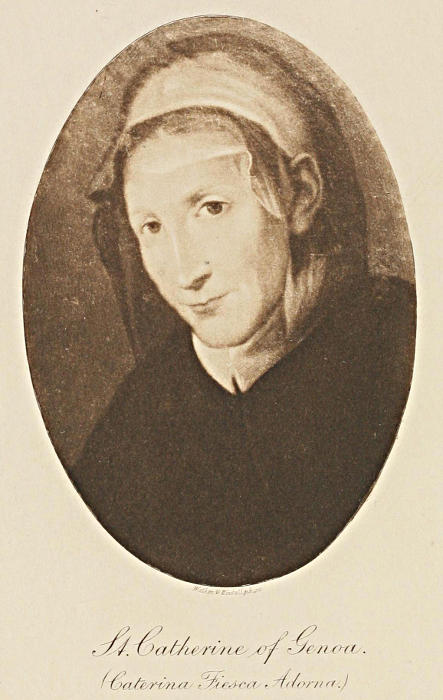
2. Catherine’s physical appearance; her qualities and habits
of body and of mind.
In this house, then, Catherine grew up and lived till she
was sixteen. The beautiful, tall figure; the noble oval face
with its lofty brow, finely formed nose, and powerful, indeed
obstinate chin; the winning countenance with its delicate
complexion and curling, sensitive, spiritual mouth-line; deep
grey-blue spiritual eyes; the long, tapering fingers; the
massive dark brown or black hair; still more the quickly and
intensely impressionable, nervous and extremely tense and
active physical and psychical organization; and then the
very affectionate, ardent, aspiring, impatient and absolute
qualities and habits of her mind and heart and will,—all these
things we are not merely told, we can still see them and find
them, in part, even in her remains, but more fully in her
portrait, and above all, in her numerous authentic utterances.[44]
3. The few certain details concerning her early years. Santa
Maria delle Grazie.
We have, as only too often in such older biographies, but
very few precise and characteristic details concerning her early
years. She had in her room a Pietà, a representation of the
Dead Christ in His Mother’s arms, and we are told how deeply
it affected her every time she entered this room, and raised
her eyes up to it. The other points mentioned, her early
bodily penances, silence, and gift of prayer (the latter said to
have been communicated to her at twelve years of age), read
suspiciously like simple assumptions made by her biographers,
and in any case do not help to individualize her, in these
years of uncertain, tentative, or as yet but little characteristic,
forms of goodness.
But from thirteen, for three years onwards, the young girl
is very certainly and deeply drawn to the Conventual life, as
she sees it practised by her sister Limbania, who, true to the
example of her own Genoese Augustinian Patron Saint, had
become a member of the Augustinian Canonesses of our Lady
of Graces, and now lived there happy and devoted in the
midst of that very fervent and cultivated Community. Limbania
was one of the nineteen Foundresses of this Convent,
who, on August 5, 1451, received the habit of Canonesses
Regular of the Lateran, from the hands of Padre Giovanni de’
Gatti, at that time Superior of S. Teodoro outside the walls
of Genoa, a house of the same Order. Among these Novices
occur a Simonetta di Negro, no doubt a cousin of Catherine,
and Nicola and Lucia da Nove, two sisters; these facts will
have helped Catherine to hope for admission together with her
own sister Limbania.[45]
The Convent and its Chapel, both secularized, are still in
existence, at a quarter of an hour’s walk from Catherine’s
palace-home. Moving from here, along the Vico Chiabrera,
up the Via dei Maruffi (now San Bernardo), and across the
latter, up one of the many steep, very narrow little alleys, to
the Piazza dei Embriaci, and again up by the tall, slim, grey
tower of the Crusader Guilielmo Embriaco, we arrive at last at
a level, all but deserted, sun-baked piazza, called, after its
Church, Sta Maria in Passione. Face this Church, and the
long, tall house on your left hand, covered with dim, faded
frescoes, is Limbania’s Convent, so loved by Catherine. The
right door leads into the Chapel, which Vallebona[46] found in
1887 in use as a wood-store, and which I saw in May 1900
turned into a music-hall: where the altar had stood, were a
dingy stage, and tawdry wings. The pompous frescoes and
stuccos on the walls and ceiling are evidently of the seventeenth
century or even later. The adjoining Convent still
retains a small figure of St. Augustine sculptured on a corbel
on the vault of the first landing. The Byzantine, dark brown
Madonna-and-Child picture, which Catherine so often prayed
before in the Chapel, can still be seen, on the left-hand wall
of the Chapel of St. Thomas Aquinas, in the Church of S.
Maria di Castello, which is close by, at a lower level than
the Piazza of the Convent.
4. Catherine’s marriage. The Adorni family.
The Convent Chaplain was Catherine’s Confessor, and
through him she attempted to gain the permission of the
Nuns to enter their Community. But whilst they hesitated
and put her off, on the very reasonable ground of her unusual
youth, her father died (end of 1461); and a particular combination,
from amongst the endless political rivalries and
intrigues of Genoa, soon closed in upon the beautiful girl,
member of the greatest of the Guelph families of that turbulent
time. It was a bad and sorry business, and one likes to
think that the father, had he lived, would not thus have
sacrificed his daughter. For if in Shakespeare’s Romeo and
Juliet we have two youthful lovers joining hands and hearts,
in spite of the secular enmity of their respective houses; here,
alas! in real life, we have the contrary spectacle, the deep
because dreary tragedy of two great rival factions making—rather,
hoping to make—peace, by the enforced union of two
mutually indifferent and profoundly unsuited young people.
Not but that socially the two were admirably matched.
For Giuliano Adorno belonged to a family hardly inferior in
antiquity and splendour to Catherine’s own. Six different
Adorni had been Doges of Genoa in 1363, 1385, 1413, 1443,
1447, 1461; and the one of 1413 had been Giuliano’s own
grandfather. They were Lords of the Greek Island of Chios
(Scio), which they had helped to conquer for Genoa in 1349.
And now the last Doge of the family, Prospero Adorno,
had just been driven from the Ducal throne by Paolo Campofregoso,
the strong-willed representative of the great rival,
though also Ghibelline, family of the Fregosi. Campofregoso
was now both Duke and Archbishop of Genoa. By an
alliance with the Fieschi, the most powerful of the Guelph
families, the Adorni could hope, in their turn, to oust the
Fregosi, and to reinstate themselves at the head of the great
Republic. The ideals, antipathies or indifference of a girl
of sixteen were not allowed to stand in the way; and so the
contract was signed on January 13, 1463.
The marriage was celebrated soon afterwards in the Cathedral
of San Lorenzo, in the Chapel of St. John the Baptist,
since the Campanaro family, which had built it in 1299, and the
Adorni, who had married into and succeeded the Campanaro,
were excepted from the rule prohibiting the access of women
to this Chapel. Since Cardinal Giorgio Fieschi had recently
died, Bishop Napoleone Fieschi, of Albenga, presided at the
ceremony.
5. Giuliano’s character. Catherine’s pre-conversion married
life.
Giuliano’s father was dead; only his widowed mother,
Tobia dei Franchi, remained. It was, however, with Catherine’s
mother, in the old Palazzo near the Cathedral, that the young
couple were to live, and actually stayed, during the first two
years.
Giuliano was young and rich; his two elder brothers
occupied high naval posts; his first cousin, Agostino Adorno,
was a man of noble character and great initiative; and a
descendant of this cousin, also Agostino, was later on Beatified.
But Giuliano himself did at first worse than nothing, and
never did much throughout his life. A man of an undisciplined,
wayward, impatient, and explosive temper; selfish and
self-indulgent; a lover of obscure and useless, in one instance
criminal, squandering of his time, money, health, and affections,
he did not deserve the rare woman who had been sold to him;
and would possibly indeed have managed to be a better man
with a wife he had really loved, or with one of a temperament
and outlook more ordinary and nearer to his own. As it was,
he was hardly ever at home, and, according to his own later
penitent admission and testamentary provisions, he was, some
time during the first ten years of his marriage, gravely
unfaithful to his wife.
Catherine, on her part, spent the first five of these dreary
years in sad and mournful loneliness, at first in her mother’s
house, and afterwards, at least in the winter-time, in Giuliano’s
own palace, a building which stood exactly where now stands
the Church of Saint Philip Neri, in the Via Lomellina (at
that time, Via Sant’ Agnese), and near the Piazza Annunziata.
In the summer-time she would stay, mostly alone again, at
Giuliano’s country seat at Prà on the Western Riviera, just
beyond Pegli, and six English miles from Genoa.
This latter property is still in existence, but was, some
twenty years ago, on the extinction of the male line of the
Adorni, sold to the Piccardo family. The present moderate-sized
house, standing close to the high-road and sea-beach,
although evidently rebuilt (probably on a considerably smaller
scale) since Catherine’s time, no doubt occupies part at least
of the old site. But the Chapel which, in the Saint’s days,
adjoined the house, was described by Vallebona (in 1887) as
turned into a stable; and in April 1902 an elderly serving-man
of the Piccardo family showed me the precise spot, on a
now level meadow expanse closely adjoining the house, where
he himself, some fifteen years since, had helped to pull down
this chapel-stable. He showed me the (probably seventeenth-century)
picture representing the scene of the Saint’s conversion,
which had, at that time, been still in this building,
and which is now hung up in a small Confraternity-Chapel
near by in Prà.
As to money of her own, Catherine had, as we shall see
later on, her dowry of £1,000, to which Giuliano had contributed
£200. But we have no evidence of any good works
performed by her in this decade, although, as we shall find,
it must have been during these summers that she, at least
occasionally, walked or rode over the wooded hill-path to the
old Benedictine Pilgrimage Church and Monastery of San
Nicolò in Boschetto, three or four English miles away. These
buildings are now secularized and empty, but, even so,
impressive still.[47]
It is but natural to suppose that she was as yet too little
at one with her true self, to be able to surmount her lot, or
even seriously to attempt such a task, by escaping from the
false self and from all attempts at finding happiness within
the four corners of the demands of her most sensitive and
absolute disposition. To learn to do things well takes time,—and
even if it be but the finding out that those things to do
are there, ready and requiring to be done; or the seeing that
we are doing them badly. Hence above all does the learning
to suffer well, the turning pain into self-expansion and
self-escape, as well as into fruitful action, require time, special
graces, and unusual fidelity of soul. And even the noblest
nature will usually begin by thinking of getting, rather than
of giving; it will simply thirst to be loved, and to find its
happiness in its own heart’s perfect “comprehendedness.”
Catherine tried to find relief, first in one attitude on her
life’s sad couch of mental suffering, and then in another; and
neither brought her any alleviation. During the first five
years she had hidden herself away, and had moped in solitude;
the last five, she had given herself to worldly gaieties and
feminine amusements, short, however, of all grave offence
against the moral law. And at the end of these experiences
and experiments she, noble, deep nature that she was, found
herself, of course, sadder than ever, with apparently no escape
of any kind from out of the dull oppression, the living death
of her existence and of herself.
1. Her prayer, March 20, 1474. Her conversion, March 22.
From after Christmas-time in 1472, Catherine’s affliction
of mind had become peculiarly intense, and a profound
aversion to all the things of this world made her fly anew
from all human intercourse; and yet her own company had
become insupportable to her, as nothing whatsoever attracted
her will.
And at the end of three months, on the 20th of March 1474—it
was the eve of the Feast of St. Benedict—she was praying in
his little church still standing close to the sea, at the western
end of Genoa, not far beyond Andrea Doria’s Palace, built so
soon after her death. And in her keen distress she prayed:
“St. Benedict, pray to God that He make me stay three
months sick in bed.”[48]
And two days later, when Catherine was visiting her
sister at her Convent, Limbania proposed to her, since she
declared herself indisposed to go to confession (although the
Feast of the Annunciation was at hand), at least to go and
recommend herself in the Chapel to the chaplain of the
Convent, who was indeed a saintly Religious. And, at the
moment that she was on her knees before him, her heart was
pierced by so sudden and immense a love of God, accompanied
by so penetrating a sight of her miseries and sins and
of His goodness, that she was near falling to the ground.
And in a transport of pure and all-purifying love, she was
drawn away from the miseries of the world; and, as it were
beside herself, she kept crying out within herself: “No more
world; no more sins!” And at that moment she felt that,
had she had in her possession a thousand worlds, she would
have cast them all away.[49]
2. Views and truths concerning this Experience.
One of the various writers who have successively, and in
great part differently, moralized upon the chief events of her
life, dwells on this great moment as achieving in her soul all
the usually lengthy and successive effects of the purgative,
illuminative, and unitive progression, and as, in that one
instant, bringing her soul to that highest state of transformation,
in which the will is wholly united to God.[50] But
having regard to the fact, patent on every page of her
biography and “Works,” that, for the remaining thirty-seven
years of her life, her interior history represents one
continuous widening and deepening and moving onwards
of efforts, trials and pains, of achievements and ideals—a
fact actually schematized by another writer (who, as I shall
show, is the penultimate Redactor of the Life) not two pages
lower down—it is clear that we must be careful to conceive
this perfection as relative to her previous state or even to the
final goodness of many saintly souls. We must, in a word,
try to realize vividly, and constantly to recall, certain complex
truths, without which the very greatness of the experience
here considered will but help to check or deflect our
apprehension of the spiritual life.
For one thing, the deeper and the more unique the soul’s
experience, and the richer such experience is, the more
entirely does all that the soul is, and ever was, wake up and
fuse itself in one indivisible act, in which much of the old is
newly seen to be dross and is so far forth excluded; and in
which the old that is retained reappears in a fresh context, a
context which itself affects and is itself affected by all the
other old and new ideas and feelings. It thus clearly bears
the stamp upon it of the profound difference between Time,
conceived as a succession of moments of identical quantity
and quality, each in juxtaposition and exterior to the other,
mathematical time, such as our clocks register on the dials,—a
conception really derived from space-perception and
exterior, measurable things—and Duration, with its variously
rapid succession of heterogeneous qualities, each affecting
and colouring, each affected and coloured by, all the
others, and all producing together a living harmony and
organic unity, all which constitutes the essentially unpicturable
experience of the living person. Such a moment is thus
incapable of adequate analysis, in exact proportion as it is
fully expressive of the depths of the personality and of its
experience: for each element here, whilst, in its living
context, an energy and a quality which at each moment
modifies and is modified by all the other elements, becomes,
in an intellectual analysis, when each is separated from the
others, a mere dead thing and a quantity.
And secondly, such an experience is throughout as truly a
work of pure grace, a gift, as it is a work of pure energy, an
act. And here again, the grace and the energy, the gift and
the act are not juxtaposed, but throughout they stimulate
and interpenetrate each other, with the most entirely unanalyzable,
unpicturable completeness. It is indeed in
exact proportion to the fulness of this interstimulation
and penetration, to the organic oneness of the act, that
such an act is this one particular soul’s very own act and
yet the living God’s own fullest gift. Grace does not lie
without, but within; it does not check or limit, but constitutes
the will’s autonomy.
And thirdly, it is an experience which leaves the soul
different forever from what it was before; which purifies
her perfectly, in and for that moment, from all her stains
of actual sin committed up to that moment; and which
materially strengthens her inclinations towards good and
weakens her tendencies towards evil. But the soul herself
lives on; and she lives but in and through successive acts
of all kinds. Hence it is not an act,—there is none such,
here below at least,—which takes or can take the place of
fresh acts to be produced again and again throughout her life,
The soul has not, in any sense or any degree, been approximated
to that utterly paradoxical thing, a saintly
automaton. She is not raised above the limitations and
imperfections, the obscurities and conflicts, the failings
and sins of humanity. She could fall away and commit
grave sin; she actually does commit minor sins of frailty
and surprise. Her interior efforts and experiences are now
but on a larger, deeper scale, and on a higher plane, and take
place from a new vantage-ground, a position which has, however,
itself to be continually actively defended and reinforced.
Temptation, trial, sorrow, pain; hope, fear, self-hatred, love
and joy, with ever-renewed and increased aspiration and
effort, all variously change and deepen their combinations
and qualities, outlook and ideals. But they do not for
one moment cease. All things but grow in depth and
significance, in variety within unity, in interiority and
interpenetration.
And finally, although conversions of the apparent suddenness
and profound depth and perseverance of the one here
studied, are rightly taken to be very special and rare graces
of God, yet it would be but misinterpreting and depreciating
their true significance to make their suddenness the direct
proof and measure of their own supernaturalness or the
standard by which to appraise the altitude of the goodness
of other lives. God is as truly the source of gradual purification
as of sudden conversion, and as truly the strength which
guards and moves us straight on, as that which regains and
calls us back. Hence such acts as Catherine’s should not
be entirely separated off from those acts of love, contrition
and self-dedication which occur, as so many free graces of
God in and with the free acts of man, more or less frequently
in the secret lives of human beings throughout the world.
3. The Second Experience, in the Palace.
Catherine then was kneeling on, in these great moments of
her true self’s self-discovery and self-determination, with her
true Life now at last felt so divinely near and yet still so
divinely far: she was kneeling on, oblivious of time and
space, incapable of speech—throughout a deep, rich age of
growth, during but some minutes of poor clock-time—whilst
the chaplain was called away by some little momentary matter.
And when he returned, she was just able to utter: “Father,
if you please, I should like to let this confession stand over
to another time.” And returning home, she was so on fire
and wounded with the love which God had interiorly manifested
to her, that, as if beside herself, she went into the most
private chamber she could find, and there gave vent to her
burning tears and sighs. And, all instructed as she had
suddenly become in prayer, her lips could only utter: “O
Love, can it be that Thou hast called me with so much love,
and revealed to me, at one view, what no tongue can
describe?” And her contrition for her offences against such
infinite goodness was so great, that, if she had not been
specially supported, her heart would have been broken, and
she would have died.[51]
And yet, though her biographer, no doubt rightly, represents
her feeling and dispositions as now at their uttermost,—they
may well have actually been so, at that moment for
that moment,—they were nevertheless evidently capable of
indefinite subsequent increase. Indeed it must have been on
this same day, or on one of the next three days, that, in
one of the rooms of the palace in the Via S. Agnese,—(the
approximate spot is marked in the Church of St. Philip by a
fine picture representing the scene, hung over the altar of one
of the left-hand-side chapels),—“Our Lord, desiring to enkindle
still more profoundly His love in this soul, appeared
to her in spirit with His Cross upon His shoulder dripping
with blood, so that the whole house seemed to be all full of
rivulets of that Blood, which she saw to have been all shed
because of love alone.” “And filled with disgust at herself,
she exclaimed: ‘O Love, if it be necessary, I am ready to
confess my sins in public.’”[52]
4. Two peculiarities of this Experience.
Here two things are remarkable. This is, to begin with,
her first and last vision (visione), which I can find, in the
sense of a picture produced indeed “in the spirit,” but yet
evidently apprehended with a sense of apparently complete
passivity in the perceiving mind and of objectivity as to
the perceived thing, and remembered as such throughout her
life. For the frequent subsequent “sights” or picturings
(viste) are avowedly only of the nature of profoundly vivid,
purely mental, more or less consciously voluntary and subjective
contemplations and intuitions; whilst her only other
“visions,” those seen during the last stage of her last illness,
seem indeed to have been of an even more sensible kind than
this visione, but they were entirely fitful and left no permanent
impression behind them.
And again, this is the one only picture of any, even of a
voluntary, meditational kind, concerning the Passion, to be
found throughout her life; all her other contemplations and
impressions of whatever kind are of other subjects.
5. Her general confession.
It was after these fundamental experiences that, once more
in the Chapel of the Augustinianesses, apparently four days
later, on the 24th of March, “she made her general confession,
with such contrition and compunction as to pierce
her soul.”[53]
At this point of the Life two successive reporters or redactors
introduce, respectively, a general reflection on the
character and rationale of the period of penitence now
immediately ensuing, and a scheme and forecast as to the
stages in the ascensional movement of her entire convert
life.
1. The older conception.
The first reporter,—evidently the same who, in connection
with the Conversion scene, had described her soul as, there
and then, at the culmination of holiness,—here says:
“And although God, at the moment when,” four days before,
“He had given her that love and pain, had there and then
pardoned her all her sins, consuming them in the fire of His
love; yet He, wishing her to satisfy the claims of justice, led
her by the way of satisfaction, in such wise as to cause this
special contrition, illumination, and conversion to last about
fourteen months,” and it is no doubt implied by him that
frequent confession was practised throughout this time.[54]
Thus we get an impressive instance of the rich and complex
experience on which the Catholic doctrine is built, as to how,
on the one hand, pure and perfect love ever instantly obliterates
all sin; how, on the other hand, such perfect love, in
those who explicitly know and accept the Church’s claims,
involves a determination to confess all such grave sins as may
have been committed; and how, finally, such subsequent
confession is itself operative within the soul. For as between
the soul and the body, so between the Mystical and Sacramental,
there is a real and operative connection, though one
which, however inadequately known by us, we know to be
one not of simple identity or coextension.
And the experiences and doctrines here specially considered
appear to require the conception of contrition and pardon
as but the necessary expression and effect of true, operative
love; and to demand the conclusion that purification participates
in the essentially positive nature of love, its cause.
The removal of bodily impurity is a negative act, and, as
such, is limited and unrepeatable; but spiritual purification
would thus, as something positive, be capable of indefinite
increase and repetition. And hence the deep philosophical
justification of repeated contrition and confession for the
same sins, even though already pardoned. We shall find
that such a view is also to be found in St. Catherine’s own
doctrine, though there is nothing to show that the thought of
this paragraph is derived from Catherine herself. I take it
to proceed from Cattaneo Marabotto.
2. The later conception.
The second writer, the penultimate Redactor of the book
as we now have it, finds three successive levels in her whole
life’s constant growth and upward movement, and discovers
a type of each in some love-impelled figure or scene of the
Bible. And so the writer gets his periods symbolized respectively
by the two New Testament scenes of Christ’s feet,
and the Penitent Magdalen drawn by Him to them, and of
Christ’s breast, and the Beloved Disciple reposing peacefully
upon it; and by the Old Testament poetic picture, and its
allegorical interpretation, of Christ’s (the true Solomon’s)
mouth, and the Bride’s kiss. And some four years are assigned
to the first period, “many” years to the second, and her last
years to the last: 1478 and 1499 would be the approximate
dates dividing off these periods. We shall find this scheme
to proceed from Battista Vernazza.
Time-honoured though it be, this symbolism in no way fits
Catherine’s case. For, excepting during the short first period,
her direct and formal occupation with the Sacred Humanity
is, throughout her convert life, practically confined to the
Eucharistic Presence; and again, her words and contemplations
are (as indeed the unhappiness of her marriage experience
would lead one to expect and as the whole temper of her
mind and devotion require) quite remarkably free from all
affinity to the Canticle of Canticles. And yet this, in so
far inappropriate, framework helps to emphasize the all-important
fact of the constant growth and deepening ever at
work within her life.
Indeed, the short, general characterization of each of these
successive periods which follows after each symbol here, is
derived from passages of the Vita which are doubtless based
upon direct communication by herself. Thus the detailed
sight of her own particular sins and of God’s particular graces
towards herself, characteristic of the relatively short first
period, is succeeded by the second, long and profoundly
lonely, period of an apparent union of the divine and of the
human personalities, in which all distinct perception of her
own acts appears to have usually been lost,—a union which
can lead her to the point of saying: “I have no longer either
soul or heart of my own; but my soul and my heart are those
of my Love.” Yet in her third and last period, the consciousness
of her own acts and of their differentiation is described
as fully reappearing within her mind. For though we are
presented here with a kind of immersion in the Divinity, in
which she appears so to lose herself interiorly and exteriorly
as to be able to say with St. Paul: “I live no longer, but
Christ lives in me”; and though we are told that she was no
longer able to discern between the good and evil of her acts,
by means of any direct examination of them: yet her acts
are now again perceived to be her own; to be some of them
good and some of them faulty; and are seen, as several and
as differing, by her own self, but “in God.”[55] So did the
Lady of Shallot, all turned away though she was from the
world of sight, see in her mirror the different figures as,
good and bad, they moved on their way, more truly and
clearly than she had ever seen them formerly by any direct
perception.
3. Position adopted in this study concerning Catherine’s
spiritual growth.
Now these periods of interior, experimental, mystical vicissitude
and growth have also their corresponding variations
of religious analysis and speculation, and of external actions
and events; and these variations are not only the concomitants
and expressions of the inner growth, but are also, in part, the
subject-matter and occasion for the next stage of mystical
experience. And since Catherine’s special characteristic
consists precisely in the richness and variety of her life at
any one moment, and in the successive, ever-accelerated
enrichment which it achieves almost up to the end, any
obliteration of this successive growth, or any one-sided
attention to any one aspect of her life during any one of
its chief periods, will readily take all life-likeness out of
her portrait.
Yet to achieve anything like this comprehension is most
difficult, if only because it has to be attempted with the aid
of materials which, where their registration is contemporary
with the events chronicled, belong, all but the legal documents,
to the last fifteen years of her life; and because, even within
this last period, they are rarely furnished with any reference
to their exact place within that period. There is throughout
the book a most natural and instructive, indeed in its way
most legitimate and even necessary, insistence upon the
apparently complete independence and aloofness, the transcendence
of her inner life. And this insistence goes so far
that a self-sufficing Eternity, a completely unchanging Here
and Now, floating outside and above even the necessary and
normal affections, actions, and relations of human life and
fellowship, seems, especially from after her conversion till up
to the beginning of her physical incapacitation,[56] to have
taken the place of the characteristically human struggle in
and through time and space, with and through our fellow-creatures.
As in Leibniz we get a divinely pre-established
harmony between the dispositions and the acts of the body and
those of the soul, which appear indeed as though indestructibly
interrelated, but which, in reality, operate throughout
without one instant’s direct interaction: so here, the external
is not indeed represented as neglected by her, nor as anything
but in complete harmony with her inner life, and as indeed
inspired by God, yet her own mind and soul are but reluctantly
permitted to appear as expressing themselves in it, as
requiring and affected by it. She appears as having got
outside of, and away from, all the visible and purely human,
rather than deeper into and behind it; to have achieved the
ignoring of it rather than its conversion and transfiguration
and its appointment to its own intrinsic place and function in
the full economy of the soul’s new life.
And yet all this is, even in the minds of the authors, but
one aspect of this complex life, and one which, taken alone,
would at once do injustice to its other aspect, the grand
depth and range of its immanental quality. And even in as
much as the transcendental aspect is really attributable to the
predominant trend of Catherine’s own character and teaching,
it in no way invalidates the fact of the actual astonishing
many-sidedness and balance of her life, especially before her
last few years, but will be found to proceed essentially from
her rare mode of achieving this many-sidedness and balance,
or, more strictly still, from her own feeling as to this mode,
and her analysis and theory of it. We have no direct concern
with this her reflection at present: what she actually did
and directly was, is all we would wish to try and sketch
just now.
1. A daily Communicant from May 1474 onwards.
On the following day, then, on the Feast of the Annunciation,
25th March, 1473, “her Lord gave her the desire of
Holy Communion, a desire which never again failed her
throughout the whole course of her remaining life. And He
so disposed things that Communion was given her, without
any care on her part; she was often summoned to receive it,
without any asking, by priests inspired by God to give it to
her.”[57]
After trying every possible interpretation of this most
annoyingly obscure text by the light of three or four
other passages, I have come to think it to mean that, on
this Lady-Day, she, for the first time since now ten years,
received Holy Communion with a keen desire for its
reception; and that this desire remained from this day
forward unintermittently with her, till the end of her life:
but that this desire, which at first may not have been set upon
daily Communion, began to be satisfied by a daily reception
only some time in May 1474. It is anyhow certain that
from this latter date onwards she was a daily communicant
up to September 13, 1510, the day before her death.[58] The
exceptions were most rare,—I take it of an average of once or
twice a year,—and were always owing to some insuperable
obstacle, mostly of ill-health.
2. Her practice as regards the Holy Eucharist, throughout
her Convert Life.
Since Holy Communion was the great source and centre
of her love and strength, and the one partially external
experience and practice which was thus renewed day by day
throughout her life, and in the spiritual apprehension and
effect of which we cannot trace any distinct periods, I shall
dwell here, once for all, upon the characteristics of this
devotion of hers, which were at all special to herself.
For one thing, even her ardent love of Holy Communion
did not suppress a bashful dislike of being noticed or
distinguished in the matter: “At the beginning of her
conversion she had at times a feeling as of envy towards
Priests, because they communicated on as many days as they
would, without any one wondering at it.” “Once when, for a
few days, the city was under an interdict, she went every
morning a mile’s distance outside of the city walls, so as to
communicate; and she thought that she would not be seen
by any one.”[59]
Next, there is a most characteristic eagerness for interiorization,
for turning the Holy Eucharist, perceived without, into
the heart’s food within; and a corresponding intensity of
consciousness and tenderness at the moment of reception.
“When she saw the Sacrament on the altar in the hands of
the priests, she would say within herself: ‘Now swiftly,
swiftly convey it to the heart, since it is the heart’s true food.’”
And “one night she dreamt that she would be unable to
communicate during the coming day, and waking up, she
found that tears were dropping from her eyes, at which she
wondered, since hers was a nature very slow to weep.” And
“when at Mass, she was often so occupied with her Lord
interiorly, as not to hear one word of it; but when the time
for Communion arrived, at that instant she would become
conscious of exterior things.” And she would say: “O
Lord, it seems to me, that if I were dead, I should return to
life to receive Thee; and that if an unconsecrated host were
given to me, I should recognize it to be such by the mere
taste alone, as one discerns water from wine.”[60]
Again, her Communion practice bears upon it the stamp of
a staunch virility; of a constant emulation between her own
generous turning-away from its sensible consolations and the
divine action, which seems to have maintained these consolations
throughout her life; and of a determination to
abstain even from such deeply consoling Communions, if such
abstention were the more perfect practice for her. “One day,
when she had communicated, there came to her so much
odour and so much sweetness, that she felt as though in
Paradise. But turning at once towards her Love she said:
‘O Love, wouldest thou perchance draw me to Thee with
these savours (sapori)? I desire them not, since I desire but
Thee, and Thee whole and entire!’” And “one day a holy
Friar,”—it was probably the Observant Franciscan, Father
Angelo of Chiavasso (near Genoa), beatified later on,—“said
to her: ‘You communicate every day: what kind of satisfaction
do you derive from it?’ And she answered him
simply, explaining to him all her desires and feelings. But
he, to test the purity of her intention, said: ‘There might
possibly be some imperfection in such very frequent Communion,’
and then left her. And Catherine having heard
this, fearing such imperfection, at once suspended her
Communions, but at the cost of great distress. And the
Friar, hearing a few days later of how she cared more not to
do wrong than to have all the consolation and satisfaction of
Communion, sent her word by all means to return to her
daily Communions; and she did so.”[61]
And finally, her Communions produced effects direct and
indirect, spiritual and psychical. The indirect, psycho-physical
effects being variable, and related to the varying
conditions of her health, will be noted as far as possible
under the different periods of her life and, collectively, in the
chapter on such psycho-physical questions. The spiritual
effects no doubt grew, but this growth we have no sufficient
materials for pursuing in detail. Yet they have throughout
this peculiarity, that, central and all-permeating as this
Eucharistic influence no doubt was, yet it nowhere takes the
form of any specially Eucharistic devotion or directly
Eucharistic meditation or doctrine, outside of Holy Communion
itself and of the immediate occupation with it. Some
deep indirect effects on her general tone, imagery, and
teaching will be studied in our second volume.
1. Catherine arouses criticism in the matter of Direction.
Now if Catherine occasioned some criticism and testing of
her spirit by the (for that period) very unusual frequency of
her Communions,[62] it is equally on record that she aroused
some surprise and apprehension, by the absence of all
Direction, during the many years of the second period of her
convert life. And if, in the matter of her daily Communions,
she had readily entered into the suggestion that there might
be imperfection in this her dearest habit, and yet had to
continue along her unusual way, so too, in this matter of
Direction, she evidently was from the first ever ready to
proceed in the ordinary manner, and yet found herself
compelled to follow a lonely course. “If she attempted to
lean upon any one (accostarsi ad alcuno), Love instantly
caused her mental suffering so great that she was obliged to
desist, saying, ‘O Love, I understand Thee.’ And when she
was told that it would be well, and more secure, if she were to
put herself under obedience to another, and whilst she was in
doubt as to what to do, her Lord answered her thus within
her mind: ‘Confide in Me, and doubt not!’”[63] Such
suggestions will have been made and such scruples will have
been suffered many a time, during the long years in which, in
this matter, her way was an extraordinary one.
2. The facts concerning Catherine’s confessions. Catholic
obligations.
But in this matter of Direction and Confession, the Vita, if
we were to take its present constituents as of uniform value,
is astonishingly vague, ambiguous, and contradictory. Let us
take the facts, in the order of their certainty, moving from
the quite certain to the less and less certain ones; and let us
then try and appraise the upshot of the whole examination.
We are then, first, absolutely certain that Catherine
herself, not later than 1499,—this date shall be justified later
on,—said to Don Marabotto, (and that he then and there, or
shortly afterwards, wrote down,) the following words: “I have
persevered for twenty-five years in the spiritual way, without
the aid of any creature.” And he, in this matter which concerns
his own Confessing and Directing of her during the last
eleven years of her life (1499-1510), twice over solemnly
reaffirms and drives home the reality of the fact thus communicated
to him by herself. “She was guided and taught
interiorly by her tender Love alone, without the means of any
[fellow-]creature, either Religious or Secular”; “she was
instructed and governed thus by God, for about twenty-five
years.”[64] And conformably with this, we get the short dialogue
between herself and Love, as just given, and such words as
the following, which she declared that Love itself spoke to her
mind,—evidently during, and probably at the beginning, of
these many years: “Take from the remainder of Scripture
this one word ‘Love,’ with which thou shalt ever walk
straight … enlightened, without error, and (all this) without
guide or means provided by any other creature.”[65]
In the next place, it is equally certain that, with all her
biographers down to this day (e.g. Monseigneur Fliche, pp.
350, 351), her words must be understood to exclude at least
all Direction from those years. And it is, moreover,
practically certain that at least the second Redactor (R. 2)
of the Vita understood her words to apply to Confession also.
For whereas, in the older tripartite scheme of R. 1, the four
years of Penance of her first period were filled by her labours
for “satisfying her conscience by means of contrition, confession,
and satisfaction,” R. 2 breaks up those four years
into two periods,—the first, of “a little over a year”; and the
second, of (no doubt) three years,—and does so with a view
to thus making room for the “about twenty-five years” of
Catherine’s affirmation. Now whereas R. 2 in his first period
talks thus of Confession; in his second one, he talks twice of
Contrition, and twice of Sorrow, but nowhere of Confession;
and again, whereas in his third (R. 1’s second) period
“many” (no doubt twenty-one) years, there is still no reference
to Confession, indeed here not even to Sin or Contrition in
general; in the fourth (R. 1’s third) period (of eleven years),
when she was being regularly confessed and directed by
Marabotto, she, it is true, “was incapable of recognizing, by
direct examination, the nature of her acts, whether they were
good or bad,” but still she was able to see, and actually “saw
all things,” hence also these acts and their difference, “in
God.”[66]
Thirdly, it is certain that some reasonable doubt can be
entertained as to whether Catherine’s words, solemnly
emphatic though they are, were not understood too literally
by Marabotto and the second Redactor. Nothing is, indeed,
more obvious and striking throughout all the authentic
memorials of her, than the delightfully simple, grandly fearless
veracity of her mind. She never speaks but according to the
fulness of her conviction: like with all souls most near unto
the childlike Master, Christ, it can be said of her that “one
never knows what she is going to say next.” And we shall
find her insight into herself at any given moment, even with
regard to such partly medical matters as her psycho-physical
condition, to be quite astonishing in its depth and delicacy.
Yet the fact remains, that she was as truly a person of intense
and swiftly changing feelings, exaltations, and depressions, as
she was one of a rich balanced doctrine and of a quite heroic
objectivity and healthy spiritual utilization of all such
intensities. This very heroism and objectivity of hers, so
constant and watchful in all her practical decisions and
general doctrinal statements, no doubt helped to make her
feel both the need and the licitness of giving full and truthful
utterance also to the intense and swiftly passing feelings of
her heart.
One such utterance is specially to the point. She had
already been for eleven years the much-helped penitent of
that utterly devoted priest-friend Don Marabotto, when, in
January 1510, he overheard her (the extant report of the
scene is certainly his own and contemporary with the event)
saying to God, shut up alone, as she thought, in one of her
rooms: “There is no creature that understands me. I find
myself alone, unknown, poor, naked, a stranger and different
from all the world.” Yet this does not prevent her finding
comfort and, indirectly, even physical improvement, in and
from Marabotto’s sympathy and words, when these are offered
to her not many hours later on.[67] The abnormally rapid and
complete change of feeling depicted here, no doubt occurred
during the last eight months of her life, long after her health
had begun to break up permanently; and cannot directly
illustrate her frame of mind during the years 1474-1499, when
she was in health and relatively strong. Still, she was clearly
ever of a high-strung, intense temperament; and her health
was already seriously impaired when, in 1499, she spoke the
words concerning the utter loneliness of that whole quarter of
a century. And if the emphatic words, spoken to God Himself
in 1510, were compatible with confession, and, indeed, a
certain kind of continuous direction, at the very time and
during eleven years before they were spoken: her words
uttered in 1499 to Marabotto, will have been compatible with
at least some confession during a period of years of which the
first lay almost a whole generation behind her. And we shall
find at least two other cases in which Marabotto appears, on
Catherine’s own authority, as having clearly misunderstood
the nature of some phenomena connected with herself.[68]
Yet for all this, the account which we shall have to give
later on of the characteristics of her confessions to Marabotto,—an
account directly derived from himself,—makes it
practically impossible to assume that even simple confession
was practised, at all or otherwise than quite exceptionally,
during those many years.
Now we have, as a fourth point, to remember that although
the Fourth Council of the Lateran, in the year 1215, had
decreed that “All the Faithful of either sex, after coming to
years of discretion, are bound to confess all their sins at least
once a year”:[69] yet already St. Thomas Aquinas had, in
his Commentary on the Sentences of Peter Lombard, composed
in 1252-1257, taught that, since the divine institution and
obligation extends, strictly speaking, only to the confession
of mortal sins, “he that has not committed any mortal sins
is not bound to confess venial sins, but it is sufficient for the
fulfilling of the Church’s precept, for him to present himself to
the priest, and to declare himself free from the consciousness
of mortal sin.”[70] And nothing has changed, as to the nature
and extent of this obligation, since Catherine’s time. The
Council of Trent, the decrees of which were confirmed by
Pope Pius IV in 1564, more than half-a-century after her
death, carefully explains that “all the sins” of the decree of
1215 means all “mortal sins”; and further declares that “the
Church did not, by the Lateran Council, decree that the
faithful should confess,—a thing she knew to be instituted
and necessary by divine right,” but had simply determined
the circumstances and conditions under which this obligatory
confession was to take place.[71] And Father Antonio Ballerini,
S.J. (d. 1881), gives us the conclusions, identical with that of
St. Thomas, of those great authorities Francis Suarez (d. 1617),
Cardinal John de Lugo (d. 1660), and Hermann Busenbaum
(d. 1668),—all three, Jesuits like himself,—and himself endorses
their decision. Suarez indeed declares this view to be the
common opinion of Theologians.[72]
3. Probable course of Catherine’s confession-practice.
With these four points before us, let us attempt to reconstruct
some outline of what really happened in her own case,
and try and show what constituted the specifically Catholic
quality of this her practice, so unusual in the middle and later
ages of the Church. We shall, then, do wisely, I think, by
considering that the “twenty-five years,” alleged by her own
self, were, as a strict matter of fact, not more than twenty-one;[73]
that during the four first convert years that preceded
this middle period, just as during the last eleven which
succeeded it, she had recourse to confession with the frequency
considered normal in and for these times, in the case of a
daily communicant living in the world; but that, during the
intervening period, she was allowed to substitute that simple
occasional, perhaps only annual, presentation of herself and
declaration to the priest in the place of confession proper,
which we have seen to be considered, in a case of such a
purity of soul as hers, as sufficient for fulfilling the Church’s
precept, by a practical consensus of all the great casuist
authorities. And thus we have here again a memorable, and
this time a long-persisting, instance of how the intrinsic and
operative connection between the Individual and the Social,
the Mystical and the Institutional elements of Religion is not
a simple identity or coextension,—a point which we already
found exemplified during the first hours of her convert life.
And the Catholic spirit in this her present course will consist
in her full observance of all to which the Church strictly
obliges; in her readiness at all times to walk in the ordinary
way, and in her repeated attempts, even during this second
period, to do so; in her actually and fervently following the
ordinary course whenever she could, i.e. in the first and last
period; and finally in her ever faithfully obeying the promptings
of God’s Spirit which, by various converging spiritual
peculiarities, circumstances and means, showed, with practical
plainness, the kind and degree of extraordinary interior acts
and habits which were to be, in large part, her form of the
“Mind of the Church.” For it is indeed certain that the
special characteristic of the Catholic mind is not, necessarily,
universally and finally, the conception and practice of sanctity
under the precise form of the devotional spirit and habits
special to the particular part or period of the Church in which
that individual Catholic’s lot may be cast. What is thus
characteristic, is the continuous and sensitive conviction that
there is something far-reaching and important beyond the
Church’s bare precepts, for every soul that aims at sanctity, to
find out and to do; that this something (sc. the Church’s mind)
is, always and for all, presumably, the most fervent form and
degree of the devotional temper and habits of the Church, as
practised in that time and country; and that it is for God
Himself, if He so pleases, to indicate to the soul that He now
wants its fervour to consist in an observance of the Church’s
precepts and spirit under a form and with an application
partially different from the most fervent practice of the
ordinary devotions of that time and place, though this new
observance will be no less costing or heroically self-renouncing
than the other. And this He does usually by slow, often
simply cumulative and indirect, but always solid, painful, and
practically unmistakable, because unsought, means and
experiences,—all these attained to well within the Church.
For the Church’s life and spirit, which is but the extension of
the spirit of Christ Himself, is, like all that truly lives at all,
not a sheer singleness, but has a mysterious unity in and by
means of endless variety. Even at any one moment that
spirit expresses itself in numerous variations, by means of
various races, rites, orders, schools, and individuals. And yet
not the sum-total of all these simultaneously present variations
is ever as rich as is the sum-total of that spirit’s
successive manifestations in the past. Nor once more can
this latter sum be taken as anticipating all the developments
and adaptations which that ever-living spirit will first
occasion and then sanction in His special organ, the Church.
Catherine’s particular, divinely impelled substitute for the
ordinary devotional practice shall be described later on.
A further peculiarity, somewhat analogous to the one just
examined, seems to have characterized her devotional practice—in
this case, throughout her convert life. It had therefore,
perhaps, best be described in this place.
1. The assertions of the “Vita.”
Three items of information are furnished by the Vita, on
one and the same half-page.
(1) “She had such a hatred of self,” says the Vita, “that
she did not hesitate to pronounce this sentence: ‘I would
not have grace and mercy, but justice and vengeance shown to
the malefactor.…’”
(2) “For this reason it seemed that she did not even care to
gain the Plenary Indulgences. Not as though she did not hold
them in great reverence and devotion, and did not consider
them to be most useful and of great value. But she would
have wished that her own self-seeking part (la sua propria
parte) should rather be chastized and punished as it deserved,
than to see it pardoned (assoluta), and, by means of such
satisfaction, liberated in the sight of God.”
(3) “She saw the Offended One to be supremely good, and
the offender quite the opposite. And hence she could not bear
to see any part of herself which was not subjected to the divine
justice, with a view to its being thoroughly chastized. And
hence, so as not to give this part any hope of being liberated
from the pains due to it, she abstained from the Plenary
Indulgences and also from recommending herself to the
intercessions of others, so as ever to be subject to every
punishment and condemned as she deserved.”[74]
2. Three points to be noted here.
Here I would note three things.
For one thing, there can be no serious doubt as to the
authenticity of the saying that opens out this group of
communications and as to the substantial accuracy of the
two parallel, and (I think) mutually independent, reports
as to her practice: since the saying belongs to the class
of short declarations given in oratio directa, which we shall
find to be remarkably reliable throughout the Vita; and
the reports testify to something so unusual, so little sympathetic
to the hagiographical mind, so much in keeping
with the remainder of her doctrine and practice, that
we cannot believe them misinformed. The author of the
Dialogo evidently fully accepted these three passages,
when, in about 1549, she paraphrases them thus: “She
therefore made no account of her sins, with respect to their
punishment, but only because she had acted against that
Immense Goodness”; “She found herself to be her who alone
had committed all the evil, and alone she wanted to make
satisfaction, as far as ever she could, without the help of any
other person.”[75]
For another thing, we have absolutely final contemporary
documentary evidence of the importance attached by herself
both to Indulgences, and the gaining of them (at least by
other people), and to Masses and prayers for the Dead,
inclusive of herself when she should be gone. For as to
Indulgences, we have entries in the Cartulary of the Hospital
(under the dates of March 11, April 10, May 29, and August 23,
1510) of various considerable sums, amounting in all to over
£300, paid by the Hospital, at the first date, for Catherine’s
nephew Francesco, at all the other dates for herself, for the
withdrawal of a suspension of the Indulgences attached to
the Hospital Church, and for the transference, in that year, of
the day appointed for their acquisition. Both these matters
were carried out in Rome by means of Catherine’s second
nephew, Cardinal Giovanni Fiesco. This, it is true, is evidence
that only covers the last six months of her life.
But as to Masses and Prayers for her own soul after death,
we have (1) her second Will, of May 19, 1498, where she leaves
one share in the Bank of St. George (£100) to the Observant
Franciscans of the Hospital Church, “who shall be bound to
celebrate Masses and Divine Offices for the soul of Testatrix”;
(2) her Codicil, of January 5, 1503, where she leaves (in
addition) £3 apiece to two Monasteries “for the celebration
of Masses for her own soul”; (3) her third Will, of May 18,
1506, which confirms all this; and (4) her last Will, of March
18, 1509, where she leaves £3 each to three Monasteries,
which are each to “celebrate thirty Masses for her soul,” £3
to a fourth Monastery for Prayers for her soul, and £25 to
the Franciscans of the Hospital Church for the celebration of
Masses to the same effect.[76]
The reader will at once perceive that these facts are fully
compatible with the attitude so emphatically ascribed to her
in the Vita, only if we take these latter statements as expressive
of certain intense, emotional moods; or of some
relatively short penitential period; or of what she did and
felt with regard to herself alone and for whilst she was to live
here below, not of what others should do for themselves at
all times and for herself when she was gone.
And finally, we know exactly how and why the doctrine
and practice described in those passages in the Vita were
accepted by the Congregation of Rites, as forming no
obstacle to her canonization. Pope Benedict XIV, in his
great classical work on Beatification and Canonization, says,
“After I had ceased to hold the office of Promoter of the
Faith,” (the date will have been between 1728 and 1733,) “I
know that a controversy arose as to the doctrine of a certain
Beata, with regard to the truth of which it was possible
to have different opinions.” And after giving this Beata’s
doctrine and practice as these are presented by Catherine’s
Vita, and citing the arguments used against their toleration,
he proceeds: “But the Postulators answered (1) that this
Beata had not omitted to gain Plenary Indulgences from any
contempt for them, since her veneration for them was demonstrated
by most unambiguous documents” (no doubt Cardinal
Fiesco’s action, in her name and at her expense, in Rome in
1510, is meant); “(2) that it is the doctrine of very many
theologians, that those do not sin, who do not labour to gain
Indulgences because they desire to make satisfaction in their
own persons in this world or to suffer in the next; (3) that we
should not confound safety with perfection: it appears indeed
to be safer to atone for one’s fault both by one’s own good
works and by Indulgences; but not more perfect, supposing
that a man abstains from Indulgences because his love of God
and his detestation of having offended Him are so great that
he desires to make satisfaction to Him, by bearing the whole
of the merited punishment; and (4) that examples are not
wanting of perfect souls, that have, for a while, desired to
bear, even for the sins of others, the pains of Hell itself,
although without falling away from the friendship and grace
of God. And hence the Congregation of Sacred Rites considered
that this doctrine did not militate against the holiness
of the said Beata or against the approbation of her virtues as
heroic.”[77]
And a third and last peculiarity is particularly instructive
as showing how entirely an unusual, at first sight quietistic,
practice is not restricted, in her case, to specifically Catholic
habits.
1. The facts.
This peculiarity has already appeared in part in the second
of the two accounts as to her attitude towards Indulgences.
“She abstained from recommending herself to the intercession
of others.” And this is borne out, but (as we shall find) with
certain unforeseeable restrictions, by the rest of the Vita. As
regards even the Saints, one only invocation of any one of
them is on record,—that of St. Benedict in 1474, already
given.
And if she did not ask others for prayers for herself in her
own lifetime, her own prayers for others were evidently rare,
were apparently always concerned with their spiritual welfare,
and were generally produced only under some special interior
impulsion. Hence when asked, in 1496 or later, by Vernazza,
in the name of several of her spiritual children, to pray that
God might grant them “some little drops of His Love,” she
answers that “for these I cannot ask anything from this
tender Love; I can but present them in His presence.” This
is, no doubt, because she sees them to be already full of the
love of God. Whereas in 1495 the poor working man, Marco
del Sale, is dying of a cancer in the face, and is in a state of
wild impatience: so she prays most fervently for him. It is
true that the Vita adds that she did so, “having had an
interior movement to this effect. For she never could turn
to pray for a particular object, unless she had first felt herself
called interiorly by her Love.” Still, this did not prevent her,
in 1497, from praying most fervently for patience for her
husband, (who was dying from a painful complaint,) simply
“because she feared that he might lose his soul,” and without
any other more peculiar incentive than this.[78]
2. The rich variety of her life.
Evidently here again, as with the Confessions and Indulgences,
her life and practice were indefinitely varied and
spontaneous, and incomparably richer than the preconceptions
and logic of at least some of her biographers will admit, or
indeed than many of her own fervent sayings, so vividly
expressive of certain moments or sides of her career or
character, suggest or even seem to leave possible. But the
underlying meaning and ultimate harmonization of these
apparent inconsistencies between her doctrine and her practice,
we can only gradually hope to find.
Let us now attempt, as far as the often scanty and obscure
evidence permits, to give, in the following two chapters, some
general account of the changes and growth observable in her
external surroundings, her human intercourse and social
occupation, her physical health and psychical mood, and
above all of those inner experiences and spiritual apprehensions
of hers which dominated all the rest, during each of the
three main periods of her convert life. This general account
will, I trust, suggest the main points for our later investigations,
and will show at once how largely artificial, though
necessary, all such dividing into periods must be, in the
case of so deeply unified and diversified an inner life as
Catherine’s.
1. Giuliano’s affairs. Catherine’s attitude.
The first six months of her first period (this latter we take
to have extended from March 1473 to May 1477) were still
spent in Giuliano’s Palace of the Via Agnese and in his
country mansion at Prà.[79] But all was now swiftly changing,
or already greatly changed, both around her and within.
Anxiety, hope, grief, consolation—inasmuch as such feelings
could still for her cluster around events external to her
deepest spiritual life, and could make themselves at all
separately felt during this period of profound absorption in
her new large life of love and penance—must all have centred
in her husband. For Giuliano had by now got his affairs into
such disorder as to be unable to keep up his great social
position; and by the autumn of 1473 he had sold his mansion
at Prà, and had vacated and let his palace in Genoa itself.[80]
He was also by now a very sincere convert, in his own manner
and degree; and it was no doubt now that he told Catherine,
although she can hardly have failed to know already, of the
existence of a poor little girl whom, with an apparently
ominous indication of weak indulgence on the part of his
widowed mother, he had called Tobia.
We shall be able to prove Catherine’s grand magnanimity
and true, cordial forgiveness—directly, no doubt only for and
at a later period; but the documents will show that she knew
all the decisive circumstances long before, and there is no
room for doubt that her dispositions had changed or grown
as little as had her knowledge.
2. Life in the little house outside the Hospital.
Catherine and Giuliano had now, in the autumn of 1473,
moved into a humble little house, in the midst of artisans,
mostly dyers, and of the poor of various sorts, close to the
Hospital of the Pammatone, even then already a vast Institution.
This dwelling is probably identical, as to the site,
with the house still standing at the junction of the Via S.
Giuseppe with the Via Balilla, and which bears on its front a
picture of Saints Catherine Adorna and Camillus of Lellis[81]
at the feet of the Madonna. Since the income remaining to
them still amounted, up to Giuliano’s death in 1497, to the
equivalent of some £1,200 a year,[82] this self-abnegation and
humble identification with the lives of the toiling, nameless
poor, must have been an act of deliberate choice, and not one
of any degree of necessity. It was never suspended or
revoked by either of them.
They now agreed together to a life of perpetual continence;
and Giuliano became a Tertiary of the Order of St. Francis,[83]
amongst those attached to the Hospital-Church of the Santissima
Annunciata in Portoria, itself served by Observant
Franciscans. Their only little servant-maid, Benedetta Lombarda,
was also a Franciscan Tertiary. But Catherine herself
now shows, in this matter of the Religious State, an interesting
clearing-up of her own special way and form of sanctity.
We saw how much the fervent but inexperienced girl of
sixteen had been moved and had longed to be an Augustinian
nun; and now the sadly experienced wife of twenty-six,
even in the midst of her first convert days, and though surrounded
at home, in Church, and in the Hospital, by Religious
of the popular and expansive type presented by the Franciscans,
(a type which her own deep sympathy with, indeed penetration
by, the teaching of the great Franciscan Mystic
Jacopone da Todi, will show to have been closely akin to
her own,) manifests no thought of becoming a Religious, even
in the slight degree represented by the Third Order. And up
to her death, thirty-seven years later, she never wavers on this
point. A highly characteristic scene and declaration illustrative
of this attitude of hers will be given further on.
The Hospital of Pammatone had been founded by Bartolommeo
Bosco, one of those large-hearted merchant princes
of whom Genoa has had not a few, in 1424, in the street of
that name; and only quite recently, in 1472, the Friars of
the adjoining Church of the Annunciata had agreed to the
incorporation of their own infirmary for sick poor with
Bosco’s larger institution. Hence Catherine and Giuliano
found 130 sick-beds always occupied by patients, and over
100 foundling girls, who were being trained as silk-workers,
all ready to their hands and service.[84] Catherine was besides
gradually introduced to the poor of the district, by the
Donne della Misericordia—ladies devoted to such works of
mercy—and betook herself to her tasks with characteristic
directness and thoroughness.[85] She must first, and once for
all, completely master all squeamishness in this her lowly
work. So she betook herself to cleansing their houses from
the most disgusting filth; and she would take home with her
the garments of the poor, covered with dirt and vermin,
and, having cleansed them thoroughly, would herself return
them to their owners. And yet nothing unclean was ever
found upon herself. She also tended the sick in the Hospital
and in their homes, with the most fervent affection, speaking
to them of spiritual things and ministering to their bodily
wants, and never avoiding any form of disease, however
terrible.[86]
1. Catherine’s penances.
And throughout this first period of four years, her penances
were great. She wore a hair-shirt; she never touched either
flesh-meat or fruit, whether fresh or dried; she lay at night
on thorns. And by nature courteous and affable, she would
do great violence to herself by conversing as little as possible
with her relations when they visited her, and, as to anything
further, paying heed neither to herself nor to them; and she
acted thus for the purpose of self-conquest; and if any one
was surprised at it, she took no notice.[87]
2. Catherine and Tommasina.
But one visitor must, even during this period, have been
treated by her with much of her natural spontaneity and ardent
expansiveness. She was a cousin of her own age, a Fiesca
and a married woman like herself; like herself, too, in the wish,
just now awakened, to belong entirely to God, and in her
ultimate complete conversion and ardent love of God. We
can attempt to describe her here, as throwing further light
upon Catherine’s idiosyncrasies, at this period in particular.
Tommasina was different from Catherine in the slow,
tentative character of her first turning to God; and different,
too, in the eventual form of her life; for, when later on a
widow, she became first, in 1490, an Augustinian Canoness
at Santa Maria delle Grazie; and then, in 1497, a Dominican
Nun at the Monastero Nuovo di San Domenico. This latter
convent she had been given to reform and became its Prioress.
In both houses she was known as Suor Tommasina (Fieschi).[88]
She was different again in that she there spent some of her
time in painting many a religious picture, chiefly of the Pietà,
and a highly symbolical composition, illustrative of the
moment of Consecration at Mass.[89] She executed also in
exquisitely fine needlework a piece which represented, above,
God the Father surrounded by many Angels, and, below,
Christ with other figures of Saints. Finally she occupied
herself in writing and produced in original composition a
treatise on the Apocalypse, and another on Denys the
Areopagite.
And the future Suor Tommasa showed now some of that
precious gift of humour, denied to her otherwise greater
cousin. For, no doubt with a bright twinkle in her eyes at
the sight of Catherine’s characteristic vehemence of onslaught,
Tommasa would declare that Catherine was pushing her
and giving her no quarter; and that it would be a great
humiliation for herself if, after all said and done, she were to
turn back. But any such feeling of even the possibility of
such a relapse, was amazing to Catherine, and she said: “If
I were to turn back, I would wish that my eyes might be put
out, and that I should be treated with every other kind of
indignity.”[90]
3. Peculiarity of Catherine’s penitence.
But such intercourse as this must, during this first period,
have been the exception. For her dominant, closely interrelated
characteristics were now a continuous striving to do
things contrary to her natural bias and an alert looking to do
the will of others rather than her own. She moved about
with her eyes bent upon the ground. Six hours a day were
spent in prayer, and this although—perhaps just now in part
because—the body greatly felt the strain: the strongly willing
spirit had dominated the weak flesh. Indeed, during this
time she was so full of interior feeling and so occupied within
herself, that she was unable to speak, except in a tone so low
as to be barely audible; she seemed dead to all exterior
things.[91]
And these external circumstances and practices are all only
the setting, material, occasion and expression of this her first
period’s actively penitential spirit, when she was persistently
pursued by the detailed sight of her own particular inclinations,
her own particular sins against God, and God’s
particular graces towards her own self. Her very acts of
charity and of friendliness, her very prayers, get all restricted
or prolonged, willed or suffered, as, at least in part, but so
many occasions for a love-impelled, yet still reflective self-mastery
and mortification. And it was no doubt during this
time that, when present one day at a sermon in which the
conversion of the Magdalen was recounted, her heart seemed
to whisper to her: “Indeed I understand,” so similar did her
own conversion appear to her to that of the Magdalen.[92]
4. Her physical health.
As to her physical health, the fire which she felt in her
heart seemed to dry up and burn her interiorly. And so
great a physical hunger would possess her, that she appeared
insatiable; and so quickly did she digest her food, that it
looked as if she could have consumed iron. Yet she had no
inclination to other than ordinary food, and did not fail to
keep all the ordinary fasts and abstinences.[93]
Time wears on, and Catherine is still in the same house, and
with the same health, and with the same companions and
occupations, penances and prayers. But the interior dispositions
and emotional promptings, and the mental apprehension
of them all, are gradually changing and are growing
wider and freer and less particularized. “She now began
to experience a more affective way, so that she was often
as though beside herself; and” though still “moved by a
great interior thirst after self-hatred, and by a penetrating
contrition, she would often lie prostrate on the
ground”; she would do so, “hardly knowing what she was
doing, yet somehow gaining thus some relief for her heart,”
overflowing as it was with a boundless, profound, but now
more and more general, sorrow and tender love.[94] The
note of a spontaneous, expansive, instinctive love is now
growing in predominance in her prayer and human intercourse;
and her very penances, though still performed, are
now often practised from a general unreflective instinct of
love-impelled self-hatred, without any conscious application to
any particular inclinations or sins.
For as to her intercourse with others, she will probably
already now have practised many an act of that beautiful and
characteristic, impulsive, expansive tenderness, of which we
shall have a good many examples from the end of her second
period. And as to the character of her mortifications, we
hear the following: “Whilst engaged on such great and
numerous mortifications of all her senses, she was sometimes
asked, ‘Why are you doing this (particular) thing?’ And
she would answer, ‘I do not know, except that I feel myself
interiorly drawn to do so, without any opposition from within.
And I think that this is the will of God; but it is not His
will, that I should propose to myself any (particular) object in
so doing.’”[95] I take it that, with this growing intermittence in
the sight of her particular sins, her Confessions, though still
practised, will have become less frequent, and her Holy
Communions more so.
1. The assertions of the “Vita.”
And a little later on, again on the Feast of the Annunciation
(March 25, 1476),[96] another change took place, a change
primarily concerned with her health, but one which brought
out also the deep spirituality of her religion. On this day
she experienced one of those interior locutions, which are so
well authenticated in the lives of so many interior souls; and
“her Love said that He wanted her to keep the Forty Days,
in His company in the Desert. And then she began to be
unable to eat till Easter; on the three Easter Days she was
able to eat; and after these she again did not eat, till she had
fulfilled as many days as are to be found in Lent.”[97] Similarly
with regard to Advent. “Up to Martinmas” (November 12)
“she would eat like all the world; and then her fast would
begin, and would continue up to Christmas-Day.” Her subsequent
Lenten fasts are described as beginning with Quinquagesima
Monday and ending on Easter Sunday morning.[98]
2. Substantial accuracy of these accounts. Three facts to be
remembered.
I take it that there can be no reasonable doubt as to the
substantial accuracy of this account. But the following three
facts must be borne in mind as regards the physical aspect of
the matter.
The fast, for one thing, is not an absolute one. The
account itself declares that she now and then drank a
tumblerful of water, vinegar, and pounded rock-salt.[99] And
to this must be added both the daily reception of wine—I
suppose as much as a wineglassful—which was, according to
a Genoese custom of that time, received by her, as a kind of
ablution, immediately after her Communion;[100] and such slight
amount of solid food as, when in company, she would force
herself to take and would sometimes, though rarely, manage
to retain.[101]
Again, the fast varies partly, in different years, in the date
of its inception; and partly it does not synchronize with the
beginning of the ecclesiastical fast. In the first year her
Lenten fast begins on Lady-Day, in the following years on
Quinquagesima Sunday; her Advent fast begins throughout
on Martinmas, November 12.
And finally, the number of such fasts cannot be more than
twenty-three Lents and twenty-two Advents. The MS. of
1547 has preserved the right tradition of a difference in the
numbers of the Lenten and Advent fasts, but has raised the
number of the former to a round, symmetrical one. It gives
twenty-five Lents and twenty-two Advents. The printed
Vita of 1551 levels the numbers respectively down and
up to twenty-three Lents and as many Advents.[102] Some
further minor physical points will be considered in a later
chapter.
3. Effect of these Fasts, and her attitude towards them.
But two other matters are here of direct spiritual interest:
the effect of these fasts on her spiritual efficiency, and her
own two-fold attitude towards them. For we are told, again
I think quite authentically, that during these fasts she was
more active in good works, and felt more bright and strong
in health, than usual;[103] answering thus to one of the tests put
forward by Pope Benedict XIV, for discriminating supernatural,
spiritually valuable fasts from simply natural ones.
But with him we can find our surest tests in what is altogether
beyond the range of the physical and psychical: in her own
moral estimate of all these matters. For one thing, there
appears here again that noble shrinking from any singularity
of this kind within herself, and from all notice on the part of
others. “This inability to eat gave her many a scruple at
first, ignorant as she was as to its cause, and ever suspecting
some delusion; and she would force herself to eat, considering
that nature required it. And though this invariably produced
vomiting, yet she would make the attempt again and
again.” “She would go to table with the others, and would
force herself to eat and drink a little, so as to escape notice
and esteem as much as possible.”[104] And again here, as in all
matters visible and tangible, she shows an impressive loneliness
in the midst of her more carnal-minded disciples. “She
would say within herself, in astonishment” at their stopping
to wonder at things so much on the surface: “If you but knew
another thing, which I feel within myself!” And she would
declare: “If we would rightly estimate the operations of God,
we should wonder more at interior than at exterior things.
This incapacity to eat is indeed an operation of God, but
one in which my will has no part; hence I cannot glory in it.
Nor is there cause for our wondering at it, since for God this
is as though a mere nothing.”[105]
4. The fasts form no part of her penitence.
These fasts, although beginning within her first period
are not characteristic of it; and her biographers rightly put
them into a chapter distinct from her penances, properly
speaking. These penances will have continued alongside of,
and in between, these fasts for about a year after the beginning
of the latter. And then at last, at the end of this first
period of four years, “all thought of such (active) mortifications
was, in an instant, taken from her mind in such guise
that, even had she wished to carry out such mortifications, she
would have been unable.” For “the sight of her sins was
now taken from her mind, so that she henceforth did not
catch a glimpse of them,—as though they had all been cast
into the depths of the sea.”[106]
We now come to the second, longest, and central period of
her life, 1477-1499. But though at first sight Chapters VI to
XLII, and XLV of the Vita would seem exclusively to
treat of these twenty-two years, examination proves this to be
far from the case. If little or nothing from the first period is
to be found there, very much from the third is embedded in
those pages. And this scantiness of information springs from
the simple fact that, during these twenty-two years, her inner
life is led by herself alone, without any direct human aid of
companionship; and her sufficient health, and the correspondingly
large amount of external activity among the sick and
poor, leave her but little or no time for those conferences and
discourses amongst friends, of which her last period is full.
This dearth of evidence is all the more to be regretted, since
these central years represent the culmination of her balance
and many-sided power.
1. Interior change.
For the first two years of this time she and Giuliano continued
to live in their small house of the Portoria quarter, very
busy, both of them, amongst the sick and poor, as well in
the houses round about as in the Hospital. Indeed, externally,
little or no change can have been apparent. It was the
interior change, the moving away from the actively and
directly penitential state into one of expansive love and joy,
which alone, as yet, marked a new period.
2. The Three Rules of Love. The Divine method of the soul’s
purification.
Some time during these new beginnings it must have been
that “her Love once said within her mind: ‘Observe, little
daughter, these three rules. Never say “I will,” or “I will
not.” Never say “mine,” but ever say “our.” Never excuse
thyself, but be ever ready to accuse thyself.’” And another
time He said: “When thou sayest the ‘Our Father,’ take for
thy foundation ‘Thy Will be done.’ In the Hail Mary, take
‘Jesus.’ In Holy Scripture take ‘Love,’ with which thou wilt
ever go straightly, exactly, lightly, attentively, swiftly, enlightenedly,
without error, without guide, and without the
means of other creatures, since Love suffices unto itself to do
all things without fear or weariness, so that martyrdom itself
appears unto it a joy.”[107]
But this her love, just because it is so real and from God,
appears indeed to fill her at any given moment, yet it grows
and shows her, at each fresh stage, both its own incompleteness
and her own imperfection, in her and its former stages. “At
any one moment the love of that moment seemed to me to
have attained to its greatest possible perfection. But then, in
the course of time, my spiritual sight having become clearer,
I saw that it had had many imperfections.” “Day by day I
perceive that motes have been removed, which this Pure Love
casts out and eliminates. This work is done by God, and
man is not aware of it at the time, and cannot then see these
imperfections; indeed God continuously allows man to see
his (momentary) operation as though it were without imperfection,
whilst all the time He, before Whom the heavens
are not pure, is not ceasing from removing imperfections from
his soul.”[108]
As ever throughout her life so now also, consolations are not
the aim and end, but only the actual effects of her devotedness,
and the ever fresh incentives to increased disinterestedness
and self-surrender. And, with regard to these consolations,
she again strove to escape all notice. “She would at times
have her mind so full of divine love, as to be all but incapable
of speaking; and would be in so great a transport of feeling
as to be obliged to hide herself so as not to be seen. She
would lose the use of her senses and remain like one dead;
and, to escape the occurrence of such things, she would force
herself to remain in company as much as possible. And she
would say to her Lord: ‘I do not want that which proceedeth
from Thee, but I want Thee alone, O tender Love.’ But
just because her love was so sincere and she fled from consolations,
her Lord gave her of them all the more.”[109]
3. Her Ecstasies.
If on one of the many occasions when she had hidden herself
away in some secret spot, she was ever discovered by
any one, they would find her walking up and down, and seeming
as though she would wish to do so without end; or they
would come upon her with her face in her hands, prostrate on
the ground, entranced, and with feelings beyond description or
conception. “These ecstasies would almost always last three
or four hours; and if, on coming to herself, she spoke of the
wonders she had seen, there was no one to understand her,
and so she kept silence.” “And if called during one of these
trances, she would not hear, even though they did so loudly.”[110]
This inattention would, however, occur only in case the call
was simply one of curiosity. For on other occasions “she
would remain as though dead for six hours; but on being
called to the doing of any duty, however trifling it might
seem, she would instantly arise and respond and go about
the doing of this her obligation. And she would thus
leave all, without any kind of trouble, according to her wont
of flying from self-will as though it were the devil. And
coming thus forth from her hiding-place she would have her
face flushed, so as to look like a cherub, and to seem to have
upon her lips the ‘who then shall separate me from the love
of Christ?’ of the glorious Apostle.” And “on thus arising
from those trances, she seemed to feel stronger both in body
and in soul,”[111] as in the case of the fasting.
Even in the midst of her work absorptions would occur like
unto these in all but their length of duration: “At times her
hands would sink, unable to go on, and weeping she would
say, ‘O my Love, I can no more’; and would thus sit for a
while with her senses alienated, as though she had been dead.
And this would occur oftener at one time than at another,
according to the varying fulness of experience present in that
purified mind.”[112]
4. Pure Love, independent of any particular state or form of
life.
And she was full of the conviction, and cared much
for the formal acknowledgment on the part of others, that
the possession and the increase of the most perfect love is
independent of any particular state or form of life, and is
directly dependent upon two things only, the grace of
God and the generosity of the human will. “One day a
Friar and Preacher,[113] perhaps to test her or because of
some mistaken notion, told her that he himself was better
fitted for loving than she, because he having entered Religion
and renounced all things both within and without, and she
being married to the world as he was to Religion, he found
himself more free to love God, and more acted upon by Him.
And the Friar went on, and alleged many other reasons. But
when had spoken much and long, an ardent flame of pure
love seized upon Catherine, and she sprang to her feet with
such fervour as to appear beside herself, and she said: ‘If I
thought that your habit had the power of gaining me one
single additional spark of love, I should without fail take it
from you by force, if I were not allowed to have it otherwise.
That you should merit more than myself, is a matter that I
concede and do not seek, I leave it in your hands; but that
I cannot love Him as much as you, is a thing that you will
never by any means be able to make me understand.’ And
she said this with such force and fervour, that all her hair
came undone, and, falling down, was scattered upon her
shoulders. And yet all the while this her vehement bearing
was full of grace and dignity.—And when back at home, and
alone with her Lord, she exclaimed: ‘O Love, who shall
impede me from loving Thee? Though I were, not only in
the world as I am, but in a camp of soldiers, I could not be
impeded from loving Thee.’”[114]
There is probably no scene recorded for us, so completely
characteristic of Catherine at her deepest: the breadth and
the fulness, the self-oblivion and the dignity, the claimlessness
and the spiritual power—all are there.
The special character, both in form and content, of
Catherine’s spiritual life and doctrine will occupy us in
Chapter VI. Here we have as yet specially to busy ourselves
with its external and social occasions and effects. And
these effects were both large and constant; indeed they were
on the increase up to 1497, two years before this second
period comes to a close.
1. Catherine and Giuliano occupy two small rooms in the
Hospital.
For in 1479 the couple shift their quarters from outside the
Hospital to within that great building, and there, for eleven
years, they together occupy two little rooms, living without
pay and at their own expense, but entirely devoted to the
care of the poor sick and dying and of the orphans collected
there.[115] Indeed Catherine never again lived outside the walls
of the Hospital during the thirty-one years that still remained
to her on earth.
2. Catherine’s double life here, 1479-1490.
And here in these rooms, and for eleven years, she worked
among the sick, as but one of their many nurses. The
spacious, high, white-washed, stone-flagged wards, with the
great tall windows shedding floods of glaring light or cheering
sunshine, according to the season without and to the mood
of the poor sick within, stand still as they stood in Catherine’s
day. True, new wards have been added; the lay female
Nurses of her time have been in part replaced by Nursing
Sisters, and the Observant Friars by Capuchins; much, very
much has been discovered since, both as to man’s body and
as to the facts and functions of his mind; all things, and
man’s interpretation of all things, seem as though irretrievably
changed. And yet the mystery of devoted love, its necessity,
difficulty, and actual operative presence, as an occasional pang
and aspiration in us all, as a visible, dominant influence in
some of us, remain with and in us still unchanged, with all
the freshness of an elemental force, indestructible, inexhaustible.
This devoted work of Catherine, this her serving of the
sick “with the most fervent affection, and immense solicitude,”[116]
had also the remarkable circumstance about it that,
“notwithstanding all this her attentive,” outward-looking
“care, she never was without the consciousness of her tender
Love; nor again did she, because of this consciousness, fail in
any practical matter concerning the Hospital.”[117]
3. Matron of the Hospital, 1490-1496.
And this double life continued thus, and grew in depth and
breadth. And at the end of fourteen years of such humble
service, she was, in 1490, appointed Matron (Rettora) of the
whole Institution, apparently the same year as that in which
her now widowed cousin Tommasina entered the Augustinian
Convent of Santa Maria delle Grazie. During the six years in
which she held this office, she had much administrative
business and responsibility weighing upon her. Large sums
of money passed through her hands, and she always managed
to spend and to account for them with the greatest care and
success. Indeed “her accounts were never found wrong by a
single danaro (farthing).”[118]
It must have been after she had thus shown a rare devotedness
and talent in an ordinary Nurse’s work, and had next,
as Matron, manifested, for some years, a remarkable administrative
ability, that, in 1493, she rose, in both capacities, to
the very height of heroism and efficiency.
1. Catherine’s general activity.
Early in January of that year, quite exceptionally cold
weather visited the city: the harbour was frozen over; and
early in the spring the Plague broke out so fiercely, and raged
so long—till the end of August—that of those who remained
in the stricken city, four-fifths succumbed to the terrible
disease. Most of the rich and noble, all those that did not
occupy any official post, fled from the town. But Catherine
not only remained at her post, but she it was no doubt
who organized, or helped to organize, the out-of-door ambulance
and semi-open-air wards which we know to have been
instituted at this juncture on the largest scale. The great
open space immediately at the back of and above the Hospital,
where now still stretch the public gardens of the Acquasola,
she managed to cover with rows of sailcloth tents, and
appointed special Doctors (mostly Lombards), Nurses, and
Priests and Franciscan Tertiaries, for the physical and spiritual
care of their occupants. Throughout the weeks and months
of the visitation she was daily in their midst, superintending,
ordering, stimulating, steadying, consoling, strengthening this
vast crowd of panic-stricken poor and severely strained
workers.
2. The pestiferous woman.
And “on one occasion, she found” here, “a very devout
woman, a Tertiary of St. Francis, dying of” this “pestilential
fever. The woman lay there in her agony, speechless for
eight days. And Catherine constantly visited her, and would
say to her, ‘Call Jesus.’ Unable to articulate, the woman would
move her lips; and it was conjectured that she was calling
Him as well as she could. And Catherine, when she saw the
woman’s mouth thus filled, as it were, with Jesus, could not
restrain herself from kissing it with great and tender affection.
And in this way she herself took this pestilential fever, and
very nearly died of it. But, as soon as ever she had recovered,
she was back again at her work, with the same great attention
and diligence.”[119]
How much there is in this little scene! Beautiful, utterly
self-oblivious impulsiveness; a sleepless sense of the omnipresence
of Christ as Love, and of this Love filling all things that
aspire and thirst after it, as spontaneously as the liberal air
and the overflowing mother’s breast fill and feed even the but
slightly aspiring or the painfully labouring lungs and the
eager, helpless infant mouth; swift, tender, warm, whole-hearted
affection for this outwardly poor and disfigured, but
inwardly rich and beautiful fellow-creature and twin-vessel
of election; an underlying virile elasticity of perseverance
and strenuous, cheerful, methodical laboriousness; all these
things are clearly there.
Only when everything had again returned to its normal
condition did she once more restrict herself to the administrative
work of the Hospital.[120]
It must have been during this epidemic of 1493 that
Catherine first got to know, or at least first to work with, a
man hardly less remarkable than herself.
1. Ettore’s family, marriage, and philanthropic work.
The Genoese notary Ettore Vernazza, Catherine’s junior
by some twenty-three years, (as in the cases of his still greater
contemporaries and compatriots, Columbus, Pope Julius II,
and Andrea Doria, the year of his birth remains uncertain,
but is probably 1470,) was a scion of the ancient house of
Vernaccia, which derived its name from a wine-producing
village on the Eastern Riviera. A Riccobono Vernaccia had
been Chancellor of Genoa, as far back as 1345. Ettore, the
first of the family to write his name Vernazza, was the son of
the Notary Pietro Vernaccia and of Battistina Spinola, his
wife. A sister of his, Marietta, married into the Fieschi
family.[121] And if Catherine really did go among the pestiferous
sick, she can hardly have failed to meet Ettore, now
twenty-three years old. For his eldest daughter, the Augustinian
Canoness, the Venerable Battista Vernazza, a most
careful writer and one full of a life-long vivid remembrance
of her father, in an account of Ettore, written by her in
Genoa in 1581 (she was born in 1497, four years after the
event she describes), tells of “a great compassion which he
had conceived when still very young, at the time that the
pestilence raged in Genoa, and when he used to go around to
aid the poor, and when he found that, by means of a preparation
of cassia, he could bring them back from (certain)
death to life.”[122]
2. Ettore’s character; Catherine’s chief biographer.
Ettore was, and he kept and made himself, and rare
graces fashioned him ever increasingly into, a man of fine
and keen, deep and world-embracing mind and heart, of
an overflowing, ceaseless activity, and of a will of steel. To
him, the earliest and perhaps up to the end the most intimate,
certainly the most perceptive, of Catherine’s disciples and
chroniclers, we owe the transmission of many of the reminiscences
of her conversion and early strivings (no doubt
primarily derived from her own self), and of probably more
than half of such authentic sayings and discourses of hers,
as were recorded contemporaneously with their utterance.
Indeed all that remains to us of written testimony, contemporaneous
in this strict sense of the word, and that is other
than legal documents, can, up to 1499, be safely attributed
to him. And all such constituents of the now sadly mixed
up, and most varyingly valuable, materials and successive
layers of the Vita ed Opere as can with probability be
assigned to his composition, are characterized by a remarkable
clearness and consistency, restraint and refinement, elasticity
and freshness of spiritual apprehension and sympathy. Thus
Ettore’s influence back upon the formation of Catherine’s
literary image and of our entire, especially of our authentic,
conception of her, was predominant, and her influence upon
his whole life was decisive; and hence his life can be rightly
taken as an indefinite extension and new application and
necessary supplementation of her own life and doctrine. I
shall then, for both these reasons, try and work up what we
can recover concerning the successive stages of his intercourse
with Catherine and of the growth of his own life up to her
death, into the corresponding vicissitudes of her remaining
years.
It must have been two years later (1495) that Vernazza
became her disciple; and probably some two or three years
still further on, that Ettore began to keep (no doubt at first
only quite occasional) records of her Sayings and Doings.[123]
The year 1496 is marked by various events external and
internal.
1. Three external changes.
In June, or some time before, Vernazza marries the beautiful
Bartolommea Ricci, of the distinguished family of that name.
On the 17th of June Giuliano sells his Palace in the Via
St. Agnese. And, probably at Midsummer, perhaps at
Michaelmas, Catherine, forced to do so by increasing
physical infirmities, resigns her office of Matron.[124]
2. End of the extraordinary Fasts.
Catherine “was now no more able to have a care of the
government of the Hospital or of her own little house”
(within its precincts) “owing to her great bodily weakness.
She would now find it necessary, after Communion, to take
some food to restore her bodily strength, and this even if it
was a fast day.” We thus get the beginning of a third
period with regard to such fasting powers. In the first, she
had done as all the world, but had been able to keep all the
Church fasts and abstinences. In the second, she had, during
Lent and Advent, eaten little or nothing, and had, during the
remainder of the time, lived as she had done before. And
now, for the rest of her life, her eating and fasting are entirely
fitful and intermittent, and she has to abandon all (at least
systematic) attempts to keep even the ordinary Church fasts
and abstinences.
If we are determined to insist on the accuracy of the
“twenty-three Lents and twenty-two Advents” of her extraordinary
fasts affirmed already by MS. “A,” we shall have to
understand this present inability to fast as applying, till after
Lent 1496, only to the times outside of Lent and Advent,
since this fasting period cannot be made to begin earlier than
Lent 1476. I take it that in this, as certainly in most other
cases, there was, in reality, a much more gradual transition
than the Vita accounts would lead one to expect.
3. She continues within the Hospital precincts. Her two
maid-servants.
Catherine had ceased to be Matron, but she did not leave
the ample precincts of the Hospital; indeed she continued in
the separate little house, which she had, probably since 1490,
been occupying with Giuliano. But it will be better to
describe her abode a little later on, when we can be quite sure
as to its identity.
She had now, as I think had been the case since soon after
she had left her Palace, two maids in her service: the widow
and Franciscan Tertiary, Benedetta Lombarda, who appears,
already then as an old and valued servant, in Giuliano’s will
of October 1494, and who never left Catherine till her death;
and a younger, unmarried maid, either Mariola Bastarda or a
certain Antonietta. Argentina del Sale, too, will have often,
perhaps continually, been about Catherine, aiding her in
various ways; but she will not as yet have been living under
the same roof with her. As we shall find, this little perfervid
and untrained intelligence became the instrument, or at least
the occasion, of the introduction of the largest legendary
incident into the ultimate Vita of her mistress.
The next year, 1497, is marked by two events, of all but
contradictory import and effect.
1. Birth of Tommasina (Battista) Vernazza.
On April 15 Vernazza’s first child, a daughter, is born;
and Catherine is her God-mother and holds her at the Font.
Dottore Tommaso Moro, a learned lawyer friend of Ettore,
is the God-father, and the child is given his name and is
called Tommasina. What would Catherine have felt or said
had she foreseen the vicissitudes—they will occupy us in due
course—through which this, her fellow God-parent, was to
pass, during the storms of that Religious Revolution which
were to break out so soon after her death? She would, we
may be sure, have at all events been glad at the action and
influence of her God-daughter towards and upon her God-father,
in those sad and most difficult times.
2. Giuliano’s death.
And Giuliano was gravely ill ever since the beginning of
the year, if not before; and some time in August or
September he died.[125] He had been suffering long from a
chronic and most painful illness; and towards the end, “he
became very impatient; and Catherine, fearful lest he
should lose his soul, withdrew into another chamber, and
there cried aloud for his salvation unto her tender Love, ever
repeating with tears and sighs these words alone: ‘O Love, I
demand this soul of Thee; I beg Thee, give it me, for indeed
Thou canst do so.’ And having persevered thus for about
half-an-hour with many a plaint, she was given at last an
interior assurance of having been heard. And returning to
her husband, she found him all changed and peaceful in his
ways, and giving clear indications, both by words and signs,
that he was fully resigned to the will of God.” And “some
time after his death she said to a spiritual son of hers,” no
doubt Vernazza: “‘My son, Messer Giuliano has gone; and
you know well that he was of a somewhat wayward nature,
whence I suffered much mental pain. But my tender Love,
before that he passed from this Life, certified me of his
salvation.’ And Catherine, having spoken these words,
showed signs of regret at having uttered them; and he was
discreet and did not answer this remark of hers, but turned
the conversation to other topics.”[126] At all events this conversation
is thoroughly authentic, and Catherine’s reserve,
and her regret at having somewhat broken through her usual
restraint, are profoundly characteristic: the contributors to
and redactors of her Life have been increasingly blind, or
even opposed, to all such beautifully spontaneous and human
little shynesses and regrets for momentary indiscretions.
3. Giuliano’s Will.
Giuliano had, by his Will of the 20th October 1494, ordered
his body to be buried in the Hospital Church; and this was
now carried out by Catherine. A vault of some dimensions
must have been made or bought, since later both she herself
and Argentina del Sale declared their wish to be buried in
Giuliano’s “monument.” Perhaps the wish of the latter was
carried out.
But Giuliano had left two far more important and difficult
matters to the management of Catherine,—matters which,
indeed, were respectively full of pain and of anxiety for her,—Thobia,
and his share in the Island of Scios. As to Thobia,
he had left £500 to the Protectors of the Hospital, among
which were reckoned £200 which he had already paid them
through his late mother, Thobia Adorna, for the keep of this
daughter of his, and had warmly recommended her to their
kind care; and had arranged, in case they refused this
responsibility, that Thobia (who must by now have been
quite twenty-six years of age) should be regularly paid the
interest on this money. He also left to Catherine, for payment
to “a certain person in Religion,”—possibly a member of a
Third Order, and whose identity is carefully concealed, but
who cannot fail to be Thobia’s mother—“£150, in repayment
of the same sum, borrowed from her by himself and the said
Catherine,”—money which this poor mother will have spent
on the child’s keep, up to the time when Giuliano told his
story to Catherine.
As to his two carati (shares) in the lands of the Island of
Scios, farmed by the Genoese Merchant Company “Maona,”
he desires that, if sold, his cousins Agostino and Giovanni
Adorno shall be able to buy these carati for a lower price
than would be required of any other purchaser. There are
also elaborate conditions and alternatives attached to a legacy
of £2,000 to his unmarried nephew Giovanni Adorno, with
a view to his marrying and having legitimate children: an
anxiety which of itself would show how sincere had been
Giuliano’s own conversion, and which was evidently not far-fetched,
since in this very Will he leaves £125 to a natural
sister of his, Catherine, daughter of his father Jacobo, for the
boarding (no doubt during the latter years of her life) of his
late mother, Thobia Adorna.
Giuliano had also left Catherine herself £1,000,—a return
of her marriage dowry, and £100 from himself; and in
addition “all garments, trinkets, gold, silver, cash, furniture,
and articles of vertu, which might be found either in his
dwelling-place or elsewhere.” And he does so because he
“knows and recognizes that the said Catherine, his beloved
wife and heiress, has ever behaved herself well and laudably
towards himself,” and “wants to provide the means for her
continuing to lead, after his death, her quiet, peaceful, and
spiritual mode of life.” And he adds the condition that,
“if the said Catherine were to proceed to a second marriage
(a thing which he does not think she will ever do), then he
deprives her of all the legacies and rights and duties of heirship
mentioned in this Will, and confers them upon the honourable
Office of the Misericordia of Genoa,”—a society with
and for which, as we have seen, Catherine had worked so
much and so well.
Altogether Giuliano had left by this Will about £6,000 for
Catherine to allot and appropriate; and quite £4,000 of this
sum-total demanded careful and even anxious consideration,
whilst £650 of it could not but provoke painful memories and
make a call upon all her generosity. And by his Codicil of
January 1497, he had given her still greater latitude of action,
by declaring that, as regarded his legacy to the Hospital,
Catherine should have full power and leave to abrogate or
to modify it, according to her will and pleasure.[127] Thus these
documents constitute an impressive proof of Giuliano’s full
trust in the wisdom, balance of mind and magnanimity of
his wife, now herself already so broken in health.
4. Catherine’s execution of Giuliano’s Will.
It is nine months after Giuliano’s death, on May 19, 1498,
that we can watch and see how Catherine has been attempting
to execute her trust, and how her nature has responded
to these various difficult calls upon it, and to the claims of
her own family. She first of all, then, orders her body
to be buried in the same grave with her husband, in the
Hospital Church; and that only the Friars and Clergy of
the Hospital shall be present at the funeral; and leaves £10
for her obsequies and £50 for Masses for herself. She next
leaves to the Priest Blasio Cicero four shares of the Bank of St.
George (about £200), of which he is to pay £150 to a certain
female Religious, in satisfaction for a certain debt. And she
abrogates Giuliano’s legacy to the Hospital, and, in its place,
herself leaves it four shares of St. George’s (at the time about
£200, but always tending to increase in value), in liquidation
of the £300 that remained unpaid from among the £500 of
that legacy. She next leaves to Benedetta Lombarda one
share of Saint George’s, in addition to the similar share left
her by Giuliano; and to “Antonietta, dwelling with Testatrix,
£25, in case she shall live with her up to her death.” As to
the two carati, she leaves them to Giovanni Adorno, in lieu
of the money bequeathed to him by Giuliano. As to her
own relations, she leaves two shares of St. George’s apiece to
her two nieces Maria and Battista, the daughters of her eldest
brother Jacobo, for their marriage portions; and, if they all
die before marriage, then all this money is to go to their father.
She leaves £10 to her Augustinian Canoness sister Limbania;
and institutes her three brothers Jacobo, Giovanni and Lorenzo,
and their heirs, her residuary legatees.
Here four things are noticeable. Catherine has herself
undertaken the expenses of Thobia’s keep; the apparent
lessening on her part of the sum originally apportioned for the
purpose by Giuliano is doubtless only apparent, and must
proceed from the same cause which has produced a similar
apparent diminution in the amount of Giuliano’s legacy to his
nephew from £2,000 to £1,500. In the next place, this is the
only one out of the couple’s four Wills, in which the second
maid is not Mariola Bastarda, but a certain Antonietta.
Catherine feels uncertain as to whether Antonietta will
persevere in her service to the end; and we shall find that
she has again disappeared in Catherine’s next Will of 1506, and
that Mariola has again taken up her old place. We shall
find that a story, of which the authenticity and significance
are most difficult to fix, attaches without doubt to one or
the other of these maids. In the third place, Catherine does
not sell the two carati, but leaves them, in lieu of the
money bequeathed to him, to Giovanni Adorno; no doubt
from the feeling that thus, at her death, this her share in the
government and exploitation of the Greek island would be
in the hands of a man in the prime of life, who could help to
check malpractices. And lastly, she shows a generous forgiveness
of Giuliano, a delicate magnanimity towards Thobia and
Thobia’s mother, and a thoughtful affection for all her own
near and grown-up relations, by ordering her body to be buried
in the same grave with Giuliano; by herself undertaking the
charges of Thobia’s keep, and appointing a priest by name
for handing over Giuliano’s legacy to the still unnamed
mother of Thobia; and by remembering her sister, although
she had long been provided for in her Convent, her three
brothers, who were no doubt indefinitely richer than herself,
and especially her two marriageable nieces. Altogether, of the
£2,304 definitely accounted for in the Will, she leaves £69 for
her own funeral and for Masses for herself; £400 for Thobia
and her mother; £210 to her own relations; £125 to
servants; and £1,500 to her husband’s nephew. There is
no trace here of any indifference to the natural ties of
kindred, or of an abstraction of mind rendering her incapable
of a careful consideration and firm decision in matters
of business: a point which we shall find to be of much
importance, later on.
5. Ettore’s “Mandiletto”-work.
In this year, too, if not already in the previous one, Vernazza
founded the institution of the “Mandiletto.” Still a young
man—for he was now at most but twenty-eight—Ettore had
been noticing, in his work among the poor, how much misery
of all kinds obtained in commercial, money-making, hazard-loving
Genoa, amongst persons who, even though ill, refused
to take refuge in the hospitals; and who, however poor at
present, had known better, even brilliant days, and were too
proud to beg, or even to accept alms from any one who could
recognize them. And hence he now organized a system for
discovering and visiting such persons in their own homes
and for minimizing their pain in accepting help, by arranging
that the members of this little fraternity should never visit
such houses, except with some kind of little veil or handkerchief
(fazzoletto, mandiletto) applied to their faces.[128]
Catherine, who had helped the Uffizio della Misericordia
so much, and who herself so greatly disliked being noticed
or even simply seen whenever she was doing or suffering
anything at all out of the common, had no doubt, at least
in a general way, inspired this beautifully delicate means
of preserving and sparing the bashfulness of the giver and
the dignity of the recipient. Throughout the remaining years
of her life she must have cared to hear Vernazza’s report as
to the progress of this work.
But it is in the next year, 1499, that we reach the actual
beginning of the third and last period of Catherine’s Convert
life.
1. End of the Fasts; transfer of the “carati.”
Some of the events of this year are again predominantly
external, or but continuations or consequences of previous
inclinations of her will. It must have been at the end of
the Lent of this spring-time that all extraordinary fasting-power,
of a kind that could be foreseen and that more
or less synchronized with the ecclesiastical season, left her
for good and all. And she had gone on feeling strongly
her share of responsibility for the government of that far-off
island. Hence she betook herself, on September 18 of this
year, with the Notary Battista Strata, who has drawn up nine
out of the fourteen Legal Acts of Giuliano and herself, to the
great palace of the Cardinal Giuliano della Rovere, who, four
years later, became Pope Julius II. This palace stood by
the (now destroyed) Church of San Tommaso, and was at
this time the residence of Giovanni Adorno. And there, in
the great Loggia looking south, Catherine dictated the substance
of an Act of Cession then and there to her husband’s
nephew of those two carati, which weighed so heavily on
her mind. Perhaps Giovanni was in poor health, and
Catherine was too eager to eschew her responsibility in the
matter to be willing to wait any longer.[129]
2. Beginning of Catherine’s relations with Don Marabotto.
The chief event, however, from the point of view of her
inner life, and which gives us a second close and most important
eyewitness for her last period, was the beginning of
her spiritual relations with Don Marabotto.[130] “At the end
of the twenty-five years during which she had persevered
the way of God without the means of any creature,” says the
Vita, “the Lord gave her a priest, to take care both of her
soul and of her body; a spiritual man and one of holy life, to
whom God gave light and grace to understand His operations
within her. He had been appointed Rector of the Hospital;
and hence was in a position to hear her Confession, say Mass
for her, and give her Holy Communion according to her
convenience.”[131] Now the rare and profound isolation and
independence of her middle period render this turning to
and finding of human help specially significant; the numerous
sayings addressed to her Confessor to be found throughout
the Vita were all, with the sole exception of those contained
in the Conversion-scene, spoken to Marabotto and transmitted
by him to us;[132] and probably at least half of the narrative of
her Life and well-nigh all her Passion are due to Don Marabotto’s
pen. It is then important, and it is possible to get a
fairly clear idea as to the sort of man he was.
3. Don Marabotto’s family and character; Catherine’s attitude
towards him.
Don Cattaneo came from a stock even more ancient and
distinguished than that of Vernazza. A Marabotto had had
a lawsuit with the Bishop of Genoa in 1128; Roggiero
Marabotto had lent money to the King of Sardinia in 1164;
Martino Marabotto had been Ambassador to Rome, Florence,
and Lucca in 1256; Pelagio of that name had been Notary
to the Mint in 1435; Giorgio, a Doctor of Medicine in 1424;
Ambrosio, Lieutenant-Governor of Corsica in 1459. And the
family, like the Fieschi, had always been Guelph: Federico
Marabotto had armed nine galleys against the Ghibellines and
had had a narrow escape from the latter, during a dark night
of 1330; and Antonio and Domenico were known Guelph
leaders in 1450 and 1452. Indeed the latter was Procurator
to the Fieschi family in 1443, and thus anticipated, by
sixty years and on a larger scale, Don Cattaneo’s management
of Catherine Fiesca’s modest affairs.[133]
Don Cattaneo himself we find ever gentle, patient, devoted
and full of unquestioning reverence towards Catherine; most
valuably accurate and detailed in his reproduction of things,
in proportion to their tangibleness; naïf and without humour,
thoroughly matter of fact, readily identifying the physical
with the spiritual, and thus often, unconsciously, all but
succeeding in depriving Catherine’s spirit, for us who have so
largely to see her with his eyes, of much of its specially
characteristic transcendence and of its equally characteristic
ethical and spiritual immanence. Such a mind would appear
better fitted to follow,—at a respectful distance,—than to
lead such a spirit, as Catherine’s; and, indeed, to be more apt
to help her as a man of business than as a man of God. As
a matter of fact, however, he was quite evidently of very
great help and consolation, even in purely spiritual matters,
to Catherine, during these last eleven years of her life.
Not as though there were any instances of his initiating,
stimulating, or modifying any of her ideals or doctrines: she
entirely remains, in purely spiritual matters, her own old self,
and continues to grow completely along the lines of her
previous development. And again he did attend, with an all
but unbroken assiduity, to matters not directly belonging to
his province qua priest,—to her much-tried, ever-shifting
bodily health, and, probably some three or four years later
on, to her financial affairs, which latter were still of some
variety and complication, owing to her generous anxiety to
do much for others, with but little of her own. But between
these two opposite extremes of possible help or influence lay
another middle level, in which his aid was considerable. For
“whenever God worked anything within her, which impressioned
her much either in soul or body, she would
confer about it all with her Confessor; and he, with the
grace and light of God, understood well-nigh all, and would
give her answers which seemed to show that he himself felt
the very thing that she was feeling herself.” “And she would
say, that even simply to have him by, gave her great comfort,
because they understood each other, even by just looking
each other in the face without speaking.”[134] Marabotto’s
Direction consists, then, in giving her the human support of
human understanding and sympathy, and, no doubt, in reminding
her, in times of darkness, of the lights and truths
received and communicated by her in times of consolation.
Never does Marabotto see, or think he sees, as far or as
clearly as she sees, when she sees at all; and it is the light
derived by him from herself at one time, which he administers
to her soul at another.
4. Catherine’s first Confession to Don Cattaneo.
The general tone and character of her first Confession to
him are described to us, no doubt from his own contemporary
record. “She said: ‘Father, I know not where I am, either
as to my soul or as to my body. I should like to confess,
but I cannot perceive any offence committed by me.’” “And
as to the sins which she mentioned,” adds Marabotto, “she
was not allowed to see them as so many sins, thought or said
or done by herself. But her state of soul was like unto that
of a small boy, who would have committed some slight
offence in simple ignorance; and who, if some one told him:
You have done evil, would at these words suddenly change
colour and blush, and yet not because he has now an experimental
knowledge of evil.” “And many a time she would
say to her Confessor: ‘I do not want to neglect Confession,
and yet I do not know to whom to give the blame of my
sins; I want to accuse myself, and cannot manage it.’ And
yet, with all this, she made all the acts appropriate to
Confession.”[135]
We shall see, indeed, how keen, right up to the end, was
her sense of her frailty and of her general and natural inclination
to evil. And her teaching as to numerous positive and
active imperfections remaining in the soul, in every soul, up
to the very end, is so clear and constant, and so admittedly
derived from her own experience, that we can explain the
above only by the supplementary part of her doctrine (also
derived from her own experience), which insists that some
greatly advanced souls do not, at the time of committing
them, as yet see these their imperfections, and that, by the
time they have so far further advanced as to see these
imperfections, they are no more inclined to commit them.
In this way, then, there would be no fully formal sin or
deliberate imperfection to confess.
1. Pure Love and Heaven.
It is probably during the next two years of her life, that
occurred the beautiful scene and conversation,—so typical
of her relations with her disciples during this first part of
her last period (1499 to 1501), which we can think of as
her spiritual Indian summer, her Aftermath. The scene has
been recorded for us by her chief interlocutor, Vernazza.
Probably Bartolommea, Ettore’s wife, was present, and
possibly also Don Marabotto. “This blessed soul,” he
writes, “all surrounded though she was by the deep and
peaceful ocean of her Love, God, desired nevertheless to
express in words, to her spiritual children, the sentiments
that were within her. And many a time she would say to
them: ‘O would that I could tell what my heart feels!’
And her children would say: ‘O Mother, tell us something
of it.’ And she would answer: ‘I cannot find words
appropriate to so great a love. But this I can say with
truth, that if of what my heart feels but one drop were
to fall into Hell, Hell itself would altogether turn into
Eternal Life.’”[136] “And one of these her spiritual children, an
interior soul (un Religioso),”—Vernazza, present on this
occasion,—“dismayed at what she was saying, replied:
‘Mother, I do not understand this; if it were possible,
I would gladly understand it better.’ But Catherine
answered: ‘My son, I find it impossible to put it otherwise.’
Then he, eager to understand further, said: ‘Mother,
supposing we gave your word some interpretation, and that
this corresponded to what is in your mind, would you tell
us if it was so?’ ‘Willingly, dear son,’ rejoined Catherine,
with evident pleasure.”
“And the disciple continued: ‘The matter might perhaps
stand in this wise.’ And he then explained how that the
love which she was feeling united her, by participation, with
the goodness of God, so that she no more distinguished herself
from God. Now Hell stands for the very opposite, since
all the spirits therein are in rebellion against God. If then
it were possible for them to receive even a little drop of such
union, it would deprive them of all rebellion against God,
and would so unite them with Love, with God Himself, as
to make them be in Life Eternal. For Hell is everywhere
where there is such rebellion; and Life Eternal, wheresoever
there is such union. And the Mother, hearing this,
appeared to be in a state of interior jubilation; whence
with beaming face she answered: ‘O dear son, truly the
matter stands as you have said; and hearing you speak, I
feel it really is so. But my mind and tongue are so
immersed in this Love, that I cannot myself either say or
think these or other reasons.’ And the Disciple then said:
‘O Mother, could you not ask your Love, God, for some of
these little drops of union for your sons?’ She answered,
and with increased joyousness: ‘I see this tender Love to
be so full of condescension to these my sons, that for them
I can ask nothing of It, and can only present them before
His sight.’”[137]
I sincerely know not where to look for a doctrine of
grander depth and breadth, of more vibrating aliveness;
for one more directly the result of life, or leading more
directly to it, than are those few half-utterances and
delicately strong indications of an overflowing interior
plenitude and radiant, all-conquering peace.
And even one such scene is sufficient to make us feel that
the following passage of the Dialogo is, in its substance and
tone, profoundly true to facts: “This soul remained henceforth”
(in this third period) “many a time in company
with its many spiritual friends, discoursing of the Divine
Love, in such wise that they felt as though in Paradise, both
collectively, and each one in his own particular way. How
delightful were these colloquies! He who spoke and he who
listened, each one fed on spiritual food of a delicious kind;
and because the time flew so swiftly, they never could attain
satiety, but, all on fire within them, they would remain there,
unable at last to speak, unable to depart, as though in
ecstasy.”[138]
2. “Caterina Serafina”.
Five times the Vita compares her countenance, which,
when she was deeply moved, had a flushed, luminous and
transparent appearance, to that of an Angel or Cherub or
Seraph;[139] and it even gives a story, which purports to explain
how she came to be called the latter. And though this
anecdote may be little more than a literary dramatization
of this popular appellation of Catherine; and although, even
if the scene be historical, Catherine has no kind of active
share in bringing it about; yet the passage is, in any case, of
some real interest, since it testifies to and typifies Catherine’s
abundance of moral and mental sanity and strong, serene
restorative influence over unbalanced or tempted souls, and
this at a time when she herself had already been in delicate
health for about five years.
The story is interesting also in that it shows how strikingly
like the superficial psycho-physical symptoms of
persons described as possessed by an evil spirit were, and
were thought to be, to those of ecstasy, hence to Catherine’s
own. Thus when an attack seized this “spiritual daughter
of Catherine,—a woman of large mind (alto intelleto), who
lived and died in virginity, and under the same roof with
Catherine” (no doubt Catherine’s second, unmarried servant
Mariola Bastarda is meant, and each must have had experience
of the other’s powers and wants from or before
1490 till 1497, and again from 1500 onwards),—“she would
become greatly agitated and be thrown to the ground.
The evil spirit would enter into her mind, and would not
allow her to think of divine things. And she would thus be
as one beside herself, all submerged in that malign and
diabolic will.”—And similarly we are told that Catherine
would “throw herself to the ground, altogether beside
herself,” “immersed in a sea,”—in this case, “of the deepest
peace”; and “she would writhe as though she were a
serpent.”[140]
Yet this superficial likeness between these two states,—a
likeness apparent already in the similar double series of
phenomena described in St. Paul’s Epistles and in the Acts
of the Apostles,—serves, here also, but to bring out in fuller
relief the profound underlying spiritual and moral difference
between the two conditions of soul. For it is precisely in
Catherine’s company that, when insufferable to her own self,
the afflicted Mariola would recover her peace and self-possession,
so that “even a silent look up to Catherine’s
face would help to bring relief.”[141]
It is in 1500, soon after Mariola’s return to her mistress
(I take the maid’s state of health to have occasioned her
absence from Catherine for two years or so), that this
spiritual daughter is represented as declaring in the first
stage of one of these attacks,—or rather “the unclean spirit”
possessing her is said to have exclaimed to Catherine
“We are both of us thy slaves, because of that pure love
which thou possessest in thy heart”; and “full of rage at
having made this admission, he threw himself on the ground,
and writhed with the feet.” And then when,—all this is
supposed to take place in the presence of both Catherine and
Don Marabotto,—the possessed one has stood up, the
Confessor forces the spirit step by step to speak out and
to declare successively that Catherine is “Caterina,” “Adorna
or Fiesca,” and “Caterina Serafina,” the latter being uttered
amidst great torment.[142]
1. Increase of suffering and of range of sympathy.
It is indeed in this last period of her life that we can most
clearly see a deeply attractive mixture of personal suffering
and of tender sympathy with even the humblest of all things
that live. And this is doubtless not simply due to the much
fuller evidence possessed by us for these last years, but is
quite as much owing to the actual increase of these twin
things within herself. “She was most compassionate towards
all creatures; so that, if an animal were killed or a tree cut
down, she could hardly bear to see them lose that being which
God had given them.”[143] And a beautiful communion of spirit
can now be traced even between plant-life and herself; and
an innocent self-diversion from a too exciting concentration,
and help towards a patient keeping or a bracing reconquering
of calmness, is now found by her, Franciscan-like, in the open
air and amidst the restful flowers and trees. Thus “at times
she would seem to have her mind in a mill; and as if this
mill were indeed grinding her, soul and body”; and then
“she would walk up and down in the garden, and would
address the plants and trees and say: ‘Are not you also
creatures created by my God? Are not you, too, obedient to
Him?’”—even though, I think she meant to say, your life
moves on so instinctive, calm, and freely expansive in the
large, liberal air, as I feel it to do, by its very contrast to my
own eager, crowded life, struggling in vain for a sustained
perfection of equipoise and for an even momentary adequacy
of self-expression. “And doing thus, she would gradually
be comforted.”[144]
Indeed she would, in still intenser moods, use plants and
other creatures of God in a more violent fashion. But this
is now no more done as of old, for direct purposes of mortification;
but, at one time, from an unreflective transport of
delight, delight which itself seems ever to impel noble natures
to seek to mix some suffering with it; and, at another time,
for the purpose of producing strong physical impressios,
counter-stimulations and escapes from a too great intensity
of interior feeling. “She would at times, when in the
garden, seize hold of the thorn-covered twigs of the rose-bushes
with both her hands; and would not feel any pain
whilst thus doing it in a transport of mind. She would also
bite her hands and burn them, and this in order to divert, if
possible, her interior oppression.”[145]
2. She alone keeps the sense of the truly spiritual, in the midst
of her psycho-physical states.
Indeed nothing is more characteristic of her psychic state,
during these years, than the ever-increasing intensity, shiftingness
and close interrelation between the physical and
mental. But we shall find that, whereas those who surround
her, Confessor, Doctors, Disciples, Attendants, all, in various
degrees and ways, increasingly insist upon and persist in
finding direct proofs of the supernatural in the purely
physical phenomena of her state even when taken separately,
and indeed more and more in exact proportion to their non-spiritual
character: Catherine herself, although no doubt not
above the medical or psychical knowledge of her time, remains
admirably centred in the truly spiritual, and continually
awake to the necessity of interior spiritual selection amongst
and assimilation and transformation of all such psycho-physical
impressions and conditions. Even in the midst of
the extreme weaknesses of her last illness we shall see her
only quite exceptionally, and ever for but a few instants,
without this consciousness of the deep yet delicate difference
in ethical value and helpfulness between the various psycho-physical
things experienced by herself, and of the requirements,
duties and perceptions of her own spirit with regard to them.
And this attitude is all the more remarkable because, to
the outer difficulty arising from the persistent, far more
immediate, and apparently more directly religious, view of all
her little world about her, came two peculiarities working in
the same direction from within her own self. There was the
old constitutional keenness and concentration of her highly
nervous physical and psychical temperament, and the rarely
high pitch and swift pace of her whole inner life, which must,
at all times, have rendered suspense of judgment and detachment
with regard to her own sensations and quasi-physical
impressions specially difficult. And there was now the new
intensity and closeness of interaction between soul and body,
which must have made such lofty detachment from all but
spiritual realities a matter of the rarest grace and of the
most heroic self-conquest.
3. Catherine’s health does not break up completely till 1507.
The Vita, indeed, as we now have it, tells us that “about
nine years before her death,” hence in 1501, “an infirmity came
upon her, which neither her attendants nor the doctors knew
how to identify”; and that “there was confusion, not on her
own part, but on the part of those who served her.”[146] But
this whole Chapter XLVII (pp. 127-132) of the present Vita,
which opens out thus, is wanting in MSS. “A” and “B”; and is
composed of documents which appear, in a fuller and more
primitive form and in their right chronological place, in the
next three chapters (pp. 132-160), chapters without doubt
predominantly due to Marabotto; and of the documents
making up the present Chapter XXXVIII (pp. 98, 99), which
are earlier again, in both contents and composition, and are very
certainly the work of Vernazza. And this means that, though
the present Chapter XLVII claims to give a general account of
her condition during 1501-1510, it does not, as a matter of
fact, give us anything but details belonging without doubt to
1507-1510.
The manner in which this late compiler insists upon the
directly spiritual, indeed supernatural, character of even the
clearly secondary and physical phenomena of her state, make
it highly probable that, having once exaggerated the quality,
he readily snatched at any indications (possibly a slip of the
pen in some MS., writing 1501 instead of 1507; we have a
similar slip in MS. “A” which on p. 193 twice writes 1506 for
1509), which favoured an early date for the beginning of her
last illness. Certainly the legal documents at our disposal
show her to us still variously interested and active, right up
to 1507.
It will, then, be better first to describe this activity up to
1507, and to take even the general questions concerning her
illness in connection with her last four years, 1507-1510.
1. Birth of Ettore’s last two daughters.
It will have been during these years 1501 to 1507, unless
indeed already between 1497 and 1501, that Vernazza’s
second and third daughters were born; and if Catherine
had stood God-mother to his eldest child, Tommasina, it is
inconceivable that she should not have cared for Tommasina’s
sisters, Catetta and Ginevrina. Certainly their father,
Catherine’s closest friend and disciple, gave detailed attention,
right up to the end of his strenuous life, to all three
children; and made most thoughtful particular provision,
in his still extant remarkable Will of 1517, for the
youngest, Ginevrina, who at that time was the only one not
yet settled in life.[147] Thus Vernazza knew how to combine
all this detailed thought for his own children with the
spacious public spirit of which his Dispositions are a still
extant, most impressive monument; and Catherine, who was
his deepest inspirer, clearly led the way here, right up to
the last four years of her life. For we have already seen how
she managed to conjoin, in a fashion similar to Ettore’s, a
universalist love for Love Transcendent, with a particularism
of attachment to individual souls, in which that Love is
immanent.
2. Deaths of Limbania, Jacobo, and Giovanni.
And if she had joy over souls coming into the world, she
had sorrow over souls leaving it. For in the single year 1502
she lost her only sister, Limbania, and her two elder brothers
Jacopo and Giovanni. It is true that the Vita says: “There
died several of her brothers and sisters; but, owing to the
great union which she had with the tender will of God, she
felt no pain, as though they had not been of her own blood.”[148]
But then we have already often found how subject to caution
and rebate are all such general, absolute statements; this
passage in particular is, by its vagueness and ambiguity (she
had but one sister of her own), stamped as late and more or
less secondary; and we shall trace, later on, a similar even
more extensive a priori modification of her authentic image
in the Dialogo. Certainly her Wills show no kind of
indifference to her own relations. In that of 1498 she specially
and carefully remembered these very three relations; and in
proportion as these two brothers’ children grow up and at all
require her help, Catherine specially refers to and plans for
them,—so for Jacobo’s eldest daughter Maria, in view of getting
her married (Wills of 1498, 1503, 1506, 1509); and for
Giovanni’s three sons (Wills of 1503, 1506, 1509). Jacobo’s
second daughter seems also to have died at this time, as she
no more appears after the Will of 1498. We shall see how
exactly the same affectionate interest is shown by her towards
her still remaining brother and his two sons.[149]
3. The Triptych “Maestà.”
And she evidently still went on increasing the number of
the objects of her interest and affection, and the degree of her
attachment to such objects as she already loved. For in her
Codicil of the next year, January 1503, she gives a careful
description of a picture now belonging to herself, “a ‘Majesty,’
representing the Virgin Mary with Saint Joseph, and the
Lord Jesus at their feet, with her” (Fieschi-Adorni) “coat-of-arms
painted within and without.” The picture evidently
represented the Adoration of the Infant Jesus, and was painted
on wood,—a triptych: with Catherine’s arms painted both
inside and outside the two wings. She again describes it thus
fully in her Wills of 1506 and 1509, leaving it, on all those
occasions, to a certain Christofero de Clavaro (Christofer of
Chiavari?). It is then quite clear both that this picture had
been specially painted by some one for Catherine, and that
Catherine, for some reason or reasons, greatly treasured it.
Who then was the painter and what was the reason? I think
both are not difficult to find.
We have seen how Catherine’s much-loved cousin, the
widowed Tommasina Fiesca, had in 1497 moved into the
Monastero Nuovo in the Aquasola quarter,—close to Catherine’s
abode; so that the cousins will have met constantly from
that time forward. We have also seen that this distinguished
artist painted many a “Pietà” (the dead Christ on His
Mother’s lap, possibly with Angels on each side), and executed
a piece of needlework again representative of a group,—this
time God the Father with many Angels above, and Christ
below. Indeed Federico Alizeri has succeeded in rediscovering
one of her works, a representation of Christ crowned with
thorns and surrounded by the Instruments and Mysteries of
His Passion, painted in fine outline upon sheepskin mounted
on a wood-panel.[150] And we have seen how much Catherine
had, as a child, been affected by a “Pietà,” and shall find her,
even after this date, still affected by a religious picture. There
can then be no reasonable doubt that Suor Tommasina was
the painter and giver of this picture,—again a group, a
“Maestà,” instead of the usual “Pietà.”
And the facts of Catherine caring to possess, to preserve,
and to transmit something thus specially appropriated to
herself, with her family arms upon a religious picture, are all
deeply significant touches, and quite unlike what all the
secondary, and even some of the primary, parts of the Vita
would lead one to expect.
4. Increasing care for Thobia.
And this same Codicil shows us how her care, and no doubt
her genuine affection, for Thobia was growing. For she now
leaves her the income on two shares of the Bank of St. George
(no doubt only a slight gift, about £2 10s. a year; but Catherine
possesses but very little that she is free to leave as she likes,
the claims upon her are very many, and the young woman is
already well provided for, considering her social station), her
better silk gown, a skirt, and various veils. The poor girl
died in 1504 or 1505, for in Catherine’s Will of 1506 she
appears as “the late Thobia.” She must have been about
thirty years old at the time.
5. Argentina del Sale; story of Marco del Sale’s death.
But in lieu of poor Thobia, Catherine was now given by
Providence a new lowly object of affection and interest. For
it was doubtless in the late spring of 1505 that occurred the
incident, of which we have the beautifully simple and naïf
record in Chapter XLVI of the Vita; a record certainly based
upon information supplied by Argentina, but which I take to
be the literary work of Vernazza, and to be more or less
contemporary with the events described. A humble young
friend or acquaintance of Catherine’s, who had perhaps already
been her occasional little day-servant, one Argentina de
Ripalta, had now been away from her and married, for a
year, to a poor navvy working in the Molo (Quay) quarter
of the town; and this her husband, Marco del Sale, was now
dangerously ill, indeed he was dying of a cancer in the
face. And, having tried every kind of remedy, and seeing
himself incurable, and being thus in great and hopeless pain,
Marco had lost all patience and was as one beside himself.
And then Argentina bethought herself of Catherine, and came
to the Hospital, and begged her to come and see her husband,
and pray to God for him.
And Catherine was at once at Argentina’s disposal, and
straightway went off with her. And having come into Marco’s
room, she greatly comforted him with her few but homely and
fervent words. Then starting off again in company with
Argentina, Catherine entered, near to the house and still close
to the sea, into the little Church of Santa Maria delle Grazie
la Vecchia,—so called to distinguish it from the more recent
Chapel of the Augustinianesses, which bore the same general
title,—and there, kneeling in a corner, Catherine prayed for
Marco. The little seamen’s Church is still in use, with its
many mementoes of four centuries and more of ships
foundered and of ships safely come to port. And having
here finished her prayer, Catherine returned with Argentina
to the Hospital. There Argentina left her, and returned
to Marco, and found him so changed that from a Devil he
seemed turned into an Angel. And with joyous tender feeling
he asked: “O Argentina, come, tell me who is that holy
soul that you brought me?” But Argentina answered:
“Why, that is Madonna Caterinetta Adorna, a woman of most
perfect life.” And the sick man replied: “I beg of thee, by
the love of God, to take care to bring her here a second time
to me.”
And so the next day Argentina returned to the Hospital
and told all to Catherine. And Catherine again promptly
came back with Argentina. But when Catherine had entered
the room and approached the bed, Marco threw his arms round
her, and wept for a long space of time. And then, still weeping,
but with great relief, he said to her: “Madonna, the reason
why I wished you to come is, first to thank you for the
kindness you have shown me; and next to ask a favour of
you, which I beg you not to refuse me. For when you had
left this room, Our Lord Jesus Christ came to me visibly and
in the form in which He appeared to the Magdalen in the
garden, and gave me His most holy blessing, and pardoned
me all my sins, and told me that I should prepare for death,
because that I shall go to Him on Ascension-Day. Hence I
pray you, most tender Mother, deign to accept Argentina as
your spiritual daughter, and to keep her with you constantly.
And thou, Argentina, I pray thee, be content with this plan.”
They both gladly declared themselves ready and content.
When Catherine had gone away, Marco sent for a certain
Augustinian Friar of the Monastery of the Consolation, and
carefully confessed his sins and received Holy Communion;
and then ordered all his worldly affairs with a notary and
with his relations. And he did all this in spite of them all,
who thought that his intense pain had driven him off his
head, and who kept saying: “Take comfort, Marco, soon you
will be well again; there is no occasion as yet for you to
attend to these things.”
And the Eve of the Ascension having come round, he again
sent for the same Confessor, and again confessed and communicated,
and got him this time to add Extreme Unction and
the Recommendation of the Dying, and all this with great
composure and devotion. But as the night came on, he said
to the Friar: “Return to your Monastery; and when the
time comes, I will give you notice.” And then, alone with
Argentina, he took his crucifix in his hand, and turning towards
his wife he said: “Argentina, see, I leave thee Him for
thy husband; prepare thyself to suffer, for I declare to thee
that suffering is in store for thee.” This did not fail to
come about, for she suffered later on, both mentally and
physically. And for the rest of the night he continued to
comfort her, and to encourage her to give herself to God and
to accept suffering as the ladder for mounting up to Heaven.
Then when the dawn had come he said: “Argentina, abide
with God; the hour has come.” And having finished these
words, he expired; and his spirit straightway went to the
window of the cell of his Confessor, and tapping against the
pane said: “Ecce homo.” But the Friar hearing this, at
once knew that Marco had passed to his Lord.
And as soon as Marco’s body had been buried, Catherine
took Argentina to live with her as her spiritual daughter, and
thus kept her promise. And since she loved this daughter
much, she was wont to take her with her when she went out.
And hence one day, when once more passing by the little
Church on the little square by the Quay, she and her young
daughter again went in and prayed. And on coming out,
Catherine said to Argentina: “This is the place, where grace
was gained in prayer for thy husband.”[151]
6. Catherine’s social interests in 1506.
And in the following year, 1506, we still find Catherine
full of interest and activity of the most varied kind. On
March the 13th and 16th Catherine was again busy for the
Hospital, by receiving the Foundlings and the various articles
and monies anonymously deposited there for their keep. And
these can hardly have been altogether exceptional acts, even
for this period of her life.[152] And on the 21st of May she
made her third Will, which is interesting for various reasons.
For it is in this document that we first hear of the deaths of
her two elder brothers and of Thobia, and (by implication) of
that of her sister Limbania and of her second niece Battista.
And we can once more trace here the continuity of her
interests and attachments. Her elder niece Maria is again
provided with a marriage dowry; her brother Lorenzo remains
(now sole) residuary legatee; Thobia’s mother gets her legacy
compounded for an immediate settlement and payment; the
maids Benedetta and Mariola have their legacies somewhat
increased; the “Maestà” is again carefully described and
allotted; and she again orders her body to be buried alongside
of that of her husband.[153] Indeed fresh interests appear here.
For the three sons of her second brother and the eldest son
of her third brother are now grown up; and so she makes
these four nephews her residuary legatees, should her brother
Lorenzo die before herself. Don Marabotto has now been
her Confessor and Chaplain for seven, and her Almoner for
three years; and so she leaves him the income of eight shares
of St. George’s for his lifetime, which, at 4 per cent. would make
£16 a year,—the capital to go, at Marabotto’s death, to her
heirs. And Argentina del Sale has been with her for just
about a year; and so she leaves her various articles of
personal linen and bedding.[154]
But, above all, the place of this Will’s redaction is new
amongst the memorials of her life, and directly indicative of a
still further enlargement of her influence and interests. For
if of the fourteen legal documents drawn up for, and in the
presence of, Giuliano or herself, eleven were composed in the
small house within the great Hospital of the Pammatone, and
only two others,—the Marriage-Settlement, and the Deed of
Transfer in favour of Giovanni Adorno,—had hitherto been
written elsewhere, this Will was executed in the Refuge for
Incurables, in the Portorio quarter, in the evening of the day
mentioned, in the presence of three weavers and one dyer,—two
trades strongly represented in this poor and populous
quarter. Now the choice of this place is deeply suggestive,
because it became the chief care and final home of Ettore
Vernazza’s later years. Indeed it is certain that, on the death
of his wife, Vernazza came and lived in the midst of these poor
Incurables; and that this residence here of Catherine’s closest
friend did not begin later than three years from this date—hence
still during Catherine’s lifetime, in 1509. His far-reaching
Wills of 1512 and 1517 are both dated from this
Refuge, of which he was, by then, manager and chief
supporter; and it is there that he died his heroic death in
1524. Hence it is certain that now already Vernazza must
have been deeply interested in this fine, but at that time still
languishing, work (its fixed income did not as yet amount to
fully £400 a year), and he must often have been there;
possibly he had even already a room of his own in the
house.
There can, in any case, be no doubt, that in the choice of
this place for the drawing-up of this Will, we have an indication,
all the more interesting because entirely incidental, of the
wide and ever-widening range, and of the entirely solid, indeed
heroic character of Catherine’s interest and influence. It also
shows us that she was still able to get about, although this
Refuge, now the Spedale dei Chronici, is, no doubt, not far
away from her Pammatone home. If she could still go there,
she no doubt still could and did go to her cousin Suor
Tommasina’s Convent, which was certainly no further off.
And I surmise that many a spiritual colloquy will have taken
place, with Catherine as chief interlocutor, and Suor
Tommasina and Ettore Vernazza as chief questioners and
listeners, in the parlour of San Domenico and in that of
the Refuge respectively.
1. Indications of external interests.
Even during the next four years, up to May 1510, we still
find various most authentic and clear indications of external
interests and activities in Catherine’s life. Thus, on the 21st
June 1507, the Protectors of the Hospital address a letter to
Don Giacobo Carenzio (who had, as they tell him, been
elected Master—Rettore—already fifteen months previously),
urging him to come and take up his post; and Catherine, who,
as we shall see, was later on variously helped by this Priest,
and who cared so much for the Hospital, cannot have
remained indifferent to that first election and to this present
reminder.
Again on the 6th December 1507, the Protectors, Lorenzo
Spinola, Manfredo Fornari, and Emmanuele Fiesco, met in
Catherine’s room, and decided, no doubt with her advice and
co-operation, to allow another widow-lady and devotee of the
Hospital, Brigidina, wife of the late Giacomo Castagneto, to
settle within its precincts.[155] Then on 27th November 1508 she
makes a Codicil, leaving an additional £25 to Mariola, and a
further article of dress to Argentina; and declaring that she
is “entirely content” with Don Marabotto’s administration of
her monies and charities. Don Cattaneo has then now
become her Almoner, and her charitable activity continues
large. The document is drawn up by Ettore Vernazza,
an unimpeachable witness to Marabotto’s rectitude and
exactness.[156]
Indeed as late down as 18th March 1509 her long Will
of that date shows an admirable persistence of her old attachment
for and interest in her surviving brother, niece (the
provision for Maria’s possible marriage is particularly careful
and detailed), and nephews (the youngest of the latter, Giovanni,
is omitted, no doubt because he had now become a
Cardinal, with a corresponding income); in Don Marabotto,
who retains the same little pension; in her three maids
Benedetta, Mariola, and Argentina, all of whose legacies get
somewhat increased; and in the fortunes of the Hospital and
of Thobia’s mother (she repeats her account of what she has
already done for them).[157]
2. Occasional imperfection of judgment.
Yet now at last we can find symptoms of the final break-up
of her health, and of an occasional slight or momentary
deviation from, or diminution of, her old completeness of
balance in both judgment, taste, and feeling,—although even
now this occurs only in matters of relatively secondary
importance, and but heightens the impressiveness of the still
unbroken front which she maintains, in all her fully deliberate
acts, with regard to all essential matters. Indeed, it is not
difficult to feel, even where one cannot directly trace, in all
such acts and matters, a still further deepening of the heroic
watchfulness and childlike spontaneity, and of the humility
and tender naïveté and creatureliness, of her general tone and
attitude.
3. Close-knittedness of her psycho-physical organism: her
spiritual utilization of this.
But before recounting the few instances in which we can
trace an indication of partly physical depression, or of some
lessening of mental alertness or volitional power in secondary
matters, or of slight passing unwilled maladif impressions,
let us attempt a somewhat methodic description of the
extreme sensitiveness and immensely close interconnection
of her whole psycho-physical nature, and of the general
modifications, both in quality and in quantity, which these
impressions were wont to go through; and all this, just now,
on occasion of incidents closely similar to those already
experienced in her past life.
It would indeed be altogether mistaken to class all this
sensitiveness as necessarily but a form of illness; for the
great majority, and all the most characteristic, of her apparently
physical pains and troubles, are but varieties and
heightenings of the always unusually swift and profound
impressionableness of her whole psycho-physical organism.
With the sole exception of that attack of pestilential fever
(probably in the year 1493), I can nowhere, right up to three
days before her death, find any trace in her life of illnesses
or disturbances of any but a psycho-physical, nerve-functional
type.
Indeed her psychic self is throughout so impressionable,
and the mind is, ever since her Conversion, so active, dominant,
and absorbed in the actual and attempted apprehension
of the great realities which, though invisible, require for their
vivid apprehension an imaginative pictorial embodiment:
that we shall have, in a later chapter, to ask ourselves the
question whether it was not the mind, or the imagination
at the mind’s bidding, which thus affected the psycho-physical
life, rather than the psycho-physical life which, primarily
independent of the former, offered itself as but so much raw,
still unrelated material, to the fashioning, transforming mind.
Especially will it be necessary to consider carefully the influence
upon her mind, and upon the chronicler’s accounts of her
state, which may have been exercised by the writings of the
Areopagite and of Jacopone. It will then become clear that
these authors have undoubtedly contributed to the form in
which these truths and realities were, if not actually apprehended
by Catherine, at least described by her disciples.
Yet even this point remains, in Catherine’s case, (and indeed
in that of all the great Saints,) of no real spiritual or moral
importance, since all these great and generous souls persist
in ever using these psycho-physical things, whether they be
projections or “givennesses,” as but so many instruments and
materials for the apprehension, illustration, acquisition, and
purification of spiritual truth and of the spirit’s own fulness
and depth. And Catherine’s persistence in this attitude of
utilization and transcendence of what the natural man so
continuously tends to make his direct aim and final limit
continues practically unbroken to the end. I will group these
psychic impressions according to the five senses.
4. Impressions connected with the sense of touch.
The earliest, and up to the end the most marked and
general, of all such unusual impressions appears to have been
one connected with the sense of touch,—that feeling of mostly
interior, but later on also of exterior, warmth, indeed often
of intense heat and burning, which comes to her, the first as
though sunshine were bathing her within or without, the
second sometimes as though a great fire were enveloping her,
and sometimes as though a living flame were piercing her
within.
Already in 1473, on occasion of her Conversion, we find
unmistakable indications of such sensations; they are, however,
of a predominantly pleasurable kind. And I take it
that during her great lonely middle-period they will, in so much
as present, have been of a similar nature. But later on, from
after 1499 onwards, these sensations and attacks become
increasingly painful,[158] and are specially described, and variously
alluded to, under the terms of operation, assault, siege. When
specially keen and concentrated, and accompanied by some
piercing psycho-spiritual perception, they appear under the
terms of arrow, wound; and the perception itself bears then
the name of ray or spark (of divine love).[159]
Now we lookers-on can, of course, with more or less ease,
mentally separate, in a general way, the latter, the spiritual
apprehension, creation and content, from the former, the
psycho-physical occasion, material and form; although it is
certainly difficult, and probably impossible, to decide, at least
in any one case, how far it is her mental activity that occasions
her psycho-physical condition, or how far it is the latter which
occasions the former. But what actually and demonstrably
happened in Catherine’s case, was something incomparably
beyond the range to which such psycho-physical considerations
apply. For to her, psychically, a keenly sentient; rationally,
a deeply thinking, feeling, and willing creature,—these experiences,
howsoever classable, were most real, and, in course of
time, more and more penetrating and painful; and they were,
to her own consciousness, entirely prior to any interpretation
or utilization of them. Hence, for the present at all events,
we had better take these states as they presented themselves
to her immediate and ordinary consciousness. And this very
same immensely sentient soul was so firmly centred, deep
down below and beyond the psycho-physical, in the Moral
and Spiritual, that these experiences were welcomed and
actively used but as so many means and materials for ethical
purification and character-building, and for the analogical
apprehension and illustration of spiritual truths.
Thus it is that these sensations of burning which, during
her years of health, were themselves so pleasurable and peaceful,
helped, as we shall find when we come to consider her
doctrine, to suggest and illustrate for her the joys and health-giving
influence of the presence of God, both here and in
Paradise, and of the soul’s apprehension of God, as light for
the understanding and warmth for the affections and the will.
And when, with her failing health, these sensations turned
into painful, in part seemingly physical attacks,—attacks
which, however, left the mind in an increased and ever-increasing
peace and contentment,—they again helped her to
gain and develop her doctrine concerning Purgatory.
In both cases her teaching gained thus a vividness of quasi-directly
sensible experience, of something in a manner actually
seen and felt, since it was built up out of suggestions derived
from direct sensations and psycho-physical states. And yet
in both cases not all such sensations, of themselves quite
valueless and uninstructive from an ethical and religious point
of view, could have helped towards anything of spiritual
significance, had they not been sifted, taken up, organized and
transformed in and into a large and deep spiritual experience
and personality. There is absolutely nothing automatic or
necessary in the crowning, ethically significant stages of this
whole process, however rapid and instinctive and effortless,
and simply of a piece with the psycho-physical occasions,
these utilizations and grace-impelled and grace-informed
creations may appear. We shall, in proof of this, soon see
how physical and literal and spiritually insignificant remained,
during the last four months of her life, the apprehensions of
her disciples as to these heats and piercing sensations: these
good, indeed devoted, people seem incapable of measuring
spiritual love by anything higher than thermometer-readings
or other physical tangibilities. And we shall also have
to record one or two momentary instances when this heat-feeling
and apprehension clearly assumed a maladif character
in Catherine herself.
5. Impressions connected with taste and smell.
The unusual sense-perceptions which were the next to be
aroused were apparently those of taste and smell: although
the one certain indication I can find of such an unusual
psycho-physical taste-and-smell impression, of a pleasurable
and not clearly maladif character, is not earlier than 1499.[160]
It came to her in connection with the one great devotion of
her whole convert life,—the Holy Eucharist. “Having on
one occasion received Holy Communion, so much odour and
sweetness came to her, that she seemed to be in Paradise.
Whence, feeling this, she straightway turned towards her
Love and said: ‘O Love, dost Thou perhaps intend to
draw me to Thyself with these savours? I want them not,
since I want nothing but Thee alone, and all of Thee.’”[161] Here,
then, she turns away from and transcends, precisely as St.
John of the Cross was soon to insist so strongly that we should
do, the sensible and immediate, and reaches on to the spiritual,
ultimate, and personal. And similarly some such psycho-physical
experience seems presupposed in her declaration:
“If a Consecrated Host and unconsecrated ones were to be
given to me, I should distinguish the former from the latter
as I do wine from water.”[162] Yet her biographer can truthfully
insist upon love being the original cause of such recognition:
“She said this, because the Consecrated Host sent forth a
certain ray of love which pierced her heart.” And she
herself gives a still more spiritual parallel instance and explanation
of such recognition: “If I were to be shown the
Court of Heaven, with all its members robed in one and the
same manner, in suchwise that there would, so far, be no
perceptible difference between God and the Angels: the love
which I have in my heart would still recognize God, as readily
as the dog recognizes his master.” This love indeed would
move out to Him even more swiftly and easily, because
“love, which is God Himself, finds in an instant, without any
means, its own end and ultimate repose.”[163]
Clearly maladif over-sensitiveness and shiftingness of the
senses of taste and scent will appear presently, during the last
months of her life.
6. Hearing and Sight.
The most important and mental of the senses, hearing
and sight, appear, on the contrary, with little or nothing
particularly unusual about them, throughout her life.
For as to her sense of hearing, the inner voices already
described as heard by her at different times, cannot fairly be
classed under this or any other sense-perception, healthy or
otherwise; since they appear to have been most vivid and
clear thoughts presented to her mind, with in each case the
consciousness that they were the suggestions of Mind,—of a
Spirit other than her own. They appear to have always been
described by herself as “words spoken to the mind,” “words
as it were heard.”[164] Traces of any maladif affection of this
sense will be difficult or impossible to find, even during her
last illness.
And as to sight, always so closely akin to mental processes,
anything at all really exceptional cannot, I think,
be found in her life so far at all. For her evidently great
impressionableness to certain religious pictures,—so as a child,
in regard to the “Pietà,” and now again apparently with the
“Maestà,”—and to certain sights of nature, cannot fairly be
considered abnormal. And as to Visions, the only one
recorded so far, that of the Bleeding Christ, was primarily a
mentally mediated experience: “the Lord showed Himself to
her in the spirit,” says the account, no doubt in full accordance
with her own analysis of such experiences.[165] Some few
disturbances of this sense will, however, appear during the
course of her last illness.
The amplest proof of the deep and delicate impressionableness
of her nature is probably, however, to be found in that
profound melancholy, that positive disgust with everything
within her and without, and that strong desire for death
which we found to have possessed her during the three months
previous to her Conversion in March 1473. For we should
note that that melancholy did not directly spring from
spiritual motives or considerations: it was previous to all
definite sorrow for sin and to all full and willed sense of
things religious and eternal. Indeed, with the appearance of
the religious standards and certitudes, that crushing universal
feeling of melancholy and of positive disgust breaks up, and
yields to contrasted joys and sorrows, and to a buoyant energy
in the very midst and through the very means of suffering
and of sacrifice. Thus the dawn of her spiritual re-birth was
indeed dark and oppressive; but this oppression did not
directly proceed from any clear consciousness of the Perfect
and Eternal which arose within her only as part and parcel of
this explicit Conversion. The oppression simply indicated,
of itself, a nature so sensitive and claimful, as to require, in
order to achieve any degree of contentment, a spiritual,
regenerative, re-interpretative power capable of responding to
and matching the deepest realities of life. That nature was
thus full of the need of such realities and of such contact with
them, but was without the power of producing, or of adequately
responding to, such realities,—or indeed of imaginatively forecasting
them. And similarly in 1507, the dawn of her painful,
joyful-sorrowful birthday to eternity was again dark and
oppressive and productive of an intense desire for death, a
desire which had, apparently, been entirely absent from her soul
ever since 1473. Here again this oppression was not directly
religious or moral, but, taken in itself, was simply psycho-physical.
Indeed this oppression marks the beginning of the
special limitations, difficulties, and slightly deflecting influences
now introduced into her life by henceforth steadily increasing
positive illness. I propose, then, to begin with this opening
depression of hers, and next to go through the main incidents
of her remaining life, as far as possible, in strictly chronological
order. I will group all this around six main facts
and dates.
1. Desire for death, 1507.
“In the year 1507 she on one occasion was present at the
recitation of the Offices for the Dead. And a desire to die
came upon her. And she said: ‘O Love, I desire nothing
but Thee, and Thee in Thine own manner: but, if it pleases
Thee, allow me at least to go and see others die and be buried,
in order that I may see in others that great good, which it
does not please Thee should as yet be in myself.’ And her
Love consented to this; and consequently, for a certain space
of time, she went to see die and be buried all those who died
in the Hospital. And as, later on, her union with this her
tender Love increased, her desire for death disappeared little
by little.”[166]
She is, then, still active, and moves about in the spacious
Hospital and in the adjoining Church. And this desire, as it
gradually disappeared, will, doubtless, not have left mere
blanks in her consciousness, or have reduced the sum-total of
her feelings; but, with that diminution, some of her old
tenderness for and interest in others, will have reappeared.
And again we see how no one set of feelings, one “psychosis,”
ever simply repeats itself, in even one and the same soul: for
Catherine’s positive disgust with all things, which prepared
and accompanied her desire for death in 1473, is absent from
the otherwise similar desire of 1507. In both cases there is
the same sheer “givenness” and isolation of the feeling.
Then, she did not desire death to escape temptation or sin;
now, she does not desire it, directly and within her emotional
nature, in order to get to God: in each case the feeling stands
simply by itself, and is not immediately connected with religion
at all. And finally, this incident, and its later equivalent
repetitions in November 1509 and September 1510, prove
once again on what a veritable bed of Procrustes those
determined a-priorists, the Redactors of the Vita, have
placed, pulled about and mutilated, as far as in them lay, the
immensely spontaneous and rich personality of Catherine, in
their determination to find her ever all-perfect, and perfect
after their own fixed pattern. For it proves to demonstration,
either that Catherine continued liable to human imperfections,
or that not all desires are imperfect. And both these things
are true, beyond the possibility of doubt.
2. The scent-impression from Don Cattaneo’s hand.
And next we get an instance of clearly abnormal sense-perception,
which is deeply interesting because of the vivid,
first-hand form in which the fact has come down to us, and
still more on account of its impressive illustration of the two
possible mental attitudes towards such matters. It will have
occurred in 1508; and Don Marabotto is, in any case, the
other interlocutor in the scene, and its chronicler. And if
there is undoubtedly a somewhat ludicrous naïveté about his
attitude at the time of the occurrence, there is also a striking
simplicity and self-oblivion in the perfectly objective manner
in which he chronicles the scene in all its bearings, and
Catherine’s marked superiority to himself. It is this complete
directness and simplicity of motive which, on the side of
character, will have bound these otherwise strangely diverse
souls together; and which rendered Don Marabotto, even
simply as a character, not unworthy of his close intimacy
with Catherine.
The abnormality here concerns the sense of smell alone;
the impression here lasts a considerable time: and now she
acquiesces in it, but only for the purpose of moving through
it, as a mere means. “Having been infirm for many days,
Catherine one day took the hand of her Confessor and smelt
it: and its odour penetrated right to her heart,” so that “for many
days this perfume restored and nourished her, body and soul.”
Don Marabotto then asks her what kind of thing this odour
is that she is smelling. And she tells him that it is an odour
so penetrating and sweet, as to seem capable of bringing the
dead to life; that God had sent it to her, to strengthen her
soul and body, now that these were so much oppressed; and
hence “since God grants me this odour, I am determined to
derive strength from it, as long as He shall please that I shall
do so.” But Marabotto, “thinking that he must surely be
able to perceive what was being transmitted by himself, went
smelling his own hand, but to no effect.” And Catherine
gently rebuked his action by declaring: “The things which
depend entirely upon God’s own free gift, He does not give
to those that seek them. Indeed He gives such things at all,
only in cases of great necessity, and as an occasion of great
spiritual profit.”[167]
The impression and consolation are here still connected
with the Holy Eucharist: for the hand which she smells is no
doubt the right one,—the hand which was wont daily to consecrate
in her presence and daily to communicate her. The
declaration as to the odour’s power to raise the dead to life
has occurred already in connection with the Holy Eucharist,
and will have been in part suggested to her by such Johannine
passages as “I am the … Life,” “I am the Living Bread,”
“he that eateth this Bread shall live,” shall be made to live,
“for ever.” And although the odour is here the prominent
impression, and “savours” are wanting, yet “sweetness” still
occurs, probably as a sort of sensation of tasting.—Marabotto’s
mind has in it, on this occasion, two plausible assumptions,
each strengthening the other; and Catherine controverts both.
He evidently thinks: “Catherine’s states are all most valuable,
hence real, hence objective: if then she says she smells
this or that, others will be able to do so too.” And: “What a
man transmits, that he can himself experience: hence, on this
ground also, I should be able to smell this perfume.”—And
Catherine’s mind evidently also contains two very different
convictions: the first, that experiences, even when thus but
semi-spiritual, are, for all their reality, not directly transferable
from soul to soul; and the second, that all such sensible and
semi-sensible experiences, whether normal or exceptional, are
all but means at the disposal of the free-willing spirit, means
which become limits and obstacles as soon as they are treated
as ends.
Thus if this experience points to a certain abnormality of
condition in the peripheral, psycho-physical regions of the soul,
Catherine’s attitude towards it, and towards the whole question
occasioned by it, has got a massive depth of sanity about
it, perhaps unattainable by, certainly untested in, the always
and simply, even peripherally, healthy soul.
3. Shifting of her burial-place.
And in her Will of March 1509 we find traces of a
certain weakening of her former ample business capacity,
and of her vigilance, perseverance, and balance, in spite of
friendly pressure or criticism, with regard to matters of
practical import. For, as to her general incapacity for business,
the Will contains a clause exempting Marabotto from
all future challenge of his administration of her monies, up to
the date of the making of this Will. And this clause finds its
explanation in the admission of the Vita, with regard to her
life during these last years, that, owing to the mysterious and
shifting nature of her infirmity, “there was confusion in
governing her,” “confusion not on her own part, but on that
of those who served her,”[168] words which will grow still clearer
in our account of her last four months. For this state of her
health must have rendered the administration of her affairs by
another both necessary and difficult. And as to the diminution
of her vigilance and perseverance in matters of not
directly spiritual or moral import, we have here, for the first
time, a departure from her resolution, emphatically expressed
in the Wills and Codicil of 1498, 1503, 1506, of being buried
beside her husband. She now orders herself to be buried in
the Church of San Nicolò in Boschetto, and that so much is to
be spent on the funeral as shall seem fit to Don Marabotto.
Three points should here be borne in mind. For one
thing, Catherine had a long-standing affection for that beautifully
situated Pilgrimage-Church, partly no doubt from
associations dating back to her summer villegiatura days at
the neighbouring Prà, and partly, probably, from memories
connected with her sister Limbania, since, as we have already
seen, Limbania’s Convent of Santa Maria delle Grazie was
the joint foundation of the two Genoese Monasteries of San
Teodoro fuore le Mura and of San Nicolò in Boschetto.
Limbania had died in that Convent in 1502, and Catherine had,
in her Codicil of 1503, left a small sum for mortuary Masses
for herself to the Monastery of San Nicolò.
But, next, it was doubtless the growing conviction as to her
sanctity amongst her immediate friends, and their desire to
keep her grave and remains, as an eventual place and object
of veneration, distinct from any others, perhaps specially from
those of her husband, whose defective reputation might otherwise
damage or delay the growth of such a cultus of his wife,
which was the determining cause of this change in the place
of sepulture. These friends were able to prevail, no doubt
because her interest and determination in such matters had
become weakened by ill-health of now thirteen years’ duration.
And they will have fixed upon this place some four
English miles away, partly because it happened to be one she
loved, but also because thus no question of separating her
remains from those of Giuliano would formally arise. Her
later Codicil will prove the presence of both these motives,
and Catherine’s unconsciousness as to the situation, and the
vagueness of her acquiescence.
And, finally, we must note that, if this action of her entourage
offends our present-day tastes and susceptibilities, it was yet
thoroughly in accordance with a quite hoary tradition and
feeling in such matters, and was in no sense an idea special
to, or originated by, this group of persons; and again,
that the four Protectors of the Hospital (the trustees and
executors of the Will), her sole surviving brother Lorenzo
(the residuary legatee), and above all her closest, great-souled
friend Vernazza (one of the six witnesses), are all parties to
the pious stratagem, and share its responsibility with
Marabatto.
4. The “scintilla”-experience; spiritual refreshment derived
from a picture.
We have next an important group of experiences and convictions
in November 1509. “On the 11th November 1509,
there came upon her an insupportable fire of infinite love;
and she declared that there had been shown to her one single
spark (scintilla) of Pure Love, and that this had been but for
a short moment; and that, had it lasted even a little longer,
she would have expired because of its great force. She
could hardly eat, nor speak so as to be heard, in consequence
of this penetrating wound of love that she had received in
her heart.”[169]
Few events of her life have left such profound traces, so
many echoes and waves and wavelets as it were, throughout
both her authentic sayings and the various secondary and
tertiary imitations, re-castings, and expansions of her original
account as has this scintilla-experience. I will here translate
the nine varying impressions and exclamations which, proceeding
from different minds and different dates, have, all
but one, been worked up by the Vita into a single paragraph,
which, by its very multitude of flickerings as to
meaning and of experimentations as to form, gives us a
striking picture of the deep and many-sided influence of
this single event, so short in its clock-time duration. “This
creature, all lost in her own self, found her true self in
one instant in God.” “Although she reputed herself to
be very poor, yet she remained rich in the divine love.”
“She, knowing the grace and operation to be all from
God, remained lost in herself, and living only in God.”
“She gave her free-will to God, and God then restored it to
her.” “She gave her free-will to God, and God thereupon
worked with its means.” “O the great wonder, to see a
man established in the midst of so many miseries, and yet
God having so great a care of him! All tongues are incapable
of expressing it, all intellects of understanding it.”
“That man becomes foolish in the eyes of the world, to whom
Thou, O Lord God, dost manifest even but the slightest spark
of Thine unspeakable Love.” “Thou, O God, desirest to
exalt man, and to make him as though another God, by means
of love.” Of later date or type: “In God she saw all the
operations, by means of which He had caused her to merit
(in the past).” And of still later, clearly secondary, character:
“God showed her in one instant the succession of His
(future) operation, as though she would have to die of a
great martyrdom.”[170]
And this great experience of hers led on to a scene which,
whilst emphasizing the psycho-physical effect, occasion or concomitant of
such spiritual experiences, also gives us the strongest
instance of her impressionableness to pictures in particular.
“Finding herself in such ardour, she felt herself compelled to
turn to a figure of the Woman of Samaria at the well with
her Lord; and in her extreme distress Catherine addressed
Him thus: ‘O Lord, I pray Thee, give me a little drop of
this water, which of old Thou didst give to the Samaritan
woman, since I can no more bear so great a fire.’ And suddenly,
in that instant, there was given her a little drop of that
divine water; and by it she was refreshed within and without,
and she had rest for some appreciable time.”[171] But, above
all, this experience and its precursor were, if not the actual
beginning, at least the culminating point in the experiences
or projections which led to or articulated her doctrine on
Purgatory. In a later chapter I hope to trace the connection
between those experiences and this doctrine. Here we must
add two other vivid interior experiences and convictions of
hers which are placed by the Vita, no doubt rightly, in
direct succession to, and in more or less connection with, the
great “scintilla”-operation, although neither of them appears
amongst the images and conceptions which make up the
Trattato del Purgatorio.
“One day” (she recounted this herself) “she appeared to
herself to abide suspended in mid-air. And the spiritual part
wanted to attach itself to heaven; but her other part wished
to attach itself to earth: yet neither the one nor the other
managed to become possessed of its object, and simply abode
thus in mid-air, without achieving its desire. And after abiding
thus for a long time, the part which was drawing her to
heaven seemed to her to be gaining the upper hand (over the
other part), and, little by little, the spiritual part forcibly drew
her upwards, so that at every moment she saw herself moving
further and further away from earth. And although this at
first seemed to be a strange thing to the part that was being
drawn, and this part was ill content to be thus forced; yet
when it had been so far removed, as no more to be able
to see the earth, then it began to lose its earthly instinct
and affection, and to perceive and to relish the things which
were relished by the spiritual part. And this spiritual part
never ceased from drawing it heavenward. And so at last
these two parts came to a common accord.”[172] And again on
another occasion: “The soul is so desirous of departing from
the body to unite itself with God, that its body appears to it
a veritable Purgatory, which keeps it distant from its true
object.”[173]
This group of experiences straightway enforces some
important spiritual laws. For one thing, this scintilla-experience,
since her Conversion the deepest of her life, is clearly
also the richest and most complex,—witness the numerous,
mutually supplementary or critical, attempts at analysis furnished
by even her immediate companions. And this experience
is only simple in the sense in which white light,
which combines all the prismatic colours, or a living healthy
human body, composed of numberless constituents, is simple.
And next, nothing indicates that this experience was of a
character essentially different from that of her older contemplations;
and everything appears to show that it was, substantially,
a grace addressed to, and an act performed by, her
spiritual nature,—her intelligence and free will, God’s Spirit
stimulating and sustaining hers in a quite exceptional degree,
and hence less than ever weakening or supplanting this her
spirit’s action. It was as much a gift of herself by herself to
God, as if it had not been a pure grace from Him; and yet her
very power and wish and determination to give herself, were
rendered possible and became actual through that pure prevenient,
accompanying and subsequent gift of God.
Again, it is certain that either there was no clear mental
scheme, reasoning, or picture during the experience, or that,
if there was, it consisted of a spacial simultaneity rather than
of a temporal succession, and that it showed her, if her own
soul at all, then that soul in its most universally human,
typical aspects and relations. In no case was there anything
historical or prophetical, strictly biographical about it.
And then we have, even though she could give no kind of
definite account of it, the most solid reasons for accepting
this experience as genuine, wholesome, and valuable. For
she evidently fully believed in it herself; and we shall see
how clearly and readily she continued, even after this experience,
to distinguish between wholesome and mental, and
maladif and simply psychic, states of abstraction. Again it
became the occasion and material of most deep and fruitful
spiritual doctrine; whereas nothing is more empty and unsuggestive
than are the bare, brute “facts” of all merely
nervous or hysterical hallucinations. It also demonstrably
strengthened her will for the last deep sufferings and sacrifices
yet to be gone through, and no doubt added a fresh stimulus
to her already profound influence over Vernazza, and pricked
him onwards on his career of the most solid, heroic philanthropy
and self-sacrifice. And yet we can see that her
psycho-physical organism is now functionally weak and ill.
For great physical exhaustion now follows upon an experience
substantially the same as those which used to strengthen her
so markedly even in physical respects.
As to the scene with the picture, we again get a case not
unlike the odour of Marabotto’s hand, in so much as here too
the experience hovers between the mental and physical, and
there is a sensible impression as from a physical substance
with reference to a Person,—this taste of a “divine water”
moving here on to Christ, to God, the Living Water, as that
smell of sweetness moves on to the “Living Bread,” Christ, and
God. It is, unfortunately, impossible to identify that picture,
which may well have been a fresco-painting in some building
or passage of the Hospital, since destroyed, or on some extant
wall, white-washed since those days. The vivid picturings of
the soul in mid-air, and of the soul in the purgatory of its
body, will be considered in connection with her psycho-physical
states and her doctrine.
But before leaving this November experience, we must give
two significant conversations held by her with Vernazza at
the time, and which have been no doubt handed down to us
by himself. “One day, speaking of this” (the scintilla-)
“event with a spiritual person (Religioso) she called it ‘a
giddiness’ (vertigine). But that person said to her: ‘Mother,
I beg of you that you will yourself select a person who may
happen to suit your mind (soddisfaccia alla mente vestra),
and will narrate to this person the graces which God has
granted to you, so that, when you come to die, these graces
may not remain hidden and unknown, and an opportunity for
God’s praise and glory may not thus be lost.’ And she then
answered that she was entirely willing (ben contenta), if this
be pleasing to her tender Love; and that, in that case, she
would not choose another person than himself, although she
was convinced that it was impossible to describe even a small
fragment of such interior experiences as occurred between
God and her soul; and that as to exterior things, few or none
had taken place in her case.” Here again we have evidence
as to her habit of making light of and transcending all
psycho-physical phenomena, however striking and mysterious;
and we get a positive authorization conferred by herself upon
Vernazza, such as is claimed by no other contributor to the
Vita.
And “speaking with him some days later, she said: ‘Son, I
have had a certain prick of conscience, of which I will tell
you. The other day, when you told me that I might possibly
remain dead some day during one of those giddinesses,
there seemed to arise in me, at that moment, a feeling of joy,
a profound aspiration which said: ”O, if that hour would but
come!“ And then this feeling suddenly ceased. Now I declare
to you, that I do not wish that in this matter there
should be any glimpse (scintilla) of a desire of my own for
earth or heaven, or for any other created thing; but that I
wish to leave all things to the disposition of God.’ Then
this person answered, that there was no occasion for her to
have a prick of conscience, because, although joy had awaked
in her mind, and a sudden exclamation had occurred there,
at the mention of the word ‘death,’ yet that nothing of this
had proceeded from the will, nor had it been endorsed by
the reason; but that it had proceeded solely from the instinct
of the pleasure-loving soul (anima), which ever, according to
its nature, tends to such an end. And how the proof that
this was a correct account, lay in this, that her prick of conscience
had not really penetrated to the depths of her heart,
but had remained on the surface, at the same slight depth
at which the movement of joy had remained. And she
confessed that the matter really stood thus, and remained
satisfied.”[174]
Here three points are of interest. I take her impulse of
deep longing to die in one of those trances, to have arisen,
not simply from joy at the thought of dying, but from joy at
the prospect of dying of joy,—of dying with the joy fixed in
that moment in the soul for ever. For heaven itself appears
here not as a synonym for God, but as a creature, as the
summing up of infinite and endless consolation of all right
kinds, spiritual and psycho-physical. And it is this that
makes her scruple thoroughly understandable, and but one
more instance of her virile fight with all direct attachment
to the consequences and concomitants of devotedness.—And
next we should note her deep trust in the spiritual experience
and wisdom of Vernazza, the layman and lawyer, some
twenty-five years her junior; and her asking his advice on a
matter which we would readily suppose her to reserve for
Don Marabotto, who by now had been her Confessor and
Spiritual Adviser for many years.—And lastly, the depth and
delicacy of Vernazza’s analysis are most striking, with their
clear perception of the various levels and degrees of true selfhood
and volition within the human soul: she had really had
neither a full will, nor a deliberate wish, nor indeed any penetrating,
spontaneous reproach of conscience; she had, in fact,
been suffering from a scruple, and he was required, and was
able, to make her see that this had been the case.
5. Catherine’s sense of intense cold, and her attitude towards
Don Marabotto.
And in December 1509 and January 1510 we come across
a group of experiences and actions, in some respects different
from, and supplementary of, the set just concluded. For “in
the month of December she suffered from great cold,”—I
take this cold to have been, at least partially, special to her
state, and not to have proceeded primarily from the winter
temperature,—“but she paid no attention to it.” “And behold
one night there came so great an attack (assalto) upon
her, that she could not conceal it. There was a great heaving
of the body, much bile was evacuated, and the nose bled.
And she then sent for her Confessor, and said to him:
‘Father, it seems to me that I must die, because of the
many weakenings of various sorts (accidenti) that have
happened to me.’” “And this attack (assalto) lasted for
about three hours,” “her body trembling like a leaf.” “And
then her body became quiet again, but was now so broken
and weak that it was necessary to give her minced chicken
to revive her; and a good many days had to pass before she
returned to her (latter-day) vigour.”[175]
And “on the 10th of January 1510, she appeared determined
to see her Confessor no more, either as to help
and comfort for her soul or as to her bodily health. It seemed
to her that he was too indulgent to herself, in her sayings and
doings. But the fact was, that he saw it to be necessary that
she should do all that her instinct prompted her to say or do;
and it would indeed have been well-nigh impossible to force
her to act against these interior movements of hers. Yet
since she was herself in cause, she did not acknowledge
such necessities (ordinazioni); rather these actions of hers
appeared to her but as so many disordered doings, and she
went forcing herself to try and not give trouble to those who
were good enough to put up with her (chi la comportava).—And
when night came, she locked herself up alone into a
separate room, refusing food or conversation or comfort from
any one. But after a while she had to come out, with a view
to rendering a certain service, and her Confessor managed to
slip into the room unobserved and to hide himself there.
And she, having returned and locked herself in, and thinking
herself quite alone, said with a sobbing voice to her Lord:
‘O Lord, what wouldest Thou have me do further in this
world? I neither see nor hear, nor eat nor sleep; I do not
know what I do or what I say. I feel as though I were a
dead thing. There is no creature that understands me; I find
myself lonely, unknown, poor, naked, strange, and different
from the rest of the world; and hence I know not any more
how to live with (my fellow-) creatures upon earth.’ These
and such-like words she spoke so piteously, that her Confessor
could bear it no longer; and he discovered himself, and came
up to and spoke to her. And God gave him grace, so that
she remained comforted in mind and body by his words,
and was in fair health for a good many days after.”[176]
Nevertheless “her Confessor, since his continual intercourse
and close familiarity with Catherine gave occasion to murmurs
on the part of some who did not fully understand his special
work and its necessity, left her and was absent for three days”
(probably shortly after the scene just related), “for the purpose
of testing that work of his, and seeing whether it was
indeed all from God, and thus to escape all scruple in the
matter. But when, three days later, he returned to her house
and had learnt and considered the various accidents and
incidents which had occurred meanwhile, he was so entirely
satisfied with the evidence afforded by experiment, that he lost
all scruple in the matter, and indeed regretted having made
the trial, because of the great distress which she had suffered
from it.” It will have been on this occasion that she said to
him: “I seem to see that God has given to you this one care
of myself, and hence that you should not attend to anything
else. For now I can no longer support alone so many exterior
and interior oppressions (assedi). When you leave me, I go
lamenting about the house, saying that you are cruel and do
not understand my extreme necessity; for if you did, you
would pay greater attention to it.”[177]
And it will have been later on again, in February and March,
that she intimated, during two of her violent attacks (on the
first occasion by signs, on the second by words), her impression
that she would succumb, and her wish to receive Extreme
Unction. But Don Marabotto correctly judged that she
would safely get through these seizures, and the anointing
was put off for the present.[178]
This group is again interesting. For it gives us evidence
as to how dependent this character and career of the rarest
loneliness and independence had now become upon human help
and sympathy; and lets us see how illness had now introduced
an excessive suddenness, absoluteness, and shiftingness into
her feelings and minor actions, and an occasional slight
querulousness into her remarks. It shows us her old social,
altruistic instincts and standard still at work within her; for
she still suffers from the consciousness, whenever she is thrown
back upon herself, of being different from other people; she
still longs to attend to the wants of others, regrets the trouble
she gives them, and feels grateful for the services they render;
and she still busies herself, in the reduced measure now
possible to her, with services of her own to others,—a “certain
service,” which she had to render, had sufficed to break
through her self-imposed seclusion. It lets us see how
watchful against and suspicious of self, and of what could
flatter and indulge it, she still remained; and how independent
her judgment continued, even with regard to her Confessor.
And this her judgment we shall have good reason to hold to
have been remarkably well-grounded, in so far as this, that
had only Marabotto possessed a deeper insight into her psycho-physical
state and less of a determination to treat all her
states and impulses as equally solid and spiritual, or at least
as equally to be yielded to, he could have helped her more;
and she would then, thus helped, have been able, even now,
fully to resist or to give way, in proportion to the healthiness
or the morbidness of the attack. And finally we see how
truly serviceable and necessary, and indeed repeatedly right
where her own estimate was wrong, was the help and sympathy
and judgment of her Confessor; and how difficult, entirely
unselfish, and devoted was his action and attitude. It is
interesting to note that Catherine was probably always right
in her instinct as to matters directly affecting herself, where
the will came in, or could be made to come in; and that she
was wrong only in such a point of mere physical fact and
determinism as whether or not, and how long, her physical
strength would hold out.
6. Events from January to May 1510.
I will here try and put together, in their actual succession
from January to May 1510, the chief psycho-physical phenomena
and their parallel utilizations, together with such mental
and spiritual experiences and actions as seem to have been
only quite indirectly, or not all, occasioned by her state of
health. In a later chapter I propose to study all this health
matter in some detail. Here I would simply warn the reader
against treating, with certainly most of her chroniclers, these
psycho-physical phenomena as separately and directly spiritual
or miraculous or ethically significant. Found alone, they
would now, on the contrary, directly suggest simply nervous
disorder of some kind or other, a thing which, in itself, is
always an evil. Their interest and spiritual importance arises
for us entirely from their predominantly mental qualities;
from their appearance in a person of such powerful mind and
large and efficient character; and from their splendidly ethico-religious
utilization by that same person.
On one day “she had an impression (‘wound,’ ferita) which
was so great, that she lost her speech and sight, and abode in
this manner some three hours. She made signs with her
hands, of feeling as it were red-hot pincers attacking her
heart and other interior parts. But for all this, she did not
lose her full consciousness (intelletto).” This was the second
occasion on which she indicated her wish to be anointed.[179]
On another day “it was impossible to keep her in bed: she
seemed like a creature placed in a great flame of fire, and it
was impossible to touch her skin, because of the acute pain
which she felt from any such touch.”[180]
A little later on “she abode in so great a peace and interior
contentment that she was” in all respects “considerably
relieved and reinvigorated (ristorata). But she did not long
remain in this condition. For very soon she was in a state of
interior nudity and aridity, and she prayed: ‘Never hitherto,
O my Lord, have I asked Thee for anything for myself: now
I pray Thee with all my might, that Thou mayest not will to
separate me from Thee. Thou well knowest, O Lord, that I
could not bear this.’ And to her disciples she said, in connection
with this desolation: ‘If a man were to take a soul
from Paradise, how do you think such a soul would feel?
You might give it all the pleasures in the world, and as much
more as you can imagine: and yet all would be but Hell,
because of the memory of that divine union’ (formerly
possessed and now lost).”[181]
Again a little later on “she had another attack (assalto),
when all her body trembled, especially her right shoulder. It
was impossible to move her from her bed; she did not eat,
drank next to nothing, and did not sleep.”[182] On another day,
“she had another attack,”—this was the occasion of her third
indication of a wish to receive Extreme Unction,—“a spasm
in the throat and mouth, so that she could not speak, nor open
her eyes, nor keep her breath except with extreme difficulty.”
“They applied cupping-glasses, with a view to aiding her to
find her breath and to regain speech, yet these helped but
little.”[183] For another day we are told that “in her flesh were
certain concavities, as though it were dough, and the thumb
had been pressed into it. And she called out in a loud voice,
because of the great pain.”[184]
On another day “her pains made her call out as loudly as she
could, and she dragged herself about on her bed. And those
that stood by were dumfounded, at seeing a body, which
appeared to be healthy, in such a tormented state. And then
she would laugh, speak as one in health, and say to the others,
not to be sorrowful on her account, since she was very contented.
And this “set of attacks” lasted four days; she then
had a little rest; and, after this, those attacks returned as
before.”[185]
This group is in so far particularly difficult, as we have
to try and decide whether, and if so how far, these pains of
hers were primarily psychical, and, in some way and degree,
originally, and by force of long habits of concentrated religious
thinking and picturing, suggested, or at least stimulated,
by the mind itself; or whether these pains were primarily
physical, although evidently only functional and preponderantly
nervous. For on the answer to that question depends, if
not our selection from amongst, at least our interpretation of,
the largely contradictory, successively “doctored,” and more
or less violently schematized evidence, of which the above
passages give the most characteristic and primitive parts.
If it was the mind itself which, unconsciously to its owner,
suggested these pains, then we can and must accept, as
quite contemporary and indeed fully exact, those passages
which make her peace and even sensible consolation arise
during the same moments as, and in exact proportion to, the
presence of the pains. If, on the other hand, the pains arose
independently of the subconscious mind, and were merely
mastered by the conscious intelligence and will, then it
seems reasonable to assume that we have here, as is
certainly the case in other matters and places in the Vita,
an ideal foreshortening, juxtaposition, and unification of
what, in the actual experience, occurred more lengthily and
successively.
It is certainly remarkable in this connection, that, whereas
we have had a clearly marked case of mental, spiritual desolation,
outside of one of these attacks, it is at least very difficult
to find anything certainly of the kind during one of them;
indeed the juxtaposition of, not simply profound spiritual peace,
but of sensible, also psychic or quasi-psychic, consolation with
those pains, is so constant and apparently spontaneous, that
secondary, or at least schematic and a priori, reporting seems
to have been at work rather in the passages which affirm
the excessiveness of those pains, than in those which insist
that those pains were, so to speak, not pains. All her own
authentic sayings leave the impression of immense psycho-spiritual
sensitiveness, of much actual mental and emotional
suffering as well as joy, but not, I think, of purely physical
suffering. “I find so much contentment on the part of my
spirit and so much peace in my mind, that tongue could not tell
nor reason comprehend it; but on the part of my humanity”
(her psycho-physical organism) “all my pains are, so to say,
not pains,” she says, shortly after a particularly violent attack,
with four “accidents.” And a contributor declares that the
joy and the torment ever arose together. It is true that
another passage says that, during such attacks, “her disciples,
seeing her suffer so much, desired that she should expire, so
as no more to have to see her in such great and continuous
torment”; but then this desire of theirs was evidently rather
a sympathetic feeling than a deliberate judgment, for, once
she has got over the attack, all this desire of theirs disappears
as rapidly as it had come.[186]
1. Catherine and the Physicians.
It is at the end of the preceding months that we are told
how “the Physician” (possibly the Hospital House-Surgeon)
“attempted to administer medicine to her. But it gave rise
to such repeated ‘accidents’ (vomitings), that she all but died
of it, and remained very weak.”[187]
“And four months before she died,” hence in mid-May,
“many physicians were called together. And they saw and
examined the patient, but failed to find any trace of bodily
infirmity, in spite of the care and attention bestowed by them
on the case. And she declared her conviction that her infirmity
was not of a kind requiring physicians or bodily physic. But
on the physicians persevering and ordering her, she obediently
took all that they prescribed, although with great difficulty
and to her hurt. Until at last those same physicians concluded
that there was no remedy within the art of medicine
applicable to the case, and that the infirmity was supernatural.”[188]
“But now there supervened, on his return from England,
an excellent Genoese physician, Maestro Giovan Battista
Boerio, who, for many years, had been in the service of the
English King, Henry VII. And Boerio visited Catherine,
and warned her to beware of giving scandal by refusing
medical treatment. And she, in return, assured him that
it grieved her much if she scandalized any one; and that
she was prepared to use any remedy for her ailment, if such
could be found.” And indeed “joy arose within her, at the
hope of being cured by him. But in the following night
much” psycho-physical “pain and trouble came upon her,”
and “she then reproved her natural self (umanità), saying:
‘Thou sufferest this, because thou didst rejoice without
(just) cause.’” Yet after about three weeks’ trial of every
kind of remedy, a trial which left her as it found her,
Boerio abandoned the task, but “henceforward held Catherine
in esteem and reverence, calling her ‘Mother,’ and often
visiting her.”[189]
Here we have an interesting group of facts. For one thing,
we know how King Henry “had for years been visited by
regular fits of the gout; his strength visibly wasted away, and
every spring the most serious apprehensions were entertained
of his life.” “He had also pains in the chest and difficulty of
respiration.” And, “in the spring of 1509 the King sank
under the violence of the disease.”[190] And thus Boerio will, a
year after the death of his royal master, have been called in
to the sick-bed of the Viceroy’s daughter, not simply as a
court physician or as a generally skilful doctor, but as a
man known to have had long experience of a case which
prima facie was not all unlike Catherine’s.
Then it is impossible not to feel throughout these and other
passages of the Vita which are concerned with physicians,
a curious combination of contradictory feelings. There is
reproof of the doctors’ presumption in venturing to begin
by treating her illness as though it were a simply natural
one; and there is the proud pleasure at thus getting, through
the breakdown of this their presumptuous undertaking, professional
testimony to the supernatural character of her
infirmity. And the two motives lead to the self-contradictory
over-emphasizing both of the Physicians’ moral worth and
finality of testimony at the end of each experience, and of
their rationalistic rashness in being willing to try again, a
rashness assumed to be apparent to every one but themselves
before each new attempt. For they must be represented as
worthy and skilful men; else what value has their testimony?
And their action must be intrinsically foolish from
the outset; else what becomes of the transparently and
separately supernatural character of her illness?[191]
And then we can still see fairly clearly that Catherine does
not share the views of practically all her attendants, and of
certainly all the later contributors to and revisers of the
Vita. For even now the book still leaves intact the passages
which show her as hoping to be cured by Boerio, and as
then condemning herself for having rejoiced without cause,—evidently,
without supernatural justification; as prepared to
believe that the physicians might be able to find an appropriate
remedy, and as willingly trying the remedies they
actually offer her; and as indeed declaring her doubt whether
any physic would do her any good, yet nowhere announcing
a conviction as to the directly and separately supernatural
character of her illness. “Her attendants,” says the obviously
most authentic continuation of the passage concerning the
cupping-glasses given further back, “let these attacks come and
go, with as little damage as possible. Her body had to be
and was sustained without the aid of medicine, and solely by
means of great care and great vigilance.”[192]
2. Catherine and Don Carenzio, Argentina, and Ettore Vernazza.
It will have been the end of June, or the beginning of July,
when these medical experiments ceased. But before them
(on March 11 and twice in April), and again three times
during them (in May and June), monies were paid, in
Catherine’s name, by Don Giacomo Carenzio, now resident as
Rettore in the Hospital, in the matter of the granting of
Indulgences to the Church attached to the Hospital. And
although this affair, occurring thus so late on in her illness,
in which we have already found her not always to have
dominated the plans of her attendants, cannot well be pressed
as necessarily characteristic of her, yet I take it to be quite
likely that she still took some active part in the matter.[193]
Catherine certainly still attended to business, even two
months later; for, on August 3, Vernazza drew up a Codicil
in her presence “in the bedroom of Argentina del Sale,” says
the document itself. Since the Inventory, still extant, of the
things found in Catherine’s rooms at the time of her death,
gives a list of the bedclothes of only two beds, and these two
beds are then both in the same room, and the one bed is
Catherine’s, and the other is that of the famiglia (the
servant) Argentina: it is clear that, for at least the last six
weeks of her life, Catherine had only one person sleeping in
her little house with her, and that this person was the navvy
Marco’s little widow. I take it, with Vallebona, that the
room was really Catherine’s ordinary bedroom; but that, as
Argentina now slept there as regularly as her mistress herself,
Catherine preferred, whether from humility or affection (the
latter motive seems the more probable), to think of the room
as belonging to Argentina.[194]
For some reason unknown to us, Vernazza, Catherine’s
closest friend, must have left Genoa soon after drawing up
this Codicil. For he did not draw up or witness her final
Codicil of September 12, although, when in Genoa at all, he
now lived close by, and although this final Codicil but gave
effect to the plan regarding her sepulture which underlay the
change introduced into the Will of March 1509, a Will which
had been witnessed by himself. And, as we shall see, he was
absent, indeed far away (lontano), from her death-bed, some
six weeks after the date at which we have now arrived. I
think we can only explain this departure by assuming that
already now, before his inspirer’s death, his zeal and activity
had expanded beyond the limits of the Genoese Republic;
and that, dying as she already was, and devoted to her as he
ever remained, he nevertheless (since there was now so little
that he could hope to do for her own person, and there was
so much to do elsewhere in the way of developing and
applying her spirit and teachings) now rode off to Venice
or to Rome, as we know him to have done, so often and
for so long, during the fourteen remaining years of his
life. And we have in this a fact peculiarly characteristic of
these two expansive souls,—of the influence of the one, the
frail woman, dying in her little sick-room, and of the execution
of her world-embracing aspirations by the other, the
strong man, battling, often at the risk of his very life, for the
poor and oppressed, outside, on the great trysting-field of
men’s passions and requirements.
3. Psycho-physical condition and its utilization, August
10 to 27.
But Catherine, lying in her sick-room, suffered on August 10
from one of her great burnings. “And next day, whilst her
body was still in pain and trouble, God drew her mind
upwards to Himself. And she fixed her eyes on the ceiling,
and remained thus almost immovable for an hour, and spoke
not but laughed joyously. And when she had returned to her
more ordinary consciousness, she said this one thing only: ‘O
Lord, do with me whatsoever Thou wilt.’”[195]
On August 15, she, “when about to communicate, addressed
many beautiful words to the Blessed Sacrament, so that
every one present was moved to tears.”[196] During the following
day and night she suffered so greatly, that “all considered she
would certainly die. She asked,”—this was the third or even
fourth time,—“for Extreme Unction, and” this time “it was
given her, and she received it with great devotion.”
“On the day following,” the 17th, “she was in a state of
jubilation of heart (giubilo di cuore), which manifested itself
exteriorly in merry laughter. And, having been asked as to the
cause, she said that she had seen various most beautiful, merry,
and joyous countenances, so that she had been unable to refrain
from laughing. And this impression continued throughout
several days, during which she appeared to be improved in
health.”[197] But on August 22 or 23, “she again had a day of
much heat and trouble. She remained maimed (paralyzed)
in her right hand and in one finger of the left hand. And
then she remained as though dead for about sixteen hours.”[198]
In the night of the 23rd or 24th (Feast of St. Bartholomew) she
had “a great attack in mind and body; and being unable to
speak, she made the sign of the Cross upon her heart. And,
later on, she was understood to have been molested by a
diabolical temptation.”[199]
On the 25th “she was in great weakness. And she caused
her windows to be opened, so as to be able to see the sky.
And, as the night came on, she had many candles lit; and she
chanted, as well as she could, the ‘Veni, Creator Spiritus.’
And when she had finished she fixed her eyes upon the sky,
and remained thus an hour and a half, making many gestures
with her hands and eyes. And when she had resumed her
ordinary consciousness (quando fù ritornata in sè), she said
repeatedly: ‘Let us go’; and then added: ‘No more earth,
no more earth.’ And her body remained greatly shaken
from this contemplation (vista).” And on August 27 “she
saw herself as though bereft of her body and of its animating
soul, and her spirit alone in God above. And after this she
addressed those present and said: ‘Let only those come in
who may be necessary.’”[200]
This particular group is specially interesting. For it shows
us Catherine’s love of the large and expansive, of the spiritually
simple and interior, and of the supernatural and transcendent
in her look-out into the open; in her vivid apprehension
of her spirit bereft of all things except the Supreme
Spirit, that spirit’s native element and home; and in her gaze
into the starlit Italian August sky above. And it gives us
indications, elsewhere so rare in her life, of her attachment to
the visible, audible, tangible vehicles and expressions of
religion, as so many helps and occasions of its immanence in
our minds and hearts, in her signing her heart with the sign
of the Cross, her having the candles lit and her chanting a
definite traditional Church hymn, and in her fourth demand of
Extreme Unction and devout reception of it. It is also
noticeable how vivid and yet how undefined are her impressions
of those countenances, since neither she herself anywhere,
nor even her chroniclers in this place, explicitly
identify them with Angels; and how still more general and
indefinite remains the “diabolic temptation,” since in this case,
only when it was over, was she “understood” to have been
thus tempted. Indeed any directly diabolical temptation
would be profoundly uncharacteristic of her special call and
way: all through the records of her life and teaching it is the
selfish, claimful Self that she fears “more than a demon,”
“worse than the devil”; she is, in a very true sense, too busy
watching, fighting, ignoring, supplanting Self, and ever putting,
keeping, and replacing God, Love, in Self’s stead, to give or
find occasion for what, in this her immensely strenuous inner
life, would have been a remoter conflict.
4. Persistent self-knowledge and excessive impressionableness.
The Vita next gives us five most vivid but undated paragraphs
as to her health. I will take them together with
such other dated occurrences as will bring us down to
September 10.
There is first a characteristic general fact, and a probably
often repeated remark of Catherine’s. “At times she would
have no pulse, and at other times she would have a good one;
often she would seem to sleep; and from this state she would
awake, at one time completely herself again, and at other
times so limp, oppressed, and shattered as to be unable to
move. And those that attended on her did not know how to
distinguish one state from the other. And hence, on coming
to, she would sometimes say, ‘Why did you let me remain in
this quietude, from which I have almost died?’”[201] Thus
Catherine’s attendants are helplessly at sea concerning her
psycho-physical condition, and they identify, and directly
supernaturalize, each and all of her successive and simultaneous
states. But Catherine herself remains clearly conscious
of different levels and values in these states: of normal,
grace-impelled, freely-willed, strength-bringing contemplations
and quietudes; and of sickly, weakening, more or less hysterical,
lassitudes and failures. And she is thus aware of the deep
difference between the two sets of states, that are externally
so similar, at the very time of experiencing the one or the
other of them; and is conscious, at the same time, both of
being unable, by her own unaided will, to give effect, from
within, to this her own knowledge, and of being able and
willing, indeed anxious, to follow the lead and the pressure of
wisely discriminating will-acts, proceeding from without, and,
as it were, meeting her own wishes half-way, and thus turning
them into effective willings. She herself has still the knowledge,
but, now she is ill, she has no more the power. They
have the power, but not the knowledge. And she knows all
this, through God’s illumination working in and upon her own
long and rich experiences, sound good sense, severe self-detachment,
close self-observation, and incorruptible veracity
of mind; and she knows it in spite of, and in direct opposition
to, the far more flattering misconceptions, and entirely well-meant
and sincere opinions (representative of the traditional
and contemporary consensus of view on these obscure matters)
of the servants, lawyers, physicians, relatives, and priests about
her. The incident is closely parallel to her scruple as to
Marabotto’s spoiling her; and one more similar detail will be
mentioned later on.
But next, we get now abundant evidence that she was ill
indeed. There is the rapidly shifting fancifulness of the
senses of taste and smell, together with an ever-increasing
difficulty of swallowing. “She would, at times, be so thirsty
as to feel capable of drinking all the water of the sea, and yet
she could not, as a matter of fact, manage to swallow even
one little drop of water.” “Seeing on one occasion a melon,
and conceiving a great desire to eat it, she had it given to
her. But hardly had she a piece of it in her mouth, but she
rejected it with great disgust.” “She often bathed her mouth
with water, and then suddenly she would reject it.” “To-day
the smell of wine would please her, and she would bathe her
hands and face in it, with great relish; and to-morrow she
would dislike it so much, as to be unable any longer to see or
smell it in her room.”[202] And, in strict conformity with this
detail, I find an entry in the Hospital account-book for this
time, of money disbursed to the account of Catherine, for a
cask of wine for her use.[203]
Yet her biographers are evidently only stating the simple
truth when they declare that she continued to receive Holy
Communion with ease and safety; for not only are there three
quite unsuspicious passages, descriptive of her receptions of It,
under most difficult circumstances; but we find, on counting
up the incidental and bare mentions of her Communions, that,
during the fourteen days from September 2 to 15, her death-day,
she communicated ten times, and one or two further
Communions may have been accidentally omitted.
There is, again, an occasional abnormal sensitiveness to
colours, and their mental connotations, at least in connection
with red. “On September 2, a Physician, a friend of hers,”—no
doubt Maestro Boerio,—“came to visit her, robed in his
Doctor’s ‘scarlet,’” as was no doubt the custom when visiting
patients of quality. “And she bore this sight for a little,
so as not to hurt his feelings. But when she could bear it no
longer, she said to him: ‘Sir, I can no further bear the sight of
this gown of yours, because of what it represents (suggests) to
me.’ The Physician departed at once and returned clad in
another,” a black “gown.” The Chronicler, probably Boerio’s
priest-son, is no doubt substantially right in interpreting this
as meaning that the scarlet suggested to her a seraph aflame
with divine love. Yet I find, from the inventory of her final
possessions, that she possessed, and doubtless used, among
her bedclothes a vermilion silk coverlet and a vermilion
blanket,—an undoubted indication of her love for this colour.[204]
These two vicissitudes of her colour-affection no doubt mutually
supplement and explain each other: when not over-impressionable
and not already stimulated to the full of her
capacity, this colour would suggest her central doctrine and
experience, and would be pleasurable; when over-impressionable
and already stimulated as much as, then and there, she
could bear and utilize, the colour would but strain and disturb
her.
And, finally, there are sensations and impressions of extreme
heat and cold, and excessive sensibility or insensibility in
tactual matters. “At one time she was cold; and at another,
burning hot.” “On one day,” early in September, “she
suffered great cold in her right arm, followed by acute pain”;
and on September 7, “her body felt all on fire; and, since it
seemed to her as though the whole world were aflame, she
asked whether this were the case, and had her windows
opened, so as to be reassured as to the real facts.”[205]
“At times she would be sensitive to such a degree, that
it was impossible to touch her sheets or a hair of her head;
she would, if this were done, cry out as though she had
been grievously wounded.”[206] The temporary paralysis and
anaesthetic conditions have been already described.
5. Three spiritually significant events, September 4-9.
We can next consider together three spiritually significant
incidents which occurred during these penultimate days of
hers.
“On September 4 she lay there in her bed, in great pain,
her arms stretched out in suchwise that she appeared like a
body nailed to a cross; as she was within, so did she appear
without.” Here, then, she finds a certain attraction and help
in an external, quasi-ritual attitude and act; for this attitude,
however spontaneous and but subconscious, was doubtless
not simply accidental or the mere result of pain. It is, with
the Pietà-picture of her childhood and the Conversion-vision of
the Bleeding Christ, one of the only three direct references to
the Passion which I can find throughout her whole life and
teaching. This little act gave occasion to the “Spiritual
Stigmata”-legend, which is inserted here, in two paragraphs,
by the Vita, on the alleged, and I think actual, authority of
the credulous and long-lived Argentina. The legend is wanting
in all the MSS.; its late genesis and growth is clearly
traceable.[207]
“On September 5, some time after her Communion, she
suddenly had a sight (vista) of herself, as dead and lying in a
truckle-bed, with many Religious, robed in black, around her.
And she rejoiced greatly at this sight. But afterwards,
having a prick of conscience because of this rejoicing, she
confessed it to her Confessor.”[208] Here we have once more a
particular desire within Catherine’s soul, and a scruple consequent
upon it; and all this but ten days before her death.
And on the 9th, after Communion, there was “suddenly
shown her a sight of her (spiritual) miseries; and this
gave great annoyance (noia) to her mind. And, as soon as
she was able to tell (confess) them, she did so; and the
sight then departed from her.”[209] Here, then, we have clear
testimony to imperfections perceived by herself as still within
her, and to her Confession of them as such; things characteristic
of her third as against her second period, but which most
of the contributors to the Vita try hard to obscure even
here.
And now the events of real significance which occurred
during the last six days of her life can be grouped under six
heads.
1. A great consultation of Physicians, September 10.
On the 10th there occurred a second, and last, great consultation
of Physicians. The number is this time given—they
were ten: “of whom several are still alive,” writes the
final Redactor of the printed Vita of 1551. And, in this case,
they did not prescribe any remedies; but “examining her
and inspecting everything with great diligence, they finally
concluded that such a case was (must be) a supernatural and
divine thing, since neither the pulse, nor any of the secretions,
nor any other symptom, showed any trace of any infirmity.
They were astounded, and departed recommending themselves
to her prayers.” “When she was not oppressed or
tormented by her attacks (accidenti), she seemed well; when
she was being stifled by them (suffocata), she seemed dead:
and again, suddenly, the opposite condition would be seen.
And hence it was most clearly understood, that all this
operation was produced (ordinata) by the divine goodness
itself.”[210]
Here we have a clear exposition of the two sets of phenomena
which specially impressed her entourage, and of the
reasoning by which these appearances were turned into direct
proofs of the Metaphysical, indeed of the Supernatural.
There are three assumptions at work here. What exceeds
the knowledge of the Physicians of any one period, can be
safely held to exceed not only human knowledge throughout
all coming ages, but the powers of nature itself. All
purely natural illness is either simply physical or simply
mental, and always shows traces of a simply physical or
of a simply mental kind. And all purely natural illness is
either slow in its transitions, or, at least, not sudden in its
transitions back and up to apparent health. And these
assumptions must have lain in those minds as part and parcel
of their hereditary furniture, in so far as they did not energize
and aspire, and did not, by moving out and up into the
regions of Action and of the Spiritual, of the Dynamic and of
Love, transcend all that is mechanically transmissible, and,
with it, all that was bound to change and be proved inadequate
in the knowledge of their time. It was their very
religion which, with its strong predisposition and determination
to find immediate, independent, tangible, medically
certified proofs for an exceptional, indeed exclusive action of
God, kept these Physicians thus, even religiously, tied down in
and by the Contingent and Transitory. And it was her very
religion which, by its grandly ethico-spiritual Transcendence,
kept Catherine above and outside the very possibility of
growing obsolete or old. We now see, with even painful
clearness, how inadequate, indeed how directly suggestive of
the contrary, were those Physicians’ and Redactors’ treasured
proofs. For neither the absence of all symptoms of physical
or of clearly mental disease, nor the presence of an astounding
frequency, abruptness, and completeness of change in the
psycho-physical actions and functions of the living person, nor,
above all, the conjunction of these two peculiarities, are for us
now, taken by themselves, anything but indications of nervous,
hysterical derangement. It is in spite of these things, or at
least only on occasion of them, that Catherine is great. Indeed
one fails to see how, in any case, such purely psycho-physical
phenomenal data could, of themselves and directly,
ever compel any such metaphysical and spiritual conclusions.
And, be it noted, only in proportion as men abandon such
impossible enterprises, do they become sufficiently detached
from these phenomena to be able accurately to gauge their
nature. These attendants who build so much on these phenomena,
do not see them as they are; Catherine, who builds
nothing on them, and who simply uses them as fresh means
and occasions of ethico-spiritual growth, sees them, to an
astonishing extent, as they really are.
2. The final Codicil, September 12.
On the 12th, “she communicated as usual, but tasted no
other food, and after this she remained a very long time without
speaking. And after they had been bathing her mouth
for some time, she exclaimed, ‘I am suffocating’ (io affogo).
She said this because a little drop of water had trickled into
her throat, and she could not gulp it down.” And in the
evening the Notary Saccheri drew up in her presence, with her
nephew Francesco Fiesco and the maid Argentina del Sale
as two of the seven witnesses, a last Codicil, in which she,
“although languishing in body, yet possessed of her faculties
(in sua sana memoria esistente), ordained that her body should
be buried in such a place and Church as should be ordained
by Don Jacobo Carenzio, the present Rector of the Hospital,
and Don Cattaneo Marabotto.” And “at ten o’clock at
night she complained of a very great heat (fire), and then
ejected from the mouth much black blood. And black spots
appeared all over her body, with very severe suffering. And
her sight became so weak that she could barely distinguish
one person from the other.”[211]
Here at last we can plainly see the object which had moved
her friends, eighteen months before, to get her to fix upon San
Nicolò in Boschetto as her burial-place. They now, when
she is at the point of death, and in the last moment of fairly
lucid mind, get her finally to declare,—not that she is to be
buried in the Hospital Church apart from her husband,
though this is what they themselves intend to do, but simply
that her grave is to be wheresoever Dons Marabotto and
Carenzio shall decide. It is interesting to note to how late a
date her friends thought it wise to postpone such a move, and
in how indirect and roundabout a fashion they had to attain
their end. Yet it is again plain that the whole scheme was
willed and executed by her family and friends unanimously;
for, if Vernazza had been a witness to the previous Will, so
was Francesco Fiesco now a witness to this Codicil.—We
should also note that, if the difficulty in swallowing of the
early day is still entirely in keeping with her life-long
psycho-physical peculiarities, the attack at night is the first
in her life when the blood lost is described as of bad quality
and where spots appear on her person, indeed where any
symptom of definite illness is recorded. But now at last it is
evident that downright physical mischief is at work.
3. Symptoms of organic lesion and delirium, September 13.
Before dawn “on the 13th, she evacuated much blood
of a bad quality and great heat, so that she remained even
weaker than before. Nevertheless she again communicated
at her usual hour.” And later on “she fixed her gaze
immovably upon the ceiling, and made many gestures with
her mouth and hands. The bystanders asked her what it
was that she was seeing, and she said: ‘Drive away that
beast that wants to eat…,’ and the remainder of the words
could not be made out.”[212]
Here two points are of pathetic interest. This great heat
of her blood was considered, no doubt from the first by at
least some of her attendants, and then later on more and
more by the Redactors, as so directly marvellous, spiritually
significant, and confirmatory of sayings of her own as to her
interior ardours, that three various though parallel anecdotes
and proofs as to the intensity of its heat are solemnly printed
here by the Vita, only the first of which appears in the MSS.
Purely secondary, physical matters are thus, with a short-sighted
good faith and admiration, eagerly utilized to
naturalize and obscure a soaringly spiritual personality.
Truly, she was not simply mistaken as to her isolation: she
too had the privilege to share some of the piercing loneliness
of Christ.
And next, we have here her last coherent utterance; and the
care and fearless honesty with which it has been chronicled
and printed as such—and as the concluding words of a
chapter (Chapter L), up to at least the fourth edition, Venice
1601—are truly admirable. The words, “that wants to eat,”
appear in MSS. “A” and “B,” and are, I think, authentic. They
may mean that the beast was looking about for some unspecified
food, or that it was wanting to devour her (the
former is, I think, the more likely meaning, for there is no
indication of fright, and devorare would, in the latter case,
be the more natural word). We have, in any case, a quasi-physical,
distinctly maladif impression; one which, as regards
at least its apparently sensible embodiment, was the simple
projection of her own mind. And indeed there is nothing to
show that she had any consciousness of any spiritual significance
about it. It has got all the opaque, uninteresting
character of mere, given, unrelated, and unsuggestive fact,
which all such purely nervous projections always have; and
stands thus in complete and instructive contrast to her finely
suggestive and transparent, spiritually significant Viste, which
contributed so largely to the volitional stimulation and moral
and religious witness and truth of her life.
4. Catherine’s death, dawn of September 15, 1510.
During the early night hours of “the 14th, she again lost
much blood, and she weakened much in her speech. Yet she
once more, and it was the last time, communicated as usual.
And throughout this day she lay there, with her pulse so
slight as to be unfindable.” And “many devoted friends
were present.”
And as the subsequent night ceased to be Saturday and
became Sunday, the 15th, “she was asked whether she
wished to communicate. But she then pointed with her
right index-finger towards the sky.” And her friends understood
that she wished to indicate by this that she had to go
and communicate in heaven. “And at this moment, this
blessed soul gently expired, in great peace and tranquillity,
and flew to her tender and much desired Love.”[213]
Here three points are of interest. Catherine undoubtedly
died at, or shortly before, dawn on the 15th September, as
is clearly required by the older account on page 160c of the
Vita. Yet a second account, sufficiently early to appear in
all the MSS., is given on page 161c, according to which she died
on the 14th. The reason of this latter pragmatic “correction”
is obvious: the 15th is but the Octave of the Nativity
of the Blessed Virgin, the 14th is the Feast of the Exaltation
of the Cross. The temptation to find a final, strikingly
appropriate synchronism, when, to do so, her death need only
be pushed back some six hours at most, was too great to be
resisted to the end; and an untrained, enthusiastic, imaginative
mind like Argentina’s would, probably from the very
first, have almost unconsciously helped to establish, or perhaps
she single-handedly fixed, this date.
And next, the “many friends” present will no doubt have
included her sole surviving brother Lorenzo and his son
Francesco, who, only three days before, had witnessed her
Codicil; one or other of the four “Protectors” of the
Hospital; Don Carenzio, the Rector; and Argentina del
Sale. But Vernazza, as we already know, was far away;
and, as we shall find in a moment, Mariola, and, above all,
Marabotto, though both in Genoa, were both absent from her
death-bed. Now it is certain that the absence of Marabotto
cannot have been accidental, for death had evidently been
recognized by all to be imminent, ever since the 12th at
least; and he himself would certainly not have put anything
in the world before attending Catherine at the moment of
her death. Nor, as we shall find, was he ill just now. Yet
we must, I think, suppose him to have been (at least off and
on) about her person, during the 12th, up to the drawing up of
the Codicil, which directly concerns himself together with
Carenzio. His own name appears second, no doubt because,
as the document itself mentions, Carenzio and not he is now
Rector of the Hospital in which the document is being drawn
up. Marabotto will have withdrawn after the attack on that
night which left Catherine hardly capable of any further distinguishing
one person from another; and he will have retired
because Carenzio, from some little jealousy or feeling of
punctilio, cared to claim the right, as Rector, alone to attend
her at the last; or for some other slight reason such as this.
In any case, there is here one more indication of a certain
friction and rivalry amongst her attendants and chroniclers,
which, however painful, will help us in our study of the
peculiarities of her biography. There is, however, nothing to
show that Marabotto’s final withdrawal took place at the
instigation, or even with the knowledge, of Catherine; and the
cause of that withdrawal can certainly not have been a grave
one.
And finally, there appeared eventually, at earliest in the
fifth edition, 1615, but possibly not till the sixth, in 1645, or
even later, a gloss which effectually prevents her “unedifying”
remark of the 13th from being her last utterance. After the
words, “and at this moment, this blessed soul,” there then
appears the clause: “saying: ‘Into Thy hands, O Lord, I
commend my Spirit.’” The passage occurs in the late and
entirely secondary MS. “F,” which contains also other demonstrably
legendary “embellishments.”
5. Intimations of her death vouchsafed to friends.
The Vita gives an account of seven intimations or apparitions,
vouchsafed at the moment of her death to as many
chosen friends and disciples,—so many communications of
her passage and instant complete union with God. Although
no names are given, it is easy to identify the first six persons
as Argentina del Sale, “a spiritual daughter of hers, present
at her death”; Mariola Bastarda, “another spiritual daughter
of hers, who had an evil spirit upon her (il demonio adosso)”;
Maestro Boerio, “a physician, her devotee”; Ettore Vernazza,
“a very spiritual man and her devotee”; Tommasa Fiesca,
“a holy Religious woman, most devoted to her”; and
Benedetta Lombarda, “another Religious woman, who had
been a member of her household (sua famigliare).” The
seventh and last, “a nun” (una monaca), is so little characterized,
as to be incapable of certain identification: possibly
Battista Vernazza is meant, who, though but thirteen years old,
was already an Augustinian Novice.[214]
The order in which the first six names appear is evidently
determined partly by the degree of physical proximity to
Catherine—Argentina by her bedside, comes before Boerio
in another house in Genoa, and Boerio comes before Vernazza,
since the latter is far away (lontano); partly by sex—Boerio
and Vernazza, though simple laymen, appear before
the three Religious women; and partly by the abnormal
spiritual condition, and consequent increase in the value of
the testimony, of the souls concerned—Mariola the Possessed
comes first among all those not actually present at the death.
Even this order, and still more the form of all these little
notices, show plainly that the stress is laid, not so much on
the intimation of the death, as on that of the immediate
entrance into glory. Note that there is no reference anywhere
to Don Carenzio, certainly as much present at the death as
Argentina; nor, within this particular list, to Don Marabotto,
as certainly absent as Ettore Vernazza.
It is disappointing to find that, whereas such intimations,
or at least communications as to death at the moment
of its occurrence, belong to the best authenticated of the
more mysterious human experiences, and although we would
expect to find some such unmistakably vivid and first-hand
accounts at this point in the life of one so spiritually
great and so deeply loved as was Catherine, the accounts are
all, with the possible exception of that concerning Boerio,
very general and colourless. As to Boerio we are told: “A
Physician, her devotee, was asleep, but awoke at the moment
of her passing, and heard a voice which said to him: ‘Abide
with God; I am now going to Paradise.’ And he called his
wife and said to her: ‘Madonna Caterina has died at this
moment’; and this turned out to have been the case.”[215]
Two insipid, vague, and gossipy fragments concerning Don
Marabotto strive to make up for his absence from the list of
the seven recipients of synchronizing intimations. “Her
Confessor during that night (14th to 15th) and throughout
the following day (15th), had no notice whatever concerning
her.” This is told as if it had been something spiritually
remarkable, whereas it was evidently but strangely unkind
on the part of the other friends of Catherine. “The next day
(16th) he attempted to say a Mass for the Dead for the soul of
Catherine.” He evidently had been told on the evening of the
15th, or quite early on the 16th, for there is here no claim to
any supernatural intimation. “And he found himself unable
to pray for her in particular. And again on the following
day, whilst saying a Mass in honour of several Martyrs, his
mind was suddenly, from the Introit onwards, fixed upon
Catherine’s spiritual martyrdom, so that his abundant weeping
made it difficult for him to finish his Mass.”[216] There is, as
so often with Marabotto, something slightly comical, and yet
respectable, because thoroughly genuine, loyal, and truthful,
about this his eager desire to experience something
unusual, the careful registration of something quite commonplace,
and the wistful attempt to make it out extraordinary
after all.
6. Alleged miraculous condition of Catherine’s skin and
heart.
There remain two more medical details, which are, however,
of some significance in connection with the spirit of her
entourage.
Her skin is declared to have been, after death, of a yellow
colour throughout. Indeed in various places of the Vita
yellow or red colour is noted in connection with her person,
but generally as localized about the region of the heart. But
the accounts vary, indeed contradict each other, so much,
that I shrink from finally adopting any one account.[217]
The action of her heart was often laborious or even acutely
painful: “At the last, owing to the great fire of pure and
penetrating love, that burnt within her heart, the skin over it
became so tender as to be unable to be touched. It seemed
as though she had a wound right through her heart. And
she often held her hand over it; and it would pant like a pair
of bellows, on one day more than on another.”[218] And how
often had not Catherine spoken of the wondrous things, the
spiritual joys and sufferings, that she felt within her heart!
And so some of her materializing biographers, probably some
of her attendants before them, doubt not that “if only
her (physical) heart had been examined after death, some
marvellous sign would have been found upon it.”[219] We even
find a report that “this holy soul, several months before her
death, left an order that, after her death, her body should be
opened and her heart examined, because they would find it all
consumed (burnt up) by love. Nevertheless her friends did
not dare to do so.”[220] This sheer legend will have been due to
Argentina, and will have become articulate long after the first
deposition of Catherine’s remains. There is certainly no
other, indeed no kind of authentic, evidence of any such wish
or hesitation on the part of any one at the time. It is sad to
note how rapidly and easily, all but inevitably, the vivid,
spiritual ideas and experiences of Catherine were thus
materialized and spoilt.
Before proceeding further to what is really still a necessary
part and elucidation of Catherine’s spiritual character and
special significance,—her doctrine and the posthumous effect,
extension, and application of her life and teaching upon and
by means of her greatest disciples,—it may be well to pause a
little, and to try and give, as far as the largely fragmentary
and vague evidence permits, a short and vivid picture and
summary, in part retrospective and in part prospective, of the
special type, meaning and importance of Catherine’s personality
and spiritual attitude, and of the interrelation of the
two. In so doing I propose to move, as far as possible, from
the psycho-physical and temperamental peculiarities and
determinisms of her case, up to the spiritual characteristics
and ethical self-determinations; and to try and note everywhere
what she was not as definitely as what she was. For
only thus shall we have some adequate apprehension of the
“beggarly elements” which she found, and of the spiritual
organism and centre of far-reaching influence which she left.
And only thus too will it be possible to see at all clearly the
cost, the limitations, and the special functions, temporary and
permanent, of her particular kind of soul and sanctity.
1. Her special temperament.
It is clear then, first, that in her we have to do with a highly
nervous, delicately poised, immensely sensitive and impressionable
psycho-physical organism and temperament. It was
a temperament which, had it been unmatched by a mind and
will at least its equals; had these latter not found, or been
found by, a definite, rich, and supernaturally powerful,
historical, and institutional religion; and had not the mind
and will, with this religious help, been kept in constant operation
upon it, would have spelt, if not moral ruin, at least
life-long ineffectualness. Yet, as a matter of fact, not only
did this temperament not dominate her, with the apparently
rare and incomplete exceptions of some but semi-voluntary,
short impressions and acts during the last months of her life;
but it became one of the chief instruments and materials of
her life’s work and worth. Only together with such a mind
and will, is such a temperament not a grave drawback; and
even with them it is an obvious danger, and requires their
constant careful checking and active shaping.
And this temperament involved an unusually large subconscious
life. All souls have some amount of this life, but
many have it but slight and shallow: she had it of a quite
extraordinary degree and depth. A coral reef, growing up
from, and just peering above, a hundred fathom-deep ocean,
would be an appropriate picture of the large predominance
of subconsciousness in this spacious soul. And even this
circumstance alone would cause her spiritual lights and fully
conscious experiences to come abruptly, and in the form of
quasi-physical seizures and surprises. Continuous, and possibly
long, incubations of ideas and feelings would thus be taking
place in the subconscious region, and these feelings and ideas
would then, when fully ripe, or on some slight stimulation
from the conscious region or directly from the outer world,
make sudden irruptions into that full consciousness. Nor
would such natural suddenness of full consciousness really
militate against the claim to supernaturalness of the ideas
and feelings thus revealed. For they would still be most
rightly conceived as the work of God’s Spirit in and through
the action of her own spirit: not their causation and their
source, but simply the suddenness of their revelation and the
channel of their outlet would lose in supernaturalness.
And hers was a soul with habitually large fields of consciousness.
Apparently from her conversion onwards, and
certainly during the last fourteen years of her life, the
moments or days of narrow fields were, till quite the last
weeks or even days, comparatively rare; and their narrowness
was evidently always felt as most painful and oppressive.
And the interior occupation was so intense; the several fields
succeeded each other with such an apparent automatism and
quality of even physical seizure; and they were either so
entrancing by their largeness or so depressing by their
narrowness: that to souls not in tune with hers, she must, in
the former moods, have appeared as egoistic, as (in a sense) too
much of a man, as one absorbed in great but purely general,
super-personal ideas which were making her forget both her
own and her fellow-creature’s minor wants; and, in the latter
moods, as downrightly egotistic, as (in a way) too much of a
woman, as one engrossed in her own purely individual, small
and fanciful troubles and trials. Yet the “Egoism” is not
dominant during her middle period, since it is certain that
her charitable and administrative activities, and close affective
interest in the daily, physical and emotional lot and demands
of the poor and lowly, were most real and considerable. And,
in her third period, it was this very “Egoism” which, as we
shall see, was the form and means of the interior apprehension
and exterior elaboration of her most original and suggestive
doctrines, and became the occasion for her stimulation of
other intensely active souls on to great nation-wide enterprises
of the most practical, permanent, and heroic kind. And the
“Egotistic” moods are unapparent before the last two years
or less of her life; and they then are clearly but the occasional,
involuntary suspensions or partial yieldings of her normally
iron will,—rare checks and intermittences which, with little or
no preventible faultiness on her own part, give us pathetically
vivid glimpses of what that normal life of hers cost her to
achieve and to maintain, and of what she would have been, if
bereft of God’s generosity ever awakening, deepening, and
operating through her own.
All this sensitiveness, subconsciousness, spaciousness, variety,
and suddenness of apprehension and feeling; all this largely
chaotic, mutually conflicting, raw material of her spiritual life,
even if it had existed alongside of but feeble and inert powers
of organization and transformation, would not have failed to
produce considerable suffering; although, in such a case, that
suffering would have remained largely inarticulate, and would
have left the soul checked and counterchecked by various
tyrannous passions and fancies. The soul would thus have
been less efficient and persuasive than the least subconscious
and sensitive specimens of average and “common-sense”
humanity. But, in her case, all this unusually turbulent raw
material was in unusually close contiguity to powers of mind
and of will of a rare breadth and strength. And this very
closeness of apposition and width of contrast, and this great
strength of mind and will, made all that disordered multiplicity,
distraction, and dispersion of her clamorous, many-headed,
many-hearted nature, a tyranny impossible and
unnecessary to bear. And yet to achieve the actual escape
from such a tyranny, the mastering of such a rabble, and the
harmonization of such a chaos, meant a constant and immense
effort, a practically unbroken grace-getting and self-giving, an
ever-growing heroism and indeed sanctity, and, with and
through all these things, a corresponding expansion and virile
joy. It can thus be said, in all simple truth, that she became
a saint because she had to; that she became it, to prevent
herself going to pieces: she literally had to save, and actually
did save, the fruitful life of reason and of love, by ceaselessly
fighting her immensely sensitive, absolute, and claimful
self.
2. Catherine and Marriage.
Catherine’s mind was without humour or wit; and this was,
of course, a serious drawback. And her temperament was of
so excessive a mentality, as to amount to something more or
less abnormal. For not only is there no trace about her, at
any time, of moral vulgarity of any kind, or of any tendency
to it; and this is, of course, a grand strength; but she seems
at all times to have been greatly lacking in that quite innocent
and normal sensuousness, which appears to form a necessary
element of the complete human personality. It is true that
in the anecdotes of her impulsive and yet reverent affection
for the pestiferous woman and the cancerous workman, with
the finely self-oblivious sympathy which moves her to kiss
the mouth of the first, and long to remain with her arms
around the neck of the other, there is the beautiful tenderness
and daring of a great positive purity, of the purity of flame
and not of snow. And her love of her servants, Argentina
in particular, and of poor Thobia, is exquisitely true and
constant. Yet even all this can hardly be classed with the
element referred to, with that love of children and of women
as the bearers of them, that instinct of union with all that is
pure and fruitful in the normal life of sex, such as is so
beautifully present throughout St. Luke’s Gospel, but which
is, at least relatively, absent from St. John’s.
Possibly her unhappy and childless marriage determined
the non-development or the mortification of any tendencies
to such a temper. But the absence referred to was more
probably caused by her congenital psychical temperament
and state themselves; and, if so, it would point to her as
a person hardly intended for marriage, and as one who,
through no fault of her own, could not satisfy the less purely
mental of the perfectly licit requirements which make up the
many-levelled wants of a normal, or at least ordinary, man’s
and husband’s nature. Pompilia’s dying words, in Browning’s
“Ring and the Book,” would, probably at any time after her
premature involuntary marriage, have found an appropriate
place upon Catherine’s lips, had she ever thought it loyal or
kind to utter them: “‘In heaven there is neither marriage
nor giving in marriage.’ How like Jesus Christ to say
that!”
Yet it is at least as difficult to think of her as really
intended for the cloister. That early wish of hers to join
a religious community, sincere and keen as it no doubt was
at the time, evidently faded away completely, probably already
before her conversion thirteen years later, and certainly
before her widowhood. Perhaps she would have been best
suited, throughout her adult years, to the life of an unmarried
woman living in the world,—to the kind of life which she
actually led during her widowhood, with such changes in it
as her earlier, robuster health would have involved for those
earlier years. She would thus, throughout her life, have
divided her energies, in various degrees and combinations,
between attention to the multiform, practical, physico-emotional
wants of the poor; the give and take of stimulation
and enlightenment to and from some few large-hearted,
heroically operative friends; and, as source and centre of all
such actual achievements and of indefinitely greater possibilities,
indeed as a life already largely eternal and creative,—contemplative
prayer of various degrees and kinds. But such
a life, if it would have left out much disappointment and
suffering, and not for herself alone, yet would also have been
without the special occasions and incentives to her sudden
conversion and long patience and detailed magnanimity.
Her life, in appearing on the surface as less of a failure, would
at bottom have been less of a spiritual success.
Indeed the failures and fragmentarinesses of her life, even
if and where more than merely apparent to us or even to
herself, helped and still help to give a poignant forcefulness
to her example and teaching. There is nothing pre- or
post-arranged, nothing artificial or stagey, nothing, in the deliberate
occupations of her convert life, that is simply brooding
about this woman: when she thinks or prays, she does so;
when she acts, she acts; when she suffers, she suffers; and
there is an end of it. The infinitely winning qualities of a
simple veracity; of a successive livingness, because ever
operative occupation with the actual real moment, and not
with the after-shadow of the past nor with the fore-shadow of
the future; and, through all this, of a healthy creatureliness
are thus spread over all she does,—over her virtues, which are
never reflected as such within her own pure mind, and over
her very weaknesses and failings which, summed up in their
source, her false self, are ever being acknowledged, feared, and
fought, with a heroism not less massive because its methods
are so wisely indirect.
3. Catherine and Friendship and the Poor.
It is plain that Catherine’s temperament was naturally a
profoundly sad one, although her acutest attacks of melancholy
were generally succeeded by some unusually great expansion,
illumination or consolidation of soul. She had, to adopt a
term of recent psychology, a very low “difference-threshold”:
easily and swiftly would her consciousness be affected by
every kind of irritant: even a slight stimulation would at
once produce pain, anxiety, or oppression of mind or soul.
She was thus evidently made for a few life-long friends, for
such as would deserve the privilege of giving much sympathy
and patience, and of getting back helps and stimulations
indefinitely greater both in quality and kind; and was not
fitted for many acquaintances of the ordinary kind, with their
hurry of disjointed, hand-to-mouth, half-awake thinking,
feeling, and doing.
And it is very noticeable that her friendships and attachments
of all kinds were of a steadiness and perseverance to
which there are no real exceptions. To Giuliano, markedly
inferior in nature though he evidently was to her, and
positively unfaithful during the early years of their long, ill-assorted
marriage, she remained faithful even during those
first years which she herself never ceased to condemn as her
pre-conversion period; she behaved with true magnanimity
towards himself and Thobia and Thobia’s mother; and she
even evinced a certain affective attachment to him and to his
memory. And it would hardly be fair to quote the change
in the dispositions as to her place of burial in proof of a
change in her dispositions towards him. She whose affectionate
interest in Thobia is shown, by irrefragable documentary
proof, to have persevered, indeed increased, to the
end of the poor young woman’s life, will not have changed in
her feelings towards her own dead husband. Towards her
brothers and sister, her nephews and nieces, her numerous
Wills and Codicils show that she entertained a constant and
operative affection.
These same documents prove that her affection and gratitude
towards Don Marabotto were equally sincere and provident.
It is true that she twice broke off relations with him, although
only for a day and three days respectively; and, at the last,
this devoted friend of the last eleven years of her life was no
more about her. Yet we have remarked that those two
former absences were but caused by reasonable fears of
getting spoilt by him; and that the final absence was no
doubt in no way her doing. And perhaps the most impressive
of all her attachments were that to the Hospital, as representative
of the sick poor whom she had served, so actively
and at such cost to self, for twenty-five years and more,—all
her legal dispositions and her very domicile for the last thirty
years of her life proclaim the permanent prominence of this
interest; and her affection towards her servants, since nothing
could be more considerate, thoughtful, equable, and persevering
than her care and love for Benedetta, Mariola, and Argentina.
Here again I cannot find any certain exceptions: for we
know nothing of the history of the servant Antoinetta except
that, even on the one occasion of her mention, it appeared
already doubtful whether the girl herself would care to remain
with her mistress to the end.
There is but one apparent, and indeed a startling, exception
to this unbroken continuity of affection. Ettore Vernazza,
certainly the greatest and closest, the most docile and the
most influential, of her disciples, he to whom we owe the
transmission of the larger and the most precious part of her
teaching and spirit, and who, as will be seen, became, after her
death even more than before it, and more and more right up
to his own heroic end, the living reproduction and extension
of the very deepest and greatest experiences and influences of
her life: Vernazza appears nowhere in her Wills, except as, on
one occasion, the actual drawer of the document, and, on
another, as a witness. And he was far away, and clearly not
accidentally, at the time of her death. I take it to be quite
certain that we have here not an exception, at the point of
her fullest sympathy, to that gratitude and permanence of
feeling which obtained demonstrably in the other, lesser
cases; but that this silence and this departure are to be
explained, the former entirely, and the latter in part, by the
special character as much of Ettore as of Catherine, and
by the special form which their friendship assumed in
consequence. I shall return to this point in my chapter on
Vernazza.
4. Her Absorptions and Ecstatic States.
Catherine’s states of absorption in prayer, such as we find
ever since her conversion, were transparently real and sincere,
and were so swift and spontaneous as to appear quasi-involuntary.
They were evidently, together with, and largely
on occasion of, her reception of the Holy Eucharist, the chief
means and the ordinary form of the accessions of strength
and growth to her spiritual life.
Possibly throughout the four years of the first period of her
convert life, certainly and increasingly throughout the twenty-two
years of the second, middle period, these absorptions
occurred frequently, indeed daily; they were long, and lasted
up to six hours at a stretch; and they were apparently timed
by herself, and never rendered her incapable of hearing or
attending to any call to acts of duty or of charity, and of
breaking off then and there. And throughout these years she
seems to have known but one kind of absorption, this primarily
spiritual one, which appears to have been a particularly deep
Prayer of Quiet; and she appears to have always been, if
exercised, yet also profoundly sustained and strengthened, by
it, even physically, for the large activity and numerous trials
and sufferings awaiting her on her return to her ordinary life.
And these were the years during which she lived with no
mediate guidance.
During the last eleven, perhaps even thirteen years of her
life, first one, and then, considerably later, a second change
occurs in these respects. First these profound, healthy, and
fruitful absorptions, and the power to occasion or effect, to
bear or endorse them, diminish greatly, though apparently
gradually, in length, regularity, and efficiency; indeed they
do so almost as markedly as does the capacity for external
work, their former complement and correlative. The spiritual
life now breaks up into a greater variety of shorter and more
fitful incidents and manifestations. The sympathy of friends,
the sustaining counsel of priests, and the communication on
her part of many spiritual thoughts and experiences take, in
large part, the place of those long spells of the Prayer of
Quiet or of Union, and still more of that external activity
which are both now becoming more and more impossible to
her. And next,—though not, as far as our evidence goes,
before the last six months or so of her life,—there arises a
second series of absorptions, externally closely similar, yet
internally profoundly different. These latter absorptions are
primarily psychical and involuntary, indeed psychopathic.
And she herself shows and declares her knowledge of this their
pathological character, her ability to distinguish them from
their healthy rivals, her inability to throw them off unaided,
her wish that others should rouse her from them, and her
power to accept and second such initiation coming to her
from a will-centre other than her own.
Now her attendants and biographers, possibly all of them
and even during her lifetime, considered and called those
healthy absorptions “ecstasies”; and though we have clear
evidence of her ever having shrunk from so naming them
herself, and though, here as everywhere, she habitually turned
away from considering the form and psycho-physical concomitants
of her spiritual experiences, and concentrated her
attention on their content and ethico-religious truth and power,
there seems to be no special reason for quarrelling with their
application of this term. Yet it is of great importance to
observe that none of her teaching can with propriety be called
directly Pneumatic. For I can find nothing that even purports
to have been spoken in a state of trance, nor anything authentic
that claims to convey, during her times of ordinary consciousness,
anything learnt during those states of absorption other
than what, in a lesser degree, is probably experienced, during
at least some rare moments, by all souls that have attained to
the so-called Prayer of Quiet. It is quite clear, I think, that
in all these authentic passages, the states of absorption are
treated substantially as times when the conscious region of
her soul, a region always relatively shallow, sinks down into
the ever-present deep regions of subconsciousness; and hence
as experiences which can only be described indirectly,—in
their effects, as traced by and in the conscious soul, after its
rising up again, from this immersion in subconsciousness, to
its more ordinary condition of so-called “full consciousness,”
i.e. as full a consciousness as is normal, for this particular soul,
in the majority of moments as are not devoted to physical
sleep.
But if apparently none of Catherine’s contemplations are
derived directly from things learnt during these times of
absorption; those contemplations are, none the less, all
indirectly influenced, in the most powerful and multiform
manner, by these absorptions. For these absorptions constituted
the moments of the soul’s feeding and harmonization,
and they enriched and concentrated it, for the service of its
fellows, the occasion of further self-enlargement. And
these absorptions, with their combination of experienced
fruitfulness and undeniable obscurity, for the very soul that
has passed through them, when this soul has returned to
ordinary consciousness, give to all, even to the most lucid of
her sayings, a beautiful margin of mist and mystery, a never-ceasing
sense of the incomprehensibility, and yet of the soul’s
capacity for an intellectual adumbration, of the realities and
truths in which our whole spiritual life is rooted,—realities
and truths which she is thus, without even a touch of
inconsistency, ever struggling to apprehend and to communicate
a little less inadequately than before.
5. Catherine’s teaching.
Catherine’s teaching, as we have it, is, at first sight,
strangely abstract and impersonal. God nowhere appears in
it, at least in so many words, either as Father, or as Friend,
or as Bridegroom of the soul. This comes no doubt, in part,
from the circumstance that she had never known the joys of
maternity, and had never, for one moment, experienced the
soul-entrancing power of full conjugal union. It comes, perhaps,
even more, from her somewhat abnormal temperament, the
(in some respects) exclusive mentality which we have already
noted. But it certainly springs at its deepest from one of the
central requirements and experiences of her spiritual life; and
must be interpreted by the place and the function which this
apparently abstract teaching occupies within this large
experimental life of hers which stimulates, utilizes, and
transcends it all. For here again we are brought back to her
rare thirst, her imperious need, for unification; to the fact
that she was a living, closely knit, ever-increasing spiritual
organism, if there ever was one.
This unification tended, in its reasoned, theoretic presentation,
even to overshoot the mark: for it would be impossible
to press those of her sayings in which her true self appears as
literally God, or her state of quiet as a complete motionlessness
or even immovability. Yet in practice this unification
ever remained admirably balanced and fruitful, since, in and
for her actual life, it was being ever conceived and applied
as but a whole-hearted, constantly renewed, continuously
necessary, costing and yet enriching, endeavour to harmonize
and integrate the ever-increasing elements and explications
of her nature and experience. And even on the two points
mentioned, her theory gives an admirably vivid presentment
of the prima facie impression produced by its deepest experiences
upon every devoted soul.
And on other points her theory is, even as such, admirably
sober, closely knit, and stimulating. For, as to the cause of
Evil, she ever restricts herself to finding it in her own nature,
and to fighting it there: hence the personality of Evil, though
nowhere denied, yet rarely if ever concerns her, and never
does so directly in her strenuous and practical life. Yet, on
the other hand, this fight takes, with her, the form not
primarily of a conflict with this or that particular fault, these
several conflicts then summing themselves up into a more or
less interconnected warfare; but it makes straight for the
very root-centre of all the particular faults, and, by constantly
checking and starving that, suppresses these. And hence the
Positive, Radical character of Evil is, in practice, continuously
emphasized by her.
Yet this root-centre of Evil within her was most certainly
not conceived by her as a merely general and abstract false
self or self-seeking. Her biographers, mostly over-anxious to
prove the innocence of her nature, even at the expense of the
heroism of her life and of the reasonableness and truthfulness
of her statements, are no doubt responsible for the constant
air of would-be devout and amiable (!) exaggeration which she
wears on all this self-fighting side of her. Yet we have, I
think, but to take the simplest and most authentic of the rival
accounts,—those which give us the smallest quantity of self-denunciation,
and we can understand the quality of this
self-blame, and can fix its special, entirely concrete and
pressing, occasion and object. For considering the immense
claimfulness, the cruel jealousy, the tyrannous fancifulness,
the brooding inventiveness, the at last incurable absoluteness
of the weak and bad side and tendency of a temperament
and natural character such as hers, had it been allowed to
have its way, there is, I think, nothing really excessive or
morbid, nothing that is not most healthy and humble, and
hence sensible and admirably self-cognitive and truthful,
about this heroic strenuousness, this ever-watchful, courageous
fear of self, and those declarations of hers that this false self
was as bad as any devil. To such a temperament and attrait
as hers only one master could be deliberately taken, or could
be long borne, as centre of the soul: God or Self;—not two:
God and Self. And hence all practice on even tolerance of,
as it were, separate compartments of the soul; all “a little of
this, and not too much of that” spirit; all “making the best
of both worlds” temper; all treatment of religion as a means
to other ends, or as so much uninterpreted inheritance and
dead furniture or fixed and frozen possession of the mind, or
as a respectable concomitant and condiment or tolerable
parasite to other interests: all such things must have been
more really impossible to her than would have been the lapse
into self-sufficiency and self-idolatry, and the attempt to find
happiness in such a downward unification.
And the one true divine root-centre of her individual soul
is ever, at the same time, experienced and conceived as
present, in various degrees and ways, simply everywhere, and
in everything. All the world of spirits is thus linked together;
and a certain slightest remnant of a union exists
even between Heaven and Hell, between the lost and the
saved. For there is no absolute or really infinite Evil existent
anywhere; whilst everywhere there are some traces of
and communications from the Absolute Good, the Source
and Creator of the substantial being of all things that are.
And to possess even God, and all of God, herself alone
exclusively, would have been to her, we can say it boldly, a
truly intolerable state, if this state were conceived as
accompanied by any consciousness of the existence of other
rational creatures entirely excluded from any and every
degree or kind of such possession. It is, on the contrary, the
apprehension of how she, as but one of the countless creatures
of God, is allowed to share in the effluence of the one Light
and Life and Love, an effluence which, identical in essential
character everywhere, is not entirely absent anywhere: it is
the abounding consciousness of this universal bond and
brotherhood, this complete freedom from all sectarian
exclusiveness and from all exhaustive appropriation of God,
the Sun of the Universe, by any or all of the just or unjust,
upon all of whom He shines: it is all this that constitutes her
element of unity, saneness, and breadth, the one half of her
faith, and the greater part of her spiritual joy.
And the other half of her faith constitutes her element of
difference, multiplicity and depth, and is itself made up of
two distinct convictions. No two creatures have been created
by God with the same capacities; and, although they are each
called by Him to possess Him to the full of their respective
capability, they will necessarily, even if they all be fully
faithful to their call, possess Him in indefinitely and innumerably
various degrees and ways. And, so far, there is still
nothing but joy in her soul. Indeed we can say that the
previous element of unity and breadth calls for this second
element of diversity and depth; and that only in and with
the other can each element attain to its own full development
and significance, and thus the two together can constitute a
living whole.
But the second conviction as to difference is a sombre and
saddening one. For she holds further that the diversity is
not only one of degrees of goodness and a universal fulness
of variously sized living vessels of life and joy; but that there
is also a diversity in the degree of self-making or self-marring
on the part of the free-willing, self-determining creatures of
God. Here too she still, it is true, finds the omnipresent
divine Goodness at work, and in a double fashion and degree.
The self-marring of some, probably, in her view, of most souls,
gets slowly and blissfully albeit painfully unmade by the
voluntary acceptance, on the part of these souls, of the suffering
rightly attaching, in a quite determinist manner, to all direct,
deliberate, and detached pleasure-seeking of the false self.
And this is Purgatory, which is essentially the same whether
thus willed and suffered in this world or in the next. And
the self-marring of other, probably the minority of, sinful
souls, though no longer capable of any essential unmaking, is
yet in so far overruled by the divine Goodness (which, here as
everywhere, is greater than the creature’s badness), that even
here there ever remains a certain residue of moral goodness,
and that a certain mitigation of the suffering which necessarily
accompanies the remaining and indeed preponderant evil is
mercifully effected by God. And this is Hell, which is
essentially the same, whether thus, as to its pain, not willed
but suffered here or hereafter. Thus she neither holds an
Apocatastasis, a Final Restitution of all things,—what might
be called a Universal Purgatory, nor a Gradual Mitigation
of the sufferings of the lost; but the eventual complete
purgation and restitution applies only to some, though
probably to most, souls, and the mitigation of this suffering,
in the case of the lost, is not gradual but instantaneous.
Here again, then, we find her thirst for unification strikingly
at work. For she discovers one single divine Goodness as
active and efficient throughout the universe; and she everywhere
finds spiritual pain to consist in the discordance felt by
the rational creature between its actual contingent condition
and its own indestructible ideal, and such pain to be everywhere
automatically consequent upon deliberate acts of
self-will. Hence the suffering is nowhere separately willed or
separately sent by God; and, in all cases of restoration, the
suffering, in proportion as it is freely willed by the sufferer,
is ever medicinal and curative and never vindictive. It is
these considerations which make her able to endure this
sombre side of reality.
Now it is all this second set of beliefs, all this faith in
diversity, multiplicity, and depth, which prevents any touch of
real Pantheism or Indifferentism from defacing the breadth of
her outlook, and effectually neutralizes any tendency to a
sheer Optimism or Monism. She loves God’s Light and
Love so much, that she is indefatigable in seeking, and constantly
happy in finding, and incapable of not loving, even
the merest glimpses of it, everywhere. And yet, precisely on
that same account, everywhere the central passion of her soul
is given to fostering the further growth of this Light and
Love, to already loving it even more as it will or may be than
as it already is, and thus deeply loving it already, in order
that it may be still more lovable by and by. And thus the
universality, and what we may call the particularity, of God’s
self-communication and of the creature’s response, are equally
preserved, and in suchwise that each safeguards, supplements,
and stimulates the other. And thus her grace-stimulated
craving, both for indefinite expansion and breadth and for
indefinite concentration and depth, is met and nourished by
this width and distance, this clarity and dimness of outlook
on to the rich and awe-inspiring greatness of God and of His
world of souls.
And union with this one Centre is, for all rational free-willing
creatures, to be achieved, at any one and at every
moment, by the whole-hearted willing and doing, by the full
endorsing, of some one thing,—some one unique state and
duty offered to the soul in that one unique moment. Thus
life gets apparently broken up into so many successive steps
and degrees of work, each to be attended to as though it
were the first and last; and as so much special material and
occasion for the practice of unification, ostensibly in the
matter supplied and for the moment which supplies it, but
really in the soul to which it is offered and for the totality of
its life. Her soul is, even if taken at any one moment, and still
more, of course, if considered in its successive history, overflowing
with various acts, with (as it were) so many numberless
waves and wavelets, currents and cross-currents of volition;
and the warp and woof of her life’s weaving is really close-knit
with numberless threads of single willings, preceded and
succeeded by single perceptions, conceptions, and feelings of
the soul. Yet the very fulness of this flow and the closeness
of this weaving, their great and ever-increasing orderliness
and spontaneity, such as we can and must conceive them to
have been present during the majority of the moments of her
convert and waking life, tended, during such times, to obliterate
any clear consciousness of their different constituents, and
to produce the impression of one single state, even one single
act. And this very action, even inasmuch as thus felt to be
simple and one, is furthermore experienced psychically as a
surprise and seizure from without, rather than as a self-determination
from within. And this psychic peculiarity is
taken by her as but the occasion and emotional, quasi-sensible
picturing of the ever-present and ever-growing experience
and conviction that all right human action, the very self-donation
of the creature, is the Creator’s best gift, and that
the very act of her own mind and heart, in all its complete
inalienableness and spontaneity, is yet, in the last resort, but
an illumination and stimulation coming from beyond the
reaches of her own mind and will, from the mind and will of
God. And thus Ethics are englobed by Religion, Having by
Doing, and Doing by Being: yet not so that, in her fullest
life, any of the higher things suppress the lower, but so that
each stimulates the very things that it transcends.
6. Catherine’s literary obligations. Her corrections of the
Neo-Platonist positions.
We shall trace further on how largely and spontaneously
she has, from out of the many different possible types and
forms of spirituality, chosen out, assimilated and further
explicated certain Platonic and especially certain Neo-Platonic
conceptions. We shall be unable to suggest any likely intermediary,
or to assume with certainty a direct derivation, for
these conceptions from Plato, or indeed from Plotinus or
Proclus; and shall nevertheless be obliged to postulate some
now untraceable communication, on some most important
points, between Plato and herself. Besides this, she derives
one Platonic conception from the Book of Wisdom and a
corresponding passage in St. Paul; and a certain general
Platonic tone and imagery from the Joannine Gospel and First
Epistle. Her Neo-Platonism, on the contrary, she derives,
massively and all but pure, through two of the Pseudo-Dionysian
books and her dearly loved Franciscan Mystic
Poet, Jacopone da Todi. It is indeed to the Pauline, Joannine,
Dionysian, and Jacopone writings that she owes, with the exception
of a certain group of Platonic conceptions, practically
all that she did not directly derive from her own psychical
and spiritual experiences.
Now her assimilation of this particular strain of doctrine
has remained but partial and theoretical with respect to those
parts of Dionysian Neo-Platonism which were not borne out
by the facts of her own Christian experience; but it has
extended even to her emotional attitude and practice, in cases
where the doctrine was borne out by these facts.
Thus we shall find that she often speaks theoretically of
Evil as simply negative, as the varyingly great absence of
Good. Yet, in practice and in her autobiographical picturings,
she fights her bad self, to the very last, as a truly positive
force. The force of God is everywhere conceived as indefinitely
greater, as, indeed, alone infinite; yet the force of
Evil is practically experienced and pictured as real and
positive also, in its kind and degree.
Again, she often speaks as though her spiritual life had,
at some one particular moment, simply arrived at its final
culmination, and had attained God and perfection with
complete finality,—such, at least, as this particular soul of hers
can achieve. Yet, very shortly after, we find her unmistakably
in renewed movement and conflict, and observe her mind to
be now fully aware of that past “perfection” having been
but imperfect, because that act or state is now seen from a
height higher than that former level: hence that “perfection”
was perfect, at most, in relation to its helps and opportunities
in and for its own special moment.
Again, it is at times as though she conceived her body to be
a sheer clog and prison-house to the soul, and as though the
soul’s weakness and sinfulness were essentially due to its
union with the flesh. But here especially her later commentators
have amplified and systematized her teaching
almost beyond recognition; the authentic sayings of this kind,
though too strong to be pressed, are few, and belong exclusively
to the last stages of her illness; and, above all, these
declarations are checked and entirely eclipsed by her normal
and constant view as to the specific nature of Moral
Evil. For this Evil consists, for her, essentially in the self-idolatry,
the claimful self-centredness of the natural man,
ever tending, in a thousand mostly roundabout ways, to make
means and ends, centre and circumference, Sun and Planet
change places, and to put some more or less subtle wilfulness
and pleasure-seeking in the place of Duty, Happiness, and
God. Few, even amongst the Saints, can have realized and
exemplified more profoundly the indelible difference between
pleasure and happiness, between the false and the true self;
and few have more keenly, patiently felt and taught that the
soul’s true life is, even eventually, not a keeping or a getting
what the lower instincts crave: but that, on the contrary, a
whole world of pleasures which, however base and short and
misery-productive, can be intensely and irreplaceably pleasurable
while they last, has successively to be sacrificed, for good
and all; and that what is retained has gradually to proceed
from other motives, to be grouped around other centres, and
be ever only a part and a servant, and never a master or the
whole. The gulf between every kind of Auto-centricism and
the Theo-centric life, between mere Eudaemonism and
Religion, could not be found anywhere more constant or
profound.
Again, it is at times as though the absence or suppression
of even the noblest of human fellow-feelings and of particular
parental and friendly, attachments, and not their purification
and deepening, multiplication and harmonization, were the
end and aim of perfection. But little or nothing of this
belongs, I think, to any deliberate and enduring theory of
hers, still less to her full and normal practice; and the impression
of such inhumanity is, in so far as it is derived from
authentic documents, entirely caused by and restricted to her
early convert reaction, and her late over-strained or worn-out
psycho-physical condition.
Again, it is sometimes as though she believed indeed in an
energizing and progress of the soul, yet held this progress to
be, after conversion, an absolutely unbroken, equable, necessary
and automatic increase in perfection; and that such a
soul’s last state is, necessarily and in all respects, better than
were its previous stages.—The Redactors of her life most
undoubtedly think this. Because, for instance, she was Matron
from 1490 to 1496, and could no more fill the post from 1496
to 1510:—therefore “not to give part of her activity to such
external work was more perfect than to give it,” is the
argument that underlies their scheme for these two periods.—Yet
I can find nothing in her teaching to show that she held
any such view. She was, indeed, ever too much absorbed,
by the experiences and duties of her successive moments,
to find even the leisure of mind requisite for the manufacture
of so doctrinaire a system. And indeed there is nothing
in the conception of sanctity, or in that of a gradual and
general increase in generosity and purity of the saintly
soul’s dispositions and intentions, which requires us to hold
that such a soul’s last state and efficiency is, in every respect,
better than the first. For the range and volume of the
efficiency, wisdom, balance, appropriateness of even our
goodness is not determined by our will and the graces given to
our will alone. Physical and psychical health and strength,
illness and weakness; helps and hindrances from friends and
foes; the changing influences and limitations of growing age;
and the ever-shifting combinations of all these and of similar
things,—things and combinations which are all but indirectly
attainable by our wills in any way: all this is ever as truly
at work upon us as our wills and God’s spiritual graces are
in operation directly within ourselves. And if Catherine’s
richness, breadth and balance of soul are, considering her
special and successive health and circumstances, remarkable
up to the very end, and probably actually grew to some
extent with the growing obstacles, yet those qualities hardly
grew or could grow pari passu with these obstacles. The
manifold efficiency and the unity in multiplicity were distinctly
greater before 1496 than after. And thus the Saints
too join their lowlier brethren in paying the pathetic debt
of our common mortality. They too can be called upon to
survive the culmination of their many-sided power, and to
retain perpetual youth only as regards their intention and the
central ideas and the spiritual substance of their soul.
Once more she seems as though, to make up for this
apparent suppression of the element of time, unduly to press
the category of space, at least in her contemplations. We
shall see how often in these contemplations God Himself, and
the soul, or at least its various states, appear as places; so
that the whole spiritual life and world come thus to look
rather like an atomic co-ordination, a projection on to space
and a static mechanism, than an interpenetrative subordination,
a production in time or at least in duration, and a
dynamic organism.—Yet it will be found that all this imagery
is consciously, though no doubt quite naturally, used only
as imagery, and that it is thus used both because it was
spontaneously presented to her mind by her psychic peculiarities
and because it readily adapted itself as a vehicle to
express one of the deepest experiences and convictions of
her spirit.
For her psychic peculiarities involved, on the one hand, a
curiously rapid and complete change and difference of states
of consciousness, and, on the other hand, a remarkable absence
(or at least dimness) of consciousness as to this transition
itself, which, however abrupt, was of course as truly a part of
her inner life as were the several completed states and outlooks.
Now the apparently static element and harmony in
any one of these states could, of course, be at all clearly
presented in no other form than that of a spacial image;
whereas the changing element in all these states seems to
have accumulated chiefly in the subconscious region, to have
at last suddenly burst into the conscious sphere, and to have
there effected the change too rapidly to permit of, or at least
to require, the presentation of this element as such, a presentation
which could only have taken the form of a consciousness
of time or of duration. From all this it follows that, to her
immediate psychic consciousness, each of her successive experiences
presented itself as ever one spacial picture, as one
“place.”
And the imagery, thus quasi-automatically presented to her,
could not fail to be gladly used and emphasized by her to
express the deepest experiences of her spiritual life. For it
was the element of simultaneity, of organic interpenetration,
of the God-like Totum Simul, which chiefly impressed her in
these deepest moments. And hence the soul is conceived by
her as, in its essence, eternal rather than an as immortal—as, in
its highest reaches and moments, outside of time and not as
simply wholly within it; and as, on such occasions, vividly
though indirectly conscious of the fact. Heaven itself is
thought of not as eventually succeeding, with its own endless
succession, to the finite succession of these our fleeting earthly
days; but as already forming the usually obscure, yet ever
immensely operative, background, groundwork, measure and
centre of our being, now and here as truly as there and then.
And hence again, Heaven, Purgatory, and Hell are for her
three distinct states of the soul, already effected in their
essence here below, and experienced as what they are, in part
and occasionally here, and fully and continuously hereafter.
Thus the fundamental cleavage in the soul’s life is not between
things successive,—between the Now and the Then, and at the
point of death; but between things simultaneous, between
the This and the That, and at the point of sin and of self-seeking.
And finally, she seems at times to speak Greek-wise, as
though the soul’s life consisted essentially, or even exclusively,
in an intellection, a static contemplation. Yet we have
already seen how robust and constant is her ethical dualism,
how essentially, here below at least, happiness consists for her
in a right affection and attachment, in the continuous detaching
of the true self from the false self, and the attaching
of the true self unto God. And we should note how that
intellection itself is conceived as ever accompanied by a keen
sense of its inferiority to the Reality apprehended, and as
both the result and the condition and the means of love and
of an increase of love. And again we should note that this
sense of inferiority does not succeed the intellection, as the
result of any reasoning on the disparity between the finite
and Infinite, but accompanies that intellection itself, and
corresponds to the surplusage of her feelings over her mental
seeings, and of her experience over her knowledge. And
we should add the fact that, in the most emphatic of her
sayings, she makes the essence of Heaven to consist in the
union of the finite with the Infinite Will; and that this
doctrine alone would seem readily to harmonize with her
favourite teaching as to Heaven beginning here below.
7. Her attitude towards Historical and Institutional Religion.
If the Platonic and Neo-Platonic elements appear, at first
sight, as massive and even excessive constituents of Catherine’s
doctrine, Historical and Institutional Christianity seems, on
a cursory survey, to contribute strangely little even to her
practice. Not one of her ordinary contemplations is directly
occupied with any scene from Our Lord’s life. The picture
of the “Pietà,” so impressive to her in her nursery-days; the
great Conversion-Vision of the Bleeding Christ; and the
slighter cases of the signing of herself with the sign of the
Cross and of her lying with outstretched arms, which occurred
during the last stage of her illness, are the sole indications of
any immediate occupation with the Passion; whilst the two
cases of the Triptych “Maestà” and the painting representative
of Our Lord at the well, (cases which indicate an attraction to
the Infancy and to at least one incident of the Public Life,)
complete the list of all direct attention to any incidents of
Our Lord’s earthly existence. As to occupation with or
invocation of the Saints, inclusive of the Blessed Virgin, I can
find but one instance, the invocation of St. Benedict, two days
before her Conversion. We have seen, as to Sacramental
Confession, how little there can have been of it, throughout
the long middle period of her Convert Life; and how she
was, during this time, simply without any priestly guidance.
And she never was a Tertiary, nor did she belong to any
Confraternity, nor did she attempt to gain Indulgences, nor
did she practise popular devotions, such as the Rosary or
Scapular.
Nor could these facts be quite fairly met, except to a certain
relatively small extent with regard to Confession, by insistence
upon the changing character of the Church’s discipline, if we
thus mean to assert that she did not, in these matters, act
exceptionally with regard to the practice and theory of
fervent souls of her own time. For, on all the points mentioned,
the ordinary fervent practice was already, and had been for
centuries, different; and, in the matter of priestly guidance,
her chroniclers have not failed to transmit to us the wonders
and murmurs of more than one contemporary.
Yet here again the prima facie impression is but very
incompletely borne out by a closer study.
For first, none of these historical and institutional elements
are ever formally excluded, or attacked, or slighted. Indeed,
in the matter of Indulgences, we have seen how she arranged
or allowed that monies of her own should be spent in procuring
certain facilities for gaining them by others.
And next, special practices, more than equivalent in their
irksomeness, are throughout made to take the place of ordinary
practices, in so far and for so long as these latter are abstained
from. An unusually severe ascetical penitential time, and
then the rarest watchfulness and continuous self-renouncement,
take thus, for a considerable period, the place of the sacramental
forms of Penance.
And thirdly, if there is an unusual rarity in Confession there
is an almost as rare frequency of Communion; and authentic
anecdotes show us how she scandalized some good souls as
truly-by this frequency as by that rarity. Indeed throughout
her convert life, an ardent devotion to the Holy Eucharist
forms the very centre of her daily life; during probably
thirty-five years she only quite exceptionally misses daily
Communion; and she has the deepest attraction to the Mass,
and a holy envy of priests for their close relation to the
Blessed Sacrament. And though there are no contemplations
of hers directly occupied with the Holy Eucharist, yet we
shall find this experience and doctrine to have profoundly
shaped and coloured teachings and apprehensions which, at
first sight, are quite disconnected with It. We can already
see how all-inclusive a symbol and stimulation of her other
special attractions and conceptions this central devotion could
not fail to be. She found here the Infinite first condescending
to the finite; so that the finite may then rise towards the
Infinite; the soul’s life, a hunger and a satisfaction of that
hunger, through the taste of feeling rather than through the
sight of reason; God giving Himself through such apparently
slight vehicles, in such short moments, and under such
bewilderingly humble veils; and our poor a priori notions and
a posteriori analyses thus proved inadequate to the living
soul and the living God.—Extreme Unction also was highly
esteemed: she spontaneously demanded it some four times
and finally received it with great fervour. Church hymns
too—witness the “Veni, Creator,” chanted on her death-bed—and
liturgical lights are spontaneously used.
And lastly, her practice in the matter of Confession and
of priestly advice became, during her last thirteen years
identical in frequency with that of her devout contemporaries;
and thus her life ended with the practice, on all the chief
points, of the average, ordinary devotional acts and habits of
her time. And this final practice of the ordinary means,
together with her life-long dislike of singularity and of notice;
her humble misgivings in the midst of her most peaceful
originalities, and the utter absence of any tendency to think
her way, inasmuch as it was at all singular, the only way or
even the best way, except just now and here for her own self
alone; her complete freedom from the spirit of comparing self
with others, of dividing off the sheep from the goats, or of
having some short, sure, and universal means or test for
holiness: all this shows us plainly how Catholic and
unsectarian, how truly free, not only from slavish fear and
pusillanimous conformity, but also from all enthralment to
merely subjective fancies, from all solipsism or conceit was her
strong soul.
8. Three stages of the Spiritual Life; Catherine represents
the third.
It has been well said that there are three stages of the
spiritual life, and three corresponding classes of souls.
There are the souls that are characterized, even to the end
of their earthly lives, by that, more or less complete, naturalistic
Individualism, with which we all in various degrees begin.
Catherine’s own time and country were full of such thoroughly
Individualistic, unmoral or even anti-moral men, who, however
gifted and cultivated as artists, scholars, philosophers, and
statesmen, must yet be counted as essentially childish and as
clever animals rather than as spiritual men. And she herself
had, during the five years which had preceded her conversion,
tended, on the surface of her being, towards something of this
kind.
Next come the souls that have recognized and have
accepted Duty and Obligation, that are now striving to serve
God as God, and that are attempting, with a preponderant
sincerity, to live the common and universal life of the Spirit.
These of necessity tend to suspect, or even to suppress and
sacrifice, whatever appears to be peculiar to themselves, as
so much individualistic subjectivity and insidious high treason
to the objective law of Him who made their souls, and who
now bids them save those souls at any cost. The large
majority of the souls that were striving to serve God in
Catherine’s times belonged, as souls belong in these our days,
and will necessarily and rightly belong up to the end, to this
second, universalistic, uniformative type and class. And
Catherine herself evidently belonged prominently to this type
and class, during her first four convert years.
And there are, finally, an ever relatively small number of
souls that are called, and a still smaller number that attain,
to a state in which the Universality, Obligation, Uniformity,
and Objectivity, of the second stage and class, take the form
of a Spiritual Individuality, Liberty, Variety, and Subjectivity:
Personality in the fullest sense of the term has now appeared.
And this fullest Spiritual Personality is the profoundest
opposite and foe of its naturalistic counterfeit, of those
spontaneous animal liberalisms which reigned, all but unrecognized
as such because all but uncontrasted by the true
ideal and test of life, prior to that prostration before absolute
obligation, that poignant sense of weakness and impurity,
and that gain of strength and purity from beyond its furthest
reaches, experienced by the soul at its conversion.
Yet that merely subjective, liberalistic Individualism of the
first stage can only be kept out, even at the third stage, by
retaining within the soul all the essential characteristics of the
second stage,—by a continuous passing and re-passing under
the Caudine Forks of the willed defeat of wayward, self-pleasing
wilfulness, and of the deliberate acceptance of an
objective system of ideas and experiences as interiorly binding
upon the self. For if the second stage excludes the first, the
third stage does not exclude the second. Yet now all this,
in these rare souls, leads up to and produces a living reality
bafflingly simple in its paradoxical, mysterious richness. For
now the universality, obligation, and objectivity of the Law
become and appear greater, not less, because incarnated in an
eminently unique and unreproduceable, in a fully personal
form. And at this stage only do we find a full persuasiveness.
Catherine attained unmistakably, after her four years of
special penitence, to this rare third stage. For not only is
she essentially as individual and unique as if she were not
universal and uniform; and essentially as universal and
uniform as if she were not individual: but she is indefinitely
more truly original and subjective, because of her voluntary
boundness and objectivity. Indeed she is solidly and really
free and personal, because the continuous renunciation and
expulsion of all naturalistic individuality remains, to the very
end, one of the essential functions of her soul.
From all this it is clear how easy it would be to misread the
lesson of her manifold life, and to turn such examples as hers
from a help into a hindrance. For her melancholy temperament,
her peculiar psychic health, her final external
inefficiency: all this is too striking not to tempt the
admiration, perhaps even, the hopeless and ruinous imitation,
of such crude and inexperienced souls as know not how to
distinguish between the merely given materials and untransferable
determinisms of each separate soul’s psychical and
temperamental native outfit, and the free, grace-inspired and
grace-aided use made by each soul of these its, more or less
unique, occasions and materials. Those materials were, of
themselves, of no moral worth, and lent themselves only in
part with any ease to the upbuilding and realization of her
spirit’s ideal. And it is only this, her wise and heroic use
of her materials,—though this also, of course, is not directly
transferable,—that represents the spiritually valuable constituent
of the life.
Similarly with the form, and the psychic occasions or
accompaniments of her very prayer and spiritual absorptions,
and with some of the constituents of her doctrine, if taken as
speculative and analytic and final, rather than as psychological
and descriptive and preliminary. These things again could
easily be misused. For the former are largely quite special
and, in themselves, morally indifferent peculiarities, transformed
and utilized by quite special graces and life-long spiritual
heroisms. And the latter, we shall find, were never intended to
be systematic, complete or ultimate; and indeed they owe their
true force and value to their being the occasional, spontaneous
and immediate expressions and adumbrations of an experience
indefinitely richer and more ultimate than themselves.
And finally, it would of course be absurd to take the
limitations of her activity and interests, even if we were to
restrict ourselves to those common to all the stages of her life,
as necessarily admirable, or as universally inevitable. For
there is, in the very nature of things, no equation between her
one soul, however rich and stimulating, or even all the souls
of her class and school, or of her age or country, on the one
hand, and the totality of religious experience, and its means
and incorporations, on the other hand, even if, by totality, we
but mean that part of it already achieved and accepted by
grace-impelled mankind.
9. The lessons of Catherine’s life.
And yet Catherine’s life and teaching will be found full of
suggestion and stimulation, if they are taken in their interpenetration,
and if due regard is paid to their fragmentary
registration, to the necessary distinction between what,
amongst all these facts, was mere means, occasion, and
temporal setting, and what amongst them was aim and end,
utilization and abiding import, and to the fact that all this
experience is but one out of the indefinitely many applications,
extensions, and mutually corrective and supplementary
exemplifications of the spirit and life of Christ, as it lives
itself out throughout the temperaments, races and ages of
mankind. Above all it can teach us, I think, with a rare
completeness, wherein lies the secret of a persuasive holiness.
For Catherine lets us see, with unusual clearness, how this
winningness lies in the pathetically dramatic spectacle and
appeal presented by a life engaged in an ever-increasing
ethical and spiritual energizing,—whether in a slow shifting
and pushing of its actual centre, down and in from the
circumference of the soul to its true centre, and from this true
centre enlarging and reorganizing its whole ever-expanding
being again and again; or in an apparently sudden finding
itself placed, and loyally placing itself, in this true centre, and
then from there prosecuting and maintaining the organization
and transformation of its varyingly peripheral life, a life
treated at one time as central and complete. And this
persuasiveness can here be discovered to be greater or less
in proportion to the thoroughness and continuousness of
this centralization and purification; to the degree in which
this issues in a new, spontaneously acting ethico-spiritual
personality; and to the closeness and costingness of the
connection between those means and this result. Such a
soul will be persuasive because of its ever seeking and finding
a purifying intermediacy, a river of death, to all its merely
naturalistic self-seeking.
And it is this nobly ascetic requirement and search and end
which no doubt explain what, at first sight, is strange, both
in its presence and in its attractiveness, in her own case and
more or less in that of all the mature and complete Saints,—I
mean, the large predominance of an apparently Pantheistic
element in her life, the strong emphasis laid upon an apparent
Thing-Conception of God and of the human spirit.
It was clearly not alone because of the Neo-Platonist
element and influence of the books she chiefly used that she,
in true Greek fashion, finds and allows so large a place for
conceptions of things, for images derived from the natural
elements, and for mental abstractions, in her religious
experiences and teachings: God appearing in them predominantly
as Sun, Light, Fire, Air, Ocean; Beauty, Truth,
Love, Goodness. For, after all, other elements could be found
in these very books, and other writings were known to her
besides these books: hence this her preference for just these
elements still demands an explanation.
Nor was it ultimately because, nervously high-pitched and
strained as she was by nature, she even physically craved and
required an immense expansion for this her excessive natural
concentration. She thus evidently longed first to move
through, and to bathe and rest and spread out her psychic
self, in an ample region, in an enduring state of quasi-unconsciousness,
in an (as it were) innocently animal or even
simply vegetative objectivity, indeed in an apparent bare
element and mere Thing, before, thus rested, braced, and as
it were now healthily reconcentrated, she more directly met
the Infinite Concentration and Determination, the Personal
Spirit, God. For, after all, hers was so heroic a spirit, and so
self-distrustful, indeed self-suspecting, a heart, that a mere
psychic affinity or requirement would have failed so
permanently and deliberately to captivate her mind.
Nor, finally, was it ultimately because her domestic sorrows
or inexperiences, or even her very psychic peculiarities and
apparent lack of all even innocent sensuousness, left the
images of Bride and Bridegroom, of Parent and Child, perhaps
even of Friend, respectively painful, empty, or pale to her
consciousness. For, even so, she could and did care, with a
beautiful affectiveness of her own, for her brothers and sister,
for Vernazza, her “spiritual son,” and for many a humble
toiler or domestic. And indeed her whole tendency is
ultimately to find God’s special home, the only one of His
dwelling-places which we men really know, in the human
heart of hearts.
The ultimate and determining reason was no doubt her
deep spiritual experience and conviction (as vivid as ever was
the psychic tendency which gave it form and additional
emotional edge and momentum) that she must continuously
first quench and drown her feverish immediacy, her clamorous,
claimful false self, and must lose herself, as a merely natural
Individual, in the river and ocean of the Thing, of Law, of
that apparently ruthless Determinism which fronts life everywhere,
before she could find herself again as a Person, in
union with and in presence of an infinite Spirit and
Personality.
Thus Greek Fate is here retained, but it is transformed
through being transplaced. For Fate has here ceased to be
ultimate and above the very gods, the poor gods who were
so predominantly the mere projections of man’s Individualism:
Fate is here intermediate and a way to God—the great God,
the source and ideal of all Personality. And indeed this
Fate is not, ultimately, simply separate from God; it is indeed
omnipresent, but everywhere only as the preliminary and
subaltern, expression, for us men, of the Divine Freedom
that lies hidden and operating behind it. And we men
attain to some of this Freedom only by the inclusion within
our spiritual life of that Fate-passage and of our actual
constant passing through it, on and on.
10. Three points where Catherine is comparatively original;
and a fourth point where she is practically unique.
In the general tendency and form of her inner life and
conviction Catherine has, of course, substantially nothing but
what she shares with all the Mystics, in proportion as these
retain Law, Ethics, and Personality; and she has much that
forms part of the convictions of all Christians, indeed of all
Theists. Yet in the degree and precise manner of her
elaboration and application of those things, and again in the
circumstances of their documentary transmission, Catherine
will, I think, be found in three points comparatively original,
and in a fourth point practically unique.
First she has, as we have seen, not only a strikingly
persistent attitude of transcendence and detachment with
regard to her psycho-physical state in general (this is indeed
an attitude common to all ethically sound and fruitful Mystics:
witness in particular St. John of the Cross); but she has also
a most remarkable faculty and activity of discrimination
between her own healthy and morbid states. Even this
latter power she probably shares, in various degrees, with all
such ethical-minded Mystics as nevertheless suffered from a
partially maladif psycho-physical condition: witness especially
St. Teresa.—Yet contemporary documentary evidence, for not
only such actual variations between healthy and unhealthy
states, but also for the Mystic’s knowledge of and witness to
the existence of both and to the difference between the two,
is necessarily rare. I know of no evidence more vivid and
final, although of much that is larger in amount, than the
evidence furnished by Catherine’s Vita.
And next she has both a constant, deep sense that religion
never consists simply in ends but in means as well, and never
ceases to use and practise the latter; and a concomitant keen
apprehension of the difference between means and ends, and
ever illustrates this sense of difference by the striking variety
and liberty of the practical attitude which she is successively
moved to take, and actually does take, towards this or that of
the Institutional helps of the Church. Here again she but
exemplifies a principle which underlies the practice of all the
Saints, in proportion to their maturity and full normality.
And indeed our Lord Himself, the Model and the King of
Saints, when asked which was the greatest of the Commandments,
did not answer that He could not and would not tell,
since to distinguish at all between greater and lesser Commandments
would be liberalism; but, on the contrary, fully
endorsed and canonized such a distinction and discrimination,
by actually pointing out two Commandments as the greatest,
and by declaring that from them depended all the law and
the prophets. Hence to organize, and more and more to find
and give their right, relative place and influence to all the
different things practised and believed, is as important as is
the corresponding practice and acceptance of all these different
things. Yet, here again, full evidence both for such fidelity
and docility and for such variety and liberty of soul, with
regard to the means of religion, is rare: the records of the
modern Saints mostly give us but the docility; those of
the Fathers of the desert generally give us but the liberty:
Catherine’s Vita gives us both.
And thirdly, she is, amongst formally canonized Saints, a
rare example of a contemplative and mystic who, from first
to last, leads at the same time the common life of marriage
and of widowhood in the world. Here again any misapprehension
of the importance or significance of this fact would
readily lead to folly. For it is undeniable that it has been
the monastic life which, in however great variations of degree,
form and lasting success, has furnished Christendom at large
with an impersonation of self-renunciation sufficiently isolated,
massive and continuous, to be deeply impressive upon the
sluggish spiritual apprehension of the average man. And
indeed self-renunciation is so universally necessary and so
universally difficult; upon its presence and activity religion,
and all and every kind of rational human life depend so
largely; without its tonic presence they are so necessarily but
a dilettantism, a delusion or an hypocrisy: that to body it
forth for all men must ever remain an honour and a duty
specially incumbent upon some kind of Monasticism. For
it is but right, and indeed alone respectful, to the Spirit of
God, so manifold and mysterious in its gifts and inspirations,
that every degree and kind of healthy and heroic self-renunciation
should be practised and embodied; and that special
honour should attach to its most massive manifestations.
Yet our general knowledge of poor, rarely balanced human
nature and our detailed historical experience respectively
anticipate and demonstrate how easy it is, on this point also,
to confound the means with the end, and a part with the
whole. And by such confusion either self-renunciation, that
very salt of all truly human existence, gets actually stapled
up in one corner of the wide world and of multiform life; or
this apparent stapling becomes but a pedantic pretence and
would-be monopoly, the salt meanwhile losing all its savour.
And these two abuses and errors easily coalesce and reinforce
each other. The fact is that the total work and duty of
collective humanity,—the production of a maximum of true
recollection, rest and detachment, effected in and through a
maximum of right dispersion, action, and attachment; above
all a maximum of ethico-spiritual transformation of the world
and, in and through such work, of each single worker,—is too
high for any single soul, or even class or vocation, to hope to
exhaust. Only by all and each joining hands and supplementing
each other can all these numberless degrees and kinds of
call and goodness, together, slowly, throughout the ages, get
nearer and nearer to that inexhaustible ideal which lies so
deep and ineradicable within the heart of each and all. And
thus will the two fundamental movements of the soul, as it were
its expiration and its inspiration, the going out to gather and
the coming home to garner, be kept up, in various degrees, by
every human soul, and each soul and vocation will as keenly
feel the need of supplementation, as it will apprehend the
beauty and importance of the special contribution it is called
to make to the whole, a whole, here as everywhere, greater
than any of its parts, although requiring them each and all.—Now
Catherine suggests and illustrates such a doctrine with
rare impressiveness: for the pure and efficient love of God
and man, the one end and measure for us all, ever consciously
dominates all and every means within her admirably balanced
and unified mind; and the renunciative element is, under
mostly quite ordinary exterior forms, as complete and constant
as it could be found anywhere.
And lastly, her doctrine contains one conviction, or group
of convictions, as original as, in such matters, one can expect
to find. We get here the soul’s voluntary plunge into
Purgatory, its seeking and finding relief, from the now painful
pleasure of sin, in the now joy-producing pain of purification;
and the soul’s discovery and acquisition, if and when in
predominantly good dispositions, of its ever-fuller peace and
bliss, because its ever-increasing harmonization, in freely
willing the suffering intrinsically consequent upon its own
past evil pleasures and the resulting present imperfections of
its will. And this cycle of facts and laws here springs from,
and begins with, the soul’s life Here and Now, and is held to
extend (on the ever-present assumption of the substantial
persistence of the spirit’s fundamental spiritual properties
and laws) to the soul’s life Then and There. Thus these
two lives differ with her rather in extent and intensity than
in kind. I think that, taken just thus, and with this degree of
explicitness, this group of convictions is practically unique.
We shall study and illustrate this particular cycle of doctrine
in full detail. But it is indeed time now to move on to a more
systematic and general account of her teaching.
The attentive reader will no doubt have perceived how
great have been the difficulties at every step taken, in the previous
chapters, towards a critically clear and solid account of
Catherine’s life. He will, then, be quite prepared again to
find difficulties, though largely of another order, in the
task that now lies before us,—the attempt at a clear and
authentic reproduction of her teaching.
1. Four difficulties in the utilization of the sources.
The sources are, it is true, at first sight, fairly abundant,—altogether
about one hundred of the two hundred and eighty
pages of the Vita ed Opere. But four peculiarities render their
utilization a matter of much labour and caution.
For one thing, they certainly include no piece written by
herself, and probably none written down before 1497. Catherine’s
memory can no doubt be trusted, and with it much of
the oldest version of those great turning-points of her inner
life which occurred long before that date, and which she thus,
later on, communicated to her two closest friends. Yet hers
was a mind so constantly absorbed in present experiences and
in self-renewal as to be all but incapable of dwelling, in any
detail, upon her past experiences or judgments.
And next, within and for this her “doctrinal,” her “widowed”
and “suffering” period, we are perplexed by the total absence
of logical or indeed of any other order in the presentation
of these discourses and contemplations. We have either to
do without any order at all, or to construct one for ourselves,—which
latter course of itself already means a reconstruction
of the book.
But far more delicate is the task presented by the third
peculiarity,—the fact, demonstrated both by the internal
evidence and analysis and by the external evidence of the MSS.,
of the bewildering variety of forms and connections in which one
and the same doctrine, sometimes an obviously unique saying,
will appear. Six, ten, even twelve or more variants are the
rule, not the exception. And I am specially thinking, under
this heading, of contemporary variations—that is, variations
of form that can reasonably be attributed either to her own
initiative at work under differences of mood and of starting-point;
or to the variety of the minds who apprehended and
registered this teaching at the time of its delivery; or to both
influences simultaneously. In the first case we get, say, her
doctrine as to man’s weakness and sinfulness, in two moments
of depression and consolation respectively, registered by one
and the same disciple,—say, by Vernazza or by Marabotto.
In the second case we get some such two sayings as rendered
the one by Vernazza and the other by Marabotto severally.
And in the third case we get both the depressed and the joyful
original sayings, as they have passed through the minds of
both Vernazza and Marabotto.
And lastly, we get another class, redactional variations; and
these it is often as difficult as it is always necessary to detect.
I mean the parallel passages, evolved in course of time by her
attendants or constructed by successive redactors, more or
less on the model of, but also with more or less of departure
from, her own authentic sayings: blurred, partly inaccurate
echoes, as it were, of her own living voice. These will
generally have grown up but semi-consciously, or at least have
arisen from simple motives of her glorification or of literary
filling-in or rounding-off. For we must not forget the forty
years which passed between her death and the Vita.
I am thinking here too of the theological limitations and
corrections, introduced into the older text in the form of
definite counter-statements, which we shall find to be especially
visible in the Trattato; and of the, doubtless preponderatingly
unconscious, modifications of an analogous kind which
determined the composition of the Dialogo, and are traceable
throughout that whole long work. For here again we have to
remember how, between her living teachings, so ardent and
familiar, so entirely from within and unoccupied with the
world without, which reached up to 1510, and even the earliest
MS. redaction of the contemporary jotting down of those
sayings which we still possess,—that of 1547,—runs the great
upheaval of the Protestant Reformation, beginning with
Luther’s Theses of 1517. Catherine’s own fellow God-parent
to Vernazza’s eldest daughter, the Doctor of Laws Tommaso
Moro, had meanwhile become a Calvinist (1537), and then
had returned to the Catholic Obedience in 1539, first under
this his God-daughter’s influence. No wonder that what,
under the magic suasion of her living personality, in times as
yet free from the controversial and polemical tone and temper,
and through and for her friends already won to and comprehensive
of her teachings, had been certainly registered, and
perhaps for a while transmitted, in its own pristine, winningly
daring and unguarded, form, would, with her old friends dead
and a new generation grown up and engrossed in attack and
defence of various points of the Catholic position, be felt to
require tempering and safeguarding, rewriting and controversial
utilization. Hence we get three successive steps. The
theological counter-statements in the Trattato, probably introduced
between 1524 and 1530. The controversial point
and utilization attempted in the very title of the Vita which
promises, “una utile e cattolica dimostrazione e declarazione
del Purgatorio,” and in the Preface, which declares the book
to contain things “specially necessary in these our turbulent
times,” touches which go back probably to 1536, perhaps even
to 1524-1530. And the composition of the entire Dialogo,
hardly begun before 1546.[221]
It is interesting to note how neither for the approbation of
the first edition in 1551 (by the Dominican Fra Geronimo of
Genoa), nor during the examination by the Congregation of
Rites and the final approbation by Pope Innocent XI, 1677-1683,
was any additional correction required or (as far as I
know) even suggested. The latter point is particularly
striking; for we have thus the very Pope who, in 1687, condemned
Molinos’ teaching, solemnly approving Catherine’s
doctrine four years before, after a seven years’ examination.
2. Catholic principles concerning the teaching of Canonized
Saints.
Now it is a well-known principle of Catholic theology, propounded
with classic clearness and finality by Pope Benedict
XIV, in his standard work On the Beatification and Canonization
of the Servants of God, that such an approbation of
their sayings or writings binds neither the Church nor her
individual members to more than the two points, which are
alone necessary with respect to the possibility and advisability
of the future Beatification and Canonization of the author of
the sayings or writings in question. The Church and her
individual members are thus bound only to hold the perfect
orthodoxy and Catholic piety of such a saintly writer’s intentions,
and again the (at least interpretative) orthodoxy of these
his writings, and their spiritual usefulness for some class or
classes of souls. But every kind and degree of respectful but
deliberate criticism and of dissent is allowed, if only based
upon solid reasons and combined with a full acceptance of
those two points.
And indeed it is plain that heroism in action and suffering
is one thing, and philosophical genius, training and balance
is another; and even, again, that deep and delicate experiences
on the one hand, and the power of their at all adequate
analysis and psychological description, are two things and not
one. Still, it is also evident that in proportion as a Saint’s
doctrine is, professedly or at all events actually, based upon or
occasioned by his own experience will it rightly demand a
double measure of respectful study. For, in such a case, we
can be sure not only of the saintly intentions of the teacher,
but also of his doctrines being an attempt, however partially
successful, at expressing certain first-hand, unusually deep
and vivid experiences of the religious life, experiences which,
taken in their substance and totality, constitute the very
essence of his sanctity.
Now this is manifestly the case with Catherine. And
hence she furnishes us with those very conditions of fruitful
discussion, so difficult to get in religious matters. On the one
hand, her undoubted sanctity and the personal experimental
basis of her doctrine gain for her our willingness, indeed
determination, first of all patiently to study and assimilate
and sympathetically to reconstruct her special spiritual world
from her own inner starting- and growing-point, and all this,
at this first stage, without any question as to the completeness
or final truth and value of the intellectual analyses and
syntheses of these experiences elaborated by herself. And,
on the other hand, we find ourselves driven, at our second
stage, to examine the literary sources and philosophical and
theological implications of this her teaching—if pressed; and
to make various respectful, but firm and free distinctions and
reservations, with regard to these sources and affinities. For
here, in these her analyses and syntheses, a special quality of her
own temperament is ever at work, and causes her to express,
as best she can, a concentration of a whole host of the
strongest feelings concerning just the one point of that one
moment’s experience, with a momentary complete exclusion
of all the rest. Here, again, her dependence, for her categories
of thought and general language, imagery and scheme of
doctrine, upon Fra Jacopone da Todi and upon the Pseudo-Dionysian
writings is readily traceable,—the latter, compositions
which we have only now succeeded in tracing, with final
completeness and precision, to their predominantly Neo-Platonist
source. And here we cannot but carefully consider
the impressive series of Church pronouncements which have
occurred since Catherine spoke and her devotees wrote. All
these matters shall be carefully studied in the second
volume.
3. The fortunate circumstances of Catherine’s teaching.
It was a rare combination of numerous special circumstances,—several
of them unique,—which rendered possible
the retention and indeed solemn approbation of the difficult
and daring doctrine and language not rarely to be met with
in the Vita (in contradistinction to the so-called Opere).
For one thing, the originator, the subject-matter and form,
above all the school of her doctrine, all combined to secure it
the largest possible amount of liberty and sympathetic interpretation.
The originator, the soul from whom the doctrine had
proceeded, had not herself written down one word of it; but
she had spoken it all, warm from the very heart which loved
and lived it: the cold and chilling process of deliberate composition
had but little part in the whole matter, and that part
was not hers. The subject-matter was not primarily dogmatic,
and not at all political or legal; it dealt not with theological
systems or visible institutions, but with the experiences of
single souls: and at all times a great latitude has been allowed
in such subject-matter, when proceeding, as here, from some
saintly soul as the direct expression of its own experience.
The form was not systematic, and aimed at no completeness;
all was incidentally addressed to a few devoted disciples, in
short monologues or homely conversations. The title Trattato,
given later on to the collection of her detached thoughts on
Purgatory, is thoroughly misleading; her whole spirit and
form were precisely not that of the treatise. And the school
to which she so obviously belonged was probably her chief
protection. Indeed, the doctrinally difficult passages are, in
a true sense, the least personal of her sayings: we shall find
all their doctrinal presuppositions,—as to the immobility,
indefectibility, deification of the soul; the possession by the
soul of God without means or measure; and the like,—to go
back to the writings which, purporting to be by the Areopagite
Dionysius, the Convert of St. Paul, but composed in
reality between A.D. 490-520, so profoundly influenced all
mystical thinking and expression for one thousand years and
more of the Church’s life.
And again, the period during which the corpus of
Catherine’s doctrine was in process of formation was specially
favourable to such large toleration. For if she died in 1510, ten
years before the outbreak of the Protestant Reformation, with
its inevitable reaction, her chief chronicler, the saintly philanthropist
Vernazza, did not die, a true martyr to that boundless
love of souls which he had derived from his great-souled friend,
till 1524; and her Confessor Marabotto did not depart till
1528. Thus her doctrine would remain substantially untouched
and treasured up till some twenty years after her
death, and thirteen years after the great upheaval.
We have already noted that (somewhere about 1528, and
on to 1551) her teaching did meet with some opposition. It
will be interesting to study (in the Appendix) how the objection
arose and was met. Here it must suffice to point out that, whereas
Catherine’s Purgatorial doctrine is free from any final
difficulty on the score of orthodoxy, it is just that doctrine
which was hedged in and glossed before all the rest; and
that whereas other parts of her teaching, in the form given in
the Vita, are full of such difficulty, they remain strangely
unmodified to this very day. It will appear that the Dialogo
was in part composed to perform an office towards those
doctrinal chapters of the Vita, similar to that performed by
the glosses in and towards the text of the Trattato. Hence
the glosses of the Trattato will have, in the following collection
of sayings, to be removed from my text, and the statements
of the Dialogo will have to be ignored in my text. These
glosses or re-statements shall be considered later on, whenever
these additions or substitutions are of sufficient interest.
4. The theological order of presentation adopted.
Then again, it is far from easy to settle upon the right
order and method of presentation. The more closely we study
the chapters in question the more do we find that the strange
discomfort and disgust, engendered by any lengthy reading of
them, proceeds from the curiously infelicitous manner of their
composition. These chapters, in so much as they supply
genuine materials, consist of a large number of detached,
usually short sayings, of every kind of tone and mood, occasion
and mental and emotional context and connotation, and yet
all concerning but a few great central realities and truths.
These sayings in themselves do not at all represent links in a
chain of reasoning; they are numberless variations on some
few fundamental experiences of the soul. Hence they
require to be given in loose co-ordination, or in free grouping
around some great central truth; somewhat like what is
done, with such marked felicity, for Our Lord’s own sayings,
which also are occasional and freely various, by the oldest of
our Gospels, St. Mark. “And,” “and again,” can be used to
join these recurrent similitudes, aspirations, emotional reflections;
not “because” nor “therefore,” still less “firstly,”
“secondly,” “thirdly,” as the Redactors have been so fond of
doing. Hence the reader in the Vita feels himself in a
constant state of abortive motion, and is ever being promised
a precision which usually ends in vagueness.
Let us then group these parallel sayings around some few
great central truths or dispositions. But what is the order of
these great centres to be? Here again a difficulty occurs,
and this time from the very nature of the doctrine concerned.
For the special characteristic of her teaching, a teaching so
largely derived both from her own intensely unitive character
and (through the Dionysian writings, Proclus and Plotinus)
from Plato himself, is precisely an infinitely close-woven
organization, in which part vibrates in sympathy with part,
in which each point carries with it the whole, and in which
each one idea and feeling passes, as it were, right through, and
colours and is coloured by all the rest. It would be almost
as satisfactory to turn the impassioned discourse of Diotima
in the Symposium into a series of numbered propositions, as
here to try and detach any one feeling or idea from out of the
living network of its fellows, in and through which it is, and
gets and gives, its special self.
The historical order (i.e. the order in which, successively,
each doctrine grew up and dominated her thinking) is, alas! as
we have seen, out of the question.—The psychological order
(i.e. the order in which the doctrines, such as we have them,
would reproduce themselves within her own mind during that
last period of her life, 1496-1510) would doubtless throw most
light upon the special characteristics of her spirituality, and
upon the hidden springs of her doctrine. But it is far too
difficult, and must remain too largely hypothetical, to be even
distantly aimed at here and now: some such attempt will be
made in a later chapter, with the help of the materials first
collected and grouped here in a more conventional way.—The
theological order (i.e. the order in which these doctrines would
appear if made to find their places in an ordinary manual of
scholastic theology) is the one that I shall here endeavour to
follow as far as possible. For thus I can start with a scheme
so thoroughly familiar as nowhere itself to require any
explanation; and I can thus help to bring out, from the first,
the characteristic peculiarities of the mystical position generally,
and of her own variety of it in particular.
I will then take here, successively, her teachings as to God
in Himself, and Creation; Sin, Redemption, and Sanctification;
and the Last Things. But I do so quite loosely, for I shall
try nowhere to break off any bridge that she herself has
thrown across from one subject to the other, and shall be
satisfied if I can succeed in grouping her doctrine even
approximately within those three divisions, according to the
predominance of this or that point of her teaching. And, for
this, I shall not shrink from a repeated utilization of one and
the same text, when (as happens so often) it looks in many
directions, and becomes fully clear only in juxtaposition
with various parts of her teaching.
5. Literary sources of Catherine’s teaching.
We have evidence, as regards literary influences, that
Catherine fed her mind on three books or sets of books:
the Bible, the Pseudo-Dionysian Treatises, and the Lode of
Jacopone da Todi.
The allusions to passages of Scripture are continual, but
mostly of a swiftly passing, combinatory, allegorizing kind.
Direct quotations and attempts at penetrating the objective
sense of particular passages are rare, for most of the direct
quotations are clearly due to her historians, not to herself;
yet they exist and put her direct study of Scripture beyond
all doubt. Her favourite Bible books were evidently Isaiah
and the Psalms, and the Pauline and Joannine writings.
Some touches (remarkably few for a mystic) are derived from
the Canticle of Canticles, and many less obvious ones from
the Synoptic Gospels; but there are no certain traces, I think,
of any other Old Testament books, nor, in the Pauline group,
of any passage from the Pastoral Epistles.
The evidence for her direct knowledge and use of Dionysius
is, it is true, but circumstantial. But the following three facts
seem, conjoined as they are in her case, sufficient to prove
this knowledge. (i) We have already seen how her cousin
and close spiritual friend, Suor Tommasa, wrote a devotional
treatise on Denys the Areopagite, presumably before Catherine’s
death, since Tommasa was sixty-two years of age in
that year 1510; it would be strange indeed if Catherine did
not, even if but from this quarter, get to know some of the
Dionysian writings, perhaps even whilst they could still only
be read in MS. form. (ii) Marsilio Ficino published in
Florence, in 1492, his Latin translation of the Mystical
Theology and of the Divine Names, with a copious commentary;
and the book, dedicated to Giovanni de’ Medici, Archbishop
of Florence and future Pope Leo X, found its way at
once to all the larger centres of life, learning and devotion in
Italy. Thus Catherine lived still eighteen years after the
publication of this, the first printed, edition of any part of
Denys (original or translation); even if she did not know
these writings before, it seems again very unlikely that she
would not get to know them now. (iii) There are, it is true,
no direct quotations from Denys, nor does his name appear
in the Vita ed Opere, except in that account of Suor Tommasa.
But numerous sayings of Catherine bear, as we shall see later
on, so striking a resemblance to passages in those two books
of Denys, that it is difficult to explain them by merely
mediate infiltration; and that those sayings ultimately, as to
their literary occasion, go back to the Areopagite, is incontestable.
I quote Denys from the usually careful translation of
the Rev. John Parker: The Works of Dionysius the Areopagite,
Pt. I, London, Oxford, 1897, with certain corrections of
my own.
The proofs for her knowledge and love of Jacopone da
Todi’s Italian “Praises” is, on the other hand, direct and
explicit. The Vita, p. 37, makes her say: “Listen to what
Fra Jacopone says in one of his Lode, beginning: ‘O amor
di povertade,’” and then gives her word-for-word commentary
on verse 23 of this his Loda LVIII. Words from this same
verse are again quoted by her on p. 62; the opening line of
this Loda is put into her mouth on p. 83; and another verse,
the sixth, is quoted by her, as by the Blessed Jacopone, on p.
92. I have been able to find many other sayings of hers
which are hardly less directly suggested by the great Umbrian
than these. Here, again, she probably knew the Lode in MS.
form, before they appeared in print in 1490; but will in any
case have known them in this their printed form. I have
carefully studied in this, the first printed edition (Florence:
Bonaccorsi), all the Lode bearing upon subjects and doctrines
dear to Catherine. They are twenty in all, from among the
hundred and two numbers of that collection.[222]
6. The Psycho-physical Occasions or Reflexes of her Doctrine.
Her special reaction under and use of her literary sources shall
be examined in a later chapter.
The psycho-physical occasions or reflexes of her various
teachings, as far as the interconnection can be traced with
probability, shall also be studied in the second volume. But
already here I would have the reader clearly to understand,
that nowhere are such psycho-physical conditions and experiences
to be considered the causes of her doctrine, as though the
lower produced the higher, and as though the spiritual were
the automatic resultant and necessary precipitate of certain
accidental, involuntary conditions in time and space. For
everywhere such conditions can only, at best, be accepted as
the occasions or materials for the development or illustration
of some spiritual doctrine, or, contrariwise, as the psychic
effects and embodiments of some vividly realized invisible
truth or law; whilst this spiritual teaching itself is derived
from far other and deeper causes,—the interaction of her own
experience and free spiritual powers and of God’s grace, and
the conflict of these with her own passions, the whole helped
or hindered by the world without.
1. Creation, an overflow of Goodness.
First, then, we will take the sayings about Creation, and the
original, substantially indelible character of all created beings.
“I saw a sight which satisfied me much. I was shown the
Living Fountain of Goodness, which was (as yet) all within
Itself alone, without any kind of participation. And next I
saw that It began to participate with the creature, and made
that very beautiful company of Angels, in order that this
company might enjoy His ineffable glory, without asking
any other return from the Angels than that they should
recognize themselves to be creatures created by His supreme
goodness.… And hence, when they were clothed in sin by
their pride and disobedience, God suddenly subtracted from
them the participation of His goodness.… Yet He did not
subtract it all, for in that case they would have remained still
more malign than they (actually) are, and they would have
had Hell infinite in pain, as they now have it in time.” … “When
we ourselves shall depart from this life,—supposing
we are in mortal sin,—then God would subtract from us His
goodness and would leave us in our own selves, yet not
altogether, since He wills that in every place there should be
found His goodness accompanied by His justice. And if any
creature could be found that did not participate in His
goodness, that creature would be as malignant as God is
good.”[223]
2. Natural conformity between God and all rational
creatures.
From her sayings as to Creation and Pure Love, Creation’s
cause, we come to those as to the Natural Conformity between
God and Rational Creatures; His constant care for the human
soul; and the consequent law of imitative love incumbent
upon us. “I see God to have so great a conformity with the
rational creature, that if the Devil himself could but rid himself
of those garments of sin, in that instant God would unite
Himself to him, and would make him into that which he,
the Devil, attempted to achieve by his own power. So too
with regard to man: lift off sin from his shoulders, and then
allow the good God to act,—God who seems to have nothing
else to do than to unite Himself to us.”—“It appears to me,
indeed, that God has no other business than myself.”—“If
man could but see the care which God takes of the soul, he
would be struck with stupor within himself.”—“I see that
God stands all ready to give us all the aids necessary for our
salvation, and that He attends to our actions solely for our
good. And, on the contrary, I see man occupied with things
that are opposed to his true self and of no value. And at the
time of death God will say to him: ‘What was there that I
could do for thee, O man, that I did not do?’ And man
himself will then see this clearly.”—“When God created man,
He did not put Himself in motion for any other reason than
His pure love alone. And hence, in the same way as Love
Itself, for the welfare of the loved soul, does not fail in the
accomplishment of anything, whatever may be the advantage
or disadvantage that may accrue from thence to the Lover,
so also must the love of the loved soul return to the Lover,
with those same forms and modes with which it came from
Him. And then such love as this, which has no regard for
aught but love itself, cannot be in fear of anything.”[224]
3. Relations between Love, God; love of our true self; and
false self-love.
We can take next her teachings as to the relations between
the love of God, love of our true self, and false self-love.
“The love of God is our true self-love, the love characteristic
of and directed to our true selves, since these selves of ours
were created by and for Love Itself. The love, on the other
hand, of every other thing deserves to be called self-hatred,
since it deprives us of our true self-love, which is God. Hence
‘Him love, Who loveth thee,’ that is, Love, God; and ‘him
leave who doth not love thee,’ that is, all other things, from
God downwards.”[225]
“God so loves the soul, and is so ready to give it His
graces, that, when He is impeded by some sin, then men say:
‘Thou hast offended God,’ that is, thou hast driven away God
from thee, Who, with so much love, was desiring to do thee
good. And men say this, although it is really man who then
suffers the damage and who offends his own true self. But
because God loves us more than we love our own selves, and
gives more care to our true utility than we do ourselves,
therefore does He get designated as the one who is offended.
And, indeed, if God could be the recipient of suffering, it
would be when, by sin, He is driven away by and from us.”
“This corrupt expression: ‘Thou hast offended God.’”
“Thou couldst discover, (O soul,) that God is continually
willing whatsoever our true selves are wishing; He is ever
aiming at nothing but at our own true spiritual advantage.”[226]
Hence happiness and joy, different from all mere pleasure,
ever accompany this reconquest of our true self-love and this
our re-donation of it to its true source. “Man was created
for the end of possessing happiness. And having deviated
from this his end, he has formed for himself a false, selfish
self, which in all things struggles against the soul’s true happiness.”
“This divine love is our proper and true love.” “Man
can truly know, by continual experience, that the love of God
is our repose, our joy, and our life; and that (false) self-love
is but constant weariness, sadness, and a (living) death of our
true selves, both in this world and in the next.” “All sufferings,
displeasures, and pains are caused by attachment to the
false self. And although adversities many a time seem to us
to be unreasonable, because of certain considerations which
we believe to be true and indeed quite evident; yet the fact
remains that it is our own imperfection which is preventing
us from seeing the truth, and this it is which causes us to feel
pains, suffering, and displeasure.” “O Love! if others feel an
obligation to observe Thy commandments, I, on my part,
freely will to have them all ten, because they are all delightful
and full of love.… This is a point which is understandable
only to him who himself experiences it; for in truth the
divine precepts, although they are contrary to our sensuality,
are nevertheless according to our own spirit which, of its very
nature, is ever longing to be free from all bodily sensations,
so as to be able to unite itself to God through love.”[227]
4. The true self instinctively hungers after God.
The sayings as to the close correspondence between the
true self and God lead us on easily to those about the true self’s
instinctive recognition of God, and its hunger for the possession,
for the interiorization of God. “If I were to see the
whole court of heaven all robed in one and the same manner,
so that there would be no apparent difference between God and
the Angels: even then the love which I have in my heart
would recognize God, in the same manner as does a dog his
master. Love knows how, without means, to discover its End
and ultimate Repose.” “If a consecrated Host were to be
given me together with other non-consecrated ones I would,
I think, distinguish It by the taste, as wine from water.”—“When
she saw the Sacrament upon the Altar in the hand of
the priest, she would exclaim within herself (as it were, addressing
the priest): ‘O swiftly, swiftly speed It to the heart,
since It is the heart’s own food.’”[228]
5. Superiority of interior graces over exterior manifestations.
No good within herself apart from divine grace.
Catherine’s hunger for the interiorization of all the external
helps of religion, even, indeed specially, of the Holy Eucharist
Itself, leads us on to her statements as to the superiority of
interior graces and dispositions over all exterior manifestations
and sensible consolations, and as to the nature of acts
produced by the false self or apart from the grace of God.
“If we would esteem the operations of God” as they truly
deserve, “we should attend more to things interior than
to exterior ones.… The true light makes me see and
understand that we must not look to what proceedeth
from God to aid us in some special necessity and for His
glory, but that we must look solely to the pure love with
which He performs His work with regard to us. When the
soul perceives how direct and pure are the operations of love,
and that this love is not intent upon any benefit that we could
confer upon It, then indeed the soul also desires, in its turn,
to love with a pure love, and from the motive of the divine
love alone.”[229]
“This not-eating of mine is an operation of God, independent
of my will, hence I can in nowise glory in it; nor
should we marvel at it, for to Him such an operation is as
nothing.”—And to her Confessor Don Marabotto she says
reprovingly, when he too wanted to smell the strange,
strengthening odour which she smelt on his hand: “Such
things as God alone can give” (i.e. states and conditions in
the production of which the soul does not co-operate) “He
does not give to him who seeks them; indeed, He gives them
only on occasion of great need, and in order that we may draw
great spiritual profit from them.”[230]
“If I do anything that is evil, I do it myself alone, nor can
I attribute the blame to the Devil or to any other creature
but only to my own self-will, sensuality, and other such
malign movements. And if all the Angels were to declare
that there was any good in me, I would refuse to believe
them, because I clearly recognize how that all good is in God
alone, and that in me, without divine grace, there is nothing
but deficiency.”—“I would not that, to my separate self, even
one single meritorious act should ever be attributed, even
though I could at the same time be certified of no more
falling from henceforward and of being saved; because
such an attribution would be to me as though a Hell.”
“Rather would I remain in danger of eternal damnation than
be saved by, and see, such an act of the separate self.” “The
one sole thing in myself in which I glory is that I see in
myself nothing in which I can glory.”
“Yet it is necessary that we should labour and exercise
ourselves, since divine grace does not give life nor render
pleasing unto God except that which the soul has worked;
and without work on our part grace refuses to save.”—“We
must never wish anything other than what happens from
moment to moment, all the while, however, exercising ourselves
in goodness. And to refuse to exercise oneself in
goodness, and to insist upon simply awaiting what God
might send, would be simply to tempt God.”[231]
6. God is Pure Love, Grace, Peace, and the Soul’s True Self.
The passages concerning the close relations between man’s
pure love and instinct for God, and Pure Love, God Himself,
easily lead us on to those in which Pure Love, Peace,
Grace, the True Self, indeed the Essence of all things are
positively identified with God. “Hearing herself called” to
any office of her state or of charity, “she would,” even though
apparently absorbed in ecstatic prayer, “arise at once, and go
without any contention of mind. And she acted thus, because
she fled all self-seeking as though it were the devil. And she
felt at such times as though she could best express her feelings
by means of the glorious Apostle’s words: ‘Who then
shall separate me from the love of God?’ and the remainder
of the great passage. And she would say: ‘I seem to see
how that immovable mind of St. Paul extended much
further than he was able to express in words; since Pure
Love is God Himself: who then shall be able to separate Him
from Himself?’” Elsewhere and on other occasions we find
her declaring: “Love is God Himself”; “Pure Love is no
other than God”; “the Divine love is the very God, infused
by His own immense Goodness into our hearts.”[232]
She also declares that: “Grace is God”; that “Peace is
God,”—“wouldest thou that I show thee what thing God is?
Peace,—that peace which no man finds, who departs from
Him.” And further still: “The proper centre of every one is
God Himself”; “my Me is God, nor do I recognize any
other Me, except my God Himself;” “my Being is God, not
by simple participation but by a true transformation of my
Being.” “God is my Being, my Me, my Strength, my Beatitude,
my Good, my Delight.” Indeed “the glorious God is
the whole essence of things both visible and invisible.”[233]
All these startling statements are but so many expressions
of one of the most characteristic moods and attitudes of her
mind and heart. For in her vehemence of love and thirst for
unification she would exclaim: “I will have nothing to do
with a love that would be for God or in God; this is a love
which pure love cannot bear: since pure love is (simply) God
Himself”; “I cannot abide to see that word for, and that
word in, since they denote to my mind a something that can
stand between God and myself.”[234]
All this doctrine would be summed up by her in certain
favourite expressions. “She was wont often to pronounce these
words: ‘Sweetness of God, Fulness of God, Goodness of God,
Purity of God’”; and at a later time “she had continually
on her lips the term ‘(clear) Fulness’” (Self-adequation,
nettezza).[235]
1. The soul’s continuous imperfection. Self-love and Pure
Love, their contradictory characters. Every man capable of
Pure Love.
Catherine’s extreme sensitiveness is no doubt a chief cause
of the peculiar form in which she experiences her sinfulness
and faults and their actually slow purification, as expressed
in those of her sayings which refer to the growth of love and
to the continuous imperfections of the soul. “From the
time when I began to love Him, that love has never failed
me”; “indeed it has continually grown unto its consummation
in the depths of my heart.” This growth takes place only
step by step; and is in reality never complete, and never
without certain imperfections. “The creature is incapable of
knowing anything but what God gives it from day to day.
If it could know (beforehand) the successive degrees that God
intends to give it, it would never be quieted.” “When from
time to time I would advert to the matter, it seemed to me
that my love was complete; but later, as time went on and
as my sight grew clearer, I became aware that I had had
many imperfections.… I did not recognize them at first,
because God-Love was determined to achieve the whole
only little by little, for the sake of preserving my physical
life, and so as to keep my behaviour tolerable for those with
whom I lived. For otherwise, with such other insight, so
many excessive acts would ensue, as to make one insupportable
to oneself and to others.” “Every day I feel that the
motes are being removed, which this Pure Love casts
out (cava fuori). Man cannot see these imperfections;
indeed, since, if he saw these motes, he could not bear the
sight, God ever lets him see the work he has achieved, as
though no imperfections remained in it. But all the time
God does not cease from continuing to remove them.” “From
time to time, I feel that many instincts are being consumed
within me, which before had appeared to be good and perfect;
but when once they have been consumed, I understand that
they were bad and imperfect.… These things are clearly
visible in the mirror of truth, that is of Pure Love, where
everything is seen crooked which before appeared straight.”[236]
And yet the slowness of this purification is, in the last
resort, caused, if not by the incomplete purity of her love, at
least by the deep-rootedness and evasive character of the
wrong self-love that has to be extirpated. “This our self-will
is so subtle and so deeply rooted within our own selves, and
defends itself with so many reasons, that, when we cannot
manage to carry it out in one way, we carry it out in another.
We do our own wills under many covers (pretexts),—of
charity, of necessity, of justice, of perfection.” But pure love
sees through all these covers: “I saw this love to have so
open and so pure an eye, its sight to be so subtle and its
seeing so far-reaching, that I stood astounded.” “True love
wills to stand naked, without any kind of cover, in heaven
and on earth, since it has not anything shameful to conceal.”
And “this naked love ever sees the truth; whilst self-love
can neither see it nor believe in it.” “Pure love loves God
without any for (any further motive).”[237]
And man, every man, is capable of this pure love and of
the truth which such love sees: “I see every one to be capable
of my tender Love.” “Truth being, by its very nature, communicable
to all, cannot be the exclusive property of any
one.”[238]
2. Exactingness of Pure Love.
The next group of sayings deals with the purity of Love,
and the severity with which this purity progressively eliminates
all selfish motives and attachments, whilst itself becoming increasingly
its own exceeding great beatitude. “Pure Love
loves God without why or wherefore (perchè)” “Since Love
took over the care of everything, I have not taken care of anything,
nor have I been able to work with my intellect, memory
and will, any more than if I had never had them. Indeed
every day I feel myself more occupied in Him, and with greater
fire.” “I had given the keys of the house to Love, with ample
permission to do all that was necessary, and determined to
have no consideration for soul or body, but to see that, of
all that the law of pure love required, there should not be
wanting the slightest particle (minimo chè). And I stood so
occupied in contemplating this work of Love, that if He
had cast me, body and soul, into hell, hell itself would have
appeared to me all love and consolation.”[239]
Yet the corresponding, increasing constraint of the false
self is most real. “I find myself every day more restricted, as
if a man were (first) confined within the walls of a city, then
in a house with an ample garden, then in a house without a
garden, then in a hall, then in a room, then in an ante-room,
then in the cellar of the house with but little light, then in a
prison without any light at all; and then his hands were tied
and his feet were in the stocks, and then his eyes were
bandaged, and then he would not be given anything to eat,
and then no one would be able to speak to him; and then, to
crown all, every hope were taken from him of issuing thence
as long as life lasted. Nor would any other comfort remain
to such an one, than the knowledge that it was God who was
doing all this, through love with great mercy; an insight
which would give him great contentment. And yet this contentment
does not diminish the pain or the oppression.”[240]
3. Blinding effect of all self-seeking. The gradual transformation
of the soul.
There is next a group of sayings as to the immense, blinding
and staining effect of even slight self-seekings, and as
to how God gradually transforms the soul. “God and Sin,
however slight, cannot live peaceably side by side (stare insieme).
Since some little thing that you may have in your
eye does not let you see the sun, we can make a comparison
between God and the sun, and then between intellectual vision
and that of the bodily eye.” “After considering things as
they truly are, I find myself constrained to live without self.”
“Since the time when God has given the light to the soul, it
can no more desire to operate by means of that part of itself
which is ever staining all things and rendering turbid the
clear water of God’s grace. The soul then offers and remits
itself entirely to Him, so that it can no more operate except
to the degree and in the manner willed by tender Love Himself;
and henceforth it does not produce works except such as
are pure, full and sincere; and these are the works that please
God-Love.”[241]
“I will not name myself either for good or for evil, lest this
my (selfish) part should esteem itself to be something.”
“Being determined to join myself unto God, I am in every
manner bound to be the enemy of His enemies; and since I
find nothing that is more His enemy than is self in me, I am
constrained to hate this part of me more than any other
thing; indeed, because of the contrariety that subsists between
it and the spirit, I am determined to separate it from all the
goods of this world and of the next, and to esteem it no
more than if it were not.”[242]
“When she saw others bewailing their evil inclinations, and
forcing themselves greatly to resist them, and yet the more
they struggled to produce a remedy for their defects, the
more did they commit them, she would say to them: ‘You
have subjects for lamentation (tu hai li guai) and bewail
them, and I too would be having and bewailing them; you
do evil and bewail it, and I should be doing and be bewailing
it as you do, if God Almighty were not holding me.
You cannot defend yourself, nor can I defend myself. Hence
it is necessary that we renounce the care of ourselves unto
Him, Who can defend this our true self; and He will then do
that which we cannot do.’”[243]
“As to the annihilating of man, which has to be made in God,
she spoke thus: ‘Take a bread, and eat it. When you have
eaten it, its substance goes to nourish the body, and the rest
is eliminated, because nature cannot use it at all, and indeed,
if nature were to retain it, the body would die. Now, if that
bread were to say to you: “Why dost thou remove me from
my being? if I could, I would defend myself to conserve
myself, an action natural to every creature”: you would
answer: “Bread, thy being was ordained for a support for
my body, a body which is of more worth than thou; and hence
thou oughtest to be more contented with thine end than with
thy being. Live for thine end, and thou wilt not care about
thy being, but thou wilt exclaim (to the body): ‘Swiftly,
swiftly draw me forth from my being, and put me within the
operation of that end of mine, for which I was created.’” …
The soul, by the operation of God, eliminates from the body
all the superfluities and evil habits acquired by sin, and retains
within itself the purified body, which body thenceforth performs
its operations by means of these purified senses.… And,
when the soul has consumed all the evil inclinations of
the body, God consumes all the imperfections of the soul.’”[244]
In each particular instance, the process was wont to be as
follows: “When her selfish part saw itself tracked down by
Love, Catherine would turn to Him and say: ‘Even though
it pain sense, content Thy will: despoil me of this spoil and
clothe me with Love full, pure and sincere.’”[245]
4. Suddenness and gratuitousness of God’s light; the obstacles
to its operation.
We get next a set of apparently contrary sayings, concerning
the suddenness of God’s illumination; how the degree
of this light cannot be determined by man; and what are,
nevertheless, the conditions under which it will not act. In
some cases, “the soul is made to know in an instant, by means
of a new light above itself, all that God desires it to know,
and this with so much certainty that it would be impossible
to make the soul believe otherwise. Nor is more shown it
than is necessary for leading it to greater perfection.” “This
light is not sought by man, but God gives it unto man when
He chooses; neither does the man himself know how he
knows the thing that he is made to know. And if perchance
man were determined to seek to know a little further than he
has been made to know, he would achieve nothing, but would
remain like unto a stone, without any capacity.”[246]
And she would pray: “Be Thou my understanding; (thus)
shall I know that which it may please Thee that I should
know. Nor will I henceforth weary myself with seeking; but
I will abide in peace with Thine understanding, which shall
wholly occupy my mind.” “If a man would see properly in
spiritual matters, let him pluck out the eyes of his own presumption.”
“He who gazes too much upon the sun’s orb, makes
himself blind; even thus, I think, does pride blind many, who
want to know too much.” “When God finds a soul that does
not move, He operates within it in His own manner, and puts
His hand to greater things. He takes from this soul the key
of His treasures which He had given to it, so that it might
be able to enjoy them; and gives to this same soul the care
of His presence, which entirely absorbs it.”[247]
5. God’s way of winning souls and raising them towards
pure love. The fruits of full trust.
The next group can be made up of passages descriptive of
the dealings adopted by God with a view to first winning
souls as He finds them, and then raising them above mercenary
hope or slavish fear; and of the childlike fearlessness
inspired by perfect trust in God. As to the winning them,
she says: “The selfishness of man is so contrary to God
and rebellious against Him, that God Himself cannot induce
the soul to do His will, except by certain stratagems (lusinghe):
promising it things greater than those left, and giving it, even
in this life, a certain consoling relish (gusto). And this He
does, because He perceives the soul to love things visible so
much, that it would never leave one, unless it saw four.”[248]
And, as to God’s raising of the soul, she propounds the
deep doctrine, which only apparently contradicts the divine
method just enunciated, as to the necessary dimness of the
soul’s light with regard to the intrinsic consequences of its
own acts, a dimness necessary, because alone truly purificatory,
for the time that runs between its conversion, when,
since it is still weak, it requires to see, and its condition of
relative purity, when, since it is now strong, it can safely be
again allowed to see.“ If a man were to see that which, in
return for his good deeds, he will have in the life to come, he
would cease to occupy himself with anything but heavenly
things. But God, desiring that faith should have its merit,
and that man should not do good from the motive of selfishness,
gives him that knowledge little by little, though always
sufficiently for the degree of faith of which the man is
then capable. And God ends by leading him to so great a
light as to things that are above, that faith seems to have no
further place.—On the other hand, if man knew that which
hereafter he will have to suffer if he die in the miserable state
of sin, I feel sure that, for fear of it, he would let himself be
killed rather than commit one single sin. But God, unwilling
as He is that man should avoid doing evil from the motive of
fear, does not allow him to see so terrifying a spectacle,
although He shows it in part to such souls as are so clothed and
occupied by His pure love that fear can no more enter in.”[249]
And as to the full trust of pure love, we have the following:
“God let her hear interiorly: ‘I do not want thee henceforward
to turn thine eyes except towards Love; and here I
would have thee stay and not to move, whatever happens to
thee or to others, within or without’; ‘he who trusts in Me,
should not doubt about himself.’”[250]
And this Love gives of itself so fully to those that give
themselves fully to It, that when asked by such souls to
impetrate some grace for them she would say: “I see this
tender Love to be so courteously attentive to these my
spiritual children, that I cannot ask of It anything for them,
but can only present them before His face.” In other cases,
as in those of beginners when sick and dying, she would be
“drawn to pray for” a soul, and would “impetrate” some
special “grace for it.” “Lord, give me this soul,” she would at
times pray aloud, “I beg Thee to give it me, for indeed Thou
canst do so.” And “when she was drawn to pray for something,
she would be told in her mind: ‘Command, for love is
free to do so.’”[251]
The next set of sayings so eminently constitutes the aggregation,
if not the system, of categories under and with which
Catherine habitually sees her types and pictures, and thinks
and feels her experiences of divine things, that it will require
careful discrimination and grouping.
1. The Three Categories: “In” Concentration; “Out”
Liberation; “Over,” Elevation.
There is, first, the great category of in, within, down into;
that is, recollection, concentration. “The love which I have
within my heart.” “Since I began to love It, never again has
that Love diminished; indeed It has ever grown to Its own
fulness, within my innermost heart.” Hence she would say
to those who dwelt in admiration of her psycho-physical
peculiarities: “If you but had experience (sapeste) of another
thing which I feel within me!” And again,“If we would esteem
(aright) the operations of God, we must attend more to interior
than to exterior things.” And, with regard to the Holy
Eucharist, she would whisper, when seeing at Mass the Priest
about to communicate: “O swiftly, swiftly speed It down to
the heart, since it is the heart’s own food ”; and she would
declare, with regard to her own Communion: “In the same
instant in which I had It in my mouth, I felt It in my
heart.”[252]
There is, next, the category of out, outside, outwards; that is,
liberation, ecstasy. “The soul which came out from God pure
and full has a natural instinct to return to God as full and pure
(as it came).” “The soul finds itself bound to a body entirely
contrary to its own nature, and hence expects with desire its
separation from the body.” “God grants the grace, to some
persons, of making their bodies into a Purgatory (already) in
this world.” “When God has led the soul on to its last stage
(passo), the soul is so full of desire to depart from the body to
unite itself with God, that its body appears to it a Purgatory,
keeping it far apart from its (true) object.” “The prison, in
which I seem to be, is the world; the chain is the body”; “to
noble (gentili) souls, death is the end of an obscure prison; to
the remainder, it is a trouble,—to such, that is, as have fixed
all their care upon what is but so much dung (fango).” And,
whilst strenuously mortifying the body, she would answer its
resistances, as though so many audible complainings, and say:
“If the body is dying, well, let it die; if the body cannot bear
the load, well, leave the body in the lurch (O soul).”[253]
And all this imprisonment is felt as equivalent to being
outside of the soul’s true home. “I seem to myself to be in
this world like those who are out of their home, and who
have left all their friends and relations, and who find themselves
in a foreign land; and who, having accomplished the
business on which they came, stand ready to depart and
to return home,—home, where they ever are with heart and
mind, having indeed so ardent a love of their country (patria),
that one day spent in getting there would appear to them to
last a year.”[254]
And this feeling of outsideness, seen here with regard to the
relations of the soul to the body and to the world, we find
again with regard to sanctity and the soul. In this latter case
also the greater is felt to be (as it were) entrapped, and contained
only very partially within the lesser; and as though
this greater could and did exist, in its full reality, only outside
of the lesser. “I can no more say ‘blessed’ to any saint,
taken in himself, because I feel it to be an inappropriate
(deforme) word”; “I see how all the sanctity which the
saints have, is outside of them and all in God.” Indeed she
sums this up in the saying: “I see that anything perfect is
entirely outside of the creature; and that a thing is entirely
imperfect, when the creature can at all contain it.” Hence
“the Blessed possess (hanno) blessedness, and yet they do not
possess it. For they possess it, only in so far as they
are annihilated in their own selves and are clothed with God;
and they do not possess it, in so far as they remain (si trovano)
in their particular (proprio) being, so as to be able to say:
‘I am blessed.’”[255]
There is, in the third place, the category of over, above,
upwards; that is elevation, sublimation. We will begin with
cases where it is conjoined with the previous categories, and will
move on into more and more pure aboveness. “I am so
placed and submerged in His immense love, that I seem as
though in the sea entirely under water, and could on no side
touch, see, or feel anything but water.” And “if the sea were
the food of love, there would exist no man nor woman that
would not go and drown himself (affogasse) in it; and he
who was dwelling far from this sea, would engage in nothing
else but in walking to get to it and to immerse himself within
it.”[256] The soul here feels the water on every side of it, yet
evidently chiefly above it, for it has had to plunge in, to get
under the water.
“Listen to what Fra Jacopone says in one of his Lauds,
which begins, ‘O Love of Poverty.’ He says: ‘That which
appears to thee (to be), is not; so high above is that which
is. (True) elevation (superbia) is in heaven; earthy lowness
(umiltà) leads to the soul’s own destruction.’ He says then:
‘That which appears to thee,’ that is, all things visible, ‘are
not,’ and have not true being in them: ‘so high’ and
great ‘is He who is,’ that is, God, in whom is all true
being. ‘Elevation is in heaven,’ that is, true loftiness and
greatness is in heaven and not on earth; ‘earthy lowness
leads to the soul’s own destruction,’ that is, affection placed
in these created things, which are low and vile, since they
have not in them true being, produces this result.”—“I feel,”
she says in explanation of what and how she knows, “a first
thing above the intellect; and above this thing I feel another
one and a greater; and above this other one, another,
still more great; and so up and up does one thing go above
the other, each thing ever greater (than its predecessors), that
I conclude it to be impossible to express even a spark
(scintilla) as to It” (the highest and greatest of the whole
series, God). Here it is interesting still to trace the influence
of the same passage of Jacopone (again referred to in this
place by the Vita), and to see why she introduced “greatness”
alongside of “loftiness” into her previous paraphrase.[257]
Now this vivid impression of a strong upward movement,
combined with the feeling of being in and under something,
gives the following image, used by her during her last illness:
“I can no longer manage to live on in this life, because I feel as
though I were in it like cork under water.” And this “above,”
unlike to “outside,” is accompanied by the image, not of
clothing but of nakedness; the clothes are left below. “This
vehement love said to her, on one occasion: ‘What art thou
thinking of doing? I want thee all for myself. I want to
strip thee naked, naked. The higher up thou shalt go,
however great a perfection thou mayest have, the higher will
I ever stand above thee, to ruin all thy perfections’”—this,
of course, inasmuch as she is still imperfect and falls short
of the higher and higher perfections to which her soul is
being led.[258]
And as to man’s faculties, she says: “As the intellect
reaches higher (supera) than speech, so does love reach higher
than intellect.” And again, as a universal law: “When pure
love speaks, it ever speaks above nature; and all the things
which it does and thinks and feels are always above nature.”[259]
2. The Two Ways: the Negative Way, God’s Transcendence;
the Positive Way, God’s Immanence.
Now these three categories of within and inward, outside
and outward, above and upward position and movement, can
lead, and do actually lead in Catherine’s case, to two separate
lines of thought and feeling. And these lines are each too
much a necessary logical conclusion from the constant working
of these categories, and they are each again far too much,
and even apart from these categories, expressive of two rival
but complementary experiences, for either of them to be able
to suppress or even modify the other. Each has its turn in
the rich, free play of Catherine’s life. I will take the negative
line first, and then the positive, so as to finish up with
affirmation, which will thus, as in her actual experience and
practice, be all the deeper and more substantial, because it
has passed, and is ever re-passing, through a process of
limitation and purification.
First, then, if grace and God are only within, and only
without, and only above, she will and does experience
contradiction and paradox in all attempts at explaining
reality; she will thus find things to be obscure instead of
clear; and she will end by affirming the unutterableness, the
unthinkableness of God, indeed of all reality. “I see without
eyes, I understand without understanding, I feel without feeling,
and I taste without taste.” “When the creature is
purified, it sees the True; and such a sight is not a sight.”
“The sight of how it is God” who sends the soul its purifying
trials “gives the soul a great contentment; and yet this
contentment does not diminish the pain.” Still, “pure love
cannot suffer; nor can it understand what is meant by pain
or torment.” “The sun, which at first seemed so clear to me,
now seems obscure; what used to seem sweet to me, now
seems bitter: because all beauties and all sweetnesses that
have an admixture of the creature are corrupt and spoilt.”
“As to Love, only this can we understand about It, that It is
incomprehensible to the mind.” “So long as a person can
still talk of things divine, and can relish, understand, remember
and desire them, he has not yet come to port.” For indeed
“all that can be said about God is not God, but only certain
smallest fragments which fall from (His) table.”[260]
And yet those experiences of God’s presence as, apparently,
in a special manner within us, and without us, and above us,
also lead, by means of another connection of ideas, to another,
to a positive result. For those experiences can lead us to
dwell, not upon the difference of the “places,” but upon the
apparent fact that He is in a “place” of some sort, in space
somewhere, the exact point of which is still to find; and, by
thus bringing home to the mind this underlying paradox of
the whole position, they can help to make the soul shrink
away from this false clarity, and to fall back upon the deep,
dim, true view of God as existing, for our apprehension, in
certain states of soul alone, states which have all along been
symbolized for us by these different “places” and “positions.”
And thus what before was a paradox and mystery qua space,
because at the same time within and without, and because
not found by the soul “within” unless through getting
“without” itself, becomes now a paradox and mystery qua
state, because the soul at one and the same time attains to its
own happiness and loses it, indeed attains happiness only
through deliberately sacrificing it. And we thus come to the
great central secret of all life and love, revealed to us in its
fulness in the divine paradox of our Lord’s life and teaching.
God, then, first seems to be in a place, indeed to be a place.
“I see all good to be in one only place, that is God.” “The
spirit can find no place except God, for its repose.”[261]
If God be in a place, we cannot well conceive of Him as
other than outside of and above the soul, which itself, even
God being in a place, will be in a place also. “God has
created the soul pure and full, with a certain God-ward instinct,
which brings happiness in its train (istinto beatifico).” And
“the nearer the soul approaches” (is joined, si accosta) “to
God, the more does the instinct attain to its perfection.” Here
the instinct within pushes the soul “onwards, outwards, upwards.”
And the nearer the soul gets to God in front, outside
and above of it, the happier it becomes: because, the more
it satisfies this its instinct, the less it suffers from the distance
from God, and the more does it enjoy His proximity.[262]
This approach is next conceived of as increasingly conveying
a knowledge to the soul of God’s desire for union with it; but
such an approach can only be effected by means of much fight
against and through the intervening ranks of the common
enemies of the two friends; and, as we have already seen,
chief amongst these enemies is the soul’s false self. “The
nearer man approaches to (si accosta) God, the more he knows
that God desires to unite Himself with us.” “Being determined
to approach God, I am constrained to be the enemy of His
enemies.”[263]
And then, that “place” in which God was pictured as being,
is found to be a state, a disposition of the soul. Now as long
as the dominant tendency was to think God with clearness,
and hence to picture Him as in space, that same tendency
would, naturally enough, represent this place He was in as
outside and above the soul. For if He is in space, He is
pictured as extended, and hence as stretching further than,
and outside of, the soul, which itself also is conceived as
spacially extended; and if He is in a particular part of space,
that part can only, for a geocentric apprehension of the world,
be thought of as the upper part of space. But in proportion
as the picture of physical extension and position gives way to
its prompting cause, and the latter is expressed, as far as
possible, unpictorially and less clearly, but more simply as
what it is, viz. a spiritual intention and disposition, she is still
driven indeed, in order to retain some clearness of speech, to
continue to speak as of a place and of a spacial movement,
but she has now no longer three categories but only one, viz.
within and inwards. For a physical quantity can be and
move in different places and directions in space; but a
spiritual quality can only be experienced within the substance
of the spirit. “God created the soul pure and full, with a
certain beatific instinct of Himself” (i.e. of His actual
presence). And hence, “in proportion as it (again) approaches
to the conditions of its original creation, this beatific instinct
ever increasingly discovers itself and grows stronger and
stronger.”[264]
And God being thus not without, nor indeed in space at
all, she can love Him everywhere: indeed the what she is
now constitutes the where she is; in a camp she can love God
as dearly as in a convent, and heaven itself is already within
her soul, so that only a change in the soul’s dispositions could
constitute hell for that soul, even in hell itself. “O Love,” she
exclaims, after the scene with the Friar, who had attempted
to prove to her that his state of life rendered him more free
and apt to love God, “who then shall impede me from loving
Thee? Even if I were in the midst of a camp of soldiers, I
could not be impeded from loving Thee.” She had, during
the interview, explained her meaning: “If I believed that your
religious habit would give me but one additional glimpse”
(spark, scintilla) “of love, I would without doubt take it from
you by force, were I not allowed to have it otherwise. That
you may be meriting more than myself, I readily concede, I
am not seeking after that; let those things be yours. But
that I cannot love Him as much as you can do, you will
never succeed in making me even understand.” “I stood so
occupied in seeing the work of Love (within my soul), that if
it had thrown me with soul and body into hell, hell itself
would have appeared to me to be nothing but love and consolation.”
And, on another occasion, she says to her disciples:
“If, of that which this heart of mine is feeling, one drop were
to fall into hell, hell itself would become all life eternal”; and
she accepts with jubilation this interpretation of her words, on
the part of one of them (no doubt Vernazza): “Hell exists in
every place where there is rebellion against Love, God; but
Life Eternal, in every place where there is union with that
same Love, God.”[265]
And she now cannot but pray to possess all this love,—love
being now pictured as a food, as a light, or as water,
bringing life to the soul. “O tender Love, if I thought that
but one glimpse of Thee were to be wanting to me, truly and
indeed I could not live.” “Love, I want Thee, the whole of
Thee.” “Never can love grow quiet, until it has arrived at its
ultimate perfection.” And, in gaining all God, she gains all
other things besides: “O my God, all mine, everything is
mine; because all that belongs to God seems all to belong to
me.”[266]
But if she loves all God, she can, on the other hand, love
only Him: how, then, is she to manage to love her neighbour?
“Thou commandest me to love my neighbour,” she complains
to her Love, “and yet I cannot love anything but Thee, nor
can I admit anything else and mix it up with Thee. How,
then, shall I act?” And she received the interior answer:
“He who loves me, loves all that I love.”[267]
But soon her love, as generous as it is strong, becomes
uneasy as to its usual consequences,—the consolations, purely
spiritual or predominantly psychical or even more or less
physical, which come in its train. And even though she
is made to understand that at least the first are necessarily
bound up with love, in exact proportion to its generosity, she
is determined, to the last, to love for love itself, and not for
love’s consequences, battling thus to keep her spirituality free
from the slightest, subtlest self-seeking. “This soul said to its
Love: ‘Can it really be, O tender Love, that Thou art destined
never to be loved without consolation or the hope of
some advantage in heaven or on earth” accruing to Thy
lover?’” “And she received the answer, that such an union
could not exist without a great peace and contentment of
the soul.” And yet she continues to affirm: “Conscience,
in its purity, cannot bear anything but God alone; of all
the rest, it cannot suffer the least trifle.”[268]
And she practices and illustrates this doctrine in detail.
“One day, after Communion, God gave her so great a consolation
that she remained in ecstasy. When she had returned
to her usual state, she prayed: ‘O Love, I do not wish to
follow Thee for the sake of these delights, but solely from the
motive of true love.’” On another similar occasion she prays:
“I do not want that which proceedeth from Thee; I want
Thyself alone, O tender Love.” And again, “on one occasion,
after Communion, there came to her so much odour and so
much sweetness that she seemed to herself to be in Paradise.
But instantly she turned towards her Lord and said: ‘O
Love, art Thou perhaps intending to draw me to Thee by
means of these sensible consolations (sapori)? I want them
not; I want nothing except Thee alone.’”[269]
We have now gone through Catherine’s contemplations and
conceptions as regards the soul’s relations with its true Life
and Love, here and now, on this side the veil. We have, in
conclusion, to try and reproduce and illustrate her teaching as
to these relations on the other side of death.
1. No absolute break in the spirit’s life at the body’s death.
Now here especially is it necessary ever to bear in mind her
own presupposition, which runs throughout and sustains all
her doctrine. For she is sure, beyond ever even raising a
question concerning the point, that her soul and God, her two
great realities and experiences, remain substantially the same
behind the veil as before it, and hence that the most fundamental
and universal of the soul’s experiences here can safely
be trusted to obtain there also. Hence, too, only such points
in the Beyond are dwelt on as she can thus experimentally
forecast; but these few points are, on the other hand,
developed with an extraordinary vividness and fearless, rich
variety of illustration. And it is abundantly clear that this
assumption of the essential unity and continuity of the soul’s
life here and hereafter, is itself already a doctrine, and a most
important one. We will then take it as such, and begin with
it as the first of her teachings as to the Beyond.
“This holy soul,” says the highly authoritative prologue to
the Trattato, in close conformity with her constant assumptions
and declarations, “finding herself, whilst still in the flesh,
placed in the Purgatory of God’s burning love,—a love which
consumed (burnt, abbrucciava) and purified her from whatever
she had to purify, in order that, on passing out of this life, she
might enter at once into the immediate presence (cospetto) of
her tender Love, God: understood, by means of this furnace
of love, how the souls of the faithful abide in the place
of Purgatory, to purge themselves of every stain of sin that,
in this life, had been left unpurged. And as she, placed in the
loving Purgatory of the divine fire, abode united to the divine
Love, and content with all that It wrought within her, so she
understood it to be with the souls in Purgatory.”[270]
2. Hell.
The details of her doctrine as to the Beyond we can group
under three heads: the unique, momentary experience and
solitary, instantaneous act of the soul, at its passing hence and
beginning its purgation there; the particular dispositions, joys
and sufferings of the soul during the process of purification,
as well as the cause and manner of the cessation of that
process; and (generally treated by her as a simple contrast
to this her direct and favourite purgatorial contemplation) the
particular dispositions, sufferings, and alleviations of lost souls.
Since her teachings on the last-named subject are more of an
incidental character, I shall take them first, and make them
serve, as they do with her, as a foil to her doctrine of the
Intermediate State: whilst her conception of Heaven, already
indicated throughout her descriptions of Pure Love, is too
much of a universal implication, and too little a special
department of her teaching, to be capable of presentation
here.
As to the cause of Hell, she says: “It is the will’s opposition
to the Will of God which causes guilt; and as long as this
evil will continues, so long does the guilt continue. For those,
then, who have departed this life with an evil will there is no
remission of the guilt, neither can there be, because there can
be no more change of will.” “In passing out of this life, the
soul is established for good or evil, according to its deliberate
purpose at the time; as it is written, ‘where I shall find thee,’
that is, at the hour of death, with a will either determined to
sin, or sorry for sin and penitent, ‘there will I judge thee.’”
Or, in a more characteristic form: “There is no doubt that
our spirit was created to love and enjoy: and it is this that it
goes seeking in all things. But it never finds satiety in things
of time; and yet it goes on hoping, on and on, to be at last
able to find it. And this experience it is that helps me to
understand what kind of a thing is Hell. For I see that man,
by love, makes himself one single thing with God, and finds
there every good; and, on the other hand, that when he is
bereft of love, he remains full of as many woes as are the
blessings he would have been capable of, had he not been
so mad.”[271]
And yet, and this is her own beautiful contribution to the
traditional doctrine on this terrible and mysterious subject,
neither are the sufferings of the lost infinite in amount, nor
is their will entirely malign. And both these alleviations
evidently exist from the first: I can find no trace anywhere
in her teaching of a gradual mitigation of either the punishment
or the guilt. Indeed, although she always teaches the
mitigation of the suffering, it is only occasionally that she
teaches the persistence of some moral good. Thus her
ordinary teaching is: “Those who are found, at the moment
of death, with a will determined to sin, have with them an
infinite degree of guilt, and the punishment is without end”;
“the sweet goodness of God sheds the rays of His mercy even
into Hell: since He might most justly have given to the souls
there a far greater punishment than He has.” “At death
God exercises His justice, yet not without mercy; since even
in Hell the soul does not suffer as much as it deserves.” But
occasionally she goes further afield, and insists on the presence
there, not only of some mercy in the punishment, but also of
some good in the will. “When we shall have departed from
this life in a state of sin, God will withdraw from us His goodness,
and will leave us to ourselves, and yet not altogether:
since He wills that in every place His goodness shall be found
and not His justice alone. And if a creature could be found
that did not, to some degree, participate in the divine goodness,
that creature would be, one might say, as malignant as
God is good.”[272] There can be no doubt, as we shall see further
on, that this latter is her full doctrine and is alone entirely
consistent with her general principles.
Certain details of her Hell doctrine which appear in
immediate contrast to, or in harmony with, some special points
of her Purgatorial teaching, had better appear in connection
with the latter.
3. Purgatory; the initial experience and act.
Let us now take, in all but complete contrast to this
doctrine as to Hell, what she has to say about Purgatory.
And here we have first to deal with the initial experience and
act, both of them unique and momentary, of the soul destined
for Purgatory. As to that experience, only one description
has been preserved for us. “Once, and once only, do the
souls (that are still liable to, and capable of, purgation) perceive
the cause of (their) Purgatory that they bear within themselves,—namely
in passing out of this life: then, but never again
after that: otherwise self would come in (vi saria una
proprietà).”[273]
And this unique and momentary experience is straightway
followed by as unique and momentary an act, free and full,
on the part of the experiencing soul. Catherine has described
this act in every kind of mood, and from the various points
of view, already drawn out by us, of her doctrine, so that we
have here again a most impressive and vivid summing-up
and pictorial representation of all her central teaching.
“The soul thus seeing” (its own imperfection) and, “that it
cannot, because of the impediment” (of this imperfection)
“attain (accostarsi) to its end, which is God; and that the impediment
cannot be removed (levato) from it, except by means
of Purgatory, swiftly and of its own accord (volontieri) casts
itself into it.”[274] Here we have the continuation of the outward
movement: the soul is here absolutely impeded in that, now
immensely swift, movement, and is brought to a dead stop, as
though by something hard on the soul’s own surface, which
acts as a barrier between itself and God; it is offered the
chance of escaping from this intolerable suffering into the
lesser one of dissolving this hard obstacle in the ocean of the
purifying fire: and straightway plunges into the latter.
“If the soul could find another Purgatory above the actual
one, it would, so as more rapidly to remove from itself so
important (tanto) an impediment, instantly cast itself into it,
because of the impetuosity of that love which exists between
God and the soul and tends to conform the soul to God.”[275]
Here we have an extension of the same picturing, interesting
because the addition of an upwards to the outwards introduces
a conflict between the image (which evidently, for the soul’s
plunge, requires Purgatory to lie beneath the soul), and the
doctrine (which, taking Purgatory as the means between earth
and heaven, cannot, if any spacial picturing be retained at
all, but place Heaven at the top of the picture, and Purgatory
higher up than the soul which is coming thither from earth).
The deep plunge has become a high jump.
“I see the divine essence to be of such purity, that the soul
which should have within it the least mote (minimo chè) of
imperfection, would rather cast itself into a thousand hells,
than find itself with that imperfection in the presence of God.”[276]
Here the sense of touch, of hardness, of a barrier which is
checking motion, has given way to the sense of sight, of stain,
of a painful contrast to an all-pure Presence; and the whole
picture is now devoid of motion. We thus have a transition
to the immanental picturing, with its inward movement or
look.
“The soul which, when separated from the body, does not
find itself in that cleanness (nettezza) in which it was
created, seeing in itself the stain, and that this stain cannot
be purged out except by means of Purgatory, swiftly and of
its own accord casts itself in; and if it did not find this
ordination apt to purge that stain, in that very moment there
would be spontaneously generated (si generebbe) within itself
a Hell worse than Purgatory.”[277] Here we have again reached
her immanental conception, where the soul’s concern is with
conditions within itself, and where its joys and sorrows are
within. Its trouble is, in this case, the sense of contrast, between
its own original, still potential, indeed still actual though
now only far down, hidden and buried, true self, and its active,
obvious, superficial, false self. In so far as there is any movement
before the plunge, it is an inward, introspective one;
the soul as a whole is, for that previous moment, not conceived
as in motion, but a movement of her self-observing part or
power takes place within her from the surface to the centre;
and only then, after her rapid journey from this her surface-being
to those her fundamental ineradicable requirements, and
after the consequent intolerably painful contrast and conflict
within herself, does she cast herself, with swift wholeheartedness,
with all she is and has, into the purifying place and
state.
And, in full harmony with this immanental conception, the
greater suffering which would arise did she abide with this
sight of herself and yet without any moral change is described
as springing up spontaneously within herself. “The
soul, seeing Purgatory to have been ordained for the very
purpose of purging away its stains, casts itself in, and seems
to find a great compassion (on the part of God) in being
allowed (able) to do so.” This appears to be only a variety of
the immanental view just given.[278]
4. Purgatory: the subsequent process.
We have finally to give her doctrine as to the particular
dispositions, joys, and sufferings of the soul during the process
of its purgation, and as to the cause and manner of the
cessation of that process.
As to the dispositions, they are generally the same as those
which impelled the soul to put itself in this place or condition.
Only whereas then, during that initial moment, they
took the form of a single act, an initiation of a new condition,
now they assume the shape of a continuous state.
Then the will freely tied itself; now it gladly though painfully
abides by its decision and its consequences. Then the will
found the relief and distraction of full, epoch-making action;
now it has but to will and work out the consequences involved
in that generous, all-inclusive self-determination. The range
and nature of this, its continuous action will thus be largely
the very reserve of those of that momentary act. “The souls
that are in Purgatory are incapable of choosing otherwise than
to be in that place, nor can they any more turn their regard
(si voltare) towards themselves, and say: ‘I have committed
such and such sins, for which I deserve to tarry here’; nor
can they say, ‘Would that I had not done them, that now I
might go to Paradise’; nor yet say, ‘That soul is going out
before me’; nor, ‘I shall go out before him.’ They are so
completely satisfied that He should be doing all that pleases
Him, and in the way it pleases Him, that they are incapable
of thinking of themselves.” Indeed they are unable even to
see themselves, at least directly, for “these souls do not see
anything, even themselves in themselves or by means of themselves,
but they (only) see themselves in God.” Indeed we
have already seen that to do, or to be able to do, otherwise,
would now “let self come in (sarebbe una proprietà).”[279]
And the joys and sufferings, and the original, earthly cause
of the latter, are described as follows. “The souls in Purgatory
have their (active) will conformed in all things to
the will of God; and hence they remain there, content as far
as regards their will.” “As far as their will is concerned,
these souls cannot find the pain to be pain, so completely
are they satisfied with the ordinance of God, so entirely is
their (active) will one with it in pure charity. On the other
hand, they suffer a torment so extreme, that no tongue could
describe it, no intellect could form the least idea of it, if God
had not made it known by special grace.” And indeed she
says: “I shall cease to marvel at finding that Purgatory is”
in its way as “horrible as Hell. For the one is made for
punishing, the other for purging: hence both are made for sin,
sin which itself is so horrible and which requires that its
punishment and purgation should be conformable to its own
horribleness.” For in Purgatory too there still exist certain
remains of imperfect, sinful habits in the will. “The souls
in Purgatory think much more of the opposition which they
discover in themselves to the will of God,” than they do of
their pain. And yet, being here with their actual will fully at
one with God’s purifying action (an action directed against
these remains of passive opposition), “I do not believe it
would be possible to find any joy comparable to that of a
soul in Purgatory, except the joy of the Blessed in Paradise.”[280]
Now the sufferings of the soul are represented either as
found by it, under the form of an obstacle to itself, whilst in
motion to attain to God, a motion which in some passages is
outward, in others inward; or as coming to it, whilst spacially
at rest. Only in the latter case is there a further attempt at
pictorially elucidating the nature of the obstacle and the
cessation of the suffering. It is fairly clear that it is the
latter set of passages which most fully suits her general
teaching and even imagery. For, as to the imagery: after
that one movement in which the soul determines its own place,
we want it to abide there, without any further motion. And,
as to doctrine: more and more as the soul’s history is unfolded,
should God’s action within it appear as dominating
and informing the soul’s action towards God, and should
change of disposition supplant change of place.
First, then, let us take the clearer but less final conception,
and see the soul in movement, in a struggle for outward
motion. “Because the souls that are in Purgatory have an
impediment between God and themselves, and because the
instinct which draws the soul on to its ultimate end is unable
as yet to attain to its fulfilment (perfezione), an extreme fire
springs up from thence (within them), a fire similar to that of
Hell.” We have here an application and continuation of the
transcendental imagery, so that the impediment is outside or
on the surface of the soul, and God is outside and above this
again: but the whole picture here, at least as regards the fire,
is obscure and tentative.[281]
Or the soul is still conceived as in movement, but the
motion is downwards from its own surface to its own centre,
a centre where resides its Peace, God Himself. “When a
soul approaches more and more to that state of original
purity and innocence in which it had been created, the instinct
of God, bringing happiness in its train (istinto beatifico), reveals
itself and increases on and on, with such an impetuousness of
fire that any obstacle seems intolerable.”[282] Here we have the
immanental picturing, the soul moving down, under the
influence of its instinct for God, to ever fuller masses of this
instinct present within the soul’s own centre. But the extreme
abstractness and confusion of the language, which
mixes up motion, different depths of the soul, and various
dispositions of spirit, and which represents the soul as
capable of approaching a state which has ceased to exist,
cast doubts on the authenticity of this passage. In both
these sets where the soul is in motion, we hear only of an
impediment in general and without further description; and,
in both cases, the fire springs up because of this impediment,
whereas, as we shall see, in the self-consistent form of her
teaching the Fire, God, is always present: the impediment
simply renders this Fire painful, and that is all.
And next we can take the soul as spacially stationary, and as
in process of qualitative change. Here we get clear and detailed
pictures, both of what is given to the soul and of
what is taken away from it. The images of the positive gain
constitute the beautiful sixth chapter of the Trattato. But its
present elaborate text requires to be broken up into three or
four variants of one and the same simile, which are probably
all authentic. I give them separately.
“If in the whole world there existed but one loaf of bread
to satisfy the hunger of every creature: in such a case, if the
creature had not that one bread, it could not satisfy its
hunger, and hence it would remain in intolerable pain.”[283]
Note how, so far, the nature of the possession of the bread is
not specified, it is simply “had”; and how the pain seems to
remain stationary.
“Man having by nature an instinct to eat: if he does not
eat, his hunger increases continually, since his instinct to eat
never fails him.”[284] Here all is clearer: man now takes the
place of the creature in general; the possession is specified as
an eating; the pain is a hunger; and this hunger is an ever-increasing
one.
“If in all the world there were but one loaf of bread, and if
only through seeing it could the creature be satisfied: the
nearer that creature were to approach it (without seeing it
and yet knowing that only the said bread could satisfy it),
the more ardently would its natural desire for the bread be
aroused within it (si accenderebbe),—that bread in which all its
contentment is centred (consiste).”[285] Here the image for the
nature of the appropriation has been shifted from the least
noble of the senses, taste and touch, to the noblest, sight:
there is still a longing, but it is a longing to see, to exercise and
satiate fully the intellectual faculties. And yet the satiety is
evidently conceived not as extending to these faculties alone,
but as including the whole soul and spirit, since bread would
otherwise cease to be the symbol here, and would have been
replaced by light. Note too the subtle complication introduced
by the presentation, in addition to the idea of an
increase of hunger owing to lapse of time, of the suggestion
that the increase is caused by a change in the spacial relations
between the hungering creature and its food, and by an ever-increasing
approach of that creature to this food.
“And if the soul were certain of never seeing the bread, at
that moment it would have within it a perfect Hell, and
become like the damned, who are cut off from all hope of
ever seeing God, the true Bread. The souls in Purgatory, on
the other hand, hope to see that Bread, and to satiate themselves
to the full therewith; whence they suffer hunger as
great as will be the degree to which they will (eventually)
satiate themselves with the true Bread, God, our Love.”[286]
Here it is noticeable how the specific troubles of Hell and
Purgatory are directly described, whereas the corresponding
joys of Heaven are only incidentally indicated; and how the
full sight is not preceded by a partial sight, but simply by a
longing for this full sight, so that, if we were to press the
application of this image, the soul in Purgatory would not see
God at all. And yet, as we have seen above, souls there see,
though not their particular sins, yet their general sinful habits;
for what are the “impediment,” the “imperfection,” the “stain,”
which they go on feeling and seeing, but these habits? And
they see themselves, though not in themselves, yet in God.
But, if so, do they not see God?
The answer will doubtless be that, just as they do not see
their sins any more in their specific particularity, but only
feel in themselves a dull, dead remainder of opposition and
imperfection, so also they do not, after the initial moment of
action and till quite the end of their suffering, see God clearly,—as
clearly as they do when the process is at an end.
During one instant at death they had seen (as in a picture)
their sins and God, each in their own utterly contrasted concrete
particularity; and this had been the specific cause of
their piercing pain and swift plunge. And then came the
period of comparative dimness and dulness, a sort of general
subconsciousness, when their habits of sin, and God, were felt
rather than seen, the former as it were in front of the latter,
but both more vaguely, and yet (and this was the unspeakable
alleviation) now in a state of change and transformation. For
the former, the blots and blurrs, and the sense of contrariety
are fading gradually out of the outlook and consciousness; and
the latter, the light and life, the joy and harmony of the soul,
and God, are looming clearer, nearer, and larger, on and on.
And even this initial feeling, this general perception, this
semi-sight and growing sight of God, is blissful beyond
expression; for “every little glimpse that can be gained of
God exceeds every pain and every joy that man can conceive
without it.”[287]
The imagery illustrative of what is taken from the soul,
and how it is taken, is two-fold, and follows in the one case a
more transcendental, in the other case a more immanental,
conception, although in each case God is represented as in
motion, and the soul as abiding in the same place and simply
changing its qualitative condition under the influence of that
increasing approach of God and penetration by Him.
The illustration for the more transcendental view is taken
from the sun’s light and fire’s heat and a covering. It is, as
a matter of fact, made up of three sayings: one more vague
and subtle, and two more clear and vivid, sayings. “The joy
of a soul in Purgatory goes on increasing day by day, owing
to the inflowing of God into the soul, an inflowing which
increases in proportion as it consumes the impediment to its
own inflowing.”—God’s action upon the imperfect soul is as
the sun’s action upon “a covered object. The object cannot
respond to the rays of the sun which beat upon it (reverberazione
del sole), not because the sun ceases to shine,—for it
shines without intermission,—but because the covering intervenes
(opposizione). Let the covering be consumed away,
and again the object will be exposed to the sun and will
answer to the rays in proportion as the work of destruction
advances.”—Now “Sin is the covering of the soul; and in
Purgatory this covering is gradually consumed by the fire;
and the more it is consumed, the more does the soul correspond
and discover itself to the divine ray. And thus the one (the
ray) increases, and the other (the sin) decreases, till the time
(necessary for the completion of the process) is over.”[288]
It is clear that we have here three parallel passages, each
with its own characteristic image, all illustrative of an
identical doctrine: namely, the persistent sameness of God’s
action, viewed in itself, and of the soul’s reaction, in its
essential, central laws, needs, and aspirations; and the accidental,
superficial, intrinsically abnormal, inhibitory modification
effected by sin in that action of God and in the
corresponding reaction of the soul.—The first, dimmer and
deeper saying speaks of an inflowing of God, with her
usual combination of fire-and-water images. We seem here
again to have the ocean of the divine fire, Itself pressing in
upon the soul within It, yet here with pain and oppression,
in so far as the soul resists or is unassimilated to It; and with
peace and sustaining power, in so far as the soul opens out
to, and is or becomes similar to, It. We hear only of an
“impediment” in general, perhaps because the influx which
beats against it is imaged as taking place from every side at
once.—The second saying, the most vivid of the three, speaks
of sun-light, and of how, whilst this sun-light itself remains one
and the same, its effect differs upon one and the same object,
according as that object is covered or uncovered. Here we get
a “covering,” since the shining is naturally imaged as coming
from one side, from above, only. But here also it is the same
sun which, at one time, does not profit, and, at another time,
gives a renewed life to one and the same object; and it is
clear, that either Catherine here abstracts altogether from the
question as to what consumes the covering, or that she
assumes that this consumption is effected by the sun itself.—The
third saying is the least simple, and is indeed somewhat
suspicious in its actual form. Yet here again we have certainly
only one agent, in this case fire, which again, as in the case of
the influx and of the sun-light, remains identical in itself, but
varies in its effects, according as it does or does not meet with
an obstacle. The ray here is a ray primarily of heat and not
of light, but which is felt by the soul at first as painful, destructive
flame, and at last as peaceful, life-giving warmth.
Now, amongst these three parallel sayings, it is that
concerning the inflowing, which leads us gently on to the
more immanental imagery—that of fire and dross. And this
image is again given us in a number of closely parallel
variants which now constitute one formally consecutive
paragraph,—the third of Chapter X of the Trattato. “Gold,
when once it has been (fully) purified, can be no further
consumed by the action of fire, however great it be; since fire
does not, strictly speaking, consume gold, but only the dross
which the gold may chance to contain. So also with regard
to the soul. God holds it so long in the furnace, until every
imperfection is consumed away. And when it is (thus)
purified, it becomes impassible; so that if, thus purified, it
were to be kept in the fire, it would feel no pain; rather would
such a fire be to it a fire of Divine Love, burning on without
opposition, like the fire of life eternal.”[289] Here the imperfection
lies no more, as a covering, on the surface, nor does the
purifying light or fire simply destroy that covering and then
affect the bare surface; but the imperfection is mixed up with
the soul, throughout the soul’s entire depth, and the purification
reaches correspondingly throughout the soul’s entire
substance. Yet, as with the covering and the covered object,
so here with the dross and the impure gold, sin is conceived
of as a substance alien to that of the soul. And, so far, God
appears distinct from the fire: He applies it, as does the
goldsmith his fire to the gold. But already there is an
indication of some mysterious relation between the fire of
Purgatory and that of Heaven. For if the very point of the
description seems, at first sight, to be the miraculous character
of the reward attached, more or less arbitrarily, to the soul’s
perfect purification, a character indicated by the fact that
now not even fire can further hurt the soul, yet it remains
certain that, the more perfect the soul, the more must it
perceive and experience all things according to their real and
intrinsic nature.
Another conclusion to the same simile is: “Even so does
the divine fire act upon the soul: it consumes in the soul
every imperfection. And, when the soul is thus purified, it
abides all in God, without any foreign substance (alcuna cosa)
within itself.”[290] Here God and the fire are clearly one and the
same. And the soul does not leave the fire, nor is any
question raised as to what would happen were it to be put
back into it; but the soul remains where it was, in the Fire,
and the Fire remains what it was, God. Only the foreign
substance has been burnt out of the soul, and hence the same
Fire that pained it then, delights it now. Here too, however,
God and the soul are two different substances; and indeed
this Fire-and-Gold simile, strictly speaking, excludes any
identification of them.
“The soul, when purified, abides entirely in God; its being
is God.”[291] Here we have the teaching as to the identity of
her true self with God, which we have already found further
back. But the soul’s purification and union with God which
there we found illustrated by the simile, so appropriate to this
teaching, of the absorption of food into the living body, we
find indicated here by the much less apt comparison of the
transformation of gold by fire. For in this latter case, the
gold remains a substance distinct from the fire, whereas the
doctrine requires a simile such as a great pure fire expelling
all impurity from a small, impure fire, and then itself continuing
to live on, with this small fire absorbed into itself. But we
shall see later on, why, besides the intrinsic difficulty of
finding an at all appropriate simile for so metaphysical a
doctrine, the imagery always becomes so ambiguous at this
point. We shall show that a confluence of antagonistic
doctrines, and some consequent hesitation in the very teaching
itself, contribute to keep the images in this uncertain state.
However, the possibly glossorial importation of this most
authentic teaching of hers into this place and simile only
helps to confirm the identity of the Fire with God, and the
non-moving of the soul, throughout this group of texts. For
the gold abides in the fire, as the soul abides in God; and
the identification which is thus established of the painful with
the joyous fire, and of both with God, is what will have
suggested the introduction in this place of the further identification
of the soul with God. And it is the continued abiding
of the identical soul, a soul which has not moved spacially but
has changed qualitatively, in the identical fire, God, which
has helped to suggest the insertion in this place of the doctrine
that the soul, in its true essence, is identical with God. God,
in this final identification, would be the gold, the pure gold of
the soul; and this pure gold itself would generate a fire for
the consumption of all impurity, in proportion as such impurity
gained ground within it. And, in proportion as this
consumption takes place, does the fire sink, and leave nothing
but the pure gold, the fire’s cause, essence, and end. In
any case, we have here one more most authentic and emphatic
enforcement of the teaching that the place of Purgatory is
really a state; that its painfulness is intrinsic; and that it is
caused by the partial discord between spirit and Spirit, and
is ended by the final complete concord between both.
I now propose to attempt, in these last two biographical
chapters, to give, first, an account of the fate of Catherine’s
remains and possessions; and, next, of the vicissitudes in the
lives of her companions and immediate disciples. I shall thus
range from the day of her death on Sunday, September 15,
1510, up to 1551, the year of the publication of the Vita e
Dottrina; indeed, in the instance of one particular disciple,
up to 1587. And I shall do so, partly as a further contribution
to the knowledge of her own character and even of her
doctrine, this finest expression of what she spiritually was,
and of her influence upon her immediate little world; and
partly in preparation for the study of the influence of this
entourage back upon the apprehension and presentation of
her figure, upon the growth of her “Legend,” and upon
the contemporary and gradual, simultaneous and successive,
upbuilding of that complex structure, her “Life.” This
latter inquiry is probably too technical to interest the majority
of readers, and will be found relegated to the Appendix
at the end of this volume.
I shall group all the facts, alluded to above, under five
heads: her burial, and the events immediately surrounding
it; the different removals of the remains, and the chief stages
of her Official Cultus; the fate of her two priest friends and
advisers, and of her domestics; the remaining history of her
closest friend Ettore Vernazza; and finally the long career,
rich in autobiographical annotations, of Ettore’s daughter,
Catherine’s God-child, Tommasina (Battista) Vernazza. We
shall thus first finish up what is predominantly the story of
things, and of the more external, even although the most
splendid and authoritative, appreciation and authentication
of her holiness; and shall only then go back to what is (almost
exclusively) an interior history of souls, and one which will
materially contribute to our apprehension of Catherine’s
special character and influence and to a vivid perception of
the advantages, strength, limits, and difficulties of that particular
kind of religion and of its attestation and transmission.
Ettore’s and Battista’s stories, however, are so full that I
must give three entire sections to Ettore, and one whole
chapter to Battista.
1. The Burial, September 16.
We have seen how, in the evening of Thursday, September
12, the already dying Catherine had, in a Codicil, declared
that she desired to be buried wheresoever the priests Jacobo
Carenzio and Cattaneo Marabotto should decide. She died
in the early morning of Sunday, the 15th; and already on
the next day, with the rapidity which, in such matters,
continues characteristic of southern countries, the burial took
place.
First, Dons Jacobo Carenzio and Cattaneo Marabotto
declared, in a written document, that “knowing the late
Donna Caterinetta to have ordained that her body should be
buried in such a place as they themselves might ordain: they,
in consequence, willed and ordained that her said body be
buried in the Church of the Hospital.”[292] And next, the
funeral took place with a certain amount of pomp: for
authentic copies are still extant of the expenses incurred,—among
other things for wax candles, including three white-wax
flambeaux, amounting in all to over one hundred pounds
weight of wax.[293] The evidently highly emaciated, and hence
naturally flexible, body had been enclosed in a “fine coffin of
wood,” and was now, at this first deposition, put in “a resting-place
(deposito) against one of the walls” of the Church.
There can be no doubt that this first resting-place was not the
monument of her husband Giuliano, although the latter was
still visible and readily accessible for a considerable time
after,—certainly up to 1522, and probably down to 1537.[294]
2. Catherine’s possessions at the time of her death.
And next, on Tuesday the 17th, an Inventory was drawn
up of the things possessed by Catherine at the moment of
her death, for the use of the Hospital “Protectors,” the
Trustees and Executors of her Will. An authentic copy of
it is still extant, and furnishes first-hand evidence for the
presence, up to the very last, and amongst the tangible objects
and small possessions in daily use, of memorials and expressions
of the three great stages of her life, and of the (in part
successive and past, in part simultaneous and still present)
layers, or as it were concentric rings, of her character. We
thus get a vivid presentation of that variety in unity and
unity in variety, which is of the very essence of the fully
living soul; and we also see how incapable of being otherwise
than caricatured, if expressed in but a few hyperbolic words,
was even her spirit of poverty and of mortification, in this
her last stage, which, in some sense and degree, still retained
and summed up, and in other ways added a special touch of
a large freedom to, all the various previous stages of her life.
The list gives the things according to the rooms in which
they stood, beginning with her own death-room, and, here,
with her own bed. In this “the room” (camera) there are
“a down coverlet” and “two large mattresses”; “three”
(other) “coverlets, one of vermilion silk” and “two of” some
simpler “white” material; “two blankets, one vermilion, the
other white”; “five-and-a-half pairs of sheets”; and “a
pillow”: all this for Catherine’s bed. And these clothes,
together with those of the bed of the “famiglia” (the maid
Argentina), constitute, together with the two bedsteads,
absolutely all the chattels present in this “bedroom”
(camera).
“In the” adjoining “room with the blue wall-hangings and
the” intervening “curtain,” there were: “three stuff gowns,
one black and the other Franciscan-colour,” i.e. grey; “two
silk gowns”; “two jackets, one” of which was again “of grey
stuff, without a lining”; seven other garments, “one being of
black silk”; a very small amount of body-linen; “three
table-cloths and twenty-one towels”; “two silver cups and
saucers” and “six silver spoons”; “eight pewter candlesticks”;
“one casserole”; “four wooden basins”; “a kettle”;
and a few other poor odds-and-ends, for kitchen and sick-room
use; and a three-legged table and one or two other
articles of simple furniture.
And finally “a closet” (recamera) is mentioned, with a
press in it.
It is noticeable that here, again, no printed book or manuscript
of any kind is mentioned: but it is clear that she herself
had, some time after her Will of March 18, 1509, given
away her dearly prized “Maestà”-triptych to Christoforo
di Chiavaro, for this picture nowhere occurs in this list; and
something of the same kind may have occurred with one or
two books.
But if we group these things somewhat differently, we at
once get a vivid conception of the precise, and hence complex,
sense in which she can be said to have died very poor; and
we get clear indications of the three stages of her life. For
the silver service is a survival from her pre-conversion, worldly-wealthy
days; the pewter candlesticks, and the rough, sparse
furniture, belong to her directly penitential first-conversion
period and mood; and the soft, warm, gay-coloured coverlets
and apparel of rich material are no doubt predominantly
characteristic of her last years when, largely under Don
Marabotto’s wise advice, she allowed herself a greater freedom
in matters of external mortification, and readily accepted
bodily attentions and comforts, reserving now the fulness of
her attention to matters of interior disposition and purification.
She thus attained, by means of and after all those previous
forms of mortification, to a perfected, evangelical liberty, in
which the death to self was, if somewhat different, yet even
more penetrative than before.
In the evening of this day, the Protectors of the Hospital
formally renew their acceptance of the office of Trustees and
Executors, imposed on them by Catherine’s Will of March 18
of the previous year.[295]
3. Distribution of Catherine’s chattels.
And thirdly, there are the various sellings, re-sellings, and
distributions of her humble little collection of things, which
take place with the slow multiplicity of steps, dear to all
corporations. Workmen get paid, on November 22, for
carrying her property on to the market-place, for the sale.
On the same day Argentina receives “such things left to her
in Catherine’s Will as Catherine had not herself already given
to her maid.” And, on December 10, the remainder of that
property, which had evidently been bought in by the Hospital
on that November day, is finally re-valued, bought, and
divided up by and between the Protectors, who take most of
the large furniture; Marabotto, who buys ten things (a pair
of fire-irons, a wardrobe, and a gilt article amongst them);
her brother Lorenzo, who acquires four things (amongst them
“a woman’s work-box?—capsetina a domina”); and the Rector,
Don Carenzio, who becomes possessed of the down coverlet
and of a piece of vermilion cloth.[296]
Here the absence of all buying by or for Vernazza or a
representative of his is noticeable. He was evidently still far
away, busy in putting his and his dead Saint-friend’s large
ideas into practice; and his three daughters, the eldest of
whom was but thirteen, were being brought up in two
Convents.
The fate of Catherine’s little house is too closely bound up
with that of one of her friends for its history to be easily
severable from his. It stands over to the third section.
1. Opening of the “Deposito.” Successive “translations.”
Catherine’s remains were left “for about eighteen months”
in their first resting-place, (deposito) by one of the walls of
the “Hospital Church.” But then “it was found that the
spot was damp, owing to a conduit of water running under
the wall. And the resting-place was broken up, and the
coffin was opened: and the holy body was found entire from
head to foot, without any kind of lesion.” “And so great a
concourse of people took place, to see the body, that the
remains were left exposed indeed for eight days; but, owing
to a part of them having been abstracted,” apparently at the
opening of the coffin, “they were exhibited shut off (from the
crowd) in a side-chapel, where they could be seen but not
touched.” “And after this, the remains were deposited high
up, in a sepulchre of marble, in the Church of the Hospital.”[297]
The interest of this removal consists in three sets of facts,
the last set being of capital importance among the determining
causes of her cultus and eventual canonization. For one
thing, we still have the accounts of the expenses incurred in
connection with it, the Hospital repaying, to two ladies (one
of them Donna Franchetta, the wife of Giuliano’s cousin
Agostino Adorno) and to Don Marabotto, the sums expended
by them upon this translation and sepulchre: Marabotto’s
expenses being in part for “causing the stone for the sepulchre
to be brought.” These accounts are put down in the Hospital
Cartulary under July 10, nearly twenty-two months after
the first deposition; but the expenses may well have been
incurred by those three friends, three or four months before.
We thus find two ladies (a relative and a friend), and Don
Marabotto, to the fore; but no mention of Carenzio, although
the latter was at the time, as we shall see, still Rector of the
Hospital and living in Catherine’s little house there.
And secondly, it is on this occasion that mention is made
of the picture which I have more or less identified with the
portrait reproduced in this volume. There are two highly
ambiguous entries concerning it. “To account of the Sepulture
of the late Donna Caterinetta Adorna, for divers expenses
incurred by Don Cattaneo Marabotto: to wit, for a picture,
and for causing the stone for the sepulture to be brought,
£7 10s.”; “the Maintenance Committee (fabrica) of the
Hospital, for a picture erected in the Church of the Hospital,
above the Altar: to the credit of Don Cattaneo Marabotto,
£9 7s.”[298] Now I take it that only one interpretation is at all
a probable one, viz. that both these entries, in the comfortably
slipshod way in which most of these accounts were kept, refer
somehow to one and the same picture; and that this picture
was a portrait of Catherine. For it is certain that the second
account refers in some way to Catherine and to this first
transference of her remains; it is highly unlikely that two
pictures of herself would be produced and paid for, on one
and the same occasion; and it is most improbable that Marabotto
would care, on occasion of all this popular enthusiasm
for his deceased friend and penitent, to spend money on a
picture representative of some figure other than her own.
The reader will note that the portrait which I thus connect
with this picture has not, as yet, got any nimbus, an absence
hardly possible in any much later picture.[299] And I take it
that the picture was placed above an altar, possibly even the
Altar (the High Altar) of the Church, not only because that
was the most honorific place, but also a little because the
sepulchre had been placed too high up for the relatively
small picture to be sufficiently visible if attached to the
monument itself.
And thirdly, we have here, in this week-long public veneration
of the remains, and in this erection of her picture over
one of the Church Altars, the first unmistakable beginnings
of a popular cultus. For the evidences and expressions of
devotion to her, which I have recorded at the time of her
death, were all restricted to the circle of her personal friends,
and her first deposition remained, apparently, free from any
popular concourse or commotion. The series of cures attributed
to her intercession does not begin till this opening of
the deposito. Certainly the first, and possibly the first four,
of these cases, as given by Padre Maineri (1737), occurred in
connection with this first opening.[300] And it is certain that, if
the (greater or lesser) incorruption of the body was possibly
nothing even physically so very remarkable, given all the
circumstances;[301] and if this fact left the question of her
sanctity intrinsically entirely where it found the matter: yet
the incorruption it was that gave the first, and, as it turned
out, an abiding impulse to the popular devotion. Indeed, as
we shall see later on, it is highly improbable that, but for this
condition of the body, a cultus would ever have arisen
sufficiently popular and permanent to lead on to her Beatification
and Canonization. But as things now stood, the
movement had been set going, and it continued on and on.
The remaining translations were: a second one, into “an
honourable sepulchre lower down,” still before 1551, and
already mentioned in the first edition of the Vita of that
year; a third, in 1593, when the remains were placed in their
present position, but in a marble monument, up in the choir,
above the Church entrance; and a fourth and fifth, in 1642 and
1694, when the body was placed, for the first and second
time, in shrines having glass sides, so that the relics could be
seen: that of 1694 is the one in which the remains still
repose. And in 1709, Cardinal Lorenzo Fiesco being Archbishop
of Genoa, the body was reclothed, on June 13, by
ladies, amongst whom was a Maria B. Fiesca.[302] We thus see
how unbroken was, in this case, the authentication of the
remains, and how fresh remained, most naturally, the interest
taken in their cultus by Catherine’s most powerful family.
2. Motives operating for Catherine’s Canonization.
It is indeed clear that Catherine’s greatness,—what made
her a large, rich mind and saintly spirit,—is one thing; and
that Catherine’s popularity,—what occasioned the official
recognition of that greatness,—is another thing. Her mind
and teaching, her character and special grace and attrait, were
of rare width and penetration; in part, they were strikingly
original through just this their depth of psychological and
spiritual self-consistency and closeness of touch with the
soul’s actual life. And these points had profoundly impressed
a very small group of friends. And again, her
work among the poor and sick had been long, varied, and
utterly devoted. And here she had been widely appreciated.
Yet these, the two lives which, between them, constituted
all her sanctity and significance, had, the former nothing, and
the latter but little and only mediately, to do with the forces
which led on eventually to her formal canonization.
The motives for putting Rome in motion for this her
canonization were, no doubt, predominantly three. There
was the popular devotion, which apparently was first aroused,
and was then instantly turned into a downright cultus, by the
discovery, in May or June 1512, of the incorruption of her
remains; and which from thenceforward continued and
grew, in connection with these relics and with the physical
cures and ameliorations attributed to the touch of the dead
body, or of its integuments, or even of the oil of the lamp
which evidently soon (presumably on occasion of that first
outburst of devotion) was kept lit before Catherine’s resting-place.[303]
There was next the gratitude of the Hospital
authorities to Catherine for her life-work amongst them;
and their most natural and laudable wish to utilize her
sanctity and its recognition for the benefit of the ever-continuous
and pressing necessities of their vast institution and
its Church. And finally, there was the feeling of clanship and
the active interest taken in the matter by the (all but regal)
family of the Fieschi, backed, as they were, by the Republic
of Genoa and various other sovereign bodies and persons.
The combination of these three things proved sufficiently
powerful to take the place of certain ordinary incentives
which were wanting, and even to overcome certain unusual
difficulties which were undoubtedly present, in the case.
Certain incentives were lacking. For there was, in this
instance, no Religious Order to put forward and to work, with
all the continuous, unresting, unhasting momentum of an
institution, for a saintly subject of its own, a subject whose
glorification would bring honour and profit to the body from
which she sprang, and an accession of popularity to the
special object and work of that Order. And certain obstacles
were present. For few characters, interior ideals and explicit
teachings, could be found more sui generis, more profoundly,
even daringly original and all re-constitutive, and less immediately
understandable and copyable, than are these of
Catherine. But the enthusiasm and self-interest of the
populace, of a charitable institution, and of a powerful
family, replaced what was thus lacking and overcame what
was thus operative; and the directly visible and universally
understandable part of her life and example, was allowed to
outweigh any objection that could be urged on the ground of
the less obvious and more difficult, far more original and
profound, sides of her special personality and piety.
And a matter which further helped on the canonization
was that when Pope Urban VIII, in 1625, published his Bull
forbidding thenceforth, under grave penalties, that any one,
“even though he have died with the reputation of extraordinary
Christian perfection, be called ‘Blessed’ or ‘Saint,’
until he has first been declared to be such, and to merit
religious worship, by the Holy Roman See”; and ordaining
that the same rule should be practised concerning persons
already deceased, who were currently recognized as saints:
he excepted, with regard to this second class, those who,
“during an immemorial course of time” previous to the
publication of this Bull, had been venerated as saints by the
people, without opposition or complaint on the part of the
Church authorities. For this “time immemorial” was considered
by theologians to amount, as a minimum, to a
hundred years. And since religious worship had begun to be
paid to her certainly not later than 1512, and the title “Beata”
had already then been publicly given to her, Catherine continued,
even after Pope Urban’s Bull, to be invoked and
venerated as “Blessed,” with the knowledge, though without
any positive and express approbation, of the Roman Church.[304]
3. Canonization, 1737.
But the devotees of Catherine, naturally enough, were not
content with less than a formal approbation, and, as usual, the
obtaining of the latter was a very long and elaborate affair.
At the beginning of 1630 a petition was sent in to Cardinal
Cesarini in Rome; who, after much examination, gave his
opinion on May 24, 1636. There the matter again rested
for twenty-four years.—But in 1670 the very active and able
Florentine, Cardinal Azzolini, (the same whose interesting
correspondence with that undisciplined and wayward, but
thoroughly sincere and much-maligned woman, Queen Christina
of Sweden, has been recently published,) became the
“Ponente,” the Advocate, for the cause.[305] The Cardinal
wrote in 1672 to Archbishop Spinola of Genoa for his
opinion; and the latter, after much further examination,
declared that the cultus of Catherine, having existed for over
a century before Pope Urban’s Bull, she ought, in accordance
with the tenor of that Bull, to be maintained in possession
of that same cultus. The Congregation of Rites approved of
this sentence on March 30, 1675, and Clement X, the now
eighty-five years old Altieri Pope, gave it his assent. Thus
Catherine had a full official recognition as “Beata.”
Next came the examination of her doctrine and “writings,”
from 1676 onwards, culminating in their approbation, for
purposes of Canonization, by Pope Innocent XI (Odescalchi)
in 1683. It is this investigation which, with some of the
discussions concerning her virtues, adds considerably to our
materials and means for judging of her teaching. I have
already touched on these discussions; and they will occupy
us again in the second volume.
And then, in 1682, Cardinal Azzolini, supported by King
Louis XIV of France and the King of Spain, again presses
Rome,—this time with a view to reaching Canonization.
And on Cardinal Azzolini dying, Cardinal Imperiali became
second “Ponente” of the cause. In 1690 the City of Genoa
obtained leave from the Congregation of Rites for the recitation
of the Office and for the Celebration of the Mass of the
Common of Widows, in honour of Blessed Catherine; in 1733
an Office and a Mass proper to herself were approved; and
in 1734 her eulogy was inserted in the Roman Martyrology,
under date of March 22 (her conversion-day): “At Genoa,
the Blessed Catherine, widow, distinguished by her contempt
of the world and love of God.”
But meanwhile the long process as to the heroic degree of
her virtues had issued in the Report of the Commission in
1716; and in the affirmative decree of the Congregation of
Rites, confirmed by Clement XII (Corsini) in 1733.
And, before the conclusion of this investigation of her
virtues, the examination of the miracles ascribed to her
intercession had been begun in Genoa in 1730, by a deputation
consisting of the Archbishop De-Franchi and two
Bishops, sitting in the Archiepiscopal Palace; and six
miracles were, in 1736, approved as valid, from amongst the
numerous cases alleged to have occurred in 1730. And then
three from amongst these six miracles were finally approved
by Rome, on April 5, 1737, as efficient towards Canonization.
And at last, on April 30 of the same year, Feast of St.
Catherine of Siena, Pope Clement, “in order that the faithful
of Christ may, in Blessed Catherine, have a perfect example
of all the virtues, and especially of the love of God and of
their neighbour; and that a new honour and ornament may
shine forth for the Republic of Genoa; orders the present
Decree for the Canonization of the said Blessed Catherine,—a
Canonization which has still to be carried out,—to be expedited
and published.”—And on May 18 following, on the
Feast of the Holy Trinity, the same Pope performed, in the
Basilica of St. John Lateran, the function of the Canonization
of Blessed Catherine, together with that of three other Beati:
the two Frenchmen, Vincent de Paul, Founder of the Congregation
of the Mission (the Lazarists) (1576-1660), and Jean
François Regis, a Jesuit Mission-Preacher in the Huguenot
parts of France (1597-1640); and the Italian Giuliana
Falconieri, Foundress of the Third Order of Servites (1270-1341).[306]
It was now, on this canonization-day, over two hundred
and sixteen years since Catherine Fiesca Adorna, that keen
and ardent spirit, had flown to God, her Love. We must
return to those earlier times.
Introductory.
In thus reverting to the period which immediately succeeded
Catherine’s death, and to the predominantly obscure
and humble persons who had directly known her well, we bid
adieu, indeed, to things massive, fixed, and final: yet we
exchange the description of what, after all, was but an
authoritative declaration of accomplished facts, for the study
of that alone directly soul-stirring thing, the picture and
drama of living, energizing human souls; of how these souls
were being influenced by a greater one than themselves; and
again of how these, thus influenced, lesser minds and hearts
transmitted, developed, and coloured the tradition of the life
to which they owed so much.
Now the effect, or at least the record of the effect, of
the conception of Catherine formed by her two Priest friends
and by her domestics back upon her transmitted image and
upon the growth of her Legend, is, apart from the indications
in the Vita already given or still to be considered, upon the
whole, but slight. Still, as we shall eventually find, the few
facts as to the subsequent lives of these persons, which shall
now be given, are of very distinct use in appraising their
respective shares in the gradual constitution of the Vita e
Dottrina.
1. Don Carenzio, 1510-1513.
I take Don Jacopo Carenzio first, since he was the Priest
in actual attendance upon Catherine at the last, and because
he now, no doubt immediately after the funeral or at latest
on the day of the removal of her chattels to the market-place,
became possessed, as we shall see, of Catherine’s little house.
He was thus the one who alone could continue and augment
a cultus as strictly local as even Argentina’s had been, during
those weeks, perhaps months, of sole night-charge of her dying
mistress in these very rooms.
The identification of the building is complete. For as far
back as October 6, 1497, not long after Giuliano’s death,—he
was still alive on July 14,—the Protectors of the Hospital
referred to their “grant to Catherine, during her lifetime,
of the enjoyment and use of a house with a greenhouse,
forming part of the Hospital.” And in this greenhouse she,
on the evening of Sunday, March 18, 1509, had, in the
presence of Vernazza and four other witnesses, dictated her
Fourth Will to Battista Strata. It was, then, of a size sufficient
to render it worth mentioning, and it was evidently closed in.
Now there is a legal instrument, dated Saturday, August,
30, 1511, drawn up at a meeting held by the four “Protectors,”
“in the chief (sitting-) room of the Residence of the
Rector, in which the late Donna Caterinetta was wont to
live.” And in this they declare that, “seeing that the
Reverend Don Jacopo Carenzio, the Rector, is about to go to
his home at Diano, for the purpose of carrying out a matter
of the greatest importance to himself, and is shortly to return
from thence, and that he wishes to persevere throughout his
life in the said office of Rector; and since they desire that he
should willingly hasten his return, and should be able to
persevere with full confidence, and should not, as long as he
lives, be moved from this room together with the whole
building contiguous with it, to the room which, with its
appurtenant building, is at present in the course of erection
as the official residence of the Rector; they have altogether
conceded to the above-named Reverend Jacopo, Rector,
present and accepting, the said room together with the whole
building belonging to this room, for him to hold and inhabit
throughout his life, together with the greenhouse.”[307]
Here three points are of interest. Don Carenzio is, then,
a native of the little Diano Castello on the Western Riviera
hillside, some fifty English miles from Genoa and some
twenty short of San Remo; and must have belonged to
some humble family in that insignificant little place. His
origin is thus in marked contrast to Marabotto’s, and still
more to Vernazza’s. And next, it is clear that the house
and greenhouse inhabited and used by Don Carenzio till
his death are identical with those tenanted by Catherine,
ever since at least the death of Giuliano. And thirdly, it
is equally clear that this house was in no part identical with
the two rooms still shown as the Saint’s. For these latter
are high up from the ground; do not now form, and probably
never formed, part of a disconnected house; and they no
doubt stand on another site. The little house will have
been demolished at latest in 1780, when the present great
quadrangle was built.[308]
Now here, in these rooms full of the memory of Catherine,
Don Carenzio will, not unreasonably, have hoped to live
during many years. For it is not likely that he was older
than, or indeed as old as, Don Marabotto, since he was now
occupying that same office of Rector which Marabotto had
held some six years previously. And yet Marabotto did not
die till eighteen years later, whereas Carenzio’s death came
soon. For his funeral took place on January 7, 1513, for
which day there is an entry in the Hospital Cartulary for the
cost of twenty-three pounds-weight of wax candles,—less
than one-fourth the amount used at Catherine’s obsequies;
and for that of the Priest’s vestments in which the body was
robed and buried.[309]
It seems unlikely that Carenzio was not buried in the
Hospital Church, seeing that he died whilst, apparently, still
ex-officio Rector of the Hospital. But, if he was interred
there, his monument, like that of Giuliano, was cut off and
buried away in and with the Church end in 1537, or was
covered up in some restoration; for there is no trace of it
either in the Church itself or in any book treating of the
sepulchral monuments of Genoa.
It is remarkable also that, though he had been the one
priest present at Catherine’s death, and had tenanted
Catherine’s own rooms throughout the two years and two
or three months since her death, and had, alongside of
Marabotto, been appointed by Catherine herself as the
person to determine the place of her sepulture: his name
nowhere occurs in connection with the plan for the opening
of her deposito some eighteen months after her death;
nor with the execution of that plan; nor with any of the
consequent initiations of a public cultus. It is impossible
to doubt that we have here some little counter jealousy and
return exclusion, a sort of answer by Marabotto to his,
Marabotto’s, own enforced absence from the death-chamber
and his twenty-four hours’ ignorance of his Penitent’s death,
which we had to note in its proper place. Poor little
human frailties which may have appeared less petty and
more completely excusable at close quarters than they look
at this distance of time! I take it that, if there was a
deliberate exclusion of Carenzio, the ceremony of opening the
resting-place will have been timed to tally with some absence
of the Rector,—say, on another visit to his native Diano.
2. Don Marabotto, 1510-1528.
As to Don Cattaneo Marabotto, I have not been able to
discover much. We have already seen how he bought ten
of Catherine’s chattels on December 10, after her death.
On July 7, 1511, he pays over to Catherine’s old servant,
the maid Maria (Mariola Bastarda), her late mistress’s little
legacy, in a form to be described presently.
But the most important facts concerning him—apart from
his share in the Vita, which shall be considered at length
hereafter—are the following three. There is, first, the fact
(already dwelt upon) that he, and apparently he alone,
initiated, or at least led and directed, the plan of opening
the deposito, exposing the body, giving it a marble sarcophagus,
and erecting a picture over an altar in the Church to
Catherine. And next, that “still in 1523 Argentina del
Sale was his servant,”—she had evidently then, on Catherine’s
death in 1510, become his attendant.[310] And thirdly, that he
did not die till 1528.[311]
There seems to be but little doubt that he was, at least
slightly, Catherine’s junior. Yet already on his first intercourse
with her, he, the Rector of the Hospital, must have
been a fully mature man. I suppose him to have been born
somewhere about 1450; in which case he will have been
about seventy-eight at the time of his death.
In any case, he lived long enough to see and hear much of
a kind to console and strengthen his devotion to Catherine
and his faith in the self-rejuvenating powers of the Church,
and much of a nature to dismay and alarm the gentle, peaceable
old man. For there were the opening of the coffin; the
incorruption; the popular concourse and enthusiasm; the
graces and the cures of May to July 1512. And there were
Luther’s ninety-five Theses nailed to the University Church
of Wittenberg, on the Eve of All-Saints, 1517; and Pope
Leo X’s condemnation of forty of them in 1520, and
amongst them three Theses which concerned the doctrine
of Purgatory, one of which must have seemed strangely
like one of Catherine’s own contentions. And there were
the books of Henry VIII of England and of Erasmus
against Luther, in 1522, 1524, and in Italy the foundation of
the Capuchin Order in 1527; there were, too, the Peasants’
War and Luther’s marriage in Germany in 1525, and, in 1527,
the sacking of Rome by the Imperial troops. And through all
this world-wide, epoch-making turmoil and conflict we think
of him, probably not simply from our lack of documents, as
leading a quiet, obscure, somewhat narrow existence; yet one
redeemed from real insignificance by his silent watchfulness
and action, and still more by his writing, in honour of
his large-souled Penitent, ever so sincerely felt by him as
indefinitely greater than himself.
I do not know where he was buried. It was not, however,
in the Hospital Church; for in that case there would have
been some entry in the books of the expenses incurred in
connection with his funeral.
As to Catherine’s three maid-servants the facts that can still
be traced are as follow.
1. Benedetta.
The widow and Franciscan Tertiary Benedetta Lombarda,
although her name had continued to appear in the documents
from Giuliano’s Will in 1496 down to Catherine’s last
will of March 1509, disappears after this latter date entirely
from sight. Since both Mariola and Argentina reappear in
the Hospital books, (although Mariola had, like Benedetta,
ceased to serve Catherine at the last), it looks as though
Benedetta had died between the Will of March 1509 and
Catherine’s death in September 1510. Yet it is possible that
Catherine herself handed over to Benedetta her little share in
the former’s money and chattels; and that Benedetta is no
more mentioned after her mistress’s death because, unlike
Mariola and Argentina, she did not continue to live in and
belong to the Hospital, whose accounts alone are our extant
sources of information for the other two servants.
2. Mariola.
But as to Mariola and Argentina, and their lives after
1510, we do know something. Mariola (Maria) Bastarda had,
on leaving Catherine’s service, (probably only some weeks, but
possibly some months before her mistress’s death), become
one of the servants, or under-nurses (filia), of the Hospital;
and, on July 7 of the following year (1511) she was clothed
a Novice in the Convent of Bridgettines in Genoa, with the
money left to her in Catherine’s Will.[312]
The latter fact is interesting as showing how purposely
vague and ambiguous, and how little capable of being
pressed, are at least some of the statements of the Vita, if
taken as they stand and prior to any distinction of documents
and of their varying degrees of trustworthiness. For there
we read, after the scene where the evil spirit within the maid
declares Catherine’s true surname to be “Serafina”: “this
possessed person (spiritata) was endowed with a lofty intelligence,
and lived to the end in virginity.” Who would readily
guess that we have here to do with little Mariola? The
passage is, I think, in part modelled upon Acts xxi, 9:
“And he” (Philip the Evangelist, one of the seven Deacons)
“had four daughters virgins, who did prophesy.” Even so
then did Catherine, the teacher, have “a spiritual daughter,”
a virgin, who “prophesied,” divined and announced, the true
character of her mistress.—“We believe,” continues the Vita,
“that the Lord had given her this spirit to keep her humble.
She finished her life in a holy manner.” Who would guess
that this meant profession as a Nun? The point is, I take it,
kept vague in part to make the insertion of the words which
follow possible. “Nor did the evil spirit ever depart from
her, till well-nigh the very end, when she was about to die.”
It is evident that this cannot be pressed: and that either the
attacks continued to the end, but were rare and slight; or
that they were serious and frequent, but ceased a considerable
time before her death. For, though we do not know when
she died, we have no right to assume, in evidently still so
young a person, that death came soon.
3. Argentina.
And Argentina appears in several documents. So in an
entry of the Hospital Cartulary for November 22, 1510,
as to the value of the things then handed over to her
in accordance with Catherine’s Will. So again in three legal
documents drawn up for her and in her presence,—a Will of
October 1514, a Codicil of some later (unspecified) date, and
a second Will of January 15, 1522. In the Codicil she
doubles the little sum she had left to the Hospital in 1514;
and in the last document she declares her wish to be buried
“in the Church of the Annunciata, in the monument (vault)
of the late Giuliano Adorno, or in such other as may seem good
to …”; and leaves moneys “for Masses to be said for her
soul, by two of the Brethren of the Monastery of San Nicolò
in Boschetto.”[313]
This group of papers is interesting. For we see from it
how even an obscure little serving-woman was wont, in Italy,
the classic country of Law and Lawyers, and during these
claimful, pushing times, to have Wills and Codicils drawn up
for her. We perceive, too, how proud and fond Argentina remained
of her former avocation of servant to Giuliano, since
only he and not his Saint-wife lay in that vault; and how,
nevertheless, an uncertainty possesses her mind as to whether
this can or will be carried out—no doubt owing to the fact
that the vault had not received the remains of his wife, and had
not indeed probably been opened again at all since his death,
twenty-five years before. And we can note how Argentina,
together with, and no doubt at least in part because, of her
late mistress, has an affection for the Monastery and Pilgrimage
Church of San Nicolò, on that wooded hill, so near to
Catherine’s former villa.
And Argentina appears finally in that list of conclusions
(already referred to in Marabotto’s case) as continuing to live
in the Hospital; and as still living in it in 1523; and,
similarly, as continuing in the capacity of servant to Don
Marabotto. I have already pointed out the difficulties
inherent in this statement, but believe it to be correct. Yet
it would be of considerable importance if we could reach
lower down, and could fix the exact death-date of poor
Marco del Sale’s ardent-minded, imaginative little widow.
Since she was doubtless considerably, I think quite twenty
years, younger than Marabotto, and since even the latter
lived on, we know, till 1528, six years after this Will, there
was nothing, in the matter of actual age, to prevent her
living on up to 1550 or beyond. And circumstances connected
with the growth of Catherine’s legend seem to point,
as we shall find, to Argentina having died in any case after
Marabotto, and probably not before 1547. Similarly,
Catherine herself did not die till twenty-six years after
her first Will (1484-1510).
We now move on from these four figures which, seen
against the living background of those strenuous times,
appear indeed small and contracted; and which, in relation
to Catherine, appear rather as a mere memory and mechanical
continuation of her limitations, and specially of the phenomenal
accidents and relative monotony of her sick-room
period, than as a rich and vigorous, because truly personal,
expansion and re-application of her many-sided action,
breadth and warmth, and human practicality, during the
times of her fullest self-expression. Such a new facing of the
new problems, with a strength both old and new, enkindled
indeed at her light and warmth, and yet developed also from
the vigorously fresh centres of other deep hearts and virile
minds and wills, we must now attempt to picture, in the case
of the two greatest of Catherine’s disciples, Ettore Vernazza
and his eldest daughter Battista. And yet if, in the former
four cases, while the results of this influence appeared few
and insignificant, the actual fact and source of this influence
were plain beyond all cavil: in these latter two instances
we have, indeed, a rich crop of thoughts and acts, of wisdom
and of heroism, but then it is mostly impossible to sort
out what is here the direct and unmistakable outcome of
Catherine’s influence.
The great, open, spiritual and even temporal, battlefield,
if not of Europe at least of Italy; the abuses and tyrannies,
but also the necessity and the power for good, of governments;
and the strenuous, tragic, and transformatory conflicts
of single wills within their own soul’s world, and again
with other wills, both single and combined: all this lies spread
out here like a map before us, seen from the bracing heights
of time. There is nothing here, at least in the Ettore’s case,
that the most intolerantly robust, or even the most hysterically
would-be strong, mind could suspect of sickliness.
And yet, if undoubtedly much of all this fruitful virility
in Catherine’s closest friend, and in Catherine’s God-daughter,
proceeds from Catherine herself, it nevertheless springs up
and grows within them, not as an avowed, nor probably, for
the most part, even as conscious, imitation or reminiscence.
Thus here again we get an impressive instance of one
profound sense in which the grain of wheat of any great
and wholesome influence must die. For only if and when
broken up, selected from, and assimilated to and within,
another mind’s and heart’s life and system, can that older
living organism, which yet was, in the first instance, so
moving just because of its unique organization round a centre
possible only to that one other soul, truly and permanently
develop and enrich a living centre not its own. And so in
this case too: Catherine’s influence is all the more real in
Ettore and Battista, because the latter are in no sense simple
copies of the former. She has lived on in them, at the cost
of becoming in part ignored, in part absorbed, by them: and
continues to influence them through certain elements of her
life that have been assimilated, and through the reinterpreted
image of that life’s historic reality, an image which is ever reinviting
them to do and to be, mutatis mutandis, what she
herself had done and been.
But, indeed, (even apart from all direct influence exercised
by Catherine’s personality upon them, or by them upon
Catherine’s legend), these two lives are interesting as further
authentic illustrations of Catherine’s school and spirit, and,
indeed, of the mystical element of religion in general.
I shall first take the father, devoting three sections to him.
Introductory.
We possess, if few, yet quite first-rate materials for the
reconstruction of the remaining part of Vernazza’s life. For
there are his own testamentary provisions as to the disposition
of his property, (as elaborate and vividly characteristic as Mr.
Cecil Rhodes’s), drawn up in 1512 and 1517, and occupying
twelve closely-printed octavo pages; and there is a long,
homely, and admirably realistic description of his life and
character, written by Battista, not, it is true, till 1581, when
she was eighty-four years of age, and nearly sixty years after
her father’s death, but which is, there is no reason to doubt,
perfectly truthful, generally accurate, and all the more moving,
in that the living man and his large-hearted heroism were
thus continuing to touch and inspire his daughter, at the very
moment of her writing, with a finely restrained emotion, of
deeds and personalities witnessed, by her own eyes and spirit,
over half a century before. I shall take the several documents,
not each as they stand but piecemeal, according to
the dates of the events recorded or of the legal act performed.
1. Ettore’s married life; and thought of the monastic state.
“My Father and Mother,” writes Battista, “lived together”
from 1496 to 1509 “in the greatest peace, since they wished
each other every kind of good; so that I do not remember
ever having heard one word of dissension pass between them.—And
although my Mother was a beautiful and attractive
young woman, and was loved by persons deserving of
esteem, yet she would stay at home, alone, with her children.
And my Father acted similarly, except when he was obliged
to go out on some business. Otherwise I do not remember
having ever noticed either of them going out to some late
party (veglià), as is the custom in Genoa.”—And she tells
how “he was so abstemious” in the matter of food, “that
he was wont strictly to limit the amount of bread that he ate.
But my Mother, noticing this, had the breads baked very
substantial.”
“And when my Mother died” in the spring of 1509, “my
Father thought of becoming a Lateran (Augustinian) Canon.
But, on asking the advice of Padre Riccordo da Lucca,” (I
take it, himself a Lateran Canon,) “who was just then
preaching in Genoa with very great fervour, the latter did
not encourage him to carry out his intention, observing, as
he did, my Father’s inclination for founding works of charity.”
And her father proved docile. Indeed she says of him
generally that “he greatly mortified his self-will, and for this
reason had put himself under obedience to a priest, who had
the reputation of being exceptionally devoted (molto buono),
and obeyed him as though he had been the very voice of
God.” “And my Father then gave up his own house, and
went to live in rooms which had been got ready for him in
the Hospital for Incurables, of which he was one of the
Managers and indeed one of the first Builders. And here he
always lived, when he was in Genoa; here he died; and this
institution he made his heir.”[314]
Here it is interesting to note the similarities and differences
between this union, so happy and thus blessed with three
children, and Catherine’s marriage, so unhappy and childless;
between his thought of a religious vocation after his marriage
was over, and Catherine’s before hers was begun; and between
his fifteen years of residence in the midst of the incurable
poor at the Chronici, and Catherine’s similar, though earlier
and longer, life surrounded by the sick poor at the Pammatone.
There is some likeness, too, in the matter of corporal
mortification; although, with Vernazza, it is less acute, but is
apparently kept up throughout his life, whilst with Catherine
the active bodily mortifications are very prominent whilst
they last, but are kept up thus for but a few years. As to
obedience, we have here, for Vernazza, a more authoritative
account than are any of the general statements on the same
point with regard to Catherine; but in Catherine’s case many
concrete instances give us a definite idea as to the character
and limits of this docility, whereas all such instances are, in
Vernazza’s case, restricted to the above incident alone. Yet
this one example of his obedience shows how largely conceived,
how simply divinatory and stimulative of his own
deepest (although as yet but half-born) ideals, how ancillary
to his own grace-impelled self-determination, and hence
how truly liberating, were this direction and docility. The
Venerable Cardinal de Berulle’s determination of Descartes
to a philosophical career, and St. Philip Neri deciding
Cardinal Baronius to write his entirely open-minded, indeed
severe, Ecclesiastical Annals, would doubtless be true parallels
to this particular relationship.
2. Ettore’s great Will of 1512.
We have already seen that Ettore was away from Genoa
from about September 10, 1510, onwards, and that he was
far away at the time of Catherine’s death. He may well
have been away most of the year 1511, nor is there indeed
any indication that he was in Genoa at the opening of
Catherine’s deposito in May to July 1512. But he was
certainly there in October 1512, for on the 16th of that
month he drew up a munificent and far-sighted deed of gift,
of one hundred shares of the Bank of St. George, to various
charitable and public purposes.
Vernazza had already previously provided for his three
daughters; and now orders that the interest of these other
shares (a capital amounting, at the time, to the value of
some £10,400) should, for the first nine years, be used by
the “Protectors” of the Incurables for the benefit of that
Institution, which thus occupies the first place in his
solicitudes.
And then these shares should be allowed to multiply, by
means of their accumulated interests and of the reinvestments
of the latter, till they had reached the number of five hundred
shares; and then, if and when an epidemic arose and the
citizens fled from the city, the income of these shares for
three years should be given to the Board of Health, for the
use of those suffering from the epidemic. And when the
shares had become two thousand, a commodious Lazaretto-house
should be bought or built, with the income of not more
than ten years. And after this, when the shares had become
six thousand, one half or more of their interest should go
towards the keep and nursing of the patients in this Lazaretto.
After these three stages devoted to the victims of the
Plague, he determines the point at which the interest of the
moneys shall be applied successively to providing marriage
portions for honest poor girls of Genoa and of his home
villages of Vernazza, Arvenza, and Cogoleto, preference being
always given to the large clan of Vernazzi; to providing
means for honest poor girls desiring to enter Convents that
keep their Rule (monasteria observantiae), up to £100 each,
with a similar preference as in the previous case.
And then he attends to the poor in general. To providing
extra pay for the Notaries and Clerks of the “Uffizio della
Misericordia,” “on condition that they devote all their time
to the interests of the poor exclusively; and that they make
diligent inquiry as to the means of the poor and their several
characters, and find out whether they are in real want or not,
and draw up a book in which all the poor, individuals and
families, shall be inscribed clearly and by name,—in each
case with a note indicating whether they belong to the first,
second, or third degree of necessitousness.” To paying
two Physicians and two Surgeons, for otherwise entirely
gratuitous service of the sick poor alone, and doubling this
pay during the prevalence of an epidemic, “but strictly
enforcing the loss, in salary, of double the amount of any
moneys they can be proved to have accepted from their
patients.” All this, together with these four Doctors’ names,
to be annually proclaimed in the streets by the town-crier.
To paying a Dispenser and instituting a Dispensary, exclusively
for the sick poor and entirely gratuitous, up to
£2,000 a year for the latter. To appointing two Advocates
and two Solicitors, for the exclusive and gratuitous service of
the poor, in any and all cases of law-suits and molestations.
The same proclamation as with the Doctors, to be made in
this matter also. And to maintaining foundling boys and girls
of Genoa, under provisions which are carefully laid down.
And then he turns to the three Institutions and their
like with which he, as notary, as father and as philanthropist,
has been specially identified. He fixes the point when
two lectures in Philosophy or Theology, one by a Dominican
and another by a Franciscan, are to be instituted, for every
working day, in the Chapel of the Notaries of Genoa; when
one free meal a month is to be provided for eight monastic
and charitable institutions, amongst which are the Franciscans
of the SS. Annunziata, the Benedictines of San Nicolò in
Boschetto, the Canonesses of S. Maria delle Grazie, and the
Hospital for Incurables,—“but the expenses are not to exceed
£600 a year” (about six guineas each meal)—“nor is money
to be given, but the eatables themselves are to be bought
for, and given to, the institutions”; and when a Superintendent
(Sindaco) of the Incurables is to be appointed,
with £100 pay a year.
And then he comes back to the poor in general; and
thinks also, (somewhat like unto his and Catherine’s ideal,
St. Paul as “a citizen of no mean city,”) of the external
appearance and utility of his native town of Genoa. The
point is fixed when they are to “pay for the poor their
hardest imposts, especially those on food”; and when they
are to “repair, decorate, and enlarge the Cathedral Church of
San Lorenzo,” and to “build a harbour-mole, improve the
harbour, and attend to the decoration and look of the town
(ornamentis civitatis), according to their discretion.”
And he then finishes up with a characteristic reversion to
efficacious solicitude for his clan, by marriage benefits for his
young kinswomen in the future and by thought for his ancestors
and predecessors in the past; and with a no less characteristic
divinatory greatness of mind, by the creation of a kind of
People’s College or Working-man’s University, which appears
here curiously wedged in between the thoughts for his clan
in the future and in the past. For he determines the points
when the Protectors shall again provide for marrying honest
poor girls of his three home villages, and for comforts for the
prisoners at Christmas and Easter; when they are to “buy
a large and well-situated house, and therein organize a public
course of studies, with four Doctors of Law, four very learned
Physicians, and two Masters of Grammar and Rhetoric, who
shall, all ten, be each bound to deliver one lecture on every
working day, and to devote all the rest of their time to the
interests of the poor”; and when finally they are to provide
for “Masses for his ancestors and predecessors,”—Masses for
himself and immediate belongings having been already, no
doubt, provided for in his previous Will, since we find such
provisions repeated in his last Will, to be given later on.[315]
We thus get here a persistent preoccupation with the most
manifold interests of the poor; a shrewd knowledge of men,
and careful provisions calculated to rouse their indolence and
to check their self-seeking; an utterly unsentimental, realistic,
Charity-Organization sort of spirit shown in the insistence
upon a careful and complete knowledge of the real degree
and kind of want, and of the precise means appropriate for
helping the various kinds of poor; a high estimate of knowledge,
which he desires to offer to all, according to their
various capacities and needs; and lastly, an entire freedom
from pietism, for he thinks of, and provides for, harbour-works
and the beautifying of the town. There is a large, open-air,
operative, sanely optimistic and statesmanlike spirit about
it all.
And if all this is in full keeping with, and but expands and
supplements, the tenacious realism of a born organizer and
administrator: the soaring idealism and universalism of his
saint-friend Catherine’s stimulation, and his and her joint
experiences and interests, are also directly suggested to us.
For there is the special stress laid on the plague-stricken,
whom they had tended together in 1493; the interest in
physicians and in drugs for the poor, an interest in which she
must have preceded him by twenty years or more; and the
repeated preoccupation with the marrying of poor young
women, and, next after it, with the convent-dowries of girls in
socially similar circumstances, in each case especially of
kinswomen of his own. This preoccupation was no doubt
occasioned chiefly by the thought of his own most happy
marriage and of his own children, the two elder now already
well settled as Nuns, but the third still possibly to be married;
yet we are also vividly reminded of Catherine’s own repeated
occupation with the marrying of relatives of her own, and
Limbania’s and her own early entrance, and wish to enter,
into the Religious state. And then his benefactions include
Catherine’s Hospital Church, her favourite Boschetto Church,
and that Convent of the Grazie, the scene of her own
conversion and the home of her sister Limbania, as well as
of his daughters Battista and Daniela. But indeed the whole
character of the outlook, in its successive absorption in, each
time, just one particular task; in its occupation with succour
in proportion to the divinely ordained and ready-found bonds
and ties of nature, bonds and ties so dear to the omnipresent
God; and in its, nevertheless, in nowise restricting itself to
this interest, but moving on and on, distance appearing
beyond distance, with love and welcome for all the heroisms
and helplessnesses: is all marked with Catherine’s imperial
spirit of boundless self-donation.
1. Ettore in Rome.
And perhaps already in 1513, but, if so, not before March
of that year (the date of Pope Leo’s accession), Vernazza was
in Rome,—hardly, I think, for the first time. And Battista
again tells us, in her long letter of 1581, how that “the
incurables in Rome”—which was then, at the beginning of
Giovanni de’ Medici’s (Leo X’s) reign, the brilliant centre
of the Renaissance at its zenith—“were left to lie in baskets,
moaning” for alms, “in the Churches. It was piteous to see
them thus forsaken and badly cared for.”
Now there is good reason to think that Vernazza had
known the Pope when, as Cardinal de’ Medici, he had, in 1500,
stayed for some time in Genoa, in the house of his married
sister, Donna Maddalena Cibò. And so Vernazza now
presented himself before the Pope, “and said to him: ‘You,
Holiness, have a fine work in hand, in patronizing the Arts
and Letters: but you cannot leave this Rome of yours
saddened by so piteous a spectacle.’” And the Pope thanked
him, and begged him to accept the charge of founding and
undertaking the government of the Arch-Hospital. And the
two “Cardinals, Caraffa,” the vigorous and devoted, but
harshly austere Neapolitan, who was, later on, joint-founder
of the Theatines and then Pope Paul IV, “and Sauli,” the
Genoese, “helped him in his work. Indeed the latter said
to him: ‘If you require money, come to me.’”
And this Roman work of Vernazza straightway put forth
two offshoots, far away. For “Caraffa founded in Venice a
hospital on the model of the one in Rome.” And “there
happened to be in Rome” at this time “a certain Bartholommeo
Stella, a rich and very generous (molto galante)
young man. And Vernazza saw him and gained such an
influence with him as to end by sending him to Brescia,
to promote there also these fruits of Christian faith.”
And in Rome itself “Leo X gave Vernazza practical
proofs of his gratitude, and set him forth on his return
journey with demonstrations of great honour (magnifiche
demonstrazioni). And the Arch-Hospital having been thus
set going and Vernazza being back in Genoa, Leo X
addressed a Brief to him, informing him that his Hospital
in Rome was in a state of confusion (andava sossopra); ‘I
think’ (adds Battista) ‘because its Governors wanted each to
be above the other.’ And he returned to Rome, and quieted
all controversy.”[316] I take this second Roman journey to have
been not before 1515; but it may have occurred any time
before 1522, the year of Pope Leo’s death.
This group of facts shows Vernazza’s directness and independence
of observation, his initiative and energy, and his
courage and respectful liberty of speech, qualities which are
all reminiscent of Catherine’s scene with the Friar; the
rapidity with which a necessary work, which has been delayed
for centuries, and which has required the whole-hearted vigour
of a rare personality to call it into being, grows and multiplies,
when once it is in existence; and the manner in which the
petty, sterilizing ambitions of men can be efficiently checked
only by a combination of strength of will, administrative
ability, gentle tact and complete disinterestedness,—a combination
which again reminds one of Catherine, the successful
Rettora.
2. Ettore in Naples.
It will have been after this second visit to Rome that
Vernazza first went to Naples. And there again “he formed
a Hospital,” in this case “at the risk of his life; for some
evil-wishers there wanted to kill him, being unable to bear
the idea that a ‘foreigner’ should have anything to do with
the affairs of the city (ordinasse quella città). Once the ‘Ave
Maria’ had sounded, he did not again issue from his lodging
during that day. And yet” even among such untoward
circumstances, “he managed not to leave Naples before
having, with God’s help, achieved his object,—of providing his
much-loved poor with such an institution ready to their hand.”
It was in Naples, too, evidently at the beginning of this
very visit, that another generous idea and institution of his
first occurred to him, or at least was first put into execution.
The whole occurrence reveals a curious mixture of the most
divers qualities and, indeed, requires in part to be excused, on
the ground of numerous external difficulties which stood in
the way of an excellent work, and of the finessing methods
evidently deemed, even by good people, to be quite allowable
for attaining a good end, in this age of violence, suspicion and
intrigue. “A certain Religious, Padre Callisto of Piacenza,
was preaching at that time in Naples. Vernazza went to him
and said: ‘Father, these Neapolitans are a haughty people,
and refuse to bend so low as to found hospitals. But during
last night the thought came to me that if a person refuses to
mount ten steps—it is still possible to get him to go up
fifteen; and when such a person had done the latter, he
would find that he had unconsciously mounted the ten as
well. Now I cannot discover a more humiliating act than
the accompanying of those who have been condemned to
death, on their way to execution; and in this city they are
led to the gallows with their minds in a state of desperation
and without any one to comfort them. Well, then, do this.
Preach to the people and tell them that the very first men of
Naples have been to see you, with a view to founding a
society for escorting these unhappy persons; and say to
them: “Let him who cares to enter this society, come to me,
to be inscribed on the rolls in a secrecy so complete that
even a husband shall be unable to tell his wife.”’ And Padre
Callisto, after hearing these words, did, devoted man that he
was, his very best, and with such good effect that many went
to have themselves inscribed. “But many of those Neapolitan
nobles reproved him, saying: ‘Perchance you think yourself
still in your Lombardy! We are nobles, and we refuse to
form an escort for these culprits.’ And he would answer:
‘If your Lordship does not care to go, do not go. It was the
very first men of Naples who sought me out, for the purpose
of instituting this society.’ And thus it was actually founded,
and indeed became very numerous and much honoured; and
those unhappy men received much comfort. And later on,
this same society proceeded to found the Hospital.”[317]
There is one repulsive feature in this story. For if the
declaration that the very first men of the city had visited the
preacher was a statement that damaged no one; which but
anticipated what actually occurred soon after; and was the
means for the effecting of two works, profoundly useful to all
concerned in them and which could not, otherwise, at that
time and place, have been carried out at all: yet it was a
clear untruth. But all the rest, how admirable it is! Moral,
and indeed physical courage; cool-headed, humorous, manly
because unflinching, and yet quite uncynical and hopeful,
knowledge of the petty perversities of the human heart; and
entirely devoted, slow excogitation, concentration of will, and
toughly resisting perseverance in a work of the purest
philanthropy: all this and much else is visibly present.
3. Ettore’s Will of 1517.
It may well have been after his return from this journey
that Vernazza drew up the Will which we still possess, dated
7th November 1517, and which is interesting in several
respects.[318] For one thing, he orders his body to be buried in
the Church of the SS. Annunziata,—the Hospital Church,
and leaves a legacy for Masses “to the Friars of the
Annunziata of Genoa.”[319] And he leaves a similar bequest to
the Benedictines of San Nicolò in Boschetto. It is clear that
he wanted to be buried in the same Hospital Church as
Catherine, and had a devotion similar to hers for the
Pilgrimage Church upon the hill.
Secondly, there are careful records and provisions concerning
his three children. As to his two eldest, Tommasa
(Battista) and Catetta (Daniela), he simply looks back and
“declares that he gave to his two daughters that are in the
Monastery of Santa Maria delle Grazie, to them or to the
said Monastery, three thousand Genoese pounds from his own
property, and two hundred pounds in addition,—(the latter)
spent upon their rooms, habits, and other requisites.” And
that “these sums are to be counted as taking the place of
dowries which would have accrued to them” (in case of
marriage). But as to the youngest, Ginevrina, he looks both
back and forwards. “The same Testator is well aware that
he placed the said Ginevrina in the Monastery of Saint
Andrew,[320] that she might grow up with good morals and in the
fear of God, since Testator was unable to keep her by him,
having very often been obliged, for the transaction of business
in favour of the poor and for other charitable works, to
proceed to Rome and other places; and that there existed
written directions (of his) in the hands of the Nuns, as to
Ginevrina being free, in due time and at the proper age, to
choose either to serve God (in Religion), or to marry according
to the social rank of the Testator.” And he confirms a
legacy of £500, already promised by him to Ginevrina “as
appears from a certain document signed by the Abbess of the
said Monastery of Saint Andrew”: this money being no doubt
in addition to another sum already paid by him to the
Convent; and the whole is evidently intended to pay for
Ginevrina’s keep, if necessary for life, in case she neither
entered Religion nor married. “In case of her becoming a
Nun and making her Profession in the said Monastery, he
leaves her £100, for the adapting and furnishing of one room
for her use; nor can these £100 be spent otherwise.” And if
she chooses to wed, the Protectors of the Incurables, his
Executors and Heirs, “are to marry her to some young man
of good reputation and behaviour, apt at managing his own
affairs and at earning money,—all this as perfectly as
possible, according to the judgment of the said Protectors.”
If she thus marries with their consent, she is to have £3,000
for her dowry; but if she marries without it, she is to have
only £1,500.
Here we note Ettore’s high esteem for business capabilities:
they are to be required of his possible son-in-law, as one of
the conditions for gaining the full dowry; and the curiously
unmodern certainty with which he assumes that his still quite
young daughter will desire, should she become a Nun, to do
so at Sant’ Andrea, and, should she neither wed nor enter
Religion, is sure to care to live on for life in this one convent.
As a matter of fact Ginevrina, who was evidently very happy
at Sant’ Andrea, took the veil there, still during her father’s
lifetime, hence within seven years of this date, as Sister
Maria Archangela.[321]
And thirdly, we get the striking provision that “any
member of the Society of Priests and Laymen” who
administer the Hospital for Incurables, “shall have the use of
the furniture of the Testator (there remaining), on condition
that such member live in this Hospital or in that of the
Pammatone (hard by), and not otherwise.” He thus comes
back here, once again, to one of the deepest convictions of his
life: that only by actually living amongst and with the poor,
poor yourself; only by doing the work which the right hand
finds to do, with such might and thoroughness that both
hands, indeed the whole man, body and soul, are drawn into,
and are, as it were, coloured by it: that only by such fraternal-paternal
sympathetic identification with its object can such
service really rise above the dreary perfunctoriness and the
ghastly optimism of mere officialism, and have the fruitfulness
begotten only by life directly touching life. And here
Catherine’s spirit and example, her long life in the very midst
of the great Hospital close at hand, are once more fully
apparent.
4. Ettore in the Genoese prisons.
And, about this time, Vernazza introduced into Genoa the
practice and Society which he had first founded in Naples. It
was carried out, here also, in the profoundest secrecy. His
“Company of St. John the Baptist Beheaded” consisted of
himself and three companions: Salvage, Lomellino, and
Grimaldo. The Lomellini now owned Giuliano’s former
Palace in the Via S. Agnese, and the Grimaldi were one of
the great Guelph families of Genoa. These four “took a
house with a garden, in an out-of-the-way position; and there
they started their association. And ever after, when the
members met, they always prayed for these their four founders;
and always, my Father being dead, began with his name:
‘Dominus Hector de Vernatia requiescat in pace.’” “I once,”
adds Battista, “asked the priest who was their Confessor:
‘What matters do they discuss, when they are thus assembled?’
But he answered: ‘I may not tell’; and put on a particular
expression and said: ‘The Hospital for Incurables has only
ten thousand lire, and it spends twenty-six thousand. And
the Giuseppine and the Convertite’ (two other favourite good
works of Vernazza) ‘have also to be provided for!’”[322]
Evidently the subject-matter of all this elaborate secrecy
consisted in plans and means for aiding the condemned (often
enough innocent or but politically guilty persons) and
benefiting the poor; and the privacy was an imperious
necessity in those harsh, turbulent and suspicious times. It
was Vernazza’s own Roman patron and collaborator, the
Neapolitan Cardinal Caraffa, who later on, as Pope, imprisoned
for two years (1557-1559), in the Castle of St. Angelo,
the great and saintly Cardinal Morone, on ungrounded
suspicion of heresy; and it was his other patron and most
intimate fellow-worker, the Genoese Cardinal Sauli, who,
later on, was himself tortured and put to death, the victim of
political hatred and suspicion, in his own native city.
And now, (conversely from 1461, when a Fregoso Doge
had driven out an Adorno,) an Adorno Doge had just driven
out and exiled a Fregoso, and had executed Paolo da Novi.
And Vernazza “knew well a close friend of this Doge Adorno,
one who indeed had helped him to his dignity. And yet
afterwards they became mortal enemies, and the Doge
condemned his former close friend to death. Now this man
having been,” continues Battista, “attended by some one all
night, who tried to comfort him and bring him to patience,
the poor prisoner somehow derived no consolation from his
attendant’s endeavours, but went on repeating: ‘When I
remember all that I have done for him…!’ And it was
impossible to quiet him. Then he who was spending the wakeful
night with him, having noted that all his words had been
hitherto of no avail, inspired by God, took another way and
said: ‘Indeed and indeed you are right,’ and made himself
infirm with the infirm, and echoed all that the prisoner said,
making it appear as though he himself, in a similar case, would
be likely to act identically. And then, and only then, the
condemned man began to feel relief, and started the telling
of his own trouble. And when his companion had agreed to
all his points, and at last noticed that the prisoner had
thoroughly ventilated all his grievance, he said: ‘Indeed,
my dear brother, you do not merit this death; but reflect
whether, before these occurrences, you did not perform some
action which merited it.’ Then the latter reconsidered his
case, and said at last: ‘Yes,—I killed a man.’ And his
companion replied: ‘Behold, my brother, the true cause of
your death’; and added other most appropriate words with
such good effect that the man became profoundly contrite
and died in the very best dispositions of soul.” “Now I
think,” comments Battista, “that the companion was a
member of the Society of St. John Baptist, and was, indeed,
my Father himself; since my Father told me the story too
much in vivid detail (troppo per sottile) for him to have been
only a reporter. I believe that, to this hour, this society is
carrying on the same kind of work.”[323]
Here again we have the same irrepressible, humorously
resourceful, tenderly shrewd and world-experienced service of
God, in and through His image, in any and every fellow-man;
the same breadth in thoroughness; the same universality
working itself out, and achieving its substance and self-consciousness,
in the particular, as we saw at work in Naples.
And this activity, all but its humour, recalls the soaring, world-embracing
spirit of Catherine absorbed in self-identification
with the pestiferous woman’s dying aspirations and with the
cancer-disfigured navvy’s preoccupations for his little wife.
1. Naples and the Signora Lunga.
It must have been before this prison experience, for
Ottaviano Fregoso was still Doge, that Vernazza was again
in Naples, and that a thoroughly characteristic, romantic little
episode occurred, which not all her seventy-one years of
convent life, and the sixty years that had elapsed since its
happening, prevent Battista from recounting with a delightfully
entire sympathy.
Here in Naples, then, “he joined hands with a certain rich
lady, called the Signora Lunga, for the purpose of procuring
as many things as possible” for the institutions which he
himself had founded or occasioned. This lady, a Spaniard,
had been the wife (she was now the widow) of Giovanni
Lungo or Longo, President of the Sacred Council.[324] “They
went together from house to house, begging for mattresses”
for the Hospital. “And this lady now withdrew from the
world at large, and lived in that Hospital, and governed and
ruled it; and combined with this the execution of other works
of mercy. And she had so great a devotion for my Father,
that she was wont to say to him: ‘If you were to tell me to
cut and wound my own person, indeed I would straightway
do it.’ But on Fregoso writing and pressing him to return to
Genoa, Vernazza wrote back, that if he, the Doge, promised
to be favourable to him, and to help him in a good work which
he had in his mind, he, Vernazza, would come at once. And
the Doge wrote back that he would do all that Vernazza
wished. And then, one morning early” (no doubt at dawn),
“not wishing that the Signora Lunga should see him depart,
he got into the saddle. And she, by good chance, saw him,
and asked him: ‘Where are you going?’ And he struck his
spurs into his mule: ‘To Genoa,’ he cried; and flew away;
and never saw the Signora Lunga any more.”[325]
Something fresh and bracing breathes and beats here still.
We have here the same man who, devoted in every good and
filial way to Catherine, had yet left her, no doubt then also
on an errand of large-hearted mercy, even in those last days
of her life; who now, once again, breaks suddenly away; and
who does so again at the call of souls entirely without
conventional claims upon him, and who are quite unable to
repay him with anything that merely drifting nature ever can
hold dear. But here the relation is evidently not that of a
man towards a woman much older than himself, and of the
spiritual discipleship of a relatively inexperienced soul towards
one already far advanced in sanctity: it is clearly one of at
least parity of age,—perhaps, indeed, the woman was the
younger of the two,—and of largely equal companionship,
which would presumably, unchecked, have easily led on to an
entirely honourable and happy marriage. And thus, once
again, his devotedness had to live and thrive on concrete,
untransferable renouncements and sacrifices claimed by his
true self in that unique moment and situation: and this
too although he will have been at least tempted wistfully to
try and delude himself with the monstrous superstition of an
automatic sanctity, a merely theoretic and yet somehow real
heroism.
2. The Plague and Ettore’s death in Genoa, June 1524.
“And, arrived in Genoa,” Vernazza “revealed the secret of
his heart to the Doge, and his Lordship gave him seven
thousand lire and the Privilege,”—the latter being necessary,
“since no one cared to have the Lazaretto” (for this was
Vernazza’s project) “in proximity to their villas,” and hence
the Government had to insist upon its foundation upon the
least inconvenient of the various possible sites. And Vernazza
in consequence “began to construct a great building for the
poor victims of the Plague, and presented it with an
endowment of one hundred shares of St. George’s, leaving
them to multiply, so that at his death they had increased by
eleven shares; and now” (in 1581) “they have reached a
great number of thousands of pounds.” And after continuing
with an account of his further Bank dispositions, and of his
early attempts to help the poor (already given by us), Battista
finishes up this part of her account by declaring: “he was
wont to go about saying, with conviction and great confidence,
that he hoped all things from God; and that, whenever he
put his hand to anything, God put the yeast into that paste.”[326]
And her mention of the Lazaretto then leads her on to the
final, still vivid and yet self-restrained, account of her father’s
death. “The Plague being very severe (calda) in Genoa,”—it
was past mid-June 1524,—“he came to visit me, and said to
me: ‘What do you think I had better do? I am determined
in no manner to forsake the poor. Do you think I had better
go about on horseback or on foot? In which way do you
think I would be safest from infection?’ ‘Oh, Father,’ I said,
‘here we are coming to the Feast of the Baptist, and are at
the highest of the heat; and you are determined to go amongst
them?’ And he: ‘And is it my fate, to hear such things
from you? How truly happy should I be, if I were to die for
the poor!’ Then I, seeing so much fortitude in that holy
soul, said to him: ‘Father, go.’ But he was not content with
looking after the Lazaretto: I think that he scoured the
country far and wide. And hence he caught the infection.
And on the” (Eve of) “the Feast of the Nativity of St. John
Baptist,” June 23, “he confessed and communicated. And
in three days he quietly fell asleep in the Lord.”[327]
Surely rarely has so noble a finish been so nobly told!
And two things in particular are deserving of special notice.
First, there is here again that characteristic combination of
quiet reflective common-sense and self-oblivious devotedness.
Who could anticipate that the man who so carefully weighed
the respective risks of different methods of visiting the sick,
would, at the same time, be full of a glad willingness, indeed
desire, to die for them? Yet not only does this rich soul
exhibit such a living paradox, with an apparent ease and
spontaneity, but it is this very extraordinary variety in unity
that is an operative cause and element both of the greatness
of the act and of its appealingness.
And secondly, it is, I think, not far-fetched to find in this
heroic death-ride, if not a direct or even a conscious effect,
yet at all events an impressive illustration of, and practical
parallel to, Catherine’s teaching as to Heaven being already
present everywhere where pure love energizes, and to her
picture of the soul’s glad Purgatorial plunge. We know
that it was Vernazza himself who, say in 1497, drew forth
from her that teaching; and we shall find that it was predominantly
he who so carefully registered for us in writing
those numerous, vivid picturings of the soul’s joyously
voluntary self-dedication to suffering and apparent death.
And whether at the moment fully conscious of this or not,
his act of some twenty years later illustrates and embodies
that teaching; and that teaching again universalizes and
brings home to us this action. High on horseback he goes
forth, the strong, sound-bodied, whole-hearted man, deliberately
sure of finding and of bringing Heaven, wheresoever pure love
may be wanted and may joyously appear: joyously fruitful,
amidst the very ghastliness of death. And he is rapidly
brought low, first on to his bed of sickness, and in a few days
into the grave. Indeed he himself had, by his own act, gladly
accepted, we may say willed, all this: he himself had cast
himself down and away into that deep common fosse, amongst
the many thousands of his ever-obscure and now disfigured
friends and fellow-dead.
3. His posthumous fame; its unlikeness to Catherine’s
celebrity.
For so it was indeed. Instead of burial in the Pammatone
Church, under the same roof with his saintly inspirer, the poor
pestilential body was buried away, amongst the whole army
of others who, like himself, had died of the Plague, without a
stone or token of any kind, to mark where this simple hero
lay. Nor was it till 1633, over a century later, that a statue
was erected to him at his Lazaretto. For the bust in the
rooms of his “Compagnia del Mandiletto” is hardly older;
and the hideous gaunt plaster statue in the Albergo dei Poveri
is no doubt much younger still.
Only in 1867, on June 23, the anniversary of the day on
which he prepared himself to die, was a memorial erected to
him which is truly worthy of the man. Santo Varni’s more
than life-size marble statue, which represents Vernazza seated,
a strongly built man still in his years of vigour, with a head
and countenance striking because of their lofty brow, powerful
chin, spiritual, mobile lips, large, keen, far-outward-looking
eyes; and with thoroughly individual, operative yet sensitive
hands, the left extended open, as though to give and ever
again to give, and the right reposing upon the case containing
the Chart of the Hospital’s foundation: stands, a striking
symbol, in the vestibule of the Hospital for Incurables which
he founded, where for fifteen years he lived, and where he
died.[328] One would be glad to think that the likeness of this
admirable work of art reposed upon grounds more direct than
one or other of the very late and unworthy representations that
preceded it; the authentic portrait of his daughter Battista,[329]
who may, after all, have been unlike him in looks; and the
sympathetic imagination of a great artist. It was Vernazza
himself who prevented any contemporary representation of
his own features. For Battista tells us, in her letter of 1581,
“he also mortified himself in any inclination to honour.
Thus, as is well known, when the Lazaretto had been erected,
and he was asked to have his portrait painted to be placed
there, he answered: ‘I do not want smoke,’ and refused to
act as he was bidden.”[330]
Now here we cannot but find a contrast between Catherine
and Ettore; yet it only concerns their posthumous earthly
fate and fame. A picture of Catherine was, no doubt, no
more painted in her lifetime with her knowledge than was
a portrait of Ettore. Yet we know that, in her case, a
picture was painted, if not secretly during her lifetime, in
any case by some eyewitness, and not more than eighteen
months after her death; and a popular religious Cultus to her
sprang up and grew, on occasion of that early opening of her
coffin. But Ettore has to wait over a century for his first
artistic embodiment, and of religious Cultus there was never
any question.[331] Whence this difference? Have we any kind
of reason for suspecting Ettore’s heroism, indeed sanctity of
life and death? Was he indeed clearly much the lesser in the
Kingdom of God than was his friend?
The question, it will be noted, does not imply any criticism
of the Church’s wise requirement of a previous Cultus, as one
of the conditions for the introduction of any and every
Process; still less is there any disposition to call in question
the choice of Catherine for saintly honours, a choice which
this whole book would hope to demonstrate as particularly
courageous, wise and indeed providential. The point raised
concerns simply the psychology of popular devotion, and the
human reason why, given that one was certainly a Saint and
the other was presumably another one, there is this marked
contrast in the posthumous history of these two lives.
Now if the question be taken thus, the answer can
hardly be doubtful. Certainly not because of her profoundly
original doctrine, by which Catherine is speculatively more
interesting and humanly more complete than Vernazza, was
Catherine prized and preferred to Vernazza by the crowd.
Nor did they single her out precisely because of her works
and long life of mercy, for Vernazza’s labours of this kind
no doubt exceeded Catherine’s, both in their variety and in
their visible extension. But it was the psycho-physical peculiarities
of the life of Catherine, and the more or less complete
incorruption of the body: these two things, neither of which
has any necessary connection with that faithful and heroic use
of free-will and that spirit and grace of God in which the whole
substance of sanctity consists, which, each leading on and
back to and strengthening the impression and tradition of the
other, determined the outbreak and onflow of popular devotion
in the one case, and the absence of which prevented the
growth of any such cultus in the other. And thus we have
here one more instance of the pathetic irony of fate, or rather
one of those many mysterious operations of the divine will
which, under the ebb and flow of influences that seem merely
human and deteriorative, works in history for the slow upward-raising
of our poor kind.
When the well-known ecstatic Augustinian Nun, Anne
Catharine Emmerich, died at Dülmen, in Westphalia, on
February 6, 1824, her remains also were not long allowed
to rest undisturbed in the grave. Already in mid-March
the poetess Luise Hensel, who had much loved and venerated
her, caused the grave to be opened quite privately, in hopes of
finding the body still incorrupt, and of once more being able
to gaze on that striking countenance. And a few days later,
on March 21 and 22, the grave and coffin were again, this time
officially, opened. In both cases the body was found still
incorrupt, and two pale red spots appeared on the cheeks.
But when, on October 6, 1858, the grave was opened a third
and last time, nothing was found of the coffin but one nail,
and the body was now represented only by so many separate
bones.[332] Now when, some twenty years ago, I visited Dülmen
in the company of a distinguished Münster Priest, the latter
told me, as we stood together by the grave-side, that this
discovery had greatly checked the survivals or beginnings of
any such local and popular cultus as had been expected and
hoped for by Anne Catharine’s, mostly distant or foreign,
admirers.
Similar cases it would be easy to multiply; and they all
point to the great advantage, probably to the actually determining
incentive, which accrued to the Cultus of Catherine,
in that her body continued more or less incorrupt, and thus
added a sensible marvel after death to the sensible marvels
of her fasts and ecstasies during life. Whereas Catharine
Emmerich’s analogous psycho-physical condition during life
was not thus reinforced by an unusual physical condition
after death. And Ettore, again, had evidently nothing physically,
or even psycho-physically, abnormal about him, either
in life or in death.
We have, in the characters described in the previous
Chapter, dwelt upon figures remarkably unlike Catherine,
on her psycho-physical side. Yet it would be only too easy
for us now-a-days, by dwelling too much upon the foregoing
contrast, to grow actually unfair to Catherine’s kind of temperament
and health, and to her mode of apprehending truth
and of attaining sanctity. We might thus come to overlook
or to underestimate the important fact that certain psycho-physical,
neural peculiarities or states most certainly constitute
the general antecedents, concomitants or consequences
(probably, indeed, one of the necessary though secondary
conditions), not indeed of sanctity, but of at least some forms
of the contemplative gift, habit, and attainment. We might,
too, forget that neither this contemplative gift itself, nor even
those neural peculiarities, are at all incompatible with great
practical shrewdness and an unusually large external activity;
indeed that such rare and costly contemplative picturings
and symbolizations of the Unseen are, when true and deep,
means and helps for the contemplative, in his own life and
often still more in his influence upon others, towards a great
recollection and concentration, which would not only turn the
soul away from the dispersion and feverishness that sets in
towards the close of external action, but would also bring
it back renewed to such outward-moving, joyful-humble
creativeness, as wholesome recollection itself requires. For
without such contact with the material and the opposition
of external action, recollection grows gradually empty; and
without recollection, external action rapidly becomes soul-dispersive.
Hence it is plain, that the true significance and
living system of any such deep soul may be on too large a
scale not to require, for its due exhibition, that we survey it
in connection with some other supplementary life,—like unto
some Gobelin design or cloth-pattern, so large as to require
two contiguous walls or two human figures to show its
totality by means of their combination.
Now Vernazza the father, who throughout his life possessed
the most robust and normal health, can fairly be taken as
Catherine’s supplementary figure, for the years when ill-health
was limiting her normal range of energies, on their operatively
outgoing, philanthropic side; and is thus a living
protest against isolating Saints’ lives from their complementary
extensions and effects. But Battista, his daughter, gives us,
in her own person and up to the end of her life, an example
of the combination and stimulating interaction of the Contemplative
and the Practical, the Transcendent and the
Immanental, the heroically normal and Universal and the
tenderly Personal, indeed the more or less psycho-physically
peculiar. Catherine was the greater, more original, and
more winning Contemplative, and Ettore was more massively
Practical than was Battista. Yet Battista possessed both
gifts, from early times up to the end, apparently unclouded
and unbroken by any kind of incapacitation.
We have already seen how Ettore’s eldest child was born
on April 15, 1497, and was held at the font by Catherine,
receiving, however, the name of Tommasa, after the God-father,
the celebrated Doctor of Law, Tommaso Moro. Giuliano was
still alive, but already gravely ill. Nothing could well prove
more clearly Vernazza’s closeness of friendship for the Adorna
and for Moro than his making them thus his first-born’s God-parents.
And Moro’s subsequent history makes this, his
intimate collocation and spiritual affinity with Catherine a
matter suggestive of much reflection.
With her beautiful young mother still alive and living at
home with her, Tommasa, a child of precocious intelligence,
took to writing verse of various kinds, as early as at ten years
of age. Vallebona quotes, from Semeria’s Secoli Christiani
della Liguria, ten short lines written by her at that age, and
which he apparently holds to have been addressed to her
God-mother. They are, however, too vague and hyperbolical
for one to be sure as to whom they are dedicated; her own
mother or the Blessed Virgin would, I think, fit the case
respectively as well as, or better than, Catherine. The “short
days” prophesied for herself by the little girl, were destined
to amount to ninety years![333]
On her mother dying, some time in 1508 or 1509,—Bartolommea
can hardly have been more than thirty-two years
of age, and Ettore some six years older,—Vernazza decided,
as we know, against continuing an establishment of his own
and keeping his three daughters with him. It is certain from
his Wills that he had no near female relative whom he could
have asked to come and help, or to take, the children; and
clear that he was determined not to marry again, so as to
remain completely free for his philanthropic work. And
hence he was driven to the alternative of boarding the girls
in the two convents that we know.
And already on June 24, 1510, on the feast of her father’s
favourite Saint and prison-work Patron, Tommasa received
the habit of an Augustinian Canoness of the Lateran, and
changed her name to Battista. Catherine had still not quite
twelve weeks to live, and may well have been deeply interested
in her God-daughter’s taking of the veil in that very
Convent and at the very age where and when she herself had,
half-a-century before, desired to receive it.[334] We cannot but
feel that the Superiors were wise who, at that earlier date,
had found thirteen too young an age for even an Italian, so
early physically mature, and a Catherine, so little suited for
marriage, to take even this first and revocable step in the
Religious life; and we would doubtless have experienced
some uneasiness at the time when Tommasa was somehow
allowed to take this identical step at the very same age. Yet
we have, as we shall see, full and absolutely conclusive, because
first-hand, evidence, that every one concerned in the case
acted with true insight. Rarely indeed can a woman have
been more emphatically in her right place, than Battista
during her seventy-seven years at Santa Maria delle Grazie.
And this complete and comfortable appropriateness of vocation
no doubt helped her large, balanced, virile mind to feel,
with the Church, that such a vocation is but one amongst the
numberless forms of even heroic devotedness, a devotedness
of which the essence is interior and is capable of being exercised,
and which requires to be represented in every honest
circumstance and calling of God’s great, many-coloured world.
Of Catetta’s further history, beyond her reception of the
veil in the same Convent, under the name of Daniela, some
time before November 1517, and of Ginevrina’s later lot,
beyond her becoming a Cistercian Nun, under the name of
Maria Archangela, at Sant’ Andrea, some time between 1517
and 1524, I have been unable to discover anything. But
as to Battista, I wish to dwell upon three characteristic
episodes of her long life; they all three throw much light
both upon Catherine and (still more) upon the whole question
of Mysticism.
The first episode illustrates the rigoristic side of the pre-Reformation
Catholic temper and teaching, and the terrible
complications, perplexities and pitfalls of those strenuous,
confusing times. For we must now move on fifteen further
years from that interview with her father, a few days before
his death, in June 1524, to reach this event, the first fresh one
in Battista’s life of which we have a record.
1. The early stages of Lutheranism and Calvinism.
The Religious Revolution had now well nigh reached its
culmination. Battista’s father had only lived to see what
may rightly be termed the first step in the Teutonic stage
and element of the movement, a stage which, in spite of its
political and social, indeed religious, violences and fanaticisms,—and
even these came mostly after Vernazza’s death,—retained,
if in large part illogically yet with great practical
advantage, a considerable portion of the old Catholic convictions
and spiritual attitude. Luther had indeed, as we saw,
published his Theses in 1517, and Pope Leo X had condemned
nearly one-half of them in 1520 in his Bull of Excommunication.
And Melanchthon, the mild and deeply learned,
had also broken with the Old Church, and had begun, in 1521,
the publication of his Loci. But an earnest Catholic (in this
case a Teutonic) Reformer had become Pope, in the person
of Adrian Dedel of Utrecht (Hadrian VI), in 1522, 1523.
And in the very year of Ettore’s heroic death, Erasmus,
proving, under the stress of the times, substantially true to
the Old Faith, was writing against Luther; whilst in Italy,
Vernazza’s old patron, Cardinal Caraffa, was helping to found
the Theatine Order.
But within the next fifteen years matters move on and
further. For first the Teutonic stage of the Revolution takes
its second step, and hardens, and formally and permanently
organizes itself; whilst its socially anarchical effects reach
their zenith. For there are the Peasants’ War and Luther’s
marriage in 1525; and the capture and the sack of Rome by
the Imperial (largely Lutheran) troops in 1527; and the
Revolutionists’ assumption of the name of “Protestants,” at
the Diet of Speyer, in 1529. And, on the Roman Church’s
part, the Capuchins are founded in 1525, and the Barnabites
in 1530. And this whole Teutonic stage of the Revolution
can be taken as closed, for the time, by the terrible Saturnalia
of the Anabaptists at Münster, 1533-1535; the executions
of the Catholic Humanists, Bishop Fisher and Chancellor
More, in England, 1535; and Erasmus’s death in 1536.
And the second element and stage, the Romanic Revolution,
was now fully and independently at work, with its
indefinitely greater coldness and logical completeness, and its
systematic antagonism to the Old Faith. And if the Saxon
Mystical-minded Peasant-monk, Luther, stood at the head
and in the centre of the first movement, the Picardese bourgeois
lawyer and Humanist, Calvin, stands now at the head of
this second movement. Born in 1509, he flees, now an avowed
Protestant, in 1535 to Basle; and in the spring of 1536 publishes
his Institutio Religionis Christianae, which was destined to
remain his chief work.
Now it was in the summer of that year that Calvin went
to stay at the Court of Renée de Valois, daughter of the
French King Louis XII, and Duchess of Ferrara, who had
already been gained over to the cause of the Lutheran
Reformers; and who was now influenced, by her grim, relentless
guest, to move still further away from the Old Church.
And though the Roman Inquisition succeeded in forcing
Calvin to leave Italy, after not many weeks’ stay: yet the
cases of Vittoria Colonna, Bernardino Occhino, and of our
Tommaso Moro, show us all plainly, though each differently,
how complex and difficult, how obscure and full of pitfalls,
was the situation for even permanently loyal and indeed
saintly, and still more for simply earnest and eager, souls.
For Vittoria Colonna, that truly saint-like daughter of the
Church, not only stays, during the following year, with the
Duchess Renée at Ferrara, and indeed stands God-mother to
her daughter Eleonora (born June 19, 1537), the child that,
later on, became the friend of the poet Tasso: but Vittoria is
the close friend and confidante of that most zealous preacher,
that restless, ardent, absolute-minded Bernardino Occhino,
who, born in Siena in 1487, had joined the Franciscan Reform,
the later Capuchins, in 1534, and indeed, in 1539, became their
General. It is to Vittoria indeed that, on his deciding not to
obey the summons to Rome, there to defend himself against
the (no doubt, in part, unfair) attacks upon his teaching, he,
in the night of August 22, 1542, before his flight and abandonment
of his Order and of the Church, writes his still extant
sad and saddening letter of self-exculpation.[335] But this latter
catastrophe was not to take place till three years after the
date at which I would now linger.
2. Moro becomes a Calvinist: probable causes of this step.
It must, I think, have been through some influence emanating
from the not very far away Ferrara, that the Genoese
Tommaso Moro was, just about this time, carried away into
Calvinism. We must not forget that, deplorable as was such
an aberration, there were two excuses for him, which would
apply no doubt, in varying degrees, to many others even of
those who were, at this time, permanently lost to the Church.
For one thing the views held, and allowably held, during
two or three generations, on points of Grace and Free-will, of
Predestination and the corruption of the natural man, by even
those whom the Church eventually raised to her Altars, were,
as a matter of fact, less removed from the Protestant Reformers’
positions, than were probably any views (with the exception
of the extreme Jansenist position) which have prevailed in
the Catholic Church since the Protestant Reformation. St.
Catherine, Moro’s fellow God-parent, had expressed herself, in
certain moods, in so rigoristic a sense on these deep matters,
as to invite the comment of the Bollandist Sticker that these
passages are caute legenda.[336] Yet Catherine, in speaking thus,
simply resembled probably all her really earnest contemporaries—witness
the great Paris Chancellor Jean Gerson, some
time before, and the devoted Cardinals Contarini and Morone
and Vittoria Colonna, a little after Catherine’s own zenith.[337]
Again, the practical, moral abuses were most real and often
very pressing; and whilst the numerous attempts at Reform
extending now over a century (the Council of Constance had
assembled in 1414) had emphasized this fact, they had also
plainly shown, by their practical abortiveness, how very
difficult the attainment of such a universally desired Reform
persisted in appearing, if there was to be no final breach with
Rome.
And the fullest consequences of such a breach could not be
present to the experience, or even to the imagination, of the
first who made it, as they are to us, or even as they were after
the second step of the Romanic Revolution had been taken
by Lelio Socino, the Sienese and his nephew Fausto Socino,
the founders of Socinianism, who died respectively in 1562
and 1604,—the former shortly after Occhino had died, in 1560,
miserably alone and out of the Catholic Roman Church.
3. Battista’s letter to Moro, September 1537; its effect.
Now it was on September 10, 1537, that his Augustinian
God-daughter wrote, to her now Calvinist God-father, a letter
which occupies five pages of print in the fifth, a handsome
octavo, edition of her works published in Genoa in 1755.
Though the earliest of all her extant, or at least of her printed,
letters, it is evidently an answer to a communication of his,
in which he had urged certain objections against the Roman
Church. And that communication must have been provoked
by a first letter from herself—a letter which, though probably
less theologically interesting and learned, will have been more
uniformly touching than the one preserved. Yet if that first
note had clearly succeeded in getting him to state his case,
this second letter also, we shall see, completely attained its
still more important object.
Moro had insisted that the Roman Church followed merely
human inventions in the matter of (1) Fasting; (2) Confession;
(3) the Real Presence; (4) Public Prayer and Psalmody;
(5) Vows; and (6) Extreme Unction.—The order is curious,
but is evidently not hers but his. Extreme Unction stands
in the obvious position—at the end. The vows of Religion
immediately precede it, probably because, at this time, they
typified something not only irrevocable but sepulchral to this
ardent Calvinist. Public Prayer and Psalmody would naturally
precede these vows, as an appropriate link between the
life of the cloister, so largely given to the Divine Office, and
the Real Presence, its celebration being and requiring the
most marked of all the exhibitions of Public Prayer. Confession
would stand before the Real Presence, as being actually
practised before the reception of Communion. And Fasting,
finally, would precede Confession, and would, most characteristically,
head the whole list, because the completest and most
universally binding of all Fasts is that which is antecedent to
Holy Communion; and because, in beginning thus, Moro can
start his attack on the Church by the criticism of something
that is obviously and avowedly external.
The tone of Battista’s answer is interesting throughout, for
a double reason. There is in it a successful, very difficult
combination of filial respect and of lofty reproof; and there
runs through all the argumentation a sort of legal hard-headedness,
entirely in its place on the lips of the lawyer’s daughter
in dealing with her lawyer correspondent. I give her answers
to his second and fifth objections, since the former is interesting
as touching on the point of the obligation and frequency
of Sacramental Confession, which has occupied us much in
her God-mother’s life; and the latter gives a vivid insight into
Battista’s own deeply genuine and happy vocation.
As to Confession, she writes: “You hold one opinion, and
the Church holds another; and to this Church it has not
appeared good to constrain us to confess ourselves in public,
nor always to manifest our whole interior to any and every
man who may reprehend us. In this latter case we should
have been left without any protection. You grudge obeying
her once a year; how then would you carry out the other
plan? Certainly the said Church would have but little
authority if she could not lay down ordinances, according to
her own judgment, concerning the mode (of administration
and reception) of the Sacraments already ordained by Christ.”
As to Vows, she finishes up by declaring: “According to
my humble judgment, that thing cannot be called slavery
which a soul elects for itself, by an act of free choice alone,
and with a supreme desire. And in this matter you really
can trust me, since here I am, living under the very test of
experience, and yet I have no consciousness of being bound
to any obligation: so little indeed that, if I had full licence
from God to do all those things of which I have deprived
myself by my vows, I would do neither more nor less than
what I now am actually doing; indeed no taste for anything
beyond these latter things arises within me. How then do
you come to give the name of servitude to that which gets
embraced thus with supreme delight? Perchance you will
say ‘not every one is thus disposed.’ My dear Sir: he who
does not find this inclination within him, let him not execute
it. Neither Christ nor His Church constrain any one in this
matter.”[338]
The effect of this homely and sensible, straightforward and
firm, first-hand witness to a strong soul’s full daily life of faith
and self-expansion in and for Christ in His extension, the Old
Church, was evidently decisive, perhaps immediate. It is at
least certain that Tommaso Moro came back to the Roman
obedience; that he became and died a Priest and Religious; and
that his return is universally attributed to the instrumentality
of this letter.[339]
Yet her letters form but a small part of the literary output
of this many-sided woman. Her printed writings fill six stout
volumes, in all some 2,400 octavo pages, and fall into four
chief divisions. The independent verses consist only of four
“Canticles of Divine Love,” twelve “Spiritual Canticles,” and
five “Sonnets.” Yet even the second division, which alone
fills quite five out of the six volumes, and consists of Spiritual
Discourses or Dissertations, contains much verse, since the
Discourse (which invariably takes its title and starting-point
from some, originally or interpretatively, Mystical Biblical
text) usually finishes up with a chapter of eight verses, in
which she sums up metrically the doctrine which she has just
expounded in finely balanced and stately prose. Mostly proceeding
from some Pauline, or, more often still, some Joannine
text, these writings evince throughout a fine Christian-Platonist
breadth of outlook and concentration and expansion of
devotional feeling, and have much of that unfading freshness
which appertains to the universal experiences of religion,
wherever these are experienced deeply and anew and are
communicated largely in the form and tone of their actual
experimentation. These Discourses would also, of course,
furnish all but endless parallels and illustrations to Catherine’s
teachings.
Yet it is the last two divisions of Battista’s writings which
are the most entirely characteristic and suggestive—her Colloquies
and her Letters. As to the seventy-five pages of
letters, I have already given extracts from two, of the years
1581 and 1589, and shall presently give portions of two
others, of the years 1575 and 1576. But in this section I
want to translate and comment upon a considerable portion
of her Colloquies, so interesting for various reasons, all directly
connected with the subject of this book. These contemporary
annotations occupy only eleven pages of print, but they constitute,
I think, one of the most instructive first-hand documents
of mystical and religious psychology in existence, and
have nowhere, as yet, received any of the comparative and
analytic study they so richly deserve.
It is but right to remember throughout, that even all her
other writings (including the Discourses which are so general
and, in a manner, quite public in their tone) were, with the
sole exception of her Sonnets, none of them printed with her
knowledge and consent. A certain Secular Priest, Gaspare
Scotto, did indeed print some at least of the Discourses,
without her knowledge, during her long lifetime; but the
Colloquies were certainly never meant for any eyes other than
her own, and were doubtless not printed, or indeed known,
until after her death. I suppose them to have first appeared
in the collected edition of her works, published in 1602, fifteen
years after her demise.
Now these Colloquies belong to three periods. The first
set is timed vaguely una volta; and the third is also but
approximately fixed; but the second, by far the longest and
most important series, is, at its main turning-points, dated
with absolute precision. And since its authenticity, the
identity of the chronicler with the experiencing person, and
the complete contemporaneousness of the record, are all
beyond cavil or question (the majority of the entries were
evidently put down by her on the very day, often probably
within the hour, of the cessation of the experience thus
chronicled)—the document can serve as a simply first-hand
illustration of, and commentary on, the analogous experiences
of Battista’s God-mother, experiences which, in the latter case,
were nowhere recorded by their subject, nor indeed by others
till probably, in some cases, a considerable time after their
occurrence. And if here again there can be no difficulty, for
any sincere and consistent believer, in holding that we have
to do with enlightenments of the mind and stimulations of
the affections and will, proceeding as truly from God as they
led back to Him: we cannot but, here again, find plentiful
indications of the antecedent material, and of the co-operation,
response, and special colour furnished throughout by the
human subject’s special sex and age, race and period, temperament,
training, and reading. Not all the latter conditions put
together would explain even half of the total experience; yet
had these conditions been different, the total experience would
have differed, not indeed in its fundamental contents, yet in
its special forms and applications. As matters stand, these
latter are often strikingly like those manifested in the teaching
of Catherine, Battista’s fellow-Genoese. I will now take the
nine most interesting days of this series,[340] stopping after certain
of them to point out parallels and peculiarities.
1. Experience of November 17, 1554.
“On (Saturday) November 17, 1554” (Battista was now
fifty-seven and a half years old), “having, before Holy Communion,
a great desire to die to all things, I prayed with all
my heart that God, in the most perfect manner possible, would
slay me and unite me with Himself. And in so doing I
renounced into His hands all myself and everything existing
under heaven, whilst electing God anew as my only Love,
my only Solace, my only Comfort, and my All. And I refused
to accept every consolation arising from such interiorness,
however holy the latter might be, except inasmuch as the
consolation arises whilst the interior is distinctly occupied
with God, and does not turn its gaze upon itself or upon any
(other) belovèd object. Even if I could enjoy all this, quite
justly, till the day of judgment, I renounce it all. Nothing
pleases me, except my God. And if I were assured, which
God forbid, of going (to abide) under Lucifer, still would I
will, neither more nor less than my God alone. And it would
be grievous to me to embrace, even for one single hour, anything
else but Him.—After this Communion I remained with
a most intense impression of renouncing, with regard to all
things and to all moments, all myself and every other thing
that is lower than Thee; and with a determination to keep
Forty Days of silence, depriving myself during them, as far
as my own will and inclination went, even of such reasoning
as turned on religious subjects.—And acting thus, by means
of Thy grace alone, I arrived, in my inner heart, at having no
other actions left, except those of adoring Thee and praying
for all men. Whence it happened that I experienced the
most quiet and consoling week that, possibly, I have ever had,
up to this hour, in all my life.”
It is clear that even the first part of this week’s experience
was not written down later than at the end of that week;
indeed it reads more as if written down on at least two, and
perhaps three, occasions. We have here many close parallels
to Catherine: to her exclamation of “God is my Being …
my Delight”; to the Divine Voice heard by her, “I do not
wish thee henceforth to turn thine eyes to right or left”; to
the question asked, and the interior answer heard, by her, as
to “love and union not being able to exist without a great contentment
of soul”; to her assertions that “the attribution to
her own separate self of even one single meritorious act, would
be to her as though a Hell,” and that “she would rather
remain in eternal condemnation than be saved by such an act
of the separate self”; to her Love saying within her, “that
He wanted her to keep the Forty Days in His Company in
the Desert”; and to her declaration that she could not pray
for Vernazza and his fellow-disciples separately, but could
only “present them” collectively “in His presence.” And in
Battista’s phrase of “going under Lucifer,” we have again, if
we take it together with the renunciation of “all things lower
than God,” an illustration of those sayings of Catherine
which I have grouped under the special category of “up”
and “above.”[341]
And note, in Battista’s record, how the contradiction, which
appears between her affirmation of having love for God alone,
and the admission that she loved herself and other things
(since she is determined not to let her mental gaze rest upon
these latter beloved objects), is more apparent than real. For
the former love is the direct and central object of her fully
deliberate and free endeavours; the latter is instinctive, continuous,
inevitable, but, inasmuch as it now still remains
actively willed at all, it is but the consequential and peripheral
object of that willing. As in all deep religion there is here
an heroic willing at work to effect a genuine displacement
of the centre and object of interest; the system from being
instinctively man-centred, becomes a freely willed God-centredness.
2. Experience of November 25, 1554.
“On Sunday” (November 25), “the Feast of St. Catherine”
(Virgin Martyr of Alexandria) “was being celebrated. And
I communicated with new emotion. And when I received
the Host, I willed Thee, my God, alone; renouncing all the
rest into Thy hands: I but desired to die and unite myself
with Thee. And I felt within me those colloquies of Thine
own extreme love; and Thou didst say unto me, O my Joy,
‘The thing that thou seekest is (already) produced eternally
in My Divine Mind. Thou desirest to feed on mutability,
and I desire to feed thee on eternity.’ And I do not remember
in what connection Thou didst say,‘ Ego ero merces tua magna
nimis’ (Gen. xv, 1).”
Here, on her God-mother’s Saint’s day, we find that act of
pure love at the moment of Holy Communion so dear to
Catherine also; and we get here, as in the previous group
(but here, even on occasion of the Holy Eucharist), prayer and
aspiration directed to God pure and simple, or to God conceived
as Love and Joy, precisely as in the Fiesca’s ordinary
practice.[342] And the inner voice, if it says deeply mystical
things, also directly quotes Scripture in Latin, whilst the
scrupulous care of Battista, in registering her oblivion of the
precise context in which this quotation appeared, is interestingly
characteristic of her nature and experience.
3. Experience of December (9?), 1554.
“On Sunday” (December 9?) “I communicated; and I
experienced within myself the most tender colloquies of Thy
Majesty, which said to me, ‘The time will come when thou
must be so occupied with Me—with My Divinity, My Infinity,
My Glory—that, even if thou shouldst so wish, thou wouldest
be unable to break off this preoccupation. I have elected
thee from amongst thousands. I want to make thee My
very Self.’ … Then Thou saidst unto me, ‘I do not want
thee to merit, but to return the love which I ever bear
thee.’”[343]
Here we have parallels to Catherine’s practice and declarations
in Battista’s ever-growing occupation with God; in her,
at first sight, strongly pantheistic, because apparently substantial,
identification of her true self with God; and in her
doctrine that God desires not that we should merit, but that
we should, by purely loving, make Him a return of His own
pure love. And, as but an apparent contrast, note how here
it is God Who chooses out Battista’s soul from amongst
thousands; whilst, with Catherine, we have herself instinctively
choosing out God, even were He, per impossible, like to
one of the whole Court of Heaven (the angels, “whose number
is thousands of thousands,” Apoc. v, 11). For the difference
consists, at bottom, only in the fact that each dwells, in these
special instances, upon the other half of the complete mystic
circle of the divine and human intercourse. The same complete
scheme is, in reality, experienced and proclaimed both
by the widow and the nun,—indeed God’s prevenient election
of the soul, and His special attention to it, is even more
strongly emphasized by the older woman: “It appears to me,
indeed, that God has no other business than myself.”[344]
Remark, too, how here again an unmistakable text of
Scripture appears as part of the words heard by Battista.
But since it is a composite quotation—“I have elected thee,”
coming from Isa. xliii, 10; xliv, 1; xlviii, 10; and “elected
among thousands,” coming from Cant. v, 10, where the elect
is (as with Catherine) the Bridegroom, and not (as with
Battista) the Bride,—therefore, no doubt, it does not appear in
Latin or with any reference.
4. Experience of December 16, 1554.
“The following Sunday” (December 16) “I communicated
with a greater desire for Union than usual, and with a
more detailed sight concerning it. And after this communion
I prayed in such a state of Union,—without any means either
of thoughts or of anything else that could be made to intervene,
remaining naked in Thy bosom as I have been from
eternity. And whilst praying thus, I felt that certain words
were being spoken within me, the gist of which (la sentenza)
seems to me to have been, that my prayer did not reach to
the reality of Union itself. So that there then came to my
mind that which Paul says, Rom. viii (26), that ‘we do not
know how to pray sicut oportet.’ And Thou saidst to me
that, above all understanding of mine, Thou wouldest produce
the effect; indeed the thing is already effected continuously
in Thy divine mind. And Thou saidst to me, my only Love,
that Thou didst will to make me Thyself; and that Thou
wast all mine, with all that Thou hadst and with all Paradise;
and that I was all Thine. That I should leave all, or rather
the nothing; and that (then) Thou wouldst give me the all.
And that Thou hadst given me this name—at which words I
heard within me ‘dedi te in lucem gentium’—not without
good reason. And it seemed then, as though I had an inclination
for nothing except the purest Union, without any means,
in accordance with that detailed sight which Thou hadst
given me. So then I said to Thee: ‘These other things,
give them to whom Thou wilt; give me but this most pure
Union with Thee, free from every means.’”
Here we again have numerous parallels. Battista’s state
of Union, without any means that could be made to intervene,
compares readily with Catherine’s declaration: “I cannot
abide to see that word ‘for’ (God) and ‘in’ (God), since they
denote to my mind something that can stand between God
and myself.” Battista’s description, “remaining naked in
Thy bosom, as I have been from eternity,” resembles Catherine’s
sayings: “True love wills to stand naked. This naked love
sees the truth”; “the soul in that state of cleanness in which
it was created”; “the angels and man, when disobedient, were
clothed in sin”; and the words heard by her: “I want thee
naked, naked.” The answer granted to Battista, that “possessing
her Lord, her only Love, she possessed at the same
time all Paradise,” recalls Catherine’s declaration that “if of
what her heart felt but one drop were to fall into Hell, Hell
itself would become Eternal Life.” And Battista’s prayer,
“these other things, give them to whom Thou wilt; give me
but this most pure Union with Thee,” is substantially like
Catherine’s answer to the Friar, “that you should merit more
than myself—I leave that in your hands; but that I cannot
love Him as much as you, is a thing that you will never by
any means get me to understand.”[345]
And we get here two further interesting particularities as
to such “locutions.” In this case Battista only “feels,” at
the time of their occurrence, that certain words are being
spoken within her (once before she has used that remarkably
general term, instead of the more obvious and specific “hear”);
and she possesses, on coming (evidently soon after) to write
them down, a but approximate remembrance of them, and a
certainty as to their substance alone. And then we find here
the interesting case of two different simultaneous locutions:
one voice referring to the name which our Lord had given
her, and another, at this point, quoting the text, “dedi te in
lucem gentium.” The text, in this full form, occurs in Isaiah
xlix, 6, and is there spoken by God to His servant Israel,
v. 3; but part of it, expanded to “a light to the revelation
of the Gentiles,” is, in Luke ii, 32, quoted by Simeon of
Christ. We thus, in this place, get three different, yet simultaneous,
levels of consciousness within Battista’s soul: her
own (more or less ordinary) consciousness and “voice” recognized
by her own self, as such; another, deeper, extraordinary
consciousness and “voice” proceeding, according to her apprehension,
from our Lord’s presence and action within her;
and finally a third, deepest consciousness and “voice” taken,
I presume, to be directly communicated by God Himself.
It is to be noted that, though interior “locutions” seem to
have been fairly frequent with Catherine, there is no case on
record in her life of more than two levels of consciousness,
two “voices,” at one and the same moment, her own and
Love’s.
5. Experience of December 23, 24, 1554.
“The following night” (December 23 to 24), “I woke up
and found impressed upon my mind (the words): ‘comedite
bonum,’ Isaiah lv (2). And this impression remained with me
(throughout the day),—an impression of eating God, and of
inviting all others to the same Divine food.—In the evening,—it
was the Vigil of the Nativity,—I had a sight of how, God
Himself having taken our nature, and having done so as the
Infinite one, the very greatest virtue must be diffused throughout
this same (human) nature: a truth which he knew who
says: ‘Plena est omnis terra gloria eius,’ Isaiah vi (3). If by
one man sin entered into all, by a God-man how much good
has not entered into us all? Romans v, 15-19. If God has
made Himself Flesh, what virtue is there which He has denied
to this same flesh?—And in the night of the Nativity, after
Matins, I had a sight of that extreme, eternal and incomprehensible
Love, which, unable to abide within Itself, had become
ecstatic into the thing It loved, and had indeed, by means of
Its Almighty power, become that very thing. Whence it is
that, seeing Thy Majesty gone forth out of Thyself and become
me, I was determined, in virtue of that self-same love, to go
forth from myself and, in every manner, make myself into Thy
very Self. And Thou, my God, didst say that Thou hadst
descended to the same degree as that to which Thou wantedst
man to ascend.”
Here Battista’s “impression of eating God, and of inviting
all others to the same Divine food” is substantially identical
with Catherine’s doctrine as to the “One Bread, God,” and
“all creatures hungering for this One Bread.” Battista’s sight
of “God being diffused throughout human nature,” is analogous
to Catherine’s teaching as to no creature existing that does
not, in some measure, participate in His goodness,—although,
with characteristic difference, Battista dwells on the ennoblement
of that nature through the Incarnation of God, and
Catherine insists upon the nobility contemporaneous with, and
intrinsic to, Man’s original Creation. And Battista’s determination
to go forth from herself is identical, in substance,
with all the sayings of Catherine which I have grouped under
the “outside” “outwards” category.[346]
And note how, in this group, Battista mentally sees, instead
of interiorly hearing, the truth of the Incarnation of the
Infinite, and of the consequent ennobling of our whole nature;
how this sight then suggests to her mind a definite text
(recognized by herself as such), and then an amplification of
another text (not perhaps identified by her as such at all): and
how the transition from that sight to these texts is so smooth
and rapid that it is practically impossible to mark off precisely
where she held the simply given experience to end, and her
own action and comment to begin. The fact of the matter
no doubt is that, in both cases, though very possibly in different
degrees, there was divine and human action indistinguishably
co-operant throughout.
And mark again how her “vista”—“of that extreme, eternal,
and incomprehensible Love which had become ‘ecstatic’ into
the Thing it loves”; her consequent determination to “go
forth from herself,” and the voice which told her that He
wanted her “to ascend in the same degree as He had
descended”: all goes back, for its literary suggestion, to the
Dionysian “Divine Names”: “Divine Love is ecstatic, not
permitting any to be lovers of themselves but of those beloved.
The very Author of all things, through an overflow of His
loving goodness, becomes ‘out of Himself,’ and is led down
from the eminence above all, to being in all.” “He is at once
moving and conducting Power to Himself, as it were a sort
of everlasting circle.” “Let us restore all loves back to the
one and enfolded Love and Father of them all.”[347] Not the
less truly did Battista’s mental lights and voluntary determinations
come from God, because they consisted, for the
most part, in a vivid realization and acceptation, in and for
her particular case, on this Christmas night in 1554, of spiritual
facts and truths which had been slowly and successively
revealed, experienced, and formulated as far back as the
Hebrew Prophets and the Greek Plato, and above all by our
Lord, and in St. Paul’s writings and the Gospel of St. John.
These truths were none the less hers, because they had been
successively experienced and proclaimed, so long ago by
others; and their suggestion and realization to and in her,
were as truly the work of God in her own case as they were
in that of those others.
6. Experience of December 27, 1554.
“This morning” (December 27), “which is the Feast of the
Evangelist John, when I awoke, I suddenly heard the words
being spoken within my mind: ‘To-day I am determined to
divide thy soul from thy spirit’—and later on, when the Host
was being elevated at Mass and I was praying about this
matter, I had a sight or Thou didst say unto me—I cannot
remember precisely which it was,—enough, it appeared to me
that as, when the soul is divided from the body, the soul, in
so far as immortal, flies to its destined place, and the entire
body remains dead: so also, when the almighty hand of God
makes a similar division of the soul from the spirit, the former,
the animal part (of man), remains dead, but the spirit, (truly)
free (at last), flies to its natural place, which is God, the Living
Fountain.”
Here we are at once reminded of Catherine’s experience of
“Love once speaking within her mind”; of her sayings which
dwell on the separation of the soul from the body, and on
the flight of the spirit to its natural place, God; and of her
sight of “the living Fountain” of Goodness.[348] But Battista’s
psychology is entirely clear and self-consistent, as to the
precise extension of, and the precise distinction between,
the terms “spirito” and “anima”; whereas, in the authentic
sayings of Catherine, “anima” is used sometimes as inclusive
of, and sometimes in contradistinction to, “spirito.” We shall
see how it is only the later systematizing Dialogo-writer
who brings perfect consistency, and a scheme identical with
Battista’s, into Catherine’s terminology. Yet in Catherine’s
image of the assimilation of bread by man, in illustration of
the assimilation of man’s nature by God, we find Battista’s
two stages of the divisional process. For there the body is
first purified up to the actual level of the soul, and then the
soul itself is purified perfectly, its animal part being eliminated
or dominated by the spiritual part.[349]
It is interesting, too, to note how Battista cannot decide here
whether this interpretation of the short sentence she had
heard was mentally seen or interiorly heard by her; indeed,
she is sure only that, whilst she was praying to understand
the meaning of that sentence, the meaning thus sought
appeared to her, by some means or other, to be so and so.
It is then abundantly clear from this, that the difference
between an interior sight and an interior voice, and again
between either of these and the admittedly normal workings
of her own mind, was, at times, so delicate, as either not to
be clear to her own consciousness, even at the very time of
the experience; or, at least, to fade away from her memory
before she came to chronicle the experience.
7. Experience of January 6, 1555.
“On the Feast of the Epiphany” (January 6, 1555), “before
Communion, I felt ineffable and most tender colloquies, and
greatly I rejoiced because of them. For I had caused Masses
to be said and prayers to be prayed, by various persons during
many days, with the intention that, if these colloquies were
not from Thee, I might no more experience them; but that, if
they were Thine, they might be produced within me more
clearly and more efficaciously. And seeing that I now felt
them more than usual, and in a more admirable manner, I
had and have a firm hope that they were Thine. Whence it
happened that (having, on that same blessed day, to go up to
receive Thee in the Sacrament), I felt Thy Majesty more than
once calling me within me, ‘Come, since I want to devour
thee entirely.’ … It seems to me that ‘entirely’ was one of
the words, but I have no firm remembrance of this. But I
know well that Thou saidst several times, ‘Come, since I want
to devour thee.’ … To me it seemed that I merited rather
to go under Lucifer, than into the Infinite Light (Luce).”
We get here a number of interesting parallels and contrasts
to Catherine’s teaching and practice. God’s devouring of the
soul; God pictured as Light; souls conceived as higher up
or lower down in space, according to their degree of goodness
or of badness; even the pleasure in a play upon words: all
this finds its close counterpart in Catherine.[350] But far more
important is the difference in the subject-matter of their
scruples and in their respective attitudes towards psychically
unusual experiences. In Catherine’s case there is no record
of anxieties concerning other things than her degree of detachment
and her administrative responsibilities; indeed her whole
practice and teaching, continuously bent as they were upon
the ethico-spiritual truth and upon the practical application
of her unusual experiences, make it morally certain that her
anxieties never turned upon these forms and means themselves.
She was, as it were, too much occupied with the
content of the cup, ever to be actively perplexed as to the cup
itself. Battista, on the contrary, seems to have been quite
free from scruples of Catherine’s melancholic type; but did
not, evidently, always soar as highly as her God-mother above
all anxious occupation with the form of her experiences.
And, indeed, if, in this instance, it was evidently the form of
her experiences which perplexed her, it was also the renewed
and heightened experience of this peculiar form which reassured
her.—Yet the very fact of such a perplexity, and again the
moderation with which, even at the end of it all, she but
“hopes that it all comes from God,” shows a healthy reluctance
to trust too readily or too much to such tests and indications.
It would probably not be unfair to put her attitude
towards such things midway between Don Marabotto’s
readiness of belief and Catherine’s soaring ethico-spiritual
transcendence.
It is noticeable too that, if the inner voice is more distinct
than before, Battista’s anxious care for accuracy is also, if
possible, more on the alert than ever: witness her remarks as
to the word “all.”
8. Experience of the Second Sunday in Lent, 1555.
“On the second Sunday (in Lent), having communicated,
I felt Thine ineffable reasonings; but, since I did not write
them down at once, I do not any more venture to write them
down, having in great part lost the memory of them. But
this I remember, that the words were like those which the
Bridegroom says to the Bride in the Canticle (of Canticles).”
Here the difference between this form of apprehension and
that of ordinary vivid thinking is so faintly distinct, that she
can only declare that she “felt” (without deciding between
hearing, seeing, or any other of the more definite senses)
“reasonings” (without being sure of their “explicitation” in
words or images); and she herself recognized at the time, and
later on remembers that contemporary recognition of, their
likeness to the texts of the Canticle of Canticles. It is evidently
the profound reluctance, cultivated by her for half a
century or more, to treat the deepest acts of the soul as other
than directly and exclusively the acts of God in that soul,
which makes her not see and admit here the large co-operation
of her own mind.
Remark also a characteristic difference from Catherine, in
that the latter’s teaching is, we have already seen, entirely
free from any influences characteristic of the Song of Songs.
9. Experience of Ascension Day, 1555.
“On the Lord’s Ascension Day Thou didst say to me, O
my Love, that, up to this point, I had walked by Faith, but
that now Thou wast determined to give me direct assurance
(certezza); and that there was no occasion for me to go on
writing down Thy words, since I should read them in my own
experience. And on my asking what Thou wouldst operate
within me, Thou didst affirm to me that I should ever possess
Thee in my heart.”—“Another time I felt that I was being
told: ‘I generate My Son, having an infinite Cognition of
Myself; similarly I generate thee, by infusing into thee that
same cognition. But (this) My Cognition is without measure;
and thine shall be according to that measure which I shall, by
My goodness, be impelled to give thee, in suchwise that of
this cognition and of thine intellect there shall be effected one
identical thing; so that I shall place My Word, My Concept,
which I possess within Myself, in thee, according to the
capacity for it which I shall deign to give thee; and so that,
again, thy spirit shall be a son within My Son, or rather one
only son with Him: and thus will I have generated thee.’
Hence, O Lord, according to this Thy showing, those are
generated by Thee, who, united by grace to Thy Majesty,
repose in Thy Paternal Bosom, together with Thine only
Begotten. But He is by nature one sole substance with
Thee—He whom Thou art ever ineffably generating; and we
are united with Thee, through reposing in Thy bosom by
simple grace and by a singular privilege of Thy love; and in
so far as we thus abide there in Thee, Thou generatest us in
more and more light and ardour. Hence then Thou generatest
him who abides in Thee.”
We have here, in the last locution of this series, the most
complicated and seemingly original of them all. Yet here
we can still find parallels to Catherine: in the addressing
of God as “my Love”; in the fact that the locution proceeds
from, and its interpretation is submitted, not to our Lord,
but to God, to Him who indeed generates His Son without
measure and directly, yet all other souls also, though in
measure and by and through His Son; and in the declaration
that now she should have a kind of direct assurance in
lieu of Faith.[351]
And here especially we can trace the large Neo-Platonist
(Dionysian) element in Battista’s Mysticism. There is the
first, perfect circle, God’s perfect cognition of Himself, a
cognition which produces a fresh (though co-eternal) centre of
cognition, which latter in return perfectly cognizes Him who
perfectly cognized it. And then there is a derivative imperfect
circle—since that perfect cognizedness and cognizing, which is
God’s Son, can only be imperfectly imparted to the souls of
creatures: yet again we have a circle for the very thing which
is cognized by God is, in this instance also, the same which
cognizes Him. And lastly, this distance between the perfect
and imperfect circles is, as far as possible, overcome by an
attempted and momentary identification of the perfectly
cognized and cognizing circle, Christ, with the perfectly
cognized but imperfectly cognizing one, every human soul in
its potentiality and divinely intended end.
And this large Platonist scheme of a progression of Ideas
appears here coloured and Christianized, by means of four
scriptural texts in particular: Ps. cix, 31, “in the brightness
(splendours) of the saints, from the womb, before the day star
(Lucifer) I begot thee”; John i, 18, “the only-begotten Son,
who is in the bosom of the Father”; xiii, 23, “there was leaning
on Jesus’ bosom one of His disciples whom Jesus loved”; and
Luke xvi, 23, “the rich man beheld Abraham from afar, and
Lazarus in his bosom.” The first two passages give her the
eternal and continuous generation and abiding of the Son by
and in the Father; and the last two suggest a similar abiding
and (interpretatively) generation, together with that Son, of
the faithful soul, in and by God, continuously and for ever.
Note, too, the double meaning, so characteristic of mystical
utterances, contained in the sentence, “I generate My Son,
having an infinite Cognition of Myself”; which indicates both
the mode of generation (“by means of an infinite cognition”),
and the nature of the generated one (“who has an infinite
cognition”). And by this literary device, the intense close-knitness
of the perfect circle is strikingly adumbrated.
And remark how Battista finishes up this soaring flight by
an interpretation of a perfect sobriety. Indeed it is this
moderation and good sense along with so immense an
Idealism and intense Interiority which, together, constitute
her noblest characteristic and should make us overlook the
comparative absence of spontaneous charm and tender freshness,
which cannot but strike us if we allow ourselves to
contrast the piety of Battista with that of Catherine.
Before the experiences and confidences of an almost painful
privacy and emotional intensity, which require, in part, a considerable
amount of patient interpretation from us, if they are
to move and touch us, we found and dwelt upon a moral
attitude and a document full of immediately understandable
heroism and virile common-sense: the scene with her father
before his death-ride, and the letter to Dottore Moro. And,
somewhat similarly, three further documents succeed to these
intermediate confidences, documents full of love and esteem
for the externally ordinary vocation of the vast majority of
us all, of a large undaunted outlook, and of a shrewd and persevering
public spirit. The apparent mental contraction and
subjectivity we have just passed through with her is but the
recollective movement, the, as it were, drawing itself together
for the spring of action on the part of an already large and
expansive soul, and leads on and out to fresh and still larger
horizons, and, indeed, effects them.
1. Letter to Donna Anguisola, 1575.
We have first a letter of June 10, 1575 (Battista was now
seventy-eight years of age, and had been a Religious for
sixty-five years) addressed to a widowed noblewoman with
young children—the Illustrious Lady Andronica Anguisola.[352]
The reader will note the transition, evidently quite natural
and spontaneous in the writer, from a soaring Mysticism, full
of Pauline, Joannine, and Dionysian forms, and of deep,
personally experimental content, to the most practical and
shrewd, wisely unflinching, homely heroism. There are few
documents, I think, which show with an equal impressiveness
how startlingly direct and immediate can be and is the
application of such, apparently, purely transcendental, serene
contemplations and affections to the struggling, clamorous
world of our human passions, circumstances, difficulties, and
duties: and how only that transcendence and this immanence,
taken and working thus together, give to the soul a height
without inflation, and a concrete particularity without pettiness.
I shall break up the long letter into three sections,
omitting only two, relatively commonplace, passages in the
middle and at the end; and shall again point out certain
parallels and peculiarities at the end of each section.
(1) Opening of the letter.
“Most Honoured Madam in the Crucified,
“‘I have come to place (cast) fire upon the earth, and what
will I but that it be enkindled’ (Luke xii, 49). By these
most divine words we can understand, in part, to what a
supreme degree such a most happy fire is of importance, since
the Eternal Word came down from Heaven to kindle it in
His so dearly-loved rational earth. And this great effect
could not but follow, since the Paternal goodness willed to
communicate to our misery the ardour which He possesses
eternally in His Heart. And what else is this communication
to us of His infinite love than the planting within our minds
of His own intrinsic, incomprehensible delights? His Majesty,
in His infinite courtesy, takes His delights in abiding with the
children of men (Prov. viii, 31). But He desires that these
delights should proceed from both sides, so that, as He takes
these delights in us, by His own intrinsic natural goodness,
He similarly wills that we, by means of that same goodness
which is poured into us by that fire which Christ places upon
our earth,—as Paul demonstrates when he says (Rom. v, 5),
‘The charity of God is poured forth in our hearts by the Holy
Ghost who is given to us,’—He wills, I say, that, set in
motion by the immense potency of this infused fire, we should
place, in return, all our delights in His Majesty; and then, to
speak according to our human fashion, His unmeasured love
attains to its intent. In this correspondence lie hidden away
delights beyond all comprehension, considering that it is His
own goodness that comes down (into us), as He demonstrates
when he says, ‘We will come to him, and will make our
abode with him’ (John xiv, 23); and that He raises us up
beyond all measure in suchwise that, of the Increate Heart
and of the created one, there is made, by the operation of
Him who says, ‘The Father who is in Me, worketh’ (John x,
38; v, 17), a single most secret and inestimable union.”
Here, again, we find close parallels to Catherine in
“His own intrinsic incomprehensible delights,” “His infinite
courtesy,” “the immense virtue of this infused fire,” and “to
speak according to our human fashion.” And the whole
general conception of a mutual and corresponding action and
circle between God and the soul, the whole movement beginning
in and by God, and leading back and ending in Him, is
here, once more, the common property of Battista and her
God-mother.[353] Yet “The Crucified,” with which the whole
letter opens, and “His Heart,” the “Increate Heart,” applied
directly to God Himself, are expressions we should seek in
vain in Catherine. The historical Christ, and a most legitimate
anthropomorphism, find here a place, indeed a prominence,
which they have not there. And note the sobriety with which
Battista insists on the analogical character of all this speculation,
for she “speaks” only “according to our human fashion”;
and the allegorizing involved in the “His dearly-loved rational
earth,” the earth that souls dwell on having here become
simply identical with those souls themselves. And especially
remark the mystically characteristic doubleness of meaning,
and the conception of the substantiality of the divine indwelling,
involved in the phrase, “His own intrinsic, incomprehensible
delights.” For this phrase means both “the delight
which, for our minds, is intrinsically bound up with the thought
of God,” and the “delight which He himself takes in His
indwelling whilst abiding within us”; and the latter idea
involves a belief in the soul’s delight in Him being but a
sympathetic echo and answer to His delight in this His
own indwelling, a delight thus actually in operation within
the human soul.
Mark, too, how her opening her letter with a formally
announced text is but an instance of her life-long literary
form of composition—the homily; how saturated is the whole
with (evidently first-hand) scriptural meditation; and how wise
and like her own father is her treatment of this soul, so near
to delusion in the very intemperance of her search after perfection.
A warning note of a claim about to be made upon
her correspondent’s effective self-immolation has been struck,
from the first, by the words, “the Crucified”; and yet this
note is first followed by a paragraph sufficiently soaring to
satisfy even the most lofty moods of the Signora Andronica.
(2) Central part of the letter.
“I have taken up my pen from a desire that you may be
wholly and entirely devoted to the Lord, with a whole-hearted
abandonment. I do not mean that you should abandon the
care of your children: on the contrary, I wish that you may
give the greatest care to them, both within and without. For
the within, by desiring heart-wholly that they may be joined
(cleave) to God, with all they are; and for the without, by
helping them studiously to avoid everything that leads to sin.”
She then gives the examples of SS. Felicitas and Monica,
and of St. Louis of France, and proceeds: “Now note, dear
Madam, how great is the fruit of good government on the
part of parents. Indeed, according to the little light which
God deigns to give me, this alone appears to me necessary—that
your Ladyship should observe the counsel of St. Paul,
where he says (Eph. iv, 1) ‘that we should walk worthily in
the vocation in which we are called.’ Now you are called to
the government of your children. Hence I pray you to study
how to act, that you may be able to render a good account
of it to God. You will remember how our Christ, on the
point of going to His death, renders an account to His eternal
Father concerning those whom His Father had given into His
charge, saying, ‘of them whom Thou hast given Me (in
charge), I have not lost one’ (John xviii, 9).
“Consider, my very dear Friend, how that our great God,
being infinitely perfect, or, in better terms, perfection itself,
we cannot either add to or detract from His glory even the
slightest point, as the Prophet saw who said (Ps. ci, 13),
‘Thou, O Lord, art ever the same’ (endurest for ever), ‘unchangeable
and invariable.’ All that we can do for Him, is to
come in aid to His dear images, to His beloved children, as
the Lord shows in Matt, xxv, 40, ‘that which ye shall do
unto one of these My least, ye shall have done it unto Me.’—I
know well that you desire to withdraw yourself from all the
cares of the world, in order to be able to occupy yourself
entirely with God. But do you not know that ‘Charity
seeketh not the things that are her own’ (1 Cor. xiii, 5), that
is, her own utility? That desire which your Ladyship has
for herself, let her have it equally for her children. Are we
not obliged to love our neighbours as ourselves? (Matt. xix, 19).
And hence, how much more our children! That step in perfection,
of entirely abandoning all things, your Ladyship
cannot take, without great damage to your neighbour,—damage,
I mean, to souls. Remember how full of perils is
the period of youth; I beg of you, with all possible insistence,
for God’s sake, to have a greater care of these young souls
than of yourself, since the necessity is greater.”
Here, again, there are parallels to the God-mother: in the
love of that intensely unifying term, “si accostino,” “cleave
to,” “be joined to,” of St. Paul, so dear to Catherine also; in
the love of all souls, as God’s dear images, but specially of
those bound to us by blood, so marked in Catherine’s testamentary
dispositions, as distinct from the descriptions, possibly
even from the surface-appearances, of her last nine years; and
in the greater care to be given to others than to our own
selves, when their necessity is greater than ours, so heroically
practised by Catherine in the case of the Plague.[354] The chief
difference, here again, is the prominence given by Battista
to the Historic Christ, by her quotation of the words of St.
Matthew,—words which, though so obviously applicable to
Catherine’s work and duties, nowhere occur throughout
Catherine’s own contemplations or discourses.—Note again
the ambiguity of the “within and without” in connection with
the care to be bestowed, since the words are intended to cover
respectively both Donna Anguisola’s intention and exterior
action, and her children’s interior dispositions and visible
acts.
(3) Conclusion of the letter.
“But pray indeed to His Majesty that He may give you
grace so great as to enable you to abandon all things interiorly.
Here is the point in which all perfection consists. And I
will pray to Him for this, in union with yourself. I most
certainly desire, for my part, that your generous heart may
have no other delight but God. And do you convert that
human consolation which men are wont to take in their
children, into a great desire that they may cleave to God;
that they may not offend Him, and that they may bear His
Majesty in their hearts. And when those things have been
actually effected, do you then take the greatest delight in
them, whilst mortifying that merely human pleasure which
men take in the mutable prosperity of their children, in the
most pleasing consolation which arises from their company,
and in such-like things. And, from such a course of action,
various advantages will follow. First, you will, I think, be
thus doing what is most pleasing to God; next, you will
be most useful to your neighbour; and lastly, your Ladyship
will have carried off a great victory over your own
self.”
Here we can trace two close parallels to special points of
Catherine’s practice and teaching. In the doctrine that the
point of all perfection consists in the interior abandonment of
all things, we get but a re-statement of Catherine’s teaching as
to God’s love being practicable everywhere; and in the advice
to practise interior mortification in the matter of resting in the
consolation of her children’s company, we have not only a
parallel to Catherine’s early and transitory convert practice,
but also an application to human intercourse of Catherine’s,
and indeed also Battista’s, continuous and ever-growing
practice of detachment from sensible consolations in the soul’s
intercourse with God.[355]
We can hardly doubt that this letter was as effectual in
keeping Donna Anguisola within the limits of family duties,
as the letter of forty-six years before had been in bringing
back Dottore Moro to the world-wide spiritual family of the
Ancient Church.
2. Letter to Padre Collino, 1576.
And we have next a letter, written in 1576, when she was
seventy-nine, to that Father Serafino Collino at Cremona, to
whom, five years later, she was to write the truly classical
account of her father, which has been the main source of our
study of that heroic figure.
And indeed already in this letter she preludes, as it were,
to that outburst of filial praise, by first dwelling here upon
the effects of her father’s life as they were maturing visibly
around her. “A very spiritual, wise, and noble person,” writes
Battista, “has been visiting me; and in the course of talk she
asked me, ‘Well, and what did you think of the great miracles
that God has been working during these times of acute conflict,
in this our city—miracles such as no one ever heard of
throughout the course of ancient Roman history or in connection
with any other warfare?’ And I, knowing well that
this person has three Doctors of Theology living continuously
in her house, guessed that these men must have carefully
scrutinized and examined the whole matter. So I simply
asked, ‘What miracles do you mean?’ And she answered
me, ‘The city has been for so long a time in arms, a prey to
the good and to the wicked, to the wise and to the mad, and
has been affording the greatest possible opportunity for acts
contrary to justice. And yet, throughout the city within the
walls, no one has ever been offended,—no man, in his person;
no woman, in her honour; and no man or woman, in their
possessions.’”
And then Battista comments on her visitor’s declaration.
“As to their persons, all men went about in the city with
swords drawn and erect, and spoke injurious words to those
of the opposite party. And it really seems as though their
hands were tied, for they used their tongues indeed but not
their hands; not one drop of blood has been spilt. Within
the city two homicides were, no doubt, committed during this
time, because of a difference on a point of honour; but none
on account of party spirit. Similarly outside of Genoa the
son of Signer Antonio d’Oria was killed—not by the opposite
party, but by another nobleman like himself,—they had come
to words. As to female honour, the women went and came
to visit each other, and frequented Mass, whether they belonged
to one party or to the other; and the greater number
of gentlewomen went out of Genoa, accompanied by their
daughters, passing through the very midst of the city, and
going down the wharf to get on board their boats; and yet
never was any discourtesy shown to any one of them.
Similarly, with regard to possessions: quantities of these
were sent out of Genoa; great masses of them were deposited
in the Monasteries—and yet never even a trifle was ever taken.
On this latter point we of this Convent can bear direct witness.
For although so much property and money was
brought to the Monastery delle Grazie, that it became difficult
to move about the house because of the quantity of cases and
stray boxes deposited there, nevertheless not even to the
poor carriers who brought them was the slightest violence
done, although they had to pass through all those drawn and
raised swords; nor was a single word said to us Nuns, who
appeared in the gateway to receive the goods.”[356]
Now the well-informed lawyer, Professore Morro, thinks
that all this was the direct result of Ettore Vernazza’s far-sighted
and devoted philanthropy. And he is no doubt right.
For we still possess the entries, in the Cartulary of St. George,
of the great works carried out by that powerful Banking
Body, in conformity with and by means of Ettore’s directions
and moneys, amongst Genoa’s teeming poor and sick and
ignorant, in the years 1531 and 1553.[357] Indeed even the
printed documents bring the administration of this great,
ever-growing fund down to the year 1708.
And the points that here concern the character of Battista
are this her omnipresent and yet bashful pride in her large-hearted
father; her virile joy in the public good; her immensely
sane and direct tastes as to the city’s improvement;
and her glad finding of a miracle in things thus readily verifiable,
universal, interior, and yet profoundly operative in the
visible work-a-day life of man. There is something strikingly
modern in this severely social, and already more or less statistical,
way of testing improvement, an improvement which is
found here, not in any vaguely assumed increase of impulsive
or perfunctory almsgiving in the one class, or of dependence
and passivity in the other, but in the closely scrutinized proofs
of a remarkable growth in general self-respect, self-maintenance,
public spirit and sense of social interdependence, on the
part of all parties and classes.
And in the daughter’s judgment concerning all this it is
again easy to trace a likeness to her father, with his careful
regulations for a great Register of the Poor, and his provisions
for harbour-works and the embellishment of the city. But
Catherine’s spirit is also present, with its emphatic insistence
upon God’s love as practicable everywhere, and upon truth as,
of its very nature, public-spirited and meant for all.[358]
3. Second letter to Padre Collino, 1581.
And five years later still (she was now eighty-four) Battista
writes her long account of her father’s life, which we studied
in connection with him, but which would well deserve a
detailed analysis from the standpoint of the daughter’s dispositions,
so keen and large, so tender, true and immensely
operative, long after most men have died, or are living on in a
selfish second childhood.
And then at last, six years afterwards, at four o’clock in
the afternoon of May 9, 1587, Pope Sixtus V being Pope and
Mary Stuart having but six months still to live, Battista died
in her Convent, fully three generations old. During her last
years she had been allowed to communicate daily, and had
thus, at the end, added one more trait of resemblance to her
God-mother, who, as we know, had, for some thirty-five years
of her life, found her greatest strength and consolation in this
the simplest, most central and deepest of all the Christian
devotions and means of Grace.[359]
One hundred and forty years had now passed since the
birth of Catherine, and seventy-seven since her death. It is
indeed time that we should, having accumulated so much
material, proceed in the next volume to an examination and
exposition of the underlying spiritual facts and laws specially
brought home to us by the group of lives we have been studying,
and of which the central figure was that, for us, largely
elusive but immensely suggestive, many-sided and yet rarely
beautiful, soul and influence, which the Church venerates as
St. Catherine of Genoa.