One hot, sultry August afternoon, a weary
horse, whose heaving sides and foam-flecked
breast bore evidence to the fact that
he had been driven long and rapidly, was
reined up in front of a little station on the
Atchison, Topeka and Santa Fe Railroad.
His rider—a tall, broad-shouldered, full-bearded
man—was dressed in clothing which
seems to have been chosen by the ranchmen
of the country of which we write, as a badge
distinctive of their calling—a red shirt, wide-brimmed
hat, corduroy trousers and heavy
top boots.
He was armed and equipped as the law of
the plains directs—a heavy Winchester rifle
6being slung at his back, and a brace of navy
revolvers buckled about his waist.
Before his horse had fairly come to a stand-still,
he swung himself from the saddle,
hurried into the telegraph office, drew a
couple of blanks toward him, and, after writing
a hasty dispatch upon each, handed them
to the operator.
The latter read them with great deliberation,
counted the words they contained, and
no one would have imagined, by looking at
his impassive face, that he had made himself
master of a piece of news that was destined
to work the most remarkable changes in the
lives of some of the characters who are to
appear in our story.
Having received pay for the dispatches,
the operator seated himself at his instrument
and sent them off, while the horseman sprang
into his saddle and rode slowly away.
Let us go with these telegrams and see
where they went, and how they were received
by those to whom they were addressed.
They both sped over the same wire until
they reached the city of Chicago, and then one
7turned off and made its way to the little town
of Bolton, in Indiana, where we will leave
it for the present, while we follow the other,
which finally reached its journey’s end in a
thriving village in one of our Eastern States.
The operator at the latter place, when he
heard his “call” sounded, seated himself at
his table with his usual nonchalance; but,
before he had written half a dozen words, a
surprised and grieved expression settled on
his face, and, when the dispatch had been
copied, he leaned back in his chair and sighed
deeply.
“By George!” he exclaimed aloud.
“What’s the matter?” asked a messenger
boy, who stood at his elbow.
“That’s telling,” was the answer. “If you
are ever able to run a ticker of your own, you
will know that it is against the law to reveal
the contents of the messages you receive.
Take this up to Mrs. Butler’s, and be quick
about it. It is for Bob Howard—all the way
from Arizona.”
“By George!” repeated the operator, when
the messenger boy was out of hearing. “It’s
8too bad. It will pretty near kill Bob—and
this is his last day at school, and he is going
to start for the West to-morrow morning.
He’ll go to a desolate home, poor fellow! If
I had the money he is heir to, I wouldn’t
spend many more hours at this table, I bet
you!”
The messenger boy broke into a run as
soon as he was out of the office, and presently
mounted the steps leading to the door of a
modest house in a quiet street.
His pull at the bell was answered by a
motherly-looking old lady, who took the
message, signed her own name to the receipt
book, because she didn’t believe that Mr.
Howard had yet come from the academy,
and then went up-stairs and laid the dispatch
upon the centre-table in a nicely furnished
room, propping it up against a book, so that
it would be sure to meet the eye of the person
for whom it was intended as soon as he
entered at the door.
He came a few minutes later—a tall, dark
youth, with coal-black hair and eyes, and a
countenance so striking, that, when you had
9taken one look at it, you always wanted to
turn and take another. You knew that he
was a young gentleman as soon as you put
your eyes on him.
He was a favorite with the girls because
of his handsome face and figure; with his
teachers, because of his studious habits and
strict regard for the rules of school; and
with his fellows, because of his kindness of
heart and his proficiency in every athletic
sport.
Frail as he looked, he took the lead of
them all. No academy boy had ever taken
his measure on the campus, and as for sparring
and fencing, his superiority was acknowledged
by everybody. He was a good oarsman,
a lightning pitcher, a terrific batter,
and dead sure of making a double shot on
quails or snipe as often as the opportunity
was offered. Many a poor student had his
money helped out of a tight place; and,
although Bob never let one hand know what
the other hand did, those who were the recipients
of his favors could always tell where
they came from.
10The companion who followed at his heels
was a different sort of boy altogether. He
was short and thick-set, and as homely as he
was good-natured, and his whole appearance
indicated that he had not been born with a
silver spoon in his mouth.
His name was George Edwards, and he
was janitor of the academy. His lot had
always been a hard one—how hard you will
see as our story progresses—and George
could not remember the time when he had
not been dependent upon his own exertions
for his daily bread.
Up to the hour he made the acquaintance
of Bob Howard, his life had been one fierce
and constant struggle with poverty; but,
since that memorable afternoon, his pathway
had been made smoother for him.
Having introduced our heroes, whom we
hope you will like, we will describe the circumstances
under which they first met, and
then we will go back to the telegrams, which
bear an important part in our story.
CHAPTER I. GEORGE AND HIS UNCLE.
11
“Well, George, it is either that or the
poorhouse.”
“There’s where I differ with you, Uncle
Ruben.”
“You are an ungrateful scamp. Here I
am, offerin’ you a good home—”
“I know you offer me shelter, food and
clothing, but you can’t give me a home. I
shall never have one again, now that my
mother is dead.”
“And your father in prison for stealin’.”
“You might have spared me that, Uncle
Ruben. I know he is in prison, and there is
no need that you and everybody else should
constantly remind me of it. I am in no way
to blame for what he did.”
“Mebbe you hain’t. But can’t you see
how it’s a hurtin’ of you? Who is there
12about here that would be willin’ to hire the
son of a thief?”
“I don’t care to talk to you now, Uncle
Ruben. Leave me alone for a day or two,
and then I will tell you what I have decided
to do.”
“Might as well decide now as any time.
I reckon you know that this house an’
everything what’s into it belongs to me,
don’t you? I didn’t say nothing to your
mother about it when she was alive, ’cause
she was my brother’s wife, and I didn’t want
to pester her; but now—”
“I know you didn’t say anything about
the mortgage, but I notice that you always
demanded the interest the moment it was
due. You took it, too, when you knew that
my mother didn’t have money enough in the
house to buy a sack of flour.”
“Well, it was my due, an’ I wanted it.”
George Edwards uttered an exclamation
of disgust, and, leaning his elbows on the
railing that surrounded the porch, he rested
his chin on his hands, and gazed off towards
the distant hills; while Uncle Ruben paced
13up and down in front of the house, thrashing
his cowhide boots with his riding whip, and
taking a survey of the buildings and grounds
that were soon to come into his possession
by virtue of the mortgage he held upon
them.
He was a very mean man, this Ruben
Edwards—the meanest man in all that country,
so everybody said—and you would have
known it the minute you looked at him. He
loved money, and not unfrequently resorted
to questionable means in order to get it.
He owned several farms in the neighborhood,
and was now congratulating himself
on having secured another. True, it was
not much of an acquisition. All he saw,
as he looked about him, were a few acres of
stony, unproductive land, a small, unpainted
dwelling-house, and a few outbuildings, all
of which showed signs of decay, in spite of
the efforts the industrious George had made
to keep them in repair.
It was no wonder that George did not
want to talk to his uncle on this particular
morning. He did not believe that there was
14a boy in the world who was so utterly miserable
as he was, or who had so little to live
for.
He had always been looked down on and
shunned by the boys of his acquaintance on
account of the conduct of his father, who
was one of the village vagabonds; and, since
the latter had been shut up in the penitentiary
for breaking into a store and stealing
money that he was too lazy to work for, poor
George had had a hard time of it. No one
in that village would have anything to do
with him.
He left school and tried to find something
to do in order to support his mother, who
was an invalid; but nobody needed his services.
“There’s work enough to be done,” he
often said to his mother, when he came home
from his long tramps, weary and dusty;
“but they won’t give me a chance. They
are all suspicious of me. But never mind;
you shan’t suffer. I have long been thinking
of something; and, since no one will hire
me, I shall go into business for myself.”
15And he did, just as soon as he could make
the necessary arrangements.
The people who would not let him saw
their wood, because they were afraid he
would steal something, did not refuse to purchase
the delicious trout and yellow perch
that he peddled from door to door, and
neither did the luscious berries he brought
in from distant fields and pastures ever
remain long on his hands.
He made money; but he often became disheartened,
and angry, too, when he drew a
contrast between his circumstances and those
of the boys about him, and then all that was
needed was a smile or a word of praise from
his mother to bring all his courage and determination
back to him again. But now she
was gone—the only friend he ever had. She
had been dead just a week, and George was
lonely, indeed.
He wanted to get out into the woods by
himself, and stay there, and he was already
making preparations to take a final leave of
the house which he could no longer call his
home, when he saw his Uncle Ruben’s old
16clay-bank pacer coming down the road, and
Uncle Ruben himself in the saddle.
George was not at all pleased to see him,
for he knew pretty nearly what the man
would have to say to him.
“’Taint no great shakes of a place,” said
Uncle Ruben, after running his eye over the
house and its surroundings. “But mebbe I
can sell it for enough to save myself. Then
you won’t go home with me an’ work for
your board and clothes?”
“No, I won’t,” replied George promptly.
He did not thank his relative for his offer,
for he knew the object he had in making it.
George was very strong for a boy of his
age, and fully capable of doing a man’s work
in the field; and he knew that his services
there would be worth much more than his
board and clothes. So did Uncle Ruben;
but the latter thought it would be a good
thing if he could induce his nephew to agree
to his proposition, for it would be a saving to
him of twenty or thirty dollars a month.
“If you will stay with me till you are
twenty-one years old, I will give you a yoke
17of oxen an’ a good suit of clothes to begin
life with,” added Uncle Ruben. “That’s
customary, you know.”
“I know it is,” answered George. “But
if I live to see the age of twenty-one, I
shall have more than a yoke of worthless old
oxen and a suit of shoddy clothes, I tell
you!”
Uncle Ruben winced a little at this.
“I saw the outfit you gave to one of your
bound boys, who had served you faithfully
for six long years,” continued George. “The
oxen were not worth the powder to blow them
up, and the clothes fell to pieces in less than
a month. You can’t palm any of your old
trash off on me. I can do better.”
“I don’t see how. Whose goin’ to hire
you?”
“I don’t ask any one to hire me. I’ve got
a business of my own that enabled me to
support my mother, and to pay your interest
on the very day it became due.”
“But you shan’t foller it no longer,” said
Uncle Ruben, decidedly. “Boys like you
don’t know what’s best for themselves. You
18need a guardeen, an’ I shall ask the selectmen
to have you bound out to me until you
are of age.”
“I don’t care if you do,” replied George,
in a voice choked with indignation. “Having
no property, I do not need a guardian,
and I won’t have one, either. I can take
care of myself.”
“I know what you want to do,” said
Uncle Ruben, with a sneer. “You’re too
scandalous lazy to work for a livin’, an’ you
want to go back to that shanty of yours in
the woods, an’ live there, trappin’ and fishin’,
jest for all the world like a wild Injun. But
that ain’t a respectable way to live—that way
ain’t—an’ I shan’t consent to it.”
“I haven’t asked your consent. I have a
right to make an honest living in any way I
can, and I intend to exercise that right. I
am not too lazy to work; but, as you say,
there is no one about here who will give me
anything to do. I am not going to starve and
go ragged, however, for all that.”
“Be you goin’ to stay up there in the
woods all your life?” inquired Uncle Ruben.
19“No, I am not. I want to be something
better than a hermit. I intend to stay up
there until I can save money enough to take
me to some place where I am not known, and
then I shall make a new start.”
“Well, we’ll wait until we hear what the
selectmen have to say about that,” answered
Uncle Ruben, with a grin and a wink which
seemed to indicate that he felt sure of his
ground. “Mebbe they’ll think, as I do, that
it’s best for you to go with me, so that you
can have somebody what knows something to
take care on you. You can stay here till I
can have time to go an’ see ’em.”
“I don’t care to stay in this house another
night,” replied George, quickly. “I was
getting ready to leave it when I saw you
coming. If you have got through talking,
I’ll go now.”
So saying, George disappeared through
the open door, and, when he came out again,
he carried over his shoulder a heavy bundle,
at which Uncle Ruben gazed with suspicion.
“Everything in here belongs to me, and
was purchased with money that I earned
20myself,” said the boy, who understood the
look. “If you don’t believe it—”
Here George threw the bundle down upon
the porch within reach of his uncle’s hand.
But the latter did not offer to touch it.
Mean as he was known to be, and anxious as
he was to secure every article about the house
that would clear him a dime or two at public
auction, he could not bring himself to make
an examination of his nephew’s bundle.
“Well, then,” said the latter, once more
raising his property to his shoulder, “I will
bid you good-by.”
He hurried out of the yard, and up the
road toward the hills, while Uncle Ruben
stood in front of the porch and shook his
riding-whip at him.
“That’s a powerful bad boy,” said he to
himself, “an’ he’s goin’ to be a no-account
vagabond, like his father was. But there’s
a heap of strength in him, an’ it’s a great
pity that he should waste it by foolin’ about
in the woods, instead of puttin’ it on my
farm, where it would do some good. He’d
oughter be taken in hand, that boy ought.”
21Uncle Ruben gave emphasis to this thought
by hitting his boots a vicious cut with his
whip, and then he went into the house, to see
what he could find there.
CHAPTER II. UNCLE RUBEN LEARNS SOMETHING.
22
While Uncle Ruben was wandering
about from one room to another, taking
a mental inventory of the different articles
they contained, and trying to figure up how
much ready cash they ought to bring under
the auctioneer’s hammer, Jonathan Brown,
who was one of the selectmen, stopped his horse
in front of the barn, and hailed the house.
“Mornin’, neighbor Edwards,” he exclaimed,
as Uncle Ruben appeared at the
door. “’Pears to me you look sorter blue,
don’t you?”
“I’m so blue it’ll rub off,” replied Uncle
Ruben, as he walked out to the fence and
rested his arm on the top rail. “Silas
cheated me fearful. I let him have too much
money on that mortgage, an’ I shan’t get it
23back into a good many dollars. Then there’s
that there boy, George—”
“Yes, I seen him a little while back,” said
Mr. Brown, facing about in his wagon and
looking up the road in the direction in which
George had disappeared. “He had a big
bundle on his back, an’ when I asked him
if he had found work anywhere, he said he
hadn’t, an’, what was more, he wasn’t goin’ to
look for any. Where do you reckon he’s
goin’?”
“Up into the hills, to live like a wild
Injun,” replied Uncle Ruben, in a tone of
disgust. “But I told him that that wasn’t
no respectable way to live, an’ that I wouldn’t
never consent to it.”
“I wouldn’t, neither,” said Mr. Brown.
“I offered to give him a good home, an’
all he could eat and wear, if he would work
for me till he was twenty-one; an’ do you
s’pose he would do it? No, he wouldn’t,”
continued Uncle Ruben. “He jest as good as
told me that he didn’t ask no odds of me nor
anybody else. Now, Jonathan, don’t you
think that, seein’ as how I shall lose twenty-five,
24and mebbe fifty dollars of the money I
loaned my brother Silas on this property—don’t
you r’ally think that that there boy
had oughter make it up to me? Couldn’t
I force him to do it?”
Mr. Brown scratched his head vigorously,
and assumed an air of profound wisdom as
he replied:
“I disremember jest now what the law
has to say on that p’int; but I’ll look it
up.”
“An’ don’t you think, Jonathan, that the
boy was a fool to refuse a good home when I
offered it to him?”
“Well,” replied Mr. Brown, slowly, “to be
honest with you, Ruben, I don’t know who
was the biggest fool—you or George.”
“I know what you mean by them words,
Jonathan, but I don’t take no offense at ’em.
I know that there ain’t no other man about
here who would be willin’ to take him into
his house; but somehow I couldn’t forgit
that he’s my brother’s son. He hain’t got no
livin’ relations except me, as one may say—seein’
that his mother is dead an’ his father
25locked up in prison—an’ so I thought I had
oughter do something for him.”
“That shows your goodness of heart,” said
Mr. Brown, who was well enough acquainted
with his friend Ruben to know that the
latter never would have offered George a
home under his roof if he had not believed
that he could make something by it. “But
it’s my opinion that that there nephew of
yourn will be shut up in prison, same as his
father is, before many days more have passed
over his head.”
“Sho!” exclaimed Uncle Ruben, who was
greatly astonished. “You don’t tell me!
What’s he been a-doin’ of?”
“I don’t say that he’s been a-doin’ of anything,”
said Mr. Brown. “I’m only givin’
you my opinion; an’ it’s the opinion of
more’n one man in town, too. Now jest
listen to me while I tell you. You know
that there was a heap of stealin’ goin’ on
about here a while back, don’t you?”
Yes, Uncle Ruben knew all about it. He
knew that burglaries had been of so frequent
occurrence that the village merchants had
26clubbed together and hired a couple of night
watchmen to patrol the streets.
“Well,” continued Mr. Brown, “you
remember that while all them stores were
bein’ broke into an’ robbed, our hen-roosts
an’ spring-houses didn’t escape, don’t you?”
Uncle Ruben remembered it perfectly, and
he thought of it now with no little bitterness
of heart.
He had missed more than one tub of butter
from his spring-house, and nearly all his fine
Plymouth Rock chickens had disappeared,
and left no trace behind.
“All that was mighty curious, seein’ that
we couldn’t find no track of the robbers;
but something that happened arterward was
still more curious. When George’s mother
was took sick, an’ he had to stay to home an’
look out for her, there wasn’t no more stealin’
done. You remember that, too, don’t
you?”
Uncle Ruben fairly jumped from the
ground, so great was the surprise occasioned
by these words.
“You—you don’t mean to say that George
27had a hand in robbin’ them stores an’ hen-roosts,
do you?” he asked, as soon as he had
recovered the use of his tongue.
“I don’t mean to say nothing,” was Mr.
Brown’s reply. “I’m only jest a-tellin’ of
you.”
“Well! well! That bangs me,” said Uncle
Ruben, looking reflectively at the ground.
“I never thought that of George; but
then—”
The speaker paused, but his silence spoke
volumes. It was plain that the selectman
understood what he meant by it, for he said,
with some earnestness:
“That’s jest what I thought, an’ jest what
I said. A boy whose father is a thief will
bear watchin’. Now see here, Ruben. It’s
a mighty disagreeable thing to talk about,
but I jest want to tell you. In less’n a week
arter the doors of the prison closed behind
your brother, George an’ his mother began
livin’ on the fat of the land. Why, I have
seen him in Chandler’s store, more’n once,
spendin’ money for oranges an’ lemons an’
canned peaches—things that never come into
28my house, ’cause I can’t afford ’em—an I’d
like to know where he got that money.”
“He used to sell fish an’ berries, you
know,” Uncle Ruben ventured to remark.
“Do you s’pose he made all his money in
that way?” inquired Mr. Brown. “Don’t
you reckon he made more out of something
else—butter an’ chickens, for instance—an’
that this fish an’ berry business was jest a
blind? I do; an’ I ain’t the only one who
thinks so, neither. An’ I’ll tell you another
thing. You can make up your mind to hear
of stealin’ an’ plunderin’ about this village
before a week has passed away. Sich doin’s
wasn’t never heard of till George built that
shanty of his’n up there in the hills. There
wasn’t none of it goin’ on while he was to
home here, ’tendin’ to his mother; but now
that he has took to the woods, it’ll begin ag’in.
You wait an’ see.”
So saying, Mr. Brown touched his sleepy
old horse with the long hickory switch which
he always carried instead of a whip, and drove
off, leaving Uncle Ruben to his meditations.
The latter did not look like a man whose
29only nephew had just been accused of being
a thief. He did not appear to be either sorry
or vexed, and, in fact, he wasn’t.
The expression of his countenance showed
that he was surprised, and the sinister smile that
lingered about his lips, and the gleeful way in
which he rubbed his hands together, seemed
to indicate that he was delighted, as well.
“Much obliged to you for your visit, Mr.
Brown,” said he, as he mounted the steps that
led to the porch. “So George was the one
that stole my Plymouth Rocks, an’ cut up all
them other shines, was he? I’m glad I found
it out afore I spoke to the selectmen about
havin’ him bound out to me, for now I can
save the cost of havin’ the papers drawn up.
I’ll go home an’ speak to Polly Ann, an’ then
I’ll ride up to the lake an’ have another talk
with George. I guess he will listen to me this
time.”
Having made sure that all the doors and
windows were securely fastened, Uncle Ruben
mounted his horse and set out for home.
At the end of a quarter of an hour, the
fast-walking clay-bank carried him through
30an open gate and past the back door of a thrifty
farmhouse.
On the porch stood his wife, who looked
surprised, and gave a somewhat incoherent reply
to his cheerful greeting.
On ordinary occasions, Uncle Ruben was
not an agreeable person to have about the
house. He was always sullen and morose, unless
he had been fortunate in some way, and
then he had a smile and a pleasant word for
everybody.
“Your father is in luck to-day, Sally,” said
Mrs. Edwards, as she went into the kitchen to
assist her daughter with the dinner that was
ready to be served up. “I know when he has
made a good trade as well as he knows it himself.”
“Well, then,” replied Sally, joyously, “he
must give me money enough to buy one of
them new hats I seen down in the village
t’other day. I can tell him that much.”
Having put the clay-bank in his stall and
performed his ablutions at the horse-trough in
the barn-yard, Uncle Ruben came in and announced
that he was ready for dinner.
31While he was seated at the table, he talked
about almost every subject except the one that
was uppermost in his mind—to tell the truth,
he stood a little in awe of his wife, and
dreaded the explosion which he knew would
follow when he spoke of his nephew, and told
of the arrangements he had decided to make
with him—and it was not until he had got up
from his chair and put on his hat that he said
to her:
“By the way, Polly Ann, I guess you
might as well do a little something t’wards
fixin’ up that bed in the garret, for I shall
most likely bring a boy home with me to-night.”
“Who is he?” demanded Mrs. Edwards,
rather sharply.
Bound boys—and Uncle Ruben never had
any other—were her pet aversion.
“George,” said her husband.
“Not your nephew, George Edwards?”
exclaimed Polly Ann, in shrill tones.
Uncle Ruben nodded, and moved nearer
to the door.
“Well, if that don’t beat anything I ever
32heard of, I wouldn’t say so. Ruben Elias
Edwards, have you gone an’ took leave of
your seven senses? Don’t you know—”
“Yes, I know all about it,” interrupted
Uncle Ruben. “I know that by bringin’ him
here I can save enough money durin’ the
next six years to buy you an’ Sally all the
nice dresses an’ hats you want.”
Sally’s face grew radiant, but her mother
was not deceived. She had listened to just
such promises before, and knew how much
they were worth. She settled back in her
chair, with a determined look on her face,
and Uncle Ruben, knowing what was coming,
hastened to the barn to saddle his horse.
When he rode by the porch the storm was
at its height. His wife was crying and scolding
at an alarming rate, and her shrill tones
rang in his ears long after he had passed
through the gate.
“Women is curious things,” said Uncle
Ruben to himself, as he urged the clay-bank
forward at his best pace. “I knowed Polly
Ann would raise a harrycane when I told her
about George; but, in course, I couldn’t help
33that. She’ll do as I told her, all the same,
’cause I am the head boss in that house.
When I once make up my mind to a thing, it
has got to go through.”
This was probably true, so far as his wife
and daughter were concerned, for they were
dependent upon him; but George wasn’t,
and when Uncle Ruben came to deal with
that young gentleman, he found that he had
undertaken more than he could accomplish.
CHAPTER III. A SURPRISE.
34
“No doubt, I ought to feel very grateful
toward Uncle Ruben for the offer he
has just made me, but I can’t say that I do,”
soliloquized George Edwards, as he trudged
along the dusty road, with his heavy bundle
slung over his shoulder. “I am almost seventeen
years old now, and I am getting too big
to work for my board and clothes. I am not
obliged to do it, for I can clear a dollar a day
up here in the woods, and, as my living will
not cost me anything to speak of, I can save
enough money by next spring to take me so
far away from this miserable place that I shall
never hear of it again. I know I shall be
very lonely, but I shall have peace and comfort,
and be well out of the reach of Aunt
Polly Ann’s sharp tongue.”
Here George turned off the main road, and
35letting down a pair of bars that gave entrance
into an extensive sheep pasture, once
more shouldered his bundle and directed his
course along a blind path which ran through
a thick grove of evergreens. Fortunately he
did not know what the future had in store
for him.
The peace and comfort he hoped to find in
his forest home were to be denied him. Already
skillful plots, that were intended to
work his ruin, were being laid against him,
and George was destined to see the day when
he almost wished that he had accepted his
uncle’s offer; but then it was too late.
“It seems to me that things might be made
to work smoother and easier for some of us,”
said George, to himself, as he took off his hat
and stopped for a moment under the wide-spreading
branches of the evergreens to enjoy
the grateful shade. “Dame Fortune has
nothing but smiles for some folks, and, as she
hasn’t got enough to go round, the rest of us
have to take frowns. Now, look at those fellows!
If I had as much money as their guns
cost, I could get an education that would enable
36me to be of some use in the world. Never
mind; I’ll have it yet.”
George settled his hat on his head with a
vigorous slap, and, running down the path,
presently emerged from the evergreens, and
found himself on the outskirts of a little
field, which had been cultivated in the years
gone by, but was now given over to briers and
huckleberry bushes.
On the opposite side of this field, which
was entirely surrounded by woods, was a
huge rock, at whose base a spring of pure,
cold water bubbled up.
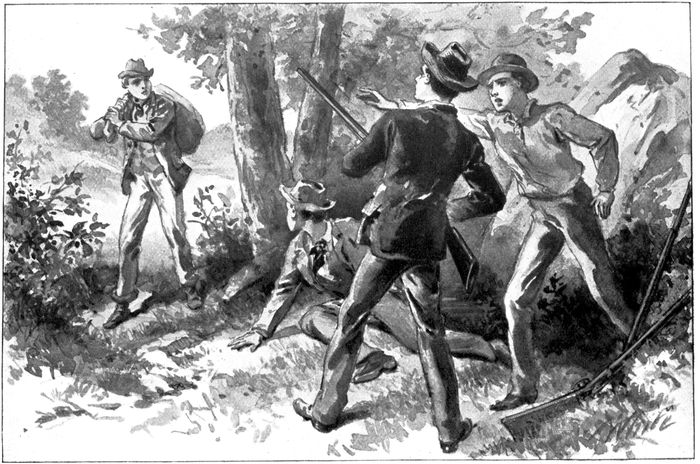
Stretched at their ease on the grass near
this spring were the “fellows,” the sight of
whom, as he caught a momentary glimpse of
them through the trees, had started George on
the train of thought with which he closed his
soliloquy.
Their dress and accoutrements seemed to
indicate that they had come out for a hunt;
although it is hard to tell what they intended
to shoot, it being too late in the season for
ruffed grouse and quails, and too early for
young squirrels. They were all the sons of
37rich men—almost inseparable companions—and
were rapidly acquiring the reputation of
being a “hard crowd.”
Careful and judicious fathers cautioned their
sons against associating with them; but that
did not seem to trouble these young fellows,
who kept on enjoying themselves in their own
way, and paying no heed to what others might
say or think of them.
They were engaged in earnest conversation,
and so deeply engrossed were they in the subject
under discussion, whatever it was, that
they did not hear the sound of George’s approaching
footsteps until he had come quite
near to them.
“I tell you, boys,” he heard one of them
say, “that will be a ten-strike, and we can
start on our western trip as soon as we
please. You know that old Stebbins will not
trust any of the banks, and consequently he
must have the money in his house.”
“But, of course, he keeps it stowed away
in some snug hiding-place,” said one of his
companions, “and we don’t know where
that is. What good will it do to break
38into the house if we can’t find the money
after we—”
The boy finished the sentence by uttering a
cry of alarm and springing to his feet.
His two companions, who were no less
alarmed, also jumped up, and were astonished
beyond measure to see George Edwards standing
within a few feet of them.
For a few seconds they stood regarding him
with eyes that seemed ready to start from
their sockets, while their faces grew whiter
and their knees trembled beneath them.
The one who had last spoken was the first
to recover his speech and power of action.
Snatching up the hammerless gun that lay in
the grass at his feet, he called out in savage
tones:
“What are you doing here? Make yourself
scarce at once, or I’ll—”
“What are you about, Benson?” cried one
of his companions, seizing the double-barrel,
and giving its owner a look that was full of
significance. “Why, man alive, have you
taken leave of your senses? Don’t you see who
that is? It’s Edwards—George Edwards.”
39“So it is,” said Benson, lowering his gun,
and calling a sickly smile to his frightened
face. “You’ll not feel very highly complimented,
I know, George, but the fact is I took
you for a tramp.”
His two companions laughed loudly, and
George smiled and threw his bundle down
beside the spring.
“That’s a good joke on you, Benson,” said
one of the young hunters who answered to
the name of Wallace. “When we return to
the village, you’ll have to set up the cigars, if
you want us to keep still about it.”
“It’s a bargain,” replied Benson, laying his
gun on the ground and seating himself beside
it. “Are you travelling, George, or just
going somewhere?”
“I am going somewhere,” answered George,
as he took a tin cup from his bundle and
dipped it into the spring.
“Got a job?”
“No—don’t want any, as long as I remain
in this country.”
“Going out to your cabin by the lake?”
George replied that he was; and, having
40drained his cup, he leaned over to fill it again,
the three hunters improving the opportunity
to exchange glances that were full of meaning.
“How are you going to make a living out
there during the winter?” inquired Benson.
“In summer you can fish and pick berries;
but when the snow covers the ground, and the
lake is frozen clear to the bottom, then what?”
“The lake doesn’t freeze clear to the bottom,”
said George, with a laugh. “I can supply
the village with the muskalonge that I
shall spear through the ice—I shall have a
monopoly of that trade, you know, for the
lake is so far away that no one thinks of going
up there in winter—and the snow will
afford me the means of tracking minks, raccoons
and hares.”
“Hares! You mean rabbits, I suppose?”
“No, I don’t. There are no wild rabbits in
America.”
Benson opened his eyes, and showed a disposition
to argue that point, but he was
checked by a look from Wallace. He evidently
understood just what it meant, for he
41settled back on his elbow and relapsed into
silence.
None of the hunters had anything to say
after that, and George, believing that his absence
would suit them better than his company,
shouldered his bundle, said good-by,
and struck into the path that led to the
hills.
“You’re a good one, Benson, you are!” exclaimed
Wallace, as soon as he had satisfied
himself that George was out of hearing.
“You gave us dead away, in the first place,
and then kept him here by talking to
him.”
“I wanted to allay his suspicions, if he had
any,” replied Benson. “That was the reason
I talked to him.”
“Was that the reason why you pointed
your gun at him?” inquired the hunter who
had not spoken before, and whose name was
Forbes.
“I was a little too hasty, that’s a fact,” said
Benson. “But you remember what we were
talking about, do you not? Well, when I
looked up and saw him standing there, almost
42within reach of us, I was so badly frightened
that I didn’t know what I was doing. Do you
suppose he heard anything?”
“Of course he heard something,” growled
Wallace, in reply. “He must be deaf if he
didn’t.”
“But do you think he suspected anything?”
“Ah, that’s another question! I hope not;
but there’s no telling. I can tell you one
thing, however. There isn’t room enough in
the hills for George Edwards and our party,
too, and one or the other must go.”
“I was thinking of that myself,” said Forbes.
“He might discover something, you know,
while he’s prowling around in search of his
minks and coons. Couldn’t we drive him out
by burning his shanty?”
“We might put him to some trouble, but
we couldn’t drive him out in that way,” replied
Wallace. “George is handy with an axe, and in
two days’ time he could build another cabin,
and perhaps he would be smart enough to keep
watch of it. But I shall not draw an easy
breath as long as he is up there. If he should
happen to stumble upon our cache? Whew!
43We must think about this, boys, and decide
upon something.”
Meanwhile, George Edwards was plodding
along towards the lake, and while he walked
he pondered deeply. The incidents of the
last half hour perplexed and astonished him.
What was the meaning of Benson’s unwarrantable
excitement? and what was it that had
caused the alarm so plainly visible on the
faces of the three hunters when they first became
aware of his approach?
“Benson never took me for a tramp,” said
George to himself. “That story was a fraud
on the face of it. And, then, what business
had they to be talking about old man Stebbins,
and the money he is supposed to have
in his house? It is a wonder to me that he
hasn’t been robbed a dozen times.”
There were one or two other points in the
conversation he had overheard that came into
the boy’s mind, but to which he did not then
attach any importance. He did not think of
them again until some days had passed away,
and then they were recalled to his recollection
in a most unexpected manner.
44It was fifteen miles from George’s old home
to his home in the woods, and, as the road
that led to it (if the blind path he followed
could be called a road) ran up hill nearly all
the way, it took him a long time to cover the
distance—much longer than it usually did,
for he was encumbered by his heavy bundle.
The sun was sinking behind the trees when
he came out of the bushes and stopped to rest
for a moment on a little promontory that
jutted out into the deep-blue bosom of Lone
Lake—a beautiful sheet of water, nine miles
long and half as wide, and situated twenty-five
hundred feet above the level of the sea—at
least, that was what the young surveyors
at the Montford Academy said.
George gazed upon its mirror-like surface
as one gazes upon the face of a friend from
whom he has long been separated. It had
yielded him and his mother a support and
kept a roof over their heads for two long
years, and it was his main dependence now.
If any one had told him, that before the
sun had again been reflected in those calm
waters half a score of times, some scenes
45would be enacted there that would change
the whole course of his life, George would
not have put the least faith in the statement;
but it would have been the truth, nevertheless.
CHAPTER IV. A HOME IN THE WOODS.
46
Having taken time to cool off and recover
his breath, George once more
lifted his bundle to his shoulder and resumed
his journey. He had not more than two miles
to go now, and as he followed the beach, where
the walking was good, it took him but a short
time to cover the distance.
The next time he threw down his bundle
it was in front of a snug little cabin, built of
rough logs, and situated on a little rise of
ground that commanded a fine view of the
lake.
“Things are all right outside,” said George
to himself, as he took a key from his pocket
and inserted it into the padlock with which
the heavy slab door was secured; “and that
is something to wonder at. There are lots of
mean boys in the village, and I was afraid
47that some of them had been up here during
my absence. Everything seems to be all
right inside, too,” he added, as the door swung
open and the interior of the cabin was disclosed
to view.
George stepped across the threshold as he
spoke, and this was what he saw: A room
twelve or thirteen feet square, with a heavy,
ungainly-looking scow turned bottom upward
in the middle of it; a wide fire-place with a
stick chimney and a stone hearth; over it a
rough mantelpiece, on which stood a lamp
and several books; at the opposite end an
open cupboard piled with bright tin dishes;
under the cupboard a table and two or three
stools, all made of slabs—and neatly made,
too; in a corner, near the door, a pair of oars
and a small sprit-sail made of unbleached
muslin; and lastly, a cord hammock, with
two quilts, as many blankets, and a pillow
in it.
There was no floor in the cabin, and neither
were there any windows. The ground, which
was almost as hard as the stone that formed
the hearth, was easily kept clean, and the door,
48being allowed to stand open during the daytime,
except in very stormy weather, admitted
all the light that was necessary.
Some boys would have thought this a very
cheerless and uninviting home, and so it was,
but it was the only one George had. He
had lived in the hope of some day being able
to provide himself with a better.
“There’s one thing about it,” thought the
boy, as he placed several sticks of round
wood upon the ground and made preparations
to roll the heavy scow out of the
cabin, “I am my own master. There is no
one to tell me what I shall do and what I shall
not do, and all the money I make is my own.
If I had agreed to Uncle Ruben’s proposition,
I should have to go hungry and half clad,
listen to a scolding from Aunt Polly Ann
every hour in the day, and now and then I’d
have to take a cowhiding from Uncle Ruben.
I’d much rather live here alone than with
them, and I don’t care if I never see—”
George’s soliloquy was interrupted by a
sound that startled him—the clatter of a
horse’s hoofs on the gravelly beach. He
49looked out at the door, and was astonished
to see Uncle Ruben riding toward the cabin.
If one might judge by the expression of
his face he was in very good humor about
something. Dismounting, he drew the bridle-rein
over his horse’s head, and dropped it to
the ground so that the animal could not stray
away, at the same time greeting his nephew
with:
“Well, George, I don’t reckon you expected
to see me ag’in so soon, did you?”
“No, I didn’t,” replied the boy.
And Uncle Ruben would have been dull,
indeed, if he had not been able to see that
he was not wanted there.
“I didn’t expect to see you, nuther,” continued
the man, seating himself on the scow,
which had been rolled part way through the
door. “But I thought mebbe I’d better
have another leetle talk with you—”
“It’s of no use,” said George—“of no use
whatever. If I had to live in the same house
with you, I would not work for you for fifty
dollars a month—”
—“another leetle talk with you,” repeated
50Uncle Ruben, paying no heed to the interruption,
“for I think you will be willin’ to
listen to me now.”
“Well, you are mistaken. I shall never
agree to your proposition. I know you too
well.”
“I wouldn’t git up on a high hoss, if I was
in your place. ’Tain’t becomin’,” said Uncle
Ruben, in a significant tone. “Hold on now,”
he added, seeing that George’s face began to
flush with indignation. “I ain’t speakin’ of
what your father’s done. I’m speakin’ of
what you have done yourself.”
“I have done nothing to be ashamed of. I
have tried to behave myself, and to deserve
the respect of those around me. I have
always made an honest living—”
“Have you, though? Well, there’s them
right here in this town as says you hain’t,”
interrupted Uncle Ruben, with a triumphant
air.
“Oh, I know that there are those who
make a business of saying all sorts of unkind
things about me,” answered George, in a
voice that was choked with indignation,
51“but all they can say will not alter the facts
of the case. I say now, and I don’t care
who disputes it—”
He suddenly paused, for there was an expression
in his uncle’s eyes that he could not
understand. He looked steadily at him for a
moment, and then seated himself on the
other end of the scow.
“There, now!” said Uncle Ruben, in a
tone of satisfaction. “I kinder thought that
mebbe you’d be willin’ to listen to reason
after while. It’s the gospel truth, an’ folks
do say it.”
“What do they say?”
“They say they don’t know where you got
the money you used to spend at the store
for the oranges an’ trash you used to buy for
your mother.”
“Well, if you hear anybody asking any
questions about it, you can just tell them, for
me, that it’s none of their business!” replied
George, angrily.
“But folks’ll make it their business. You
can’t expect that they’ll stand by an’ let their
stores be broke into an’ robbed, an’ their
52butter an’ chickens stole, without making a
fuss about it. Don’t stand to reason.”
“Uncle Ruben, explain yourself,” said
George, jumping to his feet. “You don’t
mean to tell me—”
“Yes, I do,” broke in the man, who knew
what his nephew was about to say. “Everybody
knows that you have been spendin’ a
heap of money sence your father was locked
up, an’ that you didn’t make it by sellin’ fish
an’ berries.”
“How did I make it, then?” asked George,
who was utterly bewildered.
“How can I tell? I don’t know where all
that nice butter an’ them fine chickens an’
silk goods went to. True, that’s jest what
folks say about you,” continued Uncle Ruben,
who saw that George was almost overwhelmed
by the hints he had thrown out, “an’ they’ll
keep on sayin’ it as long as you live up here
in this wild Injun fashion. Your Aunt Polly
Ann, who sets a heap of store by you, has
been to the trouble of fixin’ up a nice bedroom
for you, an’ I promised her, sure, that
I’d bring you home with me.”
53“Well, when you see her again, tell her
that the reason that you didn’t keep your
promise was because I wouldn’t go home with
you,” said George.
“You won’t? You’d better. Jest see
how people are talkin’ about you.”
“Let them talk until they get tired, and
then, perhaps they will stop. I’ll not go,”
declared George, shortly.
“But you must. I’ve set my heart on it,
an’ so has your Aunt Polly Ann.”
“I can’t help that.”
“The constable might come up here an’
arrest you for a thief.”
“I know he might, but he won’t. At any
rate, I’ll take the risk. Now, Uncle Ruben,
you might as well understand, first as last,
that you can’t scare me into going home with
you. Let me shove the boat out, please.
There is a storm coming up, and I want to
go out on the lake and catch some fish for
supper before it gets here.”
“Well, George,” said Uncle Ruben, as he
arose to his feet, “I have tried to do my duty
by you. I have offered you a good home, an’
54give you fair warnin’ of what will be sartin
to happen to you if you hold to your fool notion
of livin’ up here all alone by yourself.
Folks will think there’s something wrong
somewhere.”
“They needn’t trouble themselves about me.
Let them attend to their own business, and I
will attend to mine.”
“If you git into trouble through your mulishness,
you mustn’t blame me for it.”
“I won’t. Good-by!”
“He’s a bad boy—a monstrous bad boy!”
soliloquized Uncle Ruben, as he mounted his
horse and rode away; “an’ he’ll surely come
to some bad end, jest as his father did before
him. He shan’t stay up here wastin’ his time
when he had oughter be at work, an’ that’s all
there is about it.”
George watched his uncle as long as he remained
in sight, and then went to work to get
his scow into the water. He was surprised
and bewildered, but he was not frightened,
for he could not bring himself to believe that
the man had told him the truth. What reason
could anybody have for saying that he was
55the thief whose depredations had caused so
great an excitement in the village?
“Uncle Ruben made it all up out of his
own head,” said George to himself, as he
pushed the scow into the water and made the
painter fast to a convenient tree, “and it is only
one of the many mean tricks of which I know
him to be guilty. The village people know
where I live, and if they suspect me, let them
come up here and find some of the stolen goods
in my possession. That’s a thing they can’t do.”
Consoling himself with this reflection,
George went into the cabin again, and when
he came out he brought out with him the
oars belonging to the scow, and also a stout
fishing-rod. It was not a jointed lancewood
rod, with German-silver mountings, wound
butt, and nickel-plated reel-seat, but simply a
hickory sapling he had cut in the bushes.
George could not afford a fancy outfit, and
this rod, which had cost him nothing at all,
answered the purpose for which it was intended,
and if he chanced to break it while
playing a heavy fish, he could in five minutes
provide himself with another just as good.
56Having filled his box with bait, which he
found under a log behind the cabin, George
stepped into his scow and pushed her off from
the beach.
Just then a loud peal of thunder echoed
among the hills, and the smooth surface of the
lake was ruffled by the first breath of the oncoming
storm. A thick, black cloud which
had been hanging in the horizon all day long,
was now rising rapidly, and, during the five
minutes that George had been employed in
getting his boat into the water and digging
his bait, it had covered the whole sky.
It was growing dark, and the lake looked
black and threatening. It was a treacherous
body of water—a capful of wind was enough
to raise a sea that would try almost any boat—and
George knew better than to trust himself
upon it while a gale was raging.
“I guess I don’t want any fish for supper,”
said he, as he shifted his oar to the other side
of the boat, and pushed her back toward the
beach. “I shall have to be satisfied with
what I brought with me in my bundle. It’s
going to be a hard one,” he added, as a strong
57gust of wind lifted his hat from his head and
carried it toward the cabin; “and I thank my
lucky stars that I have a tight roof to shelter
me. What in the world was that?”
Having drawn his scow high up on the
beach, and fastened the painter securely to a
tree, George ran to recover his hat; and just
then, something that sounded like a cry for
help came faintly to his ears.
Believing that the appeal came from the
woods, George listened intently, and in a few
seconds the cry was repeated. This time the
wind brought it to him very plainly, and he
caught the words:
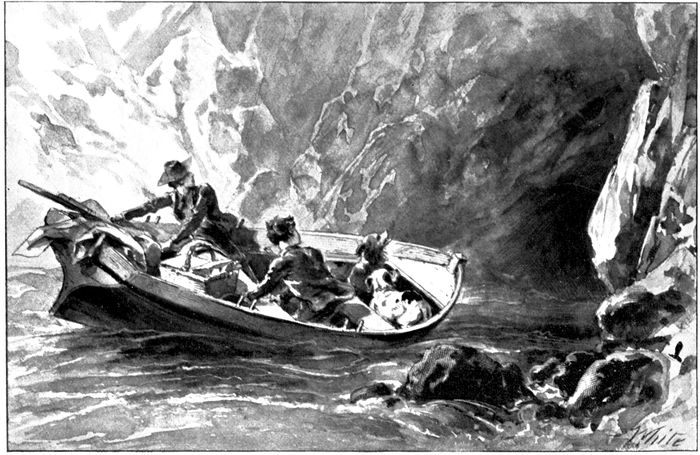
“Help! help! Our boat is sinking!”
George looked in the direction from which
the voice sounded, and was greatly astonished
as well as alarmed, to see a cockle-shell of a
boat dancing about among the waves, which
had already grown to formidable proportions.
While he gazed, she sank out of sight, and
nothing but the top of the little shoulder-of-mutton
sail she carried in the bow remained
in view to show that she was still above water.
CHAPTER V. A CAPSIZE.
58
George Edwards held his breath in
suspense. The hull of the little craft was
so long out of sight that he began to fear he
would never see it again; but, all of a sudden,
it bobbed up as buoyantly as a cork,
and once more that frantic appeal for assistance
was borne across the lake.
George was now able to see that there were
two boys in the boat. One was clinging to
the mast, waving his handkerchief over his
head as a signal of distress, and the other
was seated in the stern, wielding a clumsy-looking
paddle, with which he endeavored to
keep the boat before the wind.
George looked at them, and then he looked
toward the promontory on which he had
stopped to rest when he first reached the lake.
This promontory was about fifty feet in
59height, and its base was thickly lined with
rocks, over which the waves were dashing
with great violence, throwing the spray high
in the air. It was not more than half a mile
distant, and the wind was driving the boat
toward it with fearful rapidity.
“What lunatics those fellows must be to
venture out on this lake when they don’t
know how to manage a boat!” exclaimed
George. “If they hold that course they will
be dashed to pieces on the rocks, as sure as
they are living boys.” Then, bringing his
hands to his face, and using them as a speaking-trumpet,
he shouted with all the power
of his lungs, “Haul down your sail and pull
for the beach!”
The boy who was holding on to the mast
waved his signal of distress over his head, and
then the boat sank out of sight again.
When she reappeared, George once more
shouted to her crew to haul down the sail, at
the same time striving to warn them of their
danger by pointing toward the rocks and
beckoning to them to come ashore.
But his instructions must have been misunderstood,
60or else the boat’s crew could not
obey them, for their little craft kept driving
on toward the rocks, while one of the boys
continued to wave his handkerchief, and the
other to ply his clumsy paddle.
It was plain that they could not save themselves,
and that George was the only one who
could render them any assistance. The boy’s
face grew pale when this fact flashed upon
him, but it wore a very determined look.
“It’s almost certain death,” said he, as he
cast off the painter and pushed the scow into
the water; “but I can at least make the attempt.
If I go under, there is nobody to miss
me.”
Pushing his scow through the surf, and
wading until the water was nearly up to his
waist, George clambered in, shipped the oars,
and pulled out into the lake.
When Uncle Ruben was at the cabin, he
had shown a disposition to turn up his nose
at his nephew’s boat, which was the boy’s
own handiwork; but if he could have seen
how she behaved now, he would have learned
that she was much better than she looked to
61be. Being broad of beam and light of draught,
she seemed to skim over the top of the waves
instead of breaking through them, and, heavy
as she was, George was able to send her ahead
with considerable speed.
He rowed fast enough to intercept the sailboat
when she was within less than a quarter
of a mile of the threatening rocks and then
he found, greatly to his surprise, that she was
a canoe, so lightly built, apparently, that a
boy of ordinary strength could take her on
his back and walk off with her with all ease.
She was making bad weather of it, for she
was half-full of water, and every time she
struck a wave she would bury her nose in it
almost out of sight. If her two occupants
realized the danger of their situation, they did
not show it. They were as cool as boys could
possibly be.
The one in the bow watched George’s
movements with a good deal of interest, while
the dignified young fellow in spectacles, who
was sitting in the stern and using the butt
of his double-barrel for a paddle, issued his
orders with great calmness and deliberation.
62“Bring your boat around head to the wind,
if you can, and let us come alongside of you,”
said he, addressing himself to George. “You
will have to do all the work, for I have lost my
paddle; and if the canoe should broach to, we’d
be tumbled out into the lake before you could
say ‘General Jackson’ with your mouth open.”
George saw at a glance that the dignified
young gentleman knew how to handle a canoe,
and that in keeping the sail hoisted he
was doing the best that could be done under
the circumstances. If he had attempted to
make the beach, he would have brought his
cranky little craft broadside to the waves, and,
having no centre-board, and scarcely any
bearing, she would have been overturned in
an instant, leaving her crew to sink, or drift
helplessly toward the rocks.
That very thing did happen to her soon.
Although George tried hard to place himself
directly across her bows, the canoe shot wild
of him; and in his efforts to bring her alongside
the scow, the skipper lost control of her,
and over she went, turning completely bottom
upward.
63The rocks were now but a short distance
away, and the noise made by the waves as
they dashed over them was enough to frighten
anybody. George was frightened, and his
pale face showed it.
It would have been a work of no little difficulty
to row a light boat away from that dangerous
spot; but to wait there long enough
to pick up a couple of boys who were tossed
about by the waves, now here, now there, and
always just out of reach, to rescue them and
then save himself, was a task requiring great
skill and prudence.
George looked at the rocks and then he
looked about for the canoe’s crew. To his
great joy they arose to the surface, one after
the other, and they were close ahead of him,
too. One was near enough to seize the gunwale
of the scow, while the other promptly
laid hold of the oar that was thrust out toward
him.
“Where’s Goggles?” asked the first, wiping
the water out of his eyes, and looking around
to find his companion.
“He’s all right!” answered George. “Climb
64in—quick! Not over the side, for your weight
will capsize the scow. Go around to the stern.
Be lively now, or the waves will throw us on
the rocks.”
The boy looked toward the breakers, but
the sight of them did not seem to terrify him
in the least. He worked his way around to
the stern, climbed into the scow, and then
turned to assist his companion, who was
clinging to the oar with one hand, while in
the other he held a light double-barreled
shotgun.
“Say, Goggles!” said the boy in the boat;
“I am just a hundred dollars out of pocket,
by this day’s work. Give us your gun. Mine
is at the bottom of the lake. I told you your
cranky little egg-shell wasn’t seaworthy!”
“The canoe is all right, so far as her seagoing
qualities are concerned,” was the reply.
“If I hadn’t lost my paddle overboard, she
would have taken us ashore without shipping
so much as a cupful of water. But we have
taken our last ride in her. She will be
smashed into kindling-wood on those rocks.”
“Haul him in! haul him in!” cried George,
65in great excitement. “We shall be smashed
into kindling-wood, too, if we don’t get out of
this! Now, then,” he continued, as the boy
who had been addressed as “Goggles” was
dragged aboard, “take an oar, one of you, and
pull for your life.”
The boys had no light task before them,
and if Goggles had not been a capital oarsman,
it is hard to tell how the struggle would
have ended.
For a long time the heavy boat seemed to
remain stationary. With all their exertions,
they could make no perceptible headway;
but finally they began to gain a little, and,
after half an hour’s hard pulling, they succeeded
in beaching the scow about half-way
between the promontory and the cabin.
George landed there, because he thought it
would be easier to walk a quarter of a mile
than it would be to pull the boat that distance
against the wind and the waves.
“Now, then,” said Goggles, as he and his
companion assisted in securing the boat, so
that it would not drift away; “the next
thing is something else. A fire to dry our
66clothes by and something good to eat, would
be very acceptable just now. Do you live
far from here, my friend?”
“Only a short distance away,” answered
George. “If you will go up to my shanty,
you can have both the fire and the supper.
I can’t promise you that the grub will be
very good—”
“Say nothing about that,” interrupted
Goggles. “I hope we shall not put your
folks to any trouble.”
“No,” replied George, sadly; “you’ll not
put them to any trouble.” Then, seeing the
expression of surprise and inquiry on the
faces of the rescued boys, he added, “I am
my own cook and housekeeper. I am living
up here alone.”
“Oh, you’re out for a holiday, then! You
came here to hunt and fish, I suppose?”
“Yes, I came here to fish; but I am not
taking a holiday. It’s a matter of bread and
butter with me.”
“You don’t say so! Can’t you find anything
to do in the village?”
“No, I can’t,” replied George.
67But he did not tell the boy the reason
why.
“Well, there’s no use in standing here in
the rain any longer. Let’s go up to your
‘shanty,’ as you call it. You have rendered
us a most important service,” said Goggles,
with much feeling, as he took George’s hand
in both his own and shook it warmly. “I
never saw anybody exhibit as much pluck as
you have shown to-day. What can we do
for you?”
“Take a big bite while you are about it,”
said the other boy, who had stood by, listening
in silence to this conversation. “We owe
our lives to you.”
“You owe me nothing but your good-will,”
replied George. “I am sure you would have
done as much for me.”
“I don’t know about that,” replied Goggles,
as the three hurried up the beach toward
the cabin. “One needs courage, and a good
share of it, too, to enable him to go deliberately
into danger for the sake of helping
somebody; and that’s a quality I don’t pretend
to possess. Now, perhaps you would
68like to know who we are. My friend here is
Bob Howard, and he lives away out of the
world, in a place called Arizona. I am Dick
Langdon, at your service, and live in a white
man’s country, my home being in Connecticut.”
“There’s where the wooden nutmegs come
from!” observed Bob Howard.
“My name is George Edwards, and I live
there,” said our hero, pointing to the cabin,
which was now in plain sight.
It looked mean and forbidding now. It
was good enough for him, for he had never
been accustomed to luxurious surroundings;
but, if there was any faith to be put in
appearances, the boys who were to be his
guests until the storm was over, were the
sons of wealthy parents, and he thought
they would look out of place under his
humble roof.
He did not then know that one of them
was more familiar with life in the woods than
he was, and that he had many a time been
glad to crawl into a hollow log for shelter.
George didn’t know, either, that his life and
69Bob Howard’s were destined to run along in
the same channel, and that they were to be
the heroes of an adventure that is talked of
on the frontier until this day; but such was
the fact.
CHAPTER VI. DICK LANGDON’S SENTIMENTS.
70
“We are students at the Montford Academy,”
said Dick Langdon. “Yesterday
we asked for a short leave of absence,
and came up here in search of fun and
adventure.”
“And we got all we wanted of both!”
chimed in Bob Howard. “Dick lost his
canoe, and I lost my gun, but we caught a
splendid string of fish, and I had a twenty-minute
fight with a muskalonge, that I shall
remember as long as I live.”
“You don’t say anything about the narrow
escape we had from having our brains
dashed out on those rocks,” observed Dick.
“There’s no need that I should speak of
that, for George knows as much about it as
we do. By-the-way, do you suppose the
71waves will leave anything of that canoe?
Our fishing-rods were stowed in one of the
lockers.”
“I am afraid you have seen them for the
last time,” replied George. “But I don’t
think your gun is lost beyond recovery.”
“How shall we go to work to get it?”
“If the lake is quiet to-morrow, we can
dive for it. I think I can go right to the
spot where your boat was capsized.”
“How deep is the water?”
“About thirty feet.”
“You don’t pretend to say that you can
bring up bottom at that depth, do you?”
“Oh, yes! I can go deeper than that,
when I have a high place to take a plunge
from.”
“Well, you are better at diving than I am,
and I will make it worth your while to get
that gun for me. I value it highly, for it
was the last thing my father gave me before
I left my Western home to come to this
academy. So this is where you live, is it?”
said Bob, as George entered the cabin door
and invited them to enter.
72Wood was already laid upon the hearth,
and it was but the work of a moment to
touch a lighted match to it and set it
going.
Then George and his new friends pulled
off some of their wet clothes, and, having
wrung the water out of them, they hung
them over the stools to dry.
The fire was soon blazing merrily, and, as
the boys turned themselves slowly about in
front of it and listened to the howling of the
storm and the beating of the rain on the roof,
they felt a sense of comfort and security that
was decidedly refreshing after their recent
experience.
“Now, isn’t this glorious?” said Dick
Langdon, adjusting his spectacles and spreading
his hands over the warm blaze. “I believe
there must be some Indian about me,
for do you know, fellows, that I have often
thought I should like to live this way all my
life?”
Without waiting for an answer, Dick
straightened up, turned his back to the fire
and sung, in a clear, mellow voice:
73“I’ve a home in the woods, the dark green woods,
’Neath the shade of the old oak tree,
Where the wild birds warble their songs of praise,
In tones so wild and free.
A lovely place is this home of mine—
A quiet, a dear little spot;
And over my casement the vine doth entwine,
Like an angel, to watch o’er my cot!”
“The sentiment is very fine, no doubt,”
said Bob Howard. “But if that dear little
home of yours was covered with snow, so
that you couldn’t stir out of it for months;
and your firewood gave out, and the wolves
came and serenaded you every day and
glared down at you through the chimney;
and your provisions run short, and you saw
starvation staring you in the face! I tell
you what’s a fact, Dick; I know something
about that. There has been a good deal of
nonsense written about life in the woods.
You could not stand it three months.”
“I’d like to try,” said Dick.
“I’ll change places with you,” said George.
“I’ll give you my house, if you will give me
your seat at the academy.”
74“Would you like to go there?”
“Indeed I would.”
“Then, why don’t you go?”
George was so surprised at this question,
that he did not reply to it.
Why didn’t he go? Where were his
guest’s eyes and ears? Would he, or any
other boy, who was in full possession of his
senses, be likely to make a hermit of himself
from choice?
Of course, he could not tell them that he
had no money to pay for four years’ tuition at
the academy, and so he held his peace; but
his silence told his new friends all they wanted
to know, and they then and there made up
their minds to act accordingly.
After the two boys had warmed themselves
and dried their clothing, Dick proceeded to
overhaul his gun, and Bob assisted George in
laying the table and preparing supper.
It was not much the latter had to place
before his guests—nothing but bread and
butter, a few vegetables and a cup of tea; but
there were half a dozen young squirrels in
Bob’s game-bag, which the owner had saved
75simply because it happened to be slung over
his shoulder when the canoe was capsized; and
when these had been cleaned and roasted
over the coals, the meal was ready.
George’s long walk had given him a good
appetite, and the ducking Dick and Bob had
received must have had a similar effect upon
them, for the edibles rapidly disappeared,
and in a few minutes every bone had been
picked clean.
“How did you two fellows happen to find
your way to this lonely region?” asked
George, as he threw more wood on the fire and
drew one of the stools into the chimney corner.
“Oh, we have often heard of this lake and
the fine fishing that could be enjoyed here, if
one had a boat to go about in; so I sent home
for my canoe,” replied Dick Langdon.
“When it came, we hired a team to bring us
and our trappings up here, and asked the
professor for a holiday. We are to go back
to-morrow night, for no student is allowed to
be away from the village over Sunday, unless
he is known to be at home, where he can’t
get into mischief.”
76“Where is your camp?”
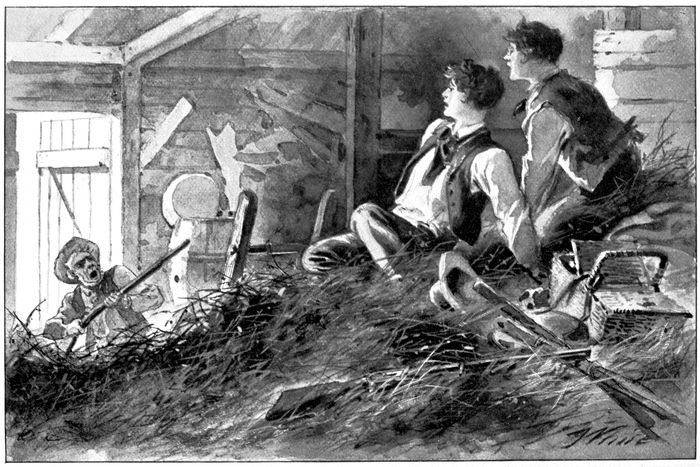
“We haven’t any. We slept in Mr. Stebbins’
barn last night.”
“In his barn!” repeated George. “Why
didn’t you go into the house?”
“Because the old fellow wouldn’t let us,”
said Dick, with a laugh. “We gave him abundant
proof that we were able to pay for our
supper and lodging, but he would not listen
to us.”
“And while he was talking to us, he held
the door open just about two inches,” observed
Bob. “He acted as if he was afraid of us.”
“Very likely he was,” said George. “If all
reports are true, he’s got a pile of money hidden
away somewhere in his house.”
“Ah, that accounts for his suspicions, then.
For a while, we thought we would have to
stay out of doors all night,” continued Dick;
“but finally, the old fellow said we might
sleep on the hay, if we wouldn’t smoke. And
just before dark he brought us a mouthful
of bread and butter and about half a pint
of milk.”
“And charged us a dollar for it!” said
77Bob, in a tone of disgust. “He’s a regular old
skin-flint. But if he keeps so much money in
the house, I shouldn’t think he and his wife
would want to live there alone. If some tramp
should happen to find it out, it might be bad
for them, for they are too old to defend themselves,
and there isn’t another house on the
lake—is there?”
“Yes, there is one at the lower end,” replied
George; “but I am his nearest neighbor.”
When bedtime came, George spread all his
quilts and blankets on the floor in front of
the fire, and he and his guests went to sleep,
lulled by the howling of the storm, which
continued to rage with unabated fury until
long after midnight; but the morning broke
bright and clear, and at the first peep of day
the boys were astir.
They looked out at the door, and saw that
the lake was as smooth as a mill-pond. There
was nothing to prevent them from making
an attempt to recover Bob Howard’s lost fowling-piece.
“But first, I must have a good breakfast
78of fish,” said that young gentleman. “We lost
those we caught yesterday, but fortunately, I
have both hooks and lines in one of the pockets
of my game-bag.”
“And there’s an axe, and you will find
plenty of poles behind the cabin,” said George,
“While you are cutting them, I will go down
and bring up the scow.”
“Did you save any cartridges?” asked
Dick Langdon, who stood just outside the door,
with his head turned on one side, as if he
were listening intently.
“I did; and as they are loaded in water-proof
cases, they are not injured in the least.”
“Well, your gun is the same calibre as
mine, and if you will give me some of those
cartridges, I’ll see if I can get a squirrel or
two for breakfast. I hear one barking out
there in the woods.”
Bob handed his game-bag to Dick, who
slung it over his shoulder and set out in
search of the squirrels, while George hurried
down the beach to bring up the scow.
By the time he returned, Bob had rigged
a pole and dug a supply of bait; and when
79he had got into the boat, George pulled him
to the nearest fishing-ground.
“There’s nothing like knowing where to
go to find the best places,” said Bob, half an
hour later, as he surveyed with no little satisfaction,
the fine string of yellow perch which
was floating in the water alongside the scow.
“Yesterday, Dick and I tried all the likely
spots along the opposite shore, but we didn’t
get a bite until we got down to the lower
end of the lake.”
“That was because you didn’t understand
the habits of the fish,” replied George.
“When the season first opens, you will find
them along the beach, just outside the weeds;
but as the weather grows warmer, they draw
off into deep holes, and at this time of the
year you will find the best fishing in about
forty feet of water.”
While Bob was engaged in hauling in the
perch, almost as fast as he could bait his
hook, Dick Langdon was not idle. His gun
spoke at short intervals, and as Dick was a
fine marksman, he did not throw away a single
charge of shot.
80When the fishermen returned to the cabin,
they found him sitting on a log in front of it,
with half a dozen gray squirrels at his side.
He might have secured as many more if he
had felt so disposed, but being a thorough-bred
young sportsman, he did not believe in killing
more game than he could use.
Breakfast was soon cooked and eaten, and
then Dick and Bob announced that they were
ready to see George make an attempt to recover
the lost fowling-piece.
The lake being quiet, they had a fair view
of the rocks on which they had so narrowly
escaped being wrecked, and they shuddered
as they looked at them.
CHAPTER VII. A PERSEVERING DIVER.
81
Bob rowed the boat, George stood in the
bow, divested of his clothing and all
ready to make the plunge, and Dick sat in the
stern and looked at the rocks.
“I tell you, they look ugly!” said he, with
another involuntary shudder. “If it hadn’t
been for you, George, there would have been
two vacant seats at the Montford Academy
next Monday. What’s that wedged in between
those two high rocks, a little to the left
of the point? It looks to me like a piece of
my lost canoe.”
“That’s just what it is!” answered George,
“We’ll go up there and take a look at it as
soon as I find out whether or not I am going
to get that gun. We are pretty near the spot
now. Steady! There!”
As Bob ceased rowing and faced about on
82his seat, there was a splash in the water, and
George had disappeared. He was gone a good
while—so long that the two boys who were
awaiting the result of his experiment, began
to look at each other with some uneasiness.
At length, Dick asked suddenly:
“I say, Bob, what are you going to give
him if he finds your gun for you?”
“That’s exactly what I wanted to speak to
you about,” was Bob’s reply. “I don’t think
it would be quite the thing to offer him money,
for he doesn’t look to me like a boy who would
go to all this trouble for the sake of earning
a reward.”
“That’s my opinion, and I will tell you
what I have been thinking of. You know he
said he would like to go to the academy; and
he said it in a way that led me to believe that
the only obstacle that stands in his way is a
lack of money. Now you and I have more
spare change than we can use, and if you will
pay half his tuition, I’ll pay the other half.
He needn’t know that we’re doing anything
for him, for I have an idea that he would refuse—”
83Before Dick could finish his sentence,
George’s head bobbed up out of the water, a
short distance away; but the only thing he
brought with him was a handful of gravel, to
show that he had been to the bottom.
A few long, sweeping strokes brought him
alongside the boat. He climbed in over the
bow, and, after taking a moment’s breathing
spell, he went down again.
This time he was gone longer than before,
and Dick and Bob had ample leisure to decide
upon something.
What it was, you will learn as our story
progresses.
The second attempt to recover the lost
weapon resulted in failure, and so did the
third and fourth; but the fifth was successful.
A hand, grasping the little double-barrel,
suddenly appeared above the surface of
the water, followed an instant after by the
persevering diver, who was as highly elated
over his achievement as Bob Howard was
himself.
“George,” said he, as he grasped the gun
and began rubbing it briskly with his handkerchief,
84“I don’t know how to thank you
for the service you have rendered me.”
“Then you had better not try,” advised
George, with a laugh. “That’s a beautiful
little piece, and well worth saving. Now, I
wish I could give Dick his canoe in good order.”
“Thank you! But that is something that
nobody this side of Troy can do. She is made
of paper.”
George, who had never before heard of such
a thing as a paper canoe, opened his eyes and
looked incredulous; but when he had pulled
over to the rocks and taken a look at the
wreck that was stranded there, he found that
Dick had told him nothing but the truth.
The little craft had been torn completely in
two. The stern was nowhere to be seen, and
the bow was wedged so tightly between the
rocks that they could not get it out.
“I say, Bob, take the butt of your oar and
break a hole through the bottom,” said Dick.
“Perhaps we shall find something in there.”
And so they did.
Through the opening that Bob’s heavy oar
85speedily made in the frail covering he gained
access to the forward locker, from which he
drew forth two jointed fishing-rods, and also
a liberal supply of canned goods, such as salmon,
lobsters, condensed milk, and fried brook
trout.
He likewise brought to light a canister of
ground coffee, about half a peck of potatoes,
and lastly, a water-proof bag, which, on being
opened, was found to contain a quantity of
crackers, bread, and ginger-snaps, and also
two blackberry pies.
George looked on in wonder.
“Did I understand you to say that you are
going back to the academy to-night?” said he.
“You did,” assured Bob, panting from his
exertions. “Why do you ask?”
“I don’t wonder that you had to hire a
team to bring you up here,” continued George.
“You had your canoe provisioned for a four-weeks’
cruise.”
“That shows how much you know about an
academy boy’s appetite,” said Dick. “Whenever
we go into the country for a holiday, we
always make our entertainers open their eyes.
86Find anything more, Bob? Well, then, shove
off. We’ll stop at the cabin long enough to
unload our cargo and give our poles a good
rubbing, and then, perhaps, George will be
kind enough to show us where we can catch
a good string of bass. We don’t want to go
back to the academy empty-handed, you
know; for if we do the fellows will laugh at
us.”
George’s guests thoroughly enjoyed themselves
that day.
Having caught a pailful of minnows for
them, George rowed them down to his favorite
fishing-grounds, and by the time the fish
stopped biting they had sixteen black bass
to show to the academy boys as trophies of
their skill.
George offered to increase the size of their
string by adding to it the fish he had caught
himself—being an expert angler, he had
caught an even dozen while the others were
catching sixteen—but Dick and Bob would
not listen to it. When they exhibited their
fish they wanted to be able to say that they
had caught them all themselves, and they
87couldn’t say that if they accepted any help
from George.
The dinner that was served up in the cabin
that afternoon was the best that George had
eaten for many a day, and he disposed of his
full share of it.
When they had satisfied their appetites,
Dick and Bob began to get ready to start
for home.
“Now, George,” said the latter, as he
shouldered his gun and fishing-rod, which
he had tied together so that they could be
easily carried, “how much do we owe you?”
“Not a red cent,” was George’s reply.
“Cheap enough,” said Dick. “We’ll come
again.”
“I hope you will. I shall be glad to see
you at any time—that is, if you can be satisfied
with such poor accommodations as I have
to offer you.”
“Say nothing about that!” exclaimed Bob.
“What better accommodations can we ask for
than a tight roof, a good bed and plenty to
eat and drink?”
“And good hunting and fishing within a
88stone’s throw of your door,” chimed in Dick.
“You may expect us next Friday evening.
We can get away every week if we only behave
ourselves during study hours, and I am
perfectly willing to be good for five consecutive
days for the sake of enjoying such
squirrel shooting as I had this morning.”
As the nearest way to the village was
through Mr. Stebbins’ sheep pasture, George
took his guests across the lake in his boat,
thus saving them a three-mile walk.
After putting them on the road, and giving
them explicit directions regarding the course
they were to follow in order to reach the
academy, George said good-by, and set out
on his return to the lake; but while he was
crossing the sheep pasture he was confronted
by Mr. Stebbins, who, in no amiable tones,
demanded to know what he was doing there,
and what business he had to bring those
young vagabonds on his grounds.
“They are not vagabonds,” replied George,
with some spirit. “They are gentlemen, and
that is more than I can say for some other
people I know.”
89“I don’t want none of your sass!” snapped
the old man, angrily, at the same time whisking
a heavy black snake whip he carried in
his hand. “I tell you that I don’t like the
looks of them fellers.”
“I can’t help it, can I?” asked George.
“I never slept a wink t’other night,” continued
Mr. Stebbins, “’cause they was in my
barn, an’ I was expectin’ every minute that
they would break into my house an’ rob me.
I don’t want them to come foolin’ round here
no more. You hear me?”
“Yes, I hear you. They will be up here
again next Friday night, and I will tell them
what you say.”
“Wal, they shan’t sleep in my barn ag’in,
if they do come up here, ’cause I’m afeared
of ’em. Why don’t they stay to home, where
they belong? They’ve got no ’arthly business
up here. An’ I tell you another thing
I don’t like,” went on Mr. Stebbins, flourishing
his whip over his head. “Be you livin’
over there on t’other side of the lake?”
The boy replied that he was.
“I thought so, ’cause I seed a smoke comin’
90out of the chimbly. Now I don’t want
you nor nobody else over there, an’ I won’t
have it, nuther.”
“Is my cabin on your grounds?” questioned
George.
“No, it ain’t,” said Mr. Stebbins, emphatically.
“Then you have nothing to say about it. I
had permission from the man who owns that
land to build my cabin there, and so long as
he does not object, you have no right to complain.”
“Hain’t I though?” Mr. Stebbins almost
shouted. “Wal, I shall ask the selectmen
about that. There’s a poorhouse pervided for
them that ain’t able to make an honest livin’
for themselves.”
“I am able to make an honest living,” said
George, with no little indignation in his
tones, “and I shall not go to the poorhouse
to please anybody.”
“You ain’t your own boss yet by a few
years,” reminded the man, with a sneer;
“an’ if you’re too stuck up to earn a livin’
by hard work, like an honest boy had
91oughter do, you may find yourself in jail, the
first thing you know. I’ve been a-lookin’ for
it, ’cause there’s been a heap of stealin’—Wal,
go on; but remember what I’m a-tellin’
you.”
George, who was too angry to listen to
another word, hurried down to the beach,
sprang into his boat, and pushed off into
deep water.
His little cabin was lonely enough now.
He missed his new friends, whom he had
learned to like during his short acquaintance
with them, and his interview with Mr. Stebbins
had thrown a gloom over him that he
could not shake off.
CHAPTER VIII. UNCLE RUBEN CALLS AGAIN.
92
During the next few days, George was
permitted to live in peace, but we cannot
say that he enjoyed himself, for at times
he felt very lonely, and bitter, too.
While other boys in the village were given
every opportunity to work their way up in
the world, he had been driven into exile by
force of circumstances, and just now he did
not see how he could better his condition.
“I have heard people say that it is always
darkest just before daylight, and if that is
the case, my day must be close at hand,”
George often said to himself. “Things
couldn’t look darker to me than they do now;
but if a canal boy can become President, I
don’t see why a fisher-boy cannot become a
decent, respected member of society, if nothing
93more. I shall work hard for it, and if I fail,
it will not be my fault.”
Every other day George carried to the village
a nicely-dressed string of fish, for which
he found ready sale, bringing back with him
such supplies as he happened to need.
He always found everything in and about
the cabin just as he had left it, and there was
nothing to indicate that there had been any
one there during his absence.
But, for all that, there had been visitors at
the cabin on two different occasions. These
visitors were in no way connected with each
other, although they had the same object in
view, as we shall presently see.
The first to come was a party of three boys—the
same ones that George had met at the
spring a few days before, and who had exhibited
so much surprise and alarm at his
sudden appearance.
Two of them carried bundles under their
arms, and the third was provided with a
spade.
That they did not want to be seen by anybody
was evident. They spent an hour or
94more in reconnoitering the premises. Having
at last fully satisfied themselves that George
was nowhere in the vicinity, they made their
way behind the cabin, and the one who
carried the spade set to work to dig a hole in
the ground.
This being done, the other two deposited
their bundles in it, the earth was thrown
upon them, and finally dead leaves were
spread evenly over the spot, to hide all traces
of their labor.
“That’s about the idea,” said one of the
party. “We’ve put evidence enough there to
remove all suspicion from ourselves.”
“I don’t think much of it,” said another.
“If those bundles should be discovered before
the rest of the work is done, it would
spoil everything.”
“So it would,” admitted the first speaker.
“But we must not wait long enough for that.
We must pay our visit to Stebbins’ some
night this week. Besides, I don’t see that
these bundles are in any immediate danger of
discovery. The constable won’t go to prowling
about there until we put him on the track.”
95“And we must do that as soon as we can,”
said the one who had not spoken before;
“for the sooner George is compelled to leave
this neighborhood, the better it will be for
us. If he should happen to stumble on our
headquarters during his rambles, we might
find ourselves in a pretty mess.”
The boys left the cabin as cautiously as
they had approached it.
And the next visitor who came was none
other than Uncle Ruben, who looked better
natured now than he did the last time we saw
him.
“I’ll fix him,” he kept muttering to himself.
“I’ll l’arn him to throw away the chance of a
good home, when he might have had it jest as
well as not. I am his only livin’ relation, so
to speak, an’ I had oughter be his gardeen
an’ have the profits of his work till he comes
of age; but he wouldn’t let me, an’ now I’ll
put him where he’ll have to work for nothing.”
Uncle Ruben also carried a bundle under
his arm, and, as it was not very neatly made
up, the contents of it could have been named
96by any one who had chanced to meet him on
the road. The heads of a couple of chickens,
whose necks had been wrung, stuck out of
one end of it, while two pairs of yellow legs
projected from the other.
The man made his appearance late on
Friday afternoon. He was not as stealthy in
his movements as the first visitors were, for
he knew that the coast was clear, having seen
his nephew sail up the lake toward Mr. Stebbins’
farm.
What business the boy had up there Uncle
Ruben did not know; but of course his suspicions
were aroused, and it was not long
before those suspicions gave way to positive
conviction.
Having hitched his old clay-bank back in
the bushes, out of sight, Uncle Ruben hastened
to the rear of the cabin, and, picking
up a sharp stick, he began raking away the
leaves and digging in the ground, thus making
it evident that he was preparing a place
of concealment for the chickens he had
brought with him.
By the merest accident he struck upon
97the very spot on which the boys of whom
we have spoken had hidden their bundles,
and he was not long in bringing them to
light.
“What on ’arth is them?” soliloquized
Uncle Ruben as the bundles were thrown out
of the hole one after the other.
His eyes opened to their widest extent, his
under jaw dropped down, and he seemed to
be very much disconcerted by the discovery
he had made.
He looked all around to make sure that
he was alone, and then, after a moment’s hesitation,
he dropped down on his knees and
began untying the strings with which the
bundles were fastened.
The first was found to contain half a dozen
new pocket-books, and a bolt of fine linen
that had never been cut; and the second was
made up principally of razors, revolvers,
powder- and shot-flasks and jack-knives.
“Now, I am astonished,” said Uncle Ruben;
and the word he used conveyed but a
very faint idea of the bewilderment and confusion
into which his mind had been thrown
98by the sight of the articles upon which he
had so unexpectedly stumbled. “I never did
b’lieve that George was to blame for them
stores bein’ broke into, but what is a feller
to think of this, I’d like to know?”
Right on the heels of this question came
others that were just as hard to answer.
Should he put the bundles back as he found
them, and let matters take their own course?
or, would it be better to await George’s return
and confront him with the evidence of
his guilt, at the same time promising never
to lisp a word of it to anybody if the boy
would consent to be bound out to him until
he was twenty-one years old?
“There’s objections to both them plans,”
thought Uncle Ruben, after he had spent
some minutes in trying to find a way out
of his quandary. “George had oughter be
punished for refusin’ to go home with me like
I wanted him to do, an’ if he is shut up for
a thief I want him to know that I had a hand
in it. That’s what I bring them chickens up
here for. But if he is shut up, he won’t never
come nigh me arter he gets out, an’ I ain’t
99by no means sart’in that I want him to; for,
jest as like as not, he’ll go to stealin’ from
me. Mebbe I had better go home and sleep
on it.”
Having come to this conclusion, Uncle Ruben
hastily tied up the bundles again, tossed
them back into the hole and covered them up.
He had already wasted considerable time,
and being anxious to reach home before dark,
he did not stop to bury the chickens. He
simply threw them into the bushes, marking
the spot on which they fell, so that he could
easily find them again if circumstances should
require it, and then he mounted his horse
and rode away.
Meanwhile, George Edwards was sitting on
a log by the side of the road that led from
the village to Mr. Stebbins’ farm, waiting as
patiently as he could for the coming of his
expected friends, Bob Howard and Dick
Langdon.
Remembering his last interview with the
choleric old man, and the orders he had given
regarding his “vagabond” acquaintances,
George had landed with his scow in a little
100cove near the promontory, and made his way
by a roundabout course to the road, in order
to intercept his expected guests before they
crossed the sheep pasture.
He did not want them to be insulted, as
he knew they would be if Mr. Stebbins should
catch them on his grounds; but still he need
not have taken so much pains to prevent it,
for he did not see Dick and Bob that night.
He waited for them until long after dark,
and then went back to his boat and pulled
for the cabin, feeling very lonely indeed.
“I have looked forward to this night with
many pleasurable anticipations, and it is hard
to be disappointed,” thought George. “The
shanty will look as gloomy now as it did
last Saturday when those fellows first went
away. Well, I will hope for better luck next
week.”
George slept but little that night, and he
was up the next morning long before the sun.
Having lighted the fire, he opened the
door, and the first objects that attracted his
attention, as he stepped across the threshold,
were two boys who were coming down the
101beach at a rapid walk. He recognized them
at a glance.
“There they are now!” he exclaimed, pulling
off his hat and swinging it about his head.
“They have brought their guns and fishing-rods
with them, and each one has a pack of
something on his back. More provisions, I
suppose. They haven’t come from the village
this morning, and consequently they must
have laid out all night.”
The approaching boys answered his greeting
by flourishing their caps in the air, and
George hastened to meet them, fully prepared
to laugh at them for losing their way, when
the road that led from the village to the
lake was as plain as the beach they were
then following; but as he drew nearer to
them he saw that something had gone wrong
with them.
Their faces were flushed, and their quick,
nervous movements showed that they were
excited and angry.
“What’s the matter?” asked George. “And
where did you stay last night? Did you miss
your way?”
102“I should say so,” answered Bob, in a tone
of deep disgust.
“And you had to stay in the woods, I suppose?”
“No, we didn’t. I wish to goodness we
had. We camped in old Stebbins’ barn; and
‘thereby hangs a tale’—one that will astonish
you, too.”
“I am very sorry you went near that barn,”
said George. “If you had come up here last
night—I waited for you at the road until after
dark—I should have told you that the old fellow
gave me fits for taking you across his
sheep pasture last Saturday. He had a good
notion to horsewhip me.”
“He had a good notion to serve us worse
than that this morning,” said Dick Langdon.
“But don’t waste any more time in standing
here. Bob and I went to bed without any
supper to speak of, and we are as hungry as
wolves.”
While they were on their way to the cabin,
George came to the conclusion that his friends
must have had a very animated interview with
Mr. Stebbins, during which the latter had said
103some things that were in the highest degree
exasperating; for they grumbled at him every
step they took, and gave full and free expression
to the opinions they had formed concerning
him.
Having relieved himself of his heavy pack—a
neat camper’s basket, which was provided
with straps like a soldier’s knapsack,
and filled so full of something that a cloth
had been tied over the top to keep the contents
from falling out—and deposited his
gun and fishing-rod in one corner of the
cabin, Bob Howard took possession of the
bench beside the door and said, abruptly, addressing
himself to George:
“You remember of saying something to
us about the money that Mr. Stebbins is supposed
to have hidden in his house, do you
not? Well, sir, three masked robbers came
there last night and tried to get it. At least,
they tried to break into the house, and we
suppose they were after the money.”
George was profoundly astonished.
CHAPTER IX. LOST IN THE WOODS.
104
“I suppose you don’t know who the robbers
were?” said George, as soon as
he had recovered his power of speech.
“No, we don’t,” answered Bob Howard.
“They wore masks, as I told you; and, besides,
the night was so dark that we could
not have recognized our most intimate friends
at the distance we were from them.”
“The most provoking part of the whole
business was this,” said Dick Langdon.
“After Bob and I became satisfied that the
masked parties, whoever they were, had come
there for no good purpose, we opened fire on
them and drove them away. And what did
the old miser do to repay us for the assistance
we rendered him?”
“Did he ask you in to breakfast?” inquired
George, who knew very well that he had
done nothing of the kind.
105“Not much!” was Dick’s reply. “If he
had, we wouldn’t be as hungry as we are now.
We went to sleep on the hay, after we had
frightened the robbers away from the house,
and the first thing we heard this morning
was a war-whoop, and the first thing we saw,
after we had got our eyes open, was old Stebbins,
who was standing in the barn door, with
a shotgun in his hands.”
“It was pointed straight at my head, too,”
said Bob; “and I really thought, by the way
the old fellow talked and acted, that he was
going to turn loose on me. I believe he
would, too, if it hadn’t been for Dick, who—You
don’t understand it, do you?” he added,
seeing that George was greatly surprised and
bewildered. “Sit down here, and I will begin
at the beginning, and tell you all about
it. Breakfast can wait.”
Bob settled back into an easy position on
the bench, while George seated himself by
his side, and listened with much interest to
the story of his friends’ adventure, which was
related substantially as follows:
When Dick and Bob returned to the village,
106with the fine string of bass they had
caught on the preceding Saturday, they
quickly found themselves surrounded by a
crowd of their schoolmates, who asked a
thousand and one questions regarding their
experience in the woods, and demanded the
privilege of accompanying them on their
next excursion.
There were some in the crowd whom the
lucky fishermen would not have taken out to
the lake with them under any consideration
whatever—mean, overbearing fellows, who
always wanted their own way in everything,
and who would not have seen any pleasure
in the trip themselves, or allowed their companions
to see any.
Others there were, whose presence would
have added to everybody’s enjoyment; but
George’s quarters were small, and, as he had
not told them to bring any of their friends
with them when they came again, the boys
did not feel authorized to issue any invitations.
They gave away the most of their
bass, the principal, of course, coming in for
the lion’s share.
107It is probable that the good man enjoyed
his Sunday morning breakfast, or else Dick
and Bob behaved themselves better and gained
a greater number of credit marks than the
rest of the students, for they were the only
ones among a dozen or more applicants who
received permission to spend the next Saturday
at the lake.
They packed their baskets on Friday morning,
gave their guns and fishing-rods a good
rubbing up, and at a quarter-past four in the
afternoon they were on their way to the
woods; but they got lost before they were
fairly out of sight of the village.
They were quite certain they had taken
the right road, but it did not seem at all
familiar to them. When Bob said this, George
broke in with:
“When you were traveling that same road
last Saturday, did you stop every now and
then to look behind you?”
No, Bob couldn’t say that they did. In fact,
he couldn’t see that there was any need of it,
for they were going toward the village, and
not toward the lake.
108“That was the very reason why you ought
to have taken your bearings occasionally,”
said George. “Hereafter, when you are
traveling through a piece of woods with which
you are not acquainted, make it a point to
stop every quarter of a mile or so and look
back, being careful to note the shape of the
trees and the lay of the land. If you will do
that you will never get lost, for your eye will
be sure to rest on some landmark that you
will recognize when you return.”
Bob remarked that he would bear that in
mind, and went on with his story.
They must have strayed away from the
main thoroughfare, he said, for all of a sudden
the road they were following came to an
end in a brush-heap.
They tried to retrace their steps but found
they couldn’t do it; and the longer they
walked, the more hopelessly bewildered did
they become.
Knowing that the lake lay somewhere to
the north of them, they took the points of
the compass from the sun, which had by this
time sunk so low in the west that his beams
109just touched the tops of the tallest trees, and,
making no further effort to find the road they
had lost, they drew a bee-line through the
woods, scrambling over fallen logs and forcing
their way with difficulty through the
dense thickets of trees and bushes that lay
in their path.
For a time, they held their course with
tolerable accuracy, but when the sun set and
the woods became so dark that they could
scarcely see each other’s faces, Dick Langdon,
who was a city boy and entirely unaccustomed
to severe and long-continued exertion,
declared that he was completely fagged
out, and that he could not possibly go any
further.
“My back aches under this heavy pack, and
my gun and rod seem to weigh a ton,” said he,
with a despairing groan. “We can’t find
George’s cabin to-night.”
“And I have my doubts about finding it in
the morning,” said Bob, cheerfully. “If you
want to camp here all night, scrape some of
these dry leaves together and start a blaze,
while I look around for some firewood.”
110“I wish now that we had shot some of the
squirrels that had the impudence to bark at
us as we came along,” said Dick, depositing
his heavy basket at the foot of the nearest
tree, and drawing together a pile of leaves,
as his companion had requested. “They
would have made a good supper for us; but,
as it is, we shall have to be satisfied with
bread and butter and a cup of tea. Hand out
the matches.”
“I have none. Didn’t you bring some with
you?”
“No. I didn’t suppose we should need any.”
Bob uttered a low, long-drawn whistle.
“Here’s the mischief to pay, and nothing
to pay it with,” said he. “We’ve got a gloomy
night before us, Dick, but that needn’t worry
you any. It’s nothing when you get used to it.”
“No matches!” exclaimed Dick, trying to
pierce the almost impenetrable darkness with
eyes that must have been very badly frightened,
for they persisted in transforming every
tree and bush into some dangerous beast that
was about to open hostilities. “No matches!”
he repeated, shivering all over as the mournful
111hoot of a distant owl came faintly to his
ears. “Bob, I wouldn’t stay here all night
without fire for all the money there is in
America.”
“Why, what’s the matter?” asked Bob, who
was very much surprised.
As it was nothing new for him to pass a
night in the woods, he didn’t care whether he
had a fire to sit by or not, and he could not
imagine why his companion should exhibit
so much timidity.
“There is nothing in this country bigger
than a raccoon—”
“I know that,” interrupted Dick; “but I
don’t want to stay here in the dark. I would
much rather go on, tired as I am.”
“All right,” replied Bob, who thought so
much of Dick that he was willing to do anything
that would add to his comfort. “Grab
hold of my coat-tail, and I will lead you out
of this, if I can. Keep your arm before your
face, so the bushes will not hit you when they
fly back.”
“He’d make a good one to spend a night
in the mountains, where grizzlies and panthers
112are plenty, wouldn’t he?” added Bob
to himself. “If he is startled by the hoot of
an owl, how would he act while listening to
such a serenade as a pack of gray wolves could
give him?”
Bob was hungry and tired, too, and would
have preferred a cold bite and a sound sleep
under the lee of some friendly log to a fatiguing
tramp through the woods that were
almost pitch dark; but still, he did not complain.
Using the butt of his fishing-rod as a cane,
he felt his way through the darkness, and
presently, to his great surprise, as well as delight,
he found himself on solid ground, and
saw the stars looking down at him through
an opening in the trees.
“I declare, Dick, we have stumbled upon
the road at last,” he said; and in order to
make sure of it, he bent down and passed his
hand over the ground. “It is the road,” he
repeated, “for I can feel the ruts made by the
wheels. Now, let’s hurry on, and we will soon
find out how far we are from Mr. Stebbins’ barn.
I don’t suppose the old fellow will like it—”
113“We don’t care whether he likes it or not,”
broke in Dick, who was so weary that he
could hardly drag one foot after the other.
“We’ll sleep there, all the same, and if we
leave in the morning before he comes out,
he will never know that we have been near
his old barn.”
Fortunately, the sheltering roof of which
they were now in search was not far away.
About half a mile further on, they came to
the sheep pasture, and, when they had crossed
it, they found themselves standing in front of
Mr. Stebbins’ barn, which was no whit darker
or gloomier than the dwelling-house that was
but a short distance away.
It was evident that the owner of the premises
had gone to bed, and, as they knew
better than to arouse him in order to obtain
permission to sleep on the hay, they opened
the door and entered without ceremony; but
they could not close the door behind them,
for the only fastening that had been provided
for it was a wooden pin, which fitted into an
auger hole on the outside of the casing.
Having seen the inside of the barn in broad
114daylight, the boys knew just how it was arranged,
and consequently they had no difficulty
in finding a way to the hay-mow.
Dick threw himself down upon it with a
sigh of relief, and prepared to go to sleep;
while Bob, whose empty stomach had long
been calling for something nourishing, thrust
his hand into his basket and finally fished
out a sandwich.
“Better take a bite before you go off into
the land of dreams,” he said to his companion.
“We shall have no breakfast until we reach
George’s cabin, and that is at least two miles
from here.”
Dick was too sleepy to make any response;
so Bob left off bothering him, and sat there
in the dark, munching his sandwich and wondering
what the academy fellows would say
when they learned that he, a born backwoodsman,
had been lost in a little piece of timber
that was scarcely larger than one of his father’s
sheep-farms.
He came very near falling asleep while he
was thinking about it; but, all on a sudden,
he was aroused to full consciousness by the
115sound of voices and footsteps outside the barn.
An instant later, a head was thrust in at the
open door. Bob could see it very distinctly,
because it was between him and the light;
but the eyes that belonged to the head could
not distinguish Bob’s form, for the barn was
as dark as a pocket.
“It is a party of our fellows who have
taken French leave, found their way up here
by accident, and who intend to have a day’s
sport at fishing, in spite of the principal’s
prohibition,” thought Bob, as he rested his
elbows on his knees, and waited to see what
the newcomers were going to do. “As the
owner of this hotel is not present, and Dick
is fast asleep, I think it nothing more than
fair that I should act as master of ceremonies
and give them a hearty greeting.”
Before he could act on this resolution, the
newcomers entered the barn. There were
three of them, and Bob saw at once that
they had come there with a well-defined object
in view, for they said and did some
things that astonished and alarmed him.
CHAPTER X. THE MASKED ROBBERS.
116
“This is a good place to put on our disguises,
fellows,” said one of the intruders,
in a low tone. “In ten minutes more
we shall be rich men. All we have to do is
to act quickly and silently, and the money
is ours.”
As he spoke he drew from his pocket something
that looked like a piece of cloth, and,
after shaking out the folds, he went through
with some manipulations, which Bob, owing
to the darkness, could not distinctly see.
The others followed his example, and when
one of them stepped into plain view in front
of the open door, Bob saw that his face was
concealed by a bag drawn over his head.
“What in the world is the meaning of that,
I wonder?” soliloquized the silent watcher,
117who was utterly bewildered by these strange
proceedings. “It looks suspicious, to say the
least. It’s a lucky thing for Dick and me
that I didn’t speak to them; and in order to
be on the safe side—”
“Listen! listen!” suddenly exclaimed one
of the intruders, in an excited whisper.
The speaker and his companions instantly
became as motionless as so many blocks of
wood, and Bob Howard held his breath in
suspense.
He had tried to draw his gun toward him,
intending to put a cartridge into each barrel,
and so prepare himself for any emergency
that might arise.
The rustling he made in the hay, slight as
it was, reached the ears of one of the intruders
and alarmed them.
“I was certain I heard something,” continued
the latter, in the same cautious whisper.
“No doubt you did,” replied one of his
companions, with some impatience in his tones.
“I have heard something ever since I have
been in the barn. I have heard horses stamping
and the cows eating their hay.”
118“But I heard something else—I know I
did. It was a faint, rustling sound—”
“Oh, come now! We have heard enough
of that. You are altogether too chickenhearted
for this business, Benson. How will
you act when you get on the plains, among
those—”
“Careful! careful! That is not my name.”
“Well, young Jesse James, then, if that
suits you any better! But I must say that
if your prototype were here, he would be
ashamed of you.”
“I have just as much right to take that
name as you have to take the name of Wild
Harry,” was the spirited retort.
“I can’t see it! I have always done my
share of work, without any croaking; and
you haven’t. Mark my words! If we ever
get into trouble, it will be through you, and
nobody else.”
“That will do, boys!” said the third member
of the party, who had not spoken before.
“Don’t let’s have any quarreling. If we are
ready, let us be moving. The sooner we begin,
the sooner we shall get through with it.”
119“I am ready,” said the one who had done
the most of the talking, and whose voice
seemed strangely familiar to Bob. “Now,
remember that this night’s work is going to
be a test of our courage. If we can’t make
it successful, we have no business to think
of going out West. Stebbins and his wife
are as deaf as posts, and if we move with
due caution they will not know that we have
been in the house until we are out and gone.
If they chance to wake up—well, we all know
what to do in that case.”
The speaker led the way out of the barn,
and he and his companions moved toward
the house with stealthy footsteps, leaving Bob
Howard trembling all over with excitement
and alarm.
As soon as he was certain that they were
out of hearing, he laid his hand on his friend’s
shoulder and shook him gently.
“Dick! Dick! Wake up here!” said Bob,
in a suppressed whisper. “Do you hear me,
Dick?”
Yes, Dick heard him, but he didn’t want
to wake up. He was too tired. He muttered
120something in reply, and rolled over to find an
easier position.
“I say, Dick, wake up here!” repeated
Bob, throwing more strength and energy
into his efforts. “There’s robbery going on!”
“But Mr. Stebbins has,” urged Bob, retaining
his hold of his companion’s shoulder and
rolling him from side to side, in spite of the
latter’s efforts to shake him off. “He’s got a
lot of money in the house—the money that
George Edwards told us about, you know—and
three robbers have come here to get it.
You’ve come to your senses at last, have
you?” he added, as Dick straightened up,
with an exclamation of astonishment.
Seeing that he had succeeded in making
his friend understand the situation, Bob proceeded
to give a hurried account of what he
had seen and heard during the last few minutes,
adding a piece of information that fairly
stunned the listener.
“The voice of the one who had the most
to say, and who seemed to be the leader of
121the gang, sounded wonderfully like Arthur
Wallace’s,” said Bob, “and he called one of
his companions ‘Benson!’”
“Good gracious!” exclaimed Dick. “It
couldn’t have been Jim Benson?”
“Answer the question for yourself,” replied
Bob. “All I know about it is this:
Whoever they are, they have been engaged
in business of this kind before to-night, and
when they are out on their raids, they drop
their own names and answer to others. One
of them, the timid one, is young Jesse James,
and the leader is Wild Harry. Who the
third one is, I don’t know; but I would almost
swear that his right name is Will Forbes.”
“It can’t be possible!” said Dick. “Do
you suppose that any of our academy boys—Bob
Howard, you have been asleep and
dreamed it all!”
“Have I, though? Dare you go out of
the barn with me and see for yourself? If
we don’t find some robbers about that house
I will give in, and admit that I fell asleep
without knowing it.”
The answer that Bob received to this challenge
122was the click of Dick’s gun as he
opened the spring and released the barrels.
He pushed a cartridge into each chamber,
buckled his belt about his waist and crept
toward the ladder, Bob following silently
after him, and marvelling greatly all the
while.
The boy who was afraid to camp all night
in the woods without a fire, even though he
knew that there was nothing there that could
harm him, was brave enough to face a party
of robbers, who would doubtless fight to the
death rather than allow themselves to be
captured.
Having felt their way down the ladder,
the two boys went to the door and looked
cautiously out of it. A single glance was
enough to satisfy Dick that his companion
had not been dreaming. There were three
dark forms standing in the shadow of the
wood-shed.
They had made good progress with their
work, for just as Dick thrust his head out
at the door, the shutters that protected the
window swung noiselessly open, and a minute
123later the window itself was heard to slide
back from its place.
“They are robbers, sure enough,” whispered
Dick, excitedly. “What shall we do
now? Rush out there and try to take them?”
“By no means!” replied Bob, who, judging
the marauders by the desperadoes that were
so common in his own country, considered
that the attempt would be foolhardy in the
extreme. “They are armed, of course, and
they would shoot us on sight. Let’s drive
them away. That’s all we can do.”
There was no time to discuss this proposition,
for while Bob was speaking one of the
robbers clambered through the window. The
others were about to follow, when they were
frightened almost out of their senses by the
roar of a fowling-piece behind them, accompanied
by a shower of bird-shot, which rattled
harmlessly among the chips at their feet.
They stood silent and motionless for a moment,
and then another report and a second
charge of shot completed their discomfiture.
The two who were on the outside of the
124wood-shed took to their heels in short order.
The one on the inside came out of the window
with such haste that he missed his footing,
and measured his length on the ground,
and soon all three of the robbers darted
around the corner of the house and disappeared.
“There!” said Bob, with a sigh of satisfaction.
“We have done one good deed if we
never do another as long as we live. We have
saved the old man’s money, but I don’t suppose
we shall get ‘Thank you!’ for it. Let’s
go and shut that window.”
It was a fortunate thing for the two boys
that Bob thought of this, and they found it
out presently.
While they were walking across the yard
toward the wood-shed, a window in the main
part of the building was cautiously raised, a
stream of fire issued from the opening, a report,
like that of a small cannon, rang out
on the air, and a handful of buckshot went
whistling toward the barn.
“The old fellow was prepared to defend
himself, wasn’t he?” said Dick. “A charge
125from that blunderbuss would clean out a
dozen robbers.”
Then raising his voice, he called out:
“No use in wasting any more ammunition,
Mr. Stebbins. They are gone.”
“There’s no use in wasting your breath in
that fashion, either,” said Bob. “He’s so deaf
he can hardly hear it thunder. Come back
into the barn and let the window go.”
“Hold on!” replied Dick. “Perhaps he
will come out, so that we can explain matters
to him.”
“No, he won’t,” said Bob, earnestly. “He
is frightened half to death, and he will not
show his head before daylight. It would be
dangerous for his most intimate friend to come
near the house now, for he will stand guard at
that window, and shoot at every living thing
he sees, without stopping to ask questions.”
It was with a good deal of reluctance that
Dick consented to follow his friend’s advice,
for he thought it looked like a confession of
guilt on their part; but he did follow it, and
he afterwards learned that it was the very best
thing he could have done.
126If he and Bob had attempted to approach
the house in order to explain matters to its
terrified inmates, one or the other of them
would have been killed beyond a doubt.
They retreated to the barn before Mr. Stebbins
could reload his ponderous musket, felt
their way to the mow, and sat down on the
hay to think over the events of the night.
“When we left school this afternoon, we
didn’t dream of such a thing as this—did
we?” said Dick, who was the first to break
the silence. “I say, Bob, it’s a lucky thing
for Mr. Stebbins that we got lost. If we had
come straight to the lake and gone on to
George’s cabin, there’s no telling what these
robbers would have done after they gained a
footing in the house.”
“If they didn’t show more pluck in the
house than they did out of it, they wouldn’t
have accomplished anything,” replied Bob.
“I didn’t expect we could drive them away
so easily; but they showed themselves to be
perfect cowards. There’s one thing that bangs
me completely,” added Bob, pulling off his
hat and digging his fingers into his head, as
127if he were trying to stir up his ideas. “Who
were those fellows? That is what I want to
know.”
“There’s something queer about that. You
thought you recognized Wallace’s voice, and
Forbes’, and you heard one of the party addressed
as Benson?”
“I did, and his voice sounded like Benson’s,
too.”
“But you don’t think it was he?”
“Why, of course not,” replied Bob, who,
now that his excitement was over, was able to
take a calmer and—as he thought—more
sensible view of the situation. “There is more
than one fellow in the world by the name of
Benson.”
But this reflection did not satisfy Bob, or
Dick either.
They fell asleep while they were talking
the matter over, and slumbered peacefully
until daylight, when they were awakened by
a series of frightful yells, and started up to
find Mr. Stebbins standing in the open
door.
His wrinkled face was distorted with rage,
128and he held in his hands an old flint-lock
musket, which he pointed straight at Bob’s
head.
He looked dangerous.
CHAPTER XI. AN ANGRY MISER.
129
“I say!” shouted Mr. Stebbins, in a stentorian
voice. “Be you gone clean deaf—you
two? Come down from there, I tell you, or
I’ll send you to kingdom come afore you can
bat your eyes.”
The astonished boys lost no time in waking
up. The sight of the cocked gun and the
angry man’s face was enough to banish sleep
most effectually.
“I knowed you was here for no good the
first time I seen you,” continued Mr. Stebbins.
“Your gun and your poles is only a
blind to make folks b’lieve that you come up
here to hunt and fish; but I know you. I
seen you run in here after shootin’ off your
guns to skeer me; but I’ve got a gun, too, an’
I know how to use it. Come down from there,
I say! Come down, an’ clear out!”
130The boys began to understand the matter
now, and Dick saw at once that it was necessary
to take some precautions for the safety
of himself and his friend.
The old man was so highly excited that he
hardly knew what he was doing. His finger
was resting on the trigger of his ancient
flint-lock, and, if the weapon should be discharged
by any accident, Bob Howard would
never know what hurt him.
In order to avoid this danger, Dick thought
it best to compel Mr. Stebbins to lower his
gun, which he did by picking up his double-barrel
and resting it across his knees in such
a way that its muzzle was directed toward the
old man’s head.
“What are you about there?” yelled the
latter.
He took the flint-lock down from his
shoulder, sprang through the door with surprising
agility, and then turned around and
looked back, keeping his body concealed, and
showing nothing but his eyes and two little
tufts of stiff gray hair.
Mr. Stebbins is angry
131“Turn that we’pon t’other way,” said he,
his rage giving way to alarm. “I don’t like
it.”
“Do you suppose that we like to look into
the muzzle of a cocked gun any better than
you do?” demanded Dick. “Come on, Bob;
let’s go down there.”
The boys slung their baskets on their backs,
picked up their fishing-rods, and descended
to the barn floor.
As they passed out into the open air, they
took note of the fact that the door was riddled
with buckshot. If they had stood there instead
of going toward the house, to close the
shutter which the robbers had left open in
their hurried flight, one or the other of them
would have received some of those shot in
his body.
When they got out of the barn, they were
surprised to find that Mr. Stebbins had beat
a hasty retreat. He had taken refuge in the
wood-shed, and all they could see of him was
the top of his head above the window-sill.
He held his gun so that he could bring it
to his shoulder very quickly if circumstances
should seem to require it. Believing his position
132to be impregnable, he had grown savage
again.
“Now, then, clear out!” he shouted, as
soon as the boys came into view. “But
mind what I say—this thing ain’t a-goin’ to
be dropped here.”
“We’d rather it wouldn’t be dropped here,”
replied Dick. “If you will put down your
gun, and come out here so that we can talk to
you, we shall be glad to explain matters.”
“They don’t need any explainin’!” snarled
Mr. Stebbins. “I understand ’em already.
I can see as fur into a grindstone as the next
man, old as I be. Clear yourselves.”
“Don’t waste any more time with him,”
said Bob, who was utterly disgusted at the
old man’s obstinacy. “You might as well
argue with a pig.”
“But he thinks we are the ones who tried
to rob him,” replied Dick.
“I know it; and he will continue to think
so, no matter what you say to him.”
“Be you goin’ to clear out, you two?”
shouted the old man, in impatient tones.
“I’m a’most tired of waitin’ to see the last
133of you; but I’ll tell you ag’in that this thing
ain’t a-goin’ to be dropped here. I won’t
have you prowlin’ around my house no more.”
“You need not worry about that,” yelled
Bob in reply. “You may be sure that we
shall take particular pains to steer clear of
you in future.”
“I bet you will! I’ll have you locked up
so tight that you won’t never try to break
into any other house. Mind that!”
Having no desire to prolong an interview
that could bring forth no good result, Dick
and Bob made no further effort to induce the
angry old man to listen to the explanation
they had to offer. They turned about and
walked away.
As Mr. Stebbins saw the distance between
them and the house increasing, his courage
all came back to him, and he began to show
more of his precious anatomy above the
window-sill, and to shout after them the most
abusive words.
Twice he made a movement indicative of
a desire to bring his flint-lock to bear on the
boys; but, as often as he did so, Dick and
134Bob dropped their double-barrels into the
hollow of their arms, so that the muzzles
covered the window, and then the old man
would draw himself down out of sight.
In a few minutes the bushes that lined the
shore of the lake shut the house out from
their view; but it was not until a long time
afterward that the yells and maledictions of
the half-crazed occupant of the wood-shed
ceased to ring in their ears.
This, we repeat, was the substance of the
story that Bob Howard told George, while
they were sitting on the bench in the cabin.
The only portions of it that he left out were
those relating to the supposed identity of Mr.
Stebbins’ nocturnal visitors.
He did not mention the name by which one
of the robbers had been addressed by the one
who seemed to be the leader of the trio, nor
did he refer to the fact that the voices of all
three of them had sounded familiar to him.
He and Dick had talked these matters over
during their walk down the shore, and decided
that they would say nothing about
them. They were merely coincidences, and,
135if they so much as hinted at them, they might
be the means of placing three of their schoolmates
in a most unpleasant situation.
George paid the closest attention to the
story, and Dick Langdon noted, with no little
astonishment, that at times an expression of
intelligence would light up his countenance,
and a meaning smile linger about his lips.
When Bob ceased speaking, George asked
abruptly:
“You say those robbers engaged in a long
conversation in your hearing. Did you recognize
their voices?”
This question took Dick and Bob so completely
by surprise that they could not speak;
but the blank look in their faces told George
all he wished to know.
“You needn’t answer me if you don’t want
to; but I’ll just tell you what’s a fact,” said
he, striking his open palm with his clenched
hand. “I’ll bet a million dollars, or half I
am worth, that if I felt at all revengeful—if
I had any desire to punish three boys who
have repeatedly gone out of their way to insult
me—I could put my hands on those robbers
136before sundown, unless they have skipped
the country. What do you say to that?”
“I say if you know who they are, you
ought to point them out to the officers of the
law,” answered Dick Langdon, with the utmost
promptness. “Who do you think they
are?”
“I don’t think anything about it, Dick;
I know. Now, let me tell you a story—a very
short one.”
So saying, George, in a few words, told of
his accidental meeting with Wallace, Benson
and Forbes at the rock beside the spring, and
repeated the conversation he had overheard.
While he was speaking, he kept a close
watch of his guests’ faces, and he would have
been blind, indeed, if he had not been able to
see that they knew more about the robbers
than they cared to tell.
When he had finished his story, he leaned
back against the cabin and waited for one of
them to say something; but Bob kept his
eyes fastened on the ground, while Dick
Langdon stood with his back toward the
bench, and appeared to be deeply interested
137in watching the motions of a fish-hawk that
was slowly winging its way across the lake.
Beyond a doubt, these three boys were the
possessors of a secret that was destined, at
no distant day, to make a commotion in the
village.
“Put your story and mine together, and
what do you make of them?” continued
George, who was anxious that his companions
should express an opinion, in order that
he might know how nearly it agreed with his
own.
“I make just this of them,” answered
Bob. “Mr. Stebbins believes that Dick and
I tried to rob him last night, and he told us
more than once that he didn’t intend to let
the matter drop. That means that he is going
to have us arrested. If he does that, it may
be necessary for Dick and me, in order to
protect ourselves, to make three fellows, who
shall be nameless, show where they passed
the hours between sunset yesterday and sunrise
this morning. If he lets us alone—”
“Don’t build any hopes on that,” interrupted
George; “for if you do you are bound
138to be disappointed. He is one of the most
vindictive old misers that ever lived.”
“Well, as to that,” said Bob, slowly, “I
don’t call a man vindictive because he asks
the help of the law when he has been
wronged.”
“Neither do I; but he might have listened
to your explanation.”
“Well, fellows, what did we come out here
for?” said Dick. “It is a most unfortunate
piece of business altogether, and I wish to
goodness that we were well out of it; but seeing
that we are not, and that we can’t settle
it among ourselves, I say let’s drop it and go
fishing.”
The others said so, too; but the first thing
in order was breakfast, and that was very soon
made ready.
The water in the kettle, which George had
placed over the fire before he opened the door,
had had plenty of time to come to the boiling
point while they were sitting there on
the bench, and it was but a few minutes’ work
to make the coffee, lay the table and place
upon it some of the delicacies that were
139brought up from the capacious depths of the
camp-baskets.
“Now, if we only had some squirrels for
George to broil over the coals, what a breakfast
we would have!” exclaimed Dick.
“Don’t grumble with what is set before
you, young man,” said Bob, sternly. “It’s not
polite. You can’t have any broiled squirrels
this morning. The time consumed in shooting
and cooking them would be just so much
time taken away from our fishing, and we
ought to have been anchored over that bass-hole
when the sun first touched the water this
morning; then we would have caught some
fish.”
That was quite true; but still the best part
of the morning had not all been lost. Hungry
as they were, there were but a very few
minutes devoted to breakfast.
There was no time spent in catching minnows
for bait, George having been thoughtful
enough to procure an ample supply the day
before, and neither did it take him long to
row the scow out to the bass-hole and bring it
to an anchor in the proper place.
140The fish were evidently as hungry as the boys
had been a short half hour before, and the
struggles that ensued between them and their
captors were numerous and exciting. They
took the bait almost as quickly as it was offered
to them, and, although some succeeded in
effecting their escape, the most of those that
were struck were safely landed, by the aid
of the folding dip-net that had found a place
in Bob’s basket; and by the time ten o’clock
came, George’s guests had caught a larger
string than the one they had carried to the
village with them the Saturday before.
George himself did not do much fishing.
He did not believe in wasting such good
things as black bass, so he caught only enough
for dinner, and then sat down and watched
the others.
When the fish stopped biting he drew up
the anchor and pulled back to the cabin,
where a great surprise awaited both him and
his friends.
CHAPTER XII. A VISIT FROM THE SHERIFF.
141
“That is as fine a string of fish as I care
to take to the village,” observed Dick
Langdon, as George rowed away from the
bass-hole; “and if you want any more you
will have to catch them yourself, Mr. Bob.
I’m going to spend the afternoon in the woods,
shooting squirrels.”
“All right!” responded Bob. “If you can
see more sport in killing an innocent little
animal, that has no chance for its life, than
you can in having a hotly-contested battle
with a black bass, go ahead. I shall do some
more fishing, and I’ll warrant—Hallo! Who
are those men?”
George and Dick turned about on their
seats, and looking toward the cabin, saw there
a party of a dozen or more horsemen, who
seemed to be waiting for them. George took
142just one glance at them, and then resumed
his work at the oars.
“Do you suppose they have come up here
to hunt for fish?” continued Bob. “I don’t
see anything that looks like a gun or rod
among them. Why, George, what makes you
look so sober all on a sudden?”
“Do you recognize any of the party?” asked
George, in reply.
Bob and Dick shaded their eyes with their
hands, and closely scrutinized every one of
the horsemen in turn, but they could not see
a single familiar form among them. The distance
was so great that they could not see their
faces.
“They are all strangers to me,” said Dick,
and Bob echoed his words.
“There’s where you are mistaken,” said
George, still tugging at the oars. “The one
on that cream-colored horse is my Uncle Ruben—though
what should bring him up here
I don’t know—and those black horses are
ridden by Mr. Stebbins, and Mr. Newton the
deputy sheriff.”
George expected that his friends would be
143surprised at this announcement, and they certainly
were. Their eyes grew to twice their
usual size, their faces changed color, and,
after looking at each other for a moment in
silence, they turned about and looked at the
horsemen again.
“You have certainly seen those white ponies
before,” added George.
“I believe I have,” said Bob. “Don’t they
belong to Wallace?”
“They do; and he is riding one, while
Forbes is mounted on the other. That fellow
who is standing near the cabin, holding his
horse by the bridle, is Benson.”
“Whew!” whistled Dick. “I say, Bob, we
are in for it.”
“So am I,” said George, calmly.
“You!” exclaimed Bob. “What have you
done?”
“Nothing at all. But you wait and see if
my respected uncle does not exert himself
to the utmost to prove something against
me.”
“Let him exert and welcome,” said Dick.
“Bob and I are the ones who must stand the
144brunt of this business. Mr. Stebbins has
brought the sheriff up here to arrest us, I
suppose.”
“Of course he has,” assured George.
“Didn’t I tell you that he wouldn’t let you
alone?”
“I think that Wallace and his friends have
good cheek,” said Bob, who had by this time
succeeded in identifying every one of the
horsemen. “Their safest plan would have
been to stay away from here.”
“I can’t agree with you there,” observed
Dick. “I think, taking everything into consideration,
that the boldest course was the
best, and it seems they have adopted it.
More than half that party came up here out
of curiosity, and it wouldn’t have looked well
for Wallace and the rest to remain behind.”
George knew what his friends meant by
these remarks; but he made no reply to them.
He pulled steadily for the shore, and, when
the boat had almost reached it, Bob leaned
forward and said, in an earnest whisper:
“You do the talking, Dick, and I will keep
a close watch of Benson. Judging by what
145I heard last night, and what George told us
regarding the way he acted down there at the
spring, he is very timid and will be very
likely to betray himself while Mr. Newton is
questioning us.”
Just then the voice of Mr. Stebbins, who
had been gesticulating wildly ever since the
boat and its occupants came into view around
the point, reached their ears.
“I tell you, Newton, them’s the very fellers
who tried to rob me last night,” he
asserted. “They broke open the winder in
my wood-shed, shot their guns at the house,
an’ then had the imperdence to go into my
barn an’ go to sleep in the hay; an’ there’s
where I found ’em this morning.”
At this moment the bottom of the boat
grated on the sand, and Mr. Newton took the
painter that Dick tossed to him, and drew the
bow up on the beach.
The officer seemed to be highly amused;
Uncle Ruben looked triumphant; Mr. Stebbins
was furious; Wallace and Forbes tried
to appear indifferent; Benson’s face was as
white as a sheet; and the countenances of the
146others expressed nothing but interest and
curiosity.
Mr. Newton, who was experienced in his
calling, and had gained something more than
a local reputation as a thief-taker, knew very
well that Mr. Stebbins had put him on the
wrong trail; but he could not make the old
man think so.
As the boys sprang out of the boat, he
shook them all warmly by the hand—a proceeding
on his part that increased the ire of
Mr. Stebbins, who called out:
“Don’t tech ’em, Newton. Two on ’em is
thieves, an’ George Edwards ain’t no better,
’cause he harbors ’em!”
“What do you say to that, boys!” inquired
the officer, good-naturedly.
“I say he lies!” replied Bob, forgetting in
his rage that Dick Langdon was to do all the
talking.
“I know he is mistaken,” said Mr. Newton,
in a low tone.
“Now, look here. I ain’t a-goin’ to have
no sich work as that,” declared Mr. Stebbins.
“If you’ve got anything to say, speak it out
147so’t we can all hear it. You’ve no business
to be standin’ there whisperin’ to them vagabonds
an’ givin’ ’em aid an’ counsel.”
“I am not giving them aid and counsel,”
denied the officer, with some dignity. “They
stand in no need of either. If I had known
that these were the boys you wanted me to
arrest, I shouldn’t have been fool enough to
come up here.”
“Oh, I know you’re all ag’in me!” cried
the old man, whose face was fairly black
with rage. “I hain’t got a friend among the
hull kit of you.”
“We’ll not stop to discuss that point,” said
Mr. Newton. “What do you know about
this affair, Dick? Did you camp in Mr.
Stebbins’ barn last night?”
“I know all about it,” answered Dick,
promptly and with emphasis.
There were two in that party who knew
that these words contained a deeper meaning
than the officer supposed, and there was a
third who suspected it; for when Bob Howard
suddenly recalled to mind the part he had
set himself to perform, and began to look
148around for Benson, he found that that young
gentleman had sought concealment in the rear
of all the horsemen, so that he could listen
unobserved.
But Bob was not to be balked in any such
way as that. He seated himself on the bench,
where he could hear every word that passed
between Dick and the sheriff, and at the same
time keep a sharp eye on Benson’s countenance.
“I know all about it, and I did sleep in
Mr. Stebbins’ barn last night,” said Dick.
And then he went on to tell the story of his
night’s experience, just as Bob Howard had
told it to George that morning.
He did not mention Benson’s name; he did
not say that the voices sounded familiar to
him; nor did he so much as hint at his suspicions;
but, nevertheless, his narrative produced
a startling effect.
Benson’s hand trembled so violently that
he could hardly retain his hold upon the stick
he was trying to cut with his knife, while the
expression of indifference on Wallace’s face and
Forbes’ gave place to a look of genuine alarm.
149“They are the guilty ones, as sure as I am
a foot high,” said Bob Howard to himself;
“but, I declare, I can hardly bring myself to
believe it. Why should they want to steal
the old man’s money, when their fathers are
so rich and give them all they want to spend?”
“What’s the matter, Bob?” inquired the
officer—for the boy, all unconscious of what
he was doing, had brought both his hands
down upon his knees with a ringing slap.
“Do you wish to add anything to what Dick
has told us?”
“No, sir; he has told you everything—I
mean—that is to say—pretty nearly everything
that happened last night.”
“Suppose you tell what he left out?”
“Dick is a better talker than I am, and he
will do it himself when the time comes.”
“Well, Mr. Stebbins,” said the sheriff, “our
young friend has told a straightforward story,
hasn’t he?”
“Oh, ’most anybody could tell a smooth
tale, if he thought he could keep himself out
of the penitentiary by doing it,” replied the
old man, who had made several persistent
150but unsuccessful attempts to interrupt the boy while
he was speaking. “There hain’t a word
of truth in what he said, except about sleepin’
in my barn.”
“Do you suppose that if we had been guilty
of an attempt to break into your house, we
would have gone to sleep in your barn?” demanded
Dick.
“That was only a blind. You wanted me
to suspicion some innocent persons.”
“But Dick says there were three of the
robbers, and you saw only two,” said Mr. Newton.
“How do you account for that? Who
was the other, and where did he go?”
“I reckon mebbe it was George Edwards,
an’ that he took himself safe home. He looks
kinder guilty.”
“There, now, what did I tell you, young
man?” spoke up Uncle Ruben, shaking his
riding whip at his astonished nephew. “Didn’t
I say that you had better take up with my
offer and go home with me? Didn’t I say
that all the folks in the village suspicioned
you of knowin’ how all them stores got broke
into an’ robbed, an’ that you’d be sartin’ to
151git yourself into trouble by livin’ up here in
the woods like a wild Injun—eh?”
George was so utterly bewildered by this
unexpected turn of events that he could not
utter a word.
He stood speechless and motionless, growing
red and pale by turns, and almost any one
would have said he looked guilty. Bob Howard
was the first to recover himself.
“Mr. Newton,” said he, earnestly, “we did
not see George last night. If he had met us
at the road, as he would have done if we had
not got lost in the woods, we should not have
been obliged to sleep in that barn.”
“Uncle Ruben,” said George, who had
managed to get a few of his wits together,
“you don’t suspect me of being dishonest;
and I know it as well as you do. Your object
is to drive me away from this lake, under the
impression that if you succeed I shall be
forced to work for you for nothing; but you
may as well give it up, for I will never do a
hand’s turn for you as long as I live.”
“I’ve always heard,” replied Uncle Ruben,
running his eye over the cabin and its surroundings,
152as if he were looking for something—“I’ve
always heard that when thieves steal
anything they hide it somewheres, most ginerally
in the ground. I think it would be a
good plan to s’arch the premises.”
“But they didn’t git my money,” said Mr.
Stebbins. “They only tried to get it.”
“I wasn’t thinkin’ about you, neighbor,”
was Uncle Ruben’s reply. “There’s been a
heap of stealin’ an’ thievin’ goin’ on about the
village, an’ if George is the one who done it,
I say he had oughter suffer for it, if he is
my nephew.”
“But I can’t search the house,” said the
sheriff. “I have no warrant.”
“That’s your own fault,” rejoined Uncle
Ruben. “I told you, when we was down to
the village, to take out a s’arch warrant the
very first thing.”
“And I didn’t do it, because I knew I
shouldn’t find anything.”
“Never mind the warrant, Mr. Newton,”
said George, whose face was red with indignation.
“Come right in and go to work. But
perhaps you had better let Uncle Ruben do
153it. He seems very anxious to prove me guilty
of something.”
As he spoke, he threw open the door of the
cabin and stood aside, so that the officer could
enter; but the latter did not seem disposed
to do anything of the kind.
CHAPTER XIII. THE TABLES TURNED.
154
Uncle Ruben Edwards was so
highly exasperated at his nephew, and
so fully determined to punish him for his
refusal to live with him as a bound boy, that
he had thought of nothing else during the
past week, and he could think of nothing else
now; consequently, he did not notice the
peculiar look with which the sheriff regarded
him.
Mr. Newton knew very well why it was
that George’s relative took so much interest
in the boy’s affairs; he did not believe Mr.
Stebbins’ story, except in so far as it was corroborated
by Dick Langdon’s; and he had
already made up his mind that he was wasting
time there, and that he would return to
the village and look elsewhere for the robbers;
but he did not do it, for he was nearer to
obtaining a clue than he thought he was.
155“’Tain’t worth while to go into the shanty,
seein’ that there ain’t no place there to hide
things in,” said Uncle Ruben, as he got off
his horse and picked up a stout stick. “Take
this here, an’ poke around in the leaves, an’
jest as like as not, you’ll find something.”
“I don’t want it,” answered the officer.
“If you think there is any stolen property
concealed about here, you had better look
around and find it yourself.”
This was a decided snub, but Uncle Ruben
was not at all abashed by it. He took a peep
into the cabin, and then went around behind
it, followed by the sheriff and all his party.
Bob Howard held back, and, by the aid
of some mysterious schoolboy telegraphy,
brought his friend Dick to his side.
“Well, Bob, isn’t that a nice uncle for any
decent boy to have?” said Dick. “If I were
in George’s place, I wouldn’t acknowledge the
relationship. He acts for all the world as
though he wanted to find some evidence
against his nephew. But what is the matter
with you? Your face is a yard long.”
“They’re going to find something around
156there,” replied Bob, in an earnest whisper.
“You hear me? As sure as you live, they
are going to find something!”
“No!” exclaimed Dick, who knew by the
expression on his friend’s face that the latter
had some good reason for being so positive.
“But I say they are. Look here. While
you were telling your story, those three fellows
acted as though they were frightened nearly
out of their wits. Benson trembled like a
leaf, and Wallace and Forbes were as white
as ghosts. They showed their guilt so very
plainly that it is a wonder to me that those
around them didn’t notice it.”
“Perhaps they were giving all their attention
to me,” observed Dick. “They certainly
stared at me very hard.”
“But that isn’t all,” continued Bob. “Just
the minute that Uncle Ruben, as George calls
him, proposed that the premises should be
searched, the appearance of those three boys
changed as if by magic. They looked relieved
at once, and I heard Wallace say, ‘If I were
Mr. Newton, I would search the shanty, warrant
or no warrant. It is plain that George
157can’t live on nothing, and as he has no visible
means of support—’ What’s that? Didn’t
I tell you that they would find something?
Let’s go around there.”
Bob was interrupted by the sound of Uncle
Ruben’s voice, which came from behind the
cabin. It was pitched in a high key, and
there was a triumphant ring in it.
Being fully satisfied in his own mind that
the man had succeeded in finding some
damaging evidence against his nephew, Bob
was not very much surprised at the sight
that was presented to his view when he ran
around the corner of the house.
A hole had been dug close under the rear
wall, and near by lay a couple of open bundles
that had just been taken out of it.
Uncle Ruben’s face was fairly radiant. He
seemed to be struggling to assume an expression
of countenance suitable to the occasion,
but his delight was so great that he could not
possibly conceal it.
George Edwards was fairly overwhelmed
with astonishment, while Wallace and his
two friends looked as though a mountain
158of anxiety had been removed from their
minds.
Bob’s sharp eyes took all these things in at
a glance, and then they turned toward the
sheriff.
The latter looked solemn, but he did not
appear to be at all astonished. He knew that
George Edwards had never put those bundles
in that hole; and there were other men in
the party who knew it, too.
But the question was: Who did do it?
It was answered in a very few minutes,
and in a most unexpected manner.
“George, I am astonished at you!” said
Uncle Ruben, drawing the back of his hand
across his eyes, and wiping away the tears
that would not come at his bidding. “Neighbor
Newton, these things come from some of
the stores that’s been robbed.”
The officer nodded his head, but said
nothing.
“There’s been a heap of this sort of work
goin’ on,” continued Uncle Ruben; “an’
who knows but there’s something else hid
away about here? Let’s take a look through
159the bushes, all of us, an’ see if we can find
anything in ’em.”
Some of the party complied, moving about
in a listless sort of way, and showing by all
their actions that their hearts were not in the
matter, while the others held the horses and
awaited the result of the search in silence.
Uncle Ruben kept clear of the thicket into
which he had thrown the chickens, hoping
that some one would stumble upon it. Two
or three men did walk through it, but they
found nothing.
Then Uncle Ruben went in himself; but
he, too, came out empty-handed. Beyond a
doubt, some prowling fox or raccoon had been
there before him and carried off the chickens.
“Well, Mr. Edwards, you don’t seem to be
having very good luck,” said the sheriff, who
was growing tired of this “spite-work business,”
as he afterward termed it.
“No, I don’t seem to find nothing—that’s
a fact,” replied the man, as he came out of
the bushes, looking rather surprised and
crestfallen. “Queer, too, I must say—for
my hen-roost was robbed t’other night.”
160While Uncle Ruben was wondering whether
or not it would be safe to accuse George of
having stolen and eaten the chickens, the rest
of the searching party came out of the woods,
one after the other.
And when they were all assembled, and
were waiting for the officer to speak, Bob
Howard, after holding a short consultation
with Dick, stepped out where all could see
him.
“Now, then, I’ve got the floor,” said he,
“and I will show you how to go to the bottom
of this business in less than two minutes.”
Everybody seemed to know that there was
something coming now. The sheriff looked
expectant, and those who had accompanied
him to the cabin, merely out of curiosity, led
their horses closer to the speaker and formed
a complete circle around him.
As Bob uttered these words, he fastened
his eyes upon Wallace and his two friends,
and kept them there so long that the rest of
the party began to look toward them, also.
Wallace, who showed himself to be possessed
of uncommon nerve, met his gaze without
161flinching; Forbes moved about uneasily
and smiled in a sickly sort of way; and Benson,
utterly unable to endure his close scrutiny,
walked off as though he had no particular
object in view, leading his horse by
the bridle.
“Don’t go away, Benson,” said Bob. “You
are just the fellow I want to talk to. Come
back here.”
“Why, Bob, you’re crazy!” exclaimed
Wallace. “What does Benson know about
Mr. Stebbins’ money? I mean—”
Wallace saw that he had made a false step,
and he intended to correct it; but Bob was
too quick for him.
“Who said anything about Mr. Stebbins’
money?” he demanded. “That subject was
dropped long ago; but Benson knows all
about it, and so do you and Forbes.”
The horsemen moved up closer to Bob, and
exclamations of astonishment were heard on
all sides. Forbes would have been glad to
run away with Benson, but Wallace stood
his ground manfully.
“If I know all about it, why don’t you
162question me instead of Benson?” he inquired,
with a sneer.
“Because I don’t choose to, just now. I
may have a few questions to ask you, by-and-by.”
“Well, I shall do as I please about answering
them.”
“Of course; that’s your privilege. But
you’ll not do as you please about answering
them, when you find yourself hauled up before
Judge Baker. Come back here, Benson.”
But Benson paid no attention to him. He
did not think it would be quite safe to go
back, for he knew too well what was coming.
He led his horse around the corner of the
cabin, and there is every reason to believe that
he intended to mount him and ride away;
but his purpose was defeated by Dick Langdon
and George, who sprang around the
opposite end of the cabin and ran along the
front of it, just in time to seize the bridle
of Benson’s horse as the young fellow was
about to swing himself into the saddle.
“Look here, Benson! You’re only making
a bad matter worse,” warned Dick.
163“Let me alone!” protested Benson, whose
eyes filled with tears as fast as he could wipe
them away. “I don’t know anything about
Mr. Stebbins’ money.”
“Yes, you do,” said Dick, firmly. “Bob
Howard and I were there, and we drove you
away just as you were about to go into the
house through the wood-shed window. I am
sorry for you; but if you think that Bob and
I are going to stand still and let somebody
accuse us of a crime of which you are guilty,
you will find that you are mistaken.”
When Dick took him by the arm and attempted
to lead him behind the cabin, Benson
showed a disposition to resist him, and it is
probable that he would have done so if the
sheriff had not put in an appearance.
The latter had been looking for something
strange and unexpected to come of this morning’s
work, but he had little dreamed that it
would be the means of putting him on the
track of the burglars for whom he had been
so long watching.
He knew now, as well as he knew it ten
minutes later, that Benson and his two friends
164had made an effort to steal Mr. Stebbins’ money—that
they were responsible for at least
one of the burglaries that had been committed
in the village—and he was astounded by the
discovery; but his face did not show it.
The culprits were the sons of the wealthiest
and most prominent men in the county, and,
although the officer did not approve of their
idle, shiftless ways, and watched their conduct
with some concern, as many other good men
in the village did, they were the last ones he
would have suspected of any crime. He wondered
what it was that had led them to it,
and the next Monday he found out.
“Benson, come with me,” said the officer,
kindly, but firmly. “I should like to have a
few words with you in private. Dick, you and
George go around where the others are, and
tell them that I don’t want to be interrupted.”
“Well, smart Alecks, what have you accomplished?”
asked Wallace, as Dick and his
companion joined their friend, Bob Howard.
“We kept Benson from running away,” replied
Dick, whose even temper was not in the
least ruffled by the other’s insulting tones.
165“We couldn’t afford to let him get out of
sight, you know, because we shall need his
evidence. You said last night that if you
ever got into trouble, it would be through him,
and I guess you hit the nail right on top of
the head.”
“I never said any such thing,” denied
Wallace, hoping by an assumption of rage,
which he did not feel, to hide the alarm he
did feel. “Now, I am sick of all this nonsense,
and I want to know what you mean
by it.”
“You will find out all you want to know
as soon as Benson has finished his confession.”
“Confession!” gasped Wallace.
That was the thing of which he stood the
most in fear. If Benson’s courage gave way,
there was no hope for them. The bare thought
was enough to terrify him beyond expression.
His face was fairly livid, while Forbes could
only maintain an upright position by clinging
to the horn of his saddle.
CHAPTER XIV. THE UPSHOT OF THE WHOLE MATTER.
166
“Where is Benson now?” asked Wallace,
as soon as he could speak.
“What did you do with him?”
“We left him on the beach with the sheriff;
but I wouldn’t advise you to go around there,”
said Dick, as Wallace handed his bridle to
Forbes and moved away. “Mr. Newton desired
me to say to all of you that he doesn’t
wish to be interrupted.”
“You shut your mouth, and keep your advice
until you are asked for it!” said Wallace,
fiercely.
Knowing Benson as well as he did, he dared
not leave him alone with the officer; so he
kept on, and presently those who remained
behind heard loud voices on the other side
of the cabin.
An animated conversation was kept up for
167a minute or two, and then the officer appeared,
bringing Wallace with him. The latter was
angry and excited, while the sheriff’s face wore
a determined look.
“Steve,” said he, addressing one of the
horsemen, and speaking in an authoritative
tone of voice, “I shall have to ask you to take
charge of this young man.”
“Hello! He’s been arrested,” whispered
Dick.
“And I ask you once more, and for the
last time, to take your hands off me!” howled
Wallace, trying in vain to twist his arm out
of the officer’s grasp. “You want to look
out for me, for I’m dangerous when I’m
riled.”
“Arthur, if you don’t behave yourself, I
shall put you under close restraint,” said Mr.
Newton, sternly.
“You mean by that, that you will put the
bracelets on me, I suppose!” yelled Wallace,
who acted for all the world like a crazy boy.
“You can’t do it. Now, I am going to show
you what Wild Harry is made of.”
Before the officer could prevent it, Wallace
168thrust his hand into his hip-pocket, and when
he brought it out again, he brought with it an
ivory-handled revolver.
The spectators looked at it with the utmost
consternation depicted on their countenances,
and Mr. Stebbins, uttering a cry of alarm,
started up his horse, from which he had never
once dismounted, and almost ran over Bob
and George in his eagerness to get out of
harm’s way.
There is no doubt, whatever, that Wallace
intended to use the weapon he had so unexpectedly
produced; but fortunately for himself
and all concerned, he had to deal with
men who were not easily intimidated, and
who did not allow their astonishment to prevent
them from acting quickly and promptly.
Before Wallace could think twice, the revolver
was wrenched from his grasp, and the
broad-shouldered Steve, rushing upon him
from behind, clasped him around the arms,
pinning them securely to his side.
A moment later there were two ominous
“clicks,” and when Steve, in obedience to a
sign from the officer, released his hold upon
169the captive, the latter was powerless, his
wrists being encircled by a pair of hand-cuffs.
“This is the most extraordinary thing I
ever heard of. I don’t understand it at all,”
said the sheriff.
And the reason he did not understand it
was because he had not yet gone to the bottom
of the matter. He knew more about it
before two days more had passed over his
head.
“Forbes,” shouted Wallace, after he had
made several desperate but unsuccessful attempts
to pull off the hand-cuffs, “where’s
your gun? Why do you stand there looking
instead of helping me?”
This question very naturally suggested the
idea that possibly the youth appealed to have
something dangerous about him, and two or
three of the party at once moved toward
him, with the intention of satisfying themselves
on that point.
But Forbes did not wait to be searched.
The ease with which his companion had been
conquered took all the courage out of him,
170and he handed out his “gun”—a nickel-plated
revolver—before he was asked for it.
The sheriff put it into his pocket, to keep
company with the one he had taken from
Wallace, and then went back to the front of
the cabin to hear the rest of Benson’s confession,
leaving two prisoners instead of one
in Steve’s charge.
He did not think it necessary to put Forbes
under “close restraint,” for the latter was
thoroughly cowed, and quite as willing to
make a clean breast of the whole matter as
Benson was.
All these things, which we have been so
long in describing, occupied but a very short
time in taking place—probably not over ten
minutes.
The spectators had had but little to say,
because their astonishment held them speechless.
They had barely time to recover from
the surprise occasioned by one startling disclosure
before they were called upon to be
surprised at something else.
They were all satisfied on one point, and
that was that the events of the preceding
171night had been the means of unearthing the
thieves of whom they had so long stood in
fear.
But, like Bob Howard, they could not for
the life of them see why boys in their circumstances,
who had indulgent parents, comfortable
homes and everything in the way of
benefits and amusements that reasonable boys
ought to ask for, could become criminals.
When the sheriff came back, accompanied
by Benson, who was crying as though he had
been whipped, they stared at him very hard,
in the hope of seeing something in the officer’s
face that would enlighten them on this
point; but they were disappointed.
They could only judge of the result of his
long interview with Benson by his actions.
Without saying a word, he tied the bundles
which Uncle Ruben had dug out of the
ground, fastened them to the horn of his
saddle and mounted his horse.
When he was ready to start, he said, addressing
himself to George and his friends:
“Now, boys, I am going back to the village.”
172“Do you want us to go with you?” asked
Dick.
“No, I do not,” answered the officer. “I
shall probably—”
At this point Uncle Ruben interrupted
him. He was no less astonished than the
others were by the incidents that had transpired
during the last few minutes, and he
was angry and disgusted, too.
He had come up there on purpose to find
the chickens, which he had killed himself, in
order that he might have some excuse for
accusing George of robbing his hen-roost,
and his failure to produce the evidence he
had so carefully prepared exasperated him.
It looked now as though his nephew was
going to get off scot free.
“Look here, Newton,” exclaimed Uncle
Ruben, “ain’t you goin’ to arrest George, too?”
The officer replied very decidedly that he
was not.
“What for?” demanded Uncle Ruben.
“Because I understand my business, and
have no desire to put an innocent boy to any
trouble.”
173“Well, it’s mighty strange where my two
Plymouth Rock chickens have gone to.
They was wuth two dollars,” whined Uncle
Ruben, who thought quite as much of money
as Mr. Stebbins did.
The sheriff made no reply. Addressing
himself to George, he said:
“I shall probably need your services on
Monday morning.”
“Very good, sir,” answered George. “Do
you want me to go down to the village?”
“No, I will come up here. And, Dick, I
shall no doubt find you and Bob at the academy
if I have occasion to serve a summons
on you? All right. Good-by! I am sorry
that we have put you to so much trouble and
anxiety.”
“I am not,” said Bob cheerfully. “This
thing was bound to happen, sooner or later,
and now it is over.”
The sheriff and his party rode away, and
the three boys went around to the front
of the cabin and seated themselves on the
bench.
“Do you know, Dick, that we had a very
174narrow escape last night?” said Bob, who
was the first to speak.
“Of course I do. Didn’t you see that
window this morning? It was full of holes,
and if we had been there—”
“I wasn’t thinking of that. I mean it was
a lucky thing for us that we didn’t try to
approach the house after we drove the robbers
away. While you were telling your story to
the sheriff, I heard Mr. Stebbins say to a man
near him that he stood guard at that window
all night, ready to shoot the first one of us
who showed himself.”
“And he would have done it without realizing
what he was about,” replied George.
“His fright took away all his sense. But
what do you suppose the sheriff is coming up
here for on Monday morning?”
That was a question that neither Dick nor
Bob could answer. Like the causes that had
impelled Wallace and his companions to take
up stealing as a pastime, it was a mystery,
and so it would remain until time unravelled it.
While they were discussing the matter,
Dick Langdon caught a momentary glimpse
175of something that brought him to his feet and
sent him post-haste into the cabin. When he
came out again, he carried his double-barrel
in his hands, and his cartridge-belt was
buckled about his waist.
“Have you fellows forgotten that we are
hungry, and that dinner was to be served
immediately?” he asked. “Now make yourselves
useful as well as ornamental, while I go
out and shoot a squirrel. I just saw one run
up that hickory tree.”
Dick moved away with stealthy footsteps,
holding his gun in readiness for a shot, and
Bob and George went about their work in
that listless, die-away manner that boys always
assume when they are compelled to do
something in which they feel no interest.
Their excitement had taken away their appetites.
Their tongues were busier than their hands,
and as soon as Bob found an opportunity to
do so, he asked George why it was that Uncle
Ruben had manifested so strong a desire to
get him into trouble. The latter replied by
telling as much of his private history as he
176cared to reveal to a boy who was almost a
stranger to him, and when he ceased speaking,
Bob said:
“You may have the satisfaction of knowing
that from this time on you need never see him
again, unless you are willing to do so. Wallace
and the others will be brought to trial, of
course, and you will have to appear as a witness.
When you go down to the village in
obedience to the summons, be sure and take
all your clothes with you, for you are not
coming back here to live like a wild Injun,”
he added with a laugh.
“What do you mean by that?”
“I mean that our old janitor is going to
leave next Monday night—he’s real hateful,
and the boys played so many tricks on him,
that he can’t stand it any longer—and you
are to take his place. Dick and I have settled
it.”
George could hardly believe that he had
heard aright. If Uncle Ruben had succeeded
in proving that he was a chicken-thief,
he could not have been more amazed. He
saw a bright prospect opening before him.
177All he asked was an opportunity to get an
education, and he would answer for his own
future.
“Lend me your knife long enough to open
this can of milk,” said Bob. “It’s bigger
and stronger than mine. That’s the way the
thing stands. You are to take care of the
buildings—there is another fellow there who
looks out for the grounds—ring the bell at
certain hours, and see to it that the boys
don’t run off with it, or the ropes belonging
to it, every chance they get. You’ll have to
report us for every violation of the rules, and
take a good thrashing every time you do it.
You’ll have to attend to lots of things that
I can’t think of now, and, in return, you’ll
get your books and schooling free, and money
enough to keep you in clothes. Professor
Boyle says he thinks you are just the boy he
has been looking for.”
“But I don’t know him,” stammered
George.
“No matter. I know him, and so does
Dick. My father knew him well when they
were boys together, and that is the reason
178he sends me so far away from home to go
to school.”
“You are at the bottom of this, Bob—you
and Dick—but I don’t know how to thank
you for it,” said George, at length.
“Do you remember what you said to me
when you brought my gun up from the bottom
of the lake?” asked Bob. “You needn’t
try.”
George thought it best to act upon this advice,
for he could not find words with which
to express his gratitude.
CHAPTER XV. THE RENDEZVOUS.
179
George’s unexpected stroke of fortune
put new life and energy into him, and
he worked to such good purpose that in less
than three-quarters of an hour the dinner was
ready and waiting.
Neither of them had much to say, each
being fully occupied with his own thoughts.
George was telling himself how good he was
going to be, how hard he was going to study
when he was fairly installed at the academy,
and had learned how to perform the duties
that were required of him, while his companion
was looking a little further into the
future.
Bob Howard had as good a home as any
boy ever had, and, unlike a good many of his
age, he knew and fully appreciated the benefits
of it; but it was a lonely home in some
180respects, for he had no mother, and not a
playmate within many miles of him. Here
was a boy who had saved his life at the imminent
risk of his own, who was also motherless,
who had no father worth mentioning,
and if he found that George, speaking in
schoolboy parlance, “wore well”—if, after
summering and wintering him, he became satisfied
that he was as good a fellow in every respect
as he seemed to be—why shouldn’t he
take him home with him when they had both
completed the course at the academy, and
make a brother of him? The house was
large enough for them—if it were not, the
mountain range around it was—and Bob was
sure that his father would give his friend a
cordial welcome.
Bob was resolved that he would think the
matter over when he could devote more time
to it.
“What shall we do now?” said George,
breaking in on his reverie. “Dinner is ready,
but Dick hasn’t returned.”
“We’ll not waste any time in waiting for
him,” replied Bob. “The last time he shot he
181was so far away that I could hardly hear
the report of his gun. Let’s eat our dinner
and go back to the bass-hole. Dick won’t
come back as long as he can find a squirrel
to shoot at, and when he does come he can
help himself.”
The boys did not have as good luck that
afternoon as they did in the morning, for
they were on the ground too early to get the
evening fishing. Still, they added a few fine
bass to their string; but, about the time the
fish began to show a disposition to take the
bait promptly, they were obliged to pull up
the anchor and start for the cabin.
They found Dick sitting on the bench,
picking the bones of a squirrel he had broiled
over the coals on a forked stick. He had
eighteen others to carry home with him.
Having a long walk before them, he and
Bob decided to start for the village at once.
They wanted to get through the woods before
dark.
“We’ll leave our surplus provisions here,
so that it will not be necessary for us to bring
a new supply when we come again,” said
182Dick, as he proceeded to pack his squirrels
and some of the fish away in his basket.
“Has Bob told you that you are to be janitor
at the academy? All right; but remember
that you are to be easy on the boys. If we
are out after ten o’clock, you are to be at the
gate to let us in; and you are not to report
us, no matter what we do. We’ll see you on
Monday, I suppose, and you must tell us
what the sheriff wanted of you.”
George took his friends across the lake in
his boat, put them on the road leading to the
village, and returned to the cabin, feeling
lonely, indeed, but at the same time very
much elated and encouraged.
Monday morning came at last, and with it
came the deputy sheriff, accompanied by two
constables. They were all mounted, and one of
the constables led an extra horse, which George
soon learned was intended for his own use.
“This is my idea of a hunter’s home,”
said Mr. Newton, who seemed to enjoy the
view that was spread out before him. “I
shouldn’t mind living this way myself, if I
could make a support by it.”
183“You would find it a dog’s life,” said
George. “At least, I have found it so. I
didn’t come here from choice, and I am
heartily glad that this is my last day here.
How is everything in the village?”
“Oh, the excitement is intense, and the
fathers of those young rogues are very indignant!
I have been called everything but a
decent man by them and their friends; but I
was justified in arresting them, for Benson
and Forbes have made a full confession.
Wallace is as defiant as ever, and neither denies
nor acknowledges anything. Now,
George, do you know where Dungan Brook
is?”
George said that he did.
“It’s a wild place, I understand. Have
you been there lately?”
“Not since last May, and then I caught
the finest string of trout there I ever saw.”
“Well,” continued the officer, “there’s one
place in the ravine through which the brook
runs, that bears a striking resemblance, in
everything except grandeur and extent, to a
famous valley somewhere out West, and when
184some of the academy boys were botanizing
there, a few years ago, they named it the Little
Yosemite.”
“I know right where it is,” said George.
“Then take us there by the quickest and
shortest route.”
George closed the door of the cabin,
mounted the horse that had been provided
for him, and led the way around the head of
the lake.
The shortest route to the place they wanted
to find was a long one, and a rough one too;
and, for almost the entire distance, it led
through a thick wood, where every step of the
way was obstructed by bushes and fallen logs,
which were piled upon and across one another
in every conceivable shape.
After two hours of slow and laborious riding,
George dismounted, pushed aside the
bushes, and gave his companions their first
view of the Little Yosemite. Dungan Brook
they could not see. It was so far below them
that the ripple of its waters could be but
faintly heard.
“As long as I have lived in this county I
185never knew before that it could boast of
scenery like this,” said the sheriff, as he
drew back from the edge of the gulf, after
trying in vain to see the bottom of it. “How
are we going to get down there?”
“Hitch your horses, and I will see if I can
find the path I cut the last time I was here,”
said George. “Here it is now, and, I declare,
it looks as though it had been used,”
he added, in a tone of surprise.
The officers smiled, but said nothing. They
followed their guide, as he scrambled down
the bluff, and in a few minutes more they
were standing beside the brook.
“There’s Le Capitan,” said George, pointing
to a huge rock on the other side of the
stream, which rose to the height of two hundred
feet without a single break or crevice.
“I recognize the captain from the description
I have received of him,” said the sheriff,
as he drew a note-book from his pocket, and
consulted a diagram that he or somebody else
had drawn on one of the pages. “He is in a
bad business for he is standing guard over
stolen property.”
186The officer led the way across the brook,
and around the base of the rock, to a thick
cluster of bushes, in front of which he
stopped long enough to light a dark lantern
he had brought with him. Then he dived
into the bushes, and when George and the
constables followed him they could not find
him.
He had disappeared in a small opening in
the ground, which seemed to run back under
the rock. Presently a bundle of something
came sailing out, then another and another,
until there was a small cartload of them
piled up before the opening.
The constables examined them as fast as
they came out, and found that they contained
a quantity of ready-made clothing, underwear
of all kinds, boxes of cigars, tobacco,
jewelry, jack-knives, pistols, cutlery, buffalo
robes, blankets, cloaks, and a lot of other
articles too numerous to mention.
The constables opened their eyes in surprise
when the sheriff came out, and told them
that these were not half the goods that had
been stolen. The rest had been sold to enable
187the thieves to raise money enough for their
Western trip.
“What were they going to do out West?”
asked George.
“What do people of this stamp generally
do out there?” asked the constable, in reply.
“Benson and Forbes would have died of
home-sickness, and Wallace would have been
in the hands of a vigilance committee in less
than a week. Now let’s go up to headquarters,
and see what we shall find there.”
After taking another look at his diagram,
the sheriff moved up the ravine, closely examining
the base of the bluff as he went,
and when he stopped, it was in front of a
little pole cabin, which was so effectually
concealed by the thick shrubbery and trees
that surrounded it that one might have passed
within five feet of it without knowing that
there was any cabin there. Having opened
the door, which was formed of half a dozen
saplings that fitted loosely into holes in the
ground, the sheriff went in and flashed his
lantern around.
“This is where they used to come to hold
188their revels and plan their expeditions,” said
he.
Wallace and his two friends had passed the
preceding Saturday there, perfecting their
scheme for driving George Edwards away
from the lake, and securing possession of Mr.
Stebbins’ money, and everything in the cabin
was just as they had left it.
There were the dishes from which they had
eaten their dinner, the hammocks in which
they had swung while talking over their plans,
and the books and papers that had helped
them while away their leisure time were scattered
about.
The officer picked up one of the books, and
turning to the title-page, read the words, “The
Life of Jesse James.” Throwing it aside with
an exclamation of disgust, he picked up another,
which was entitled, “Wild Harry, the
Black Valley Demon.”
“Here is the secret of the whole matter,
and I can now understand some things that I
couldn’t see through before,” said the officer.
“Those foolish boys have poisoned their minds
by reading dime novels, and are anxious to
189imitate the heroes of them. I see that Wallace’s
name is on some, and that Forbes and
Benson own the others. Pick them up and
be careful of them, for they will do for evidence.”
George accompanied the officers to the
village, not forgetting to take his clothes with
him, as Bob had directed, appeared as one
of the witnesses at the preliminary examination
which was held that afternoon, and that
night he slept at the academy, so that he
could be ready to assume his duties the next
morning.
The arrest and trial of the guilty boys
created a greater sensation than the quiet
little village of Montford had ever known
before.
Their fathers exerted themselves to the
utmost in their behalf; but their efforts to
clear them were entirely unsuccessful, and
the most they could do was to secure a mitigation
of the punishment they so richly deserved.
As soon as the excitement was over, our
three friends settled down to business, working
190hard for five days in the week, and spending
every pleasant Saturday at the lake.
George Edwards proved to be an apt pupil,
and very soon became one of the most
popular students at the academy. At first,
the boys played tricks upon him, in spite
of all his caution; but George submitted so
good-naturedly, and did his full duty in so
manly a way, that they finally left off bothering
him.
At the end of his second school year, Bob
was permitted to take up his abode at a private
house in the village, and, at his earnest
solicitation, George consented to room with
him.
They studied, worked, and played together,
and it finally came to be understood between
them, that, if they could possibly prevent
it, they were not to allow themselves to
be separated as long as they lived.
George did not know what he was bringing
upon himself by consenting to this arrangement.
Having described, as rapidly as we could,
the various incidents that had operated to
191bring these two boys together, let us go back
to where we first found them—to the day on
which that telegram arrived from Arizona.
It was the last day they ever expected to
spend in Montford, and it had been big with
events. They had passed their examination
with flying colors, the base-ball club to which
they belonged had established its claim to
the championship, after a hotly-contested
game, and the two friends—there were only
two of them now, for Dick Langdon had completed
the course a year before—were in high
spirits.
Having exchanged their uniforms for their
ordinary clothes, and taken a run around the
bases for the last time, they set out for their
boarding-house.
CHAPTER XVI. HOW ONE TELEGRAM WAS RECEIVED.
192
Bob Howard and his companion had
other reasons besides those of which we
have spoken, for feeling at peace with themselves
and all the world.
By hard work and strict attention to their
books, they had succeeded in winning an enviable
position in their class, and this night
was to wind up their connection with the
academy in a blaze of glory.
George had written an essay on “Unconscious
Influence,” which was a very creditable
effort for a boy of his years, and Bob had been
chosen, without one dissenting voice, to deliver
the valedictory.
Their trunks were packed, their tickets had
been purchased, and their landlady had promised
to give them an early breakfast, so that
they could reach the depot in time to catch
193the western-bound train that passed through
the village at six o’clock.
“The time draws near,” said Bob, with a
tragic air, as he glanced at the little clock on
the mantelpiece. “In five hours we shall have
made our last bow to a Montford audience.
The only thing I regret is the absence of my
father; but he was not at all well when I last
heard from him, and he didn’t feel as though
he could stand the journey. By this time
to-morrow, if nothing happens to delay us,
we shall be hurrying to meet him as fast as
steam can carry us. I tell you, George, you
may make up your mind to see some fun
when we get out there in that wilderness, and
for once in your life you will have hunting,
fishing, and horseback riding until you are
heartily tired of them all. Father has a pack
of splendid hounds, and it will make you laugh
to see them in pursuit of an antelope or prairie
wolf. When you grow weary of that sport,
you can go out with a double-barrel and shoot
grouse and sage-hens over as fine a brace of
setters as ever drew to a scent. Trout streams
are plenty, and any one who can throw the
194fly can snatch out such beauties as you don’t
see here in the Eastern States this side of the
Rangeley Lakes. There is one thing we must
do, George, as soon as we can gain father’s
consent—we must clear up a certain mystery
that hangs over those mountains.”
“I have often heard you speak of it,” replied
George, with a smile; “but you have
never told me what it is.”
“If I could tell you, it wouldn’t be a mystery,
would it? You needn’t laugh about it,
for there is a mystery there, and in all that
country there is no one who has ever been
able to solve it. The Indians or some of
the trappers might do it, but they won’t
try, for their superstition makes them timid.
Several parties, composed of settlers and soldiers,
and one or two scientific expeditions
from Eastern colleges, have started out from
our valley, declaring that they wouldn’t
come back until the thing was cleared up;
but they have always returned, after a few
weeks’ absence, in a most dilapidated condition.”
“There must be a good many obstacles to
195be overcome,” said George, “but you may
count on me every time.”
“All right. I shall some day put your
courage to the test. Now I will tell you
what I have decided to do. If my father is
no worse when I reach home, I shall go to
college. He wants me to do it, and I should
like to carry out his wishes, although I expect
to be a ranchman all my life. If he requires
my presence at home, I shall remain
there, and you must stay with me. I will
give you a position as herdsman at good
wages, and will pay you in money or sheep,
or both, just as you prefer. You can make
enough in a few years, by steady work and
economy, to start a ranch of your own on a
small scale.”
“You are very kind, Bob,” said George.
“No, I am not. I am only selfish. I am
thinking quite as much of my own comfort
and pleasure as I am of yours. I don’t want
to stay out there with no congenial companion
to help me while away the time. It
is lonely, especially in winter, when we are
snowed up or confined to the house for days
196at a time by those furious storms that we
call ‘blizzards.’ And since you have no
home of your own, and no father or mother,
why shouldn’t you go with me?”
“Wouldn’t it be more agreeable for you to
take your Cousin Arthur out there with you?”
asked George. “I have often heard you
speak of him.”
“No, it wouldn’t,” answered Bob, quickly.
“His father—Uncle Bob, after whom I was
named—treated my father most shamefully,
and they have not seen each other for years.
Father has forgiven him, and Uncle Bob now
and then writes him very friendly letters;
but I am afraid of Uncle Bob, for I know
that he is cunning and vindictive, and always
on the lookout for a chance to work some injury
to those he does not like, because my
mother often told me so. I have seen him
and Arthur several times, but I did not like
either of them. There is too much ‘Oily
Gammon’ about Uncle Bob, while Arthur is—Well,
the less said about him the better. I
wouldn’t take him into my father’s house
under any consideration, for his presence there
197would be enough to rob life of all its pleasure.
I say, George!” exclaimed Bob, suddenly,
“What is that on the table there by
your elbow?”
George raised his arm, and, discovering the
brown envelope, he picked it up and looked
at it.
“Why, it is a telegram, addressed to you!”
said he, handing it over to his friend, whose
face had suddenly grown as pale as death.
“A telegram!” gasped Bob. “It can mean
but one of two things. My father is worse,
or else he is—”
Bob could say no more. With trembling
hands, he tore open the dispatch, and, with
one swift glance, made himself master of its
contents. Then he pressed his hand to his
forehead in a bewildered sort of way, reeled
a moment, as if some one had dealt him a
stunning blow, and, falling heavily back upon
the sofa, he covered his face with his hands
and burst into tears. The telegram fluttered
out of his nerveless fingers.
George picked it up, and read the following
fateful words:
198
“Your father died very suddenly this morning.
Come home immediately, and telegraph me from
Leavenworth when to meet you at the station.
G. H. Evans.”
We will not speak of the scene that followed.
Such sorrow as this, which had come
upon Bob Howard like a clap of thunder
from a clear sky, is too sacred to be intruded
upon, even by a sympathizing pen.
It will be enough to say that after the first
overwhelming burst of grief had passed away,
Bob acted more like a caged tiger than a
human being. He longed to fly on the wings
of the wind to his far-off home, in order that
he might gaze once more upon that loved face
before the darkness of the grave shut it out
forever from his view.
But steam was the only power that could
take him there. The next train left the village
at six in the morning, and that was the
one Bob had intended to take.
He ate no supper, and when the time came
he began preparing himself for the evening’s
festivities. What a mockery they seemed to
him now!
199“Don’t go,” said George, who had tried
his best to say something comforting to his
almost heart-broken friend. “The professor
will not expect anything of you to-night.”
“I shall go and deliver my speech—that is,
if I have brains enough to remember it,”
said Bob, quietly but firmly. “This sorrow
is my own. No one in the wide world has a
share in it, and you will see that I have self-control
enough to take me through the exercises
without detracting in the least from anybody’s
enjoyment.”
And he kept his word.
The news of his bereavement had spread
all through the village by this time, and not
one of the vast audience that crowded the
Academy Chapel expected to see him on the
stage.
When the valedictory was announced, and
the young orator appeared before the footlights,
a silence that was almost oppressive
fell upon the assembly. They all sympathized
with the boy, and their sympathy was
so intense that, like the darkness that covered
the land of Egypt, it could be felt.
200Bob’s voice was husky, and trembled a
little at first, but he gradually regained the
mastery of himself as he proceeded, and,
when he ended his peroration, the applause
that followed fairly shook the building.
It was a spontaneous outburst of admiration,
not for the oratorical effort of the student—which
was something better than common—but
for the wonderful nerve he exhibited.
Few boys could have passed through such an
ordeal.
Bob set out for his boarding-house as soon
as he left the stage, and when George entered
the room, an hour later, he was pacing the
floor, with his hands buried deep in his
pockets, and his chin resting on his breast.
He was calmer now, and he even smiled as
he gave his chum an approving slap on the
back.
“You did yourself credit to-night, George,”
said he. “If I could write an essay like that,
I should feel proud of myself. Now, go to
bed, and I will have you up at five o’clock
in the morning. I will lie down on the sofa
when I get tired. I know how to sympathize
201with you now, for I am alone in the world as
you are.”
“There are your uncle and your cousin,”
George ventured to remark.
“They are no more to me than they are to
you,” replied Bob. “I shall drop them a
line, telling them of father’s death, but beyond
that, I shall have nothing to do with
them. They can stay at their home in Indiana,
and you and I will live on the ranch.
You are all I have, and you must stick to
me.”
Neither of the two boys slept a wink that
night. Bob walked the floor, and George lay
in bed, watching him through his half-closed
eyes.
At half-past five they disposed of a hasty
breakfast, said “good-by” to their landlady,
and to a few friends among the students who
had come to the depot to see them off, and
then the fast express whirled them away toward
St. Louis.
Up to this time, Bob Howard’s career had
been rather an uneventful one; but now, capricious
fate had taken him in hand, and
202ordered that during the next few months his
life was to be crowded full of such excitement
and adventure, such perils and startling
surprises, as never before fell to the lot
of any boy.
He was to be given ample opportunity
for the exercise of the extraordinary nerve
and pluck which he had exhibited while
delivering his valedictory, but with this difference:
Then, he was in the presence of friends,
who would willingly have made every allowance
for him, had any forbearance or consideration
on their part been necessary; but
hereafter he was to be surrounded by enemies,
who were already plotting his ruin,
and who stood ready to take every possible
advantage of him.
Let us follow that other telegram to its
destination, and see who some of these enemies
were.
CHAPTER XVII. TWO NEW CHARACTERS.
203
“If my last half-hour’s experience isn’t
enough to disgust any one with the
dry-goods business, and everything connected
with it, I wouldn’t say so.”
Arthur Howard suspended for a moment
the distasteful work of rolling up the bolts of
goods with which his counter was covered, and
gazed after a party of ladies who had just
gone out.
While they were in the store he was all
bows and smiles, struck imposing attitudes,
fumbled with the watch-chain that hung
across his vest, rested his white hands on
the counter, so that the immense seal-ring he
wore on the third finger of his left hand
could be plainly seen, and tried in various
other ways to make himself appear interesting
in the eyes of his fair customers; but
204now he frowned fiercely, and slammed the
heavy bolts about as if he were in no amiable
frame of mind.
He grew angry every time he looked toward
the street. The day was bright and
pleasant, and not too warm for comfort, and
everybody in town seemed to have come out
for a ride or a promenade.
“Everybody except me sees some pleasure
in this world,” said Mr. Arthur Howard, resuming
his work. “I have to toil and slave
all the time for wages that are barely enough
to keep me in cigars; and, more than all, I
can’t look forward to anything better. I shall
lead a dog’s life as long as I live. If I had
money I should be perfectly happy, and I
would do anything in the world to get it.
What did you say, sir?”
This question was addressed to one of the
proprietors of the store, who leaned over the
counter and said something in a tone so low
that Arthur did not catch the words.
“Mr. Allen desires your presence in the
office,” was the reply.
The clerk’s under jaw dropped, and he grew
205red and pale by turns, as he left his counter
and walked toward the office, where the head
of the firm, a stern old gentleman, with gold
eye glasses perched on the top of his nose, sat
in an easy chair waiting for him.
“Howard,” said the merchant, when the
clerk in obedience to a sign from his employer,
had closed the door behind him,
“how much do we pay you for your services?”
“Twenty-five dollars a month, sir,” was the
answer.
And the tone in which it was given was
humble enough. The clerk was always
cringing in his demeanor toward his superiors,
and haughty and overbearing when in
the presence of those whom he considered
to be beneath him in the social scale. He
was just the sort of person that tyrants are
made of.
“Well, now, what I want to know is this,”
continued the senior partner. “How can you
afford to dress as you do, and sport a watch
and chain, and rings, and patent-leather shoes,
on twenty-five dollars a month? I can’t afford
206so much finery on ten times that amount.
Then, your billiards and cigars must cost you
a tidy sum, and you don’t get those livery
horses that you drive out into the country
every Sunday for nothing.”
“It takes all my salary, sir,” replied the
clerk, pulling out his handkerchief and arranging
his moustache, not because it needed
arranging, but because he wanted to conceal
his face from his employer.
He knew that it was as red as fire, for he
could feel it burn.
“Are you sure that you don’t spend more
than your salary?” asked the merchant, in a
very significant tone of voice.
“Oh, yes, sir! yes, sir!—quite sure!” replied
Mr. Howard, with more earnestness
than the occasion seemed to demand.
He wanted to add, “You surely do not suspect
me of dishonesty?” but the words stuck
in his throat.
“Well,” said the merchant, after looking
sharply at the clerk for a moment, “all I have
to say is, that you can make twenty-five dollars
go much further than I can. I cannot
207permit so much extravagance among those
in my employ, for, to say the least, it looks
suspicious. So I have called you in here for
the purpose of telling you that we shall have
no further occasion for your services. There
is the money we owe you. Good-day!”
“I am well out of that scrape,” said Mr.
Howard to himself, as he walked rapidly
away from the store. “I have been looking
for it for a long time, and I am glad it is over.
They can’t prove anything against me, for I
have been very careful, and never took more
than two dollars at a time. Of course, when
the receipts ran up to two or three hundred
dollars a day, so small an amount as that
wouldn’t be missed. Now, where shall I
look for another situation? Well, I’ll not
think about that now. ‘Sufficient unto the
day is the evil thereof,’ as Shakespeare says.
I guess I’ll smoke.”
This soliloquy would seem to indicate that
trouble sat very lightly on Mr. Howard’s
shoulders, and that he was not very well
posted in either Shakespeare or the Bible.
It would also seem to indicate that the suspicions
208his late employer entertained regarding
his honesty were well founded.
Mr. Howard did not care a snap of his finger
for those suspicions; but he did care for
the loss of his situation, for he knew that if
he did not work he could get no money to
spend.
He turned into a little cigar store while he
was communing with himself, and when he
came out, with a freshly-lighted Havana between
his fingers, he saw a sight that enraged
him.
An elegant top-buggy, drawn by a pair of
stylish, high-stepping horses, which moved
as if they were proud of the gold-mounted
harness they wore, dashed along the street.
The reins were held by an exquisitely-dressed
young gentleman who managed them
adroitly with one hand, while with the other
he saluted the friends and acquaintances he
saw on the sidewalk. But there was no salute
for Mr. Howard—only a barely perceptible
nod of the head, which the latter pretended
he did not see.
“I declare, it’s enough to make one do
209something desperate,” thought he, as he threw
his cigar spitefully into the gutter and resumed
his walk. “Look at me, and then
look at Coal Oil Tom! I have just seventy
dollars in my pocket, less what I paid for that
cigar, and no prospect of getting any more.
Five years ago Tom was a hostler in a hotel
stable, somewhere in Pennsylvania—a low,
ignorant hostler—and all he had in the world
was a little, rocky farm that he couldn’t give
away. But oil was discovered on that farm,
and to-day Tom is worth half a million dollars.
He doesn’t know enough to keep him
over night, but his money takes him into the
best society, while I—I wish those horses
would run away, and throw him out and break
his neck!”
Mr. Howard stopped, and looked back at
the carriage that contained the object of his
envy, as if he fully expected that his amiable
wish would be gratified. But the rapidly-moving
trotters were kept under perfect control,
and in a short time took their driver
safely out of Mr. Howard’s sight.
A quarter of an hour’s walk brought the
210clerk to his home—a little cottage in an obscure
street, whose surroundings bore testimony
to the poverty or shiftlessness of its
occupants.
The house, as well as the fence in front of
it, was sadly in need of paint; some of the
blinds hung by one hinge, disclosing to the
public gaze windows with broken panes and
sashes heavily festooned with cobwebs; and
the flower garden, once the pride of Arthur’s
mother, now dead and gone, had been given
up to weeds, which also covered the walk that
led from the gate through a narrow alley to
the back door.
“This is a pretty place for a white man to
call home, I must say!” said the clerk to
himself, while bitterness rankled in his heart.
“When I come here, after passing the fine
houses on Crosby Street, where those happy
young people spend every afternoon in playing
croquet on the finely-kept lawns, I tell
you it makes me feel wicked when I contrast
their circumstances with my own. No one
ever thinks of inviting me to make one of
such a party, and yet I am just as good as
211the best of them. It’s the ready cash that
determines one’s position in this world. I
wonder what the governor will have to say to
me? Of course I shall not tell him why I
was discharged.”
Passing through the kitchen, where a slovenly
servant girl was moving leisurely about
making preparations for supper, Arthur entered
the sitting-room, and found there a
shabby-genteel old man, who was slowly pacing
the floor. This was Arthur’s father—the
“Uncle Bob” after whom our hero had been
named.
He was not a man to inspire confidence at
the first glance, and the longer you looked at
him, the less you would like him. He had an
insinuating—or rather, a sneaking—air that
he could not shake off, and his movements,
as he trod the thread-bare carpet with his
well-worn gaiters, reminded you of the
stealthy actions of a fox.
He had a high and very narrow forehead,
a pair of piercing gray eyes, which looked at
you from under shaggy brows, and a long,
thin nose—a nose that seemed formed for
212thrusting itself into other people’s affairs,
and for finding out secrets that its owner had
no business to know.
Uncle Bob, as we shall call him in this
story, had once been in business for himself;
but he was a gentleman of leisure now.
Following the example of more respected
men, he had gone as heavily in debt as his
limited credit would allow, and failed when
the proper time came. But it is a dangerous
thing for one to fail in business with his
pockets full, unless they are very full, and
Uncle Bob’s creditors had looked so closely
into his way of doing business, that he barely
escaped being taken in hand by the law.
It was from this man that Arthur had inherited
his great desire for wealth and his
utter abhorrence of any kind of work.
“You are home early to-night,” said Uncle
Bob, pausing in his walk.
“Yes,” was the indifferent reply. “And
I shall probably be at home earlier to-morrow
night. I have got my walking-papers.”
“Ah!” exclaimed Uncle Bob, elevating his
shaggy eyebrows. “What for?”
213“Too many clerks.”
“And what are you going to do now? You
can’t live without work.”
“I know that; but I shall not look for
another place until the seventy dollars I have
in my pocket are gone. I am going to make
believe that it is two thousand, and live like
a gentleman for awhile. It is hard to be
poor. You don’t respect yourself and no one
respects you. What is it, Jane?” he added,
turning to the servant girl who just then
opened the door.
“A letter for Mr. Howard,” replied the
girl.
“A letter?” repeated Uncle Bob, with a
shade of anxiety in his tones. “Why, it’s a
telegram. Who in the world—”
He closed the door behind the girl, and
stood with his eyes fastened on the envelope
as if he hoped to find something there that
would tell him where the dispatch came from
and what it contained.
“Hand it over here and I will read it for
you,” said Arthur, after he had waited until
his patience was all exhausted.
214His father probably did not hear the request,
or, if he did, he paid no attention to
it. He seated himself in the nearest chair
and tore open the envelope with the most
exasperating deliberation.
Like Micawber, he had long clung firmly
to the hope that something would “turn up”
in his favor—that the fickle goddess who had
hitherto frowned upon him would change her
frowns to smiles—and he little imagined how
near he was to seeing his fond dream realized.
CHAPTER XVIII. HOW THE OTHER WAS RECEIVED.
215
“By the piper that played before Moses!”
exclaimed the telegraph operator at
Bolton, when he had received and copied a
message that had come over the wires all the
way from some little place buried in the wilds
of Arizona. “If that old villain, Bob Howard,
hasn’t struck it rich this time, I am beat!”
Here the operator read the message over
again to make sure that he had made no mistake
in copying it, shaking his head and
sighing deeply all the while, and then he put
it into an envelope, which he handed over to
a messenger boy who happened to enter the
office at that moment.
“Wonders will never cease!” he added, as
he walked up and down the office, with his
hands buried deep in his pockets; “but this
is a little ahead of anything I ever heard of,
216and it doesn’t seem possible. ‘And the whole
of your deceased brother’s property, roughly
estimated at—’ Whew! I wouldn’t give
much for it by the time old Bob and that
scapegrace son of his get through handling it.
I guess that man out in Arizona couldn’t have
known his brother as well as we in Bolton
know him. I pity that nephew, whoever he
is.”
The messenger boy readily found his way
to the little cottage in that obscure street, of
which we spoke in the last chapter, and there,
as we have seen, he found the man for whom
it was intended.
“G. H. Evans,” said Uncle Bob, slowly
reading the name that was signed to the dispatch.
“Who is he?”
“Why, it is from Arizona!” exclaimed
Arthur, who was looking over Uncle Bob’s
shoulder. “Listen to this: ‘Your brother,
Eben Howard, died very suddenly this morning.’
Humph!” he ejaculated, walking back
to his seat with an air of disgust. “They
probably expect you to send money to bear
his funeral expenses; but, if I were you, I
217would see them—Why, father, what is the
matter?”
It was no wonder that Arthur asked this
question, and asked it, too, in a tone of anxiety,
for Uncle Bob suddenly grew as pale as a
ghost, and all the while keeping his eyes
fastened upon the telegram which he held at
arm’s length before him.
The astonished Arthur spoke to him several
times, but finding that no attention was paid
to him, he jumped up and snatched the telegram.
Pushing back his father, who, scarcely
realizing what he was doing, tried, in a feeble
way, to regain possession of the paper, Arthur
read as follows:
“Your brother, Eben Howard, died very suddenly
this morning. By the terms of his will, which, in
accordance with his dying request, was opened at
once, I find that you are appointed guardian of your
nephew, Robert Howard, and that the whole of
your deceased brother’s property, roughly estimated
at four millions of dollars is willed to you—”
Arthur gasped for breath and reeled heavily
against the wall, but he quickly recovered
himself and read on a few words further:
218
“—is willed to you, to be held in trust until the said
Robert Howard is twenty-one years old, when it is
to be given up to him—”
Something that sounded very much like an
imprecation escaped from Arthur’s lips when
he came to this part of the message. His
hopes were crushed to the ground in an instant,
but he managed to go on with the
reading:
“—less a generous sum, which you are at liberty to
retain, for the faithful performance of your duties as
guardian and trustee. As Mr. Howard’s intimate
friend and confidential adviser, I shall be glad to
give you every assistance in my power. Telegraph
me from Leavenworth when to meet you at the
station.”
When Arthur had finished the telegram, he
threw it on the floor and stamped upon it, in
his rage.
“What fools we are!” said he, in a voice
that was rendered almost indistinct by intense
passion. “Look here, old man! If you
haven’t taken leave of your senses, sit down
and tell me why it is that you are so worked
219up over this dispatch. Can’t you see that
these four millions will never do us any
good? They are not yours to keep. They
are only willed to you ‘in trust,’ and must
be given up to Bob as soon as he becomes of
age. Who ever heard of such miserable
luck?”
These words seemed to call Uncle Bob back
to earth, and he instantly became himself again—cool,
level-headed and calculating. “This
accident and flood of fortune” had upset him
for the moment, but now he was able to think
about it and to gloat over it without the display
of any emotion whatever.
“I know that I am to hold the property in
trust. But don’t you see that I am to be
Bob’s guardian? that I am to have the management
of all these millions, and the revenues
that may accrue from them?” said
Uncle Bob, spreading his hands over the
table, as if he were in reality, as he was in
imagination, fingering his nephew’s big pile
of gold and silver.
“How old is Bob now?” asked Arthur.
“About eighteen, I think.”
220“Then we shall be rich for three years?”
“Yes, and a great deal can be accomplished
in that time,” said his father, in a
meaning tone. “Besides, there is the ‘generous
sum’ which I shall keep to pay me for
my services.”
“What would you call a generous sum?”
“Well, taking into consideration the
amount of property involved, and the harassing
responsibilities that will probably be
thrown upon me, I should say half a million.”
“Hurrah for us!” shouted Arthur, “That
will put us above some people who now look
down on us because we can’t show as much
style as they do, and if I don’t—Say, father,
you are not going to live out there in that
wild region, are you?”
“I don’t see how I can help it. I must
look after Bob’s interests, you know.”
“Can’t you hire an agent, and let him
look out for them?”
“I suppose I could; but I don’t want to,”
said Uncle Bob, who had already determined
upon the course he intended to pursue. “I
can please myself better.”
221“Must I live out there, too?” inquired
Arthur.
“For a while, yes. Where do you want to
go?”
“I want to stay right here, and take satisfaction
out of some of these people who
think themselves better than I am.”
“It is getting quite fashionable now for
young men of means to go to college,” observed
Uncle Bob.
“How much does it cost?”
“That depends upon the depth of one’s
pocket. In your case I should say that fifteen
or twenty thousand dollars would be a
sufficient sum. Of course you would want
to go among the best of the students, and
it would take money, and plenty of it, to
enable you to do that.”
“Well, no college for me, if you please!”
declined Arthur. “I’ve done my last day’s
work at books or anything else. Give me
the money, and I will spend it in a way that
will bring me some satisfaction. I will have
a top-buggy and a span of steppers so fine
that Coal Oil Tom’s will bear no comparison
222to them. How soon can we get ready to
start?”
“By to-morrow night,” replied Uncle Bob,
promptly. “All I’ve got to do is to put our
little property here into the hands of an agent,
with orders to do the best he can with it, and
then we will pack our trunks and be off. Of
course I can’t stay to attend to the sale myself.”
“Of course not,” said Arthur, looking
about the poorly-furnished room with an expression
of contempt in his face. “If you
can’t sell the place, give it away. You don’t
need it any longer, and it isn’t worth much
anyway.”
If Uncle Bob had received an offer for his
house and lot an hour before, he would have
demanded more, and held out for the last
half-dollar that he could have induced the
purchaser to pay. But he felt differently now.
He was as highly elated as Arthur was over
his unexpected fortune, although he did not
show it so plainly, and the money his property
would probably bring him, if it were
thrown upon the market, seemed a mere bagatelle
in his eyes.
223“By-the-way,” said Arthur suddenly, “if
anything should happen to Bob, who would
inherit this property?”
“Being next of kin, it ought to come to
me,” replied his father—“provided there are
no legal obstacles in the way,” he added, as
Arthur began dancing a jig in the middle
of the floor. “My brother may have provided
for that; but if he did not, or if Bob,
after becoming of age and taking possession
of the property, should die without making
a will, my right to inherit would be clear and
indisputable.”
“I declare, it almost takes my breath away
to think of it!” said Arthur, whose delight
and excitement would not allow him to keep
still for a moment. “I don’t feel as I did
when I came into this house a little while
ago, I tell you. I guess I’ll go out and get
a cigar.”
“Supper will soon be ready,” said his
father.
“I don’t want any supper, and I shouldn’t
think you would either. How you can sit
there and take it so coolly, passes my comprehension.
224If I didn’t stir about I should go
all to pieces.”
Arthur went into his room long enough to
draw on a pair of kid gloves, which never saw
the light except upon extra occasions, and to
put under his arm the slender little cane he
was accustomed to carry on his Sunday promenades,
and then he went out to get his cigar.
He seemed to be treading on air, so buoyant
were his spirits. He carried himself very
stiffly, looking neither to the right nor left
of him; and, to quote from an acquaintance he
passed on the street, but whom he did not
deign to notice, one would have thought by
the frills he put on that he was worth at least
a dollar and a half.
Contrary to his usual custom, Arthur took
his way down Crosby Street, on which were
located nearly all the fine residences the town
could boast of, and where the gay croquet and
lawn-tennis parties, some of whose members
he had so often envied, were to be seen every
pleasant afternoon. These parties were out in
full force, but Arthur never looked toward
them as he passed.
225“What do I care for such people as they
are?” said he to himself. “My father will
soon be handling more money than they are
all worth, and the allowance I know he will
give me will enable me to outshine any fellow
on these grounds. I wish they knew of the
luck that has befallen me since I passed along
this way an hour ago. I have but a short
time to stay in Bolton, and before I go, I want
to have the gratification of knowing that
somebody envies me. Ah, here comes Wiggins!
I will tell him, and that will be as
good as though I posted it on the door of the
town hall.”
Wiggins was one of the errand boys in the
store in which Arthur had formerly found
employment. He had by this time learned
that the clerk had been discharged, and he
had lost no opportunity to spread the news.
He was full of gossip, and if there was anything
going on in the town he was pretty sure
to know it, and to tell it, too.
CHAPTER XIX. BOB HEARS SOME STARTLING NEWS.
226
“Hallo, Art!” exclaimed the errand-boy,
as soon as he came within speaking
distance. “Got the sack, didn’t you?
You’re out looking for another job, ain’t
you?”
“Look here, young man,” said Arthur,
with some dignity in his tones, “you are quite
too familiar, if you did but know it. It would
be becoming in you to show some respect for
your betters.”
“Hallo! What’s come over you all at once?”
cried Wiggins.
“It is true that I have left the store,” continued
Arthur, without replying to this question;
“but I am not looking for another
situation. I don’t have to.”
“What are you going to live on—the interest
of your debts?”
227“I am going to live on the interest of my
money,” answered Arthur, loftily. “By the
death of a relative who lived out West, my
father and I have come into possession of a
very nice little fortune.”
“How much?” asked Wiggins, incredulously.
“About four millions.”
“Aw! Get out!”
“I didn’t expect you to believe it, but those
are the figures. So you will readily see that
I am not obliged to earn my living by standing
behind the counter. I’ve given him
something to talk about,” soliloquized Arthur,
as he walked away with a slow and dignified
step, “and in half an hour the news will be
all over town.”
Having provided himself with a cigar,
Arthur took a long walk toward the outskirts
of the town, in order to give the errand-boy
time to “get in his work,” as he expressed it.
And he was not a little flattered by the
attention he received when he came back.
Wiggins must have labored industriously,
for everybody seemed to have heard the news.
228People who had seldom taken the trouble to
speak to him when he was nothing but a dry-goods
clerk, stopped to congratulate him on
his good fortune; and among those who were
the most cordial in their greeting was the
tailor to whom he was indebted for the clothes
he had on his back; the cigar-vender who had
been confiding enough to furnish him with his
Havanas; and the jeweller, who had not yet
been paid for the seal-ring that adorned the
third finger of his left hand.
“I tell you, money makes a big difference
in the position one occupies in the world and
in the estimation of those around him,” said
Arthur, as he bent his steps towards his cheerless
home, after spending an hour in airing
himself on the principal streets. “But didn’t
I snub some of those fellows in fine style? I
wish I could stay here, so that I could snub
them every day.”
Time seemed to move on leaden wings, but
the night and the ensuing day wore away at
last, and, long before the hour for starting
arrived, Arthur had packed his valise and was
ready for the train.
229From some hidden source, Uncle Bob had
produced money enough to purchase tickets,
and furnish himself and his hopeful son with
brand new travelling outfits and a few articles
of comfort and utility, and, when they took
their seats in the drawing-room car, they were
quite prepared to create a sensation among
the passengers they found there. But to Arthur’s
disappointment, the passengers at whom
he gazed through his gold eye-glasses—he
needed eye-glasses about as much as he needed
another ring—were not at all impressed by
his fine clothes and the graceful attitudes he
assumed.
They had papers and books to read, and
matters of their own to think about, and some
of them never once looked at him.
The only one in the car who paid any particular
attention to him was a handsome, dark-haired
youth, who all that day had ridden
with his arms folded and his chin resting
on his breast. He looked up when Arthur
and his father entered, gave a start of surprise,
and said, in a whisper, to his travelling
companion:
230“That’s my Uncle Bob—if I ever saw
him.”
“And a very fine-looking old fellow he is,
too,” said the other, who would hardly have
recognized in this pompous gentleman—who
gazed about him as if he were monarch of all
he surveyed—the Uncle Bob whom we introduced
a short time ago. That fine feathers
make fine birds was fully exemplified in his
case. “Who is that young chap with him—your
cousin Arthur?”
“I think so,” replied Bob Howard—for it
was he—“but I’m not sure. A good many
years have passed since I last saw them, and
Arthur has had plenty of time to grow out
of my recollection, but Uncle Bob hasn’t
changed at all.”
“What are they doing on this train, I wonder?”
asked George Edwards.
“I’m sure I don’t know. Say, George, I
didn’t write to Uncle Bob about my father’s
death, as I meant to do, and perhaps I’d better
speak to him about it now, while I have
the chance. Then I shall be done with him
forever.”
231“Well, if it is an unpleasant piece of business,
go about it at once, and have it off your
mind,” suggested George.
“It is unpleasant, for I don’t want to speak
to the man who went deliberately to work to
ruin my father,” said Bob, with no little bitterness
in his tones. “But I will do as you
say. I suppose I shall have to address him
as ‘Uncle Bob,’ but I assure you I never
would do it if my father had not always spoken
of him in that way in his letters.”
So saying, Bob arose and walked over to
the seats that were occupied by his relatives.
They looked up in surprise when the boy
stopped before them, Arthur assuming a
haughty stare, while his father seemed trying
to remember where he had seen Bob before.
“Pardon me,” said the latter. “Do I address
Mr. Robert Howard, of Bolton, Indiana?”
“Bless my soul!” cried Uncle Bob, jumping
to his feet and shaking his nephew’s
hand with both his own. “I thought I knew
you—and you are my brother’s son, who was
232named after me, are you not? Arthur, this
is the cousin, of whom you have so often
heard me speak. Shake hands and be friends.”
The two boys did not greet each other with
the cordiality that might have been expected
of relatives who had long been separated.
Each knew instinctively that the other was
an enemy to him. Uncle Bob saw this very
plainly, and he knew that much depended on
securing his nephew’s good-will; but he went
about it in the very best way calculated to
excite his contempt.
“Sit down, Bob,” said he, taking the boy
by the shoulders and trying to push him into
the chair he had just vacated; “sit down, and
let us have a family talk. Do you know that
it is a long time since Arthur and I have
seen you? How you have grown, and how
well you are looking! You are getting to be
quite a spruce young gentleman.”
“Thank you; I’ll not sit down,” said Bob,
coldly. “I have a seat of my own in this
car. I simply came here to tell you that my
father was dead.”
Uncle Bob drew on a long face at once,
233and Arthur tried to do the same, but made a
failure of it.
“Sad—very sad!” said the former. “I
was greatly shocked to hear it. Very sudden,
was it not?”
“Have you heard of it?” asked Bob in
surprise.
“Certainly I have; and I am now on my
way to Arizona to settle up his affairs. I
know it is very hard, my dear boy; but try
to bear up, and not look so depressed.”
Bob didn’t look depressed—he looked astonished
and bewildered.
What business had this man, who had
tried to swindle his father and cast dishonor
upon his name, to have anything to do with
money and property that would one day belong
to himself?
“There—there surely must be some mistake,”
he stammered.
“There’s no mistake whatever,” said Arthur,
glibly. “We’ve got it in black and white.”
His father silenced him with a frown, and
continued, as he thrust his hand into his
breast-pocket and drew out a note-book:
234“I don’t wonder that you are a little surprised.
I was surprised myself; but what
Arthur says is quite true. My brother having
every confidence in my fidelity” (Uncle
Bob put a good deal of unnecessary emphasis
into these words), “appointed me to act as
your guardian, and to hold your property
in trust for you, until you are able to take
care of it yourself. The responsibility is
great, but I have cheerfully accepted it. I
assure you—although it is hardly necessary—that
I shall do all I can to make our intercourse
as guardian and ward pleasant and
agreeable, and I know you will do the same.
Here’s the paper I want. Read that, and
you will know as much about the matter as I
know myself.”
Bob was thunderstruck. His mind was in
such confusion that he did not understand
half a dozen words of this long and carefully-prepared
speech. All he heard was that his
uncle was his guardian, and that fairly stunned
him. Was his father crazy, when he made
his will? He must have been, or he never
would have done this.
235He took the telegraph dispatch that Uncle
Bob handed him, and, having made himself
master of its contents, he passed it back
without saying a word and returned to his
own seat.
Uncle Bob looked after him with an expression
on his face that cannot be described,
and then buttoning his ulster with great deliberation,
he settled back in his luxurious
chair with an air which seemed to say:
“Help yourself, if you can, young man.”
He drew a long breath as if he felt relieved,
and yet his face wore a look of anxiety.
He saw that his ward was a boy of spirit—any
one who looked into Bob Howard’s eyes
could see that—and told himself that he was
bound to have trouble with him sooner or
later.
Arthur must have been of the same opinion;
for, after waiting a long time for his
father to speak, he broke in upon his reverie
by saying:
“That boy is altogether too independent to
suit me. I shall have to bring him down a
peg or two.”
236“You had better mind your own business
and let him alone,” said Uncle Bob, roughly,
“My position will be hard enough at the
best, and if you expect me to be liberal with
you, you must be careful to do nothing to increase
the weight of the burden I shall have
to bear.”
Arthur opened his eyes when he heard
this, and relapsed into silence. He had made
up his mind that he was going to do pretty
near what he pleased with his cousin and
everything that belonged to him; but now
he saw that he would have to defer to his
father in some things, or run the risk of
having his allowance of spending money curtailed.
There had been no conversation between
them regarding the amount of that allowance,
but Arthur took it for granted that it was to
be a liberal one.
The face that Bob Howard brought back
to his companion surprised and alarmed the
latter, who knew, as soon as he looked at it,
that something unpleasant had happened.
He was not kept long in ignorance, for
237Bob, feeling the need of sympathy, made all
haste to unburden his mind.
George listened in astonishment while his
friend told what had passed between him
and Uncle Bob; but when his story was finished
there was nothing he could say to comfort
him.
“It seems that the same name is signed to
both the dispatches,” he ventured to remark,
when he saw that Bob was waiting for him
to speak. “Do you know the man?”
Yes, Bob knew him well. He was their
nearest neighbor, and the first friend they
made when they settled in Arizona.
“Then he is the one you want to talk to,”
said George. “No doubt he will be able to
explain everything to your entire satisfaction.”
“No, he can’t,” said Bob, bitterly. “He
can’t make me understand why my father
gave his property into this man’s keeping,
and made him my guardian. That’s a mystery
that I shall never be able to see into.”
“Well, this Mr. Evans can tell you more
about it than anybody else, can’t he?” said
238George, encouragingly. “You can’t gain
any more insight into the matter until you
see him, can you? Then all you’ve got to do
is to wait patiently until we reach the end of
our journey, when everything will be made
clear to you.”
It was very easy for George to give this advice;
but it was by no means so easy for Bob
to follow it. Besides, the latter did not believe
that it lay in Mr. Evans’ power to make
everything clear to him.
CHAPTER XX. A MERITED REBUKE.
239
Uncle Bob would have been glad to
put himself and Arthur on a friendly
footing with his nephew, but the latter would
not give him the opportunity.
As soon as the train stopped, he and
George went into another car, and stayed
there. When they reached Leavenworth,
Bob telegraphed Mr. Evans, as the latter had
instructed him to do, winding up the message
with the following words:
“Bring two saddle-horses besides your own, and
see that there is just room enough in the wagon for
two persons.”
“I want nothing to do with the old hypocrite,”
said Bob, as he and George went back
to the train, “and by sending for two saddle
horses I have made it possible for you and
me to have a little private conversation with
240Mr. Evans. Uncle Bob and Arthur will have
to occupy a seat in the wagon.”
When they reached Dixon Spring, which
was as far as the track was laid at the time
of which we write, their journey by rail was
ended.
Now came a ride of a hundred and sixty
miles, part of the way lying through the southwestern
portion of New Mexico and the rest
through Arizona.
Mr. Evans was on hand when the train
stopped at Dixon Spring, and when Bob had
greeted him cordially, he presented his friend,
George Edwards. He paid no attention to
Uncle Bob, but that gentleman was not to be
put off in any such way.
He kept a sharp eye upon his nephew, and
seeing him in the act of shaking hands with
a roughly dressed man, who wore a brace of
revolvers about his waist, he walked up and
broke in upon the conversation without offering
an apology for so doing, thereby committing
a breach of etiquette, which, under different
circumstances, would have been pretty
certain to bring him into trouble.
241“Have I the honor to speak to Mr. Evans?”
inquired Uncle Bob, holding out his hand.
“You have,” replied the owner of that
name, running his eye over Uncle Bob’s figure,
and then over Arthur’s, taking in at a
glance, their fine clothes, gloves, canes, patent-leather
shoes, and all their ornaments, but
making no move toward accepting the proffered
hand.
Like all men of his calling, he heartily despised
finery of every sort, and he was suspicious
of it, too. There was only one class
of persons in that country who dressed in that
way, and they were rascals without a single
exception.
“I supposed that my nephew would introduce
me,” said Uncle Bob, throwing off a
hint of his haughtiness and pomposity, and
speaking in his ordinary tone of voice; “but
as he seems to have forgotten me, I must do
it myself. I am Robert Howard, at your service,
the brother of the late Eben Howard,
who, I believe, was—”
“Oh, why didn’t you say so?” interrupted
Mr. Evans. “I received your telegram, and
242was looking for you when I found Bob; but
I didn’t suppose that you were Mr. Howard.”
He looked inquiringly at the boy as he said
this, and then he reluctantly took the outstretched
hand; but he did not shake it as
though he was glad to see Uncle Bob. And
indeed he wasn’t. He knew more of the
man’s history than the latter thought he did.
“Now, then,” said Mr. Evans, who had no
desire to prolong the interview, having already
seen as much of Uncle Bob and Arthur
as he cared to see, “I will bring up
the wagon, and while I am gone, you can
present your checks and get your trunks.
We have about twenty-five miles to go to
reach our camping-ground, and, if we want
to get there before dark, we have no time to
waste.”
“Camping-ground!” repeated Arthur. “Do
you mean that we must sleep out of doors?”
“Oh, no! Knowing that you were tenderfeet,
I took the liberty to stop at Bob’s house
and get his tent.”
“Why, I was under the impression that a
243stage-line ran within a short distance of my
brother’s ranch, and that there were hotels
along the way, at which we could put up at
night,” said Uncle Bob.
“Hotels in this country!” exclaimed Mr.
Evans. “There are stations along the route,
if they are what you mean; and if you want
to eat soggy potatoes, green biscuit, and oleomargarine
butter, and be eaten up with fleas
when you go to bed, you can do it and welcome;
but I won’t. Well-cooked camp-fare
and a bed of clean prairie-grass are good
enough for me.”
Mr. Evans hurried away, and when he returned
a few minutes later, he was driving a
span of mules, which were hitched to a light
spring wagon with a canopy top.
There was one seat in the wagon, placed
in the extreme forward end, so that the
driver’s feet hung out over the pole; and the
body of the vehicle was filled with camp-equipage.
Still, there was room enough in it for Bob’s
trunk and George’s, as well as for the valises
which the others had brought with them.
244“All ready!” said Mr. Evans, when all
these articles had been safely stowed away.
“Jump in, Mr. Howard, and keep the trail,
which is as plain as the nose on your face.
The boys and I will follow on horseback.”
Arthur was not at all satisfied with this
arrangement, and neither was his father. The
former was wondering what his aristocratic
acquaintances in Bolton would say if they
could see him dressed in his fine clothes
and perched behind a span of lazy mules;
while Uncle Bob told himself that he was
losing something by leaving his nephew and
Mr. Evans together. He wanted an opportunity
to tell his story before Bob could say
anything to prejudice the man against him.
“So that’s the man who is to act as your
guardian, is it?” said Mr. Evans, as the
wagon moved off. “He is the chap who
borrowed money of your father to start him
in business, and then failed and cheated him
out of the most of it?”
“Yes; and when father came out here, in
the hope of recovering the health he had lost
by overwork, Uncle Bob industriously circulated
245the report that he had run away from
his creditors,” added Bob, in a voice that
was husky with indignation. “Father couldn’t
have forgotten all this, and yet he made this
man my guardian, and gave him control of
the property.”
“No, he didn’t forget it, but he forgave it,”
said Mr. Evans. “I know that the fierce
quarrel he had with his brother was the cause
of much sorrow to him; and as soon as he
had paid all your Uncle Bob’s debts, he went
to work to heal the breach—”
“And Uncle Bob helped him; and this is
the result,” broke in the boy.
“That seems to be about the way the thing
stands. I know what sort of a will he made,
and I know, too, that it was his intention to
speak to you about it when you came home
this fall, and to change it, if you raised the
least objection to it.”
“I shouldn’t have done it,” said Bob, with
tears in his eyes. “As it was his wish that
my uncle should act in his stead, I shall submit,
and be as dutiful and respectful as I can;
but, unless he changes very much, I shall be
246heartily glad to see the last of him. Now,
let us drop the matter. I don’t want to talk
about it any more.”
Neither did Mr. Evans. Regrets could not
change the situation.
He was sorry for Bob, and he made the
mental resolution that he would keep an eye
on this guardian of his, and at the very first
sign of tyranny or unfaithfulness, he would
raise a storm about his ears that would drive
him from the country.
The journey from Dixon Spring to Bob
Howard’s home consumed the best part of
five days, and during that time Arthur and
George had opportunity to learn what Western
life, of which they had often read the
most glowing accounts, really was.
George was delighted with it, but Arthur
did not like it at all, and told himself over
and over again that he would make his way
back to Bolton just as soon as he could induce
his father to give him money enough to take
him there.
There was no fun in sleeping on the hard
ground every night. The tent which he
247thought ought to be devoted to the exclusive
use of himself and his father, was crowded
every night, all the strangers they encountered
on the way (roughly-dressed, loud-talking
fellows they were, whose words and actions
seemed to indicate that they were spoiling
for a fight) being given a hearty welcome and
urged to make themselves perfectly at home;
and he had so much to say about the food
that was served up to him, that he finally exhausted
all the patience of Mr. Evans, who
one day took him to task in the following
style:
“Young man,” said he, shaking a piece of
hardtack at Arthur, “I have traveled a good
deal, spent some years in the army, associated
with all sorts and kinds of people, and I have
always noticed one thing—that those who
never have anything worth eating at home
are the very ones who growl the loudest at
what is set before them when they are away
from home.”
Arthur would have been glad to make an
angry reply to this merited rebuke, but something
in the clear brown eye that was fastened
248upon his own told him that it would not be
quite safe to do so.
Both he and his father took the hint, and
from that time forward conducted themselves
like reasonable beings.
The result was just what might have been
expected. Mr. Evans became more sociable
and communicative, and instead of following
behind the wagon, as he had formerly done,
he rode beside it, patiently answering all Uncle
Bob’s questions and trying his best to enlighten
him on every subject on which he
sought information.
The latter was astonished at his knowledge,
and could hardly believe his nephew
when the latter told him that those rough
clothes covered a Yale College graduate.
While Mr. Evans was devoting himself to
the senior member of the party, Arthur was
not neglected. As soon as he threw off his
assumed dignity—which did not set well on
him, anyway—George and Bob met him
half-way, and the latter, having come to the
sensible conclusion that it was useless to
fight against the inevitable, went to work
249to place himself on friendly terms with his
cousin.
He gave him his horse when he saw that
he was tired of riding in the wagon, took
pains to direct his attention to all the interesting
objects along the trail, and showed him
his new home while they were yet ten hours’
journey distant from it.
“What a grand view this is!” exclaimed
Arthur, as he drew rein on the brink of a
frightful precipice and gazed down into the
valley below him.
He was riding Mr. Evans’ horse, that gentleman
having taken his seat in the wagon.
Bob did not object to this arrangement now.
He knew that Mr. Evans was his friend, and
it mattered little what his uncle said to him.
“Yes, it’s a splendid sight,” said Bob, who
was thinking of the lonely grave there was
somewhere in that valley, and not of the
beauty of the scenery. “People who have
traveled among the Alps say that Switzerland
has nothing that can beat it. Every foot of
that valley belonged to my father.”
“And if anything should happen to you
250during the next three years it is quite possible
that every foot of it will belong to me,”
said Arthur to himself.
This thought had been uppermost in his
mind ever since the day that telegram was
received. He had pondered upon it day and
night, and he continued to ponder upon it
until it led to something—something that
created the greatest excitement, and came
pretty near ending in a fearful tragedy.
CHAPTER XXI. THE MYSTERY OF THE CANYON.
251
The valley toward which the three boys
directed their gaze was quite ten miles
long and a little more than half as wide. It
was almost oval in shape, and was surrounded
on all sides by rocky bluffs, which, in some
places, arose to the height of nearly two
thousand feet.
The base of these bluffs was lined with an
almost unbroken forest of cottonwood trees,
which in addition to supplying the numerous
inhabitants of the valley with fuel, gave
secure protection to the ranchman’s sheep,
that sought shelter there when the cold winter
winds swept down the gorges and blocked all
the trails with snow.
The valley was watered by a deep stream,
which, entering at one end by a succession
of lofty cascades, and running through the
252verdant fields with an almost imperceptible
current, finally disappeared in a cavern so
dark and gloomy that it made one shudder to
look at it.
Near the middle of the valley this stream
widened into a lake of considerable size. It
was on the bosom of this lake that Bob Howard
had cast his first fly to tempt the wary
trout from his hiding-place; and among the
weeds and rushes that lined the further
shore he had killed his first wild duck.
By the aid of a powerful field-glass which
Bob had brought with him, Arthur and
George were enabled to make a close examination
of all the objects he pointed out to
them. Something which, at the first glance,
looked like a cobble-stone, turned out to be a
roomy rancho; a little patch of white in the
middle of one of the fields the glass showed
to be an immense flock of sheep; small
clumps of bushes became extensive groves
of scrub oaks; things that looked no larger
than a sprig of clover changed into horsemen;
and the dark lines that ran across the
valley in every direction took the form of
253rail fences, staked and ridered, and strongly
built to withstand the violence of the winter
winds.
The atmosphere was so pure that the
smallest object could be seen and described.
George and Arthur could hardly believe that
ten hours would elapse, and that they would
be obliged to spend another night in camp,
before they could take a nearer view of the
valley.
“How are we going to get down there?”
asked the former. “I hope you don’t intend
to lower us over these cliffs with a rope?”
“Oh, no! There’s a road that leads to the
bottom, but it is a long and winding one.
The building of it was equal to all the labors
of Hercules, and I have been told that he had
some pretty difficult tasks to perform.”
Arthur, who had never heard of Hercules
before, would have been glad to know who
he was and what he had to do, but he was
ashamed to ask for information.
His companions, who seemed to know a
little of everything, had more than once put
him to the blush, and, rather than let them
254see how ignorant he was, he maintained a discreet
silence.
“My father laid it off,” continued Bob,
with some pride in his tones, “and not one
of all the college professors who have been
here has been able to make any improvement
in it. Hark!” he added, a moment later,
raising his forefinger in the air and turning
his head to one side. “Now you are going to
hear it.”
There was something in Bob’s tone and
manner that affected his companions rather
unpleasantly, awed as they were by the
grandeur and sublimity of their surroundings.
They listened intently, and all they could
hear was the sighing of the mountain breeze
through the branches of the evergreens that
lined the trail on both sides; but presently
there came floating on that same breeze a
sound that cannot be described—a sound
that seemed to chill the blood of the two
boys, who now listened to it for the first time.
It was faint, yet it could be distinctly heard.
Like the noise that sometimes accompanies an
255earthquake, it seemed to come from no particular
direction, but filled the air all around
them. It continued for a few seconds, growing
neither louder nor fainter, and then suddenly
ceased.
Arthur and George drew a long breath,
and looked at their companion with eyes that
were full of curiosity and alarm.
“What is it?” they asked, almost involuntarily
sinking their voices into a whisper.
“It is the mystery of Lost River Canyon,”
replied Bob, solemnly. “Here’s Mr. Evans.
Ask him.”
The boys turned about in their saddles,
and saw that the wagon had come up and
stopped close behind. They knew that both
of its occupants had been listening to the
strange sound that had just died away. Mr.
Evans looked indifferent, but Uncle Bob was
visibly affected.
“What is it, Mr. Evans? and where does it
come from?” asked George, as he rode up
beside the wagon.
“It undoubtedly has its origin somewhere
in the mountains,” was the reply; “but just
256where it comes from, and what causes it, are
questions that no one has yet been able to
answer.”
“What is your theory?” asked George.
“I have none.”
“Why doesn’t somebody go into the mountains
and solve the mystery?”
“Haven’t I told you over and over again
that the attempt has often been made, and
that nothing ever came of it?” said Bob.
“I gave you to understand that there was a
mystery connected with these mountains, and
now you know as much about it as I do.”
“Couldn’t one follow up the sound, and so
find its source?” inquired Uncle Bob.
“Which way did it come from?” asked
Mr. Evans in reply.
Uncle Bob was obliged to confess that he
didn’t know.
“Neither do I know,” said Mr. Evans.
“No one knows, or ever will know. I suppose
that there is no better hunting to be
found anywhere under the folds of the Stars
and Stripes than right here among these
mountains, and yet you could not hire a professional
257hunter or an Indian to penetrate as far
into them as a week’s journey would take him.”
“Why not?” asked George.
“Because of his superstition. The Indians
about here have a legend to the effect that
this country once belonged to a giant, who, by
some means or other, succeeded in getting
into a row with his nearest neighbor—another
giant—who overcame him in single combat,
hurled him into a canyon, and put a mountain
on top of him to hold him down. When we
get into the valley, Bob will show you where
that mountain is, and, when you see it, you
will say that it really looks as though it had
been thrown in there bottom up. The giant
is still a prisoner, and the sound we have just
heard is the heavy breathing he makes during
his struggles to free himself. At the
time the fight took place, there was a small
stream running through the canyon; but the
mountain blocked it up and made a lake of it.
As the lake grew in size, the pressure became
so great that the water finally broke a hole
through the mountain and ran out, leaving
the valley as you see it now.”
258“How often have we got to listen to that
unearthly noise?” asked George.
“Just as often as the giant tries to throw
off the mountain, and he does that regularly
every three hours,” replied Mr. Evans.
“Great Scott!” exclaimed Arthur.
“Oh, that’s nothing!” said Bob. “You
will soon become so accustomed to it that you
won’t notice it.”
“I don’t suppose that such a thing was
ever heard of before,” observed Uncle Bob.
“This is by no means an isolated case,”
answered Mr. Evans. “Many strange sounds,
real or imaginary, have been heard in the
workings of nature’s processes. Travelers
tell us that on a distant island in the Bay of
Bengal there exists a phenomenon known as
the ‘Barisal guns,’ which is frequently heard
at the beginning of a rain-fall, and is like the
sound of the firing of a cannon. Some have
decided that these sounds are atmospheric,
and owe their origin to electricity. A traveler,
whose name I have forgotten, writing about
the villages of the Himalayas, describes exceedingly
powerful noises heard in some of
259the mountain peaks, to which the natives can
ascribe no cause. Near one of these villages
is a pond which the natives carefully shun,
because frightful noises issue from its depths.
Well, you have seen your new home at a
distance, and now we will go down and take
a nearer view of it.”
Arthur scarcely closed his eyes in slumber
that night. He consulted his watch at short
intervals, and heard that strange noise every
time it was repeated.
It sounded indescribably weird and dismal
in the stillness of the night, and Arthur became
so worked up over it at last, that, whenever
his watch told him that the imprisoned
giant was about to resume his efforts to free
himself, he drew the blankets about his head
and held his hands over his ears, so that he
might not hear the captive’s agonized breathing.
Daylight brought some of his courage back
to him; but as often as the three hours drew
to a close, he became visibly nervous and excited.
The travelers resumed their journey at an
260early hour, and at one o’clock in the afternoon
they entered the valley. The newcomers
were not at all disappointed in it. It proved
to be even pleasanter than it looked from the
distance at which they viewed it through their
field-glasses.
Arthur thought it would be a nice place
to live if that giant would only give up his
useless struggles and die, and the country
was settled by people of his own class, so that
he could have somebody to associate with.
He knew little about books, and cared less.
He took no interest whatever in the hunting
and fishing to which Bob and George were
looking forward with so much eagerness. He
was too lazy to ride on horseback for pleasure,
and for the life of him he could not see how
he was going to put in the time.
The ranch was much more comfortable and
better furnished than the little house in
which he had formerly lived, but Arthur did
not at all like the appearance of those who
took care of it.
They were all men, rough in dress and manners,
and loud and familiar in speech, and the
261greetings which they and a small army of
dogs extended to Bob Howard were boisterous
in the extreme.
Bob stood among them, giving one hand
to be shaken by the men, stooping down
now and then to caress a favorite hound or
setter with the other, utterly unable to speak,
but smiling all the while through the tears
that would come into his eyes in spite of all
he could do to keep them back, while Uncle
Bob and Arthur were entirely unnoticed.
When Bob found opportunity to present
them, and tell who they were, and what they
had come for, they were very coldly welcomed,
but George Edwards was doubled up
more than once by the hearty grasps he received.
These men were neither blind nor deaf.
They knew all about that provision in the
will by which Uncle Bob had been brought
there, and they knew, too, how dishonorably
he had acted toward his brother, for Mr.
Evans had given them a full history of it.
Their late employer had held a high place in
their estimation, and they could not bear to
262have a stranger, and a man like this, step into
his shoes.
“I am satisfied of one thing,” said Uncle
Bob, as he and Arthur took possession of the
room to which they had been conducted.
“We have got into a bed of thorns. Somebody
has been slandering me, and these people
have made up their minds to hate me,
without giving me time to show them what
manner of man I am. Now, Arthur, let me
caution you. You have come out here intending
to carry things with a high hand,
but that will never do. For a while, at least,
you must conduct yourself in all respects as
though you had no more rights here than
a casual visitor, and I will do the same. Our
first hard work must be to learn something
of the way in which a sheep ranch is conducted,
and while we are doing that, we must
make all the friends we can. After we have
firmly established ourselves here, we can take
the position to which we are entitled by the
terms of the will.”
Arthur, who had hoped to be recognized
at once as one of the “bosses” of the ranch,
263did not like to wait; nor was he at all pleased
at the idea of playing visitor when he thought
he ought to have some authority, but he saw
the wisdom of the course his father had
marked out for him, and reluctantly promised
that he would follow it.
CHAPTER XXII. THE IDEA SUGGESTED.
264
Arthur and his father lost no time in removing
some of the travel-stains from
their hands and faces, and when they had
put on plainer suits of clothes and taken off
some of the jewelry they had worn during
their journey, they went out—Uncle Bob to
find Mr. Evans, and Arthur to hunt up Bob,
who had promised to show him and George
the mountain under which the vanquished
giant was imprisoned.
The former found Mr. Evans waiting for
him in a little room in which the late owner
of the ranch had transacted all his business,
and which was known as the office.
There was a desk and safe there, arm-chairs
in abundance, and two large bookcases—one
being devoted to works on agriculture and
stock-raising, while the other was filled with
265histories, biographies, and works of like character—for
Eben Howard, unlike his brother
Robert, was a hard reader and a man of considerable
attainments.
The safe was open, and piles of papers and
note-books relating to the business of the
ranch were scattered about over the desk.
Uncle Bob, assisted by Mr. Evans, at once
went to work to make himself master of the
contents of the books and papers, paying particular
attention to his brother’s will, of course,
while the boys walked down the river-bank
toward the canyon, with a score or more hunting-dogs
at their heels.
Arthur, who hadn’t soul enough in him to
like either a dog or a horse, couldn’t see the
use of such a pack of mongrels, some of which
looked savage enough to tear him in pieces,
and he did not hesitate to say so.
“There’s not a single mongrel in the whole
lot,” said Bob, who was not accustomed to hearing
his favorites spoken of so slightingly.
“These two,” he added, putting his arms
around a brace of glossy-coated setters, which
sprang up, one on each side, and placed their
266paws on his shoulders, “are the best bird-dogs
I ever saw, and cannot be beaten as
land and water retrievers. That fellow is a
Scotch deer-hound, and he and his mates can
overtake and pull down a prong-horn in a
fair race. In fact, there’s nothing in this
country they can’t catch, except the mule-rabbit—sometimes
called the jack-rabbit—although
it is no more a rabbit than I am,
for it doesn’t burrow.”
“What gives it its name?” asked George.
“Its ears, which are the biggest part of the
animal. I tell you they are fleet. One writer
says they can run so fast that the whizzing
sound they make in passing through the air
can’t keep up with them. The savage ones
in the pack are wolf-dogs. We have about fifty
of them altogether, and we couldn’t get along
without them. They keep the gray wolves—which
are much more abundant in the mountains
than we wish they were—from killing
off the sheep.”
While Bob was describing the characteristics
of the different members of the pack,
and relating some interesting hunting stories,
267of which they were the heroes, he and his
companions were walking slowly along the
bank of the river, which was as smooth as
a mirror and as black as ink; but its color
was owing to the nature of the soil through
which it flowed, for, when Bob dipped some
of it up in his drinking-cup, they found that
it was as clear as crystal.
Boy-like, they amused themselves by skipping
stones over its glassy surface, and finally,
Arthur threw in a stick and tried to induce
one of the retrievers to go in and bring it
out; but the dog only dropped his head and
tail, and moved further away from the bank.
“You can’t make them go into the water
this side of the lake,” said Bob, with a laugh.
“You can’t even make them wet their forefeet,
unless you take hold of them and push
them in.”
“Why not?” inquired Arthur.
“Because they have been whipped for it
too many times. I tell you some of them
cost a lot of money, and they are too valuable
to be lost. You may not think so, but
if the best swimmer in the pack should venture
268as far out into the water as you threw
that stick, he would never come ashore again.”
“Where would he go?”
“Down into the bowels of the earth, if
that’s where the river goes, and the Indians
say it is. If you don’t believe it, just look
there.”
At this moment the three boys emerged
from a little grove of scrub-oaks, which lined
the bank of the river for a hundred yards or
more. It was one of Bob’s favorite resorts.
He always kept a hammock swung there
when he was at home, and during the hot
days in summer, when the rays of the sun
beat down into the valley with merciless fury,
and the panting sheep sought refuge in the
cottonwoods, and all nature seemed gasping
for breath, Bob would take possession of that
hammock, and while away the sultry hours
with some interesting book, or swing himself
to sleep, lulled by the drone of insect life,
with which the branches above him were
filled.
As Bob spoke, he pointed toward the lower
end of the valley, which was not more than
269five hundred yards distant. The boys looked,
and an exclamation of amazement burst from
their lips.
“Why, where does the river go?” cried
Arthur, as soon as he could speak.
“It goes into that hole, of course,” replied
Bob. “And look here. Do you see those
two cracks that run diagonally up the bluff
each side of the hole? They show the shape
and size of the mountain that the victorious
giant threw upon his foe to keep him down.”
“He must have thrown it into the canyon
with force enough to split it,” observed George;
“for I can see a third crack running up the
cliff from the top of the hole.”
The “hole” to which the boys referred appeared,
at first glance, to be the mouth of an
enormous cave, but it was not so in reality.
The “crack,” to which George directed the
attention of his companions, pointed out the
position of a canyon—a very narrow one, to
be sure, for, if the boys could have contrived
any way to get to the top of the cliff, they
would have found that they could almost
jump across it.
270The other two “cracks” were simply wide
and deep fissures, which had been cut in the
face of the cliff by the action of the elements,
but still the space between them did
look wonderfully like a mountain turned bottom
side up.
The mouth of the canyon did not seem to
be so very large, after they came to look at it
awhile, and Bob’s companions were much
surprised when he told them that, according
to his father’s measurements, it was four hundred
feet wide, and more than half as high.
It was shrouded in an impenetrable darkness,
and not a sound came forth from its
depths. Swiftly and silently the river sped
on its way, and so smooth and deep was its
channel, so free from hidden rocks and every
other obstruction, that there was not even the
smallest ripple on its surface.
“I’ll tell you what’s a fact,” said George,
who had been awed into silence by the terrific
grandeur of the scene. “If I had just half
a grain more of superstition, I could put full
faith in that Indian legend.”
“His story fits the place pretty well,” answered
271Bob, “and in making it up he did
better than any white man can do—he accounted
for everything in a way that was perfectly
satisfactory to himself. How do you
suppose he knew that there was a time when
this valley was all under water?”
“He didn’t know it,” replied George. “He
only guessed it.”
“And geology bears him out in his guess,”
said Bob. “If you are persevering and enduring
enough to climb about half-way up
some of these cliffs—as a party of Eastern
college students did a few years ago—you
will find shells that were left there when the
water receded.”
“If a fellow got into this current, he
wouldn’t have much show for his life, would
he?” said Arthur, who marveled greatly at
the rapidity with which the sticks he threw
into the water disappeared in the black mouth
of the canyon.
“He might as well be in the rapids at
Niagara Falls,” answered Bob. “Now, while
I think of it, I want to give you two a word
of caution and advice: The lake and the
272river above it, as far up as the falls, are perfectly
safe for boating and bathing, but this
end of the stream will be the death of the
first person who ventures upon it, I don’t care
how good a boatman he may be. So, when
you go out on the river, remember that constant
vigilance is the price of your life; and
do not, under any circumstances, allow the current
to carry your boat below that big cottonwood
you see up there on the opposite bank.”
Having taken a good look at the canyon,
the boys bent their steps toward the rancho.
As they were passing through the grove,
they met a roughly-dressed but intelligent-looking
man, who greeted Bob cordially, and
was introduced to George and Arthur as Mr.
Jacobs, the superintendent.
He had had full charge of the ranch ever
since it was started, and that he cherished a
deep-rooted affection for his late employer,
and anything but kindly feelings for those
who had come there to take his place, was
made very plain by his actions.
He greeted Arthur coolly, and did not offer
to shake hands with him, but when he spoke
273to Bob of his father the tears came into his
eyes.
After telling the boy how glad he was to
see him again, and how deeply he sympathized
with him in the great loss he had sustained,
he began talking about the affairs of
the ranch. At length he said abruptly:
“By-the-way, Sam has come back again.”
“He has!” exclaimed Bob, in a tone of
disgust. “What does he want?”
“He wants a job of herding sheep,” answered
the superintendent.
“Well, he can’t have it! We don’t want
any such men as he is. I thought my father
told him never to show his face about here
again.”
“So he did, but Sam knows that your
father is not here now to drive him away.”
“That doesn’t make any difference. I am
here, and my father’s wishes shall be respected.
This Sam is a bad fellow,” said
Bob, turning to his companions. “He and
three other cowboys once rode into Dixon
Springs and began shooting right and left at
everybody they saw on the streets.”
274“What did they do that for?” asked
George.
“They did it out of pure bravado—nothing
else—for the citizens hadn’t done anything
to them.”
“Why didn’t they arrest them?” inquired
Arthur.
“Arrest them!” repeated Bob, smiling at
Mr. Jacobs, who smiled in return. “They
couldn’t, and besides that isn’t the way
things are done in this country. The citizens
returned the fire, killed two of the cowboys
and captured another, whom they hanged to
the nearest tree. Sam was the only one who
escaped. Of course father discharged him
at once, and Sam sent him word that he was
waiting for a chance to take vengeance on
him. Now he has the impudence to come
back here and ask for a job. Kick him off
the ranch, Mr. Jacobs.”
“I don’t think it would be quite safe to
attempt that, Bob,” said the superintendent.
“Sam’s temper is rather uncertain, and he
is very fond of using his revolver; but, if
you say so, I’ll not give him work.”
275“I do say so, certainly. I don’t want him
around.”
“All right. And I say, Bob,” added the
superintendent, in a lower tone, “we can’t
get rid of him until he chooses to go, and,
while he is hanging about here, I would be a
little careful of myself, if I were in your
place. Sam is treacherous and vindictive,
and there is no telling what he may make up
his mind to do.”
Mr. Jacobs went off about his business, and
the three boys kept on to the ranch. When
they reached it, Bob and George went to their
room to overhaul their fishing-tackle, preparatory
to a day’s sport on the lake, while
Arthur lingered on the porch. He wanted
to see Sam.
CHAPTER XXIII. OFF FOR CAMP.
276
“I think Bob is taking a good deal
upon himself when he presumes to
say who shall be employed on this ranch,
and who shall not,” said Arthur to himself.
“He has no right to open his head. My
father is boss here now, and Bob and Mr.
Jacobs will find it out before they are many
days older. I wonder if that’s Sam?”
While these thoughts were passing through
Arthur’s mind, he was walking slowly along
the porch. As he turned the corner of the
building, he saw a broad-shouldered, smooth-faced
young fellow, leaning against a door-casing,
and talking with somebody in the
kitchen.
He did not look like one who would risk
his life by raiding a town of a thousand inhabitants,
“just for the fun of the thing;”
277but still, there was something about him
which told Arthur that he was the man he
wanted to see.
The earnest manner in which Bob had
cautioned him and George Edwards to beware
of the current in the river, and the superintendent’s
words of warning, had suggested
an idea to Arthur, and it had suddenly
occurred to him that Sam would be
just the man to assist him in carrying it into
execution.
“Bob and George are going over to the
other side of the lake to-morrow, to spend
two or three days in camp,” he had said to
himself. “And if, while they are going up
the river, their oars should break and their
boat should float down into the current, why,
then—”
He did not follow out this train of thought,
for it frightened him; but it was easy enough
to tell what he looked forward to.
As Arthur approached, the smooth-faced
young fellow bowed to him very civilly; and
that was more respect than any other person
about the ranch had yet shown him.
278All those to whom he and his father had
been introduced seemed to look upon them as
interlopers, and would not even shake hands
with them; but this man was polite, if he was
a desperado.
“Are you Sam?” asked Arthur.
“That’s what they call me, when they tell
me that dinner is ready,” was the simple
reply.
“You are one of the men who raided
Dixon Springs a while ago, I believe?” continued
Arthur, who saw that Sam was waiting
to hear what he had to say next.
The man replied that he was, and he did not
appear to be at all ashamed of it either. On
the contrary, one would have thought, from
the way he answered the question, that he
was rather proud of his exploit.
“What did you do it for?” Arthur wanted
to know.
“Oh, just to see what we could make out
of it. A fellow needs some sort of excitement
to stir up his blood once in a while, you
know.”
Arthur walked toward the farther end of
279the porch, and Sam who showed himself to
be quite willing to continue the conversation,
turned away from the door and went with
him.
“I am Arthur Howard,” said the youth,
as soon as they were out of earshot of the man
in the kitchen.
“So I supposed. You and your father
have come here to take charge of the ranch,
haven’t you? Well, I will tell you, for
your satisfaction, that you are not wanted
here.”
“I know it! It has been made very plain
to me since my arrival, about three hours
ago. But I don’t see how these men are going
to help themselves. The estate is willed to
my father, to be held in trust until my
cousin Bob is twenty-one years of age, and
we are going to stay and run things to suit
ourselves—that’s all there is about that! You
are not wanted here, either, if you only knew
it. Bob says you shan’t have employment
on the ranch.”
“He does, does he?” said Sam, his eyes
flashing with anger. “He wants to be careful.
280If he knows when he is well off, he
will have little to say about me. I’ll pitch
him into the river and let the current take
him down to the Lost Canyon, the first thing
he knows.”
“He told Mr. Jacobs, in my hearing, that
he wouldn’t have any such man as you on
the place,” declared Arthur. “He said that
the fact that his father wasn’t here to drive
you away, wouldn’t make any difference. He
doesn’t want you around.”
Sam looked mad, but said nothing.
“But neither Bob nor Mr. Jacobs has a
word to say in regard to the way this ranch
shall be conducted,” added Arthur. “My
father is the head man, now, and they will
find that he knows how to assert his authority,
too. You look like a good fellow, and
I don’t see why you shouldn’t stay here if you
want to.”
“I am good enough to those who treat me
well,” answered Sam. “I stand by those who
use me right, and serve them in any way I
can, but anybody who riles me wants to give
me plenty of elbow-room. Your father would
281step into quite a nice little property if Bob
was only out of the way, wouldn’t he?”
added Sam, abruptly.
This was the beginning of a long conversation
between these two worthies; but we
need not stop to repeat it, for the results of
it will speedily be developed. It will be
enough to say that when the conference was
ended, Sam walked off with the assurance that
he should have employment on the ranch
as long as he cared to stay there, while Arthur
went into the house and made his way
to his room, taking with him a face that
was pale with excitement and alarm.
“I didn’t suggest it,” thought he, laying
his hand on his heart, which thumped loudly
against his ribs. “Sam proposed it himself.
He takes all the risk. But if it should ever
be found out—great Scott! I wish I hadn’t
given my consent to it.”
Arthur paced up and down the floor, wringing
his hands, and giving other indications of
a very agitated state of mind; but he made
no effort whatever to undo the wrong to
which he was a silent but willing accessory.
282He was so terribly frightened, and trembled
so violently in every limb, that he dared not
go to supper, pleading a headache as an excuse
for his non-appearance. He went to
bed at dark, but not to sleep. He lay there,
tossing restlessly about, until he was called
up to witness a scene the memory of which
went with him to his dying day.
Meanwhile, Bob and George were busy
with their hunting and fishing outfits—wiping
out rifles and shotguns, critically examining
flies and leaders, and making all the
other preparations necessary for their sojourn
in camp.
The only weapon that Bob intended to
take with him was a three-barreled Baker
gun (two shot barrels, with a rifle barrel underneath),
that had once belonged to his
father; while George was to use the little
fowling-piece he had brought up from the
bottom of the lake, and a heavy, muzzle-loading
rifle that had bowled over more than
one lordly elk on his native heath.
Bob had spent an hour or more in loading
shells, and, when he got through, the Creedmoor
283cartridge-case he placed upon the table
was about as heavy a weight as he cared to
lift.
“Why, Bob, what makes you take so much
ammunition?” asked George, casting aside a
frayed leader that had parted while he was
testing its strength. “We can’t use it all up
in two days. One would think that we were
going off on a regular campaign.”
“So we are. We shall have need of every
cartridge in this case before we come back,”
replied Bob, little dreaming how true were
the words he uttered. “I wish we could
take a couple of the wolf hounds with us.
We shall be almost certain to catch a wolf
in the valley, and I should like to have you
see how easily the dogs could overtake and
pull him down. But by the time we get the
tent and all our provisions and a brace of
setters crowded into the boat, it will be pretty
well loaded, I tell you. Now, if Dick Langdon
were only here to go with us, we would
have a time of it, wouldn’t we? By-the-way,
George, we must write to him as soon as we
come back.”
284Poor Bob was destined to “have a time of
it,” as it was, and on more than one occasion
he told himself that he and George would
never live to write a letter to Dick Langdon.
As the boys intended to make an early
start, they made all the preparations they
could that night, so that they would not be
delayed in the morning.
Bob gave his orders to the cook, who promised
that they should not suffer for the want
of something to eat while they were in camp;
and after supper the skiff was hauled from
its moorings at the boat-house, and made fast
to a tree on the bank, in front of the ranch.
The little tent, which had sheltered Bob
and his companions during the journey from
Dixon Springs, was put into it, together with
a goodly supply of canned goods—enough to
last them a month, George said—and then
the two setters that Bob intended to take
with him were separated from the rest of the
pack and shut up in the kennel, so that they
could be found when wanted.
After that the two boys went to bed and
slept the sleep of the innocent and healthy,
285while Arthur, tormented by his fears, rolled
uneasily about on his couch, utterly unable
to close his eyes in slumber.
Bob was up at the first peep of day, and in
a very few minutes he and George were ready
for the start. As soon as they were dressed,
they made their way to the kitchen, and
there they found the cook and a cup of hot
coffee waiting for them. One of the tables
was loaded with the bread, pies and cookies that
had been baked for them the evening before.
“There isn’t room enough in the skiff for
all that provender,” said George, who was
fairly astonished.
“It’s got to go in,” replied Bob. “My
schoolboy appetite clings to me yet, and I
never go into camp without plenty to eat.
If the fish don’t bite, we’ve got a side of
bacon and a whole ham to fall back on.”
Having eaten breakfast and packed the
bread, pies and cookies away in baskets which
the cook brought out of the storeroom,
they bade the latter good-by and left the
ranch.
“Look out for the current, boys,” said the
286man, as he stood in the door watching them.
“There must have been a heavy fall of rain
somewhere in the mountains yesterday, for
the river is just a-booming this morning.”
“All right, Ike,” replied Bob, cheerfully,
“I know too much about this stream to take
any risks.”
Notwithstanding George’s prediction, there
proved to be room enough in the skiff for all
the baskets, as well as for the two setters
and everything else they had to take with
them.
After the guns and fishing-rods had been
put in, and Bob had satisfied himself that
nothing had been forgotten, he cast off the
painter, hauled the boat broadside to the bank,
and motioned to George to jump in. The
latter looked dubiously at the water and
hesitated.
“Hadn’t we better pull the skiff up the
river a little before we get in?” said he.
“This current runs like lightning, and I am
afraid we can’t stem it.”
“Don’t be uneasy,” assured Bob. “There’s
not the least danger. I have many a time
287pulled this boat from this landing alone
against a worse current than this. We are
perfectly safe as long as we don’t allow ourselves
to be carried below that big cottonwood
you see over there. If we do that, we
are doomed.”
George’s fears were by no means set at
rest; but, nevertheless, he got into the boat.
When he had shipped his oar, Bob threw in
the painter and jumped in after him, pushing
the skiff away from the bank as he did
so. A second later the current caught the
bow of the little craft, which, in spite of all
George could do to prevent it, swung around
as if she had been hung on a pivot, and
started with railroad speed toward the black
mouth of the canyon, which seemed to yawn
close in front of them.
“Steady! There is no danger,” said Bob,
encouragingly, as his companion suddenly
faced about on his seat, revealing a face that
was as pale as death itself. “You back water
strong, while I give way.”
The struggle was destined to end most disastrously.
CHAPTER XXIV. THE TERRORS OF THE CANYON.
288
“Don’t stop to look behind you, but
back water the best you know how,”
said Bob, seeing that his companion now and
then ceased his exertions, and faced about on
his seat to gaze at the canyon. “A few strong,
steady strokes will put us all right.”
George dropped his oar into the water
again, and pushed it from him with all his
strength, while Bob exerted himself to the
utmost to turn the boat around with the bow
up stream.
For a long time the contest seemed doubtful,
but gradually the skiff began to turn,
and George was beginning to take heart
again, when suddenly he heard an ominous
snap behind him, followed by a cry of alarm
from Bob.
The cold chills crept all over him. With
289an indescribable feeling of terror, he turned
quickly about, and saw his companion holding
the stump of his oar in his hands, while
his eyes were riveted on the blade, which
was floating off with the current.
The two boys looked at each other in
silence, and then they looked toward the
mouth of the canyon.
“We are the victims of treachery, George,”
said Bob, as soon as he could speak. “Somebody
removed this leather, sawed the oar
half in two, and then put the leather back
again, just as it was before. Give me your
oar. If I can keep her broadside to the
stream, perhaps the current will throw us
against the bank.”
He did not speak nor act like a boy who
stood in momentary fear of a violent death.
His face was very pale, but his voice and his
hands were steady, and his words were uttered
with the greatest calmness and deliberation.
He was as cool, apparently, as he was while
scudding before the gale in Dick Langdon’s
water-logged canoe.
George, on the contrary, was almost paralyzed
290with terror. His hands trembled violently,
and while he was trying to unship
his oar, in order to pass it back to his companion,
it slipped from his grasp and fell
into the water, and although they both made
such frantic efforts to recover it that they
came within a hair’s breadth of capsizing the
heavily-loaded skiff, it floated quickly out of
their reach, carrying with it the last particle
of their courage and all their hopes of escape.
Being left at the mercy of the current, the
skiff gradually veered around, until her bow
pointed down stream, and once more started
with terrific speed toward the yawning mouth
of the canyon.
“It’s all up with us, George,” said Bob,
still speaking with wonderful calmness. “No
power on earth can save us now from going
into that canyon. What are you going to
do?” he added, as George suddenly arose to
his feet and began pulling off his coat.
“I am not going under without making the
best fight I can,” replied George, in desperation.
“I am going to see if I can tow the
boat to the bank.”
291“Sit down!” said Bob, earnestly, at the
same time seizing his friend, and pulling him
back into his seat. “Are you tired of life?
You couldn’t stem this current for an instant.
It will be time enough for us to take to the
water when the boat is smashed on the rocks
in the canyon.”
The boys were so completely stunned by
their fearful peril, that they had been blind
and deaf to everything else; but now they
turned their eyes toward the shore, and saw
that there was a terrible commotion there.
When Ike saw the oar break in Bob’s
hands, he had raised his voice in frantic appeals
for help, and soon succeeded in arousing
all the inmates of the ranch.
There were a dozen or more of them, all
stalwart, courageous men, who would have
risked their lives any day to save Bob Howard.
But what could they do but stand helplessly
there on the bank and see the boat
and its terrified occupants disappear in the
canyon?
Some seemed to be urging one thing, and
292some another—all except Uncle Bob and Arthur.
The former, who was of about as much
use in an emergency as a wooden man would
have been, walked aimlessly up and down
the porch, calling loudly upon the herdsmen
to do something and be quick about it, while
Arthur stood off by himself and gazed at the
flying boat as if he were fascinated.
The only ones who did not seem to lose
their heads altogether were the superintendent
and Mr. Evans. As they ran swiftly
along the bank to keep pace with the boat,
Bob saw that they were knotting together a
couple of long lariats.
“That’s our only chance, and it is a very
slim one,” said he. “If we can catch that
rope when it is thrown to us, and they try to
pull us up against this current, they will draw
the boat under.”
A moment later, a clear strong voice was
heard above the excited gabble of the terror-stricken
herdsmen.
“Silence!” it cried. “I want to make those
boys hear me. Bob, stand by to catch this
293lasso, and we will haul you ashore. Are you
all ready?”
“Let it come!” shouted Bob in reply.
In an instant the herdsmen became silent
and expectant. Mr. Jacobs swung the coiled
lariat around his head a few times and then
launched it out over the water. Anxious eyes
watched it as it flew through the air—not in a
direct line for the boat, but several feet in advance
of it.
“It’s going wild!” cried George, in dismay.
“Don’t be alarmed,” was Bob’s encouraging
response. “The current will take us
under it.”
And so it proved. The lariat fell squarely
across the middle of the boat, and the two
boys threw themselves upon it and held fast
to it.
A wild cheer burst from the men on shore,
and was echoed by George Edwards, who now
looked upon their rescue as a thing beyond a
doubt. But Bob did not cheer, for he knew
that the worst was yet to come.
The lariat was slipping through his fingers
294in spite of all he could do to prevent it; so
he took a turn with it around the nearest
thwart, and looked up to see what Mr. Jacobs
was doing.
He and Mr. Evans who held only about
four feet of the other end of the lariat in
their hands, were running at the top of their
speed toward the grove, evidently with the
intention of using one of the trees as a snubbing-post.
“On shore, there,” shouted Bob, whose excitement
was greater than it had been at any
time since his oar broke in his hands. “Make
another lariat fast to your end, so that you
can give us plenty of slack when the strain
comes. If we don’t have a good deal of slack
the current will certainly carry us under, unless
something breaks.
“All right!” shouted Mr. Jacobs. “Hold
fast to your end, and we will bring you
ashore safe and sound.”
He turned and said something to one of
the herdsmen, who darted off toward the
ranch. When Bob saw that he gave up all
hope.
295“It’s no use, old fellow,” said he despairingly.
“If that man must go to the house
for another lariat before they can give us any
more rope, we might as well make up our
minds that we’ve got to go into that canyon.
As this is the last chance, I shall have to bid
you good-by. I’ll say—”
Just then came the strain which Bob so
much dreaded. The line was suddenly
whipped up out of the water and drawn as
tight as a bow-string, the spray flying from
it in a perfect shower.
The stern of the skiff was jerked violently
around toward the bank; but, instead of
swinging in, as everybody hoped and believed
she would, she careened until the
water came in over the gunwale, and she
seemed to be on the very point of capsizing.
The boys threw themselves as far as they
could over the opposite gunwale to right her;
but just then there was a loud crash, the line
was torn from their grasp, and Bob and his
companion recovered themselves just in time
to see the thwart, to which the lariat had
296been made fast, fly out of the boat and land
in the water twenty feet astern.
The men on shore stood aghast, and the
boys clutched the gunwales of the boat, which,
after rocking from side to side for a moment
or two with the greatest violence, finally came
to an even keel, and shot toward the canyon
with accelerated speed.
It was too late now to do anything more.
Escape was impossible, and even George had
given up all hope of it, and nerved himself
to meet his fate. He and Bob had just
time to take one short farewell glance at
their agonized friends on shore, and then
the boat was swept into the canyon, and darkness,
impenetrable darkness, closed about
them!
No pen can describe the anguish of mind
experienced by these two boys as they sat
there on the bottom of their boat, clinging
to the gunwales with a death-grip, holding
their breath in suspense, and waiting for
their frail craft to be smashed into kindling
wood against some unseen obstruction.
297The wind whistled past their ears, and
deeper and blacker grew the darkness of the
canyon as their boat sped on its way.
There was no sound heard save the rush of
the water against the bank on either hand,
but the speed with which they were moving
was simply appalling.
Believing that a recumbent position was
safer than an upright one—as the darkness
was so intense that it seemed as though the
walls and roof of the canyon must be within
easy reach of his head—Bob threw himself
backward, and, with his head resting on the
tent and his eyes directed toward the top of
the canyon, awaited the issue of events with
a calmness that surprised himself.
Now and then a little patch of light, far
above him, would shoot by with such surprising
swiftness that his hair would fairly stand
on end, and he would clutch the sides of the
boat with a firmer grip, and wonder how much
longer this wild ride must continue, and how
long it would be before the catastrophe would
come.
The slightest obstruction in their course—a
bush leaning over the water and striking the
298bow of their boat, and turning it from its
course by so much as a hair’s breadth—would
have ended all this suspense and anxiety
in an instant of time.
But there was no bush nor anything else
in their way. The channel was as smooth
and deep here as it was in the valley they
had left—how long ago? Was it an hour or
a day? Bob did not know, for he could take
no note of the flight of time.
The interior of the earth must be a long
way off, he thought; and that he was drawing
nearer to it every minute seemed probable,
for these little patches of light he had
noticed a while back were no longer to be
seen. Above, around and beneath him was
darkness.
He could not even see the water by which
he and his companion were borne along. He
wasn’t certain that he had a companion in his
misery, for he had not heard anything from
George since they entered the canyon.
He was about to pronounce his name, when
a blinding glare of light shot down upon him
so suddenly that it frightened him. Was he
299awake or dreaming? He raised himself to a
sitting posture and looked about him.
Behind him was a black opening between
the mountains, looking exactly like the one
on the other side of the range, and in front
and on each side of him was a broad and fertile
valley, through which the boat was flying
with undiminished speed.
Bob rubbed his eyes and looked again;
and at the same moment, George Edwards,
who had also lain down in the boat to avoid
hitting his head against the rocks, which
were at least two hundred feet above him,
straightened up, revealing a face so pale and
haggard that Bob was startled. But he was
not so near dead as he seemed to be, as his
actions proved.
The river, where it entered the valley,
made a sudden turn to the right, and of
course the current set into the bight of the
bend, taking the boat with it, and carrying it
within ten or fifteen feet of the shore, which
was thickly lined with bushes.
George’s first act was to catch up the
painter and jump overboard with it; and,
300although the current whirled him along as if
he had been a feather, he succeeded in crossing
it and reaching the slack waters near the
bank.
The rest was comparatively easy. A turn
of the painter around a convenient sapling
held the boat until the current swung it into
the eddy, and the instant it touched the shore
Bob Howard sprang out.
He and George had just strength enough
to make the painter fast to the sapling, and
then they sank down side by side on the
grass, and lay there panting and exhausted.
They were so dazed and bewildered by
their escape from the grasp of the current,
which they regarded as little short of miraculous,
that they could not speak.
They did not move until they were brought
to their feet by a low, rumbling noise, followed
by an explosion so terrific that it would
have drowned the discharge of a battery of
the heaviest artillery.
“What in the name of wonder was that?”
gasped Bob, who was so weak that he shook
like a leaf.
301George did not answer. He was looking
over Bob’s shoulder, with eyes that seemed
ready to start from their sockets.
Bob faced about, and saw a sight that
well nigh extinguished the little spark of
vitality which the terrors of the canyon had
left in him.
CHAPTER XXV. SAM ASKS FOR HIS PAY.
302
“We did our very best to save him, but
he’s gone, and my father is a millionaire.”
This was the burden of Arthur Howard’s
thoughts, as he wandered restlessly about the
grove, with his hands in his pockets, and his
eyes fixed on the ground. The bank of the
river was deserted by all save himself.
The herdsmen were gathered in little
groups about the ranch, conversing in hushed
tones, and now and then there was an ominous
growl among them that boded no good
to somebody, and threatening eyes and scowling
faces were turned toward the window of
the office.
The superintendent and Mr. Evans stood
off by themselves, occasionally exchanging a
word or two, but generally remaining silent
303and thoughtful. Uncle Bob sat alone in the
office, thinking sometimes of his lost nephew,
but more frequently of the bright and dazzling
future which had so suddenly and unexpectedly
opened before him. Like Arthur,
he was entirely unnoticed, the men about him
having no sympathy for him. Their thoughts
were with Bob and his companion.
“The old fellow seems to take it very much
to heart,” said Mr. Jacobs. “But it’s my opinion
it is all put on for the occasion.”
“That seems to be the opinion of the herdsmen,
too, if one may judge by their looks
and actions,” answered Mr. Evans. “If they
had the least excuse for it, they would put
the dogs on him and his son and drive them
out of the valley.”
“I know their temper better than you do,
and I am not far from right when I say
that they would serve them worse than
that,” said the superintendent. “If the men
thought that Arthur and his father were in
any way mixed up with this morning’s work,
a regiment of soldiers could not save them.”
“I would give the world, if I owned it, to
304know whether or not they suspect anything,”
thought Arthur, who now and then stopped
behind a tree or a clump of bushes to take an
anxious survey of the groups about the ranch.
“Why don’t they go off about their work,
and let me go to my room? They needn’t
blame me for anything that happened, for I
didn’t suggest it, and I had no hand in carrying
it out. Sam did it out of a desire to
be revenged on Bob for telling Mr. Jacobs
that he could not have employment on the
ranch. But, great Scott! what a sight that
was!” said Arthur, covering his eyes with
his hands. “I don’t think I shall ever forget
it.”
And he never did. The pale, despairing
face which the helpless Bob had turned toward
the shore, just before his boat took its
final plunge, haunted him day and night as
long as he lived.
Just then Arthur was startled by a rustling
in the thicket close by his side (he was
so timid now, that every little thing frightened
him), and turned quickly, to find Sam at
his side.
305The latter was as serene and smiling as
usual, and did not look at all like a man who
had been guilty of a crime for which his life
might at any time pay the forfeit.
Arthur was glad to see him on some accounts,
and on others he wasn’t. As he could
not bear to be alone with his accusing conscience,
he wanted somebody to talk to, but
he would rather it had been somebody besides
Sam.
It would have been a great relief to him if
the herdsman had saddled his horse and left
the valley, never to return; but something
told him that Sam did not intend to do anything
of the kind. He was more familiar in
his manner than he was the day before, and
not quite so civil.
“Well, what do you think of it?” said he,
at the same time backing up against a tree,
so that he could not be seen by the men about
the ranch. “You’ve got your cousin’s fortune,
and I have had my revenge.”
“I wish you hadn’t done it,” was all Arthur
could say, in reply.
“That’s a pretty way for you to talk, now,
306when it is too late—isn’t it?” said Sam, in
disgust. “Yesterday, you were eager for it.
I saw it very plainly, and that was the reason
I proposed it.”
“But I didn’t suppose you would do it.”
“That was because you didn’t know me.
I never fool about such things. You were in
dead earnest, and I knew it, and acted accordingly.”
“Do you suppose that the men suspect
anything?”
“If they did, they would make short work
of us,” assured the herdsman with a grim
smile. “We wouldn’t be here to see another
sunrise, I bet you.”
Arthur winced at this, and he was greatly
alarmed, too.
Sam’s use of the personal pronoun seemed
to indicate that he was not willing to shoulder
all the responsibility himself. According to
his way of thinking, Arthur was as deep in
the mud as he was, and Sam did not mean to
let him forget it, either.
“Everything is in our favor,” continued
the herdsman. “I have heard Bob’s father
307tell him more than once that he didn’t look
for anything but to see him lost in the canyon
some day, and there are others who have
heard him say the same thing. So, why
should they suspect that we had anything to
do with it?”
“I don’t know, I am sure. I asked the
question because the men up there,”—here
Arthur nodded his head toward the ranch—“seem
to be angry about something.”
“Probably they are; for, as I told you yesterday,
they don’t like you or your father.
They know that you will come into possession
of this property now, and they don’t want to
have it so.”
“I don’t see how they are going to help it.”
“I don’t either; but they can make this
a hot country for you, if they set about it.
Now, then, to business! I have come for my
pay.”
“For your pay!” echoed Arthur.
“That’s what I said. You don’t suppose
that I am going to put you into possession of
a property worth millions of dollars, and
take the risk of a lynching for nothing, do
308you? What kind of a hair-pin do you think
I am, anyway?”
Arthur was almost overwhelmed with
amazement and terror. He had never
dreamed of this.
“I don’t owe you anything,” he managed
to say at last. “I told you that I would use
my influence with my father to have you employed
on the ranch; and so I will, just as
soon as Mr. Evans goes away and I can
find an opportunity to speak with him in
private; but, beyond that, I can do nothing
for you.”
“It ain’t enough, pilgrim!” replied Sam,
in quiet, but decided tones. “Must have
more.”
“But I say I don’t owe you anything.”
“I reckon I could make you change your
mind in just two minutes, if I should set
about it,” said Sam, looking at Arthur in a
way that made him shiver all over.
“How much do you want?”
“Well, five thousand dollars will do to
start on!”
“Five thousand dollars!” gasped Arthur,
309who thought he would surely have fallen to
the ground, if he had not placed his hand
against the nearest tree to steady himself.
“Why, I haven’t got five thousand cents to
my name.”
“No, I suppose not,” replied Sam, indifferently.
“Clerks, who sport such dry goods
as you had on your back when you first came
here, don’t generally have any loose change
laying around. But your father’s got it.
He must have twenty or thirty thousand dollars
in that safe of his.”
“But he wouldn’t give any of it to me,”
said Arthur, who was every moment growing
more astonished and alarmed.
“Oh, I guess he would, if he knew all the
circumstances,” answered the herdsman, significantly.
“But I don’t want him to know all the circumstances,”
protested Arthur, quickly.
“And what excuse can I make to him for
demanding so large a sum of money?”
“That is a matter in which I am not at all
interested. I don’t care how you get it, so
long as you get it; and I fancy you will
310make up your mind to do it after you’ve had
time to think the matter over.”
“No, I won’t,” said Arthur, his fears giving
away to anger. “You had no right to
ask it of me, and I shall make no effort to
get it. I shouldn’t succeed if I did. You
proposed this thing yourself, and did the work
alone and unaided, and I—”
“Well, why don’t you go on?” inquired
Sam, when the other paused and looked at
him. “See here, my friend,” he added,
shaking his finger at Arthur, while his eyes
flashed threateningly, “you have had your
say, and now I am going to have mine. I
want that money, and I am going to have it,
too. You hear me? If you won’t get it
for me, I will go straight to your father, and
tell him the whole story. I think he would
rather give me the money than lose all Bob’s
millions—don’t you?”
“Oh, don’t do that!” implored Arthur,
whose anger was all gone now. “I’ll ask
him for it the first chance I get.”
“But if he wouldn’t—if he doesn’t fork
out on demand, I will see that the boys get
311wind of the whole affair, and what do you
suppose would be the result? They are just
in the right humor for business now, and if I
should leave a little note where one of them
could find it, you and your father would
be—”
Here Sam stopped, and looked up at the
branches over his head. It needed no words
to explain what he meant.
“Don’t! don’t!” cried Arthur, who was
trembling in every limb. “I will ask for the
money before I go to sleep to-night—honor
bright, I will.”
“I knew you would change your mind after
you had thought the matter over,” said Sam,
with a meaning smile. “Now, how soon may
I expect to get the five thousand?”
“Just as soon as I can induce my father to
give it to me,” promised Arthur.
“Well, say to-morrow, then. I will meet
you here in the grove right away after breakfast.
I don’t want a job at herding sheep,
now, and I don’t want to hang around any
longer than I can help; so don’t waste any
time.”
312“Are you going away?” asked Arthur,
eagerly.
“You bet! I don’t think my constitution
can stand this climate.”
“And will you promise that you’ll never
come back and make any more demands
upon me?”
“Not much! I’ve struck a bonanza, and
I’m going to work it as long as the lead holds
out. I know what you are thinking of, young
man; but you’ll find that I’m nobody’s fool.
Now, remember, I shall be on hand to-morrow
morning, and I want to find you here with
that money.”
Sam disappeared, and Arthur resumed his
wanderings about the grove. He was frightened
almost out of his senses, and wished
from the bottom of his heart that he had
never seen or heard of his companion in guilt.
He even went further than that, and wished
that his uncle had given his property into
the keeping of somebody else, and that he
and his father were back in Bolton, where
they came from. What in the world could
he say that would induce his cousin’s guardian
313to give him the five thousand dollars
that Sam demanded as hush-money? He
knew very well that he couldn’t get it; and
even if he did, what good would it do him?
There was evil coming upon him; he was
sure of it. And this money would only postpone
it for a little while. It would not avert
it, for Sam had said very plainly that he was
not going to be satisfied with the amount he
had named—that he intended to make demands
as often as he felt like it.
Arthur grew almost wild when he recalled
the man’s words. He wrung his hands, and
even quickened his steps to a run, as if he
hoped to leave his haunting fears behind
him.
“There is only one thing I can do,” said
he to himself, after he had bestowed as much
thought upon the situation as the perturbed
state of his mind would permit. “I must
get away from here. Father must give me
money enough to take me back to Bolton. I
say must do it, or I shall help myself to what
I need. There goes Mr. Evans, and father
is probably alone in the office. If he is, I
314will settle this matter with him before I am
an hour older.”
So saying, Arthur wiped the big drops of
perspiration from his face, put on as bold a
front as he could, and started toward the
ranch. A few of the herdsmen had dispersed
to their work, but those who remained
scowled at him so savagely as he passed that
Arthur made all haste to get into the hall out
of their sight.
CHAPTER XXVI. ARTHUR TRIES TO HELP HIMSELF.
315
Arthur found his father alone in the
office, pacing the floor, with his hands
in his pockets, and a look of triumph and exultation
on his face; but, when his son entered,
he sank into the nearest chair, and tried to
appear very sorrowful, indeed.
“That was a sad event, Arthur,” said he,
with a long-drawn sigh—“a very sad event.
I don’t wonder that you look frightened. I
was frightened myself, and so was everybody
else; but we have the satisfaction of
knowing that we used our utmost endeavors
to save him.”
We have already told how hard Uncle Bob
and Arthur worked to keep the boat from
going into the canyon. The former did
nothing but shout out orders, to which nobody
316paid the least attention, while Arthur
stood by and looked on, without uttering a
word.
“Yes, I know we did all we could,” replied
Arthur, faintly; “but we couldn’t help him.
Bob knew as well as we did that he was
doomed. He told me yesterday, while we
were down the river looking at the canyon,
that if I went out in a boat, I must be careful
not to let that current get hold of me. If
I did, I might as well be in the rapids above
Niagara Falls, for nothing could save me.
Now, father, I can’t stay here any longer, and
I want you to give me money enough to take
me back to Bolton.”
“I should like to go there myself, or somewhere
else, and stay until time has somewhat
effaced the memory of this terrible occurrence;
but, under the circumstances, I don’t
think it best for either one of us to leave,”
answered Uncle Bob.
“Why not?” asked Arthur. “Why can’t
we both go?”
“Because our absence might give people
occasion to say hard things about us.”
317“I don’t see why it should. We had nothing
whatever to do with it.”
“Certainly not. But that wouldn’t make
any difference to these herdsmen, who are as
unreasonable as so many pigs. I can see very
plainly that they don’t like us, and don’t
want us here; but, to tell you the plain truth,
Arthur, I should be afraid to go away after
what has happened.”
“Why would you?”
“Because these ignorant men would take it
as a confession of guilt on my part.”
All unaccustomed as Arthur was to reasoning
a posteriori—that is, from the effect to
the cause—he told himself that his father
never could have reached this conclusion if
he had not felt guilty.
Although Uncle Bob tried to believe that
he was sorry his nephew was gone, he did
not succeed in deceiving either himself or
those about him; and it was not at all improbable
that an attempt at flight on his
part would have resulted in something serious.
Whenever Uncle Bob allowed his mind to
dwell upon this matter, he became as badly
318frightened as Arthur was. Dearly as he loved
money, he loved life better, and he would willingly
have surrendered his nephew’s millions
if, by so doing he could have transported
himself and Arthur back to Bolton, where he
knew they would be safe.
“And must we stay here in the midst of
these lawless men, who may at any moment
take a notion to hang us?” exclaimed Arthur
in great alarm.
“It seems to be our only chance,” confessed
Uncle Bob, in agitated tones. “I have thought
the matter all over, and I don’t see that we
can do anything else. If we could only make
these men believe that we take the matter as
much to heart as they do, they wouldn’t think
so hard of us; but they are very obstinate and
set in their ways, and it will take time to accomplish
that.”
“But, father, I can’t stay here,” insisted
Arthur, jumping to his feet, and walking nervously
up and down the floor. “I shall go
crazy if I do—I know I shall. If you won’t
go with me, give me money and let me go
alone. You’ve got plenty of it. I heard one
319of the men say that there were twenty or
thirty thousand dollars in that safe.”
“There’s more than that in there,” said
Uncle Bob. “But it isn’t the money I care
for. I was thinking of you. It would not
be best for you to leave now.”
“I will take all the risk,” pleaded Arthur.
“Don’t refuse, for if you do, there is no telling
what may happen.”
“Don’t get excited over it,” advised Uncle
Bob, who was anything but calm himself.
“Be governed by me, and hope for the best.”
Arthur who became almost frantic whenever
he thought of Sam, and the interview
he had appointed for the morrow, “right
away after breakfast,” said everything he
could think of to induce his father to grant
his request, but he urged and begged in vain.
When Uncle Bob once made up his mind
to a thing, he was fully as obstinate and unreasonable
as the herdsmen to whom he had
referred in tones so contemptuous, and Arthur
might as well have argued with the stone
walls of the ranch.
Finding that he could make no impression
320upon his father, the boy grew angry, and was
more than once on the point of declaring
that Sam had made a demand upon him for
five thousand dollars, threatening, in case of
refusal, to publish a story of his own getting
up, that would induce the herdsmen to make
short work of both of them.
But his guilty fears would not allow him
to do it, and, besides, he had some other plans
in his head that he wanted to try first, so he
bolted out of the office, banging the door behind
him.
“He’s the meanest old hulks of a father
that any fellow ever had,” thought Arthur,
stopping in the hall long enough to shake
his fist at the door, “and I don’t care what
happens to him. As he is too pig-headed to
do as I want him to do, I’ll help myself to
every cent there is in that safe this very night
if I can get in. If I succeed, I will give Sam
his hush-money to-morrow morning, and hire
him to show me the way to the railroad station.
I have seen quite enough of Arizona,
and if I can only get aboard a train of cars
that is headed for the East, the prospect of
321owning four times four million dollars won’t
bring me back here.”
While Arthur was talking to himself in
this way, he looked cautiously out of the door,
and, having satisfied himself, by a few minutes’
reconnaissance, that the herdsmen had all
dispersed, he walked across the porch, and
bent his steps toward the grove.
He wanted to be alone, and this was the
most retired spot he could find. It was utterly
impossible for him to keep still, and here he
could walk about among the trees without
being seen by anybody.
Arthur had been in the grove, perhaps
half an hour, keeping his thoughts busy with
the plans he intended to put into operation in
case his attempt to steal the money in the
safe did not prove successful, when he saw
the superintendent stop in front of the porch
with a couple of horses that were saddled and
bridled.
After he had stood there for a minute or
two, Uncle Bob came out of the ranch, with
his hat on his head and a riding-whip in his
hand. He mounted one of the horses, Mr.
322Jacobs sprang upon the other, and together
they rode away.
“They are going off somewhere on business,”
soliloquized Arthur, “and this is as
good an opportunity as I shall have to take
a look at that safe. I wish the money in it
belonged to me, and that the old man wanted
some of it. He shouldn’t have a cent if he
was starving.”
Arthur gave the horsemen time to get out
of sight, and then he left the grove and walked
toward the ranch.
He went into the office, and having locked
the door to prevent interruption, he began an
examination of the safe, which was set into
the wall so that nothing but the face of it
could be seen.
If it had been provided with a combination
lock, Arthur would have set to work
upon it at once; but as it was an old-fashioned
article, requiring a key to open it, he could do
nothing.
Thinking it possible that his father might
have left the key in the room, he began
looking for it in the bookcases, under the
323lounge, along the edge of the carpet—in
every place, in fact, that seemed to offer the
least chance for concealment, but his search
was in vain.
“It is in his pocket, most likely,” said Arthur,
as he unlocked the door, sat down in
one of the easy chairs, and opened a book,
which he had taken at random down from
one of the shelves. “I’ll just hang around
the rest of the day, and satisfy myself on
that point. That key is the only thing that
stands in my way. If I can get my hands
on that, the rest will be easy enough, for I
know how to open the safe.”
Arthur turned his chair about so that he
could not see the river when he happened to
glance out of the window—somehow, he could
not bear the sight of it now—and tried to
amuse himself by looking at the engravings
in the book he held in his hand; but the
excitement and suspense which had taken the
place of his fears were too much for him,
and sometimes he would spring to his feet
and rush about the room like some caged
wild animal.
324But he was quiet enough when his father
returned about dinner-time, and came into
the office, accompanied by the superintendent.
Some argument had arisen between them
regarding the business of the ranch, and, in
order to settle it, they had to refer to the books
that were in the safe.
Arthur saw his father take the key from
his pocket and insert it in the lock, and took
particular notice to the way he twirled the
knob.
When the door swung open and the interior
of the safe was disclosed to his view, Arthur
was not a little astonished.
One of the shelves was piled full of greenbacks,
and on the shelf under it were four
large tin boxes, which were filled to the brim
with bright, shining gold pieces.
As he did not care to stay there and listen
to a discussion about matters of which he knew
nothing and cared less, Arthur put away his
book and went out into the hall.
He walked about for a few minutes, with
his eyes fastened thoughtfully on the floor,
and then hurried to his room and began to
325unpack his valise. He had not thought of it
before.
“There’s a lot of money in that safe,” said
he to himself, “and I must have something to
carry it in, for I couldn’t get the tenth part
of it into my pockets. I don’t know what
the old man will say when he finds that his
safe has been emptied; and, in order to keep
it from his knowledge as long as I can, I
will take the key with me when I go. I wish
now that I had told Sam to meet me about
midnight. If he comes to the grove this afternoon,
I will make new arrangements with
him.”
Arthur spent the entire afternoon in the
grove, with his thoughts for company; but
Sam did not put in an appearance. He knew
better.
He had made some threats against Bob in
the presence of some of the herdsmen, and the
valley was not a safe place for him. He was
idling away the time in the seclusion of a
deep ravine a short distance away, waiting impatiently
for the morrow.
Arthur went to bed as soon as he had
326eaten his supper, and when his father came
into the room, about eleven o’clock, he lay
with his face to the wall, apparently fast
asleep. The two had but little to say to each
other since the interview in the morning.
Uncle Bob tried to be sociable while they
were at the table, but Arthur would scarcely
listen to him.
“I was the only friend he had on the
ranch,” the youth kept saying to himself,
“and I want him to see that he has made
an enemy of me. If he doesn’t know it now
he will find it out very shortly.”
It was long after midnight before Arthur
made any move to show that he was awake.
Then he turned over very cautiously, and,
after listening intently for a few minutes, he
made up his mind that the time for action had
arrived.
Noiselessly he arose from the bed and moved
towards the chair upon which his father had
deposited his clothing.
After a little fumbling in the dark, he found
the pocket of which he was in search, and his
fingers closed tightly on the coveted key.
327Hardly able to repress an exclamation of
triumph, Arthur picked up his valise, which
he had placed at the foot of his bed, unlocked
the door and passed through the hall into the
office.
Feeling his way to the safe, he put the key
into the lock, turned the knob, and the door
opened for him.
“It’s all mine,” thought he, as he opened
his valise and proceeded to stow the greenbacks
away in it. “If father wants to stay
here, and run the risk of being hanged, he
can do it and welcome; but I’m off for Bolton,
this very—”
All on a sudden, the door of the office
creaked on its hinges, and the room was brilliantly
illuminated. With a piercing cry of
terror, Arthur looked over his shoulder and
saw his father standing behind him, holding
a lamp in one hand and a big revolver in the
other.
CHAPTER XXVII. THE LISTENER IN THE GROVE.
328
It is hard to tell which was the more astonished
by this unexpected encounter—the
father, who having been aroused from uneasy
slumber by the stealthy closing of his
bedroom door, and growing alarmed for the
safety of the large amount of money in his
possession, had aroused himself and come into
the office to make sure that everything was
right there, or the son, who had so suddenly
been interrupted in the very act of robbing
the safe.
The two looked at each other for a moment
in silence, and then Arthur put back
the package of greenbacks he had been on
the point of stowing away in his valise, while
Uncle Bob placed the lamp on the table and
sat down.
329“Arthur, what in the world does this
mean?” said he, sternly.
“It means that if you hadn’t come in here
just as you did, I should have been miles on
my way toward Dixon Springs by this time
to-morrow,” replied the son, rising to his
feet and boldly confronting his father.
“And did you intend to rob me?”
“I certainly intended to take some of this
money to help me along,” answered Arthur,
without the least tremor in his tones. “I
asked you for it this morning, openly and
above board, and you wouldn’t let me have
it, saying, as an excuse for your refusal, that
you were ‘afraid that the herdsmen would
do something to me if I attempted to leave
the valley so soon after Bob’s disappearance.’”
“And I tell you so now,” said his father.
“Didn’t I assure you that I was willing to
take all the risk?” demanded Arthur.
“And didn’t I tell you, in effect, that if
you would only be governed by me and consent
to stay here until this thing had time to
blow over, it would then be perfectly safe
for both of us to go East?” asked his father,
330in reply. “I am as anxious to see the last
of Arizona as you are. I had a long talk
with Mr. Jacobs about it yesterday, and decided
to employ him to manage the ranch for
me, while you and I would go back to Bolton
to live. I should have told you about it
as soon as I came home, if you had shown
any disposition to talk to me.”
“Why don’t you go at once?” growled
Arthur.
“I have already given you my reason. I
think I ought to stay here for a few months,
at least; and Mr. Jacobs thinks so, too.”
“Well, then, won’t you give me some
money and let me go?”
“I answered that question yesterday,”
said Uncle Bob, in very decided tones.
“Have you got any money in that valise?
Then put it back where it belongs, and we
will go back to bed.”
Knowing that his hopeful son could not be
trusted, Uncle Bob took the precaution to
see that these instructions were obeyed to
the very letter.
He took his stand beside the open valise,
331and closely watched Arthur, as he took the
packages out of it and piled them on the
shelf. Then he closed and locked the safe
and took possession of the key, telling himself
the while that Arthur would never be
able to get his hands upon it again.
The two did not speak as Uncle Bob took
up the lamp and revolver and led the way to
their room.
He did not appear to be angry, either; but
Arthur was almost beside himself with fury.
He was more—he was desperate. There was
still one plan to be tried, and, if that failed,
it was all over with him and Uncle Bob.
“Perhaps, when it is too late, he will wish
he had let me have that money,” thought
Arthur, as he tumbled into bed and turned
his face to the wall. “His excuse for refusing
me is a very flimsy one. He’s got
Bob’s money, and I believe he would rather
risk his life than lose his grip on a single dollar
of it.”
Arthur slept in spite of the exciting scene
through which he had passed, but his slumber
was disturbed with frightful dreams, in
332which the angry herdsmen and Bob Howard’s
broken oar, which, in some mysterious
way, was brought forward as evidence against
him, bore prominent parts.
His father greeted him in the morning as
cordially as he always did, but Arthur was too
angry and sulky to be civil. He ate but little
breakfast, and as soon as he arose from the
table he went to the grove to keep his appointment
with Sam.
He would have been glad to postpone the
interview indefinitely, but he was afraid to
do it. He believed that Sam would have
something to say to his father, now, and, before
he did that, Arthur wanted to make a
few suggestions.
He found the herdsman in the grove, waiting
for him. It is probable that he fully expected
to receive the money he had demanded
for holding his tongue; for, when he saw
Arthur approaching, he advanced to meet
him, at the same time extending his hand, as
if he thought the latter was going to put
something into it.
“I haven’t got it,” said Arthur, shortly.
333Sam scowled fiercely, and looked mad
enough to do almost anything.
“I can’t help it,” continued Arthur, “I
did the best I could for you. I asked my
father for it yesterday, as I told you I would,
but he wouldn’t give it to me; and last night
I tried to take it out of the safe, but he caught
me at it.”
“Whew!” whistled Sam.
“It’s a fact,” said Arthur earnestly. “I’ve
tried every plan I can think of, and can do
nothing more.”
“What did you say you wanted to do with
the money?”
“I told him that I wanted to go back East,
but father said he was afraid that if I attempted
to leave the ranch now, I would get
myself into trouble with the herdsmen.”
“Very likely you would,” replied Sam, indifferently.
“I talked with some of them
yesterday, and, although they don’t know
that you had any hand in sawing the oars—”
“And I didn’t, either,” interrupted Arthur.
“You sawed them yourself, and I never knew
a thing about it.”
334“Look here, young man,” exclaimed Sam,
in a tone of voice that frightened Arthur,
“you needn’t try to throw all the responsibility
upon my shoulders, for I won’t stand it! You
are just as much to blame for what happened
to Bob Howard and his partner as I am!”
“Didn’t you propose it?” faltered Arthur.
“Didn’t you consent to it?” retorted Sam,
looking at Arthur so savagely that the latter
dared not deny the accusation. “You did!
and if the boys ever find it out, they will
make things hot for you, I tell you.”
“But of course you will not tell them,”
implored Arthur.
“If I can get my five thousand dollars, no.
If I can’t, yes. I suppose I shall have to talk
to the old man now.”
“I don’t see what else you can do,” assented
Arthur. “But I say, Sam, don’t mention
my name to him, will you? Just tell
him that the boys suspect that he knows how
Bob’s oar was broken, and that will frighten
him so that he will hand the money over to
you without saying a word.”
“That’s worth thinking of,” admitted Sam.
335“If you want money to keep still about
this thing, that is the only way to get it,” declared
Arthur. “I can’t raise it for you, and
that’s all there is about it. I have tried and
failed.”
“Well, I shan’t fail,” said Sam, emphatically.
“If I do, the old man may make up
his mind that something disagreeable is going
to happen. I’ll sleep on what you have told
me, and perhaps I shall be down again to-morrow
morning. Good-by!”
“But, Sam, promise that you will not even
hint that I know how Bob’s oar was broken,”
begged Arthur.
“All right!” answered the herdsman.
But he did not give the promise. The
time might come, he told himself, when the
youth would be of use to him, and he thought
it best to retain a hold upon him.
“I’ve done it,” soliloquized Arthur, as he
once more began his aimless wanderings
about the grove, “and now we shall see what
will come of it. It was the only course that
was left open to me, for I could see very
plainly that Sam is fully determined to make
336trouble, unless his demands are complied with.
I hope he will frighten father so badly that
he will pack up and leave for Bolton at once.”
Arthur was so deeply engrossed with his
meditations that he did not hear the slight
rustling in the thicket behind him, which was
made by a man—an unintentional listener to
the conversation that had taken place between
himself and Sam—as he arose from a log on
which he had been sitting, and shook both
his fists in the air. It was old Ike, the cook.
He was the first man who had found employment
on the ranch, and, like the rest of
the hired help, he thought everything of Bob,
and looked with distrust upon those who had
come there to take his dead father’s place.
Leaving an assistant to attend to his duties
in the kitchen, Ike retreated to the grove
shortly after the boat went into the canyon,
and he had been there ever since. He liked
to be there. It had been the lost boy’s favorite
resort, and, while he was hidden among
the trees, he could give full vent to his sorrow,
for there was no one looking on to accuse him
of a lack of manhood.
337Ike peeped cautiously through the bushes
to see where Arthur was, and then he shook
his fists at him, and moved away from his
place of concealment with long, noiseless
strides.
He walked with that firm, determined step
that men sometimes adopt when they have
made up their minds to do something; but,
when he reached the porch, he came to a sudden
stop, pulled off his hat, and scratched his
head vigorously.
The operation must have put new ideas
into his mind, for he went on around the
house, and made his way to the corral in
which the riding-horses were kept.
Putting a saddle and bridle on the first
horse he caught, he forded the river at the
place where the lake emptied into it, and as
soon as he reached the opposite bank, he
started on a gallop for Mr. Evans’ ranch.
“So that’s the way my poor Bob come to
go into that awful hole, is it?” said Ike,
speaking in a loud voice, as if he were addressing
some one at a distance. “Sam sawed
the oars so that they would break when the
338boys laid out their strength on them—he did
it because he knew that Bob didn’t want him
on the ranch, most likely—and that scoundrel,
Arthur, knew all about it, and never
said a word. Of course, he didn’t, for he
wanted his cousin’s money. I knew them
two would make trouble sooner or later, but
I didn’t think they would be at it for a while
yet.”
It was a strange and startling story that
Ike had to tell when he reached Mr. Evans’
ranch.
That gentleman listened calmly, and the
narrator noticed that he did not seem to be
at all surprised at what he heard. He, too,
had been expecting trouble, but he had not
looked for it so soon.
“When I saw that Bob’s oar was broken,
I told Jacobs that I would give anything for
a chance to examine it,” said Mr. Evans,
when Ike finished his story. “It was made
on purpose to stand that current, and I knew
the boy could not have broken it unless it
had been tampered with.”
“Well, them are the facts of the case, Mr.
339Evans, just as I have been telling ’em to
you,” said Ike. “Will you come down and
boss the hanging?”
“I will come down immediately; but there
will be no hanging—no violence whatever.
Do you understand me?” replied Mr. Evans,
quietly, but firmly.
Old Ike was profoundly astonished.
“Do you mean to say that we honest men
have got to live in the same valley with them
rascals?” he demanded, fiercely. “I won’t
do it, and that’s flat!”
“I don’t mean to say anything of the kind.
Their presence will not trouble you after to-day.
Leave everything to me, and don’t lisp
one word to any of the boys about what you
heard in the grove. You will only make
trouble if you do.”
Ike was too angry to reply. He wheeled
his horse and rode rapidly away, while Mr.
Evans stood gazing after him with a face that
was full of apprehension.
CHAPTER XXVIII. A HURRIED FLIGHT.
340
Uncle Bob sat alone in his office, thinking
over the events of the preceding
night, when, all of a sudden, he was aroused
from his reverie by the sound of a horse’s
hoofs, and looked out at the window to see
Mr. Evans coming toward the ranch at a
furious gallop.
He rode up to the porch, turned his horse
over to Ike, who was there to receive him,
and, after saying a few earnest words to the
man, and shaking his finger at him warningly,
he came into the hall, and entered the
office without ceremony.
Uncle Bob was astonished, and not a little
alarmed as well. There was an expression
on his visitor’s face that he did not like to see
there.
“Mr. Howard,” said the newcomer, depositing
341his hat on the table, and helping
himself to a chair, “the whole thing is out
on you, and you want to make your stay in
this country as short as you possibly can.”
“Bless my soul!” cried Uncle Bob. “What
do you mean?”
Mr. Evans looked sharply into the man’s
face before he made any reply. He must
have been satisfied with what he saw there,
for he said to himself:
“This man is in no way mixed up in this
dreadful affair. Arthur and Sam are at the
bottom of it, but he will have to go, all the
same, for the boys never can be made to believe
that he is innocent.” Then, aloud, he
continued, “It is my unpleasant duty to inform
you that Arthur has got himself into
serious trouble, and that he is as good as
lynched already.”
Uncle Bob’s face grew as pale as death.
He sank helplessly back in his chair, and his
hands fell by his side.
“Not—not my Arthur?” he gasped.
“Yes, your son Arthur, the very boy who
tried to rob that safe last night.”
342“It’s false!” cried Uncle Bob, with a desperate
but unsuccessful attempt to look indignant.
“My son never tried to rob my safe.”
Mr. Evans smiled incredulously.
He had had his doubts on that point, but
he had none now. Uncle Bob’s face told him
that Ike’s story was all true.
“He has confessed in the hearing of one
of your men that he tried to steal five thousand
dollars to shut up Sam’s mouth,” said
the visitor.
“Who is Sam?” Uncle Bob managed to
ask. “Now, Mr. Evans, I don’t understand
you at all, and I wish you would be more explicit.
You surely do not mean to hint that
Arthur had anything to do with the accident
that befell his cousin?”
“It was no accident, Mr. Howard,” said
the visitor, bluntly. “It was a put-up job,
and I mean to say, in just so many words,
that Arthur knew it was going to happen before
it did happen. Sam—I don’t think
there is any one on the ranch who knows
what his other name is—used to be one of
your brother’s herdsmen. He was discharged
343for cause, and ordered never to show himself
in the valley again; but on the day you arrived,
he came back, and sought employment.
Managing in some way to scrape an acquaintance
with Arthur, he proposed a plan to get
rid of Bob, and your son consented to it. Sam
carried out that plan by sawing the oars that
belonged to the skiff, so that they would break
when the boys tried to pull up out of the
current.”
“I don’t believe a word of it,” declared
Uncle Bob, who, during this long explanation,
had managed to collect a few of his
scattered wits. Then, seeing that his visitor’s
eye began to sparkle threateningly, he
hastened to add, “I beg your pardon, Mr.
Evans, but somebody has been imposing upon
you with a story that cannot have the least
foundation in fact. According to your own
statement, Arthur took no active part in this
thing, and neither did he have any hand in
sawing the oars—if, indeed, they were sawed
at all.”
“But he was an accessory,” said Mr. Evans,
earnestly, “and he is a doomed boy, unless
344you take immediate steps to protect him.
My advice to you would be to see him without
the loss of a moment. You will probably
find him in the grove—at any rate, that was
the place where he held his interview with
Sam this morning.”
Uncle Bob thought this a suggestion that
was worth acting upon. He put on his hat
and left the office, while Mr. Evans seated
himself in front of the window and watched
him as he hurried toward the grove.
Just then the door opened, and old Ike
thrust his head into the room.
“Mr. Evans,” said he, in a cautious whisper,
“I can’t keep this secret in much longer.
It’s growing bigger every minute, and I shall
have to tell it pretty soon, or bust!”
“You hold your tongue—that’s all you
have to do,” said Mr. Evans, sternly.
“But what will the boys do to me, when
they find it out?” asked Ike, anxiously.
“The boys needn’t know anything about it
until the law gets ready to take hold of Sam
and Arthur. Mr. Howard is entirely innocent.”
Ike was both astonished and disgusted—astonished
345to learn that the new master of
the ranch was in no way responsible for the
occurrences of the preceding day, and disgusted
to hear that the guilty ones were to be
punished by process of law.
The United States marshal, who would
probably take the matter in hand, was much
too slow and deliberate in his movements to
suit Ike, and, besides, the punishment he would
inflict upon the culprits would not be commensurate
with their offence.
Ike lingered a moment, as if he wanted to
say something more, and then disappeared,
closing the door softly behind him.
Uncle Bob was gone a long time—so long,
in fact, that Mr. Evans began to grow anxious,
and even alarmed. He did not at all like the
look he saw in Ike’s eye, and he knew that
every moment was of the utmost value to
Arthur and his father.
To his great relief, Uncle Bob appeared at
last, and Mr. Evans noticed that when he
emerged from the grove he was mopping his
face with his handkerchief, and that he
moved with very unsteady steps.
346He staggered into the office and threw himself
into his chair without speaking. There
was no need that the visitor should make any
inquiries, for his appearance and actions told
in plain language that he had passed through
a trying ordeal in the grove, and that, during
his long interview with Arthur, he had
learned some startling things.
“I have not another word to say,” he managed
to gasp, at length. “What do you advise
me to do?”
“To leave the valley at once—this very
hour, and put yourself and Arthur under the
protection of the troops at Camp Clark.”
“Do you think the danger as great as
that?” asked Uncle Bob, who, frightened as
he was, spoke calmly.
“I know it,” said Mr. Evans, with emphasis.
“Do you think the herdsmen will allow us
to leave the ranch?”
“We must take our chances on that; and
it is now or never. They are scattered all
over the valley; but a great many of them
will be in at dark, and I will not attempt to
347say what the consequences will be if they
find you here. I will act as your guide, and
no doubt get myself into trouble by doing it.
If you are going to take my advice, be quick
about it. If you are not, I will go home.”
These words aroused Uncle Bob, who
jumped up and put his hand into his pocket,
at the same time turning toward the safe.
“I will order two horses saddled at once,”
said he.
“Give no orders whatever,” replied Mr.
Evans, quickly, “unless you want to arouse
Ike’s suspicions. Go to the corral and get
your own horses, and act as if you were
going to ride about the ranch.”
“Well, we shall need some money to help
us along,” said Uncle Bob, picking up a pair
of saddle-bags that lay on the table. “I
suppose I have a right to take what is in the
safe? It’s mine, isn’t it?”
“I suppose it is,” replied Mr. Evans.
And, although Uncle Bob would not have
confessed the fact, even to himself, the tone
in which the words were spoken removed a
heavy burden of anxiety from his mind.
348Although no attempt had been made to
assist Bob and his friend after their boat
went into the canyon, simply because everybody
knew it would be useless, Uncle Bob
had been constantly haunted by the fear that
the boy might escape death in some miraculous
way, and come back to rob him of the
millions of which he believed himself to be
the owner.
But Mr. Evans did not seem to think that
such a thing could possibly happen, and so
Uncle Bob breathed easier.
“But you mustn’t take those things with
you,” added the visitor, as Uncle Bob walked
toward the safe with the saddle-bags in his
hand. “You will never get out of the valley
if you do. Be content with what you can
carry in your pockets, and leave the rest here
until you can communicate with Mr. Jacobs.”
Uncle Bob thought it best to act upon this
suggestion; but, after he had stuffed his
pockets as full of greenbacks as they could
hold, he did not seem to have made any impression
upon the contents of the safe. It
looked as full as ever; and the greedy old
349man could not bear the thought of leaving
any of his ill-gotten wealth behind.
“These packages are so large that I cannot
take many of them with me,” said he,
with a deep sigh of regret. “Will you carry
some of them?”
“I wouldn’t touch a dollar of that money,”
answered Mr. Evans, adding, mentally, “I
don’t see how you can do it, either.”
“By-the-way,” said Uncle Bob, as he
locked the safe and put the key in one of
the bookcases, so that Mr. Jacobs could find
it when he wrote to him for the rest of the
money, “you spoke about acting as our guide
as far as Camp Clark. Why don’t you show
us the way to Dixon Springs while you are
about it? I want to go back to the States as
soon as I can.”
“Camp Clark is about eighty miles nearer,
and I want to see you surrounded by the
boys in blue before I leave you,” replied Mr.
Evans. “They are the only ones who can
save you. Now, if you are ready, come on
and act— I meant to have told you yesterday
that we never think of shearing our
350sheep on our ranches. It is much easier and
cheaper to drive them to the nearest station
and shear them there, than it would be to
buy or hire wagons enough to haul the wool
over these mountains.”
These last words were spoken in a loud
tone of voice, and were intended for Ike’s
especial benefit.
As Mr. Evans opened the door rather suddenly,
he saw that worthy but suspicious individual
beat a hasty retreat along the porch
and dive into the kitchen. He banged the
kettles and pans about for a moment or two,
and then he stopped and looked out at the
door.
Mr. Evans and Uncle Bob were walking
slowly toward the corral, stopping now and
then to look about them. They did not act
as if they were in a hurry, but Ike was not
deceived.
“Mebbe that plan will work, and then
again mebbe it won’t,” said the latter, shaking
his head knowingly. “Mr. Evans is
pretty smart, but there is them in the world
that are just as smart as he is.”
351Having put saddles and bridles on three of
the best horses they could find in the corral,
Mr. Evans and his companion mounted and
rode toward the grove, Uncle Bob leading
the animal that was intended for Arthur’s use.
The latter was on the lookout for them,
for his father had told him that Mr. Evans
advised immediate flight. He was trembling
all over, and his terror made him so weak
that he could hardly mount his horse; but,
with his father’s assistance, he managed to
get into the saddle at last, and then Mr.
Evans led the way across the valley toward
the road that ran to the top of the cliffs.
“Mebbe that plan will work, and mebbe it
won’t. The fellows who sent poor Bob down
to the inside of the earth ain’t going to get
off as easy as they think they are. Mr. Evans
is gone now, and I’ll tell my story to Mr. Jacobs
the very first thing I do.”
The speaker was old Ike, the cook, who,
from his place of concealment behind one of
the outbuildings, saw all that went on in the
grove. He knew that Mr. Evans intended
to lead Arthur and his father to a place of
352safety, and he was determined to prevent it
if he could.
With this object in view, he turned about
and ran toward the corral at the top of his
speed.
CHAPTER XXIX. THE MYSTERY SOLVED.
353
“What is it George?” asked Bob Howard,
turning his eyes in every direction
except the right one. “I don’t see
anything strange.”
Still George made no reply. He simply
raised his hand and pointed with his finger
toward the middle of the valley. Bob looked,
and then his own eyes began to open, and his
pale face grew still paler.
It did not seem to him that his nerves
could possibly stand another test just then,
all unstrung as they were by the terrors of
that long voyage in the dark; but now he
was about to witness an exhibition of the
wonderful powers of nature that would have
made the heart of the bravest and strongest
man beat rapidly with excitement and apprehension.
354About three hundred yards from the spot
on which he and his frightened companion
stood, was something that looked like a long,
natural ridge. It arose to the height of thirty
feet or more, and was bare of vegetation. Beyond
this ridge, extending the whole length
of it, and gradually rising into view above
the top of it, was an immense body of water,
which was broken into innumerable cone-shaped
billows, with broad, flat bases, and
smooth, round tops.
These billows, which were of enormous size,
were violently agitated, and, although they
were tossed about in every direction, they did
not change their positions, lose their shape,
nor run together, each one, apparently, being
independent of its neighbor, and owing its existence
to a different power.
Slowly and majestically the billows grew
in size and height, and still the boys gazed
as if they were fascinated. Suddenly, there
was another deafening report, which made
the ground tremble beneath them, and up
from the midst of the troubled mass arose a
single column of water about as large around
355as a hogshead, smooth as glass, and as clear as
crystal, and shot toward the clouds.
It went up to an almost incredible height,
and stood as motionless as if it were carved
out of stone. Then, the power which created
and sustained it ceasing to act, it crumbled
to pieces, like a column of sand, and fell
back among the billows, which, broken by its
weight, rolled from one end of the ridge to
the other, dashing the spray high in the air.
This continued for two or three minutes,
after which the water subsided as suddenly
as it had arisen, its disappearance being accompanied
by a low, rumbling noise, which
sounded like the muttering of distant thunder,
and when that died away all was still.
The two boys drew a long breath, looked at
each other in silence, and then they seated
themselves on the ground again.
“Old fellow,” said Bob, who was the first
to recover his power of speech, “we have
solved the mystery of Lost River Canyon.
That’s a geyser, and it's the grandest sight
I ever saw. I have been through the Yellowstone
Park with my father—you can count
356geysers up there by hundreds, you know—but
that famed place can’t show anything to
compare with this. It was my good fortune
to see all the big ones in operation, but none
of them equalled this in grandeur, although
the ‘Giant’ beat it in duration. I saw it play
for three hours, and throw a column of water
to the height of two hundred feet.”
“Did they all make such a terrific noise as
this one does?” inquired George.
“Some of them did, and some didn’t. The
‘Castle,’ which not unfrequently plays for
an hour at a time, and sends up a jet of water
two hundred and fifty feet high, shakes the
ground like an earthquake, and makes a noise
louder than this one. When it gets ready
to go to work, it begins to pulsate and throb
at the rate of seventy beats a minute, which
grow stronger and stronger all the while, and
finally culminate in a blast that is almost
deafening.”
“Do you suppose that the explosions made
by this geyser during its eruptions were the
sounds we used to hear so regularly while we
were at the ranch?”
357“I am sure of it, and, in order to test the
matter—Why, George, it is twelve o’clock!”
exclaimed Bob, as he drew his watch from his
pocket. “What time was it when we started
for the lake? It couldn’t have been much
later than five o’clock—could it? Then,
we must have been in that dreadful canyon
almost seven hours. It didn’t seem so long
to me.”
“Well, it did to me!” answered George,
with a shudder. “I thought we were never
going to see daylight again.”
“So did I,” answered Bob, who was fast
recovering his usual spirits. “But here we
are safe and sound, and none the worse for
our terrible fright. More than that, we have
solved the mystery which, like the source of
the Nile, was ‘so long a hidden thing to
earth.’”
“And our discovery will die with us,” said
George, looking up at the tall cliffs which
surrounded the valley on all sides. “We shall
be prisoners here as long as we live.”
“Not by a great sight,” replied Bob, cheerfully.
“We may not get out this week, or
358this month, but we shall get out—you may
depend upon that. Now, then, let’s unload
the boat, pitch the tent, and get some dinner.”
“I don’t want anything to eat,” said
George.
“Neither do I; but I thought that perhaps
a cup of coffee and a sandwich would put a
little life and strength into us. Besides, if
we keep busy at something we shall have no
time to think, you know.”
George was fully sensible of that fact, and
so, when he saw Bob jump to his feet and
start toward the boat, he got up and went
with him, although it required the exercise of
all the will-power he possessed to enable him
to do it.
His courage and fortitude had never before
been so severely tested, and if he had been
alone he would probably have thrown himself
down upon the ground and abandoned
himself to despair. But he could not do that
while his companion was so sanguine and full
of hope.
He lent his aid in pitching the tent on a
359little natural lawn, a short distance from the
river, and it was not long before he became
so interested in his work, and in listening to
Bob, who kept up an almost incessant talking,
that he forgot all about his wild ride
through the canyon, and his narrow escape
from death.
When the tent had been put up, George
lingered to tighten the guys, while Bob went
back to the boat again. Presently, he called
to his companion, and threw something out
on the bank.
“Didn’t I tell you that we were the victims
of treachery?” said he. “Just take a
glance at the stump of that oar and tell me
what you think about it?”
“Who did it?” said George, when he had
examined what was left of the oar, and found
the marks of a saw upon it.
“You tell,” replied Bob. “I didn’t suppose
I had an enemy on the ranch; but that
proves that there is somebody there who
wanted me to go into that canyon, believing
that if I did, I would never get out alive.
He will find that he reckoned without his
360host, will he not? Put it away in some safe
place, George. We must take it home with
us, even if we have to leave everything else
behind us in order to carry it there. Now
perhaps we had better load our guns, for we
don’t know who or what are neighbors are.”
“What do you mean by that?”
“I mean that there must be wild animals
of some sort in the valley,” replied Bob. “If
they know how to get in, of course they
know how to get out again, and all we’ve
go to do is to find a trail, put the dogs on it,
and let them follow it up. It will be sure to
lead to some gulch or canyon that we can’t
see from here, and, by using that as a highway,
we shall be able to get out.”
“That’s the very idea,” said George, stooping
down to caress the setters, which had
taken possession of the blanket their thoughtful
master had spread upon the ground for
their accommodation. “Do you know I had
wholly forgotten that we had brought any
dogs with us?”
“So had I. I was so taken up with other
matters that I didn’t even see them get out
361of the boat, nor did I notice how they behaved
during that eruption. We must take
the best of care of them, for they are our
sole dependence now. You thought we
couldn’t find use for all this grub, didn’t
you?” added Bob, surveying the long row of
well-filled baskets he had placed upon the
bank. “We may go hungry yet before we
see home again.”
“How far off do you suppose it is?”
“I will answer that question, if you will
tell me how fast our boat traveled when she
was shooting through the canyon.”
“She went like a flash of light,” replied
George.
“Well, then, seeing that light travels from
the sun to the earth—a distance of ninety-one
millions of miles—in eight minutes, we
must have passed around our little planet a
good many times during our seven hours’
ride. But, for all that, I don’t think we are
more than sixty or seventy miles from home.”
“That’s far enough,” said George. “We
shall be weary and footsore before we get
there, I tell you.”
362Having loaded their guns and laid them
where they could be readily seized in case of
emergency, George busied himself in gathering
a supply of light-wood, while Bob started
a fire and placed a kettle of water upon it.
By the time their provisions and bedding
were under cover, the water was boiling and
Bob made the coffee, while George unpacked
one of the baskets and spread its contents
upon a snow-white napkin in front of the
tent. He said he wasn’t hungry; but his
actions told a different story, and so did Bob’s.
“Now, then,” said the latter, when the last
sandwich had disappeared and the coffee pot
had been squeezed dry, “we’ll clear away the
wreck and take a survey of that geyser.”
“I believe I am as close to it now as I care
to be,” replied George. “The old thing
might boil over on us.”
Bob laughed, heartily.
“There’s no danger,” said he. “We have
a whole hour in which to make our observations.
Since we are here and can’t get away
to-day, let’s see everything that we can that
is worth looking at.”
363George lent willing and effective aid in
“clearing away the wreck;” but it was with
a good deal of reluctance that he shouldered
his gun and followed Bob through the mesquite
bushes toward the geyser.
He stopped when he reached the ridge,
but Bob fearlessly made his way to the top
and looked over it.
“Great Scott!” were the first words that
escaped his lips. “Come up here, George.
This mound is a silicious deposit, which has
been thrown up by the spring, and it is as
solid as rock.”
“It ought to be,” replied George, “for it is
flint.”
“Then what are you afraid of?”
Bob’s companion would have found it hard
work to answer this question, for he did not
know just what he was afraid of.
Laying his rifle on the ground, he climbed
to the summit of the ridge, and saw below
him an extensive, oval-shaped basin, partly
filled with water, which was so clear that the
smallest pebbles on the bottom could be
plainly seen.
364Its surface was as smooth as a mirror, and
there was nothing in or about the basin to
tell of the terrible commotion that had taken
place there a short time before.
“This bangs the great geyser of Iceland,”
said Bob. “That famous spring, in its calm
periods, appears to be a circular basin about
seventy-two feet in diameter and four feet
deep; but this one is two or three hundred
feet wide, and the water must be twenty feet
deep. Do you see those little holes, about a
foot in diameter, that are scattered all over
the bottom? There is where the stream
comes from that raises these round-topped
waves, while the power that threw that huge
column of water so high in the air must have
come from somewhere over there,” added Bob,
jerking a piece of flint as far as he could
toward the centre of the basin. “I wish I
had pluck enough to put my skiff in here and
take a better look at it.”
“Good gracious!” exclaimed George, backing
down the mound. “If you do that, you
will have to go alone.”
The geyser hole.
365“Why, such things have been done,” said
Bob. “The shaft of that Iceland geyser has
been measured, and found to be nine feet in
diameter and seventy feet deep.”
Bob took another long look at the yawning
gulf below him, and then crawled down the
ridge and joined his companion. He picked
up his gun, and was about to say something
more to him, when he noticed that one of the
setters had come to a point, and that the other
was backing him beautifully.
“A flock of quails for a dollar!” said Bob.
“Now look sharp. It is almost impossible
to flush them, and so you will have to shoot
them running.”
As Bob ceased speaking, his gun spoke
twice in rapid succession. No birds arose at
the reports, but a couple of mule deer, which
had been enjoying their mid-day nap in a
thicket not more than twenty yards away,
broke cover, and set off toward the farther
end of the valley at the top of their speed.
“Don’t shoot!” cried Bob, as George’s
light double-barrel arose to his shoulder.
“You’ll only wound them, and, besides, we
want them to show us the way out.”
CHAPTER XXX. IN THE MOUNTAINS.
366
“Seek dead!” commanded Bob; whereupon
the setters began beating the
bushes to find the two birds that had fallen
to their master’s gun.
“Didn’t I tell you that there were wild
animals in this valley? The presence of
those black-tails proves that there must be
some way of communication with the outer
world, and if we are smart enough to find it,
we are all right.”
“They have found another flock,” said
George, who was closely watching the movements
of the setters.
“They are pointing the dead birds now,”
was the reply. “Fetch!”
In obedience to this command, each of the
dogs seized a bird and deposited it in Bob’s
outstretched hand.
367“Some folks call them Gambel’s partridges,”
said the latter, as he handed one of
the birds to George for examination; “but
those who are better posted in natural history
call them Arizona quails. Now, you carry
the guns, and I will look out for the dogs.”
So saying, Bob drew a couple of light
chains from his game-bag, and, after fastening
them to the collars the setters wore around
their necks, he led them to the thicket in
which the deer had been concealed, and put
them on the trail.
The intelligent animals, which seemed to
know just what was expected of them, took
it up readily, and would have followed it at
a keen run if they had not been held in check
by the chains. They did not give tongue,
but kept at their work in silence, and at the
end of two hours brought the boys to the
mouth of a densely-wooded ravine which ran
back into the mountains.
During this time the geyser had been at
work again, its approaching period of activity
being heralded by the quaking of the
ground and the same terrific explosion that
368had frightened them so badly three hours before.
The boys could not see it as plainly as they
did before, because they were much further
away from it, and there were too many bushes
in the way; but they had a better view of the
column that shot up from the basin, and they
saw that, instead of being round like a hogshead,
it was very broad and flat. When it
crumbled to pieces and fell back into the
basin, the sight was grand and awe-inspiring.
“What’s that?” asked George, suddenly
facing about and looking toward the ravine.
“That was the echo,” replied Bob, “and
it is probably what we heard while we were
at home. Of course, I am not positive on
that point, and I don’t suppose it will be settled
until some scientific men have been here
to look into the matter. That shaft in the
middle of the basin must be a frightful place
to look at,” added Bob, at the same time telling
himself that he had half a mind to say
that he would not leave the valley until he
had paddled over that same shaft and dropped
a line into it to see how deep it was.
369Bob was an enthusiast, and if he had had
a companion who was at all like himself, he
would have known more about that geyser
before he left it.
He was formed of the same sort of material
that those daring travelers and explorers who
have done so much to add to the knowledge
of the world are made of.
He would have been one of the first to
climb the Matterhorn without a guide; to
enter a newly-discovered cave; to go up in a
balloon or down into a coal mine; to plunge
into the depths of some unknown wilderness—in
short, he was ready to undertake almost
anything that was exciting or dangerous, but
he wanted backing.
“Now I will mark this ravine so that we
can find it again, and, bright and early to-morrow
morning, we will begin our homeward
journey,” said Bob, adding, when he
saw the look of delight on George’s face,
“Don’t shout until you are out of the woods,
old fellow. We have a long and tedious journey
before us; but you can’t realize the difficulties
of it, because you have never lived
370among the mountains. This ravine looks as
though it might take us somewhere, but it
may lead us slap into a pocket.”
“What’s a pocket?” asked George.
“It’s a place in the mountains that you can’t
get out of except by the way you came in. If
this valley was walled in as solidly as we thought
it was, it would be a pocket, and a bad one,
too; for we could not possibly get out of it.”
Bob then went on to explain that a mountain
stream is like a tree pressed flat, the only
difference being that the branches do not
cross one another. The tributaries are the
branches, each one being a perfect tree in
itself and leading to the parent stem.
It was perfectly safe, he said, for a tenderfoot
to leave his camp alone and hunt up
stream, so long as he did not cross any of the
“divides” he found in his way; but if he
went down the stream, the chances were that
he would get lost when he tried to find his
way back, for he would be almost sure to
turn up one of the tributaries instead of following
the main current. If he crossed a
“divide,” and got into another system of
371ravine, he might wander about for weeks,
and starve to death at last.
While Bob was speaking, he took the
chains off the dogs, and marked the ravine
by breaking a branch off an evergreen and
leaving it hanging by the bark.
Then he and George went back to camp
shooting three quails on the way, which,
added to the two Bob had in his game-bag,
made an excellent supper for them.
They sought their blankets at dark and enjoyed
a good night’s rest, in spite of the fact
that the geyser awoke them regularly every
three hours by the discharges of its subterranean
artillery.
After they had eaten breakfast, which was
served up at daylight, Bob, who had bestowed
no little thought upon the matter, proceeded
to select the articles they were to take with
them on their journey.
He filled his double cartridge-belt with ball
and shot cases; saw that George’s powderhorn
and bullet-pouch were well supplied, and
put into his game-bag all their lines and hooks.
As much of their provisions as they could
372conveniently wrap up in their blankets were
next laid aside; but these bundles were made
very light, for Bob knew that before they had
spent two days among the ravines, the weight
of their packs would begin to tell upon their
progress.
The next thing was to take care of the numerous
articles they were compelled to leave
behind them. They might not succeed in working
their way out the first time trying, and if
they were obliged to return to the valley to
take a rest and make a new start, they wanted
some supplies to fall back on.
The rest of the provisions were wrapped up
in a blanket and hoisted into the branches of
a sapling; the tent was taken down and concealed
in a thicket where it would be somewhat
protected from the elements; the skiff
which had carried them safely through the
canyon was hauled out on the bank and
turned bottom up, and the little fowling-piece
and the ammunition-box which contained the
rest of their cartridges were wrapped in a
rubber poncho with their fishing-rod, and hidden
under a log.
373When all this work had been done, Bob fastened
the coffee-pot to his belt, tied the stump
of his oar to his pack, and led the way toward
the ravine, the geyser favoring them with one
of its grandest eruptions by way of a “send off.”
It would take a story longer than this to describe
all the incidents of the journey that was
begun that morning, and which continued for
three long, weary weeks.
Such trials and privations, such severe tests
of their endurance and fortitude, they had
never known before.
Bob was experienced in mountain travel,
and he knew as much, in a general way, regarding
ravines and “divides” as the men
with whom he had hunted could tell him;
but he often found himself at fault.
After stumbling over rocks and logs all day
long, it was certainly discouraging to find themselves
in a “pocket” at night—to ascertain
that the stream they had been following had
its source in a little glen which was hemmed
in on all sides by rocks so precipitous that a
big-horn could not have scaled them.
Bob traveled entirely by the sun, and
374tried hard to keep the points of the compass
in his mind; but when George began to
affirm with vehemence that was not natural
to him that the sun had fallen into a habit
of rising in the north, he lost faith in himself,
and his courage all left him.
For a while, George bore up manfully. He
was cheerful and confident, and ready to follow
as long as Bob was willing to lead; but
when the last morsel of their provisions was
gone, and they saw their supply of ammunition
growing smaller, and they were obliged
to go supperless to bed, in spite of all their
efforts to secure some of the mountain sheep
that occasionally showed themselves on the
cliffs far above their heads, and their boots
and clothing began to show unmistakable
signs of the rough treatment they were receiving,
and the ravines all the while grew
darker and gloomier, and the “pockets” became
more numerous—then things began to
look serious indeed, and George to show the
first symptoms of what frontiersmen call
“plains insanity”—that is, an uncontrollable
desire to “keep moving.”
375While Bob insisted on deliberation and the
exercise of extreme caution, and used his best
endeavors to keep his own thoughts and his
companion’s from dwelling upon their almost
hopeless condition, George wanted to rush
ahead; he didn’t care where he went, so long
as he was in motion. He could not bear to
sit down for a moment.
These alarming symptoms increased every
day, and finally things came to such a pass
that Bob could not induce his companion to
stop for the night, until he had threatened
to tie him hand and foot. It was a necessary
precaution, but he neglected it too long. One
morning he awoke from a troubled slumber,
and started up in his blanket to find that
George was missing.
CHAPTER XXXI. “ALL’S WELL THAT ENDS WELL.”
376
Bob became terribly excited and frightened
when he found that his companion
was gone, for he knew very well what it meant,
and what it was likely to lead to. He did not
believe that he could follow his trail and overtake
him, and even if he did, it was not at all
probable that he would be able to manage the
insane runaway.
He was experienced enough to know that
being lost, or even “turned around,” in an
unknown wilderness, has an effect upon some
minds that is simply appalling. In the language
of one who has passed through such
an ordeal, and who earnestly prays that he
may never be called upon to pass through
another:
“Everything seems changed and unnatural.
377The most ordinary events appear to possess an
unusual significance. The nerves become unstrung,
and the man soon loses control of himself
entirely. I have been told of two instances
where lost men when found and approached
by parties sent in search of them,
made off in the greatest terror, escaping by
almost superhuman efforts from their friends,
to die of starvation in the mountains.”
It was no wonder that Bob became alarmed
when he thought of these things, or that it
was only by a great effort of will that he kept
control of his own mind.
“Poor George is as crazy as a loon,” cried
Bob, jumping to his feet, and bundling up
both the blankets, preparatory to setting out
in pursuit of his friend. “I haven’t any too
much sense myself, but I’ll not desert him so
long as I have the strength to follow his trail.
Here, fellows,” he added, holding out to each
of the setters in turn the boots that George
had left behind in his hurried flight. “Take
a sniff at these, and then hunt him up.”
As Bob said this he ran his hand along the
ground, and waved it toward the “divide” in
378front of him. He knew his friend had gone
that way, for he could see the prints of his
feet in the soft earth. He hardly expected
that the dogs would obey him, for they had
never been called upon to do such a thing
before. Besides, the faithful animals had
been but scantily fed during the last few days,
and they were in no condition for work. But
they took up the trail, nevertheless, and followed
it straight to the “divide,” up which
they scrambled as rapidly as their strength
would permit, Bob keeping close at their
heels.
When he reached the top he was all out of
breath, and had to stop and sit down; but the
dogs began the descent at once, and soon were
out of sight in the bushes. Five minutes
later they gave tongue joyously, and their
loud yelps were mingled with another sound,
which made Bob tremble, and wonder if his
own mind were not wandering. It was a
human voice. He was sure of it; but yet he
could not make himself believe that he was
not mistaken, for it sounded so strange and
unreal. He could not catch the first words it
379uttered, but presently he heard it say, in
strong, cheery tones:
“Them must be his huntin’ dogs. Poor
things, they look to be pretty nigh tuckered
out. Let’s put ’em into the wagon with their
master.”
“Who-whoop!” shouted Bob.
He put all his remaining strength into that
shout, but his voice was as weak as his body,
and he hardly expected that it would reach
the ears of the men below him. It did, however,
and, after a moment or two of silence
and suspense, an answering shout came back
to him.
“Hold on a minute, please!” cried Bob.
“I need assistance!”
He staggered to his feet and stumbled down
the “divide.” It seemed to him that he never
would reach the bottom—at least, alive, for
now and then his strength would all leave
him, and he would go rolling down the steep
declivity, until he was stopped by some log,
rock or thicket of bushes. It was in this way
that he made his appearance among the men
who were waiting for him—falling headlong
380through the willows that lined the base of the
hill, and landing in the road all in a heap.
They hastened to pick him up; but when
they had taken one look at his face, they
dropped him as if he had been a coal of fire.
“It’s Bob Howard!” gasped one.
“Or his ghost,” said another.
“I am no ghost, boys,” was the faint reply.
“I am Bob Howard—or all there is left of
him. I went down Lost River Canyon ever
so long ago, and I have just got out.”
The men waited to hear no more. They
rushed forward in a body to help him—there
were a dozen of them in all—and while one
took his gun, to which he had held fast in
spite of his hurried descent of the hill, and
another put a canteen of water to his lips,
Bob looked around and saw that he was
among friends. He had stumbled upon a
party of Mr. Evans’ teamsters, and he knew
every one of them.
“My king!” exclaimed the grizzly old
mule-driver, pulling off his hat, and drawing
his shirt sleeve across his forehead. “This
beats my time all holler! It is Bob Howard,
381ain’t it? An’ he ain’t all smashed to pieces,
nuther, like we thought he was. I say, Bob,”
he added, nodding his head toward one of the
wagons, “is that crazy feller we lassoed just
now the boy who went into the canyon with
you?”
“Don’t make him talk,” said the wagon-master.
“Hold him up, some of you, while
I fix a place for him.”
The wagon-master worked with a will, and
in a few minutes strong hands raised the exhausted
boy tenderly from the ground and
placed him upon a comfortable bed.
When this happened it was broad daylight,
but when Bob came to himself again it was
pitch dark. He had slept all day. At first
he did not know where he was, but after he
had gotten his wits together he became aware
that the light of a camp-fire was shining
through the canvas cover of the wagon, and
that the odor of boiling coffee filled the
air.
After a few attempts to get upon his hands
and knees, he managed to crawl to the forward
end of the wagon and look out. The
382teamsters were seated around a cheerful blaze,
eating supper.
“Any of that coffee for me?” asked Bob.
The men made no reply in words. Two of
them arose to their feet, helped Bob out of
the wagon, and to a seat by the fire, and a
quart cup, filled to the brim with the refreshing
beverage, was placed in his hands.
“That makes me feel better,” said Bob,
after he had taken a long and hearty drink.
“Well, then, if you’re all right, mebbe you
can tell us something about that canyon?”
suggested the wagon-master.
“Did you see the giant?” asked several of
the men, in concert.
“No, I didn’t see the giant; but I know
what it is that makes that noise we hear so
regularly,” replied Bob. “It is the echo,
awakened by the eruptions of the biggest hot
spring I ever saw or heard of. But, before I
tell my story, I want to ask you a question.
Didn’t you say something about a crazy fellow
this morning?”
“I should say so!” exclaimed the wagon-master.
“Me an’ the boys was drivin’ along
383the road, thinkin’ of nothing, when, all to
onct, a chap, with ragged clothes an’ streamin’
hair, come rushin’ out of the willows. He
tuk just one look at us, an’ then he streaked
it acrost the plains, as if all the wolves of
Arizony was clost to his heels. In course we
didn’t know who he was, but we seed in a
minute what was the matter of him. Some
of the boys who think themselves jist a trifle
swifter nor lightnin’, tuk arter him on foot,
but they might jist as well have tried to catch
the wind. The feller run like a deer. Then
four of us tuk a mule apiece outen the harness,
an’ lit out arter him, and finally Jaspar
thar tripped him up with a lariat. But he fit
like a tiger, an’ it tuk all four of us to hold
him.”
“Where is he now?” inquired Bob.
“In that wagon, fast asleep.”
“You don’t think that anything serious
will come of it, do you?”
“That’s hard to tell. While I was post-hunter
at Camp Clark, I was sent out with a
party to look for a soldier who had got lost.
When we found him he tuk to a tree, an’ it
384was all we could do to git him down ag’in.
We tuk him to the post, but he must have
left some of his brains somewhar in the mesquite
bushes; leastwise, he never had a level
head on his shoulders arterward, an’ he was
discharged from the service fur disability.
But we’ll do the best we know how fur this
friend of your’n, an’ if anybody kin bring
him around all right, I reckon Mr. Evans is
the man. Now, Bob, fire away!”
There was no need that the boy should indulge
in flights of fancy in order to make
his auditors understand that he and George
Edwards had had an exceedingly hard time
of it, but he could not help growing eloquent
when he told of their voyage through the
dark canyon and described the geyser and its
eruptions.
“I marked every ravine we passed through,”
said he, in conclusion, “and some day I am
going to take an exploring party back there.
But first I am going to make the country
about here warm for somebody. By-the-way,
I brought a piece of an oar down the hill
with me. Have any of you seen it?”
385“We tuk keer on it,” said the wagon-master,
while all his companions scowled and
looked very savage indeed. “Do you know
who sawed that thar oar? It was Sam. He
done it kase you wouldn’t give him a job, an’
your cousin knowed he was goin’ to do it, an’
he never said a word.”
It was now Bob’s turn to be astonished,
but before he could speak the wagon-master
began and told his story, winding up with the
words:
“They wanted Mr. Evans to take ’em to
the railroad station to onct, so that they
could go back East, but the ole man wasn’t
fool enough to do it. He said that if Arthur
reckoned he could come here to Arizony an’
cut up sich shines as them an’ git off scot free,
he had made a big mistake; so he tuk
’em to Camp Clark an’ give ’em up to the
United States Marshal. I tell yer, they had
to run for it. They hadn’t more’n got inside
the lines afore the boys came scootin’ down
arter ’em. If the post had been five miles
further off, the soldiers couldn’t have saved
’em.”
386It was late before any one in that camp
thought of his blanket. There was much to
talk about, a thousand and one questions to
be asked and answered, and it was midnight
before the wagon-master told Bob that he
had better go back to bed.
Before he went, he took a look at George;
but, as the latter was slumbering peacefully,
he did not disturb him.
When they reached Mr. Evans’ ranch, two
days later, the scenes we have just described
were re-enacted. The same surprise and joy
were expressed over their unexpected return,
the same stories were told on both sides, and
the same questions asked and answered.
George had by this time so far recovered
that he was able to sit up and put in a word
now and then, to help Bob on with his narrative;
but he was very nervous, easily
frightened, and so Mr. Evans put him to bed
and left him there under his wife’s care,
while he and Bob rode down to the valley.
We shall not attempt to describe the meeting
between Bob and his herdsmen, for we
could not do justice to it. They were frightened
387at first, and some of them were more
than half inclined to take to their heels at
the sight of him; but when they found that
it was really Bob, and not his ghost, who had
come back to them, they broke out into the
wildest kind of Indian yells, and made the
most extravagant demonstrations of delight.
Affairs moved smoothly at the ranch after
that.
Bob refused to appear against his cousin,
and so did Ike, who did it simply because he
knew his young employer desired it. Consequently,
Arthur was discharged from custody,
and he and his father made all haste to shake
the dust of that Western country from off
their feet. Bob does not know where they
are now.
George Edwards did not leave any of his
brains behind him in the mesquite bushes.
He gained health and strength rapidly under
Mrs. Evans’ skillful nursing, and he is to-day
as good a boy, both physically and mentally,
as he ever was.
Bob expects, next summer, to act as guide
to a party of scientific men, who have expressed
388a desire to have a look at that geyser.
We should like much to accompany them,
for they will be sure to hear some thrilling
stories of that wonderful ride in the dark,
which resulted in solving the Mystery of Lost
River Canyon.
THE END.
Specimen Cover of the Gunboat Series.
The
Famous
Castlemon
Books.
BY
Harry
Castlemon.
No author of the present day has become a greater favorite with boys than “Harry Castlemon;” every book by him is sure to meet with hearty reception by young readers generally. His naturalness and vivacity lead his readers from page to page with breathless interest, and when one volume is finished the fascinated reader, like Oliver Twist, asks “for more.”
⁂Any volume sold separately.
GUNBOAT SERIES By Harry Castlemon. 6 vols., 12mo. Fully illustrated. Cloth, extra, printed in colors. In box
$7 50
Frank, the Young Naturalist
1 25
Frank in the Woods
1 25
Frank on the Prairie
1 25
Frank on a Gunboat
1 25
Frank before Vicksburg
1 25
Frank on the Lower Mississippi
1 25
389GO AHEAD SERIES. By Harry Castlemon. 3 vols., 12mo. Fully illustrated. Cloth, extra, printed in colors. In box
$3 75
Go Ahead; or, The Fisher Boy’s Motto
1 25
No Moss; or, The Career of a Rolling Stone
1 25
Tom Newcombe; or, The Boy of Bad Habits
1 25
ROCKY MOUNTAIN SERIES. By Harry Castlemon. 3 vols., 12mo. Fully illustrated. Cloth, extra, printed in colors. In box
$3 75
Frank at Don Carlos’ Rancho
1 25
Frank among the Rancheros
1 25
Frank in the Mountains
1 25
SPORTSMAN’S CLUB SERIES. By Harry Castlemon. 3 vols., 12mo. Fully illustrated. Cloth, extra, printed in colors. In box
$3 75
The Sportsman’s Club in the Saddle
1 25
The Sportsman’s Club Afloat
1 25
The Sportsman’s Club among the Trappers.
1 25
FRANK NELSON SERIES. By Harry Castlemon. 3 vols. 12mo. Fully illustrated. Cloth, extra, printed in colors. In box
$3 75
Snowed Up; or, The Sportsman’s Club in the Mts.
1 25
Frank Nelson in the Forecastle; or, The Sportsman’s Club among the Whalers
1 25
The Boy Traders; or, The Sportsman’s Club among the Boers
1 25
BOY TRAPPER SERIES. By Harry Castlemon. 3 vols., 12mo. Fully illustrated. Cloth, extra, printed in colors. In box
$3 75
The Buried Treasure; or, Old Jordan’s “Haunt”
1 25
The Boy Trapper; or, How Dave Filled the Order
1 25
The Mail Carrier
1 25
ROUGHING IT SERIES. By Harry Castlemon. 3 vols., 12mo. Fully illustrated. Cloth, extra, printed in colors. In box
$3 75
George in Camp; or, Life on the Plains
1 25
George at the Wheel; or, Life in a Pilot House
1 25
George at the Fort; or, Life Among the Soldiers
1 25
ROD AND GUN SERIES. By Harry Castlemon. 3 vols., 12mo. Fully illustrated. Cloth, extra, printed in colors. In box
$3 75
Don Gordon’s Shooting Box
1 25
Rod and Gun
1 25
The Young Wild Fowlers
1 25
FOREST AND STREAM SERIES. By Harry Castlemon. 3 vols., 12mo. Fully illustrated. Cloth, extra, printed in colors. In box
$3 75
Joe Wayring at Home; or, Story of a Fly Rod
1 25
Snagged and Sunk; or, The Adventures of a Canvas Canoe
1 25
Steel Horse; or, The Rambles of a Bicycle
1 25
WAR SERIES. By Harry Castlemon. 4 vols., 12mo. Fully illustrated. Cloth, extra, printed in colors. In box
5 00
True to his Colors
1 25
Rodney, the Partisan
1 25
Marcy, the Blockade Runner
1 25
Marcy, the Refugee
1 25
OUR FELLOWS; or, Skirmishes with the Swamp Dragoons. By Harry Castlemon. 16mo. Fully illustrated. Cloth, extra
1 25
Specimen Cover of the Ragged Dick Series.
Alger’s
Renowned
Books.
BY
Horatio
Alger, Jr.
Horatio Alger, Jr., has attained distinction as one of the most popular
writers of books for boys, and the following list comprises all of his best
books.
⁂ Any volume sold separately.
RAGGED DICK SERIES. By Horatio Alger, Jr. 6 vols., 12mo. Fully illustrated. Cloth, extra, printed in colors. In box
$7 50
Ragged Dick; or, Street Life in New York
1 25
Fame and Fortune; or, The Progress of Richard Hunter
1 25
Mark, the Match Boy; or, Richard Hunter’s Ward
1 25
Rough and Ready; or, Life among the New York Newsboys
1 25
Ben, the Luggage Boy; or, Among the Wharves
1 25
Rufus and Rose; or, the Fortunes of Rough and Ready
1 25
TATTERED TOM SERIES. (First Series.) By Horatio Alger, Jr. 4 vols., 12mo. Fully illustrated. Cloth, extra, printed in colors. In box
$5 00
Tattered Tom; or, The Story of a Street Arab
1 25
Paul, the Peddler; or, The Adventures of a Young Street Merchant
1 25
Phil, the Fiddler; or, The Young Street Musician
1 25
Slow and Sure; or, From the Sidewalk to the Shop
1 25
TATTERED TOM SERIES. (Second Series.) 4 vols., 12mo. Fully illustrated. Cloth, extra, printed in colors. In box
$5 00
Julius; or the Street Boy Out West
1 25
The Young Outlaw; or, Adrift in the World
1 25
Sam’s Chance and How He Improved it
1 25
The Telegraph Boy
1 25
LUCK AND PLUCK SERIES. (First Series.) By Horatio Alger, Jr. 4 vols., 12mo. Fully illustrated. Cloth, extra, printed in colors. In box
$5 00
Luck and Pluck; or John Oakley’s Inheritance
1 25
Sink or Swim; or, Harry Raymond’s Resolve
1 25
Strong and Steady; or, Paddle Your Own Canoe
1 25
Strive and Succeed; or, The Progress of Walter Conrad
1 25
LUCK AND PLUCK SERIES. (Second Series.) By Horatio Alger, Jr. 3 vols., 12mo. Fully illustrated. Cloth, extra, printed in colors. In box
$5 00
Try and Trust; or, The Story of a Bound Boy
1 25
Bound to Rise; or, Harry Walton’s Motto
1 25
Risen from the Ranks; or, Harry Walton’s Success
1 25
Herbert Carter’s Legacy; or, The Inventor’s Son
1 25
CAMPAIGN SERIES. By Horatio Alger, Jr. 3 vols., 12mo. Fully illustrated. Cloth, extra, printed in colors. In box
$3 75
Frank’s Campaign; or, The Farm and the Camp
1 25
Paul Prescott’s Charge
1 25
Charlie Codman’s Cruise
1 25
BRAVE AND BOLD SERIES. By Horatio Alger, Jr. 4 vols., 12mo. Fully illustrated. Cloth, extra, printed in colors. In box
$5 00
Brave and Bold; or, The Story of a Factory Boy
1 25
Jack’s Ward; or, The Boy Guardian
1 25
Shifting for Himself; or, Gilbert Greyson’s Fortunes
1 25
Wait and Hope; or, Ben Bradford’s Motto
1 25
PACIFIC SERIES. By Horatio Alger, Jr. 4 vols., 12mo. Fully illustrated. Cloth, extra, printed in colors. In box
$5 00
The Young Adventurer; or, Tom’s Trip Across the Plains
1 25
The Young Miner; or, Tom Nelson in California
1 25
The Young Explorer; or, Among the Sierras
1 25
Ben’s Nugget; or, A Boy’s Search for Fortune. A Story of the Pacific Coast
1 25
ATLANTIC SERIES. By Horatio Alger, Jr. 4 vols., 12mo. Fully illustrated. Cloth, extra, printed in colors. In box
$5 00
The Young Circus Rider; or, The Mystery of Robert Rudd
1 25
Do and Dare; or, A Brave Boy’s Fight for Fortune
1 25
Hector’s Inheritance; or, Boys of Smith Institute
1 25
Helping Himself; or, Grant Thornton’s Ambition
1 25
WAY TO SUCCESS SERIES. By Horatio Alger, Jr. 4 vols., 12mo. Fully illustrated. Cloth, extra, printed in colors. In box
$5 00
Bob Burton
1 25
The Store Boy
1 25
Luke Walton
1 25
Struggling Upward
1 25
New Book by Alger.
DIGGING FOR GOLD. By Horatio Alger, Jr. Illustrated 12mo. Cloth, black, red and gold
1 25
Specimen Cover of the Wyoming Series.
A
New Series
of Books.
Indian Life
and
Character
Founded on
Historical
Facts.
By Edward S. Ellis.
⁂Any volume sold separately.
BOY PIONEER SERIES. By Edward S. Ellis. 3 vols., 12mo. Fully illustrated. Cloth, extra, printed in colors. In box
$3 75
Ned in the Block House; or, Life on the Frontier
1 25
Ned in the Woods. A Tale of the Early Days in the West
1 25
Ned on the River
1 25
DEERFOOT SERIES. By Edward S. Ellis. In box containing the following. 3 vols., 12mo. Illustrated
$3 75
Hunters of the Ozark
1 25
Camp in the Mountains
1 25
The Last War Trail
1 25
LOG CABIN SERIES. By Edward S. Ellis. 3 vols., 12mo. Fully illustrated. Cloth, extra, printed in colors. In box
$3 75
Lost Trail
1 25
Camp Fire and Wigwam
1 25
Footprints in the Forest
1 25
WYOMING SERIES. By Edward S. Ellis. 3 vols., 12mo. Fully illustrated. Cloth, extra, printed in colors. In box
$3 75
Wyoming
1 25
Storm Mountain
1 25
Cabin in the Clearing
1 25
New Books by Edward S. Ellis.
Through Forest and Fire. 12mo. Cloth
1 25
On the Trail of the Moose. 12mo. Cloth
1 25
By C. A. Stephens.
Rare books for boys—bright, breezy, wholesome and instructive; full of adventure and incident, and information upon natural history. They blend instruction with amusement—contain much useful and valuable information upon the habits of animals, and plenty of adventure, fun and jollity.
CAMPING OUT SERIES. By C. A. Stephens. 6 vols., 12mo. Fully illustrated. Cloth, extra, printed in colors. In box
$7 50
Camping Out. As recorded by “Kit”
1 25
Left on Labrador; or The Cruise of the Schooner Yacht “Curfew.” As recorded by “Wash”
1 25
Off to the Geysers; or, The Young Yachters in Iceland. As recorded by “Wade”
1 25
Lynx Hunting. From Notes by the author of “Camping Out”
1 25
Fox Hunting. As recorded by “Raed”
1 25
On the Amazon; or, The Cruise of the “Rambler.” As recorded by “Wash”
1 25
By J. T. Trowbridge.
These stories will rank among the best of Mr. Trowbridge’s books for the young—and he has written some of the best of our juvenile literature.
JACK HAZARD SERIES. By J. T. Trowbridge. 6 vols., 12mo. Fully Illustrated. Cloth, extra, printed in colors. In box
$7 50
Jack Hazard and His Fortunes
1 25
A Chance for Himself; or, Jack Hazard and his Treasure
1 25
Doing His Best
1 25
Fast Friends
1 25
The Young Surveyor; or, Jack on the Prairies
1 25
Lawrence’s Adventures Among the Ice Cutters, Glass Makers, Coal Miners, Iron Men and Ship Builders
1 25
—GOOD BOOKS—
Suitable for Girls between the Ages of 12 and 15.
Ways and Means. A Story for girls. By Margaret Vandegrift. With four illustrations. 12mo. Cloth, extra
1 25
The Queen’s Body-Guard. A Story for Girls. By Margaret Vandegrift. With four illustrations. 12mo. Cloth, extra
1 25
Rose Raymond’s Wards. A Story for Girls. By Margaret Vandegrift. Illustrated with four engravings on wood. 12mo. Cloth, extra
1 25
Doris and Theodora. A Story for Girls. By Margaret Vandegrift. Illustrated with four engravings on wood. 12mo. Cloth, extra
1 25
Dr. Gilbert’s Daughters. A Story for Girls. By Margaret Harriet Mathews. Illustrated with four engravings on wood. 12mo. Cloth, extra
1 25
Esther’s Fortune. A Romance for Girls. By Lucy C. Lillie. Illustrated. 12mo. Cloth, extra, brown and gold
1 25
Helen Glenn; or, My Mother’s Enemy. A Story for Girls. By Lucy C. Lillie. Illustrated with eight illustrations. 12mo. Cloth, extra
1 25
The Squire’s Daughter. By Lucy C. Lillie. 12mo. Illustrated. Cloth, extra
1 25
For Honor’s Sake. By Lucy C. Lillie. 12mo. Illustrated. Cloth, extra
1 25
Marion Berkley. A Story for Girls. By Lizzie B. Comins (Laura Caxton). 12mo. Illustrated. Cloth, extra, brown and gold
1 25
Hartwell Farm. A Story for Girls. By Lizzie B. Comins (Laura Caxton). 12mo. Illustrated. Cloth, extra, brown and gold
1 25
THE HANDSOMEST AND CHEAPEST GIFT BOOKS.
The “Bells” Series.
The “BELLS” Series has been undertaken by the publishers with a view
to issue original illustrated poems of a high character, at a price within the
reach of all classes.
Small 4to
$1 50
Ivory surface
1 50
Embossed calf, gilt edges
1 50
GEMS FROM TENNYSON.
By Alfred Tennyson. Elegantly illustrated by Hammatt Billings.
BEAUTIES OF TENNYSON.
By Alfred Tennyson. Elegantly illustrated with twenty engravings, from
original drawings by Frederic B. Schell. Beautifully printed on the finest
plate paper.
FROM GREENLAND’S ICY MOUNTAINS.
By Bishop Heber. Elegantly illustrated with twenty-two engravings, from
original drawings by Frederic B. Schell. Beautifully printed on the finest
plate paper.
LADY CLARE.
By Alfred Tennyson. Elegantly illustrated with twenty-two engravings,
from original drawings by Alfred Fredericks, F. S. Church, Harry Fenn,
F. B. Schell, E. P. Garret and Granville Perkins. Beautifully printed on
the finest plate paper.
THE NIGHT BEFORE CHRISTMAS.
By Clement C. Moore. Never before has this popular poem—a favorite
with both the old and the young—been presented in such a beautiful dress.
It is elegantly illustrated with twenty-two engravings, from original drawings
by F. B. Schell, W. T. Smedley, A. Fredericks and H. R. Poore.
BINGEN ON THE RHINE.
By Caroline E. Norton. Elegantly illustrated with twenty-two engravings,
from original drawings by W. T. Smedley, F. B. Schell, A.
Fredericks, Granville Perkins and E. P. Garrett.
THE BELLS.
By Edgar Allan Poe. Elegantly illustrated with twenty-two engravings,
from original drawings by F. O. C. Darley, A. Fredericks, Granville
Perkins and others.
THE DESERTED VILLAGE.
By Oliver Goldsmith. Elegantly illustrated with thirty-five engravings,
from drawings by Hammatt Billings.
THE COTTER’S SATURDAY NIGHT.
By Robert Burns. Elegantly illustrated with fifty engravings, from drawings
by Chapman.
Standard Histories.
History of England, from the Accession of James the Second. By Thomas Babington Macaulay. Standard edition. With a steel portrait of the author Printed from new electrotype plates from the last English edition. Being by far the most correct edition in the American market. 5 vols., 12mo. Cloth, extra, per set
$5 00
Sheep, marbled edges, per set
7 50
Half Russia (imitation), marbled edges
7 50
Half calf, gilt
10 00
History of the Decline and Fall of the Roman Empire. By Edward Gibbon. With notes by Rev. H. H. Milman. Standard edition. To which is added a complete Index of the work. A new edition from entirely new stereotype plates. With portrait on steel. 5 vols., 12mo. Cloth, extra, per set
5 00
Sheep, marbled edges, per set
7 50
Half Russia (imitation), marbled edges
7 50
Half calf, gilt, per set
10 00
History of England, from the Invasion of Julius Cæsar to the Abdication of James the Second, 1688. By David Hume. Standard edition. With the author’s last corrections and improvements, to which is prefixed a short account of his life, written by himself. With a portrait on steel. A new edition from entirely new stereotype plates. 5 vols., 12mo. Cloth, extra, per set
5 00
Sheep, marbled edges, per set
7 50
Half Russia (imitation), marbled edges
7 50
Half calf, gilt
10 00
Miscellaneous.
A Dictionary of the Bible. Comprising its Antiquities, Biography, Geography, Natural History and Literature. Edited by William Smith, LL.D. Revised and adapted to the present use of Sunday school Teachers and Bible Students by Revs. F. N. and M. A. Peloubet. With eight colored maps and 440 engravings on wood. 8vo. Cloth, extra
$2 00
Sheep, marbled edges
3 00
Half morocco, gilt top
3 50
History of the Civil War in America. By the Comte de Paris. Translated with the approval of the author. With maps faithfully engraved from the originals, and printed in three colors. 8vo. Cloth, extra, per vol
3 50
Red cloth, extra, Roxburgh style, uncut edges, per vol.
3 50
Sheep, library style, per vol
4 50
Half Turkey morocco, per vol
6 00
Volumes I, II, III and IV now ready, put up in a neat box, or any volume sold separately.
The Battle of Gettysburg. By the Comte de Paris. With maps. 8vo. Cloth, extra
1 50
Comprehensive Biographical Dictionary. Embracing accounts of the most eminent persons of all ages, nations and professions. By E. A. Thomas. Crown 8vo.
Cloth, extra, gilt top
2 50
Sheep, marbled edges
3 00
Half morocco, gilt top
3 50
Half Russia, gilt top
4 50
The Amateur Photographer. A manual of photographic manipulations intended especially for beginners and amateurs, with suggestions as to the choice of apparatus and of processes. By Ellerslie Wallace, Jr., M.D. New edition, with two new chapters on paper negatives and microscopic photography. 12mo. Limp morocco, sprinkled edges
1 00
TRANSCRIBER’S NOTES
Silently corrected typographical errors and variations in spelling.
Retained anachronistic, non-standard, and uncertain spellings as printed.