The proud old house rang with excitement. Nor was
there any attempt to suppress it. When no one but the
three girls, the faithful Moselle, and her daughter
Althea were in it, there seemed no reason to go all
the way up to Sim’s room when a lusty shout up the
stairs would answer the same purpose. So Terry
Landry stood with one foot on the bottom step, leaned
against the banister, and again tried to make Sim
hear her above the blatant music coming from the
radio in the library where Arden Blake was supposed
to be listening, but Arden, instead, was curled up in a
big chair reading a book of ghost stories.
“Oh, Arden! Will you please turn off that radio just
a moment while I call Sim?” Terry spoke in those
evenly spaced, overly quiet tones sometimes effectively
used to prevent one’s temper from taking flight.
“Hu—u—um!” came from the library as the radio
was switched off. “What’s the trouble?”
[8]
“No trouble at all. Only I’ve shouted three times
for Sim to come down and get this letter. But she must
be asleep or something.”
“Letter? Let’s see!” Arden reluctantly closed the
book she had been reading, uncurled herself from the
depths of the chair, and came out in the hall to
Terry, who said:
“It just came, and it’s postmarked New York. Look
at the size of the envelope. I wish Sim would answer!”
Terry repeated peevishly.
“Of course, you could go up, you know,” Arden
suggested with a superior air.
Terry did not answer but tapped her foot impatiently,
bringing into play a shining black patent-leather
opera pump that was vaguely reflected in the
polished floor beneath. Terry wore lovely shoes.
Arden took the letter and was examining it, front
and back, feminine fashion. A leading jurist once said
that if a woman was given a letter or any piece of
paper she would, without fail, turn it over and look
on the other side. Arden, however, was rewarded, for
on the reverse, in large red letters, was the name
“Rita Keene.”
[9]
“It’s from Dot’s mother,” exclaimed Arden. “I
suppose it says Dot can’t come. But I should think
she’d be glad to have her daughter visit such lovely
girls as we are.” Premeditated sarcasm here.
“Are we lovely girls?” inquired a voice from the
stair landing above. “Seems to me I heard a little
shouting.”
“Sim! Where were you? I’ve been shouting for
ages!” Terry announced.
“I know. I was phoning. I just called Ellery’s. I
thought we could go for a ride through Jockey Hollow.
It’s such a nice day, and we have the marketing
done and everything.” Sim, a rather small light-haired
girl, already dressed in riding clothes, was descending
the stairs as she spoke.
“Open this letter first. It’s addressed to you. From
Dot’s mother.” Terry handed over the missive as
Arden made this demand on Sim.
“You could have opened it,” suggested Sim, carefully
inserting a tiny shell-pink nail under the flap, in
no hurry at all.
“It says,” she began, “‘My dear Miss Westover: I
shall be most happy to have Dorothy spend the Christmas
holidays with you. I am rehearsing in a new play
and would have very little time to give her. I know
you will enjoy yourselves. Cordially, Rita Keene.’
That’s all. Oh, no, it isn’t, either. It says, also, that
Dot will get here tomorrow on the eleven o’clock
train. We’ll meet her,” Sim concluded.
[10]
“Will you ask her, in due time, of course, to take
her turn at doing the marketing?” Terry wanted to
know.
“A good thought,” murmured Arden.
While Sim’s parents were spending Christmas in the
South, Arden, Terry, and Sim had been entrusted
with the running of the big town house. Arden and
Terry were Sim’s guests over the holidays until it
should be time to return to Cedar Ridge College,
where they were freshmen. A last-moment idea had
been to invite Dot Keene, also a freshman, to make
one of the house party. Now, it appeared, Dot was
coming.
Although Arden and Terry had their own fine
homes in Pentville, not far removed from the Westover
residence, they thought it much more fun to come
and live with Sim and help her manage over the
Christmas vacation. Like all girls, they were sure they
could do it if once given the chance. So when Mr. and
Mrs. Westover decided to go South, and when it was
impracticable, because of the projected length of their
stay, to take Sim with them, they agreed to let the
three girls try housekeeping.
[11]
Moselle and her daughter Althea were there, of
course, and would remain to do the housework.
Moselle had been in service with the Westover family
ever since Sim’s baby days, and Althea, blacker, if
possible, than her mother, was learning the ways of
a parlormaid and waitress. Henry, husband of
Moselle, was driving Sim’s parents South in the big
car. A small roadster had been left for Sim’s use.
“I don’t know,” spoke Sim in response to the suggestion
of Terry and its seconding by Arden, “I think
I’ll have to wait until we are a little better acquainted
with Dot before suggesting marketing to her. I
wouldn’t like to embarrass her so soon. Which reminds
me—what did you order for lunch, Terry?”
“Lamb chops, baked potatoes, peas, salad, and some
of Moselle’s special lemon meringue pie,” Terry answered
practically, licking her lips in appetizing
anticipation.
“Good!” exclaimed Arden and Sim in unison. And
it was good.
“Did you make a date to ride today, or did I
imagine it?” Arden next asked, getting back to the
original subject.
[12]
“I nearly forgot. Yes, I did. For half-past ten. You
two hurry and change while I get the car out.” Sim
was already starting out of the front door, while her
companions, murmuring about Sim’s habit of letting
things go until almost the last minute, dashed up the
stairs to the bright pleasant room they shared in
Sim’s home.
It did not take them long to get into riding clothes;
warm woollen underwear (for the weather was cold),
heavy gloves, and hats pulled well down. Terry and
Arden wore light tan trousers with darker coats, while
Sim sported a dark green coat with cocoa-colored
trousers. Looking “snappy” was the main idea.
Soon the three were sitting in the little roadster,
Sim’s last year’s Christmas present. They soon covered
the short distance to the Ellery Riding School.
The girls rode so frequently, every opportunity they
had to be away from Cedar Ridge, that their favorite
horses were ready for them when they arrived. Dick
Howe, the young groom and helper around the stable,
opened the door of the car.
“Good-morning,” he greeted them pleasantly and
with a smile that displayed to advantage his white even
teeth against the background of well tanned cheeks.
“Nice day for a ride. How long do you want to stay
out?”
[13]
“About two hours. What do you say, girls?” Sim
asked. “Is that all right?”
“Fine,” answered Arden. “But couldn’t we go a new
way for a change?”
“Yes, let’s go by Sycamore Hall,” suggested Terry.
“Sycamore Hall?” questioned Dick.
“Why not? We have time, and I like the hill there.
It’s so nice for a canter,” Terry went on.
“Certainly. Whatever you say,” Dick agreed, with
just a shade of reluctance, it would seem.
Their horses were led out, and Dick gave each of
the girls a “leg up.” Stirrups were adjusted, and away
they cantered.
Dick was a very proper young groom. He gave
them a little trotting, some walking, and just enough
cantering. A good horseman, he sagely observed, never
allowed his animal to get overheated, but saw to it
that there was the proper amount of exercise for
himself and his beast.
[14]
Walking the horses, they reached the end of the
paved highway and were soon upon the dirt road that
wound around through a stretch of woodland into
Jockey Hollow, a Revolutionary historic section just
outside Pentville, which, though it was so comparatively
near, had seldom been visited by Sim and her
two chums. It was a lovely wooded place, containing,
now and then, a cleared field. With Jockey Hollow in
prospect, a pleasant ride was assured the little party,
and, though they did not know it, the girls were to
begin a strange adventure.
Now well out into the open, the horses suddenly,
of their own accord, broke into a trot with Sim and
Terry in the lead. Arden followed with Dick. The day
was cool for December, and the horses seemed to feel
frisky. They liked it.
“Don’t let him get going too fast, Miss Westover,”
called the groom as he watched Sim. “We take that
left turn.”
Sim pulled her horse up, and Terry also stopped.
They looked back at Arden and Dick to make sure of
the direction to take next. Dick smiled and pointed to
a lane leading down a hill. Sim and Terry went that
way but more slowly.
“This is a new way,” Arden said. “Do you know
that road?”
Dick smiled slyly as he said, “I ought to. I live down
there.”
“In Sycamore Hall?” Arden was surprised.
[15]
“No, not in the Hall, but in a little house near it.
With my grandmother and sister. The Hall is soon
going to be torn down to make way for a new road
through this section. Jockey Hollow is going to be
made into a national park on account of it being
connected in many ways with the Revolution.”
“Oh, it is?” asked Arden, interested. This was news.
But the truth of the matter was that though she and
her chums knew, in a vague way, about Jockey Hollow,
they had been, of late, so wrapped up in college
life at Cedar Ridge, they had lost track of local
matters.
Arden, suddenly occupied with guiding her horse,
which evinced a desire to shy, did not pursue the subject
with Dick. Through the trees she now caught a
glimpse of the two-hundred-year-old mansion known
as Sycamore Hall. There were many stories about it,
one or two concerned with the more or less established
fact that it still contained certain objects supposed to
belong to the descendants of the original owners, whoever
they were. No one now lived in the Hall, nor
had it housed anyone for some time. In spite of its
age, the old mansion, though woefully lacking paint,
was well preserved. It was as strong and sturdy as
some ancient oak tree.
[16]
Sim and Terry, in the lead, had approached Sycamore
Hall and were waiting for Arden and Dick to
reach them. The two girls gazed, not without interest,
at the deserted mansion. There were evidences about
it of some new and strange life. There were dump
carts, but no horses, some piles of boards, and, near
the drive, an old flivver that seemed impossible of
being used.
From within the ancient mansion came dull blows,
as of pounding, and out of some open windows floated
a fine dust, like smoke.
“Is the place on fire?” asked Arden as she and Dick
spurred their horses forward.
“No. But I guess they’ve already started to tear it
down. A new road is going right through the old
place.” Dick seemed to sigh a little.
“What a shame,” murmured Arden. “It’s too bad
such a historic place can’t be preserved.”
“I guess it’s too old to preserve,” Dick said.
“Though they are going to make a park of the Hollow
and save some of the smaller houses that were used
by Washington or Mad Anthony Wayne or some of
the Revolutionary folks.”
“How interesting!” exclaimed Arden. “I wonder——”
[17]
But she never finished that sentence. Just at that
moment something happened.
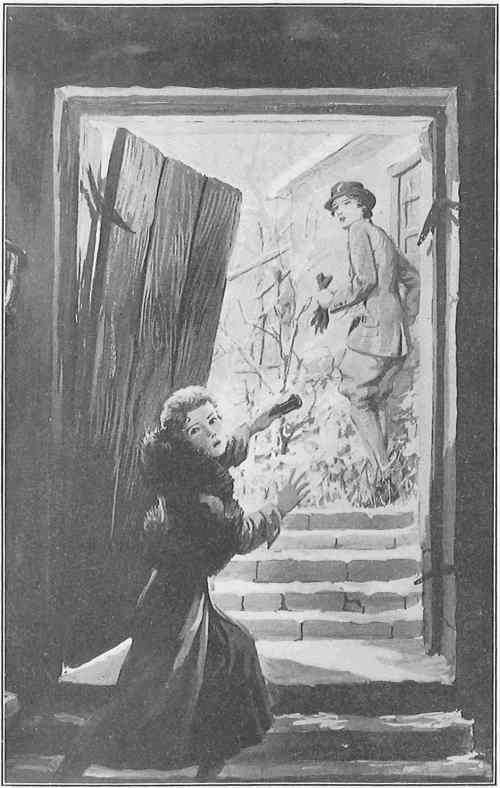
Two big Negroes, one carrying a crowbar and the
other an ax, came fairly leaping out of the open front
door of Sycamore Hall. They were mouthing something
unintelligible and seemed to be rushing straight
for Sim and Terry.
“Oh! Oh!” gasped Arden. “Oh, Dick, what is
this?”
Straight for Sim ran the two Negroes, their ragged
clothes white with plaster dust. They were still mumbling
and waving their hands in a terrified way. This
was too much for the nervous horse on which Sim
was mounted. He reared sharply, nearly throwing the
girl off, though she had a good seat, and then, wheeling,
the beast ran wildly up the road past Sycamore
Hall.
Terry managed to control her animal, though he
too showed a desire to bolt.
“Oh, Dick!” cried Arden again.
“I’ll get her!” shouted the young groom, and spurring
his mount he dashed away after Sim. Left to
themselves, Arden and Terry looked at each other
with frightened eyes. The two colored men ran into
the woods across from the Hall, still mumbling in a
strange way and showing every evidence of terrible
fright.
[18]
“Come on, Terry, we’ve got to follow!” called
Arden.
They urged their steeds after those of Sim and
Dick. When they reached the top of the hill they could
see that Sim was safe. Dick had dismounted and
was holding her still frightened animal. Sim was
soothing the creature with neck-pattings and calming
words.
“Heavens, Sim! What happened?” gasped Arden.
“Those men scared Teddy, rushing at him that
way, though why, I don’t know. I wonder what the
idea was, having them dash out in that wild way? If I
had been standing a little nearer they would have run
right into Teddy and me! They couldn’t seem to turn
off. They were wild with fright. But why?” Sim was
a little indignant.
Dick smiled up at her. “Haven’t you heard?” he
asked.
“Heard what?”
The other girls listened with interest.
[19]
“Why, this old place is said to have become suddenly
haunted. Something in Sycamore Hall has stirred
up the spirits of the departed owners, and more than
once the Negroes and Italians hired to tear it down
have been scared away—frightened stiff. A lot have
quit. I understand the contractor has continually to
get new men. And it looked as if those two who ran
out saw something—or thought they did,” Dick concluded.
“They probably won’t come back.”
“Haunted!” murmured Terry.
“Ghosts—Revolutionary ghosts,” whispered Sim.
“How thrilling!” exclaimed Arden. “Tell us some
more, Dick.”
“Well——” began the groom, but he got no
further.
Back up the hill came running the same two Negroes
who had but a few minutes before rushed out of the
mansion in such a terrified way. Their faces still bore
signs of their fright.
[20]
CHAPTER II The Ghost Mansion
Unable to understand what had caused the workmen
to act as they had, and sensing the possibility of
a further fright to the horses, Arden and her chums
were about to wheel and ride away. But Dick called
to them:
“Steady; I think it will be all right. These men don’t
know what they’re doing. They are just frightened.”
“At what?” asked Arden.
“That’s what I’m going to try to discover,” said
the young groom. Then, shouting to the running Negroes,
he inquired:
“What’s the matter?”
“Don’t ask us, boss,” answered one, dubiously
shaking his head. “We sho’ am finished on dat job! I
never could abide t’ wuk in haunted houses!”
“Dat goes fo’ me, too!” echoed the other. “I don’t
laik ghosts!”
Then they both ran on, disappearing into the woods.
[21]
“Ghosts!” laughed Terry after a moment of silence.
“They’re just what we need to brighten up our lives.”
“Let’s go in the old mansion and look around,”
proposed Arden.
“Have we time?” suggested Sim.
They glanced at Dick for his verdict.
“We have about half an hour,” he said, looking at
his watch. “Go on in if you want to.”
When they urged their horses through the overgrown
tangle that had once been a front yard and
came to a stop near the big broad porch, the pillars
of which were tilting, Dick helped the three girls to
dismount. Then, leading the horses to a tree with conveniently
low branches, he looped the reins so the
animals would not stray. Horses in the East are not
trained like their Western cousins, to stand if the reins
are left to dangle on the ground.
The girls held back a little before going up the
four steps at the entrance of the house. It was a combination
Georgian-Colonial style, squarely built, with
a beautiful fanlight still intact over the center door.
“It is spooky, isn’t it?” asked Sim with a pleased
little shiver.
“Did you ever see such a sorrowful house, though?”
Arden wanted to know.
[22]
“What do you mean, sorrowful? To me it seems
very proud and stern,” Terry decided.
“I don’t think so. Look at the way the door hangs
on its hinges. Ready to fall off if it had a good push.
And what lovely hinges they are, too. Hand forged,
I’ll bet,” Arden said, going a little closer to inspect.
Sim, quickly sympathetic, fell under the spell of
Arden’s imagining. “Poor old place,” she murmured,
“I don’t blame it for haunting the workmen. I suppose
this house has been the scene of many an exciting
adventure. Do you know anything about it, Dick?”
Sim turned to the boy, who stood aside waiting for
them to enter.
He hesitated a moment before replying and then
seemed reluctant to give much information.
“Yes,” he said slowly, “I know a little bit about it.
You see this place once belonged to my ancestors.” He
looked down at his polished boots and appeared rather
bashful.
“Really?” asked Sim. “Tell us, please,” and she
smiled disarmingly at him.
Arden and Terry waited hopefully for Dick to continue.
“Suppose we go in and I’ll show you the place,” the
young groom suggested.
[23]
“How about the ghosts?” Terry asked.
“These ghosts aren’t the common graveyard variety—that
is, if the stories are true. They all seem to
be spirits of soldiers, farmers, and sometimes there’s
the ghost of a lovely girl,” Dick went on. “You see
this place was built during the Revolution. The Continental
army ‘dug in’ at Jockey Hollow, here, for the
winter of 1779.”
Terry, growing bolder, preceded the others into the
hall. Rooms very much dilapidated were on either side.
One room, probably a parlor, was dominated by an
enormous fireplace with a faded picture above it.
“Oh, girls, come here!” Terry called. “Look at
this! Is this your girl ghost, Dick?”
They hurried to Terry as she stood before the painting.
Terry was in sharp contrast to the charming scene
above. Feet planted a little apart, hands clasped behind
her back, tall as she was, her head just came to
the old, high mantel. The girl in the picture was also
in riding clothes, but far different from Terry’s. They
looked like a tableau: “The Past and Present.”
Terry wore smart riding trousers and a flaring coat.
Her sandy hair was just showing beneath a well
blocked hat.
[24]
The girl in the picture was dark-haired and tall.
Her right arm was thrust through the reins of a black
horse. The panniers of her dark-green riding costume
seemed to melt into the leafy background of the painting.
The picture girl was staring straight at Terry and
perhaps it was not entirely imagination that disclosed
something akin in the two girls.
“What a charming picture you make!” Arden remarked,
and then, as she saw that Terry was perhaps
too delighted at the compliment, she added: “In this
dim light we can’t see the freckles.”
Terry turned and, like a small boy, stuck a pink
tongue out at Arden.
Dick, in the meanwhile, was looking thoughtfully
at the girls. Sim went to him.
“Dick,” she said softly, “I can see that you somehow
belong here. Won’t you tell us about it? We’ve
been riding with you several seasons now, and we
won’t repeat a thing if you don’t want us to.”
“Please,” begged Arden. “You look as sad as this
house, Dick. What’s the matter?”
“This place,” Dick began with an including gesture,
“once belonged in my grandmother’s family. But the
deed, or some necessary paper, has been lost, and now
the state claims the estate, and the old house is to be
torn down to make way for a road. The march of
progress, you know, must not be halted.”
[25]
“But has it no historic interest?” Terry asked.
“Couldn’t it be preserved as a shrine of some sort?
I mean the house, for you said Jockey Hollow is going
to be a park.”
“I’m afraid not,” continued Dick. “I guess it’s about
the only mansion that George Washington never visited.
Besides, the original house has been added to so
many times that now it is a combination of three or
four periods.”
“What would your grandmother do with this property
if she could find the deed?” asked Terry practically.
“Sell it,” answered Dick without any hesitation. “At
least it would bring enough money for me to give up
this stable job that any half-wit could hold and let
me finish at college. Then Betty, she’s my sister, could
go to New York and keep on with her work in costume
design and interior decoration. She’s really
talented,” he added earnestly.
“If this home were mine I should hate to part with
it,” Arden announced. “I don’t see how your grandmother
can bear to give it up. Isn’t there a chance that
she could keep it, Dick?”
[26]
“Perhaps, if we could prove title. But even then
we need the money its sale would bring. Granny ought
to have little comforts, though really she’s been swell
about it all. Never complains. And the stories she
knows!”
“What does she say about the ghosts?” Sim asked.
“Just laughs. She says she’d sleep here on All Souls’
Eve or any other particularly ghostly time. I guess she
likes ghosts.”
“I’d love to meet her sometime. Do you think we
might? I wish we could help some way,” said Arden
thoughtfully.
“I’ll ask her. I’m sure she would. She leads rather
a lonely life,” Dick answered. “And she loves young
folks.”
“Say, Dick, who is this girl in the picture? Isn’t it
too valuable a painting to be left here?” Terry was
studying the painting.
“It’s not worth much. It was probably painted by
one of those traveling artists who could do family
portraits or barns, whichever might be wanted.
Granny has left a few things in here to sort of claim
the place, though the claim isn’t recognized. And we
live now in a little house behind this one. It used to be
the servants’ quarters,” Dick finished bitterly.
[27]
The little group fell silent. The girls had stumbled,
it seemed, upon something very private, and they felt
embarrassed at learning of someone’s misfortune.
“Like finding somebody crying when they thought
they were alone,” Terry later remarked.
No one knew what to say. Dick walked to a window
that reached almost from the ceiling to the floor, and
stood looking out. Terry, always the first to move,
stepped over the fender around the fireplace and
peered up the chimney. For no reason except to break
the trying silence, as far as she knew.
Barely perceptible at first, gradually a sound impressed
itself on the girls. Like footsteps on a stair,
far away but coming nearer, the sound approached.
Terry pulled back her head from the dark corner
of the fireplace and looked at her friends. They stood
like statues staring back at each other, while Dick
turned slowly from the window.
“What’s that?” Sim asked, cocking her head like
a young puppy as if to hear better.
“Sounds like someone creeping down the stairs,”
Arden ventured.
[28]
“Perhaps it’s one of the workmen coming back,”
suggested Terry.
At this Dick shook his head. “No,” he said. “I
happen to know that those two men we saw a while
ago were the only ones on the job today, and they
left in a hurry,” he finished, grinning.
“Well, then, there is only one explanation left.”
Arden was glowing with excitement. “Ghosts!”
“Oh, gosh!” exclaimed Sim. “Let’s go! I like to
read about ghosts but I don’t like to meet ’em. Come
on!” Without waiting for the others, Sim ran from
the room.
“Wait, Sim, wait!” Terry called. And when Sim
did not return Terry added: “Arden, we’ll have to go
too! I don’t like it, either.” Then she turned traitor
to the cause and ran after Sim.
There was nothing left, then, for Arden and Dick
to do but follow. But Arden lingered a moment in
the hall on her way out and listened.
The measured sound above was slowly coming
closer. Heavy steps, as though the feet making the
noise were encased in thick boots.
“Thud! Thud! Thud!”
[29]
Above the first landing all was in darkness, and even
Arden, ghost-loving as she was, decided to wait no
longer to find out what might be coming down the
long stairs.
With a last fearful look she also fled, calling to
Dick for protection and stumbling over a loose floor
board in her haste.
[30]
CHAPTER III Arden Wonders
Communing with herself, Arden Blake, as she
dashed out of the strange old mansion, was wondering
just what it was all about and what, exactly, had happened.
Dick, anxious about the horses and doubtless believing
there was no danger to Arden, who had been left
to be the last out of the house, did not pause as
she called to him.
“She’ll be in the open in another second,” reflected
the young groom.
As she hastened out Arden had many conflicting
thoughts.
“Another mystery,” she told herself, half whispering.
“Can there be ghosts? If ever there was a place
made for them, Sycamore Hall is. But ghosts in the
daytime! Perhaps those men did it to annoy us for
coming around while they are working. But what object
could they have in doing that? Oh, if it’s another
mystery, I hope it turns out as well as the one in the
orchard did.”
[31]
At last she was away from the strange big house,
and she fairly jumped down the broad steps. With a
sigh of relief she saw the girls and Dick.
Outside, the horses were straining at their bridles.
With ears laid back and eyes frightened, every now
and then one gave a nervous little tap on the hard
ground with dainty fore feet.
Sim tried to mount Teddy unassisted, but every time
she put her foot in the stirrup the frisky animal
wheeled about, leaving her hopping helplessly. At last
Dick had to hold him while Sim climbed up. Then
helping up Arden and Terry, Dick mounted his own
horse with practised ease, and they turned away from
the ghost house.
So nervous were the animals that the girls did little
talking. They were occupied in keeping them under
control. Dick cautioned them about letting the horses
bolt. Headed to the stables as they were, once they
got going it would be difficult to stop them, and a dash
across the heavy traffic streets of Pentville would be
dangerous.
[32]
Arden did manage, when her horse settled down a
bit and danced along beside Dick’s for a stretch, to
ask him what had gotten into their usually well behaved
mounts.
“They’re frightened at something,” he answered.
“They were scared stiff when we came out.”
“So were we all,” Arden admitted. “Do you suppose
the horses could feel our fright?”
“Some people claim that a horse feels his rider’s
every mood,” Dick answered. “I really don’t know.
But I surely believe these horses sensed something,
perhaps more than we did. But——” Then Dick’s
shining black mare broke into a sudden trot, and he
could not finish what he started to say.
But Arden was persistent. She urged her steed
forward and was again riding beside the groom while
Terry and Sim pranced on ahead.
“Do you believe in ghosts, Dick?”
He hesitated a moment and then slowly answered:
“I believe that people often see just what they expect
to see in haunted houses, so called, and hear just
what they want to hear.”
Arden was plainly disappointed at this matter-of-factness
on Dick’s part. She had hoped for something
more concrete than this. But remembering Dick’s, or,
rather, his grandmother’s, connection with Sycamore
Hall, she did not press her point.
[33]
“Let’s catch up to the others,” she proposed, and
Dick assenting, they were soon close behind Terry and
Sim, who were still talking soothingly to their mounts
to quiet the restless animals. After a ride of several
miles through woodland they reached a straight open
stretch of road and broke into a smart canter. The
girls were a little breathless when they dismounted at
the stables.
“Do you young ladies want to make another date
for the end of the week?” asked Titus Ellery, owner
of the riding academy, as he came forward on much-bowed
legs. He was not an attractive man, but he
knew horses. Rather stingy and grasping was his reputation.
“How about it?” He was respectful enough but
persistent.
Sim spoke up.
“Not just now. We’ll phone.” Telling Dick to
“charge it,” she and the girls walked toward the waiting
roadster.
Dick opened the door.
“Don’t let this adventure scare you,” he said in a
low voice. “It was probably nothing but those excited
men imagining something.” He seemed worried lest
they cancel further riding engagements during the
holidays, and Dick probably made a little commission.
[34]
“Don’t worry,” Terry answered. “We loved it! See
you later; and thanks, Dick!”
They were off, Sim driving with a little less than
her usual abandon. Arden was the first to notice it.
“What’s the matter?” she asked. “Scared?”
“No, just thinking.”
“It was queer,” murmured Terry. “I was really
frightened.”
“The men were, anyhow,” said Arden. “And when
we heard those bumping sounds coming out of an old
uninhabited house——” She shivered a little.
“Probably falling plaster!” laughed Sim.
“I’m not so sure of that,” said Arden.
“She’s thinking of what happened in the orchard,”
remarked Terry.
“Well, something happened there all right,” Arden
responded.
“Let’s forget it a while,” proposed Sim, and she
stepped on the gas in her usual manner.
Home again, they were greeted at the door by the
smiling Moselle who answered their ring.
“You-all have a nice ride?” she asked cheerfully.
“Grand,” answered Terry. “And we met up with
some very fine ghosts, Moselle.”
[35]
“Ghosts?” Moselle’s eyes were wide.
“Over by Sycamore Hall,” Terry continued.
“Um—uumm!” Moselle shook her head. “I don’t
know what your mother will say, Miss Sim. Chasing
after ghosts. You-all ought to keep away from that
place. I know it’s dangerous. Plumb full of ha’nts,
that what it is.”
“Why, Moselle! Do you know anything about it?”
Sim asked, surprised.
“Yes’m, Miss Sim, I sure does! Only las’ night
Brutus Jackson tole me he was going to work there
’cause he needed a little change, and ain’t half hour
ago he came dashing into my kitchen with Sam Brown
and tell me they done quit.”
“He did—why?” Arden frantically signaled Sim
to let her continue the questioning of Moselle.
“Why, he say,” went on the colored woman, “a
funny old soldier with a bloody bandage around his
haid come clumping down the stairs and stood pointing
for Sam and him to get out the door and, yes, ma’am,
he say they sure did git!” Moselle made unbelieving
noises.
Terry turned to Sim. “Gosh, I’m sorry we didn’t
stay. What’d you run for, Sim?”
[36]
Sim started to reply, but seeing Moselle listening
intently said casually, “Oh, I just felt like it.” Then,
addressing the curious cook, she asked: “How about
lunch, Moselle?”
“Yes’m, Miss Sim, in just a few minutes. You-all
got time to change if you like,” she said, quick to
realize she was being dismissed.
“Good! Come on then, kids, let’s go up;” and before
Arden or Terry could ask any more questions
Sim, taking them by the elbows, steered them up the
stairs.
By unspoken consent they gathered in Sim’s room.
“Gee, Arden, I was afraid Moselle would get all
worked up, and then you know what she’d do? Write
to Mother and Dad and get them all excited. She
doesn’t miss a thing. And she’s very superstitious.”
“I forgot about her,” Terry admitted pulling a
turtle-necked sweater over her head. “Wounded soldier!
I guess that’s what we heard. Certainly sounded
like footsteps to me. Don’t you love it? What did
Dick say, Arden?”
“Not much,” Arden answered. “We were too busy
with the horses. Did you notice how scared they
were?”
[37]
“Say,” interrupted Sim happily, “won’t Dot love
this! Bet she won’t want to sit around and play contract
now.”
“Oh, contract—who wants to do that? There’s
something queer about that place, and I’m going to
find out what it is before I have to go back to school,”
announced Arden emphatically.
“We’re with you, Arden! You can’t leave us out
of any such excitement as that,” Terry decided. “Can
she, Sim?”
“I should say not!” Sim said, and striking a dramatic
pose sang out: “All for one, one for all! Arden,
Terry, and Sim!”
“And Dorothy,” supplemented Arden. “She’ll be
here tomorrow. Let’s take her out to see the house
in the afternoon.”
“Yes,” agreed Sim. “That will be fun, and maybe
we’ll see the soldier.”
At this point in their plans the dulcet tones of the
luncheon bell could be heard coming from below, and
Terry was obliged to slip her sweater on again. In
the end they all ate in riding clothes and talked of
subjects far from their minds lest Althea, who was
serving, should carry ghost stories back to her mother
in the kitchen.
[38]
The lamb chops were done to a turn, and the peas
were startling in their lovely greenness. The pie, lemon
meringue, was a fluffy dainty that disappeared with
remarkable quickness when put before the girls.
Everything in its place was their motto; ghosts belonged
to Jockey Hollow, and food came under
Moselle’s supervision. After a half year of college
fare, food was, after all, important.
Arden Blake, Terry Landry, and Sim Westover had
been schoolmates and chums ever since they started in
Vincent Prep. They were graduated at the same time
and went to Cedar Ridge College for their freshman
year together. The first term of the college had just
ended and they were home for the Christmas holidays.
As told in the first volume of this Arden Blake
mystery series, entitled The Orchard Secret, almost
as soon as the three freshmen signed in at Cedar Ridge
things began happening. There was something strange
about the college orchard, where so many gnarled,
weird, black trees stretched up their waving branches
in the night. And when Arden saw the poster of the
missing and rich Henry Pangborn, there was another
complication.
[39]
But Arden and her two chums solved the puzzle,
much to the benefit of the college swimming pool,
which had had to be abandoned because there was no
money to repair it. And thus Sim remained at college,
for she was determined to become an expert swimmer
and diver, and when she had found the swimming pool
was so sadly out of commission, she had threatened to
leave. But Arden’s success in solving the mystery had
made everything all right.
When the three girls had finished lunch in Sim’s
beautiful home on the outskirts of Pentville, a few
miles from Jockey Hollow, Arden went to the library
across the hall and began to scan the shelves impatiently.
“Know anything about these books, Sim?” she
asked.
“Yes, of course I do. What do you want to know?”
“I want to find out something about our Revolution.
Perhaps we can get a volume that will tell who really
lived in Sycamore Hall in Jockey Hollow.”
“That’s a great idea, Arden! At times you seem
almost brilliant,” laughed Sim.
“Well, suppose you help me to shine a bit,” Arden
proposed.
“Let me help,” begged Terry.
[40]
They delved among the books but though they
found some American history lore and much about the
Revolution, there was nothing on Jockey Hollow or
Sycamore Hall.
“I’ll have to try somewhere else,” Arden sighed.
The girls spent most of the afternoon talking over
their strange adventure, at times hardly believing it
had happened, again with a little thrill of fear mingled
with doubt as to what it all meant.
“Well, I’m going to find out something,” finally announced
Arden the impetuous.
“How?” drawled Sim.
“I’m going to the library. They ought to have
something there about Jockey Hollow. Goodness
knows it was important enough!”
“Tell us when you come back,” begged Terry.
“Don’t you want to come with me?”
“No. I’m for a nap. Riding always makes me
drowsy.”
“I’m with you, Terry,” announced Sim. “Come on.”
She led the way upstairs, where she and Terry
changed from riding clothes to lounging pajamas. But
Arden donned a polo coat and low-heeled shoes and
started out.
[41]
“Don’t you want my car?” sleepily called Sim, lolling
on her bed.
“No, I’m going to walk, thank you.”
She was on her way, though she scarcely realized
it, to the beginning of another strange mystery.
[42]
CHAPTER IV Seeing the Dead
Arden felt sure there must be some historical books
in the town library that would throw light on the
legends of Jockey Hollow. By studying these legends,
Arden decided, she might strike a clue to the traditions
that had built up the Sycamore Hall ghost
stories.
Hurrying to the library, determined to get at that
angle without delay, she was disappointed when she
saw a girl standing at the entrance and shaking the
heavy door handle to make sure it was locked.
“That must be Dick’s sister, Betty,” she decided.
“He said she worked in the library. But why is she
closing it so early?”
Reaching the door, Arden asked about the early
closing. The girl, pretty and friendly, explained that
lack of funds and the holiday season made it more
practical to close early. She was Betty Howe, she
admitted, smiling at Arden’s question. And she said
her brother Dick had mentioned the girls from the
Westover house having gone riding with him.
[43]
“I’m sorry, but all the lights are out now,” the
girl continued. “We open at nine in the morning, you
know,” she smiled, putting away her keys and pulling
on her gloves.
“Oh, thank you. Then I’ll come back in the morning.”
“Yes, do. I hope it was nothing important?”
“No, indeed,” Arden answered smiling. “Tomorrow
will do nicely.”
But as she hurried along to Sim’s she did feel disappointed.
“Did you find out anything?” Sim promptly asked,
while Arden sank down rather wearily.
“No. The library was closed. But I had a nice
walk,” Arden tried to persuade herself as well as Sim.
“Well, let’s forget the ghosts,” suggested Terry.
“It’s been a long day, and tomorrow we’ll have Dot
with us.”
“And so, to bed!” yawned Sim, and those who
didn’t yawn certainly felt like it.
Their night was undisturbed by “witches, warlocks
or lang-nebbied things,” in spite of what had happened,
or was thought to have happened, at the Hall.
Not even a bad dream threw its shadow on the healthy
girls sleeping serenely at Sim’s.
[44]
Perhaps that grand feeling of being able to lie abed
as long as they wished was too much for them; at any
rate, when Terry breezily wished Moselle a cheery
good-morning, the maid made no attempt at hiding
her surprise.
“’Mornin’, Miss Terry. You-all sleep well?” she
inquired.
“’Morning, Moselle,” Terry replied. “Yes, thank
you. And now I’m ready for a big breakfast.”
Moselle grinned her delight. She loved to cook,
and nothing pleases a cook more than knowing her art
is appreciated.
Arden and Sim were not long behind Terry, and the
girls made a pretty picture in their gay dresses against
the background of dark paneled walls in the dining
room.
[45]
It was Arden’s day to do the marketing, but because
they were to drive to the station and meet
Dorothy Keene, shortly after breakfast, they agreed,
“just for this once,” to leave the planning of the
day’s meals to Moselle. They were still determined to
run the house efficiently and well, on a smaller budget
than Sim’s mother had allowed; furthermore, Terry
and Arden agreed not to telephone home for advice.
Of course, the routine of cleaning and washing went
on as before: the girls could not improve on that.
So Moselle was instructed to call up the stores and
have something very special for the coming guest,
whose mother was “in the movies,” which fact thrilled
Moselle to the cockles of her heart.
When the train pulled into the suburban station, the
three girls, with the car parked as close as possible
to the platform, had no trouble in finding Dorothy.
Although Terry, perched on the car top, which was
folded down, had thought she could see better from
that vantage point and locate her chum more quickly,
Dorothy, it developed, was the only passenger who
alighted at Pentville. So they saw her at once. She
was wearing a smart fur coat cut on swagger lines and
a ridiculously small hat pulled over one eye. She waved
a greeting.
“Hello, Dot!” Sim ran to meet her. “Awfully glad
you could come.” They hugged affectionately. “We’re
having specially nice weather just for you.”
“Sim dear,” the girl replied, “and Terry and Arden,
it’s great to see you. I’ve been in a penthouse in New
York with a lot of stage-struck people, and I feel a bit
struck myself,” she laughed. “This lovely country and
you kids are just what I need,” declared the visitor.
[46]
They walked toward the car, each trying to show
her own particular brand of pleasure at Dot’s arrival.
“And we need you, too,” Arden put in with a little
tug at Dot’s arm. “Don’t we, girls?”
“Now, look here!” and Dot pulled them all to a
sudden halt. “You are up to something, I’m sure.
What is it? Any new mysteries thrusting themselves
upon you?”
“Dot, my child,” Arden answered, “you are positively
psychic! That’s exactly what we’re bursting to
tell you!”
“Ghosts! Nice hundred-year-old ones! All hoary
and bloody, with pointing fingers!” Terry supplied.
“And a poor old lady and two orphan grandchildren,”
grunted Sim, as she tried to turn the wheel of
the car. All four were in the front seat, a feat accomplished
by Sim, Arden, and Terry squeezing into
a row and Dot sitting on Terry’s lap. That Dot’s head
was much higher than the windshield and unsheltered
from the wind bothered them not at all. With so much
to say, they simply couldn’t split up the group by
using the rumble seat. Dot’s grips were there, anyway,
and for the two weeks of her visit she would be well
supplied with clothes—at least, judging by the size of
the bags.
[47]
“Go on, my dear Watsons,” chuckled Dot laughing.
“Isn’t there a nice-looking young man any place in this
mystery?”
“Of course there is,” replied Terry, “and a girl,
too.”
“But the house, Dot—it’s perfect! We heard the
ghostly footsteps ourselves, and in broad daylight,
too!” Sim surprisingly stated.
Dorothy shook her head. “You’re all sleeping
idiots! Well, I won’t arouse you. I suppose country
people must have some amusement.”
“Country people!” Three voices sang out together.
It never failed. A suggestion that they in Pentville
were not as metropolitan as their New York chum
was always a disputed point.
“A ghost couldn’t live in New York,” Arden said
sarcastically. “You have to get out where there is
some room for ghosts. Like Pentville or Jockey Hollow.”
“Don’t you believe us, Dot?” Terry asked. Dot just
smiled.
[48]
“We’ll show you. What do you say, girls—shall we
go over to Jockey Hollow before we go home? The
bags will be safe. Our ghost isn’t a thief.” Sim slowed
down at the junction where one road led to the
Hollow, which they would pass as they went to Sim’s
house, though at some distance.
“Yes! Let’s go, Sim. If you’re not afraid of the
car on those roads,” Terry said, plainly anxious to go
back to Sycamore Hall.
Sim needed no urging, and going into second she
turned the wheel and very carefully started down the
narrow dirt road. On the brow of the hill she stopped
and pointed out the faded stone walls of the house
which could clearly be seen through the bare trees.
“That’s it, unbeliever,” Sim told her guest. “We’ll
take you inside, if we can get in, and show you things
your eyes have never before beheld.”
“Lead on MacDuff,” Dorothy laughed. “Whom
have you hired to jump out on me and cry ‘Boo’?”
“Word of honor, Dot,” Arden insisted, “it isn’t a
joke. You’ll see! Go on, Sim,” she prompted.
Bouncing and rolling from side to side, the little
roadster neared the house. The old lane that once
approached prosperous farm lands, but was now overgrown
and stony, led almost to the door. But knowing
she must turn around again to go home, Sim
stopped so they could back out.
[49]
Shutting off the motor, she turned to her friends.
“I hope he shows up,” Sim whispered to Arden
and Terry.
“Who?” asked Dot.
“The old soldier with a wounded head, all bandaged
in bloody rags. He wears very heavy boots and
was hidden and sheltered from the British in this old
house during the Revolution,” Terry guessed facetiously.
“But how did you find out all this?” Dot was
plainly interested but also a little incredulous.
“We were riding here in Jockey Hollow yesterday,”
Sim explained, “when our horses were frightened, and
we were, also, by some Negro workmen rushing out
of the place, crying, ‘Ghost!’ Oh, it was startling!”
and she related, in her most convincing way the details
of their strange adventure.
“Oh!” said Dorothy after a little pause. “Oh!”
That was all.
The four sat in the car, no one speaking for a
while. Their own imaginings had gotten the best of
them, evidently, though no one would admit it.
[50]
Then, suddenly, the quiet and peace surrounding
the old Hall was broken, by the loud squeaking of
ancient nails being pulled from hundred-year-old
wood, and the shrill sounds were like the shrieks of
frightened women. It startled the girls into activity.
“The workmen are back!” Arden said disappointedly.
“I guess the ghost won’t dare come out.”
“Too bad, girls. You almost had me believing you.
But let’s go in and look around, anyway. I like old
houses, with or without ghosts.” Dot was still skeptical.
So they climbed out of the car and picked their
way over the tangled vines and low bushes to the door:
a dignified, paneled old piece decorated with a handsomely
discolored brass knocker.
Dorothy, in a spirit of bravado, lifted the knocker
up and rapped it down smartly. They waited a second
and, still defiant, Dorothy put her hand on the bronze
knob to open the door.
No one knew just how it happened. Dorothy said
she had not yet tried to open the door when it swung
back of its own motion, and instantly the dim old
hallway stretched before them. At that the reassuring
sound of hammering suddenly stopped and, gathering
courage, the girls were about to enter when a shout—half
scream, half moan—echoed through the old
mansion.
[51]
The girls stood transfixed with terror, almost
breathless. Another cry quickly followed, and then the
sound of loud, hurrying footsteps could be heard.
There was a rush of bodies, and three men in working
clothes, powdered white with plaster dust, literally
jumped down the last few steps of the great staircase
and continued their maddened race out of the big
front door, brushing by the astonished girls without
a word.
“I should say so!” gasped Terry, looking at Dot,
whose eyes showed wonder and who seemed too surprised
to speak.
“Hey! Wait!” Arden shouted, and she turned to
pursue the last of the three frightened men still wildly
running away. “Wait! Tell us what’s the matter!”
The workman, beating his hands on his trousers to
knock out some of the dust, barely hesitated.
[52]
“Lady, I can’t wait!” he exclaimed. “We saw the
dead body of an old woman stretched out on a bed.
We saw her in a room below where we were working—saw
her through a hole I tore in the floor and that
went into the ceiling of her room. We saw her plain!
I’m finished on this job!” He had to wait to say all
that, but then turned and ran on.
“Oh, please!” begged Arden. “Just where did you
see her? Tell us! Is she really dead?”
“I didn’t go near her,” he said breathlessly. “I don’t
want to get mixed up in no murder case. But she sure
looked dead to me—lying flat on her back—in a red
dress—or something—and pale—pale as——” He
looked toward his retreating companions, now some
distance down the road, and then, with a frightened
glance up at the old Hall, he turned again and ran
away.
“Well, what do you think of this?” demanded Sim.
“Shall we go in?” She turned to Dorothy as though
asking her permission.
“I—er—why, of course!” the visitor decided, perhaps
a bit hesitantly. “If there’s anything wrong we
ought to notify the police. Yes, we must do that.”
It was a bold decision. It rather pleased Arden and
her chums.
[53]
CHAPTER V Baffled
Still, no one wanted to be the first to enter, and
they stood on the step, frightened but intensely curious.
Arden gave Terry a little push, hinting that she
should lead, but Terry sidestepped. Sim sneaked
around the others until she was on the edge of the
step, nearer the car.
“Do you think it could be so terrible?” she questioned.
“We ought to find out. Besides, if it’s someone dead—”
Dorothy stopped—“it couldn’t hurt us anyway.”
She started cautiously just a few steps, but at least
they had begun to move. The other three, in close
formation, followed. At the foot of the stairs they
stopped; listened. There was not a sound. The daylight
filtering in through a stained-glass window at
the first landing cast eerie shadows and even made the
girls’ faces take on a sickish pale color.
[54]
Dorothy put her hand on the worn old stair rail and
slid it up ahead of her as though to pull herself after
it. A deep indentation checked the sliding hand and
acted like a brake.
Then Terry, growing a little braver, deliberately
went up a few steps, and in this fashion, by starting
and stopping every second or two, and listening, cautiously
they reached the first landing.
There they halted. But only for a second, for something
drew them on; some power they could not resist
urged them up almost against all reason, until they
were on the second floor of the weird old house.
There the hall ran the length of the house. All furnishing
was gone from the hall except an old dusty
chest that stood in a dark, dingy corner.
Rooms were on either side of the passage, but the
doors were all closed except one. Somehow Dorothy
felt this was The Room. But to look in would be
another matter. What was in there? Nothing at all
or——?
They must find out. The old adage, “safety in numbers,”
came back to Dorothy. She motioned to the
other frightened girls. They crept forward on tiptoe.
[55]
Now in line with the opened doorway, Dorothy
forced herself to look in. She saw a large square room
with shuttered windows through which the morning
light barely seeped in splintered blades. There was the
bed.
The bed! That dreadful possibility!
How could she look? No longer brave, she shut
her eyes. Her buzzing head seemed not to belong to
her. But the next moment, of its own accord, it turned
again to that dreadful resting place. A deep sigh, a
gasp, from one of the girls behind Dorothy startled
her further, and she could delay no longer. She opened
her eyes.
The bed was empty!
A four-poster that must once have boasted a canopied
top, the huge old bed stood stark and sinister. A
dark bedraggled cloth covered the mattress, but happily—and
how glad they were—nothing else was
there.
“Whew!” Terry ran a trembling hand across her
forehead. “I feel as if I had just gone through a
clothes wringer.”
“Such suspense! I lived a hundred years coming up
those stairs,” declared Sim. “Is my face white?”
Arden did not feel like joking. She went closer to
the bed.
[56]
“Absolutely empty! Those men must have very
vivid imaginations,” she declared with a little laugh.
“Seeing things, that way.”
“This time three men saw the same thing, or claim
they did. The other time it was two who saw and
who also claimed they heard the thudding of the soldier’s
boots. Some complications even for ghosts,” Sim
remarked.
“It’s very queer. The spirits of the departed owners
of the Hall must be rising in protest against the
invasion of the wreckers,” Terry suggested, not too
merrily.
“Are you sure, my dear friends, you had nothing to
do with this?” Dorothy asked, once more skeptical.
That question brought a storm of protest.
“Dorothy!” exclaimed Arden, “do you really think
we could have scared away those workmen?”
“Well, if you feel that way, Dot,” began Terry.
But she didn’t; she told them so. And once more it was
a united party that looked for further evidence of
ghosts, real or imaginary.
The inevitable fireplace was built in the wall not far
from the suspected bed. An old squat rocker stood
lonely and forlorn in the center, and a packing box had
gathered dust under a window—that was all. The floor
was also dusty, but Dorothy stooped down and, with
royal disregard, swept a spot clean with a dainty lace-trimmed
handkerchief.
[57]
“Look at the floor, girls,” she said. “See how wide
the boards are and the pegs to hold them down. They
don’t make floors that way any more. All these boards
were cut and planed and the pegs made and fitted in
by hand.”
“I wish I knew more about such things,” Terry remarked,
inspecting the floor. “All I know is that this
must have been a fine old house, and I wish it wasn’t
going to be torn down.”
“It reminds me of an impending execution.” Sim
sighed. “It did its duty, and now it has to give up its
life for its country.” That trite remark brought on a
giggle, but Sim didn’t mind.
Arden and Dorothy were snooping about, looking
through the cracks in the shutters, and even peered
under the bed.
“If they succeed in demolishing the Hall, I’m going
to try and buy the picture of that girl downstairs,”
announced Terry. “She fascinates me! I’d like to find
out more about her.”
[58]
“Probably Dick’s grandmother could tell you. We
must look her up,” said Arden, dusting her hands.
“Who’s that?” she asked suddenly as voices in dispute
were heard from somewhere.
“Someone downstairs,” Dorothy answered. They
listened. One voice, a man’s, seemed just very ordinary,
not the least bit ghost-like.
“Let’s go down and see what’s happening,” Terry
suggested. “We’re not afraid of workmen.”
They all trooped down in much different spirits
than they had come up in. Now, like weather vanes
turning in the wind, their interest was veering to the
commotion below.
In the hallway stood the three workmen who had
so recently rushed out of the old mansion. There was
another, an older man, obviously their employer, with
them now.
“Are you men telling me that you’re quitting, too?”
asked the boss sharply.
“Yes, sir,” the leader of the three stated emphatically.
“I don’t like this place. I’d rather chop
down trees all winter than go up on the top floor for
a day and start tearing this place down.”
“But, man, you’re wrong! There’s nothing there.
You told me this same story last week, and when I
looked in, the room was empty,” the wrecking contractor
declared.
[59]
The girls were on the landing above, and he turned
to them, seemingly surly and surprised.
“That your car outside? What are you doing in
here?” he asked bruskly.
“Yes,” answered Sim. “We heard someone shout
as we were going past and stopped to see—if we could
help.”
“Well—what did you find?” the contractor asked,
apparently hoping that the statement of disinterested
young ladies would impress the frightened men favorably.
“Nothing,” Arden admitted. “The room was empty
when we looked in. Although he said,” Arden indicated
the man she had questioned, “that there was an
old lady up there, dead on the bed.”
“Yeah—he said,” the contractor shrugged. “I
know! He had the same story last week. All right,” he
continued, now addressing the men, “go to the office
and get your pay. You’re finished! But this house
comes down if I have to pull it down myself!”
The laborers turned away and, talking among
themselves, gathered up their lunch boxes and coats
and hurriedly walked away.
[60]
“You girls want to be careful in here,” the contractor
warned. “Not that I worry about ghosts, but
you might get hurt if something fell on you. They
were working on the roof today. This is the second
time men have laid down on this job. But I’ll have this
place leveled to the ground if I have to get my own
family to help me.” He looked angrily at the ceiling
above him and then, taking a big black cigar from his
pocket, he bit the end savagely. Glancing about once
more he finally strode after the men, leaving the little
group of wondering girls to puzzle it out.
[61]
CHAPTER VI Introducing Granny
The girls just stood there, shocked by the wrecker’s
vehement manner. The door was still open, and suddenly,
without warning, a face appeared there.
“Oh!” came in a surprised murmur from Arden and
her chums as they huddled closer.
Then the brown, weather-beaten countenance of an
old woman broke into a queer wrinkled smile. It was
an old woman—not a ghost. The girls now realized
this.
“Are they gone?” The voice was young and full
of amusement as an old lady, wearing a dress which
was neat but quaint and old-fashioned, stepped inside
the hall.
“Yes, they’re gone,” answered Sim, the first to fall
under the charm of Granny Howe, for it was she
coming to investigate, apparently.
[62]
“I came up to see what the trouble was, but I didn’t
want to meet that Callahan man,” she declared. “He’s
got such a temper, always having trouble with his
men.” Then, as though she had just thought of it, she
asked who the girls were, what they were doing there,
and scarcely giving them time to answer, she told
them who she was. Then, still interrupting, Granny
Howe guessed they were the “young ladies who had
been riding with Dick: he had told her one of them
had red hair,” she quaintly revealed.
Terry blushed a little at that and then smiled; it
was impossible to take offense at Granny’s gentle
ways.
“Yes, Dick took us in here yesterday,” Terry answered.
“We were frightened away by——”
“Ghosts, I suppose,” the old lady chuckled. “Dick
told me about it.” She laughed heartily. “Everybody
but me seems to think this place is haunted. Nonsense!”
“But there is something queer about it, isn’t there?”
pressed Arden. “I’ll be so disappointed if you can explain
it all naturally. We have just got to be thrilled,
you know.”
“My dear,” Granny answered, “you’re just like
Betty, my granddaughter. She loves to think that
Nathaniel Greene or Patience Howe has come back in
spirit form to defend the old place.”
[63]
“Who were they?” Dorothy stepped forward.
“Won’t you tell us something about them? I’m studying
architecture, and, even with the little I know, I
can tell that Sycamore Hall must have been designed
by a fine artist.”
“Dick told us it would soon all be torn down,” Sim
supplemented. “We’re awfully sorry, and we’re not
just curious. If there is anything we could do to
help——”
Granny’s blue eyes swam with tears; she shook her
head and looked at each of them in turn, pathetically.
“You’re dear young things. I can see that. But I’m
afraid we’ll have to let Sycamore Hall go.” She sighed
and patted the wall beside her. “My grandfather and
his father before him were queer men. Never had
much faith in banks. If they had, the deed or whatever
claim papers we need, would not be missing today,
and Betty could go on gallivanting around like you
girls, instead of sitting cooped up all day in the town
library. And Dick could be in college——” She left
the sentence unfinished and looked away sadly.
Terry decided to change the subject. The old lady
seemed so broken. It was too bad, really, that no one
could help her.
[64]
“Who was the girl in the picture downstairs? I
think she is lovely,” Terry pointed out brightly.
“She was Patience Howe, an ancestor of mine. She
lived here in Washington’s time. She was a modern
girl for those times: brave and strong. She kept that
horse of hers right in this house when some of the
Continental soldiers tried to steal it,” Granny answered
Terry, her head high now with a touch of
ancestral pride.
“Could we—would you—” Sim faltered—“would
you let us come to see you sometime—just to talk? Or
would you rather not tell us things? I can understand
that the present condition of this old place must make
you very sad, and if you can’t bear to think about it,
we’ll know just how you feel.” Sim was trying to be
diplomatic, but at the same time she hoped the old
lady would answer “yes.”
“Dick told us a little of your misfortune, though
we had to drag it out of him,” Terry added. “That
was yesterday, when we heard the footsteps.”
“Footsteps!” echoed Granny. “That would be
Nathaniel Greene walking in his delirium from the
wound in his head. Poor fellow! He loved Patience,
and she nursed him a long time, but he died.” The
old lady was once more lost in ancient memories.
[65]
The girls didn’t know how to proceed now. Sim’s
request was still unanswered, and they did so want to
learn more. In their hearts they all wanted to help this
charming lady and save Sycamore Hall. That would
aid Betty and Dick also.
With a brave effort, Granny checked her dreaming,
and putting a tanned old hand on Sim’s arm said:
“Of course you may come to see me—if your parents
will let you. I’m considered somewhat of a recluse by
many folk around here. But I’ll be glad to have you
to tea tomorrow afternoon. All of you. You’ll be perfectly
safe, and it will brighten things up for me. Do
you know where I live?” she asked briskly.
The girls said that they did not and began thanking
her and assuring her that no one would in the
least object to their visit. They were all talking at
once, so Granny smiled and held up a gentle restraining
hand.
“You sound so alive and gay—I know what you’re
trying to tell me. It’s all right. I’ll enjoy having you.
But now I must go back. We are baking today, and I
stayed longer than I should have.” She stood at the
door as if indicating to them that they too must leave.
[66]
The girls were glad enough to walk out into the
sunshine, and presently they climbed back into the
car. Granny chuckled as they squeezed in and waved
“good-bye” as Sim backed away.
“There, Dot, how did that strike you?” Arden
breathlessly asked when they were safely on their
way. “Do you still think it’s a put-up job on our part?”
“Arden, I’m sorry,” answered the girl. “I’m entirely
convinced, and I’m on your side. Wasn’t she
fascinating?”
“Just like someone out of a play,” Terry exclaimed.
“Isn’t it a shame? Taking her own house and land
away from her! If I were a ghost I’d come to her
rescue, too! Even if I did have to break up a wrecking
gang.”
“What could those men have seen?” Sim wondered
aloud. “They certainly were scared.”
“When we get home we’ll have to consider each
person, the way detectives do, and reason out who
would be likely to know, or be responsible for those
manifestations,” Arden suggested. “Shall we? Let’s
write it out—and see if we can solve the mystery
systematically.”
This suggestion met with whole-hearted approval,
and all the rest of the way home the girls talked of
the best method of “detecting.” Sim stepped on the
gas and bounced the girls unmercifully, she was so
anxious to get home, but they clung together and
didn’t complain.
[67]
They had something new to do now and could
hardly wait to begin. A first-rate mystery to be unraveled,
in the most up-to-date detective fashion. It
would be through the method of clues and eliminations
of clues, and the girls were “all for it.”
[68]
CHAPTER VII Trial by Jury
Sim’s library was an ideal room for the girls to
carry out their plan. Seated at a large desk, where
Sim’s father often worked at night, Arden assumed
the rôle of judge, or lawyer, they were not quite sure
which. Sim, Terry, and Dot, in varying positions of
comfort, were perched around her.
Events had been too exciting to warrant “time out”
for Dorothy to change from her traveling clothes, so
she simply kicked off her shoes and gave Althea the
keys to her bags. The unpacking would be accomplished
swiftly and skillfully with everything put
neatly away and any wrinkles completely ironed out.
Arden sat with pen poised and her face alight with
eagerness, a dark-haired, blue-eyed Portia.
“Now we’ll begin,” she said. “Who was the first
person to mention Sycamore Hall, and how can we
connect him with the mystery?”
[69]
“I was,” answered Terry. “I suggested that we
ride by. I was tired of the old roads.”
“Theodosia Landry, student,” Arden wrote in a
schoolgirl’s hand, “suggested visiting spot. Of course,
Terry, you knew nothing about the legend that the
place was haunted?”
“I object.” Sim sprang up. “That’s a leading question.
How do we know she didn’t? Remember, we
are all guilty until proven innocent.”
“I’ll ask it another way, then,” Arden agreed. “Did
you have any knowledge of ghost stories emanating
from Sycamore Hall, the house in question?”
Arden was well pleased at the businesslike way in
which she was conducting the investigation.
“Absolutely none, it was merely a coincidence,”
Terry replied and Arden penned her answer.
“Who next mentioned the house?” Arden resumed
her rôle of detective.
“Richard Howe,” Terry supplied. “He seemed surprised
that we wanted to go there and didn’t seem
anxious to take us.”
“Yes, and it was he who told us the house was
haunted!” chimed in Sim.
Arden wrote down Dick’s name and occupation and
the charge against him.
[70]
“Next come the men running from the house when
they frightened Sim’s horse. Sim, what did they say
they had seen?” Arden asked, busily writing, her head
on one side and the tip of her tongue showing between
her white teeth as she worked.
“Dick asked them what was the matter, and one
said he wouldn’t work there any longer. That he
wouldn’t stay where there were ghosts,” Terry supplied
promptly.
“What happened after that?” Arden asked. “I’m a
little confused, things happened so quickly.”
“I’ll testify again,” Terry exclaimed eagerly. “This
is lots of fun. Then we went back to the house after
calming our horses, and entered the living room.”
“Where was Richard Howe then?” asked Dorothy
from a deep armchair. “It seems to me you’re losing
sight of him. After all, he is the one who would want
to keep the house standing.”
“I don’t remember whether he went in first or after
we did,” Terry answered, “but we were all together
in the living room when we heard the noise.”
“Dick said there were no workmen in the house
when I suggested it might be they who were responsible
for the manifestations, so apparently he knew we
were alone there,” Sim said. “It does seem as though
he knows more than we think.”
[71]
“We will each have to report what we were doing
and what we heard as we were in the house. Your
story comes later in the course of events, Dot. You
check up on us and ask questions when we leave anything
out. Now——” Arden took a deep breath. “Sim
Westover, or, rather, Bernice,” she corrected herself
with a little giggle, “how about you?”
“I was standing near the door of the parlor leading
to the hall when I heard a bump—bump—like
someone coming downstairs. I became frightened and
ran out,” Sim stated simply.
“Terry?” questioned the youthful inquisitor.
“I was looking at the picture of the girl over the
fireplace, and Dick was looking out the window. He
had his back to the room,” Terry told her story.
“And I,” said Arden, “was near Terry, also looking
at the picture when the noise came. My recollection
is that Sim ran out first, then Terry and Dick,
and I last. The noise was definitely louder when we
left.”
“But you didn’t actually see anything?” Dorothy
asked practically.
[72]
“No,” Arden resumed, “we only heard it. When
we got home, Moselle told us that she knew the men
who had been working there and that they told her
they had seen the figure. Do you suppose real detectives
would consider that?”
“If we want to be very thorough we ought to look
those men up and interview them,” Dorothy decided.
“But let’s go on for the time being. Don’t I come
next?”
“Dorothy Keene,” Arden wrote and added:
“student.”
“I heard from the car hammering that suddenly
stopped and then a cry. The men rushed out of the
house. When I went upstairs I saw nothing,” she remarked.
“The next people were the men who returned and
the contractor. We can almost rule them out. It’s
Callahan’s job to tear the place down,” Arden went
on, pushing a stray lock of dark hair out of her eye.
“Granny Howe appeared after that,” Sim added.
“Let me report about her, Arden.”
“Proceed,” Arden said with dignity.
“She poked her head in at the door and asked what
the trouble was,” began Sim. “Then she came in and
asked if the men had gone and laughed when we told
her they had,” she finished.
[73]
“That covers everyone and everything,” Arden remarked
putting the top on the fountain pen she had
been using. “And from it all, the only conclusion we
can come to is that two separate sets of workmen
were frightened away by something they claim they
saw or didn’t see. While we only heard sounds.”
“You’ll have to admit, though, that it was very
strange that the horses should be so frightened before
we came out. That is, we are reasonably certain that
we did not frighten them ourselves,” Terry suggested
smartly.
“There’s something in that,” agreed Sim, “and also
don’t forget the number of people who heard the same
kind of noises and claim they saw the same thing at
the same time.”
Arden stacked the sheets of paper containing the
history of “The Jockey Hollow Case,” as she had
called it, and suggested that they be put in a safe place
so more could be added. All the girls felt that there
was much more to come and hoped to get new evidence
from Granny Howe when they took tea with
her.
Sim took the papers, locked them in a small drawer
in the desk, and took the key.
[74]
“I’ll put the key on a chain and wear it around my
neck. Then it will be safe.” She looked at her friends
with shining eyes. It was so exciting to be in the very
center of a thrilling mystery.
The girls nodded their approval and began talking
brightly of all they had done and seen as though they
might have forgotten something important. But on
the whole they were well pleased with their work and
agreed it was very clever of Arden to suggest it; one
useful fact remembered from reading countless detective
tales had come their way.
[75]
CHAPTER VIII The Ghost of Patience
“Move over, Terry, give me a look!” demanded
Sim, elbowing her way nearer to the long mirror before
which Terry was admiring herself.
“There’s plenty of room and at least two more
mirrors within easy walking distance,” Terry replied.
“Why we all have to congregate in here, I don’t
know.”
“It’s more fun, that’s why,” Arden crisply replied.
“And we can talk better. Moselle can hear every
word we say if we call to each other from room to
room. Don’t forget she’s under suspicion too.”
“As far as I can see, the only person who isn’t is
Dorothy Keene, daughter of Rita Keene the distinguished
comédienne,” Terry remarked, successfully
maneuvering Sim away from the glass again. “We saw
her get off the train ourselves. You’re the only innocent
one among us, Dot, but you don’t look it in
that swanky dress.”
[76]
“Do you think we’re dressing up too much? We
wouldn’t want to embarrass Granny Howe,” Dorothy
considered.
The girls were all in Sim’s big blue-and-white bedroom,
laughing and talking as they dressed. It was
the afternoon following the “trial by jury.” Sim had
lately gone “modern,” and the room showed it. The
walls were a cream-white edged in dark blue; light
fixtures were star shaped, and the twin beds were
covered with a dark-blue satin spread with Sim’s
monogram in white-satin letters on the fold. It was all
glorious.
Fooling around until the last possible minute, they
were now making up for lost time by all hurriedly
dressing in Sim’s room; getting ready for the visit to
Granny Howe.
After talking it over they had decided that the old
lady, though she was spry and active, might better
enjoy the little party if they did put on a little style
and dressed up. So they were wearing soft dresses and
high-heeled shoes and had put on other dainty accessories.
[77]
The day was rather dark, a slate-colored sky promising
snow before night, but the balmy air contradicted
the warning, and Sim, with the top of the roadster
down, urged the girls to hurry. A glance at her watch
showed three-thirty, and their first call should not
keep Granny waiting.
They were ready at last and piled in the car, Sim
letting the clutch in so fast that the sudden start
snapped their heads back and jerked the car forward
as though Sim was just learning to drive. They went
off in a gale of laughter but not in a cloud of dust, for
the frozen ground of the driveway refused to part
with any of its surface.
Sim drove as near as she could to the little white
house where Hannah Howe lived. The cottage-like
place was behind the more stately Sycamore Hall and
to the left of the lane. The lane was a mere path
just tunneled with trees.
Four small pillars, more like posts, supported the
shingled roof of the low porch, and behind it were
two square windows with a door in between.
The girls stood in dignified silence waiting for
Granny to answer Arden’s knock, but she didn’t keep
them long.
“Come in, my dears!” exclaimed the elderly lady
like a grandmother in a fairy tale. “I’m glad to see
you all looking so well and happy.”
[78]
Granny herself looked well and at least temporarily
happy. She wore a long-sleeved, high-necked dress,
dark-blue color with little pink flowers dotted over it.
At her throat, precisely in the middle, glowed with
sullen brightness the soft purple of an antique amethyst
brooch. Her thick white hair accentuated the
smooth tan of her skin, as she smiled a welcome.
The party trooped inside the little old house, and
they were at once struck by the charm and quaintness
of the little place.
With admiring “Ohs!” and “Ahs!” the visitors
looked eagerly about, and Granny, pleased with their
young enthusiasm, explained and pointed out the
interesting features.
The fireplace, with a pot in place and hooks for
holding others, was especially fascinating.
“Imagine cooking over an open fire!” exclaimed
Sim, “and Moselle complains about the oven in our
new gas range.”
“Years ago the fireplace served a double purpose,”
Granny explained: “that of heat and a stove. And as
someone has said, they were truly the heart of the
home. Many a lone winter night Patience Howe sat
by this one, keeping the fire alive, wondering would
she ever see her father and brothers again.”
[79]
On a low maple table in front of the old Colonial
davenport, Granny was putting out the “best china”:
thin cups and saucers with a pink wild-rose pattern.
With unfeigned interest, Arden watched her dainty
movements. She seemed as much a part of the place
as did the pewter plates on the mantel. The little
company had settled down to chat with the abruptness
of old friends. After the first greetings were over, they
all felt they had known this little lady all their lives.
But it was Sim who first broached the subject uppermost
in the minds of all.
“It was Patience who hid the wounded soldier,
wasn’t it?” she asked, nibbling at a tiny bread-and-butter
sandwich.
“Her picture still hangs in the Hall, doesn’t it?”
Terry inquired, following Sim’s lead.
“What a brave girl she must have been,” remarked
Arden, hoping Granny would take the cue and tell
them about her.
Handing Dorothy a cup of tea and settling herself
in a quaint high-backed rocker, the old lady nodded
her head and smiled.
“I can see you are all burning with curiosity,” she
laughed. “Of course, I’ll tell you about her, I’m very
proud of her, and as you say, my dear, she was indeed
very brave.” Granny glanced at the girls sitting around
her, sipping their tea and patiently waiting for her
story. Then she began:
[80]
“In the year when Washington’s troops were retreating
from New York, Patience refused to leave
her home to seek shelter with relatives at Philadelphia.
This was her home: the big house, I mean, of
course,” she explained. “This tiny place was for the
servants. But Patience decided to stay and help with
the work of the farm; so many of the working men
had joined the troops. There was plenty of work, and
it was bitter cold, too. One day, as the poor, tired
army was forced to go still farther back beyond the
advancing British troops, a wounded soldier was
carried into the house. Nathaniel Greene, his name
was, and his comrades begged Patience to take him
in and keep him, for he would surely die if made to
march in the bitter cold. Patience hid him in her own
room, disguised herself as an old servant, and moved
out here to live.”
“What a—girl!” breathed Arden, as Granny
paused a moment.
“Imagine waiting on a wounded soldier,” followed
up Terry.
“And imagine the danger she was in,” concluded
Sim.
[81]
Granny, gratified that the story of her famous relative
should gain so much honor through her own
simple telling, finally continued.
“When the British took possession of the house
Patience declared the wounded man was a raving
lunatic, and so she kept him out of harm’s way. Until
spring she hid him successfully, and by that time the
soldier and the maid had fallen in love.”
The girls waited while Granny shook her head sorrowfully.
“But he contracted pneumonia and died,” she murmured.
“Patience never married but gave herself up
to her country’s cause and became a nurse for
wounded soldiers. That was her candle holder; she
used it to light her way along a secret passage from
the big house to this one.”
Granny indicated a pewter candlestick on the mantel
between two plates. Their eyes lingered on it lovingly.
A moment later Granny went on with her
story.
[82]
“I have an old letter telling about it, but when the
place was remodeled the passage must have been
walled up. Dick and Betty have never been able to
find any trace of it. Although, I dare say, it will come
to light when the house is torn down.” Granny
finished her recital and sat looking straight before
her, her bright eyes dimmed with tears. She sighed
and attempted a little smile.
Arden’s heart skipped a beat, and a lump rose in
her throat.
“Oh, it’s monstrous to think that dear old place
should come down!” she exclaimed bitterly. “Can’t
something be done to save it? Is there no way of
buying it in?”
“I’m afraid we couldn’t keep it, even if we could
save it,” Granny replied. “We need the money it
would bring. But as it is now, we are unable to prove
title to it, and it will go and be forgotten,” she sighed
pathetically. “I can stay here while I live, they have
allowed me that, but Dick and Betty will be left homeless
when——”
She did not finish that prophecy, but they all knew
what she meant, and instantly they secretly determined
to help her some way; how, they did not know.
But in a flash Sim imagined herself handing the
long lost deeds to Granny Howe and then becoming
a heroine. The plot had magic influence on them all.
[83]
It was Dorothy who brought them back to the
present. “Was it Nathaniel Greene the workmen
thought they saw the other day? But it couldn’t have
been Patience on the bed,” she demurred. “Of course,
the workmen didn’t know anything about these war
stories.”
“There is an old tradition,” Granny resumed, “that
Nathaniel appears in his tattered uniform and with
his head bandaged whenever the old house, or anyone
in it, is in danger.
“Sometimes, so the story goes, and you may believe
it or not, as you choose,” Granny smiled whimsically,
“the ghost of Patience Howe is seen wandering about
the old house. Certainly she would have good reason
to come back here now. Not that I believe in such
things,” she hurried to declare, rather unreasonably.
The girls politely agreed, but did not want to interrupt
the stirring narrative. Patience Howe’s story was
simply fascinating.
“As for the figure on the bed, Patience died there
when she was an old woman. Her horse fell, breaking
his leg, and she was mortally injured. She died in her
red cloak there on the old four-poster.” A reverent
pause followed that statement. “But we are becoming
too sad. All those things are over and done with.
Won’t you have some more tea, my dear?” Granny
quickly asked, addressing Sim.
[84]
“The story holds such strange historic interest,”
Sim replied, accepting her second cup of tea. “May
we go through the Hall sometime?”
“Whenever you like,” Granny consented. “But I
advise you to do it soon. That Callahan will have a
new batch of workmen here by the end of the week,
and you won’t have the house to yourselves after
that. I must say he is very determined. Don’t let those
ghost stories frighten you—the house is really very
interesting, and the door is always open ... to you,”
and the hostess included them all with a bright smile
and a graceful wave of her gentle hand.
It was almost dark now, and the girls, realizing
this, drew themselves up with a start.
“We want to thank you for a most pleasant afternoon,”
said Sim smilingly. “We must be going now;
Moselle will be worried to death, and look—it’s beginning
to snow!”
The first feather-like flakes were floating down to
be lost in the brush below. Arden sprang up and impulsively
kissed the old lady they had all come to
love. She gave Arden a little hug in return, and asked
them all to stop and see her whenever they could,
declaring she had had a wonderful afternoon, herself.
Then, gathering their things quickly, they left the
little white house behind them. As they drove away
the merry snowflakes were making little jabs at their
happy, willing faces.
[85]
“Oh, wasn’t it great!” sighed Arden.
“I feel like a live history of the American Revolution,”
declared Sim.
“And I feel like the latest authority on military
ghosts. But I hated to have the soldier die before he
married Patience,” sighed romantic Terry.
“We might even be able to fix that up if we get
friendly enough with the ghosts,” teased Arden, which
seemed like a very good idea to all of them.
[86]
CHAPTER IX A Warning
The air was brisk now, and the countryside had
taken on that hushed feeling that comes just before a
snowstorm. At the moment the roads seemed quite deserted,
and their little roadster hummed along with
all its prideful speed and importance.
Suddenly Arden spoke. “Let me off near the library,
Sim, will you?” she asked. “I’ll get a cab back. I’m
going to see if I can’t find a book with something
about Jockey Hollow. I’ve heard so much, I’m greedy
for more.”
“We can wait for you, Arden,” Sim answered. “It’s
not so very late, and it’s only beginning to snow. You
might not get a cab handy.”
“No, I’d rather you didn’t,” Arden objected. “I
want to take my time. Besides, you’ve got the top
down, and Moselle will be worried. You go along and
I’ll come later,” she insisted, pulling her collar up
closer around her neck.
[87]
Sim finally agreed and turned toward the village,
where she dropped Arden at the corner nearest the
library, so she wouldn’t have to turn around. Sim was
not yet an expert driver and often went blocks out
of her way to avoid turning. Arden stood at the
corner and waved goodbye as her friends continued
on their way. The corner drugstore was brilliantly
lighted, and the usual group of men was hanging
about the entrance, leaning up against the window,
talking and laughing. They were the least desirable
element in the town, lazy and shiftless and, somehow,
they always gathered together.
Titus Ellery was in this group, Arden noticed, as
she hurried along. A thin man, unshaven and carelessly
dressed, Arden gave him a glance out of the
corner of her eye. His booming voice rang out on
the night air, for he made no effort to control it, and
Arden could not help hearing him say:
“Swears he don’t know a thing about it. But there’s
a chance to pick up some easy money. If we can do it.
Thing is to find the stuff. It’s around there some place,
I’ll bet. That old Mrs. Howe ain’t as dumb as she
looks. You got the job all right, Nick?”
[88]
Arden started. Could she stop and learn some more,
or would they become suspicious and stop talking? She
thought suddenly of a plan and, entering the store,
bought some powder she did not need, emerging just
in time to hear the man called “Nick” laugh rancorously
and say: “That Callahan’s got his job cut out
for him. Every darky in Pentville’s scared to death.
I didn’t have no trouble gettin’ him to hire me.”
“Good!” exclaimed Ellery. “Then tomorrow——”
But Arden could linger no longer and so continued
reluctantly down the street to the library, although
she was now anxious to get back and tell the others
what she had heard. She reasoned nothing could be
done that night, so she would try again to locate the
books in which she hoped to find important details.
It was almost closing time when she reached the
library, and the place was deserted except for a young
girl putting books back on the shelves.
Arden approached her. “Are you Betty Howe?”
she asked impulsively.
The girl looked at her coldly. “No, she’s not here
this afternoon. May I help you?” She flashed a brief
professional library smile.
Arden felt rebuffed and explained that she had come
for a book on the history of Jockey Hollow.
[89]
“We haven’t very much on the subject. Most of
the papers and maps telling about it were destroyed
in a fire years ago. There is this book, though,” she
said, and going to a shelf took a thin red book from
it. “They say Richard Howe, the old one, that is, refused
to trust his papers to anyone but himself and
they were lost when a fire broke out in Sycamore Hall
while he was still living. Betty says the deeds to the
old place were lost then also.”
Arden took the book eagerly. It was pitifully small,
she thought regretfully, but thanked the librarian
and, after having it stamped, left to get one of the
rickety village cabs and tell the girls all about it.
It was odd though that Betty Howe was not there,
and she had not appeared at tea, either. “Oh, well,”
thought Arden, “perhaps she’s gone into New York
or some place.” And holding the precious book close
to her, she climbed into old Pop Warner’s car and
told him to take her to Sim’s house. He was a talkative
old man, and he knew Arden and her friends
quite well. He seemed to know a lot about them, in
fact, and asked her question after question as he drove
her to Sim’s. She squirmed with impatience and then
sat bolt upright as he asked in his squeaky voice:
[90]
“Heard you was chased by a ghost in Sycamore
Hall! What would your dad say if he knew you was
galavantin’ around there? No place for young ladies,
I’ll say! Stay on your own side of the railroad tracks.”
Then he lapsed into silence as he turned into the driveway.
“What do you mean, Mr. Warner?” Arden asked
quickly. “Who told you we were there?”
“I hear things in this business. People always talk
when they’re riding along. There’s bound to be fire
where there’s smoke,” he chuckled. “If I was you, I’d
let well enough alone. Hannah Howe is a smart
woman,” he managed to say as the car stopped with
a jerk. “That’ll be fifty cents.” He took the money
and started away after a curt, “G’afternoon.”
Arden felt rather suffused with the day’s adventures.
There had been Granny’s story; then the overheard
remarks from those men at the drugstore, and
last but not least, the insinuations of the old cab
driver.
At any rate, she had news for the girls, and she
hurried up the drive and into the house to give it to
them. This historical study was fast becoming a deep-dyed
mystery, decided Arden.
[91]
CHAPTER X The Missing Man
Sim, Terry, and Dot were gathered in the big living
room quietly talking over their visit with Granny
Howe, when Arden burst in on them in great excitement
and blurted out her newest and latest story.
The “crime sheet,” as they had come to call the
history of the Jockey Hollow ghost story, was
hurriedly taken from the locked drawer of their desk,
and Arden wrote in the three new suspicious characters:
Titus Ellery, Pop Warner, and the mysterious
dark man mentioned as Nick.
“We’ll have to go over to the Hall the first thing
in the morning: they begin work early,” Arden decided
as she finished entering her report. “Something
is going to happen, I’m sure, and we don’t want to
miss it. Those men at the drugstore seemed ready to
pop.”
“Suppose that Callahan person just tells us to go
away—what then?” questioned Sim.
[92]
“Granny told us we could go through the house,
and if he says anything contrary we’ll tell him Mrs.
Howe gave us permission. I guess he won’t put up any
objections then,” Terry said decidedly.
So the next morning the girls tumbled out of their
warm beds and dressed quickly in riding clothes, that
sort of outfit being most practical for the day ahead.
The dead white snow covered everything, rounding
out sharp stones and smoothing corners like a layer
of lovely new downy cotton. Apparently it had continued
snowing for some time during the night, but
now the sun was shining with a dazzling brightness
and a deep blue sky promised fair weather for the
day.
The girls ate a big breakfast, which pleased
Moselle. She was also pleased to make sure that the
girls had suddenly become too busy to bother with the
house, so the precious task was all her own.
Sim got the little car out and waited impatiently
while Terry went back for a woolly scarf, but she
nearly exploded when Arden, as soon as Terry returned,
discovered she had forgotten her gloves and
had to go back for them. Eventually they got going,
only to stop when Sim noticed the gasoline gage
showed nearly “empty.” She decided she would have
to drive to town for gas.
[93]
“Oh, Sim!” exclaimed Dot impatiently, “we’ve got
enough to go out to the Hall and back. It will only
take more time to go to a station.”
“Yes, Sim, we won’t be driving any place else. Don’t
go now,” Terry begged.
But Sim was firm, and they headed toward town
and stopped at a filling station, the other girls glaring
at their little blonde chauffeur while the tank was
being filled.
“I believe in being prepared,” Sim lectured, paying
the service man. “How do you know where we’ll be
before night?”
The words were prophetic, though Sim didn’t
realize it, for they were destined to have a queer experience
that very day.
When they reached the road that led down to Sycamore
Hall, the Hollow now being covered with snow,
they saw tire tracks stretching before them. The workmen
were there, of course. And they were late!
[94]
Parked in the spot they thought of as their own
special place was an open truck with the name “Callahan—Contractor”
painted on the back. Knowing
what that meant, they looked at each other with questioning
dismay. Callahan himself must be there and
would not be likely to leave at once. Even as they
wondered, he came marching out of the Hall, a smile
on his broad ruddy face, and nonchalantly came over
to their car.
Giving a tug at the brim of his shapeless soft hat
he said jovially: “Well, we’re back on the job again,
ya’ see. I’ve got a fine bunch of men there now. Not
ordinary laborers. These men don’t believe in ghosts,”
and taking a big black cigar from a pocket he bit off
the end and searched in his pockets for a match.
Sim reached over Terry’s knees, took the detachable
cigarette lighter from the dash board, and smilingly
handed it to the man. They watched to see what
that might do.
The girls could hear the men stamping the snow off
their feet in the empty house, now and then a loud
crash as an iron bar or tool was carelessly dropped.
The voices of the men, in good-natured badinage,
floated out on the brisk air; then came shouts of
laughter. Peal on peal, deep rumbling laughter, and
the lighter sounds mingling together. What could this
mean?
[95]
Mr. Callahan turned a pleased face to Sim as he
handed back the lighter. “There! These men didn’t
run. I guess they’re onto the trick.” He started toward
the house, then stopped and said: “If you girls want
to see the ghost you may as well. Come in with me,
I’ll show you what’s been scaring my men.” There
was a bragging tone in his hearty voice, and a confident
tread in his heavy stride.
The girls needed no urging, quickly getting out of
the car and following the triumphant lead of the contractor
through the light snow. Once inside, he went
straight to the top of the house, walking with a precision
that showed his determination. Now he would
“tell the world,” his attitude seemed to declare.
Reaching the third floor they found the men still
merry. They were in a room similar to that where
the suspected ghostly bed was, on the floor below. As
the boss, with the girls, came in, it was clear the men
were trying to look businesslike.
“What’s the joke?” asked Callahan bruskly.
“What’s all the laughing about?”
A young man wearing a windbreaker jacket and
awkwardly holding a crowbar spoke first.
“We heard groans coming from the chimney, and
Pete opened the chute in the fireplace and threw down
a brick. I guess we hit the ghost, the noise stopped so
quick,” chuckled the workman.
[96]
“Ghost, my eye!” exclaimed another man. “Probably
it was a cat or something caught in there. Well,
you finished him anyway, Pete,” and they were ready
to laugh again.
Arden and the girls drew closer together. “There
is that Nick,” whispered Arden to Dot, indicating a
man in the group who alone showed no amusement.
He was covertly glancing at his companions, and suddenly
he left the room.
In an instant he was back, bringing with him another
man. Both were seriously excited.
“Any of you guys seen Jim? He was working with
me across the hall, but he ain’t here now,” declared
the new man.
“He didn’t come here,” answered the man who had
spoken before. “What’s the matter? You look
worried.”
Callahan stood facing the newcomer, dismay slowly
blotting out the pleased expression on his face. Was
this more trouble? Was ever a man so followed by
bad luck? What was going on in this old house, anyway?
“What’s your trouble?” Callahan was once more
the boss contractor.
[97]
“I can’t find Jim. He was with me, and we were
sizin’ up the room, figurin’ on how she would tear
apart. I was at one end and Jim at another, near a
closet. I saw him go in. Then I heard a funny noise,
sort of groan, and when I turned around—Jim wasn’t
there!”
[98]
CHAPTER XI Callahan Collapses
“Nonsense!” snorted Callahan, chewing on the end
of his cigar. “He’s probably downstairs.”
“No, sir, I looked! Jim ain’t so well. He’s been sick,
and this is the first time he’s been out on a job in quite
a while,” the workman said. “He’s a swell feller. I’ve
known him a long time. I’m afraid he’s hurt.”
“How could he be hurt? He hasn’t even begun to
work. Show me the room you were in.” The contractor
spoke disgustedly.
They all started for the room across the hall. The
men were in various kinds of working clothes, one or
two wearing ordinary business suits. These were the
better class, who needed the work. Then there were
regular house-wreckers in stout shoes and overalls. As
a background there were the girls in their smart riding
habits and bright scarfs following Callahan, whose
cigar was now reduced to a soggy brown mass.
[99]
In the room from which the man Jim Danton had
disappeared was a conglomeration of furniture. Old
chairs and a rickety table piled in a group in one
corner, a huge wicker clothes hamper that had been
turned upside down, perhaps in the hope that Jim
would fall out.
The girls could not suppress a giggle, it was so silly,
and some of the men snickered too. But Jim was nowhere
to be seen.
“Here’s where I last saw him standing. Right here;
but he wasn’t there when I looked.” The man who had
been about to begin work with the missing Jim indicated
the far end of the room.
Callahan strode over with Napoleon-like firmness.
A door was closed, there; a closet door. With a huge
red hand the contractor grasped the knob and
wrenched it open. There was an expectant silence,
then Callahan took a step forward to see better. The
closet was empty!
The group pressed nearer. Three sides of dark
wood but nothing more. The contractor thumped the
walls vigorously.
“You’re crazy, man!” he said to the puzzled
wrecker. “Jim never disappeared from here.”
“Well, he disappeared from some place. He’s not
here now,” insisted the friend of Jim.
[100]
Callahan was clearly disgusted. Just when everything
seemed to be going well at last, something new
had to crop up. What silly persons these men were.
Like a bunch of sheep. Because a few not too intelligent
Negroes claimed they had seen a ghost, these
men, who ought to have more sense, were already
showing signs of fright because one of their group
could not be found. The contractor pulled his battered
gray hat down over one eye and produced a
new cigar from an apparently endless supply. Then
began the slapping of his pockets for matches. He
looked vaguely at Sim as though remembering that
she had come to his rescue before, but this time she
stared back at him uncomprehending.
Callahan went to the head of the stairs and shouted
over the banister. “Danton!” he called, his powerful
voice booming through the house. “Jim Danton!”
But not even an echo answered him and, giving the
cigar a vicious bite, he strode over to the window.
“Hey, you, Danton, come here!” he shouted, but the
result was the same as before.
“Maybe he got sick and started home,” timidly
suggested Sim in a voice that sounded ridiculously
small after the Gargantuan tones of Mr. Callahan.
[101]
“Oh, no, miss,” answered the worried worker. “He
couldn’t go back till the truck came to take him and
all of us out the main road. He lives too far. Besides,
this job meant a lot to Jim. It’s the first work he’s had
in months.”
There was a discontented murmur growing among
the men, and Arden could see the man whom Titus
Ellery called “Nick” circulating among them and saying
something in an insistent low tone. They were talking
in a little group near the door of the room while
Callahan questioned Jim’s particular friend more
closely.
Arden stepped to the open door of the closet and
peered inside. Then she stooped down, and when she
straightened up again she held up a small grimy object.
She turned and faced the awe-struck company, for
what she was displaying was a glove such as workmen
wear, of a dull white color with a dark-blue knitted
band at the wrist.
“That’s his glove!” exclaimed the man near Mr.
Callahan. “I was with him when he bought the pair.
Jim said his hands were soft from not working in so
long; he needed gloves.”
[102]
At this discovery the men who had been talking
quietly now showed open revolt. One fellow dropped
a crowbar he had been carrying. It fell with a crash
and seemed to startle them all into activity.
“Not quitting, are you?” the contractor asked,
sneering. “Fine bunch of men, you are!”
“We sure are quitting, Mr. Callahan! We don’t
mind ghosts; but when a man disappears in broad
daylight, that’s too much.” It was the sinister Nick
who spoke. Arden thought he seemed pleased at his
announcement.
The men near by shook their heads in agreement,
and some put on their coats as they prepared to leave.
The weary Callahan sank helplessly down on a pile
of boards and pushed his hat back on his head. This,
surely, was the last straw! The men straggled out of
the old house. The girls followed them. In a little
while the contractor also came out.
[103]
CHAPTER XII A Strange Discovery
There appeared to be a spirit of uncertainty among
the workmen. They were not like the Negroes and
Italians who had previously “seen ghosts.” These new
workmen were not superstitious. But even they, white-collar-class,
as they were called, seemed suddenly given
to some strange and nerve-racking fear. They wanted
to hurry away from the old Hall where such a strange
thing had seemingly just happened, but felt they owed
a certain allegiance to their missing fellow worker if
not to the burly and baffled boss, Callahan.
“I say, fellows,” one of the men began, “I wonder
if we shouldn’t do something about Jim before we
leave.”
“What can we do?” faltered the man who had
dropped the heavy bar.
It was here that Arden Blake saw her opportunity.
Stepping forward with a manner and air that her girl
friends warmly complimented her about, she called:
[104]
“Are you going to leave without trying to find that
missing man?”
“But how can we find him?” a voice from the huddled
group asked. “He just disappeared. We can’t find
him. There’s nowhere even to look.”
“But have you searched?” Arden demanded.
They seemed confused at that straightforward
question.
“No,” one finally murmured.
“Then come back to the house with me!” insisted
Arden. “We girls will go with them, Mr. Callahan,”
she promised. “We’ll have another good look all
around. There is nothing in that house to harm anyone.
And we don’t believe in ghosts, so the man must
be found.”
“If it comes to a question of ghosts, miss,” said a
tall, lanky man, “I don’t believe in ’em myself. But
when a man is snatched away, you might say, right
from under your nose, why, that’s something different.”
“Sure is,” his friends muttered.
“Could it not very well be,” asked Sim, “that this
Jim Danton might have gone to some other part of
the house without telling any of you, and have been
hurt there?—his hammer may have slipped and hit
him on the head, knocking him unconscious. That could
have happened.”
[105]
“And he may be up in one of the old rooms now,
injured, suffering,” added Terry.
“This certainly is getting interesting, to say the
least,” spoke Dorothy. “I must give you girls credit
for getting up some good theatrical effects in this mystery.
That’s quite a mob scene,” and she pointed a
rather languid finger at the group of workers.
“Don’t make fun, Dot,” said Terry in a low voice.
“This may be serious.” Dot was inclined to be theatrical
at the wrong time.
“It is serious,” declared Sim.
Arden still held the center of the stage. She felt the
need of prompt, effective action.
“Well, let’s go make another search,” she proposed.
“And don’t waste time.”
“We’ll do that with you,” said a young fellow. “But
Jim didn’t go to any isolated room and hit himself
on the head with his hammer. In the first place, he
didn’t have any hammer. He was using a crowbar.”
“That’s right,” came in a murmur, a proper mob-scene
murmur, Dorothy thought, though she did not
dare mention it.
[106]
“And in the second place,” went on the same young
fellow, “he was in that closet. I saw him go in.”
“And nobody saw him come out, and there isn’t even
a rat-hole in that closet yet,” declared another. “We
haven’t started ripping there.”
It looked as though the fear and mystery would
start all over again. But Arden was not going to give
up.
“Let’s go have a look,” she proposed.
“That’s the idea!” boomed Mr. Callahan. He was
getting hopeful once more. “The girls’ll put you fellows
to shame! Let’s all go in.”
The Hall was quickly invaded with more persons
than it had housed in many a long day. On the two
lower floors no work of demolishing the place was
visible. The men had first started tearing out the
top or fourth floor. It was from the third floor that
Jim Danton had disappeared.
“I wonder how much longer Mrs. Howe is going to
leave some of her possessions in here?” said Sim as
they reëntered the big lower entrance.
[107]
“She’ll have to be getting it all out pretty soon,”
threatened the contractor, “or I’ll have to set it out
for her. I don’t want to damage anything of hers and
have her sue me, for she’s a determined woman,
though, in ways, as nice as my own mother. But she
sort of feels that she is being cheated. It’s none of my
doing. She claims this place, and she told me she was
going to leave stuff in here to enforce her claim. But
it’ll have to be got out of here pretty quick now. The
men’ll soon be down to the second floor. There’s
hardly any of Mrs. Howe’s stuff on the third floor
now. She took it away before I began my work this
week.” He was saying this as they tramped into the
echoing old hall.
The party, scattering, though the girls kept together,
looked all over the first floor. There was no
sign of any missing man, though it took some little
time to establish this fact, for there were many nooks,
corners, passages, closets, and rooms in the lower part
of the rambling old place.
The second floor, where the “ghosts” had been said
to appear, was likewise devoid of any missing person,
man or otherwise. They looked, one after another,
calling back and forth like scouts in the woods.
“Well, he isn’t here,” Mr. Callahan finally announced.
[108]
“No,” Arden was forced to agree, with a sense of
disappointment. She had really hoped to find the man
and so dispel the unreasoning fears about the place as
well as to save Jim Danton.
“Now, we’ll try once more to see how it could
happen that Jim could possibly have vanished out of
a closet that you say hasn’t even a rat-hole,” spoke
the contractor, as they all went up to the third floor
like some awkward brigade. Some of the rooms there
were open to the weather, their outer walls having
been torn away in uneven patches.
“There’s where he went in but where he didn’t come
out!” said the man who claimed to have heard the
weird ghostly howling through the ash-chute.
One by one the men, the girls, and the contractor
looked and stepped inside the closet. As before, it
seemed as solid as any such place always seems. There
were rows of old hand-forged iron hooks on the two
side walls and the back, but it appeared solid; unbroken
in walls and, as had been said, there wasn’t
even a rat-hole for escape.
“A collector would give a good deal for those
hooks,” said Dot. “They’re real antiques.”
“We’re looking for a man, not antiques,” said Sim,
under her breath.
[109]
Mr. Callahan and some of the men stamped on the
floor and kicked at the baseboards. Everything was
solid. The door was the only visible means of egress.
“And Jim didn’t come out of the door!” declared
several of his companions, at which all of them shook
their heads in positive agreement.
“Well, it sure is queer,” the contractor had to admit
when they had finished inspecting the third floor, including
a big room next to the one containing the
closet that seemed to be the starting point of the
mystery. This room had an immense fireplace, and
one of the men even stooped within it and peered up
the chimney.
“He isn’t up there,” he announced, scraping some
soot and dirt down the uncovered ash-chute with his
foot. “Jim isn’t there.”
This was terrifying. Workmen might be familiar
with accidents, but the girls could hardly stand such
suspense.
The entire third floor, at least the undemolished
rooms, was thoroughly searched, with no result. The
fourth floor and the roof over it were so nearly destroyed
that it required but the briefest of inspections
to make sure no missing man was there.
[110]
Baffled, the party went down to the lower hall, Mr.
Callahan becoming more serious and even showing
alarm now that his workman could not be traced or
located.
“What do you think now, Arden?” asked Terry in
a low voice.
“I don’t know what to think, but he must be some
place.”
“There’s no use in our staying here any longer, is
there?” asked Dorothy.
“I can’t see what good we can do,” agreed Sim.
The contractor was talking to his men off a little
to one side. He was arguing against their desire to
quit.
“If you go,” he threatened, “you’ll lose the bonus I
promised to everybody who’d work a week straight
here and not be scared away by silly stories. Besides,
we’ve got to keep on looking for Jim.”
“A man vanishing isn’t a silly story,” snarled one
man.
Sim, Terry, and Dorothy were interested in the
efforts of the contractor and realized that he was
trying desperately to keep his force together. It was
a sort of last stand with him, since so many of the
more ignorant workers had left previously. Arden,
hardly knowing why, wandered out and around to the
rear of the old Hall. She was tired of the confusion
but did not want to give up.
[111]
“I wonder if I could think this out?” she reasoned.
“There must be some answer.”
In a sort of mental fog, Arden walked on a little
farther into the field. She found herself in a tangle
of weeds where once had been beds of flowers. There
was one of the entrances to the great cellar under the
old mansion, just under a little back porch.
Arden peered down the crumbling stone steps and
looked past the sagging, rotting, open door into the
blackness. A damp, musty smell floated up to her;
perhaps the remains of the aroma that must have
clung to the cellar since its days of full and plenty.
As Arden stood there, she was surprised to see a
little flickering light in the darkness of the cellar. Suddenly
the light, which was bobbing about like a will-o’-the-wisp,
came to a stop.
“Somebody’s down there!” gasped Arden. “Oh——”
A moment later she heard a scream. It was the high-pitched
and frightened voice of a girl.
Then, out of the black cellar, with horror showing
on her face, came running—Betty Howe!
[112]
“Oh! Oh!” she screamed. “It’s terrible! Down
there—in the cellar—a dead man!”
“A dead man!” repeated Arden, her mind now
working fast. She wanted to be sure of her ground.
“Are you sure, Betty?” she asked.
“Yes! Oh, yes! I saw him—as plain as anything!”
Betty rushed toward Arden, all but falling upon
her, the flashlight still glowing. At the same moment
Arden became aware of the approach of an old
woman from around the corner of the house, at the
rear.
[113]
CHAPTER XIII Betty and the Books
Arden Blake, for a moment, did not know which
to attend to first, the strange old woman or the nervous
and excited Betty Howe with her gasping declaration
of a dead man in the cellar.
Then, in a flash, Arden decided if there was a dead
man there he must be the missing Jim. And if he were
dead he would remain there. Also Arden knew Betty,
but she did not know this strange woman who had
so suddenly, and seemingly mysteriously, appeared on
the scene.
“Don’t be afraid, Betty!” Arden told the trembling
girl. “We are here with you—the other girls are
around in front, and so is the contractor and his
men. But who is this—lady?”
The strange woman was regarding Arden with
malevolent eyes, and her mouth seemed to be muttering
words. Betty, who, up to this moment, did not
appear to have been aware of the other’s presence,
now turned and looked. She showed no surprise.
[114]
“Oh,” she said in a low voice to Arden, “that is
Granny’s cousin, Viney Tucker. She lives with us. I
guess Granny didn’t mention her before, because, well—she
is a little——”
Betty did not need to add the word “queer,” Arden
could see that for herself. But there was nothing abnormal
about Viney Tucker. She had once been a
handsome woman, Arden reasoned, perhaps even more
so than Granny Howe.
“Cousin Viney helps Granny with the work, as she
used to do when we all lived in the Hall,” Betty hurried
to say. “But don’t bother about her. She goes and
comes as and when she pleases. But the man in the
cellar—the dead man. Oh, I was so frightened! What
shall we do?”
“This probably explains the whole mystery,” said
Arden.
“What mystery?”
“About the missing workman, Jim Danton. Didn’t
you hear all the excitement about him, Betty?”
“No, I only just got here a few minutes ago. What
do you mean about a missing man?”
[115]
“First tell me,” suggested Arden, “what you were
doing in the cellar.”
“I was there looking for some old books that were
stored down there when we moved out and over to
the cottage. I happened to mention them to our librarian
the other day, and he suggested that I bring some
in for him to examine. He said there might be some
valuable volumes among them. So I took a little time
off from my work, and I came directly here—with a
flashlight.” This was all said in breathless haste.
“Yes,” said Arden, “I see you have a flashlight.”
“It’s the only way to find things in the cellar—it’s
so dark down there with all the lights off now. And if
it hadn’t been for my light I wouldn’t have seen the
dead man.” She actually leaned against Arden and was
trembling still.
“Let’s hope he isn’t dead,” suggested Arden.
“Come! We must tell the others quickly.”
Up to this time Viney Tucker had neither moved
nor spoken since her arrival on the scene. She stood
at the corner of the house and fairly glared at the
girls. Now she exclaimed:
“Ha! So there’s a dead man, is there? I knew murder
would be done before they finished tearing down
our house! I knew it!”
[116]
“It isn’t murder, Cousin Viney,” said Betty.
“Well, there will be murder before this business is
finished,” sniffed the old woman. “And I don’t like
murder being done in our old house.”
“And it isn’t our house any more, Cousin Viney,”
said Betty. “That’s just the trouble—we can’t prove it
is ours.”
“If we could only find the papers! If we could only
find the papers!” muttered Viney Tucker as she hurried
away in the direction of the cottage. Evidently the
excited woman was suffering from the wrongs she, as
well as her family, felt had been done them about
the Hall.
“Now we must hurry!” cried Arden. “This man you
think is dead—I’m sure he’s the missing Jim, and he
may not be dead at all; he must be looked after. If
he’s injured, he’ll need a doctor. Come and tell the
others all about it! They’re right out here.”
“But I don’t know anything about him,” Betty objected
as Arden fairly dragged her around to the front
of the house.
“You found him—that’s enough!”
The conference between the contractor and his men
was still on, but Sim and the others seemed on the
point of leaving. They had just become aware of the
fact that Arden was not in sight when she came into
view with Betty.
[117]
“We’ve found the missing man. Or, rather, Betty
did when she went in the cellar after books!” cried
Arden all in a breath. Quickly she introduced Betty
to her chums.
“You mean Jim?” shouted Mr. Callahan.
“I think so,” Arden answered.
“Come on, men!” cried the contractor leading a
rush around to the side cellar door. “But it’ll be dark
down there. We’ll need some lanterns. Get one, some
of you.”
“Take my flashlight,” offered Betty.
Mr. Callahan did, fairly snatching it away but begging
her pardon a moment later.
“You can’t know how upset I am,” he explained.
“So many things have happened today and other days.
Poor Jim! How in the world did he get down in the
cellar? Is he badly hurt, do you think?”
“He seemed to be unconscious,” Betty answered.
“But I didn’t give more than a look, and I thought he
was dead, so I screamed and rushed out.”
“And I met her as I was wandering around that way
trying to think up some reason for all this,” Arden
explained.
[118]
“Well, we must get help to him quickly if he’s
alive!” decided the contractor, and he led his hurrying
men while the girls followed.
“How long were you in the cellar, Betty?” asked
Arden.
“Only a few minutes. I couldn’t find the box of
books at first. It must have been moved. And then I
saw—him!”
“And you didn’t hear anything of the search we
have been conducting for the last half hour?” asked
Sim.
“Not the least sound. But then I was away down
cellar, and the floors are very heavy.”
“And we were searching the upper floors,” said
Terry. “Of course you couldn’t hear, Betty.”
Up out of the cellar, sliding and slipping on the
crumbling stone steps, came the men carrying an
apparently lifeless form. They had found it by means
of Betty’s electric torch.
“Is it the missing man?” called Arden.
“Yes, it’s Jim Danton,” someone answered.
“Is he—dead?”
“We don’t know yet,” said Mr. Callahan. “We’ve
got to get him to a doctor pretty quick.”
[119]
“Well, at any rate,” said Dorothy, “the mystery
of the poor man’s disappearance is solved, and I
hope he isn’t seriously injured.”
One of the men who was standing near the girls
turned to answer Dorothy.
“That doesn’t explain it,” he said. “Jim was working
on the third floor, but how did he get down in
that cellar?”
[120]
CHAPTER XIV How Did It Happen?
Having carried the unconscious man out of the
cellar, the men stood at the top of the steps leading
down into the darkness, awkwardly holding their burden.
The girls had a momentary glimpse of Jim
Danton’s face. There was blood on it. With a little
shudder and murmur of horror Dorothy turned away.
“Poor fellow!” murmured Sim.
“Can’t we do something to help?” asked Terry.
“You ought to put him down—lay him down flat!”
commanded Arden. “There may be broken bones! It
isn’t doing him any good to hold him all crumpled that
way.”
“He ought to have a doctor!” declared the contractor.
“I wonder if it’s best to try to get him home
and have the doctor there or get a doctor here?
Where’s a telephone?”
“There isn’t one anywhere near here,” Betty volunteered.
[121]
“Then we’d best take him home,” decided Mr. Callahan.
“But how to do it? I let my partner take my
car after he dropped me off here, and I don’t know
when he’ll be back.”
“I have a car!” Sim quickly interposed. “If one
of you men will sit in the rumble seat and hold this
man, I’ll drive him home—if it isn’t too far.”
“Oh, he lives right here in Jockey Hollow,” said
the tall thin worker. “About two miles from here,
down by Primrose Brook.”
“I’ll take him in my car, then,” decided Sim. “One
of you girls had better ride with me,” she added in
a lower voice.
“I will,” Arden offered. “And I know a little about
first aid, so maybe we can be of some help when we
get this man home—before the doctor comes.” The
unfortunate man hadn’t moved, nor did he seem even
to breathe.
“That’s right,” agreed Sim. “But about a doctor?”
she asked, turning to the contractor and the men
gathered about him. “How are you going to get a
doctor?”
“I’ll run to the nearest telephone, miss, as soon
as you start with Jim,” the tall thin man offered. “I
know the location of Jim’s house. I can direct the
doctor there.”
[122]
“All right,” Sim assented. “Take him to my car.
Come on, Arden. We certainly have run into something
all right—whether or not it’s a mystery will
develop later. But about you girls?” she asked, looking
at Dot and Terry and, incidentally, at Betty.
“We’ll wait here until you two come back,” Terry
suggested.
“Please come with me and have some tea at our
cottage,” invited Betty. “You can wait there.”
“That will be better,” Arden accepted. As the men
started to carry Jim to Sim’s car, she inquired, of no
one in particular: “Where did you find him, and is
there any explanation of how he got into the cellar?”
“He was at the bottom of an old ash-chute,” said
Mr. Callahan. “It opens into the cellar and connects
with that big fireplace on the third floor, in the room
next to the one with the closet in—the closet they say
Jim disappeared from, only he couldn’t. It’s a very
big ash-chute—big enough for a man to slide down.
They must have burned whole trees in the old days, in
that fireplace. And when the fire was out, instead of
carting the ashes downstairs in a hod, they just opened
a sort of trapdoor on the bottom of the hearth and
dumped the ashes down. Only the trapdoor is rusted
away now, and, somehow, Jim must have got into
the ash-chute and he slid down to the cellar, bumping
his head, cutting himself and knocking himself out on
the way. That’s all there is to the mystery. And I’m
glad of it.”
[123]
His men looked relieved. One of them said:
“Then I guess Jim couldn’t have gone into that
closet like Nate thought he did. Though he may have
gone in there, and have come out without Nate seeing
him. Next he went into the fireplace room and, somehow
or other, he slipped down the ash-chute.”
“That’s the way of it,” said Mr. Callahan. “It explains
everything, boys, and tomorrow we’ll get on
this job and clean it up. The mystery is all solved.”
“In my eye!” someone muttered.
“What makes you say that, Nate Waldon?” asked
the contractor.
“Because Jim did disappear right out of the closet.
I know it. I didn’t see him disappear, of course, but
he didn’t come out and go in the fireplace room.”
“This is worse and more of it!” sighed the contractor.
He looked at the men carefully getting Jim
into the rumble seat of Sim’s car and asked: “Well,
what do you say happened, Nate?”
[124]
“All I know is I saw Jim go in that closet. I heard a
noise. I heard him yell, and when I ran to the closet
he wasn’t to be seen. He didn’t slip out into the other
room. I was close enough to have seen him if he’d
done that. And we didn’t find any holes in the closet.
The next we know we find Jim in the cellar. Talk
about mysteries being cleared up—this one isn’t; not
at all!”
“Oh, well, don’t let’s talk about it!” begged Mr.
Callahan. “All of you report for work tomorrow.
We’ll knock off now. And I’m a thousand times obliged
to you young ladies for all you’ve done—and are
doing,” he added as he saw Arden and Sim getting into
the car, while in the rumble seat a man was carefully
holding the still unconscious Jim, supporting his head
very gently as the car started.
“We’ll be back as soon as we can,” Sim called to
Terry and Dot as they walked, with Betty, toward the
little cottage.
“Don’t hurry,” was the answer. “We’ll be all right.
And do all you can for the poor man.”
“This will be a surprise for Granny,” said Betty
as she led the way to the cottage.
“It must have been a surprise for you,” suggested
Terry, “coming upon what you thought was a dead
man in the cellar.”
[125]
“Oh, I was scared stiff!” admitted Betty. “And I
was so glad when I ran up and saw Arden. I suppose
it seems presuming on such a short acquaintance to
call you girls by your first names,” she added with a
little smile, “but, somehow, I feel as if I had known
you a long time.”
“Of course,” Terry agreed, “we feel that way
about you, too.”
“Excitement makes time pass rapidly,” declaimed
Dot. “And there certainly has been a lot of excitement
since I arrived here.”
“Indeed there has been,” Terry agreed.
At the cottage Granny welcomed them with her
usual happy smile but asked at once:
“What has happened?”
“How did you know anything had happened?”
asked Betty.
“I can tell by your faces.”
“Well, I believe we do show something of it,” her
granddaughter admitted. “But nothing a cup of your
nice tea will not help to straighten out, Granny. You
know Terry and Dot?”
“Oh, yes. And we shall have tea at once. Now tell
me.”
[126]
They told her. Granny listened with an enigmatic
look on her face, now and then her eyes showing flecks
of pity as the wounded man was spoken of.
“Very strange!” she said at the end. “I can’t understand
it. There must be secrets about the Hall I never
dreamed of. Perhaps when it is all torn down some of
the secrets will come to light.”
“There is some as will never see the light!” suddenly
exclaimed a sharp voice from somewhere back
of the hall. A woman, hard featured as to face and
with straggling gray hair, suddenly poked her head
out. She quite startled the girls, but Betty smiled reassuringly.
“Oh, Cousin Viney!” murmured Betty, “why do you
say such things?” as if dismissing this woman.
“Did you want anything, my dear?” asked Granny
kindly.
“I only want to tell you that you’re having too many
visitors, Hannah Howe!” was the answer. “Too many
altogether! You know tea costs money, and so does
cream and sugar, though I never use either.”
“Won’t you sit down with my company, Viney, and
have a cup of tea—clear, as you always like it?” invited
Granny sincerely.
[127]
“No. I’ve got other things to do. There’s lots of
work in this cottage. Not as much as there was in
the Hall—but enough!”
At that she flounced herself out, slamming the door.
Granny and Betty exchanged glances. So did Dot
and Terry: it was their introduction to Viney Tucker.
Arden had already met her, as Betty announced. She
added:
“Don’t mind her. She’s Granny’s cousin—just a
little odd—though I don’t need to tell you that. But
she’s kind and good,” she explained as Mrs. Howe
went out to get more hot water. “She thinks the world
and all of Granny and of Dick and me. But there is
no use denying she is a bit trying at times, and she
often embarrasses us when we have company—which
isn’t as often as I’d like,” and Betty smiled at her two
new friends to make them sure of their welcome.
“I believe,” she continued, “that Cousin Viney feels
and resents, as one has a right in the circumstances,
our loss of Sycamore Hall, more than even Granny
does. She is a creature always given to solitude and—well,
you know how lonely women can be,” she
finished.
“It does seem too bad to have such a wonderful
and historic piece of property pass out of the family,”
Terry said. “One can hardly blame Miss Viney.”
[128]
“And just to make a national park,” added Dot.
“Doesn’t seem altogether right.”
“Oh, we’re all glad to have Jockey Hollow Park
here in Pentville,” Betty was quick to say. “It will
put us on the map,” and she laughed prettily. “And of
course, if they decide to take in this cottage, which
isn’t quite sure, Granny will get something from the
state for that. But she would get a lot more money,
and so would Cousin Viney and Dick and I, if we could
find the papers that prove we are the rightful heirs to
the old Hall. As it is, it has reverted to the state. But
I believe there is something about holding the estimated
value of the place in court for a certain number
of years to give us a chance to prove ownership. Only
I’m afraid we never can.”
“No,” chimed in Granny entering the room just
then with fresh tea, “I’m afraid we never can. There
was a time when I had hope, and I did all I could to
hold this man Callahan—who isn’t a bad sort—from
proceeding with the demolishing of the Hall. But now
I have about given up. Only I don’t dare tell Cousin
Viney that,” she added with a little laugh. “She is a
die-hard and last-ditcher.”
[129]
The girls enjoyed their visit, though they were a
little anxious about the return of Sim and Arden.
After a while they decided they would walk around
and wait rather than stay indoors, for the air outside
was bracing.
“Are you going back to look for those books,
Betty?” asked Terry as she and Dot took their leave.
“Not alone!” was the answer, given with a little
shrug of her shoulders. Then, pleasantly thanking her,
they left.
Dot and Terry walked on, back toward the Hall.
The afternoon was waning. It would soon be dusk.
They hoped Arden and Sim would not be too late.
“What do you think of it all, Dot?” Terry asked.
“You mean about the queer old lady? Potty, if
you ask me.”
“Oh, yes, a bit eccentric. But I mean about things
that have happened here in Jockey Hollow.”
Dot did not answer for several seconds. Then she
said:
“Terry, I believe there is something mysterious
here, but it isn’t ghosts, though that’s what you can
call them.”
Terry wondered what Dot meant.
[130]
CHAPTER XV Jim Doesn’t Know
Sim drove along as fast as she dared, with Arden
sitting beside her, both girls wondering, conjecturing,
and trying in vain to guess what the answer to the
riddle of Jockey Hollow might be.
Now and then one of the girls, to make sure all was
well, would turn to the man in the rumble seat holding
his wounded friend in a slanting position against his
own dust-begrimed body; and Jim was begrimed, also.
“Does he seem any better?” Arden asked once.
“No, miss. Not yet.”
“He is still alive, isn’t he?” asked Sim, wondering
what they should do if the answer were in the negative.
“Oh, yes, miss, he’s alive. I can feel his heart beating.”
“That’s good. Is it much farther?”
“Not much. Take the next left turn, please.”
Sim did this. Down a country road, lined on each
side with bare trees, they saw a small house.
[131]
“There’s the place, miss! That’s where Jim lives,”
eagerly called the helping man, who had said his name
was Nate Waldon. “I’ll be glad when we get him
home. I hope the doctor will come soon.”
“So do I,” murmured Arden.
“We certainly do manage to get into the most curious
mix-ups,” suggested Sim as she ran the car around
the bend and up as close as she could get to the house,
which had a drive on one side. There was a barn in
the rear, but no evidence that it was used as a garage.
It was a small house; not unlike, Arden reflected, a
picture of the huts used by the soldiers of Washington’s
army when it was encamped in Jockey Hollow
so many years ago.
At the sound of the stopping car, evidently something
unusual in front of that little house, a young
woman, followed by a small girl about five years old,
quickly opened the door and looked out. Then, as she
evidently caught sight of her husband held in the arms
of Nate, she ran out, crying:
“Oh, Jim! What has happened! Are you hurt? Oh,
Jim!”
Sim and Arden quickly alighted and helped Nate lift
the still unconscious Jim out of the rumble seat. It
wasn’t easy, for the limp form was heavy.
[132]
“He’s coming to, I think,” said Arden in a low voice
to Sim. “I saw his eyelids flutter.”
“Oh, Jim! Jim!” sobbed his wife. The little girl was
also sobbing now. Sim, realizing that Arden knew more
about first aid than she did, took charge of the child.
“He isn’t hurt bad, Mrs. Danton, I’m sure he isn’t,”
said Nate with the ready sympathy of one worker for
another’s mate. “He just had a sort of a fall and he
got bruised a bit and cut up and a hit on the head.
But he’ll come around. Mr. Callahan had one of the
men telephone for a doctor. Is he here yet?”
“Not yet. Oh, Jim! Poor Jim!” wailed the excited
woman.
“Now, he’s all right, didn’t I tell you that, Mrs.
Danton? Here, pull yourself together. You’ve got to
help this young lady and me carry him in and put him
to bed and then get ready for the doctor. Now don’t
be fainting on us.” Nate took charge promptly.
“No! No. I won’t faint. But what happened?” Mrs.
Danton asked.
“He just fell down an old ash-chute,” Arden said
as she and Nate, with the help of the man’s wife,
carried him into the little cottage where Sim, comforting
the child, had already preceded them.
[133]
Just how they managed, Sim and Arden never had
any clear recollection afterward. But they succeeded
in getting poor Jim upon a bed in a room downstairs
opening out of a small but very neat little kitchen.
Then, when his wife was undressing him, with the
help of Nate, while Sim, in the neat kitchen, was telling
the little girl a fairy story, Dr. Ramsdell arrived.
“What’s going on here?” he asked in a bluff hearty
voice. He did not know, and had probably not seen
before, any of those whom he addressed. But he
seemed, as Arden said afterward, “like one of the
family.”
“Oh, doctor, it’s my husband!” faltered Mrs. Danton,
again on the verge of tears.
“Tut! Tut! None of that!” warned Dr. Ramsdell.
“We’ll soon be having your husband on his feet again.
A little accident, I was told,” he remarked, and his
eyes swept in turn Arden and Nate.
“He had a fall—at the—the ghost house,” Nate
answered.
“Ghost house! What joke is that?” chuckled the
physician, quickly taking off his coat and gloves and
picking up the black bag he had set down on a chair.
Out in the kitchen Sim was intoning to the little
girl:
[134]
“And when the Prince came riding by in his automobile——”
“Didn’t he have a horse?” questioned the child,
smiling now.
“No, he was a new sort of Prince—he had a car.”
“Oh, how queer! A fairy story with an auto. But
I like it. Go on, please.”
Dr. Ramsdell bent over the man on the bed. He
felt his pulse, put his hand on the heart, and pulled
back the closed eyelids.
“Why, he’s not badly hurt!” he announced. “My
goodness, this is no accident at all! Just a little shock.
Here, my man! How are you? Drink this!” He had
quickly mixed something in a glass of water that
Arden, with ready foresight, had in waiting for him.
“That’s better. Now tell me the joke about the ghost
house.”
“It’s Sycamore Hall in Jockey Hollow, where he
was working,” Arden supplied.
“Oh, there. Yes, I know Sycamore Hall. Old Mrs.
Howe claims she ought to have it, but the Park Commission
thinks differently. But this is the first I’ve
heard about ghosts. Never mind them. That’s the joke.
Now, let me look you over.”
[135]
It did not take Dr. Ramsdell long to ascertain that
Jim Danton was not seriously hurt. He was cut and
bruised, he had a very slight concussion of the brain,
but no fracture of the skull, and a week’s rest would
make him well again, the physician announced.
“Keep him quiet,” the doctor ordered as he left.
But Jim was roused now. He seemed to want to talk.
“Let him tell what’s on his mind if he cares to,” the
physician suggested as he left, having set out some
medicine from his bag and given orders as to its
administration.
And when the doctor had gone Jim falteringly told
his story.
“How did it happen?” asked his wife, having heard
Nate’s version.
“I don’t know, Minnie. I was up in the room with
another man—I sort of forget his name—and we
were sizing it up—getting ready to rip it apart——”
“Why, I was there with you,” interrupted Nate.
“Oh, that’s right—you were.” Jim had to talk very
slowly. “Well, I went in the closet to get a crowbar
I’d left there.”
“I saw you go in,” Nate contributed. “But you
didn’t come out.”
[136]
“No,” said Jim in a curiously dull voice. “I didn’t
come out. All I know is that I reached for my crowbar
that was leaning against the closet wall and then, all
of a sudden, it felt as though somebody hit me on the
head. I fell down, and that’s all I know—until just
now.” He sighed gratefully and pressed his wife’s
nervous hand.
“But what really happened to him? Who hit him?”
demanded Mrs. Danton.
“That’s what nobody knows,” said Nate. “After
Jim disappeared, we started looking for him. All but
gave up when one of these young ladies found him
in the cellar—unconscious.”
“Neither of us found him,” Arden said. “It was the
granddaughter of the woman who claims to own Sycamore
Hall—Betty Howe.”
“Oh, that terrible ghost house!” moaned Jim’s wife.
“We heard stories about it before Jim went to work
there—stories floating around Jockey Hollow—told
by the Negro and Italian workmen. A lot of them quit.
Then Mr. Callahan—Jim’s worked for him before—sent
out word for better men. Jim has been sick, but
he decided to go.
[137]
“We needed the money so much. We are so poor—so
much in debt.” She had come out of the sick-room
and closed the door. Her husband appeared to be
sleeping. “And there was a bonus of a hundred dollars
for any man who would work a full week, ghost or no
ghost. Jim said he would. He tried, but—the ghost
got him!”
She hid her face in her folded arms on the table
and sobbed. The little girl looked frightened.
“Stop!” commanded Arden. “You mustn’t give way
like this. Everything is going to be all right. Your
husband isn’t badly hurt. He will get well!”
“But how can we live, meanwhile?” She raised her
tear-stained face.
“I will see Mr. Callahan about that,” said Sim determinedly.
“He must carry workmen’s compensation
insurance. My father does in his stores. You will be
looked after. Now, don’t cry. See, you are frightening
Suzanne.” The little girl had told her name.
“Yes, I must be brave. But, oh, that terrible ghost
house. It should be burned down! It almost killed—Jim,”
Mrs. Danton sobbed.
“It will soon be torn down now,” Arden said. “And,
really, I don’t believe it’s a ghost house at all. Those
are only silly stories. Your husband’s accident is explainable
on perfectly natural grounds, I’m sure we’ll
find out. Now we must go. But you will need help.
Can’t we get some neighbor in?”
[138]
“Yes, Mrs. Johnson—she lives in the next house
down the road—she will come in, I think.”
“I’ll get her,” offered Sim. “You wait here, Arden.”
Sim soon returned with the kind neighbor, and as
the girls had done all they could do, they said good-bye,
promising to come again.
“And tell me another fairy story!” stipulated
Suzanne.
“I will, my dear. You can tell your father the one
I told you when he gets better, as he soon will.”
“I’ll do that—yes.” Suzanne was cute and had fascinating
dimples.
Sim and Arden drove away as the sun was beginning
to set. They must pick up Terry and Dot.
“Well,” remarked Sim as she speeded the little
roadster along, “we’ve got something to think of
now.”
“I think,” said Arden seriously as she recalled the
pathetic scene back at Jim Danton’s house, “that we
have a stronger motive than ever in finding out about
this ghost business—I mean a stronger motive than
just trying to help Granny Howe prove her right to
the place.”
[139]
“There is something queer under all this, Sim. Men
shouldn’t be hurt like this just because, possibly, somebody
is playing jokes. I’m going to find out the secret
of Jockey Hollow!” she declared now.
“And we’re all going to help you!” Sim added.
“This isn’t a ghost story, it’s a detective story now.”
[140]
CHAPTER XVI A Surprise
Thinking over what had taken place that afternoon,
and reviewing their own parts in the strange
mystery, kept Sim and Arden rather silent on the
drive back from Jim Danton’s home. Then, as they
were almost back at the Hall, where Terry and Dot
were waiting, Sim remarked seriously:
“I don’t believe it’s anyone playing jokes.”
“What do you mean—jokes?” asked Arden, her
attention, which had wandered far afield, snapping
back to the girl beside her in the roadster.
“You said,” Sim replied, “that possibly somebody
was playing a joke to cause these manifestations. It’s
a pretty serious joke, if you ask me.”
“I agree with you,” Arden answered. “But there are
persons with a very strange sense of humor.”
“I wish some of them had to fall down the ash-chute
as Jim did!” Sim exclaimed snappishly. “It would jar
some of the humor out of them.”
[141]
“I don’t really believe I meant that, about it being
a joke,” went on Arden. “But I’m determined to find
out what’s at the bottom of it all. It must be real and
it must have humans in it.”
“And I’m with you!” declared Sim. “But I have a
new thought, Arden!”
“What, Mistress Sim?” asked Arden. “I declare
I’m reverting to Colonial talk, thinking so much about
this ancient place,” and she laughed. “But let me have
your thought.”
“Could it be labor troubles?” asked Sim. “I mean,
could some other contractor, who resented Mr. Callahan
having the job of tearing down this old mansion,
be trying to scare his men off so Mr. Callahan would
give up the contract? Isn’t that possible?”
“Yes, possible.”
“You know,” went on Sim, “while there may not be
very much money for a contractor in just pulling down
an old mansion, this one is of Revolutionary importance,
and there may be what the boys would call
‘pickings,’ that would sell for a good sum.”
“You mean like those hand-forged hooks in the
closet where Jim disappeared from?”
[142]
“Yes. So it may be that some rival contractor is
trying to force Mr. Callahan to give up by frightening
his men away.”
“It’s an idea,” admitted Arden, after thinking it
over. “But why haven’t some of these alleged jokers
been caught?”
“Because they have been working on the fears of
ignorant men.”
“You can’t exactly call Jim and his workers ignorant,”
Arden objected.
“No. But this is the first time anything happened to
them. And it was all so mixed up, no proper search
was made at the moment of the scare. If it had been,
something might have been found out.”
“Well, I hope we can find out something,” Arden
suggested. “It’s sad to think of a poor man hurt on
the first work he gets after months of idleness. And
that little family was in a sad state.”
“Yes. We must make sure that Mr. Callahan
does something for them—workmen’s compensation
relief or something like that.”
Arden nodded. She was very thoughtful, and Sim,
noticing that her chum’s thoughts had evidently taken
a new turn, asked:
“Have you any other theory as to how this happened
to Jim?”
[143]
“I was just wondering if anyone could have slipped
into that closet, stolen up behind Jim, hit him on the
head, and then put his unconscious body down the
ash-chute?”
“I don’t see how they could, with another man in
the same room.”
“No, I suppose not. Well, it’s baffling, certainly.”
As they made a turn in the road which would put
them on the main highway leading back to the Hall
and Jockey Hollow, they saw a horseman leading a
riderless mount coming out of the woods.
“It’s Dick Howe!” exclaimed Arden.
“Yes,” Sim agreed.
The young groom saw them at the same moment
and held back his horses until they could ride past,
which they did, coming to a stop a little way beyond
him.
“Hello, Dick!” Arden greeted.
“Afternoon, ladies—or I might almost say evening,”
Dick answered. The slanting rays of the fast-setting
sun shone on his face, and the girls were
surprised to see that it was bleeding. He noticed their
quick attention drawn to him and, putting up a hand
to wipe away some trickling blood, remarked. “Yes, my
horse got a bit skittish and ran me under a low
branch. I hope it doesn’t leave a scar,” and he laughed
lightly.
[144]
“Is it deep?” asked Sim anxiously.
“Not at all—just a scratch. I’ve been taking an old
gentleman out for a canter—had to deliver a horse
to him and lead it back—lead it both ways, in fact.
And Highboy,” he patted his own mount, “is always
troublesome with a led critter near him. He tried to
bolt with me more than once. You girls going riding
again soon?”
“I hope so,” Sim said. “But you know, with Christmas
just around the corner, we won’t have much time
until after that and then we’ll have to go back to
school.”
“That’s so,” Dick agreed. “Well, turn all the business
my way that you can, or, rather, Ellery’s way.
We need it! And if I don’t see you again, why, Merry
Christmas!”
“The same to you,” they answered.
Arden waved to Dick as Sim stepped on the accelerator,
and the car shot away, leaving the young
groom and his two horses bathed in the red sunset
light, the crimson rays matching the blood on his
cheek.
[145]
“Rather queer,” remarked Sim as they made the
last turn before reaching the road that ran past the
Hall.
“What?” asked Arden.
“Dick getting hurt that way. I mean he’s such a
good rider, you would think he might have ducked the
branch that hit him.”
“You can’t tell what a horse will do,” declared
Arden. “What, just, did you mean?”
“Well,” Sim went on, slowing down to avoid some
ruts, “I was thinking it would be queer if Dick had
been around the old Hall when Jim was hurt and
maybe he got hurt the same way—or something like
it.”
“But Dick wasn’t there. He was off with an old gentleman
going for a ride.”
“Yes, I suppose so. Well, it was only a notion. But
there are enough queer things happening—this would
only be one of them. Betty was there at the house, you
know.”
“But I’m sure Dick wasn’t. Look, there are Terry
and Dot waiting for us.”
They saw the two girls walking up and down in
front of the Hall. The afternoon was fast passing.
They had spent more time than they realized.
[146]
“So you finished your visit with Granny?” asked
Sim.
“Yes, we had tea again. Betty is very nice. So is
Granny. But the cousin—she’s queer,” related Terry.
“Oh, so you met Viney Tucker?” asked Arden.
“She poked herself in at us,” said Dot. “But what
happened to you?”
Arden and Sim told, and said something about the
strange closet.
“Let’s go in now and have a look at it while none
of the workmen is around,” suggested Arden enthusiastically.
“No, it’s too dark!” objected Terry. “I don’t believe
in ghosts any more than you do, but going in
that queer old house when it’s as dark as it’s going to
be soon, doesn’t appeal to me.”
“Nor me!” said Dot.
She and Terry climbed into the rumble seat, and
they were all soon back at Sim’s house. The way
seemed short, for they had plenty to talk about.
It was quite dark when they arrived. Moselle
opened the door for them and exclaimed:
“I sure am glad you-all have come back!” There
was a tone of relieved anxiety in her voice.
[147]
“Why?” drawled Sim. “Have you been seeing
ghosts, too, Moselle?”
“No. But a gentleman named Harry Pangborn has
been telephonin’ an’ telephonin’ all the afternoon,
wantin’ to know when you-all would be back. He
seemed quite set up about it. I couldn’t give him any
satisfaction. But he——”
The telephone jingled smartly.
“That must be him again!” exclaimed Moselle
scurrying in.
“Harry Pangborn!” cried Terry.
“What a delightful surprise!” voiced Sim.
“I wonder what he wants?” murmured Arden.
[148]
CHAPTER XVII Some Real Investigating
Moselle called from the telephone in the back
hall:
“Oh, Miss Sim! It’s the gentleman again—Mr.
Pangborn!”
Sim hurried to the instrument while the other girls
looked at one another, laughter in their eyes and with
hearts beating faster.
“Our old friend of the orchard masquerade,” said
Arden.
“Do you suppose he’s going to vanish again—take
another name and get into some other mystery?”
asked Terry.
“I hope he’s coming here to spend Christmas!” Dot
was very frank in her desires. “It would be a change
from ghosts and musty old houses.”
“Hush!” warned Arden. “The phone is open—he’ll
hear us.”
[149]
They were chattering loudly near where Sim was
speaking and listening over the telephone. They heard
her say:
“Oh, but how nice! Of course!—Come right over.
We’ll have dinner in a little while, and there’ll be a
place for you.—Oh, yes, we have been very busy.—What?—I’ll
tell you when you come over. But what
are you doing in this part of the country?—We
thought you were enjoying your millions.—Oh, getting
even with me, I see—you’ll tell us when you get
here.—Yes, this place is easy to find. All the taxi men
know it. See you later!”
Sim danced back through the hall to where her
friends waited with anxiety to hear the other half of
the conversation.
“Was it really Harry Pangborn?” demanded Arden.
“Of course it was and is! He’s coming over!” Sim
laughed merrily.
“But why?”
“How?”
“What for?”
[150]
“Wait! Wait!” begged Sim, holding her hands up
to ward off her importunate chums. “He’s going to
explain it all when he comes over. It seems he just
arrived in Pentville this afternoon. He was nice
enough to say he remembered that we all lived here,
and he’s lonesome, so he’s been keeping our line busy.
He almost gave up finding us in.”
“But what’s he out here for?” asked Terry.
“Came especially to see you, my dear,” laughed
Sim.
“Oh, be serious!” begged Arden.
“Well, I can safely wager he didn’t come to see
me,” Dot put in. “I really hardly met him. You three
monopolized him at Cedar Ridge and then got his
thousand dollars’ reward.”
“We didn’t get the thousand dollars,” Sim said. “It
was really the college swimming pool.”
“And Arden solved that mystery,” added Terry,
referring to one told of in The Orchard Secret.
“If I can only solve this one of Jockey Hollow I’ll
go in for mystery solving as a profession,” Arden
laughed. “I might major in it at Cedar Ridge.”
“Perhaps,” suggested Dot, “now that Harry Pangborn
is here, he can help you.”
Arden looked at the visitor. Was there anything sarcastic
in the remark? Hardly, for Dot smiled brightly.
“I still can’t guess why he has come here,” said
Terry.
[151]
“You shall know very soon, child,” mocked Sim.
“Now we must get busy and wash our faces. And, oh,
I wonder what sort of a dinner Moselle can give us?
I must have a talk with her. Run along, girls, get
painted and powdered, and I’ll follow as soon as I
can.”
Shortly after this, Harry Pangborn drove up to the
Westover home in a “small but expensive car,” as
Dot remarked, catching a glimpse of its gleaming
lamps out on the drive. The young man came in,
bronzed as to complexion, smiling charmingly, and
showing his white even teeth, and greeted the girls
with the comradeship of a co-ed.
“So glad to see you again,” he told them. “And
now, as I heard Sim say she wondered why I was here,
I’ll tell you. I’m here in this particular place because I
am lonesome for such company as yours.” (That was
being gallant.) “And I’m in Pentville because I have
a mission to perform in Jockey Hollow.”
“Jockey Hollow!” cried the four girls together.
“Do you mean you are going to try to rid Sycamore
Hall of its ghosts?” asked Arden a moment later.
“Ghosts!” exclaimed young Mr. Pangborn. “I don’t
know anything about ghosts and less about Sycamore
Hall. What’s the joke?”
[152]
“Ever since they got me here,” supplied Dot, who
seemed rather “taken” by the young fellow, “these
girls have done nothing but discover ghosts—ghostly
noises, dead women on a bed, a man mysteriously missing
and found in a cellar—and it all happened at
Sycamore Hall, an old Revolutionary mansion in
Jockey Hollow that is going to be torn down to make
room for a new road.”
“This is news to me,” said Harry Pangborn. “I
didn’t count on this when I was asked to come to
Jockey Hollow. But it’s—grand!”
“Just why were you asked?” Sim wanted to know.
“Well, you are familiar with the fact that I fell
heir to my grandfather’s estate on Long Island,” was
the answer. “On it is a big wooded park, and as I
happen to be a nature lover, and a wild bird enthusiast
in a small way, I carried out some ideas started by
my late grandfather and have built up quite a bird
sanctuary, as they are called—a place for the conservation
of all wild life; you know, of course. I put some
new ideas into my experiments. Word of it got around,
and I was asked by Dr. Max Thandu, the State Park
Commissioner here in your part of the country, to
make a sort of survey of Jockey Hollow and lay out
a bird sanctuary there. I agreed, for I thoroughly
believe in this sort of thing.”
[153]
“You mean you are going to work around here?”
Dorothy asked.
“Work,” echoed Arden. “What Harry does is never
just—work.” She had called him “Harry,” and a
self-conscious flush made her look even prettier.
“I understand Jockey Hollow, with its Revolutionary
associations, is to be made a state or national
park,” Harry went on, smiling kindly at Arden. “The
bird sanctuary will only be incidental to its historic
value. But I am glad to do my little part there. So,
having some leisure time, and the Christmas season
being rather a hectic time down our way, and being
fond of the woods in winter and solitude—in a way—I
decided to use my Christmas vacation by coming to
Jockey Hollow and getting some first-hand information.”
“What could be nicer for us?” Sim complimented.
“Are you going to stay until after Christmas?”
Arden inquired.
“I hope to. I understand Jockey Hollow is rather
a big place, and it will take me several days to survey
it, locate proper places for feeding stations, and arrange
for a water supply for the birds. When I told
Dr. Thandu I would come here, I suddenly happened
to remember that you Cedar Ridge girls lived out this
way, and so I’m afraid I kept the operator rather
busy this afternoon giving her your number, Sim.”
[154]
“Oh, that, too, would have been kind of you. Central
isn’t ever very busy here. I’m sure she rather
enjoyed it. The girls listen in, you know.”
“She hasn’t anything on me!” he laughed. “Well,
now you know why I’m here.” They had all settled
down comfortably, and it seemed, with Harry there,
their party was complete.
“But I thought you said,” remarked Dot, “that you
wanted solitude for Christmas,” her eyes were mischievous.
“Oh, well, there is solitude—and solitude!” he
countered, his gaze sweeping them all in turn, but
lingering upon Arden. “But tell me about the ghosts.
Are they just too—too divine?”
They told him at dinner, which was a success in
every way, Moselle and her daughter doing themselves
proud in the viands and the serving thereof.
Moselle simply loved company, especially young men
company.
“Now, what do you think of it all?” Arden asked
when the various phases of the happenings at the Hall
had been recounted.
[155]
Harry Pangborn was silent for a moment as he
crushed the ashes of his cigarette on the plate.
The girls waited, not a little anxiously, for his opinion.
It was good to have a man around—especially
such a delightful young man as Harry Pangborn—one
whom they knew and could trust.
“Well?” asked Sim, at length.
“Well,” he blew out a cloud of smoke, “it sounds
to me like either one of two things,” came the answer,
slowly given. “It’s either a trick of some mischievous
person or persons, as you have hinted, perhaps engineered
by a rival contractor. Or—” again a pause—“there
may be something in it.”
“Do you really mean—ghosts?” gasped Terry.
“Well, perhaps what some persons call ghosts,” the
young man answered. “Let us say natural manifestations
that take on a weird meaning or significance
because they are not understood. I now have a double
duty here. I’m going to lay out the Jockey Hollow
bird sanctuary and——”
He lighted a fresh cigarette.
“If you’ll leave this to me,” he continued as he
inhaled the aromatic smoke, “I’ll do some real investigating,
if you want me to.”
[156]
“It really ought to be done,” said Arden gladly.
“We want to help Granny Howe if we can, to put her
in a position where she can claim this property; though
it seems hopeless after all these years. And we also
want to help this Jim Danton. We’ll be so grateful
for your help, Harry, and we are so relieved to have
you here—just now.”
“Such as it is, you shall have it!” promised Mr.
Pangborn.
[157]
CHAPTER XVIII The Figure in Red
Arden Blake fairly jumped into her bedside slippers,
drew on a dressing gown, and in an instant was
at the window.
“What’s the matter?” sleepily inquired Terry, who
was in the other twin bed. “Has anything happened?”
“It’s snowing again,” Arden answered. “I awoke a
little while ago and I heard tiny tappings against the
window. I wondered what it was and I waited a decent
time, so I shouldn’t awaken you, to find out.”
“Nothing to do with the mystery, has it?” yawned
Terry.
“No, silly! It’s just snowing. It’s going to be a glorious
storm, much better than the other little fairy we
had, I believe, and oh, don’t you just love snow for
Christmas?”
“That’s so, Christmas is coming,” Terry admitted
as she sat up in her bed and watched Arden, still at
the window. “What time is it?”
[158]
“Nearly eight. Too sleepy still to see the faithful
clock right before you,” teased Arden.
“Sim and Dot up yet?”
“I haven’t heard them moving.” Arden inclined an
ear toward the room across the hall where their hostess
and the other girl slept.
“Well, then, come on back to bed,” urged Terry.
“No use getting up until Sim does. And we stayed up
so late last night, talking to Harry Pangborn, that
I’m sleepy yet.”
“I’m not, and I’m going to dress. I have something
to do,” declared Arden with a purposeful look on her
face.
“What? Going to see Harry? I think he’s awfully
nice.”
“He is, but I’m not going to see him. I’m going to
the woods to get some holly branches. I noticed a
lovely lot of bushes some distance back of the old Hall
when I was wandering around by the cellar door that
time Betty Howe popped up out of it.”
“With horror on her face, as they say in books,”
drawled Terry.
“Yes, she was terrified all right,” admitted Arden.
“Who wouldn’t be, coming upon what looked like a
dead man? And that’s another thing we must do.”
[159]
“My, aren’t we the busy girls!” laughed Terry.
“What else, for goodness’ sakes? I might as well get
up and dress, I suppose. There’ll be no sleep for me
now with you barging around.”
“Another thing we must do,” said Arden as she
began to dress, “is to see to it that Jim Danton’s
poor little family gets some relief from Mr. Callahan
or somebody. He was hurt while working for the
contractor, and the contractor should pay. That’s the
law.”
“It wasn’t exactly his fault, though,” Terry argued.
“Mr. Callahan might claim, as they say they do in
some insurance policies, that it was an act of God, an
unforeseen calamity, and so get out of it—I mean he
might say it was the ghost of Jockey Hollow.”
“I hardly believe he would do that,” remarked
Arden, brushing her hair vigorously. “But it surely is
puzzling. Well, we’ll see what Harry Pangborn can
figure out of it, though I think, since we sort of promised,
in a way we should try and do something for
the Danton family. There is no social service agency
around here.”
“Yes, somebody must help them, and they seem nice
folks, too. But about this holly, what are you going
to do with it specially?”
[160]
“Decorate this place for Christmas, of course. Coming
with me?”
“I suppose so. Dot and Sim will, I imagine.”
“Yes, we’ll make a little party of it. Oh, I do love
to walk in the snow, and it’s coming down beautifully!”
raved Arden. “Do come and look, Terry!”
“Wait until I get this shoe on. Though if we’re
going to tramp in the snow I suppose I’d better wear
heavier ones.”
“You won’t need them with arctics. But isn’t it a
glorious storm!”
Terry agreed that it was. The two chums finished
dressing and went out in the hall to go down for
breakfast, which was evidently being prepared by
Moselle and her dark daughter, as testified to by the
rattling of dishes and the aroma of bacon and coffee
floating up.
As Terry and Arden were walking toward the
stairs, they heard the door of Sim’s room open, and
Dot came out, wearing a robe. She held her finger on
her lips as a signal for silence.
“What’s the matter?” whispered Arden.
“She has a bad headache,” Dot replied. “She was
awake a good part of the night, and she’s just fallen
asleep. I thought I’d slip down and tell Moselle not
to make any more noise than she can help. Sim needs
quiet.”
[161]
“Oh, that’s too bad!” murmured Terry. “I wonder
if there’s anything we can do?”
“No, I gave her some aspirin. She’ll be all right. If
you’re going down, would you mind having that little
slave bring me up some coffee? That’s all I want. I’ll
be waiting out in the hall so I won’t disturb Sim by
opening the door too often.”
“It’s too bad,” murmured Terry again. “Can’t you
come down and have some breakfast with us?”
“No, coffee is all I’ll take. Some storm, isn’t it?”
“Terry and I were going out for a walk in it,” whispered
Arden, “and to gather some holly branches to
decorate the place here for Christmas. We hoped you
and Sim would come, but if she has a headache I guess
we’ll postpone the trip.”
“No reason why you should,” Dorothy argued,
walking to the head of the stairs with the others to
avoid whispering so much outside Sim’s door. “I’ll
stay here with her. I don’t feel much like walking in
the snow, though I love fresh-grown holly. Get all
you can, and by the time you come back I’ll be ready
to help decorate, and perhaps Sim’s head will be
better.”
[162]
“All right,” agreed Arden. “I have my mind set on
it, and I don’t like to change. You’ll come, Terry?”
“Oh, yes.”
Dot had her coffee, the other girls making a more
substantial breakfast, and then, leaving Sim still asleep
and Dot on guard, Terry and Arden set out into the
storm. The flakes were coming down rapidly now,
dry, small flakes that seemed to presage a heavy fall.
It was not yet deep, but would be, as none was melting.
“Oh, it’s so lovely!” murmured Arden raising her
face to let the snowflakes melt on it.
“You seem to have quite a yen on for storms,” remarked
Terry, laughing.
“I always have had. Now we must step out. It’s
quite a distance to the old Hall, and it’s slow walking
in the snow.”
“I’m equal to it,” declared Terry, bracing up and
dashing forward.
They trudged along, laughing and talking—talking
principally of the advent of Harry Pangborn and his
declaration that he would do some real investigating
of the mysterious happenings in Jockey Hollow.
“I wonder if he’ll really discover anything,” said
Terry as they neared the place.
[163]
“He might,” was Arden’s opinion. “He has a good
head, I believe.”
“He has nice teeth, anyhow.”
“To bite ghosts with, I suppose!” laughed Arden.
“Yep! Well, I can see the place now,” remarked
Terry as they topped a little rise. “There doesn’t seem
to be any men working there, though—no plaster dust
floating out of the windows as usual when men are
tearing down an old building.”
“It is quiet,” Arden admitted as they walked in
front of the Hall. “I suppose Mr. Callahan is wondering
what sort of workmen to get next, since his
white-collar class has left, apparently.”
“Look!” Terry suddenly exclaimed, pointing.
“Footprints in the snow. At least one man has gone in
there!”
“That is very evident, Robinson Crusoe,” laughed
Arden. “As your man Friday, I agree with you. Someone
has gone in, and one man only, judging by the
footprints. And as these are plain footprints and not
little scratchy marks in the snow I think we may safely
argue that it is no ghost.”
“Who said it was?” countered Terry. “But what
can one workman do in tearing down such a big
house?”
[164]
At that moment a head was thrust out of an upper
and partly demolished window and a voice cheerily
called:
“Good-morning, girls!”
“Oh, it’s Harry Pangborn!” exclaimed Arden.
“Hello, Harry!” greeted Terry. Since the episode
at Cedar Ridge, the friends had begun to call one
another by their first names.
“What are you doing in there?” Arden called back.
“Investigating ghosts, as I promised. Want to help
me?”
“We’re after holly,” said Terry, “in the back
woods.”
“Well, you have time for both ghosts and holly too,
perhaps.”
“No, thank you,” Arden decided, shaking some of
the snow off her hat. “I think you can do your investigating
alone. I mean, you come to it with an open
mind. Terry or I might suggest something to you, in
our eagerness, and that would throw you off the
track.” They were so near the Hall they could talk
easily to the young man at the window above.
“There is something in what you say,” admitted
Harry with an assumed judicial air. “I shall take it
under consideration. Well, then, I’ll go on investigating
by myself, reserving the right to call at Sim’s house
to see you all, later, and report.”
[165]
“Yes, do!” invited Terry.
“Have you found anything yet?” Arden wanted to
know.
“I only arrived a few minutes ago. Well, on with
the ghost hunt! Stop in if you come past this way, and
I’ll help you carry the holly branches home.”
“Oh, that will be fine!” called Terry. “I was wondering
how we could carry enough to make really
satisfactory decorations.”
“But I draw the line at a Yule Log!” stipulated the
young millionaire, whose car, the girls now noticed,
was parked near a big clump of lilac bushes that nearly
concealed it. He had driven in from a direction opposite
that which they had traversed and so they had
not seen the tire marks.
“Did you come here this morning just to investigate?”
pressed Arden as young Pangborn started away
from the window and she and Terry were about to
walk on.
“Well, I came to look into the matter of bird-feeding
stations for the sanctuary Dr. Thandu wants to
establish here, and so I decided I might also take in
the Hall. It’s quite a place.”
[166]
“Killing two birds with one stone,” quoted Terry
tritely.
“Exactly! See you later!”
He waved a hand to them and disappeared back
into the strange old house.
It was a little farther to the small grove, where the
holly trees and bushes grew, than Arden realized and
it was perhaps ten minutes after their good-bye to the
ghost-hunter that the two girls found a thicket sufficiently
large to ensure a good supply of branches with
their lovely red berries and dark, prickly, glossy
leaves. Holly is always just holly; hard, sharp, but
magnificent on its trees.
They had good pocket knives and soon cut off a
quantity—more, Arden suggested, than they could
carry even with the help of Mr. Pangborn, when
Terry, glancing off toward a little clearing, suddenly
cried:
“Look!”
There was something in the tone of her voice that
startled Arden. But she managed to ask, as she
whirled quickly around:
“What is it?”
[167]
“A figure in red!” whispered Terry, pointing.
“There—through the trees—someone in red—moving.
Oh, perhaps it’s the ghost of Patience Howe! She
is always seen wearing a red cloak, you know!”
Arden dropped the holly branches from her hand as
she looked toward where Terry pointed.
Something was moving! Red, in all that deep, dark
clump of evergreens!
[168]
CHAPTER XIX Santa Claus
Terry and Arden drew closer together, instinctively,
for mutual protection. It was uncanny to see
this strange, scarlet figure capering about in the little
clearing, seen through a screen of fir trees and against
a background of gleaming white snow.
“The ghost of Patience Howe,” murmured Arden,
recalling the story Granny had told—recalling what
the men had said about seeing an apparently dead
woman, in a red cloak, on a bed in the old Hall. And
that figure had mysteriously vanished.
Now it was in sight again—at least, some figure
was there. There was no mistaking it, for it was too
plain to be anything else but a moving elfin thing.
“Oh,” whispered Terry, “do you think, Arden, that
Harry could have disturbed it?”
“Disturbed what?”
[169]
“This ghost—I mean, perhaps he came upon the
place where it hides in the house and it ran out—no,
ghosts don’t run, they sort of float, like smoke, don’t
they? Oh, Arden, I’m frightened!”
Then, fascinated, they watched and saw the red-clad
figure seemingly capering about, doing a strange
dance in the snow. And suddenly it started toward
where they were half hidden by bushes and trees.
Coming toward them!
“Oh!” screamed Terry. “Come on, Arden!” She
turned to run, uttered a sudden cry of pain as she
clutched her right ankle and sank down helplessly in
the snow.
“Terry! What is it?” begged Arden, dropping to
her side.
“My ankle! I twisted it when I turned to run! Oh,
how it hurts! I hope I haven’t broken it!”
“I don’t believe you did, my dear! Ankles don’t
break as easily as that. Oh, I’m so sorry!” She took
some snow up in her hand and pressed it on Terry’s
forehead, now wrinkled with pain. It flashed into
Arden’s mind that she was going to have trouble getting
Terry back to Sim’s house—walking with even a
slightly sprained ankle was out of the question. Then,
with a feeling of relief, she thought of Harry in the
ghost house. She would have to leave Terry there in
the snow, however, to go get him to come to the
rescue.
[170]
“I’m so sorry,” Arden murmured. “Poor Terry!”
“It was silly of me—making so much trouble. But,
oh, Arden—the red ghost! Look, it’s coming right for
us!” She was facing in the direction of the strange
red figure; Arden had her back toward it. But at
Terry’s cry Arden looked around, and then she had
to laugh, even with all the trouble they seemed to be
in. And a moment later Terry also laughed, in spite
of her pain.
For it was no red-cloaked ghost of Patience Howe
that was bouncing over the snow toward the two girls.
It was—Santa Claus!
A rotund figure of a jolly little man with a real
beard of lovely white hair—no cotton whiskers on this
St. Nicholas—came prancing through the underbrush,
scattering snow. He was no ghost, the girls were assured
of that in a moment, for he addressed them in
very human accents. But even with all this reality it
was a puzzle.
“Well, well, young ladies! I thought I heard somebody
scream!” began the little man. “I was over in
that clearing, practising, and I saw you behind the
trees, and I sort of thought you’d think it queer, and
I turned to come and explain. Then I heard a scream
and——”
[171]
“My friend turned suddenly and sprained her
ankle,” Arden interposed. “It is very painful—I’m
afraid she can’t walk.”
“Luckily I can take care of that,” said Santa Claus.
“It was partly my fault, I reckon. Gave her a start,
naturally—seeing me in this rig. That’s why I came
out here to try it on. I knew it would look sort of silly
to anybody who didn’t understand. I’m terrible sorry.”
“But why are you dressed up this way?” asked
Arden. Terry was just about able to stand and, resting
with her head on her chum’s shoulder, her face
showed she was suffering. Really the ankle was very
painful.
“It’s easy explained,” said the little man, pulling at
his luxuriant beard, a thing he never would have dared
to do had he been wearing a masquerade whiskers.
“My name is Janson Henshot, I live over at Bayley
Corners, and I’m superintendent of the Sunday-school
there. Up to this year we always had, for the Sunday-school
children, the little ones, you know, a Santa
Claus with a false beard. The part was played, off and
on, by Jake Heller or Sam Bendon.
[172]
“But last year one of the little boys gave the beard
of Santa Claus a pull when he was handing out the
presents, and the beard came off, and it sort of spoiled
things. So, when Christmas was talked of this year,
somebody said I’d do fine for Santa Claus, as my
beard’s real and it’ll stand a lot of pulling and won’t
come off!” He demonstrated, laughing.
Even Terry smiled now, for she was listening and
had opened her eyes. This, truly, was a comical experience,
to find a real Santa Claus in a real wood.
“So I said I’d be Santa Claus,” went on Mr. Henshot.
“All I needed was the uniform, and my wife
made this one. Not bad,” and he looked proudly at his
red coat and trousers, trimmed with real white rabbit
fur, and at his glossy black boots.
“It’s perfect!” declared Arden.
“Glad you like it! Well, after I got the uniform and
I didn’t have to raise any beard, I decided I needed
some practice to act right as Santa Claus, me never
having played the part before, though I’ve watched
the others. So I put the uniform in my old flivver and
came out here in the woods to rehearse, as you might
say. This is the second time I’ve done it. I act like I
think the old fellow would act with a lot of happy
children around him—sort of skipping and prancing.
Am I keeping you too long? I wanted to get it down
right before I went out into that Sunday-school crowd.
And that’s what I was doing—rehearsing—when you
saw me. Guess you must have thought it sort of odd.”
[173]
“We—we thought you were a ghost!” murmured
Terry.
“Ghost! My stars!”
“The ghost of Patience Howe, on account of the
red,” explained Arden.
“Oh—Patience Howe—I see—her as is supposed
to have been around Sycamore Hall in the Revolution
and hid her horse from the soldiers. Yes, that’s a story
around here, but I don’t know—ghosts—no such
animals if you ask me!” He laughed heartily.
“I suppose you have heard,” suggested Arden, “that
the ghost of Patience, in her red cloak, is said to wander
around the old Hall at times.”
“Oh, yes, I’ve heard that story, but nobody I know
ever saw any ghost like that. Though, now you speak
of it, I did hear that the contractor who’s tearing
down the Hall has been having trouble with his men
on account of queer happenings. But I don’t take any
stock in ’em. Just rantings of the Negro and Italian
laborers, I reckon.”
[174]
“Some queer things have happened there,” said
Arden. “But now what are we going to do? I must
get Terry home as soon as possible—a doctor must
look at her ankle at once!”
“I know—sprained ankles can kick up quite a fuss.
But as I’m sort of to blame for this, I’ll do my best to
remedy the trouble. I shouldn’t have kept you here so
long talking, by golly! I’ve got my flivver parked over
near where I was rehearsing. I can run it here—no
trouble at all—my flivver’ll go up the side of a barn.
And we’ll put your friend in and I’ll run her home in a
jiffy, if you want me to.”
“I think that will be the best thing to do,” said
Arden. “We have a friend in Sycamore Hall——”
“You have!” cried Mr. Henshot. “Why, I was told
Granny Howe couldn’t prove title to the place and
she had to get out and it’s being torn down.”
“That’s right,” Arden assented. “But the friend I
speak of is just in there temporarily, looking for
ghosts.”
“My stars!” exclaimed Santa Claus. “Well, I’ll go
get my flivver. Be back right quick. Don’t let her step
on her ankle. I’m mighty, mighty sorry this happened!”
He ran away with surprising speed for such an
elderly man, his white beard flying in the wind, and
almost before Arden could shift Terry to a little easier
position on her shoulder Mr. Henshot was back with
his creaking roadster.
[175]
To Arden’s surprise he still wore his Santa Claus
suit.
“Aren’t you going to take that off?” she asked, for
she knew he had it on over his other clothes.
“Got no time!” he said briskly. “We got to get this
young lady to a doctor right away. I’ll drive you just
as I am. I don’t mind,” he said quickly. “It’s in Pentville,
and nobody’ll know me there. I wouldn’t want
to drive through Bayley Corners like this, for it would
sort of spoil things for the youngsters if they see me
ahead of time. But it’s all right in Pentville. Drive
you just the way I am!”
Terry was feeling too miserable to object, and
Arden realized it would be useless. Besides, she knew
Terry must have her injured ankle looked to as soon
as possible. After all, perhaps no one the girls knew
would see them.
Terry managed to hobble on one foot and, assisted
by Arden and Santa Claus, was placed on the rear seat
of the car with her chum to hold her against the rough
riding. For it would be rough getting out of the stretch
of woods and clearing.
[176]
“Might as well take this holly you picked,” said
Mr. Henshot. “It’ll look right pretty in the car with
me dressed like Santa Claus and all this snow coming
down. A regular white Christmas!” he chuckled.
“Right pretty!” He piled the branches in with the
girls, putting some in the empty seat beside him, and
slid under the wheel.
Then he started the car, driving carefully, after
Terry gave a little moan of pain at a sudden jolt.
“I’ll have to take a short cut,” he explained, “so we
can’t go past the Hall and pick up your ghost-hunting
friend. Sorry, but I can’t go that way.”
“It’s all right,” said Arden. “He has a car.”
She wondered what those who saw the strange outfit
would say, but this held only a moment’s interest.
Terry’s injury might mean a curtailment of some of
the Christmas festivities, besides all poor Terry’s suffering.
They were out of the woods at last and on a
smoother road, not having passed either Granny’s cottage
or the Hall. In a short time they were on the
outskirts of Pentville and entered the town by a back
road. So not many saw them, and those who did,
while they smiled and laughed and pointed, put it
down to an advertising stunt. Arden saw no one she
knew, Terry saw nothing but Arden’s kind shoulder
which she leaned against.
[177]
But when the auto of the modern Santa Claus drew
up at Sim’s house and Moselle answered Mr. Henshot’s
ring at the door, she jumped back with fright.
“Mercy sakes alive! Whatever is this? A real live——”
Moselle was most eloquent when silence seized
her.
[178]
CHAPTER XX Harry Hears Something
Moselle’s involuntary shout of surprise and alarm
brought Dorothy on a run to the front door. She gave
one look at Terry and Arden seated in the flivver,
surrounded by holly branches, another look at Santa
Claus, and then laughingly demanded:
“Where do you play the next performance?”
“It isn’t any play, Dot!” called Arden. “Terry’s
hurt!”
“Hurt!” She was serious in a moment.
“It’s only a sprained ankle,” said Terry, trying to
speak with vigor. “All my own fault.”
“No, it’s my fault,” insisted Santa Claus.
Moselle, her eyes almost popping from her head,
had retired to the back hall, but was still peeking and
listening.
“This is Christmas and then some,” said Dorothy.
“But whatever happened?”
[179]
Explanations were quickly made, amid contrite
apologies from Mr. Henshot for his part in Terry’s
accident. She was helped into the house and a doctor
summoned. Then, having asked several times if he
could be of any further service, aside from carrying
in the holly branches, which he did, and having been
thanked for what he had done, further help being
graciously declined, the little man took himself away.
“But first,” he said, with a jolly laugh, “I’ll take off
my disguise—all but my whiskers. I need them. And
without my red suit there will be no chance for the
children of Bayley Corners to recognize me.
“If you folks haven’t anything else to do,” he said
to Arden and Dorothy when Terry had been put to
bed, with Sim (whose headache was better) to sit beside
her, “why, we’d be glad to have you over at the
Bayley Corners Sunday-school entertainment—me
playing the part of Santa Claus after my rehearsals,”
he chuckled.
“Thank you,” murmured Arden, trying to be cheerful
about it.
Dr. Ramsdell gave it as his opinion that Terry’s
ankle wasn’t as bad as she feared. It was strained, not
sprained, and bound to be painful, but a day or two of
rest would make it all right, the physician said, and
she could get around, though she might want to use a
cane for a while.
[180]
“You can still go ghost-hunting,” said Arden, when
they were all gathered in Terry’s room to commiserate
with her.
“I’m getting sort of fed up with it,” Terry said. “I
believe it will all turn out as this ghost of Patience
Howe did—in a Santa Claus outfit.”
“Well, if we could play Santa Claus to Granny
Howe,” suggested Arden, “and find some way to do
something so she could get the money for this property
that has been taken by the state for Jockey Hollow
Park, it would be the best Christmas gift we could
give her, I’m sure of that.”
“And it would help Dick to his college education and
Betty to realize her ambition to become an interior
decorator,” added Sim.
“But I suppose it is too much to hope for,” sighed
Arden. “I imagine we shall have to be content if we
can find the troublesome old ghost.”
“Or even if Harry Pangborn finds it,” said Terry.
“Oh, yes, we saw him in the Hall,” Arden exclaimed.
“We forgot to tell you. There are no workmen
tearing the place down now and Harry had it to
himself.”
[181]
“I wonder if he heard anything or saw anything,”
spoke Dorothy reflectively.
The doorbell rang. It gave them a sudden start.
“Wouldn’t it be sort of—psychic if this was Harry
now,” exclaimed Sim.
“You should more properly say, ‘if this were he, my
dear young lady,’” corrected Arden, imitating one of
their teachers at Cedar Ridge.
“School is out!” declared Sim. “Yes, Moselle?” she
inquired.
“Mr. Pangborn,” Moselle announced with dignity.
The girls looked at one another but didn’t dare
laugh. The sounds might carry downstairs.
“Oh, I wish he might come up here and let me hear
what happened!” begged Terry as she saw her three
friends rise as if to leave the room.
“I don’t see why he can’t,” spoke Dorothy quickly.
“You are quite ‘decent,’ as mother’s theatrical friends
say when they mean they are dressed enough to have
gentlemen friends in their room—with plenty of
chaperons,” and she laughed gayly.
“Ask him to come up, Moselle!” Sim ordered with
sudden decision.
[182]
Harry was not at all abashed by coming into a girl’s
room while she was reclining and with three other
pretty girls seated around her. Young Mr. Pangborn
was not easily flustered. But he did look surprised.
“Well, what happened?” he inquired anxiously as
he bowed to each one in turn and went over to Terry
in the bed. “Did the bad old ghost get you?”
“Almost,” she smiled as he took her hand. “Only it
turned out to be a Santa Claus ghost; the real thing,
too.”
“Tell me,” he begged.
They did.
Harry laughed. He absent-mindedly took out his
cigarette case and then quickly put it back in his
pocket, and almost as quickly took it out when Sim
said: “You may.”
“Well, I’m one up on you,” he said to Terry and
Arden.
“What do you mean?” Arden asked as he blew out
a cloud of smoke.
“My ghost got away from me.”
“No!”
“Really?”
“Did you see anything?”
This in turn from Arden, Sim, and Terry. Dorothy
was getting him an ash tray.
“Oh, tell us!”
[183]
This came in a most proper Greek chorus.
“Well,” he began, adjusting himself comfortably
in the chair that gave him a view of all the girls, “I
began my investigation at the ghost house this morning.
Two of you were witnesses to that.” He indicated
Terry and Arden. They bowed in answer.
“I went all over the old place,” the young millionaire
resumed, “from cellar to what was left of
the fourth floor. And I found nothing except the old
furniture, the beds, a picture of a pretty girl in a green
riding habit, and some old chests that were locked so
I didn’t open them. I understand they belong to Mrs.
Howe.”
“Yes,” Arden said. “But didn’t you find any secret
passage, anything to explain how Jim Danton disappeared
out of that closet and was found in the cellar?
Didn’t you discover the remains of the ghost of the
old soldier, Nathaniel Greene—didn’t you find any
traces of Patience Howe?” breathlessly Arden demanded
to know.
“Not a trace,” and Harry shook his head. “I tried
to find some secret passage out of that closet, but I
couldn’t. My only explanation is that Jim got mixed
up and really fell down the big ash-chute. No, I really
didn’t find a thing.”
[184]
“But you said,” interposed Terry, “that you
heard——”
“Yes. That’s inexplainable. As I was tramping
around the old place, pulling at loose boards here and
there, suddenly, when I was in the room where, you
say, a dead woman was seen on the bed, I heard the
most unearthly groan, screech, yell, or scream. It was
a combination of all four. It gave even me a start, I
assure you,” he admitted.
“What happened then?”
“What did you do?”
“Who screamed?”
“Didn’t you discover anything?”
Dot joined in the questioning this time.
It was a big moment, and Harry was making the
most of it.
What young man wouldn’t have?
[185]
CHAPTER XXI Rift in the Clouds
Harry helped himself to another cigarette before
he answered the barrage of inquiries.
“As nearly as I could tell,” said the ghost-hunter,
“the scream came from the room of the mysterious
closet. At least, it sounded so to me. As I say, I was
in the room where the old four-poster bed was.”
“Where the workman said he saw the dead body,”
interposed Arden.
“Exactly. Well, I left that room on the jump, you
may be sure, when I heard that terrible yell. I knew
it hadn’t come from the room where I was, and I
headed for the closet room, as we’ll call it.”
The girls nodded their heads understandingly but
did not interrupt.
“But there was nothing there,” young Pangborn
said. “Not a thing that could have screamed. There
was nothing there. Absolutely!”
[186]
“Whatever did you do?” asked Terry, her eyes
brighter. Really, this was all so eerily interesting that
she almost forgot the pain of her bandaged ankle.
“I just looked around,” was the answer. “That horrible
scream seemed to be still echoing through the
big bare room, and to me it seemed to come up out of
the ash-chute of the fireplace.”
“That’s what one of Jim’s companions said,” remarked
Sim. “He said it sounded like a dying cat, and
he dropped a brick down.”
“If this was a cat it must have been a mountain
lion,” said Harry, seriously enough. “I’ve hunted
them, and those catamounts do yell, groan, or scream
in a most unearthly fashion at times. But there are
none within many miles of here, unless one has escaped
from a menagerie. Of course, that’s possible.”
“Do you think,” asked Dot, examining one of her
pink nails, “that it could be an animal who has been
responsible for all the demonstrations?”
“What a fade-out for our ghosts!” murmured Sim.
“Not to be thought of!” declared Arden.
“I did have the idea of an animal for a moment,”
was the young man’s answer. “But not after I investigated.
I looked down the old ash-chute and even threw
some pieces of bricks down. There was no come-back.
Then I made another search of the old house, even
going down cellar and looking at the bottom of the
chute, where, you say, Jim was found.”
[187]
Arden nodded in confirmation.
“There was nothing there,” went on the narrator,
“not even a wild animal smell, which is very characteristic,
I assure you. So I went outside and had a
look around. I got positive evidence, then, that no one
but myself had entered the house.”
“How did you prove that?” pursued Terry.
“By the footprints in the snow. Or, rather, by a lack
of footprints. The only marks were those I had made
in entering and those Terry and Arden left, but they
did not come near the house. So I knew that there
was no one in the house with me.”
“And yet you heard that terrible yell!” whispered
Terry.
“Yes, I heard it. There was no mistake about it.”
“What is your explanation?” asked Arden after a
rather long pause.
Harry laughed, shrugged his shoulders, crushed
his cigarette out on the tray Dot had brought him,
and said:
“I haven’t any! I’m as much up in the air as you
girls are.”
They were rather wide-eyed at hearing this.
[188]
“Of course,” he went on, “this yell is the only manifestation
that has come to me. I understand you girls
have both seen and heard things.”
“No.” Arden shook her head. “We were never
really in the house when anything actually happened.
We would arrive on the scene after the men had run
out, yelling that they had either seen or heard something.
What they heard, so they said, was a scream
like the one you describe. Also there was the sound of
heavily booted feet tramping on the stairs. And I
think one man said he saw what he thought was a
soldier in one of the rooms. Then there was the figure
on the bed. But we never saw either of those.”
“And the last thing that happened,” said Sim, “I
mean just before what you heard this afternoon,
Harry, was the disappearance of Jim and his subsequent
discovery in the cellar.”
“He said something hit him on the head,” suggested
Dot.
“Oh, yes, so he did,” Arden recalled.
“Then,” stated the young man, “we have three sorts
of ghostly demonstrations: visible, audible, and
manual, I might say, to describe the assault on Mr.
Jim. It’s very odd. I can’t account for it. I was sure,
after I heard that scream, that some prank-loving
chap had slipped into the house after me and was
practising his college yell. But the snow told a different
story.”
[189]
They were silent a little while, and then Arden, in
rather a small voice, asked:
“What are you going to do next, Harry?”
“I don’t know. What do you want me to do?”
“Well, we’d like to have you help us find that ghost,
if it’s only to satisfy ourselves that there’s no such
thing,” said Sim.
“And we want to help Granny Howe,” suggested
Terry. “It seems pathetic that her Sycamore Hall, or
what she claims is her ancestors’ manor house and
ought to be hers, must be torn down, taken away, and
she and the two grandchildren get nothing for it.”
“Yes,” admitted Mr. Pangborn. “Pass that, and I
shall have something to say on it in a moment. But
can I do anything else to help you? I’ll say now, in
between times of laying out the bird sanctuary, I’m
going to keep after the ghost.”
“There’s one other thing,” Arden said. “About Jim
Danton’s family. They are in want and he was hurt
while working for that contractor.”
[190]
“Oh, yes, I was going to tell you about that,” Harry
went on. “As I was coming away, after my unsuccessful,
mysterious-voice hunt, I met Mr. Callahan. I had
in mind what you told me last night about this Jim,
and I spoke about him. Callahan says he will see that
he gets workman’s compensation all the while he is
ill. The contractor carries insurance.”
“That’s fine,” exclaimed Arden. “Well, outside of
finding the ghost, which perhaps we can’t do, and helping
Granny—which seems impossible——”
“Perhaps not quite as impossible as you think,”
interrupted the bird-sanctuary man with a smile, asking
pardon for his interruption. “I talked with my
friend Dr. Thandu over the telephone after I left
here last night. I spoke of this case, the old ancestral
hall being torn down and no compensation being paid
to the evident heirs, Granny, Dick, and Betty.
“Dr. Thandu said it was a very complicated case.
It appears when the state took over Jockey Hollow
for a park Mrs. Howe and her grandchildren lived in
the Hall. She had lived there many years and always
supposed it was her property. But when, under the
law known as the right of eminent domain, the state
took it to make a Revolutionary memorial park, Mrs.
Howe could produce no papers proving her claim. She
never had occasion to use them, she said, and had no
idea where they might be. She surmised that her father
or grandfather had put them away, but a diligent
search failed to reveal them.
[191]
“Well, the state waited a long time, and then, as
she could show no legal title, they asked her to move,
which she did, as they were soon going to start tearing
down the place. However, Dr. Thandu and his fellow
commissioners did all they could. They had the Hall
appraised and the money was paid into court. It is
there now, and whoever can prove title to Sycamore
Hall will get that money.”
“It should go to Granny Howe, and possibly some
of it to her cousin Viney,” declared Arden, “and to
Betty and Dick. Why doesn’t the state or Dr. Thandu
or somebody give it to them? It’s doing no good where
it is now!” Arden was indignant.
“Granted,” said Harry. “But here is the point. Suppose
the state paid this sequestered money to Granny
Howe and her kin. Then, some time later, suppose
the real heirs appeared with the legal papers and
showed that the Hall was theirs. The state would
have to pay all over again.”
“I suppose they couldn’t do that,” agreed Sim a
little sadly.
[192]
“That’s why they have to be so careful,” went on
Mr. Pangborn. “It is a complicated matter. The state
doesn’t want to cheat Granny, nor does it want to be
cheated itself. But there is a rift in the clouds.”
“Where?” asked Terry.
“Dr. Thandu is willing and will urge that the
whole case be reopened. The Park Commission
lawyers will go over it all again and take the matter
to court, seeing if it is possible, even without the missing
papers, to pay Mrs. Howe. And I may add that I
am going to have my late grandfather’s lawyers—the
ones who posted that reward circular about me,” he
said with a smile to Arden—“I’m going to have them
look into the case for Mrs. Howe. They are clever
fellows. So perhaps it may all come right after all.”
“Oh, I do hope so!” cried Arden. “And in this connection
I’ve just had the most wonderful thought. I
must tell you before I forget it. This is going to be a
happy Christmas for Granny Howe. Now, this is my
plan.”
But before Arden could continue, there came a
knock at the door.
[193]
CHAPTER XXII Arden’s Idea
Arden was on the verge of disclosing something
when that knock sounded. So excited were the girls
over what had happened and what Harry Pangborn
had told them that, for a moment, they were startled.
Then Sim, the first, seemingly, to return to the very
practical present, called:
“Come in!”
Moselle entered.
“’Scuse me,” she said, “but the horse-boy is downstairs.”
“The horse-boy?” repeated Sim.
“Do you mean somebody with a cold?” asked
Arden mischievously glancing at Harry.
“No’m, Miss Arden. I means that boy you-all go
riding with on horses.”
“Oh, Dick Howe!” said Terry.
“Whom I have yet to have the pleasure of meeting,”
murmured Dot.
[194]
“What can he want?” murmured Sim.
“I wonder if anything could have happened to
Granny—or at the Hall?” questioned Arden.
“Did he say what he wanted, Moselle?” Sim asked,
and Moselle let her eyes rove about the room containing
the four pretty girls and the very presentable
Harry Pangborn. Perhaps Moselle wondered at a
gentleman not a physician visiting in Terry’s room, but
the cook said nothing about that. She merely remarked:
“He didn’t say what he wanted—just asked to see
one of the young ladies.”
“Which one?” asked Terry, laughing, for her ankle
pain was much relieved by the comforting bandages
and the liniment the doctor had used.
“He didn’t say, Miss Terry, but I ’spects he meant
Miss Sim.”
“I’d better go down,” Sim decided.
“I hope,” remarked Arden as Sim started downstairs,
“that Dick’s call has nothing to do with Granny
Howe being ill, or anything like that. What I was
just going to tell you has to do with Granny.”
[195]
“I had a glimpse of her near her little cottage as I
was leaving the Hall,” said Harry. “She seemed to be
all right, bustling about in the snow like some Colonial
housewife. Very picturesque.”
“Hurry back, Sim, and tell us,” begged Dot. “I’m
dying with curiosity, and if he’s good-looking and
young and all that sort of thing, he might come around
oftener. You hinted there might be some young men
when you asked me out for the holidays,” she said,
mischief again sparkling in her rather fascinating
eyes.
“What do you call this nice young man?” Arden
pointed a slim pink finger at Harry who bowed gallantly.
“One among four?” questioned Dot with upraised
eyebrows.
“I know some chaps——” Harry began, but Arden
interrupted with:
“Don’t pay any attention to Dot. She’s too
theatrical.”
Sim had gone down and was returning quickly.
“It wasn’t anything,” she reported. “Dick just
wanted to know when we were going to ride again.
He said business was rather slow at Ellery’s, and it
was Dick’s idea to start out and drum up a little trade.
He does get a commission, just as I expected. Shall
we go riding again?”
[196]
“I’d love it!” Dot declared.
“But—Terry,” Sim reminded them, going over to
the bed and smoothing back the invalid’s hair, rather
movie-like.
“Oh, don’t mind me!” Terry was quick to say. “I
think a little rest and quiet will do me good. I shall
probably doze off after my ride with Santa Claus, that
was invigorating,” and she laughed a little, just like
herself.
“Well, what about it, girls?” asked Sim. “Dick is
waiting for an answer. I think a ride would do us
good. He says he’ll bring the horses around here—he’ll
have another groom to help him.”
“I’m not very favorably disposed toward Mr.
Ellery after that talk I heard when Nick, or somebody,
hinted that the liveryman had some underhand
connection with the old Hall,” spoke Arden. “It may
have been nothing, but, somehow, I don’t trust Mr.
Ellery too far.”
“You can’t blame what he does or says, or anything
that the mysterious Nick does, on the horses,” Sim declared.
“And it would mean something to Dick. Besides,
I would like a ride. Why not?”
“I might come along as second groom,” suggested
Harry.
[197]
“Oh, please do!” begged Dorothy impulsively. She,
as Sim said to Arden later, seemed fast making friends
with the young man. Dorothy showed her mother’s
theatrical influence.
“Then I’ll tell Dick to bring around four horses,”
decided Sim. “You’re sure you won’t mind, Terry?”
“Not a bit. But I do wish Arden would tell us the
big secret before you go. I’ll have something to think
about, then, while you’re gone.”
“Oh, I think it will be the loveliest thing!” Arden
said, her eyes shining with enthusiasm. “I’m so glad I
thought of it. The idea came to me when Harry was
telling about his plan, and the park commissioners, to
give Granny more time to prove her claim—or to help
her with legal advice or something like that. Anyhow,
it looks like new hope for Granny. And what I suggest
is that we give her a little party, say on Christmas
Eve, and tell her the good news. I believe it will be
the best present she could want.”
“Say, that is an idea!” exclaimed Sim.
“Just like you, Arden,” said Dot.
“Does that appeal to you, Harry?” Sim wanted to
know.
“Splendid!”
[198]
“And my ankle will be enough better, then, so I can
come to the party,” Terry murmured.
“Would you have it here or at Granny’s cottage?”
Sim asked. “I think here would be nice, as we have the
holly now.”
“Why not have it in the Hall?” asked Dorothy. “I
think that would be the most appropriate place for
such an announcement.”
“Good!” said Harry.
“But could we?” Sim asked. “I mean, wouldn’t it
be bleak and cold? The weather is likely to be stormy
now for quite a while. It is still snowing.”
“I love to ride in a snowstorm,” was Dot’s remark.
“It would be just like one of those funny old melodramas,
riding back home.” Dorothy was best when
she was theatrical.
“But about using the Hall for Granny’s Christmas
party,” suggested Harry, “I think nothing could be
nicer. And from what I saw of the place in my investigations
today, I think that big lower room could
be very well used for it. By keeping the windows and
doors closed and building a big fire on the hearth it
would be warm enough; simply swell. That hearth will
take in a whole fence rail. Then there are some old
tables, chairs, boxes, and chests scattered through the
old mansion that we could bring to that room and
make it look like Christmas in the very old days. No
trouble at all.”
[199]
“Then we’ll do it!” Sim decided. “Arden, you get
the prize of a fur-lined Santa Claus suit in which to
make the announcement to Granny!”
“Oh, won’t it be fun!” sighed Terry. “How long
until Christmas?” and she began to count on her
fingers. The ankle was now being all but forgotten.
“Then we’ll regard it as settled,” said Arden. “I’m
so glad I thought of this, and so glad you mentioned
having it in the Hall, Dot. Things are looking distinctly
brighter; in fact, they begin to shine!”
“In spite of the fact that we haven’t solved the
mystery,” added Sim.
“But we shall!” predicted Harry. “I’m going to be
around here for some time after Christmas on that
bird-sanctuary business, and the mystery is going to be
solved before the birds settle down.”
“Let us help,” suggested Arden. “Don’t forget we
had ‘firsties,’” she finished, dimpling like a little girl.
“I’ll let you help, gladly,” Harry answered. “In
fact, I’m counting on it.”
[200]
“Well, if we’re going riding, let’s go!” proposed
Sim. “Poor Dick is waiting. Probably he wants the
commission he’ll get out of our business to buy Christmas
presents with.”
The girls scurried out to get into riding togs. Harry
Pangborn was wearing what would be all right for
his ride as the rig had been chosen for his woodland
work. He looked well in windbreaker coat, cap, leather
puttees, and his knickers were genuine Scotch plaid.
Sim, before going to dress, sent Moselle to tell Dick
to bring around four horses and then supplied Terry
with books to read in bed while she would be alone.
“Sure you won’t be lonesome?” Sim asked, smoothing
down the spread.
“Not at all. I shall probably read myself to sleep,”
Terry promised.
Dick and a younger helper were soon back with the
mounts, and they all started gayly out in the snow,
which was falling faster than ever. But it was a dry,
fine snow that did not melt on one’s garments or get
in wet around one’s neck. Even the horses seemed to
like it; this friendly snow.
“Which way shall we take?” asked Sim as they
started out.
[201]
“Let’s go round by way of the Hall and—have a
look at the prospects,” suggested Arden, warning her
companions with a look not to say too much about
Granny’s Christmas party before Dick. The details
were to be a sort of surprise, though the old lady
might have to be told that the young people wanted
to use that one big room in her former home for a
little festivity. The Hall being locally famous, that arrangement
would be reasonable enough.
“We can bring Granny over from her cottage at
the last minute,” Arden had said when discussing this
angle of it.
“There’s nothing doing at the Hall now,” said Dick
when the horses had been turned in the direction of
Jockey Hollow.
“What do you mean?” asked Sim.
“I mean Callahan has called all the work off.”
“Why is that?” Arden wanted to know.
“Perhaps new and worse ghosts,” suggested
Dorothy quizzically.
“No, that isn’t it,” the young groom answered. “I
believe he couldn’t get the right kind of men to work,
it’s so near Christmas. They would work half a day
and then want to stop. I didn’t hear anything more
about the ghosts—not since my sister found what she
thought was a dead man in the cellar,” and Dick
laughed, recalling that incident.
[202]
“That certainly was something to find,” murmured
Arden. “Poor Betty! She was so frightened. I’ll never
forget how she shook.”
“She’s all over it now, though,” her brother declared.
“But it did give her quite a shock. She talked
about it a lot afterwards. No, I don’t believe in that
ghost business myself. It’s just a lot of tricks those
workmen think funny,” he suggested boyishly.
“Tell him about the scream you heard, Harry,”
suggested Dorothy to the young man she was riding
beside. As if that might change Dick’s opinion.
“No, I think I’d better not,” Harry answered. “I
want to find that screamer first. Then, I’ll tell the big
story.”
They broke into a brisk canter. It was a splendid
ride in the friendly snow, and in due time they reached
the old Hall.
“Hello!” exclaimed Dick as he saw the now almost
obliterated footprints leading into the mansion.
“Somebody has been here after all. I wonder if any of
the men can be working, after what Callahan told
me?”
“Probably just some curiosity-seeker went in,” suggested
Harry with a warning look at the girls. “Only
one man, according to footprints,” he said.
[203]
“I guess that’s right,” Dick agreed. “Well, it
shouldn’t worry me. This place doesn’t belong in our
family any more.” He could not repress a little sigh
of regret as they rode on past the historic place that
had been in the possession of the Howes so many
years.
“How does this ghost business affect your grandmother’s
cousin, Mrs. Tucker?” asked Arden of Dick.
“Oh, Cousin Viney? She just laughs at it. Doesn’t
believe in it at all. She’s bitter, though, at us losing
the place. Rants about the carelessness of some ancestor
who either lost the deeds or else hid them so well
neither he nor anybody else was ever able to find them—deeds,
a missing will, or whatever papers are called
for in a case like this,” Dick said, a little confused in
attempting to make that complicated speech.
“So Cousin Viney doesn’t believe in ghosts?” asked
Harry in an offhand sort of way.
“No more than Granny does. Anyhow, Cousin
Viney is away now. She goes and comes, visiting
around among various relatives. She went away this
morning—didn’t say when she would come back.”
“It’s just as well,” said Sim to Dot. “Then we won’t
have to ask her to Granny’s little party. And I don’t
like Cousin Viney very much, anyhow.”
[204]
“She did rather give me the creeps,” Dot said, “so
sharp and ‘sassy.’”
They rode on into Jockey Hollow while the snowflakes
continued to sift down upon them, almost hiding
the ghostly Hall behind a thin, shifting, white curtain.
[205]
CHAPTER XXIII Mistletoe
There were many historic spots in Jockey Hollow.
Arden had found out some facts from the library
book, and Dick knew others gleaned in various ways.
As they rode along they talked about it all.
Dick pointed out rows of chimney stones where once
had stood the log huts that housed the 10,000 men of
Washington’s army camped in the Hollow that winter
of 1779. Washington himself had a mansion in a
near-by town long famous in history, Dick took pleasure
in reminding them.
Dick located a grove of locust trees, shrouded now
in white where, he said, several hundred men of the
unfortunate Continental Army had died and were
buried along the banks of Primrose Brook which now
was frozen over and covered with downy snow.
[206]
“Well, when they get the park laid out and
finished,” suggested Arden, “I suppose they’ll put up a
bronze tablet somewhere around here to commemorate
the valiant men.”
“A pity they can’t keep the old Hall standing. That
would be a fine monument,” suggested Sim. “It could
be a memorial hall.”
“The Hall is doomed,” said Dick sadly. “We have
given up all hope.” He urged his horse ahead briskly.
“He doesn’t know what you are going to tell
Granny!” whispered Dorothy to Harry.
“I hope something comes of it,” he remarked in a
low voice. “At least, the whole matter will be
thoroughly gone over, and if there is anything in her
claim, and any money due her that can be paid, my
lawyers will arrange it. They are smart men, I am
sure of that.”
It was almost dark when the riders returned to
Sim’s house. Dick and the other groom went back with
the horses. The ride had been enjoyable for all of
them.
“Don’t forget to let me know when you want to go
out again,” Dick called with gay freedom. “If I can
get money enough for an education out of my commissions
from Ellery, that will be fine,” he suggested
as he rode happily away.
[207]
Terry was eagerly waiting for her friends when
they got back.
“What, no ghosts?” she exclaimed when they
trooped in to tell her of their ride.
“Not a ghost—not even scolded by Viney Tucker.
She should have told us that we rode too long,”
laughed Arden. “Viney, by the way, is out of the
way.”
“Where?” Terry asked.
“Off visiting, so Dick says. Oh, but I’m hungry!”
cried Sim. “Where is Moselle? You’ll stay to dinner,
of course, Harry?”
“Thanks, but I’m afraid I can’t. I want to get in
touch with the lawyers on the telephone, and Dr.
Thandu, to make sure that there will be no hitch in
the plans for Granny’s Christmas party. And I shall
probably need to put in calls and wait for answers. I’d
be jumping up from the table off and on. No, I’ll go
back to the hotel. I can phone nicely from there. But
I’ll keep this invitation in reserve, if I may.”
“Of course. Any time. This will keep.”
Terry’s ankle was much improved by morning,
though the doctor said she must not yet step on it.
“In another day you may be able to hobble about
the house on a cane,” he had said.
[208]
“She will be an invalid with a most interesting
limp,” declared Dot.
That day Harry telephoned to say that matters
connected with the legal aspects of Granny’s case were
coming along most satisfactorily.
“You will be able to assure her at the Christmas
party,” he told Arden, “that she has the best chance
she ever had to get something out of the estate. At
any rate, if we fail, she will have the satisfaction of
knowing that all that could be done has been done.”
“And if it fails,” asked Arden, “will she and the
young folks have to give up hope?”
“I’m afraid so. But it’s better to give up a hope
than to have it linger forever, isn’t it?”
“I suppose so. Oh, I do hope it turns out all right!”
“So do I.”
Arden, who happened to answer the telephone to
take the message from Harry, reported to the other
girls, and Sim said:
“I think we ought to go over to the Hall and see
whether Harry’s idea of a warm and cozy room can
be carried out in this cold spell.”
“Not a bad idea,” agreed Arden.
“Oh, I wish I could go!” sighed Terry, looking at
her bandaged foot.
[209]
“Don’t chance it!” warned Dorothy. “You’ll want
to be at the party. I’ll stay here with you, Terry, if
Arden and Sim want to prance down to the Hall and
look it over.”
“Let’s, Sim!” Arden exclaimed. “Only we won’t
prance. We’ll go in the car.”
To this Sim agreed and, the housekeeping plans for
the day having been disposed of, she and Arden
started out in the sturdy little roadster. It had stopped
snowing, and the sun was shining brightly with a dazzling
luster on the white ground. It was snappy and
cold, so the girls wore furs and arctics, for they
wanted to walk around near the Hall. That opportunity
always fascinated them.
Reaching the Hall, they tramped up the steps. Sim
and Arden pushed open the heavy front door and
stood with their heads just within the hall, listening
before venturing in all the way.
“No use taking any chances,” Sim remarked.
“What chances?” Arden asked, though, as a matter
of fact, the same thought was in her own mind.
“Well, ghosts or some irresponsible workmen who
might be camping out in here since they had the last
séance.”
“Or tramps,” suggested Arden.
[210]
“Say, there’s a thought!” Sim exclaimed. “Perhaps
tramps have been creating all this disturbance.”
“Why would they?” Arden was discounting her own
suggestion.
“A band or bunch or school or congregation—whatever
group tramps fit into—might have picked this
place as hide-out, hang-out, or rendezvous, or whatever
the proper term is,” said Sim, laughing. “And
they might object to being dispossessed in the winter.
They might even have hit upon the plan of making
ghostly noises and manifestations to scare away the
workmen. Then, if their scheme worked, they would
be left in peaceful possession.”
“But we didn’t find any tramps here,” objected
Arden. “And Harry didn’t find any. And surely they
would have piled back in here after the workmen had
gone—if there is a gang of tramps playing tricks.”
“Well, maybe I’m wrong,” Sim admitted. “Anyhow,
there seems to be no one in here now, so let’s have a
look at the room where we are to have Granny’s
Christmas party. I’m game.”
The old Hall echoed weirdly to their footsteps,
echoes that always seemed to dwell in untenanted
houses. But the girls were not nervous. They were
only going into that one room which was close to the
entrance, and if anything happened they could run
out quickly.
[211]
But nothing happened. There were no screams, not
even a sigh, except that of the wind. There were no
thumping boots coming down the stairs and no rustling
red cloaks.
“I think we can very nicely use this room,” said
Arden, looking around the big long double parlor containing
the immense fireplace and the picture of
Patience Howe. “It can be closed off from the rest
of the house. Not a window or a door has been
broken.”
“And with a roaring fire on the hearth,” added
Sim, “we shall be quite cozy here. Anyhow, we shan’t
be here very long. But I think your idea of telling
Granny the good news here is just wonderful!”
“Thanks,” murmured Arden. “I hope it is a spectacular
success.”
They did not wander through any other part of the
house to see if they could collect enough chairs or
other pieces of furniture for seats. They took it for
granted that they could manage other details, and
then, having made sure that the old chimney was unobstructed—they
looked up and could see daylight—so
the fire would not smoke, they finally left.
[212]
“Let’s walk around a bit,” suggested Arden.
“Why not?” agreed Sim. “Walking around here is
our greatest outdoor sport.”
They were well clothed and shod for tramping in
the snow, so they began a circuit of the strange mansion.
There was no sign, anywhere, that anyone but
themselves had entered since Harry Pangborn made
his investigation the day before.
They walked down what had once been a lane,
arbored with grapevines and hedged in now with ugly
tall weeds that thrust themselves up through the snow.
In the distance were some gnarled trees and a small
stone building. They had not noticed it before, but
now, against the white ground, it stood up boldly.
“I wonder what that is?” asked Sim.
“Let’s go see,” suggested Arden.
They passed into the little grove of apple trees,
Arden remarking how much some of them resembled
those in the strange orchard at Cedar Ridge. Then
she suddenly uttered a cry of delight.
“What is it?” Sim asked.
“Mistletoe!”
“No! Really?”
“I think so. Anyhow, it’s some sort of a bush with
white berries on. Look!”
[213]
“It does seem like mistletoe,” agreed Sim. “But I
thought that was found only down South.”
“I thought so too. But, anyhow, we can pretend this
is mistletoe, it looks so much like it,” laughed Arden.
“Why should we want to pretend? Let’s be bold
and say it is mistletoe!”
“Moselle might know the difference. But I’m with
you to the hilt, comrade! Mistletoe it is!” Arden
began quickly to gather the white-berried branches
which, fortunately, broke off, making it unnecessary to
cut them, which the girls couldn’t have done, as they
had brought no knife.
Sim was pulling at a particularly large branch when
they were suddenly startled by hearing the creaking of
a door on rusty hinges. Then a voice, almost snarling
in its tones, called loudly:
“What are you doing here?”
Arden and Sim had walked along until they were
close to the small old stone house. But they were so
interested in gathering the mistletoe that they had not
noticed the slow opening of the door.
Then came the challenge.
The girls swung about in startled fear and heard
the rasping voice demand again:
“What are you doing here?”
[214]
CHAPTER XXIV A Strange Woman
In real panic, Arden and Sim wheeled about, dropping
some of the branches they had treasured. Fairly
glaring at them from the small stone building was
Viney Tucker. She wore a heavy black cloak and had
on a black bonnet from the edges of which had escaped
several wisps of straggling gray hair. What a startling
picture she presented!
“What do you want here?” she asked again.
“Oh, how do you do!” greeted Sim, though the
words were rather shaky. She had heard about the
queer cousin from the other girls and felt she knew
Viney well enough not to be afraid of her.
“I’m as well as I ever expect to be,” was the somewhat
ungracious answer, and she gave the old bonnet
a vicious tug.
“We thought you were away,” Arden told her
kindly.
“Who told you that?” she snapped.
[215]
“Dick.”
“Hum! Young folks know too much nowadays. It
was different in my time. Then children were seen and
not heard!”
“Do you—do you object to us taking some of this
mistletoe?” asked Arden.
“Mistletoe! That isn’t mistletoe, though lots of
folks think it is. No, I can’t say I object. This place
isn’t anybody’s now. Do as you like. Turn out the
rightful owners!” Her voice was vindictive.
“We aren’t turning anyone out.” Sim tried to make
her voice very gentle. Really she felt sorry for the
old lady, who did not seem to have the resigned spirit
of Granny Howe.
“Well, the state is doing it, and you’re part of the
state, aren’t you? I am, so you must be.”
“Yes, I suppose we can call ourselves citizens of the
state,” admitted Arden.
“Well, the state is turning me and my cousin out of
our property. Making a park of it for folks to ride
horses in and birds to feed in. Bah! Don’t talk to me!
The state! I’d state ’em if I had my way!”
“Please don’t blame us,” urged Sim. “We really
would love to help you and Granny Howe get money
for this place and perhaps——”
[216]
“Ahem!” coughed Arden loudly.
“Better get back home where you belong, not out
here catching cold!” snapped Viney Tucker. “Terrible
weather! I hate snow!”
“I guess she hates everything and everybody,”
thought Arden.
The strange old woman stood in the open doorway
of the old stone building. From the footprints in the
snow the girls could easily guess that she had recently
entered it. Also it was plain that she had come from
over a distant hill and not from Granny Howe’s cottage,
which nestled in a little hollow about a quarter
of a mile back of the old Hall.
“Then you don’t mind if we take some of this
mistletoe?” asked Sim, after a pause.
“No! Why should I? You can settle with the state,”
and she laughed scornfully. “It doesn’t belong to my
folks any more. Only don’t call it mistletoe.”
“What is it?” asked Sim.
“How should I know? I’m not a botanist or a bird-sanctuary
teacher.”
Really Viney Tucker must have arisen from the
wrong side of her bed that morning, Sim reflected. She
surely was cross.
[217]
“So you didn’t go away?” asked Arden, wondering
what the next move would be.
“Yes, I did. Went to stay with Sairy Pendleton.
But she and I never could get along, so I came back.
I came out here to the old smokehouse to get away
from everybody. Folks get on my nerves—more than
often! This old smokehouse sort of sets me up—better
than the perfume you girls use. Bah!”
Sim and Arden were aware of a distinctly smoky
odor floating out to them above the head of Viney
Tucker. They were aware, now, of the use to which
the small stone building had formerly been put. In the
old days hams and bacon were cured there over a fire
of hickory branches and corncobs, and that smoky
smell always remained. It was a curious whim of the
old lady to come there for solitude; surely lonely and
uncanny.
“Well, if you’ve got all that wrongly called mistletoe
you want,” Viney Tucker suggested after rather
an awkward pause, “you might as well take yourselves
back home so you won’t catch cold.”
“Won’t you catch cold, staying out in this bleak
place?” asked Sim.
“No. I never catch cold. It’s only this soft new
generation that catches colds. Silly of ’em. Good-bye!”
[218]
She popped back into the smokehouse and closed the
door.
Sim and Arden stood there, looking at each other in
astonishment.
“Come on,” Sim whispered after a pause. “We have
enough—mistletoe and smokehouses.”
“Yes,” Arden agreed. “Let’s go.”
“And enough of such a strange woman,” added Sim
as they walked away from the smokehouse.
“She is strange,” Arden agreed. “But I feel sorry
for her.”
“So do I, in a way. But I feel a lot more sorry
for Granny Howe. She takes it standing up. This creature
whines and moans.”
“She does,” Arden admitted. “But different people
have a different way of taking adversity. Granny is
sweet and serene.”
“And Viney Tucker is bitter—but not sweet. Oh,
well, it takes all sorts to make a world. This will be
something to tell Terry and Dot, won’t it?”
“Indeed it will.”
“I wonder why she comes to such a lonesome smelly
place as the old smokehouse to brood over her
troubles?”
[219]
“It must bring back the days when she was a girl,”
suggested Arden. “I’ve heard my father, who was
born on a farm, tell how they used to smoke hams and
bacon in a little house like that one.” She looked back
toward it. There was no sign of Viney Tucker. She
had shut herself in the strange place. “Probably,” went
on Arden, “Viney used to help smoke the hams out
here. They must have had a delicious flavor.”
“Not like the chemically prepared hams we have
to eat,” Sim surmised. “Moselle was saying, only
yesterday, that she wished she had a Smithfield razor-back
ham to bake with cloves for Christmas.”
“Maybe Mrs. Tucker could supply one,” suggested
Arden.
“I wouldn’t ask her.”
“No, I don’t believe it would be wise. But isn’t it
queer of her to go off visiting, and then return and go
sit out in an old smokehouse?”
“Very queer,” agreed Sim.
Carrying their “mistletoe,” the girls went back to
their parked car. As they were passing the Hall, they
noticed the front door was closed as they had left it.
There were no footprints in the snow other than those
they themselves had made.
“Hark!” suddenly exclaimed Arden as they were
at the edge of the sagging old front porch.
[220]
“What?” asked Sim.
“Didn’t you hear a noise?”
“Where?”
They stood still and listened.
There was no doubt of it. Echoing footsteps were
coming from the old mansion. Faint but unmistakable.
They floated out of one of the upper windows, the
frame of which had been torn away by the wreckers.
“Someone is in there!” whispered Sim.
“Well, they can stay there for all I’ll ever do to
get them out!” gasped Arden. “Come on!”
They ran back to the car, not pausing to listen any
further.
Tossing their branches into the rumble seat, the two
girls climbed into the roadster. Sim’s trembling foot
pressed the starter switch.
“Oh, I’m so glad it went off with a bang like that,”
she murmured as the motor chugged into service.
Steering rather wildly, Sim shot up the hill and out
upon the main road and away from Jockey Hollow.
“What do you think it was?” asked Arden when
they had their hearts and breaths under control.
“Haven’t the least idea.”
“We must tell Harry.”
[221]
“Of course. He may be able to figure out how
noises can come from an old house when there isn’t a
single mark in the snow to show that anyone has
entered.”
“The scream happened that same way; no one went
in, but the scream came out, he said.”
“Oh, it’s all so mysterious!” sighed Sim. “Shall we
ever be able to solve it? Seems to me it gets worse.”
“I hope we can solve it,” said her companion
solemnly.
They created quite a sensation when they reached
Sim’s house, not only with the “mistletoe,” over which
Dot went into wild raptures, but with their story of
Viney Tucker and the strange noises.
“What a queer old woman,” said Dorothy. “I
wouldn’t want to meet her alone in the dark.”
“Oh, I guess she’s just a poor old crank whose
troubles have gotten the best of her,” said Arden. “I
feel sorry for her.”
“She must be a trial to Granny Howe,” suggested
Terry, who seemed much improved.
“Granny isn’t the sort that gives way to trials,” said
Sim. “Oh, it will be so wonderful if we can help her!”
“Leave it to Harry,” said Arden. “And, by the
way, don’t you think we had better tell him the latest
happening?”
[222]
“Of course,” said Dorothy quickly. “Shall I telephone
him?”
“Why—er—yes,” said Sim slowly, with a quick
look at Arden and Terry.
“I’ll tell him to come over to dinner, shall I?” Her
eyes were shining.
“Yes,” said Sim, smiling a little. “Harry is always
welcome.”
“And if he can make anything out of this latest
development,” said Arden, “he’s a wonder.”
“I think he’s quite wonderful anyway,” said Terry,
snuggling a little deeper down in the bed. “Wasn’t he
grand when he let us give him up and collect the
reward?”
“Them was the happy days!” laughed Arden.
“I’m going to phone,” called Dot from the hall.
[223]
CHAPTER XXV The Christmas Party
Harry Pangborn came over to dinner and to spend
the evening. It was a most delightful meal, for Moselle
and Althea had done their best, which was very good
indeed. But it was the talk, the banter and laughter
that lent spice to the food. Young folks are inimitable
at that sort of thing.
“It certainly is mystifying,” Harry had to admit
when he was told, more in detail, what Dot had
sketched to him over the telephone about the “mistletoe”
experience of Sim and Arden. “Very strange. You
say there was no more sign of other footprints than
your own?”
“Not a sign,” declared Sim.
“Could you gather why Viney Tucker was in the
old smokehouse?”
“Only that it was a queer whim,” said Arden, “and
she is queer.”
[224]
“Yes, such a character as hers would be whimmy.”
He lighted a cigarette. Dinner was almost over.
“Is this mistletoe?” asked Dot, bringing out a
branch from those her chums had gathered. “You
might know, being a bird man.”
“I should think one would need to be a ladies’ man
to judge mistletoe,” said Mr. Pangborn, with a laugh
and a glance at each of the girls in turn. Terry was
downstairs for the first time since her accident.
“Not bad! Not half bad!” laughed Arden. “But
do you confirm Viney’s denial? Is it or is it not—mistletoe?”
“No, it isn’t mistletoe,” he said after an examination.
“But I suppose it will answer the same purpose.
Where are you going to hang it? I should like to know
in advance.”
“Wouldn’t you like to know?” mocked Dorothy.
“I must take a piece with me and put it in Granny
Howe’s hair the night of the Christmas party,” said
Harry, handing back to Dot the plant she had given
him. “I shall claim the privilege on the eve of the
holiday.”
“Like this?” Dot challenged with mischief in her
eyes as she thrust the clump of white berries into her
own blonde hair and then ran laughing from the room.
[225]
It was a merry little group. Mr. Pangborn said
everything was in readiness to announce to Granny,
with the sanction of the head of the State Park Commission,
that at least she would have a new chance
to prove her claim.
“And about the party,” suggested Arden. “Just
what are we going to do at it?”
“We shall need some refreshments, I suppose,” said
Sim. “I can get Moselle to arrange about that. We can
pack them into my car and take them to the Hall.
Only we’ll be a bit crowded in the roadster.”
“I’ll bring my car,” Harry said. “But, as there are
quite a few things to do, wouldn’t it be wise to take
Dick and Betty into our confidence?”
“And let them help,” spoke Terry.
“Yes. Dick and I can get in the wood and put the
chairs and other furniture in place. I saw a table there
for the food,” said Harry.
“Oh, it’s going to be just—grand!” murmured Sim
dramatically.
“But tell Betty and Dick not to let Granny know
about it,” warned Arden. “That would spoil the
surprise.”
[226]
“I’ll caution them,” Harry promised. “I’ll go see
Dick at the livery stable in the morning and also stop
at the library and tell Betty. I’ve been in there for
books before.”
“What about Viney?” asked Sim. “Should she be
told?”
“I’ll leave that to Dick and Betty,” said Harry.
“They can use their best judgment. I only hope she
doesn’t break up the little affair. She’s very queer, you
say?”
“More than queer—vindictive,” declared Arden.
“But when she hears the big state news, things are
going to ease up a little, I think,” said Sim.
They talked over the plan, made some changes, and
when Harry left that evening all details were practically
settled.
He telephoned the next day, about noon, to say
that he had seen Betty and Dick and that they were
delighted with the matter. They both said, Harry reported,
that Viney must be told or she might break
out into a sudden tantrum at the last moment when
she learned about it.
[227]
“She probably won’t come to the party,” Harry said.
Betty had informed him, but that would be all right,
he added. The two grandchildren would escort Mrs.
Howe to the old mansion the evening of the affair, at
a predetermined hour, on pretense that it would probably
be the last Christmas she would ever see with the
old house standing.
It was the day before Christmas. Dick and Harry,
with the help of a stable boy, had brought much dry
wood into the old Hall. The girls had, each one,
bought some little token for Granny and something
for Viney, “in case,” Arden said, “she shows up at
the last moment and starts a fuss. We’ll have to treat
her like a child.”
Betty and Dick entered into the spirit of the affair
and could not say enough in praise of the girls who
had thought of it.
“Granny is going to be very happy about it all,” said
Betty gratefully.
“I hope so,” said Arden. “By the way, Betty, did
you ever get those old books you were looking for in
the cellar?”
“I never did. But I’m going in when the house is
razed. It will be light down there then. There may
be some valuable volumes, the librarian says.”
[228]
In the days that passed between the one before
Christmas and the episode of the “mistletoe,” nothing
had happened at Sycamore Hall, as far as Arden and
her chums could learn. There were no more strange
manifestations. But then no workmen were engaged
in tearing the place apart.
Dick and Betty decided not to say anything to
Viney Tucker until the afternoon of the party. Otherwise
she might have too long a time to brood over it
and get some obstreperous notions busy in her old
bonnet.
All the preparations were finished. Moselle had
made up a delightful picnic lunch for an evening supper,
with thermos bottles of coffee and chocolate. The
things were taken to the Hall by Harry in his car, and
a hearth fire was lighted early in the afternoon to
drive the chill off the big old room.
Evening came, and after an early meal the girls and
Harry went, in two carloads, to the old Hall. Candles
had been brought for illumination, and there was quite
a collection of flashlights for emergencies.
Then Arden, her chums, and Harry trooped into
the place. More wood was piled on the fire. The hour
approached when Dick and Betty were to bring in
Granny Howe.
Footsteps were heard on the porch—voices—laughter.
[229]
“What in the world are you tykes up to?” Granny
could be heard asking of Betty and Dick. Her voice
was jovial.
They brought in the dear old lady—into the candlelighted
room, where the roaring fire flickered on
branches of holly that the girls, with a last moment
thought, had hung around the walls.
“Oh—what—what is all this?” faltered Granny as
she saw the little throng of happy, smiling faces.
“What does it mean?”
“Merry Christmas, Granny! Merry Christmas!”
cried the girls.
And Granny, trembling a little, took the old squat
rocker before the hearth fire while the merry throng
cheered around her.
This was indeed a Christmas party!
[230]
CHAPTER XXVI Two Ghosts
Several rather tense seconds passed after the jolly
holiday greetings before Granny Howe recovered her
usual poise. The smile that had been on her cheery
face when Dick and Betty led her into the fire-warmed
and candlelighted room of the old mansion, and she
had seen the merry young people, faded as she sank
into the rocker. There was a puzzled expression in
her eyes.
“Well, Granny,” asked Betty, “don’t you like it?”
“Pretty fine, if you ask me,” said Dick.
“Oh, but what does it all mean?” murmured the
old lady. “I can’t understand. They told me,” she
went on, looking from Betty to Dick, “that someone
here wanted to see me. They suggested it might be the
last time I could view this dear old room, as the
contractor would probably rush the work of tearing
the house down after Christmas. So I came. Here I
am. But what does it mean?” She was bewildered.
[231]
“We are the ones who wanted to see you, Granny
Howe,” said Sim.
“We thought you would like a last little party in
your old home,” said Terry, who managed to get
along with only a slight limp now. “And here it is!”
She pulled aside a cloth that had been put over the
food piled on an old table.
“How kind of you,” Granny said. There was a
suspicious brightness in her eyes.
“But it is going to be more than just a little party,”
spoke Arden. “We have some good news for you.”
“News,” supplemented Dorothy, “which we hope
will make your Christmas very happy.” Doubtless
Dorothy felt that, like some, of her actress mother’s
experiences, this was a sort of play and all the actors
must contribute a line.
“What news?” faltered Granny Howe.
“Mr. Pangborn will tell you!” said Arden, pushing
Harry forward, for he had shifted about until he
was behind Dorothy. “It was his idea, and he must
have the credit for it.”
“Oh, nonsense! I don’t want any credit. And you
girls are as much in it as I am!” Harry protested.
“You tell her, Arden!”
[232]
“No. It requires a man’s legal mind to go into the
details. Go on, Harry. Can’t you see she is on the
verge of a breakdown if you keep her in suspense much
longer?” she whispered. Indeed, the old lady was
trembling more than a little. Dick, too, seemed a
little uncertain of what the next move was to be. But
Betty’s eyes were very bright. Sim, Terry, and
Dorothy were smiling happily.
“It will not take long to explain,” said Harry. Then,
as simply as he could, he related the offer of the Park
Commission. In effect it meant a much better chance
than Granny Howe had ever had to prove her claim,
assisted by the best legal minds that could be engaged.
“Isn’t that a wonderful Christmas present, Granny!”
cried Betty. “Now perhaps we shall get something
from the estate and I can finish my studies
instead of slaving in that musty library. And Dick,
too! He can go to college now!”
“Does it really mean,” asked Dick, “that we will
get some of the money the state has set aside for the
purchase of the old Howe property in Jockey Hollow?”
“I think you are pretty certain to get something,”
said Harry. “It may take considerable time—it’s a
complicated legal matter—but at least you are going
to have your day in court, which you never had
before.”
[233]
There was silence a moment, and Granny, looking
from one to another, said gently:
“It is kind of you—more kind than I can appreciate
now. I’m all in a flutter!” She laughed a little.
“But I have for so long a time given up hope that now
I don’t just know how to get hopeful again. I don’t
want to discourage any of you, especially Mr. Pangborn,
for I realize all he has done in getting this
concession from the Park Commission. But doesn’t it
all hinge on the fact that papers—deeds, wills, or
something—are necessary for me to prove my claim?”
“Yes, I suppose it would be much easier if you had
the missing papers,” said Harry. “But I understand
they cannot be found, so we must do the best we can
without them.”
“They have been lost for many years,” sighed
Granny. “With them to prove my claim and the claims
of my grandchildren, everything would be easy. Years
ago I used to hunt day and night in this old house for
those papers, for I always felt they must be hidden
here. But I have given up that hope—long ago.”
[234]
Suddenly a change came over Granny Howe. She
arose from the rocker and with a bright smile exclaimed:
“Now, enough of this! I am going to get back my
hope! I thank you all from the bottom of my heart—you
have been wonderful! I must not be gloomy and
doubtful! Wasn’t something said about a party?” she
went on with a bright glance at Arden. “And all the
parties I ever attended were jolly affairs. This must
be the same!”
“Hurrah for Granny!” cried Sim. “Now, on with
the food!”
Then the party really did begin, and in the intervals
of eating, talking, and piling more wood on the blaze,
Harry sketched what he thought the probable legal
action would be. He offered to take charge for
Granny, and his offer was accepted with grateful
thanks.
“I suppose,” he suggested to the old lady, “that you
can’t throw any light on the so-called ghostly happenings
here?”
“Not the least in the world,” laughed Granny.
“None of them ever happened in my sight or hearing.
I just don’t believe them. Though, I suppose, there
must be something queer, for there are many stories
dating back a long time. And surely those workmen
wouldn’t act as they did unless something happened.
And that one poor man wouldn’t purposely slide down
an ash-chute, I think. But it’s all a mystery to me.”
[235]
“Do you know any more stories about the place you
haven’t told us?” asked Arden. “I mean a sort of ghost
story that isn’t about Patience Howe or Nathaniel
Greene?”
“I might manage to remember one,” smiled Granny.
“Oh, do tell us!” begged Terry and Sim.
Dorothy was on the outer edge of the little circle
about Granny, who sat near the crackling fire. Harry
had wandered to a distant window, and Dorothy followed
him.
“Are you game?” she whispered to him.
“For what?”
“To go and look for a ghost instead of sitting here
listening to stories about one. Come on! I dare you!”
she challenged, her eyes sparkling in the hearth glow.
“We each can take a flashlight. Let’s slip away while
the others are listening to Granny tell that story, and
see if there isn’t a real ghost on some of the upper
floors. Night and Christmas Eve ought to be a proper
time for a ghost, hadn’t it? Will you come with me?”
“I will!” said Harry without a moment of hesitation.
[236]
They slipped out of the room, attracting no attention,
and, flashing the beams of their electric torches
ahead of them, walked softly up the broad stairs. It
was cold and gloomy away from the gay Christmas
room, but they did not mind. The spirit of the quest
was upon them.
They walked the length of the long upper halls.
In a far corner of the second one, where the work
of demolition had not started, half hidden by old
boards and trash, stood a cedar chest.
“Perhaps,” said Dorothy with a nervous little
laugh, “the ghost lies in there. If it were a closet we
might look for the skeleton. But let’s have a look,
anyhow.”
Harry raised the lid, which was covered with dust
and white plaster dust. Dorothy flashed her light
within. Then she uttered a suppressed scream. For the
first glance seemed to show in the chest the body of
a woman clad in a red cloak resting beside the form
of a Continental soldier with high black boots.
“The ghosts!” murmured Dorothy.
“No, only their garments!” said Harry, laughing.
“But I think, Dot, that at last we are on the trail of
the mystery!”
[237]
CHAPTER XXVII Frightened Screams
Harry tilted the lid of the chest back against the
wall, and with both hands now free was thus able to
flash the beams of his torch into the box, which was
what Dorothy also was doing. The double illumination
revealed other garments in the long narrow box.
Henry lifted out the old Continental soldier uniform—coat,
trousers, a hat, and the heavy boots.
“They have been worn recently,” he said. “Not
much dust on them.”
“And the cloak?” asked Dorothy in a tense voice.
“That, also, has very little dust on it,” he said, lifting
it out.
Then a daring project came into Dorothy’s mind.
“I dare you,” she said, “to dress up as the old
soldier—just the coat, hat, and boots—and walk with
me, in masquerade, into the room where Granny is
telling a ghost story. I’ll put on the red cloak—and
this!”
[238]
She reached in and lifted from the chest a white
kerchief and a sort of tam-o’-shanter cap.
“Let’s be two live ghosts,” she proposed. “It will
be a fitting end to the Christmas party, and then—well,
you said you thought we were near the end of
the ghost trail.”
“I really believe we are. Somebody has been using
these garments to create all this ghost atmosphere in
the old Hall. Dorothy, I’ll take your dare, and after
we have had our fun we will start a new investigation
and try to find out who has been responsible for all
this.”
“This is going to be good!” murmured the girl, a
natural actress, as she threw the red cloak about her
shoulders after adjusting the kerchief as it might have
been worn in Colonial days, crossed on her breast.
With the cap jauntily askew on her head, she looked
very like the reputed ghost of Patience Howe.
Harry slipped off his shoes, put on the heavy boots,
donned the coat and hat, and they were ready. With
flashlights held out in front of them to illuminate the
dark hall, they started for the lower room whence
faintly floated up the laughter following Granny
Howe’s story.
[239]
“It’s time we started back,” whispered Dorothy.
“They will miss us in another moment.”
They were near the head of the stairs when, suddenly,
the door of a room opened slightly and a light
gleamed through the crack. It was the room containing
the mysterious closet from which Jim Danton had so
strangely vanished, to be found in the cellar.
The door opened wider. Then an old woman, an
old woman with a wrinkled face and straggling gray
hair, looked out. In one hand she held a small flashlight.
She glared at Harry and Dorothy in their masquerade
costumes, and then a look of deadly fear came
over her face. She uttered several wild and piercing
screams and turned back into the room, still gibbering
and gasping.
A second later there was the sound of something
wooden moving inside the room—a sound followed by
a resounding blow, as though the heavy lid of a chest
had fallen.
Another wild scream and then silence.
“Oh!” gasped Dorothy. “What is it? Who is she?”
[240]
“Must be that Viney Tucker, cousin of Granny’s,”
exclaimed Harry. “But what was she doing up here?
We must have frightened the wits out of her. And
I’m afraid something has happened.”
He hurried into the room, followed by Dorothy.
The closet door was open and their lights, flashing
within it, revealed a square hole in the floor—a square
hole opening into a smooth wooden chute that curved
downward and into the darkness. And from that darkness
now came up faint moans.
“This is awful!” cried Dorothy. “What have we
done?”
“We haven’t done anything, but I think we have
made a big discovery!” said Harry. “This trapdoor
explains how Jim got into the cellar and I think that’s
where we’ll now find Mrs. Tucker. She has been
caught in her own trap!”
By this time the Christmas guests in the room
below had come running out with their flashlights,
calling up to know what was going on.
Harry hurried down the stairs, followed by Dorothy.
“The ghosts!” screamed Terry, pointing a trembling
finger at them.
[241]
“No!” Harry shouted for he wanted to prevent any
more hysterical outbursts. “It’s just a little joke
Dorothy and I started, but I’m afraid it is far from
a joke now.”
“What do you mean?” asked Granny Howe in a
strained voice. “And where did you get those
clothes?”
“We’ll explain it all in a moment,” answered Harry.
“But just now I think we had better see about your
cousin, Mrs. Howe.”
“You mean Viney Tucker? What’s the matter with
her? Who did that awful screaming just now?”
“Mrs. Tucker; and I am afraid she has fallen down
a secret passage into the cellar.”
“Oh, how terrible!” gasped Arden.
“But what does it all mean?” Sim exclaimed.
“I think,” said Harry, “it means the end of the
ghosts in the old Hall. Come along, any of you who
wish to—if you aren’t afraid—but perhaps Dick and
I——”
“We’ll all come!” declared Granny bravely. “Poor
Viney! She wouldn’t attend the Christmas party with
me. She must have taken a sudden notion and come
over by herself—but a secret passage to the cellar—I
don’t understand!”
[242]
“We’ll have it all cleared up soon, I think,” Harry
said. “There must be an inside way into the cellar,
isn’t there?”
“I’ll show you,” offered Granny. “It’s at the back of
the hall, and there’s also one leading out of the old
kitchen. The hall way is nearer.”
They found Viney Tucker lying in about the same
place where Betty had discovered Jim Danton. The
grim old lady in the black cloak was faintly moaning.
Harry bent over her and made a hasty examination.
“Not badly hurt, I should say,” was his verdict.
“Just stunned—and very badly frightened.”
“What frightened her?” asked Arden.
“I’m afraid we did,” Dorothy confessed.
“What in the world possessed you two to sneak off
and put on a masquerading act like this?” asked Sim.
“We’ll explain everything in a few minutes,” answered
Harry. “Just now we must get Mrs. Tucker
upstairs. Here, Dick, you take this awkward long-tailed
coat,” and he slipped off the one that had
formerly covered a soldier. “I’ll carry Mrs. Tucker.”
[243]
CHAPTER XXVIII Falling Stones
Picking up the old lady in his arms (and now she
appeared to be reviving), Harry Pangborn, preceded
by Sim and Betty with flashlights gleaming to show
the way, started for the stairs. The others followed,
Arden and Sim bringing up the rear.
Suddenly from behind them sounded a grating, rumbling
noise. They turned in surprise and some fear,
just in time to see several stones fall out of the old
chimney that was part of the fireplace above. The
chimney had its foundation on the bottom of the cellar.
Out toppled the loose stones, falling with a crash
that brought nervous screams from Terry and Dorothy.
“What happened?” Harry called back, pausing with
his burden.
[244]
“Looks as if the old place were falling apart,” Dick
answered. “The chimney is crumbling. Perhaps we had
too hot a fire on the hearth. I guess we’d better get
out of here.”
“That chimney will never fall!” declared Granny
Howe. “It was built to last forever, and will, unless
it’s torn down. There is no danger.”
Arden paused to flash her light within an opening
revealed by the falling stones. It was a smooth recess
in the great stone chimney, not a rough aperture such
as might happen by accident if some of the stones
had merely crumbled away. It was only the few small
outer stones, what, virtually, constituted a door to the
hidden chamber, that had toppled away revealing a
secret place.
And a hiding place it was, as Arden discovered a
moment later when her light flashed and gleamed upon
a small metal box within.
“Oh, look! Look what I’ve found!” she cried. “It’s
a metal chest hidden away.”
“Bring it upstairs and we’ll have a look!” called
Harry.
Arden put her hand in and grasped the box. But it
resisted her first effort to wrench it out.
“I’ll help you,” offered Dick.
[245]
Together they pulled, and the box came forth. It
was about a foot long, eight inches in width and about
six in depth. It was closed by a heavy brass padlock.
Their first care, on reaching the warm and light
room where the Christmas party had come to such a
strange end, was to put Viney down on an improvised
couch and give her some hot coffee. She had regained
her senses, but a great fear and wonder seemed to
be upon her.
“Have they—have they gone?” she faltered.
“Who?” asked Granny.
“Those real ghosts—the ghosts I used to be myself.”
“Viney, have you been up to ghost tricks here in
Sycamore Hall?” Granny’s voice was stern.
Viney Tucker looked up, more defiant now. She was
rapidly recovering from her fall, which was not so
much of a fall as a slide down a smooth wooden
chute. It wasn’t the ash-chute, but one forming part of
a secret passage, as they learned later.
[246]
“Yes,” Viney confessed, “I was the ghosts. But I’ll
never be one again. I did it to save the Hall for you,
Hannah. I remembered the old stories of Nathaniel
Greene and Patience Howe. And when I found you
were going to be cheated out of the money you should
have had for the sale of this property I decided to stop
it from being demolished if I could. So I secretly made
a red cloak, and from a masquerade costumer in a
distant city I got the Continental soldier’s uniform. I
hid them away here in the chest. At times I would slip
in here and scare the workmen, by pretending to be
either dead Patience on the bed or the tramping soldier,
with a red rag around my head and my hat pulled
down over my face. It worked, too!” she said, not a
little proudly.
“Yes, it worked,” admitted Harry. “Especially the
screams coming up out of the fireplace. You are a
good screamer, Mrs. Tucker.”
“I always was,” she admitted with a grim smile.
“Though I didn’t know it was you in the house that
day. I thought it was one of the workmen. But I meant
no harm. I just wanted to delay the tearing down of
this place. I was always hoping the missing papers
would be found.”
“Well, I think they have been,” Arden said. “Let’s
open the box that I found when the stones fell. I
wonder what caused them to fall out and open the
hiding place?”
“It might have been the heat, as Dick suggested.
We had a pretty hot fire,” said Harry. “Though the
concussion of Mrs. Tucker’s slide down the chute and
the vibration caused by something slamming up in the
closet may have done the work. At any rate, let’s see
what the box holds.”
[247]
A heavy poker served to break the lock, though
Betty said it was a shame to destroy such an antique.
But they could not wait to get a locksmith. And when
the lid was raised, there, covered with much dust,
were a number of legal-appearing documents. Harry
glanced hastily through them.
“Well, I think this settles everything,” he said.
“You won’t need the advantage of any long court
delay, Mrs. Howe. These deeds, copies of wills, and
other papers, will easily prove, I think, your title to
this place, and the money paid for it by the Park Commission
can now be released to you and your relatives.”
“Viney shall have her share!” exclaimed the happy
old lady.
“I don’t want any, Hannah! I only played ghost
for you. I didn’t want anything myself.”
“You shall have your share, Viney, and so shall
Dick and Betty.”
“Oh, how wonderful it all is!” Betty murmured.
“Like a story book!” added Dick.
[248]
“And to think,” said Arden, “that if it hadn’t been
for the little prank of Dot and Harry all this would
never have been discovered.”
“My part as a ghost wouldn’t have,” said Viney
grimly, “for I was planning to keep on scaring those
men away if I could. I wasn’t going to give up until
the Hall was so torn apart I couldn’t work my tricks
any more. But I didn’t know anything about those
hidden papers.”
“I guess no one did except the foolish man, now
long dead, who hid them there,” said Granny. “Oh,
why didn’t he have sense enough to put them in a
bank or give them to a lawyer and then we wouldn’t
have had all this trouble!”
“It wasn’t really trouble, Granny!” laughed Sim.
“No, we’ve had a wonderful time!” agreed Terry.
“I suppose you did play tricks in this ghost masquerade,
Mrs. Tucker,” Harry said. “But how did you
manage to get in and out of the house without being
seen—especially when there was snow on the ground.”
“I went in and out through a secret tunnel that ends
here in an old wine bin and outside in the smokehouse,”
Mrs. Tucker said with a smile at the girls,
who had once surprised her in the place where hams
and bacon were cured.
[249]
“Oh, so you found the old secret passage, did you,
Viney?” asked her cousin. “I never could.”
“Well, I did!” Once more Viney smiled. “And I
kept it secret. There are two passages,” she went on.
“One the tunnel and the other the chute I fell down
just now.”
“That’s a part of the mystery I don’t yet understand,”
said Arden. “Why did you come over here tonight?
Was it to play a ghost when you knew we were
giving Granny a Christmas party?”
“Oh, no, my dear! I’d never do a thing like that,
cross and cranky as I know I am. Forgive me—but
I’ve been so worried about Hannah going to lose the
inheritance she should have had. I came over here
tonight, secretly, as I always come, to save any of you
from harm.”
“Save us from harm?”
“Yes. I thought some of you might take a notion
to roam and wander around the old house. I was
afraid you would go in that closet through which a
person who knows the trick can slide down the smooth
wooden chute to the cellar. I was afraid lest someone
might by accident work the spring of the trapdoor and
fall. But I was the one who fell.
[250]
“You see it’s this way. In the old days I suppose it
was often necessary for those who were enemies of
the British king to escape in a hurry. So Sycamore
Hall, like many another old Colonial mansion, contained
secret passages. The one from the wine bin to
the smokehouse is quite simple. The other is more
complicated. The closet has a false bottom. In it is
a trapdoor so well fitted into the floor that one not
in the secret would have difficulty in finding it. By
pressing on a certain place in the wall, the trapdoor
opens, a person can jump or slide down the chute,
which is curved in such a way that no harm results
from its use. Then the trapdoor closes.”
“It didn’t close after you slid down tonight,” Harry
said.
“I realized something was wrong as soon as I
pushed the spring,” admitted Viney. “Before I had
hardly time to get into the chute, the trapdoor closed
and struck me a light blow on the head. But it must
have sprung open immediately afterward.”
“That’s probably what happened to Jim Danton,”
said Arden. “Only he got a severe blow, and the secret
trapdoor remained closed.”
[251]
“Probably did,” admitted Viney. “I wasn’t there to
see, but very likely that man accidentally touched the
spring and shot down the chute, getting heavily struck
by the trapdoor as he slid down. The wooden chute
really merges into the ash-chute at the lower end, so
that’s why they thought this Jim fell down the ash-chute.
But he didn’t—he went down the secret passage
out of the closet.”
“No wonder it seemed like a real mystical disappearance,”
said Arden.
“Tonight,” went on Viney Tucker, “when I feared
some of you would roam about the place, I slipped
over here through the tunnel to lock that closet door
so you couldn’t get in. I heard footsteps up here. I
looked out in the hall and saw the two ghosts—ghosts
whose parts I had often played myself. I was
so frightened that I screamed and ran back in here to
hide. I couldn’t understand it. Then in my fright I
touched the hidden spring and fell down the chute. But
the trapdoor, through some defect, closed down on
me and then sprang open again. And that ends the
mystery. I suppose the tearing down of the Hall can
now go on, and the chute and trapdoor will be destroyed
with all the other things. Well, I don’t care,
now that Hannah will get her money.”
“There is no further need for ghosts,” said Arden.
[252]
“Viney, I don’t know what to say to you!” exclaimed
Granny. Her face was serious but not for
long. She laughed and added: “What will people think
when all this comes out?”
“There is no need for it to come out,” said Harry.
“There is no need for anyone except ourselves knowing
that Mrs. Tucker was the ghost. As for the old
stories, they will always be told, I suppose—stories
of Nathaniel Greene and Patience Howe. But they will
gradually die down when the Hall is gone. So there is
no reason why Mrs. Tucker need be exposed. We can
keep the secret among ourselves.”
“I think that would be best,” Granny said. “Oh,
what a wonderful Christmas this has been!” and
again her eyes were suspiciously bright. “Just wonderful!
Thank you all, my dear friends. For it was you
who brought all this about. Thank you, so much!”
The fire was dying. The simple little gifts had been
presented. The candles were spluttering down into the
sockets. It was growing cold. The party was over.
Granny gave the precious papers to Harry Pangborn
to keep for her. Then, when Granny and her
cousin, with Betty and Dick, had departed for the
little cottage, over the moonlit snow, just an hour
before it would be Christmas, Arden Blake and her
friends left the old Hall.
[253]
“There’s only one thing I’m still puzzled over,”
Arden said as they gathered in Sim’s house to quiet
down a bit. “Of course, I suppose we all, at different
times, suspected different persons of playing the ghost—for
we knew that’s what the mystery was—some
tricky human. But at one time I heard some talk as I
was passing some men in the street, which made me
think Mr. Ellery might be the guilty one. Mention
was made of a man named Nick.”
“I think I can explain that,” said Harry. “I talked
to Dick about it. It seems that there were some rather
valuable fittings, like hand-made locks, closet hooks
and other things, in the Hall that a contractor would,
very likely, save out to sell. Ellery was trying, as the
boys say, to double-cross Mr. Callahan and get some
of these antiques. Nick was in with him and once or
twice tried his game with some cronies. But the ghost
scared them away as it did the contractor’s honest
workmen. So I think it’s all cleared up now.”
“Another mystery ended,” sighed Arden Blake. “I
wonder if it will be the last in our lives?”
“I hope not,” said Sim.
And Sim’s wish came true, as is evidenced in the
succeeding volume of this series to be called: Missing
at Marshlands. That will be another Arden Blake
mystery story.
[254]
“Well, mystery or no mystery, I think it’s time we
all went to bed,” said Dorothy after much talk.
Harry looked at his watch. He held it up for the
girls to see. The hour was past midnight.
“Merry Christmas!” he cried.
“Merry Christmas!” echoed the girls.
Dorothy, with a characteristic mischievous gleam
in her eyes, put a bit of the “mistletoe” in her hair.
And then, waving her hand at Harry, she ran upstairs.
“I’ll catch you sometime!” laughed Harry.
And then, while faintly from the churches came the
peal of the Christmas chimes, the girls said goodnight
to their visitor and to one another.
So was solved the secret of Jockey Hollow.
There was no longer any need for Viney Tucker to
play the ghost.
Granny Howe removed such of her last belongings
as she wanted to preserve, giving some really valuable
antiques to the girls and to Arden the picture of
Patience Howe. Harry asked for and was given the
old brass box in which were found the papers so long
lost.
For the papers in the box Arden Blake’s eyes had
lighted upon in the chimney hole were the very ones
needed to prove Granny Howe’s claim to the money.
It was not necessary for the Pangborn lawyers or the
Park Commission to engage in any involved proceedings.
[255]
The holidays passed all too quickly for Arden and
her friends. They went riding several times again, between
Christmas and New Year’s and in that week
work was again started on tearing down the Hall. But
no longer did men rush out yelling that they had seen
a dead woman on a bed, and no more was heard the
tramp of the soldier’s boots on the stairs.
All the ghosts had vanished. And with them vanished
much of Viney Tucker’s queerness. She let the
better side of her nature show itself, and now, when
Granny had the girls in for tea, Viney joined them.
Arden and her friends had tea with Granny the day
before the holiday season ended. She thanked them
again and again, for it was through their instrumentality
that everything had happened as it did.
“And to think,” murmured Dot as they left Granny’s
little cottage, “that we’ll soon be back at Cedar
Ridge. Nothing ever happens there!”
“But think of all that did happen!” laughed Arden.
THE END
Transcriber’s Notes
Silently corrected a few typos (but left nonstandard spelling and dialect as is).
Once corrected the doctor’s name from “Blasdell” to “Ramsdell”.
Rearranged front matter to a more-logical streaming order.