Spedding states that the earliest composition of Bacon
which he had been able to discover is a letter written in
his 20th year from Grays Inn. From that time forward,
he continues, compositions succeed each other
without any considerable interval, and in following them
we shall accompany him step by step through his life.
What are the compositions which Spedding places as being
written but not published up to the year 1597, when
the first small volume of 10 essays containing less than
6,000 words was issued from the press? These are
they:—
Notes on the State of Christendom[19] (date 1580 to
1584).
Letter of Advice to the Queen (1584-1586).
An Advertisement touching the Controversies of the
Church of England (1586-1589).
Speeches written for some Court device, namely, Mr.
Bacon in praise of Knowledge, and Mr. Bacon's discourse
in praise of his Sovereign (1590-1592).
Certain observations made upon a libel published this
present year, 1592.
A true report of the Detestable Treason intended by
Dr. Roderigo Lopez, 1594.
Gesta Grayorum, 1594, parts of which are printed by
Spedding in type denoting doubtful authorship.
Bacon's device, 1594-1598.
Three letters to the Earl of Rutland on his travels,
1595-1596.
That is all! These are the compositions which follow
each other without considerable interval, and by
which we are to accompany him step by step through
those seventeen years which should be the most important
years in a man's life! He could have turned them
out in ten days or a fortnight with ease. We expect
from Mr. Spedding bread, and he gives us a stone!
This brilliant young man, who, when 15 years of age,
left Cambridge, having possessed himself of all the knowledge
it could afford to a student, who had travelled in
France, Spain and Italy to "polish his mind and mould
his opinion by intercourse with all kinds of foreigners,"
how was he occupying himself during what should be
the most fruitful years of his life? Following his
profession at the Bar? His affections did not that way
tend. Spedding expresses the opinion that he had a
distaste for his profession, and, writing of the circumstances
with which he was surrounded in 1592, says:
"I do not find that he was getting into practice.
His main object still was to find ways and means for
prosecuting his great philosophical enterprise." What
was this enterprise? "I confess that I have as vast
contemplative ends as I have moderate means," he says,
writing to Burghley, "for I have taken all knowledge
to be my province." This means more than mere
academic philosophy.
In 1593, when Bacon was put forward and upheld
for a year as a candidate for the post of Attorney-General,
Spedding writes of him; "He had had little
or no practice in the Courts; what proof he had
given of professional proficiency was confined to his
readings and exercises in Grays Inn.... Law,
far from being his only, was not even his favourite
study; ... his head was full of ideas so new and
large that to most about him they must have seemed
visionary."
Writing of him in 1594 Spedding says: "The
strongest point against Bacon's pretensions for the
Attorneyship was his want of practice. His opponents
said that 'he had never entered the place of battle.'[20]
Whether this was because he could not find clients or
did not seek them I cannot say." In order to meet
the objection, Bacon on the 25th January, 1593-4,
made his first pleading, and Burghley sent his secretary
"to congratulate unto him the first fruits of his public
practice."
There is one other misconception to be corrected. It
is urged that Bacon was, during this period, engrossed
in Parliamentary life. From 1584 to 1597 five Parliaments
were summoned. Bacon sat in each. In his
twenty-fifth year he was elected member for Melcombe,
in Dorsetshire. In the Parliament of 1586 he sat for
Taunton, in that of 1588 for Liverpool, in that of 1592-3
for Middlesex, and in 1597 for Ipswich.
But the sittings of these Parliaments were not of long
duration, and the speeches which he delivered and the
meetings of committees upon which he was appointed
would absorb but a small portion of his time. It must
be patent, therefore, that Spedding does not account
for his occupations from his return to England in 1578
until 1597, when the first small volume of his Essays
was published.
During the whole of this period Bacon was in
monetary difficulties, and yet there is no evidence that
he was living a life of dissipation or even of extravagance.
On the contrary, all testimony would point
to the conclusion that he was following the path of a
strictly moral and studious young man. On his return
to England he took lodgings in Coney Court, Grays
Inn. There Anthony found him when he returned from
abroad.
There are no data upon which to form any reliable
opinion as to the amount of his income at this time.
Rawley states that Sir Nicholas Bacon had collected a
considerable sum of money which he had separated
with intention to have made a competent purchase of
land for the livelihood of his youngest son, but the
purchase being unaccomplished at his death, Francis
received only a fifth portion of the money dividable, by
which means he lived in some straits and necessities in
his younger years. It is not clear whether the "money
dividable" was only that separated by Sir Nicholas, or
whether he left other sums which went to augment
the fund divisible amongst the brothers. His other
children were well provided for. Francis was not,
however, without income. Sir Nicholas had left certain
manors, etc., in Herts to his sons Anthony and Francis
in tail male, remainder to himself and his heirs. Lady
Ann Bacon had vested an estate called Markes, in
Essex, in Francis, and there is a letter, dated 16th
April, 1593, from Anthony to his mother urging her to
concur in its sale, so that the proceeds might be applied
to the relief of his brother's financial position.[21]
Lady
Bacon lived at Gorhambury. She was not extravagant,
and yet in 1589 she was so impoverished that
Captain Allen, in writing to Anthony, speaking of his
mother, Lady Bacon, says she "also saith her jewels be
spent for you, and that she borrowed the last money of
seven several persons." Whatever her resources were,
they had by then been exhausted for her sons. Anthony
was apparently a man of considerable means. He was
master of the manor and priory of Redburn, of the
manor of Abbotsbury, Minchinbury and Hores, in the
parish of Barley, in the county of Hertford; of the
Brightfirth wood, Merydan-meads, and Pinner-Stoke
farms, in the county of Middlesex.[22]
But within a few years after his return to England
Anthony was borrowing money wherever he could.
Mother and brother appear to have exhausted their
resources and their borrowing capabilities. There is
an account showing that in eighteen months, about
1593, Anthony lent Francis £373, equivalent to nearly
£3,000 at to-day's value. In 1597 Francis was arrested
by the sheriff for a debt of £300, for which a money-lender
had obtained judgment against him, and he was
cast into the Tower. Where had all the money gone?
There is no adequate explanation.
The first letter of Francis Bacon's which Spedding
met with, to which reference has already been made,
is dated 11th July, 1580, to Mr. Doylie, and is of little
importance. The six letters which follow—all there
are between 1580 and 1590[23]—relate to one subject, and
are of great significance. The first is dated from Grays
Inn, 16th September, 1580, to Lady Burghley. In it
young Francis, now 19 years of age, makes this request:
"That it would please your Ladyship in your
letters wherewith you visit my good Lord to vouchsafe
the mention and recommendation of my suit; wherein
your Ladyship shall bind me more unto you than I can
look ever to be able to sufficiently acknowledge."
The next letter—written on the same day—is addressed
to Lord Burghley. Its object is thus set forth:—
"My letter hath no further errand but to commend unto your
Lordship the remembrance of my suit which then I moved unto
you, whereof it also pleased your Lordship to give me good
hearing so far forth as to promise to tender it unto her Majesty,
and withal to add in the behalf of it that which I may better
deliver by letter than by speech, which is, that although it must
be confessed that the request is rare and unaccustomed, yet if it
be observed how few there be which fall in with the study of the
common laws either being well left or friended, or at their own
free election, or forsaking likely success in other studies of more
delight and no less preferment, or setting hand thereunto early
without waste of years upon such survey made, it may be my
case may not seem ordinary, no more than my suit, and so more
beseeming unto it. As I force myself to say this in excuse of my
motion, lest it should appear unto your Lordship altogether undiscreet
and unadvised, so my hope to obtain it resteth only upon
your Lordship's good affection towards me and grace with her
Majesty, who methinks needeth never to call for the experience
of the thing, where she hath so great and so good of the person
which recommendeth it."
What was this suit? Spedding cannot suggest any
explanation. He says: "What the particular employment
was for which he hoped I cannot say; something
probably connected with the service of the Crown, to
which the memory of his father, an old and valued
servant prematurely lost, his near relationship to the
Lord Treasurer, and the personal notice which he had
himself received from the Queen, would naturally lead
him to look.... The proposition, whatever it was,
having been explained to Burghley in conversation, is
only alluded to in these letters. It seems to have been
so far out of the common way as to require an apology,
and the terms of the apology imply that it was for some
employment as a lawyer. And this is all the light I
can throw upon it." Subsequently Spedding says the
motion was one[24] "which would in some way have
made it unnecessary for him to follow 'a course of
practice,' meaning, I presume, ordinary practice at the
Bar."
Another expression in the letter makes it clear that
the object of the suit was an experiment. The Queen
could not have "experience of the thing," and Bacon
solicited Burghley's recommendation, because she
would not need the experience if he, so great and so
good, vouched for it.
Burghley appears to have tendered the suit to the
Queen, for there is a letter dated 18th October, 1580,
addressed to him by Bacon, commencing:
"Your Lordship's comfortable relation to her Majesty's
gracious opinion and meaning towards me, though at that time
your leisure gave me not leave to show how I was affected therewith,
yet upon every representation thereof it entereth and
striketh so much more deeply into me, as both my nature and
duty presseth me to return some speech of thankfulness."
Spedding remarks thereon: "It seems that he had
spoken to Burghley on the subject and made some overture,
which Burghley undertook to recommend to the
Queen; and that the Queen, who though slow to bestow
favours was careful always to encourage hopes, entertained
the motion graciously and returned a favourable
answer. The proposition, whatever it was, having been
explained to Burghley in conversation, is only alluded
to in these letters."
Spedding dismisses these three letters in 22 lines of
comment, which contain the extracts before set out. He
regards the matter as of slight consequence, and admits
that he can throw no light upon it. But he points out
that it was "so far out of the common way as to require
an apology." Surely he has not well weighed the
terms of the apology when he says they "imply that it
was for some employment as a lawyer."
There had been a conversation between Bacon and
Burghley during which Bacon had submitted a project
to the accomplishment of which he was prepared to
devote his life in the Queen's service. It necessitated
his abandoning the profession of the law. Apparently
Burghley had remonstrated with him, in the manner of
experienced men of the world, against forsaking a
certain road and avenue to preferment in favour of any
course rare and unaccustomed. Referring in his letter
to this, Bacon's parenthetical clause beginning "either
being well left or friended," etc., is confession and
avoidance. In effect he says:—Few study the common
laws who have influence; few at their own free election;
few desert studies of more delight and no less
preferment; and few devote themselves to that study
from their earliest years. Since there are few who,
having my opportunities, devote themselves to the
study of the common laws, my position in so doing
would not be an ordinary one, no more than is my suit.
Therefore, why should I, having your [Burleigh's]
influence to help me, sacrifice my great intellectual
capabilities fitting me to accomplish my great contemplative
ends? Why should I sacrifice them to a
study of the common laws?
The sentence may be otherwise construed, but in
any case it involves an apology for the abandonment
of the profession which had been chosen for him.
The next letter is addressed to the Right Honourable
Sir Francis Walsingham, principal secretary to her
Majesty, and is dated from Grays Inn, 25th of August,
1585. Spedding's comment on it is as follows:—
"For all this time, it seems, the suit (whatever it was) which he
had made to her through Burghley in 1580 remained in suspense,
neither granted nor denied, and the uncertainty prevented him
from settling his course of life. From the following letter to
Walsingham we may gather two things more concerning it: it
was something which had been objected to as unfit for so young
a man; and which would in some way have made it unnecessary
for him to follow 'a course of practice'—meaning, I presume,
ordinary practice at the Bar."
This is the letter:—
"It may please your Honour to give me leave amidst your
great and diverse business to put you in remembrance of my
poor suit, leaving the time unto your Honour's best opportunity
and commodity. I think the objection of my years will wear
away with the length of my suit. The very stay doth in this
respect concern me, because I am thereby hindered to take a
course of practice which, by the leave of God, if her Majesty
like not my suit, I must and will follow: not for any necessity of
estate, but for my credit sake, which I know by living out of
action will wear. I spake when the Court was at Theball's to
Mr. Vice-Chamberlain,[25] who promised me his furderance; which
I did lest he mought be made for some other. If it may please
your Honour, who as I hear hath great interest in him, to speak
with him in it, I think he will be fast mine."
Spedding remarks: "This is the last we hear of this
suit, the nature and fate of which must both be left to
conjecture. With regard to its fate, my own conjecture
is that he presently gave up all hope of success in it,
and tried instead to obtain through his interest at Court
some furtherance in the direct line of his profession."
He adds: "The solid grounds on which Bacon's pretensions
rested had not yet been made manifest to the
apprehension of Bench and Bar; his mind was full of
matters with which they could have no sympathy, and
the shy and studious habits which we have seen so
offend Mr. Faunt would naturally be misconstrued in
the same way by many others."[26]
This passage refers to a letter to Burghley dated the
6th of the following May, i.e., 1586, from which it will be
seen that the last had not been heard of the motion.
Burghley had been remonstrating with Bacon as to
reports which had come to him of his nephew's proceedings.
Bacon writes:—
"I take it as an undoubted sign of your Lordship's favour
unto me that being hardly informed of me you took occasion
rather of good advice than of evil opinion thereby. And if
your Lordship had grounded only upon the said information of
theirs, I mought and would truly have upholden that few of the
matters were justly objected; as the very circumstances do induce
in that they were delivered by men that did misaffect me and
besides were to give colour to their own doings. But because
your Lordship did mingle therewith both a late motion of mine
own and somewhat which you had otherwise heard, I know it to
be my duty (and so do I stand affected) rather to prove your
Lordship's admonition effectual in my doings hereafter than
causeless by excusing what is past. And yet (with your Lordship's
pardon humbly asked) it may please you to remember
that I did endeavour to set forth that said motion in such sort as
it mought breed no harder effect than a denial, and I protest
simply before God that I sought therein an ease in coming
within Bars, and not any extraordinary and singular note of
favour."
May not the interpretation of the phrase "I sought
therein an ease in coming within Bars" be "I sought
in that motion a freedom from the burden (or necessity)
of coming within Bars." The phrase "an ease in" is
very unusual, and unless it was a term used in connection
with the Inns it is difficult to see its precise
meaning. In other words, he sought an alternative
method to provide means for carrying out his great
philosophical enterprise.
There is an interval of five years before the next and
last letter of the six was written. It is undated, but an
observation in it shows that it was written when he was
about 31 years of age, thus fixing the date at 1591.
From an entry in Burghley's note book,[27] dated 29
October, 1589, it appears that in the meantime a grant
had been made to Bacon of the reversion of the office of
Clerk to the Counsel in the Star Chamber. This was
worth about £1,600 per annum and executed by deputy,
but the reversion did not fall in for twenty years, so it
did not affect the immediate difficulty in ways and
means.
There are occasional references to Francis in
Anthony's correspondence which show that the brothers
were residing at Grays Inn, but nothing is stated as to
the occupation of the younger brother.
At this time, according to Spedding,[28] who, however,
does not give his authority, Francis had a lodge at
Twickenham. Many of his letters are subsequently
addressed from it, and three years later he was keeping
a staff of scriveners there.
The last letter is addressed to Lord Burghley, who
is in it described by Bacon as "the second founder of
my poor estate," and contains the following:—
"I cannot accuse myself that I am either prodigal or slothful,
yet my health is not to spend nor my course to get. Lastly, I
confess that I have as vast contemplative ends as I have
moderate civil ends: for I have taken all knowledge to be my
province. This whether it be curiosity or vain glory, or (if one
takes it favourably) philanthropia, is so fixed in my mind as it
cannot be removed. And I do easily see, that place of any
reasonable countenance doth bring commandment of more wits
than of a man's own, which is the thing I greatly affect. And
for your Lordship, perhaps you shall not find more strength and
less encounter in any other. And if your Lordship shall find
now, or at any time, that I do seek or affect any place, whereunto
any that is nearer to your Lordship shall be concurrent,
say then that I am a most dishonest man. And if your Lordship
will not carry me on, I will not do as Anaxagoras did, who
reduced himself with contemplation unto voluntary poverty; but
this I will do, I will sell the inheritance that I have, and purchase
some lease of quick revenue, or some office of gain that shall be
executed by deputy, and so give over all care of service and
become some sorry bookmaker, or a true pioneer in that mine of
truth, which he said lay so deep. This which I have writ to your
Lordship is rather thoughts than words, being set down without
all art, disguising or reservation."
The suit has been of no avail. Once more Bacon
appeals (and this is to be his final appeal) to his uncle.
He is writing thoughts rather than words, set down
without art, disguising or reservation. But if his
Lordship will not carry him along he has definitely
decided on his course of action. The law is not now
even referred to. If the object of the suit was not
stated in 1580, there cannot be much doubt now but
that it had to do with the making of books and pioneer
work in the mine of truth. For ten years Francis Bacon
had waited, buoyed up by encouragements and false
hopes. Now he decides to take his fortune into his own
hands and rely no more on assistance either from the
Queen or Burghley.
One sentence in the letter should be noted: "If your
Lordship shall find now, or at any time, that I do seek
or affect any place whereunto any that is nearer unto
your Lordship shall be concurrent, say then that I am a
most dishonest man." Surely this was an assurance on
Bacon's part that he did not seek or affect to stand in
the way of the one—the only one, Robert Cecil—who
stood nearer to Burghley in kinship.
It therefore appears evident from the foregoing
facts:—
(1) That Francis Bacon at 17 years of age was an
accomplished scholar; that his knowledge was
abnormally great, and that his wit, memory, and
mental qualities were of the highest order—probably
without parallel.
(2) That in the year 1580, when 19 years old, he
sought the assistance of Burghley to induce the
Queen to supply him with means and the opportunity
to carry out some great work upon the achievement
of which he had set his heart. The work was
without precedent, and in carrying it out he was prepared
to dedicate to her Majesty the use and spending
of his life.
(3) That for ten years he waited and hoped for the
granting of his suit, which was rare and unaccustomed,
until eventually he was compelled to relinquish it and
rely upon his own resources to effect his object.
(4) But he desired to command other wits than his
own, and that could be more easily achieved by one
holding place of any reasonable countenance. He
therefore sought through Burleigh place accompanied
by income, so that he might be enabled to achieve the
vast contemplative ends he had in view.
(5) That during the years 1580 to 1597, in which
he claims that he was not slothful, there is no evidence
of his being occupied in his profession or in State
affairs to any appreciable extent, and yet there do not
exist any acknowledged works as the result of his
labours. Rawley states that Bacon would "suffer no
moment of time to slip from him without some present
improvement."
(6) He received pecuniary assistance from his uncle,
Lord Burghley. He strained the monetary resources
of his mother and brother, which were not inconsiderable,
to the utmost, exhausted his own, and heavily
encumbered himself with debts, and yet he was not
prodigal or extravagant.
(7) Money and time he must have to carry out his
scheme, which, if one takes it favourably, might be
termed philanthropia, and he therefore decided that,
failing obtaining some sinecure office, he would sell the
inheritance he had, purchase some lease of quick
revenue or office of gain that could be executed by a
deputy, give over all care of serving the State, and
become some sorry bookmaker or a true pioneer in the
mine of truth.
(8) Spedding says, "He could at once imagine like a
poet and execute like a clerk of the works"; but whatever
his contemplative ends were there is nothing
known to his biographers which reveals the result of
his labours as clerk of the works.
(9) If he carried out the course of action which he
contemplated it is clear that he decided to do so without
himself appearing as its author and director. From
1580 to 1590 something more was on his mind than the
works he published after he had arrived at sixty years
of age. "I am no vain promiser," he said. Where can
the fulfilment of his promise be found? Can his course
be followed by tracing through the period the trail which
was left by some great and powerful mind directing the
progress of the English Renaissance?
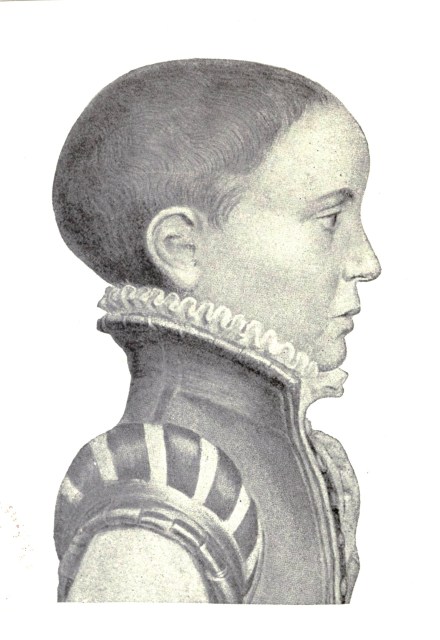 Francis Bacon at 9 Years of Age.