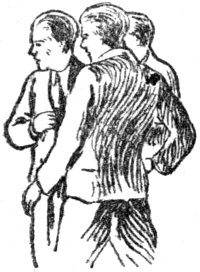
The whole mysterious affair puzzled Cliff.
To have those queer strangers appear suddenly
at Aunt Lucy’s with their unusual questions
threw him a little off his stride.
“No,” he answered the stocky Spaniard with
the crafty, shifty eyes, “I did not get a letter
from Peru. Who wrote it? Is it from my
father? How do you know about it?”
While the Spaniard interpreted the answer
to his companion Cliff studied them both. If
the tall, stalwart man with copper skin and
piercing eyes was not an Indian, Cliff had never
seen a truthful picture of one. He wore European
clothes but he was not at his ease in them.
While he listened to the queer language which
the Spaniard used he kept his eyes boring Cliff
and Cliff saw that his denial was not believed.
6
Copper-skin muttered something and the
Spaniard turned again to Cliff.
“You not get letter? Mi amigo, my friend,
say it mail ‘nine, ten week’ ago.”
“I can’t help that,” Cliff declared, “It hasn’t
come. Who is it from—my father?” Cliff had
not heard from his father in nearly five years:
naturally he was anxious about the scholar who
studied ancient civilizations and who had gone
to Peru to write a book about the Incas.
“Letter from man you not know.” The
Spaniard was very impressive; he spoke slowly,
“When it come you not open it. You give to
us pronto! We pay much money.”
“Why?” demanded Cliff, “What is in the
letter?”
The Spaniard turned and began exchanging
words with the Indian. Cliff, sitting with his
chums, Nicky and Tom, on Aunt Lucy’s cottage
porch, looked at his friends helplessly. They,
staring with wide eyes, showed plainly that
they could not help him with his puzzle. A
letter from Peru; from a man he did not know!
It must be delivered to these strangers unopened.
They would pay well for it. Why?
What was it all about?
7
Clifford Gray was as clean-cut a youth of
fifteen as any of the several hundred who attended
Amadale Military Academy, in this suburb
of a thriving mid-Western city. He was
not handsome but he had clear, direct, observant
eyes, a firm, almost stubborn chin and a
cheerful grin; his body was well built and kept
in splendid trim by much athletic activity. That
he was calm, cool, in full control of his finely
muscled arms was proved on the day that the
Amadale baseball pitcher “blew up” in the
fourth inning of an important game, letting two
runs come in and filling two bases by “walking”
a pair of the opposing team; Cliff went
in to pitch, with one man out. After two wild
balls that clipped the corner of the plate, he surprised
the confident batsman with swift pitches
which rapped the catcher’s glove as the bat
swung, and fine, teasing curves that broke just
too soon to be hit. After holding the opposing
runs where they were for the next five innings
he drove in the tying run and himself scored
the needed one to win and became a hero in
Amadale.
8
He lived with his Aunt Lucy because his
father traveled in distant lands, studying old
ruins for his histories of ancient people. Aunt
Lucy took a few “boarders” and mothered the
boys without coddling them. Among her
“boarders” Tom and Nicky were favorites.
Tom was a quiet, thoughtful youth just a month
older than Cliff; Nicky, talkative and full of
spirits, was the youngest of the trio. All three
were drawn together by a common bond; each
had a mystery in his life. Cliff’s mystery
seemed in a fair way to become very much alive.
The Spaniard and his companion had reached
some agreement. Cliff, his eyes missing nothing,
his brain alert, surmised from the stocky
foreigner’s shifting glance that he was about
to say something either wholly or partly untrue.
“I tell you,” he stated to Cliff, “it look to
you—how you say!—funny, eh? I make you
see.
“Mi amigo—this friend, he live in Quito, that
place was once great Peruvian city of Inca
people.” Cliff nodded. He knew something
about Quito, capital of an empire conquered by
the Incas before the Spaniards, in their turn,
conquered them.
9
“Si! Si. You sabe Quito. White man come
there—five year’ ago. Ask this amigo to guide
to old ruins.”
“My father!” declared Cliff, eagerly, while
Tom and Nicky sat forward on the porch swing,
intent and excited.
“Quien sabe—who knows? I think yes. This
man agree to take white man to old ruins in
cordillerras—mountains! They stop in village
where is—how you say?—festival of wedding.
“White man get very drunk. He have fight
and shoot natives.”
To Cliff that did not ring true; his father was
a quiet man, not the sort to take much wine or
to use firearms except in self defense. However,
he said nothing.
“One native die,” went on the Spaniard,
“Others very angry. Put white man in prison.
He think they kill him. He write letter and
ask this friend of me, here, to escape away and
send letter. This man must swim in river to
escape. Water make the address of letter so
it is not to send.” He made a gesture of smudging
ink and flung out his hands to indicate
helplessness.
“This friend not know what to do. He not
read. He put letter away and forget. He learn
after ‘while the white man kill’ by natives.”
10
Cliff was saddened by the story, even though
he had no proof that it really concerned his
father. Tom and Nicky looked sorrowful and
sympathetic.
“Ten week ago,” the Spaniard continued,
“this man see another white man in mountains,
make hunt for the place of gold mining.”
“A prospector,” Nicky interrupted. Cliff
nodded.
“This man ask white man about letter, what
to do. I am in camp with white man, Americano.
But I not read letter. Other one do that and
grin and laugh and take new envelop’ and put
on address from inside letter. He go away and
mail at Cuzco.
“Then——” he was very impressive. “He
tell me letter say this friend of me is one who
lead other white man to death!”
That explained why they were so anxious to
see the letter, of course. It might not be a
letter from his father—but who else in Peru
knew him or knew his address? But his father
would not get into a brawl. Perhaps he did
write that he was led into danger. In that case
the Indian was guilty of it.
“The letter has not arrived,” Cliff repeated.
11
“Maybe it went to the Dead Letter Office,”
Nicky suggested. “Maybe the other fellow
didn’t address it right.”
The Spaniard did not interpret this; evidently
he did not understand, not being familiar
with American postal systems.
“White man dead—not letter” he corrected.
Cliff smiled.
“We can’t do anything until it comes,” he
said, “Then——”
“You give to us?” eagerly. “You not open.
We pay——”
“I won’t promise anything like that,” Cliff
shook his head, Tom and Nicky doing likewise.
“But I will promise not to open it until you
are here. That’s fair, isn’t it?”
When the Spaniard had interpreted, his companion
said something that made the interpreter
laugh with a vicious glint in his eyes.
At the same instant Nicky laid an excited
hand on Cliff’s arm. All of them saw the direction
of his intent gaze and turned to look.
12
The postman was coming along the suburban
street, chatting with this one and that one as
he delivered mail. His mission was clear to the
foreigners and they stood waiting, tense and
eager. Those were mild poses compared to the
suspense of the three chums. They almost
trembled in their excitement.
At their gate their jolly letter carrier waved
something at Cliff.
“I declare,” Cliff, eyes fixed on him, heard
him banter. “How did you ever get you a girl
so far away? Why, it would cost you a year’s
allowance to go and call on her!”
He skimmed a fat missive toward the porch.
Cliff ran half way down the steps and caught
it. From above him, the others stared. There
was no mistaking that unusual stamp.
The letter was from Peru.
13
CHAPTER II THE MYSTERY BOYS ADD A MEMBER
As Cliff came up the steps with his Peruvian
letter both strangers acted together; each made
a grab. Cliff stopped.
“Look here!” he challenged, “You wait until
I open this!”
He put the letter behind him. They saw that
on the steps he was in a position to turn and
elude them. Retreating a step the Spaniard
nodded and the Indian stood aside, his arms
folded. Tom and Nicky were already beside
Cliff, ready to help him.
Flanking him they accompanied him as he
mounted to the porch and faced the men. The
chums formed a tableau; it might have been
called “United we stand.”
But they held the pose for only an instant!
As they passed him the Indian, with catlike
agility, moved back and then stepped down to
the point Cliff had just vacated. He, then, was
on the steps. They saw that they had lost a
point of strategic advantage for the Indian
blocked the way of escape to the yard.
14
Cliff, about to strip open the letter, paused.
“What are you trying to do?” he demanded.
He discovered the answer at once. The
Spaniard made a spring toward Cliff, hand
reaching, fingers clutching at the letter. The
Indian opened his arms to block any leap toward
the steps and Cliff saw that he was almost
trapped. But not quite!
Nicky stuck out a foot to trip the springing
man. Tom made a tackle but the Spaniard
swerved. That swerve enabled Cliff to snatch
away the letter. Like a shot Cliff stepped backward,
turned and in several quick strides
reached the cottage door. He swung it open,
dashed in, slammed the door. The Spaniard,
baffled, said something under his breath and
paused.
Tom and Nicky promptly executed a backward
movement that drew them up, side by side,
before the door. Both aggressors stared and
showed that they were baffled.
Cliff appeared at the sitting room window
which he lifted.
15
“You just cool down until I see what is in
this that you are so afraid to have me see,” he
exclaimed.
The Spaniard, however, seemed to have recovered.
There were neighbors, perhaps some
of them were watching. Whatever was to be
done must be done at the instant. He muttered
something to the Indian and made a spring
toward the window. He caught the lower edge
before Cliff could slam it down, gave Cliff a
push. The young man stumbled back and
caught his foot on a chair; he saved a backward
fall only by supple contortion.
At the same time Nicky and Tom sprang
from the door to catch the Spaniard but found
their coat collars in the powerful grip of the
copper colored one behind them. He swung
them off their balance and started to run them
toward the steps, backward, scratching, clawing,
trying to break his hold.
As Cliff recovered himself, still clinging to
his letter he saw the man scramble into the
room. He made a fresh clutch at the envelope
but Cliff sent it spinning into a corner, then
felt powerful fingers grasp his arm.
16
At the same time a small automobile turned
into the street. Nicky shouted, “Mr. Whitley!”
as Tom, fighting ferociously, tore loose from his
captor. He made a stroke but the Indian flung
them both away at the top of the steps and
vaulted the porch rail at one end with a shout
as the car brakes screamed and the tires
smoked. Before the car was at a standstill its
occupant, his strong face set and intent, was
coming with long strides up the path.
“Let him go,” Tom called as the rescuer
swerved to pursue the Indian. Tom saved Nicky
a nasty fall down the steps and turned to see
how Cliff was faring, shouting to the newcomer
to come with him. Nicky, catching his equilibrium,
went with them through the cottage
door.
Within, Cliff was striving to hold back while
his captor, who clung to Cliff as Cliff clung to
him, pulled steadily and surely to where he
could reach for the letter on the floor.
Cliff felt that he must act swiftly; he heard
the noise on the porch but could not tell what
had happened. He used a jui-jitsu trick taught
him by a young Japanese student at Amadale,
and the Spaniard, with a muttered word,
crumpled for an instant; it was enough; Cliff
had caught the letter and put the table between
them by the time his adversary was up.
17
He was trapped; Cliff blocked the window;
three were entering the door. Nevertheless,
with a final, futile snatch at the object in Cliff’s
hand, the Spaniard caught up a chair and sent
it sidewise against the legs of his advancing
attackers; in their scuffle and scramble he
avoided them, got to the door and was gone before
they could right themselves.
“Don’t chase him,” Cliff panted. “Thank
you for coming, Mr. Whitley. Everything is all
right. They wanted this letter—but they did
not get it!”
They all observed one another. Mr. Whitley
was the youngest instructor at Amadale; he
taught history and was a great friend of Cliff.
His method of teaching made him popular with
all the youths and boys at the Academy. His
classes were more like round-a-camp-fire gatherings,
with chats and anecdotes, than like cold,
matter-of-fact history lessons. The boys all
liked and respected Mr. John Whitley. He was
hardly more than twenty-four and had a companionable
manner and clear honest eyes. His
sense of fairness made him mark examinations
so justly that no student ever complained of
favoritism.
“What is it all about?” he asked, “If that is
any of my affair.”
18
Cliff promptly began to tell about the arrival
of the two men, their strange question followed
by the coming of the letter.
And while he talked he began to make signs
that were not noticeable to anyone who did not
understand them. In actual fact his gestures
were part of the secret signs of an order to
which the three chums had pledged themselves.
They could carry on communication that each
understood but without giving away to others
the secrets they discussed.
Thus, when Cliff scratched his ear with the
middle finger of his left hand, he called for a
secret council; when his chums folded their
arms quietly it signified that they understood
and that the lodge was convened.
Cliff talked to Mr. Whitley, told him everything
up to the rescue. In the meanwhile he
had appealed to his chums to judge the advisability
of admitting Mr. Whitley to their secrets.
Nicky, who was more excitable than Tom,
forgot that they were carrying on their communication
secretly.
“Make him take the oath—and—and everything!”
he cried.
19
Naturally, unaware that they had decided to
accept him, Mr. Whitley was surprised at
Nicky’s cry. Cliff explained.
“We have a secret order that we call The
Mystery Boys!” he said, “we can talk together
by signals so no one else understands. Each
one of us has a mystery and that is why we
formed the order. I don’t know what became
of my father, since he went to Peru, and Tom’s
sister has been missing for years, and Nicky
has an old cipher in his family. These mysteries
kind of drew us together and we formed
ourselves into a band——”
“‘The Mystery Boys!’” broke in Nicky.
“We have secret signs so that we can carry
on a conversation right in front of you—as we
just did while I told you some things,” Cliff
explained, “you see, Mr. Whitley, we have
sworn not to tell our secrets to anyone who was
not under the Oath of the Oracle——‘by the
sacred Emblem’,” he quoted, “‘Seeing All, I
see nothing; Knowing All, I know nothing;
Telling All, I tell nothing!’”
“I don’t quite see,” began the mystified instructor—what
this has to do with the two men,
he would have added, but Tom spoke up.
20
“We have decided that we need your help,”
he said, “we have talked it over together and
we want you to know all about Cliff’s mystery
and advise us—but we can’t break our oath.”
“Oh! That clears it all up. Very well. I
am willing to help Cliff, that is certain. If I
have to promise things and join your order, I
am willing. But can we not dispense with all
but the promises just now and discover what
is in that letter?”
“Let’s!” urged Cliff, “I want to see what it
is.”
“Well——‘On the Sacred Emblem’——” Mr.
Whitley, who had a good memory, repeated
the oath solemnly, his hand on a curiously cut
Egyptian scarab, the sacred beetle of the
ancient Egyptian mysteries which Cliff produced
from among his father’s collection in a
cabinet.
“Now,” he added, “let’s see the letter, Cliff.”
21
CHAPTER III GOLD, AND A LIFE AT STAKE
Cliff was quite as anxious as the others to
see what the envelope from Peru contained; he
slit it and drew out two folded papers.
While the others watched eagerly he glanced
hastily at one paper and crammed it into his
pocket as he opened the second.
“It is!” he cried, “It is from my father!”
22
They crowded closer and urged him to read
it aloud. The letter, after the address, fortunately
placed there so that the destination was
known even when its outer cover was spoiled in
the river, was amazing.
“Dear Son and dear Lucy:
“If you ever receive this it will be fond love
and farewell.
“I am in a city in the most inaccessible valley
of the Andes. When the Spaniards conquered
Peru some Incas and their subjects fled here
and set up a city. I have tried for over four
years to get away but there is no place where
the cliffs can be climbed.
“When first I went to Quito I saved a native
who was very ill. In gratitude he told me of
this hidden city and even guided me to a mountain
where a glimpse of it was possible; but he
would not help me to enter the valley. When I
said I must explore and study it he deserted
me. Later I lowered myself with a rope and
found a city of the old Inca sort, filled with
gold.”
“In the old Inca empire, before the Spanish
looted it,” Mr. Whitley broke in, “gold was so
plentiful that it was used for dishes, utensils,
ornaments, even for decorating their temples
to the sun, which they worshipped as a god—but
go on, Cliff.”
Cliff finished the letter without further interruption.
“It is a perfect treasure land. But, though
there is a way in, there is no way out. The
natives are kind but they took away my rope;
they do not want me to escape and bring the
outside world to their hidden place.
“Being anxious to explain my absence I have
trained and tamed a young eagle and I am
fastening this to its leg in the remote chance
that it may be found when I release him.
“If so, dear son Cliff—and sister Lucy—goodbye.
I am very ill and fear I may not get
better.
“Your loving“Father and Brother.”
23
“My!” exclaimed Nicky, “but people get
well, Cliff,” as he saw the depression in his
chum’s face.
“The Spaniard told a different story,” Tom
said, thoughtfully, “I think he wanted to get
this for the Indian, to prevent you from learning
where your father is. The Incas may be
afraid you will try to go there.”
“I would,” Cliff said eagerly, “If——” ruefully
“——I had any money and knew where
it was.”
“What was the other paper?” Mr. Whitley
inquired.
Cliff had forgotten it; he drew it from his
pocket and read it aloud. It was in the same
handwriting that the envelope bore, and was in
a style totally different from his father’s letter.
24
Cliff, reading its clipped sentences slowly, began
to tremble with excitement. When he
finished and looked around he saw in the faces
about him eagerness, hope, wistfulness.
The letter read:
“Clifford Gray; Sir:
“You don’t know me. I don’t know you. But
I think we will know each other.
“I caught a tame eaglet and found your pa’s
letter. There was a map, too. It was to show
how he got to where he went into the valley.
“I kept the map. Tell you why. I went to the
place and saw the valley. I am a prospector
and know these cordillerras.
“Reason I kept the map is I want to be with
you if you go to find your pa. If you don’t it’s
not any use to you anyhow. If you do I can
help.
“What I want is some of that Inca gold. Not
a lot. Enough to settle down, buy a ranch, live
easy. I will be in Cuzco at the Tambo Atahualpa—that
means Atahualpa hotel, for a while,
till I hear from you. Let me know. With you
and a couple more I could find your father and
we could get him out.
“Signed respectfully,“Quipu Bill Sanders.”
25
“Oh—if we could!” Cliff said. It was clear
that his comrades felt exactly as he did.
Mr. Whitley was very thoughtful. While the
trio discussed possibilities and re-read the two
letters time after time, he sat without saying
anything. Finally he looked up.
“See here,” he told them, “you have made
me a member of your secret order and asked
for advice.” They nodded eagerly.
“I think,” he went on, “that if your relatives
would let you go with me, it would be an instructive
and an interesting trip.”
The chums agreed with that quite heartily.
But how?—where was money to come from?
“I have been given some money recently. I
inherited it,” Mr. Whitley informed them, “I
will be glad to advance the amount for expenses.
If we find Cliff’s father and rescue him I shall
feel that the money is well spent.”
“And there is the treasure!” Nicky exclaimed.
“Yes,” John Whitley agreed. There began
an eager discussion of what they would do with
their shares; but the young history instructor
became rather serious.
26
“I am not so sure that we will try to get the
treasure,” he told them. Their faces fell, but
they did not argue.
“You see,” he went on, “we aren’t going
to be thieves. That treasure is the Incas’ own;
it isn’t like buried gold. Of course, the people
have taken a white man prisoner, and perhaps
if we find it wise to take enough away from
them to reimburse us for the expenses, it would
not be dishonest.”
“I agree with you,” Cliff declared, “anyway,
if we do find my father——” a hope which
his chums eagerly echoed, “——he will be able
to get all the royalties from his other books,
which the publishers have held back, not knowing
what to do, and only giving me enough to
pay expenses. He will share with us all. My
father is that kind of man!”
They were quite satisfied. The adventure
would be sufficient as Tom put it.
27
Eager were their plans. Lists of things to
take were made; plentiful discussions ensued,
even amounting almost to arguments, for Nicky
wanted a full arsenal of weapons, and enough
ammunition to load down a mule. But he gave
it up, for Cliff, from a study of his father’s
notes for part of his book, assured them that
the Incas were not very warlike or cruel. They
were not like the Mexican Aztecs, who, in days
past, had been cruel and harsh. The Incas, he
said, were rather gentle, making war only in
self defense, or to add territory when it was essential
to their growth of empire.
Cliff, from his studies, conceived a great plan.
Mr. Whitley agreed that it would be worth trying.
What it was, and how it would work out,
only time could tell; but it was so well thought
of that some special articles were included in
their supplies in order that they could use
Cliff’s method of entry into the country.
“Of course that means if you boys go beyond
Cuzco with us,” John Whitley said, when he
had secured parents’ consent to the adventure
and had given promises to avoid danger. The
chums felt very certain that they would go well
beyond Cuzco, old Inca city, once capital of
their vast empire.
In time goodbyes were said, final promises
made, handkerchiefs waved from a departing
train. The day spent in New York was a delight
to the chums, and so was the embarkation
on the great white fruit liner which would take
them southward.
28
They laughed when, soon after the boat
sailed, great clusters of bananas were placed
within easy reach of passengers; that was a
custom on the liners and it made the tropics
seem very real and quite close already. The
days of their voyage to the Panama Canal were
spent in studying some books of Inca lore, and
in working out better systems of signals for
the Mystery Boys’ order.
The passage through the Canal, the visit to
one of its huge mechanically worked locks, the
sights of the strange mingling of East and West
in Panama City, added zest to the trip.
Then, tracing the route taken by the original
Spanish caravels, they turned, as Nick said,
“down the map,” along the South American
coast, and landed at Lima, in Peru, where Mr.
Whitley wanted to locate an old acquaintance
of his college days and get more information
and a proper set of ancient Inca costumes, if
possible, for use in Cliff’s plan.
29
They found the city a thriving one and spent
pleasant days there. The journey to Cuzco
seemed almost endless, so eager were they. But,
like all things that depend on time, the trip was
eventually completed and the chums, hardly
able to speak for their suppressed excitement,
saw the first glimpses of what Cliff termed
“The Gateway to Adventure”—Cuzco!
30
CHAPTER IV “QUIPU BILL”
Romance! Adventure. To Cliff, Tom and
Nicky the ancient capital city of the Inca empire
was built on those two words.
Not that Cuzco, when they reached it, had any
of its old treasures; Spanish invaders had
stripped it centuries before. But the memory
was there among the ruins.
The native Peruvian Indians—over whom the
Incas had ruled, for the Incas were a superior
tribe which governed its subjects kindly but
firmly—these natives were shiftless, poor and
inclined to be lazy.
But to the three adventurers, with their imaginations
fired by what Cliff had read and
what Mr. Whitley had told them on the boats,
Cuzco still echoed to the tramp of armies carrying
bows and arrows, swords and light shields;
the great square shook again to the shouts of
hosts gathered for ceremonies and feasting in
the rites of their worship of the Sun.
31
“It is certainly interesting,” declared Cliff,
as they stood near the stripped temple which
had once rivaled in splendor any other place of
worship ever built. “The gold cornice is gone
and so is the silver and so are the emeralds and
ornaments. But we can imagine them. And
notice how perfectly the edges of these stones
are ground and fitted and matched.”
“How big they are, too,” Nicky added, “tons,
some of them must weigh. The Incas had no
beasts of burden to haul things—how they ever
got these stones cut and shaped and hauled
here and lifted into place—it is too much for
me.”
“Patience and time did it,” Tom said, “I
believe they say it took fifty thousand men
twenty years and more to build one great palace
or temple.”
“With their hands—and without iron tools,”
Cliff added, “they mixed some tin with copper
and made an alloy that they could make almost
as hard as steel. But their roads and their
aqueducts and their buildings all took labor and
plenty of it.”
“Isn’t it time we started for the hotel?” Tom
glanced at his watch, “Quipu Bill Sanders is to
come to see us at four.”
32
They agreed and turned to retrace their way
around the ruin.
As they rounded a corner Cliff, in the lead,
stopped sharply, in surprise. While there was
one chance in a thousand that they should encounter
the very Indian who had been with the
Spaniard in Amadale, it was certain that the
fellow into whom Cliff had almost banged had
turned and seemed to stiffen when he saw them.
He stood facing a slender fellow, almost a
boy, whose well developed leg muscles made
Cliff think of a runner. With a swift word
under his breath as the trio of chums stared,
the Indian sent the youth off; and he was a
runner and no mistake. He went lightly but
with almost incredible speed down the road.
The stalwart Indian paid no attention to Cliff
but hastened away.
“Do you think he was——?” Nicky whispered.
“He jumped,” Tom replied.
“Ought we to follow him?” Nicky wondered.
Cliff thought not. The runner was gone, the
Indian might have been surprised to see white
youths turn suddenly into view. Cliff could
see no advantage to be gained by following.
33
They crossed the square to enter one of the
four straight avenues which quartered the city.
Cuzco was beautifully laid out, every ancient
street as straight as if made by a surveyer’s
lines. Presently they reached the “tambo” or
inn.
Bill Sanders was already there: he and
John Whitley were in the courtyard around
which all the rooms opened. Bill was squatted
on his heels, cowboy fashion, with a knife in his
hand, idly whittling a stick.
As he saw them and stood up they saw that
he was tall and very thin; so thin, in fact, that
he looked more like an underfed man than a
tough, sinewy, sturdy mountaineer. However
his skin was brown with healthy exposure and
his grip, when they shook hands, made Nicky
wince a little.
Quipu Bill Sanders had the eyes of a fox and
the courage of a lion; and he was cunning, too;
but his cunning was not the stealthy, wicked
sort.
“You know who I am,” he greeted. “Let’s
see if I know which of you is which.”
34
Cliff, who had discovered a little skein of
colored yarn at the roadside near the inn entrance
and who had paused to glance at it and
slip it aimlessly in his pocket as some decorative
native object about which he would ask
later, came forward at once.
“You’re Cliff,” said Bill. “The others stood
back for you. And this is Tom—because he
sort of fits his name, for he looks quiet and has
a manly grip. Of course there’s only Nicky
left so this must be Nicky.”
They smiled at his deduction and felt as
though they had known him for a long time, he
was so easy to meet. He already called Mr.
Whitley by his first name, insisted they call
him Bill, and alluded to them as “comrade”
or “comrade Cliff.”
“How is it you are called ‘Quipu’ Bill?”
Nicky asked at once.
Bill squatted and began work on his stick
again.
“The Incas didn’t have any alphabet or writing
to keep their records and history,” Bill
answered, “Nor any stone carvings such as
you see in Egypt. When they wanted to send a
message or make a record, or even figure up
accounts, they used wool yarn of different colors
and wove it together with different knots.
The colors meant something and so did the placing
of the knots and the number and the way
they were made.
35
“They called these records or messages
‘quipus’ and a fellow who understood them,
could make them and read them, was a ‘quipucamayu.’”
“And you studied and got to be one of them,”
Nicky guessed.
“Yep! So I shortened it down to just the
name of the yarn message.”
“Were they like this? Isn’t this one?” asked
Cliff, recalling what he had found. He produced
it. Bill nodded.
“That’s one. Where did you get it?”
Cliff told him. Bill dropped his stick and became
suddenly mighty serious.
“Why—look here! This is queer. This thing
is a message about two grown men and some
children and mountains and the snowy pass—and
war—or ambush——”
He began to study the short woven length
with its knotted strands and its weave of colors,
some white, a bit of red and other colors mingled.
36
Then he looked up as he saw Tom’s eyes turn
toward the road, visible from the courtyard.
They all looked. A youth—it might be the one
they had seen before—was searching. He went
along, head bent low, eyes on the road, turning
from side to side.
Bill rose, dropping the quipu carelessly into
his left coat pocket. Cliff, who was always
observant, noted it though he paid little attention,
being too busy wondering what Bill meant
to do.
He went to the road and called. The youth
turned, came back to him. There was a brief
exchange of words, too far away to be heard.
Then Bill put a hand in his pocket, drew out
an object of woven yarn. The boyish fellow
almost snatched it and while Bill called and
pretended to be very angry the boy dashed out
of sight and Bill strolled back to the party.
“For Pete’s sake!” exclaimed Mr. Whitley,
appearing exasperated. “You gave him that
quipu.”
“I gave him that quipu—yep.”
“But—with the Spaniard visiting America
to forestall that letter and with our lads seeing
the Indian give that runner a quipu—don’t you
see that the message might have been about
us?”
Bill nodded. “It all hooks up. It likely
was,” he agreed.
37
John Whitley stared, as did Nicky and Tom.
Was this new acquaintance as much on their
side as he claimed to be?
“Wasn’t that the same boy you saw?” John
Whitley inquired.
“It was, sir,” Nicky answered. “He had a
bright yellow thing-umjig on his head.”
Bill whittled one side of his stick to satiny
smoothness. “Now I don’t know your mind and
you don’t know mine,” he said, “But——”
“Wait!” broke in Cliff. “You dropped that
quipu into your left hand pocket, Bill. I think—I’m
sure—I saw you take what you gave him
out of the other side of your coat.”
Bill grinned approval. “Right as can be,”
he agreed. “I had picked up an old quipu in
my diggings to show you fellows and that’s the
one I gave him.” He showed them the other one,
still where he had dropped it in his pocket.
“He’s taking—to whoever he’s sent to find—a
quipu that has a history or record of how
a great sky god, or courtier of the Sun-god that
they worship—of how this Chasca came to
earth and brought great peace and prosperity
to the Inca people.”
“Why, that fits in with my plan!” exclaimed
Cliff.
“So it does,” said Mr. Whitley.
38
They had a long discussion. Bill told them
that he “figured” that the Indian who had been
with the Spaniard had been sent out from the
hidden city to try and prevent the letter from
being delivered.
“They must have learned about it,” he said,
“and guess they tried to stop it. Then, when
they failed, they let us come on down here,
where we are, in a way of speaking, right in
their hands——”
“That means that Cuzco is as far as our
young chums will go,” said Mr. Whitley seriously.
The youthful faces became downcast.
“I promised not to take you into danger,” continued
their Captain, as Bill named him, “and
so Cuzco will be your stopping place.” There
was no argument. The Captain’s word was
law.
But events were to compel a change in Mr.
Whitley’s ideas.
39
CHAPTER V THE CHUMS SHOW THEIR METTLE
In Cuzco, while final plans were made and
supplies were being assembled, the chums were
free, for several days, to explore. Bill had
shown them their map, which he had kept out of
Mr. Grey’s note when he coaxed the eaglet to
his camp. The map did not mean much to them,
but to Bill, who had already gone alone over
the passes to be sure there was a hidden city,
the map was quite clear. They would go on
foot over the mountains, he said. It was safer
than by muleback: some of the passes were
quite narrow and dangerous, although he could
show the best ones to them.
The chums were rather depressed that they
could not accompany Mr. Whitley and Bill:
however they agreed to make the best of it, and
with the naturally buoyant spirits of youths in
a new place they went about and had a fine
time.
40
One of the people they met was a youth,
quite near their own ages. He spoke a little
English and acted as their guide.
None of them, nor their older companions,
suspected his real purpose, but it was divulged,
one day, as they were in a meaner quarter of
the city where some of the natives of Peru, degraded
and listless remains of a once noble
race, had their poor homes.
“Come—here—I show—how I live!” said
their young guide. They all followed him into
a low room in an old building, squat and roughly
built of a composition something like the
adobe of the Mexicans.
But once they were inside they turned in dismay.
The youth was not alone with them:
three fierce looking half-caste men, part Inca,
part Spanish, rose from a dark corner: one
slammed the rude door and fastened it. “Now,”
he said, “you stay here.”
“What’s the big idea?” demanded Nicky hotly,
relapsing into slang in his excitement.
“You see!” said the man. He and his companions
held a low-voiced conference and then
one of them rose and was gone: his malevolent
looking friends gave the door a vicious slam
and shot its bolt.
41
“What are you going to do with us?” demanded
Tom.
“We keep you. When that tall one—” he
meant Mr. Whitley,”—start for Lima once
more, we let you go!”
“You daren’t!” cried Nicky, and made a
dash for the window. But Tom and Cliff restrained
him.
“We’ll have the police—or whatever they’re
got here!” Nicky said. He gave a shout. But
one of the men advanced with a very threatening
gesture.
“Keep quiet,” Tom urged and Cliff added,
“we’re in a strange place.” He counseled, “We
have to keep our heads. We’ll find a way out
but not by making a disturbance. We don’t
know these men or this part of town: we don’t
know the customs they have. If we keep quiet
they may let us go or relax their guard.”
“But then our trip’s ruined!” argued Nicky.
“Yes,” said Cliff, morosely, “and my father
is the worst sufferer if he is still alive. But we
are trapped. We must do our best to get out of
it before they send that man to Mr. Whitley.”
“He’s already gone,” grumbled Nicky.
42
“No he isn’t. He’s just outside. I see him
through the window. He’s rolling a cigarette
out there by a post.”
“He’s waiting for someone,” said Tom, “I
see him.”
“Tom,” whispered Nicky, “your uncle gave
you a pistol, didn’t he? Have you got it? Let’s
shoot our way out!”
That was Nicky all over! He was excitable
and quick. He knew that Tom had been trusted
to carry a light .22-caliber revolver given him
by his uncle, because Tom had a cool head and
would not abuse the possession. It was more
for signalling, than for a fight.
“Easy, Nicky!” counseled Tom, “We don’t
want to hurt anybody.”
“No,” chimed in Cliff, “we’re outnumbered
and we don’t know how dangerous this neighborhood
may be. Besides, if we do anything to
get into police courts it will make us tell what
we are going to do and that will upset all Mr.
Whitley’s plans.”
“No he isn’t,” Tom replied, “He’s waiting
outside, by a post—I can see him through the
window. There! Why—I believe the very same
Indian we saw by the temple is giving him
money!”
“Yes—I’m sure it’s the same one,” Cliff
said, “He’s coming in.”
The tall Indian, or Inca noble, for he was
really that, was admitted. The two waiting men
stretched out eager hands.
“We get them,” said one, “You pay. We
go.” Then he remembered that he spoke a half-halting
English, and repeated it in dialect.
The Indian paid them some money and the
two men, as if glad to be away, left quickly. The
boy came in, acting shamefaced, but trying to
look cheerful. He, too, stretched out a hand.
“Now—if only we had some way to take
these two by surprise,” began Tom.
“Sh-h-h!” warned Nicky, “They’ll hear
you.”
Cliff reminded him that the Indian had not
understood the half-breeds when one spoke in
English, and that the boy had to stop and translate.
He spoke in low, eager tones.
“Nicky, what did you do with that little box
of magnesium powder you took out of the supplies
this morning? You were going to try to
take a daylight kodak picture inside a temple
by flashlight. If you had it, now——”
44
“I have,” Nicky whispered, “but——”
“Listen. Here’s a plan. It may work. It
would play on the superstitions of these fellows.
They are both natives and I don’t think
either one has seen a flashlight, or an electric
torch. If we could make them think we were
powerful magicians and could burn them, they
might be scared enough to be off guard——”
“It’s an idea!” exulted Tom, “I have that
small burning glass, Cliff—suppose I got to the
window, and set the burning glass so it focuses,
while the man is paying the boy. Then——”
That was Cliff’s idea, too. Tom moved quietly
over and pretended to look out of the window.
Really, he was adjusting a small lens, hidden
by his hand on the stone window ledge, so it
focused the sun rays in one spot. On Cliff’s
instructions Nicky maneuvered his body to help
conceal the tiny lens from the sight of the
others. Tom opened the flash powder box, a
small, single charge of magnesium powder
which, when ignited, makes a great white flash
and a big puff of smoke, but is not dangerous.
The boy turned from being paid.
“Listen,” Cliff commanded, “You—tell—that—man—”
he spoke slowly and impressively,
“—we—are—going—away—from—here.
If—he—tries—to—stop—us, we—will—burn—him—up!”
45
The boy stared. Cliff repeated his words.
The boy, mystified, translated. The man
laughed scornfully. Cliff drew a small pocket
electric flashlamp into view. In a dark corner
he played the rays while the natives stared.
Then, suddenly, he pointed a dramatic finger
at the tiny box on the window ledge. The natives
stared at it curiously, not knowing what
to expect.
“Tell—him—we—burn—that—box—to—show—what
happen—to you—if—you—stop
us!” Cliff said with a bold and threatening expression.
The boy spoke in dialect and both
seemed unable to take their eyes off the box.
Cliff made a sign to Tom who pushed the
small box into the focus of the lens which Nicky
screened from the natives’ view. Cliff pressed
his light switch, and pointed the ray with a few
signs of his free hand.
Nothing happened!
The man laughed and the boy snickered.
Nicky began to feel weak and cold; but Cliff
stood his ground.
46
Then, so suddenly as to startle even Nicky,
the focused rays ignited the powder: there was
a dull “boop!” and a blinding glare.
Before the smoke had risen and began to
spread Cliff whispered, “Now—make for the
door!”
Holding the flashlight pointed at the boy
until the latter cowered back against the man,
Cliff led his chums to the door. He fumbled
with the catch: the man made a move as if to
grapple with him but Cliff threw the ray into
his eyes and he flung up his arm, instinctive
fear of something not understood overcoming
his wit. Cliff unfastened the clumsy catch, the
chums fled to the street and were off like young
gazelles.
“They’ll find the lens!” Nicky panted.
“What do we care?” demanded Tom, “They
won’t get us!”
Of course all plans had to be altered; the
youths could not be left behind. They were
glad that in trying to prevent the expedition
the Indian had only made their part in it certain.
47
On a fine evening, with all the natives engaged,
and with all supplies packed, and with
their course through the mountains carefully
determined, they went to sleep for the last time
in a civilized hotel—if the mean accommodations
of the place they had selected could be called
“civilized.” Mr. Whitley’s Lima friend had not
proved a very good adviser. However, bright
and early the next clear, temperate day—for
Cuzco was not in the hotter lowlands where
tropical heat was fiercest—they began their
real adventure.
Bill and Mr. Whitley were in advance: then
came the natives, laden with quite heavy packs,
under which they toiled along on an ever ascending
slope, singing native chants and talking in
their unintelligible jargon. Behind them came
the Mystery Boys, also laden with packs containing
personal things and articles they
wished to protect from prying eyes.
“We’re on our way,” they told each other
and felt like capering at the certainty that in
trying to frustrate their plans the Indian had
made it possible for them to go along.
Up in the hills a tall, well built Indian stood
with several companions, watching the lower
passes.
One day, as the comrades toiled along, entering
the real mountains, the vigilant watcher
turned toward his companions.
“Brother, they come!” he said.
48
“They come—yes,” agreed his nearest aide,
a noble of the old and almost extinct true-blooded
Incas, “They come—yes.”
He made a meaning gesture.
“But—they will not come back!”
That same day Cliff borrowed Bill’s field
glasses and focused them on a small band, toiling
along far behind them.
“I think we’re being followed—I’ve noticed
that group several times,” he told the older
members of their party.
They agreed, and frequently thereafter the
followers were observed, but always too far
behind to enable the chums to guess their identity.
Was it the Spaniard? Was it the Indian?
Many days passed and they were well in the
high cliffs before they learned the truth!
49
CHAPTER VI A NEW MYSTERY DEVELOPS
Quichua, the almost universal dialect which
the Incas had introduced into Peru as they conquered
its tribes, was quite well understood by
Bill Sanders. He spent much time on their daily
marches, and in camp, teaching it to John Whitley
and the three chums. It was the language
that the hidden city’s inhabitants would be
most apt to understand, he believed.
When they had learned that a “chasqui” was
a runner or messenger; that Cuzco, the name of
the principal city and hub of the old empire
was so called because the word meant navel,
the center of the body; and many other things
such as that “Pelu” meant river and was
thought by some to have been the word that
gave the Spaniards their name for the nation—Peru!—they
began to study brief sentences
and after a while could hold short and simple
conversations together.
50
In return they taught Mr. Whitley and Bill
the secret ways of exchanging ideas in the signals
of their order. After some discussion
and hesitation Bill was made a member of The
Mystery Boys and although the chums debated
the good sense of letting him know all their
signs, they finally gave them to him—and as
events proved, they were to be glad they had
done so.
In camp Cliff and his friends spent a great
deal of time studying the rude map: because
Quipu Bill had some misgivings about letting
the only guide they had become damaged or
lost, Tom, who was quite a draftsman, made
a very good copy which they used and over
which they watched jealously so that the natives
would not discover what it was.
The small party—not more than eight—which
had been following them hung on like wolves
on the flank of a buck: when Bill hurried along
the others kept the same distance, when his
party lagged the others dallied also.
51
“I think it is either the Indian, or the Spaniard,
or both of them,” said Bill, “They know—at
least the Spaniard does—that there was
a map, for he was in camp when I caught the
eaglet.” But the other party kept just too far
behind for them to see, even with fine glasses,
just who comprised the group.
Then, one afternoon, Cliff looked down from
a high point and called to Bill.
“Bill—get out your field glasses. I don’t see
that party anywhere below.” Bill looked. John
Whitley and the youths took their turns. But
there was no sign of pursuit.
“We must have lost them,” Nicky said.
“But we have been on a straight road all
day,” Mr. Whitley objected. “No. Either they
have dropped too far behind for us to see them
at all, or they have given it up——”
“Or they have turned into some side pass,
thinking that can get around us in some way,”
Bill added, “But they won’t. I guess we have
lost them for good.”
They all felt rather glad of it. There had
been some fun in the game of hare and hounds
at first, but after a few days the continual
watching became wearisome and perhaps
worrisome. Their natives noticed it, for one
thing, and they did not want the Peruvians to
think their story of an engineering and educational
trip was a ruse. They all breathed more
freely that night as they made camp.
52
But Cliff kept wondering why the pursuit
had stopped.
That night—and it was cold for they were
very high up in the levels just a little below
snow level—he lay rolled in his blanket, in the
tent the chums shared, thinking about it.
“Cliff,” Tom’s voice whispered through the
dark, “Are you asleep?”
“No,” Cliff answered under his breath. But
he need not have been so cautious. Nicky was
not asleep, either: and he declared the fact
promptly.
“I’m awake too. Is it to be a session of the
Inner Circle?”
“Maybe,” Tom replied, “I was going to ask
Cliff if he noticed that Indian that Bill calls
Whackey—the one whose name is Huayca?”
“Notice him? Notice what about him?”
Nicky demanded.
“He kept dropping back from one carrier to
the next one, right along the line, today.”
“Yes,” Cliff said, “I saw him. He talked
to each one for a few minutes, then he dropped
behind and talked to the next one.”
“What do you suppose it meant?” Nicky
wondered. “Nothing, I guess. I have seen him
do it before.”
53
“You have?” Cliff and Tom asked it at one
instant.
“Certainly. But he is the boss isn’t he? He
has to give orders.”
“When he gives orders he yells them out so
that we all hear him,” Tom objected.
“In the morning,” Cliff said, “Let’s ask
Mr. Whitley and Bill if they have noticed.”
They agreed and discussed the curious disappearance
of the trailing party for a while.
Then, suddenly, Cliff hissed under his breath,
“Sh-h-h-h!”
They became alert, intent: they listened with
straining ears.
“It was only some pebbles—a little landslide,”
Nicky whispered. “They do that in the mountains.
I saw some pebbles slip this afternoon.”
Nevertheless Cliff gently crawled out of his
blanket and his head came in rather vigorous
contact with Tom’s cranium for he was doing
the same thing. They forgot the bump in the
excitement for more pebbles were clattering at
a little distance.
Cliff and Tom unhooked their tent flap and
without widening its opening much, looked into
the dim, starlit night.
54
Nicky pushed his face between them. Each
felt that the others were tense, Nicky was trembling
a little. They stared and listened.
From a greater distance came the crackle
of a broken twig.
Without a word Cliff pushed into the open
and stared around. Then he saw figures, silent,
drifting like spectres through the night, shadows
with lumpy heads.
At first he almost cried out at a touch on his
arm but in the instant that he controlled his
impulse he realized that it came from Nicky’s
grip on his arm.
“It’s Indians!” Nicky gasped.
“Yes,” said Tom, at his side; then he added
in a puzzled way, “But they are going away
from us.”
“It’s our Indians——” Cliff said, “They’re
running away. Hey!” he shouted, then, poised
to race after them, he called to his comrades to
waken Bill and Mr. Whitley; but they were already
awake and emerging dazedly from their
tent as Cliff thrust the ground behind him with
racing feet, in hot pursuit of figures now making
no effort to be quiet as they galloped away.
55
It was a hazardous pursuit in the dark and
on a strange mountain path; but Cliff had observed,
as was his habit, while they climbed
earlier in the day: he knew when to swerve to
avoid a heavy boulder, he seemed to avoid by
instinct the more pebbled and slippery parts.
While Nicky and Tom, after shouting the
news, pounded in pursuit he overtook the hindmost
runner.
“Stop—you!” he shouted. The man swerved.
Cliff made a tackle. The man tripped, was down.
Instantly Cliff was erect again and racing on
while Tom caught up with the man already
scrambling to his feet and held him until Nicky
arrived.
Then, from behind them, Bill, in the dialect,
yelled a call to halt to the natives. Cliff reached
his second man and put a hand on his arm.
From behind came the flash of Quipu Bill’s
rifle, fired into the air over the runners’ heads.
They stopped, uncertainly, and Cliff, racing
down the path, took advantage of the interval
to get to a point where he could at least try
to “bluff” and hold the men.
56
The natives clustered in a little knot. They
had bundles on their heads—probably most of
the camp food and supplies. Cliff shouted to
them to stand while Mr. Whitley and Bill made
a scrambling, awkward, but rapid approach.
“Running out at night with our grub, eh?”
Bill snapped, “You hombres about face and
back to camp!” He translated into dialect and
they sullenly obeyed for he still carried his
rifle.
“All of ’em here?” he asked Mr. Whitley,
“it’s so dark——”
“The fellow you call Whackey isn’t!” Cliff
cried. Then a queer misgiving assailed him.
He rushed to Bill and whispered. Bill, bent
to hear, stiffened.
“Glory-gosh!” he gasped, “Go and see. In
my coat pocket!”
They herded their morose captives back to
camp while Cliff made his hasty retreat and a
thorough but equally hurried examination in
certain places.
He met Bill, approaching anxiously with
John Whitley.
“It’s gone—the map’s gone!” he gasped.
57
“So that’s why the other party stopped
following. That’s why Whackey isn’t
around!” exclaimed the chief of the party.
“Planned to cut away during the night,” Bill
snapped, “Guess he planned deeper, too: I
think he expected these natives to make enough
noise to be caught—that gave him a chance to
get the map. I wondered why he watched me
so closely, last couple of days.”
“Well, never mind,” Mr. Whitley counseled,
“He and the others he went to join cannot get
there ahead of us. Bill knows the passes.”
“All but one place after we get back to the
snowy pass,” Bill objected, “Cliff’s pa only
drew it rough and indicated the one right way—the
way he took; but I know there’s a regular
slather of cross cuts and paths between the
cliffs up there. It’s all torn up by some earthquake
long ago. I’d need the map there!”
58
“Well, we have the copy Tom made—” but
Mr. Whitley stopped, arrested by Cliff’s clutch
on his arm. Flashlights trained, the five, with
a solemn warning to the natives, who seemed
not to know what to do and so were for the
time in no danger of mischief, hurried into
Cliff’s tent. They flicked their lights around
but Cliff, catching one from Nicky, trained it
on the ground cloth.
Tiny fragments of paper, too fine ever to
match together, littered the cloth under Tom’s
little writing case!
59
CHAPTER VII CLIFF TRIES A RUSE
When Quipu Bill questioned the Peruvians
they remained sullenly wordless. What he called
the vanished Whackey was, fortunately, expressed
in Spanish; otherwise it would have
called for reproof from Mr. Whitley.
“What are you going to do?” John Whitley
asked as Bill threw a fresh shell into the magazine
of his rifle and offered the weapon to him.
“You stand guard till dawn,” Bill replied,
“Don’t let one of these hombres leave. The
rifle is only to scare them—I don’t expect you
to use it. I’m going after that Whackey and
get that map back.”
Tom, who had been very thoughtful, spoke
up.
“Are you certain that you can trail him?”
he asked.
60
Bill grinned in the light of their rekindled
campfire. “He may go a roundabout way,” he
stated, “But he is bound to end up at the Spaniard’s
camp. That’s where I’ll go. I can locate
it. That party must be somewhere behind
us, maybe in a cut that’s out of sight of the
main pass.”
“What Tom is thinking is that it might not
be the Spaniard’s party, I believe,” Cliff said.
Tom nodded.
“There is the man—or the men—that runner
was sent to find,” Tom suggested.
“That is so,” said Mr. Whitley, “How can
you know which party is behind this affair?”
“I don’t,” Bill admitted, “But the Spaniard’s
crowd stopped dogging us just before
this happened.”
“Perhaps his natives have started trouble—or
deserted,” Mr. Whitley hinted.
“I think the Spaniard would have told
Whackey to take both maps,” Nicky said, “It
would take less time to grab a paper than to
stand and tear it to pieces.”
“Maybe Whackey did that on his own inspiration,”
Bill said.
“Then the evidence points more toward the
Incas than toward the Spaniard,” Cliff urged,
“The Spaniard is cunning enough not to leave
anything to be decided by Whackey.”
61
Bill began to whittle on a stick, thinking.
He nodded.
“You may be right,” he agreed, “We must
find out which party has the map. If it is the
Spaniard we can hide and let him pass and then
trail him; but if it is the other side, then we
must either take a long chance at finding the
one right path or else we must give up the
trip.”
Cliff thought of his father. Perhaps he was
still alive; unless they completed their plans he
might never know.
“Probably we will have to give up,” said
Mr. Whitley, “There are so many menacing
things: I promised the relatives of our younger
members——”
“We can at least be sure which side has the
map,” said Cliff, “Before we do give up.”
“How can we find out?” asked Nicky eagerly.
Cliff explained a plan he had worked out. It
was very simple, so simple that Bill poked fun
at himself because he had not worked it out himself.
He agreed, as did Mr. Whitley, that it
was worth trying.
Carrying out the scheme, Bill called the natives.
62
“You tried to run away,” he told them, “We
don’t want you now. We cannot trust you.
Take food enough to get to your homes, or at
least enough to get out of the mountains. And
go.”
To their surprise the natives protested.
“Not so,” said the spokesman, “We not try
run away. We do all to make you follow us
while Huayca do what he plan.”
“What did he plan?”
“That we not know. We must do that way.
That all we know.”
“I see the scheme, I think,” Mr. Whitley
told Bill, “Huayca made the natives pretend
to be stealing the food, so that our attention
would be concentrated on them while he took
the map. It does not seem logical to me that
natives as clever as these would make enough
noise to attract attention otherwise.”
“We not like to run away. You not pay us
yet,” said a native.
63
So they knew no more than before. But Cliff
was not discouraged. “Now we must try the
second part of my plan,” he pleaded. Mr.
Whitley sanctioned it, cautioning the youths to
take no needless chances in the event of possible
trouble. He remained with Bill’s rifle,
out of the direct glow of the fire, his eyes watchful,
although the natives seemed content to lie
down for sleep.
Cliff, Nicky, Tom and Bill made final plans
and then drifted quietly away from camp, down
the mountain pass.
“He has had time to get there—Whackey
has,” Tom whispered.
Bill agreed and no further conversation was
used. For hours they moved like flitting ghosts,
avoiding noise as much as they could.
In time Bill held out an arm against which,
in turn, they came to a stop. He pointed to a
very faint flicker that showed on a rock at the
mouth of a narrow diverging break in the cliff.
For an instant the flare of a bit of wood
showed, then it died.
Its brief reflection on the rock showed them
the location within the cleft of the hidden company:
at least, it proved that someone was there
with a fire; the deduction that followed was
almost sure to be right. No one else was likely
to be there.
64
When Bill came back, after a long silence,
he had made a scouting trip into the cleft and
in a whisper reported to the trio of chums that
the camp was there. Final plans were made and
Bill crept away again. Cliff held his radium
dialed watch so that all three could watch the
slow minutes crawl away.
It became a matter of seconds before they
could act. And how the seconds dragged! But
finally the hands touched an agreed point.
“Now!” said Cliff.
They gathered hands full of pebbles and
moved into the mouth of the cleft which they
had not dared enter before for fear of making
some noise that would disturb the camp. Now
noise was their very purpose!
All together, at Cliff’s word, as they saw the
dull embers of the dying campfire, sole proof
of the camp’s existence, they shouted wildly,
with all their lungs. At the same time there
was a shower of pebbles, thrown wildly but
toward and beyond the fire. Then they rushed
closer, screeching, yelling, howling.
Excited, frightened cries greeted the surprise
attack.
Then, like a beam of white fire, the flare of
Bill’s flashlight cut into the opened flap of a
tent, the only one in camp. Guttural, surprised
Spanish came from within.
65
Running feet and terrified cries proved that
the surprise had demoralized the natives and
put them to flight. But hardly had the flash
cut into the darkness than it was out and Cliff,
seeing it disappear, urged his comrades to retreat
with him; their purpose was accomplished
and they must be gone before the Spaniard
could organize pursuit.
“I found him sound asleep when I threw the
light on him,” Bill said as they hurried back
up the pass. “He was so dazzled by the light I
know he didn’t recognize me, with all the noise
to muddle up his mind.”
“Then he has no map,” Cliff declared. “When
he is surprised and can’t take time to exercise
his willpower a man does things by instinct; I
read a lot about that in a book. If a man has
something very valuable and he thinks—or
doesn’t have time to think—there is any sudden
threat to its safety, he makes a grab for
it.”
“Well,” Bill told them, “Our ‘friend’ Sancho
Pizzara, was sound asleep and when I woke
him up, with noise and excitement, he reached
for his Crucifix. So, you see, he did not have
the map stolen—unless Whackey failed to get
there.”
“This Sancho man would be awake—waiting,”
Tom objected.
66
“With his gun ready and—and everything!”
Nicky added.
When they reported to Mr. Whitley he agreed
that they had fixed the theft of the map and
its destination. The Incas!
“That ends our trip,” he declared, “I cannot
risk our lads in such dangerous affairs.”
Cliff did not argue; that was not his nature.
He did not remind Mr. Whitley that the plan
suggested by Cliff before they started and for
which certain materials had been packed, would
not be likely to incur any danger. He simply
sat still and watched Nicky and Tom show their
disappointment.
But when the camp was once more quiet, if
not asleep, he spoke to his comrades quietly
and later on slipped away.
67
CHAPTER VIII THE OUTCOME
What Cliff planned to do was based more on
intuition than on any carefully thought out
ideas. When the excitement broke out it was
early morning; by the time that the camp settled
down again it was almost time for dawn. As
he returned to his tent with Tom and Nicky he
had a sudden flash of inspiration and when he
saw that in spite of their excitement his two
companions fell into futile speculation, he decided
that what he wanted to do could be done
only if he acted alone and at once. Discussion
would only waste time; no one else could
accompany him. Of course he thought of consulting
his elders; but like any young fellow
who had what appeared to be a bright idea he
wanted to accomplish his plan alone and not
have to turn it over to someone else.
So Cliff slipped quietly out of camp as the
first pale gray of approaching daylight threw
the peaks ahead into jagged silhouette.
68
They had already gone down the pass; that
way they had failed. Cliff turned upward. He
moved quickly, alertly, progressing rapidly.
His intuition had told him that it was probable
that the Indian, Huayca, if he really did
mean to go to the Incas, would want to be able
to report to them what the white people did
when their map was stolen.
That meant to Cliff that Huayca would only
go far enough ahead to find a secure hiding
place. He would not want to travel off into
the next stretch of pass, which was very close
to a deeply cut ravine, without daylight. He
could hide and watch! He might!
“If I had to watch,” Cliff thought, “I would
find a place high up and out of sight. Not a
tree, because I might be seen in a tree; but I
would get up on a ledge if I could find one.”
There were plenty of ledges because that part
of the pass led through fissures broken in the
mountain by some great force of Nature in past
ages. But the problem was to locate the right
and most probable one in the dark and then to
ascend to its top.
69
Far above, toward the East, the sky began to
glow with the first proof that the sun was stoking
his fires for a new day; in the pass night
still fought to hold its own. The light gave
the higher points a greater prominence and
helped Cliff while the darkness around him also
helped him by hiding his moving form.
“From the shape of that ledge ahead,” he
said to himself, “I am coming to a bend in the
pass; now that would be a fine spot if——”
He reached the bend; carefully he peered
around. There ended the fissures; the pass,
which had run between high cliffs, swung rather
sharply around the nose of a ledge and ran
along the side of an open depth, a valley filled
with mist; in the dark Cliff could not tell how
deep it was, nor how wide.
The ledge, right at the turn, projecting a
trifle, and about sixty feet above his head, was
an ideal spot to spy from; if he could find a
way up it would give him a place to see the
pass toward the camp and also around the
bend.
“Such a ledge as that would be perfect for
an ambush,” he thought. Cliff had read how the
Incas, in their battles against the invading
Spaniards, had ambushed soldiers in these
mountain passes, dropping rocks from points
above them, loosing flights of arrows, stunning
them with stones from the slings with which
they were expert. Here was the spot for such
an attack.
70
How did the Incas get to such ledges? As
he remembered his history, Cliff thought of a
ladder woven of osier strands, tough vines that
were to be found in that country. Bridges were
swung across mountain streams with twisted
ropes and cables of those stout vines; with
planks supported by them footways were made
that swayed dizzily, dipped in terrifying fashion,
but that gave safe crossings to sure footed
mountaineers.
He stepped off the rocky path into brush under
the lip of the ledge and, almost as much by
feeling as by sight, explored the side of the
cliff. There was nothing, at first, to reward his
search; but after some time, cleverly hidden
among the brush, he found twisted, sturdy ropes
that were so woven as to give the shape of a
rude ladder with sagging but staunch crosspieces
of the same vines. The ladder ran upward
as high as his arms could reach, and without
any hesitation Cliff began to climb.
71
From its location his ladder could not be
seen until one got well around the bend and
there, for the light was better and he could see,
the pass ran only a short way, then swung
across one of those osier bridges, still kept
in repair because this was one of the main-traveled
paths. Amid the brush and stuff and
with trees between it and the path, the ladder
was not apt to attract attention. Its withes felt
pliant and fresh with sap. Cliff decided that
it was not an old ladder, but a new one, recently
placed; perhaps for the very purpose to
which Huayca might recently have put it.
As he neared the top, Cliff became cautious.
He lifted himself slowly so that he would make
very little noise. When his head was level with
the top of the ledge he protruded it upward
with utmost care and spied around, his eyes
just able to see.
The flat top of the ledge, he saw, was about
an acre in extent. It sloped slightly upward
to the next sharp rise at the back and light
showing from the brightening sky indicated a
fissure, possibly another pass, in the cleft.
But his attention focused on a clump or mass
of stone, quite large, near the middle of the
level space.
In the pale light it bulked like a ghostly ruin.
Cliff eased carefully until he could get to the
pajonal—short, yellow grass of the mountains—which
covered the top of that ledge.
72
Then he made his way with as soft a tread
as he could, to the ruin. It looked as though,
in some ancient day, a granary or rest house
or barracks had been built; time had helped the
frost and heat to crumble many of its stones,
so that it had little shape; but at one point
there seemed to be a rude hut rebuilt from the
stones. Toward this Cliff crept.
He had scarcely reached the side of the small
stone pile when he heard what at first sounded
like a groan, but then was more like a yawn.
“Huayca!—I guess!” Cliff reasoned, “he
came here and when he saw our fire die down—he
could, from that further ledge—he decided
to take a nap.”
He wasted no time in hesitation while he
thought; he sent his eyes darting here and
there till he saw, close to the hut, a spot in the
crumbled masonry where he could creep into a
niche and be out of sight of anyone emerging
from the hut door.
He squeezed into his niche only just in time.
Yawning, stretching, a tall figure, arms flung
wide, stood in the hut doorway for a moment,
then strolled over toward the edge of the cliff,
lay flat and peered toward Cliff’s camp.
73
Cliff, peering from his hiding place, watched
steadily. The Indian, for the light was strong
enough to distinguish him as dark, lithe and
dressed as a native, rose to a kneeling posture.
He fidgeted with his garments while Cliff
became very intent. He saw the Indian draw
a paper into view. He flattened it on his knee,
and in the growing brightness studied it. Then,
after an instant of hesitation, he drew off one
of his sandal-like foot coverings and thrust the
paper, folded, into the shoe.
Cliff did some hard thinking. This must be
Huayca although the light did not yet give proof
of that. But the paper did. Cliff’s problem
was this: if he disclosed his presence and tried
to surprise the Indian the latter might escape—perhaps
run to the fissure in the rocks and
vanish. With the map—as Cliff surmised the
paper must be—in his sandal it was imperative
to capture him, and in such a way that Cliff
could then be certain he would not destroy the
map before Cliff could get it or summon help.
Therefore, his thinking made him determine
that he must get the native into some situation
where surprise and location would make up for
Cliff’s inferior strength and size.
74
He reasoned that no native would travel in
the mountains without food. Therefore there
must be some sort of pack within the hut; probably
a pack containing some charqui—the dried,
thin sliced deer meat which was a large part
of a mountaineer’s food, and dried or parched
grain.
The Indian was again peering intently toward
camp. Perhaps the fire was being made
up by natives, or some other activity went forward.
Cliff took the chance that the watcher
would be so absorbed that he would not see a
moving figure in the shadow beside the ruins.
Sidling along, stepping cautiously to avoid
loose stones—for the least sound, in that stillness,
would carry to keen Indian ears!—he
slipped to the hut door and vanished inside
it.
The place had no windows. Except for the
doorway, lacking any door, there was no place
where light could enter; since that opening
faced the west, the interior was dark—pitch
dark!
Cliff felt his way carefully. His foot touched
something; he paused and stooped. Exploring
fingers assured him that he had found a
small pack; around it was a packstrap with
some rope attached so that the pack could be
tied up.
75
Loosening the rope, Cliff drew it free; with
it he slipped back to the doorway and stopped
just inside and beyond the dull glimmer of
light it admitted. He saw the Indian fasten his
sandal, rise and saunter toward the hut—for
his breakfast.
Totally unsuspicious the Indian approached;
Cliff held his breath. As the other stepped in
Cliff’s foot shot across the entry and the Indian,
with no way to foresee the ruse, stumbled and
fell forward. At the same instant Cliff moved.
With pantherish quickness he grasped the
two feet which had flung out as the man fell;
around them, before the other knew just what
had attacked him, Cliff flung the rope, drawing
taut the end; a slip-noose, cleverly maneuvered
over the ankles, drew tight.
Then began a battle between the man, prone
but able to kick and scramble, and Cliff, working
to get his rope over a rock.
In the camp Mr. Whitley came from his tent,
yawning; he had secured but a little sleep. He
saw Tom and Nicky, beside the campfire and
approached.
“Where is Cliff?”
“He went after Whackey before dawn.” Bill,
hearing, ran over.
76
“Why didn’t he tell me?” Quipu Bill said
in an injured voice, “I’m going after him. That
Indian—if Cliff comes up with him at all—may
be dangerous!”
“Look!” Nicky fairly screamed, “up there——”
His pointing finger called for no further
words. They all turned their eyes up the pass.
Outlined against the yellow and crimson of sunrise
was a silhouetted figure, prancing.
Faintly came a shouted call.
Like racers at the clang of a bell the four
were away up that pass. As they neared they
heard Cliff calling down to them and telling
about the ladder.
In the hut doorway they soon discovered a
scowling but silent captive.
It was Huayca, without any mistake.
“How did you ever?——” began Mr. Whitley
and Nicky, almost together.
Cliff explained. When he reached the point
where he had the rope twisted about Huayca’s
ankles he grinned.
77
“He wriggled and yelled and squirmed,” he
said, “but I knew if I could keep his feet in
the air long enough and didn’t tire out first
I would win; when he stopped wriggling I got
a chance to pull home a slip-knot I made and
then I got the rope end over that place in the
stone—it was sort of like a pulley and when I
hauled on the rope his feet were up in the air
and I tied the rope and ran to call you.”
“I wonder if he had the map?” Tom said.
Cliff walked to the man lying with his heels
higher than his head, and jerked off a sandal.
Then they did slap Cliff’s back!
78
CHAPTER IX AMBUSHED!
What to do next was a problem. They discussed
it, breakfasting after Huayca had been
returned to camp. They had the map again;
but, at the same time, they had native carriers
who had tried to slip away under cover of darkness;
they had Huayca, morose, sullen, who
must be guarded constantly or released to slip
away and tell the Incas of their movements.
The mystery of the Spaniard was cleared up:
when Bill had gone to his camp the night before
he had seen from the way the man stumbled
up that his ankle had been turned; they
had stopped to let it rest or to improvise a rude
hamaca—the native sedan-chair or palanquin,
really more of a stretcher.
79
They discussed matters from every angle but
could not find a plan that suited them all. If
they went ahead their natives might disappear
with the very things that were most necessary
to their plans: if they kept a guard it
would show that they were not the innocent
travellers that they claimed they were. Of
course Huayca knew the truth; but had he told
the other natives? If they went on he might
make their carriers turn against him. If they
released him he would certainly go straight to
the Incas, perhaps leaving the natives prepared
to desert them or to lead them into some trap
and there desert them.
Their discussion had reached no end when
they saw four natives coming up the pass, carrying
a roughly made litter. In it was Pizzara,
the Spaniard.
“I twis’ the foot,” he said after he had been
brought to their circle and his litter had been
set down. “Thank you very much, I have eat the
breakfast.”
He rolled a cigarette and they watched him
without speech.
“You no fools,” he declared, finally, “you
know why I follow. When I was in Senor
Sander’s camp one Indian come and say he pay
me for go to stop letter. I try but—” he nodded
at Mr. Whitley, “—I not so lucky.
“But Indian disappear in Lima. He not pay
me. So I think to follow you and so come to
place where is much gold.
80
“But why must I follow? Let us join together.
That way we are stronger.”
They exchanged surprised glances.
At a slight shake of the head from Mr. Whitley,
Bill spoke. They were not going after
gold, he denied, they were going to try to rescue
a white man held captive by Incas. They all
knew, of course, Cliff thought, that it was useless
to try to hoodwink the Spaniard: he knew
all but the exact route. It was wiser to admit
the truth.
“We will discuss your offer,” John Whitley
said, “perhaps we may agree to it. We will let
you know later.”
The Spaniard nodded, signaled to his bearers
to remove his litter but instead of returning
down the pass he was carried the other way.
They saw why at once. His camp had been
broken up and his natives, not very heavily
loaded, for he traveled light, came up the path
and overtook their master.
“I don’t know how you feel and you don’t
know how I feel,” Bill was whittling industriously
as he spoke, “but it looks to me as
though he has shown us the way out.”
81
“I don’t see how,” Nicky broke in, “if we go
with him he may spoil our plans and get the
gold—and—and—everything!”
“He’d follow us, anyhow,” Tom said.
“He won’t make as much trouble if he is with
us as he might the other way,” Cliff agreed,
“he could be watched.”
“If his natives could carry some of our
things,” Mr. Whitley said, “we could discharge
our own: they have not proved trustworthy.”
“That is my idea,” Bill nodded, “he has more
muscle in his carriers than he is using. Shall
we join forces?”
They decided to travel in company. The
spokesman was Bill. He explained to Senor
Pizzara that their own bearers had tried to run
away with their supplies; if he would let his
carriers take heavier loads so they could discharge
their own, they would agree to his plan.
He was eager to accept the proviso.
Over the swaying bridge of osier and plank
that spanned a chasm they passed as one party;
their own men went the other way with just
enough food to last until they reached the foothills.
82
Huayca they kept with them. He was not
openly guarded but either Bill or Mr. Whitley
kept watch at night and he made no effort to
escape.
Pizzara asked to see the map; there was no
reason to refuse. He promised solemnly that
he would help them in their effort to rescue
Cliff’s father if he still lived; he would provide
one more to aid their plans, although these
did not confide to him during the journey.
Up, ever up they toiled. Great cliffs of
granite and porphyry, massive and awe-inspiring,
lined the path. Vast chasms yawned
beside the way. As Cliff expressed it, they were
pygmies going through Nature’s giant workshops,
where heat and frost, sun and rain, earthquake
and volcanic upheaval, tore apart what
had been built and threw the odds and ends
everywhere.
Colder and colder grew the sharp winds as
they climbed into the snowy land above the
timberline.
It was to such a scene of grand and wild
awesomeness that the three chums turned
smarting eyes, one icy morning, as they
emerged from their tent.
83
Beyond their camp a great pair of twin peaks
reared snowy crests into the golden light of
dawn. Through the dip between those peaks
ran the snowy pass marked in the map. They
could see part of it already, from their camp
in the slightly depressed space they had chosen
in which to avoid as much wind sweep as possible.
It was a gorgeous sight. Jagged rock,
glistening white blankets of virgin snow, fire-lit
at the peaks by the approaching sunbeams,
deep clefts diving into pitchy darkness, made
a sight they could never forget.
“But look!” said Nicky, first to get his fill
of Nature’s marvels, “There aren’t any
Indians!”
“Good gravy!” agreed Tom with his favorite
exclamation. “You’re right. Where—?
Oh, Bill! Say, Bill!” He and the others
raced toward the figure sitting composedly by
a roaring dry-alcohol stove over whose wind-fanned
blaze he was heating coffee. Mr. Whitley
emerged from his tent, shivering, and
joined them.
“What has happened?” he inquired.
“Just what I expected,” Bill said. “The
gay Spanish Don has taken his natives and
gone on alone.”
“Deserted us!” cried Mr. Whitley.
84
“Deserted his first love for gold!” grinned
Bill. “Yep! I guessed he would, just about
here.”
The chums looked at him in dismay.
“Oh, he left all our supplies,” Bill assured
them. “Everything is intact. That’s why I
let him go.”
“But what shall we do?” asked Nicky.
“Follow!” stated Tom.
“Not exactly,” Bill corrected. “See—” he
pointed toward the saddle-like depression between
the peaks,—“he goes that way. We
turn right around on our tracks and go back—that
way!”
“Give up?” said Cliff, disappointedly.
“Nope! Climb down!”
They stared at him. Was good old Bill growing
queer or was he trying to be funny?
“Climb down?” Nicky demanded. “Where?
Why? And where is Whackey?”
“You don’t know my mind, and—I’m not
going to tell you!” Bill varied his usual formula.
“As for Whackey, I let him go in the
deep, dark night. We don’t need him any
more.”
It was all a puzzle and baffled the young fellows.
Mr. Whitley seemed to be deeper in
Bill’s confidence, for he smiled at them.
85
“Bill should not tease, up here in this cold
place,” he said. “The truth is, we are in the
little cup of what must have been a high mountain
lake. It is just low enough in altitude
to be below the eternal ice line in summer. At
present we are really camped on a vast cake of
ice which has frozen over it since the past
summer. It will stay this way until next year;
then the ice will melt gradually and any snow
that turns to water will add to the reservoir.”
In centuries long gone, he explained, the
Incas must have chosen this as one of their
water-reservoir links. They had wonderfully
perfect systems of aqueducts as the chums
knew.
“At any rate,” he proceeded, “Bill is engineer
enough to surmise that the ruined and
blocked-up stone depression we saw half a mile
away is part of an old Inca ‘pipe line’ or aqueduct,
and that this one communicates with
others. In fact, when he came here the first
time he saw that it was possible to pretend
to give up and retrace our way, and then to
dive into a sort of stone subway and go around
to come out beyond the place where there might
be an ambush.”
86
“But the others will be caught,” Cliff said,
in dismay.
“I warned Pizzara several days ago that the
Incas were watching for us,” Bill declared.
“He thought I was trying to frighten him. We
can’t chase him! I think the worst that can
happen will be that the Incas will drive him
back.”
Which, in fact, was a good guess.
A week later, after they had plunged into
a rock-buttressed cut and explored its communicating
cuts, always working by compass
to pass around the frozen lake, they came to
a place where Bill halted them while he climbed
the jagged, crumbled side of their cut to spy
out the lay of the land.
It had been no fun, that week in the cut.
Packs were all exceedingly heavy since five had
to carry the loads of ten, even though depleted
by weeks of travel during which the food had
dwindled rapidly. So they struggled over rock
debris, up sloping walls, over obstacles, sometimes
in dark tunnels for a short distance; but
as Bill returned to them they knew that it had
been an effort well repaid.
87
“Trampled snow,” he said. “Abandoned
packs. Signs of a fight. Rocks dropped. Arrows
stuck in the snow. I guess they turned
our Spanish friend back, and turned him
quick!”
Perhaps Bill did not tell quite all he had
seen; nor did the boys press him for details.
Bill and Mr. Whitley decided that it was safe
to go on; there were no signs of Indians. It
was supposed that Huayca had joined his own
forces; no doubt, seeing the white party turn
and retrace its steps, he and the others decided
that they had turned back; at any rate
they were not to be seen, those Incas, though a
sharp lookout was maintained.
Many were the adventures through which the
chums passed; once, in the White Pass, the
whole party lost its footing when Tom slipped
and dragged them all over the edge of a small
crevice in the ice; but the mountain climber’s
staff, which Bill had swiftly jammed in the ice,
held them until they could scramble up—and
the steep drop where the crevice widened just
beyond was avoided.
88
Nicky found a wounded vicuna and tried to
take the frightened little mountain sheep with
them, but it disappeared during the night and
they never knew whether one of the Andean
eagles, of which they saw many, had swept
it away or if in its struggles against its tether
it had lost its footing and fallen over a precipice
near the camp. Entering a cave to shelter
for the night, they once surprised some of the
huge vultures, having a feast on some frozen
animal—Cliff and Nicky were badly buffeted
by their wings in an effort to escape from the
cave without rolling down a steep slide; but in
time the high places were behind them and they
began to drop slowly down into the verdure
of the less chilly slopes.
After days of rest and other days of travel,
they found themselves close to a wide valley,
into which there seemed to be no entrance.
They were on a cliff, quite sheer in its drop
to the vale beneath; but as they stared, Nicky
lifted a hand and pointed—“Look!”
Far away they saw the hidden city!
89
CHAPTER X THE HIDDEN CITY
“There it is,” Nicky repeated, “There’s—”
“Incaville?” suggested Tom, smiling.
“No—wait! I know! Quichaka!”
“Quichaka it is,” said Bill. “But don’t make
any noise. If anybody is down below we don’t
want them to know about us until all our plans
are completed.”
They grew quiet, then, looking down for several
hundred feet into the valley. To the right
and to the left, similar cliffs and steep drops
made the valley inaccessible. It had been well
chosen as a retreat by the old tribe when the
Spaniards came into their country; and it was
not alone a safe retreat; it was a fertile valley
also. Corn could be seen in great, green fields,
and other spots were tilled and showed the
bright colors of growing plants.
90
“The city is too far away to tell much about
it, even with the field glasses,” said Mr. Whitley.
“But it is guarded by mountains even
more rugged than those we have just passed
through. We shall soon be in its streets, if
all goes well.”
They began to prepare at once for their descent
into the valley.
It was their purpose to go in disguise. They
had the clothing for their disguises and had
carefully brought some herbs from which Bill
had made a dye. They located a fairly deep
depression in a rock, discovered a stream and
carried their buckets full of water from it to
the stone, a wilderness bathtub, as Cliff called
it.
Nicky and Tom, just to be perverse, as an
outlet for their enthusiasm, now that the real
adventure was so near, declared: “It’s a small
depression in the rocks, selected by Bill!”
Joking so, they created a small pool, large
enough for their purposes.
Into the water Bill emptied a preparation he
had guarded carefully from moisture and damage;
it was a dye known to him, that turned the
water a dull, murky mud color at first; but
when it cleared, it made a limpid, brown-red
pool.
91
“Off with every shred of clothes, and in we
go!” he said. “Every spot on your bodies,
even your hair, must be Indian.”
The plan Cliff had suggested in Amadale,
and which had been accepted by Mr. Whitley,
and, later, by Bill, depended upon a complete
disguise so that they could don the native garb,
even the robes and ornaments of Inca nobles,
later and not be suspected.
Into the turgid pool they plunged. Nicky,
who rather hated cold water, was the only one
who did not dive in, so to speak. He dipped a
toe and they all roared as he drew it out.
“Red-toe!” Cliff shouted. “Nicky-Nicky Red-toe!”
“Well, you needn’t talk! Who ever saw an
Inca with a white man’s head.”
They bantered and chaffed him as he gradually
dipped in and then Tom caught Nicky off
his guard and dragged him in, all-over! He
tried to duck Tom in return, and they made
a game of it until Mr. Whitley warned them
against the danger of their shouts being heard.
92
When, after carefully inspecting one another
and being certain that not even a part in their
hair would show a break in the rich, deep, copper-brownish
red of the vegetable dye which
penetrated their pores but had no ill effects,
they stood around in the sunshine, drying.
The surprise to them all was the effect which
the dye had on Cliff. His light, tow-colored
hair had come out a rich, glistening and beautiful
reddish golden color!
“Glory to gramma!” Nicky laughed.
“Wouldn’t that be lovely if you were a girl?
Those curls! Those ringlets! Those golden
red curlies!”
“At that,” said Bill soberly, turning Cliff
around as he inspected. “This is going to turn
out well for us.”
“Turn out well? How?” inquired Mr. Whitley.
“We won’t go as simple natives wandering
in by mistake, as we had planned,” Bill said.
“Do you happen to remember anything about
the Inca religion?”
“Why, yes,” they all chorused, beginning to
dress in the simple, but bright wool robes Bill
had selected before they left Cuzco and which
looked very well with their deeply toned skin.
“They worshipped the Sun,” Tom said.
“They built temples to the Sun.”
93
“More than that,” Bill added. “To them
the Sun was the visible symbol of the god they
worshipped, Raymi. But they also believed
that the moon was the wife of the Sun, and
that such stars as they could see were like a
retinue or court of pages to wait on the royal
Sun and his moon-wife.”
“Yes,” Cliff broke in, “I know, or I think
I know, what you are about to say. They called
Venus—wait, now, let me get it!——”
Nicky was bouncing up and down on a rock.
Finally he could contain himself no longer.
“Chasqui!” he said excitedly.
“No,” said Tom with contempt, “‘Chasqui’
means a runner—like the chap who carried that
quipu.”
Nicky looked crestfallen, but Cliff smiled.
“You were close,” he admitted, “and you
reminded me of what I wanted to say.
“Venus was the favorite star of the Incas
and they called her ‘Chaska’—that was like
saying ‘Page of the Sun’ but I guess that is
a pretty free translation.” He turned to Bill.
“Not too free,” Bill grinned. “But it really
meant just exactly what you are at this moment—‘the
youth with the flowing and shining
locks!’”
94
“Why, yes,” said Mr. Whitley, “I remember
that. And it will fit in splendidly. Cliff, from
now on, if all goes well, you shall be ‘Chaska—Page
of the Sun!’”
And, as they made final plans, on their rock,
the rush-roofed quarters of Huascar Inca
Capac, ruler of hidden Quichaka, were invaded
by two unshod men—none wore sandals in the
presence of their ruler!—who bowed to the
floor.
“We make report,” said the taller man.
“Oh, Inca—” and a stream of titles and words
of praise followed.
“Let it be spoken from the tongues of
truth,” said the Inca.
They bowed again and the story of the exodus
into the strange outer world was told. He
who had been silent related his experiences on
a journey to that strange continent where all
men were pale and where many monsters with
hot breath and coughing voices dragged great
rolling houses along on hard roads of shining
metal; where houses were, oh! piled one upon
another until one could not count them to the
top; where men had even trained huge birds
whose wings did not move but whose voices
were as the roar of an avalanche, so that these
birds did rise from earth to carry the men
through the air. Thus, and with many other
strange stories he explained to the wondering
ruler the sights he had seen but that he did
not understand. How could he, buried in his
mountain retreat, explain a railway train, or
the high skyscrapers of America, or its aeroplanes?
95
“And the letter of the captive?” demanded
the Inca.
Its story also was told up to the arrival of
the party among the snows of the white pass.
“There we flung rocks upon them, and we
believe that all ran back except one who lay
still until new snow covered him.”
The Inca commended their splendid work.
“But this I do not understand,” said he who
had been to America, and he displayed the
quipu of Bill Sanders. “I sent a message to
my brother in the hills and on the way it
changed from a message of warning, that men
came, to this.”
“Read it, quipucamayu,” the Inca commanded
of the other.
“It tells, oh Inca, of the coming of one from
the stars, yes, even of Chasca, Page of the Sun,
himself, as our fathers prophecied so many
ages ago.”
96
“Strange,” mused the ruler. “And last
night a star flew from the East to the West and
fell into darkness.” The natives of many lands
are as superstitious about the marvels of nature
as were the Incas. “Is it a good omen, think
you?”
“Royal Inca, son of the Sun,” answered his
priest, “when the royal Atahualpa was on the
eve of capture by the men of white faces, it is
told by our haravecs—poets, minstrels—that a
star fell!”
“Even so,” growled the Inca, “if Chasca
comes to spell my doom, I care not whether he
come from the Sun or from Cupay—the god
of evil—I will sink an arrow into his flesh!”
“Not so!” the priest of the Sun was shaking
with suppressed dismay. “Oh, Inca, royal
though you be, say not thus.”
“How be, if I am of the Sun a son—shall I
then fear one of his vassals—a page?”
The other noble, a high councillor, spoke
softly.
“Fear not, Inca, neither anger the messenger.
When gods begin to fling arrows other
gods may be stronger—or weaker.”
97
That evening, just before the moon rose from
behind the cliff on which they camped, Tom
and Nicky crouched over a tiny electric battery.
“There’s Bill’s signal,” whispered Tom.
Nicky closed a switch.
“Come, Incas, come and watch your first
fireworks display!” chuckled Nicky. “I hope
it works!” he added.
In the far city, as the ruddy glow grew on
the hilltop, men watching the stars sent word
to the Inca of the strange sight. The populace
was flat on its collective faces, half terrified,
half awed at the red fire shining brightly far
to the East; as it died down they saw the silver
moon peep at them.
And late that night came runners to gasp
out their news: in that terror-fire they had seen
outlined a figure of black, its arms stretched
wide, and on its head a glory of shining hair!
Through the city the news fled from the
nobles to their subjects!
“Chasca! Page of the Sun! He has come!”
And at least one Chasca was sound asleep
that that very moment.
98
CHAPTER XI “CHASCA HAILLI!”
Before the peaks they had crossed were lit
by the first hint of morning light, Cliff and
his fellows were busy. Already, during the day
past, they had selected a sturdy tree with a
stout bough projecting over the cliff edge. To
this bough Tom and Nicky climbed before
break of day on this eventful morning and to
the top of the limb, after making a beginning
with a large nail, hammered in a little way,
they began to screw home a very strong pulley.
Gripping the bough, steadying each other, they
twisted the screw home until the pulley was
safely secured.
Cliff flung an end of the light, strong rope
they had brought and as it hissed upward Tom
caught it and thrust its end through the pulley
sheaves, drew more of it through and then, with
Nicky, descended to the ground.
99
Their problem had been to be able to return
to the top of this sheer precipice when their
mission would be accomplished. For that purpose
careful plans had been made and were
being carried out.
In a sort of harness of the rope, at one end,
Bill and Mr. Whitley affixed a heavy slab of
stone; this they lowered over the sheer wall and
let the rope pay out until the stone thudded
to a stop far below them.
“That stone makes a counter-balance,” Bill
stated. “Now we make a large loop at this
upper end of our rope—so! Take your seat
in it, John,” to Mr. Whitley, “we put the
pack in your lap and you grip it with your
knees. Now the rock makes it easy for us to
lower you. Going down!”
When the rock came slowly and easily into
their reach, its weight making it simple for
them to control the descent of the other end,
they waited until a double tug on the rope told
them that Mr. Whitley was safe and free; they
paid out and the rock slipped back into the
darkness.
“You next, Nicky, with your pack!”
100
In that way they all descended, Bill being
last. He judged the weight of his own load,
combined with his weight, to be about a half
as much again as that of the stone; so by paying
out the other side of the rope upward he
let himself downward to a point where the
stone came level with him; then, holding both
strands tightly in one mittened hand, he hooked
a prepared hook on his pack to the rope under
the stone, released that side and with the stone
balancing him, felt himself descending at a
speed sufficiently retarded to enable them to
break his landing without even a jar.
Then they fixed a stout twine to the looped
end of the rope and by letting the twine pay
upward, lowered stone and pack.
They next tied a fairly small rock to the low
end of their twine and drew downward on the
rope. In that way, they were able to recover
the entire rope, having loosened its loops so
that it passed through the pulley; and still they
had the twine led through the upper pulley for
future use. Braced against the sheer wall, Bill
acted as a sort of “under-stander” for a human
pillar, Cliff on his shoulders, Tom as the top
man; in that high position Tom let the twine
run so that the small rock’s weight drew it up
until the end was in his hand; he felt for, and
found, a crevice into which he wedged it with
a sliver of stone.
101
In that way they left an end of the twine
too high to be discovered and removed; later
they could secure it and by letting the stone at
its other end pull it down, could readily affix
their rope and again reave it through the pulley
and get themselves back to the high point.
They hid the rope carefully and began preparations
for the day whose light was already dyeing
the sky with vivid colors. Looking upward
as the light grew stronger they saw that
against the neutral rock their dull twine did not
show up at all and only sharp eyes might detect
the fine line high above leading over the
bough. Their way of escape was quite likely
to remain undisturbed.
“I only hope our plans will work out,” said
Mr. Whitley, as they ate a cold breakfast, not
wishing to light a fire.
“If we were dealing with the Peruvians near
the Pacific, or on the eastern slope, I wouldn’t
try it,” Bill declared. “The Spaniards have
educated them just a little too much to make it
safe. But away off here, buried in the mountains
for centuries—ever since about 1532—I
feel sure that the old superstitions and beliefs
still count in our favor.”
102
They had not long to wait before discovering
which way the hidden valley would deal
with the intruders.
Through the field glasses Bill reported that
people were moving about in distant fields
and that a group seemed to be moving slowly
toward them on a road which seemed to end
about half a mile away, at a low stone building.
To that the group proceeded.
“You had better get up on your rocks, Cliff,”
he suggested. “Don’t pay any attention, whatever
happens; just look as if you were lost
in meditations.”
Cliff took the position they had agreed
upon and the others squatted at a little distance.
Outwardly they paid no attention but
Cliff saw, as did Bill, whose position enabled
him to report softly to the others, that his
position was the focal point for groups and
solitary figures from every direction. About
two hundred gathered at a respectful distance,
murmuring in low tones, evidently fascinated
as they watched Cliff.
“If I have figured right,” Bill told Tom
and Nicky, “in just about two minutes the sun
will be high enough.”
“High enough for what?” asked Nicky.
103
“I think I know,” Tom told him; but Bill
signed for quiet and from the corners of their
eyes they kept watch of Cliff. He stood without
moving, a veritable statue of an Indian in
his gaily colored robe which Cliff had been
assured by Bill was a garment of the sort
worn by the nobles.
Several minutes passed and then the sun
topped the rim of the ledge and flung its rays
downward; slowly the shadow crept back until,
almost as if a curtain had been drawn away,
the sun shaft fell upon Cliff’s head. It lighted
up the reddish gold that the dye had made of
his hair, and at the sight, from the clustered
natives came a deep murmur.
“Chasca—Chasca—as the prophecy told!—the
youth with bright and flowing locks!” And
then a roar, “Chasca—Hailli! Hailli!” It
was a cry of mingled triumph and respect.
“It works well,” Bill said, and slowly rose.
He stepped forward slowly. The natives
melted into a more compact mass and gave
ground a pace; but Bill made a sign that they
seemed to understand. He made a brief oration;
the others listened silently. Then several
detached themselves and with incredibly swift
legs, sped away toward the distant city.
104
“Turn as though you were in a dream and
stroll into the tent,” Bill told Cliff. He obeyed.
“No use letting the novelty wear off,” Bill
grinned to Mr. Whitley. “And, besides, I want
him ready to make a grand entrance, sort of
the way they do in the circus.”
“Grand entry? To what?” Nicky was still
lost in the mazes of this unusual procedure.
“To ride to town with the Inca!” Bill
chuckled.
Sure enough, about noon, by which time the
crowd around their location had trebled in
numbers, a procession was seen on the road.
When it reached them the young fellows
stared, hiding their surprise at Bill’s muttered
warning. Many soldiers, with bows and arrows,
some with curious looking swords, came
first; they separated into two lines, to the right
and to the left; through the lane advanced
many tall, erect men in colorful garments.
These advanced and stopped in a little group.
Behind them other men carrying two gorgeous
litters, one a little more gaudy than the other,
set down their shafts and rested.
What Bill said as he advanced to parley with
several men who came a few steps toward him,
the other members of the party could not hear.
Presently he returned.
105
“I told them we are servants of the royal
and heaven-sent Chasca, who has been sent to
bless their land; they seemed to like it. That
second ‘hamaca’ is for Cliff.”
He moved close to the tent.
While he pretended to bow and to remove
his shoes, and to go through some sort of rites
which made Nicky want to laugh, Bill whispered
to Cliff.
“Can you hear me, Cliff?”
“Yes.”
“When I say ‘Hailli, Chasca’ the third time,
open the tent flap. Pay no attention to anybody.
Don’t answer if anybody speaks. Keep
yourself erect and act as though everybody
here was dirt under your feet. Got all that?”
“Yes, Bill.”
“Pick out the biggest of the two litters and
walk right to it as if you knew all about it.
Stop by it and just bow your head forward a
little and say, ‘Hailli, Inca!’ and then turn and
let the bearers help you into the other hamaca.
Don’t talk, and don’t notice anything. I’ll do
everything—with John.”
106
Presently the tent flaps separated and out
came the counterfeit of the supposed celestial
visitor. He did as Bill had instructed him. To
the litter, which was covered with gold, or
gold leaf, and heavily ornamented with green
stones and other glittering gems, he made his
solemn, unhurried way.
“Hailla, Inca!”
“Chasca, Hailli,” answered a deep voice from
within. Cliff saw a man reclining, in royal robes,
of texture even finer than the robes worn by
those around him; on his head was a circle of
fringed wool, the scarlet “borla” or sign of the
Inca, with its two feathers from the sacred
birds which were kept to supply those feathers
alone-two of them to be worn by the Inca in
his headgear. Huge golden ornaments hung so
heavily from the man’s ears that they had
dragged his earlobes down practically to his
shoulders. He was a strange looking person
and yet there was dignity and solemn power in
his face.
While Cliff was helped to ascend to the floor
of his own litter, Nicky had a little experience
of his own.
Several llamas, the native sheep, that is the
largest of the four varieties, whose wool was
the most coarse and used only for the garments
of the subjects—the nobles got the finer wools!—had
been brought up. They were the only
beasts the Incas knew for burdens.
107
But Nicky thought they were there to be ridden!
Now a llama is a curious animal; he will carry
a light burden without complaint; but if the
load is heavier than he likes he will lie down
and he won’t get up until the load is lightened.
Nicky flung the strap which was fastened between
two small packs over the llama’s back
and then, with a hop, was up there himself.
Thereupon the beast lay down promptly.
Nicky shouted and slapped its woolly side, but
it made a queer little grunt and lay still. The
natives broke into shouts of laughter, as also
did Tom and Bill as the latter hastened to explain
to Nicky that he must walk.
Cliff had seen the little incident and he had
hard work to avoid laughing; but he maintained
sober gravity and soon the caravan was ready
and moved slowly toward the road; first the
soldiers, then the nobles, or priests perhaps;
then came Bill and John Whitley walking at
either side of Cliff’s litter; after them were
Nicky and Tom, and then a regular throng of
natives chanting and singing.
108
“Don’t ask about the white man—your father—too
soon,” Bill warned Cliff softly. “It might
arouse suspicion. But we’re on our way to
Quichaka and I hope we find your pa well and
wise.”
“So do I,” muttered Cliff, “I can hardly
wait!”
It was a slow but interesting journey to
Quichaka. The youths feasted their eyes on
strange scenes. The valley was laid out in
splendid farms, with many vegetables that were
not easy to recognize, although great fields of
maize or corn could easily be identified. The
road was beautifully smooth, of great flat stones
laid straight and level. Once they passed over
a bridge of huge stonework piles, with heavy
timbers laid across to support the flat slabs of
the roadway.
Finally they came into the city. It was spread
out widely, and, as Bill estimated later, probably
had a population of some eight or ten thousand.
In the poorer quarters the houses were
of a rude clay-like composition, much like the
adobe of Mexico; the finer homes were of
stones, large and small, rough for the most
part, but with their edges, where they joined,
smooth and so closely matched that the joints
were hard to detect; they had no windows; the
Incas did not know about glass. The doors were
open in the temperate noonday and early afternoon
warmth; within there was too much gloom
to show the furnishings.
109
Straight streets, laid out in perfect parallels
and with exactly right angled cross streets, finally
took them to a great square in the center
of the city; there were massive, but only single-story
buildings all about. At one side were
what appeared to be the quarters of the ruler
and of his chief nobles. On the other were public
buildings whose nature was not readily seen.
At the far end of the square was a massive
building which could be discerned as the temple.
It was almost a duplicate of the description
that histories gave of the Sun Temple in Cuzco,
once capital of the Inca empire; the one in
Quichaka had the same ornamented exterior
with a cornice of shining gold plates.
Groups had lined the farmland along the
road; in the suburbs the crowds had been
greater.
In the square there seemed to be almost the
whole population of the city, massed at either
side. They took up the chant as the party progressed
and the sound grew to a roar.
110
At the open space before the temple to the
Sun they all stopped and the Inca descended.
Mounting the steps of a smaller building,
which Bill whispered was, as its silver ornaments
showed, the temple to the Moon, he made
a declamation which the youths’ understanding
of the dialect called quichua enabled them to
understand partly; he welcomed Chasca, messenger
of the Sun, come to earth to give plenty
and happiness to their land.
“See that small temple at one side,” Bill
muttered to Cliff. There were about five of
the smaller buildings around the greater
temple; one for priests, one dedicated to the
stars, another to Illapa—general term for thunder,
lightning, all the forces of nature which
they also reverenced—as well as the larger one
dedicated to the Moon. Bill nodded toward
that which was sacred to Venus and other stars.
Cliff agreed. “If they ask us or give us a
chance to choose, pick that one,” Bill muttered.
“It fits the part you are playing—it is
the star temple.”
The populace greeted the Inca’s talk with
shouts and cries of delight. Then a priest, in
finely wrought robes, advanced and spoke to
Bill; they all seemed to maintain a reverent
air and hesitated to address Cliff directly. Bill
nodded and told his comrades they were to be
housed in the temple of the stars.
111
There they were led and young girls of a
pretty red-bronze, with long black hair, came to
attend to their wants while the crowds outside
shouted and applauded until the door was shut.
“You have come at a good time,” said the
priest who had come in with Bill, “He-Who-Comes-From-the-Stars
can destroy the crawling
things that eat up our corn.”
“Is it, then, blighted?” Bill asked. The priest
stared at him and Bill read his mind: celestial
messengers should know everything. Bill
smiled grimly and corrected his blunder.
“You must know, O, noble of the High-and-Sacred-Order,
we who come to earth to serve
Chasca must lose the wisdom of the stars and
the youth with the bright and shining locks has
not chosen to tell us of his purpose among you.”
He glanced toward Cliff who was keeping
apart from them and added: “Now we would
have food and then we would be alone and I
will speak of this matter of the corn to Chasca.”
112
“It shall be so,” replied the priest and issued
orders to the girls who began to busy themselves
bringing rude tables and utensils into the
small antechamber of the temple where they
were to be quartered.
“And if there are those who are sick,” went
on Bill, “name them to me that Chasca may be
asked to smile toward them and, if it is his
purpose, lift them from the ground.”
“There is one—but he is only a pale and
worthless one, not of our tribe, though quite a
scholar. But first, O, servant speak of our
corn.”
“It shall be so,” said Bill. “Now—leave us.”
While they ate strange meats and other food
from dishes of silver and gold, served by the
maidens, Bill told Cliff that he knew that the
father they had come to help was alive. They
were all glad and anxious to find a way to see
him.
“I wonder why those girls keep tittering,
and looking at Nicky,” said Tom as the dishes
were cleared away.
Bill, smiling to himself, beckoned to one and
said a few words in quichua. The girl giggled,
quite like any girl, put her finger to her lips
shyly and then whispered a swift word and
fled.
Bill broke into a hearty laugh.
113
“All right for you!” grumbled Nicky. “They
have some joke about me. If you don’t want
to tell——”
“They have a name for you,” Bill chuckled.
“Never mind the exact word, but it means He-Who-Sits-Down-Upon-Llamas!”
114
CHAPTER XII CLIFF FACES A PROBLEM
“You fellows are having all the fun,” Cliff
said ruefully, while the disguised five sat around
after dinner the third day they spent in Quichaka.
“You can go all over town and see all the
sights and I have to sit like a judge, all alone
in my temple.”
“It won’t be for long,” Nicky cheered him
up. “Bill saw your father again—how was he,
Bill?”
“He’s getting better every minute,” Bill informed
them. “When they took me to see him
first—at Chasca’s command—and I don’t think
they suspected anything—I managed to get a
chance to whisper to him that we were disguised
friends. He chirked up right away. He
isn’t so very sick—just weak. He lost hope and
heart, I guess, and sort of pined away. But
today I got a chance to whisper that his son
is here—you ought to see him spruce up!”
“If I could see him——” Cliff said.
115
“It would be dangerous. Either he, or you,
might get excited and spoil everything. No!
Better wait till the Feast of Raymi. Then we
can have him brought before you. He’s pretending
that he is no better so that when you
see him you can pretend to cure him.”
“I think that will be best,” counselled Mr.
Whitley. “Now if you are ready, Tom, let us
go out to the farm lands and inspect that corn
crop again. I am something of a chemist and I
think that if I can only find the ingredients to
mix a good insecticide, we can show them what
will seem like a marvelous destruction of the
pests which are eating away the grain. We
must search as quickly as we can because we
want to be ready at the festival.”
They went away toward the outlying farms
and grain fields. Mr. Whitley wanted to see
exactly what insects were at work, then he felt
sure that he could discover some means of ending
their depredations.
Cliff sat in moody silence for a time.
116
“That girl who always laughs at me and calls
me the fellow who sits down on llamas,” Nicky
broke the silence. “She is a nice girl, even if
she does laugh. She told me there is going to
be a big competition—I don’t quite understand
what kind—races or something. Why can’t
Cliff enter the race and then he could train and
get out for exercise.”
Bill offered to find out what was to occur, and
went away. He came back very soon and informed
Cliff that before the annual Feast of
Raymi, the great festival in honor of their sun-god,
the Inca would choose from among his
sons the one who should be the next Inca.
Such young nobles were carefully trained
during a long period of preparation; they were
taught the arts of war as the Incas understood
them; they were also taught many other things,
and then, at an appropriate time, great games
and competitions were held in which endurance,
prowess and skill were tested.
Such a contest was to be held very soon, just
before the great festival. Challcuchima, one of
the ruler’s many sons—for the Inca had many
wives and many children—was ready to receive
the ceremonials of appointment. Cliff, as Chasca,
had already received and commended Challcuchima;
a fine, clean-limbed fellow near Cliff’s
age, the young Indian made a good impression.
117
“I had a chat with Inca Capac,” Bill said.
“I hinted that it was in the mind of Chasca to
become as a mortal youth and try his skill
against the noble youths and the son who is the
Inca’s favorite. He liked the idea.”
“Then we will change the temple of the stars
into training quarters,” Nicky said excitedly,
springing up. “I’d like to do some contesting
too. And so would Tom, if Mr. Whitley can
spare him.”
When they returned, Tom and Mr. Whitley
took the plan well; the young history instructor
saw a splendid chance to give his young charges
a real insight into Inca sports while he, with
Bill, could be away in the mountains, searching
for certain chemicals or ore deposits from
which to extract certain mineral salts for his
insecticide.
The populace learned of the coming contests
and became as excited as children. They loved
sports and contests; never a cruel race by nature
the nobles, although they endured hardships
and inflicted pain mercilessly to themselves
and to enemies in war, were by nature
gentle and their sports were far less cruel than
those history attributes to the Spartan race, yet
somewhat akin to these in some aspects.
118
In tests of endurance the Spartan methods
were approached; already the young son of the
Inca and other noble youths had been going
through these. Clad in mean attire and sleeping
on the ground, they had endured many hardships;
among the tests was a three day fast.
But that was over and there was a brief respite
during which food and exercise built up
strength for the climax—races, archery as they
understood it with their war bows and arrows,
and contests of an athletic sort.
Cliff, as Chasca, but less the supposed god
than the real youth, was very popular with all
the people as he walked in the temple grounds.
He and Tom and Nicky strolled about, the day
before the great contest, admiring the marvels
all about them.
“Did you ever see so much gold and silver?”
Tom exclaimed, “not only their utensils and
ornament—but look there! Beyond those real
flowers and that little clump of corn—there are
gold and silver flowers—and all the varieties
of things that they grow!”
They strolled over to examine them. Bill
joined them. Mr. Whitley was busy with some
minerals.
119
The garden they entered was an astonishing
place. The Incas used precious metals as we
use bronze and marble, for statues and ornaments
and even duplicates in gold and silver of
their garden fruits and flowers. Gold was so
common in the mountains that it was not used
for money; in fact the Incas had no money of
any sort; they did not require it under their
system of government whereby everyone was
cared for by the governing tribe, so that wool,
grain and other articles of daily necessity were
distributed fairly and plentifully and everyone
shared in the labor of their production. Therefore
the precious metals were employed for
other uses than that of currency.
They examined an especially beautiful parcel
of corn stalks and ears of grain, executed in
gold and silver; the stalks were of silver, the
fat, bulging grain ears were sheathed in golden
reproductions of the husk, the corn kernels
peeped out, perfect and golden, while the tassel
of cornsilk was made of spun silver threads.
They exclaimed as they studied the wonderful
workmanship and then went on to the fresh
wonders—fruit and flowers so perfect that they
would deceive except for their sheen of white
or deep, glowing yellow.
When they turned the corner of the star-temple
they stopped in surprise. In a huddled
heap, a girl lay on the ground, her body shaking
with sobs that racked her.
120
“Why,” Nicky cried, “it’s Caya. It’s the
girl who called me the fellow who sits on llamas.
What’s the matter, Caya?”
She sat up, her dusky face streaming with
tears, and shook her head, for Nicky had forgotten
and spoken in English.
Bill stepped close, squatted beside her and
repeated the question. At first she only shook
her head, turned away and buried her face in
her arms, rocking in grief.
Finally she gasped out, in a sobbing voice,
her story.
The Incas were not usually a cruel people,
and it was almost unheard of for them to make
a human sacrifice to their gods. But, in some
great crisis of their community, they were
known to resort to such methods to appease
their gods.
Such a crisis was the attack of the insects
upon their corn.
And they were planning a sacrifice to induce
Raymi, their god, to look down with favor on
their crop and destroy the menace to their future
food supply.
121
In great buildings far from the everyday life
of the tribe they kept certain chosen maidens
who were employed in the service of the Sun-god,
spinning and weaving tapestries, garments
and ornamental cloth. From among
these a sacrifice was chosen, when the rare occasion
came for such a terrible need.
“They have—chosen—my—sister!” sobbed
Caya.
“Goodness!” exclaimed Nicky. “We must
do something to stop them.”
“We can’t interfere in their religious rites,”
warned Bill, sadly but seriously.
The girl grovelled before Cliff, as though,
being the messenger from the stars he must be
able to help her.
Cliff felt very badly. It was outrageous and
inhuman, this thing those people planned to
do.
But what could he do to stop it?
He bent down and put a hand awkwardly on
the girl’s black, touseled hair.
“There must be some way——” he said, looking
across her head toward Bill.
“I can’t see any way,” Bill said morosely.
“When is this to take place?” he asked the
girl in quichua.
“At the Feast of Raymi!” she sobbed.
122
“Well, you stop crying and——” Bill nudged
him. Cliff, too, was using English. He hesitated,
and Bill lifted the slim, quivering girl
to her feet.
“Be not afraid, child of the long and curling
locks,” he said kindly in the dialect she understood,
“Chasca does not wish to see your eyes
wet. But what can be done, Chasca will do;
but breathe not a word lest Chasca’s pity turn
to wrath!”
She dropped to the ground and struck her
forehead on the path, to Cliff’s great dismay.
Then as she remained in that abased position
he touched his chums’ arms and they, with Bill,
silently slipped away.
“Run and tell Mr. Whitley,” he urged Tom.
“If he can get his chemicals ready in time we
may save Caya’s sister.”
“But if he can’t?” said Nicky desperately.
Cliff shrugged helplessly.
“I don’t know,” he said.
123
CHAPTER XIII THE GAMES
“Come on, you Tom! Oh, Tom—come on!”
Nicky shouted and screeched above the roar of
excitement. Neck and neck, down a circling
path beaten in the stubby grass, Tom and an
Indian raced, stride for stride; behind them
came a fleet following.
“Come on, Tom,” said Cliff, under his
breath; he had to fight down his desire to shout;
he was Chasca and must remember his pose.
Near the finish came the racers. Shouts and
cries of encouragement drowned Nicky’s shrill
yells.
But Tom put forth his remaining burst of
strength and with scarcely three inches to his
credit, flitted over the mark—winner in the race
in which all the young nobles contested except
the Inca’s son alone.
124
Not far beyond Quichaka there was a sudden
rise of the hills in front of whose sharp slope
a large tract had been leveled off. From early
dawn the lesser natives had streamed to their
places on the hillside, and after an early and
ample breakfast Cliff and his companions had
gone forth with the Inca and his retinue, Cliff
being honored by a seat in a hamaca, as had
been his fortune on their arrival. He and Bill,
Mr. Whitley and Nicky, sat near one another,
watching Tom in the foot races. Cliff sat in
the place of honor at one side of the Inca whose
other place on the further side was given to the
high priest of the temple of the Sun. Below
them, among the nobles, were his friends.
By his victory over the nobles Tom eliminated
all competition and would, after a rest,
have to race Challcuchima—and it had been
privately agreed among the youths of Cliff’s
party that they might all best the nobles but it
would be an act of wisdom to allow the Inca’s
favorite son to be the final victor in any contest
except those in which Cliff, himself a “son of
the stars” would compete—there, since the Inca
was claimed to be of celestial descent, the contest
might fall to whom the Fates and skill
should decree. So, later, Tom failed to exert
his utmost speed, although he felt that by doing
so he might have tied, if not outdistanced, Challcuchima.
125
To the surprise of all the assembled natives,
but not so much to that of his friends, Nicky
came off victor—except against Challcuchima—in
tests with bow and arrow. While the willow
of his own archery outfit was lighter than the
stout war bows, even in the size which the youths
of sixteen employed, his arm was sturdy and
his eye was well trained.
Then came battles with swords, very much
like those used in actual fighting; of course
their edges were blunted and their points
rounded off; nevertheless in the earnest thrust
and swing of the mimic contests, several accidents
of guard resulted in thrusts that came
near to being fatal; in these contests the three
chums were spectators.
Then came matched wrestlers and there Cliff
was in his element; wrestling, under fair rules,
he loved; in its clever and strength-testing grips
and stresses he was a master.
Although they approached their supposedly
celestial antagonist in some awe and perhaps
because of that feeling did not use their best
skill, nevertheless Cliff had several very arduous
and breath-taxing struggles with young
nobles; but each he finally laid neatly down with
both shoulders touching the sward.
126
Finally he vanquished his third antagonist
and threw himself down, panting. There were
cheers and, with eyes turned, he saw that Challcuchima
had just completed his own final test
with a noble’s son. These two, if they came off
victors in their respective combats, were to rest
and then strive for the final victory.
The time came and the two, evenly matched
in weight and with equally quick eyes and well
matched skill, took their position on the grass.
Cliff, of the two, had the disadvantage that he
had not been in athletic training as long as had
Challcuchima and was, therefore, the more tired
at the end of his three bouts.
However, he had no fear or dismay in his
mind. At the word of their Indian referee, the
youths came together, seeking for best holds
and advantages.
127
Cliff got a surprise. Hands gripping each
others arms, straining for a chance to slip quick
muscles into knots when the right hold could
be won, Cliff felt his antagonist go suddenly as
limp as a rag. Challcuchima seemed to be sagging,
as if he were weak and was about to fall.
Cliff was startled enough to let go in order to
catch the youth and prevent a fall. To his dismay
Challcuchima was on the very instant a
steel spring and a panther for quickness and
before his adversary could recover the ruler’s
son had caught him with arms that steadily bent
the American youth backward for the throw;
but Cliff, in his turn, played a surprise trick,
for he let his legs go straight out from under
him so that instead of being forced down he was
falling backward. That threw his weight on
Challcuchima’s wrist and the hold broke; Cliff
twisted in air as he felt the lock break, so that
while Challcuchima fought to regain his stand
his opponent landed on all fours and was up
and sliding his hands up as Challcuchima caught
his arms.
The pace slowed then; each realized that he
could gain little by tricks that were more acrobatic
than wrestling. The half sneering curl
left Challcuchima’s lips, however, and a look
of considerable respect was in his eyes as they
strove and strained, hands slipping, gripping
muscles tensing and flexing, sinews straining to
the turn and twist of their supple bodies.
128
As in the first strife the trickery of one was
met by the quick thought and agility of the
other, so, during the long minutes, for they
wrestled continuously from start to final defeat
of one or the other, each saw himself equaled.
When Challcuchima secured the Inca equivalent
of a half-nelson, Cliff knew how to create
overconfidence and eventually disarm the holder
and himself get an advantage; when he seized
a fortunate instant to drive through into a
hammerlock, Challcuchima had a trick that
made Cliff’s teeth snap in the pain of suddenly
stressed muscles and he had to release. For it
seemed that each of them knew some principles
of the science of causing a surprise reflex by
some hold that taxed a sensitive nerve more
than a straining muscle; and both used their
knowledge.
Finally, wearied by strain and exertion they
stood, arm to arm, panting, eyeing one another
and then the Inca rose and spoke.
“Thus must end the contest,” he told them,
“the son of an Inca, himself descended from
the god we worship, can not hope to put down
Chasca, himself holy and from the stars. Nor
can Chasca put down the son of the master he
has come to visit in friendship.”
“Even so, royal Father,” panted Challcuchima.
“We were evenly matched.”
129
Cliff smiled queerly, turning his head away;
his chums wondered why. The rest of the ceremonial
was rather tedious; long and flowery
speeches were made by the Inca and his chief
priest, extolling the virtues of his son and exhorting
him to carry the wise and generous rule
forward when he became Inca. Garlands were
placed on the heads of all the contestants, made
of bright flowers with evergreen woven into
that of Challcuchima to show his endurance.
Then he was crowned with the special, tasseled
fillet of vicuna wool, yellow in color, which attested
his appointment to be the next ruler.
When the ceremonies were over and, back in
their temple, the contenders and Bill and Mr.
Whitley discussed the previous events Tom
turned to Cliff.
“Why did you smile at the Inca’s decision—when
you and Chally wrestled to a standstill?”
he demanded.
“He bribed me,” Cliff answered. “Remember,
when I had the hammerlock hold——?”
“I wondered how he broke that,” Nicky interrupted
and Bill nodded.
“He whispered that if I defeated him he
would be disgraced, and promised to give me
anything I wanted if I would not win.”
“Did you make him promise anything?”
Nicky was eager.
“No—but I will.”
130
“Oh!” Nicky was quick to see the idea in
Cliff’s mind. “At the Feast of Raymi—before
the sacrifice—Caya’s sister.”
“Yes, if Mr. Whitley doesn’t get his chemicals
to save the corn.” Nicky turned a handspring,
with a hurrah!
131
CHAPTER XIV GOLD, AND A SURPRISE
“Four days more and you will see your
father,” Bill told Cliff. “He is much better. I
saw him today.”
“If only I could slip away and see him, just
for a minute.” Cliff spoke wistfully. Bill shook
his head.
“I am afraid they would suspect something,”
he said. “It was easy for me to see him, as I
told you before; I pretended to know that there
was a great, pale scholar from beyond the
mountains whose knowledge I wanted to compare
with mine. The chief priest often talked
with your pa and he was glad to take me; and
now I can go alone. You are supposed to be
spending all your time pleading with the Sun-god
to save their corn. I’m afraid to have you
caught going through the tunnels.”
132
Quichaka was a city modeled very closely
along the pattern of the ancient capital, Cuzco.
As in that old place, so in Quichaka, the grounds
beneath the temples were honeycombed with
secret passages, tunnels that led to underground
chambers.
In the fifteenth century Topa Inca Yapanqui
had extended the borders of the flourishing
empire of the Incas to the Maule River and his
son had later subdued Quito and made it a part
of his possessions; then the Spaniards had come
into the country. Observing that these invaders
had confiscated treasure, one of the many sons
of the reigning Inca of the period had gathered
much treasure and many of his nobles and
their subjects and had found a way to the hidden
valley where they had built up Quichaka
during long years of labor until it almost duplicated
the ancient glories of Cuzco, their
former home.
“They don’t keep Cliff’s father in a dungeon,
do they?” Tom asked Bill. Mr. Whitley
was away, alone, in the foothills, searching for
certain minerals. Bill shook his head in reply
to Tom.
“Not a dungeon,” he explained. “They have
some cells down under the ground but he is in
a sort of chamber, a good, big room.”
“Why isn’t he allowed to be in a house?”
Nicky demanded.
133
“Huamachaco, the high priest, is to blame for
that,” Bill said. “Cliff’s pa heard in some way
that there was a secret pass or some way to get
out of the valley and he tried to find it; they
caught him and brought him back and then he
tamed the eaglet and when they discovered that
it was missing and found some torn scraps of
paper which he had tried to destroy after he
had spoiled the letter he had started on them,
Huamachaco, who isn’t any man’s dummy, decided
to have the white man watched.”
It was because the chief priest was so clever
that Bill feared to take the least chance of upsetting
their plans.
Challcuchima, who had become very much attached
to Cliff and to his chums, in a respectful
awed way, came to visit them while they discussed
their plans.
“Holy Chasca,” he said to Cliff in quichua
dialect at which Cliff was only fairly proficient,
covering up his deficiency by saying very little.
“As successor to the Inca rule I have been
shown the mysteries of the secret ways beneath
the city. Among our hidden treasure is a statue
which is like you and yet not like you. My
father, the Inca, has permitted me to show it
to you that you may say if it is truly your
image and if it should be set in the Temple of
the Stars.”
134
Cliff consulted Bill with his eyes and Bill,
with a very tiny wink and nod, bade him go. The
chums, not invited, looked downcast as Cliff
walked across the gardens of gold and silver
with his young guide; but Bill soothed them by
telling them what he had seen underground.
Cliff was to see far more than was permitted
to the eyes of his supposed scholarly servant.
Taking him to the Inca, who greeted him with
a mixed respect and good feeling, Challcuchima
led Cliff through a tapestried and hidden opening
in the private rooms of the palace; then
they went down many steps; Cliff had brought
a flashlight, an implement which caused Challcuchima
much awe and wonder when he was
allowed to operate it. Mostly, they used torches
as they traversed long passages, twisted around
sharp bends, slipped through cross-cuts.
Finally the two came to a huge chamber cut
out of the rock. Servants, carrying torches,
held their lights high and Cliff had to suppress
his tendency to gasp. He had never seen a
sight to compare with that which met his eyes.
135
“This is the room beneath the Temple of the
Sun,” Challcuchima informed him, “this is sacred
ground.” He and Cliff removed their sandals
for everyone of the few permitted access
to the Temple or its underground counterpart,
went unshod.
Wide and long was the chamber. The light,
flaring and flickering as the torches leaped up
and burned down, was filled with gold and silver
objects. There were utensils of every sort,
from plates, cups and rude pots, to wonderful
statues and urns and placques of precious metal.
It was a very treasure-house.
Challcuchima led Cliff, his eyes dazed by the
glories of the objects which he dared only to
examine briefly in passing, to a statue depicting
a youth cast and moulded in purest gold, a
lithe, poised figure of a young man in the action
of running, poised on the toes of one foot, the
other leg thrust out and lifted as though it had
just taken a step.
“It is like to you and yet not like,” said Challcuchima.
Cliff thought quickly. It could not be a trap,
this effort to discover whether or not he knew
the figure. Or could it. And why a trap at all?
Was anyone suspicious of his pose and of the
part he played?
136
If he said it was Chasca and the Incas knew
differently, he mused, he would disclose his ignorance:
if he denied that it was the image of
Venus as they imaged the god of that star, what
might they answer?
He was spared the need for an answer.
Huamachaco, the high priest, coming down
the passage with a torch, said something in
quite an excited manner. Challcuchima grasped
Cliff’s arm.
“There is something new—come,” he urged,
“this can wait!”
Cliff hurried after the servants with their
torches and his royal young guide turned swiftly
into a passage they had not used, which
brought them out into one of the small houses
just beyond the Sun temple, a dwelling of one
of the priests.
There was a crowd assembled near the Temple
of the Stars and Cliff saw at once that Bill,
Nicky and Tom were on the way to join the
gathering crowd. With Challcuchima and Huamachaco
he went quickly toward them.
“What goes on?” he asked. Huamachaco
did not answer. He was rather stout and the
climb had taxed his wind.
137
Cliff met his comrades at the edge of the
group: some fell back respectfully to give passage
to the young Inca-to-be and to Chasca and
the high priest. They pressed to the point of
interest.
A native, much more stocky than the others
they had seen, and of a far deeper reddish
complexion, seemed to be a captive; but so rapid
was the exchange of conversation, so sharp the
questions which Huamachaco asked and so
hasty the replies that Cliff and his fellows were
completely at sea.
Finally the crowd grew so thick that, at the
high priest’s order soldiers formed a quick
wedge and began to disperse them. The
stranger stared fixedly for a while at the group
facing him, while he replied to Huamachaco’s
sharp demands with fluent quichua dialect. The
priest seemed puzzled. Finally he made a sign
to Challcuchima who turned and hurried toward
his father’s palace. Huamachaco, taking the
stranger by the arm, with the soldiers closing in
behind them, apologized to Chasca for leaving
so abruptly, and Huamachaco led the stranger
away toward another building.
“He claims that he has an important word
for Manco Huayna, who was, he says, the fellow
who went out into the mountains to find out
about the eaglet,” Bill explained as they returned
soberly to their own place. “Do you
know who I think he is?”
138
“The Spaniard,” said Nicky promptly, “Did
you see his shifty eyes?”
“Did he recognize us?” Tom asked, “I know
he stared.”
“I think he suspected,” Bill answered.
“What word do you think he has? About us?”
Tom mused.
“I hope not,” said Bill, dubiously. “He’s after
gold, of course. I don’t know how far that fellow
would go in an effort to get it.”
And not even Chasca could tell him.
139
CHAPTER XV THE FEAST OF RAYMI
“Well, anyhow, our three day fast is over,”
Cliff yawned as Bill shook him awake, long
before dawn. He was sleepy; but he was more
hungry than he was drowsy. They had decided
to carry out all of the rites of this, the greatest
festival of the Inca religion; it began with three
fast days which were now past.
“I wonder what has happened to Mr. Whitley,”
Tom said as he drew on his robe.
“I hope he comes back before the ceremony
gets to the place where we have to try to stop
the sacrifice,” Nicky whispered. “I don’t know
whether the Inca’s son can stop it or not, even
if Cliff reminds him of his promise.”
“Nor I,” said Bill. “His pa would probably
back him up to give comrade Cliff any gold or
maybe,” and his eyes would have been seen to
be twinkling in a better light than that of their
torch, “or, maybe, a dozen wives for the youth
with the shining locks.”
140
“Wives!” Cliff said it disgustedly. “What
would I ask for wives for?”
“You might ask for Caya, anyway,” Nicky
said mischievously. The girl who had been assigned
to serve Nicky had transferred all her
attention to Cliff since Nicky had whispered,
against Bill’s advice, the hint that Chasca would
save her sister from the sacrifice.
“She does act like a girl getting ready to
‘love, honor and disobey’ her lord and master,”
chuckled Bill.
Cliff shrugged his shoulders. She was a nice
Indian girl, but his mind was not set on girls.
He looked forward to the moment when he could
see his father. “I’ll ask for her for you,
Nicky,” he challenged, “you seem to be broken
hearted about her.”
Nicky stopped just in time—he had been
about to fling a golden cup at Cliff: Challcuchima
came in after knocking at the doorway of
the anteroom in which they slept.
“All is ready,” he greeted, seriously,
“come.”
They followed him into the great square. The
dawn had not yet come: just a faint streak of
light gray cut the darkness in the East.
141
“The greatest crowd I ever saw here!” exclaimed
Nicky, “Look how they pack the
square!” He was right. With torches that lit
the place with weird gleams and deep shadows,
probably every human being who could walk
was there. Challcuchima led the party to a
spot just beyond the crowd, in front of the
Inca’s home: there they were greeted seriously
and in a low tone by the high priest and the
Inca.
“I don’t see the stranger—the fellow we think
is Sancho Pizzara,” Cliff whispered. Bill
shook his head.
“I wonder what he came to tell them—and
where he is?” Nicky said under his breath.
Since no one knew he got no reply.
The torches were gradually extinguished as
the stragglers filled every available bit of room.
Gradually the light was growing in the East;
from pale gray it went through the slow changes
of dull green, then brighter green, altering to
greenish yellow and brighter lemon; then dashes
of crimson came, like lances of fire flung across
the sky.
142
A low murmur began; constantly it increased
in volume and in eagerness; for it was a chant
of triumph and greeting to the orb of day which
they worshipped as the visible sign that their
god smiled upon them. Watching, Cliff saw the
first rim of the sun peep up over the peaks.
There rose a vast, throaty roar of triumph and
the mass of people bowed themselves toward
the symbol of their deity.
“What would they do if it turned out
cloudy?” Nicky wondered.
“They would take it as a bad sign for the
coming year,” Bill told him. He looked around
anxiously. “I wish I knew where John Whitley
keeps himself.”
“So do I!” Tom whispered.
Challcuchima touched Cliff’s arm. They were
silent.
Along the great square moved the Inca, slowly,
majestically. He was clad in a gorgeous robe
of the beautiful woven fleece of the vicuna, with
gorgeously dyed patterns of vivid colors running
through it; on his head was the borla, that
crimson fringe carrying two feathers from the
sacred bird, the caraquenque—sacred to the purpose
of supplying feathers for the Inca’s head-dress.
He wore many rich ornaments, laden
with jewels, mostly emeralds, set in lavishly cut
and worked golden shapes; from each earlobe
hung the massive ornaments which, in years of
wear, had drawn his earlobes down almost to
his shoulders. Challcuchima was dressed as
beautifully but he wore his yellow fringed and
tasseled head-dress and his ears still were
pierced by the golden bodkins which had been
put there during his own festival, to remain until
the flesh healed and left holes for the ornaments
he might wear later on.
143
“We are bound for the Temple of the Sun,”
Bill told them. It proved to be true: outside
the great temple, its golden cornice glowing
brightly in the newly risen sun’s rays, the procession
halted. The people became silent. The
priests and nobles drew aside and so did all
but the Inca and Huamachaco, the high priest.
Removing their sandals these two proceeded
into the Temple of the Sun. No others were
permitted in that sacred edifice except for purposes
of cleaning and certain rites.
“I wish you’d look!” whispered Tom. From
their stand they could see through the wide,
open doorway. Within, the level rays of the
sun made it very bright. Such marvels of gold,
of ornamentation, such glorious tapestries and
vivid colors had never before greeted the eyes
of the four who stared, awed.
144
At the extreme end, where it faced the rising
sun, was set a huge golden placque, a plate of
gold many feet square. Its center was so
carved and ornamented that it presented a rude
semblance of a human face, eyes, nose, mouth:
from the sides of its circle spread in every direction
golden rays. It was a marvel of workmanship
and of treasure.
After the Inca and his companion had performed
certain rites they came out and more
chants marked the resumption of the processional.
They moved only a short way off, stopping
again. Where they paused was an altar,
a sinister object to Cliff and his comrades:
they shuddered.
The chief priest advanced with some chant on
his lips and began to use a strange curved mirror
with which he concentrated the rays of the
hot sun upon some prepared material on the
altar.
“They have no fires burning during the fast
days,” Bill told his friends, “now the priest
kindles the sacred fire with his mirror and some
of it is given to certain Virgins of the Sun to
guard. It is mighty serious for them if they ever
dare to let the fire go out during the coming
year.”
145
The priest succeeded in securing smoking embers
and then a blaze. He turned and made a
sign and as he did so Cliff grew tense.
From a little distance a figure was led,
heavily covered with white garments and a
long, tissue-like veil.
Cliff caught Challcuchima’s arm and gripped
it tightly.
“What—what?” he stammered, and could
not finish. He knew.
Challcuchima spoke quietly. They seldom
made human sacrifices, to Raymi, but their
corn was being destroyed; they hoped by this
unusual proof of their religious ardor to placate
the angry god.
“Remember,” Cliff’s voice shook and he could
hardly recall the dialect he must use, “when we
wrestled—you made a promise!”
Challcuchima seemed to guess what was coming.
He drew back.
“I claim that promise, now—fulfil your promise,”
gasped Cliff.
The high priest heard the raised voice. He
paused in the work he did with the fire, and
walked quickly to Challcuchima. The Inca,
also, turned and frowned at Cliff.
Cliff, his dialect forgotten, spoke in English.
146
“You shan’t!” he cried, his head high, arms
thrown upward as if he were veritably the
young god he represented to them. “It is criminal!
Chally, you promised me anything I’d
ask. I ask for that innocent girl’s life. Spare
it—or——” He made a menacing gesture.
The high priest glowered and the Inca
scowled. Challcuchima drew further away from
Cliff.
“What does he say?” he asked of the priest.
Cliff, in vivid sunlight, stared at Bill. To his
amazement, Bill was scratching his left ear with
his middle finger!
147
CHAPTER XVI THE MYSTERY BOYS HOLD COUNCIL
Never in the brief history of their order had
the Mystery Boys held a session under more
amazing and dangerous conditions!
For Cliff soon saw that Bill’s sign was in
no way mischance. With set face and earnest
eyes the lanky, cunning Quipu Bill was calling
for a session of the order, wherein signs would
pass unknown to the hosts around them. The
people were pressing closer.
Nicky nudged Cliff: Tom already had his
arms folded across his chest, sign that he had
entered the signal session: Nicky folded his
arms. Cliff, mastering his excitement, did likewise.
What was the matter with Bill? Did he not
realize how very serious the moment was? Why
must he choose such a time to use the signals
in whose mysteries Cliff and his friends had
initiated him? Or—was it because of the danger?
148
Bill placed his right hand negligently in his
pocket—his coat pocket! That meant, “Do not
speak!”
Cliff nodded slightly.
The priest and the Inca, Challcuchima and a
number of nobles who had hastened closer,
scowled and waited for an answer as Huamachaco
sputtered, “What does this mean? What
said Chasca?”
The air was electric with tension: Cliff felt
it, his chums felt it; the mass of people, although
they had not heard, had seen his dramatic
attitude—and they felt the suspense. It was
so still that they all distinctly heard the crackle
of a kindled stick on the altar!
“Chasca speaks the language of the skies,”
Bill said, in the dialect of the nobles and priests,
which was different from the quichua and which
he had not taught the boys, although he understood
much of it himself. “Chasca in his anger
forgets that you do not speak the speech of the
gods, being but mortals!”
All the while his hands were changing position
unobtrusively, or his position or attitude
shifted.
149
He dropped his right hand to his side, as he
spoke, but the three chums saw that all fingers
were clenched except the index finger which
pointed outward and downward, hanging loosely.
That meant “Some one is coming!”
They stood with folded arms for he had asked
no question and they did not wish to call attention
to themselves by too many gestures. Bill
was the leader: he had called for a council;
whoever did so must do all the gesturing unless
he asked for an answer. So they watched
without appearing to do so.
“Chasca is very angry,” Bill spoke on, calmly.
He did it very well, Cliff had to admit to
himself, almost as well as Cliff had done on
that memorable occasion when they had considered
admitting Mr. Whitley. He hoped
Nicky would not speak as he had done then.
Nicky did not mean to do that, but if he spoke
now in his excitement he might upset all Bill’s
plans.
Bill had his hand spread out in what the
Inca took for a gesture of anger against him
and his priest. Really Cliff saw in it their sign
that the next word would tell who was coming;
it would be spelled on the fingers of Bill’s other
hand, hanging loosely at his side, using the
simplest deaf-and-dumb alphabet.
150
They watched.
“W-h-i-t-l-e-y,” he spelled. John Whitley!
They breathed sighs of relief.
“Chasca does not wish that a sacrifice be
made,” Bill spoke, “Chasca has made peace
with Raymi for you. He is angered that you do
not show more trust in him, a messenger of
Raymi, come to give you blessings.”
His two hands dropped into his trousers
pockets. That meant that they must not look
for whoever came. They must pay no attention.
Cliff nodded.
Then Bill drew his hands free and folded his
arms. At once they knew that the council of communion
was over.
“Chasca has bidden his servant—he of the
dark locks—to go forth and find a certain
thing.” Bill went on in the nobles’ dialect,
“behold—that servant returns!”
The boys did not look up, mindful of their
orders; but all the others in the group did so.
Through the crowd came pushing John Whitley.
They made way for him but so dense was the
press that he moved only slowly. Bill must
have seen him signal from the outskirts of the
crowd, Cliff guessed; it was true.
151
But what would Mr. Whitley say? Had he
found what he wanted? Or—not! And would
he understand the danger into which Cliff had
been forced when Challcuchima failed to keep
his word?
Then they saw that Bill’s ear was causing
him a seemingly great lot of trouble; his middle
finger scratched industriously as John
Whitley approached. Would he recall the signal?
“This is sacrilege!” cried the high priest.
“Chasca, son of the skies, will not seek to
change the rites to which we and our fathers
have bowed ever since Manco Capac, founder of
our line, sunk his golden wedge near Titicaca
and began his rule!”
“Chasca does seek to change no rites,” Bill replied
calmly. “Chasca seeks to save a life because
there is no need for its sacrifice!” He
kept working at his ear. John Whitley broke
into the circle.
“What?—” he began. He stared around.
There was a moment of intense silence. A stick
fell and crackled on the altar: among the maidens
of the Sun there was stifled sobbing from
Caya, close beside her sister but not daring to
touch her!
152
John Whitley’s eyes seemed caught by Bill’s
finger: he stared. Then he looked at Cliff and
suddenly he folded his arms!
“Let the sacrifice proceed!” shouted the high
priest, jealous of his position.
“Not so!” shouted Bill.
His fist came down into an open palm as
though to emphasize his cry, but John Whitley
divined that in the secret sign manual a question
was being asked! “Did you get it?”
“Yes!” his right finger rubbed his chin.
“Ah,” said Bill, and his voice rang out clearly
as he faced the high priest.
“Chasca denies you the right of sacrifice!”
he said, “There is no need. The corn will be
saved. The Sun, Raymi, has sent that which
will destroy the insects!”
Clearly the Inca was impressed. Bill seemed
so sincere. Mr. Whitley was smiling. The
three chums were standing erect in poses of
confidence.
“Within a day your corn will be on the way
to security,” Bill said as Mr. Whitley whispered
swift words. “Complete your feast and tomorrow
you shall see that we speak truth!”
153
Cliff ran past them all, caught the shrinking,
veiled figure and beckoned Caya.
“Go back to our house,” he said. “Caya—take
her! We’ve won!”
154
CHAPTER XVII FROM BAD TO WORSE
When Cliff returned to his friends he saw
that they had been joined by a tall, cold-eyed
Indian noble. He and the high priest were exchanging
frowning glances: it seemed evident
that they disliked each other. Mr. Whitley was
whispering hurriedly to Bill. The high priest
turned toward Cliff with a sharp word but Bill
advanced, held up his hand, and faced the Inca.
“Oh, royal son of the Sun,” he began, loudly
enough to be heard by many nobles gathered
nearby, “Chasca’s servant brings report. There
was no destruction of your corn by insects, as
Huamachaco, your high priest, told you. The
corn grew sick because the earth it grows in
has become tired and must be made fruitful
once more.”
“That is not so!” shouted the high priest,
forgetting his dignity in his anger.
Bill paid no attention.
“Oh, Inca,” he went on, “here, beside me, is
one you trust. Is it not so?”
155
He indicated the new arrival: the Inca glanced
at him and smiled. “He is my son, my oldest
son,” he agreed, “I trust him.”
“Make report, oh, son of the Inca,” urged
Bill.
“Make report,” chorused the nobles.
“I make report of this, oh, noble Inca and
my father,” said the Indian. “This servant of
the messenger from the stars came to my fields
soon after Chasca appeared among us: he observed
the corn and he took up the earth and
made magic with it.” The crude tests Mr.
Whitley had been able to make had seemed to be
incantations to the untutored Indian. “Then
went he afar among the hills with one of my
servants. They came back with something
borne in a sack and from that which they
brought my servants did make a magic fluid by
mixing it with water.”
“Their earth is starving for nitrogen,” Mr.
Whitley said in a low tone to Cliff, “they do
not rotate their crops here; that is they plant
the same crop until the earth is exhausted, instead
of resting it by changing the crop from
one sort to another. I brought them some mineral
salts rich in nitrogen and saved time by
sprinkling the earth around the cornstalks. And
we had to make tiny holes in a golden crock to
sprinkle with—imagine! A golden sprinkling
can.”
156
“Already my corn begins to change and no
longer does it droop.” The Indian cast a
triumphant look at the high priest: evidently
there was jealousy. “It was not the insects, as
Huamachaco did tell you, oh, my father, but
the earth that starved the grain, as I have said
to many.”
The high priest turned away, but as he did so
Cliff, surprised, his eyes bent on himself with a
baleful glance. However, he simply stared
straight and level at Huamachaco whose eyes
shifted aside.
“You have heard,” said Bill. “Let the Feast of
Raymi go on, and let it be a feast, indeed! When
it is finished, all shall divide into bands, some
to fetch the magical earth, some to mix the powerful
liquid, others to fashion urns with which
to make it fall like rain upon the corn, and
so, very soon, all of your dying earth will live
again and make the corn lift its tassels in joy
to Raymi, whose humble messengers we are.”
157
Cliff had not dreamed that Bill could be so
glowing in his speech, and he saw that not only
the Inca, but his younger son and all of the
nobles were impressed. The Inca evidently
foresaw trouble between the two men, and
rather eagerly he waved his hand toward them
all in dismissal.
“Let the feast go on,” he said. Then, turning
to Cliff, he added: “Think not, oh son of
Venus, that I am ungrateful; when the feast
to your superior Lord and Master is done with
I will give you tokens of my grateful spirit.”
Cliff bowed, not quite sure what else to do.
Bill, whose middle left finger had again been
caressing his ear, until his friends all gave
attentions, made a sign again for no speech, and
they all allowed themselves to be conducted to
places of honor at a special board table, rather
crude but lavishly laden with gold and silver
dishes, on which were spread a feast of native
roast meats, vegetables, a sort of bread made
of the maize—only rarely did the Incas make up
bread; they used the corn more often in a sort
of porridge, or dried and sometimes parched.
“I am glad you came when you did,” Cliff
told the former history instructor. The others
echoed his statement.
“We are not out of the frying pan yet,” Bill
warned. “Or—if we are, it’s most likely because
we’re about to be dipped into the fire.”
158
“Why?” asked Nicky, thrilling a little with
fear and quite a deal more with anticipation of
more adventure.
“You saw the priest and the noble glaring
at each other?”
They all nodded.
“It was because of their enmity that the noble
was so eager to help me,” Mr. Whitley stated.
“Naturally the chief priest will not like us too
well for showing that his judgment was so far
wrong.”
“But the priest won’t dare do anything,”
Tom volunteered. “The people think we are
heroes, don’t they?” Bill nodded.
“Just now they do,” he agreed. “But—there
is no telling—I saw Huamachaco talking
to that mysterious stranger as we came—.”
He paused and suddenly changed his tone, as
he added, “Be careful!” and immediately
raised his voice again. “Did you ever see so
much gold on a table, Chasca, since we left the
halls of the dwellers in the skies?”
They saw at once what caused his sudden
change. The dark stranger was approaching.
By his shifting gaze and the first words he spoke
under his breath they knew him to be Sancho
Pizzara, the Spaniard who had offered to join
them and then had deserted them in the white
pass, only to come to grief himself.
159
“Buenos di—Ah, senors!—and you, noble
Chasca! Noble Cleeford Gray Chasca!” There
was a curl to his lip and Nicky thrust a hand
against the table to push himself erect, but Mr.
Whitley put a foot against his ankle none
too gently in warning as the Spaniard proceeded.
“But that is fine, that you shall be
Chasca! You can help me.”
“There was some—how you say?—some ‘ta-ra-boom-te-ay’
in the pass of snow. My men
all run away back. Me, I am desert in snow
to freeze. But I get here—late. You are already
fix up very nice.”
“I warned you about the pass,” Bill reminded
him.
“Si!” He dismissed it with a wave of his
hand and bent close and motioned to them to
listen. “That we shall forget. Now it is to
know—is there plenty of gold? But I see it.”
“What did you tell these people?” Mr. Whitley
demanded. “We heard that you came with
some message.”
160
“Tell—? Oh! I tell that I am send by other
men of the hills to seek white faces of those who
come this way.”
“You told them that?” Bill scowled.
“Si. But I have not yet tell that you are
men I seek.”
“No, and you had better not!” said Tom
sharply. Bill warned him with a look.
“Why shall I tell that when you can take
me to the gold?”
“We are not here for gold,” Cliff said evenly.
“We told you about my father.”
“Then there is that gold for me alone!”
smiled Pizarra.
“Do you think we would help you steal it?”
asked Cliff very quietly. “If you do, you are
wrong. We won’t even take away any to pay
back Mr. Whitley, because my father’s books
will make enough to do that. We came here
intending to take enough gold away for expenses,
but that was before we knew that my
father was alive and able to go with us.”
“If you go—” said Pizarra, softly, his eyes
flashing.
“Do you mean to threaten that you will endanger
the life of the man we came here to
rescue?” asked Mr. Whitley coldly. “And put
these young men in danger?”
161
“Oh, no,” Sancho Pizzara assured him with
a shrug. “I am very kind man. Senor el
Venus, here, he will guide me safe to the gold.
I shall then not put danger to any.”
“And—if we refuse?” asked Bill. “Then—will
you?”
“Then perhaps I find the white hombres
hiding under red dye.”
“And of course we would sit right still and
let him,” Nicky could not control his anger.
“We wouldn’t say he was a disguised Spaniard
trying to steal their treasure—” He stopped
Cliff had nudged him sharply. But his statement
daunted Pizarra. He turned thoughtful.
Then he smiled. “There is for you too much
danger,” he declared. “You will not dare!”
“As surely as you open your mouth—” began
Bill.
“If you do, we do!” Tom snapped.
“Tit for tat!” That was Nicky.
“But it cost you nothing to show me where
is the gold hide,” Pizarra said, rubbing his
hands.
“These people have been kind to us,” Mr.
Whitley said. “We do not like to help you rob
them.”
162
“I am mak’ friends to his Huamachaco,”
Pizarra said meaningly. “He is already suspect
something.”
That was bad, Cliff reflected, then he
brightened.
“He has just been discredited by the Inca’s
son,” he stated. “If it came to a test of
power——”
“You see what it come to!” Pizarra wheeled
and stalked off.
“We ought to—” Mr. Whitley rose; he had
in mind the danger to which their move exposed
his charges.
“But we can’t—” began Cliff.
“He certainly has put us in a tight corner,”
Bill admitted, “but we can’t let him dictate and
threaten——”
They followed his staring eyes as he paused.
The Inca, his two sons, the high priest and Pizzara
were approaching.
“Sit tight,” whispered Bill. “Let me do
the talking!”
163
CHAPTER XVIII TIT FOR TAT
“Certainly you may do the talking,” John
Whitley agreed to Bill’s urgent hint as they all
watched the arrival of the other party. “But I
cannot understand how Pizzara can dare to risk
his own safety——”
“The high priest hates the Inca’s older son,”
Bill answered. “He will be discredited if the
corn grows. He would rather see the crop
ruined than to have that happen. The Spaniard
must guess that. Probably he hinted enough to
whet Huamachaco’s curiosity. I think the priest
might even promise—promise, I said, not give!—him
gold for his help in removing us from
the scene.”
The rest of the party nodded; there was no
time for more discussion. The Inca arrived and
they all stood up respectfully and bowed to him.
164
“This man makes a strange story,” said the
ruler. “He says you come here from across the
great blue waters to steal our gold and to take
away the white man who is sick.”
Bill bowed to the Inca, but his eyes watched
the face of the priest; Cliff and his chums saw
that the latter was smiling in a satisfied, triumphant
way.
“Truly it is a strange tale, oh ruler,” Bill
spoke without apparent surprise. “A tale that
is the more strange because it comes from the
lips of one of that race of Spaniards who tore
the empire of the Incas to shreds and took much
gold away!”
Pizzara snarled as the Inca turned toward
him; but he swiftly composed his face to a smile.
“Royal son of the Sun,” Pizzara said to the
Inca. “Which of us speaks the truth? It is
easy to prove. Here come the men!”
Cliff, Nicky and Tom wheeled. There was a
commotion among the crowds still mulling
around in the great square, drawn by the feeling
that something important was happening.
Soldiers threw the people aside as they advanced
toward the gardens in which the royal
table and those for the nobles were set out.
165
Cliff felt a prickle of fear run along his spine;
there was no mistaking the figure coming toward
them. It was Huayca, or Whackey, their
former mountain guide, the one who had deserted
them on the same night that the Spaniard
had slipped away. Behind him were two others.
They later proved to be the Indian who had
accompanied Pizzara to America and the other
who had waited in the hills for the quipu from
Cuzco.
Soldiers formed a cordon around the garden
as though by a previous arrangement; it was
as well, for the crowd, sensing one threat in
the attitudes of the five strangers, began to murmur
and to press in toward the gardens.
“Can you say who these men are?” the
Inca demanded, turning to Huayca and signing
for him to rise from his posture of kneeling with
his face to the ground.
“They are five,” replied Huayca. “They
have the same height as did five whom I guided
toward our trap in the white pass. But their
faces are red, the others were white.”
“And who, say you, does this man resemble?”
Bill indicated Pizzara. “Is he not of the height
of a Spaniard who followed us?”
“He is of that height, perhaps,” said the
former guide. “But him I cannot recognize for
I saw him only at a distance.”
166
“But these,” he indicated the chums, “they
wear robes like those I saw in a pack carried
by the men I guided—I could say they are the
same robes, noble and great son of the Sun!”
At a word from the second of his associates,
soldiers roughly drew Cliff to one side and
pushed Nicky and Tom to either side of him.
“Thus they stood in a house in that strange
land which I visited,” said the other man, and
he added, “I recall the picture perfectly and
they are of the same height and attitude.”
“What say you?” said the Inca, frowning.
“This!” replied Bill, while the chums stood
watchful but realizing that he had urged them
to let him handle the situation. “This, Inca!”
No longer was he humble or quiet. Quipu Bill
was stern, erect, his lank figure towering even
above that of the tall ruler. “This I answer.
White or red—messengers from the sky or
visitors from across the blue water—these
things do not matter.”
He slipped a hand quietly under his robe.
“What does matter is that we came here to
save your corn——”
“That is so!” cried the elder son of the Inca,
eagerly; he had evidently been waiting for an
opportunity to help them.
167
“Ask this other man what he has come to
do,” Bill whirled to scowl at Pizzara who
cringed instinctively before he could regain his
braggadocio pose. “And—further—” went on
Bill, “—ask Huamachaco how much gold he has
promised to this man for a story that will work
against your older son and his friends who seek
to save your grain!”
It proved to be a telling thrust; the high
priest shifted his eyes and fidgeted under the
Inca’s inquiring gaze.
“The man speaks wisely,” said the younger
son, Challcuchima. “Whatever may be their
past, my brother has said that his corn begins
to thrive again under this servant of Chasca
and his magic. And you have seen the high
priest’s face. I can say truly that my brother
has told me before of Huamachaco’s envy and
fear of him.” He had paid Cliff back for
sparing him the humiliation of defeat in the
wrestling matches. Cliff smiled gratefully and
Challcuchima smiled back.
“What magic has this other to match that?”
asked the older son quickly using the advantage
for his friend, John Whitley, who had shown
him how to enrich the earth and help his crop.
Pizzara blustered.
168
“I do not fling magic about like water,” he
boasted, “but I will make your corn grow when
the fate of these men is settled.”
Bill fixed his eye on Pizzara and began to
grin; Cliff and his chums relaxed a little.
During his conversation Bill had very stealthily
and gradually moved toward Cliff; middle
finger touching his ear, he had signaled for attention.
Cliff was ready, then, when, calling by
signal for an answer to his sign-inquiry, “Is
anybody coming?” which Bill asked by dropping
his right hand to his side with two fingers
loosely dangling, Bill stood behind him. Cliff
knew that nobody was coming. He knew that
Bill knew it. But he knew something else——
“The sign replying ‘No!’ to any signal is
to clasp the two hands lightly behind the back,”
Cliff thought. “Bill knows no one is coming;
he wants my hands behind me.” He clasped
them.
All that had gone on while Bill was talking
and listening. As he turned to pass behind Cliff
his hand slipped like lightning from under his
robe and Cliff, feeling a cold object, found his
hands clasped around a small automatic revolver.
169
“Keep it behind you,” muttered Bill, and
then moved on and went close to the Inca. From
where he had been standing, beside the other
end of the rude table, his move to get closer to
the ruler seemed quite natural. “Clever Bill,”
thought Cliff, “to make me put my hands behind
me to get this revolver, by using the Mystery
Boys’ sign. I wonder why he gave me the
weapon?”
“Oh, Senor Pizzara,” Bill threw over his
shoulder. “So you have magic, have you?” He
faced the ruler. “Inca,” he said, “noble Son
of the Sun, this man says he has magic. Shall
we have a test of his power compared to that of
Chasca, Page of the Sun?”
That pleased the entire group. The Indians
were always eager to see any marvels. Bill’s
plan was clearer to Cliff but he held the revolver
behind him, although several soldiers
saw the glinting object and stepped forward,
then hesitated and drew back at Bill’s words.
They had not actually seen the weapon pass
from Bill to Cliff, and they were not sure that
it had done so. They waited to see what would
happen.
“Let this man show his magic to Chasca!”
snapped Bill.
They all chorused, “Let him show his
magic!”
170
Pizzara grimaced at Bill and turned to the
Inca.
“I fear to show my magic,” he said. “It is
too powerful——”
“He has none,” Bill cried, then whirled
toward Huamachaco. “Let your high priest
show his magic, then.”
But apparently the high priest still had some
fear that the young fellow with the bright and
flowing locks might be truly a messenger from
the skies. He backed away, frowning, shaking
his head. “It is not good to show my magic to
the ones who are not in the sacred order,” he
muttered.
“What? No magic? Yet Chasca can show
some! Chasca—oh, Inca, take from the youth
of the skies that which he offers.”
The Inca turned, gazing in surprise as did all
the Peruvians, as Cliff produced the revolver.
“The safety catch is on,” Bill murmured. “Let
him have it, Cliff.”
The Inca took the glittering steel object
gingerly, awed by it. He examined it while the
others stared, but kept at a safe distance. Pizzara
began to skulk away but soldiers stopped
him.
171
“Point it—so!” suggested Bill, showing the
ruler how to direct the muzzle in the general
direction of Pizzara’s stomach.
“No! No!” cried the man, groveling and
pushing a soldier in front of his own person.
“Bring him back!” snapped the Inca and the
soldiers pushed Pizzara forward.
“Pull on that little stick,” Bill suggested. The
safety catch prevented the Inca from discharging
the weapon but the effect of Bill’s
words upon Pizzara was amusing; he fell on
the ground and tried to crawl behind Challcuchima.
“Nothing happens and yet the man who can
save your corn is a worm, crawling about, just
because of our magic,” said Bill. He took the
weapon which the Inca was very glad to relinquish.
“Get up!” Bill said curtly. Pizzara stood
cringing.
“Say to the Inca—is what you told Huamachaco
the truth?” The muzzle slipped upward
along Pizzara’s buttons and he knew there was
an expert hand releasing the safety catch.
“No! No!” he shouted. “Inca, it was not
so.”
“Take him away!” the Inca signed to the
soldiers and for the time the danger was past.
172
No one interfered as, leaving the table, the
five friends went quickly to their retreat in the
Star Temple.
“We must change our plans,” Bill said,
swiftly when they were alone. “We must get
together all our things that we will need—the
things Cliff suggested bringing may come in
handy after all!—and I will bring comrade
Cliff’s pa tonight and we will make a try for
that ledge where our rope is hidden.”
“What is it, Caya?” Cliff asked as the girl
came to fall on her knees before him. He signed
for her to rise.
“Use your magic to return to the skies,” she
begged. “They talked after you went. I went
near. I heard. They let you show them the
magic for the corn and then the high priest says
he can make greater magic to destroy you!”
Cliff whispered to Mr. Whitley and Bill, then
in his slow quichua he said to the trembling girl:
“We are not from the stars, Caya. We are
here to save my father, the pale man who has
been a prisoner for so long.”
The girl clasped her hands and stared. Slowly
his words penetrated her understanding.
173
“Oh!” she gasped. “See then—! I can help!
You saved my sister! I will help you—save you
and your father also if it shall please Raymi
that one so humble shall do so much!”
“How?” asked Tom, always practical.
“There is a secret way—it is not known to
me, but I shall learn from one who knows!”
“We saved her sister and now she will save
us,” Nicky exulted. “The Spaniard queered us”—he
was so excited he used slang, but they did
not notice. “We paid him back. Just as I said.”
“Yes,” said Cliff. “It’s ‘tit for tat’ all
around!”
174
CHAPTER XIX HUAMACHACO’S SECRET
“How can you find out about the secret pass
if you don’t know already?” asked Tom.
“Don’t be too inquisitive,” reproved Mr.
Whitley. “If she can find out that is enough
for us.”
“But in trying to find out she might blunder,”
Tom urged. “Huamachaco, for example,
might grow suspicious and watch us all.”
“I tell you my way,” she said eagerly. “I
do not make danger. In the mountains are
great herds of vicuna—small cattle—sheep.”
“And you know one of the shepherds?” Cliff
saw the truth.
Caya looked down bashfully “Yes.” She was
shy as she spoke. “One comes at night. We
walk and talk. Late tonight I will come to you
and I will know the way.”
They glanced at one another dubiously.
“‘Late tonight’ won’t be too late, will it?”
Tom wondered.
175
“They won’t disturb us until they learn what
I used on the corn field,” Mr. Whitley said.
“We surely have the rest of the day and the
coming night, because they must finish the
feast.”
“That makes you safe,” Bill said. “I guess
the rest of us can stay quiet and keep out of
mischief.” If he said mischief they all knew
that he meant “danger.”
Caya hurried away and the others busied
themselves getting their few necessary belongings
together. Caya’s plan was that when they
went, late at night, she could lead them to the
pass where she knew her influence over her
young shepherd sweetheart would enable her to
find the way. Then they could hide until she
could bring enough food to sustain them after
she said farewell in the mountains. Perhaps
her shepherd might even be induced to feed
them; she would see what he would do. She
was sure he would come to see her that evening.
She slipped away to help serve at the feast
which was still progressing, and to linger near
the tables of the nobles to learn anything she
could about their plans.
176
“If she doesn’t come back we can probably
get to our ledge, and escape that way,” Nicky
suggested.
“I think that way is closed,” Bill said. “Pizzara
came that way: from the top of the ledge
he probably discovered the twine and he may
have used the same scheme to get down.
But I don’t think he was brainy enough to hide
the twine—and he could not get up high enough
to do that. We had to make our human ladder,
you remember, to get the twine end out of
sight.”
“We will have to depend upon Caya,” said
Mr. Whitley. “And I only hope one thing—that
her shepherd friend keeps his regular tryst
with her.”
“We won’t take these back, will we?” asked
Nicky, holding up a handful of thin sticks about
ten inches long, heavily crusted for most of their
length with fat grayish stuff.
“We can slip them into our robes,” Mr. Whitley
said. “They are only colored lights, red,
blue and green, but they might be useful as
torches and they burn a long time.”
177
“We were going to use them if we had to
pretend to make a display of magic, weren’t
we?” asked Nicky who had not been fully aware
of the plan Cliff had originally made. That
plan had been to come into the valley as
strangers, wanderers, Indians from a distant
place, and then, if necessary, to use simple
colored lights and other things to impress the
Inca’s subjects.
The plan had been changed by the fact that
Cliff’s hair came out of his dye-bath a vivid
golden red; he was posing as Chasca, the youth
of the bright and flowing locks and the fireworks
had not been needed since they burned red fire
on the ledge.
“How about these?” asked Cliff, picking up
some squat, stubby paper tubes. But no one
answered. Huamachaco had entered the main
temple and was approaching slowly. Cliff
mechanically dropped his hand into an inside
pocket sewed inside the robe by Bill. He forgot
his question in the sudden suspicion brought
into his mind by the arrival of their enemy.
But Huamachaco seemed to be no enemy; he
was smiling. He was sorry that he had listened
to the stranger’s false tale, he said, and the
Inca wished to show them honor and to ask the
noble Chasca to forgive his suspicion. Would
they not join the Inca at the feast?
178
To refuse might bring on the Inca’s anger; it
was not wise to slight him. They agreed to go
and followed Huamachaco to the main door of
the temple. He drew back and stepped aside,
motioning to Cliff. “Hailli, Chasca!” cried
someone from beyond the doorway and as Bill
nudged him Cliff stepped out.
Then he stared, grew tense and his blood
froze.
The Inca, Challcuchima and the others, as
well as Pizzara, standing at one side, he scarcely
noticed. His eyes flew to a group of soldiers.
They were dragging a man’s limp figure! The
man wore European clothes, though ragged
ones; his face was white! With a scream Cliff
sprang forward.
“Father!” he cried, and again, “Father!”
“You see!” cried Sancho Pizzara to Huamachaco,
“I told truth!”
“Take him under guard!” growled the Inca.
Cliff was trapped.
179
CHAPTER XX ON THE TEMPLE STEPS
There was an instant of absolute silence.
Cliff was hesitating over the chance of springing
past the soldiers to get to his father. The
friends behind were stunned. The soldiers still
had enough awe of “Chasca” to delay.
Then Huamachaco caught one of Cliff’s arms
and dragged him sharply down the steps and
sideways so that he stumbled. Challcuchima
caught him as he scuffled down the stone slabs,
off his balance. In the same second Tom and
Nicky had leaped past Bill. Nicky grappled
with and tripped the Indian priest while Tom
dragged down Challcuchima from behind. Bill
and Mr. Whitley were out on the steps at once.
Bill lifted the shining revolver which he had
recovered from Cliff when they left the feast.
180
“Stop!” he shouted. But there was a grumble
and murmur from the crowd pressed against the
line of soldiers, with their tin-and-copper alloy
swords out and ready. There was more danger
than merely that of arrest and confinement.
There was an ominous threat in the sound of
that hoarsely guttural murmur.
Cliff had his arms free; a soldier, seeing that
no harm came to those who had seized Chasca,
himself advanced. Cliff backed toward the
temple steps again, at Mr. Whitley’s swift
order.
But Challcuchima had flung off Tom, had, in
fact, given him a vicious punch that took Tom’s
wind for the instant.
Challcuchima caught at Cliff again. Cliff’s
hand shot out as Mr. Whitley leaped off the step
and swung the Inca’s older brother aside before
he could aid Challcuchima. Cliff’s blow struck
true and the younger son went down.
“Get back into the temple!” cried Bill.
There was a sharp, startling bark from his
revolver; he fired above the heads of the crowd.
That unusual sound arrested every motion
for an instant. Nicky squirmed free from Huamachaco
who had risen and grasped him. Cliff
started backward but his foot caught on the
lowest step. He lost his balance but Nicky
caught and steadied him. Bill and Mr. Whitley
rushed down to aid Tom, who had dropped,
sick and weakened by Challcuchima’s unexpected
blow.
181
Then there came an ominous sound—a laugh
of triumph.
The Inca, with several soldiers, had gained
the top step and escape into the temple was cut
off!
The angry crowd surged forward, pushing the
soldiers with them.
Cliff leaped forward and caught Tom,
steadying him as he regained his breath. Bill
swung and pointed his weapon straight at the
Inca.
“You get back,” he said meaningly in
quichua, “or this magic stick will speak and
send you to your fathers!”
The Inca wavered uncertainly; but Challcuchima
thrust between Cliff and Tom, Nicky
raced to his assistance, Huamachaco cried out,
“Capture the one who calls a white stranger his
father!” and the entire crowd surged forward.
Bill and Mr. Whitley leaped up on the steps
in concerted action and so sudden and unexpected
was the rush that they upset one soldier
who clutched at his comrade. Both fell. Bill
gave the Inca a poke and he tottered down the
side steps.
182
But others were ready to rush in.
Cliff spoke swiftly to his comrades, drew a
paper of matches from his pocket; the crowd
hesitated as he struck a match, backed to the
cleared space behind them that offered a way
to the temple steps. The soldiers had not yet
closed in behind them.
Cliff did not speak; but his upflung hand
caused curiosity in the minds of the simple
natives.
Even the soldiers held quiet, an officer muttering
some word to stay them. Methodically
Cliff drew a squat, stubby paper tube from his
robe. He handed it to Nicky; another to Tom.
“Light the fuses when I strike the match,”
he whispered. “Then throw them down in front
of us and all make for the doorway!”
He drew out a third tube, struck a match.
Three fuses came together. But at the same
instant a soldier leaped forward to jostle Cliff’s
arm. But the fuses caught.
Their sputter heralded a trickle of pitchy,
pungent black smoke; the tubes were such
smoke-pots as are used by motion picture companies,
and such as were used in the war, for
fire scenes and smoke screens.
183
“Drop them—now!” cried Cliff. The three
flung down their tubes and retreated; Bill and
Mr. Whitley were at the door. Cliff lit another
tube as Mr. Whitley reached to hasten the
youths up the steps.
The crowd, seeing them move back a step,
began to surge forward but the smoke began
to pour up in a huge, spreading cloud. It spread
in the slight breeze, blew into the eyes and
throats of the soldiers and of the mob.
Coughing, choking, startled and awed, they
fell back against those pressing forward. The
smoke spread into a great fan, hiding the exit
of the five; the only one who might have seen
them was the Inca; but he was too busy picking
himself up.
The smoke subsided. The crowd gasped.
Their quarry seemed to have disappeared as
if by magic!
184
CHAPTER XXI RATS IN A TRAP
“You meant well,” Bill panted, as they retreated
into their antechamber. “Cliff, it was
a splendid idea that you had. But——”
“With no door to barricade, we are no better
off,” Cliff admitted. “They will soon discover
that we came in here.”
“We are like rats in a trap!” said Tom.
“Bill, next time you shoot off that pistol you
will have to aim lower—or we will have to give
up.”
“If there was some place to hide,” said Nicky
despairingly.
“But there isn’t,” said Cliff. “I forgot that
the temple had no door.”
“There they come!” whispered Tom.
They heard cautious feet tramping up the
temple steps and looked around desperately.
Cliff snatched up a golden platter and drew
back his arm. But Mr. Whitley caught his hand,
and turned to watch a huge tapestry swinging
with a curious motion on the inner wall of the
anteroom.
185
Cliff faced that way as did all of his companions.
Were they to be attacked from behind
that curtain?
The side of the hanging cloth shook and then
they saw Caya! Swiftly, with one finger to her
lip, she beckoned. In an instant, not even stopping
for their belongings, the five moved on tip-toe
to the place where she stood.
Wordlessly they trusted themselves behind
that curtain, going into the unknown.
There was another doorway there, concealed
by the hanging; they had never thought of looking
behind that; there were so many decorative
cloths hung upon the wall as backgrounds for
ornaments and to soften the harsh appearance
of rough stone that no other purpose had occurred
to them.
Nevertheless, the tapestry screened a way
out!
In darkness, following Caya with no more
sound than they were compelled to make, they
gave each other whispered directions as Cliff,
in the lead, felt her steady him at the edge of
a downward step.
“It’s stairs,” Cliff whispered.
186
“To the tunnels!” Tom guessed.
Slowly, carefully, down they went. Faintly
through the opening, muffled by the hanging,
they heard shouts of baffled rage; the soldiers
and the people had forgotten their reverence
for the supposedly sacred temple, for if the
priests had come in alone they would have
sought the way to the tunnels at once.
At the foot of the stairs, down about thirty
steps, Caya whispered, her lips close to Cliff’s
ear.
“I take you to your white father.”
In a time that seemed an age, feeling their
way through the darkness, they came to a point
where she urged them to wait for her. She
would bring Cliff’s father if there was a chance.
In silence, shivering a little from sheer nervous
strain, the five waited, not daring to light
the several pocket flashlights they had, even for
an instant. They listened with quaking forms
to every tiny sound; was that a stealthy step—or
the drip of water—or a rat? They did not
know. They dared not try to see.
After a long wait a soft gliding sound reached
them; they were alert, listening, straining their
ears. Caya’s voice reassured them but her news
instantly awakened fear again.
187
“They are coming!” she whispered to Bill.
“I did find the white man alone while his guards
take counsel with messengers. I stand where
white man sees. I do so—” she made a beckoning
motion. “He follow. But others are near.
I must lead them away while you escape. Go,
straight forward. Do not turn. You will come
to a room full of gold and silver. At its side
are steps. They go into the Temple of the
Sun.”
She paused. Far away they could hear
shouts.
“Go there,” she resumed. “None dares to
enter the Temple of the Sun except the Inca,
his Coya”—the queen—“and the high priest.
They will not think to seek there. Go, quickly!”
“But where are you going?” asked Cliff.
“To lead the soldiers another way while you
escape.”
“We can’t let you do that!” cried the boy;
and his chums, with one accord, echoed it. But
the brave girl had already turned and glided
away.
“Nothing else for it,” whispered Bill. “Come
on—to the Sun Temple!”
188
While they ran they heard shouts in the
distance, and then a high, shrill scream!
Cliff gritted his teeth.
“If you’d let me go back and get her——”
But they would not.
189
CHAPTER XXII THE TEMPLE OF THE SUN
Never before had Nicky, Tom, or the older
men, seen so much treasure as they found at
the end of the passage. Cliff had seen the great
room filled with gold and precious cloths and
metals once before, when the king’s son took
him there to inquire about the statuette.
“Where can Caya have left my father?” Cliff
said anxiously when he had taken a swift glance
around the treasure room; his chums almost
forgot their danger, so awed and fascinated
were they.
But Mr. Whitley hurried them all to the steps
and up them.
The stairway into the ante-room, or rear portion
of the Sun Temple were not straight; they
curved like steps in a lighthouse tower.
190
At their top, emerging after spying carefully,
the fugitives found themselves in a narrow
room, a sort of Priests’ room, running across
the back of the edifice, behind the huge placque
on which was embossed and enscrolled the massive
face with the Sun-rays around it. Therefore
the rear room had two doorways, one on
each side of the placque, looking into the main
temple. Great tapestries screened these doorways.
Bill lost no time in spying through into
the main room; finding that deserted, he nodded
and permitted the others to ascend into the back
room, forbidding loud words in case anyone
came into the front temple room by chance,
though few had the privilege of entry there.
As they entered, single file, they all grew
tense again—it seemed that they were betrayed!
A huge curtain hung on the wall opposite to the
doorways began to quiver.
Bill hurriedly produced his weapon. “Come
forth!” he muttered in quichua; the curtain remained
without further stir.
“Look out!” gasped Nicky, “he might have
a bow’n arrow!”
Of course he spoke in English, and at the
sound of the words there came a low whisper.
“Do not fire!”
From behind the curtain emerged a white
man!
191
“Father!” gasped Cliff, forgetting all
cautions. He and his father, so long separated,
were at last rejoined.
Their meeting was joyful; but Cliff lost no
time in presenting the gray-haired, weak old
scholar to the others—except Bill, who had
already visited Mr. Gray.
They were not left long without interruption,
but, fortunately, when the tension of a steady
step ascending the curved stairs was almost unendurable,
a lithe, young soldier, hardly older
than the chums, made his appearance, stopping
before he reached the top step. He carried a
short throwing spear, with its point toward himself,
a token of his errand being peaceful.
He explained hurriedly that he was Caya’s
older brother, belonging to the Palace guard of
picked youths, a sort of picked reserve regiment,
called out on occasions such as this.
They liked him at once; but they respected his
refusal to come into the Temple. “It is forbidden!”
he said, simply, to Bill, and told his
story briefly from the steps.
192
Caya had been caught; she had managed to
see him. She sent him to search for the white
man, and then, if he found him, to convey him
to the temple steps and bid him go up. But Mr.
Gray, once free, had come there already.
“I go, then, to my duty,” said the young
soldier. “Because you saved my sister—from—the
sacrifice—and she is very dear to me, for
we are twins!—I will try to save your lives
tonight.”
“Do you know the secret way?” asked Bill.
“So we can get out of the valley?”
The soldier shook his head.
“No. But I will ask to have ‘leave.’ I will
pretend to be seeking for you—I hope I shall
get to the hill path by following some soldiers
secretly despatched to duty by a High Priest.”
“Yes,” Tom agreed. “He would know the
secret ways and might send soldiers to guard
them.”
But when they asked the young soldier about
Caya, his sister, he became very sad.
“She is a captive,” he told Bill, who interpreted.
“There is nothing that can be done.
Even I, in the Inca’s junior guard, cannot see
her.”
“Who can?” demanded Nicky.
193
“The Inca alone,” said the youthful brother.
He went down the stairway, promising to return
after dark, if opportunity permitted. He
was certain that they would not be molested
because the ceremonies in the temple were
finished and the feasting would continue as soon
as the disturbance was ended.
“I think,” Nicky suggested, after the soldier
went, “we ought to try to help Caya.”
“So do I!” declared Cliff and Tom echoed the
fact that she had given up her liberty for their
sakes. Cliff suggested a plan and although they
hesitated at first, Mr. Whitley, Mr. Gray and
Bill finally agreed to it.
Then they began, as is so often the case, to
become enthusiastic and hopeful, and also added
ideas of their own.
“We would need Tom, too,” Mr. Whitley
hesitated.
“I’m not afraid,” Tom said. “If I can do
anything to help! Tell me what it is.”
194
“We must get that rope that we hid at the
ledge,” Bill told him. “My idea is for you to
strip down to the sort of costume the Inca’s
‘chasquis’ or messengers, wear. I am going to
make up a quipu like one that would be used to
identify the Inca’s runners, and you are to take
it and go to the place we left our rope, for we
will need it in the mountain passes. If you meet
anybody you can show the quipu and they won’t
stop you. If you meet soldiers near the ledge,
show the quipu and say ‘I go to get what the
Inca has learned about.’ Then, even if they go
with you they won’t take the rope away.”
“Can’t I go, too?” Nicky pleaded. “The
chances would be better with two——”
“Oh, no,” Mr. Whitley decided. “Tom proved
that he can run during the races, and—I must
say this in frankness, Nicky—he can keep a
quiet tongue and a level head if an emergency
comes before him.”
Nicky was crestfallen, but had he been able
to look into the future he would not have been
depressed at his forced inactivity just for the
time.
Tom rehearsed his quichua words, Cliff went
over, again and again, the things he might be
called on to do and to say. Bill, Mr. Gray and
their leader revised and discussed their plan
until they could see no possible emergency that
could come up that they would not be prepared
to meet.
195
With his fading flashlight, later replaced by
Mr. Whitley’s, Bill fashioned a simple quipu of
woven strands, taken from a raveled edge of a
woolen wall hanging: he knotted it craftily.
196
CHAPTER XXIII CHASCA APPEARS AGAIN
Nothing happened to disturb the quiet of the
old temple during the afternoon. The early
feasting had been completed and, except for
some soldiers whom a priest, evidently not quite
convinced of miracles, was exhorting to find the
vanished ones, all was quiet.
Soon after dark Tom slipped out into the deserted
square, on his way to secure the rope.
Not long after that Cliff and Bill started on
their mission.
The Inca was in his palace, the low building
at one side of the public square: he was tired
and worried.
Cliff, who remembered the way from the
Palace to the treasure room, led Bill, counting
the turns, for he had been observant by habit
and had a retentive memory.
197
The Inca, listening to the conclusion of a report
from one of his palace guards, turned back
as the man went away. To his amazement he
looked into that magic stick which, earlier in
the day, he had held while the Spaniard groveled.
Now its magic had turned on him. Thus
he thought about Bill’s revolver.
Behind him in the passage, concealed by curtains,
heavy and closely woven, Cliff made
ready his part of the little tableau that was to
follow. Their plan was to awe the Inca, perhaps
to terrify him. They had tried to foresee
every possible chance that could come up. As
Bill held his “magic stick” he spoke. He used
no quichua, but spoke the secret tongue of the
nobles.
“A silent tongue lives long, O, Inca!” he
said. “Call not!”
“Servant of Chasca,” the Inca used the same
speech, “How came thy form to my palace? Or
art thou Cupay?”—that was the Inca tribe word
for an evil spirit.
“I come, thou who sayest thou art royal son of
the Sun and who dost seek to destroy that other
more royal one, Chasca. Can he be destroyed?
Ask of thy son, Challcuchima, who strove with
him and made a bargain that he might not go
down in defeat—and then, like thy own evil
self, did break his word to the youth of the
bright and flowing locks!”
198
The Inca was a brave man but he hesitated
between his desire to call out and his superstitious
fear.
“Thou Inca—earth flesh and not from the
skies—to the truth that Raymi is merciful and
his messenger is even the same thou dost owe
thy life. Look!”
As he spoke the last word in a low, sharp
voice, Bill drew aside the hangings. Cliff had
wedged a colored-fire stick in a crack of the
stones of the corridor: at the approach of the
agreed signal he struck a match and ignited it:
it flared up in a vivid, weird green that lighted
up the space brilliantly. Cliff quickly assumed
a posture with arms folded, the light behind
him picking out his glowing hair and coloring
it strangely.
No wonder the Inca cringed: he had built up
a cult of belief that now claimed his own mind.
He fell back a step.
“Say on, Chasca!” said Bill, (“And make it
quick!” he added in English).
Cliff spoke the lines he had practiced all
afternoon.
199
“Inca,” he said in quichua, “twice today you
have tried to slay. Raymi does not wish a sacrifice.
I am sent to save your corn. Release,
then, Caya—or my wrath shall smite!”
Bill saw that the short, green color-fire must
go out. He dropped the curtain swiftly just as
it did so. Cliff, aware of his part, snatched the
wooden butt from its place and retired to the
steps, out of sight.
“Chasca——” began the Inca.
“You speak too late!” Bill declared, again
snatching away the concealing drapery. The
Inca’s eyes bulged. Gone was the light and the
bright-haired figure.
He stammered and gulped.
“Answer to me and Chasca will hear,” Bill
said. “Say quickly, do you as Chasca
commands?”
But a crafty light was in the Indian’s eyes.
“Let Chasca appear while the curtain is
open,” he said.
200
In English Bill spoke to Cliff. What he said
was not understood by the Inca, but it told Cliff
they must use the second part of their plan—an
emergency had arisen. Bill lifted a hand,
calling, “Behold!” but as he did so, attracting
the Inca’s eyes toward the curtains, he stepped
back a pace. The curtain dropped. Instantly,
suspecting a trap, the Inca whirled to face
Bill—just as Bill had desired, for at that instant
Cliff, who had thus been given time to
reach the hanging, flung it aside and leaped
upon the Indian from behind as Bill, with a
simultaneous leap, flung a hand over the royal
mouth.
Struggling, the Inca went down: the surprise
helped them. Soon he was gagged with an end
of the turban or llantu, the woven wool head
dress which he wore when not covered by the
crimson or scarlet borla. With an end of the
long cloth they hastily cut bindings for hands
and ankles. And not too soon.
Across the square came the measured tramp
of many feet!
“Will you have time?” asked Cliff, breathlessly.
“I hope so.”
Bill ruthlessly stripped off the borla from the
Inca’s head, snatched off his robe of state, and
with Cliff’s help made hurried disposal of the
inert and helpless body.
“Just in time——” Cliff whispered. “They
are here.”
The tramping stopped suddenly at a sharp
command. With only a brief delay to remove
his sandals, an officer came into the doorway.
201
“O, royal son of the Sun,” he said, after he
had bowed his head low in respect.
He looked around. On a stool on the side of
the room far away from the single lamp, what
looked to him like the form of the Inca bent
over some turbans which he seemed to be sorting
on a low bench over which the gaudy colored
woolen and spun vicuna-fleece hung in thick
folds.
There was no other in the room. Cliff had
fled behind the curtain.
“Say on,” came a mutter.
“We have caught one of the servants of
Chasca,” reported the soldier.
The form bent over the turban material
straightened but only half turned.
“It is the one that Chasca called—‘Nee-kee!’”
202
CHAPTER XXIV THE INCA SPEAKS
Cliff, hiding in the tunnel stairway, heard
the last speech and his hands clenched. Nicky
was a captive!
He could not see and dared not show himself
to get nearer: he must stay as he was and trust
to Bill, masquerading as the Inca, to solve this
really unexpected problem. They had gone
over everything so carefully! There had not
been a single point, possibility or chance that
they had not covered—except this one!
They had instructed Nicky: they had made
their own plans. But that Nicky should be
brought to the Inca had not occurred to them.
How would Bill handle it?
If Nicky were brought in would he recognize
Bill, or cause suspicion in the soldier’s mind
by his look?
And Cliff could not see! He must hide.
203
“You are a good soldier,” Bill spoke as
nearly as he could in the tones of the Inca. “I
shall not forget your zeal. Let the servant of
Chasca be set before me.”
There was an order, a commotion, and Nicky
stood before him. How had he been captured?
Then were the two older companions also captives?
How could Bill discover the facts?
“Was he alone caught?” asked Bill, as the
Inca.
“Oh light of the day, yes.”
Then the others might still be safe!
“I thought to seek once more through the
tunnels,” explained the soldier. “I went with
my men. Coming to the room beneath the great
and holy Temple, Corrichanca——” the place
of gold, or the greatest, holiest of the temples——“I
thought there was a sound. I sought
behind every tapestry and under piles of rich
golden cloth—may Raymi forgive me that I did
touch them with my poor hands!—and this Nee-kee
did hide.”
Much later Nicky explained to his chums that
he had crept down the stone stairway to watch
for any possible hint of the return of his friends
and then had been attracted by the gold and had
been caught by the unexpectedly quiet approach
of the soldier.
204
Nicky knew, or suspected at least, that the
figure over in the shadows was his own friend,
Bill. But he was, for once, master of his face:
he did not betray his thoughts. He kept perfectly
still, standing between two soldiers.
Cliff, in hiding, wondered what Bill could
do, what he would say.
“Are soldiers now in the secret ways?” asked
Bill.
“No, most powerful ray of the Sun’s light on
earth,” replied the captain. “The search was
completed when I discovered this one: no other
could be found.”
“And yet,” and Bill raised his voice, determined
that it must carry information to Cliff
so that he could guide his own future by what
he heard. “And yet we may find even Chasca
in that tunnel unless he runs very fast. It
comes to me as a prophecy that he may be near
to liberate his servant. But if so, no doubt he
will run away or disappear.”
205
Cliff, listening, heard that and determined
that he would run very fast and get back to his
father and Mr. Whitley and tell them what had
happened, so that they would not go down to
look for Nicky. But he hesitated. Perhaps Bill
had more instructions for him!
Cliff crept a little way down the corridor, to
be able to catch distinctly every word of Bill’s
next speech, given in quichua.
“I must go to the dungeons. I will speak
with Caya. She must be made to tell all. I take
Nee-kee with me. Soldier, guard this palace—let
no one enter here. The guards at the dungeon
will help me take Caya to the temple, Corrichanca,
of the god, Raymi, where, in front of
those white ones in their dyed skins, she shall
tell me the truth.”
Bill thus gave Cliff all the information he
needed. Down the steps and back to the Sun
Temple sped Cliff, quite sure of his way.
He identified himself to the watchful father,
Mr. Whitley also, and explained breathlessly
what had happened and what Bill had told him
he would do. They must wait, they decided.
But where was Tom. Would he get the rope?
Would he be caught?
206
And while they debated, in the palace the
Coya, or queen, entered the audience room from
another chamber. She looked around. Something
strange about the pile of wool in the corner
attracted her attention. Bill had already
gone. But the queen saw the real Inca.
“Ho—guards!—hither!” she cried. “Help
me! The Inca is bound beneath these wools!”
207
CHAPTER XXV TOM’S ADVENTURE
Tom did not go very far on his way before he
saw a small troop of soldiers guarding the
road.
He hesitated: if he tried to slip around them
he might run into others: if he ran boldly past
them it would test his nerve but it was really
the safest course.
He kept on, running lightly, drawing his
breath a little faster than usual, more from excitement
than from weariness.
“Stop, chasqui!” commanded the officer in
charge as Tom ran close to the resting soldiers.
“Where run you so fast?”
Tom showed the quipu Bill had made up.
“I run for the Inca,” he said.
The officer studied his face: while the light
was only that coming from the stars he peered
closely.
“I do not know you,” he declared.
208
Tom drew himself up to his full height. He
stared at the officer, trying to be haughty.
The officer was not impressed. At the same
time, he did not quite dare to delay a messenger
with the royal proof, the quipu that seemed to
indicate Tom’s errand as genuine.
He did not release the grip he had taken on
Tom’s arm.
A soldier stepped forward and made a salute.
“Let me run with the chasqui,” he said.
“Thus the Inca’s message will not be delayed
and if the fellow is carrying the royal token
without warrant I can bring him back.”
This did not suit Tom but he said nothing.
It flashed through his mind that this was no
time to raise a disturbance: later on he might
think of some way to elude the soldier.
“See that you do,” said the officer. Tom
whirled, snatched his arm free and ran. The
soldier ran as lightly, as swiftly as he.
Tom had been in the races during the ceremonies
of naming Challcuchima successor to
the Inca’s rule: it suited his present purpose to
make the soldier at his side run his best, to tire
him quickly.
209
But, as the road was spurned by his light
feet, he realized that the soldier was not one to
tire quickly: step for step, with easy breath and
unwearied muscles, he kept the pace. Then
Tom received a surprise.
They were passing the outskirts of the city
of Quichaka and had come to a small house; it
was not of the splendid stone, matched and
sturdy, that marked the noble palaces; it was
built of the sticky earth mixed with rushes or
reeds and grasses, of which the Peruvians made
bricks to use in their homes for the more
humble people.
“Turn with me,” said the soldier.
Tom hesitated. What was the fellow’s purpose?
He saw that his companion was young,
but he had not recognized him.
But, as they came into the dimly lit room
wherein an aged couple squatted, he stared.
His soldier companion was Caya’s brother!
The youth wasted little time explaining to his
parents: the woman began to mutter: she was
afraid of what could happen if they shielded
these lads from the world beyond their mountains.
But the youth’s father was different: he
understood his son’s explanation readily and
nodded. The soldier told Tom to remain there
when Tom had explained his errand.
“There is no need to run so far,” he said. “I
will find a rope that will be strong and light.”
210
“It will save time,” Tom said.
“Yes—and time is precious!”
The old man listened. Finally he spoke.
“What of Caya?”
“I think she is safe,” Tom told him, and in
what quichua he could master, aided by signs,
he detailed what he knew of the plan to save
her. The old woman was horrified at what she
understood of the plan to go to the Inca, but
the man laughed with a hoarse, hearty chuckle.
“Shame!” cried his old wife. “That you
laugh at the son of the Sun.”
“But he has brought it upon himself,” the
man assured her. “If he were a true descendant
of the old line of rulers I would not dare to
laugh: but you know he is not of the true line
and when we of his council advised him to free
the white stranger who would, I think, write in
his papers but not tell others how to find us, he
refused. This is therefore his punishment for
being vain of his own counsel!”
Meanwhile Tom and the young soldier discussed
plans. The latter was certain that Caya’s
shepherd would never be able to come to see
her tonight: the secret ways were all guarded
by many soldiers and the hills were full of the
searching natives.
211
“But there is a way, I think,” he said. “I
know of an old aqueduct that has not been filled
with water for years. It was built to take water
to flood the secret tunnels if any came to steal
our treasure; but most people, I believe, forget
what it is for and how to operate its old water
gate. Stay you here until I look at the gate to
be sure it is not open and that we can get into
its deep bed: also I will hide a strong rope there
and come back. Then we will get your friends.
Caya, if she is free, must leave the city. I think
the mother of her shepherd in the hills will care
for her until the Inca has forgotten.”
He hurried away and Tom, resting and waiting,
wondering what was happening and how
his comrades fared, listened to much that would
have been interesting under other circumstances.
The old man told him the history of the hidden
valley: told how the race began, for he was
a student and a quipucamaya, or reader of the
records, and knew much of the legend and history:
but while Tom listened respectfully, his
mind was far away.
He was glad when the young soldier came
back.
212
He had all in readiness and after thanking
the older people and being assured by the man
that he would get bundles of food ready so that
they could be picked up by his son later, Tom
and his companion set out for the city, going
in ways that took them safely past all guards.
But when they reached the square they
stopped. A crowd was clamoring and shouting
outside the Temple to the Sun and it was easy
to tell that their angry shouts meant dire danger
for the persons who might be within its
walls.
And Tom did not know who was there, or
what to do!
213
CHAPTER XXVI INTO THE DUNGEONS
Within the rear chamber of the Sun Temple
Cliff, his father and Mr. Whitley heard the roar
of the furious people. The Coya had discovered
her husband, the Inca, and soldiers had released
him: from them the news had spread swiftly
among the populace. The chief priest and other
nobles had been summoned.
In the passages Bill and Nicky finally reached
the golden room, ignorant of this failure of all
their carefully laid plans.
In the square Tom, with Caya’s brother, saw
the procession going toward the Sun Temple.
Only the Inca and his highest priests had the
privilege of entering there—and they were going
in!
214
“There is but one place we have not sought,”
Huamachaco had said. “That temple so sacred!
Those men and youths with dyed skins, as the
Spaniard has told us—they would profane its
very sanctuary with their vile presence. Come—you
shall see!”
Tom proposed, in his halting quichua, that
he and Caya’s brother press through the
throng; but the young soldier had a better plan.
“No,” he said. “I have learned the way. We
go to the lower level from the Inca’s palace—even
that I dare for you!—and then we shall
see if the way is clear to the old water way. I
will wait there and you shall bring your friends.
Come. I show the way.”
The palace was deserted: all minds and all
eyes were focused on the temple.
“Let’s lose no time!” whispered Tom, and the
two youths made all the haste they could. They
were already in the passages when from the
mob around the Sun Temple came a deep,
throaty roar—the throaty, deep lust-cry of a
mob thirsting for vengeance for a seeming insult
to their temple!
The Inca had gone in with his aide and then
had hurried to the doorway again to signal that
they had found their prey.
At the foot of the steps in the treasure room
Bill sent Nicky up to tell his friends to be ready,
to see if Cliff had returned to them safely and
to learn what they knew of Tom.
215
Nicky walked up the steps, cautiously, and
found himself facing the Inca and his chief
priest and the Spaniard. In their fury the nobles
had overlooked the insult of the Spaniard’s
entry into the sacred chamber.
Nicky saw at once that he had blundered into
a trap. John Whitley, Mr. Gray, and Cliff
faced the angry noble and the Inca, desperately,
not knowing what to do. The crowd in the
square gave them no chance to escape that way.
They could not know that the passages were
not already invaded by soldiers. Indeed, there
were detachments already coming from the
palace.
Far away down a lateral passageway Caya’s
brother showed Tom the place where, when the
tunnels were made, an opening had been left
into an old waterway; in case of menace to the
treasures, a former Inca had provided a way to
flood the tunnels.
The young soldier began as quietly as he
could to tear away the old debris that had collected,
while Tom hurried back along the tunnel,
making careful note of the way, planning to tell
his friends to hurry, that the way for escape
was found!
At the foot of the steps he found Bill.
216
“Something has gone wrong!” Bill whispered.
“Nicky went up the steps five minutes since. He
hasn’t come down. I haven’t heard from anybody.
But I think I hear sounds in the tunnels.
Don’t you?”
Tom listened.
“Yes, I do,” he said, under his breath. “Bill,
I’ll slip up the stairs—and see what’s what!”
“Too late!” Bill whispered.
Far away down the passages came shouts.
Once they saw a light flash. They were being
cornered, surrounded. If there was no way
from the temple they were helpless.
Tom told his story in hurried words.
Yet the news had come too late, it seemed.
Unless quick thinking could get them out of the
toils, they were doomed.
Up above, in the temple, the Inca was delivering
his words of doom. “You can no longer
be free!” he said sharply. “Escape is not possible.
You have profaned our temples! You
have deceived us! You shall go to the
dungeons.”
217
Cliff looked from one to the other of his
friends. If only Tom was there—he knew from
Nicky where Bill was!—they could make one
desperate effort! Perhaps they might use his
remaining smoke pot. But Tom was not there!
Nicky gripped his arm.
From the lower levels came a muffled report!
Bill had fired into the air as a body of
soldiers came, in their light cotton quilted armor,
carrying bows and arrows and short
spears; they had to stop in face of his “magic
stick” that spat out fire and sudden death.
“We must go to Bill!” whispered Cliff. “We
can’t get out through the square! If we can get
through the passages we may be able to hide.”
The others agreed. With the Inca, Huamachaco
and Pizzara in hot pursuit, but unarmed, they
almost leaped down the curving steps.
Bill stood at their foot, his back to them, his
weapon leveled. Before him half a dozen
soldiers hesitated.
“We’re here!” cried Cliff. Then he saw Tom,
just around the edge of the wall, tense and alert,
his own light, and in this emergency almost useless
weapon held ready.
If only they had known Tom was there, two
minutes sooner!
218
Before they could make any concerted plan
Pizzara, with his quick cunning serving him,
caught old, weakened Mr. Gray by an arm: he
saw that Bill could possibly daunt the soldiers;
with merciless cruelty he dragged the old
scholar past Bill before the others quite knew
what he meant to do. Immediately he swung
Mr. Gray, who was not strong enough to resist
the surprise attack: Pizzara swung him so that
his own body was shielded.
Bill saw, too late, the ruse. His weapon was
useless: in that narrow place he could not fire
without endangering the old student of ancient
civilizations.
“Down, Father!” Cliff cried. “Drop down!”
The old man had recovered his balance. With
all his small strength he tried to fling off Pizzara’s
grip, to lower his body. At the same instant
the high priest and the Inca caught hold
of Mr. Whitley and Bill. Cliff and Nicky in
turn grasped them. Tom broke past Bill and
caught a tackle around Pizzara’s legs. His balance
thus disturbed the Spaniard lost his grip
on Mr. Gray.
Cliff tripped his adversary and with Mr.
Whitley fighting with all his skill and science,
soon was free to go to Tom’s side.
219
Bill was there already, and a short-arm blow
dazed the Spaniard. Down he went. But in
that brief scuffle the soldiers had leaped
forward.
Outnumbered, there was little that the desperate
party could do. Pizzara shielded himself;
a soldier wrestled with Bill for possession
of the magic stick. It exploded once, but its
muzzle was pointed toward the roof and no one
suffered. During a lull in the scrimmage, for
Cliff thought, in a passing flash, how like a football
game was this scrimmage, the youth
thought he saw Caya’s brother holding a torch.
But he was not sure.
Panting, perspiring, choked by the resinous
smoke of the torches, the three men and their
three youthful companions were soon overpowered.
Bill’s, and Tom’s weapons, as well as
those of Mr. Whitley—their only three pistols—had
been flung to the floor.
Cliff made one valiant effort, rolling about
with a soldier on his back, to grasp a revolver.
But Pizzara kicked it aside.
“Into the dungeons!” cried the Inca.
220
Held by a soldier at either side, the six captives
had no chance to try to make a break for
liberty, even if such a try could have succeeded:
with soldiers everywhere there was no chance
for success.
Sombre and dejected, they were led to a place
where guards moved aside great stones.
Into blackness, all together, they were flung!
221
CHAPTER XXVII BEASTS OF BURDEN
Their dungeon was dark and it had the smell
of an underground place, musty, damp, stuffy.
When it seemed to Cliff that hours must have
passed since they had all been flung into the
single unlighted cubicle he looked at the radiumited
face of the watch on his wrist: hardly
half an hour had elapsed.
“This is truly a terrible situation,” said Mr.
Gray. “I feel very badly when I think that in
coming here to help me you have all fallen into
a worse situation.”
“Please don’t feel that way, Father,” Cliff
begged, touching the hand that trembled a little
on his knee. “You always taught me that no
good intention and no act done with a good motive
could ever bring anything but good.”
“It does not seem to work, this time,” said his
father.
222
“But it will!” Tom said. “Didn’t you notice
the soldier who walked with me? No, you
didn’t: I remember, we were behind you. Well,
it was Caya’s brother and he whispered to me
to give him the quipu supposed to be the Inca’s
token.”
“I didn’t know that,” Mr. Whitley spoke
through the darkness. “He may try to help us.”
“Mr. Whitley,” said Nicky, “why can’t we all
push on that big stone across the door? It is
on some sort of a pivot: we could all push together
and move it.”
“Yes, two of us could move it—the soldiers
did,” Bill took a part in the talk. “But the
guards are outside. By the time we could get
the stone moved they could use their swords.”
“I guess we are helpless,” Mr. Whitley said
remorsefully. “And it is all my fault for letting
you lads come here: you should have
camped on the ledge: Bill and I should have
taken the risks of danger.”
“I still have faith that an Almighty Power
watches over us,” Cliff declared. “We have
gone through a great deal of danger and not
one of us has been hurt.”
223
“I am proud of you, my son,” said Mr. Gray.
“And it is a rebuke to us who are older. I know,
deep down in my heart, that you are right.
After years among these people, unharmed,
made nearly well when I thought my feebleness
would destroy me, I should be thankful to that
Great Power—and I am!”
“Let’s all think ‘we are going to get out all
right,’” Nicky suggested. “Think as hard as
we can.”
No one replied. Perhaps, with all other help
apparently denied them, they all had a mind to
do as Nicky urged: at any rate the black room,
with its air rapidly growing more stale and
heavy, was so silent that they heard, through
the place where the upper end of the barrier
failed to touch the door frame, the muttering of
several guards in the tunnel.
Ages passed, or so it seemed. In fact, hours
did go slowly into the past, and nothing happened.
“Listen!” whispered Tom, finally, when the
air had become so oppressive that they all began
to feel heavy and dull. “Did I hear somebody
walking?”
“Yes,” answered Bill. “They are changing
the guard, I guess.”
“Poor Caya,” said Cliff. “I feel sorry for
her. She is all alone, in some hole as dark as
this: and all on account of us.”
224
“Yes,” said Tom. “But she is alive—and so
is her sister—because of us.”
“I wonder where her brother is,” Nicky
mused.
“Sh-h-h!” warned Bill. “Be quiet and if the
stone moves, let’s all make a rush. I hear somebody
fumbling at the stone.”
He had moved close to the barricaded doorway
in the dark. But as the stone began to
move and they all gathered their muscles for a
dash, they were chained with surprise.
“I am Pizzara,” came the unmistakable voice
of the Spaniard. “I come to help. Push there,
you!”
The stone moved more and even the faint
light from a torch jammed into a place made for
it nearby in the tunnel wall was brilliant to
their widened pupils. They blinked as they saw
two figures, in the garb of the Inca’s soldiers.
“It is Caya’s brother and the stranger who
spoke,” said one of the figures, in quichua dialect.
“Come forth quickly!”
225
They filed out; Nicky and Bill and Cliff
helped support Mr. Gray who was stiff and tottering
from his long inactivity. They saw
Caya’s brother tapping at several other door
stones; finally he called to Tom and Cliff and
the three managed to move a great barricade
slowly a little way aside. Had it not been
swung on a rude pivot this would have been
impossible. As it was they got it far enough
opened to allow Caya, shaking with excitement
and eagerness, to come from her black prison.
“I meet this soldier,” explained Pizzara. “I
have watch him and I think he is friend. I ask
him and it is yes. Now we go quick’.”
“I certainly do beg your pardon,” said Mr.
Whitley. “I thought you were an enemy and
you have liberated us.”
The Spaniard showed his teeth in a curious
grin.
“It is all a part of my plan,” he said mysteriously
as they went hastily along the passage,
the young Peruvian carrying the single torch
in the rear with his sister. “When you are
sleeping in the lake bottom I steal away with
my men. I think then we get here before you.
But the Indians fling stones upon us in the
white pass and my natives know it is danger’.”
They kept careful watch but it seemed that no
one was in the tunnels: the guards whom the
Spaniard and the Indian had replaced had gone
home or to their barracks and no one else was
on guard, it seemed.
226
“All but one,” the Spaniard went on. “My
men are escape. I have gun and I make them
go forward, but we go in old water way.” The
same one, Cliff mused, that they had used to
get around the ambush; then he listened as Pizzara
continued, “We find the ledge as it is on
the map and there is your camp where you have
leave some thing and the cord to haul the rope.
It is very clever, si.”
“You left your natives there,” Bill said.
“That’s my guess. Then you came down into
this valley. But how did you expect to get any
gold—or much!—all alone?”
“Ah!” grinned Pizzara, “this one is clever,
as you. I plan all this and as I plan so it is
come out—just exactly.”
“Plan?——” Cliff was puzzled. “How could
you expect we would get into a dungeon and
that you would save us—and what has that to
do with your plan to get gold?”
227
“It is all simple,” Pizzara grinned. “I come
and see that you are here: then I find ways to
make Inca suspect you, and high priest to make
you prisoner. You help that by what you do.
So then I have you where I wish to have you!
It is good fortune of my patron Saint that this
soldier and his sister are mix up with you. It
make two more to carry for me.”
“To carry?” demanded Mr. Whitley. “What
do you mean?”
They had come to the place where the tunnel
branched away in the direction of the break
where the aqueduct used to flood the tunnels
was situated: by common impulse they all
swung after Tom who had memorized that way.
“Halt!” snapped Pizzara. They all stopped
and looked at him. In the torchlight his face
was a leering, triumphant mask of lustful delight.
In his hand was the very “magic stick”—the
small revolver—which he had caused the
high priest to take from Bill when they were
captured: Bill had not been able to use it, even
in self rescue, for fear of shooting his friends;
he had surrendered it with a scowl for his rifle,
as he now knew, was in the hands of Pizzara’s
natives, waiting, at the camp on the ledge.
“We can’t stop,” Mr. Whitley said. “Some
one may discover us.”
228
“You stop when I say!” Pizzara gloated, lifting
the shining muzzle. “If I shoot you will
be capture. I will escape and come another
time to take the gold. If you do what I say
you get way and I may give you one little bit
of gold as a—a souvenir.”
“You expect us to carry gold!—when we are
trying to escape with Mr. Gray who is feeble?”
Bill snapped at Pizzara.
“Yes!” replied Pizzara. “I have select gold
that is carve very pretty: it is not too heavy
with so many. It will sell very high for the art
and not for the gold, as your scholar will say
when he see what I have choose.”
He lifted the revolver as Bill’s fists doubled.
“You are a beast!” said Mr. Whitley. “A
beast who——”
“Who drive beast of burden! Come and I
load your backs!”
229
CHAPTER XXVIII “CAN WE GET THERE IN TIME?”
Pizzara had been clever, indeed! He had so
maneuvered the procession as they left the cells
that Mr. Gray, the most feeble one, was in the
lead and the Indian and his sister at the rear.
Therefore they could not make a dash for
escape; and when they saw Pizzara’s menacing
look as he showed them that he also had his own
revolver, a heavy, serviceable automatic, Mr.
Whitley and Bill signaled submission. After
all, it was their only chance for liberty.
“Look here,” Bill turned on Pizzara. “You
had better let the soldier and his sister escape—you
can’t ask them to rob their own treasure
house. They think the Sun’s gold is sacred!”
“I need them,” said Pizzara. “The soldier
have his father with rope to wait to help us at
the cistern. If we have not these two how shall
the others let us take the gold?”
230
“You are vile!” cried Mr. Gray. “To use
them as hostages!”
“Cease grumbling, my little llamas,” Pizzara
said sarcastically. “Come and let the loads be
put on your little backs—or!——” he crooked
his trigger finger significantly.
The situation was too desperate for argument:
when they sullenly filed into the room
beneath the sun temple, Caya and her brother
showed signs of mutiny but Bill whispered to
them that if they raised an alarm there it would
result in death for them all: he hinted that some
way would be found to save the treasure—and
they could take only a few choice carved and
moulded pieces. Pizzara could not always be
on guard.
Strangely enough the whites were all in sympathy
with the Indians: they were not mercenary
or lustful. The safety of Cliff’s father,
their own escape and a clear conscience were of
more worth to them than the risk of a few thousand
dollars and the feeling that they were
thieves.
231
They were in such a situation that they had
to help a thief but they felt sure that at some
time when his vigilance was relaxed they could
leave him to dispose of his gains, secured by
coercion, as best he might.
He had chosen his loot wisely; they saw that
as he indicated the lighter statues, beautifully
worked, the animals, flowers and a few urns.
He made them tear apart woolen weaves that
were as fine and as soft as silk to make bundles
and thongs with which to carry more than they
could handle loose.
Cowed but sullen Caya and her brother did
what they could to delay, but finally Pizzara
had as much as he thought they could care for,
and off they started, down the long tunnel, laden
heavily. Even Mr. Gray, feeble as he was, had
to carry the statue of Chasca, which weighed
only about five pounds but which was a marvelously
well wrought bit of purest gold: small
though it was, for gold is heavy, every feature,
every line, was perfect.
Herding them before him like the llamas he
called them, Pizzara drove his bearers along,
prodding the morose Indians with his two ready
weapons.
232
They reached the outlet into the dry aqueduct:
it was still a tunnel for the distance it ran
under the temple gardens, but its stones were
carefully fitted and joined with some hard,
glasslike cement to help retain the water if the
emergency ever arose in which it would inundate
the underground ways: and, thought most
of them, here was the emergency—if the truth
were discovered by the Incas!
The first beginnings of dawn were in the
Eastern sky when the party, their torch flung
aside, came to the point where the water way
was no longer under the gardens but ran, as an
open, deep cut, to the mighty cistern which distributed
the water from the mountain
reservoirs.
“How are we going to get out of this?” Cliff
asked as they saw the open sky through the slit
of open stone above them.
“Caya’s family waits with ropes near the cistern,”
Bill informed them all: he had learned
of this from Pizzara who had allowed the young
soldier to make his plans before he knew that
the gold would be stolen; had Pizzara dropped
a hint of his true purpose it is probable that the
Indian would have tried to rescue his sister and
then informed the Inca’s troop of the Spaniard’s
plan; but Pizzara was cunning.
233
“But suppose they discover the escape?”
broke in Nicky. “When do they change guards
again, Bill—ask Caya!”
“It has been done already,” Bill said. “I
have asked her. That is why Pizzara is hurrying
us. They must know that we are free and
maybe they know that the gold is gone!”
“How far must we go?” Cliff asked.
“At least a mile.”
“But won’t they see us in this open
aqueduct?”
“They probably won’t waste time searching,”
Bill answered. “I expect that a chasqui-runner—has
already been sent to the guards who
handle the sluice gates.”
Pizzara, himself, seemed anxious. He urged
them to hasten.
“Look!” whispered Caya, clutching Cliff’s
arm. She pointed behind them. Against the
growing illumination of the sky they saw a
figure, slim, tall, standing out black against the
sky, peering down at them. Suddenly he stood
straight. Faintly they heard a hail and then
the figure disappeared.
234
“That was a watcher,” Bill said. “It’s an
even chance whether there are soldiers close
enough to shower us with arrows, or whether
they get those gates open before we reach the
place where the rope will help us climb out.”
They needed no prodding from Pizzara.
They ran over the loose pebbles and bits of
loosened stone, stumbling, gasping, their lives
in their hands; and yet, with all the danger,
when Caya dropped her bundle Pizzara compelled
her to stop and secure it.
“How can we get away, even if we do get
out?”
Nicky panted as he asked the question. His
bundle was getting heavier as the moments
passed, and his excitement, even though it lent
him strength, seemed to make the needless extra
burden seem silly; he wanted to drop it, to run
faster; but they could go no faster than they
did because of Mr. Gray’s feeble condition.
“If we can get to the place my father will help
us with the rope,” Caya said. “There is a great
hole in the cistern, part way down. If we can
get in there before the soldiers see us we can
hide and they will not think of looking for us
there.”
“But won’t the water drown us?” asked Cliff.
235
“I think it may not rise that high,” she said.
“But hurry—there we shall be safe!”
“Yes,” Cliff panted. “If we can get there in
time!”
236
CHAPTER XXIX AT THE CISTERN
Although dawn was streaking the heavens
with its colors, it was still dusk in the valley
and pitch dark in their open cut.
“We are nearly there!” said Caya, coming
forward in the dim line to help Cliff with his
father: she took his statue in spite of her own
burden and they hurried all they could.
From somewhere in the distance ahead they
heard shouts.
“Can we make it?” panted Mr. Whitley.
“It’s a question of minutes,” gasped Bill.
“Seconds, maybe! Hear that!”
As they neared the place where the great
sluice gate of that particular distributing aqueduct
was located they heard the shouting of
men and the rumble of something—was it a
huge stone being lifted by their rude and uncouth
mechanical methods? Was that the gurgle
of water they heard between the rumblings?
237
“Oh!” whispered Caya—“Here hangs the
rope.” She, in the lead, feeling the walls, had
located something hanging down.
Her brother gave a sharp jerk, repeated it,
was answered.
“Caya first,” said Mr. Whitley.
“No,” said Mr. Gray. “William—Bill first!”
“He can help pull up the rest,” Cliff urged.
“My father can’t climb, he will have to be
drawn up.”
“Hurry, then, Bill,” said Mr. Whitley. In the
darkness they began to feel the rope twitch and
jerk, and heard the scrape of boots feeling for
a foothold on the fairly rough side of the aqueduct.
Then, far up the side they saw, in the
light from the reddening sky, Bill, monkeylike,
climbing like a sailor.
Soon the rope came down again. There was
a loop at its end. “Sit in the loop and hang
on,” Cliff and Mr. Whitley both urged.
“No,” said Mr. Gray. “I am not going until
the girl is safe.” Caya was lifted for there was
no time for argument. Bill and the eager father
of the girl swung her in quick jerks upward.
Then the rope came down. “Wait!” said Pizzara.
“Why not send the gold up now? I have
tied the bundles together——”
238
A sharp push flung him aside. Mr. Whitley
was at the end of his patience, seeing this man
willing to risk their lives in preference to risking
his gold. “You can send it up before you
come,” he said.
There was a more ominous rumbling close at
hand and they began to swarm up the rope as
soon as the old man was safe. But Pizzara
hung back. The rest were climbing like sailors,
for there came the sound of water beginning to
seep around an obstruction and there was a tiny
wet pool running along under foot. While they
climbed Pizzara took his final chance with his
Fate or luck or patron Saint’s protection for
he waited until he had made all the woolen
thongs into a big knot and had swung that to
the end of the rope: then he saw that he had
no time to waste, for there was the beginning
of a swirling torrent at his feet that swung him
up and off his balance as he gripped the rope
and began to surge upward. When his face
topped the edge of a narrow step on which the
others waited, he wore a sardonic grin which
the growing light showed.
“I save the gold,” he said. “Haul him up.”
Cliff thought that Mr. Whitley was going to
prevent that but Bill touched his arm: whispered,
“Not yet—we will need the rope!”
239
They hauled up the gold, then, and were told
to inch their way along the narrow ledge for a
few feet to where, in the side wall, through long
disuse, a great part had crumbled out, leaving
a sort of rude cave, uneven of floor and jagged
on its sides, but deep enough to enable them all
to retire into the darkness at the back and be
reasonably sure of not being seen. The rope
was also out of sight and as they heard the roar
of the waters rushing into the aqueduct, Cliff
sighed.
“All that lovely woven stuff will be ruined,”
he said. “I feel ashamed of myself in a way
for being partly the cause of so much destruction.”
“It is Pizzara’s fault, not yours,” Nicky said.
“If he hadn’t touched the gold they might not
have flooded the tunnel to stop us. If we had
traveled light we could have been here sooner
and we might have overpowered the gateman
and prevented the opening of the gate.”
“That is how to thank me when I save your
life!” growled Pizzara.
“Little you cared for us,” flared Nicky. “Only
for the gold we could carry. You’ll get paid
back for that, some way.”
240
Mr. Whitley’s hand warned him to be silent.
This was no time nor was it the place for quarreling
or anger.
“Judge not——” he warned. “There is a
Higher Power to attend to that, Nicky.”
“Yes, you are right,” Nicky admitted. “I’m
sorry I spoke.”
Caya’s father had brought a little food, having
had time to do no more when his son had
raced home to plan with him for their rescue.
They ate and felt better.
“How do we get out of here?” Bill asked
Caya’s brother.
They must wait until night, he said, and then
they could creep around the ledge to a place
where there were steps, and if they could elude
the guard there they could get to the level
ground and make for the hills.
“But there is no way out of the valley when
we get to them,” objected Bill. “We don’t know
about the secret pass.”
“Ah!” said Pizzara. “There, again, I am
noble to save. I take you. When the high
priest tell nobles to guard one place more than
all other I follow. I shall save you even when
you call me bad name.”
241
Which only proved it true that one can never
hate any man because it is never possible to tell
when a seeming enemy may prove one’s best
friend. No matter how base Pizzara’s motive
might be, he was made an instrument in the
hands of a higher power than hate, and he was
to prove also that there is a law of exact justice,
that what one gives, in his thoughts, whether
love, hate, lust, envy, greed or generosity, it returns
to him in some way and at some time.
The day was irksome, even with the thrills of
seeing soldiers scouting around the reservoir:
one even started to walk a little way along the
ledge from the stairs of rough stone at the
gates, but as the Incas had turned more water
into the cistern and it was slowly raising the
level toward the ledge he did not go far.
The water itself became a menace before
night, for it was almost level with their small,
deep cavern; but its rise was slow and would be
unless some one cut off the flow into the tunnels,
which must happen soon.
It would be a question for them of whether
dark came before the water level flooded the
break in the stone and swept them out into the
cavernous cistern.
The water came almost to the edge and then
receded as the gate to the reserve supply in the
mountains was closed.
242
Then darkness came, and they started on the
most perilous part of their journey, edging
around the ledge. Fortunately for them it was
dry and not slippery.
Again Pizzara showed that lust was stronger
than caution for he elected to remain in the
cavern until they got out; they were then to
proceed to a point above the cavern, lower the
rope and pull his gold and himself up that way.
They could not refuse for he knew the secret
passes.
Finally they were all safe and again they
resumed their golden burdens. Caya, who could
not stay in the valley without danger of death
when she was discovered, had decided to go with
her brother, who was also endangered. Their
plan was to seek her shepherd and his mother
in the hills and to stay there for a while. Perhaps
Caya might stay and make a home for him,
who could say? She was shy as she said it.
Bill told the others of the plans the Indians
made, and they all turned away in sympathetic
silence as Caya and her brother bade farewell
to the stern, proud old father and the clinging,
sobbing mother who had braved every danger
of discovery to steal close enough to know that
all was well and to say goodbye.
243
But in due time, they were done and again
the party walked along under the stars, on open
ground and in constant danger of detection—but,
happily—perhaps because the Incas supposed
that the tunnel flood had served its purpose—they
were not seen.
Again, near daybreak, they were in the mountains,
and well hidden in a deep crevasse into
which light never penetrated.
244
CHAPTER XXX A FORTUNE BY MISFORTUNE
“Who do you suppose that is?” asked Nicky,
calling Cliff’s attention to a slim figure standing
not far from the point where the crevasse
they were in opened onto the secret passway.
“Do you think it is a spy?” Tom whispered.
They were still in hiding. Pizzara and Mr.
Whitley had gone away early in the morning
to try to find a way to get to their old camp on
the ledge. Bill would have been the natural one
to do scouting but it had been decided that he
ought to stay to help the boys in case of danger
of discovery. Although the crevasse, even in
the middle of the day, was hidden in gloom that
no sun’s ray ever penetrated, and discovery was
unlikely, there was the possibility that some
Incas might intrude and discover the camp. In
such a case Bill was better able to find a hiding
place or to help the younger brains to find a
course of procedure. But as the figure appeared
at the mouth of the crevasse, Bill was
fast asleep, worn out after the long exertion.
245
“Shall we call Bill?” asked Nicky.
“Wait,” suggested Tom. “Keep perfectly
still and see what he does.”
But they had forgotten Caya. Rolled in her
robe she had been asleep; suddenly, sitting up
and staring, she leaped to her feet, cried out a
name sharply and ran forward.
It was her shepherd of the hills. She quickly
explained what so surprised him, her presence
in the hills. Then she brought him to meet the
younger members of the party. They liked him
at once. He was a handsome, wind-browned,
tanned Indian with clear, honest eyes and a
likeable manner, though saying little.
He had been on his way the night before to
meet Caya when he had found some of the soldiers
at the secret pass; they knew him but told
him to go and watch for the strangers if they
had escaped to the hills; he had waited nearby
and was wondering what to do and how to see
Caya when she had seen him.
Mr. Gray and Bill were able to understand
his hill dialect quite well and he took quite a
liking to the kindly old scholar. But most of
his time he spent with Caya, for he joined the
camp as soon as he had gone away long enough
to bring some food.
246
Late that night Mr. Whitley and Pizzara returned,
leading the latter’s Indians. They had
found the camp on the ledge without much difficulty,
there being an aqueduct that they could
follow around the valley. They had all the food
from both slender stores and all other equipment:
the young men were very glad to get their
American clothes again, and with a spare pair
of corduroy trousers, an extra woolen shirt and
Mr. Whitley’s heavy coat they managed to outfit
Mr. Gray in the first “civilized” garb he had
worn for several years.
They planned to sleep in the crevasse: the
next day the shepherd agreed to come again and
bring more dried meat and corn for their journey
and to show them the way to regain the
regularly traveled mountain passes.
But when they awoke the next morning Cliff,
Tom and Nicky observed the camp in dismay.
Pizzara had cheated them again. Once his
natives were with him, rough half-breeds, more
lustful for money than caring about honesty,
he and they had “cleared out” during the night,
taking everything belonging to both parties!
For once, however, his cupidity had led him
astray.
247
When the young shepherd came to the camp
the next day, soon after sunup, he told them
that he had seen a strange thing: nearly a dozen
men went silently along the secret way with
packs. He rose and followed, thinking that his
friends of the day before were leaving with
Caya. Not knowing them he naturally did not
trust them.
However, soon there came a shouting, the
falling of rocks, the cries of injured men, the
sharp flash of lightning from a long stick which
one of the men held.
Thus the Indian described Bill’s rifle which
the Spaniard had stolen.
There was a loud noise after the flash, he
said, and this happened several times: then the
man fell down and there was much shouting and
the tramp of feet marching along one of the
higher ledges, with a chant of “Hailli—hailli!”
Bill and Mr. Whitley went to look at the place
which the shepherd showed them. When they
came back they were very sober and serious.
“Pizzara has stolen his last piece of gold,”
Bill told the eager chums. “It looks as though
the Incas ambushed his party again—only this
time the ambush was a complete success.”
“Wiped out!” Mr. Whitley whispered to Mr.
Gray.
248
“And how about the supplies?” Cliff asked.
“The Incas seemed to want to destroy the
party: probably they think that the ones they
attacked were our party. At any rate they used
arrows, rocks and made a complete job of it.
But they left the packs intact. It seems that
they ambushed from above and did not even
climb down to see anything.”
“Then the gold is there too,” Tom said.
“Yes,” said Mr. Whitley.
Little more was said. They became thoughtful
and silent.
“Caya and her brother are going with the
shepherd,” Bill said at length. “He will take
them to his mother’s little hut.”
“I suppose Caya will marry him when she
gets old enough,” Tom said. “But what will
her brother do?”
“He has listened to our talk about the wonders
of our country,” Mr. Gray said, “and he
wants to stay with his sister until he knows she
will be all right, and that, I suppose, means
‘until she marries the shepherd,’ then he will
make his way to Cuzco. I have promised to
send him some money, there, later on, and when
he learns English and gets accustomed to the
strange things that he will see everywhere outside
his little hidden valley—who knows? He
may come to visit us, some day!”
249
It was with considerable regret that the three
chums said goodbye to Caya. She had been very
faithful as a serving maid in the earlier days in
the temple. Then she had endeared herself to
their growing sense of chivalry by her sacrifice
of freedom for their own sakes. They held her
hand a little longer than was their habit with
modern girls, and with no sense of sheepishness
either!
Her brother they frankly made a comrade
and if he did not understand their voluble promises
of entertainment when he might come to
see them at Amadale, they certainly conveyed a
full sense of their comradeship to the straight
young soldier.
Waving their hands, they watched Caya, her
brother and the shepherd go out of sight down
the crevasse and secret passway. Bill had a
perfect route for their return tucked away in
his pocket for he had drawn a rude map from
the shepherd’s directions.
When the three whose lives had so closely
twined in with their own were out of sight Bill
turned to Mr. Whitley.
250
“I don’t know your mind and you don’t know
mine,” he said—and the boys were tickled to
hear the old expression he had used so often in
the earlier days of their association—it seemed
to bring them back to real, everyday things.
“But to me it is a sin to leave that gold and
those supplies to be ruined in the first storm in
the mountains or to be buried in snow and ice
this winter.”
“We aren’t stealing it,” Nicky suggested. “It
can’t be returned to the Incas and the Spaniard—won’t
need it——”
Mr. Gray was so eager to take the highly
valuable specimens of the ancient handicraft to
civilization that he urged them also. Mr. Whitley
did not so much object to taking the gold;
he did not wish the young fellows to be exposed
to the sight of the ambush: but Bill settled that
by going with him to bring back the gold and
such supplies as they could use.
And so, because of greed, Pizzara had acted
as an instrument to save their lives and then
had actually sacrificed his own and those of his
natives; and those who had been, under his revolver,
actually beasts of burden, became carriers
of their own treasure.
251
And carry it they did, with no complaint, for
the secret way which they traversed was by no
means as terrible as that by which they had
come. The Inca’s way was cleverly chosen,
cleverly hidden. But it was a very usable and
easy way compared to the usual mountain
passes.
One afternoon, as the sun was beginning to
touch the tops of the Westward hills toward
which the party now faced, they came to a narrow
valley across which, far above, a swinging,
osier-supported bridge was hung. But they did
not cross the bridge; they went across the bottom
of the valley and into a fissure in the rock
that anyone would consider just one more cave,
broken in there by Nature.
Nevertheless, it was not a cave but the opening
into a great cleft in the virgin rock. Above
them on both sides towered vast, steep granite
slabs: their way lay between them.
Presently they came to steps, steep as a
ladder almost, but firmly cut and shaped
slightly downward at the inward side so that
the wear of use leveling off the outer edge would
not for centuries make the steps dangerous.
252
Up these they toiled, clinging dizzily, roped
together, but not in any real danger. Mr. Gray,
even, in spite of the toilsome journey, was in
high spirits and, with many a rest but with a
dauntless heart, he finally reached the top step
and sat with his companions for a rest.
Soon they were off again: this time for only
a short distance through a cleft; and when they
emerged Cliff and Nicky gave a regular Indian
war-whoop!
“See where we are?” shouted Cliff. “Look—yonder
is the hut where I caught Huayca!
There is the ledge where he watched our camp.
This is the place, Father, where we lost the map
and all——”
Sure enough! The Inca secret way had
brought them out at almost the end of their
journey; a few days and they would be in Cuzco,
their adventures over!
That would have been the case if Huayca had
not gone for a walk in the secret pass the day
after the attack on Pizzara.
253
CHAPTER XXXI CLIFF BECOMES A PROPHET
“This is a splendid place to stop until we can
bleach out the copper color from our skins,”
Mr. Whitley suggested. “We will have to camp
somewhere while Bill goes to the nearest settlement
and gets something to take out this coloring:
we left Cuzco as white people; we do not
want to return in red skins.”
“That will enable me to study this old ruin—I
think it was a fortress,” Mr. Gray added.
“And, besides, I will admit that our last climb
tired me greatly.”
“Why can’t we go where we had our camp
before—down below?” Nicky inquired.
“We can guard this place better,” Tom told
him. “One man can watch that cleft we came
from and we can loosen the osier ladder and
draw it up: then no one can surprise us.”
“Do you think anybody would try?” Nicky
asked.
254
Cliff spoke up: he had been quite silent and
thoughtful for many minutes.
“I vote to go on,” he said.
Even Mr. Whitley looked at him in surprise.
“Why?” he asked.
“I have been thinking about ‘Whackey,’”
Cliff replied. “Something has kept reminding
me of him ever since we began to make camp
here.”
“That is natural,” Mr. Whitley explained.
“That is because you captured him, strung him
up by the heels, up here.”
“Yes,” Cliff admitted: then he frowned. “But
that wouldn’t make me feel as though he might
be close to us now, would it?”
“Do you feel that way?” asked Bill.
Cliff nodded. “I keep thinking what I would
do if I were in Whackey’s place,” he said.
“And what do you think you’d do?” Nicky
demanded.
“This,” answered Cliff. “Suppose me to be
Huayca. Well, I slipped away and tried an
ambush in the white pass and then reported to
my ruler, the Inca. Then, a little later, I found
out that my ambush had not frightened the
white invaders away. Do you see what I am
trying to make plain?”
255
“Yes,” Tom nodded. “When the white invaders
escaped from the dungeons and you
heard about it, you might go with a party—or
even lead it, as Whackey, of course—to destroy
them if they were in the secret pass.”
“How would he know that they were not
drowned in the tunnel?” Nicky objected. “How
could he believe they were in the secret pass?”
“Easy!” Cliff said. “We—the white invaders
were seen in the open part of the aqueduct
by a chasqui—remember? Well, that proved
they were not drowned in the flooded tunnels.
But they were not found in the aqueduct, either,
when daylight came.”
“That’s so,” Nicky agreed. “Then what?”
“Then—still pretending I am Huayca!—I
would think they might have climbed out or
someone might have helped—the Spaniard,
maybe. The high priest might tell me that Pizzara
knew about the secret pass or had heard
of it. So I would go there.”
“Well,” said Bill, “that all fits in. Pizzara
was caught during the night——”
“There!” cried Cliff, eagerly. “That is the
point. It was at night! His band was wiped
out. Now—if I were Whackey, I think I would
go back there in daylight! And——”
256
“I see!” Tom put in. “Even at night the
party could see that stuff was strewn all around.
And in daytime—it was gone!”
“That is just what I mean!” Cliff was eager.
“By gravy!” Bill broke in, “I didn’t even
think about that. Of course the average Peruvian
is no detective and might not go as deep
as that. But he would wonder what happened
to all the stuff!”
“Huayca was a very intelligent fellow,” Mr.
Whitley admitted. “If he did as Cliff said——”
He stopped, thinking deeply.
“Then he might gather a party and follow
us!” Nicky exclaimed.
“Why haven’t they overtaken us sooner,
then?” Bill asked. “They can travel faster
than we did.”
“Well,” said Cliff, “still being Whackey, I
think I would follow all by myself.”
“Why?” It was like a chorus of well trained
voices—all asked the question at one time.
257
“Less chance of being noticed for one thing.
For another—and from what I saw of them I
think this is how an Inca noble would think—I
could let the party get to this ledge and make
camp. Then I could wait until dark, slip over
and cut away the ladder, wait until the camp
was quiet to do it. Then I could pick them off,
one by one, with a sling or bow and arrows, in
the dawn. If any of the party hid in the ruins
I could starve them out.”
“And that is exactly the way an Indian’s
mind—an Inca, not an American Indian—would
work,” Mr. Gray nodded at Cliff.
“I prophesy that will happen if we stay
here,” Cliff said boldly.
And in all but one particular he was exactly
right!
258
CHAPTER XXXII THE ANDES CLOSE THEIR JAWS
The one thing in which Cliff did not outguess
Huayca was in the manner of his planning for
the white party’s annihilation.
Huayca was not of the hidden Inca tribe. He
was a man of Cuzco, but of the higher grade of
intelligence. To him had come the Inca noble
who had gone with Pizzara to America: that
noble had chosen Huayca to serve him and had
promised a great reward. By the failure of his
ambush he had let the white party get through
to Quichaka. And, worse, they had escaped
again, as he discovered when he visited the
scene of the night raid in the secret pass.
259
Huayca, being a native of Cuzco, knew that
the Spanish justice was as swift as that of the
Incas. Since he must live in Cuzco, far from
Inca protection, he must not invoke the penalties
which the Spanish law would demand if he
destroyed the white party. Even in such a
place as the Andes passes the law of the Americans
would compel the law of the Spaniards to
quest and to find him out, if he turned his hand
against white men of that America.
He had a better plan and one so thoroughly
diabolic that it seemed as though the Cupay, or
evil spirit, of the Incas must have whispered it
into his ear.
An infuriated mob, turning against white men
who sought to rob the buried Incas, hidden
among the hills, of their treasure—that was the
instrument that would strike swiftly and who
could seek, find or punish its scattered arms
afterward? No one! Having followed the
party to the stairway, keeping well hidden, he
let them climb. He went to another spot in the
secret pass and there, with catlike agility,
soared up the side of a steep crag, hanging
sometimes almost by a thread of sheer willpower,
clinging with nails and bare feet; but
he reached the top, slipped along it to another
point, there descended to the main, open-traveled
pass and so across the osier bridge.
While Cliff was discussing his prophetic idea
Huayca ran fleetly along the main pass, under
the lip of that very ledge, bound for the nearest
settlement.
260
Bill, when Cliff made his prophecy, looked
very sober.
“You may be right,” he told Cliff, “but here’s
our situation: We can’t go back to Cuzco as
Indians. If we leave this ledge we lose a good
position, in the matter of strategic location; no
one can attack us from below if we cut loose the
ladder and we can guard the cleft much easier
than we could watch an open place on the pass.
I vote for staying here, at least until I can get
some stuff to replace the bleacher we lost when
Pizzara took our packs away.”
They talked it over from every angle and
finally, although Cliff felt that he was right,
they found no other plan as good as Bill’s.
Having their strong, light rope, plenty long
enough to reach the ground, they promptly cut
loose the upper fastenings of the Incas’s osier
ladder and put a guard, in two-hour shifts, just
within the cleft, with Bill’s small revolver, recovered
from Pizzara by Bill after the visit to
the scene of the Spaniard’s destruction: a shot
would warn the whole camp, day or night.
261
They ate a frugal supper for the supplies
were running very low and must be made to last
at least a day more, until Bill could visit the
settlement and come back with more. Then,
because it was cold and they did not wish to
build a fire to attract attention, they made rude
blanket beds within the small stone hut, and,
secure in the knowledge that Nicky was wide
awake, watchful, in the cleft, they slept with
the healthy weariness of their long climb that
afternoon.
And beyond their camp the mighty Incas
were getting ready to snap their jaws and leave
the white party, apparently, no way of escape!
At ten o’clock Nicky left his post long enough
to shake Bill awake: it was Bill’s next watch.
The mountain prospector woke easily, got up,
already alert and rested, and took up his post.
And the mountains seemed to sleep.
Mr. Whitley’s watch, from midnight till two,
was equally uneventful. Mr. Gray was spared
a watch the first night and so it was Cliff who
was called to follow Mr. Whitley.
Huayca, having gone to a small settlement,
called the men in council, told them that the
white men who had previously gone that way
were coming back, disguised as Indians, and
thus fired his fuse to ignite Peruvian hatred.
He told them that the men had discovered an
old burial mound, far in the hills, and had ravaged
it, in spite of his protest.
262
Then, giving them some hints, he slipped
away, leaving a fuse of anger steadily hissing
toward a powder-keg of rage and racial hatred.
Huayca, feeling quite happy, returned along
the pass, over the bridge, up the cliff, along its
top, down into the valley spanned by the bridge,
and thus again up the stone stairway that
Cliff’s party had used the afternoon before: he
was back in the narrow outlet by the time that
Cliff, consulting his radiumite watch face, decided
to call Tom for his shift just after Cliff’s
own ended.
It was so still, Cliff thought, that you could
almost hear the stars singing as they twinkled
with strange brightness in the clear air.
Not a sound reached Cliff’s ears, though. The
stars did not sing, nor did anything else make
any noise. Nature seemed to be resting in the
wee hours before dawn, gathering her strength
for a new day.
So Cliff crept as quietly as he could to the
hut and shook Tom.
When his chum was thoroughly awake and
stood outside the doorway with him, Cliff spoke.
“Don’t shoot if you see a shadow on the
ledge,” he said in a whisper. “I am going over
to the edge and look around toward the lower
pass for a minute before I roll into my blanket.”
263
“All right,” Tom agreed, and went one way
while Cliff went the other.
Tom comfortably disposed just inside the
open fissure, saw Cliff standing outlined against
a star. The cleft was as still as a tomb. Tom
gazed up at the stars, looked along the deep,
velvety blackness of the fissure, turned to look
again toward Cliff.
Something was happening!
Cliff seemed to be moving crazily—or was it
Cliff and another.
Tom deserted his post and raced across the
turf. Then he shouted, pointed his small revolver
aloft, pressed the trigger.
Crash! And the camp started up. The jaws
had shut and the Andes were ready to crunch
their prey.
264
CHAPTER XXXIII NO WAY OUT?
While Cliff went to call Tom, Huayca, not
too far away up the cleft, slipped closer and
when he saw Cliff disappear into the gloomy
ruin he whipped across the grass and into hiding
at the ruins themselves.
He was within the guarded zone, therefore,
when Tom took up his vigil.
But Cliff’s move to the ledge surprised
Huayca. Also, it annoyed him: it might disrupt
his plans. He counted on a surprise. He
desired to remain silent until dawn, while men
from the settlement crept up the pass. At dawn
his plan was to shout and begin firing arrows
into the camp. Then they would rush for the
ladder and so plunge down into the arms of the
men who would then be waiting in the pass.
But Cliff, as Huayca could tell when he crept
close, flat on his stomach—Cliff was watching
something. Perhaps one of the men had a light—down
in the pass!
265
As Cliff turned, alarmed by whatever he saw,
Huayca, a panther in quickness and a shadow
in the gloom, leaped!
He got a hand over Cliff’s mouth.
Then Tom came running, there was the shot.
Huayca tried to fling Cliff away, to escape and
hide; but Cliff, too, had determination. He
clung to his assailant!
Then, at the shot, there rose from the pass
the angry, ominous roar of many voices.
The Andes growled over their prey!
Everybody was awake on the higher level.
They all came running, Tom first. He caught
Huayca in a tackle that helped to upset both
struggling adversaries; but, striking sideways,
he sent them to the turf with Cliff uppermost.
Nicky piled on, then, and there was no chance of
Huayca rising right away, squirm though he
might.
Bill, when he came pelting, wasted no time:
he saw the gleam of bright steel, for Huayca’s
knife came from Spain. Bill saw that it was
no time for niceness. He kicked Huayca’s
wrist and with his screech of a wounded leopard
Huayca’s wrist became limp; Bill snatched the
weapon from the ground.
266
Mr. Whitley was there by that time. It took
very little longer to trice up Huayca, a snarling,
defeated Indian.
They peered over the ledge cautiously, but
there was nothing to see: the pass was like a
deep well, jet black, impenetrable. They
dragged Huayca back to the hut, tried to force
from him the secret of the pass, but he would
not speak. Bill hinted at some methods a little
more forceful but both Mr. Gray and Mr. Whitley
demurred. Dawn would soon be upon them:
they were all wide awake, and, dividing into two
groups, one with Bill’s rifle, the other with two
revolvers, each led by the older men, they
watched at the cleft and near the ledge.
Beneath them those on the ledge could hear
mutterings and growls, as of angered animals.
“It sounds as though there were lions down
there,” said Nicky.
“What puzzles me about the affair, tonight,
is: How could Huayca get past us and go down
the pass?” Cliff said. “Or—if those people
down there are from Quichaka—how they got
past us.”
It was dawn before they discovered the
reality.
267
Then Bill, looking carefully over, to be
greeted with a flung stone which, however, did
not reach the ledge, made a statement.
“There are forty men down there,” he said.
“They are not from Quichaka. They are men
of some settlement: I can tell by their clothes.”
“Then Huayca must have passed us,” Cliff
declared. “But how?”
“There must be another way around this
ledge,” Mr. Whitley said.
“If we could find it——” Tom did not finish.
It would give them a chance to escape, was the
thought in his mind. But Bill shook his head.
“If they know it they are watching it,” he assured
his friends.
One of the men on the lower road shouted up
at them.
“Oho!” Bill said, interpreting. “He says for
us to give ourselves up. He calls us robbers.
Huayca must have gotten past us and told about
the gold.”
“Then let’s give them the gold and go,” suggested
Mr. Whitley.
“Giving them the gold won’t help. They are
furious. Whackey must have said we robbed
some tomb. That’s what I make out of that
fellow’s yelling.
“Then we are trapped,” Mr. Gray said.
268
“Looks like it,” Bill admitted. “But they
can’t get up from where they are any more
than we can get down—all we have to do is
double-guard the cleft.”
“Until they starve us out,” said Nicky
ruefully.
It seemed as though that was the intention.
If the men on the road could not reach them,
hunger would.
“Is there no way out?” Mr. Whitley said, at
noon. He felt the responsibility he had incurred
for the safety of his young charges. But no one
gave him any answer.
269
CHAPTER XXXIV HUAYCA PLAYS DECOY
“This is how the situation shapes up,” Bill
said, finally. “We could wait until dark and
then attract their attention to the place, around
the pass bend, where the ladder was: get them
all there, waiting for us to come down, while we
sneak down the rope out of their sight on the
far side and run for it.
“The objection,” he went on, “is that when
they discover that we are running down the
pass they can run after us and most likely they
can overtake us.”
“What we want to do,” Cliff said, “if we can,
is to get them somewhere that we can cut them
off.”
“That’s talking!” Bill agreed. “But where?”
“Well, if we could have them come up here
while we went down,” Nicky began. Then he
shook his head for he saw that his idea was
rather impossible.
270
“The way everything is laid out here,” Cliff
declared, “it keeps them from us but it keeps us
from getting away. If we could just get them
to cross that osier bridge over the gulf, we could
cut the strands of the support and that would
block them for good.”
The bridge he referred to spanned the chasm
from one side of it, where the pass they were
above ended, to the other, where another path
began.
That was the way they had gone toward
Quichaka. Returning the secret way, they had
gone through the bed of the chasm, with the
bridge over their heads, to one side.
“If there was some way to get from the gulf
up to the pass on the far side——” Tom said.
“There must be. That would account for
Whackey getting past us to see the men who
are yelling at us right now.”
Bill said that there must be such a way and
he took his larger revolver and set out, up the
cleft, toward the steep steps. If a man had
gone from the chasm up to and across the
bridge, he would see some signs and find a way,
he declared.
271
The party passed the intervening time throwing
stones to keep the lower enemies interested.
Had they been able to surprise the antagonists
it would have been easy to stone them away, as
the Incas had no doubt done in the old days.
But the men on the pass were on their guard
and had taken refuge close under the lip of the
ledge which overhung the pass a trifle. To fling
stones accurately the chums would have had to
look far over and invite arrows or possibly bullets
if any of the men of the mountain settlements
carried arms. The stones were flung
simply to keep the others close under the ledge
until Bill’s reconnoitering trip was finished.
“Here he comes!” cried Nicky, just before the
sun dropped behind the peaks and sent the
lower levels into a deep gloom.
“And he has found it,” cried Tom. “I can
tell by his face.”
Bill had, indeed, found the way taken by
Huayca previously. He explained the method
to them.
“But it doesn’t help us any, as far as I can
see,” he said. “If we went that way we would
still have those fellows between us and safety.”
But Cliff took him aside and whispered: then
they came back and the entire party discussed
a plan Cliff had thought out.
272
Huayca sullenly refused to obey when Bill
shortly ordered him to get moving. Bill, carrying
out Cliff’s idea, compelled Huayca, his own
knife pricking the back of his neck, to go ahead
of his tormenter, along the path through the
cleft.
“Keep them interested,” Bill urged. “Light
dry brush and throw it down. Do anything you
can think of to make them sure you are up here—for
half an hour. Then—just keep still until
I get back.”
He drove the disgruntled and frightened Indian
before him, down the steep steps. Bill
had a flashlight and was able to prevent the
bound arms from doing him any injury: in fact,
Huayca had enough to do, keeping ahead of the
pricking point of his knife, as he clung to the
bracing osiers along the steps, with just enough
loose rope between his wrists to enable him to
help himself.
It would have been foolhardy to try to make
Huayca climb the cliff on the far side of the
chasm, as well as to get down the other cliff to
the far end of the bridge.
Cliff’s plan was otherwise arranged.
Once in the chasm, Bill forced Huayca ahead
of him until they had crossed the deep gulf.
273
There, in the shelter of a clump of brush almost
under the end of the osier bridge he compelled
Huayca to sit down: Bill bound him
securely in that position. Then he walked a few
feet away and gathered some small twigs and
a few larger sticks. With those he made ready
a fire. Once it was ignited and began to blaze
he fired his revolver twice.
That was the signal. Those on the ledge
grew tense. Bill—good old Bill!—had done his
part. He was racing back across the chasm
toward the steps. In an hour or a little more
he would be in their midst. But—in the meanwhile!——
The men on the pass heard the shots. They
began to look around. Where had they come
from? They knew what firearms were. But
the sound had not come from the ledge above
them: indeed, the people on the ledge had been
so quiet that it might be that they had gone—if
there was any way for them to go. And there
was: the mountaineers knew there was a cleft
in the walls above that ledge.
One of them ran around the bend in the pass
and shouted, pointing. They all rushed in his
direction.
Far below, and in the extreme distance of the
chasm’s far side, they saw a tiny fire and what
might be a man sitting near it.
274
The ones on the ledge, then, they argued
hastily, had used the passage through the cleft
and down the old Inca steps.
They must be over the chasm, camped there,
thinking they were safe because there was no
way to get at them. The men who hated them
and sought their lives could not climb to the
ledge and get to them through the cleft: but
there was another way to reach them, camped
there in the chasm.
Stones! Stones would reach that camp!
The men, shouting like wild things heated by
the lust of the kill, snatched up hands full of
large stones: several even lugged large
boulders.
It was a bad time for Huayca—or it would
have been only that Bill, more kindly than the
Indian would have been, had adjusted the bonds
so that strenuous effort would loosen them after
a while.
Over the bridge of swaying planks raced the
exultant mountaineers with their missiles; and
Huayca, realizing at last what the queer situation
meant to him, redoubled his efforts to
loosen his hands so that he could free his bound
feet.
275
Down the ladder, which they had saved and
drawn up when it had been cut free, went Tom,
Nicky, Mr. Whitley and Cliff.
Two of the enemy had not reached the
bridge; they turned as they saw the youthful
trio and man drop down the side of the
ledge; but Cliff and Tom, first down, plunged
at them so menacingly in the dark that they
ran out a ways on the bridge.
Mr. Whitley carried an axe, and Tom and
Cliff and Nicky all had strong claspknives.
While the men on the bridge wondered, hesitated,
those far toward the other side were
pelting the campfire in the chasm with their
rocks, shouting and yelling so that they did not
hear the warnings of their comrades whom
Nicky held off with the rifle because Mr. Whitley
was swinging the axe with steady, telling
strokes.
Crunch! Smash! Crumble!
One strand of the two great cables supporting
the bridge planks was cut.
Then the men saw what was happening and
turned to rush back across the swaying, teetering,
weakening structure.
276
But Tom and Cliff were hacking away the
smaller twists of osier so that soon there was a
space several feet wide where there was no
support for the planks.
Crack! Crack! Crunch! Crash!
Mr. Whitley was cutting through the osier
on the other half of the swinging bridge. The
more deliberate Mr. Gray had by now come
down the ladder and he held up a torch for them
to see by.
The light served to show the men on the
bridge how dangerous was their situation. Any
minute the second strand might part and the
end of the bridge would then go swinging down—down——
In terror, stumbling over one another, pushing,
screaming, they made for the far side of
the bridge, which was naturally the nearer to
them, for safety.
Mr. Whitley withheld his axe until he was
certain that there were no more men on the
bridge.
Crash! Two or three more blows and the
bridge, weakened and strained, parted and went
crashing down.
277
Between them and their enemies yawned a
bridgeless chasm. Long before the men could
get up one cliff, over and down, across the valley
where they found the terrified Huayca hiding,
up the steep stone stairway and onto the
ledge, Cliff, Nicky, Tom, Mr. Whitley, Mr. Gray,
and Bill—who had come back safely, were on
their way toward Cuzco.
And this time their adventures were truly
over and they had plenty of time to disguise
their golden burdens, to bleach off their dye
where it would show, and to return to civilization,
satisfied for the time being that the Mystery
Boys had saved a white man from eternal
captivity and, in the bargain, brought out a nice
collection of golden treasure!
278
CHAPTER XXXV FOLDED ARMS
“Amadale is going to be tamer for us, than a
sick rabbit,” volunteered Nicky. He and Tom
and Cliff were once more in the couch swing
on Aunt Lucy’s porch.
But this time no mysterious Spaniard, no
queer Indian faced them. Instead, a tall, lanky,
lean-jawed man with a likeable grin squatted on
the floor, idly whittling to a satiny finish a long
piece of wood. Had the chums looked through
the living room window they could have seen
Mr. Gray, Cliff’s father, entirely restored to
health, showing his collection of Inca treasures
to three scholars. Mr. Whitley, tilted back
comfortably in a chair, its back against the
porch rail, smiled at Nicky.
“First class in History—and ancient history
at that!—begins tomorrow,” he chuckled.
“Thomas, please tell me what Inca is the most
famous.”
279
“Whackey!” grinned Tom. “He gave
America back its citizens.”
“And now, Nicholas, what was the empire of
the Incas most famed for?”
“Adventure!” promptly replied Nicky.
“Cliff,” continued the instructor, carrying on
his joke, “You next. What fact will you remember
most about the Incas?”
“My father’s rescue,” said Cliff seriously.
That rather ended the joke for they all became
sober as they recalled how much danger
they had faced to save him.
“I told you we’d come out all right if we all
thought we could!” Nicky said.
“We came out better than all right!” declared
Tom, fondling the bright tan colored and brand
new bank pass book in which his share of the
treasure showed as a sizeable deposit.
The treasure they had managed to get to
Cuzco had been so cleverly packed in among
their old dunnage that the sleepy officials who
had no idea that these men had been among
fabulous treasures did not even bother to examine
their old packs, and so, although there
would have been a large part of the beautifully
wrought objects claimed by the Peruvian government,
none was noted and they got it all
through. In America, because of its value as
art objects and because they did not intend to
dispose of any of it for profit, there was no duty
charged.
280
Their share of the revenue came from the
purse of Cliff’s father. While he did not buy
the gold directly from them, to each he gave a
substantial sum for deposit. Mr. Whitley had
been reimbursed for his expenditures and had
refused to take a cent more. Bill, though, had
accepted a good amount with which to buy the
ranch for which he yearned. For Mr. Gray,
scholar and writer of many books, found on his
return to America that his volumes already
written had brought in a steady royalty and for
a series of articles on the life and customs of
the Incas he received a large cash payment.
They had agreed not to disclose to the world
the actual adventures they had experienced:
also, each was bound by the most solemn oath
of the Mystery Boys not to divulge the fact that
the Incas still lived in their valley.
281
To do so, Mr. Gray urged, would send a host
of adventurers—or worse—to invade the hills
and to rob and harm the Incas. Instead they
let it be understood that the scholar had been
on an expedition, had found some valuable old
things in the hills and had secured them for the
gift which he made of them to a National
museum.
Bill was visiting the four comrades who, with
Cliff’s father, had endeared themselves to him.
Soon he would go further West to pick out a
good ranch location.
“I wonder if Bill will find it as much excitement
chasing steers and branding them as he
found it rescuing my father?” Cliff said.
“Nope!” answered Bill. “But don’t forget—I’m
one of the Mystery Boys still. One of these
days I expect there will be a letter coming by
airmail to my ranch—‘Dear Bill, come a-riding!
We’re going to try to find Tom’s sister
and discover what that cipher is that Nicky’s
got.’”
“Why must we wait?” urged Nicky. “We’re
all here now!”
“There is school!” reminded Mr. Whitley.
“Yes,” agreed Nicky. “But it will be tame
after the Incas.”
“But we can do one thing,” Tom broke in.
“We can decide how to go about finding out
what’s in Nicky’s cipher, can’t we?”
282
“I think it will be wiser to wait until our
heads are free from lessons,” smiled Mr. Whitley.
“I, for one, cannot go on any further
quest for treasure until I have fulfilled my contract
with the Amadale Academy.”
“Well,” said Nicky, the irrepressible, glancing
at his friends as, out of the corner of his
eye he saw Aunt Lucy within the living room,
approaching the window with a big plateful of
cakes and a pitcher of lemonade. “Well, I know
one thing we can decide on, right now.”
“What?” they all asked him.
Nicky grinned. Gently he began stroking his
left ear with the middle finger of that hand. It
was the call for a council.
Promptly, and somewhat curiously, Tom,
Cliff, Bill and Mr. Whitley sat with folded arms—the
sign that they were in readiness.
The Mystery Boys were again in council.
“You’ll promise on the oath, ‘Seeing All, I
see nothing: Knowing All, I know nothing:
Telling All, I tell nothing’——?”
“Certainly we’ll promise!” said Tom impatiently.
“What is it, Nicky?”
“I know!” cried Cliff, as Aunt Lucy stood,
smiling, at the window, “We’ve got to decide a
great question!”
“What?” asked Bill.
283
Grinning from ear to ear Nicky pointed to his
watch, then jammed a finger toward his open
mouth—and grabbed a cookie!
“When do we eat?” he shouted.
They all laughed and each elevated his right
hand to rub his stomach.
“Now!” they replied.
And the council of the Mystery Boys was
dissolved!
THE END
Transcriber’s Notes
Copyright notice provided as in the original—this e-text is public domain in the country of publication.
Silently corrected palpable typos; left non-standard spellings and dialect unchanged.
In the text versions, delimited italics text in _underscores_ (the HTML version reproduces the font form of the printed book.)