The birth of the art of healing goes back to a
period of great antiquity. The instinct that
first led man to utilise the fruits of the earth for
his bodily sustenance, may perchance have suggested
the herbs which grew around him as a
means of alleviating the ills of his flesh.
It is a matter of doubt whether medicine as
an art was first practised in Egypt or China;
from recent research probably the former, as at
the time of the writing of the Ebers Papyrus,
B.C. 1550, the Egyptians had a considerable
knowledge of the use of herbs and other bodies
for medicinal purposes.
The art of medicine had two foundations—empiricism
and superstition—which have influenced
it from its birth down to the present time.
The most ancient record of medicine and
pharmacy known was discovered at Kahun in
1889, near the pyramid of Illahun in the ruins
of an ancient town, which had apparently been
inhabited by the builders of the pyramid. It
dates from the twelfth dynasty, B.C. 2700 to
2500, more than a thousand years before the
Exodus.
Besides containing instructions for midwives,
it includes numerous formulæ for the treatment
of various complaints, composed of such very
homely articles as beer, cow’s milk, honey, oil,
onions, herbs, dates, and other fruits.
The Ebers Papyrus, which was found reposing
between the legs of a mummy, throws a light on
ancient Egyptian pharmacy, and was written in
the reign of King Amenhotep I., of the eighteenth
dynasty. It commences as follows:
“Beginning of the chapter of applying medicaments
to every part of the patient.
“I have come forth from Heliopolis with the
mighty ones of the Temple of the Sun, the
wielders of protection, the princes of eternity.
“Rescuing (?) I have come forth from Sais
with the Mothers of the Gods, who have given
me their protection.
“I have magic formulæ made by the Universal
Lord to drive out the stroke of god and
goddess, the Male Death and Female Death, et
cetera,[1] that is in this my head, in this my neck,
in this my shoulder, in this my flesh, in these my
limbs, to punish the above-named enchanters (?)
who introduce disturbance into this my flesh.”
Such formulæ, evidently for recitation during
the treatment, continue for a page and a half.
The book has thus no general title, but plunges
at once into the mysteries of the profession.
“Beginning of the mystery of the physician
who knows the motion of the heart. There are
vessels in it to every limb. When any physician,
doctor, or amulet-maker puts his fingers upon
the top of the head, upon the occiput, upon the
hands, upon the chest, upon the arms, upon the
legs, he communicates (?) with the heart, for its
vessels extend to every limb, wherefore it is
called the starting-point of every limb.”
The following may be taken as an example of
the recipes given in the manuscript:—
“A remedy for the belly that is painful:
Cummin 1∕64 hin, goose-grease 1∕8 hin, milk 1∕16
hekt; cool, strain, and drink”. The hin is
about 29 cubic inches, and the 1∕16 hekt 18 cubic
inches; the prescription is thus roundly 1∕2 cubic
inch of cummin, and 4 of goose fat, in half a
pint of milk.
This papyrus contains 110 pages, each page
consisting of about twenty-two lines of bold
Hieratic writing. It may be described as an
encyclopædia of medicine as known and practised
by the Egyptians of the eighteenth dynasty,
and it contains prescriptions of all kinds of diseases—some
borrowed from Syrian medical lore,
and some of such great antiquity that they are
ascribed to the mythological ages, when the gods
yet reigned personally on earth. Among others
is given the recipe for an application whereby
Osiris cured Ra of a headache. In this papyrus
is an example of an old Egyptian diagnosis and
therapeutics, as follows: “When thou findest
any one with a hardness in his re-hit (pit of the
stomach), and when, after eating, he feels a pressure
on his intestines, his hit is swollen and he
feels bad in walking like one who suffers from
heat in his back, then observe him when he lies
stretched out, and if thou findest his intestines
hot and a hardness in his re-hit, say unto thyself,
This is a disease of the liver. Then prepare
for thyself according to the secrets of the
science from the plant pa-che-test and dates, mix
them, and give in water.”
It also contains numerous recipes for the
treatment of diseases, for internal and external
use. Most of the drugs mentioned are
derived from indigenous plants, and such
chemical bodies as alum, salt, nitre, and sulphate
of copper are included in some of the
prescriptions.
It seems probable that most of the medicines
used in these early times were first tried as foods;
and those which when taken in large quantities
or in special conditions influenced the functions
of the body, these and others found to be too
strong for dietetic use were relegated to the
books of medicine.
As an instance of this, the leaves and seeds of
the castor oil plant and the astringent sycamore
fig are included in many recipes, but Maspero
states that there is little doubt that castor oil
was taken regularly in food in the time of the
Pharaohs, and at the present time it is a favourite
adjunct to the salads of the Egyptian fellaheen.
The same writer thinks the Egyptians began by
eating every kind of food which the country
produced, and so became acquainted with their
therapeutic properties.
In another papyrus said to have been written
about the time of King Chata of the first
dynasty, who reigned B.C. 4000, the following
prescription for promoting the growth of the
hair is given:—
| Pad of a dog’s foot |
1 |
| Fruit of date palm |
1 |
| Ass’s hoof |
1 |
| Boil together in oil. |
Dr. v. Oefele states of pharmacy before the
time of Hippocrates, that although the practice
of medicine was not separated from pharmacy
among the Greeks and Romans, there was such
a separation among the ancient Egyptians, from
whom the distinction was handed down to the
Copts, and by them to the Arabians; and, in
fact, that the term pharmacist is probably of
Egyptian origin, being derived from Ph-ar-maki,
which signifies the preparation of medicine
from drugs. The Egyptian pharmaki who were
engaged in that occupation belonged to the
higher social ranks of writers or academically-educated
persons, comprising also the priests,
physicians, statesmen, and military commanders.
The Jews were indebted to Egypt for their
primary ideas of medicine, but they cast away
the ideas of demonology and magic which clouded
what was good in the practice of Egypt. The
Talmud recommends onions for worms, and
wine, pepper, and asafœtida for flatulency. The
Talmudists are responsible for calling the earth,
air, fire, and water elementary bodies. In the
middle ages the Jews rendered service to the
healing art, and had a large share in the scientific
work connected with the Arab domination of
Spain.
In China the use of drugs goes back to a very
remote age, and alchemy was practised by the
Chinese long previous to its being known in
Europe. For two centuries prior to the Christian
era, and for four or more subsequent, the transmutation
of the base metals into gold, and the
composition of the elixir of immortality, were
questions ardently studied by the Chinese. It
is, moreover, a matter of history that intercourse
between China and Persia was frequent both
before and after the Mahomedan conquest of the
latter country; that embassies from Persia as
well as from the Arabs, and even from the
Greeks in Constantinople, visited the court of the
Chinese emperor in Shansi; that Arab traders
settled in China, and that there was frequent
intercourse by sea between China and the Persian
Gulf; and lastly, that China had an extensive
alchemical literature anterior to the period when
alchemy was studied in the West. All these facts
go to prove that the ancient science known as
alchemy was originated by the Chinese, and not
by the disciples of Mahomed, who only acquired
the knowledge at second hand.[2]
It is somewhat curious that while the alchemists
of the West were always in doubt as to what constituted
the true Philosopher’s Stone, the Chinese
seemingly had no doubt as to its identity. Cinnabar
was regarded by the early alchemists and
philosophers of that nation as the wonderful
body which was supposed to have the mysterious
power of converting other metals into gold, and
when used as a medicine would prolong life for
an indefinite period. Ko-hung, author of the
Pau-p’uh-tsi p’ian, a work of the fourth
century, and undoubtedly genuine, gives various
mineral and vegetable productions possessing in
different degrees the properties of an elixir vitæ.
In one paragraph of this work he states: “When
vegetable matter is burnt it is destroyed, but
when the Ian-sha (Cinnabar) is subjected to heat
it produces mercury. After passing through
other changes it returns to its original form. It
differs widely, therefore, from vegetable substances,
and hence it has the power of making
men live for ever and raising them to the rank
of the genii. He who knows the doctrine, is he
not far above common men, etc.?”
In materia medica the knowledge of the
Chinese was much in advance of the nations of
the West, and their great herbal, entitled Pun-Isaun-Kang-Mûh,
written by Le-she-chin in the
middle of the sixteenth century, shows the discernment
possessed by these curious people.
This work consists of forty thin octavo volumes,
the first three of which contain woodcuts of
many of the minerals, plants, and animals referred
to in the text. The woodcuts alone
number 1100, and the work itself is divided into
fifty-two divisions. The antiquity of the practice
of medicine among the Chinese may be gathered
from the fact that there exists a work entitled
A Treatise from the Heart on the Small-pox, which
was written during the dynasty of Icheon, B.C.
1122. In this work the eruption is described,
and some kind of inoculation is also referred to
as a remedy.
But it is to Greece that we have to look for
the birth of medical art in the West, its practice
by the priests being of great antiquity. The
earliest record of a temple of medicine is of one
erected in the Peloponnesus in the year B.C.
1130, or about fifty years after the fall of Troy.
Other temples or centres of the healing art
gradually sprang up, and round each of those
clustered a little school of students. There were
the temple of Health at Pergamus, the temple
of Hygeia at Cytea, and the temples of Æsculapius
at Cos and Epidamus, where the famous
statue of Æsculapius stood. The father of
ancient medicine, Hippocrates, graduated as a
student of Cos, and Galen is said to have been
at Epidamus.
It was in the temple of Æsculapius at Greece
that any record of medicine was first kept, the
names of diseases and their cures being registered
on tablets of marble. The priests and priestesses,
who were the guardians of the temple, prepared
the remedies and directed their application, and
thus commenced the practice of physic as a
regular profession.
These official persons were ambitious to pass as
the legitimate descendants of Æsculapius, and
therefore assumed the title of the Asclepiades.
The writings of Pausanius, Plutarch, and others
abound with accounts of the artifices of these early
practitioners. Aristophanes mentions the dexterity
and promptitude with which they collected
and put into their bags the offerings on the altar.
The patients were wont to repose on the
skins of sacrificed rams in order to procure
celestial visions. As soon as they were supposed
to be asleep, a priest, clothed in the
dress of Æsculapius, imitating his manner, and
accompanied by the daughters of the god (that
is, by young actresses well up in their parts),
entered and solemnly delivered a medical opinion.
The student sat at the feet of the philosopher
of his choice, and after a certain period and course
of probation, was granted the rights of priest and
physician to practise as a teacher and healer.
They had their code and ethics of a standard
almost equal to those of to-day, and their knowledge
of surgery, and the use of the herbs and
plants which grew around them, was not a little.
Entering on their novitiate at their chosen
temple or school, they were required to make a
protestation or oath, of which the following is
the one made by Hippocrates:—
“I, Hippocrates, do now promise and protest
to the great god Apollo and his two daughters
Hygeia and Panadie, and also to all the gods
and goddesses, to observe the contents of this
oath or tables wherein the oath is carved,
written, or engraved, so far as I can possibly,
and so far as my wit or understanding shall be
able to direct me, viz., I yield myself tributary
and debtor to the master and doctor, who hath
instructed me and showed me this science and
doctrine, even as much or rather more than to
my father who hath begotten me, and that I
shall live and communicate with him, and follow
him in all necessities which I shall know him to
have, so far as my power shall permit and my
goods extend. Also that I shall love and cherish
his children as my brother’s, and his progeny as
my own. Further, that I shall teach, show and
demonstrate the said science without reward or
covenant, and that I shall give all the canons,
rules and precepts freely, truly and faithfully to
my master, his children as to my own, without
hiding or unacting anything, and to all other
scholars who shall make the same oath or protestation,
and to no others. Also that in practising
and using my science towards the sick, I
shall use only things necessary, so far as I am
able, and as my spirit and good understanding
shall give unto me, and that I shall cure the sick
as speedily as I may without dilating or prolonging
the malady, and that I shall not do anything
against equity for hatred, anger, envy or
malice to any person whatsoever. Moreover,
that I shall minister no poison, neither counsel
nor teach poison, nor the composing thereof to
any. Also that I shall not give nor cause to be
given, nor contend that anything be applied to
a woman breeding, to destroy and make her void
her fruit. But I shall protest to keep my life
and science purely, sincerely and inviolably,
without deceit, fraud or guile. And that I shall
not cut or incise any person having the stone,
but shall leave the same to those who are expert
in it. And, furthermore, that I shall not enter
into the patient’s house lest with purpose to heal
him, and that I shall patiently sustain the injuries,
reproaches, and loathsomeness of sick men
and other base railings, and that I shall eschew,
as far as I may, all venereous lasciviousness.
Moreover, I protest, be it man, woman, or
servant who is my patient, to cure them of all
things, that I may see or hear either in mind or
manner, and I shall not betray that which should
be concealed or hidden, but keep inviolable
with silence; neither reveal any creature under
pain of death. And therefore I beseech our
gods that observing this protestation, promise,
and vow entirely and inviolably, all things in
my life, in my art, and science, may succeed
securely, healthfully, and prosperously to me,
and in the end eternal glory.
“And to him that shall violate, transgress,
or become perjured, that the contrary may
happen unto him, viz., misery, calamities, and
continual maladies.”
We have here principles laid down which
would do honour to any medical body, and
which show the highly civilised condition and
the excellent moral teaching of the early Greek
philosophers and priests.
One of the earliest magicians or soothsayers
of which we have record out of the era of mythology
was Tiresias. He lived in the times of
Œdipus and the war of the seven chiefs against
Thebes. For having offended the gods he was
visited with blindness, but being repentant, tradition
states they recompensed him for this
affliction by endowing him with the gift of prophecy
and the act of divination. He is also said
to have been able to hold communion with the
feathered world, and to have power over the
spirits of the dead, whom he could compel to
appear and reply to his inquiries. His incantations
and spells were supposed to be irresistible,
and he could foretell future events by signs from
fire, smoke, and other methods of divining.
Abaris, a native of Scythia, was another magician
of renown. There is no exact record of
the time in which he lived, but he is represented by
some as having constructed the Palladium which
protected Troy from its enemies for a long time.
Other authors declare he was a friend of Pythagoras,
who flourished some 600 years later.
According to Herodotus, he travelled over the
world with an arrow, eating nothing during his
journey. By others it is said the arrow was presented
to him by Apollo, and that upon it he
rode through the air, and travelled over lands,
seas, mountains, and other inaccessible places.
But from all accounts his repute as a magician
and seer is confirmed. He is said to have foretold
earthquakes, allayed storms and pestilence,
cured disease by charms and incantations, and
was generally revered for his power and command
over the dwellers in the unseen world.
Pythagoras, one of the most notable magicians
in early history, was born about the year
B.C. 586, and lived during the time of Cyrus
and Darius Hystaspes, of Crœsus, of Pisistratus,
of Polycrates, and Amasis King of Egypt. He
was renowned not only as a philosopher but as
a leader and politician, and was learned in all
branches of science then known. The early part
of his life was spent in Egypt, but he also
travelled in order to gather experience and knowledge
until he reached the age of forty years.
Afterwards he founded a school, where he
lectured and instructed a large number of followers
who were attracted by his wisdom and
learning. He divided his pupils into two classes:
the neophytes, to whom were explained the elementary
and general principles of his philosophy,
while the advanced were admitted into his entire
confidence and formed a brotherhood, who threw
their property into a common stock and lived
together.
During the latter part of his life he is said to
have lived in Magna Græcia, where he carried
on his studies and made some of his great discoveries.
He was a profound geometrician, and
two great theorems, one still known as the
Pythagorean, are ascribed to him. He propounded
the doctrine that the earth is a planet
of spherical form, and the sun the centre of the
planetary system.
His philosophy prescribed and taught a total
abstinence from everything which had animal life,
and temperance in all things, together with the
subjection of the appetites of the body. By this
strict discipline, he seems to have obtained almost
complete control over the wills and minds of
his followers, from whom he demanded the
utmost docility. Preparatory to entering on
his novitiate, the pupil was strictly examined
by the master as to his principles, habits, and
intentions. The tone of his voice, his manner
of speaking, his walk, gestures, and the lines of
his face and the expression of his eyes, were all
carefully observed, and only if all these features
were satisfactory was he admitted as a probationer.
After this interview the master withdrew
from the sight of the pupil, who could
then enter on his novitiate of three and five, in
all eight years, during which time he was not
permitted to look on the master, but only hear
him speak from behind a curtain, and he was
enjoined to preserve the strictest silence.
To add to his mystery and authority, Pythagoras
is said to have hid himself during the day
from his pupils, and was only visible to them
after the night had come on. He is described
as having a most imposing and majestic appearance,
with a grave and awe-inspiring countenance.
When he came forth he appeared in a long garment
of the purest white, with his long beard
flowing, and a garland upon his head.
He allowed his followers to believe he was one
of the gods, and he is said to have told Abaris
that he resumed human form so that he might
win the confidence of man.
Doubtless, owing to his great attainments and
his superiority to the men of his time, he considered
himself more divine than human, and he
claimed to have miraculous endowments. Those
who were not of his followers ascribed the stories
related of him to magic, which probably, like
other philosophers, he studied.
Among other stories which tradition has
handed down concerning Pythagoras are the
following: He professed to have appeared in
different ages in various human forms—first as
Æthalides, the son of Mercury, and then as
Euphorbu, who slew Patroclus at the siege of
Troy, and as other individuals also.
He is said to have tamed a bear by whispering
in its ear, and prevailed on it to feed on vegetables
alone. He called also an eagle down from
its flight, causing it to sit on his hand as if quite
tame. When Abaris addressed him as one of
the heavenly host, he convinced him that he was
indeed a celestial being by showing him his thigh
of gold, which also he exhibited to sceptical
pupils. At another period he absented himself
from his associates in Italy for a year: when he
re-appeared he stated he had been sojourning in
the infernal regions, and gave them wonderful descriptions
of the strange things he had seen there.
These and many other fabulous stories are related
of this singular man, which prove him to
have been as wily as he was wise.
One curious rule by which he bound his pupils
is worth mentioning. At the end of their novitiate,
if it was discovered that their intellectual
faculties were too weak to grapple with the intricacies
of his theories and problems, they were
expelled the community; the double of the property
they had contributed to the common stock
was refunded to them; a monument inscribed
with their names was placed in the meeting-place
of the community, and they were considered as
dead by the brotherhood.
It is easy to imagine with what feelings these
measures would be regarded by some who were
called to submit to them, and so they eventually
proved the cause of the break-up of the Pythagorean
school.
Cylon, a man of great wealth of Crotona, conceived
a great partiality for Pythagoras, and became
a novice with Perialus, and submitted to all
the severities of the school. They passed through
the three years of probation and five years of silence,
and were received into the familiarity of the
master. But after they had delivered their wealth
into the common stock, Pythagoras pronounced
them to be deficient in intellectual power, or for
some other reason most probably they were expelled.
A tablet inscribed with their names was set
up, and they were pronounced dead to the school.
Cylon, who was a man of excitable and violent
temperament, became highly incensed at this
treatment, and resolved on vengeance. Collecting
a band of followers, which probably
included a large number of rejected students,
they surrounded the school of the master and
set it on fire. Forty people are said to have
perished in the flames, but Pythagoras with two
of his pupils escaped to Metapontum, where he
took refuge in the Temple of the Muses. The
strife fomented by Cylon broke out afresh, and
he was closely besieged in the temple by his
enemies. The rioting continued, and as no
provisions could be conveyed to him, he finally
perished with hunger, according to Laertius,
after forty days’ abstinence.
Thus ended Pythagoras, a man of undoubted
genius, and in knowledge much in advance of
his time. Although his teachings were mixed up
with considerable artifice and deception, he ranks,
as one of the greatest of the Greek philosophers.
Epimenides was a native of Crete, and probably
lived before the time of Pythagoras. He
was credited with marvellous performances from
a very early age, and is said when quite a lad to
have retired to a cave and slept for fifty-seven
years. He then returned to his father’s house,
which he found in the possession of a new
tenant, and the family disappeared. At length he
came across his brother, who had grown into an
old man, who after some time acknowledged him.
On this story becoming known, he was accounted
a favourite of the gods, and he professed
to be endowed with supernatural gifts.
He made it known that he was supplied with
food by the nymphs, and that he was exempt
from the usual necessities imposed on the body
by Nature. He boasted that he could separate
his soul from his body and recall it as he thought
fit. He professed to have dealings with the
unseen world, and would exorcise evil spirits or
work spells. He had great renown as a seer,
and his prophecies were regarded as direct messages
from the gods. But the great act of his
life was his delivery of Athens from a great
pestilence after the rebellion of Cylon. The
plague, which had almost decimated the city,
could not be stopped, and the Athenian Senate,
after much deliberation, resolved to send for
Epimenides, who was at that time in Crete. A
special vessel was placed under the command of
one of the first citizens of the State, who was
commissioned to bring the wise magician.
On his arrival at Athens he at once set to
work with solemn rites and ceremonials. He
commanded that a number of black and white
sheep should be led to the Areopagus, then be
let loose and allowed to wander whither they
wished. Certain persons were instructed to
follow them and mark the spot where they lay
down, on which place the animal was sacrificed
to the local deity. In this manner, it is recorded,
the plague was stayed. According to
some writers he also sacrificed human victims.
Although pressed by the Athenian Senate to take
a recompense for his services, Epimenides is said
to have refused all gifts, stipulating only that
there should be perpetual peace between the
Athenians and the people of Gnossus, his native
city. He died shortly afterwards, at the reputed
age of 157 years.
Empedocles was a distinguished magician,
orator, and poet, and was born in Agrigentum,
Sicily. He was a follower of Pythagoras, and
probably received instruction from his successors.
He was credited with miraculous powers, and to
have been able to restore the dead to life. He
was skilled in medicine and the use of herbs, and
was indeed a general benefactor to the citizens of
his native place, where he was almost worshipped
as a god. Like other philosophers of his time,
he was inordinately vain, but was undoubtedly a
man of great intelligence, and conferred immense
benefits on his fellow-creatures. His belief in
the power of magic is shown in the following
words he was wont to address to his students:
“By my instructions you shall learn medicines
that are powerful to cure disease and reanimate
old age; you shall be able to calm the savage
winds which lay waste the labours of all the
husbandmen, and, when you will, shall send forth
the tempest again; you shall cause the skies to
be fair and serene; or, once more, shall draw
down refreshing showers, reanimating the fruits
of the earth; nay, you shall recall the strength
of the dead man when he has already become
the victim of Pluto”.
Of himself he said: “I mix with you a god,
no longer a mortal, and am everywhere honoured
by you, as is just; crowned with fillets and fragrant
garlands, adorned with which, when I visit
populous cities, I am revered by both men and
women, who follow me by ten thousands, inquiring
the road to boundless wealth, seeking
the gift of prophecy and who would learn the
marvellous skill to cure all kinds of diseases”.
Of other wizards of early Greece, Herodotus
mentions Aristras, a poet of Proconnesus, who is
said to have mysteriously disappeared from the
earth for 340 years, and then appeared again at
Metapontum and commanded the citizens to
erect a statue to him. Also Hermotimus, who
was reputed to have the power of separating his
soul from his body at will. But little is known
beyond the merest tradition of these worthies.
The Roman philosophers, like the Greeks,
claimed to possess occult powers, and the practitioners
of magic and sorcery were numerous
during the time of the Empire. We have a
graphic description of the incantations of a
Roman sorceress in the story of Dido. Deserted
by Æneas, she resolves on self-destruction. To
delude her sister as to her secret purpose she
sends for a priestess from the gardens of the
Hesperides, pretending that her object is to
effect the return of her lover by means of certain
magical incantations. The priestess, who is invested
with magical powers, can call up the spirits
of the dead, cause the solid earth to rock and
quake, and the trees of the forest to descend
from the mountains. On the arrival of the
sorceress, she commands that a funeral pyre
shall be erected in the interior court of the
palace, and that the arms of Æneas, what remains
of his attire, and the marriage bed in
which Dido had received him, shall be placed
upon it. The pyre is to be hung round with
garlands and branches of cypress, and the whole
crowned with a picture of Æneas and his sword.
Altars were placed around, and the priestess,
with dishevelled hair, cried aloud with terrible
charms upon her three hundred gods, upon
Erebus, Chaos, and the three-faced Hecate.
The waters of Avernus were then sprinkled
about, and certain magical herbs that had been
cut by moonlight with a sickle of brass. The
priestess had with her the excrescence which is
found upon the forehead of a new-cast foal, of
the size of a dried fig, a talisman of great power.
Dido is then called upon to approach, and,
with her robe drawn up exposing one bare foot,
she makes the circle of the altars, embracing
them successively, and breaks over each a consecrated
cake. The pyre is lit, and the charm
is supposed to be complete.
But all the power and the elaborate ritual prescribed
by the sorceress were of no avail. Æneas
returns not, and the broken-hearted Dido
finally stabs herself and dies.
Many prodigies are interspersed throughout
the early history of Rome, and most of the acts
of these people were surrounded with a halo of
superstition natural at the time, and doubtless
largely exaggerated. Virgil, Horace, Ovid, and
Lucan all allude to the belief in and the practice
of sorcery and magic by the Romans.
In the eighth eclogue of Virgil we have a
detailed description of a Roman sorceress. She
is introduced by the poet as giving directions to
her assistant as to the working of certain charms.
Her object (a common one apparently at that
time) is to recall Daphnis, whom she calls her
husband, to return once more to her arms. The
assistant is directed to burn vervain and frankincense,
and the highest efficacy is ascribed to a
solemn chant, which is capable of calling down
the moon from its sphere or making the cold-blooded
snake burst in the field, and was the
means by which Circe turned the companions of
Ulysses into beasts. The image of Daphnis is
then ordered to be thrice bound round with
fillets of three colours, the assistant at the same
time repeating the words, “Thus I bind the
fillets of Venus,” and then paraded about a prepared
altar.
An image of clay and one of wax are placed
before the same fire; and as the image of clay
hardens, so does the heart of Daphnis harden
towards his new mistress; and as the figure of
wax softens, so is the heart of the ex-lover made
tender towards the sorceress. A sacred cake is
then broken over the image, and crackling laurels
burnt before it. She prays that as the wanton
heifer pursues the steer through woods and glens
till at length, worn out with fatigue, she lies
down on the oozy reeds by the banks of the
stream, and the night dew will not even drive
her away, so Daphnis may be led on after her for
ever with inextinguishable love. The relics of
his belongings are then buried beneath the threshold.
She bruises poisonous herbs of resistless
virtue, which had been gathered in the kingdom
of Pontus, herbs which enabled him who gave
them to turn himself into a hungry wolf prowling
amidst the forests, to call up ghosts from the
grave, and to translate the ripened harvest from
the field where it grew to the lands of another.
The ashes of these herbs are cast over her head
into the running stream, while she must not look
behind her.
At length the sorceress begins to despair and
cries, “Daphnis heeds not my incantations, heeds
not the gods”. She looks again, and perceives
the ashes on the altar are glowing and emitting
sparks of fire. Her faithful house dog barks
before the door. “Can these things be,” she
exclaims, “or do lovers dream what they desire?
It is not so! The real Daphnis comes; I hear
his steps; he has left the deluding town; he
hastens to my longing arms!”
In the works of Horace an interesting description
of a witches’ incantation is also given, the
details of which it is instructive to compare with
those given by other writers.
Four sorceresses are assembled in conclave, the
chief being Canidia, with three assistants, in order
to work a charm by means of which a youth
named Varus, for whom Canidia had conceived
a passion, may be compelled to reciprocate her
affections.
Canidia, with the locks of her dishevelled hair
twined round with venomous and deadly serpents,
orders the wild fig tree and the funeral
cypress to be rooted up from the sepulchres on
which they grew, and these, together with the
egg of a toad smeared with blood, the plumage
of the screech owl, various herbs brought from
Thessaly and Georgia, and bones torn from the
jaws of a famished dog, to be burnt in flames
fed with perfumes from Colchis. One assistant,
whose hair stands stiff and erect like the quills
of the sea-hedgehog or the bristles of a hunted
boar, sprinkles the ground with drops from the
Avernus, while another, who is reputed to have
had the faculty of conjuring the stars and moon
down from heaven, assists in other ways.
The fourth witch is busy digging a hole with
a spade, in which is to be plunged up to his chin
the beardless youth stripped of his purple robe—the
emblem of his noble descent—and naked,
that from his marrow, already dry, and his liver
(when at length his eyeballs, long fixed on the
still renovated food which is withheld from his
famished jaws, have no longer the power to discern),
may be concreted the love potion from
which the witches promise themselves the most
wonderful results.
Canidia, unmoved by his sufferings, works
herself into a great rage, and calls upon the
night and the morn to help in her infamous
incantation. But her victim manages to evade
destruction by means of some magical antidote.
She then resolves to prepare a still more powerful
charm, exclaiming, “Sooner shall the sky
be swallowed up in the sea and the earth be
stretched a covering over both, than thou, my
enemy, shalt not be wrapped in the flames of
love as subtle and tenacious as those of burning
pitch”.
Though Æsculapius is said to have lived so
near to the time of the Trojan war, yet the
Greeks knew very little about him. The superstition
of the time gave him a position among
the gods, and as he was adored under the
character of the genius of physic, it came at last
to be doubted whether he was ever a mortal;
consequently his priests were obliged for their
own sakes to make themselves masters of all the
physic that the master could teach, that they
might be qualified to give advice to those who
applied to them; their prescriptions passed for
the suggestions of the gods, the cures for the
miraculous. But both diseases and remedies
were carefully recorded. Strabo tells us that
from these registers in the temple of Æsculapius
at Cos, Hippocrates formed his plan for a
proper diet.
Hippocrates, the wise physician and father of
medicine, was according to Soranus the son of
Heraclides and Phænaretes, descended from Hercules
and Æsculapius. He was a Coan by birth,
and was first instructed by his father, and then
by Herodicus, and Democritus of Abdua, the
philosopher. He flourished at the time of the
Peloponnesian war, and after being instructed in
physic and the arts, left his own country for
Thessaly, where his fame soon became known,
even as far as Persia. He was sent for by
Perdiccás, King of Macedonia, who was then
thought to be consumptive, but Hippocrates
diagnosed it to be a disease of the mind, and
soon cured the king. He is also said to have
delivered his own country from a war with the
Athenians by prevailing upon the Thessalians to
come to their assistance, for which he received
great honours from the Coans. He taught his
art with great candour and liberality to those
who were desirous to learn, and at length died
full of honours, it is said, in his ninetieth year,
and was buried between Gyrton and Larissa. A
quaint old tradition states that at his tomb a
swarm of bees settled and made their honey for
a long time, with which children troubled with
aphthas, anointed by their nurses at the grave,
were easily cured.
He was by no means covetous of money, but
grave in his behaviour and a lover of Greece, as
appears from his curing those of that nation with
the utmost diligence, and freeing many of their
cities from the plague, for which he acquired
great honours.
At first the art of healing was accounted a
branch of philosophy, so that the cure of diseases
and the study of nature owed their rise to the
same persons. Among the many philosophers
skilled in the art the most celebrated were
Pythagoras, Empedocles, Democritus, and Hippocrates
of Cos. After them came Diodes the
Carystian, Praxagoras, and Chrysippus, with
Hierphilus and Erasistratus, many of whom
practised their art in entirely different ways.
At this period physic was divided into three
schools; the first cured by diet, the second by
medicines, the third by manual operations. Those
who treated by dietetic methods endeavoured to
extend their views farther with the assistance of
natural philosophy. Then came Serapion, the
apostle of practice and experience, and afterwards
Asclepiades, who worked a revolution in medical
science as then practised.
The knowledge of both surgery and medicine
even in the time of Celsus is very remarkable,
and many of the forms of administration of
medicine are employed at the present day. The
enema was largely used by the ancients, a common
one being hydromel, described by Dioscorides
as being made by mixing two parts of
water to one of honey; sea-water was also employed
for the same purpose, and Celsus recommends
the copious drinking of hot water as a
laxative remedy.
Asclepiades was the originator of massage and
friction, and in his book of general remedies
describes his treatment, which is similar to that
performed to-day. Poultices of meal of various
descriptions were commonly employed, linseed
or fenugreek being the favourite media.
Asclepiades studied in Alexandria, and after
practising in Greece and Asia Minor, finally
settled in Rome in the early part of the first
century B.C. Here he soon met with success,
and established a reputation for great skill. He
was the physician and friend of Cicero, and probably
also the instructor of Lucretius in the
Epicurean philosophy, of which he was an enthusiastic
advocate.
He believed the body to be composed of
atoms or particles, with spaces between, through
which, like a sieve, various atoms of other shapes
were continually passing in and out of the body.
In practice he believed in curing his patients
with as little discomfort as possible, which doubtless
helped to make him popular. He was averse
to the employment of violent remedies and the
excessive use of emetics and purgatives so much
favoured by his fellow-practitioners.
He advocated the use of music as a soothing
agent, and was strongly in favour of bathing
frequently and of massage.
He strongly believed in wine as a remedial
agent, which it has been said may have accounted
for his popularity with the Roman ladies, with
whom as a physician he was in great demand.
He lived to a very advanced age, and died it is
stated from the effects of a fall.
Galen, born at Pergamus in the year A.D. 131,
studied in the school of Alexandria, which then
had a considerable reputation, and there he formulated
his system of treatment founded on his
knowledge of anatomy and on observation. His
fame having spread abroad, he travelled to Rome
and became physician to the Emperor Marcus
Aurelius. According to Galen, the health of the
body depended on an equal and uniform mixture
of solids and liquids, and its sickness arose
from their inequality; consequently, the physician
should foresee illness. He was a profound
student of anatomy in his early career, and afterwards
turned his attention to physiology. His
views as to inflammation, intermittent fevers,
and his system of antipathies and sympathies,
place him very much above his predecessors.
“In the beginning of the fifth century,” says
Lacroix, “the practice of medicine, like that of
surgery, which was not yet a distinct branch,
continued to be free without any authorisation
being required. There were even women who,
like the Druidesses of the Gauls, treated the
sick.” Charmers, unconscious, no doubt, of the
occult forces which they set to work, attempted
to cure neuralgic pains, country bone-setters to
mend fractured limbs, while oculists and impostors
of the worst kind travelled the country.
It was not until the close of the eighth century
that a regular course of medical instruction was
founded, the first of the kind being organised at
Salerno, in the kingdom of Naples.
Alexander of Tralles, a noted physician,
flourished in the middle of the sixth century.
No Greek doctor equalled him since the days of
Hippocrates in regard to his knowledge of his
art in those primitive days. He is said to have
possessed to a high degree the art of diagnosis,
and he laid down as a principle, that no decision
should be arrived at as to the treatment of a case
until the specific causes of disease had been carefully
considered. His depreciation of violent
aperients, his views on melancholia and gout,
and his generally common-sense treatment,
stamped him as a man of superior attainments
and ability. He was the first to resort to bleeding
from the jugular vein, and to use iron in
certain diseases affecting the blood.
It must not be imagined that the Roman practitioners
of medicine were ill-paid, for it is
recorded that Stertimus made some £6500 a
year, and Canie, a surgeon, is said to have
received £2000 for one operation, which contrasts
well with fees of modern times. Votive
offerings for health to the Roman deities were frequent,
and sometimes consisted of land, animals,
coin, jewellery, and other articles. Other bribes
which have been discovered near ancient shrines
are terra-cotta figures of deities, human beings,
animals, and also portions of human anatomy,
such as the liver or stomach. This superstition
still exists, and is practised in many parts of
Italy, the peasants making votive offerings similar
to those of two thousand years ago.
The object of offering models of various portions
of the body to special deities, was doubtless
to propitiate the god to heal that special part
in which the patient believed his complaint
originated.
This custom of making offerings to the gods,
called donaria by the Romans, originated at a
very early period. They often took the form of
land, buildings, cattle, tools of trade, jewellery,
and cast-off clothes. Thus the temple of Artemis
Brauronia was filled with women’s clothing. In
the temples of the healing gods, instruments
of surgery, pharmaceutical appliances, painted
tablets representing miraculous healings, and
great numbers of models of various parts of the
human frame, composed of metal, stone, and
terra-cotta, were deposited.
Many of these ancient temples of healing were
magnificent buildings with richly-decorated interiors,
while others were simply shrines or
grottos at the source of some hot spring or
mineral water, where hundreds of those afflicted
with various ailments flocked to bathe or drink
the water. The priests in charge regulated the
use of the waters and prescribed for the patients.
After completing the course it was customary
for the patient to throw an offering into the
water, in the form of a silver cup, a coin, or
some terra-cotta model of a limb, and then drag
himself off, muttering a prayer. Others would
hang their gifts on the walls, or deposit them
at the feet of the statues of the gods placed
around.
Magnificent offerings, such as goblets of valuable
metal with votive inscriptions, have been
occasionally found, and other ornaments of gold
and silver. It is said, however, that donaria of
precious metals were after a time melted down
and disposed of by the priests.
Grateful patients or surgeons sometimes offered
surgical instruments as a thanksgiving for a
successful surgical operation; thus it is stated
Erostratus offered to Apollo in the Temple of
Delphus a forceps of lead, to show how little he
approved of the fingers as a medium for extracting
teeth. Drs. Sambon, Allaire, and others,
who have discovered a large number of donaria
of the Etruscan and Roman period, found among
the pottery, invalid feeding-cups and feeding-bottles
for infants. Many of the latter were
modelled in the form of the female breast, and
others in the shapes of animals. These articles
were often placed in the tombs of young children
who had died in babyhood, instead of
the dishes of various foods which were deposited
in the tombs of adults.
Among other donaria discovered, are models
of the limbs and viscera of the human body in
clay, showing upon them the marks of the various
diseases from which the votaries had suffered.
Thus the ancient temples must have presented a
curious appearance, festooned on walls and ceilings
with these numerous models, all of which
told a tale of human suffering.
Rome at an early period gave birth to several
philosophers and practitioners in the art of healing.
Cornelius Celsus, who is thought to have
been a Roman, was a much esteemed writer of
the time, and his works on medicine show the
advanced state of surgery and medicine during
the Roman Empire.
His work on medicine gives a considerable
insight into the pharmacy of the Romans in his
day. With reference to their weights, he says:
“I would have it understood that in an ounce is
contained the weight of seven denarii; next, that
I divide each denarius into six parts, that is,
sextantes, so that I have the same quantity in the
sextans of a denarius that the Greeks have in
their obolus”.
Of the methods of administration employed
in early Roman pharmacy, the malagma was
commonly used. It was a kind of soft mass
composed of herbs and grass beaten up to the
consistency of a thick paste, and applied to the
skin. Numerous formulæ for malagmas are
given, in which pellitory, myrrh, resin, cardamoms,
ammoniacum, galbanum, etc., are included.
Their malagmas corresponded with our ointments.
They also used plasters, of which the basilicon,
of galbanum, pitch, resin, and oil, in an improved
form, has survived two thousand years. Troches,
for healing wounds, were composed of dry medicines
held in suspension by some liquid such as
wine or oil. Pessaries (vaginal) were originated
by the Greeks, who called them pessi.
The ingredients were placed in a piece of wool,
and thus used. Powders and snuffs were also
common methods of administration.
Antidotes for bruises, bites, and poisons were
regarded as extremely important. One was
called ambrosia, which Zopyrus is said to have
compounded for the King Ptolemy; another was
the celebrated antidote of King Mithridates.
The Greeks called their embrocations or ointments
euchrista. The catapotia was the method
used for internal administration in liquid form,
for which many recipes are given by Celsus.
The following will serve as an example:—
| Athenio’s Catapotia for a Cough. |
| Myrrh, pepper, each |
p.  i. i. |
| Castor, poppy tears, each |
p. i. |
which are bruised separately and afterwards
mixed.
For venomous bites, the treatment of the
ancients, if the wound was severe, was first
cupping, or, if slight, the plaster of Diogenes
was applied, or a salt fish bound over the wound.
A curious remedy practised by the Greeks for
hydrophobia was to throw the patient suddenly
into a pond, and “if he could not swim let him
sink several times, and thus drink; if he can
swim, keep him down at times until he may be
satiated with water, for thus at once,” writes
Celsus, “is both the thirst and the dread of
water removed”.
Their antidote for nearly all poisons was warm
oil, given in order to induce vomiting.
The word collyrium, now applied to a lotion
for the eyes, was also used by the ancients; but
they gave it a greater latitude, and also employed
it to describe a composition of powders wrought
to a pasty consistence with a liquid, and formed
into something like a tent for insertion into
cavities.
Of the chemical bodies and drugs known both
to the Greeks and the Romans, the number is
not a few.
Cinnabar, which seems to have been known
from a very remote period, was the name applied
to the red sulphide of mercury, and also to
dragon’s blood. It is doubtless of the latter
Pliny says “he believed to be the gore of a
dragon crushed by the weight of a dying elephant,
with a mixture of the blood of these
animals”. Copperas, lead, alum, copper, and
iron were used as styptics.
Myrrh, frankincense, cardamoms, linseed, isinglass,
and cobwebs were used as astringents.
Galbanum, storax, bitumen, are recommended
for promoting suppuration, while pennyroyal,
sulphur, pellitory, stavesacre, ox-gall, scammony,
rue, and opium were all included in their medical
recipes.
Dioscorides was the first to attempt to record
in anything like a methodical manner the many
drugs and chemical substances used by the early
Greeks.
Pedacion Dioscorides, born in Anazaba in
Cilicia, was a Greek physician, who lived in or
about the second century. He gathered a great
portion of his information on materia medica during
his travels with the Roman army, which he
accompanied on several expeditions in the capacity
of physician. Afterwards he wrote his great
work Peri Hules Iatrikes (about materia medica),
which for fifteen centuries or more remained one
of the chief authorities on that science. It treats
of all the medicines then in use, with their preparations
and action as then known. The work
of this early physician first appeared in a Latin
translation in 1478; the first Greek edition being
published in 1499. The work was afterwards
translated into Spanish, Italian, French, German,
and Arabic.
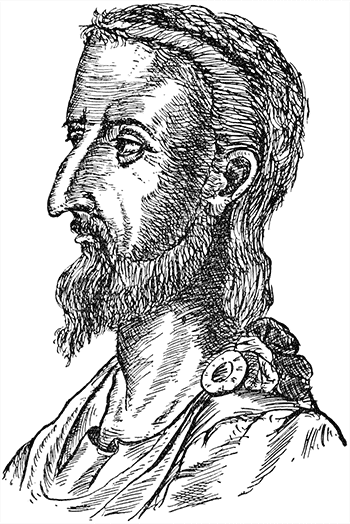
PEDACION DIOSCORIDES.
From a drawing, 1598.
In describing the Papaver sativum and its
virtues in this work, he says: “It is not improper
to subjoin the method in which the opus
or juice of it is collected. Some, then, cutting
the poppy heads with the leaves, squeeze them
through a press, and rubbing them in a mortar,
form them into troches. This is called meconium,
and is weaker than the opus. But whoever desires
to gather the juice must proceed thus:
After the heads are moistened with dew, let him
cut round the * (asterisk) with a knife, but not
penetrate through them, and from the sides cut
straight lines in the surface, and draw off the tear
that flows with his finger into a shell. And come
again, not long after, for it will be found standing
upon it; and the day following it will be
found in the same manner.” Hence the old
name poppy tears. Dioscorides was also learned
in the preparation of wool fat, which he calls
œsypum, known to modern pharmacists as lanoline.
He says: “Œsypum is the oily part
collected from sordid wool, thus: The wool was
washed in warm water and all its sordes expressed;
the fat floated with a froth, and upon
throwing in some sea-water it subsided; and
when all the œsypum was obtained from it in
this manner, it was purified by repeated affusions
of water. When pure it had no sharp taste, and
was in some degree astringent and appeared white,
and was emollient and filled up ulcers.”
Recent excavations made at Pompeii and Herculaneum
have thrown some further light on
various articles of materia medica as it existed
in the days just preceding the destruction
of those cities. Aloe seems to have been held
in high esteem by the practitioners of the time,
and was employed, we learn from the historian,
in twenty-nine diseases. It was prescribed in
doses from 1 to 111 drachmas (about 68
grains), and mixed with wine was employed to
stimulate the growth of the hair. Aconite, we
find, was used in four diseases; and was supposed
to be an antidote to any poison which
might exist in the system. Other remedies mentioned
include gum acacia, colocynth, elaterium,
gold, silver, copper, and elecampane. It is
further recorded of the latter drug, that Julia
Augusta, daughter of Augustus Cæsar, used to
eat the root daily.
Of the vegetable remedies about 150 are enumerated,
and of these the cabbage seems to have
held a prominent place. Other favourite medicines
were rye, garlic, anise, mallow, rose, and
lily.
In the animal kingdom, the remedies contributed
were numerous, being mainly the various
parts of man and beast. Among some of the
least disgusting, hair, blood, and saliva may be
mentioned.
Scrapings from the bodies of athletes, mixed
with the oil with which they anointed themselves,
were used as a tonic. The hair of a man torn
from the cross was used as a remedy for quartan
fever. The hyæna was employed as a medicinal
agent in seventy-nine diseases; and the crocodile,
chameleon, lion, elephant, camel, and the
hippopotamus all contributed certain curative
agents. Wool fat was held in great esteem.
Of minerals, iron, lead, nitrum, salt, gold, tin,
silver, realgar, copper, and misy (a combination
of the sulphates of copper and iron) are enumerated.
Most of these articles are mentioned by
the second Pliny, who was killed during the eruption
of Mount Vesuvius which buried Pompeii.
The word chemistry was used for the first time
by Suidas, a lexicographer of the tenth century,
and at that time meant an alloy of gold and
silver. It is alluded to in connection with the
Emperor Diocletian, of whom it is said, that
irritated by a revolt of the Egyptians against the
laws of the empire, he had all their books of
chemistry committed to the flames, so as to
punish them for their rebellion by preventing
them from carrying on the lucrative business
arising out of the melting and working of precious
metals. There is little doubt the Egyptians
and Greeks were acquainted with certain
chemical operations, or what was termed the
hermetic science, which was afterwards called alchemy
in the first century of the Christian era.
The first two great lights that appeared were
Al-Chindus, and Geber who discovered the red
oxide and bichloride of mercury, nitric acid,
hydrochloric acid, and nitrate of silver. Geber’s
Summa Perfectionis and Liber Philisophorum embody
his researches on the purification and malleability
of metals. In the ninth century, the
Arab alchemist Rhazes flourished. In his great
work entitled El Hharvi, he alludes to realgar,
orpiment, borax, mixtures of sulphur and iron
with copper, and of mercury with acids, and
arsenic. He further recommends physicians to
use alcoholic preparations and animal oils, etc.
He states: “The secret art of chemistry is
nearer possible than impossible; the mysteries
do not reveal themselves except by force of
labour and perseverance. But what a triumph
it is when man can raise a corner of the veil
which conceals the works of God!” The knowledge
displayed of chemistry and its application
to the arts at that early period is wonderful, but
books were few. The chief evidence of this
knowledge is exhibited in the many specimens
and art monuments in the museums of Spain,
showing the skill of the Saracens and of the
Moors.
A little later Mesué states, “certain principles
had been recognised as to the analytical classification
of the bodies which compose organic
matter”.
Of the ancient necromancers who have figured
in history and romance, Merlin was perhaps the
most extraordinary. The earliest mention of
his name is in records of the eleventh century,
although he appears to have flourished about the
time of the Saxon invasion of Britain, in the
latter part of the fifth century.
He is first mentioned in connection with the
fortune of Vortigern, who is represented by
Geoffrey of Monmouth, as at that time King of
England. Vortigern having lost all his strongholds
in his struggle with the Saxons, at length
consulted his magicians as to how he was to defend
himself from his troublesome foe. They
advised him to build an impregnable tower, and
chose a suitable site for its erection. The
builders set to work with might and main, but
were astonished to find, that as fast as they built
in one day, the next morning the earth had
swallowed it up, and not a vestige remained. So
the king called the wise men together again,
when they arrived at the conclusion that the only
way to remedy the matter was to cement the
walls of the tower with the blood of a human
being who was born of no human father.
Vortigern at once sent forth emissaries to
scour the country in search of this rara avis,
and at length by good fortune they came across
Merlin, near the town of Caermarthen in Wales,
who claimed that his mother was the daughter of
a king but his father was an angelic being. The
king’s emissaries evidently took his word for it,
as they speedily carried him before Vortigern.
A great meeting of the magicians was called, at
which the king presided, and Merlin, instead of
being condemned as the victim, confounded the
wise men, and told the king the ground they had
chosen for his tower had a lake beneath it, at the
bottom of which, on being drained, they would
find two dragons of inextinguishable hostility.
Under the form of dragons he appears to have
figured the Britons and Saxons in his speech,
“all of which,” the historian tells us, “proved
to be true”.
But the greatest exploit with which Merlin is
credited, according to tradition, is the erection
of Stonehenge as a lasting monument to the 300
British nobles massacred by the Saxons. It is
supposed that these mighty stones had been originally
set up in Africa, and from thence were
transported to Ireland. Merlin commanded that
they should be carried over the sea, and erected
on Salisbury Plain; but no workman could be
found to move them. He therefore brought
his magical power to bear on the huge stones,
and by this means they were caused to take the
form in which they now stand.
Of the other wonderful stories which romance
has woven round the career of this strange individual,
we can only say they are interesting,
if not exactly true. As 600 years elapsed between
the time of Merlin and the earliest known
records of his achievements, it is impossible to
pronounce on their veracity.
Among the more famous of the early alchemists
was St. Dunstan, who flourished in the
tenth century; but, if tradition speaks truly, he
was anything but a saint in character. He is
said to have been a man of distinguished birth,
who in his young days lived a life of great
self-indulgence, even for that period of peculiar
morality. At length, he was seized with a dangerous
illness which threatened to terminate his
career; but at the last extremity an angel appeared,
bringing a medicine which speedily restored
him to health. Hastening to the nearest
church to return thanks, he was stopped by the
devil with a pack of black dogs, whom however
he speedily put to flight. In order to
expiate his former irregularities, he now secluded
himself in the abbey of Glastonbury, where he
occupied a cell in which he could neither stand
upright nor stretch his limbs in repose, and
mortified his flesh exceedingly. Here he studied
alchemy and magic, in which arts he soon became
well versed. While in this cell, he is said to
have had the most extraordinary visitations, and
among others the devil was constantly thrusting
his head in at the window and taunting the saint,
while immersed in his studies. At length,
one day, wearied out, Dunstan lost all patience,
and seizing his red-hot tongs from the little
furnace in which he conducted his chemical
operations, caught the devil by the nose, and
held him firmly, “while the bellowings of Satan,”
says the historian, “filled the whole neighbourhood
for many miles round”. This incident is
frequently represented in ancient carvings.
Dunstan was a Benedictine monk, and next
came forth and took a prominent part in political
and religious matters. He seems to have been
the king-maker of his time, and took a prominent
part in the ruling of the kingdom during
the reigns of Edwy and Edgar.
In the accompanying illustration the alchemist,
with uplifted torch, is repeating the specified incantation
over the still, under which he has just
kindled a fire, having commenced the preparation
of the “Elixir of Life”.
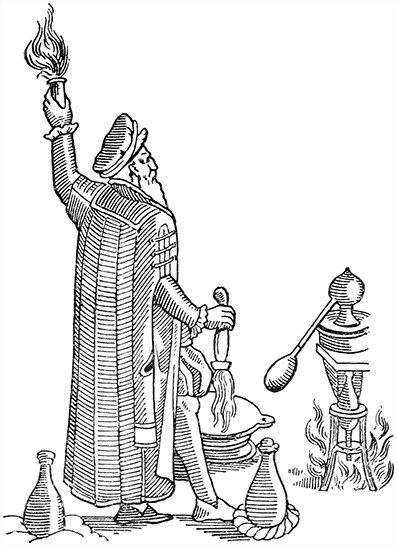
AN ALCHEMIST.
From an engraving dated 1576.
In the year A.D. 1260, Albertus Magnus,
formerly a Dominican monk, was made master
of the sacred palace at the court of Rome, and
afterwards Bishop of Ratisbon. This great
philosophical student was learned in all the then
known arts of chemistry, and his manuscripts
and works were copied by the thousand. All
kinds of extraordinary powers were attributed
to him, and it was commonly stated that he
could make gold, and that he was a magician.
Accused of “having dealings” with the evil
one, he resigned his high position and returned
to his cloistered cell to carry on his favourite
researches and end his days. Next we come to
Vincent de Beauvais, often called the Pliny of
the middle ages. He, too, was accused of
sorcery, and it is said that “at midnight people
would creep along the quays of the Seine towards
his laboratory in St. Chapelle yard, to see
if they could get a glimpse reflected in the river
of the magic furnaces in which De Beauvais
was supposed to evoke his familiar spirit”.
About the same time Raymond Lulli became
known to fame. He also was a monk, and born
in the island of Majorca, but having a roving
disposition he wandered over Europe. He wrote
several works on alchemy, among others Libilli
Aliquot Chemici, etc. Fabulous stories are related
of his adventures; and he was cruelly
stoned to death by the populace in Tunis, in
1315. He left behind him a following of believers,
who called themselves Lullists and
spread all over Europe. The genius of the
West at this time was Arnauld de Villeneuve,
who made several important discoveries in
chemistry. His researches were particularly
directed to the relation of chemistry to medicine.
He is credited with having discovered
sulphuric and other acids, and is said to have
been the first to distil alcohol or spirit of
wine.
Contemporary with these men of learning was
our own Roger Bacon, whose love for his art
nearly cost him his life, besides many years in
prison. The discoverer of gunpowder and the
telescope spent most of his life in experimental
researches, with the result that he revolutionised
the art of war, and gave to astronomers the
power of exploring the heavens. He was a man
of great ability, never justly appreciated by his
contemporaries, and has been rightly named the
father of experimental physics. He described
most of the laws which regulate matter, and the
regular motion of the planets. Although a man
of undoubted knowledge and great power of
conception, he was bitten with the mania
of endeavouring to discover the philosopher’s
stone, his views respecting which he set forth in
his work entitled Radix Mundi. Following
Bacon came Antonio Quainer, of Pavia, who
was the first to manufacture artificial mineral
waters.
It has been said by some that the discoveries
made by the alchemists were mainly the result of
chance, and they were mostly ignorant charlatans;
but although they had little method in
their research, and a great deal of their knowledge
was wrapped up in absurd and superstitious
theories, when we look at the result of their
discoveries up to the fifteenth century, the most
prejudiced must admit that their labours were
not spent entirely in vain. They demonstrated
the existence of bismuth, liver of sulphur, and
regulus of antimony, the distillation of alcohol,
volatilisation of mercury, and preparation of aqua
regia, sulphuric and other mineral acids, and the
purification of alkalies. They had the scarlet
dye for cloth, the secret of which has now been
lost and cannot be equalled, and their processes
of glass-staining cannot be approached by those
employed at the present day. It is said that
Eck, a German alchemist of Sultzbach, ascertained
the existence of oxygen 300 years before
it was demonstrated by Priestly. For these and
other discoveries we have to thank the early
alchemists.
During the fifteenth and sixteenth centuries
alchemy began to shake itself free from the wild
theories and absurd practices which had impeded
its progress. Henry VII. issued a severe edict
against alchemical practices, which put a stop
to the impositions of a number of charlatans.
About this period John Baptist Porta discovered
the means of reducing the metallic oxides and of
colouring silver, and Isaac and Jean Hollandus
made great improvements in enamelling, and
demonstrated the manufacture of artificial gems.
From the time of Paracelsus and the introduction
of printing, the science received a fresh
impetus, and a new order of chemists came into
being, whose conflict with the old order for
many years is a matter of history.
The old theories of the alchemists were gradually
exploded and superseded, and many were
driven to the most flagrant quackery to earn a
living.
Cornelius Agrippa, who was one of the leaders
of the new order, says: “It would take too
much time to recount all the follies, the idle
secrets, and the enigmas of this trade, of the
green lion, the fugitive stag, the flying eagle, the
inflated toad, the crow’s head of the black blacker
than the black, of the seal of Mercury, of the
mud of wisdom, and other countless absurdities
of the time. Many of them travelled from fair
to fair in order to make a little money by the sale
of white lead, vermilion, antimony, and other
drugs used by women for painting the face, and
drugs which the Scripture calls ointments of
lust.” Meanwhile the efforts of the practical
workers were encouraged by administrators and
princes, with the result that the application of
chemistry and the technical arts became predominant,
and metallurgy the leading spirit of the
science.
A notable character in the time of Queen
Elizabeth was Dr. Dee, alchemist and astrologer.
The career of this man, who was more a charlatan
than aught else, was one of extraordinary vicissitude.
A Welshman by birth, he was educated
at Oxford, and then travelled throughout Europe,
claiming that he had discovered the elixir of life
and the philosopher’s stone. He was a man of
overweening ambition, and delighted to hear himself
called “Most Excellent”. In company with
a man named Kelly, it is said he discovered a
quantity of the elixir in the ruins of Glastonbury
Abbey; this they at once annexed and carried
off to Poland, accompanied by a nobleman of that
country. After travelling from one Court to another,
where he is said to have performed wonderful
feats with his elixir, he returned to England
and settled at Mortlake, where Elizabeth often
visited him to consult him on astrology, and he
even ventured to predict her death.[3] He
was a great favourite at Court in 1595, and
the Queen made him Chancellor of Paul’s and
Warden of Manchester, but he died in great
poverty.
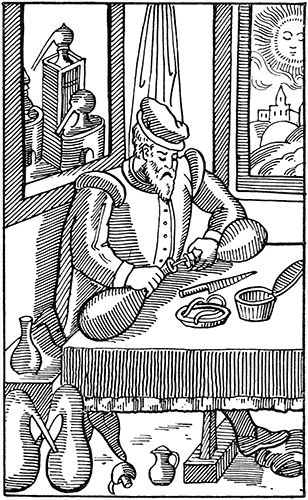
AN ALCHEMIST.
From an engraving dated 1576.
The illustration represents an alchemist of the
sixteenth century in an ante-room of his laboratory,
engaged in fixing a portion of his apparatus.
On the table is his luting box and knife.
Through one window a view of the laboratory
with stills of varied size is obtained, while
through the other the sun looks with becoming
gravity on the operation.
As in modern science chemists write their formulæ
and work out their processes by means of
symbols, so the alchemists used signs and hieroglyphics
to represent the then known elements,
metals, and other articles in common use. The
so-called elements—fire, air, water, earth—were
represented by special symbols, here represented.
The metals were supposed to be influenced by
the planets to a certain degree, and were represented
by their corresponding signs. Various
other articles also had their symbols, which
served as a means of shorthand at a period when
caligraphy was little known or employed.
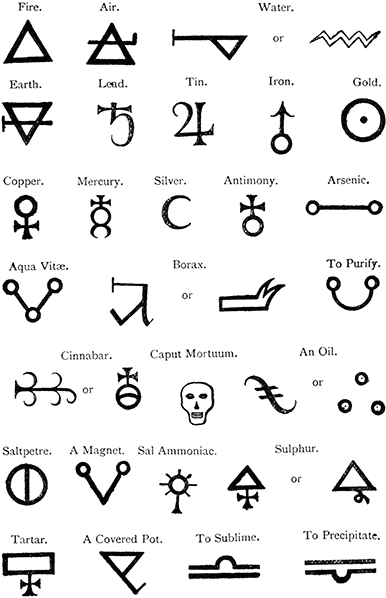
Symbols for: Fire. Air. Water.
Earth. Lead. Tin. Iron. Gold.
Copper. Mercury. Silver. Antimony. Arsenic.
Aqua Vitæ. Borax. To Purify.
Cinnabar. Caput Mortuum. An Oil.
Saltpetre. A Magnet. Sal Ammoniac. Sulphur.
Tartar. A Covered Pot. To Sublime. To Precipitate.
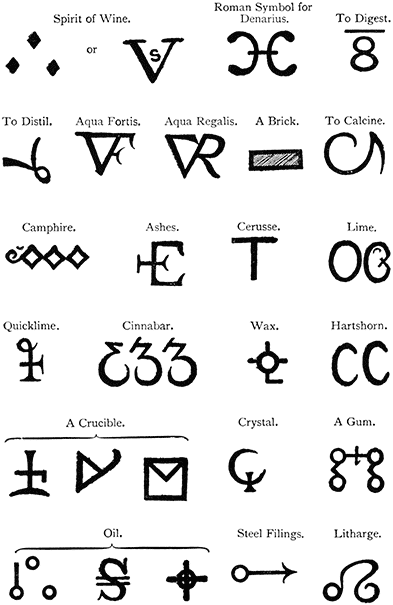
Symbols for: Spirit of Wine. Roman Symbol for Denarius. To Digest.
To Distil. Aqua Fortis. Aqua Regalis. A Brick. To Calcine.
Camphire. Ashes. Cerusse. Lime.
Quicklime. Cinnabar. Wax. Hartshorn.
A Crucible. Crystal. A Gum.
Oil. Steel Filings. Litharge.
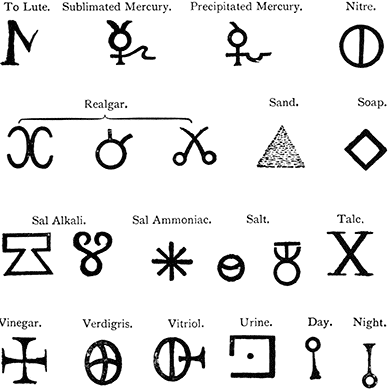
Symbols for: To Lute. Sublimated Mercury. Precipitated Mercury. Nitre.
Realgar. Sand. Soap.
Sal Alkali. Sal Ammoniac. Salt. Talc.
Vinegar. Verdigris. Vitriol. Urine. Day. Night.
The dominating ambition of the early alchemists
was to discover the unknown. In the same
spirit the modern worker in science gropes onward,
and dreams of discovering some contribution
towards solving the elixir of life, in the
form, it may be, of conquering at least one fell
disease. The ancient workers in alchemy confined
their researches almost exclusively to
metals; they believed that all natural things
were composed of four elements, which they
termed Fire, Air, Earth, and Water. “When
these four elements are conjoined,” says Roger
Bacon, in his Radix Mundi, “they become another
thing, whereas it is evident that all things
in Nature are composed of the said elements
being altered and changed.”
But the patient researches of the alchemists
were not so much due to a love for scientific
investigation as to the overwhelming desire to
gain wealth.
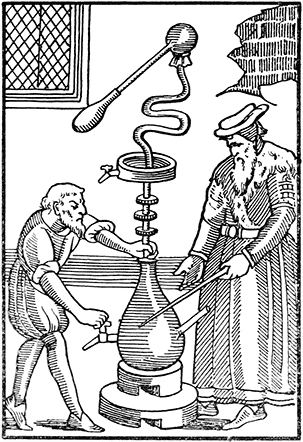
A STILL FOR DYSTILLING THE WATER OF LYFE.
1576.
The majority had two fixed objects in view as
the goals of their ambition, one being the discovery
of some body that would be capable of
transmuting the baser metals into gold and
silver; and the other, the discovery of an elixir
which would prolong the span of human life to
an indefinite period. Both these objects seem to
have been sought for by man from prehistoric
times, and their origin is lost in antiquity.
Berthelot remarks that the term “Philosopher’s
Stone” does not occur in writings earlier than
the seventh century, although the central idea is
much more ancient.
The philosopher’s stone was sought for by the
Chinese philosophers at a very remote period,
afterwards by the Greeks, Arabs, and others
down to the seventeenth century.
Men of undoubted ability and genius wasted
both their lives and their fortunes over the search
for this illusive chimera, and others condescended
to fraud and trickery of the meanest description
in its pursuit. Apparently no alchemist of any
repute thought it right to die until he had at
least claimed to have solved one of these great
problems. Thus claimants to the discovery
were numerous. The descriptions given of the
various processes in ancient manuscripts and
works for producing the philosopher’s stone
are usually of a very elaborate description, and
couched in the most fantastic language.
Failure to produce the desired result was invariably
accounted for by the omission to carry
out some minute detail. Some who professed to
have discovered the secret demanded large sums
of money to reveal it, and several visited the
various courts of Europe to demonstrate it by
means of trickery and conjuring.
The notorious Dr. Dee, who flourished in the
time of Queen Elizabeth, was one of the last
claimants to the discovery, and is said to have
received immense sums of money from dupes
for imparting the coveted secret, which he demonstrated
by means of an ingenious trick.
Realgar, mercury, sulphur, and many other
substances were credited with the magical property
of transmutation.
In the illustration (p. 65), which is taken from
an authentic engraving of the sixteenth century, we
have a figure of the apparatus used for distilling
the “Water of Life,” the process for which is
described by Gesnerus in the Newe Jewell of
Health, printed in 1576. The alchemist, arrayed
in his imposing robes, is depicted giving instructions
to his assistant as to certain precautions
to be taken in conducting the process.
Bacon states that sulphur and mercury are the
mineral roots and natural principles upon which
Nature herself acts and works in the mines and
caverns of the earth; the latter metal he believed
to be the true elixir of the philosopher’s stone;
others, including Rhazes and Merlin, believed it
to be an amalgam of gold and mercury, fantastically
called the Red man and his White wife.
Concerning the vessels for producing this
“Citrine body,” as Bacon calls it, the most exact
precautions were taken. Special apparatus was
used, and a special heat, which was not to exceed
the heat of the body. For this purpose horse-dung
was employed. Senier, the philosopher,
says: “Dig a sepulchre and bury the woman
(mercury) with her man (gold) in horse-dung,
the fire of the philosopher, until such time as
they be conjoined”.
Bacon’s definition of alchemy was: “Alchymie
is the art or science teaching how to make or
generate a certain kind of medicine which is
called the elixir. It teaches how to transmute
all kinds of metals, one with another; and this
by a proper medicine.” George Ripley, a monk,
in 1476, thought that he had discovered the
much-coveted stone in pure sulphur. He says:
“Let the two sulphurs, viz., the white and the
red, be mingled with the oil of the white elixir
that they may work the more strongly, and you
shall have the highest medicine in the world to
heal and cure human bodies, and to transmute
the bodies of metals into the most pure fine gold
and silver”. Berthelot, who has made an exhaustive
study of the subject, comes to the
conclusion that the doctrines of alchemy concerning
the transmutation of metals, did not
originate in the philosophical views of the constitution
of matter as generally supposed, but in
the practical experiments of goldsmiths occupied
in making fraudulent substitutes for the precious
metals. One cannot but think with pity of the
immense labour expended and lost in the attempt
made by many of these pioneers of science in
their pursuit after this chemical chimera.
Paracelsus, as well as his predecessors, laboured
studiously to discover some method for prolonging
life. Like Bacon and Verulam, he
maintained that the human body could be rejuvenated
to a certain extent by a fresh supply
of vitality, and it was his aim to find means by
which such a supply could be obtained. In one
of his works he gives the following reasons for
this belief: “Metals may be preserved from
rust and wood may be protected against rot.
Blood may be preserved a long time if the air is
excluded. Egyptian mummies have kept their
form for centuries without undergoing putrefaction.
Animals awaken from their winter sleep,
and flies having become torpid from cold become
nimble again when they are warmed. Therefore,
if inanimate objects can be kept from destruction,
why should there be no possibility to preserve
the life-essence of animate forms?” For this
purpose he prepared a remedy he called Primum
Ens Melissæ, which was made by dissolving pure
carbonate of potass, and macerating in the liquid
the fresh leaves of the melissa plant. On this
absolute alcohol was poured several times in successive
portions to absorb the colouring matter,
after which it was collected, distilled, and evaporated
to the thickness of a syrup. The second
great secret elixir of Paracelsus was his Primum
Ens Sanguinis. This was prepared by mixing
blood from the medium vein of a healthy young
person, and digesting it in a warm place with
twice its quantity of alcahest, after which the red
fluid was to be separated from the sediment,
filtered, and preserved.
The alcahest was his celebrated universal
medicine, and was considered the greatest mystery
of all. It was made with freshly prepared
caustic lime and absolute alcohol. These were
distilled together ten times. The residue left
in the retort was mixed with pure carbonate of
potass and dried. This was again distilled with
alcohol. It was then placed in a dish and set
on fire, and the residue that remained was the
alcahest.
The following lines were found inscribed on
the fly-leaf of an old work on alchemy, printed
in 1550, and signed “Philo Veritas”:—
ELIXIR VITÆ.
When fire and water, earth and air
In love’s true bond united are,
For all diseases then be sure
You have a safe and certain cure.
I will affirm it’s here alone
Exists the Philosophic Stone.
This is fair nature’s virgin root,
Thrice blest are they who reap the fruit:
But oh! where one true adept’s found,
Ten thousand thousand cheats abound.
In an ancient work in the library of York
Minster, the writer came across the following in
manuscript, signed “Raymund Lulli”:—
Remember man that is the most noble creature in composition that ever God wrought;
In whom be four elements proportioned by nature,
A neutral mercuriallyte which costeth right naught,
Out of his monie by manie it is bought;
And our monie be not all but our oxtalle towe,
Of the sun and the moon; which Raymund Said So.
To make a thorough analysis of this interesting
subject, and trace the origin of magic, would take
much more space than we have at our command;
and we can only mention a few of the many
forms which may be grouped under the head of
the occult sciences, and those especially which
had any connection with the alchemists. There
is little doubt that most of the alchemists were
students, if not practitioners, of magic or some
of its branches.
The antiquity of magic is very great; and we
have record of magicians and wise men in early
Jewish times, as well as the magic formulæ of
the Vedas in India, as handed down to us in the
religion of the Hindoos. Moreover, magic was
practised by the Chaldeans, of whom a certain
tribe devoted their energies to studying the
occult sciences. Pliny tells us of the dealings in
the supernatural in the time of Homer, and other
writers record that magic was also known to the
Etruscans and Assyrians at a very early period.
As time rolled on, the different forms of magic
practised became specialised, according to their
several natures. For instance, there were
Astrology and Oneiromancy, which comprised
the various forms of divination; Theurgy and
Goetry, the art of evoking good or evil spirits;
Necromancy, by means of which communication
was held with the dead; and Sorcery, which
exercised its power by the influence of dreams.
The longings after the supernatural and unknown
felt by the great ignorant masses brought
forth individuals in plenty to take advantage of
their credulity. During the thirteenth and fourteenth
centuries the occult sciences were openly
taught in the universities and schools, and 200
years later reached the zenith of their influence;
and practitioners of astrology and the black arts
abounded and flourished throughout Europe.
The professors of Oneiromancy were those
who divined or interpreted dreams, and founded
their traditions in the art from its being in accordance
with the Scriptures. The explanation
of dreams also did not go counter to the doctrines
of the Church, and so the cult found many
believers among all classes of society. It was
denounced by Pope Gregory II. as a detestable
practice; but this did not prevent it being largely
employed in forecasting the future.
Arnauld de Villeneuve, who wrote a work on
the subject in the thirteenth century, gives a
certain code by which those who practised it
worked.
Whoever dreamt that his hair was thick and
carefully curled would soon become wealthy. If
anything was wrong with the hair, evil was betokened.
It also foreshadowed harm if a wreath
was worn composed of flowers that were not
in season. Other codes signified that to dream
of the eyes, related to children; the head, to a
father; the arms, to brothers; the feet, to
servants; the right hand, to the mother, to sons,
and to friends; and the left hand, to the wife and
daughter. Another method was founded on the
theory that whatever was dreamt of, the antithesis
or opposite would follow in life. From
this we have probably the saying common to-day,
“dream of a wedding and it is a sign of a
funeral”. According to many old writers there
was scarcely any important event in the middle
ages which was not announced by a dream.
The day before Henry II. was struck by the
blow of a lance during a tournament, Catherine
de Medicis, his wife, dreamt that she saw him
lose one of his eyes. Three days before he fell
by the knife of Jacques Clément, Henry III.
dreamt he saw the royal insignia stained with
blood and trodden under foot by monks and
people of the lower orders.
Henry IV. also, before he was murdered by
Raveillac, it is said, heard during the night his
wife Marie de Medicis say to herself as she
woke, “Dreams are but falsehoods!” and when
he asked her what she had dreamt, she replied,
“That you were stabbed upon the steps of the
little Louvre!” “Thank God it is but a
dream,” rejoined the king.
The necromancers, who were supposed to be
able to conjure up spirits and raise the dead,
were accounted on a somewhat higher plane than
the interpreters of dreams. They also based
their authority on the Old Testament. The
nature of the art was gruesome and awe-inspiring,
and there is little doubt many dark deeds
were perpetrated by those who practised it. One
method of evocation was to kill a child and
place its head upon a dish surrounded by lighted
candles; the desired spirit was supposed to enter
this ghastly object and speak through its mouth.
Sometimes the spirit simply consisted of some
muttered words from behind a curtain in a
dark cellar; another method was to cause the
appearance of a sepulchral figure out of smoke
or vapour, which would indicate by gesture and
reply to questions asked. To evoke a dead
man’s spirit, it was necessary to go to the grave
at midnight with a companion who bore a candle
in the left hand and a crystal stone in the right,
the conjurer holding a hazel wand with the
name of God written on it, and repeating the
words:—
“Tetragrammaton + Adonai + Agla + Craton +”
Then striking three times on the ground, with
a prayer he commanded the spirit into the stone,
when it appeared in the shape of a child.
The conjurer often wore a girdle of lion’s skin
with the name of God written on it, and the
Solomon’s circle he described with a bright knife,
on the blade of which were written certain mystic
words. Necromancy gradually merged into sorcery,
which has occasionally come to the surface
in comparatively recent years.
Chiromancy, the art of divining or foretelling
future events from marks on the palm of the
hand, was also practised in antiquity, but in
mediæval times it was strongly opposed by the
Church. The practice is supposed to have been
brought into Europe from the East by the
Bohemians in the early part of the fifteenth century.
This art eventually merged into astrology,
which exerted the greatest influence of all the
occult sciences.
The antiquity of astrology is very great, it
having been originated by the Chaldeans, and
was thought by some of the Jews to have been
a method by which the Creator could communicate
with His people. The art itself was based
on astronomy, and, like alchemy, was the beginning
of the study of real natural science.
The teller of the stars was not only supposed
to foretell forthcoming misfortunes to individuals,
but also to forecast the destinies of kings
and empires.
The belief in its power was so great that it
became the fashion among royal personages of
the sixteenth century to keep their own special
astrologers, who were lodged easy of access and
loaded with honours and wealth. These men
were mostly astute Jews well versed in the
science of their time, and by means of their supposed
powers they often played a very important
part in the political affairs of the nation. Thus
in the fifteenth century Rovigo, an astrologer of
eminence, who is said to have perfected the
astrolabe, was attached to the Court of King John II.
of Portugal; and Simon Pharès figured at
the Court of France in the time of Charles VIII.
We must not forget to mention Cosmo
Ruggieri, the Florentine astrologer and the
confidant of Catherine de Medicis; also the
celebrated Nostradamus, astrologer and trusted
adviser of Charles IX. This extraordinary man
played a prominent part in the history of his
time, and was supposed to practise magic and
alchemy as well as the healing art. He was
consulted by the king in all positions of difficulty,
and it is said became immensely wealthy.
He died in 1566 at Salon, after having written
several notable works.
The early theory of the art of foretelling by
means of the stars, and casting horoscopes, was
as follows: The seven planets then known, including
the Sun, with the twelve figures of the
Zodiac, comprised the astrological system.
Each unit or body or nation was supposed to be
governed or influenced by a certain star or constellation,
and this power extended to all things
connected with the person or nation. Thus,
Saturn was supposed to influence life, sciences,
and buildings; Jupiter—honour, wishes, and
wealth; Mars—wars, persons, marriages, and
quarrels; the Sun—hope, gain, and happiness;
Venus—love and friendship; Mercury—fear,
disease, debts, and commerce; the Moon—robberies,
wounds, and dreams. The intrinsic
quality was denoted by the planet. The Sun
was regarded as favourable; Saturn, cold;
Jupiter, temperate; Mars, ardent; Venus,
fruitful; Mercury, inconstant; the Moon,
melancholy. The days, colours, and metals also
came under the same influences.
In casting a horoscope, the astronomer had
first to observe if the time was propitious, and
what planet was dominant in the heavens. Then,
by means of calculations and diagrams, he would
deduce the consequences from the position and
bearing of the stars. The day was divided into
four equal parts—the ascendant of the sun, the
middle of the sky, the descending of the sun, and
the lower part of the sky. These four parts of
the day were subdivided into twelve distinct
parts, which were called the twelve houses of
the sun. It was of the greatest importance in
drawing a horoscope to tell exactly in which
“house” the star appeared. One can easily
trace the connection of the influence attributed
to the planets with the old Egyptian and
Greek mythologies, and it can hardly be
wondered at that the same system should have
been brought to bear on medicine.
A favourite method of divination, especially
with the sorcerers, was that of gazing into a
beryl or crystal. For the proper performance
of this ceremony a pure virgin or equally pure
youth should be the gazer. The sorcerer, having
repeated the necessary charms and adjurations,
with the invocation suitable to the spirits he
wished to consult, looked into a large beryl or
crystal, wherein he saw the answer represented
either by types or by figures, and sometimes it
is said he might hear the spirit speak to him.
Vallancey states that in the Highlands of
Scotland large crystals of somewhat oval shape
were kept by the priests to work charms with,
and that water poured on them was given to
cattle as a preventive of disease. Dr. Dee was
a famous conjurer with the crystal in the time
of Queen Elizabeth.
Lilly describes these crystals as being the size
of an orange, set in silver, surmounted with a
cross, and engraved all round with the names of
the angels—Raphael, Gabriel, and Uriel.
Among other charms practised was Dactylomancy,
which was performed by means of a ring
suspended by a thread in the centre of an earthenware
or metal pitcher. The ring, which was
supposed to have been made under the influence
of a certain constellation, was swung from side
to side of the vessel, and the sounds it made
on touching were taken as predictions and
oracles.
The art of divination by fire was called Pyromancy,
and was performed by allowing a certain
body to burn, the smoke from which, by its
density and colour, forecast the future. A
favourite medium for consulting this oracle was
a donkey’s head roasted on hot coals.
Popular belief in mediæval times attributed
anything unusual or beyond its understanding,
to magic; so most of the early alchemists were
believed to be magicians. Both Albertus Magnus
and Roger Bacon were accused of dealing in the
black arts, one having to resign his bishopric of
Cologne and retire to a monastery, and the other
to the Franciscan cells in Paris, to free themselves
from the charges of their accusers.
Geber, an alchemist of great repute in Arabia,
was believed to possess the power of creating
gold by magic. He was a man of undoubted
learning and a skilful practitioner of his time,
yet he was dubbed a sorcerer. He was said to
possess all kinds of extraordinary implements;
among others, a book of black magic which
gave him full power over demons, and a brass
idol which spoke oracles. On the day of his
death, in 1003, the Evil One is supposed to
have carried him off. James Iodoc, an Englishman,
achieved considerable notoriety by claiming
that he had succeeded in setting the demon in a
magic ring. These men should not be confounded
with the host of impostors and charlatans
who simply preyed on the credulity of the people,
but in those days all were judged alike. Most
of the great mediæval alchemists dabbled in
magic, and all agreed that to obtain the intervention
of Satan in human affairs it was necessary
to enter into a pact with him. Those who
went to this length and became exponents of
demonology, or the black art, were initiated with
much solemnity.
The oath to the demon had to be pronounced
in the centre of a circle traced upon the ground,
accompanied by the offer of some pledge, such as
a garment of the noviciate. The edge of the
circle was supposed to establish a mark which
the demon could not cross. Heavy perfumes
such as vervain, with burning incense and lighted
tapers, always formed part of the ceremonial.
The smoking brazier, which entered largely into
the ritual, was believed to act upon the demons,
and was constantly fed with all kinds of mysterious
vegetable and animal substances, those
that would produce most smoke being preferred.
It is said that belladonna and opium were always
used as ingredients in the incense, in order to
produce a state of semi-stupor and influence the
imagination.
The perfumes employed by the professors of
the art had each a special significance, and were
offered to some planet to form a link with the
earth. A mixture of saffron, amber, musk,
cloves and incense, together with the brain of
an eagle and the blood of a cock, was offered to
the Sun.
The white poppy and camphor burnt in the
head of a frog, with the eyes of a bull and the
blood of a goose, were dedicated to the Moon;
while to Mars, sulphur was mixed with hellebore
and euphorbium, together with the blood of
a black cat and the brain of a crow, and then
burnt.
One can imagine the horrible odour that would
be caused by burning such articles as these; and,
as the columns of smoke ascended, the half-stupefied
and scared spectator fancied he saw
the forms of writhing demons in the air.
Very curious properties were attributed to
certain articles when thrown on live coals. Thus,
if thunder and rain were required, the liver of a
chameleon was said to produce it; while the gall
of a cuttle-fish burnt with roses and aloes-wood
was all that was necessary to induce an earthquake.
By burning coriander, parsley, hemlock, liquor
of black poppy, giant fennel, red sandal-wood
and henbane, almost any number of demons
could be raised. Sorcerers of this class were
called tempest-raisers.
With the witchcraft practised largely by
women in mediæval times, we have not much
to do; although belief in its influence was widespread
during the middle ages. To bewitch an
individual was to cause him gradually to die a
mysterious death.
The process commenced at first with great
secrecy, by modelling a figure of the intended
victim in wax or clay. This having been done,
a swallow was killed, and the heart placed under
the right arm of the figure and the liver under
the left. The effigy was next pricked all over
with new needles, each prick being accompanied
by the most terrible imprecations against the
victim.
Another method was to make the figure of
earth taken from a graveyard and mixed with
dead bones. Certain mystic signs were then
inscribed on it, which were said eventually to
cause the death of the victim. So general did
the practice of witchcraft become that no class
of society was safe from accusation and suspicion,
thousands perishing by the faggot and torture.
From the fourteenth to the sixteenth century,
supernatural beliefs exerted a great influence on
the people. One of the most celebrated trials
of the time was that of the Duchess of Gloucester,
who was accused of bewitching Henry VI.
It transpired at the trial that she had instructed
a priest, named Bolingbroke who practised necromancy,
to bewitch the king; a sorceress named
Marie Gardimain being also implicated. An
effigy of the king in wax was discovered half-melted
in front of a fire of dry plants, which had
been gathered by moonlight in a graveyard.
Bolingbroke the necromancer was hanged, Gardimain
burnt, and the Duchess of Gloucester
condemned to imprisonment for life.
The “evil eye” was another form of witchcraft,
mostly practised by women. Visions or
apparitions in the sky, foretelling some war or
disaster, were firmly believed in by the Church,
and caused great consternation. Fiery dragons
appearing in the heavens were said to predict
civil war; and we also read of pigs bearing royal
crowns, and gory stars, all of which were doubtless
caused by ordinary phenomena not understood
at that time.
The appearance of the devil presiding at a
sabbath or meeting of sorcerers is thus described
by De Lancre: “He is seated in a black chair
with a crown of black horns, two horns in his
neck, and one on the forehead, which sheds light
on the assembly; the hair bristling, the face pale
and exhibiting signs of uneasiness, the eyes
round, large, and fully opened, inflamed and
hideous, with a goat’s beard. The neck and
the rest of the body deformed, and in the shape
of a man and a goat; the hands and the feet of
a human being.”
The word witch is thought by some authorities
to be derived from chausaph, which means a
user of pharmaceutic enchantments, or an applier
of drugs to magical purposes.
Witches sent storms and barrenness, drowned
children, brought on ague, could kill with evil
eye, slay with lightning, pass through key-holes,
ride through the air on broom-sticks, and perform
many other weird and wondrous things.
“They were generally old, blear-eyed, wrinkled
dames,” says Scott, “ugly and crippled, frequently
papists, and sometimes atheists; of
cross-grained tempers and cynical dispositions.”
They were often poisoners, and generally monomaniacs.
Epilepsy and all diseases not understood
by the physicians were set down to the
influence of witches. They were said to make
two covenants with the devil, one public and one
private. Then the novices were presented to
the devil in person, and instructed to renounce
the Christian faith, tread on the Cross, break
the fasts, joining hands with Satan, paying him
homage, and yielding him body and soul. Some
witches sold themselves for a term of years, and
some for ever; then they kissed the devil, and
signed their bond with blood, and a banquet
ended the meeting; their dances being accompanied
with shouts of “Ha, ha! devil, devil!
Dance here, dance here! Play here, play here!
Sabbath, sabbath!” Before they departed the
devil was said to give them philtres and amulets.
These women were usually hypochondriacs, often
driven by despair and misfortune to confess any
charge made against them.
Superstition is a belief in what is wholly opposite
to the laws of the physical and moral world,
and yet supposed to be attainable by supernatural
agency.
The words incantation and charm seem to
have been derived from the ancient practice of
curing diseases by poetry and music. Democritus
says that many diseases are capable of being
cured by the sound of a flute when properly
played. Marianus Capellus assures us also that
fevers may be cured by suitable songs. Galen
believed the sound of the flute efficacious in gout
and epilepsy. Asclepiades actually employed the
trumpet for the relief of sciatica, and tells us it
is to be continued until the fibres of the part
begin to palpitate, when the pain will vanish.
What terrible visions might be conjured up if
such remedies were used to-day.
The influence of superstition on medicine may
be accounted for by the fact, that from the very
first, ideas with regard to the action of drugs
must have been combined with those concerning
supernatural agencies, for the phenomena of
nature in very early times were attributed to
spirits. Diseases were supposed to be due to an
evil spirit, therefore to cast the disease out was
equivalent to curing it, and the methods used for
this purpose were by no means always ineffective
in curing disease.
Incantations and spells were generally used
in addition to a real remedial agent, but the
incantations usually got the credit for effecting
the cure.
In early times superstition played an important
part in the cure of disease, and it prevails to
a certain extent to-day. “In the opinion of the
ignorant multitude,” says Lord Bacon, “witches
and impostors have always held a competition
with physicians.”
There has ever been a peculiar propensity in
the human mind to foster a belief in the supernatural,
and perhaps more especially in respect to
medicine on account of the obscurity and ignorance
with which it was once surrounded. In
early times almost every disease was attributed
to punishment for evil-doing, the working of
some demon, or the influence of the stars; hence
the use of any article that was strange or rare as
a remedy.
“The employment of precious stones for medicinal
purposes,” writes De Boot, “arises from
an Arab superstition which supposed them to
be the residence of spirits.” They were first
used as amulets, and then gradually came to be
administered inwardly for various ailments.
“Mystery is the very soul of empiricism,”
says Paris; “withdraw the veil, and the confidence
of the patient instantly languishes.” A
propensity to attribute every ordinary and natural
effect to extraordinary and unnatural causes, is
one of the striking characteristics of medical
superstition.
The properties that herbs possessed were attributed
by the old physicians to the planets which
were supposed to influence them, and our medical
men to this day head their prescriptions with
a sign that originally meant an invocation to
Jupiter, which is a surviving relic of this old
superstitious practice. Another very curious
fact with respect to medical superstition is, that
many of the greatest philosophers were firm
believers in it. Lord Bacon is said to have
believed in the existence of a panacea that would
prolong life beyond its natural term. He considered
that the principal cause of death was the
action of the external air in drying and exhausting
the body, which he thought might be prevented
by nitre; but although he took three
grains of his favourite salt every morning for
the last thirty years of his life, he died at the age
of sixty-six. We have many customs at the
present day which are a survival of the days of
superstition, and few have any idea of their
origin. The mother, when she hangs round the
neck of her child the plaything known as a coral
and bells, little imagines she is perpetuating an
ancient superstitious practice. The soothsayers
attributed many mystic properties to coral, and it
was believed to ward off the evil eye, and drive
away devils and evil spirits. For this purpose it
was suspended from a child’s neck as an amulet.
Pliny and Dioscorides greatly esteemed the medicinal
properties of coral, and Paracelsus recommends
that it should be worn around the necks
of infants to keep away fits, sorcery, charms,
and to serve as an antidote to poisons. The bells
usually suspended to it were originally intended
to frighten away evil spirits, and not to amuse
the child alone.
Paris mentions a curious circumstance, viz.,
that the same superstitious belief should exist
among the negroes of the West Indies, who
affirm that the colour of coral is always affected
by the state of health of the wearer, it becoming
paler in disease.
But all the remedies that originated in superstition
were not entirely useless. Some, whether
by accident or not, had a natural power of efficacy,
and led to discoveries of importance. In
the time of James I., a powder known as the
sympathetic powder of Sir Kenelm Digby had a
great reputation for healing wounds. Whenever
a wound had been inflicted, this powder was
applied to the weapon which had caused it,
which was also smeared with ointment and dressed
two or three times a day. The wound itself was
directed to be brought together and carefully
bound up with clean linen rags, but above all to
be let alone for seven days, at the end of which
time it was generally found to be healed. This
was, of course, said to be due to the wonderful
properties of the sympathetic powder, instead of
the fact of excluding the air from the part and
not interfering with nature’s own healing powers.
The mysterious sympathetic healing powder was
afterwards said to be simply calcined green
vitriol. The rust of the spear of Telephus,
alluded to by Homer as a cure for the wounds
which that weapon inflicted, was probably verdigris,
and led to the discovery of its use as a
surgical dressing.
The cures supposed to be performed by royal
touch show the power of faith over desire, or
mind over matter. The royal surgeons who
introduced the patients to be touched for
scrofula, doubtless took care to choose those
who had a tendency to recover, and who, if left
to nature, would probably have gradually recovered.
Boswell says that Dr. Johnson, when
thirty months old, was taken by his mother
to London to be touched by Queen Anne, on
the advice of Sir John Floyer, a physician of
Lichfield.
From time immemorial the ignorant have had
the most unbounded confidence in nauseous
remedies, and it would seem as if the nastier and
more disgusting the medicines were, the greater
faith they had in them. The larger the price
asked, the more implicit the faith seemed to be.
The Collyrium of Danares, a famous quack eye
lotion, was sold at Constantinople for £9 a bottle,
and the elixirs sold by Paracelsus and Van Helmont
brought extortionate prices. The doctrine
of Signatories, as it was called, is of very great
antiquity. It implied that every natural substance
which possesses any medicinal virtues,
indicates, by an obvious and well-marked external
character, the disease for which it is a
remedy. Thus the bloodstone was used to stop
bleeding, on account of its marks resembling
drops of blood. The root of the mandrake, on
account of its resemblance to the human form,
was used as a remedy for sterility. Turmeric
was administered for jaundice, and poppies for
diseases of the head. Another belief of the
ancients was that all poisonous bodies possessed
a powerful attraction for one another, and that
“like would cure like”. The hair of a mad
dog was worn as a charm to prevent hydrophobia,
and the foot of the ape was used as a
remedy for its bite. On the same principle we
are solemnly assured that three scruples of the
ashes of a witch, after she has been well and
carefully burnt at the stake, is a sure protection
against the evil effects of witchcraft.
Many ancient superstitions are so deeply rooted
that they find believers among the educated at
the present day. Take, for instance, the belief
that many people have in the efficacy of red
flannel. For sore throat, rheumatism, or swelling,
they believe it will cure when flannel of no other
colour will. This belief may be traced to the
colour of the cloth often used in incantations,
which was always red.
In some parts of the country a wedding-ring
is still believed to be a universal cure for sore
eyes.
A curious superstition is still practised in
some parts of Wales for the cure of the complaint
called shingles. The term for shingles in
Welsh means “The Eagle.” It was supposed in
ancient times that if a person ate of the flesh of
the eagle he would never suffer from shingles,
and his direct descendants down to the ninth
generation could not contract it, and furthermore
had the power transmitted to them of
curing others so afflicted by blowing on them.
Love Philtres were administered for the purpose
of inspiring affection or hatred. In very
early times they were frequently used, concocted,
and sold by the magicians or sorcerers, who
often obtained large sums of money in exchange,
from amorously-inclined gallants and maidens.
They were composed of various extraordinary
ingredients used in medicine at the time, and
were either in the form of a powder, which was
to be surreptitiously slipped into an article of
food to be swallowed, or in a liquid for
anointing the clothes or hands, and by things
to be held in the mouth.
It is recorded that some sorcerers even used
the Host, upon which they traced letters of
blood. The following were also used in the
preparation of philtres: the entrails of animals,
feathers of birds, scales of fishes, parings of nails,
powdered loadstones, and human blood.
It is little wonder they excited hatred. The
poculum amatorium or love philtre of the
Romans, and the philtron of the Greeks, were
venerated with superstitious awe in early times.
They became used to such an extent by the
former nation under the first emperors, that a
decree was promulgated under the Roman criminal
law whereby love philtres were deemed as
poison, and the punishment inflicted on those
using them was very severe. Hairs from a wolf’s
tail, the bones of the left side of a toad which
had been eaten by ants (those of the right side
were used to cause hatred), the blood of pigeons,
skeletons of snakes, the entrails of animals, and
other equally disgusting things, were included as
ingredients in Roman love philtres.
Pliny states, that there were also philtres for
quenching love. Thus, “if a nest of young swallows
is placed in a box and buried, on being dug
up after a few days it will be found that some of
the birds have died with their beaks closed, while
others die as if gasping for breath”. The latter
were used for exciting love, and the former for
producing the opposite effect.
Horace recommends a bone torn from a
hungry and voracious dog, and Virgil describes
a complete apparatus wherewith a maiden seeks
to recover the affections of a faithless lover.
The early Greek and Roman magicians used
“hippomanes,” which was the lump of flesh
found in the head of a colt newly foaled, as an
ingredient in their philtres.
About the sixteenth century philtres came to
be compounded and sold by the apothecaries,
who doubtless derived from them a lucrative
profit. Favourite ingredients with these later
practitioners were mandragora, cantharides, and
vervain, which were supposed to have Satanic
properties. They were mixed with other herbs
said to have an aphrodisiac effect; also man’s
gall, the eyes of a black cat, and the blood of a
lapwing, bat, or goat.
In Gay’s Shepherds’ Week reference is thus
made to love philtres:—
“Strait to the ’pothecary’s shop I went,
And in love powder all my money spent;
Behap what will next Sunday after prayers
When to the alehouse Lubberkin repairs,
These flies into his mug I’ll throw,
And soon the swain with fervent love shall glow”.
“Botanomancy,” Ferrand states, “which is
done by the noise or crackling that kneeholme,
box, or bay leaves make when they are crushed
betwixt one’s hands or cast into the fire, was of
old in use among the pagans, who were wont to
bruise poppy flowers betwixt their hands, and by
this means thinking to know their loves.”
A CHARME OR AN ALLAY FOR LOVE.
“If so be a toad be laid
In a sheepskin newly flaid,
And that ty’d to man ’twill sever
Him and his affections ever.”—Herrick’s Hesperides.
The winged ant was another favourite ingredient
in love philtres, and was first used by
Rhazes, who prepared the winged ant in the
form of tincture by maceration in alcohol. This
tincture, dropped in the homœopathic manner
into wine or mixed with food, was supposed to
have a wonderful action in producing symptoms
of the tender passion in the coldest hearts. The
winged ants alone were used in this preparation,
which enjoyed a long reputation, and was subsequently
known as “Hoffmann’s Water of
Magnanimity,” and largely used in the seventeenth
century as an aphrodisiac.
The operation of distillation was unknown to
the ancient Greeks and Romans, although Dioscorides
and Pliny describe a process which may
be considered that of distillation in its infancy.
The process was not known in England until the
time of Henry II. To the Arabs we are indebted
for the discovery of manna, cassia, senna,
and rhubarb, also aromatics, such as musk, nutmeg,
mace, and cloves. Blisters were known and
used by the Arabs, who are the first also on
record to mention sugar extracted from the
cane, and sugar-candy, which they called honey
of cane.
Rhazes and Avicenna were the first physicians
to introduce improvements in pharmaceutical
preparations. The latter was the first to mention
the three mineral acids, and distinguish
between vegetable and mineral alkalies.
In the year 1226, Roger Bacon, a native of
Ilchester, in Somersetshire, and a Franciscan
monk, may be said to have laid the foundation
of chemical science in Europe. He was excommunicated
by Pope Nicholas, and imprisoned for
ten years for supposed dealings with the devil.
He professed to have discovered an elixir of life,
which he affirmed prevented corruption of any
constitution and the infirmities of age for many
years. Following Bacon, at the end of the
thirteenth century, came Arnoldas de Villa Nova,
or Villeneuve, who was the first to recommend
the distilled spirit of wine impregnated with
certain herbs, from which we date our use of
tinctures in medicine.
Basil Valentine followed as a pioneer in the
administration of metallic medicines; he made
volatile alkali from sal-ammoniac, and noticed
the production of ether from alcohol.
In the year 1493, Phillipus Theophrastus,
Bombast of Hohenheim, afterwards known as
Paracelsus, was born near Zurich in Switzerland,
a man of extraordinary conceit and boldness,
but who wrought a greater change and
influence in materia medica than any physician
since the time of Galen. He travelled all over
Europe, and so obtained an extensive knowledge
of chemistry and medicine.
This genius of science and quackery, for such
Paracelsus must be termed, who scoffed at all
the doctrines believed in since the time of Hippocrates,
professed to have received his knowledge
from the Divine Being Himself. His
sheer impudence carried the sympathies of the
public with him, and they kissed the skirts
of his gown as he passed through the streets,
whilst he had among his followers many princes
and nobles.
He denounced the apothecaries, who, he said,
“could only compose insipid syrups and repulsive
concoctions, when they have ready to hand at
the bottom of their stills, extracts and dyes
derived from the best vegetables and minerals”.
He disagreed with the doctors also, whose prescriptions
he stigmatised as barbarous, and was
much against the use of correctives being added to
pharmaceutical recipes when they had no natural
relation to the preparation itself. He believed
in the existence of an active principle in plants,
which he termed the “Ether of Aristotle,” that
could be isolated and used to avert the various
disorders of the human body—an idea which is
now the leading spirit in pharmaceutical research.
His labours did much to stimulate the practical
side of chemistry, though his language was mysterious,
as, like other alchemists, he wrapped up
all his wisdom and his ignorance in the garb of
allegory. He was reported to carry about a
familiar spirit in the pommel of a long sword
that always hung at his side.
Paracelsus is said to have been the first to use
mercury internally; he also employed opium,
antimony, and lead largely in his treatment;
and devised a process for the preparation of
red oxide of mercury. He was sent for to many
of the European Courts, and by the interest of
Erasmus was made Professor of Chemistry at
Bale, the first chair that was established in
Europe. It was here while seated in his chair,
that with arrogant impudence he burnt with
great solemnity the writings of Galen and Avicenna,
saying that “if God would not impart
the secrets of physic, it was not only allowable,
but was justifiable, to consult the devil”.
He had the greatest contempt for his fellow
physicians, and said he had more knowledge in
the very down on his bald pate than was in all
their writings, and in the buckles of his shoes
there was more learning than in Galen and Avicenna,
and in his beard more experience than all
their universities. The man was a mass of
conceit and egotism, yet feared and liked by the
people for his boldness.
Latterly he took to drinking heavily, seldom
taking off his clothes for many nights together.
At length he broke down, and the end came at
the age of forty-eight, when this singular man
died after a few hours’ illness at Saltzburg, in
Austria, a bottle of his boasted panacea for all
ills being found in his pocket. He believed the
human body to be composed of salt, sulphur,
and mercury, and that in these “three fast substances”
health and disease consist. To give
Paracelsus his due, although empiricism and
quackery were the chief elements in his career,
he exerted an undoubted influence on the medical
practice of his time, and with all his egotism
did his best to advance the science and art of
medicine.
The next pioneer was Van Helmont, who
flourished some hundred years later. He was
the first to notice the existence of gases, also
to use alum in uterine hæmorrhage, through
which he acquired a great reputation.
Little was known of materia medica by the
nations of the West from the eighth to the tenth
century. The chief cultivation of medicinal
herbs took place in the monasteries, each having
its own botanical garden, which contributed
much to the progress of medicine. At this time
the knowledge of the medicinal value of herbs and
roots was much more advanced in the East, and
we find that during the reign of Almansour, in
the eighth century, a large school was founded
at Bagdad, which became a refuge for scientists
when exiled from Athens and Alexandria. The
works of Aristotle and Galen were translated
into Syriac, and the greatest generosity and encouragement
were shown to savants who settled
there. Before this the Arabs had considerable
knowledge of the use of plants in medicine, and
had made some valuable discoveries. Their
physicians recommended the use of senna, tamarinds,
and cassia in place of the violent purgatives
used by the Greek physicians, and a number
of new plants were introduced by Rhazes from
India, Persia, and Syria. Mesué wrote his
treatise on medicine (De Remedica), which, on
being translated into Latin, was used as a manual
in all the schools up to the Renaissance.
Constantine was the first to introduce the
most noted Arabic works into Europe, himself a
writer of no little repute. Then several Arab
travellers added to the store of knowledge;
among these, Ebor-Taitor, a native of Malaga,
travelled in Asia to study plants, and eventually
became minister of the Caliph at Cairo.
Otho, of Cremona, in a poem of 1500 lines,
contributed his knowledge of plants, and John
of Milan, in his Code of the School of Salerno,
compiled the discoveries of a century in medical
botany.
Coming to the twelfth century, scientific progress
was not so rapid, yet all the investigation
that was made originated in the study of medicine.
Most of the monasteries and convents
besides their botanical gardens, had collections
of minerals and animals, which were carefully
watched and tended, and the monks and nuns
would not only administer to the sick of their
own orders, but also to the suffering who claimed
their charity. Once lodged there, the treatment
was good and wholesome, and consisted mostly
of decoctions of simples, backed up by good
kitchen medicine, quietness, and rest. One or
two monks who had a special knowledge of
herbs were usually allotted to this department.
It can then hardly be wondered at, that during
the thirteenth and fourteenth centuries most of
the records we have of medicine are from
works by the brethren of the monasteries. An
excellent collection of recipes, comprising also a
summary of plants, animals, and minerals was
compiled by Hildegarde, Abbess of Bingen,
and called the Jardin de Santé.
This good lady, like many other abbesses of
her time, was much interested in the art of healing.
She cultivated her own medicinal plants,
and carefully noted down their properties for the
use of others, and thus left a valuable record.
In the thirteenth century an advance was
made in materia medica by Gilbert and Hernicus
Arviell, two Englishmen who travelled through
Asia to study plants and their uses. Simon de
Cordo, called Simon of Genoa, also took a
botanising exploration into Sicily and the islands
of the Archipelago, and afterwards wrote a
botanic dictionary.
Another eminent botanist of this period was
Peter de Crescenzi, a man of good birth and
fortune, who was born at Bologna in 1330, and
who greatly interested himself in botany and
horticulture. His great work, which was translated
into several languages, was called Opus
Rubarium Commodorum. Contemporary with
Peter were three names we must not omit, viz.,
Vincent de Beauvais, Albertus Magnus, and
Arnaud de Villeneuve, who professed a knowledge
of alchemy, astrology, and physic.
Vincent de Beauvais was a Dominican monk,
and his great work, the Speculum Naturale, is
saturated with the superstition of the time. In
this book he states, “the mandragora is of the
same shape as the human body; the winged
dragon is capable of carrying off an ox, and
devouring the same whilst flying”. He also
describes the scythion lamb, a sort of animal
plant which had roots and grew in the ground,
and other fearsome creatures, and declared that
“in Scotland the fruits of certain trees, when they
fall into the water, produce the birds called
black divers”. Villeneuve wrote many treatises
on plants and animals, and eventually became
teacher of medicine and botany at the University
of Paris. He was undoubtedly a man in advance
of his time, and boldly declared “that the most
solemn mysteries of the Catholic faith could be
explained by the teachings of natural history and
experimental physics”.
He was therefore accused by the magistrates
of sorcery and magic, but escaped through the
special protection of Charles of Anjou into
Italy, where he settled for a long time.
The fourteenth century saw little advance in
the medical art, but it was enriched by one or
two great works. One of these, written in Latin
by Bartholomew Glanvil, an English monk, was
a kind of encyclopædia of immense size, and was
called Liber de Proprietatibus Rerum, and had a
great reputation for centuries afterwards.
The advent of printing about the middle of
the fifteenth century rapidly spread the knowledge
of more recent discoveries throughout
Europe, and many large works on botany and
herbalism, illustrated with woodcuts, were published
at Mayence and Louvain. At Venice
many of the works of the old Arab physicians,
Avicenna, Mesué, and others, were printed and
eagerly purchased. The discovery of America
in 1492 heralded the introduction of numerous
fresh additions to materia medica, which were
brought to this country by explorers and naturalists.
In the sixteenth century, by the labours and
researches of George Agricola, a German, and
Conrad Gesner, a Swiss, a considerable advance
was made in the knowledge of what was called
chemical medicine and botany. Agricola, who
was the greatest mineralogist the world had then
seen, explored and spent much time in the mines
of Bohemia and Saxony, and thus obtained a
practical knowledge of the then known methods
of the working of metals. His contemporary,
Conrad Gesner, born at Zurich in 1516, has
been called the originator of scientific botany, as
he was the first to discover a method of recognising
each genus and kind by examining the
organs of fructification, and in this way discovered
1800 new varieties. A famous physic
garden was planted in Paris in the early part of
the seventeenth century by Jacques Gohory,
an enthusiastic pharmacist, and this garden
eventually became part of the Jardin des Plantes.
In connection with this garden a school of medicine
was founded, the first occupant of the chair
of chemistry being William Davisson, a Scotchman,
and predecessor to Lefebvre, who afterwards
became a chemist at St. James’s.
The practice of the teachers of this time was
to dictate to their students, and in order to
save themselves the trouble of dictating and the
students the trouble of writing, which was a very
laborious matter in those days, the lecturer would
write a book. Thus Jean Beguin wrote a
chemical text-book in 1612, which passed
through no fewer than fifty-three editions.
We must not omit to mention two other
pioneers of this period, who made important
discoveries in botany; they were Matthias of
Lille, who eventually settled in England, and
Andrew Cesalpin, professor of botany at Pisa.
The former first formulated the true principles
of classification of plants and arrangement into
families, such as the orchids, palms, and mosses;
and to the latter belongs the honour of having
devised the first system of botany. Having
compared the process of generation in animals
to the seeds of plants, he distinguished male
plants by their stamens, and those which yielded
seed as female.
The next era is marked by the publication of
the first pharmacopœia at Nuremberg in 1542.
“For this act,” says Paris, “we are indebted to
Valerius Cordus, a young student, who, during
a transient visit at that place, accidentally produced
a collection of medical receipts which he
had selected from the works of the past esteemed
writers, and with which the physicians of Nuremberg
were so highly pleased that they urged him
to print it for the benefit of the apothecaries,
and obtained the sanction of the Senate to the
undertaking.” To this slight circumstance we
owe the institution of pharmacopœias. The first
London Pharmacopœia was, however, not published
until the reign of James I., in 1618, of
which there were twelve subsequent editions, the
last being in 1841. The Dublin Pharmacopœia
first appeared in 1807, the last edition being published
in 1850. Until the Medical Act passed
in 1858, the right of publishing the Pharmacopœia
for England, Scotland, and Ireland was
vested in the College of Physicians of London,
Edinburgh, and Ireland respectively; and as these
books contained several preparations similar in
name and different in strength, such obvious
danger arose for travellers that the British Pharmacopœia,
published in 1864, became, by Act of
Parliament, the standard for Great Britain and
Ireland.
The Chelsea Physic Garden is the oldest public
botanical garden in Great Britain, but there
were private ones of older date, such as that of
Gerard, the author of The Herbal, which was
situated in Holborn, and that of Tradescant, the
famous Dutch traveller, gardener to James I.,
who had an extensive garden of exotic plants in
Lambeth.
The founders of the Chelsea Garden were the
members of the Society of Apothecaries, who
have maintained it for over two centuries entirely
for scientific purposes, as was stipulated in the
deed of gift, executed by Sir Hans Sloane, in
which the growing or cultivation of plants for
purely pharmaceutical purposes, or for trade, was
strictly forbidden. The origin of this so-called
Physic Garden was somewhat amusing, and anything
but scientific. The ground was first fixed
upon as an eligible spot for building a boathouse
for the state barge of the Apothecaries’ Company.
This ground was walled in about 1674, and
planted with trees in 1678, and herbs were grown
in it for use in the company’s laboratories, some
of these plants being from time to time exchanged
for others from the University of Leyden. Sir
Hans (then Dr.) Sloane bought the estate in
1712; and, as might have been expected of a
man of his parts, a pupil of the chemist Stahl
and of the botanist Tournefort, and a friend of
the great Ray, a new era of usefulness was begun
in the Chelsea Garden. In 1722 he handed over
the land to the Apothecaries’ Society, at a yearly
rental of £5, and an undertaking that fifty
specimens of fifty species of distinct plants, well
dried and mounted as herbarium specimens and
properly named, should be handed over to the
Royal Society each year until 2000 had been duly
delivered. In a catalogue issued in 1730, written
by Miller, the head gardener, are enumerated
499 plants, mostly medicinal, so one may judge of
the extent of the gardens at that time. Exotics
were cultivated in hothouses in 1732, and in
1736 Linnæus paid a visit to the garden.
Thomas Dover, the originator of Dover’s
powder, was born in England in the year 1660.
He settled and practised medicine for a time in
Bristol; left there for a period, and returned
again. He lived with, and was contemporaneous
with Sydenham. He gained much professional
reputation on the occasion of a severe epidemic
of fever. This may have suggested to him the
use of ipecacuanha and opium in a compound.
In Dover’s day and time, the apothecaries
were in the ascendancy, being the medical practitioners,
whilst the physicians were chiefly called
in to attend in childbirth and protracted illness.
Indeed, it is naïvely stated that the apothecary
surgeons rode in their chaises, while the doctors
walked, and that the former were generally first
consulted when the choice of a family physician
was to be made. Mercury had at this time an
unrestrained use—perhaps abuse would be a better
word,—and much severe public stricture was
made upon the fact. Crude quicksilver was
administered, and Dover was a warm advocate
of its use—in fact, he was called the quicksilver
doctor. One Captain Henry Coit, a patient of
Dover’s, took an ounce and a quarter of crude
mercury daily, until he had used more than two
pounds weight! Dover professed to believe that
mercury freed the patient from all vermicular
diseases, opened all obstructions, and made a
pure balsam of the blood.
The doctors and apothecaries were at loggerheads.
Dover said the best way to affront the
latter was to order too little physic—each patient
being deemed to be worth a certain sum to the
dispenser.
In 1708 Dover joined the company of a
group of Bristol merchants in a scheme to fit
out two vessels for privateering in the South
Seas. Dover, it seems, went as captain, and the
voyage was eminently successful in booty. They
took in various reprisals from the Spaniards—the
hoards of treasure and gold which they in turn
had obtained from the native Indians—the principle
of might applied to right. The expedition
returned to Britain enriched with spoil, the
treasure amounting to £170,000 sterling. It
was during this memorable voyage that Dover,
landing with some of his crew on the island of
Juan Fernandez, discovered the existence of
Alexander Selkirk—Robinson Crusoe—in his
dreary solitude on this desert shore.
From very remote times a somewhat curious
link has existed between the art of healing and
religion, and those who proposed the cure of the
body or the soul have ever sought to work upon
that uncanny chord we call superstition, which
pervades more or less all classes of mankind.
The influence of superstition manifested itself
in many ways, and among others the belief in
amulets, talismans and charms survives even
to-day. Two thousand years ago they were
dispensed by the priests, and afterwards by those
who practised medicine, alchemy, and astrology,
during the middle ages, when medical practice
was mainly composed of a mixture of white
magic, witchcraft, and religion.
An amulet consisted of an object in wood,
stone, or metal, carved or painted; also certain
words or signs, written or spoken, which were
supposed to possess some mysterious virtue or
hidden property, and avert disease and death
from the wearer. The word means something
that is suspended from the neck, or bound round
a part of the body, to strengthen it; to drive off
disease or poison, bringing about certain results
of a peculiar character, and invested with supernatural
virtues. Portions of animals and herbs
were also used for this purpose. Talismans
were objects, usually of metal or one of the
precious stones, worn about the person to ward
off danger, ill-luck, or the evil eye, as well as for
their supposed medicinal virtues.
By their means it was thought possible to
hold commune with the world of spirits.
Their origin is lost in antiquity, but they
were used by the Assyrians, Egyptians,
Persians, and Jews hundreds of years before the
Christian era, and afterwards by the Greeks and
Romans. It is probable the Jews learned the use
of amulets from the Egyptians at the time of the
captivity, by whom they were very generally
worn. Egyptian amulets were mostly composed
of stone or porcelain objects, fashioned in
various forms. Some were emblematic of deities,
such as the nilometer, which was a symbol of
Osiris, while others represented human heads or
the figures of animals. Many were engraved
with zodiacal symbols which had special significance.
The crab was worn to ward off fevers,
the bull to guard against the evil-doing of others,
fishes kept away gout and kindred diseases, and
the scorpion rendered the wearer invulnerable to
the bites or stings of venomous reptiles. It was
customary with the Egyptians to attach certain
amulets to the bodies of the dead to protect
them from evil spirits, and they are frequently
found suspended from the necks of mummies.
Amulets are worn in Egypt to-day, and also in
most Mohammedan countries. They usually
take the form of a small strip of parchment, on
which is written some cabalistic sign or a few
lines from the Koran, the whole being enclosed
in a small leather or tin case, and hung around
the neck. Amulets were also known and much
used by the early Greeks. Pliny mentions
their virtue, while Galen, Dioscorides, Cardamus,
and other ancient writers on medicine,
speak of their value in warding off disease.
Galen tells us that the Egyptian king, Nechepsus,
who lived 630 years B.C., wore a green jasper
cut into the form of a dragon, surrounded with
rays, which, applied externally to the region of
the digestive organs, was said to wonderfully
strengthen that part. The Romans were also
great believers in the power of the amulet, and
in the declining era of the great empire the
custom of wearing them became so general that
the Emperor Caracalla made a public edict, that
no man should wear an amulet about his person,
under heavy penalties.
Amulets have been known to that curious
nation the Chinese from the earliest period of
their history, and are still worn by them. They
are sold by the priests in the form of small pieces
of metal, chains, or characters written on a piece
of skin or parchment, and worn as a charm
against accident, sickness, etc.
To enumerate all the extraordinary objects
used as amulets in early times, and the wonderful
virtues attached to them, would fill a volume, so
we must be content to mention a few of the
most curious.
The amulets and talismans probably held in
the highest esteem were those in the form of
precious stones. They were supposed to be
influenced in some mysterious way by the
planets, and to be the abode of spirits. Five
or six hundred years ago a lady would present
her knight with a talisman on his departure
on some adventurous or warlike expedition;
this often took the form of a jewel set in the hilt
of his sword. The diamond was thus supposed
to endow the wearer with courage, and make
him more fearless than careful. A jacinth had
the reputation of being able to strengthen the
heart, and was often worn close to the region of
that organ, fashioned into the form of some
animal or saint. The sapphire was supposed to
possess a Divine gift of sharpening the intellect,
and was also worn as a preventive against the
bites of venomous animals. A wearer of this
stone was also said to have the power of resisting
“necromantick apparitions”. The emerald was
worn in a ring to prevent giddiness and strengthen
the memory. Garcious quaintly states: “It takes
away vain and foolish fears as of devils and hobgoblins,
folly and anger, and causeth good conditions;
if it do so being worn about one, reason
will tell him, that being beaten into powder and
taken inwardly it will do much more”. Great
faith was placed in the ruby as an amulet to ward
off plagues and pestilences. Cardamus says: “It
has the power of making the wearer cheerful,
and banishing idle and foolish thoughts”. The
amethyst was supposed to promote temperance
and sobriety, and cause the wearer to abstain from
strong drinks and from taking too much sleep.
By other writers it is also said to quicken the wit
and repel vapours from the head—altogether a
very useful kind of amulet to have about. The
chrysolite was said to ward off fevers; while the
onyx, worn round the neck, was supposed to
prevent an attack of epilepsy. The opal was
believed to cure weak eyes, and the topaz to cure
inflammation and keep the wearer from sleep-walking.
Lapis-lazuli, worn as a jewel, was said
to make the wearer fortunate and rich, while
amulets of jasper resisted fevers and dropsy.
Ancient warriors often carried an amulet composed
of bloodstone, which was supposed to stop
bleeding when applied to a wound. The old
Egyptian amulets were mostly carved in stone,
porcelain, carnelian, or lapis-lazuli, etc. They
were fashioned in many forms, the most common
being the heart, the symbolic eye, two fingers,
disc and horns, snakes, the tat, and the papyrus
sceptre.
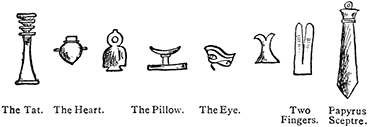
The Tat. The Heart. The Pillow. The Eye. Two Fingers.
Papyrus Sceptre.
ANCIENT EGYPTIAN AMULETS OF GOLD AND CLAY FOUND IN
MUMMY CASES.
Coming to those fashioned in metal, amulets of
gold were also highly esteemed. The precious
metal was supposed to strengthen the heart, drive
away melancholy, fever, and other infirmities.
Silver was attributed with the possession of similar
properties, but in a lesser degree. Zoroaster
and Paracelsus advocated the use of metallic
amulets. Special value was attached to those
made from a peculiar metal called electron, which
was composed of seven metals fused together in
fixed proportions. Amulet rings were always
worn on the third finger, which was called the
medicine-finger by alchemists, through which
they believed the heart was most susceptible to
influence. Written amulets usually consisted of
some cabalistic character, or a few words written
on a small piece of skin or parchment. This was
either enclosed in a tiny case and suspended
from the neck, or bound against the body. It
was not uncommon for the physician of the
fifteenth century to write his prescription in
mysterious characters, and hang it round the
neck of the patient, or bind it over the part
nearest the seat of the complaint. Of written
amulets perhaps the most famous formula was
Abracadabra, which, when written on a piece of
parchment in the following manner, was said to
protect the wearer from most diseases:—
A B R A C A D A B R A
A B R A C A D A B R
A B R A C A D A B
A B R A C A D A
A B R A C A D
A B R A C A
A B R A C
A B R A
A B R
A B
A
Another common formula was the sign A II,
which, inscribed on parchment, was worn round
the neck to prevent sore eyes. Others were composed
of astrological signs and certain numbers.
A favourite inscription was A B R A X A S,
supposed to ward off fever and pestilence.
The Jews used the fifth and sixth verses of the
sixteenth Psalm as an amulet to discover hidden
thieves, it being supposed that on repeating these
words they would be compelled to come forth
from their hiding-places. The modern burglar
requires an amulet of a somewhat stronger nature
in these prosaic days. A curious charm for
warts, used some 400 years ago, was to write
on seven little wafers the following words:
Maximanus, Walchus, Johannes, Martinianus,
Dionysius, Constantius, Serapion, and sing a
prescribed incantation first into one ear, then
into the other, and then above the patient’s poll,
after which a virgin was to hang the incantation
around the patient’s neck, when the warts would
disappear. Another amulet to charm away warts
was an iron ring made from the chain of a
gibbet. The following incantation was supposed
to stop bleeding from the nose: Make the sign
of the Cross thrice, repeat the Lord’s Prayer
thrice; then say the Ave Maria, and repeat the
words Max, Hackx, Lyacx, Iseus, Christus.
Among the many strange and curious articles worn
as amulets the old philosophers seem to have had
the greatest veneration for certain mysterious
stones, such as bezoar, the origin of which in most
cases is exceedingly doubtful. Dark and weird
are the legends relating to the power of the toadstone,
that amulet so highly prized by witches
and astrologers. Among other properties it was
supposed to protect its owner from the bites of
venomous animals. Lemnius tells us of “a stone
of the bigness of a bean, to be found in the
gizzard of an old cock, which makes him that
wears it beloved, constant, bold, and valiant in
fighting and sports”. Such amulets brought big
prices, and were eagerly sought after. The toadstone
was much esteemed as a charm against the
bites of snakes and reptiles; it also had a reputation
for curing weak eyes and headache. Orpheus
believed that when this amulet was worn by a
public speaker he could always compel and hold
the attention of his audience. A charm against
the evil eye consisted of a quill filled with mercury,
sealed at each end, and worn bound to the
body. A small portion of the plant called St.
John’s Wort was carried about the person as a
preventive from harm by witches or devils. A
toad, well dried in the sun, put into a bag and
hung round the neck, low enough to touch the
region of the heart, was used to allay hæmorrhage;
and a very well salted herring split open and
applied to the soles of the feet was a noted
remedy for ague. An emerald suspended from
the neck was worn as an amulet to ward off the
same complaint. Aqua divina, a famous remedy,
supposed to possess “magnetick power,” was prepared
by macerating a human body in water and
distilling it twice or thrice. Human bones,
various parts of a mummy, and other equally
gruesome objects, were supposed to be endowed
with some mysterious power to ward off accident,
disease, and death. In some parts of the country,
especially in Cornwall, eel skins were and are
still used, tied round the legs to prevent
cramp; and two sticks laid crosswise on the bedroom
floor were supposed to charm away the
same painful complaint. It is still a common
custom in other country districts to pass a weakly
child through the split branch of a tree in order
to make it grow stronger; and a certain class
have the strongest belief in a charm of a romantic
nature that is worked with the gum called
dragon’s blood.
A famous amulet, the remarkable history of
which inspired Sir Walter Scott to write The
Talisman, was “The Lee Penny,” which we believe
is still in existence, and held in veneration in
some parts of Scotland. The singular history
attached to this coin was as follows: Sir Simon
Lockhart, of Lee and Cartland, was a well-known
knight in the time of Robert the Bruce
and his son David. He was one of the chief
Scottish knights who accompanied Lord Douglas
on his expedition to the Holy Land with the heart
of King Robert Bruce, and was there engaged
in the war with the Saracens. Tradition goes
on to state that he captured in battle an emir of
great rank and wealth, and fixed a price at which
he should be ransomed. The aged mother of
the prisoner came to the Christian camp to redeem
her son, and on pulling out a large purse which
contained the ransom, a peculiar pebble inserted
in a coin fell to the ground. The old woman, it
is said, showed such haste and anxiety to recover
it, that it gave the Scottish knight a high idea of
its value—on which he refused to set the emir at
liberty till the amulet was added to the ransom.
This the woman consented to do, and also explained
to Sir Simon the use of the talisman,
which was of great repute. When dipped in
water the liquid assumed the properties of a
styptic and a febrifuge, etc. Sir Simon Lockhart,
after much experience of its value, brought
it home, and left it to his heirs, and it is known
as the “Lee penny” from the name of his native
place. The coin is said to be of the early Byzantine
period. The most remarkable part of its
history, as stated in the introduction to The
Talisman, was, that it escaped condemnation in
an extraordinary manner when the Church of
Scotland impeached many other cures of the kind
which savoured of the miraculous, as occasioned
by sorcery, and censured the appeal to them;
“excepting only that to the amulet called the
‘Lee penny,’ to which it had pleased God to
annex certain healing virtues which the Church
did not presume to condemn”. It still exists,
and its powers are sometimes yet resorted to.
For epilepsy, a curious custom was to take the
sick man by the hand and whisper softly in his
ear, “I conjure thee by the sun and moon, and
by the Gospel of the day delivered by God to
Hubert, Giles, Cornelius, and John, that thou
rise and fall no more”.
When picking simples for burns the following
charm was repeated:—
“Hail to the holy herb,
Growing on the ground,
All in the Mount Calvary,
First wert thou found.
Thou art good for many a sore,
And heal’st many a wound;
In the name of Sweet Jesus,
I take thee from the ground.”
To produce sleep, the following is recommended
to be repeated:—
“In nomine Patris up and down,
Et filii et spiritus sancte upon my crown,
Dear Christ upon my breast,
Sweet Lady, send me eternal rest”.
The following was supposed to stop the flux:—
“In the blood of Adam death was taken,
In the blood of Christ it was all to slaken,
And by the same blood I do thee charge
That thou do run no longer at large”.
Singular virtues were supposed to be attached
to a “dead man’s hand”. In a Roman Catholic
chapel in Ashton-in-Mackerfield, there is preserved
with great care in a white silk bag, a
hand, which is still held in veneration, and wonderful
cures are said to have been wrought by
this ghastly relic.
The hand is said to have been that of one
Father Edmund Arrowsmith, who was executed
at Lancaster in 1628, for apparently no greater
offence than that of being true to his faith. After
his execution one of his friends cut off his right
hand, which was preserved for many years at
Bryn Hall, in Lancashire, and afterwards removed
to Ashton.
This “Holy hand” was formerly held in
great esteem in Lancashire, and pilgrims came
from all parts of the country to receive its touch,
which was reputed to cure various diseases. It
was believed to remove tumours when rubbed
over the part, and restore health to the paralysed.
There is a curious superstition still prevalent
in some parts of Lancashire, that when cat’s hair
gets into the stomach it causes sickness, which
may be cured by eating a piece of egg-shell once
a day.
Consumption was believed by the ignorant to
be produced by drinking water which had been
boiled too long. The cure was to dig a hole in
the earth, lie in it face downwards, and breathe
into the soil. This extraordinary remedy was
also largely used for coughs, asthma, and those
suffering from hysteria.
A curious charm is still practised in Devonshire
as a cure for the complaint called a white
swelling or white leg. Bandages are used to tie
round the afflicted limb, over which the following
charm is repeated nine times, and each time
followed by the Lord’s Prayer:—
“As Christ was walking, He saw the Virgin
Mary sitting on a cold marble stone. He said
unto her, ‘If it is a white ill thing, or a red ill
thing, or a black ill thing, or a sticking, crackling,
pricking, stabbing, bone ill thing, or a
sore ill thing, or a swelling ill thing, or a rotten
ill thing, or a cold creeping ill thing, or a smarting
ill thing, let it fall from thee to the earth
in My name, and the name of the Father, Son,
and Holy Ghost. Amen.’”
This comprehensive charm would seem to
cover a multitude of ills indeed.
The following charms are taken from a MS.
of the year 1475:—
A Charme to Staunch Blood.
“Jesus, that was in Bethlehem born, and baptyzed
was in the flumen Jordane, as stente the
water at hys comyng, so stente the blood of thys
man N, thy serwaunt, throw the virtu of thy
holy name + Jesu + and of thy Cosyn swete
Sent Jon. And sey thys Charme fyve tymes
with fyve Pater nostirs, in the worshep of the
fyve woundys.”
For Fever.
“Wryt thys wordys on a lorell lef + Ysmael
+ Ysmael + adjuro vos per angelum ut soporetetur
iste Homo N. and ley thys lef under hys
head that he wote not thereof, and let hym ete
Letuse oft and drynk Ip’e seed small grounden
in a morter, and temper yt with ale.”
It is said that the inhabitants of Colonsay had
an ancient custom of fanning the face of the sick
with the leaves of the Bible.
Many and varied are the charms for curing
warts. “For warts,” says Sir Thomas Brown,
“we rub our hands before the moon and commit
any maculated part to the touch of the
dead.” Grose tells us to “steal a piece of beef
from a butcher’s shop and rub your warts with
it; then throw it down the ‘necessary house,’ or
bury it; and as the beef rots your warts will
decay”.
The leaf of the castor-oil plant worn round
the neck was believed to ward away devils, because
the leaf is like an open hand.
In Bale’s Interlude the following charms are
given:—
“For the coughe take Judas Eare
With the parynge of a Peare,
And drynke them without feare
If ye will have remedy:
Thre syppes are for the hyckocke,
And six more for the chyckocke;
Thus my pretty pyckocke
Recover by and by.
If ye cannot slepe but slumber,
Geve Otes unto Saynt Uncumber,
And Beanes in a certen number
Unto Saynt Blase and Saynt Blythe.
Give Onyons to Saynt Cutlake
And Garlycke to Saynt Cyoyake,
If ye wyll spurne the heade ake.
Ye shall have them at Quene hyth.”
Amulet rings were made from various metals,
and worn to ward off disease and misfortune.
In Berkshire there is a popular superstition
that a ring made from a piece of silver collected
at the communion is a cure for convulsions and
fits.
Rings were also made from coffin-nails dug
out of a grave, and coffin-hinges, and used to
cure cramp. Boorde, in his Introduction to Knowledge
(1542), says: “The kynges of Englande
doth halowe every yere Crampe Rynges, ye
which Rynges worne on one’s Fynger doth helpe
them whych hath the crampe”.
One of the favourite charms of the early
Britons was the anguineum, or snake’s egg, which
was supposed to be produced from the saliva of
serpents, and besides its healing properties it got
the credit of being able to float against the
current.
Many of the ancient writers believed that all
charms were impotent without the repetition of
certain words. Thus the following words are
recommended by Barrett to be repeated as a
charm against flux of blood:—
“In the blood of Adam arose death,
In the blood of Christ death is extinguished.
In the name of Christ I command thee, O blood,
That thou stop fluxing.”
A piece of clean new vellum bearing the letters
was considered a powerful amulet against ague.
Pliny makes several allusions to the poison of
toads, and Juvenal tells us of the lady
“Who squeezed a toad into her husband’s wine”.
The life of James VI. of Scotland was once
attempted by a woman named Agnes Sampson,
who confessed on her trial, that in order to compass
the king’s death, she had hung up a black
toad for nine days and collected the juice that
fell from it. The toadstone was greatly valued
as an amulet against a great variety of diseases.
It was often set in valuable rings, which were
handed down from generation to generation.
Some are said to have borne a figure resembling
a toad on their surface. They varied in colour,
some being dark-grey, and others of a brownish
fawn colour. These stones were supposed to
grow only in very old toads, and to be extracted
when they were dying. In reality, they were
manufactured of fused borax and many other
materials.
The toadstone was supposed to be specially
powerful against witchcraft and poison. When
placed in proximity to the latter, or applied to
one bewitched, the stone was believed to sweat
or change colour. It was sometimes given internally
as a remedy for fever or the bites of
reptiles. The toad itself was also credited with
medicinal virtues, and was given in plague and
small-pox. Aubrey gives a process for preparing
the toad for internal use, in which “twenty
great fatt toads are directed to be stewed slowly,
while alive, in a pipkin on the fire. The calcined
remains are again heated, and then finely
powdered.” Sir Kenhelm Digby speaks of their
virtues, and recommends toads for quinsy, bleeding
at the nose, and, above all, a most valuable
remedy in king’s evil and scrofula. Within the
last fifty years “toad doctors” visited most
country fairs, often selling bags containing the
legs torn from the body of a living toad for six
or seven shillings each.
Among other curious charms used by the
Romans to prolong life, especially among the
aged, was the singular practice of being breathed
upon by young girls. This custom is frequently
mentioned by ancient writers, and was believed
to be efficacious also in prolonging life in certain
diseases. A reference to this singular charm is
recorded by Kohansen in an inscription which
was discovered at Rome, cut in a marble tablet,
and which ran as follows:—
“To Æsculapius and Health,
this is erected by
L. Clodius Hermippus,
who by the breath of young girls lived 115 years and 5
days
at which physicians were no little surprised.
——
Successive generations lead such a life.”
——
In later times amulets in civilised countries
merged into the wearing of images of saints,
or consecrated objects, and the use of scapularies
by Roman Catholics at the present time. There
is little doubt that the custom of wearing precious
stones in rings, and the charms worn as pendants
to watch chains, originated in the amulet and
talisman. Who can say that the belief in such
charms has even yet died out? How many
people are there at the present day who do not
carry about them some coin, token, or object, to
which they would probably be ashamed to confess,
they attach some mysterious virtue? The
belief in keeping a crooked sixpence or a broken
ring is evidence of that peculiar vein of superstition
that runs through most of us, which,
strange though it may seem, the advance of
science and education has not altogether dispelled.
The treatment prescribed by the monks, who
were ready to cure the body as well as the soul,
consisted mainly of holy water, prayer, the touching
of relics, and a number of decoctions of herbs,
the properties of which they were acquainted
with. Many of these physician monks wandered
about the country devoting themselves to the
wants of the sick.
During the eleventh century hospitals began
to spring up in various parts of the country and
over Europe. They seem to have originated at
the time of the crusades. Lacroix says: “The
Johannists, and the brotherhoods of St. Mary and
St. Lazarus devoted themselves to missions of
charity in the East; in France, there were the
brothers of St. Antony and of the Holy Ghost;
and throughout the world the heroic chevaliers
of St. John of Jerusalem or of the Templars,
whose countless establishments combined the
triple character of conventual church, almshouse,
and fortress, and who, attired in a dress both
military and monastic, wore a mantle similar to
that seen in the statues of Æsculapius, as a sign
of the double mission—beneficent and warlike—which
they had sworn to fulfil”.
Each of these orders had a special form of
treatment, and took charge of specific diseases.
Thus, the Templars paid special attention to
those pilgrim soldiers and travellers particularly
troubled with ophthalmia, scurvy, or those suffering
from wounds. The Johannists professed
the cure of epidemical disease and pestilence.
The order of St. Antony looked after those
stricken with dysenteries and those complaints
known as St. Anthony’s fire, while the Lazarists
treated leprosy, small-pox, and pustular fevers.
The first school of nurses of which we have
record, is one organised by Hildegarde, Abbess
of Rupertsberg, who died 1180. These nuns
gave great assistance in the hospitals. Thus the
monks about the twelfth century tended the
bodies as well as the souls, and even accompanied
armies on military expeditions in that capacity.
In the thirteenth century faculties were established
at Montpellier, Salerno, and Paris, by the
order of papal bulls, to grant degrees in medicine.
In order to obtain the title of master
physician, the candidate had first to become a
clerk, then pass an examination before masters
or doctors selected from the staff of the college
by the Bishop of Maguelonne.
The barbers at this time came to occupy an
important position in medicine, and were promoted
to the rank of subordinate surgeons,
chiefly for blood-letting and minor accidents.
In the fourteenth century medicine had rapidly
progressed in Europe, and the celebrated physician
and surgeon Lanfranc founded the St.
Cosmo College at Paris, the examinations of
which all surgeons were obliged to pass. A
decree was also passed by the King of France in
1352 prohibiting any one who was not an
apothecary, student, or mendicant monk from
practising medicine. The king, we find, also
exempted the master barbers from doing duty
as watchmen, as “the barbers being nearly all
of them in the habit of practising surgery,
great inconvenience might arise if they were
absent from their houses when sent for during
the night”.
In France, the little barbers, as they were
called, travelled about on foot from village to
village with a bag containing their drugs and
remedies, while the great barbers, or sworn surgeons,
astride their hacks with tinkling bells
to announce their approach, wore long robes
trimmed with fur, and other rich apparel. They
were usually accompanied by an assistant and
several servants, who carried their cases of instruments,
which always included scissors, nippers,
a probe or éprouvette, razors, lances, and needles.
He also carried five kinds of ointments, viz.,
basilicon, apostles’ ointment, the white ointment,
yellow ointment, and the dialtœa ointment for
subduing local pain.
Guy de Chauliac, who was physician to three
successive popes, stated “he never went out on
his visits without taking several clysters and
plain remedies, besides gathering herbs in the
field, so as to treat diseases in a proper manner”.
Even at that early time the credulity of the
public became imposed upon by quacks, and
Lacroix tells us of an English surgeon, one
Goddesden, who had two sorts of prescriptions,
one for the rich and another for the poor; he
sold at a high price to the barbers a so-called
panacea, which the latter sold at a large profit,
and this was simply a mixture of frogs pounded
in a mortar. In one of his books there is a
short chapter on disagreeable diseases, as he
terms them, “which work their own cure, and
bring no grist to the doctor’s mill”.
In the fifteenth century the practice of medicine
became more and more influenced and
dominated by the occult sciences, and especially
astrology. All mankind was ruled by the stars,
and the cause of various diseases was attributed
to the conjunction of certain planets. “They
believed the blood rose during the daytime
towards the sun, and descended into the lower
extremities at night; that at the third hour the
bile subsided, so that its acid properties might
not be mixed with the course of the blood; and
that at the second hour the atrabilis, and in the
evening the phlegm, subsided.” Such illusions
and erroneous beliefs stopped the progress of
science, and threatened to turn a noble art into
mere charlatanry. In this country the surgeons
mostly practised as apothecaries; and we are
told that when Henry V. invaded France in
1415, the only surgeon he had in his camp was
one Thomas Morstede, who was with difficulty
induced to accompany the army, bringing with
him twelve assistants.
The sixteenth century saw an effort to throw
off some of these errors which had grown round
the art. The invention of printing helped largely
in disseminating knowledge throughout Europe,
and the followers of medicine assumed a higher
position.
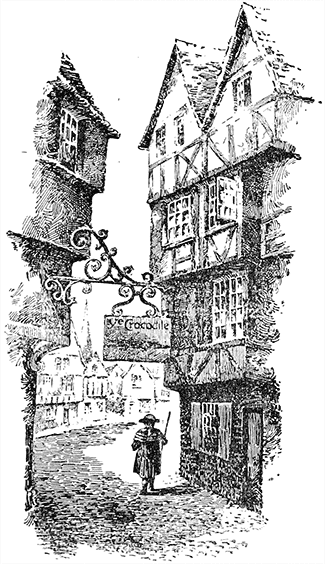
AN APOTHECARY’S SHOP. FIFTEENTH CENTURY.
Towards the end of the fifteenth century
Tachenius wrote: “There is no new thing
under the sun whatsoever, therefore the followers
of Hippocrates have handed out, and as it were
midwifed into the world, the same was from the
beginning though our eyes were not so clear-sighted
as to discern it”. To which Stephen
Pasquier replied in the following rhyme:—
“Some Paracelse of novelty implead,
For which, judged crime, he erst was banished,
So Hippocrates, Chrysippus, and at Rome
Asclepiade, too, were new. They’d all one doom.
They who condemn new things condemn the old,
Or else do both misjudge and are o’er bold.”
During the crusades the surgeons naturally
acquired a very large experience in the treatment
of wounds—incised, lacerated, and contused.
Baldwin was severely wounded before Jerusalem,
having received a spear-thrust “through the
thigh and the loins”. He fell fainting from his
horse, but the most skilful leeches were summoned,
“by whose art and skill the king and
valiant athlete was enabled to recover from this
deadly wound”. Baldwin was also wounded in
the foot before Antioch, and the surgical talent
available was baffled by the injury to such a
degree that it was proposed to kill a Saracen
after wounding him in the same part, so as to
learn the proper course to pursue. Baldwin,
however, refused to allow this crude attempt at
experimental surgery to be made. There seem
to be no medical records of the second crusade.
In the third, the French king, Philippe Auguste,
and our own Cœur de Lion suffered grievously
from a disease, the symptomatology of which included
extensive exfoliation of the skin, shedding
of the nails, and loss of the hair. The disease
is called Arnoldia by the chroniclers, and is
variously conjectured to have been leprosy or
syphilis. It could hardly have been leprosy, for
both the royal sufferers recovered, Cœur de Lion
being killed eight years later at the siege of
Chalus, and Philippe Auguste dying of quartan
ague twenty-four years after Richard. Of the
fourth crusade we have no medical details. In
the fifth, St. Louis of France was accompanied by
his private physician Dudon and other leeches;
among them was a lady doctor or phisicienne
named Hernandis, who probably attended the
queen in her confinement, which took place at
Damietta. The expedition suffered terribly from
scurvy, typhus, and other pestilences. The part
played by water in the diffusion of disease would
seem to have been recognised, though the methods
of water examination would hardly satisfy a
modern chemist. A piece of white linen was
dipped in the water to be tested, and then dried;
if there were any stains on the linen the water
was condemned, but if not it was pronounced
pure. The addition of four crushed almonds or
beans was believed to make the water of the Nile
safe for drinking. The method of disinfection
adopted for the king’s tent was to fumigate it
with a mixture of amber, chick peas, or lupine,
which were macerated in wine, and then placed
on live charcoal. In the sixth crusade, which
took place twenty-two years later, vast numbers,
including St. Louis himself, fell victims to ignorance
of the elements of sanitation.
A curious survival of the age of superstition
and romance attaches to the red resin known as
dragon’s blood, and is still largely practised by a
certain class of uneducated women in many parts
of the country. The resin is the product
of the Pterocarpus Indicus growing in the East
Indies, and now chiefly used as a colouring agent
in varnishes and stains, etc. It was formerly
employed in medicine for its astringent properties,
but has now entirely gone out of use for
that purpose.[4]
The secret of its use as a charm is shrouded
in some mystery, and those who use it are very
reticent in giving particulars; but it has been
gathered, that several charms of a romantic nature
are worked with this otherwise very commonplace
article of commerce. The most common
of these seems to be practised by young girls
who are jealous of their lovers and seek to win
back their affection. A small quantity of
dragon’s blood is procured, wrapped in paper,
and thrown on the fire whilst the following
couplet or incantation is repeated:—
“May he no pleasure or profit see,
Till he comes back again to me”.
Another method much believed in by women
of a certain class, and used by them to attract the
opposite sex, is to mix dragon’s blood, quicksilver,
saltpetre, and sulphur, and throw them
on the fire, repeating a similar incantation.
A chemist in the north of England, giving
his experience on the sale of dragon’s blood, says:
“I have had great difficulty in finding out for
what purpose it was used. It was not for medicine,
but for a kind of witchcraft. The women
burn it upon a bright fire, while wishing for their
affection to be returned by some one of the
opposite sex; also those who have quarrelled with
their husbands and desire to be friends again;
girls who have fallen out with their young men,
and want to win them back; as well as young
women wanting sweethearts. A working man
recently came to me for a small quantity, and I
inquired for what purpose it was required. He
was very reluctant to mention anything about it,
but at length said, a man had made him lose
three sovereigns, and he wished, as he had been
swindled out of the money, to have his revenge,
and make him suffer for it. He was going to
turn the dragon’s blood on a clear fire, and he
believed that the ill wishes of the person thus
burning it would have a dire effect on the individual
thought of.”
Another charm said to be worked with this
drug, in which an inverted teacup plays a prominent
part, has reference to the sex of expected
offspring.
Altogether, considerable romantic properties
seem to be associated with this resin, but there
seems to be no authentic record of the same, the
only probable explanation being, that it was used
and sold, like other innocent articles, by those
who were supposed to have dealings in the black
art, for working charms, which have thus
been handed down from mediæval times. Coles
states: “The early Greeks called dragon’s blood
Cinnabaris, not knowing whether it was of vegetable
or mineral origin; and that Pliny, Solinus,
and Monardus have set it down for truth that it
was the blood of a dragon or serpent, crushed to
death by the weight of the dying elephant falling
upon him; but he thinks it was certainly so
called from the bloody colour that it is of, being
nothing else but a mere gum”. It was used
medicinally as an emmenagogue, and in the arts
300 years ago by goldsmiths and painters in
glass, by the former as a base for enamel to set a
foil under precious stones to give them greater
lustre, and the latter by fire, to strike a crimson
colour into glass for stained windows.
That a belief in charms and witchcraft is still
fostered by ignorant people in some parts of the
country, is manifest from cases reported in the
newspapers from time to time. Two practitioners
of the occult sciences were haled before the
magistrates but recently. One, an old crone,
who confessed to using dragon’s blood in
working her love charms, was rewarded with
seven days with hard labour.
The other, which came to light in Cornwall,
was a middle-aged individual who practised
as a wizard. His treatment consisted of
writing an amulet to be worn near the body.
Money was then required to remove the spell
from the bewitched patient to some one else. To
this victim was to be lent neither “cock, pin, or
pan,” and by the aid of the planets the patient
would be cured. But these are hard times truly
for the wizard and magician, and this professor
was rewarded with seven months’ incarceration
in one of her Majesty’s gaols.
Singular superstitious properties are attributed
to certain plants. The walnut was formerly
employed in medicine as an application to
wounds and an antidote to poisons; and the
following old riddle, says William Coles in 1657,
“almost every one knows”:—
“As high as a house,
As little as a mouse,
As round as a ball,
As bitter as gall,
As white as milk,
As soft as silk”.
There is an old tradition that the more the
branches are beaten, the more prolific the fruit
will be. There is a fable in Æsop of a woman
who asked the walnut tree growing by the wayside,
which was pelted at with stones and sticks
by them that passed by, why it was so foolish as
to bring forth fruit seeing that it was so beaten
for its pains, to which the tree rehearsed these
two proverbial verses:—
“Nux, Asinus, Mulier, Simili suret lege legati,
Haes tria nil recte faciunt si verbera cessent”.
“The English whereof,” the chronicler quaintly
continues, “I could tell you, but that I fear the
women of this preposterous age would be
angry.” True it is that this tree, the more it
is beaten the more nuts it bears. The walnut
was one of the chief ingredients in the celebrated
antidote against poison which was attributed to
the wise king Mithridates. The formula ran
as follows: “Two (wall) nuttes and two figges
and twenty rewe beans, stamped together with
a little suet and eaten fasting, doth defende a
man from poison and pestilence that day”.[5]
Sage was much esteemed by the housewife for
simple ailments, and its properties are embodied
in the following lines, which are of great antiquity:—
“Sage helpes the nerves, and by its powerfull might
Palsies and Feavers, sharp it puts to flight”.[6]
An old writer says, “Be sure you wash your
sage for fear the Toades, who as I conceive come
to it to discharge their poyson, should leave some
of their venom upon the Leaves”.
Of rue, which was largely used as a carminative,
the following couplet has been handed
down:—
“Rue maketh chast, and eke preserveth sight,
Infuseth wit, and Fleas doth put to flight”.
Tradition says that a weasel, going to fight with
a serpent, eateth rue, and rubbeth herself therewith
to avoid his poison. Crollius states: “The
sign of the cross upon the seed of the rue, drives
away all phantoms and evil spirits by signature”.
Henbane, the Latins called Apollinaris,
either from Apollo, the inventor of physic, or
because it makes men mad like unto Apollo’s
creatures when they deliver his oracles. “It
was called in English henbane, because the seeds
are hurtful to hens,” says William Coles. “The
fumes of the dryed herb when burnt, will make
Hens fall from their roosting place as though
they were dead.”
Of the moonwort, a simple used to allay
bleeding and applied to fractures, an old tradition
says that it can be used to open locks,
fetters, and shoes from those horses feet that go
on the places where it groweth, and of this
opinion was Culpepper, who, though he railed
against superstition in others, tells a story of a
troop of horse of the Earl of Essex, which being
drawn up in a body, many of them lost their
shoes upon White Downe in Devonshire, near
Tiverton, because moonwort grows upon the
heaths.
The root of the Polygonatum angulosum, commonly
called Solomon’s Seal, has a popular
reputation for removing the congealed blood
from a bruise after a blow or fall, for which
property it appears to have been used 800
years ago. Coles states: “The bruised roots
soddereth and gleweth together broken bones
very speedily and strangely, the roots being
stamped and outwardly applied as a pultis.
The same also is available for outward bruises,
falls, or blowes, both to dispel the congealed
blood and to take away the paines, and the black
and blew markes that abide after the hurt.” The
origin of the name Solomon’s Seal is doubtless
due to the dark marks seen on cutting the root
transversely, which somewhat resemble an ancient
seal engraved with characters.
Of Solomon’s Seal, Dioscorides says that
“the root pounded and laid on fresh wounds
heals and seals them up”; and it is on this
account that Gerard considers its name to have
originated.
An old author quaintly remarks with respect
to its properties: “The roots of Solomon’s Seale
stamped while it is fresh and greene and applied,
taketh away in one night, or two at the most, any
bruse, blacke or blew spots gotten by fals, or
woman’s wilfulness in stumbling upon their hastie
husband’s fists or such like”.
The anemone was regarded by the ancients as
an emblem of sickness, and Pliny tells us that
the physicians and wise men ordered every person
to gather the first anemone he saw in the year,
repeating at the same time, “I gather thee for a
remedy against disease”. It was then devoutly
placed in scarlet cloth and kept undisturbed
unless the gatherer became unwell, when it was
tied either around the neck or the arm of the
patient.
The trefoil, vervain, St. John’s wort, and dill
were supposed to possess the power of protecting
the wearer from the evil eye or witchcraft, hence
the old rhyme called Saint Colme’s charm:—
“Trefoil, vervain, John’s wort, dill,
Hinders witches of their will;
Well is them, that well may
Fast upon St. Andrew’s Day.
Saint Bride and her brat,
Saint Colme and his cat,
Saint Michael and his spear,
Keep the home frae reif and wear.”
There is an old tradition that the white veins
of the variety of thistle known as the Carduus
Marianus was caused originally by a drop of
the milk of the Virgin Mary having fallen
thereon, and for this cause the plant was in early
times much revered.
The house leek, with its pretty rose-coloured
flowers, often seen growing along the tops of
walls and on the roofs of cottages in country
places, was formerly known by the imposing
name of the thunder plant, from the power it
was supposed to possess of averting lightning
from the house or building on which it was
planted. Hence the custom of planting it on
the roof.
St. John’s wort was a noted herb in magical
arts, and was also esteemed as a repellant of
spectres and to drive away demons, and was called
Fuga Dæmonum by the old botanists. French
and German peasants still gather the plant with
great ceremony on St. John’s Day.
That charming little wild flower the scarlet
pimpernell, which grows in our fields and hedges,
ranked among the simples of ancient times. It
was used as a remedy against the plague, and an
antidote against the bites and stings of venomous
insects, and to stop bleeding. This latter attribute
was doubtless more mythical than correct,
being founded on what the ancients called having
the signature, which meant that if a substance
was of blood colour it signified it would stop
bleeding because of the same. Hung over the
door or porch of a house, it was believed to
defend the inmates from witchcraft.
Josephus states in his History of the Jews[7]
that Solomon discovered a plant efficacious in the
cure of epilepsy, and that he employed the aid of
a charm or spell for the purpose of assisting its
virtues. The root of the herb was concealed in
a ring, which was applied to the nostrils of the
demoniac; and Josephus himself declares that he
saw a Jewish priest practice the art of Solomon,
with complete success, in the presence of Vespasian,
his sons, and the tribune of the Roman
army.
From this art, exhibited through the medium
of a ring or seal, we have the Eastern stories
which celebrate the seal of Solomon and record
its wonderful sway over the various orders of
genii, who were supposed to be the invisible tormentors
or benefactors of the human race.
“Vervain,” says Coles, “was reported to be
effectual against all poisons and the venom of
dangerous beasts and serpents, and also against
bewitched drinks and the like, so that it is not
only used in, but against witchcraft. That this
herb is used by witches may appear from the
story of Anne Bodenham, the witch of Salisbury,
who sent her ruffian-like spirits to gather vervain
and dill, which was to be given to one whom
she desired to bewitch.”
The magi of the ancient Elamites or Persians
made use of vervain in their worship or adoration
of the sun, always carrying branches of it in
their hands when they approached the altar.
They also believed that by smearing the body
over with the juice of this plant, the individual
could have whatever he wished, be able to reconcile
his most inveterate enemies, cure diseases,
and perform other magical operations. They
always gathered the plant when neither sun
nor moon was visible, and poured honey and
honeycomb on the earth as an atonement for
robbing it of this precious herb.
The Greeks called it the Sacred Herb, and
used it to cleanse the festival table of Jupiter
before any great ceremony took place.
The Romans also employed it in the performance
of their religious rites, for cleansing their
altars, and sprinkling holy water.
It was hung in their dwellings to ward off evil
spirits.
Vervain was also one of the sacred plants
of the Druids, both in Gaul and Britain. They
cut it with much ceremony in the spring of the
year, and made offerings to the earth for so
doing. They also used it to anoint the body to
cure disease.
The ancient Greeks and Romans dedicated
it to the god of war, and in Scandinavia it was
deemed sacred to Thor. The eye anointed with
an ointment of vervain was supposed to possess
second sight. Its influence over Venus has
doubtless to do with its use as a love token. It is
said that the custom is still practised in Germany
of presenting a bride with a wreath of vervain.
Other magic wreaths worn by lovers when
they wished to see their fate, were composed of
rue, crane’s bill, and willow.
The hawkweed commonly seen in our fields
was regarded by the Greeks as the emblem of
quick-sightedness, believing that the hawk, a bird
renowned for its bright eye and quick sight,
sharpened its visual organs with the juice of this
plant. Thus it became famed in early medical
practice as a remedy for dimness of sight, and
was employed to feed the hawks used in the old
art of falconry.
In Scotland, a twig of the rowan tree or
mountain ash is often sewed up in the cow’s tail,
to protect the animal from witches and warlocks.
The squill was used by the Egyptians for
dropsy, under the mystic name of the “Eye of
Typhon”.
An old name for the fruit of the mandrake
was “love apples”. They were frequently used
in ancient times in philtres and love potions.
This plant belongs to the natural order Solanaceæ,
which also includes the potato and the tobacco
plant. Its leaves spring directly from the root
similarly to those of the lettuce, before it shoots
into flower, and its purple-coloured blossoms are
succeeded by a yellow berry or “apple,” which
still ripens in Palestine at the time of the wheat
harvest. An overdose of the fruit is said to produce
a sort of temporary insanity. From the
earliest times it has been credited with magical
virtues, and supposed to confer superhuman
powers on its possessor. The most valued specimens
were those which grew under a gibbet
where a malefactor hung in chains. It was
believed that on being torn from the earth the
mandrake uttered a groan, and that whosoever
heard it, dropped dead on the spot. The approved
method of gathering it was to fasten the plant to
a dog’s tail, and beat the animal till his struggles
pulled the root up. The dog heard the groan
and died, but those who directed the proceedings
escaped by having their ears stopped with pitch
or wax.
It was customary in Germany in mediæval
times to form or carve small figures out of
the mandrake root, which were called abrunes.
“These images,” says Phillips, “they dressed
regularly every day, consulted as oracles, and
their repute was such that they were manufactured
in great numbers and sold in cases.”
They appear to have been brought over to
England in the time of Henry VIII., and
met with ready purchasers, it being pretended
that they would, with the assistance of certain
mystic words, be able to increase whatever money
was placed near them. These roots were said to
have been taken from plants which had grown
underneath gibbets, and had been influenced by
the flesh of the criminals hung thereon.
It is singular how the willow has ever been
associated with sorrow and sadness, even from
the time the daughters of Israel hung their harps
on its branches. Among heathen nations the tree
was regarded as an evil omen, and was used as
torches at funerals. “The early poets,” says
Johns, “made the willow of despairing woe,”
and Shakespeare frequently alludes to it as being
used to weave garlands for jilted and sorrow-stricken
lovers. Benedick says:—
“I offered him my company to a willow tree, either to
make him a garland, as being forsaken, or to bind him up a
rod as being worthy to be whipped”.
And Bona, in Henry VI., remarks:—
“Tell him, in hope he’ll prove a widower shortly,
I’ll wear the willow garland for his sake”.
It seems to have been customary to wear it
twined round the head as a symbol of sorrow
and mourning, but the origin of the custom is
unknown.
A peculiar virtue was supposed to be attached
to the eating of almonds, which is still believed
in some parts of the country, viz., that it
protects the eater from drunkenness.
Gerard says, “Five or six being taken fasting
keepe a man from being drunke”.
The pretty flower called the bachelor’s button,
which is common in our hedgerows, is said to
possess the following peculiar property of divination.
“When carried in the pocket by men,
and under the apron by women, it will retain
or lose its freshness according to the good or
bad success of the wearer’s amatory prospects.”
A considerable amount of romantic lore lingers
about the bean and nut. The bean was regarded
with veneration by both the Greeks and Romans,
and on account of its sacred associations became
the instrument for voting by ballot in early times.
Nuts of various kinds have long been associated
with certain love charms, and some of these old
customs, such as the cracking of nuts, still survive
and are practised on All Hallow Eve.
An old charm for nut-testing runs as follows:—
“Two hazel nuts I threw into the flame,
And to each nut I gave a sweetheart’s name;
This with the loudest bounce me sore amazed,
That in a flame of brightest colour blazed;
As blazed the nut, so may thy passion glow,
For ’twas thy nut that did so brightly glow”.
There is an old tradition that the white hawthorn
was used to plait the sacred crown of
thorns, and that from that time the tree was
endowed with special virtues.
An old writer says: “He that beareth a branch
on hym thereof, no thundre, ne, no maner of
tempest may dere hym; ne, in the howse that it
is ynne may none evil ghost enter”.
A great amount of superstition was associated
with various ferns in mediæval times, and fern
seed was supposed to possess the wonderful
property of rendering those who swallowed it
invisible.
According to the doctrine of Signatures,
various shaped leaves were used for special diseases.
A liver-shaped leaf was used to cure
complaints of that organ, and a heart-shaped leaf
was used for diseases of the heart, and so on.
The black hellebore was employed by the
ancients to purify their dwellings, and they
believed that its presence in their rooms drove
away evil spirits. It was also customary to bless
the cattle with hellebore to keep them free from
spells wrought by the wicked.
When dug up for these purposes, certain religious
ceremonies were observed. First a circle
was drawn round the plant with a sword, and
then, turning to the east, a humble prayer was
made by the devotee to Apollo and Æsculapius,
for permission to dig up the root. If an eagle
approached the spot during the performance of
the rites, it was supposed to predict the certain
death of the person who took up the plant in
the course of the year.
It is related by Dioscorides that Carneades, the
Cyrenaic philosopher who undertook to answer
the books of Zeno, sharpened his wit and
quickened his spirit by purging his head with
powdered hellebore.
The peony owes its name to Pæon, a famous
physician of ancient Greece, who is said to have
cured, by the aid of this plant, the wounds which
the Greeks received during the Trojan war.
It was largely used as an amulet, and demons
were supposed to fly from the spot where it was
planted. A small piece was worn round the
neck to protect the wearer from enchantment.
There is a curious tradition connected with
that charming little flower the forget-me-not.
It is, that the juice, or decoction of the plant,
has the peculiar property of hardening steel, and
that if edged tools of that metal be made red hot
and then quenched in the juice or decoction, and
this be repeated several times, the steel will
become so hard as to cut iron without turning
the edge.
The elder had a great reputation as an amulet.
An old writer states, “if one ride with two little
sticks of elder in his pockets he shall not fret nor
pant let the horse go never so hard”.
According to the Anatomie of the Elder (1655),
“The common people keep as a great secret in
curing wounds the leaves of the elder, which
they have gathered the last day of April, which,
to disappoint the charms of witches, they had
applied to their doors and windows”.
A piece cut out between two knots was worn
as an amulet against erysipelas.
Lupton says: “Make powder of the flowers
of elder gathered on Midsummer Day, being
before well dryed, and use a spoonful thereof in
a good draught of Borage water, morning and
evening, first and last, for the space of a month,
and it will make you seem young a great while”.
The elder is still believed in the south of
Germany to drive away evil spirits, and in Denmark
and Norway it is held in the same veneration.
It is customary in the Tyrol to plant an
elder bush in the form of a cross on a new grave,
and if it blossoms, the soul of the body interred
beneath is supposed to be in Paradise.
Who first introduced mummies as medicinal
agents is not known, but there is something
particularly weird and gruesome in the idea of
the ancient physician dosing a sick patient,
with the remains of a predeceased fellowman,
in order to restore him to health. The art of
embalming was practised thousands of years
before the Christian era, and was regarded as the
greatest token of esteem that could be paid by
the living to the dead. Pomet says there were
two kinds of embalming practised by the ancient
Egyptians. The first and most costly was used
to none but persons of the highest class, and was
valued at a talent of silver, or about £500.
Three people were employed in the operation;
one was a kind of designer or overseer, who
marked out such parts of the body as were to be
opened. The next was a dissector, who with a
knife of Ethiopian stone cut the flesh as much as
necessary, and as the law would permit, and
immediately afterwards fled away with all the
expedition possible, because it was the custom of
the relatives and domestics to pursue the dissector
with stones and do him all the injuries
they could, treating him as an impious wretch
and the worst of men.
After this operation the embalmers, who were
accounted holy men, entered to perform their
offices, which consisted in removing the internal
organs, cleansing with palm wine and other
aromatical liquor, and during the space of thirty
days they filled the cavity with powdered myrrh,
aloes, Indian spikenard, bitumen, and other aromatics.
In the process of embalming used by
the middle class, which cost about £250, the
body was syringed with a decoction of herbs and
oil of cedar, then put into salt for seventy days,
after which it was enveloped in bandages of fine
linen, which had been dipped in myrrh and
asphaltum, and the designer, who was called the
scribe, covered the wrapping with a painted
cloth, on which were represented the rites of their
religion in hieroglyphics, and the animals which
the dead loved most. There was a third process
of embalming used by the poorer people, in
which a mixture of pitch and bitumen was used.
The bodies were first dried with lime, and
then coated with a mixture of nitre, salt,
honey, and wax to protect them from the air.
Mummies of deceased persons were held in the
greatest reverence by their relatives. The faces
were sometimes gilded and painted and adorned
with head-cloths, they were then placed in elaborate
cases according to the position and rank
of the person, and deposited in the highest part
of their houses. An old writer states: “They
reckoned their deceased as such a valuable
token and pledge of their faith, that if any of
them happened to want money he could not give
a better security than the embalmed body of his
relation; and that which made it esteemed so
was, that they would spare no pains to pay the
money again; for if by mischance the debtor
could not redeem this pledge, he was reckoned
unworthy of civil society, which engaged him
indispensably to find out ways to recover his
kinsman in the time limited, otherwise he was
blamed by all the world”.
Some 300 years ago a large trade was carried
on, mostly by Jews, who imported mummies
for medicinal purposes, as they were much used
by the ancient physicians; but there is little
doubt that a great deal of fraud was practised by
the mummy merchants, and that many were
specially manufactured for the purpose. Pomet,
alluding to this in his History of Druggs, writes:
“We may daily see the Jews carrying on their
rogueries as to these mummies, and after them
the Christians; for the mummies that were
brought from Alexandria, Egypt, Venice, and
Lyons are nothing else but the bodies of people
that die several ways. Those from Africa called
white mummies, are nothing else but bodies that
have been drowned at sea, which, being cast upon
the African coast, are buried and dried in the
sands, which are very hot.” When the ancient
physician prescribed mummy for a bad headache,
he rarely got what he imagined. “For,” the
writer continues: “I am not able to stop the
abuses committed by those who use this commodity.
I shall only advise such as buy to
choose what is of a fine shining black, not full
of bones and dirt, of a good smell, and which
being burnt does not stink of pitch. Such is
reckoned proper for contusions, and to hinder
blood from coagulating in the body. It is also
given in epilepsies, vertigoes, and palsies. The
dose is two drachms in powder, or the same
made into a bolus. It also stops mortifications,
heals wounds, and is an ingredient in many
compositions.” In a price list, dated 1685,
mummy is quoted at 5s. 4d. per lb.
Of the mummies used in medicine five kinds
were known.
Factitious.—Those in which bitumen and pitch
were largely used in the process of embalming.
Those bodies dried by the sun in the country
of the Hammonians between Cyrene and Alexandria,
being mostly the bodies of passengers
buried in the quicksands.
True Egyptian.
The Arabian, being those bodies embalmed
with myrrh, aloes, and other aromatic gums.
Artificial mummies. Crollius in his Royal
Chemist gives the following process for preparing
artificial mummy:—
“Take the carcass of a young man (some say
red haired), not dying of a disease but killed,
let it lie twenty-four hours in clear water in the
air, cut the flesh in pieces, to which add powder
of myrrh and a little aloes, imbibe it twenty-four
hours in spirit of wine and turpentine, take
it out and hang it up for twelve hours, then
imbibe it again, twenty-four hours in fresh spirit,
then hang up the pieces in a dry air and a shady
place.” A rather cheerful operation for the
apothecary. It would possibly account for many
a mysterious disappearance in those days.
Mummy entered into a large number of preparations
which we come across in the old dispensatories.
There was the balsam, which is
described by an old writer as “having such a
piercing quality that it pierceth all parts and
restores wasted limbs, consumption, and cures
all ulcers and corruptions”. Beside mummies,
the apothecaries stocked human fat, respecting
which gruesome material Pomet says: “Everybody
knows in Paris the public executioner sells
it, the druggists and apothecaries a little; nevertheless,
they vend a sort of it prepared with
aromatic herbs, and which is without comparison
much better than that which comes from the
hands of the hangman”. Human fat was much
esteemed for rubbing, in cases of rheumatism
and kindred complaints.
Another part of the body used in ancient
medicine was the human skull; also a growth
called the moss from the human skull, probably
of fungoid origin, that appeared on the bone on
keeping. An old writer in the seventeenth
century says: “You may see in the druggist
shops of London some skulls entirely covered
with moss, and some that only have the moss
growing on some parts. They send these skulls
especially to Germany, to put into the composition
of the sympathetic ointment which Crollius
describes in his Royal Chemist, and which is used
for the falling sickness.”
Special virtue was attributed to skulls taken
from gibbets. Referring to these, Pomet states:
“The English druggists, especially those of
London, sell skulls of the dead upon which
there is a little greenish moss called usnea,
because of its near resemblance to the moss
which grows on the oak. These skulls mostly
come from Ireland, where they frequently let the
bodies of criminals hang on the gibbet till they
fall to pieces.” The human skulls were sold at
8s., 9s., 10s., and 11s. each. They were given in
the form of powder, or one of the preparations,
such as the oil or tincture. Besides the skull,
other human bones, calcined and powdered were
used. An oil and a tincture of skulls, an extract
of the gall and the heart of man made with
rectified spirit, was dropped into the ear as a
remedy for deafness, and also given internally
for epilepsy. Human hair was used for
jaundice, finger-nails as an emetic (which one
can hardly wonder at), and blood drawn from
a healthy man, drunk hot, was used to prevent
fits coming on. The brains of various birds and
animals were highly esteemed. The latter were
roasted and rubbed on children’s gums when
teething. The livers of ducks and frogs, and
a dead mouse dried and beaten into powder,
were given to relieve kidney disease.
Another extraordinary article used in medicine
was the horn of that fabulous animal the
unicorn. Concerning its origin we have recourse
again to Pomet, who states, “the unicorn is an
animal which our naturalists describe under the
figure of a horse, having in the middle of his
head a spiral horn of two or three feet long, but
we know not the real truth of this matter to
this day”. This horn was formerly held in
high esteem because of the great virtues attributed
to it by the ancients, especially against
poisons, “which is the reason that so many great
persons are fond of it, so that it has been valued
at its weight in gold”.
Ambrose Paraens, in a treatise which he wrote
on the unicorn, says that in the deserts of Arabia
he found wild asses carrying a horn in the front,
which they used to fight against the bulls.
That there was an animal with one horn, most
of the old writers agree, but whether it was a
goat, or an ox, or a hart, or an ass, no one could
say. The horn was probably collected from any
of these animals, and as long as the horn
was there it doubtless answered the purpose.
The true unicorn, if you dare believe Ludovicus
Vertomanus, who says he saw two of them in
Mecca which were kept within the precincts of
Mahomet’s sepulchre, is of a weasel colour,
“with the head like that of a hart, the neck not
long, and the mane growing all on one side, the
legs slender and lean like the legs of a hind, hoofs
cloven like a goat’s feet, and the hinder legs all
hairy and shaggy on the outside. His horn was
wreathed in spires of an ivory colour.” There
is little doubt that most of the horn used
medicinally, was that obtained from the narwhal
or sea unicorn. In the year 1553 a great
unicorn’s horn was brought to the King of
France, and valued at £20,000 sterling.
That which was presented to Charles I. of
England is supposed to have been one of the
largest ever seen in the world. “It was seven
feet long, weighed thirteen pounds, and was in
the shape of a wax candle, but wreathed within
itself in spires, hollow about a foot from its
root, growing taper little by little towards the
point of polished smoothness, and the colour not
perfectly white.” Ancient authors ascribe
wonderful properties to the horn of the unicorn.
It was supposed to resist all kinds of poisons,
cure the plague, all manner of fevers, the
biting of serpents, mad dogs, etc., and was
chiefly used as a cordial, for which purpose a
jelly was made of it.
THE ORIGIN OF THE SOCIETY OF APOTHECARIES—APOTHECARIES
AND THEIR PRACTICE—APOTHECARIES
AND THEIR BILLS—CURIOUS REMEDIES—A
DRUG PRICE LIST OF 1685.
The earliest record of the apothecary in England
seems to be of one Richard Fitznigel, who
acted in that capacity to Henry II. This
individual subsequently rose in degree at Court,
and exchanging the pestle for the crozier,
eventually became Bishop of London. In 1345
we hear of one Coursus de Gangland receiving
for his services as apothecary to Edward III.,
and for taking care of and attending his Majesty
during his illness in Scotland, a pension of sixpence
a day.
Those who practised medicine, surgery, and
pharmacy were called physicians, while their
assistants were known as apothecaries. Many of
the latter, as they began to learn the secrets and
habits of their employers, began business on their
own account, also dealing in drugs and other
commodities, until they became a powerful body.
When the College of Physicians was established
in 1518, they were soon empowered “to
search, view, and see the apothecaries’ wares,
drugs and stuffs, and destroy such as they found
unfit for use”.
In the latter part of the century a distinct separation
took place, and we find that in 1600 there
were physicians, surgeons, apothecaries, barber
surgeons, druggists or distillers and sellers of
waters and oils, and preparers of chemical medicines.
It was not until the year 1617 that the
Apothecaries’ Society had a separate existence,
when it was enacted that no grocer should keep
an apothecary’s shop, and that no surgeon should
sell medicines.
In 1623 the Society of Apothecaries established
a dispensary, for the purpose of making
some of the most important medicines then used
in a uniform manner, and in May, 1618, the
first Pharmacopœia was published by the College
of Physicians. We are told that it was so imperfect
that they brought out an improved edition
in December of the same year. This was published
in Latin, and it was through making and
publishing his translation of this work that
Nicholas Culpepper (who was a man of common-sense
in his time) got into disgrace with the
College of Physicians, who in consequence refused
him a licence to practise.
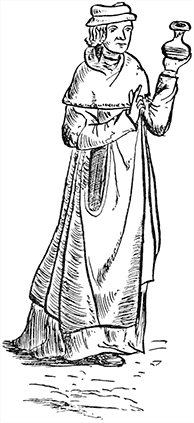
A PHYSICIAN.
From a drawing, dated 1490.
The history of the Society of Apothecaries of
London is an interesting one. It is a mystery
or guild which has retained its original function
of a trading corporation. It arose as an offshoot
of the Grocers’ Company, which descended
from the pepperers and the spicers, who amalgamated
in 1345 under the name of the Fraternity
of St. Anthony. The Grocers’ Company is one
of the most powerful and wealthy of the twelve
great Livery Companies of London which have
survived from mediæval times.
King James I. appears to have interested himself
in the separation of the two bodies about the
year 1614, and in spite of vigorous opposition
by the grocers, a charter was granted on 6th
December, 1617, making the apothecaries a distinct
mystery, under the title of the Society
of Apothecaries. This charter restrained the
grocers and all other persons from keeping an
apothecary’s shop in or near London, and it gave
the Society a right which had been inherent in
the Grocers’ Company, of paying domiciliary
visits to the apothecaries’ shops to search for, to
seize, and destroy bad drugs and medicines, a
power at first limited to London and seven miles
round, but afterwards extended throughout England
and Wales. This was discontinued shortly
after 1833.
The first hall or council-house of the society
consisted of a house and grounds known as
Cobham House, in Water Lane, Blackfriars,
immediately behind what is now the Ludgate
Hill Station. It was purchased in 1633, mainly
through the instrumentality of Gideon Delaune,
chief apothecary to Anne of Denmark, who was
one of the retinue sent to attend her from
Norway when she became the wife of James I.
This hall was destroyed by the great fire of
London in 1666, and its site lay vacant for ten
years before it was rebuilt. The second hall
was enlarged and improved in 1786, and it still
stands.
In the reign of Queen Anne, Prince George
of Denmark, who was then Lord High Admiral,
applied to the society to know if they would
undertake to supply the navy with drugs, as it
was very badly served at that time. This the
society agreed to do, and for so doing was drawn
into a long series of quarrels with the College of
Physicians, whose members thought it was the
duty of an apothecary “to remember his office is
only to be the physician’s cooke”.
A knowledge of herbs and simples was soon
found necessary to these early compounders of
medicine, and as a means of instruction, botanical
excursions or herborisings, as they were called in
those days, soon formed a prominent feature of
the society. This led eventually to the decision
to rent a physic garden, for which purpose the
gardens available near the hall were unsuitable,
and in 1673 the Botanic Garden at Chelsea was
leased to the apothecaries for a term of sixty-one
years, by Charles Cheyne, Esq., lord of the
manor.
The custom of examination grew up within
the society very gradually, the first examinations
being found necessary to ascertain whether the
apprentices could decipher the very illegible
handwriting in which the physicians wrote their
prescriptions or bills, an accomplishment for
which apparently they have been ever famous.
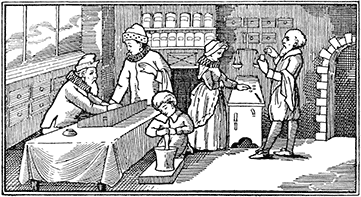
INTERIOR OF AN APOTHECARY’S SHOP.
From a drawing by Drapentier, 1670.
Then came the division of the apothecaries
from the druggists, the former in the process of
time becoming a subordinate class of practitioners
who attended an individual afflicted with some
internal disease not requiring external or manual
aid, and who prescribed for the cure of such
complaint and supplied the medicine; while the
latter were supposed to confine themselves to
the dealing in and preparation of drugs for the
apothecary.
The apothecary was paid for the medicine
which he supplied, which was not by
any means in small quantities, and so was supposed
not to encroach ostensibly upon the
province of the physician, who received his
remuneration for advice only, and did not provide
medicine.
In 1812 a tax was put upon glass which
increased the price of bottles greatly, much to
the chagrin of the apothecaries, who were paid
according to the number of draughts and potions
which they could induce their patients to swallow.
It was customary to place each dose of medicine
in a separate bottle, and charge it at the rate of
one or two shillings a dose, so the apothecary
naturally felt aggrieved at the glass tax, which,
however, was soon afterwards repealed.
The following excellent rules and regulations
were laid down by William Bulleyn for the
guidance of apothecaries of his time:—
THE APOTICARYE.
1. Must first serve God, foresee the end, be cleanly, pity
the poor.
2. Must not be suborned for money to hurt mankind.
3. His place of dwelling and shop to be cleanly, to please
the senses withal.
4. His garden must be at hand, with plenty of herbs,
seeds, and roots.
5. To sow, set, plant, gather, preserve, and keep them in
due time.
6. To read Dioscorides; to know the nature of plants
and herbs.
7. To invent medicines; to choose by colour, taste, odour,
figure, etc.
8. To have his mortars, stills, pots, filters, glasses, and
boxes clean and sweet.
9. To have charcoals at hand to make decoctions, syrups,
etc.
10. To keep his clean ware close, and cast away the
baggage.
11. To have two places in his shop—one most clean for
the physic, and a baser place for the chirurgic stuff.
12. That he neither increase nor diminish the physician’s
bill (i.e., prescription), and keep it for his own discharge.
13. That he neither buy nor sell rotten drugs.
14. That he peruse often his wares that they corrupt not.
15. That he put not in quid pro quo without advisement.
16. That he may open well a vein for to help pleurisy.
17. That he meddle only in his vocation.
18. That he delight to read Nicolaus, Myrepsus, Valerius,
Cordus, Johannes Placaton, the Lubri, etc.
19. That he do remember his office is only to be the
physician’s cook.
20. That he use true measure and weight.
21. To remember his end and the judgment of God; and
thus do I commend him to God, if he be not covetous or
crafty, seeking his own lucre before other men’s help, succour
and comfort.
In Glasgow the sale of drugs and poisons was
carefully restricted and regulated as far back as
1599. Under the terms of a charter granted
to the Faculty by King James VI., and dated
November, 1599, visitors were appointed, and
they were given
“Full power to call, sumonnd, and convene before thame,
within the said burgh of Glasgow, or onie otheris of ouir
said burrowis, or publict places of the foirsaids boundis, all
personis professing or using the said airt of Chirurgie, to
examine thame upon thair literature, knawledge and practize;
gif they be fund wordie, to admit, allow, and approve
thame, give them testimonial according to the airt and
knawledge that they sal be fund wordie to exercise thareftir,
resave thair aithis, and authorize thame as accordis,
and to discharge thame to use onie farder nor they have
knawledge passing their capacity, laist our subjectis be
abusit”.
It was further provided by “James, be the Grace
of God, King of Scottis,” in his fatherly solicitude
for his subjects, that
“The saidis visitouris sall visit everie hurt, murtherit,
poisonit, or onie other persoun tane awa extraordinarily,
and to report to the Magistrate of the fact as it is”.
The visitors were also empowered, with the
advice of their brethren, to make regulations for
the common weal anent the art of surgery, and
to inflict punishment upon those infringing them.
With regard to the sale of drugs, it was provided
that—
“Na manir of personis sell onie droggis within the Citie
of Glasgow, except the sam be sichtit be the saidis visitouris,
and be William Spang, apothecar, under the pane of confiscatioune
of the droggis”.
The responsibility of the seller is clearly defined
in a clause which further stipulates that—
“Nane sell retoun poison, asenick, or sublemate, under the
pane of ane hundred merkis, excep onlie the apothecaries
quha sall be bund to take cautioun of the byaris, for coist,
skaith, and damage”.
These powers were confirmed by Charles, “King
of Great Britain, France, and Ireland”.
The ancient apothecary believed in the administration
of physic in quantities which, in
these advanced days of infinitesimal doses and
concentrated preparations, would be considered
something alarming.
The following interesting extract is from the
diary of William Blundell, a celebrated cavalier
of Lancashire, who took an active part in many
of the conflicts in Cromwell’s time. On being
taken ill, we are told, he sent for his medical
man, one Dr. Worthington, of Wigan. The
doctor’s bill, together with some quaint remarks
thereon, are entered in the cavalier’s diary by his
man, Master Thelwall, as follows:—
1681. “After my master had been long ill
of a violent cold, Dr. Worthington came first
unto him on 8th January. He staid two nights,
and received for his pains £1 10s. He brought
along with him, a lohoch, ten pills, with a bottle
of spirits somewhat bigger than one’s thumb,
and a paper of lozenges, with French barley and
several ingredients for making the water thereof.
On the eleventh day he sent a glister, with a
large pint bottle of a cordial julep, and a small
bottle of syrups, to be sucked up with a liquorice
stick, also some small quantity of sal prunella.
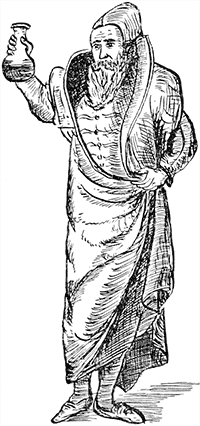
A PHYSICIAN.
From a drawing by Amman, Sixteenth Century.
“The doctor was with my master the second
time, on 17th January, and received for his pains
15s.”
Then comes the copy of Dr. Worthington’s
bill, dated 24th October, 1681:—
| |
£ |
s. |
d. |
| Spirits |
0 |
4 |
6 |
| An ointment |
0 |
1 |
4 |
| January 8. |
| Spirits |
0 |
4 |
6 |
| Ten pills |
0 |
2 |
0 |
| A lohoch |
0 |
2 |
0 |
| Lozenges |
0 |
4 |
0 |
| Jujubes and sibertines |
0 |
0 |
8 |
| French barley |
0 |
1 |
0 |
| Ingredients |
0 |
1 |
6 |
| Syrups |
0 |
3 |
0 |
| A cordial julep |
0 |
10 |
6 |
| A glister |
0 |
2 |
6 |
| January 11. |
| Syrups |
0 |
3 |
0 |
| White powder |
0 |
0 |
4 |
| Five pills |
0 |
1 |
3 |
| The oiled sugar |
0 |
7 |
0 |
| Syrups |
0 |
5 |
6 |
| Oil of sweet almonds |
0 |
1 |
8 |
| Spirits of ptisanne |
0 |
7 |
6 |
| For a messenger |
0 |
1 |
6 |
|
£3 |
5 |
3 |
Master Thelwall then goes on to say: “My
master’s opinion of these several things in particular,
is here to be inserted for further use,
viz., that the spirits first named, of which twenty-six
drops were put into one small cup of barley
water and beer, had no apparent effect, although
he doth not much doubt but the secret effect
might be good. That the like might be said of
the pills, mentioned in two places, although it
seemed that they did somewhat assuage his
cough, which was extremely violent. The lohoch,
a liquor like syrup, did apparently bring up
phlegm, and was well liked. The lozenges were
pleasant, and did sometimes stop the cough.
Barley water with the ingredients was cooling
and pleasant. Syrups twice mentioned, although
of much different prices, seemed to be the same.
“The cordial julep, of which there was a
large pint bottle, was pleasant, but the effect not
apparent. The glister extraordinary effective
and good. White powder, supposed to be sal
prunella, assuaged the thirst. The oiled sugar,
with the spirits ptisanne, besides the extreme
dearness, was almost wholly useless, in regard
that the patient being much in the mending hand
when they were sent unto him. He sent back
to the doctor about seven-eighths of the oiled
sugar, and yet he paid for the whole. The oil
of sweet almonds, of which seven or eight drops
were taken in a bolus of white sugar-candy,
frequently helped the breast made very sore by
coughing.”
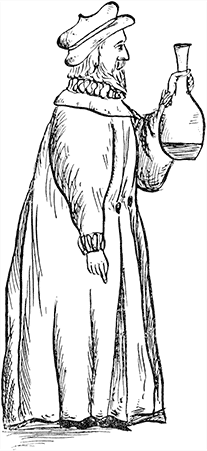
AN APOTHECARY.
From a drawing, 1641.
We subsequently learn that the good old cavalier
was at length cured of his ailments, which
he certainly ought to have been from the
multiplicity of the remedies employed. Many of
the forms in which medicine was administered
in those days have entirely gone out of use, and
others we have still with us.
Another example of the apothecary’s bill
appears in the appendix to the Eleventh Report
of the Historical Manuscripts’ Commission, among
the transcripts of the manuscripts of the
Marquess Townshend. There is one, dated
24th June, 1619, of a paper endorsed “The
Apothycarie’s bill,” Sir Roger Townshend’s
account, which contains the following items:—
| |
s. |
d. |
| “Grene ginger” |
7 |
0 |
| Tabacco |
2 |
0 |
| Grene ginger |
8 |
0 |
| A masse of pills |
5 |
0 |
| An electuarye |
3 |
6 |
Under the name of Mr. Stanhope Townshend,
12th September, 1618, are:—
| |
s. |
d. |
| “A clyster” |
3 |
4 |
| A julep |
3 |
0 |
| A cordiall with behoardston |
3 |
0 |
| The cordiall julep |
3 |
0 |
| Hearbs for brothe |
0 |
4 |
| Rose water |
0 |
6 |
| A suppositorye |
0 |
6 |
| Another suppositorye |
0 |
6 |
| An unguent |
0 |
3 |
| A purge |
3 |
0 |
| Purgeing pills |
2 |
6 |
The lohoch, the base of which consisted of
honey or thick syrup, was a very favourite form
of medicine for a cough, such as the lohoch
demulcent, lohoch of fox’s lungs, and lohoch
expectorant.
The julep was another ancient form of administration
much in vogue. Balsams, of
divers compositions, had great repute as expectorants.
William Blundell in his diary
(1681) mentions: “The Elder Lady Bradshaw
sent a bottle containing, as we guess, about one
ounce of balsam, which in her letter she calls
‘Balsam of Sulphur’. That it must be taken
morning and night, three or four drops, naked
and alone in a spoon; that it must be warmed
before it will drop at all, by reason its thick and
clammy.” The sugared oils were simply made
by triturating various essential oils with white
sugar, and usually given for their carminative
action.
Another favourite vehicle was broth, generally
composed of many and strange ingredients.
We have come across the broth of calves’ lungs,
broth of the bones of lizards, and broths made
from snails, tortoises, woodlice, crabs, and vipers.
The recipe for the broth of viper we have
taken from an old black-letter book, and is
rather curious:—
“  Living viper Living viper |
j. |
| Remove his head, tail and viscera, excepting his heart and
liver, cut it into little pieces and mix it with the blood, and
add— |
| Well water |
12 ounces |
| in a close vessel, boil for two hours and strain, and the
broth will be made.” |
The materia medica of the old apothecary was
largely drawn from the animal kingdom, the
greater part of it being, no doubt, handed down
from a very early period, when witchcraft and
superstition exerted a powerful influence on the
minds of the people.
Among the many curious things used, we find
that the liver of a mad dog, or a wolf, washed in
wine and dried in a stove, was employed as a remedy
for hydrophobia. The nimble lizard had a reputation
as a sudorific and antisyphilitic. Dried
toads and the cast-off skins of snakes and adders,
were administered in dropsy as a diuretic.
The horn of rhinoceros was used in epilepsy,
and goat’s blood and eel’s liver as a cure for
dysentery. The oil of frog’s spawn was celebrated
as an application for chilblains. The
jawbone of a pike and the spine of a lamprey in
powder, were prescribed for leucorrhœa. Pepys
mentions in his diary, that he wore a hare’s foot
as a sovereign remedy against the plague, in
which charm he seemed to place more faith than
in the various plague waters that were recommended
to him as unfailing antidotes for that
terrible disease.
In the time of Edward I. there was a list of
drugs recorded by the king’s physician, one
Nicholas de Tyngewyke, in 1307, which throws
an interesting light on the pharmacy of that
period. The list includes distilled oil of turpentine,
aromatic flowers for baths, carminative
electuaries, plasters and ointments of various
kinds, the oils of wheat, ash, and bay, water of
the roses of Damascus, wine of pomegranates,
remedies prepared from pearls, jacinths, and
coral, and many other drugs. The king was
taken ill at Carlisle, and the cost of conveying
these remedies from London to that city amounted
to £159 11s. 10d., the apothecary’s bill for the
medicines being £134 16s. 4d.
In 1596 Sir Henry Winton, who was sent as
ambassador by Elizabeth to Henry IV. of France,
met with an accident while on his mission.
According to the records “he was physicked
with confectio alcarmas, which was composed of
musk, amber, gold, pearl, and unicorn’s horn,
and with pigeons applied to his side, and all
other means that art could devise sufficient to
expel the strongest poison, and he be not bewitcht
withall”.
The apothecaries of the seventeenth century
were not overburdened with the estimable virtue
of modesty, as instanced in the following quaint
announcement:—
“Cornelius Tilbury, sworn chirurgeon-in-ordinary
to K. Charles II., to his late Sovereign K.
William, as also to her present Majesty Queen
Anne—address at the Blue Flower Pot, in
Great Lincoln’s Inn Fields, at Holbourn Row
(where you see at night a light over the door);
and for the convenience of those that desire
privacy, they may come through the Red Lyon
Inn in Holbourn, between the two turnstiles,
which is directly against my back door, where
you will see the sign of the Blue Ball hung over
the door.
“I dispose of my famous Orvietan, either
liquid or in powder, what quantity or price you
please. This is that Orvietan that expelled that
vast quantity of poison I took before K. Charles II.,
for which his Majesty presented me with a
gold medal and a chain.”
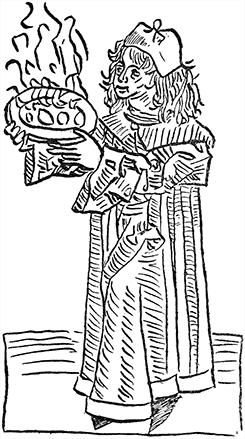
AN APOTHECARY.
From an engraving, 1517.
The physician’s fees were by no means small
in the time of the Commonwealth, as may be
judged from the following extract from the
Memoirs of the Verney Family:—
“Sir Theodore Mayerne is buryed,” writes
Dr. Denton, “and died worth £140,000.” Sir
Ralph thought £30 too small a fee to pay Dr.
Denton for his attendance on his wife during her
confinement, but for his pressing poverty he
would have sent him £50, equal to about £200
of our present money. Dr. Radcliffe’s regular
fees were estimated to bring him in an income
of at least £4000 a year; Dr. Mead’s were valued
at between £5000 and £6000. Sir George
Wheler’s sickness, after a Christmas dinner at
Dr. Denton’s, cost him “the best part of £100”.
He had caught a chill after dancing, which
turned to “a spotted feavour”; Sir George
Ent was called in: he had all sorts of “Applications
of Blisters and Loudanums”. “My
Apothecary’s ... bill came to £28. He was
a good man, and told me if I fell into a feavour
again, Sage Possit would do me as much good as
all the Physitians Prescriptions.”
In Sir Daniel Fleming’s account books we
have record of the amount paid to medical practitioners
in 1659, as follows:—
| To Doctor Dykes for comeing and laying
plasters unto Will |
£0 |
10 |
0 |
| For his plaisters and paines contributed towards
the cure of Will, the sum of |
5 |
0 |
0 |
A further entry also shows the value of the
midwife’s services at the same period. Under
date
July 30th, 1659. Given unto Daniel Harrison’s wife for
being my wife’s midwife, 5/-.
In the household books of Lord William
Howard we learn that on 25th September, 1612,
he paid one Mr. Adamson, an apothecary of
Keswick, “for xxii dayes and his physick, £xiii.
vi,s. viii,d”.
Some of the early preparations used in pharmacy
were as elaborate as they were mysterious.
The Treacle of Andromachus the elder, a
recipe of great antiquity, contained sixty-three
ingredients; and the celebrated Mithridate of
Damocratis contained forty-eight.
The origin of the formula for “Mithridates”
is ascribed to Mithridates, King of Pontus,
whose recipe Pompey brought to Rome, where
Damocratis sang its praises and proclaimed its
virtues. It was considered by the ancients a
panacea for every ill. Of the historic preparation
known as the Treacle of Andromachus, its
invention is attributed to that worthy. Pliny
says that the formula of a similar composition
was inscribed in verse 300 years before the
Christian era upon the temple of Æsculapius, and
that Andromachus merely imitated, by order of
Nero, the composition of the Mithridate, which
had then been known for a considerable time.
Of the forms of administration there were a
great variety in the sixteenth century, and many,
such as the Rob which consisted of the juice of
fruits boiled down to two-thirds, the lohoch, and
the treacle, have quite gone out of use.
But notwithstanding modern research and
scientific advance, some of the ancient formulæ
still survive and are employed to-day.
It may not be generally known that the preparation
known as hiera picra was originated by
Galen, on the properties of which he placed high
value on account of its excessively bitter taste.
Charas states that the great physician gave it the
name of hiera picra or holy bitter.
In the pil. aloes. et myrrh. of the British Pharmacopœia,
commonly known by the old name of
Pil. Ruffi., we have a formula handed down intact
for over a thousand years.
In mediæval times ladies were not above using
preparations to beautify their complexions, and
among others for this purpose, we find the
formula of a cerate composed of white wax,
spermaceti, oil of cole seed, bismuth, borax, and
alum, which was spread on a cloth to cover
the face at night, and worn as a mask.
Among the parts of the body used as medicine
was human blood, on which some early
physicians set great value for the cure of epilepsy
and diseases of the brain.
Charas, in his Royal Pharmacopœia, says: “In
the month of May take a considerable quantity
of healthy young men’s blood, let blood in that
season who are not red haired. This blood is to
be distilled twice, or spread on plates and dried
in the sun or an oven. All writers extol the
volatile salt of man’s blood, for the cure of
epilepsy, it being also very proper to suppress
vapours that arise from the stomach and spleen.”
In a Celtic leech-book preserved in the University
of Leyden, which is said to have been
written in the ninth century, there are the
following curious recipes:—
“1. To prevent wrinkles. Smear the face with a mixture
of water and the pounded root of wild cucumber. Wash
with cold water. ‘Hóc sí triduo facere uolueris mirabilem
effectum uidebis.’
“2. To remove freckles. Rub a bull’s gall on the face.
“3. To cure headaches. Gather plantain-root before sunrise,
and tie it on the head. Use also the juice of the seed
of the elder-tree, a cow’s brain, goat’s dung dissolved in
vinegar; swallows’ nests mixed with water, and applied to
the forehead; water out of which an ass or an ox has
drunk.
“4. To purge the head. Pour the juice of cabbage (brassica)
into the nostrils.
“5. For dimness of the eyes. Pound fennel-roots, mix
with honey, and boil over a slow fire; add cistern-water or
woman’s milk. Smear the eyes with the fat of a fox (adipe
volpis).
“6. Another remedy. Mix a child’s urine (lotium infantis)
with the best honey; add a decoction of fennel-roots (‘omnem
caliginem mirabiliter discutiet’).
“7. The beginning of this paragraph has been cut off.
The remedies prescribed are butter and cram occifæth (garlic...?),
mixed with ram’s fat (‘per aruinam ariætis’).
“14. To cure the bite of a dog. Apply two or three onions
calcined and boiled with lard and honey.
“15. To extract a straw from the eye. Chant the psalm
Qui habitat (Ps. 90) thrice over water, with which then
douche the eye, et sanus ærit.”
Among the various remedies fish play a
prominent part. For gravel it is recommended
that the head of a pike be boiled in a newly-glazed
earthen pot, then reduced to powder and
drunk in a glass of white wine. A sure means
of curing gout is to wear continually three or
four moles’ feet tied to one’s garters. For nose-bleeding,
the sufferer is advised to blow up the
nose the powder of a stone found in the head of
a carp, or to plug up the nostrils with hare’s
fur. A certain remedy for curing a drunkard of
his evil way is to give him as many eggs of the
screech owl, boiled hard, as he can possibly eat,
when we are assured he will ever after be a total
abstainer.
In the first book of the Secretes of the reverent
Maister Alexis of Piemont, 1562, which is a kind
of general receipt-book for the apothecaries of
the time, there occur some curious formulæ,
which may be taken as a fair example of the
pharmacy of those days. The process of making
the oil of red dog is given with elaborate detail.
“To make an oile of a redde dogge,” says the
chronicler, “by the meane whereof (beside other
infinit vertues that it hathe) I have healed a
Fryer of Saint Onostres, who had by the space of
twelve years a lame and drye withered arme,
lyke I styche so that nature gave it no more
nouryshement—
“Take a yonge dogge of redde heare and
keep him three days without meate, and then
strangle him with a corde, and let him lie dead a
quarter of an houre, and in the meane time
boyle a kettell of ayle up by the fire, and putte
the dogge in whole, or in pieces, it maketh no
matter howe, so that he be all there with the
skynne and heare; make him seethe so untyl he
be almost sodden to pieces, keepying always the
kettell close covered: In the meane tyme take
scorpions to the number of four score or a hundred,
and put them in a basyn on the fyre untyll
they be thoroughly bruised. Then putte them
in the sayde kettell with the ayle and the dogge,
puttinge to it a good dishful of great grounde
wormes, well washed, a good handful of Saint
John’s Worte, a handful of wylde marshe mallowes,
and a handful of wallworte, with an once
of saffron. Seethe all these things well to-gether,
and then let it ware colde.” The liquid being
strained off and certain aromatic gums added,
the preparation was complete.
The belief that carrying a piece of camphor
will ward off infectious diseases, is a relic of the
old days of amulets and charms. In 1547
Alexis recommended compounds to carry against
the plague and fever, and we find that aromatics
were used to perfume clothes in the time of
the early Jews, long before the birth of Christ.
Among other secrets of Alexis, there is a
curious recipe to “cause mervelous dreames”.
“Take the bloode of a lampwink or black
plover, and rubbe your temples with it and so
goe to bedde, and you shall see mervelous thinges
in your sleepe; or else if you eate at nighte a
little of the herbe Solani or Visicaria, or some
Mandragora, or elles of the herbe called in
Greek Hyoscymus, in Latin hath these names,
Altercum, Appolinaris, and Symphonia, and in
the English some call it Henbane, and you
shall see in the nighte goodly things in your
dreame.”
The apothecary apparently omits to mention
that a heavy meal of very ordinary cheese, combined
with the succulent fruit of the cucumber,
before you go to bed, will also make you see
marvellous and weird things in your sleep.
The gifts and wisdom of the apothecaries
were according to their writings very wonderful,
but none perhaps is more remarkable than the
following recipe on a matter which would baffle
the scientists of the present day.
The chronicler writes: “To make a woman
that beareth alwaies daughters to beare also
sonnes, it is a thing very easy, and hath good
succes, and hathe been divers times proved.
Let her eate an herbe in English called mercurie,
which hath only two seedes; also the skrapings
of an elephant’s tooth.”
The name of the originator of the “everlasting
pill” has not been handed down to posterity, but
whoever he was, he was certainly an economist,
and could not be charged with inventing it for
his own gain. It consisted of a small globule of
metallic antimony, which was believed to have
the property of purging as often as it was
swallowed.
A single pill of this kind would serve a whole
family during their lives, and was doubtless,
transmitted as an heirloom to posterity.
Paris says, “we have heard of a lady who,
having swallowed one of these pills, became
seriously alarmed at its not passing through”.
“Madam,” said her physician, “fear not; it has
already passed through a hundred patients without
any difficulty.”
It is said to have been the constant custom of
Cardinal Wolsey to carry in his hand an orange
deprived of its contents and filled with a sponge
soaked in vinegar, impregnated with various
spices, in order to protect him from infection
when passing through the crowds of people
which his splendour of office attracted.
An old writer, one James Penrose of the
middle ages, questions if Cleopatra applied the
asp to her breast as is commonly supposed,
because, as he remarks, “the veines are so very
slender”.
“Petrus Victorius blames the painters who
depict the Egyptian queen applying the asp to
her breast, seeing it is manifest out of Plutarch
in the life of Antonius, and out of Plinie likewise,
that she applied it to her arme.”
“Zonares relates, that there appeared no signe
of death upon her, save two blew spots on her
arme.”
“Cæsar also in her statue, which he carryed
in tryumph, applyed the asp to her arme; for in
the armes there are great veines and arteries
which doe quickly and in a straight way convey
the venom to the heart, whereas in the papps the
vessels are slender.”
Gesnerus gives a method used by the
apothecaries for changing the colour of the hair
which is somewhat singular. It is by means of
one of the many waters of the philosophers, and
is made as follows, in the language of the text:
“Take a moule which serveth unto the dying
or coloring of heares whyte, eyther of man or
beast; let the moule be artely brought to
powder with Brimstone, adde to it the juice of
celandine which orderly be myxed, let to stande
for certaine dayes, after dystill the whole according
to taste. The virtue of this water is in
such wise, that if a beast wholy blacke of heare
shall be washed all over with this water, the heare
shall in that time became so whyte as snowe.”
The aloe mentioned in the Bible, usually in
connection with myrrh and frankincense, is not
the same drug as that used in medicine to-day,
and is even without its bitterness. It is the product
of the Aquilaria Agallocha, a tree of large
size growing in the Laos country and Assam.
The wood is light in colour and inodorous, but
under certain conditions a change takes place in
it, and it becomes charged with a dark
aromatic juice. It was formerly used as a spice
in embalming, and is employed in China and the
East as incense in the temples.
A curious little work, entitled The House
Apothecary written by Dr. Gideon Harvey,
physician-in-ordinary to his Majesty, and printed
in 1670, affords a further interesting glimpse
at pharmacy 200 years ago. It would appear
that the apothecaries then, like some of
their descendants of the present day, excited
a considerable amount of jealousy among the
physicians by prescribing in certain cases, and
meddling generally “in matters which they did
not understand”.
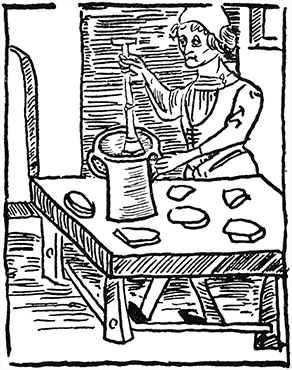
AN APOTHECARY.
From an engraving, 1517.
The worthy doctor begins by recommending
people to prepare their medicine at their own
homes, it being a far safer and easier way than
sending it to the apothecary to be made, and as
a further inducement states: “And you shall
also save nineteen shillings in twenty shillings,
according to the extravagant rates charged by
many apothecaries, in so doing. I must tell you,
I have oft seen bills of apothecaries rise to
twenty, and sometimes thirty pounds in the
time of a fortnight; and what is more, I have
known an apothecary’s bill so extravagant that
the sum at the bottom of his account amounted
to fifty pounds in the space of thirty days, when
the ingredients of the whole course could not be
computed to stand him in forty shillings.” A
severe indictment indeed.
The doctor then goes on to inform us that
“in preparing medicines at home you may be
certain the ingredients are sound and fresh, and
you can have your medicines without attending
the apothecary’s leisure or having the trouble of
sending three or four times to his shop for
them; and, most important of all, you may be
assured in so doing you shall save nine pounds
in ten, and sometimes forty-eight pounds in
fifty”.
Another treatise written to denounce the excessive
charges of the apothecaries was The
Accomplished Physician, the Honest Apothecary,
and the Skilful Surgeon, published and sold at
the “Angel” in Duck Lane, in 1656. It
attacked the unfortunate apothecary on all
sides. It states that “if the apothecary finds
you costive he sends you a clyster, at the price
of half a crown, which by consulting The
Accomplished Physician, etc., you may learn
how to make yourself for three half-pence.
If he apprehends your stomach to be oppressed,
he orders his man to boil a little cardamoms
in water, strain it, and put to it three or four
spoonsful of rank oil of sweet almonds, to cause
you to vomit and carry off a little phlegm, and
for this he charges you half a crown, which
you can make yourself for two-pence.”
The author finally confides to the public “that
it is fortunate that the little apothecaries and
prescribing surgeons have not much knowledge
of the great medicines, such as mercury and
antimony, as they would at most times do great
mischief with them, using them at unseemly
times, as if you laid hold of a club to knock
down a louse; such great medicines should only
be used by the physicians, who should reserve
them in secret”.
Most of the herbs and roots in common use
were brought to the town markets and vended
by the physical herb-women, who would bring
them in baskets to Newgate Market, Gutter
Lane, or Covent Garden, and there sell them
by the handful, a dozen for a groat. The
measures in use were of a very primitive description,
chiefly the fascicle and the pugil.
In 1656 a quart white glass bottle cost 1s.
6d., and a green glass retort 8d. Plague
water at certain times was in great demand,
and was usually sold at the apothecaries for
3s. 6d. a pint. The price of most conserves
was 2d. an ounce, and ointments retailed at 8d.
an ounce. An ointment that was much in
vogue and very popular among the people
was Unguentum Ægyptiacum, similar to the
ointment of the great Felix Wurtz. Its composition
is somewhat interesting and quaint.
“Take of verdigriese 12 drachms ground very
fine in a brass mortar, observing while you are
powdering to hold your head back from the
mortar and keep your mouth and nose stopped,
to prevent those venomous steams from getting
up into your brain. Then take 3 ounces of honey
and 12 drachms of sharpest vinegar, place them
in a broad brass pipkin, put in the verdigriese,
stir and boil them on a gentle fire unto the
thickness of an oyntment of a purple colour.”
Of the waters in common use the Accomplished
Physician gives directions for the preparation of
several. The London treacle water, aqua mirabilis
and aqua raphani composita, were noted for
scurvy. The London snail water was recommended
as an invaluable remedy in consumption,
which, “owing to the cool, clammy, and glutinous
substance of the snail, facilitated the
expectoration and repaired the parts consumed”.
Gascon’s powder, or pulvis é chelis cancrorum,
was regarded as a valuable medicament, and
much esteemed and ordered by the great physicians.
It was an expensive mixture, and contained
equal parts, in powder, of crab’s eyes, the
oriental pearl, red coral, white amber, oriental
bezoar, and the black tops of crab’s claws. It
was sometimes ordered and taken in the form of
pills mixed with hartshorn jelly. The apothecary’s
price for this powder was 40s. an ounce,
or one penny per grain. We are told that if
made at home the cost would only be 13s. 11∕4d.
Another preparation exceedingly popular in the
seventeenth century was the emplastrum opodeldock
of Feliz Wurtz, “so much cried up
among surgeons beyond the sea”. It was a red
plaster, composed of wax, Venice turpentine,
juice of celandine, oak leaves, ammoniacum, galbanum,
and vinegar. Then some powdered
magnets, and such mysterious compounds as
Crocus Martis, Crocus Veneris, and prepared
tutria, were thrown in, and all boiled together.
The following is extracted from an old price
list of the seventeenth century, which gives a
good idea of some of the extraordinary articles
kept in the old apothecaries’ shops, and the
prices charged. It is headed “Rates and prices
currant of Druggs and other commodities, belonging
to physick, as they are commonly sold
at the Apothecaries and Druggists in London,
1685”:—
| Mother of Pearl |
6d. per oz. |
| Crab’s eyes |
5s. 4d. per lb. |
| Crab’s claws |
1s. 6d. |
” |
| Fox’s lungs |
2s. |
” |
| A mummy |
5s. 4d. |
” |
| Bone of stag’s heart |
1s. 6d. |
” |
| Borax |
4s. |
” |
| Saltpetre |
10d. |
” |
| Jalap |
3s. 4d. |
” |
| Rhubarb |
14s. |
” |
| Liquorice |
1s. |
” |
| A boar’s tooth |
1s. each. |
| A dead man’s skull (cranium
humanum) according to size |
8s. to 11s. each. |
| Musk |
5s. per drachm. |
| Bloodstone |
2s. 8d. per lb. |
| Opium |
12s. |
” |
| Elaterium |
36s. per oz. |
| Lac Sulphur |
3s. |
” |
| Red coral |
4s. per lb. |
| Oleum Copaibæ |
2s. per oz. |
| Gum acacia |
10s. per lb. |
| Turmerick |
8d. per lb. |
| Elicampane |
1s. 4d. per lb. |
| Galingal |
4s. |
” |
| Gentian |
8d. |
” |
| Spanish Liquorice |
6d. |
” |
| Hellebore, white |
1s. |
” |
| Hellebore, black |
1s. per lb. |
| Pyrethrum |
1s. |
” |
| Sarsaparil, according to its
goodness, from |
4s. to 5s. per lb. |
| Squills |
6d. |
” |
| Winter’s Bark |
2s. |
” |
| Lig. Aloes. |
9d. per oz. |
| ”Guaici |
2d. per lb. |
| Senna Alex., the best |
4s. |
| Cubebs |
2s. 4d. per lb. |
| Nucis Vomicæ |
1s. 4d. |
” |
| Cardamom |
4s. |
” |
| Aloes Succot, according to its goodness |
4s. to 6s. per lb. |
| Scammony |
12s. |
” |
| Cantharides |
4s. |
” |
| Civet |
5s. 6d. per dram. |
| Ising-glass |
5s. 4d. per lb. |
| Sea-horse tooth |
4d. per oz. |
| Sea-horse pizzle |
4d. |
” |
| Skink, a piece |
1s. 4d. |
| Spermaceti |
3s. per ounce. |
| Stag’s pizzle |
6d. |
” |
| Elk’s claw |
2s. a piece. |
| White wax |
2s. per lb. |
| Yellow wax |
1s. 4d. per lb. |
| Cinnabar |
3s. per oz. |
| Mercury Sublimate |
5s. 8d., or 6s. per lb. |
| Seed Pearls |
4s. to 8s. per oz. |
| Mother of Pearl |
6d. per oz. |
| Mithridate |
6s. per lb. |
| Aqua Fortis |
5s. 4d. per lb. |
| Ol. Cinnamon |
£1 12s. per oz. |
| Ol. Vitrioli |
5s. 4d. per lb. |
Besides the above, precious stones in powder,
and diamond powder, which was regarded as a
powerful poison, commanded very high prices.
To obtain a clear conception of the great advance
that has been made in medicine and pharmacy, it
is necessary to look back through the vista of
centuries at the Elizabethan apothecary. In
doing so, we should note how the influence of
superstition and charlatanry, with which the art
of healing was surrounded and intermixed, has
been gradually dispersed under the searching
light of science. One can picture the apothecary’s
shop in the days of “good Queen Bess”.
Up a narrow winding street, paved with
round cobble stones, and no pathway to
protect you from the jostling and nudges of
the passing chair-bearers, French pages, and
watermen who throng the thoroughfares, his
abode may be denoted perhaps by the gilded
crocodile which hangs over the doorway,
accompanied by a pole from which depends a
pair of brightly-burnished metal pans, denoting
the practice of the chirurgical art. The
overhanging gables of the half-timbered houses
darken the low-roofed shop, through whose
small windows filled with little panes of
bottle glass, a very dim light penetrates. A
mysterious odour permeates the interior and
strange things are seen hanging from the rafters,—flying
fish, tortoises, and a long alligator float
mid-air. Strings of poppy-heads, bunches of
chamomile and centuary, also glass jars containing
adders and worms adorn the counter. On
one shelf an array of bright brass mortars, and
round about on others, a great collection of
quaint bottles and earthen pots, containing
electuaries, unguents, and lohochs; syrup bottles
with long curved spouts, and bladders full of
seeds and wax. In the corner stands the great
iron mortar, whose heavy pestle is suspended
from a spring beam, and another is filled with
little drawers to hold the gums and spices.
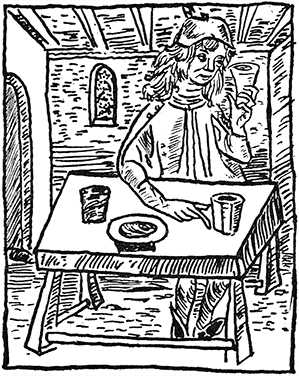
AN APOTHECARY.
From an engraving, 1517.
Away at the back a red glow appears from
the furnace, and alembics, big and little, lie
about. At night the shop is crowded with poor
women buying worm-seed for their children or
treacle to drive out the measles, and with country
people who have come for drugs and drenches
for their sick cattle. “There are serving-men
waiting for their masters’ purgatives and electuaries,
or the fops’ facewashes of oil of tartar, lac
virginis, and camphor dissolved in verjuice.
Smart maids are buying conserves and sackets
for their mistresses, or perfumes for my lady’s
chamber. Here desperadoes and rakish gallants
could purchase poisons, and blushing maidens
would buy their love charms and philtres, or
antidotes to counteract the same. Some apothecaries
kept a little room for taking tobacco, furnished
with silver trays, and a maple block for
cutting it, where the gallants met and gossiped,
or learned tricks in smoking from fashionable
professors, for nearly all the apothecaries sold
tobacco—real Timidado—nicotine cane, and
pudding, as it was called.” The old apothecary’s
prescriptions were composed of strange ingredients,
sometimes crab’s eyes and boar’s teeth, or
powdered pearls, and viper broth. He would
recommend you a toad, well dried in the sun,
put in a bag, and hung round the neck by a
string low enough to touch the region of the
heart, to allay hæmorrhage. A preparation of
garlic and honey smeared on the person was a
certain charm against the bites of vicious dogs
and reptiles, or the stings of venomous insects.
Toothache could be charmed away by a few
leaves of the “shepherd’s purse” placed in the
sole of the shoe. An excellent recipe for sore
eyes was the expressed juice of the calyx of the
red honeysuckle, provided always that the flowers
were gathered kneeling and repeating nine Pater
nosters in honour of the Trinity, nine more “to
greet our Ladye,” and a creed. My Ladye
Falkenbrydge’s recipe for eye-water was much
esteemed, and ran thus: “Corne-flowers gathered
with their cuppes and bruyse them; macerate
them in snowe or snowe water for twentye-foure
houres, then dystyl in a moderate sandebath and
applye it night and morning”. This was prescribed
in 1553. A favourite cure for rickety
children was to pass them through the split stem
of a tree. For ague, a very well salted herring,
split open, was applied hot to the soles of the
feet; or an emerald worn round the neck formed
a potent charm against the same complaint. The
learned Boorde, in his Breviary of Health, says:
“The medical treatment of the day was a mixture
of religious theories, superstition, and white
magic”. He recommends for a bad rheum the
application of oil of scorpions and fox fat; for a
bruised skin, washing it with white wine and
plastering with an oak leaf; and he quaintly states
“the best remedy for itching is long nails and
scratching,” which, at any rate, is common-sense.
To preserve the health and a good complexion,
he recommends young maids to wipe their faces
daily with a scarlet cloth, and only wash them
once a week.
Another peculiar phase of pharmacy in those
early days was the instructions of the various
apothecaries’ guilds to their members as to prayer.
The compounder of prescriptions was directed
to go down on his knees and supplicate before
he commenced his labours. Many old herbals
and works on pharmacy, especially in Germany,
contain curious wood-cut illustrations of the
apothecary at his devotional exercises. Cyriacus
Schnaus, an apothecary of Nuremberg, published
a book in 1565, wherein he, in person, is represented
as kneeling on a large mortar before
a sacred picture. This custom may have been
originated by the monks, many of whom followed
the art of healing.
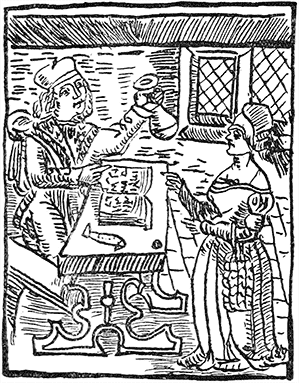
A PHYSICIAN FORECASTING FROM THE URINE.
From an engraving, 1517.
A writer of the time states that the itinerant
dentist was also a well-known figure at the street
corner. For 100 marks he would put out both
your eyes, and quite cure your inflammation
with one drop of his aqua mirabilis, at twelve-pence
a drop. He offered you an antidote from
stab or bullet for five marks, and by his side
waved a banner stuck all over with horses’ teeth,
to show his skill.
He cured your toothache by charms, sometimes
writing mysterious words on a paper, and
burning it under your nose; or he would sear
your teeth with hot wires, most effectively; or
make you inhale the hot vapour of henbane
seeds, and then show you the worms that he had
conjured out, which are certes now wriggling in
the water. He wore a chain of molar teeth
around his neck, and shook them from time to
time as he held up a bottle of liquid and called
out: “These are the spirits that pass with the
blood into the rheum, to vex the teeth of men”.
His descendants may still be seen at the present
day working wondrous cures, decked out in
similar fantastic garb, or extracting teeth gratis,
and by sheer bold impudence reaping a golden
harvest.
Having thus shown how the now almost
forgotten pioneers of science laid the foundation
of the arts of medicine and pharmacy, and how
much we owe to their patience and diligence,
a brief reference may be made to the class of
medicaments in use in the days of Queen
Elizabeth, immediately prior to the differentiation
in England of the first pharmacists—the
apothecaries—and the beginnings of pharmacy
as a separate art.
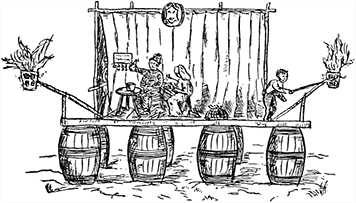
AN ITINERANT DRUG SELLER.
From a fifteenth century drawing.
“A few simples,” says Burton, “well prepared
and understood, are better than such a heap of
nonsense, confused compounds, which are in
apothecaries’ shops ordinarily sold.”
For madness and melancholy, wormwood was
used. Another remedy was clarified whey, with
borage, bugloss, endive, succory, etc., a good
draught of which was taken in the morning,
fasting. For the spleen and liver, syrups were
prescribed composed of borage, thyme, epithyme,
hops, scolopendra, fumitory, maiden-hair,
and bizantine. These syrups were mixed
with distilled water by the apothecaries, or stirred
into juleps.
Of conserves there were innumerable varieties,
and ointments of oil and wax, as well as liniments
and plasters of herbs and flowers, well
boiled with oil or spirits.
Cataplasms and salves were frequently made
of green herbs sodden, pounded, and applied
externally.
Gradually, as the years have rolled on, and as
the science of chemistry has unlocked the marvellous
resources and products of nature, most of
these old relics of the days of superstition and
witchcraft have been left behind and forgotten,
and it remains only for some old black-lettered
tome to tell the story and for us to fill in the
background to the picture.
In the early part of the eighteenth century, the
enterprising empiric seems to have hit on a new
method of lining his pockets at the expense of
the public, and we have the advent of the so-called
proprietary or quack nostrum, which has
developed into such gigantic proportions in later
years. To bring some special drug into notoriety
in those days it was first necessary to spread
some tale abroad as to its extraordinary virtues,
then by means of a pamphlet (for there were
few other advertising media) recount the marvellous
cures it had performed, and back them
up by mentioning a few great names. In this
way the quack medicines originated.
In a similar manner, some drugs that have
since proved of great use to humanity were
brought into note. Peruvian bark was first
imported into Spain by the Jesuits, where it
remained seven years before a trial was given to
it. It was first administered to a Spanish priest
in 1639, and but for the supreme power of the
Church of Rome it would in all probability have
sunk into oblivion. Pope Innocent X., however,
at the intercession of Cardinal de Lugo,
ordered the bark to be duly examined by the
best experts of the time, and on a favourable
report being presented, it at once rose high in
favour.
The “Elixirs of Life” made by the early
alchemists may be said to have been the forerunners
of quack medicines, and for these concoctions
fabulous prices were demanded. Those
made by Paracelsus and Van Helmont were
known throughout Europe, and must have
brought considerable grist to the mill of their
proprietors. The Collyrium of Danares, which
enjoyed a wide reputation in the seventeenth
century, was sold at £9 per bottle. Then there
was the Sympathetic Powder of Sir Kenelm
Digby, noted for healing wounds, and Hoffman’s
Water of Magnanimity. Another famous nostrum
made by Paracelsus was called Præcipitatus
Diaphoreticus Paracelsi, and warranted to cure a
fever in four days.
“Dutch drops,” which were originally sold
for half a guinea a bottle, are said to have
brought the proprietors £2000 in one year.
The Eau Médicinale de Husson, another well-known
quack nostrum, was introduced by an
officer of that name in the service of Louis XVI.
It is said to have been simply a decoction of
meadow saffron. Dr. James’ celebrated fever
powder, which enjoyed a great reputation in this
country, is stated to have been the invention of
an Italian named Lisle, and a recipe for its preparation
was published in Colborne’s English
Dispensary in 1756. Oliver Goldsmith believed
this to be a remedy for all ills and took it
regularly up to his death.
The Count St. Germain, a Frenchman, realised
large sums by vending an artificial tea, which he
affirmed would prolong life. It is said to have
been composed chiefly of senna and fennel leaves.
The Chevalier d’Ailhoud was another adventurer
who introduced a powder which met with such
a sale that he soon saved enough to buy a whole
county. That prince of empirics the Count Cagliostro
sold his Balm of Life, or stomach elixir,
at an exorbitant price. He asserted that he
had lived 200 years by its use, and was rendered
invulnerable against poison of every description.
During his residence in Strasburg, while boasting
and expounding the virtues of his nostrum
and antidote to a large assembly of the townsfolk,
a physician who was present, and who had
not taken part in the conversation, quitting the
room quietly, went to an apothecary’s shop and
ordered two pills to be made of equal size.
Taking them with him, he made his way back
to the room, and walking up to the loquacious
quack he said, “Here, my worthy Count, are
two pills. The one contains a deadly poison,
and the other is perfectly innocent. Choose one
and swallow it, and I will take the one you
leave.”
The Count took alarm, and after making all
kinds of apologies and excuses, at last refused to
swallow the pill. The physician, smiling, then
took his place on the platform, and in view of
the company swallowed both, and then, to the
discomfort of Cagliostro, announced that both
pills were simply composed of bread. The
Count beat a speedy retreat.
In 1794 considerable sensation was excited by
the account of some wonderful cures made by a
Count Thün of Leipzig, who professed to cure
gout, hypochondria, and hysteria by laying his
hands on the head of the patient.
The early part of the present century saw a
great increase in the number of these nostrums,
the usual method adopted by their proprietors
being to set up in great style in a fashionable
part of the town, and by lavish display and
various eccentricities, to attract general attention.
Among the foremost in London was a German
Jew who called himself Doctor Brodum. This
individual, who, it is said, started life as a footman,
took a large house in a fashionable square
in the west-end, and drove a pair of horses
in a gorgeous chariot. He called his nostrum
“Nervous Cordial,” its properties being set forth
in a pamphlet entitled A Guide to Old Age. He
is said to have amassed a fortune in a very short
time.
Another notorious quack was Doctor Solomon,
who eventually settled in Liverpool. He originally
sold blacking in Newcastle, but finding it
did not pay, came to Liverpool, where he tried to
establish a newspaper. This effort also proved
a failure, and Solomon at length turned his
attention to quack doctoring, and brought out a
nostrum called “The Balm of Gilead”. This
proved successful, and he soon made enough
money to build himself a substantial house in
Kensington, which was at that time a fashionable
suburban district. To advertise his preparation
he wrote a pamphlet called The Guide
to Health, extolling the virtues of the “Balm
of Gilead and Anti-Impetigines”. This treatise,
the cover of which was adorned with an engraving
of his mansion at Kensington, stated “the
most learned physicians have been unable to
discover in the cordial Balm of Gilead the least
particle of mercury, antimony, or any other
mineral except pure virgin gold and the balm of
Mecca”.
The Doctor was a well-known character in
the streets of Liverpool in the early part of this
century, and in his daily promenade always
carried an elaborate gold-headed cane. The
celebrated “balm” is said to have been simply
brandy flavoured with some aromatic oil, and
although sold at a guinea a bottle, was in great
demand.
A story is told of a prominent tradesman of the
time, who discovered that his wife was consuming
considerable quantities of the invigorating balm.
Being further informed that this had become a
common habit with many of her friends, he took
counsel with the husbands of these ladies, with the
result that they determined to punish the doctor
by carrying out the following plot. On a certain
dark night, a messenger was despatched to the
doctor’s house, asking him to come at once and
see a patient a little way out in the country, and
to be sure and bring with him several bottles of
his Balm of Gilead. The unsuspecting victim
soon set out on foot along the country lanes, and
on getting to a very lonely part, was pounced
upon by four men disguised in cowskins, who,
with long horns and tails, looked like fiends
incarnate. The poor doctor thought his last
hour had come, and went down on his knees and
invoked all the prophets he could think of; but
his tormentors dragged him off to a field close
by, where they made him swallow bottle after
bottle of his own nostrum, then ducked him in
a pond and tossed him in a blanket.
Solomon was so incensed at this outrage he
determined to leave Liverpool and settle in
Birmingham, but in a short time returned to the
former city, where he died, and was buried,
according to his directions, in his own garden.
The following verse, referring to these empirics,
is extracted from an old ballad:—
“Brodum or Solomon with physic,
Like death, despatch the wretch that’s sick,
Pursue a sure and thriving trade;
Though patients die, the doctor’s paid!
Licensed to kill, he gains a palace
For what another mounts a gallows!”
The electropathic girdles of our own time
had their anti-type in Perkin’s far-famed tractors
for preserving health, for which the proprietor
demanded the sum of five guineas a set.
The wonderful properties attributed to them
were set forth in a small book, entitled The
Influence of the Metallic Tractors on the Body.
Among the nostrums that enjoyed popularity
in the early part of this century were De
Velno’s Vegetable Syrup, Dr. Senate’s Lozenges
of Steel to prolong life, Leake’s Patent Pills, Dr.
Burton’s Vital Wine, Beddoe’s Volatile Cordial
Oxygen Gas for preserving life, Dr. Squirrel’s
Tonic Drops and Powders, Godbold’s Vegetable
Balsam, and many others.
The foibles of many of the most prominent
empirics of the period are well hit off in the
following old ballad:—
“We can boast of a Beddoe’s whose oxygen gas
Can render immortal the ape and the ass;
While Swainson the botanist, son of Apollo,
Swears we ne’er shall be sick if his syrup we swallow.
Derry down.
“While Solomon flies on the wings of the wind,
His magical Balm of Mount Gilead to find,
Little Brodum stands stewing his herbs in a copper,
And to vend his decoction for gold he thinks proper.
Derry down.
“Dull Gardner, destroyer of worms and of men,
Like Leake, sells his pills to rouse death from his den;
And Perkins stands brandishing two-pointed tractors,
To heal the contusions of girls, beaux, and actors.
Derry down.
“There’s the lotion of Gowland that flays ladies’ faces,
Distorting the features of our modern Graces;
There, Lignum’s dire pills—but of quackery enough!
Let John Bull take his pipe and contentedly puff.
Derry down.”
The mortar is the most ancient of pharmaceutical
implements, its earliest use carrying us
back to prehistoric times, when the early Briton
bruised his grain in the hollow of a granite
boulder. There is little doubt indeed that
mortars were employed for the purpose of bruising
and reducing hard bodies to powder, centuries
before medicine as an art was thought of
or known.
The name is derived from the Latin word
mortarium, which is probably from the root
mordeo, to bite, akin to the Sanscrit mrid, to
grind or to pound; the literal meaning of the
word being a vessel in which substances may be
pounded with a pestle.
The origin of the mortar appears to have been
identical with that of the mill or quern as it was
called in ancient times. The primitive implement
used by prehistoric nations for the purpose
of crushing their grain, was simply made by
hollowing out a cup-shaped hole in a block of
stone or granite, and pounding the grain placed
in this receptacle with a smaller stone of suitable
form. These grain-crushers, together with
stone rollers and pounders, have been found
in the circular huts of the Britons in several
parts of North Wales.
This method was also used by the early Jews
before the Christian era for crushing their spices
and gums, the knowledge of which they doubtless
gathered from the Egyptians during the
captivity.
In many of the ancient Egyptian papyri we
find directions given to bruise
certain herbs and roots, but no
mention is made of the implement
used for that purpose;
carvings in stone, however, are
extant which show the mortars
used by the Egyptians were
similar in form to those employed
several centuries later.
It is interesting to note that
the mortar has also been known
to several Oriental and savage
races from time immemorial;
and in the mortar employed by
the pharmacist to-day we have an implement
that links us not only with prehistoric man,
but also with the savage races of the world.
In Africa, mortars and pestles of wood have
been used from a period of unknown antiquity
for the purpose of crushing grain. The one
illustrated in Fig. 1 is composed of wood,
and was brought from Central Africa. In
India, stone mortars with wooden pestles have
for centuries been used for shelling and pounding
rice. Fig. 2 represents a Cingalese mortar
of stone, from two to three feet in height, taken
from a drawing of the seventeenth century.
Coming to the time of the Roman Empire,
we have the first real evidence of the use of the
mortar for pharmaceutical purposes. Medicine
and pharmacy allied, in the time of Celsus, had
become practical arts; and we know from the
preparations described by that author that practical
appliances were necessary. Thus the malagma
used as an application to the skin was a kind of
soft mass directed to be beaten up to the consistency
of a thick paste; and the ingredients of
the catapotia were often ordered to be bruised
before being mixed.
Roman mortaria composed of earthenware are
very commonly found, and many examples may
be seen in most of our museums among other
Roman remains. They were chiefly made for
domestic use, and although they vary very little
in pattern, the sizes are numerous. The larger
ones are, as a rule, very strongly made, and all
have a thick divided rim with a rounded moulding.
The inside was roughened with splinters
of flint or hard stone, or hard-burnt earthenware,
which was fixed on with a kind of “slip”
or liquid clay with
which the Romans
finished their ware.
A wooden pestle
was used with these
mortaria, which
were no doubt
chiefly employed for triturating and mixing
various condiments for domestic use. The
Roman mortarium shown in Fig. 3 is twenty-eight
inches in breadth, and bears the stamp of
the maker’s name, showing it to be the work of
one Publius Raso.
Some of the smaller mortaria found are
composed of a very white clay of a vitreous
character burnt hard like porcelain, and are nonabsorbent.
These were probably used for mixing
more delicate condiments.
There were large manufactories for mortaria
in Britain, situated chiefly in the south of
England, at the mouth of the Thames, and in
Essex and Staffordshire. From these factories
there was a considerable export trade to Rome
and Gaul.
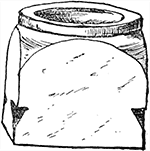
Roman mortars of stone are much rarer, and
the one depicted in Fig. 4
is a unique specimen, and
was with little doubt at
one time used for pharmaceutical
purposes. Composed
of stone, with a solid
square base, it stands about
twelve inches high, and
is about eight inches
broad. The notches at the corners are evidently
intended for fixing it down on a wooden table
or slab, to keep it steady when being used for
pounding or breaking up hard substances. Closely
akin to mortars were the querns or small mills
used for grinding purposes from the Roman
period. In shape they somewhat resembled the
mortar, but were covered in at the top, having a
hole in the centre through which the pestle was
worked. They were made of stone and wood.
A beautiful example of a wooden quern is depicted
in Fig. 5.[8] It stands thirteen inches
high, and is made of very
hard wood. It is an exquisite
specimen of the
turner’s art, some of the
side mouldings being of
great delicacy, no thicker
than a fine needle, yet
perfectly true in every
particular. The pestle was
worked through the hole
in the centre of the cover.
These wooden querns were
used during the sixteenth and seventeenth
centuries.
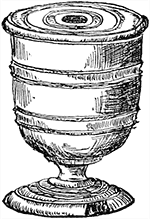
There is little doubt that marble succeeded
stone as a material for making mortars, and this
brings us down to mediæval times, when the
apothecaries, combining the practice of medicine
and pharmacy, became wielders of the pestle.
The value of the mortar as a pharmaceutical
implement was recognised by these early practitioners,
and was given the most prominent position
in their shops, and so the pestle and mortar
became a symbol or trade sign of pharmacy.
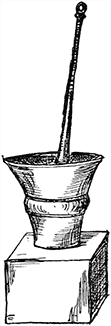
The great bell-shaped mortar, which was of
considerable capacity, usually stood, mounted on
a solid block of wood, near
the centre of the shop, the
huge pestle, three feet or more
in length, being suspended from
a long wooden spring beam by
a chain and ring. One can
readily picture the youthful
apprentice, clad in jerkin and
trunk hose, exercising his
muscles with the ponderous
pestle, and with what mingled
feelings he would essay the task
of pounding half a hundred-weight
of aloes to begin his
day’s work and give him an
appetite for his midday meal.
These large mortars were usually
bell-shaped in form, as illustrated in Fig. 6, and
composed of iron or bell-metal. The smaller
mortars of this period were made of brass,
copper, and bell-metal, and were occasionally
ornamented with some symbol or device. Many
were very elegant in form, and they usually stood
in bright array on the counter. The pestles
were made flat, top and bottom, so that either
end could be used for pounding.
The bell-metal mortar depicted in Fig. 7
dates from the time of Oliver Cromwell, and
bears the arms of the Commonwealth on both
sides. It was probably once the property of an
official State apothecary. The brass mortar shown
in Fig. 8 is peculiar in shape, and is supported
by four short legs. It dates from the early part
of the seventeenth century, and round the
middle are inscribed the letters of the alphabet.
Fig. 9 represents a particularly handsome example
of the brass mortar of the seventeenth
century. Copper mortars when polished have a
very elegant appearance, and are somewhat rare.
A specimen is depicted in Fig. 10. A very
fine bell-shaped mortar of brass was found in
Chester about two years ago, and is now deposited
in the museum of that city. It stands
nearly two feet high, and dates from the early
part of the eighteenth century.
Small brass mortars were also formerly used
by housewives in the stillroom, and for other
domestic purposes, and may often yet be found
ornamenting the kitchen mantelshelf in old
country houses.
During the last and the early part of this
century Italian marble was largely employed for
making mortars, but with the introduction of
wedgewood and composition ware, which is
lighter, more durable, and less liable to be acted
on by chemicals, marble mortars have now almost
gone out of use with pharmacists.
Small antique mortars of bronze are still to be
found in many French pharmacies, often bearing
some symbol or device, such as St. Michael and
the dragon.

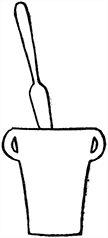
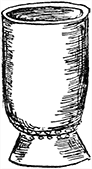
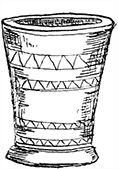
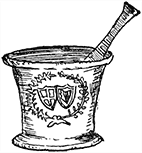
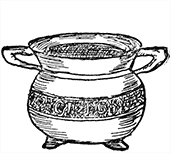
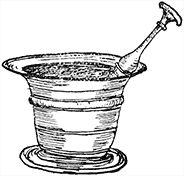
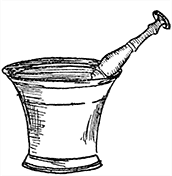
 , and copper is termed Venus, represented
by the symbol
, and copper is termed Venus, represented
by the symbol  . It appears to have
been a custom of the apothecaries from very
early times to fill bottles with coloured solutions
which were marked with these symbols; thus,
a bottle containing a yellow solution signifying
gold would be marked
. It appears to have
been a custom of the apothecaries from very
early times to fill bottles with coloured solutions
which were marked with these symbols; thus,
a bottle containing a yellow solution signifying
gold would be marked  , signifying iron. These gradually
became a kind of trade sign, and are
probably the origin of the coloured globes used
as the insignia of the pharmacist or compounder
of medicines at the present time.
, signifying iron. These gradually
became a kind of trade sign, and are
probably the origin of the coloured globes used
as the insignia of the pharmacist or compounder
of medicines at the present time.