The night nursery was in darkness, save for
the red glow of the fire, and the occasional
flickering light of a little yellow flame that seemed
to wake up every now and then and light up the
room, casting strange black shadows on the
ceiling. In three little white beds lay three
boys. At least they should have been lying,
but, as a matter of fact, two were sitting up,
with expressions of sullen rage upon their tear-stained
faces, and one was lying in a huddled
heap beneath the bedclothes, sobbing.
“For goodness’ sake stop that beastly sniveling,
you little cry-baby,” said David.
The sobbing ceased for a minute, then, from
beneath the bedclothes, came the muffled voice
of Nipper. “I—I’m not a cry-cry-cry baby.”
The sobbing went on.
“Nipper,” said David sternly, “you have no
reason to bleat like that. You only got four, an
me and Bill got a dozen each.”
This brought Nipper from beneath the bedclothes.
“That’s ’cos I have more sense in my little
finger than you two fat-heads have in the whole
of your bodies. I trod hard on grandfather’s
worst corn, and that made him drop the birch.
I jolly soon picked it up, and threw it out of the
window. And he couldn’t find nothing else to
beat me with, so he let me go. It’s not for the
beating I’m crying, it’s for something else. I
was going to tell you about it, but as you’re both
such beasts I shan’t now.”
Having delivered himself of this speech, Nipper
retired under the bedclothes, and began a series
of mournful sounds. Now, though David was
ready of speech and full of ideas, Bill, his twin,
was a man of action. It was always David who
thought of splendid schemes, but Bill who carried
them out. Leaning far out of his bed he
reached for one of his boots, and, taking a careful
aim, landed it with a thud upon Nipper’s
huddled figure. This brought forth Nipper’s own
special performance and chief means of defence,
a siren-like shriek. As was to be expected, it
brought Nurse to the door.
“Now then, you naughty boys,” she said, “if
I hear another sound I shall go and tell your
gran’pa.”
“You can jolly well go,” said David, “he’s
lost the birch.”
“If you aren’t quiet at once,” continued
Nurse, “I shall not allow you to go to the horseshow
to-morrow.”
“That’s all right,” said David. “Grandfather
has already forbidden us to go——”
“But we’re jolly well going all the same,” added
Bill in an aside.
“You shan’t have any jam for breakfast,”
said poor old Nurse in despair. This was a serious
matter.
“Then here goes,” said Bill, in a spasm of rage,
and he let fly his remaining boot.
It struck the old Nurse very hard on the hand.
She had rheumatism, and the blow hurt her.
With a little exclamation of pain she retired, and
shut the door.
A regular bally-rag then began. Pillows flew
across the room, and before the fight was finished
Bill’s nightshirt was torn from top to bottom,
and David’s nose was bleeding.
And in the playroom Nurse was talking sadly
to Eliza as she darned the boys’ stockings. The
piece of news she was giving Eliza was the very
piece of news that Nipper had heard, and which
had caused his tears.
“The master has given me notice,” she
said, wiping her eyes. “He says it’s all my
fault the way the boys behave, and it’s got so
terrible he won’t stand it a moment longer. He’s
given me notice, and he’s going to get a strict
governess, who won’t stand any nonsense, and
will get them into good discipline. From the
day those twins were born I’ve looked after
them—ten years, now. And Nipper’s just on
eight—and I’ve got to leave them!” Poor old
Nurse laid her head down on the basket of stockings
and broke down. Since the boys’ parents
had been drowned in a shipwreck the old woman
had had them under her care, but they had repaid
her with selfishness and disobedience.
The way the “young gentlemen up at the Hall”
behaved was the talk of the village. They would
steal fruit, not only from their grandfather’s
glasshouses, but from the poor people’s little
gardens. They would let out Farmer Johnson’s
pigs, and chase them all over the village. There
was nothing too bad for them to do.
“I pity the person as will have the looking
after of them,” said Eliza. “I only hope the
master will get someone really strict.”
CHAPTER II A COUNCIL OF WAR
It was three weeks later that David called a
Council of War in the garden. Nurse had
departed with her boxes. Grandfather had engaged
a “strict governess.”
The Council of War had met in the old pigsty,
where all really secret Councils took place. This
being a really important Council, the refreshments
consisted of peaches and the best hothouse
grapes—stolen, of course, from the hothouse,
though the boys knew well enough the
old gardener would get into trouble with his
master, and as likely as not one of the under-gardeners
would get the blame.
“And so the dragon is to arrive at six o’clock
to-night,” said Bill. “Her name is Miss Prince.”
“Can’t you just see her?” said David, the
imaginative one. “She will be very tall and
bony, and about a hundred, with grey hair all
screwed up in a little knob, and big round goggles,
and teeth like an old horse, and a voice like—like—like——”
“Like the ugly sisters in the Cinderella pantomime,”
said Nipper.
“And she will dress in a stuffy old black
dress, all over buttons and spiky whalebone things,”
added David.
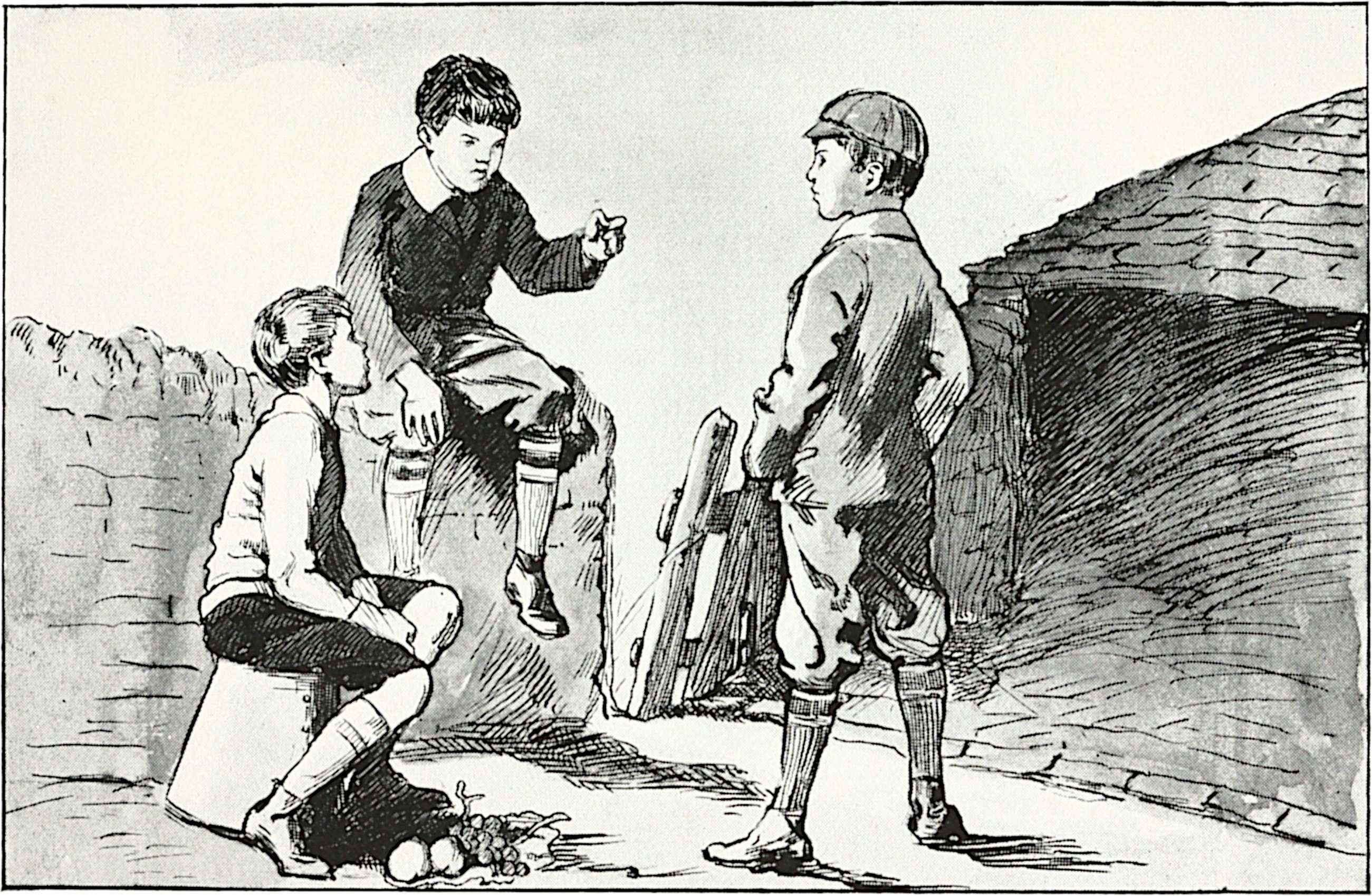
“Well,” said Bill, “is war declared?”
“Yes!” shouted the other two.
“And we’ll have martial law. Nothing is too
bad for Miss Prince,” interposed David.
“I say—frightfulness,” said Bill.
“Yes—the frightfulest frightfulness,” said the
other two.
“We will jolly well show her we are not going
to be ‘managed’ or ‘disciplined’ or bullied,”
said David.
“We’ll bully her,” said Bill, “and I bet you
she leaves in a week.”
“How shall we welcome her?” said David.
“I should say an apple-pie bed, with worms and
slugs in it.”
“Yes. Also mice in her room—they always
hate mice.”
“And a booby trap on the door.”
And so the Council of War proceeded to draw
up plans against the new governess.
Meanwhile, a train was speeding along between
green fields and leafy woods. In a corner of a
carriage sat a girl, looking out of the window, and
thinking to herself, “What jolly country for scouting
this would be!”
She looked about twenty-four or twenty-five.
She had the kind of face a boy would call jolly,
and the kind of nice blue eyes that seem to smile
at you and make you feel—“This is a friend;
one can talk to her and tell her things, and she
will understand, although she is a grown-up.”
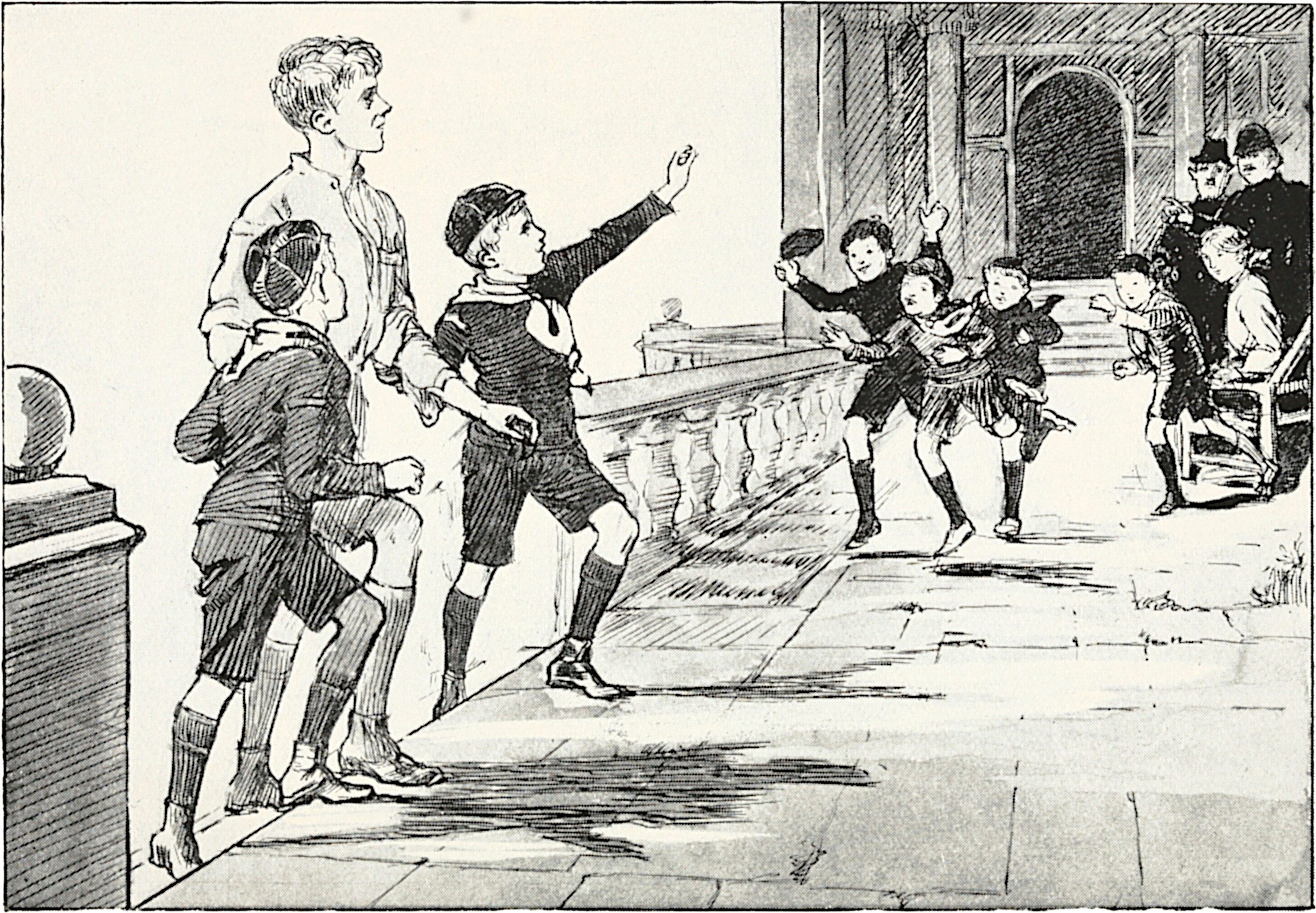
“Well,” said Bill, “is war declared?” “Yes,” came the determined reply.
[To face page 14.
Presently the girl sighed. “How jolly hard
it was saying good-bye to the Cubs!” she thought
to herself. “But I mustn’t ‘give in to myself’
and feel unhappy. After all, I am going to some
more boys. Dear little chaps, they sound awfully
jolly and a good handful to manage. I should
feel rather homesick if it was not for the thought
of them. But they are sure to give me a good
welcome, and we will soon make friends.”
She smiled to herself, and the train thundered
on between the green fields.
CHAPTER III THE COMING OF MISS PRINCE
“Listen!” whispered David, “I hear the
wheels of the carriage at the front door.
Three groans for Miss Prince!”
The front door was opened, and Miss Prince
came into the hall. She was just a little disappointed
not to see the three boys waiting to
welcome her, as she had expected.
“She’s not like the Ugly Sisters!” said Nipper
in a voice full of disappointment. He was peeping
through the balusters, the twins peering over
his shoulders.
“I expect that way of smiling and pretending
to look nice is just camouflage. She’s sure
to be a perfect beast inside,” said David.
The booby trap unfortunately came down on
the housekeeper’s head as she showed Miss Prince
to her room. The boys distinctly heard Miss
Prince laugh, and then pretend she had only coughed
and try and comfort Mrs. Biggs. Then they
heard her discover the mice in her chest of drawers.
“Mice!” she said. “Dear little things!
I love mice. But oh, how cruel! Someone
has tied them by their tails!” They heard her
freeing the mice. “How untidy my bed looks!”
came Miss Prince’s voice presently. They heard
her open it, then she laughed.
“No go,” said Bill dejectedly. “It’s going
to be harder work giving Miss Prince frightfulness
than I thought. But we’ll stick to it, won’t
we, boys?”
“We will!” said the other two.
And they did. Not one civil or friendly word
could Miss Prince get from them, try as she
would. They were rude to her; they disobeyed
her every order; they pretended they could not
read at all when she started lessons with them,
and added up every sum wrong on purpose. They
told her lies, and hid when she wanted them.
Perhaps their hard little hearts would have
softened a little if they could have known how
their rudeness hurt and disappointed Miss Prince,
and how lonely she felt without her own friendly
Cubs. But she didn’t let them see; she was
always cheerful and patient.
A week passed like this, and Miss Prince, who
had been determined not to give in, began to
despair. Being kind to them was no use; punishing
them was no use. Their grandfather
was furious, and told Miss Prince that he saw
she could not manage them. A friend of his had
told him Miss Prince could manage forty fierce
Wolf Cubs, and he had said she would easily be
able to tame three little boys, however wild.
But she had failed; it was not much use to go
on trying. Then Miss Prince got a brilliant idea.
“Mr. Ogden,” she said, “I think I know a
way in which those boys could be altogether
changed and made into really good little chaps.”
Mr. Ogden grunted like a cross bear. “Do
you?” he said. “I don’t.”
“Will you give a trial to my plan?” said Miss
Prince.
“I’ll try anything under the sun,” said Mr.
Ogden. “What’s your plan?”
“It is to let me write and engage a boy I know,
named Danny Moore, to come and act as companion
to the boys, and their own groom. Jones,
tells me he needs help with their ponies, and is
too old to go out riding with them much longer.
This boy is a Patrol-leader in the Scouts. I
have known him ever since he was quite a little
chap. He is a splendid leader, and can manage
the most difficult boys and turn them into good
Scouts. He has a good knowledge of horses
too. I know he would come at once if I wrote
to him, and if it’s possible to do anything with
your grandsons, Danny will do it.”
“Do as you like,” said Mr. Ogden sourly. “I
wash my hands of the whole business.”
That night Miss Prince posted a letter to Danny.
In it she told him of the almost hopeless job she
had got—of taming three perfect little terrors.
She asked him to come and turn them into Wolf
Cubs for her. She told him to bring his uniform,
and that she would tell him the plan she had
made for the way he was first to see them when he
arrived.
Danny answered that he would be there in
three days, and Miss Prince’s hopes began to
rise.
CHAPTER IV “DANNY THE DETECTIVE”
Two days later, the boys having been even
worse than usual, Miss Prince shut the door
firmly and said: “Now, boys, I am going to
give you a new punishment for this disgraceful
behaviour. I am going to sit on the floor, and
you three are to sit on the floor in a row in front
of me, for twenty minutes, and keep perfectly
silent.”
“Not much!” said Bill, with his cheekiest
air.
Miss Prince sat down on the floor. “There
was once a boy called Danny,” she began. “He
was always known as Danny the Detective by
his friends. One day a wonderful adventure
happened to him.” The three boys stopped
whistling and listened. Miss Prince went on,
talking very quietly. They had to come nearer
to hear. It got so thrilling, and they got so
excited about Danny and the German spies, that
before long they were sitting on the floor, as silent
as mice, their eyes fixed on Miss Prince. More than
half-an-hour had passed before the story was finished.
Then they realized that for once they had
done as they had been told, and they began to be as
rude as ever.
“Of course, all that is a pack of lies!” said
Bill.
David’s eyes were shining with excitement;
he did so wish he was Danny himself. But he
felt he ought to support his twin and keep up
the frightfulness, so he made a rude remark, too.
“Danny is now a Scout,” said Miss Prince.
“He is very fond of camping out in the wood
and cooking his meals in a billy-can on a wood
fire. Perhaps you will come across him one day
when you are in Prior’s Wood. But I’m afraid
he would not want you as his friends—you’re so
awfully rude and selfish. I’m afraid he’d call you
‘little Huns’!”
“I don’t believe anything about Danny,” said
Bill.
“Nor do I,” said the other two. But in their
hearts they decided to visit Prior’s Wood.
It was the day after this strange new punishment
had taken place. Bill, David and Nipper were
having tea in the Play-room, when Miss Prince,
who had looked anxiously out of the window many
times during the last half-hour, heard the wheels
of the dog-cart on the drive, and hurried downstairs.
The cart had driven round to the stables,
and there Miss Prince followed it.
As she came up, a boy had just jumped out,
and was taking a kit bag from under the seat.
He was a boy of fifteen, medium height, with a
very sunburnt, cheery face, and eyes that looked
straight at you when he talked, as if he had never
had anything to hide or be ashamed of.
“Hullo, Miss Prince!” he cried, with a grin.
“Hullo, Danny!” she said. “How nice to
see you again! You seem just like a bit of home!”
She led him into the house, through the great,
oak-panelled hall, to her own little sitting-room.
There they had a long talk. When they came
out Danny was laughing.
“I think it’s a splendid plan,” he said. “I’ll
do my best to make it come off successfully.”
CHAPTER V IN THE WOODS
It was a glorious autumn morning—one of
those mornings when the wind seems to have
swept the world very clean, the sky is very blue
and clear of clouds, the sun shines on the red-and-gold
leaves, and you feel happy just to be
alive. The boys woke up feeling almost good,
but, remembering the campaign of frightfulness
against Miss Prince which they were determined
to carry out, they asked each other what they
should do to-day.
“I’ll tell you what,” said David. “She said
she was going to start a new plan for lessons
this morning. It would annoy her awfully if we
ran away all the morning, and she couldn’t start
her precious plan! It’s such a ripping day, why
should we sit in a stuffy schoolroom?”
“Right you are!” said Bill. “I vote we go
and play wild buffaloes with Farmer Tomkinson’s
calves. He’s just bought a lot of new
ones, and if we let them out on to the heath, we
could have some jolly good sport—especially if
we take the dogs and the long carriage whip.”
“Hush,” said David. “Squat down before he sees us.”
[To face page 23.
“I shan’t come with you,” said Nipper. “I
have a plan of my own.”
“Out with it, kid!” said Bill, twisting his
small brother’s arm till he started his siren-shriek.
“Let go!” he yelled, “and I’ll tell you. I’m
going to explore Prior’s Wood. Don’t you remember
that story she told us? And she said
we might find the Scout if we went in Prior’s Wood.”
“I think,” said Bill, “we’ll leave the calves
for to-day, and go to Prior’s Wood. It’s probably
all a pack of lies, but we might as well go
and see.”
And so, after breakfast, before Miss Prince
had time to call them for lessons the three boys
ran out across the fields to the wood. They had
not gone far when David stopped short.
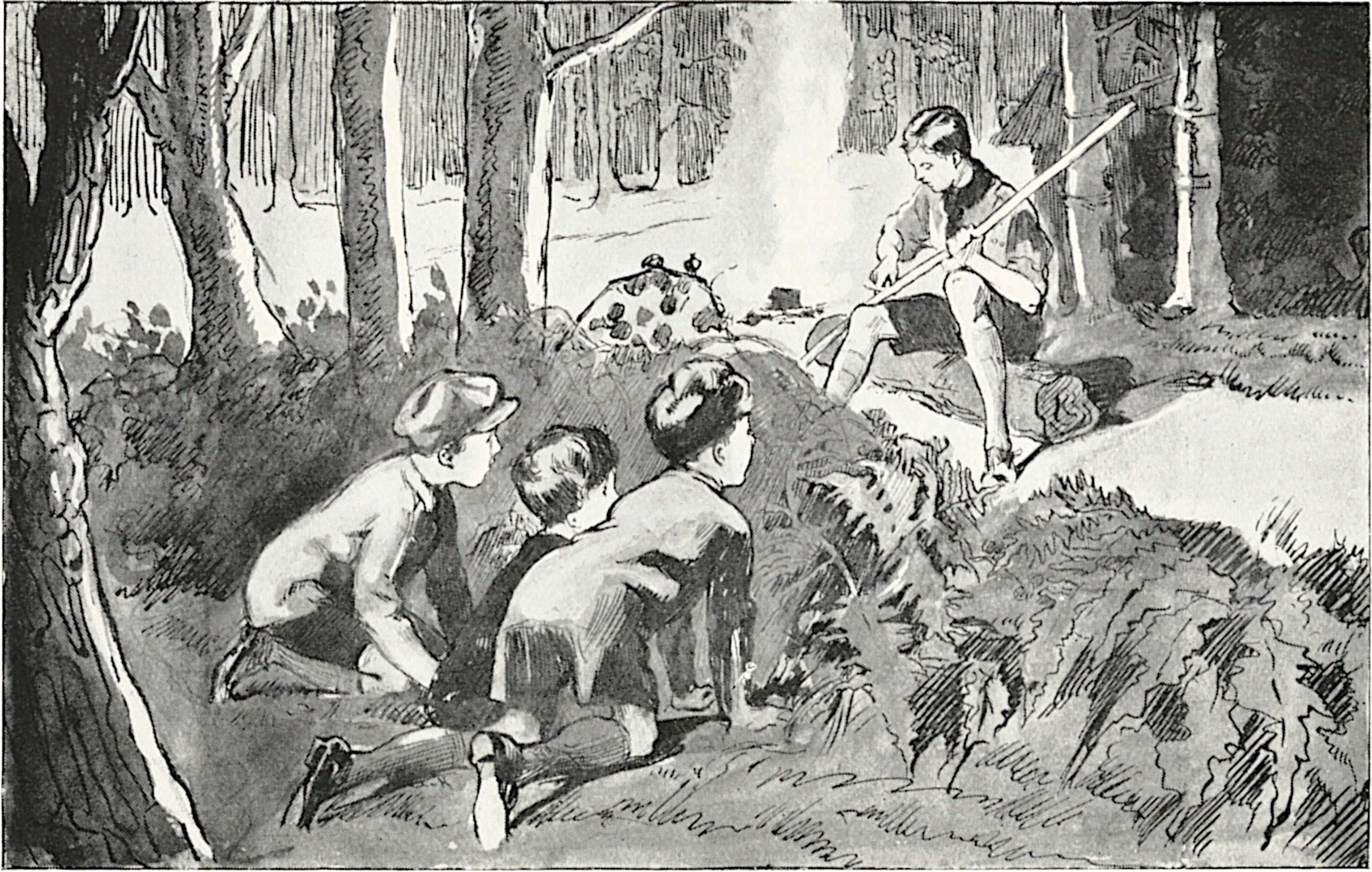
“Hush!” he said. “Squat down before he
sees us—quick!”
The other two followed his example, and squatted
down, peering cautiously over a clump of bracken.
They had reached a little clearance in the
wood, where the ground was carpeted with soft
green moss, and a small stream gurgled noisily
along. On the banks of the stream was a little
hut, built of branches and bracken, between the
trunks of three trees.
A little distance from this a bright wood fire
burned, sending a steady column of blue smoke
up into the sunny air. A billy-can boiled away,
standing on a thick piece of wood, whilst on a
big, moss-covered log sat a boy. He had bare,
brown knees and bare, brown arms and a khaki
shirt, his red neckerchief making a bright splash
of colour among the greens and browns of the
wood. He had a knife in his hand, and he was
carving wonderful patterns on a straight ash
stick he had cut for himself. As he worked he
whistled softly.
The three boys, squatting in the ferns, watched
him. Presently he got up and added some wood
to his fire, and peeped into the boiling pot. Then
he fetched an apple out of his hut, and sat down
again on the log. Suddenly a robin swooped down
on to a twig quite close, and stared with big, bright
eyes at this boy who had come to share his own
particular corner of Prior’s Wood.
The boy, just as if he knew the language of robins,
began to whistle, very softly, in little trills. The
robin cocked his head on one side and answered
with much the same kind of whistle. Then he
swooped down on to the end of the very log Danny
was sitting on, and they went on with their whistling
conversation.
“I believe he can talk to the birds!” whispered
Nipper, with round eyes.
Just then an enormous water rat appeared on
the opposite bank of the stream, and began swimming
across. Bill’s hand shot out instinctively for
a stone.
“Shut up, you ass!” said David.
“But I could just hit him on the head beautifully,”
said Bill.
“Sh—sh! The Scout will kill him, I expect,
when he gets nearer. Let’s see how he does it,”
whispered David.
But, strange to say, the Scout, after watching
the big rat land, moved noiselessly across to his
hut, and came out with a bit of cheese, a little
piece of which he poked softly across to the bank
with the end of his stick. The rat had vanished.
But before long he came out, fetched the piece of
cheese, and ran back to his hole. The Scout put
another crumb, nearer this time. The rat came
out and fetched that. Gradually he came nearer
and nearer.
Presently he got so bold that he stayed and
ate the crumbs of cheese quite close to Danny—and
then sat up and cleaned his whiskers with his
little pink hands, and seemed to be combing his fur
and brushing his little round ears.
The three boys watched, fascinated. They
had never before thought of making friends with
a water rat and watching his habits. Their
first thought had always been to kill the happy
little creature, who was out enjoying the morning
sunshine.
Suddenly Nipper could sit still no longer; he
stretched his legs, which broke a rotten twig and
made such a noise that Danny looked round and
saw the three heads watching him through the
bracken.
“Hullo!” he said. “Come and see my little
camp.” He smiled and looked so friendly that
the three boys got up and came half-shyly out into
the open space.
CHAPTER VI THE LAW OF THE WOLF CUB PACK
The mysterious boy of the woods took them
into his hut, and showed them how it was
built. Then he let them put wood on his fire, and
after that he gave them each an apple.
“You pinched those from old Crookedshank’s,
I know!” said Bill.
Danny looked surprised. “No,” he said; “I
bought them from Mr. Cruikshank.”
“You silly!” said David. “He’s as deaf as
a post, and there’s a big hole in his fence just
by the apple-tree. Fancy buying apples!”
“Then you would have stolen them from a
very poor and deaf old man? What a dirty
trick! Besides, stealing is a sin, and no chap with
a sense of honour would do it.” He looked very
serious, and for the first time in their lives the
boys felt really ashamed of themselves and had
nothing to say.
But Danny had changed the subject. He
showed them how to carve sticks. He told them
all sorts of things about birds and squirrels and
rats. But first of all he made them each a bow
and some arrows, with pheasants’ and pigeons’
feathers, which they found in the woods, to make
them go straight.
“I wish we could always stay with you,” said
Nipper suddenly, “and live out in the woods,
and learn to talk to the birds, and shoot with
our bows, and be always happy, with no more
rows and jawings and punishments.”
“Yes!” said David and Bill together. “And
could you make us Scouts? We’d win lots of
badges.”
Danny laughed. “You’re too young to be
Scouts,” he said, “but you might be Wolf Cubs.
Who are you?”
“We live up at the Hall,” said David. “Mr.
Ogden is our grandfather.”
“Oho!” said Danny. “So you’re the little
terrors I’ve heard so much about!”
The boys hung their heads.
“My word! you’re not the sort of chaps they
have in the Cubs!” he continued. “From all
I hear, you seem to be regular little Bolsheviks!
Do you know, Cubs have to do a good turn for
somebody every day, but you seem to do a bad
turn to somebody every day—and more than one,
too.”
The boys were silent.
“Squat down,” said Danny, “and I’ll tell you
a bit about Cubs. It’s not all play, you know.
Chaps who join the Cubs have to behave decently,
whether they’re in uniform or not. Once you’ve
taken the Cub Promise, you’re a Cub all the time,
day and night. The Cubs have two laws they’ve
got to keep. One is obedience—they promise to
obey the grown-ups. Could you do that?”
“We never have,” said Bill, digging his fingers
into the moss, “but we could if we tried.”
“Then the second law says you mustn’t give
in to yourself—that means, you mustn’t do all
you feel like doing, whether it’s right or wrong.
You mustn’t steal Mr. Cruikshank’s apples, and
say rude things to people, and tell lies, and fight
each other.”
“It would be very hard to keep all that,” said
Nipper, “but it would be worth it—to be Cubs.”
“And I think perhaps we should be happier,”
said David thoughtfully. “I’m tired of doing
frightfulness against Miss Prince.”
Then Danny told them about the Promise—first,
loyalty to God. But they had to admit
they never thought about God at all, never said
morning or night prayers, never went to church,
never did anything in order to please God.
Danny looked very serious. “Poor little chaps!”
he said suddenly. “But you’ll learn to do better
now, and God will forgive you for being so selfish
and ungrateful.”
He told them a lot more about Cubs, and their
eyes shone with excitement.
“If we come down here after dinner, will you
make us into Cubs?” said David.
Danny laughed. “A Cub isn’t made as quickly
as all that,” he said. “You will have to show
you’re worthy of taking the Cub Promise and can
keep the Cub Law. Oughtn’t you to be at lessons
this afternoon?”
“Yes,” said the boys.
“Well,” said Danny, “if you go back and
tell Miss Prince you’re very sorry you ran away
this morning and beg her pardon, and then do
your best at lessons this afternoon, you can ask
her if you may come down here and have tea
with me. Will you do that?”
It seemed to them very hard, but they said
they would. And so the three boys went back
to dinner with very new thoughts in their minds.
“I think,” said David, as they neared the
house, “that we’ve been beasts all our lives, and
somehow I didn’t see it till that Scout was talking.”
And so they went and found Miss Prince, and
had it all out with her; and she forgave them
freely, and they all shook hands and vowed friendship
and loyalty for the future. At lessons they
tried their very hardest and did quite well. Then
they rushed down and had a glorious tea in the woods
by Danny’s camp-fire.
“I’ll come home with you,” said Danny, when the
evening began to close in.
“Hooray!” shouted the boys.
“Because you see,” said Danny, “I’m living
at the Hall, too. Mr. Ogden has engaged me
to be your companion and groom.” The boys
went nearly mad with delight.
And as they walked home together, while the
sun set in a glory of red and gold, and purple
shadows crept out of the woods, they talked of
how the boys would become Cubs—real, true,
and faithful Cubs; and how they would get a
few more and make a little Pack, and ask Miss
Prince to be the Cubmaster.
That evening, when it had got dark and they
were all squatting round the fire on the floor,
Nipper suddenly said, “Are you Danny the Detective?”
“Yes,” laughed Danny. Then the Cubs fell
on him, and smacked him on the back, and nearly
tore him to pieces.
“Tell us your adventures,” said David. And
so Danny began to tell them of his Cub days and
the German spies.
And Miss Prince, looking at the happy group,
said, in her heart, “Thank God!”
CHAPTER VII A WOLF CUB COUNCIL
A Council was in progress; and once again
it was in the old pigsty. But this time it was
not a Council of War; frightfulness and rebellion
were not the questions under discussion. No, it
was a Wolf Cub Council, and Danny was seated
upon the Council Rock—a huge boulder the
boys had managed to drag into the pigsty with
the help of one of the under-gardeners.
“I have a proposal to bring forward,” said
Danny. “The Council (you’re the Council) can
vote upon it when I have explained it. If you
want to be Cubs we must form a Six. That
means getting three more boys. I have kept
my eyes open the last few days, and I have three
names to propose.”
This was a splendid Council—it was so serious
and important. The boys wriggled with excitement.
“Who do you propose?” said David.
“I propose, first, Hugh Burnett, the gamekeeper’s
son. He’s a jolly good chap, and knows
the woods and the surrounding country very
thoroughly. All the people round think a lot of
him. I should say he’s a born Cub.”
“Yes,” said Bill. “I think Hugh is all right.
His father used to be our chief enemy, and chase
us out of the woods. Once he gave David a thrashing
for taking a nest of pheasants’ eggs. But he
seems nicer now.”
“Then I suggest Jack Miles, the blacksmith’s
boy. He’s a regular sport. I don’t believe he’s
afraid of anything in the world. He ought to
make a good Cub with a bit of training.”
“Yes,” said David. “He and Bill had the
worst fight I ever saw, once. He made Bill’s nose
bleed; it went on for half-an-hour. Bill broke one
of his front teeth. He gave Bill a jolly good whacking,
too!”
“Good!” said Danny, “that’ll probably mean
they will be better friends now.”
Nipper was beginning to look anxious. “They’re
all so big,” he said. “It’s bad enough having
Bill and David, but with all that lot, what’ll happen
to me?”
“I’ve thought of you, kid,” said Danny. “There’s
a nice little chap would make a pair for you—Bobby
Brown, Dr. Brown’s son. He’s only just eight,
and a bit quiet, but you chaps will soon put some
life into him.”
“Hooray, hooray!” said Nipper; “he’ll be
my ally, and we won’t half show you fellows something.”
“Don’t forget the Cub spirit,” said Danny;
“there’s going to be no more bullying now. Besides,
the younger ones mustn’t show cheek to the
Sixer and Second. Who will second my motion?”
David seconded the proposals, and the rest of
the Council was unanimous.
“Carried,” said Danny. “Now let’s go and
ask the boys if they’ll join the Six.”
CHAPTER VIII “I PROMISE....”
The great day had come at last—the day when
the six Cubs were to make their Promise.
The gamekeeper, the blacksmith, and the doctor
had said “Yes, certainly,” about their sons joining,
and of course Hugh, Jack, and Bob were wild
with delight at the idea. Mr. Ogden had grunted,
and said, “Anything to keep them out of mischief,”
when Miss Prince asked his leave to form the Six,
and when she had mentioned something about funds,
he had given her a £5 note. The order for kit was
posted to headquarters, and to-day the boys were
clad in dark blue jerseys, shorts (real short ones),
and green neckerchiefs, and smart Cub caps.
When the question of a Sixer and Second came
up Bill and David had announced, both at the same
time, that he would be Sixer; but Danny had told
them not to be so jolly cocksure, for he and Miss
Prince had talked the matter over very seriously
and decided to give Hugh the two stripes;
for, as Danny said, he was a good chap, and would,
he was sure, make a proper Sixer, always thinking
of his Six before himself and trying to set a good
example to the other boys.
David was to be Hugh’s Second; Bill (his twin),
being the next oldest, took third place; Jack
Miles, fourth; Nipper, fifth; and little Bobby
Brown sixth.
And so they stood in a circle on this sunny
Saturday afternoon, and Miss Prince, in Cubmaster’s
uniform, stood before them with Danny at her side,
six badges in his hand. Hugh was the first to
come up. Standing at the half-salute, a look of
determination on his face, he repeated the Promise
slowly, clearly, and as if he said it with all his heart.
As Miss Prince looked into his truthful blue eyes,
she felt sure that he really meant the words he had
said and would keep true to them all his life.
“I trust you to keep that Promise,” she said,
adding, as she clasped his left hand, “you are now
a Cub and a member of the great Brotherhood of
Scouts.” Danny put his cap on for him, and Miss
Prince gave him the badge.
Then he brought up each of his boys in turn.
They all said the Promise clearly, and with a true
intention of keeping it. Then they gave the Grand
Howl.
“Now, Cubs,” said Miss Prince, “you mustn’t
forget that you’ve got to uphold the honour of
the Brotherhood. To-morrow morning,” she added,
“we will all go to church together in uniform, and
you must renew your Promise before God, and ask
Him to help you to keep it faithfully as long as you
live.”
Then the Circle was dismissed, and the newly-made
Cubs dashed off across the lawn, turning
head over heels as they went. There was a splendid
tea laid out on the terrace, with a huge plum cake
that was the birthday cake of the Pack.
The following Saturday was a holiday. They
had chosen, of course, to spend it in the woods with
Danny. In the afternoon the three other Cubs
joined them, and a fire-lighting competition began.
Danny was to be the judge of the fires—he was
to give points in getting a good fire burning for speed,
and for the way the fireplace had been made.
So while the Cubs worked hard, he sat on a log and
thought.
He liked his new job. It was great fun training
this keen little lot of Cubs; and he was so
pleased to be able to help Miss Prince in this way.
But as he thought over things there was something
that puzzled him. The boys’ grandfather was
such a strange old man. No one ever saw him smile,
or got a pleasant word from him. The village
people hated him; he was a hard landlord and a
harder master. And somehow he never seemed
happy, though he was rich, and had a beautiful
house and all a man could desire.
“He looks to me,” said Danny to himself,
“as if he was always afraid, always dreading
something—as if he had an awful secret weighing
on his conscience.” And then the detective instinct
in him began weaving mysterious stories
around the gloomy figure of Mr. Ogden. Little
did he think, however, that before many months
had passed a strange adventure would befall
him which should clear away the mystery surrounding
the Cubs’ grandfather. It was a call
from Nipper that brought him back to the present—“Danny,
Danny, I’ve done!” Before long
the six fires were complete and the judging had
commenced.
It was actually Nipper’s fire that won! He
had had the luck to find some large smooth stones
with which to build his fireplace. Also he had
had the happy thought of borrowing Danny’s hat
to fan his fire with. Now he strutted with pride
like a young turkey-cock.
“All bring your wood,” said Danny, “and
pile it on to Nipper’s fire. We will boil the water
on it for tea.”
Before long tea was made and the seven boys
were squatting round ready to begin. It was
then that a figure came on the scene—a figure
whose coming was the beginning of a long series
of adventures such as the Cubs had never even
dreamed of.
CHAPTER IX THE COMING OF THE MYSTERIOUS TRAMP
He came down the little path, through the
bracken, walking rather unsteadily, like a man
who is weak from illness or hunger. The evening
sun, slanting through the trees, fell on his shabby
figure. He halted as he saw the Cubs, and stood
irresolute, as though wondering whether he should
go back or proceed. The Cubs, turning from their
fire, gazed in surprise at the intruder. But at first
they did not notice his ragged appearance, for
something in his face, his eyes, held them. His
face was very thin, but it was a beautiful face.
He had very clear, grey eyes—mysterious eyes that
seemed to be looking away into the invisible—looking
for something they never found. There was
something very sad about his face, but there was
also something about it that made the boys feel that
he was a friend.
All this was the first impression that the man
gave them as their eyes met. The next moment
they were looking him over critically. With this
look they noticed that his clothes were torn and
ragged, his boots nearly worn out, but that he was
very clean and carefully shaved, and had very
white hands with long fingers. “Hands like an
artist,” said Danny to himself. The man turned
about as if to go back along the path, but Danny
jumped up and stepped towards him. This mysterious
stranger could not be allowed to go away
like this. There was something about him that
appealed strongly to Danny’s imagination.
“I say, sir,” he said (the sir came out involuntarily),
“won’t you come and have some tea by
our fire?”
The man turned, surprised, and then meeting
Danny’s eager eyes, smiled.
“Well,” he said, “it’s very good of you to ask
me—I’m afraid I’m trespassing.”
“No, you aren’t,” said Danny, “come on. Fill
up that mug, David, and pass the grub along.
Won’t you sit on this log, sir?”
The man sat down close to the fire. He took
the mug Danny handed to him and a large slice
of bread and butter. This he ate in silence—he
was evidently very hungry. The boys watched
him. No one spoke. At last Nipper broke the
silence.
“Who are you?” he said.
“A tramp,” replied the man.
Once again silence fell. Then Nipper broke it
again.
“You aren’t a very ordinary kind of tramp,”
he said. “I think we will call you the mysterious
tramp. You will stay with us, won’t you, and
tell us things? We were just wanting an adventure.”
The man smiled. His smile came slowly, as
if it was rusty from long disuse. And David
decided that he was so queer and silent because
he had probably lived for many years upon a desert
island and forgotten how to talk.
“Am I an adventure?” said the man. “And
what things do you want me to tell you? Stories,
I suppose. I used to tell stories once, but I’ve
forgotten them all. There was a little kid I—I knew.
She was always pestering me for stories. But that
was long ago.”
“Oh, do try and remember them,” said the
Cubs, crowding round him. The tea and bread
and butter and birthday cake seemed to have
cheered up the mysterious tramp no end, and he
seemed to be remembering how to talk. Before long
he was even laughing.
By dint of much questioning the Cubs managed
to discover quite a lot about him. That
he had once been an artist, for one thing, and could
still draw fascinating little pictures with bits of
burnt wood on smooth, flat stones. He seemed
to like drawing little girls better than boys, which
was a pity. They also discovered that once he
had lived in a little house on the edge of a wood,
and could make the calls of cuckoos and wood-pigeons
by blowing through his clasped hands.
Also he knew all sorts of things about the habits
of fox cubs and squirrels and hedgehogs.
The sun sank down behind the distant woods.
The autumn evening closed in, blue and misty.
The harvest moon crept up, orange-coloured and
enormous above the trees. But still the Cubs and
the mysterious tramp sat in the red glow of the
fire. Nipper was on the tramp’s knees, and
Hugh and David sat pressed up against his legs.
Bill, the practical one, kept stoking the fire so as
to prevent the party coming to an end.
Suddenly David gripped the tramp’s leg. “Look—a
ghost!” he whispered; but Danny laughed.
“It’s Miss Prince coming to look for you,” he
said.
Miss Prince, a white scarf thrown over her
dark hair, stepped out of the shadow of the trees
into the circle of light.
“You are having a late birthday party, kiddies,”
she said. Then she saw the stranger by the light
of the fire, and stared at him in surprised silence.
“This,” said Nipper, putting his arms round
the man’s neck, “is our mysterious tramp, and
that,” he said, with a nod of his head, “is Miss
Prince. She’s very nice, really.”
The mysterious tramp got up and stepped back
into the blue darkness beyond the bright glow of
the fire.
“It’s time you kids were in bed,” he said, “and
that I was back on the roads.”
“Yes,” said Miss Prince, “come along.”
The Cubs were about to raise a cry of protest,
when Danny whispered “Cub Law.” This was
the secret sign between them when they forgot.
“All right, Miss Prince,” said Bill. “But let
us just say good night to our tramp.” They pressed
round him. “You will come back to-morrow,
won’t you?” they pleaded.
“No, no,” said the man. “I must go back to
the roads. But it’s been awfully jolly, to-night.
Thank you for being pals. I shan’t forget you,
kiddies.”
Very reluctantly the Cubs went away with
Miss Prince, but Danny did not go with them.
Stepping out of the circle of light into the shadow,
he walked down the path, where in the yellow
moonlight he could see a dark figure ahead. The
mysterious tramp was not going to escape so easily.
CHAPTER X BY MOONLIGHT
For a moment Danny stood on the path, just
beyond the red glow of the fire, and wondered
what he should do. He could hear the voices
of the Cubs telling Miss Prince all about the
mysterious tramp and the crackling of their steps
as they walked away through the bracken fern
and undergrowth. Ahead, along the path, he
could see a dark figure walking a little unsteadily.
The moon had mounted higher in the grey,
star-pricked sky. Mystery, adventure, romance—Danny
felt it was very near, and yet it was
walking away from him, a black figure, silhouetted
against a silvery distance. He must stop it from
going—but how?
Without knowing exactly what he meant to
do he began running, and had soon caught up the
tramp.
“Sir,” he said, “I say, sir!”
The man turned round. “Well?” he said in his
strange, sad voice.
“I wish you wouldn’t go away,” said Danny.
“Why?” said the tramp.
“Well, because—because we’ve just made
friends, and if you go tramping along the roads
we may never see you again. Besides, it’s going
to be a cold night, and you won’t have anywhere
to sleep. And I don’t believe you ought to be
tramping with nothing to eat. You look as if
you were ill.”
The man had turned, and was looking at Danny
curiously.
“You’re right,” he said. “The roads are all
very well when you’ve got money or food, and
the nights are warm. But I’ve only had one
meal in the last two days. I hate begging.
When they give—and give with a smile—it’s
all right. But when they refuse—well, I can’t
ask again that day.” He shivered, and drew his
tattered coat closer round him.
“Come back to the fire,” said Danny, “then
we can talk. I’ll show you a good place to spend
the night. When you’ve had a bit of a rest and
some grub you’ll feel better.”
Half reluctantly the tramp followed him back
to the fire, and sat down once more on the log.
There was silence for a few minutes. Then the
tramp spoke.
“I don’t know why you are so kind to me,”
he said. “Do you know, while I sat there, with
a kiddy on my knee, and the others round, I was
happy again—I seemed to forget everything, as
one forgets a bad dream.”
Danny poked the fire with his foot. “What
was your bad dream?” he asked.
The tramp did not answer for a very long time.
Then he said: “I’ve never told it to any one. In
fact it’s over seven years since I spoke to any one
as a friend. I will tell it to you, as you have
asked me to. Silence is best—but just for once,
sympathy is good. My bad dream is a spoiled
life, and seven years in prison.”
Danny gasped. Then, as the tramp was silent,
he stirred the fire up into a blaze and drew nearer
to him.
“It wasn’t your fault, was it, sir?” he said.
“Tell me the story.”
CHAPTER XI THE TRAMP’S STORY
“I lived,” said the tramp, “in a little house on
the edge of a wood just outside a village. I
had a little daughter. She was more like a fairy than
a child. Her mother died when she was a wee
girl. I was an artist. I used to paint pictures
of the woods and lanes and trees—the woods by
moonlight, the woods at sunrise, the woods all
green and blue in spring; the woods looking
like dark, solemn churches on winter afternoons,
with the red and gold and purple sunset showing
through the fine black traceries of the trees like
the stained-glass windows of a Gothic cathedral,
and blue mist hanging about like incense. And
somehow there were always fairies peeping out
somewhere in my pictures—Mariette expected
them. And after all, what are artists for if not
to see what ordinary people miss and put what
they see into their pictures? We had no friends,
Mariette and I—we didn’t want any. We had
each other and the fairies.
“Sometimes I used to spend the night out in
the woods, getting pictures into my head to paint
by day, or so as to catch the very first glimmer of
golden clouds for a picture of the sunrise fairies.
I used to leave Mariette at the cottage of my old
nurse, whom she loved very much. It was on
one of these sunrise days that my bad dreams
began.
“Mariette was just seven. I had left her with
the old nurse, and had started out to spend a night
in the woods about five miles away. I took a few
things with me so as to camp in the bracken, and
be fresh and ready to paint at dawn. As I walked
through the village, I chanced to meet a man that
Mariette and I always called ‘the wicked uncle.’ He
was the only person in the place that we did not
like. He lived in a square, grey house, with dirty
windows, and most of the blinds drawn down.
He had a mean, cruel face, and little eyes like a
rat. We were quite sure no fairies lived in his
garden—it was a sad, dull garden, with no flowers.
“As I passed him that evening at dusk, he said,
‘Good evening. Going on a painting expedition?’
‘Yes,’ I said. ‘But surely,’ said the wicked uncle,
‘you can’t paint by moonlight?’ ‘No,’ I replied,
‘I am going to sleep out in the woods, and
paint at sunrise.’ ‘Oh,’ he said, ‘and what happens
to your little girl?’ ‘She stays with Mrs.
Binks,’ I answered. I was getting tired of his questions.
‘Going far?’ he called after me. I had
grown impatient. ‘Yes, miles and miles,’ I shouted.
I felt angry to think of his having pried into our
private affairs. Somehow I did not sleep well on
my bracken bed. I kept seeing the face of ‘the
wicked uncle,’ and his little peering eyes in the
dusk.
“After sunrise I painted for a few hours, and
then started home. It was nine when I reached
Mrs. Binks’ cottage, where I had gone to call
for Mariette to come back and help me cook my
breakfast. But she was not there, nor was Mrs.
Binks.
“I went on to our cottage, but they were not
there either. So I made myself some tea and
fried an egg, and just as I was sitting down to begin,
I heard the sound of feet on the cobbled path outside.
It was a strange, tramping sound, and I
expected to hear a rap on my knocker. But to my
surprise the door was opened from outside, and
for a moment I saw the cunning face of the ‘wicked
uncle.’
“Then a police inspector and three constables
marched in. I was too much surprised to speak.
It was the inspector who broke the silence. ‘I
arrest you,’ he said, ‘on a charge of forgery.’
Click, click, and handcuffs were on my wrists.
“Of course, I said I knew nothing about forgery,
and was pretty rude, too, I’m afraid, as I
was angry. But the inspector laughed drily, and
said he had a very clear case against me. I was
not quite such a clever fellow as I thought. In a
moment there would be some very pretty evidence, so
I had better leave off arguing. ‘Lead the way, Mr.
Crale,’ he added, turning to the ‘wicked uncle,’
who thereupon produced a bunch of skeleton keys
and led the way through my kitchen, followed by
the inspector and two constables.
“I told the two bobbies who were left to guard
me exactly what I thought of Mr. Crale; but
they grinned at my remarks, and one of them
said: ‘’E’s done a good turn to us police, anyway.
A long time we’ve been searching for the
ringleader of your gang, and we shouldn’t never
have found you if it ’adn’t ’a’ been for Mr. Crale.
A clever gentleman he is.’
“Just then the party came back. I had heard
them stumping down my cellar stairs. They carried
three great chests which Mr. Crale unlocked
with his skeleton keys. One contained an enormous
number of bank notes. Another a curious set of
instruments I could not understand. A third was
full of letters and papers. ‘A very pretty little
press you’ve got down there,’ said the inspector.
‘We’ll come back for that, later.’
“Well, to make a long story short, I was taken
away in a motor car. I begged to be allowed to
see Mariette, but Mr. Crale told the inspector I
had sent Mariette away the day before to stay with
some friend in London, and was only trying to find
a way to escape by asking to see her now. I was
tried, and the case against me was extraordinarily
clever. There were papers and letters and documents
all pointing to my guilt; and when I pleaded
not guilty, and accused Crale of being the forger
himself, and of using me to cover his own guilt,
they only smiled, as much as to say what a fool
I was to go on denying what was so obvious.
“When I said I must see Mariette and Mrs.
Binks they told me it was no use talking like that,
as they had my letter in their possession making
over my daughter to one of my accomplices, who
had unfortunately managed to escape, and had
my daughter with him. And so I was cast into
prison, and all that I had—not much—was taken
to pay my supposed debts.
“There were no fairies in prison, nor Mariette.
But the worst—the worst thing of all was that I
did not know what had become of her. I nearly
went mad. Before long I became very ill. Nearly
a year I spent in the prison infirmary. Then I
served six long years in the cells. Three months ago
I was set free.”
The tramp’s clear, sad voice ceased. Danny
was breathing hard. Bitter rage filled his soul.
He dared not speak, for he felt the words he would
utter would not be Scout-like. Then he remembered
that the man had said he wanted sympathy.
He did not know what to say—no words could possibly
express the sympathy he felt. He gripped
the tramp’s cold hand. “No one can know how
ghastly it must be for you, sir,” he said huskily;
“no one, except God.”
Silence fell between them. The fire had burned
very low. At last Danny spoke. “Why are you a
tramp?” he said.
“Because,” said the man slowly, “I have a
quest—two quests. The first is to find my little
Mariette. Day and night in prison I dreamed
of finding her. When I came out I just started
walking and walking, looking for her. I have
no money to travel in any other way. I know
no trade. All I could do was to paint, and I can’t
paint now. You must have a happy heart to paint
pictures of woods and fairies. And so I tramp
and tramp, and pray every day that God will
guide me to where my little Mariette is waiting for
her daddy to find her in this long game of hide-and-seek.
“Do you know, whenever I come to a cross-road
I kneel down and pray with all my heart to
God to make me take the right road that will
lead me to her at last. Then I turn round three
times with my eyes shut and take the road I face.
When I came down that little path towards your
fire it was because when I opened my eyes I was
not facing any road but the stile into the wood. I
took the path, somehow feeling that something was
going to happen.”
“Perhaps God sent you this way because He
means us to find Mariette for you. Did you notice
the little grey church near the cross-roads?”
“Yes, yes,” said the tramp, “that was why
I felt I must take the path. I saw the statue of
St. Antony over the door—St. Antony, the saint
who finds lost things.”
“Yes,” said Danny, “I thought of that, too.”
The tramp stood up. Then suddenly he laughed
an almost happy laugh. “‘Danny the Detective,’
the Cubs called you,” he said. “Well, Danny, it’s
done me good to talk to you. And I believe between
you and St. Antony I shall get my little
fairy back again. God is very good.”
So Danny led the mysterious tramp through
the wood to a deserted cottage that a gamekeeper
had once lived in. He gathered some
dry bracken and with this and his own camp
blankets made him a bed. A good supper of
steak pie and potatoes and roly-poly pudding
had been kept hot for Danny by the kind old
cook. That night the tramp enjoyed the best
meal he had had for seven years; but he did not
know that Danny went to bed on a supper of
biscuits left over from tea.
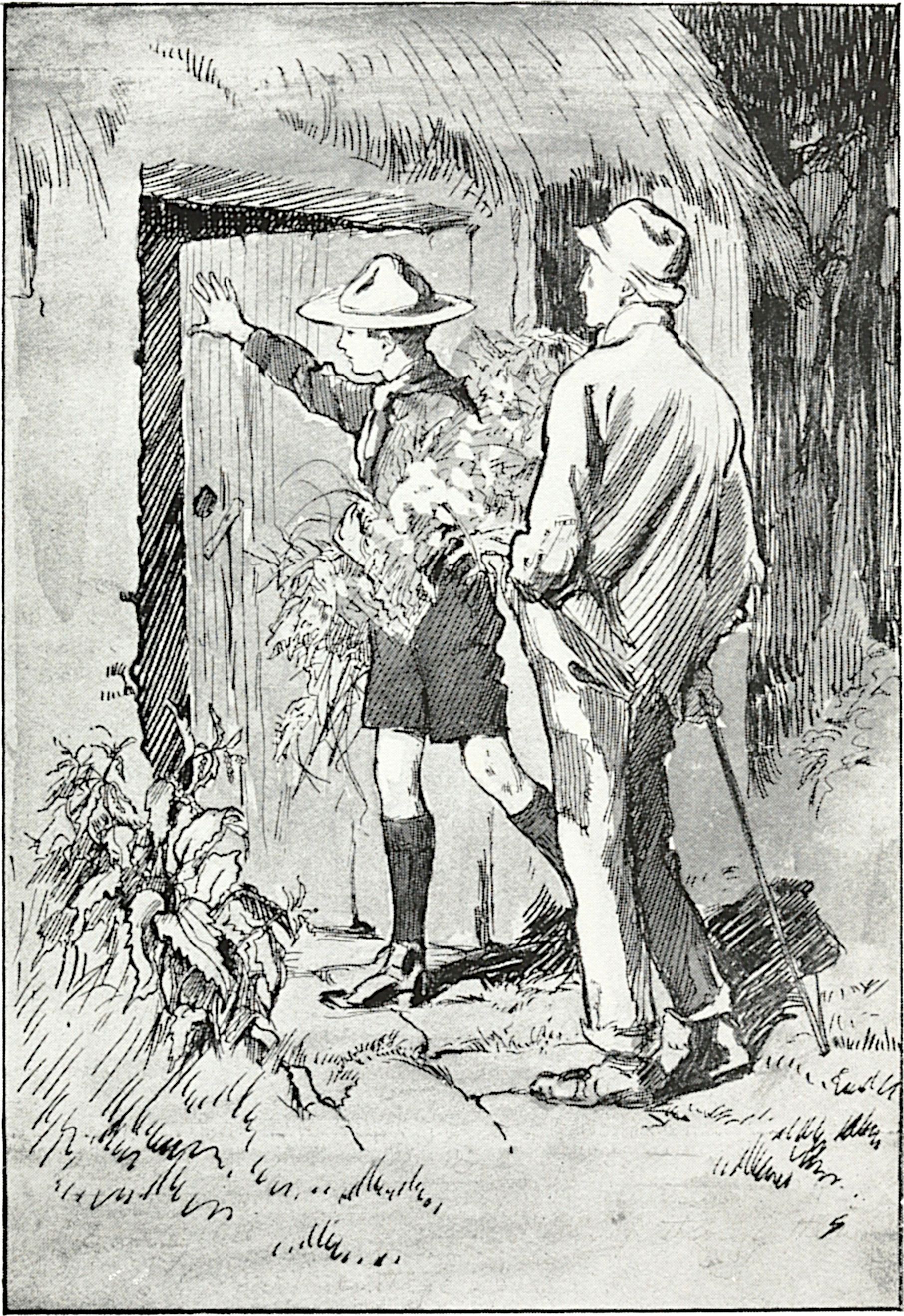
Danny led the mysterious tramp to a deserted cottage.
[To face page 50.
A bottle made a fine candlestick, and the old
cottage looked quite cosy by the time Danny had
finished arranging it.
“Good night, sir,” he said at last. “I hope
you’ll sleep well. To-morrow we must have a
proper pow-wow about things. My word, the
Cubs won’t half be pleased to find you here.”
CHAPTER XII THE SECOND QUEST
The dew lay thick and white on the grass;
hips and haws made bright splashes of
colour in the early morning sunlight; the robins
sang, the larks soared, the woodpeckers tapped—but
Danny noticed none of them. With his
hands behind him and his head bent, he walked
across the field, deep in thought.
Last night, with the pale moon and the red
glow of the fire, and the tramp’s sad story, all
seemed like a strange dream. And what he had
said, himself, seemed like a dream too, for he had
promised the tramp that he would undertake to
find his lost daughter.
Somehow he felt so sure that he was meant
to do so. He had asked the tramp to stay in the
deserted cottage for the night, and promised to
have a pow-wow the next day as to how they should
commence the search.
But in the morning light things did not seem
so possible and easy. After all, it was seven years
ago that the girl had vanished. She had been stolen,
too, by malicious people; and the scene of the
plot against the artist was many miles away.
The police and the court had been fooled by
the gang of forgers, and had refused to make any
inquiries about the artist’s little girl. It would
be a hopeless quest for a Scout to start asking
questions about an ex-convict’s past. What on
earth could Danny say to the tramp?
He had reached Prior’s Wood, and still no idea
had occurred to him. All he could think of was
that they should get their poor friend to stay there
awhile, and recover his strength and his spirits.
It might be possible, then, to get him work or perhaps
he would feel able to begin painting again, and
get a job in that line.
When Danny reached the cottage the tramp
was sitting outside it in the sun. His hair was
all wet from his wash in the stream. He looked,
somehow, quite happy, and he seemed so absorbed
in his own day-dreams that he did not notice
Danny as he came up, until he said “Good morning!”
“Hullo, Danny!” he replied. “I’ve slept better
on your bracken bed than I’ve done for many
years. And I’ve dreamed—oh, such lovely dreams!
All about my little Mariette. I feel quite happy
again. It’s made me long to paint again, and I’ve
been finding no end of pictures in this wood, ever
since sunrise!”
Danny laughed, but he felt more like crying
inside. There was so little chance of finding the
girl, and yet the tramp was beginning to count on
it as if it was already done.
But somehow Danny felt that he was meant
to find the girl, and his spirits rose. For nearly
an hour he and the artist-tramp discussed pictures.
Then Danny made a fire, and boiled a billy of tea,
and produced a loaf and some butter out of his
haversack.
“About twelve o’clock,” he said, “you’ll have
six wild Wolf Cubs descending upon you. They
yelled with joy when I told them their ‘mysterious
tramp’ was still here! Now I must get back and
take them to church.”
So he said good-bye to the tramp and went
back to the house, whistling.
Out of the little grey church at the cross-roads
came the Cubs, very demurely. But no sooner
were they outside the churchyard gate than they
gave vent to a wild yell, and, tumbling over the
stile, tore off down the path to the gamekeeper’s
cottage.
When Danny arrived with the big basket of
lunch, he found them very happy. The tramp had
apparently turned into a most dangerous grizzly
bear, and the Cubs into intrepid hunters.
All the afternoon their mysterious friend told
them stories. When at last it was time for them
to go Danny saw them home, and then came back
to the cottage. He stoked up the fire and sat down
by it.
“Sir,” he said, “when you told me your story
last night, you said you were tramping the roads
because you have two quests. One was to find
your little girl. You did not tell me the other.”
The tramp’s face clouded. His kind grey eyes
suddenly became as hard as steel. He did not
answer for some time. Then he spoke slowly.
“My second quest is this,” he said; “to find
the fellow who wronged me, and reap my revenge!”
Danny was taken aback. This was so different
from the kind, jolly artist of this morning. Suddenly
he realized a little the bitterness of soul produced
by those seven years’ unjust confinement,
and by the cruel loss of his child.
He saw the whole story in a new light and understood
it better. More than ever did he long to help
this man, and yet those words, spoken so deliberately,
filled him with horror. Revenge is a grievous
sin. How could this man pray every day to find his
daughter, and expect God to hear his prayers,
while, in his heart of hearts, there was revenge?
“Well,” said the tramp, staring at Danny, “what’s
the matter?”
“Oh, sir,” cried Danny, “then we shall never
find Mariette!”
“What do you mean?” said the tramp.
“I mean,” said Danny, “that the only possible
chance of finding her is for God to answer your
prayers. And He won’t do that till you forgive your
enemies.”
The tramp scowled darkly.
“You’re only a boy,” he said; “you don’t
understand. There are some things a man can’t
forgive.”
There was nothing more to be said. Danny’s
heart was heavy as he went to bed that night.
The next morning Danny was very busy. He
had been given the job of clipping the three ponies,
and he was not able to go down to the wood. He
was just about to set out, at one o’clock, when Miss
Prince called him into her sitting-room.
“I want to speak to you, Danny,” she said.
“I was down in the village just now, taking the
boys to their carpentry class, and as I came back,
alone, I met a man at the cross-roads. He came
up to me and said, ‘Would you, please, give a message
to Danny for me? Tell him that the Squire
came through the wood, and, finding me in the old
gamekeeper’s cottage, was furiously angry. He
spoke—well, very roughly, and said that if I did
not clear out at once he would hand me over
to the police. So I’m clearing out.’ He looked
awfully sad,” added Miss Prince, “and just
as I was turning away he said, ‘Say good-bye
to the kiddies for me. They performed a good
turn, right enough, when they let me be friends
with them.’
“He looked too sad for anything, and so thin
and ragged. I gave him a shilling. At first he
went very red, and then he took it, and said, ‘Thank
you very much. I shall keep it as a souvenir of those
who were kind to me.’ He looked at me as if he
wanted to say something else, but he turned away
without saying it, and walked down the road.
It was the man the Cubs gave tea to on their
birthday. What did he mean about the cottage?”
So Danny told Miss Prince how he had made
the tramp a bed there. And then, in strict confidence,
he told her the whole of the tramp’s sad
story, because he felt so unhappy about it himself
and felt he must talk of it to someone. The tears
came into Miss Prince’s eyes.
“Cheer up, Danny,” she said. “I somehow
feel we shall see him again, and that he will
forgive his enemies, and that you will find the little
girl.”
CHAPTER XIII ELEPHANTS
The golden autumn turned to white winter.
Christmas came, with frosty snow, and holly,
and Santa Claus, and a party. The holidays ended,
and Miss Prince came back.
Then came spring, with little green shoots on the
hedges, and catkins, and the first celandines, and
all the things that are so thrilling to find again
after the long months without them. And the
Cubs cut down lots of silver willow-palm to decorate
the house on Palm Sunday. Then came May Day.
The village children had a maypole. It was a very
pretty sight when the little girls danced round it;
but there was an awful tragedy when the twins
collected all the coloured ribbons into two bunches
and played “giant strides” on it, when no one
was about! Of course all the ribbons broke, and the
twins were not allowed to wear their Cub uniform
for a fortnight.
And all this while what had happened to the
mysterious tramp? No one knew. He had gone
away that autumn morning, and no one had heard
of him since.
It was one lovely warm evening in June that
Nipper and Bobby Brown suddenly rushed up to
where Miss Prince and the twins were weeding the
garden, and cried:
“Elephants! Elephants!”
“What on earth do you mean?” said David.
“There’s elephants—lots of ’em—coming up the
road!” shrieked Nipper.
“Nipper,” said Bill sternly, “how can you
tell lies like that? Have you forgotten you’re a
Cub?”
Nipper flushed with indignation.
“There are elephants! There are elephants,”
he said.
“And camels,” added Bobby, “and—and
things called unicorns, I think, or is it crocodiles?”
“What do they mean?” said the twins. Just
then Danny came on the scene. “I’ve two bits
of news to tell you,” he cried. “You’ll never guess
what! First, the mysterious tramp has come
back. He’s working for Farmer Higgins, getting
in the hay. He is sleeping in one of the barns
there.”
The Cubs cheered and turned somersaults in their
delight.
“The second thing,” said Danny, “is that a
circus is coming up the road. Caravans, tents,
boat-swings, elephants, and all sorts.”
“There,” cried Nipper, “am I a liar?” But
Nipper and Bobby were forgotten in the excitement.
Everyone rushed down to the road to see
the circus pass, on its way to the village green,
where the great tent was to be pitched.
The elephants, led by tiny gipsy boys, with very
white teeth and gold rings in their ears, stopped and
snuffed at the Cubs with their great, moist trunks.
The Cubs gave them bits of bread. And there were
camels and dromedaries (not unicorns), and a lion
in a cage, and lots and lots of caravans.
“There is going to be a Grand Performance
to-morrow afternoon,” said Danny. “Buffalo
Bill, tight-rope walkers, the lion-taming lady,
bare-back riding, and all sorts of good things.”
The Cubs’ eyes danced with delight. They
had never seen a circus in all their lives.
“Oh, Miss Prince!” they cried, and looked at
her expectantly.
She laughed. “Yes,” she said, “a half-holiday—I
know. Well, be very good boys to-morrow
morning and earn one. Then we’ll all go to the
circus in the afternoon.”
They showed their gratitude by pummelling her
till she cried for mercy.
Just then a strange figure came by in the procession—a
huge man, with a bushy black beard
and thick black eyebrows. He was mounted on a
great black horse.
“That’s Black Bill,” said Danny, “the boss
of the show. I’ve often heard of him. Everyone
in the circus is awfully afraid of him—even the
lion-taming lady!”
The Cubs shrank back as Black Bill passed,
for he gave them a stern look. Danny met his
eyes, and something seemed to say within him,
“You’ll see more of Black Bill before you’ve
done.”
“Oh, I wish to-morrow would hurry up and
come!” said the twins. And all that night they
dreamt of the circus.
CHAPTER XIV THE CIRCUS
“Miss Prince really is a brick!” said
Bill, and the others agreed. Miss Prince
had earned this highest form of praise by granting
a whole holiday on the strength of the circus, the
mysterious tramp’s return, and the first day’s real
haymaking.
The circus had passed on up the road to the
village green. The horses had been taken out of
the shafts and hobbled. Smoke rose in little blue
columns from the caravan chimneys. Small brown
children, with bare feet, clambered up and down
the little ladders that led up to the caravan doors,
where their mothers sat—stout ladies, with very
black hair and gold rings in their ears.
With much hammering and shouting, an enormous
round tent was being pitched in Farmer
Brown’s field. Also in this field strong men
struggled with boat swings, and big boys arranged
cocoanut shies. Black Bill strode round calling
everybody bad names and making himself generally
beastly, but getting the work done in double-quick
time.
Of course the entire population of the village
looked on. The Cubs, feeling as if some wonderful
fairy story had at last come true, stood with
wide eyes, drinking it all in. Their blood ran cold
as they heard the lion roar. But when they saw
the lady who trained him they were not surprised
that he obeyed her; she was truly fearsome.
They peered about round the caravan containing
the fat lady, in hopes of catching a glimpse of
her, but she was apparently too bashful to come
out. The first performance was not to take place
until the next day, though the “stunts” would be
open to the public that evening. The Cubs would
have hung round the gipsy camp all day had not
Danny made a suggestion.
“Look here,” he said, “I vote we go over to
Farmer Higgins’ now. I hear he is short-handed,
and wants to get his hay in while this lovely weather
lasts. I believe he would be glad of our help.
And then in the dinner hour we will see our tramp,
and hear of all he’s been doing since he went
away.”
The thought of haymaking and the tramp was
sufficient attraction to draw the cubs away from
the circus, and with light hearts they set out for the
farm.
Mr. Higgins was delighted to see them. He
provided them with pitchforks and big wooden
rakes, and said that if they worked very hard
that day and got the hay dry enough to cart to-morrow
they might have rides on top of the loaded
wagons. It had always been a cherished dream
of the twins to ride on a hay-cart, but up till now
the farmers had been their enemies, and none of
them would have allowed “one of ’em terrors”
in his field.
“After all,” said David reflectively, “it’s much
jollier being friends with everybody, instead of
enemies. I’m glad Miss Prince and Danny came
and turned us into Cubs.”
They worked like niggers all the morning. Jerseys
soon came off, and scarves were turned into
a kind of Arab headgear. David and Nipper raked
the hay into long lines, and Bill and Danny turned
these over with pitchforks.
At about one o’clock the womenfolk belonging
to the haymakers began to arrive with dinners
tied up in red handkerchiefs.
Suddenly a cheer went up from the Cubs.
“Miss Prince—bringing us dinner!” They were
as hungry as wolves, and it made you feel so
like a real farm hand to have your dinner brought
you. So they made a camp in a shady corner of
the field, and while Miss Prince and the Cubs unpacked
the basket, Danny went off in search of the
tramp.
Before long they returned together. The tramp
still looked very thin, but his face had been burned
brown by exposure to the sun during his long hours
of farm work. The Cubs leapt at him like a crowd
of real young wolves and dragged him down into
their hay fort. “Tell us a story!” “No, draw
us a picture!” “Make the cuckoo noise; perhaps
a real one will answer now!” Everyone
shouted at the same time.
The tramp laughed.
“I should say, have some lunch first!” said
Miss Prince. “You must all be hungry.”
So everybody settled down to ham sandwiches
and hard-boiled eggs, and cucumber, and cake,
and gooseberry turnovers, and lots and lots of
lemonade. Of course the food got all mixed up
with hay, grasshoppers, and little wee spiders, but
no one seemed to mind.
“A funny thing, my turning up here again, isn’t
it?” said the tramp. “It was quite by accident.
In fact, I didn’t know I was coming here until I
arrived at the cross-roads, and recognized the place
by that little church. A man I worked for, for a
few days, said he knew of a farmer friend of his
who badly wanted help with his hay, and so he
offered to give me a forty-mile lift on a motor-lorry
of his that was coming this way. I never
asked where the place was, but I felt Providence had
meant me to come back when I found myself at
those cross-roads again!”
“How did you get on all the winter?” asked
Miss Prince.
The tramp shuddered. “Ugh! The winter!”
he said. “I want to forget all about that! It’s
summer now—glorious summer!”
He lay back in a patch of sun.
“I wish it was always summer, and there were
always hay jobs. I’ve tried my hand at many
kinds of work since I saw you last. I’m a huge
success as a painter of signs. I couldn’t stick begging
any longer. By the way,” he said, turning to Miss
Prince, “that shilling was the last I ever took for
doing nothing!”
Miss Prince laughed. She had already noticed
that he was wearing a shilling piece on a piece of
string round his neck.
“Now it’s a mascot?” she said.
“Yes,” said the tramp. “I believe if I’d carried
it loose I’d have spent it one day. When you’re
hungry you cease to be superstitious or sentimental.”
These long words bored the Cubs.
“Tell us a story!” said the twins, and Nipper
suddenly smothered the tramp with an enormous
armful of hay.
“No, no,” he said, “I must get back to work.
Perhaps this evening I will tell you a story—when
work’s done.”
And so haymaking started again, and the Cubs
learnt that doing your best can be very hot work,
especially when you have a tyrant of a Scout to
shout, “Dyb, dyb, dyb!” every time you happen
to feel like having a rest or a hayfight.
After tea the Cubs knocked off work and went
down to the circus. They swung in the boats till
they felt sick, and then rode galloping horses on
the roundabout by way of a remedy. They knocked
down cocoanuts and won china vases off the hoop-la.
They paid 2d. and saw the fat lady—and she
was fat! They managed to persuade the man
who looked after the animals to let them go round
behind, where nobody is allowed to go, and made
friends with the white ponies and performing dogs.
Then, when it began to get dark and a rough crowd
of big boys and farm hands began to come, Danny
took them home.
The next day there was to be the great performance—that
was what they were longing for.
The next day was as glorious as ever. The hay
was to be carried. The Cubs were far too useful
to be spared. That meant another holiday!
It was frightfully exciting to sit on a mountain of
hay, and go jolting across the field. The Cubs
took turns at it, but between whiles they worked
like slaves. The tramp had lunch with them again,
and afterwards he took them to see the barn where
he had made himself a fine little camp.
At last the splendid moment came when the Cubs
were sitting in a row on the narrow little seats,
made of planks, and covered with red baize. They
had the top row, and were well raised above
people’s heads.
Punctually at 2.30 the performance began.
There were tight-rope walkers in pink tights and
spangles, and performing dogs, and people who
rode on white horses standing up, and jumped
through paper hoops, and many other things. But of
course they liked Buffalo Bill the best, with the
Indians and horses and the thrilling noise of
revolvers.
One thing disappointed them, and that was
that the Indian Jugglers and Famous Dancer did
not appear at the afternoon performance. They
were to be on that night. The evening show was
not till 8 o’clock, and Miss Prince said, “No,” when
they asked if they might go to it.
CHAPTER XV A KNIGHT OF KING ARTHUR
And so Danny was alone as he walked across
the village green towards the circus
field. He was keen to see those jugglers and the
marvellous conjurer, for tricks appealed to the
detective instinct in him, and he was wonderfully
good at discovering how they were done.
The sun had just set, leaving in the sky a red
glow that was fading quickly into green. In the
soft purple dusk the flaring lights away ahead in
the circus field looked very weird. Black figures
hurried about, making a confused shouting. The
boat swing swayed regularly like the pendulum
of a huge clock. And over all there was the monotonous
sound of the organ in the roundabout,
playing the same tune over and over again.
Danny had the strange feeling in him which
said, “Something is going to happen.” But what
he did not know. Before long he was through the
gate, and himself one of the figures moving about
between the flaring lights. He could hear now
what the shouting was. It was the cocoanut-shy
man persuading people to have a shy, while the
lady at the toffee-stall tried to shout him down
and make them spend their money with her instead.
Many other people were shouting, too, and stalking
about in the field Danny noticed Black Bill.
He was giving final orders before the performance
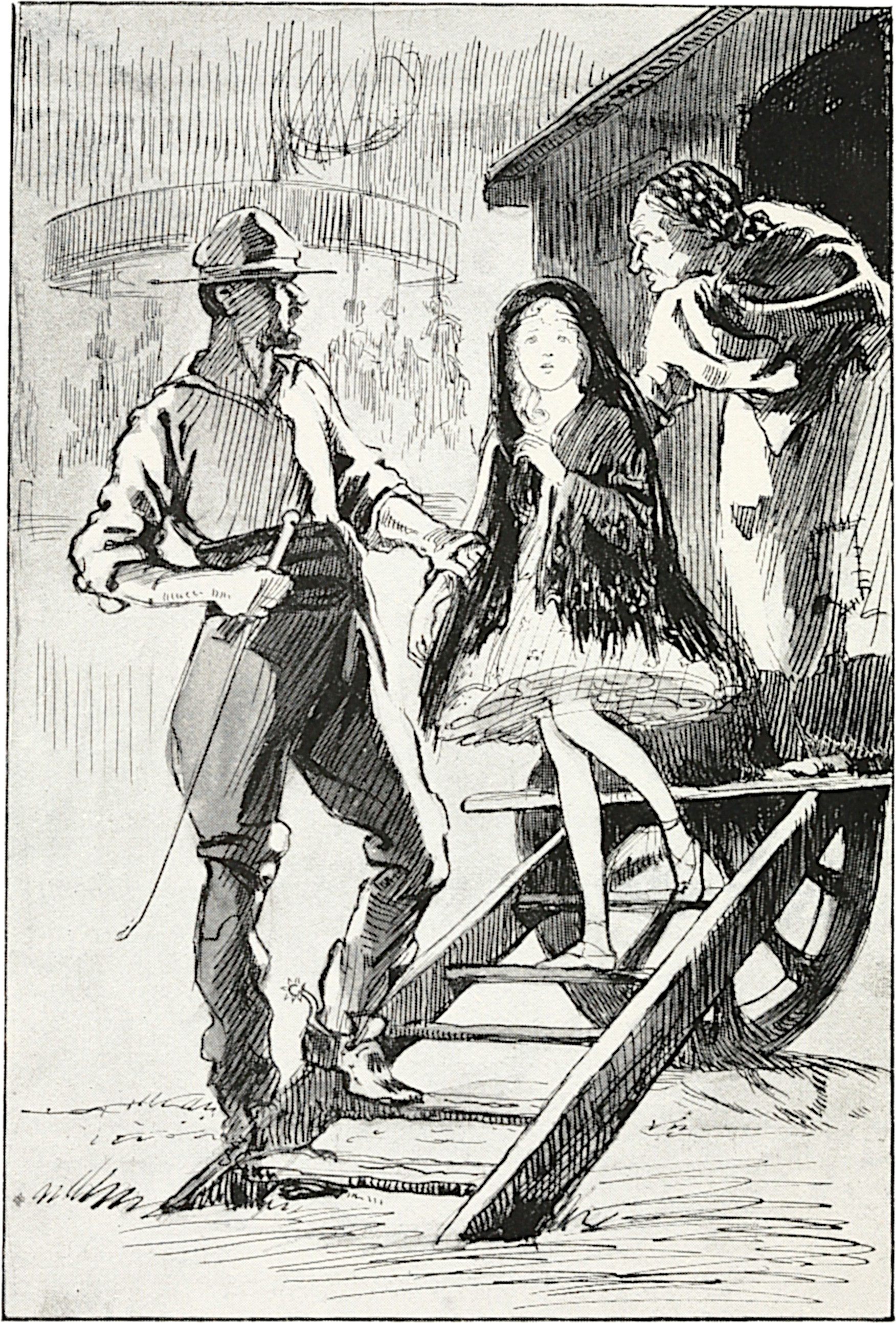
began. Presently he went up to a big yellow caravan,
mounted the steps, and banged on the door.
Someone inside opened it—a very ugly old woman.
Black Bill spoke a few words to her, and she
brought out someone else, all shrouded up in a big
black shawl. Taking this figure rather roughly
by the arm, Black Bill led it through the crowd
towards the performers’ entrance of the big tent.
Just then a bell was clanged and clashed, and the
crowd began to surge into the performance.
Danny went with it. He had one of the reserved
seats in the front row.
It was the same performance as he had seen in
the morning, but at last came the time for the troupe
of Indian Jugglers. They entered amidst loud
applause. There were two jugglers, a conjurer,
and the famous dancing girl. They all had dark-brown
faces, and were dressed in gorgeous colours,
and much gold lace. The jugglers performed
first, juggling with plates and balls and knives.
Then came the dancer. Danny thought he was
going to be rather bored with her, but as soon as
she began he was spellbound. He had never before
seen anything so quick or active or graceful. And
she was cheered and encored again and again, and
each time her dance was different. At last she
sank down tired out, and Danny had a chance of
looking at her face.
The first thing that struck him was that she
looked frightened. He saw her glance anxiously
at Black Bill. Then it struck him that if she had
not been dark brown she would have been very
pretty. Then he noticed that she had grey eyes,
and he began to feel sure that she was a white girl
painted brown. He had just come to these conclusions
when the conjurer stepped forward and
began his tricks.
Unlike an English conjurer, he had no table,
but kept all his things—strange baskets, silk cords,
bangles, knives—on the floor. Behind sat the dancing
girl on a cushion, and also the jugglers. Presently
the conjurer asked for a volunteer to come
and help with the trick.
Before any one had time to move Danny was
over the balustrade, and had stepped up and offered
his services. He always did this at entertainments,
and had been able to discover many a trick by keeping
his eyes open. It was a difficult trick; another
volunteer was called for, and the two jugglers
were also used to hold out a big Turkish rug.
When Danny had done what was required of him
for the moment he was told to sit down on one of
the cushions and wait till he was wanted again.
It was as he sat here, not far from the dancing
girl, that something began to happen.
While the conjurer talked and the people laughed
he heard a voice say in a faint whisper:
“Don’t turn your head, Scout, but listen to me.”
“Yes?” he said.
“I am being kept prisoner by Black Bill. I
am miserable. Oh, rescue me, rescue me!”
“I will—but how?” said Danny, keeping his
eyes on the conjurer, and pretending to laugh as if
he was amused at his jokes.
“Come to the big yellow caravan at midnight.
Knock three times. Black Bill will be out. The
old woman sleeps sound. Then we can make a
plan.”
Danny’s heart beat wildly. Here was an adventure
such as he loved. And the chivalry of
rescuing a maiden in distress made him feel he was
like one of Arthur’s knights. Then a thought
flashed into his mind—the tramp’s missing daughter!
As Danny sat in the centre of the circus ring
with the gas-lights flaring and the band playing,
it all seemed to him like some strange dream,
or as if he had stepped back into the past and was
part of a fairy tale. And there was a “princess”
in the fairy tale, too. The frightened grey eyes
of the poor little dancer, with her brown face and
gleaming jewels, had awakened a chivalrous sense
in him, that said, “I will save her, or die in the
attempt!”
Before long the time came for him to step forward
and help the conjurer once again—she had
whispered her instructions only just in time.
Danny cared no longer for the tricks; he scarcely
noticed what was happening during the rest of the
performance; his mind was working hard, turning
over plans by which he could save the girl from the
clutches of Black Bill, and get her out of the gipsy
camp unseen.
The conjurer having finished all his tricks the
Indian troupe went off, and ladies in pink tights
came on, riding white horses. But Danny had no
eyes for these; through a crack in the canvas he
watched Black Bill throw a cloak around the dancer
and lead her out.
At last the show was over. The crowd surged
out, and Danny with it. In such a crush it would
be easy to get near the yellow caravan, unnoticed.
Then it struck him that his scout uniform would
make him a marked figure. He must look as ordinary
as possible, so as to attract no one’s attention.
Slipping into a dark corner between the big
tent and the lion’s cage, he began to disguise himself
as best he could. Taking off his hat he hid
it under a heap of dirty straw. His red neckerchief
he folded up and put in his pocket. Taking off
his shirt he turned it inside out and put it on again,
thus hiding from sight his badges, Leader’s stripes,
shoulder names, etc. He pulled up his stockings
over his knees, and then, as a last bright idea, tied
an old piece of sacking round his waist, like an apron.
He had noticed that the boy who cleaned out the
animals’ cages wore just such an apron. Now, by
the flickering light of the gas flares, he would pass
as one of the circus hands.
Mingling with the crowd, he made his way
towards the yellow caravan. It stood a little
apart; there was no cover near enough to conceal
his approach. What should he do? He stood
looking about him. He must hide somewhere, for
it was not quite eleven yet; there was over an hour
to wait until the coast would be clear for him to
go to the yellow caravan. At eleven all the people
would be turned out of the circus field, and only
the gipsies would be left. Then, to his relief, he
noticed that the cart belonging to the boat swings
was the nearest one to the yellow caravan. It
was empty save for the big tarpaulins used for
covering the swings when they were packed up.
It would be a perfect hiding place. He waited
until some of the crowd moved that way, and then he
went too. Climbing quickly up by the wheel he
slipped softly inside and drew the tarpaulin over him.
Breathlessly he listened, but there was no sound of
any one following him.
Presently a clock struck eleven, and a bell, like
a very loud muffin bell, clanged above the other
circus noises, and Danny listened to the sound of the
crowd going out at the gate and making its way
homewards along the country roads. Then, very
stealthily, he managed to peer out. He saw a crowd
of the gipsies collected round the big camp fire.
The red glow lit up their faces. Others hurried
about, clearing up. And among them Black Bill
strode to and fro, giving orders.
Danny had managed to arrange himself in such
a way that he could see out quite easily, and yet not
be seen. He watched anxiously while the gipsies
moved about, and one by one retired to their caravans.
At last there was no one left but the two night
watchmen by the fire. Black Bill had also retired
to his caravan, which was drawn up alongside
the yellow one. At about a quarter to twelve
Danny saw him come out and walk towards the
gate. The two watch men were evidently good
scouts, for they both turned at once and watched
him go.
“Now’s my time,” said Danny to himself,
with a queer feeling within him, half of excitement,
half of fear. The question of how he should cross
the open space from his hiding-place to the yellow
caravan troubled him, for the two night watchmen
might very easily see him. “If only a cloud would
pass across the moon, I would make a dash for it,”
he told himself. Then he noticed something. The
moon was throwing the black shadow of the boat
swings right across the open space to the caravan.
It was a narrow strip of shadow, but a good Scout
can make use of the smallest cover.
Slipping softly down from the cart on the side
farthest from the watchmen, Danny crawled round
and lay quite flat for a moment in the shadow.
But the men did not move or turn their heads—they
had not heard him. Then, dragging himself
along on his elbows, he slipped like a snake along
the black line, which made him invisible. When
he was half-way across, one of the ponies grazing
near started, with a snort of surprise. The two
men turned at once and looked straight in Danny’s
direction. Instantly he dropped his head, hiding
his face in the grass; it was the only white thing
about him, and might attract their attention. With
pounding heart he waited, not moving a muscle.
But there was no sound of approaching footsteps.
Slowly he raised his head and looked.
Thank God, the men had not seen him!
Slowly, slowly he crept on, until he passed under
the caravan. At last he was safe on the other side.
Standing up on the hub of the wheel he tapped
gently on the window. It was opened at once
and he found himself face to face with the dancing
girl.
CHAPTER XVI DANNY FINDS MARIETTE—AND IS KIDNAPPED
She was no longer a dark-brown colour, nor
had she long black hair. As Danny looked at
her sad little pale face it seemed to him that she
was extraordinarily like the Tramp!
“Oh, you’ve come, you’ve come—thank God!”
whispered the girl. “I knew you would,” she
added. “Scouts are like the knights in old days,
aren’t they?”
“Yes,” said Danny, “I promised I would. Tell
me, quick, what am I to do?”
“Listen,” said the girl, “and I’ll tell you who
I am. We can talk safely, because Black Bill
will be out half the night, and old Hannah is in a
heavy sleep—she drinks, and once asleep nothing
will wake her. First, I must tell you, I’m not a
gipsy, like these people——”
“I can see that,” said Danny.
“Well, they stole me from my daddy ages ago—I
think it must be seven or eight years. They’ve
always kept me shut up in this place, except when
they take me out and make me dance. When I used
to cry for my daddy Black Bill used to beat me.
I don’t cry now—I’m too miserable. They never
give me a chance to talk to any one. But I read in
a paper about Scouts, and when I saw you sitting so
close to me at the circus, suddenly a great hope
seemed to jump up in my heart. I was sure if you
knew how terribly miserable I am you would help
me to escape.”
“Yes, yes!” said Danny. “But tell me, what
was your father?”
“An artist,” she said. “Oh, he used to paint
such lovely pictures—full of fairies, they were!
I often dream of them and—and—of him. Oh,
my poor, poor daddy!” she said suddenly, with a
great sob. “What have you done all these years
without your little Mariette?” A big tear rolled
down her cheek.
“I say, don’t cry!” said Danny, giving her
his handkerchief. “Your daddy is quite near here.
He is spending his life hunting for you, and praying
God to let him find you. I promised to help him.
How good God is to have let me find you!”
“I prayed, too,” whispered Mariette.
“Now,” said Danny, “how can we get you
away? Shall I creep out of the field and fetch
a party of police and men and have Black Bill
arrested?”
“No, no,” said Mariette in a terrified whisper,
“don’t leave me, don’t leave me! Take me
with you—take me to my daddy! If you brought
police it would be no use. Black Bill has a terrible
way of hiding me. Besides, he is friends with all
the police. It would be no good. Oh, take me with
you!”
Danny looked about him. Would it be safe
to take her across the open ground and get through
the hedge? He would risk it. Once through they
could run, and he knew every gap and short cut.
They would make straight for the barn where her
father was living during the hay harvest. He
would think it was a wonderful dream when he saw
his little Mariette, her golden curls shining in the
moonlight, as if she really was a moonlight fairy.
“Can you climb out of the window?” whispered
Danny.
“Yes,” she said. But before she had time even
to begin, a cry of horror broke from her, and Danny
started violently, for a rough hand had been laid
on his shoulder.
“All right, young scoundrel,” said Black Bill,
as Danny turned round and faced him. “Out of
the window? That’s your little game, is it?
We’ll see about that!”
Taking a piece of cord out of his pocket he
knotted Danny’s wrists behind his back, then tied
his feet together. Dragging him round to the caravan
door he propped him up against the steps and
entered.
A few blows woke old Hannah from her heavy
sleep. He could hear Black Bill giving her orders.
His struggles to free himself were useless; and even
if he could have run away he would not have
done so, for his one thought was to stay and help
Mariette.
The noise had brought the two watchmen on
the scene. They stood there quaking at the thought
of what Black Bill would do to them for having
allowed a stranger to intrude into the camp. And,
sure enough, his rage was terrifying when he came
out and saw them. When he had finished abusing
them he sent one of them to fetch his two sons. Before
long they had arrived. Taking one of them
aside Black Bill gave him some instructions in a
low voice, and turning to the other told him to loose
Danny’s feet, blindfold and gag him, and then lead
him to the happy home Black Bill had ready for
him.
“All right, young scoundrel,” said Black Bill. “That’s your
little game, is it?”
[To face page 76.
As the dirty handkerchief was tied over his eyes
intense rage filled Danny’s heart.
“Good-bye, Mariette!” he shouted, before his
captor could stop him. “Go on praying—we shall
escape all right in the end!” Then a thick muffler
was fastened over his mouth, and he felt himself
being led away across the grass.
Over rough ground they went, along lanes,
across ploughed fields. Every now and then
Danny was lifted up and pitched roughly over a
gate, or dragged through a hedge. It seemed to
him that they had been walking for miles when
at last his captor halted, and he heard the sound
of a key grating in a rusty lock. He felt himself
being led through a doorway, and his feet resounded
with a hollow sound as he walked over a wooden
floor.
“Sounds like an empty house,” he told himself.
And the musty, close smell seemed to confirm this
idea. Another door was unlocked, and Danny felt
himself being led down some stone stairs. Then
through another door they passed.
“Loose him,” said Black Bill’s harsh voice. This
was done, then taking up an old tin can, Black
Bill’s son went out and returned with it full of
water. By it he placed a loaf.
“There you are,” said Black Bill; “you can
feast on that for a few days. It will teach you not
to come prying into other people’s business. Come,”
he added, turning to his son. The two men went out,
slamming the door behind them, and Danny heard
their heavy footsteps going up the stairs.
Gradually his eyes got used to the darkness,
and he found he was in a kind of cellar. It was
empty save for a heavy wooden settle at one end.
The only opening, besides the door by which he
had entered, was a little barred window some ten
feet up in the wall.
Sitting down on the settle, Danny heaved a heavy
sigh. Then he suddenly remembered something,
grinned, and began to whistle.
“Well,” he said, “this is an adventure anyhow,
and I’m sure to come out all right.”
CHAPTER XVII THE CUBS TO THE RESCUE
No Danny! There was consternation at the
Hall. Where could he be? The Cubs were
wild with grief. While all the grown-ups puzzled
their heads over the question, the Cubs went straight
to the point and arrived at the correct conclusion
by a guess. “That old beast, Black Bill, has stolen
him,” they said. But the grown-ups said it was
absurd, and little boys should not talk nonsense.
A careful inquiry began as to where Danny had
last been seen, and it was soon proved that he
had gone down to the circus for the 8 o’clock
performance.
“There you are,” said the Cubs, “we told
you so—Black Bill’s stolen him.”
Mr. Beak, the bailiff, and the foreman from the
farm were sent down to the gipsy camp to make inquiries
as to whether Danny had been seen there
the night before; but Black Bill said he had not
noticed any Scout at his circus, and it was impossible
to gather any information.
The Cubs were in despair.
“Look here!” said David, “we must take the
search into our own hands. Let’s call a Council.”
So they called a Council, and the whole Six assembled
in the old pigsty.
“Boys!” cried David, standing on an upturned
trough, “Danny, our chief, has been stolen by Black
Bill. No one will believe it—no one will go to his
rescue. Who is ready to take up the quest? Who
will promise to die rather than give up the search?”
“I!” yelled everybody, jumping up.
David was very pale; this was no game, and
the sorrow and anxiety of the Cubs was very real.
“Let us all swear, here, to each other, as Cubs,
that we will go out and face any danger, and not
rest till we have found Danny.”
Solemnly they promised. Suddenly Nipper cried,
“P’raps he’s dead!” And buried his face in a truss of
straw and made noises that sounded suspiciously
like sobs. The others turned away in disgust; it’s
all very well to feel like crying—any chap may do
that—but no Cub gives in to himself and does it,
he sets to work and does something really useful
and helpful.
Bill cleared his throat and began to speak.
“I vote,” he said, “that we elect David boss
of this show, and make proper plans, and then start
off at once.”
So a serious Council started. The boys were
paired off in twos—David and Hugh (the gamekeeper’s
son), and Bill and Jack (the blacksmith’s
son), and, of course, Nipper and little Bobby
Brown.
We cannot here recount all that the Council
decided, but we will follow each pair, and see what
adventures befall them, as they set out, like the
knights of old, bent on rescuing their captured
chief.
It had been decided that Bill and Jack should
go to the camp and reconnoitre. David and Hugh
were bent on another quest—but more of that
later.
The gipsies were striking camp. Black Bill
seemed in a great hurry to get a move on, and was
swearing at his men, right and left. Walking
along the side of the meadow, by the hedge, Bill
and Jack kept their eyes open for any clue that might
present itself, and before long they were rewarded.
“Look!” whispered Bill, suddenly gripping his
companion’s arm, and pointing. “Danny’s hat!”
Dropping into cover behind the hedge the two
Cubs peered through at the strange sight before
them—a ragged gipsy boy, barefooted, and clad
in an old red shirt, wearing a P.L’s hat. The boy
was busy clearing out the straw from the lion’s cage.
There was no one near.
“Let’s ask him where he got it,” said Jack.
“We might get some clues from him, and if we
could get hold of the hat, it would be a proof that
Danny was in the camp, and that something must
have happened to him.” So the two Cubs stood
up, and looked over the hedge at the gipsy boy.
“Where did you get that hat?” asked Bill.
He had no intention of making an impertinent remark,
but the boy seemed to see something very
offensive in the question.
“Nah, then, none o’ yer cheek!” he said, and
flung a lump of mud straight into Bill’s face. Bill
was furious, and started forward, his temper fairly
up, when Jack called him back to his senses.
“Don’t give in to yourself, you ass,” he said.
“Don’t you see it’ll spoil the whole game?”
Bill checked himself; but it was a hard struggle.
“I say,” said Jack, over the hedge to the boy,
“you might be a sport and tell us where you found
that hat, because it belongs to a friend of ours,
and if you don’t tell us where you found it we shall
think you stole it from him.”
The boy told them to shut up in such a rude way
that Bill flushed up again, but he held himself
in.
“Look here,” said Jack, “if you will give us
back our friend’s hat, I’ll give you this.” He held
out a fine, new Scout knife. The boy’s only reply
was to throw an armful of dirty straw over the hedge,
and all over the two Cubs.
“Then,” cried Jack, “we’ll jolly well take it
from you!” And, with these words, he leapt
lightly over the hedge, followed by Bill, and caught
the big gipsy a neat left-hander under the chin.
The boy, taken unawares, was sent sprawling, and
Bill lost no time in snatching the hat off his head.
A group of gipsies working further on had seen,
and now came towards the group.
“Better clear out,” said Jack. “We’ve got
our evidence.” Jumping over the hedge they
quickly made their way back to the Hall.
They found Mr. Ogden and Mr. Beak talking
over the question of Danny’s disappearance with a
policeman. In a few words they told their story.
“H’m,” said Mr. Beak, “look’s rather strange.
They’ll have to account, somehow, for Danny’s
hat being in the possession of one of their boys.”
So the policeman and the bailiff and the two
Cubs went down to the camp. Black Bill was interviewed
once again. This time he sent for his sons,
and questioned them before the policeman.
“Oh, yes,” said one of them. “I know about
that scout. It was like this here. He got in with
a queer lot o’ folk what come from the town, not
the kind o’ people as we likes to encourage in our
circus. They was so rowdy and disreputable we
had to give ’em a warning, and threaten to call in
our friend the policeman here. That made ’em
wild, and they started smashing up our Hoop-la
with the balls off the cocoanut shie. Our lad,
in charge of the Hoop-la, had a scuffle with the
Scout, who was the ringleader of all the mischief,
and he must have got his hat then. We threatened
to report the Scout’s behaviour up at the Hall.
He took fright at that, and so did they all. They
started off for the town, and he begged them to
take him too; he was afeared to go in so late,
and in the state he was in. So they all went off
together.”
Mr. Beak and the policeman looked very serious.
“I heard about that lot,” said the policeman,
“but I didn’t know as how the Scout had got
mixed up with them. Not the kind of companions
as Mr. Ogden would like for him.”
“Well,” said Mr. Beak, “we’d better go and
report this information to Mr. Ogden, and see what
further steps can be taken.”
Then the Cubs stepped forward, with blazing
eyes.
“But d’you mean you believe these beastly lies
about Danny?” cried Bill.
Mr. Beak shrugged his shoulders. “Well,”
he said, “what else can I do? Of course it’s very
sad, but then Danny should keep out of the way of
bad company.”
Mr. Beak was one of those weak-minded people
who always believe everything they are told, and
accept the first solution to any problem that comes
along, because it is less trouble than finding out the
true one.
“But it’s all a lie, a lie, a LIE!” shouted Bill.
Jack was at his elbow. “Shut up, you bandarlog,”
he whispered, “look at Black Bill.”
Bill glanced up and met the eyes of the circus
manager fixed upon him in an awful and piercing
scowl. He nearly jumped out of his skin, and for
a moment stood still like a rabbit mesmerized by
a snake, beneath the gaze of those terrible black
eyes. In that moment he felt more sure than ever
that Black Bill knew where Danny was.
To the Cubs’ dismay Mr. Beak reported the story
to Mr. Ogden, who seemed inclined to believe it.
But something even worse was to happen. Black
Bill himself walked down to the Hall that night
with the policeman, to make (so he said) a report of
the matter himself to Mr. Ogden.
He had a short interview alone with the Squire,
and then went away with a horrible grin on his
face. Mr. Ogden came out as white as a sheet, and
in a towering rage. He ordered the search for Danny
to be stopped, and said he had disgraced himself,
and could now shift for himself; he washed his
hands of such a young scamp.
The Cubs, in despair, set to work with redoubled
energy, and that night a strange adventure befell
David and Hugh.
CHAPTER XVIII DETECTIVES
Whilst Bill and Jack had been getting
actively to work in search of Danny, David
and Hugh had been making plans. Retiring
to a particular and secret den of their own, in
a pile of logs, they faced the problem in a really
logical way. With pencil and notebook, and the
quiet determination of true detectives, they reviewed
the situation.
“First,” said David, “what do we know?...
Danny was last seen going to the circus.
Then gipsies are people who are often thieves or
something. Danny is a detective. If there was
anything fishy about those gipsies he would be sure
to get on the scent. If Black Bill caught him
at it he would be sure to keep him prisoner, so we
had better take it that he has been kidnapped by
Black Bill. What do we do?”
“Try not to let Black Bill out of our sight,”
said Hugh. “Follow him everywhere he goes.
Try and get as near to him as possible, in case we
can overhear him talking about Danny; and
keep our eyes open for any clue there might be.”
“Yes,” said David thoughtfully, “that’s just
what we must do. But the circus is moving on this
afternoon. It’s going to Bradmead—that’s five
miles away.”
“Then we must go, too,” said Hugh. “We
may have to stay away some time, so we must take
all we might want with us. And we must be
prepared for anything that might happen.”
“Yes,” agreed David, “let’s make a list.”
He sharpened his pencil and flattened out his notebook.
“Money,” said Hugh. “If you haven’t got
enough money to buy anything you may want, or
to pay for railway journeys, or to bribe people
with, you’re done. I’ve got £1 5s. saved up in my
money-box. I’ll take that.”
“I’ve got a sovereign my godfather sent me
last week—a late birthday present, because he was
at the front when my birthday was on.”
“Good,” said Hugh. “Then, food. You must
have food with you, because you can’t be sure of
being able to buy it, and you can’t carry on if you’re
starving.”
“Cook,” said David, “has been crying ever
since she found Danny was lost. If she hears we
are going to seek for him she’ll give us any amount
of grub.”
“Rope,” said Hugh. “We might have to let
ourselves down into a pit, or out of a window.”
“Yes,” said David, writing in his book, “and
the pit might be dark, so we might need two electric
lights, and some candles and matches.”
“We might have to file some bars,” said Hugh.
“Put down a file.”
“We might have to have a fight,” said David,
“so I think we’ll take two of the old daggers out
of grandfather’s armoury. We shall have to sharpen
them, ’cos they’re awfully blunt.”
His eyes gleamed fiercely.
Hugh nodded. “But after the fight we might
want to do first aid, so I think we must have
bandages and lint and things.”
David wrote in his book.
“And we might be in an awful hurry,” continued
Hugh. “What about taking Danny’s bike? I
can ride it if the saddle is put right down, and you
can go on the step. We could hide it somewhere
near the gipsy camp, in case of need.”
“That’s a good idea,” said David. “And
we might want to disguise ourselves. What about
you borrowing a set of your sister’s clothes? I’ll
get the false nose we have for acting, and a pair of
specs, and grandfather’s Inverness cape. No one
would recognize us, then.”
“You’re right,” said Hugh. “And I think
we’d better have a map—there’s that one Danny
was teaching us map reading with.”
“Yes, yes,” said David, “and a compass, in
case we get lost in the dark.”
Before long they had collected all the things
down on their list, and packed them in an old sack
and a carpet bag. Concealing them in their den,
under the logs, they set out to go down to the camp,
and begin their watch on Black Bill, meaning to
come back for the things as soon as they saw signs
of the circus getting ready to move.
They had not gone far before they met Bill and
Jack returning with Danny’s hat, and the story of
how Black Bill’s son had told the bailiff an awful
lie about Danny. This convinced David and Hugh
more than ever that Black Bill had kidnapped
Danny, and they hurried on towards the
camp.
Black Bill did not move from the field all the
morning; but the Cubs managed to discover from
a little gipsy girl that the camp was going to start
for Bradmead directly after dinner. Dinner was
then nearly ready, as you could tell from the lovely
smell that came from the big black pots on the
fire.
“Look here,” said Hugh to David, “you stay
here keeping your eye on Black Bill, and I’ll go on
to Bradmead on Danny’s bike, and take the things
and find a secret hiding-place for them. Then
I’ll come back towards the caravans, which will be
on the move by then. If I can’t spot you, I’ll
make the peewit noise and you answer with the
owl’s.”
So the two Cubs parted.
The long line of caravans set out, soon after
Hugh had started. It looked like a giant caterpillar
of many colours crawling slowly down the
white, dusty road. Black Bill was on his big
horse, as usual, and it was all David could do
to keep him in sight, as he rode backwards and
forwards along the line, for David was keeping
himself very carefully under cover.
It would never do for the gipsies to know that
the Cubs were following them up, for they must
have realized that, however much they had managed
to hoodwink the bailiff, the police, and the
Squire, the Cubs still had very strong suspicions, and
were hot on the trail.
The cavalcade had proceeded nearly three miles
when David, crawling along at the bottom of a
deep ditch, under a hedge, heard the plaintive cry
of a peewit, on the field side of his ditch. He
answered with the cry of an owl on the wing. The
peewit call sounded again three times in quick
succession—a recognized signal. Scrambling up
the bank David soon discovered his fellow-detective.
“Hullo,” whispered Hugh. “I’ve found their
camping site, and a fine hiding-place for us in an old
disused water cistern a few fields away. I’ve stowed
everything there, and camouflaged the opening
with some dead branches and an old torn rick-cloth.”
“Good,” whispered David.
And so the two Cubs pressed on, keeping abreast
of the circus, but invisible to the gipsies.
CHAPTER XIX BY THE LIGHT OF A LANTERN
All the rest of the day David and Hugh
kept a close watch on Black Bill’s every
movement.
Towards evening they noticed a boy leading
out his big black horse, saddled and bridled.
“He’s going out!” said Hugh. “We must
follow him. You stay here and keep watch on
the camp, and I’ll follow him on Danny’s bike.”
Creeping off to their secret cache, Hugh found
the bicycle, and was on the road with it just as
Black Bill rode out of the field. It was no easy
thing to keep him in sight, and yet keep far enough
behind not to attract his attention. However,
Hugh managed to do it.
To his surprise he found they had returned to
the village. Here Black Bill dismounted and left
his horse at the inn. Then he turned in through
the big gates of the Hall. At the gates he met the
village policeman, and together they walked up the
drive.
Black Bill’s interview with the Squire we described
before.
“That’s rum,” said Hugh, as Black Bill came
out of the study, a nasty grin on his face. “What
ever could he want to say to Mr. Ogden?”
In a few words Hugh explained to Bill that he
and David would not be in that night, but he did
not say where they were, in case Bill should be questioned
by the grown-ups. Then, mounting his
bicycle, he set out, once again, to follow Black Bill.
It was nearly dark when they arrived back again
at the camp. Hugh was frightfully hungry, and was
glad to find that David had fetched some food from
the old cistern, and their coats, and a few other
things. They had supper, and then decided to
take it in turns to curl up in the ditch and sleep,
one of them keeping watch.
The last of the summer dusk had been swallowed
up in darkness, when David, who was taking the
first watch, suddenly strained every nerve to hear
and see. Yes—it was Black Bill, softly leaving his
caravan, and moving towards the gate!
Waking Hugh, David hurriedly put on the
haversack containing all the things the detectives
might need. Then the two boys crept out after
Black Bill, making no sound with their rubber shoes
on the grass.
“Notice carefully the way we are going,” whispered
Hugh, “or we shall never find our way back.”
For Black Bill was climbing over gates, crossing
fields, and following small paths. At length he
reached what looked like a deserted and rather
ramshackle cowhouse, standing in the corner of a
field. The roar of a train told them that they were
near the railway, and the glint of red lights far
away beyond the trees, told them a station was
about half a mile distant.
Stepping up to the shed Black Bill rapped on it
a peculiar knock. The door was immediately opened,
and he entered. The door was softly shut, again,
after him.
“Let’s creep round,” whispered Hugh, under his
breath, “and see if there is a window or anything
we can listen through.”
They crawled round to the back of the shed, and,
to their joy, saw that there was a hole in the wall
of the shed, where some boards had slipped. Under
this hole chanced to be a big pile of soiled straw and
hay. Climbing softly up on this the Cubs crouched
down, keeping their heads low.
“It’s quite safe to light up,” they heard Black
Bill say. “No one ever comes this way; there’s
no fear of being discovered or overheard.”
There was the sound of a match being struck
and a lantern being lighted. Cautiously the Cubs
peered through the hole, and found themselves
looking down on two men, seated with their backs
to the hole. The man who had opened the door
to Black Bill was a sneaking-looking individual,
with a foxy face and mean little eyes. By the
light of the lantern they could see the eager expression
on his face, and the ugly grin on that of
Black Bill. Strange shadows danced in the flickering,
yellow light, and a feeling of horror came
over the Cubs.
CHAPTER XX A CONSPIRACY OVERHEARD
“Well,” said the stranger, “’ave yer fixed
it up?”
“Yes,” said Black Bill. “Crale, or Ogden
as he calls himself now, will be at the cross-roads
at 12.30. I had a talk with him this evening.”
The Cubs looked at each other. Mr. Ogden?
What could it mean? They had come out to find
Danny, but apparently they had got on the track
of a bigger mystery than they had bargained for.
“We can turn into the wood,” said Black Bill,
“and have our little talk with him there. I don’t
reckon that it’ll take very long.” He grinned,
showing a row of cruel-looking teeth.
“How did you get him to agree to come?”
said the foxy-faced stranger.
Black Bill laughed. “I told him,” he said,
“that you and I were the only ones left of the old
gang. That we were working hard for our living,
now, and we didn’t see why he should swank it
as a blooming squire, when we helped him make
the money he bunked to America with. I said if
he refused to meet us, and talk the matter over,
I would make known the whole story to the public,
and bring disgrace on his name, and show every one
that he is not an honest English gentleman, but a
forger, who made off with the swag, letting an
innocent man suffer imprisonment for him.
“I told him I had a way of making his story
known, without bringing suspicion on myself; and
I said now we’d found him again, we weren’t going
to let him go.”
The Cubs, listening with all their ears, could
not make head or tail of all this, for they did not
know the story the tramp had told Danny. All
they knew was that Mr. Ogden, the twin’s grandfather,
was having a plot made against him—an
extraordinary plot they could not understand. It
was their duty to save him.
“And what is yer goin’ to say to ’im to-night?”
asked the man.
“I’m going to tell him that now he’s back,
and has got plenty of money, we can start the
gang again, with me as boss and him as one of the
partners—the partner what provides the money!
I’ve drawn up this statement” (and here Black
Bill produced a paper), “and I’m going to say if
he doesn’t sign it, and keep to it, we will make his
story known. Then, I’ll make him write a big
cheque, as a start off!”
The foxy-faced man rubbed his hands together
and chuckled.
What could it mean? The Cubs were sorely
puzzled. Then Black Bill said something which
made them prick up their ears.
“As to that Scout I caught the other night, I
made Ogden agree to leave off the search for him.
I’ve got him safe, and, whatever happens, he mustn’t
escape.”
“Well,” said the stranger, “strikes me we’d
better be getting a move on, if we are to be at the
cross-roads before 12.30.”
The two men rose, and the Cubs lay flat on the
pile of damp hay.
They heard them go out and slam the door; and
their footsteps sounded on the cobbled path outside
the shed.
“Now,” said Hugh, “what on earth are we to do
next?”
“I can’t understand it all,” answered David,
“but if grandfather really has something funny
about his past, we had better not tell the police
about this meeting at the cross-roads. And yet
I hate the thought of him meeting Black Bill alone.
You don’t know what he might do.”
“I’ve got an idea!” said Hugh suddenly.
“Let’s rush back and get the bike, and get there
before them, and go and tell the whole thing to the
Tramp. He would be sure to know what to do.
And he would come with us and hear what they all
say in the wood.”
“Good idea!” said David; and, with all haste,
the Cubs set out for the place where the bicycle lay
concealed.
Unmistakably it was Black Bill and the stranger.
[To face page 97.
CHAPTER XXI THE “WICKED UNCLE” FOUND AT LAST
Black Bill and his accomplice had set out
across the field in a direction which Hugh felt
sure would bring them out on to the high road. It
was, therefore, with all speed that the Cubs scrambled
back along the little path, over gates, and
through gaps, until they found themselves once again
near the gipsy camp. Fetching the bicycle from
their hiding-place in the old cistern, they wheeled it
quietly across the grass on to the road. After
lighting the lamps Hugh mounted, waited for David
to be firmly settled on the carrier of the bike, and
then began to fairly hog it down the road. Fortunately
for him the way lay almost entirely down
hill.
The Cubs must have gone nearly a mile when
they noticed two black figures walking in the middle
of the road, just ahead. Hugh jammed on his
brakes and rang his bell loudly. The figures jumped
out of the way, and as the bicycle flashed past them,
the golden circle from its lamp lit them up. Unmistakably
it was Black Bill and the stranger.
“That’s good,” panted Hugh over his shoulder;
“there’s still four miles for them to walk to the
cross-roads. I don’t suppose they’re walking more
than four miles an hour, and we must be going
about fourteen. We shall get there long before they
do.”
And sure enough the church clock was striking
twelve as the Cubs flashed through the little sleeping
village and passed the cross-roads.
“I’m jolly glad there’s two of us,” said David.
“I wouldn’t like to be on this job alone. It’s so
beastly dark, and I hate all these plotting people.
I wish I was at home in bed.”
“Don’t give in to yourself,” said Hugh. “Let’s
stick it out. Once we’ve found the Tramp we
shall be all right.”
They turned up the little lane that led to the
farm. At the gate they got off the bike and propped
it up against the fence. Then they crept across the
yard to the barn where the tramp slept.
Hugh was carrying the bicycle lamp. Standing
just inside the barn, he flashed it round to find the
Mysterious Tramp. Yes, there he was, lying on a
pile of straw.
Creeping up to him, David shook him gently.
“Hullo,” said the Tramp, opening his eyes, and
then sitting up. “Who is it?”
“Us,” whispered David; “two of the Cubs.”
Hugh put down the bicycle lamp, and the two boys
squatted in its circle of yellow light.
“What on earth brings you two kiddies here?”
said the Tramp.
It was very comforting to hear his cheery voice.
The Cubs each got hold of one of his hands.
“Oh, sir,” said Hugh, “we are in the middle
of such an awful adventure.”
“And you want to drag me into it?” said the
Tramp.
“Yes,” said David, “but it won’t be long before
they meet at the cross-roads. We want to tell
you all the story, and then you will know what to
do.”
“Fire ahead then,” said the Tramp.
David quickly told all they had done, seen, and
heard.
As he reached the part about the conspiracy
in the cowhouse, the Tramp started.
“What,” he said, with sudden feverish interest,
“a gang of what?”
“Forgers,” said David, dwelling with an enjoyable
thrill of horror on the word.
“And they want to re-form the gang,” said
Hugh, “and make Mr. Ogden one of the partners—the
one who provides the money.”
“And they say if he doesn’t promise all they
want they will tell everybody all about the past,
when (as they say) he was the boss of their gang,
and made off to America with all the swag. And
they say he wasn’t called Ogden in those days—his
name was Crale.”
“What!” said the Tramp, with a sudden,
hard, fierce note in his voice that startled the Cubs,
and made them peer through the dim light to try
and see his face. “What!” he repeated.
“Crale!” said David.
He little knew what that name called up in the
mind of the Mysterious Tramp—sad scenes of eight
years ago. In the darkness he seemed to see a long
white road, winding between green woods, and on
the road he himself, a gay young artist, with a little
fair-haired girl holding on to his hand, and jumping
about for very joy of being alive, and then a dark,
sinister-looking house, with Mr. Crale standing at the
gate. “The wicked uncle looks very cross this
morning, daddy,” would say Mariette; “poor
wicked uncle, perhaps he wishes he had a little
girl. He must be awful lonely.”
And then another scene. The sneering face of
Crale, as handcuffs are clipped on to the wrists of
the young artist, and he (an innocent man) is arrested
as a forger. And then his face again, in the court,
giving evidence, and showing the false letters, supposed
to be from the artist, making over his little
girl to one of the members of his gang.
But David was continuing his story, and the
Tramp was obliged to turn his mind from the sad
past to the strange present.
“We were hunting for Danny,” continued
David, “and we heard this plot by accident. We
don’t much care what happens, as long as we find
Danny. We thought we’d better follow up and
hear what Black Bill says to grandfather, because
it might give us a clue.”
“Yes,” said the Tramp eagerly. “Yes, we will
go to the wood at once and try and hear what
passes.”
Danny’s fate was far from the Tramp’s mind.
Here at last he was getting close to that which had
occupied all his thoughts for nearly eight years.
Here was a chance of learning the whereabouts of
his little Mariette and—of revenge.
Extinguishing the lamp the two Cubs and their
friend crept down the little lane towards the wood.
They did not step out into the open, at the cross-roads,
but crawled through a gap into the wood,
and made their way silently along a narrow mossy
path. The clouds had dispersed, and now the moon
shone brightly.
Crouching in the black shadow of a holly bush,
the three “detectives” took up their position where
they could see the white roads, and the signpost
in the moonlight, and also command the wide,
fern-fringed path leading down the wood, from the
little gate.
They had not been waiting long before two black
figures appeared, swinging along the Bradmead
road. Reading the signpost, they halted and looked
around. Then it was that the tall spare figure
of Mr. Ogden stepped forward from the gloom and
advanced towards Black Bill.
“It’s our old friend Crale right enough,” said
Black Bill, turning to his companion, “but his
beard forms a good disguise. Thought he’d pass
for a blooming gent, and a high and mighty squire,
he did. Here’s your old mate, Bingey,” he said,
turning to Mr. Ogden.
The squire grunted. “Come into the wood,”
he growled sullenly, “and then get on with what
you’ve got to say.”
Moving with the extreme caution Danny had taught
them, the Cubs crawled towards the spot where
the three men had gone, followed by the Tramp,
until they were close enough to hear every word that
passed.
“Well,” began Black Bill, “this here is our
proposition to you, Mr. Crale.” He began to unfold
a long plan that it was difficult for the Cubs to
understand. When he had explained everything
he made his threat of exposing Mr. Ogden’s shameful
past, unless he would agree to fall in with their
scheme.
The Tramp was breathing hard; thoughts
raced through his brain. Here he was, close at
last to his old enemy, and he would have his revenge
at last.
“Make your choice,” said Black Bill in a threatening
voice. “Sign this paper, and write me a
cheque for £1,000, or go back to your swell house
and wait for the police to come along to-morrow.”
The squire stretched out his hand and took
the paper. He fumbled in his waistcoat pocket for
a fountain pen. Smoothing the paper out on his
knee, he bent over it, trying to read it in the moonlight.
“What’s this sentence?” he said, peering closer.
“How can I sign what I can’t even read?” He
ran his finger along a line. Black Bill came near,
and bent over the paper to see what it was the
squire could not understand. He was altogether
off his guard and in a defenceless position. Like
a steel spring Mr. Ogden’s hands shot out, catching
him by the throat, and forcing him down on to the
ground. At the same moment another figure
sprang up from behind a log and grappled with
Bingey.
A cry of horror broke from the Cubs and a muffled
exclamation from the Tramp. So his revenge
was not to be so easy after all. Ogden might yet
escape. But even as he looked, he saw the tide
turn. The squire, for all his wiry strength and all
his knowledge of jujitsu, was a poor match for Black
Bill’s powerful muscles. Besides, he was well
over fifty, and Black Bill was some years younger.
The Tramp breathed hard. He was seeing a terrible
revenge upon his enemy.
Then, like a golden flash, a memory came into his
mind—his conversation with Danny last autumn:
“God won’t answer your prayers till you forgive
your enemies,” Danny had said. Revenge was a
terrible sin—the Tramp knew that. And then, in
those breathless moments he knew that his time
for deciding had come. For God’s sake he would
forgive his enemy. More, he would risk his life
to save him. Springing forward he threw himself
on to the struggling men.
With a yell of rage Black Bill let go of the squire,
and turning on his new assailant aimed a blow at
him with a knife. It sank deep into the Tramp’s
arm, and things would have gone badly for him
had not David and Hugh joined into the fray.
Catching hold of Black Bill’s legs, they little by
little managed to wind them up with the rope they
had brought with them. Then, while the squire
and the Tramp held him down, they bound his
arms also. At last he was helpless, and the Tramp
and Mr. Ogden stood up; Bingey had been settled
by Mr. Ogden’s man, and lay gagged and bound.
CHAPTER XXII AT DAWN
The Tramp’s arm was bleeding badly, and the
Cubs’ first thought was to bind it up for him
with the bandages they had so thoughtfully included
in their list of requirements. This done, the party
stood looking at each other in silence.
“You have saved my life,” said Mr. Ogden,
stretching out his hand and speaking in a voice
shaken with emotion. “No words can express
the gratitude of one man to another who has done
that?”
The Tramp smiled a little grimly, and took the
outstretched hand. To him this was a handshake
of forgiveness.
“I don’t know who you are,” said the Squire,
“but if there is any way in which I can serve you,
you will be doing me a favour by letting me know
of it.”
There was a strange silence. Then the Tramp
gave a dry little laugh. “You ruined my life,
Crale, eight years ago,” he said. “I doubt if you
can make up for that now.”
The Squire started and reeled back against a
tree.
“Graham?” he said. “You?” He peered
at him through the moonlight. Then covered his
face with his hands.
After a moment he looked up again. “The
thought of you,” he said, “has haunted me all these
years. But I had not the courage to do the only
thing that could put things right—give myself up.
You have had the courage to save my life and the
grace to forgive me. Now, by God’s help, your
every wrong shall be righted; justice shall be satisfied.
What is the use of speaking of this here?
Let us get these men back to the Hall. In the
morning we will send for the police for their arrest—and
mine.”
The Cubs were altogether mystified at what was
passing. The leading back of Black Bill and Bingey,
and their imprisonment at the Hall, filled them
with delight. To-morrow morning Danny would be
found.
Creeping up very softly the two Cubs made their
way to the twin’s bedroom. David was soon in bed
and Hugh curled up on the sofa. Before long they
were asleep.
Meanwhile, in the Squire’s study a strange conversation
was going on between Mr. Ogden and the
Mysterious Tramp.
“Of course I could escape if I liked,” said Mr.
Ogden, “and just leave everything. But I can’t
do it now, I can’t do it! You’ve taught me honour
and courage and showed me that a more noble spirit
is worth while.”
“You must thank your Scout Danny for that,”
said the Tramp. “I was waiting to reap my
revenge. It was the thought of him made me do
what I did.”
“Well,” said Ogden, “you’ve lost all, and suffered
for seven years in prison. Justice can never
be truly satisfied. But I will do my best to satisfy
it. I shall give myself up and plead guilty. I shall
suffer seven years in prison—more perhaps. And all
this wealth that I made at your expense, sir, will be
yours. You will be master of this house, this land,
and of my income. As to my grandsons, I leave it
to your mercy what you will do with them.”
The Tramp gasped with surprise.
“Don’t say a word,” continued Ogden in a
broken voice. “It is all a man can do who truly
repents. To-morrow all will be settled with my
lawyers.”
There was silence. Then the Tramp suddenly
stood up. “Money, land, honour—what is this?”
he cried. “I don’t want this. Give me back
the one treasure of my life—my little Mariette!”
Ogden started. “I had forgotten the child,”
he said. “Of course—of course. Black Bill took
her—to-morrow he shall tell what he did with her.
And Danny—he kidnapped him, for some reason.
He will have to make known where the boy is.”
CHAPTER XXIII “WHAT’S UP?”
“What on earth can be up?” thought
Nipper to himself, as he sat up in bed,
in the big sunny room that was the three boys’
bedroom. There was Hugh asleep on the sofa
in his clothes. And there was David (who was to
have been out all night) lying in bed, in a wild,
restless attitude, one arm flung across the pillow.
His hands and face were very dirty, and there was
what looked like a smudge of blood across his
cheek. His clothes, covered with dust and earth
and bits of bracken, lay in a heap on the floor.
Nipper looked about for something convenient
to throw at his brother in order to waken him and
inquire what was up, but before he had time to
do so, something else had attracted his attention.
Strolling down the rose walk outside the window, and
dipping his head every now and then to avoid the
long thorny arm of a rose tree stretched out to hook
passers-by, or a dew-drenched branch of crimson
rambler, came the Mysterious Tramp. His arm was
in a sling, and the sling was made of a Cub’s neckerchief.
He had a strange look on his face, as if he
was puzzled and worried, but also happy.
What could be up? Nipper was about to shout
“Hullo” out of the window, when once more his
attention was diverted. Running across the field
came Bobby Brown.
Of course—he had forgotten—he and Bobby
had arranged to meet at seven, and go out in search
of Danny. It must be seven, and he had forgotten
to get up quick, and dress. He leaned out of the
window to see if it really was seven, by the sundial—he
could tell the time by the sundial, it was so
much easier than the nursery clock, with its silly
gold face and little niggly hands. Yes, the sun
said it was six, that meant seven by summer time.
Signing to Bob to wait, Nipper slipped softly
out of bed. He decided, after all, not to wake the
twins and Hugh; they might go and spoil his adventure.
He had a very small pretence at a wash,
dressed, had a try to put the comb through his hair,
and gave up the attempt, decided not to wash
his teeth, knelt down and said his prayers, which
were nearly all for the intention of finding Danny,
and then slipped gently down the wide oak staircase,
and out of a window, into the sunny garden.
He found Bobby Brown standing in the middle
of a geranium border, his mouth wide open, and his
blue eyes very round.
“Hullo!” said Nipper. “What are you doing—staring
at nothing like a stuck pig.”
“Sh-sh-sh!” said Bobby, and pointed up at
the store-room window a few feet above his head.
“He must be potty,” Nipper told himself,
and also leapt into the middle of the geranium
bed; he had never thought of doing this before;
it was delightful to think how angry Mr. Pooks
would be if he could see, but it was Bobby who had
started it, and Bobby never set bad examples—Miss
Prince said so.
“Listen,” said Bobby.
Nipper listened. A hoarse, strange voice was
talking in the store-room.
The store-room was a small room opening out
of the hall. It was always kept locked, because Mr.
Ogden kept his guns and fishing rods in there.
The windows were barred. Who on earth could be
talking in it?
“Make a back, you fat-head, instead of standing
there staring, and I’ll have a squint,” commanded
Nipper.
Bobby meekly obeyed, and presented a small
fat back, upon which Nipper ruthlessly stepped, with
hard and painful boots.
“Ow-w-w-oo!” said Bobby.
“Don’t give in to yourself!” replied Nipper,
sternly, getting a firmer foothold, and clutching
the edge of the window with his fingers. And then
he suddenly stood quite still, as if frozen with horror—for
he found himself looking full into the face
of Black Bill, the one person in the world of whom
he had a real dread. And it was Black Bill, with
rumpled hair, bits of bracken in his beard, his shirt
all torn open at the neck, and hanging in shreds, his
arms tied down to his sides, and a look of sullen rage
in his terrible eyes.
With a gasp Nipper staggered off Bobby’s back
and broke five geraniums in his fall. In a few
horrified words he explained what he had seen.
“Whatever can be up?” said Bobby.
“That’s what I keep thinking,” said Nipper.
“It’s awful mysterious. But we’d better go and
search for Danny.”
Creeping round to the old cucumber frame where
they had hidden their secret store, they drew forth
their provisions for the day, and the other things
they had collected, as likely to be useful on the
expedition for the relief of Danny.
Having packed everything into a small Gladstone
bag, they set forth upon their quest, taking
turns with the bag, which they carried over their
shoulders slung on a stick.
Their methods were as follows: Tramping round
the country, they visited every place that they
themselves would have chosen as the best place
to hide a kidnapped boy in, and walking round it,
they shouted as loud as possible a certain call which
Danny had taught them, and which it was an
understood thing in the Pack must always be
answered, whenever and wherever heard.
It was like a huge game of hide-and-seek.
The day before, Nipper and Bobby had visited,
among other places, a windmill, seven farms, five
churches, four sheds or cowhouses in fields,
a boat house, a village football pavilion, the golf
club, some waterworks, a lime kiln, and a disused
sandpit. But only echoes had answered their
oft-repeated call.
Footsore, and sore of throat, and very tired of
the Gladstone bag, they had returned home at
night, still entirely determined to persevere in the
search until they should find Danny. “We won’t
give in to ourselves,” they told each other, every
time things were very disappointing, and Danny
did not prove to be in the farm buildings, or imprisoned
with the golf clubs, or in the coal-holes
of the various churches.
We will now leave these two dauntless tenderpads,
making their way towards a deserted grange
four miles away, and return to what was happening
at the Hall.
CHAPTER XXIV BLACK BILL IS QUESTIONED
The next to wake was Bill. He also wondered
what was up, and waking David, made inquiries.
It was jolly hard to make head or tail of his
twin’s story, and Bill wondered if he was by accident
telling his dream, instead of yesterday’s adventure.
But as Hugh seemed to have had the same
dream, this could not be the case.
Dressing quickly the boys decided to go down and
look for the Mysterious Tramp, who had promised
Mr. Ogden that he would remain at the Hall.
Walking noiselessly on the thick carpet which covered
the stairs, the boys heard Mr. Ogden’s voice
in the hall, and stopped.
“The old chap’s up early,” said Bill. “It is
only just eight. I wonder what’s up.”
“Hullo, hullo! Is that 846?” said Mr. Ogden’s
voice.
“He’s ’phoning,” whispered David.
“Hullo! Will you please take an important
message for Inspector Grey?”
A long message followed, all about Inspector
Grey coming himself as soon as possible, with some
constables.
Then Mr. Ogden retired to his study and locked
the door.
The Cubs found the Mysterious Tramp on the
terrace, having a very serious pow-wow with Miss
Prince. He stayed to breakfast with them, but
was very silent, and not a bit funny—which was
disappointing.
“When are you going to make Black Bill say
where Danny is?” asked David.
“If he won’t say, will you use torture?”
inquired Bill the practical.
“Yes, yes!” burst in David, the imaginative;
“you could make a lovely thumb-screw with my
fretwork vice. But I think slow roasting would be
best. If you lit the stove in the billiard-room
you could make him sit on it till it got hotter and
hotter and hotter, like——”
“No,” said the Tramp thoughtfully, looking
reprovingly at Miss Prince, who was apparently
choking over her buttered toast, “I don’t think we
shall need to use torture. Black Bill will find it
best to plead guilty of everything, and clear up all
the mysteries.”
“D’you s’pose he’s fool enough to tell the truth?”
asked Bill. “I tell you it’ll have to be torture.”
It was soon after breakfast that a long, grey car
arrived, bringing the Inspector, a wiry little man
in plain clothes and two constables. It was closely
followed by a closed car, containing two more
constables.
“What a lot of coppers they want to settle
two gipsies,” remarked Hugh. “My father can
deal with three poachers, single-handed.”
The first thing that took place was the cross-questioning
of Black Bill. As the Tramp had
said, he didn’t try to justify himself. He said Danny
had been prying into his private concerns, and he
owned up that he had kidnapped him. He explained
exactly where he might be found—namely, in the
disused water-mill. He only hoped he had not tried
to escape out of the window, and fallen into the
river, and got sucked under the wheel.
An expedition hurried off to the mill, to return
an hour after with the sad news that Danny was
not in the mill, but that there were signs of the
room having been recently occupied, and the
window overlooking the river being open.
Next came a question asked by Mr. Ogden, while
the Tramp listened, holding his breath, a look of
intense expectation in his eyes.
“The little gell? Oh, poor little Mariette,”
said Black Bill. “I’m sorry to say she died soon
after Mr. Crale handed her over to me. Fretting
for her father must have did it. I know I took
good enough care of her, and my old woman
tended her as if she had been her own kid.”
The Tramp seemed to crumple up. He took
no more interest in the rest of the proceedings. He
would have gone out, but Mr. Ogden asked him to
remain.
When, at last, the business was over, two constables
led the gipsies away to the waiting car.
Mr. Ogden was accompanied to his study by a
policeman, who remained with him, and the
Inspector went away in his car.
The Tramp strode quickly out across the garden.
As he passed the terrace Miss Prince jumped up
as if to ask a question.
“She’s dead,” said the Tramp, in a cold, dry
voice, and walked quickly on.
“Why,” said David, later, “is Miss Prince
crying on the terrace?”
“Don’t ask me,” said Bill. “I can’t stand
crying women.”
CHAPTER XXV THE RESCUE OF DANNY
“The deserted Grange.” The very words
thrilled Nipper to the marrow. It was Bobby
Brown who suggested going there. He knew about it
because, once, when out with his father as he drove
on his rounds in his dog-cart, Dr. Brown had
pointed it out.
It was a smallish, grey stone house, in a straggling
garden where a huge army of weeds had nearly
choked the flowers, a few of which still fought
for existence—a rose or two, and a few thin, sad
wallflowers.
A moat ran half-way round the deserted Grange.
In one place the walls went right down into the
water.
With all the strength of their lungs the Cubs’
shouted the familiar call, “Ya-hoo-oo-wah!”
and then stood still and listened.
“Ya-hoo-oo-wah! Yah-hoo-oo-wah!” came
back a faint answer from the grey walls of the
Grange.
“A beastly echo again,” said Nipper, in despair.
But Billy Brown was clutching his arm with
perspiring fingers.
“No, no, Nipper!” he panted; “not an echo;
echoes don’t say it twice!”
“No they don’t!” cried Nipper excitedly.
“Bob, you aren’t such a chump as I thought
you were!”
“Danny—Danny!” shouted Nipper.
“Hul-lo!” came Danny’s voice, very faint and
far away.
Running through the tangled garden, the Cubs
entered the Grange through the open door. Their
footsteps sounded hollow and uncanny on the
wooden floors.
Again they called, and again Danny answered.
This time his voice came from below their feet.
“He’s in the dungeons!” said Nipper, dwelling
on the word with delicious horror. “I expect he’s
chained up among the skeletons of the men what’s
been starved to death—like that guide told us at
the Castle. It’s a good thing there aren’t any
bloodhounds nowadays.”
But try as they would, the Cubs could not force
open a single one of the heavy doors that seemed
as if they might lead down to the cellar.
“Come round to the window,” called Danny.
“If you could give me a rope, and break the bars,
I could climb up and get out.”
The Cubs ran out again into the garden. Before
long they had espied what must be the grating
of the dungeon—a small, barred window. But,
alas! it was in the wall which went down into the
moat. Calling out once more, they found Danny’s
voice certainly came from this window. What
should they do?
Then the puzzle was suddenly solved, for, moored
to a stump they discovered an old and rotten punt.
It was half-full of water, but this did not matter.
Getting in, they pushed off from the bank with
two long sticks, and punted themselves across.
“Here we are!” they said, as they reached the
barred window.
“Thank God!” came Danny’s voice. “I knew
He wouldn’t let me die here!”
“What shall we do?” said Nipper.
“Let down a rope; about five foot would do,”
said Danny.
The Cubs looked around them in despair. They
hadn’t got a rope. Then Nipper caught sight of
the chain by which the punt had been moored to the
bank. This the Cubs let down through the grating,
and then hung on to it for dear life. Soon Danny’s
face appeared at the window. It filled them with
horror, for he looked years older and as pale as a
ghost, with grey shadows under his eyes.
“Oh, how ripping to see you kids!” he said.
“You don’t know all I’ve suffered in that damp
hole, with the rats, and no food.”
The bars were thin and rusty, but Danny could not
manage to break them. Punting themselves back
to the other side of the moat, the Cubs collected
two enormous stones, and then punted back.
Danny slipped to the ground again, and by dint
of a few tremendous blows with the stones, the Cubs
smashed in the bars. Letting down the chain,
they then hauled Danny up once more. Crawling
through the tiny window he stepped into the punt.
“Quick—she’s sinking!” he said, and got her
back to the bank only just in time.
“Now,” said Danny, “for home, and then to
rescue Mariette!”
Crawling through the narrow window, Danny stepped into
the punt.
[To face page 118.
CHAPTER XXVI WHERE’S THE TRAMP?
As Danny and the two Cubs stood together
on the mossy bank of the moat, the old
punt sank.
“She did a good bit of work on her last voyage,”
said Nipper, as if he was speaking of a first-class
cruiser, or a mine-sweeper at least.
“I wonder she kept up as long as she did,”
said Danny, “she’d got a huge hole in her bottom.
I got a horrid shock when I saw what you two kids
were in.”
“But it wouldn’t have mattered if she had
sunk,” said Bob, “you had taught us both to swim.
Don’t you remember what a job you had with
Nipper—he would play about all the time, and
splash everybody, instead of practising? I always
did my best all the time, and didn’t give in to
myself.”
Nipper hurriedly changed the subject.
“You must be awfully hungry,” he said to
Danny, “or did you eat rats? Look, we’ve brought
you a lot of grub. Sit down and eat it before we
start home—there’s four miles to walk.”
Danny shuddered. “No, I didn’t eat the rats,”
he said. He sat down on the bank, and made short
work of all the grub the Gladstone bag contained.
“That’s better,” he said at last. He looked
an absolute scarecrow, his shirt still inside out,
no neckerchief, and smears of dirt all over his very
pale and haggard face.
They were only able to go slowly, for Danny
ached from head to foot, for the place had been
terribly damp, and the rats had prevented him
from sleeping a wink.
“Did you give up hope?” said Nipper.
“No,” replied Danny. “A Scout never gives
up hope. But it was pretty ghastly. My only
comfort was in thinking that I was suffering like
Sir Thomas More in the Tower of London, and the
martyrs who were shut up in ‘Little Ease’—the
rats used to swim into it at high tide, you know.”
They had got to the road by now, and Danny’s
heart sank at the thought of a four mile walk; but
he said nothing.
However, his good angel had not deserted him yet.
They had not walked a hundred yards before a
farm cart passed them, piled high with a load of
straw. In the country everybody gives anybody
a lift, and the friendly carter nodded his assent to
Nipper’s request.
Danny and the Cubs clambered up, and were
soon curled up in a comfortable nest. Then Danny
told them the whole story, and they told him the
extraordinary things they had discovered that
morning.
The cart dropped the little party at the gates
of the Hall, and they walked up the long drive.
Arrived near the house, Nipper and Bob began
to swell with pride. They, alone, of all the search
parties had been successful! They had rescued
the hero of the story! Each taking one of Danny’s
hands, they led him in triumph on to the terrace,
where a little crowd of people were sadly discussing
Danny’s fate.
The Cubs cheered and threw themselves upon Danny, like so many wild animals.
[To face page 121.
A cheer went up from the four other Cubs, who
threw themselves on Danny like so many wild
animals. The bailiff and the policeman crowded
round. The cook came rushing out of the kitchen,
her eyes still red, and laughed and wept, for joy,
and kissed Nipper and Bobby (much to their disgust),
and promised to make them cream meringues
and ices and jam puffs, and “hanythink helse
they liked to hask for, bless their little ’earts.”
Danny strove to get out of the excited mob. “I’ll
tell you all about it soon,” he said, “but there’s
one person I must see before I do anything else—I
must see the Tramp—I’ve got something very
important to tell him, and no time must be lost.”
“Where’s the Tramp?” everybody asked everybody
else. No one knew. So the whole party
scattered, to hunt. Miss Prince tried to persuade
Danny to stay and rest. “The poor Tramp,” she
said, “has had a terrible blow. I’m afraid it’s
broken his heart. He strode off, early this morning,
and I should say he’s gone off to walk miles
and miles, to be alone with his grief.”
But nothing would restrain Danny—he insisted
on going just as he was to search. He walked off
through the wood, past the very spot where, last
year, the Mysterious Tramp had come walking
down the mossy path, and into their lives. What
strange things had happened since then! After
all, St. Antony, “the saint who finds lost things,”
and whose statue had seemed to the Tramp to be
pointing out that mossy path to him from his
niche in the little grey church at the cross roads,
had found the little lost girl!
Danny passed the gamekeeper’s cottage, and
recalled that sad conversation in the early morning
sunlight, when the Tramp had spoken of his quest
of revenge, and Danny had told him it was not
much use to expect to get his prayers heard, when
he kept revenge in his heart.
“He must have forgiven his enemies,” Danny
told himself, “and that was why God answered his
prayer.” He walked on through the wood, and
climbed the fence on to the road.
The church door stood wide open, as usual, and
Danny crossed the road to turn in and say thank
you for having been rescued from death, and for the
finding of Mariette.
The church was very dim and quiet—full of
a holy feeling. A golden ray of sunlight fell across
the sanctuary. Danny knelt down reverently. At
first he thought he was alone. Then he saw a dark
figure, bowed down on the step, before the altar;
and suddenly a strained, hoarse voice broke through
the silence: “O God, this is too much, too much.
I lived in the one hope that You were merciful,
that You would give her back to me at last: and
all the time she was dead, dead, dead. And yet
... if it’s Your Will ... I accept it....”
Danny got softly up and slipped out of the
church. It is wrong to listen to any one speaking
to another—but most of all to someone speaking
alone to God. He sat down on a tree-stump in the
churchyard, and waited. Presently a step made
him glance up. The Mysterious Tramp stood framed
in the archway of the porch, the sunlight falling
on his thin, sad face. But there was a strange look
of peace and steadfastness in his eyes that Danny
had never seen there before.
He walked down the path and would have
passed by had not Danny got up. Stepping up
to the Tramp he took his arm.
“I say,” he said, “we must thank God for something.
I’ve found your little Mariette.”
The Tramp reeled back, and then stood gazing
at Danny in silence.
“What do you mean?” he said at last. “Found
my little Mariette? But she’s dead—dead!”
“No,” said Danny, “she’s alive, and in a yellow
caravan, longing and longing for her daddy.
I was just rescuing her, like King Arthur’s knights
rescuing a maiden in distress, when Black Bill
took me prisoner and very nearly made an end of
me.”
As they walked back together through the wood,
Danny told the Tramp the whole story of the finding
of Mariette. He longed to inquire about the
capture of Black Bill, and all the other strange
happenings, but he could see that the Tramp
could think of nothing but his little girl.
CHAPTER XXVII THE FINDING OF MARIETTE — Transcriber’s Notes
Inspector Grey’s car once more hummed
along the dusty road, but this time it contained,
besides the two constables, Danny and the
Mysterious Tramp.
The gipsy camp was still at Bradmead, but the
swings were all folded up, the big tent was down,
there was no monotonous music from the merry-go-round.
The whole camp was under arrest. Black
Bill’s sons and all the men-folk had been taken
into custody. Six stalwart policemen were on
guard, keeping an eye on the women and children.
Going up to the yellow caravan, Inspector Grey
beat a sharp rat-tat on the door. A hideous old
woman put out her head and said: “Whaat-cher
waant?” But when she saw the police she became
polite and whiny-piny. Inspector Grey ordered her
to get out of the caravan. She wouldn’t at first,
and said: “It wasn’t no place fit for a nice gentleman
like him to go in.” So the stalwart policeman
chivalrously handed her out and the Inspector
entered.
Presently he reappeared at the top of the steps,
holding by the hand a pale little girl in a tattered
brown dress and a shock of uncombed golden
hair.
A cry of joy broke from the Tramp.
“Mariette!”
He stood with open arms at the bottom of the
yellow steps.
For a moment she looked at him with wide grey
eyes. Then recognition began to dawn in them.
“It’s—my—daddy!” she cried, and jumped down
into his arms.
Inspector Grey looked the other way, and the
policeman blew his nose—he was a family man
himself.
The morning sun filled the big library, and shone
on the musty old leather-backed books, the mahogany
table, and quaint dog-irons in the fireplace.
Very silent and wide-eyed, David, Bill and
Nipper sat on three big leather chairs. The Mysterious
Tramp (now clad in a grey flannel suit,
his arm in a black silk sling) sat in a deep armchair;
and on the hearthrug stood Mr. Ogden, his
face set and pale, his knobbly hands working nervously.
“Boys,” he said, “my grandsons; Mr. Graham—I
have something to say to you of a very
grave nature. It is difficult to say—let us get it
over quickly.
“In the past I was guilty of a very terrible
crime. To cover my own guilt and to escape its
just punishment, I played a horrible trick upon an
innocent man, by which he was accused of my
crime. He suffered the seven years’ imprisonment
that was my desert. He lost the little daughter
whom he loved. He lost all. His career was
ruined. He was turned out into the world—a
tramp.
“And I? I lived here in luxury—luxury bought
at his expense. Did my luxury make me happy?
No. The canker of remorse was eating into my
heart.
“Then came a memorable night when the man
I had wronged saw me in the power of my enemies,
saw his wrong about to be avenged. But he had
forgiven me. He did that which is the highest sign
of love which one man can give another—he risked
his life to save mine.
“What can I do to repay him for all he has
unjustly suffered? I can only give him all I
have—this house, my wealth. You, my grandsons,
I have entrusted to his care. He is your guardian.
Obey him as if he was your father. And what is
to happen to me? Many years of prison are due
to me. I cannot look any man in the face until I
have paid my debt to justice.
“To-day I go to London to await my trial. I
shall go to prison. If I ever come out alive I shall
have to depend on the charity of the man I have
wronged. Good-bye, my children, good-bye. Remember
what I have told you. If you ever sin
against man and against God confess your sin
and bear your punishment, or life will hold only
bitterness for you, and death only fear. Pray for
me sometimes, and be good sons to this man.”
Very stiffly, he gave each boy a kiss, shook hands
with the Tramp and, turning, strode out of the room.
There was a whir and buzz, and Inspector Grey’s
car moved away down the drive.
Luncheon was a rather silent meal. Mariette
did most of the talking; and there was one fairly
animated argument between her and Nipper, as
to which end you should cut a cucumber.
“Look here, we really must cheer up,” said
the Tramp, as they rose from the table and walked
out into the hall. “Well, kiddies, what do you
think of your new father?”
“We are jolly glad!” said Bill. “Shall we
call you Father?”
“You sha’n’t call him Daddy,” said Mariette
quickly.
“Yes, you can call me Father, if you like,” said
the Tramp, laughing.
“And we’ve got a sister, now!” said David.
“Yes,” said Mariette shyly. She had a marked
preference for David, who protected her from
Nipper.
“And Danny can be our big brother,” said Bill,
who hadn’t much use for girls.
“All we want now,” said Nipper, “is a mother.”
Then a bright idea struck him. “Miss Prince can
be our mother!” he cried.
Danny kicked him, and told him in a whisper
to shut up, but Nipper didn’t see why he should
shut up over such a splendid idea.
“But she can be our mother, can’t she?” he
said, appealing to the Tramp.
“Yes, yes!” cried the others altogether—even
Mariette, who had already found in Miss
Prince the mother’s tenderness she had never
known.
“Can she be our mother? Say yes, say yes!”
pleaded Nipper, clinging to the Tramp’s hand.
“Don’t be so previous, Nipper,” said the Tramp.
“I was only waiting for all you chaps to clear out,
to ask Miss Prince that myself. Come,” he said,
stretching out his free hand towards her, “let’s
go out into the garden and hide our blushes—this is
too painful!”
As they went out of the French window Nipper
caught hold of Miss Prince’s hand.
“Say yes,” he whispered—“to please me.”
“All right,” whispered back Miss Prince.
And that is how the three naughty boys at the
Hall became three good boys, and obtained a
father, a mother, a sister, and best of all, a big
brother—Danny, the Detective.
THE END.
Printed in Great Britain by Butler & Tanner, Frome and London
Illustrations have been moved so they do not break up the paragraphs.
Obvious typographical errors and punctuation errors have been corrected
after careful comparison with other occurrences within the text and
consultation of external sources. Except for those changes noted below,
all misspellings in the text, and inconsistent or archaic usage, have
been retained.
The following corrections have been applied to the text: