It was about nine o'clock in the evening of the
2nd of November, 1826, that a travelling-carriage
stopped, on its way to London, to change horses at
the principal hotel in the little town of Staines.
The inmates of the vehicle were two ladies:—an
elderly domestic in livery and a female attendant
occupied the box.
The night was clear, fine, and frosty: the moon
shone brightly; and the carriage lamps threw a
strong glare to a considerable distance in front of
the vehicle.
The active ostlers speedily unharnessed the four
wearied steeds, and substituted as many fresh ones
in their place: the two postboys leapt into their
saddles; the landlord cried "All right!"—and the
carriage rolled rapidly away from the inn, the
horses' shoes striking fire against the stones.
"If there be any thing particularly calculated to
raise the spirits," said one lady to the other, a few
minutes after the chariot had left the peaceful town
behind, "it is travelling upon such a beauteous
night as this."
"I am delighted to observe that you are in good
spirits this evening, my dear Lady Hatfield," was
the reply. "After passing four long months at Sir
Ralph Walsingham's country seat, London will
present fresh attractions for your ladyship."
"My dear Miss Mordaunt," returned Lady Hatfield,
2in a serious tone, "you are aware that I am
indifferent to those formal parties and ceremonial
assemblies which are reckoned amongst the pleasures
of the fashionable world; and I can assure you that
had not my uncle purported to return to London in
a few days, my own inclinations would have urged
me to prolong my stay at Walsingham Manor."
"For my part," said Miss Mordaunt, "I am quite
delighted with the idea of hastening back to the
great metropolis. A summer in the country is only
tolerable because each day brings one nearer to the
enjoyments of a winter in town. But really, my
dear Lady Hatfield, you are not reasonable. Rich,
young, and beautiful as you are—your own mistress—and
with the handsomest man in England dying
to lay his coronet at your feet——"
"I shall never marry, Julia," hastily interrupted
Lady Hatfield. "Pray let us change the conversation.
A few minutes ago I was in excellent spirits;
and now——"
She paused—and a deep sigh escaped her bosom.
"Did I not say that you were quite unreasonable?"
exclaimed her companion. "Here am I—five
years older than yourself,—for I do not mind
telling you, my dear friend, that I shall never see
thirty again;—and yet I have not renounced the
idea of changing my condition. I know that I am
neither so good-looking nor so wealthy as you;—still
I have my little ambition. Sir Christopher
Blunt would deem himself honoured were I to smile
graciously upon him; but my brother, the lieutenant—who,
by the by, expects his captaincy in a few
days, thanks to the interest of your kind uncle Sir
Ralph—declares that if ever I marry a mere knight,
he will never speak to me again."
Lady Hatfield had fallen into a profound reverie,
and paid not the slightest regard to the confidential
outpourings of her garrulous companion.
Miss Mordaunt, who laboured under the pleasing
impression that Lady Hatfield's silence was occasioned
by the deep interest which she took in the
present topic, continued to rattle away with her
tongue as fast as the carriage did with its wheels.
"I am sure it was a very great act of kindness in
you to ask me to spend the winter with you in London;
for as papa is compelled to reside in Ireland,
in consequence of the unsettled state of his tenantry,
I should have been under the necessity of returning
to the Emerald Isle, after my four months' visit
with you to Walsingham Manor, had you not taken
that compassion on me. But let us speak of yourself,
dear Lady Hatfield. Without a soul in the
world to control your actions—with the means of
procuring every enjoyment—and with Lord Ellingham
going mad on your account——"
"Julia," said Lady Hatfield, with a start,—"again
I beseech you to drop this subject. And, as you
will be my companion for some months to come, let
me now, once for all, enjoin you to abstain from
such topics. As you cannot read the secrets of my
heart, pray bear in mind the fact that many a light
word uttered thoughtlessly and with no malicious
intent, may touch a chord that will thrill," she
added calmly, but bitterly, "to the inmost recesses
of my soul."
"Oh! my dear Lady Hatfield," exclaimed Miss
Mordaunt, who, in spite of her loquacity, was a very
good-natured person, "I am rejoiced that you have
given me this warning. And how foolish of me not to
have observed—what indeed I now remember—that
the topic of Love never was agreeable to you. To
be sure! it was during the sermon upon the felicity
of the wedded state, that you fainted and were taken
into the vestry!"
Lady Hatfield writhed in mental agony; and bitterly
at that moment did she repent the invitation
which she had given her thoughtless companion to
pass the winter with her in London.
The carriage had now reached the little town of
Bedfont, which it traversed without stopping; and
continued its rapid way towards Hounslow.
But all of a sudden the course of the chariot was
checked—as if by an unexpected impediment in the
way; and the horses began to plunge frightfully.
At the same time the lady's-maid on the box
uttered a dreadful scream.
Lady Hatfield drew down the window nearest to
her: the chaise that moment came to a full stop;
and a stern, but evidently disguised voice exclaimed,
"Keep your horses quiet, you damned fools—and
don't mind me! If you stir till I give you leave, I'll
blow out the brains of both of you."
"Robbers!" shrieked Miss Mordaunt in a despairing
tone: "Oh! what will become of us?"
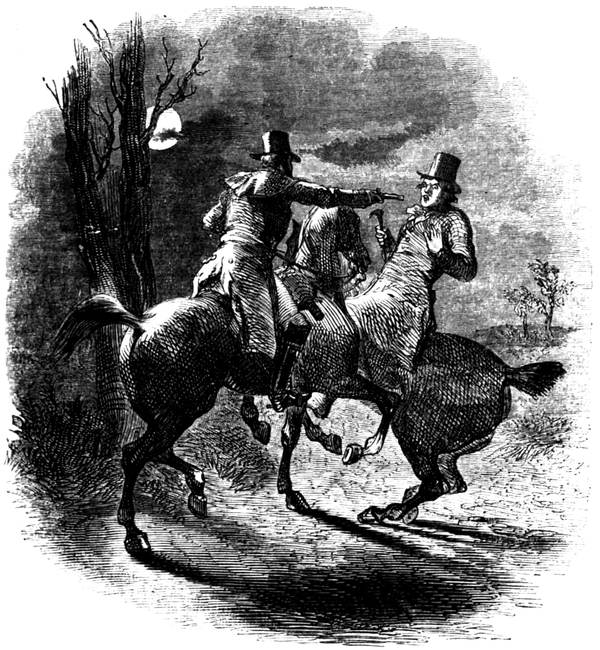
Lady Hatfield looked from the window; and at
the same instant a man, mounted on horseback, with
a black mask over his countenance, and a pistol in
each hand, was by the side of the vehicle.
"Villain!" cried the livery-servant on the box.
"But you shall swing for this!"
"Perhaps I may," said the highwayman, coolly,
though still speaking in a feigned tone, as is the
custom with individuals of his profession upon such
occasions as the one we are describing: "and if you
attempt to move, old fellow, from where you are, an
ounce of lead shall tumble you down from your
perch. Beg pardon, ma'am," continued the robber,
turning towards Lady Hatfield, who had shrunk
back into the corner of the carriage the moment the
desperado appeared at the window; "sorry to inconvenience
you; but—your purse!"
Lady Hatfield handed the highwayman her
reticule.
"Good!" said he, perceiving by its weight and a
certain jingling sound which it sent forth, that it
contained gold. "But you have a companion,
ma'am—her purse!"
Miss Mordaunt complied with this demand, and
implored the "good gentleman" not to murder
her.
The highwayman gave no reply; but vouchsafed
a most satisfactory proof of his intended forbearance
in that respect, by putting spurs to his steed, and
darting off like an arrow in the direction of Hounslow.
"Cowardly villains that you are!" ejaculated the
livery-servant, hurling this reproach against the
postboys.
"And what are you, old fool?" cried the postillion
who rode the wheel-horse. "But he'll be nabbed
yet."
"Drive on—drive on!" exclaimed Lady Hatfield
from the window. "We are all frightened—and
not hurt."
"Indeed, my dear," said Miss Mordaunt, as the
carriage started off rapidly once more, "I am seriously
hurt—grievously wounded!"
"You, Julia!" cried her ladyship, in unfeigned
surprise.
"Yes—in pocket," was the answer, implying deep
3vexation. "All the remainder of my quarter's allowance——"
"Oh! compose yourself on that head," interrupted
Lady Hatfield. "You shall not be compelled
to acquaint Mr. Mordaunt with your loss."
This assurance, conveying a promise of pecuniary
assistance, materially tended to tranquillise the mind
of Miss Mordaunt; but the event which had just
occurred—apart from the mere robbery of her reticule—awoke
the most painful reflections in the mind
of Lady Hatfield.
"By the by," said Miss Mordaunt, after a short
pause—for she never remained long silent,—"this
audacious outrage reminds me of something your
uncle Sir Ralph Walsingham was telling me one
day, when you interrupted him in the middle. I
think he informed me that about six or seven years
ago—when you were only eighteen or nineteen—you
were staying at your dear lamented father's
country-house, where you were quite alone—for of
course one does not call the servants anybody;
when the mansion was broken into by robbers during
the night——"
"Julia!" exclaimed Lady Hatfield, her whole
frame fearfully convulsed by the powerful though
useless efforts which she made to subdue her agitation:
"never, I implore you, again allude to that
dreadful event!"
"Well—I never will," said Miss Mordaunt.
"And yet, if one must not speak of Love—nor yet
of marriage—nor yet of midnight burglaries——"
"Nay—I was wrong to cut you short thus abruptly,"
remarked Lady Hatfield, now endeavouring
to rob her prayer of the importance with which
her solemn earnestness of manner had invested it:
"only, do choose some more enlivening topic after
the fright which we have just experienced."
"The first thing to-morrow morning," said Miss
Mordaunt, who had not noticed the full extent of
the impression which her allusion to the burglary
of some years back had made upon her companion—for
Julia was too flippant, superficial, and volatile
to pay much attention to the emotions of others,—"the
first thing to-morrow morning we must give
information to the Bow Street runners concerning
this highway robbery: secondly, we must write to
the landlord at Staines to tell him what a couple of
cowardly fellows he has got in the shape of these
postillions;—and thirdly, you must discharge old
Mason, who is evidently incapable of protecting his
mistress, much less her friends."
"Discharge old Mason!" exclaimed Lady Hatfield:
"impossible! How could he have protected
us! He is unarmed—whereas the highwayman
flourished two large pistols, doubtless loaded. But
here we are safe at Hounslow!"
The carriage drew up at the door of the hotel in
this town; and the postillions immediately narrated
the particulars of the robbery to the landlord and
his attendant tribe of hangers-on.
"Well, this is fortunate!" cried the landlord,
when the tale was told: "quite a God-send, as one
may say."
"As how, please, sir?" exclaimed the elder postboy,
astonished at the remark.
"Why—it happens that Dykes, the famous Bow
Street officer, is in the hotel at this very instant,"
said the landlord. "John," he added, turning to a
waiter who stood near, "beg Mr. Dykes to step this
way."
"And what's Dykes doing down here?" asked
the postboy, when the waiter had disappeared to
execute the commission he had received.
"He's been investigating a 'cendiary fire," replied
an ostler; for the landlord, disdaining to hold any
farther converse with a postillion, had stepped up to
the window to inquire whether the ladies chose to
alight.
Having received a negative answer, accompanied
with an intimation that the sooner the carriage was
allowed to proceed the more agreeable it would be
to Lady Hatfield and Miss Mordaunt, the landlord
returned towards the spot where the postillions, the
hangers-on of the hotel, and other loungers were
grouped together.
Mr. Dykes almost immediately afterwards made
his appearance in the form of a tall, stout, heavy,
but powerfully built man, shabby-genteel in his
attire, and carrying a strong ash-stick in his hand.
The particulars of the highway robbery were described
to him in a very few moments.
"How was the fellow dressed?" asked the
officer.
"A black coat," said the first postboy.
"No—it wasn't," cried the second.
"Then what was it?" demanded Mr. Dykes.
"I don't know—but I'm sure it wasn't a
black 'un," was the highly satisfactory answer.
"Describe his horse," said Dykes impatiently.
"Brown—switch tail—standing about fourteen
hands——"
"Nonsense!" ejaculated the second postillion,
interrupting his companion who had volunteered
the explanation. "It was a light bay—the moon
fell full upon it—so did the carriage-lights."
"Come, I see we are only losing time," cried the
officer. "Which way did he go?"
"He galloped off in this direction," was the reply,
which remained uncontradicted.
"Then he'll be in London to-night, whichever
road he took," said Mr. Dykes. "If your ladies
will give me a cast as far as town, I'll be after the
villain. Perhaps he turned off to the left towards
Hatton, and so over by Hanwell and then Shepherd's
Bush; or else he made straight for Richmond,
and so over into Surrey. But, one way or another,
he's sure to be in London by midnight; and ten to
one if I don't pounce on him. My business is done
down here; and I may just as well toddle back to-night
as to-morrow morning."
The substance of these remarks was communicated
to Lady Hatfield, who could not well do
otherwise than accord a seat on the box to Mr.
Dykes, Charlotte, the lady's-maid, removing to the
interior of the carriage.
These arrangements having been effected, the
vehicle pursued its way; and shortly after eleven
o'clock it drew up at the door of a mansion on
Piccadilly Hill.
Mr. Dykes, having asked the ladies a few questions,
promised to communicate the result of his efforts
to capture the highwayman; and then took his
departure.
Lady Hatfield and Miss Mordaunt shortly retired
to their respective bed-chambers: the latter to dream
of the delights of London—the former to moisten
her pillow with tears; for the recent adventure had
awakened in her mind feelings of the most agonising
description.
CHAPTER II. TOM RAIN AND OLD DEATH.
4
It was about half-past eight on the following morning,
when two individuals entered a public-house
in White Hart Street, Drury Lane.
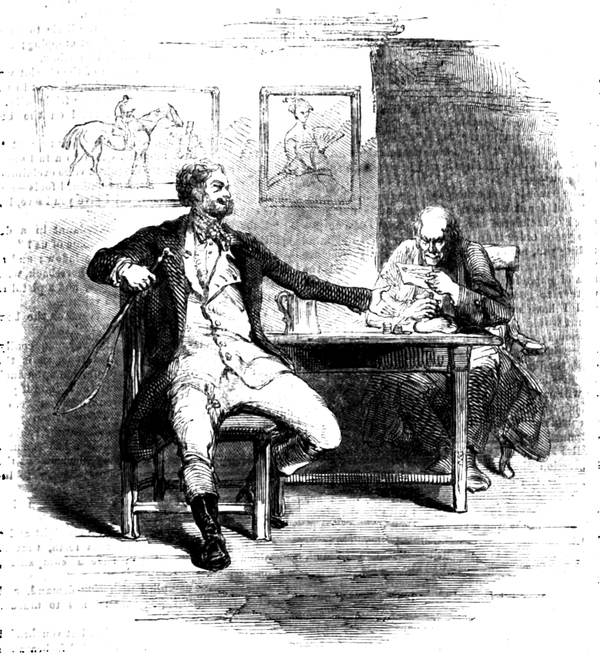
One was a man of about thirty years of age, with
florid complexion, light hair, and red whiskers,—yet
possessing a countenance which, viewed as a
whole, was very far from disagreeable. His eyes
were of a deep blue, and indicated not only good-humour
but a certain generosity of disposition
which was not impaired by an association with
many less amiable qualities—such as a wild recklessness
of character, an undaunted bravery, a love
of perilous adventure, and a sad deficiency of principle
on particular points, the nature of which will
hereafter transpire. He was evidently proud of a
very fine set of teeth, the brilliancy of which compensated
for the somewhat coarse thickness of his
lips; and the delicate whiteness of his hands showed
that he did not earn his livelihood by any arduous
labour. In person he was about the middle-height—by
no means inclined to corpulency—and yet
possessing a well-knit frame, with a muscular
power indicative of great physical strength. His
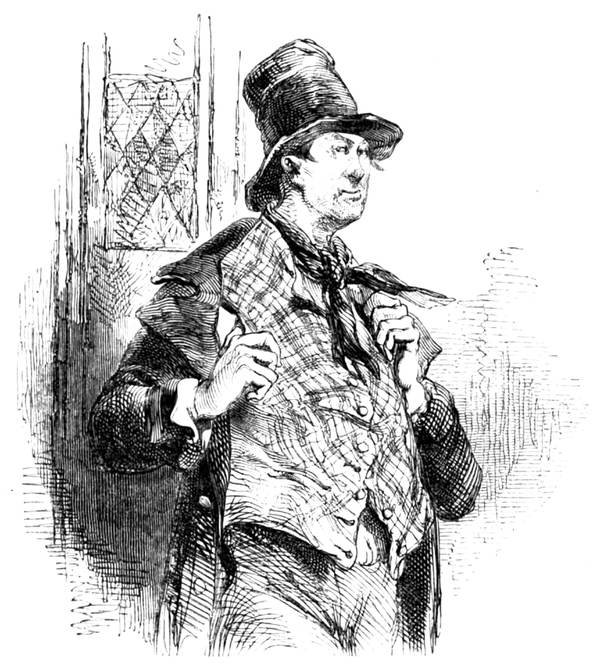
dress partook of the half-sporting, half-rakish character—consisting
of a high chimney-pot kind of
hat, with very narrow brims, a checked blue silk
neckerchief, fine linen, a buff waistcoat, cut-away
Newmarket-style of green coat, drab-breeches, and
top-boots. The proper name of this flash gentleman
was Thomas Rainford; but his friends had taken
the liberty of docking each word of a syllable; and
he was invariably known as Tom Rain.
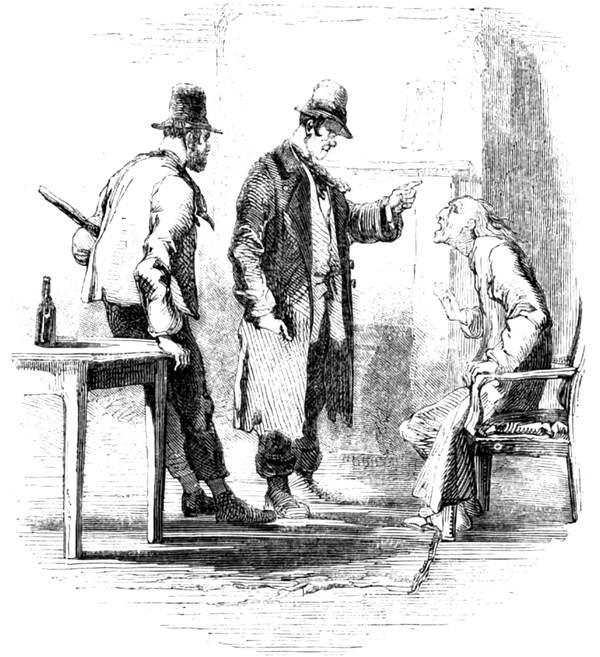
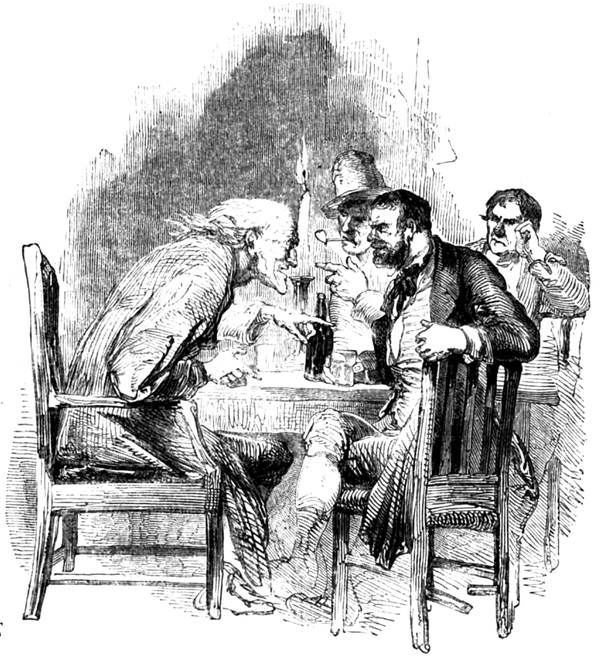
The other individual was an old man, of at least
sixty, with white hair, but eyes of fire glaring from
beneath a pair of thick, shaggy grey brows. He was
upwards of six feet in height, and but little bowed
by the weight of years which he bore. Having lost
all his teeth, his mouth had fallen in so as to form
a complete angle, the depth of which was rendered
the more remarkable by the extreme prominence of
his hooked nose and his projecting chin. He was
as thin as it was possible to be without having the
bones actually protruding through the skin, which
hung upon them like a tanned leather casing. He
was dressed in a long grey surtout coat, reaching
below his knees; a pair of shabby black trousers,
very short; and black cloth gaiters fitting loosely
over that description of shoes generally denominated
high-lows. On his head he wore a greasy cap, with
a large front: his linen was by no means of the
cleanest; and his appearance altogether was excessively
unprepossessing—if not absolutely revolting.
What his real name was, very few of even his most
intimate acquaintances were aware; for his dreadful
emaciation of form had procured for him the frightful
pseudonym of Old Death.
Tom Rain and his hideous companion entered
the public-house in White Hart Street, nodded familiarly
to the landlord as they passed by the bar,
and ascended the stairs to a private room on the
first floor.
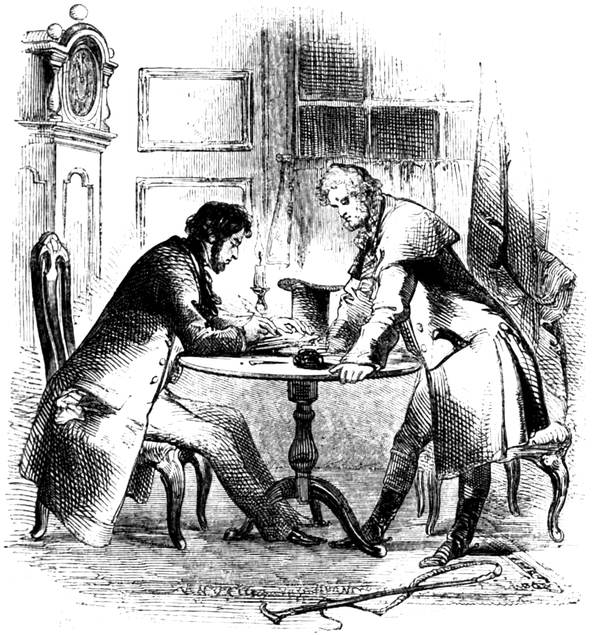
Having seated themselves at the table, Tom Rain
began the conversation.
"Well, have you considered my proposal?" he
asked.
"I have," replied the old man in a deep sepulchral
tone; "but I am cautious—very cautious, my
good friend."
"So you told me when I saw you three days ago
for the first time," observed Rain impatiently.
"But Tullock, the landlord of this place, is a pal of
yours; and he knows me well too. Hasn't he
satisfied you about me?"
"Well—well, I can't say that he hasn't," answered
Old Death. "Still a cautious man like me
never says yes in a hurry. Tullock knew you eight
or nine years ago down in the country; and there's
no doubt that you was then a right sort of blade."
"And so I am now!" cried Tom Rain, striking
the table angrily with his clenched fist.
"Softly-softly, my good friend," said Old Death.
"We shall agree better afterwards if we have a good
understanding at first. I was going to observe that
for some years Tullock loses sight of you; he comes
up to town, takes this public, and doesn't even
remember that there's such a fellow in existence as
yourself until you make your appearance here a few
days back."
"When he received me with open arms, and introduced
me to you," added Tom Rain. "But go
on: what next?"
"Ah! what next?" replied Old Death, with a
horrible chuckle that issued from his throat as if it
come from the depths of a tomb. "Why—you
frankly and candidly told me your intentions and
views, I admit;—but you can't do without me—you
can't do without me, my dear boy—and you
know it!"
Again the hideous old man chuckled in his cavern-like
tones.
"I never denied what you say," answered Tom
Rain. "On the contrary, I am well aware that no
one in my line can think of doing business about
London, and making London his head-quarters,
without your assistance."
"To be sure not!" said the old man, evidently
pleased by this compliment. "I've had the monopoly
of it all for this thirty years, and never once
got into trouble. But then I do my business with
caution—such caution! I've dealings with all
that are worth having dealings with; and not one
of them knows even where I live!"
"Only let me find a sure and ready-money market
for my goods," exclaimed Tom Rain, "and I'll
do more business with you than all the chaps you
speak of put together."
"Well, I suppose we must come to terms," said
Old Death after a short pause. "Tullock assures
me that you were straight-forward when he knew
you in the country, and though time changes men's
minds as well as their faces, I'll take it for granted
that you're all right. You remember the conditions?"
"Not a word you uttered three days ago has
escaped my memory," answered Rain.
"Good. When shall you commence business?"
"I opened my shop last night," replied Tom with
a hearty laugh.
"Nonsense!" cried the old man, fixing a glance
of delight upon his new friend. "You don't mean
to say that——In a word, is this yours?"
As he spoke, Old Death drew from his pocket
the morning's newspaper, pointed to a particular
advertisement, and held the journal towards his
companion.
5Tom Rain's countenance was overclouded for a
moment; but almost immediately afterwards it expanded
into an expression of mingled surprise and
satisfaction; and snapping his fingers joyfully, he
exclaimed, "Is it possible? could it have been her?
Oh! this business is speedily settled!"
And rising from his seat, he rang the bell violently.
A pot-boy answered the summons.
"Pen, ink, and paper, and a messenger to carry a
letter," said Tom Rain, with extraordinary rapidity
of utterance.
The boy disappeared; and Old Death, recovering
partially from the astonishment into which his companion's
ejaculations and manner on reading the
advertisement had thrown him, exclaimed, "What
the devil are you after now?"
"You shall see in a moment," was the reply;
"but I don't promise you any explanation of what
you will see," he added with another hearty laugh.
The boy returned, bringing writing materials, and
intimating that he was willing to be the bearer of
the letter.
Tom Rain told him to wait; then, having hastily
written a few lines upon a sheet of paper, he tossed
the note over to Old Death, who read as follows:—
"Remember the night of the 27th of October, 1819;—and
stop the inquiries instituted in respect to the little business
referred to by the advertisement in this morning's
Times."
"This is past all comprehension," exclaimed the
old man, still keeping his eyes fixed upon the paper.
"The note has not even a signature."
"It does not require one," coolly observed Tom
Rain, as he snatched the letter from his companion,
and proceeded to fold it up.
"And do you hope to crush the business by means
of that scrap of writing?" asked Old Death, evidently
perplexed what to think.
"I don't merely hope—I am certain of accomplishing
my object," was the reply.
"Now mind you ain't deceiving yourself, Tom,"
said Old Death. "The man who has taken up the
affair is persevering as a beaver and crafty as a fox.
You may see that he is in earnest by the expedition
he must have made to get the advertisement into
this morning's paper. I should have hardly thought
it possible to be done. However, done it is—and,
though it gives no description of the person, yet it
offers a good reward for his apprehension. No one
knows what trivial circumstance may afford a trace;
and——"
"Enough of this, old friend," cried Tom; and
handing the letter, now duly folded, wafered, and
directed, to the boy, he said, "Take this to the address
written upon it: see if there's any answer;
and I shall wait here till you come back. Look
alive—and you'll earn a crown by the job."
The boy hastened away to execute the commission
which he had received.
"And so that was your business, Master Tom?"
observed Old Death, as soon as the messenger had
disappeared. "Well—you have made a good beginning:
it promises bright things."
"What! do you fancy that I haven't had plenty
of experience down in the country?" cried Rainford.
"Ah! I could tell you a tale or two—but no
matter now."
"And the little business, Tom," inquired the old
man,—"did it turn out worth the trouble? The
advertisement says——"
"Hark'ee, Master Death," exclaimed Rainford,
firmly; "that business does not regard you. Our
compact dates from this morning——"
"Oh! very good—very good!" interrupted Old
Death in a surly tone. "Be it as you say: but remember—if
you do get into any trouble on account
of this, you mustn't expect me to help you out of
it."
"Neither do I," answered Tom. "However, I
am a generous chap in my way, and I don't mind
yielding to you in this instance; for you must suppose
that I can see your drift plain enough. The
advertisement says 'A purse containing a Bank-note
for fifty pounds and eleven sovereigns, and a reticule
containing a purse in which there were three ten-pound
notes and sixteen sovereigns.' This is accurate
enough. The reticule I flung away: the two purses
I kept—and here they are."
Thus speaking, Tom Rainford threw upon the
table the objects last mentioned.
Old Death's eyes glared with a kind of savage joy
as they caught a glimpse of the yellow metal and
the flimsy paper through the net-work of the
purses.
"Pretty things—pretty things!" he muttered
between his toothless gums. "I think you'll do
well, Tom."
"And I am sure I shall. But turn the money
out on the table: you care more about the handling
of it than I do."
Old Death "grinned horribly a ghastly smile,"
and lost no time in obeying the hint conveyed.
"Twenty-seven golden boys, and eighty pounds
in Bank-notes," said the hideous man. "The gold
is yours—that's part of our conditions: half the
value of the Bank-notes is mine, for the risk and
trouble in cashing them—that's also part and parcel
of our conditions. So if I give you forty sovereigns—forty
golden sovereigns, Tom—we shall be
square."
"Just so," carelessly observed Rain.
Old Death produced a greasy leather bag from a
pocket in the breast of his grey-coat, and counted
thence the forty sovereigns on which he had laid
such emphasis.
Tom Rain thrust the coin into his breeches' pocket
without reckoning it; while his companion first
secured the Bank-notes in the greasy bag, and then
threw the two purses into the fire.
"You're a good fellow, Tom—a generous-hearted
fellow—and I'm much pleased with you," said the
old man. "I shall leave you now, as I have some
little trifling matters to attend to in another part of
the town. When you want me, you know where to
leave a message."
"All right," ejaculated Tom Rainford, who did
not appear over anxious to detain his new friend.
They accordingly separated—Old Death taking
his departure, and the other remaining behind to
await the return of his messenger.
It is necessary to state that when Old Death
quitted the public-house, he was joined a few paces
up the street by a sharp-looking, ill-clad youth of
about fifteen, whose pale countenance, bright eyes,
and restless glances denoted mental activity struggling
against bad health.
Approaching the old man, the youth walked by
his side without uttering a syllable.
6"Jacob," said Death, after a brief pause, and sinking
his voice to a whisper, "you saw that swell-looking
chap who went into Tullock's with me just
now. Well—I told you to be here this morning at
a particular hour, on purpose that you might see
him. He will be useful to me—very useful. But I
must know more of him—and he is not the man to
be pumped. Do you wait here, and watch him.
Dog him about—find out where he goes—where he
lives—whether he has a mistress or a wife, or neither——"
"Or both," added Jacob, with a low chuckle.
"Yes—any thing that concerns him, in fine," continued
Old Death. "I am going to Toby Bunce's
in the Dials, where I shall be for the next three or
four hours if I'm wanted."
"Very good—I understand," said Jacob; and retracing
his steps, he hid himself in a court which
commanded a view of Tullock's public-house.
Let us now return to Tom Rain, who was waiting
for the reappearance of his messenger.
It was shortly before ten when the pot-boy once
more stood in his presence.
"Well?" said Rainford, interrogatively.
"I seed the lady herself," was the reply; "and I
gived her the note. I thought it was somethink
partickler—and so I told the flunkey I'd on'y deliver
it into her hands."
"And how did she receive it?" asked Tom.
"I was showed into a parlour and told to wait.
In a few minutes the door opened and in come a
lady—such a splendid creatur! I never seed such
a fine 'ooman in my life before. Our bar-gal's nothink
to her! So I gived her the note: she looked
at the writing on the outside, but didn't seem to
know it. Then she opened the letter—and, my eye!
didn't she give a start? I thought she'd have fell
slap on her face. For a minute or so she couldn't
recover herself: at last she says, 'Tell the writer of
this note that it shall be attended to;'—and she put
half-a-crown into my hand. That's all."
"I knew it would be so!" cried Tom Rain in a
triumphant tone. "Here's the five shillings I promised
you, my boy; and I don't think you've made
a bad morning's work of it."
The lad grinned a smile of satisfaction, and withdrew.
Rainford soon after descended to the bar, conversed
for a few minutes with his friend Tullock,
the landlord, and then took his departure—duly
watched by Jacob.
He had reached the corner of Drury Lane, when
he felt himself somewhat rudely tapped on the
shoulder.
Turning hastily round, he was confronted by a
tall stout man, who, without any ceremonial preface,
exclaimed, "You're wanted, my good fellow."
"I know I am," replied Tom coolly, as he measured
the stranger from head to foot with a calm
but searching glance: "and I'm now on my way to
the place where my presence is required."
"Just so," said the stout man: "because you are
going to favour me with your company, that I may
introduce you to a party who wishes to become better
acquainted with you."
"Who's the friend you speak of?" asked Tom in
an easy, off-hand kind of manner.
"Sir Walter Ferguson," was the reply. "So come
along."
With these words, the stout man took Rainford's
arm and led him away to the Police Court in Bow
Street.
Jacob, who was an unsuspected witness of the
whole proceeding, immediately took the shortest
way to Seven Dials.
CHAPTER III. BOW STREET.
The moment Mr. Dykes had lodged his prisoner in
one of the cells attached to the court, he hurried
off to Piccadilly Hill, and knocked loudly at the
door of Lady Hatfield's residence.
Upon explaining the nature of his business to the
domestic who answered the summons, he was admitted
into an apartment where Lady Hatfield and
Miss Mordaunt almost immediately joined him.
Lady Hatfield was the orphan daughter of the
Earl and Countess of Mauleverer. She was an
only child: the proud title of Mauleverer had become
extinct with the demise of her father; but the
family property had devolved to her. She was in
her twenty-fifth year, and surpassingly beautiful:—the
style of her loveliness was fascinating and intellectual—rendered
the more interesting, too, by the
tinge of melancholy which characterised her countenance.
Her eyes were large and of a deep blue:
the soul sate enthroned on her pale and lofty forehead;—her
smile, though always plaintively mournful,
denoted amiability and kindness. In stature she
was of the middle height; and, though in the least
degree inclining to embonpoint, yet the fulness of
her form marred not its lightness nor its grace.
The bust was rounded in voluptuous luxuriance—and
the hips were expanded;—but the waist was
naturally small—the limbs tapered gradually downwards—and
her step was so elastic, while her gait
was easy though dignified, that even the most critical
judge of female attractions could not have found
it in his heart to cavil at her symmetry.
Miss Mordaunt was a lady who had seen thirty-five
summers, although she would have gone into
hysterics had any one suggested that such was really
the fact. She was short, thin, and not particularly
good-looking; for her hair was of so decided a red
that it would have been a mockery instead of a compliment
to term it auburn: her eyes were grey, and
her nose suspiciously inclining to the species called
"pug:"—but her complexion was good, her teeth
well preserved and white, and her hand very beautifully
formed. Thus, when she looked in her glass—which
was as often as she passed near it—she mentally
summed up the good and the bad points of her
personal appearance, invariably striking a balance
in favour of the first, and thence arriving at the
very logical conclusion that she should yet succeed
in escaping from a condition of single blessedness.
It was a little after eleven o'clock when Lady
Hatfield and Miss Mordaunt were informed that
Mr. Dykes requested an immediate interview with
them. Some event of that morning's occurrence
had already produced a strange—an almost alarming
effect upon Georgiana—such was Lady Hatfield's
Christian name: and in order to regain her
spirits—to recover indeed from a sudden shock
which she had received—her ladyship had proposed
an early airing in the carriage. To this Julia, who
had some "shopping to do," readily assented. They
had accordingly just completed their toilette for
7the purpose, and were now waiting in the drawing-room
for the arrival of the chariot, when the announcement
of Mr. Dykes's name called such an
ejaculation of anguish from Lady Hatfield's lips,
that Miss Mordaunt was seriously alarmed.
But Georgiana,—the expression of whose countenance
indicated for an instant the agony of a
heart wounded to its very core,—subdued her emotions
by a violent effort; and then, in answer to
her friend's solicitous inquiries, attributed the temporary
agitation she had experienced to a sudden
pain passing through her head.
It was nevertheless with feelings of mingled
terror and repugnance that Georgiana accompanied
Julia to the room where the Bow Street officer
awaited them.
Her very eye-lids quivered with suspense, when
she found herself in the presence of the celebrated
thief-taker.
"Well, ladies," exclaimed Mr. Dykes, rising from
a chair, and making an awkward bow as they entered,
"I've good news for you: the highwayman is——"
"Is——" repeated Georgiana, with nervous impatience.
"Is in custody, my lady; and all I now want——"
"Who is in custody?" demanded Georgiana,
hope for a moment wildly animating her.
"The man that robbed you last night, my lady,"
answered the officer; "or else I'm dam——beg pardon—very
much mistaken."
"But how do you know he is the same?" exclaimed
Lady Hatfield. "Perhaps you may have
erred—your suspicions may have misled you——"
"Ah! my lady," interrupted Dykes, totally mistaking
the cause of Georgiana's warmth; "you
surely ain't going to plead in favour of a chap that
stopped you on the King's highway, and did then
and there steal from your person and from the person
of your friend——"
"Describe the individual whom you have arrested,"
said Lady Hatfield abruptly.
"To a nicety I will," answered the officer, who
was now completely in his element. "About thirty
years of age—good complexion—light curly hair—red
whiskers—dark blue eyes—splendid teeth—thick
lips——But here's your carriage come round
to the door, my lady; and nothing could possibly be
more convenient. Please not to waste time—as I
think we can get him committed to-day."
The moment Dykes had begun his description,
Lady Georgiana's eyes expressed the agonising nature
of the suspense which she endured; but as he
continued, and his portraiture became the more definite,
an ashy paleness overspread her countenance.
This agitation on her part was not however perceived
by either the Bow Street officer or Miss Mordaunt;
for the former had a habit of fixing his eyes
on the knob of his ash stick when he was engrossed
in a professional topic; and the latter was drinking
in with greedy ears the description of the supposed
highwayman, whom she was quite astonished
to hear represented as so very discrepant from her
idea of what a midnight desperado must be.
The arrival of the carriage was, under the circumstances,
quite a relief to Georgiana; and, without
uttering another objection, she allowed Mr.
Dykes to have his own way in the matter.
That experienced officer rang the bell as coolly as
if the house was his own, and desired that the man-servant
and lady's-maid, who were in attendance on
their mistress the preceding night, would prepare to
accompany him to Bow Street.
Mason and Charlotte speedily obeyed this request,
and the chariot, instead of taking the ladies up Bond
Street, conveyed them, the two servants, and Mr.
Dykes, to the police-office.
On their arrival, Mr. Dykes conducted his witnesses
into a private room, and, after an absence of
about five minutes, returned with the intelligence
that the night charges were just disposed of, and
that the prisoner was about to be placed in the
dock.
A shudder passed through Georgiana's frame;
but, with a desperate effort to compose herself, she
followed Mr. Dykes into the court, Miss Mordaunt
and the two servants remaining in the private room
until they should be summoned individually to give
their testimony.
As Georgiana was a lady of rank and fortune she
was not treated as a humble witness would have
been, but was accommodated with a chair, Mr.
Dykes assuring her, in a confidential whisper, that
she need not stand up to give her evidence.
The body of the court was crowded with a motley
assembly of spectators, the news that a highwayman
was about to be examined having spread like wildfire
throughout the neighbourhood.
Scarcely was Georgiana seated, when a sensation
on the part of the crowd enabled her to judge that
the accused was being brought in; and as Tom Rain
leapt nimbly into the dock, she cast a rapid glance
towards him—a glance in which terror was combined
with indescribable disgust and aversion.
The accused affected not to notice her, but
lounged in a very easy and familiar fashion over the
front of the dock; surveying, first Sir Walter
Ferguson, and then the clerk, with a complacency
which would have almost induced an uninitiated
stranger to imagine that they were the prisoners and
he was the magistrate.
Mr. Dykes, being called upon by Sir Walter to
explain the nature of the charge against the prisoner,
declared that, "in consequence of information
which he had received," (the invariable phraseology
of old police-officers,) "he had arrested the accused
on suspicion of having stopped Lady Hatfield's carriage
on the preceding evening, and robbed her
ladyship and her ladyship's friend of certain monies
specified in an advertisement which he had caused to
be inserted in that morning's paper." Mr. Dykes
further stated that, having searched the prisoner, he
had found upon him a considerable sum in gold;
but none of the Bank-notes stolen.
Lady Hatfield was then sworn, and she corroborated
the officer's statement relative to the robbery.
"Has your ladyship any reason to suppose that
the prisoner in the dock is the person by whom your
carriage was stopped?" inquired the magistrate.
"I feel well convinced, sir," was the reply, delivered,
however, in a tremulous tone, "that the
prisoner at the bar is not the man by whom I was
robbed."
A smile of triumph curled the lips of Tom Rain;
but Mr. Dykes surveyed Georgiana with stupid astonishment.
"Not the man, my lady!" he ejaculated, at
length: "why, last night, your ladyship could give
no description of what the robber was or what he
was not!"
8"Dykes, hold your tongue!" cried the magistrate:
"her ladyship is upon her oath."
"Your worship," said Georgiana, in a firmer
voice than before, "I was so bewildered last evening—so
overcome with terror——"
"Naturally so, Lady Hatfield," observed the magistrate,
with a very courteous smile, which seemed
to say that he would rather believe the bare word of
a member of the aristocracy—especially a lady—than
the oaths of all his officers and runners out
together. "In fact," continued Sir Walter blandly,
"you were too much flurried, to use a common expression,
to reply calmly and deliberately to any
questions which Dykes may have put to you last
evening."
"Such was indeed the case, your worship,"
answered Georgiana. "This morning, however, I
have been enabled to collect my ideas, and to recall
to mind the smallest details of the robbery. The
highwayman had a black mask upon his face; but,
by a sudden movement of his horse, as he stood by
the carriage window, the mask slipped aside, and I
caught a glimpse of his countenance by the moonlight."
"And that countenance?" said the magistrate.
"Was quite different from the prisoner's," replied
Lady Hatfield firmly.
"Your ladyship did not make that statement
when I gave you the description of the prisoner just
now," said Dykes, evidently bewildered by the nature
of Georgiana's testimony.
"Because you hurried me away, together with my
friend and two of my servants, in a manner so precipitate
that I had no time to utter a word," returned
Lady Hatfield. "Moreover, as you had
taken the prisoner into custody, I believed it to be
necessary that his case should be brought beneath
the cognizance of his worship."
Georgiana spoke in a tone apparently so decided
and calm, that the officer knew not how to reply;
although in his heart he suspected her sincerity.
The magistrate consulted the clerk; and, after
the interchange of a few whispers, Sir Walter said,
"I see no reason for detaining the prisoner: there
is evidently some mistake on your part, Dykes."
"Your worship," exclaimed the officer, "I know
not what to think. Can the prisoner give a good
account of himself? He rides into London from
Richmond at six o'clock this morning; puts his
horse up at an inn in the Borough; goes to a coffee-house
in another street to have his breakfast, and
leaves a pair of pistols for the waiter to take care
of for him; then walks over to a suspicious public
not a hundred miles from this court; meets there a
man that me and my partners have long had our
eyes on; and, when he is searched, has a large
sum in gold about his person."
"Do you hear what the officer says, prisoner?"
inquired the magistrate.
"I do, your worship," answered Tom Rain,
coolly; "and I can explain it all. I come up to
London on business, which requires the sum of
money found upon me. I put up my horse where
I think fit; and I go elsewhere to get my breakfast,
because I can have it cheaper than at the inn.
I was armed with pistols because I had to travel a
lonely road in the dark; and I left them at the coffee-house
because I did not choose to drag them about
with me all day long."
Mr. Dykes was about to reply, when two decently-dressed
men, who had entered the court a few minutes
previously, stepped forward.
"Please, your worship," said the first, "I have
known Mr. Rainford the last four years; and a more
respectable man does not exist. He came up to
London to buy a couple of horses of me; and he
was to pay ready money. My name's Watkins,
your worship; and I've kept livery and bait stables
in Great Queen Street, Lincoln's-Inn-Fields, for the
last seventeen years."
"And I, your worship," said the other person, in
his turn, "can answer for Mr. Rainford. If you
doubt my respectability, your worship, send one of
your officers round to Compton Street, and see if the
name of Bertinshaw isn't painted up in precious
large letters over the best jeweller's shop——"
"And pawnbroker's," interrupted Mr. Dykes
significantly.
"Well—and pawnbroker's, too," added Bertinshaw:
"I'm not ashamed of the calling."
"Then you are both prepared to guarantee the
prisoner's appearance at any future time?" said the
magistrate.
"Certainly, your worship," was the joint reply.
"To answer any charge that may be brought
against him?" continued Sir Walter.
The response was again in the affirmative on the
part of Watkins and Bertinshaw.
The magistrate stated the amount of the recognizances
which were to be entered into, and Tom
Rain was desired to stand down from the dock.
This intimation he obeyed with the same air of
calm indifference which had characterized him
throughout the proceedings, and which had only
been for a moment disturbed by the profound astonishment
he had experienced when two men,
whom he had never before seen nor even heard of
in his life, stepped forward to give him so excellent
a character and become his bail. But a moment's
reflection convinced him that Old Death was the
unseen friend who worked the machinery of this
manœuvre.
While the clerk was filling up the bail-bond, Lady
Georgiana retired from the office, her bosom a prey
to feelings of a strangely conflicting nature,—joy at
having passed through an ordeal which she had
dreaded—grief at having stained her soul with the
fell crime of deliberate perjury—and agony at the
sad reminiscences which the presence of Rainford
had recalled so forcibly to her mind.
Miss Mordaunt and the two servants were astonished
to hear the unexpected turn which the
proceedings had taken; but their attention was
almost immediately absorbed in the condition of
Lady Hatfield, who scarcely had time to communicate
to them the result of her examination in the
court, when a sudden faintness came over her.
She had exhausted all her energies in the endeavour
to maintain an air of calmness, and to reply in
a tone of sincerity when in the presence of the
magistrate; and now a reaction took place—her
courage gave way—the weight of fearful reminiscences
overpowered her—the glow of excitement
which had mantled her cheeks changed to a
death-like pallor—and she fainted in the arms of her
friend.
Fortunately, Miss Mordaunt had a bottle of
volatile salts with her; and by these means
Georgiana was speedily recovered. She was then
led to her carriage; but she did not appear to
9breathe freely until the vehicle was some distance
from the police-court.
CHAPTER IV. ESTHER DE MEDINA.
Let us now return to the interior of the police-office.
The clerk was drawing up the bail-bond; the
two securities were conversing in whispers with
Tom Rain, whom they had affected to greet, when he
descended from the dock, as an old acquaintance;
and Mr. Dykes was leaning gloomily against the
partition which separated the magistrate's desk from
the body of the court,—when the entrance of two
persons produced a new sensation amongst the
crowd.
One was an officer of the court: the other was a
lady, closely veiled, and enveloped in a cloak of rich
material.
Her form was tall; and, even though her entire
frame was now convulsed with intense anguish as she
passed amidst the gaping throng to the chair which
Lady Hatfield had occupied two or three minutes
previously, yet that excess of grief and terror did
not bow her down, nor impair the graceful dignity
of her gait.
The officer motioned her to seat herself, an intimation
which she evidently accepted with gratitude.
"What is it, Bingham?" inquired the magistrate
of the officer.
"Please, your worship," was the reply, "it's a
serious charge; and the prosecutor will be here in a
moment."
"Very well," said the magistrate: "I will take
it directly."
"Who is she?" whispered Dykes, accosting his
brother officer.
"Her name is Esther de Medina, she tells me,"
returned Bingham.
The question and answer were overheard by Tom
Rainford, who was standing close by the officers;
and the announcement of the lady's name produced
a strange and almost electrical effect upon him.
The devil-me-care recklessness of his manner suddenly
disappeared; and a sentiment of profound
10commiseration and deep interest, in respect to
Esther de Medina, seemed to occupy his mind.
He was about to question Mr. Bingham relative to
the charge which he had against her, when the clerk
called upon him and his securities to sign the bond.
This ceremony was speedily performed; and Rain's
money was returned to him by Mr. Dykes, who,
however, looked at him in a manner which seemed
to say—"I know I am not mistaken in you, although
you have contrived to get off: but I'll have you
another time."
Tom cared nothing for the sinister looks of the
Bow Street officer; neither did he pay much attention
to the gold which he now poured back into his
pocket; for all his thoughts appeared to be absorbed
in the presence of the veiled lady.
"Come along with us," whispered Bertinshaw,
"and we'll celebrate your escape over a bottle of
wine at my place."
"No—not now," replied Tom, hastily: "I mean
to stay and hear this case: it interests me."
"Will you join us presently?" asked his new
friend, who had just now pretended to be a very old
one.
"Yes, yes," answered Tom: "in an hour or so."
Bertinshaw and Watkins then took their departure.
"Now, Bingham," cried the clerk; "what is it?"
At that moment a gentleman of handsome appearance
and middle age entered the court.
"Here's the prosecutor who will explain the matter,"
said the officer.
The prisoner, suddenly remembering the respect
due to the bench, raised her veil; and, at the same
time, she glanced in an eager, inquiring manner towards
the individual who now appeared against her.
But we must pause to describe her.
She was not more than eighteen years of age, and
surpassingly lovely. Her complexion was a clear
transparent olive, beneath which the delicate tinge
of carnation was not entirely chased away from her
cheeks by the terror and grief that now oppressed
her. Her face was of the aquiline cast—her forehead
broad, high, and intelligent; her nose curved,
but not too prominent in shape; her mouth small,
with thin vermilion lips, revealing teeth of pearly
whiteness; her chin sweetly rounded; and her eyes
large, black, and brilliant. And never did more
splendid orbs of light mirror the whole power of
the soul, or flash brighter glances from beneath
richly-fringed lids. Then her brows were so delicately
pencilled, and so finely arched, that they gave
an air of dignity to that lovely—that fascinating
countenance. Her hair, too, was of the deepest
black—a black so intense, that the raven's wing
might not have compared with it. Silken and
glossy, the luxuriant mass was parted above the
forehead, and, flowing in two shining bands—one on
each side of the face, for which they appeared to
form an ebony frame,—was gathered behind the ears.
In stature she was tall, sylph-like, and graceful.
Her shoulders had that fine slope which the Italian
masters so much admired, and with which they
were delighted to endow the heroines of their
pictures. Her waist was admirably proportioned,
and not rendered too thin by the unnatural art of
tight-lacing. Her hand was of exceeding beauty;
her feet and ankles were in perfect keeping with
the exquisite symmetry of her form; and her gestures
were full of dignity and grace.
She was a Jewess; and, if the most glorious
beauty were honoured with a diadem, then should
Esther de Medina have become Queen of the
Scattered Race.
The moment she raised her veil, all who could
catch a glimpse of her countenance were struck
with astonishment at the dazzling loveliness thus
revealed; and even the magistrate felt anxious to
learn what misadventure could have placed so
peerless a being within the grasp of justice. Her
crime could scarcely be robbery; for she was well-dressed,
and had the appearance of belonging to
even a wealthy family. Besides, her face—her eyes
seemed to denote a conscious purity of soul, in spite
of the painful emotions which her present situation
had excited within her bosom.
But the person who was most interested—most
astonished by the sudden revelation of that exquisite
countenance, was Tom Rain. It was not with
lustful desire that he surveyed her; it was not with
any unholy passion: on the contrary, it was with a
sentiment of deep devotion and profound sympathy.
He also manifested extreme curiosity to learn upon
what possible charge Esther de Medina could have
been brought thither.
On her part, she was evidently altogether unacquainted
with the person of Tom Rain; for as she
cast a rapid and timid glance around, her eyes lingered
not upon him.
The middle-aged, handsome-looking man who
had just entered the office, was now desired to state
the grounds upon which Esther de Medina was in
custody.
This witness deposed that his name was Edward
Gordon, and that he was a diamond-merchant, residing
in Arundel Street, Strand. On the 31st of
October, at about five o'clock in the evening, a
female called upon him and requested him to purchase
of her a diamond ring, which she produced.
He examined it by the light of the lamp burning in
the apartment where he received her; and, finding
that it was really a jewel of some value, he offered
her a price which he considered fair. That sum was
thirty guineas. She endeavoured to obtain more;
but he did not consider himself justified in acceding
to her wish. Finally, she accepted his proposal,
received the amount, left the ring, and departed.
He went out immediately after, carefully locking
the door of the room. Having an engagement to
dine with a friend, he returned home late, and did
not enter that particular room until the following
morning; when he discovered that a set of diamonds,
which he remembered to have been lying in
an open case upon the table at the time the female
called on the preceding evening, was missing.
He searched vainly in all parts of the room; and at
length came to the fixed conclusion that the female
in question had stolen the diamonds. He gave immediate
information to Bingham, the officer, together
with an accurate description of the suspected person;
for she was upwards of twenty minutes with
him on the evening of the 31st, and he had therefore
seen enough of her to know her again.
"Moreover," added the prosecutor "two clear days
only have elapsed since the interview which took
place between us; and I appeal to your worship
whether the countenance of the prisoner, when once
seen, can be readily forgotten; for painful as it is to
accuse so young and interesting a person of such a
crime, my duty to society compels me to take this
11step; and I have no hesitation in declaring that the
prisoner is the female who sold me the ring."
A profound sigh escaped from the bosom of
Esther; but she uttered not a word.
Bingham, the officer, then proved that he called
about half an hour previously upon Mr. Gordon to
inform him that he had vainly endeavoured to discover
a clue to the supposed thief. Mr. Gordon was
on the point of going out upon particular business,
and the officer, in order not to detain him, walked
a part of the way in his company, so that they might
converse upon the subject of the robbery as they
went along. They were passing through Lincoln's-Inn-Fields,
when they met the prisoner at the bar.
Mr. Gordon instantly recognised her, and the officer
took her into custody. She manifested much
indignation, and said that there must be some mistake;
but when the nature of the charge was stated
to her, she turned deadly pale, and burst into tears.
Rainford had listened to these statements with
the deepest—the most intense interest; and his
countenance underwent various changes, especially
while Mr. Gordon was giving his evidence. At one
moment Tom exhibited surprise—then indignation,—and,
lastly, the most unfeigned sorrow.
But suddenly an idea seemed to strike him: for a
minute did he reflect profoundly; and then joy
animated his features.
Hastily quitting the court, he hurried to the
coffee-house opposite, called for writing materials,
and penned the following letter:—
"Nov. 3, 1826.
"My Lord,—Esther de Medina is at Bow Street, accused
of a crime which is alleged to have been committed
at about five o'clock in the evening of the 31st of October.
It is for you to prove her innocence. Delay not, then, an
instant.
"AN UNKNOWN FRIEND TO ESTHER."
Throwing a shilling upon the table, Tom Rain
hurried away, took a hackney-coach at the nearest
station, and desired to be driven to the mansion of
Lord Ellingham, Pall-mall, West.
A half-guinea which he slipped into the coachman's
hand as he entered the vehicle, produced the
desired effect; for the horses were urged into a pace
the rapidity of which seemed to astonish themselves
as a proof of what they could do if they chose; and,
in a very short time, Rainford leapt out at the door
of his lordship's abode.
The nobleman was fortunately at home; and
Tom Rain delivered the letter to the servant who
answered his summons.
Then, having desired the coachman to wait, as he
might have "a fare" back to Bow Street, Rainford
hurried away at his utmost speed, retracing his
steps to the police-office.
In the meantime, the clerk had taken down the
depositions of Mr. Edward Gordon and Bingham;
while the most extraordinary sensation prevailed in
the court. The youth—the loveliness—the modest,
yet dignified appearance of Esther de Medina enlisted
all sympathies in her favour; and many a
rude heart then present felt a pang at the idea of
believing her to be guilty.
She had stood up when the prosecutor was
called against her; but when he reached that point
in his evidence which mentioned the loss of his diamonds,
she clasped her hand convulsively together,
and, trembling with agitation, sank into the chair
from which she had risen.
When the depositions were taken down, the magistrate
said, "Prisoner, you have heard the very
serious charge made against you: have you any
thing to say in your defence?"
Then she spoke for the first time since she had
entered the court; and though her words were
delivered with impassioned emphasis, the melodious
tones of her voice sounded like a silver bell upon
the ears of all present.
"Sir, I am innocent—I am innocent!" she exclaimed.
"Oh! God knows that I am innocent!"
The glance she darted from beneath her darkly
fringed lids spoke even more eloquently than her
words; and every feature of her fine countenance
seemed to bear testimony to the truth of her declaration.
"Would you not do well to send for your friends?"
asked the magistrate, in a kind tone.
These words seemed to touch her most acutely:
they summed up as it were all the painful features
of her most distressing position.
"Oh! my father—my dear, dear father!" she exclaimed,
her countenance expressing so much bitter—bitter
anguish, that there was scarcely an unmoistened
eye in the court.
"Your worship, I do not wish to prosecute this
case—I am sorry I have gone so far," said the diamond-merchant,
wiping away the tears from his
cheeks—for he was really a good-natured man.
"It is not in my power to stay the proceedings,"
replied Sir Walter Ferguson. "The evidence is unfortunately
strong against the prisoner. She would
do well to send for her friends. Let the case stand
over for half an hour."
Esther was accordingly conducted into the magistrate's
private room, where she was visited by the
female-searcher, who endeavoured to persuade her,
with as much gentleness as she could command, to
mention the residence of her parents.
"Alas! my mother has long been dead," was the
mournful reply; "and my poor father—oh! it
would break his heart were he to know——"
She checked herself, and fell into a profound
reverie—despair expressed in her countenance.
During the remainder of the half hour which intervened
ere she was led back to the office, she replied
only in vague and unsatisfactory, but not self-inculpating,
monosyllables to the questions addressed
to her.
At length the female-searcher gave her an indirect
intimation, that her punishment on trial would
be more lenient if she admitted her guilt and expressed
her contrition.
"What!" she exclaimed, with a recovering sob;
"do you really deem me culpable of this most
heinous charge? My God! have the Christians no
mercy—no compassion? Oh! I should not speak
thus to you! But I know that our race is looked
upon with suspicion: we are prejudged, because
we are Jews! And yet," she added, in a different
and prouder tone, "there are as noble sentiments—as
generous feelings—as estimable qualities amongst
the members of the scattered tribe, as in the hearts
of those Christians who have persecuted our nation
for centuries and centuries!"
The woman, to whom these words were addressed,
was astonished at the enthusiastic manner in which
the beautiful Jewess spoke; for there was something
at that moment sublimely interesting—eloquently
commanding about Esther de Medina, as
12the rich colour glowed more deeply upon her cheeks,
the blue veins dilated on her proud forehead, and
the whole power of her soul seemed thrown into
her magnificent eyes.
It was at this moment that the usher of the
court entered to conduct the Jewess back into the
office.
Once more she stood in the presence of the magistrate,—now
no longer subdued and crushed with
terror; but nerved, as it were by conscious innocence,
to meet the accusation brought against her.
Tom Rain had returned to the court; and, by mingling
with the crowd of spectators, anxiously
watched the countenance of Esther de Medina.
"Prisoner," said the magistrate, "have you anything
now to offer in your defence? Or have you
sent to communicate with your friends relative to
the position in which you are placed?"
"Sir," answered Esther, her soft and musical
tones falling like a delicious harmony upon the
ears, "I have but one word to utter in my defence;
and if I did not speak it when I first stood before
you, it was simply because this terrible accusation,
bursting so abruptly upon the head of an innocent
person, stupefied me—deprived me of the power of
collecting my ideas. Neither was it until within a
moment of my return into the court that the fact
which I am about to state flashed to my memory.
Sir—I was not in London from two o'clock in the
afternoon until half-past ten o'clock at night, on
the 31st of October."
A gentle—a very gentle smile played upon her
vermilion lips as she uttered these words.
"And it was during the interval which you name
that the prosecutor was visited by the female whom
he believes to have robbed him of his diamonds?"
observed the magistrate.
"I deny having visited the prosecutor at all," answered
Esther, in a firm but respectful tone. "I
never sold him a ring—I never sold an article of
jewellery to a living being. Placed by the honest
industry of my father above want," she continued
proudly, "I labour not under the necessity of parting
with my jewellery to obtain money."
At this moment, a fine, tall, handsome young
man, of about six and twenty years of age, entered
the court. He was dressed in an elegant but unassuming
manner: his bearing was lofty, without
being proud; and his fine blue eyes indicated a frank
and generous disposition.
Slightly inclining in acknowledgment of the respect
with which the crowd made way for him to pass,
he advanced towards the magistrate, who instantly
recognised him as an acquaintance.
At the same moment, Esther started with surprise,
and murmured the name of Lord Ellingham.
To the astonishment of all present—Tom Rain,
perhaps, excepted,—the nobleman shook Esther
kindly by the hand, saying, "In the name of heaven,
Miss de Medina, what unfortunate—or rather ridiculous
mistake has brought you hither?"
Sir Walter Ferguson immediately directed the
clerk to read over the depositions.
"What!" ejaculated Lord Ellingham, who had
scarcely been able to restrain his indignation during
the recital of the previous proceedings: "the
daughter of a respectable and wealthy gentleman to
be placed in such a position as this! But in a moment
I will make her innocence apparent. At the
very time when this robbery was alleged to have
taken place—at the hour when the female, for
whom this young lady has evidently been mistaken,
called upon the prosecutor—Miss de Medina was
not within six miles of Arundel Street."
These words produced in the court a sensation
which was the more lively because they seemed to
corroborate the prisoner's own defence—a defence
which Lord Ellingham had not heard.
Mr. Gordon, the prosecutor, looked astounded—and
yet not altogether grieved at the prospect of
the prisoner's discharge.
"Mr. de Medina," continued Lord Ellingham,
"has only recently arrived in London, having retired
from an extensive commercial business which
he long carried on at Liverpool. He has become
my tenant for a house and small estate situated at
a distance of about seven miles from the metropolis;
and on the 31st of October I accompanied
him and his daughter—the lady now present—on a
visit to the property thus leased. We left London
in my own carriage at about two o'clock on the
day named; and it was between ten and eleven at
night when we returned. During that interval of
several hours Miss de Medina never quitted her
father and myself."
A murmur of satisfaction arose on the part of
the spectators; but it was almost immediately interrupted
by the entrance of an elderly and venerable-looking
man, whose countenance—of that cast
which ever characterises the sons of the scattered
tribe—had once been strikingly handsome. Though
not deficient in an expression of generosity, it nevertheless
exhibited great firmness of disposition; and
his keen black eyes denoted a resolute, unbending,
and determined soul. He was upwards of fifty-five
years of age, and was plainly, though neatly,
dressed.
Advancing into the body of the court, he cast a
rapid glance around.
"My father!" exclaimed Esther; and springing
forward, she threw herself into her parent's arms.
He held her tenderly for a few moments: then,
gently disengaging himself from her embrace, he
murmured in her ear, "Oh! Esther—Esther, I can
understand it all! You have brought this upon
yourself!"
But these words were heard only by Lord Ellingham,
who had advanced to shake hands with the
Jew.
That reproach appeared for the moment to be
singular and altogether misplaced, as it was impossible
that Esther could have perpetrated the crime
imputed to her: but the nobleman had not leisure
to reflect upon it, for Mr. de Medina now perceived
him and accepted the outstretched hand.
"I was accidentally passing by the court," said
the Jew; "and hearing my own name mentioned by
some loungers outside, paused to listen. Their
conversation induced me to make inquiries; and I
learnt all the particulars of this charge."
"And some unknown friend of Miss de Medina
sent me a hasty note conveying the unpleasant intelligence,"
answered Lord Ellingham. "But I believe
that I have fully convinced his worship of
your daughter's innocence."
These last words were uttered in a louder tone
than the former part of the observation, and were
evidently addressed to the magistrate.
"For my part," said Mr. Gordon, "I am perfectly
satisfied that there is a grievous misunderstanding
13in this matter. Miss de Medina is evidently
unconnected with it; and yet," he added, as
his eyes dwelt upon her countenance, "never was
resemblance so striking! However—I am well
pleased to think that Miss de Medina is not the
person by whom I was plundered; and I most sincerely
implore her pardon for the inconvenience—nay,
the ignominy to which she has been subjected."
Esther turned an appealing glance towards her
father, as if to remind him of some duty which he
ought to perform, or to convey some silent prayer
which he could well understand: but he affected
not to notice that rapid but profoundly significant
glance.
The magistrate then declared that the young
lady was discharged, without the slightest stain
upon her character.
Hastily drawing down her thick black veil, Esther
de Medina bowed deferentially to the bench;
and passed out of the office, leaning on her father's
arm, and accompanied by the Earl of Ellingham.
Tom Rain followed her with his eyes until the
door closed behind her.
For a few moments he remained wrapped up in
a deep reverie: then, heaving a profound sigh, he
also took his departure.
CHAPTER V. THE APPEAL OF LOVE.
It was about eight o'clock in the evening of the
day on which so many strange incidents occurred
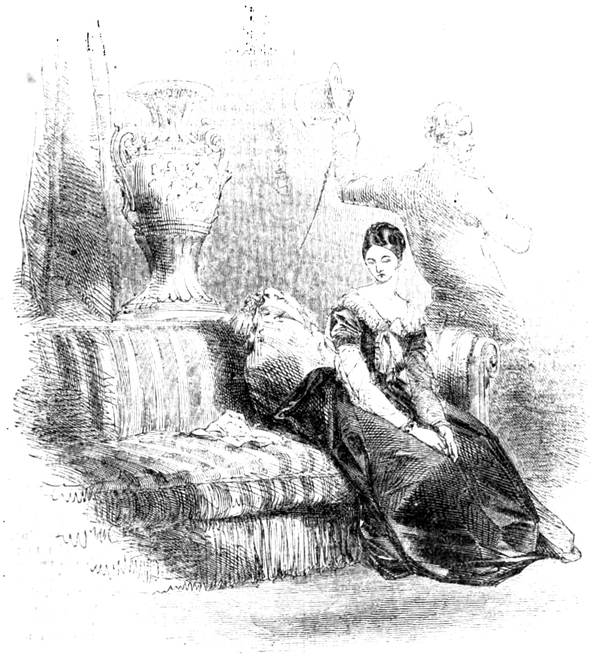
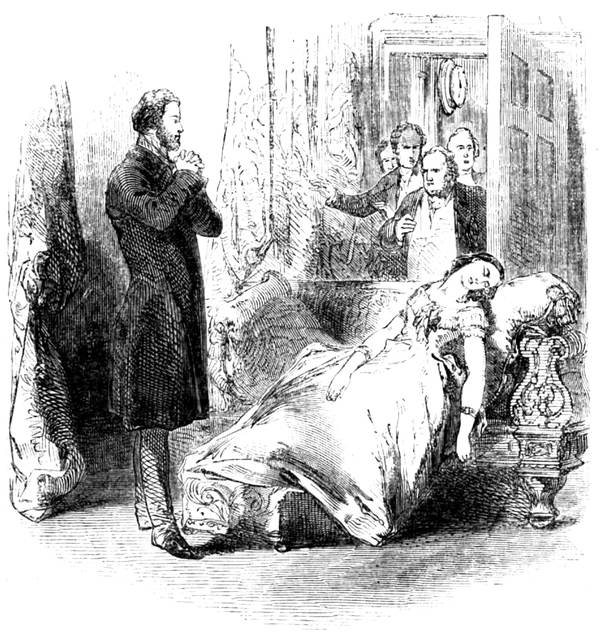
at Bow Street, that Lady Hatfield was reclining in
a melancholy mood upon the sofa in the drawing-room
of her splendid mansion.
She was dressed in black satin, which set off the
beauty of her complexion to the greatest advantage.
One of her fair hands drooped over the back of
the sofa: the other listlessly held a book, to the
perusal of which she had vainly endeavoured to
settle herself.
There was a mysterious air of mournfulness about
her that contrasted strangely with the elegance of
the apartment, the cheerful blaze of the fire, the
brilliant lustre of the lamps, and the general appearance
of wealth and luxury by which she was
surrounded.
That sorrowful expression, too, was the more unaccountable,
inasmuch as the social position of
Georgiana Hatfield seemed to be enviable in the extreme.
Beautiful in person, possessing rank and
wealth, and free to follow her own inclinations, she
might have shone the star of fashion—the centre
of that human galaxy whose sphere is the West
End of London.
Oh! bright—gloriously bright are the planets
which move in that heaven of their own:—and yet
how useless is their brilliancy! The planets of
God's own sky are made to bestow their light upon
the orbs which without them would revolve in darkness;
but the planets of the sphere of aristocracy
and fashion throw not a single ray upon the millions
of inferior stars which are compelled to circle
around them!
To Lady Hatfield the pleasures and dissipation
of the West End were unwelcome; and she seldom
entered into society, save when a refusal would
prove an offence. Up to the age of seventeen or
eighteen she had been remarkable for a happy, joyous,
and gay disposition: but a sudden change came
over her at that period of her life; and since then
her habits had grown retired—her disposition mournful.
But let us return to her, as she lay reclining on
the sofa in the drawing-room.
The robbery of the preceding night and the events
of the morning had evidently produced a powerful
impression upon her mind. At times an expression
of acute anguish distorted her fair countenance
for a moment; and once or twice she compressed
her lips forcibly, as if to restrain a burst of
mental agony.
The time-piece upon the mantel had just proclaimed
the hour of eight, when a domestic entered
the room and announced the Earl of Ellingham.
Georgiana started up—assumed a placid expression
of countenance—and advanced to receive the
young nobleman, who, as he took her hand, respectfully
pressed it to his lips.
"Your ladyship will, I hope, pardon me for intruding
at this hour," he said, as he conducted her
back to the sofa, and then took a chair at a short
distance; "but I was not aware of your return to
town until an hour ago, when I perused in the
evening paper an account of the outrage of last night
and the investigation at Bow Street this morning.
How annoying it must have been to you, my dear
Lady Hatfield, to have gone through the ordeal of
a visit to a police-court!"
"There is something gloomy and dispiriting in
the aspect of these tribunals which the crimes of
the human race have rendered necessary," observed
Georgiana. "The countenances of those persons
whom I beheld at the police-office this morning,
had all a certain sinister expression which I cannot
define, but which seemed to proclaim that they
never contemplated aught save the dark side of
society."
"The same idea struck me this day," said Lord
Ellingham: "for I also paid a visit to Bow Street—and
scarcely an hour, I should conceive, after you
must have left the office. But enough of this subject:
the words Bow Street—Police—and Tribunal
grate painfully upon the ear even of the innocent,—that
is, if they possess hearts capable of sorrowing
for the woes and crimes of their fellow-creatures.
Lady Hatfield," continued the Earl, drawing
his chair a little closer, "it was to converse
upon another topic—yes, another and a more tender
topic—that I have hastened to your presence this
evening."
Georgiana was about to reply;—but the words
died upon her quivering lips—and an oppressive
feeling kept her silent.
"Yes, my dear Lady Hatfield," continued the
Earl, drawing his chair still more nigh,—"I can no
longer exist in this state of suspense. During the
whole of last winter I was often in your society:
you were kind enough to permit my visits—and it
was impossible to be much with you, and not learn
to love you. You departed suddenly for the country
last July: but I dared not follow—for you had
not even informed me of your intended retirement
from London at so early a period. Pardon me if I
say I felt hurt,—yes, hurt, Lady Hatfield,—because
I loved you! And yet never—during that interval
14of four months—has your image been absent from
my mind: and now I am again attracted towards
you by a spell stronger than my powers of resistance.
Oh! you must long ago have read my heart,
Georgiana:—say, then—can you, do you love me in
return?"
There was something so sincere—so earnest—and
yet so manly in the fluent language of the Earl
of Ellingham,—his fine countenance was lighted up
with so animated an expression of hope and love,—and
his eyes bore such complete testimony to the
candour of his speech,—that Georgiana must have
been ungenerous indeed had she heard that appeal
with coldness.
Nor was it so; and the Earl read in the depths
of her melting blue orbs a sentiment reciprocal
with his own.
"My lord—Arthur," she murmured, "you ask me
if I can love—if I do love you:—and, oh! you
know not the pang which that question excites in
my heart! Yes," she added hastily, seeing that the
Earl was astonished at her words, "I do love you,
Arthur—for you are all that is good, generous, and
handsome! But—my God!—how can I force my
lips to utter the sad avowal——"
"Speak, Georgiana—speak, I conjure you!" exclaimed
Lord Ellingham: "you alarm me! Oh!
keep me not in suspense! You say that you love
me——"
"I never loved until I knew you—I shall never
love another," answered Georgiana, fixing her deep,
silently expressive, and intellectual eyes upon the
countenance of the Earl.
"A thousand thanks for that declaration, my
heart's sole joy!" he cried in an impassioned tone;
and, falling on his knees by the side of the sofa, he
threw his arms around her—he clasped her to his
breast—his lips pressed hers for the first time.
But that joy lasted only for a moment.
With rebounding heart—and with almost a scream
of anguish—Georgiana drew herself back, and abruptly
repulsed her ardent lover: then, covering
her face with her hands, she burst into a flood of
tears.
"My God! what signifies this strange conduct?"
ejaculated the Earl, as, with wounded pride, he retreated
a few paces from the weeping lady.
"Forgive me—forgive me, Arthur!" she wildly
cried, turning her streaming eyes towards him in a
beseeching manner. "I am unhappy—very unhappy—and
you should pity me!"
"Pity you!" exclaimed the Earl, again approaching
the sofa, and taking her hand, which she
did not attempt to withdraw: "how can you be an
object of pity? Beautiful—beloved by one whose
life shall be devoted to ensure the felicity of
yours——"
"Oh! your generous affection, Arthur, gives me
more pain than all the rest!" cried Georgiana, in a
rapid—half-hysterical tone. "As a weak woman,
I have dared to love you—as an imprudent one, I
have confessed that love;—but now," she added, in
a slower and firmer tone, while her vermilion lips
quivered with a bitter smile,—"now, as a strong
woman—as a woman restored to a sense of duty—do
I make the avowal—and my heart is ready to
break as I thus speak——"
"Good heavens! relieve me from this cruel—this
agonizing suspense!" passionately exclaimed
the Earl.
"I will—I will," returned Lady Hatfield. "Arthur—dearly,
fondly, devotedly as I love you,—proud
as I should be to call you my husband,—happy,
happy as I should feel to link my fate with
yours,—alas! it cannot be:—never—never!" she
added with a frantic vehemence that caused every
chord to thrill in the heart of her admirer.
"Georgiana, is this possible?" he asked, in a
faint tone, while a deadly pallor overspread his
countenance.
"Would that it were not!" she murmured,
clasping her hands together in visible anguish of
soul.
"And yet it is incomprehensible!" cried the
Earl, starting back, and even manifesting somewhat
of impatience. "You are not a foolish girl
who takes delight in trifling with the sincere attachment
of an honest man who adores her:—you
are not a heartless coquette, looking upon her admirer
as a slave whom she is justified to torture.
No—no: you yourself possess a generous soul—you
have no sympathy with the frivolous portion of
your sex—you are as strong-minded, as sincere as
you are beautiful. Tell me, then, Georgiana—what
signifies this strange contradiction? You love me—you
would be happy and proud to become mine;—and
yet—my God!—and yet you the next moment
annihilate every hope in my breast!"
"Alas! how unpardonable must my conduct
seem—how inexplicable my behaviour!" exclaimed
Lady Hatfield, in a tone of despair. "I am not indeed
a heartless coquette—nor a weak frivolous
girl:—in the sincerity of my heart do I speak, Arthur;—and
if you be generous you will forgive me—but
I never can be thine!"
"Then you love another!" cried the Earl, impatiently.
"Have I not solemnly assured you that I never
loved till I knew you—and shall never, never love
again!" she added, with a convulsive sob, as if her
heart were breaking.
"But perhaps you were betrothed to another in
your youth:—peradventure that other has some sacred
pledge—some irrevocable bond——"
"No—no: I am my own mistress—none can control
me!" interrupted Georgiana, her nervous
state of excitement growing each moment more
painful.
"And your uncle—your friends—your advisers?"
said the Earl,—"it is possible that they have become
acquainted with my attachment towards you—that
they have some motive to counsel you against
my suit?"
"On the contrary——But, my God! do not question
me thus!" almost shrieked the unhappy lady.
"I shall go mad—I shall go mad!"
"Oh! there is some dreadful mystery in all this!"
cried the Earl; "and I too shall go mad if it be not
explained! Merciful heavens! a terrible suspicion
flashes across my mind. And yet—no—no, it cannot
be,—for you declare that you never loved another!
Still—still, what motive, save that, can render
you thus resolute not to become mine? Georgiana,"
he said, sinking his voice to a low tone, and
speaking with a solemn seriousness which had something
even awful in its effect,—"Georgiana, I conjure
you to answer me,—me, who am your devoted
lover and your sincerest friend,—as you would reply
to your God! Say—if in your giddy and inexperienced
girlhood—ignorant through extreme innocence
15of the snare spread for you—and in a
moment of weakness—you——"
"Just heavens! that you should suppose me
criminal—guilty!" shrieked Georgiana, covering
her face with her hands.
"Pardon—pardon!" cried the Earl, again falling
on his knees at the feet of her whom he adored;
and, forcibly possessing himself of one of her hands,
he conveyed it to his lips. "Pardon me for the outrageous
idea that I dared to express—forgive the
insulting suspicion which for a moment occupied
my mind! Alas! alas! that I should have provoked
the look of indignation which you ere now
cast upon me, when I withdrew your hand from
before your eyes! But, ah—now you smile—and I
am forgiven!"
Georgiana did smile—but in a manner so plaintively
melancholy, that, although it implied forgiveness
for the injurious suspicion, it still conveyed no
hope!
There was a long and mournful pause.
The Earl of Ellingham burned to penetrate the
deep mystery in which the conduct of Lady Hatfield
was shrouded; and yet he knew not what
other hypothesis to suggest.
He had no rival in her affections—her friends
offered no objection to his suit—she was under no
pledge to bestow her hand upon any particular individual—and
the evanescent suspicion that she
might have once been frail and was too honourable
to bring a polluted person to the marriage-bed, had
been banished beyond the possibility of return:—what,
then, could influence her conduct?
He knew not how to elicit the truth; and yet his
happiness was too deeply interested to permit him
to depart in uncertainty and suspense.
"Georgiana," he said, at length, and speaking in
a tone which showed how profoundly his feelings
were excited,—"I appeal to your sense of justice
whether you have acted candidly and generously in
respect to me? Throughout the whole of last winter
you permitted my visits—I will not say encouraged
them, because you have too much delicacy
to have done that. But you were never denied to
me; and you gave me not to understand that my
calls were unwelcome, when they began to exceed
the usual limits of mere friendly visits. At length
my attentions became marked towards you,—and
you must have read my feelings in my manner—my
language—and my attentions. Alas! why did you
permit me to encourage the blossoming of hopes
which are now so cruelly blighted by the unaccountable
decision that you have uttered to-day?"
"Oh! do not reproach me, Arthur!" exclaimed
Georgiana: "and yet I know that I have acted imprudently.
But it was so sweet to be beloved by
you, that I had not courage to destroy the charming
vision! At length I took a decided step—or at
least what seemed to me to be so: I departed suddenly
to my uncle's country-seat, without previously
intimating my resolution to you. And remember—no
avowal of affection on your part had then met
my ears; and it was impossible that I could have
acquainted you with my proposed departure, even
if I had wished so to do—because I did not see you on
the day when I determined to quit London: and
had I written to you then, would you not have
thought that my note conveyed a hint for you to
follow me?"
"Fool—idiot that I was not to have declared my
passion months and months ago!" ejaculated the
Earl. "But say, Georgiana—had I solicited your
hand last summer, ere you left London, would those
reasons which influence you now——"
"Yes—they were in existence then," was the
hasty reply.
"And am I to remain in ignorance of the motives
which compel you to refuse my suit?" asked Lord
Ellingham bitterly. "Is there no chance of their
influence ceasing? Oh! give me but a glimpse of
hope, and so powerful is my attachment—so devoted
my love——"
"Merciful heavens!" exclaimed Georgiana
wildly,—"am I then to lose such a man as this?"
And again she clasped her hands convulsively together.
"Oh! you love me—you do love me, my angel,"
cried the Earl; "and yet you refuse me! What
stern fate—what terrible destiny can possibly separate
us! This mystery is appalling!"
"And a mystery it must remain," said Georgiana,
suddenly assuming that quiet and passive manner
which indicated despair.
"Then farewell, Lady Hatfield," exclaimed the
Earl; "and be not surprised if I must attribute the
disappointment—the anguish—the deep humiliation
which I now experience, to some inexplicable caprice
of the female mind. But, madam," he added,
drawing himself up haughtily, and speaking in a
tone of offended pride, "the Earl of Ellingham,
whose wealth and rank may enable him to vie with
the mightiest peers of England, will not be made
the sport of the whims and wavering fancies of even
the beautiful Lady Hatfield."
Thus speaking, the nobleman bowed coldly, and
advanced towards the door.
"Oh! this is cruel—this is cruel!" cried Georgiana,
throwing herself hysterically back upon the
sofa.
"No, madam—it is you who are cruel to reject
the honourable suit of one like me without deigning
to vouchsafe an explanation," said the Earl, persisting
in his severity of tone and manner against
the promptings of his generous nature, but with
the hope of eliciting a satisfactory reply.
"Then go, my lord—depart—leave me!" cried
Georgiana; "for I never can be yours!"
The Earl lingered for a moment: convulsive sobs
broke from the lips of the unhappy Lady Hatfield—but
not a word to invite him to remain!
His pride would not permit him to offer farther
entreaty;—and, suffering cruelly at heart, he rushed
from the room.
In less than a minute Georgiana heard the street-door
close; and then, burying her face in the cushion
of the sofa, she gave way unrestrainedly to all the
violence of her grief.
CHAPTER VI. DR. LASCELLES.
The interview between Lady Hatfield and the Earl
of Ellingham was as long as it was painful: and
ten o'clock struck by the thousand churches of
London, as the nobleman quitted the mansion.
There was such a fierce struggle in his breast between
wounded pride and fervent affection, that
16his sorrow for the blighted hope of the latter was
rendered less acute by being united with the indignation
inspired by the former.
In spite of his generous nature, he could not help
thinking that he had been trifled with to some extent;
for it naturally seemed preposterous that
Georgiana should refuse him without a candid explanation
of the motives, and when every earthly
circumstance appeared favourable to their union.
Then, again, he pondered upon the wildness of
her grief—the delirious anguish which she had
shown at several stages of their interview—her solemn
avowal of love for him alone—and her voluntary
assurance that she should be happy and proud
to call him her husband. He moreover reflected
upon the steadiness of her character—her aversion
to the frivolities of the fashionable world—her apparent
candour of disposition—and her total want
of any thing approaching to coquetry;—and he endeavoured
to persuade himself that he had acted
harshly by leaving her in anger.
"Yet what alternative had I?" he asked himself;
"and would not any other man have in the same
way cut short an interview of so mysterious and
unsatisfactory—so perplexing and humiliating a
nature?"
Alas! the Earl of Ellingham found himself the
very next minute dwelling with an aching and compassionate
heart upon the agonised state in which
he had left the being whom he so tenderly loved:—he
thought of her fascinating beauty—her bewitching
manners—her well-cultivated mind—her
amiable disposition;—and then he said within himself,
"Oh! if I have indeed lost her, I have lost an
angel!"
He had reached the immediate vicinity of Hatchett's
Hotel, when he turned back with the resolution
of seeking another interview with Georgiana.
But scarcely had he retraced ten steps of the way,
ere he stopped short, and asked himself what advantage
could be gained by such a proceeding?
"The decision is given," he reasoned: "she can
never—never be mine! Wherefore should I renew
her grief and my humiliation—evoke fresh tears
from her eyes, and add sharpness to the sting of my
disappointment? No: it may not be! Some terrible
mystery shrouds her conduct from my penetration;—but
shall I, who am defeated in love, give
way to a base sentiment of curiosity? It would
be unmanly—ignoble—cowardly to attempt to extort
her secret from her,—for a profound secret she
doubtless cherishes—a secret which has this evening
influenced her conduct! And perhaps," he
thought, following the natural channel of his meditations,
"that secret is of a nature which a modest
woman could not reveal to one of the opposite
sex?"
This idea, suddenly flashing across his brain, suggested
a proceeding which, after a few minutes of
profound reflection, he determined to adopt.
Passing rapidly up Dover Street, Lord Ellingham
entered Grafton Street, where he knocked at a door
on which was a brass-plate engraved with the name
of Dr. Lascelles.
The physician was at home; and the nobleman
was immediately ushered into a parlour, where he
was shortly joined by the individual whom he
sought.
Dr. Lascelles was a short, thin, sallow-faced man
of about fifty. He had small, restless, sparkling
eyes, a prim mouth, and an intelligent though by no
means prepossessing countenance. He was devoted
to the art which he practised, and was reputed the
most scientific man of the whole faculty. His anatomical
researches had been prosecuted with an
energy and a perseverance which afforded occupation
to half the resurrection-men in London, and
more than once to the doctor's own personal danger
in respect to the law. It was whispered in well-informed
circles that he never hesitated to encounter
any peril in order to possess himself of the corpse
of a person who died of an unusual malady. His
devotion to anatomy had materially blunted his
feelings and deadened the kinder sympathies of his
nature; but his immense talents, added to a reputation
acquired by several wonderful cures, rendered
him the most fashionable physician of the day.
Such was the medical gentleman whom Lord Ellingham
called to consult.
"Excuse this late visit, doctor," said the Earl;
"but I knew that I might take the liberty of intruding
upon you."
"The words early and late are not in my vocabulary,
so far as they regard myself," was the reply.
"My hours are at the disposal of my patrons,
amongst whom I have the honour to include your
lordship."
"Then, without farther apology, I shall proceed
to state the object of my visit," said the nobleman.
"Give me your hand—you look dejected—you are
very pale—your pulse——"
"It is not concerning myself altogether that I
have to speak," interrupted the Earl, withdrawing
the hand which the doctor had seized: "I wish to
consult you upon a subject intimately affecting my
happiness."
The physician looked surprised, and drew his chair
closer to that in which the Earl was seated.
"To tell you the truth," continued Arthur, "I
am deeply enamoured of a lady whose social position,
beauty, fortune, and intellect render her in
every way worthy to become my wife."
"Well—why don't you propose to her?" demanded
the physician drily.
"I have—and am rejected," was the answer, accompanied
by a profound sigh.
"The devil!" said the physician. "But what
can I do for you in the matter? Surely your lordship
does not believe in philtres and love-draughts?"
"Ridiculous!" cried the Earl impatiently. "If
you will grant me a few moments, I will explain
myself."
Dr. Lascelles folded his arms, threw himself back
in the chair, and prepared to listen to his young
friend's narrative.
"The lady to whom I am attached," continued
the Earl, "is, as I ere now informed you, in every
way worthy of an alliance with me; and she is
moreover deeply attached to me. She has never
loved another, and declares that she never can. No
apparent circumstances interfere with our union;
and she has done me the honour to assure me that
she should be alike proud and happy to own me as
her husband. She is entirely her own mistress;
and, even if she were not, her friends would present
no barrier to our marriage. Yet she refuses me—and
for some mysterious cause which she will not
explain. I have just left her,—left her in a state
17of anguish such as I never before witnessed—such
as I hope never to behold again!"
"Perhaps she has been guilty of some weakness
which she is afraid you would discover?" suggested
Dr. Lascelles.
"Oh! no—no," exclaimed Arthur, enthusiastically:
"in an unguarded moment—carried away by
a hasty suspicion of the kind—I hinted at that possibility,—and
I soon repented of my rashness! The
lady's countenance flushed with a glow of honest
indignation; and, instantly veiling her blushes with
her hand, she burst into tears. I could pledge my
existence, doctor, that she is purity itself."
"But wherefore do you consult me in the matter?"
asked Lascelles.
"You must admit, doctor," answered Ellingham,
"that my position is a singular one in reference to
the lady of whom I speak. What am I to conjecture?
Suspense is terrible; and yet, not for worlds
would I again attempt to extort her secret from her."
"The motive may be a physical one," said the
doctor.
"That was the idea which ere now struck me,
and which has brought me hither to consult you!"
exclaimed the Earl.
"She may be the prey to some insidious disease
which impairs not her exterior aspect at present,"
continued Doctor Lascelles; "say, for instance, a
cancer in the breast. Or again, her motive may be
a moral one; inasmuch as she may be aware, from
some secret warnings, that she is in danger of suffering
an aberration of reason."
"And if the lady were a patient of your own,
doctor," asked the Earl, "should you be enabled to
judge whether she were menaced by that dreadful
mental malady to which you have alluded?"
"Decidedly so," replied the physician.
The Earl rose from his seat, and walked two or
three times up and down the apartment.
Dr. Lascelles followed him with his eyes; and as
he surveyed the strong, well-knit, but slender and
graceful form of the young nobleman, the votary
of science could not help thinking what a splendid
skeleton he would make.
At length the Earl stopped abruptly opposite the
doctor, and said in an impressive tone, "You will
never reveal the particulars of this interview?"
"It is scarcely probable," returned Lascelles,
with a smile.
"But you promise me—you pledge your word
18never to breathe a syllable which may betray the
motive of my present visit or the topic of our conversation?"
persisted the Earl.
"Never," exclaimed the physician.
"Then listen," said the Earl, sinking his voice
almost to a whisper;—"the lady of whom I have
spoken, is——"
"Lady Hatfield," observed Lascelles.
"What! you have guessed——"
"Simply because every one said last winter that
you were dying for her," interrupted the doctor
coolly; "and therefore I presume you have availed
yourself of her ladyship's return to town to place
your coronet at her feet."
"Yes—I do allude to Georgiana, whose professional
attendant you are," cried the Earl. "And
believe me when I solemnly declare that no sentiment
of impertinent curiosity——"
"Never mind the motives," said the doctor: "let
us keep to the facts. I have known Lady Hatfield
for upwards of five years; and I can positively assure
your lordship that there is not the slightest
cause, physical or moral, with which I am acquainted,
that can influence her conduct towards
you."
"Then, what can this mystery be?" exclaimed
Arthur, more perplexed than ever. "My God!
must I again fall back upon the hypothesis of a
woman's idle caprice—the theory of her unaccountable
whims? Is she the victim of an idiosyncracy
which she cannot control? and must I be made its
sport?"
"Throughout the sphere of my extensive practice,"
observed Dr. Lascelles, "I know not a woman
less likely to be swayed by idle caprice or unaccountable
whims than Lady Hatfield. Her mind
is strong—her intellect bright and uncharacterised
by the slightest eccentricity. I have, however, frequently
observed that her ladyship is the prey to a
secret melancholy—that she has her dark moments,
as one may denominate them; but at those times
the vigour of her soul is not subdued to a degree
that would produce so strange a result as a decision
affecting her own happiness. You say she loves
you——"
"I have not a doubt of the sincerity of her attachment!"
cried the Earl emphatically.
"And yet she will not marry you?" said the
doctor. "I cannot comprehend it."
"Nor I," observed Arthur, with exceeding bitterness
of tone. "My happiness is at stake. What
can I do? Had she explained the motive of her refusal,
and were that motive a strong one,—did it
reveal some cause which would render our union
infelicitous,—I might have borne up against this
cruel—cruel disappointment. My love for her
would then have been converted, by admiration of
her generous candour, into a permanent friendship;
and we might henceforth have met as brother and
sister. But how can I ever visit her again? how
can I meet her? Beautiful and amiable as she is, I
adore her;—and yet I dare not in future trust myself
in her presence! No:—I must crush this love
in my heart—stifle it—subdue it altogether! Oh!
fool that I am to talk thus;—as if it were practicable
to forget her—as if it were possible to cease to
worship her! Ere now, as I walked through the
streets, I endeavoured to blunt the keenness of my
affection by placing it in contact with the amount
of wrong which I deemed myself to have experienced
at her hands. But, unjustly perhaps as she
has treated me—humiliated as I felt and still feel
myself to be—chagrined—disappointed—rejected
without explanation,—oh! all these injuries are
absorbed in the immensity of the love which I bear
her!"
And in a state of extraordinary excitement, Arthur
paced the room with agitated steps.
The doctor sate musing upon his chair. He had
ever been too much devoted to scientific pursuits
to afford leisure for the delights of love; and though
he was married, he had entered the connubial state
only through motives of self-interest. Well aware
that ladies prefer a medical attendant whose propriety
of conduct is—or at least appears to be—guaranteed
by marriage, he had one day cast his
mental eyes around the circle of his acquaintance;
and his glances were at length fixed upon a wealthy
widow who was one of his patients. Jumping into
his cab, he called upon her, and, in order not to
waste time, proposed while he felt her pulse: she
simpered an assent—and, as she could not name the
day, he did it for her while he wrote out a prescription.
Then he pocketed her guinea all the same—not
through meanness, but from the regularity of
professional habit; and had she offered him a fee
as an acknowledgment for his loss of time on the
morning when they issued from the church, he
would also have taken it. This union was sterile;
but the doctor found that he had obtained an excellent
wife, who kept his house in good order—did
the honours of his table to admiration—and never
interrupted him when he was engaged in his study.
We have only introduced this little episode in the
life of Dr. Lascelles, just to convince our readers
that he was not at all the man to comprehend the
vehemence of Lord Ellingham's love. Thus, while
the nobleman was pacing the apartment in the
manner described above, and declaiming in reference
to his passion, the physician was meditating profoundly
upon the conduct of Lady Hatfield in refusing
so excellent a match. His mind, habituated
to connect every thing as much as possible with the
special sphere of science wherein he moved, soon
lost itself in a field of conjecture as to whether
there might not be some physical cause, carefully
concealed even from himself, which would elucidate
the mystery. The result of his meditations was
not at all satisfactory to himself; but he resolved
that he would not allow the matter to remain just
where it was.
This determination he did not, however, communicate
to Lord Ellingham, who took his leave more
bewildered than ever as to the motive which could
have possibly induced Lady Hatfield to assure him
of her love and yet refuse him her hand.
CHAPTER VII. THE BEAUTIFUL PATIENT.
Ten minutes had scarcely elapsed since Lord Ellingham
took his departure from the doctor's abode,
and the learned gentleman himself was still pondering
on the strange communication which had
been made to him, when a loud and hasty knock at
the front-door echoed through the house.
A servant answered the summons, and in a few
19moments ushered Tom Rain into the presence of
Dr. Lascelles.
"Sir," said the visitor, who was painfully excited,
"a female—a young woman in whom I am deeply
interested—has taken poison. Come with me this
instant, I implore you."
Dr. Lascelles snatched up his hat, and followed
Rainford without pausing to ask a single question.
A hackney-coach was waiting at the door: the two
individuals leapt in; and the vehicle drove rapidly
away.
The doctor now thought it expedient to make a
few inquiries relative to the case which was about
to engage his attention.
"What poison has the young woman taken?" he
asked.
"Arsenic," was the reply: "for I found the paper
which had contained it."
"And how long ago?"
"Ten minutes before I knocked at your door."
"Has there been any vomiting?"
"I did not delay a single moment in hastening
to fetch you, after the unhappy creature took the
poison; and therefore I am unable to answer that
question."
The physician remained silent; and in a few
minutes the coach stopped at a house in South
Moulton Street.
The door was opened by a servant-girl; and Rainford
led the physician to a bed-room on the second
floor, whither the servant-girl followed them.
By the light of a candle placed upon a chest of
drawers, Dr. Lascelles beheld a young female of
great beauty, and with no other garment on than
her night-dress, writhing in excruciating agonies
upon the bed. From the reply given by the servant-girl
to a question put by the doctor, it appeared
that the young lady had been seized with violent
vomiting the moment after Tom Rain had left to
procure medical aid; and Lascelles accordingly proceeded
to adopt the usual treatment which is pursued
in such cases.[1]
In the course of half an hour the patient was
pronounced to be out of danger; and Tom Rain,
who had in the meantime manifested the utmost
anxiety and uneasiness, now exhibited a proportionate
liveliness of joy.
"Shall I recover, sir! Oh! tell me—shall I recover?"
asked the young woman in a strange,
thrilling, piteous tone, as she fixed her large dark
eyes upon the countenance of the physician.
"You are in a fair way to survive this mad—this
wicked attempt upon your life," answered Lascelles,
in a compassionately reproachful rather than a severe
tone. "But you must be kept quiet—and all sources
of mental irritation must be removed or forgotten
as much as possible," he added, glancing towards
Rainford.
"Oh! sir—do not imagine for a moment that he
will upbraid or ill-treat me!" exclaimed the young
woman, darting a fond look towards Tom Rain:
then, drawing a long and heavy respiration, she said
in a different and more subdued tone, "In justice
to him, doctor, I must assure you that no harshness
on his part urged me to this shocking deed:
but——"
"Yes, my dearest girl," interrupted Rain, rushing
to the bed, and taking one of her hands which he
pressed fondly to his lips, "I did upbraid you—I
did speak severely to you——"
"No—no—not more than I deserved!" cried the
young woman: "for I was very wrong—oh! I was
very wrong! But say, Tom, can you forgive me?"
"He does forgive you—he has forgiven you," exclaimed
the physician. "And now abandon that
subject, which is naturally a painful one. To-morrow
morning I shall call and see you early."
Dr. Lascelles took up his hat to depart, and
Rainford followed him into the passage, where he
said in a low but earnest tone, "One word, sir, in
private! Please to step into this room."
And he conducted the physician into a front
apartment, the door of which he carefully closed.
"In the first place, sir," began Rainford when
they were thus alone together, "allow me to thank
you for your prompt and effectual aid in this most
painful affair;"—and he slipped five guineas into the
doctor's hand. "Secondly, let me implore of you
to grant the favour which I am about to ask."
"Speak, sir," said Lascelles; "and if your request
be not inconsistent with my honour as a physician
and as a gentleman——"
"Far from it!" exclaimed Rainford. "It is this:—Promise
me, on your solemn word of honour, as a
physician and as a gentleman, that, when once your
professional visits here have ceased, you will forget
that you ever beheld that young woman who is
lying in the next room. Promise me, I say, in the
most binding manner, that should you ever henceforth
meet her, alone or in company, you will not
even appear to recognise her, much less attempt to
speak to her, unless you be formally introduced to
her, when you will consider your acquaintance with
her to begin only from the moment of such introduction.
Promise me all this, sir, I implore you—for
you know not what vitally important interests
may be compromised by your conduct in this matter."
"I have not the slightest objection to tranquillise
your mind by giving the pledge which you demand,"
returned Dr. Lascelles, without a moment's hesitation.
"A thousand thanks, sir!" cried Rainford joyfully.
"You fully understand the precise nature
of the reserve and silence which I require?"
"Never to allude in any way to the incident of
this night, nor to appear to recognise elsewhere nor
20henceforth the young lady whom I have just seen,"
said the doctor. "You may rely upon me: the
secret shall never transpire from my lips."
"Again I express my gratitude," cried Rainford,
with undisguised satisfaction.
Dr. Lascelles then took his leave; and, as he retraced
his way to Grafton Street, he never once
ceased to think of the strange promise which he had
been required to give in respect to the beautiful
creature who had made so resolute an attempt upon
her own existence.
On the following morning, shortly after eight
o'clock, the physician's cab stopped at the door of
the house in South Moulton Street; but, to his surprise,
he learnt from the landlady that Mr. and Mrs.
Jameson (by which names Rainford and the young
woman had been known at their lodgings) had taken
their departure at seven o'clock, before it was even
light.
"Had they resided long with you?" inquired the
doctor.
"Only a week, sir," was the answer. "The lady
kept herself very quiet, and seldom went out.
When she did, she always had a thick black veil
over her face; and, you may think it strange, sir—but
it's true for all that—which is, sir, that I never
once caught a glimpse of her countenance all the
time she was in this house. But the servant-gal
says she was very beautiful—very beautiful indeed!
You must, however, be able to judge whether that
report is true or not, sir?"
"I know little, and think less of those matters,
my good woman," said the doctor hastily; and, returning
to his cab, he drove off to visit another
patient.
1. The first great object which we must keep in view, is
to promote the speedy evacuation of the stomach: if the
poison itself has not produced vomiting, from ten to
twenty grains of sulphate of zinc must be given if it can
be readily procured; this generally acts as a powerful
emetic. If this, however, cannot be obtained, a mustard
emetic should be administered, and the vomiting promoted
by drinking large quantities of barley water, linseed
tea, milk or tepid water: the two first being of a
mucilaginous nature are to be preferred; tickling the
back of the throat with a feather will often cause the
stomach to reject its contents. It frequently happens
that this treatment alone is sufficient for relief in accidents
of this nature. After the stomach has been cleansed
by the emetic, &c., as described above, lime-water, or
chalk diffused in water, if it can be procured, may be
given in large quantities. Hahnemann has recommended
soap to be dissolved in water, in the proportion of a
pound to four pints, and a tea-cupful to be given every
five or six minutes; this undoubtedly is the best treatment
if lime-water is not at hand. Powdered charcoal
may also be administered with advantage if the other
remedies are not immediately attainable. The above
remedies may be used with some degree of confidence,
although their good effects are not sufficiently certain to
establish them as "antidotes."—Ready Remedies in Cases
of Poisoning, &c. By James Johnson, M.R.C.S.
CHAPTER VIII. SEVEN DIALS.
There is not in all London a more extraordinary
locality than that which bears the denomination of
Seven Dials.
Situate in the midst of one of the lowest and
worst neighbourhoods throughout the metropolis,
and forming a focus where seven streets, converging
towards that point, meet like as many streams
flowing into a common reservoir, the open spot of
ground called Seven Dials is a lounge for all the
idle vagabonds and ill-looking persons, men and
women, who occupy the cellars and garrets in the
vicinity.
From the centre of the open space alluded to, the
eyes may plunge their glances down into the circumjacent
thoroughfares—narrow, dark, filthy, and
formed by dwellings of an appearance so miserable
or so repulsive that they equally pain the heart and
shock the sight.
If the wanderer amidst the mazes of this vast
city were desired to point out the chosen abode of
poverty and crime, taking as his guide the physical
aspect of all the worst neighbourhoods, he would
probably indicate Seven Dials and its branching
streets.
The shops are all of the lowest and dirtiest description;
nauseous odours impregnate the atmosphere.
In winter the streets are knee-deep in mud,
save when hardened by the frost; and in summer
they are strewed with the putrefying remnants of
vegetables, offal, and filth of every description.
Half-naked children paddle about in the mire or
wallow on the heaps of decomposing substances
just alluded to,—greedily devouring the parings of
turnips and carrots, sucking the marrow out of the
rotting bones, and rejoicing when they happen to
find a mouldy crust, a morsel of putrid meat, or the
maggot-eaten head of a fish. Neglected beings, too,
are they—knowing nothing save blows, curses, and
hunger at home, and learning naught save every
corrupt habit and ruinous vice abroad.
How can we be surprised if such an infancy becomes
imbued with those evil principles which gaols
and treadmills only tend afterwards to confirm, and
which give ample promise of occupation for turnkeys,
penal-settlements, and the hangman?
The Established Church is maintained at an
annual expense of several millions sterling; the
clergy belonging to that Church claim the right of
educating and instructing the people;—and yet in
no country in the civilised world is there such an
appalling amount of juvenile depravity as in England!
For ourselves, we declare—we repeat that our
Government, our Legislature, our Clergy, and our
Great Landowners are all guilty of the blackest
turpitude in permitting hundreds of thousands—aye,
millions of children to be neglected in so horrible
a manner. If a child be seized with a malignant,
infectious, and dangerous disease, what would be
said of the father who looked on indifferently—who
omitted to call in medical advice—and who beheld,
with equal calmness, the furious malady spreading
amongst the rest of his offspring! Should we not
denounce—should we not execrate such a man as a
monster deserving of any penalty which our statutes
could inflict?
Yes—a thousand times yes!
By a parity of reasoning, then, do we hold up to
abhorrence those men who seize upon the reins of
power merely to gratify their own selfish ambition;
also those men who accept seats in the legislative
assemblies, and fritter away the time of a great nation
in their own party-squabbles,—those men, too,
who put on black gowns, preach sermons as a duty
rendered in return for the enjoyment of enormous
revenues, and then declaim against the wickedness
of those millions whom they do not attempt to reform,—and,
lastly, those men who wring the sweat
from the poor man's brow to distil pearls for themselves,
but who care not for the welfare of that poor
man's offspring!
Hundreds of thousands of pounds are annually
subscribed to further the objects of foreign missions,
the scene of whose labours is in far-off lands
scarcely known to us by name, and amongst a race
with whom our sympathies cannot exist;—but beneath
our very eyes—crossing our paths—constantly
displaying their loathsome rags to our view, are
small children innumerable, whose only training is
for the prison, the hulks, and the gallows!
Talk not to us of christianizing Barbarians in the
remote islands of the South Seas, when the children
of so many of our own fellow-countrymen and
country-women are but barbarous Christians at
home!
Let the reader who imagines that we exaggerate
the amount of the evil we denounce,—let him take
his stand, any evening, in the midst of Seven Dials,
and well consider the scenes around him.
It is said that there are Seven Cardinal Sins: at
21the point where we would wish our sceptical reader
to post himself, he may command a view of
seven streets, each one presenting to his contemplation
some new phase in the common sphere of
hideous poverty and terrible demoralisation.
Mark the population of that neighbourhood, consisting
of seven principal streets, with all their connecting
lanes and alleys—with their dark, filthy
courts, and their murderous-looking nooks and passages!
Of what does this population consist?
Men brutalised by drink, or rendered desperate
by poverty, and in either state ready to commit a
crime,—women of squalid, wasted, and miserable
appearance, who, being beaten by their husbands
and fathers, revenge themselves upon their children
or their little brothers and sisters,—poor shopkeepers
who endeavour to make up for the penury
of their petty dealings by cheating their famished
customers,—wretched boys and girls whose growth
is stunted by suffering, whose forms are attenuated
through want, and whose minds are poisoned
by the scenes of vice, dissipation, and immorality
which open upon them at their very birth!
What hope—what promise for the future do such
beings as these hold out?
In consternation and sorrow, mingled with the
most awful misgivings, do we survey the picture
which we are now compelled to draw;—and our
feelings are thus painful because we know this picture
to be correct!
And yet we call our country "Merry England!"
Merciful Heavens! what a mockery is this name!
Can England be merry while the most hideous poverty
is the lot of half her population; while her
workhouses are crowded with miserable beings who
must for ever resign all hope or idea of again enjoying
the comforts of "home;" while the streets
are filled with loathsome wretches, clad in filthy
rags, which barely cover them,—shivering with the
cold, or fainting beneath the intolerable heat—and
spurned from the doors not only of the rich, but
also of the very officers appointed to relieve distress;
while the poor mother, maddened with the
idea of her own destitution and houseless condition,
presses her famishing child to her breast which
yields no milk, and then rushes in desperation
to consign the innocent being to the waters of the
nearest stream; while the wretched father stifles
his children that he may hush for ever in their
throats the cry of "Bread! bread!"—that vain and
useless cry to which he cannot respond; while innocent
babes and prattling infants bear upon their
countenances and exhibit in their attenuated frames
all the traces of the dread and agonising pangs of a
constant gnawing—craving—never satisfied hunger;
and while hundreds annually die around us of starvation
and absolute want?
Merry England, indeed! What? is England
joyous when the shop of the pawnbroker thrives
royally upon the immense interest wrung from the
very vitals of the poor; when the gaols, the hospitals,
and the workhouses are more numerous than
the churches; when the hulks are swarming with
convicts pent up in frightful floating dungeons,
amidst a fœtid atmosphere; when the streets throng
with unfortunate girls who ask to be redeemed from
an appalling traffic, but who see no avenue of escape
from their loathsome calling; when the voice
of starvation, the voice of crime, the voice of discontent,
and the voice of barbarian ignorance echo up
to Heaven, and form such a chorus as could scarcely
be expected to meet the ears beyond the precincts
of hell; and when seven-tenths of the entire population
are wretched—oppressed—enslaved—trampled
on—miserable—degraded—demoralised!
Merry England!!!
But let us continue the thread of our narrative.
Two of the thoroughfares which converge to Seven
Dials, bear each the name of Earl Street.
Passing from High Street, St. Giles's, towards St.
Martin's Lane, we must request the reader to turn
with us to the right into that Earl Street which lies
between the Dials and one extremity of Monmouth
Street.
Half way up Earl Street stood a house of even a
darker and more gloomy appearance than its companions.
Its door-way was lower than the level of
the street, and was reached by descending three
steps. The windows were small; and, as many of
the panes were broken, the holes were mended
with pieces of dirty paper, or stopped up with old
rags. Altogether, there was something so poverty-stricken,
and yet so sinister, about the appearance
of that tottering, dingy, repulsive-looking dwelling,
that no one possessing an article of jewellery about
his person, or having gold in his pocket, would have
chosen to venture amongst its inmates.
And who were those inmates? The neighbours
scarcely knew. Certain it was, however, that over
the rickety door of the house were painted the
words—Tobias Bunce, Tailor; but few were the
jobs which Mr. Bunce ever obtained from the inhabitants
in the vicinity; for his manners were too
reserved—too repulsive to gain favour with the
class of persons who might have patronised him.
And yet there appeared to be no signs of absolute
poverty in that dwelling. Mrs. Bunce was one of
the adjacent butcher's best customers: a public-house
in the Dials was known to be regularly visited
by her for the beer at dinner and supper times; and
pints of gin were occasionally purchased by the
same mysterious customer at the same establishment.
She was as averse to gossiping as her husband;
and her neighbours declared that they could
not make her out at all. She always paid ready
money for every thing she had; and therefore the
tradespeople were the stanch defenders of the
Bunces whenever a word of suspicion was uttered
against them.
Who, then, were these Bunces?
Let us step inside their dwelling, and see if we
can ascertain.
It was about eight o'clock in the evening, a few
days after the incidents related in the preceding
chapters, that Toby Bunce, his wife, Old Death, and
the lad Jacob sate down to tea in the ground-floor
back room of the house which we have been describing.
Toby Bunce was a short, thin, pale-faced, sneaking-looking
man of about forty. He was dressed in
a suit of very shabby black; and his linen was not
remarkable for cleanliness. His coarse brown hair
was suffered to grow to a considerable length; and,
as he seldom treated it to an acquaintance with the
comb, it hung in matted curls over his shoulders.
His nails were equally neglected, and resembled
claws terminating with blackened points.
His better-half—as Mrs. Bunce indeed was, not
22only figuratively, but also literally—was a tall, thin,
scraggy, lantern-faced woman, with a sharp green
eye, a vixenish pug-nose, and a querulous voice;
for although she was excessively reserved when she
went out "to do her marketing," she made up for
that silence abroad by an extra amount of garrulity
at home. Her age exceeded by a year or two that
of her husband, and, as she was totally devoid of
that sentiment which is so generally ascribed to the
sex—we mean vanity—she did not scruple to acknowledge
the above fact. Indeed, she often advanced
it as an argument to prove that she must
know better than he, and as a reason for her assertion
and maintenance of petticoat government. But
if vanity were not her failing, avarice was her ruling
vice; and to gratify her love for gold she never hesitated
at a crime.
In this latter respect Mr. Bunce was no better
than his spouse—save that his anxiety to obtain
money was not always equalled by his readiness to
face the danger occasionally involved in procuring
it. Any act of turpitude that might be accomplished
safely and quietly would find no moral
opponent in the person of Toby Bunce; but when
some little daring or display of firmness was required,
he was forced to supply himself with an
artificial energy through the medium of the gin-bottle.
The room to which we have introduced our readers
was furnished with bare necessaries, and nothing
more. A rickety, greasy deal-table; four or five of
the commonest description of rush-bottomed chairs;
a long form to accommodate extra company; an old
portable cupboard, fitting into one of the angles of
the apartment; and a shelf to serve as a larder,—these
were the principal articles of the domestic
economy. The table was spread with a varied assortment
of crockery, none of the cups matching
with the saucers, and no two cups or no two saucers
alike.
Toby Bunce, having succeeded in inducing the
kettle to boil by means of sundry bits of wood
sparingly applied, his wife Betsy made the tea,
while Jacob cut the bread-and-butter.
"I wonder whether Tom will keep his appointment?"
said Old Death, as he sipped his tea. "It's
a full hour past the time that I told him to be
here."
"And we've been a waiting for him till the fire
got so low that it took a power of wood to make it
burn up again," observed Toby Bunce.
"S'pose it did?" cried his wife. "You know very
well that we don't care about any expense when
our best friend Mr. Bones is with us," she added,
glancing towards Old Death; for the Bunces were
amongst the very few of that individual's acquaintances
who knew his real name.
"And yet I should think he would not fail," continued
Old Death in a musing strain. "His conduct
seemed straight-forward and right enough the
very first day we agreed to terms; and he even gave
me my regulars in a matter that I'd nothing to do
with. But it was well for him that he did so; or
else he'd have been laid up in lavender for want of
bail."
"Bertinshaw and Watkins did it pretty tidy,"
said Jacob, who was making prodigious inroads
upon the bread-and-butter.
"Keep your observations to yourself," growled
Old Death in a surly tone. "Remember, I haven't
forgot your negligence in losing sight of Tom Rain
the other day, when he left the police-office."
"It wasn't my fault," returned the lad, his dark
eyes flashing angrily. "I kept lurking about the
court after I had been up here to tell you that
Dykes had nabbed Mr. Rainford: I saw him go over
to the coffee-house soon after he was discharged—I
followed him when he went in a coach to Pall Mall—I
dogged him back again to Bow Street—and
then——"
"And then when the Jewess's case was over, you
saw him come out, and you lost sight of him," interrupted
Old Death angrily. "But never mind,"
he added, softening a little: "I will set you to
watch him another day when you've nothing better
to do, and we will find out all I want to know about
him."
"When did you see him last?" inquired Toby
Bunce.
"This morning, at Tullock's; and——"
Old Death was interrupted by a knock at the
street door, to which summons Jacob hastened to
respond.
In a few moments he returned, accompanied by
Tom Rain, who sauntered into the room, with a
complaisant air and the chimney-pot hat stuck on
the right side of his head.
"So you are come at last, Tom," said Bones, alias
Old Death, his toothless jaws grinning a ghastly
satisfaction. "Well, better late than never. But
let me introduce you to my very particular friends
Mr. and Mrs. Bunce; and as they are good friends
of mine, they will be good friends to you. This crib
of theirs is convenient in more ways than one,"
added the old man significantly; "and you will find
it so if you ever want to lay up for a time until the
storm which must menace one sometimes, blows
over."
"The hint may not prove useless at a pinch," said
Tom carelessly, as he seated himself on the form.
"But there's some one present whose name you've
not yet mentioned, old chap?"
And he glanced towards the sickly lad, who was
still occupied with the edible portion of the repast.
"Oh! that's my Mercury—my messenger—my
confidant—or any thing else you like to call him,"
said Bones. "His name Is Jacob Smith, for want
of a better—and he's a perfect treasure in his way.
He can scent an officer two streets off, and would
prove the best scout that ever a general commanding
an army could possibly employ. Now you know
his qualifications; and if you ever want to make
use of them, he is at your service."
"Well, my lad," exclaimed Tom Rain, "your
master gives a good character of you; and mind you
continue to deserve it," he added with an ironical
smile. "But what is to be done now, old fellow?"
This question was addressed to Bones, who accordingly
prepared himself to answer it.
"There's something to be done to-morrow night,
my dear boy," began the old villain, his dark eyes
gleaming from beneath their shaggy, overhanging
brows; "and there's money—much money—to be
got. But the thing is a difficult one, and requires
great tact as well as courage."
"You must suppose beforehand that I am the
person to manage it properly," said Rain; "or I
should think you would not have applied to me."
"Very true, Tom," returned Old Death, with a
sepulchral chuckle: "very true! The fact is,
23you're a dashing, genteel-looking, and well-spoken
fellow when you choose; and you can insinuate
yourself into the good graces of the best-born gentlemen
in the land. I am sure you can do this—don't
you think you can, Tom?"
"I should rather fancy I can," replied Rainford,
by no means displeased with the compliment just
paid him. "But go on—explain yourself—and we
shall then see what can be done."
"Listen attentively," said Old Death. "Between
Streatham and Norwood there stands a pretty but
lonely house, occupied by a gentleman named Torrens.
He is a widower, and has two daughters.
The eldest of these girls is to be married the day
after to-morrow to a certain Mr. Frank Curtis, the
nephew of the wealthy Sir Christopher Blunt. It
appears that Mr. Torrens has fallen into some difficulty
through over-speculation in building houses
at Norwood; and Sir Christopher has consented to
advance him five thousand pounds, on condition
that this match takes place. For the girl, it seems,
is totally opposed to it: she has another lover whom
she loves—and she hates Mr. Frank Curtis. But
the father insists on sacrificing his daughter, to
whom Curtis is greatly attached; and Curtis possesses
influence enough over his uncle Sir Christopher
to persuade him to advance the money."
"All this is clear enough," said Rain; "and
nothing would give me greater pleasure than to
baulk Sir Christopher, Frank Curtis, and the selfish
old father. But I do not see how the business can
in any way benefit us."
"I will tell you, my dear boy," replied Old
Death, with another chuckle expressive of deep satisfaction.
"To-morrow evening Sir Christopher,
the nephew, and Sir Christopher's lawyer will set
out for Torrens Cottage, as the place is called.
They will settle all the preliminary business with
the father to-morrow night, so that the marriage
may take place the first thing on the ensuing morning."
"Well?" said Tom inquiringly, seeing that Old
Death paused.
"And two thousand pounds out of the five will
be conveyed from London to Torrens Cottage to-morrow
night," continued Bones: "unless," he
added significantly, "something happens to stop the
money on its way."
"But who will have the money about him—Sir
Christopher, the nephew, or the lawyer?" demanded
Tom.
"Ah! that's the point to ascertain," cried Old
Death. "You must exercise your tact in solving
this doubt; and your courage will afterwards effect
the rest. Did I not say that the business required
alike tact and courage?"
"You did indeed," answered Rain; "and I can
scarcely see how the deuce the thing is to be managed.
Still two thousand pounds would prove
very welcome. But how came you to learn all
this?"
"The knight's servant, my dear boy, is in my
pay," returned Old Death, with a triumphant grin.
"Ah! I have many gentlemen's and noblemen's
domestics devoted to my interests in the same manner;
and by their means I learn a great deal. But
to return to our present business. Two thousand
pounds are to be paid down as an earnest of the
bargain to-morrow night; and those two thousand
pounds will be much better appropriated to our
uses."
"I perfectly agree with you, old fellow," said
Rain. "Could not the knight's servant inform you
who is likely to take charge of the money?"
"Impossible!" cried Bones. "He will most
probably accompany the party; and——"
"How will they go?" demanded Rain, a thought
striking him.
"On horseback," answered Old Death. "Sir
Christopher and his nephew have a great opinion of
themselves as riders; and the lawyer, Mr. Howard,
is a sporting character. It is, therefore, sure that
they will all go on horseback."
"Then leave the rest to me," cried Tom Rain,
snapping his fingers. "What time do they set
out?"
"At six o'clock," was the answer.
"Good again," observed Tom. "It's as dark
then as at midnight this time of the year. Say no
more upon the subject: the thing is just the same
as if it was done—provided your information is
correct, and no change takes place in the plan as
at present laid down by these gentlemen. One
word, however;—describe Sir Christopher's servant
to me."
"A short—thin—dapper-made fellow—dark
curly hair—face marked with the small-pox," replied
Old Death. "Drab livery, turned up with
red. His name is John Jeffreys."
"Enough," said Tom. "I shall call at Tullock's
to-morrow between two and three in the afternoon;
and if you have any thing fresh to communicate,
you can either leave a note or meet me there. If I
neither see nor hear from you at that time and
place, I shall consider that all remains as you have
now represented. You have nothing more to say
at present?"
"Nothing," returned Bones, after a moment's reflection.
"Won't you take a drop of brandy-and-water,
Mr. Rainford—just a leetle drop?" inquired Toby
Bunce, with a deferential glance towards his better
half..
"A leetle drop, stupid!—a good big drop, you
mean!" cried the shrew. "Isn't Mr. Rainford a
friend of Mr. Bones?—and ain't all Mr. Bones's
friends our friends? I'm sure if Mr. Rainford
would drink a—a quar—a pint of brandy," she
added, emphatically defining the quantity she felt
disposed to place at the service of the new acquaintance,
"he is quite welcome."
"No, thank'ee," said Rainford. "I must be off.
The business of to-morrow night requires consideration;
and——"
He was interrupted by a knock at the street-door;
and Toby Bunce hastened to answer the summons.
CHAPTER IX. A DEATH-SCENE.—LOCK'S FIELDS.
The room-door was left open; and the inmates
could therefore hear every thing that took place in
the passage.
Toby Bunce opened the street-door cautiously,
and said, "Who's there?"
24"In the name of heaven, grant me a night's lodging,"
exclaimed the appealing voice of a female:
"if not for myself—at least for this poor dear
child!"
"Toby, shut the door!" screamed the querulous
tones of Mrs. Bunce from the back-room. "We
don't want beggars and poor children here."
"Stay!" cried Tom Rain: "never be hard-hearted!"
And, hastening to the street-door, he saw, by the
light of a shop-window opposite, the form of a
miserable-looking female crouching upon the steps,
and with one arm round the neck of a little boy
who was crying bitterly.
"Come in, my good woman," said Rainford. "I
will pay any expenses that your presence may entail
on the people of the house:—come in, I say."
But the poor creature fell back insensible.
"Toby, take care of the child," cried Tom Rain
in an authoritative tone; "while I lift the woman
off the steps."
And, suiting the action to the word, he raised the
senseless being in his arms, and conveyed her into
the passage, Toby following with the little boy,
who seemed to be about five or six years old.
"Surely you're mad, Tom," exclaimed Old Death,
advancing from the back-room, "to bring strangers
into this house."
"I should be a brute to see a dying woman turned
away from the door of this or any other house,"
said Rainford firmly. "Stand back, and let me
have my way. My purse shall satisfy the Bunces
for any trouble this business may give them."
"Well, well—be it as you will," growled Old
Death: then, in a hasty whisper to Betsy Bunce, he
added, "You had better let him do as he likes. He
is a queer fellow, but very useful—and must not be
offended."
Thus advised, and cheered moreover by Rain's
liberal promise of payment, Mrs. Bunce suddenly
exhibited a vast amount of sympathy on behalf of
the poor creature; and, having fetched a candle from
the back-room, she lighted Rainford, who carried
the still senseless woman in his arms, up stairs to
a chamber where there was a sordid kind of bed.
Rainford placed his burden on the miserable pallet,
and Betsy Bunce applied such restoratives as
the circumscribed economy of her household furnished.
In the meantime Toby had brought the little
boy into the chamber; and the child, hastening towards
the bed, exclaimed, "Mamma—dear mamma—speak
to me—why don't you speak to me?"
The woman opened her eyes languidly; but the
moment they encountered the face of the child, they
were lighted up with joy; and snatching the boy to
her breast, she murmured in a faint tone, "I thought
I had lost you, Charles—I dreamt that we were
separated! Oh! my head—it seems to split!"
And she pressed her open palm to her forehead
with all the appearance of intense suffering.
We must pause a moment to observe that this
woman seemed to be about five-and-thirty years of
age; that she was dressed in widow's weeds of the
coarsest materials; and that her entire aspect denoted
dreadful privations and great sufferings, mental
as well as physical. The boy was also attired in
mourning garments; and though his little cheeks
were wan, and his form emaciated, still was he a
very interesting child.
"My good woman," said Tom Rain, approaching
the bed, "banish all misgivings relative to the present;
for you shall be taken care of."
Then, turning towards Mrs. Bunce, he directed
her to procure food and to send Jacob for a surgeon.
"No—no, it's useless," cried the poor woman,
alluding to the latter order. "I feel that I am dying—my
last hour is come!"
The child threw his little arms about her neck,
and wept piteously.
"Oh! my God!" cried the wretched stranger,
"who will now take care of you, my poor dear—dear
little Charles! I who have been to you as a
mother——"
"Yes—you are my mamma—my own mamma,"
exclaimed the child, his heart ready to burst, although
he scarcely understood the real nature of
the misgivings which oppressed him.
"Sir," said the woman, after a few moments of
profound silence, during which the sobbings of the
boy and the uneasy palpitations of her own breast
were alone heard in the chamber,—"sir," she said,
addressing herself abruptly to Rainford, "you
spoke to me kindly—you look kindly upon me,—and,
if I may judge by your countenance, you possess
a kind heart——"
"Speak, poor woman!" cried Rain, softened almost
to tears. "If there is any thing I can do for
you, confide in me—and I swear——"
"The gratitude of a dying being is all that I
can offer you in return for what I am about to ask,"
interrupted the woman in a faint, yet hurried tone—for
she seemed to feel that she had not long to
live. "Draw near, sir—there—and now listen attentively.
Dreadful privation—exposure to the cold—sleeping
in the fields—and painful wanderings
have reduced me to this state. But I shall die contented—nay,
even happy, if I thought——"
"I understand you," cried Rain. "You are anxious
for the welfare of this boy? Compose your
mind—banish those painful reflections—I swear to
protect him!"
There was something so earnest and sincere in
the manner, the voice, and the countenance of Rainford,
who was a creature of the most generous
impulses, that the dying woman believed him; and
her heart bounded with fervent gratitude.
Then, making a sign for Rainford to draw nearer
to her still, she collected all her remaining force to
utter a few last words; but physical exhaustion almost
completely choked her utterance.
"This boy," she murmured in a faint and dying
voice, "is not mine. Do not weep, Charles, love—I
am not your mamma——although I love you——as
if you was my own child. But the moment you
were born——in secret——and mystery——the
nurse brought you to me——all having been so arranged——and——from
that moment I——but, my
God! I am dying!——oh! give me strength to
declare that——your mother——is——"
"Speak, speak!" cried Tom Rain: "breathe but
the name of his mother—I shall catch it—and I declare
most solemnly——O God! she is dead!"
And it was so! Vain were her last, last efforts
to give utterance to the name which trembled upon
her tongue: the death-rattle stifled the words in
her throat—her eyes glazed—her countenance settled
in inanimation—and she was no more!
The little Charles would not believe that she was
really dead; to him she only appeared to sleep;-and
25this infantine delusion Tom Rain gradually dissipated,
making him aware of his sad bereavement
in so delicate a manner, that a stranger would have
believed him to be a father himself as well as an individual
of the most upright and noble principles.
But if Rainford's morality was in some points
of the most indifferent nature, he nevertheless possessed
kind feelings and a generous heart; and the
tears trickled down his cheeks, as he exerted himself
to console the little stranger.
Children seem to be endowed with an intuitive
power of discrimination between those who would
treat them well, and those whose dispositions are
severe and harsh; and Charles speedily acquired
confidence in the good intentions of Rainford.
At length, when Tom fancied that he had obtained
some degree of influence over the boy's mind,
he led him away from the chamber where the poor
woman had breathed her last.
Old Death had remained in the room below; and
Jacob had been sent to fetch a surgeon, who now
arrived, but departed again immediately upon learning
that his services could no longer be rendered
available. Toby and Mrs. Bunce had quitted the
chamber of death the moment Rain ejaculated, "O
God! she is dead;"—and thus the child had no
leisure to take particular notice of any one save the
individual who manifested so much kindness towards
him.
Fearing that the repulsive appearance of Old
Death might alarm the boy, and even fill his mind
with misgivings relative to the person who now
took charge of him, Rainford stopped in the dark
passage down stairs; and calling Mrs. Bunce from
the back-room, he placed five guineas in her hand,
saying, "The burial of that poor creature who has
just breathed her last, must be your care. See that
it is performed decently; and if there are any papers
about her person—any proofs of who she is—keep
them for me. Be faithful in this respect—and
what I have now given you may be considered as an
earnest of additional recompense."
Rainford then left the house, leading the boy by
the hand.
Proceeding to the nearest hackney-coach stand,
Tom hired one of the vehicles, and desired to be
driven to the Elephant and Castle.
Previously, however, to entering the vehicle, the
26thoughtful Tom Rain purchased some of the very
best cakes which a shop in such a neighbourhood
could produce; and, though the little boy kept sobbing
as he repeated to himself, "Mamma is dead,"—for
he was too young to understand that she had
denied this maternity with her dying breath,—yet
he ate greedily of the food—for he was famished.
Rainford said but little to him, beyond a few occasional
cheering and consolatory words, as they rode
along, because the heavy rumbling of the vehicle rendered
it difficult to hear what was uttered within.
In about three-quarters of an hour the coach
stopped at the Elephant and Castle; and Rainford,
conducting the boy tenderly by the hand, plunged
into the maze of streets which form a neighbourhood
requiring a detailed description.
Any one who is acquainted with that part of
London, or who, with the map of the great metropolis
before him, takes the trouble to follow us in
this portion of our narrative, will understand us
when we state that, almost immediately behind the
Elephant and Castle tavern, there is a considerable
district totally unexplored by thousands and thousands
of persons dwelling in other parts of the English
capital. This district is now bounded on the
north by the New Kent Road, on the east by the
Kent or Greenwich Road, on the south by Walworth,
and on the west by the Walworth Road.
Built upon a low, damp, and unhealthy soil, the
dwellings of the poor there throng in frightful abundance,—forming
narrow streets half choked up with
dirt, miserable alleys where the very air is stagnant,
and dark courts, to enter which seems like going
into the fœtid vault of a church. Many of the streets,
that appear to have been huddled together without
any architectural plan, but merely upon a studied
system of crowding together as many hovels as
possible, have their back windows looking upon
ditches, the black mire and standing water of which
exhale vapours sufficiently noxious to breed a pestilence.
When the sun shines upon these noisome
ditches, their surface displays a thousand prismatic
hues, thrown out by the decomposing offal and
putrid vegetables which have been emptied into
those open sewers. But sewers they cannot be
called—for instead of carrying off the filth of the
neighbourhood, those ditches preserve it stagnant.
A considerable portion of the district we are describing
is known by the name of Lock's Fields;
and the horrible condition of this locality can only
be properly understood by a visit. The pen cannot
convey an adequate idea of the loathsome squalor of
that poverty—the heart-rending proofs of that
wretchedness—and the revolting examples of that
utter demoralization, which characterise this section
of the metropolis. The houses for the most part
contain each four rooms; every room serving as the
domicile of a separate family. Perhaps one of the
members of such a family may be afflicted with some
infectious malady: there he must lie upon his flock
mattress, or his bundle of rags, or his heap of straw,
until he become, through neglect, so offensive as to
render one minute with him intolerable; and yet
his relatives—four, five, or even six in number—are
compelled to sleep in the same apartment with him,
inhaling the stench from that mass of putrefaction,
hearing his groans, breathing the steam from his corrupted
lungs, and swarming with the myriads of
loathsome animalcule engendered by the filth of the
place. In another room, perhaps, we shall find some
old man, living by himself—starving upon the miserable
pittance obtained by picking up bones or rags,
doing an odd job now and then for a neighbour, and
filling up the intervals of such pursuits by begging,—his
entire furniture consisting of a cup, a kettle,
and a knife—no chair, no table—but with a heap of
rubbish in one corner for a bed, on which he sleeps
with his clothes on. In a third room there is most
likely a family consisting of a man and his wife, who
at night occupy one mattress, and their grown-up
sons and daughters who all pig together upon another.
Shame and decency exist not amongst them—because
they could never have known either.
They have all been accustomed from their infancy
to each other's nakedness; and, as their feelings
are brutalised by such a mode of existence, they
suffer no scruples to oppose that fearful intercourse
which their sensuality suggests. Thus—for we must
speak plainly, as we speak the truth—the
very wretchedness of the poor, which compels this family
commingling in one room and as it were in one bed,
leads to incest—horrible, revolting incest! The
fourth room in the house which we take for our
example of the dwellings in Lock's Fields, is occupied
by the landlord or landlady, or both; and there
is perhaps no more morality nor cleanliness in their
chamber than in either of the others.
The shops in Lock's Fields are naturally in keeping
with the means and habits of their customers.
Beer-shops and public-houses abound: the lower
and the poorer the locality, the greater the number
of such establishments. But who can wonder?
Crime requires its stimulants—and poverty its consolation.
Men drink to nerve themselves to perpetrate
misdeeds which are attended with peril: women
drink to supply that artificial flow of spirits necessary
to the maintenance of a career of prostitution;—and
the honest poor drink to save themselves
from the access of maddening despair. Children
drink also, because they see their parents drink,
and because they have acquired the taste from their
earliest infancy;—and thus beer-shops and public-houses
thrive most gloriously in the most wretched
neighbourhoods.
Lock's Fields abound with small "general shops,"
where every thing is sold in the minutest detail—a
pennyworth of sugar, a penny-farthing-worth of
tea, a farthing candle, or a quarter of a pound of
bacon for a penny. There are also many eating-houses
where leg-of-beef soup can be procured
for five farthings the bowl. The knackers do
a good business with the owners of those establishments.
Tripe-shops are likewise far from rare;
and upon their boards in the open windows, may
be seen gory slices of black-looking liver, tongues
and brains in a dish, sheep's heads, huge cow-heels,
chitterlings, piles of horses' flesh and rolls of boiled
offal upon sticks—the two last-mentioned species of
article being intended for cat's-meat,—but the whole
heaped pell-mell together, loathsome to behold, and
emitting odours of the most fœtid and nauseating
description. Coal-sheds, where potatoes and greens
may likewise be purchased, abound in Lock's Fields;
as do also pie-shops and that kind of eating-houses
where pudding fried in grease, stocking-pudding,
and sop-in-the-pan are displayed in the windows, to
tempt with their succulent appearance the appetites
of hungry men passing to their work, or of half-famished
children wearied of playing in the gutter.
It is wretched—heart-rending to linger on a description
27of this kind: but we must endeavour to
make it as complete as possible. The generality of
the inhabitants of Lock's Fields are in a state of
barbarian ignorance. Nine-tenths of the children,
even of ten or twelve years old, are unable to read,
and know not who Jesus Christ is, nor that the
Saviour of Mankind suffered upon the cross to save
them, as well as the proudest peers or the most brilliant
peeresses that shine in the realms of fashion.
Look more closely at the aspect of the population
in Lock's Fields. What care is depicted upon the
pale cheek of that emaciated woman who is hanging
the one change of linen upon the elder-bushes
skirting the black ditch behind her dwelling! And
yet she is better off than many of her neighbours—because
her family does possess the one change of
linen! Behold that man sitting on the threshold
of his door, smoking his pipe:—his elbows rest
upon his knees—he stares vacantly before him—not
even the opiatic influence of tobacco soothes him.
He is thinking of what will become of his wife and
children when he shall be out of work—because the
job on which he has lately been engaged will be
finished on the coming Saturday. His wife comes
out to speak to him—and he answers her harshly:
his children approach him, and endeavour to climb
up his knees—but he knocks them away. Yet that
man is not brutal by nature: he loves his wife and
children—and was even debating within himself
whether he should not soon turn thief in order to
support them, when they thus accosted him and
were repulsed. Let another person insult his wife—let
a stranger lay a finger upon that man's children,
and the demon will be raised within his
breast. But he speaks harshly and treats them all
brutally, because he is miserable—because he is dissatisfied
with every thing and every body—because
he is reduced to despair. The unfeeling aspect of
the cold world around him—that world which
frowns so sternly upon poverty, and smiles so
sweetly upon wealth—has rendered him unfeeling.
His hard fate drives him to the public-house:—talk
of the infamy of which that man is guilty in spending
a few pence—the pence which would buy his
children more bread—upon beer or gin,—it is ridiculous!
That man must drink—he must drown his
care: thought drives him mad—and from thought
he must therefore fly. But whither can he fly? The
rich and the well-to-do have their theatres and
places of amusement: if a penny tea-garden or a
penny theatre be opened in Lock's Fields, or in any
other poor neighbourhood, the magistrates must put
it down;—it is a source of demoralisation—it is a
focus of thieves and prostitutes! But the swell-mob
and flash women frequent the Haymarket
Theatre—and the Lyceum—and the Surrey—and
the Victoria—aye, and Covent-Garden and Drury
Lane Theatres also. "Oh!" cries the magistrate;
"that is very different!" Yes—every thing in this
country is different when the wealthy or the well-dressed
are concerned on one side, and the poor and
the ragged on the other. Then, whither can this
pauperised despairing man in Lock's Fields go to
escape the bitterness of his reflections? To the
public-house—or to throw himself into the canal:—those
are the only alternatives!
Is it not dreadful to think that we have a sovereign
and a royal family on whom the country lavishes
money by hundreds of thousands,—whose merest
whims cost sums that would feed and clothe from
year to year all the inhabitants of such a place as
Lock's Fields;—that we have also an hereditary
aristocracy and innumerable sleek and comfortable
dignitaries of the Church, who devour the fruits of
the earth and throw the parings and the peelings
contemptuously to the poor;—in a word, that we
have an oligarchy feasting upon the fatted calf, and
flinging the offal to the patient, enduring, toiling,
oppressed millions,—is it not dreadful, we ask, to
think how much those millions do for Royalty,
Aristocracy, Church, and Landed Interest, and how
little—how miserably little, Royalty, Aristocracy,
Church, and Landed Interest do for them in return?
But let us go back to Thomas Rainford and the
little boy, whom we left on their way to Lock's
Fields—for it was to this district that the excellent-hearted
man was leading his young charge.
And, as they went along, many were the kind
words that Tom Rain uttered to cheer his artless
companion.
"Come, don't cry, my dear little fellow," he
would say: "here is another cake—and when we
get home you shall have something nice for supper.
Are you cold, Charley? Well, you shall soon warm
yourself by the side of a good blazing fire. And
to-night you shall sleep in a soft bed; and to-morrow
morning you shall have some new clothes. I am
going to take you where you will find a pretty lady,
who will be as kind to you as the mamma you have
just lost. Are you tired, Charley? Well, I'll
take you up and carry you."
And Tom Rain lifted the poor child in his arms
and kissed away the tears which ran down his
cheeks. The boy threw his little arms around the
neck of his kind protector, and said, "Oh! you are
as good to me as my dear papa was."
"And how long has your papa been dead, Charley?"
asked Rainford, supposing that the child
meant by his father the husband of the woman who
had died that evening in Toby Bunce's house.
"Not very long—but I don't know how long,"
was the reply. "Oh! stay—I think I heard mamma
say this morning that he died six months ago."
"And where did you live then, Charley?"
"At a cottage near a great town—Oh! I remember—Winchester."
"Winchester!" cried Rainford. "I know all
that part of the country well—or at least I ought
to do so," he murmured to himself, with a profound
sigh. "But what made you leave your cottage?"
"When papa was buried, mamma had no money,"
replied the child; "and some naughty people came
at last and took away all the things in the cottage,
and turned mamma and me out of doors. And then
mamma cried so much—oh! so much; and we were
very often hungry after that—and we sometimes
had no bed to sleep in."
"Poor little fellow!" cried Rainford, hugging
the child closer still to his breast. "What was
your papa's name?"
"Watts—and my name is Charley Watts," said
the boy.
At this moment Rainford stopped at one of the
few decent-looking houses in Lock's Fields, and
knocked at the door, which was immediately opened
by a young and beautiful woman, who appeared
overjoyed at his return.
"I have brought you a present in the shape of
this poor little boy," said Rainford as he entered
28the house. "If you wish to please me, you will behave
to him as kindly as I shall."
The young woman took Charley in her arms, and
kissed him as a proof that Tom's request should be
attended to; and Rainford, well pleased at that demonstration,
closed the street-door behind him.
CHAPTER X. A SCENE AT THE HOUSE OF SIR CHRISTOPHER BLUNT.
On the following afternoon, shortly after four
o'clock, three gentlemen sate, sipping their wine
after an early dinner, in a magnificently furnished
room in Jermyn Street.
The one who occupied the head of the table was
a red-faced, stout, elderly gentleman, with hair of
that blueish-black which denotes the use of an artificial
dye, and with large bushy whiskers of a similar
tint. He was dressed in a blue coat with brass
buttons, white waistcoat, and black kerseymere
trousers fitting very tight. A massive gold chain
depended from his neck; and on his fingers he wore
several rings of great value. In manner he was
authoritative, even to rudeness: for, being immensely
rich, he firmly believed that money constituted
an aristocracy which had a perfect right to
command. His pride was the more excessive too,
as he had risen from nothing: that is, he had begun
life as an errand boy in a linen-draper's shop, and
had finished his mercantile career as a warehouseman
in Wood Street, where he amassed a considerable
fortune. He had filled the office of Sheriff,
but had vainly endeavoured to procure an aldermanic
gown; and, having failed to persuade the
livery-men of Portsoken Ward that he was the very
best person they could possibly choose to represent
them in the superior City Court, he had ever since
affected to rejoice at his rejection, and to look upon
all City men and City matters with contempt. In
reality, too, he was dreadfully mortified at the fact
of his low origin; but, with that clumsy duplicity
which vulgar minds often employ in such cases, he
pretended to make a boast of his humble beginning,
and used the subject as a means of constantly reminding
his friends and acquaintances of what he
had done for himself. While he held the Shrievalty,
it fell to his lot to present an address to the Prince
Regent; and on that occasion he received the honour
of knighthood. Such was Sir Christopher Blunt.
The gentleman who sate at the bottom of the
table was Mr. Frank Curtis, Sir Christopher's nephew.
He was a tall, spare, thin, sickly-looking
young man, of three-and-twenty; with long,
straight, black hair, large staring dark eyes, very bad
teeth, and a disagreeable, impudent, pert expression
of countenance. He was an orphan, and totally
dependent upon his uncle, who had brought him up
to no business, inasmuch as he had looked upon the
young man as his heir. Sir Christopher, however,
having reached his fiftieth year without ever thinking
of matrimony, was suddenly smitten with
Miss Julia Mordaunt, Lady Hatfield's friend; and
as Miss Mordaunt belonged to a very ancient though
a greatly impoverished family, Sir Christopher
thought that he should gain his darling wish—namely,
obtain standing and consideration in the
fashionable world—by conducting that lady to the
hymeneal altar. This ardent desire he nevertheless
kept to himself as much as possible; his first object
being to get rid of his nephew in some way or
another. For Mr. Frank Curtis had acquired considerable
influence over his uncle; and the latter
was too much of a moral coward to be able to tell
his nephew boldly and frankly that he proposed
"to change his condition." The passion which
Frank had conceived for Miss Adelais Torrens
seemed to furnish the knight with an opportunity
to settle the young man, and thus throw off an influence
which impeded his own matrimonial designs:
hence the readiness of Sir Christopher to
lend Mr. Torrens five thousand pounds as an inducement
for that gentleman to compel his portionless
daughter to accept Mr. Frank Curtis for a husband.
We must add, that Frank had passed six
months on the continent; and this brief sojourn in
France had supplied the staple commodity of his
entire conversational powers. Nor must we forget
to observe that he was as arrogant a boaster as he
was in reality a coward; and that he was so afflicted
with the vice of mendaciousness, he could scarcely
speak the truth by accident.
The third gentleman present in Sir Christopher's
splendid dining-room, was Mr. Howard, the knight's
solicitor. We need not say more relative to this
individual than that he was about five-and-forty
years old, enjoyed an excellent practice, was considered
a fine-looking man by the ladies, and was
noted for his devotion to the Turf.
The table was spread with a choice dessert and
an assortment of the most exquisite wines, to which
the three gentlemen appeared to be doing ample
justice. Sir Christopher drank copiously, because
he felt particularly well pleased at the prospect of
getting rid of his nephew, for whom and the intended
bride he had taken and furnished a beautiful
house at Clapham: Frank had frequent recurrence
to the bottle, because he felt nervous and anxious;—and
the lawyer stuck fast to the Burgundy, because
he liked it.
"Take care, Frank, how you fill your glass too
often," said Mr. Howard; "or the young ladies will
not find you very agreeable presently."
"Don't mind me, old fellow," exclaimed Curtis:
"I can drink you under the table any day. Why,
when I was in Paris I used to think nothing of a
bottle of brandy with my breakfast. I recollect
once betting thirty napoleons with an old Major of
grenadiers at Boulogne——"
"A drum-major, I suppose, Frank," said the
lawyer with a smile.
"Frank could not so far forget himself as to associate
with a drum-major," observed Sir Christopher,
in a voice like that of a man who goes about
with a Punch and Judy show. "Thanks to my
honest exertions, I have placed myself—and, in
placing myself, have placed him—in a position which
you will permit me to call brilliant. You know I
make no secret of what I was. I rose from nothing—and
I'm proud of it. And if his gracious Majesty,
in acknowledgment of my humble merits, condescended
to bestow upon me the honour of knighthood——"
"Oh! blow that old story, uncle!" cried the dutiful
nephew. "I was telling you how I laid fifty
napoleons with a Colonel of French engineers
that I would drink two bottles of champagne to
every one of his share——"
29"What time will the horses be round at the
door?" demanded Howard of the knight; for the
lawyer was anxious to escape the menaced tale.
"At six o'clock precise," answered Sir Christopher.
"I am always punctual. I learnt punctuality
when I was a lad; and I firmly believe it helped
to make me what I am. When I look around and
see how I am now situated, and think of what I
was——"
"Do let me tell you this story," interrupted
Frank, re-filling his glass: "it is a capital one, I
can assure you. Well, so the French Major-General
and me, we sate down at table, and spread out the
hundred and fifty napoleons that we had bet. Then
we rang the bell, and ordered three bottles of Burgundy
to begin with—two for me, and one for him."
"Burgundy was it?" said the lawyer, sipping his
wine.
"No—claret, and I told you so," exclaimed Curtis.
"But how provoking you are! Well, so the
Lieutenant-General and me, we began to drink the
champagne just as if it was so much water—both
of us eyeing the two hundred napoleons——"
"Half-past four," said Mr. Howard, looking at his
watch, and with difficulty suppressing a yawn.
"For I felt sure of winning—and so did he,"
continued Frank Curtis. "Well, I soon disposed
of my two bottles of Port, and the General drank
his one like a Trojan. To work we went again—two
more for me, and another for him. Then I
proposed cigars, because I knew that I could stand
smoking better than him. He agreed; and we
puffed away like two factory-chimnies. At last he
showed signs of distress——"
"Ah! got quite groggy, like a prize-fighter at the
fortieth round," observed Mr. Howard.
"Exactly," said Frank: "and so by the time I
had finished my sixth bottle of Sherry, and the
Field-Marshal had only got half-way through his
third, he was completely sewn up. I pocketed the
five hundred napoleons, as a matter of course—rang
the bell to desire the waiter to take the Admiral
off to bed—and then went and did the amiable at
an evening party, where no one could tell that I
had ever been drinking at all."
"And so you think that a very pleasant adventure,
Master Frank?" said Sir Christopher. "Now,
for my part, I leave guzzling and hard-drinking to
those vulgar citizens the other side of Temple Bar.
Do you know, Howard, that I really believe it was
the most fortunate day of my life when I lost the
election for Portsoken? If I had become an Alderman——"
"You would have looked the Alderman to perfection,
Sir Christopher," observed the lawyer.
"Well—well—I might have been dignified on the
bench—or I might not," said the knight complacently:
"that is a mere matter of opinion—although
I have been told by a friend who is not accustomed
to flatter, that I have more sense—sound sense, I
mean—in my little finger, than all the Aldermen
and Common Councilmen put together. But it was
fortunate for me—very fortunate—that I escaped
from the vulgar contact of those citizens."
At this moment a servant entered the room, to
announce that a gentleman desired to speak to Sir
Christopher Blunt.
"Show him up—show him up," cried the knight.
"I have no secrets that my nephew and solicitor
may not hear."
The domestic retired; and in a few minutes he
re-appeared, ushering in Rainford by the name of
Captain Sparks.
Tom was dressed in his usual sporting garb, over
which he wore a white top-coat—an article of attire
much in vogue in those days amongst gentlemen
who were accustomed to ride much on horseback.
As he walked, his silver spurs clinked on the heels
of his well-polished boots; and in his right hand
he carried a whip.
"Beg your pardon, gentlemen, for this intrusion,"
said Tom, as he entered the room; "but having
heard from my very particular friend Mr. Torrens
of the little affair that is to take place to-morrow
morning——"
"Pray sit down, Captain Sparks," interrupted
Sir Christopher. "Any friend of Mr. Torrens is
welcome in this house. I do not, however, remember
that he has mentioned your name in my
hearing."
"Very likely not," said Rainford, drawing a chair
close to the table. "The fact is I have been travelling
in the north, for my amusement, during the
last two years; and I only returned to town this
morning. The first thing I did was to run down
and see my dear friend Torrens: and you may fancy
how surprised and pleased I was to learn what an
excellent match his eldest daughter was about to
make."
"There is the bridegroom, Captain Sparks," said
the knight, pompously waving his hand towards his
nephew.
"Very happy to form your acquaintance, Mr.
Curtis," exclaimed Tom, with a polite bow.
"Equally delighted to know you, Captain," replied
the nephew. "Here's a clean glass—and
there's the bottle. Help yourself."
"With much pleasure," said Tom, suiting the
action to the word. "But I was about to tell you
that Mr. Torrens did me the honour to invite me to
the wedding; and as I was obliged to come back to
town to have my portmanteau sent down to the
Cottage, I have made bold to intrude myself upon
you, gentlemen, with the view of joining your party—that
is, if you will permit me."
"We shall be quite charmed, Captain Sparks,"
answered Sir Christopher Blunt. "I need not inquire
if you proceed to the Cottage on horseback!"
"Oh! yes—none of your coaches or carriages for
me," returned Tom. "I have put up my horse at
the stables close by in York Street; for my groom
was taken ill a couple of hours ago——"
"Our horses are also there," interrupted Sir
Christopher; "and one of my grooms," he added
ostentatiously, "shall bring round yours when he
fetches ours. But I beg pardon for my rudeness,
Captain Sparks:—this gentleman is Mr. Howard—my
solicitor."
Rainford and the lawyer bowed to each other;
the wine went round; and Tom chuckled inwardly
at the success of his stratagem to obtain access to
the knight.
"You see, Captain Sparks," said Sir Christopher
in a dictatorial tone, "this projected alliance has
met with some little opposition on the part of the
young lady herself."
"So Torrens told me this afternoon," observed
Tom coolly. "But the qualifications of your nephew,
Sir Christopher, are doubtless such——"
"I flatter myself," exclaimed Curtis, pleased with
30this compliment, "that I have the knack of making
myself agreeable to the women when I choose.
Why, the day that I left Paris, a French Marchioness
took poison, and a Countess went melancholy
mad—both without any apparent cause: but I
knew deuced well what was the reason, though."
"You're a sad fellow, Frank," said the lawyer.
"Now why should you assert that?" cried the
young man, affecting to be annoyed by the remark.
"Did I tell you that any thing particular occurred
between me and those ladies? Suppose the Duchess
did have a little partiality for me—and suppose the
Baroness was the least thing jealous—eh? What
then?"
"Ah! what then, indeed?" said Tom Rain.
"Mr. Curtis is too much a man of honour to betray
those fair ones who were weak enough to be beguiled
by his soft nonsense."
"Egad! you're right," exclaimed Frank, in
whose good opinion the self-styled Captain was rapidly
rising. "I would not give a fig for a fellow
that boasts of his conquests. But if any one might
boast on that subject, I think it is your humble
servant. What do you say, Howard? Haven't I
told you some queer tales at times?"
"You have indeed," answered the lawyer drily.
"Talking of boasting, Captain Sparks," said the
knight, who now found means to thrust in a word,
"it is my opinion that the only legitimate boast is
that which a man can make of having risen from
nothing. Now I never attempt to conceal my
origin: on the contrary, I glory in it. Why, sir, I
began life without a sixpence, and without a friend:
and now look at me!"
Tom Rain did look at Sir Christopher, as he was
requested to do; and it struck our friend that there
was nothing very particular to admire in the worthy
knight after all.
"You see me, Captain Sparks?" continued Sir
Christopher, in an authoritative tone. "Well, sir—such
as I am now, I made myself."
"And the more to your credit," said Tom, who
could not help thinking that if the knight's words
were to be taken literally, it was a great pity that
he had not made himself a trifle handsomer while
he was about it.
"Come, Howard, pass the bottle, old fellow,"
cried Frank Curtis, who always got disgustingly
familiar when he was in his cups—which was so
often that he was seldom out of them: and, as is
the case with all persons who boast of the quantity
they can drink, it did not require much to upset
him. "Remember," he added, "we have rather
a lonely road to travel part of the way——"
"Why—you surely cannot be afraid of robbers,
Mr. Curtis?" exclaimed Tom, bursting out into a
merry laugh.
"I afraid!" ejaculated the young man; "not I!
I should think not, indeed! Why, when I was travelling
from Abbeville to Paris in the mail, we were
stopped by three highwaymen in the middle of the
night. The government-courier and myself tackled
them in a moment: we were the only persons in
the mail, and the postboy was so frightened that he
got off his seat and hid himself under one of the
horses. Well, the poor courier was soon disabled;
but I was not easily done up. Egad! in less than
three minutes I forced the whole five scoundrels to
sheer off."
"Oh! I have no doubt of it," said Tom very
quietly. "A powerful and courageous young gentleman
like you must be a match for any five highwaymen
in the world."
"Come, come now," exclaimed Frank: "I don't
say that exactly. But I will assert this much—that
I have no more fears of a robber than I should have
of a child's stopping me on the highway."
"In that case," observed Mr. Howard, throwing
a pocket-book across the table towards Curtis,
"you had better take charge of the money that's
to be paid over to Mr. Torrens presently."
"Oh! as for that——But, never mind," cried
Frank, not appearing particularly to relish the office
of treasurer thus forced upon him, yet unable to
decline the trust after his magniloquent vaunting:
"I'll keep the two thousand safe enough, depend
upon it."
Sir Christopher looked at his watch; and, finding
that the hour for departure was approaching, he
rang the bell to order the horses.
Precisely as the clock struck six, the party, attended
by John Jeffreys, with whom Rain had
found an opportunity to exchange a word or two,
quitted Jermyn Street, and rode towards Westminster
Bridge.
CHAPTER XI. THE TWO THOUSAND POUNDS.—TORRENS COTTAGE.
The evening was bright, clear, and frosty; and the
stars shone resplendently on the wide arch of
heaven.
Well wrapped up in their great coats, the party
of horsemen pursued their way; and at about
seven o'clock they turned from the main-road near
Streatham Common, into a bye-lane leading towards
Torrens Cottage, thus leaving Streatham
itself on their right hand.
Sir Christopher and the lawyer rode about a hundred
yards in advance, Tom Rain and Frank Curtis
having stopped at a public-house to procure cigars.
Jeffreys, the groom, was about fifty yards in the
rear.
"You must come and see us, Captain Sparks,
after the honeymoon," said Curtis. "We shall be
delighted to make you welcome."
"I shall avail myself of your kind offer," returned
Tom.
"And you and me will try who can stand his
bottle best," continued the young man. "But what
atrocious cigars these are! I remember when I
was in Paris, I was very intimate with a certain
foreign Prince who was staying there—and I don't
mind hinting to you that I was a great favourite
with the Princess too. She was a charming woman—a
very charming woman. I never saw such eyes
in my life! Well, the Prince was a great smoker;
and he one day gave me a box of his prime cigars—such
cigars! I never smoked such beauties before
or since. Poor fellow! he was killed in a duel
shortly afterwards."
"Killed in a duel!" exclaimed Tom: "what—by
you?"
"Oh! no—I was his second," replied Curtis,
who, as usual, invented the story as he went on.
"It seems that an officer of French horse-guards
had been boasting of the favours which he pretended
31to have received from the Marchioness; and the
Marquis heard of it. He instantly sent for me, and
desired me to carry the grenadier-officer a message.
I did so; and the hostile encounter took place in
Boulogne-wood. The hussar-officer pinked the
Count slap through in no time; for it appeared that
he was the best swordsman in all France. Well, of
course I was desperately savage to see my poor
friend the Duke knocked off the hooks in that unceremonious
way; and I determined to avenge him.
So I challenged the light-infantry officer on the
spot; and we fought for six hours without either of
us getting a scratch or yielding a foot of ground.
Our swords were worn as thin as skewers——"
"I have no doubt of it," said Tom coolly. "It
must have been a splendid sight."
"It was indeed," returned Frank. "But at last
I obtained a trifling advantage. The artillery-officer
had a cold; and I watched him anxiously to catch
him off his guard when he sneezed. Egad! that
was a glorious idea of mine; and it succeeded too;—for
after nine hours' hard fighting, I ran him
through just as a cook spits a joint. You cannot
imagine what a reputation that affair gave me in
Paris. Every one was desirous to see the young
Englishman who had killed the best swordsman in
France. And, after all, without boasting, it was a
feat to be proud of."
"Decidedly so," observed Tom. "But you are too
brave a man, Mr. Curtis, to indulge in idle boasts."
"Of course," cried Frank. "Fellows like you
and me, Captain, who know what swords and pistols
mean, are the last to brag of their exploits."
"Do you carry pistols with you, Mr. Curtis?"
asked Tom.
"Generally—generally," was the reply. "But I
did not think it necessary to take them with me
this evening."
"Well, I did," said Rainford. "And here is one,"
he added, producing the weapon from the pocket
of his white great-coat.
"Pray don't hold it near me, Captain!" cried
Frank, reining in his horse with a trepidation most
remarkable on the part of a gentleman who had
performed such gallant deeds in resisting highwaymen
and as a duellist.
"Yes—but I shall not only hold it near you,"
said Tom: "I shall also fire it—unless you instantly,
and without noise, hand me over that
pocket-book which you have about you."
"Captain Sparks!" ejaculated the trembling
young man: "this passes a joke. Come, now——"
"I never was more serious in my life," interrupted
Rainford sharply. "Give me the pocket-book;
or——"
And the sharp click of the pistol, as Tom cocked
it, sounded like a death-warrant upon the cowardly
boaster's ears. In fact, he sate paralysed—motionless—speechless
upon his horse, at a loss how to act.
"Come, be quick!" cried Rain, seizing him by
the collar of his coat: "I have no time for any of
your nonsense."
"You—you—can't—mean——" stammered the
young man, "that—you——"
"Yes—I mean that I am a highwayman, if you
like to call me so," interrupted Tom impatiently:
"and so give me the pocket-book."
Curtis obeyed with trembling hand and sinking
heart.
"And now," said Tom, as the sounds of the
trampling of a horse announced that the groom was
approaching, "one word of caution! You are going
to drag a young lady into a match most unwelcome
to her. Beware how you accomplish her unhappiness
by forcing her to accept as a husband such a
contemptible boaster and arrant liar as you are:
beware, I say—or you will see more than you like
of Captain Sparks."
Having thus spoken, Rainford turned his horse
round, and galloped away with lightning-speed.
John Jeffreys, whom he passed in the lane, did
not of course attempt to molest him.
But when the groom overtook Frank Curtis, he
said, "Any thing the matter, sir? I saw the Captain
gallop back again like an arrow."
"Captain!" ejaculated the young man: "he is a
robber—a thief—a gallows-bird!"
"What do you mean, sir?" asked Jeffreys, affecting
profound astonishment.
"He has plundered me of two thousand pounds,
John," cried Frank, in so lamentable a tone that
the groom could hardly suppress a violent indication
to laugh.
"Robbed you, sir!" exclaimed Jeffreys. "You're
joking, sir: no two men in England could rob you."
"We had a desperate tussle for it, John," replied
Curtis; "but the villain knocked me off my
horse with the butt-end of his pistol. It was a
cowardly blow—and I was not prepared for it."
"Most likely not, sir," said the groom drily.
"But I thought he must have used some underhand
means, because I know what sort of a customer
you must be."
"You're right enough there, my man," returned
Curtis. "I had got the better of him at one time;
and although he has gone off with the two thousand
pounds, he has carried away with him such a drubbing
that he won't forget in a hurry. But let us
ride after my uncle and Mr. Howard—because he
might come back," added Frank, casting a terrified
glance behind him.
The young gentleman and the servant put spurs
to their horses, and in a quarter of an hour overtook
the knight and the lawyer, to whom Frank
related in his own style the adventure which had
just occurred.
"And you mean to say that you surrendered the
pocket-book—that you gave up two thousand
pounds?" exclaimed Sir Christopher, in a passion.
"What could I do?" said Frank. "The scoundrel
took the money from me by main force."
"He was stronger than the five highwaymen in
France," observed the lawyer quietly.
"Stronger! I believe you," cried Curtis. "And
then he was armed to the very teeth. Why, when
he threw open his green cut-away coat, I could see
by the starlight a belt stuck round with pistols,
daggers, and sharp knives. Or else do you think
for a moment that he could have mastered me?"
"Well, the mischief is done," said the knight in
a doleful tone; "and a pretty figure we shall cut
at the Torrens's. I dare swear that the rascal is
no more an acquaintance of the family than he is
of the King of England."
"It is to be hoped he is not," observed Mr. Howard,
who was mightily pleased to think that he had
handed over the money into Frank's keeping previously
to setting out:—"it is to be hoped not—otherwise
your nephew, Sir Christopher, would be
marrying into a nice family."
32"Really, Mr. Howard, this is no time for jesting,"
exclaimed the knight. "But why didn't you try
and stop the Villain, John?"
"I, sir!" said the groom. "How should I know
that he had committed a robbery when he galloped
past me? Besides, if he is such a terrible chap as
Mr. Frank represents him, it would have been useless
for me to try my hand with him."
"Certainly! John is quite right," observed Mr.
Curtis. "If I could do nothing with him, I'm
sure no one else could. He is as strong as a lion;
and, egad! how he did swear! It was quite horrible
to hear him. But what shall we do?"
"Do, indeed!" ejaculated Sir Christopher. "We
shall look like so many fools when we arrive at the
Cottage."
"But Mr. Torrens will take your cheque, Sir
Christopher," remarked the lawyer.
"True. We can manage it in that way," said
the knight. "Still the cash would have appeared
more business-like on such an occasion. But it is
growing late: let us push on."
"Yes—let us push on," echoed Frank, casting
troubled glances around, and trembling lest the
highwayman should take it into his head to return
and rob the remainder of the party.
In twenty minutes they reached Torrens Cottage,
the inmates of which we must pause to describe.
Mr. Torrens was a widower, and had numbered
about five-and-fifty years. He was a tall, thin, dry-looking
man, with a very sallow complexion, a cold
grey eye, and a stern expression of countenance.
After having long held a situation in a Government
office, he retired with a pension; and just at the
same period a relation died, leaving him a few thousand
pounds. With this sum he bought a beautiful
little villa, which he denominated Torrens Cottage,
and the leasehold of some land at Norwood, where
he set busily to work to build a row of houses to
be called Torrens Terrace. He had long made architecture
an amateur-study during his leisure
hours; and the moment he was enabled to retire
from his situation in the Ordnance Office, and became
possessed of capital, he resolved to put his
numerous architectural theories into practice. But,
as it frequently happens in such matters, he grew
embarrassed; and the works were menaced with
stoppage for want of funds, when Mr. Curtis became
enamoured of his eldest daughter, whom he
met at the house of some of Mr. Torrens's relations
in London. The bargain, already described,
was soon after struck between Sir Christopher
Blunt and Mr. Torrens, who did not hesitate to sacrifice
his daughter's happiness to his own pecuniary
interests. Unfortunately, too, for the young lady,
he did not regard the contemplated union in the
light of a sacrifice at all; inasmuch as he naturally
looked upon Frank Curtis as Sir Christopher's heir,
not dreaming that the worthy knight entertained
the remotest idea of perpetrating matrimony. Mr.
Torrens therefore considered that his daughter
Adelais was about to form a most eligible connexion;
and, although he was aware that her affections
were engaged in another quarter, he acted
upon the belief that parents must know best how
to ensure their children's happiness.
His two daughters, Adelais and Rosamond, were
both charming girls, of the respective ages of eighteen
and sixteen. Their dark clustering locks, their
deep hazel eyes lustrous with liquid light, and their
symmetrical figures filled all beholders with admiration.
Adelais was now pale, melancholy, and
drooping; for she loathed the alliance that was in
contemplation for her—loathed it, not only because
her heart was another's, but also because the manners,
conversation, and personal appearance of Frank
Curtis were revolting in her estimation. Rosamond
possessed a rich complexion, in which glowed all the
innate feelings of her soul, animating and imparting
to every feature of her beautiful face an additional
charm. She was naturally the confidant of her
sister, whose hard fate she deeply deplored; and
many were the plans which the amiable girls had
devised and discussed, with a view to overcome
their father's cruel pertinacity in insisting on the
sacrifice of Adelais to Frank Curtis. But each and
all of those projects had either failed, or involved
proceedings repugnant to their pure and artless
minds. For instance, they had thought of abandoning
the paternal roof, and endeavouring to seek
their livelihood by needlework in some safe retirement:
then Adelais would not permit Rosamond
to dare the misfortunes of the world by flying from
a home which she—the younger sister—had at least
no personal motive to desert; and Rosamond on her
side would not allow Adelais to set out alone.
Again, a clandestine marriage between Adelais and
her lover was often debated: the young man urged
it himself;—but the daughters dreaded the father's
eternal anger; and thus this project had been
abandoned also. To be brief, the dreaded moment
was now at hand; and the seal of misery was about
to be set on the roll of the elder maiden's destinies.
And who was the lover of Adelais? A handsome,
generous-hearted, honourable young man,
occupying a situation in the very Government
office where Mr. Torrens had himself served for
many years. But, although Clarence Villiers was
so far provided for, and had every prospect of rising
rapidly on account of his steady habits and assiduous
attention to his employment, yet he was at present
only a poor clerk with ninety pounds a-year;
and he had no capital. Mr. Torrens, as we have
seen, required capital; and thus Frank Curtis was
preferred to Clarence Villiers.
We cannot quit this description without alluding
to the ardent affection which existed between the
sisters. Having lost their mother in their childhood,
and their father being almost constantly from home
throughout the day, they were naturally thrown entirely
upon each other for companionship. An illimitable
confidence sprang up between them—a confidence
more intimate far than even that which usually
subsists between sisters; because this confidence on
the part of Adelais and Rosamond extended to a
mutual outpouring of their most trivial as well as
of their most important thoughts, hopes, or aspirations.
Thus, the reader will cease to be astonished
that, when Adelais, in the anguish of her heart, had
contemplated flight from the paternal roof as the
only alternative save a hateful marriage, Rosamond
insisted upon accompanying her. Much as they
loved and revered their father, they were both prepared
to sacrifice even filial affection and filial duty
for each other's sake. This feeling may be looked
upon as one involving a grievous fault on their
side: it was not, however, the less firmly rooted in
their minds,—for they were all and all to each
other!
33
CHAPTER XII. ADELAIS AND ROSAMOND.
Sir Christopher Blunt, Mr. Howard, and Frank
Curtis were soon seated in Mr. Torrens' comfortable
parlour, the walls of which were adorned with
an infinite variety of architectural plans set in
carved oaken frames.
A cheerful fire blazed in the grate; wine was
placed upon the table; and the travellers were
speedily as much at their ease as they could wish,
or as their host could render them.
The young ladies were in another apartment, Mr.
Torrens having desired them to remain in the drawing-room
while the commercial part of the projected
matrimonial arrangement was being settled in
the parlour.
When the usual complimentary phrases had been
exchanged, and Sir Christopher had observed that
the weather was remarkably fine but very cold—a
proposition to which Mr. Torrens entirely assented—for
somehow or another people never do contradict
each other when commenting on that subject;—when,
also, a glass or two of wine had been imbibed
by each, the knight inquired whether Mr.
Torrens happened to be acquainted with a Captain
Sparks?
The answer was a negative.
Sir Christopher then began to relate the adventure
of the evening; and, although he was constantly
interrupted by his nephew, who was anxious
to interpolate in the narrative certain saving clauses
respecting his own valour towards the highwayman,
the worthy knight nevertheless succeeded at length
in bringing the tale to an end.
"It is clear," said Mr. Torrens, "that you were
first duped and then robbed by an infamous scoundrel.
But have you any notion how he could have
learnt enough of the pending arrangements to be
enabled to talk so familiarly with regard to them,
when he first introduced himself to you?"
"That puzzles me, my dear sir," returned Sir
Christopher.
"And it is likely to continue to puzzle you,
uncle," observed Frank; "for the whole business
defies conjecture. I remember, when I was in
France——"
"The villain evidently knew that you would leave
34town with a considerable sum of money in your
possession," said Torrens; "and his aim was to get
it. He did get it too."
"But not without a deuced good thrashing into
the bargain," cried Frank; "and that's some consolation."
"I dare say Captain Sparks, as he calls himself,
would gladly be thrashed every hour in the day on
the same terms," observed the lawyer. "But I
think that when our little business is concluded, I
should do well to return to London and give information
at Bow Street as speedily as possible."
"By no means," exclaimed Sir Christopher. "We
must keep the tale to ourselves. If it got into the
newspapers, with all the particulars, it would only
make us look ridiculous. We might punish the
man; but we should never get back the money. No—no:
let the matter drop—for all our sakes.
Thank heaven," continued the knight, assuming a
slower and more pompous tone, "the loss is paltry—very
paltry in my estimation. I shall not miss
the amount, I can assure you."
"But you have no objection to my giving the
scoundrel another good drubbing, uncle, the first
time I meet him again?" inquired Frank Curtis,
with great apparent earnestness.
"Oh! there can be no objection to that—if the
Captain will allow you so to operate on him," said
the lawyer drily.
"Allow me, indeed! I should like to know how
he could prevent it," exclaimed Frank, affecting
deep indignation at the remark. "You should have
seen the struggle we had!"
"Very likely: but I noticed your great-coat when
we came in just now—and it was not soiled," said
Howard.
"Of course not: I had him down all the time."
"Then it was a great pity you did not keep him
there."
"Come—come—enough of this fencing," cried
Sir Christopher. "Produce the deeds, Mr. Howard:
my friend Torrens will take my cheque for the two
thousand."
"Oh! certainly," replied the venal father.
"And to-morrow, let us hope that I shall have
to give you another for three thousand more," added
Sir Christopher. "Thank heaven! my cheque is
as good as a Bank-note. But it wasn't twenty
years ago, though. Times have altered since then.
And yet, as my friend Howard knows, I am proud
of my humble origin."
"Yes—yes, uncle," exclaimed Frank: "we all
know that perfectly. But let's to business, and
then join the young ladies. I shall make them
laugh with the story of the highwayman. It's the
first time in my life I was ever conquered—ever
overcome: and now it hasn't been by fair means.
I remember once, when I was at Montreuil, three
French peasants had some of their nonsense with
me; but I just——"
"Here are the documents, gentlemen," said Mr.
Howard. "Frank shall conclude his story presently."
The agreements for the loan of the five thousand
pounds were then read over; Mr. Torrens signed
them; Sir Christopher Blunt wrote him a cheque
for two thousand on account—the remaining three
to be advanced only on condition that the proposed
marriage took place;—and thus terminated the
commercial part of the business.
The four gentlemen then proceeded to the drawing-room,
where the two young ladies were seated.
Adelais was excessively pale; and when the
odious Mr. Frank Curtis tripped smirkingly up to
her, and, taking her fair hand, pressed it to his lips,—his
breath, heated with wine and rendered offensive
by the fumes of the cigar, steaming upon that
delicate skin,—the maiden recoiled as if from something
loathsome.
Her father, who observed her narrowly, cast
upon her a rapid but ireful glance; and Adelais exerted
herself strenuously to recover her composure.
Like a victim about to be sacrificed at the altar
of some avenging god, she suffered her admirer to
lead her to a seat in a remote part of the room;
and placing himself by her side, Frank Curtis darted
a triumphant look at Howard and Sir Christopher,
as much as to say, "Just see how successfully I am
going to play the amiable in this quarter."
Then, turning towards the lovely Adelais, whose
large blue eyes were bent timidly down, and whose
bosom palpitated with a variety of painful emotions,
he observed, in what he considered to be a most endearing
whisper, "Come, my sweet gal, cheer up:
there's nothing to be frightened at in marriage.
I know that I'm not quite a lady's man; but we
shall get on better together by and bye. You see,
my dear, I've always been used to manly sports or
to seeking adventures where some glory was to be
gained—such as knocking down watchmen, or fighting
with highwaymen, or killing my man in a duel—and
things of that kind. But I've no doubt it will be
pleasant enough to be tied to your apron-string—if
the string itself isn't too tight."
Adelais raised her fine blue eyes, turned them
for a moment upon her admirer, and then again
fixed them on the carpet, a profound sigh escaping
her bosom at the same time:—but that glance, so
involuntarily thrown towards her companion, was
one of sudden curiosity—as if she were anxious to
discover by the expression of his face whether he
were indeed serious in the insufferable rhodomontade
with which he sought to captivate her.
"There—that's right, my dear gal," said Curtis,
mistaking the motive of that rapid look which was
directed towards him; "don't stand on any ceremony
with me. In a few hours more we shall be
husband and wife——"
Adelais shuddered visibly.
"Ah! I like this little modesty—it's all very
proper on your part," continued the disgusting
young man; "but it will soon wear off—naturally
so."
The young lady now started indignantly—her
countenance became crimson—and then large tears
burst from her eyes. Curtis caught hold of her
hand—but she withdraw it,—she literally snatched
it away, as if from the jaws of a hideous reptile.
"You needn't think I'm going to eat you, Miss,"
said Frank in a surly tone. "But I forgot to tell
you what an adventure I had just now with a couple
of highwaymen," he continued in a milder voice.
"You see, as me and my uncle and Howard were
coming down the lane, I fell back a little—just to
think of you, my dear, at leisure; when all of a
sudden three chaps jumped over a bank, and pointed
their blunderbusses at me. I didn't care a rap
for that; but taking the riding-whip by the thin
end, I knocked down three of them—one after the
other—with the handle-part, you know, and had
35just made up my mind to tackle the fourth, when
my horse reared and threw me. For a moment I
was insensible; and during that time the fifth
scoundrel picked my pocket of the two thousand
pounds which I may call the purchase-money of
your own dear pretty little self."
"Sir!" exclaimed Adelais, aloud: "is it your intention
to insult me?"
And, without waiting for a reply, but yielding to
the tide of anguish and indignation which now impelled
her, she rushed from the room.
Rosamond, who, while engaged in conversation
with her father, Sir Christopher, and Mr. Howard
at the other end of the room, had never ceased to
watch her sister with the most lively interest, now
immediately followed the almost heart-broken
girl.
The moment the sisters had reached their bed-chamber,
Adelais threw herself into Rosamond's
arms, exclaiming, "I will never marry him—I will
die sooner!"
"Has he offended you?" inquired Rosamond,
affectionately embracing her disconsolate sister.
"But I need not ask! Your changing countenance—your
anxious looks—your convulsive movements—and
then your tears, while he sate by you——"
"Oh! my very soul revolts against him!" cried
Adelais, emphatically, the conflicts of agonising
emotions painfully expressed on her countenance.
"At first—when he approached me—it required all
the exertions of which my fortitude was capable to
subdue the feelings of aversion and disgust—of
bitter woe and heart-felt misery—with which I was
agitated;—but when his coarse language met my
ears——Oh! Rosamond!" exclaimed the distracted
maiden, "I must fly—I must avoid this dreadful
fate—or my heart will break!"
At this moment Mr. Torrens slowly opened the
door, and entered the room.
His countenance wore an expression which gave
evidence that anger and compunction were maintaining
a fierce struggle in his breast; but the former
feeling was rapidly obtaining the ascendancy.
"Rash—disobedient girl," he exclaimed, fixing
his stern cold eyes upon Adelais, who still clung
to her younger sister, "what signifies this folly?"
"Spare me—spare me, my dearest father!" cried
Adelais, suddenly tearing herself from Rosamond's
embrace, and falling on her knees before her sire:
"I cannot marry that horrible man!"
Mr. Torrens bit his lip almost till the blood came.
"Listen to me, my dear father," continued the
despairing girl, joining her hands together, while
her cheeks were of marble whiteness, unanimated
by a tinge of vital colouring,—"I am your daughter,
and must obey you; but if you persist in saying,
'Receive that man as your husband,' it is the same as
if you were to utter the word, 'Die!' Oh! no—you
cannot—you will not sacrifice me in this cruel,
cruel manner! What have I done to offend you,
that my unhappiness has become your aim? Dearest
father—relent—I implore you: on my knees, I
beseech you to save me ere it be too late!"
"Adelais," exclaimed Mr. Torrens, arming himself
with that fatal sophistry which led him to believe
that he was the only judge of what was fitting
for his daughter's welfare and happiness,—"Adelais,
rise—I command you!"
The miserable girl obeyed, but staggered with
vacillating and irregular steps towards a chair, in
which she sank, the agony of her soul now expelling
all power of reflection from its seat.
"I have gone too far to retreat—even if I were
so disposed," continued Mr. Torrens. "Your happiness
will be ensured by this union."
"Her happiness, father!" said Rosamond, reproachfully.
"Oh! no—never, never!"
"Undutiful girl!" cried the venal parent: "do
you league with your sister against me? I tell you
that Adelais is about to become the wife of a young
man who can give her an enviable position in society,
and who at his uncle's death, will inherit an
immense fortune. It is true that Mr. Curtis is
somewhat rough in manner and incautious with his
tongue; but perfection exists not in this world.
To be brief, this marriage shall take place—it must—I
dare not retract."
"Father, one word more," exclaimed Adelais,
suddenly recovering her power of thought and
speech—those powers which anguish had for a few
minutes completely subdued: "you are about to sell
your daughter to that man—he boasted to me that
a few thousand pounds were the purchase-money—and
hence my abrupt departure from the room."
"The phrase was wrong—ill-chosen—coarse,"
ejaculated Mr. Torrens, evidently smarting under
this announcement: "but we must not judge of
words themselves—we must only look to the motives
of him who utters them. Mr. Curtis is incapable of
insulting you——"
"Oh! you know not how abhorrent is the coarseness
of his language!" cried Adelais, bursting into
a torrent of tears.
"You provoke me beyond the limits of human
patience!" ejaculated Mr. Torrens, stamping his
foot with rage. "But no more of this. You know
my will—prepare to obey it. I ask you not to return
to the drawing-room to-night;—to-morrow
morning let me hope that you will show yourself a
dutiful daughter towards a father who is anxious
only to ensure your prosperity."
Mr. Torrens then imprinted a cold kiss upon the
fair foreheads of Adelais and Rosamond, and hastily
quitted the apartment.
For some minutes after the door had closed behind
them, the sisters sat gazing upon each other in
the silence of painful and awful reflection.
Yet beautiful were they in their sorrow; for the
unstudied attitudes and abandonment of limb which
such a state of mind produces, gave additional grace
to the just proportions of their forms, and imparted
an expression of the most tender interest to the perfect
composition of their features.
"Sister," at length said Rosamond, in a soft and
mournful tone, as she approached Adelais, "what
will you do?"
This question suddenly aroused the unhappy
young lady to a sense of the urgent necessity of
adopting some decisive measure.
Winding her arms around Rosamond's neck, she
said, "I must fly from my father's house—I must
abandon the paternal dwelling. O heaven! wherefore
am I reduced to so fearful an alternative?"
"Speak not only of yourself, beloved Adelais,"
murmured Rosamond chidingly; "for you know
that my fate, as well as my heart, is inseparably
linked with thine."
"Oh! I doubt not the sincerity of your love for
me, dearest sister," exclaimed Miss Torrens; "but I
tremble at the idea of making you the companion of
36my flight. Have we not read in books, dear girl,
that London is a dreadful place—abounding in perils
of all kinds, and concealing pit-falls beneath its
most pleasant places? Oh! Rosamond, you are
so young—so very young to quit your father's home
and venture in that great city of danger and
crime!"
"But with you as my companion, Adelais, I shall
have courage to meet all those perils of which you
speak," responded Rosamond, the tones of her voice
becoming so gentle, so melting, and so persuasive,
that never did she seem so dear—so very dear unto
her sister as at this moment.
And now all hesitation was banished on the part
of Adelais:—it was settled—it was determined—Rosamond
should become the companion of her
flight!
CHAPTER XIII. THE ELOPEMENT.
Let us now return to Rainford, whom we left on
his way back to London, after having so triumphantly
eased the vain-glorious Mr. Frank Curtis
of the two thousand pounds.
The highwayman,—for such indeed was the gay,
generous-hearted, and brave Tom Rain,—scarcely
condescended to bestow even a chuckle of satisfaction
upon a victory so easily won—an exploit so
readily accomplished.
He would have valued the prize far more, had it
been obtained by means of hard blows and as the
result of a desperate encounter; for the love of adventure
was inherent in his disposition—and he had
often courted danger in his life, for the exciting
pleasure of freeing himself from its intricacy.
Having galloped his good steed to the beginning
of the lane, he checked its celerity, and then proceeded
at a moderate pace along the main road to
the public-house where Curtis and himself had stopped
to purchase their cigars about half an hour
previously.
Riding up to the door of the little establishment,
the highwayman leapt from his horse, and threw
the reins to a dependant of the place who was conversing
with the postillion of a chaise and pair that
had stopped at the door.
When Rainford sauntered leisurely up to the bar,
with his chimney-pot hat set rakishly on one side,
his white coat comfortably buttoned up, and his
riding-whip in his hand, the landlord instantly recollected
him again, and observed, as he drew the
liquor which the highwayman ordered, "Back to
London, sir, to-night?"
"Yes," replied Tom carelessly: "I just escorted
my friend as far as Torrens Cottage, and shall now
get home again."
These words produced a visible emotion on the
part of a tall, handsome, dark-haired young man,
who was also standing at the bar. He was well
protected by a great coat against the cold; and Tom
therefore very naturally concluded that he was the
traveller journeying in the post-chaise outside.
"Torrens Cottage!" cried the landlord. "Why,
I do declare that's the very ticket. This gentleman
here was just making inquiries whether I had any
one that could take a note there in a confidential
way."
The landlord blurted forth this announcement
without heeding the significant coughs and "hems"
of the tall young gentleman, who seemed greatly
annoyed that the object of his call at the public-house
should thus be published to the very first
stranger who entered the place after him.
"You should keep a closer tongue in your head,"
said Tom Rain. "How do you know what harm
might be done by your stupidity in letting out the
gentleman's business in this kind of way? Fortunately,
I am not the kind of fellow to do mischief;
and in this case, it may be, that I can effect some
good."
"Indeed!" exclaimed the tall young gentleman,
his countenance suddenly exchanging the expression
of annoyance which the landlord's garrulity had
excited, for one indicative of hope and joy.
"Yes—I think so," said Tom. "But we must
have a few words in private."
"Walk into the parlour, gentlemen," cried the
landlord. "There's no one in that room at present."
Rainford and the tall stranger followed this suggestion;
and when the door was closed behind
them, the highwayman said, "If I am not very much
mistaken, you must be the gentleman whom that
lying braggart Frank Curtis is endeavouring to cut
out?"
"My name is Clarence Villiers, sir," was the
guarded reply.
"And you are the lover of Mr. Torrens's eldest
daughter," continued Rainford. "Now do not
waste valuable time by reflecting whether you shall
make me your confidant, or not. I am disposed to
serve you: tell me how I can do it."
"You will excuse me," said Villiers in a polite
but somewhat reserved tone, "if I first request to
be informed to whom I have the honour of speaking."
"Captain Sparks," was the immediate reply. "I
happen to know old Sir Christopher and his precious
nephew; and I rode down with them nearly as far
as the cottage. But I did not accept their invitation
to go in—for particular reasons of my own.
You may, however, suppose that I am well acquainted
with all the particulars of this infamous case. Miss
Adelais Torrens loves Mr. Clarence Villiers and
hates Mr. Frank Curtis; but Mr. Frank Curtis is
the successful suitor with the mercenary father,
because a certain five thousand pounds——"
"Enough, Captain Sparks!" ejaculated Villiers.
"I see that you do indeed know all. And will you
serve me in this strait?"
"I will—honour bright!" cried Tom. "There's
my hand upon it. Now say what is to be done. It
is already past eight o'clock," he added, after a
hasty reference to a handsome gold watch which he
drew from his fob.
"My object was to obtain an interview with Adelais
in some way or another, and urge her to—to——"
"Speak plainly, my friend," cried Rain. "To
elope with you. Well?—do you mean every thing
that is honourable?"
"As God is my judge," said the young man
solemnly. "I have frequently urged the dear girl
to consent to a clandestine marriage with me; but
the purity of her soul has ever revolted against a
course which she considers to be marked with duplicity."
"Where would you convey her during the interval
37that must necessarily elapse before you can
marry her?" asked Rainford. "Because, as she is
a minor, I suppose you could not obtain a special
licence without her father's consent."
"I have an aunt in London devoted to my interests,"
answered Clarence; "and she would receive
her with even maternal affection until I should
acquire a legal right to protect her."
"So far, so good," observed Tom. "And yet a
young lady eloping at night with a young man——remember,
I am only speaking for the good of both
of you."
"I had foreseen that difficulty also," said Villiers
hastily. "The fact is, Adelais and her sister Rosamond
are so linked together by the tenderest bonds
of affection, that the one would not move a step
unaccompanied by the other."
"The devil!" cried Rainford: "two ladies to
carry off! That increases the embarrassment of
the business. Now it is very clear that it is perfectly
useless for us to send a messenger down with
a note: it would be intercepted by the father. But
if you will sit down and write what you choose, I
will undertake to have it delivered to the young
lady herself."
"You?" exclaimed Clarence joyfully.
"Yes: what I promise, I will perform," said
Rainford. "Follow my directions—and all shall go
well."
Clarence rang the bell, ordered writing materials,
and in a few minutes completed a note to his beloved
Adelais, which he read to his companion.
"Seal it," said Tom; "because it may pass
through the hands of another person, after it leaves
mine, and before it reaches Miss Torrens."
This suggestion was instantaneously complied
with; and Rainford secured the letter about his
person.
"Now," he continued, after a moment's reflection,
"do you proceed with the chaise down the lane, and
stop as near the cottage as is consistent with prudence.
I shall retrace my way there at once. Fear
nothing—but wait patiently at the place where you
pull up, until I make my appearance."
Villiers promised to fulfil these instructions; and
Rainford, having taken a temporary leave of him,
remounted his horse and galloped towards Torrens
Cottage.
The highwayman had his plan of proceeding ready
digested by the time the white walls of the building,
rendered particularly conspicuous in the starlight,
met his view.
Alighting from his horse at a distance of about a
hundred yards, he tied the animal to a tree, and then
repaired towards the dwelling.
Having reconnoitred the premises, he speedily
discovered the stable; and, to his infinite joy, a
light streamed from one of the windows of that
building.
Leaping over the palings which separated the
kitchen-garden from the adjacent fields, Tom Rain
proceeded to the stable; and there, as he had anticipated,
he found John Jeffreys, the groom, busily
employed with his master's horses.
John was alone; and his surprise was great,
when, upon being tapped on the shoulder, he turned
round and beheld the highwayman.
"Silence!" said Tom in a whisper; "we have no
time to lose in idle chatter. Here's five guineas
for you; and you must get this note conveyed secretly
to Miss Torrens—Adelais, the eldest—you
know."
"It shall be done, sir," replied Jeffreys. "I am
already far in the good graces of the housemaid;
the cook is old and deaf; and so there's no fear of
my not being able to succeed."
"Good. And you will bring me the answer up
the lane, where I shall wait for you."
"And how can you read it, when you get it?"
demanded Jeffreys. "The night is not quite clear
enough for that."
"The answer will be a verbal one—yes or no," replied
Tom.
Jeffreys promised that no delay should occur on
his part; and Rainford retraced his steps to the spot
where he had left his horse.
Many novelists would here pause for the honest
but somewhat tedious purpose of detailing all the
reflections which passed through the mind of Rainford
during the mortal half-hour that elapsed ere
the sounds of footsteps upon the hard soil announced
the approach of some person. But as we
do not wish either to spin out our narrative with
dry material, or to keep the reader in any unnecessary
suspense, we will at once declare that at
the expiration of the aforesaid thirty minutes
John Jeffreys made his appearance at the appointed
spot.
"What news?" demanded Tom impatiently.
"All right——"
"And the answer?"
"Is yes."
"That's well!" exclaimed Rainford. "You may
now go back, John. All that I require of you is
done."
"But I have something to say to you, sir," observed
the servant. "Just now, Sir Christopher
sent for me up into the parlour to give me some
orders; and I heard Mr. Frank, who is uncommon
far gone with brandy-and-water, making a boast to
the lawyer-fellow that he'd walk all round the
grounds to see that every thing is safe. It seems
that the lawyer has been twitting him about his
little business with you just now up the lane, you
know; and so Mr. Frank is as bumptious as possible.
I only thought I'd better tell you of this—in
case you've any business in hand that's likely to
keep you about the place."
"I am very much obliged to you, John," said
Rainford. "Here's another five guineas for you—and
I shall not forget to speak to Old Death in
your favour. But you had better get back as soon
as you can, for fear you should be missed."
Jeffreys thanked the highwayman for the additional
remuneration, and returned to the cottage.
It was now past nine o'clock, and Rainford murmured
to himself, "I wonder how much longer they
will be?"
His horse, which was a high-spirited animal, began
to grow impatient of this long stoppage; and he
himself shivered, in spite of the good great coat,
with the nipping chill.
Another quarter of an hour elapsed; and, to the
infinite joy of Tom Rain, he suddenly beheld two
female figures, well muffled in shawls and furs,
emerge from the obscurity at a short distance.
"All right, ladies," he said, in as loud a voice as
he dared use consistently with prudence.
Adelais and Rosamond hurried towards him, as
affrighted lambs to their shepherd; and yet, when
38they were close to him, they seemed unable to utter
a word.
"Fear not, ladies," exclaimed the highwayman.
"I am the friend to whom Mr. Villiers alluded in
his note."
"Save us, then, sir—save us," said Adelais, in an
urgent and imploring tone; "for Mr. Curtis saw
us leave the house: he was in the garden——"
At that moment the sounds of voices were heard
in the direction of the cottage; and they were evidently
approaching.
"Hasten up the lane, young ladies—hasten, for
God's sake!" said Tom Rain. "Mr. Villiers is
there with the post-chaise—and I will remain here
to bar the way."
Adelais and Rosamond could not even give utterance
to the thanks which their hearts longed to express:
terror froze the words that started to their
lips; and, not daring to glance behind them, they
hurried up the lane.
Tom Rainford now mounted his horse, and took
his station in the middle of the way; for several
persons were rapidly approaching from the house.
In a few moments they were near enough to
enable Rainford to catch what they said.
"The disobedient—self-willed girls!" exclaimed
one, whom Tom was right in supposing to be Mr.
Torrens.
"But wasn't it fortunate that I twigged them?"
said Curtis. "Egad!——"
"It will be much more fortunate if we overtake
them," observed the lawyer.
"Bless me!—I'm out of breath," cried Sir Christopher.
"I wish John would come on with the
horses. Did you tell him, Frank?"
"To be sure I did. We cannot fail to overtake
them. But, poor things! suppose that highwayman
should fall in with them—and me not there to defend
them!"
"I think it would be all the same——"
Howard was interrupted by a sudden ejaculation
on the part of Mr. Torrens, who was a few
paces in advance of the others, but who now abruptly
came to a full stop.
"What is it?" demanded Curtis, shaking from
head to foot, in spite of all the liquor he had imbibed
during the day.
"Some ruffian on horseback—there—don't you
see?" exclaimed Mr. Torrens. "But I am not
afraid of him: his presence here is in some way connected
with my daughters."
And the incensed father rushed furiously towards
the highwayman.
"Stand back!" cried Tom in his clear, stentorian
voice; and this command was followed by the sharp
clicking of the two pistols which he cocked.
"The robber!" exclaimed Frank Curtis, clinging
to the coat-tails of Mr. Torrens, who had retreated
a few paces at the ominous sound of the pistols.
"At him, my dear sir—at him! I'm here to help
you."
"Villain—give up the two thousand pounds, and
we will let you go—on my honour as a knight!"
ejaculated Sir Christopher, keeping as far remote
as he deemed prudent from the sinister form which,
wrapped in the white great coat, and seated composedly
on the tall horse, seemed, amidst the obscurity
of the night, to be a ghost disdaining to
touch the earth.
"I am very much obliged to you for your kindness,
Sir Christopher," said Tom: "but I am not
at all in fear of the necessity of purchasing my liberty
at any price whatsoever. I however give you
every one due warning, that the first who tries to
pass this way——"
"Scoundrel! my daughters—where are they?"
vociferated Mr. Torrens.
"That's it—give it him!" cried Frank Curtis.
"I'll be at him when you've done."
"Go on at once," cried Howard.
"And why are you standing idle there?"
"Because it is not my business to interfere."
"Well done, lawyer!" exclaimed Tom. "No
fees can recompense you for an ounce of lead in the
thigh: for if I do fire, I shall only try to lame—not
kill."
"Mr. Curtis—Sir Christopher—will you not help
me to arrest this villain who beards us to our very
faces?" exclaimed Torrens, in a towering passion.
And again he rushed forward, while Frank Curtis
beat a precipitate retreat behind his uncle.
"Stand back! or, by God, I'll fire!" thundered
Rainford, suddenly spurring his horse in such a
manner that the length of the animal was made to
block up nearly the entire width of the bye-lane.
"You dare not murder me!" cried Torrens.
"My daughters will escape!"—and he attempted
to pass in front of the horse.
But by a skilful manœuvre, Rainford baffled him—arrested
his progress—and kept him at bay, using
all the time the most desperate menaces, which he
did not, however, entertain the remotest idea of
putting into execution.
"Mr. Curtis, sir—will you help me?" cried the
infuriate father. "My daughters are escaping before
your very eyes—you are losing your bride——"
"And you the rest of the money that was to have
purchased her," said Rainford coolly. "Mercenary
old man, you are rightly punished."
With these words, the highwayman suddenly
wheeled his horse round, and disappeared in a moment.
He had succeeded in barring the way for upwards
of ten minutes against the pursuers of the two fugitive
ladies; and he calculated that in less than
half that time they must have reached the post-chaise
which Clarence Villiers had in readiness to
receive them.
Jeffreys had purposely delayed getting the horses
out; and even when he did appear with them, several
minutes had elapsed since the highwayman
had left the path free to those who thought fit to
avail themselves of the services of the animals.
These were only two—Mr. Torrens and Jeffreys
himself: the latter volunteering his aid for the purpose
of misleading and embarrassing the father,
rather than of assisting him.
Frank Curtis affected to be suddenly taken very
unwell: Sir Christopher was really so; and the
lawyer, although by no means a coward, did not
see any utility in hazarding his life against such a
desperate character as Captain Sparks (for by that
denomination only did he know Tom Rain) appeared
to be.
Thus, while the knight, his nephew, and the attorney
retraced their steps to the cottage, leading
back the horses which had been brought out for
their use, Mr. Torrens and Jeffreys galloped away
towards London.
CHAPTER XIV. LADY HATFIELD AND DR. LASCELLES.—ESTHER DE MEDINA.
39
Two days after the incidents which we have just
related, Dr. Lascelles received a message, at about
noon, requesting him to repair immediately to the
dwelling of Lady Hatfield, who was seriously indisposed.
He obeyed this summons with more than usual
alacrity; for ever since Lord Ellingham had made
him his confidant, the curiosity of the worthy doctor
had been strangely piqued by the unaccountable
fact that Lady Hatfield should reject the suit of a
man whom she not only professed to love, but who
was in every way worthy of her.
On his arrival at Lady Hatfield's residence, he
was surprised to learn from Miss Mordaunt that his
patient was too unwell to quit her couch; and when
he was introduced into Georgiana's bed-chamber,
he found her labouring under a strong nervous excitement.
In accordance with the sacred privilege of the
physician, he was of course left alone with her ladyship;
and, seating himself by the side of the bed,
he questioned her in the usual manner.
Georgiana explained her sensations; but, although
she alluded to nothing beyond those physical details
which directly came within the province of the
medical man, still Dr. Lascelles had no difficulty in
perceiving that the mind, rather than the body, was
affected.
"My dear Lady Hatfield," he said, in as gentle
and mild a tone as he could possibly assume, "it is
in the power of the physician to administer certain
drugs which may produce temporary composure;
and an opiate will encourage a good night's rest.
But you will forgive me for observing that the condition
in which I now find you, is scarcely one to
which medical science will apply successfully—unless
seconded by aid of a more refined and delicate
nature."
"I do not comprehend you, doctor," exclaimed
Georgiana, casting upon him a glance of mingled
surprise and uneasiness.
"I mean, Lady Hatfield," resumed Lascelles,
"that you are the prey to some secret grief—some
source of vexation and annoyance, which medical
skill cannot remove. The aid of a refined and delicate
nature to which I refer, is such as can be afforded
only by a sincere and confidential friend.
Without for an instant seeking to draw you into
any explanations, it is my duty to assure you that
unless your mind be tranquillised, medicine will not
successfully encounter this nervous irritability—this
intense anxiety—this oppressive feeling of coming
evil, without apparent cause—and this sleeplessness
at night,—of all which you complain."
"I thank you most sincerely for this candour and
frankness on your part, doctor," said Lady Hatfield,
after a long pause, during which she appeared
to reflect profoundly. "To deny that I have suffered
much in mind during the last few days, were
to practise a useless deception upon you. But I
require no confidant—I need not the solace of
friendship. To your medical skill I trust for, at all
events, a partial restoration to health; and travelling—change
of scene—the excitement of visiting Paris—or
some such means of diversion, will effect the
rest."
These last words were, however, accompanied
with a deep sigh—as if upon the lady's soul were
forced the sad conviction that happiness and herself
must evermore remain strangers to each other.
"I should scarcely recommend travelling in the
winter time, Lady Hatfield," observed Doctor Lascelles.
"Surely our own city can afford that constant
variety of recreation and those ever-changing
scenes of amusement, which may produce a beneficial
effect upon your spirits."
"I abhor the pleasures of the fashionable world,
doctor," said Georgiana emphatically. "There is
something so cold in the ostentation of that sphere—so
chilling in its magnificence—so formal in its
pursuits—so ceremonial, so thoroughly artificial in
all its features and proceedings, that when in the
crowded ball-room or the brilliant soirée, I even
feel more alone than when in the solitude of my
own chamber."
"And yet, Lady Hatfield, throughout the extensive
circle of your acquaintance," said the physician,
"there must be at least a few endowed with intellectual
qualifications adapted to render them agreeable.
The most pleasant parties, composed of these
select, might be given: your rank—your wealth—your
own well-stored mind—and, pardon me, your
beauty,—would ensure to you——"
"Oh! doctor," exclaimed Georgiana, "I can anticipate
the arguments you are about to use; but,
alas! my mind appears to be in that morbid state
which discolours all objects with its own jaundiced
thoughts. I speak thus candidly to you, doctor—because
I am aware of your friendship for me—I
know also that the admission I have now made will
be regarded by you as a solemn secret—and perhaps
your advice," she added, slowly and hesitatingly,
"might prove beneficial to me. But, no—no," she
exclaimed, her utterance suddenly assuming great
rapidity, "it is useless to say more: advice cannot
serve me!"
"There is scarcely a possible case of human vexation,
grief, or annoyance, which cannot be relieved
by the solace, or ameliorated by the counsel, of a
friend," observed Doctor Lascelles, dwelling emphatically
upon his words.
Georgiana played abstractedly with the long,
luxuriant hair which streamed over her shoulders,
and spread its shining masses on the white pillow;
but at the same time the snowy night-dress rose
and sank rapidly with the heavings of her bosom.
"Believe me, Lady Hatfield," continued Doctor
Lascelles, after a short pause, during which he
vainly awaited a reply to his former observation,
"I am deeply grieved to find that one who so little
deserves the sting of grief or the presence of misfortune,
should suffer from either the sharpness of
the first, or the menaces of the latter. But is it
not possible, my dear lady,—and now, forgive me if
I avail myself of the privilege of a physician to ask
this question,—is it not possible, I say, that you
have conjured up phantoms which have no substantial
existence? Remember that there are certain
conditions of the mind, when the imagination becomes
a prey to the wildest delusions——"
"Doctor, I am no monomaniac," said Lady Hatfield
abruptly. "But justly, indeed—oh! most
justly and truly did you ere now assert that I little
deserve the sting of grief! If through any crime—any
weakness—any frailty on my part, I had
40merited the sore displeasure of heaven—at that
time——"
She checked herself abruptly, and burst into a
flood of tears; and for a few moments her countenance
appeared to be the sad index of a breaking
heart.
"Doctor," she observed at length, "pardon this
manifestation of weakness on my part; but my
spirits are so depressed—my mind feels so truly
wretched, that I cannot control these tears. Think
no more of what we have been saying: I wish that
we had not said so much! Leave me a prescription,
and visit me again in the course of the day."
Lascelles wrote out a prescription, and then took
his departure, wondering more than ever what secret
cause of grief was nourished in the bosom of
Lady Hatfield.
That this secret grief was the motive which had
induced or compelled her to refuse the hand of
Lord Ellingham, he could not doubt:—that it arose
from no crime—weakness—nor frailty on her part,
he felt assured; inasmuch as her own words, uttered
in a paroxysm of mental anguish and not in a calm
moment when deception might be her aim, proved
that fact;—and that it was associated with any physical
ailment, he could hardly believe. Because, if
she were the prey to an insidious disease, no feeling
of shame—no false delicacy could possibly force a
woman of her good sense and naturally powerful
mind to keep such a fact from her physician. What,
then, could be that secret and profoundly-rooted
cause of grief? Was it monomania of some novel
or very rare kind? The curiosity of the man of
science was keenly whetted: he already began to
suspect that he was destined to discover some new
phase in the constitution of the human mind; and
he resolved to adopt all the means within his reach
to solve the mystery.
This curiosity on his part was by no means of a
common, vulgar, or base nature. Considering the
profession and researchful disposition of the man,
it was a legitimate and entirely venial sentiment.
It was not that curiosity which loves to feed itself
upon the materials of scandal. It was purely in
connexion with the thirst of knowledge and the
passion for discovery which ever animated him in
that sphere of science to which he was so enthusiastically
devoted.
The doctor was proceeding homewards, when he
encountered Lord Ellingham. The Earl was walking
by the side of an elderly gentleman, on whose
arm hung a tall and graceful young lady; but the
physician did not immediately catch a glimpse of her
countenance, as it was turned towards Lord Ellingham,
who was speaking at the moment.
The nobleman shook Lascelles warmly by the
hand, and immediately introduced his companions
by the names of Mr. and Miss de Medina.
The doctor bowed, and then cast a glance at the
countenance of the young lady: but he started as
if with a sudden pang,—for in the beautiful Jewess
who now stood before him, he beheld—apparently
past all possibility of error—the same female who
a few days previously had attempted self-destruction
in South-Moulton Street.
But, almost simultaneously with this unexpected
conviction, the solemn promise which he had made
to Tom Rainford (whom he only knew on that occasion
by the denomination of Jameson) flashed to
the mind of Doctor Lascelles; and, instantly composing
himself, he uttered some observation of a
general nature.
"I am glad we have thus met, doctor," said Lord
Ellingham, who had not noticed his sudden, but
evanescent excitement; "for my friend Mr. de Medina
is a comparative stranger in London, and it is
as well," added the nobleman, with a smile, "that
he should become acquainted with the leading physician
of the day."
"I believe that no one enjoys health so good as
to be enabled to dispense altogether with our assistance,"
said the physician, bowing in acknowledgment
of the compliment thus paid him. "The
most perfect piece of mechanism must necessarily
need repair sometimes."
"Decidedly so," said Lord Ellingham. "But we
will not assert that physicians are necessary evils,
doctor—in the same sense as the lawyers are."
"I appeal to Miss de Medina whether his lordship
be not, by implication, too hard upon my profession,"
exclaimed Lascelles, laughing.
"His lordship," replied Esther, "was yesterday
riding a very high-spirited horse; and had he been
thrown in such a manner as to have incurred injury,
I question whether he would have believed
that his medical attendant was an evil, however
necessary."
"I owe you my profound gratitude for this powerful
defence of my profession, Miss de Medina," said
the doctor, who had thus succeeded in compelling
the young lady to speak.
He then raised his hat and passed on; but he had
not proceeded many paces, when he was overtaken
by Lord Ellingham, who had parted from his companions
to have a few minutes' conversation with
the doctor.
"That is a lovely girl to whom your lordship has
just introduced me," said Lascelles.
"And as good in heart as she is beautiful in person,"
exclaimed the nobleman.
"Ah!" cried the physician, with a sly glance:
"is Lady Hatfield already forgotten?"
"Far from it!" said Arthur, his tone instantly
becoming mournful and his countenance overclouded.
"You cannot think me so fickle—so vacillating,
doctor. No: the image of Georgiana is
never absent from my memory. I had only encountered
Mr. de Medina and his daughter a few
minutes before we met you; and, not only am I
bound to show them every attention in my power,
as they are tenants of mine and were strongly recommended
to me by mutual friends at Liverpool—but
also I am glad to court intellectual society,
wherever it can be found in this city, to distract my
mind from the one topic which so constantly and so
painfully engrosses it."
"Are Mr. de Medina and his daughter such very
agreeable companions?" inquired Lascelles, apparently
in quite a casual manner.
"Mr. de Medina is a well-informed, intelligent,
and even erudite man," answered the Earl. "His
daughter is highly accomplished, sensible, and amiable.
I feel an additional interest in them, because
they belong to a race whom it is the fashion to revile
and often to despise. It is true that my acquaintance
with Mr. de Medina and his daughter
scarcely dates from a month back; but I have
already seen—and if not, I have heard enough of
them, to know that he is the pattern of integrity and
the young lady the personification of every virtue."
41
The doctor made no reply. Certain was he that
he "could a tale unfold" which would totally undeceive
his noble friend relative to the character of
Esther. But his lips were sealed by a solemn vow;
and, even if they were not, there was no necessity
to detail how he had been summoned to attend on the
young lady and rescue her from the fate and crime
of suicide,—how he had good cause to know that
she was either a wife or a mistress, but he suspected
the latter,—how he had seen that splendid form
stretched half-naked upon the bed, the bosom heaving
convulsively with physical and mental agony,
and the exquisitely modelled arms flung wildly
about with excruciating pain,—how the large black
eyes had been fixed imploringly upon him, and the
vermillion lips had parted to give utterance to words
demanding from himself the fiat of her life or death:—there
was no necessity, we say, to narrate all this,
even if no vow had bound him to silence, because
Lord Ellingham sought not that lovely Jewess as a
wife.
That Esther de Medina and the lady of South
Moulton Street were one and the same person, the
doctor felt convinced. The tones of Esther's voice,
flowing upon the ear with such silver melody,—the
two rows of brilliant, beautiful teeth,—the face—the
hair—the eyes,—the configuration of the form, with
its fine but justly proportioned bust and slender
waist,—all were identical! But what chiefly amazed—nay,
bewildered the physician, was the calm indifference
with which Esther had met his rapid,
searching glance,—the admirable composure with
which she had encountered him—the firmness,
amounting almost to an insolent assurance, with
which she had spoken to him,—never once quailing,
nor blushing, nor manifesting the slightest embarrassment,
but actually treating him as a person
whom she saw for the first time, and as if he were
totally unacquainted with any thing that militated
against her character;—all this was naturally a subject
of ineffable astonishment and wonder.
Lord Ellingham accompanied the doctor to Grafton
Street; and when they had entered the house,
Dr. Lascelles made him acquainted with Lady Hatfield's
indisposition.
"She is ill!" ejaculated Arthur, profoundly
touched by these tidings: "and I dare not call even
to inquire concerning her!"
"And wherefore should you not manifest that
courtesy?" asked the doctor.
42"I must forget her—I cannot demonstrate any
farther interest in her behalf!" exclaimed the nobleman.
"If there really exist reasons which render
it impossible or imprudent for her to change her
condition by marriage, it is useless for us to meet
again:—and if she be swayed by caprice, I cannot
suffer myself to be made the sport of her whims."
"There are the wanton, wilful whims of a coquette,"
said the doctor, impressively; "and there
are the delusions of the monomaniac—but the latter
are not the less conscientiously believed, although
they be nothing save delusions."
"Is it possible?" cried Arthur, a sudden ray of
hope breaking in upon him. "Can Georgiana be
subject to phantasies of that nature? Oh! then she
can be cured, doctor—and your skill may yet make
us happy!"
"Rest assured, my dear Earl," was the reply,
"that all the knowledge which I possess shall be
devoted to that purpose."
"My eternal gratitude will be due to you, doctor,"
said the nobleman. "With your permission I shall
return in the evening to learn from you how your
charming patient progresses."
The physician signified his assent; and Lord
Ellingham took his departure, new hopes animating
his soul.
CHAPTER XV. THE OPIATE.
It was about seven o'clock in the evening when
Dr. Lascelles returned to Lady Hatfield's house on
Piccadilly Hill.
Miss Mordaunt, whom he encountered in the
drawing-room, informed him that Georgiana had
become more composed and tranquil since she had
taken the medicine which he had prescribed for her,
and that she had requested to be left alone, as she
experienced an inclination to sleep.
"It is nevertheless necessary that I should see
her," said the physician.
Julia accordingly hastened to her friend's apartment,
and speedily returned with the information
that Lady Hatfield was not yet asleep, and that the
doctor might walk up.
Lascelles immediately availed himself of this permission;
but he found—as indeed he had fully anticipated—that
his patient was rapidly yielding to
the invincible drowsiness produced by the opiatic
medicine which he had prescribed for her.
He seated himself by the bed-side, asked her a few
ordinary questions, and then suffered her to fall
undisturbed into slumber.
At length she slept profoundly.
A smile of satisfaction played for a moment upon
the lips of the physician; but it yielded to a sombre
cloud which almost immediately succeeded it—for a
powerful struggle now suddenly arose in the breast
of Dr. Lascelles.
In his ardent devotion to the science which he
professed, he longed to satisfy himself on certain
points at present admitting of doubt and involved
in uncertainty: and, on the other hand, he hesitated
at the accomplishment of a deed which he could not
help regarding as a gross abuse of his privileges as
a medical man. By virtue of the most sacred confidence
he was admitted to the bed-chamber of his
female patient; and he shrank from exercising that
right in an illegitimate way.
Then, again, he reasoned to himself that if he
were enabled to ascertain beyond all doubt that no
physical cause induced Lady Hatfield to shrink from
marriage, he must fall back upon the theory that
she had become subject to certain monomaniac notions
which influenced her mind to her own unhappiness;
and he at length persuaded himself that he
should be acting for her best interests, were he to
put into execution the project which he had already
formed.
Such an opinion, operating upon a man who possessed
but few of the delicate and refined feelings of
our nature, and who was ever ready to sacrifice all
considerations to the cause of the medical science,
speedily banished hesitation.
Having convinced himself that Georgiana slept so
profoundly that there was no chance of awaking
her, he locked the door, and again approached the
bed.
And now his sacrilegious hands drew aside the
snow-white dress which covered the sleeping lady's
bosom; and the treasures of that gently-heaving
breast were exposed to his view. But not a sensual
thought was thereby excited in his mind: cold and
passionless, he surveyed the beauteous spectacle
only as a sculptor might measure the proportions of
a marble Venus or Diana the huntress.
And not a trace of cancer was there: no unseemly
mark, nor mole, nor scar, nor wound disfigured the
glowing orbs that, rising from a broad and ample
chest, swelled laterally over the upper part of the
arms.
Yet wherefore did Dr. Lascelles abruptly start?
and why did his countenance suddenly assume an
expression of surprise—or rather of mingled doubt
and astonishment—as his glances wandered over the
fair bust thus exposed to his view?
Carefully and cautiously refastening the strings
of the night-dress, he now assumed the air of a man
who had discovered some clue to a mystery hitherto
profoundly veiled; and unhesitatingly did he resolve
to clear up all his doubts and all his newly-awakened
suspicions.
Five minutes afterwards Dr. Lascelles left the
room, Lady Hatfield still remaining buried in a deep
slumber.
His countenance expressed surprise mingled with
sorrow; and, cold—phlegmatic though his disposition
was, he could not help murmuring to himself,
"Is it possible?"
Having just looked into the drawing-room, to
take leave of Miss Mordaunt, and state that his patient
was progressing as favourably as could be expected,
Dr. Lascelles returned home.
Lord Ellingham was waiting for him; and this
interview the physician now dreaded.
"Are your tidings favourable, doctor?" was the
nobleman's hasty and anxious inquiry.
"I regret, my dear Earl," answered Lascelles,
"that I should have encouraged hopes——"
"Which are doomed to experience disappointment,"
added Arthur bitterly. "Oh! I might have
anticipated this—unfortunate being that I am!
But how have you ascertained that your ideas of this
morning are unfounded? How have you convinced
yourself that Georgiana is not a prey to those mental
43eccentricities which your skill might reach? Has
she revealed to you her motive for refusing—for rejecting
me,—me whom she professes to love?"
"She has revealed nothing, my lord," replied the
doctor solemnly. "But I have satisfied myself that
monomania and Lady Hatfield are total strangers
to each other."
"Then must I abandon all hope!" exclaimed the
Earl; "for it is evident that I am the victim of a
ridiculous caprice. And yet," he added, a sudden
thought striking him, "I will see her once again.
She is ill—she is suffering—perhaps she will be
pleased to behold me—and who knows——"
"Not this evening, my lord—not this evening!"
cried the doctor, stopping the nobleman who had
seized his hat and was darting towards the door.
"Lady Hatfield sleeps—and she must not be disturbed."
But Lord Ellingham was too full of his new idea
to pay any attention to the physician; and he rushed
from the house.
CHAPTER XVI. THE LOVER AND THE UNCLE.
A few minutes brought Arthur to the residence of
Lady Hatfield; and his hand was already upon the
knocker, when a sudden idea struck him—and he
asked himself, "How can I demand admission to
the bed-chamber of Georgiana?"
The madness of his project now being evident to
him, he mournfully turned away, when the door
suddenly opened, and a tall, stout, fine-looking man,
dressed as a country squire, issued from the house.
Lord Ellingham immediately recognised Sir Ralph
Walsingham, Georgiana's uncle, with whom he was
well acquainted. The baronet also perceived the
Earl; and they shook each other cordially by the
hand.
"Were you about to call?" inquired Sir Ralph.
"I was," answered Lord Ellingham. "Hearing
of Lady Hatfield's illness——"
"She is better—much better," interrupted the
baronet. "I have just left her; and she has not
long awoke from a profound and refreshing slumber."
"I am delighted to hear these tidings," said the
nobleman.
The servant, seeing that Sir Ralph had stopped to
converse with the Earl, still kept the door open;
and, as Arthur had admitted that he was about
to call, there was now no alternative save for him
to leave his card.
The baronet then took his arm; and they walked
away together.
"Georgiana is a singular being," observed Sir
Ralph; "and although she is my niece, yet there are
times when I hardly know what to make of her.
She is too intellectual—too steady—to be capricious;
and still——"
"My dear Sir Ralph," interrupted the Earl, "you
have touched upon the very topic concerning which
I longed to speak the moment I met you. Will you
accompany me to my abode, and favour me for a
short period with your attention to what I am so
anxious to confide to you?"
"With pleasure," was the reply. "But I have
already learnt from Georgiana's lips the principal
fact to which your lordship doubtless alludes; and
it was indeed for the purpose of introducing the
subject that I ere now made the remark relative to
the occasional incomprehensibility of her character.
Let us not, however, continue the discourse in the
public street."
The nobleman and the baronet speedily reached
the mansion of the former in Pall-Mall West; and
when they were seated in an elegantly furnished
apartment, with a bottle of claret before them, they
renewed the conversation.
"Georgiana," said the baronet, "has informed me
that your lordship has honoured her by the offer of
your hand; and I need hardly assure you how rejoiced
I should feel to welcome as a relative one
whom I already esteem as a friend. But—to my
inexpressible surprise—I find that—that——"
"That she has refused me," exclaimed the Earl;—"refused
me without assigning any reason."
"I cannot think how it is to be accounted for,"
continued the baronet; "but Georgiana has invariably
manifested a repugnance to the topic of
marriage whenever I have urged it upon her. Of
course, as her uncle—and double her age, my lord—I
can give her advice just as if I were her father;
and for some years past I have recommended her to
consider well the propriety of obtaining a legal protector,
her natural ones being no more. But all
my reasoning has proved unavailing; and if your
lordship cannot persuade my obstinate niece," he
added, with a sly laugh, "then no one must hope to
do so."
"I will frankly admit to you," said the Earl,
"that my happiness depends on your niece's decision.
I am no hero of romance—but I entertain so
sincere, so ardent an affection for Lady Hatfield,
that my life will be embittered by a perseverance in
her refusal to allow me to call her mine."
"She will not persist in this folly—she cannot,"
exclaimed Sir Ralph emphatically. "It is a mere
whim—a caprice; and indeed I have often thought
that her disposition has somewhat altered ever since
a dreadful fright which she sustained six or seven
years ago——"
"Ah!" said the Earl. "What was the nature of
the incident to which you allude?"
"I must tell your lordship," returned the baronet,—"unless,
indeed, you are already acquainted with
the fact,—that Hampshire was for three or four
years—between 1818 and 1821 or 22—the scene of
the exploits of a celebrated highwayman——"
"You allude to the Black Mask, no doubt?" interrupted
Lord Ellingham interrogatively.
"Precisely so," answered the baronet. "The
Black Mask—as the villain was called—was one of
the most desperate robbers that ever infested the
highways. He would stop the stage-coach as readily
as he would a single traveller on horseback; and
such was his valour as well as his extraordinary
skill, that he defied all attempts to capture him."
"I remember reading his exploits at the time,"
said the Earl. "The most conflicting accounts
were reported concerning him. Some declared he
was an old man—others that he was quite young;
but I believe that all agreed in ascribing to him a
more forbearing disposition than usually characterises
persons of his class."
"I will even go so far as to assert that there was
something chivalrous in his character," exclaimed
the baronet. "He invariably assured travellers
44whom he stopped, that he should be grieved to harm
them; but that if they provoked him by resistance,
he would not hesitate to punish them severely. If he
fell in with a carriage containing ladies, he never attempted
to rifle them of their jewellery and trinkets,
but contented himself with simply demanding their
purses. Those being surrendered, he would gallop
away. I never heard of any unnecessary violence—nor
of any act of cruelty which he perpetrated.
Neither did I ever meet a soul who could give anything
like a credible description of his countenance.
The invariable black mask which concealed his features,
and from the use of which he derived his
name, seemed a portion of himself; and although
gossips did now and then tell strange tales about
his appearance, they were all too contradictory to
allow a scintillation of the real truth to transpire."
"But in what manner was the Black Mask connected
with the fright which Lady Hatfield experienced
some years ago?" asked the Earl impatiently.
"You are perhaps aware that the late Earl and
Countess of Mauleverer possessed a country-seat
between Winchester and New Alresford—not very
far distant from Walsingham Manor, my own rural
abode," said Sir Ralph. "It must have been seven
years ago that Georgiana, who always preferred
Mauleverer Lodge to the town-mansion—even during
the London season,—was staying alone there—I
mean so far alone, that at the time there were
no other persons at the Lodge save the servants.
Well, one night the Black Mask broke into the
place—the only time he was ever known to commit
a burglary—and such was the fright which Georgiana
experienced, that for weeks and months afterwards
her family frequently trembled lest her reason
had received a shock."
"It must indeed have been an alarming situation
for a young lady—alone, as it were, in a spacious
and secluded country dwelling——"
"And Georgiana was but eighteen, I think, at the
time," interrupted Sir Ralph Walsingham. "She
certainly experienced a dreadful fright; and although,
thank God! her reason is as unimpaired as
ever it was, still we cannot say that the sudden
shock might not have produced some strange effect
which may probably account for the otherwise inexplicable
whimsicality—for I can denominate it
nothing else——"
"Oh! I thank you, my dear Sir Ralph, for this
explanation," cried Lord Ellingham, in the joy of
reviving hope. "Yes—I see it all: your niece experienced
a shock which has produced a species of
idiosyncratic effect upon her; but the constant
kindness—the unwearied attention of one who loves
her, and whom she loves in return, will restore her
mind to its vigorous and healthy condition. To-morrow
will I visit her again:—Oh! how unkind—how
ungenerous of me to remain away so long!"
There was a pause, during which Arthur gave
way to all the bright allurements of the pleasing
vision which he now conjured up to his imagination.
At length Sir Ralph Walsingham felt the silence
to be irksome and awkward; and he ventured to
break it.
"We were talking just now, my lord," he said,
"of the famous highwayman known as the Black
Mask. He disappeared from Hampshire very suddenly;
and the old women declared that his time
being out, he was carried off by the Devil, who had
protected him against all the devices and snares
imagined by the authorities to capture him."
"And perhaps the highwayman who robbed
Lady Hatfield the other day," observed Lord Ellingham,
"may be the very one who rendered himself
so notorious in Hampshire a few years ago?"
"Your lordship judges by the fact that the scoundrel
who stopped my niece near Hounslow wore a
black mask," said the baronet; "but the generality
of robbers on the high roads adopt that mode of
disguise. Thank heaven! public depredators of the
kind are becoming very scarce in this country!"
In such conversation did the nobleman and the
baronet while away the time until eleven o'clock,
when the latter took his leave, and Arthur retired
to his chamber to dream of the charming but incomprehensible
lady who had obtained such empire
over his soul.
CHAPTER XVII. THE MYSTERIOUS LETTER.—JACOB.
On the same evening that the interview between
the Earl of Ellingham and Sir Ralph Walsingham
took place, as narrated in the preceding chapter,
the following scene occurred at the house of Toby
Bunce in Earl Street, Seven Dials.
Mrs. Bunce was alone in the dirty, dingy back
room, which could not be said to be lighted, but
merely redeemed from total darkness, by the solitary
candle that stood on the table; and she was
busily employed in lighting the fire.
Having succeeded in this object, she placed the
kettle on the grate to boil; and then took from a
cupboard a bottle half full of gin, two common blue
mugs, a broken basin containing a little lump sugar,
and a couple of pewter spoons, all of which articles
she ranged around the brass candle-stick with a
view to make as good a show as possible.
Then she seated herself by the fire, and consulted
an old silver-watch which she drew from her pocket,
and which was in reality the property of her husband,
whom she would not however trust with it
under any consideration.
"Eight o'clock," she said aloud in a musing tone.
"He can't be very long now; and Toby won't be
in till ten. If he is, I'll send him out again—with
a flea in his ear," she added, chuckling at the idea
of her supremacy in her own domestic sphere. "I
wonder who'd be ruled by a feller like Toby? Not
me, indeed! I should think not. But I wish old
Bones would come," she continued, with a glance
of satisfaction at the table. "Every thing does look
so comfortable; and I've put 'em in such a manner
that the light falls on 'em all at once. Toby never
would have thought of that. It's only us women
that know what tidiness is."
Tidiness indeed! The windows were dingy with
dirt—the walls were begrimed with smoke and dust—the
floor was as black as the deck of a collier—and
the cob-webs hung like filthy rags in the corners
of the room.
Scarcely had Mrs. Bunce completed her survey of
the place and its arrangements, when a low knock
summoned her to the street-door; and in a few moments
she returned, accompanied by Old Death.
The hideous man was very cold; and, seating
45himself as near the fire as possible without actually
burning his knees, he said, "Now, Betsy my dear,
brew me a mug of something cheering as soon as
possible."
"That I will, Ben," returned Mrs. Bunce, in as
pleasant a tone of voice as she could assume; then
she bustled about with great alacrity until the
steaming liquid was duly compounded, and Old
Death had expressed his satisfaction by means of a
short grunt after the first sip.
"Is it nice, Ben?" asked Mrs. Bunce endearingly.
"Very. Now make yourself some, Betsy; and
sit down quietly, for we must have a talk about
you know what. Business has prevented me from
attending to it before; but now that I have
got an evening to spare—and Toby is out of the
way——"
"Oh! you know very well, Ben," interrupted
Mrs. Bunce, "that I can always manage him as I
like. He's such a fool, and so completely under my
thumb, that I shouldn't even mind telling him I'd
been your mistress for years before I was his
wife."
"Keep your tongue quiet, Betsy—keep your
tongue quiet," exclaimed Old Death, with a hyena-like
growl. "Never provoke irritation unnecessarily.
But let's to business. Jacob is out on the
watch after Tom Rain; and I told the lad to come
up here before ten. And now about this letter,"
he continued drawing one from his pocket-book:
"it proves, you see, that the child is well-born—and
if the address had only been written on the outside,
we might make a good thing of the matter."
"Just so," observed Mrs. Bunce. "When Mr.
Rainford called this afternoon he was so particular
in asking me whether I had found any papers about
the woman's clothes; but I declared I had not—and
he was quite satisfied. He paid me, too, very
handsome for the funeral expenses and all my
trouble. If he was to know about that letter,
Ben?"
"How can he know?" exclaimed Old Death impatiently.
"Now what I think," he continued in a
milder tone, "is just this:—the woman Watts was
reduced to such a desperate state of poverty, that
she wrote this letter to the mother of the boy
Charles——"
"Why, of course," interrupted Mrs. Bunce. "She
says as much in the letter."
"Will you listen to me?" growled Old Death
angrily: "you don't know what I was going to
observe."
"Don't be cross, Ben: I won't stop you again,"
said the woman in a coaxing tone.
"Mind you don't, then," ejaculated Bones, allowing
himself to be pacified. "Well, this Sarah Watts
wrote that letter, as I was saying, with the intention
of sending it, no doubt, either by post or by an
acquaintance to the lady in London. I think that
is plain enough. Then, when she had finished
writing it, something evidently made her change
her mind, and resolve on coming up to London herself.
This is also plain; because, if it wasn't so,
why did the letter never go—and why did she come
to London?"
"How well you do talk, Ben," said Mrs. Bunce.
"I talk to the point, I hope," observed Old Death.
"Now how stands the matter? Here is a very important
letter, wanting two main things to render
it completely valuable to us. The first thing it
wants is the name of the place from which it would
have been dated, had it ever been sent: and the second
thing it wants is the name of the lady to whom
it was intended to be sent. In a word, it wants
the address of the writer and the address of the
lady to whom it was written, and who is the mother
of that boy Charles."
"What good would it do you to have the address
of the writer, since she is dead and buried?" asked
Mrs. Bunce.
"Because I could then visit the place where the
woman was when she wrote this letter," replied Old
Death. "I could make inquiries concerning the
late Sarah Watts; and I know too well how to put
two and two together not to arrive at some certainty
in the long run."
"To be sure!" ejaculated Mrs. Bunce. "How
clever you are, dear Ben."
"I don't know about being clever, Betsy my
dear," returned the hideous old man; "but this
I do think—that I'm rather wide awake."
And then he chuckled so heartily, while his toothless
jaws wagged up and down so horribly, that he
appeared to be a corpse under a process of galvanism;
for if a dead body could be made to utter
sounds, they would not be more sepulchral than
those which now emanated from the throat of Old
Death.
Mrs. Bunce considered it to be her duty to chuckle
also; and her querulous tones seemed a humble
accompaniment to the guttural sounds which we
have attempted to describe.
At length the chuckling ceased on both sides;
and Mrs. Bunce replenished the mugs with hot gin-and-water.
"But even as it is," suddenly observed Old Death,
after a hasty glance at the letter, which he now
slowly folded up and returned to his greasy pocket-book,—"but
even as it is, we may still make something
of the business. If we could only find a clue
to the mother of that boy, it would be a fortune in
itself. I tell you what we must do!" he exclaimed
emphatically.
"What?" asked his ancient mistress.
"Get that boy into our own keeping," replied
Bones, with a sly smile; "and then we can pump
him of all he may happen to know concerning the
deceased Sarah Watts."
"Excellent!" cried Mrs. Bunce, clapping her
hands, "But how will you find out where Mr.
Rainford lives?"
"Jacob is after him. For several reasons I want
to know as much as I can about that strange fellow.
The very day that I made the bargain with
him about smashing all the flimsies he might bring
me, he wrote an extraordinary note to the very lady
whom he had robbed the night before; and he made
her go into the witness-box at Bow Street and deliberately
perjure herself to serve him. Then he
starts off to Pall Mall, when the Jewess prisoner
was brought up, and delivers a note at the house of
Lord Ellingham; and Lord Ellingham comes
straight down to the Police-Court and swears black
and blue that the Jewess is innocent."
"And was she?" asked Mrs. Bunce.
"That's more than I can say," answered Old
Death; "seeing that I know nothing at all about
the affair. Well, these two strange things, showing
an extraordinary influence on the part of Rainford
over Lady Hatfield on the one side, and Lord
46Ellingham on the other, have quite puzzled me. He
is an enigma that I must solve."
"Does not Tullock know all about him?" demanded
Mrs. Bunce.
"Tullock knows only that Tom took to the road
some years ago, down in the country; for Tullock
then did at Winchester just what I do now in London:
only," added Bones, with a knowing glance
and a compressed smile of the lips which puckered
up his hideous face into one unvaried mass of wrinkles,—"only,
my dear Betsy, Tullock never had the
connexion which I have. He had no correspondent
at Hamburg to whom he could send over the notes
that are stolen, and stopped at the Bank: he had no
well-contrived places to receive goods—places," continued
Old Death, emphatically, "which have baffled
the police for thirty years, and will baffle them
as long again——if I live."
"And why should you not, dear?" said Mrs.
Bunce coaxingly.
"Because I cannot expect it," replied Old Death
abruptly. "However—you know what I have done
for myself, and in what way I manage my business.
You only, Betsy dear, are acquainted with my
secrets."
"And you are as safe with me as if I was deaf
and dumb and unable to write," rejoined the woman.
"I know that—I know that," said Bones, hastily:
then in a slower tone he added significantly,
"Because if there was a smash, we should all go
together, Betsy."
"Lor! Ben—don't talk in that way—don't!"
cried Mrs. Bunce. "Let's see—what were we saying?
Oh! you was telling me about Mr. Rainford."
"I was only observing that Tullock lost sight
of him for some years, and knows nothing that
happened to him till he turned up in London the
other day."
"I don't suppose Rainford is his proper name?"
observed the woman inquiringly.
"Tullock never told me," answered Bones; "and
as he and Tom are thick together, I can't ask him
too many questions. The fact is, Rainford will
prove the most useful man I ever had in my service,
as I may call it; and I must not risk offending him.
See how neatly he did that job the other night—how
beautifully he came off with the two thousand!"
"And it never got into the papers either," observed
Mrs. Bunce.
"Not a bit of it!" cried Old Death, with another
chuckle. "Tom calculated all that beforehand—or
he never would have been fool enough to
go so quietly and introduce himself as Captain
Sparks to the very people he meant to rob. Ha!
ha! clear-headed fellow, that Tom! He first ascertained
the precise character of all the parties
concerned; and he knew that he might plunder
them with impunity. Sir Christopher and Mr.
Torrens were sure not to talk about it, for fear of
the whole disgraceful story about the purchase of
the daughter coming out. Frank Curtis is a cowardly
boaster, who would not like it to be known
that a single highwayman had mastered him;—the
lawyer was sure to speak or hold his tongue, just
as his rich client Sir Christopher ordered him;—and
Jeffreys was safe. Tom weighed all this, and
boldly introduced himself to them without the least
attempt at disguising his person. Oh! It was capitally
managed—and Tom is a valuable fellow!"
Mr. Bones seldom spoke so long at a time; but
he was carried away by his enthusiastic admiration
of Tom Rainford; and he accordingly talked himself
so effectually out of breath, that a fit of coughing
supervened, and he was nearly choked.
Betsy, however, slapped him on the back; and
the old man gradually recovered himself—but not
before his fierce-looking eyes were dimmed with the
scalding rheum which overflowed them.
"You are afraid to offend Mr. Rainford," said
Mrs. Bunce, after a pause, "and yet you think of
taking away that boy from him."
"Pshaw!" cried Old Death, whom the coughing-fit
had put into a bad humour; "do you think I
should steal the child and then tell him of it?"
"Of course not," said Mrs. Bunce. "I am a
fool."
"You are indeed, Betsy," rejoined Old Death.
"And yet you are the least foolish woman I ever
knew; or else I never should have made you my confidant
as I have done. And now I tell you, Betsy,
that I have many great schemes in my head; and I
shall require your assistance. In the first place we
must get hold of that boy Charley somehow or another—provided
we can find out Rainford's abode,
which I think is scarcely doubtful. Then we must
act upon all the information we can glean from the
child, and find out who his mother really is. In the
next place I must ascertain all I can concerning this
Jewess—this Esther de Medina. If she did steal the
diamonds, she is the cleverest female thief in all
England—for she has managed to get clean off with
her prize; and such a woman would be invaluable
to me. Besides, if she pursues the same game—supposing
that she has really begun it—she will
want my assistance to dispose of the property;
and she will gladly listen to my overtures. Such a
beautiful creature as I understand she is, could insinuate
herself anywhere, and rob the best houses
in London. Ah! Betsy, I must not sleep over
these matters. But, hark! That's Jacob's knock!"
"Poor Jacob!" cried Mrs. Bunce, with a subdued
sigh: "If he only knew——"
"Silence, woman!" cried Bones in a furious manner.
"Go to the door."
Mrs. Bunce was frightened by the vehemence of
Old Death's manner, and hastened to obey his command.
In a few moments she returned, followed by
Jacob, who seemed sinking with fatigue.
"Well," said Old Death impatiently, "what
news?"
"Give me something to eat first—for I am famished,"
cried Jacob, throwing himself upon a
chair.
"Not a morsel, till you tell me what you have
done!" exclaimed Bones angrily, as he rose from
his seat.
"I will not speak a word on that subject before I
have had food," said Jacob, his bright eyes flashing
fire, and a hectic glow appearing on his pale cheeks.
"You make me wander about all day on your business,
without a penny in my pocket to buy a piece
of bread——"
"Because he who has to earn his supper works
all the better for it," ejaculated Bones, his lips
quivering with rage. "Now speak, Jacob—or, by
God——"
"You sha'n't bully me in this way," cried the lad,
bursting into tears, and yet with all the evidences of
47intense passion working upon his countenance.
"By what right do you treat me like a dog? You
fling me a bone when you choose—and you think I
will lick your hand like a spaniel. I tell you once
for all, I won't put up with it any longer."
"You won't, Jacob—you won't, eh?" said Old
Death, in a very low tone; but at the same time he
dealt the lad such a sudden and severe box on the
ears, that the poor youth was hurled heavily from
his chair on the hard floor.
But, springing up in a moment, he flew like a
tiger at Old Death, whose small amount of strength
was exhausted by the effort which it had required
on the part of so aged a man to deal such a blow;
and Jacob would have mastered him in another instant,
had not Mrs. Bunce interfered.
With a loud scream, she precipitated herself on
the lad; and, seizing him in her bony arms, forced
him back into his seat, saying—"There, Jacob—for
God's sake be quiet; and I'll give you something
nice directly."
The lad made no reply, but darted a look of vindictive
hate towards Old Death, who had sunk back
exhausted on the chair which he had ere now
quitted.
Then Mrs. Bunce hastened to the cupboard and
produced a loaf and the remains of a cold joint,
which she placed before Jacob, who, enraged as he
was at the treatment he had just received, could not
help wondering within himself how Toby's wife
had become so liberal as to place the viands without
reserve at his disposal.
The woman seemed to penetrate his thoughts;
for she said, "Eat as much as you like, Jacob: don't
be afraid. I sha'n't mind if you eat it—nearly all."
The lad smothered his resentment so far as not
to permit it to interfere with his appetite; and he
devoured his supper without once glancing towards
Old Death, who on his side appeared unable to recover
from the surprise into which Jacob's unusually rebellious
conduct had thrown him.
A profound silence reigned in that room for several
minutes.
At length Jacob made an end of his meal; and
then Old Death spoke.
"And so this is the reward," he said, "which I
receive for all my kindness towards you. Without
me, what would have become of you? Deserted by
your parents—a foundling—a miserable infant,
abandoned to the tender mercies of the workhouse
authorities——"
"Would that I had died then!" interrupted Jacob
emphatically. "You make a boast of having taken
care of me—of having reared me—such a rearing as
it has been!—and yet I wish you had left me to perish
on the workhouse steps where, you say, you
found me. I have tried to be obedient to you—I
have done all I could to please you; but do you
ever utter a kind word to me? Even when I succeed
in doing your bidding, what reward is mine?
Blows—reproaches—sorry meals, few and far between——"
"Well, well, Jacob—I think I have not quite done
my duty towards you," said Old Death, who in
reality could have murdered the boy at that moment,
but who was compelled to adopt a conciliatory
tone and manner in order to retain so useful an
auxiliary in his service: "but let us say no more
about it—and things shall be better in future. Instead
of having no regular place of abode and sleeping
in lodging-houses, you shall have half-a-crown a
week, Jacob, to hire a little room for yourself."
"There—Jacob; only think of that!" cried Mrs.
Bunce, in a tone expressive of high approval of this
munificence on the part of Old Death.
"And you shall have threepence every day for
your dinner, Jacob," continued Bones, "in addition
to your breakfast and tea which you always get here."
"But will you keep to that arrangement?" asked
the lad, considerably softened by this prospect,
which was far brighter than any he had as yet beheld.
"I will—I will," replied Old Death. "And if
you have brought me any good news to-night, I'll
give you ten shillings—ten whole shillings, Jacob—to
buy some nice clothes and shoes in Monmouth
Street."
"Put down the money!" cried Jacob, now completely
won back to the interests of the crafty old
villain who knew so well how to curb the evanescent
spirit of his miserable slave.
"I will," said Bones; and he laid four half-crowns
upon the table.
"That's right!" exclaimed Jacob, his eyes glistening
with delight at the prospect of fingering such
a treasure: then he glanced rapidly at his ragged
apparel, with a smile on his lip that expressed his
conviction of shortly being able to procure a more
comfortable attire.
"Go on," said Old Death. "What have you
done?"
"When Mr. Rainford went away from here this
afternoon," returned Jacob, "I followed him at a
good distance—but not so far off that I stood a
chance of losing sight of him. Well, first he went
to Tullock's; and there he stayed some little time.
Then he walked into an eating-house in the Strand;
and at that place he stopped about a couple of hours—while
I walked up and down on the other side of
the way. At length he came out, with another
gentleman——"
"What was he like?" demanded Old Death.
"A fine—tall—handsome man—with dark hair
and eyes," responded Jacob.
"I don't know him," said Bones. "Never
mind;—go on with your story, and let it be as short
as possible."
"Well," continued the lad, "this gentleman and
Mr. Rainford walked together as far as Bridge
Street, Blackfriars: and there they parted. The
gentleman went into a house in Bridge Street—and
Mr. Rainford crossed the bridge. It was now getting
dusk; and I was obliged to keep closer to him.
But he seldom turned round—and when he did, I
took good care he should not see me. So, on he
went till he came to the Elephant and Castle; and
close by there he suddenly met a lady with a dark
veil over her face, and holding a little boy by the
hand. They stood and talked for a moment just
opposite a shop-window which was lighted up; and
I saw well enough that the little boy was the very
same that was brought here the other night by the
woman who was buried so quietly this morning."
"Then we know that the boy is still in his care!"
ejaculated Old Death, exchanging significant glances
with Mrs. Bunce. "Go on, Jacob. I can see that
the ten shillings will be yours."
"Yes—that they will!" cried the lad, apparently
having forgotten the blow which he had recently
received. "Well, so I knew the boy at once, though
48he is much changed—nicely dressed, and already
quite plump and rosy. Mr. Rainford patted him on
the face, and the boy laughed and seemed so happy!
Then Mr. Rainford gave the lady his arm; and they
walked a little way down the road till they came to
a jeweller's shop, where they stopped to look in at
the window. Mr. Rainford pointed out some article
to the lady; and they went into the shop, the lady
still holding the little boy carefully by the hand.
The moment they were safe inside, I watched them
through the window; and I saw Mr. Rainford looking
at a pair of ear-rings. In a few moments he
handed them to the lady. She lifted up her veil to
examine them; and I knew her again in a moment.
But who do you think she was?"
Old Death shook his head.
"No—I don't think you ever could guess,"
cried Jacob.
"Then who is she?" demanded Bones impatiently.
"The Jewess who was accused of stealing the
diamonds at Bow Street the other day," answered
Jacob.
"Esther de Medina!" cried Old Death. "The
very person we were speaking about just now!" he
added, exchanging another glance with Mrs. Bunce.
"But go on, Jacob—go on."
"I was rather surprised at that discovery," continued
Jacob; "because I thought it so odd that
both Mr. Rainford and the Jewess should have been
had up on the very same day at Bow Street, on different
charges, and that both should have got off."
"It is strange—very strange!" murmured Old
Death. "But did you find out Tom Rain's address?
That is the chief thing I want to know."
"Don't be in a hurry," said Jacob: "let me tell
my story in my own way. Well, so the Jewess
seemed to like the ear-rings; and she gave Mr. Rainford
such a sweet smile—Oh! what a sweet smile—as
he pulled out his purse and paid for them. I
don't know how it was—but it really went to my
heart to think that such a beautiful lady should——"
"Never mind what you felt, Jacob," interrupted
Old Death abruptly. "Make an end of your
story."
"Well, the ear-rings were put into a nice little
box, with some wool to keep them from rubbing;
and the lady drew down her veil again, before she
left the shop."
"Now, Jacob—tell me the truth," said Old Death:
"did either Tom Rain or the Jewess take any little
thing—at a moment, you know, when the jeweller's
back was turned——"
"No—not a thing!" cried the lad emphatically.
"I can swear they did not."
"You are quite sure?" observed Old Death.
"As sure as that I'm here; for I never took my
eyes off them from the moment they entered the
shop till they came out," responded Jacob. "And
when they did come out, I was very near being seen
by Mr. Rainford—for I was then in front of them;
and I had only just time to slip into the shade of
the wall between the windows of the jeweller's shop
and the next one. Then I heard Mr. Rainford say
to the Jewess, 'Now this little present is in part a
recompense for the diamonds which I made you give
up.'—The lady said something in a low tone; but I
could not catch it—and they went on, the little boy
with them."
"Then she did steal the diamonds!" exclaimed
Old Death. "But how could such a man as Lord
Ellingham feel any interest in her? and how could
he have been induced to perjure himself to save
her?"
"Isn't it strange?" said Mrs. Bunce.
"I'm all in the dark at present," returned Bones.
"But go on, Jacob."
"They walked on till they came to a street on the
left-hand side; and into that street they turned. I
never lost sight of them once; but two or three
times I thought Mr. Rainford would have twigged
me. He did not, though; and I at last traced them
to a house in Lock's Fields——"
"Lock's Fields—eh?" cried Old Death. "Can
they possibly be living there?"
"They are," returned Jacob; "and I can take
you over to the very street and the very house any
time you like."
"Well done!" ejaculated Bones, indulging in
another long and hearty chuckle, which was echoed
by Mrs. Bunce; and then they both rubbed their
hands gleefully to think that they had made such
important discoveries through the medium of Jacob.
Fresh supplies of grog were brewed; and the lad
was not only permitted to consign the four half-crowns
to his pocket, but was also regaled with an
occasional sip of gin-and-water from Mrs. Bunce's
own mug.
The return of Toby at ten o'clock prevented
any further conversation on the interesting topics
which had previously been discussed; for Mrs.
Bunce's husband was not admitted to the entire
confidence of his spouse and of Mr. Benjamin Bones,
alias Old Death.
CHAPTER XVIII. THE LOVERS.
It was noon; and Lady Hatfield sate alone in her
drawing-room.
She felt herself so much better, and Dr. Lascelles
had that morning so earnestly recommended her to
quit the bed-chamber and seek the change of scene
which even a removal from one apartment to another
ever affords—especially to an invalid, that she
had not hesitated to follow her own inclination and
his advice, both of which were fully of accord.
Her uncle, Sir Ralph Walsingham, was announced
shortly after Lady Hatfield had descended to the
drawing-room.
"My dear Georgiana," exclaimed the honest and
kind-hearted man, as he entered the apartment, "I
am delighted to find you here. But why are you
alone? Where is Miss Mordaunt?"
"In the parlour below," replied Lady Hatfield.
"Julia has a visitor," she added with an arch smile,
in spite of the melancholy which still oppressed her
mind.
"A visitor!" ejaculated the baronet. "Sir Christopher
Blunt, I'll be bound!"
"You have guessed rightly, my dear uncle. But
how——"
"How should I know anything about it?" interrupted
Sir Ralph. "Surely, Georgiana, you must be
too well acquainted with your friend's disposition
to suppose that she could have possibly held her
tongue relative to the presumed attachment of the
worthy knight? Why, all the time she was at the
49Manor, did she not absolutely hurl Sir Christopher's
name at every soul whom she could engage in conversation?
Was it not 'Sir Christopher had told
her this last season,' and 'Sir Christopher had assured
her that?' and did she not go much farther
than merely to hint that Sir Christopher was dying
for her? For my part, I was sick of Sir Christopher's
name. But now I suppose he has come to
lay his title and fortune at her feet, as the newspapers
say: or else what could possibly signify a
visit at so unseemly an hour as mid-day?"
"It will be an excellent match for Julia," remarked
Georgiana, by way of saying something.
"She is not one of those who believe that marriage
should be only a convention of hearts, and not of
worldly interests."
And as Lady Hatfield made this observation, a
profound sigh escaped her bosom.
"What means that sigh, niece?" demanded the
baronet. "Are you envious of Miss Mordaunt's
worldly-mindedness? I am convinced you are not.
By the way, I met Lord Ellingham last evening——"
"His lordship left his card," said Lady Hatfield,
casting down her eyes, while her bosom again rose
and fell with a long and painfully-drawn sigh.
"Georgiana," exclaimed Sir Ralph, seating himself
by the side of his niece, and taking her hand in
a kind manner, "your conduct towards that young
Earl is not just—is not generous—is not rational."
"Oh! my dear uncle," cried Lady Hatfield, starting
wildly, "for heaven's sake renew not the discussion
of last evening!"
"Pardon me, my dear niece," said Sir Ralph, affectionately
but firmly, "if I give you pain by referring
to the topic of that discussion. I am your
nearest relation—I am a widower, and childless:
you know that my property is extensive—and my
fond hope has ever been, since the death of your
aunt Lady Walsingham, that you would marry, and
that your children should inherit those estates and
that fortune which I can bequeath to whomsoever
I will. But you refuse to accept the hand of a man
who is every way worthy of you—you reject an alliance
which, in every human probability, would be
blessed by a progeny to whom my wealth and yours
may alike descend. Nay—interrupt me not, dear
Georgiana: I am old enough to be your father—I
50love you as if you were my daughter—and I have
your welfare deeply at heart. To speak frankly, I
had a long conversation last evening with Lord
Ellingham——"
Georgiana's attention was for an instant broken
by a wild start of despair.
"My God! what signifies this grief, Georgiana?"
asked her uncle. "I thought to give you pleasure
by the assurance I was about to disclose,—an assurance
which conveys to you the unalterable fidelity
of the Earl's affection—his readiness to bury
in oblivion any little whim or caprice which induced
you to subject him to the humiliation of a refusal
the other day—his determination to study your happiness
so entirely that any cloud of melancholy, or
unknown and unfounded presentiment—any morbid
feeling, in a word—which hangs upon your mind,
shall speedily be dissipated. Such are his generous
intentions—such are his tender aspirations, Georgiana:—can
you reject his suit again?"
This appeal, made to the unhappy lady by an individual
who, though only related to her by the fact of
having married her mother's sister, had still ever
manifested towards her the sincerest affection and
friendship,—this appeal, we say, came with such
overwhelming force upon the mind of Georgiana,
that she knew not how to answer it.
"You consent, Georgiana—you consent!" exclaimed
Sir Ralph, entirely mistaking the cause of
her profound silence; and, starting up, he rushed
from the room before her lips could give utterance
to a syllable that might have the effect of stopping
him.
"Merciful God! what does he mean to do?" cried
Georgiana, clasping her hands together, while a
species of spasmodic shuddering came over her entire
frame.
Hasty footsteps approached the door.
Wildly did the unhappy lady glance around her—with
the terrified and imploring air of one whom
the officers of justice were about to fetch to the
scaffold.
The door flew open: Georgiana averted her eyes;—but
at the next moment her hands were grasped in
those of another, and warm lips were pressed upon
each fair hand of hers—and for a single instant
there streamed through her whole being the electric
warmth of ineffable delight, hope, and love!
She sank back upon the sofa whence she had
risen: her eyes, which for a moment had seemed to
lose the faculty of sight, were involuntarily turned
toward the Earl of Ellingham, who was kneeling
at her feet;—and simultaneously her uncle's voice,
sounding like the knell of destiny upon her ears,
exclaimed, "I told you she had consented, Ellingham:
be happy—for Georgiana is yours!"
The door of the apartment was then closed hastily;
and Lady Hatfield now knew that she was alone
with her lover.
"Oh! my dearest Georgiana," murmured Arthur,
still pressing the lady's hands in his own, "how
happy have you at length made me—and how can I
ever express the joy which animates me at this moment!
My heart dances wildly with joy and gratitude;
and all the anguish which I have lately experienced,
is forgotten—as if it never had been.
Indeed, my beloved one, it is for me to implore your
pardon—for I should not have remained absent from
you so long. But now that we are re-united, and your
indisposition has passed,——now that your mind has
recovered its naturally healthy tone,—there is nothing,
my Georgiana, to interrupt the free course of
our felicity."
Lady Hatfield was seized with a certain involuntary
horror, which completely stupefied her, as these
impassioned exclamations fell upon her ears: and
vainly—vainly did she endeavour to reply.
Arthur rose, and seating himself by her side on
the sofa, passed his arm around her slender waist,
and drawing her gently towards him, said in a subdued
tone, "From this day forth, beloved Georgiana,
you must have no secrets unknown to me. Confide
in me as your best and sincerest friend—and the
tenderest sympathy shall flow from my heart to
solace you in those moments of melancholy which
no mortal, however prosperously placed, can hope
altogether to avoid. In the society of a husband
who will never cease to love you—whose constant
care shall be to ensure your felicity—and whose unwearied
attention shall be devoted to the promotion
of your happiness, your life will be spent in an atmosphere
into which a cloud shall seldom intrude.
Oh! what pictures of perfect bliss present themselves
to my imagination!"
The enamoured nobleman pressed the fair one
closer to his breast, as he thus poured forth his soul
with all the ardour of his sincere and devoted love;
and she—in spite of herself,—bewildered, stupefied,
intoxicated as she was by the suddenness with which
this scene had been brought about,—she gazed with
mingled rapture and surprise upon that handsome
countenance which the glow of inward passion and
ineffable joy now rendered still more expressive.
She felt as if the hysterical shriek, which for some
moments past had threatened to burst from her lips,
were subdued—stifled by some unknown power,
whose influence was strangely sweet and consoling:—her
soul almost sickened in the bliss of that love
by which she was surrounded, and to which her
woman's heart could not do otherwise than respond.
Then, again, she felt as if she must start from his
arms—reject his love—dash down that chalice of
honied happiness from which they both were drinking
deep draughts—and proclaim to him that it was
all a hideous mistake—that she had never consented
to receive him as her husband—that her uncle had
committed a fearful error—and that they must separate,
never, never again to meet!
But at the very moment when she was about to
do all this, Arthur drew her nearer to him;—his
breath, sweet as that of flowers, fell on her burning
cheek—his hand pressed hers—she found herself
linked to him in heart by a spell which no mortal
courage could at such a moment have broken—then
she caught herself looking into his fine eyes, and
reading the thrilling language of love that was
written there—and in another moment their lips
met in one long and delicious kiss.
"Sweet Georgiana, I adore you!" murmured
Arthur, his glances speaking more eloquently than
his words. "And now there breathes not a happier
man on the earth's wide surface than I. Say,
Georgiana—say, does not that happiness which I
myself experience impart pleasure to you? Could
you now do aught to torture my soul again with the
agony of suspense—with the despair of baffled hope?
Believe me, my dearest angel, that if destiny, in its
malignant spite, were now to separate us—if to-morrow
I came and found you gone, or here but
cold and altered,—in a word, if any impediment
51were to arise to the accomplishment of our union,
I should not survive the blow! As a distracted
maniac should I be borne to a mad-cell—or, if my
reason were left me, my grave would be stained
with a suicide's blood!"
Georgiana was appalled by this terrible announcement;
and in the agony of feeling which it excited
within her, she cast a glance of profound tenderness
upon the Earl, unwittingly pressing his hand
at the same time.
"Oh! now I know that you entertain the same
sentiments as myself," he cried, mistaking those
convulsive movements on her part for the tender
evidences of love: "now I know that your heart
beats in unison with mine. Oh! thrice happy day—the
happiest that I ever yet have known. And happier
does it seem, too, because it has dissipated so
much previous anxiety—healed so much acutely-felt
pain. Yes—dearest Georgiana—I am almost glad
that you rejected my suit the other day; for the
wretched feelings of the interval have, by contrast,
made the present moment indescribably sweet. And
shall I tell you, my beloved one, that I am now acquainted
with the nature of that secret——"
"That secret!" cried Georgiana, with a cold
shudder—which Ellingham did not perceive, for at
the moment he pressed her fondly towards him.
"Yes, dearest," he continued: "I know all the
power which that secret influence must occasionally
have over you: and, believe me when I declare that—instead
of being any longer annoyed at the fact of
that circumstance having induced you to refuse my
hand the other day—I deeply sympathise with you!
And if I now allude to that event—that incident
which years ago, at your late father's country-residence
in Hampshire——"
A short convulsive sob burst from Georgiana's
breast.
"Oh! pardon me—pardon me, beloved one!"
cried the Earl, again imprinting a kiss upon her
lips: "I know that I was wrong to allude to an event
which you can never entirely forget. But if I mentioned
it ere now—it was for the first and the last time—and
merely to convince you that he, whom you will
soon receive as your husband, is aware of that secret
influence which holds a sway over your mind; and
that he implores you to forget it—to abandon yourself
only to the thoughts of that happiness which
our love and our brilliant social position must ensure
us. And now, my dearest Georgiana, no more
on that head: never again let the topic enter into
our discourse—never let us allude to it, even by a
single syllable!"
"Oh! generous—excellent-hearted—noble-minded
man," exclaimed Georgiana; "and is your love
for me indeed so strong as this?"
"Can you doubt it, dearest?" said the Earl. "If
so—tell me how I can prove its sincerity?"
"Have you not given me a proof the most convincing
that man can give to woman?" asked Lady
Hatfield, concealing her blushing countenance on
Arthur's breast. "Are you not content to receive
as your wife one who——"
"No more—no more!" exclaimed the Earl, tenderly
hushing her words with kisses. "Have we
not agreed never again to allude to that topic?"
"But one word, Arthur," said Georgiana: "only
one word! Who could have acquainted you——"
"Your uncle, dearest," answered Lord Ellingham;—"that
excellent man who has been mainly
instrumental in procuring me the happiness which
I now enjoy!"
"My uncle!" murmured Lady Hatfield, her soul
subdued with astonishment of the most overwhelming
nature.
But the Earl's ears caught not the repetition of
his answer; neither did he notice the effect which
it produced upon Georgiana;—for her head was pillowed
upon his breast—his hand clasped hers—her
fine form leant against him—and he had no
thought save of the pure but intoxicating happiness
which he now enjoyed.
Oh, Love! thou art the sweetest charm of life—the
dearest solace in this sphere of trial and vicissitude—the
sentiment that, shining on us as a star,
adds the most refulgent brightness to our lot. Ambition
never imparted consolation to the breaking
spirit, and places no curb on the wild passions and
insatiable vices which too often dominate the human
heart. Wealth makes its possessor envied, but also
encourages the daring of the robber, or sharpens the
knife of the murderer who seeks to grasp it. Honours
engender hatred in the breasts of those who
once were friends. Pleasure is bought by gold, and
must be paid for over and over again by the health.
Genius is a consuming fire: like the spur to the
gallant steed, it urges its votary on, but draws the
life-blood in the act. Glory is the eruption of the volcano—bright,
majestic, and resplendent to gaze upon—yet
bearing death in its halo. But thou, O Love!
art the star which beams brighter as the gloom of
this cold and selfish world becomes darker:—thou
art the sunshine of the soul—teaching man to emulate
the gentleness, the resignation, and the holy
devotion of woman—and raising woman but one remove
from the nature of angels!
CHAPTER XIX. MR. FRANK CURTIS'S PLEASANT ADVENTURE.
About half an hour previous to the visit of Lord
Ellingham, Mr. Frank Curtis was lounging along
Piccadilly with a swell-mob kind of ease and a
Bagnigge Wells' independence, when a young female,
of good figure and pretty face, attracted his
notice.
As he was proceeding in one way, and she in another,
they passed each other; and, Mr. Curtis having
nothing to do, it struck him that he would endeavour
to scrape an acquaintance with the young
person alluded to.
He accordingly turned round—hesitated for a moment
how to devise an excuse for addressing himself
to her—and then, drawing forth his own white
cambric pocket-handkerchief, hurried after the object
of his interest.
"I beg your pardon, Miss," he said, tapping her
gently upon the shoulder; "but I think you dropped
this handkerchief."
The young female immediately replied in the negative;
but a smile played upon her lips, and her
blue eyes assumed an arch expression, implying
that she fully saw through the young man's trick,
which was indeed transparent enough.
"I really thought it was yours, Miss," exclaimed
Curtis, by no means abashed. "But if it isn't—why,
I must keep it till I find the owner—that's
all."
52"I rather think it is with the owner now, sir,"
answered the young woman.
"Well, my dear," said Frank, "I see you suspect
my stratagem. But you are such a sweet pretty
creature, that I was resolved to introduce myself to
you. Now don't be angry, my love: I mean all I
assert—and if you will only tell me where and when
I can see you again, I'm sure you won't be sorry to
make my acquaintance."
"Upon my word!" cried the young woman, in
that dubious manner which might have meant disgust,
or which might be taken as encouragement.
Mr. Curtis, strong in his self-conceit, adopted the
latter view, and became more pressing in his attentions.
"Now do let me see you again, there's a dear,"
he exclaimed, continuing to walk by her side. "If
you'll only agree to meet me this evening, I'll take
you to the play—and I'll buy you a gold chain.
Money is no object to me, my love: a man with ten
thousand a-year—and a peerage in the perspective—may
indulge his little fancies, I hope."
These falsehoods, conveyed by implication, were
uttered in such a tone of assurance, that the young
woman was evidently dazzled by their splendour;
and she threw a rapid, but encouraging glance towards
the mendacious Frank.
"Come, now—will you meet me again?" he demanded.
"I was going over to stay a few days with
the Prime Minister of France early next month;
and I had promised to pass my Christmas with his
Holiness the Pope at Rome:—but if you was only
kind, now—why, there's no saying that I might not
send excuses to both of them, and stay in London
for the pleasure of seeing you."
"But you men are such gay deceivers," said the
young female.
"Well—we may be—sometimes!" ejaculated
Frank, rather looking upon the imputation as a
compliment than a reproach. "But you're too
pretty for a man to find it in his heart to deceive
you, my dear. In one word, where shall you be at
seven o'clock this evening?"
"I did think of calling upon a friend which is
lady's-maid in a family living in Conduit Street," replied
the young woman.
"And if your friend is a lady's-maid, my dear,"
said Frank, "what may you be?"
"The same, sir," was the answer.
"The very thing!" cried Curtis. "If there's one
class of young ladies that I like more than another,
it is the ladies'-maids. Why, my dear, when I left
Paris—where I stayed some time with the Archbishop
of that city,—for his Grace and I are as thick
as two thieves—the ladies'-maids held a meeting, and
appointed a committee to draw up an address expressive
of regret and all that sort of thing at my going
away. They did, upon my honour! But let us
come to the point, my dear. Shall you be in Conduit
Street this evening at about seven?"
"I think it's very likely, sir," was the answer.
"But you must not go with me any farther now—for
I live at the house with the bay-windows there."
"But whose service are you in, my dear?" asked
Frank.
"In Lady Georgiana Hatfield's," replied the young
woman.
"Indeed!" cried Curtis. "I've heard an uncle
of mine speak of her ladyship, I think. But this
is a great nuisance, though."
"What is?" asked Charlotte, whom our readers
may remember to have been mentioned at the opening
of this tale.
"Why—that you and me must separate just at
the moment that we are getting so friendly together—and
without a single kiss, either."
Charlotte giggled—but said nothing.
"You will really be in Conduit Street this evening,
my dear?" urged Frank Curtis, after a brief
pause.
"I think I shall be able to get out," responded
Charlotte. "But her ladyship is an invalid; and
Miss Mordaunt—her friend, or companion, or whatever
she is—may want me to dress her for some
ball or party; and so I cannot promise for sure."
"But you will try?"
"Yes," murmured the young woman; and she
hurried on to the front-door of Lady Hatfield's house.
Curtis stopped at a short distance and watched
her as she tripped along, her pretty feet and ankles
peering from beneath the folds of her dress.
Now it happened that at the very moment when
Charlotte was about to ring the bell, the front-door
opened, and a livery-servant issued forth, doubtless
upon some errand. After exchanging a word or
two with Charlotte, he passed on, and the young
woman entered the house. But ere she closed the
door she turned a sly glance upon Frank Curtis,
who, the instant he saw the livery-servant make his
appearance, sauntered very leisurely along in the
most innocent-looking manner in the world.
The livery-servant was now out of sight—and
the pretty face of the lady's-maid lingered at the
door which she kept ajar.
Curtis looked hastily around; and, the coast
being tolerably clear at the moment, he darted up
to the entrance.
Charlotte had merely remained on the threshold
to give him a parting glance of intelligence for the
purpose of assuring him of the sincerity of her promise
that she would endeavour to meet him in the
evening,—for the young lady was of an intriguing
disposition, and flattered herself that she had captivated
some very great, or at all events some very
wealthy person:—but, when she saw him thus precipitately
rush towards the entrance, she drew back
and endeavoured to shut the door.
Frank was, however, too quick for her: and he
fairly thrust himself into the hall, closing the
street-door behind him.
"For God's sake, go away, sir," said Charlotte
imploringly.
"Not till I have had one kiss—just one," cried
Frank; and he threw his arms round the lady's-maid's
neck.
"Oh! do let me go, sir—the servants will come—and
I shall be ruined," she murmured, vainly struggling
with the young man, who not only considered
the adventure a capital joke, but was also excited
by his present contact with a pretty girl.
He glued his lips to hers, and pressed her closely
to him, when a loud double-knock suddenly echoed
through the hall.
"Good heavens! what shall I do?" exclaimed
Charlotte, in a tone of despair: then, in another
moment, she recovered her presence of mind, and
throwing open a side-door, said in a rapid and earnest
tone, "Go in there, sir—and, if any one comes,
pray invent some excuse for your being here—but
don't compromise me."
53Curtis darted into the parlour with which the
side-door communicated: the lady's-maid hurried
away: and old Mason speedily made his appearance
to answer the summons conveyed by the double-knock.
"Is Miss Mordaunt at home?" inquired a voice
which Curtis, who was listening anxiously on the
inner side of the parlour door, immediately recognised
to be that of his worthy uncle.
"Yes, Sir Christopher—Miss Mordaunt is at
home," replied Mason. "Please to walk in, sir.
This way, sir—Miss Mordaunt is with Lady Hatfield
in the drawing-room."
"I wish to see Miss Mordaunt alone, if you
please," said Sir Christopher. "Give my compliments,
and if Miss Mordaunt will accord me a few
minutes—upon some little matter of a private nature——"
"Certainly, Sir Christopher," responded the domestic.
"Have the goodness to step into this
room, sir."
And Frank Curtis—now as miserable as he was
insolent and exulting a few moments previously,
when embracing Charlotte in the hall—heard the
footsteps of Mason and his uncle approaching the
very door at which he was listening.
Not a moment was to be lost. He was too much
confused—too much bewildered to think of meeting
the embarrassment of his position with a good face
and a bold excuse: and concealment instantly suggested
itself to his coward-mind.
A cheerful fire was burning in the grate; and
near it was drawn a sofa, the cushion of which had
rich fringes that hung all round, and drooped
nearly to the carpet. To thrust himself beneath
this friendly sofa was the work of an instant with
Frank Curtis; and so rapidly was the manœuvre
executed, that the fringes had even ceased to rustle,
when Sir Christopher Blunt stalked pompously
into the apartment.
Mason withdrew to deliver the knight's message
to Miss Mordaunt; and in the meantime the knight
himself paced the room in somewhat an agitated
manner.
At length he walked straight up to a handsome
mirror, and looking fully at his image as it was reflected
in the glass, began to apostrophise himself.
"Sir Christopher Blunt—Sir Christopher Blunt,"
he exclaimed aloud, in a solemn tone, "what is it
that you are about to do? Are you taking a wise,
or an imprudent step? Are you, in a word, about
to ensure your own happiness, or—or—to make a
damned old fool of yourself?"
Frank Curtis was astounded at this language
which came from the lips of his uncle. Despite of
his fears and the unpleasant predicament in which
he found himself, he was on the point of yielding
to his natural propensity for mischief and blurting
forth an affirmative response to the latter portion of
the knight's self-interrogation, when the door opened
and a lady entered the room.
Curtis accordingly held his peace, and his breath
too as much as he could; for his curiosity was now
so intense as to master even his fears.
"Miss Mordaunt," said the knight, suddenly turning
away from the glass and advancing as jauntily
as his massive frame would permit, to meet the lady,
"I have to apologise for this early visit——"
"Oh! no apology, Sir Christopher," exclaimed
Julia, in a most affable manner. "Pray be seated."
"Allow me," said the knight; and taking her
hand, he led her to the very sofa beneath which his
nephew lay concealed. Then, seating himself at a
respectful distance from her—but also on the sofa,
he continued thus:—"I hope, Miss Mordaunt, that
I shall not offend you with what I am going—that
is, with what I am about—I mean, with what I am
on the point of——"
"Very intelligible, all this!" thought Frank Curtis
to himself.
"Sir Christopher Blunt is incapable of offending
a lady—especially a young one," observed Miss
Julia, blushing in the most approved style on such
interesting occasions—for she could anticipate what
was coming.
"Sir Christopher Blunt thanks you for that compliment,
Miss Mordaunt," said the knight pompously,
and encouraged also by the lady's tone and
manner. "Yes—I am indeed incapable of giving
offence wilfully; although there are certain vulgar
people east of Temple Bar who pretend that I treat
them cavalierly. And, thank heaven! Miss Mordaunt,
I was not elected Alderman of Portsoken;
for I never could have put up with all the filthy
guzzling and swilling—excuse the expressions,
ma'am—that seem inseparable from City affairs.
You know, perhaps, Miss Mordaunt, that my origin
was humble—I may say that it was nothing at
all. But I glory in that fact: it is my boast—my
pride."
"True merit is sure to force its way in the world,
Sir Christopher," observed Julia, with a smile
which, displaying her white teeth, quite enchanted
the amorous knight.
"Again I thank you for the good opinion of me
implied by that remark," he said, edging himself a
little closer to the lady. "My large fortune—for
large it notoriously is, Miss Mordaunt—has all been
acquired by my own honest industry; and the title
which I have the honour to bear, was bestowed
upon me by a gracious Prince in approbation of my
conduct as a public officer."
"You occupy an enviable position in society, Sir
Christopher," said Julia.
"Do you really think so, Miss?" asked the
knight, endeavouring to assume a soft and plaintive
tone, but with as little success as if he were a
boatswain labouring under a severe cold: "do you
really think so?"—and again he edged himself
nearer to his companion. "Ah! my dear Miss
Mordaunt, how happy should I be to lay my fortune—my
title—my all, at the feet of some charming
lady, who, like yourself, would not despise the man
that has risen by his own honest exertions to I may
say affluence and honour."
Miss Mordaunt cast down her eyes and worked
herself up into a most interesting state of blushing
excitement; while Sir Christopher boldly took her
hand and pressed it to his lips.
The knight's foot was thrust some little way
under the sofa; and as he wore blucher boots, it was
not difficult to stick a pin into the calf of his leg,
if any one had felt so disposed. Such an idea certainly
struck his dutiful nephew at that instant;
for Mr. Frank Curtis now fully comprehended the
object of his uncle's visit to Miss Julia Mordaunt;
and the matrimonial designs of the said uncle foreboded
any thing but essential benefit to himself.
Then—although he was not the brightest young
man in existence—the selfish motive of Sir Christopher,
54in agreeing to purchase Mr. Torrens's elder
daughter as his (Frank's) wife, flashed upon his
mind; and in an instant he comprehended the entire
policy of Sir Christopher as well as the reader
already understands it, with regard to the recent
matrimonial speculation, which Tom Rainford had
so materially aided to render abortive.
We digressed just at the point where Sir Christopher
was venturesome enough to press the hand of
Miss Mordaunt to his lips.
"Oh! Sir Christopher," murmured the lady, apparently
quite abashed, and forgetting, most probably
in the agitation of the moment, to withdraw
her fair fingers.
"Julia, my love—for so you must now permit me
to call you," exclaimed the enamoured knight, "will
my suit be rejected? can you receive it favourably?
At this moment you see before you a man whom it
is in your power to render happy or miserable for
life. And, ah! dear me—what a dreadful dream I
had last night! It was that dream which made me
come to you so early to-day, to know your decision.
For whether it was your image, my beloved Julia—or
the cold roast pig that I eat for supper, I'm sure
I can't say; but true it is that——Oh!" screamed
the knight, in a fit of agony.
"My dear Sir Christopher, what—what is the
matter?" asked Miss Mordaunt, alarmed by the sudden
ejaculation, which was accompanied by an
equally sudden start.
"Oh! nothing—nothing," said the knight, endeavouring
to compose himself: "a sudden twitch
in the leg—just like the pricking of a pin—but it is
nothing—a mere sensation! I was going to tell
you, my dear Julia, about that horrid dream——"
"Pray, Sir Christopher, don't tell me any thing
about horrid dreams," exclaimed Miss Mordaunt:
"you will frighten me out of my wits."
"Well, dearest, I will not. But you have not
told me yet whether I may consider that this fair
hand which I now press to my lips——Oh!"
And again the knight started violently.
"What is the matter, Sir Christopher?" asked
Julia earnestly.
"Really—I can't make it out—I don't know—but
this is the second time that the same sensation has
seized me in the left leg," stammered the knight:
"just for all the world like the pricking of a pin.
And yet of course it cannot be that. But pray, pardon
these unpleasant interruptions, Julia; and relieve
me from suspense at once. Say—tell me,
dearest one—will you, will you consent to be
mine?"
"Oh! Sir Christopher, what do you ask?" murmured
Miss Mordaunt, as if there were any thing
extraordinary or unexpected in the question.
"What do I ask?" repeated the enamoured
knight: "I ask you to bestow upon me this fair
hand."
"How can I refuse you, Sir Christopher?" sighed
the lady. "You are so killing!"
"Am I, dearest!" ejaculated the knight; and,
encouraged more than ever by this assurance, he
boldly kissed his companion. But almost immediately
a cry of agony burst from his lips; and,
starting up from the sofa, he exclaimed, "My leg!
my leg! the—the devil's in it—and that's the
fact!"
The fact was however somewhat different; for
Mr. Frank Curtis, having very quietly and deliberately
taken his breast-pin from the frill of his shirt,
was amusing himself with the very pleasant pastime
of thrusting the point into his uncle's leg.
On the third occasion of the application of the
aforesaid breast-pin, Sir Christopher started up and
danced about the room, while Miss Mordaunt, who
was most anxious to bring the delicate topic of discourse
to such a point that she might satisfy
herself as to the very day on which she was to change
her condition, endeavoured to her utmost to console
him.
Convinced that the pain he experienced could be
nothing more than some sudden but very galling
spasmodic attack, neither Sir Christopher nor Julia
entertained the least thought of looking beneath
the sofa: they therefore re-seated themselves upon
it, and continued their tender discourse.
"And when shall it be?" asked Sir Christopher,
taking it for granted that it was to be.
"Whenever—that is—so soon—I mean—when
you choose," murmured Miss Mordaunt. "But you
will communicate your intentions to my brother,
who obtained his captaincy a few days ago, and
whom I must consult."
"And why consult him?" asked Sir Christopher,
a misgiving entering his mind.
"Oh! he might—I do not say that he will—but
he might object," answered Miss Mordaunt.
"Then perhaps you wish me to state my views to
my nephew also," said the knight somewhat testily:
"as he might also object."
"But a nephew, Sir Christopher," urged the lady,—"a
nephew is not a brother."
"Very true," replied Blunt, as if some grand truth
had just been made apparent to him. "And yet it
appears, Julia," he added, in a coaxing tone, "that
we have each a relation to whom we would rather
not mention the matter—until after it was over."
"Oh! you killing man—what would you have me
understand by that remark?" cried Miss Mordaunt.
"Simply that we should——"
"Should what, dear Sir Christopher?"
"Should be married privately—or run away to
Gretna Green," answered the knight. "And now
the truth is out."
"Oh! naughty—naughty man!" exclaimed Julia,
casting on her swain one of her most bewitching
smiles: but at the same time she imagined to herself
all the excitement attending a run-a-way match to
Gretna—the rapidity of travelling—the bustle that
would be excited at the way-side inns—the sensation
that must arise in the fashionable world—the paragraphs
in the newspapers—the éclat attached to
such a proceeding—and the importance with which
her reappearance in town, after the union, would
be attended:—of all this she thought—and the
knight's proposal was therefore most welcome to
her; for, while she contemplated the agreeable side
of the picture, she never once reflected on the ridicule
and absurdity that must attach themselves to
such a step on the part of two persons of the respective
ages of Sir Christopher Blunt and herself.
"Well, dearest, what are you thinking of?" asked
the knight.
"Of what you were saying, dear Sir Christopher,"
murmured the lady in a languishing tone.
"Then, how shall it be! a private marriage—or
Gretna?"
"The arrangements for a private marriage might
be suspected," sighed Julia, casting down her eyes
55and managing a blush, which was respectable
enough, seeing that it scarcely came voluntarily to
her aid.
"Just my opinion!" ejaculated Sir Christopher.
"I would not have that prying nephew of mine,
Frank Curtis—the young scapegrace—getting a hint
of it beforehand, for any money."
"Nor would I wish my brother to know of it
until it is all over, dear Sir Christopher," returned
Julia.
"Then be it Gretna!" exclaimed the knight.
"And now when shall it take place?"
"I could not say to-day, Sir Christopher—but to-morrow—to-morrow——"
murmured the lady in a
faint tone, as if quite overpowered by the importance
of the step she was about to take, but which she
would willingly have taken long before, had the
proposal been made to her:—"to-morrow," she
added, "I shall be prepared—to——"
"I understand you, my angel," interrupted the
knight; and this time he caught the lady fairly in
his arms and subjected her to a process of hearty
kissing.
Mr. Frank Curtis had in the meantime restored
his breast-pin to the frill of his shirt; for, since the
conversation had turned upon a regular elopement,
the matter had become far too serious for him to
trifle with. He suddenly found himself menaced
with something bordering on total disinheritance in
respect to his uncle's property; for, even if this projected
union should yield no issue, still the lady
might obtain so much influence over the knight as
to induce him to will all his fortune to herself.
Frank was therefore in rather an unpleasant state
of mind, as well as being in an uneasy predicament
under the sofa. He nevertheless saw that cunning
must be met with cunning; and he now lay as quiet
as a mouse, in order to avoid detection. But he
vowed seriously that the moment he should escape
from the kind of prison in which he found himself,
he would not let the grass grow under his feet ere
he adopted measures to defeat the matrimonial
scheme of Sir Christopher Blunt and Miss Julia
Mordaunt.
At length, to his unspeakable relief, the knight
took his leave of Miss Mordaunt, after having settled
the hour and place where they were to meet on
the following evening.
Sir Christopher being gone, Julia also left the
room; and poor Charlotte, who had been on the
tenter-hooks of suspense and alarm ever since Frank
Curtis had first entered the house, now hurried to
the parlour, wondering how he could possibly have
managed to avoid an exposure.
But when she entered the room, and perceived no
one, she was more astonished still.
Her surprise was not, however, of long duration;
for Curtis, having peeped through the fringe and ascertained
who the new-comer was, suddenly emerged
from his hiding-place.
"Oh! dear me, sir," exclaimed the young woman,
"what a fright I have been in, to be sure!"
"And what a pickle I have been in!" cried Frank
sulkily.
"You cannot say that it was my fault, sir," observed
Charlotte reproachfully.
"Nor more I do, my dear," answered Curtis,
warming himself into a better humour by means of
a kiss or two on the lady's-maid's red lips. "But,
I say, my dear," he continued, after a few moments'
dalliance of that sort, "you must come to meet me
this evening; because, independent of my desire to
chat with you and all that sort of thing, you can be
of service to me."
"Lor'! sir," cried Charlotte, astonished at this intimation.
"Indeed you can: but I must not stay to explain
myself now," returned Curtis. "Here, my dear—take
these five guineas as an earnest of what I will
do for you; and mind and be punctual in Conduit
Street at seven o'clock this evening."
"I shall not fail, sir," replied Charlotte.
"And in the meantime," added Frank, "watch
Miss Mordaunt well. Don't ask me any questions
now—I will tell you all about it this evening. But
mind you watch her; and if possible, get into conversation
with her. Should she ask you to do her
any service—no matter of what kind—promise her
that you will; and leave the rest to me. Do you
hear?"
"Yes, sir—and I will do as you tell me," was the
answer.
"Well, then—that's right," said Curtis. "And
now let me see if I can't slip out without running
plump up against one of your liveried flunkeys
here."
"Wait an instant," cried Charlotte; and she disappeared
from the room, closing the door carefully
behind her.
In a few moments she returned, with the welcome
tidings that the coast was clear; and Frank Curtis
succeeded in quitting Lady Hatfield's house without
being perceived by any one save the faithful
Charlotte.
CHAPTER XX. HAPPINESS.—THE DIAMOND-MERCHANT.
When Lord Ellingham took his leave of Lady Hatfield,
the latter hurried to her bed-chamber; and,
locking the door behind her, sate down in an arm-chair
near the fire to ponder unconstrainedly upon
the conversation of the previous hour.
And that hour—what changes had it worked in
respect to the mind and prospects of this patrician
lady!
"Oh! how generous and noble-hearted is my Arthur!"
she mused inwardly: "how boundless is his
love for me! But is it possible that I am really to
become his wife? or am I the sport of a wild and
delusive dream? No—it is all true: I am awake—I
see the various objects around me—there is no
confusion in my brain. Yes—it is all true; and he
will marry me—he will make me his wife—in spite
of——But let me avoid thinking of the past! The
future is now bright and glorious before me. My
own Arthur—whom I love so fondly, and who alone
has ever possessed and will possess my heart,—my
own noble, generous Arthur has surmounted all
prejudice—flung aside all disgust—and has promised
to make me happy! Oh! not in the wildest of my
dreams could I have imagined so much bliss. The
clouds which have so long hung heavily around the
star of my destiny, have been suddenly dispersed by
one who views my heart aright—who understands
me—who knows my sad history, but recognises my
innocence—who, in a word, rises superior to all the
prejudices which shackle the world. Oh! dearest—dearest
56Arthur! how can I ever reward you adequately
for this generosity on your part? All the
love which I bear you—all the adoration I feel for
you—all the devotion I shall manifest towards you,
will not repay the immense debt that I owe you!
It is true that I possess great wealth—that the services
of my father to the State induced his Majesty
to create me a Peeress in my own right—and that
I have some pretensions to beauty:—all this is true—but
it is not sufficient to induce my noble-hearted
Arthur to make me the partner of his bed. No:
for he himself is rich far beyond his desires—he also
owns a proud and ancient name—and England has
daughters far lovelier than I. But he loves me for
myself—apart from all selfish considerations: and,
Oh! what bliss to be thus loved!"
Lady Hatfield sank her head upon her fair hand,
and gave way to the new and ineffable bliss which
had so suddenly enveloped her in its halo.
At length another idea struck her.
"But my uncle—how could he have known my
secret?" she exclaimed aloud. "And how did he
discover it? Oh! he must have been aware of it
from the very first! The good—the kind-hearted
man—never to have even appeared to——"
Georgiana's reverie was interrupted by a hasty
knock at her door.
She rose, unlocked it, and gave admission to her
friend Julia.
"My dear Lady Hatfield," exclaimed Miss Mordaunt,
her entire countenance illuminated with joy,
"congratulate me. It is all settled!"
"That you are to become Lady Blunt?" asked
Georgiana, smiling.
"Yes, my dearest friend—Lady Blunt! How
well it sounds! only think of 'Lady Blunt' upon a
card—printed, for instance, in the old English letter—or
German text—or whatever it is. And then—'Lady
Blunt's carriage!'—and all that sort of thing!
Really I am so happy—I don't know whether to
dance or sing—or both!"
"I am delighted to see you so happy, my dear
Julia," said Lady Hatfield; "and most sincerely do
I congratulate you. But have you acted prudently
to accept Sir Christopher without communicating
his proposal to your relations?"
"I think that I am quite old enough to manage
my own affairs in this respect at least," answered
Julia, laughing: "and yet—after all—I am not so
very old—only just thirty. Still it is high time to
settle one-self in life. But for the present, my dear
Lady Hatfield, I must implore you to keep my engagement
a profound secret—for reasons which I
will explain in a few days——"
"I shall keep your secret, Julia, without seeking
to learn your motives until you may choose to communicate
them," replied Georgiana. "And now I
am about to surprise you in respect to myself.
Lord Ellingham has been here this morning."
"So I heard from old Mason just now," said Miss
Mordaunt. "But you knew he would call, my dear
friend, after leaving his card last night. And—if
you speak candidly—you will confess that you hoped
he would."
"I did hope he would call, Julia," answered
Georgiana; "but I could not imagine that our interview
would have terminated——However," she
added, checking herself, and smiling joyously, "you
must now congratulate me; for in a few weeks I
shall become the Countess of Ellingham."
"I do indeed congratulate you, my dearest Lady
Hatfield," replied Miss Mordaunt. "But upon my
word, wonders will never cease. Here were you
only a few days ago rejecting the Earl in opposition
to every thing like common sense—and
certainly against the wishes of your very best
friends——"
"Let us not talk of the past, Julia," interrupted
Georgiana. "The future opens so brightly before
me, that I am almost dazzled by its brilliancy. And
I am happy—supremely happy—Oh! almost too
happy!"
As she uttered these words, Georgiana threw herself
into the arm-chair which she had quitted for
the purpose of giving admission to Miss Mordaunt;
and never did the beauty of her soul-speaking countenance
shine to greater advantage than at that
moment.
And no wonder that even her friend, whose volatile
disposition seldom permitted her mind to settle
its attention on subjects concerning another, was
struck by the loveliness of Lady Hatfield on this
occasion:—no wonder, we say, that Julia gazed with
admiration for a long time on that beauteous woman:
for happiness seemed to have invested her
with new charms.
Her cheeks—lately so pale with mental anxiety
and partial indisposition—were now tinged with a
warm carnation hue:—joy flashed from her large
liquid eyes, usually of so mild though lustrous a
languor;—and smiles played upon those rosy lips
which were wont to remain apart with serious expression.
The Earl of Ellingham, upon taking leave of
Georgiana that morning,—but, be it well understood,
with the promise of returning to pass an hour
or two in the evening,—experienced that kind of
heart-felt happiness which requires a vent by means
of imparting the fact of its existence to a friend.
To the abode of Dr. Lascelles was the Earl accordingly
hastening, when he was suddenly accosted
by a gentleman; who addressed him by name, and
whom in another moment he remembered to be Mr.
Gordon, the diamond-merchant.
"I beg your lordship's pardon for thus stopping
you," said that individual: "but I thought you
might be gratified to learn that the jewels which I
lost so mysteriously, have been restored to me."
"Indeed!" exclaimed Arthur. "I am rejoiced
to hear these tidings. And now, I presume, you
are fully convinced that Miss Esther de Medina was
entirely innocent of the theft so ridiculously imputed
to her."
"On the contrary, my lord," answered the diamond-merchant:
"I am more than ever certain that
Miss de Medina was the person who took them."
"Mr. Gordon," exclaimed the Earl indignantly,
"I should have thought that, after the investigation
which took place at the office in Bow Street, you
would not have clung to an opinion so dishonourable—so
unjust towards an innocent young lady.
Moreover, sir, I should have conceived that my testimony
to that young lady's character would have
dispelled any doubts which had still hung on your
mind."
"That your lordship gave such testimony conscientiously,
I cannot for an instant question," was
the firm but respectful answer. "At the same time
57that your lordship was and is still deceived in that
young lady, I am confident."
"Perhaps, sir," observed the Earl coldly, "you
will have no objection to communicate the reasons
which have thus induced you to change your opinion;
for, if I remember rightly, you yourself declared, in
the public office, that you were satisfied there was
some grievous mistake, and that Miss de Medina
was innocent of the deed imputed to her at first."
"I admit, my lord," replied the diamond-merchant,
"that I was staggered by the singularity of
the turn given to the proceedings when your lordship
appeared to speak in Miss de Medina's defence.
But listen, my lord, to the subsequent events which
revived all my suspicions. Upon leaving the Police-Court
I returned home, but was scarcely able to
attend to my business, so bewildered was I by the
occurrences of the morning, and so annoyed was I
also at the loss which I had so mysteriously experienced.
It was probably four o'clock in the afternoon,
when a lady was announced; and the moment
she raised her veil, I recognised Miss de Medina.
You may conceive, my lord, how surprised I was by
this visit: but much greater was my astonishment,
when she said to me, without a single word of preface,
'Sir, what is the value of the diamonds which
you have lost?'—'Six hundred pounds,' was my answer.—Miss
de Medina immediately drew forth a
small packet from her dress, and counted six Bank-notes,
each of a hundred pounds, and which she
placed before me on the table,—'Here is the amount,
sir,' she said; and I offered her a receipt, which she
however declined. For a few moments she lingered—as
if anxious to say something more: then, suddenly
turning away, she abruptly quitted the
house."
"Extraordinary!" cried the Earl of Ellingham.
"And yet——"
"One instant, my lord," interrupted Mr. Gordon:
"the most mysterious part of the whole transaction
is yet to be revealed to you. Not ten minutes had
elapsed from the moment of Miss de Medina's departure,
when a person, whom I remembered to
have seen in the court, was announced. I do not
know whether your lordship observed at the office
a man of florid complexion—light curly hair—red
whiskers—and dressed in a sporting suit——"
"I not only observed him," replied the Earl;
58"but from the description subsequently given by one
of my servants, whom I questioned after my return
home from the police-office, I have every reason to
believe that the individual whom you describe was
the bearer of a letter which had induced me to
hasten to Bow Street to give my testimony in proof
of Miss de Medina's innocence."
"And does your lordship know that man?" inquired
the diamond-merchant.
"I never saw him, to my knowledge, until that
day, when the attention he appeared to devote to
the proceedings attracted my notice—although he
was in the midst of the crowd congregated near the
door. But please to continue your own narrative."
"This individual, my lord, of whom we have been
speaking," returned Mr. Gordon, "was the person
introduced to my office a few minutes after the departure
of Miss de Medina. He seated himself in a
free and easy, off-hand manner, and said, 'I think I
can give you some little information concerning the
diamonds which you have lost.'—'Indeed!' I exclaimed:
and, anxious to hear what he was about
to state, I said nothing relative to the visit of Miss
de Medina and the payment of the amount at which
the lost jewels were valued.—'Yes,' he continued:
and, with the utmost coolness, he produced a pistol
from one pocket and a small parcel, wrapped up in
brown paper, from the other.—'What is the meaning
of this strange conduct?' I demanded, glancing
towards the weapon which the man held in his
hand.—'Oh! it is soon explained,' he said. 'This
pistol is merely to defend myself in case you should
take it into your head to give me into the charge of
a constable on suspicion of being connected with the
person who stole your property: and as for the parcel,
open it, and see what it contains.'—Thus speaking,
he tossed the packet across the table to me,
crossed his legs, and began to hum a tune. I opened
the parcel; and to my surprise perceived the diamonds
which I had lost.—'Is the set complete?'
asked the man.—'Quite perfect,' I replied in the
most unfeigned astonishment at the singularity of
the whole proceedings. 'But how does it happen,'
I continued,'that you have come to restore them to
me, when a quarter of an hour has scarcely elapsed
since Miss de Medina herself called and paid me
six hundred pounds at which they are valued?'—It
now appeared to be the man's turn to be surprised:
but, in another moment, he exclaimed,'Oh!
I understand it all.'—'What do you understand?'
said I: 'for I must candidly confess that I understand
nothing of the whole transaction, which is one
involved in the deepest mystery.'—'So let it remain,
he cried abruptly: 'and now mark me,' he added
in a slower and more impressive tone; 'beware how
you ever utter a word derogatory to the honour of
Esther de Medina.' And he quitted the apartment,
leaving me in possession of my jewels and of the
six hundred pounds also."
"This narrative is so singular, Mr. Gordon," said
the Earl of Ellingham, "that were you not a respectable
merchant, and that you can have no possible
interest in amusing me with a fiction, I should
not believe the portion which relates to Miss de
Medina."
"I declare before my Maker," ejaculated the diamond-merchant
solemnly, "that I have not exaggerated
one tittle of my history. I have even more
to state. The restoration of my property convinced
me that I had no right to retain the money which
Miss de Medina had paid to me as a recompense for
its loss. I therefore determined to give it back to
her. But I was unacquainted with her residence.
Then I recollected that your lordship had stated
that Mr. de Medina had become your tenant for a
house and small estate about seven miles from London.
I immediately repaired to your lordship's
residence in Pall Mall to inquire the address of Mr.
de Medina; but you were not at home. Your valet,
however, furnished me with the information I required;
and on the following morning I proceeded
to Finchley. I called at the house to which I had
been directed, and learnt that Mr. de Medina and
his daughter did not intend to settle there until the
Spring; but from the servant in charge of the premises
I ascertained where Mr. de Medina resided in
town. I accordingly returned to London, and forthwith
repaired to Great Ormond Street, where I obtained
an interview with Miss de Medina. Her
father was out—a circumstance which, on the occasion,
appeared to give her pleasure; because she
asked the servant who announced me, whether Mr.
de Medina were in his study; and on receiving a
reply to the effect that he had gone out a few
minutes previous to my arrival, she was evidently
relieved of some anxiety. I communicated the nature
of my business; but when I mentioned the
particulars of the visit I had received from the
light-haired gentleman, her countenance suddenly
assumed so singular an expression that I can
scarcely define its meaning. It was not alarm
alone—nor surprise—nor shame—nor sorrow, which
her looks denoted; but a feeling composed of all
those sentiments blended together. Then, when I
explained to her that this man had restored my lost
diamonds, her countenance suddenly assumed an
expression of joy. I handed her the six hundred
pounds, which she received; and then—as on the
occasion of her visit to me the preceding evening—she
seemed anxious to make some remark, to which
she could not, however, give utterance. The silence
became awkward—and I took my leave. Your
lordship now knows all."
"And can you for one moment imagine that
Esther de Medina was the person who stole your
diamonds?" exclaimed Lord Ellingham: "or that
she was in any way connected with that man who
restored them to you?"
"My belief is that she parted with them in some
way to that man," answered Mr. Gordon; "and
that her father most probably gave her the money
to recompense me for my loss; but that when she
paid it, she was unaware that the man had the intention
of restoring the jewels."
Lord Ellingham made no answer: for there suddenly
flashed upon his mind a reminiscence which
staggered him.
The reader will recollect that when Mr. de Medina
encountered his daughter at the police-court,
he said to her, "Oh! Esther—Esther, I can understand
it all. You have brought this upon yourself!"
These words were overheard at the time by Lord
Ellingham: but they had since escaped his memory—or
else failed to make any very deep impression
upon him,—his own mind, since that day, having
been a prey to much acute anxiety, suspense, and
conflicting feelings, on account of Lady Hatfield.
But now, when he recalled those words, and considered
them in all their significance,—when he
pondered upon the tale which he had just heard
59from the lips of the diamond-merchant,—when he
remembered that the man who had restored those
jewels was doubtless the same who had conveyed
to Pall Mall the letter which so mysteriously urged
him to hasten to the police-court and give his testimony
in Esther's defence,—he began to share Mr.
Gordon's belief that there must be some connexion
between that florid, light-haired man and Miss de
Medina.
At the same time, Lord Ellingham was convinced
that Esther had not stolen the diamonds; or that,
if she had, Mr. Gordon had mistaken the hour of
the day, if not the day itself, on which such theft
was committed. Because Arthur remembered, beyond
all possibility of error, that from two o'clock
on the afternoon until near eleven o'clock at night,
on the day specified by the diamond-merchant,
Esther was engaged in visiting the house which her
father had hired from him (Lord Ellingham), and
which was situate about a mile beyond Finchley.
Arthur himself accompanied Mr. de Medina and
Esther on that occasion; and Esther was never absent
from his sight, save perhaps for a few minutes
at a time, during the interval above named.
There was a profound mystery somewhere: and
though the Earl was not characterised by any feeling
of impertinent curiosity, yet he longed to clear
up the doubts and misgivings which had at length
arisen in his mind. He entertained the greatest
respect for Mr. de Medina, and—until now—the
same sentiment towards Esther, whom he had
hitherto looked upon as a model of purity, amiability,
and innocence. He therefore felt grieved—vexed—disappointed—annoyed,
for the honour of
the human race, and especially for the credit of the
female sex, to think it possible that he had been so
grossly deceived in that beautiful Jewess.
He walked slowly along, the diamond-merchant
by his side.
"Well, my lord," said the latter, at length breaking
the protracted silence, "what is your opinion
now?"
"I confess that I am bewildered," was the reply.
"But I shall not judge hastily. In the meantime,
I pray you so far to suspend your opinion upon the
subject as to avoid the utterance of aught prejudicial
to Miss de Medina's character; and if I succeed
in fathoming this mystery, the fact of that
young lady's guilt or innocence shall be duly communicated
to you."
The diamond-merchant bowed respectfully, and
departed in another direction; while Lord Ellingham
continued his way towards Grafton Street.
CHAPTER XXI. THE OATH.
Dr. Lascelles was at home, and immediately
granted an audience to the Earl of Ellingham.
Popular physicians are potentates in their way,
and access to them, save on matters of professional
business, is frequently difficult.
But the doctor had taken a greater fancy to the
young nobleman than he was ever known to entertain
for any of his acquaintances; and he therefore
received him as one who did not encroach on
his very valuable time.
"Well," said the physician, as the Earl made his
appearance in the professional reception-room,
"something new about Lady Hatfield, I'll be
bound?"
"You are right, my dear doctor," answered the
lover: "and I am the happiest of men."
"I am charmed to hear it," said Lascelles, casting
a glance of curiosity, not unmingled with surprise,
towards the Earl.
"Yes, doctor," cried the latter, his handsome
countenance irradiated with the lustre of complete
felicity, "the beautiful Georgiana has consented to
become my wife."
"Your wife!" ejaculated the physician.
"And wherefore not?" asked the Earl, astonished
at the tone and manner of his friend. "Do
you think that I will allow what must be considered
a misfortune to stand in the way of my happiness?"
"Certainly—if you can rise superior to a prejudice
which influences the generality of the world," said
the physician, thrown off his guard by Lord Ellingham's
last observation. "I do not see——"
"Ah! then you also know all?" ejaculated the
Earl. "But let us not dwell on this topic. Suffice
it that I have heard from Sir Ralph Walsingham
enough to convince me that his niece is to be commiserated
in a certain respect; and I have had a
full explanation with her on the subject. In a few
weeks she will be Lady Ellingham; and it shall be
my duty—as it will also prove my delight—to make
her so completely happy that she shall forget the
incident which has had so powerful an effect upon
her mind."
"I sincerely wish you all possible felicity, my dear
Earl," said the doctor, shaking the young nobleman
warmly by the hand.
"A thousand thanks, doctor," exclaimed Arthur,
cordially returning the pressure. "But how became
you acquainted with that incident in Georgiana's
life which has exercised such influence over
her? I thought you told me yesterday that she
had not entered into any explanations with you?"
"Neither had she—nor has she, my dear lord,"
observed the physician, who seemed slightly surprised,
if not puzzled, by the observations of his
young friend. "But—as you yourself ere now said—let
us not dwell on that topic;—it is of too delicate
a nature."
"It is delicate, my dear doctor," responded the
Earl. "But as I am my own master, and labour
not under the necessity of consulting my relatives
as to those proceedings which are connected with
my interest or happiness——"
"Oh! certainly," said the doctor. "You love
Lady Hatfield—and she loves you in return. It is
quite natural. I have known many such cases—more,
perhaps, than you could imagine."
"I do not doubt you," replied the Earl. "But I
will not longer intrude on your valuable time," he
added, smiling; "for I know that you are not in
the habit of receiving visits of a merely friendly
nature at this period of the day."
"To you only am I accessible on such terms," replied
the physician.
The Earl then took his leave, and was about to
return home, when he bethought himself of the
strange communication he had received from Mr.
Gordon, the diamond-merchant; and, as the weather
was fine and frosty, he determined to walk as far
as the residence of Mr. de Medina in Great Ormond
Street.
60On his arrival at that gentleman's house, he
found the servant standing at the front-door in the
act of receiving some articles from a tradesman's
boy; and this trivial fact is only recorded, inasmuch
as it explains the reason how Lord Ellingham ascended
to the drawing-room without being duly
announced. He considered himself to be on terms
of sufficient intimacy with Mr. de Medina to take
such a liberty; and when the domestic made a
movement to conduct him up stairs, Arthur desired
him in a condescending manner not to take the
trouble, as he knew the way.
Accordingly, the Earl proceeded to the drawing-room,
where he did not, however, find Mr. de Medina
and his daughter, although, from the statement
of the servant, he had expected to meet them
there.
The floor was spread with a thick, rich Turkey
carpet, on which his footsteps fell noiselessly. He
was about to seat himself, when voices in the adjoining
apartment, which was only separated from
the drawing-room by folding-doors, met his ears.
"Esther," said Mr. de Medina, speaking in an
earnest and solemn tone, "this is the third anniversary
of that dreadful day which——"
"Oh! do not refer more than is necessary to that
sad event, dear father!" exclaimed the Jewess, in
an imploring voice.
"Heaven knows, my child," responded her sire,
"that—if you feel as I do——"
"I do—I do, dearest father!" cried Esther.
"Yes:—but not all the degradation—the infamy—the shame——"
"All—all, father,—even as acutely as yourself!"
she said, in a voice denoting the most intense anguish.
"And yet, undutiful girl that you are," exclaimed
Mr. de Medina, "you persist in seeing that lost—abandoned——"
The sudden rattling of a carriage in the street
drowned the remainder of this sentence.
"Oh! my dearest father, forgive me!" cried Esther
in a tone of the most earnest appeal. "You
cannot imagine the extent of my love—my boundless
love—for that unfortunate——"
"Unfortunate!" repeated Mr. de Medina angrily:
"no—no! Say that most wretched—guilty—criminal——"
"My God! use not such harsh terms!" almost
shrieked the beautiful Jewess; and the Earl of Ellingham
could judge by the sound that she fell upon
her knees as she spoke.
"Yes—Esther—on your knees implore my forgiveness
for your oft-repeated disobedience!" exclaimed
Mr. de Medina. "Consider, undutiful—ungrateful
girl—of the position—the scandalous,
disgraceful position in which you were placed a few
days ago. That ring which was sold to the diamond-merchant——"
"Pardon me, dearest father—oh! pardon me!"
cried the young lady, her voice becoming wildly
hysterical.
Again a vehicle rolled along the street; and of
the Jew's reply all that the Earl could distinguish
were the words——"those diamonds, Esther—the
theft of those diamonds! Oh! my God—I shall yet
go mad with the dreadful thought!"
"Oh! this is cruel—most cruel, after all I have
suffered!" cried Esther. "Wherefore revive those
terrible reproaches now? Say—speak, father—what
do you require of me? wherefore this conversation?"
"Again I must remind you," answered Mr. de
Medina solemnly, "that this is the third anniversary
of that day——"
"I know it—I know it? Oh! how can I ever
forget it?" said Esther in a tone of the most painful
emotion.
"And now," continued Mr. de Medina, apparently
but little moved by his daughter's grief,—"now
must you swear, Esther—upon that book which
contains the principles of our creed—that you will
never, under any circumstances——"
Mr. de Medina here sank his voice to so low a
tone, that the Earl could only catch a few disjointed
phrases, such as these—"renew your connexion
with——acknowledge that——such infamy
and disgrace——honoured name——family——seduced
my daughter——robbed her of her purity——although
the world may not suspect——degradation
on yourself——discard you for ever——Thomas
Rainford——"
"I swear!" said Esther, in a tone which led the
Earl to imagine that she took the proscribed oath
with a dreadful shudder.
"And now rise," exclaimed Mr. de Medina. "It
is over."
These words suddenly awoke the Earl to a consciousness
of his position: and his face became
scarlet as the thought flashed upon his mind that
he had been playing the part of an eaves-dropper.
He despised himself for having listened to the dialogue
between Mr. de Medina and his daughter:
but his attention had been so completely rivetted to
this strange—mysterious—and exciting conversation,
that he had unwittingly remained a hearer.
An invisible spell had nailed him as it were to the
spot—had forced him to linger and drink in that
discourse which, alas! appeared to speak so eloquently
to the discredit of her whose character he
had so warmly defended two hours before!
And now, suddenly awaking—as we said—to a
sense of his position, he perceived that a subterfuge
could alone save him from the imputation of being
an eaves-dropper: and to that subterfuge was this
really noble-minded peer compelled to stoop.
Hastily stepping to the drawing-room door, he
opened it and closed it again with unusual violence,
so that the sound might fall upon the ears of
Mr. de Medina and Esther, and induce them to believe
that he had only just entered the room.
The stratagem succeeded; for Mr. de Medina immediately
made his appearance from the inner
apartment, and welcomed the Earl with his wonted
calmness of manner.
In reply to Arthur's polite inquiries relative to
Miss de Medina, the father replied that his daughter
was somewhat indisposed, and hoped the Earl would
excuse her absence.
A quarter of an hour passed in conversation of
no particular interest to the reader; and Lord Ellingham
then took his leave.
When he found himself once more in the open
street, he could scarcely believe that he was not the
sport of some wild and delusive dream. Had he
heard aright? or had his ears beguiled him? Was
it true that all those reproaches had been levelled
by an angry father at the head of a daughter who
did not attempt to deny her guilt, but who was
compelled to implore that outraged parent's forgiveness?
61Had he not prescribed to her an oath
which seemed to imply, in plain terms,—although
the Earl had caught but detached portions,—that
Esther had been seduced—robbed of her purity,—and
that the villain was one Thomas Rainford?
Had not that oath been administered for the purpose
of binding her to break off her connexion
with this Thomas Rainford? And did not Mr. de
Medina assure her that, though the world might
not suspect it, yet she had not the less brought degradation
on herself? In fine—did not the angry
father threaten to discard her for ever, unless she
swore to obey his injunctions?
In what other way could the blanks in the terms
of the oath—as Ellingham had gathered them by
means of the few but significant disjointed passages
thereof,—in what other way could those blanks be
filled up than in the manner above detailed?
"It is too apparent!" thought the Earl within
himself: "and Esther is an abandoned—lost—degraded
girl! And yet how deceptive is her appearance—how
delusive her demeanour! Purity seems
to be expressed in every glance:—innocence characterises
every word she utters! Merciful heavens!
what must I think of the female sex after such a
discovery as this? And yet, let me not judge
harshly of the whole, because one is frail. My own
Georgiana is quite different from that artful hypocrite,
Esther de Medina. Georgiana conceals not a
tainted soul beneath a chaste exterior: she is purity
in mind as well as in appearance. And, after all,
Esther did steal the diamonds: her father upbraided
her with the theft! He even alluded to the ring
which she sold to Mr. Gordon. Yes—it is indeed
too apparent: she is utterly depraved! But that
name of Thomas Rainford—surely I have heard it
before?"
The Earl strove to recollect himself.
"Oh! I remember now!" he thought at the expiration
of a few moments: "it was Thomas Rainford
who was accused of robbing my Georgiana on
the highway! How strange is this coincidence!
And yet it was not that man who plundered her—for
she proved his innocence of at least this imputation.
But it was doubtless Rainford who sent me
the letter desiring me to appear in the defence of
Esther; and it must also have been he who restored
the diamonds to the merchant! That Esther stole
those diamonds is clear—for her father accused her
of it. At least such is the inference that must be
drawn from his words. But that Gordon was wrong
as to the day, or the hour of the day on which the
theft was committed, is also clear; inasmuch as
Esther was at Finchley at the time stated! Still
Gordon was so positive—and, when he appeared to
prosecute the Jewess at the police-office, so short a
time had elapsed—only a few hours, indeed—since
the act was perpetrated, that it is difficult to believe
how he could have mistaken the date! There is a
mystery yet attending on this affair;—but that its
elucidation would establish Esther's innocence, cannot
for a moment be believed!"
Such was the train of thought into which the
Earl of Ellingham was naturally led by the dialogue
he had overheard between the Jew and his
daughter.
He was sincerely grieved to be forced to come to
the conviction that Esther de Medina was a lost
and ruined girl, instead of the pure and artless being
he had previously believed her to be. Although his
affections were undividedly Georgiana's, yet he had
entertained a sentiment of friendship for the Jewess;
and he was pained and shocked to think that he had
ever experienced any interest—even the slightest—in
a female so utterly unworthy his notice. For the
father he still felt respect, which was also now
blended with profound commiseration; for he beheld
in him an honest and honourable man, who was
cursed with a daughter characterised by bad passions
and evil propensities.
The Earl was well aware that Mr. de Medina was
a very rich man: he could not therefore suppose
that necessity had induced Esther either to dispose
of the ring or to steal the jewels. What, then,
could he conclude? That she required funds to support
a worthless, abandoned, and lost man—her paramour!
Hence the sale of the ring—hence the
theft of the diamonds.
Arthur now remembered his promise to Mr.
Gordon to make him acquainted with any particulars
which he might discover relative to that business.
But how could he fulfil his pledge? He shrank
from the contemplation of the circumstance which
had made him acquainted with Esther's guilt: he
felt annoyed and vexed with himself for having allowed
his curiosity so far to dominate his honourable
principles as to render him an eaves-dropper.
He would not therefore aggravate his offence by imparting
its results to another; and, with an endeavour
to banish the subject from his memory and
turn his attention to more pleasurable topics, he
hastily pursued his way homeward.
CHAPTER XXII. THE ALARM.—THE LETTER.
In the meantime Esther de Medina had retired to
her own apartment, immediately after the strange,
painful, and exciting scene which had taken place
with her father.
Seating herself upon a sofa, she burst into a violent
flood of tears.
The delicate tinge of carnation which usually appeared
beneath the clear, transparent olive hue of
her complexion, was now chased away; and she was
pale—very pale.
Her grief was evidently intense: anguish overwhelmed
her spirit.
Oh, Esther! if thou art indeed a guilty—frail—fallen
being, the eye cannot refuse a tear of pity to
thy lost condition!
No:—for never has even the enamoured poet in
his dreams conceived a form and face more perfect
than nature had bestowed upon her. There appeared,
too, such a virgin freshness about that
charming creature who was just bursting into womanhood,—such
a halo of innocence seemed to surround
her,—so much modesty, so much propriety
characterised her slightest attitudes and her most
unimportant words, that to contemplate her for a few
minutes and yet retain the stubborn conviction that
she was a wanton, amounted almost to an impossibility.
And now—to behold her plunged in grief—alone
with her own wretched thoughts, and weeping,—who
could believe that the lips, on which purity appeared
to dwell, had ever been pressed by those of
the seducer,—that the sylph-like form, whose
62sweeping, undulating outlines were so gracefully set
forth by the mournfulness of her attitude, had ever
unveiled its beauties on the bed of illicit love,—that
the rude hand of licentiousness had ever disturbed
the treasures of the bosom so carefully concealed:—who
could believe all this?
Nevertheless, says the reader, appearances are so
completely against her—the evidences of her guilt
seem so damning—that, alas! there is not a hope of
her innocence!
But let us continue the thread of our narrative.
For half an hour did Esther remain absorbed in
the most profound affliction—a prey to thoughts and
reminiscences of a very painful nature.
At length she rose abruptly, and evidently strove
to conquer her grief.
She wiped away the tears from her fine black
eyes, and advanced towards the window, from behind
the curtains of which she gazed into the street with
the view of directing her thoughts into some new
channel.
Suddenly an idea struck her; and she hastened to
her writing-desk, at which she sate down and began
to pen a letter.
While she was thus engaged, the crystal drops
ever and anon started from her eyes, and trembled
on the jetty fringes, the glossy darkness of which no
oriental dye could have enhanced.
In the midst of her occupation—the progress of
which was marked by many an ill-subdued sob—a
female servant entered the room to acquaint Miss
de Medina that her father had just received a letter
on some business that required his immediate attention,
and that she was not to expect him home to
dinner.
The domestic then withdrew; and Esther finished
her letter, which she folded and concealed in her
bosom.
It was now five o'clock; and she descended to
the dining-room;—but she had no appetite—and
the ceremony of the repast, to which she was compelled
to sit down alone, was by no means calculated
to enliven her spirits.
Quitting the table as soon as possible, she returned
to her chamber, put on her bonnet and shawl, and
hurried into the fresh air, which she hoped would
have an exhilarating influence upon her.
Esther drew her veil closely over her face, and
proceeded to Southampton Row, where she entered
a shop at which the local post-office was stationed.
The woman who stood behind the counter appeared
to recognise her, and immediately handed her
a letter which was addressed simply to "A. B. C.,
Post-Office, Southampton Row. To be left till called
for."
Miss de Medina purchased a few articles of fancy
stationery—evidently with the view to recompense
the shopkeeper for the trouble of receiving her letters,
and not because she required the things; and
while the woman was occupied in making up the
parcel, Esther proceeded to read the communication
just placed in her hands.
For this purpose she raised her veil, and approached
the light which burnt near the window.
The letter was short: but its contents drew tears
from the eyes of the beautiful Jewess.
Scarcely had she terminated the perusal, when
she was startled by hearing a voice at the door distinctly
exclaim, "There she is, by heaven!"
Instinctively glancing in that direction, she beheld
a very pale-faced lad of apparently fifteen or
sixteen gazing intently upon her from the immediate
vicinity of the threshold of the shop; and close behind
him—with his eyes also fixed upon her—stood
a very tall, thin, old man of most repulsive aspect.
The instant Esther looked towards them, the old
man laid his hand on the lad's shoulder and hurried
him away; and Esther—somewhat alarmed by the
incident—took up the little parcel of stationery,
wished the woman a courteous "good evening," and
quitted the shop.
When she again found herself in the street, she
drew down her veil, and hastened towards the nearest
hackney-coach stand.
A vehicle speedily drew alongside of the kerb-stone
for her accommodation; and as she was stepping
into it, she distinctly beheld, through the folds
of her veil, the tall old man and the pale lad entering
another vehicle at a little distance.
She could not be mistaken—for the shops sent
forth a flood of light which rendered the forms of
those two persons plainly visible.
The coachman had to repeat his inquiry whither
he was to drive, ere Esther could recover her presence
of mind sufficiently to reply.
"To the nearest post-office in Holborn," she at
length said.
"Why, Lord bless you, ma'am—there's one close
by here—not ten yards off," answered the Jarvey,
who was an honest fellow in his way.
"Never mind," said Esther. "I wish to be taken
to another."
The man urged no farther objection, but mounted
his box and drove away—quietly settling in his own
mind that his "fare" was either mad or tipsy, he
neither knew nor cared which.
Miss de Medina could not shake off an oppressive
suspicion which had forced itself upon her. She
fancied that she was watched;—and, for the simple
reason that she knew nothing of the old man and
the lad, her uneasiness increased into actual alarm.
This feeling was enhanced, too, when her quick
ears caught the rumbling sound of another vehicle
behind: and she began to blame herself for having
ventured abroad at such an hour.
Then she reasoned with herself that no harm could
possibly happen to her in the midst of a densely populated
city, and while people were walking about
in all directions:—but still, in spite of this attempt
at self-assurance, the pale countenance of the lad
and the sinister looks of the old man haunted her
like spirits of evil.
But in a few minutes the hackney-coach entered
Holborn; and the blaze of light—the bustle—the
throng of vehicles—the crowd of foot-passengers—and
the animated appearance of the whole scene,
dispelled nearly all her alarms.
The vehicle draw up nearly at the corner of
Fetter Lane; and Esther alighted.
Another hackney-coach stopped simultaneously
at a short distance; and her eyes were immediately
directed towards it.
"Here's the post-office, ma'am," said the driver of
the vehicle which she had hired.
Miss de Medina started—recollected herself—and
hastened to thrust into the letter-box the epistle
which she had written ere she left home.
The address on that epistle was—"T. R., No. 5,
Brandon Street, Lock's Fields."
This superscription was caught by the sharp eyes
63of the pale-faced boy, who had stolen—quick as
thought—up to the shop-window, and now stood by
Esther's side as she dropped the letter into the box.
When Esther turned hastily to regain the vehicle,
she beheld the lad retreating with strange speed
from the spot.
"What can this mean?" she thought within herself.
"Who is it that is thus watching my movements?"
And, seriously alarmed, she hurried back to the
coach, giving orders to be driven direct to Great
Ormond Street.
Away went the vehicle again; and the noise of
crowded Holborn prevented the Jewess from judging
by sounds whether the other hackney-coach was
following——for that she was watched, she had no
longer any doubt.
Suddenly a suspicion struck her like an icy chill.
Could her father have employed spies to dog her—to
mark her movements? Circumstances, on the
one hand, suggested the probability of such an occurrence;
while, on the other, the character of her
parent was of a nature repugnant to such a proceeding.
He was stern and severe, but strictly
honourable; and Esther knew that he was not a
man likely to adopt underhand measures.
Then wherefore was she watched? and why had
the lad crept close up to her as she put the letter
into the box?
The coach had turned up Gray's Inn Lane,
which thoroughfare was more quiet than Holborn;
and Esther could hear no sounds of a second vehicle.
Our readers are probably aware that the generality
of hackney-coaches have, or rather had (for
they are nearly extinct at the present day) a little
window behind, covered with a sort of flap made of
the same material as the lining.
Esther turned round and raised the flap to assure
herself that there was really no vehicle following
the one in which she was. But at the same instant
a face disappeared as if it had suddenly sunk into
the earth; but not before the Jewess had recognised
the pale features and dark eyes of the lad.
A faint cry escaped her lips; and she fell back
on the seat, a prey to vague but serious alarm.
In a few moments she recovered her self-possession,
and again endeavoured to dispel her fears by
arguing that no harm could possibly befall her—that,
if any outrage were intended, her screams
would speedily bring hundreds to her rescue—and
that after all no real cause for apprehension might
exist.
She arrived without accident in Great Ormond
Street; and when she alighted at her own door,
the lad who had terrified her was no longer to be
seen.
Her father had not yet returned; and she was
therefore again left to the companionship of her own
thoughts. But when she was seated by the cheerful
fire in the drawing-room, and with the bright
lamp burning on the table, she smiled at those
alarms which had ere now oppressed her.
The entire adventure now wore quite another aspect
in her imagination. The old man and the boy
were probably thieves who prowled about to pursue
their avocation where they could: she had most
likely been mistaken in the idea that they had entered
a hackney-coach in Southampton Row simultaneously
with herself; but they had followed her
vehicle on foot; and when she stepped out to post
her letter, the lad had taken that opportunity of
creeping close up to her to pick her pocket. Having
failed by the suddenness with which she had turned
round, he had afterwards got up behind the coach to
dog her to the end of her journey, with the hope of
still succeeding in his predatory design; but when
she had looked through the back-window, he had
disappeared.
Such was the explanation which she now arranged
in her mind for her own satisfaction. But,
then, what could mean the words uttered at the
door of the shop in Southampton Row—"There
she is, by heaven!"
Fancy again came to her aid to set this point at
rest:—she had most probably been watched by the
old man and the lad before she was aware of the
fact; and they had lost sight of her; but when they
passed the shop her presence there had elicited the
ejaculation from the youth.
Such was the manner in which Esther tranquillised
herself relative to the little occurrence that
had so much alarmed her:—whether her conjectures
were well-founded, or not, the reader may
judge by what we are about to relate.
No sooner had she posted her letter in Holborn,
than Jacob, who had managed to get sight of its
superscription, darted back to the second hackney-coach
which had stopped near the top of Fetter
Lane, and leaping in, said to Old Death, who was
inside, "The letter is addressed to 'T. R., No. 5,
Brandon Street, Lock's Fields.'"
"And that is Tom Rain's place," ejaculated Bones.
"Well—do you follow her—get up behind the coach—and
meet me at Bunce's presently."
Away started Jacob; and when he was gone, Old
Death alighted from the vehicle which he had hired
in Southampton Row to follow Esther, dismissed
it, and walked boldly into the shop where that
young lady had posted her letter.
A lad was in attendance behind the counter.
"My boy," said Old Death, in as pleasant a tone
as he could assume, "I just this minute dropped a
letter into the box; and I remember that I have
made a mistake in a particular circumstance mentioned
in its contents."
"You can't have it back again," replied the boy.
"It's against the rules."
"Well, I know it is," said Old Death coaxingly.
"But it's of the greatest consequence to me to
alter a particular part of it; and, if you'll oblige
me, here's half-a-crown for your trouble."
Thus speaking, he displayed the proffered coin.
Now half-a-crown was a great temptation to a
lad who only earned eighteen-pence a week in addition
to his food: moreover, the master of the shop
was absent at the moment, and not very likely to
return in a hurry—for the boy knew he was with a
party of friends at a neighbouring public-house:—and
thus Old Death's silver argument was effectual.
"Well—I s'pose I must," said the youth. "But
don't tell any body about it, though. What's the
address?"
"T. R., No. 5, Brandon Street, Lock's Fields."
The boy unlocked the letter-box, selected the particular
epistle, and handed it to Old Death, who
threw the half-crown on the counter, and marched
off with the letter.
He could not restrain his curiosity until he reached
64Seven Dials or any other place which he was in the
habit of frequenting, and accordingly turned into a
public-house in the neighbourhood. There he ordered
some refreshment, seated himself in a corner
of the parlour, and carefully opened the letter in
such a way that it might be re-sealed without exciting
a suspicion of having ever been tampered with.
He then read the contents, which ran as follow:—
"I sit down in anguish of heart to pen a few lines to you—to
you whom I love so sincerely, but whom I must never
see more. My father has just made me take a terrible oath
to that effect; and so determined was his manner—so resolute
was he—so stern—so severe—(alas! that I should
be compelled to say so!)—that I dared not refuse to obey
his command. And yet you know that I am as devotedly
attached to you as ever:—all I have suffered—all I have
undergone on your account, must convince you of my unchanged,
unchangeable affection. Do not, then, think ill
of me on account of the oath which my father wrested—tore
from me! My God! how my heart palpitates, as I
write these lines! Oh! If you knew the state of my mind
you would pity me! I am wretched:—heaven send that
you are more happy than I! Alas! cannot you take compassion
upon me—upon me, your own tender Esther—and
quit the path which you are pursuing? It is not too late
to do so—it is never too late. All might yet be well: my
father would forget the past—and we should be re-united.
Think of this—ponder well upon it—and remember how
much happiness will be wrecked for ever, if you persist in
a course which I tremble to reflect upon. To be connected
with a highwayman is dreadful! Pardon me—forgive
me for speaking thus plainly;—but you know how sincerely
I love you—and if I write that terrible word 'highwayman,'
it is merely to fix your thoughts the more seriously
on that point. What must be the end of this
course of life? Public infamy—or perhaps a scaffold!
Again I say, forgive me for writing thus:—I scarcely know
what I commit to paper—there are moments when my
brain reels as I contemplate the subject of my letter.
"I can write no more. Perhaps I shall find a note from
you at the post office in Southampton Row: I hope so—and
I also hope that I may discover in it some cause of
satisfaction to myself. Adieu—dearest, adieu.
"ESTHER."
The contents of this letter sadly puzzled Old
Death. They were quite different from what he had
expected to find them; but without waiting to reflect
upon their nature, he obtained a piece of sealing-wax
from the waiter, and so cleverly closed the
letter again that even a clerk in the General Post-Office
could not have told it had been opened.
He then retraced his way to the shop in Holborn
where it was originally posted, and threw it back
into the box.
This being done, he bent his way towards Toby
Bunce's house in Earl Street, Seven Dials.
CHAPTER XXIII. OLD DEATH.
When Bones reached the place whither he had bent
his steps, he learnt to his satisfaction that Toby
Bunce had been sent out by his wife on some errand
which would keep him at least an hour away. He
accordingly followed Mrs. Bunce into the back room,
and explained to her all that had occurred.
Having stated how he and Jacob had followed
Esther in the hackney-coach from Southampton
Row to Holborn, he said—"When Jacob first pointed
her out to me as she was reading a letter in a shop,
I felt sure he must be mistaken; for I could not
conceive why she should be up at that part of the
town, since from what Jacob discovered last night,
I thought she was certainly living with Tom Rain
in Lock's Fields. However, I determined to follow
her; and when she got down at a shop in Holborn,
I told Jacob to jump out and get another good look
at her, if possible. But, instead of going into the
shop, she merely stopped there to post a letter; and
Jacob was quick enough to catch sight of the address.
Well, when he came back to me, and told
me what that address was, I desired him to follow
her directly; for I thought that if she was writing
to Tom Rain, it was clear she didn't live with him,
and therefore it was as well to find out where she
does live."
"To be sure," said Mrs. Bunce approvingly.
"Then it struck me," continued Old Death, "that
if I could only get sight of the contents of that letter
which she had posted to Tom Rain, it might open
some farther clue to the nature of their connexion.
And I did get the letter——"
"Oh! you clever fellow!" interrupted Betsy,
shaking her head with mock gravity. "But what
did the letter say?"
"Why, it was a regular sermon," answered Old
Death. "It talked about how much she loved him—all
she had done and suffered on his account—and
a lot of gammon of that kind. She told him how
her father had made her take an oath not to see
him any more, and how unhappy she was. Then
she begged of him to repent and leave a course of
life that is sure to end at Tuck-up Fair."
"Did she use them words?" demanded Mrs.
Bunce.
"No, you fool!" cried Old Death. "She writes
quite like a lady, and in a beautiful hand too! But,
after having said all I have told you, she let him
know that she shuddered at the idea of being connected
with a highwayman: and she begged his
pardon for calling him so."
"A pleasant letter for Tom to receive!" observed
Mrs. Bunce.
"Very. And she drops a hint," continued Old
Death, "that if he will give up his business, there is
a chance of her father forgiving Tom for what is
past, and of their being re-united—that's the very
word."
"Do you think they are married, then?" asked
the woman.
"I should say not," replied Bones; "because she
talks of being connected with a highwayman—and
that's not a word a wife uses to her husband. Besides,
the whole letter didn't look like one written
by a wife—but rather a mistress. And then it ends
by saying that she hopes to find a letter from him at
the post-office in Southampton Row."
"Find a letter—when?" asked Mrs. Bunce.
"Why, to-day—this evening, I suppose," said Old
Death. "She had evidently written her letter before
she went to the post-office in Southampton Row,
where she did find one from him—because she was
reading a note when Jacob first twigged her. And
it was singular enough that we were just talking of
her at that very identical moment."
"Then the letter you read wasn't an answer to
the one she received in Southampton Row?" said
Mrs. Bunce.
"Of course not, stupid!" cried Old Death. "We
followed her straight down to Holborn, and she
never stopped or went in any where to write an
answer. The letter I read was already written—written
65too in the afternoon, most likely just before
she came out to go to Southampton Row. And
another reason that made me anxious to get hold of
her letter to Tom Rain, was that she didn't post it
at the office where she received his, but took the
trouble to go down to Holborn to put it into another
box."
"I wonder why she did that?" said Mrs. Bunce.
"Oh! most likely to avoid exciting any suspicion
or curiosity at the office in Southampton
Row. Then there's another thing that puzzles me:—she
was with Tom Rain last night—Jacob saw
them together, and followed them home to Lock's
Fields; and she is away from him to-day—writes
to him this afternoon—and hopes to find a letter
from him when she goes to Southampton Row
this evening. One would think, by this, that they
have been in the habit of corresponding together,
and that the place in Southampton Row is where
he directs his letters to her. So it's pretty clear
that they don't live together for good and all. But
what perplexes me most is the sermon that she
wrote him. It's plain she stole the diamonds,
from what Jacob overheard Tom say to her when
he gave her the ear-rings last night; and yet she
doesn't reproach herself a bit in the letter to him.
She only tries to convert Rainford; and, to read
that letter, one would think she was as innocent of
a theft or such-like thing as a child unborn."
"Oh! I dare say she wrote the letter for some
object or another which we can't see," observed
Mrs. Bunce.
"I scarcely think so," returned Bones: "there
was so much seriousness about it."
"But she's a precious deep one, depend on it,"
said Betsy. "Look how she got off about the diamonds.
And, after all, perhaps her father had been
talking her over; and so, if she wrote to Tom Rain
in a serious way, the humour won't last very long."
"Well—we shall see," exclaimed Old Death. "I
should like to secure her in my interests."
"What did you do with the letter she wrote to
Tom Rain?" asked Mrs. Bunce.
"Put it back into the post," was the reply.
"Fancy if Esther and Tom did get together again,
and, on comparing notes, he found that the letter
from her had miscarried, he might suspect a trick
somewhere, and fix foul play on me. No—no: it
was more prudent to let the note go, since I had
gathered its contents."
66"Well—perhaps it was," said Mrs. Bunce. "One
thing is very clear, Ben——"
"What's that, Betsy?"
"Why—that since Esther isn't any longer with
Mr. Rainford in the Fields, it will be much easier
to get the little boy away."
"I thought of that just now," said Old Death:
then, after a pause, he added, "And I'll tell you
what's to be done. The boy most be got into our
power to-morrow night."
"To-morrow night!" repeated Mrs. Bunce.
"Yes—to-morrow night," returned Bones emphatically.
"I'll trump up something to get Tom
out of the way; and me, Toby, and Jacob, will go
over and kidnap the child. If we don't do it quick,
the Jewess will be getting spooney on Tom again
and going back to live with him in spite of her oath
to her father; and then we may not find such another
chance for some time to come."
Mrs. Bunce smiled an approval of this scheme,
and was about to offer a comment, when a knock
summoned her to the front-door.
She shortly returned to the back-room, followed
by Jacob.
"What news?" demanded Old Death.
"I found out where the Jewess lives," was the
lad's answer; and he named the address in Great
Ormond Street.
"Good!" exclaimed Bones. "That shows why
she has her letters sent to Southampton Row;—it
is close by; and as she's known in the neighbourhood,
she posts her answers at another place. But
give Jacob his supper—and brew me some grog,
Betsy."
While Mrs. Bunce was busily employed in executing
these orders, another knock at the front-door
was heard. Jacob hastened to answer it, and
returned with a letter directed to "Mr. Toby
Bunce;" but which, having a peculiar mark placed
somewhere amidst the writing, was instantly discovered
by Old Death to be intended for himself.
He accordingly opened it, and read as follows:—
"Tim put on the tats yesterday and went out a durry-nakin
on the shallows, gadding the hoof. He buzzed a
bloak and a shakester of a yack and a skin. His jomen
Mutton-Face Sal, with her moll-sack queering a raclan,
stalled. A cross-cove, who had his regulars, tipped the
office 'Cop Busy!' and Tim twigged that a pig was
marking. So he speeled to the crib, while his jomen
shoved her trunk too. To-day Tim sent the yack to
church and christen; but the churchman came to it
through poll, as Tim's shaler had slummed on him a
sprat and an alderman last week. So Tim didn't fight
cocum enough, and was grabbed. The skin had three
finnips and a foont, which I've got at the padding-ken,
T's 23, where I'll cop them to you for edging the gaff. A
fly kidden-gonnoff will leave this flim.
"TWENTY-FIVE."
Old Death having read this singular composition
to himself, threw it into the fire.
He then sate pondering for a few moments upon
the course which he should pursue under the circumstances
just made known to him.
And while he is thus engaged in meditation, we
will lay before our readers a translation of the
slang document:—
"Tim dressed himself in rags yesterday, and went out
disguised as a beggar half-naked and without shoes or
stockings. He robbed a gentleman and a lady of a watch
and a purse. His mistress Mutton-Face Sal, with her
reticule, and looking like a respectable female, was on
the look-out close at hand. A confederate-thief, who
went shares with Tim, suddenly gave the alarm, so that
Tim might hand him over the plunder; and Tim saw
that a person was watching him. So he hurried off home,
while his woman got off safely also. To-day Tim sent the
watch to have the works taken out and put in another
case and to get the maker's name altered; but the watch-maker
informed against him through spite, because Tim's
mistress had passed off on him (the watch-maker) a bad
sixpence and half-crown last week. So Tim wasn't wary
enough, and was taken into custody. The purse had
three five-pound notes and a sovereign in it, which I have
got at Thompson's lodging-house, No. 23, where I will
hand them over to you if you will try and get Tim off. A
sharp boy-thief will leave this letter."
The signature "Twenty-Five" indicated the
number attached to the writer's name in Old
Death's private list of those thieves who were accustomed
to do business with him.
"Any thing new?" inquired Mrs. Bunce, handing
him a glass of hot gin-and-water.
"Nothing particular," was the reply. "Only
Tim the Snammer[2] got himself into a scrape. But
I shall go and see about it directly."
"Tim isn't on your list—is he?" demanded Mrs.
Bunce.
"No: but Josh Pedler—that's Number Twenty-five—has
got Tim's money, and will hand it over to
me. So——"
A loud knock at the door interrupted Old Death's
observation.
Jacob was sent to answer the summons; and in
a few moments Tom Rain walked jauntily into the
room.
"Well, my prince of fences," he exclaimed, addressing
Old Death, as he cast himself unceremoniously
into a chair, and stretched out his legs in a
free and independent manner, "any thing new in
the wind?"
"Yes—a trifling job—for to-morrow night, Tom,"
answered Bones. "But you'll be making your fortune
at this rate?" he added, with one of his
hideous chuckles.
"The sooner, the better," cried the highwayman.
"And then you'd be able to retire from business—marry—and
settle yourself comfortably," said
Old Death, with apparent indifference of manner,
but in reality watching Rainford's countenance attentively
as he uttered the word "marry."
"Oh! as for settling," exclaimed Tom, laughing,
"I am not the chap to bury myself in a cottage in
Wales or Devonshire. I don't like that sort of
thing. Business and bustle suit me best."
"But what do you say to marriage, Tom? A
good-looking fellow like you might do something in
that line to great advantage," observed Old Death.
"That's my own affair," returned the highwayman
hastily.
"By-the-bye, what have you done with the boy
that was thrown on your hands t'other night?"
asked Old Death.
"I am taking care of him, to be sure," was the
answer. "If I abandon him, he must go to the
workhouse. But what is the little job you were
talking about?"
"A worthy citizen and his wife will pass over
Shooter's Hill to-morrow night, at about eleven
o'clock, in a yellow post-chaise," replied Bones, inventing
the tale as he went on. "The cit will
67have enough in his pocket-book to make it worth
while to ease him of it; and the postboy will stop
when he's ordered to do so. They were to have
gone to-night; but something has happened to put
off their journey till to-morrow."
"Good," said Tom. "The business shall be done.
Any thing else to communicate to-night?"
"Nothing," was the answer.
"Won't you stay and take a drop of something
warm, Mr. Rainford?" asked Betsy Bunce, in her
most winning way.
"No, thank 'ee," returned Tom. "I must be off.
Good night."
And the highwayman took his departure.
When the front-door was closed behind him, Old
Death said, with a chuckle, "Well, he'll be out of
the way to-morrow night; and we shall get hold of
the boy. But I shall now just step up to Castle
Street, and see what's going on at twenty-three."
"Shall you come back here to-night?" asked
Mrs. Bunce.
"I can't say. It's now nine o'clock; and if I do,
it will be by ten. Jacob, my boy, you needn't wait
unless you like."
To the north of Long Acre runs Castle Street—for
many years notorious as a nest of thieves, prostitutes,
and juvenile vagabonds of the most degraded
description.
At the period of which we are writing, a person,
of the name of Thompson, owned—and probably
still possesses—the lodging-houses numbered 23,
24, and 25 in Castle Street. This individual resided
in Mint Street, Borough, where he had similar
houses, in addition to others in Buckeridge Street,
St. Giles's.
The houses in Buckeridge Street would make up
one hundred beds; and those in Castle Street sixty.
At lodging-houses of this description the rooms
are filled with low truckle-beds, each having a
straw mattress, two coarse sheets, a blanket, and a
rug. The price of half a bed is threepence; and
it need scarcely be observed that men, women, and
children sleep together in these filthy receptacles
without the slightest regard to decency or modesty.
Sometimes, when the lodging-houses are particularly
crowded, three persons will share one bed;—or
motives of economy frequently compel a poor
family thus to herd together. It is by no means an
uncommon occurrence for a grown-up girl to sleep
with her father and mother, or with her brothers:—a
poor married couple will even share their bed
with a male friend;—and no shame is known!
Who can define where the shades of doubtful
honesty and confirmed roguery meet and blend in
these low lodging-houses? The labouring man is
in nightly company with the habitual thief—his
wife and his as yet uncorrupted daughter are forced
to associate with the lowest prostitutes. How long
will that wife remain faithful—that daughter taint-less?
The very children who breathe that infected
atmosphere soon become lost, and triumph in their
degradation!
The principal frequenters and patrons of these
low lodging-houses are regular customers, and consist
of thieves, prostitutes, beggars, coiners, burglars,
and hawkers. The casual lodgers are labouring
men and their families whom poverty compels
to sleep in such horrible places.
The hawkers make a great deal of money. They
can buy steel-pens for 9d. a gross, pocket-books for
3d. each, snuff-boxes for 6d. each, and penknives for
4½d. each. On every article they can gain one hundred
per cent. Many of these hawkers consider
nine or ten shillings to be only a reasonable, and
by no means a good, day's work.
Some of the women who frequent the lodging-houses
in Castle Street and elsewhere, and who
have no children of their own, hire infants for 4d.
or 6d. a day, and obtain in the shape of alms at least
four or five shillings a day each. Females of this
class care not whether their husbands or lovers
work or remain idle; for they boast that they can
keep them—and keep them well, too. Some of
these women knit caps in the streets; and they
make more money than those who merely trust to
the children accompanying them as the motive of
charitable persons' compassion.[3]
In the low lodging-houses of Castle Street, and
wherever else they may be found, the most frightful
dissipation as well as the most appalling immorality
prevails. Drunkenness is the presiding
genius of these dens.
And how much has Strong Drink to answer
for?
It is strong drink that helps to fill the gaols—the
hulks—the asylums for the wretched, the diseased,
and the insane. It is strong drink that calls forth
so many sighs and such bitter tears—shortens existence—perpetuates
family disease—and fosters
maladies of all species and of all kinds. Strong
drink often places the criminal in the condemned
cell, and reduces the beautiful girl to barter her
charms for bread. Strong drink strews the land
with old rags and bleaching bones.
Let Temperance and Moderation be the guides of
all:—for what are the results of Intemperance and
habitual Drunkenness? Behold them in all the
poor and low neighbourhoods of London! And if
you ask, reader, by what signs you are to recognise
them, we will tell you:—by the leaden eyes—the
tottering steps—the shaking limbs—the haggard
countenances—the feverish brows—the parched
lips—the dry and furred tongue—the hot and pestilential
breath—and the tremulous voices, of the
confirmed votaries of strong drink. Apoplexy—palsy—delirium
tremens—enlarged liver—ossified
68heart—impaired digestion—yellow jaundice—cancerous
stomach—and dropsy,—all these attend
upon strong drink. And the hideous catalogue of
evils includes, also, broken limbs—fearful accidents
and gushing wounds,—as well as many of those
hereditary maladies which are handed down from
father unto son!
In an earlier chapter we ridiculed the phrase of
"Merry England." Oh! is it merry to see so much
misery—so much crime—so much oppression—so
much sorrow—so much absence of sympathy? If
all this be joyous, then, of a surety, is England the
merriest country, and London the merriest city, on
the face of the earth. If a man can find music in
the cries that issue from our crowded prisons and
the wails that flow from our barbarous workhouses,
then may he dance long and heartily to that melody—for
it never ceases. If poverty can excite felicitous
sensations within him, heaven knows he need
never be sad. If crime can bring smiles to his lips,
his countenance need never wear a melancholy
aspect. And if he can slake his thirst in the heart-wrung
tears of human agony, he need never step
out of his way to look for a fountain or a spring!
In this light, England is indeed merry; for the
observer of human nature, as he walks through the
crowded streets of London, is jostled and hemmed
in by all the gaunt and hideous forms that bear the
denominations and wear the characteristics of Crime—Poverty—Disease—Sorrow—and
Despair!
Old Death knocked at the door of No. 23, Castle
Street, and was instantly admitted by a tall, pale,
and rather handsome girl, who exclaimed, "Ah!
my fine fellow—I thought you would come."
"Is it you, Mutton-Face?" said Bones, with a
grim smile.
"Me—and no one else," answered the girl. "But
walk in."
Old Death accepted the invitation, and followed
Mutton-Face Sal into a room where about two
dozen persons, male and female, were crowded
round a large fire.
One was a young man, of the name of Quin, and
who obtained a handsome income by means of imposture.
He was accustomed to appear in the
streets as a wretched-looking, deplorable old man,
bent double with age and infirmity, supporting himself
on a stick, and crawling along in a painful
manner at the slowest possible rate. He used to
swallow a dose of some strong acid every morning
to make himself look ghastly pale; and he succeeded
so well in counterfeiting an aspect of the most
lamentable nature, that he seldom returned to Castle
Street at night with less than ten shillings in his
pocket. He had now thrown off his disguise, and
was whiling away the time, after a good supper, with
a quart of egg-hot.
Next to him sate a young woman, stout, florid,
and rather good-looking. She was in her stays and
petticoat, having very quietly taken off her gown to
mend a rent; and she experienced not the slightest
shame at thus exposing all the upper part of her
person to the mixed society present. Neither did
they appear to think there was any thing at all remarkable
in her conduct. How, indeed, could it be
otherwise?—since she would presently undress herself
entirely in that very room—and before all
her companions, who would do the same—male and
female—when the hour arrived to repair to the beds
ranged along the wall. This girl was known as
Jane Cummins, and was the mistress of the impostor
Quin.
Farther on was a fellow who was sitting upright
enough in his chair then, but who appeared daily in
the streets as a bent cripple. He was accustomed
to go about imitating a cuckoo, by which avocation
he made a good living. He invariably got drunk
every night.
Next to this impostor was a little deformity who
was tied round the body to his chair. He had no
legs, and was dragged about the streets of a day in
a kind of cart drawn by two beautiful dogs, and
having a banner unfurled behind him. The woman
in charge of No. 23 paid him the greatest attention—put
him to bed at night—helped him to rise in the
morning—carried him out to his vehicle—strapped
him in—and saw him safe off on his excursion about
the metropolis. He usually returned at four to his
dinner, and did not go out afterwards. His "earnings"
were on the average ten shillings a-day.
A woman of about thirty, dressed in widow's
weeds, and far advanced in the family way, sate
next to the little deformity. She had never been
married, but was possessed of five children, who
were now playing in one corner of the room. She
was accustomed to take her stand in some public
thoroughfare, with her children drawn up in a row;
and this game she had carried on, at the time of
which we are writing, for four years—rather a long
period of widowhood. She disliked fine weather,
because the hearts of the charitable are more easily
touched by the spectacle of a "destitute family"
standing in the midst of a pouring rain or on the
snow; and she reckoned that in bad weather
she could earn eight or nine shillings a-day. Every
Saturday night she took her station in some poor
neighbourhood—such as Church Street (Bethnal
Green), Leather Lane, Lambeth Marsh, High Street
(St. Giles's), or Clare Market; and on those occasions
she often obtained as much as fifteen shillings. But
then, as she very justly observed, Sunday was a
day of rest; and so it was indeed to her—for she
was in the habit of getting so awfully drunk
every Saturday night, after her return home to
Castle Street, that she was compelled to lie in bed
all the next day until three or four o'clock, when
she rose to a good dinner. She always kept herself
and children remarkably neat and clean—not from
any principle, but as a matter of calculation. Charitable
people thought she was a good mother, and
a deserving though distressed woman; and alms
poured in upon her. When questioned by any individual
who relieved her, she would reply that "her
husband was a bricklayer who had fallen off a
ladder and killed himself six weeks ago;" or that
"he was an honest, hard-working man whose career
was suddenly cut short by his being run over by a
gentleman's carriage:" or some such tale.
Next to her sate a young woman who was wont
to take her stand in the evening, after dusk, close
by the entrance to Somerset House. In the summer
she would hold a few flowers in her hand: in the
winter, laces and bobbins; and her invariable cry
was "Oh! pray, dear sir"——or "dear lady," as
the case might be——"pray do assist me: I have
only this moment come out of the hospital, and have
nowhere to sleep." By these means she realized
her five shillings in three or four hours, and
hastened back to Castle Street to spend them with
a worthless fellow—her paramour.
69Another individual whom we must mention, was
an elderly man, who in his youth had been apprenticed
to a chemist. He obtained his living by displaying
a fearfully ulcerated arm, having himself
originally produced the sores by means of corrosive
acids and by the juices of various plants—such as
the ranunculus acris and sceleratus, the sponge-laurel,
euphorbium, arum maculatum, &c. He
regularly revived and aggravated the ulcers every
time they began to heal, and his arm was really
shocking to contemplate. He would take his stand
before a window, and, raising his shirt-sleeve, display
the ulcers, so that the ladies or gentlemen at
the casement sent him out a sixpence or a shilling
as much for the purpose of getting rid of so loathsome
a spectacle as through motives of charity. It
was this man's boast that three hours in a fashionable
street or square would produce him seven or
eight shillings.
Another impostor present on this occasion was a
man of about forty, who was a perfect adept in disguising
his person, and who feigned a different
malady for every change in his attire and outward
appearance. At one time he was suffering from
ophthalmia, produced by the application of irritants—such
as snuff, pepper, tobacco, blue vitriol, salt,
alum, &c. At another he would actually produce
blindness for a time by the application of belladonna,
henbane, or sponge-laurel; and then he was
led about by a little boy. Again, he would appear
as a miserable creature afflicted with a horrible
jaundice—the yellow colour being produced by a
dye. He was also perfect in the counterfeit of spasmodic
complaints, paralysis, and convulsions. His
earnings were usually considerable: but on one occasion,
"when things were very bad," he obtained
admission into a hospital as an epileptic patient;
and so well did he assume the dreadful attacks at
particular intervals, that he remained in the institution
for several weeks.
Lying on one of the beds, in a filthy state of intoxication,
was a miserable object who was accustomed
to go about the streets on his hands and
knees, holding iron grapnels. His spine was bent
upwards—rounded like that of a cat in a passion;
and his legs were moreover deformed. His supine
position was no counterfeit: he could not walk on
his feet like other human beings. Thus far he certainly
was an object of compassion: but in his
character he was a worthless fellow—abusive, insolent,
drunken, and addicted to thieving.
Sitting on another bed, and so far gone in liquor
that he could scarcely hold the pipe he was smoking,
sate a man about forty years of age, named Barlow.
He had been a clergyman and was now a begging-letter
impostor. He possessed an excellent address,
and was most plausible in his speech as he was
fluent with his pen; but the moment he obtained
any money, he was never sober until it was spent.
He had travelled all over England—knew every
nobleman's or gentleman's country seat—and had
carried on an excellent business by means of his begging-letters.[4]
A labouring man, his wife, and daughter were
amongst this precious company. The girl was about
fifteen, and tolerably good-looking. The family had
been three days in that lodging-house; and she
already laughed at the obscene jest and applauded
the licentious song.
Two or three hawkers—a couple of juvenile
thieves—and some young girls, confirmed prostitutes,
made up the amount of the precious company
into whose presence Mutton-Face Sal had conducted
Old Death.
Those who were acquainted with him saluted him
respectfully; for he was a great man—a very great
man—amongst persons of a particular class.
"Who is that horrible old wretch?" asked the labourer's
daughter, in a whisper to Jane Cummins.
"The richest fence in London," returned the
other in the same low tone of voice.
"And what's a fence, Miss?"
"A fence, you fool, is a buyer of stolen goods,
as the beaks call it. That old covey is rolling in
riches—shabby and mean as you see him. He has
been at it, they tell me, upwards of thirty years, and
has never got his-self lumbered yet. But the best
of it is, no one knows where his stores are: no one
even knows where he lives. He has certain houses
of call; but the cunningest Bow Street Officer
can't find out his abode."
"What do you mean by lumbered?" asked the
girl, whose name was Matilda.
"Put into quod, to be sure. But how green you
are. We must teach you what's what, I see that.
Here—help me to put on my gown—it's mended
now. Thank'ee. Now come with me to the window,
and I'll tell you what a happy kind of life I
lead—and how you may do the same if you like."
But even as she uttered these words, Jane Cummins
heaved a sigh—although she strove hard to
subdue it.
The girl walked aside with her; and they continued
their conversation in whispers at the window.
"I'm afraid our Tilda'll get no good here," said
the labourer, in a low tone, to his wife, as he glanced
uneasily towards his daughter.
"Nonsense, you fool!" returned the woman.
"You can't get no work—and we must starve if we
don't do something. Our gal can keep us, if she
will—and she must too. Sooner or later it will
come to that with her—and as well now as ever."
The poor labourer sighed: he would have remained
honest, and kept his wife and daughter so,
if he could; but want and houseless wanderings in
the cold street stared him in the face—and he resigned
himself to the bitter destiny that was thus
forced upon him and his family!
In the mean time Old Death had taken a seat
near the fire, and was deep in a whispered conversation
with Mutton-Face Sal.
"Where's Josh Pedler?" he asked.
"He'll be in shortly," was the answer. "He's
only gone out to fetch something for his supper."
"And so Tim the Snammer is lumbered?" said
Old Death.
"Yes: he's in Clerkenwell. But you'll get him
off when he goes up again 'afore the beak on Saturday—won't
you, old chap?—now, won't you?"
"I don't know—I don't know. He isn't one of
my men: he never would give me a turn. His
name doesn't appear against a number on my
list."
"But he will give you all his business in future,
if you'll get him off this time—just this time," said
the girl coaxingly.
70"We shall see what Josh has to tell me—I never
promise in a hurry," returned Old Death. "Besides,
it's not the rule to assist a man that goes to others
to do his business. Tim gets his notes changed at
old Isaacs[5]—or at Milberry's[6]—or at Mrs. Davis's[7]—or
at Rayner's[8]—or——"
And as Old Death enumerated his competitors,
telling them off on his fingers slowly, one after the
other, his jealousy arose to such a pitch that the
workings of his countenance became absolutely
frightful.
"Now, what's the use of going on like this?"
said Sal. "I tell you that Tim shan't have no more
to do with them people, if you'll only get him off
this time. None of them can do it as sure as you;
and if you only tell me it shall be done, why—it's
as good as done."
At this moment the door opened, and a tall, rather
good-looking, but rakish and shabbily-dressed
man, of about five-and-twenty, made his appearance.
"Here's Josh!" cried the girl.
The thief and Old Death exchanged greetings;
and the latter proposed to adjourn to a public-house
in the neighbourhood to talk over the business.
Thither the two men, accompanied by Mutton-Face
Sal, accordingly repaired; and Bones suffered himself
to be persuaded to receive the three five-pound
notes and the sovereign, mentioned in the flash letter,
as the price of his endeavours to procure the
discharge of Tim the Snammer.
The old man then took his departure, and Josh
Pedler returned with Sal to the lodging-house.
3. A police-serjeant, from whom we have obtained much
valuable information relative to the poverty, mendicity,
immorality, and crime in London, one day informed us
that he knew of two sisters, both single women, who
were confined at about the same time, and who took it
by turns to go out with the children. They passed the
babies off as twins, and made upon an average seven
shillings a day by this imposture. The money was spent
in riotous living and debauchery, in the evening, along
with their flash men, who existed in complete idleness,
living, however, far better than many a poor tradesman.
One evening, the police-serjeant above alluded to had
occasion to visit the room which the sisters occupied at
one of Thompson's houses in Castle Street (a robbery
having been committed in the dwelling), and he found
the two young women and their paramours at supper.
On the table were a baked shoulder of mutton and potatoes,
two quarts of porter, and a bottle of gin. One of
the sisters is at the present moment a prostitute in Fleet
Street.
4. All the characters just depicted are real ones. Some
of them are still about town.
8. A stick-maker, and a noted fence, living in Coach and
Horses Yard, Drury Lane.
CHAPTER XXV. MATILDA, THE COUNTRY-GIRL.
In the meantime Jane Cummins had been using
all her eloquence for the purpose of inducing Matilda
Briggs, the poor labourer's daughter, to become
as bad as herself.
"You don't know what a pleasant life we lead,"
she repeated, when she had drawn the girl aside to
the window. "Quin—my man—earns lots of money—and
we know how to spend it. To-night
we'd a roast loin of pork and apple-sauce for supper
at a slap-up eating-house: then we'd some rum-and-water:
and then we came home here. Look
how Quin's enjoying himself with that egg-hot.
Isn't he a capital fellow to be able to get so much
money—and all so easy too? and don't you think
I'm happy to have nothing to do but to help him
spend it?"
Again the young woman struggled fruitlessly to
keep down a sigh; for—in reality—she loathed, she
abhorred the life which she was leading.
"And what do you suppose will become of you
and your father and mother?" she continued.
"Why—if it wasn't for that good-natured fellow
Josh Pedler you'd have all been turned out last
night into the streets. And when the woman came
in just now to collect the three-pences, didn't he
take and pay for you and the old people? And
didn't he give you all the grub you had to-day?"
"Why do you speak so much about him?" asked
the country-girl.
"Oh! I don't know—only because he seems to
have taken a fancy to you," returned Jane Cummins.
"And I tell you what it is—you may become his
jomen if you like."
"His what?" said Matilda, blushing—for she
half understood the meaning of the word.
"Why—his wife, over the left, if you choose," was
the answer. "But what a fool you are! You're not
so innocent as you pretend to be. Come—tell me—have
you ever had a lover?"
"Never," replied the girl.
"Then it's high time you should. The truth is,
Josh told me to sound you," she added in a mysterious
manner; "and if you only say the word, we'll
have a wedding here to-night. Josh has got plenty
of money at this moment. He found a purse the
day before yesterday——"
"Where?" inquired the country-girl.
"In a gentleman's pocket, at the theatre," returned
Jane coolly; "and he talks of setting up a
mint——"
"A mint! what with?" asked Matilda.
"With Queen's metal, to be sure," responded the
other; "and I think he's a very thriving young fellow.
You'd be as happy as a princess along with
him;—and wouldn't he come out strong to-night
with the lush, if you was to say yes."
"But my father—my mother——" murmured the
girl hesitatingly.
"Oh! leave them to me!" said Jane Cummins.
"Go and sit down again—I'll manage the old woman—and
she can manage the old man herself."
Matilda returned to her seat; and Quin, who
could pretty well guess what his mistress had been
about, handed the country-girl the quart-pot of egg-flip.
She declined to partake of it; but he pressed
her hard—and she drank a few drops.
"Oh! that's nothink—a mere taste!" cried
Quin. "Take another sip. Come."
And she did as she was desired.
"Lord bless the girl—she's quite afraid of it!"
said Quin. "But you must and shall have a good
draught."
Resistance was vain: Quin held the pewter-pot
to her lips, and forced her to imbibe a considerable
quantity.
He then passed the measure to her mother, who
did not require any entreaty to drink; and the labourer
himself was not one likely to refuse good
liquor when it was offered to him.
Quin thus got upon very pleasant terms with the
poor family; and, making Briggs sit next to him,
he began to chatter away in a familiar style, not
forgetting to hand round the quart-pot at short
intervals.
Meantime Jane Cummins had drawn Mrs. Briggs
aside, and made certain representations to her—the
result of which was that Matilda should that very
night become the mistress of Josh Pedler. The
arrangement was, however, to be kept quiet until
Josh should return, for fear that he might have
altered his mind since he spoke to Jane on the subject
in the morning.
At length Pedler came back, accompanied by
Mutton-Face Sal; and, as he entered the room, he
exclaimed, "Well, pals, it's all right! Old Death
71has took it in hand—and so Tim is as good as out.
I've ordered round a gallon of gin-punch to make
merry in consequence."
This announcement was received with loud
cheers.
"Come you here, Josh," cried Jane Cummins: "I
want to say a word to you."
"Well—what is it?" demanded the thief.
"Oh! nothing bad," she replied, with a significant
look at her paramour Quin, who laughed
heartily—as if an excellent piece of fun were in preparation.
Jane then whispered a few words in Josh Pedler's
ears: the man did not, however, wait to hear all she
had to say; but, bursting away from her, caught
Matilda Briggs in his arms, and, giving her three or
four hearty smacks with his lips, shouted, "A wedding,
pals! a wedding!"
"A wedding!" repeated those who were only
now let into the meaning of all the mysterious
whispering that had been going on—first between
Jane and Matilda—then between Jane and Mrs.
Briggs—afterwards between Mrs. Briggs and her
husband—and lastly between Jane and Josh Pedler:—"a
wedding!" they cried: "hooray!"
"Yes—a wedding, in right good earnest!" exclaimed
Josh. "But where's that drunken old file
Barlow?"
"He's fallen asleep on his bed," observed Mutton-Face
Sal.
"Then rouse him—and be damned to him!" cried
Pedler.
Sal approached the bed, and speedily awoke the
parson, who was at first mighty wroth at what he
considered to be a very great liberty: but when he
was informed that his services were required to perform
a matrimonial ceremony—that he was to have
five shillings for the job—and that a gallon of gin-punch
was expected immediately, he uttered a tremendous
oath by way of expressing his joy, and
leapt up with as much alacrity as the fumes of
liquor, which still influenced his brain, would permit
him to display.
A circle was then formed, in the midst of which
Josh Pedler, Matilda Briggs, and the begging-letter-impostor
parson took their station. One of the
hawkers produced a common brass ring, which he
handed to Barlow, over whose person Quin threw
a sheet by way of surplice, while another individual
gave him an obscene book.
The greatest excitement now prevailed amongst
the rogues and loose women present: and even
Matilda herself entered into the spirit of the proceeding—for
she was excited with the liquor which
Quin had forced upon her. Her poor father alone
experienced a qualm of conscience:—but he dared
not utter a word calculated to betray his scruples
or manifest his regrets—for his wife, of whom he
stood in dread, cordially approved of the arrangement.
The drunken parson now commenced the ceremony;
and assuming, as well as he could, the seriousness
of former days, he recited the following slang
chant:—[9]
"I, parish prig and bouncing ben,
Do here, within this padding-ken,
Josh Pedler—if thou wilt agree—
Cop that young shaler unto thee.
To her a fancy bloak be thou:—
Tip mauleys—she's thy jomen now."
Barlow made the bride and bridegroom join hands,
and then continued thus:—
"When thou art out upon the cross,
May she be faithful to thy doss.
If things go rough, and traps are nigh,
May she upon the nose be fly."
The company then repeated in chorus the last
line; after which display of their vocal powers, the
ceremony was continued by the parson in the following
words:—
"If you should pinch a lob—or plan
A sneezer, or a randlesman—
Or work the bulls and couters rum—
Or go the jump and speel the drum—
Or turn shop-bouncer at a pinch,—
Should you do this and get the clinch,
May she, while thou art lumbered, be
Still true and faithful, Josh, to thee."
The parson paused for few moments, and concluded
with this distich:—
"Be witness, all, to what is said:—
And with this fawney ye are wed!"
Barlow handed Josh the ring, which the thief
placed on the girl's finger, and then gave her a hearty
kiss.
The spectators immediately set up a shout of
acclamation; and at that instant the gin-punch
made its appearance.
A scene of debauchery—noise—quarrelling—and
ribaldry now followed. The parson was voted into
the chair, which was constituted by the foot of one
of the beds; and the punch went rapidly round in
pewter-pots.
The bowl was soon emptied; whereupon Josh
Pedler sent to the public-house and ordered another.
The little deformity, without legs, sang a filthy
song: even the man with the curved spine, and who
went about on grapnels, forgot his wonted ill-humour
and insolence, and joined in the mirth.
The woman, who had charge of the house, was
summoned; and, for a consideration of seven shillings
and sixpence, she agreed to provide a separate
room for the accommodation of the "happy couple."
72This amount was duly paid; and the woman was
made drunk into the bargain for her trouble.
At length some one proposed a dance; to which
the parson objected, and moved "another bowl of
punch" as an amendment. Jane Cummins, however,
put an end to the argument by undressing
herself, and performing sundry saltatory evolutions
in a complete state of nudity—an example which
was very speedily followed by Mutton-Face Sal,
whose grief for the loss of her paramour, Tim the
Snammer, was temporarily drowned in punch. Even
the woman in widow's weeds was about to adopt
the same course; but she was too tipsy to accomplish
her purpose, and, on rising from her chair,
fell on one of the beds and into a profound sleep at
the same time.
The noise, confusion, and disgusting licentiousness
of the scene increased to an extraordinary
degree; but Josh Pedler led Matilda away—or
rather carried her; for the unfortunate girl was
now in a complete state of intoxication.
Revolting as the contemplation of such a scene
as that just described must be to the rightly-constituted
mind, it was nevertheless requisite to introduce
it into such a work as the present.
Its details prove how necessary it is to establish
in the great metropolis cheap and well-conducted
lodging-houses for the use of poor but honest
families.
This cannot be done by private speculators, because
an efficient management could only be secured
by legislative enactment.
The Government, then, should direct its attention
to this very important subject.
A poor man is compelled to quit his native town
or village in the provinces, and comes to London to
seek for work. He is accompanied by his wife and
daughter. Penury compels him to fix upon the
cheapest lodging he can find; and a cheap lodging-house
cannot be a respectable one. Its landlord
and landlady have neither the time nor the means—even
if they possess the inclination—to discriminate
between the various applicants for admission:—on
the contrary, they are well aware that the
worst characters are most likely to prove their best
customers. Their only consideration is to make
their establishment answer; and so long as their
lodgers pay for the accommodation they seek, no
questions can be asked.
To such a den, therefore, is the poor man forced
to take his wife and his daughter. The obscene
language which falls upon this young girl's ears—the
fact of being compelled to lay aside her garments
in the presence of several males, who unconcernedly
undress themselves before her—the debauchery
of the day—the licentiousness of the
night,—to all these elements of ruin is she immediately
exposed. A veil drops suddenly, as it were,
from before her eyes; and she finds herself hemmed
in by moral corruption—surrounded by temptation—excited
by new desires—and encouraged to go
astray by her companions. How can she leave that
sink of impurity, otherwise than impure? how can
she quit that abode of infamy, otherwise than infamous?
Many a high-born lady has succumbed to
the seducer under circumstances less venial,—under
influences admitting a far less amount of
extenuation!
Were the Government, with the consent of the
Legislature, to establish lodging-houses for poor
but honest persons, an immense benefit would be
conferred upon that class, and the fearful progress
of immorality would receive a check at least in one
point. The respectability of such institutions
might be ensured by placing trustworthy married
couples at their head, and applying a system of rules
which would enforce regular hours, exclude ardent
spirits, and only permit a moderate quantity of beer
to be brought in for the use of each individual, and
likewise empower magistrates to punish those who
might be brought before them charged with breaking
the regulations, or otherwise subverting the
wholesome discipline enjoined.
Thieves, prostitutes, and bad characters would
not attempt to obtain admission to establishments
if this description:—no more than a person enjoying
a competency would endeavour to become the
inmate of a workhouse. Scenes of debauchery and
unbounded license alone suit abandoned males and
females;—and thus every guarantee would exist
for the respectable management of those institutions
which would save the honest poor from the
low lodging-houses of London.[10]
9. 73The following is a glossary which will enable the
reader to comprehend the flash terms used in the thieves'
marriage-service:—
Parish prig, clergyman.
Bouncing ben, learned man.
Padding-ken, lodging-house.
Cop, make over.
Shaler, girl—young lady.
Fancy bloak, paramour—fancy man.
Tip mauleys, shake hands.
Jomen, paramour—fancy girl.
On the cross, out thieving.
Doss, bed.
Traps, constables.
Upon the nose, on the watch.
Fly, alert.
Pinch a lob, rob a till.
Plan, steal.
Sneezer, snuff-box.
Randlesman, a silk pocket handkerchief.
Work the bulls, pass bad 5s. pieces (a favourite specie with
coiners in those days).
Couters, sovereigns.
Rum, bad—spurious.
Go the jump, steal into a room through a window.
Speel the drum, run away with stolen property.
Shop-bouncer, shop-lifter.
Get the clinch, be locked up in gaol.
Lumbered, imprisoned.
Fawney, ring.
10. When Mr. Mills was instructed to draw up his "Report
on Prison Discipline," he obtained the necessary
information and evidence from a variety of sources. One
of the witnesses whom he examined was Inspector Titterton
of the Metropolitan Police Force. This intelligent
officer deposed as follows:—"St Giles's abounds with low
lodging-houses. The most notorious are kept by Grout.
He is a rich man, and has elegant private houses at
Hampstead, and the lowest sort of lodging-houses in every
part of London. He generally visits these dens daily;—keeps
his horse and gig. Price of these houses, as all
others, threepence or fourpence a night in a room with
a score or two of other people. Men and women sleep
together anyhow. A man and woman may have a place
screened off, which they call a room, for eightpence a
night; but they are seldom so delicate. These houses
are brothels. Grout is the monopolist of low lodging-houses.
The St. Giles's prostitutes commit many robberies
upon drunken countrymen whom they entice to those
places, and either bully or hocus them. The last is to
stupify them with opium or laudanum in their drink.
Girls club, and keep a man between them. Inspector
has known instances of girls robbing men even of their
clothes. In one case the victim had been deprived absolutely
of his shirt, because it was a good one: this man
the inspector carried home in a policeman's great coat.
At the census Grout returned that 140 persons slept in
one of his houses in Laurence Lane. His ground landlord
is Nugee, the great tailor. The lodging-houses in
St. Giles's are like rabbit-burrows: not an inch of ground
is lost; and there are stairs and passages, innumerable.
While Grout is thus the landlord of hundreds and hundreds
of thieves, vagrants, and prostitutes, he lets his
beautiful Hampstead villas to genteel and fashionable
families."
We have already shown that Thompson was (and perhaps
is still) a lodging-house proprietor in a considerable
way of business. A person named Southgate is also eminent
in the same line. He possesses houses which make
up altogether 309 beds. These houses are as follow:—Nos.
2, 3, 4, 8, and 9, Charles Street, Long Acre; seven
houses on Saffron Hill; five in Mitre Court, St. John
Street, Clerkenwell; No. 11, New Court, Cow Cross, Smithfield;
and two in Turnmill Street, Clerkenwell. These last
are exclusively occupied by Italian boys and their masters.
A man named Elliott has also lodging-houses in
Charles Street: namely, Nos. 23, 24, and 45. In Shorts'
Gardens, a person called "Lucky Dick" has Nos. 8 and 9.
An officer whom Mr. Mills examined, deposed thus:—"To
return to lodging-houses, there are cheap ones in all
towns; most of them have two sorts of kitchens. The
labourers and hawkers live in a better room, and pay
fourpence a night for their bed, halfpenny for coals, halfpenny
for the use of plates and hot water, and a halfpenny
for the cooking apparatus. Regular beggars, the low sort
of cadger fellows, live in the other kitchen, and pay a
halfpenny for coals, and have nothing found them. The
beggars go on very bad at night in the lodging-houses.
They can make 5s. a day in the country by begging, let
alone what they make by thieving. They never think of
work, unless they can contrive to carry something in
hopes of an opportunity to slip off with it."
And it is in such dens as these that honest poverty
must seek shelter and a bed!
CHAPTER XXVI. THE LADY'S-MAID.
In the meantime Mr. Frank Curtis had met the
buxom Charlotte, according to appointment, in
Conduit Street.
The youthful lady's-maid, who had not numbered
quite nineteen years, but who concealed a warm
temperament and a disposition ripe for wanton mischief,
beneath a staid and serious demeanour, when
in the presence of her mistress or of those in whose
eyes it was prudent to be looked upon as "a very
prudent and steady young woman,"—the youthful
lady's-maid, we say, walked quietly along the street,
and pretended not to notice Mr. Curtis, who was
leaning against a lamp-post, smoking a cigar.
But the light of the lamp fell upon her pretty
countenance; and he, having immediately recognised
her, stretched out his hand and caught her
by the shawl, saying, "Well, Miss—do you mean
to pretend you didn't see me?"
"Lor'! you there now!" exclaimed Charlotte,
affecting to be quite surprised at this encounter.
"Just as if you thought I shouldn't come!"
cried Frank, laughing. "But take my arm, my
dear; and though this very arm has often supported
duchesses—and marchionesses—and even on one
occasion the young and beautiful queen of the Red-Skin
Indians,—yet I don't know that it was ever
more agreeably pressed than by your pretty little
fingers."
"How fine you do talk!" said Charlotte, by no
means displeased with the compliment. "But
where are you going?"
"Oh! I'll show you, my dear," returned Frank,
as he led her along. "And now tell me—has anything
happened in respect to you know what?"
"Yes—a great deal," answered Charlotte. "But
74here I am walking with a gentleman whose very
name I don't even know! Isn't it odd?"
"Very, my dear. I will, however, soon satisfy
you on that head. My name is Mr. Curtis to the
world—but Frank to you; and some day or another
I hope to be Baron Dumplington. But what was
it that you had to tell me?"
"Something about Miss Mordaunt," replied the
girl, who firmly believed the Dumplington story
and entertained a proportionate amount of respect
towards the young gentleman who was heir to so
honourable and distinguished a title.
"Come—out with it, my dear," exclaimed Frank.
"Business first, and love afterwards—as my dear
lamented friend the Prince of Cochin-China used
to say when we were intimate together in Paris,
before he hung himself for love in his garters."
"Did he, though?" cried the lady's-maid. "How
shocking!"
"Shocking enough, my dear. But pray tell me
what you have to say about Miss Mordaunt."
"Why, sir," resumed Charlotte, "this evening
when I was dressing her for dinner, she began to
sound me about how I liked my place in Lady Hatfield's
service, and whether I should be glad to better
myself. So, keeping in mind what you had told
me to do, I seemed to fall in to all she asked me,
and gave her to understand that I shouldn't object
to better myself. Then she began to simper and
smile, and at last let out plump that she was going
to run away with a gentleman—but she didn't say
who—to-morrow night."
"That gentleman, my dear, is an uncle of mine,"
said Curtis.
"I'll be bound, then, it's the same Sir Christopher
Blunt——"
"The very same, my dear. But go on: you speak
almost as well as I did when I was in Parliament—or
as my uncle the Earl of Dumplington."
"Do I, though? Well," continued Charlotte,
"and so Miss Mordaunt told me how she couldn't
think of travelling alone with the gentleman, and
that she must have a lady's-maid——"
"And you agreed to go with her?" cried
Frank.
"I did," answered Charlotte; "and we settled
and arranged every thing quite comfortable."
"Did she tell you where she is to meet my uncle
to-morrow night?" inquired Frank.
"No: but she told me to mind and be ready to
leave in the evening at about seven o'clock," returned
Charlotte.
"Well—fortunately I do know where they are to
meet—and that's close by the turnpike at Islington
Green," said Frank. "She's to go up in a hackney-coach,
and be there punctual at eight o'clock; and
the old chap is to have the post-chaise and four in
readiness. Doesn't he already fancy himself tearing
along the great north road, as if the devil was
after him! And so nice too did he arrange his
plans with his Julia, that there's to be a supper
prepared for them at St. Alban's—and off again!
Egad! he's settled it pleasant enough: but I'll be
even with him!"
"What do you intend to do?" asked Charlotte.
Curtis did not immediately reply; but, after a
few moments' consideration, he abruptly exclaimed,
"Can you trust any female friend of yours in this
business?"
"Well—I don't know—unless it is my own
sister Alice, which is a very nice girl, and will do
any thing I tell her," was the reply.
"The very thing!" ejaculated Frank. "Is she
out at service?"
"No—she's at home with mother," answered
Charlotte.
"And will she just consent to take a short ride
in a post-chaise and four along with you, if I give
her a five-pound note?" demanded Frank.
"To be sure she will," returned Charlotte, who,
with the quickness of female perception, began to
comprehend Mr. Curtis's design.
"Then I'll tell you how we must contrive it,"
said Frank. "It's of the greatest consequence to
me, my dear, to prevent this marriage: and if I can
only expose my stupid old uncle, I shall fairly laugh
him out of it. Now, don't you think you could
manage to pass yourself off as his Julia, and get
your sister to play the part of yourself, as far as St.
Alban's? and I would be there with three or four
friends of mine—all jolly dogs—ready to receive
Sir Christopher and you girls. You might cover
your face well with a thick veil; and as he will be
sure to hurry you into the post-chaise the moment
you get down from the hackney-coach just beyond
the turnpike on the Green, you needn't speak a
word. Then you can pretend to be so overcome
with fear and anxiety——"
"Oh! leave all that to me!" exclaimed Charlotte,
who relished the joke amazingly. "But what
shall I do about my place at Lady Hatfield's?"
"Deuce take your place, my dear!" cried Frank.
"I'll secure beautiful lodgings for you in some
nice, quiet, retired street at the West End, and you
shall be as happy as the day's long. We'll have
such fun together—and I'll take you to plays and
all kinds of amusements. Lord bless you! I think
no more of a cool thousand or two than I should
of blowing out a chap's brains if he was to insult
you."
"Oh! dear me, don't talk so horrid!" exclaimed
Charlotte, laughing. "And you really will do all
you say—if I help you in this business?"
"Yes—and much more," returned Frank. "And
now the only thing to manage, is to prevent Miss
Mordaunt keeping the appointment by herself.
Oh! I have it!" he exclaimed, after a minute's
reflection. "I can imitate my uncle's handwriting
to a t. He writes just as if he had a skewer instead
of a pen—and so do I, for that matter. So
I'll just tip Miss Julia a note to-morrow afternoon
about four, as if it came from Sir Christopher; and
I'll tell her in it that the elopement must be postponed
until the next night. Egad! this is a stroke
of policy that beats hollow any thing my cousin the
Duke of Dumplington ever did."
"I thought he was your uncle, sir?" remarked
Charlotte.
"I meant my uncle, love," replied Frank: "but
it's all the same. The Marquis of Dumplington is
my relation—and that's enough. And now, my
sweet creature, that we have settled all this business—suppose
we adjourn to a nice quiet place that
I know——"
"But I must see my sister to-night and tell her
all that there is to be done," interrupted Charlotte.
The fact is that the pretty lady's-maid had kept
the appointment given her by Frank Curtis, with
the full intention of abandoning her person to him;
for she was alike wanton in her passions and mercenary
75in her disposition; and the five guineas
which he had given her in the morning had stimulated
her with the desire of making farther inroads
upon his purse. Nay—she had even hoped that he
would fulfil the sort of promise he had given her
at their previous interview, and, in plain terms, establish
her as his mistress in a comfortable manner.
But the intrigue just concocted for the purpose of
defeating the matrimonial design of Miss Mordaunt
and Sir Christopher Blunt, had engendered new
ideas in the breast of the lady's-maid; and she resolved
that her intimacy with Mr. Curtis should
progress no farther for the present.
The young man, who at this moment cared much
more for the success of his scheme against his
uncle than for the attractions of Miss Charlotte
Styles, willingly allowed her to repair at once to
the abode of her mother for the purpose of tutoring
Alice how to play the part which that younger sister
was to enact in the great drama planned by Mr.
Curtis.
Charlotte accordingly separated from Frank, with
a promise to write to him if any thing should go
wrong; but with an understanding, on the other
hand, that her silence was to be construed by him
into a proof that all was progressing favourably to
his views.
CHAPTER XXVII. LONDON ON A RAINY EVENING.—A SCENE IN A POST-CHAISE.
London has a strange appearance on those evenings—so
peculiar to our climate—when a cold, drizzling,
mist-like rain is falling. The lustre of the gaslights
in the shops is seen dimly, as if through a
gauze; and the lamps in the streets have an air as
though they struggled to preserve themselves from
total extinction. Clogs and pattens create a confused
rattling on the pavement; and to a bird's-eye
view, such crowded thoroughfares as Cheapside,
Fleet Street, the Strand, and Holborn, must appear
to have their trottoirs arched with umbrellas.
Then aristocracy seems to urge the horses of its
carriage more quickly on, as it whisks to the club,
the Parliament, or the dinner-party:—the member
of the middle class buttons his taglioni or his great-coat
over his chest;—the individual of a humbler
sphere tries to make his scanty tweed cover as
much of his person as it will;—and poverty wraps
its rags around its shaking limbs, apparently forgetful
that in drawing them over one place they
leave another bare.
In the entrances of courts and covered alleys and
in deep doorways the "daughters of pleasure"
(oh! the frightful misnomer!) collect and huddle
together in their flaunting attire, the pattering of
the rain rendering their poor thin shoes as pulpy as
brown paper, and splashing over their stockings—and
thus aiding ardent spirits and nights of dissipation
to plant the seeds of consumption more
deeply in their constitutions.
The drivers of cabs and omnibuses thrust their
heads as far into their hats—or else push their hats
as far down on their heads—as possible; and,
shrugging up their shoulders, sit with rounded
backs and faces bent downward, on their vehicles;—while
the conductors or omnibus-cads, in their
oil-skin coats, seem to find consolation for the unpleasantness
of the weather in the fact that they
can speedily fill their vehicles without the usual
exercise of the lungs or gymnastic movements of
the arm.
And, on a rainy evening such as we are attempting
to describe, what business—what bustle prevail
in front of the Angel Inn at Islington! Omnibus
after omnibus comes up, from every direction, discharging
and receiving their animated freight with
wonderful rapidity. The red-nosed man at the
booking-office seems to have something better to do
than merely lounge at the threshold, with his right
shoulder leaning against the door-post off which it
has worn the paint in one particular spot: for inquiries
now multiply thickly upon him. Indeed,
we are afraid that that last share of "a quartern and
two outs" which he took with the Elephant and
Castle six o'clock cad, has somewhat obfuscated his
ideas: for he thrusts an elderly lady with a bandbox
into a Chelsea, although she particularly requested
to be placed in a Bank omnibus; and he
has sent that tall lady with her three children and
a baby over to Kennington, in spite of her thrice
repeated anxiety to repair to Sloane Square.
What a paddling and stamping of feet, and pattering
of clogs, and collision of umbrellas there are
in every direction,—up the New Road, and down
the City Road,—along St. John Street and Goswell
Street Road,—and also up towards the Green!
The most addle-pated writer may find some food
for his pen, if he only take his stand at the Angel
door—with a cigar in his mouth, too, if he like—on
a rainy evening.
Does he wish to see how a party of pleasure may
be spoiled by a change in the weather? Let him
study that little procession of a family who have
passed the day at Copenhagen House, and are now
returning home, wet—cold—uncomfortable—and
sulky: the husband dragging the chaise, in which
two children are squalling—a lubberly boy of eight
or nine pushing behind—and the wife, with a baby
on one arm, and holding up her gown with the left
hand, paddling miserably through the rain, and
venting her ill-humour on her husband by declaring
that "it was all his fault—she knew how it would
be—she had begged and prayed of him to come
home an hour before—but he would stay to have
that other glass of gin-and-water!"
If our moralist, whom we station at the door of
the Angel, be an admirer of pretty feet and ankles,
he may now gratify his taste in that respect; for,
of a surety, those who have good ones raise their
dresses above the swell of the leg. Ah! ladies—it
is really too bad of you:—we almost suspect that
you care little for the rain, since it enables you to
display those attractions!
The policeman, with his oil-skin cape, emerges
from the public-house close by, drawing the back of
his hand across his lips, just for all the world as if he
had been taking "something short" to keep the cold
out:—and very likely he has, too—for we are sure
that the most rigid disciplinarian of an inspector or
serjeant would not quarrel with him for so doing
on such an unpleasant evening. The apple-stall
woman puts up an umbrella, and maintains her
seat on the low basket turned bottom upwards; for
she dares not absent herself from her post, for fear
of the hungry urchins that are prowling about.
Within the door-way of the Angel a knot of
young gentlemen, in pea-coats, and with sticks in
76their hands, are smoking cigars. They are not
waiting for the omnibuses, but are merely collected
there because the bustle of the scene amuses them,
and they like to "look at the gals." Listen a moment
to their conversation:—they are talking about
some favourite actress at an adjacent theatre—and,
to hear their astute observations, one would think
that they must at least be the dramatic-critics of
the newspapers assembled there. Or else, perhaps,
their discourse turns on politics; and, then, one
would be apt to imagine that they were Under-Secretaries
of State in disguise, so profound are
their remarks! They call the Minister of the day
by his surname without any titular adjunct; and
one of them, no doubt wiser than the rest, shakes
his head solemnly, and very kindly prophesies the
said Minister's approaching downfall. Then the
conversation flies off at a tangent to some less important
subject; and they most probably proceed
to comment upon the "excellent lark" they had
the other night at such-and-such a place. Presently
one of them proposes a "go of whiskey" each; and
they accordingly adjourn to the public room of the
Angel, where, what with the goes of whiskey and
the going of their tongues, they create so much
noise that the old gentleman at the next table flings
down the last Sunday's paper in despair, before he
has read through the third murder.
Well, reader, it was on such a rainy evening as
this that two grand events in our history were to
take place:—we mean the affair of Sir Christopher
Blunt on the one hand, and the project of Old
Death to kidnap Charley Watts on the other.
It is our intention, however, to proceed with the
former little business in this chapter.
At a quarter to eight o'clock a post-chaise and
four passed through the turnpike at Islington, and
drew up in the lower road, alongside the enclosure
of the Green.
The right-hand window was then lowered; and
a head, enveloped in a fur travelling-cap, with lappets
over the ears and tying under the chin, was
protruded forth.
This head—which belonged to Sir Christopher
Blunt—looked anxiously up and down the thoroughfare,
and was then withdrawn again.
But the worthy knight's patience was not tested
to any great extent; for in a few minutes after his
arrival at the appointed spot, and before the clock
had struck eight, a hackney-coach rattled up to the
place where the chaise was waiting.
Sir Christopher threw open the door of the chaise,
kicked down the steps, and leaped out with the
agility of a small elephant; and in a few moments
he very gallantly handed two females, well muffled
up in cloaks, boas, and veils, from the hackney-coach.
"Dearest Julia!" he murmured to the taller of
the two, as he assisted her to ascend into the post-chaise.
An expressive squeeze of the hand was the reply
to this affectionate apostrophe on the part of the
knight.
The shorter female, whom Sir Christopher concluded
to be his fair one's attendant,—inasmuch as
Miss Mordaunt had informed him by note in the
morning that she had secured a faithful maid to accompany
her,—was also handed into the post-chaise:
the knight followed—and the vehicle hurried away
like wildfire.
Sir Christopher and the female whom he believed
to be Miss Mordaunt, sate on the back seat, and the
other young lady occupied the seat facing them.
For some time there was a dead silence inside the
chaise; but at the expiration of about ten minutes,
Sir Christopher began to fidget like a gentleman at
a public dinner, who, though "unaccustomed to
public speaking," nevertheless experiences a nervous
anxiety to address the audience.
"My dear Julia—ahem!" began the knight: "I
hope you—you don't feel cold, dear?"
The female thus addressed threw her arms round
Sir Christopher's neck, and clasped him so fondly
that, what with the tightness of the embrace and
the contact of the fur in which she was enveloped,
he might have been pardoned had he fancied for a
moment that he was being hugged by a bear.
"Oh! dearest Julia—how happy I am!" exclaimed
Sir Christopher, nearly suffocated by this
display of fondness. "And you, Julia—are you
happy, my love?"
"Quite—too happy!" murmured his companion.
"And yet—methinks your voice sounds strange,
Julia," said the knight. "What—what is the matter
with you?"
"Only this, Sir Christopher—that I am not Miss
Mordaunt——"
"Not Miss Mordaunt!" ejaculated the knight,
preparing to throw down the window and order the
postillions to stop.
"No—not Miss Mordaunt," was the answer:
"but one who loves you as well—or better—and is,
I flatter myself, six times as good-looking."
"Then who are you, in the name of heaven?"
cried the knight, so completely bewildered that he
knew not how to act.
Charlotte—for it was she—threw back her veil,
and, by the light of the shops which they were just
passing in the outskirts, Sir Christopher recognised
Lady Hatfield's dependant, whom he had seen on
two or three occasions when he had called on Miss
Mordaunt in Piccadilly.
"And who is your companion?" he demanded
hastily.
"My sister Alice—at your service," replied Charlotte.
"But listen to me for one moment, Sir
Christopher!"
"Well—for one moment, then," said the knight,
so strangely perplexed and annoyed that he could
take no decisive step.
"Miss Mordaunt never loved you, Sir Christopher,"
continued the wily Charlotte.
"Never loved me! Then why did she tell me
so?"
"Only to laugh at you. It was all planned between
her and your nephew Mr. Frank Curtis——"
"The devil!" ejaculated the knight. "Go on."
"They determined to make themselves merry at
your expense, and yourself ridiculous at the same
time."
"By heaven! I will be revenged!" cried the hero
of this pleasant adventure, slapping his thigh emphatically
with his open palm.
"They accordingly hired me and my sister to personate
Miss Mordaunt and a lady's-maid," proceeded
Charlotte; "and we were to carry on the
deceit till we got to St. Alban's, where Mr. Frank
Curtis and a party of his friends are already waiting
to receive you."
77"The villain!" shouted Sir Christopher, completely
deceived by this plausible tale.
"But I always admired you, sir," continued Charlotte;
"and I was resolved not to be made a party
to carry out the trick to the end. I should have
written to you—or called to explain it: but I
feared you might not believe me;—and so I
thought it best to let matters go as far as they have
gone now, just to convince you that what I say is
perfectly true."
"Oh! I believe it all:—It is too clear—too apparent!"
exclaimed the knight. "That scoundrel
Frank—I'll discard him—I'll stop his allowance—I'll
never speak to him again! To get a party of
friends to meet us at St. Alban's—eh? Just where
I'd sent word to have a good supper in readiness!"
"Miss Mordaunt told him all that, sir," observed
Charlotte, who had kept one of her arms round the
knight's neck, and had gradually approached her
countenance so closely to his that her breath now
fanned his cheek.
"Yes—I understand it all!" cried Sir Christopher.
"I have been grossly deceived—vilely treated—basely
served! But I am not the man to put up
with it. At the same time, Miss," he added, in a
softening tone, "you are a very good girl to have
saved me from cutting so ridiculous a figure at St.
Alban's!"
"I have only done my duty, sir," murmured
Charlotte, with a profound sigh; and—of course
by accident—her cheek touched that of the knight.
"A good girl—a very good girl!" repeated Sir
Christopher: "as good as you are pretty—for you
are pretty—and I've often remarked it."
The arm thrown around Sir Christopher's neck
pressed him gently.
"And I really do not know how to reward you
sufficiently, my dear girl," he added, new ideas entering
his mind.
Again the arm pressed him tenderly.
Sir Christopher could resist the exciting contiguity
no longer; and he fairly kissed the cheek
that was so close to his lips.
Charlotte sighed again, but did not withdraw her
face.
"Really this is very ridiculous!" exclaimed the
knight. "Here we are, galloping along like lightning—and
without any particular object that I
know of. Upon my word, I have a great mind—a
very great mind to revenge myself on both Miss
Mordaunt and Master Frank at one and the same
time!"
"In what way, Sir Christopher!" asked Charlotte,
in a languidly murmuring tone.
"By marrying you, my dear," was the emphatic
response.
"Oh! Sir Christopher—is it possible—such happiness!"
sighed Charlotte, again embracing him in
the most tender manner.
"It is so possible, my dear," answered the knight,
"that if you consent to have me, the horses' heads
need not be turned back again towards London."
"How can I refuse you, dear Sir Christopher?"
exclaimed Charlotte;—"I, who always thought
what a fine-looking—handsome—kind—genteel—fashionable
man you was from the first time I ever
saw you!"
"I'm sure I always heard sister speak in the
highest terms of you, sir," said Alice, now taking
up her cue.
"Well, then, my dear—what is to hinder us from
being happy?" cried Sir Christopher.
With these words, he pulled down the window,
ordered the postillions to stop, and gave them directions
to change their route in such a manner as to
avoid St. Alban's.
The vehicle then whisked along with renewed
speed; and while Sir Christopher felt wonderfully
elated at the idea of punishing his nephew and
avenging himself on Miss Mordaunt by showing her
that she was not the only female in the world to
whom he was compelled to address himself,—Charlotte,
on the other hand, rejoiced at the success of
a scheme which had been suggested by the part
she was originally engaged to play in this pleasant
drama, and which, as the reader will now perceive,
was the motive that prevented her from extending
her intimacy with Mr. Frank Curtis on the previous
evening.
CHAPTER XXVIII. TOM RAIN'S LODGINGS IN LOCK'S FIELDS.
Nearly opposite to the house where Tom Rain
lived, in Brandon Street, Lock's Fields, there was
a boozing-ken, well known to Old Death; and
shortly after nine o'clock on the same evening
which marked the events related in the preceding
chapter, that cunning fence, accompanied by Toby
Bunce and the lad Jacob, were introduced by the
landlord into a front room on the first-floor of the
said flash establishment.
Jacob was ordered to station himself at the window
and watch for Tom Rain to take his departure
on the expedition devised for him by Old Death;
while Bones himself and his acolyte Toby seated
themselves opposite a cheerful fire, to discuss hot
gin-and-water until the hour should arrive for putting
into execution the scheme that had brought
them thither.
Although the rain was falling with a mist-like
density, and no gas-company had been enterprising
enough to lay down pipes in such a neighbourhood
as Lock's Fields,—so that there were neither stars
nor lamps to light the street,—still the eagle-eyes
of Jacob could distinguish sufficient of the scene
without, to quiet any fear lest the movements of
Tom Rain should escape him. Old Death moreover
stimulated his energies by means of a sip of
hot grog; and the lad remained as motionless at
the window and as earnestly intent on his object
as a cat watching near the hole into which a mouse
has escaped.
"Well," said Old Death, as he sipped his liquor
complacently, "I suppose we shall have no difficulty
in managing this little job by-and-by? Jacob
watched all day long in Great Ormond Street, until
we joined him to come over here; and the Jewess
never stirred out once—did she, Jacob?"
"No—not once," was the answer.
"But you knew that she was at home?"
"Yes: because I saw her at the window for a
moment, every now and then," replied the lad,
speaking without averting his eyes from the street.
"Good!" exclaimed Old Death. "It is not at
all likely that she has come over to Tom's lodgings
this evening, or that she will come—'specially after
the long sermon she wrote——"
78Bones checked himself; for he was not in the
habit of being communicative with Toby Bunce;
and Toby, on his side, never sought to pry into the
motives or designs of the old fence by whom he
was made so complete a tool.
"Who is there in the house besides Mr. Rainford
and the boy?" asked Toby, after a pause.
"Only the old widow woman that keeps it," responded
Mr. Benjamin Bones.
"There!" cried Jacob, suddenly: "the door
opens—and Mr. Rainford comes out! He's gone."
"All right!" said Old Death. "I suppose he's
going for his horse, wherever he keeps it."
"I could see by the light in the passage, when
the door was opened, that he had his white coat on
and his great riding-whip in his hand," remarked
Jacob. "It was a woman that held the candle—because
I could just catch a glimpse of her shadow,
and that's all."
"You don't think it was the Jewess?" asked
Bones.
"I couldn't say, because the shadow wasn't plain
enough," returned Jacob. "But it's hardly probable
that she could have got over here before us,
even if she was coming to Mr. Rainford's lodgings
to-night."
"Well said, Jacob," observed Old Death. "You're
getting a knowing lad—you are; and now you shall
have a glass of grog to yourself."
"What! a whole glass?" ejaculated Toby Bunce,
in astonishment at this unwonted liberality on the
part of Old Death.
"Yes—a whole glass—a sixpenny glass," responded
Bones; and, having summoned the landlord,
he gave the requisite order.
The liquor was brought for Jacob's express behoof;
and Old Death drew forth the money to pay
for it. But, as he did so, a paper with writing
upon it fell upon the floor, unperceived by any one
save Jacob.
The lad instantly drew a chair near the fire, and
as he seated himself, placed his foot upon the paper,
which, being somewhat dingy in hue, he took to be
a bank-note.
The landlord withdrew; and the conversation
was resumed between Old Death and Toby Bunce.
"I hope Betsy will have something nice for supper
when we get back again," remarked the latter.
"She's sure to do that," replied Old Death.
"You ought to be very fond of your wife, Toby—for
she's very fond of you."
"D'ye think she is, Mr. Bones?" exclaimed
Bunce.
"I'm sure of it. Doesn't she take great care of
you?"
"Rather too much," was the reply, which came
from the bottom of Toby's heart: then, perceiving
that he had uttered something which seemed to imply
that he had dared to form an opinion for himself,
he hastened to add, "Not but what it's very
kind of her to keep the money—and my watch too—and
every thing else in her own care, because I
know I'm an old fool——"
"No—you're not a fool, Toby," interrupted
Bones; "but you want looking after. Ah! it was
a blessed day for you when I recommended you to
marry that virtuous—well-conducted—pattern-woman,
as one may say, who is now your wife. I
had no interest but your good—and hers——"
"I'm well aware of that, Mr. Bones," cried
Toby: "and you've been an excellent friend to us.
I'm sure Betsy respects you as if you was her——"
Toby was about to say "father," but he remembered
that Old Death did not like to be reminded of his
age, and so he substituted "brother."
"Well—well," said Bones: "I've no doubt of
what you tell me; and so long as you're happy together,
that's every thing."
Toby smothered a sigh with a deep draught of
gin-and-water;—Old Death poked the fire; and
Jacob availed himself of the opportunity to stoop
down and pick up the paper, which he dexterously
conveyed to his pocket, unperceived by either of his
companions. But a sudden disappointment seized
upon him—for he could feel that it was too stiff for
a bank-note, and was moreover folded like a letter.
The time passed away; and at length Old Death,
after consulting his watch, declared it to be close
upon eleven o'clock.
There were no lights visible in the house opposite;
and it was therefore determined to commence
operations without farther delay.
"Before we leave here," said Old Death, "remember
what you are to do. Jacob and you, Toby,
will put on your masks, rush in, shut the door, and
make the old widow secure. Then you, Jacob, will
come out and fetch me. It won't do for the woman
to see me at all, because I'm so tall that if she described
me to Tom Rain when he comes back, he
would know who it was directly; but as there's
nothing particular about either of you, he can't
make you out from description."
"We'll take care, Mr. Bunce, how the thing is
managed," said Toby.
The trio then quitted the public-house; and,
while Toby and Jacob crossed to the other side of
the street, Old Death walked a little way on.
The coast was quite clear, and a profound silence
reigned throughout the neighbourhood.
Toby Bunce and the lad stopped at the door of
the widow's house, slipped on their black masks,
and knocked. In a few moments the door was
opened by the widow herself. Quick as lightning,
the candle was knocked from her hand, and the
scream that half-burst from her lips was arrested
by a large plaster which Toby instantaneously
clapped upon her mouth. The poor woman fainted
through excess of terror, and was borne into the
nearest room, where Jacob hastened to strike a
light.
Having succeeded thus far, Toby remained in
charge of the landlady, while Jacob hastened to
fetch Old Death.
In a few moments the lad returned with that individual;
and the front-door was again carefully
closed.
The widow continued in a swoon; and Toby did
not give himself any trouble to recover her.
"Do you remain here," said Old Death, addressing
himself to his myrmidon Bunce; "and if the
woman revives and attempts to struggle or any
nonsense of that kind, give her a knock on the
head just to quiet her—but no more."
"All right," returned Toby, rejoiced to find that
he had only a female to deal with.
Old Death then took the light, and, followed by
Jacob, cautiously ascended the stairs.
They entered the front-room on the first-floor.
It was a parlour, very neatly furnished: but no one
was there.
79"The boy must be in the back chamber," murmured
Old Death; and thither they proceeded.
Having opened the door as noiselessly as possible,
they advanced slowly into the room; but scarcely
had the candle shed its light upon the bed, when
they beheld the boy—the object of their enterprise—cradled
on the bare and beautifully modelled arm
of a female also wrapped in slumber, and whose
coal-black hair spread itself over the white pillow,
and partially concealed her glowing bust.
"The Jewess!" whispered Jacob, in a rapid, concentrated
tone.
Old Death instantly shaded the light with his
hand, and retreated from the room, followed by the
lad.
But at that moment a loud knock at the front-door
was heard; and simultaneously a piercing
shriek burst from the apartment below, where Toby
Bunce had been left in charge of the landlady.
Old Death muttered a terrible curse, extinguished
the light, and hastened down stairs as noiselessly
as possible—Jacob following with equal caution.
"The back way," murmured Old Death: "but
first go and help Toby, who is in some trouble or
another with the landlady."
Jacob darted into the front-room; and as it was
quite dark, he stumbled over a chair.
The struggle between Toby and the landlady,
who had succeeded in getting off the plaster, was
now renewed; and, releasing her throat from the
suffocating grasp which her assailant had upon it,
she screamed for help a second time.
The knocking at the front-door was redoubled;
and in a few moments a light gleamed from the
head of the stairs.
"Perdition!" murmured old Death: "it is the
Jewess!"
Then, rushing into the front room, he exclaimed,
"Come off this moment!" and he was about to
beat a retreat by the back way, when the house-door
was forced in with a vigorous push.
"What the devil is doing here?" cried the well-known
voice of Tom Rain, as he banged the door
behind him and drew the bolt. "Who was screaming?
What——"
"Oh! Tom—is that you?" exclaimed a melodious,
though excited voice on the stairs; "there are
thieves—murderers in the house!"
And the half-naked lady, with her coal-black hair
floating around her shoulders and over her bosom,
suddenly appeared at the turning of the narrow
staircase, holding a candle.
The light illumed the small passage below, and
showed Tom Rain, standing with his back against
the front-door, and with a pistol in each hand.
A third scream burst from the parlour.
Rainford rushed in; and, encountering Toby and
Jacob, dragged them—or rather hurled them, as if
they were two children in his grasp, into the passage.
There the light revealed to him their countenances—for
their masks had been torn away in the struggle
with the landlady; and Rainford was for a few
moments so astounded at the recognition of Old
Death's agents or confederates, that he was unable
to utter a word.
"The villains!—the murderers!—the assassins!"
cried the landlady, rushing forward, with her hair
all in disorder, her garments torn to rags, and the
blood streaming from her nose. "Shall I go and
fetch a constable, Mr. Rainford?"
"No, I thank'ee," returned Tom: "leave me to
manage these scoundrels. Here, my love," he continued,
addressing himself to the Jewess, who had
remained half-way up the stairs, "give me that
light, and do you retire to your room. I must speak
to these rascals in private. My good woman," he
added, turning once more to the landlady, "have
the kindness to go up stairs and keep my wife company;
and fear nothing—now that I am here."
The two women hastened to obey these injunctions;
and Rainford, provided with the candle,
made an imperative sign for Toby Bunce and Jacob
to precede him into the room from which he had
dragged them a few minutes previously.
"Answer me directly," said Tom, in a stern—resolute
manner, as he closed the door behind him,
and deliberately drew forth the pistols which he
had thrust into the pockets of his white great-coat
when he first entered the parlour to rescue the
landlady,—"answer me directly—either one of you,
I care not which:—what brought you here?"
"Jacob knows best, Mr. Rainford," replied Bunce,
eyeing the pistols askance.
"No—I don't," said the lad, in a sulky tone.
"You are game to your employer, I have no
doubt, Jacob," ejaculated Rainford. "And now,
Toby Bunce, answer for yourself—or, by God! I'll
shoot you through the head! In short, what
brought you here?"
At this moment there was a low knock at the
room-door, against which Tom Rain was leaning.
"Who's there?" demanded the highwayman.
"Me," replied the sepulchral, hollow voice of Old
Death.
"Ah! the plot thickens," said Tom; and, opening
the door, he gave admittance to Mr. Benjamin
Bones.
"It's all a mistake, Tom—it's the wrong house!"
exclaimed Old Death. "You don't know how annoyed
I am—you don't indeed!"
"Well—I confess I do not," said the highwayman
coolly; "and it will take you a long time to
persuade me that you are speaking the truth. If
it was the wrong house, why didn't these people of
yours tell me so when I first questioned them?"
"Because I saw you would not believe me," cried
Jacob hastily.
"And I was so flurried by them barkers," added
Toby, pointing to the pistols.
"I'm not such a fool as you take me to be," observed
Tom Rain. "Without being able to fathom
your intentions, I can smell treachery as easy as I
could gunpowder. How did you find out that I
lived here? You must have had me dogged and
watched, Old Death. And perhaps the very job
you sent me after to-night, was a mere subterfuge
to get me out of the way? Fortunately I did not
wait for the yellow chaise, because I picked up
something better the moment I reached Blackheath;
and I thought I had done quite enough for
one evening's work—so I returned without delay.
Lucky it was that I did so. But am I to have an
explanation of this affair?—or do you mean us to
break with each other for good and all?"
"What can I say—what can I do to prove to you
that this is all a mistake?" cried Old Death, sadly
perplexed between the fear of complete detection
and the dread of losing the valuable services of the
highwayman.
"I will tell you," answered Tom, after a few
80moments' consideration. "Let these two followers
of yours go their ways—and you and me will have
a little discourse in private."
A sudden misgiving—a horrible suspicion flashed
to the mind of Old Death. Could Rainford mean
to murder him?
"Why do you hesitate?" demanded the highwayman,
penetrating his thoughts. "Do you suppose
for an instant that I intend you any harm? Why,
you miserable old wretch," he added, with a proud
contempt which rendered him strikingly handsome
for the moment, "I would sooner blow out my own
brains than defile my hands by laying them violently
on such a piece of withered carrion as you are—unless
you give me ample cause."
Old Death's lips quivered with rage; but, subduing
his emotions as well as he was able, he made
a sign for Toby Bunce and Jacob to depart.
This hint was obeyed; and in a few moments
Bones was alone in the room with the highwayman.
"What is it you require of me?" asked the old
man, in a tremulous voice—for there was something
in Rainford's tone and gesture which alarmed
him.
"I will explain myself to you," said Tom.
"When we first knew each other, you boasted that
all your transactions were conducted with so much
caution, that none with whom you had dealings
even knew where you lived. Was it not so?"
"Very likely—very likely," returned Old Death.
"But what of that?"
"Simply that as it suited you to keep your place
of abode secret from me, so did I wish that my residence
should remain unknown to you," answered
Rainford, "Now, mark me, Mr. Bones—or whatever
the devil your name may be:—you shall have
no advantage over me. Hitherto our compact has
been fairly kept; but at length I find you practising
falsely towards me. You need not interrupt me
with vows and protestations—because I shall not
believe you. But I tell you what you will do—and
this night, too."
"What?" groaned Old Death.
"You will place us on even ground—you will
give me the same advantage that you have gained
over me: in a word, you will take me straight to
the place where you live, and you will show me
your stores where you keep all the property you
receive or purchase from those who are in league
with you."
"I—I have no stores," said Old Death; "and, as
for my lodging—I—I have no settled place. I sleep
sometimes in one crib—sometimes in another——"
"All lies!" ejaculated Tom, in a determined
tone. "You have enormous dealings with all the
housebreakers and thieves in London; you have
said as much to me—and you have boasted that
they are ignorant of your residence. Now then, you
have a residence—and I swear that before I am six
hours older, I will know so much about you, that
you shall never dare to practise any treachery towards
me."
"What treachery could I practise against you,
Tom?" asked Old Death in a conciliatory tone.
"I will tell you," replied Rainford. "You boast
that for thirty years you have monopolised the business
of fence to all the people worth dealing with
in London; and, during that time, you have never
got into a scrape. But how could you have enjoyed
so wonderful a safety—so uninterrupted a security,
unless you now and then sacrificed—yes, sacrificed—an
accomplice or two?"
"I!" ejaculated Old Death, starting in spite of
himself.
"Yes—you," rejoined Rainford, fixing his eyes
sternly and searchingly on the ancient villain's
hideous countenance. "Do you think that I am unacquainted
with your real character? do you suppose
that I was at a loss to understand you, even
the very first moment we ever met? That flippancy
of manner—that off-handedness—that reckless indifference,
which characterise me, are a species of
mask from behind which I can penetrate into the
deepest recesses of the hearts of others. I know
you as well as you know yourself—or nearly so. At
all events, I know enough to render me cautious and
wary; and, by the living God! you shall never have
an opportunity of selling me to save yourself!"
"Tom—my dear Tom!" exclaimed Old Death,
now actually frightened by the other's manner, and
astonished at his words; "you cannot think of such
a thing seriously!"
"So seriously do I think of it," replied Rainford,
"that I will drag you into the pit, if I am destined
to fall. So now, without another word, prepare to
reveal to me all the mysteries in which you have
for thirty years enveloped yourself."
"And if I refuse?" said Old Death, doggedly.
Rainford deliberately cocked his pistol.
"You have inveigled me into a snare—you have
sent away those who might protect me—and now
you seek an excuse to murder me!" exclaimed Old
Death, his voice sounding like ringing metal.
"Did I not say ere now that I would not harm
you, unless you gave me just cause?" demanded
Rainford. "And think you that your refusal to
comply with my present wish does not constitute
such just cause? You have discovered my lodging,
which it does not suit me to leave on that account:—you
may also have found out that I am not alone
here——"
"I know that a certain Jewess is your mistress,"
said Old Death, with a savage leer—for all the vindictive
passions of his nature were aroused by the
conduct of the individual who dared to coerce him—him,
who had never been coerced before!
"A certain Jewess!" repeated Rainford, surveying
Old Death with a singular expression of countenance.
"Yes—Esther de Medina," added Bones.
"Esther de Medina is as pure and innocent as the
babe that is unborn!" cried the highwayman, with
impassioned emphasis.
"Then she must be your wife," said Old Death.
"Liar!" thundered Tom Rain, rushing forward
and seizing the ancient villain by the throat: then,
as if ashamed of the sudden transport of rage into
which he had suffered himself to be betrayed, he
withdrew his hand, and said in a more quiet but
still determined manner, "Mention not the name of
Esther de Medina with disrespect—or I warn you
that my vengeance—yes, my vengeance—will be
terrible! And now prepare to lead me to your
place of abode—for I am wearied of this long
parley."
He again drew forth one of his pistols, which he
had consigned to his pocket when he rushed on the
old man in the way just described.
"You'll repent this, Mr. Rainford," said Old
81Death, endeavouring to impress the highwayman
with vague and undefined alarms.
"You see how evil your nature is, since you can
threaten me thus," cried Tom. "But I care little
for your menaces. I have but two alternatives to
choose between:—one is to blow your brains out at
once—the other is to get you as much into my power
as you have got me into yours. Either way will
answer my purpose. So now make up your mind
which it shall be. The people in Lock's Fields
wouldn't take much notice if they heard a pistol
fired; and there's a pretty deep ditch at the bottom
of the yard behind the house."
Old Death shuddered; for there was something
awfully determined in the highwayman's manner.
"Well—and if I take you to a certain place," he
said, "how do I know that you will not split upon
me?"
"Trust to me as I shall then trust to you," ejaculated
Rainford. "Shall we not continue to be necessary
to each other? And on my part, I shall at
least experience more confidence, since I shall know
that you cannot ruin me without bringing destruction
on yourself!"
"Be it as you say," growled Old Death; and, fixing
his greasy cap upon his head, he prepared to
depart.
"One moment—while I say a word up stairs,"
said Rainford; and, hastily quitting the room, he
locked the door behind him.
Scarcely a minute elapsed ere he returned—to the
great relief of the old man, who had begun to entertain
serious misgivings at being made a prisoner.
"There are marks of dirty boots upon the carpet
in the bed-room above," said Tom, confronting
Bones, and fixing upon him a searching look.
"What were you doing there?"
"I was not there——" began Old Death, quailing
beneath that glance.
"Damnable liar!" cried Rainford. "I have half
a mind——But, no," he added, checking himself:
"time will show what your purpose was in invading
this house; and I shall know how to punish
any treachery on your part. And now mark me!
You will lead the way—and I shall follow you.
Avoid great thoroughfares——"
"Had we not better take a coach?" asked Old
Death.
82"No—we will walk, be it to the other end of
London," replied the highwayman resolutely. "I
shall follow close behind you:—beware how you attempt
to address yourself to a soul whom you may
meet—beware also how you trifle with me. But
stay—I will have a guarantee for your good faith.
Give me your pocket-book!"
"My pocket-book!" ejaculated Old Death, with
something approaching a shudder.
"Yes—your pocket-book," replied Rain. "I
know that it contains Bank-notes, and memoranda
of value or utility to you; and I will retain it in
this house, until we return from the expedition on
which we are about to set forth. Come—quick!
I have no time for idle delays!"
"My pocket-book!" repeated Old Death, with
increasing dismay.
"Do I not speak plain enough?" demanded the
highwayman. "If I cannot make myself intelligible
by words, I may by deeds: so permit me to
help myself to the article I require. It will not be
the first time I shall have rifled a pocket," he added,
with a merry laugh.
"Do you know that you are treating me in a manner
that I never experienced before?" said Old
Death, his hideous countenance convulsed with
rage.
"I can very well believe what you state," returned
Tom Rain coolly. "Hitherto you have had
to deal with men whom you got completely into
your power—whose lives hung on a thread which
you could snap without endangering yourself—who
were mere puppets in your hands, and did not dare
say their names were their own. Oh! I am well
aware how you have played the tyrant—the griping,
avaricious, grinding miser—the cruel, relentless
despot! But now,—now, Mr. Bones, you have another
sort of person to deal with,—a man who will
be even with you anywhere and everywhere,—and
who will never let you gain an advantage over him
without acquiring one in return."
"Who are you," demanded Old Death, in strange
bewilderment, "that talk to me thus?"
"Why—Thomas Rainford, to be sure!" cried the
highwayman, laughing—yet with a certain chuckling
irony that sounded ominously on the old fence's
ears. "And I need not tell you," he continued
after a few moments' pause, "that I am rather a
desperate character, who would as soon shoot you
in the open street—aye, or in the midst of a crowd,
too—if you attempted any treachery towards me,
as I would ease a gentleman of his purse upon the
lonely road. But we are wasting time: give me
your pocket-book."
Old Death's courage had gradually oozed away
during this strange colloquy; and he now mechanically
obeyed the command so imperiously addressed
to him.
But suddenly recollecting himself, as he was
about to hand the pocket-book to the highwayman,
he said, "There is one letter here—just one letter—which
I should like to keep about my own person."
"Well—take that one letter," returned Tom;
"and beware how you endeavour to secrete any
thing else."
Old Death's hand trembled as he unfastened the
clasp of the greasy old pocket-book; and, when he
had opened it, he sighed deeply, as his eyes alighted
first on a roll of Bank-notes. Then he turned the
papers over—one after another; and clouds gathered
thickly and more thickly upon his countenance.
"This is strange—very strange!" he muttered,
as he fumbled about with the letters and memoranda.
"What is strange?" demanded Rainford.
"That I cannot find the letter I want," returned
Old Death, with increasing agitation. "Surely I
cannot have lost it? And yet—I remember now—I
was referring to it this afternoon—and——Oh! yes—I
recollect—I put it into my pocket——"
But the search in his pockets was vain: the letter
was nowhere to be found.
"Come—there's enough of delay and such-like
nonsense," exclaimed the highwayman, snatching
the pocket-book from his hand.
Again Rainford quitted the room, locking the
door behind him; and in a couple of minutes he
returned, saying, "Your pocket-book is safe where
no one will meddle with it till we come back. It
is now past eleven: let us set off. Come—you go
first!"
Old Death led the way, and Tom Rain followed,
the latter conveying some pleasant intimation, as
he closed the front-door behind him, about an ounce
of lead in the other's back if he showed the slightest
sign of treachery.
CHAPTER XXIX. THE MYSTERIES OF OLD DEATH'S ESTABLISHMENT.
From the back of the Sessions House on Clerkenwell
Green, towards Smithfield Market, runs a
thoroughfare the upper portion of which is known
by the name of Turnmill Street, and the lower part
as Cow-Cross Street.
Numerous rag-shops and marine-stores here meet
the eye,—establishments where the thief in a small
way may obtain a ready sale for the proceeds of his
roguery. It is really curious to stand for a few
moments and observe the miscellaneous assortment
of articles crammed together in the dingy windows
of these places,—as if they were receptacles for all
the rags that misery could spare, and all the rubbish
which domestic neatness throws into the
street.
Some of the old clothes-shops in the thoroughfare
which we are describing, are strikingly characteristic
of the neighbourhood; for you cannot gaze
a minute upon the silk handkerchiefs, the bonnets,
the shirts, the gowns, the coats, the trousers, and
the waistcoats, and other articles hanging outside
the windows, or suspended to nails stuck into the
walls, without being able to form a pretty accurate
computation of the proportion which has been
stolen, and that which has been obtained by legitimate
purchase.
The women lounging at the doors in Turnmill
and Cow-Cross Streets are of dissipated, dirty, and
loathsome appearance: nor have the men any advantage
over them in these respects.
Take a duchess from the saloons of fashion,—a
duchess in her satin or velvet, with her feathers and
her diamonds, her refined manners, her elegant demeanour,
her polished discourse, and her civilising
influence,—and place her by the side of one of those
degraded women in Turnmill Street,—a woman
with hoarse voice, revolting manners, incrusted with
83dirt, clothed in the meanest apparel, if not in absolute
rags, and interlarding her conversation with
oaths and obscenities,—place those two specimens
of the female sex together,—and how astounding is
the contrast!
But the duchess has no more claim to praise for
the polish—the fascinations—the exquisite refinement
which characterise her, than the poor woman
of Turnmill Street deserves to be blamed for the
degradation and repulsiveness in which she is
steeped to the very crown of her head.
Had the two been changed at their birth, she
who is now the duchess would have become the dissipated,
loathsome, ragged wretch of Turnmill
Street; and the babe who has grown to be this
ragged wretch, would have sprung up into the
splendid lady with the ducal coronet on her brow.
The rich and the high-born do not reflect upon
this fact:—they fancy that their very aristocracy is
innate as it is hereditary, and that the poor are naturally
degraded, vicious, and immoral. Oh! the
terrible error—the fearful mistake! For, after all,
many a proud peer is in reality the son of his reputed
father's groom or footman; and many a dazzling
beauty owes her being to her mother's illicit
amours with a butler or a page!
The young Prince of Wales, if he live, will
doubtless become one of the most polished gentlemen
in the universe:—but had he been stolen at his
birth, and brought up by poor people, he would
even now be running bare-footed in the streets—groping
in the gutters for halfpence—gnawing
cabbage-stalks and turnip-parings—thieving pudding
from cooks'-shops and bacon from cheesemongers'
windows—easing old gentlemen of their
handkerchiefs—and familiar with all the horrible
vocabulary of the slang language!
No credit, then, to the aristocracy—no blame to
the poor! Neither can help being what they are.
The influences of the sphere of refinement must
have a tendency to refine: the miseries of the poor
must produce degradation, immorality, and recklessness.
Ah! my Lord Duke—how ineffable is your contempt
for yon poor trembling wretch who now
stands in the dock at the Old Bailey, before his judge!
Your Grace never did a dishonourable action—your
Grace has never committed even a crime so genteel
as forgery! But has your Grace ever known what
starvation is? has your Grace wandered for hours,
like a madman, through the streets of a city teeming
with all the luxuries of the earth, while a wife
and children were weeping for bread in a cheerless
garret up some filthy court? No—your Grace has
never been placed in such a position; or, believe
me, you would probably have purloined a loaf of
bread or filched a handkerchief or a purse—even as
did that poor trembling wretch in the dock, whose
guilt has filled your Grace with so much disgust!
And you, too, my Lady Duchess—how closely
your Grace wraps that elegant, warm shawl around
your form, lest its mere hem should happen to touch
the garments of that poor unfortunate girl who is
passing just at the moment when your Grace is
stepping from the Opera-door into the splendid
equipage which is to whirl your Grace to your
palace-home! Oh! I well understand the loathing—the
disgust which the menaced contact with that
wretched creature excites in the bosom of your
Grace. But—ah! does she deserve no pity—no
sympathy, as well as such sovereign contempt—such
boundless aversion? The entire sex is not
outraged by her fall;—and consider, my lady
Duchess—had you been a poor man's daughter and
so hemmed in by miseries of all kinds from your
very birth until the age of womanhood, that emancipation
from such incessant privations were a very
paradise, even though purchased by a crime,—thinkest
thou, my lady, that thy virtue would have
been stronger than that of the poor wretch who
seems to insult you by even breathing the same air
that surrounds your aristocracy?
Merciful heavens! how unjust the upper classes
are to the lower! The great lord and the haughty
lady blame where they should pity—turn away
with loathing where they should commiserate—proclaim
as innate wickedness that social aspect
which is the inevitable result of poverty and oppression—denounce
as inveterately depraved those
unhappy beings who never were taught nor had a
chance to be good!
The infamy of the upper class towards the lower
in this country, is immense. A landowner gives
his labourer eight shillings a-week, and says, "Go
and live comfortably—be neat and clean—attend
divine worship on the Sabbath—educate your children—let
them read good books—keep them tidy in
their appearance—and avoid debt!" Then when
this landowner finds the family naked and starving—the
man frequenting the public-house in despair,
instead of the church in holy gratitude—the wife a
slattern and a gin-drinker—the children incipient
prostitutes and thieves,—when he sees all this, he
raises his hands, exclaiming, "Oh! the inveterate,
innate wickedness of the working classes!"
The aristocracy and the landowners of this
country are, as a whole, the most cruel and heartless
set of legalised robbers that ever preyed upon
the vitals of suffering millions:—they are now what
the French aristocrats and landlords were previously
to the Revolution of 1796;—and solemnly—solemnly
do we declare our belief that the despotic—tyrannical—remorseless
oligarchy which
usurps the right of domination, is hurrying the
United Kingdom to a similar catastrophe!
But to continue our narrative.
The mist-like rain was still falling, and midnight
had struck some time, when Old Death, closely
followed by Tom Rain, merged from Cow-Cross
Street, and stopped at the entrance to a narrow
court in Turnmill Street.
Casting a glance around, to assure himself that
Rainford was at his heels, Old Death plunged into
the court; and Tom, fancying that the ancient
fence meant to elude him, sprang after him and
caught him by the skirt of his grey coat.
"No noise," whispered Bones. "Here we are."
Thus speaking, he opened a side-door in the court
with a key which he took from his pocket, and,
hurrying Tom Rain with him, closed the door carefully
again behind them.
The place into which the highwayman was introduced,
was as dark as pitch; and, not choosing to
be led into an ambuscade, Rainford said, "One
moment, my worthy friend! If you have no means
of obtaining a light, I will very soon get those means
from some public-house——"
While he was yet speaking Old Death procured
a light from a tinder-box; and a candle, which
stood ready on a low shelf near the door, soon diffused
84sufficient lustre around to enable the highwayman
to observe what kind of place he had been
introduced into. It was a small, dingy-looking
room, without a vestige of furniture in it, and
having the entrance to a narrow staircase on one
side, and a second door, facing that by which he
and Old Death had entered, on the other.
When a thief arrived at this place with any
stolen property, he pulled a wire the handle of
which hung against the wall in the court: a bell
rang within—the outer door opened by unseen
means, and the thief closed it behind him on entering
the little room. He then tapped at the inner
or second door which we have noticed, and which
had a hatch in it that immediately drew up: no one
appeared—but the thief threw in his bundle or
parcel. The hatch then closed. In a few moments—or
according to the time required for the inspection
of the goods—the hatch was raised again, but
merely high enough to admit the passage of a small
piece of paper, whereon was marked the highest
price that would be given for the articles offered
for sale. If the paper were immediately returned
by the thief, the money was thrust forth; the door
in the court opened again by invisible means, the
thief departed, and the door was closed behind
him: if, however, he did not return the paper, it
was considered that he would not accept the amount
proffered, and the bundle was restored to him
through the hatch.
"Thus, you perceive," said Old Death, whom
Rainford compelled to reveal the mysterious use of
the hatch in the inner door, "no one is seen by those
who come here to dispose of their property."
"And who manages this business for you?" demanded
the highwayman; "for it is clear that you
cannot be here—there—and every where at one and
the same time."
"I have a faithful and trustworthy man who
has been in my service for many—many years," answered
Old Death.
"But the people who have dealings at this place
must know that it is your establishment?" said
Rainford.
"Quite the contrary!" exclaimed Bones, with a
grim smile. "This fencing-crib is called Tidmarsh's—and
none of the flash men in London know that
I have the least connexion with it. It takes its
name from my managing man. When I have business
to do that I must transact in person, I meet
my friends at public-houses and patter-cribs—and
my very intimate ones, such as you, at Bunce's.
But come up stairs."
Old Death led the way to an indifferently furnished
room, where a man as well stricken in years
and as repulsively ugly as himself, though apparently
not near so tall, was in bed.
"It's only me, Tidmarsh," said Old Death.
"Only you!" growled the man, sitting up in bed,
and staring suspiciously at Rainford.
"Me and a friend—a very particular friend,
Tiddy," added Bones. "Indeed, it's Mr. Rainford."
"Oh! that's different!" said Tidmarsh, in a more
conciliatory tone. "Your fame, sir, has reached me
even in this crib. Take some rum, sir."
And he pointed to a bottle and glasses standing
on a table.
"Well—I don't mind if I do—just to keep out
the damp, and drink your health, Mr. Tidmarsh,"
cried Rainford, in his usual merry, off-hand strain;
and, suiting the action to his words, he took a
small dram.
Old Death followed his example; and Mr. Tidmarsh
suffered himself to be prevailed upon to imbibe
a like quantum.
"Now, go to sleep, Tiddy," said Bones, in a patronising
manner. "We shan't disturb you any
more."
Mr. Tidmarsh gave a species of grunt by way of
assent to the recommendation offered, and threw
himself back upon his pillow.
Old Death conducted Rainford into the adjoining
rooms on the same storey, and then to the
upper chambers; but they were all quite empty!
Their walls were black with dirt—the ceilings seemed
as if they had originally been painted of a sombre
hue—the window-panes were so grimed that it was
evident they could admit but a feeble light even in
the broad day—the floors sent up clouds of dust as
the feet trod upon them—and dense masses of cob-webs
actually rounded off all the corners. There
was, moreover, an earthy, infected smell in those
rooms, which would have made a weak stomach
heave with nausea.
Tom Rain was quite surprised to find all the
chambers empty. He had expected to be introduced
into warehouses teeming with the produce
of three-parts of all the roguery committed in the
great metropolis: but not even so much as an old
rag met his eyes. Indeed, the rooms appeared as
if they had not been tenanted, or even scarcely entered,
for many—many years.
"This may be your reception-house," he said, in
a jocular manner; "but it certainly does not contain
your stores."
"All the goods are sent away as soon as they are
received," replied Old Death.
"And where are they sent to?" demanded Rain.
"To the small dealers—and some to the continent,"
answered Bones, eyeing him askance.
"Well and good," observed the highwayman
coolly. "But you have not a hundred errand-boys
to distribute the bundles and parcels about:
neither are there vessels sailing for Holland and
France every hour in the day."
"What—what do you mean, Tom?" asked Old
Death.
"I mean that you are trying to deceive me,"
exclaimed the highwayman, sternly. "But, look
you! we are alone in this house—for I consider
your old man down stairs as nobody; and, by God!
if you attempt any of your nonsense with me, I'll
fell you with the butt-end of this pistol."
"What would you have me do?" said Old Death,
trembling at the determined manner in which his
companion spoke.
"I would have you show me where you keep your
stores," was the resolute answer. "And now—delay
not—or it will be the worse for you."
Old Death still hesitated for a moment; but, seeing
that Rainford stamped his foot impatiently and
raised his pistol in a menacing manner, he disposed
himself to do with a good grace what he could not
avoid.
Raising the candle high up so as to light the way
thoroughly, he retraced his steps down the narrow,
precipitous, and broken staircase, Tom Rain following
close behind.
Having reached the little room on the ground-floor,
85and which we have already described as the
place where stolen property was purchased, Old
Death opened the door containing the hatch, and
led Rainford into a small back chamber, having
the air of an office. Its furniture consisted of a
desk, a high stool, and one of those large, old-fashioned
eight-day clocks, which used to be seen in
the kitchens of genteel houses, and the wall-nut
cases of which were as big as coffins. On the desk
were writing materials, and a huge ledger, especially
dirty, as if it had been well thumbed by hands not
too intimately acquainted with soap.
"This is Tidmarsh's crib, I suppose?" said Rainford
inquiringly.
Old Death nodded an affirmative.
The highwayman opened the book, in which the
entries of each day's transactions were regularly
made. We shall quote a specimen of these accounts,
prefacing the extract with the necessary explanation
that the numbers prefixed to some of the
memoranda were those which tallied with the names
of the thieves, burglars, or prostitutes entered in
Old Death's books, as was stated on a previous occasion:—
No. 31. Two belchers, a cream-fancy, a randlesman, and
a blue billy; three wedge-feeders, a yack, and a dee.
£1 15s.
A Stranger—looked like a shallow cove. Roll of snow,
six snooze cases, three narps, and a blood-red fancy. 8s.
A Stranger—looked like a spunk fencer. Green king's-man,
water's-man, yellow-fancy, and yellow-man; pair of
kicksters, a fan, and a dummie. 13s. 6d.
No. 4. A cat, six pair of shakester's crabs, and a cule. 12s.
No. 53. Yack and onions. £1 12s. 6d.
A Stranger—looked like a snow-dropper. Twelve mill-togs.
6s.
A Stranger—looked like a peterman. Busy-sack, redge-yack,
six wedge-feeders, and togs in busy-sack. £2 15s.
A Stranger—looked like a mushroom-faker. Lily benjamin.
3s. 6d.
A Stranger—looked like a crocus. To smash three double
finnips. £12 10s. 6d.
A stranger—looked like a high-fly. Redge-fawney.
8s. 6d.
"Quite a secret police-book, this," observed Tom
Rain, after he had gained an insight into its contents.
Old Death smiled grimly.
"But do you mean to say," continued Rainford,
"that these persons who are noted by means of
numbers—for I can understand the meaning of all
that—do not know that this is your crib?"
"Not they!" replied Bones. "I tell you that
they call it Tidmarsh's: and I may add that not one
out of one hundred who come here, even know old
Tidmarsh by sight."
"And how does he recognise these fellows who
are denoted by the numbers?" asked Tom Rain.
Old Death pointed to a small hole, not larger
than a pea, in the wood-work which separated the
two rooms; and this hole was covered with a little
moveable piece of wood on the inner side—that is,
in the office where Tidmarsh was accustomed to
sit.
"Things begin to grow a little plainer," said
Rainford. "And now, my worthy old fence, to the
store-rooms and to your own special residence."
This command was significantly backed by the
motion of Rainford's right hand towards the pocket
where he had deposited the pistol with which he had
ere now menaced his companion.
Mr. Benjamin Bones swallowed a profound sigh—for
it went to his heart to think that he was compelled
to yield to the coercion of one whom he had
marked out for a slave, but who had become a
master.
But as he took up the candle from the desk
whereon he had placed it to enable the highwayman
to examine his memorandum-book, a gleam of horrible
satisfaction shot athwart his countenance—as if
some idea of a consolatory nature had suddenly
struck him.
Tom Rain whistled a tune with an air of the most
perfect indifference: but that abrupt change in Old
Death's features—that scintillation of delight, momentary
as its expression was, had not escaped the
notice of the highwayman.
The ancient fence now approached the clock,
which was ticking in a gloomy, monotonous manner;
and, as he laid his hand upon the key which
opened the door of the case, he turned sharply towards
Rainford, saying, "You persist in going farther
to-night?"
"Yes—such is my determination," answered
Tom.
Old Death opened the clock, and touched some
secret spring inside. This was immediately followed
by the noise of wheels, accompanied by a peculiar
sound as of a windlass turning rapidly; and in a
few moments Rainford perceived that the entire
clock itself was moving slowly along the wall, revealing
by degrees an aperture in the floor.
86In about a minute the working of the machinery
ceased—the clock-case was once more stationary—and
in the place where it first stood was an opening
cut in the boards, large enough to admit the passage
of even a moderately stout man.
"Shall I go first?" asked Old Death, with a
sardonic smile, which seemed to indicate his opinion
that Rainford would not venture to follow him.
But if such were really his idea, he was disappointed;
for the highwayman said in the coolest
manner possible, "By all means, old chap. And
make haste about it—for the night is passing away,
and as yet I have seen scarcely anything."
Old Death made no answer, but began to descend
an iron ladder, to which the aperture led; and as he
gradually went down the steps, he held up the candle
in one hand, and with the other supported himself
by means of a rope hung for the purpose.
Tom Rain unhesitatingly followed him; and
when he reached the bottom of the ladder, he found
himself in a long, narrow, vaulted passage, apparently
stretching far underground, but to the end
of which it was impossible for the eye to penetrate,
so feeble and flickering was the light afforded by
the candle.
"Wait an instant while I close the entrance,"
said Old Death: "it is a precaution I never
neglect."
"Quite right," observed Tom coolly; and while
he affected to be leisurely whistling a tune, he was
in reality keeping a most careful watch upon his
companion's movements.
Old Death pulled a thick wire which hung down
from the top of the vault, and the mechanism of the
clock was again set in motion, until the clock-case
itself had resumed its usual station over the entrance
to the vaulted subterranean.
11. The ensuing glossary will explain these otherwise
enigmatical entries:—
Belcher—close striped handkerchief.
Cream fancy—any pattern of handkerchief on a white ground.
Randlesman—green handkerchief, with white spots.
Blue billy—blue ground handkerchief, with white spots.
Wedge-feeders—silver spoons.
Yack—watch.
Dee—pocket-book of small size.
Shallow cove—a fellow dressed in a Guernsey jacket, and looking like a
sailor.
Roll of snow—piece of Irish linen.
Snooze-cases—pillow-cases.
Narps—calico shirts.
Blood-red fancy—handkerchief all red.
Spunk fencer—match-seller.
Green King's-man—handkerchief of any pattern on a green ground.
Watersman—sky-coloured handkerchief.
Yellow fancy—yellow handkerchief, with white spots.
Yellow-man—handkerchief all yellow.
Kicksters—trousers.
Fan—waistcoat.
Dummie—pocket-book of large size.
Cat—muff.
Shakesters' crabs—ladies' shoes.
Cule—reticule.
Yack and onions—watch and seals.
Snow-dropper—one who steals linen from hedges or drying grounds.
Mill togs—linen shirts.
Peterman—a robber who cuts trunks from the back of carriages.
Busy-sack—carpet bag.
Redge yack—gold watch.
Togs—clothes.
Mushroom faker—a man who goes about ostensibly to buy old umbrellas, but
really to thieve.
Lily benjamin—white upper coat.
Crocus—an itinerant quack doctor.
Smash—change.
Double finnips—ten-pound notes.
Highfly—genteel begging-letter impostor.
Redge fawney—gold ring.
Lunan—common woman.
Single finnip—five-pound note.
CHAPTER XXX. THE STORE-ROOMS.
The reader has already seen and heard enough to
be fully aware that Thomas Rainford was a man of
undaunted courage: nor did he now tremble when
he found himself immured, as it were, in that subterranean,
along with a character so full of cunning
and malignity as Old Death.
Although completely ignorant of the dark and
gloomy locality to which he had been brought, and
well aware that his companion was quite capable of
the foulest treachery, the highwayman followed the
old fence with so firm a step, and whistled away in
a manner indicative of such utter recklessness of
danger, that his guide was himself astonished at so
much daring.
But Rainford was keenly observant of all the
movements of his companion; and, resolutely as he
walked, he was nevertheless careful in following as
precisely as possible in the steps of Old Death, so
that he might not be entrapped by any pitfall in
that gloomy place.
On his part, Old Death proceeded at a somewhat
rapid pace, shading the light with his hand so as to
protect it from the strong current of air which
rushed through the passage.
This passage, or long subterranean vault, was
about ten feet wide and six high. It was walled
and arched with rough stone, and paved with huge
flags. The masonry at the sides and overhead was
green with the damp; and, even by the fitful light of
the candle, Rainford could perceive that this strange
place must have been in existence for many—many
years.
Here and there he observed little niches in the
wall; and in one there was the remnant of an
image of the Saviour on the cross. It instantly
flashed to the mind of the highwayman that this
sinister-looking subterranean had once been connected
with some monastic establishment; and his
imagination suggested that he was probably treading
on the very place where the victims of ancient
Popish tyranny had been confined and left to perish
through famine.
Old Death and Tom Rain had proceeded about
sixty yards, as well as the latter could guess,
along the vaulted passage, when the former suddenly
stopped, and the highwayman perceived that
their farther progress was barred by a huge door,
studded with iron knobs.
"You are now about to enter my sanctuary—as
I may call it," said Old Death, turning abruptly
round on Rainford; "and again I ask you what
guarantee I have that you will not betray me?"
"The same security which I have that you will
not prove treacherous to me," answered Tom.
Old Death hesitated for a few moments, as if he
were about to make another observation: but,
yielding to a second thought, which most probably
showed him the inutility of farther remonstrance,
he proceeded to unbar the massive door.
It opened inwards, and led to a spiral flight of
stone steps, up which the two men mounted, Rainford
having previously secured the door, which had
huge bolts on each side.
Having ascended some forty steps, Old Death,
who went first, placed the candle in a niche, and
pushed up a trap-door, which immediately admitted
a strong current of air: but the precaution observed
in respect to the light, prevented it from being extinguished.
"I ought to have brought a lantern with me,
by rights," murmured Old Death. "But come
along."
"You go on first," said Rainford; "and I'll take
care of the candle."
"No—give it to me," replied Bones hastily; and
he extended his hand to grasp it.
But Rainford hit him a hard blow on the wrist
with the butt-end of his pistol, and then seized the
candle.
"What did you do that for?" demanded Old
Death savagely.
"Because I suspect you of treachery," returned
the highwayman, in a severe tone. "But, remember—I
am well armed—and, at the least appearance
of evil intent on your part, I fire!"
"You are wrong, Tom—my dear fellow," said Old
Death, coaxingly, as he still lingered at the top of
the steps.
"Well—I may be; and I shall be glad to find
that I am," exclaimed Tom: "and now lead on."
Old Death ascended the few remaining steps; and
Rainford followed with his pistol in one hand and
the candle in the other.
They were now in a small room furnished as a
bed-chamber; and when Old Death had let down the
trap-door again, he unrolled and spread a small
carpet over it.
87"This is your residence?" said Rainford inquiringly.
The old man nodded a grim assent.
"And your store-rooms are in this house?—for I
can perfectly well understand that we have come
into another house—and, by the direction of the subterranean,
I should say it must be in Red Lion
Street."
"You know London well," said Old Death.
"I do," replied Rainford.
"Although you lived so long in the country,"
added Bones.
"Right again, old fellow!" exclaimed Tom,
"And now for a farther insight into the mysteries
of your abode."
With these words the highwayman approached a
door on one side of the room; but Old Death,
hastily advancing towards another door, said, "This
way, Tom—this way: there is nothing in that
quarter—worth seeing."
But the ancient fence seemed agitated; and this
was not lost upon his companion.
"Well, as you choose," observed the latter, resuming
his careless, off-hand manner. "Lead on."
Bones had already opened the door; and he now
conducted the highwayman into a spacious apartment,
surrounded by shelves, whereon were ranged
an assortment of articles of the most miscellaneous
description.
Clothes and china-ware—candlesticks, plated and
silver, all carefully wrapped up in paper—piles of
silk pocket-handkerchiefs, and heaps of linen garments—carpet-bags
and portmanteaus—every species
of haberdashery—silk dresses and cotton gowns—velvet
pelisses and shawls of all gradations of
value—muffs, tippets, and boas—ladies' shoes and
gentlemen's boots—looking-glasses and candelabra—lamps
and pictures—tea-urns and costly vases—meerschaum-pipes
and dressing-cases—immense
quantities of cutlery—piles of printing paper—saddles
and bridles,—in short, an infinite variety of
articles, to detail which would occupy whole pages.
"Your magazine is crowded, old fellow," said
Rainford, who, even while surveying the curious
place in which he found himself, did not the less
keep a strict watch upon his companion.
"Are you satisfied now?" demanded Old Death.
"Not quite," answered Rainford. "You must
have another room where you keep your jewellery
and all those kinds of things?"
"What kind of things?" asked Bones sharply.
"Oh! things that require to be packed away with
caution, to be sure," replied Tom Rain.
For an instant the old man cast upon him a glance
of searching inquiry, as if to penetrate into the most
secret profundities of his soul; but the highwayman
affected to be very intent in his contemplation of a
picture, and the countenance of the fence grew more
composed.
"Well," said Rainford, after a few moments' pause,
"there's no use in delaying the matter. I must
and will make myself acquainted with every nook of
this place."
Old Death moved towards a door facing the one
by which they entered the apartment; and Rainford
was conducted into a smaller room, but fitted up
with shelves like the first.
On those shelves were several boxes, of various
dimensions, and numerous jewel-cases wrapped up
in paper.
"Watches and plate, I suppose?" said Rainford,
pointing to the boxes.
"Something in that way, Tom," replied Old Death.
"Would you like to see any of them?"
"No, thank'ee," was the answer. "I am not particularly
curious in that respect."
Then, as he appeared to glance casually round the
room, his eyes dwelt for an instant upon an iron
safe let into the wall.
"Well—have you seen enough?" asked Old
Death. "It's getting very late."
"It must be early, you mean," replied the highwayman,
with a smile. "But still there is time for
the business that I have in hand," he added, his
manner suddenly changing to seriousness.
Old Death glanced towards him uneasily. Indeed,
for some time the fence had been suspecting
that Rainford had an ulterior object in view, independent
of the mere wish to become acquainted
with his abode; and vague alarms now filled his
mind. What could the highwayman mean? Was
he other than he seemed? Did he intend to betray
him?
All these ideas rushed rapidly through the imagination
of the horrible old man; and, though he had
formed a plan whereby to avenge himself on the
only individual who had ever yet dared to coerce
him, he trembled lest he should be unable to put it
into execution. He knew that Rainford was a man
of dauntless bravery, and believed him to be a desperate
one; and now he found himself completely
in this formidable person's power. Not that Old
Death lacked courage himself: and he certainly
was not deficient in treachery. But he wanted the
strength—the physical strength to maintain a
deadly struggle with the highwayman, if it should
come to that!
Thus was it that for the first time, perhaps, the
hardened miscreant trembled for his life.
To throw open the window and call for assistance,
in case of danger, was to invite the entrance of
persons who would discover all the mysteries of his
abode; and death were an alternative scarcely more
frightful!
"Yes—there is time enough for the business that
I have on hand!" repeated Rainford, his countenance
assuming so stern—so determined an expression,
that Old Death trembled with a colder shudder
than before.
"What do you mean?—what is that—that——"
stammered Old Death.
"Sit down—there—on that seat!" thundered
the highwayman, pointing imperiously to a chair.
"Sit down, I say—or, by heaven! this pistol——"
"Well—I will—I will, Tom," said Bones, perceiving
the deadly weapon levelled point-blank at
his heart: and he sank into the chair accordingly.
"But do tell me—if I have offended you—if——"
"Hold your tongue!" ejaculated Rainford, in so
authoritative a manner that the ancient villain's
powers of utterance were suddenly paralysed.
"And now mark me," continued the highwayman:
"I have a certain task to perform, which nothing
save a superior physical strength on your part can
prevent. But, in the first place it is necessary that
I should bind you—that I should render you incapable
of molesting me."
Old Death was unable to reply: but he stared
with vacant terror on the individual whose proceedings
were alike so mysterious and so alarming.
88Rainford took a coil of rope from a bale of goods
that stood upon the table, and with extraordinary
rapidity proceeded to fasten Old Death's arms and
legs to the chair, uttering terrible menaces the
whole time that this operation lasted; while the
appalling state of the aged fence's mind was indicated
only by low moans and convulsive movements
of uneasiness.
Having made fast the end of the rope to the iron
bars of the fire-place, in such a manner that Old
Death could not shift the chair beyond the length
of the tether thus formed, Rainford leant himself
against the table and proceeded to address his prisoner.
CHAPTER XXXI. ANOTHER DEED OF INFAMY BROUGHT TO LIGHT.
The scene was now a striking one.
In that small chamber—the shutters of which
were securely closed,—by the light of a dimly-burning
candle, two men of criminal avocations
but of entirely discrepant characters, were seated
opposite to each other,—one fastened, pinioned to
a large arm-chair—the other placed in a determined
attitude against the heavy oaken table.
Fear and vague alarms rendered the always repulsive
countenance of Old Death now truly
hideous; while excitement and a certain air of bold
triumph invested the features of the highwayman
with an expression which made him appear perfectly,
though sternly handsome.
The gleaming eyes of Old Death flickered in
sparkles beneath his shaggy, overhanging brows—for
fierce, ferocious malignity mingled with the terrors
that oppressed him;—while Rainford surveyed
him with combined abhorrence and contempt.
"Thirty years and ten months have elapsed,"
said the highwayman sternly, "since one Benjamin
Bones sold his half-sister Octavia to a nobleman
who purchased the prize of her virtue for gold!"
For a few moments a dead silence ensued, after
these words had fallen from the lips of Rainford:
but, when that interval was past, a wild—a savage—a,
hyena-like howl, expressive of mingled rage
and astonishment, burst from the lips of Old Death.
"Silence, miscreant!" exclaimed the highwayman,
in a tone and with a manner of terrible earnestness.
"Ah! I have doubtless surprised you by this
announcement—this denunciation of a secret that
you little deemed to be known to me!"
"My God! who are you?—how came you to learn
that secret?" demanded the old fence, writhing in
the agony of suspense and wild excitement.
"I will tell you who I am presently," was the
answer: "and you will also see wherefore I have
compelled you to conduct me hither this night."
"Then you had another motive, besides the mere
wish to become acquainted with my abode?" said
Old Death, perceiving that he had been over-reached
in this respect—as indeed he had for the last half-hour
suspected.
"Fool!" ejaculated Rainford, contemptuously:
"of what use was it to me to know where you lived,
or to visit your secret repositories of plunder, unless
I had some essentially important motive? The
fact of your having discovered my abode gave me in
truth but little uneasiness—for I could have moved
elsewhere in a few hours. That fact, however, furnished
me with an apparent excuse to force you to
conduct me to your den; for I knew that were I to
acquaint you with my real object in coming here,
you would have risked every thing to prevent it!"
"Again I say, who are you?" demanded Old
Death, a kind of superstitious awe now taking possession
of him.
"Listen to me," said Rainford. "Nearly thirty-one
years have elapsed since you sold your half-sister
Octavia Manners for the gold which laid the
foundation of the immense fortune you have
amassed. Yes—this atrocious deed was perpetrated;
and one of England's proudest peers was
the purchaser of that young creature's virtue—for
she was but sixteen, old man, when her ruin was
effected through your vile agency! She was sold
to the embrace of a man old enough to be her father—aye,
even her grandfather;—and the affection
which she entertained for a deserving youth in her
own sphere of life, was blighted—crushed! She
died of a broken heart—leaving behind her a male
child whom you swore to protect!"
Old Death seemed to recoil from this averment as
from a hideous spectre suddenly starting up before
him; for, in spite of his confirmed wickedness, the
present topic had awakened painful reminiscences
and compunctious feelings within him.
"Yes," continued Rainford, fixing his eyes reproachfully
upon the old fence; "she forgave you on
her death-bed—forgave you the wrong that you did
her,—forgave you, because you promised to make
amends for your conduct towards her by your behaviour
to the babe whom she left to your charge."
"And who can say that I did not fulfil my promise?"
demanded Old Death, trembling in suspense
at what might be the nature of the reply which
Rainford would give.
"Who can say that you did not fulfil your promise?"
repeated the highwayman, in a slow—deliberate—bitter
tone, while his eyes appeared to send
daggers to the heart of the old man bound helplessly
in the chair. "There is damning evidence
against you in that respect!"
"Where?—how?" ejaculated Old Death.
"You shall soon learn," replied Rainford. "The
nobleman who had purchased your half-sister, provided
liberally for the support of her child—their
child—and gave a large sum to be used for the offspring
of that sad connexion. But you——"
"I—I did my duty—towards the child," stammered
Old Death, "till—it died——"
"Liar!" thundered Rainford, advancing in an
appallingly menacing manner towards the helpless,
captive wretch. "You sold the child to a tribe of
gipsies——"
"Mercy! mercy!" groaned Old Death. "Do not
kill me, Tom—do not hurt me! I am in your power—spare
me!"
Rainford had raised his pistol as if to dash the
butt-end against the forehead of the old man: but,
mastering his passion, he consigned the weapon to
his pocket—for he was afraid to trust his hand
with it while his excitement was so terrible.
"Mercy, indeed!" exclaimed Rainford in a tone
of bitter hatred, not unmingled with contempt:
"what mercy did you show towards that hapless
child? When Octavia Manners was on her death-bed,
that nobleman to whom you sold her virtue,
visited her—implored her forgiveness—and placed
89in your hands a thousand guineas to ensure a provision
for the boy."
"My God!" ejaculated Old Death, a terrible suspicion
now flashing like lightning to his mind:
"how can you know all this?—even if——you, yourself——"
"Yes—I am the son of that nobleman and your
half-sister Octavia!" cried Rainford, placing himself
in front of Old Death, on whom he gazed with
eyes flashing fire from beneath sternly contracted
brows.
"Spare me—spare me!" murmured the wretched
man, hanging down his head—for the glances of his
injured nephew seemed to scorch and sear his very
heart's core.
"Look up—look up!" thundered the highwayman;
"and meet the gaze of him whom, when a
child, you sold to gipsies—sold, that you might
grasp all the gold which was supplied to you for my
benefit! Yes—you sold me to strangers—even
making a profit of me by the very way in which you
rid yourself of my presence in your dwelling! Had
it not been for your treachery—your vile avarice in
this respect, I might have grown up to be an honest
man. But, no—no," added Rainford bitterly—and
a tear trembled on his eye-lash,—"had you kept
me with you, I should have been worse—aye, a
myriad, myriad times worse than I even now am!"
At the imperious command of the highwayman,
Old Death had raised his head; and Rainford then
beheld a countenance so fearfully distorted with
varied emotions, that he felt he was already partially
avenged in having been able to produce such a
powerful effect on that aged—that inveterate
sinner.
"What do you mean to do to me, Tom?" asked
the hideous old fence, now more than ever trembling
for his life.
"Not to harm your person," replied the highwayman
scornfully: "especially," he added, in a tone
of bitter sarcasm, "as you and I can boast of kinship.
But I am wearied of the life I am leading—and my
aim is to settle in some foreign clime, where the evil
reputation of my deeds in this may not follow me.
There are times when I abhor myself—happy, reckless,
and indifferent as I usually seem;—for my
career has been marked with many a deed at which
I blush—all robber, plunderer that I am! And
90this discourse, which has turned upon the foul crime
perpetrated against the honour and happiness of
my mother—Oh! it has reminded me of one act in
my life that presses sorely—God knows how heavily
upon my conscience!"
Rainford walked thrice up and down the room,
apparently oblivious of the presence of Old Death,
who had never before seen him exhibit so much
painful emotion.
"But regrets are useless—save as they prepare
our minds for a better course of life," exclaimed
Rainford, abruptly starting from his reverie: then,
again confronting Old Death, he said, "And now
comes the moment of punishment for all your misdeeds
towards me!"
The fence groaned audibly.
"Fear not for your life," continued the highwayman:
"I am no murderer:—my hands were never
stained with blood—neither shall they be now!
But, in regaining that which is my own—and with
interest—aye, compound interest, too—I shall teach
a heartless, grasping wretch a lesson that may render
him more cautious in future how he sacrifices
every human tie at the shrine of avarice! For even
amongst such as you—such as I—such as the
veriest wretches whose villany has helped to fill
these stores,—the claims of kinship—the bonds of
relationship have a recognition and a name. Many
and many a man who is noted for his misdeeds—or
who has even shed the blood of a fellow-creature—would
respect the vow which he pledged to rear his
dead sister's child. But you—you ruthlessly thrust
away the helpless infant,—you cast off the offspring
of that connexion which your own fearful thirst for
gold had brought about! Now, then, shall I punish
you through the medium of that passion which
prompted you to sell my mother to the nobleman,
and myself to the gipsy!"
With these words Rainford advanced close up to
his prisoner, and said in a short, commanding manner,
"The key of that safe—where is it?"
"The key?" repeated Old Death, his countenance
becoming ghastly white.
"Yes—the key!" cried the highwayman; and he
thrust his hands into the pockets of his captive's
grey coat.
"No—no: you shall not have my gold!" howled
the fence, agitating convulsively on his chair.
"Keep quiet!" thundered Rain; "or I shall do
you a mischief yet! Keep quiet, I say.—Ah! here
is the key! And now roll about, and rave, and
foam as you will—I care not!"
"Villain! what are you doing?" exclaimed Old
Death, his eyes glaring with ferocious hate—with
infernal spite—with blood-thirsty malignity,—glaring,
indeed, like those of a famished tiger caught in
the snare of the hunter, and beholding a stately
deer at a little distance: "what are you doing?
You are going to rob me—to plunder me—after all
I have done for you—all the good things I have put
in your way! But I will be revenged yet—I will
send you to the scaffold—I will wreak a terrific
vengeance on your head. Keep off, I say—touch
not that safe! Damnation light upon you!—perdition
seize you! Oh! Tom—dear Tom—don't
rob me—don't! You'll drive me to despair—I
shall die of grief—and you will be my murderer
Tom—do listen to me! Ah! he opens the safe—the
wretch—the villain!"
Thus did Old Death menace and pray—coax and
moan by turns; but at last his voice swelled into a
howl of fiend-like rage, which rose like the wailing
of a damned soul upon the silence of that early
morning-hour.
But Rainford seemed indifferent alike to his
earnest beseechings and his paroxysms of fury.
That last, ferocious outburst of rage had completely
exhausted the old man; and gasping as if
under the influence of strangulation, he fell back in
the seat to which he was fastened by the strong
cords. But his convulsive motions—his hollow,
flashing eyes—his parched lips—and the quivering
of his hands, denoted how acutely—how keenly he
felt the work of depredation that was in progress.
For Rainford had opened the safe, and was now
busily engaged in examining the various drawers,
and also sundry pocket-books which he found
therein. The former contained hoards of gold coins,
and the latter were filled with Bank-notes, making
an aggregate of immense value.
The highwayman secured about his person a sum
of five thousand pounds, murmuring to himself,
"This is sufficient to enable me to become an honest
man: I will not leave the old villain penniless."
He then searched the safe for any private papers
that might be deposited there; and in a drawer
which he had well-nigh overlooked, he found a
small leather case containing a roll of letters, tied
round with a piece of riband so faded that it was impossible
to determine what its colour might have
originally been. A single glance at these documents
awakened such emotions of mingled pleasure
and pain within his breast, that he determined to
possess himself of them; and replacing them in the
leather case, he secured them about his person with
even more care than he had bestowed on the Bank-notes.
Having thus rifled the safe of as much as he chose
to take away, he closed the iron door, locked it, and
placing the key on the table, said to Old Death, "I
am now about to take my departure from this house.
Is there any one living here besides yourself?"
The fence only stared at him in a fierce and
sombre manner; for the brain of the old man had
become a chaos of wild and terrible thoughts at the
contemplation of the daring robbery which was thus
practised on him—the patron of robbers!
Indeed, the incidents of this eventful night were
sufficient to level the powers of a mind stronger
even than that of Old Death,—for those incidents
had followed each other in such rapid, whirlwind-like
succession, and were all so hostile to his interests,
that he felt as if he were the victim of a
hideous nightmare composed of all the most frightful
images that the terrors of a guilty conscience
can possibly conjure up during the long dark nights
of winter.
The failure of his expedition to Lock's Fields—the
exposure of his treachery to Tom Rain—the
discomfiture he had undergone in the presence of
Toby Bunce and the lad Jacob—the coercion exercised
to force him to discover the secrets of his receiving-house
and the mysteries of his store-rooms
and dwelling-house—the discovery of his deeply
injured nephew in the highwayman, and the revival
of the history of his villany in reference to one
long since dead,—and, lastly, the robbery of his
money and papers,—all these events, occurring with
such consecutive rapidity that they appeared to
91form but one single dreadful blow, were sufficient
to paralyse the energies of the old villain.
"Is there any one living in this house besides
yourself?" repeated Rainford. "It is for your
own good that I ask; for I shall leave you bound
in this chair—but, if you are really alone here, I
will hasten to drop your friend Tidmarsh a hint,
that he may come presently and release you, by
which arrangement I shall get as long a start of
you as I require."
"There is no one here but myself," at length replied
Old Death, aroused from his torpor by the
words thus addressed to him.
"Then good bye," said Tom; and, taking up the
candle, he quitted the room, heedless of the prisoner's
intercession to be released from his captivity.
On gaining the bed-chamber situate above the
spiral staircase leading to the subterranean passage,
the highwayman remembered two circumstances
which made him pause ere he raised the trap-door.
In the first place he recalled to mind the anxiety
of Old Death to prevent him from securing the
candle at the moment when they were about to
emerge from the secret avenue; and it struck
Rainford that the old man had intended to have
extinguished the light as if by accident—but whether
for motives of treachery, or merely to avoid
the discovery of something that the fence wished to
be concealed, Tom was at a loss to conjecture.
Secondly, Rainford remembered that Old Death
had manifested considerable uneasiness when he
had approached the first of the two doors opening
from that bed-chamber; and he now thought it
probable that the fence had been desirous of extinguishing
the light in order to prevent Rainford
from observing that there were two doors in that
room.
"At all events," said Tom to himself, "let us see
where this other door leads to."
It was unlocked—as he had expected to find it;
because, had it been otherwise, Old Death would
not have manifested so much anxiety when he had
approached it on their entrance into the bed-chamber.
Proceeding with caution—so as not to incur the
risk of having his light extinguished, and equally
to avoid any sudden surprise in case the house
might really have other occupants besides Old
Death—Rainford entered a spacious room which
seemed to be fitted up as a chemical laboratory.
On a large oaken table were galvanic batteries, and
an infinite variety of electrical apparatus as well
as the articles on which experiments are usually
made with the subtle fluid,—such as pieces of glass,
amber, sulphur, wax, silk, cotton, loaf sugar, phials
containing a variety of oils, metallic oxides, several
common stones, metallic ores, the metals and semi-metals,
&c. Leyden jars, batteries, electrophori,
electrometers, discharging rods, &c., were also
crowded together on the table. In a large earthen
pan under the table were the flayed carcasses of
several rabbits, frogs, and such vermin as rats and
mice, all of which appeared to have been only very
recently stripped of their skins—for they emitted
no putrid smell, and the blood was still oozing from
them.
On a shelf were plaster of Paris casts of upwards
of fifty heads of men and monkeys. On the base of
some of the heads there were inscriptions in black
letters, stating the originals from which the casts
were made; and, with a rapid glance, the highwayman
read the principal ones, which were these:—
Arthur Thistlewood.
Executed for High Treason, 1820.
David Hoggart.
Executed for Murder, 1821.
George Barrington.
The Notorious Pickpocket—died 1811.
Henry Fauntleroy.
Executed for Forgery, Nov., 1824.
John Thurtell.
Executed for Murder, 1824.
William Probert.
Executed for Horse-stealing, 1825.
There were casts from the heads of several other
celebrated criminals; but we need enumerate no
more.
Intrepid—dauntless—bold as Tom Rain was, he
nevertheless experienced a cold shuddering as he
surveyed the objects ranged upon that long shelf;
for this thought forced itself upon him—"I wonder
whether a cast ofMYhead will ever be there!"
In order to chase these gloomy reflections from
his mind, Rainford turned away from the contemplation
of the shelf and its sinister contents. A
cupboard-door stood partially open in one corner
of the room; and he hastened to inspect the recess.
But what pen can depict his horror—what language
can describe his astonishment, when upon a
shelf within that cupboard he beheld four human
heads staring out at him with eyes wide open but
perfectly motionless, and on the pupils of which
the rays of the candle flashed with extraordinary
brilliancy!
For an instant the highwayman felt afraid:—in
what description of place was he? what meant that
ghastly spectacle?
But, conquering his terrors, of which indeed in
another moment he was ashamed, he approached
nearer: and the idea struck him that he beheld admirable
models in wax. Still the flesh was so
closely resembling that of the dead—the appearance
of the countenances and of the crown of the
heads, which were all closely shaven, was so natural,
that he extended his hand and touched the
cheek of one of those appalling objects.
Great God! it was indeed human flesh,—icy
cold, and producing a sensation which the touch of
naught beside can produce!
In spite of himself, Rainford cast a shuddering
glance around him: then, once more ashamed of
his weakness, he resumed his inspection of the
heads.
They were evidently prepared for preservation;
for an odour of strong spices emanated from them,
and the eyes, fitted into the sockets, were of glass.
Hence the strange brilliancy produced by the reflection
of the candle.
The highwayman was still absorbed in the contemplation
of these frightful objects, when a door
at the farther end of the room slowly opened; and
a man, enveloped in a loose dressing-gown, and
holding a lamp in his hand, appeared on the threshold.
But the instant he beheld Rainford, he uttered
92an ejaculation of surprise and alarm—hastily retreated—and
barred and bolted the door behind
him.
He had, however, been long enough in the room
for Rainford to obtain a full view of his countenance;
and it was with profound astonishment that
the highwayman had recognised Dr. Lascelles!
"What!" he thought: "that respectable physician
in league with Old Death?"
And he stood for some moments gazing vacantly
at the door by which the doctor had entered and
also so abruptly disappeared again.
Then it suddenly struck him that the physician
might discover the state of bondage in which Benjamin
Bones had been left; and not only would the
immediate release of the old fence follow, but an
active pursuit be probably instituted by both individuals
after himself.
He accordingly determined to beat a retreat as
speedily as possible. Not that he was afraid of encountering
Old Death and the doctor; but he knew
not what principles of danger the establishment
possessed, and which might be turned against himself.
He had seen quite enough of the house in
Turnmill Street and of that where he now was (in
Red Lion Street) to be well aware that they were
no ordinary places of abode; and he was also sufficiently
well acquainted with the character of Old
Death to feel conscious that no mercy was to be expected
at his hands, should he fall completely into
his power.
It is, therefore, no disparagement to the heroism
of the highwayman to state that he was now anxious
to effect his exit from the strange place wherein he
found himself; and it naturally struck him that
there must be a more speedy and convenient avenue
of egress than the subterranean. He readily comprehended
that the underground passage was used
as a medium of transferring goods from the house
in Turnmill Street to the store-rooms of the establishment
in Red Lion Street; and that it might
also serve, at a pinch of need, as an avenue of escape
for Old Death from his own bed-room.
But that the subterranean was the only means of
ingress and egress in respect to the house in Red
Lion Street, Tom could not for an instant suppose;
as a dwelling without a door, or with a door that
was never opened, would soon become an object of
suspicion in the neighbourhood.
Judging by the direction of the subterranean
passage, the highwayman was enabled to conclude
that the room in which he now found himself was
at the back of the house, and that the one where
he had left Old Death was in the front, as was also
that into which Dr. Lascelles had retreated; and
he was moreover convinced that these apartments
were all on a first or upper storey, but decidedly
not on the ground-floor.
Now as the laboratory, Old Death's bed-chamber
and the larger store-room formed the suite at the
back of the house, and there was no flight of stairs
connecting them with the ground-floor, it was clear
to Rainford that the means of communication with
that ground-floor must be from the front part of
the house; and into the rooms looking on the street
he did not choose to penetrate, because he might
there encounter the doctor and Old Death. He
therefore came to the conclusion that he must escape
by the back part of the house, or else dare the
subterranean.
All these calculations, which have occupied us
some time to record, were made and summed up in
a few moments by Tom Rain.
Nor did he now hesitate what course to adopt.
Placing the candle upon the table, he hastened
to throw up a window; but, to his annoyance, he
found it securely barred:—and his hand assured
him that the bars could not be removed by mere
physical strength.
He had not time nor implements to attempt to
force a way through this difficulty; and the only
alternative appeared to be the subterranean.
Resuming possession of the candle, he returned
into Old Death's bed-room—drew away the carpet—raised
the trap-door—and commenced the descent
of the spiral staircase, closing the trap after him
and bolting it inside.
But scarcely had he proceeded ten steps downwards,
when his foot suddenly slipped; and, in the
attempt which he made to recover himself, the
light went out.
At the same instant he heard heavy steps treading
upon the trap-door overhead, and then the hum
of voices—but whose he could not distinguish—in
the room which he had just left.
"Now, Tom Rain, look alive, old fellow!" he
murmured in self-encouraging apostrophe; and,
with a resolute step, he hastened rapidly down the
spiral staircase, amidst a darkness so intense that
it was all but felt!
CHAPTER XXXII. RAINFORD IN THE SUBTERRANEAN.
Tom Rain reached the bottom of the stairs in perfect
safety; and, as he had carefully noted the geography
of the subterranean when he traversed it
an hour previously with Old Death, he experienced
but little difficulty in threading his path along it,
even amidst the black darkness through which he
literally seemed to be pushing his way.
In a few minutes his progress was stopped by a
wall, which his extended arms encountered; and
he now knew that he had reached the extremity
communicating with the house in Turnmill Street.
Having succeeded in grasping the wire which,
passing through the top of the vault, was connected
with the mechanism of the clock overhead, he
pulled it vigorously.
But the machinery moved not!
Then, for the first time during this eventful night,
the highwayman became appalled at the dangers on
which he had entered.
Again he tugged at the wire; it snapped short
close by the roof, and the long piece thus broken
off, fell at his feet.
"Damnation!" cried Rainford; and he stamped
impatiently on the cold, damp stones.
Suddenly it struck him that there might be one
wire to move the clock over the opening at the
head of the iron ladder, and another wire to move
it away from that opening.
He accordingly began to feel with his hands for
this second wire the existence of which was suggested
by his imagination; but at the end of a minute
he was compelled to admit to himself that it
did indeed exist only in imagination.
No such second wire was to be found!
He then hastily ascended the ladder, and endeavoured
93to hurl the clock from off the opening which
it covered: but the huge machine was as solidly
fixed there as if it had formed a portion of the
vaulted roof itself.
Escape seemed to grow every moment more hopeless;
and now came the appalling thought that Old
Death and the Doctor would soon have had sufficient
time to repair from the house in Red Lion
Street to that in Turnmill Street, and thus secure
against him the avenue covered by the clock—even
if it were not sufficiently secure already!
What was he to do?
Again and again he tried to force away the heavy
clock: but there it stood, immoveable—and when
he paused to reflect, its steady, monotonous ticking
fell ominously upon his ears.
At length it struck him that he would retrace
his way to the other extremity—force up the trap-door
leading to Old Death's bed-chamber—and, with
a pistol in each hand, dare every thing.
But what if that trap-door were secured on the
other side?
No:—he remembered to have observed that
there was not a bolt nor a bar to break the level of
its upper surface as it fitted in flush with the floor.
Encouraged by the scintillation of hope that thus
gleamed in upon him, Rainford hurried back to the
other end of the subterranean—ascended the spiral
staircase—grasped his pistols—and listened attentively.
All was still in the room above:—not the murmur
of a voice—nor the creaking of a footstep!
He then slowly and carefully drew back the bolt
of the trap-door, and tried to raise it.
But it moved not!
He applied additional force, under the impression
that some heavy piece of furniture might have been
dragged over the trap: but still it was as motionless
as the thick, solid, substantial flooring in which
it was set.
Rainford returned the pistols to his pockets, so
that nothing might impede the application of all
his strength to the task on which his liberty depended:
but no—the door moved not!
The highwayman bit his under lip almost till the
blood started forth—for he felt that his calmness
was abandoning him.
Then how bitterly did he repent the course which
he had adopted after his interruption in the laboratory
by the appearance of Doctor Lascelles. Instead
of trusting himself to that hideous subterranean,
he should have essayed an escape by means
of the front rooms of the house.
Regrets were, however, useless:—he must act—and
not waste time in self-reproach!
Yes: he must act—if he would not die in that
dreadful place, where the vindictiveness of Old
Death would be sure to leave him!
To act!—oh! how easy to think of acting!—But
how was he to put his thought into execution?
A stone pavement beneath—stone walls on either
side—a stone ceiling overhead—at one end an avenue
closed by a huge clock—at the other a trap-door
evidently secured on the outside,—these were
the obstacles—these were the barriers against which
he had to contend.
And what were the implements within his power?
His two hands—a clasp-knife—and a pair of
pistols!
Quick as lightning the idea flashed across him
that the iron ladder at the other extremity of the
subterranean was moveable, and that it would serve
him as a battering-ram.
Rejoiced at this thought, he once more retraced
his way along the vaulted passage, and eagerly
grasped the ladder.
His conjecture was right: it merely hooked on to
two iron rings fixed into the masonry just below
the aperture covered by the clock; and, heavy
though it was, yet Rainford now bore it as easily as
if it were of wood—for renewed hope had rendered
him strong and bold as a lion.
It was, however, somewhat difficult to drag the
iron ladder up the spiral staircase; but in a few
minutes this portion of the task was accomplished;
and Rainford now prepared to assault the secret
entrance to Old Death's dwelling.
Placing himself in such a position that he might
deal a vigorous blow upwards with his ponderous
engine, and then be able to seize his pistols the instant
they might be required, he went to work with
a stout arm and a still stouter heart.
Once—twice—thrice—and up swung the ladder:—that
single blow was sufficient—and the trap-door
burst from its setting.
Quick as thought, Rainford seized his pistols,
and thrusting up the trap, ascended the last few
steps of the spiral staircase.
Throwing back the carpet which had been replaced
over the trap-door, he found, to his infinite
surprise, that there was no resistance to his egress
from that subterranean where, at one time, it seemed
probable that he was destined to find a tomb; and,
gazing rapidly around the room, he neither perceived
Old Death nor the Doctor—nor indeed a single
living soul.
Recovering all his wonted calmness, he proceeded
to examine the trap-door, for the purpose of ascertaining
how it had been secured against him: and,
on a close inspection, he observed a spring-bolt let
into the side of the trap-door in such a way that,
when the trap was closed, it neither appeared above
nor below it. This bolt was either held back within
the wood, or made to fly into a hole made to receive
it in the beam against which the trap-door
closed, by means of two screws that could easily be
pressed inwards. But the force of Rainford's battering-ram
had unsettled this artfully-contrived
piece of mechanism.
It was clear that some one had secured the trap-door;
because even if the spring-bolt had flown into
its socket by accident, still the carpet could not
have spread out of its own accord. Moreover, when
Rainford had retreated to the subterranean, he had
heard footsteps and voices in Old Death's room. It
therefore struck him that those who had so secured
the trap-door, had departed to protect the avenue of
escape in Turnmill Street, in the confidence that
the said trap-door was too strong to be forced.
Nevertheless, it was necessary to guard against
the possibility of an ambuscade; and Tom held his
pistols in a manner calculated to render them instantaneously
available.
He determined to proceed by way of the laboratory;
but, on trying the door, he found it locked.
Without an instant's hesitation he forced it open
with one vigorously applied blow of his foot: but
here again he encountered no resistance.
Passing through the laboratory, he tried the door
by which he had seen Dr. Lascelles appear and disappear
94again so abruptly; and this time he was
spared the necessity of violent exertion,—for the
door was not locked.
He now entered a passage leading to a flight of
stairs; down which he hastened, and reached a kind
of hall, from whence the street-door opened.
But he did not immediately issue forth. He experienced
an invincible curiosity to ascertain if Old
Death had in reality been released from the state of
bondage in which he had left him; and, forgetting
the terrible dangers whence he had escaped with so
much difficulty, he re-ascended the staircase.
The appearance of this part of the house was
dirty and neglected. Indeed, it afforded no evidence
that the tenement was inhabited at all; but conveyed
quite the contrary impression. The fan-light
above the front-door was boarded over; and thus
the hall itself was nearly dark, the only light it enjoyed
being admitted through the ill-closed joints
of the boarding just mentioned. The paper was
falling away from the walls of the staircase; and
dust and dirt had accumulated wherever the hand
touched or the eye could penetrate.
On regaining the landing on the first-floor, Tom
Rain tried a door opposite to that by which he had
issued from the laboratory; but it was locked. He
forced it open, and found himself, as he suspected
he should, in the very room where he had left Old
Death; for that apartment had two doors.
And, to his ineffable surprise, Old Death was
still there,—still sitting in the chair to which he
had been fastened with a strong cord;—and that
cord had not been removed.
The head of the fence was bent forward, and
hung—or rather drooped, upon his breast.
The highwayman was alarmed, and hastened towards
him.
But the moment he caught a glimpse of his features,
he started back horror-stricken,—and stupefied
as it were by the hideous spectacle that presented
itself to his view.
For the old man's countenance was fearfully distorted,
and nearly black—the eyes protruded from
their sockets, and seemed staring on vacancy—and
the under jaw had fallen.
"Holy God! he is dead!" ejaculated Rainford at
length: "and I—I have killed him!"
At that instant the door leading from the inner
apartment was slowly and cautiously opened; and
the highwayman, yielding to a natural impulse,
turned and fled abruptly by the one communicating
with the passage, and which he had forced open a
few moments previously.
This movement on his part was so sudden and
so quickly executed, that he did not perceive the
person who was entering the room; but whether
that person observed him, or not, he was unaware.
Descending the stairs three or four at a time, the
highwayman quitted the house by the front door,
and did not breathe freely until he had closed it behind
him and found himself at length in the open
street.
Dauntless—daring as he was, the idea that he
had caused, though unintentionally, the death of
the old fence, prostrated for a time the powers of a
naturally vigorous mind; and horror threw all his
thoughts into chaotic confusion.
He did not even pause a moment to examine, as
well as the darkness of the hour would have permitted
him, the outward appearance of the house
which he had just left; but hurried away as quickly
as he could go from the vicinity of a place where
he had seen and undergone so much in such an incredibly
short space of time.
For it was about one o'clock when he and Old
Death had entered the house in Turnmill Street;
and Saint Paul's proclaimed the hour of three as
Rainford crossed Smithfield Market.
CHAPTER XXXIII. MRS. MARTHA SLINGSBY.
The reader who is acquainted with the West End
of the great metropolis of the British Empire, cannot
have failed to notice the air of gloomy grandeur
which characterises the aristocratic mansions of
Old Burlington Street.
The dingy brick-fronts—the massive doors, all of
a sombre colour—the windows, darkened by heavy
hangings—and the dead silence which seems to
prevail within, produce upon the passer-by a strange
and almost melancholy effect.
There is nothing bustling—nothing cheerful in
that street: on the brightest day of summer its aspect
is cold—mournful—prison-like.
It seems to be the last refuge of the aristocracy
of the old school,—that aristocracy which still
clings to all its ancient prejudices, its haughty notions,
its exclusive pride,—an aristocracy which
finds its influence each day narrowing into a smaller
compass, in proportion as that of the masses expands
around it.
And God grant that every thing in the shape of
hereditary aristocracy may shortly expire altogether—crushed
by the weight of new interests and modern
civilisation!
In one of those gloomy-looking houses of Old
Burlington Street dwelt Mrs. Slingsby—a lady of
about forty-two, but who, enhancing by art a natural
conservation of beauty truly miraculous in a
female of her age, seemed at least five or six years
younger.
Her hair was very dark; and as she wore the
sweetest French caps that Parisian fashion could
suggest, she was invested with that air which bewilders
the common observer between its admirable
coquettishness and its matronly sedateness.
Her complexion was clear and delicate; and a
careful but regular use of cosmetics concealed those
incipient wrinkles which appeared at the corners
of the eye-lids. Her teeth were perfect, white, and
even; and her figure, though upon a large scale,
was maintained in fine symmetry by the skill of her
dress-maker. She had naturally a splendid bust;
and as she usually wore very high dresses, she was
the better enabled to maintain its appearance of
youthful firmness in spite of the prominent expansion
it had experienced as the lady herself increased
in years.
Mrs. Martha Slingsby was the aunt of Mr. Clarence
Villiers, the lover of Adelais Torrens.
When very young, she was sacrificed by her parents
to a gentleman double her age, and who had acquired
a fortune while he lost his health in India.
Shortly after this union, circumstances compelled
Mr. Slingsby to return to Calcutta; and his youthful
wife accompanied him. There they remained
about eight years, at the expiration of which period
95Mr. Slingsby died of a broken heart, his immense
wealth having been suddenly and entirely swept
away by the failure of a great mercantile and
banking establishment in the Anglo-Indian capital.
Mrs. Slingsby, however, found a friend in the person
of Sir Henry Courtenay—a baronet who had
long held a high office in the Council of India, and
who was about to return to England, having relinquished
the cares of employment in the public
service. He was upwards of fifty at that period—a
widower—but having a family of young children.
The moment that the misfortunes of Mrs. Slingsby
were reported to him by a mutual friend, Sir
Henry proposed to her that she should enter his
family to supply, as far as possible, the attentions of
the mother whom the children had lost. This offer
was gratefully accepted; and Mrs. Slingsby, who
had no offspring of her own, returned to England
with the baronet.
For some years after her arrival in London, she
remained in the family of Sir Henry Courtenay,—where
she appeared to be treated as a near relation,
and not as a dependant. But when the boys
and girls were old enough to be placed at school,
she removed to the house in Old Burlington Street,
in which we now find her. Rumour declared that
she was enabled to take so handsome an establishment,
in consequence of the sudden and unexpected
recovery of a portion of that fortune which
was supposed to have been irretrievably swallowed
up in the failure of the bank at Calcutta, and the
loss of which had broken her husband's heart. At
all events, she paid her way regularly—and was
famed for her numerous charities. Calumny had
never assailed her; for she was so regular in her
religious duties—so retired in her mode of life—so
ready to assist the deserving poor—so constant in
her donations to all humane and philanthropic institutions—and
so zealous a patroness of Missionary
and Bible Societies, that her neighbours looked
upon her as a very pattern of Christian virtue.
Between herself and the Courtenay family the
most sincere attachment appeared to exist. Whenever
the young gentlemen and the young ladies returned
home for the holidays, they invariably passed
a week with her whom they almost looked upon as
a mother; and Sir Henry himself, in speaking of
her to his friends, seemed to take a delight in eulogising
the manner in which she had performed her
duty towards his children. The consequence was
that his relations and acquaintances echoed these
praises elsewhere; and Mrs. Martha Slingsby was
quoted at the West End as the perfect model of a
good and excellent woman.
Thus, at the age of forty-two, Mrs. Slingsby had
escaped that ordeal through which so many beautiful
widows are doomed to pass: we mean, the
whisperings of calumny. Not a breath had ever
sullied her fame;—not a hint had ever been dropped
to her disparagement. Scandal seemed to avoid
her threshold as an evil spirit is supposed to recoil
from the vicinity of the temple of worship.
We must observe that Sir Henry Courtenay was
now close upon sixty-three—thirteen years having
elapsed since Mrs. Slingsby had entered his family
in India. He was nevertheless a fine man, on
whose brow time seemed to sit lightly, considering
how great a portion of his mortal career was already
run. It is true that he wore false teeth and
false hair; but art had rendered those substitutes
so natural in appearance, that few suspected they
were really false. Elegant in his manners—endowed
with a mind which had treasured up the
richest stores of intellectual wealth—fascinating
in his conversation—and evincing in his attire the
taste of a polished gentleman, Sir Henry Courtenay
was one of the brightest stars of the fashionable
world—a favourite at Court—and welcome in every
gay circle.
It was about three o'clock in the afternoon of
that day which followed the events related in the
few preceding chapters, that Mrs. Martha Slingsby
was seated in her elegantly furnished drawing-room,
revising the list of her usual Christmas donations
to the humane, philanthropic, and religious
Societies.
Adelais and Rosamond Torrens were seated one
on each side of her, and aiding their kind friend in
her pious task.
Rosamond held in her hand a memorandum-book
from which she read the names of the various associations
alluded to;—Mrs. Slingsby had a cash-box
open before her;—and Adelais made entries, according
to this lady's dictation, in another memorandum-book.
The two beautiful girls appeared to be the daughters
of the elegant and handsome woman who sate
between them; and there was so much sweetness
in the countenances of all three—so much animation,
and so much modesty—that a painter would
have been rejoiced to depict the group as Charity
dictating to Benevolence and Mercy.
"Proceed, dear Rosamond," said Mrs. Slingsby,
when Adelais had finished a note in her memorandum-book.
"The Orphan Children's Free-School Association,
madam," read the young maiden thus addressed;
"and last year you gave ten guineas."
"This Christmas I shall subscribe fifteen, my
loves," observed Mrs. Slingsby, in a mild and silvery
tone of voice. "There is no duty so sweet—so holy
as to contribute to the religious instruction of those
poor creatures who are deprived of their natural
protectors. Besides, the committee have manifested
the most praiseworthy readiness to attend
to any suggestions which I may deem it right to
offer. For instance, it was the custom until lately
to have three multiplication-table lessons to only
one Bible-reading; and this, you must admit, my
loves, was very indiscreet—I will not use a harsher
term. But, in consequence of my recommendation,
the dear children have now three Bible-readings to
one multiplication-table lesson. Have you written
down fifteen guineas, my dear?" she inquired,
turning towards Adelais.
A reply was given in the affirmative; and Mrs.
Slingsby wrapped the amount up in an elegant
sheet of rose-coloured paper, and, having noted in
pencil the contents of the little packet, added it to
several others which were ranged before her on the
table.
Rosamond then read the next item.
"The Poor Authors' Assistance Fund; and last
year you gave five guineas, madam."
"And this year I shall only send two, my loves,"
said Mrs. Slingsby. "Authors and journalists are
ruining the country, both politically and morally,
as fast as they can. They are writing for the
people, and against the aristocracy; and this, my
loves, is a crying abomination. Heaven forgive me
96for speaking in such harsh terms—so inconsistent
with pious meekness and Christian forbearance;
but it would disturb the patience of a saint to behold
the attacks made by these men upon our
blessed Constitution—our holy Church, and its
most necessary union with the State—the prerogatives
of our monarch—the rights of the upper
classes—the privileges of wealth—and all those
institutions which were perfected by the wisdom
of our ancestors. Do you understand me, my
loves?"
"Oh! quite, madam," answered Adelais, who
already began to look upon liberal-minded authors
and journalists as a set of incarnate fiends banded
against every thing worth preserving in society.
"Besides, my dear girls," added Mrs. Slingsby,
"the Poor Authors' Assistance Fund does not publish
a Report of its proceedings nor a list of those
who subscribe to it; and, under all circumstances,
I think that I should be acting more consistently
with my duties as a Christian and as an Englishwoman
devoted to the blessed institutions of her
happy country, to decline any donation whatever
to a Society encouraging infidels and republicans.
So you may draw a pen through the name, Rosamond,
love. There!—now my conscience is at rest.
Which is the next item?"
"The Distressed Milliners' Friends Society, madam,"
was the answer.
"That is another Association from which I must
withdraw my patronage," observed Mrs. Slingsby,
her countenance losing its serene placidity in an air
of severity. "You are too young and too pure-minded
to understand my motives, dear girls; but
when I tell you that most of these distressed milliners
are very naughty women, you will perceive
the justice of my conduct. And then they endeavour
to make their penury an excuse for their
turpitude! Oh! how wicked—how sinful is human
nature, my loves! Erase that name also, dear
Rosamond. And now what is the next?"
"The South-Sea Island Bible-Circulating Society,
madam; and last year you gave twenty guineas."
"That is indeed a blessed institution!" exclaimed
Mrs. Slingsby, turning her eyes piously upward;
"and it is to this Society's rooms that we are going
in the evening to hear that estimable man, Mr.
Joshua Sheepshanks, give an account of the mission
from which he has just returned. I shall increase
my donation by five guineas in this instance."
Adelais accordingly wrote down thirty-five guineas,
which sum was duly wrapped up in rose-coloured
paper and added to the other packets.
Rosamond then read the next item in her memorandum-book.
"The Naked Savages General Clothing Association;
and last year——"
"Pardon me, dearest girl," said Mrs. Slingsby,
"I cannot support that Society any longer. There
is in its title a word most offensive to the ears of
decency; and I do not know how I could have ever
been prevailed upon to lend it the countenance of
my name and the aid of my purse. Besides, I do
not think the object of the institution is useful;
for in India one sees the natives of the lower orders
in the country districts, going about in a state
bordering on nudity, and one gets so accustomed to
it that it produces no disagreeable effect whatever.
The name of the Association is decidedly indelicate;
but there is nothing repulsive in the fact
of savages going about in a state of nudity. You
may strike out the item, Rosamond love."
"I have done so, madam. The next is, The——"
Rosamond was interrupted by a loud knock at
the front-door, which resounded through the house.
In a few moments Sir Henry Courtenay was announced.
CHAPTER XXXIV. THE PIOUS LADY.
The baronet entered the room with a smiling countenance
and a graceful salutation.
"Pray be seated, ladies," he exclaimed, addressing
himself to Adelais and Rosamond, who had
risen from their chairs. "My dear Mrs. Slingsby,
I need not inquire concerning your health—for you
look quite charming this morning."
"You know, Sir Henry, that I am not pleased by
flattery," said the lady in a reproachful tone.
"A thousand pardons, my dear madam," returned
the baronet. "But you must remember that we
have now been acquainted for some years—that our
friendship is not only of yesterday's date—and that
if I venture on a little freedom with you, it is as a
brother might address himself to a sister for whom
he has the highest esteem. Yes, ladies," he added,
turning towards Adelais and Rosamond, "this excellent
woman—this almost angel, as I may denominate
her—was a mother to my children; and that
is a circumstance which I can never forget."
"You attach more importance than is necessary,
Sir Henry, to the mere performance of a duty," observed
Mrs. Slingsby, in a calm and modest manner.
Adelais and Rosamond exchanged glances, which
seemed to say, "Admirable woman! we already
love her as much as if she were our maternal
parent!"
"But I am afraid that I am interrupting an occupation
of more value than my idle chit-chat can
possibly prove to be?" exclaimed Sir Henry, who
surveyed Rosamond with an ill-concealed admiration.
"Some useful or pious labour was engaging
you, young ladies, no doubt;—for, in the society of
Mrs. Slingsby, not a moment is likely to be passed
without producing a benefit to at least some section
of the great human family."
"The anniversary of that holy day on which the
Saviour of Mankind suffered on the cross, is approaching,
Sir Henry," observed Mrs. Slingsby, in
a tone and manner suiting the solemnity of her remark;
"and you know that I am in the habit of
forwarding my mite at this season of the year to
those humane, religious, or philanthropic institutions
which deserve support."
"I never forget any of those pious duties which
you have taken upon yourself, my dear madam,"
said the baronet. "And, indeed, the object of my
present visit is——But the act of charity of which
I am desirous to make you the instrument," he
added, glancing towards the young ladies, "involves
details of so painful a nature, that——"
"I understand you, Sir Henry," interrupted Mrs.
Slingsby; "and this consideration for the feelings
of those who are not accustomed to look upon the
dark side of the world's picture, is worthy of your
generous disposition. Adelais, my love—Rosamond,
dearest—pray retire for a short period."
97
This request was conveyed in a manner so affectionate
and with such witching softness, that the
maidens to whom it was addressed, could not help
embracing their kind friend ere they left the room.
The moment the door had closed behind them,
Sir Henry drew his chair close to that of Mrs.
Slingsby, and, placing his arm round her waist, imprinted
a kiss of burning desire upon her lips.
"Martha, you are really surprisingly beautiful
to-day," he whispered in her ear.
"Do you think so, Henry?" she murmured, her
eyes lighting up with the excitement of that contiguity.
"And yet I have fancied that your behaviour
has been somewhat cold towards me of late."
"Do not entertain such a suspicion, my dearest
creature!" exclaimed the baronet, plunging his
hand into the bosom of this pious lady's dress.
"Had either of us a right to complain, I think it
would be myself; for——"
"Oh! do not reproach me, Henry!" she murmured,
abandoning herself to his lustful toyings.
"But ever since the difficulty I experienced in producing
that last miscarriage, I have been so frightened
lest——"
"Nonsense, Martha! do not alarm yourself without
a cause," interrupted the baronet. "Even if it
did come to that, the matter could be easily arranged.
A few weeks' retirement into the country, on some
charitable mission—ha! ha!"
"True!" said the frail fair one. "But the
chances of detection—oh! I shudder when I think
of it! Consider how admirably we have hitherto
managed——"
"And how completely the world is deceived in
regard to us," added the baronet, laughing. "There
is nothing like a religious demeanour to throw
dust in people's eyes. Were a syllable of scandal
breathed against you, you have the patrons of all
those humbugging Societies to defend you. But
what are you going to do with yourself this
evening? Can you not devote a few hours to
me?"
"I wish I could, Henry," returned the lady; "but
it is impossible! A dreadful bore named Sheepshanks
is going to entertain the devout with his nonsense;
and it would seem so odd—so very odd if I were
not present."
"It is now upwards of three weeks since we
98slept together," said the baronet, in a tone of reproach.
"Yes—but you know that I cannot pretend too
often to pass the entire night by the sick-bed of
some poor woman," returned Mrs. Slingsby. "And
now, dearest Henry, I have a favour to ask of you."
"Name it," said the baronet, in a low murmur—for
his passions were furiously excited by his voluptuous
toyings with his mistress.
"You must write me a check for a thousand
pounds," replied the lady, winding her arms round
his neck, and then literally glueing her lips to his.
"Oh! you are becoming very extravagant, Martha,"
said the baronet. "But I suppose I must
yield——"
"You are a dear, generous fellow," murmured
the lady, as she suffered herself to be led to the
sofa.
A quarter of an hour afterwards, Mrs. Slingsby
rang the bell; and a sleek, comfortable-looking
footman answered the summons.
The lady was then sitting, in her usual quiet,
placid manner, in a chair near the table; and the
baronet was placed at a respectful distance from
her.
"Bring up luncheon, James," said Mrs. Slingsby.
"Sir Henry, you will take a glass of champagne?
I know you are somewhat partial to it. But a decanter
of water for me, James."
"Yes, madam;"—and the domestic withdrew.
In a short time he returned, bearing a tray, which
he placed on the table, and then retired again.
Having paid their respects to the cold viands
placed before them, the lady and gentleman did
honour to the champagne, both drinking out of the
same glass, the servant having only brought up one
of the description suited to that particular wine.
When the collation was ended, Mrs. Slingsby
drank a tumbler of water to take away the smell
of the champagne from her mouth; but she did not
appear to relish the limpid beverage quite so well
as the rich juice of Epernay.
The baronet then wrote the lady a cheque on his
banker for a thousand pounds; and, having made a
certain little appointment with her for a particular
evening in the ensuing week, and at a place of rendezvous
as convenient as it was safe, he took his
departure.
Immediately after Sir Henry had left the abode
of Mrs. Slingsby, that lady's housekeeper sought
the presence of her mistress, and was forthwith
admitted to the private interview which she desired.
"What is it, Magdalen?" inquired Mrs. Slingsby,
when the housekeeper stood in her presence.
"I'm sorry, ma'am, to have any thing unpleasant
for such ears as yours," was the answer; "but I
am convinced that scullion-girl is in the family-way."
"Magdalen!" ejaculated the pious lady, horrified
at the mere idea. "Oh! do not utter any thing so
uncharitable!"
"I am sure of it, ma'am, I repeat," persisted the
housekeeper. "In fact I've had my suspicions
about it for a long—long time; and now I'm certain."
"Magdalen," said Mrs. Slingsby, in a tone of profound
solemnity, "this is a dreadful occurrence to
take place in a house which, I may safely assert,
has never yet been tainted with the breath of scandal—at
least so long as I have occupied it. Are
you sure that your conjecture is right?"
"I would take my salvation oath that it is,
ma'am," responded the housekeeper.
"That expression on your part is incorrect, Magdalen,"
observed Mrs. Slingsby, in a tone of mild
reproach. "But I of course believe all you tell me
relative to that miserable—degraded girl. Let her
be sent from the house this minute, Magdalen—this
very minute! Pay her any wages that may be due
to her, and inform her that her box shall be sent
after her to her parents, with a note acquainting
them of the reason for her abrupt discharge."
"She has no parents, ma'am—she is an orphan."
"But she has friends, no doubt?" said Mrs.
Slingsby, inquiringly.
"No, ma'am: I took her from the workhouse, on
the recommendation of lady—a friend of yours,
ma'am—who visits them kind of places on a Sunday,
distributing hymn-books."
"Disagreeable as the duty is, it must nevertheless
be performed, Magdalen. And that duty, so incumbent
upon us, is to turn the lost girl into the street.
Pay her the wages——"
"She has nothing to receive, ma'am. I advanced
her money to buy herself decent clothes——"
"Then let her go away without any money—since
she has none to receive," interrupted Mrs. Slingsby.
"To give her a single shilling, were to encourage
her in that shameless career of profligacy whereon
she has already so far entered."
"Your orders shall be obeyed, ma'am," replied
Magdalen; and she withdrew to execute them—for
she had a spite against the poor scullery-girl, who
had been intriguing with one of this over-particular
housekeeper's own lovers.
Shortly after this little occurrence which we have
just related, Mr. Clarence Villiers made his appearance
in Old Burlington Street.
He found his aunt alone in the drawing-room;
and, the moment he had paid his respects to her, he
inquired for his much-beloved Adelais and her
sister.
"They are safe and well, Clarence," answered
Mrs. Slingsby. "But before I summon them, it will
be necessary that we should have a little conversation
relative to the proper and prudent course now
to be adopted. Sit down, Clarence, and grant me
your attention."
The young man obeyed, and prepared to listen
with all the patience he could call to his aid; for
much as he respected and really loved his aunt—whom
he looked upon as a pattern of moral excellence
and virtue—he nevertheless experienced the
anxiety of a lover to find himself in the presence of
Adelais.
"I shall not detain you long, Clarence," resumed
Mrs. Slingsby: "and it is for your good that I am
about to speak. In the first place, I feel it due to
myself to explain to you that, in receiving those
young ladies into my house the other evening—and
at so late an hour—I was influenced solely by that
affection which I entertain towards you, and by my
conviction of your thorough integrity of purpose."
"The mere fact of my bringing those almost
friendless girls to seek an asylum with you, dear
aunt," said Clarence, "must prove to you how careful
I was of their reputation."
"And it was to assist your upright views that I
99received them without a moment's hesitation," added
Mrs. Slingsby. "You know that if I had the means,
you should long ago have been put in possession of
a sufficient fortune to have enabled you to compete
with Mr. Francis Curtis in bidding with the mercenary
Mr. Torrens for his daughter. But—although
my income is sufficient for my wants, and, thank
heaven! for a few little purposes of charity——"
"My dear aunt!" interrupted Villiers; "wherefore
renew an explanation so unnecessary?"
"Because I would not have you suppose, Clarence,
that I would for an instant sanction any underhand
proceedings in respect to your union with Miss
Torrens, had it been possible to have ensured that
aim by means of her father's consent. But," continued
Mrs. Slingsby, "I conceive that there are so
many extenuating features in the case, that I cannot
regret having granted an asylum to that dear
girl and her sister, and in thus securing them alike
from the perils of London, and from the pursuit of
their father."
"Your kindness towards them will render their
hearts as grateful as mine is," exclaimed the young
man warmly.
"During the few days that my house has become
their home," continued Mrs. Slingsby, "they have
endeared themselves to me by their affectionate dispositions—their
tranquil habits—their readiness to
please—and a thousand amiable qualities; and
therefore—for their own sakes, as well as yours—I
am ready to do all in my power to serve them.
But should Mr. Torrens happen to discover their
abode, conceive the scandal that would be created—the
observations that would be excited!"
"My dear aunt, I would not for worlds compromise
you in any way!" ejaculated Clarence. "But
still——"
"Do not fear that I am anxious to rid myself of
their charming company," added Mrs. Slingsby. "I
am only desirous that you yourself should adopt
due caution, so as to avoid being followed hither by
any one who might be employed by Mr. Torrens to
watch you."
"No imprudence on my part shall mar the success
of my plans," returned Clarence. "The banns
have been published at St. George's once already—and
next Sunday will be the second time! It is
scarcely probable that Mr. Torrens will become
aware of this circumstance; and he certainly would
not, without any previous hint, conjecture that the
preliminaries for our union had been adopted in so
fashionable a church as that in Hanover Square,"
added Clarence, with a smile. "Let two more Sundays
pass without the abode of my Adelais being
discovered, and she will then become indissolubly
mine!"
"Have you seen any more of your kind friend,
who so generously took your part the other evening?"
inquired Mrs. Slingsby, after a pause.
"Captain Sparks!" exclaimed Clarence. "Not
since I met him, as I before informed you, at a
tavern in the Strand——"
"Avoid taverns, my dear nephew!" interrupted
Mrs. Slingsby, a cloud overspreading her countenance;
"for—by all I have ever heard or read concerning
them—they are fearful sinks of iniquity."
"Oh! not the respectable taverns, aunt," replied
Villiers. "I had purchased a very handsome pair of
pistols to present to the Captain as a token of my
esteem; and then I recollected that I was totally
unacquainted with his address. I flew to the great
army-agents at Charing Cross; but there was no
such name as Captain Sparks in the List. Well—I
thought he might be in the Navy, and off I went
to the Admiralty; but no Captain Sparks! I therefore
considered it fortunate when I accidentally met
him in a tavern which I entered to procure some
refreshment. He positively refused to accept the
pistols—declaring that he had done nothing more
than I should have done for him under similar circumstances.
But I thought there was something
singular in the merry laugh which burst from his
lips, when I proffered the case containing the pistols.
However, he is an excellent-hearted fellow—and
I shall always hold myself his debtor. We
walked together, on that occasion, as far as my
own lodgings in Bridge Street, and he entertained
me with a perfect fund of anecdote all the time.
Indeed, I am as much pleased with him, as I feel
myself under an obligation to him."
"Gratitude is a rare virtue in this world," remarked
Mrs. Slingsby, who seldom lost an opportunity
of letting drop a moral maxim. "And now,"
she continued, with a smile, "having taxed your
patience to such an extent, I must give you the well-merited
reward. My kind and generous friend, Sir
Henry Courtenay, has advanced me a certain sum of
money, one half of which I require for charitable
purposes of my own; but the other I place at your
disposal, to enable you to hire and furnish a suitable
dwelling to receive your bride. Take this cheque,
and to-morrow you can bring me my moiety."
"Oh! my dear aunt, have you borrowed of your
friends to assist me?" exclaimed Clarence, overwhelmed
by so much apparent generosity.
"Not entirely to assist you, my dear nephew,"
was the calm reply; "but partly, as you perceive,
for myself. However,—say no more about the trifle
which I present to you; and reward me by making
a good use of it."
Clarence embraced his relative: Adelais and
Rosamond were then summoned; and the lovers
were soon happy in each other's society.
We must now afford the reader some explanation
relative to Mrs. Slingsby's behaviour towards her
nephew: and, in so doing, we shall throw additional
light upon the character of this lady.
She was of a crafty—calculating disposition, and
seldom performed any act, however trivial, without
a selfish motive. The fact was that she had a very
difficult part to play. Devoured with raging desires,
she was compelled to adopt a calm, modest, and
reserved exterior, and to conceal her debauchery beneath
the cloak of religion. Sir Henry Courtenay
was necessary to her in more ways than one: necessary
as a lover—and necessary as a treasurer, for
she was totally dependent upon him in a pecuniary
sense. The report relative to the recovery of a
portion of her late husband's fortune, was a mere
fabrication to account for her comfortable mode of
life. Still she considered her position to be so dangerous,
that she was compelled to fortify it by all
possible means. She really loved her nephew—for
it often occurs that women of her description
are capable of a strong attachment of this nature:—but
even had she entertained no regard for him
at all, she would have pretended to do so—because
he was necessary to her. He was a means by which
she could constantly trumpet forth her "charitable
deeds," while she herself appeared unconscious that
100they ever transpired. Taking good care that he
should know all she did in the cause of religion or
humanity, she led him to believe in a great many
things which she did not do; and the consequence
was that Clarence was never wearied of repeating,
wherever he went, those praises which he conscientiously
considered to be his aunt's due.
Now, when a near relation corroborates the statements
made by friends, those statements receive a
weight which places them beyond the pale of disbelief.
Thus the world read Mrs. Slingsby's character
as Clarence himself read it and reported it;
and with such an amount of testimony in her
favour, she could defy scandal. Even the most maliciously-inclined
dared not venture a shake of the
head, nor a shrug of the shoulder; for "surely her
own nephew must know whether she were as good
as she was represented? Relations seldom praise
each other behind their backs; and when a dashing
young fellow, like Clarence, was so enthusiastic in
praise of his aunt, it was that he was thoroughly
convinced of the sterling merit of her character?"
Such would have been the arguments opposed to
any detractive observations that scandal might dare
to let drop concerning Mrs. Slingsby.
The lady, finding her nephew so necessary to her
interests, naturally sought not only to maintain the
most complete deception relative to herself in his
mind, but also to attach him towards her by substantial
acts of kindness. Thus she had readily
consented to receive Adelais and Rosamond into
her house, to oblige Clarence; and she now, with
the same interested motive, made him a handsome
pecuniary present. She let him know that she had
been compelled to borrow the money (in advance of
her imaginary income), to enhance the value of the
gift, and also that the natural impression should
arise in his mind—"Excellent aunt! she embarrasses
herself to benefit me!"
The reader now fully understands how complete
a mistress of duplicity—hypocrisy—and deceit was
the widow of Old Burlington Street. Beneath that
calm and placid demeanour—under that veil of
sanctity—raged the most ardent lusts, and agitated
the most selfish feelings. She was a living—walking—breathing
lie. Her existence was one
immense falsehood; and yet so well did she maintain
the semblance of even the sternest virtue,
that her real character was known only to two persons—Sir
Henry Courtenay, and another whom it
is not at present necessary to name.
CHAPTER XXXV. MR. SHEEPSHANKS.
In a large room, on a first-floor in St. Martin's
Lane, some three or four hundred persons, male and
female, were assembled.
At one end of the apartment was a raised platform,
in the middle of which stood a capacious
arm-chair behind a desk; and on the said platform
several sleek, oily, comfortable-looking gentlemen,
all dressed in black, and wearing white cravats
with no shirt-collars, were grouped together in
conversation.
The body of the room was occupied by chairs
for the accommodation of those who had "front-seat
tickets," and forms for those who possessed
"back-seat tickets."
It is a remarkable fact that the votaries of the
Established Church invariably create social distinctions
in the very places instituted to propagate
or maintain their creed. Thus every church belonging
to the "Establishment" has its pews for
the rich and its pauper-seats; and in the assembly-rooms
of the religious associations the same distinction
is drawn between aristocracy and democracy.
And these lines of demarcation are traced
by men practising—or rather pretending to practise—a
religion which proclaims that all are equal in
the eyes of God!
Oh! the vile hypocrisy of these canting psalm-singers!
The room to which we have introduced our readers,
was well lighted with wax-candles, and had
two cheerful fires blazing away in the grates.
The atmosphere was warm—there were no unpleasant
draughts—and the floor was covered with
a thick drugget;—for your religious people are
mightily fond of comfort; and comfort was certainly
studied at the offices of the South Sea Islands
Bible-Circulating Society.
In the second row of the "front-seat ticket" department,
sate Mrs. Slingsby and the Misses Torrens.
The two latter had their veils carefully
drawn over their faces; for Mrs. Slingsby had insisted
upon their accompanying her to this "pious
and soul-refreshing entertainment," as they had not
previously stirred out of doors from the moment
they had taken up their abode with her.
At a quarter-past six o'clock, two ushers, bearing
white wands, passed up the room, preceding a
short, stout, brandy-faced gentleman, who tried to
look as demure and humble as he could, but who
could not, however, subdue that consciousness of
importance which seems to say, "Ah! now I am
causing a sensation!"
And a sensation, too, he produced, sure enough;
for the gentlemen began clapping their hands and
stamping on the floor, while the ladies waved their
handkerchiefs as if he were some victorious general
who had just defeated a French army of a hundred
thousand men.
Upon reaching the platform, the brandy-faced
gentleman shook hands with the sleek and oily individuals
before alluded to; and the "sensation"
became more exciting on the part of the spectators,
as if it were a very clever thing indeed to shake
hands in public.
Then the brandy-faced man stepped a few paces
back, and pretended to enter into very earnest conversation
with some leading member of the Committee,
while another member moved, in a drawling
sing-song tone, "that their respected President,
Mr. Jonathan Pugwash, do take the chair."
This proposal was received with renewed applause;
and the brandy-faced gentleman (for he it
was who delighted in the euphonious name of Pugwash)
started as if quite astonished that such an
honour should have been destined for him. He then
proceeded to establish himself in the large arm-chair
before mentioned; and in a voice which sounded as
if he were talking inside a barrel, called upon "their
respected friend, the Reverend Malachi Sawkins, to
open the meeting with prayer."
Mr. Sawkins—a very demure-looking man indeed—proceeded
to drawl out a long extempore
prayer, in the course of which he led his audience
to infer that heaven favoured that particular Society
101more than all others; and when he had concluded,
the chairman rose to explain the object of the extraordinary
assembly that evening, although the said
object was already well known to every individual
present—aye, and to every soul who, passing up or
down St. Martin's Lane, might choose to stop and
peruse the enormous bills placarded at the entrance.
Mr. Jonathan Pugwash commenced by expressing
his thanks for the high honour done him by selecting
him to preside over that meeting—an honour
the more distinguished, inasmuch as it had been
perfectly unexpected on his part. [This was completely
false, it having been settled in Committee three
days previously that he was to preside on this occasion;
but your zealots do not mind a white lie at
times.] He was well aware of his own unworthiness
(Cries of "No! no!"): yes—he was an unworthy
vessel—but he hoped the Lord would sustain
him in the onerous duty thrust upon him.
("Amen!" in a hollow, sepulchral tone from the
Rev. Malachi Sawkins.) He thanked the ladies and
gentlemen—or he should rather say his Christian
sisters and brethren present, for the kind—the handsome—the
feeling manner in which they had contradicted
his expressed belief of his own unworthiness.
(Cheers, and "Go it, Pugwash!" from a drunken
gentleman in a remote corner of the room.) He
need scarcely inform the highly respectable and influential
meeting then and there assembled, that
the object of such assembly on that occasion was to
hear certain accounts of the progress of the good
cause, from the lips of a revered brother (cheers)
who had just returned (renewed cheers) from a long
(more cheering)—arduous (prolonged cheering)—and
most perilous (vociferous cheering)—mission to
the islands of the South Seas (tremendous cheering,
mingled with "Bravo!" from the drunken gentleman
in the remote corner.) He need scarcely say
that he alluded to their dear—venerated—respected—highly-prized—gifted—talented—persevering
friend, Mr. Sheepshanks! (Cheers.) With these
few observations, he would introduce Mr. Sheepshanks
to the meeting. (Prolonged cheering.)
The chairman sate down in an awful state of
perspiration; but, in another moment he rose
again; for a little door at the back of the platform
had just been opened by one of the ushers—and
behold! Joshua Sheepshanks appeared before the
enraptured spectators.
It would be impossible to describe the enthusiasm
which now prevailed in the room. The cheering
was tremendous—the waving of the ladies' handkerchiefs
created a perfect gale of chill air—and the
drunken gentleman in the corner shouted so vociferously
that one old lady who sate near him would
certainly have fainted (as she subsequently observed)
if another old lady next to her had not happened,
"by the merest accident in the whole world," to
have a small flask of cognac in her muff, and most
charitably to place the said flask at her disposal.
Mr. Sheepshanks was a tall, thin, sallow-faced
man, with black hair combed sleekly over his forehead,
and sharp, piercing grey eyes, which seldom
settled anywhere—but when they did, it happened
(singularly enough!) that they were sure to fix
themselves on the prettiest faces in the room.
Order being restored, Mr. Sheepshanks rose to
address the audience. Having expressed his gratitude
for the truly Christian reception he had received,
he entered upon the subject so dear to all
who had the good cause at heart. He stated that in
the year 1823 the Committee of the Society had determined
to send a missionary to some of the South
Sea Islands to pave the way for the effectual carrying
out of the objects of the Association. A sum
of five hundred pounds was voted for the purpose;
and he (Mr. Sheepshanks) had offered himself as a
willing sacrifice to the good cause, although, as he
perfectly well knew, at the risk of being roasted
and eaten by the savages amongst whom he was
to venture. Understanding that a French ship was
to sail for the South Seas, from Cherbourg, on an
exploring expedition, he had repaired to that port,
and had taken a passage in the vessel alluded to.
In due time, and after experiencing tremendous
weather, the ship touched at the Cape of Good Hope,
and thence proceeded towards the southern islands.
"It was on the 14th of March, 1824," continued Mr.
Sheepshanks, "that we anchored off the beautiful
island of Squizzle-o-Koo; and I fell on my knees
on the deck, to return thanks to that Providence
which had at length brought me within sight of the
scene of my labours. A refreshing influence came
over me; and my heart leapt, like a porpoise on
the wide waters, at the cheering thought that I was
about to render myself useful amongst the benighted
savages so near at hand. A boat was lowered; and
the captain, the third mate, the purser, and myself
were rowed ashore. I was provided with my Bible;
the captain and the mate took with them quantities
of looking-glasses, buttons, and toys; and the
ungodly purser armed himself with a bottle of
rum."
An awful groan burst from the Rev. Mr. Sawkins,
whereat Mr. Pugwash, who had fallen asleep, woke
up.
"Yes—dear Christian friends," exclaimed Mr.
Sheepshanks; "a bottle of rum!"
"And no fool he!" cried the drunken gentleman
in the corner.
"Order! order!" vociferated Mr. Pugwash, rubbing
his eyes.
At this crisis, a gentleman of foreign appearance,
well-dressed, and adorned with a pair of very fierce
moustachios, advanced from the body of the room
towards the platform; but at every three steps he
took, he paused for a few moments to examine Mr.
Sheepshanks with strict scrutiny by the aid of an
eye-glass. At first he seemed uncertain relative to
some idea which had entered his head; but the
nearer he approached the platform, and the more
closely he examined Mr. Sheepshanks, the fainter
became his doubts and the stronger his suspicions.
At last—just as the missionary was about to
resume the history of his adventures in respect to
the island of Squizzle-o-Koo—the foreign stranger
leaped upon the platform, confronted the pious
gentleman, and said in an ironical tone, "How you
do, Monsieur Shipshang? me vare much delight to
see you dis vonce again."
Mr. Sheepshanks seemed confounded at the sudden
apparition of the foreign gentleman: but,
speedily recovering his self-possession, he said,
"Really, sir, you have the advantage of me. But
if you will step into the private office—behind there—for
a short time, I——"
"Oh! yes—you really have de advantage on me,
Monsieur Shipshang," interrupted the foreigner;
"but you no get it again, do you see? How do
102Madame Shipshang, and de little Shipshang as was
born at my house?"
"This gentleman, sir," said the Reverend Mr.
Sawkins, addressing the foreigner in a tone of awful
solemnity, and pointing towards Mr. Sheepshanks,
"is not married and has no children. His life is
devoted to celibacy and good works."
"Good works!" ejaculated the Frenchman:
"den vot for he come and swindle me——"
"Oh!" groaned the Reverend Mr. Sawkins,
holding up his hands in horror at the supposed baseness
of the imputation against the most savoury
vessel of the whole Society.
"Oh!" reverberated in a long echoing groan
throughout the room; for, as the reader may suppose,
this strange scene had excited a powerful
sensation amongst all present.
"Ah! it all vare well," exclaimed the Frenchman,
indignant at the awful groaning with which his
words were received; "but let dis fellow Shipshang
look me in de face, and——"
"Call in a constable!" roared Mr. Pugwash,
the chairman.
"Give the Frenchman fair play!" cried several
voices.
"Dat is all me do ask of de British public," said
the Frenchman.
But while he turned to address those words to
the audience, Mr. Sheepshanks disappeared with
remarkable abruptness by the private door at the
back of the platform.
"Where's our reverend brother?" demanded
Mr. Pugwash, looking anxiously around.
"I am afraid he must be taken ill," returned Mr.
Sawkins. "I will go and see."
And this reverend gentleman followed the pious
missionary.
The Frenchman then proceeded to acquaint the
audience that he kept an hotel at Cherbourg, where
Mr. Sheepshanks arrived at the beginning of the
year 1823; that the reverend gentleman continued
to reside with him for upwards of ten months,
spending money as profusely as if he possessed the
purse of Fortunatus; that at the expiration of that
period Mr. Sheepshanks departed, but returned at
the end of a month, accompanied by a lady whom
he represented to be his wife, and who presented
him with a pledge of her affection some eleven
months afterwards; that Mr. Sheepshanks and the
lady, with the child, continued to honour the hotel
with their presence until the middle of the year
1826, when they suddenly evaporated, leaving behind
them a heavy bill unpaid and a portmanteau
full of stones and straw; that business had brought
the Frenchman to London, and curiosity had induced
him to enter that assembly upon reading the
placard, wherein the euphonious name of Sheepshanks
prominently figured, at the door.
This narrative produced, as may be supposed, an
extraordinary sensation amongst the saints gathered
together on this occasion.
And no wonder! Was it, then, all a fabrication
relative to Mr. Sheepshanks' visit to the South Sea
Islands? Had he never proceeded farther than
Cherbourg? were the funds of the Society lavished
in riotous living and on a mistress? was it the better
to carry out the deception that he had pretended
to sail in a French ship, instead of an English one?
was he, in a word, an unmitigated impostor? and
were all the members of the Society his dupes?
These opinions seemed to be confirmed, when the
Reverend Mr. Sawkins came back with the astounding
intelligence that Mr. Sheepshanks was
nowhere to be found in any part of the Society's
offices.
Mrs. Slingsby was overwhelmed with grief, and
her two fair companions with astonishment; and
as they rode home in a hackney-coach, the pious
widow never ceased from dilating on the tremendous
injury which the "good cause" would receive
from the exposure of the flagrant turpitude of Mr.
Sheepshanks.
CHAPTER XXXVI. THE BARONET AND HIS MISTRESS.
On the following day—at about twelve o'clock, and
somewhat to the surprise of Mrs. Slingsby, who
did not expect to see him so soon again—Sir Henry
Courtenay paid the lady a visit.
She happened to be alone when he was announced;
and there was a constraint—amounting
almost to an embarrassment—in his manner which
she immediately perceived, and which alarmed her.
"Has any thing happened, Henry?" she inquired
anxiously, as he took a seat at some distance
from her.
"Nothing, Martha—nothing," answered the baronet.
"But I wish to have some very particular
conversation with you."
"I am all attention," she said, her suspense increasing.
"Now do not be frightened," exclaimed Sir Henry.
"Nothing has happened to annoy either you or me;
but what I am about to propose to you, is rather of
an embarrassing nature—and——"
"Then pray be quick and let me know what
brings you hither this morning," said the lady,
somewhat impatiently.
"Have patience!" cried the baronet. "The fact
is I have taken a fancy in a certain quarter—and,
though I have striven hard to wrestle against it, it
is every hour growing more powerful than my opposition."
"What do you mean? what can you mean?"
asked the widow, completely bewildered.
"Why do you receive into your house two young
ladies of a beauty so ravishing——"
"Henry! is it possible?" exclaimed Mrs. Slingsby,
a light suddenly breaking in upon her mind.
"It is very possible that I should feel an unconquerable—an
invincible passion for Rosamond Torrens,"
added the baronet, growing bolder now that
the ice was fairly broken.
"And you tell me this to my face!" murmured
the widow, in a hollow tone, while her countenance
became purple with a rage which she dared not
suffer to explode.
"It is expressly to you that I am compelled to
make the avowal," was the deliberate reply; "since
it is at your hands that I expect assistance."
"At my hands!" almost shrieked the widow.
"Beware how you alarm the house!" said the
baronet. "You will do much better to listen to me
attentively."
"Proceed," gasped Mrs. Slingsby.
"You are well aware that there are certain natures
which cannot master their inclinations, however
strenuously they may endeavour to do so,"
103resumed Sir Henry Courtenay, drawing his chair
closer to that on which his mistress was seated.
"You yourself are of such a disposition—and I am
not less so. It would have been impossible for you
to remain chaste: your passions are of that ardour
which must be gratified—or they would consume
you."
"Wherefore this strange expatiation upon my
failings?" inquired the widow bitterly.
"Simply to prove an extenuation for myself,"
was the response. "I have seen Rosamond but
three times, and have not spoken a dozen words to
her; and yet I am maddened with desire—devoured
with cravings which the possession of her can alone
assuage. I again assure you that I have essayed
to conquer these feelings, for my sake—for hers—but
principally for yours,—and all in vain! I do
not love you the less—I shall not neglect you on
her account. And, as a woman of the world," he
added, fixing his eyes in a penetrating manner upon
her countenance, as if to read the impression his
words made on her mind,—"as a woman of the
world, I repeat, you cannot imagine that it is possible
for me always to remain faithful to you!"
"At least you are candid with me," observed the
widow, her tone expressing bitter irony.
"That is the great merit of my present avowal,"
said the baronet calmly. "But how foolish you are
to manifest so much annoyance. You are well
aware that I cannot subdue my feelings, nor control
my passions more than yourself; and it will
be better for you to assist me——"
"Assist you in debauching that young girl—the
sister of her whom my nephew is to marry!"
ejaculated Mrs. Slingsby.
"Listen, Martha," exclaimed Sir Henry. "I
have formed this sudden caprice—or whim—or
whatever you may choose to term it; and I will
spare no money and no trouble to accomplish my
purpose. A man with twenty thousand a-year can
afford a trifle to gratify his wishes in this or any
other respect."
"But the idea is perfectly insane!" cried the
widow. "Even if I were to consent to aid you in
your purpose, the result must inevitably involve a
fearful exposure."
"Not at all," replied the baronet. "The means
are easy, and can be rendered perfectly secure. I
gave you a thousand pounds yesterday—the largest
sum you have ever yet had from me at one time;
and I will present you with a cheque for two thousand
more the day that Rosamond becomes mine."
"You would not marry her?" exclaimed Mrs.
Slingsby, in a tone of unconcealed alarm.
"Yes—rather than not possess her," replied the
baronet.
"Oh! this is truly absurd!" said the widow.
"What! so powerful an attachment towards a
young girl whom you have only seen three times!"
"Strange as it may appear, it is nevertheless a
fact!" cried Sir Henry. "But there is a wide difference
between the feelings I entertain towards
you and her. You are necessary to me, to a certain
extent—because you are an agreeable companion
as well as a desirable woman. She is a mere child—but
a very beautiful one; and, moreover, the
sudden fancy I have taken for her is so strong that
I cannot resist it. You see that my resolution is
fixed. With or without your aid, I prosecute my
purpose."
"If you are really so determined——"
"I am," said the baronet.
"Then I must assist you in this dangerous—difficult
proceeding," added Mrs. Slingsby, somewhat
consoled by the idea of the two thousand pounds
that were to find their way into her purse as the
price of her services. "But when I reflect on the
matter, I behold a thousand perils from which I recoil.
Were an exposure to take place, the entire
fabric of—of——"
"Hypocrisy," suggested the baronet. "You and
I need not mince words together."
"Well—hypocrisy," continued the lady, "would
be thrown down—and I should stand revealed to
the world in the most dreadful colours. Then, the
real nature of our connexion would be instantly
perceived——"
"But all these terrible evils are to be avoided by
prudence," interrupted the baronet. "I am not
more anxious for exposure than yourself; nor should
I wish to compromise you. Our amour has existed
for years—and the world suspects it not, even in the
most distant manner:—we will contrive to retain
the veil over it until the end."
"Then how do you wish me to proceed?" inquired
the widow, with a cold shudder, as she thought of
the perils attending the undertaking.
"By operating on the mind—by modelling the
imagination of that young girl to suit my purpose,"
answered Sir Henry. "With a woman of the
world like you, this is an easy task. Insinuate
certain notions into her bosom—inflame her—excite
her——"
"This is more difficult than you imagine," interrupted
Mrs. Slingsby: "because she and her sister
are constantly together."
"Devise a means to employ Adelais in one room
for two or three hours at a time, while you have
Rosamond with you in another," said Sir Henry.
"If you enter on the task with a good will, you will
find it easy enough."
"But in ten days Adelais will become the wife of
Clarence; and the sisters, accompanied by him, will
repair to Torrens Cottage to throw themselves at
the feet of the incensed father. Rosamond will then
quit my house altogether."
"Ten days are sufficient to imbue her now innocent
mind with such new sensations—such voluptuous
thoughts—such eager desires, that her surrender
will be easy and certain," persisted the atrocious
villain, who thus calmly reasoned on the
means of undermining so much virtue.
"I do not think so," observed Mrs. Slingsby.
"If I proceed too rapidly, I shall alarm her, instead
of inflaming her imagination. Besides, you judge
the world by what you yourself are, and by what
you know of me. But, frail and guilty as I am,
Henry," she added in an impressive tone, "believe
me when I declare my conviction that more
virtue is to be found in woman than you would be
inclined to suspect."
Sir Henry laughed heartily at this observation;
then, rising from his seat, he took up his hat, saying,
"At all events, dearest Martha, act so that I
may present you with the cheque as soon as possible."
He kissed her, and departed from the house,
chuckling at the success of his endeavour to make
his mistress the instrument of his diabolical design
against the pure—the beautiful—the unsuspecting
Rosamond.
CHAPTER XXXVII. TOM RAIN AND JACOB.
104
It was Saturday evening; and Rainford was proceeding
up Gray's Inn Lane, wrapped in his white
great coat, and with a woollen "comforter" reaching
up almost to his nose, when he suddenly felt
some one pull him by the sleeve.
He turned round, and, by the light of a lamp, beheld
the lad Jacob.
"Well, you young rascal!" exclaimed Tom—but
with an anger more affected than real, for he was
not a man to cherish vindictive feelings towards an
enemy so utterly unworthy his resentment as that
pale, weak, and sickly boy: "I wonder you have the
face to accost me, after joining in that abominable
scheme to intrude upon the privacy of my dwelling
three or four nights ago."
"I hope you will forgive me, Mr. Rainford," said
the lad: "for you must know," added he emphatically,
"it wasn't altogether my fault. I was bound
to obey the man who gave me food. But do you
know, sir, what has become of him? Oh! Mr.
Rainford—I am well aware that he did deserve
punishment at your hands; but—pray forgive me—I
hope——"
"You hope that I did not kill him?" said the
highwayman in a deep, hollow-toned voice. "Why—do
you suppose that I am a likely person to commit
murder—intentionally?"
"Oh! no—no," replied the boy. "And yet——"
"And yet what?" asked Rainford.
"And yet it is so strange that he should never
have been seen at any of his usual haunts," added
Jacob.
"Come along with me," said Rainford abruptly.
"We cannot stand talking in the street—and I want
to have some conversation with you. But do you
know any place close at hand—any public-house, I
mean—where we could have a private room for an
hour or so?"
"Yes, sir," replied Jacob, after a moment's reflection.
"This way."
He turned abruptly down into a narrow, dark,
dirty thoroughfare, called Baldwin's Gardens, and
conducted the highwayman into a low public-house,
where, upon inquiry, they were immediately accommodated,
with a private room on the second
floor.
Rainford ordered the fire to be lighted and a bottle
of wine to be brought up; and when these instructions
were complied with, he renewed the conversation
with Jacob.
"And so nothing has been heard of Old Death?"
he said, in as tranquil a manner as he could assume.
"Nothing," replied Jacob. "A man named Josh
Pedler called at Bunce's this morning early, and
wanted to see Mr. Bones, on account of a thief,
known as Tim the Snammer, who was to go up before
the magistrate to-day; and it appears that Mr.
Bones had promised to get him off. Pedler was in
a dreadful way when he heard that we hadn't seen
any thing of the old man for two or three days; and
he swore that it was all a hoax, and that Bones
wanted to stick to the money that had been paid
him, and shirk the job. Then comes a girl about an
hour afterwards; and she said she was Tim the
Snammer's wife—Mutton-faced Sal they call her;—and
a deuce of a rumpus she made also."
"Do you know a person called Tidmarsh?" demanded
Rainford, after a few moments' reflection—for
he was anxious to learn if the boy were acquainted
with the establishments in Turnmill and Red
Lion Streets.
"I know him by name very well—and that's all,"
replied Jacob. "He is a fence, and lives somewhere
in Clerkenwell. But pray tell me, Mr. Rainford, if
you know what has become of the old man."
"I can tell you nothing about him, my boy," said
the highwayman. "Surely he was not so very kind
to you——"
"He kind! Oh! no—far from that!" cried
Jacob, in a tone of evident sincerity. "But I was
so dependant on him, that—unless I turn thief again—as
I once was——"
He stopped short, and burst into tears.
"My poor lad," said Tom Rain, affected by this
ebullition of grief on the part of the wretched boy,
"if you are afraid of wanting bread, you may banish
those alarms—at least for the present."
And he threw a handful of sovereigns upon the
table.
"Are these for me?" cried Jacob, scarcely able to
believe his eyes.
"Yes—every one of them," answered the highwayman.
"But on this condition—that you tell me
how Old Death discovered my late abode in Lock's
Fields, and what was his object in entering it along
with you and that sneaking fellow, Toby Bunce."
"I will tell you all—everything I know, Mr.
Rainford," exclaimed Jacob. "But," he added
slowly, "you will find that I do not deserve this
kindness at your hands."
"I can scarcely blame you for obeying the person
on whom you were dependant," said the highwayman.
"Come—gather up the money, and make
haste with your information."
As Jacob secured the gold about his person, his
dark eyes were lighted up, and his cheeks were
flushed with a glow of animation.
"I can tell you much more than you suppose,
Mr. Rainford," he resumed in a few moments; "and
if I begin at the proper place, what I have to say
will go farther back than the affair the other night
in Lock's Fields."
"Then begin with the beginning, Jacob," said
Tom, lighting a cigar. "There—drink another
glass of wine; and now fire away. But mind and
tell me nothing save the truth; for I shall soon see
if you are deceiving me."
"I won't deceive you, Mr. Rainford," cried the
boy; "and will soon convince you that I am in
earnest. Besides, it is my interest to make a friend
of you—even if it wasn't my inclination. And now
to begin. You remember the morning you was had
up at Bow Street? Well—Old Death had told me
to watch you when you came out of Tullock's—to
dog you about—to find out where you lived and
any thing else I could glean concerning you."
"What was that for?" demanded Tom.
"He did not tell me then," answered Jacob;
"but I have ascertained since—and you will be able
to guess by and bye. Well, I did follow you that
morning—I saw you nabbed by Dykes, the runner—and
I went up to Bunce's to tell Old Death what
had happened. Then he cut off to Watkins and
Bertinshaw, who came and bailed you. I was
105ordered to watch about the police-court, and see
where you went to; and I followed you to Pall
Mall—then I dogged you back again—and when the
Jewess's case was over, I lost sight of you somehow
or another."
"And you duly made your report to Old Death?"
said Tom inquiringly.
"Of course," replied Jacob. "Two or three days
afterwards I was set to watch you again, when you
left Bunce's one afternoon; and I followed you
down to an eating-house in the Strand. You stayed
there about two hours; and at length you came out
with a tall, handsome young gentleman——"
"Ah! I recollect!" cried the highwayman:
"it was Clarence Villiers. But go on, my boy."
"I only mention all these little things to convince
you that I am telling the exact truth," said Jacob.
"Well—from the Strand I followed you and the
gentleman as far as Bridge Street, Blackfriars,
where you parted. I dogged you, Mr. Rainford,
over to the Elephant and Castle Tavern, where you
met a lady and the little boy——"
"Yes—Charley Watts!" ejaculated the highwayman,
gradually becoming more interested in
Jacob Smith's narrative, because each successive
step thereof afforded fresh evidence of its truth.
"You joined the lady and the little boy," continued
Jacob; "and when you all stopped for a
short time at the window of a jeweller's shop, the
lady lifted up her veil—and I knew her again."
"Ah!" cried Tom, with a sudden start.
"Yes, sir,—I recognised Miss Esther de Medina——But
are you angry, sir? have I said anything
to offend you?"
"No—no, Jacob," returned the highwayman, the
cloud which had gathered upon his countenance
suddenly disappearing. "Go on, my boy."
"Then I saw you take the lady and the little boy
into the shop, and you bought a pair of ear-rings,
which you gave to the lady; and as you came out
again, I heard you say to her, 'This present is a kind
of recompense for the diamonds which I made you
give up,'—or something to the same meaning."
"Yes—I remember that I did make use of those
or similar words!" cried Rainford. "But how the
deuce did it happen that I never once caught a
glimpse of you?"
"Oh! sir—I acted with so much caution," replied
106the lad; "and then you did not suspect that you was
watched."
"True!" said Tom thoughtfully. "And of
course you reported all this to Old Death?"
"I followed you on to Lock's Fields, and then
returned to Seven Dials, where I told Mr. Bones
and Mrs. Bunce all I had seen and heard."
"And what did they say? Tell me every thing,
Jacob," exclaimed the highwayman.
"They seemed very much surprised to think that
you and Miss Esther were intimate together——"
Jacob suddenly paused—for again did a dark
cloud overspread Tom Rain's countenance.
"Go on, Jacob," he said, observing that the lad
was alarmed. "I am subject to a sudden pain——but
it is nothing at all. Go on, I say. You were
telling me that Old Death and that disgusting
woman, Mrs. Bunce, were very much astonished at
a certain circumstance. Well—and what did they
say?"
"They asked me whether either you, sir, or the
lady took any little thing—when the jeweller's back
was turned," replied Jacob, timidly; "but I assured
them that you did not."
A scornful smile curled the highwayman's lips
and then he puffed away violently at his cigar—apparently
wrapped in deep reflection.
"Shall I tell you any more, sir?" asked Jacob,
when a few minutes of profound silence had elapsed.
"Yes, my boy: go on!" cried Tom, turning towards
him again.
"The very next night," resumed Jacob, "Mr.
Bones and me were walking down Southampton
Row, Russell Square, you know—when I observed
Miss Esther de Medina in a shop——"
"Where there was a post-office?" ejaculated the
highwayman, hastily.
"Just so, sir. And she was reading a letter,"
continued Jacob. "Then me and Old Death followed
her down to another post-office—it was in
Holborn—where she posted a letter which she had
with her. I crept close up to her and saw the address
on it just before she dropped it into the box."
"And what was that address?" demanded Rainford.
"T. R., No. 5, Brandon Street, Lock's Fields," was
the answer.
"And you of course told that to Old Death?"
"Yes—and he desired me to follow the lady to
see where she lived; which I did, and traced her to
Great Ormond Street. Then I went back to
Bunce's, and acquainted Mr. Bones with this fact
also. He was very much pleased; and soon afterwards
you came in. He then told you about going
to Shooter's Hill to stop a tradesman and his wife;
but I afterwards found out that it was only a gag
to get you out of the way next night."
"Ah! I thought as much!" cried Rainford.
"And now, I suppose, we come to the visit which
Mr. Bones, Toby Bunce, and yourself paid to my
lodgings?"
"Exactly so," said Jacob. "Early the next
morning I was ordered by Old Death to post myself
all day long in Great Ormond Street, and see
that Miss Esther didn't go out. I kept watch, and
saw her several times at the window just for a moment:
so I knew she was at home. In the evening
Old Death and Mr. Bunce came and fetched me, and
we went over to a public-house opposite your lodgings
in Brandon Street. On the way I learnt what
they meant to do; for it was to carry off the
boy——"
"Poor little Charley Watts!" ejaculated Rainford,
totally unprepared for this announcement.
"But what harm had he done to them? or what
could they want with him?"
"I don't exactly know, sir," replied Jacob. "Indeed,
I don't think Toby Bunce knew himself. But
I can't help thinking that it was somehow or another
connected with a certain letter which Old
Death let fall, and which I picked up and kept. It
bears the signature of Sarah Watts——"
"The poor woman who died at Bunce's house!"
cried the highwayman. "Where is that letter?"
"Here, sir," answered Jacob; and with these
words he produced the document from his pocket,
and handed it to Tom Rain.
The highwayman hastened to peruse it with the
greatest interest and attention; but he was evidently
disappointed when he perceived that it
afforded no clue to the person to whom it was originally
intended to be sent.
"I shall keep this letter, Jacob," he said, after
some minutes of profound reflection.
"Do so, Mr. Rainford," returned the lad. "And
now you see that I am acting sincerely with you."
"Quite," remarked the highwayman, in an absent
manner; for he suddenly remembered the circumstance
of Old Death declaring that he had lost
a particular letter on the memorable night which
was marked with so many strange occurrences.
"Yes, Jacob," he continued, after a long pause,
"you are right. It must have been in connexion
with this letter that the old man wanted to carry
off the boy. Perhaps he had discovered some clue
to unravel the mystery of Charley's birth, and
meant to turn the secret to his own advantage?
But, if so, he must have had some better trace than
this letter, which certainly says a great deal, and
yet leaves the one grand point—who Charley's mother
really is—in complete darkness! However," added
Tom, who had been musing aloud, rather than addressing
his remarks to Jacob, "time will perhaps
clear up all."
"You see, sir," continued Jacob, "I was set to
watch in Great Ormond Street to find out whether
Miss Esther went over to you——"
"To me!" ejaculated Rainford, as if taken by
surprise. "But—go on, my boy—go on!"
And as I knew that she was at home when
Old Death and Toby Bunce came to join me there,"
pursued the lad, "we of course thought it was all
right. You may, therefore, judge how Old Death
and me were surprised, when we went up into the
bed-room at your lodgings——"
"Enough of that, Jacob!" cried Rainford, starting
uneasily. "And now tell me why Old Death
seemed so anxious all along to find out every thing
he could about me?"
"Lord! sir, can't you guess?" exclaimed the
boy. "He knew that you could be useful to him,
and he wanted to get you completely into his power.
By knowing all that concerned you, he——"
"I understand, Jacob," again interrupted the
highwayman; "and it is just as I suspected. You
are a good lad for telling me all this—and I will
not leave you to want—in case," he added hastily,
"your old master should not happen to turn up again.
But I do not think I shall stay many days in London,
Jacob. However, I will see you again shortly—and
107we will have a talk together about what is best
to be done for you. One word, by the bye—do you
know how this letter which you gave me, happened
to fall into Old Death's hands?"
"Not all, sir—unless Mrs. Bunce found it about
the poor woman who died the other night at her
house."
"That is what I suspect," observed Rainford.
"Indeed, it must have been so. The deceitful
woman!—after my paying her so handsomely, to
keep back the document! But it has found its
way to my pocket at last, in spite of her and Old
Death. And now, Jacob, tell me about yourself.
How long have you been in the service of Mr. Benjamin
Bones?"
"I wish you had time sir," said the boy, "to listen
to my story: it would be a relief to me to tell
it—for I already feel towards you as I never felt to
any one before. Indeed, I was sorry to be employed
against you in any way: but I couldn't help myself.
I remember the evening that I watched you
over to Lock's Fields:—I was so moved—I hardly
can describe how—at seeing that little boy Charley
with you; for I thought how good you were towards
him, and what an excellent heart you must have,—and
when I got back to Bunce's, I couldn't
pluck up courage to tell Old Death any thing
about you, for fear he might mean you some injury.
However," added Jacob, wiping his eyes, "he
did get it all out of me at last——"
"Never mind, my lad," interrupted Rainford,
moved by Jacob's contrition: "all you have told me
this evening has fully atoned for the mischief you
previously did me. Besides, as I before said, you
were forced to obey your master. And now," he
added, after referring to his handsome gold repeater,
"I don't mind if I sit another hour with you here;
and while I smoke my cigar, you shall tell me the
history of your life."
"I will, sir," exclaimed the boy, eagerly. "But
I warn you beforehand it is a long one—that is, if
I tell it as I should like to do."
"Tell it in your own way, my boy," cried Rainford;
"and never mind the length."
The highwayman settled himself in a comfortable
manner in his chair; and Jacob proceeded to relate
the history of his life.
CHAPTER XXXVIII. THE HISTORY OF JACOB SMITH.
"My earliest recollections are associated with the
occupation of playing all day long in the streets,
in company with other infants. This was in Upper
Whitecross Street, St. Luke's; where I and those
other children lived with a woman, who pretended to
keep a boarding-school at which she received children
to live with her altogether for one shilling
and eightpence a-week each: but she used to turn
us all out early in the morning with a piece of
hard mouldy bread to nibble for our breakfast,
and fetch us home again when it grew dusk in
the evening. She would then give us each another
piece of bread for supper, and we went to bed.
But what a bed! A few old sacks thrown over a
heap of straw in a little room about six feet long by
four and a half in width, served upwards of a dozen
children as a sleeping-room. There we used to cry
ourselves to rest, famished with insufficiency of
food—and awake again in the morning to undergo
fresh privations.
"I said there were about twelve of us under the
care of this Mother Maggs—as she was called. They
chiefly belonged to very poor parents, who were engaged
all day long at work, and were therefore
glad to get rid of their children, who would otherwise
only be an encumbrance to them. Some few
were, however, the illegitimate offspring of poor
servant-girls in place; but nearly all had parents
who came to see them from time to time and perhaps
gave them a few pence. I was not, however,
so fortunate as the rest; for no one ever came to
see me—at least that I was aware of—until I was
about nine years old; and I heard that the twenty-pence
a-week allowed for my board and lodging,
was left regularly for Mother Maggs at the neighbouring
chandler's shop every Saturday morning.
Mother Maggs seemed to think that I had really no
friends—for, though she bullied us all pretty well,
she bullied me ten thousand times more than the
rest.
"The habit of turning a dozen little children,
some of whom were only just able to walk, into
the street in the way I have described, was not likely
to be always unattended with disagreeable consequences.
Sometimes a child was run over, and
either severely wounded or killed. In the latter
case, no Coroner's Inquest ever sate on the body:
the exposure of Mother Maggs's neglect towards
us, would have drawn the attention of the parochial
authorities towards her. But when a death happened
in that way, the old woman used to put the
body into a sack and carry it some distance into
the country, where she would sink it in a pond or
ditch. Often, however, the corpse of a dead child
has been allowed to remain in our room till it was
quite putrid, Mother Maggs not having time or
inclination to remove it before. And, on those occasions,
we who were alive in that room were so
frightened to be with the dead body in the dark,
that we shrieked and screamed till the noise reached
the old woman's ears in the public-house next
door; and so savage was she at being disturbed in
her gin and her gossip, that she has half murdered
us by way of making us hold our tongues!
"Sometimes a child was lost; and if the parents,
on being informed of it, expressed regret or anger,
Mother Maggs would take some trouble to find it
again: if not, she did not put herself out of the
way respecting the matter. In addition to her
boarding-house for children, she let out lodgings to
persons of either sex; and, as she was not particular
so long as she got paid, her house was nothing
more or less than a common brothel. She was always
saying she had no time to do any thing which
ought to be done: and if being all day in the
public-house was a necessary duty, she certainly
had no time for other purposes. Though not often
tipsy, she was never actually sober—but in a constant
state of muzziness. Liquor did not improve
her temper: on the contrary it made her irritable—sometimes
ferocious; and I have seen her fight with
other women until her face was covered with long
seams made by the finger-nails, and pouring with
blood.
"You cannot suppose that all these things which
I have just told you or that I am going to tell you
directly, in connexion with Mother Maggs's establishment,
108were noticed or understood by me when
I was quite a child there: but you must remember
that I stayed at that den until I was nine, and in
the course of those years all I saw made a deep
impression on my mind; and what was then dark
and unintelligible to me, has since been made clear
and plain by experience and by reflection on those
scenes and circumstances.
"You will wonder how my wretched companions
and myself managed to live, since we only had a
piece of bread each, night and morning. We kept
body and soul together in a variety of ways, chiefly
feeding, like swine, upon all the offal and remnants
of vegetables, cooked or raw, that we found in the
street. There was a dust-bin in the court where
Mother Maggs's house was in Whitecross Street;
and every day, just upon one o'clock, we used to
crowd round it, waiting till the neighbours came to
empty their potato-peelings or the refuse of their
meals into that general receptacle. Then we would
greedily appropriate to our use the scraps which
not even the very poorest of the poor chose to eat.
The potato-peelings (most poor families skin their
potatoes after they are boiled) were quite a dainty
to us: the heads and bones of fish and such-like
refuse were also welcome to our empty stomachs.
Then we were accustomed to go prowling about
the street to snatch a slice of raw bacon or a bit
of cheese from the board in front of a butter-shop;
or steal a turnip or a carrot from an old woman's
stall; or else lay unlawful hands upon the horses'
flesh in the cats'-meat shops. This last article of
food was much fancied by us. It was comparatively
easy to steal; and when we did get such a prize as
a large lump of carrion, with a stick thrust through
it, we felt as happy for the time being as if we had
found a treasure. Then we used to conceal ourselves
in some dark court, and take a bite round—each
in his turn—until it was all gone. I am
afraid I disgust you with these details; but you desired
me to tell my story in my own way—and I
want you to understand the dreadful mode of life
which thousands of poor children lead in the
wealthiest city in the world. I am sure, when I
have thought of it all since, and when I see little
boys and girls paddling in that neglected manner
about the streets, my blood runs cold at the idea
that while some human beings are riding in their
carriages and living in palaces, others are prowling
in the low neighbourhoods, happy if they can steal
a lump of putrid carrion!
"You may next ask what we did for clothes—it
being very clear that Mother Maggs could not supply
us with wearing apparel out of twenty-pence a-week.
Well—the fact is we scarcely had any clothes
on at all. As for a cap or shoes and stockings, I
declare solemnly I never wore any one of those articles
from the earliest period of my recollection
until I was nine years old. A little ragged frock,
and that was all: yes, that was all—summer or
winter! But where did even the ragged frock come
from? I really hardly know: I am at a loss to say
exactly how we did get even that one garment each.
Sometimes a child would be taken away by its
parents, who might, perhaps, bring it some decent
clothing: then the cast-off rags in this case would
fall to the lot of the most ragged of those who were
left behind. Now and then a slop-seller in the
neighbourhood would give one of us some old frock
which was useless to himself: and occasionally we
would steal one, when we could. You may ask me
why we did not steal shoes also? So we did, if an
opportunity served: but then we could do without
shoes, and the eldest of the lot of us was on those
occasions commissioned to sell the plunder at a
rag-shop, to afford means to buy a little better food
than usually fell in our way. These occurrences
were, however, rare—so rare, that they constituted
perfect holidays in the hideous monotony of our famished
lives;—for the shopkeepers in poor neighbourhoods
are constantly on the alert to watch the
movements of the juvenile prowlers.
"The ages of the children under the care of
Mother Maggs averaged from three to ten; and the
eldest of course bullied the youngest, while Mrs.
Maggs bullied us all. Misery did not make us little
ones friendly together. On the contrary, we
fought, quarrelled, and ill-treated each other as much
as we could. I must relate to you one anecdote—although
I now shudder when I think of it, and
have often since shed tears of repentance. There
was one boy, named Tib Tucker, about eight years
old, who used to behave in a more merciless manner
towards me than the rest did. He would take away
my bread from me whenever he caught me eating it
apart and alone; and he laid to me many thefts on
Mother Maggs's cupboard which he himself committed.
These false reports got me many and many
a good beating from the enraged hag; and, in a
word, this boy's tyranny became so insufferable,
that I was resolved to adopt some desperate measure
to put an end to it. I was then but little more
than six years old: a fiendish instinct of revenge,
however, urged me to act. I secreted a pin about
my rags; and one day when Tib Tucker was trying
to take away the morsel of mouldy bread which
Mother Maggs had just given me, I suddenly thrust
the pin into his right eye. He screamed in dreadful
agony, and brought down Mother Maggs into
the court. I had not run away—terror, or rather
horror at what I had done, nailed me to the spot.
The bully's tale was soon told. I expected to
be half murdered by the dreadful woman: but, to
my surprise, she suddenly took my part—declared
that I had shown a proper spirit—and consoled Tib
Tucker with the assurance that if he would only
permit me to operate on the other eye in the same
manner, he would prove a perfect fortune to his
parents. 'There's nothing like a blind child to
draw alms,' she said: 'but one eye's no good—you
should be blind of both.'—I remember her words as
well as if they had only been uttered yesterday;
and, the more so, as they seemed to be prophetic—as
I shall explain presently.
"The terrible vengeance which I had taken upon
my persecutor, who lost his eye in consequence, not
only awed him in future, but made me feared by
all the rest; and my existence grew somewhat less
wretched—at least in reference to the treatment I
experienced from my companions. Mother Maggs
also seemed to change towards me—whether through
fear, or admiration at what she termed 'my spirit,'
I cannot say. I was less bullied by her—but not a
whit better fed.
"About six weeks after the incident which I have
related, the parents of Tib Tucker returned to London
from the country where they had been harvesting.
They passed the evening with Mother Maggs,
and great quantities of gin were sent for from the
public-house. This I afterwards learnt from my
109companions; for, as to myself, I kept out of the way
through fear of being punished by the boy's parents
for the vengeance which I had wreaked upon him.
When it was quite dark, I returned to the house,
and stole up to the miserable garret where my companions
were already huddled together on the straw
and old sacks. Tib Tucker was amongst them; for
I heard him talking about a promise his parents
had made to take him with them into the country,
where they were going again in a few days. One of
the eldest girls—for, I forgot to say, Mother Maggs's
juvenile boarders were of both sexes—asked him
what his parents had said about the accident. He
replied that they had laughed at it, and had declared
that they would turn it to some good account.
Scarcely had he thus spoken, when the door opened,
and Mother Maggs appeared, with a candle in her
hand. Ordering Tib Tucker to get up and follow
her, she added that his father and mother had a little
treat in store for him, and had meant him all
along to sit up to supper. Tib was overjoyed at
these news, and made haste to accompany Mother
Maggs to a lower room where she had left his
parents; and we, in our miserable dark garret, envied
the boy who had a good supper in view.
"I remember—Oh! well do I remember, how I
cried that night, to think that no friends ever came
to see me, and that indeed I was ignorant whether
my parents were alive or not. I had often asked
Mother Maggs whether she knew my father and
mother; but I invariably received a cuff by way of
reply—and therefore at length grew tired of putting
the question. There were, however, times when my
wretched—forlorn—abandoned condition almost
broke my heart; for, young as I was, I knew that
there were boys and girls in the world much better
off than myself!
"While Tib Tucker was absent, the other children
began to discourse amongst themselves, saying
how lucky he was to come in for a good supper:
and then they set to work to guess what the meal
was likely to consist of. But all on a sudden a
dreadful shriek echoed through the house, and
startled us in our miserable garret. There we lay—crouching
and huddling nearer to each other,
holding our breath, not daring to utter a word, and
filled with vague alarms, as if some dreadful danger
hung over us. At length sleep came to my relief.
When I awoke in the morning and ran down into
the court, the first object that met my view was the
wretched boy Tib Tucker, being led away by his
parents—for he was now blind of both eyes!
"I was so frightened, that I ran into the street,
where I wandered about all day—forgetting even
the pangs of hunger. I had suddenly conceived
such a dreadful terror of Mother Maggs, that I had
not dared to present myself at her room-door to obtain
my usual morsel of bread, along with the rest.
It was a very rainy day, and yet I remember that I
roved and roved about the whole neighbourhood, at
one time crying bitterly—at another stupified,
though still moving about like a sleep-walker.
When the evening came on, I was so tired and
hungry that I was forced to retrace my way to the
horrible den, which I only discovered again with
the greatest difficulty. Mother Maggs did not take
any notice of my absence from the morning distribution
of bread, but gave me my evening ration
along with the rest; and once more did I return to
the straw and filth of the close garret.
"Months and years passed—and I reached the age
of nine. The last few months opened my eyes to
more wickedness than I had as yet known or
dreamt of. I just now told you that Mrs. Maggs's
juvenile boarders consisted of boys and girls; and I
believe you understood that we all huddled together
in the same garret. It was a regular pig-sty, in
which we wallowed like swine: and like that of
brutes also was the conduct of the eldest boys and
girls. If the other rooms in the house were used as
a brothel by grown-up persons, no stew could be
more atrocious than our garret. The girls were
more precocious than the boys, and the latter were
corrupted by the former. Mere children of nine
and ten practised the vices of their elders. But, my
God! let me draw a veil over this dreadful scene.
Oh! sir—I have seen much—gone through much;
but the mere thought of the horrible licentiousness—the
beastliness—the monstrous depravity that
took place there, even now makes my blood run
cold in my veins!
"And can you wonder that such should be the
case? Not one of all us children had ever been
taught what virtue was; and all that we knew of
crime was that it was something which a constable
took you up for. We had not the least notion of
the Saviour—none of us had ever heard that the Son
of God died for the sins of the world. I had once
seen a Bible, because I stole one from a book-stall;
and the eldest girl, who went to sell it, gathered
from what was said by the person who bought it,
that it was a Bible. But even if I had previously
known that the book was called a Bible, I should
not the less have stolen it; because I could not
read, and no one had ever told me at that time
what the Bible really was. We had all heard of
the name of God, and used it pretty often too—for
oaths were familiar to us even when we could
only lisp them: but we knew not who God was,
and had no one to tell us—even if we had wished
to learn. You may think it strange that there
should be children of even ten years old in London
who are completely ignorant of every thing concerning
religion; but I can assure you that I have met
with youths and girls of fifteen or sixteen who were
equally in the dark in that respect.
"I was nine years old when Mother Maggs one
day fetched me out of the street where I was playing
in the gutter with my companions, and took me
into her own room, where I saw Mr. Bones for the
first time—I mean the first time as far as my recollection
is concerned. He looked at me a long time;
and then turning to the old woman, said, 'I don't
think you have taken the very best care of him.'—'Yes,
I have,' she answered, 'He has had his bellyfull
every day of his life: bread-and-butter for
breakfast and supper; potatoes for dinner on week
days, with may-be a bit of pudding or so now and
then; and always a good dinner on a Sunday.
Haven't you, Jacob, dear?'—and, as she asked me
this question, she gave a terrific frown, unseen by
Old Death, and the meaning of which I well understood.
So I muttered a 'yes;' and she seemed
satisfied.—'But I am going to take him away all
the same, Mrs. Maggs,' said Mr. Bones; 'because
he is of an age now to be useful to me.'—'I hope
you will recommend me where you can,' cried Mother
Maggs. 'I do all I can to make the poor little
dears happy; and if Jacob is so shabby just the very
day you drop down upon us, like, it's only because
110his new frock is in the suds; and as for shoes and
stockings, it makes boys hardy to go without them.'—I
do not remember that Old Death made any
answer to these observations; because the portion
of the dialogue which I have just detailed, produced
so deep an impression on my mind—young as I was—that
had it been continued, I should most probably
have recollected the rest. But this I cannot
forget—that when Old Death told me to follow him,
and Mother Maggs took me in her arms to embrace
me at parting, I screamed with affright—for the
spectacle of the blind boy instantly recurred to my
memory!
"Old Death took me to a shop in Whitecross
Street, and bought me a complete suit of clothes—shabby
and mean, it is true; but royal robes compared
to the rags I now threw off. And how great
was my astonishment—how wild was my delight,
when I was actually supplied with a pair of stockings
and shoes! Never before—never since, have I
known such perfect joy as I felt at that minute.
Sight restored to the blind could not be more welcome
than were those articles. Not that I required
them—for my feet were inured to nakedness, and
to walk even on the pointed flints:—but I experienced
an indescribable sensation of mingled pride
and satisfaction which made me supremely happy.
My joy was, however, somewhat rudely interrupted
by a hard blow on the head which Old Death bestowed
upon me, because I dared to laugh in the fulness
of my poor heart; and then I burst into tears. He
cursed me for a 'snivelling fool,' and ordered me to
put on the cap which he had also bought me, and
make haste to accompany him. The cap was another
article of clothing till then quite strange to me; and
once more my tears were succeeded by smiles!
"At length the purchases were complete; and I
followed Old Death from the shop. But I walked
as if I was tipsy. The cap seemed to be quite a
weight on my head; and the shoes threatened every
moment to trip me up. I have never worn skates,—but
I can fancy how a person must feel when he
puts them on for the first time; and I imagine that
my awkwardness in stockings and shoes was something
of the same kind. Near the point where
Upper Whitecross Street joins Old Street Road, I
beheld my late companions huddled together at the
mouth of a passage belonging to a pawnbroker's
shop. They did not know me, till I called some of
them by name; and then they could not believe
their eyes. I must have seemed a kind of prince
to them. They instantly overwhelmed me with
questions—but Old Death looked back and called
me in a cross tone, and I hurried away. I declare
solemnly that the tears started from my eyes as I
thus separated from the companions of all my infant
misery; and though I knew not whether my
own fate was about to be improved, still my heart
was smitten with the idea that I was leaving them
behind to their wretchedness—their rags—their
starvation—and their fœtid den at Mother Maggs's
house. Never until that instant had I experienced
the least sympathy in their behalf: but then—at
that moment—I felt as if I could have remained
with them, and loved them!
"Mr. Bones conducted me to some public-house—I
can't recollect where it was, but I think it
must have been in Brick Lane, St. Luke's,—and
there he ordered bread and cheese and ale. What
a glorious dinner did I make that day! Never had
I tasted any thing so delicious before! The cheese
was so nice—the bread so white and new,—and the
ale—it was good beyond all description. At least,
so the food and drink then appeared to me: and
what was better still, was that I was allowed to eat
as much as I chose! When we had ended our
meal, Old Death began to talk very seriously to me—for
we were alone in the room together. He
gave me to understand that he had found me, when
quite a baby, lying on the steps of a workhouse—that
he had taken me to some good, kind woman
whom he knew, and who had treated me well—that
afterwards he had been obliged to place me, when
I was three years old, with Mother Maggs—and
that I therefore owed every thing to him. I naturally
believed at the time that I was under the deepest
obligations to him; and then he proceeded to inform
me that I might be useful to him in certain
ways, and that if I did all he told me and was a
good boy, he would never desert me. I of course
listened with as much respect as it was in my
power or nature to show; and, though I did not
quite understand all he said to me, I was nevertheless
impressed with the conviction that he had a
right to do what he chose with me, and that I was
bound to obey him.
"We remained some time at the public-house—indeed,
if I remember right, until it was dusk; because
Old Death had a great deal to say to me, and
as I was so very young and so miserably ignorant,
it was not an easy matter for him to make me understand
his meaning. But there can be no doubt
that he laboured to convince me of the right which
certain privileged persons had to prey upon others
who were not so privileged;—or, in plainer terms,
that whenever I could obtain a handkerchief, a
purse, or any thing else worth taking, and in such
a manner that there was no chance of my being detected,
I was perfectly justified in availing myself
of the opportunity. My morals had not been so
carefully attended to, as to excite any repulsive feelings
at this species of reasoning: on the contrary,
having from my infancy practised the art of pilfering
pudding from cooks'-shops, bits of bacon from
cheesemongers' windows, carrots and turnips from
old women's stalls, and lumps of tripe or carrion
from the boards of cats'-meat establishments, I
was well prepared to go a step farther. There can
be no doubt that Old Death was all along aware of
the real nature of Mother Maggs's house and of the
manner in which she reared the children entrusted
to her. A man of his experience could not help
knowing all this; and it was not probable that he
was deceived by the lying statements she made to
him relative to the manner in which I had been
treated—although he took, as far as I recollect, no
notice of her words. In fact, he had intentionally
placed me in a position to learn everything that
was bad—to fulfil an apprenticeship of petty vice,
that I might enter on a career of crime, whereof
the profits were to be his own!
"Taking me now in a somewhat kind manner by
the hand, he led me down to St. Paul's Churchyard.
Although having hitherto lived within a
mile of that place, I had never been there before.
It is true that from the garret windows of Mother
Maggs's dwelling, I had sometimes seen the huge
dark dome surmounted by the cross which shone
like gold on a bright, sunny day; but I had never
thought of asking what it was—nor had I any notion
111that it was so near. Often, too, in the silence
of the night, when cold and hunger kept me awake
in that hideous den, had the deep but glorious sound
of the mighty bell, booming through the air, and
proclaiming the hour, fallen on my ears: but still
I had never thought of inquiring which clock it
was that struck so loud and was so tediously long
in striking. Thus, when I entered Saint Paul's
Churchyard for the first time, in company with Old
Death, I was struck with amazement to find myself
at the foot, as it were, of that tremendous giant
of architecture. Just at that moment, too, the
mighty bell began to strike six; and I started—for,
young as I was, that well-known sound, though
never heard so near before, re-awakened a thousand
conflicting thoughts within me. All the misery
and wretchedness I had endured at Mother Maggs's
house rushed to my mind; and again I shed tears
as I reflected on the poor children whom I had left
behind me there!
"Oh! Mr. Rainford—if any kind and benevolent
person had taken me then under his protection and
care, and taught me to do good and practise virtue,
as Old Death was teaching me to do evil and practise
vice, I feel—yes, I feel that I should not have
been unworthy such humane attention!
"But let me not interrupt the thread of my narrative
more than I can help. Mr. Bones kept me by
the hand, and walked slowly—very slowly through
the churchyard, pointing out to me the beautiful
shops, and telling me that if I was a good boy and
only did what he told me, I should soon be rich
enough to be able to walk into those shops and
treat myself to jewellery, or fine clothes, or anything
else I might fancy. This assurance gave me
the most heart-felt joy; and I already began to determine
in my mind what I should buy when the
happy period of such affluence might arrive. All
on a sudden my gay reverie was interrupted by Old
Death, who, dragging me hastily to the entrance of
a passage leading into Paternoster Row, pointed to
an elderly gentleman standing at a shop-window at
the corner where this passage joined St. Paul's
Churchyard. 'Do you see his handkerchief peeping
out of his coat-pocket?' demanded Old Death
hastily.—'Yes,' I replied.—'Then go and get it, and
I will give you sixpence, if you bring it to me, without
the old fellow perceiving that you have taken
it.'—Sixpence! It was an inexhaustible treasure,
such as I had often heard of, seldom seen, and never
touched. Without a moment's hesitation I proceeded
to execute the task. It was winter-time;
and though the evening was dark, yet the shop-windows
were brilliantly lighted. This was against
me—but on the other hand, the place was crowded
with people passing both ways, and this circumstance
was in my favour. Old Death stood watching
me at the entrance of the passage—no doubt
ready to glide away in case of me being detected.
But my skill in cribbing victuals and other little
articles in Upper Whitecross Street had been so well
practised, that it only required to apply the same
art to another and rather more difficult branch of
thieving, to be completely successful. And this
success far exceeded Old Death's expectations; for
when I returned to him in the passage, I was enabled
to place in his hands not only the old gentleman's
pocket-handkerchief, but also his gold snuff-box.
"You may suppose that Mr. Bones was well-pleased
with me; and he testified his approval of
my conduct by placing a shilling in my hand. I
could scarcely believe that I was indeed the possessor
of such a sum; and I immediately made up
my mind to ease as many old gentlemen as possible
of their handkerchiefs and snuff-boxes, as long as a
deed so simple was so generously rewarded.
"Old Death now conducted me to Drury Lane,
and showing me a public-house, said, 'Jacob, though
a young boy, you are a very good and clever boy,
and I think I can trust you. If you assure me that
you will do just as I tell you, I will give you a treat.'—I
gave him the assurance he required.—'Well,
then, walk boldly into that public-house; run up
stairs, just as if you had been there a hundred times
before; and go straight into the large concert-room
that you will come to. You will have to pay a penny
for going in. Then sit down at a table, call for
bread and cheese and a glass of ale—of the nice ale
that you like so much, you know; and enjoy yourself.
You will find several other young lads there,
who will no doubt speak to you; and you may talk
to them as much as you like. I shall come into the
room presently; but don't come near me; and
don't tell any one there that you know me. I have
my reasons; and if you do all I tell you, you shall
often have a treat to a concert and such like places.
When you see me going away, you can follow me
at a little distance. Now do you understand?'—I
assured him that I did; and I then walked into
the public-house as bold as if I had been a grown-up
person and a constant customer. I had money
in my pocket, and for the first time in my life felt
that confidence which the possession of coin produces.
"The concert-room was speedily reached: my
shilling was changed to pay the entrance fee; and
I entered the place of amusement. It was—or had
I not better say, it is a very large room; for it was
at the Mogul, in Drury Lane, to which I had now
introduced myself. The place was crowded; and
the music and singing were going on. I was quite
delighted, and, seating myself at a table near some
other boys, all older than I was then, I told the
waiter to bring me bread and cheese and a glass of
ale. 'Better say a pint, old feller,' observed one of
the boys to me: 'and I'll help you to drink it.'—I
threw down the eleven-pence, saying, 'Bring bread
and cheese and ale for all this.'—I remember that
the waiter looked at me for a moment in a strange
way, before he gathered up the money; but he said
nothing, and hurried off. In a few minutes he returned
with a pot of ale, bread and cheese, and several
glasses. I was already on friendly terms with
the boys at the same table; and we now got quite
intimate over the ale. They soon let me know that
they were all prigs; and I answered 'Yes' to every
question they put to me about my own pursuits.
Presently I saw Old Death walk slowly up the
room: but I pretended to be looking quite another
way.
"The conversation which I had on this occasion
with the boys at the penny-concert, completed what
was no doubt Old Death's design in sending me
there: namely, to render me as familiar as possible
with that class of lads at whose hands I was to receive
my initiation into the career of roguery to
which I was destined. The ale excited me to such
a degree that I was even then ready to obey any one
who would suggest a deed by which money could be
112obtained; for I saw that money was the key to all
kinds of enjoyment. Presently Old Death walked
slowly out of the room; and two or three minutes
afterwards I followed him, having told my new
companions that I should be sure to meet them
again there next night. In the street I joined
Old Death, who asked me how I liked all I had
seen? You can guess what my answer was.
'Well,' said he, 'it is for you to get a handkerchief
and a snuff-box, or any thing of that kind, every
day; and then you shall have money to go to concerts,
and to buy nice ale, and to enjoy yourself
along with those pleasant boys that you met there.'—I
was delighted with this prospect; and I thought
Old Death the kindest gentleman in the world, in
spite of the box on the ears he had given me at
the slopseller's shop in the morning. But all this
time, remember, I did not know either his real or
his nick-name; nor did I trouble myself about such
matters.
"He now conducted me to Castle Street, Long
Acre, and putting sixpence into my hand, pointed
to a particular house. 'Go and knock at that
door,' he said, 'and ask for a bed. You will have to
pay two-pence for it. The fourpence left is to buy
your breakfast in the morning, which the woman
of the house will give you for that money. If the
people you meet there ask you any questions, say
as little as possible, and don't speak a word about
me. If you do, I shall be sure to know it, and I
will never see you again. Be a good boy; and at
nine o'clock to-morrow morning, meet me at the
corner of this street.'—I promised to mind all he
told me; and he hurried away, while I gained admittance
into one of those filthy lodging-houses
that swarm in Castle Street.[12]
"At this place, where I procured the half of a bed,
my companion being a young girl of thirteen, who
had already been a prostitute eighteen months, I
received further lessons in the school of vice. In
the morning I obtained a cup of coffee and a couple
of rounds of thick bread-and-butter for my fourpence:
having disposed of which, I hastened to my
appointment with Old Death. He was waiting for
me at the corner of the street, and asked me a great
many questions about the people I had seen at the
lodging-house. I satisfied him as far as I could;
but, through some lingering feeling of shame, I did
not tell him that a prostitute had been my bed-fellow.
He desired me to follow him at a considerable
distance, but to mind and not lose sight of him. He
then led me for a long walk all about the West-end
of London,—proceeding slowly, so that I might have
an opportunity of looking at the shops and obtaining
some knowledge of the position of the different
streets: in a word, that I might be able to find my
way about by myself another time. At about one
o'clock we went into a public-house, where we had
something to eat and drink, and rested for two or
three hours. Then we set out on our wanderings
again, and at about seven o'clock in the evening, we
came to a halt in St. Giles's, where Old Death gave
me money to enter a penny-theatre. I had not
practised my hand at stealing any thing all day
long; because he had not instructed me to do so.
Neither, from that moment, did he ever put my
abilities in that way to the test in his presence: so
I suppose that the little affair in St. Paul's Churchyard
was merely an experiment made to enable him
to judge whether I had any talent in the art of conveyancing,
or not. In fact, he had tried me to ascertain
whether I could be made useful; and,
113finding that I could, his object was now to introduce
me to scenes and places where my morals
might become confirmed in iniquity, or where there
was a sphere for the exercise of my abilities.
"I need not therefore dwell on this part of my
story; for in a few days the use which Old Death
calculated to make of me was fully explained. I
was to thieve where I could and when I could, and
every evening I was to meet my employer at some
place that he would appoint, and hand him over
the articles so stolen; when he was to give me
enough money for the following day's expenses. I
was, moreover, charged to enlist in the same service
as many boys as I could; and now for the first
time I learnt that my hitherto unknown protector
was named Mr. Benjamin Bones, and my companions
soon informed me that he was a famous fence,
usually bearing the denomination of 'Old Death.' I
must not forget to state that my employer counselled
me never to allude to him in any manner, unless
it was in the way of enlistment, as just now
mentioned. He said, 'It will perhaps happen, Jacob,
that a constable or a Bow Street runner may catch
hold of you sometimes; but do not breathe a word
about me, and I will always get you out of the
scrape. If, on the other hand, you confess that you
are employed by me, or that you are in my service,
it will do you no good, and I should cast you off
for ever. Indeed, I should leave you to rot in prison;
whereas, hold your tongue, whatever may
happen, and you will find me your best friend.'
"I promised to obey him; and now, behold me
at the tender age of nine, the companion of the
worst juvenile pickpockets, and a pickpocket myself!
No link had we to bind us to society: the
world was our harvest-field, in which we considered
that we had a right to glean; and whenever a member
of our fraternity got 'into trouble,' we clubbed
together to maintain him well in prison. If he was
condemned to punishment, he and ourselves looked
upon it as a piece of bad luck—and that was all.
I found that my companions were as reckless and
improvident as could be,—ever fulfilling the old
adage, 'Light come, light go.' They used to play at
'pitch and toss,' or skittles, the stakes varying, according
to their means at the moment, from a halfpenny
to a sovereign. I was not often enabled to
join in these sports; because Old Death kept me
114rather short, and he had obtained such an astonishing
influence over me that I dared not attempt to
deceive him. Sometimes I thought of appropriating
a portion of a 'day's work' to my own private use;
but his image haunted me like a ghost—and I
could not do it. He constantly told me that he
had the means of ascertaining every robbery that
was committed, and who perpetrated it, and that if
I attempted to play him any tricks, I should be
sure to be found out. I believed him—for he occasionally
gave me proofs of the most extraordinary
knowledge of all that was passing. He would say,
for instance, 'Your friend Such-a-one filched a
snuff-box and a pocket-book yesterday in Regent
Street: he gave his employer the book, and pawned
the box on his own account. Now, mark me,' Old
Death would add, 'that boy will get into trouble
soon, and no one will help him out of it again.'—And
this prophecy would come true. I was therefore
alarmed at the mere idea of deceiving Old
Death—or rather, attempting to deceive him; and,
though my companions often jeered me and urged
me to 'set up on my own account,' I lacked the
moral courage to break with Mr. Benjamin Bones.
"I was very expert in the art of pickpocketing,
and seldom had to disappoint Old Death when I
met him in the evening. If I did, he gave me my
money all the same: I suppose I was too useful to
him to be lost; and perhaps he knew that I always
did my best. He allowed me three shillings and
sixpence for each day's expenses; and this money
was usually laid out in the way I will now explain:—
Breakfast.—Pint of coffee, 2d.; loaf of bread, 2d.; butter, 1d.
Supper.—Leg of beef, 3d.; bread, 1d.; potatoes, 1d.; beer, 2d.
0
7
Gin and water, 1s.; bed, 4d.
1
4
——
——
3
3½
—leaving me 2½d. a day for any casual expense.
This allowance of 3s. 6d. may perhaps seem rather
liberal; but it was seldom that my earnings during
the day were not of sufficient value to produce Old
Death at least fifteen or twenty shillings—and
often a great deal more.
"There are various grades, or classes, of juvenile
thieves.[13] The most aristocratic amongst them are
those who have been admitted into the fraternity
of swell-moabites, or who have taken a hand in
housebreaking. The next class, on the descending
scale, is the pickpocket who dives only for purses,
watches, pocket-books, or snuff-boxes, but who
would scorn to touch a handkerchief. The third
section consists of those who dive for any thing they
can get, and whose chief game does consist of handkerchiefs.
The fourth division comprises shop-sneaks
and area-sneaks: the former enter a shop
slily, or crawl in on their hands and knees, to rob
the tills; the latter get down area-steps and enter
kitchens, whence they walk off with any thing they
can lay their hands on. This same section also includes
the shop-bouncer, who boldly enters a shop,
and, while affecting to bargain for goods, purloins
some article easily abstracted. The fifth division
is made up of thieves who prowl about shop-doors;
or who break the glass in shop-windows, to abstract
the goods; or who rob mercers by introducing a
bent wire through the holes of the shutter-bolts,
and draw out lace, silk, or ribands. The sixth,
and last division or grade, consists of the very lowest
description of thieves—such as pudding-snammers,
who loiter about cooks'-shops, and when
customers are issuing forth with plates of meat and
pudding, or pudding alone (as is often the case),
pounce on the eatables and run away with them
before the persons robbed have even time to recover
from their astonishment. These miserable thieves
sell all they cannot eat, to other boys, and thus
manage to get a few halfpence to pay for a lodging.
I mention all these circumstances to you, sir, because
I do not believe that you can have ever found
yourself in a position to have seen what I am now
relating.[14]
"On one occasion a certain robbery in which I
was concerned, made some noise; and the Bow
Street runners got a pretty accurate description of
me. This I learnt from Old Death, who advised
me to go up into the Holy Land—which I need
scarcely tell you is St. Giles's—and remain quiet
there for a few days until the thing was pretty well
blown over. I followed this advice, which was very
welcome to me; because Mr. Bones gave me plenty
of money to make myself comfortable, and I was
115not expected to do any 'work' for at least a week.
I happened to take up my quarters at a lodging-house
in Lawrence Lane, and found it chiefly used
by the very lowest Irish. Never did I see such a
set as they were! Filth, misery, and drunkenness
were familiar enough to me, heaven knows!—but
there I saw such filth, so much misery, and yet
such constant and such horrible drunkenness, that
I was perfectly shocked—and it required something
strong to shock me, Mr. Rainford! The house was
a brothel; and the daughters of the man who kept it
were their own father's best customers. The most
dreadful debauchery prevailed there. Old women
used to bring young boys, and old men young girls—mere
children,—to that beastly stew. I have
seen a dozen men and women all dancing together
stark naked in the largest room in that house; and
some of them brothers and sisters![15] On another
occasion I saw an Irish wake in the same place:
the corpse, which was that of a prostitute, was laid
upon the floor, with candles placed round it: and
the friends and relatives of the deceased woman all
got so awfully drunk that they commenced a dreadful
battle, tumbling about in all directions over the
dead body!
"I stayed at this lodging-house in St. Giles's
about a week, and never went out except of an
evening for about an hour, when I looked in at
Milberry's—the flash public-house in Lawrence
Lane. Were you ever there, sir? No. Well—it
is worth your while just to give a look in any time
you are passing. The public room is fitted up with
fine tables and high-back partitions. Fronting the
door is a large black board, whereon the following
inscription may be read:—
My pipe I can't afford to give,
If by my trade I wish to live;
My liquor's proof, my measure's just:
Excuse me, sir, I cannot trust.
'To prevent MISTAKES all liquors to be paid for on delivery!'
"As soon as the little affair, which had driven
me up into St. Giles's, was blown over, I returned
to my old haunts, and fell in again with my old
companions. I was now ten years old, and was
considered so cunning and clever that Old Death
began to employ me in other ways besides thieving.
If he required to know any thing concerning a particular
party, he would set me to dog and watch
him, or to make inquiries about him. Sometimes I
was sent to the flash public-houses frequented by
gentlemen's servants who were accustomed to arrange
with the cracksmen for burglaries in their
master's houses—or 'put up cracks,' as they are
called. These public-houses are principally at the
West End:—the most famous are in Duke Street
(Manchester Square), and Portland Street. There
I got into conversation with the servants, or merely
acted the part of a listener; and all the information
I could glean was of course conveyed to Mr.
Bones, who no doubt knew how to turn it to his
greatest advantage.
"I was also a visitor to every flash-house in London,
at different times, and on various errands for
Old Death. The more his business increased, the
more necessary did I become to him; and at that
period he was not so near and stingy as he since became.
Whenever I succeeded in any difficult undertaking,
he would reward me with something like
liberality; and I don't know whether I actually
liked him—but it is certain that he exercised an
immense power over my mind. I was, in my turn,
much looked up to by my companions: they considered
me Old Death's lieutenant; and moreover I
was so skilful as a pickpocket, that no one could
excel, and few equal me. I had all the qualifications
necessary for the art—a light tread, a delicate
sense of touch, and firm nerves. For I was then
strong and healthy: now I am sickly—wasted—and
have within me the seeds of an incurable malady!
I used at that time to wear shoes of a very
light make—as indeed do nearly all professional
pickpockets. It is very easy for one who is any
thing of an acute observer, to recognise juvenile
pickpockets in the street. Their countenances wear
an affected determination of purpose, and they always
seem to be walking forward, as if bent on
some urgent object of business. They never stop
in the street, save to 'work.' If they wish to confer
with their pals, or if they meet a friend, they
dive into some low public-house, or court, or alley.
A knowing pickpocket never loiters about in the
street; because that is the very first thing that
draws suspicions glances towards lads. I have
read—(and how I came to be able to read, I shall
presently tell you)—in the newspapers that many
people have a notion that pickpockets use instruments
in easing gentlemen or ladies of their purses
or other articles of value: but the only instrument
I ever knew a pickpocket to use, or used myself, is
a good pair of small scissors, which will either rip
a pocket up or cut it off in a twinkling.
"I do believe that London thieves[16] are the very
116worst in the whole world. Their profligacy commences
so early; and there is every thing to harden
them. Imprisonment raises them into heroes
amongst their companions. Only fancy a boy of
twelve or thirteen, perhaps,—or even younger,—placed
behind huge massive bars which ten elephants
could not pull down! He of course thinks that he
must be a very clever fellow, or at least a very important
one, that the law is compelled to adopt such
wonderful precautions to restrain him. He believes
that society must entertain a marvellous dread of
his abilities. That boy, too, is the superior in the
eyes of the whole fraternity of thieves, whose punishment
is the heaviest. A lad who has been tried
at the Old Bailey, thinks much more of himself than
one who has only passed through the ordeal of the
sessions. The very pomp of justice,—the idea that
all those judges and barristers in their gowns and
wigs should be assembled for the sake of a boy,—that
the Old Bailey street should be crowded with
policemen,—that newspaper reporters should be
anxious to take notes,—that spectators should pay
shillings to obtain sittings in the court,—in a word,
the whole ceremony and circumstance of the criminal
tribunals actually tend to imbue juvenile thieves
with a feeling of self-importance. Now, might not
this very feeling be acted upon to a good and beneficial
purpose,—to the advancement of industry and
honest emulation? I think so; but society never
seems to adopt really useful measures to reform—it
contents itself with punishing. You may be surprised
to hear such reflections come from my lips:
but who is better able to judge than one who has
passed through the entire ordeal?"
Here Jacob paused, and then inquired if he were
wearying Tom Rain with his narrative.
"So far from your doing so, my good fellow," replied
the highwayman, "that although I have several
things to attend to, I mean to stop and hear you
to the end. Come, drink a glass of wine. There!
now you will be the better able to proceed. I will
light another cigar—for I fancy that I can attend
more earnestly while smoking."
Rainford once more settled himself in a comfortable
posture; and the lad pursued his narrative in
the following manner.
12. Although our aim is to render the "History of Jacob
Smith" a regular and connected narrative of the initiation
of a neglected child in the ways of vice and the career
of crime, there are necessarily many phases in the
history of juvenile iniquity which cannot be introduced
into the text, as it would be impossible that the boy who
is telling his story could have gone through all the scenes
alluded to. We must, therefore, farther illustrate our
aim by means of a few notes, derived from authentic
sources: and this course we are the more inclined to pursue,
inasmuch as we hope that the episode formed by the
"History of Jacob Smith" may have the effect of directing
public attention more seriously than ever to the
awful nature and extent of juvenile depravity in this
metropolis. Mr. Miles, in his "Report to the House of
Lords on Poverty, Mendicity, and Crime," places on record
the following observations:—
"The women and the girls in these districts live with
their men as long as they can agree together, or until
one or the other be imprisoned or transported. The very
children are prostitutes, living with their "fancy lads;"
and it is difficult to say which are the most degraded, the
men or the women, the girls or the boys. It is thus that
I suppose crime is more engendered in low neighbourhoods,
where the poorest and the most idle congregate:
and I now beg to continue my remarks upon the second
head, namely, the neglect of parents. The various pursuits
of these parents call them from home during the
greater portion of the day, and their children are left to
play and idle in the streets, associating with other lads
of more experience than themselves, until, seeing and
hearing how easy it is to steal, they commence their career
of crime, unchecked on the one hand and applauded
on the other. There are some parents who turn their
children out every morning to provide for themselves, not
caring by what means they procure a subsistence, so that
the expense of feeding them does not abstract from their
means of procuring gin or beer. Other parents require
their children to bring home a specified sum every night,
to obtain which they must beg or thieve. Others hire out
their children to beggars, for 3d. a day (a cripple is considered
worth 6d.); and many women hire children in
arms about the same age, to pass them off in the public
thoroughfares as twins. Groups of these young neglected
vagabonds herd together, and theft becomes their
study; even if a child was well disposed, it is not probable
that he could escape the contagion of such bad example.
There is a community of children, who live and
are separated from persons more advanced in years.
Moreover, there is so rapid and so certain a communication
among them all over the metropolis, that if they
discover any of their slang or flash words to be known
out of their circle, they will substitute another, which in
the course of a day or two will be adopted by the fraternity.
There are lodging-houses exclusively for their
accommodation, public-houses which are chiefly supported
by their custom, and the landlords of both sorts
of establishments are ever ready to purchase any plunder
they may bring. With this neglect of parents on the
one hand, and the faculties to crime on the other hand,
can it be expected that these children can resist temptation?
The wonder would be if a boy was honest. My
conclusion, therefore, is, that the neglect of parents in
these low neighbourhoods renders them nurseries of crime.
The number of boys in London who live by plunder is
very—very considerable: and thus society is maintaining
them at a great expense, either in the shape of prison
expenses, or by the value of the property they steal,
especially when it is considered that the receivers never
give one quarter the value: and there is not a boy thief
who, on the average, does not expend 5s. per diem."
13. In the First Series of the "Mysteries of London,"
Vol. II. ch. CXCII., there is a detailed account of an association
denominated "The Forty Thieves." Soon after the
Weekly Number containing that chapter appeared, we were
inundated with letters, chiefly expressing unqualified disbelief
of the astonishing particulars recorded in respect to
the Forty Thieves. We answered all those which contained
the real names and addresses of the writers, assuring them
that the details related were strictly true, and that we actually
possessed a printed copy of the regulations by which the
Forty Thieves were governed. Still, most of our correspondents
were sceptical. It was therefore with a feeling almost
bordering on satisfaction that we saw in the Morning Chronicle,
a few weeks ago, a report of a police-case in which the
prisoner who figured before the magistrate was described as
"belonging to an association denominated the 'Forty Thieves,'
and whose head-quarters were in the Mint, Southwark." We
take this opportunity of assuring our readers that of what
they find recorded in the "Mysteries of London," far—far
more is based on fact than they might at first suspect.
14. Mr. Miles, in his Report (from which we have previously
quoted) says, "In considering the subject of juvenile delinquency,
it is requisite to take into account the various causes
which compel them to be vicious; and though we must condemn,
still we must regret that no efficient means have been
adopted to prevent this lamentable evil. Young thieves have
often confessed to me, that their first attempts at stealing commenced
at apple stalls, and that having acquired confidence by
a few successful adventures, they have gradually progressed in
crime, allured by others, and in their turn alluring. They
find companions to cheer them and instruct them, girls to
share their booty and applaud them, and every facility to sell
their daily booty. There is, moreover, a kind of lottery adventure
in each day's life; and as these excitements are attainable
at so easy a rate, is it strange that these children are
fascinated with and abandon themselves to crime? Imprisonment
to a young urchin who steals and has no other
means of subsistence is no punishment; for it is indifferent
to him where he exists, so long as he has food and raiment.
It is in prison that boys form acquaintances, more mischievous
than themselves. Many lads have owned to me that they
had learned more in a gaol than out of one. I once asked a
lad if there was any school where boys were taught to pick
pockets? Upon which he significantly observed, 'No occasion
for one, sir: the best school for that sort of thing is
HERE!' alluding to the prison in which I saw him."
15. We cannot allow the readers to attribute to our imagination
a fact so disgusting as this. We received the information
from a police-officer who was an eye-witness of such a scene,
and from whom (as stated in a previous note in this Series)
we have gleaned many remarkable facts relative to the lowest
orders.
16. Mr. Miles's Report says, "London thieves have no sense
of moral degradation; they are corrupt to the core; they
are strangers to virtue and character, even by name; for
many of them are the children of thieves or of exceedingly
dissolute people, consequently they can have no contrition;
they are in a state of predatory existence, without any knowledge
of social duty; they may lament detection, because it
is an inconvenience, but they will not repent their crime; in
gaol they will ponder on the past, curse their 'evil stars,' and
look forward with anxiety to the moment of their release;
but their minds and habits are not constituted for repentance.
Mr. Chesterton, of the House of Correction, informed me
that he considers reformation among juvenile offenders to
be utterly hopeless; he observed, that 'boys brought up in a
low neighbourhood have no chance of being honest, because
on leaving a gaol they return to their old haunts, and follow
the example of their parents or associates.' Lieutenant
Tracy, of the Westminster Bridewell, has pointed out to me
lads who live constantly in gaols.
"Captain Kincaid, of the City Bridewell, informed me that
one-half of the number under his lock on the day that I inspected
the prison (June the 9th) had been more than once
committed, many of them several times, especially the boys.
Mr. Teague, of the Giltspur-street Compter, is of opinion that
young thieves are mostly incorrigible—that nothing will reform
them; an opinion which, he says, he has formed from
the experience of many years. Mr. Capper, of the Home
Office, stated, in his evidence, that out of 300 juvenile convicts,
on board the hulk Euryalus, the eldest of whom was
not 17, 133 had been committed more than once; and an experienced
burglar told me that young thieves cannot and will
not reform. 'The only thing, sir,' he remarked, 'that may
save them is transportation, as it removes them from evil
companions.'
"The young thief is a nucleus of mischief. A young pickpocket,
named Stuart, aged 13, informed me that his parents
daily sent him into the streets to 'look about,' that
is, to plunder whatever he could lay his hands upon; that his
principal associates were three young thieves with whom he
'worked,' or robbed; that when he was 10 years old he stood at
a horse's head while his companion stole a great coat from the
gig; that he got sixpence for his share of the plunder; that he
had committed many robberies because he was made to do it;
and that he lived entirely by plunder. Mr. Chesterton states, in
his evidence before the select committee of the House of Commons
in answer to query 474, 'Some of the parents lead their
children into evil courses. It is no uncommon thing, when we
are listening to the conversation between the prisoners and their
parents, to hear a conversation that shows at once the boy's
situation; but the old thieves are in the habit of bringing in
with them young inexperienced lads. Whenever the elder
thieves are recommitted, they are frequently recommitted
with another.' He also observes (522) that 'the elder thieves
are continually corrupting young lads, and bringing them
into prison.'
"I am informed that Captain Brenton considers the total
number of juvenile offenders within the bills of mortality to
be 12,000. Dr. Lushington, I believe, computed the number
still higher; and from the evidence above quoted it is evident
that each elder offender is daily spreading the mischief
far and wide.
"There is a youthful population in the metropolis devoted
to crime, trained to it from infancy, adhering to it from education
and circumstances, whose connections prevent the
possibility of reformation, and whom no punishment can deter;
a race 'sui generis,' different from the rest of society,
not only in thoughts, habits, and manners, but even in appearance;
possessing, moreover, a language exclusively their
own. There are lodging-houses kept by old thieves where
juvenile offenders herd together, and their constant intercourse
tends to complete corruption. It is in these hotbeds
of vice that they revel in the fruits of their plunder; and
though extremely young, they live with girls, indulging in
every kind of debauchery."
CHAPTER XXXIX. CONTINUATION OF THE HISTORY OF JACOB SMITH.
"I now come to an important event in my life—in
fact, that portion of it which will account for this
sickly condition of health in which you see me.
Old Death one evening took me with him to supper
at a place where he had never introduced me before.
This was Bunce's in Earl Street, Seven Dials. Mrs.
Bunce immediately seemed to take a great fancy to
me—made me sit next to her—and, in spite of her
meanness, helped me to the best of every thing on
table. It was a very good supper; for Old Death,
who provided it, had declared that he meant to
launch out for once. But I suppose it was only to
put me into such a good humour that I was the
more likely to fall into the scheme which he had in
view. This was not, however, the reason of Mrs.
Bunce's kindness; because since then she has often
treated me in a manner that has made me forget
many a sorrow. It is true that these likings only
take her by fits and starts—and she has not unfrequently
used me cruelly enough. I can scarcely
make that woman out, as far as I am concerned;
and there are moments when I think a great deal
of any kind words she has ever uttered to me, or
any kind treatment she has ever shown me.
"But I am wandering from the subject which I
had entered upon. You remember that I was telling
you about the supper at Bunce's house. Well,
after the things were cleared away, and the grog
was going round pretty fast,—I used to drink then
as much as a man, although little more than ten
years old;—Old Death began to talk a great deal
about the money that might be made by a clever lad
like me being able to get admittance into the houses
of rich people. He went on to say that I should
begin to think of doing business that would leave
me more time to amuse myself, and be also less dangerous
than going about the streets picking pockets.
I assured him that I was heartily sick and tired of
the life I was leading, and that I wished I was old
enough to be a housebreaker. 'For,' said I, 'a
cracksman does have some time which he can call
his own. If he does only one job a week, he is
satisfied: but I am obliged to gad about all day to
get the means of living on the next. Besides,' said
I, 'I am of course running a thousand times more
risks by doing so many jobs each day, than I should
if I only did one or two a week.'[17]—'Everybody
117must have his apprenticeship,' returned Old Death,
'and you have now served yours. I agree with you
that it is high time for you to be doing something
better; and I have a plan ready chalked out for you.'—Mrs.
Bunce mixed me another glass of grog: I
produced my short pipe, and blew a cloud while Old
Death explained his scheme. At first I did not
much relish it: but he backed it with so many arguments,
that I agreed to try it.
"And, sure enough, at six o'clock one morning—a
few days afterwards—a boy, black as a devil, with
soot-bag over his shoulder, and brush and scraper
in his hand, was making the round of Bloomsbury
Square, bawling, 'Sweep!' as lustily as he could.
That boy was myself. Presently a garret-window
opened, and a female voice called me to stop. I
obeyed. In a few minutes down came the cook to
the front door, and I was desired to walk in and
operate on the kitchen-chimney. The cook was a
fat, middle-aged, good-natured body, and asked me
a great many questions about myself,—how long I
had been a sweep—how it happened that I became
one—whether I had any father or mother—and a
host of such queries; to all of which I replied in
the most sorrowful manner possible. I assured her
that I had been a sweep from infancy—that I had
swept a chimney when I was only five years old—that
I had no parents—that my master beat me
cruelly—and that I had had nothing to eat since the
morning before. The good creature shed tears at
my narrative; and, when I had swept the chimney—which
I did in a manner that scarcely bore out
the assertion of my long experience—she gave me a
quantity of broken victuals in addition to the money
earned. I then took my departure, having very
quietly deposited half-a-dozen silver forks and
spoons in my soot-bag, while her back was turned.
"This business I carried on successfully enough
for some months; till at last Old Death told me that
he had seen several paragraphs in the papers, warning
people against thefts committed by sweeps. I
therefore gave up the employment, and once more
took refuge in St. Giles's. But my health was
seriously injured by the occupation I had just renounced;
and from that time I have always been
ailing and sickly. Although I had seldom turned
sweep more than twice a week, and an hour after
each robbery that I thus committed was as clean
again as if I had never been near a chimney in my
life,—yet the seeds of disease were planted in me,
and I feel the effects here—here—in my chest!
"The life that I led when I gave up the chimney-sweep
business, did not certainly tend to improve
my health. I hired a room in St. Giles's, and took
a girl into keeping—I being then eleven, and she
thirteen. Of all profligate creatures, Peggy Wilkins
was the worst. The moment she awoke in the
morning, she must have her half-quartern of gin;
and then she would go on drinking at short intervals
all day long. If I attempted to stop the supplies,
she would fly into the most dreadful passions,
break every thing she could lay her hands on, or else
throw the domestic articles at my head. When
tipsy, she would loll half naked out of the window,
and chaff the people passing in the street. In the
evening she went to the penny concerts or penny
theatres,[18] and generally came home so gloriously
118drunk that the entire house, much less our little
room, would scarcely hold her. You may wonder
why I continued to live with her: but the fact is,
I liked her in spite of her outrageous conduct, and
as I was sometimes very dull and low, her noisy,
rackety disposition positively helped to put me into
good spirits. She knew nothing of my connexion
with Old Death; but she was aware that I was laying
hid in St. Giles's in consequence of having robbed
houses disguised as a sweep; and she used to
laugh heartily when I told her several amusing
anecdotes relative to that portion of my career.
"One night—after having lived about a month
in idleness in the Holy Land—I was compelled by
the falling short of supplies, to call at Bunce's in
Seven Dials, for the purpose of seeing Old Death.
After waiting there a short time, he came in; and
I immediately noticed that his face was more serious
than usual,—a certain sign that he had something
new on hand. I did not, however, venture to ask
any questions; for I still stood in the greatest awe
of him, and knew that his disposition was irritable
and easy to be provoked. At length he said to Mrs.
Bunce, 'Give that lad a good strong glass of grog:
he's shivering with cold.'—I was not, but I took the
grog, because I never refused spirits at that time.
When Old Death thought I was primed enough to
embrace any new plan with eagerness, he said,
'Jacob, I have something for you to do that I am
convinced will yield a good harvest.'—I instantly
became all attention.—'There's a widow lady,' he
continued, 'living at the West End, in a swell
street; and, by all I can learn, she is very well off.
She is also very charitable, and belongs to a number
of what's called Religious Societies; and I am sure
you could get into her house as easy as possible.
The chimney-sweep business has well-nigh blown
over, if not quite; and it's high time to begin a new
dodge.'—He then explained his plan; and I agreed
to adopt it.
"When I got back to my lodging in St Giles's, I
found Peggy sitting in company with a young fellow
of about fifteen, drinking raw spirits. She had
not expected me home so early, and was for a moment
quite taken aback. But soon recovering herself,
she put a good face on the matter, and introduced
the young chap as her brother; saying that
she had not seen him for many years before that
evening, when she had met him by accident. I pretended
to believe her; but the moment he was
gone, I gave her a good beating and overwhelmed
her with reproaches. She showed less spirit than
I had expected, and did not attempt to return the
blows; neither did she treat me with sulkiness or
ill-humour.
"On the following evening, at about nine o'clock,
I very quietly laid myself down on the door-steps of
a house in Old Burlington Street. I was in such
rags and tatters as to be almost naked; and having
pricked my feet, with a pointed bit of wood, in several
places, they were almost covered with blood, as
if chapped with the cold and cut by the sharp stones.
This was in the depth of winter; and my appearance
was most miserable. Presently a carriage
drove up to the house, and a fine, tall, elderly gentleman
got out. I was crouched up close by the
threshold of the door, and I purposely let him tread
on one of my naked feet. Then I began to sob as
if with pain; and he now observed me for the first
time. He muttered an oath; but at that instant
the front-door opened, and his manner changed
directly. He spoke kindly to me, and put half-a-crown
into my hand. A lady was crossing the hall
while the door stood open and this gentleman was
still speaking to me; and she immediately turned
to ascertain what was the matter. 'Here's a poor,
wretched creature,' said the gentleman, 'who was
so huddled up against the door, that I did not observe
him; and I am afraid I trod on his leg somewhat
heavily.'—The lady instantly spoke in the
most compassionate terms, and desired that I might
be brought into the house. The man-servant raised
me, for I affected to be unable to walk; and the
lady said, 'Poor boy, he is paralysed with the cold!'—When
I was moved into the hall, and placed in a
chair, the state of my feet was observed; and this
increased the compassion I had already excited.
She ordered the servant to take me into the kitchen,
and give me a good supper, while I warmed myself
by the fire.
"All these commands were immediately executed;
shoes and stockings were also supplied me;
and in the course of an hour the lady herself came
down to speak to me. She asked me who I was.
I told her a long and piteous tale, already prepared
for the occasion,—how I had been apprenticed to a
tradesman at Liverpool, and had undergone the
most dreadful treatment because I refused to work
on the Lord's Day and insisted on my right to go to
church; how the cruelty of my master had increased
to such an extent, that I was obliged to run away;
how I had wandered about the country for the last
two months, subsisting on charity, but often half-starved;
how I had that morning found my way to
London, and had been obliged to sell my shoes for
a penny to buy a roll, which was all I had eaten
during thirty-six hours: but that I had an aunt
who was housekeeper to a certain Bishop, and that
I knew she would do all she could for me. The
lady seemed to eye me suspiciously until I spoke of
the aunt and the Bishop; and then her countenance
instantly changed in my favour. 'Well, my poor
lad,' she said, 'you shall remain here to-night; and
the first thing to-morrow morning, one of my servants
shall take a message from you to your aunt.'—I
of course expressed my gratitude for this kindness;
but the lady assured me that she required no
thanks, as heaven rewarded her for what she did
towards her suffering fellow-creatures. I really
thought that there was something very much like
what I and my usual associates were accustomed
to call 'gammon' in all this; and then I
actually reproached myself for the idea, and began
to repent of imposing on so much virtue and goodness.
"When I was well warmed with the cheerful
fire and plentiful supper, the housekeeper of this
lady conducted me to a little room on the top storey,
and having wished me a 'good night,' retired, locking
the door behind her. But this did not give me
much uneasiness; for beneath my rags I had concealed
the necessary means to counteract such a
precaution. Accordingly, about an hour after I had
heard the servants withdraw to their bed-rooms,
which were on the same floor as the one where I
119was placed,—and when I thought the house was all
quiet,—I took off the lock of the door by means of
a little turn-screw, and crept carefully down stairs.
Just at that minute the clock struck eleven. My
intention was to visit the drawing-room first; but
when I reached the door, I perceived there were
lights within. I listened, and heard the gentleman
and lady talking together. 'Oh! ho,' thought I, 'I
shall have time to inspect the lady's bed-room first,
and perhaps secure her jewels.'—So, naturally conceiving
that this chamber must be the one immediately
over the drawing-room, I retraced my way
up stairs, and entered the front apartment on the
second floor. A rush-light was burning in the
room; but no one was there. I lost no time in
commencing my search in all the cupboards; but I
found nothing except clothes. There was, however,
a mahogany press which was fast locked. I drew
forth a small skeleton key, and was about to use it,
when I was alarmed by footsteps in the passage.
In another moment I was safely concealed under
the bed.
"Some one almost immediately afterwards entered
the room, and only closed the door without
shutting it. I dared not move even to peep from
beneath the drapery that hung round the bed to
the floor: but I could tell by the rustling of silk
and the unlacing of stays, that the person in the
room was undressing herself—and I felt satisfied it
was the lady of the house. I was now seriously
alarmed. She was evidently going to bed; and my
only chance of escaping from the chamber was
when she should be asleep. But might I not disturb
her? My situation was very unpleasant—and
a prison seemed to open before my eyes.
"In about a quarter of an hour the lady stepped
into bed. How I longed to catch the first sound
that should convince me she was asleep! But she
was not dreaming of closing her eyes yet awhile;
for scarcely had she laid herself down, when the
door was gently opened—then carefully closed
again—and another person, evidently without shoes
or boots on, came into the room. They said a few
words to each other; and to my astonishment I
found that the gentleman who had arrived in his
carriage (which of course had been sent away) was
going to pass an hour in company with the charitable
lady. 'Well,' thought I, 'this is the way in
which heaven rewards her for all she does towards
her suffering fellow-creatures!'
"The gentleman undressed himself, and got into
bed. Nearly two hours, instead of an hour, passed
away—very pleasantly, it seemed, for the lady and
gentleman, and very much to my amusement. I
was now no longer under any alarm on account of
myself—for I had learnt a secret which placed the
lady in my power. Well, the gentleman got up at
last and dressed himself; and the lady went down
stairs with him to bolt the street-door after him.
Their movements were so cautious, that I could
plainly perceive the servants must have fancied
that the gentleman had gone away long before, and
that this care was taken to avoid disturbing them
with any noise likely to excite suspicion.
"The moment the lady had left the room with
her lover, I thought of beating a retreat. But should
I go empty-handed? No: and yet I had not time
to force open the mahogany press, which I believed
must contain her jewels, before she would come
back, as she had gone down in her night-clothes. I
therefore resolved to stay where I was, and accomplish
my purpose when she was asleep; because if
matters did come to the worst and she should
awake, she dared not expose me. So I laid quiet;
and she came back in a few minutes, shivering with
the cold—for I could hear her teeth actually chatter.
Half an hour afterwards she was fast asleep—as
I could tell by her deep and regular breathing.
The rush-light still burnt in the room; and I crept
carefully from beneath the bed. Yes—she was
sleeping; and, though not a young woman, she
appeared very beautiful. But I had not a minute to
lose: my skeleton key was again at work—the bolt
of the lock flew back—and the door of the press
moved on its hinges. Move! yes—and creak, too,
most awfully; so that the lady started up in bed,
and uttered a faint scream. I instantly rushed up
to her, saying in a low but determined tone, 'Madam,
not a word—or I betray you and your lover!'—By
the feeble light of the candle, I saw that she became
as red as crimson.—'Yes, madam,' I continued,
'your tricks are known to me; and I have been all
the while concealed under this bed.'—'You!' she
exclaimed: 'why, surely you are the poor boy that
I received into the house this evening?'—'To be
sure I am, ma'am,' was my answer; 'and, being
troubled with a habit of sleep-walking, I found my
way to this room.'—'But what were you doing at
the bureau?'—'Merely examining it in my sleep,
ma'am.'—'This is ridiculous,' she said impatiently.
'I understand what you are; but I will treat you
well on condition that you do not mention to a soul
what you have been a witness of this night.'—'I
have no interest in gossiping, ma'am.'—'And were
you to do so, I can deny all you may state,' added
the lady, who was dreadfully excited and nervous, as
you may suppose. 'But if you follow my directions,
I will reward you well.'—I readily gave a promise
to that effect. She then took a reticule from a
chair by the side of the bed, and drawing out her
purse, emptied its contents into my hands. At a
rapid glance I saw there could not be less than
fifteen or sixteen sovereigns, besides a little silver.
She then took from her bag a Bank-note for twenty
pounds, which she also gave me.
"I secured the money about my person, and she
asked me whether I was satisfied? I said, 'Perfectly.'——'Then
stand aside for a few moments,
and I will show you how to act.'——I stepped
behind the curtain, while she rose and put on a
dressing-gown; having done which, she took the
rush-light in her hand and desired me to follow her
as noiseless as possible. We went down into the
kitchen, where she told me to take all the cold
victuals there were in the larder; and she gave me
a napkin to wrap them up in. There happened to
be a silver spoon in one of the dishes—left there
most probably by accident. This she also desired
me to take; and you may be sure I did not refuse.
These arrangements being made, she led me to the
front door, and having reminded me of my promise
not to talk about a certain affair, let me out of the
house. I have no doubt that there was a great deal
said next morning in Old Burlington Street, about
the ungrateful lad who was taken in as an object of
charity, and who decamped in the middle of the
night with the contents of the larder and a silver
spoon into the bargain."
"But you have not mentioned the name of this
lady, Jacob?" interrupted Tom Rain.
120"I did not think it was worth while, sir—as she
used me very well——"
"Still I have a very particular reason for wishing
to be informed on that head," said the highwayman.
"Oh! if that's the case, I shall not hesitate,"
replied Jacob. "The name of that lady was Mrs.
Slingsby."
"I thought so from the very first moment you
began to speak of her!" cried Tom. "And the
name of the gentleman—did you learn that?"
"Yes, sir," answered the lad: "I heard the
servants talking about him, when I was in the
kitchen. His name was—let me see?—Oh! yes—I
remember—Sir Henry Courtenay."
"Thank you, Jacob," exclaimed Tom: then, in a
low, musing tone, he said, "Poor Clarence! you
are woefully deceived in your saint of an aunt!"
"Shall I continue my story, Mr. Rainford?"
asked Jacob. "It will not last much longer now."
"By all means go on, my boy. I would sit here
till day-light, sooner than miss the end."
Thus encouraged, Jacob continued in the following
manner.
17. Every juvenile delinquent is as anxious to rise in his
"profession" as the military or naval officer, or the member
of any other hierarchy. But with the votaries of crime the
apex of promotion is—the gibbet! Mr. Miles says, "I have
questioned many boys of shrewd understanding concerning
their opinions, and the opinions of their associates, as to their
ultimate fate (for all thieves are fatalists). They look upon
their inevitable doom to be either sooner or later transportation
or the drop! It is difficult to imagine a state of more
gloomy wretchedness and more despairingly horrible than the
self-conviction of condign punishment, without one gleam of
hope to clear the melancholy perspective. Punishments and
whippings are therefore useless, for the mind is prepared to
endure more, and every imprisonment is only looked upon as
another step in the ladder of their sad destiny. The lad is
hopeless, consequently reckless in his conduct,—hardened to
the present, and irreclaimable as to the future. It is not by
prison discipline that reformation can be effected: the temptations,
the facilities, and the love of idleness are too alluring.
Crowds of young thieves will wait round a prison-gate, to
hail a companion on the morning of his liberation, and to
carry him off to treat him and regale him for the day. I have
asked boys under sentence of transportation if they thought
they could reform, if returned again upon society, and the
general reply has been, 'No.' Their reasons for that conclusion
I give in their own words:—'If we were to be free to-morrow,
we must go to our old haunts and our old companions,
for where else can we go? If we try to be honest we
cannot, for our 'pals' (associates) would torment us to return;
in short, we should only have to come back here at
last, but we are now going to another country, where we
hope to be honest men.'
"I have, moreover, questioned many lads as to what method
they would adopt to prevent other boys from falling
into crime, and their remarks have been, 'Stop playing in
the streets, for a pocket is soon picked, and there are many
who show others how to do it;—and the next thing is to stop
those cursed receivers; for if a receiver knows a boy to have
dealt with him, (that is, to have sold him property,) he will
make him go out to thieve; he will never let him rest; and
even should we get into employment, he will teaze us till he
makes us rob the master, or will tell of us to the police.'
These remarks prove the boys to be good judges of their own
cases; so, like a skilful physician, they know where to apply
the remedy; and as I feel convinced that many of these urchins
possess every requisite to be good and useful members
of society, so am I certain that their reformation, in a majority
of cases, is as practicable, under proper means, as their
ultimate ruin is now certain, under the present system."
18. Mr. Brandon, in his Preface to Mr. Miles's Report, makes
the following observations, which are too important to need
any apology for their quotation:—
"If a religious fanatic brings a Bill into the House for the
'better observance of the Sabbath,' whose comforts are to be
abridged? Why, the poor man's and those of the middling
classes; for it is the stage-coaches and omnibuses that are to
be prohibited from making their appearance, while the streets
may be thronged with carriages; and though the labourer is
not permitted to purchase his necessary food on that sacred
day, unable to have accomplished it before from not having
received his wages till too late the preceding night, yet the
fishmonger may keep the turbot cool that is to grace his lordship's
Sunday table, and send it home on the very day, just in
time to be prepared for dinner.
"Penny theatres, too, are decried and suppressed, while
the larger ones are permitted—the reason assigned being
that the company who frequent the former render the step
necessary, but the delinquency does not arise from cheap exhibitions—it
is from the inefficiency of the law to restrain the
audience; for in the plays themselves there is no improper
language used. Holland, a notorious thief, in his examination,
said he had heard bad language at those places before
the curtain drew up, but never any thing indecent on the stage.
This is a damning proof where the fault lies; if the laws
were such as to restrain vice, and those properly administered,
it would effectually prevent the improper conduct of the
loose individuals, and preclude the necessity of reducing
the pleasures of the poor; pockets are picked every night
at the royal theatres, and scenes of the worst description carried
on in the lobbies; yet it never entered into the cranium
of the wiseacres that if the theatres were shut up, these abominations
would be effectually eradicated. It is highly gratifying
to witness the order and pleasure with which cheap
diversions are conducted on the continent, even so close to us
as Boulogne and Calais, where may be seen the lowest classes
enjoying themselves in dancing and visiting the various public
gardens, the entrance to which is a fee equivalent to our
penny. Another proof of the difference with which our laws
are administered according to the parties affected, is manifest
in the proceedings against the various houses for play in the
metropolis, the clubs of the aristocracy and the 'little goes,'
little hells, &c. of the poor."
CHAPTER XL. CONCLUSION OF THE HISTORY OF JACOB SMITH.
"On my return to Earl Street, Seven Dials, which
was at about three o'clock in the morning, I found
Old Death and Mrs. Bunce sitting up for me, Toby
having gone to bed. I related the adventures which
I had met with, but said not a word about the
intrigue of the lady and the baronet; for I could
not help thinking that the kind treatment I had in
the first instance received from Mrs. Slingsby,
deserved the reward of secresy on that head. Old
Death very kindly permitted me to retain five pounds
out of the money which I myself had obtained; and
I hurried back to my lodging in St. Giles's. Peggy
was in bed and fast asleep; and I lay down by her
side without awaking her.
"When I again opened my eyes, the sun was
shining in the brightness of a frosty air even
through the dingy panes of my window; and I
started up. Peggy had already risen; and I supposed
she had gone out to get things for breakfast.
But something like a suspicion arose in my mind—and
I felt uneasy. I searched the pockets of the
ragged pair of trousers I had purposely worn on the
previous night, and the five sovereigns were gone.
Now I was really alarmed: Peggy had certainly
decamped. A farther search showed me that she
had even carried off the few little articles of decent
wearing apparel that I had, leaving me only the
miserable rags in which I had appeared at Mrs.
Slingsby's house. Yes—Peggy had run away with
all I possessed that was worth the taking; and now
the question naturally rose in my mind—'Will she
betray me?' I thought her conduct was so suspicious,
that I determined not to give her a chance
if I could help it; particularly as I remembered the
manner in which she took the beating I gave her,
and which now made me think that she had resolved
on being revenged. So I dressed myself in
my tatters as quick as I could, and got away from
the house. But at the end of the street I met a
certain Mr. Dykes—the Bow Street runner, whom
you happen to know, Mr. Rainford—and though I
endeavoured to dive into a narrow court, he pounced
upon me in a twinkling.
"In less than an hour I stood in the felons' dock
at the police-court, Bow Street, charged with a
robbery committed by me in Bloomsbury Square, in
the disguise of a sweep. I was remanded for a
week, and sent in the meantime to Clerkenwell
Prison. There I was placed in No. 12, Reception
Yard, where Mrs. Bunce, who pretended to be my
aunt in order to get admittance to me, visited me in
the afternoon. She told me that Mr. Bones could
not possibly come to see me, but that he would do
all he could for me if I remained staunch and did
not mention his name in any way—not even to my
fellow-prisoners. 'We are afraid that you will be
committed for trial,' said Mrs. Bunce; 'but all shall
be done that can be done to buy off the witnesses.
If that won't succeed, such evidence of former good
character shall be given, that your sentence will be
a light one; and in the meantime you shall have as
much money as you want to live gloriously in prison.
Mr. Bones has sent you up a sovereign for the
present, and I will bring you a good suit of clothes
to-morrow, so that you may go up swell before the
beak next time. Be staunch, Jacob; and Mr. Bones
will never desert you. But if you only mention his
name to a soul in an improper way, he'll leave you
to your fate, and you'll be transported.'—Mrs.
Bunce impressed all this on my mind; but I assured
her it was unnecessary, as I knew that I should not
better my own plight in any very considerable degree
by nosing against Bones, whereas he might be
useful to me if I behaved well in the matter. She
went away satisfied; and I spent the rest of the
day in jollification with my fellow-prisoners,
amongst whom my money raised me to the rank of
a hero.[19]
"That night I slept in the Receiving Ward; and
next morning I was taken to the bathing-room,
a new suit of clothes having been already sent in to
me by Mrs. Bunce. But I found that I was to
bathe in the same water which had already served
to wash the filthy bodies of several trampers who
had also been sent to prison the day before on a
charge of robbery; and I knew that when they
entered they were covered with vermin. I therefore
gave the turnkey half-a-crown to allow me to dispense
with the bath, put on my new clothes, and
was turned into the Felons' Yard. There I found
persons, who had committed all degrees of crime,
huddled together as if there was no difference in
the charges against them. A boy who had stolen
a pound of potatoes, value one penny—myself, who
had stolen plate in a dwelling-house—a gentleman,
who had wounded another in a duel and could not
get bail, but who was a very superior person—a
burglar—a coiner—and a man charged with murder,
were all in one room together! It did not strike
me then—but it has often struck me since—how
wrong it was to put that boy who had stolen potatoes,
along with a burglar, a coiner, and a practised
thief as I was,—how unjust it was to put the
gentleman with any of us,—and how shocking it
was to put a murderer along with prisoners whose
hands were not at least stained with blood. And
what were the consequences? The boy, who had
merely stolen the potatoes because his mother was
ill and starving, and who had never done any thing
121wrong before, was entirely corrupted by the coiner,
and made up his mind to turn prig the moment he
got out;—the gentleman was worked up to such a
pitch of excitement, by being in such society, that
he was removed to the infirmary, and died of brain
fever, as I afterwards heard;—the burglar helped
the murderer to escape, and got safely away with
him!
"Our amusements in gaol were chiefly gambling
and drinking. Money procured as much liquor
as we could consume; and with such I was well
supplied. Cards and dice were not allowed, it is
true; but we used to play with bits of wood cut
and marked like dominoes, or by chalking the table
into a draught-board, or by tossing halfpence. Then
there was such fighting, quarrelling, and bad language,
that nothing could equal the place! In the
upper, or sleeping ward, things were much worse:
the prisoners robbed each other. The very first
night the duellist-gentleman was there, he lost his
purse containing several sovereigns; and when he
threatened to complain, he was quietly informed by
the burglar and the murderer that if he did, he
would be hung up to the bars of the window with
his own handkerchief the very next night, and his
end would be attributed to suicide.[20]
"At the end of the week I was had up to Bow
Street once more; and the evidence was so conclusive
against me, that I was committed to Newgate
for trial. This I had expected, and cared but little
for, as Mrs. Bunce at each visit which she paid me
at Clerkenwell Prison, assured me that Mr. Bones
would do all he could for me. And he kept his
word—but more, I suppose, for his own sake than
mine. What a dreadful place I found Newgate to
be! Hardened as I was—acquainted with all degrees
of debauchery—and familiar with vice, I declare
solemnly that I shrank from the scenes I there
witnessed. Fighting, quarrelling, gambling, thieving,
drinking, obscene talking, bullying, and corrupting
each other,—all those took place to a great
degree in the Clerkenwell Prison; but in Newgate
they were carried out to an extent dreadful to think
of, and associated with other crimes impossible to
mention.[21]
122"I now seemed to awake, for the first time, from
a long dream of wickedness, and to become aware
of the frightful precipice on which I stood. My
eyes were suddenly opened—and I shuddered. A
man was hanged at the debtors' door, while I was
in Newgate: and I saw him pass from the condemned
cell to the kitchen, which is just within the
debtors' door. I experienced a sudden revulsion of
feeling, and took a solemn oath within my own
breast that I would never thieve again. But as I
knew nothing of religion, and could not read or
write, I was not likely to reform very rapidly nor
very completely. I still laughed and joked with my
fellow-prisoners, and appeared to enter into most
of their fun, though I really began to loathe them.
But when the chaplain visited us, and the other
boys jeered and mocked him, I stood by and dwelt
on every word of gentle remonstrance that fell from
his lips. Next Sunday I paid great attention to his
sermon, while pretending to be asleep: for if I had
been caught actually lending a patient ear to his
discourse, my fellow-prisoners would have led me
no peace afterwards. I understood but little—very
little of that sermon: still I gleaned some notion
of the existence of a Saviour a belief in whom was
the stepping-stone to virtue. I also heard the happiness
of heaven explained for the first time: but I
must confess that I was greatly puzzled when the
chaplain declared that the man who was hanged for
a dreadful murder on the preceding Monday, had
gone to that place of joy, because he had repented
in his last moments—for I thought to myself, 'Well,
then, a human being is quite safe in leading as terrible
a life as he chooses, as long as he repents at
the end.' And, again, I was bewildered when I
heard the clergyman say these words, which made
so great an impression on me that I have never forgotten
them, and never shall:—'As I stood with that
penitent man on the drop, last Monday morning, I
envied him his fate, because I knew that his soul
was about to ascend to heaven!'[22]
"The day of my trial came; and I was placed in
the dock before the Common Serjeant of London.
The clerk of the Court asked me, 'How will you be
tried—by God and your country?'—I knew not what
reply to make, and was actually on the point of
saying 'that I would rather not be tried at all this
time, since it seemed to be left to my own choice;
and that I would faithfully promise never to thieve
again,'—when the turnkey who had charge of me,
whispered in my ear, 'You damned young fool, why
don't you speak? Say 'By God and my country,'
damn you.'—I did as I was directed; and the trial
commenced. The charge against me was fully
proved; and a verdict of Guilty was recorded. The
Common-Serjeant asked if I had ever been convicted
before. The keeper of Newgate, who was present,
said I had not. The counsel who had been retained
for me by Old Death, then requested to be allowed
to call witnesses to character. This was permitted;
and three or four tradesmen, who I well knew were
Old Death's friends, got up one after the other, and
swore that I had been in their service (each one of
course giving different periods of time), and that I
was an honest, hard-working, and industrious lad,
until I fell into bad company and got into trouble.
Dykes, the runner, was then questioned about me;
and he said that I was not known as a thief—although
he knew the contrary perfectly well. But
Old Death had kept his word, and had not spared
his gold. My offence was, however, a grave one—robbing
in a dwelling-house; and there were two or
three other indictments of the same kind against
me, though the prosecutors did not come forward.
Old Death had made it right with them too. I was
accordingly condemned to seven years' transportation,
with a hint that this sentence would be commuted
to two years' imprisonment at the hulks.
123"I was but little more than eleven when my
career of crime was thus interrupted; and I was
glad that it was so interrupted—for I resolved that
it should not be renewed when I regained my
liberty. This was scarcely a resolution produced
by moral considerations, but by fear; and it therefore
required strengthening. Whether it was, or
not, I shall soon inform you.
"A few days after the sessions terminated, I was
removed with several other boys to the Euryalus
Convict-Hulk at Woolwich. This vessel has three
decks: the upper is appropriated to lads convicted
the first time, the second to the next grade of
juvenile criminals, and the third, or lowest, to the
worst kind of offenders. I was assigned to the
upper deck, where there were about sixty of us.
On being received on board we were first sent to
the wash-house, where we were bathed and well
cleansed; and we then received the suit of dark
grey that denotes the felon. Our employment was
to make clothes for the entire establishment: that
is, shirts, jackets, waistcoats, and trousers. The
person who taught us was a convict-boy, who
had been a tailor: the cutters-out belonged to the
second deck, and visited our department as often as
their services were required.
"We were divided into sections, each having at
its head a boy selected as the chief on account of
his good conduct when in prison. I will describe
the routine of the day—taking the period when the
summer regulations are in force. At five o'clock in
the morning all hands were called, the ports were
opened, the hammocks were lowered and lashed up,
and we washed ourselves for chapel. At half-past
five the signal was given for prayers; and we went
to the chapel in sections, or divisions, taking our
seats in profound silence. The morning hymn was
sung: the schoolmaster read the prayers; and we
returned to our wards on the upper deck. There we
stood in ranks till six o'clock, when breakfast was
served. The steward of the ship superintended
the giving out of the provisions, and saw that each
boy had his fair allowance of bread and gruel. This
being done, the steward ordered each rank, one
after the other, to approach the tables, hold up the
bread, say grace, and then sit down and eat. At
half-past six, we were marshalled on the quarter-deck,
in divisions; and the officers of the hulk were
then prepared to hear any complaints or receive any
reports that might have to be submitted to them.
Such complaints were noted down for after investigation.
Some of the boys were kept above to wash
the quarter-deck, and the remainder were sent down
to cleanse their own deck. At eight o'clock we
were all set to work at tailoring, a strict silence
being preserved. At nine o'clock the report upon
the complaints was received from the commander
of the hulk, and the punishments awarded were
made known:—such as a good thrashing with a
cane, stopping the dinner, or solitary confinement
on bread and water. At twelve o'clock the dinners
were served out, the steward superintending. The
quartermasters and guards were also present, to
see that one boy's allowance was not taken from
him by another. From half-past twelve to half-past
one we were allowed to take air and exercise on
the quarter-deck, but without making any noise.
At half-past one we were marched down again to
our work. At two, a section of one-third of us
was sent into the chapel, where we were taught
reading and writing by the schoolmaster. At five
we left off work or schooling, cleaned the wards,
and then washed ourselves. This being done, supper
was served out; and we went on the quarter-deck
again for air and exercise till seven, when we
were once more marched to the chapel for evening
prayers and the catechism. At eight o'clock we
returned to our own deck, where the signal was
given for getting out the hammocks and slinging
them up. At nine profound silence was ordered;
and the whole ship was then as quiet as if there
was not a soul on board,—this deep tranquillity
being only broken by the striking of the bell and
the cry of 'All's well!' every half-hour.
"Such was the life led on board the Euryalus
convict-hulk. But I was happier—much happier
there than I had ever been before. The schoolmaster
was an excellent man, and took a delight in
teaching those who were anxious to learn. I was
of this number, and my improvement was rapid. I
quite won his regard, and he devoted unusual pains
to instruct me; so that at the end of a year
he obtained leave for me to give up the making of
clothes and assist him as an usher. This was an
employment that pleased me greatly, and allowed me
plenty of time to read the books lent me by the worthy
schoolmaster. So fond was I of reading, that I
used to take a book with me on the quarter-deck at
those times devoted to air and exercise; and sitting
apart from the others, I would remain buried in
study until it was time to go below again. I examined
how books were written and how I was
accustomed to speak: that is—I compared the
language of those books with my own; and I was
shocked to find how wretchedly ignorant I had
hitherto been in respect to grammar. This ignorance
I strove hard—oh! very hard to surmount;
and the good schoolmaster assisted me to the utmost
of his power. I read and studied the Bible with
avidity; and the more I became acquainted with it,
the more fixed grow my determination to avoid a
relapse into the ways of crime when I should be
released.
"During the two years that I passed at the hulk,
Mrs. Bunce came very often to see me, passing herself
off as my aunt; but relations were not allowed
to speak to us except in the presence of a guard,
and so the name of Old Death was never mentioned
by either of us. But Mrs. Bunce used to tell me
that 'my uncle would give me a home when my
time was up;' and I supposed by this, that she
meant her husband Toby. I knew that Old Death
was the person who had directed these assurances to
be given me; and often and often did I lay awake
of a night, deliberating within myself what I should
do when I was set free, to earn an honest livelihood
and avoid the hateful necessity of returning to the
service of Mr. Benjamin Bones.
"At length the day of liberation came—and I
had no plan of proceedings settled. My clothes
were given to me, and a shilling was put into my
hand by the steward. The old schoolmaster was
absent at the time; and I was sorry that I had not
an opportunity of thanking him for all his kindness
and imploring his advice how to proceed. It struck
me that I would appeal to the commander of the
hulk. I did so, and solicited him to counsel me
how to get an honest livelihood. He burst out
laughing in my face, exclaiming, 'I suppose you
think I am to be deceived by your humbug, and
124that I shall put my hand into my pocket and give
you half-a-guinea to see your way with. No such
thing, my lad! I used to do so when I was first
here; but those I assisted in that way were always
the first to come back again.'—And he turned on
his heel, leaving me quite astounded at the reception
my sincerity of behaviour had experienced. But a
few moments' reflection showed me that I could
scarcely blame him for his conduct; and I quitted
the ship in tears.
"The moment I stepped from the boat that landed
me in Woolwich, I met Mrs. Bunce. She threw her
arms round my neck, and called me her 'dear
Jacob,' in such a loving manner that one would
really have believed her to be my aunt, or even my
mother if she had chosen to represent herself so.
Then, pointing to a public-house at a little distance,
she said, 'Your good and kind friend Mr. Bones is
there; and he will be so delighted to see you. He
has ordered a nice steak and some good ale, and we
mean to let you enjoy yourself.'—The idea of having
such a glorious repast after being kept on short
commons on board the Euryalus, made my mouth
water; but then I remembered all the influence
Old Death had been accustomed to exercise over me—and
I knew that if I once again entered within
its range, I should never have the moral courage
to withdraw from it. So my mind was made up;
and suddenly darting down a bye-street, I was beyond
Mrs. Bunce's view in a twinkling. I heard
her shrill, screaming voice call after me; but I
heeded it not—and hurried onward, as if escaping
from a wild beast.
"Presently I relaxed my speed, and at length entered
a public-house, where I called for a pint of
beer. Two or three soldiers and as many young
women were sitting at another table, drinking, and
indulging at the same time in the most filthy discourse.
Suddenly one of the females started up,
advanced towards me, and, after considering me for
a few moments, exclaimed with a terrible oath,
'Well, I thought it must be my old fancy cove
Jacob:'—and she offered to embrace me. I however
repulsed her with loathing; for in the miserable,
tattered, sickly wretch before me, I had already
recognised Peggy Wilkins. She seemed
ashamed of herself for a minute; then, recovering
her impudence, she said, 'Damn and blast you for
a sulky, snivelling hound! Who the devil are you
that you can't treat me civilly? Do you think I
don't know all that's happened to you? Why,
you've only this moment left the hulks—and you
can't deny it.'—The soldiers, hearing this, demanded
if it was true; and, without waiting for my answer,
thrust me out of the place. I had reached the end
of the street, when I recollected that I had not received
the change for my shilling, which I had tendered
in payment of the beer. I therefore went
back to ask for it; but the pot-boy who had served
me, swore that I never gave him a shilling at all;
and the landlord evidently believed that I was a
vagabond endeavouring to swindle his servant. So
I was kicked out—penniless!
"I was for some time before I could muster up
courage to adopt any plan for my support. Indeed,
I sate down in a retired nook and cried bitterly. I
even regretted having left the hulk, so miserable
did I feel. At last hunger compelled me to act;
and I entered a shop to inquire if a boy was wanted.
The man behind the counter said he did not require
the assistance of a lad, but that a neighbour of his
would probably hire me. I went to the place
pointed out to me, and, having explained my business,
was asked for testimonials of good character.
I candidly confessed that I had just been discharged
from the Euryalus, but that I thought the schoolmaster
on board would recommend me. The man
flew into a dreadful passion, and rushing round from
behind the counter, would have kicked me out of the
shop, if I had not run away of my own accord.
"I am sure that I tried twenty different shops
that day in Woolwich. At some I explained my position—at
others I carefully concealed the fact of
my late ignominious punishment. But character—character—character!
where was it? Even for
a starving lad who only asked a fair trial—who promised
to work from sunrise to sunset, and to be
content with a morsel of bread to eat and a cellar
to sleep in, as a recompense for his toils,—even to
one who offered so much and required so little in
return, character was necessary! Night came—I
was famishing and in despair. At length a charitable
baker gave me a roll; and my hunger was appeased.
It struck me that the tradesmen at Woolwich were
perhaps more cautious than people elsewhere how
they engaged the services of young lads, in consequence
of that place being a station for the convict-hulks;
and I therefore resolved to try my luck in
another quarter. I set out for Greenwich, which
I reached at midnight, and slept till morning in
a shed near some houses that were being built.
Cold, famished, and dispirited did I awake; and
with a sinking heart I commenced my rounds. Before
noon I had called at a hundred shops, public-houses,
or taverns, without success. Few required
the service of boys; and those people who did, demanded
references. I begged a piece of bread of a
baker, and then set off for London.
"So slow did I walk, and so often was I compelled
to rest, that it was evening before I reached
the Blackfriars Road. There, again, did I endeavour
to procure honest employment—but in vain! I remember
that when one shopkeeper—an old man—listened
to me with more attention than the rest,
I burst into tears and implored—besought—prayed
him to receive me into his service, if it was only to
save me from becoming a thief! I did not tell him
I had already been one. But he shook his head,
saying sorrowfully, 'If you have already thought
of turning thief, your morals must be more than
half corrupted.'—He gave me a few halfpence, and
I went away.
"I balanced for some minutes between the cravings
of my stomach and the fatigue of my limbs—that
is, whether I should spend those halfpence in
food or on a bed. I decided in favour of the food,
and having satisfied my hunger, crept into a timber-yard
on the bank of the Thames, and slept there till
morning. I awoke at sunrise, and crossed Blackfriars
Bridge. My limbs shivered with ague, and
my clothes were damp with the dews of night. I
knew not what to do—which way to turn. Hope
had deserted me. There was I, a poor—wretched—houseless—friendless—starving
being, anxious to
remain honest, yet impelled by circumstances towards
a relapse into the career of vice. I prayed
as I went along the streets,—yes, I prayed to God
to save me from that dreadful—that last resource.
But no succour came. All day long did I rove
about: night arrived again—and for twenty-four
125hours I had eaten nothing. I dragged myself back
to the timber yard; but there was a great dog prowling
about—and I dared not enter. I sought shelter
elsewhere, for the rain began to descend in torrents;
but I was wet through before I could even
find the entrance of a court to screen me. I never
slept a wink that night: I was afraid to lie down
on the cold stones—they were so chill. Morning
came again—and I was now so weak that I could
hardly put one foot before another. I was moreover
starving—yes, starving! I passed a baker's
shop and saw the nice hot bread smoking in the
windows, and I went in to implore a stale crust.
But I was ordered out; and then the idea struck
me that in a few minutes I might obtain money to
buy a good breakfast—not only bread, but meat and
tea! That was by picking a pocket! The idea,
however, assumed a horrible aspect a moment afterwards—and
I recoiled from it. No: I would sooner
plunge into the river and end my woes there—than
steal again!
"To the river's brink I hurried—dragging myself
slowly no more—but running, yes—absolutely running
fast to terminate my wretchedness by suicide.
It was near Westminster Bridge that I was on the
point of throwing myself into the Thames, when
my collar was suddenly grasped from behind, and
I was drawn back. I turned—and saw Old
Death!
"Then I uttered a scream, and struggled dreadfully
to get away, that I might still accomplish my
purpose; but he held me tight, saying, 'Silly boy!
why do you fly from life, since it may yet have many
pleasures for you?'—'No!' I cried: 'I will never
become a thief again!'—'And I will never ask you
to do so,' he replied. 'But come with me, and let
us talk over your prospects.'—'Prospects!' I repeated
in a hysterical manner; and then I followed
him mechanically to an early breakfast-house close
by. He ordered a plentiful meal; and I ate ravenously.
The food and hot coffee cheered me; and I
began to feel grateful to Bones for having supplied
the means to appease the hunger that was devouring
me. Moreover, one looks with quite a different
eye upon suicide after a good meal; and I could
not do otherwise than regard him as the saviour of
my life. I was therefore already prepared to listen
to him with attention; and when he proposed that
we should repair to Bunce's, where we could converse
without fear of being overheard, I willingly
agreed to accompany him. But during our walk to
Seven Dials, I constantly repeated within my own
breast the most solemn vows not to yield to any
threats or representations—menaces or coaxings—to
induce me to become a thief again!
"When we reached the house in Earl Street, Mrs.
Bunce received me with more kindness than I had
expected to meet at her hands, after the trick I had
played her a few days before at Woolwich. But
she did not treat me thus without a motive; for
when once she and Old Death got me between them,
they endeavoured to the utmost of their power to
persuade me to resume my old avocations. I was
faithful to my vow, and assured them that they
might kill me sooner than I would again do any
thing to risk imprisonment in that horrible Newgate.
It was not the hulk I so much dreaded—nor
yet transportation, because I knew nothing of it;
but I shrunk from the mere idea of going through
the ordeal of Newgate a second time. Old Death
saw that I was not to be moved—at least then; and
he gave up the point. 'But,' said he, 'you must do
something to get a living: you can't starve; and
we won't maintain you in idleness. If you like, I'll
take you into my service to run on errands, look
after people that I want to learn any thing about
and make yourself useful in that way; and I'll
give you a shilling a-day.'—I agreed—for I could
not starve.
"Now, of course it is as plain to you as it was
even then to me, that Old Death was playing a deep
game with me. I was the cleverest thief that ever
served him; and he had received ample—ample
proofs that he could trust me. He knew that he
was safe with me. I was therefore too useful a
person to lose; and he thought that by throwing
me again amongst my old companions, and keeping
me on very short allowance, the disagreeable impressions
of gaol would soon wear away, and I
should relapse into my old habits. He was quite
mistaken. I don't pretend that any particular idea
of virtue made a great change in me; but I had
been in Newgate—and there I had seen a man going
out to be hanged; and I thought that if I got into
that dreadful gaol a second time, I should become
hardened, and that I also should go out some day
to be hanged! So I resisted all temptation—and
lived as well as I could on the shilling a day, without
increasing my means by theft or villany.
"This mode of life on my part did not suit Old
Death. A few weeks passed, and when he found
that I was resolved not to return to my former
ways, he stopped my allowance altogether. I was
now steeped to the very lips in wretchedness and
misery: but somehow or another I managed to get
a crust here and there just to keep body and soul
together—although I oftener slept in the open air
than in a bed. Mrs. Bunce showed me a little kindness
now and then, but quite unknown to Old
Death; and, to my surprise, she did not urge the
necessity of my returning to the career of theft.
For several weeks I saw nothing of Mr. Bones; but
at last he fished me out in some low place, and
told me I might return into his service if I liked,
and that he should pay me according to the use I
proved myself to be to him. To glean information
for him—run on errands—dog and watch persons—or
even loiter about in police-courts to hear what
cases came up before the magistrates,—these were
my chief duties; and badly enough they were paid.
But I was now permitted to get my breakfast and
tea regularly at the Bunces'; and that was something.
As for my lodging, if I got together a few
pence to enable me to hire a bed, or a part of a bed,
in one of those low houses that I have already described
to you, I was contented,—for I always had
this consolation, that I could walk about the streets
without being afraid of meeting a Bow-Street runner."
Jacob paused—for his tale was told.
"Well, my boy," said Tom Rain, "you have gone
through much, and seen enough to form a good
stock of experience. I commend your resolution
never to put yourself within reach of the law again;
for that's just my determination also. You have
got money in your pocket now; and I will do something
more for you before I leave England."
"Ah! Mr. Rainford," exclaimed Jacob, much
affected, "how I wish that I had met with such a
friend as you earlier in life! And how I wish, too,
126that I could go with you—wherever you are going—and
be your servant—your slave!"
"Well—well, Jacob, we will talk of that another
time," said Tom. "Rest assured I will not desert
you. Call at Tullock's on Monday evening, and
you will either see me there or find a note from
me."
Jacob was overjoyed at the species of promise
thus held out to him; and, as it was now midnight,
Rainford intimated his intention of taking his departure
from the public-house where he had passed
the evening with the poor lad.
When they had issued from the door, the highwayman
bade Jacob "Good night;" and they separated—pursuing
different roads.
In fact, Jacob went towards Leather Lane, while
Tom Rainford repaired in the direction of the lodgings
which he at present occupied in Gray's Inn
Lane—he having removed to that locality from
his former abode in Lock's Fields.
19. The discipline of criminal prisons was particularly lax
at the time of which Jacob Smith is supposed to be speaking.
20. This dreadful state of things continued in the New Prison,
Clerkenwell, up to the year 1838.
21. The Report of the Prison Inspectors of the Home District
contains these observations upon the state of Newgate:—"The
association of prisoners of all ages, and every shade of
guilt, in one indiscriminate mass, is a frightful feature in the
system which prevails here; the first in magnitude, and the
most pernicious in effect. In this prison we find that the
young and the old—the inexperienced and the practical offender—the
criminal who is smitten with a conviction of his
guilt, and the hardened villain whom scarcely any penal discipline
can subdue, are congregated together, with an utter
disregard to all moral distinctions, the interest of the prisoners,
or the welfare of the community. In such a state
of things, can it be a matter of wonder that the effects should
be such as have been described? Every other evil is aggravated
by this; and it would be worse than idle to attempt a
remedy for the rest, while this demoralising intermixture of
criminals of all ages and degrees of guilt is suffered to frustrate
the very ends of Prison discipline, and to give tenfold
violence to all their mischievous inclinations, and passions,
upon which it is incessantly operating, and which is the design
of justice to discourage and repress. Apart from higher
considerations, sound policy demands that such a system
should be instantly rectified, for so long as it continues, society
is nursing a moral pestilence in its bosom, and maintaining
an institution in which are forged those weapons that are
destined to be wielded with fatal dexterity against the community
itself. Every device by which the fences of property
may be overcome is here framed, and divulged to ready
agents. Every fraudulent artifice, every successful trick,
every ingenious mode of over-reaching the cautious, or of
plundering the unguarded, is perfected here, and communicated
to those who had not hitherto been initiated in the
mysteries of crime.
"But the most distressing circumstance connected with this
system, is the cruel indifference with which it regards the condition
and necessities of those on whom the extreme penalty
of the law is doomed to fall. Prisoners actually awaiting the
execution of the awful sentence of death are placed, by the
evil influence of companionship, in the most unfavourable
circumstances for self-reflection. Religion and humanity
combine to point out the imperative necessity of providing
men, brought by the sentence of the law to the verge of
eternity, with the means of spiritual improvement and consolation;
but the system of Prison Discipline in Newgate
practically defeats every such merciful design. No human
authority has a right thus to trifle with the eternal interests
of a dying criminal. Against this serious evil the chaplain
has repeatedly and loudly protested; and it is in evidence
that the unhappy victims themselves have earnestly implored
the officers to deliver them from a situation in which it was
impossible for them to devote the few remaining hours that
the law allowed them to reflection and prayer. The companions
in guilt of these wretched men become further hardened
by the influence of this association. The indulgence of
thoughtless apathy, unfeeling mirth, or revolting ribaldry, are
productive of incalculable mischief to the minds of those
who are subjected to their influence. The prisoner who witnesses
with levity or indifference the last moments of a culprit
in Newgate, comes forth a greater villain than when he
went in. In him the evil principle has done its work, and
the very exhibition of terror which justice designed for the
reclaiming of the survivors, by a perversion of moral influence,
irremediably hardens the heart which it was intended
to soften and amend. If human ingenuity were tasked to devise
means by which the most profligate of men might be rendered
abandoned to the last degree of moral infamy, nothing
more effectual could be invented than the system now actually
in operation within the walls of the first metropolitan
prison in England!"
Rainford was within twenty yards of the house
in which he dwelt, when a woman jostled him
somewhat violently as she endeavoured to pass him
while pursuing the same direction.
There was no excuse for this rudeness on her
part, inasmuch as the pavement was wide in that
particular spot, and no other person was on the
footway.
"I beg your pardon, sir," said the female; "I'm
sure——But, bless me!" she cried, in a shrill, unmistakeable
voice,—"if it isn't Mr. Rainford!"
"Ah! Mrs. Bunce," returned the highwayman;
"what are you doing in this neighbourhood so
late?"
"I'm going to pass the night with a relation of
mine that's ill, and which lives at the top of the
Lane," answered Mrs. Bunce. "But, Oh! Mr.
Rainford, what a shocking thing this is about poor
dear Mr. Bones!"
"What?" ejaculated Tom, with a kind of guilty
start.
"Dead—and buried!" repeated the highwayman
mechanically. "And how came you to know
this?"
"His friend Mr. Tidmarsh came and told me and
Toby about it this blessed morning; and in the
afternoon we all followed the poor old gentleman to
the grave in Clerkenwell churchyard."
"His death was sudden, then?" said Tom,
anxious to glean how far the woman might be informed
relative to the particulars of the event which
she was deploring.
"Mr. Tidmarsh isn't given to gossiping, sir," replied
Mrs. Bunce; "and he said very little about it.
It was quite enough for us to know that the poor
dear old gentleman is gone—and without having
made any Will either: so me and Toby are thrown
as you may say on the wide world, without a friend
to help us."
"But Mr. Bones was rich—very rich—was he
not?" demanded Tom, who felt particularly uncomfortable
at this confirmation of his worst fears—for
he to some extent looked upon himself as the
cause of the old fence's sudden death.
"Rich, God bless ye! Ah! as rich as a King!"
exclaimed Mrs. Bunce. "But no one knows where
he kept his money—unless it is that Tidmarsh."
"And where did he die?" asked Rainford.
"At Tidmarsh's own place in Turnmill Street,
Clerkenwell," was the answer. "Poor old man!
But you must have seen him only a short time before
he went off, Mr. Rainford," she added, as if
recollecting the fact: "for it was on that very night
when he took Toby and Jacob over with him to a
house in Lock's Fields, and which turned out to be
where you lived. You know he stayed with you
while Jacob and Toby went away. Poor old man!
he's a great loss—a very great loss!"
"Were you so dependent on him, then?" asked
Rainford.
"Yes, almost entirely, as I may say," was the
reply. "And then there's poor Jacob, too: what
in the world he'll do, I'm sure I can't say—for me
and Toby can't afford to keep him now that our
best friend's gone. But good night, Mr. Rainford:
I must go on to my cousin's—for it's very late, and
she, may be, will pop off the hooks before I get to
her."
"Good night," returned Tom, slackening his pace
so as to allow the woman to proceed as far a-head
of him as possible ere he entered his own dwelling,
which was now close at hand.
In a few moments the form of Mrs. Bunce was
lost in the darkness of the night.
Rainford was now convinced that Old Death was
indeed no more—that no prompt assistance had resuscitated
him, even if the vital spark were not extinct
at the moment when he saw him for the last
time, bound to the chair, at the house in Red Lion
Street. Yes—it was clear enough—too clear:
Benjamin Bones was dead—and Tidmarsh had
pounced upon all his property.
"Well—let him enjoy it," thought Rainford
within himself. "I have enough for my purposes,
and do not wish to dispute the inheritance with him—even
if I had the right or the power. And yet—and
yet," he mused, with a feeling like a contraction
of the heart, "I would give ten years of my own
life so that I had not been the instrument of abridging
his! But it's too late to repent or regret.
Repent, did I say? I have nothing to repent of. I
did not do this deed wilfully: it was not murder.
And as for any share that I had in the matter at
all, that does not seem to be suspected. Oh! I can
understand Master Tidmarsh's proceedings! It
was no doubt he who entered the room just at the
moment when I discovered that Old Death was
dead. Of course he would say nothing about finding
him tied in a chair, or of me having been with
him that night: a word on these heads would have
excited suspicions—led to inquiries—Coroner's inquest—and
all that sort of thing. Then some relation
might have turned up, claimed the property,
and cut Tidmarsh out. Yes—yes; it is plain
enough—and Tidmarsh is a prudent as well as a
lucky fellow! But what could the laboratory in
that house mean? what were those pickled human
heads kept in the cupboard for? and why was Dr.
Lascelles familiar with that den?"
Even in the midst of his musings, Rainford did
not hazard a conjecture to account for the mysteries
127just enumerated. They indeed appeared unaccountable.
The highwayman walked some distance past the
door of his lodgings, to convince himself that he
was not watched by Mrs. Bunce; and having assured
himself on that head,—at least so far as he
could judge in the darkness of the night,—he turned
back and entered his dwelling.
The next day was the Sabbath; and Rainford
was sitting, after breakfast, reading a Sunday paper
in the neat parlour of his lodgings.
On the other side of the fire sate a young—beautiful—and
dark-eyed woman—in all the rich flush
of Jewish beauty,—the softly sweeping outline and
symmetrical undulations of her form being developed,
rather than concealed, by the loose morning wrapper
which she wore; while the ray of the frosty
morning's sun glanced on the glossy surface of her
raven hair.
Little Charley Watts, nicely dressed, and with his
rosy countenance wearing the smiles of happy innocence,
was seated on a footstool near Tom Rain,
looking at a picture-book, but every now and then
glancing affectionately towards those whom he had
already learnt to love as if they were his parents.
"Do the advertisements tell you when the next
ship will sail from Liverpool for New York, Tom?"
inquired the lady.
"Next Friday, my love," answered Rainford.
"We will therefore leave London on Thursday."
"Four more days," remarked his female companion.
"Oh! how glad I shall be when we are out
of sight of England! And yet," she added, with a
profound sigh, "I can scarcely bear the thought of
parting—perhaps for ever——"
"You must not give way to those mournful reflections,"
interrupted Tom, in a kind tone. "Remember
that we are going to a country where my
personal safety will not be endangered,—where we
shall not be obliged to shift our lodgings half-a-dozen
times in a fortnight,—and where, too, we
need not start at every knock that comes to the
door. We shall be as happy as the day is long;
and, with the money which I now have at my disposal,
I may embark in some honest pursuit and
earn myself a good name."
"The money will be at the New York banker's
before we reach America, I suppose?" said the
lady, inquiringly.
"To be sure," replied Tom; "since I paid it all
into the hands of the London agent two days ago.
Have you taken care of the receipt, or acknowledgment?"
"I locked it up in the little iron box, together with
all your other papers," was the answer.
"And those documents that I brought home with
me the other night—or rather morning——"
"All safe, dear Tom. But really when you allude
to that dreadful night, you make me shudder.
Oh! how long—how long did those weary hours
seem, until you returned! When you came up into
the bed-room and told me that you were going
away with that dreadful man Bones—that the time
had at length come—that opportunity had at last
served your purposes——"
"Well, my dear girl—I recollect all that took
place," interrupted Tom, laughing. "You begged
me not to go with him—you said you had your misgivings:
but I was resolved—for such an occasion
might not have occurred again. Did I not tell you
beforehand, when we were down in the country,
that if I came up to London and purposely threw
myself in the way of Old Death, accident would be
sure sooner or later to enable me to wrench from
his grasp that gold of which he had plundered me?
And have not my words come true? You must
not reproach me now, dear girl, at all events—for
the danger is over."
"Yes—and the dreadful man is dead!" exclaimed
the Jewess, in a tone which expressed a thanksgiving
so unequivocally that a cloud for a moment
gathered on Rainford's brow.
"He is dead—and can molest us no more," he
observed, in a serious tone. "But I could have
wished——However," he added, abruptly, "let us
avoid that subject: it is not altogether an agreeable
one. And now, to return to our intended departure
for America, I am somewhat at a loss how
to act in respect to that letter, which I obtained
last night from Jacob Smith, and which so deeply
regards——"
He paused, and glanced significantly towards
Charley.
"What can you do in the matter, Tom?" said
his beautiful companion. "The letter is too ambiguous——"
"Scarcely ambiguous—but deficient in certain
points of information," interrupted Rainford.
"Which is equally mortifying," added the Jewess.
"You cannot risk your safety by remaining in England
to investigate the affair—even if we had not
gone so far in our arrangements for departure——"
"Certainly not," replied Tom: "but I was thinking
that I would entrust the letter to my friend
Clarence Villiers; and who knows but that some
accident may sooner or later throw him into the
way of sifting the mystery to the very bottom?"
"Your project is an excellent one," answered the
Jewess. "But are you sure that he does not suspect——"
"Suspect what I really am!" ejaculated the
highwayman, with that blithe, merry laugh of his
which showed his fine white teeth to such advantage.
"Not he! He does not know Sir Christopher
Blunt—nor the lawyer Howard; and his acquaintance
with that consummate fool Frank
Curtis was always slight, and not likely to be improved
by all that has occurred: for Frank must
suspect that Clarence had something to do with the
elopement of Old Torrens's daughters. So, all
things considered, Clarence cannot have heard of
the little affair by which Sir Christopher lost his
two thousand pounds."
"Then you will entrust Mr. Villiers with the
letter?" said the lady, inquiringly.
"Yes: I will call upon him this evening," responded
Tom; "for I have a little hint to give him
relative to a certain aunt of his——"
At this moment there was a knock at the front-door
of the house; and the servant presently made
her appearance to inform Rainford that a young
man named Jacob Smith wished to speak to him.
Tom's brow darkened—as the thought flashed
across him that the lad had dogged him on the preceding
night. But instantly recovering his self-possession,
he desired the Jewess and Charley to
retire to another room, while he received the visitor.
When Jacob entered the parlour, Rainford looked
sternly at him, but said nothing.
"I know what is—what must be passing in your
128mind, sir," said Jacob hastily; "but you wrong me—that
is, if you think I found out your address by
any underhand means of my own."
"Sit down, my boy," cried Tom frankly: "I am
sorry if I suspected you even for an instant. But
what has brought you here this morning? and
how——"
"I will explain all in a few moments, Mr. Rainford,"
said Jacob. "Two hours ago—at about eight
o'clock—I went up to Bunce's, just to see if they
had heard any thing of Old Death; and, to my surprise,
I learnt that he was buried yesterday."
"So I have already heard. But go on."
"You know I told you last night that yesterday
morning two or three people called in Earl Street
to inquire about Old Death, as he had promised to
get a thief off at the police-court? Well—at that
time, it seems, neither Mrs. Bunce or Toby knew
what had become of Mr. Bones: but just afterwards,
as I'm told, and when I had gone away
from the house, up goes old Tidmarsh, the fence,
with the news that Mr. Bones was dead, and that
the funeral was going to take place in a couple of
hours. Quick work, wasn't it, sir? So Toby
Bunce and his wife went to the funeral; and now
it's certain what has really become of Old Death.
Tidmarsh told them he died suddenly three or four
days ago at his house—of apoplexy. I'm sure he
didn't look much like an apoplectic man."
"The best part of all this I learnt last night,
soon after I left you," said Rainford.
"And I only heard it when I went up to Bunce's
this morning," remarked Jacob. "Well, sir—when
Mrs. Bunce had told me this, she said, 'Jacob, I
want you to do a particular favour for me, and I
will give you a sovereign.'—I asked her what it was.
'I'm pretty sure,' she says, 'that Mr. Rainford lives
somewhere in Gray's Inn Lane, between Liquorpond
Street and Calthorpe Street, on the same side of the
way as those streets; and you must find out where it
is, became I want particularly to know.'—So I promised
her I would; and I of course took good care
not to say that I had seen you last night. But I
was determined to give you notice of Mrs. Bunce's
desire to have you watched; and I have been knocking
at every door in the neighbourhood, asking if
such a gentleman as yourself lived there. In describing
you, however, I did not mention any name."
"That was right, Jacob," said Tom; "because I
am not known as Rainford here. But what the
devil can that old wretch want with me? Has she
inherited Old Death's scheming disposition? or does
his vengeance pursue me, even from the tomb?"
These last words were totally unintelligible to
Jacob, who knew not that the highwayman had had
any share in the death of Mr. Benjamin Bones.
"Of course, sir," remarked the lad, after a pause,
"I shall go to Mrs. Bunce this evening and assure
her that no such person as yourself lives in this
neighbourhood. I hope you are not offended with
me for hunting after you?"
"Far from it, Jacob," returned Tom: "for I am
sure I can trust you. At the same time, you must
be cautious how you act, so as not to let Mrs. Bunce
imagine that you are playing her false. Try and
find out what she wants with me, and meet me at
Tullock's to-morrow evening, between seven and
eight. No—not at Tullock's either—because that
woman knows I am in the habit of going there:
but come to me at the public-house in Baldwin's
Buildings where we were last night. Remember—to-morrow
evening, at about half-past seven."
"I shall not fail, sir," responded Jacob: and he
then took his departure.
The moment he was gone, Rainford hastened up
stairs to the bed-room, whither the Jewess and little
Charley had retired; and closing the door, he said,
"My dear girl, we must be off directly. That horrid
woman Mrs. Bunce, of whom I have spoken to you,
is after me—and I am afraid for no good."
"Off!" exclaimed the lady: "what—to Liverpool
at once?"
"No: but to another lodging—or to a tavern rather—for
it will be difficult to obtain apartments
on a Sunday. I must stay in town for a day or two
longer—or at least till I have seen Villiers. Come—pack
up your things, my love—and let us be
gone."
"Are you afraid of that lad who has just been?"
demanded the Jewess.
"Not a whit! He is staunch to the backbone—I
will swear to it! But he might be followed—or
he might commit himself somehow or another, and
betray me involuntarily. By-the-bye," ejaculated
Tom, after an instant's pause, "I tell you what we
will do! We will return to Lock's Fields. It is
clear that Mrs. Bunce has found out that we are not
living there now—otherwise she would not have
set this Jacob to watch me, which she has done;
and she would never suspect that we have gone back
to our old quarters. So look alive, my love; and
pack up the things, while I settle with our landlady
here and send for a coach."
Tom Rain's directions were speedily obeyed; and
by mid-day the Jewess, Charley, and himself were
once more located in Lock's Fields.
CHAPTER XLII. THE PARAGRAPH IN THE NEWSPAPER.
Having partaken of a good dinner and imbibed a
glass or two of wine, Tom Rain returned to the
perusal of the Sunday newspaper, which he had
brought with him to his old lodgings; for the highwayman
loved a newspaper dearly—especially the
police reports and Old Bailey trials.
But as his eye glanced down a column principally
devoted to "Fashionable Intelligence," he was
struck with mingled horror and astonishment by
the ensuing announcement:—
"It is rumoured that the young and wealthy Earl of
Ellingham will shortly lead to the hymeneal altar, the
beautiful and accomplished Lady Hatfield. Her ladyship
is a peeress in her own right, that distinction having been
conferred upon her in consequence of the eminent services
of her ladyship's deceased father."
Tom Rain was absolutely stupefied by this paragraph:—so
stupefied, indeed, that he sate gazing
upon it in a species of vacant wonderment,—not
starting, nor uttering any ejaculation—so that
neither the Jewess nor Charley Watts, who were
both in the room, noticed his emotion.
At length he recovered himself, and read and reread
the paragraph until he could have repeated it
by heart.
The shades of evening were gathering fast over
this hemisphere; and he had therefore now a good
excuse for going out—for that announcement in
129the Sunday paper had produced such an effect upon
him that he felt he could not rest until he had performed
a duty—an imperious but most painful
duty!
Having hastily arranged his toilette in the bed-room
up stairs, and put on a dark upper coat and
a large woollen "comforter," he sallied forth—but
not without having previously kissed both the
Jewess and little Charley.
At the nearest coach-stand he entered a hack-vehicle,
and ordered the driver to take him to the
residence of Lady Hatfield, in Piccadilly.
But ere the coach arrived quite opposite the front
door of the fair patrician's abode, Rainford alighted,
and dismissed the vehicle.
Then he advanced to the house:—but it was
with the step of a man who would rather—oh! a
thousand times rather—have fled in any other direction.
His hand was on the knocker, and he hesitated,—yes,
he hesitated; and that hand trembled.
It must have been some powerful cause that
could have made the gallant—dauntless—almost
hair-brained Tom Rain manifest so much emotion.
But at length the summons was given; and a
livery-servant opened the door.
To Rainford's inquiry whether Lady Hatfield were
at home, an affirmative answer was given.
"Say to your mistress," returned the highwayman,
"that a person wishes to speak to her upon very
particular business—and do me the favour to show
me to a room where I can see her ladyship alone."
The servant hesitated a moment—for the excited
tone in which the request was made somewhat surprised
him. But remembering that it was not his
business to question his lady's visitors, he conducted
Rainford into a parlour where a fire was burning
in the grate; and, having lighted the candles, the
domestic retired to deliver to Lady Hatfield the
message which he had received.
The few minutes which elapsed ere the door of
that room again opened, seemed like an age to Tom
Rain. He first sate down: then he rose again and
stood before the fire in a state of extraordinary
nervousness. In fact, he appeared perfectly unmanned.
We can conceive the feelings of appalling doubt—hope
mingled with terrific fear—and agonising
130suspense, that must be experienced by an individual
accused of a capital crime, and awaiting in the dock
the return of the jury in whose hands are his life
and death.
Such was the state of Tom Rain during the five
mortal minutes that elapsed ere the door again
opened.
At length it did open—and, though he had his
back turned towards it, yet the rustling of silk and
a light, airy tread convinced him that the lady of
the house was now in that room.
He turned: the light streamed full upon his countenance—for
he had laid aside his hat and woollen
comforter; and Lady Hatfield—for it was she—uttered
a faint scream as her eyes met his.
"Pardon this intrusion—fear me not now, my
lady!" exclaimed Rainford hastily: "but grant me
five minutes' attention, I implore you—not for my
sake—for yours!"
Georgiana had started back, and had become pale
as death when she recognised the highwayman: but
even while he was yet speaking, she recovered herself
sufficiently to approach the spot where he was
standing.
Then, without sitting down—but leaning her arm
upon the mantelpiece, as if for support—she said
in a hoarse and hollow tone, "My God! what would
you with me?"
"Lady Hatfield," returned Rainford, in a mournful
and even solemn tone, "forget the past—if you
can—for a few minutes——"
"Forget the past!" repealed Georgiana hysterically,
her whole frame convulsed with horror.
"Oh! terrible man, wherefore have you come
hither? have you not injured me enough? what do
you now seek?—my life?"
And, as she uttered these last words, the syllables
seemed to hiss between her set teeth—and her
bosom heaved and fell rapidly with spasmodic palpitation.
"Listen to me, madam—I implore you!" exclaimed
Rainford, cruelly perplexed and deeply
touched by the agonising emotions which his presence
occasioned. "I know that the sight of me
must be abhorrent—loathsome to you; but it will
be your fault if our interview is protracted beyond
the few minutes which I ask you to grant me."
"Speak, sir—speak quickly!" cried Georgiana
hysterically. "But mark me, sir," she added in a
firmer and more resolute tone, while her usually
placid glances seemed to glare with deadly hatred
against the highwayman,—"mark me," she repeated—"if
your intention be to coerce me again to commit
a crime for your sake, you will not succeed.
But a few days have elapsed since the stain of perjury—rank,
abhorrent perjury—was fastened on
my soul—and to save you! Oh! that I could have
been so weak as to yield to your insolent command
to swear to that which was false—atrociously, vilely
false, at the bar of justice! And now proceed, sir,
with the business which has brought you hither!"
"Lady Hatfield—I cannot, I dare not explain myself,
while you labour under this dreadful excitement!"
said Rainford, himself painfully excited.
"Calm yourself, I implore you—for what I have to
say most nearly concerns your interests."
"My interests!" repeated Georgiana in a sorrowful
voice. "But proceed—go on, sir:—I will be
calm."
"I observed in a newspaper of this day's date,"
continued Rainford, "that your ladyship is about
to become the wife of the Earl of Ellingham."
Lady Hatfield gazed upon the highwayman in
that vacant manner which left it doubtful whether
she were the prey to feelings of surprise—terror—or
despair.
"And if that rumour be true, my lady," added
Rainford, after a moment's pause, "I would have
you reflect on the propriety of this matrimonial
connexion."
"My God! he assumes a right to dictate to me!"
almost shrieked Georgiana, as she sank back upon
a sofa, clasping her hands together in the excess of
her mental anguish.
"No—my lady—not to dictate!" said Rainford.
"I have not a shadow of a right to do that: it were
the height of madness—the height of presumption—an
insolence beyond all parallel on my part—in fact
a deed so monstrously inconsistent with even common
sense——"
"That you are surprised I should have entertained
the idea?" added Georgiana, with an irony
and bitterness which seemed lent her by despair.
"My God! I foresaw all the terrors of this interview!"
exclaimed Rainford with feverish impatience.
"Then wherefore did you come?" demanded
Georgiana. "Is it to expose me—to persecute me
who have never offended you, but who have suffered
so deeply—deeply——"
"Madam, I came to perform a painful duty," interrupted
the highwayman; "and the sooner I accomplish
it the better. Oh! you know not—you
will not give me credit for the ineffable pity—the
profound commiseration which I feel for you,—as
well as the loathing—the abhorrence—the shame—the
disgust in which I hold myself:—but I cannot
recall the past. Would to God that I could!"
"Then you mean me no harm?" exclaimed
Georgiana eagerly.
"Mean you harm, madam!" repeated Rainford
enthusiastically: "merciful heavens! if to mitigate
one single pang of the many—many with which
your breast must throb, poor innocent sufferer that
you are—a sufferer through my detestable crime,—if
to relieve you of any portion of the load that
weighs upon your mind—were that portion no
heavier than a hair,—if to do this my life would
suffice, I would lay it down, madam, at your feet!
Think you that I glory in what I have done? No—no:
bad as I am—criminal as I am—robber, plunderer
as I am, and as you know me to be,—yet I
have feelings—aye, and a conscience too! And,
often—often, my lady, when the smile is upon my
lip, that conscience is gnawing my heart's core—for
I think of you! And all this is true as God's own
justice is true,—true as that you are an innocent
and a noble lady, and that I am a despicable villain!"
And Tom Rain—the gallant, dashing, almost
hair-brained Tom Rain—burst into tears.
Georgiana gazed upon him in astonishment—in
profound astonishment; and she was softened towards
that bold and desperate man who wept on her
account!
"But wherefore have you sought me this evening?"
she said, in a milder and more gentle tone
than she had yet used during this remarkable—this
solemnly interesting meeting.
"It is not to demand your pardon, madam," returned
Rainford, dashing away the tears from his
131manly countenance; "because that you can never
give! It is not to assert any presumed right to
dictate to you in respect to your marriage, because
that were adding the most flagrant cruelty to the
most atrocious wrong. But it is to inform your
ladyship that if you contract this marriage with
the Earl of Ellingham, you wed one who is——"
"Who is what?" gasped Georgiana, almost suffocating.
Rainford paused for a few moments: it required
these few moments to enable him to conquer emotions
of so terrible a nature that they almost choked
his powers of utterance:—then, bending down until
his very lips touched Georgiana's ear, and his hair
mingled with hers, he whispered a few words in a
faint and scarcely audible tone.
But she heard them plainly—oh! far too plainly:
and when he withdrew his face from its proximity
to her head, and glanced upon her countenance, he
saw, with feelings awfully shocked, that she sate
mute—motionless—the image of despair.
Alas! she spoke not—she looked neither to the
right nor to the left: her eyes seemed to be fixed
upon the face of the highwayman;—and yet she
saw him not—she was gazing on vacancy.
This dreadful state of stupefaction—the paralysis
of despair—lasted for upwards of three minutes,—a
perfect age alike to her who endured, and to him
who beheld it.
Then suddenly burst from Lady Hatfield's lips a
long—loud—piercing scream,—a scream so appalling
that the very house appeared to shake with the
vibration of the air which was cut by that shriek as
by a keen-edged sword.
"Merciful God! the whole place will be alarmed!"
ejaculated the highwayman. "Compose yourself,
madam——"
But vainly did he thus address himself to the unhappy
Georgiana: she had fallen back insensible
upon the sofa.
The door opened abruptly; but Tom Rain was
rooted to the spot where he stood gazing on the
motionless form of that wretched lady,—stood
gazing too in horrified amazement at the effect which
his whispered words had produced.
The scream to which Lady Hatfield had given
vent in the paroxysm of her ineffable anguish, had
reached the ears not only of the domestics in the
kitchen but also of the company in the drawing-room—for
there were guests that evening at
Georgiana's residence.
Thus, when the door burst open, a crowd of persons
poured in,—Lord Ellingham, Dr. Lascelles, Sir
Ralph Walsingham, three or four ladies, and all the
servants.
Miss Mordaunt, we should observe, was no longer
an inmate of Lady Hatfield's abode—for reasons
that will be explained hereafter.
Lord Ellingham was the foremost of the crowd;
and the first object that met his eyes, as he rushed
into the room, was his Georgiana stretched senseless
on the sofa. He saw a man standing near, but did
not pause to cast a second glance upon him: the
state in which he found his beloved engrossed all
his thoughts.
He raised her in his arms—the ladies produced
their smelling-bottles—the female servants hastened
to fetch water, vinegar, and anything else that struck
them as useful under the circumstances—and Dr.
Lascelles, who had recognised Tom Rain, though
without appearing to do so, professionally superintended
all the means resorted to for the purpose of
restoring suspended animation,—while the highwayman
still looked on with a kind of mechanical
attention.
At length Georgiana opened her eyes slowly; but
the moment they caught a glimpse of Lord Ellingham's
countenance, a faint cry escaped her lips—and
she covered her face with her hands as if to
shut out some terrible object from her view.
"Georgiana, dearest—'tis I," murmured Arthur
in her ear.
But a dreadful shudder seemed to convulse her
entire frame.
"Some one has terrified her—alarmed her!" exclaimed
the Earl, colouring with anger; and as he
glanced rapidly around, his eyes met those of the
highwayman.
At that moment Dr. Lascelles desired that Lady
Hatfield should be supported to her own chamber;
and this suggestion was immediately followed by
the female friends and servants, the physician accompanying
them.
CHAPTER XLIII. LORD ELLINGHAM AND TOM RAINFORD.
Lord Ellingham and Sir Ralph Walsingham remained
behind in the apartment, where Rainford
also still was.
"Sir," said the nobleman, advancing towards the
highwayman, "you will perhaps be kind enough to
explain the cause of her ladyship's emotion?—for
the scream which reached our ears, and the condition
in which we found her, denote something more
serious than sudden indisposition. This gentleman,
sir," added the Earl, indicating Sir Ralph Walsingham
with a glance, "is Lady Hatfield's uncle: you
therefore need not hesitate to address yourself to
him—even should you decline to vouchsafe an explanation
to me, who am a total stranger to you."
"Yes, my lord—for I know you well by sight—we
are total strangers to each other," replied
Rainford in a singularly mournful tone. "And
yet——"
But he stopped short, seized his hat, and was
about to hasten from the room, when the Earl
caught him somewhat rudely by the arm, saying,—"Mr.
Rainford—for such I believe to be your name—we
cannot part with you thus! A lady—dear,
very dear to me, and who indeed will shortly be my
wife,—dear also to Sir Ralph Walsingham, who is
now present,—that lady has been alarmed—terrified
in some manner, by you; and we must insist upon
an explanation."
"My lord," returned Tom Rain in a tone of deep
emotion, as he gazed with peculiar—almost scrutinising
attention upon the Earl's countenance,—"no
other man on earth would thus have dared to stop
me with impunity. As for explanations," he continued,
his voice suddenly assuming a little of its
usual reckless indifference, "I have none to give."
And again he moved towards the door.
But Lord Ellingham hastened to place his back
against it in a determined manner: while Rainford,
as if discouraged and daunted, fell back a few
paces.
"Mr. Rainford," exclaimed the Earl, "this matter
cannot pass off thus. I insist upon an explanation;
132or I shall consider it to be my duty to detain
you until Lady Hatfield be sufficiently recovered to
declare the nature of the treatment she has experienced
at your hands. Moreover, sir," added the
nobleman, observing that Rainford's lip blanched
and quivered nervously, "you are to a certain degree
an object of suspicion in my eyes. A variety
of circumstances have combined to prove to me
that you were implicated, to some degree, in the
theft of diamonds which lately caused so much embarrassment
at the police-court."
"My lord, that business does not regard you,"
replied the highwayman. "The diamonds were
restored to their lawful owner; and—more than
that—I even ascertained from Mr. Gordon's own
lips that they were paid for, before their restoration,
by one who——But let me depart, my lord, I
say!" ejaculated Tom, his manner suddenly
changing from nervous trepidation to the excitement
of impatience.
"You must remain here, sir," said Arthur coldly,
"until we ascertain whether it be Lady Hatfield's
pleasure that your detention should assume a more
serious aspect."
"Allow me to pass, my dear Earl," exclaimed
Sir Ralph; "and I will hasten to ascertain how
my niece is now, and what her intentions are with
respect to this person."
Rainford paced the room in an agitated manner,
while Lord Ellingham afforded egress to the baronet,
and then resumed his position of sentinel with
his back placed against the door.
"My lord," at length said the highwayman, advancing
close up to the Earl, and speaking in a
low, oppressed tone, "you will find that her ladyship
has no complaint to make against me. Permit
me to take my departure; and again I tell you that
of no other living soul would I solicit as a favour
what I would command by force."
"I cannot allow you to leave this room—at least
until the return of Sir Ralph Walsingham," answered
the Earl. "Lady Hatfield must have been
insulted or menaced by you in some way——"
"I take God to witness that I neither insulted
nor menaced her!" interrupted Rainford, warmly.
"If your liberty be endangered," said the nobleman,
"it is well worth a falsehood to attempt to
avert the peril."
"My God! this from him!" muttered Rainford
bitterly to himself, as he once more turned round
to pace the room: then, at the expiration of a minute,
he said in a calmer tone, "Well, my lord—I
am content to wait until the decision of her ladyship
is made known in respect to me. And since
it appears that we shall have a few moments more
of each other's society, permit me to ask,—your
lordship having just now alluded to a certain
transaction at a police-court,—permit me to ask, I
say, whether you really believe that Miss Esther de
Medina was innocent or guilty of the charge imputed
to her?"
"This is rather a singular question—coming from
you, Mr. Rainford!" exclaimed the Earl; "and before
I answer it, allow me to ask whether it was
not you who left a certain letter at my house, desiring
me to repair to the police-office on that occasion?"
"I will not deny the fact, my lord," replied Rainford.
"Indeed, I did not particularly study concealment
respecting it—else would I not have afforded
your lordship's servants an opportunity of
describing to you the personal appearance of the
individual who left that letter. But if your lordship
entertains even the shadow of a suspicion injurious
to the character of Miss de Medina, you are
wrong—you are in error!—yes—as grievously in
error as ever mistaken man could be. Besides, my
lord," added Rainford hastily, "you are well aware
that the alibi which your lordship proved was correct."
"And how knew you that Miss de Medina was
with her father and myself at Finchley on the very
day, and at the very hour, when the diamonds were
alleged to have been taken?" demanded the Earl.
"It would be useless to pretend that accident
gave me the information," answered Tom Rain.
"But think not that she employed me as an agent
or as a messenger to obtain the intervention of your
lordship——"
"Mr. Rainford," said the Earl haughtily, "I dislike
the present conversation. I have the highest
opinion of Mr. de Medina, and should be sorry to
think ill of any one connected with him. But I
must candidly confess that there is so much mystery
respecting the character of his daughter—a
mystery, too, existing on account of yourself, for
which reason alone do I condescend to discuss with
you any affair relating to Mr. de Medina or his family——"
"Lord Ellingham," interrupted Rainford in a
hasty and impetuous tone, "Esther de Medina is
the very personification of innocence and virtue!
As God is my judge, she was ignorant of my interference
in her behalf on that day when she was accused
of a deed from which her pure soul would
recoil with horror:—she knew not even that I was
in the court——"
"And yet you were there, Mr. Rainford," exclaimed
the Earl: "for I noticed you—although at
the time I knew not who you were."
"But Miss de Medina was not aware of my presence,"
rejoined Rainford emphatically; "for she
does not know me by sight!"
A smile of incredulity curled the nobleman's lip—for
the oath which Mr. de Medina had administered
to his daughter, and in which her connexion
with Rainford was so emphatically mentioned, was
uppermost in his mind. But he dared not allude
to that circumstance; although he would have been
truly rejoiced to receive the conviction that Esther
was indeed far different from what he was at present
compelled to believe her to be.
"Your lordship said ere now," resumed Tom
Rain, "that you noticed me in the court, although
at the time you knew not who I was. Those were
your words. Does your lordship now know who I
am?"
"I cannot boast of a very intimate acquaintance
with you or your affairs, Mr. Rainford," returned
the nobleman with a hauteur bordering on contempt;
"and what I do know of you is so little
in your favour that you see I am detaining you here
on the suspicion that your visit to Lady Hatfield
was for no good purpose. In fact, the first I ever
heard of you was in reference to the charge on account
of which you yourself figured at Bow Street
some short time since,—a charge of which, I am
bound to say, you were honourably acquitted, Lady
Hatfield having satisfactorily proved that you were
not the person who robbed her on the highway."
133"Thus far, my lord," said Rainford, "you have
no just ground to speak disparagingly of my character."
"Certainly not. But then comes the affair of the
diamonds; and I do not hesitate to inform you that
Mr. Gordon related to me all the particulars of
your interview with him, when you called to restore
the jewels, and when he made you aware of the
fact that Miss de Medina had already been to pay
him the full value thereof."
"Ah! Mr. Gordon was thus communicative?"
observed Rainford.
"Yes—and not sparing of his aspersions against
the character of Miss de Medina," returned the
Earl. "But I defended her, Mr. Rainford—I defended
her then——"
"And wherefore should you not defend her now,
my lord?" demanded the highwayman. "Oh!
were I to reveal to you by what wondrous combination
of circumstances——But, no! I dare not.
And yet, my lord," he added in an earnest, solemn
tone, "you are an upright—a generous-hearted
man; and I appeal to your good feelings—I implore
you not to trust to outward appearances. As there
is a God above, Esther de Medina is innocent of
every thing—any thing that scandal or misconception
may have imputed to her. Again you smile
incredulously—and yet mournfully, my lord! Ah!
I can assure you, that Esther is innocent—oh! believe
her to be innocent!"
At this moment footsteps were heard approaching
the door, which Lord Ellingham accordingly
opened; and Sir Ralph Walsingham re-appeared.
"How is Georgiana now?" inquired the nobleman
hastily.
"My niece is ill—very ill," returned the baronet.
"Ill!" ejaculated Arthur. "Ah! villain—this
is your work!" he cried, rushing towards the highwayman.
"Keep off!" thundered Rainford: "you know
not whom you would strike!"
"No—touch him not!" cried Sir Ralph, catching
the Earl by the arm, and holding him back.
"I have seen my niece—Dr. Lascelles is now alone
with her: she is more composed—though very far
from well;—and she begs that this person may be
allowed to depart without the slightest molestation."
"Her ladyship shall be obeyed, Sir Ralph," returned
the nobleman. "Mr. Rainford, you have
heard the message that has been sent relative to
yourself."
Having thus spoken, Arthur turned aside;—for
a strange misgiving—a vague suspicion—no, not
a suspicion either,—but a feeling of dissatisfaction
had stolen into his mind. If Rainford had alarmed
or insulted Lady Hatfield, wherefore should she allow
him to go unpunished? Was it not more probable
that he had brought her some evil tidings?
But how could there exist any connexion, however
remote or slight, between that man of equivocal
character and Georgiana Hatfield? What business
could possibly bring them together, and produce so
strange—so powerful an impression upon her?
All these ideas rushed to the Earl's mind in rapid
and bewildering succession; and the reader
need not be astonished if we repeat that a sentiment
of dissatisfaction—almost amounting to a
vague suspicion, but of what he knew not—had
suddenly taken a firm hold of his imagination.
Who was this Rainford, after all? Was he other
than he seemed? Could he be in any way connected
with that narrative of the Black Mask which
the Earl supposed to have partially affected his
Georgiana's mind, and which he looked upon as the
cause of that apparent fickleness or caprice which
had first led her to refuse his proffered hand? The
more he involved himself in conjecture, the deeper
did he plunge into a labyrinth which grew darker
and more bewildering at every step.
When he turned round again towards the place
where he had left Rainford standing, that individual
was gone; and the noblemen was alone with
Sir Ralph Walsingham.
"You have seen Georgiana?" said Arthur, advancing
towards the baronet and grasping his hand
with the convulsive violence of deep emotion.
"I have, my dear Earl; and she appears as if she
had received some severe shock," was the reply.
"What, in the name of God! does all this
mean?" exclaimed the nobleman, with wildness in
his tone.
"I know not—I cannot comprehend it," answered
the uncle, as much bewildered as the lover.
"But did you not question your niece? did she
offer no explanation? did she not state the cause
of her emotion—that piercing scream—that fainting—that
movement of horror when she recovered?"
demanded the Earl, impatiently.
"I questioned her; but, perceiving that it only
augmented her agitation, I did not press a painful
interrogatory," replied Sir Ralph. "When I informed
her that you had detained that man, whom
I heard you address by the name of Rainford, and
whom I therefore supposed to have been the person
suspected of robbing my niece,—when I informed
her that you had detained him, I say, she was
greatly excited, and desired me to hasten and request
you to allow him to depart immediately, as
she had no cause of complaint against him."
"Strange!—most strange!" murmured the Earl.
"Have patience, my dear Arthur," said Sir Ralph.
"To-morrow Georgiana will be better; and then
she will doubtless explain——"
"To-morrow—to-morrow!" repeated the nobleman
impatiently. "Oh! what suspense—what terrible
suspense! Ah! Sir Ralph, you know not how
wretchedly will pass the weary hours of this night!
If I could but see her—only for a moment! Would
it be indiscreet? Dear Sir Ralph, have pity upon
me, and ask Lascelles to come and speak to me."
The baronet, who was a kind-hearted man, instantly
departed to execute this commission; and
in a few minutes he returned, accompanied by the
physician.
To the latter the Earl repeated the same question
which he had already addressed to Sir Ralph Walsingham:—"What,
in the name of God! does all
this mean?"
And the Doctor gave almost a similar reply:—"I
know not—I cannot understand it."
But there was less sincerity in this answer as
given by Lascelles than there was in the same response
as uttered from the heart by the frank and
honest baronet:—for the physician had his suspicions
relative to the mysterious connexion which
now appeared to subsist between Lady Hatfield
and the individual whose visit had caused so much
painful excitement.
"That villain Rainford! I am sorry even now
134that I suffered him to escape!" ejaculated the
Earl, scarcely knowing how to act or speak.
"Rainford!" cried the physician. "Why, that
is the name of the man who was taken up on suspicion
of having robbed her ladyship near Hounslow!"
"And that was Thomas Rainford who was here
ere now!" returned Arthur, with bitter emphasis,
as if he hated the name.
"Rainford!" repeated the physician, in astonishment.
"I thought that man's name was Jameson?"
The reader will remember that such was the denomination
under which the highwayman passed
when residing in South Moulton Street.
"What! do you know him?" demanded the
Earl, gazing upon the doctor with unfeigned surprise.
"I once attended a patient at his abode," was the
laconic reply: for Lascelles remembered the solemn
promise which he had made to Tom Rain on that
occasion.
"And where did he live?" inquired Arthur,
eagerly. "I may wish to see that man again."
"Where he lived then, he does not live now," returned
the physician; "for he moved away the very
next day after I was called in; and whither he
went to, the people of the house knew not."
"I believe him to be a man of bad character,"
observed Arthur hastily. "But enough of him—at
least for the present. Doctor, can I be permitted
to see Lady Hatfield for a few minutes?"
"Impossible for to-night, my dear Earl," replied
the physician. "Her ladyship is in a state of nervous
agitation—feverish excitement, indeed,—and
must not be disturbed. Her maids are now with
her, and she is about to retire to rest. To-morrow,
my dear Ellingham, you shall see her—that is, provided
she is more composed."
"Then must I submit to this weary night of suspense!"
exclaimed the young nobleman. "But
to-morrow, Doctor, I may see her. You have promised
that I shall see her to-morrow! My visit
will be somewhat early. Will it be indiscreet if I
call at eleven?"
"Call at eleven, then," returned the physician,
smiling at his friend's impatience. "But I think I
ought to administer a composing draught to you."
The Earl and Sir Ralph Walsingham shook
hands with Dr. Lascelles, and took their departure.
The other guests had already gone; but the physician
remained behind to see his fair patient once
more ere he returned home.
When Lascelles found himself alone in the apartment
which the young nobleman and the baronet
had just left, he fell into a train of reflection which,
like the Earl's state of mind, was strangely characterised
by perplexity. Were the Doctor's thoughts
put into words, they would assume as nearly as
possible the ensuing shape:—
"Well, this is an evening of unpleasant adventure!
That Jameson, or Rainford, or whatever his
name is, has brought confusion and dismay into the
house. Perplexities increase rapidly. I remember
all that Ellingham said to me the day that he called
to inform me that he was the happiest of men, and
that her ladyship had accepted him. He declared
then that he knew all—that he would never allow
what must be considered a misfortune to stand in
the way of his happiness—and so on. I also remember
complimenting him on his moral courage in
rising superior to a common prejudice; and then
we dropped the conversation because we agreed
that it was a delicate subject. And so it was, too:
a devilish delicate subject! And I had found out
the grand secret by stealth! Ah! the effects of
that opiate were powerful, and she has never suspected
that I did find out the secret. But Ellingham
scarcely seems to have his wits about him; or
else he must suspect the object of this Rainford's
visit. It's as clear as day-light! Rainford is the
man—and now he wants to extort money from her
ladyship. But Ellingham cannot put two and two
together as I can:"—and the physician rubbed his
hands complacently, little suspecting that his sapient
conjecture relative to the object of the highwayman's
visit was totally wrong, as the reader is
aware.—"This Rainford is an extraordinary character;
and I do believe that he really robbed her
ladyship, but that she did not dare say so in the
police-court. He has the cut of a dashing fellow
who would as soon rifle a pocket as drink a bumper
of wine. Curse him, for having intruded on the
mysteries of my laboratory! Oh! if Ellingham only
knew what I know about the beautiful Esther de
Medina—the charming Jewess! What deceivers
some women are! To look on Esther, one would
think she was purity itself? And yet——"
The physician's reverie was interrupted by the
entrance of a female servant, who came to inform
him that Lady Hatfield had retired to her bed, and
that the Doctor might now visit her again. He
accordingly repaired to her chamber, and having
prescribed some composing medicine, took his departure,
without once alluding to the incidents of
the evening; for he was anxious that Georgiana's
mind should remain as free from causes of excitement
and agitation as possible.
CHAPTER XLIV. MR. FRANK CURTIS AGAIN.
In the meantime, Thomas Rainford had quitted the
abode of Lady Hatfield with a heavy heart: for the
duty which he had felt himself called upon to perform,
in making a particular statement to Georgiana,
had pained—acutely pained his generous soul.
He had not proceeded many yards from that
lady's dwelling, when he suddenly encountered Mr.
Frank Curtis; and as at that precise moment the
glare of a lamp streamed full upon Rainford's countenance,
he was immediately recognised by that impertinent
young gentleman.
"Ah! Captain Sparks!" ejaculated Frank: "so
we meet again, do we? Well, it's very fortunate
that I did not accept my friend the Duke's invitation
to his select dinner-party; or else I should have
missed this pleasure. Now what is to prevent me
from collaring you, my fine fellow, and raising a
hue and cry?"
"Fear, Mr. Curtis—fear will prevent you," returned
Tom Rain, recovering all his wonted presence
of mind: and, taking the young man's arm,
he said, "Walk a little way with me. I want to
have a few minutes' chat with you. Here—put
your hand on my great coat pocket: that's right!
Now you can feel a pistol inside—eh? Well its
companion is in the other pocket; and you must
135know enough of me already, to be fully aware that
any treachery on your part would meet with its
reward; for I would shoot you in the open street,
if you attempted to place my liberty in danger."
"I'm sure I—I don't want to injure you, Captain
Sparks," stammered Frank, trembling from head to
foot as he walked along, arm-in-arm with the highwayman.
"I always took you for a capital fellow—and
I should very much like to drink a bottle of
wine with you. What do you say? Shall we go
into the Gloucester, or Hatchett's——"
"Neither one nor the other, Mr. Curtis," interrupted
Rainford. "I thank you for your civility all
the same."
"Oh! it's nothing, Captain. I learnt politeness
in France, where, to be sure, I had excellent—I may
say peculiar advantages. The King was very much
attached to me—and as for the ladies of the Court—Oh!
don't ask me to speak about them, Captain
Sparks!"
"Indeed I will not," returned Tom drily. "I
want you to let me know how your uncle gets on.
Does he still remember that pleasant little adventure—ha!
ha!"—and the highwayman's merry
laugh denoted that his spirits were reviving once
more.
"Sir Christopher! Oh! the old fool—don't talk
to me about him!" ejaculated Frank Curtis. "I
have done with my uncle—I shall cut him—I can
never speak to him again, Captain Sparks. He has
disgraced himself—disgraced his family, which was
a very ancient one——"
"I always thought Sir Christopher made a boast
of having risen from nothing?" said Tom ironically.
"Ah! so he did. But that was only a part of his
system of gammoning people," continued Frank.
"His family was originally the celebrated Blondevilles
of France: about three thousand years ago
they settled in Scotland, and their name was corrupted
to Blundevil;—then a branch came to England
about fifteen hundred years ago, and in process
of time they spelt their name with a t—Bluntevil.
At last the e was left out, and it became
Bluntvil; and God only knows why, but three
hundred and seventy-seven years ago, come next
Michaelmas, the vil was dropped, and the name settled
down into simple Blunt. So you see, Captain,
that Sir Christopher is of a good family after
all."
"Why don't you try and get a situation in the
Herald's College?" demanded Rainford. "You
would be able to find pedigrees for all the Browns,
Jones's, Thompsons, and Smiths in the country."
"Come—come, Captain Sparks," exclaimed
Frank: "this observation isn't fair on your part.
I may have my faults—I know I have; but I don't
shoot with the long bow. I hate that kind of
thing!"
"But let us return to the subject of your uncle
Sir Christopher," said Tom. "What has he been
doing?"
"Run away with a lady's-maid—gone to Gretna
with Lady Hatfield's female servant Charlotte!"
cried Frank, with great bitterness of tone. "The
damned old fool!—but I'll cut him—cut him dead—and
that's some consolation."
"Gone to Gretna with Lady Hatfield's maid!"
exclaimed Rainford.
"Maid, indeed! I hope he'll find her so!" said
Curtis. "The hussey! But I'll be even with her
yet!"
"And when did this happen?" inquired Tom.
"Oh! only a few days ago. They are not come
back yet. I dare say Sir Christopher already repents
his bargain. But I'll cut him!"
"I'm afraid if you cut his acquaintance, he'll
cut off your supplies," observed Rainford jocosely.
"And what does that matter?" ejaculated Frank.
"Do you think there are no rich women in London
that would be glad to have a decent-looking fellow
like myself. Egad! I've already got introduced
to a widow as wealthy as if her late husband had
been a Nabob. It's true that she's blest with five
pledges of the said late husband's affection; but
then she's got five thousand a-year—and one five is
a good set-off against the other, Captain Sparks.
Rather so—eh? old fellow?"
"Well, I think it is," returned the highwayman.
"But how did all this happen about Sir Christopher
and the lady's-maid?"
"I'll tell you," answered Curtis. "You see, Sir
Christopher was going to run away with Miss Mordaunt,
Lady Hatfield's friend, and I found it out in
one of my clever ways. So I resolved to baulk Sir
Christopher; and I bribed this lady's-maid Charlotte—in
fact, I gave her five hundred pounds and a gold
watch, the hussey!—to go to the appointment, get
into the carriage, personate Miss Julia Mordaunt,
and keep up the farce until they got to St. Alban's,
where me and a parcel of my friends were to be at
the inn to receive them. That was to be the joke."
"And how did the joke turn so completely
against yourself?" asked Tom.
"Why, me and my friends waited—and waited—and
waited at the infernal hotel at St. Alban's; and
no Sir Christopher—no Charlotte came. We had a
glorious supper, and made a regular night of it.
All next day we waited—and waited again; but no
Sir Christopher—no Charlotte. 'What the devil
can this mean?' thought I to myself. So I came
up to London, leaving my friends at the inn at St.
Alban's in pawn for the bill—for somehow or another
none of us had money enough about us to settle
it. Well, when I came back to town, I went home:
that is, you know, to my uncle's house in Jermyn
Street; and there I found a letter that had just
come for me by the post. It was written from
some town a good way north, and was from Sir
Christopher. I began to think something was
wrong; and sure enough there was! For, when I
opened the letter, I found that my silly old uncle
had written to thank me for throwing in his way a
delightful and most amiable woman, who had consented
to take his name and share his fortune.
The letter went on to say that they were then pretty
far on their road to Gretna, and that as they
should stop at St. Alban's as they came back, I
might be there, if I chose, to have the pleasure of
handing my aunt out of the carriage. That was
all said to irritate me, you know, Captain Sparks;
and most likely that vixen Charlotte made Sir
Christopher write the letter just to annoy me. But
I'll cut them both dead; and we shall see what my
precious aunt—for such she is by this time, I suppose—will
say then!"
"This is really a very pleasant little adventure,"
cried Tom Rain. "But I think you carried your
joke too far, Mr. Curtis; and so it has recoiled on
yourself. Have you seen Mr. Torrens lately?"
136"Not I!" exclaimed Curtis. "But don't you
confess, Captain, that you carried matters a trifle
too far that night? Never mind the two thousand
pounds: I'm glad my old hunks of an uncle has
lost that! But I allude to the affair of helping the
gals to run away. I suppose you were in league
with Villiers all the time?"
"What makes you think that Villiers had any
thing to do with the matter?" inquired Rainford.
"Simply because I don't imagine you carried off
the gals for your own sake. However," continued
Frank, "I care but little about the matter now. I
certainly liked Adelais very much at the time; but
there are plenty of others in the world quite as
handsome. Besides, I now see through all Sir
Christopher's trickery in wanting me to marry Miss
Torrens in such a deuce of a hurry, and in giving
me a separate establishment. The old bird wanted
to commit matrimony himself; and I should have
been poked off with a few paltry hundreds a-year."
"And so you will now," said Tom. "Or matters
may be even worse, after the trick you endeavoured
to play upon your uncle."
"Not a bit of it!" cried Frank. "Had old
Blunt's scheme succeeded, I should have been married
to a portionless gal, and forced to live on whatever
he chose to give me. Now that his project has
failed, I am free and unshackled, and can secure
myself a position by marriage. I might even look
as high as my friend the Duke's niece; but she is
horribly ill-tempered, and so I think of making an
offer of my heart and hand—I can do the thing well
if I like, you know, Captain—to Mrs. Goldberry,
the widow I spoke of just now."
"The name sounds well, I confess," observed
Tom. "But did your uncle never—I mean, did
he not instruct his lawyer to adopt any proceedings
about that little affair of the two thousand
pounds?"
"Not he, Captain!" exclaimed Frank Curtis.
"As far as my uncle is concerned, you may rest
quite satisfied that he will never take any notice of
the business: and Howard wouldn't act without
his instructions."
They had now reached Charing Cross; and Tom
Rain, having had quite enough of Mr. Curtis's
company, signified his desire that they should separate.
"You won't pass an hour with me over a bottle
of wine?" said the young man. "I really should
like to have a chat with such a gallant, dashing
fellow as you are, Captain; for you're quite after
my own heart—barring the——"
"The highway business—eh?" cried Tom, laughing.
"Why, you cannot for a minute suppose that
it is my regular profession, Mr. Curtis? No such
a thing! I merely eased you of the two thousand
pounds for the joke of it—just as you played off
your tricks on Sir Christopher."
"You talk about easing me, Captain," returned
Frank; "but I can assure you that you're the
first man that ever got the better of me. Don't
fancy for a moment that I—I'm a coward, Captain
Sparks——"
"Far from it, my dear sir," exclaimed Tom. "I
know you to be as brave as you are straight-forward
in your conversation. So good night—and pray
take care not to follow me; for I've an awkward
habit of turning round and knocking on the head
any one that I imagine to be watching me."
With these words the highwayman hurried off up
the Strand: and Frank Curtis entered a cigar shop,
muttering to himself, "Damn the fellow! I almost
think he meant that for insolence. Egad! if he
did, the next time I meet him——"
But the valiant young gentleman did not precisely
make up his mind what he should do, in the case
supposed: and any resentment which he experienced,
speedily evaporated with the soothing influence
of a cheroot.
Meantime Tom Rain pursued his way along the
Strand and Fleet Street, and repaired to the lodgings
of Mr. Clarence Villiers in Bridge Street.
That gentleman was at home, and received his
visitor in a very friendly manner.
"You are most welcome, Captain Sparks," he
said; "and the more so if you intend to pass an
hour or two with me; for my aunt is so very particular
that she would take the girls to church with
her this evening; but of course I did not offer to
accompany them, as I could not wear a veil over
my face, you know," he added, laughing; "and were
I recognised by Mr. Torrens or any of his friends,
attention would be immediately directed to any
ladies who might happen to be in my company. So
I shall not visit Old Burlington Street this evening;
and if you will bear me company over a bottle of
wine——"
"I cannot possibly remain many minutes," interrupted
Rainford. "In fact I am going to leave
England very shortly——"
"Leave England!" ejaculated Clarence. "I am
truly sorry to hear that announcement—just as we
begin to get friendly together."
"Circumstances compel me to take this step," answered
Rainford; "and my time for preparation is
short. I have called to-night upon business—for,
in a word, you can do me a service, perhaps, if you
will."
"As if there were any doubt relative to my inclination,
provided I have the power," exclaimed Clarence,
who was busily employed in decanting a
bottle of port-wine: then, having placed upon the
table two glasses, which he filled, he said, "You
know, Captain Sparks, that I am under the greatest
obligation to you. Through your kind—your generous
intervention, Adelais will be mine. The banns
were published at St. George's, Hanover Square, a
second time to-day; and to-morrow week we shall
be united. The bridal breakfast will take place at
my aunt's: shall we not have the pleasure of your
company? Pray, do not refuse me."
"It is impossible—much as I should rejoice at
being the witness of that union which no severe or
mercenary father will be able to subvert," said
Rainford in a feeling tone. "My affairs compel me
to leave this country—at least for a time; and for
that reason I am anxious to place in your hands a
certain document, the mystery of which some accident
might probably lead you to clear up."
Rainford then produced the letter which had been
found about the person of the deceased Sarah Watts,
and which he now requested Villiers to peruse.
"You observe that there is no address to indicate
the name of the lady to whom that letter was
written," continued the highwayman, when Clarence
had read it with attention. "The child to whom it
refers is now in my care: accident threw him in my
way—and his adopted mother, who was the writer
of that letter, is no more."
137
"Will the child accompany you?" asked Villiers.
"He will. But I will write to you the moment
I reach America—to which country I am going—and
let you know my address, or at all events
through what channel a letter will come direct to
me. Then, should you have made any discovery—which
is however scarcely to be expected—still, as
a wise precaution, I have adopted this step——"
"You are right, Captain," said Villiers; "and I
shall not forget the trust you have now confided to
me. Should anything transpire respecting this
matter, I will not fail to communicate with you.
But will you not pass one evening with me in the
society of my aunt and the two young ladies, who
will all be delighted to receive you? Mrs. Slingsby
is a most amiable and excellent woman——"
"A little of a saint—is she not?" exclaimed the
highwayman drily.
"She is certainly of a religious turn of mind—indeed,
I may say, enthusiastically so," answered
Villiers. "But she is extremely charitable—and
her benevolence embraces a very wide circle."
"I believe she is a handsome woman, too!" observed
Tom Rain.
"She is possessed of personal as well as mental
attractions, Captain Sparks," responded Villiers
seriously. "But, when in her society, you would
think of her only as the pious—benevolent—and
compassionate woman, whose heart is ever ready
to sympathise with the woes of her fellow creatures."
"To speak candidly, Mr. Villiers," said Rainford,
"I am no friend to the saints. It may be a
prejudice on my part—but I can't help it. Excuse
me for my frankness—I beg of you to take it in good
part: still I always think that the stillest water
runs deepest; and I would not——"
"Remember, Captain Sparks," interrupted Villiers,
somewhat warmly, "that you are speaking of
my aunt, who is a most worthy and estimable woman.
Deeply as I am indebted to you—much as I
am inclined to esteem you—yet——"
"I understand you, my dear Mr. Villiers," cried
Tom: "you cannot permit me to breathe even a
suspicion against Mrs. Slingsby in your presence.
Well—I know that it is most ungracious on my
part: still, as I was more or less instrumental in
inducing those too artless, confiding young ladies
138to quit their father's home—to abandon the paternal
dwelling——"
"Good heavens! what do you mean?" ejaculated
Clarence, now seriously alarmed. "I see that there
is something at the bottom of all this! Captain
Sparks, I implore you to explain yourself. You
are evidently well-intentioned—you have shown the
greatest friendship for me—I reciprocate the feeling
most cordially: fear not, then, to speak."
"My dear Villiers," answered the highwayman,
"how can I enter upon particulars the narration of
which would be most painful for you to hear? And
yet I should not be acting consistently with my
duty towards those young ladies—no, nor towards
yourself who are about to make one of them your
wife——"
"Hesitate not: speak freely!" exclaimed Clarence,
seeing that his companion paused. "Should
the breath of scandal have wafted to your ear anything
prejudicial to the character of my aunt, I cannot
blame your motive in confiding the fact to me.
And I the more earnestly solicit you to be frank
and candid—that is, to act consistently with your
nature, which is all frankness and candour,—and
reveal to me the cause of this distrust—this want
of confidence relative to Mrs. Slingsby,—because I
have no doubt of being able to convince you that
you have been misled."
"And should I succeed in convincing you to the
contrary?" asked Rainford.
"Then I should say that you had indeed performed
the part of a friend," replied Villiers emphatically.
"Although I know beforehand that
such a result is impossible—yet, for your complete
satisfaction, do I declare that should you prove my
aunt to be in any way an unsuitable guardian for
that dear girl Adelais, and her sister, I shall conceive
it to be my duty immediately to seek for them another
home—yes, another home—even for the few
days that remain to be passed ere I shall acquire a
right to protect Adelais as her husband and Rosamond
as her brother."
"You have spoken well and wisely, Villiers," said
Rainford; "but I do not recommend any extreme
measure, which might only irritate your aunt, and
perhaps lead to the forced restoration of the young
ladies to their father before you can have obtained
the right you speak of. I merely wish you to be on
your guard——"
"But the grounds of your suspicion, Captain?"
cried Clarence impatiently. "Pardon my interruption—and
pity my suspense."
"I do both," returned the highwayman. "And
now remember that I am no mischief-maker between
relations or friends; and were it not for the
peculiar circumstances of this case, in which two
innocent young ladies are concerned, I should never
have thought it worth while to utter a word of any
thing I know injurious to Mrs. Slingsby's character—no,
not even to unmask the most disgusting hypocrisy,"
added Rainford warmly.
"Do you still allude to my aunt?" demanded
Clarence, colouring with indignation.
"I do. But start not—I am not seeking a quarrel
with you, Villiers—and you promised to listen
patiently."
"To no other living being should I have listened
so patiently as I have already done to you," said
Clarence. "But pray let us hasten to dispose of
so disagreeable a topic in one way or the other."
"I am most anxious to do so," continued the
highwayman. "Do you know Sir Henry Courtenay?"
"Certainly: he is my aunt's best friend."
"And her lover," added Rainford coolly.
Villiers started from his seat, exclaiming, "Captain
Sparks! you presume upon the obligation
which I owe you, to calumniate——"
"Then good evening, Mr. Villiers," interrupted
the highwayman. "If this is the fair and impartial
hearing which you promised to give me,—if this is
the manner in which you treat one who has not—cannot
have an improper motive in offering you
wise counsel——"
"Stay, my dear friend—stay!" exclaimed Clarence,
actually thrusting Rainford back into his
seat; "and pray forgive my impetuosity. But this
accusation—so sudden—so unexpected—so very
strange——"
"And yet it is substantially true," added Rainford
emphatically: "and it is proper that you
should know it. For my part, I am not the man
to blame Mrs. Slingsby for having a lover—nor yet
the lover for having her as his mistress: it's human
nature both ways. But when I know that she has
been entrusted by you with the guardianship of
two young ladies of tender age and spotless innocence,
and one of whom is so very, very dear to
you, I consider it necessary for you to be enlightened
as to her true character. I've no doubt that
you must feel deeply this communication: but it is
better for you to learn that your aunt is something
that she ought not to be, than to find out when it
is too late that your wife or her sister have been
corrupted by bad example."
Clarence paced the room in an agitated manner:
then, at the expiration of a few minutes, he turned
suddenly, exclaiming, "Not for a moment, Captain
Sparks, do I suspect you of any sinister object:
but you will pardon me for soliciting the proof of
this charge which, if substantiated, must so completely
and so painfully change my opinion of a relative
whom I have until now vaunted as the pattern
of virtue and propriety."
"The mode of proving the charge may be left to
yourself," replied the highwayman. "Did you ever
hear the circumstance of your aunt's house being
robbed by a boy to whom she gave a night's lodging,
some four or five years ago?"
"Certainly," exclaimed Villiers. "I recollect
the incident well. Mrs. Slingsby herself communicated
it to me. The ungrateful young villain——"
"I know that boy," interrupted Tom Rain drily;
"and I am convinced that he told me the truth
when he declared that, during the night—or rather
the portion of the night, which he passed in Mrs.
Slingsby's house, accident made him a witness to a
scene which leaves no doubt as to the fact that Sir
Henry Courtenay and Mrs. Slingsby are as intimate
as man and wife together."
"And would you receive the testimony of a
thief——"
"When well corroborated," added the highwayman.
"But how happened it that you should have any
connexion with this lad, Captain Sparks!" demanded
Clarence, in a cold and suspicions tone.
"Suppose that the boy has repented of his errors—that
he has merited my interest by a service
139which accident enabled him to render me—that he
related to me his entire history, in which this incident
is comprised—and that, on questioning him
closely, I learnt that the occurrence took place at
the residence of your aunt?"
"I am bewildered—amazed—grieved—profoundly
grieved!" ejaculated Villiers. "To suppose for
an instant that this kind and affectionate relative—who
has always been so good to me, and through
whose bounty I am enabled to prepare and fit up a
suitable dwelling for the reception of my beloved
Adelais,—to think that this much-respected and
long-revered woman should conceal the greatest
profligacy beneath the mask of charity and religion—oh!
it is a cruel blow!"
"Again I say that the mode of proving the charge
may be left to yourself," observed Rainford. "Seek
an opportunity to be alone with Mrs. Slingsby—make
some pointed allusion to the incident—and
mark how she receives it."
"I will call at my aunt's residence to-morrow
morning early—the very first thing," exclaimed
Villiers. "The whole affair is most serious; and,
now that I can at length contemplate it with something
bordering on calmness, I am bound to confess——But
let us quit the topic," he added, in a
tone of deep vexation, in spite of his asserted self-possession.
"And you bear me no ill-will for the course I
have pursued?" said Rainford.
"Far from it. You have acted in a most friendly
manner—whatever the result may be!" cried
Villiers, grasping the highwayman's hand most cordially.
"I have performed a very painful duty," rejoined
Tom: "and now I must take my leave of you—perhaps
for a long, long time—if not for ever."
"Farewell," said Clarence; "and may prosperity
attend you in another clime."
"Farewell," replied Rainford; "and may you be
happy with your Adelais."
The highwayman then hurried from the room,
considerably affected by this parting from one for
whom he already experienced a most sincere regard.
Nor was Villiers unmoved by this farewell scene;
for, on his side, he was particularly attached to the
individual who had not only rendered him so essential
a service on that memorable night which first made
them acquainted with each other, but whose apparent
frankness of disposition and manliness of character
were well calculated to engage the good
opinion of the confiding, warm-hearted, and unsuspecting
Clarence.
CHAPTER XLV. MR. DYKES AND HIS MYRMIDONS.
It was midnight; and profound silence reigned
throughout the region of Lock's Fields.
But suddenly that silence was broken by the
tread of several persons, who emerged from a bye-alley
in the immediate vicinity of Brandon Street.
At the corner of this street they paused to hold a
hasty conference.
They were six in number—five men and a woman.
"This is the street," said the woman.
"Oh! this is it, Mrs. Bunce—eh?" returned Mr.
Dykes, the Bow Street officer, rubbing his nose
with the knob of his stout ash-stick, while his countenance,
on which the bright moon-beams played,
showed an expression of calm determination.
"Yes: and that's the house—there: the ninth on
t'other side of the way," added Mrs. Bunce.
"Well—now we don't want you no more, ma'am,"
said Dykes; "'cos women is all very well in their
place; and darling creatur's they are too. But
when a grab is to be made, they're best at home,
a-bed and asleep. So good night to you, ma'am."
"Good night, gentlemen all," responded Mrs.
Bunce; and she hurried away.
"Now, Bingham and you fellers," said Mr. Dykes,
"we must mind what we're up to; for we shan't
catch a weasel asleep. You, Bingham, take one of
the runners and get round to the back of the house.
Me and t'other chaps will make the entry in front.
But we shan't stir a peg for one quarter of an hour;
and by that time you'll be at your post."
"All right," returned Mr. Bingham; and this individual
accordingly moved off, followed by one of
the subordinate runners.
In the meantime, Tom Rainford was sleeping,
not dreaming of danger, in the arms of the beautiful
Jewess.
Charley Watts was cradled in a little bed made
up for him in the warmest corner of the room.
A light burnt in the apartment, where naught
was heard save the slow, regular breathing of the
sleepers.
The clear, transparent olive complexion of the
beautiful Jewess contrasted strongly with the florid
countenance of the highwayman; and the commingling
of the raven hair of the one with the light,
almost yellow locks of the other, produced a strange
effect, as the marked discrepancy of hues was set
off by the snowy whiteness of the pillow. By the
feeble light of the candle, it appeared as if ebony
and gold were blending on a white ground.
But, hark! what is that sound which breaks on
the silence of the chamber?—and wherefore does
the highwayman start from his sleep?
He awakes—and listens.
The Jewess also awakes—and also listens,—one
of her beautifully modelled arms thrown around the
neck of him whom she loved so fondly.
"Some one is trying the back-door," whispered
Rainford at length; and he leapt from the bed.
In less than a minute he had thrown on his
clothes; and grasping his pistols, he hastened to
the window.
But at the same instant the back-door was forced
in;—more violently, no doubt, than Bingham and
his co-operator had intended; and the sound was
too unequivocal to permit Tom Rain to doubt the
meaning of the disturbance.
Returning to the bed, he said in a hurried but
solemn and deeply impressive tone, "Dearest, I am
betrayed. If I escape, you shall soon hear from
me: if I am captured, I charge you—by all the love
I bear for you—by all the love you bear for me—not
to attempt to visit me in prison! Farewell—dearest,
dearest girl!"
He embraced her fondly—affectionately,—oh!
most lovingly; while she sobbed as if her heart
would break.
Then in a moment he tore himself away:—footsteps—many
footsteps were already ascending—nay,
rushing up—the stairs.
He darted from the room, sprang up a ladder
140which stood on the landing—pushed up a trap-door—and
in another moment was on the roof of the
house.
The officers were close upon him. Dykes and
his two men had effected an entry by the front-door
of the house almost at the same moment that
Bingham and his follower had broken in at the
back; and the entire posse reached the landing
just at the moment that the trap-door fell down
heavily into its place.
"He has escaped by the roof!" cried Dykes.
"Bingham, my boy, take a couple of chaps, and
watch the backs of the houses: he can't get away
by the front—it's too high for him to leap into the
street. Me and t'other chap will after him to the
tilings."
Thus saying, Dykes ascended the ladder as
quickly as his unwieldly form would permit. The
trap-door was easily raised, as it only fastened inside;
and the portly body of the Bow Street officer,
who possessed more courage than alacrity, was
forced through the small aperture. The operation
was slow and difficult; but at last Mr. Dykes stood
on a narrow ledge which ran along the whole row
of houses, and from which the roof rose obliquely
behind. This ledge was only protected by a parapet
about two feet high; and the officer felt his position
to be any thing but a safe one.
But he was not the man to shrink from danger.
"Come along, you feller," he cried out to his
follower, who speedily emerged from the opening.
"You cut along that way, and I'll go this."
And they proceeded in different directions on
the roof of the house.
The moon shone brightly, but Thomas Rainford
was not to be seen.
Suddenly an exclamation of triumph burst from
the yard at the back of one of the adjacent
houses.
"Holloa?" vociferated Dykes, from the eminence
on which he stood.
"We've got him, fast enough," returned Bingham.
A piercing shriek from a window that had been
thrown open, denoted the anguish of the Jewess,
whose ears had caught these words.
Mr. Dykes and his attendant subordinate now
retraced their way to the trap-door, through the
aperture of which they once more forced themselves;
and when they had regained the landing
Dykes said, "Now you go and join my partner
Bingham, 'cos this Rainford is a desperate feller,
and the more there is to guard him the better."
The man accordingly took his departure, and
Mr. Dykes knocked gently at the door of the bed-room.
"Who is there?" asked a voice within,—a voice
soft and melodious, but now expressive of the most
intense anguish.
"Beg pardon, ma'am," said Dykes; "but I must
do my duty; and if so be you'll have the kindness
to dress yourself, I should like to examine the
boxes and cupboards, and such like—just for form's
sake, and that's all."
"Must you thus add to the grief which is
already——"
The plaintive voice was interrupted by a violent
fit of sobbing, with the mournful sounds of which
the crying of the little boy now commingled.
"I don't want to annoy you, ma'am," returned
Dykes.
"I should hope not, indeed!" exclaimed the landlady,
who, having been alarmed by the disturbance,
had got up and dressed herself, and was now ascending
the stairs. "But what is it all about? and
why do you break into a respectable house in this
way? I don't suppose you're thieves—or else——"
"I am an officer, ma'am," exclaimed Dykes, drawing
himself up with offended dignity, as the candle
which the landlady carried in her hand lighted the
landing-place:—"I am an officer, ma'am—and my
partners have just taken one Thomas Rainford, a
highwayman——"
"A highwayman!" ejaculated the widow, who
had never suspected the character of her lodger,
and who was a prudent woman that never troubled
herself about other people's business so long as her
rent was regularly paid.
"Yes—a highwayman," added Dykes. "But I've
no time to stand palavering. I b'lieve there's
a lady in this room here; and as I must overhaul
the place—as the case is a serious one—you'll do
well to step in and let me do the job quietly. I
don't want to annoy her: the law isn't at loggerheads
with her—and so she's nothing to fear. As
for me, I'm as gentle as a lamb when a lady's concerned."
The widow urged the afflicted girl within the
room to open the door; and as the latter had by
this time dressed herself, the request was complied
with.
But the Jewess wore a deep black veil over her
head, when the officer and the landlady entered the
bed-chamber; and, taking Charley in her arms, she
seated herself in a chair near the bed, whispering
a few words of consolation to the little boy even
amidst the terrible violence of her own grief.
As for Charles, he knew that something wrong
was occurring; but he was too young to comprehend
the real nature of the appearances which terrified
him.
Dykes just opened a cupboard, plunged his hands
into a trunk, and turned out the contents of a carpet-bag:
but he did not prosecute his search any
farther; for he was too much experienced in the
ways of robbers and rogues to suppose for a moment
that he should find on the premises any portion of
the money stolen from Sir Christopher Blunt,—this
being the charge on which Rainford was arrested.
The search, such as it was, was merely for form's
sake; because the magistrate was sure to inquire
whether the prisoner's lodgings had been carefully
examined; and this superficial glance at the contents
of the boxes would enable Mr. Dykes to give
an affirmative answer without any very great deviation
from the actual truth.
He accordingly quitted the room within a minute
after entering it; but he turned on the landing
just to beg "the dear young lady not to take on
too much," and also to assure the mistress of the
house that she should be recompensed for the injury
done to her abode by the violent entry effected
by himself and his companions.[23]
141We must leave the landlady to console—or endeavour
to console the unhappy Jewess,—and accompany
Mr. Dykes, who passed out of the house
by the back way, and stepped over two or three low
fences which separated the yards of the respective
dwellings, until he reached that one where Tom
Rain was in the custody of Bingham and the subordinate
runners.
It appeared that the gallant highwayman, finding
how hotly he was pursued when he was escaping by
means of the trap-door, and dreading lest the whole
neighbourhood should be alarmed ere he could possibly
get away, had resolved on the dangerous expedient
of sliding down from the roof to the back
of the buildings, by means of the perpendicular
leaden water-pipe. But when he was half-way
down in his perilous descent, he missed his hold,
and fell upon the stone pavement of the yard beneath.
He endeavoured to get up and escape—but
could not: his right ankle was sprained, almost
to dislocation; and in a few minutes he was discovered
and captured by the detachment under the
orders of Bingham.
He heard the piercing scream which followed the
announcement of his arrest by this officer; and
that scream—oh! it went to thy generous heart,
Tom Rain!
But he uttered not a word: he offered no resistance,
although he had his pistols about him. He
not only shrank from the idea of shedding human
blood: but he was also well aware that his case
was now too desperate to be benefited by even desperate
means. For, even if he slew all the officers,
he could not drag himself away ere the neighbours
would collect and capture him.
And by this time, the whole line of houses was
awake with bustle and excitement. Light after
light appeared at the different casements: windows
were thrown up; and the rumour spread like wildfire,
that a famous highwayman had just been arrested.
The reader may well conceive the nature of the
sensation which now prevailed all along the back
of Brandon Street;—but in one room there was a
beauteous woman convulsed with torturing—maddening
anguish,—for deep was her love for thee,
Tom Rain!
"Now, then," cried Dykes, as he made his appearance
in the yard, where the highwayman was
sitting on an inverted wash-tub, surrounded by the
runners, to whom he had surrendered his pistols;—"now,
then lads—let's off with him to quod. How
d'ye do, Mr. Rainford! Don't want to crow over
a gentleman in trouble—but thought I should have
you some day or another." Then, stooping down,
he whispered in Tom's ear, "I was obleeged to give
a look in at the crib up there just now; but I only
stayed a moment, and shan't trouble the poor lady
any more. She had a veil over her face—and so I
don't know who she is: that is, you see, I shan't
know, if I'm asked any questions by the beak:—but
of course I'm aware it's the handsome Jewess
that did the diamond business."
"You are mistaken—you are mistaken," said
Rainford, emphatically. "But, if you showed her
any civility, I sincerely thank you——"
"Lord bless you! Mr. Rainford—I wouldn't do
any thing to annoy you for the world. I can't help
admiring a brave man—and you're one. The poor
dear lady will be troubled no more by us; and it's
nothing to me who she is, or who she is not. The
law don't want her, at all events."
"One word more," said Tom. "Who has done
this business for me?"
"A lawyer named Howard," was the answer.
"But I can't say no more——"
"Then what is the charge against me?" asked
Tom, a considerable load already removed from his
mind.
"Sir Christopher Blunt's little business—that's
all," replied Dykes. "But come along: we must
be off to Horsemonger."
Mr. Dykes and Mr. Bingham politely offered
Rainford their arms; and the procession passed
through the house, in the yard belonging to which
the capture had been made. The occupants of that
dwelling—men, women, and children, all in their
night-dresses—crowded on the stairs to catch a
glimpse of the "terrible highwayman," whose good
looking appearance excited the sympathy of the
female portion of the spectators.
Half an hour afterwards Tom Rain was lodged
in a cell in the criminal department of Horsemonger
Lane Gaol;—but his heart was lighter than the
reader might possibly suppose—for he was relieved
of the first and most natural fear that had assailed
him: namely, that it was on account of Benjamin
Bones's death that he was pursued!
"If I must be hanged," he thought within himself,
"I would rather it should be for highway robbery
than aught else!—But, O Tamar! Tamar!
what is to become of thee?"
And, as he sate on the humble pallet in the darkness
of his solitary cell, he buried his face in his
manacled hands.
In another moment a moonbeam penetrated
through the barred window; and in that silver ray
glistened the tears which trickled between his fingers.
And yet it was not for himself he wept:—thou
wast no coward—but thou hadst a generous heart,
Tom Rain!
23. We should observe that at the time of which we are
writing, it was by no means unusual for Bow Street officers
to be employed in the pursuit or capture of desperate
characters in Surrey, although this county was not
strictly within their district.
CHAPTER XLVI. EXPLANATIONS.
At eleven o'clock on the following day, Lord
Ellingham, who had passed a sleepless and wretched
night, called at the house of Lady Hatfield, and
was immediately conducted to the drawing-room,
where Georgiana was alone in readiness to receive
him.
She was dressed in a morning garb, and, though
very—very pale, looked surpassingly lovely.
"My dear friend," she said, extending her hand,
which, as he offered to press it with rapture to his
lips, she gently but still resolutely withdrew,—"my
dear friend—for such henceforth must I call
you——"
"Georgiana!" he exclaimed, starting back: "what
means this coolness?"
"Be seated, Arthur—and listen to me attentively,"
she said in a plaintive and sweetly touching
tone. "I am not very well—my nerves are not
strong to-day—and you must not manifest any impatience
towards me. Indeed, I ought to have
postponed this interview: but I considered it to be
my duty—a paramount duty owing alike to yourself
and to me—to enter into as early an explanation
as possible."
142"This preface forebodes nothing favourable to my
happiness," murmured the Earl, as he sank into a
seat to which Georgiana pointed—but which was
not by her side!
"Arthur," she continued, with difficulty maintaining
sufficient control over her emotions to enable
her to speak calmly and collectedly, "you
know not how much I love you—how dearly I am
devoted to you. For your sake, and to bear the
name of your wife, I could consent to become a
mendicant—a wanderer on the face of the earth,—renounce
fortune—rank—society—all, in fine, that
we women are generally deemed to hold so dear,—yes,
all this could I do for your sake, so that you
were my companion! Then, conceive how hard it
is for me—oh! how very hard, my well-beloved
Arthur, to be compelled to say that henceforth we
must know each other only as friends!"
"Merciful heavens!" ejaculated the Earl, uncertain
whether the imagined capriciousness of his
Georgiana was about to assert its tantalizing influence
again, or whether any thing of a more serious
nature, and connected with the incidents of
the preceding evening, was about to present an insuperable
bar to his happiness.
"Yes—Arthur," continued Georgiana, in an impressive
tone, "henceforth we must be but as
brother and sister to each other. And as a dear,
fond, affectionate sister will I ever be to you; for
your generosity would have made me your wife in
spite of——But you cannot wish me to refer to
that! And yet it is that one sad episode in my life
which now asserts an inexorable influence over the
conduct which we must both pursue. It is that
event, which you—in the noble candour, in the
warm liberality of your admirable disposition——"
"You praise me too highly, Georgiana," exclaimed
the Earl. "I loved you—I love you dearly;
and in spite of all that you now say, hope is not
quenched within me. But, my God! when will
this painful suspense pass? When shall I behold
you no longer a prey to an influence——"
"Alas! that influence must endure for ever!"
murmured Lady Hatfield, tears now trembling upon
her eye-lashes.
"No—no!" cried the Earl with impassioned
energy. "When, but a few days ago, we entered
into explanations with each other—when I informed
you that I was aware of the nature of that secret
influence which tyrannised over you,—did I not assure
you that, as a loving husband, I would so completely
study your happiness——"
"Oh! yes," interrupted Georgiana; "and did I
not declare that you had given me a proof of affection
such as man seldom gave unto woman? Believe
me—believe me," she added earnestly, "I felt
all that there was great—generous—and noble in
your conduct: for, knowing that secret—that sad,
that fatal secret—you banished all prejudice—discarded
even those scruples which the most high-minded
of men so often entertain under such circumstances——"
"Dearest Georgiana!" exclaimed the Earl; "you
attach far too much importance to the secret of
which you speak. What man that truly loves a
virtuous—beautiful—accomplished—and amiable
woman, would allow himself to be swayed——"
"Ah! every heart is not so generous as yours!"
interrupted Georgiana. "You recognise the complete
innocence of my soul——"
"I cannot believe that you would be guilty of
the wanton cruelty of inflicting these tortures upon
me, Georgiana," said the Earl, "were it not for that
strange—that almost morbid state of mind which
is at times produced by the recollection of a serious
fright which you experienced some years ago, and
from the effects of which you have not completely
recovered. But, after all, wherefore do you praise
me so highly—wherefore do you thank me so much
for the simple fact of not allowing the knowledge
of this occasional access of morbid feeling to weigh
with me——"
"Arthur!" almost shrieked Georgiana, losing all
control over herself; "then, you know not the
secret—the dreadful secret——"
"Yes: have I not proved to you that I know it?"
exclaimed the Earl, surprised and grieved at the
strange manner of Lady Hatfield. "Your uncle
put me in possession of the facts: and what is there
in them, after all? It is a mere adventure which
one would now tell only as a Christmas tale—or to
amuse children,—had it not produced so serious an
influence upon your nerves, and——"
"Arthur! Arthur! is this a cruel pleasantry?"
demanded Georgiana hysterically; "or have we misunderstood
each other all along?"
"You know that I am incapable of turning to
ridicule or making a jest of any thing that regards
you, Georgiana," returned the Earl. "And as for
any misunderstanding between us, there is none.
Our explanation the other day was full—complete—satisfactory——"
"No—no," cried Lady Hatfield, painfully excited.
"I see that I am mistaken—that you have learnt a
bare fact——"
"Yes: and since we are now conversing on the
topic," said the Earl, "let us enter fully into it and
then abandon it for ever. I see that you attach
much importance to this subject—and that, when
we are united, there may be no necessity ever to
recur——"
"If ever we are united!" repeated Georgiana,
clasping her hands in anguish of heart.
"Yes, my well-beloved," continued the Earl.
"And now listen to me. About seven years ago
you were staying alone at Mauleverer Lodge in
Hampshire——"
"Oh! the fatal time—the fatal place!" cried
Georgiana hysterically; and though she would have
given worlds to cut short the conversation, she had
not the power—for her mind was agitated like the
ocean in a storm.
"You were staying alone at Mauleverer Lodge,"
proceeded Arthur, not observing the extent of her
emotion; "you were alone, save in respect to the
servants: but you had no relation—no friend there
at the moment. And one night—a man broke
in——"
"A man—with a black mask——" murmured
Georgiana, almost wringing her hands.
"And bearing the denomination, too, of the
Black Mask," continued Lord Ellingham;—"this
man broke into the house—and——"
"And—merciful heavens! Spare me the recital
of the rest!" shrieked Lady Hatfield, covering her
face with her hands.
"Good God! do not thus give way to a reminiscence
which, though painful, should no longer exercise
any influence over a strong mind!" said the
Earl, in a kind and soothing tone, as he approached
143and seated himself next to Georgiana. "Consider,
my dearly beloved—my angel—my intended wife!—reflect,
I implore you, upon the childishness of
this behavior!"
"Childishness!" repeated Georgiana, with a convulsive
shudder.
"Pardon the expression," said the Earl; "but I
would reason with you—I would endeavour to persuade
you that an occurrence which is past and
gone, and which happens frequently in other houses,
should not thus paralyse all the naturally fine
energies of your soul. What, in the name of
heaven! can it matter now, if a robber broke into a
dwelling some six or seven years ago? Your uncle
told me that for some months fears were entertained
for your reason: but——Oh! my Georgiana,
I do implore you now—now that we are once again
touching on this painful—most painful theme—to
exercise more command over yourself. You praise
me—you thank me, because I am willing to espouse
one whose reason was shocked long years ago;—for
that is your secret, after all, Georgiana—dearest
Georgiana;—and you perceive that I know it!"
"My God! how have we misunderstood each
other!" murmured the unhappy lady:—"my secret—he
knows it not!"
But the Earl could not catch the sense of the
words which she thus whispered to herself; and,
with the fond hope of consoling her—for the events
of the preceding evening were for the time banished
from his memory—he took her hand, pressed it to
his lips, and began to utter syllables of tenderness
and love.
Then, how terrible was his surprise—how acute
the anguish which filled his soul, when Georgiana,
suddenly starting from the half-embrace in which he
was already enfolding her, exclaimed in a tone indicative
of the most exquisite mental agony, "No—Arthur—no:
you are not acquainted with my secret—and
now, never, never will you learn it! We
have misunderstood each other—and I consented
the other day to become your wife, while labouring
under a dreadful—oh! a dreadful error! But
heaven has interposed to prevent the consummation
of your misery—and mine! And now," she added,
with the calmness of despair, "let us separate, Arthur—and
henceforth be unto each other but
brother and sister;—for your wife I cannot become!"
"Georgiana, this is cruelty the most refined—the
most wanton!" exclaimed the Earl. "Am I again
to pass through all the phases of suspense—uncertainty—mystery—and
doubt?—and will you in a
few days repent of all you have said, and recall this
stern decision? But—much as I love you—deeply
as I am attached to you—I cannot—cannot endure
a treatment——"
"Pardon me—forgive me!" cried Georgiana;
"but you do not comprehend me! My reason is
not unhinged,—I am subject to no whims—no caprice,
Arthur! A fatal mistake on my part alone
induced me the other day to consent to become
your wife. That error has now been cleared up—our
conversation of this morning has convinced me
of the tremendous misunderstanding that had
nearly wrecked all your happiness! But, even had
it not, there was another reason which would imperatively
command us to think no more of each
other in the same light as we so lately did!"
"Ah! you allude, perchance, to the incident of
last evening!" exclaimed Lord Ellingham. "Permit
me, then, to ask the object of that Rainford's
visit? Did he insult you? did he attempt to extort
money from you? If so——"
"No—no!" cried Georgiana, in whose bosom the
mere mention of the highwayman's name appeared
to excite the most agonising feelings. "I sent down
a message to that effect last night. He did not insult
me—he did not come to injure me——"
"But his presence excited you most painfully,
Georgiana!" interrupted the Earl; "and it has
also revived in your imagination——Oh! I understand
it all!" he cried, suddenly interrupting himself:
"this Rainford is the Black Mask—the noted
highwayman of Hampshire!"
Lady Hatfield cast upon the young nobleman a
look expressive of so much mental suffering, that he
was deeply touched—profoundly affected: and yet
he knew not how to administer consolation.
"Georgiana," he at length said, in as calm and
collected a tone as he could assume, though his
heart was in reality rent by the most painful emotions,
"there is some terrible mystery in all this!
I begin to believe—as you yourself ere now endeavoured
to persuade me—that your reason is in no
way affected—that you are not subject to mere
whims and caprices. No—the cause of your grief—your
anguish—your horror at the reminiscence
of that event in Hampshire,—an anguish and a horror
cruelly revived last night by the presence of
that Rainford, who is doubtless identical with the
Black Mask,—an anguish and a horror perpetuated,
too, until now," continued Arthur, more
emphatically,—"the cause of all this is far—far
more serious than I had at first imagined. You say
that you cannot become my wife—and that you have
laboured under a misapprehension: you wish us to
look upon each other as brother and sister. And
yet you do love me well enough to become my wife—did
not some terrible and fearfully mysterious obstacle
stand in the way. Oh! if you really love me—then
pity me, and tell me this dreadful secret
which weighs upon your mind! Unless, indeed——"
And he paused abruptly, as an awful suspicion
rushed into his brain.
Georgiana only turned her head aside, and sobbed
convulsively.
"Unless, indeed," continued the Earl, after a few
moments' silence, "it would bring a blush to your
cheek to enlighten me; and I cannot—cannot ask
you to humiliate yourself in my presence!"
"Arthur, I dare not become your wife!" exclaimed
Georgiana, suddenly falling upon her knees
before him; "and if you demand the reason—as,
after all that has passed between us, you have a
right—I will confess——"
"Georgiana, no more!" cried the Earl, hastening
to raise her. "Not for worlds would I bring a
blush to your cheek." Then, in a different—more
serious—and very mournful tone, he added, "Henceforth
we will be to each other as sister and brother."
With these words he touched her hand lightly
with his lips, and was about to hurry from the room;
when, animated by a sudden thought, Georgiana
held him back, saying in a hollow, thick tone of
voice, "Whatever suspicion you now entertain—you
do not believe that I—was guilty?" she added, as if
the very words were choking her.
144"No, much injured woman!" cried the young
nobleman warmly. "A light has broken in upon
my mind—and I understand it all."
"Yes—for a pure soul dwells in a tainted body,"
murmured Lady Hatfield; "and if I have said this
much—and you can well believe how painful to my
feelings the mere necessity of making such an assertion
must be,—but in making it, I am influenced
only by the hope—the earnest hope of removing
from your mind—the mind of one whom I so much
respect—so highly esteem——"
"Say no more, my dearest sister!" interrupted
the Earl emphatically; "for as a sister do I now
look upon you—and as a brother," he added sternly,
"will I avenge you. For that was I ere now hurrying
away so abruptly!"
"Avenge me!" repeated Georgiana, looking
wildly on the young nobleman's countenance, which
wore a calm but determined expression.
"Yes, Georgiana," replied the Earl: "wrongs so
deep as yours demand a deadly vengeance. And
who so fit to become the instrument of that vengeance,
than he whom those wrongs which you have
sustained so cruelly redound upon? But for that
incarnate fiend Rainford, would you not already—yes,
already have been my loved and loving wife?
Am I not, then, also wronged by him? Have I not
something to avenge?" he demanded bitterly.
"And to consummate this vengeance, Georgiana, I—your
brother henceforth—will forget my proud title—cast
aside the remembrance of my elevated rank;—and,
dressed in mean attire, I will visit the noisome
dens—the foul courts—the low neighbourhoods
of London, until I discover that miscreant
Rainford. Then will I—still forgetting the proud
title and the elevated rank—dare him to meet me
in a duel, from which at least but one shall depart
alive, and wherein both may haply fall! I will not
yield him up to the hangman, Georgiana," continued
the Earl, fearfully excited; "because in his last
moments he might confess his crimes, and include
amongst them the foul wrong he has inflicted on
thee, my sister! But I will descend to make myself
his equal—I will place myself on a level with
that black-hearted ruffian——"
"Hold! hold!" screamed Georgiana, suddenly
recovering the powers of utterance which had been
paralyzed by this tremendous explosion of generous
indignation on the part of that proudly-born noble
who proclaimed himself her champion. "Hold!
hold! Arthur—you know not whom you calumniate—whom
you would provoke to the duel of death!"
"Yes—too well I know the miscreant!" cried
the Earl furiously.
"No—no—you know him not!" screamed Georgiana
wildly.
"This is childish—silly!" said the Earl impatiently.
"Was it not Rainford who——"
"Yes—yes: but this Rainford——"
"Is a fiend, with a heart so black——"
"Hold! hold! again I say," ejaculated Lady
Hatfield, clasping her hands in despair. "That
Thomas Rainford whom you would make the victim
of your vengeance, is——"
"Is what?" demanded the Earl hastily.
"Is—is——"
"Who? in the name of heaven!"
"Your Brother!" was the hysterical reply.
CHAPTER XLVII. FARTHER EXPLANATIONS.
"My brother!" repeated the Earl of Ellingham,
with a wild glance and a sudden start, indicative of
the most painful surprise. "My brother! Georgiana!—oh!
no—impossible! 'Tis true that my
father——but no——that child died——"
"I can give you no particulars—offer you no
evidence in this most strange and mysterious matter,"
said Lady Hatfield, endeavouring to subdue
the excitement produced in her much-agitated mind
by the preceding scene. "All that I know is—all
that he told me was that secret which I have now
revealed to you! Thus, Arthur, you perceive that—independent
of the other reason which would prevent
me from becoming yours, and you from receiving
me as your wife——"
"But wherefore did you not mention this at first—at
the commencement of our conversation this
morning?" demanded the nobleman, utterly bewildered
by the revelation that had been made to
him, and scarcely knowing whether to regard it as
a substantial fact or a miserable fiction.
"Because Rainford himself appeared to tell it to
me as a profound secret," observed Georgiana.
"Not that he desired me to consider it as such: but
his manner—and then the nature of the revelation
itself, which could not be gratifying to your feelings—oh!
I scarcely know what I am saying, Arthur—but
I would have spared your feelings, had you
not compelled me to make that revelation, to prevent
the mad—the insane designs of vengeance
which you had formed——"
"I understand you, Georgiana," interrupted the
Earl: "and deeply—oh! deeply do I feel your
generous consideration on that point. But there
is one question that I wish to ask you—a question——"
"Speak, Arthur! This is the day of mutual outpourings
of confidence," said Lady Hatfield: "and,
remember—we are henceforth to stand in the light
of brother and sister to each other!"
"The question I would ask is relative to the robbery
that was perpetrated on you and Miss Mordaunt
a short time back near Hounslow," continued
the Earl. "Was that highwayman——"
"He was—he was!" exclaimed Georgiana, once
more painfully excited. "But do not look coldly
on me, Arthur—do not despise me for that dreadful
crime of perjury which I committed to save him.
He wrote me an imperious note, commanding me
to stop all proceedings instituted in reference to
that matter. What did such a note imply? It was
a menace—a dreadful menace,—a threat to expose
me, if I did not obey his mandate! Consider, Arthur—oh!
consider how I was placed—my reputation
at stake—my fame in the hands of one who——But
can you wonder that I preferred the dread
alternative of perjury to the danger of disgrace and
infamy which seemed to impend over my head?"
"Alas! I cannot blame you, poor, suffering
woman?" ejaculated the Earl in a tone of deep
commiseration. "We never know how we should
act until we find ourselves placed in circumstances
of difficulty and embarrassment; and then—then
even the most rigid integrity often yields! But let
us sit down quietly, Georgiana, for a short half-hour—compose
ourselves, if we can—collect our
145scattered thoughts—and converse together as sister
and brother. For I will now communicate to you
the little I know concerning the birth of Thomas
Rainford—if he indeed be the offspring of that
amour——"
Arthur ceased, and passed his hand over his brow
as if to calm the warfare of thoughts and conjectures
which agitated his brain.
Georgiana seated herself on the sofa, and the
Earl at length took a chair near her.
He then continued in the following manner:—
"My father, the late Earl, was married twice:
his first matrimonial connexion was formed when
he was thirty; and this union was unproductive of
issue. Lady Ellingham, as I have heard, was a
woman devotedly attached to the dissipation of a
fashionable life. She seemed to exist only to shine
in the gay assemblies of the West End; and, as she
had no children, and her husband was immersed in
politics, she possessed no ties to bind her to her
own fireside. She played deeply—for play was very
fashionable then amongst ladies, and is even now
to a considerable extent. Her extravagances were
great, and she made rapid inroads upon my father's
fortune. By the time he was forty he found himself
involved in debts; and moreover, rumour began
to be so busy with the name of his wife, imputing
to her the most shameless infidelity, that he
determined to separate from her. I should not allude
to this circumstance—I would not for a moment
revive statements prejudicial to the memory
of a woman who has long ago gone to render an
account of her deeds to her Maker—were it not
that respect for the name of my lamented father
renders me anxious to discover any extenuation
which offers itself for his subsequent conduct.
Well, a separation was resolved upon: a certain
income was settled upon Lady Ellingham; the estate
was put 'to nurse,' as the law-phrase has it;
and my father, who was a proud man, retired to a
small property which he possessed in Ireland, ostensibly
for the purpose of giving up the cares of
public life, but in reality to conceal the necessity of
retrenching his expenditure. Ten years passed
away: and when my father was upwards of fifty,
he returned to London, his estates having in the
meantime been relieved of all their incumbrances.
Lady Ellingham was still living: but the smallness
146of her income and the impaired condition of her
health, forced her to dwell in the strictest retirement.
She had moreover become a devotee, and
manifested no desire to return into the dazzling
scenes of fashionable life.
"I am now speaking of about thirty-one years
ago; when I was not born. It was at that period
that my father encountered a young and very beautiful
girl, named Octavia Manners. She was the
half-sister of a marine-store dealer, who bore the
disagreeable appellation of Benjamin Bones. By
all I have heard, Octavia must have been a charming
creature; and her manners, acquirements, and
conversation were far superior to her humble condition
in life. I cannot give you any details respecting
the way in which my father became acquainted
with her: suffice it to say that he grew
deeply attached to her, and his visits were encouraged
by her brother. But, alas! from all that
I have heard, I have grounds—oh! too strong
grounds to believe that those visits were most unwelcome
to Octavia; for she was beloved by a young
man in her own sphere of life, and whom she loved
in return. And it is now that I would palliate—as
far as possible—the conduct of my sire, while I am
bound to admit that his proceedings in respect to
that unhappy girl were most unworthy the noble
and the man. My heart aches, too, as I utter
these words: but I am telling you a history, the
truth of which must not be disguised nor in any
way misrepresented. But some allowance—some
little excuse may be found for a man who was separated
from a wife whom he had not seen for
many years, and to whom there were positively no
moral ties, although the legal ones still existed, to
bind his fidelity. He was devotedly attached to a
young and beautiful girl who unfortunately could
not return his love, and who did not even seem
flattered by his visits, as so many maidens in her
sphere would have been. No—she shrank from
his addresses, and implored him not to persecute
her!
"But he persisted in his visits; and the first sad
result was that the young man to whom Octavia's
faith was plighted, would not believe that she discouraged
the attentions of the nobleman who condescended
to appear at that humble dwelling. I
cannot of course inform you, although we may both
imagine, how the young man reproached Octavia,
and how she defended herself: but it is certain that
he suddenly quitted the neighbourhood, leaving
behind him a note declaring that he should never
see the unhappy girl again. Alas! that I should
now be compelled to recite the tale of my father's
guilt—my father's crime! His love for Octavia
knew no bounds—he was determined to risk all—every
thing——"
"Spare your feelings, Arthur—dear Arthur!"
exclaimed Lady Hatfield; "for I can fully appreciate
the grief which this revival of such a subject
must cause you!"
"Octavia, then, was purchased—purchased with
gold—my father's gold, Georgiana;—and the deed
of—dare I call it aught save infamy?—was consummated!"
said the Earl, in a low and subdued
tone, as if he were overcome by the enormity of his
sire's guilt—that guilt which, with a venial filial
affection, he had vainly endeavoured to palliate.
"Yes—'twas done," he continued sadly; "and the
vile half-brother sold the honour of that young and
already too deeply afflicted girl. Too deeply afflicted,
I say, because she had lost him on whom the
affections of her youthful heart were set. The
very day after her disgrace—her ruin, she fled from
her brother's house; and for several months no trace
was discovered of her. It was feared she had committed
suicide; and my father was almost distracted.
At that precise period his wife died, having ended
as a devotee that life of which so much of the early
portion was passed in dissipation and illicit amours.
She had not been laid many weeks in the family
vault, when my father, by some means unknown to
me—perhaps, by accident—discovered that Octavia
was living, and that she was in the way to become
a mother. He hastened to the miserable garret
which she occupied, and found her in the most abject
state of poverty—endeavouring to earn a subsistence
with her needle. A girl of the gipsy tribe,
and whose name was Miranda, was the friend and
companion of poor Octavia. How they grew acquainted—how
they came to live together, I am
not aware: but Miranda was much attached to poor
Octavia, and was nearly her own age. Indeed Octavia
was not seventeen even at that time; and this
Miranda of whom I speak, was about fifteen.
Much mystery envelopes this portion of the sad
tale: it is, however, certain that my father visited
Octavia for several days—that he passed hours with
her—that she even appeared to be reconciled to his
presence—and that they went out together, and remained
absent for hours, on two or three occasions.
Again she disappeared—suddenly—abruptly—without
having intimated her intention to my
father, and without even having confided her design
to her friend Miranda. For Miranda remained behind
at the lodging, and when my father called and
found Octavia not, he was seized with a paroxysm
of the deepest grief.
"Another year passed away; and behold, poverty
and distress drove the unfortunate Octavia to seek
an asylum at the house of her half-brother. She
would not, doubtless, have gone near that fatal
dwelling where her ruin was accomplished, had it
not been for the child which she held in her arms.
That child—a boy—was the fruit of her connexion
with my father,—or rather of the dreadful deed
which gave her, when under the influence of an
opiate, into his arms. But she was dying—yes, she
was dying, when she knocked at her brother's door;
and on her death-bed she implored that my father
might be sent for. He flew to her: he knelt by her
side—he took the child in his arms, and embraced
both the dying mother and the innocent babe. By
a strange—a wondrous coincidence, Miranda entered
the house at that moment: she had come to make
inquiries concerning Octavia—and found her dying.
The poor mother forgave those who had wronged
her,—forgave her half-brother—blessed my father—yes,
blessed him—and recommended her infant
to his care—that infant being also his own! Then
my father requested to be left alone with her; but
scarcely had the villain Bones and the faithful Miranda
quitted the room, when they were recalled
by a dreadful cry which burst from my father's
lips;—and they hurried back to find that Octavia
was no more."
Arthur paused to wipe away the tears which
were trickling down his cheeks; nor were Georgiana's
eyes unmoistened by the sweet dews of sympathy.
147"When my father had sufficiently recovered himself
to attend to more worldly matters," continued
the young Earl, "he gave directions for the funeral
of his victim; and to Miranda did he entrust the
child. Then he placed in the hands of Benjamin
Bones, in the presence of Miranda, a thousand guineas
to be placed out at interest, in order to provide
the means of supporting the infant and his
nurse. I should also inform you that a small roll
of papers, carefully wrapped up in a piece of thick
brown paper, was found upon the person of Octavia,
shortly after her death; and these were taken possession
of by Benjamin Bones, my father having
previously quitted the house. Of the nature of
those documents I know nothing; but I have been
informed that when the half-brother read them, he
was greatly excited, and secured them under lock
and key.
"A year elapsed, during which my father called
several times to see the little boy, who throve well
in Miranda's care. But at the expiration of that
period his visits ceased altogether;—for he was
about to marry again. Twenty-nine years ago the
Honourable Miss Stamford became his second wife;
and twenty-six years ago I was born. But before
the date of my birth—and within six months after
the marriage of my father appeared in the newspapers—Bones
discharged Miranda on some pretence;
and she returned to her tribe. Some few
months afterwards she fell in with another tribe;
and to her profound surprise, she discovered the
child Thomas in the possession of a woman named
Egyptia. Of the child's identity Miranda had no
doubt, because it had a peculiar mark near the
shoulder of the right arm. She and her sister-gipsy
then compared notes, and Egyptia told her that she
had received the child from a man named Benjamin
Bones—a marine-store dealer in Greville Street,
Hatton Garden; that Bones had given her twenty
guineas to take the child; that the money was all
gone; and that she already repented of the bargain.
Miranda, who was attached to the child, offered to
take it; and her proposal was accepted. For seven
years did the faithful Miranda rear that boy as if
he were her own; but at last she fell dangerously
ill—was long delirious—and when she awoke to
consciousness again, she learnt from her companions
that the boy had died of the same epidemic malady
beneath which she herself had nearly succumbed."
Again the Earl paused for a few moments; and
when he again broke silence, it was to conclude his
narrative.
"My father, as you are aware, Georgiana, died
when I was only a year old; and I was brought up
by my mother. At the age of nineteen I went to
Oxford; and it was in the neighbourhood of that
city I one day fell in with a party of gipsies. They
offered to tell my fortune; and I consented for the
amusement of the farce. The young female who
undertook the task commenced by giving me my
real name; for I had doubtless been pointed out to
her in the city, as the gipsies had been there and in
the vicinity for several days.[24] But the moment my
name was mentioned, another gipsy-woman, who
had probably seen forty summers, uttered an ejaculation
of surprise—looked hard at me—and then
inquired abruptly whether I was the son of the
late Earl of Ellingham. I answered in the affirmative;
and she let drop some observations which
excited my curiosity. I took her aside, thrust a
guinea into her hand, and demanded of her the
meaning of her words. She returned me the money,
and, after much persuasion, narrated to me the
whole history of Octavia Manners—that is to say,
as much of it as I have now told to you. You now
understand, Georgiana, how it is possible that this
Thomas Rainford may be my half-brother: but, if
he be, the account of his death, received by Miranda
from her companions, must have been false;—for I
need hardly tell you that the elderly gipsy who unfolded
to me the details of my father's fatal conduct
towards poor Octavia, was none other than Miranda
herself. Shortly afterwards my mother died; but
I never revealed to her the story of her late husband's
guilt and Octavia's wrongs."
Scarcely was this strange narrative concluded,
when the door of the apartment opened, and Sir
Ralph Walsingham entered the room.
"Well," he exclaimed, "Mr. Rainford, who
honoured this house with a visit last night, and
frightened you, Georgiana, so sadly, has got himself
into a pleasant scrape at last——"
"Indeed!" exclaimed Lord Ellingham hastily;
"what——"
"He is arrested on a charge of highway robbery—a
robbery, in fact, committed on no less a person
than our acquaintance Sir Christopher Blunt," returned
the baronet.
"Arrested!" ejaculated the Earl, exchanging a
rapid glance with Georgiana, as much as to enjoin
her not to allow the subject of their previous conversation
to transpire in the presence of Sir Ralph
Walsingham.
"Yes—arrested last night—lodged in Horsemonger
Lane Gaol, as a character too desperate to put
into the usual lock-up—and examined before the
Magistrates at the office in the Borough this morning,"
continued Sir Ralph. "I happened to be in
the neighbourhood an hour ago, and heard all about
it. But he is remanded for a week, at the solicitation
of Mr. Howard, the attorney for the prosecution,
Sir Christopher not being in London. Well,
poor fellow! I am really sorry for him—for he
seems to be a dashing, daring, gallant blade, by all
accounts. Pardon me, however, my dear Georgiana,"
he added, seeing that his niece was deadly
pale; "I ought not to have spoken a word in favour
of a man who terrified you so: but——"
Lord Ellingham interrupted Sir Ralph by taking
his leave of him and Georgiana; and as the nobleman
took the latter by the hand, he said in a hasty
whisper, "I will go and see him at once!"
He then left the house, entered a hackney-coach
at the nearest stand, and ordered the driver to take
him to Horsemonger Lane Gaol.
24. For the mode adopted by Gipsies to glean information
relative to persons in the various neighbourhoods they
visit, see "The History of Skilligalee" in the First Series
of "The Mysteries of London."
CHAPTER XLVIII. LORD ELLINGHAM AND TOM RAIN.
The interview between Lady Hatfield and the
Earl of Ellingham had lasted a considerable time;
and it was close upon three o'clock in the afternoon
when his lordship reached Horsemonger Lane
Gaol.
148He communicated to the governor his desire to
see Thomas Rainford; and although visitors were
usually compelled to speak to prisoners through an
iron grating, yet the rank of the nobleman and the
fact of his being in the commission of the peace for
another county (Middlesex), procured him immediate
access to the highwayman's cell.
Rainford was sitting in a pensive attitude at a
table on which his dinner remained untouched.
We have before said—and we now repeat—that he
cared but little for the peril of his own predicament:
there were, however, ties which bound him
to the existence that was now in jeopardy, and to
the freedom that was lost.
He started from his seat with unfeigned surprise,
when the Earl of Ellingham entered the cell.
"You are astonished to see me here, Mr. Rainford?"
said the nobleman, in a mild and mournful
tone.
"It is a visit, my lord," was the answer, "that I
certainly did not expect."
"And yet—if the statement you made to Lady
Hatfield be true—I am but performing a duty——"
"Ah! then she has told you that!" exclaimed
the prisoner.
"She has told me that you claim a near—a very
near relationship to me," rejoined the nobleman, his
voice trembling with emotion—for the reader has
seen enough of him to be aware that he possessed
a generous heart.
"Yes—my lord," replied Rainford: "the same
father was the author of our being—although our
mothers were different."
"Is this true?—is it really true?" demanded the
Earl hastily.
"As true as there is an Almighty God who now
beholds the great peer and the prisoned highwayman
face to face!" replied Rainford solemnly; and
divesting himself of his coat, he bared his right arm
and exhibited a particular mark.
"I cannot doubt it—I cannot disbelieve you!"
exclaimed the nobleman, tears starting from his
eyes.
And then the great peer and the prisoned highwayman
were folded in each other's arms.
"But, my God!" exclaimed Arthur, when the
excitement of this fraternal recognition had somewhat
passed away; "in what a condition do I find
you, my poor brother!"
"Grieve not for me, Arthur," said Rainford:
"my fate will soon be decided now; and whatever
it may be, I shall be prepared to meet it as becomes
a brave man."
"Talk not thus, Thomas!" cried the nobleman,
pressing his hand warmly. "I have money to buy
off your prosecutors—interest to use in your behalf——"
"If I say to you, 'Yes, use both,' Arthur," replied
the highwayman, "it is only because there is one
who loves me well, and for whose sake I could wish
to live."
"I understand you—you allude to Miss Esther
de Medina," said the Earl. "But there is another
for whose sake you must hope to live and enjoy
freedom again: and that is the brother who now
stands before you, and who, for our father's sake,
will never—never desert you!"
"My dear Arthur, your kindness unmans me,"
said Rainford; "and yet—if you knew all—you
would perhaps think that I am not altogether unworthy
of your sympathy! But, sit down, and let
me show you that, though of lost and ruined reputation,
I am not without some feeling!"
The Earl took one of the two chairs that there
were in the cell; and Rainford seated himself near
his half-brother on the other.
"That you are acquainted with a considerable
portion of my history, I know," resumed the highwayman;
"for some seven or eight years ago you
encountered a gipsy-woman near Oxford, who revealed
to you——"
"The faithful Miranda indeed told me all she
knew!" interrupted the Earl. "But at that period
she believed you to have been long dead."
"Yes—and it was only a short time ago that I
met her in Hampshire," answered Rainford; "and
accident led us to converse together. A word or
two which I dropped without anticipating the result,
induced her to make certain inquiries: then
she requested me, in a hurried and excited manner,
to bare my right arm—and it was only on the occasion
of which I am speaking, and which occurred
a few months since, that I learnt the real narrative
of my birth. It appears that when Miranda had
fallen so dangerously ill, and had become delirious,
the gipsies considered me to be a burthen to them,
as I was not born of their race; and one of them
took me to Winchester, in the neighbourhood of
which city the tents were pitched at the time; and
there he purposely abandoned me. What subsequently
became of me I have not time now to relate;
my history has been most eventful, and could
not be compressed into a short narrative. But
should the laws of my country demand that my
misdeeds be expiated on the scaffold, I will leave
that history, written out in all its remarkable details,
for your contemplation."
"Talk not thus, Thomas—oh! talk not thus!"
cried Arthur. "I will save you yet—even if I
throw myself at the feet of my sovereign, and proclaim
that you are my brother!"
"God grant that you may prove successful, for
the sake of one who loves me well!" said Rainford,
solemnly. "But let me pursue the thread of
that much of my story which I have now to relate
to you. It appears that when Miranda did recover
from her serious illness, the gipsies did not like
to tell her the truth relative to myself; and they
therefore invented the tale of my death to account
for my disappearance. Thus was it that, until a
few months ago, she remained in ignorance of the
deceit that had been practised upon her; and the
same day which revealed to her the fact that I was
still alive, made me acquainted with the history of
my birth. Miranda also told me that Benjamin
Bones was still in existence and was reputed to be a
rich man. She had recently been in London; and
curiosity had prompted her to make inquiries concerning
him. All that she had gleaned, she communicated
to me. It then struck me that I would
come to London—that I would throw myself in the
way of that man who had plundered me of my inheritance—and
that I would watch for some favourable
opportunity to wring from him the amount
with interest and compound interest, that was
fairly mine. I learnt from Miranda that certain
papers had been found about the person of my poor
mother, after she was dead, and that the perusal of
them had excited the interest of this Bones. It
therefore struck me that I might recover those
149documents, as well as the money of which I had
been plundered. If the documents should prove in
any way interesting or valuable, I thought, so much
the better: if not, no harm would be done in obtaining
possession of them. I came to London;
and accident enabled me, through the intervention
of a mutual acquaintance named Tullock, to meet
with Benjamin Bones. I offered him my services
in a particular way—and he accepted them. To be
candid, he was to plan deeds of villany—and I was
to execute them. His terms were so ridiculously
exorbitant that I should have laughed at them, had
I not a particular object to serve in connecting myself
with him. And the opportunity which I
sought presented itself sooner than I had anticipated.
In a word, I had succeeded in all I had undertaken:
I was enabled to help myself to as much
as I chose of his hoarded treasures—and I discovered
the papers that I have alluded to."
"And were they of any interest?" asked the
Earl.
"Of such interest and of such value, Arthur,"
returned Tom Rain, "that perhaps there is no other
man in England who would have failed to avail
himself of the brilliant prospects that they opened
to my view. But I was not to be dazzled by them—not
to be led away by the temptation. No: I knew
that my character was gone—that my reputation
was tarnished—that my misdeeds were numerous
and great;—and I felt also for you, Arthur—as well
as for the haughty name of Ellingham!"
"What do you mean, my dear brother?" cried
the noble, struck by the impressive tone in which
Rainford uttered these words.
"I mean," answered the debased highwayman to
the great peer, "that within the last few days there
has been within my reach a jewel which I might
have had, and might still have, for the mere trouble
of extending my hand to reach it: a jewel such as
men toil all their lives to gain! This jewel is a
proud title and a princely fortune——"
"Thomas!—my brother!" ejaculated the Earl, a
strange and exciting suspicion flashing through his
brain.
"Yes—a proud title and a princely fortune,
Arthur," repeated Rainford: "but I desire neither!
Yet—solemnly and seriously do I declare that,
amongst those papers which I discovered in the den
of Benjamin Bones, there was one which would
make me rich at the expense of another—ennoble me
to the prejudice of one whom the proud title better
becomes,—and that individual who would thus suffer
is yourself! For Octavia Manners was the Countess
of Ellingham—and I—the debased highwayman, am
thine elder brother, legitimately born!"
"Oh! what do I hear?" exclaimed Arthur: "and
how much generosity does your conduct display!
But think not, dearest brother, that I grieve at the
announcement which you have just made! No—far
from that! To know that my father did justice
to your poor mother—to be able to entertain the
conviction that the author of our being was less
guilty than I imagined—is a source of satisfaction
so pure—so sincere—so heart-felt, that I would
gladly purchase it even with the loss of title and of
fortune!"
"It is you who are generous, Arthur," said Rainford—for
so we shall continue to call him, at all
events for the present. "But that coronet which
sits so gracefully on your noble brow, and that fortune
which enables you to do so much good, shall
never be lost to you. No—never, Arthur! Titles
I care not for—great wealth I do not crave;—and
even if I yearned for the one or aspired to the other,
of what avail would be that idle—ineffectual ambition?
Here am I in a vile dungeon—accused of a
serious offence—my life endangered! And, even if
your interest should save me, must I not for ever
become an exile from the land of my birth? Yes:
for whether you deter the prosecutors from farther
proceedings in my case,—or, should they push the
matter to the extreme verge, and my life be saved
only at your intercession,—can I remain in England?
If released from custody, how can I hope to gain an
honest name in this clime?—if condemned to death,
and then reprieved, will not this leniency on the part
of the Crown be conceded on the condition of banishment
for the remainder of my days? Thus,
Arthur, even did I desire to possess the proud name
of Ellingham—did I aspire to that coronet which
adorns thy brow—I could not be mad enough to
yield to the temptation. But, I repeat—I care not
for rank—I need not much wealth; and thus neither
my position nor my inclination will for an instant
permit me to disturb you in the enjoyment of the
family honours and the hereditary estates."
"Alas! how much—how deeply do I regret that
we had not met before to embrace as brothers!"
exclaimed the Earl. "Though crimes are imputed
to you, Thomas,—yet do you possess a heart endowed
with the loftiest—the most generous feelings! Ah!
well do I now understand wherefore you were
agitated last night at Lady Hatfield's house—and
why you told me that from no other man in England
would you ask as a favour that right of egress from
the mansion which you could command by force!
And I, who was once on the point of striking you!
But wherefore did you not then reveal to me what
you have told me now?"
"The secret of my birth you should never have
learnt from my lips," answered Rainford. "No—I
would not have allowed you to know that you possessed
a relative for whom you would have to blush.
But I was compelled to make that revelation to Lady
Hatfield—because——"
"Ah! let us not talk of her, brother!" said Lord
Ellingham mournfully. "I would not for worlds
reproach you—and yet you know not how profoundly
I have loved that woman—how tenderly I
love her still! But my hopes there——Let us
change the topic, I say!" he added, hastily interrupting
himself. "And now tell me if there be any
thing I can do in order to soften the grief which
must be experienced by that one to whom you alluded
ere now—any message that I can take to
her——"
"Yes: you must see her," said Rainford, after a
moment's reflection; "and you must tell her that
she is to give up to you all those papers which relate
to the marriage of our father and my mother
and to my birth. She is acquainted with every
thing that concerns me and my affairs. It was my
original intention to keep those papers—not to serve
any purpose—never to use them,—but to gratify one
of those unaccountable whims which sometimes influence
the most strong-minded amongst us. I
thought that, perhaps, when in a foreign land,—for
it was my intention to have quitted this country in
a few days,—I might sometimes feel a pleasure in
contemplating documents so closely connected with
150my parentage and my birth. Perhaps, too, I might
have been swayed by some little sentiment of pride
in being able to say to myself, 'A title and a princely
fortune are within my grasp; and I will not take
them, because I feel myself so utterly unworthy of the
first, and because I require not the other.'—But now,
let my fate be whatever it may, it is prudent that
those papers should be destroyed. She, who has
them in her keeping, loves me—adores me: but she
has one foible—one weakness which has already
produced serious embarrassment. She is fond of
gay apparel—of costly jewels—of those trinkets
and that outward show which dazzle the minds of
so many women; and this passion on her part is
stronger than herself. In a word, then, I would
rather that the papers should not remain in her
hands—I would sooner that they should be burnt
at once than become the source of a temptation
which circumstances might perhaps some day render
irresistible to her. If you really wish to ease my
mind of any portion of that weight of anxiety
which now hangs upon it, you will at once visit
her; and when you tell her all that has passed between
you and me ere now, she will give you up
those documents, which I enjoin you to commit to
the flames, when you have perused them."
"I will do your bidding, Thomas, in all respects
save one," returned Lord Ellingham: "and that
is with regard to the destruction of the papers. No—if
you are generous to a degree, I must at least
be just; and I will keep those documents for you—safely,
religiously keep them—to be at your disposal
at any time, however remote, should altered circumstances
induce you to claim them."
"Then you imagine," said Rainford, with something
of bitterness in his tone, "that should the future
smile upon me, I might be tempted to pluck
the coronet from your brow to place it on mine own?
You wrong me—yes, you wrong me, Arthur!"
"Heaven knows that I would not willingly—wantonly
do so!" cried the nobleman enthusiastically.
"But, justice——"
"Well—be it as you say," interrupted Rainford,
with a view to terminate the discussion on this
topic. "Obtain the papers—they will be safer with
you than with her, much as she is devoted to me.
And now must I reveal to you another secret—a
secret of a strange and romantic nature, connected
with her whom you are about to visit——"
"With Esther?" said the Earl hastily.
"Ah! ever harping upon that name!" exclaimed
Rainford. "Did I not assure you last night that
Esther is as pure and innocent as woman can be,
and that she does not even know me by sight? See,
then, if I have deceived you:—but I will not keep
you in suspense——"
At this moment, the turnkey entered with an intimation
that it was impossible to allow the interview
to be protracted any longer on the present occasion,
as the hour for locking up had already passed
some time.
"To-morrow, then, you will come again," said
Rainford, in a low whisper to his brother. "And
now go to No. 5, Brandon Street, Lock's Fields-—it
is not very far from here—and inquire for Mrs.
Rainford."
The Earl pressed his hand in assurance of obeying
the directions thus given; and, as the turnkey
appeared impatient, the young nobleman hurried
away from his brother's cell.
But the mystery relative to Esther de Medina—whatever
it might be—was not so soon to be cleared
up as the Earl of Ellingham expected.
Upon leaving the prison, he observed an ill-looking
fellow lounging about at the gate, and on whose
forbidding countenance the light of the lamp
streamed fully when the wicket was opened to afford
the nobleman egress:—for our readers will remember
that all the incidents yet related in this narrative
occurred in the winter time, when it is dark at
four o'clock.
But it was now nearly six o'clock; and the atmosphere
was heavy with mist.
The Earl walked rapidly away from the prison-gate;
but when he had proceeded about thirty yards,
he inquired of a passer-by the way to Lock's Fields.
The man was a stranger in the neighbourhood,
and could not tell him.
"Please, sir, I'll show you the way," exclaimed
another individual, stepping officiously forward.
Lord Ellingham immediately recognised, by the
light that glimmered from a window in Horsemonger
Lane, the ill-looking fellow whom he had noticed
at the door of the prison; and for an instant
he hesitated to accept his services. But at the next
moment he felt ashamed of this vague alarm, and
directed the man to lead on.
The fellow turned abruptly round, saying, "You
are going out of your way, sir. We must get down
to the Fields by the back of the prison."
And he led the way, the Earl following him,
down Horsemonger Lane towards Harper Street.
But as they passed along the prison-wall, Arthur
observed two or three men loitering about at short
intervals from each other; and it struck him that
his guide coughed in a peculiar fashion as he passed
them.
A misgiving, which he vainly endeavoured to
resist, was now excited in the Earl's mind; but
still he would not turn back nor question his
guide.
Suddenly he was seized from behind, and pulled
violently backward, while a strong hand fastened
itself as it were over his mouth. He struggled
desperately: but his guide turned on him, and he
was now in the grasp of four powerful men, whose
united strength it was impossible to resist.
Still he endeavoured to release himself: and
once he managed to get the hand away from his
mouth, an advantage of which he instantly availed
himself to cry out for help.
But in another instant he was stunned by the
blow of a pistol on the head.
When he awoke, he was in total darkness, and
lying on a hard bed.
He instinctively stretched out his arms: his
right hand encountered a rough and damp stone
wall.
He rose and groped cautiously about him;—but
it required not many moments to convince him of
the terrible though mysterious truth—that he was
the inmate of a narrow dungeon!
But where was he thus imprisoned?
Who were the authors of this outrage?
And for what purpose was he made a captive?
These three queries defied all conjecture; and
the young nobleman was left to the darkness of his
dungeon and the gloom of his meditations.
CHAPTER XLIX. A PAINFUL INTERVIEW.
151
We must now go back a few hours—only to the
morning of this eventful day—in order to describe
the interview which Mr. Clarence Villiers had with
his respectable aunt Mrs. Slingsby, at her residence
in Old Burlington Street.
He called at her abode as early as nine o'clock,—for
he had passed a sleepless night, in consequence
of the communication made to him by the individual
whom he as yet knew only as Captain Sparks, and
of whose arrest on the preceding night he was as yet
ignorant.
Mrs. Slingsby, Adelais, and Rosamond were
seated at breakfast in a comfortable little parlour,
when Clarence was announced.
At first his appearance at so unusual an hour
and when he was supposed to be on his way to his
office in Somerset House, excited some alarm, lest
he had bad news to communicate; and the sisters
already trembled for fear their father had discovered
their abode. But he speedily reassured them by
declaring that he intended to give himself a holiday
that morning, and had therefore come to join them
at the breakfast-table.
"You are welcome, Clarence," said Mrs. Slingsby,
while Adelais appeared so pleased at this unexpected
visit that the enhanced carnation tinge of
her cheeks and the joy that flashed in her fine eyes
rendered her transcendently beautiful.
But Rosamond seemed pensive and even melancholy—although
she endeavoured to smile and appear
gay.
"I had a visit from Captain Sparks last evening,"
observed Clarence. "He is going to America, and
he called to take leave of me, as well as to entrust
me with some little commission, which I of course
undertook."
"And we heard a most wholesome and beneficial
discourse from the Reverend Mr. Sawkins," observed
Mrs. Slingsby.
"Was Mr. Sheepshanks present?" inquired Villiers,
without looking at his aunt, and apparently
intent only on carving the ham.
"My dear Clarence," said Mrs. Slingsby in a serious,
reproachful tone, "your question is light and
inconsiderate. You doubtless intended it as a jest,
but the object to which it refers is one painfully calculated
to wound those who have the good cause at
heart. Mr. Sheepshanks has conducted himself in
a manner that has produced the most lively grief
as well as the greatest astonishment in what may
be strictly termed the religious world. Sir Henry
Courtenay was shocked when I narrated the incident
to him."
"Oh! Sir Henry was shocked, was he?" exclaimed
Clarence. "Well, for my part, I should
have conceived that a man of fashion would have
cared very little for all the Sheepshanks' and Sawkins'
in the universe."
"Clarence!" said Mrs. Slingsby, "what is the
matter with you this morning? There seems to be
an unusual flippancy in your observations——"
"Not at all, my dear aunt. Only, I conceive that
a man who is fond of gaiety—who goes to parties—mixes
with the élite of the West End, and so on,
can have but little time to devote to the interests of
Cannibal-Clothing Associations."
"My dear nephew, you astonish me!" exclaimed
Mrs. Slingsby. "Is it to affix a vulgar nick-name
to an admirable institution, that you call it a Cannibal-Clothing
Association? I once thought you
had some degree of respect for the philanthropic
and religious establishments which are the boast
and ornament of your native land. But——"
"My dear aunt, pardon me if I have offended
you," said Clarence—but in a cool and indifferent
tone. "I really forgot at the moment the name of
the institution to which that arrant hypocrite and
scoundrel Sheepshanks belonged."
"Use not such harsh words, Clarence," enjoined
Mrs. Slingsby, who knew not what to think of her
nephew's unusual manner and discourse. "Mr.
Sheepshanks has lost himself in the estimation of
all persons of rightly constituted minds; but the
Christian spirit of forgiveness commands us to be
lenient in our comments on the actions even of the
wicked."
"That may be," said Clarence. "But as I read
the account in the newspapers, it certainly looked
so black against this Sheepshanks, that had he been
sent to Newgate, he would have had no more than
his due. Now, my opinion is this:—robbery is always
a heinous crime; but he who robs his fellow-creatures
under the cloak of religion, is an atrocious
sinner indeed. Hypocrisy, my dear aunt, is a detestable
vice; and you, as a woman of sound sense
and discerning judgment, must admit the truth of
my observation. But we were talking of Sir Henry
Courtenay."
"You must not utter a word against him," said
Adelais, in the most artless manner possible; "for
Rosamond has conceived so high an opinion of
him——"
"Because dear Mrs. Slingsby has represented his
virtues—his mental qualifications—his admirable
character to me in terms which make me as enthusiastic
as herself in extolling so good and amiable
a man," exclaimed Rosamond, speaking with an ardour
which was the more striking, because the
natural purity of her soul prevented her from seeing
the necessity of checking it.
Mrs. Slingsby coloured and glanced uneasily towards
her nephew, who did not, however, appear
to notice that the conversation had taken a turn
which was disagreeable to her.
In fact, the suspicions originally excited in his
mind by the communications of the preceding evening,
were now materially strengthened; and the
more he contemplated the character of his aunt,
the more transparent became the film that had so
long blinded him as to its real nature.
"And so you are a great admirer of Sir Henry
Courtenay, Rosamond?" he said, endeavouring to
maintain as calm and placid an exterior as possible.
"Rosamond is fully aware that virtue deserves
respect, wherever it exists," returned Mrs. Slingsby
hastily.
"And Sir Henry Courtenay is the pattern of all
virtue, dear madam—is he not?" exclaimed Rosamond.
"He is a very good man, my dear, as I have frequently
assured you," said the pious widow. "But
let us change a conversation which does not appear
agreeable to Clarence?"
"I would not for the world manifest so much
selfishness," observed Villiers, coolly, "as to quit a
topic which gives so much gratification to Rosamond.
152At the same time—as the future husband
of Adelais, and therefore soon to be your brother-in-law,
dear Rosamond—I must warn you against
conceiving extravagant notions of the integrity and
immaculate virtue of any man who belongs to what
is called the Fashionable World."
"But dear Mrs. Slingsby has assured me, Clarence,"
ejaculated Rosamond, warmly, "that Sir
Henry Courtenay is an exception to the general
rule—that he is the very pattern of every thing
generous and good—and that no one could err in
following his advice, whatever it might be. Oh! I
can assure you——"
Rosamond stopped short; for Mrs. Slingsby, seeing
that her nephew's countenance was becoming
purple with indignation as the artless girl thus
gave vent to the enthusiasm excited in her soul by
the most insidious representations,—Mrs. Slingsby,
we say, had touched her with her foot beneath the
table—a movement naturally construed by Rosamond
into a hint to cut short her observations.
"You can retire, dear girls," said Mrs. Slingsby.
"I wish to have a little conversation with Clarence."
"Do not keep us away long, dear madam," exclaimed
Adelais, in a playful manner, as she rose
to quit the room with her sister.
Clarence and Mrs. Slingsby were now alone together;
and the position of each was a most painful
one.
The aunt saw that something was wrong; and
her guilty conscience excited a thousand vague
fears within her bosom; while the nephew felt
convinced that the relative, whom he had hitherto
loved and respected, was worthy only of his abhorrence
and contempt.
There was a long pause in the conversation after
the sisters had left the room; but at length the
silence, so irksome to both nephew and aunt, was
broken by the latter.
"Clarence—something appears to have vexed—to
have annoyed you this morning," she observed,
in a tremulous tone.
"Do you know," he said, turning abruptly round
towards her, and fixing a searching glance upon her
countenance, "that you act most unwisely—most
indiscreetly—nay, most incorrectly, to expatiate so
much upon the virtues of Sir Henry Courtenay?
When I first entered the room this morning, I
found Rosamond pensive and thoughtful; and she
said not a word until that man's name was mentioned,
when she became as it were enthusiastic in
his defence, although no actual attack was made by
me upon his character. What is the meaning of
this strange conduct?"
"Clarence—if, in my respect for Sir Henry Courtenay—I
have been too warm in my praises of his
character,—if——"
"Aunt, there is no supposition in the case," interrupted
Villiers, almost sternly. "You have
been too warm—and heaven only knows with what
object! God forbid that I should impute the worst
motives to your conduct in this respect: but a
dreadful suspicion has been excited in my mind——"
"A suspicion!" murmured Mrs. Slingsby faintly,
while the glance which she threw upon her nephew
was full of uneasiness.
"Yes—a suspicion!" he repeated; "and most
painful—oh! most painful is it to me to be compelled
to address you in this manner. But the case
is too serious to allow me to remain silent. In one
word, have you not made an impression on the mind
of that artless girl which may endanger her peace?—have
you not been encouraging in her breast an
admiration for a man old enough to be her grandfather—an
admiration which is not natural, and
which is calculated to inspire her with feelings towards
a sexagenarian dandy——"
"Clarence!" exclaimed the pious lady, in a hysterical
manner; "how dare you address me in this
dictatorial tone? Would you seek to invest my
conduct in bestowing well-merited praise on a good
man, with an aspect so black——"
"Your indignation is well feigned!" cried Villiers,
his lips quivering with rage. "But the day
of deception has passed—hypocrisy shall no longer
impose upon me. If I accuse you unjustly, I will
grovel as an abject wretch at your feet to manifest
my contrition. Before I thus debase myself, however,
you must prove to me that you are indeed the
noble-minded—the open-hearted—the immaculate
woman I have so long loved and revered! Tell
me, then, the real—the true history of that night
when a boy was received into this house through
charity—a few years ago——"
Mrs. Slingsby became as pale as death, and sate
gazing with haggard eyes upon her nephew—unable
to avert her glance, and yet shrinking from his.
"Then you are guilty, madam," he said, after a
few moments' pause; "and the excellent—the virtuous—the
upright Sir Henry Courtenay is your
lover! My God! did the world ever know hypocrisy
so abominable—so black as this?"
These words were uttered with extreme bitterness—and
Mrs. Slingsby burst into a flood of tears,
while she covered her face with her hands.
Clarence possessed a generous heart; and this
sight moved him.
"My dear aunt," he said, "I do not wish to mortify
you—much less to humiliate you in my presence.
In your own estimation you must necessarily
be humiliated enough. Neither will I dwell at
any length upon the pain—the intense grief which
I experience in finding you so different from what
I have ever believed you to be—until now!" he
added, in a mournful tone. "Were you my sister,
or did you stand with reference to me in a degree
of relationship that would permit me to remonstrate
and advise, I should perhaps both reproach
and counsel you. But it would ill become a nephew
to address his aunt in such a manner."
"Clarence, will you expose me? will you ruin
me?" demanded Mrs. Slingsby, in a hysterical
tone.
"Not for worlds would I injure you!" ejaculated
the young man. "But I must receive no
more favours at your hands! Here—take back the
money which you gave me a few days ago. Thank
God! I have not yet expended any of it—and the
arrangements I had made to furnish a house for
the reception of my Adelais, can be countermanded.
She will not object to share a lodging with me—until,
by my own honest exertions," he added
proudly, "I may be able to give her a suitable
home."
And, as he spoke, he cast a roll of Bank-notes
upon the table.
"Oh! Clarence—if I have been weak—frail—culpable,"
cried the widow, "you are at least severe
and cruel; for I have ever done all I could to serve
your interests."
153
"Were I to express my real opinion on that head,"
answered Villiers, "I might grieve you still more than
I have already done. A bandage has fallen from
my eyes—and I can now understand how necessary
an instrument of publicity I have been for your assumed
virtues. But, in the name of God! let us
argue the point no further; for sincerely—sincerely
do I assert my unwillingness to give you additional
pain. Pardon me, however, if I declare how impossible
it is—how inconsistent it would be—to
leave those innocent girls in a dwelling which is
visited by such a man as that Sir Henry Courtenay."
"How could you remove them elsewhere, without
exposing me, Clarence?" demanded his aunt in an
imploring tone. "What explanation can you or I
give them, to account in a reasonable manner for
the suddenness of such a step?"
Villiers paced the room in an agitated manner.
He knew not how to act.
To leave Adelais and Rosamond in the society of
his aunt was repugnant to his high sense of honour
and his correct notions of propriety; and whither to
remove them he knew not.
He had seen and heard enough at the breakfast-table,
to convince him that Mrs. Slingsby had some
sinister motive in creating in the mind of Rosamond,—that
innocent, artless mind, which was so susceptible
of any impressions which a designing
woman might choose to make upon it,—a feeling of
admiration in favour of the baronet; and although
he had to a considerable extent curbed the resentment
and the indignation which his aunt's conduct
in this respect had aroused within him, still to leave
that young maiden any longer within an atmosphere
of infection, was impossible! No: he would sooner
restore the sisters to their father, and leave to circumstances
the realization of his hopes in regard to
Adelais!
While he was still deliberating within himself
what course to pursue, and while Mrs. Slingsby was
anxiously watching him as he paced the room with
agitated steps, the servant entered with the morning's
newspaper.
Clarence took it from the table in a mechanical
manner and glanced his eye over the first page: but
his thoughts were too painfully pre-occupied to permit
him to entertain, even for an instant, any idea
of reading the journal.
154No:—it was one of those unwitting actions which
we often perform when sorely embarrassed or bewildered,—an
action without positive motive and
without aim.
But how often do the most trivial deeds exercise
a paramount influence over our destinies!
And this simple action of glancing at the newspaper
proved to be an instance of the kind.
For at the moment when Clarence was about to
throw the journal back again upon the table and
resume his agitated walk, his eyes encountered an
advertisement which instantaneously arrested his
attention.
Then, with beating heart and with an expression
of joy rapidly spreading itself over his countenance,
he read the following lines:—
"To A. and R.—Your distressed and almost heart-broken
father implores you to return to him. The past
shall be forgotten on his side; and no obstacle shall be
opposed to the happiness of A. Your father is lying on a
sick bed, and again implores that this prayer may not be
made in vain."
"God be thanked!" cried Villiers, no longer able
to restrain his joy; and handing the newspaper to
his aunt, he directed her attention to the advertisement.
"Here is an apology at once for the removal of
the young ladies from this house, Clarence," observed
Mrs. Slingsby. "And now that you are
saved from the embarrassment in which you were
plunged but a few minutes back, will you promise
never—never to reveal—and, if possible, to forget——"
"You allude to your conduct towards Rosamond?"
said Villiers. "Tell me its motive—and
I swear solemnly——"
"In one word, then," interrupted his aunt, "let
Rosamond beware of Sir Henry Courtenay! And
now answer me a single question—for I see you
are impatient to be gone:—How came you to discover——what
meant your allusion—to—to the
boy who was received into this house——"
"I cannot stay to explain all that," cried Villiers.
"But rest assured that your character stands no
chance of being made the subject of scandalous
talk—unless, indeed, your future actions——"
"Enough, Clarence!" exclaimed Mrs. Slingsby.
"I know that you must despise me: but spare me
any farther humiliation!"
She then rang the bell, and desired the servant
to summon Adelais and Rosamond.
We need not pause to describe the joy which
those fair beings experienced when Clarence showed
them the advertisement inviting them to return
home; although tears immediately afterwards
started into their eyes, when they read that their
father was upon a bed of sickness.
They once more retired to their bed-chamber to
prepare their toilette for departure; and, when a
hackney-coach drove round to the door, they took
leave of Mrs. Slingsby with demonstrations of gratitude
which struck to her heart like a remorse.
Clarence accompanied them back to the cottage;
and his heart palpitated violently—he scarcely
knew wherefore—when he assisted them to alight.
The front door was opened by the female servant,
who uttered a cry of joy on beholding the young
ladies once more; and with trembling steps Adelais
and Rosamond entered the parlour, followed by
Clarence.
To their surprise—and, at first, to their great
delight—the sisters found themselves, on crossing
the threshold of the room, in the presence of their
father, who was looking pale, it was true—but with
concentrated anger, and not with illness.
Adelais and Rosamond fell on their knees before
him, exclaiming, "Forgive us, dear father—forgive
us!"
"How am I to receive you, Adelais?" he asked
in a cold voice: "as Miss Torrens—or as——"
"As Miss Torrens at present, sir," answered
Clarence stepping forward, and speaking in a firm
though respectful tone. "But, in accordance with
the promise held out in that advertisement which
appears in to-day's journal, I hope that your elder
daughter will soon be mine—and with your permission
and blessing also."
"Where have my daughters been residing during
their absence, sir?" inquired Mr. Torrens, without
appearing to notice the latter portion of Villiers'
observations.
"Under the protection of a female relative of
mine, sir," answered Clarence, with increasing misgivings
at the cold demeanour of the father of his
beloved.
"Thank you for the information, sir," said Mr.
Torrens, with a smile of triumph. "At least you
have so far disarmed my resentment, that you have
brought me back my daughter pure and innocent
as when you enticed her away, with the aid of a
villanous robber."
"A robber!" ejaculated Clarence indignantly.
"Yes, sir," continued Mr. Torrens, in a sneering
tone; "your worthy colleague, Captain Sparks, is
a common highwayman—a thief—properly named
Thomas Rainford; and at this moment he is a
prisoner in Horsemonger Lane Gaol. Scarcely ten
minutes have elapsed since I received a note from
Mr. Howard, a solicitor, informing me of the fact."
Clarence was so astounded by this announcement,
that for a few moments he could make no reply;
and the young ladies, who had in the meantime
slowly risen from their suppliant posture and were
now standing timidly by their father's side, exchanged
glances of painful surprise.
"Yes," resumed Mr. Torrens in a stern and severe
tone, "that man, who aided you to effect the
abduction of these disobedient girls, is a common
highwayman—and you could not be ignorant of that
fact!"
"As I live, sir," ejaculated Clarence, at length
recovering the power of speech. "I was ignorant
of the fact; and even now——But," he added, correcting
himself, "I cannot doubt your word! At
the same time, permit me to assure you that I had
never seen him until that night——"
"I require no farther explanation, sir," interrupted
Mr. Torrens. "My daughters are now once
more under the paternal roof—inveigled back again,
it is true, by a stratagem on my part——"
"A stratagem!" repeated Clarence, while Adelais
uttered a faint shriek, and sank weeping into
her sister's arms.
"Yes—a stratagem, sir!" ejaculated Mr. Torrens.
"And now learn my decision, Mr. Villiers!
Sooner than she shall become your wife," he continued,
pointing towards the unhappy girl, "I
would give her to the meanest hind who toils for
his daily bread. Depart, sir:—this house is at least
a place where my authority can alone prevail!"
155"Mr. Torrens—I beseech—I implore you——"
began the wretched young man, whose hopes were
thus suddenly menaced so cruelly.
"Depart, sir!" thundered the angry father; "or
I shall use violence—and we will then see whether
you will strike in return the parent of her whom
you affect to love!"
And he advanced towards Villiers in a menacing
manner.
"I will not stay to irritate you, sir," said Clarence,
feeling as if his heart were ready to burst.
"Adelais—remember one who will never cease to
remember you! Rosamond, farewell!"
Mr. Torrens became more and more impatient;
and Villiers quitted the house with feelings as different
from those which had animated him when
he entered it, as the deepest despair is different
from the most joyous hope.
But the anguish of his heart was not greater than
that which now filled the bosom of her from whom
he was so unexpectedly and cruelly separated.
CHAPTER L. THE LAWYER'S OFFICE.
A few days after the events just related, the following
scene took place at Mr. Howard's office in
Golden Square.
It was about four in the afternoon, and the lawyer
was seated in his private room, at a table covered
with papers, when a clerk entered and announced
that Sir Christopher Blunt and his lady had just
arrived.
"His lady with him—eh!" exclaimed the solicitor.
"Well—show them in at once."
And, accordingly, in a few minutes the worthy
knight, with Charlotte—or, we beg her pardon,
Lady Blunt—hanging upon his arm, entered the
office.
The old gentleman was all smiles—but the quick
eye of Mr. Howard immediately perceived that they
were to some extent forced and feigned; and that
beneath his jaunty aspect there was not altogether
the inward contentment, much less the lightsome
glee, of a happy bridegroom.
As for Lady Blunt—she was attired in the richest
manner, and in all the colours of the rainbow,—looking
far too gaudy to be either genteel or fashionable.
"My dear Sir Christopher, I am quite charmed
to see you" exclaimed Mr. Howard, rising to welcome
his client and the bride. "Your ladyship——"
"Yes—this is my loving and beloved Lady Blunt,
Howard," said the knight pompously: "a delightful
creature, I can assure you—and who has vowed to
devote herself to my happiness."
"Come now, you great stupid!" said the lady;
"finish your business here, and let us see about the
new carriage. Of all places in the world, I hate a
lawyer's office—ever since I was once summoned to
a Court of Conscience for seventeen shillings and
ninepence-halfpenny, and had to call on the thief of
an attorney to get him to take it by instalments of
sixpence a-week. So, you see, I can't a-bear the
lawyers. No offence, sir," she added, turning towards
Mr. Howard; "but I always speak my mind;
and I think it's best."
"My dear creature—my sweet love!" ejaculated
Sir Christopher, astounded at this outbreak of petulance
on the part of his loving and beloved wife.
"Pray do not distress yourself, my dear Sir
Christopher," said the lawyer. "We are accustomed
to receive sharp rebukes from the ladies
sometimes," he added, with as courteous a smile as
he could possibly manage under the circumstances.
"But pray be seated. Will your ladyship take this
chair?"—and he indicated the one nearest to the
fire.
Lady Blunt quitted her husband's arm, but made
an imperious sign for him to bring his chair close
to hers; and he obeyed her with a submission
which left no doubt in the lawyer's mind as to the
empire already asserted by the bride.
"I am very glad you have called to-day, Sir
Christopher," said the lawyer; "for——"
"He couldn't very well come before, sir," interrupted
Lady Blunt; "because we only came back
from the matrimonial trip last night."
Mr. Howard bowed, and was preparing to continue,
when the knight exclaimed, "My dear sir,
what is all this to-do about the highwayman who
robbed me of the two thousand pounds? I thought
I told you so particularly that I would rather no
steps should be taken in the matter; and now—the
moment I come back to town——"
"Instead of having all our time to ourselves, to
gad about cozie together," again interrupted Lady
Blunt, "we are forced to come bothering here at a
lawyer's office."
"The ends of justice must be met, Lady Blunt,"
said Mr. Howard drily. "In consequence of particular
information which I received, I caused this
Thomas Rainford to be apprehended; and I appeal
to Sir Christopher himself—who has served the high
office of Sheriff——"
"And once stood as a candidate for the aldermanic
gown of Portsoken, until I was obliged to
cut those City people," added the knight, drawing
himself up.
"And why should you cut the City people?" demanded
his wife. "For my part, I'd sooner see the
Lord Mayor's show than Punch and Judy any day;
and that's saying a great deal—for no one can be
more fonder of Punch and Judy than me."
"My dear Charlotte," exclaimed the knight, who
now seemed to be sitting on thorns, "you——"
"Charlotte at home—Lady Blunt in public, Sir
Christopher—if you please," interrupted the bride.
"But pray let Mr. Howard get to the end of this
business."
"Well, my dear," exclaimed Sir Christopher, "if
it annoys you, why would you come? I assured you
how unusual it was for ladies to accompany their
husbands to the office of their solicitors——"
"Oh! I dare say, Sir Christopher!" cried Charlotte.
"You don't think that I'm going to trust
you out of my sight, do you now? I'm not quite
such a fool as you take me for. Why, even when
we are walking along the street together, I can see
your wicked old eye fixed on the gals——"
"Lady Blunt!" exclaimed the knight, becoming
literally purple; "you—you—you do me an injustice!"
"So much the better. I hope I am wrong—for
both of our sakes," returned her ladyship. "Depend
upon it——But, no matter now: let Mr.
Howard get on with his story."
"With your permission, madam, I shall be delighted
156to do so," said the lawyer. "I was observing
just now that having received particular information,
I caused this scoundrel Thomas Rainford,
alias Captain Sparks, to be apprehended; and on
Monday morning, Sir Christopher, you must attend
before the magistrate to give your evidence."
"But who authorised you to proceed in this affair,
Mr. Howard?" demanded the knight.
"What a strange question?" exclaimed the
lawyer, evidently unwilling to give a direct answer
to it. "Only reflect for a moment, my dear Sir
Christopher. A robbery is committed—you, your
nephew, and myself are outwitted—laughed at—set
at defiance,—and when an opportunity comes in
my way, I very naturally adopt the best measures
to punish the rogue."
"Quite proper too, sir," said Lady Blunt. "The
idea of any one daring to laugh at Sir Christopher!
I'd scratch the villain's eyes out, if I had him
here. To laugh at Sir Christopher, indeed! Does
he look like a man who is meant to be laughed
at?"
Lady Blunt could not have chosen a more unfortunate
opportunity to ask this question; for her
husband at that moment presented so ludicrous an
appearance, between his attempts to look pleasant
and his fears lest he already seemed a henpecked
old fool in the eyes of his solicitor, that a man possessing
less command over himself than Mr. Howard
would have laughed outright.
But with the utmost gravity in the world, the
lawyer assured her ladyship that nothing could be
more preposterous than to laugh at a gentleman of
Sir Christopher Blunt's rank and importance; and
he also declared that in arresting Thomas Rainford,
he had merely felt a proper anxiety to punish one
who had dared to ridicule the knight, after having
robbed him.
Lady Blunt was one of those capricious women
who will laugh at their husbands either as a matter
of pastime or for the purpose of manifesting their
own independence and predominant sway, but who
cannot bear the idea of any other person taking a
similar liberty. She therefore expressed her joy that
Mr. Howard had caused Rainford to be apprehended,
and declared, of her own accord, that Sir Christopher
should attend to give his evidence on the ensuing
Monday—"for she would go with him!"
"Well, my dear, since such is your pleasure,"
observed the knight, "there is no more to be said
upon the subject. I will go, my love; and I think
that when the magistrate hears my evidence, he will
feel convinced that I know pretty well how to aid
the operation of the laws, and that I have not been
a Sheriff for nothing. Although sprung from a
humble origin——"
"Oh! pray don't begin that nonsense, Sir Christopher!"
exclaimed the lady; "or I shall faint. It
is really quite sickening."
At that moment the door opened somewhat violently;
and Mr. Frank Curtis entered the room.
"Ah! Sir Christopher, my jolly old cock—how
are you?" exclaimed that highly respectable young
gentleman, whose face was dreadfully flushed with
drinking, and who smelt so strong of cigars and
rum-punch that his presence instantly produced the
most overpowering effect.
"Mr. Curtis!" began the knight, rising from his
chair, and drawing himself up to his full height,
"I——"
"Come—it's no use to be grumpy over it, uncle,"
interrupted Frank. "Matrimony doesn't seem to
agree with you very well, since you're so soon put
out of humour. Ah! my dear Char——my dear
aunt, I mean—beg your pardon—quite a mistake,
you know;—but really you look charming this
afternoon."
"Get out with you, do!" cried Lady Blunt, who
was somewhat undecided how to treat Mr. Curtis.
"What! doesn't matrimony agree with you,
either, my dear and much respected aunt?" ejaculated
Frank. "Why, I once knew a lady who was
in a galloping consumption—given up, in fact,
and the undertaker who lived over the way had
already begun to make her coffin—for he knew
he should have the order for the funeral; when all
of a sudden a young chap fell in love with her,
married her, and took her to the south of France—where
I've been, by the bye—and brought her
home in six months quite recovered, and in a fair
way to present him with a little one—a pledge of
affection, as it's called."
"Mr. Curtis, I am surprised at you," exclaimed
Sir Christopher, in a pompous and commanding
tone;—"to talk in this way before a lady who has
only recently passed through that trying ordeal."
"I'll be bound to say it wasn't so recent as you
suppose, old buck," cried Frank, staggering against
the lawyer's table.
"Sir, Lady Blunt has only been recently—very
recently married, as you are well aware," said the
knight sternly. "And now let me tell you, sir,
that the detestable devices schemed by Miss Mordaunt
and you have recoiled upon yourselves——"
"Miss Mordaunt and me!" exclaimed Frank,
now unfeignedly surprised: "why—I never spoke
to Miss Mordaunt in my life!"
"The monster!" half screamed Lady Blunt.
"The audacious liar!" vociferated the knight.
"Pretty names—very pretty," said Frank coolly;
"but I'm rather tough, thank God! and so they
won't kill me this time. But I can assure you,
uncle, you've got hold of the wrong end of the
stick when you say that me and Miss Mordaunt
planned any thing against you. As I once observed
to my friend the Count of St. Omers,—'My lord,'
says I.—'What?' asks the Marquis.—'My Lord
Duke,' I repeated, in a firmer tone——"
"Cease this nonsense, Mr. Curtis," interrupted
Sir Christopher Blunt sternly.
"Yes—and let us come along, my dear," said
Lady Blunt, rising and taking her husband's arm.
"Your nev-vy does smell so horrid of rum and
cigars——"
"And very good things too," cried Frank; "ain't
they, Howard? Me and a party of young fashionables
have been keeping it up a bit to-day at my
lodgings—on the strength of my intended marriage
with Mrs. Goldberry, the rich widow——"
"Your marriage, Frank!" exclaimed Sir Christopher.
"What—how—when——"
"Lord bless you, my dear uncle," said Mr. Curtis,
swaying himself to and fro in a very extraordinary
manner, "you don't half know what kind of a fellow
I am. While you was away honeymooning and
nonsense——"
"Nonsense, indeed!" exclaimed Lady Blunt, indignantly.
"Come, Sir Christopher—it's no good
staying here talking to Mr. Imperance."
"Going to Conduit Street—eh, aunt?" said
157Frank, with a drunken leer. "But, by-the-bye,
you regularly choused me out of five guineas, you
know, aunt—and something else, too——"
"Eh?—what?" said Sir Christopher, turning
back. "Mr. Curtis, do you dare to accuse Lady
Blunt——"
"Of having made a very great fool of me, but a
much bigger one of you, old fellow," added Frank;
and, snapping his fingers in his uncle's face, he exclaimed,
"I don't care a penny for you, Sir Christopher!
In a few days I shall marry Mrs. Goldberry—you
are very welcome to be as happy as you
can with your Abigail there. So remember, we're
cuts in future, Sir Christopher—since you want to
come the bumptious over me."
The knight was about to reply; but his better-half
drew him hastily away from the lawyer's
office, saying, "Come along, you great stupid!
What's the use of staying to dispute with that
feller?"
The door closed behind the "happy couple;" and
Mr. Frank Curtis, throwing himself into the chair
which Lady Blunt had just quitted, burst out into
a tremendous fit of laughter.
"You have gone too far, Frank—a great deal too
far," said the lawyer, shaking his head disapprovingly.
"Sir Christopher has been a good friend to
you; and although he has committed an egregious
error in running off with that filly, still——"
"What do I care?" interrupted Frank. "I proposed
to Mrs. Goldberry yesterday—and she accepted
me, after a good deal of simpering and blushing,
and so on. She's got five thousand a year, and
lives in splendid style in Baker Street. I made her
believe that I wasn't quite a beggar myself: but
all's fair in love and war, as my friend the late
Prince of St. Omers used to say in his cups. But
what about this fellow Rainford? and how the
deuce did he come to be arrested?"
"I received information of his residence," answered
Howard coolly; "and I gave him into custody
accordingly."
"It's very odd," continued Frank, "but I met him
last Sunday night; and I don't mind telling you
that we went into the middle of Hyde Park and had
an hour's wrestling together, to see who was the
better man. I threw him nineteen times running,
and he threw me seven; then I threw him three
times—and he gave in. So we cried 'quits' for old
scores, and I gave him my word and honour that
nothing would ever be done against him in respect to
the little affair of the two thousand pounds. You
may therefore suppose that I'm rather vexed——"
"The officers had already received instructions to
apprehend him at the time your alleged wrestling
match came off," said the lawyer; "and your evidence
will be required next Monday morning."
"And I suppose the whole affair of the robbery
will come out?" observed Curtis interrogatively.
"Decidedly so. You must state the exact truth—if
you can," added Mr. Howard.
"If I can! Damn it, old fellow, that observation
is not quite the thing—coming from you; and if
any body else had uttered it, egad! I'd send him
a hostile message to-morrow morning—as I did to
my most valued friend, the Marquis of Boulogne,
when I was in Paris. I'll just tell you how that
was——"
"Not now Frank," interrupted the lawyer; "because
I'm very busy. It's getting on for post time—and
I have not a minute to spare. But mind and
be punctual at the Borough police-office on Monday
morning at ten."
"Well—if I must, I must," said Curtis. "But,
after all, I think it's rather too bad—for this Sparks,
or Rainford, or whatever his name is, seems a good
kind of fellow, after all."
"The law must take its course, Frank," observed
the attorney in an abrupt, dry manner.
Curtis accordingly took his leave, and returned
to his lodgings, where by dint of cold water applied
outwardly and soda-water taken inwardly, he endeavoured
to sober himself sufficiently to pay a visit
to Mrs. Goldberry.
For it was literally true that there was such a
lady—that she lived in splendid style in Baker Street—that
Frank had proposed to her—and that he had
been accepted;—but we have deemed it necessary
to give the reader these corroborative assurances on
our part, inasmuch as the whole tale would otherwise
have appeared nothing more nor less than one
of the innumerable children of Mr. Curtis's fertile
imagination.
CHAPTER LI. LORD ELLINGHAM IN THE DUNGEON.
Four weeks had elapsed since the arrest of Tom
Rain and the extraordinary adventure which had
snatched the Earl of Ellingham from the great world
and plunged him into a narrow—noisome cell.
Yes—four weeks had the nobleman languished in
the terrible dungeon,—ignorant of where his prison-house
was situated—why his freedom was thus outraged—and
who were his persecutors.
Every morning, at about eight o'clock, a small
trap in the door of his cell was opened, and food
was passed through to him. A lamp had been given
him the day after he became an inmate of the place;
and oil was regularly supplied for the maintenance
of the light. His food was good, and wine accompanied
it;—it was therefore evident that no petty
spite nor mean malignity had led to his captivity.
Indeed, the man who brought him his food assured
him that no harm would befall him,—that
his imprisonment was necessary to suit certain
weighty and important interests, but that it would
not be protracted beyond a few weeks,—and that
the only reason for placing him in such a dungeon
was because it was requisite to guard against the
possibility of an escape.
Often and often had Lord Ellingham endeavoured
to render his gaoler more communicative; but the
man was not to be coaxed into garrulity. Neither
did he ever allow the nobleman to catch a glimpse of
his features, when he brought the food to the trap-door.
He invariably stood on one side, and spoke
in a feigned tone when replying to any question to
which he did vouchsafe an answer.
The day after his strange and mysterious arrest,
Arthur received from this man the assurances above
mentioned; and a considerable weight was thereby
removed from his mind. His imprisonment was not
to be eternal: a few weeks would see the term of
the necessity that had caused it. But still he
grieved—nay, felt shocked to think of the state of
suspense in which those who cared for him would
remain during his long absence. This source of
affliction he mentioned to the man who attended
158upon him; and the reply was to some extent satisfactory.
"I will supply you with writing materials, and
you can address letters to your friends, stating that
sudden business has called you abroad—to France,
for instance; and that you may probably be absent
six weeks. Write in this manner—the excuse will
at least allay any serious fears that may be entertained
concerning you; and those letters shall be
sent through the post to the persons to whom they
are addressed. But you must deliver them unsealed
into my hands, that I may satisfy myself as to the
real nature of their contents."
Small as the satisfaction resulting from this proceeding
could be to Lord Ellingham, it was still far
preferable to the maintenance of a rigid silence in
respect to his friends. He accordingly wrote a
laconic letter in the sense suggested by his gaoler;
and addressed copies to Lady Hatfield, Thomas
Rainford, and Mr. de Medina. The next time his
gaoler visited him—or rather, came to the door of the
dungeon, the prisoner was informed that the three
letters had been duly forwarded through the twopenny
post.
The reader will scarcely require to be informed
of the mental anxiety which the nobleman suffered
during his incarceration. This was naturally great—very
great. He was also frequently plunged in
the most bewildering conjectures relative to the
authors, the motives, and the locality of his imprisonment.
Nor less did he grieve—Oh! deeply
grieve, when he thought of the surprise—the alarm—and
the sorrow with which Lady Hatfield on
one side and Rainford on the other must view his
mysterious absence. He had left the former with
the intention of seeing the latter, and she would
naturally expect him to return if for no other reason
than to give her an account of their interview;
and he had quitted Rainford with the promise to perform
a certain task, and also having pledged himself
to use his influence and his wealth in his behalf.
The idea of the feelings that must be entertained
by Rainford relative to his absence, afflicted him
more than any other. That generous-hearted man
had told him to keep his coronet and his fortune to
the prejudice of him—the elder brother, legitimately
born; and yet that interview in Horsemonger Lane
Gaol seemed destined to be the last which they
were to have together! What would the poor
prisoner think when the Earl returned not, and
when a letter containing a cold and wretched excuse
was put into his hands? Oh! this was the
maddening—maddening thought; and the Earl
shrank from it far more appalled than from the
stern reality of his dungeon! Because Rainford
might be judged, and, alas! the law might take its
course—its fatal course—ere he, the Earl, could
stretch out a hand to save that generous-hearted
half-brother.
But amidst all the bitter and bewildering reflections
which tormented him during his imprisonment
of four weeks in that dungeon of unknown
neighbourhood, there was still a predominant idea—a
gleam of hope, which, apart from the assurance
that his captivity would soon have a term, cheered
and animated him often.
For whither will not the rays of Hope penetrate?
Even when Hope is really gone, her work is often
done by Despair; and the latter feeling, in its extreme,
is thus often akin to Hope herself.
The hope, then, that cheered and animated the
Earl at times, was—Escape!
Yes: he yearned to quit that dungeon, not so much
for his own sake—oh! not nearly so much, as for
that of his half-brother, who was involved in such
peril, and who needed influence and interest to save
him! For the Earl well knew that the law in criminal
cases is not so tardy as in civil matters; and
that to take away a man's life, all its machinery is set
into rapid motion—although to settle his claims to a
fortune or to give him justice against his neighbour,
it is, heaven knows! heart-breakingly slow and
wearisome!
To send a man to the scaffold, takes but a few
weeks at the Old Bailey:—to decide the right of
this man or that man to a particular estate, or legacy,
occupies years and years in the Court of
Chancery. Oh! how thirsty do our legislators
appear to drink human blood. How rapidly
all technicalities and causes of delay are cleared
away when the capital offender stands before his
judge! A day—perhaps an hour is sufficient to decide
the death of a human being; but half a century
may elapse ere the conflicting claims to an acre
of land or a few thousand pounds can be settled
elsewhere.
And, strange—ah! and monstrous, too, is it, that
the man who loses a case in which he sues his
neighbour for twenty pounds, may appeal to another
tribunal—have a new trial granted—and,
losing that also, perhaps obtain a third investigation
of the point at issue, and thus three verdicts in
that beggarly business! But the man who is doomed
to die—who loses his case against the criminal
prosecutor—cannot appeal to another tribunal. No
judges sit solemnly in banco for him: one verdict
is sufficient to take away a life. Away with him to
the scaffold! In this great commercial country,
twenty pounds—consisting of pieces of paper printed
upon and stamped with particular figures—are of
more consequence than a being of flesh and blood!
What though this being of flesh and blood may have
others—a wife and children—dependent on him?
No matter! Give him not the chance of a new
trial: let one judge and one jury suffice to consign
him to the hangman! There can be no appeal—no
re-investigation for his case, although it be a case
of life and death: but away with him to the scaffold!
What blood-thirsty and atrocious monsters have
our law-givers been: what cruel, inhuman beings
are they still, to perpetuate so abominable—so flagrant—so
infamous a state of jurisprudence! For
how many have been hanged, though innocent,—their
guiltlessness transpiring when it is too late!
But there is no court of appeal for the man accused
of a capital crime: he is a dog who has got a bad
name—and public opinion dooms him to be hanged,
days and weeks before the jury is sworn or the judge
takes his seat to try him!
And wherefore is not this infamous state of the
law, which allows appeals to the case of money-claims,
but none to the case of capital accusations,—wherefore
is not this state of the law altered?
Because our legislators are too much occupied with
their own party contentions and strifes;—because
they are ever engaged in battling for the Ministerial
benches—the "loaves and fishes" of power: because
it seems to them of more consequence to
decide whether Sir Robert Peel or Lord John Russell
159shall be Prime Minister—whether the Conservatives
or the Whigs shall hold the reins of power.
Or else, gentle reader, the condition of Greece—or
Spain—or Turkey,—or even perhaps of Otaheite,—is
a matter of far greater importance than the lives
of a few miserable wretches in the condemned cells
of criminal gaols!
But, in our estimation—and we have the misfortune
to differ from the legislators of the country—the
life of one of those wretches is of far greater consequence
than the state of tyrant-ridden Greece—the
Spanish marriages—the quarrels of the Sultan
and his Pachas—or the miserable squabbles of hypocritical
English missionaries and a French governor
in Tahiti. Yes—in our estimation, the life
of one man outweighs all such considerations; and
we would rather see half a session of Parliament devoted
to the discussion of the grand question of
the Punishment of Death, than one single day
of that session given to all the foreign affairs that
ever agitated in a Minister's brain.
It was the twenty-eighth day of Lord Ellingham's
imprisonment; and it was about six o'clock on
the evening of this day.
The nobleman was at work upon the masonry of
his dungeon,—his efforts being directed to remove
the stones from the immediate vicinity of a small
square aperture, or sink in the corner of the cell.
His implements were a knife and fork, and one of
the screws of the frame-work of his bed.
But with these he worked arduously.
Nor was this the first day of his labours. No!
for twenty-six days had he been toiling—toiling—toiling
on, to make an opening into what he believed
to be the common sewer,—even at the risk of
inundating his dungeon, and thus perishing miserably!
But all those toils, and all that risk, were sustained
and encountered for thee, Tom Rain!
Slowly—slowly—slowly had the work progressed;
but now—on the twenty-eighth day—Arthur found
himself so far advanced that escape from the dungeon
was at least open to him.
But escape into what region?
Into those drains and sewers which run beneath
the streets of London, and form a maze to which
the only clue is a knowledge of the point whence
he, who enters the labyrinth, originally starts!
And this clue was not possessed by Arthur; for in
what part of London his dungeon was situate, he
had not the least idea. It could hardly be said that
he was confident of this dungeon being in the metropolis
at all;—and yet he had many reasons to
believe that it was. For, in the first place, his gaoler
had mentioned the fact of his letters having been
sent by the twopenny post; secondly, he had ascertained
that his cell was situate in the very vicinity of a
common sewer, and sewers were not at that time
formed in the villages surrounding the metropolis;
and thirdly, he could scarcely believe that those who
had arrested him in London, would have run the
risk of removing him out of its precincts—for he
was well aware that atrocious outrages and diabolical
crimes may be perpetrated with greater chances
of impunity in the metropolis than elsewhere.
But, although he was thus tolerably well convinced
that his prison-house was within the boundaries
of London, he had not the least notion of the
precise locality. And when he had removed sufficient
of the massive masonry to form an aperture
large enough to permit a full-grown man to pass
into the sewer,—and when he heard the muddy,
slimy waters gurgling languidly in the depths below,
he shuddered, and his blood ran cold—for he thought
within himself, "I have heard of men who venture
into these places in search of treasures, and who,
having wandered for miles and miles beneath the
streets of London, have issued safely forth again.
But they knew whence they started; and thus that
starting-post was a clue to guide them in the maze.
But I know not whether, on entering that slimy
shallow, I should turn to the right or to the left,—nor
which channels to pursue in that terrible
labyrinth!"
Then, ashamed of his fears—reproaching himself
for his hesitation, he drank a deep draught of
the wine that had been supplied him in the morning;
and holding the lamp in one hand, and in the
other a stout stick cut from one of the cross-beams
that supported the mattress of his bed, he entered
the common sewer.
His feet sank down into the thick slime, and the
muddy water reached to his knees. There was a nauseous
odour in the dreary passage, and the filthy fluid
was very thick. These circumstances convinced him
that it was low water in the river Thames; and by
examining the masonry forming the sides of the
sewers, he saw that the tide was running out. He
therefore resolved to follow the course of the muddy
stream, with the hope that he might at length
reach one of the mouths by which the sewers discharge
their contents into the river.
Armed with his stick to protect himself against
the rats as well as to sound his way so as to escape
any hole or abrupt depth that there might chance
to be in the bottom of the sewer,—and holding the
lamp in his left hand, the great peer of England
pursued his appalling path in a channel seven feet
wide and beneath a vaulting twelve feet high.
From time to time the sudden rush of a number
of vermin along a ledge by the side of the channel,
and then the sound of their plunge into the slimy
water, startled him to such a degree that he almost
dropped his lamp: and then the conviction which
flashed to his mind that if he lost his light, he should
be inevitably devoured by those vermin, caused such
a chill to pass through him—as if ice were unexpectedly
placed upon his heart—that his courage
was oftentimes nearly subdued altogether.
But he thought of his half-brother who had manifested
so much generosity towards him,—he thought
of her whom he had promised to love as a sister,—and
he also remembered that were he to retrace his
steps, even if he could find the way back, he should
be returning to a dungeon:—of all this he thought—and
he went on—on, in that revolting and perilous
maze!
Yes: with lamp held high up, and stick groping in
the filthy mud—stirring up nauseating odours,—on—on
went the daring, enterprising, chivalrous
nobleman—breathing an infected and almost stifling
air,—an air formed of such noxious gases, that it
might explode at any moment, ignited by the lamp!
But, hark! what is that rumbling sound—like
thunder at a vast distance?
Arthur pauses—and listens.
The truth in a few moments flashed to his mind:
he was beneath a street in which vehicles were
160moving. Oh! now he felt convinced—even if he
had entertained any doubts before—that he was in
London.
Watching the progress of the slimy stream, he
turned first to the left, up a channel that branched
off from the one which he had originally entered;—then
he turned to the right into another—the hollow
rumbling sounds overhead gradually increasing in
volume and power.
Suddenly he beholds a light glancing upon the
putrescent surface of the slimy stream through
which he is wading knee-deep. That light is half-a-dozen
yards in front of him—flickering playfully.
He advances: sounds of footsteps—human footsteps—come
down from overhead. He looks up—and,
behold! there is a grating in the street above;
and through that grating the light of the lamp
streams and the sound of the footsteps comes.
He hears voices, too—as the people pass,—the
voices of that world from all communication with
which he is for the time cut off!
Shall he cry out for assistance? No: a sense of
shame prevents him. He would not like to be
dragged forth from those filthy depths, in the presence
of a curious—gaping—staring crowd. He
prefers the uncertainty and the peril of his subterranean
path, in the fond hope that it may speedily
lead to some safe issue.
The Earl accordingly passed on—disturbing the
water on which the light from the street-lamp
played,—disturbing, too, the vermin on either side
with the splash of the fetid fluid as he waded through
it.
But when he had proceeded a dozen yards, he
looked back—as if unwilling to quit the vicinity of
that grating which opened into the street.
In another moment, however, he conquered his
hesitation, and pursued his way in a straight line,
without again turning off either to the right or
to the left.
Upwards of an hour had elapsed since he had
quitted the dungeon—and as yet he had found no
issue from that labyrinth of subterranean passages.
Grim terrors already began to assume palpable
forms to his imagination, when suddenly he beheld
a dim twinkling light, like a faint star, at a great
distance a-head.
That light seemed a beacon of hope; and as he
drew nearer and nearer, its power increased. At
last he saw another twinkling light, struggling as
it were betwixt glimmer and gloom;—and then a
third—and then a fourth. The air appeared to grow
fresher too; and the Earl at length believed that an
opening from the maze must be near.
Yes: he was not mistaken! The lights increased
in number and intensity; and he was soon convinced
that they shone upon the opposite bank of
the Thames.
A few minutes more—and all doubt was past!
The fresh breeze from the river fanned his cheek—and,
as he reached the mouth of the sewer, and
hurled away his lamp, he saw the mighty flood
stretched out before him—a bridge spanning its
width at a little distance on his left hand.
He knew that bridge;—he recognised it by the
pale lustre of the moon—for the evening was clear
and fine.
It was Blackfriars Bridge!
Then, from which direction had he come?
Remembering the turnings he had taken, he could
fix upon the district of Clerkenwell as the scene of
his late imprisonment. But he did not pause to
reflect on a matter now so trivial,—trivial, because
he had escaped, and was once more free!
It was low water—and a bed of mud received him
knee-deep, as he leapt from the mouth of the sewer.
But what cared he for his uncouth and filthy appearance?—since
he had escaped, and was once more
free?
For four weeks his beard had not been shaved, nor
his toilette carefully performed; and his hair, too,
was long and matted. It was therefore necessary
to cleanse himself and change his attire as soon as
possible.
Hastening along the muddy margin of the river's
bed, he ascended the steps of a wharf, and plunged
into the district of Whitefriars. There, selecting
the humblest-looking public house he could find,
he entered; and, as he had his purse about him (for
those who had imprisoned, did not rob him), he was
enabled to command the necessaries and attentions
which he required. Indeed, the landlord willingly
supplied a complete change of linen and a suit of
his own clothes to a guest who spared not his gold;
and as "mine host" and the Earl happened to be of
the same height and equally slender in figure, the
garments of the former suited well enough the temporary
need of the latter.
A hundred times, while performing his hasty
toilette, was the Earl on the point of summoning
the landlord, and making inquiries concerning Tom
Rain; but the extraordinary appearance which he
himself had worn on entering the public-house,
must, he felt convinced, have already engendered
strange suspicions concerning him; and prudence
suggested to him the necessity of avoiding any conversation
which might strengthen these suspicions,
and thereby lead him into some embarrassment
from which the revelation of his name and rank
might alone extricate him.
But, oh! how painful—how acutely painful was
the suspense which he endured while passing
through the details of ablution and change of attire;
and, although never were the duties of the
toilette more necessary, yet never had the Earl
hurried them over with such feverish excitement.
At length, as St. Paul's Cathedral proclaimed the
hour of eight, on that eventful evening, Arthur
sallied forth from the public-house—leaving the
landlord and landlady a prey to the wildest and
most unsatisfactory conjectures as to what he was,
and how he had happened to be in the condition in
which he at first presented himself at their establishment.
They, however, both agreed that it
was a very good evening's work for them; inasmuch
as their strange guest had paid them with a liberality
which would have rendered a similar visit
every night of their lives a most welcome God-send.
In the meantime the Earl of Ellingham had gained
Fleet Street, with the intention of entering some
tavern or hotel where a file of newspapers was kept.
But he was struck by the deserted appearance of
the great thoroughfare—for the shops were all shut,
and the vehicles, instead of pouring in two dense
streams running different ways, were few and far
between.
It then struck him that it was Sunday evening:—for
though, in his dungeon, he had been enabled
to count the lapse of each day through the date afforded
by the morning visits of his gaoler, yet he
161had not kept so accurate a calculation as to mark
each day by its distinctive name.
As he stood in Fleet Street, uncertain how to
proceed, it suddenly struck him that he would purchase
a newspaper. The office of the Weekly Dispatch
was facing him: he entered, and bought that
day's number.
Such was his intense curiosity—nay more, his
acute and agonising suspense,—and so awful were
the misgivings which crowded upon his soul,—that
he lingered in the office to glance over the newspaper.
And, my God! How he started—how his brain
reeled—how crushed and overwhelmed did he feel,
when his eyes encountered the dreadful words at
the head of a column—
THE CONVICT RAINFORD.
He staggered against the wainscot of the office,
and the journal nearly dropped from his hands. He
endeavoured to master his emotions, and refer to
the fatal column for farther particulars: but his
brain swam—his eyes were dim—his glances could
not settle themselves upon the point which he
vainly endeavoured to make the focus of his attention.
The clerk in the office fancied that he was suddenly
attacked with indisposition, and made a polite
inquiry to that effect. But the Earl, without
giving a direct reply, put hasty and impatient
questions to him; and, though his ideas were
strangely confused, he nevertheless understood the
appalling announcement—that Rainford had been
condemned to death and that the sentence was to be
carried into execution on the following morning at
Horsemonger Lane Gaol!
The Earl threw down the paper—and darted
from the office,—recovered from his state of stupefaction,
but only to become the prey to the most
maddening feelings of despair.
An empty hackney-coach was passing at the moment:
he stopped it, and leapt in—exclaiming to
the driver, "To Horsemonger Lane Gaol."
The coachman saw that his fare was impatient to
reach that place; and he whipped his horses into a
decent pace. Over Blackfriars Bridge—down the
wide road went the vehicle: then it turned to the
162left at the Obelisk—and, in a short time, it stopped
in front of the gaol.
The Earl sprang forth, and was rushing up to
the entrance of the governor's house; when an
ominous hammering noise fell upon his ears.
He instinctively glanced upwards:—and there—on
the top of the gaol—standing out in bold relief
against the moon-lit sky, were the black spars of the
gibbet which the carpenters had already erected for
the ensuing morning's work!
CHAPTER LII. LORD ELLINGHAM'S EXERTIONS.
Not a cry—not a word—not even a moan betrayed
the feelings of the Earl of Ellingham, as this frightful
spectacle met his eyes.
He was paralysed—stunned—stupified.
Despair was in his heart;—and he could not
lower his glances, which were fascinated—rivetted
by that awful engine of death on the summit of the
gaol.
This state of complete prostration of all the intellectual
energies was suddenly interrupted by a
gentle pull at his sleeve; and turning abruptly
round, he beheld, by the pale light of the moon, a
young lad of sickly appearance standing at his
elbow.
"Do you know me? what would you with me?"
demanded the Earl sharply.
"Yes—my lord, I know you," was the answer,
delivered in a mournful—melancholy tone; "and
I also know that good—generous, man who——"
The lad burst into an agony of tears, and pointed
wildly towards the gibbet.
"Oh! you know Rainford!" exclaimed the Earl
eagerly. "Tell me, my boy—speak—have you seen
him lately?"
"This day—this evening," replied Jacob Smith—for
it was he: "and I have taken leave of him—for
ever! He begged me not to visit him—to-morrow——"
"For ever!" echoed the Earl, in a low and hollow
voice. "But," he continued, again speaking
eagerly and rapidly, "how does he support his
doom?"
"With a courage such as the world has seldom
seen," replied Jacob: "and he frequently speaks of
you, my lord!"
"He speaks of me, my boy——"
"Yes: my lord—he fears that some tidings—some
evil reports which you have probably heard,
have set you against him—for he received a letter
from you a day or two after his arrest——"
"My God! he suspects me of coldness!" exclaimed
the Earl, in an impassioned tone. "Oh! I
must see him—I must see him this moment——"
And he was rushing towards the governor's door,
when Jacob again caught him by the sleeve, saying,
"It is useless, my lord! you cannot be admitted to-night."
"The keeper of the prison dare not refuse me,"
cried the Earl; and he hastened to the door.
"Would it not be better, my lord," asked Jacob,
who had followed him, "to use the valuable time
now remaining, for the purpose of saving him?"
"True!" exclaimed the Earl, struck by the observation.
"An interview with him at this moment
would effect no good, and would only unman me
altogether. Come with me, my lad: you take an
interest in Rainford—and you shall be the first to
learn the result of the application which I will now
make in the proper quarter."
Thus speaking, Arthur hurried back to the hackney-coach,
and as the door closed upon himself and
Jacob, he said to the driver in a firm tone, "To the
Home-Office!"
During the ride, the Earl put a thousand questions
to Jacob Smith relative to the convict.
From the answers he received it appeared that
Rainford was well convinced that neither Sir Christopher
Blunt nor Mr. Curtis had directed Mr.
Howard to prosecute him for the robbery for which
he was doomed to suffer: indeed, they had declared
as much when giving their evidence at the police-court
and at the Old Bailey. Neither did he believe
that Howard had instituted the proceedings through
any personal motive of spite; but he entertained
the conviction that some secret and mysterious
springs had been set in motion to destroy him, and
that Howard had been made the instrument of the
fatal design.
It seemed that Jacob had visited him as often as
the prison regulations would permit; and that he
had been the bearer of frequent letters between
Rainford and the beautiful Jewess, who had removed
from Brandon Street a few days after his arrest—this
change of residence being effected by the
express wishes of Tom Rain, who was afraid lest
the malignity of his unknown enemies might extend
to herself. Jacob also casually mentioned that the
very first time he had been sent to see the Jewess
(which appeared to have been the morning after
Lord Ellingham's laconic letter was received by
Rainford) she enclosed a number of papers in a
packet, which she carefully sealed and which Jacob
conveyed to the prisoner.
"When I was with him this evening," added the
lad, "he gave me that packet, which he re-directed
to your lordship, and desired me to leave it at your
lordship's residence to-morrow—when all should be
over; but since I have thus unexpectedly met
you——"
Sobs choked the youth's utterance, as he passed
the sealed packet to the Earl, who received it in
profound silence—for well did he divine the nature
of its contents, and his heart was rent with anguish
as he felt all the generosity of that deed on thy
part, Tom Rain!
But, in a few moments, the spark of hope that
already scintillated within him, was fanned into a
bright and glowing flame: for he now possessed
proofs to convince the Secretary of State that in
allowing the law to take its course, an individual
rightly entitled to an Earldom would suffer death;
and Arthur was well aware of the influence which
such an argument would have in supporting his
appeal for a commutation of the sentence.
"Thy generous act in giving up the papers which
thou mightest have used to save thy life," he thought
within himself, apostrophising his doomed half-brother,
"shall not be thrown away on me! Ingratitude
to thee were impossible!"—Then, turning
to Jacob, he said aloud, "I am much mistaken,
my boy, if these papers which you have placed in
my hands will not effect the great object that we
have in view."
"Oh! my lord," exclaimed Jacob, with the most
163sincere joyfulness of manner, "is there really so
much hope? Ah! if not for him—at least for that
poor lady who loves him so deeply——"
"Has she seen him?" hastily inquired the
Earl.
"Once—once only," answered Jacob: "and that
was this afternoon. I was not present at the farewell
scene: but I was in the neighbourhood when
she came out again—and I do not wish ever to witness
a beautiful woman's grief again. My lord, I
have passed through much—seen much,—and distress
and misery in all their worst forms are known
to me. But as long as I live will the image of that
poor creature, as the wind blew aside her veil for
few moments——Oh! I cannot bear to think of
it!"
"He shall be restored to her, my lad!" exclaimed
the Earl emphatically. "The more I ponder upon
the case, the more firmly do I become convinced
that it is one in which the Home Secretary may exercise
the prerogative of mercy. It is not as if blood
had been shed——"
At this moment the hackney-coach stopped at the
door of the Home Office; and the Earl alighted,
bidding Jacob await his return.
But what language can describe the violence of
that sudden revulsion of feeling which Arthur experienced,
when, on inquiry, he learnt that the
Home Secretary was neither at his official nor his
private residence in London, as he had set out on
the preceding evening for his country-seat in the
north of England!
With the rapidity of lightning did the Earl calculate
the chances of overtaking him by means of fleet
horses: but a few moments' reflection showed him
the impossibility of accomplishing that undertaking
in time to make its result, supposing it were successful,
available to the doomed victim. The reprieve
might be granted—but it would arrive in
London too late!
The Earl was well aware that it was useless to
seek the Prime Minister; as that functionary would
have no alternative save to reply that he could not
possibly interfere in a case so essentially regarding
the department of the Home Secretary.
Arthur's mind was accordingly made up in a very
few moments:—he would repair at once to the
King, who, as he learnt at the Home Office, was,
fortunately for his purpose, at Buckingham Palace!
It was now ten o'clock at night: there were but
ten hours before him—but in that interval much
might be done.
Returning to the coach, he desired to be driven
to his own house; and, while proceeding thither,
he acquainted Jacob with the cruel disappointment
he had sustained by the absence of the Secretary of
State, and stated his resolution to repair at once to
the dwelling of the King.
Thus the poor, wretched lad became, by his generous
sympathy for Tom Rain, the companion and
confidant of the great noble!
Great was the joy which prevailed amongst the
Earl's household, when he made his appearance
once more at his own abode. The servants had
indeed heard from Dr. Lascelles as much as the
physician himself had learnt through the medium
of the vague and laconic letter which the Earl was
permitted to write to him from his dungeon: but
still the protracted absence of their master had
occasioned them the most lively uneasiness; and
they were therefore heartily glad to behold his
return.
But he was compelled to cut short the congratulations
proffered him; and the orders that he issued
were given with an unwonted degree of impatience.
"Let the carriage be ordered round directly. Let
some one hasten to acquaint Lady Hatfield with my
return; and also send up to Grafton Street to request
Dr. Lascelles to come hither as soon as possible,
and to wait for me—never mind how late. Let
this lad be taken care of," he added, indicating
Jacob: "and see that he wants for nothing."
Then, hastening up stairs to his own chamber, he
locked himself in, having declined the attendance
of his valet.
He tore open the packet which Jacob had given
him, and beheld a small leathern case. This case
contained a roll of letters and other documents,
tied round with a piece of riband so faded that it
was impossible to determine what its colour might
have originally been. There was also, accompanying
this roll, a brief note addressed to himself.
With trembling hand he opened the note, and,
with beating heart and tearful eyes, read the following
words:—
"I have sent you the papers, my dear brother—for so I
shall make bold to call you still,—to convince you that I
did not forge an idle tale when we met last. Whatever
your motive for abandoning me in my last hours may be,
I entertain no ill feeling towards you: on the contrary,
I hope that God may prosper you, and give you long life
to enjoy that title and fortune which in so short a time
will be beyond the possibility of dispute.
"I had promised to leave behind me a written narrative
of my chequered and eventful history for your perusal:
but—need I explain wherefore I have not fulfilled
this promise?"
"T. R."
The Earl wept—Oh! he wept plenteously, as he
read those lines.
"He thinks that I have abandoned him—and he
expresses the most generous wishes for my prosperity!"
he cried aloud. "Oh! my God—I must
save him—I must save him!"
He waited not to examine the roll of papers:
his half-brother intimated that the necessary proofs
were there—and, though no human eye watched the
Earl's motions at that instant, still he would not
imply a doubt of Rainford's word by examining the
documents.
But he hastened to dress himself in attire suitable
to his contemplated visit to the King; and his
toilette was completed just as the carriage drove
round to the door.
A few minutes afterwards he was rolling rapidly
along in the vehicle towards Buckingham Palace,
the papers carefully secured about his person, and
his heart palpitating violently with the cruel suspense
of mingled hope and fear.
Alas! he was doomed to another disappointment.
Though it was but little past eleven o'clock, King
George the Fourth had already retired to rest,—or
rather had been borne away in a senseless state
from one of those beastly orgies in which the filthy
voluptuary so often indulged.
This much was intimated to the Earl by a nobleman
attached to the royal person, and with whom
Arthur was well acquainted.
Quitting the palace in disgust combined with despair,
Lord Ellingham returned home.
But, no—we were wrong: he did not entirely
164despair. One hope of saving Rainford's life—one
faint hope remained,—a hope so wild—so extravagant—and
involving a chance with such fearful
odds against it, that it could only have been conceived
by one who was determined to leave no
means, however difficult, unadopted, in order to attain
a particular end.
On crossing the threshold of his door, Arthur's
first inquiry was whether Doctor Lascelles had arrived.
The reply was an affirmative; and the Earl
hastened to the apartment to which the physician
had been shown.
It is not however necessary to relate the particulars
of their interview; inasmuch as the nature of
the conversation which passed between them will
be developed hereafter.
CHAPTER LIII. THE EXECUTION.
The fatal Monday morning broke, yellow—heavily—and
gloomily; and the light stole—or rather
struggled by degrees into the convict's cell.
Shortly before seven o'clock Tom Rain awoke;
and casting his eyes rapidly around, they successively
fell upon the turnkey who had sate up with him—the
still flickering lamp upon the common deal
table—the damp stone walls—and the massive bars
at the windows.
For an instant a cold shudder convulsed his
frame, as the conviction—the appalling truth burst
upon him, that the horrors of his dreams were not
to cease with the slumber that had given them
birth.
But, with knitting brow and compressed lip—like
a strong-minded man who endeavours to conceal
the pain inflicted on him by a surgical operation
of a dreadful nature—he struggled with his
emotions; and, when the governor and clergyman
entered the dungeon, they found him firm and resolute,
though not insolent nor reckless.
The chaplain offered to pray with him; and he
consented to join in devotion.
There was profound sincerity—but no affectation,
no hypocrisy, no passionate exclamation—in the
prayer which Tom Rain uttered extemporaneously.
As the clock chimed half-past seven, he arose
from his knees, saying, "I am now prepared to
die."
But there was yet another half hour before him.
Scarcely had the clock finished chiming, when
the door was opened, and the Earl of Ellingham entered
the cell.
Heedless of the impression which his conduct
might produce upon the prison authorities present,
Arthur rushed forward and threw himself into
Rainford's arms, exclaiming, "No—I had not willfully
abandoned you, Thomas!"
"Just now I said that I was prepared to die,"
answered the convict, returning the embrace with
congenial warmth; "and now I may even add that
I shall die contented!"
"The time is too precious to waste in mere details,"
returned Arthur; "or I would tell you how
I have been kept away from you by force—by a vile
outrage. But you do not now believe that I was
willingly absent—that I wantonly neglected you?"
"No—no," exclaimed Rainford. "I seek not an
explanation—I require none. It is enough that you
are here now—at the last hour!"
The Earl then related, in a few hurried words,
the vain exertions he had made on the preceding
evening on behalf of Rainford, who expressed his
lively gratitude.
Arthur next requested the governor to permit
him to have a few minutes' private conversation
with the prisoner: but this favour could not be
granted—and the Earl dared not persist in his demand,
as the chaplain hinted that the convict had
bidden adieu to the affairs of this life, and had but
little time left for devotion.
Thus was it that Arthur and Rainford had no
opportunity of speaking together in private,—although
the former had something important to communicate,
and the latter perceived that such was
the fact.
"Arthur," said Tom, approaching close to his
half-brother, and speaking in a low solemn tone,
"is there any hope?"
"None—on this side of the scaffold," returned the
Earl, with a significant glance as he dwelt on his
words: and, as he spoke, he took the prisoner's
hand as if to wring it fervently.
But Rainford felt something in the Earl's palm,
and instantly comprehended that it was an object
which he was to take unnoticed by the gaol authorities.
Then, rapid as the lightning flash, he perceived
a double meaning in the words—"on this side
of the scaffold;" because he knew that Arthur would
not use those awful words, "the scaffold"—but
would have said "the tomb," had he not had some
special, profound motive.
And Rainford did comprehend the hint—the hope
conveyed; and though he thanked his half-brother
with a rapid, expressive glance, yet a sickly smile
played upon his lip—indicative of the faintness of
that hope so created.
At the same instant heavy footsteps were heard
approaching the cell; and the chaplain said in a
solemn tone, "The hour is almost come!"
Then Arthur once more threw himself into the
prisoner's arms, and whispered rapidly in his ear,
"Keep the tube in your throat—and you will be
saved!"
Rainford murmured an assent; and the brothers
embraced with a fervour which astonished those
present, to whom their relationship was totally unknown.
Arthur then tore himself from the cell:—not
for worlds could he behold that horrible process
termed the toilette.
He had also another motive for quitting the dungeon
before the last moment:—this was to meet
the Sheriff of the County in the passage.
And, behold! in the corridor, he encountered
that functionary, the javelin-men, and the under-sheriff,
behind whom came the executioner and his
assistant.
The Earl accosted the Sheriff, with whom he
was acquainted, and who was naturally surprised
to meet the nobleman there.
Drawing him aside, Arthur said in a hasty tone,
"I have a favour—a great favour to ask of you.
The convict is well connected, and his friends demand
the body to bury it decently. The earnest
prayer that I have to offer you on their behalf, is
that you will not prolong the feelings of shame and
165ignominy which they will experience during the
time the corpse remains suspended."
"My lord," replied the Sheriff, "the body shall
be cut down at twenty minutes past eight, and
delivered over to the unhappy man's friends."
"A thousand thanks!" said the Earl, pressing
the Sheriff's hand.
He then hurried away; and the procession moved
on to the cell.
Immense was the crowd gathered around the
gaol to witness the execution of the celebrated highwayman
who had been proved on his trial to be
none other than the notorious Black Mask who
some years previously had performed the most extraordinary
deeds of daring and audacity in the
county of Hants.
Yes: immense was the crowd;—and not only did
the living ocean inundate all the open spaces about
the gaol and all the thoroughfares leading thither,—but
it seemed to force its off-shooting streams
and channels up the very walls of the surrounding
dwellings, so densely filled with faces were the open
windows—even to the house-tops.
Near the front gate of the gaol stood a black
coach and a hearse;—and concealed between the
vehicles and the prison wall, were the Earl of Ellingham,
Dr. Lascelles, and three of the nobleman's
own men-servants, all muffled in black mourning
cloaks, and holding white handkerchiefs to their
faces so as to hide their features as much as possible.
Lord Ellingham was convulsed with grief. Far—far
more than the convict himself did the generous-hearted
nobleman suffer on this terrible morning.
He was benumbed with cold—his body felt
like a dead weight which his legs could scarcely
sustain—his tongue clave to the roof of his mouth—a
suffocating sensation oppressed him—and he
felt as if all the most frightful misfortunes had suddenly
combined to fall with crushing burden on
his own head!
The clock of St. George's in the Borough began
to strike eight—the clock of the prison echoed
those iron notes, which sent upon the wing of the
air the signal for death.
Suddenly the hum of the multitudes ceased; and
an awful silence prevailed.
The Earl and the physician knew by those signs
that the convict had just appeared on the roof of
the gaol.
But from where they were stationed they could
not command a view of the dreadful scene above:
and even if they had been differently placed, Lord
Ellingham at least would not have raised his eyes
towards the fatal tree!
And now, amidst that solemn silence, a voice was
heard,—the solemn, deep-toned, monotonous voice
of the chaplain, saying, "I am the resurrection and
the life, saith the Lord: he that believeth in me,
though he were dead, yet shall he live. And though
after my skin worms destroy this body, yet in my
flesh shall I see God."
The voice ceased: a sudden sensation ran through
the crowd like an electric shock;—and the Earl of
Ellingham groaned deeply—groaned in the bitterness
of his spirit,—for he knew that the drop had
just fallen!
"Compose yourself, my dear friend," whispered
the physician: "for now is the time to arm yourself
with all your energies!"
"Thanks, doctor—a thousand thanks for reminding
me of my duty," said the Earl. "But this is
most trying—most horribly trying! I have lived
a hundred years of agony in the last few minutes!"
"Hope for the best, my dear Earl," rejoined the
physician. "Do you think that he fully understood
you——"
"He did—I am convinced of it!" replied Arthur,
anxious to argue himself out of all doubts
as well as to convince his companion. "He received
the silver tube, and I saw him conceal it
in his sleeve. But, alas! we had no opportunity to
speak alone—though I had so much to say to him—so
many explanations to give—such numerous
questions to ask——My God! if after all, this plan
should fail!"
"If that boy Jacob will only follow my instructions
to the very letter," answered Lascelles, "I do
not despair of success!"
"Oh! he will—he will!" returned the young
nobleman, as he glanced towards the hearse. "He
is as intelligent as he is attached to my dear
brother!"
The railings in front of the gaol kept the crowd
at a considerable distance from the mourning vehicles;
and thus the observations which passed between
the Earl and the physician were not heard by
any save themselves.
And now how languidly—how slowly passed
the interval of twenty minutes during which the
Sheriff had stated that the body must remain suspended.
To the Earl it seemed as if each minute were a
year—as if he were living twenty years in those
twenty minutes!
And the crowds had broken the silence which
had fallen upon them like a spell;—and ribald jests—obscene
remarks—terrible execrations—and vile
practical jokes now proclaimed how efficacious is
the example of public strangulation!
At last the prison-clock chimed the quarter past
eight; and more acute—more agonising grew the
suspense of the Earl of Ellingham.
A thousand fears assailed him.
Rainford might not have been able to use the
silver tube,—or its imagined effect might have
failed,—or the knot of the rope might have broken
his neck? Again—the Sheriff might forget his
promise, and allow the convict to hang an hour
according to the usual custom? And even if all
these fears were without foundation, the physician
might not be able to fulfil his expectations?
Cruel—cruel was the suspense,—appalling were
the apprehensions endured by the young nobleman.
He looked at his watch: it was seventeen minutes
and a half past eight.
Two minutes and a half more—if the Sheriff had
not forgotten his promise!
But, no: he was even better than his word;—for
scarcely had Arthur returned the watch to his
pocket, when a sudden sensation again pervaded the
multitude—and several voices cried, "They are
going to cut him down!"
Then came a dead silence.
An intense heat ran, like molten lead, through
the Earl's veins; and, at the next moment, he
turned death-like cold, as if plunged into an ice-bath.
166If he had hitherto lived years in minutes—he
now seemed to exist whole centuries in moments!
All the fears which had previously struck him
one by one, now rushed in an aggregate crowd to
his soul.
The next two minutes were all of fury and horror—fury
in his brain, horror in his heart!
But at last the gate of the gaol opened; and a
gruff voice exclaimed, "Now then!"
The Earl's three men-servants hastened to range
themselves near the door of the hearse, which one
of them opened: and when the gaol-officials appeared,
bearing the coffin, these servants advanced
a few paces to relieve them of their burthen, and
thrust it into the hearse, while Dr. Lascelles diverted
the attention of the officials by distributing money
amongst them.
This proceeding, which had been pre-arranged by
the Earl and the physician with the three servants,
was absolutely necessary: because Jacob Smith was
concealed within the hearse!
The affair having proceeded successfully thus far,
the hearse moved away; and the five persons who
acted as mourners entered the black coach, which
also drove off.
For the sake of appearances it was necessary that
the vehicles should move slowly along, until the
outskirts of the multitude were entirely passed:
and then—when Blackman Street was reached—the
hearse and the black coach were driven along
at a rate which is adopted by funeral processions
only when the obsequies are over.
CHAPTER LIV. GALVANISM.
By the time St. George's Church was passed, the
drivers had whipped their horses into a furious
gallop;—and on—on went the mourning vehicles
like the wind.
The sleek and pampered black horses panted
and foamed; but the coachmen cared not—they
were well paid for what they were doing.
Down Union Street rolled the chariot and the
hearse—into the Blackfriars Road—up the wide
thoroughfare to the river—over the bridge—along
Farringdon Street—and through Smithfield to
Clerkenwell Green.
In an incredibly short space of time, the two
vehicles stopped at the door of a house in Red Lion
Street.
Dr. Lascelles was the first to leap from the
mourning coach, and, taking a key from his pocket,
he opened the door of the house, into which, quickly
as active men could move or work, the coffin was
borne from the hearse.
Jacob Smith was helped out immediately afterwards,
and he followed the Earl, the physician, and
the three servants into the house, while the mourning
coach and the hearse still waited at the door.
A quarter of an hour afterwards, the coffin, with
the lid now screwed down, was borne back to the
hearse;—the three servants returned to the mourning
coach, and the funeral procession was set in
motion again—but with slow and suitable solemnity.
In another half hour, the coffin, with the name
of "Thomas Rainford" upon the plate, was interred
in St. Luke's churchyard; and thus ended
this ceremony.
But did that coffin really contain the cold corse
of the once gallant highwayman?
No: it had been hastily filled with stones and
straw at the house in Red Lion Street.
And the body——
The moment the coffin was borne into the house
in Red Lion Street, in the manner already described,
Jacob Smith closed the door behind him,
and exclaimed in a triumphant tone, as he produced
the silver tube from his pocket, "It was in
his throat! I took it out—and I rubbed his temples
with hartshorn and applied it to his nostrils the
whole way from the goal to this place! Oh! he
will be saved—he will be saved!"
The lid of the coffin, which had not been screwed
down, was removed; and in the shell lay the highwayman—with
eyes closed—and pale as death!
The Earl of Ellingham shuddered convulsively,
and uttered a groan of anguish; but Dr. Lascelles
gave his instructions with so much presence of
mind and yet such rapidity, that the intensity of
the nobleman's grief was soon partially absorbed
in the excitement of the scene that now followed.
The body was removed as hastily as possible up
stairs, and carried into a spacious laboratory,
where it was immediately stretched upon the
table.
The three servants then retraced their way down
stairs, filled the coffin with stones and straw, screwed
the lid tight, and departed with it, as already stated,
to St. Luke's churchyard.
In the meantime, the physician, the Earl, and
Jacob Smith remained in the laboratory; and now
was the profound scientific knowledge of Dr. Lascelles
about to be applied to the most wonderful act of
human aims—the resuscitation of a convict who had
been hanged!
The poles of a powerful galvanic pile were applied
to the body, from which the animal heat had
not altogether departed when it was taken from
the coffin; and the force of the electric fluid almost
immediately displayed its wondrous influence.
An universal tremor passed over the frame of
Rainford; and ejaculations of ineffable joy burst
from the lips of Lord Ellingham and Jacob Smith.
Dr. Lascelles continued to let fall upon the body
a full quantum of the electric fluid; and in less
than a minute the right arm of the highwayman
moved,—moved with a kind of spasmodic quivering:
then, in a few seconds, it was suddenly raised
with eagerness and impatience, and the hand sought
the throat.
With convulsive motion that hand kept grasping
the throat as if to tear away something that
oppressed it—as if the horrible rope still encircled
it.
Then Rainford's chest began to swell and work
with the violence of returning respiration—as if a
mighty current of air were rushing back to the
lungs.
"He breathes! he breathes!" cried Ellingham
and Jacob Smith, as it were in one voice.
"He will be saved," said the physician calmly, as
he again applied the poles of the battery;—"provided
congestion of the brain does not take place—for
that is to be dreaded!"
167But the nobleman and the poor lad heard not this
alternative of sinister and dubious import: they had
no ears for anything save those blessed words—"He
will be saved!"
And they were literally wild with joy.
Lascelles, without desisting from his occupation
of applying the electric fluid, and apparently without
noticing the excitement—the delirium of happiness
and hope which had seized upon his two companions,
began leisurely to explain how it was necessary
to adopt means to equalise the reviving circulation;
and though he called for hartshorn, he
was not heard. At length he stamped his foot
violently on the floor, exclaiming, "Will neither of
you give me the hartshorn? Do you wish him to
die through your neglect?"
The Earl instantly checked the exuberance of his
joyous emotions, and hastened to obey all the instructions
which the physician gave him.
The hartshorn was applied to Rainford's nostrils;
and in a few moments his lips began to quiver:—then,
on a sudden, as Lascelles let fall upon him
a stronger current of the electric fluid, a terrific cry
burst from the object of all this intensely concentrated
interest!
But never was cry of human agony more welcome
to mortal ears than now; for it told those who
heard it that life was in him who gave vent to it!
The physician felt the highwayman's pulse: it
beat feebly—very feebly—but still it beat!
And now his limbs moved with incessant trembling,—and
he waved his right hand backwards and
forwards, his breast heaving with repeated sighs,
and gasps, and painful moans.
The doctor applied a small mirror to Rainford's
mouth and nostrils; and it was instantly covered
with a cloud.
He now opened his eyes slowly; they were much
blood-shot—but the pupils indicated the reviving
fires of vitality.
His breathing rapidly grew more regular; and
though he retained his eyes open, yet he seemed unconscious
of all that was passing around him, and
gazed upwards with the most death-like indifference.
Lord Ellingham cast a glance of frightful apprehension
towards the physician; but the countenance
of Dr. Lascelles wore an expression of calm and
complacent satisfaction—and the Earl was reassured.
Twenty minutes had now passed since the galvanic
operation had commenced; and at last Dr.
Lascelles said emphatically, "He is saved!"
The Earl embraced him as if he were a father
who had just manifested some extraordinary proof
of paternal love, or who had forgiven some deep offence
on the part of a son.
"We must put him to bed immediately," said the
physician, with difficulty extricating himself from
the nobleman's embrace, and fearing lest he should
be compelled to undergo a similarly affectionate
process at the hands of Jacob Smith, who was
equally enthusiastic in his joy:—"we must put him
to bed immediately," repeated Dr. Lascelles; "and
fortunately for us, there is a bed-chamber in the
house."
The three then carefully lifted Tom Rain into a
small room furnished as a bed-chamber, and where
they undressed him and deposited him in the bed.
"And now," said Jacob Smith, "we should remember
that there is one, who will feel as much joy
as ourselves——"
"True!" cried the Earl. "But where does she
live?"
"I am acquainted with her abode," returned the
lad. "If your lordship will allow me——"
"Yes, my good boy," interrupted Arthur. "It is
for you to convey these joyous tidings. But perhaps
she may have returned home to her father—for,
after all that has occurred, and considering Mr.
de Medina's affection for his daughter——But all
this while we are talking enigmatically in the presence
of my excellent friend the doctor, from whom
there must be no secrets——"
"Never mind me," said Lascelles laconically, who
perfectly well comprehended the nature of their allusions.
"I care little for your secrets; and, even
if it were otherwise, I am too much occupied with my
patient here——"
"Then we will not trouble you with explanations
at present," interrupted the Earl. "Jacob, my lad,
hasten to the lady of whom we speak—break the
happy tidings to her gently—and bring her hither."
"Yes, my lord," answered the lad, delighted at
being chosen as the messenger of good tidings in
such a case. "Fortunately, Miss de Medina moved
from Brandon Street into the heart of the City, by
Mr. Rainford's positive directions: and I shall not
be long before I come back with her."
The Earl put gold into his hand; but Jacob returned
it, declaring that he was not without money;
and in another minute the front door of the house
closed behind him.
CHAPTER LV. THE LABORATORY.—ESTHER DE MEDINA.
When Jacob had taken his departure, Dr. Lascelles
returned to his laboratory, mixed some liquid ingredients
in a glass, and returning to the bed-chamber,
poured the medicine down Rainford's
throat.
He then felt his pulse, applied his ear to his chest
to listen to the pulsation of his heart, and carefully
examined his eyes, which were far less blood-shot
than when they opened first.
"He is getting on admirably," said the physician,
"his pulsation is regular, and neither too quick nor
too slow—but just as I could wish it. He seems
inclined to sleep—yes—he closes his eyes; and he
will awake to perfect consciousness.—But do you
know, my dear friend, that in order to oblige you, I
have incurred an awful risk?" continued the doctor.
"The law would not believe me, were I to declare
that it was in the interest of science I made
these galvanic experiments, and that having succeeded
in recalling the man to life, I was not capable
of delivering him up to justice."
"Let us hope that there will be no necessity to
make such an excuse at all," said the Earl. "You
have rendered me an immense service, doctor——"
"Then I am satisfied," interrupted Lascelles;
"for, after all you told me last night, I cannot help
liking your half-brother here. He is a generous-hearted
fellow; and one would risk much to save
such a man from death."
"You had frequently mentioned to me your galvanic
experiments," said the Earl: "and last night,
168when nearly driven to desperation by the absence of
the Home Secretary, the reminiscence of all the
wonders you had at different times related to me in
respect to galvanism, flashed to my mind—and I
sent for you as a drowning man clings to a straw."
"In the adjoining room," observed the physician,
"I have tried the influence of galvanism upon thousands
of animals and on several men. I have paid
high prices to obtain the bodies of convicts as soon
as they were cut down;—but never until this day
did I succeed in restoring the vital spark. Neither
would this experiment have been successful, had we
not adopted all the precautions I suggested. The
tube in the throat to allow respiration—and Jacob
Smith in the hearse to remove the suffocating night-cap
from Rainford's head, and the tube from his
throat, and then to apply the hartshorn to his nostrils
and his temples. Step with me again into
the laboratory: you have not yet had time to
examine its curiosities," added the physician with a
smile. "Rainford sleeps," he continued, glancing
towards the bed; "and we shall have a little leisure
to inspect the laboratory."
They accordingly proceeded into the adjacent
room, where Lascelles directed his companion's attention
to the various galvanic and electrical apparatus.
"I am also a devoted disciple of Gall and Spurzheim,"
observed the physician, when he had expatiated
upon the discoveries of Galvani.[25] "Behold
that row of plaster of Paris casts of heads," he
continued, pointing to a shelf whereon upwards of
fifty of the objects mentioned were ranged: "they
have afforded me much scope for curious speculation
and profound study."
"I observe that you have casts of the heads of
several celebrated criminals amongst them," said
the Earl: "Arthur Thistlewood—Daniel Hoggart—George
Barrington—Henry Fauntleroy—John
Thurtell—William Probert——"
"And many others, as you perceive, my dear
Earl," interrupted Lascelles. "The prejudice is as
yet so strong amongst people, in respect to phrenology
and craniology, that it is difficult to obtain
the casts of living heads: I am therefore forced to
make friends with the turnkeys in gaols and with
the relations of criminals who are hung or who die
in prison, to get casts. Moreover, the heads of men
who have led remarkable lives, or who have suffered
for their crimes, afford such interesting subjects
for study and comparison——"
169
"Comparison between the head of the man and the
monkey!" said the Earl with a smile.
"Decidedly," exclaimed the physician. "But I will
not bore you with my theories and speculations on this
subject. You may, however, suppose that I am not a
little enthusiastic in the matter, since I have taken the
trouble to have human heads prepared and articulated
to facilitate my studies."
Thus speaking, he opened the door of a cupboard.
The Earl started back—for four human countenances
met his astonished and horrified gaze, and four pairs of
human eyes seemed to glare ominously upon him. At
the same time his nostrils were assailed with a strong
odour of spices.
"You need not be afraid of them!" ejaculated the
physician, laughing: "they will not speak to you."
"But how—whence did you obtain——"
"I suppose you think I murdered four men for the
sake of their heads?" cried Lascelles, laughing more
heartily still. "Why, my dear Earl, you would be
surprised, perhaps, to learn that I often pass whole
nights in this laboratory, making galvanic experiments,
or pursuing my phrenological and craniological researches.
But these heads were obtained from the
hospitals, and I myself embalmed and prepared, as you
now see them."
"I was not aware that you possessed this laboratory,"
observed the Earl, "until you stated the fact
last night."
"Nor would you ever have known it, had it not been
for the desire which you expressed that science should
exert itself to rescue your half-brother from the grasp
of death," answered the physician. "The truth is, I
have had this laboratory upwards of seventeen or
eighteen years. I was always devoted to science,
especially that on which my own profession is based;
and the spirit of anatomical inquiry made me anxious
to obtain as many subjects—or in plain terms, dead
bodies—as possible. I was therefore thrown into perpetual
intercourse with resurrection-men, who, of
course, are not the best of characters. But I was
afraid of having corpses brought to my own house in
Grafton Street; and I was also desirous to fit up for
myself a laboratory in some retired neighbourhood,
where I could pursue my studies without the least
fear of interruption, on such occasions when the humour
170might seize me. I hinted as much to one of the
rascals who sold me subjects; and he put me in communication
with a man of the name of Tidmarsh. After
some haggling and hesitation on the part of Tidmarsh—and
when he had consulted, or pretended to consult, his
principal—he introduced me to this house, and I hired
this room at an enormous rental. I did not, however,
care about the high rate demanded of me for the use
of the place, because it is not only in a most retired
neighbourhood, but there is also a private and subterranean
means of egress and ingress from another street,
which is useful, you know, for one who has to deal with
resurrectionists."
"And are you the only tenant of this house?" inquired
the Earl; "for I presume that the bed-chamber
in which poor Thomas lies is not your own."
"No: some old man occasionally visits the house,
and now and then sleeps in that room," returned the
physician. "But I have only seen him once or twice
and do not even know his name. I have my own key
for the front-door, and I am acquainted with the secret
of the subterranean passage; but I never hold any
communication with Tidmarsh, beyond paying him the
rent when it is due;—and when I happen to meet the
old man I have alluded to, we merely exchange a
word and pass on. He has his rooms in the house, and
I have mine; and as he does not interfere with me, I
never trouble myself about him nor his concerns."
"Then, for aught you know, doctor," said the Earl,
"you may occupy an apartment in the house of bad
characters?"
"What do I care?" exclaimed Lascelles. "I could
not well have such a laboratory as this at my own
residence—my servants would talk about these human
heads, and those plaster casts, and the galvanic experiments,
and I should be looked upon as a sorcerer,
or at all events with so much suspicion and aversion as
to lose all my practice. And, by the bye, my dear
Earl, you should be the very last," added the doctor,
with a smile, "to hint at the possibility of this house
being connected with bad characters; for had I not
a laboratory in so quiet a street—a street, too, where
no questions are ever asked nor observations made—your
poor brother might have waited long enough
for the chance of resuscitation by galvanic means."
"True, my dear doctor—I was unjust," said the
Earl. "But you will forgive me?"
"Say no more about it, Arthur. Were men of
scientific research to be over particular, they might
as well abandon their studies at once. The experiments
I have made on corpses in this room, could
scarcely have been performed at my own residence;
and, to tell you very candidly, I believe that the old
man who has the other apartments on this floor, is
either a miser or a rogue;—but I care nothing about
him or his affairs. And now I will mention to you
one very extraordinary circumstance. It must have
been, as near as I can guess, five weeks ago that I
was one night pursuing my galvanic experiments in
this room—I had been operating on divers rabbits,
frogs, and rats—and, may be, for anything I recollect,
a few cats,—when I was compelled to go down stairs
for a particular purpose. On my return, as I came
back by that door," he continued, pointing to one at
the farther end of the room, "and which leads to the
staircase, I was startled—nay, positively astounded
at seeing a man standing near this cupboard, and
gazing fixedly on the human heads. I confess I was
alarmed at the moment, because I had heard voices
in the house during the half-hour previously; and I
remember that I rushed back and instinctively barred
and bolted the door. But the man turned round
before I had time to close the door—and I caught a
glimpse of his face. That man—now who do you
think he was?"
"It is impossible to guess, doctor," said the Earl.
"He was your half-brother, who now lies in the
adjoining room!" added Lascelles.
"I could not possibly make a mistake, because I had
seen him before—no matter how or where—and knew
him immediately," continued the physician. "Well, I
must confess that I was uncertain how to act. I did
not wish him to recognise me—although perhaps he
had already done so; and I could not very well leave
the house and return to Grafton-street at once, because
I had on a dressing-gown, and had left my coat
in this room. I was half-way down the stairs leading
to the hall, when I heard some one opening the front
door with a key. Knowing that it must be either
the old man I have before mentioned, or Tidmarsh, as
they alone besides myself had keys of the front door,
I waited till the person came in; and it was Tidmarsh.
I immediately told him what I had seen.—'Ah!' said
he, 'I suspected there was something wrong, and that
made me get up, dress, and come round.'—His words
astonished me; and I requested an explanation; but
he seemed sorry that he had uttered them inadvertently,
and gave some evasive reply. He however
accompanied me up stairs: we entered the laboratory,
and no one was there. We went into the next
room—the one where Rainford is now sleeping—and
there we found the carpet moved away from the trap-door——"
"The trap-door!" exclaimed the Earl.
"Yes—a trap-door that leads to the subterranean
passage which I have mentioned to you," added Lascelles;
"but you must remember that all I have told
you about this house is in the strictest confidence.
Well, we found the carpet moved away from the trap-door,
though the trap itself was closed. Old Tidmarsh
instantly fastened the trap with a secret spring which
there is to it, and spread the carpet over the floor
again.—'But does he know the means of getting out at
the other end?' I inquired, shocked at the thought
of Rainford being immured in the subterranean.—'Do
you think he would venture down there if he were
not acquainted with the secrets of the place?' demanded
Tidmarsh. This struck me as being consistent
with common sense; and moreover I began
to fancy that Tidmarsh and Rainford must be
connected together—pardon me, my dear Earl, for
saying so: and that suspicion was encouraged in my
mind by the singular and mysteriously significant
observation that Tidmarsh had dropped when I met
him on the stairs. So I felt no farther uneasiness;
but took my departure for Grafton Street. Tidmarsh
quitted the house with me, and left me at the corner
of Turnmill Street close by—as he lives there."
"Do you know," said the Earl of Ellingham, who
now appeared to be occupied with an idea which had
just struck him,—"do you know that all this conversation
about subterraneans, and secret passages, and
trap-doors, has created a strange suspicion in my
mind?"
"Relative to what?" demanded the physician.
"I briefly explained to you last night the cause of
my disappearance for four long weeks," continued the
Earl; "I also acquainted you with the manner of my
171escape. Now, I am convinced, by the direction I took,
in threading those dreadful sewers, that I was a prisoner
somewhere in Clerkenwell; and perhaps—who knows—indeed,
it is highly probable, that the very subterranean,
of which you have spoken, may contain
dungeon——"
"You shall soon satisfy yourself on that head," interrupted
the physician. "I confess that I have never
been there more than three or four times—and then
only to help old Tidmarsh convey to my laboratory a
subject for my galvanic or anatomical experiments,
and which the resurrectionists had deposited at his
house in Turnmill Street. So you may believe
that I know but little of the precise features of the
subterranean. But we will visit it at once; and if
there be a dungeon or cell there, such as you describe,
we shall discover it."
The physician and the Earl proceeded into the bed-chamber,
where Rainford still slept. Lascelles felt
his pulse, examined his countenance attentively, and
turned with a smile of satisfaction to the young nobleman,
to whom he whispered, "He is beyond all
danger."
Arthur pressed the doctor's hand with fervent gratitude,
while tears of happiness trembled upon his long
lashes.
The physician then proceeded to raise the trap-door;
and, having procured a lamp from his laboratory,
led the way down the spiral staircase of stone.
But the huge door at the bottom was bolted on the
other side; and thus further investigation was rendered
impossible on that occasion.
They accordingly retraced their steps to the bed-room,
closed the trap-door, and spread the carpet over
it again.
The Earl nevertheless made up his mind to institute
farther search in those mysterious premises at some
future day.
"My dear young friend," said the physician suddenly,
as they stood by the side of the bed, watching
the countenance of the sleeper, "I had almost forgotten
that when he awakes presently, it will be necessary
to administer a little stimulant—either port-wine, or
good brandy, if such a thing can be got in this
neighbourhood."
"I will hasten and procure both immediately," returned
the Earl. "Give me the key of the front-door
that I may let myself in without troubling you to descend
to open it."
Lascelles handed the key to the nobleman, who immediately
sallied forth to purchase the spirits required.
Having procured a pint-bottle of brandy at the most
respectable tavern which he perceived in St. John
Street, whither he repaired for the purpose, he was
retracing his way, when his eyes were suddenly attracted
by a lovely female form crossing the street just
mentioned, and proceeding in the direction of Northampton
Square.
But the lady was not dressed in mourning; and
therefore he conceived that he must be mistaken relative
to the idea which had struck him.
And yet that symmetry of form, set off rather than
concealed by the ample shawl which she wore,—that
dignified elegance of gait,—that gracefulness of carriage,
were well-known characteristics of Esther de
Medina.
The Earl hastened after her, and pronounced that
name.
The lady turned—raised her veil—and extended her
hand to the nobleman.
Yes—it was Esther;—but how pale—how profoundly
mournful her countenance!
"I am rejoiced to meet you," said the Earl in a rapid
and excited tone; "for I have news to communicate
which will give you joy! But—come with me—I
implore you—I know all—look upon me as a friend—and
in my presence you need not blush. Delay not—I
beseech you—come with me at once!"
And drawing her arm in his, he hurried her away
towards Red Lion Street.
"My lord," she said, "I am at a loss to understand——"
"Oh! you know not how nearly that which I have
to communicate—to give you evidence of—affects your
happiness!" interrupted Arthur. "But I must not tell
you all in a breath—it would be too much for you to
hear:—and I am glad—Oh! I am rejoiced that I have
thus met you—for I had dispatched a messenger to
seek you—and he might have broken the happy tidings
too abruptly——"
Esther gazed upon his countenance in astonishment
mingled with an expression of surprise and even
alarm: but the Earl perceived not the strange impression
that his words had produced, as he hurried
her along at a rate which in a more refined neighbourhood
would have attracted disagreeable attention.
The house in Red Lion Street was reached; and the
nobleman opened the door with extraordinary impatience.
For an instant Esther hesitated to follow him; but,
confident of the honourable intentions of the Earl, and
anxious to relieve herself from the state of wonder and
suspense into which his words had thrown her, she
entered the gloomy-looking tenement.
He led her up the dirty, decayed staircase into the
laboratory, where he begged her to wait for a moment.
He then softly opened the door communicating with
the bed-chamber, in order to acquaint Dr. Lascelles
with her presence there, and in a few hurried words
explain the motives which had induced him to bring
her thither; for he supposed that all those circumstances
which had led him to believe that the Jewess
was the mistress of his half-brother, were unknown to
the doctor.
But the moment he opened the door, he started—and
an ejaculation of the wildest surprise burst from
his lips.
For there—standing by the bed, with hands clasped
and eyes upraised in thankfulness to heaven—was the
living counterpart of Esther de Medina!
Arthur turned hastily round to convince himself that
Esther had not passed in before him: but Esther was
indeed a few paces behind him—alarmed by the exclamation
which had burst from his lips.
The truth flashed like lightning to the Earl's brain:—Esther
de Medina had a sister—so like herself that,
when apart, they might well be taken for each other:—yes—that
must be the solution of the enigma
which had bewildered him so often!
"Miss de Medina!" he said, hastily taking her
hand, "I have been labouring under a strange mistake.
But you will perhaps understand how it arose,
when——"
He led her into the room:—she started back, exclaiming,
"Oh! heavens—my oath!"—but in the
next moment the sisters—for such indeed they were—rushed
into each other's arms!
25. 172Mr. Peck, B. A., in his interesting papers on Electricity
in Reynolds's Miscellany, gives the ensuing particulars:—"The
discovery of galvanic electricity was the
result of accident. Madame Galvani, the wife of a distinguished
Italian philosopher, being recommended by
her medical adviser to partake of broth prepared from
frogs, several of these little animals were procured, and
were placed prior to their being cooked, in the laboratory
of her husband. Some of Monsieur Galvani's friends
happened to be amusing themselves with an electrical
machine, which was standing in the room, and, by chance,
one of the frogs was touched with a scalpel. To Madame
Galvani's surprise, she observed the limbs of the frogs
exhibit a convulsive motion. Upon examining them
closely, she perceived that the muscles were affected at
the very time when sparks were received from the machine.
When her husband returned, she acquainted him
with the circumstance. For some time previously M.
Galvani had entertained a belief that muscular action
was affected by electricity, and had been experimenting
for the purpose, if possible, of verifying this hypothesis.
Delighted by the discovery, he lost no time in trying a
variety of experiments. At first he tested the effect of
sparks alone, on dissected frogs, gradually varying the
intensity of the spark. In every case, however, even
when the electric action was feeble, he noticed that the
muscles of the frogs gave evidence of susceptibility to its
influence. He next made experiments with atmospheric
electricity. The same result ensued as when the electric
action had been elicited by artificial means."
In another paper of the same interesting series, the
following account is given:—"On the evening of January
the 28th, during a somewhat extraordinary display of
northern lights, a lady became so highly charged with
electricity, as to give out vivid electrical sparks at the
end of each finger, to the face of each of the company
present. This did not cease with the heavenly phenomenon,
but continued for several months, during which time
she was constantly charged; and giving off electrical
sparks to every conductor she approached; so that she
could not touch the stove, nor any metallic utensils,
without first giving off an electrical spark, with the consequent
twinge. The state most favourable to this phenomenon
was an atmosphere of about 80 deg. Fahrenheit,
moderate exercise, and social enjoyment. It disappeared
in any atmosphere approaching zero, and under the debilitating
effects of fear. When seated by the stove, reading,
with her feet upon the fender, she gave out sparks,
at the rate of three or four each minute; and, under the
most favourable circumstances, a spark that could be
seen, heard, or felt, passed every second! She could
charge others in the same way, when insulated, who could
then give sparks to others. To make it satisfactory that
her dress did not produce it, it was changed to cotton and
woollen, without altering the phenomenon. The lady is
about thirty, of sedentary pursuits, and delicate state of
health."
We avail ourselves of the digressive facility afforded
us by this note to the text, to relate a true history of the
resuscitation of a man who had been hanged—a history
which is perhaps one of the most extraordinary "romances
of real life" upon record. It is as follows:—Ambrose
Gwinett was hanged at Deal for the murder of
a man who merely disappeared, and whose body was
not found. Circumstantial evidence certainly pointed
strongly to Gwinett as a murderer; but still it was not
proved in the first instance that a murder had been really
committed. Gwinett and another man, of the name of
Collins, arrived together at an inn in Deal. Gwinett borrowed
Collins's clasp-knife during supper-time, in the
presence of the waiter. On the following morning Collins
was missing; and Gwinett had been met on the stairs,
in the middle of the night, coming up from the garden.
Blood was found in the garden, and in the midst of the
blood was the clasp-knife, open. The traces of blood were
continued down to the sea-side, and there they ceased.
Gwinett was moreover found to have in his pocket Collins's
purse, which the waiter had seen over night in Collins's
possession. Gwinett's defence was that he had
received the purse, after the waiter left the room on the
preceding evening, in consequence of an arrangement
that he (Gwinett) should be paymaster for them both;
that he had gone down stairs in the night, for a certain
purpose, to the garden; that his nose had bled dreadfully;
that he had used the clasp-knife to raise the latch
of the door, and had dropped it in the dark; and that he
had walked down to the sea-side close by to wash his face
and hands, and stop the bleeding at the nose with the
cold salt-water. This tale was not believed; Gwinett
was found guilty of Murder, and hanged on Sandown
Common. But a shepherd, passing by the gibbet a few
hours after the execution, and while the victim was
hanging in chains, perceived signs of life in him, and cut
him down. Gwinett was recovered: and the kind-hearted
shepherd sent him abroad. In a distant colony, Gwinett
met Mr. Collins, the very man for whose alleged murder
he had been hanged! An explanation immediately ensued.
On the night in question, Collins had also gone
down stairs to the garden, and had been carried off by a
press-gang who passed along the sea-shore at the time.
He was conveyed to a boat, and in that transported to
the tender-vessel lying in the Downs: the vessel sailed
next morning, and Collins had heard nothing of the dilemma
of his friend until they met as just described.
CHAPTER LVI. A HISTORY OF THE PAST.
Mr. de Medina was the son of a Spanish merchant,
who died, leaving a considerable fortune behind him,
and of which this son was the sole inheritor. But, by
the villainy of his relations and the corrupt decision
of a Spanish judge, Mr. de Medina found himself despoiled
of the riches which were rightfully his own;
and at the age of two-and-twenty he quitted his native
land in disgust, to return to England, where indeed
he had been educated, and the language of which
country he spoke as fluently as his own.
It is hardly necessary to state that Mr. de Medina
was of the Jewish persuasion; and on his arrival in
London, he naturally applied to the eminent merchants
of his own creed for employment. It is the fashion in
this country to decry the Jews—to represent them as
invariably sordid, mercenary, avaricious, and griping—indeed,
to carry the charges laid against them to such
a length, as to associate with their names a spirit of
usury amounting to the most flagrant and dishonourable
extortion. And these charges have been repeated
so often, and echoed seriously by so many persons
deemed a respectable authority, that the prejudice
against the Jews has become interwoven with the
Englishman's creed. But the exceptions have been
mistaken for the rule; and—strange as the assertion
may sound to many ears—we boldly proclaim that
there is not a more honest, intelligent, humane, and
hospitable class of persons on the face of the earth
than the Jews.
The fact is, when an Englishman is broken down in
fortune, and can no longer raise funds by mortgage on
his estate, nor by the credit of his name, he flies to the
money-lender. Now Jews are essentially a financial
nation; and money-broking, in all its details, is their
special avocation. The class of Israelite money-lenders
is, therefore, numerous; and it is ten to one that the
broken-down individual, who requires a loan, addresses
himself to a Jew—even if he take the money-lender
living nearest to him, or to whom he is first recommended.
Well—he transacts his business with this
Jew; and as he can give no security beyond his bond
or his bill, and his spendthrift habits are notorious, he
cannot of course obtain the loan he seeks save on terms
proportionate to the risk incurred by the lender. Yet
he goes away, and curses the Jew as an usurer; and
thus another voice is raised to denounce the entire
nation as avaricious and griping. But does this
person, however, reflect that had he applied to a
Christian money-broker, the terms would have been
equally high, seeing that he had no real security to
offer, and that his name was already tarnished? Talk
of the usury of the Jews—look at the usury practised
by Christians! Look at the rapacity of Christian
attorneys!—look at the greediness of Christian bill-discounters!—look,
in a word, at the money-making
spirit of the Christian, and then call the Jew the usurer
par excellence! It is a detestable calumny—a vile
prejudice, as dishonourable to the English character
an it is unjust towards a generous-hearted race!
We deem it right to state that these observations
are recorded as disinterestedly and as impartially—as
honestly and as conscientiously, as any other comments
upon prejudices or abuses which have ever appeared in
"The Mysteries of London." Not a drop of Jewish
blood flows in our veins; but we have the honour to
enjoy the friendship of several estimable families of the
Jewish persuasion. We have, therefore, had opportunities
of judging of the Israelite character; and the
reader must be well aware that the writer who wields
his pen against a popular prejudice is more likely to
be instigated by upright motives than he who labours
to maintain it. In following the current of general
opinion, one is sure to gain friends: in adventurously
undertaking to stem it, he is equally certain to create
enemies. But, thank God! this work is addressed to
an intelligent and enlightened people—to the industrious
classes of the United Kingdom—to those who are
the true pillars of England's prosperity, glory, and
greatness!
When Mr. de Medina arrived, friendless and almost
penniless, on the British soil, he addressed himself to
the heads of several eminent commercial firms in the
City of London,—firms, the constituents of which were
of his own persuasion. The Jews always assist each
other to the extent of their means:—do the Christians?
Answer, ye cavillers against the persecuted race of
Israel! Mr. de Medina, accordingly, found occupation;
and so admirably did he conduct himself—so well did
he promote the interests of his employers, that by the
time he reached the age of thirty, he found himself a
partner in the concern whose prosperity his talents and
his industry had so much enhanced. He then repaired
to Liverpool, to establish a branch-house of trade, and
of which he became the sole manager. His partners
dying soon afterwards, he effected an arrangement with
their heirs, by which he abandoned all share in the
London business, and retained the Liverpool house as
his own.
His success was now extraordinary; and his dealings
were proverbially honourable and fair. He went upon
the principle of doing a large business with small gains,
and paying good wages to those who were in his employment.
Thus, though naturally of a stern and
severe disposition, his name was respected and his character
admired. At the age of thirty-five—twenty
years before the opening of our tale—he married a
lady of his own nation—beautiful, accomplished, and
rich. Within twelve months their union was blessed
with a daughter, on whom the name of Tamar was
bestowed; and at the expiration of another year, a
second girl was born, and who was called Esther. But
in giving birth to the latter, Mrs. de Medina lost her
life; and for a considerable time the bereaved husband
was inconsolable.
The kindness of his friends and a conviction of
the necessity of subduing his grief as much as possible,
for the sake of the motherless babes who were
left to him, aroused Mr. de Medina from the torpor
of profound woe; and he became so passionately
attached to his children, that he would fondle them
as if he himself were a child. As they grew up,
a remarkable resemblance was observed between
them; and as Esther was somewhat precocious in
a physical point of view, she was as tall when ten
years old as her sister. Strangers then took them for
twins, although there was really twelve months' difference
between their ages. But they actually appeared
to be counterparts of each other. Their hair
was of precisely the same intensely black and glossy
shade: their eyes were of the same dark hue and liquid
lustre;—their countenances presented each the same
blending of the white and rich carnation beneath the
transparent tinge of delicate olive or bistre which marked
their origin; their very teeth were of the same shape, and
shone, too, between pairs of lips which Nature had
made in the same mould, and dyed with the same
173vermillion. Twin-roses did the lovely sisters seem,—roses
on the same stalk; and by the time Tamar was
sixteen and Esther fifteen, the ripe beauty of the
former and the somewhat precocious loveliness of the
latter, appeared to have attained the same glorious
degree of female perfection.
But their minds were not equally similar. Tamar
was vain of her personal attractions, while Esther was
reserved and bashful: the former was never so happy
as when she was the centre of attraction in a ball-room,
while the latter preferred the serene tranquillity of
home. In their style of dress they were equally different
from each other. Tamar delighted in the richest
attire, and loved to deck herself with costly jewels;
and, well aware that she possessed a splendid bust, she
wore her gowns so low as to leave no room for conjecture
relative to the charming fullness of her bosom.
Esther, on the contrary, selected good, but not showy
materials for her dress, and never appeared with a profusion
of jewellery. Though of proportions as rich and
symmetrical as her sister, yet she rather sought to conceal
their swelling contours than display them. Tamar
was of warm and impassioned temperament, and her
breast was easily excited by fierce desires; but Esther
was the embodiment of chaste and pure notions—her
soul the abode of maiden innocence!
Mr. de Medina often remonstrated with Tamar upon
her love of splendid attire, and her anxiety to shine in
the circles of gaiety. But her ways were so winning,
that when she threw her arms around his neck, and
besought him not to be angry with her, or to allow
her to accompany some female friends to a ball or
concert to which she had been invited, he invariably
yielded to her soft persuasion.
Tamar was a few weeks past the age of sixteen,
and Esther had accomplished her fifteenth year, when
an incident occurred which was fated to wield a material
influence over the career of the elder sister. One
night Mr. de Medina, while returning home on horseback
from a neighbouring village where he had dined
with a friend, was stopped and plundered of his purse
and pocket-book. He was by no means a man who
was likely to yield without resistance to the audacious
demands of a highwayman; but he was unarmed at
the time—and by some accident he was unattended by
his groom. The robber, who wore a black crape over
his countenance, was armed to the teeth, and seemed
resolute as well as desperate: Mr. de Medina, therefore,
risked not an useless contest with him, but surrendered
his property as above mentioned. On his
return home, and while conversing on the incident
with his daughters, he suddenly recollected that the
pocket-book contained a paper of great value and importance
to himself, but of no use to any other person.
He accordingly inserted advertisements in the local
newspapers, offering a reward for the restoration of that
document, and promising impunity to the robber, if he
would give it up. But for several days these notifications
remained unanswered.
A week elapsed, and one morning an individual,
dressed in a semi-sporting style, called at the house
and inquired for Mr. de Medina. But Mr. de Medina
had just left home for the purpose of conducting Esther
to the dwelling of some friends who resided in the
neighbourhood of Liverpool, and with whom she was
to pass a few days. Tamar was, however, at home;
and as the servant informed her that "the gentleman
said his business was important," she desired that he
might be shown up into the drawing-room. He was
evidently struck by the dazzling beauty of the Jewess
who had thus accorded him an audience; and there
was something so dashing—so rakish—so off-hand,
without vulgarity, in his manner,—a something between
the frankness of an open-hearted man and the
easy politeness of one who knows the world well,—that
Tamar did not treat him with that degree of cold
courtesy which seems to say, "Have the kindness to
explain your business, and then you may depart."
But she requested him to be seated; and when he
made a few observations which led to a connected discourse
on the gaiety and "doings" of the Liverpool
folks, she suffered herself to be drawn into the conversation
without pausing to ask the motive of his
visit. Thus nearly half-an-hour passed away: and
while Tamar thought to herself that she had never met
a more agreeable gentleman in her life—and certainly
never one who possessed such a brilliant set of teeth,
or who looked so well in tops and cords,—the stranger
came to a conclusion equally favourable concerning
herself. Indeed, he was quite charmed with the personal
attractions and the conversation of the beautiful
Jewess; and when he took his leave, she forgot that
he had not communicated his business, nor even his
name.
When her father returned home in the afternoon,
she mentioned to him the visit of the stranger; but
added that he only remained a few moments, and
would not explain his business to her. Mr. de Medina
immediately expressed his belief that the call had some
reference to his advertisement concerning the lost paper.
But Tamar enthusiastically repelled the suspicion;
declaring that, though he had not stayed a
minute, yet his manners, appearance, and address, were
of too superior a nature to be associated with a dishonourable
avocation. Mr. de Medina asked if he had
intimated when he should call again; to which question
Tamar, fearful that it would appear strange to
give a negative reply, answered—"In a few days."
Thus terminated a conversation in which Tamar had
been guilty of much duplicity, and which was marked
by the first deliberate falsehood which she ever unblushingly
told her father.
On the following day the stranger returned; and
Mr. de Medina, not having expected him so soon, was
not at home to receive him. But Tamar was in the
drawing-room, to which he was conducted as on the
previous day. It was summer-time, and she was engaged
in tying up the drooping heads of some flowers
in the large balcony. The stranger begged her not to
desist from her occupation; but, on the contrary, offered,
in his gay manner of frank politeness, to assist her.
She could not refuse his aid—she did not wish to refuse
it; and they were soon engaged in a very interesting
conversation. He held the stalks of the flowers, too,
while she tied the thread; and her beautiful hand
passed over that of the stranger's—not without touching
it; while her breath, sweeter than the perfume of
the flowers themselves, fanned his cheek. Once, when
he stooped a little lower, under pretence of examining
a particular rose-bud more closely, his hair mingled
with hers, and he could see that the rich glow of excitement
flooded her countenance—her neck—and even
extended to the bosom, of which he was enabled, by
her stooping posture, to catch more than partial
glimpses.
When next their eyes met, there seemed to be already
a tacit kind of intelligence established between
them,—an intelligence which appeared to say
174she knew he had allowed his hair to mingle with
hers on purpose, and that she had not withdrawn
her head because the contact pleased her. The interesting
conversation was continued; and an hour
had passed before either the stranger showed the
slightest sign of an intention to take his leave, or
Tamar remembered how long they had been alone
together. When he did at length take up his hat
and his riding-whip, he also picked up a flower
which Tamar had accidentally broken off from its
stem in the balcony; and placing it in his buttonhole
without making the slightest allusion to the
little incident, he bowed and quitted the room.
He had been gone at least ten minutes ere Tamar
again recollected that he had not mentioned his
business nor told his name. She had been thinking
of the incident of the flower;—yes—and also of
the commingling of her raven locks with his fine,
manly light hair. When her father returned home
on this occasion, she did not mention the fact of the
stranger's visit at all. Throughout the remainder
of that day she wondered whether he would return
on the following one; and she made up her mind,
if he did, not to suffer him to depart before she had
elicited his business and his name. In the evening
she went out to make a few purchases at a shop in
a neighbouring street; and she was retracing her
way, when two young men, walking arm-in-arm,
and smoking cigars,—having withal something most
offensively obtrusive in their entire appearance,—stopped
short in front of Tamar, literally barred her
way, and began to address her in that flippant, coarse
style which, without being absolutely obscene, is
nevertheless particularly insulting. "Gentlemen—if
such you be," said Tamar, in a dignified manner,
"I request you to let me pass."—"Well, won't
you let us escort you home, wherever it is?" demanded
one; "for you're a devilish sweet girl, upon
my honour."—Scarcely were these words uttered
when the long lash of a riding-whip began to belabour
the backs of the two young swells in a
fashion that made them almost scream with agony;
and Tamar, who instantly stepped aside, recognised
in the champion that had thus come to her assistance,
the very individual who was uppermost in her
thoughts at the moment when she was stopped in
the insulting manner described.
The two swells were for an instant so taken by
surprise that they dropped each other's arm and
their cigars simultaneously, and began to caper
about in the most extraordinary manner, the
stranger continuing to lash them with so good a
will, and yet in such an easy, unexcited manner,
that Tamar could scarcely forbear from laughing
heartily. But when they perceived that there was
only one assailant, they rushed in upon the stranger,
and endeavoured to close with him. He did not
retreat a single step, but hitting one of them a
heavy blow on the wrist with the butt-end of his
whip, he sent him off roaring, while with his left
hand he caught the other by the collar of the coat
and swinging him round—apparently without any
extraordinary effort—laid him on his back in the
dust. He then offered his arm to Tamar, and led
her away as quietly as if nothing had happened, at
the same time commencing a discourse upon some
totally different topic, as if he would not even give
her an opportunity of thanking him for the manner
in which he had chastised the insulting youngsters.
But Tamar did thank him—and very warmly
too; for this feat was just one of the very nature
calculated to improve the hold which the stranger
already had upon the heart of the beautiful Jewess.
She now looked upon him with admiration; for all
women love bravery in a man;—and his bravery
was so real—so natural—so totally devoid of impetuous
excitement when called into action, and
so free from any subsequent desire to elicit flattery,—that
she beheld in him a character at once generous
and noble. She could have thrown her
arms round his neck, and said, "Stranger! whoever
you may be, I admire—I love you!" And
when he did take her hand, as she leant upon his
arm, and when he pressed it gently—then let it fall
without uttering a word, but fixed his deep blue,
laughing, and expressive eyes upon her countenance
with a steadiness that meant much though his
tongue was silent, a soft—a delicious languor came
over her, congenial with the moonlight hour.
He conducted her to within a few doors of her
father's house, and then took leave of her, saying,
"I shall see you again to-morrow." She entered
her dwelling, and retired immediately to her chamber;
for her heart was filled with a happiness which
she knew that her countenance would betray.
When she met her father at supper, she was more
composed; and she said not a word to him concerning
the occurrence of the evening.
On the following day the stranger called again;
and again did he find Tamar alone in the drawing-room.
On this occasion she extended to him her
hand, which he took and pressed to his lips. The
maiden did not withdraw it; and her cheeks—her
neck—her bosom were flushed with the thrilling
glow of excitement, while her eyes expressed a voluptuous
languor. The stranger drew her towards
him—their lips met: they embraced tenderly. Then
he declared his love for her—and she murmured
words in reply which convinced him that he was
loved in return. Thus, on the fourth occasion of
their meeting, did they pour fourth the secrets of
their hearts; and Tamar plighted her affection to
one whose name she as yet knew not!
Their happy interview was suddenly disturbed by
a loud knock at the street-door; and Tamar exclaimed,
"My father!" The stranger implored her
to compose herself; and she had succeeded in assuming
a collected and tranquil demeanour, when
Mr. de Medina entered the room. Her lover was
standing at a respectful distance from Tamar, with
whom he appeared to be exchanging the mere courteous
observations which usually pass between perfect
strangers. Mr. de Medina requested him to be
seated, and inquired his business. "I have called
relative to the advertisements which you inserted
in the newspapers," was the reply.—"I thought as
much!" ejaculated Mr. de Medina: then, turning
towards his daughter, he said, "Tamar, my love,
you can leave us."—The maiden dared not disobey
the hint thus conveyed; but as she passed behind
her father to quit the room, she darted upon her
lover a look so full of meaning—so expressive of
ardent affection, that it seemed to say, "Be you
who and what you may, I shall never cease to adore
you!" And he returned that look with a glance
more rapid but equally significant of tenderness.
When she had left the room, Mr. de Medina continued
by observing, "May I have the pleasure of
learning your name?"—"Certainly," was the off-hand
answer. "I am called Thomas Rainford."—"And
175your business with me, sir," added Mr. de
Medina, in a cold tone and with suspicious manner,
"is relative to the paper of which I was robbed?"—"Precisely
so," exclaimed Tom Rain. "A more
suitable person than myself could not possibly have
called respecting the affair."—"How so, sir?" demanded
Mr. de Medina, his manner growing still
more suspicious.—"Simply, because it was I who
robbed you," was the cool answer; and Tom Rain's
merry laugh rang through the room.—"You!"
ejaculated Mr. de Medina, starting from his seat.
"Then how dare you show your face here?"—"Oh!
very easily," replied Rainford, without moving from
his chair. "In the first place your advertisements
promise impunity to the robber, on condition that
he restores the document; in the second place, if
you contemplated any treachery, it would only be
the worse for you and would not injure me; and
thirdly, it struck me that I had better come in person
to give you up the paper, because it might have
miscarried through the post, or a messenger might
have lost it. However, here it is, Mr. de Medina;
and had you not advertised for it, I should have
restored it to you. I am no rascally extortioner: I
never hold men's private papers as a means of
drawing money from them. What I do, I do boldly
and in true John Bull fashion. A jolly highwayman,
Mr. de Medina, is as different from a sneaking
pickpocket or a low swindler, as an attorney in
grand practice is different from the paltry pettifogger
who hangs about the doors of criminal courts
or police-offices. It is not often I boast in this way,
Mr. de Medina; but I thought you might as well
understand that a principle of honour alone, and
neither fear nor hope of reward, has induced me to
restore you that document. As for fear, I never
knew it; and as for reward, I should not think of
taking it, were you to offer any."—Mr. de Medina
gazed upon Rainford in astonishment, as much as
to say, "You are really a very extraordinary person!"
But his lips uttered not what the countenance
expressed.
The highwayman rose, bowed with easy politeness
to Mr. de Medina, and quitted the room. As
he was crossing the landing towards the stairs, the
door of an apartment adjoining that where he had
just left Mr. de Medina, was cautiously opened, and
Tamar thrust a note into his hand. He caught a
glimpse of her countenance as he received it; and
he saw that she had been weeping. When he
reached the street, he tore open the note, and read
as follows:—"I have overheard all! But I do not
love thee the less, my brave—my gallant Rainford!
This evening, I shall have occasion to call at two or
three shops in the same street where you rescued me
from insult yesterday."—Need we inform our readers
that Tom Rain kept the appointment thus given
him? Or need we say how the lovers subsequently
met as often as Tamar could leave the house without
exciting suspicion? Yes—they met frequently;
and each interview only tended to strengthen the
profound attachment which they had formed for
each other.
And no wonder that Tom Rain loved his beautiful
Tamar; for beautiful—ravishingly beautiful she
indeed was! To behold her countenance, was passion;—to
gaze on her admirable shape, was rapture;—to
meet the glances of her fine black eyes
was fascination! And, oh! how devotedly she
loved Rainford in return! To her he was a hero;
for, although she knew him to be a highwayman, yet
well was she aware that he never stooped to a petty
meanness, and that his soul was endowed with
many noble—many generous qualities. One daring
feat which he performed a few weeks after she first
became acquainted with him, converted her admiration
into a positive enthusiasm; so that the Empress
Josephine could not have more ardently
worshipped Napoleon than did Tamar her Tom
Rain!
Thus it happened:—One night the Liverpool and
Manchester coach was stopped on its way to the
former town, by a single highwayman, who wore a
crape over his face, was well mounted, and equally
well armed. Although the coach was crowded with
passengers, most of whom were men, yet so terrible
was the robber even in his very coolness—so formidable
with his easy air of unconcern, that all were
paralysed with fear. No resistance was offered
him; and he reaped an excellent harvest from the
purses of the passengers. One gentleman, who
happened to be the Mayor of Liverpool, was so bewildered
by terror, that though only asked for his
money, he handed to the highwayman both purse
and watch. The latter was returned, the robber
declaring that he scorned any thing save the current
coin of the realm or good Bank-notes. From
the female passengers he took nothing; and, perceiving
by the moonlight a poor shivering girl of
about fifteen seated outside at the back of the coach,
he asked her a few questions. The brief and timid
replies which she gave were ample enough to render
intelligible a tale of suffering and woe; and the
highwayman, drawing forth five guineas, said,
"Here, my dear, you need not be afraid to accept
this trifle. It comes from a pocket into which none
of these gentlemen's gold has gone."—And before
the poor girl could utter a word in reply, the highwayman
put spurs to his horse, and disappeared
in a few moments.
But this action on his part did not disarm the
male passengers, who had been robbed, of their rage
and their rancour. The Mayor was particularly
indignant: the entire town of Liverpool had been
insulted—grossly insulted in his worshipful person!
Such wrath required a vent; and it found an
issue by means of advertising the daring robbery.
The Mayor announced, in all the local papers and
by means of placards, "that any one who should be
instrumental in bringing the highwayman before him,
would receive the sum of two hundred pounds as a
reward." But a week elapsed before these proclamations
received any answer. At the expiration of
that time the following incident occurred. One
evening, the Mayor entertained a select party of
friends at a splendid banquet. The cloth had been
removed some time—the ladies had retired to the
drawing-room—and the gentlemen, about a dozen
in number, were passing the wine rapidly round,
when a servant entered to inform his master that a
person wished to speak to him in the hall. The
servant's manner was somewhat embarrassed; and,
upon being questioned, he said that the stranger
seemed to wear a mask, as his face was too hideous
to be possibly a human one. The Mayor trembled;
and his guests caught the infection of his terror.
His worship hazarded an opinion that the visitor
was perhaps in some way connected with the highwayman
who had robbed the Manchester and Liverpool
coach; and he directed the servant to show
176the stranger into the study and then run and fetch
a constable. But scarcely were these commands
issued, when the door opened; and in walked the
object of interest and fear. The Mayor and his
guests uttered simultaneous ejaculations of terror;
for never did mortal man possess so frightful a
face; and as it was partially shaded by a huge
quantity of hair and a large slouched hat, it was
impossible to decide whether it were really a mask
or a natural physiognomy. The nose was enormous,
and studded with carbuncles and warts: the cheeks
were fiery red; and the chin was of dimensions proportionate
with the nasal promontory. This terrible
being was enveloped in a long cloak; but through
the holes cut for the purpose appeared his arms,
the hands holding each a tremendous horse-pistol
as big as a blunderbuss.
Placing his back against the door, the intruder
said, in a voice which he rendered as hollow and
fierce as possible, "Most worshipful Mayor! you
have advertised that any one who is instrumental
in bringing a certain highwayman before you, shall
receive the sum of two hundred pounds as a reward.
I am the highwayman alluded to: I have brought
myself before you; and I appeal to the wisdom and
justice of the intelligent gentlemen seated round
your board, whether I have not fairly earned the
recompense promised?"—"But," stammered the
Mayor, "I meant that any one who would bring the
robber a prisoner before me, should be entitled to
the reward."—"I don't care what you meant,"
returned the highwayman: "I only know what
your advertisements and placards say. You should
get the corporation to vote funds to enable you to
attach a grammarian to your establishment. He
would be more useful than the sword-bearer, I
think," added the audacious robber, with a merry
laugh in his natural tone. "But I have no leisure
to bandy words with you. Tell out the two hundred
pounds; or I shall be under the disagreeable
necessity of allowing one of these little instruments
to empty its contents in the direction of
your head."—And, with these words, he raised a
pistol. The Mayor uttered an exclamation of terror,
and cast an imploring glance rapidly around.
But all his guests were sitting like statues—in
blank dismay. The Mayor saw that he must not
look to them for assistance; and yet he was very
loath to part with two hundred pounds in such an
unsatisfactory manner.—"But how do I know that
you really are the person who robbed the coach?" he
asked, the words evidently costing him a most painful
effort to enunciate them.—"Because I can tell
you every incident that occurred on the occasion," was
the answer.—"That information you may have received
from hearsay or gleaned from the papers," returned
the Mayor, gathering courage as he found the
robber willing to argue the point with him.—"I will
give you another proof," said the robber. "There was
a bad guinea in the purse I took from you. Are
you satisfied now?"—"Not quite," rejoined the
Mayor, hoping that by gaining time, some chance
might place the daring visitor in his power.—"Then
I have one more proof to offer you," said the robber.
"In a corner of the purse there was a scrap of
paper containing the receipt of an overseer of some
parish in Manchester for the quarter's money due
for the maintenance of your worship's bastard;
and so I suppose you had been to that town to
pay it."—The Mayor was aghast as this announcement
burst upon him; for, though he had
lost the receipt in question, it had never struck him
that he had placed it in his purse when he paid
the money at Manchester. The guests surveyed
their worshipful host in astonishment; and the
servant giggled behind his chair.—"Now are you
satisfied?" demanded the highwayman. "Remember,
you brought it on yourself."—The Mayor, partially
recovering his presence of mind, affected to
laugh off the matter as a capital joke on the part
of the robber; but he made no farther objection to
pay the two hundred pounds. This he was enabled
to do, by borrowing all the money that his guests
had about them, and adding it to the contents of
his own pocket; for the highwayman would neither
take a cheque nor allow him to quit the room to
procure the requisite sum from his strong-box. The
robber would not even leave his post at the door,
but compelled the Mayor to rise from the table and
bring the cash and notes to him—a proceeding
which his worship liked as little as might be, seeing
that it brought him into awful vicinity with the
nose, the chin, and the pistols. At length the
business was settled; and the highwayman withdrew,
locking the door behind him,—but not before
he had assured the company that if they attempted
to open the windows and raise an alarm in the
street after him, he would instantly return and put
them all to death.
This incident was in every body's mouth next
day, throughout the good town of Liverpool and its
environs; and the Mayor was most heartily laughed
at. But Tamar alone knew the name of the daring
individual who had perpetrated so audacious a
feat.
The beautiful Jewess carefully concealed her
amour from her sister and her father. Indeed, Esther
never saw Tom Rain during the whole time
that he remained in Liverpool. But one day Tamar
disappeared, leaving a note behind her, addressed
to her sister, whom she begged to break to their
father her flight and its cause. She stated that her
happiness—her life were wrapped up in Thomas
Rainford: and that as she was well aware her
sire would never consent to her union with him,
even if the usages of the Jewish nation sanctioned
an alliance with a Christian, she had taken a step
which she should regret only on account of the
distress it might create in the minds of her father
and sister. Esther could scarcely believe her eyes
when she read the appalling contents of this note.
She fancied that she was in a dream: then, when
the full conviction of the truth burst upon her,
and she comprehended that her sister had really fled
with Rainford, she gave way to all the wildness of
her grief—for she was deeply, deeply attached to
Tamar!
But how did Mr. de Medina bear this cruel blow?
He wept not—he gave vent to no passionate exclamation—he
manifested no excitement. But,
after remaining wrapt up in profound meditation
for upwards of an hour, while Esther sate near,
watching him with the deepest—most acutely painful
suspense,—a long, long hour of utter silence,
broken only by the frequent sobs that told the
maiden's anguish,—Mr. de Medina spoke in a calm,
deliberate, but stern and relentless tone:—"Henceforth,
Esther, I have but one daughter—thyself!
Let the name of Tamar never more be uttered in
my presence. Destroy every thing in the house
177which may tend to remind me that there once dwelt
such a being here—the music whereon her name is
written, the drawings which she executed, the very
window-hangings which she embroidered. Destroy
them all, Esther—keep them not—I command you,
as you value my blessing! And henceforth—whatever
may occur, never speak of your sister. In the
presence of those who are aware that you had a sister,
cut short any allusion that the thoughtless might
make respecting her, by observing emphatically—'I
have no sister now!'—for should such allusion be
made before me, my reproof and my response would
be, 'I have but one daughter—and her name is Esther!'
It is my intention to wind up my affairs as
speedily as possible and retire from business. Had
not this occurred, I should have toiled a few years
longer to amass an immense fortune to be divided
between two: now the fortune which I possess will
be immense enough for one. And that one, Esther,
is thyself! But two or three years may elapse before
I shall be enabled so to condense the vast details of
my undertakings into such a narrow compass that
I may terminate them all prosperously. During
these two or three years we must remain in Liverpool:
but our sojourn here shall not last a day—no,
nor an hour longer than my affairs render imperatively
necessary. We will then repair to London;
for it is in the giant metropolis alone that we
may hope to conceal from the world this disgrace—this
infamy—this blight which has fallen upon a
family whose name, I had fondly hoped, would have
gone down untainted from generation to generation—even
as it had descended to me from a long line of
honourable and honoured ancestors! These,
Esther, are my resolves: seek not to move me.—I
am now inflexible! Nay—implore me not to change
my determination, stern though it may appear: it
is immutable as those Median and Persian laws
whereof mention is made in the Book of Books.
Henceforth I have but one daughter!"
And having thus announced the inexorable resolves
on which his mind had settled itself during
that long, long hour of deep and silent meditation,
the Jew bent down and kissed the brow of his
kneeling daughter with an affection which in its
tenderness contrasted strangely with the stern severity
of the conduct that he had determined to
pursue in respect to the lost—the guilty—the disowned
178Tamar! He then hurried from the room;
and Esther—poor Esther! was left alone to shed
torrents of unavailing tears, and give vent to fruitless
sobs and sighs.
But, oh! what pen can describe the acuteness of
her affliction—the anguish of her gentle heart, when,
not daring altogether to disobey the will of her sire,
she removed from their frames the charming landscapes
which Tamar had painted in water-colours,
and placed out of sight the music copies whereon
the name of Tamar was penned in her own sweet,
fluent handwriting! And blame not Esther, gentle
reader—no, blame her not, if, disobedient as to the
literal meaning of her father's commands, she retained
those paintings and that music,—retained them
as memorials of the lost sister whom she so fondly
loved! But she secured them in her own chamber;
and, alas—poor girl! as she placed the pictures one
by one in a drawer, their best tints and their
brightest colours were marred by the scalding tears
that fell upon them! For, oh! acute as the pain
inflicted by the merciless knife which the surgeon
wields to amputate a limb, was this task to the sensitive
heart of Esther,—a task involving a deed
wearing in her eyes the semblance of profanity,—for
little short of that appeared the removal from
their wonted places of those memorials of the disowned
and cast-off Tamar. 'Twas like crushing all
the reminiscences of a sweet sisterhood,—'twas like
cutting away from her heart the brightest thoughts
that had hitherto clung around it—tearing rudely
off the flowers that encircled Hope's youthful brow,
and entombing the choice memories of a happy
girlhood!
Then, when the music-books and the pictures were
thus removed from the places where she had so long
been accustomed to see them, how mournful to her
was the sight of the tuneful, but now silent piano
on which the former had been piled up—how naked
appeared the walls to which the latter had hung!
And next she was compelled to take down the very
hangings which Tamar had embroidered for the drawing-room
windows; and there was fresh cause for
tears—fresh motive for the renewal, or rather for the
continuation of her grief! But the task was nevertheless
completed; and the drapery was also retained by
Esther as a memorial of her sister. Not for worlds
could she have brought herself to that frame of
mind which would have been necessary to enable
her to achieve the destruction of all those objects,—no—not
even were her father to menace her with
his direst curse! When Mr. de Medina again appeared
in the suite of rooms which had been subject
to the changes just detailed, he cast a rapid
glance around him, and perceiving that his orders
had been obeyed so far as removal went, asked not
a question relative to the manner in which the various
objects had been disposed of: but, settling
his looks upon Esther's countenance, after that
hasty survey, he said emphatically, "Thank God!
I possess an obedient—a dutiful—an affectionate
child!"
In the meantime Tom Rain and the beautiful
Tamar were far away from Liverpool, on their road
to London; and when they reached the great metropolis,
they hired a neat lodging in a secluded
neighbourhood—for they entertained apprehensions
that Mr. de Medina might endeavour to trace his
fugitive daughter. Tamar did not, in this respect,
know her father's disposition well. Judging by his
past kindness, she argued accordingly—little imagining
that he had strength of mind sufficient to adopt
the fearful alternative of casting her off for ever!
Rainford had so well stocked himself with coin
during his sojourn in Liverpool and its neighbourhood,
that there was no immediate necessity of exercising
his professional skill, or rather valour, to
supply resources; and several weeks glided away
happily—the happiest of his life! He loved Tamar
most tenderly and devotedly; and she not only
loved him in return—but absolutely adored him.
Oh! how she worshipped her gallant highwayman,
who was so brave—so generous—and withal so kind
to her. Never was there a better temper than that
of Tom Rain: it was impossible for him to be put
out of humour. He would have scorned the idea
of raising a quarrel for the mere sake of making it
up again. He saw no amusement in such maudlin
proceedings: dissensions, bickerings, and domestic
feuds were his abhorrence. He looked upon woman
as the weaker vessel, whom man was bound to protect.
He thought it beneath him to dispute with a
female; because with him it could be a mere warfare
of words, to which none but a coward would put an
end by means of a blow. Besides, he hated that
strife which is waged with the tongue: if a man
offended him, he did not wait to argue the point,
but quietly knocked him down. That was his first
and last reason when irritated: but he could not
adopt the same course with a woman, and he therefore
most rationally concluded that it was perfectly
useless to quarrel with her.
Tamar, like all young and beautiful women—especially
being placed as it were in an equivocal
position—was jealous. Tom Rain loved to visit all
the strange places in which London abounds, that
he might make himself acquainted with the "lights
and shades" of metropolitan life; and sometimes
Tamar complained that he was too long absent.
"Now, my dear girl," he would say, "I give you as
much of my time as possible; and when I tell you
that I shall be home at a certain hour, I never disappoint
you. But do not show ill-humour because
I take a couple of hours to myself. So now kiss
me, and do not teach that pretty face to frown."
His good temper invariably proved irresistible;
and in the course of time his mistress never thought
of manifesting any opposite feeling. Indeed, he
was so kind—so good—so attentive towards her,
that, had it not been for the frequent intrusion of
a painful reminiscence concerning her father and
sister, Tamar would have been completely happy.
After remaining for some months in London,
Rainford and his beautiful mistress set off for the
northern counties, where the highwayman reaped a
rich harvest. His midnight expeditions were frequent,
because his mode of living was by no means
economical: he delighted in good cheer—denied himself
nothing that he fancied—and yet was neither a
drunkard nor a glutton. He was moreover generous
and liberal to an extreme, and, emulative of the
character of Robin Hood, gave to the poor no inconsiderable
portion of what he took from the rich.
Tamar was, moreover, fond of handsome apparel
and resplendent jewellery; and Rainford took a
delight in gratifying all her whims and fancies.
Thus money was lavishly expended by them; but
the highway was an inexhaustible treasury to which
Rainford never had recourse in vain. The perils
he incurred, in these predatory expeditions, were
179of course numerous and great; but his dauntless
valour—his wonderful presence of mind—and the
determined resolution with which he as it were met
danger face to face, invariably saved him from capture.
At first Tamar was dreadfully frightened
when Rainford took leave of her to "get a draught
on his treasury cashed," as he laughingly termed
his nocturnal expeditions; but as he invariably returned
home about the hour he had promised, those
apprehensions wore off, and she at length became
comparatively easy in her mind during his absence.
Thus did time pass away, until nearly three years
had elapsed since Tamar first met Rainford at
Liverpool. During the whole of this period she
had heard nothing of her father and sister; and no
allusion was ever made to them by her lover or herself
when together. But she did not the less devote
frequent thoughts to the author of her being and the
much-loved Esther, both of whom she longed—oh!
ardently longed to embrace once more.
The reader has already learnt the motives which
induced Tom Rain to visit the metropolis towards
the close of the year 1826. The important information
which, during his travels about England in
company with Tamar, he gleaned from the gipsy
Miranda, led him to betake himself once more to
London. It happened that Mr. de Medina and
Esther arrived in the capital almost at the same
time; for the merchant had not been able to wind
up his affairs until that period. Retiring from business
with a large fortune, he had resolved to quit
Liverpool—a place which constantly brought back
the most painful reminiscences to his mind, in spite
of his stern resolve to disown his elder daughter
for ever. But Esther—had she forgotten Tamar?
Oh! no—the memory of the fond sister was immortal;
and she would have given whole years of her
life to clasp Tamar in her arms again!
This tender aspiration was speedily destined to
be gratified. One afternoon, towards the close of
October, 1826, Esther de Medina was returning
home to Great Ormond Street, after having been to
make a few purchases in Holborn, when she encountered
her sister Tamar, who was also alone at
the time. Fortunately the street where they thus
met was in a quiet neighbourhood and at that moment
almost deserted: otherwise, the ejaculations
of surprise and delight which the sisters uttered,
and the eagerness with which they flew into each
other's arms, might have drawn upon them an attention
by no means agreeable. As it was, they
escaped any particular notice; and hastening to the
least frequented side of Queen Square, they entered
into long and serious conversation together. Tamar
implored Esther to tell her how their father
had received the tidings of her flight; and the
younger sister was so overcome by her emotions, that
she allowed the entire truth to be extracted from
her by the questioning and cross-questioning of the
impatient Tamar. Thus was it that the latter
learnt how she had been disowned—cast off for
ever! Terrible were the efforts which it cost her
to subdue a violent outburst of grief; and her
heart seemed as if it would break, when in a low
tone she addressed her sister thus:—"Esther dearest,
my father has no cause to apprehend that I
shall proclaim myself his daughter. No—let him
boldly declare that he has but one child—thyself!
I know not how long I may remain in London; but
this I faithfully promise you, that I will appear
abroad as little as possible, and then only with my
countenance concealed by a dark veil, so long as
the interests of him whom I love may compel him
to dwell in this city. That we shall be long here,
I do not believe. Tell our father, Esther, that we
have thus met; and communicate to him those assurances
that I have now given thee."—Esther
clung to her sister for support: that language was
distressing to the young maiden to hear.—"And
are you happy, Tamar?" she asked, weeping bitterly.—"As
happy as woman can be, whose father
has disowned her and who is separated from her
sister," replied Tamar, now weeping also. "Yes,
dearest Esther, I am happy with him whom I love
so well, and who is so kind, so fond towards me!"—"This
assurance diminishes my grief," murmured
Esther. "Oh! how glad I am that we have thus
met: this interview has suddenly relieved me of a
tremendous weight of cruel uncertainty regarding
thee! But, alas! Tamar, why did you desert your
happy home? why did you abandon a father and a
sister who loved you so tenderly?"—"Esther, hast
thou not yet known that love which is so different
from the affection existing even between parents
and their children, or between those who are so
closely linked in the bonds of kinship as yourself
and I?"—"No!"—"Well, then, Esther, I can
scarcely make you comprehend how much more
deserving of pity than blame I am! He whom I
love so well came to the house—I did not seek him;
and my heart soon—oh! full soon became his.
Could I help it? It were vain and idle to say that
we can control those feelings which constitute the
passion of Love! No earthly power could have
restrained the current of that attachment which
hurried me along to the accomplishment of what
became my destiny. And when one loves as I loved
and still love, Esther,—and as I am loved in return,—father,
sister, home, kindred, friends—all are forgotten!
Oh! this is true—so true, that you would
not blame me, did you know what it is to love as I
love!"—"Blame you, dearest sister!" exclaimed
Esther. "Never! never!" And she clasped Tamar
fervently in her arms; but it was now dark,
and that part of the square to which they had retired
for the purpose of unrestrained discourse,
echoed to no voices save their own.
When the sisters were a little more composed,
Esther informed Tamar of all that had occurred
since they had last seen each other,—how their
father had renounced the cares and fatigues of
business, and had resolved to settle altogether in
London; and how he was then negotiating with
the Earl of Ellingham for the tenancy of a small
but compact estate near Finchley. The sisters then
agreed to correspond together; for Esther secretly
hoped that her father would not deny her the pleasure
of receiving letters from her sister. Tamar was
accordingly to address her correspondence to Great
Ormond Street; and Esther was to direct her letters
to "T. J., South Moulton Street," where Rainford and
his mistress were then passing under the name of
Jameson. The sisters were now about to part, when,
Esther, drawing a diamond ring from her finger
placed it in Tamar's hand: then taking a small pair
of scissors from her reticule, she cut off the end of
one of her own ringlets, which, having folded in a
piece of paper, she also presented to her sister,
saying in her softest, sweetest tones,—"Tamar,
180the love which subsists between us, no circumstances
can destroy—no length of absence impair.
We are about to separate: and, though
with the hope of meeting again, still that meeting
might be deferred by accidents at present
unforeseen. I would that you should possess some
memorial of your sister——"—"Oh! is it necessary?"
exclaimed Tamar, in an impassioned tone
of profound sincerity.—"If not necessary, it would
be at least soothing to my feelings," said Esther;
"for I possess memorials of you, in your drawings
and your music. Grant me, then, the favour which
I am about to ask you."—"Name it, sister," replied
Tamar, now deeply affected in her turn.—"It is,
dearest," continued the amiable Esther, "that you
dispose of the ring which I have now presented to
you, and that with the proceeds you will have made
a locket in which my hair may be set, and on the
inner side of which my name may be engraved.
This I implore you to do, my sister; and I know
that you will not refuse me."—"The next time we
meet, Esther," said Tamar, in a tone tremulous
with emotion, "I will show you the locket."—The
sisters then separated with aching hearts.
On her return home, Esther frankly and candidly
confessed to her father all that had occurred. For
some minutes Mr. de Medina remained silent; and
Esther observed that a tear trembled upon his lash.
But the hope thereby excited within her, died away,
when her father turned abruptly round, and said,
"Esther, you have not acted well. That you should
speak to her who was once my daughter, is natural.
But that you should arrange with her the means of
correspondence, was wrong. I desire that the first
letter which she may address to this house, shall
also be the last."—The Jew then quitted the room,
leaving his daughter in tears.
On the very next day Tamar wrote a long and
most affectionate letter to her sister; and Esther was
compelled to inform her, in the reply, of the harsh
command issued by their father. But that very
severity on the part of Mr. de Medina to some extent—at
least in this particular instance—destroyed
that frank and open-hearted confidence which Esther
had hitherto manifested towards him, and which
was inherent in her nature. She could not make
up her mind to break off all correspondence with
her sister; and yet she dared not receive any future
letters at the house in Great Ormond Street. The
idea of having Tamar's letters addressed elsewhere,
naturally suggested itself, therefore, to her imagination;
and she accordingly made an arrangement
at the post-office in Southampton Row, by which
the woman who kept the shop consented to receive
and keep for Esther any missives that might be thus
addressed:—"A. B. C., Post Office, Southampton
Row. To be left till called for." That same evening
Esther wrote another letter to her sister, acquainting
her with this arrangement; and we should observe
that Tamar duly communicated all these circumstances
to Tom Rain, who was delighted to find
that she whom he so fondly loved had experienced so
much happiness by thus meeting and corresponding
with her sister. The highwayman was not, however,
a little astonished when he had learnt from Tamar
that Mr. de Medina was about to become the tenant
of the Earl of Ellingham; and it was then for the
first time that he communicated to his mistress the
full particulars of all that the gipsy Miranda had
told him, and which had made him acquainted with
his parentage,—particulars already so well known
to the reader.
The seventh day after these events was the 31st
of October—a date rendered memorable, so far as
this narrative is concerned, by the affair of the diamonds.
It was about five o'clock in the afternoon
of the day named, that Tamar called on Mr. Gordon,
the diamond-merchant in Arundel Street, to dispose
of her ring. Rainford would have transacted
the business for her, but he was occupied at the
time in effecting his negotiations with Old Death;
and, moreover, Tamar considered it to be a matter
exclusively regarding herself. We must confess
that the idea of possessing the means of procuring
a beautiful locket shared in her mind the place
that ought to have been entirely occupied by the
proofs she had received of her sister's devoted attachment.
But Tamar was passionately enamoured
of resplendent jewellery; and when, in Mr. Gordon's
apartments, she beheld a beautiful set of diamonds
lying in an open case upon the table, the
temptation became irresistible. It cannot be supposed
that she had been very nearly three years the
companion of a highwayman without having her
notions of mine and thine considerably shaken;
and through her brain instantly flashed the thought——"Wherefore
should not I make myself the
mistress of those charming jewels, as well as Tom
render himself the possessor of a purse on the
main road?" Scarcely was the idea conceived,
when she resolved to execute it; and she haggled
with the diamond-merchant relative to the price
which he was to pay for the ring, merely to gain an
opportunity to self-appropriate the diamonds. That
opportunity served; and she departed alike with
the produce of the ring and of the theft!
But scarcely had she reached the street, when her
sentiments underwent a complete revulsion; and
she would have given worlds to be able to recall the
last ten minutes. For an instant she paused, hesitating
whether she should not return into the presence
of Mr. Gordon and restore him the diamonds.
Fear, however, prevented her,—a fear lest he
might consider her deserving of punishment for
having abstracted them at all. She accordingly
hurried away towards South Moulton Street. But
during her walk thither, she reflected that Rainford
might be much annoyed with her for the deed she
had committed; and the more she pondered thereon,
the more powerful became her conviction that he
would be more than annoyed—in fact, deeply incensed.
She accordingly made up her mind to conceal
the circumstance from him, and seek the
earliest possible opportunity of sending back the
diamonds, by some safe means, to Mr. Gordon.
On her arrival in South Moulton Street, she
found a letter from Esther. It contained assurances
of ardent affection, but apologised for its
brevity, on the ground that it was then already one
o'clock in the day, and that at two Lord Ellingham's
carriage was to be at the door to convey his lordship,
her father, and herself to view the mansion
and estate near Finchley. She added that they were
to dine at the mansion, and were not to return
until late in the evening. Tom Rain was present
in the room when Tamar read this note; and she
communicated its contents to him. Two nights
afterwards he departed on a little expedition; and
on this occasion Lady Hatfield was robbed by the
highwayman near Bedfont.
181On the ensuing morning Rainford was arrested,
and conveyed to Bow Street; but he escaped with
impunity, in the manner already described. But
how great was his astonishment when he heard the
name of Esther de Medina pronounced in the court;
and with what interest—with what respectful admiration,
did he survey the sister of his Tamar—that
sister who loved her whom the father had disowned!
When Mr. Gordon was called forward, and stated
his name and calling, Rainford began to grow uneasy;
for he knew that Tamar had sold him the
ring three evenings previously. But as the diamond-merchant
gradually explained the details of the
robbery of the diamonds, the highwayman's heart
sank within him—for he had no difficulty in penetrating
the mystery. He was still meditating upon
the course that should be adopted to prove Esther's
innocence, when it suddenly struck him that she
must have been at the estate near Finchley, at the
very moment when the theft of the diamonds occurred.
The reader knows the rest: Lord Ellingham's
attendance at the court was ensured by the
intervention of Rainford, and Esther was discharged.
Her father, it will be remembered, appeared
at the police-office just as the case was
about to terminate; and the expression which he
made use of to his daughter,—"Oh! Esther—Esther,
I can understand it all! You have brought this
upon yourself!"—is now accounted for. When Esther
turned an appealing glance towards her father,
as if to remind him of some duty which he ought to
perform, or to convey some silent prayer which he could
well understand,—it was to beseech him to satisfy
the diamond-merchant for the loss of his jewels, and
thus save Tamar from any unpleasant consequences
which might ensue were the theft traced to her.
But, as we have seen, he affected not to notice that
rapid but profoundly significant glance.
During the few minutes that Mr. de Medina remained
in the court, Rainford was concealed as it
were—or at least shrouded from observation—amongst
the crowd; and thus he escaped the notice
of the Jew. We should also state that it was on
this occasion Rainford first beheld his half-brother,
the Earl of Ellingham, whose fine blue eyes indicated
a frank, and generous disposition, and in
whose favour the highwayman was immediately
prepossessed; for it must be remembered that his
eyes were also of a deep blue, and indicated not only
good humour, but a certain generosity of disposition.
Indeed, it was only in respect to the eyes and the
brilliant teeth, that the Earl and Rainford possessed
the slightest family resemblance to each other.
Yes:—it was on this occasion that Rainford first
saw him whom he knew to be his half-brother; and
the Earl noticed him also,—noticed him amongst
the crowd of spectators who thronged the court;—but
he knew not then how nearly that good-looking
man, with the florid complexion and light hair, was
related to him!
When Rainford returned home to South Moulton
Street, he upbraided Tamar for the deed which she
had perpetrated, and which had involved her sister
in such a cruel embarrassment. But he did not
reproach her in harsh nor brutal terms: of such
conduct he was incapable. He spoke severely and
coldly—manifesting his displeasure in a way which
touched her to the quick, but provoked no recriminations.
She was almost wild with grief when she
heard the narrative of her sister being dragged to a
police-office upon so degrading a charge; and, producing
the diamonds, she implored Rainford to
hasten and send them back to their owner. He intimated
his intention of performing that duty in
person; and ere he went away, Tamar implored his
forgiveness. "I have no right to assume to myself
the power of pardon," he answered; "seeing that
my example has done this. But, oh! Tamar—if not
for my sake—if not for your sake—at least for that
of your estimable sister who is so devoted to you,
abstain from such deeds in future!"—He then embraced
her, and issued from the house.
In the meantime Esther de Medina had succeeded
in persuading her father to advance the money,—advance
to her the means wherewith to liquidate
the amount of the value at which the jewels were
estimated. But in giving the sum required, Mr. de
Medina said sternly, "Esther, it is to you only that
I concede this favour—and not for the sake of her
who was once my daughter, and whom the infamy
this day brought to light has estranged more remotely
than ever from my heart!"—He then retired
to another room, as was his wont when he wished
to avoid an unpleasant topic: moreover, he thought
that his daughter had suffered enough that day to
render any further reproach on his part unnecessary—indeed
cruel; and he knew that were the subject
of conversation persisted in, he should not be able
to restrain his ire.
The reader has already seen how Esther de Medina
called upon the diamond-merchant, and paid him
the sum of six hundred pounds—the amount at
which he valued his jewels. He offered her a receipt;
but she declined to take it—for she thought
that as she was settling the affair from motives
purely honourable and through regard towards
another, it would appear as if she were really interested
personally in the transaction were she to
reduce it to a mere matter of business. Not that
she meditated a revelation of the fact that she had
a sister so like herself that, when seen apart, they
might well be taken for each other, and that this
sister was the real culprit:—oh! no—she would
not, even if she had dared, admit that her father had
another daughter! And if she lingered—as if anxious
to say something more—'twas merely because
her feelings of natural pride prompted her to exclaim,
"Oh! sir, believe that I am innocent of this
dreadful charge!"—but a second thought convinced
her that such a declaration would not be credited,
unless supported by a feasible explanation; and she
abruptly quitted the house—bearing the stigma, in
Mr. Gordon's eyes, of having committed a deed of
which she was utterly guiltless!
Scarcely had Esther quitted the diamond-merchant's
dwelling, when Tom Rain called to restore the
diamonds; and great was his surprise upon learning
that Miss de Medina herself had called and paid the
six hundred pounds at which they were valued. He,
however, left the diamonds, with the certainty that
Esther would hear of their restoration either from
Mr. Gordon himself or direct from Tamar. Rainford
then returned to South Moulton Street, where
he found Tamar in a very excited state. The occurrences
of the day had made a profound and most
painful impression upon her mind: the indignity
offered to her sister—the certain indignation of her
father—the upbraidings of Rainford, who had never
spoken to her so severely before—and the bitter
regrets which she experienced when she contemplated
182her conduct,—all these circumstances had
combined to madden her. Thinking that Rainford
was absent longer than the business on which he
had set out seemed to warrant, she was filled with
the most fearful misgivings. At one moment she
fancied that, in disgust at her behaviour, he had
abandoned her for ever: then she imagined that he
must have been arrested as the possessor of the
stolen diamonds. Her mind was agitated like the
ocean in a storm. She went out in a fit of desperation,
and purchased some arsenic at a chemist's
shop. She returned;—Rainford had not yet arrived.
She sate down, and tried to wrestle with
her maddening thoughts: but an invincible idea of
suicide dominated them all. She struggled—Oh!
she struggled bravely against that terrible sentiment;
and at length Rainford came back. He
exerted himself to calm her—said all he could to
tranquillise her mind. He declared that he forgave
her from the bottom of his heart, and lavished
every token of tenderness upon her. She endeavoured
to triumph over the fearful excitement under
which she was labouring; but all she could do was
to appear calm. Two or three hours passed away,
and Rainford hoped she was recovering her equanimity.
But a species of delirium suddenly seized
upon her: she rushed to the bed-room, and, before
Rainford even knew her intention, she swallowed
the poison. By the time he had followed her into
the room—alarmed at the precipitate speed with
which she had hurried thither—the deed was accomplished;
and the paper which he picked up, as
she threw herself frantically at his feet, explained to
him the whole truth.
Not a moment was to be lost. Entrusting
Tamar to the care of the servant-girl, Rainford
rushed from the house; and, as a hackney-coach
was fortunately passing at the moment, he leapt
into it, desiring the driver to take him to the nearest
physician of eminence. The name of Dr. Lascelles
was best known to the honest jarvey, and to
Grafton Street did the vehicle accordingly proceed.
The physician accompanied Rainford to South
Moulton Street, and Tamar was saved. But ere
Lascelles took his departure, the highwayman had
resolved on adopting some plan to prevent any
disagreeable consequences occurring in respect to
Esther de Medina on account of this attempted
suicide on the part of Tamar. For Rainford naturally
reflected, that as the physician was constantly
moving in society, and must necessarily
have an immense circle of acquaintance, it was
more than probable that he might, sooner or later,
encounter Esther, whom he would mistake for the
sister—his real patient. Hence the solemn promise
which Rainford exacted from Lascelles—that when
once his professional visits had ceased in South Moulton
Street, he would forget that he had ever beholden
Tamar; and that, should he ever meet her, alone or
in company, he would not even appear to recognise
her—much less attempt to speak to her—unless formally
introduced, when he would consider his acquaintance
with her to be commenced only from the
moment of such introduction. On the ensuing
morning, at seven o'clock, Rainford and Tamar took
their departure from South Moulton Street, and
repaired to Lock's Fields, where the highwayman
had already engaged lodgings previously to the
affair of the diamonds, as he was anxious, for
many obvious reasons, to dwell in a spot as secluded
and retired as possible. Tamar then wrote a long
and pathetic letter to her sister, imploring her
forgiveness for the indignity which she had undergone
on account of one so worthless as herself; and
requesting her to address all future letters to her
(until further notice) in this manner:—"T. R.,
No. 5, Brandon Street, Lock's Fields."
On the same day that Rainford and Tamar thus
removed to the vicinity of the Elephant and Castle
Tavern, Mr. Gordon called upon Esther de Medina
in Great Ormond Street. Esther was much embarrassed
when the diamond-merchant was announced;
for she feared that if her father were at
home, he would naturally hasten to the drawing-room
to learn the object of this call, and a renewal
of many painful reflections, as well as of much unpleasant
observation, would follow. It was therefore
with a feeling of pleasure that Esther found,
upon inquiry of the servants, that Mr. de Medina
had gone out a few minutes previous to Mr.
Gordon's arrival. When the diamond-merchant
mentioned the particulars of the visit which he had
received from the light-haired gentleman, Esther
instantly comprehended that the individual alluded
to must be Rainford; for though she had never
seen him to her knowledge, yet she had heard
a few details relative to his personal appearance,
three years previously, at Liverpool. Mr. Gordon
acquainted her with the restoration of the diamonds,
and her countenance suddenly assumed an
expression of joy, because she could not help recognising
a certain evidence of good principle, and of
kind feeling towards herself, in the fact of such
restoration.
Two days afterwards Tamar and Esther again
met; and the younger sister breathed the most
tender expressions of forgiveness in the ear of her
whom, though so guilty, she loved so tenderly. On
the following evening they met for the third time;
and then Esther used all her powers of persuasion
to induce Tamar to accompany her home—to throw
herself at the feet of their father, and implore his
forgiveness. But Tamar answered in a firm tone,
while tears nevertheless streamed down her countenance,—"It
is impossible, Esther! Rainford
loves me so devotedly, that I should esteem myself
the veriest wretch upon the face of the earth to
desert him; and on this condition alone could I
hope to obtain my father's pardon. No: my destiny
is fixed; to him I am linked until death shall separate
us! Think not, dearest Esther, that I love
thee the less because I cannot, dare not, take a step
that would probably unite us again at the blessed
domestic hearth, and beneath the sacred roof of
our father's dwelling. Oh! God knows how sincerely,
how earnestly, I wish that such happiness
was in store for me! But it is impossible, Esther,—impossible!"
And the sisters parted again, each
weeping bitterly. Mr. de Medina had noticed that
Esther was absent from home a long time on those
two occasions; and he taxed her with having seen
Tamar again. She did not deny the charge; but
falling at her father's feet, she implored him to
leave her that source of consolation. Her grief was
so excessive, that Mr. de Medina, who in his heart
admired these evidences of sisterly affection, gave
no reply on that occasion: a negative trembled upon
his tongue—but he dared not utter it. He recognised
all that was generous and noble in the disposition
of Esther; and he felt proud of her as his
183daughter—the only daughter whom he considered
himself to possess. But, when in the solitude of
his study, he reflected maturely upon these interviews
which were taking place between the sisters,
and which, if not at once checked, would naturally
become more frequent, his mind was impressed
with an idea that Tamar was utterly and irredeemably
profligate—abandoned in character beyond all
hope: and he feared lest Esther should be corrupted
by her conversation. He therefore resolved, painful
as the duty was, to put an end to those meetings,
and yet mitigate the severity of this blow by winking,
as it were, at the continuation of their epistolary
correspondence—but still with the firm intention
of crushing that indulgence also at a very early
period. He knew that oral communication is far
more dangerous than written interchange of
thought; the former therefore was to be suspended
first. He accordingly chose the anniversary of the
day on which Tamar fled with Rainford to administer
to Esther a solemn oath, binding her
never to see her sister again. And to this vow
was the unhappy girl compelled to pledge herself.
It was the conversation which passed between the
father and daughter on this occasion, that Lord
Ellingham overheard—or rather, detached portions
of which met his ears, producing such strange misgivings
in his mind relative to the purity of Esther
de Medina.
When the weeping Esther retired to her chamber,
after having taken that oath, it struck her that her
father had not prohibited her from writing to
Tamar: and Esther was too glad to avail herself
of this circumstance, to unburthen her grief to her
sister through the medium of that epistle which
Old Death intercepted and perused, but which he
afterwards returned to the letter-box in Holborn.
And if the reader will refer to that letter, he will
perceive that it was specially addressed to Tamar,
although when first glanced at, and while the impression
remained unfavourable to Esther's character,
it might have seemed to appeal to Rainford
himself.
We have now cleared up all the mysteries relating
to the family of Mr. de Medina; and we doubt
not our readers will be pleased to find that Esther
is indeed a model of purity—innocence—and sisterly
affection. Oh! despise not, then, the Jewess—for
Christians might be proud to emulate her virtues!
And Rainford was a man who readily recognised
and appreciated all the excellence of her disposition—all
the glorious traits of her character, though
he knew her not. But he admired—enthusiastically
admired the soul that could cling so devotedly to
its love for a sister; and from the first moment that
the sisters met in London, he vowed that Esther
should never again be compromised by any act or
deed on the part of Tamar, if he were able to prevent
it. Thus was it that, on the night when Mr.
Dykes and his myrmidons invaded the house in
Lock's Fields, Tom Rain gave such positive injunctions
to Tamar not to visit him in prison, should he
be captured; for he feared lest any one acquainted
with Esther might meet Tamar under such circumstances,
the inevitable result being that the one
would be mistaken for the other. But on the day
previous to his execution, he yielded to the imploring—beseeching
letters which Tamar sent to him
by means of Jacob Smith; and consented that she
should take a last farewell of him, on condition
that she concealed her face as much as possible
with a veil.
When Esther read in the newspapers of Rainford's
arrest, she felt deeply—deeply for her poor
sister, whom she knew to be so devotedly attached
to the highwayman. And, oh! Esther herself had
begun to comprehend the feeling of love; for she
had not beheld with indifference the handsome—the
elegant—and the generous hearted Earl of Ellingham;—and
all that Tamar had said relative to the
wondrous influence of that passion, would at
times recur strangely to her memory. Yes—Esther
loved the good young nobleman; but her soul was
too pure—her manners to deeply fraught with
maidenly reserve, to betray the slightest evidence
of her attachment. Nor had she yet so far admitted,
even in the secret depths of her own mind, the
existence of this inclination towards him, as to ponder
upon it seriously, or to invest it with the aspect
of reality. She knew that he was attached, and
believed him engaged to be married to Lady Hatfield
and she sighed involuntarily—scarcely comprehending
wherefore—when she thought thereon.
Still she loved him—while she believed, in the innocence
of her own heart, that she merely felt interested
in him as a friend. Nor did her imagination
define the true distinction between the feeling
which she actually experienced, and that which she
only conceived to animate her,—no, not even when
the glowing description of love which her sister
had drawn on one occasion of their meeting, presented
itself to her mind. But she could yet the
more easily understand how it was possible for
Tamar to love Rainford so devotedly as she did.
Hence the acute anguish that Esther experienced,
on account of her sister, when she read the arrest
of the highwayman. Mr. de Medina did not of
course remain ignorant of the occurrence; but he
made not the slightest allusion to it in the presence
of Esther. Nor did he put into force his previously
contemplated plan of forbidding any future epistolary
correspondence between the sisters. He felt
deeply for Tamar, in spite of his stern silence respecting
her; and he would not deprive her, under
the weight of such dire afflictions, of the consolation
which he naturally conceived the letters of Esther
must prove to her. He even gave Esther, though
unasked, a considerable sum of money, casually observing
"that she might wish to purchase herself a
new piano, or any thing else she might fancy;"—and
the young maiden pressed her father's hand, for
it struck her that he meant her to be the medium
of conveying assistance, in case it should be needed,
to Tamar. But Tamar, in reply to the letter
which Esther wrote proffering pecuniary aid, gave
her the assurance that, though bowed down by the
weight of affliction, poverty was not amongst the
sources of her deep sorrow.
Day after day did Esther fondly hope that her
father would speak to her relative to the now unfriended
position of her sister; but Mr. de Medina
preserved a profound silence. There were, however,
moments when Esther fancied that his countenance
looked anxious and care-worn, as if a struggle were
taking place in his mind. Still time wore on, and
he said nothing respecting Tamar:—he mentioned
not her name! But one night, when Esther could
not sleep, she thought that she heard a moaning
sound in her father's room, which was on the
opposite side of the passage communicating with her
184own; and, alarmed lest he might have been seized
with sudden indisposition, she stole silently from
her chamber and listened at his door. He was
pacing the room with agitated steps, and speaking
aloud in a manner indicative of acute mental anguish.
"O Tamar! Tamar—my daughter Tamar!
wherefore didst thou ever abandon me? God of
my fathers! that such misery—such disgrace—such
infamy should have fallen upon my race!
And yet—though I have disowned thee—though I
have cast thee off for ever—though, obedient to a
stern duty, I have interdicted thy meetings with
Esther, the darling of my heart,—nevertheless, my
heart yearns towards thee, my Tamar! Oh! to
reclaim thee—to bring thee back to the paths of
virtue—to see thee happy and gay as thou once
wast,—Oh! to do all this, I would consent to become
the veriest beggar who crawls upon the face
of the earth!" There was a long pause; and Mr.
de Medina continued to pace his room with steps
still more agitated than hitherto—while Esther
stood in breathless suspense at the door, not daring
to make her father aware that she had overheard
him, and yet unable to retrace her steps to her own
chamber. "But it may not be!" suddenly exclaimed
the Jew, in an impassioned—rending tone;
for the triumph which he had achieved over his
softer feelings, cost him pangs as acute as if his
heart-strings were being torn asunder. "No—it
may not be! I have pronounced the fatal words,
Tamar—I have disowned thee; and I may not
recall the fiat! But if that man——who led
thee astray——should be cut off by the hand of
justice——" and the Jew's voice grew tremulous
as in broken sentences he uttered these words——"then
thou will be alone in the world——friendless——perhaps
in want——starving——Oh!
my God! my God!"
And Esther knew that her father was overcome
with the bitterness of grief. For a moment her
hand was raised to knock at the door; but in the
next the thought struck her that she would be doing
wrong to wound, and even humiliate him, by suffering
him to know that she had become aware of the
sorrow which he devoured in secret! And it also
flashed to her mind that beneath the cold, stern,
and severe demeanour which he had maintained
ever since the flight of Tamar from the paternal
roof,—beneath, also, that unbroken—profound
silence which he had maintained towards her in
respect to the misfortune that had fallen upon
Tamar by the arrest of Rainford,—beneath all this,
there agitated within his breast feelings and emotions
keenly sensitive, but which were seldom if
ever allowed to reflect themselves in the mirror of
the countenance. Deeming, therefore, her father's
grief too sacred for intrusion—too solemn to be
broken in upon, Miss de Medina stole back to her
chamber, and moistened a sleepless pillow with her
tears. Nevertheless, a gleam of light penetrated
the dark clouds of grief which hung upon her mind;
for she had ascertained, beyond all possibility of
doubt, that Tamar was not entirely unloved by her
father—that his heart was not a tomb in which her
memory was interred!
For, oh! that heart yearned towards thee, Tamar—lost,
fallen though thou wast! and this conviction
was an anodyne to the lacerated feelings of thy
sister Esther! Time passed on—and still Mr. de
Medina remained silent respecting the matter to
which the charming maiden daily and hourly hoped
to hear him allude. At length the trial took place—and
the gallant highwayman was condemned to
death. Oh! had it not been for that terrible oath—an
oath from which her sire only could release
her—Esther would have flown to console her sister
at that season of her bitter grief. But, alas! all she
could do was to impart solace by means of letters;
and how cold is even the most fervent language of
the pen when compared with that which the heart
feels it should utter through the medium of the
tongue! Tamar replied to those letters; and Esther
was astonished to perceive that the afflicted woman
wrote with a certain degree of calmness:—but she
feared that it was indeed the calmness of despair!
A second time did Mr. de Medina place in Esther's
hands a considerable sum of money, telling her to
use it as she thought fit; and the beauteous maiden,
while her heart fluttered with hope and anxious
expectation, exclaimed in an appealing tone, "Oh!
my dear father—God grant that I do not misunderstand
thy motives! Thou knowest that I have no
need for all this gold; and she requireth a sire's
pardon, but not the aid of his purse."—"I do not—I
dare not understand you, Esther," returned Mr.
de Medina, with difficulty assuming a cold tone,
but with tears starting into his eyes:—and then he
hastily quitted the room. Esther saw how deeply
he was moved: and hope increased—not diminished—within
her gentle breast. Then, when she pondered
on all her father had uttered aloud, on that
night when she had listened at his chamber door,—and
when she reflected on all his proceedings since
the day of Rainford's arrest,—she fancied that she
could fathom his motives and intentions. "Should
my dear—dear sister," she thought within herself,
"be left friendless and alone in the world, by the
hand of justice striking at the existence of him
whom she loves—then, and only then, will the door
of the paternal dwelling be opened, and a father's
arms be extended, to receive the exile once more."
At length the fatal morning came—the morning
on which Rainford was to suffer, and to which
date we have now brought up our history. On the
preceding Saturday Tamar had written to Esther
to say that the hours of her bitterest—most crushing
trials were now at hand; and that if she survived
the soul-harrowing anguish then in store for
her, it would be only with the hope of yet finding
herself restored, sooner or later, to the sweet companionship
of her sister, and also for the sake of
the little boy whom Rainford's kindness had
adopted, and who was so completely dependent
upon her. "The moment all shall be over on
Monday morning," added Tamar in her letter, "my
preparations to leave London will commence. It is
my intention—my firm intention to proceed to America,
and there remain—burying my woes in a strange
land, and devoting myself to the care of this boy—until
it may please God to move my father's heart to
recall me home! Let me receive a letter from thee,
then, my beloved sister, on Monday morning—a letter
that may console me by the assurances of thy continued
love—if consolation there be for me in this
life! Let your much-coveted communication reach
me, sweetest Esther, at about ten o'clock on
Monday. May God bless you, dearest—dearest
Esther!"
Accordingly, on Monday morning, at about half-past
nine, Esther despatched a letter, by a messenger,
185to Tamar's lodgings in the City. Need we
say that this epistle contained all the tender assurances
of love and unvarying affection which the
affectionate disposition of the Jewish maiden could
suggest, or which were calculated to console where
consolation was so difficult? When the messenger,
whom she had gone out to hire, had departed with
the letter, Esther de Medina felt too restless—too
nervous—too unsettled, to return home again immediately.
The idea that one whom her sister
loved had suffered an ignominious death that morning,
and that Tamar was at that very moment
crushed down to the earth by the weight of her
afflictions,—this idea was more than Esther could
contend against. She wandered listlessly about—unmindful
whither she was going; and it was in
this frame of mind that she suddenly heard her
name pronounced. She knew the voice, which
somewhat recalled her to herself; for it was the
voice of Lord Ellingham, whose absence from home
had been made known to her by means of the
laconic letter which he had addressed to her father
from his dungeon.
The reader knows the rest:—with strange rapidity
was she hurried away by the Earl towards
Red Lion Street; and in the house to which she
was conducted, she found her sister, who had arrived
there only a few minutes previously, guided
by Jacob Smith.
CHAPTER LVII. A FATHER.
While the scenes related in the fifty-fifth chapter
were taking place at the house in Red Lion Street,
Mr. de Medina was pacing in an agitated manner
his private apartment at his own residence.
Esther had rightly divined his thoughts and intentions:
he had indeed been debating in his own
mind, for some time past, whether his duty, as a
father and as a man, did not command him to forgive
a daughter whom the hand of the Lord had so
severely stricken.
The Jew thought of his wife long dead, and murmured
to himself—"Were she alive still, she would
186be kneeling at my feet, imploring me to pardon the
erring Tamar! And does she not now look down
upon me from those empyrean heights where her
sainted spirit is numbered with the blest? Nay,
more; do I not see her image now kneeling before
me? Oh! can this be imagination? Yes—it is,—it
is,—and yet how like the reality!"
Mr. de Medina was so painfully excited that his
fancy for a moment conjured up the semblance of
his deceased wife, as she had appeared in the pride
of her loveliness, long years before.
But when the evanescent illusion had passed
away, he again paced the room, a prey to the most
painful indecision and doubt.
He longed to recall Tamar to his favour; and yet
he feared to compromise his character for firmness
and decision;—so strange and yet so sure it is, that,
even in those moments when our best feelings are
agitating within us to the purest and holiest ends, a
miserable sentiment of worldly vanity intervenes,
and if it do not altogether mar good deeds, at least
impairs the merit of their excellence, by engendering
hesitation, wavering, and delay.
Mr. de Medina's conflicting—battling meditations
were suddenly interrupted by a loud knock at the
street-door; and a servant shortly after announced
to his master that the Earl of Ellingham was waiting
in the drawing-room.
The Jew remained in his chamber a few minutes
to compose his countenance, and collect his scattered
ideas, ere he descended to meet the nobleman.
When he entered the drawing-room, he immediately
saw by Arthur's face that it was no visit of
mere ceremonious courtesy which was now paid to
that house.
"My dear Earl," said Mr. de Medina, "you have
been lost to the world for some weeks; and I must
confess that when I received the letter which you
did me the honour to address to me nearly a month
ago, I entertained fears lest business of an unpleasant
nature called you thus abruptly away from
England."
"That letter, my dear sir," answered the Earl,
"was not precisely such an one as I should have
written to you had I been free from restraint."
The nobleman then related, in as few words as
possible, the outrage that had been perpetrated upon
him—the imprisonment he had endured for four
mortal weeks—and the manner in which he had
escaped.
Mr. de Medina expressed his indignation and surprise
at the treatment which the young nobleman
had undergone, and inquired if the motive could be
accounted for.
"I am totally at a loss to conjecture who were my
enemies, and the cause of their abominable proceedings,"
answered the Earl. "But let us waive
that subject for the present, my dear sir," he continued;
"as it is my duty to engage your attention
with other and more important matters."
Mr. de Medina pointed to a seat near the fire, and
then drew a chair for himself to within a short
distance of that taken by the Earl.
"I am about to mention a name to you, my dear
Mr. de Medina," continued the nobleman, "which
may perhaps—nay, will certainly sound unpleasantly
upon your ears; but you know me too well to imagine
for an instant that I should thoughtlessly or
wantonly give you pain. I allude to Thomas Rainford."
The Jew started, and his countenance fell.
"This Thomas Rainford, Mr. de Medina," resumed
Arthur, "has wronged you—wronged you
deeply; and not for a moment do I attempt to defend
his conduct."
"But how know you, my lord, that the wretched
man, who is now no more, and against whose memory
common humanity orders me not to nourish
animosity——"
"Mr. de Medina," interrupted the Earl in a low
and solemn tone, as he bent towards the Jew,
"Thomas Rainford lives!"
"Lives!" ejaculated Mr. de Medina, in a voice
loud with excitement and surprise.
"Hush! speak low—in a whisper—the walls have
ears!" said Arthur impatiently. "In the name of
heaven! compose yourself—calm your mind, Mr.
de Medina—for I have much to communicate to you—and
that much of the first importance."
"Proceed, my lord," said the Jew coldly: "I am
all attention."
"It is, then, true that Rainford lives——"
"And yet scarce an hour has passed since men
were crying the account of his execution for sale in
the street—beneath this very window," observed
Mr. de Medina, in an incredulous tone.
"It is as true that he is now alive as that he
underwent the ordeal of the terrible rope, even as
the pamphlet-venders proclaimed beneath your window,"
continued the Earl. "In a word, he has been
resuscitated by the wondrous agency of galvanism."
"Good God! my lord—is this possible?" cried
Mr. de Medina: "or do my ears deceive me?"
"Again I implore you to master your feelings,"
said the Earl; "for I have another circumstance,
almost equally strange, to reveal to you. Thomas
Rainford is nearly related to me——"
"To you—to your lordship!" exclaimed Mr. de
Medina.
"Yes: the same father was the author of our
being—though different mothers bore us. He is
my half-brother—and all the proofs thereof are in
my possession. Nay, more—and this I reveal to you
to prove the confidence I place in you—he is my elder
brother, legitimately born, and is the rightful Earl
of Ellingham!"
Mr. de Medina gazed on the young nobleman in
speechless astonishment,—with an amazement, indeed,
so profound, that it seemed as if he were suddenly
paralysed by the announcement which had
just met his ears.
The Earl then rapidly sketched the outline of
Rainford's birth; and, without in any way alluding
to Lady Hatfield, stated that accident had
brought them together, and had led to the revelation
of all those wondrous circumstances. Arthur
did not however forget to mention the generous
conduct of Rainford in refusing to avail himself of
papers which would have placed a coronet on his
brow and vast estates at his disposal, and also in
consigning those papers to the possession of Arthur
himself.
Mr. de Medina was perfectly astounded at all he
heard; and he listened in silent wonderment—no
longer interrupting the narrator with comment or
question.
The Earl proceeded to inform him how the whole
scheme for the resuscitation of the doomed man had
been arranged between himself and Dr. Lascelles,
and how it had perfectly succeeded.
187"Indeed," added Arthur, "I left my half-brother
just awakened from a profound sleep, and, though
much enfeebled, still beyond the reach of danger. But
spare me the necessity of describing to you the first
moments of horror—boundless, appalling horror—which
he experienced, when, slowly opening his
eyes, he awoke to the recollection of all he had this
morning gone through, and to the wildest doubts as
to where he was and what had actually become of
him! Oh! Mr. de Medina, it was a scene which
the memories of those who beheld it, never—never
could fail to retain—even though madness were to
destroy the discriminating powers of the intellect!
But all that is passed—gone by; and my brother
lives—conscious, too, of resuscitated existence!"
"My dear Earl," said Mr. de Medina, at length
breaking the long silence which had been maintained
on his part, "I have read and heard many wildly
wonderful narratives in my time,—truths also far
stranger than fictions,—genuine occurrences which
outvie all the marvels of romance. But never—never,
do I firmly believe, has mortal tongue related,
nor mortal ear listened to, a history more amazing—more
solemnly interesting, than this. Should
these facts ever transpire to the world, and be seized
upon by the novelist as the basis of a tale, those
who may read, having been previously unacquainted
with those facts, would exclaim, ''Tis impossible!'
Oh! what a work might be written, under the title
of The Mysteries of London! But pardon me
for wasting your valuable time with these comments:—I
say, pardon me—because I perceive that
you have more yet to relate."
"I have indeed," said the Earl, trembling for the
success of the mission which had taken him to Mr.
de Medina's house; "and I am now compelled to
touch upon a subject which cannot be otherwise
than painful to you——"
"I understand you, my lord," interrupted the Jew:
"proceed—for I know that you would not refer
to that topic without a well-intentioned motive."
"Such is indeed the case," said the Earl. "But
not to use more words than are necessary—as time
is precious—I shall at once inform you that I am
acquainted with the sad episode in my half-brother's
life, which relates to—to—your elder daughter."
"Go on, my lord," said the Jew, mastering his
emotions.
"But not until this morning—till within an hour
ago," continued the Earl, "was I aware that you
possessed two daughters. The moment that Rainford
was pronounced to be out of danger, I despatched
a faithful messenger to break the tidings to
her who loves him, and whom he loves so well; but
while this messenger was absent, I had occasion to
leave, for a short time, the house where Thomas
Rainford now lies; and accident led me to encounter
Miss Esther. Pardon me, when I state that a
variety of circumstances, which I will some day explain,
had for several weeks past induced me to believe
that she—whom I now know to be an angel
of purity and goodness—was the being so dear to
my brother; and, anxious to relieve her mind, as I
thought, from the agony of grief into which the
supposed fate of Rainford must have plunged her,—anxious
also that her presence should greet his
eyes upon awaking from the deep sleep that followed
the galvanic resuscitation,—I led her—dragged
her, with me to the house I ere now spoke of—saying
heaven only knows what incoherent things
to her as we sped along, and to which, I remember
now, she listened and replied with an amazement
since explained. But, in the meantime, Jacob
Smith—the messenger whom I had sent to your
elder daughter—had arrived with her; and thus—you
perceive how innocently on my part,—the sisters
were brought together by the bed-side of my
brother!"
"Esther and Tamar together!" ejaculated Mr.
de Medina, starting from his seat, in mingled anger
and surprise: then, suddenly changing to an aspect
of profound sorrow, he murmured, "Oh! Esther!
thine oath—thine oath!"
"She did not violate it, Mr. de Medina," said the
Earl emphatically. "As well might it be asserted
that, had you sworn never to enter my house, and
were you carried thither by force, your vow would
be wilfully—wickedly broken. No:—Miss de Medina
knew not whither she was going—knew not
whom she was to see—knew not that her sister
would be there! If any one has erred in all this,
'tis I; and yet I, Mr. de Medina," added the Earl
proudly, "am incapable of doing a bad deed. There
lives not the man who, with truth, could impute to
me aught that I should be ashamed to have published
before all the world. And it is not to boast
of untarnished rectitude—of a bright fame—of an
unsullied reputation, that I now speak;—but it is
to convince you—you, Mr. de Medina, a man of the
world—yourself upright beyond all doubt—honourable
beyond all possibility of impeachment,—it is
to convince you, that if I have incurred your displeasure,
I did not the act wantonly—and that I
deserve forgiveness."
"Excellent young man!" exclaimed the Jew,
grasping the Earl's hand, and wringing it with even
paternal warmth: "who shall dare to impute sinister
motives to one like you? No,—Oh! no:—were
all the scions of the aristocracy as noble-hearted
as yourself—endowed with such feelings as you
possess, they would be a blessing instead of a curse
and a shame to this country. I was unjust," added
Mr. de Medina, more slowly,—"unjust towards my
beloved and amiable Esther—and unjust also in
respect to you. But, oh! my lord," continued the
Jew, while tears rolled down his cheeks, "it is
hard—it is hard to have the honour of one's name
tarnished by a disobedient daughter:—and such is
the lost—the unhappy Tamar!"
"The best of us in this world are but poor, erring,
sinful mortals in the eyes of Him who is all-perfect
but who is likewise all-merciful," said the Earl in
a solemn and impressive tone. "Alas! but a few
minutes have passed since I proclaimed my rectitude,
vain boaster that I was—and lauded your integrity,
miserable flatterer that I was! But I then
spoke as men speak—as we mortals are accustomed
to estimate our characters for honour and probity.
Nevertheless, in the sight of heaven, we are sinners—wretched
sinners; and our only hopes are in God's
illimitable mercy! Then, Mr. de Medina,—as
you hope for salvation in another world,—as you
expect forgiveness at the hands of the Almighty for
those failings wherewith the very best of us are
characterised,—I implore—I beseech you, to pardon
your daughter Tamar!"
Glorious—almost god-like, was the enthusiasm
with which the fine young nobleman urged his
strong appeal—the stronger for all the sincerity of
the argument which prefaced it.
188Mr. de Medina gazed upon him with mingled
wonder and admiration: but when the Earl had
done speaking, the Jew turned aside and paced the
room in a manner betraying the most painful agitation.
"Think not," resumed Arthur, also rising from
his seat, "that I am one of those wretched hypocrites,
who, in their sickly cant, make use of the
holiest names and the most sacred arguments to
win a cause in which they are interested only
through selfish and worldly motives. No!—I
should scorn to reduce myself to such a level—I
should hate myself were I capable of such contemptible
duplicity. It is not he who prays longest
and loudest, that is the most sincere. But I
appeal to you by all things sacred—I, the Christian,
appeal to you, the Jew—by those doctrines which
form the basis of the creed in which we both put
faith,—doctrines which teach us the goodness of
the Almighty, as manifested towards the Israelites,—by
all He did for your forefathers—thereby do I
appeal to you to receive an erring daughter back
to your arms, and assure her of your pardon!"
Still Mr. de Medina replied not—but continued
to pace the room.
"Were your daughter Esther—the amiable, the
excellent Esther here," continued Lord Ellingham,
"she would not perhaps intercede so vainly as I.
During the rapid explanations which were ere now
vouchsafed to me by the repentant Tamar herself,—explanations
which have shown me how ineffably
beyond all human praise is the conduct of the
younger towards her elder sister,—I learnt more of
the heart of woman than ever I knew before. My
ideas—my sentiments, concerning woman and her
mission here, have always been of the loftiest kind:
but now I am led to recognise something angelic—something
heavenly in her disposition. Oh! Mr. de
Medina, had I such a sister as Esther, never—never,
would I permit a tear to dim the brightness of her
eye, if it were in my power to wipe it away!—never—never,
would I allow a pang to steal into her
gentle breast, if deed or word of mine could avert
it. For I declare your younger daughter to be a
very angel of excellence and moral worth; and your
entire nation should be proud of the name of Esther
de Medina!"
"My lord—my dear Earl," faltered the father,
approaching the young nobleman, and taking his
hand, "if the Jews should be proud of Esther, the
Christians may with good cause glory in their Arthur
of Ellingham! But if this must be—if Tamar
should once more receive from me the name of
Daughter—how——"
"I understand you, my dear friend," interrupted
the nobleman: "you would ask—you would know
what course is to be pursued in respect to my half-brother."
The Jew made a hasty sign for his companion to
proceed.
"I must confess that this difficulty struck me
forcibly ere I came hither just now," continued
Arthur. "My half-brother is devotedly attached
to your daughter; and Tamar is equally wrapped
up in him. To separate them, in my opinion,
would be the height of cruelty: for you to forgive
your daughter and consent to allow her to dwell
in concubinage with Rainford, are things I know to
be incompatible. But is there no course open to
them? Listen to the plan which I suggested
before I left those who are no doubt so anxiously
waiting my return. It is this: To-morrow night,
if Dr. Lascelles accord his permission, I shall accompany
my half-brother to France, whence he
will proceed as soon as possible to the United
States of America. For in the hasty explanations
which ere now took place between us all, I learnt
that he had already expedited thither a considerable
sum of money, his intention having been to proceed
with Tamar to the New World when his project
was suddenly marred by his arrest. While he is
away, and in safety, I shall exert myself to obtain
his full pardon; for I shall privately represent to
the Minister all the circumstances of this most extraordinary
case. To-morrow night, then, we
proceed to Dover, whence we shall embark for
France. 'Tis for you and your daughters to follow
us to Paris; and there the hands of Tamar and
Thomas Rainford may be united in the chapel of
the British Embassy. I am well aware that it will
be a Protestant marriage only;—that in your
eyes it may be insufficient, so far as it regards the
creed of your daughter;—but it is the least of
two evils. For, believe me, Tamar and my brother
are so devoted to each other that they would never
consent to separate:—no—Tamar would not quit
him even to receive her father's pardon! Thus they
would continue to live in that state which is repugnant
to the feelings of society—a state unhallowed
by the rites of the Church. But where two
hearts are thus closely connected and are wedded
to all intents and purposes, by the mere fact of
their binding affections,—tell me—tell me, does it
matter much at which of God's altars the blessing
of heaven shall be invoked? You will pardon your
daughter—you will receive her back into your
arms,—you will give her to one who loves her most
tenderly and who has ever treated her as if she
were his wife—and, after the ceremony shall have
been performed, albeit a Protestant one, you may
say proudly and unblushingly to those who learn
that you have another daughter, and who inquire
concerning her,—you may say fearlessly, 'She is
married!'"
Mr. de Medina walked towards the window for
a few moments to conceal his tears.
But he could not conceal them; and with the
holy dew trickling down his cheeks, he turned again
to the nobleman, saying in a tremulous and broken
voice,—"My friend—my dearest friend, I yield!—you
have subdued me! It shall all be as you have
designed it!"
The Earl pressed Mr. de Medina's hand with fervent
warmth—with the ardour of gratitude.
"Come with me at once—delay not a moment!"
exclaimed Arthur, his own eyes also dimmed with
tears.
And he hurried Mr. de Medina to the hackney-coach,
which was waiting at the door.
CHAPTER LVIII. THE RESUSCITATED.
Touching was the scene in the bed-chamber at the
house in Red Lion Street,—that scene which the
return of the Earl of Ellingham, accompanied by
Mr. de Medina, was to render more touching still.
189But previously to their arrival, the group was
interesting and must be specially noticed.
Rainford was seated in the bed, propped up with
the pillows; for he still felt very weak, though all
danger had completely passed.
Standing by his side, with one hand locked in his,
was Tamar, clad in deep mourning—a mourning
now no longer necessary, and which covered a
heart beating with ineffable joy.
Dr. Lascelles and Esther de Medina were also
standing close by the bed; and Jacob Smith was
leaning over the foot-board, surveying Rainford
with eyes dimmed by tears, and in a kind of wonderment
as if he were scarcely able to convince
himself of the miracle the living evidence of which
was before him.
The hearts of all were too full for connected discourse;
for even the doctor himself was more
moved by the incidents in which he had that day
performed so prominent a part, than ever he had
felt before.
At length Tamar turned towards her sister, and
said in a low, tremulous tune, "Do you think,
dear Esther, that Lord Ellingham will succeed—can
you hope it?"
"I have every hope," replied Esther, firmly. "His
lordship suggested a plan by which all our father's
scruples may be overcome."
"And by which we shall not be separated, save
for a few days, Tamar," observed Rainford.
"I would not quit you even for an hour," answered
the elder sister, emphatically; "were it not
that I was previously assured of being speedily
re-united to you."
Rainford pressed her hand tenderly.
"If my friend Arthur does not succeed with Mr.
de Medina," said Dr. Lascelles, "I must go myself,
and see what I can do. But I confess that I should
despair of producing any effect, were Arthur's eloquence
to fail."
"Hark!" cried Jacob Smith: "the front door
opens!"
The physician hastened to assure himself that no
unwelcome step was approaching; and the sisters
exchanged looks indicative of the most acute
suspense.
"Bravo!" cried the good doctor, returning in a
few moments, and clapping his hands together.
But before he had time to give any explanation
as to the cause of a joy so unusual in one of his
calm and unexcitable disposition, footsteps approached
the room.
The eyes of Rainford, the sisters, and Jacob
Smith were anxiously cast towards the door.
Lord Ellingham entered first—his countenance
radiant with joy. Another moment—and Tamar
bounded forward to meet her sire, in whose arms
she was immediately received.
"Oh! my dear—dear father!" exclaimed Tamar;
"is it possible that you can forgive me—that this
happiness is not a dream?"
"Let the past be forgotten, my child!" said Mr.
de Medina, pressing her again and again to his
breast: for now that she was forgiven, all the long-smothered
generosity and tenderness of his heart
in respect to her revived with fresh vigour. "And
you, Esther, my well-beloved," he added, "come
also and share your father's joy that the day of
pardon has at length arrived!"
Most affecting was the scene. The physician
pretended to be busily occupied in wiping his eye-glass;
but the tears fell fast upon it:—Rainford and
Lord Ellingham both wept aloud; and Jacob Smith
whimpered like a little child.
At last the party grew somewhat composed; and
Mr. de Medina advanced towards the bed.
"Mr. Rainford," he said, extending his hand, which
the resuscitated highwayman grasped with grateful
warmth, "to you also do I say, 'Let the past be forgotten.'
From the very bottom of my heart do I
forgive you; and this forgiveness I the more readily
accord, because I learn that your conduct has been
uniformly kind and tender towards my daughter,—because
you are prepared to make her your wife
according to the ritual of your creed,—and also because
I have heard from your noble relative—far
more noble in nature even than in name—that you
have manifested so many proofs of an excellent heart
and a generous disposition towards him, that it is
impossible not to admire your behaviour in this respect.
I have now said all that I intend to utter
upon these subjects; for if I be stern and severe
in my displeasure, I am equally sincere and profound
in my forgiveness."
"My dear Earl," whispered Dr. Lascelles, in the
most solemn manner possible, and in a tone audible
only to himself and the young nobleman, "I did
not think of asking you for any reward for all I
have this day done to serve you and yours. But I
am so charmed with this Jew, who positively shows
more good feeling than many Christians whom I
know, that I would give any thing to possess a cast
of his head. Do you think——"
"Depend upon it, my dear Doctor, I will not forget
your wish," said the Earl, smiling: "but you
must admit that this is not precisely the time to ask
a favour of so delicate a nature."
"True!" observed Lascelles. "And yet the interests
of science——"
"Hush!" said Lord Ellingham: "you will be
overheard."
As soon as the party were sufficiently composed
to deliberate upon the course now to be adopted,
considering the position of Rainford, a solemn conclave
was held.
The results of the council may be thus summed
up:—Dr. Lascelles, feeling convinced that Rainford
was totally out of danger, proposed to return without
delay to the West End, to visit his patients who
would be otherwise astonished and vexed at his absence.
Mr. de Medina was to repair home with his
two daughters: and while the young ladies made all
the necessary arrangements for the trip to France,
their father undertook to proceed to Dover, and secure
a sailing-vessel to be in readiness by the time
that Lord Ellingham and Rainford should reach
that port. Mr. de Medina would then return to
London to fetch his daughters; and the family
would follow the half-brothers as speedily as possible
to Paris. On his side, Lord Ellingham expressed
his intention of remaining with Rainford until the
moment for their departure together should arrive.
Jacob Smith was to stay also in the house in Red
Lion Street, and to accompany Tom Rain not only
to France, but also to America; for the poor lad
was devotedly attached to him, and Rainford felt
it almost a duty to remove the youth from the scene
of his former temptations and miseries.
Dr. Lascelles accordingly quitted the house, first
having promised to see Rainford again next day.
190Mr. de Medina and his daughters next took their
departure, Tamar having taken a tender farewell
of him whom she loved, and whom, according to
present arrangements, she was not to meet again
until they arrived in Paris. As for Esther, ere she
turned to quit the room, she gave her hand to Rainford,
who respectfully touched it with his lips.
At length the Earl and Jacob were left together
with the resuscitated highwayman, who now lost no
time in narrating to them the particulars of his visit
to that very house a few weeks previously. For
when, on awaking from his deep sleep, he was sufficiently
recovered to collect his scattered ideas,—and
when the first emotions attendant upon his meeting
with Tamar had passed,—he had recognised the
chamber in which he was lying. But finding himself
under the care and protection of Dr. Lascelles,
whom he had seen, it will be remembered, in the
house on the night of his memorable adventures beneath
that roof, he had so far mastered his surprise
and momentary alarm, as to maintain a profound
silence relative to his recognition of the place.
But now that there was leisure to converse on
matters of secondary importance, and that she in
whose breast he was fearful of exciting fears for his
safety was no longer present, he detailed at full
length all the particulars with which the reader is
acquainted, not even omitting the impression existing
in his mind that Old Death was no more. Then
Lord Ellingham learnt how Rainford had happened
to visit the laboratory when he was disturbed by the
entrance of Lascelles; and he also heard for the first
time how his half-brother had recovered his money,
with compound interest, and had obtained all the
private papers proving the history of his birth and
the marriage of the late Earl of Ellingham with
Octavia Manners. Jacob, likewise for the first time,
learnt that the very house in which he then was,
contained the store-rooms of Old Death; and he
now also ascertained the cause of that individual's
sudden and mysterious disappearance.
Arthur, in his turn, related the entire particulars
of the outrage perpetrated upon him—his imprisonment
in a dungeon for four long weeks—the reason
of his writing the laconic letter which Rainford had
received in prison—his escape by means of the sewers—and
his suspicion, in consequence of all he had
heard that morning from Dr. Lascelles, that the
scene of his late incarceration was not altogether
unconnected with the mysterious subterranean of
that very house.
But conjecture was useless in respect to all these
circumstances; and the only point to which any
positive decision could be arrived at, was the absolute
necessity that existed for defending the house
from all intruders so long as Rainford should remain
in it.
Jacob Smith went out to purchase refreshments;
and Rainford felt himself so well that he was enabled
to make a hearty meal.
Hour after hour passed; and at length evening
came.
"Arthur," said Tom Rain, breaking a silence
during which he had partially dozed, and now
aroused by a sudden idea that had struck him,—"Arthur,
I have a strange fancy—a whim, which I
much desire you would gratify——"
"Name it, Thomas," returned the nobleman.
"I should like to see the evening paper," continued
Tom Rain. "I need scarcely tell you that
never again will the highways of this nor any other
country be rendered dangerous by me—never shall
this right hand of mine perpetrate a crime. My
career as a desperate plunderer terminated this
morning—on the roof of the gaol: from the instant
of my resuscitation I date a new term of existence—new
in a moral as well as in a physical sense.
But I should like to see what is said of me in my last
moments."
For an instant the Earl hesitated—but only for an
instant; and Jacob Smith was sent to purchase the
evening newspaper.
In due time he returned; and Rainford sate up in
bed to read the account of his own execution!
"I am glad of that!" he exclaimed, as his eyes
ran down the column headed with the awful words—EXECUTION
OF THOMAS RAINFORD; and
his countenance became flushed with excitement, as
he read aloud, in a tone that trembled not in the
least degree, a few of the sentences which seemed
to give him pleasure:—"He underwent the dreadful
process of pinioning with extraordinary courage"—"his
footsteps were as firm as if anything save a
scaffold were his destination"—"he ascended the stairs
leading to the roof of the prison with steps that faltered
not"—"the same dauntless courage sustained him
as he mounted the fatal ladder which conducted him
to the drop"—"nor did he once exhibit signs of fear;
no, not even when the executioner descended beneath
the platform to draw the bolt that was to launch him
into eternity."—"Thus died a man who possessed a
courage that would have rendered him distinguished
had his destinies cast him in the profession of arms."
"For heaven's sake, no more of this, my dear brother,"
exclaimed the Earl, painfully excited.
"Burn the paper, Arthur," said Tom Rain, handing
it to the nobleman, and then throwing himself
back on his pillow. "I have seen enough—and
never wish to read that narrative again. But pardon
me for having given you pain; and think not it
was any frivolous sentiment of vanity that made
me desirous to peruse the account, or that excited
me as I read it. I merely wished to convince
myself that no injustice was done me, Arthur," he
added, very seriously; "for, of all things, I abominate
a coward; and I confess—it may be a weakness
on my part—that I should not like my last moments
to have been misrepresented. But let us talk no
more on this topic—since it gives you pain. And
now, by way of changing the conversation, I will
tell you some of the plans I have shadowed out in
my mind. Perhaps they may never be realized:—I
hope they may."
Arthur had set fire to the newspaper by means
of a lamp which was burning upon the table; and,
having crushed out the expiring flames with his
foot, he drew his chair towards the bed, to listen
with attention to his half-brother.
Jacob Smith leant over the foot-board, anxious to
drink in the words which Rainford was about to
utter.
"I have been thinking," resumed this individual,
"that my past life requires a great atonement
through the medium of my new existence. I am not,
however, one of those men who turn saints, and
who hope to win the good opinion of the world and
the favour of heaven by means of incessant prayer.
No—my ideas are quite at variance with such proceedings.
I believe that one good deed is worth ten
thousand psalms. It certainly is more beneficial to
191our fellow-creatures, and must therefore be more
acceptable to the Almighty. I have been thinking,
then, how pleasant it would be for one who possesses
an independence, to employ his leisure time
in seeking out those poor, unhappy beings whom
adverse circumstances, or even their own faults,
have plunged into misery. If they be cast down
through misfortunes unconnected with errors, it
would be delightful to aid them: but doubly pleasing
must it be to reclaim those who have erred, and to
afford even the felon a chance of quitting his evil
ways and acquiring an honest livelihood."
"Oh! it would—it would, indeed!" ejaculated
Jacob Smith, all the adventures and incidents of
his own chequered life rushing to his memory.
"I have been reflecting, moreover—not merely
within the last few moments," continued Rainford,
"but ever since I heard the narrative of one who
became an ill-doer in spite of himself,"—looking
significantly for an instant towards the lad,—"but
who struggled successfully at last against temptation,
cruel attempts at coercion, and almost unheard-of
wretchedness,—I have been reflecting, I
say, that society is wrong in refraining from the
adoption of strenuous means to reform those whom
it considers to be the most abandoned. The reformist
does not enter the criminal gaol: he considers
it to be useless. But whither should he go, if
not there? He should reason with himself that it is
impossible for men willingly to cling to the unnatural—the
feverish excitement of a life of incessant
crime, if they had any chance of adopting pursuits
unattended with constant peril. Setting aside the
morality of the case, nine-tenths of those very persons
who sing the loudest, swear the hardest, and
appear the most depraved, would gladly quit a
course that makes their conscience see a constable
in every shadow. I think I can give you
a parallel case, which will fully illustrate my
meaning. It is the custom to vilify the Irish—to
declare that they cling with a species of
natural tenacity to their rags, their dirt, and
their penury—to assert that they themselves
are the foes to any civilizing principles which
may be applied to them. But look at Irish
labourers in England—look at the Irishman when
in this country, supplied with plenty of work,
earning adequate wages, and removed from scenes
of political excitement. Does he not work hard?
is he indolent? does he adhere lovingly to rags and
misery? No such thing! Well, then, it is equally
absurd to suppose that criminals cling with affection
to crime, prisons, and an existence harassed
by constant apprehensions. Remove the thief or
the housebreaker from the sphere into which circumstances
have cast him, and from which he cannot
extricate himself,—give him a chance of earning
an honest livelihood, and of redeeming his character,—and
in nine cases out of ten, he may be
reclaimed. There are, of course, exceptions to all
rules; but I am convinced, from all I have seen
and heard, that I am now speaking of a rule, and
not of the exceptions. Well, then, these considerations
lead me back to the starting point which I
chose; and I repeat my former words,—that were
some man to devote himself to the visitation not
only of the dwellings of the honest poor, but also
the haunts of crime, and the abodes of vice, the deep
sinks of impurity, and even the felons' gaols themselves,
he would be able to effect an immense
amount of good. You may be surprised to hear
such sentiments come from my lips——"
"I am delighted—ineffably delighted!" exclaimed
Lord Ellingham, speaking with the enthusiasm of
unfeigned joy; "and I agree with every opinion you
have put forth. I see that our laws are miserably
deficient, while they seek only to punish and not
to reform—that our legislators are short-sighted
if not actually wicked, in neglecting to adopt means
to prevent crime by reforming the criminal, rather
than encourage turpitude by rendering the criminal
a desperate outcast."
"Oh! my dear brother," cried Tom Rain joyfully,
"how happy I am to hear you thus express your
adhesion to those theories which I have so rapidly
glanced at. And are not you a legislator of England—an
hereditary legislator? and do you owe
nothing to your country? Believe me, when I declare
that were you to apply your intellect—your
talents—your energies, to this great question, you
would render your name so illustrious that the
latest posterity would mention it with veneration
and gratitude!"
"Rest well assured, Thomas, that these words
of your's shall not be thrown away upon me," returned
Arthur solemnly.
"And, on my side—humble individual that I am,
and that I intend ever to remain," added Rainford,
with a significant glance towards the Earl, "my
resolution is fixed to make some atonement in another
part of the world for all the bad deeds I have
committed in this. Should I reach America in
safety, it will be my task to reduce to practice some
of these theories which I have just now broached;
and I believe that the results will fulfil all my expectations."[26]
192"There is no doubt of it—oh! there is no doubt!"
exclaimed Jacob Smith, catching the enthusiasm
which now animated him who was once—and so
lately—a lawless highwayman, but whom circumstances,
and the never altogether crushed sentiments
of a rightly constituted mind, had suddenly
imbued with the hope of atoning for the past by
means of the good which he meditated towards his
fellow-creatures.
"Poverty is a fertile source of crime," observed
Lord Ellingham; "but then it is declared that many
are poor only through their own idleness. How
are such persons to be reformed? I am prepared to
answer the question. Education will teach them
the value of industry, and the necessity of rendering
themselves independent of parochial relief and eleemosynary
assistance. If a child offend, we say,
'He knows no better.' The uneducated individual is
as ignorant of the real principles of right and wrong
as the lisping child; and therefore must instruction—not
merely religious, but an enlightened species
of education—be provided for the millions."[27]
"It is for you to urge those great and glorious
points in the proper place—in the Parliament of
England!" said Rainford: "and, I repeat, posterity
will honour your name!"
"I am not such a hypocrite as to deny the existence
of those charms which a laudable ambition
possesses," returned Arthur; "no selfish considerations
will, however, influence me in the public
course which I am now determined to adopt. But
I am forgetting, dear Thomas, that this prolonged
discourse on an exciting topic may be prejudicial to
you, weak and enfeebled as you are. Let us not,
therefore, pursue the theme at present: it is now
growing late—and you stand in need of repose.
Jacob and myself will watch by your bed-side."
Rainford pressed his brother's hand, and composed
himself to woo the advance of slumber.
In about ten minutes he was fast asleep!
The Earl of Ellingham was seated close by the
head of the bed: Jacob drew a stool near the foot,
and the two observed a profound silence.
The Earl looked at his watch: it was half-past
ten o'clock.
The lamp burnt upon the table.
Suddenly, slow and heavy steps were heard beneath—as
if some one were ascending the flight of
stairs under the floor.
Lord Ellingham placed his finger upon his lips to
enjoin Jacob to maintain the strictest silence, and
then instantly extinguished the light.
In another moment some one was heard preparing
to raise the trap-door—a proceeding which
Arthur did not attempt to thwart. He knew that
if the person or persons now approaching were debarred
the ingress which was sought, the front
door would be the alternative next essayed; and
he therefore resolved that, come what might, he
would endeavour to capture and secure any intruders
whose presence threatened in any way to
interfere with his plans.
These calculations were all weighed in a single
moment by the energetic and brave young nobleman.
The trap-door was raised slowly—the carpet was
thrust aside from the aperture by the arm of him
193who was ascending; and a light suddenly gleamed
from beneath.
The intruder carried a lamp in his hand.
Arthur and Jacob Smith maintained the most
death-like silence—the former nerved for the trying
scene, the latter ready to sink with apprehension
on account of Rainford, who still slept soundly.
Having removed the carpet from the aperture,—a
task which occupied nearly a minute, as the intruder
held the lamp in his left hand and was compelled
to support the trap-door in a half-open
position with his head or back, while he worked
with the right hand,—the individual—for Lord Ellingham
was by this time pretty well satisfied that
only one person was approaching—prepared to
ascend into the room.
But the moment he had removed the carpet, and
advanced another step or two upwards, the lamp
was dashed from his hand, and he was violently
seized by the collar, in the powerful grasp of Lord
Ellingham, who exclaimed at the same instant,
"Be silent—or you are a dead man!"
The individual thus captured, uttered a low
growl, but said nothing.
Then, quick as thought, and with a degree of
strength which astonished even him who exercised
it, the Earl dragged the man up the steps into the
room, but fortunately without awaking the soundly-sleeping
Rainford.
All this took place amidst the most profound
darkness, be it remembered; but, acting with wonderful
energy and presence of mind, Arthur dragged
the man along the floor of the bed-chamber into the
laboratory; and then, without relaxing his hold, he
exclaimed, "Jacob, light the lamp and bring it
hither!"
"Jacob!" muttered the prostrate intruder, "Jacob!"
"Silence!" cried the Earl. "You are in the grasp
of a desperate man," he added in a menacing tone;
"but if you mean no harm, you will receive no injury."
Scarcely were these words uttered, when Jacob
Smith, having hastily relighted the lamp, entered
the laboratory, closing the door behind him—for he
fully comprehended the Earl's motive in dragging
the man, whoever he might be, away in the dark
from the chamber where Rainford was lying.
194But hardly had the light of the lamp fallen upon
the countenance of the individual who was now
half-lying—half-sitting on the floor, restrained by
the vigorous grasp of Lord Ellingham, who bent
over him,—when Jacob uttered a cry of mingled
horror and alarm, exclaiming, as he staggered back,
"'Tis Old Death!"
The lamp fell from his hand, and was instantly
extinguished.
26. Mr. Brandon, in his admirable preface to Mr. Miles's
work on Poverty, Mendicity, and Crime, places on record
the ensuing observations:—
"It is a generally-admitted axiom that among the uneducated,
the human mind is more prone to evil than
virtue; how greatly, then, must vice be disseminated,
and the evil propensities encouraged, by persons of all
descriptions, from the hardened murderer to the truant-playing
apprentice, mingling and without one admonitory
antidote to check them, all unemployed, all uneducated
in the proper school of morality. The idlers, tyros in
crime, or petty misdemeanants, be they boys or adults,
will listen with eager curiosity to the gossiping of the
old and hardened offenders, while relating to each other
the exploits they had achieved, or when giving instruction
how to escape detection in certain situations, which
from their own experience they have been led to conceive
the best, and to hear them plot fresh depredations to be
committed as soon as they shall have finished the term
of their captivity, or be set at large upon a verdict of
'not guilty;' what but evil can arise from such a state
of congregating? the mind cannot fail to become contaminated
in some degree, even in the best disposed
among them; whilst others, incited by the picture of pleasure
they have described in the event of a successful enterprise,
and from the encouragement given to the growing
desires by the hardened wretches, enter recklessly
into the path of vice as soon as they have turned their
backs on the prison door; future accomplices and companions
of the 'gaol bird,' who had been their tutor; commencing
their career perhaps by a robbery planned
whilst in prison. Minds, not over strong nor sufficiently
guarded by moral education, are easily led astray, and
the very punishment they are enduring as a requital for
faults committed, will be used as the rudder by which
they are steered to crime, in persuading them that they
are aggrieved victims instead of criminals paying the
penalty due to offended justice. This is the certain effect
of the present system, and to expect any thing like repentance
or thorough reform in a criminal, would be
ridiculous.
"In a work published some time since, which is generally
considered authentic, 'The Autobiography of James
Hardy Vaux,' a notorious thief, is the following anecdote,
which, as it corroborates and is illustrative of the facts
above stated, namely, that vice is taught in prison, is
here inserted:—
"He (Vaux) had in a most systematic manner robbed
jewellers' shops, and, as he conceived, every one of note
had fallen under his lash. He was at length taken up
for stealing a gold snuff-box, and committed to Newgate,
where he made acquaintance with two brothers, both of
the same profession as his own, and committed for a
similar offence; they were very communicative to each
other, and Vaux discovered that there were some of his
favourite shops which had escaped his notice. 'They
pointed out,' says the text, 'about half a dozen shops
which it appeared I had omitted to visit, arising either
from their making no display of their goods, or from their
being situated in private streets where I had no idea of
finding such trades. Although I had little hopes of acquittal,
it was agreed that in the event of my being so
fortunate that I should visit these tradesmen I had
overlooked, and I promised, in case I was successful, to
make them a pecuniary acknowledgment in return for
their information.' He was further instructed in what
manner to proceed, and what sort of goods to order, and
a Mr. Belger, a first-rate jeweller in Piccadilly, was particularly
recommended to his notice as a good fiat. He
succeeded in getting acquitted, and in robbing the shops
pointed out to his notice, when, like a 'man of honour,'
he did not fail to perform his promise to the two brothers—his
associates in Newgate. The good fiat he robbed
more than once, and once too often, for Vaux was discovered
by him at last, and through his instrumentality
convicted."
27. Mr. Brandon has these remarks in his Preface, just
quoted from:—"Poverty is one of the great causes, and
proceeds from both public and private abuse. It is the
originator of minor crime, when it arises from want of
employment commensurate to earn sufficient to maintain
a large and growing family so often to be found in the
hovels of the poor; of the greater offences, when it is
owing to idleness, and a total dislike to labour, of which
there are but too many instances, the individuals never
attempting to work more days than will procure food,
and of that a scant portion for the family, while for their
particular self they make up the deficiency by a quantity
of those pernicious spirits so destructive to health, and
become besotted the rest of their time, until they are
compelled to labour for a supply of provision; at length
work fails altogether, either from a slackness in trade,
or the party having become too enfeebled or besotted to
use proper care and exertion. Then, with poverty staring
him in the face, his favourite liquor refused, and he
turned out of the same house in which he had squandered
so much, when flushed with cash, he becomes half mad,
the inflamed state of his mind from drink adding to it,
and the wretches he had associated with in his boozing
hours, being of the worst description, giving bad advice,
he is tempted and fails.—But there are others who struggle
in vain, and can only get a partial employ at most;
who find, strive to their utmost, they cannot gain sufficient
to drive 'the gaunt wolf, famine' from the door,
and are doomed to behold the wife and children of their
love, dearer to them than life, in a state of starvation—what
wonder that they should be induced to steal food
to soften the cravings of hunger, and alleviate the bitter
cries of the young and helpless infants? Parental affection
is strong, and what for himself a man would scorn
to do, for the sake of his poor and suffering child he
rushes to, and rather than behold his family dying in the
agony of starvation, he begins by robbing victuals; for
this he is placed in prison with a set of reckless vagabonds,
by whom he is taught to become as degraded as
themselves, and crime following crime, he stops not till
he rises to the acme of his profession. Whereas, if this
description of prisoners had been kept apart, he would
have returned to society nothing the worse for his incarceration.—Early
marriages are one of the great causes of
poverty, a folly to which the labouring classes are greatly
addicted, getting large families before they are enabled
by their strength or abilities to maintain them. Dr.
Granville made a very curious table, showing the ages
at which they marry, and as his calculation is made upon
his Lying-in Hospital Practice, which is confined to the
lower classes, none else taking the benefit of such institutions,
it is confirmatory of the fact, and of the extent of
this evil."
CHAPTER LIX. THE JEW'S FAMILY.
In the meantime Mr. de Medina had passed a
happy afternoon in company with his two daughters
and little Charley Watts.
Tamar acquainted her father and sister with the
generous conduct of Rainford towards the boy, who
was accordingly fetched by a servant from the lodging
which he and his adopted mother had recently
occupied in the City.
Tom Rain's kindness in respect to Charley made
a deep impression upon Mr. de Medina, who had
already heard and seen enough to convince him that
the seducer of his daughter possessed many good
qualities; especially a generosity of disposition
which might have made the envy of a monarch.
Charley had been fortunately retained in complete
ignorance of the real cause of the protracted absence
of him whom he called by the endearing name
of "father." He was too young to entertain suspicions
or misgivings on the subject; and the excuses
which Tamar had constantly made to account for
that absence, had so far satisfied his mind, that he
entirely believed them, although he pined for the
return of Rainford. When he beheld Tamar weep,
which was often—very often—he exerted himself to
console her, throwing his little arms round her
neck, and yet weeping also! Even when Tamar,
with the bitterest anguish, arrayed herself in deep
black on the awful morning the results of which she
could not have possibly anticipated, she had not the
heart to exchange Charley's coloured garments for
the mourning ones which had been prepared for
him. No—she threw them aside: she had not
strength sufficient to place before her own eyes an
evidence of the dreadful loss which she deemed herself
that hour to sustain!
The dinner-table at Mr. de Medina's house that
day, was gayer—oh! far more gay than usual; for a
forgiven daughter sate at the board—and Charley
Watts was so happy to see his "dear mamma"
smile once more, and to receive the positive assurance
that he would meet his "papa" in a few days,
that it was delightful to behold his sweet countenance
animated with such heart-felt, innocent
joy.
The attendance of the servants was dispensed
with, in order that the conversation might flow unreservedly;
and Mr. de Medina felt the full amount
of that pleasure which consists in pardoning, as
Tamar experienced the ineffable happiness of being
by a father pardoned.
And, Esther—beauteous, amiable, generous-hearted
Esther,—oh! she was as gay and smiling
as she was ever wont to be in her girlhood, ere
Tamar's disgrace had carried sorrow into the heart
of the family!
In the evening Mr. de Medina bade adieu to his
daughters and little Charley, and departed in a
post-chaise for Dover, according to the arrangements
already made.
That night, when the sisters retired to rest, a
touching scene occurred in Esther's chamber; for
this amiable girl led Tamar to her drawers, in which
she showed her all the music-books and the pictures
that had been so religiously preserved.
Then Tamar threw herself, weeping with gratitude
and joy, into Esther's arms; and delicious was
the embrace of purest affection in which the sisters
clasped each other.
"Oh! how can I ever repay thee for so much
love, dearest Esther?" murmured Tamar in a tone
expressive of her unfeigned sincerity.
"By thinking of me frequently when you are
far away," replied Esther, the tears streaming from
her eyes as she reflected that they were no sooner
re-united than they were about to separate again—for
a long, long period—perhaps for ever!
"I shall never cease to think of thee, my Esther,"
answered the elder sister, as she now began to set
at liberty the shining masses of her rich black hair,
preparatory to retiring to rest; for she was to share
Esther's bed, little Charley being already asleep in
an adjoining chamber, the door of communication
being left open in case he might awake:—"no, never
shall I cease, to think of thee, Esther!" repeated
Tamar; "for thou hast always manifested so much
devoted affection towards me—and then, too," she
added, casting down her blushing countenance,
"thou hast endured so much for my sake!"
"Oh! have we not agreed that the past is to be
forgotten?" hastily exclaimed Esther, for a moment
desisting from the occupation of laying aside her
garments. "The deeds that are gone should
only engage our thoughts when no hope survives
for the future. And how much hope is there
yet for you!" she added, with an emphasis upon the
pronoun.
Tamar started, and gazed steadfastly upon her
sister's countenance; for, apart from that emphasis
which was not unnoticed, there seemed something
mournful in the sweet, liquid tones of Esther's
voice.
"Hope for me!" exclaimed Tamar. "Yes—there
is hope of happiness for me and for him whom I
love so tenderly! But you spoke, my beloved sister,
as if there were hope for me alone—and that there
was none for you. Ah! Esther, have no secret
from me—for I will never henceforth refuse you my
fullest confidence, in the letters which I shall address
to you so often—so very often! Esther, my
sweet sister—you love!"
The maiden buried her countenance in Tamar's
bosom.
"I am not deceived!" continued the latter.
"Yes—you love, Esther; and perhaps you are not
loved in return? But tell me all, and I may counsel
you."
Esther murmured a name; and, as she thus whisperingly
pronounced it, her face was burning in its
contact with Tamar's bosom—so deeply did she
blush in the confusion and shame of that confession
of virgin love.
"The Earl of Ellingham!" cried Tamar, echoing
the name which her sister had breathed.
"Alas!—yes," answered Esther, raising her
beauteous countenance, still suffused with the rich
carnation hues of modesty; "I can conceal the truth
195from my own heart no longer! But he loves
another——"
"Whom he can never marry," added Tamar;
"and therefore, my beloved sister, there is hope for
thee!"
"Can never marry Lady Hatfield!" exclaimed
Esther, in a tone of profound surprise.
"Rainford assured me that such is the case," continued
Tamar. "I am not aware of the reason,
because he did not volunteer an explanation; and it
never has been my habit to question him respecting
affairs on which he has not spoken freely of his own
accord. But this much I can assure you—that
Lady Hatfield and the Earl of Ellingham will never
be united, and that they no longer entertain even
the idea of such union. Do not, therefore, perplex
yourself relative to the cause of their severance, my
darling Esther; but nourish hope—for, oh! it is
delicious to feed love upon the manna of hope!
And, believe me, the Earl of Ellingham already
surveys you with so much admiration—already
entertains so exalted an opinion of your character—already
looks upon you with such respect, that he
cannot fail to experience feelings more tender still!"
"O Tamar! talk not thus—I may not listen to
thee!" exclaimed Esther, with fluttering heart and
swelling bosom; for, model of purity and innocence
as she was, the words of her sister excited pleasurable
sensations within her breast.
And thus ever is it with the most chaste, most
virtuous, and most unsophisticated maiden, who
loves for the first time!
"Nay—do not compel me to keep silence on a
topic which is—which must be dear to your soul, my
Esther," said Tamar. "Were human beings to feel
shame at loving, there would not be an unblushing
cheek in the whole world, save amongst children.
Sooner or later, dear sister, every one must feel the
influence of that passion, which spares no one.
Oh! cold and cheerless, indeed, would this world
be, were not the hearts of those who have grown
up, and who have cast aside the frivolities of childhood,
warmed and irradiated by the beams of Love!
Feel not ashamed, then, dearest Esther, on account
of this passion which has so imperceptibly stolen
upon thee."
"But, after all you have said, Tamar," returned
the coy and bashful maiden, "I shall not be able to
meet the Earl again without blushing! And then—were
I mad enough to indulge in such a hope as
you would have me nourish—remember the difference
of our creeds!"
"Was it not the Earl himself who suggested the
means by which matrimonial rites could be celebrated
between his own half-brother and myself?"
demanded Tamar eagerly.
"Yes," replied Esther, every feature of her fine
aquiline countenance deriving additional charms
from the crimson hues which mantled on that
splendid face, and spread themselves over her arching
neck, her gracefully sloping shoulders, and the
rich contours of her virgin bust, which, in the presence
of her sister, no invidious drapery now concealed:—"yes,
Tamar," she replied; "but there
are other—oh! and far more important considerations.
Consider how exalted is the rank of that
great nobleman—and consider, also," she added, in
a mournful tone, "how much our race is still despised
even in this land, which boasts of an almost
consummate civilisation!"
"The Earl of Ellingham, I feel convinced, despises
such absurd—such pitiful prejudices," said
Tamar, labouring only to render her sister happy
by means of joyous hope. "As an enlightened man,
he must recognise how deeply his country is indebted,
in respect to its wondrous prosperity, to the
commercial enterprise and the financial skill of our
nation. Moreover, do we not believe in the same
God? For the Almighty whom the Christians worship,
is the same who brought our forefathers out
of Egypt, and gave them the promised land. In a
word, my beloved Esther, Arthur of Ellingham is
too noble-minded a being to despise you because
you cling to the creed in which you were brought
up; and something tells me that my sister is destined
to become the Countess of Ellingham."
Esther sighed, but made no response.
Tamar continued to discourse in the same inconsiderate
strain for several minutes. She was actuated
by the most generous motives towards her
sister; but, in the enthusiasm of her affection and
gratitude, she forgot that she might only be exciting
hopes destined never to receive a fulfilment, and
encouraging a passion which, after all, was perhaps
doomed to experience the bitterness of disappointment.
At length Esther turned towards her, and exclaimed
hastily, "Tamar—if you love me, speak on
this topic no more. It may be false shame on my
part,—but it seems to me that it is unmaidenly thus
to discourse on a subject in which one, who is separated
from me by so wide a gulf, is concerned.
Alas! deeply do I regret that, in a moment of
weakness, I admitted aloud that which my heart
had not hitherto dared to whisper even to itself!
I should have exercised more command over myself.
Oh! I have been foolish—very foolish to permit
such a thought even to assume the faintest
shape in my imagination. But we will abandon the
topic;—and again I say, Tamar—if you love me,
renew it not!"
There was a minute's pause, at the expiration of
which Esther began to converse gaily and rapidly
on Tamar's future prospects in the clime to which
it was contemplated that herself and Rainford were
to proceed; and the amiable girl communicated to
her sister all that she had read concerning the
United States of North America.
This little manœuvre on the part of Esther was
to change the topic of discourse: and Tamar did
not attempt to renew a subject which offended the
maiden pride of her sister.
Oh! happy was Tamar to sleep beneath her
father's roof that night—to know, to feel that she
was in the parental dwelling again! When she
awoke once, while it was yet dark, she fancied that
she had been dreaming—so strange did all the incidents
of the preceding day appear to be—so truly
incredible! But, as she stretched out her arms,
they encountered the form of her sister; and then—in
the silence and obscurity of the night—Tamar
joined her hands and prayed fervently,—far, far
more fervently than she had prayed for some years
past!
And, Christian! darest thou believe that the
prayers of the despised Jewess were not wafted
with thine own to the throne of the Eternal?
CHAPTER LX. SIR CHRISTOPHER BLUNT'S DOMESTIC HEARTH.
196
It was the morning following the incidents just
related; and the scene changes to the house of Sir
Christopher Blunt, in Jermyn Street.
The worthy knight and his lady were seated at
breakfast.
The table literally groaned beneath the weight of
the cold viands placed upon it; for the ex-lady's-maid
was particularly addicted to good things, and
she moreover thought that it was "quite the rage"
to see cold fowls, ham, tongue, Perigord pie, and all
kinds of marmalades spread for the morning repast.
Lady Blunt was in her glory of premeditated
negligence and studied deshabillée. She was arrayed
in a pea-green silk wrapper, trimmed all
down the front with scarlet bows; and the cape
was braided with the same glaring hue, so much
affected by a certain Lady of Babylon. Her cap
was decorated with ribands likewise of scarlet, and
she wore red slippers. Her appearance was indeed
most flaming, as she lolled, in delightful lassitude,
in a capacious easy chair, with her foot upon an
ottoman.
A stranger would have thought that so fine a
lady could not possibly touch any thing more substantial
than a thin slice of toast or half a muffin
for her breakfast; but she had in reality paid her
respects—and with a good will also—to every dish
upon the table.
Sir Christopher was seated opposite to her, looking
like a fish out of water; for, in order to please
his dear wife—or rather, to have a little peace and
quiet in the house—he had consented to adorn his
person with a light blue dressing-gown, fastened
by a gold cord and huge tassels at the waist, and a
pair of bright red trowsers, large and loose like a
Dutchman's. Moreover, a scarlet silk cap, with a
long gold tassel, was perched airily over his left
ear; so that altogether he seemed as if he were
dressed out to enact the part of a Turk at a masquerade.
"Shall I cut you a leetle slice more ham, my
love?" enquired Sir Christopher, in a mincing
tone, as if he were afraid of receiving a box on the
ears for not speaking civilly enough.
"No, Sir Christopher," answered the lady
sharply: "you shan't send me a leetle ham, as
you call it. I don't like the ham—and that's flat."
"And yet, my love—that is, my dear—" remonstrated
the knight gently.
"And yet what?" demanded his wife.
"I think I had the pleasure of helping you three
times, my love," added Sir Christopher, astonished
at his own boldness in uttering the words, the moment
they had escaped his lips.
"Three times!" ejaculated the lady, turning as
red as her ribands or as her husband's trowsers.
"And if I like to be helped six times—or nine times,
Sir Christopher—what should you say then?"
"Well, my love—I should say——"
"What should you say?" again asked the lady,
assuming a menacing attitude.
"Why, my love—that you had a very good appetite,"
responded the knight, looking as miserable
as if he expected eight finger nails to fasten on his
cheeks the very next moment.
"I have no appetite, Sir Christopher!" cried the
lady in a petulant tone, as she sank back again into
her lounging attitude: "three miserable bits of
ham, and a trifle of cold pie, with may be a taste of
the chicken, and just one cut out of the tongue——"
"And two eggs, my love," suggested Sir Christopher
meekly.
"Well—and two tiny eggs," continued the lady;—"I
am sure all that doesn't say much for one's
appetite. Why, when I was at Lady Hatfield's, I
used to eat three great rounds of bread-and-butter,
crustinesses and all."
"But you are no longer at Lady Hatfield's, my
angel," said Sir Christopher, simpering; "you are
with one who adores you—who has given you his
name—a name, I flatter myself, that carries weight
with it, in certain quarters; although, when I did
so far forget myself as to put up for Portsoken——"
"Now, Sir Christopher, pray let us have none of
that nonsense, if you please!" interrupted Lady
Blunt, in a tone and with a manner which showed
that she knew full well she should be obeyed. "I
can't a-bear to hear even the word Alderman mentioned,
ever since a lady I lived with once in the
City talked something about the Guildhall police-court
when she missed the silver spoons——"
"My dear, my dear," said Sir Christopher; "you
forget that you are now Lady Blunt! Pray let us
change the topic."
"Well, so we will," she cried sharply; "and I'll
tell you what we'll talk about."
"What, my best love?" asked the knight.
"Your best love!" almost shrieked the lady.
"Then you must have other loves, if I'm your best!
Oh! Sir Christopher, was it to hear this that I gave
up every thing—all my prospects in life—to become
yours?"
"My dear girl," said the knight meekly, "I most
humbly submit to you that I do not think you had
so very much to give up when I asked you to become
Lady Blunt."
"What! do you call a good place and being my
own mistress, nothing to give up?" cried Charlotte.
"Twenty-four guineas a-year, and the chance of
marrying a Duke or a Prince!"
"Well—well, my love, we will not dispute," said
the knight, who in his heart wished to God that she
never had given up the prospects she spoke of; or
that she had married some Duke or Prince—in
which latter case Sir Christopher would not have
envied either his Grace or his Royal Highness, after
the trifling experience he had already enjoyed relative
to the fair one's temper.
"No—I should think you would not dispute,
either, Sir Christopher!" cried the vixen, tossing
her head. "But I was going to tell you what we
would talk about, when you interrupted me so
rudely. I was going to say that I do not approve
of that ham—or yet the chicken—or yet the
tongue; and I do not mean to have my breakfast
spoilt in this way. Ring the bell, Sir Christopher."
"My dearest Charlotte——"
"Ring the bell, Sir Christopher!" repeated the
lady in a still more authoritative tone, as she looked
daggers—nay, regular bayonets—at her miserable
husband.
The knight rang the bell accordingly, gulping
down a sigh—a very profound sigh—at the same
time.
A footman answered the summons.
197"John!" said the mistress of the house.
"Yes, my lady," was the reply.
"Tell Mrs. Bodkin to step up—immediately,"
added the wife of Sir Christopher's rash choice.
"Yes, my lady;"—and the footman disappeared,
thanking his stars that he was not "in for it,"—the
bad humour of his mistress being very evident indeed.
In due time Mrs. Bodkin made her appearance,
in the shape of a stout, matronly-looking female,
"of a certain age," as a housekeeper ought to be;—for
Mrs. Bodkin was neither more nor less than
that high female functionary in the establishment.
"Mrs. Bodkin!" said Lady Blunt, endeavouring
to distort her really pretty face into as stern an expression
as possible.
"Yes, my lady," returned the housekeeper.
"That ham is detestable, Mrs. Bodkin."
"Indeed, my lady."
"The cold fowl's abominable!"
"Sure now, my lady!"
"And the tongue frightful!"
"Lawk-a-daisy!—your ladyship don't say so!"
"I do say so, though, Mrs. Bodkin!" cried Sir
Christopher's better half; "and I just tell you what
it is—I don't mean to have my breakfast spoilt in
this way; and if you can't find tradesmen who'll
supply good things——"
"Why, please your ladyship," interrupted the
housekeeper, quite astounded at these accusations
against comestibles which she knew to be excellent:
"Mr. Smuggs, who sent in the ham and tongue, is
purveyor to His Majesty; and——"
"Then if His Majesty chooses to put up with Mr.
Smuggs's rubbish, Lady Blunt will not!" exclaimed
the mistress of the house, glancing indignantly,
first at the petrified Mrs. Bodkin and then at the
dumb-founded Sir Christopher.
There was, as romancists say, an awful pause.
Mrs. Bodkin knew not whether she were standing
on her head or her heels: Sir Christopher was in an
equally strange state of bewilderment as to whether
he had heard aright or was labouring under a delusion;
and Lady Blunt was triumphant in the impression
she had evidently made upon her audience.
"But, my dear angel—my love," at length stammered
the knight, "surely you will not—that is,
you cannot—I appeal to you, my sweet, as a woman
of sound judgment——"
"Sound fiddlestick, Sir Christopher!" interrupted
her ladyship contemptuously. "I know
what I am saying, and I mean what I say. Mrs.
Bodkin, I order you once for all not to deal no more
at Smuggs's; and if you can't choose good things,
you'd better pack up your things and go about your
business."
Now it happened that Mrs. Bodkin had managed,
during long years of servitude and by rigid economy,
to scrape together a very comfortable independence;
and, feeling that she was independent, she did not
choose, as she afterwards observed to a friend, "to
put up with any of missus's nonsense."
"Go about my business, eh!" she accordingly exclaimed.
"Well, ma'am—the sooner I do that the
better, I think: for since I can't give saytisfaction
here, I'd much rayther resign at once."
"Resign!" echoed Lady Blunt, again turning
red as her ribands.
"Yes, ma'am," continued the housekeeper; "resign
I said; and you ought to know that's the right
word—for I b'lieve you wasn't always used to sit
in the parlour."
"Oh! you wretch!" exclaimed Lady Blunt, now
manifesting a violent inclination to go off into
hysterics. "Sir Christopher! can you sit there and
hear me insulted by that owdacious woman? Turn
her out of the house, Sir Christopher—let her bundle,
neck and crop, this minute!"
"I rayther think there's no need for bundling in
the matter," said the indignant Mrs. Bodkin. "Sir
Christopher is too much of a gentleman to ill-treat
me, after being eleven years in his service come next
Aperil. But I don't require no favours at your
hands, ma'am—leastways, I wouldn't except them
if they was offered."
And in a most stately manner Mrs. Bodkin
walked out of the room, leaving the door wide open
behind her.
"Sir Christopher!" exclaimed Lady Blunt, bursting
into tears—but tears of rage, and not shame.
"Yes, my love," said the knight, who was rendered
so nervous by this scene that he appeared to
be labouring under incipient delirium tremens.
"You're a brute, Sir Christopher!" cried the
angel in the pea-green wrapper and the red bows.
"My dear!—my love!" stammered the knight.
"It was not my fault—you brought it on yourself—I
really think——"
"Oh! I did, did I?" screeched Charlotte; and,
unable to control the fury of her passion, she
darted upon Sir Christopher, adown whose cheeks
the marks of her nails were in another moment
rendered most disagreeably visible.
"Lady Blunt!" vociferated the miserable man,
struggling to extricate himself from the power of
the fury.
"There! now I've taught you not to nag me on
another time," said Charlotte, throwing herself back
into her chair, already sorry and ashamed for what
she had done, but too deeply imbued with vulgar
and mean-spirited pride to manifest the least proof
of such compunction.
Sir Christopher wiped his bleeding face with his
cambric pocket-handkerchief: but his heart was
too full to speak. He felt all the indignity which
he had just sustained—and yet he had not courage
enough to resent it.
The embarrassment of the newly-married pair
was relieved, or rather interrupted, by a loud and
unusually long double knock, which at that moment
awoke every echo, not only in the house itself, but
also half-way up Jermyn Street.
A few minutes elapsed, and then the footman
entered the breakfast-parlour to announce to Sir
Christopher that a gentleman, who had been shown
into the drawing-room, wished to speak to him immediately
upon most urgent business.
At the same time the servant placed upon the
table a card, bearing the name of Captain O'Blunderbuss.
"Tell the gentleman I'll be with him in a moment,
John," said Sir Christopher.
The servant bowed and retired.
"Do you know who he is?" asked Lady Blunt.
"No, I do not," responded the knight, more sulkily
than he had ever yet dared to speak to his
wife.
"Come, now, Sir Christopher," exclaimed her ladyship;
"don't have any of your ill-humours with
me, because I can't a-bear them. Say you're sorry
198for what you've done, and I'll not only forgive you,
but also patch your face for you with diakkulum
plaster. Come, now—do what I tell you."
And as her ladyship seemed to examine her finger
nails, as she spoke, in a manner which portended
her readiness to make another onslaught, the miserable
husband muttered a few words of abject apology
for an offence which he had not committed,
and the amiable Charlotte vouchsafed a pardon
which she should rather have besought than bestowed.
Then there was a little fond—or rather foolish
kissing and hugging; and this farce being concluded,
the lady hastened to fulfil her promise relative
to the diachylon plaster.
When this operation was likewise ended, Sir
Christopher cast a rueful glance into the looking-glass
over the mantel; and never did a more miserable
wight see reflected a more woefully patched
countenance. The wretchedness depicted on that
face, apart from the long slips of plaster stuck upon
the cheeks, contrasted in a most ludicrous fashion
with the absurd splendour of the knight's morning
attire; and, to use a common phrase, he wished
himself at the devil, as he wended his mournful
way to the drawing-room.
CHAPTER LXI. CAPTAIN O'BLUNDERBUSS.
Captain O'Blunderbuss was a gentleman of
Irish extraction, and, according to his own account,
possessed of vast estates in the Emerald Island;
but it was evident to all his friends that the rents
were very irregularly paid, inasmuch as their gallant
proprietor was frequently under the necessity
of soliciting the loan of a guinea, and when he could
not obtain that sum, his demand would suddenly
drop to half-a-crown or even eighteen-pence.
But whenever the Captain talked of his estates,
no one ventured to suggest a doubt relative to their
existence; for the gallant officer was a notorious
duellist, having been engaged as principal in thirty-seven
of those pleasant little contests, and as second
in ninety-two more.
He was about forty-five years of age, and of exceedingly
fierce appearance. His crown was entirely
bald; but huge bushes of red hair stuck out between
his temples and his ears—enormous whiskers
of the same meteoric hue and portent covered
half his face—and a formidable pair of moustaches,
red also, curled ominously over his upper lip, the
ends being twisted and greased so as to look like
two small tails.
In person he was tall, thin, but not ill-made. He
held himself particularly upright; and as he wore a
military undress coat, all frogged and braided in
the Polish fashion, and grey trousers with red stripes
down the legs, he really looked like what he called
himself and was called by others—namely, a Captain.
But he was not wont to be more explicit relative
to his military services than he was definite concerning
the locality of his estates. No one knew, and
assuredly no one ever ventured to ask him, to what
regiment he had belonged. He stated himself to be
unattached; and that was sufficient.
We should, as faithful chroniclers, observe that it
had been whispered—but then, scandal is so rife in
this wicked world!—that Captain O'Blunderbuss
was never in the army at all, and that his formidable
name was merely an assumed one; and the newsmongers
who propagated these reports behind the gallant
gentleman's back, not only ridiculed the idea of
his estates, but actually carried their malignant
spite so far as to insinuate that he was once the
driver of a jaunting-car in Dublin, and at that period
bore the name of Teddy O'Flaherty.
Be all this as it may, it is nevertheless very certain
that Captain O'Blunderbuss was a great man
about town—that he was nodded to by loungers in
the Park—shaken hands with by dandies in Bond
Street—and invariably chosen as a second in every
duel that took place on Wormwood Scrubs, Wimbledon
Common, or Battersea Fields.
Such was the terrible individual who was standing
on the rug, in a most ferocious attitude, when
Sir Christopher Blunt entered the drawing-room.
The Captain desisted from twirling his moustaches,
and indulged in a good long stare at the
knight, whose half-ludicrous, half-doleful appearance
was certainly remarkable enough to attract an
unusual degree of attention.
"You resayved my car-r-d, Sir Christopher
Blunt?" said the Captain, speaking in a strong
Irish accent, and rattling the r in a truly menacing
manner.
"Yes, sir—I received the card of Captain O'Blunderbuss,"
replied Sir Christopher, not knowing
what to think or make of his strange visitor.
"And, sure, I'm Capthain O'Blunther-r-buss!"
exclaimed the military gentleman, twirling his
moustache; "and I've come on the par-rt of my
friend Capthain Morthaunt—an honour-r-able man,
Sir-r Christopher Blunt!" added the gentleman
emphatically, looking awfully fierce at the same
time, just as if the unfortunate knight entertained
the idea of questioning the honour of Captain Mordaunt.
"I—I've no doubt of it, sir," stammered the
intimidated Blunt, looking more wretched in
proportion as the tone of his visitor became more
excited.
"By the power-rs, I'm glad ye don't doubt it!"
cried the Captain; "or you'd find yerself desayved in
yer man. Well, Sir-r Christopher, the shor-t and
the long of the affair is just this:—My friend Capthain
Mordaunt feels himself aggraved on behalf of
his sisther-r, and he's put the little business into
my hands to manage for-r him."
"I'm convinced that Captain Mordaunt could not
have chosen a better friend, Captain O'Blunderbuss,"
said the knight, scarcely able to utter a word,
so sorely was he oppressed by vague alarms. "But
I hope—that is, I mean, I—in a word——"
"What do ye mane?" demanded the Captain, advancing
a pace or two towards the knight.
"Oh! nothing—only——" stammered Sir Christopher,
dodging round the table, for fear that the
formidable O'Blunderbuss intended an attack upon
him.
"Only what, man?" vociferated the Captain.
"Sure, now, ye don't think I'm afther ayting ye
up!"
"No—oh! no! I'm not afraid of any gentleman
eating me, exactly," observed Sir Christopher. "But
if you would state the object of your visit——"
199"Be Jasus! and that's soon done!" exclaimed
Captain O'Blunderbuss. "The shor-rt facts is
these:—Capthain Morthaunt is mightily attached
to his sisther-r, Miss Julia, who's a most amiable
lady—for I've jist been breakfasting with her-r and
her-r brother at their lodgings in Half Moon Street.
Miss Morthaunt, as per-rhaps you are aware, returned
home to her father's mansion—a sweet
place, by the bye, in Connamar-r-ra—when you desayved
her in the most gross—the most infamous
manner, by running away with a lady's-maid instead
of her dear self——"
"Captain O'Blunderbuss," said Sir Christopher,
"she of whom you speak is now Lady Blunt."
"And much good may she do ye, Sir Christopher!"
exclaimed the Captain. "But, as I was saying,
Miss Morthaunt comes back to London again,
smar-rting under the influence of her wrongs,
which her brother has resolved to avenge. And,
therefore, Sir Christopher, you'll be so good as jist
to say whether it shall be on Wor-rmwood Scr-rubs
or Wimbledon Common; and we'll be there punctual
to-morrow morning at eight o'clock."
The worthy knight looked perfectly aghast. He
began to understand the real drift of Captain
O'Blunderbuss's visit; and he entertained the most
unmitigated abhorrence of the mere idea of a
duel.
"Well, Sir Christopher, say the wor-rd!" resumed
the gallant gentleman with as much unconcern as
if he were making arrangements for a party of pleasure.
"But per-rhaps ye'd like to consult a frind—or
refer-r me to him. That's the best way!
Leave it to your frind and me; and we'll settle
everything so comfortable that you'll not have the
least throuble in the wor-rld. You can get your
breakfast a thrifle earlier than usual——"
"Breakfast!" echoed Sir Christopher, in a deep
sepulchral tone; "breakfast—when one is going
out to be shot at!"
"Be the power-rs! and why not?" demanded the
warlike Captain. "But here we are, wasting our
precious time, while we ought to be settling the
little business and thrying the pisthols at the
Gallery."
"The pistols!" groaned Sir Christopher, his
visage lengthening most awfully, and his under-jaw
completely dropping through intense alarm.
"Be Jasus! and what would ye fight with, if it
isn't pisthols?" cried the Captain.
"But pistols—pistols are so apt to—to—kill
people," observed the knight, shaking from head to
foot.
"Is it afraid ye are?" demanded Captain O'Blunderbuss,
twirling his moustache, as he surveyed Sir
Christopher with cool contempt.
"I do not admit such an imputation," answered
the knight; "but I will not fight with this mad-cap
Mordaunt. The law shall be my protection. I am
my own master—I married whom I chose—and I
will not be bullied by any man living."
The astonishment depicted on the countenance of
Captain O'Blunderbuss, as these words met his ears,
was mistaken by the knight for a feeling of apprehension;
and thus he had grown bold, or at least
energetic in his language, as he had proceeded.
"Yes, sir," he added emphatically, "the law shall
protect me."
"Is it shir-rking that ye mane?" asked the Captain.
"Because, if it is, I shall feel myself bound to
administer a dacent drubbing to ye, Sir Christopher.
Why, sir—it's a rale insult to me to refuse
to fight with my frind!"
And, as he uttered these words, the Captain advanced
in a menacing fashion towards the knight.
"Keep off, sir! don't attempt violence against
me!" exclaimed Sir Christopher Blunt, rushing
towards the fire-place to seize the poker. "I'll not
stand it, Captain O'Blunderbuss—I have been a
Sheriff in my time—I once put up for Portsoken—and
I'll not submit to any insult."
"Then name your frind, sir!" thundered the gallant
officer; "or-r I'll not lave a whole bone in
your skin."
"Well—I will, I will!" ejaculated Sir Christopher,
anxious to get rid of his fire-eating visitor on
any terms. "Go to my nephew, Mr. Frank Curtis:
he has killed his man often enough—according to
his own account——"
"Be the power-rs! that jist suits me to a tay!"
exclaimed the Captain; "for may be he and me
could jist amuse ourselves with an exchange of
shots afther you and my frind Morthaunt have settled
your own small thrifle. 'T would be a perfect
God-send to me; and I've no doubt your nev-vy will
be of the same mind. Where does he hang out?"
Sir Christopher hastily mentioned the address of
Mr. Frank Curtis; and Captain O'Blunderbuss
stalked away, hugely delighted at the idea of being
about to form the acquaintance of a gentleman
every way so worthy of his friendship as the knight's
nephew appeared to be.
Fierce indeed was the aspect of Captain O'Blunderbuss
as he marched through the streets to the
address indicated by the knight; and to the great
joy of the military gentleman, he found, on his arrival,
that Mr. Frank Curtis was at home.
"But he's not up yet, sir," said the spruce-looking
tiger who opened the front door at which the
Captain had given one of his tremendous double
knocks.
"Never mind, my boy," exclaimed the visitor in
an awe-inspiring tone. "Your masther will be glad
to see me, or I'm mightily desayved."
"What name shall I say, sir?" inquired the
tiger.
"Faith! and I'll just take my name up along
with me, my lad," returned the Captain. "Which
floor may it be now?"
"First floor, sir,—and the bed-room's at the
back."
"By Jasus! you're a smar-rt lad, and a credit to
your masther!" exclaimed the Captain. "The next
time I come, I'll make ye a present of sixpence."
And with these words Captain O'Blunderbuss
marched up stairs.
On reaching the landing, he knocked at the back-room
door with his fist, as if he were practising
how to fell an ox; and to this peremptory summons
an invitation to "come in" was returned.
The Captain accordingly stalked into the chamber,
where Mr. Frank Curtis was breakfasting in bed, a
table well spread being drawn up close by the side
of his couch.
"Be Jasus! I knew you was a boy afther my own
heart!" ejaculated the Captain, as he caught sight
of a bottle of whiskey which stood near the tea-pot:
then, closing the door, he advanced up to the
bed, and, pulling off his buckskin glove, said,
"Misther Curtis, here's my hand. Tip us your's, my
200boy—and let's know each other without any more
pother."
Mr. Frank Curtis accepted the proffered hand
with delight; for the amiable deportment of the
visitor now relieved his mind from the vague fears
that had been excited in it by the unceremonious
entry and ferocious appearance of the Captain.
"And how are ye, Misther Curtis?" continued
this gentleman, drawing a chair close to the bed,
and depositing his gloves in his hat, and his hat on
the table.
"Quite blooming, old fellow, thank'ee!" returned
Frank, to whom all this familiarity was by no
means displeasing. "But what will you take?
shall I ring for another cup and plate? or will you
take a dram of the whiskey?"
"The potheen, my boy—the potheen for me!"
exclaimed the Captain, grasping the bottle.
"You'll find it rather good, I fancy," said Curtis.
"My friend the Russian Ambassador sent it round
last night, with his best respects——"
"And my respects to him and to you both!"
cried the Captain: then, having drained his glass,
he drew a long breath, and said, "Be Jasus! that's
some of the right sor-rt!"
"Help yourself then, old fellow!" said Frank,
in as free and easy a manner as if he had known his
visitor all his life. "I can get plenty more where
that came from. Old Brandyokouski, the Polish
Ambassador's butler, has had orders to give me the
entire run of his master's cellar; for me and his Excellency
are as thick as two thieves. He is pestering
me from morning to night to dine with him——"
"No wonther, Misther Curtis!" interrupted the
Captain; "for you're the most agreeable jintleman
I've the honour to be acquainted with."
"And what's your name, old boy?" asked Frank,
as he proceeded with his breakfast.
"Captain O'Blunderbuss, at your service, my dear
frind," was the answer, while the individual who
gave it helped himself to another glass of the
whiskey, which was certainly the best that the
Stilton Cheese round the corner could supply.
"Delighted to form your acquaintance, Captain!"
exclaimed Curtis, suddenly becoming a trifle less
familiar,—for the name was well known to him, in
connexion too with the notoriety of a duellist.
"And might I inquire what business——"
"Oh! we'll talk about that presently," interrupted
the Captain. "Your uncle, Sir-r Christopher
Blunt, recommended you to me in the strongest
ter-rms—the most flatter-ring ter-rms, I may
say——"
"Indeed!" ejaculated Mr. Curtis, with unfeigned
surprise—for he had not seen, nor spoken to the
knight for some weeks.
"Be the power-rs! he gave you a splindid char-r-acter,
Misther Curtis!" cried Captain O'Blunderbuss;
"and it was quite longing to know ye, I was.
But we'll talk on business presently. I'm in no
hurry—and we'll have a cozie chat first. May be
my name is not altogether strange to ye?"
"By no means," answered Curtis, now thoroughly
convinced that the object of his new friend's visit
was altogether of an amicable character. "I have
heard of your renown, and must say that I have
envied it. But I've done a little in the same line
myself—chiefly in France, though. I'll be bound
the name of the Marquis of Soupe-Maigre is not
unknown to you."
"Yes—I've heard spake of it," returned the Captain,
helping himself to another glass of whiskey.
"Well—the Duke and me fought with small
swords for three hours one morning," continued
Frank; "and at length I managed to scratch the
little finger of his left hand. In France, you know,
a duel always ends when the first blood is drawn;
and so the Count flung away his sword, acknowledged
that I'd beat him, and we've been bosom
friends ever since."
"Give me your hand, my broth of a boy!" exclaimed
the Captain: "I was not desayved in you!
You're as fine spirited as your potheen. Why!
be the power-rs, you're a confir-rmed duellist."
"To be sure! and I have killed my man, too," responded
Frank, delighted to perceive that he had
made a deep impression on his companion. "There
was the famous Spaniard, you know—what was his
name again? Oh! ah! Don Juan Stiletto del Guerilla!
He was a dreadful fellow—the terror of all
Paris, where he was staying when I was also there.
Well, one evening—it was at the King's fancy-ball—this
Portuguese fellow gave himself such airs that
there was no bearing him. He insulted all the gentlemen,
and smirked at all the ladies. At length the
Archbishop of Paris, who was in full canonicals,
appealed to me to put down the insolent Italian; I
undertook the task—and picked a quarrel with him
in no time. The ladies all looked upon me as one
devoted to death: and though I say it who shouldn't,
a great deal of tender sympathy was shown towards
me. Well, next morning me and the German met
on the very top of Montmartre; and in a quarter
of an hour my gentleman was weltering in his
blood. That affair won for me the love of the beautiful
Countess of Dunkirk:—but she is gone down
to the tomb—and I am left behind to mourn her
loss!"
And Mr. Frank Curtis took a large bite of a
muffin, doubtless to subdue the sigh which rose to
his lips at this sad reminiscence.
"Be the holy poker-r! it's a touching business,"
cried the Captain, who had by this time fully seen
through the mendacious braggadocio of Mr. Frank
Curtis, and had come to the conclusion that he
was as great a coward in reality as his uncle.
But the gallant Captain O'Blunderbuss did not
choose to suffer the young gentleman to perceive
that he understood him, as the whiskey was too
much to his taste to allow him to lose the chance
of emptying the bottle by a too precipitate rupture.
Frank, firmly believing that all his fine stories
were taken as gospel by his visitor, rattled away in
his usual style—heaping lie upon lie at such a rate,
that, had his falsehoods been mountains, the piling
thereof would have outdone the feats of Titan with
Ossa and Pelion.
At length the Captain began to thrust in a few
words edgeways, as the contents of the bottle got
lower and lower.
"Your uncle, Misther Curtis, seems a nice old
jintleman. His face was rarely plasthered this
mornin', as if he'd been in the war-r-rs a thrifle
or so."
"Perhaps his wife had been giving him a taste
of her claws?" said Frank, with a coarse giggle.
"Be Saint Path-rick! and that's just what struck
me!" exclaimed the Captain.
"She's a very devil, I know," continued Frank.
"But, I say, old fellow—what little business was
201it that took you to old Sir Christopher's, and made
him refer you to me?"
"Is it the little business?" cried the Captain.
"Och? and be Jasus! then, it's jist that affair of
my friend Morthaunt, who manes to shoot Sir
Christopher-r to-mor-r-row mor-r-r-ning before
breakfast."
"Shoot Sir Christopher!" ejaculated Frank, apparently
more surprised than annoyed.
"Or else jist get shot himself, be the power-rs!"
added Captain O'Blunderbuss. "And it's becase
it's myself that's Morthaunt's frind, Sir Christopher
has referred me to you as his frind."
"Then it's a regular duel?" said Frank, opening
his eyes wider and wider.
"The purtiest little affair I ever had a finger in,
Misther Curtis," responded the Captain, now looking
tremendously fierce; for although he had imbibed
at least a pint of pure spirit without experiencing
the least inconvenience in respect to his
brain, the effects were nevertheless apparent in an
awful rubicundity of countenance: "the purtiest
little affair, certainly," he continued; "and it now
only remains for you and me jist to settle the
place—time being of cour-rse in the mornin at
eight."
"And do you mean to say that my old uncle has
agreed to fight this duel with Captain Mordaunt?"
inquired Frank.
"Be Jasus! it's for you to bring him to the
scratch, Misther Curtis; or else——"
"Or else what?" demanded the young gentleman,
oppressed by a vague presentiment of evil.
"Or else, be the holy poker-r! you must
fight me!" returned Captain O'Blunderbuss, twirling
his moustache in the coolest and calmest manner
possible.
"Fight you?" ejaculated Frank, turning ashy
pale.
"As a matther of cour-rse!" answered the Captain.
"A famous duellist like Misther Curtis, can't
be at a loss on a point of honour."
"But why the devil should I fight you?" demanded
the young gentleman, his heart palpitating
audibly.
"Why the devil shouldn't ye?" vociferated Captain
O'Blunderbuss. "Answer me that, my frind?"
"My dear sir—it's really—I mean, you—that is
202to say, I think, with all due deference——" stammered
Frank, growing every moment more and more
alarmed.
"Be Jasus! I've said nothing I don't mane to stick
to!" exclaimed the martial gentleman, now assuming
an expression of countenance so fierce that Frank
Curtis began to have serious misgivings that his visitor
intended to assault him then and there.
"But, my dear Captain——this proceeding——" said
Frank, assuming a tone of excruciating politeness.
"Is going on beautifully, Misther Curtis. And so,
as you seem to have a little delicacy in putting yourself
too for-rward in the matther," continued the Captain,
"we'll jist say Battersea Fields, to-morrow
mornin', at eight o'clock. Good bye, Misther Curtis."
With these words the Captain took up his hat, and
stalked majestically out of the room, banging the door
violently after him.
Frank Curtis fell back in his bed, and gave vent to
his feelings in a deep groan.
The door opened again with a crash; and the Captain
thrust in his inflamed visage, exclaiming, "Ye'll
remember, Misther Curtis, that I hould ye responsible
in this matther; and that if ye can't bring the uncle
to the scratch, ye must come yourself; or, be Jasus!
I'll be afther ye to the inds of the ear-rth!"
The head was withdrawn again, and the door once
more slammed violently.
Frank Curtis gave a hollow moan, thrust himself
down in the bed, and drew the clothes over his face,
as if to shut out some dreadful spectre from his sight.
CHAPTER LXII. FRANK'S EMBARRASSMENTS.
Thus remained Mr. Frank Curtis for some minutes—each
moment expecting that the bed-room door would
again open, and that the voice of the terrible Irishman
would once more convey some hideous menace to his
ears.
But Captain O'Blunderbuss had fairly departed this
time; and at length the miserable young man slowly
pushed down the clothes, and glanced timidly round
the room.
It was no dream—as for an instant he had endeavoured
to make himself believe that it was; for there
was the chair in the very place where the Captain had
sate—there also was the bottle which the Captain had
condescended to empty.
"A duel!" groaned Frank, in a sepulchral voice—he
who had fought so many in imagination!
Then he remembered that there existed a means of
averting all danger from himself; and, elated by the
sudden thought, he leapt nimbly from his bed, with
the affectionate intention of proceeding forthwith to
his uncle, and compelling the old gentleman to go forth
and be shot at, whether by Captain Mordaunt or Captain
O'Blunderbuss, Frank did not care a fig.
Having hastily dressed himself, the young gentleman
hurried off to Jermyn Street: and, on his arrival,
he was surprised to find the knight's travelling-carriage
at the door, while the servants were busily employed
in piling up portmanteaus, and hat-boxes, and
bandboxes, and carpet-bags.
"Halloa!" cried Frank to Jeffreys, the groom, who
was in the act of hoisting one of the aforesaid articles
of luggage to another servant who stood upon the
roof of the vehicle: "what does all this mean?"
"Means travelling, Mr. Frank," responded the domestic.
"The order was given in a violent hurry—and
so I haven't a moment to spare. But here's master
and her ladyship."
And, sure enough, Sir Christopher and Lady Blunt
made their appearance at that instant, the former enveloped
in his great coat and with a silk handkerchief
tied round all the lower part of his face,—and Charlotte
muffled in a splendid cloak.
"I say, Sir Christopher!" cried Frank: "this won't
do at any price, you know."
"What won't do, sir?" demanded the knight in a
stern tone. "Now, then, Jeffreys—down with the
steps."
"Yes, sir:"—and the steps were lowered accordingly.
Frank stood aghast, as he saw the knight hand his
better half into the carriage: and the said better half
pouted up her really pretty mouth in a disdainful manner
as she passed the forlorn youth.
Sir Christopher was about to follow her into the
vehicle, when Frank suddenly seized him by the skirts
of his great coat, exclaiming, "You shan't sneak off in
this manner: you shall stay to—to——"
"To what?" growled Sir Christopher from the
depths of the silk handkerchief which came up to his
nose.
"To be shot at!" returned Frank, almost driven to
desperation.
The lady inside uttered a scream—Sir Christopher
gave a desperate groan, and, breaking away from his
nephew, rushed into the carriage—Jeffreys put up the
steps and banged the door—and the vehicle rolled
away, leaving Curtis standing alone on the pavement,
the very picture of the most ludicrous despair.
What was to be done now? The formidable Captain
O'Blunderbuss held him—yes, him—Frank Curtis—answerable
for the appearance of Sir Christopher
Blunt on the field of battle; otherwise——but the
alternative was too dreadful to think of!
What, then, was to be done? Frank saw the impossibility
of nerving himself so as to encounter the
desperate fire-eater; and yet he knew that the Captain
would find him out, even if he removed his abode from
the West-End to West Smithfield.
Yet something must be done—and that speedily;
for it was now two o'clock in the afternoon—and next
morning at eight the Captain would expect him at the
place of appointment.
An idea struck Frank:—he would go and consult
Mr. Howard, the attorney.
To that gentleman's offices he accordingly repaired,
composing himself by the way as well as he could, so
as not to express by his countenance the alarms which
agitated within his breast.
Mr. Howard was disengaged, and gave him an immediate
audience.
"Well, I hope you're satisfied, now that you hanged
that poor fellow yesterday morning," said Frank, as he
took the chair to which the solicitor pointed.
"It was a duty which I owed to society," returned
Howard, laconically, as if the subject were not altogether
a pleasant one.
"What an idea!" ejaculated Frank. "But, however,
it is done, and can't be undone. After all, he
was a brave fellow—a man just such as I could have
admired, barring the highway part of his calling.
And now, you who are such a stickler about duties to
society, and so on—suppose you heard, for instance,
that a duel was going to take place between some
friends of yours and another party—of course you'd
203do all you could to stop it—you'd go to Bow Street,
and you'd give private information concerning the
where and the when;—or perhaps you'd speak openly,
and get the persons bound over to keep the peace—eh?"
"I should not do anything of the kind," answered
Howard, who already began to suspect that Mr. Frank
Curtis had some special reason of his own for speaking
with so much earnestness—indeed, with such an air of
appeal, as he now displayed.
"You wouldn't—eh?" exclaimed Frank, grievously
disappointed at the ill-success of his little manœuvre.
"And why not?"
"Because I should only lose my time for nothing,"
responded Mr. Howard.
"The devil! Then, did you get Tom Rain hanged
because the prosecution put money into your pocket?"
demanded Frank.
"Did you merely come to chatter with me, or on
business?" asked the lawyer evasively. "If the former,
I am busy—if the latter, make haste and explain yourself."
"Well—the fact is," continued Frank, now feeling
certain that the entire affair of Tom Rain's prosecution
was a very sore subject with the lawyer,—"the fact is, I
wanted to speak to you about a little matter—in which
my precious old uncle has placed me in a complete fix——not
that I care about a duel, you know—I'd see
a duel damned first, before I'd care for it—still——"
"Still you would rather not fight it?" observed Mr.
Howard, with a slight curl of the lip.
"You see, my dear fellow," proceeded Curtis, "that
I have so many affairs of my own to attend to, I really
cannot undertake to conduct those of other people.
There's my marriage with Mrs. Goldberry coming off
in a few days——and now, bother to it! up starts this
duel-business——"
"Do explain yourself, Frank!" exclaimed Howard
impatiently.
"Well, I will—and in a few words, too. It seems
that Captain Mordaunt has taken a tiff at my uncle's
conduct towards his sister; and so he sends Captain
O'Blunderbuss——"
"Captain O'Blunderbuss, eh!" ejaculated the attorney,
now becoming suddenly interested in the narrative
of Mr Curtis.
"Yes: a terrible-looking, wild Irishman," returned
this young gentleman: "but he didn't frighten me,
though——I should think not! Do you know him?"
"Only by name," answered Mr. Howard coolly, as
he glanced at a suspicious-looking slip of parchment
that lay upon his desk. "But go on."
"Well, this O'Blunderbuss, it appears, goes to my
uncle, who refers him to me—naturally enough, seeing
that I am pretty well experienced in all matters of
duelling," pursued Frank. "So the Captain calls on
me a couple of hours ago; and we discuss the business
in a very friendly way. Every thing is settled
pleasantly enough; but before the Captain takes his
leave, I catch hold of him by the button, and let him
know that if he fails to produce his principal on the
ground to-morrow morning, after all the trouble entailed
on me, I shall hold him answerable accordingly.
The Captain looks rather glum at that, because I did
tumble down upon him a little unexpectedly with my
threat. However, he agrees; and we separate. But, lo
and behold! I go to Sir Christopher to tell him how
comfortably I have settled the whole business for him—and
he is gone—fled—bolted—mizzled—cut his stick—baggage
and all, including his wife!"
"And, therefore," observed Howard coolly, "you
will have to fight Captain O'Blunderbuss, because you
will not be able to produce your principal."
"It's just this that bothers me," exclaimed Frank.
"If the man had offended me, I shouldn't of course
mind: in that case, one of us should never quit the
ground alive—for I'm a desperate fellow, when once I
am in earnest. But here's a poor devil who has never
done me any injury, but who seems to me to be a
capital hand at the whiskey-bottle,—and my fire-eating
temper places us both in that position which
compels him almost, poor creature! to insist on our
exchanging shots. I really feel for the Captain——"
"And not at all for yourself, Frank?" said the
lawyer, in his usual quiet manner.
"Oh! not an atom!" ejaculated Mr. Curtis. "But
don't you admit that something ought to be done to
prevent Captain O'Blunderbuss from becoming the
victim of a display of temper so unjust and uncalled
for on my part? I wish to heaven my friend the Duke
of the Tower Hamlets was in town—he would pretty
soon put matters on a proper footing, and save me
from the chance of killing a man that has never injured
me. But as his lordship the Marquis is not in
town, why—I must throw myself on your friendship."
"Well—I will undertake to prevent the duel, in this
case," said Howard, speaking as quietly as if he believed
every word of Mr. Frank Curtis's version of the
affair.
"Will you, though?" cried the young man, unable
to conceal his joy.
"I will indeed," returned Howard: "so make your
mind perfectly easy on that head. Where is the duel—or
rather, where ought it to take place?"
"In Battersea Fields, to-morrow morning, at eight
precisely," answered Frank.
"Very good," said the lawyer. "Now, you must
be with me at a quarter before seven—here, at my
office; and I will have a chaise ready to take us
there."
"But need we go at all?" asked Frank, his countenance
suddenly assuming a woeful expression again.
"We must go to the field," replied the solicitor;
"but trust to me to settle the matter when we do get
there. Again I tell you not to make yourself uneasy:
I will guarantee the complete settlement of the affair—and
in a most peremptory manner too."
"Thank'ee kindly," returned Frank, again reassured.
"You have taken a load from my breast: not that I
care about fighting, you know—but it must be in a
good cause. That was just what I said when my best
friend, the Prince of Scandinavia——"
"There's enough of it for the present, Frank," interrupted
the lawyer. "Leave the affair to me—and
I shall manage it to your complete satisfaction. Be
here at a quarter to seven—not a minute later—to-morrow
morning,—and now you must permit me to attend
to my own engagements."
Frank Curtis took the hint and his leave accordingly,
wondering how the lawyer would so manage matters
as to subdue the terrible fire-eating propensities of the
redoubtable Captain O'Blunderbuss. Nevertheless, the
young man placed implicit reliance upon Mr. Howard's
promise; and it was with a comparatively light heart
that he sped towards use dwelling of Mrs. Goldberry,
in Baker Street.
CHAPTER LXIII. THE MEETING IN BATTERSEA FIELDS.
204
According to instructions given to his landlady, Mr.
Frank Curtis was called at a quarter to six on the
morning following the incidents just related; and leaping
from his warm bed, he proceeded, with quivering
limbs and chattering teeth, to strike a light.
Having, after a great deal of trouble, persuaded the
short wick of his candle to catch the flame of the match
which he held to it, he drew aside the window-curtains
and looked forth to ascertain the nature of the weather.
The result of this survey was by no means reassuring;
for a mizzling rain was falling, and a cheerless mist
appeared to hang against the window.
Frank closed the curtains again, and looked wistfully
at the bed, as if he were more than half inclined
to return to it, and leave Captain O'Blunderbuss to do
his worst;—but, on second thoughts, he knew that this
was a hazardous venture—and, accordingly, he began
to huddle on a portion of his garments.
Then commenced the process of shaving—always an
unpleasant one, but doubly so by candle-light, and when
the hand is so nervous that the chances are equal
whether you mow off the hirsute stubble or the tip of
your nose.
"Bother to this razor!" cried Frank: "it won't cut
at all this morning!"
The fault was not, however, in the razor, but with
him who wielded it.
At length, by dint of reiterated scraping, and steadying
the right wrist with the left hand, Mr. Frank
Curtis managed to achieve this portion of his toilette.
When occupied with his ablutions, he thought that
the water had never appeared so icy cold before; and
his teeth chattered like a box of dominoes rattling.
The fact was, that the nearer the eventful moment
approached, the more alarmed became this heroic
young gentleman, lest the lawyer should disappoint
him, or deceive himself, in the task of taming the formidable
Captain O'Blunderbuss.
It was half-past six before Mr. Curtis quitted his
bed-room; and he had just time to take a cup of coffee
in his sitting apartment while the girl of the house ran
to fetch a cab. She speedily returned with, or rather
in the vehicle; but when Mr. Curtis had taken her
place, he perceived to his dismay that the horse had
such an unpleasant knack of suddenly bolting round
each corner he came to, and the driver was already so
drunk, even at that early hour in the morning, that
the chances were decidedly in favour of an upset.
He, however, reached the lawyer's office in safety,
though not before the clocks at the West-End were
striking seven.
A hackney-coach was already waiting at the door;
and the moment Frank rang the office-bell, Mr. Howard
appeared.
"Come, jump in—we have not a minute to lose,"
said the latter.
Frank accordingly entered the coach, in which, to
his surprise, he found two ill-looking, shabbily-dressed
fellows ensconced. Mr. Howard followed him—the
door was closed hastily—and away rolled the vehicle
in a westerly direction.
Mr. Curtis was now enabled to examine at his
ease—or rather at his leisure, for easy he was not—the
two individuals just mentioned.
One was a man of about forty, dressed in seedy
black, and with a beard of at least three days' growth,
and a shirt that seemed as if it had been worn and
slept in too for a fortnight. His face was pale and cadaverous,
and its expression sinister in the extreme.
His companion was worse-looking and dirtier still; but
his countenance was red and bloated with intemperance.
He carried a stout stick in his hand, and smelt awfully
of rum.
"Got your pistols, Frank?" inquired Mr. Howard,
when the coach had moved off the pavement.
"Pistols!" repeated the young gentleman, turning
dreadfully pale. "I thought you—you—you——"
And his teeth chattered violently.
"I know what I promised; and what I promised I
will perform," responded the attorney. "But I thought
you might like to make a show of an intention to fight,
before I interfered."
"Oh! you know I never bully," exclaimed Frank.
"If I made a show of fighting, as you call it, I would
fight—and not pretend merely."
"Well—just as you like," observed Howard. "We
will settle the business the instant we get down there."
"But is the gen'leman sartain the Cap'ain'll be
there?" asked the man with the stout stick and the
red face.
"Hold your tongue, Proggs!" growled his companion
in the shabby black. "These gen'lemen know
what they're up to."
Silence then prevailed in the vehicle; and Frank
Curtis sate wondering who the strange-looking twain
could be. At last he came to the conclusion that they
must be constables whom Mr. Howard had called into
requisition for the laudable purpose of putting a stop
to the duel. Still, such seedy constables were seldom
seen: but then, reasoned Frank within himself, they
might perhaps be in a state of insolvency—a suspicion
certainly warranted by their outward appearance.
The mist-like rain continued; and, though the morning
grew a trifle brighter, it was in a very sickly
manner. Frank had seldom felt more dispirited in his
life, the weather leaguing itself with his own vague
apprehensions to render him utterly miserable.
At length the coach reached the vicinity of Battersea
Fields; and Mr. Howard pulled the check-string
as a signal for the driver to stop.
He then descended; Frank Curtis followed; and the
two queer-looking gentlemen alighted also.
"You will keep at a decent distance, Mr. Mac Grab,"
said Howard, addressing himself to the individual in
seedy black.
"Wery good, sir. Proggs," continued Mr. Mac
Grab, turning to his companion, "you make a circumbendibus
like, so as to cut off the Captain's retreat
down yonder. I'll skirt the river a short way, and
then drop down on him.".
"All right," growled Mr. Proggs; and off he set in
the direction indicated by his master, Mr. Mac Grab.
Howard then took Frank's arm; and they walked
on together, the young gentleman shivering and trembling
violently.
"What is the matter with you?" demanded the
lawyer. "You shake just like an aspen."
"Oh! nothing—nothing!" returned Frank, in a
faltering tone. "Only it's very cold this morning—and
this cursed mist——But there's the Captain
already!" he suddenly ejaculated, making a full stop.
Howard glanced in the same direction towards which
Frank's eyes were turned, and beheld two individuals
at a short distance. One, who was wrapped in a cloak,
was standing still; the other was pacing rapidly up
205and down in the immediate vicinity of his companion,
and tossing his arms about as if in a perfect fury of
indignation.
"Come on," said the lawyer, dragging forward the
terrified Frank Curtis. "There! the person who is
walking up and down like a maniac, has caught sight
of us——"
"That's the Captain!" almost whimpered the young
man. "Oh! my stars! how fierce he does look!"
"Now, then, ye shir-rkers! is it keeping us waiting
ye mane?" vociferated the terrible Captain, sending
his voice half-way across a field in a tone of awful indignation.
"Be Jasus! it's a rale insult to me and
my frind, to be seven minutes and a half behind time
in this way!"
"We are coming, sir, as fast as we can!" exclaimed
Howard: "and may be a little faster than you will
find to be agreeable."
"My God! don't irritate him!" implored Frank.
"He's capable of——of——shooting us both—as we
walk along."
"Don't be such a fool, Frank. You will see a rare
bit of fun in a few minutes. Come along!"—and the
lawyer dragged his shrinking companion forward.
"Be the holy poker-r!" vociferated the Captain, as
Howard and Curtis now drew near enough for him
plainly to recognise their countenances: "be the holy
poker!" he repeated, his eyes glaring furiously, "Sir
Christopher is not here! Morthaunt, my dear frind,
ye are swindled—robbed—plunthered—chated of the
pleasure of a duel this cold mornin'. But I'll avenge
ye, my boy—for I tould that Misther Curtis there that
I'd hould him responsible——"
"Come, come, Captain!" exclaimed Howard, as he
and Frank now stopped at the distance of a few paces
from the warlike officer and his friend Mordaunt:
"don't bluster and sputter in this fine fashion——"
"Is it blusther and sputther to me ye mane!" cried
Captain O'Blunderbuss. "Be Jasus; sir-r—ye shall
ate the wor-rds afore we're done. But I'll shoot Mr.
Curtis first; and 'tis yourself I'll send headlong afther
him. Morthaunt, my frind, instead of being principal
now, 'tis second ye must be. So give us the pisthol-case
from under your cloak, man."
"With all my heart, Captain!" said Mordaunt, who
was a tall, awkward gentleman, about thirty-five years
of age, and as like Miss Julia as brother could be to
sister.
"Howard—my dear friend—my good fellow," gasped
Frank Curtis in the ear of his companion; "is it possible
that—that—you've——"
"Be Jasus! we're watched!" suddenly exclaimed
the Captain, whose quick eye now caught sight of a
man approaching from the next field.
"It's only my servant, sir, who is bringing my case
of pistols," remarked Howard. "Not knowing whether
you would be here, we kept them in the coach at a
short distance."
"Not be here!" repeated the Captain. "Do ye
take us for as great cowards as ould Sir Christopher
Blunt? Be Jasus——But that man don't look like a
servant anyhow!" ejaculated the warlike gentleman,
interrupting himself, and fixing a ferocious look upon
Mr. Mac Grab, who now came running up to the spot,
completely out of breath.
Howard glanced rapidly to the left, and beheld Proggs
approaching from that direction.
"Here's another fellow!" exclaimed Mordaunt, who
had marked and followed the lawyer's scrutinizing
look. "Gentlemen, what does this mean?"
"Yes—and be Jasus!" vociferated Captain O'Blunderbuss:
"what does this mane? Have ye had recourse
to the dirthy expadient of getting constables to
come for-ar-rd to spile the purtiest little affair that was
ever to come off on a misty mornin'?"
"It don't mean nothink of the kind, Captain," said
Mr. Mac Grab gruffly: then, as with a side glance he
convinced himself that his follower Proggs was now
only a few paces distant in the rear of the warlike Irishman,
he continued thus:—"The fact is, I'm a hofficer—and
you're my prisoner."
"An officer-r-r!" vociferated Captain O'Blunderbuss,
his countenance becoming actually purple with
rage, while Frank Curtis, suddenly assured that all
prospects of a duel were at an end, began to enjoy the
scene amazingly.
"Yes, sir—this person is an officer," said Mr. Howard,
in the calmest manner possible; "and I am the attorney
for the plaintiff—Mr. Spriggins—at whose suit
you are now captured for three hundred and forty-seven
pounds, including costs."
"Blood and thunther-r!" roared Captain O'Blunderbuss,
swelling so tremendously with passion that
he seemed as if about to burst through his military
frock-coat with its frogs and braidings: "this is a rale
insult not ounly to me, but also to ould Ireland.
Mor-r-thaunt, my boy——"
"It's a very awkward business, Captain," said the
gentleman thus appealed to. "But I do not see why
it should prevent the business on which we met.
Pistols first—prison afterwards."
"That won't do," said Mr. Mac Grab.
"Not a bit," growled Proggs, who was now stationed
close behind the Captain.
"Bastes of the ear-rth!" roared O'Blunderbuss:
"do——"
"Come now—enough of this gammon," interrupted
Mac Grab. "If you won't walk quiet off with us, we
must see what force will do."
"It is no use to resist, my boy," whispered Mordaunt
to his friend, who was literally foaming at the
mouth. "But we will find another occasion to punish
these cowardly fellows," he added aloud, casting fiery
glances upon the lawyer and Frank Curtis.
"Be Jasus! and I'll have some of it out of 'em now!"
ejaculated Captain O'Blunderbuss; and springing upon
the unfortunate Frank, he administered to this young
gentleman three or four hearty cuffs, before a hand
could be stretched out to withhold him.
Curtis roared and wriggled about with the pain;
but he was speedily released from the effects of this
onslaught, Mac Grab, Proggs, and the lawyer, hastening
to his assistance.
The warlike Captain was then borne away to the
hackney-coach, in which he was safely deposited, Mordaunt
obtaining leave from Mr. Howard to accompany
his friend in the same vehicle as far as the prison
to which he was to be consigned.
Frank Curtis declined forming one of the party; and
while the coach proceeded in as direct a line as possible
for Horsemonger Lane gaol, the young gentleman sped
merrily along alone and on foot, delighted, in spite of
the drubbing which he had received, to think that the
redoubtable Captain O'Blunderbuss was on his way to
a place where his warlike propensities stood every
chance of being "cribb'd, cabin'd, and confin'd," at
least for a season.
You may conceive, gentle reader, that Captain O'Blunderbuss
was in a dreadful rage at being interrupted in
the midst of his favourite pursuit—especially as the
206interruption was of so unpleasant a nature as that
described. But his vapouring and blustering produced
little effect upon Messrs. Mac Grab and Proggs, who
never spoke a word during the journey from Battersea
Fields to Horsemonger Lane, save to answer in an
affirmative when Mr. Howard proposed that they
should stop at a public-house for a few moments to
partake of some refreshment; and then they each
responded—"Yes—rum, please."
The Captain himself was accommodated with a glass
of whiskey: Mordaunt and the lawyer took nothing.
The vehicle then proceeded, without stopping, to the
prison, where the gallant Captain—oh! most ignominious
fate!—was handed over to the care of the turnkeys
in the debtors' department of the establishment.
CHAPTER LXIV. OLD DEATH AND HIS FRIEND TIDMARSH.
The incident which occupied the preceding chapter
occurred, as will probably be recollected, on the morning
of the Wednesday after the Monday on which
Thomas Rainford was hanged and resuscitated.
It was on the evening of the same Wednesday, and
at about eight o'clock, that we must again introduce
the reader to the laboratory in Red Lion Street.
A cheerful fire burnt in the grate; and before it sate
Dr. Lascelles and the Earl of Ellingham, engaged in
conversation and also in the discussion of a very excellent
bottle of claret conveyed thither from the Earl's
own cellar in Pall Mall.
"I wish Jacob Smith would return," said the young
nobleman, looking anxiously and nervously at his
watch.
"In the same manner have you renewed the conversation
after every pause that has occurred during
the last two hours," observed the physician. "My
dear Arthur, there is nothing like patience in this
world. You may depend upon it, all goes on well—or
you would too soon have received the tidings of any
evil that might have occurred. Bad news fly uncommonly
fast."
"I wish that I possessed a small amount of your
calm and unexcitable temperament, doctor," returned
the Earl. "But I am so fearful lest any untoward
accident should mar the success—the complete success
of all our plans."
"Do not meet evils half way," said the doctor.
"Every thing has gone on well as yet. Mr. de Medina
acted with the dispatch of a regular man of business.
No one could possibly have managed better. He left
on Monday evening for Dover, where he remained but
just long enough yesterday morning to hire a cutter
and arrange with the captain to have her in readiness
to leave at a moment's warning. He was back in
London again last night by seven; and fortunately
your half-brother was so far recovered as to be able to
depart in company with Jacob. The disguise you procured
for him was impenetrable to even the eyes of the
most experienced Bow Street runner. He and his
young companion reached Dover early this morning;
and I dare swear that long before this hour gallant
Tom is safe in Calais, where Mr. de Medina and his
daughters will also be some time to-morrow. Then off
they all go to Paris, where you are to rejoin them."
"Yes: all has been well arranged by Mr. de Medina,"
said the Earl; "and I have no doubt that the results
will be as you anticipate. But I charged Jacob to return
post-haste to London—I begged him not to spare
the gold with which I furnished him, so that he might
be back here as soon as possible to assure us of my
brother's safe embarkation for France. And yet the
lad is not with us yet! You must admit, doctor, that
I am not to be blamed for my apprehensions: for
misadventures and obstacles, altogether unforeseen—never
dreamt of, indeed—do start up so suddenly,
that I confess I shall enjoy no peace of mind until I
receive from Jacob's own lips the assurance that the
object of my anxiety is beyond the reach of all danger."
"How can it be otherwise than that he is already
safe?" demanded the physician somewhat impatiently.
"Who can tell what may happen?" asked the Earl.
"On Monday night, while Thomas was sleeping and
profound tranquillity as well as perfect security seemed
to prevail in the house, was not the grand secret suddenly
menaced by the appearance of one whom only
a few hours previously I had been led to consider numbered
with the dead? Yet doubtless you thought at
the moment, while at your house in Grafton Street,
that all was calm and unendangered in Red Lion Street."
"The sudden turning up of that old scoundrel whom
Thomas Rainford supposed to be dead, and of whom
you have since told me so much, was certainly very
remarkable," observed the physician. "But you certainly
managed the matter most cleverly—the more
so, too, inasmuch as my patient knew nothing of the
transaction until it was all over."
"Fortunately he slept, as I have already told you,"
said the Earl. "That excellent lad Jacob was for a
few minutes completely overcome—stunned—stupified,
indeed, when he recognized the countenance of Benjamin
Bones; and I myself was strangely excited when
those terrible words, ''Tis Old Death!' fell upon my
ears—for I knew to whom they applied. Moreover,
Jacob let the lamp fall; and I dared not move to obtain
another light—for Bones began to struggle furiously.
I was sadly alarmed lest my half-brother should awake:
but fortunately his slumber was profound."
"And then, I believe, Jacob Smith recovered himself
and procured another light?" said the physician
interrogatively.
"You see, doctor," returned the Earl, with a smile,
"that you did not listen very attentively to my narrative
of the transaction, when you came back to the
house yesterday morning."
"Because, I remember, you would persist in telling
me the story at a time when I was thinking of the best
restoratives for my patient," answered Lascelles, also
with a good-natured laugh. "But pray give me all
the details now—and the occupation will while away
the time until Jacob makes his appearance."
"God grant that he may soon come!" exclaimed
the Earl. "But let me resume at the point where we
interrupted ourselves."
"I asked you if Jacob did not procure another light
the moment he had recovered his presence of mind,"
said the physician: "but I remember now that you
availed yourself of the opportunity afforded by the
darkness, to drag the old man back to the staircase
leading into the subterranean, and that the terrible
menaces you whispered in his ears reduced him to the
passiveness of a lamb. He is a hideous-looking man—for,
after all you learnt from your brother concerning
him, it is clear that he is the same whom I had seen
in this house on one or two occasions, but whose
name I did not then know."
"He is clearly the same person," said the Earl.
"Well—and so you got him down the break-neck
207stairs," added the doctor; "and then it was you called
to Jacob to procure another light, Rainford continuing
asleep the whole time. But, after all that had taken
place in the morning, his slumber would necessarily
be heavy."
"I can assure you that a more dangerous task I had
seldom undertaken than that of dragging the old villain
down those stairs," said the Earl; "and how it
was that we both escaped broken necks, I am at a loss
to divine. However, I did get him safely down to the
bottom; and the great door being then bolted only on
the same side as the stairs, I had no difficulty in opening
it. Jacob came down with the light; and I compelled
the old man to rise, and enter the subterranean
with me."
"I will be bound his hideous countenance was convulsed
with rage and alarm?" exclaimed the doctor.
"But I must get a cast of his head when he dies—which
I dare say will be upon the scaffold."
"Yes: he was positively horrible with mingled
wrath and fear," continued the Earl. "But I had no
pity for him—as I have none now. I made him walk
a few paces in front of me, Jacob accompanying us
with the light. Once he turned round, and fixed on
the lad a look so full of infernal spite—of demon-like
malignity, that I was horrified to think that such hateful
emotions could find an abode in the breast of any
human being. Jacob Smith recoiled in affright—as if
from the glare of a serpent's eyes; but I whispered a
word to reassure him—and almost at the same moment
I beheld, by the light of the lamp, a door in the side
of the subterranean. You know the suspicions which
had already filled my mind: they then returned with
renewed vigour to my memory—and I felt convinced
that I touched on the threshold of a discovery. I commanded
the old man to stop—suffering him to believe
that I had pistols about me, and should not hesitate to
use them in case of need. The door was speedily
opened——"
"And it led into the very dungeon where you were
confined for four weeks," said Dr. Lascelles. "The
villains—the scoundrels, who perpetrated such an outrage!"
"Yes—it was the very same dungeon," continued
the Earl; "and my blood ran cold as I glanced within.
Jacob Smith understood the discovery that I had made,
and uttered an ejaculation of horror. 'I now know at
least one of the authors of my imprisonment!' I said,
turning to Old Death, whose eyes were again glaring
fiercely upon the lad. 'But,' I added, 'this is no time
for question and answer on that head.'—Then, taking
the lamp, I held it in such a manner as to be able to
throw its light upon that part of the cell where I had
opened to myself the means of escape; and I perceived
that the masonry had not been replaced. I accordingly
resolved not to imprison the old man there: and yet,
what could I do with him? Turning round to examine
more minutely the nature of the place, I beheld
another door, on the opposite side of the subterranean.
Old Death marked the fact of my eyes lingering thereon;
and he gave vent to something between a menace
and a prayer.—'I seek not to harm you,' was my reply;
'but as it once suited your purposes that I should become
a captive here for a few weeks, it is now expedient
according to my views that you should become a
prisoner for a few days. In with you, old man!' I
added, having in the meantime opened the door of this
second cell!"
"And there the old reprobate is now cooped up,
along with his friend Tidmarsh," exclaimed the physician,
laughing at the idea of the two cronies being
caught in one of their own snares;—for that they were
companions in iniquity he had now but little doubt.
"You must admit that the case was a desperate and
an urgent one," continued the Earl. "From all you
had told me concerning this Tidmarsh, I felt well persuaded
that he was likely to visit the subterranean;
and I knew that, were such a casualty to ensue, Old
Death had merely to raise his voice in order to obtain
his release."
"And so you quit the subterranean and run round to
Turnmill Street to tell old Tidmarsh that Dr. Lascelles
wishes to see him immediately in his laboratory?" exclaimed
the doctor, again laughing heartily—for the
entire affair seemed to have touched a long slumbering
chord of merry humour in his breast.
"Precisely so," returned the young nobleman.
"Tidmarsh, however, eyed me very suspiciously, and
muttered something to himself about the doctor being
very indiscreet;—but I affected not to notice his peculiarity
of manner. He came round to the house—and
you know the rest."
"Yes: you took him down to join his friend Old
Death, as it seems the rascal is called," observed the
doctor.
"And there they must remain until Jacob Smith
shall have returned with the tidings of my brother's
safe embarkation," continued the Earl. "It is true
that they are both utterly ignorant of his escape from
death—his extraordinary resuscitation, thanks to your
profound knowledge and generous aid, doctor;—but, as
we have every reason to believe at least one of them to
be Thomas's enemy, they shall neither obtain a chance
of discovering the secret of his new existence, as I may
indeed term it—at all events not until he shall be beyond
the reach of danger. And, do you know, it
strikes me most forcibly that Tidmarsh was the gaoler
who attended upon me during my incarceration in the
dungeon below? Although the person who was my
gaoler, invariably spoke in a feigned tone, and as laconically
as possible, yet I am almost certain that it was
the voice of Tidmarsh. Moreover, he seemed for a moment
so astounded—so struck, when I presented myself
at the door of his dwelling in Turnmill Street,
to deliver the forged message which induced him to
accompany me round to this house, that I am convinced
he knew me. For, though he never permitted me to
catch a glimpse of his countenance, when he used to
visit me at the trap in the dungeon-door—still he
might have seen my face. However, when I presented
myself at his abode in the way which I have described,
my manner appeared so off-hand and sincere, that had
any suspicions of treachery entered his mind, they
were dispelled almost immediately. But, doctor, I
abominate the necessity of having to use duplicity even
towards villains of that stamp!"
"Your compunction is carried too far, my dear Arthur,"
returned Lascelles. "It was necessary to get
that scoundrel Tidmarsh into such a snare, as to place
him beyond the possibility of doing mischief; and,
though the narrative which you have now given me
more in detail than you did yesterday morning, when
you hastily sketched these incidents to your brother
and myself,—though, I say, it makes me laugh—a habit
not frequent with me—I really commend your foresight
in averting danger, as well as your bravery in carrying
into effect the requisite precautions."
"I deserve and require no praise, doctor," answered
the Earl. "What would I not have done to ensure the
safety of him who has behaved so generously to me?
208During the whole of Monday night, I sate by his bed-side,
anxiously awaiting the moment when slumber
should leave his heavy eye-lids; for I knew that I had
welcome—most welcome tidings for his ears. But he
slept on until you came: and then, doctor, you were a
witness of the joy which he experienced on learning
that he had not been the cause of the death of Benjamin
Bones—miscreant though the man be!"
Scarcely were these words uttered, when a low but
hasty knock at the front door caused Lord Ellingham
to spring from his seat—seize the lamp—and hasten to
answer the summons.
Dr. Lascelles could hear the Earl ejaculate the
words—"Jacob Smith!"—then a hurried whisper took
place in the hall;—and, in another moment, the joyous
exclamation—"Thank God! thank God!" bursting
from the young nobleman's lips, met the physician's
ears.
And Dr. Lascelles thereby knew that Rainford had
succeeded in quitting the shores of England in safety!
CHAPTER LXV. THE EXAMINATION.
The reader will remember that, according to the arrangements
originally chalked out, Lord Ellingham
and Jacob Smith were to have accompanied Tom Rain
to France. But this project was disturbed by the appearance
of Old Death in the house in Red Lion Street,
and the incidents to which it gave rise, as narrated in
the last chapter.
For, the Earl—having succeeded in making Old
Death and Tidmarsh his prisoners—resolved to remain
in the house, not only that he might, by means of frequent
visits to the subterranean, guard against their
escape, but also to supply them with food and to liberate
them when circumstances should render their farther
confinement unnecessary.
Thus was it that Tom Rain and Jacob had proceeded
without the Earl to Dover, and that the lad had returned
thence to London the moment he had seen
Rainford safe on board the cutter which Mr. de
Medina had hired especially to convey him to France.
Nay—Jacob was not content with merely witnessing
the embarkation of the individual to whom he had become
so deeply attached; but, in spite of the instructions
he had received alike from the Earl and Tom Rain
himself to return with the least possible delay to the
metropolis, he had lingered on the pier at Dover until
the white sails of the cutter were no longer in sight.
He therefore arrived somewhat later in London than
had been expected, although he travelled post and
spared not the gold placed at his disposal to urge the
postillions on: but when he frankly admitted to Lord
Ellingham and the doctor the reason of his retarded
appearance in Red Lion Street, they could not find it
in their hearts to utter a word of reproach or blame.
No:—for Lord Ellingham's joy was now as exuberant
as his apprehensions had a short time previously been
strong and oppressive; and he wrung the hand of the
humble Jacob as if that lad had been his own brother!
"We will presently liberate our prisoners," said the
Earl, when Jacob had related the particulars of his
journey with Rainford to Dover, and of the latter's safe
embarkation. "But, before I suffer them to go at large,
it behoves me not only to adopt the means requisite to
elicit certain explanations interesting to myself, but
also to take those steps that will effectually prevent
the mysterious subterraneans and dungeons of this establishment—or
rather, of the two houses—from being
accessible or available to the miscreants whom we are
about to set free. Conceiving that Jacob would be sure
to come back this evening, and intending that his return
should be followed by the examination and liberation
of those two men, I have ordered the three faithful
domestics who assisted us so materially on Monday
morning, and on whose fidelity I can rely with so much
confidence, to be here at half-past nine o'clock."
"For what purpose?" demanded the physician, in
astonishment.
"To increase our number so as to overawe the
wretches who are to appear before us," replied the
Earl. "It is not that I fear to give them an inch of
vantage-ground; but were they to find themselves in
the presence of only two men and this lad, they might
attempt resistance, and use a violence that would alarm
the neighbourhood;—and I need hardly say, doctor,
how necessary it is for all our sakes that we should not
be placed in a position which would compel us to give
to a magistrate any explanation of the modes in which
we severally became acquainted with this establishment
or those two vile men."
"Your precautions are most admirably forecast, my
dear Earl," responded Dr. Lascelles. "Hark! there is
a single knock at the front door!"
"Run, Jacob, my boy," said the Earl: "my servants
have arrived."
The lad left the room without taking a light, but
the young nobleman almost immediately rose and followed
him—a second thought suggesting the prudence
of assuring himself against the coming of any unwelcome
intruder instead of his servants.
By the time the Earl reached the middle of the
stairs leading down into the hall, Jacob had opened the
street-door.
"Mrs. Bunce!" exclaimed the lad, starting back
half in affright, as he recognised her wizen countenance
by the feeble light that streamed from an adjacent
window.
"What! Jacob—you here!" cried the woman.
"Why—how come you in this house? and what have
you been doing with yourself lately? I began to think
you was playing us false: but now that I find you
here, I suppose you know all about the trick of Mr.
Bones's pretended death, and have made every thing
right with him. But is he here?"
"Yes," answered Jacob boldly—for he had by this
time recovered his presence of mind. "Walk in:—he
wants very much to see you."
"And so do I want to see him," added Mrs. Bunce
as she entered the hall, while Jacob barred the door
carefully. "I haven't seen him ever since Monday
night; and he was to be sure and come up to the Dials
last evening. So I got alarmed, and come down to see,
I went to Turnmill Street—but I could make no one
hear there—for I suppose you know by this time all
about Tidmarsh and the other crib——"
"Yes—and the subterranean too," added Jacob:
"all the secrets, so long kept from me, are now revealed.
But walk up, Mrs. Bunce—walk up."
The woman, suspecting nothing wrong, and not altogether
displeased to find (as she believed) that Jacob
had risen so high in favour with Old Death as to become
one of his confidants,—the woman, we say,
walked up the staircase, which was well known to
her; but, scarcely had she reached the first turn, when
she was suddenly grasped by a vigorous hand, and a
voice exclaimed, "Make no noise, Mrs. Bunce—or
it will be the worse for you."
209
"Thank God, you are there, my lord!" cried Jacob
now hastily running up the stairs. "This woman is
one of the gang which it has fallen to your lordship's
lot to disperse."
"Oh! Jacob," ejaculated Mrs. Bunce, "you don't
know what you are doing! But who is this lord—and
what have I done to injure him?"
"I am the Earl of Ellingham, woman," said Arthur;
"and perhaps you are not ignorant of the long imprisonment
which I endured in this place. But proceed—I
will follow you: and remember that you are in
the power of those who will not suffer you to escape."
At that instant there was another knock at the
door.
"Remain here," said the nobleman to Mrs. Bunce.
"Jacob, let me answer that summons."
Arthur accordingly proceeded to the door, and gave
admittance to his three men-servants.
They then all repaired to the laboratory together,
where the Earl made Dr. Lascelles acquainted, in a
hasty whisper, with the cause of Mrs. Bunce's appearance
on the stage of their present proceedings.
The moment the woman emerged from the darkness
of the landing outside to the light of the laboratory,
she cast a hasty and inquiring glance around on
those present; but her eyes settled on Jacob Smith,
and she was evidently much astonished to see him
dressed in a plain but most respectable manner, and
looking neat, clean, and even interesting in his appearance.
For the lad possessed good features—very bright
eyes—and a set of white, even teeth; and though his
countenance was still somewhat indicative of a sickly
constitution, it nevertheless showed a state of health
considerably improved by the excitement of travelling
and by the happiness imparted to his soul by the successful
escape of Thomas Rainford.
Jacob saw that Mrs. Bunce surveyed him with interest;
and at the moment he felt pity for the woman
who had on many occasions shown him some kindness,
and towards whom he had also experienced at times
unaccountable heart-yearnings;—but he could not
blame himself for having just now entrapped her into
the power of Lord Ellingham, because he knew how
important it was to assemble in the presence of that
nobleman as many of Old Death's accomplices as possible.
Besides, he was well aware that no harm was
intended her; and this assurance he conveyed to her
in a hasty whisper—though not in such a way as to induce
210her to believe that he was any longer an accomplice
also.
"You will now accompany me below," said the
Earl, addressing himself to his three servants.
Jacob hastened to light another lamp (of which
there were several in the laboratory); and the Earl,
attended by his domestics, proceeded into the adjoining
bed-room, whence they passed down into the
subterranean.
Dr. Lascelles, Mrs. Bunce, and Jacob were left
together in the laboratory.
"What does all this mean?" demanded the woman,
accosting the lad in an imploring manner—for
she was afraid, in spite of the whispered assurance
she had received from him.
"I cannot give you any explanation," answered
Jacob aloud. "But I may go so far as to promise
you—and this good gentleman," he added, turning
towards the doctor, "will confirm my words—that
no harm is intended to you, provided you give faithful
replies to the questions that will be put to you
presently."
"The lad speaks quite properly, woman," said
the physician; "and you had better hold your
tongue until the prisoners make their appearance."
"The prisoners!" muttered Mrs. Bunce; and it
struck her that allusion must be made to Old Death
and Tidmarsh.
Nor was she mistaken; for, in a few minutes,
the Earl and his domestics re-appeared, escorting
into the laboratory those two individuals, whose
hands were fastened by strong cords.
Benjamin Bones looked more hideous than ever.
A white bristling beard, of three or four days'
growth gave an additional death-like aspect to his
countenance; and his eyes glared, from beneath
their shaggy brows, with mingled rage and alarm.
Tidmarsh manifested less emotion; but, on entering
the laboratory, he cast a rapid and scrutinizing
glance around, as if to ascertain who were present.
Old Death did the same; and when his eyes caught
sight of Jacob Smith, his forehead contracted into
a thousand wrinkles with the intense ferocity of
his malignant hate: then he exchanged a rapid
glance with Mrs. Bunce, who gave him to understand,
by a peculiarly significant look, that she was
not there as a witness against him, but as a prisoner
herself.
Dr. Lascelles stood with his back to the fire, contemplating
the various persons assembled, in a manner
which showed that he was far from being an
uninterested spectator of the proceedings: indeed,
he not only prepared to listen with attention to all
that was about to be said, on account of the friendly
feelings which he experienced towards the Earl of
Ellingham,—but he likewise occupied himself in
studying the physiognomies of Old Death, Tidmarsh,
and Mrs. Bunce—a survey which led him to the
comfortable conclusion that if they did not all three
perish on the scaffold sooner or later, it would not
be their own fault.
Lord Ellingham ordered the three prisoners to
be accommodated with chairs; and, when they were
seated, he addressed them in the following manner:—
"You are now in the presence of one who has
the power to punish you for your numerous misdeeds,
and who, should you refuse to answer the
questions to be put to you, will not hesitate to hand
you all three over into the grasp of justice. The
individual who possesses that power, and who is
now about to question you, is myself. All your
secrets are known or suspected—and, even should
you refuse to answer my queries, or if you reply to
them falsely, I have the means of arriving at the
truth. To you, Benjamin Bones, do I address myself
first:—answer me, then—and say wherefore
your agents or accomplices waylaid me, and bore
me off to that dungeon opening from the subterranean.
Speak, villain—and see that you speak
truly!"
"One word, my lord," said the arch-miscreant,
his sepulchral tones quivering and tremulous with
mingled rage and alarm: "let me say one word to
you in private!"
"Not a syllable! Speak openly—and cause not
idle delay," exclaimed the young nobleman.
"Do you know," asked Old Death, "that it is in
my power to publish a secret which would not redound
to your honour?"
"I can well divine to what you would allude,"
returned Arthur; "and I despise your menace. Go
and say, if thou wilt, that the Earl of Ellingham is
the half-brother of him——"
"Who was hanged on Monday morning!"
growled Old Death; and then he chuckled horribly
in the depth of his malignity. "Ha! ha! ha! the
proud and wealthy Earl of Ellingham the brother
of a highwayman who was hanged,—and that brother,
too, the elder one, and born in lawful wedlock!
Ah! this would be a pretty tale to circulate
at the West End!"
"Scoundrel! you cannot provoke me to anger,"
said the Earl, calmly; "but you may move me to
invoke the aid of justice to punish you for daring
to imprison me during four long weeks in a noisome
dungeon—a crime for which the penalty would
be transportation for the remainder of your miserable
life. Moreover, that same justice would require
of you full and ample explanations respecting
those rooms filled with property of immense value,
and of such a miscellaneous nature that the various
articles could not have been honestly obtained!
Ah! you shrink—you recoil from that menace!
Think you that any ridiculous punctilio has prevented
me from forcing the locks of those rooms
and examining their contents? No: the day after
you became my prisoner here, and when I ascertained
beyond all doubt that you were the tenant
of those rooms, I hesitated not to visit them, to
glean evidence against you. Now, old man, you see
that you are in my power; and you will do well not
to push my patience beyond the sphere of indulgence."
"And what if I tell you all you want to know?"
said Benjamin Bones, appalled by the unveiling of
the fearful precipice on which he stood.
"Give me the fullest and completest explanation
of many circumstances in the unravelling of which
I feel a special interest—spare me the trouble of
adopting other means to obtain the solution of those
mysteries to which I possess a clue," exclaimed the
Earl; "and I shall forthwith liberate you and your
companions, having previously taken measures to
prevent you from holding any farther interest in
this house or the tenement in Turnmill Street,
with which the subterranean passage communicates."
"And—and my property?" gasped Old Death.
"To allow you to retain it, were a sin," answered
211the Earl emphatically: "to give it up to the magisterial
authorities, or to dispose of it for the benefit
of the poor, would be to court an inquiry which
must inevitably lead to the mention of your name
and the consequent apprehension of your person—a
result which would be an indirect forfeiture of the
promise I have given and now repeat: namely, to
permit yourself and companions to depart with impunity
on condition that you make a full and complete
confession in regard to all the points wherein
I am interested. What, then, can be done with that
property?" exclaimed the nobleman: "there is but
one course to pursue—and that is, to destroy it!"
"Destroy it!—destroy it!" groaned Old Death,
writhing with mental anguish on his chair: "what?
destroy all that hard-earned wealth—those treasures——"
"Every article!" interrupted the nobleman emphatically;
"and consider yourself fortunate in
quitting this house to breathe the air of liberty,
rather than to be consigned to a gaol."
"Oh! my God! my God!" cried Old Death, reduced
to despair by the lamentable prospect now
placed before him.
"Blaspheme not, villain!—invoke not the sacred
name of the Almighty!" ejaculated Arthur. "Rather
implore pardon for your manifold iniquities!"
"It would take a long life of repentance to purge
his soul of all the atrocity that harbours in it," observed
the physician, who had intently watched all
the variations of the old man's countenance during
this colloquy.
"My dear doctor," said the Earl, "there is hope
for even those who are most deeply stained with
sin—yes, even for this miserable man, who would
sooner cling to his ill-got wealth than adopt the only
means now open to him of avoiding the grasp of
justice. But it is useless to prolong this discussion.
Benjamin Bones! once for all, do you consent to
make a full confession, as the first atonement for a
life of crime, and to surrender all your treasures as
the second?—or shall I send forthwith to summon
hither the officers of justice?"
"But, if you take mine all, you send me forth
into the world a beggar!" cried Old Death, in a
tone which seemed to indicate that he was about to
weep for very rage.
"On that night," said the Earl solemnly, and
almost sternly, "when Thomas Rainford took from
thy treasury the money which he conceived to be
his due, did he not leave ample sums behind? and
wilt thou tell me that thou hast not since disposed
of those sums in other places of security?
Thou seest, villain, that I can read all thy secrets:
so prate no more about being reduced to beggary."
Old Death's eyes fell beneath the fixed gaze of
the Earl of Ellingham, who thereby perceived that
the conjecture which he had just hazarded was indeed
the right one.
"And you will let us go free if I answer all your
questions?" said the arch-miscreant, after a brief
pause, during which he consulted his companions in
iniquity by means of a rapid interchange of glances.
"I will," replied the nobleman emphatically.
"But what if I should tell you more than you
already seem to suspect—through ignorance of the
precise extent of your real knowledge," said Old
Death,—"and thus make you acquainted with
things likely to render you vindictive——"
"I scorn a mean and petty vengeance!" exclaimed
the young nobleman. "My word is pledged
to a certain condition; and that promise shall be
redeemed, whatever the nature of your revelations
may be."
"Then I consent!" exclaimed Old Death. "Bear
witness, Dr. Lascelles—for you are an honourable
man——"
"The Earl of Ellingham is too lenient," interrupted
the physician. "But, as it is, I guarantee
my word of honour that his lordship will faithfully
fulfil his promise."
"In spite of any thing that may transpire, and for
which he may not be prepared?" added Old Death,
determined to drive as sure a bargain as possible:
"because," he continued, "it is quite impossible for
me to foresee the nature of the questions you are
going to put to me, my lord—and, in answering
them, I may only commit myself. I am in your
power; but pray use that power mercifully."
"Mercifully!" cried the Earl, in a tone of mingled
scorn and disgust. "I have no sympathy with
you of any kind, old man—you are loathsome to
me! I merely make a compact with you—and that
bargain shall be adhered to on my part, if it be fulfilled
on yours. I however warn you, that should
I detect you in aught at variance with the truth,
our compact ceases—my promise is annulled—and
you remain at my disposal as completely as if no
pledge relative to your safety had ever issued from
my lips. Weigh well, then, the position in which
you stand," continued the young nobleman sternly:
"for I am not to be trifled with!"
"I will tell you all you require to know—all—all,"
responded Old Death, gasping convulsively:
"only let this scene end as soon as possible—for it
does me harm."
"We will proceed at once to business," said the
Earl: then seating himself in front of the prisoners,
he addressed his questions to Old Death, saying,
"In the first place, why was I imprisoned in the
subterranean dungeon?"
"To prevent you from using your wealth to bribe
the gaol-authorities to let Rainford escape, or your
interest to save him if he was condemned," answered
Old Death, in a slow and measured tone.
"Then, villain that you are," cried the Earl,
scarcely able to subdue his resentment, "you had
an interest in hurrying the son of your own half-sister
Octavia to the scaffold!—Oh! I understand
it all! Thomas felt assured that some profound,
secret, and malign influence was at work against
him; for those who were put forward as the prosecutors—the
knight and his nephew—went as unwilling
witnesses! Then it was you," continued
the nobleman, in a tone of fearful excitement,—"it
was you whose gold doubtless bribed the attorney
Howard to institute those fatal proceedings!"
"It was—it was!" ejaculated Old Death, trembling
from head to foot. "But Rainford deserved
it;—he outraged me—I was good and kind to him—I
threw excellent things in his way—but he made
me bring him to this house—he learnt all my secrets—he
robbed me of my treasures—he carried off my
private papers——"
"Silence!" exclaimed the Earl, in a tone which
made the arch-villain and his fellow-prisoners all
three start convulsively: "give not a false colouring
to that transaction! Rainford learnt, when in the
country, who you were and how nearly you were
allied to his late mother;—he knew also how you
212had plundered him of his inheritance—and he was
justified in the conduct he pursued towards you.
The money which he took was legitimately his own,
allowing for the accumulation of interest and compound
interest; and the papers were not yours—but
rightfully his property!"
"Then why did he not tell me who he was?—why
did he entrap me, and compel me at the muzzle
of the levelled pistol to conduct him to my secret
places?" demanded Old Death impatiently.
"Your villany and your craft could only be met
by stratagem and counterplot," returned the Earl
emphatically; "and in that way did Rainford meet
you. And yet—for the truth of my assertion you
cannot deny—you have sent your own nephew to
the scaffold!"
"It was his own fault!" persisted Old Death
doggedly. "He should not have crossed my path—he
should not have proclaimed warfare against
me. I would have been his friend——"
"His friend!" exclaimed the Earl, in a tone of
bitter scorn.
"Yes—his friend, after his own fashion—in the
way he wanted a friend!" continued Old Death, becoming
garrulous with nervous excitement. "But
he outraged me in a way I could not forgive nor
forget—he penetrated into all my secrets—he might
have returned and helped himself again and again
from my stores—he knew too much for me to be safe—and
moreover he bound me to a chair in such a
way that I fell into a fit, and should have died had
it not been for this man here," added the miscreant,
indicating Tidmarsh. "All those things combined
to render Rainford's death necessary—and he has
paid the penalty of his conduct towards me."
Lord Ellingham recoiled in horror from the fiend-like
man who could thus seek to palliate the foul
deed of having sent his own relative to the scaffold,
through no moral motives, but merely to gratify his
vengeance and remove one who seemed to be dangerous
in his path.
"Let us know more of the sham-death business
on your part, Mr. Bones—or whatever your name
is," said Dr. Lascelles.
"You remember that night I came round to the
house here and met you, sir?" hastily exclaimed
Tidmarsh, thinking that he should serve himself by
exhibiting a readiness to volunteer any explanation
that was required. "Well—you recollect that it
was the night you saw Rainford in your laboratory,
and we knew that he had gone down into the subterranean.
Then, if you please to remember, we
went away together—and I took leave of you at
the corner of Turnmill Street. But I suspected
there was something wrong—although I did not
dare offer to go into Mr. Bones's rooms while you
were with me. As soon as you had left me, however,
I returned to the house—not by the subterranean,
be it well understood,—and passing through
your laboratory——"
"Then you possess counterpart keys, rascal!"
exclaimed the physician angrily. "But go on."
"Well, sir—I passed through your laboratory
into the bed-room there, locking the door of communication
after me. Then I entered the first
store-room; but I had scarcely put foot therein
when I heard a violent noise as if some one was
trying to break through the trap-door in the bed-chamber.
I confess that I was frightened—because
I knew it must be Rainford, and I suspected him to
be a desperate man who meant no good in that
house. I remained quite still—heard him break
open the trap and come forth. I also heard him,
dash open the door of your laboratory, through
which he passed; but as I had neglected to lock
the other door there—leading to the landing—he
was not compelled to force that also. Well—I
waited a few minutes, till I thought he had left the
house; and then, having great misgivings on account
of Mr. Bones, I went into the next store-room.
But there I caught a glimpse of Rainford,
standing over Mr. Bones, who was tied in his chair.
I was about to retreat, I must confess—but Rainford
bolted away like a ghost; and I ran up to my
friend, who I thought was dead. I however saw
enough, at a second glance, to convince me that he
was only in a kind of trance-like fit; and in a short
time I recovered him. That's my part of the
story, sir; and, I hope——"
"Enough!" exclaimed Lord Ellingham abruptly.
"I have now a question to ask you, Mr. Tidmarsh:—Were
you not my gaoler when I was a prisoner
in the subterranean?"
"Well, my lord—it's no use denying it," answered
the man; "but——"
"Spare your comments. I cannot complain of
the way in which you executed a task doubtless imposed
on you by your master here. Moreover, you
even showed me some indulgence, by permitting me
to write those letters to my friends——"
"Give my friend Bones his due, my lord," interrupted
Tidmarsh; "for I showed 'em to him first
before I posted them."
"And as they could do no harm, I let them go,"
hastily exclaimed Old Death; "for I did not want
to punish you more than I could help. Besides, I
was glad you wrote them;—in the first place because
they prevented any noise amongst your
friends on account of your disappearance—and,
secondly, because the one you wrote to Rainford
was enough to convince him he had nothing more
to hope from you."
"Even while you seek to conciliate me, you cannot
prevent the manifestation of your fiendish hate
against him who was the son of your sister Octavia!"
said the Earl, gazing upon Old Death in profound
surprise,—surprise that his heart could be so
irredeemably black. "But now answer me another
question," he continued after a few moments'
pause: "how came you to know that I was likely
to use my interest or my gold on behalf of Thomas
Rainford?"
"My spies were stationed about Horsemonger
Lane gaol," answered Old Death; "and I had a
lodging in the immediate neighbourhood. They
came and told me that you had just gone into the
prison to see Rainford; and I concluded that you
must already be aware of the relationship which
existed between you. To resolve and to act with
me are the same thing; and I sent back my men
to seize you and convey you to the subterranean."
"And why had you stationed spies about the
gaol?" demanded the Earl.
"Because I suspected that Rainford would send
for you, or that you would go to him of your own
accord," replied Old Death; "for he had taken
from me the papers which proved who he was—and
I supposed that his first act on possessing them,
must have been to communicate with you; and in
that I cannot have been far wrong."
213By dint of questioning and cross-questioning, the
following additional facts were elicited;—
When Tidmarsh recovered Old Death from the
species of trance or fit into which he had fallen
when bound to the chair, the latter determined to
encompass at least the transportation, if not the
execution, of Tom Rain. For two or three days he
remained quiet at Tidmarsh's abode in Turnmill
Street, brooding over his scheme of vengeance, and
communicating with none of his friends elsewhere—not
even with the Bunces. In planning the punishment
of Tom Rain, Old Death knew that he had
a most delicate and difficult game to play; for
the highwayman was to be sacrificed to his hatred
and his interests—and yet in such a manner that
the victim should not know by whom the blow was
struck nor the source whence his ruin came. The
deed must be effected with so much dark mystery
that Rainford should not even have any ground for
supposing that Bones was the real prime mover of
the prosecution; and in this case the arch-villain
felt convinced that Rainford would not even mention
his name nor allude to his establishments in
Clerkenwell, when placed before the magistrate or
on his trial. The affair of Sir Christopher Blunt's
three thousand pounds seemed the best point on which
to set the whole of this complicated machinery in motion;
and Old Death knew sufficient of Mr. Howard's
cold, calculating, and money-making disposition to be
well aware that his aid in the business could be readily
secured. He communicated all his plans to Tidmarsh;
and this latter individual suggested that Rainford
should be led to believe that Old Death was no more.
"For," said Tidmarsh, "when I entered your store-room
and saw Rainford gazing at you in your fit, I
concluded you were really dead, and I am certain that
such was the impression of the highwayman. Besides,
he fled in horror; and Rainford is not the person thus
to act save under extraordinary circumstances." This
hint was adopted; and it was resolved that Rainford
should be induced to suppose that Benjamin Bones was
positively defunct—a belief that would of course preclude
the possibility of any suspicion that the said
Bones was the individual who set in motion the springs
of that conspiracy which was to carry the victim to
the scaffold. These projects being all settled between
Old Death and his man Tidmarsh, the latter was despatched
to Mrs. Bunce to whom the entire scheme was
communicated. She was instructed to set spies to
watch Tom Rain, and to convey to him, if possible, the
information that Benjamin Bones was dead. It was
also determined not to trust Jacob Smith with the
plan of vengeance to be carried out, but, as a precaution
on the right side, to let even him also believe that
Old Death was no more. At the same time the lad
was to be used as a spy on Rainford, his devotion to
whom was not of course suspected. When Mrs.
Bunce met, or rather overtook Rainford in Gray's-Inn-Lane
on the Saturday night previous to his arrest, it
was really by accident; and she availed herself of that
opportunity to inform him that Old Death had gone
to his last account, according to the instructions communicated
to her in the morning of that very day. She
endeavoured to watch whither Rainford went, after she
parted from him; but he disappeared, and she concluded
that he had entered some house in that vicinity.
That he had quitted Lock's Fields was known to her;
and she therefore imagined that his new domicile must
be in the Lane. Jacob was accordingly set to watch
that neighbourhood; but he misled her purposely, as
will be remembered, by stating that he had knocked at
every house in the street, and had ascertained that no
such person as Rainford lived there. Tom was, however,
seen by one of the spies, in Piccadilly, on the ensuing
(Sunday) evening, as he was returning from Lady Hatfield's
house; and he was dogged over to his old abode
in Lock's Fields. In the meantime, Tidmarsh had
been to Mr. Howard, whom he bribed heavily with
gold supplied by Old Death for the purpose; and the
lawyer was induced to instruct Dykes, the Bow Street
runner to arrest Rainford on the charge of robbing
Sir Christopher Blunt. This arrangement with the
solicitor was effected on the Saturday afternoon: it was
on the Sunday evening that Rainford was dogged to
his own abode; and that very night, as soon as the spy
could communicate with Mrs. Bunce and Dykes, the
arrest of the victim was accomplished in the manner
described in a previous chapter. Throughout all these
and the subsequent proceedings, Jacob Smith's friendly
disposition towards Rainford was not suspected; nor
were his visits to Horsemonger Lane Gaol known to the
conspirators—inasmuch as the spies, who had been
placed in that neighbourhood to watch for Lord Ellingham,
had no farther business there when once the Earl
was captured and secured.
Such was the substance of the confession, partly
elicited fairly and partly extorted from the three worthies—Old
Death, Mrs. Bunce, and Mr. Tidmarsh—who
were now so completely in the power of the Earl
of Ellingham.
"Thus," said Arthur, who, as well as the physician
and Jacob Smith, was appalled at the dreadful discoveries
now brought to light,—"thus was this tremendous
conspiracy to take away the existence of a
human being, minutely—I may almost say, scientifically
planned in all its details, and carried on with a
secrecy and a success that manifested the most infernal
talent for wicked combinations! Monsters that ye are!"
he cried, unable to retain his feelings any longer;
"what vengeance do ye not merit at my hands? But,
no—vengeance is for cowards and grovelling miscreants
like yourselves! Were I inclined—did I stoop to retaliate
and repay ye in your own coin for this enormous
misdeed—for you, old man," he added, turning his indignant
glances upon Benjamin Bones, who shrank
back in dismay,—"you ere now alluded to that cause
which makes me interested in all that regards—or
rather regarded," he said, correcting himself, "your
unfortunate victim Thomas Rainford! But, as I
was observing—did I choose to wreak revenge on
ye three, how easy were it done! I might imprison
ye for the remainder of your lives in your own dungeons:
I might gag and bind ye in such a way that no
cry could escape your lips, and no avenue of escape be
possible, and then either leave ye to starve—yes, to
starve to death in this room; or I might set fire to the
house and consign ye to the torture of flames!"
Mrs. Bunce uttered a faint shriek, and Old Death
gave vent to a low moan, as these awful words fell
upon their ears: but Tidmarsh remained passive and
silent.
Jacob Smith and the domestics gazed upon the Earl
in anxious suspense, not unmixed with awe; for, as he
spoke, he seemed as if he were armed with an iron
eloquence to reproach, and a vicarious power to punish
fearfully.
The physician surveyed the three prisoners with ineffable
disgust.
"But, no!" resumed the Earl: "I would not condescend—I
would not degrade myself so low as to
214snatch from your hands the weapons with which you
work, and then use them against you! I have yet
another point on which I require information: and
when your answers, old man," he continued, again addressing
himself to Bones, "shall have been given, all
that will remain for me to perform is the destruction
of your ill-got property, and the adoption of a measure
to deprive you of any future interest in these houses
with their dark subterranean passage and their horrible
dungeons. Benjamin Bones," exclaimed Arthur, after
a few moments' pause, "wherefore did you seek to
possess yourself of that little boy whom Thomas
Rainford had so kindly—so generously—so charitably
adopted?"
Old Death explained that as he hoped to be enabled
to discover the maternal parent of the lad, and as he
conceived that Charley might afford him information
calculated to assist him in that pursuit, he had endeavoured
to get the child into his power.
"The letter which was found on the person of the
deceased Sarah Watts," said the Earl, "doubtless furnished
you with ideas of enacting a scheme of extortion
against the boy's mother, should you be enabled to find
her out, and believing as you do that she is high-born
and perhaps wealthy. That letter fell into the hands
of Rainford—no matter how; and, though I have not
seen it, yet the nature of its contents have been communicated
to me. Now, answer me—and answer me
truly, if thou canst,—have you any farther clue beyond
that which your acquaintance with the nature of that
letter furnishes?"
"I have not—I have not," replied the old villain
hastily: "if I had, I should not have wanted to get
the boy into my power, that I might glean from him as
much as he could impart to me."
"I now, then, warn you to think no more of that
child, old man," said the Earl; "for he is already beyond
the reach of your vile aims—and, even were he
not, I would protect him. You see that all your atrocity—all
your intriguing—all your black wickedness
does not invariably conduct you to the goal of success.
But moral lessons are thrown away on such as you.
We will therefore terminate this scene as speedily as
possible." Then, turning to his domestics, he added,
"You will repair into the store-rooms of this house,
and you will so destroy and ruin all the rich garments
and the larger articles which are there piled up, that
they will become comparatively valueless. The jewellery
you will convey into the subterranean; and all
those trinkets you will throw into the sewer, to which
there is an opening from one of the dungeons. Jacob,
you will guide my servants in this task."
"No, Jacob—Jacob!" exclaimed Mrs. Bunce hysterically:
"have nothing to do with a business which——"
"Silence—silence, I command you!" growled Old
Death, turning a savage glance upon the woman, and
then fixing a look of demoniac hatred upon the lad,
who was already leading the servants into the adjoining
rooms.
Mrs. Bunce remained quiet, in obedience to the order
she received from Old Death.
"And now relative to these houses—this, and the
one in Turnmill Street?" said the nobleman. "Whose
property are they?"
"They are my own freehold," responded Bones,—"bought
with my money, long, long ago. But you
will not——"
"I will not rob you," interrupted the Earl emphatically.
"Where are the papers proving your title to the
possession of this freehold?"
"In the iron-safe, in one of the store-rooms."
The nobleman quitted the laboratory, but presently
returned, saying in a tone of authority, "The key of
that safe!"
"It is here—here, in my pocket," muttered the arch-villain.
"But my hands are bound——"
The Earl took the key from the pocket of Old Death
and again left the laboratory. In a few minutes he re-appeared,
holding a bundle of papers in his hand.
"I see by the endorsement that these are the deeds
which I require," he said. "Now set a value upon
your property, and I will pay you the amount. But
stay—I will release you, so that you may execute a
document which my solicitor has already prepared, and
which simply requires the necessary filling up to render
it available."
The nobleman drew a parchment deed from his
pocket; and, aided by the papers which he had brought
from the store-room, inserted the requisite particulars
in the blanks left for the purpose.
He then removed the cords which confined Old
Death, who named a large sum as the purchase-money
of the freehold, and for which the Earl wrote a cheque
on his banker without hesitation.
Then the deed of sale and transfer was duly signed
by Old Death, and witnessed by Dr. Lascelles.
"This proceeding on my part," said the Earl, when
the business was concluded, "may appear arbitrary
and even vindictive; but it is necessary, and is not
instigated by the spirit of revenge. I have paid you
more than double the value of the property; and,
therefore, you cannot complain. If you feel aggrieved,
remember that it is in my power to transport you for
life, on account of the outrage you perpetrated upon me
by making me your prisoner in the subterranean which
shall never be rendered available to you again. I have
now performed the whole of the task which I had imposed
upon myself; and you may all three depart!"
Thus speaking, the Earl unbound Tidmarsh; and,
having compelled this individual, as well as Old Death,
to surrender their pass-keys to the two houses, he
followed those two villains and the equally vile Mrs.
Bunce to the front-door.
The three passed out into the street; but before they
sped away, Old Death raised his hand, and shaking it
ominously, exclaimed, "Lord Ellingham, I will yet be
avenged!"
The young nobleman did not condescend to offer a
reply, but closed the door, and retraced his way to the
laboratory.
"Well, my dear Arthur," said the physician, "I
think you have had to deal with as pretty a sample of
miscreants as ever underwent examination. None of
those," he added, pointing towards the shelf on which
the casts of the felons' heads were ranged, "could possibly
have competed with them."
"Do you approve, doctor, of all the steps which I
have taken?" demanded the young nobleman.
"You have acted admirably," replied Lascelles.
"Indeed, you have behaved too well to the chief of
those fiends, by paying him double the value of his
houses."
"I would not allow even so vile a wretch as he to
think that I had wronged him," returned the nobleman.
"You can now remain in uninterrupted possession
of your laboratory, doctor," he added with a smile.
"But let us see how progresses the work of destruction
in the other rooms."
Thither the doctor and the Earl proceeded accordingly.
215It would have broken Old Death's heart outright to
contemplate the rapid work which the nobleman's servants
and Jacob Smith were making of the task allotted
to them. In the room adjoining the bed-chamber, two
of the domestics were employed in breaking the china,
tearing the clothes, burning the silk handkerchiefs and
the parcels of rich lace, ripping to pieces the muffs and
boas, smashing the looking-glasses and pictures, and
committing a havoc such as only the peculiar circumstances
of the case could have justified. In the other
store-room, the third servant and Jacob Smith were
unpacking boxes and cases of jewels, and crushing the
various valuables with billets of wood.
The fires were lighted in both rooms, and as much
property was destroyed as it was safe to consume by
those means: the jewellery was all conveyed to the
subterranean, and thrown into the common sewer
through that aperture which the hands of the nobleman
had so lately hollowed in the wall of the dungeon.
The day dawned ere the work of destruction was
completed: and then the store-rooms exhibited an
appearance forming a strange contrast with their late
wealthy aspect.
The physician returned to his house in Grafton Street;
and Lord Ellingham hastened home to Pall Mall, leaving
his servants and Jacob Smith to follow at their
leisure.
In the course of the day he called upon Lady Hatfield,
to whom he had already written two or three
notes, acquainting her with the outlines of the numerous
incidents which had so rapidly occurred since the
moment of his escape from the dungeon: and he now
gave her a detailed and oral account of all those exciting
occurrences.
Their demeanour towards each other was that of an
affectionate brother and a fond sister; and when the
Earl bade her adieu, they embraced with feelings far
different from those which once had filled their hearts.
In the evening, Arthur, accompanied by Jacob Smith,
and attended by only a single valet, departed in his
travelling-carriage for Dover, whence on the ensuing
morning he embarked for France.
CHAPTER LXVI. MRS. SLINGSBY AND THE BARONET AGAIN.
A few days had elapsed since the events related in the
preceding chapter.
We must now again introduce our readers to the
abode of Mrs. Slingsby, in Old Burlington Street.
It was about ten o'clock in the morning; the breakfast
things had just been cleared away; and the pious
lady was sitting in an abstracted—nay, positively
mournful mood, holding in her hand the Morning
Herald, on which, however, her looks were not
fixed.
There was something on her mind. She was the
prey alike to a source of disquietude and to the embarrassment
caused by a projected scheme, beset with
difficulties which seemed insuperable.
At length a double knock at the door interrupted
her painful reverie; and in a few minutes Sir Henry
Courtenay, whom she had been expecting, was
announced.
The baronet's countenance was lighted up with an
expression of joy and triumph; and, as soon as the
servant had retired, he embraced his mistress with
more than his wonted ardour. Still that ardour
seemed not to exist on account of her, but rather to
arise from feelings which required a vent: it was an
embrace that appeared to say, "Congratulate me, for
I have succeeded!"
"You are unusually gay this morning, my dear
Henry," observed the lady, somewhat piqued at his
manner; for her perception was quite keen enough to
comprehend the real nature of the baronet's emotions,
as we have just described them.
"Martha, my love," responded Sir Henry, "I have
just brought a well-laid plot to a successful issue—at
least, so far successful, that there can be no doubt as to
the result."
"I dare say the project has but little interest for
me," exclaimed the lady. "You have become a
general intriguant I am convinced, Sir Henry; and
your conduct is not fair or proper towards me."
"My dear Martha, I have before told you that it is
impossible for me to remain completely faithful to
you," answered the baronet. "I would not bind
myself to any one woman, for all the world. If there be
a woman to whom I could so bind myself, it is decidedly
yourself."
"Thank you, Sir Henry, for the compliment," said
Mrs. Slingsby, a little softened.
"But it is impossible, I repeat. Moreover," continued
the baronet, "you must not complain of me—for
I do all I can to render you happy. My banker's
book is at your service——"
"Well, well," interrupted Mrs. Slingsby, "we will
not dispute. Indeed, I have matters of too great an
importance upon my mind to permit me to devote
attention to petty jealousies and idle frivolities; and I
perceive that you have also much to occupy your
thoughts. But the revelation shall commence with
you. Come, Henry, tell me all you have to say; and
when we have discoursed on your affairs, you shall
listen to mine."
"Be it so, Martha," said the baronet; then drawing
his chair close to that of his mistress, he continued
thus: "You are well aware how vexed and annoyed I
was when you allowed the two girls to depart in so
sudden a manner from the house."
"And you are also aware how cruelly I was discovered
and reproached by my nephew Clarence," added
Mrs. Slingsby.
"I have not forgotten all you told me on that head,
Martha," returned the baronet; "and perhaps what I
am going to tell you may set your mind at ease
relative to that same nephew of yours."
"Poor Clarence!" exclaimed the lady, really
touched as she thought of him. "He has been dreadfully
ill ever since that shabby trick which Mr. Torrens
played him. For three weeks he was confined to
his bed, and was delirious——"
"I know all that, Martha," interrupted the baronet
somewhat impatiently. "But do listen to me, as I
am going to tell you things which I have hitherto
kept altogether to myself. Well, you must know,
then, that I was determined not to be discomfited by
the abrupt return of Rosamond to her father's house;
and I was well aware that, after all which had occurred
between Villiers and yourself, you could not possibly
give me any further assistance. So I acted for myself.
I ascertained every requisite particular relative to
this Mr. Torrens; I discovered that he is overwhelmed
with difficulties—trembling on the verge of insolvency—and
anxious to do any thing that may save him from
216so ignominious a fate. I also learnt that he is a man
who will sacrifice his best feelings and principles for
money. He has a mania for building speculations;
and he conceives that if he be only assisted with adequate
funds, he shall make a rapid and princely fortune.
Love for his daughters he has not: he merely
regards them as beautiful objects, to be sold to the
highest bidder—and on what terms he scarcely cares,
so that they become the means of producing him
money. Such is the person on whom I have had to
work—and I have not worked ineffectually."
"Then you have formed an acquaintance with
him?" exclaimed Mrs. Slingsby.
"An acquaintance!" cried the baronet, chuckling;
"I have formed an intimate friendship."
"What! in four or five weeks!" said Mrs. Slingsby.
"Exactly so. I obtained an introduction to him
through his surveyor, who also happens to be mine;
and under pretence of bargaining with him for the
purchase of some of his houses, I wormed myself into
his confidence. He at length informed me that there
were heavy mortgages on all his buildings, and that
he was anxious to sell some in order to be able to
proceed with others. When I encountered the young
ladies, I affected to be greatly surprised that they
should prove to be the daughters of the very Mr.
Torrens to whom my surveyor had recommended
me."
"You have worked systematically indeed!" exclaimed
Mrs. Slingsby, with pouting lips. "But pray
proceed."
"Sometimes I was enabled, when I called," continued
the baronet, "to obtain a few minutes' conversation
with Rosamond alone; for Adelais, the elder
sister, usually remains in her own chamber, a prey to
the deepest melancholy. But Rosamond never appeared
to comprehend any of the significant though
well wrapt up hints which I dropped relative to my
feelings concerning her. It is evident that you proved
either a bad tutoress, Martha, or she a dull pupil."
"I presume you are coming to a crisis, Henry,"
said Mrs. Slingsby; "for your narrative is somewhat of
the most tedious."
"I will endeavour to render it a little more interesting,"
observed the baronet complacently. "A few
days ago I called at Torrens Cottage, and found the
house in the greatest confusion. An execution had
been levied in the morning, and the broker was there,
putting a value upon the property. Mr. Torrens was
in a state of dark and sombre despair; the young
ladies were in their own apartment. I had a long
private conversation with the father. He made me
acquainted with the entire position of his affairs; and
I discovered that five thousand pounds would be required
to redeem him from utter ruin. It was then
that I gradually unveiled my purposes—it was then
that I dropped mysterious hints of my objects and
views. At first he was astounded when the light
began to dawn upon him, and he caught a glimpse of
my meaning; but as I carelessly displayed a roll of
notes before him, he grew attentive, and appeared to
reflect profoundly."
"The man who deliberates, is lost," said Mrs.
Slingsby, quoting the hackneyed proverb, and shuddering—bad,
criminal, worthless as she was—at the tremendous
amount of guilt which she now more than
half suspected to be already perpetrated, or at all
events to be approaching its consummation.
"While we were yet far from coming to an open
explanation," continued the baronet, as calmly as if he
were narrating a history of but little moment, "an
event occurred which hastened the affair to the catastrophe
that I contemplated. A sheriff's officer entered
and arrested Mr. Torrens for a considerable
amount—seven hundred pounds. The execution levied
on the property in the house was for three hundred
and forty; and thus he required an immediate advance
of upwards of a thousand pounds to save himself from
a prison, and his furniture from a public sale in due
course. I requested the officer to withdraw from the
room for a few minutes, stating who I was, and pledging
myself that Mr. Torrens should not attempt to
escape. I will not tell you all that then took place
between me and the father of those girls: let it suffice
for you to learn, that at the expiration of nearly an
hour's discourse—varied on his part by appeals,
threats, prayers, and imprecations—he agreed to sell
his daughter Rosamond!"
"As your wife?" exclaimed Mrs. Slingsby, in a
hoarse, hollow tone.
"No: as my mistress—as any thing I choose," returned
Sir Henry Courtenay, emphatically.
Mrs. Slingsby shuddered from head to foot.
"How silly of you to affect horror at such an
event!" exclaimed the baronet.
"Yes—it is silly on my part!" cried Mrs. Slingsby,
bitterly; "silly, because I ought to have played a different
part when first you touched upon the subject a
few weeks ago. But, my God! Henry—you cannot
mean—you will not, surely—surely——"
"Martha, this passes all endurance," said the baronet
sternly. "If you do not choose to listen to me,
I can retire: if you will not assist me, there is an end
to every thing between you and me—and then, how
will you live?"
"What assistance do you require?" asked the
widow, in a low and tremulous tone—for she was
shocked at all she had heard, and she was terrified by
the menace which the baronet had just uttered.
"You shall learn," answered the latter. "I advanced
the sums necessary to save Mr. Torrens from a prison
and his furniture from the effects of the levy, taking
his note of hand, payable on demand, for the amount—so
that should he wish to retract from his bargain, he
is completely in my power. I have agreed to give
him five thousand pounds in all—as the price of his
daughter. But he represented to me that the project
can never be carried into execution, until Adelais and
Rosamond shall have been separated. I was not
unprepared for such an objection; and I accordingly
proposed that he should permit Clarence Villiers to
marry Adelais without delay—her drooping health
serving as the plea for this relenting disposition on his
part. I moreover promised my special protection on
behalf of Clarence, for whom I can speedily obtain a
government situation of far greater emolument than
the paltry clerkship which he now holds. Then, when
the wedding is over, and the young couple have quitted
London, to pass the honeymoon somewhere in the
country, you will request Rosamond to spend a few
days at your house."
And the baronet fixed a significant look upon his
mistress as he uttered these words, so pregnant with
terrible meaning.
"Impossible!" exclaimed Mrs. Slingsby: "if the
deed were done here—beneath this roof—it would ruin
me!"
"Ridiculous!" cried the baronet; and he proceeded
to argue his hellish project in a manner which showed
how fully he had considered it in all its details, and
217how artfully he had devised the means to render an
exposure improbable.
But we cannot place on record all that was urged by
him, or objected to by his mistress, on this particular
point; suffice it to say that, influenced by the menaces
more than by the reasoning which came from his lips,
the pious lady at last consented to become the pander
to his damnable machinations.
"Mr. Torrens shall this day write a letter to your
nephew and invite him to the Cottage," said the
baronet, when the whole plan was fully agreed upon.
"Clarence will not of course be suffered to know that
any interference on my part has brought about a
reconciliation between him and the father of his
beloved. The marriage will be hurried on as
much as possible, and then Rosamond will become
mine! But is Clarence sufficiently recovered from his
illness to leave his dwelling?"
"He is much better than he was a few days ago,"
returned Mrs. Slingsby; "but when he first awoke to
consciousness, after a month's duration of alarming
illness and almost constant delirium, he received a
severe shock, which produced a partial relapse. In a
word, he inquired concerning the highwayman Thomas
Rainford; and, on hearing that he had suffered the
penalty of death, he exhibited the most painful and
heart-rending emotions."
"But can he leave his room? Is he well enough
to move out again?" demanded the baronet impatiently.
"Yes: he was here yesterday," answered Mrs.
Slingsby. "Moreover, a letter conveying to him such
joyful news as those which Mrs. Torrens will have to
impart, cannot fail to restore him speedily to health
and good spirits."
"Thus far all goes well," said Sir Henry Courtenay.
"And now, Martha, my love, it is your turn to
speak."
"I have consented to serve you, Henry, in a most
difficult and dangerous scheme," observed the lady,
after a few moments' reflection; "may I hope for aid
and support from you in a plan which I have
formed?"
"Certainly. Proceed—my curiosity is already excited."
"Henry," said Mrs. Slingsby, sinking her voice to a
low and serious tone; "I am again——"
The baronet started.
218"Yes—again with child," added the widow; "and
on this occasion I intend to turn to a good account
what would otherwise be deemed a terrible misfortune."
"I cannot for the life of me understand you," exclaimed
Sir Henry Courtenay.
"I will explain myself," resumed Mrs. Slingsby.
"You are well aware of the readiness which even
well-informed persons in this country manifest to put
faith in anything monstrous or preposterous that may
be proclaimed or established under the cloak of
religion. The greater the falsehood, the more greedily
it is swallowed. There is that scoundrel and hypocrite
Sheepshanks, for instance, who was so completely
exposed a few weeks ago: he has taken a chapel
somewhere in the Tottenham Court Road, and preached
for the first time last Sunday. He has now become a
dissenter; and in his initial sermon he dwelt boldly
and long on the errors of which he had been guilty.
He declared that he had been sorely beset by Satan,
to whom he had for a time succumbed: hence his
disgraceful fall. But he proceeded to aver that he and
Satan had since then had a long and desperate struggle
together, throughout an entire night, in his bed-chamber;
and that he eventually succeeded in sending
the Evil One howling away just as the day broke. He
therefore proclaimed that he had now emancipated
himself from the thraldom of hell, and was a chosen
vessel of heaven once again. This discourse produced
such an effect, that when he descended from the pulpit,
many of the congregation pressed forward to shake
him by the hand; and he is now in a more fragrant
odour of sanctity than ever."
"To what is all this to lead, Martha?" inquired Sir
Henry, completely bewildered by the long tirade
relative to Mr. Sheepshanks.
"I merely mentioned the circumstances which I
have related, for the purpose of convincing you how
easily the world is duped by persons professing extreme
sanctity," continued Mrs. Slingsby.
"To be sure!" ejaculated Sir Henry: "there are
always plenty of fools to assemble at the beck and
word of a knave."
"And it is with these impressions," added the
widow, "that I intend to convert my present misfortune
into an honour and a source of immense profit."
"May I be hanged if I understand one word of all
you are saying!" cried the baronet, completely bewildered.
"You are in the family way again, it appears;
and yet you glory in the circumstance!"
"Doubtless you have heard the story of Johanna
Southcott?"[28] said the widow, with a glance full of
meaning.
"And you would imitate that imposture!" exclaimed
Sir Henry: "'tis madness—sheer madness!
Your nephew, who knows how intimate you and I are
together, would expose the miserable trick."
"That is the principal difficulty which I should
have to encounter," said Mrs. Slingsby, in a calm tone:
"and even that is not insurmountable. I require your
aid, indeed, on that very point. The change which,
to suit your views, has taken place—or will speedily
take place—relative to the position of Clarence and
Adelais, already smoothes down much of the difficulty
alluded to. Clarence will receive the benefit of your
interest: exert that interest, then, to procure him a
situation in some distant colony—or the East Indies,
if you will—and his absence will alike render you more
secure in the enjoyment of your Rosamond's person,
and will remove to a distance the only individual
who could possibly interfere with my project."
"Martha, this scheme of yours is utter madness, I
repeat," exclaimed the baronet. "I will have nothing
to do with it. If you attempt to palm so ridiculous a
deceit on the world, all sorts of prying inquiries will
be made, and the real nature of our intimacy must in
that case be inevitably discovered. No—it shall not
be done! I will give you money to go abroad, if you
choose, when your situation may render necessary a
temporary disappearance from London; but to consent
to this insane project——"
"Well, well, Henry," interrupted the lady, terrified
by the vehemence of the baronet's manner, "you
shall have your own way."
"Now you are reasonable," said Sir Henry, drawing
his chair closer to that in which she was seated, and
beginning to toy with her.
But we need not prolong our description of this
interview. Suffice it to say, that Mrs. Slingsby consented
to abandon her atrocious scheme of representing
herself as a second Johanna Southcott, and on the
other hand promised to lend her aid to the no less
infamous conspiracy formed against the honour of the
unsuspecting Rosamond Torrens—for which concessions
the pious and excellent lady received a cheque
for a considerable sum on Sir Henry Courtenay's
bankers.
The plan which Mrs. Slingsby had conceived,
219would never for one moment have obtained any
degree of consistency in her imagination, had she
not been well aware that there were thousands
and tens of thousands of credulous gulls—superstitious
dolts and idiots—miserable and contemptible
fanatics, who would have greedily swallowed the
impious, blasphemous, and atrocious lie.
In earnest belief of the Christian religion, and for
profound veneration of all the sublime truths and
doctrines taught by the Bible, we yield to no living
being:—but it is not with common patience that we
contemplate that disgusting readiness which so
many of our fellow-countrymen exhibit to put faith
in the false prophets and hypocrites who start up on
all sides, each with some saving system of his
own.
Not many years have elapsed since the Reverend
Mr. Irving electrified all England with his "unknown
tongues;" and there were impostors and
fanatics, or fools and knaves, prompt to give an
impulse to that memorable delusion by lending
themselves to the cheat.
In this civilized country, too—in the nineteenth
century—in a land whose sons proclaim themselves
to be farther advanced in knowledge and
enlightening principles than any other race on the
surface of the earth—in one of the counties, moreover,
where the refinement of intellect is supposed
to prevail to a degree of brilliancy certainly not
excelled in other parts of the kingdom,—there—in
the neighbourhood of the cathedral city of Canterbury—did
a madman, at no very remote date,
assemble a host of enthusiastic believers in his horrible
assumption of the name and attributes of the
Saviour of the World! Yes—in the vicinity
of a town presumed to possess all the benefit which
the knowledge and learning of innumerable clergymen
can possibly impart, did Mad Tom successfully
personate the Messiah for several days!
But, oh! how sad—how mournful is it to contemplate
the course which the Government of England
is taking at the instant while we are penning
these lines! A General Fast, to propitiate the
Almighty, and to induce Him to avert his wrath
from Ireland! Holy God! do thy thunders sleep
when men thus blaspheme thy sacred name—thus
actually reproach Thee with the effects of their
misdeeds?
When misgovernment has brought Ireland to the
verge of desperation,—when landlords have drained
the country of its resources to be expended in the
British metropolis,—when the agents and middlemen
have exercised the full amount of petty tyranny
and goading oppression upon the unhappy tenants,—when
the Irish pride has been insulted by the
symbols of subjection until endurance is no longer
possible,—when the ambition of many gifted minds
has been chafed and irritated at being excluded
from a career of honour they would otherwise have
pursued,—when all the humanizing effects of civilization
have been restricted by a perpetual collision
between the triumphant Protestant religion on the
one hand domineering with insolence, and the defeated
Catholic religion on the other looking for
the chance of regaining a lost ascendancy,—when,
too, an unprincipled system of agitation has fanned
the flame of the worst feelings and extorted the few
pence from the pockets of the half-starving peasantry,—when
all these influences, forming an
aggregate powerful enough to crush the most
flourishing country upon the face of the earth, have
been brought to bear upon unhappy Ireland, and
have reduced her population to a misery which with
such fertile causes was inevitable,—there are to be
found men who are bold enough, in their deplorable
ignorance or their abominable impiety, to accuse
the Almighty of having purposely afflicted Ireland!
People of the British Isles! be not deceived by
this blasphemous proceeding—a proceeding that
would shift an awful responsibility from the shoulders
of incompetent statesmen, and lay it to the
account of heaven! Our blood runs cold as we write
these lines—we shudder as we contemplate the
wickedness of this impious subterfuge!
A General Fast to propitiate the Almighty—when
the misgovernment and the misdeeds of men have
worked all the horrible results complained of!
Carlile, Hone, Richard Taylor, Tom Paine, and the
whole host of avowed infidels were never prosecuted
by the Attorney-general for blasphemy worse than
that which attributes to the Almighty the effects of
the errors, ignorance, despotism, and short-sightedness
of human beings!
God has given us a fair and beauteous world to
dwell in,—he has endowed us with intelligence to
make the most of the produce of the soil,—and his
revealed laws and doctrines have supplied us with
precepts competent to maintain order and regularity
in society. He manifests no caprice—no change:
the seasons come in due course, each bringing its
peculiar bounties;—and it depends on ourselves to
render our abiding-places here scenes of comfort,
happiness, and contentment. But if by our own
ignorance, wickedness, or tyrannical behaviour, we
succeed in rendering any one spot of this fair and
beauteous world a prey to famine and its invariable
attendant—pestilence,—if we undertake to govern
a country which we have conquered, and instead of
applying beneficial and suitable measures, heap
insult, wrong, error, and oppression upon its people,—how
can we be surprised that the worst results
should ensue? and how can we be so wickedly
blind, or so vilely hypocritical, as to attempt to
cast upon the dispensations of Providence those
lamentable evils which we ourselves have engendered?
Again we say that a more abominable insult to
the Majesty of Heaven was never perpetrated, than
that conveyed by the motives set forth as a reason
for a General Fast! The Ministers who have advised
Queen Victoria to assent to such a hideous
mockery, are unworthy the confidence of the nation.
England will become the laughing-stock—the scorn—the
derision of the whole world. Oh! we feel
ashamed of belonging to a country in which such
monstrous proceedings are set in motion under the
solemn sanction of the Sovereign and her Ministers!
28. Partington's "Dictionary of Universal Biography"
contains the following brief but faithful account of that
impious and abominable impostress, Johanna Southcott:
"She was a singular fanatic, whose extravagant pretensions
attracted a numerous band of converts in London
and its vicinity, said to have, at one period, amounted
to upwards of 100,000. She was born in the west of
England, about the year 1750, of parents in very humble
life, and, being carried away by a heated imagination,
gave herself out as the woman spoken of in the book of
Revelation. In this capacity she for awhile carried on a
lucrative trade in the sale of seals, which were, under
certain conditions, to secure the salvation of the purchasers.
A disorder subsequently giving her the outward
appearance of pregnancy, after she had passed her grand
climacteric, she announced herself as the mother of the
promised Shiloh, whose speedy advent she predicted.
The faith of her followers, among whom were several
clergymen of the established church, rose to enthusiasm.
A cradle of the most expensive materials, and highly
decorated, was prepared by her expectant votaries at a
fashionable upholsterer's, and every preparation made
for the reception of the miraculous babe that superstition
and credulity could induce. About the close of the year
1814, however, the prophetess began to have her misgivings
during some comparatively lucid intervals, in
which she declared that, 'if she was deceived, she had,
at all events, been the sport of some spirit, either good or
evil;' and the 27th December in that year, death put an
end to both her hopes and fears. With her followers,
however, it was otherwise; and though for a time
confounded by her decease, which they could scarcely
believe to be real, her speedy resurrection was confidently
anticipated. In this persuasion many lived and
died, nor is her sect yet extinct: but, within a short
period, several families of her disciples were living
together in the neighbourhood of Chatham, in Kent,
remarkable for the length of their beards and the general
singularity of their appearance. The body of Johanna underwent
an anatomical investigation after her death, when
the extraordinary appearance of her shape was accounted
for upon medical principles; and her remains were conveyed
for interment, under a fictitious name, to the burying-ground
attached to the chapel in St. John's Wood."
CHAPTER LXVII. THE MARRIAGE.—ROSAMOND.
A fortnight had passed since the interview between
Mrs. Slingsby and Sir Henry Courtenay; and
the machinations of the latter had so successfully
prevailed in accelerating the matters in which he
was interested, that on the morning, when we must
request our readers to accompany us to Torrens
220Cottage, the marriage of Adelais and Clarence Villiers
was to take place.
The young man was still pale from the effects of
recent and severe indisposition; but the happiness
which he had experienced during the last fourteen
days had worked a greater physical improvement
in him than six months' sojourn in the south of
France could possibly have done.
Firmly believing that the declining health and
drooping spirits of Adelais had alone induced Mr.
Torrens to revoke a decree which was to have separated
them for ever,—and not over anxious to revive
past topics in connexion with the subject,—Clarence
gave himself completely up to the happiness which
now awaited him; and his Adelais was equally
ready to bury in oblivion any disagreeable reflections
relative to the late conduct of her father.
Mr. Torrens was cold, moody, and distant: but
this was his manner—and, as the young people
knew not what fierce fires raged beneath that aspect
of ice, they did not bestow any unusual attention
on the subject.
The only source of grief which the sisters knew
was their approaching separation; for Mr. Torrens
had arranged for the young couple to proceed into
Devonshire and pass the honeymoon with some distant
relations of his own, who were anxious to see
their beautiful cousin Adelais. Rosamond was to
remain with her father, Mrs. Slingsby not having
as yet sent her an invitation to Old Burlington
Street, for fear that Clarence might throw some
obstacle in the way of its being accepted.
Thus stood matters on the bridal morning,—when
Adelais appeared pre-eminently beautiful in her
garb of virgin white—emblematical of the innocence
of her own heart,—and when Clarence Villiers
could scarcely persuade himself that he was
actually touching on the threshold of complete
felicity. Rosamond—poor Rosamond smiled amidst
the tears that flowed fast down her pale cheeks; for
she felt as if she were losing her best—her only
friend in the approaching departure of Adelais.
There was a young lady—a friend—who acted as
joint bridesmaid with Rosamond; and there were
two or three other acquaintances of the family;—and
of the persons thus enumerated consisted the
bridal party. The sisters had naturally invited
Mrs. Slingsby; but that lady, aware that her presence
would not be agreeable to her nephew, had
sent to plead indisposition as the excuse for her
absence.
And Mr. Torrens—what was the nature of his
feelings now? Forced by his necessities—or rather
by that indomitable pride which urged him to make
every sacrifice rather than boldly meet his embarrassments
in the Bankruptcy Court—he had assented
to bestow his elder daughter on a young
man whom he disliked, and to sell his younger
child to an atrocious villain, who had not even
manifested the delicacy of hinting at marriage!
Reader! think not that when we record the dreadful
fact of a father consenting to sell his own daughter
for gold, we are fabricating for a romance an incident
which never occurred in real life! Such
things have been done often—are done often—and
will be done often, so long as the human species
shall exist. The immense wealth of that corrupt
and detestable monster, the late Marquis of Hertford,[29]
enabled him to purchase the favours not only
of Lady S——, but also induced that profligate
woman to sell to him every one of her daughters!
And those daughters have since married titled men,
and live splendidly upon the riches bequeathed to
them by the horrible voluptuary. Again, but a few
years have elapsed since a certain Lady H——sold
her beautiful daughter Priscilla to a most ignoble
lord; and the atrocious deed became the topic of
numerous articles in the English and continental
newspapers, the tribunals of France having taken
cognizance of the scandal!
We could make mention of innumerable instances
of this kind, the greater portion of which are, however,
confined to the aristocratic circles. For it
must necessarily occur that the "upper classes," as
they insolently denominate themselves, are the most
profligate, unprincipled, and licentious of all the
sections into which society is divided. Wealth and
idleness, associated, must, as a general rule, give a
fearful impulse to immorality: rich viands and
generous wines must heat the blood; and nights of
dissipation—balls, routs, soirées, and card-parties—inflame
the imagination. The voluptuous dances
which prevail in those fashionable assemblies—the
indecent manner in which the ladies of the "upper
class" display so much of the bosom that but little
scope is left for the exercise of fancy—the positive
encouragement that is given in high life to men
whose reputation as vile seducers is notorious,—all
these circumstances foster licentiousness, and
provide a constant aliment to sustain immorality.
Again, the morals of the fashionable world have
not recovered from the effects of that dangerous
poison which was instilled into them by the evil examples
of the family of George the Third, and the
flagrant conduct of the beastly voluptuary, George
the Fourth. The licentiousness of the Princesses
of that family became the public scandal of the
day; and from the ladies of the Court emanated the
fashion of wearing hoops to their dresses, for a purpose
which need not be particularly described. But
fashion subsists by the artifice of constant change;
and when hoops had enjoyed their day, those ladies
who had found them so convenient, actually devised
the scheme of giving vogue to a padding in front to
make the wearers appear in the family way! This is
no fiction; and young, unmarried girls, as well as
married ladies, actually submitted to this disgraceful
and immoral fashion through servile obedience
to the example of the Princesses. This was positively
holding out a premium to licentiousness—because
the fear of a false step indicating itself by its
consequences, was annihilated.
Everyone knows that many titled ladies gloried
in the reputation of being (as they really were) the
mistresses of George the Fourth. With all these
frightful examples in view, how could the entire
sphere of the fashionable world fail to become dreadfully
demoralised? and how was it possible to prevent
the contaminating influence from spreading
to the inferior grades? Therefore is it that the
fashionable world especially—being the first to experience
that influence and the most likely to perpetuate
it—has not yet recovered from the effects of
the evil example of the Court. True is it, thank
God! that Queen Victoria has not followed the
same course which so many of her near relatives
adopted: but still even her bright example can only
gradually mitigate, and not in a moment destroy,
221the effects of the moral poison instilled into fashionable
society by her royal predecessors.
Previously to the first revolution in France, the
aristocracy were steeped in licentiousness and profligacy.
But a glorious nation rose in its might—hurled
down a throne encrusted with the miseries
of the people—annihilated the bloated and infamous
nobility—and even gave the proud and arrogant
clergy such a lesson as they have never since
forgotten. The aristocracy of France have never
recovered that blow—and, thank heaven! never
will. The hereditary peerage exists no longer in
France; and titles of nobility are valueless. Thus,
by virtually destroying the aristocracy of rank and
birth, France has suppressed a sewer of filth and
corruption which distilled its abominations through
every grade and phase of society. The aristocracy
of talent has been substituted; and the mechanic
may now rise to be a minister—the ploughman has
his fair chance of becoming a politician—the delver
of the soil can aspire to the post of deputy. France
is regenerated: England can become so only by the
destruction of its hereditary aristocracy.
From this long digression, we return to the bridal
party assembled at Torrens Cottage, and now about
to repair to the adjacent church, where the nuptial
bond was to be indissolubly tied.
And to that church did the party proceed,—the
father, who looked upon his daughters as the means
of filling his purse,—the daughters, who knew not
the utter selfishness of their sire,—the young man,
who was so indescribably happy in at length accompanying
to the altar her whom he loved so well,—and
the guests, who thought as much of the excellent
breakfast which followed as of the solemn
ceremony itself.
The banquet passed—and the time came for the
departure of the newly married couple. A post
chaise drove up to the door—the trunks were
hastily conveyed to the vehicle—and Adelais was
torn away from the arms of her young sister Rosamond,
who clung frantically to her.
An hour afterwards, the guests were gone—and
Rosamond remained alone with her father.
"God grant that my dearest sister may be happy!"
said the maiden, her voice almost completely lost in
sobs.
"If she is not, it will be her own fault," observed
Mr. Torrens harshly, as he paced the room.
"She would have the young man—she set her heart
upon him—and I have yielded. I suppose you are
now sorry that she is gone; and yet I dare swear
you thought me a brutal tyrant for separating the
love-sick pair a few weeks ago."
"My dearest, dearest father!" exclaimed Rosamond,
profoundly afflicted and even annoyed at the
manner in which she was addressed,—"wherefore
speak to me thus! Have I ever given you any reason
to suppose that I was so undutiful as——"
"As to run away from the house with your sister—eh?"
interrupted Mr. Torrens in a biting, satirical
tone. "A young lady who could take such a
step, would not be very particular in her observations
on her father's conduct."
"Heavens! how have I deserved these reproaches—at
least to-day?" asked Rosamond, bursting into
an agony of tears. "Shall not the past be forgotten?
will you ever continue, my dear father, to recall
those events which are naturally so painful——"
"Well, well—let us say no more about it, Rosamond,"
cried Mr. Torrens, ashamed of having vented
his ill-humour upon his daughter.
And he paced the room in a manner denoting a
strange and indomitable agitation.
The fact was that the miserable father recoiled in
horror from the atrocity he had agreed to perpetrate;
and, with an idiosyncracy so common amongst
men who tremble upon the verge of committing a
fearful crime, he turned on the intended victim as if
she were the wilful and conscious cause of those
black feelings that raged within his breast. He had
not moral courage sufficient to retreat while it was
yet time:—he dared not make the comparatively
small sacrifice of himself to avoid the immeasurably
greater one which involved the immolation of
his daughter.
Rosamond was already deeply afflicted at parting
with her sister—that sister from whom she had
never been separated until now:—but she was
doomed to experience additional sources of grief in
the harsh manner and alarming agitation of her
father.
At length, unable any longer to endure the state
of suspense and uncertainty in which she was suddenly
plunged concerning him, she rose from her
seat—advanced timidly towards him—and, throwing
one of her snowy arms over his shoulder, murmured
in a plaintive tone, "Father—dearest father,
what dreadful cause of sorrow oppresses you now?
Are you fearful that Adelais will not be happy—that
Clarence will not always be good and kind to
her? Oh! yes, dearest father—I am sure he
will——"
"I am not thinking of the daughter who is gone,"
exclaimed Mr. Torrens, suddenly interrupting the
maiden, and speaking in a tone no longer harsh, but
positively wild with despair: "my thoughts are intent
on the daughter who is left behind!"
"Am I a source of affliction to you, father?"
asked Rosamond, contemplating her sire in so
plaintive, melancholy, and yet tender a manner that
his vile heart was for a moment touched, and he felt
ready to throw himself at her feet and implore her
pardon for the ill he meditated towards her. "Tell
me, my beloved parent," she said, "have I given
you offence in any way—by word or deed? Oh! if
I have, bitter will be the tears that I shall shed;
and sincerely—most sincerely shall I beseech your
forgiveness."
"No, Rosamond," said Mr. Torrens, crushing the
better feelings of his soul as he thought of the ruin
that would envelop him were he to retract his engagements
with the baronet: "you have not offended
me—and I believe I spoke harshly to you just
now without a cause. But let us talk no more on
that subject. Compose yourself—wipe away those
tears. I shall now retire to my study—for I have
letters of importance to write."
But at that moment the well-known knock of the
postman resounded through the house; and almost
immediately afterwards a servant entered the room,
handed a letter to Rosamond, and then withdrew.
"A note for me!" exclaimed the young lady, in
surprise, while Mr. Torrens' blood ran cold and his
brain whirled. "Oh! it is from dear Mrs. Slingsby—I
recognise the handwriting."
And hastily opening it, she glanced over the
contents.
Mr. Torrens was about to leave the room, as if
222the arrival of the letter were a matter of perfect
indifference to him.
"One moment, dear father," said Rosamond,
detaining him by the arm: "you must read this
beautiful letter which Mrs. Slingsby has written to
me; and though I cannot think of accepting the
kind invitation which it conveys——"
"What does Mrs. Slingsby say in her letter,
then?" demanded Mr. Torrens, all his ill-humour
returning as this further step in the hideous plot
re-awakened his most poignant reflections; "what
does she say, that you speak in such enthusiastic
terms of a mere letter?"
Rosamond placed the note in his hand; and Mr.
Torrens, turning aside towards the window, read
the contents, as follow:—
"It has greatly distressed me, my beloved young
friend, to have been unable to attend at the solemnization
of the holy and yet deeply affecting ceremony,
which, by the time this reaches you, will have united my
excellent nephew and your sweet sister. But it has
pleased the Almighty, in his inscrutable wisdom, to
afflict me with a severe rheumatism at this time, as I
assured you in a previous note; and although I sincerely
hope that, by the blessing of that all-wise Being and the
aid of the lotion which Dr. Wagtail has sent me, I shall
be well in a few days, yet I am compelled for the present
to remain within the house. It is my most sincere and
heart-felt hope that your dear sister and my beloved
nephew may experience all that happiness which the
Omnipotent may deign to bestow upon his elect. One
circumstance must essentially tend to smooth down those
mundane asperities which, alas! they will have to encounter
in the rough path of life; and that is the religious
faith with which they are both imbued. For myself,
I can safely declare that if it were not for the consolations
which the Holy Bible imparts to all who study its
divine doctrines, and for the solace afforded me by a few
kind friends (amongst whom I must include that most
choice vessel of the Lord, Sir Henry Courtenay), I
know not how I should bear up against the grievous
pains wherewith it has pleased the Most High to afflict
me, and which have just passed from the right foot into
the left. Doubtless it is for my eternal welfare, in a
better world, that I am thus chastened in this; although
Dr. Wagtail, with a levity unbecoming a professional
man of his age and standing, declares that if I keep my
feet well swathed in flannel and take mustard baths on
going to bed, I shall triumph over the ailment. But, oh!
my dearest young friend, what is flannel without the
blessing of heaven? what is mustard without the aid of
the Most High? I am very lonely, sweet Rosamond; and
I am fearful that you must miss your dear sister much.
I know that Mr. Torrens' occupations take him much
from home; and thus you cannot always enjoy the presence
and the consolations of your excellent father,
whom, I regret to say, I only as yet know by good report,
but whose hand I hope to press some day in friendship.
Will you, my love, come and pass a week or two with me?
It will be a perfect charity on your part; and I am
convinced also that change of scene will cheer your
spirits. Come to me, my dearest Rosamond, early to-morrow
morning (God willing)—if your good kind father
can spare you.
"Ever your sincere and attached friend,
"Martha Slingsby."
The vile hypocrisy which characterised this letter
enhanced, if possible, the blackness of that crime
towards the consummation of which it was so
material a step; and Mr. Torrens stood gazing
upon the document until all its characters seemed
to move and agitate on the surface of the paper like
a legion of hideous reptiles swarming together.
But at length mastering his horribly painful
emotions, he turned towards his daughter, saying,
"And wherefore, Rosamond, should you not accept
an invitation as kind as it is considerate?"
"Oh! my dear father," exclaimed the maiden,
"I could not think of leaving you at a time when
you have just lost the society of one of your children.
Moreover, I perceive that you are not entirely
happy—I fear that those recent embarrassments——"
"Speak not of them, Rosamond," interrupted
Mr. Torrens sternly; for so great was his pride,
that he could not endure the idea of his own daughters
being acquainted with his late pecuniary difficulties.
"To return to the subject of that letter,"
he added, after a few moments' pause, "I think
you cannot do better than accept the invitation:—indeed,
it would appear unkind were you to refuse
it. Mrs. Slingsby is suffering from indisposition—and
she is evidently anxious to have a companion.
Therefore, Rosamond, I must beg you to
commence your preparations for the visit."
The young lady urged various remonstrances
against this resolution; but her father over-ruled
them all—and it was accordingly determined at
length that she should repair to Old Burlington
Street on the following morning.
But when the morning came, and the vehicle
which was to convey her to London drove up to
the door, how appalling were the feelings which
agitated,—nay, absolutely raged in the breast of
Mr. Torrens!
Acute—intensely acute was the pain which he
endured in endeavouring to subdue those emotions,—or
rather in composing his features in such a way
that his countenance might not indicate the awful
warring that disturbed his soul.
With streaming eyes did Rosamond take leave of
her father; and as she stepped into the chaise, a
presentiment of evil flashed across her imagination.
But she was young—naturally inclined to look
upon the bright side of things—and too inexperienced
to know much of the dreadful pit-falls
which the artifice of man has hollowed in the pathways
of the moral world. Her misgiving was
therefore forgotten almost as soon as it was entertained;
and she was in comparatively good spirits—though
still affected by her recent separation
from her sister—when she alighted at the door of
Mrs. Slingsby's residence in Old Burlington Street.
29. Represented as the Marquis of Holmesford in the
First Series of "The Mysteries of London."
CHAPTER LXVIII. DR. WAGTAIL.—ROSAMOND TORRENS.
Rosamond Torrens found the pious lady reclining
on a sofa, and so profoundly absorbed—at
all events, apparently so—in the perusal of a chapter
in the New Testament, that she did not immediately
look up when the drawing-room door opened
to give the young maiden admission.
"Ah! my dearest girl—is it indeed you?" at
length said Mrs. Slingsby in a dolorous tone of
voice, as she laid aside the sacred volume. "Come
and embrace me, sweet Rosamond."
"I hope you are better to-day, my dear madam,"
was the sincere observation made by the intended
victim of a damnable plot, as she pressed her pure
lips to Mrs. Slingsby's polluted brow.
"Heaven blessed me with a good night's rest,
my love," returned the pious lady; "and Dr. Wagtail
would insist upon my taking a little warm
brandy-and-water—although, as you well know, I
223loathe alcoholic liquor, which I do not consider to
be a 'good creature of God,' nor 'fitted for our use.'
But, as a medicine, Rosamond—and when accompanied
by urgent prayer—it is beneficial. And now
tell me, sweet girl, how passed off the bridal ceremony?
Was the conduct of my nephew becoming
and proper? I could scarcely suppose otherwise—seeing
that for years he has been benefited by the
advice and example which it has been my happy
lot to afford him. And Adelais—was she much
affected, my love?"
Rosamond described the particulars of the wedding;
and Mrs. Slingsby was in the midst of some
very comforting remarks thereon, when the door
opened and Dr. Wagtail made his appearance.
This gentleman was a short, fat, important-looking
personage—with a powdered head and a
pig-tail—delighting, too, in small-clothes and black
gaiters, and carrying a thick bamboo cane, the gold
head of which he invariably applied to his nose
when he wanted to appear more than usually
solemn. He enjoyed a large practice, and was yet
miserably ignorant of the medical art. What, then,
was the secret of his success? We will explain
the mystery.
His father was a very wealthy man, and paid a
premium of £800 to apprentice the subject of this
sketch to the house-surgeon of one of the great
metropolitan hospitals. But young Wagtail, though
cunning and crafty enough, was a wretched dolt,
and only succeeded in passing his examination by
dint of the most extraordinary cramming. By
these means, however, he became a Member of the
Royal College of Surgeons, and set up in business
for himself. The house-surgeon of the hospital
soon after hinted to him that he intended to resign;
and Mr. Wagtail senior, on hearing this private
communication made to his son, immediately sent
the house-surgeon a five-hundred pound note in a
gold snuff-box, "as a token of esteem for his high
character and of admiration for his splendid
talents." This was intelligible enough. The
house-surgeon immediately began to canvass his
friends on behalf of young Wagtail as his successor;
and when the resignation of the said house-surgeon
was publicly announced, the majority of the persons
who had a right to vote were already enlisted
in the cause of Mr. Wagtail. Several of the most
eminent surgeons became candidates for the vacancy;
but their abilities stood no chance when
weighed against Mr. Wagtail's interest—and Mr.
Wagtail was accordingly elected. He thus jumped
into renown and handsome emolument almost as
soon as he entered the profession; and things went
on smoothly enough for three or four years, until he
one morning took it into his head to cut off a man's
leg, when amputation was positively unnecessary.
A disturbance ensued—the thing got into the
newspapers—and Mr. Wagtail employed three poor
authors constantly, for six months, at half-a-crown
a day each, to get up the pamphlets which he issued
in his defence. He so inundated the British public
with his printed statements that he literally bullied
or persuaded the majority into a belief that he was
right after all; and then, with becoming indignation,
he threw up his berth at the hospital—took a
magnificent house at the West End—got his doctor's
diploma at the same time—and announced
through the medium of the Morning Post, Morning
Herald, and St. James's Chronicle, that "Dr. Wagtail
might be consulted daily, at his residence, from 2
till 7." His father died soon afterwards, leaving
him a handsome fortune; and as the doctor, when
the time of mourning (which he cut as short as
possible) had expired, began to give splendid entertainments,
his dinners procured him friends, and
his friends procured him patients. In fact, he
eventually rose so high in public estimation at the
West End, that he was quoted as the rival of the
celebrated Dr. Lascelles;—but wise men shook
their heads, as much as to intimate that Dr. Lascelles
had more medical knowledge in his little
finger than Dr. Wagtail possessed in his entire form.
But then Dr. Wagtail was so important-looking,
and had such a knowing and mysterious way with
him;—and he never insulted his patients, as Dr.
Lascelles sometimes did, by telling them that they
had nothing the matter with them, but were mere
hypochondriacs. On the contrary, he would gratify
their fancies by prescribing pills and draughts till
he made them ill in reality; and then he had some
little trouble in curing them again. But as he administered
plenty of medicine—shook his head a
great many times even when ordering a foot-bath
or a bread poultice—and dropped mysterious hints
about its being very fortunate that he was called in
just at that precise moment, or else there would
have been no answering for the consequences,—as
he did all this, and was particularly liberal to
nurses, valets, and ladies-maids, he had worked
his way up to a degree of eminence which real
talent, legitimately exercised, struggled fruitlessly
in ninety-nine cases out of a hundred to arrive at.
Such was the physician who now entered the
drawing-room where Mrs. Slingsby was reclining
on the sofa with Rosamond seated near her.
Bowing with important condescension to Miss
Torrens, the doctor quietly took the chair which
she vacated, because it was close to his patient.
Rosamond was about to quit the room, when
Mrs. Slingsby desired her to remain, adding, "Dr.
Wagtail does not require your absence, my love:
there is nothing so very important in my case—is
there, doctor?"
"Important, my dear madam, is not precisely the
word," returned the physician, with his gold-headed
cane to his nose; "inasmuch as your ailment is important—as
all ailments are, when, though trivial
in themselves, they may lead to dangerous consequences.
But how are we to-day, my dear madam?
how is the pain in our legs? did we suffer much
last night? or did we feel a leetle easier?"
"Yes, doctor—thank you," replied the sufferer,
who had nothing at all the matter with her, but
who had merely simulated indisposition as an excuse
for absenting herself from the bridal: "I passed
a better night—by the blessing of heaven!"
"Well—come—and so we are getting on nicely,
eh?" observed the doctor. "And what did we
take for supper last evening?"
"A little gruel, doctor—as you ordered," answered
Mrs. Slingsby, in a lachrymose tone—which
was really natural enough, seeing that she could
have eaten a roast fowl instead of the farinaceous
slop.
"And did we take a very leetle brandy-and-water
hot?" asked Dr. Wagtail, in a most insinuating
voice, as much as to say that he knew very
well how revolting such a beverage must have been
to Mrs. Slingsby; although, in his heart, he had
224recommended it simply because experience had
taught him that ladies of a certain age did not object
to a small dose of cognac:—"did we take a
leetle brandy-and-water?"
"I did so far follow your advice, doctor," replied
Mrs. Slingsby; "but I hope I am not to continue
it?"
"Indeed but we must though, my dear madam,"
exclaimed the physician, shaking his head most
solemnly and with all the air of a man enforcing
the necessity of swallowing a nauseous draught:—"indeed
but we must though,—and a trifle
stronger, too—a mere trifle;—but stronger it must
be, or I really cannot answer for the consequences."
And here he looked at Miss Torrens, as much as
to imply that Mrs. Slingsby's life would perhaps
be endangered if his advice were not punctually
and accurately followed.
"Well, doctor," said the suffering lady, in a more
doleful tone than ever, "if it must be stronger, it
shall be: but pray make a cure of me (God willing)
as soon as possible, so that I may renounce that
vile alcoholic beverage."
"We must have patience, my dear madam—great
patience," said Dr. Wagtail with increasing solemnity,
as he rubbed his nose against the gold-headed
cane. "Indeed, so long as this nasty rheumatism
hangs about us, we must keep to the
brandy-and-water."
The physician knew very well that his words
would cause the rheumatism to hang about the excellent
lady for a considerable time,—indeed that
she would be in no hurry to get rid of it, so long
as he proscribed "the vile alcoholic beverage";—and
he foresaw a goodly number of fees resulting from
the judicious mode which he thus adopted of treating
an ailment that did not exist.
"And now, my dear madam," he continued, "how
is our tongue! Ah—not quite right yet! And
how are our pulse?"
Then, as the case was pronounced to be important,
the doctor lugged out an enormous gold stop-watch,
and bent over it with a mysterious and even ominous
expression of countenance as he felt the
patient's pulse.
"Well, doctor—what do you think?" asked Mrs.
Slingsby, looking as anxious and miserable as if
she had been in the dock at the Old Bailey, about to
hear the verdict of the jury.
"We must take care of ourselves, my dear madam—we
must take care of ourselves," said the physician,
shaking his head: "our pulse is not quite as
it ought to be. How is our appetite? do we think
we could manage a little slice of boiled fowl to-day?
But we must try, my dear madam—we must
try; and we must take a glass or two of wine—Port
wine, of a good body. We must not reduce
ourselves too low. And this evening, for supper,
we must take gruel again—and the brandy-and-water
as an indispensable medicine, afterwards."
"I will endeavour to follow your advice, my dear
sir," said Mrs. Slingsby; "though heaven knows
that the idea of the old Port wine at dinner——"
"Well, my dear madam—I know it is repugnant
to you—very repugnant," interrupted the physician
in a calmly remonstrative tone: "but the world
cannot afford to lose so excellent a member of
society as yourself. Consider your friends, my dear
madam—exert yourself on their account. Triumph
over these little aversions to wine and brandy—and
take them as medicines, in which sense do I offer
them. And now, my dear madam, I will write you
out a leetle prescription. You had better get it
made up as usual at Timmins and Jakes, in Bond
Street. I have no interest in recommending them,
you know—not the slightest;—but I am sure their
drugs are good, my dear madam."
Which was as much as to imply that the drugs
of other chemists were not good; and we may here
observe that the disinterested physician merely received
a thousand a-year from Messrs. Timmins
and Jakes for recommending all his patients to
send his prescriptions to their shop.
The doctor wrote some professional hieroglyphics
upon a slip of paper, and scrawled at the bottom
something which would have represented the name
of Snooks, or Brown, or Thompson, quite as well
as it did Wagtail.
He then rose, received from Mrs. Slingsby his fee
neatly wrapped up in a piece of tissue paper, and
took his departure, holding his stick to his nose all
the way down stairs.
The afternoon passed away somewhat tediously
for Rosamond; and when dinner was placed on the
table, Mrs. Slingsby contrived to do honour to the
boiled fowls; and though she held forth at considerable
length upon her abhorrence for Port wine, she
managed to swallow four glasses of the generous
juice in a manner which Rosamond considered
highly creditable to her moral courage, seeing how
much she detested it.
Shortly after dinner, which was served in the
drawing-room, Sir Henry Courtenay made his appearance.
The baronet's eyes sparkled with delight when he
beheld his intended victim at the pious lady's abode,
and looking more sweetly beautiful—more divinely
interesting than she had ever yet appeared to him.
The blood boiled in his veins, as his glances rapidly
swept her slight but symmetrical form, and as he
thought within the recesses of his own iniquitous
heart, "This night thou shall become mine!"
It will be remembered that, during the last few
days of her previous sojourn at Mrs. Slingsby's
abode, Rosamond had been taught to form a very
high opinion of the baronet; but the pious lady
had not gone so far as to instil any voluptuous sentiment
into the mind of the young maiden. Thus,
when the baronet, on the occasion of his visits to
Torrens Cottage, had addressed her in a somewhat
equivocal manner, she did not comprehend him;
and hence Sir Henry's reproach against Mrs. Slingsby,
"that she was but an indifferent tutoress."
Still Rosamond was predisposed to admire the
baronet's character, as it had been represented to
her by Mrs. Slingsby; and she was by no means
sorry that he had arrived to vary the monotony of
the evening.
He exerted all his conversational powers to please
her; and she could not conceal from herself the
delight which she experienced in listening to those
outpourings of a well-informed mind and a richly
cultivated intellect.
The supper-hour arrived while she thought the
evening was still young—so rapidly had the time
passed away. Mrs. Slingsby partook of her gruel
with as good a grace as she could possibly assume;
but she ever and anon cast a longing glance towards
the more substantial and succulent viands
spread upon the board. The brandy-and-water was,
225however, a consolation; and this the baronet, who
mixed for her, made as strong as she could wish,
and much stronger than Dr. Wagtail, were he
really sincere in his advice, could have possibly intended
her to take it.
Shortly before eleven the baronet rose and took
his departure, Mrs. Slingsby ringing the drawing-room
bell for the servant, to open the front door for
him, with a ceremony the object of which was to
let every one in the house know that he had departed,
and the hour at which he went—in case of any
exposure following the dread plot now in progress!
Mrs. Slingsby and Rosamond then remained in
conversation for a few minutes, the topic being the
excellent qualities of Sir Henry Courtenay.
"Rosamond, my love," at length said Mrs. Slingsby,
"before you retire to your own chamber, have
the kindness to lock the side-board in the drawing-room
and bring me the keys. For really servants
are so neglectful——"
The beautiful girl departed with the alacrity of
an obliging disposition to execute this little commission:—but
the moment she had quitted the drawing-room,
Mrs. Slingsby emptied the dark contents
of a very small phial into the only half-finished
glass of Port wine which Rosamond had left.
The infamous woman then resumed her recumbent
position upon the sofa; and—oh! the abominable
mockery!—appeared to be occupied with her
Bible, when the artless, innocent, and unsuspecting
maiden returned to the room.
"Here are the keys, my dear madam," said Rosamond;
"and every thing is safe down stairs. I
shall now wish you a good night's rest."
"Finish your wine, my love, before you retire,"
observed Mrs. Slingsby, in a softly persuasive tone:
"I am not mean, but you know that I am averse to
waste in any shape."
Rosamond blushed at having merited the species
of reproach thus conveyed, and drank the contents
of her wine-glass: then, as it struck her that the
flavour of the wine was somewhat less pleasant
than it should be—but without attaching the least
importance to the idea, and forgetting it altogether
a moment afterwards—she ate a small piece of
bread to take away the disagreeable taste.
226"Good night, my dear madam," said the maiden,
bending over the pious lady and kissing her cheek.
"Good night, Rosamond my love," returned Mrs.
Slingsby. "I shall remain here for a quarter of an
hour to perform my usual devotional exercises;
and then I shall retire to my own chamber."
Rosamond withdrew, and sped to the room prepared
for her.
She felt wearied, and made haste to lay aside her
garments and arrange her hair. But in the midst of
her occupation a sensation of deep drowsiness came
over her; and she was glad to step into bed as
speedily as possible—omitting, for perhaps the first
time since her childhood, to kneel down first in
prayer.
A minute afterwards—and she was sound asleep.
Three persons at that precise period had their
minds filled with the image of Rosamond!
In the solitude of his chamber, at his lonely cottage,
Mr. Torrens endured the torments of the
damned,—mental torments, indescribably more severe
than the most agonising of physical pain could
possibly be.
Mercenary—selfish—cold—callous as he was, he
could not stifle the still small voice of conscience,
which told him he had done a flagrant—a vile—an
awful deed, which would fill his cup with a bitterness,
that no earthly pleasure, no mundane reward,
could possibly counteract or change.
He felt that he was a monster in human shape:
he was afraid to catch a glimpse of his own countenance
in the glass—for when he once surveyed it
rapidly, its workings were horrible to behold!
To sell his daughter for the filthy lucre which
had tempted him!—It was horrible—atrocious!
And then,—then, at that very moment while he
was pacing his chamber, the fell deed might be in
consummation!
He walked to the window:—how black was the
night—how menacing were those clouds that seemed
laden with storm!
He started back with a look of horrified amazement:
was there not some dreadful shape in the
air?—assumed not those clouds the form of a tremendous
being, with a countenance of lowering
vengeance and awful threatenings?
No: it was fancy—and yet the temporary creation
of that fancy was dreadful to behold,—as cloud
piled on cloud, for an instant wore the semblance of
a supernal, moving phantom, black and menacing
with impending storm!
The guilty, wretched father clenched his fists—gnashed
his teeth—knit his brows—and compressed
his lips together to prevent his voice from suddenly
shrieking forth in accents of heart-felt agony.
Having remained for about twenty minutes in
the drawing-room, Mrs. Slingsby summoned her
maid, by whose assistance she gained her own
chamber—although she in reality no more required
such aid than did the servant who afforded it.
The maid helped her mistress to divest herself of
her clothing, and then retired.
And now Mrs. Slingsby, instead of seeking her
couch—that couch which had been the scene of
guilty pleasure, when Jacob Smith had lain concealed
beneath it—seated herself in a large arm-chair,
to wait until the house was quiet.
"I could wish that any thing rather than this was
to take place!" she murmured two or three times.
"Heaven only knows what will be the end of it!
But Henry appears so confident of being able to
appease her—so certain of reducing her even to the
position of one who beseeches instead of menacing—that
I am inclined to suppose he has well weighed
all the difficulties of his task. At all events he has
promised to spare me—to make me appear innocent!
But will Rosamond be so deceived? No—no:
she will view me with suspicion—her eyes will
gradually open——And yet," thought Mrs. Slingsby,
suddenly interrupting the current of her reflections,
"she will be so completely in my power—at my
mercy,—her honour will be in my hands—her reputation
will depend on my secresy——Oh! how I
wish this night was past!" she cried passionately:
"for the deed which is to mark it, is horrible to
contemplate!"
And the third person whose mind was so full of
the image of Rosamond Torrens, at the time when
she lay down—beauteous and chaste virgin as she
was—to rest beneath the roof of one whom, in her
ingenuous confidence, she believed to be a pattern of
female excellence and virtue,—that third person
was Sir Henry Courtenay.
The baronet, on quitting Mrs. Slingsby's house,
had returned home in his carriage, which was at
the door ready to convey him thither; and, on entering
his abode, he had immediately repaired to his
own chamber.
Dispensing with the services of his valet, he sate
down to pass away in voluptuous reflections the
hour that must elapse before he could set forth
again, to return to the dwelling of his mistress in
Old Burlington Street.
He was of that age when the physical powers
somewhat require the stimulus of an ardent and
excited imagination; and he now began to gloat in
anticipation of the joys which he promised himself
to experience in the ruin of the hapless Rosamond.
Remorse and compunction touched him not:—if
he thought of the grief that was to ensue, it was
merely because he re-arranged in his head all the
details of the eloquent representations he must
make to soothe that woe! Besides, his licentious
imagination represented to him the beauteous Rosamond,
more beauteous in her tears; and he had
worked himself up to a pitch of such maddening
desire, by the time it was necessary for him to sally
forth, that he would not have resigned his expected
prize—no, not if the ruin and disgrace of ten thousand
families were to ensue.
Leaving his house stealthily, by a means of egress
at the back, Sir Henry Courtenay hastened back to
Old Burlington Street.
A few moments after he had reached the immediate
vicinity of Mrs. Slingsby's residence, the clocks
of the West-end churches proclaimed the hour of
one.
That was the appointed time for his admission
into the house.
Nor had he long to wait—for the front-door was
soon opened noiselessly and cautiously, and by a
person bearing no light: but the voice which whispered,
"Is it you, Henry?" was that of Mrs.
Slingsby.
And noiselessly and cautiously, too, she led the
227way up stairs, he having previously put off his shoes,
which he carried in his hand.
At the door of her own bed-room, Mrs. Slingsby
made the baronet pause for an instant while she
procured a taper; and as she handed it to him, and
the light revealed their countenances to each other,
they shrank from each other's gaze,—for human
nature at that instant asserted its rightful empire,
and while the woman recoiled with horror from
the man who was about to commit an awful outrage
on a member of her own sex, the man felt a
momentary loathing for the woman who was aiding
and abetting in the work of this foul night.
Mrs. Slingsby hurriedly pointed towards a door
at the bottom of the passage, in the most retired
part of the house; and she then retreated into her
own room, a prey to feelings which a convict in
Newgate need not have envied.
Meantime Sir Henry Courtenay had passed on to
the extremity of the passage: and now his hand is
upon the door.
He opens that door—he enters—he closes and
fastens it behind him.
Advancing towards the bed, he holds the taper
so that its light falls upon the pillow; and the soft,
mellow lustre of the wax-candle reveals a charming
countenance, with flushed cheeks and with rosy lips
apart.
For Rosamond's slumber is uneasy, though profound,—doubtless
the effect of laudanum upon the
nerves of one so entirely unaccustomed to its use,
and who has imbibed so large a dose!
And one of those flushed cheeks reposed on a
round, full, and naked arm, like a red rose-leaf upon
Parian marble;—and the other arm was thrown
over the bed-clothes, which had been somewhat disturbed
by the uneasiness of the maiden's sleep, and
left exposed the polished shoulders of dazzling
whiteness and the bosom of virgin rotundity and
plumpness.
Oh! what a charming picture was thus revealed
to the eyes of the lustful miscreant, whose desires
were increased to almost raging madness by the
spectacle!
He placed the taper on the mantel, and hastened
to lay aside—nay, almost to tear off his garments;
and in less than three minutes he was lying by the
side of the young virgin.
But scarcely had his rude hand invaded the treasures
of her bosom, when she awoke with a faint
scream and a sudden start—the result of some disagreeable
dream; and then the baronet clasped her
with all the fury of licentiousness in his arms.
A few moments elapsed ere she was aroused sufficiently
to comprehend the dreadful—the horrible
truth; but when the torpor produced by the laudanum
had somewhat subsided, she became a prey to
the most frightful alarms, produced by the conviction
that some one had invaded the sanctity of her
couch—and a glance showed her the features of Sir
Henry Courtenay.
She would have given vent to her anguish and her
horror in appalling screams; but he placed his
hand over her mouth—he muttered fearful menaces
in her ears—he called God to witness his resolution
to possess her; and, though she became bewildered
and dismayed—though her brain whirled, and her
reason seemed to be deserting her—yet she battled
with the ravisher—she maintained a desperate, an
awful struggle,—and so unrelenting was the violence
which he used to restrain and overpower her,
that murder would have perhaps been done, had not
the poor victim become insensible in his arms!
And then her ruin was accomplished.
Oh! ye clouds, laden with storm, why gave ye
not forth your forked lightnings—why sent ye not
abroad your thunders—to smite the hero of that
foul night?
For, oh! while the father was still pacing his
chamber in his own dwelling, the hell that raged
in his breast defying all hope of slumber,—while,
too, the no less infamous woman who had pandered
to this work of ruin, was trembling rather for what
might be the consequences than for the deed itself,—there,
in that room to which Rosamond had retired
in the pride of innocence and chastity—there
was she despoiled—there became she the victim of
the miscreant ravisher!
"Release me—let me depart—let me fly!" implored
the wretched Rosamond, in a tone so subdued
with anguish and with weakness, that there
was no fear of its alarming the house.
"Rosamond, hear me—I beseech you!" exclaimed
the baronet, as he held her by the arms in
such a manner that she could not escape from the
bed. "Hear reason, if you can! What would you
do? Whither can you fly? The past cannot be
recalled; but there is much to think of for the
future. The occurrence of this night is a secret
known only to yourself and to me: your dishonour
need never transpire to the world?"
"Oh! my God! my God!" murmured Rosamond,
in a tone of ineffable anguish: "my dishonour!—my
dishonour!"
And she repeated the word—the terrible word, in
so thrilling, penetrating, and yet subdued a voice,
that even the remorseless baronet was for a moment
touched.
"O Rosamond!" he said, in a hurried and excited
manner; "do not repine so bitterly for what
cannot be recalled! Think how I love you, dearest
one—remember that my passion for thee amounted
to a frenzy,—and it was in frenzy that I acted thus.
Instead of loathing me——"
"No—no, I do not loathe you!—my God—no!"
said Rosamond, becoming the least degree calmer.
"I now perceive how dependant I am upon you—how
necessary it is that your love should console
me! But my dear father—should he learn his
daughter's disgrace—Oh! heaven, have mercy upon
me!"
And she once more burst into an agony of
weeping.
"Rosamond—Rosamond, compose yourself!" said
Sir Henry Courtenay, with that tenderness of tone
which he so well knew how to assume, and on
which he had so much relied as an emollient means
to be applied to soothe the grief of the victim of his
desires. "Shall I repeat how deeply I love thee—how
ardently I adore thee? Oh! my best beloved,
do not thus abandon yourself to the wildness of a
vain and useless despair!"
"But have I not been made the victim of a dreadful
conspiracy?" said Rosamond; "was I not
inveigled hither to be ruined? Oh! I will fly—I
will fly—I will hasten home to my father—I will
throw myself at his feet and tell him all—and he
will pardon and avenge me!"
228Again she endeavoured to spring from the bed;
but Sir Henry Courtenay held her back—and,
through sheer exhaustion, she fell weeping on his
breast.
Then the task of consoling her—or rather of
somewhat moderating the excess of her anguish,
became more easy; and the baronet reasoned and
vowed—argued and protested—and pleaded for pardon
so touchingly and with so much apparent contrition,
that Rosamond began to believe there was
indeed some extenuation for one who loved her so
passionately, and who had been led away by the
frenzy of those feelings of which she was the
object.
"Oh! why, my adored girl, are you so beautiful?"
murmured the baronet: "rather attribute
my crime to the influence—the irresistible influence
of thine own charms, than to any deeply-seated
wickedness on my part! I should have become
raving mad for love of thee, had not the fury of my
passion hurried me on to that point, when, reckless
of all consequences, I had recourse to this stratagem.
I know that my conduct is horrible—that it
is vile and base in the extreme;—but I sue to thee
for pardon,—I, so proud and haughty—yes, I implore
thee, my darling Rosamond, to forgive me!
And, oh! if all the remainder of my life, devoted to
thine happiness, can atone for my turpitude of this
night,—if the most unwearied affection—the most
tender love can impart consolation to thee, my
angel—then wilt thou yet smile upon me, and the
past shall be forgotten."
"Then you will make me your wife?" murmured
Rosamond.
"Yes, sweet girl—thou shall become mine—mine
in the sight of heaven!" said the baronet, who
would have made any pledge at that moment, in
order to solace and reassure his victim.
"But wherefore not have told me that you loved
me—why not have demanded my hand of my father,
and have married me as Clarence did my sister?"
asked Rosamond, a doubt striking to her heart's
core.
"I said many things to make you understand how
dear you were to me," answered the baronet; "and
you did not comprehend my meaning. Remember
you not that, one day when I called at your father's
house, I met you alone in the parlour; and as you
offered me your hand, I said, 'Happy will the man
be on whom this fair hand shall be bestowed!' And
on another occasion, when you and I were again
alone together, the conversation happened to turn
upon death, and I remarked that 'it was dreadful
to contemplate the idea of dying, but that I could lay
down my life to serve you!'"
"Oh! yes—I remember now!" murmured Rosamond.
"And I even thought of those observations
after you were gone; and they seemed to afford me
pleasure to ponder upon them."
"Do you not now understand, then, dearest angel,
how disappointment at finding that I was not at
once comprehended, drove me to despair?" said the
wily baronet. "Can you not pardon me, if—thus
driven to desperation—I vowed to possess you—to
make you mine—so that you would be compelled
to accept my hand, as you already reigned undisputed
mistress over my heart?"
"If you will fulfil your solemn promise to make
me your wife, I shall yet be happy—and this dreadful
night may be forgotten. No—not forgotten,"
continued Rosamond, hastily; "because the memory
is immortal for such hours of anguish as these!
But you will, at least, make all the atonement that
lies in your power—and I may yet look the world in
the face!"
"Rosamond—my sweet Rosamond, within a
month from this time thou shalt be my wife!"
said the baronet.
"With that assurance I must console myself,"
returned the still weeping girl. "And now, I adjure
you—by the solemnity of the pledge which
you have made me, and which I believe—I implore,
you, by that love which you declare you entertain
for me,—to leave me this moment!"
The baronet was fearful of reviving the storm of
grief which his perfidious language had succeeded
in quelling; and he accordingly rose and resumed
his apparel.
Not a word was spoken during the two or three
minutes which thus passed; and when Sir Henry
was once more dressed, he approached the ruined
girl, saying, "One embrace, Rosamond, and I leave
thee till the morrow."
"One word ere we part," she said, in a hurried
and almost hollow tone: "does Mrs. Slingsby know——But
surely, surely, she could not have lent herself——And
yet," added the bewildered Rosamond,
a second time interrupting herself abruptly, "how
could you have gained admittance into the house,
and in the middle of the night? Oh! heavens, the
most fearful suspicions——"
"Calm yourself—compose your feelings, dearest,"
said the baronet. "Mrs. Slingsby knows that I
adore you—is aware that I love you: because the
long acquaintance—indeed the sincere friendship
which exists between us—prevents me from having
any secrets unrevealed to her. But wrong not that
amiable, that excellent, that pure-minded woman,
by unjust suspicions! I entered her house like a
thief—by means of a window accidentally left unfastened;
and in the same manner must I escape
now. Not for worlds would I have her suspect the
occurrences of this night! Therefore, my angel,
compose yourself, so that your appearance may not
engender any suspicion in her mind when you meet
at the breakfast table in the morning:—for, remember,
my Rosamond, you will shortly become my
wife,—and then, as you yourself observed, you will
be enabled to look the world in the face!"
"And until that moment comes," said Rosamond,
with a deep sob, "I shall blush and be compelled to
cast down my eyes in the presence of every one who
knows me. Oh! my God—what cruel fears—what
dread thoughts oppress me! And my sister is
doubtless so happy! Heaven grant that she may
never know the anguish which wrings my heart at
this moment!"
"By every thing sacred, I conjure you to compose
yourself, Rosamond," exclaimed Sir Henry Courtenay,
now afraid to leave her, lest in the dread
excitement which was reanimating her, she might
lay violent hands upon herself:—for, by the light of
the taper, he could perceive that her countenance
was ashy pale, and that while she was uttering
those last words relative to her sister, her features
were suddenly distorted by an expression of intense
mental agony.
"Compose myself! Oh! how can I compose myself?"
she exclaimed; and then she burst into a
torrent of tears.
229The baronet knew the female heart too well not
to allow her to give full vent to the pearly tide of
anguish; and three or four minutes elapsed,—he
standing by the bed, contemplating with but little
emotion, unless, indeed, it were of lust, the beauteous
being whom he had so ruthlessly ruined,—and
she burying her face in her hands, the tears
trickling between her fingers, and her agonising
sobs alone breaking the solemn stillness of the
night.
Sir Henry Courtenay waited until the violence of
this renewed outburst of ineffable woe had somewhat
abated; and then he again endeavoured to
console the unhappy victim of his foul desires—the
ruined sufferer by his hellish turpitude!
And Rosamond had so much need of solace, and
was so dependent on hope for the future to enable
her to sustain the almost crushing misery of the
present, that she threw herself upon his honour—his
mercy—his deceitful promises; and she even
smiled—but faintly—oh! very faintly—when he
again employed his infernal sophistry to prove the
deed of that dread night to be the surest testimony
to his ardent love.
At length she was sufficiently composed to induce
him to take his departure; and, like a vile snake as
he was in heart, he crept away from the chamber of
the deflowered—the ravished girl.
As he stole thus stealthily along the passage, he
observed a light streaming from Mrs. Slingsby's
room, the door of which had been purposely left
ajar.
He entered, and found his accomplice still up;
nor had the abandoned woman felt the least inclination
to retire to rest.
For her mind had been a prey to the most terrible
alarms, from the moment when the baronet had
first set foot in Rosamond's chamber.
"I have succeeded—and she will not proclaim the
outrage to the world," said Sir Henry Courtenay,
in a low tone. "I have, moreover, kept my word
with you, and have made her believe that you are
innocent of any share in the proceeding."
Mrs. Slingsby gave no answer, but bit her under
lip forcibly—for vile as she herself was, she could
hardly prevent herself from exclaiming to her companion,
"You are a black-hearted monster!"
Sir Henry did not, however, notice that she was
influenced by any emotion hostile to him; or if he
did, he cared not to show that he perceived it;—but,
wishing his mistress "good night," he quitted the
room, and stole out of the house.
CHAPTER LXIX. MISERY AND VICE.
A week had elapsed since the perpetration of the
atrocity described in the preceding chapter.
The scene changes to a miserable garret in one of
the foul courts leading out of King Street, St. Giles's.
It was about eight o'clock in the evening; and
the rain pattered on the roof and against the little
window of the wretched room, which, small as it
was, was scarcely lighted by the candle that flickered
with the draught gushing in from beneath the
door.
On a mean and sordid mattress stretched upon
the floor, and with but a thin and torn blanket to
cover him, lay a man who was not in reality above
five-and-twenty, but who seemed nearly double that
age—so ghastly was his countenance, and so attenuated
was his form with sickness and want.
Near him a young female—almost a mere girl—was
seated on a broken chair. Her apparel was
mean, and so scanty that she shivered with the cold;
and though the traces of famine and care were
plainly visible upon her features, yet they had not
carried their ravages so far as to efface the prettiness
which naturally characterised the composition
of that countenance.
Beautiful she was not, nor ever had been; but
good-looking she decidedly was;—and though attired
almost in rags, and with an expression of profound
misery upon her face, there was something
interesting in the appearance of that poor creature.
The reader will remember that, in the earlier
chapters of this tale, we introduced him to one of
those dens of iniquity called low lodging-houses, in
Castle Street, Long Acre; and he will also recollect
that a mock marriage took place in that "padding-ken,"
between a thief, called Josh Pedler, and
a poor labourer's daughter, named Matilda Briggs.
The man lying on the mattress in the garret, was
Josh Pedler; and the girl sitting near him, was Matilda
Briggs.
"Well, now," suddenly exclaimed Pedler, as he
raised himself with difficulty to a sitting posture,
"what do you say in answer to my last question?
are we to die of starvation? or are we to have bread
by some means or another?"
Matilda burst into tears, and wrung her hands
bitterly.
"Don't sit whimpering there, damn your eyes!"
cried the ruffian. "Blubbering won't do no good—and
you know that as well as me. Here have I been
on my beam-ends, as one may say, for the last three
weeks, and unable to go about to pick up a single
farthing—the landlord swears he will have some
money to-morrow morning—all the things is
pawned—and here am I only wanting a little
proper nourishment to set me on my legs again;
but that I can't get."
"God knows I have starved myself to give you all
I could, Josh," said Matilda, her voice broken with
frequent and agonising sobs. "When you have
asked me if I had kept enough meat or bread for
myself, I always answered yes; and I turned my
back towards you that you mightn't see how much—or
rather how little I had kept back. But what
can I do? My father and mother are gone back into
the country to throw themselves on their parish—I
have no friends to apply to—and your's seem unable
to assist you at present."
"Something must be done, Tilda," said the man.
"We can't starve—we must do any thing rather than
that. I am as hungry as the very devil now—and I
know that if I had a good steak and some porter, it
would put me all right again."
"But, my God! we have not even the means to
buy a penny roll!" almost shrieked the young
woman. "There isn't a thing left to pawn. I have
nothing but this old gown on my back—every thing
else has gone—gone!" she added hysterically, as
she threw a wild glance around the naked and dismantled
garret. "How cold it is, too! What can
we do? what can we do?"
And she rocked herself to and fro in a manner
denoting an utter despair.
230"You keep asking what can be done," said Josh
Pedler, brutally, "and yet you know all the time
that there's only one thing to be done, and that it
must come to that at last."
Matilda started, and turned a glance of horrified
amazement upon her companion.
"Well—so I suppose you understand what I mean,"
continued the ruffian; "and, therefore, there's no
use in gammoning about it no longer. We're
starving, and there's the rent to pay: that's one
side of the question. You're a good-looking young
o'oman, and can do as other vimen do: that's
t'other side of the question."
"Oh! Josh—and would you have me become a
prostitute?" shrieked Matilda, in a tone of mingled
horror and reproach.
"Come—none of your nonsense, my lady," said
Josh Pedler; "or I shall precious soon know how
to settle your hash. Either go and earn some tin,
or cut your lucky altogether. If I starve, I'll
starve by myself——"
"My God! I will not abandon you!" murmured
the unhappy young creature, terrified by this menace
of separation from one to whom she had grown
greatly attached. "No—I cannot—I will not leave
you, Josh: and yet——"
"Let's have no more of this humbug, Tilda!"
exclaimed the man, brutally. "Leave off whimpering—or,
ill as I am, I'll give you something worth
crying for. Come, put on your bonnet and tramp;
or, by hell——"
"Oh! you could not—you would not do me a
mischief!" she cried, clasping her hands together.
"And if I obey you now, in what you have ordered
me to do, shall you not hate and detest me ever
afterwards?"
"Not a bit of it," returned Josh Pedler, softening
a little as he perceived that his point was already
well nigh gained: for the poor young woman found
powerful incentives to yield to the commands of the
ruffian—she herself being almost famished. "Not a
bit of it!" he repeated. "You ought to have turned
out when I was first taken ill; and then if I'd had
common necessaries I should have got well by this
time. So be a good girl, and see if you can't bring
back something good to eat and drink, and a trifle
to pay the landlord."
With a bursting heart, Matilda rose from her
seat, and put on her bonnet and her scanty shawl—a
poor rag which the pawnbroker had refused to
advance a single penny upon.
"Give us a kiss afore you go, old gal," said Josh
Pedler, by way of affording her some encouragement
to begin the frightful course of prostitution to
which he strove to urge her.
She bent down, and pressed her lips upon his
forehead, murmuring, "Are you sure that you will
not loathe me afterwards?"
"Don't have any more of that gammon, Tilda," he
cried; "but cut along—or else I shall be tempted
to bite a piece out of your face, I'm so thundering
hungry."
Matilda shuddered from head to foot, and rushed
from the room.
As she was about to quit the house, a door in the
passage opened, and a stout ill-looking fellow, without
a coat, and smoking a short pipe, came forth,
exclaiming, "Ah! I know'd it was you by your
sneaking step. Now I tell you what it is, Mrs.
Pedler—if so be I don't have my rent, or a good
part on't to-night, you and your man must tramp
before I shuts up. I've got people as will be glad
to have a airy and comfortable room like your'n
and as will pay; leastways I'll get rid of you."
Matilda stayed to hear no more, but rushed wildly
from the house, the threat of the landlord ringing
like the knell of hope in her ears.
She observed not which direction she was pursuing;—she
saw not the passengers who jostled her
on either side:—her eyes were open—and yet the
surrounding and the passing objects formed only
one vast void—one tremendous blank to her.
Her pace was hurried, like that of a person intent
on some important mission, and having some defined
and positive end in view:—and yet she had even
forgotten the motive that had sent her forth into
the streets that evening, to dare the cold wind and
face the pattering rain,—she who had but so scanty
a clothing to protect her!
There was a humming noise in her ears: but she
could not discriminate the sounds of voices from the
roll of carriages;—and even when she crossed a
street, it was through no caution exercised on her
part that she was not ran over.
At last her ideas began to assume a more settled
shape; and her thoughts, rescuing themselves as it
were from utter confusion, settled gradually down
into their proper cells in the brain—the racking
brain which held them!
She walked slower, and with more apparent uncertainty
of aim; objects assumed a defined shape
to her eyes; and her ears recognised the various
sounds which raised the echoes of the streets.
At length she stood still in the midst of Holborn,
and tears burst from her eyes; for she now
remembered that she was there—there, in the wide
and open thoroughfare—to commence the dread
avocation of a prostitute!
She shuddered from head to foot—but with no ordinary
tremor: it was a convulsion which began at
the very heart, and vibrated with electric rapidity
and spasmodic violence throughout the entire form.
"Now then, young voman—out o' the vay!"
cried a porter carrying a huge load upon his
head.
And, like a startled deer, Matilda hurried along.
She glanced to the left and to the right, and beheld
magnificent shops teeming with merchandise, and
crowded with purchasers:—she lingered in front of
the pastry-cooks' establishments;—and she stopped
to devour with her eyes the smoking joints, the piles
of vegetables, and the large tins full of pudding, in
the windows of the eating-houses!
But she knew it was useless to implore a meal;—and
moreover it was something beyond food that
she required,—for money to pay her heartless landlord
she must have!
She resumed her mournful, melancholy walk,
now slow in pace and drooping in gait.
Time was wearing on—nine o'clock would soon
strike—and if she were ever to take the first step
in a loathsome trade, now was the moment!
Think not, reader, that because this young woman
had become the mistress of a thief, and had passed
through all the training of a low lodging-house and
several weeks of misery and want,—think not that
she was prepared to rush at once and in a moment
on a career of public prostitution! No: she was
attached to her lover, in the first place;—and
secondly, she was no brazen-faced slut, whose mind
231had derived coarseness from intemperance, or callousness
from ill-treatment.
She shrank from the path which alone seemed
open to her: she recoiled from the ways into which
a stern necessity commanded her to enter.
While she was endeavouring to subdue the bitterness
of the reflections which crowded upon her
soul, a young woman, scarcely a year older than
herself, accosted her, and said, "My dear, are you
come on this beat to be one of us?"
Matilda saw by a glance that the female was one
of the lowest class of prostitutes; and she burst into
tears.
"Oh! then, you are come out for that purpose!"
exclaimed the other. "Well, you must pay your
footing at all events;"—and making a signal to
several of her friends who stood at a short distance,
she cried, "Here's a precious lark! a gal which
wants to be one of us, and is blubbering at it!"
Matilda was now surrounded by loose women,
who vowed that she should treat them, or they
would tear her eyes out.
Vainly did she protest that she had no money:
tears and remonstrances were of no avail; and the
prostitutes were growing more clamorous,—for,
it must be remembered, there were no New Police
in those days,—when an old man, decently dressed,
but horribly ugly, stopped near the group and asked
what was the matter.
"Here's a young gal which wants to go upon
the town, and can't pay her footing," explained one
of the loose women; "and so she shan't come on
our beat."
"Come, come," said the old man; "don't tease
the poor thing! Which is she? Oh! rather good-looking.
Well, my dears—here's half-a-crown for
you to get something to drink—and I'll get the
young woman to take a little walk along with me."
Thus speaking, the old man handed the coin to
the girl who had given him the above recorded explanation;
and she and her friends were too much
rejoiced at the receipt of this unexpected donation,
to trouble themselves further concerning Matilda
Briggs.
When the loose women had disappeared, the old
man turned towards Matilda, and said, "Take my
arm, my dear; and I'll conduct you to a nice place
where we can have a chat together for half an hour
or so; and I'll make you a present of half-a-guinea
before we part."
The unfortunate girl obeyed in silence; but not
quite mechanically:—gratitude for the seasonable
assistance she had received from the old man, and
the idea of obtaining enough money not only to buy
food but also liquidate the greater portion of the
arrears of rent due to the merciless landlord, were
powerful motives to stifle compunctious feelings in
her breast.
The old man was one of those sexagenarian voluptuaries
who dishonour gray hairs—one of those
hoary sinners who prowl about the streets after
dusk, to pick up girls of tender age, and who seldom
choose females of ripe years. Under ordinary circumstances
this old man would not have bestowed
the slightest notice upon Matilda; because she was
between fifteen and sixteen, and he affected children
of eleven and twelve. But the incident which had
brought them together had given him a sudden zest
for novelty; and thus the gray-headed reprobate,
who was old enough to be Matilda's great grandfather,
tucked her under his arm and led her off to
the nearest brothel with which he was acquainted.
It was eleven o'clock when the door of the garret
in which Josh Pedler was lying, opened abruptly
and Matilda made her appearance.
"Well, what news?" demanded the man anxiously
"You've left me long enough——"
"I could not return sooner," answered the young
woman, in a hoarse and strangely altered tone. "But
sit up and eat your fill, Josh—for here is a good
plate of meat——"
"And the landlord?" interrupted the thief joyfully.
"Is paid every farthing. I have earned a sovereign
by yielding to the hideous embraces of an old man,"
she added in a tone expressive of deep and concentrated
emotion,—"an old man whose touch was
horrible as the pawings of an imp or some filthy
monster. But he gave me double what he first promised;
and now you may eat—if you can," she exclaimed,
with a hysterical laugh.
"And you will sit down and eat with me, Tilda,"
said the thief in a coaxing tone—for he now saw
that his mistress might become serviceable to him,
and he was anxious to conciliate her.
"No—not a morsel," she replied impatiently. "I
am not hungry—now: besides, even if I was, it
would seem to me that I was eating my own flesh
and blood. But I have got some spirits in a bottle,
Josh—and I can drink a drop with you."
"I thought you didn't like spirits, Tilda?" observed
the man, contemplating with some degree of
alarm her pale countenance on which there appeared
an expression of settled despair.
"Oh! I dare say I shall like spirits well enough
now!" she said. "At all events I feel an inclination
for them to-night. But, come—sit up and eat."
Thus speaking, she spread open a large brown-paper
parcel before the thief, whose eyes sparkled
when he beheld a quantity of slices of recently
cooked meat, a loaf of bread, and some cheese.
Forgetting how the viands were procured, Josh
Pedler began to devour them with the voracity of
one who had fasted a long time; and Matilda
hastened to fetch him some beer.
When she returned, she sate down, and drank two
glasses of raw gin, with but a few moments' interval
between the drams; and then, bursting out into
a hysterical laugh, she said, "Blue ruin is capital
stuff! I feel myself fit for any thing now!"
"That's right, old gal—cheer up!" exclaimed
Josh Pedler. "Take another glass—and then you'll
be able to eat a bit of this meat."
"Well—perhaps I may," cried Matilda. "I was
tipsy when you and me were married by the old
parson in the padding-ken; and I'll be tipsy to night,
as it's the first of a new period of my life."
"Damn it! you are coming out strong, Tilda!"
ejaculated Josh Pedler. "Blue ruin—padding-ken—why,
I never heard you patter flash before."
"Oh! you don't know what you may see me do
yet," said the young woman, in a voice indicative of
unnatural excitement. "And what does it matter?
Perhaps you'll hear me cursing and swearing to-morrow!
Any thing—any thing," she added, her
voice changing to a tone of deep, intense feeling,—"any
thing, so long as one can only grow hardened!"
And having tossed off a third glass of liquor, she
232accepted and ate the portion of food that Josh Pedler
handed to her—although but a few minutes before
she recoiled from it, as if it were her own flesh
and blood!
"Now you are acting like a sensible woman,"
said Josh; "and you make me feel more comfortable.
But when you first come in, I couldn't make
out what the devil possessed you: you looked all
queer like—just as if you was going to commit
suicide."
"Suicide!—ha! ha!" laughed Matilda strangely.
"Well—I did think of it as I was coming home;
but I remembered that you was here—hungry—starving—and
too ill to get up and shift for yourself.
So I came back, Josh. But won't you have some
gin? You don't know what good it does one. If I
had only taken some before I went out just now—that
is, if I had had the money to buy it—I shouldn't
have gone whimpering along the street as I did. No
wonder all the poor girls who walk the pavement
drink so much gin. I am already quite another person.
I do declare that I could sing. But here
comes some one up the stairs: it can't be for us."
"Yes, it is though," said Josh Pedler, as the heavy
steps of a man halted at the door, to which a fist was
applied by no means lightly. "Come in!"
The visitor obeyed this invitation without farther
ceremony; and the moment Josh caught sight of
his countenance, he cried joyfully, "Tim the Snammer!"
CHAPTER LXX. TIM THE SNAMMER.
The individual who rejoiced in the name of Tim
the Snammer, was a tall, athletic, well-built man of
about thirty-two, and tolerably good-looking. His
attire consisted of a shabby bottle-green surtout, a
dark waistcoat, and drab trousers; and he wore his
hat very far down on his head—probably because it
was too large for him, his hair being particularly
short, all his superfluous curls having fallen beneath
the unsparing scissors of a gaol-barber.
"Holloa! Josh, my boy!" cried Tim, as he
closed the door behind him. "Why, you are taking
it cozie there in bed."
"I have been desperate bad, Tim," was the answer;
"or I shouldn't lie quiet in such a damned
empty garret as this here, you may take your davy.
But when did you get out?"
"My time was up to-day at eleven o'clock," returned
Tim. "I called at the old crib in Castle
Street—Thompson's, twenty-three, and stayed with
Mutton-Face till now. She told me you'd been ill,
and also where I should find you. So I've come
round to see you, old feller—and, may be, arrange a
little job that I've got in my head. But since you're
unable to get up——"
"Tim, my boy," interrupted Josh, "I've just had
a deuced good supper, and I'm sure of a breakfast
and a dinner too, and may be a supper also, to-morrow;
and if I ain't well with all that in two
days' time, my name isn't Pedler. So, if you've got
any thing that'll keep so long, do let me be in it.
Matilda, my dear, this is my friend Mr. Timothy
Splint, generally knowed as Tim the Snammer: and
Tim, this young o'oman is my jomen. We was regularly
spliced at the padding-ken by old Barlow;
and she's staunch to the backbone. So now you're
acquainted with each other; and you needn't be
afraid, Tim, of talking secrets. But how goes the
gin, Tilda?"
"There's plenty left—and I borrowed two glasses
of the landlord as I came up," answered the young
woman: "so here's one for Mr. Splint."
"Call me Tim, my dear," said that individual
"We have no misters and missuses among us. Here's
your health, Tilda, then—since that's your name:
here's to ye, Josh."
"Thank'ee. But what plan is it that you've
got in your head?" asked Pedler.
"I'll tell you in a brace of shakes," returned
Splint, smacking his lips in approval of the dram
which he had just imbibed. "You may very well
suppose that I've no great reason to be pleased
with the conduct of that scoundrel Old Death."
"The damned thief!" cried Josh. "He sacked
the sixteen pounds, and then never made a move to
help you when you was had up again afore the beak."
"No thanks to him that I wasn't transported,"
said Tim Splint, with a fierce expression of countenance.
"The prigging wasn't proved very clearly,
and so I got off with two months at the mill as a
rogue and vagabond. But, by hell! I'll have my
revenge on the bilking old scoundrel that humbugged
you and Mutton-Face Sal. And what's
more, I know how to go to work, too."
"What do you mean, Tim?" demanded Josh
Pedler.
"Why, I mean this—that Mutton-Face knows
where Old Death is hanging-out," responded the
Snammer. "She saw him last night in the Borough;
and she dogged him into some crib. This was about
eight o'clock. Well, she was determined to see
whether he lived there, or not—and she was afraid
of raising suspicion and alarming him by making
any inquiries: so she watched near the place for a
matter of three hours, and he didn't come out. So
it's pretty clear he does live there. But to make
all sure, Mutton-Face has gone over there again to-night;
and she'll watch to see when he comes in,
if he does at all—and then she'll stay to see whether
he comes out again. If it's all right, you and me
will just pay a visit to Old Death; and I'll be bound
we shall find something worth the trouble of going
for."
"Old Death always has money about him," observed
Josh; "and I should think that there's no
one wants blunt more than you and me, Tim, at this
moment."
"I haven't a blessed mag," returned Splint. "If
it wasn't for Mutton-Face Sal, I shouldn't have had
a dinner to eat, when I got out of quod this morning,
till I'd prigged the money to pay for one. And
after all I've spent in Thompson's padding-kens, I
couldn't get a lodging there for love, I know. But
Sal has managed to keep herself while I've been
lumbered; and now I must begin to keep her again.
She's got just enough to carry us on till either this
business of Old Death or some thing else turns up:
and that's all I care about."
"Well," said Josh Pedler, "I hope I shall be able
to get up in two or three days; and then I'm your
man for any thing you like. But, I say, Tim, what
a life this is of our'n, to be sure!"
"You don't mean to say you're a-tired on it—do
you?" cried Splint, with a species of anxiety and
233almost convulsive shudder, proving that a truth of an
unwelcome nature, and to which he never liked to
be awakened, was suddenly recalled to his contemplation.
"By God! I wish I could turn honest man, Tim!"
exclaimed Pedler, with unmistakeable sincerity. "It's
all very well while the excitement of drinking or
business goes on; but it's when one is lumbered in
bed, as I've been for some weeks, that one feels
queer and qualmish, Tim. That's why I always
hate to have the least thing the matter with me. I
can't a-bear to have time to brew and mope over
things. I wish there wasn't no such thing as thought,
Tim."
"Blest if I didn't often say so to myself when I
was cooped up in that cursed prison, Josh!" exclaimed
the Snammer. "I tell you what it is. People
say we're reglarly depraved—that's the word,
Josh—and so they invent treadmills and all them
kind of things. But it's quite enow for chaps like
us to be left alone with our own thoughts—and
there's no denying it. Now my idear is jist this:—Put
a man like us into gaol, if you will and don't
torture him with hard labour: but let him have
time to think. Then, when he comes out, say to him,
'Here's work for you, and a chance to get an honest
living.' My opinion is that nine out of ten would
awail themselves of the offer. But suppose only
one or two did it—why, it must be a blessin' to society
to reduce the number of them as preys upon
it. What do you think, Josh?"
"I can't a-bear to think about it, Tim," returned
the invalid thief. "Now, then, Tilda—what the
hell are you piping your eyes for? I s'pose you
think my friend Splint is a Methodist parson? But
he ain't though—and don't mean to be. Damnation!
Tilda, leave off blubbering like that—and
hand round the gin. There—that's a good girl.
Blue ruin is the mortal enemy of unpleasant thinking—and
that's why we all takes to it as nat'ral as
one does to opium when he's accustomed to it."
"I've often thought, Josh," said Tim Splint,
after draining the glass which Matilda handed him,
"that I should like to go over to America, and bury
myself in the backwoods that you hear talked of or
read about. I wish I had a chance! And, raly, if
we do get a good haul from Old Death, I think I
shall try the game. For, arter all—and you and me
234may say it between ourselves in this here room,
'cause Matilda, being a o'oman, goes for no one,—but,
arter all, there's few on us that wouldn't give
up prigging if we could. I wonder why they don't
establish societies to reclaim and provide for men-thieves,
as they do for unfortunit vimen. Blowed
if I wouldn't go into such a place in a minute!"
"And do you mean to say," exclaimed Matilda,
wiping her eyes, and speaking with strange energy,
"that if you choose to leave off this kind of life,
you can't? Why, you'd be happier, Josh, as a
labourer with only twelve or fifteen shillings a
week, than you are now;—for I never heard so
much from your lips as I have to-night."
"Who the devil will employ people without characters?"
demanded Josh Pedler. "Do you think
that if you tried to get a place even as a scullion in
a gentleman's family, you could obtain it? No such
a thing. Lord bless your dear heart! them as talks
most about the depravity of the lower classes, is always
the last to give us a chance."
"Yes:—and yet we wasn't all nat'rally wicked,"
said Tim the Snammer. "Some on us was made
so by circumstances; and that was the case with
me."
"How came that about?" asked Josh Pedler,
who, being in no humour to sleep, was well disposed
for conversation.
"Yes:—how came that about?" inquired Matilda,
feeling interested in the present topic.
"You don't mean to say you would like to hear
me tell my story, do you?" exclaimed Tim.
"I should, by all means," answered Josh Pedler.
"And I too——Oh! above all things!" cried
Matilda: "particularly, if you can show——what
you said," she added hesitatingly.
"You mean to say, if I can prove that I didn't
become what I am through my own fault?" observed
the Snammer. "Well—I think I can prove
it. But you shall judge for yourselves. So, here
goes."
And, with this free-and-easy kind of preface, the
thief commenced his narrative, which we have expurgated
of those grammatical solecisms and characteristic
redundancies which, if preserved, would
only mar the interest and obscure the sense. At
the same time, we have kept as nearly to the original
mode of delivery as possible.
CHAPTER LXXI. THE HISTORY OF TIM THE SNAMMER.
"My father was a small farmer in Hampshire. He
had about thirty-six acres of his own, all well cultivated
and well stocked, and free of all mortgage
and encumbrance of that kind. The farm was
small enough, God knows; but it yielded a decent
living,—for my father was as industrious as a bee,—always
out by sunrise,—and my mother was as
saving, thrifty, and prudent a housewife as any in
the county. They were not, however, mean: no—very
far from that. The beggar was never turned
away unassisted from their door; and if a neighbour
got a little behind-hand with his rent, and
deserved aid, it was ten to one if the china tea-pot
in my mother's cupboard did not contain a few
pounds, which were speedily placed at his disposal.
Farmer Splint, as my father was called, was always
regular in his attendance at the village church on
Sunday; and the only person who looked upon him
as a mean-spirited fellow, was the landlord of the
ale-house—because my father so seldom entered the
George and Dragon even to take a glass of beer at
the bar,—and never stopped there to pass an evening.
"My mother was a very handsome woman, and
had been the village-belle before her marriage with
Farmer Splint. This marriage was one of affection
on both sides; for though my mother's parents were
very poor and unable to give their daughter any
thing, yet Farmer Splint preferred her to the
wealthier young women of the neighbourhood.
On her side, though my father was nearly ten years
older than herself, she refused the offer of a rich
young farmer, and became the spouse of a man
whom she could respect and esteem as well as love.
The fruits of this marriage were two children,—a
daughter, named Marion, and myself. Our mother
found time, even amongst the numerous duties and
cares of the household, to teach us to read and
write. The village schoolmaster then taught us a
little arithmetic, history, and geography; and we
were as well instructed as the children of poor
parents were likely to be, and much better than
those of even many richer people living in our
neighbourhood.
"Now, from all I have just told you, you will see
plain enough that our mother and father were
good, honest, moral, and well-intentioned people.
Their only care was to toil with all possible diligence,
to make both ends meet,—put by a little
savings, when the harvest was very plentiful,—and
bring up their children in a respectable and decent
manner. My father was particularly anxious to
prevent his boy from resembling the young black-guards
of the village: he would never let me play
about in the high road at marbles,—nor yet go
bird's-nesting, which he said encouraged cruelty,
and was also the first step to poaching. But he did
all he could to render me hardy, and promoted innocent
sports of an athletic nature. Altogether,
farmer Splint's family was considered to be the best-behaved
and the happiest in all the county.
"It was in the year 1807, that my history now
dates from. I was then thirteen years old: my sister,
Marion, was eighteen, and a sweet beautiful girl
she was, with fine blue eyes, flaxen hair, and a
figure that couldn't have been made more graceful
if clothed in silk or satin. She was at that time
engaged to be married to the only son of a farmer
in the neighbourhood, and who was well to do in
the world. A finer fellow than young George Dalton
you would never wish to see; and when he and
Marion walked to church arm-in-arm, on a Sunday,
every one noticed them, as much as to express a
conviction of the fitness of the intended union of
such a handsome, manly youth, and such a modest
pretty girl. Well, it was the summer of 1807, and
the marriage was to take place in October, when all
the harvest was got in, and the good ale was brewed
for the ensuing year. Every thing appeared gay
and smiling for the young people; for George's
father had promised to give up his farm to his son,
but to continue to live in the house, as soon as Marion
should have become his daughter-in-law.
235"About three miles from our farm stood the
beautiful seat of Squire Bulkeley. This gentleman
had been left an orphan when young; and his estates
were managed by his guardians, until he came
of age, he living with one of them in London. But
when he attained his majority, he soon showed himself
to be tired of a London life; and he came down
to take possession of Bulkeley Hall, and settle there.
This was in the beginning of 1807; but for two or
three months the Squire kept himself pretty quiet.
All of a sudden, however, he became as gay as he
was before tranquil and retired; and this change,
we learnt, arose in consequence of his guardians
leaving him, they having accompanied him to the
Hall and remained there until all the papers and
deeds connected with his accession to his property
were signed. The moment they were gone, a number
of fashionable gentlemen from London arrived
as guests at the old mansion; and the long silent
rooms echoed to the sounds of their late revellings.
Then there were steeple-chases, and horse-racing,
and cock-fighting, and badger-baiting, and all kinds
of sports of that nature; and sometimes the young
squire was more than half tipsy when he lounged
into church in the middle of the Sunday evening
service. His residence at the Hall did no good to
the village tradespeople, because he had every thing
sent down from London;—and thus no one was rejoiced
at his settling in that neighbourhood. My
parents, particularly, had no good opinion of Squire
Bulkeley; but, as the farm was their own, they had
no positive fear of him, although our land joined
his estates. This was not so, however, with the
Daltons, who were only tenant-farmers, and rented
their fifty or sixty acres of the Squire. The farm
had been in old Dalton's family for many, many
years, and was one of the best tilled and best stocked
in the county; and as Mr. Dalton was always regular
with his rent, it did not seem probable that
the lease, which was shortly to expire, would be refused
renewal.
"One morning,—it was in the month of June, I
remember, Marion and myself happened to be alone
together in the house, when the Squire, attended by
his groom, rode up to the door. Marion sent me
out to learn the cause of his visit. 'This is Farmer
Splint's, my boy, I believe?' said the Squire, who, I
should observe, was a handsome young man in spite
of his dissipated appearance. I replied in the affirmative,
adding, that my father was not at home.
'Who is at home, then?' asked the Squire; 'for I
caught a glimpse of a face so pretty just now at the
window, that I should not mind beholding it again.'—'That
was my sister, Marion, sir,' I answered, not
seeing any thing insolent in his remark; but, perhaps,
rather pleased by it, as it flattered a sister of
whom I was very fond.—'Well, my boy,' said the
Squire, leaping from his horse, 'here is a crown for
you; and now be off and try and find your father,
as I want to speak to him. In the mean time I will
walk in and rest myself.' Catching the coin which
he threw me, I hurried away, delighted with the
handsome present, and naturally thinking that the
visit of so liberal a gentleman must be with a motive
beneficial to my father. But after hunting
every where for him about the farm, I remembered
that he and my mother had gone to the village to
make some purchases. The village was a mile and
a half distant from our house; and as I knew that
they would be back to dinner at one, I returned
straight home, expecting to find them already arrived.
The groom was walking the horses up and
down at a little distance; and, therefore, I was
convinced that the Squire was still waiting within.
My hand was just upon the latch of the door, when
a scream burst upon my ears; and immediately
afterwards I heard Marion's voice reproaching the
Squire bitterly for some insult which he had offered
her. I hastened into the house, and my presence
appeared to disconcert Mr. Bulkeley completely.
He was standing in the middle of the room, as if uncertain
what course to adopt in a case of embarrassment;
and he turned as red as scarlet when he
saw me. Marion was at the further end of the
apartment, near a door opening into the kitchen;
and she was arranging her hair, which had been
disordered; while her cheeks were also crimsoned,
but, as I thought, with the glow of indignation;
whereas the face of the Squire was flushed with
shame.
"I advanced towards Marion, asking, 'What is
the matter? why did you scream out? and what
has he been doing to you?'—'Nothing, Tim,' she
replied, but with a profound sob. 'Have you met
father?'—'No; I forgot that he'd gone to the village;
but he will be home in a minute or two, as it's
close on one.'—'I shall call another day, then, Miss,'
said the Squire; and he hurried abruptly away. For
some minutes neither Marion or myself spoke a
word. I suppose she was endeavouring to compose
herself, and also deliberating what course she
should pursue; while, on my side, I did not like
to question her. At length she approached me,
and said, 'Tim, you are a good boy, and always do
what sister tells you. Now, mind and don't mention
a word about that gentleman having been
rude to me. I have reasons of my own for it. And
don't say either, that you were so long away when
he was here.' I promised to follow Marion's injunctions;
for I was very fond of her, as I have
before said. Accordingly, when my father and
mother had come back, and we were all seated
at dinner, Marion remarked in an indifferent manner
that the Squire had called to see our father,
and that he had given me a five-shilling piece.
'I wonder what he can want with me?' said my
father: 'it was certainly very kind of him to make
Tim such a handsome present; but after all I have
heard of him, I would rather that he should honour
us with his visits as rarely as possible. However, he
can do us no harm—nor any good, that I know of;
for he has no land to let at present, and I am not
disposed to hire any even if he had.' There the subject
was dismissed, at least so far as remarks thereon
were concerned; but I saw that Marion was thoughtful
and even melancholy during the remainder of
the day.
"About a week had elapsed, and my father and I
were one afternoon proceeding along the borders
of our land, just where it was separated by a quick-set
hedge from the Squire's estate, when Mr. Bulkeley
himself, alone and on foot, suddenly appeared at a
stile. My father and I touched our hats with the
usual respect shown by country people to great
folks; and the Squire, who had for a moment shrunk
back on seeing us, exclaimed, 'Farmer Splint, you
are the very man I wanted to fall in with; and that
very field in which you are standing is the object of
my business with you.'—'How so, sir?' asked my
father.—'Why,' returned the Squire, 'you see it
cuts awkwardly into my estate, and breaks in on
236the very best preserves I have in this quarter.—'Begging
pardon, sir,' said my father, 'I could wish
it broke a little more on your preserves: for your
hares and pheasants do a world of harm to my fields
when the corn is just springing up. I lost more
than an acre by them last year, sir.'—'So much the
greater folly on your part, Farmer Splint,' exclaimed
the Squire, 'to persist in remaining a landowner.
You never can get a good living out of so small a
farm as your's.'—'I get enough for all our wants
sir, and am able to assist a friend now and then,'
said my father.—'Well, but if you sell your land
and become a tenant-farmer, you will be much better
off,' observed the Squire. 'Suppose, for instance, I
bought the land? why, you would have received
compensation for the injury done to your crop by
the game in my preserves.'—'But I should lose my
independence, sir,' said my father, in a firm though
perfectly respectful manner.—'Your independence!'
ejaculated Mr. Bulkeley, with a sneer. 'Then, I am
to imagine that you consider yourself a regular
landowner, one of the lords of the soil. May be
you will dub yourself Squire next! Squire Splint,
eh?'—'I am plain Farmer Splint, sir, and so I hope
to remain,' was the answer.—'Then you will not
sell me that field?'—'I had rather not, sir.'—'But
you may have an equivalent portion of my seven-acre
field over by the mill yonder; and your property
will be much more compact.'—'But the land
is not equally serviceable, sir,' answered my father,
'and therefore I must decline the bargain. Besides,
it may be fancy on my part; but it is true notwithstanding,
that I am rather superstitious in making
boundary changes in a farm that has been so long in
my family; unless it was to extend it by a purchase
of land, and that I can't afford. So good day, sir;'
and my father, touching his hat, walked on. I saw
the Squire's lips quivering with rage as he
stood looking after us; and, young as I was, yet I
thought my father had made an enemy of him—for
the conversation which I have just detailed, produced
a deep impression upon me.
"Six or seven weeks had passed away since this
little incident, when I one day met the Squire as I
was going on an errand for my mother to the village.
He was on horseback, and his groom was in
attendance. I was thinking whether I ought to
touch my hat to him or not, after his insolence to
my father, when he pulled up, exclaiming, 'Holloa!
youngster—your name is Splint, I believe?'—'Yes,
sir.'—'Ah! I remember. You are a very good lad,
and I should wish to become a friend to you. I think
I gave you a crown once: well, here's another. And
now answer me a question or two. Did your sister
ever say a word to her father or mother about that
visit of mine some weeks past, you know?'—I was
so bewildered by the apparent liberality of the
Squire, and, boy-like, was so rejoiced at the possession
of the coin which I was rolling over and
over in my hand, that I suffered myself to be sifted
by him at will; and I acquainted him with the injunctions
that my sister Marion had given me on
the occasion to which he had alluded. He seemed
much pleased, but not particularly astonished. In
fact, it is of course easy to understand what was
passing in his mind, although I could not then
fathom his thoughts. The respect which my father
had shown him when they met in the fields, evidently
induced him to believe that Marion had not
acquainted her parents with his rudeness to her;
and now he was pleased to receive from my lips a
confirmation of his conjecture on that point. It
was also natural for him to imagine that Marion was
not in reality so much offended with him as she had
appeared to be; and it was doubtless with this impression
upon his mind that he proceeded to address
me in the following manner:—'To tell you the
truth, my boy, I behaved rather rudely to your
charming sister; and I have repented of it ever
since. I do not like to call and offer an apology,
because your father or mother, or both, might be
present. But if you will deliver a note to her privately,
I will write one; for I shall not feel happy
till I have convinced her that I am sorry for the
past.'—'I am sure, sir,' I replied, 'I shall be most
happy to deliver such a letter to my sister, and she
will be most pleased to receive it; because she has
often told me that we always ought to forgive those
who show repentance for their errors.'—'An excellent
maxim, my boy!' cried the Squire. He then
desired me to wait for him in a particular shop,
which he named, in the village; and, turning back,
he rode thitherward, followed by his groom. I
walked on, thinking that the Squire was a much
better man than he had at first seemed,—wondering,
too, how he could have been so harsh and unjust in
his observations towards my father, and yet so ready
to acknowledge the impropriety of his conduct towards
my sister.
"Arrived in the village, I performed the commission
entrusted to me by my mother, and then repaired
to the shop of Mr. Snowdon, chemist and
druggist, as directed by the young Squire. This
gentleman was leaning on the counter, writing on
the sheet of paper with which the obsequious Mr.
Snowdon had provided him; and when it was terminated,
the Squire folded it, sealed it, and addressed
it to Miss Marion Splint. Mr. Snowdon
caught a glimpse of the superscription, although he
pretended to be looking quite another way. The
letter was then handed to me by the Squire, accompanied
by a whispered injunction to be sure and give
it privately to Marion; while another crown-piece
anointed my hand at the same time. I promised
compliance with the instructions given, and hurried
back home. George Dalton was there, and he stayed
to dinner; but he departed soon afterwards, taking
an affectionate leave of Marion as usual. My father
also went out to his work; my mother repaired to
the dairy; and I was now alone with my sister.
'Marion, dear,' said I, 'I have got a surprise for
you.'—'A surprise for me, Tim!' she exclaimed.—'Yes;
a letter from Squire Bulkeley.'—'Tim!' she
cried, 'you surely——.'—'Pray read it, Marion
dear,' I interrupted her. 'Its contents are a most
respectful apology for his conduct some weeks ago.
In fact, he spoke quite like a gentleman about it,
and said how sorry he was.' Marion no longer hesitated
to open the letter; but I saw that her countenance
suddenly became crimson, and she hastened
up to her own chamber, without uttering another
word.
"An hour passed away, and she came down
again. Having assured herself that our mother
was still occupied in the dairy, she said to me, 'Tim
dear, you must do me a kindness this very evening.'—'That
I will, Marion,' I answered. 'What is it?'—'Here
is a letter for Squire Bulkeley,' she said;
and it struck me that there was something singular,
and not altogether natural in her voice and manner.
237'If you meet father on the way, say that you
are going to inquire after neighbour Jones's little
daughter; and never tell any one, Tim, that you
did this for me. You are not old enough yet to understand
my motives; but when you are, you shall
know them.'—I was never accustomed to question
my sister, nor even to deliberate on any thing she
did; and away I sped to Bulkeley Hall. The Squire
was not at home; and so I left the letter. On my
return to the farm-house, I told Marion what I had
done: she said I was a good boy, and repeated her
injunctions of the strictest secrecy.
"About a week after this incident, George Dalton
took me out for a ramble with him. I never saw
him so happy and in such excellent spirits. He
spoke of the prospects of a good harvest; and observed
that every thing seemed to hold out a promise
of happiness for Marion and himself. Then he
told me how glad he would always be to see me at
his farm when my sister should have become his
wife. In this way he was talking, and I was listening
very attentively, when, as we were crossing a
field on Squire Bulkeley's estate, that gentleman
suddenly appeared on the other side of the hedge.
'Holloa! you fellows,' he cried; 'don't you know
you're trespassing?'—'I wasn't aware of it, Sir,'
replied George, touching his hat: 'the field has
always been used as a short cut by the people of the
village; and there have been a foot-path and a stile at
each end, ever since I can remember.'—'And if
my guardians chose to permit the village people to
use this short cut, it is no reason why I should,'
exclaimed the Squire, purple with rage. 'And so I
order you off at once, both of you.'—'Well, sir,' said
George, still respectfully but firmly, 'we shall
never trespass again, now that we know it is trespassing.'—'Go
back, then!' cried Mr. Bulkeley.—'As
we are nearer the other end of the field,
we may as well continue our walk in that direction,
sir,' returned George. 'It can't possibly make
any difference to you.'—'Yes, but it does though,'
shouted the Squire. 'I order you off; and you
shan't advance another step.' Thus speaking, he
sprang through the hedge, and came towards us in
a menacing manner.—'Look you, Squire Bulkeley,'
said George Dalton, without retreating a single
pace: 'you warn me off your grounds, and I am
prepared to obey. But you shall not bully me, for
all that.'—'Bully you!' cried the great man, now
turning perfectly white: 'do you think a gentleman
like me knows what it is to bully?'—'I think
it seems very much as if you did, sir,' answered
George coolly.—'Low-bred scoundrel, insolent
clod-hopper!' exclaimed the Squire: 'you are not
fit to stand in the presence of a gentleman. Go
back to your Marion, and console yourself with my
leavings in that quarter!'—'Villain! what do you
mean?' cried George, rushing forward to grasp the
Squire by the throat.—'Wait one moment!' exclaimed
the latter, raising his arm and stepping
back a few paces. 'I tell you that Marion knows
how to prefer a gentleman to a swineherd; and that
boy there can prove it,' he added, pointing to me.
"George Dalton turned a hasty and angry glance
upon me; and I saw him become deadly pale and
tremble violently—I suppose because he saw that
my manner was embarrassed and confused. 'Tim,'
he said, in a hoarse and thick voice, 'do you know
what this person means?' and he pointed disdainfully
towards the Squire, who seemed to feel a
diabolical delight at the evident pain which he was
inflicting upon my sister's lover.—'If that boy tells
the truth,' said Mr. Bulkeley, 'he will admit——.'—'The
children of Farmer Splint were never
known to tell a falsehood,' interrupted George Dalton;
'and though you, sir, have made most cowardly
and insulting allusions to Marion, you are well
aware that there breathes not a purer being than
she is, nor a greater scoundrel and liar than you
are. And if I restrain my hands from touching you,
it is only because you are too contemptible for
serious notice. Come, Tim: let us move on.'—'One
word, George Dalton!' cried the Squire, his
lips quivering with rage. 'Ask that boy whether
he knows of any thing that has ever taken place
between me and Marion. Remember, I am your
landlord; and your father's lease expires next
Christmas.'—'We don't care for the threats of a
man like you, who endeavours to cause a breach between
me and a young lass that never did you any
harm.'—'Oh! not at all; but a great deal of good,
on the contrary,' said the Squire, with a chuckle of
triumph. 'Why, it is but a week ago since that
boy was the bearer of the last notes which passed
between us.'—'Liar!' thundered George Dalton;
and he was again on the point of rushing on the
Squire, when he checked himself, and turning to me
said, 'Now, Tim, you are no story-teller; and, indeed,
I ought scarcely to insult Marion so far as to
ask such a question. But can you not tell this man
to his face that he is what I just now called him;
namely, a liar?'—'Not if he tells the truth,' observed
Mr. Bulkeley coolly.—I hung down my head,
and wished at the moment that the earth would
open and swallow me up.—'Tim,' said George Dalton,
again speaking in a hoarse tone, as dark suspicions
were revived in his mind, 'does this person
who calls himself a gentleman utter facts? did you
ever convey letters between him and your sister?
Come, answer me, my boy: I cannot be angry with
you.'—I faltered out a faint 'Yes.'—'Then God
have mercy upon me!' exclaimed George Dalton, in
a voice of piercing anguish, as he clasped his hands
convulsively together.
"The Squire stood gazing upon him with fiend-like
malignity. I cannot describe the dreadful picture
of despair which George at that moment seemed
to be. At length he turned again towards me, and,
grasping my shoulder so tight that I nearly screamed
out with pain, he said, 'Tim, tell me all, or I shall
do you a mischief. Does Marion receive letters from
Mr. Bulkeley?'—'She did one,' I stammered in reply,
'because I took it to her. The Squire wrote it
at Mr. Snowdon's.'—'And did Marion answer it?'
he demanded.—'She did,' I answered: 'but——'.—'Have
you ever seen the Squire and Marion together?'
he asked in a hurried and now dreadfully
excited tone.—'Yes, once,' I said: 'but——.' And
again I was about to give certain explanations relative
to what the Squire himself had represented to
me to be the nature and object of his letter to my
sister—namely, to apologise to her for some insult
which he had offered her: but George Dalton had not
patience to hear me. Rushing upon the Squire, he
struck him to the ground, exclaiming, 'Vile seducer!
you glory in the ruin you have accomplished!'
and then he darted away, clearing the hedge with
a bound, and was almost immediately out of sight.
"The Squire rose slowly and with pain from the
ground, muttering the most dreadful threats of vengeance;
238and I, afraid that he might do me a mischief,
hurried off as quick as possible. I was old
enough to comprehend that George Dalton believed
my sister to have been faithless to him; and the
same impression rapidly forced itself on my own
mind. Still I was sorry that George had not waited
to hear all the additional circumstances which I was
about to relate; and it somehow or another struck
me that he would call on Mr. Snowdon, the chemist.
I cannot now account for this idea which I entertained:
but I suppose it must have been because
that person's name was mentioned in the conversation,
and because I must have thought it probable
that George would seek the fullest confirmation
of his cause of unhappiness. It is, however,
very certain that I hastened off to the
village as quick as my legs would carry me. But
just as I entered Mr. Snowdon's shop, I caught
sight of George Dalton, standing at the counter
talking to that individual. He had his back towards
me; and the chemist was so occupied with the subject
of conversation, that he also did not notice
my entrance. I knew not whether to advance or
retreat; and while I stood hesitating, I overheard
Dalton say, 'And you are sure that the letter was
addressed to Marion?'—'I happened to catch a
glimpse of the direction,' answered the chemist,
'and I saw the Squire give the lad Timothy
some money.'—'Then am I indeed a wretched,
miserable being!' exclaimed George Dalton; and
he rushed wildly from the shop, not noticing me as
he hurried by. I was so alarmed by his haggard
looks and excited manner, that I was nailed as it
were to the spot; and it was not until Mr. Snowdon
had asked me two or three times what I wanted,
that I recollected where I was. Then, without
giving any reply, I quitted the shop, and repaired
homewards.
"I was afraid to enter the house; for I felt
convinced that poor Marion's happiness was
menaced, and that even if she was not already
aware of the presence of the storm, not many
hours would elapse ere it would burst upon
her head. And when I did reach the farm, my
worst fears were confirmed. The place was
in confusion; Marion was in a state bordering
on distraction; and my father and mother were
vainly endeavouring to comfort her. An open
letter lay upon the table:—without reading its contents
I could too well divine their nature and
whence the missive came. For some minutes my
entrance was unperceived; but when at last the
intensity of Marion's grief was somewhat subdued,
and her eyes fell on me, she exclaimed, 'Oh! Tim,
what have you done? what have you been telling
George, that he has written to say he will abandon
me forever, and that you can explain the cause?'—'Reveal
the whole truth, boy,' said my father sternly,
'as some atonement for the misery which you have
been instrumental in producing.'—I then related
all that had occurred with the Squire and at the
apothecary's shop.—My father and mother showed,
by their lowering countenances and searching
glances towards my sister, that they were a prey to
harrowing suspicions; but they did not interrupt
the current of my story. Then, when I had concluded,
Marion, without waiting to be asked for an
explanation, gave it in the following manner:—
"'You cannot, my dear parents, think for a moment
that I have acted unworthily. Imprudent I
may have been—but guilty, Oh! no—no! One day
the Squire called here, as you are well aware; and
he sent Tim to search after you, father. This
was most probably a mere vile subterfuge on his
part; for when Tim had departed, the bad man
began to speak to me in a disparaging way of
George; and when I begged him to desist, as he
was wronging an excellent being, his language took
a bolder turn. He paid me some compliments, which
I affected not to hear; and at last his language grew
so insulting, that I was about to quit the room,
when he caught me round the waist. Oh! how can
I tell you his insulting language?—but he proposed
to me—to me, your daughter, and beloved by George
Dalton as I then was,—the detestable man implored
me to fly with him to his mansion—to become his
mistress!'—Here my father and mother made a
movement indicative of deep indignation; and
Marion then continued thus:—'I started away
from him—I was rushing towards that inner room,
when Tim returned. I was now no longer alarmed,
though still boiling with anger: nevertheless I had
presence of mind sufficient to command my emotion
so far as not to utter a word of reproach or complaint
in the presence of my brother. For, in a moment,
did I perceive how necessary it was to retain in
my own breast the secret of the gross insult which
I had received. I reasoned to myself that the Squire
was the landlord of the Daltons—that their lease
would expire at the end of the year—that it would
break the old man's heart to be compelled to quit
a farm which had been in his family for so many
years—and that George possessed a fiery spirit, which
would render him blind to the consequences of
avenging on the Squire the insults offered to me.
Of all this I thought: those ideas flashed rapidly
through my brain;—and I therefore not only resolved
to remain silent in respect to the insolence
of Mr. Bulkeley, but also tutored Tim to be so reserved,
that you, my dear father and mother, should
not notice any thing unusual having occurred.
When Tim brought me the Squire's note, a week
ago, I scarcely hesitated to read it, thinking
that it might indeed contain an apology. But, oh!
you may conceive my feelings, when I discovered
that it repeated the insulting proposals made to me
on the first occasion. I knew not how to act; and
prudence struggled with wounded pride. But I reflected
that Mr. Bulkeley was wealthy and powerful
enough to crush us all—for we have seen instances,
my dear parents, of the rich landowners ruining the
small farmers, who to all appearance were independent
of them: and again I resolved to adopt a
cautious line of conduct. I accordingly answered
the Squire's note. I implored him, as he was a gentleman
and a Christian, not to molest me more with
importunities from which my very heart revolted;
I besought him not to ruin for ever the happy prospects
of two families by any means of vengeance
with which circumstances or accident might supply
him; and I conjured him to believe that, in keeping
secret all that had hitherto passed between us, I
was actuated only by the best of motives. That
letter was the one which Tim conveyed to the
Squire; and now, my dear parents, you know all.'
"I remember perfectly well that my father and
mother were greatly affected by the narrative which
my pure-minded sister thus related to them, and
which was frequently interrupted by bursts of bitter
anguish on her part. She moreover added that she
239possessed the Squire's letter to her and a copy of the
one which she had written to him.—'Give me those
papers, my dear child,' said my father: 'and I will
at once proceed to neighbour Dalton's house. If I
find George at home, I will undertake to bring him
back with me to pass the remainder of the day, and to
implore your forgiveness for his unjust suspicions;
and if he is not there, I am sure to see my old friend,
to whom I will give all the necessary explanations.'—Marion
was somewhat soothed by the hopes thus
held out; and our father departed to the Daltons'
farm, which was about a mile off. Two hours
elapsed before he came back; and when at last we
perceived him returning through the fields, he was
alone. Marion burst into tears: a presentiment of
evil struck a chill to her heart; and as our father
approached, the serious expression of his countenance
filled us all with alarm. He entered and seated
himself without uttering a word. Marion threw
herself into his arms, saying in a broken voice,
'Father, tell me the worst: I can bear every thing
save suspense.'—'My dearest child,' answered the
old man, tears trickling down his cheeks, 'it has
pleased heaven to afflict thee, and all of us likewise
through thee. George has quitted his home, and——.'—And
what?' demanded Marion hastily.—'And
his father knows not whither he has gone,' continued
he: 'but when the first fever of excitement is
over, there can be no doubt that he will return. Old
Mr. Dalton is perfectly satisfied——.'
"But Marion heard not the words last addressed
to her: she had fainted in her father's arms;—and,
when she was restored to consciousness, she was so
unwell that she was immediately removed to her
own chamber. For three weeks her life was despaired
of; and she was constantly raving of George
Dalton. But at last, youth, a good constitution, and
the care taken of her, triumphed over the rage of
fever; and she was pronounced out of danger. Alas!
what replies could be given to her anxious, earnest
questions concerning George? Old Dalton had not
heard of him since the fatal day when he disappeared.
Was he no more? had he in a moment of
frenzy laid violent hands upon himself? There was
too much reason to suppose that such was the case:
otherwise, would he not have written, or returned?
As gently as possible was the fatal truth, that no
tidings had been received of him, broken to Marion;
and a partial relapse was the consequence. But in
another week she rallied again; and then the first
time she spoke of him, she said in as excited a tone
at her feebleness would allow, 'Had he ceased to
love me—had he loved another, I could have borne
it! But that he should think me lost—faithless—degraded,—oh!
that is worse than even the bitterness
of death!'
"Slowly—slowly did Marion recover sufficiently
to rise from her bed: but how altered was she! The
gay, cheerful, ruddy girl, blooming with health and
rustic beauty, was changed into a pale, moping,
mournful creature, whose very presence seemed to
render joy a crime and smiles a sacrilege. The autumn
came—the corn was cut—the harvest, as plentiful
as had been expected, was gathered in. Had
George been there then, that was the period settled
for the wedding. And, strange as it may seem, it
was precisely on the day originally resolved upon
as the one to render the young couple happy,—that
old Dalton did receive tidings of his son. George
was alive, and had enlisted in a regiment then stationed
at Chatham, but shortly to embark for India.
The young man wrote a letter communicating
these facts, and referring to a former letter which
he had written to his father a few days after he had
quitted home, but the miscarriage of which had produced
so much uncertainty and painful suspense.
The colour came back to Marion's cheeks when she
heard that her lover was alive; and she said, 'Even
though I may never see him more, I can yet be
happy; for he will now learn that I am still as I
have ever been, his faithful and devoted Marion!'
Meantime, old Dalton and my father were deliberating
together what course to pursue; and it was
determined that the discharge of George should be
immediately purchased. The proper steps were
taken, under the advice of an attorney in the nearest
market-town; and in the mean time his father
wrote to him a full account of the Squire's treachery
and Marion's complete innocence. The return
of post brought the tenderest and most pathetic
letter to Marion, imploring her forgiveness, and assuring
her that his extreme love had driven him to
such a state of desperation as to render his native
district hateful to him, and had induced him to
enlist. I need scarcely say, that Marion now enjoyed
hopes of happiness again: her cheeks recovered
their lost bloom—her step grew light as
formerly, and her musical voice once more awoke
the echoes of the homestead. In six weeks time
we heard that George was free, and on his way
home. He came:—it is impossible to describe the
unbounded joy of the meeting!
"And now there was no longer any obstacle to
the union of the lovers, nor any wish in any quarter
to delay it. The marriage was accordingly celebrated
and a happier pair never issued from the
village-church; nor did ever the bells appear to
ring so merrily before. There were grand doings
at our farm-house, for my mother was determined
to give a treat to all her neighbours;—and the feast
was such a one as I never can forget. Long after
George had borne away his bride to his father's
house, which, as already long before arranged, was
to be the young couple's home, the dancing was
kept up on the green in front of our dwelling, though
the cold weather had already begun to show itself.
But all hearts were gay and happy, and warm with
good feelings; and the old ale and the punch flowed
bountifully; for it was one of those days in people's
lives which are a reward for whole ages of care.
Ah! when I look back at those times, and think of
what I was—and now reflect for a moment on what
I am——But, no; I must not reflect at all. Let
me continue this history without pausing for meditation!
"The happiness of both families was now complete;
for even old Dalton declared that he had so
much reason for joy in the turn which circumstances
had lately taken, that he could even make up
his mind to receive a refusal when he should apply
for the renewal of his lease. But just at this time
fortune seemed determined to be propitious; for
Squire Bulkeley, who was in London when the return
of George and the marriage took place, sent
down a legal gentleman to make arrangements with
his steward for the sale of a part of his estate in
Hampshire, as he wanted to make up the money to
purchase a small property in Kent. He was a wild
and reckless fellow, and full of whims and fancies;
and he cared not which portion of his land was sold,
240so long as his preserves and park were left. Well,
it happened that old Dalton, hearing of this,
went straight to the lawyer, and proposed to purchase
the farm which had been rented by his family
for so many years. The offer was accepted: by the
aid of my father the money was made up and paid.
Dalton was now a landowner; but he did not remain
so long—for he made over all his newly acquired
property to his son George, who laboured
hard to improve it.
"Shortly after this transaction, it was rumoured
in the neighbourhood that the Squire had flown
into a tremendous passion when he received the
news that the Daltons had purchased the farm. He
had no doubt intended to turn them out at Christmas;
but he had omitted to except their farm
from the part of the estate to be sold. The Daltons
cared nothing for his anger; and George even said
that he now considered himself sufficiently avenged
upon the perfidious gentleman. Shortly after
Christmas the Squire came down to Bulkeley Hall
with a party of friends; and the mansion once
again rang with the din of revellers. And now I
come to a very important incident in my narrative.
"One day George Dalton had occasion to visit the
neighbouring market-town to buy a horse; and he
stayed to dine in company with the other farmers
at the principal inn. The landlord of the inn dined
at the same table with his guests; and, during the
meal, he informed the company that a poor discharged
gamekeeper had died at the house on the
preceding evening, leaving behind him his only
possession—the only thing that he had been able to
retain from the wreck of his former prosperity,—namely,
a beautiful greyhound. The farmers were
interested in the tale, and instantly made a subscription
to defray the expenses of the poor man's
funeral, and remunerate the good landlord for the
care and attention which he had bestowed on the
deceased during his last illness. The hound was
brought in, and every one admired it greatly. The
landlord observed that his wife had such an aversion
to dogs, he did not dare keep it on the premises;
and he proposed that the farmers should
raffle amongst them to decide to whom the hound
should belong. This was assented to; and the lot
fell on George Dalton. He accordingly took the
dog home with him, and related all that had occurred
to his father and his wife, both of whom
were much pleased by the acquisition of such a fine
animal, and under such interesting circumstances.
The poor gamekeeper's dog accordingly became an
immediate favourite.
"About a week or ten days afterwards, and in the
month of February, George went out early, accompanied
by the hound. The morning was fine and
frosty, but excessively cold; and George whistled
cheerily as he went along, Ponto trotting close at
his heels. Suddenly a hare started from her form;
and away dashed the greyhound after her. George
knew that he had no right to pursue game even
on his own land; and he ran after the dog as
hard as he could, calling him back. But he
might as well have whistled against the thunder:
Ponto was too eager in the chase to mind the
invocations of his master. Well, after a short
but exciting run, the hound caught and killed
the hare in the very last field belonging to
George's farm, the adjoining land being the Squire's.
And, sure enough, at that very instant Mr. Bulkeley
appeared, accompanied by two gamekeepers, on the
other side of the boundary palings. 'George
Dalton, by God!' cried the Squire, with a malignant
sneer on his countenance.—But George took
no notice of his enemy; for he had promised Marion
in the most solemn manner to avoid all possibility
of quarrelling with so dangerous an individual.—'I
did not know that you took out a certificate, Mr.
Dalton,' observed the Squire, after a pause.—'Neither
do I, sir,' replied George in a cold but
respectful manner; 'and I have done nothing that
I am ashamed of; for, if you have been here many
minutes, you must have heard me trying to call the
dog off.'—'We know what we heard, Mr. Dalton,'
said the Squire, with a significant grin at his
gamekeepers;—and away the gentleman and keepers
went, chuckling audibly. The very next day an
information was laid by the Squire against George
Dalton, who accordingly attended before the magistrates.
Squire Bulkeley was himself a justice of the
peace; and he sate on the bench along with his
brother magistrates, acting as both judge and prosecutor.
The two gamekeepers swore that they
saw George encourage the dog to pursue the hare;
and it was in vain that the defendant represented
the whole circumstances of the case. He was condemned
in the full penalty and costs, and abused
shamefully into the bargain. Smarting under the
iron scourge of oppression, and acting by the advice
of an attorney whom he had employed in the case,
George Dalton gave notice of appeal to the Quarter
Sessions. His wife, my father, and old Mr. Dalton
implored him to settle the matter at once and have
done with it: but he declared that he should be
unworthy of the name of an Englishman if he suffered
himself to be thus trampled under the feet of
the despotic magistracy. The attorney, who was
hungry after a job, nagged him on, too; and thus
every preparation was made to carry the affair before
the Sessions.
"The event made a great stir in that part of the
country, and the liberal papers took George's part.
They said how utterly worthless, as an engine of
justice, was the entire system of the unpaid magistracy;
and they denounced that system as a monstrous
oppression, instituted against the people.[30]241Well, the case came on before the assembled magistrates;
but on the bench sate not only the justice
who had condemned George Dalton, but likewise
Squire Bulkeley, the prosecutor himself! Judgment
was given against my brother-in-law; and he
suddenly found himself called upon to pay about
sixty pounds—the amount of all the aggregate expenses
which the original case and the appeal occasioned.
The money was made up with great difficulty,
and not without my father's aid; and though
George Dalton was thus relieved from any fears of
the consequences, yet he became an altered man.
He went to work with a heavy heart, because he
could not prevent himself from brooding over his
wrongs. He also found frequent excuses for visiting
the village; and on those occasions he never
failed to step into the ale-house for a few minutes.
There he found sympathizers; and his generous
nature prompted him to treat those who took his
part. One pot led to another; and every time he
entered the ale-house, his stay was prolonged. Care
now entered both the farm-houses. In one, old
Dalton and Marion deplored the change which had
taken place in George; and in the other, my parents
could not close their ears to the rumours which
reached them, nor shut their eyes against the
altered manner of their son-in-law. The great
proof of dogged obstinacy which George gave, was
in his conduct respecting the hound. Those who
wished him well, implored him to dispose of it;
but he declared that he considered himself bound,
by reason of the manner in which he had acquired
the dog, to maintain and treat the animal kindly.
He, however, kept Ponto chained up in the farmyard.
"Time wore on; the summer arrived and passed;
and the autumn yielded so good a harvest that the
produce was a complete set off against the heavy
expenses entailed on the two families by the unlucky
appeal. This circumstance somewhat cheered
242George's spirits; and the birth of a fine boy restored
him almost completely to his former gaiety. In the
evening, instead of finding some pretence to repair
to the village, he sate with his beloved Marion; and
happiness once more entered the homestead. But
misfortune was again impending over the head of
George Dalton. It was one morning in the month
of November, that he was repairing to his work,
with a spade and a hoe over his shoulder, whistling
as he was wont to do ere oppression had wronged
him; and wondering, also, how he could ever have
been so foolish as to pay such frequent visits to the
public-house in the village. His mind was occupied,
too, with the image of his Marion, whom he
had left nourishing her babe; and perhaps his heart
was never lighter than at that moment. But suddenly,
he heard a slight noise behind him; and, turning
round, he beheld Ponto, who, having succeeded
in slipping his collar, had scampered after his master.
George's first impulse was to secure the dog;
but, as the devil would have it, at that very instant
a hare jumped from her form close by. Ponto escaped
from George's grasp, and the chase ensued.
My brother-in-law was bewildered—he knew not
how to act; but at last he pursued the hound,
taking care, however, not to call him. Away went
Ponto—the hare doubled and turned—George managing
to keep them in sight. At length, to his
horror, the hare swept towards a hedge, which in
that point separated the Daltons' property from the
Squire's preserves:—the hedge was passed by the
pursued and the pursuing animals, and the chase
was now maintained on Mr. Bulkeley's estate. But
the run soon terminated by the death of the hare;
and George, after casting a rapid glance around to
assure himself that the coast was clear, sprang
through the hedge to secure Ponto. He was, however,
doomed to misfortune on this, as on the former
occasion. The gamekeepers were up before he
could retrace his steps into his own property; and
he was immediately seized as a poacher and a trespasser.
In dogged silence he accompanied the
keepers to the house of the same magistrate who
had before convicted him; but that 'worthy gentleman'
was absent in London, and the prisoner was
accordingly taken before the rector of the parish,
who was also in the commission of the peace. The
Squire was sent for, and the case was entered into
under all the unfavourable circumstances of a previous
conviction—a fruitless appeal—the exaggerated
or positively false representations of the
gamekeepers—the malignity of the Squire, and the
readiness of his Reverence to believe every thing
that was set forth to the prejudice of the prisoner.
The parson-justice determined to send the case to
the Sessions; and George was ordered to find bail.
This was easily done, and he was accordingly liberated.
"This second misfortune, of the same kind,
plunged the two families into the deepest affliction,
and made Marion very ill. George said but little on
the subject: he refused this time to employ any legal
advice in getting up his defence, both on account of
the expense, and because it was notorious that the
unpaid magistrates always dealt more harshly with
those persons who dared to show fight with the
weapons of the law. Again there was a great sensation
in the neighbourhood; and every one waited
anxiously for the day of trial. That day came; and
George left his Marion on a bed of sickness, to repair
to the market-town. The Squire, the parson-justice,
and the magistrate who had convicted the
defendant on the previous occasion, and who had by
this time returned from London, were all on the
bench. The two gamekeepers swore that George
Dalton had coursed with the same hound which had
led him into trouble before—that he had persisted
in keeping the dog in spite of the remonstrances of
his friends—that in the case then under the cognisance
of the court, he had encouraged the dog to
chase the hare—that he had followed into the
Squire's land—and that he was in the act of concealing
the hare about his person when he was
stopped by the keepers. George told the entire
truth in defence, and implored the magistrates not
to allow him to be crushed and ruined by the malignity
of Squire Bulkeley. He was then about to
enter into explanations to show wherefore the
Squire persecuted him; but the chairman stopped
him abruptly, saying, that he had no right to impute
improper motives to any member of the court.
The Squire, moreover, indignantly—or, at least,
with seeming indignation—denied any such selfish
purposes as those sought to be imputed to him; and
it was very evident, that even if the magistrates
were not already prejudiced against Dalton, this attempt
at explanation on his part fully succeeded in
rendering them so. George was sentenced to three
months' imprisonment in the County House of Correction;
and he was forthwith removed thither
without being allowed to go home first and embrace
his sick wife.
"You may suppose that Marion was distracted
when she received this intelligence, although my mother
went and broke it to her as gently as possible.
Old Dalton was so overwhelmed with grief that he
became dreadfully ill, took to his bed, and died three
weeks after his beloved son's condemnation. My
mother went to stay altogether with Marion until
George's return, which took place at the expiration
of his sentence. But how he was altered!—altered
in mind as well as in personal appearance. He was
gaol-tainted: his honourable feelings were impaired—his
generous sympathies were ruined. He was
still kind and tender to Marion and his child; but
his visits to the ale-house soon re-commenced, and
he neglected his work more and more. One night,
about six weeks after his release from prison, a
tremendous conflagration was seen in the immediate
neighbourhood of the Squire's mansion: all
the out-houses and farms were on fire; and, despite
of the assistance rendered by Mr. Bulkeley's people,
those premises were reduced to ashes. That it was
the work of an incendiary was clearly ascertained;
and suspicion instantly pointed to George Dalton.
He was taken before a magistrate and examined;
but nothing could be proved against him. The magistrate,
however, observed, that he felt convinced
of George's guilt, and deeply regretted the necessity
there was to discharge him. I well remember that
my father and mother evinced by their manner
their fears that George was indeed the incendiary.
"From that moment a dreadful change came over
my sister Marion. She grew profoundly melancholy;
but not a murmur nor a complaint escaped
her lips. There can be no doubt that she was aware
who the incendiary was; and that knowledge was
the death-blow to her happiness. The child, deprived
of its proper nutriment—for Marion wasted
to a mere shadow—drooped and died; and the poor
243mother declared hysterically that its loss was the
greatest blessing which could have happened to her.
This was the only allusion she was ever heard to
make, direct or indirect, to the unhappy state of her
mind and of her home. George continued kind to
her; but kind rather in the shape of forbearance
than in tokens of affection: that is to say, he never
said a harsh word to her—nor beat her—nor slighted
her; but he gave her little of his society, and was
usually silent and thoughtful when in her presence.
"One day the parson-justice, whom I have before
mentioned, called on the Daltons, and remonstrated
with George on his conduct in absenting himself
from church.—'I shall never go again, sir,' was the
dogged answer.—'And why not?' demanded the
clergyman.—'Because I got no good by it,' replied
Dalton. 'The more I strove to be respectable, the
more I was persecuted. The hound I liked, almost
as if it was a human being, and which got me into
two dreadful scrapes, was obliged to be given away;
my father was killed by grief for my wrongs; and
my wife's sorrow has led to the death of my child.
My character is gone; and I know that sooner or
later, I must be ruined, as I have no heart for work.
Every thing that one prays for, and that I have so
often prayed for, has been swept away: I mean an
honest reputation; the bread of industry; a cheerful
disposition, and the health and long life of those
who are near and dear to us.'—'Then you refuse to
go to church any more?' said the parson-justice.—'I
do,' was the answer; 'and the law can't compel
me.'—'We shall see,' observed the Rector; and away
he went. A few days afterwards the Squire issued
a summons for George Dalton to attend before him.
George went, and found that the Rector had laid an
information against him, under an obsolete Act
of Parliament,[31] for having absented himself from
divine service during a period of six months.
George was astounded at the charge, but could not
deny its truth. The Squire accordingly sentenced
him to a month's imprisonment in the House of
Correction; and George was taken back to his old
quarters—to the farther contamination of a gaol!
"This was another dreadful blow for Marion;
and it produced such an effect upon our father,
that, like old Dalton, he fell ill, and soon died.
When George was liberated once more, he was compelled
to part with his farm at a great loss; for his
misfortunes and his absence on two occasions had
left it but indifferently cultivated; and, moreover,
as my father was now gone, it was thought better
that we should all live together. Dalton's farm was
accordingly put up for sale; and the Squire became
the possessor of the land once more. George was now
almost constantly at the ale-house. Instead of expending
the money realised by the sale of the farm,
after paying the debts due, in increasing the stock
and improving the tillage of our land, he squandered
it away on worthless companions. His wife
never remonstrated when he came home late; but
would sit up for him patiently and resignedly: and
if ever my mother said any thing, she would observe,
'Poor George feels his wrongs too acutely to
be able to bear up against them: there are great
allowances to be made for him.' Thus did about
two years pass away; and, though I and the two
labourers whom we kept worked hard on the farm,
yet it wanted the master-hand to superintend; and
we found that its produce now scarcely yielded a
bare maintenance when every thing was paid. Marion
gradually got worse; but her endurance was
inexhaustible. It often gave me pain to look at
that poor, pale, wasted young woman, and think of
her blooming charms when she first loved George
Dalton. Her heart was breaking slowly—slowly—slowly!
Had she been passionate, or liable to the
influence of strong emotions, she would have gone
rapidly down to the tomb; but she was so meek—so
amiable—so resigned—so patient—so enduring,
that her very weakness was her strength.
"Upwards of two years had passed since George's
second liberation from confinement, when it was
found necessary to raise money to increase the stock
of the farm, and buy seed for sowing. George applied
to the same attorney who had got up his
defence on the occasion of his appeal; and this man
offered to induce one of his clients to lend a certain
sum on George's and my mother's joint bill of exchange,
which he said would save all the expense of
a mortgage. My mother objected strongly; but
George promised so faithfully to amend his conduct
if she would consent, that she did agree. The
money was raised; but a considerable portion found
its way to the public-house before any purchases
were made. Even then, George forgot his pledges,
and became, if possible, more idle and dissipated
than before. The bill became due, and there were
no assets to meet it. The lawyer, however, undertook
to manage the affair; and he induced George
and my mother to sign some parchment deed, which
he previously read over in a hasty mumbling way,
and in which blanks were left for the names of
another person who appeared to be interested in it;
and also blanks for certain dates, fixing the particular
conditions as to time. My mother inquired
why the name of the other party was not filled in;
and the lawyer replied, with a chuckle, 'Oh! that
is for the name of my client; and as he has only lent
the money to serve you, and not as a mere lender,
motives of delicacy induce this suppression for the
time being.'—My mother did not like it; but George
urged her to sign, and she did so.
"Three months after that an execution was levied
upon the farm, at the suite of Squire Bulkeley, the
lawyer's accommodating client, who had hitherto
kept his name secret! George Dalton was at first
a prey to the most terrific rage; but he mastered
his feelings at the intercession of Marion and our
mother. We were compelled to quit the farm,
which now became the property of the Squire, by
virtue of the roguish deed which had been drawn
up by the unprincipled attorney; and we retired to
a humble lodging in the village. Need I say how
we all felt this sad reverse—this dreadful degradation?
My mother and Marion strove hard to subdue
their anguish, in order not to irritate the
already much excited George; but there were moments
when his outbursts of rage were furious in
the extreme. He invoked curses upon the head of the
Squire, whom he denounced as the murderer of his
father and of mine, and also of his child; and he
vowed to wreak a deadly vengeance upon him. At
the ale-house, it seems, these threats were repeated,
accompanied with the bitterest imprecations. On
the following day George was arrested, and conveyed
before the parson-justice, on a charge of
244threatening the life of Squire Bulkeley. He was
ordered to find good bail for keeping the peace; but
security was impossible in respect to one so fallen,
lost, and characterless as he. To prison, then,
again he was sent; and for three months he languished
there, doubtless brooding over the awful
wrongs which the Squire had heaped upon him.
And all this time the Squire held up his head high;
and no one in his own sphere of life seemed to
think that he had acted at all unjustly or tyrannically.
On the contrary, the gentry and the influential
farmers in the neighbourhood, looked on
George Dalton as an irreclaimable scamp, who had
only got what he well deserved. Even those persons
of the poorer class, who were formerly our
friends, looked coldly on us, and shook their heads
when the name of George Dalton was mentioned.
So sure is it that if you give a dog a bad name, you
may hang him.
"We lived as sparingly as possible on the wreck
of our little property, during the three months that
George's third imprisonment lasted; but I found it
very difficult to get work, as the farmers said 'that
I was as bad as my brother-in-law.' And yet there
was not a steadier lad in the whole county than myself;
and, though invited, I never set foot in the ale-house.
I was moreover regular in attendance at
church, along with my mother and sister. But I got
a bad name without deserving it; and even when I
could procure a little employment, I was subjected
to a thousand annoyances. Unpleasant hints would
be dropped about the burning down of the Squire's
out-houses, and the name of George Dalton was
darkly alluded to in connexion with that business;
or, if I refused, on a Saturday night, to accompany
my fellow-labourers to the ale-house, I was taunted
with knowing something that I was afraid of confessing
in my cups. At that time I often thought
of running away, and seeking my fortune elsewhere;
but when I looked at my poor mother, now deprived
of almost necessaries, and my sister pining away, I
had not the heart to do it. Besides, I was greatly
attached to George Dalton, and was anxious to see
in what state of mind he would come out of prison.
Three times during his incarceration was Marion
allowed to visit him; and on each occasion she returned
home to our humble lodging weeping bitterly.
Neither my mother nor myself ever questioned
her much; for we knew her extreme devotion to
George, and that she would not only always endeavour
to conceal his failings as much as possible, but
that she likewise strove to hold out hopes of his
complete reformation. But when he was emancipated
once more, he had become sullen, dogged,
and morose—forbearing only in respect to Marion,
to whom he could no longer be said to be positively
kind. He did not mention the name of the Squire,
nor in any way allude to him; neither did he visit
the ale-house—and thus my mother and I began to
hope that Marion's fond hopes were likely to be
fulfilled.
"Having recruited his strength by a few days' rest,
after his half-famished sojourn in the gaol, George
one morning said to me, 'Now, Tim, you and me
will go out and look for work.' We accordingly set
off, but applied fruitlessly at all the farm-houses in
the neighbourhood. Some did not want hands:
others positively refused to have any thing to do
with George Dalton or any one connected with him.
We were returning homeward, mournful enough,
when we passed a large lime-kiln, the owner of which
had been very intimate with George's father and
mine. He happened to be coming up from the pit at
the moment when we were passing; and stopping
us, he entered into conversation. Finding that we
were in search of work, he offered to employ us in
the chalk-pit; and we readily accepted the proposal.
Next day we went to work; and when the Saturday
night came round, we were paid liberally. Thus
several weeks elapsed; and we earned enough to
keep the home comfortably. Our master was good
and kind to us; and the spirits of my brother-in-law
appeared to revive. But he never mentioned the
Squire, nor alluded to the past oftener than he could
help.
"We had been employed in this manner for about
three months, when one evening George and I stayed
later than the other labourers in the chalk-pit, to
finish a job which we knew the owner wanted to be
completed as soon as possible. It was ten o'clock
before we made an end of our toil; and we were
just on the point of retiring, when we saw two persons
walking slowly along the brink of the chalk-pit.
The moon was bright—the night was beautifully
clear; and we obtained a full view of the two
figures: but as we were at the bottom of the precipice,
they could not have seen us, even if they had
looked attentively downward. 'Tim,' said George,
in a low, hoarse whisper, 'one of those men is the
Squire. I recognised his infernal countenance just
now when the moonlight fell full upon it.'—We
remained perfectly quiet at the foot of the chalky
side of the pit; although I do not believe that George
had any bad intention in view, and I only stayed because
he did.
"The Squire and his companion began to talk together;
and by the name in which Mr. Bulkeley addressed
the other, George and I immediately knew
that he was one of the very gamekeepers who had
twice perjured themselves in mis-stating the circumstances
connected with the exploits of Ponto.—'And
so you say that the scoundrel Dalton works in
this pit now, eh?' observed the Squire.—'Yes, sir,'
replied the other: 'he's come down to that at
last.'—'By God! I never shall be contented till I
send him to Botany Bay, or to the scaffold!' exclaimed
the Squire. 'But sooner or later, you see,
I obtain vengeance on those who offend me. Old
Splint refused to sell me his field, and spoke insolently
to me: he died of grief through all that has
happened, and the entire farm is now mine. Old
Dalton contrived to buy his land, through my cursed
neglect in forgetting to tell my agent to except his
property from any part that might be sold; but he
also died of grief, and the land has come back to me.
Ah! ah! I bought that in again too, no doubt
to the vexation of young Dalton. Then, next
we have the insolent jade Marion: she refused my
overtures, and persisted in marrying Dalton; and
what has she gained? Nothing but misery. As for
George Dalton himself, he insulted and struck me,
besides carrying off Marion as it were before my very
eyes and making her his wife, when she was much
more fitted to become my mistress;—and what has
he got for his pains? I have crushed and ruined him,
and I will never stop till I have shown him what it
is to dare to offend an English landowner. But you
say that this is the pit where he works?'—'Yes, sir,'
answered the gamekeeper.—'Well, I shall see his
master to-morrow,' continued the Squire; 'and I'll
245be bound to say George Dalton will not do another
week's work in this place. You may now go and
join your men in the preserves; and I shall return
to the Hall, by the short cut through the fields. The
night is uncommonly fine, however, and is really
tempting enough to make one stay out an hour or
two.'—'It is very fine, sir,' answered the gamekeeper.
'Good night, sir;'—and the man walked
rapidly away, the Squire remaining on the edge of
the pit, about thirty feet above the spot where George
and I were crouched up.
"'Tim,' said George at last,—and his voice was
deep and hollow, although he spoke in a low whisper,—'do
you remain here quite quiet: I must have
a word or two with that man.'—'For God's sake,
George,' I said, 'do not seek a quarrel.'—'No, I
won't seek a quarrel exactly,' returned my brother-in-law;
'but I cannot resist the opportunity to tell
my mind to this miscreant who is now seeking to
deprive us of our bread.'—And before I had time to
utter another word, George was gliding rapidly but
almost noiselessly up the craggy side of the chalk-pit,
holding by the furze that grew in thick strong
bunches. I confess that a strong presentiment of
evil struck terror to my soul; and I remained
breathless and trembling, where he had left me, but
gazing upwards with intense anxiety. 'Holloa!'
suddenly exclaimed the Squire, who had remained
for nearly three minutes on the top of the precipice
after his gamekeeper had quitted him—most likely
brooding over the new scheme of vengeance which
his hateful mind had planned: 'holloa!' he said;
'who is there?'—'I, George Dalton!' cried my
brother-in-law, suddenly leaping to within a few
paces of where the Squire was standing, and confronting
the bad man like a ghost rising from a
grave in the presence of the murderer.—'And what
the devil do you want here, scoundrel?' exclaimed
the Squire.—'Rather what do you want, plotting
against me still?' demanded George. 'I overheard
every word that passed between you and your vile
agent; and if there was any doubt before as to your
detestable malignity, there is none now.'—'Listeners
never hear any good of themselves,' retorted the
Squire; 'and if I called you a rascal, as perhaps I
might have done, I meant what I said, and you heard
yourself mentioned by your proper name.'—'Villain!
miscreant!' cried George, now quite furious; 'you
shall no longer triumph over me!'—And in another
moment they were locked in a firm embrace, but
not of love; and in the next moment after that, they
rolled over the edge of the precipice, down to within
a few paces where I was standing.
"A scream of terror escaped me; for I thought
that they must be killed. The Squire lay senseless;
but George leapt upon his feet—and almost at the
same instant a low moan denoted that his enemy was
not dead.—'Thank God, murder has not been done!'
I exclaimed.—'But murder will be done, Tim, this
night,' said George, in a voice not loud, but so terrible
in its tone that it made my blood run cold in
my veins. 'Yes,' he continued, 'my mortal enemy
is now in my power. For a long time have I brooded
over the vengeance that I had resolved to take upon
him when no one should be near to tell the tale;
for you will not betray me, Tim—you will not give
me up to the hangman on account of what I may
do?'—'George, I implore you not to talk thus,' I
said, falling on my knees at his feet.—'As there is
a living God, Tim, above us,' said George, solemnly,
'if you attempt to thwart me, I will make away
with you also!' And having thus spoken, he raised
the Squire in his arms, while I still remained on
my knees, horrified and speechless. Never, never
shall I forget the feelings which then possessed me!
The Squire recovered his senses, and exclaimed,
'Where am I? Who are you?'—'George Dalton,
your mortal enemy,' was the terrific reply.—'Oh!
I recollect now,' cried the Squire, wildly. 'But do
not murder me!'—'Your last hour is come! and
your death shall be as terrible as human revenge
can render it!' said George, in a voice which I
should not have recognised without a foreknowledge
that it was actually he who was speaking.—'Mercy!'
cried the Squire, as George dragged him
away towards the middle of the pit.
"Oh! then I divined the dread intent of my
brother-in-law; but I could not move a hand to
help, nor raise my voice to shout for assistance in
behalf of the victim. There I remained on my
knees—speechless, stupified, deprived of motion,—able
only to exercise the faculty of sight; and that
showed me a horrible spectacle! For, having half
stunned the Squire with a fearful blow, inflicted
with a lump of chalk, George dragged him towards
the kiln in which the lime was still burning, diffusing
a pale red glow immediately above. 'Mercy!'
once more cried the Squire, recovering his senses
a second time.—'Mercy! miscreant,' exclaimed
George; 'what mercy have you ever shown to
me?' and, as he uttered these words, he hurled his
victim, or rather his oppressor, into the burning
pit! There was a shriek of agony—but it was
almost immediately stifled; and the lurid glow
became brighter, and the form of my brother-in-law
seemed to expand and grow vast to my affrighted
view; so that he appeared some dreadful fiend
bending over the fiery receptacle for damned souls!
"Still was I a motionless, speechless, stupified
spectator of that horrible tragedy, at a distance of
about twenty yards. But no words can describe
the dreadful feelings that seized upon me, when I
suddenly beheld an object reach the top of the
burning kiln, and cling there for an instant, until
George Dalton with his foot thrust him back—for
that object was indeed the Squire—into the fiery
tomb! Then a film came rapidly over my eyes—my
head seemed to swim round—and I fell back senseless.
I was aroused by a sensation of violent
shaking; and, on opening my eyes, I saw George
Dalton bending over me. I shuddered fearfully—for
all the particulars of the dreadful deed so recently
performed, rushed to my mind with overwhelming
force; and I remember that I clasped my
hands together in an agonising manner, exclaiming,
'My God! George, how could you do it?'—'Tim,'
he replied, 'I do not repent what I have
done. Human endurance could not stand more.
If I had to live the last hour over again, I would act
in the same manner. Your father—my father—and
my child, were all as good as murdered by that
man: and he has deserved death. Death he has
met at last; and the sweetest moments I ever
tasted were when I saw him crawling painfully up
from the smouldering bottom of the pit, with his
flesh all scorched, his clothes singed to tinder, and
his face awfully disfigured,—clinging, too, with his
burnt hands to the burning lime, and too wretched—yes,
too full of horror, even to utter a moan. Then
I kicked him back, and I watched his writhings till
246all was over. He died with difficulty, Tim; and my
only regret is that he was not ten hours in the tortures
of that death, instead of as many minutes.
But, come, get off your knees, and let us be going.
I do not ask you whether you mean to tell of me,
because that would not prevent you if you have the
intention.'—'George, do you think it possible!' I
exclaimed, scarcely able to recover from the horrified
sensations which were excited by the cold, implacable
manner in which he had described the
dying efforts and agonies of his enemy.—'Well,
Tim,' he said, 'I don't ask you for any promises:
you can do as you like. One thing is very certain,
I could never harm you; and so, if you do take it
into your head to turn round upon me, you would
be treating me as I never should treat you. Let us
say no more about it; and if you can keep a composed
countenance before the women, do.'
"We left the pit; and when we reached the top,
George said, 'You go one way, and I will go
another. If you are met out late by any one, you
would not be suspected; but I should—and I would
not involve you in any danger by your being seen
with me; for, remember Tim,' he added, as we
were about to separate, 'if I should happen to be
caught out, I shall never say that you were present.
And now get home as soon as you can; and say that
you left work an hour ago, but that you took a walk,
or something of that kind, before you went home.
You can also seem surprised that I have not yet
come back: that is, if I don't get home before you.'
We parted, and I took the nearest road to the village,
which I reached a little after eleven. Marion
and my mother were rather uneasy at our absence;
and I was quite unable to master my feelings so far
as to appear composed and comfortable. Indeed,
they were already overwhelming me with questions,
when George made his appearance. I was astonished
to see how happy he appeared: there was,
positively, a glow of animation in his countenance,
as if he had done some admirable deed. Somehow
or another, his good spirits were catching; and I
began to think that an admirable deed had
really been accomplished, in ridding the earth of a
monster whose delight was to crush and oppress the
poor. George said that he had been to deliver some
message to the owner of the kiln, after he had separated
from me; and that made him so late. I had
already stated that I had taken a good long walk,
and our tales were believed. But, when the two
women retired to rest, and George and I were left
alone for a few minutes, his manner suddenly
changed, as he said in a hoarse, low whisper, 'Tim,
there is danger menacing me. A few minutes after
you and I parted, I met the Squire's gamekeepers
near the pit, as they were going their rounds on account
of the poachers; and they recognised me.
My only chance of safety is in the probability that
the lime will consume the body entirely. At all
events I shall be the first at the pit in the morning.'
I was horror-struck at what he told me, and conjured
him to seek safety by flight; but he declared
his resolution to await the issue of events, and trust
to fortune. He said that he felt perfectly happy in
having wreaked his vengeance upon the Squire, and
should not experience other feelings, were he on the
scaffold. He then rose and went to join Marion,
while I prepared to spread my bed as usual on the
floor of our little parlour.
"It was not yet day-light when I was awakened
by hearing a noise in the room; and on inquiry, I
found that it was George, about to sally forth, as he
had intimated to me on the preceding night. I
offered to get up and accompany him; but he said,
'Not for the world, Tim. Should any thing happen
to me, you must be at least safe, for those poor creatures
of women cannot be left without a friend and
protector.' He then left the room, and in a few
moments I heard the street-door closing gently. I
lay down again and tried to sleep, but could not.
An indescribable feeling of uneasiness was upon me,
and I found myself, even against my will, balancing
and calculating the chances for or against the detection
of the murder. At length my mind was
worked up to such a pitch of excitement that I could
remain in bed no longer; and I rose and dressed myself.
Having opened the shutters, I found that the
day was just breaking. I cleared away the bedding,
and laid the breakfast-table, as was my custom.
Presently my mother and Marion made their appearance;
and we sate down to the morning meal.
But I could eat nothing; and my uneasiness was
soon perceived. 'Tim,' said Marion, 'there is something
upon your mind: I know there is. You cannot
conceal it; and if you deny it, you will not be
speaking the truth. In the name of heaven, tell me
what grieves you! And why has George gone out
so unusually early and without his breakfast this
morning?'—I assured both my sister and mother
that there was nothing the matter with me, and that
George had merely gone out early to do a good day's
work, as he hoped to get an increase of wages.
Marion was not satisfied; but she saw that it was
useless to question me, at least before our mother:
accordingly, when the latter left the room after
breakfast, my sister again urged me to make her
acquainted with the cause of the secret anxiety
which she knew was preying upon me. I renewed
my protestations that she was mistaken. 'Well,
Tim,' she said in her quiet, plaintive manner, while
her blue eyes filled with tears, 'if any thing should
happen, the blow will be certain to kill me, because
I shall be unprepared for it.'—For a few moments I
hesitated whether I would confide to her the terrific
secret of the murder; but I had not the courage, and
hurried away to join my brother-in-law at the kiln.
"As I passed through the village, with my pickaxe
on my back, I met a person whom I knew.
'Splint,' said he, 'have you heard any thing?'—I
know that I turned deadly pale, as I stammered out,
'No, nothing particular.'—He did not notice my
change of countenance, but added, 'The Squire is
missing, and foul play is suspected. That is all I
have heard. But where is George?'—'Why should
you instantly ask that question, after mentioning the
report about Squire Bulkeley?' I asked; and it was
with the utmost difficulty that I could restrain my
feelings so as to speak in a manner at all composed.—'Oh!
only because if any thing should be wrong,
you know, I am afraid that George Dalton would be
suspected first; as every one is aware that he is no
friend to the Squire;'—and the man passed on his
way, not having intended to say any thing cruel or
cutting, for he was a good kind of a fellow. My
alarms increased; and I felt so terribly uneasy, that
I knew not whether to throw down my pickaxe
and run away altogether, or whether I should proceed
to the chalk-pit. But while I was still weighing
in my mind all the chances for and against detection,
I came within sight of the fatal spot where the
247dreadful murder had been perpetrated. There was
the height from which my brother-in-law and the
Squire had rolled down, so firmly locked in each
other's hostile embrace: there was the chimney of
the kiln, in the burning-pit of which the wretched
man had endured such fearful agonies before death
released him!
"I know not how it was—but, though I really
wished to fly from the fatal spot, some strange influence
urged me on, or rather attracted me thither.
When I reached a point from which I could command
a view of the depths of the chalk-pit, an icy
chill struck to my heart. George was in the grasp
of the Squire's two principal gamekeepers; and the
labourers of the pit were gathered round the mouth
of the kiln, in a manner which convinced me that
they had made some discovery. At that instant
the words which George had addressed to me that
morning, flashed back to mind:—'Should any thing
happen to me, you must be at least safe; for these
poor creatures of women cannot be left without a friend
and protector.'—My soul recovered all its power,
and I felt that the truth of those words was strong
indeed. Yes—what would become of my poor
mother and the unhappy Marion, if both of their
protectors were snatched away from them? Never
was presence of mind more necessary. With a firm
step I descended the sloping path leading into the
pit, and affected extreme surprise when I beheld
George in the custody of the gamekeepers. A rapid
but significant glance on his part encouraged me to
maintain the part I was playing; and fortunately
no one suspected that a mere lad of fifteen or sixteen
like me had any hand in the dreadful deed of
which there was now evidence to prove the perpetration.
It was however with no affected horror
that I gathered from the hurried words of the labourers
the particulars of the discovery. It appeared
that the absence of the Squire from home all
night had created an alarm; and this was augmented
when it was ascertained that the Squire had been
with one of his gamekeepers at the chalk-pit, and
that half an hour afterwards this same keeper and
another had encountered George Dalton in the
same vicinity. The gamekeepers, finding that the
Squire had not returned home all night, repaired
direct to the chalk-works, where they found George
Dalton had just arrived; and the dawn of day
showed them enough at the bottom of the lime-pit
to convince them that murder had been perpetrated.
To the questions put to him by those who arrested
him, George replied that he had parted from me at
about a quarter to ten o'clock on the previous
evening—that I had returned home—and that he
had remained behind to finish his work;—but he
denied having seen the Squire at all.
"I may as well state now, although I was not
aware of the fact till some hours later on that terrible
day, that the Squire's bailiff had been sent for
the moment George was arrested and the murder
was discovered; and that, having heard George's
answers to the questions put to him, he set off for
the village by a short cut over the Bulkeley estate;
whereas I took the main road to the pit, and therefore
had not met him. It appears that on his arrival
at the village, the bailiff went straight to our
lodgings, and began to question Marion and her
mother as to whether George had been home at all
during the night; and if so, at what hour he had
returned. Marion named the hour at which he had
returned; adding, that he was so late because he
had been, on leaving off work, to deliver a message
to the owner of the chalk-pit. The bailiff then brutally
revealed the whole terrible truth to the two
females; and though I was not there to witness
the same, yet it is easy to believe that it was terrible
and heart-rending indeed. But, heedless of the
misery which his abrupt discourse had produced,
the bailiff hastened off to the owner of the chalk-pit,
and learnt from him that George had not been
near him on the preceding evening. Back to the
pit went the bailiff, now accompanied by its owner;
and the next step was to convey the prisoner before
the nearest magistrate, who happened to be the
rector of the parish. I was desired to go with the
party; but no suspicion was attached to me. It
was proved that the calcined remains of a human
body were found in the hole where the lime was
burnt; and that the metal buttons picked up were
those which belonged to the coat the Squire had on
the previous evening. I need not detail the nature
of the evidence which appeared to tell against
George Dalton; because you can well understand
it from all the circumstances I have already related.
He conducted himself with wonderful calmness and
presence of mind throughout the long examination,
which lasted for several hours; and when the magistrate
asked him if he had any thing to say in his
defence, or to show why he should not be committed
for trial, he answered in a firm tone, 'I am
innocent, and have nothing more to say.' He was
accordingly committed for trial—handcuffs were
put upon him; and he was removed to an out-house,
guarded by constables, until a cart could be
got in readiness to convey him to the County Gaol.
"But in the yard of the rector's abode a heart-rending
scene took place. Marion was there, waiting
to see her husband, of whose guilt she, poor
thing! could entertain no doubt. She had left our
mother, who had fallen down in a fit when the disclosure
was so rudely made by the bailiff, to the care
of the landlady of the house in which we lived; and,
crushed with deep affliction—weak—sickly—almost
heart-broken as she was, she had dragged herself
to the place where she heard the examination was
going on. 'Oh! George, George!' she exclaimed,
as she rushed forward to embrace her husband,
whose manacles rattled, as, forgetting that he wore
them, he endeavoured to extend his arms to receive
her. How poor Marion wept!—what convulsive
sobs escaped her bosom! George wept also; but
he said every thing fond and endearing to console
her. The parson-justice appeared at the door of
his house; and, perceiving the sad spectacle, said,
'Take that woman away: I will not have such
scenes under my windows. She is no doubt as bad
as he.'—Never shall I forget the look of imploring
anguish which Marion turned towards that minister
of the Gospel, who spoke so sternly and so unjustly;
then, in the next moment, she fell senseless upon the
ground. The constables rushed upon George to drag
him off to the out-house: but he hurled them away,
manacled as he was, crying in a voice that struck
terror to my soul, 'I will not move an inch till I
see this poor innocent creature properly cared for.
Keep off—or I shall do another murder!'—'Another
murder!' exclaimed the rector: 'then he confesses
that of the Squire!'—But George heard not the
observation; nor did he seem to notice the tremendous
oversight which he had committed in the bewildering
248anguish of the moment. Bending over
Marion, he raised her with his chained hands, while
one of the rector's servants, more humane than his
master, brought out water to sprinkle upon her
countenance. At length she slowly opened her
eyes; and George, beckoning to me, said, 'Now,
Tim, take her away: I cannot bear this scene any
more!'—I approached, and lent my support to
poor Marion, while George, of his own accord, hurried
to the out-house, not once casting a look behind
him.
"I know not how I got my wretched sister home;—and
I was nearly as wretched as herself. But at
length we reached our humble lodging, where the
landlady, who appeared to be the only friend left to
us in the world, did all she could to console the
miserable young wife. Had it not been for that
kind-hearted woman, we must all have perished
through sheer want; for I received notice from the
owner of the chalk-pit that my services would be
dispensed with in future, and no one else would
give me work. A week after George's committal,
my mother died; and she, who was once the wife
of a farmer well-to-do in the world, was now buried
at the expense of the parish! When the funeral
was over, and Marion grew somewhat more composed,
she insisted upon removing to Winchester,
so as to be near the gaol wherein her husband lay.
'If we go,' said I, 'we must beg our way.'—'Then
we will beg our way, Tim,' answered Marion; 'for,
whether innocent or guilty, George is my husband,
and I can never cease to love him.'—I offered no
farther remonstrance; so, bidding our kind landlady
farewell, we set out, with only half-a-crown in
our pockets; and for that sum we were indebted to
that same good landlady.
"On our arrival at Winchester, we took a small
lodging near the goal; and Marion went to see her
husband. She insisted upon going alone; and I
did not thwart her in any of her wishes. When she
returned to me, she seemed a little more tranquil
than she had yet been since the dreadful disclosure
of George's arrest on an accusation of murder. She
was consoled by having seen her husband, although
she could not do otherwise than believe him guilty.
But of that she never spoke to me; and I was very
careful not to touch upon the point. I now tried
to obtain work; but, at some places where I applied,
character was inquired about, and at others
no assistance was wanted. At last I was actually
compelled to go into the streets and beg, for Marion
was attacked with severe indisposition. One evening,
as I was returning home without having succeeded
in obtaining a single halfpenny all day long,
and in a state bordering on despair, I was warned
by a beadle that if I was seen begging in the streets
again, I should be taken up as a rogue and vagabond.
Frightened by his threats, I hurried away,
and was already in sight of the house in which we
lived, and where I had left my poor sister in the
morning, when, by the light streaming from a shop-window,
I saw an old gentleman drop something
on the ground as he drew out his pocket-handkerchief.
He went on without noticing the occurrence;
and I picked up the object, which proved to
be his purse. Gold glittered through the net-work
at one end—silver was in the other. I ran after the
gentleman as hard as I could, hoping to receive a
reward for my trouble; but I could not find him.
Thinking he had entered some house in the street,
I waited for nearly an hour—but still he appeared
not. It came on to rain hard: I was soon wet through
to the skin, for my clothes were old and tattered;
and the pangs of hunger were now dreadful. The
idea of using a small portion of the money in the
purse, by degrees grew stronger and stronger in my
mind. I thought of poor Marion, who was famished
as well as myself;—the temptation was too strong—and
I yielded. Rushing to a baker's shop, I procured
bread: thence I proceeded to a general-dealer's,
and purchased a little tea, sugar, butter,
and other necessaries. I then returned home, and
told Marion that a charitable gentleman had given
me half-a-crown, and that I was also promised
work. 'Alas! my poor brother,' she said, 'you are
compelled to think of supporting me as well as
yourself: but it will not be for long, Tim,' she
added: 'I feel it there now,'—and she touched her
forehead,—'as well as here,'—and she placed her
hand on her heart.—I burst into tears, and implored
her not to talk in that mournful way. She shook
her head, sighing piteously—but said nothing.
"Next day I went out and remained absent until
night. When I came home again I said that I had
obtained work, at the rate of two shillings a day
and was to be paid every evening. So I laid two
shillings on the table. I forgot to observe that the
purse contained about eleven pounds in gold and
silver; and I was determined to dole it out in such
a way that Marion should not suspect me of deceiving
her. As often as the gaol regulations would
permit, she visited her husband; for the little comforts
which I was now able to provide for her,
restored her strength in a trifling degree—at all
events, sufficiently so to enable her to drag her
drooping form along to the dungeon which held all
she deemed most dear. Once only did I see George
before the day of his trial; for Marion preferred to
visit him alone. He was greatly affected at beholding
us together, and thanked me for my kindness
towards my sister.
"At last, after the lapse of about three months,
the Assizes commenced; and on the second day the
trial came on. George had counsel to defend him:
for I supplied the means from the purse, having
invented some tale to account for the possession of
the requisite sum to fee the barrister, so that Marion
was satisfied. It was with the greatest difficulty
that I could persuade her to remain at home during
the proceedings, at which I was compelled to be
present as a witness. I need not detail all the particulars
of the evidence given against my unhappy
brother-in-law: circumstances all told in his disfavour,
and the observation which he had let slip,
'I shall do another murder,' was made the most of
by the counsel for the prosecution. I was examined,
and I swore that I had quitted the prisoner at the
lime-kiln at a quarter to ten on the night in
question. It was proved that it was not until past
ten that the gamekeeper accompanied the Squire
to the neighbourhood of the fatal place; and therefore
no questions were put likely to embarrass me.
The counsel for the defence argued most ingeniously
in George's favour; but the Judge summed up
against him.[32] The Jury did not deliberate ten
249minutes; and the verdict was Guilty! George was
standing in the dock all the time that the Jury were
whispering together and when the foreman pronounced
his doom; and a slight muscular twitching
of the lips was the only sign of emotion. The Judge
put on the black cap,[33] and sentenced him to death
in the usual horrible terms. I must confess that,
though I had but little room in my soul for reflection
of any kind—so much was it occupied with the
one dreadful fact of the day—I shuddered and
looked with loathing upon the Judge,—to hear that
old man, himself having one foot in the grave,
uttering such a disgusting, cruel, and inhuman
sentence as this:—'You shall be taken back to the
place whence you came, and thence to a place of execution,
where you shall be hanged by the neck until
you are dead!' Then, when man has done his
worst, and will not forgive nor attempt to reform
the criminal, the awful atrocity concludes with the
damnable mockery—'And may the Lord have mercy
upon your soul!' I call it a mockery, because it is
insulting to heaven to invoke that pity and compassion
which human beings so positively refuse. But
then the old Judge was a mere mouthpiece through
which the blood-thirsty law spoke; and he was
compelled to do a duty for which he was so well
paid. Still I loathed that old man who could sell
his feelings for money, and who could be allured by
the temptation of a large income to undertake an
office which constrained him to doom his fellow-creatures
to die the deaths of mere dogs. I wondered
whether he could sleep comfortably in his bed
afterwards; and I thought at the time that I would
sooner be the veriest beggar crawling on the face of
the earth, than a Judge with all his money—all the
respect shown to him—and all his titles of Lordship!
250"But I have wandered away from my subject.
Poor George was removed from the dock:—I mean,
he accompanied the turnkeys back to the gaol; for
he walked as firmly as I could do at this moment.
I now had a most dreadful duty to perform—to convey
the result to Marion. But I hastened back to
her, fearful lest she should learn that result from
lips which might not break the horrible tidings
slowly to her. When I entered the garret where I
had left her, I found her on her knees praying aloud
and fervently. The sight was too much for me;
and I burst into tears. She rose slowly, took me
by the hand, and said, 'Tim—dear Tim, you need
not attempt to break it gently to me, as I know you
have come to do. I feel—something tells me, indeed—that
it is all over: and I have been long prepared
for this awful moment! I have never allowed
myself to indulge in vain hopes. The world,
I was convinced, would persecute my poor husband
until it drove him to——but I cannot, cannot say
where! That he was guilty of the deed, Tim, I
have known all along; and, dreadful as that deed
was, I could not reproach him for it. He was
goaded to desperation by wrong heaped upon wrong;
and, instead of being treated as a criminal, he
should be looked upon as a victim himself.'—Marion
had spoken with an unnatural calmness, which
made me tremble lest her reason was deserting her;
but when she had concluded her address to me, she
threw herself into my arms, and burst into a violent
flood of weeping. I endeavoured to console her:
she grew frantic. The command which she had
maintained over herself throughout that dreadful
day, and in the solitude of that garret, had tried
her powers of endurance too severely; and now that
her long pent-up anguish burst forth, it was awful
in the extreme. 'Oh! my God!' I exclaimed;
'what have we done that we should be thus tortured
on earth, as if we were in hell?'—and then I
thought of the crime I had committed in appropriating
the contents of the purse to my own use—and
I felt ashamed. But in a few moments other
feelings came over me: it struck me that there was
no use in being good. Old Dalton—my father—my
mother—poor Marion—and, until the date of that
one deed, myself,—none of us had ever been wicked—and
yet, how awfully had we suffered. The three
first had positively been killed by misfortune. And
George too,—there was not a more upright, honourable,
generous-hearted man in existence than
he, until oppression and cruel wrong wrought a
change in his nature. Such were my thoughts; and
again I asked myself, what was the use of being
good? From that moment I determined to do as I
saw the world doing around me.
"The execution was fixed for the second Thursday
after the trial, which took place on a Tuesday;
and during the interval Marion saw her husband
three times. I accompanied her on each occasion;
for I was afraid to allow her to venture out alone.
George maintained his courage in an astonishing
manner; but never alluded to the crime in our presence.
He showed the greatest affection towards
his wife, and the warmest attachment for me; and
implored her not to give way more than she could
help to grief on his account. The third interview
was on the evening previous to the fatal day; and
that was heart-rending indeed. Marion, no longer
resigned and enduring, was absolutely frantic; and
she was borne away, raving wildly, from the condemned
cell. I managed to get her home; and some
female lodgers in the same house put her to bed.
A surgeon was sent for, and he pronounced her to
be in the greatest danger. I sate up with her all
that night, throughout which she slept at intervals,
awaking to rave after her 'dear murdered husband!'
Had she not been my sister, I never could have supported
the horrors of that awful night. Towards
morning she seemed quite exhausted, and fell into
a deep slumber. The execution was to take place
at twelve precisely; and I hoped, sincerely hoped,
that she might sleep until all should be over. Hour
after hour passed—eleven o'clock struck, and still
she slept. Every now and then she started convulsively,
and murmured the name of her husband.
Oh! how anxiously did I then wait for the chimes
that proclaimed the quarters! and how slowly went
the time! 'Poor George! what are your feelings
now?' I kept repeating to myself. A quarter past—half-past
eleven,—a quarter to twelve,—these had
all struck, and still she slept. As I sate by her bed-side,
I could hear the rushing crowds in the street
below; and I also heard all the lodgers hastening
down the stairs to witness the execution! But still
Marion slept; and, in the bitterness of my own
grief, this circumstance was a slight consolation.
"At length the chimes announced the hour—the
fatal hour! Scarcely had they done playing, when
Marion awoke with a sudden start, and raised herself
to a sitting posture in the bed. Wildly she
glanced around—and again she started fearfully as,
the chimes being over, the clock began to strike the
hour. 'One—two—three,' she began in a tone of
piercing anguish; and on she went counting the
strokes till her tongue had numbered twelve! 'My
God! 'tis the hour!' she exclaimed, with a dreadful
shriek; then extending her arms wildly, she cried,
'I come, George—I come!' and fell back heavily in
the bed, as if shot through the heart. She was no
more!
"It appeared that the drop fell about half a minute
after the last stroke of twelve; and, therefore,
by a strange chance, poor George must have breathed
his last almost at the very instant when Marion uttered
those words so wildly—'I come! I come!'—Thus
251died my persecuted brother-in-law and my
poor sister; and I was now left alone—friendless—unprotected
in the wide world.
"A strange whim now suddenly entered my head:
I would bury the remains of the ill-fated couple in
the same grave! Such was my idea; and so determined
was I to carry it into execution that I set out
deliberately and calmly for the purpose of robbing
some one to obtain the means for the purpose. When
I got into the street I found the crowds dispersing
after having witnessed the execution of my brother-in-law.
How I loathed the inhuman creatures, who
had shown such eager curiosity to view the last
struggles of a man hung up like a dog by the blood-thirsty
mandates of the law! Some were laughing
and joking together as they walked along; and such
observations as these caught my ears:—'How game
he died, didn't he?'—'That Jack Ketch is a devilish
clever fellow at his business!'—'It was the best turnoff
I have seen for a long time.'—'I propose that we
don't go to work to-day. Let's make a holiday of it?
For my part, I never fail to attend all executions that
take place in the county, and I always look upon it as
a holiday; just like Easter Monday or Whit Monday
for instance.'—'What fun it was to see that old chap
whom I bonneted in the crowd! How he did curse
and swear just as the parson was reading the last
prayer on the scaffold!'—'I never had such a jolly
good lark in my life. I had my arm round Tom
Tiffin's wife's waist all the time.'—'What a precious
sight of pickpockets there was in the crowd!'—These,
and a hundred other observations of the same kind,
met my ears as I walked along the streets through
which the people were returning from the execution.
At length I passed the door of a public news-room;
and there several gentlemen were standing, in conversation
about the hideous spectacle, which one of them
had witnessed, and which this individual was describing
with wonderful minuteness to his companions.
I pretended to be looking at some pictures in the shop-window,
but was in reality surveying the group,
thinking that one of them might become paymaster
(though against his will) for the funeral of my sister
and brother-in-law.—'You don't mean to say that the
woman really did it?' cried one of the gentlemen.—'I
mean to say,' answered the person who had witnessed
the execution, 'that immediately after the
criminal was dead, or rather as soon as he had ceased
to struggle, the woman went up on the scaffold and
the executioner put the murderer's hand upon her face
to cure the King's evil; and when she had gone down
again, a countryman ascended to the platform, and
was touched in the same way for a wen which he had
got upon his head. I saw it all myself.'—'Well, I
could scarcely believe it,' said the other gentleman
who had spoken.—'I will lay you ten guineas,' exclaimed
the one who had witnessed the execution,
'that if you ask any other person who was present, he
will tell you the same thing: and, thus speaking, the
gentleman drew out his purse. His friend, however,
declined the wager; and the purse was re-consigned
to the pocket, but not before I had seen enough of it
to convince me that its contents were worth having.
I felt the less remorse in robbing that man, because he
had described, with such methodical cold-bloodedness,
all the minute details of the execution; and, availing
myself of on opportunity when the group had got deep
into a loud and excited discourse on the incidents of
touching for the King's evil and the wen, I managed
to extract the purse in even a far more skilful manner
than I had expected. The robbery was not immediately
perceived; and I got clear away.
"On returning to my miserable garret, and by the
side of the bed whereon lay the remains of my once
beautiful and amiable sister, I counted the contents of
the purse. 'Eleven guineas!' I murmured to myself;
and, as I glanced tremblingly at the corpse, it actually
seemed to me at the moment as if an expression of
deep gloom and sorrow suddenly passed over its countenance.
'Oh! my sister—my dear sister!' I cried;
'I have done it for your sake:'—and then, unable to
remain any longer near one who seemed to reproach
me even in death, I hurried away to the prison to
claim the body of my brother-in-law. This request
was granted without difficulty; and in the course of
the day the husband and wife lay together upon the
same bed—side by side—motionless, white, and cold,—the
former murdered by the law, the latter by cruel
wrong and diabolical oppression. The undertaker had
received my instructions, and the preparations for
the funeral were in progress. But two nights did I
pass in the same room with those dead bodies; for,
although I was afraid, yet something seemed to whisper
to me within, that it would be heartless and cruel
to abandon even those inanimate remains until the
grave should close over them! And as I sate by their
side, while a candle burnt dimly on the table, I
thought to myself, 'All this tremendous amount of
sorrow, calamity, and woe has been caused by a
wealthy and unprincipled landlord! Had it not been
for Squire Bulkeley, those two would still have been
alive, and would have been happy, prosperous, and
useful to society. But the tenant or the small landowner
has no chance against the proprietor of great
estates, if the latter chooses to be a tyrant. The
herring has as much right as the whale to swim in the
waters which God has made; and yet the whale
swallows up the herring! So is it with the great and
the small landholder!'
"Well, the funeral took place—and there were four
mourners, one real and three sham. The real one was
myself—the three sham were the undertaker and two
of his dependants. Nevertheless, my aim was accomplished:
George and his wife slept in the same grave;
and the money of a man who had greedily devoured
the hideous spectacle of public strangulation had
served to bury them! In spite of my grief I chuckled
at this idea; it seemed something like retributive
justice. I had now no object in staying at Winchester;
and, with eleven shillings in my pocket, I set out
to walk to London. During my journey I passed the
chalk-pit where the dreadful deed had taken place—I
passed it purposely, because I now wanted to harden
my mind as much as possible, for I saw it was no use
for a poor friendless orphan like me to think of being
honest. In the most civilised country (as it is called)
in the world, I had seen such abominable acts of
oppression perpetrated, under colour of law, that I
envied those naked savages in islands a great way off
of whom I had read in books; for I thought that it
was better to be barbarians without the pretence of
civilisation, than to be barbarians with that pretence.
I had heard a great deal said by my father, by old Mr.
Dalton, and also by the clergyman from the pulpit,
about the paternal nature of the English Government;
but I now began to perceive that it had been mere
delusion on the part of my well-meaning parent and
Mr. Dalton, and rank hypocrisy and wanton deception
on the part of the parson. All I could now think of
the paternal Government was, that it favoured institutions
252by means of which poor men might be driven
to desperation, and then they were coolly and quietly
hanged for the deeds to the perpetration of which
they had been so goaded. I began to look upon the
English people as the most chicken-hearted and contemptible
nation in the world for allowing the aristocracy
to ride rough-shod over them; whereas the
great and high-minded French people, as I had read
in books, had risen up like one man and overthrown
their aristocracy altogether.[34] But let me continue my
history. Having passed by the chalk-pit—the fatal
chalk-pit—I visited the immediate neighbourhood of
253the farm-house where a happy family had once dwelt—my
own! Now it was tenanted by strangers. I
went on, and came to the house to which George
Dalton had borne my sister Marion a blooming bride:
that tenement was now deserted—and it struck horror
to my heart to observe—or rather to feel—that death-like
silence which pervaded a place where the joyous
laugh of George Dalton and the musical voice of my
dear sister had once been heard. O God! that so
much misery should have fallen upon two families who
strove so hard to live honestly and in peace with all
mankind!
"The tears streamed down my face as I turned back
into the high road and pursued my way towards London.
I now thought, as I went along, that if I could,
possibly obtain honest employment in the great city,
honest I would endeavour to remain,—I say remain,
because although I had committed two thefts, yet I
was far from being utterly depraved. The tears which
painful remembrances had called forth, had softened
my heart; and the image of my lamented sister appeared
to urge me to virtue. Armed with this resolution,
I proceeded towards the metropolis. It was
evening when, after two days' fatiguing journey, I
entered London, and put up at a miserable lodging-house
in the window of which I saw a bill stating that
single men might have a bed for fourpence a night.
Eight hours' good rest gave me strength and spirits
to begin my search after employment. I went into the
City and inquired at several warehouses if a light
porter was wanted. Having met with many refusals,
and being wearied with walking about, I went into a
public-house to get some refreshment; and happening
to mention my situation to the landlord, he very
kindly recommended me to apply at a certain warehouse
which he named and where he knew that a
porter was wanted. I did so, and was fortunate
enough to succeed in obtaining the place, with a salary
of twelve shillings a week.
"I commenced my new avocation on the following
morning, and exerted myself to the utmost to obtain
the good opinion of my master. I was regular in the
hours of attendance, and frequently remained behind
at the office, when the clerks had departed, to finish
the labours which had been assigned to me in the
morning. I was economical and prudent in my expenditure;
and the pittance which I received was ample
to keep myself. At the expiration of four months
from the time when I first entered this establishment,
I had entirely gained the confidence of my employer.
My salary was increased; and I began to think that
fortune was once more inclined to smile upon me;
when a circumstance occurred which convinced me
that the long lane of life had not yet taken a turn.
My employer one morning desired me to proceed to a
particular address, at the West End of the Town, and
insist upon the payment of a bill, which, in the course
of business, had fallen into his hands, and which had
been protested. I instantly set out for the place intimated;
and, having inquired for the gentleman, whose
name was familiar enough to me, though I could not
suspect the identity which proved to be the case. I
was shown into an elegant apartment, where a gentleman
was sitting with his face to the fire and his back
to the door, smoking a cigar. 'Who the devil's
that?' demanded the occupant of the room, without
turning his head, but in a voice which was not unknown
to me. 'If you're a dun, I ain't at home.'——'I
have called for payment——,' I began.—'Holloa!
who have we here?' ejaculated the gentleman; and,
rising from his chair, he disclosed the features of the
magistrate who had first committed George Dalton for
poaching. 'What! Tim Splint!' he cried: 'is this
you?'—'It is I, the brother-in-law of the man whom
you helped to persecute,' I returned, equally surprised at
this unexpected encounter.—'No impudence, my good
fellow,' said the magistrate, very coolly; 'or else I
shall be compelled to kick you out of the room. But
what vulgar thing have you got in your hand there?'—'A
bill, with your name to it, and the payment of
which I am come to require,' was my immediate
answer.—'Oh! that's it—is it?' ejaculated the magistrate,
casting his eyes over the document which
I displayed to his view. 'Well, let me see, how shall
I pay this? In Bank notes, or by kicking you out of
the house, or by recommending the holder to read his
bill again this day six months? Oh, I have it;'—and,
sitting down to an elegant writing-table, he penned a
hasty note, sealed it, and desired me to give it to the
person who had sent me. I then withdrew, anxious
to avoid a dispute which would be perfectly useless,
and which would probably prejudice the interests of
my employer. I returned to the office in the City, and
delivered the note. The merchant opened it, and his
countenance changed as he perused its contents. For
some moments he remained absorbed in thought; and
then, apparently acting in obedience to a sudden impulse,
passed the note to me, who had been anxiously
watching the strange demeanour of my master. The
letter contained the following words:—'Mr.——would
be much obliged to the holder of his acceptance, for a
hundred and sixty-eight pounds, if he would forbear
from sending the brother of a man who has been hanged,
to demand the amount, as such persons are by no
means welcome at the abode of Mr.——, however well
they may suit the holder of his bill. The meaning of
this request would be ascertained, were the porter
Timothy Splint, questioned as to his connexion with
the murderer George Dalton.'—I folded up the letter,
returned it to my employer, and said, 'I cannot deny
the truth of its contents; but I am innocent, although
my poor brother-in law died on the scaffold.'—'You
should have been candid at the commencement,' interrupted
my employer, firmly but mildly. 'Whether
you are innocent or not, matters not now. Had you
told me your real position when you first came to me,
I should have admired your frankness, and given you
a fair trial. As it is, we must part at once.'—I attempted
to justify my silence respecting the ignominious
end of my relative; but the merchant was inexorable
in his determination not to hear any thing in
254the shape of an explanation. He paid me the wages due
to me, with a sovereign over, and dismissed me.
"I forthwith began to look after a new situation;
and I remembered the parting words of the merchant
whom I had left, resolving to be candid in the first
instance, when soliciting a new place. My duties at
my recent situation had compelled me to visit other
mercantile firms on many occasions; and I had
formed the acquaintance of several of the persons employed
in those establishments. To some of them I
repaired to ascertain where vacancies were to be filled
up; and, having obtained a considerable list, I set out
upon a round of applications. The first house I inquired
at was that of a general merchant and warehouseman,
who required a porter and collector of
monies.—'Have you ever served in that capacity before?'
was the first demand.—'I was in the employ of
a highly respectable merchant,' I returned, mentioning
his name, 'whose service I only left a few days
ago.'—'I remember that you were engaged there; I
thought your face was familiar to me,' said the merchant.
'And I also recollect that I heard you spoken
of in the highest possible terms,' he continued; 'indeed,
you were represented to me as being invaluable
in your particular department. But, of course,
you did not leave your late employer for any misconduct
on your part?'—'Not at all, sir,' was my answer.
'I must, however, explain a certain circumstance——.'—'Well,
I will just send round, merely for
the form's sake, you know, and ascertain that it is all
right; and if you will call to-morrow morning, I have
no doubt I shall be enabled to give you a favourable
answer.'—'I must really, sir,' said I, 'speak to you
very seriously for a moment before you take any
trouble on my behalf. If you will have the kindness
to listen to me, I shall explain my real position. The
truth is, though perfectly innocent of any crime myself,
I have the misfortune to be related to a persecuted
man, who was driven by despair to commit a deed for
which he suffered on the scaffold.'—'The scaffold!'
ejaculated the merchant in dismay.—'Yes, sir,' I continued,
hastily endeavouring to give a full explanation;
'and if you will but permit me to tell you in a
few words the melancholy history, you will see no
reason to be displeased with my candour. On the contrary,
you will, I am sure, pity me, sir.'—'I thank
you for such candour,' interrupted the merchant, buttoning
up his breeches-pockets, and locking his desk;
'but I regret that, under circumstances, I cannot think
of taking you into my service.'—'But do pray listen
to me, sir,' I exclaimed: 'you are doubtless a man of
sense, of justice, and of impartiality; and I appeal to
you——.'—'My good young man, it is no use to take
up my time,' interrupted the merchant impatiently;
'I am certainly not going to receive you into my service,
under existing circumstances.'
"I was compelled to take my departure. I left the
house, ashamed and abashed—fearful that my evil
doom was sealed—afraid to look those whom I met in
the face—and fancying that every one seemed to know
who and what I was. But a few moments' reflection
taught me to believe that I had no reason to anticipate
failure every where, because I had met with a repulse
in one place. I accordingly proceeded to another
establishment where a light porter was also required.
The head of this firm was a venerable old man, with
long grey hair falling over his coat-collar, a bald head,
and a huge pair of silver spectacles on his nose. There
was altogether something so kind, so unassuming, and
so philanthropic in the appearance of this individual,
that I was immediately inspired with confidence. I began
my narrative, and related the main incidents,
without interruption from my hearer, who listened to
me with the greatest attention and apparent interest.—'My
good young man,' said the merchant, taking
off his spectacles, and wiping them, 'I feel deeply for
you. Every word which you have told me, I firmly
believe; your manner and your language inspire me
with confidence. Merciful God! into what a state
would society be plunged if innocence that had been
wronged, could not obtain the credence of those to
whom it offered its justification! I repeat, I am interested
in you; I feel deeply for you. You have had
your share of misfortune, poor young man! Most
sincerely do I hope that your future prospects will not
be equally embittered. I have a son of just your age;—he
has gone to the East Indies in a free-trader in
which I have a share; and, if it were only for his sake,
I should feel interested in you, for you resemble him
in person. Heaven! what a world this is! Why,
man is a cannibal in a moral sense, for he is constantly
devouring his fellow-man! Upon my word, I could
weep, I could shed tears, when I think of the misfortunes
which you have endured.'—'I am overcome by
your kind sympathy,' said I, now certain that this
time I had encountered the man who would not allow
my misfortunes to stand in the way of my appointment
to the vacant situation. 'How much did you
receive per week at your last place?' asked the old
gentleman.—I named the sum.—'And what hours did
you keep?'—This question I also answered.—'Was
your master kind and considerate?' proceeded the
venerable merchant, in a compassionate tone of voice.—'He
was very kind in his manners; but at parting
he behaved harshly and ungenerously, when he discovered
all I have just told you; and I think I had
reason to complain.'—'Ah! it was cruel, it was ungenerous,'
said the venerable old gentleman, musing.
'But don't you see,' he added, 'that as society is at
present constituted, and I admit that its constitution
is vitiated in the extreme, it is impossible for a man
who depends upon the world for his subsistence, to act
contrary to the received notions and usual habits of
that world. Now, for my part, I should be glad, I
should be delighted to take you in a moment; but I
dare not. I am very sorry, but I really would strain
a point to serve you, if I possibly could.'—You may
suppose that I was astonished at this announcement.
I had made sure of the situation from the first moment
that the old merchant had addressed me; and I now
saw my hopes cruelly and fatally defeated. With a
heavy heart I went away; and the tears ran down my
cheeks, as I reflected upon all I had just heard. Never
did my situation in the world appear more lonely—never
more truly desperate!
"My position was too hopeless to allow me to apply
at another mercantile establishment for upwards of an
hour. It required that interval to soothe and soften
down my feelings; and I then ventured into the warehouse
of an export merchant upon a very extensive
scale, whose name was down upon my list. I was introduced
into the presence of a young man, who wore
a large blue figured satin stock with an enormous gold
pin, and a chain hanging over an elegant silk waistcoat.
This gentleman sate on one side of a desk; and
his partner, who was dressed as well as he was, occupied
the other. I immediately attracted their attention;
and the elder partner, laying down his
pen, exclaimed, 'Why, you're a devilish smart
looking fellow. Here, sit down and take a glass of
255porter; you seem tired. By the bye, we haven't
had our cigars yet, Dick,' he added, addressing
his partner; 'let's smoke and talk over this
business at the same time. Sit down, my man:
we have no humbug about us, I can tell you.'—And
so indeed it appeared; for the two gentlemen produced
cigars and bottled porter, and I was very soon engaged
in a most comfortable chat with them. At length they
began to speak about the business which had taken
me there, and when I told them my story in a straight-forward
manner, they declared, with an oath, that
'they would take me on my word, and that they didn't
want any damned reference, or any thing of that kind.'
The terms were agreed upon, and I was to commence
my duties on the following morning. When I took
my leave the two partners shook hands with me, expressing
their conviction that 'I was a damned good
fellow and understood what was what,' and also that
'I was just the kind of bird they had some time been
looking for.' I accordingly entered on this new place;
but I had not been there long, before I began to notice,
though I was regularly paid, that a great many persons
called for money, and never could obtain a settlement
of their accounts. On some occasions the
partners were denied, although they were in the counting-house,
drinking and smoking; and then the
applicants were very much disposed to be insolent,
making use of such terms as 'swindlers,' 'rogues,'
&c. Some would express their conviction 'that it
was all a regular do,' while others felt equally certain
'that it was nothing but a plant.' There was also
another circumstance which astonished me; and that
was the singular mode in which the business of the
firm was conducted. No sooner did the bales of goods
arrive by the front door, than they were carried out
at the back, and sent away in vans. Altogether it
was a most extraordinary firm; and one morning I
discovered that the doors were closed, the partners had
bolted, and the City-officer was inquiring after them,
in consequence of a warrant which he had with him
for their apprehension. Thus I lost a place where the
duties were easy, but where the respectability attached
to it was not very likely to increase my own.
"I was thus thrown once more upon the world; and
again was I compelled to look out for a situation. I
applied at numerous warehouses and offices; but when
I stated my real condition,—when I revealed the
secret that I was related to a man who had been
hanged,—I was thrust from the doors of some, reproached
for my impertinence in calling by others, and
treated with coolness or contempt by a third set of
men. No one seemed to believe that I could possibly
be honest. Day after day saw the renewal of disappointment,
and that sickening at the heart which
leads to despair;—night after night did I return to my
lodging, to meet a landlady who wanted the money I
owed her. At last she would have no further patience;
and one night when I went back late, she poked her
head out of a window, desiring me to begone and
loading me with abuse. I slunk away, almost-heartbroken
at the treatment I had just received, and at
the deplorable situation to which I was reduced. Accident,
or rather necessity, conducted me back to the
low lodging-house at which I had put up on my first
arrival in London; and there I fell in with some persons
who were very willing to assist me in a certain
way. In fact they proposed that I should join them
in a robbery which they were arranging; and after
vainly struggling with my better feelings, I consented.
It is no use to tell you how I got on from bad to
worse:—you can both very well guess how it is that
when once a man gets regularly into this line, he
seldom or ever gets out of it again till his career is cut
short by transportation or the scaffold."
Thus terminated Tim the Snammer's History, which,
as we stated at the conclusion of the preceding chapter,
we have greatly modified in style and changed in
language, without however omitting, altering, or
exaggerating any one incident, nor any one sentiment.
It was now late; and the Snammer took his leave of
Josh Pedler and Matilda Briggs, having promised to
call again next day, and arrange with the former the
contemplated robbery of Old Death.
30. Taken as a body, there is not a more infamous and
tyrannical set of authorities on the face of the earth than
the unpaid magistracy of England. How the high spirited
people of this country can endure such an atrocious
system, is to us surprising. Almost entirely irresponsible—chosen
on account of their wealth and influence in their
respective counties, but without the least reference to
their abilities—and, by the very circumstances of their
position, opposed to the interests of the masses, the
justices of the peace are so many diabolical tyrants vested
with a power which completely coerces the industrious
and labouring classes. If it be necessary to have paid
barristers as magistrates in the cities and great towns,
why should not the same rule apply to smaller towns and
to rural districts? To invest an irresponsible, narrow-minded,
and prejudiced body of men with such immense
powers as those wielded by magistrates, is a foul blot
upon our civilisation. Prison-chains, fines, and treadmills
are at the disposal of these justices; and the use they
make of their power proves that the entire system on
which their attributes and jurisdiction are based, deserve
universal execration. Thousands and thousands of honest,
well-meaning, hard-working families have been ruined
by this hierarchy of terrestrial fiends. Talk of the freedom
of the British subject, and boast of the trial by jury!
Why, any magistrate, by his own single decision, can
award heavy fines or months of imprisonment! The unpaid
magistracy exists as a protection and also as an
agency for the infernal Game Laws. Their local powers
and influence give them immense weight in general
elections, for poor people are afraid to offend them. But
the worst kind of unpaid magistrates are the clergymen
who are in the commission of the peace. These men usually
act more like off-shoots of the Czar of Russia than as
magistrates in a civilised country and as ministers of the
charitable and generous doctrines of the Christian faith.
31. This act is not only still unrepealed, but was put in
force about eighteen months or two years ago, by certain
county magistrates against two or three poor labourers.
32. It is generally understood that the Judge should be
merely an expounder of the law affecting the cases
brought under the cognizance of the court, and also a
means of refreshing the memories of the jurymen by
reading over his notes, or the salient points in them.
At least, to our thinking, a Judge should never allow his
own opinion on the point at issue to transpire. If he do,
he is almost sure to bias the jury. But, unfortunately,
nearly all the Judges in this country act in a dictational
manner with regard to juries. They direct the verdicts
returned. This assumption on the part of the Judges of
the privileges and attributes of juries, renders the latter
perfectly unnecessary. For ourselves, we believe that
trial by jury is in these islands a mere farce—an idle
mockery—a contemptible delusion: the Judges are the
real juries after all. And yet we boast of the institution!
That institution would indeed be a glorious one, were the
Judges to discharge their duties properly: but, in nine
cases out of ten, they do not.
33. There is something uncommonly barbarous in many
of our institutions and customs. Were it not associated
with such solemn occasions, we should laugh at the
mountebank piece of solemn humbug of the black cap—as
if the Judge himself could not assume a demeanour
serious and dignified enough for the awful and atrocious
duty which the law imposes upon him in pronouncing
death sentences. The custom of Judges and barristers
disfiguring themselves in huge wigs is a mere relic of
barbarism, and unworthy of a civilized age. If the law
cannot maintain its solemn majesty without such
wretched aids, heaven knows there must be something
radically wrong either in the constitution of the
tribunals themselves or in the conduct of the functionaries
of justice. Away with all such mockeries and
fools'-play as wigs and black caps, and let men distribute
the justice of men as men, and not muffled up and
disguised like old women. The maintenance of all
customs which our barbarian ancestors handed down to
us shows an aversion to progress on the part of the
Government and the Legislature. The wisdom of those
ancestors existed, we imagine, only in the wig: let the
wisdom of the present day show itself by the fact of
discarding all useless pomp and vain ostentation.
34. "The Aristocracy of England, a History for the People,"
by John Hampden, Junior (the pseudonym of a very clever
writer, whatever his real name and whoever he may be) is a
work which should be read by all classes—by the aristocratic
sections of society, because it may warn them of the impending
storm; and by the middle and poorer grades, because it
will shew them their oppressors in their true characters. This
and William Howitt's "History of Priestcraft" (both published
by Messrs. Chapman, Newgate Street) are glorious
signs of the times in which we live. From the first-mentioned
book we quote the ensuing passage:—
"Look at France. Every one is familiar with the dreadful
condition to which its proud and imbecile aristocracy reduced
it. Every one knows in what a storm of blood and terror
the oppressed people rose and took an eternal vengeance on
their oppressors. If we read the accounts of France, just
previous to the Revolution, we cannot avoid being struck
with a terrible similarity of circumstances and features with
those of our own country now. Nay, the following description
by their own historian, Thiers, seems to be that of England
at present:—'The condition of the country, both political
and economical, was intolerable. There was nothing but privilege—privilege
vested in individuals, in classes, in towns,
in provinces, and even in trades and professions. Every thing
contributed to check industry and the natural genius of man.
All the dignities of the state, civil, ecclesiastical, and military,
were exclusively reserved to certain individuals. No man
could take up a profession without certain titles, and the compliance
with certain pecuniary conditions. Even the favours
of the crown were converted into family property, so that the
king could scarcely exercise his own judgment, or give any
preference. Almost the only liberty left to the sovereign was
that of making pecuniary gifts, and he had been reduced to
the necessity of disputing with the Duke of Coigny for the
abolition of a useless place. Every thing, then, was made
immoveable property in the hands of a few, and every where
these few resisted the many who had been despoiled. The
burdens of the state weighed on one class only. The noblesse
and the clergy possessed about two-thirds of the landed property;
the other third, possessed by the people, paid taxes to
the king, a long list of feudal droits to the noblesse, tithes
to the clergy, and had, moreover, to support the devastations
committed by noble sportsmen and their game. The taxes
upon consumption pressed upon the great multitude, and
consequently on the people. The collection of these imposts
was managed in an unfair and irritating manner; the lords
of the soil left long arrears with impunity, but the people,
upon any delay in payment, were harshly treated, arrested
and condemned to pay in their persons, in default of money
to produce. The people, therefore, nourished with their labour,
and defended with their blood, the higher classes of
society, without being able to procure a comfortable subsistence
for themselves. The towns-people, a body of citizens,
industrious, educated, less miserable than the people, could
nevertheless obtain none of the advantages to which they had
a right to aspire, seeing that it was their industry that
nourished and their talents that adorned the kingdom.'—Is
not that a wonderful fac-simile of our own present condition?
But these circumstances produced revolution in France;
what will they produce here! If they are allowed to continue
they will produce the very same thing. The French
historians assert, that had the cries of the people been listened
to before they grew maddened with their miseries, there would
have been reform instead of revolution, and their nation would
have been spared the years of unexampled horror and self-laceration
through which it had to wade. Now is the same
saving crisis with us! The people, the most industrious of
them in town and country, starve by tens of thousands, or lead a
sort of half life in incessant labour, rags, and hunger. All parts
of our social system call out for relief. The manufacturer, the
farmer, equally complain; the agricultural labourers are reduced
to a condition worse than serfdom—to a condition of unparalleled
destitution; and in some districts gangs of them
are driven to the field, as we learn from parliamentary reports,
under gang-masters, and are lodged promiscuously
like cattle—men, women, and children, in temporary booths,
fitter for beasts than human beings. In many parts of this
once happy country the agricultural labourers are getting
but five and six shillings per week; while they are asked 8l.
an acre for bits of land to set a few potatoes on."
The author of "The Mysteries of London" would not
have his readers imagine him to be in favour of "physical
force." No—we abhor war even with foreign powers; but
no words are strong enough to express our loathing and abhorrence
of the bare idea of that infernal scourge—a civil
war. Another quotation from the work of John Hampden,
Junior, will serve to express also our opinions on the point:—
"The neglect of the public interest it extends to the whole
frightful mass of delegated taxation, under which the nation
groans, even more heavily than under the direct national imposts.
The reviewer justly remarks that the maxim of legislators
is 'Every one for himself, and the public for us all!'
But could this state of things possibly exist if Englishmen
did their duty, if they resolved to do their own public business,
as they do their private—to do it themselves, and not foolishly
intrust to men who have shown themselves at once so incapable
and so unworthy of trust in every respect? Is there any
reason why the people of England, who conduct their commerce,
their manufactures, their domestic trade and affairs
so admirably, should not conduct the affairs of their government
just as well if they were to set about it? Is there any
reason that a man who guides a ship round the world, clear
of rocks and breakers, should not as well help to steer the
vessel of state? Why should not he who governs a steam-engine
just as well govern or assist in governing a country?
The great Oxenstiern, Chancellor of Sweden, said to his son,
'Mark, my son, with what a small stock of talent a nation
may be governed.' But our aristocracy have for ages demonstrated
that they do not even possess this 'small stock of
talent,' or of as much honesty; and the remedy for the evils
they have covered us with is as clear as the day-light:—The
power must be wrested from them!' But how? By arms?
No: Englishmen know too well the dangers of revolution:
they have too much to lose; and they have too much humanity.
The soil of England will not willingly drink in the blood of its
children, as in the barbarous ages; the remedy is alike simple
and conspicuous. It lies in one joint rising and stern demand
of all and every class in the country. All—manufacturer and
farmer, gentleman and ploughman, merchant and shop-man,
artizan and labourer—all must combine, and with one dread
voice, like another Cromwell, command the aristocrats to quit
the people's house, and 'give place to better men.' This is
the simple and sole remedy. A thousand evils are complained
of. 'The whole head is sick and the whole heart is sore;'
but 'The Great Root of All' is the usurpation of the
Commons House of Parliament by the aristocracy. One party
proclaims that the whole people is corrupted by the bribery
of these patrician senators, and demand the universal franchise,
and in that they demand the true and only remedy.
But because some are for this, and some for that, and do not
all join in the hearty rending shout for the FRANCHISE—that
magic word in which lies the constitution—that cure for all
bribery (for who can bribe thirty millions of people)—that
guarantee for the steady maintenance of the constitution—for,
once in the hands of the totality, the totality will never
relinquish it again—they cry, but they cry in vain. Till we
obtain the franchise we obtain nothing; when we obtain that
we obtain every thing. Every petition, every demand, however
stern or resolved, that asks for any thing short of the
UNIVERSAL FRANCHISE, is the preparation of an absurdity,
and the greatest of all absurdities. He is just as wise who
asks short of this, as if he prayed the Pope to abolish the
Catholic religion, or a Jew to give you all he is worth. The
aristocracy have usurped the House of Commons—for what?
Just for this very purpose—of resisting the proper demands
of the people—of maintaining and perpetuating all the evils
for whose removal you pray. It is true the people, combining
on some great emergency—driven, as it were into this
combination by some desperate pressure—may alarm the
aristocracy into some individual concession, as in the case of
the Reform Bill. But this is a stupendous exertion, a violent
and convulsive sort of action in the political system, which
wrests only, at the point of famine or national ruin, its own
rights from the usurping party. Public opinion is said, in this
country, to be the actual ruling power; but it is a fitful and
irregular power. Like the Indian, or the boa-constrictor, it
is aroused to action only by hunger or imminent impending
danger; at the smallest return of ease it pauses; it becomes
drowsy again, and the mischief goes on for another period.
If public opinion really rules, it should lift itself to the necessary
height of command, and do its work effectually. That
would save us all much trouble. There is but one perfect
permanent remedy—but one means of absolute cure for our
perpetually recurring evils: We must have these usurpers out
of the people's house, and rule in it ourselves! and this is to be
done only by insisting on the franchise, the whole franchise,
and nothing but the franchise."
CHAPTER LXXII. MR. AND MRS. CURTIS.
It was about two o'clock on the following afternoon
that a travelling-carriage with four posters thundered
along Baker Street, to the great admiration of that semi-fashionable
neighbourhood, and at length stopped at
a house the door of which was immediately opened by
a footman wearing a livery of such varied colours that
the rainbow was nothing to it.
Divers countenances appeared at the windows of the
neighbouring dwellings; for it would seem that the
travelling-carriage—or rather the persons whom it
contained, were an object of curiosity and interest to
the elderly ladies in turbans in the drawing-rooms and
the servant-maids in the garrets, the latter of whom
completely flattened their noses against the panes in
their anxiety to obtain a view of the fashionably
dressed gentlemen who handed the magnificently
attired lady from the vehicle, while the footman in the
transcendent livery assisted the lady's-maid to alight
from the high seat behind.
And since all the neighbourhood of Baker Street
appears to know right well who the arrivals are, we
shall not affect any mystery with our readers; but
plainly, distinctly, and at once declare that the
fashionably dressed gentleman was Mr. Frank Curtis,
and the magnificently attired lady was Mrs. Curtis,
late Mrs. Goldberry.
This excellent couple had just returned home, after
passing their honeymoon in the country, as all rich
and fashionable people are bound to do; and five little
Goldberrys were crowding at the front door to welcome
their mamma and their "new papa." These
specimens of the Goldberry race formed, in respect
to their ages, an ascending scale commencing with
Number 5 and terminating with Number 13, and exhibiting
as much pleasing variety as could possibly exist
in the pug-nose species and the chubby-face genus.
These delightful children set up a perfect yell of
joy, which was heard at least ten houses off, when
their "new papa" assisted their old mamma to alight
from the carriage; for Mrs. Goldberry could not be
said to be young, she being on the shady side of forty,
though blessed with such a juvenile family.
"Happy is the man," says the psalmist, meaning
also woman, "who hath his quiver full of them:" but
Mrs. Goldberry fancied that it rather spoilt the effect of
a bride's return, to behold a hall full of them. Nevertheless,
she gave them each a maternal hug; and the
youngest set up a shout because she did not give him a
box of toys into the bargain.
Let us suppose half an hour to have elapsed since
256the return of the "happy pair." At the expiration of
that period we shall find them seated in the drawing-room,
enjoying a pleasant tête-à-tête chat until the
early dinner which had been ordered should be duly
announced by the rainbow-excelling footman.
Mrs. Goldberry was, as above stated, a trifle past
forty; although she never acknowledged to more than
thirty-one. She was somewhat stout, had coarse masculine
features, a tolerably good set of teeth, certainly
fine eyes, and was as yet independent of the adventitious
aids of the wig-maker and rouge manufacturer.
Little of her history was known by Mr. Curtis until
the period (a few weeks previously to the marriage)
when he became acquainted with her through the
simple process of picking up her youngest boy who
happened to fall into some mud one day when the
lady and her children were taking a walk in the
vicinity of Baker Street. This little act of politeness
on the part of Frank had naturally led to the exchange
of a few observations; the exchange of a few
observations brought Mrs. Goldberry to her own door;
her own door admitted her into the house, whither
Frank was politely invited to follow her; the following
her in was followed by the serving up of luncheon;
the luncheon led to increased communicativeness;
and the communicativeness made Frank aware that
his new acquaintance was the widow of the late Mr.
Goldberry, gentleman, and the undisputed possessor
of a clear income of five thousand a year. Glorious
news this for Frank, who suffered the lady to understand
that he enjoyed a similar income; and then they
laughed a great deal at the funny coincidence. When
Frank took his leave, he requested permission to call
again; and this favour could not be refused to a
gentleman who had picked the child out of the mud
and who had five thousand a year. Thus frequent
visits led to tender proposals; the tender proposals
ended in marriage; and the marriage ended in——
But we were going on much too fast; and therefore
we must pause at the point indicated ere we commenced
this brief digression—namely, at the tête-à-tête discourse
while awaiting the announcement of dinner.
"Well, my love," said Frank, "here we are once
more in London. Upon my word, there's nothing like
London after all—as my friend the Earl of Blackwall
says."
"And yet I think we were very comfortable in the
country, Frank?" observed Mrs. Curtis, late Mrs.
Goldberry, with a simper as fascinating as she could
possible render a grimace formed by a large mouth.
"Oh! but you and I can be happy any where,
dear," said Frank. "We mustn't remain in Baker
Street, though: I shall take a slap-up house in Grosvenor
Square, if I can get one there: at all events,
somewhere more in the fashionable quarter. Now,
I'll tell you what I've been thinking of—and I'm sure
that you'll approve of my plan. You see, there's all
those dear children of your's—I'm sure I love them as
well as if I was their real father, the darlings——"
"You're quite a duck, Frank," exclaimed Mrs.
Curtis, tapping him slightly on the face.
"Well—I don't think I'm a bad fellow at all," continued
the young gentleman, smoothing down his hair
very complacently; "And the plan I'm going to propose
to you will prove it. Indeed, it's just what my
very particular friend the Marquis of Woolwich did,
when he married under similar circumstances—I mean
a lady with a young family."
"And what did his lordship do?" inquired Mrs.
Curtis.
"He made this arrangement with his wife," explained
Frank:—"All his own property was to be left
in the funds to accumulate for the benefit of the children—never
to be touched—to be locked up like a rat in a
trap, as one may say; and the lady's property was to
serve for the household and all other expenses. Now,
this is just what I propose we shall do. My hundred
and forty thousand pounds shall be so locked up; and
your income, my love, will do for us to live upon. In
fact, I'll make a will to-morrow, settling all my fortune
on you in case you survive me, or on the children at
your death."
It is astonishing how blank Mrs. Curtis's countenance
became as her beloved husband proposed this
arrangement: but she managed to hide her confusion
from him by means of her handkerchief, while he
flattered himself that his generous consideration of her
children had drawn tears from her eyes.
"This little arrangement will decidedly be the best,"
continued Frank; "and I shall have the satisfaction of
knowing that your dear children are well provided for.
In fact, it was but the day before the happy one which
united us, that I met my friend the Duke of Gravesend,
and he was advising me how to act in the matter,
saying what he had done, as I told you just now. And
his Grace's authority is no mean one, I can assure you,
my dear. But you don't answer me: what are you
thinking about?"
Mrs. Curtis was thinking of a great deal;—a horrible
idea had struck her. Was it possible that Frank's
vaunted property was all moonshine, and that he was
now inventing a means of concealing this fact from her.
She had been vain enough to suppose all along that he
was enamoured of her person far more than of her
alleged five thousand a year; and he had given her so
many assurances of the disinterestedness of his affection,
that she had congratulated herself on hooking
him most completely. She knew that he was the
nephew of the rich Sir Christopher Blunt, and had
readily believed, therefore, that he himself was rich
also; and, experienced though she were in the ways
of the world, she had not instituted any inquiries to
ascertain the truth of his assertions relative to his
property. In a word, she fancied she had caught a
green, foolish, but wealthy young fellow; whereas she
was now seized with the frightful apprehension that
she had laboured under a complete delusion. And this
alarm was the more terrible, as the reader may conceive
when we inform him that she herself was a mere
adventuress—without a farthing of annual income
derivable from any certain source—and overwhelmed
with debts, her creditors having only been kept quiet
for the last few weeks by her representations that she
was about to marry a young gentleman of fortune. In
a word, she had only taken the house in Baker Street
on the hopeful speculation of catching some amorous
old gentleman of property: and she had deemed herself
particularly fortunate when she received the proposals
of an amourous young gentleman who, in the course of
conversation, happened to intimate that he possessed
five thousand a year.
Mrs. Curtis's confusion and terror,—nay, absolute
horror, may therefore be well conceived, when the
dreadful suspicion that she herself was as much taken
in as her husband, flashed to her mind.
"You don't answer," repeated Frank: "what the
deuce are you thinking of?"
"I was thinking, my love," replied the lady, subduing
her feelings as well as she could, and still
clinging to the faint hope that all might not be so
257bad as she apprehended,—"I was thinking, my love,
that your arrangement is not feasible, for this simple
reason—that my fortune is so locked up and settled on
my children, I can only touch the dividends: and I
shall have nothing to receive till July. Moreover, I
run very short at my banker's now—indeed, I believe
I have overdrawn them—and so, all things considered,
it will be impossible, and unnecessary even if possible,
to carry your generous proposal into effect."
"I didn't know your money was so locked up!" exclaimed
Frank, looking mightily stupid, in spite of his
strenuous endeavours to appear perfectly happy and
contented. "I thought your fortune was at your own
disposal?"
"Certainly—the interest," responded Mrs. Curtis,
now finding by her husband's manner that her worst
fears were considerably strengthened.
"The devil!" murmured Frank petulantly.
"What did you say, dearest?" asked the lady.
"Oh! nothing, love—only that it doesn't signify
at all, so long as we have the interest of the money
settled on your children—and that's five thousand
a year."
"Which, with your five thousand a year, makes us
ten, love," added the lady, eyeing him askance.
"To be sure!" said Frank: and, walking to the
window, he hummed a tune to conceal his desperate
vexation.
This worthy pair had, however, each a consolation
left—one real, the other imaginary.
The real consolation was on the side of the lady,
who had saved herself from the danger of a debtor's
prison by marrying Mr. Curtis. The imaginary consolation
was the idea which this gentleman nourished
that his amiable spouse enjoyed at all events the
annual income of five thousand pounds. Moreover,
as he glanced round the elegantly furnished drawing-room,
and in imagination at all the other apartments
in the dwelling, he thought to himself, "Well,
hang it! with five thousand a year and this splendid
house, I think I can manage to make myself pretty
comfortable. Of course every thing's paid for—and
that's a blessing!"
Scarcely had Mr. Curtis disposed of this solacing
reflection, when the livery servant entered to announce
that "dinner was served up."
Frank offered his arm to his lady in the most
jaunty manner possible—for, as the reader may suppose,
he had many reasons to induce him to be uncommonly
attentive to one who (as he thought) held
258the purse; and the lady, on her side, accepted in a most
charming manner the homage thus paid her—because
she was not as yet quite certain that her husband's
property was really aerial, and even if it
should prove so, he must become the scapegoat between
herself and her ravenous creditors.
Indeed the little tokens of endearment which the
"happy couple" thought it fit to lavish upon each
other as they descended the stairs, created such huge
delight on the part of the livery servant following
them, that this individual, totally forgetting the
dignity which should have accompanied such a gorgeous
livery, actually and positively diverted himself
by means of that wonderful arrangement of the
hands commonly called "taking a sight."
The dinner passed off in the usual way; and when
the cloth was removed and the domestic was about
to retire, Frank exclaimed in an authoritative manner,
"John, bring up a bottle of claret."
"Yes, sir—claret, sir?" said the servant, fidgetting
about near the door, and glancing uneasily towards
his mistress, who did not however happen to
observe him.
"I specified claret as plain as I could speak,
John," cried Mr. Curtis angrily; "and so make
haste about it."
"Yes, sir,—only—" again hesitated the domestic.
"Only what?" vociferated Frank.
"Only there ain't none, sir," was the answer.
"No claret, John?" cried Mrs. Curtis, now taking
part in the discussion.
"No ma'am. There was but two bottles of wine
left when you went away, ma'am—with master—and
them's the Port and Sherry on the table now
ma'am."
"John, you must be mistaken!" exclaimed Frank.
"Your mistress assured me that the cellar was well
stocked——"
"Yes, my dear," interrupted Mrs. Curtis: "and
I was so far right in telling you what I did, because
on the very morning—the happy morning, dear, you
know—when we went away, I wrote to Mr. Beeswing,
my wine-merchant—or rather our wine-merchant,
I should say—to order in a good stock of Port,
Sherry, Champagne, and Claret."
"And what the devil, then, does Mr. Beeswing
mean by this cursed neglect?" cried Frank. "There's
Log, Wood, and Juice, my friend Lord Paddington's
wine-merchants, who would be delighted to serve us.
Did you know of this order, John, that your mistress
gave?"
"Ye-e-s, sir—I did," was the stammering reply,
delivered with much diffidence and many twirlings
of the white napkin.
"Well, my dear—it is no use to make ourselves
uncomfortable about the business," said Mrs. Curtis,
evidently anxious to quash the subject at once.
"You can put up with what there is to-day; and to-morrow
you can give an order to your noble friend's
wine-merchants. That will do, John—you can retire."
"No—by God! that will not do!" vociferated
Frank. "This fellow Beeswing has behaved most
shamefully. It's a regular insult—as the Prince of
Gibraltar would call it! But I dare say he forgot
it: and since you knew of the order, John, why the
devil didn't you see that it was executed while we
were away?"
"My dear——" began Mrs. Curtis, in a tone of remonstrance.
"Answer me, you fellow!" cried Frank, turning
in a threatening way towards the domestic, and
unable to resist the opportunity of indulging his
bullying propensities. "Why the devil didn't you
attend to the order given by your mistress?"
"Well, sir—and so I did," responded the servant,
now irritated by the imperious manner of his master.
"I went a dozen times to Beeswing's while you and
missus was away."
"Frank, dear—do leave this to me," urged the
lady.
"No, my dear—this concerns me, as the master
of the house," exclaimed Frank, looking very pompous
and very fierce. "Well, John—and what the
deuce did Beeswing say when you did see him?"
"Please, sir, he said he'd rayther not," was the
astounding answer.
Mr. Frank Curtis looked aghast.
"I always knew he was the most insulting fellow
in the world—that Beeswing!" cried the lady,
colouring deeply and affecting violent indignation.
"But we will never deal with him again, I vow and
declare! John, tell him to send in his bill——at
once, mind——"
"He has, ma'am," interrupted the servant "In
fact, there's a many letters waiting for master."
"Then why the devil didn't you give them to me
before?" exclaimed Frank, not knowing precisely
what to think of Mr. Beeswing's conduct, but in a
very bad humour on account of the disappointment
relative to the claret.
John, the servant, made no reply to the question
last put to him, but advancing towards the table,
produced from his pocket about thirty letters and
other documents, all of which he laid before his
master, his countenance the while wearing a most
curious and very sinister expression, as much as to
say, "You're a very bumptious kind of a young
man; but these papers will, perhaps, bring you down
a peg or two."
"You may retire," said Frank, savagely; and this
intimation was forthwith obeyed. "Very curious
conduct, that of Beeswing, my dear?" continued
Mr. Curtis, as soon as the door had closed behind
the servant.
"Very, dear—I can't make it out," responded
Mrs. Curtis. "But pray don't bother yourself with
those letters and papers now. They can't be very
particular; and you will have more time to-morrow,
dear."
"Oh! I can look over them, and we can go on
talking all the same," said Frank: "because I can't
think how the deuce so many letters should be addressed
to me here—instead of at my own place;—I
mean, I shouldn't have thought that such a lot of
my friends would have already heard of our union,
love," he added, with a tender glance towards the
lady, who was sitting very much in the style figuratively
represented in common parlance as being
"on thorns."
And Mr. Curtis's visual rays, having thus benignly
bent themselves on his companion, were once more
fixed on the pile of letters and documents lying before
him.
The lady tossed off a bumper of Port, and filled
her glass again, in an evident fit of painful nervousness;
while her husband opened the first letter, the
contents of which ran as follow:—
259Oxford Street.
"Sir,
"We beg to enclose our account for furniture
supplied to Mrs. Curtis, late Mrs. Goldberry, and respectfully
solicit an early settlement, as the bill has been running
for a considerable time.
"Your obedient Servants,
"Tuffle and Tunks."
"The devil!" ejaculated Frank, as he cast his
eyes over the inclosure: "'Bill delivered, £876 6s. 6d.'
God bless my soul! that's a stinger! Why, I thought
all the furniture must have been paid for, my dear?"
"Not exactly, love—you perceive," returned the
lady. "One never pays an upholsterer's bill for so
long a time, you know: indeed—it quite slipped my
memory, it's such a trifle!"
"Well, so it is, dear," observed Frank, reassured
by the calm and indifferent way in which his wife
disposed of the trifle: and he proceeded to open another
letter, which announced a second trifle in the
ensuing manner:—
Furnival's Inn.
"Sir,
"We are desired by Messieurs Ore and Dross,
jewellers, to apply to you for the payment of 377l. 10s.
being the amount of debt contracted by your present wife,
late Mrs. Goldberry, with our clients; and unless the
same be paid, together with 6s. 8d. for cost of this application,
within three days from the date hereof, we shall
be compelled to have recourse to ulterior measures without
farther notice.
"Your obedient Servants,
"Dawkins and Smasher."
"What a thundering lot of jewellery you must
have, to be sure, dear!" exclaimed Frank, as he
handed this letter to his wife. "But, 'pon my soul!
I think you've been rather extravagant, love—haven't
you?"
"Oh! my dear—ladies must have jewellery, you
know," returned Mrs. Curtis; "and, after all I
have paid Ore and Dross, I really am surprised at
their importunity. But we will pay them, and have
done with them, dear."
"So we will, love," responded Frank; "and I'll
ask my friend the Duke of Hampstead to recommend
his jeweller to us. But here's a precious letter!
Why—what the deuce? There's a dozen pawnbroker's
tickets in it, I declare!"
Mrs. Curtis fell back almost senseless in her chair,
while her husband perused the ensuing letter:—
"i rite maddam 2 inform u that I can't sel the dewplikets
wich u Placed in mi ands as seckeuraty for mi
Bil and has u've married a gent wich as propperti i ope
u'll now settel my Bil wich as bin a runnin for 18 munce
and i ope u'll settel it soon leastways as soon has u cum
ome becaus i ham in rale want of it being a loan widder
wich as lorst mi Usban 2 yere cum missummer an having
5 young childern an another cumming bi axident but i
shan't do so no more an shal be verry appy to go on
washin for u wen u've pade this Bil wich is thirty fore
pouns thrippense dere maddam pray do this 2 oblege me
the instunt u cum ome u can send it upp by mr jon yure
futman or els mi Littel gal shal wate on u at anny our u
no i've never prest u an i tuk the dewplikits 2 oblege u
but coodn't dew nuththink with them an now they've
run out and its no falt of mine becaus i'd no munny to
pay the interesk and u was gorn out of town with ure
new usban wich i ear is a very fine young man wich I'm
glad to ear for ure sak dere maddam eggskews this long
letter becaus the doctor should say i shal be konfined
this weak an its hard lines to ave no munney at such a
time i arn't sent ome the last batch of linning becaus i
ware obleged to mak a way with it butt I send the dewplikit
of that has wel has the dewplikit of the wotch and
chane an other trinklets wich i ope u'll reseave saf an
now as u'r all rite and r a ritch wumman u'll not be angree
with me for puttin ure linning upp the spont att such
a crittikal moment dere maddam pray eggskews this
riting wich i no is verry bad butt mi pen is verry bad an
ime in grate pane wile i rite ure obejent umbal servant
kummarn susan
spriggs.
mary lee bone
"Mrs. Kirtis lane wigmore strete
baker cavenditch
strete squair."
"Madam, it's all a cursed plant!" vociferated Frank
Curtis, starting from his seat, and throwing down
the letter, during the perusal of which he had been
scarcely able to control his impatience. "I see it
all—it's a cursed imposition—an infernal plant—and
I'm a—a—damned fool!"
Thus speaking, the young gentleman shook his
better half violently by the shoulders; and she, having
nothing to urge in explanation of the extraordinary
letter of her washerwoman, screamed just loud
enough to appear hysterical without alarming the
servants and went off into a fit, as a matter of
course.
"Fooled—duped—done brown, by God!" exclaimed
Curtis, as he began to pace the room with
no affected agitation. "Saddled with a wife and
five children—overwhelmed with her debts and my
own—and, what's a deuced sight worse, made an
ass of! I've regularly sold myself, as my friend
the Duke——no, damn the Duke! I'm in no humour
for Dukes and that kind of nonsense now—I
don't know a Duke, and never did—and never shall—and
so it's no use telling a parcel of lies any more!
Plague take this old cat with her half-dozen brats—or
near upon that number——"
"And plague take you, then!" screeched the
newly-married lady, recovering with most surprising
abruptness from her fit, and starting up like a
fury. "Why, you swindling scoundrel, how dare
you call me names? I'll tear your eyes out, I will,
if you say over again what you've just said."
"I say you're a regular adventuress!" cried
Frank.
"And you are an impostor—a cheat!" yelled the
lady.
"Your fortune is all a gammon!" exclaimed
Curtis.
"And your's all moonshine!" retorted his wife.
"You've taken me in shameful!"
"And you've done the same to me!"
"You're——" cried Frank, nearly suffocated with
rage.
"And so are you, whatever you're going to call
me!" vociferated the late Mrs. Goldberry.
Curtis was unable to give forth any rejoinder;
and Mrs. Curtis, resuming her seat, had recourse to
the truly feminine alternative of bursting into tears.
A long pause ensued, constituting a truce to recriminations
and vituperations for several minutes,
and affording the pair leisure for reflection.
We will describe the ideas that gradually expanded
in their minds, as such explanation will the
more easily prepare the reader for the result of the
quarrel.
Frank Curtis, on his side, recognized the grand
truth, that what was done could not be undone;
and then he came to the philosophical conviction,
that it would be prudent to make the best of a bad
job. He reflected on the folly of an exposure,
which would be attended with immediate ruin;—bringing
about his ears a host of creditors, who
would only become the more clamorous when they
were brought in contact with each other, and were
placed in a condition to ascertain their number and
260compare the amounts of their claims. He fancied
that by allowing himself to be represented as a man
of property his wife might silence the creditors for
a time, during which the war could be carried on;
and though an explosion must sooner or later take
place, yet it was some consolation to the young
gentleman to think that the evil day might be postponed
by keen manœuvring and skilful generalship.
He feared being laughed at much more than the
idea of a debtor's prison; and delay was every thing
to a man in his desperate circumstances. "There was
no telling what might turn up;" and he thought that
if he could only dazzle the eyes of his uncle Sir Christopher
with fine stories relative to the brilliancy of the
match which he had formed with the late Mrs. Goldberry,
he might contrive to wheedle a large sum of
money out of the old gentleman on some such pretext
as a desire to discharge divers debts, and a disinclination
to confess to his wife that he had contracted them.
On the other hand, Mrs. Curtis fell into a similar
train of thought. It would, she fancied, be easy for
her to visit the numerous creditors, assure them that
she had as yet intercepted all the letters they had written
to her husband, and implore them not to ruin her
in his good opinion by exposing her liabilities to him.
She even arranged in her head the very words which
she would use when calling on them:—"My husband
is about to sell an estate in Ireland, and the moment
the purchase money is paid, I am sure to be enabled
to obtain from him a sum sufficient to liquidate all my
debts. Have a little forbearance, therefore, and all
will be well." Thus she also recognised the utter inutility
and monstrous folly of exposing themselves by
means of quarrels; and as their minds were, by these
parallel systems of reasoning, prepared for reconciliation—or
at least the show of it—the making up of
their dispute was no very difficult matter.
Frank was the one to break the ice with the first
overture.
"Well, I think we're two pretty fools," he said,
approaching the chair in which she was rocking herself
to and fro: "don't you?"
"To alarm all the house, and let our servants know
every thing," added the lady.
"No—no: it isn't so bad as that yet," returned
Frank. "But I vote that we have no more quarrels."
"I am sure I agree to the proposition, Frank," was
the answer.
"It's carried then, without a dissentient voice," exclaimed
Curtis; "as my friend the Duke——"
"Let us have no more falsehoods," interrupted his
wife. "You said just now that you knew no Duke—never
had known one—and never should——"
"But I thought you was in a fit at that moment,
my dear?" said Frank.
"Maybe I was—but still I could hear all that passed,
as you very well know. However, let us be good
friends, and hold a consultation how we are to proceed."
"Good!" cried Frank. "And we will begin with a
glass of wine each. There—let us drink each other's
health. Here's to you, my dear. And now to business.
I suppose all these letters and bills are about
unpaid debts of yours?"
"Precisely so, love," answered Mrs. Curtis.
"How much do you think they amount to?"
"About eighteen hundred pounds, I should say?"
"And how much money have you got towards paying
them, dear?" inquired Frank.
"Eighteen-pence, love," responded the lady, extracting
that sum from her pocket.
There was a pause, during which Frank Curtis refilled
the glasses; and then the "happy pair" looked
inquiringly at each other, as much as to ask, "Well,
what shall we do?"
"This is devilish awkward!" observed Frank. "But
I'll tell you what I've been thinking of."
"I am all attention, dear," said his better half.
Mr. Curtis then conveyed in words the substance of
those reflections which we have recorded above, and
which had bent his mind towards a reconciliation.
"I entirely approve of all you say," remarked Mrs.
Curtis; "and I will now tell you what I have been
thinking of."
"Fire away, love," was her husband's encouraging
observation.
The lady detailed, in her turn, the reflections which
had occupied her mind a few minutes previously.
"Then we both hold the same opinions?" exclaimed
Frank.
"Exactly. And if we play our cards well, there is
no immediate danger of any thing," remarked the lady.
"But all the threatened writs—the probability of
a sudden arrest—and the clamours of such small tradesmen
or other persons as your delectable washerwoman,
who is about to add to her family two years after the
death of her husband?" exclaimed Frank interrogatively.
"I have trinkets, plate, and such like things which
will realise a hundred pounds," said Mrs. Curtis; "and
with that sum we can settle the little claimants, who
are always more noisy and clamourous than the large
ones."
The colloquy had just reached this highly satisfactory
point, when a tremendous double knock threatened
to beat in the front door, and the bell was instantaneously
afterwards set ringing in frantic accompaniment.
"Some one's ill," cried Frank, "and they take this
house for a Doctor's."
"At all events it is no dun," observed Mrs. Curtis.
Here the thundering knock and insane ring were
repeated.
"I just tell you what, my dear," resumed the young
gentleman, rising from his chair, and looking as fierce
as possible: "I've a deuced great mind to go out and
ask who the devil it is that dares knock and ring twice
in half a minute at our door in that fashion. I'm certain
it's no friend of your's—and it's none of mine. So—as
sure as my name is Francis Curtis, Esquire, of
Baker Street—I'll—"
But at this instant the dining-room door was thrown
open by the domestic in gorgeous livery; and the
countenance of the warlike Francis Curtis, Esquire, of
Baker Street, grew white as a sheet, when the servant
announced—"Captain O'Blunderbuss!"
CHAPTER LXXIII. CAPTAIN O'BLUNDERBUSS AGAIN.
"Be Jasus! and it is my dear friend, Misther Frank
Cur-r-tis!" exclaimed the redoubtable officer, as he
stalked into the room: then, perceiving the lady, he
untiled his head in a most graceful manner—or, in plain
terms, removed his foraging cap with a certain rounding
sweep of his right arm, saying, "Your servint,
Mim. I presume that I have the honour-r to pay my
rispicts to Mrs. Curtis?"
"Ye-es—that is Mrs. Curtis, Captain," said Frank,
while the lady gave a somewhat cold inclination of the
head.
261"And a sweet and iligant wife ye've got, ye dog!"
cried the Captain, bestowing a friendly poke in the
ribs of the newly married gentleman. "Come, shake
hands, Misther Cur-r-tis: men like you and me
mustn't harbour animosity against each other. Let
the past be past, as the saying is: and an excellent
saying it is too, ma'am," he added, in a tone of bland
appeal to the lady, as he nearly wrung her husband's
fingers off in the enthusiasm of his anxiety to convince
him that this time at least he came for no hostile purpose.
"Sit down, Captain," said Frank, now feeling more
at his ease than he had done since the unexpected appearance
of the famous duellist. "Will you take a
glass of wine? There's Port and Sherry on the table;
and there's Champagne, Claret, Hock, and Burgundy
in the cellar—as well as capital whiskey."
"Be the holy poker-r!" exclaimed Captain O'Blunderbuss,
"and I'll jist throuble ye for the potheen.
The thrue Irish potheen, ma'am," he continued, turning
once more towards Mrs. Curtis, "is the most iligant
beverage unther the sun. On my estates in ould
Ireland I allow no water at all; and my pisanthry is
the finest to be seen in the whole counthry."
"Indeed, Sir," observed Mrs. Curtis, beginning to
grow amused with the strange character who had thus
intruded himself upon the momentous discussion which
she and her husband were carrying on at the time.
"Be Jasus! Mim, and it's as thrue as you're sitting
there!" exclaimed the Captain. "In my own counthry,
Mim, I'm a Justice of the Pace, and I never allow my
pisanthry to be interfered with by the gaugers. I let
them keep as many illicit stills as they like; and the
consequence is they adore me."
"I should think that to be very likely," said Frank.
"But here's the whiskey—and there's hot water. Now,
John, put the sugar on the table: that's right!"
The servant having retired, Captain O'Blunderbuss
proceeded to compound his favourite beverage by
mixing equal parts of spirit and water, and adding
thereto three lumps of sugar.
"I always brew the first glass sthrong Mim," he
observed, "in honour to ould Ireland. Your health,
Mim."
"But I'm not Irish, sir," responded the lady, laughing.
"Then I'm sure ye ought to be, Mim," cried the
Captain; "and, be Jasus! if ye was, ye'd be an honour
to the counthry!"
Mrs. Curtis simpered, and bowed in acknowledgment
of the compliment.
"Come, old fellow," said Frank, "you needn't mind
my wife being present—she's a woman of the world,
as my friend the Archbishop of Paris used to say of
his niece;—and so you may as well tell us how you
managed to get out of a certain place and what made
you think of honouring us with this visit."
"Och! and be Jasus, I'll answer the last question
fir-rst, Mr. Cur-rtis," responded the Captain. "Well,
thin, ye must know that I've taken a great affection
for ye, because, be the power-rs! I've heard spake of
your bravery in a many quar-rters; and it isn't me
that would cherish animosity against a gallant fellow."
The Captain might have added that, being in want
of grog, supper, and lodging, he had racked his brain
all day to think of some soft, easy individual amongst
his acquaintance, on whom he could quarter himself for
a week or so; and having at length remembered to have
seen the marriage of Mr. Curtis and Mrs. Goldberry
duly announced, at the time, in the fashionable newspapers
(the said announcements having been duly
paid for, as a matter of course), it had struck him, that
he might make himself very comfortable in Baker
Street for a short period.
"Well, I feel highly flattered by your good opinion
of me," said Frank. "It's quite true that I've killed
a man or two in my time, and winged half a dozen
others;—but really those are trifles which one scarcely
thinks of any value. At the same time, Captain, we
duellists, you know, are devilish chary of our reputation;
and so it's just as well that the world should
talk in a respectful way about us—eh?"
"Be the holy poker-r! and ye're right, my boy!"
exclaimed the Captain, mixing the second glass of
grog; then, turning towards Mrs. Curtis, he said, "I
always make my second jorum, Mim, a little stronger
than the first, for the honour of ould England; because
that's always my second toast! So here's for ould
England! And now," continued Captain O'Blunderbuss,
after having taken a long draught of the potent
liquor, "I'll answer your first question, Misther Cur-r-tis.
And sure it's how I got out of limbo that ye
was asking about. Well, I'll tell ye; and, be Jasus!
ye'll say that such a rum start never was seen. The
cowardly bastes locked me up in Horsemonger Lane,
ye know, at the suit of one Spriggins, for three hundred
and forty-seven pounds, including costs. For
three whole days I was jest for all the world like a
rampagious lion. There's an infer-r-nal iron grating
all round the yar-rd where the prisoner-rs have to
walk about; and, be Jasus! I chafed and foamed
inside those bar-rs, till the other prisoner-rs got so
frightened they sent a petition to the governor to get
me locked up in the sthrong room. So the governor
sends for me, and says he, 'Capthain O'Bluntherbuss,
ye're a terror to the other people in the debtors' department
of the prison, and ye'd betther be after thinking
of making some arrangement with your creditor, or
I shall be forced to put you by yourself in the sthrong
room.'—'Be Jasus!' says I, 'and I'll skin any man
who shall dar-r to lay even the tip of a finger on me
for such a purpose.'—'Well,' says the governor, 'but
if you've ever so little in the shape of ready money to
offer your creditor, I'll see him myself and thry what
I can do for ye.'—So I pulled out my purse; and behold
ye! I'd jest two pound three shillings, and sixpence,
to pay three hundred and forty-seven pounds
with.—'Is it three-halfpence in the pound ye'll be
afther offering?' asks the governor.—'Jest that same,'
says I; 'and if ever Misther Spriggins gets another
farthing out of me, then I'll skin myself!'—So away
goes the governor to the creditor; and heaven only
knows what blarney he pitches him;—but in the course
of a day or two, down comes a discharge on condition
that I pay the three-halfpence in the pound.—'Now,'
says I, 'that's trating an Irish jintleman as he deserves;'
and so I got clean out of that infer-r-nal place.
Here's your health, Mim."
And the Captain emptied his glass.
"You managed that business capital," exclaimed
Frank Curtis, who began to think that it would be
no bad speculation to maintain the martial gentleman
altogether in Baker Street to frighten away the
creditors,—or, at all events, to employ him to go
round to them, in case they should prove inclined
to act in a hostile manner towards him.
At that moment his eyes met those of his wife;
and the glance of intelligence which was exchanged
between them, showed that the same thought had
struck them both, and at the same time.
262"Help yourself, Captain," said Frank. "That
whiskey was sent me as a present by the Crown
Prince of Denmark, for having been second to his
illustrious wife's uncle's stepmother's first cousin's
nephew, in a duel three years ago."
"Blood and thunther-r!" ejaculated Captain
O'Blunderbuss, "what a disthant relation! But the
potheen is beautiful. I always mix my third glass
sthronger than the two first, because in this same
thir-rd I dhrink to the ladies—the sweet-hearts—and
God bless 'em!"
Mrs. Curtis again acknowledged the compliment
with a simper and an inclination of the head; and by
the time the Captain had disposed of his third glass,
the domestic in transcendent livery announced that
coffee was served in the drawing-room.
Thither the party accordingly proceeded; Captain
O'Blunderbuss escorting Mrs. Curtis, with a politeness
which would have been perfectly enchanting
had he not smelt so awfully of poteen.
And now, in a few minutes, behold the trio seated
so cozily and comfortably at the table in the drawing-room,
sipping the nectar of Mocha; while a
friendly little contest took place between Frank and
the Captain, to decide who could tell the greatest
number of lies in the shortest space of time.
"Be Jasus!" cried O'Blunderbuss; "this coffee
is an iligant beverage! But, saving your prisence,
Mim, it don't come up to the coffee which I grew
on my own estate in ould Ireland. The thruth was,
I had such a vast extent of bog-land that I was at
a loss what use to tur-rn it to—so I sent my steward
off to Arabia,—yes, be the holy poker-r, direct off
to Arabia,—to buy up as much coffee as he could get
for money. Och! and with a power-r of coffeeberries
did he come back, in the next West Indiaman,
up the Meditherranean; and wasn't it a sowing
of them same berries that we had in the bog!
Ye should have seen the land eight months afterwards,
with the coffee-plants grown up bigger than
gooseberry bushes, and making the whole counthry
smell of coffee for eight miles round. I rayalized
seven hunthred pounds by that spec the first year;
and I have gone on with the culthure of coffee ever
since."
"Oh!" said Frank, "it is astonishing what improvements
might be introduced in that way, if one
only had the sense to do it. When I was staying in
Paris, I was very intimate with the Governor of the
Bank of France, and he had a beautiful conservatory
on the top of the Bank. He took me up one day to
see it: 'twas in the middle of winter, and cold as the
devil in the open air—but warm as a toast inside the
conservatory. Well, there I saw melons as large as
a bumb-shell growing in flower-pots no bigger than
that slop-bason—pine-apples hanging over the sides
of tea-cups—and a kind of fruit the name of which
I've forgotten; but I know that it was as large as
a horse's head, and of the same shape. So I said to
my friend the Governor of the Mint, says I——"
Mr. Curtis stopped; for the radiant footman entered
the room, saying, "Please, sir, two men wish
to speak to you immediately."
"Two men!" exclaimed Frank, casting an uneasy
glance towards his wife, who, it was evident, shared
her husband's very natural apprehensions.
"Yes, sir——But here they are," added the footman:
then turning round towards the intruders, he said,
"Why didn't you wait quiet down in the hall till I'd
informed master that you wanted to speak to him?"
"'Cos we doesn't do business in that ere way, old
feller," responded a voice which was not altogether
unknown to either Mr. Curtis or the Captain.
"Proggs, the officer-r—by God!" vociferated the
latter, starting from his seat.
"Yes—it's me and my master, Mr. Mac Grab, at
your service, gen'lemen," said Proggs, pushing his
way past the footman, and entering the room with
his hat on his head and his stout stick in his hand.
"Please, Mr. Curtis, sir—you're wanted."
And as these words were uttered by the subordinate,
the principal himself—namely, Mr. Mac Grab—made
his appearance (and a very dirty one it was
too) in the door-way; while the footman stood
aghast, and Mrs. Curtis went off into hysterics.
"Wanted!" cried Frank, casting an appealing
glance towards the Captain: "who the devil wants
me?"
"Whose suit is it at, sir?" asked Proggs, turning
towards his superior.
"Beeswing, wine-merchant—debt, two hundred
pounds, owing by the lady," answered Mr. Mac
Grab.
"Is it arresting my friend Misther Curtis, ye
mane?" demanded Captain O'Blunderbuss, advancing
towards the officers with tremendous fierceness,
now that he found his own personal security unendangered.
"And why not?" growled Mac Grab, shrouding
himself behind his man Proggs.
"Is it why not, ye're afther asking?" shouted
Captain O'Blunderbuss. "Now, be Jasus! and if
ye don't both make yourselves as scarce as ye was
before ye was bor-rn, it's myself that'll tayche ye a
lesson of purliteness in the twinkling of a bed-post."
"Oh! that's all gammon," muttered Proggs.
"Mr. Curtis must either pay the money or come
along with us."
"He won't do neither the one nor the t'other, ye
bastes of the ear-rth!" exclaimed the Captain.
"I say now——" began Mac Grab: but, before he
had time to utter another word, the redoubtable
Captain wrenched the short stick from the hands of
Mr. Proggs, and throwing it to a distance, boldly attacked
the officers with his long sinewy arms in such
an effectual manner, that they disappeared from the
drawing-room in as short a space of time as their assailant
had represented by that beautiful figure of
rhetoric—"the twinkling of a bed-post."
Mrs. Curtis had deemed it most prudent to go off
into a fit—Frank was nailed to the floor by the terror
of being captured and dragged off to a debtor's
prison—the footman considered it wise to remain a
mere spectator of the fight;—and thus the Captain
was unassisted in his gallant onslaught upon the
sheriffs' officer and his man.
The Captain, however, had an advantage on his
side: namely, that when he had once succeeded in
driving the enemy back as far as the staircase, it
was comparatively an easy matter to fling them
headlong down—a feat which he performed without
the least ceremony or hesitation, to the infinite
alarm of the female-servants in the kitchen, who
came rushing up into the hall from that lower region,
screaming as heartily as they could under the conviction
that the house was tumbling about their ears.
"Hold your pace! my dears," exclaimed Captain
O'Blunderbuss, rushing down the stairs after the
vanquished enemy,—his countenance purple with
whiskey and excitement—every vein in his forehead
263swollen almost to bursting—and his fists clenched
for a renewal of the onslaught.
"We'll make you smart for this, my man!"
growled Mac Grab, as he rose painfully from the
hall-floor.
"I'm jiggered if we don't too!" added Proggs,
picking himself up as it were from the last step,
and feeling his legs and arms to see if any of his
bones were broken.
"Out of the house, ugly bastes that ye are!"
thundered the Captain.
The officers had received sufficient evidence of
the redoubtable gentleman's warlike propensities,
to induce them to beat a rapid retreat,—and the
moment they had evaporated by the front-door, the
Captain banged it violently after them, securing it
with bolts and chain.
"That's the way we serve out the riptiles in
ould Ireland, my dears," he exclaimed, turning
towards the female servants, who, having at length
comprehended the nature of the amusement going
on, had ceased to scream and were enjoying the
animated scene as much as if it had been a play.
Frank Curtis had heard the front door close
violently; and the drawing of the bolts afterwards
convinced him that the house was cleared of its
invaders. He accordingly descended the stairs,
laughing heartily now that the immediate peril had
been averted by the prowess of the Captain. The
resplendent footman was following close behind his
master—very anxious to solicit his wages and his
discharge there and then, and only prevented from
acting thus abruptly by the formidable presence of
Captain O'Blunderbuss.
"Now, my frinds," exclaimed this gallant gentleman,
who was quite in his element under existing
circumstances, "the house is in a complate state of
siege! Ye must look to me as the commander of
the garrison. So let the area and the ground-floor
windows be all properly fastened: take care of the
back door, wherever it leads to—and, be Jasus! we'll
keep the rascals out! I know 'em well! They'll
be thrying all manner of dodges to get in: but
they'll find themselves as mistaken as the old lady
was when she scratched the bed-post and thought
she was scratching her head."
Then, with wonderful alacrity, Captain O'Blunderbuss
hastened to superintend the arrangements
and the precautions which he had briefly suggested.
He examined the windows in the drawing room—he
descended to the kitchen—went out into the area—poked
his nose into the coal-cellar—inspected
the yard at the back—issued his orders—saw that
they were executed—and then drank off half a tumbler
of whiskey neat, both as a slight refreshment
after the exertions of the evening, and as a token of
his satisfaction at the various measures which he
had adopted with a view to convert the house into
an impregnable fortress.
By this time Mrs. Curtis had made up her mind
to recover from her fit; but she was so dreadfully
shocked at the exposure which had taken place before
the servants, that she retired to her bed-chamber
forthwith.
The Captain and Frank then sat down to hold, as
the former gentleman expressed it, "a council of
war-r-r;" and as one bottle of whiskey had been
emptied, and there was not another in the house, the
martial gentleman was kind and condescending
enough to put up with gin, of which exhilirating fluid
he found, to his great satisfaction, there was a large
supply in the cellar.
"What the devil would you have me do in this cursed
embarrassment?" asked Frank.
"Be Jasus! and I'll jest tell ye now," answered
the Captain. "Let me see?—this is Thuesday.
Well, we must maintain the siege until Sunday; and
then you must give the traps leg bail into another
counthy. Whose furnitur-r is it in the house?"
"Why—it's ours, and it isn't," responded Frank.
"Och! and be asy now—I understand ye, my
boy!" cried the Captain. "It isn't paid fur, ye mane—but
possission is nine points of the law; and, be
the holy poker-r! we'll make it the whole twilve.
Jest allow me to carry ye through this little affair.
Next Sunday night, me lad, ye must be off into Surrey
with the lady and little ones; and lave me to
manage here. On Monday, at the top of the mornin',
I'll have in a broker and sell off every stick; and I'll
bring ye over the proceeds like a man of honour-r as
I am."
"So far, so good," said Frank. "But how are
we to get things to eat between this and Sunday, if
no one is to stir out of the place?"
"Is it ayting ye mane, when there's three gallons
of gin in the house?" demanded Captain O' Blunderbuss,
with something like indignation in his tone
and manner.
"Well, but the wife and the children can't live
upon gin, Captain," observed Frank; "even though
the servants should have no objection."
"Not live upon gin, me boy!" vociferated Captain
O'Blunderbuss, in a state of astonishment as complete
and unfeigned as if some one had just shown him
his own name in the Army List, or presented him
with the title-deeds of his often vaunted Irish estates:
"not live upon gin, Misther Curtis!" he repeated,
surveying Frank as if this young gentleman
were actually taking leave of his senses. "Show me
the discontended mortal, my frind, that says he
won't live upon gin, and I'll jest——"
"Just what?" asked Frank, somewhat dismayed
at this irascibility on the part of his companion.
"I'll skin him—by the holy poker-r!" cried Captain
O'Blunderbuss, rapping his clenched fist violently
upon the table.
There was a long pause, during which the two
gentlemen emptied and refilled their glasses.
"Be the way, me boy," suddenly exclaimed the
Captain, as if an idea had just struck him, "is that
old uncle of yours in town at present?"
"Yes: he came back some days ago, I understand,"
replied Frank.
"D'ye think he'd bleed?" asked the Captain: "for
'tis supplies to carry on the war-r in an iligant style
for a long time to come, that we want; since now
that we're once on a frindly footing together, Curtis,
I'm not the boy to desert ye in your throubles."
He might have added that he would stick to Mr.
and Mrs. Curtis so long as they had a bottle of spirits
to give, or a shilling to lend him.
"I really think that it's very likely you might
be able to draw the old bird," said Frank: "and to
tell you the truth, I had already entertained the
idea. Besides, he won't dare refuse you, Captain."
"Be Jasus! I should take it as an insult if he
did," exclaimed the man of war, caressing his moustache.
"But let us strike the ir-r-ron while it is
hot. Dthraw up a letter to Sir-r Christopher-r in
your best style; and I'll be off with it at once.
264Trust me for getting out of the garrison safe and
coming back again in the same way; but mind and
keep a sharp watch while I'm gone."
Frank promised compliance with this injunction,
and hastened to pen a letter to his uncle, the Captain
kindly undertaking to dictate the sense in
which it was to be written.
The precious document ran as follows:—
"My dear Uncle,
"I hope this will find you blooming, as it leaves me;
and as you and me have both made ourselves happy by
marriage, don't let us have any more animosity between
us. In fact, I will show you at once that I mean to forget
the past, and treat you as an uncle ought to be treated
by his dutiful nephew.
"Well, then, to come to the point. My friend, Captain
O'Blunderbuss, whom you have the pleasure of knowing,
and who improves vastly on acquaintance, has kindly
lent me five hundred pounds, just to settle a few pressing
debts which I had contracted during the time that I was
so unfortunate as to be on bad terms with you; and as
the Captain wants his money again, and I don't like to
tell my wife so soon after marriage that I owe this sum,
you will greatly oblige me by giving the Captain a cheque
for the amount—or else Bank notes at once—he isn't very
particular which, I dare say;—and I will repay you the
moment I get my quarter's allowance, as the beloved and
angelic creature, whom I shall have so much pleasure in
introducing to you and to my dear aunt Charlotte, has promised
me seven hundred pounds every three months to
spend as I like and no questions asked.
"So no more at present, my dear uncle, from your dutiful,
attached, obliged, and grateful nephew,
"Francis Curtis."
"What do you think of that?" demanded Frank
triumphantly, when he had read the letter aloud
for the opinion of his friend.
"Is it what I think?" exclaimed the Captain.
"Be the power-rs! and it's as well as I could have
done it myself, if I'd studied it for a week."
"Thanks to your suggestions," added Frank.
"And now I'll just seal and direct it, while you
finish your glass."
Captain O'Blunderbuss did drain the contents of
his tumbler, as Frank foresaw that he would do;
for it was one of that gallant gentleman's maxims
never to waste good liquor;—and, being thus fortified
with upwards of a pint of whiskey and ditto of
gin—the effects of which were evident only in the
fiery hue of his complexion, but by no means in his
gait nor speech—he prepared to set out on his expedition
to the dwelling of Sir Christopher Blunt.
"Frank," said he, putting on his foraging cap
and conveying the letter to his pocket, "take the
poker-r."
"The poker!" repealed the young man, with
mingled surprise and dismay.
"And what else would ye take to dash out the
brains of any man who should thry to spring in at
the door while I go out!" exclaimed O'Blunderbuss.
"That's right, me boy," he added, as Curtis
shouldered the fire-implement. "Not that it's
likely for any of them bastes of the ear-rth to
be lur-rking about so soon afther the little affair of
jest now: but it's as well to be on our guar-rd."
Accordingly, Frank Curtis stood behind the front
door, poker in hand, as the redoubtable officer issued
forth; but the coast was clear so far as the retainers
of the Sheriff were concerned; and the peace
of the garrison remained unmolested.
Frank closed, chained, and bolted the door again;
and Captain O'Blunderbuss wended his way with
an awful swagger down the street, frightening by
his fierce looks all the small children whom he happened
to encounter.
CHAPTER LXXIV. THREE MONTHS AFTER MARRIAGE.
Sir Christopher Blunt was pacing his drawing-room
in a very agitated manner; and the expression
of his countenance was so ludicrous, in its reflection
of the thoughts that were stirring within his
breast, that it was impossible to say whether he was
influenced by commingled hope and suspense on the
one hand, or by fear and shame on the other.
It was pretty evident that he had not been out all
day; for he was unshaven—and he wore the light blue
dressing-gown, the bright red trousers, and the scarlet
silk cap, which his dear wife had devised as a most
becoming morning costume, but which gave him the
appearance of a Mussulman quack-doctor, as the
golden lustre of the handsome lamp brought forth
all the flaunting effects of the garb.
Advancing towards the time-piece, Sir Christopher
compared his watch with that dial.
"A quarter to nine!" he murmured to himself, as
he restored the huge gold repeater to his fob; "and
the doctors have been an hour with her already!
Well—I never heard of such a thing before—three
months after marriage—it's impossible—quite impossible!
Dr. Wagtail is a very clever man, no doubt—but
he's wrong for once in his life. If it was six or
seven months, now—one might suppose that a premature
birth—but three months——"
And the worthy knight paced the apartment in a
manner which showed that "he didn't know wha
the deuce to make of it."
"Well," he continued, again speaking in a murmuring
tone, after a short pause, "it may be so, after all!
For really science does discover such wonderful things
now-a-days, and the world seems to undergo so many
strange changes, that upon my word I should not be
at all surprised if, on going out some morning, I was
to see the people walking on their heads along Jermyn
Street. Ah! things weren't like this when I was a
boy! But then I must recollect that I live in the
fashionable quarter of the town now, and ladies at the
West End ain't like those vulgar citizens' wives. Thank
God that I didn't get in for Portsoken! It was quite
enough to have filled the high and responsible office
of Sheriff, and to have received the distinguished honour
of knighthood——But, three months!" exclaimed Sir
Christopher, interrupting himself, and flying back with
ludicrous abruptness to the idea that was uppermost in
his mind; "three months! And, after all, who knows
but that it's the fashion at the West End; and I'm
sure that if it is, I shall be very glad that it has
happened so. And yet the most extraordinary part of
the business is that—when I suspected something of the
kind, and just hinted at it to Lady Blunt—she—she
scratched my face to pieces for me. Very extraordinary,
indeed!"
Sir Christopher now became lost in a maze of conjecture,
vague suspicion, and bewilderment, through
which he certainly could not find his way; and heaven
only knows how long he might have remained in the
labyrinth, had not Dr. Wagtail appeared to his rescue.
"Well, doctor?" exclaimed the knight, hastening
to meet the physician.
"My dear Sir Christopher, I congratulate you!"
said Dr. Wagtail, considering it decent and becoming
265to assume a joyous and smirking expression of countenance
for the occasion, while he wrung the knight's
hand with most affectionate warmth: "for it is my
duty," he continued, now suddenly adopting the
pompous and important style of the fashionable
physician to a rich family,—"for it is my duty, Sir
Christopher, to announce to you that you are the
happy father of a charming boy, with whom her ladyship
has been kind enough to present you."
"A boy—eh, doctor?" faltered the knight. "But
of course it isn't—I mean—it can't be—a—a—full
grown child?"
"Well, my dear Sir Christopher," responded Dr.
Wagtail, who perfectly understood where the shoe
pinched, "from what Mr. Snipekin, the talented and
much-sought-after accoucheur whom I deemed it
prudent to call in just now,—from what Mr. Snipekin
says, Sir Christopher, I do believe that the dear
little creature has come a leetle before his time. But
pray don't make yourself uneasy on that account,
my dear Sir Christopher; for the sweet babe is in no
danger, and is an uncommonly fine child, to be sure!"
"Then it is a little before its time, doctor—eh!"
said Sir Christopher. "But—doctor—you and me
are old friends, and you can speak candidly, you
know——and—the truth is——you must remember
that—that—our marriage only took place—three
months ago—and it seems to me rather unusual—not
that I suspect dear Lady Blunt's virtue for a
moment—on the contrary—I know her to be a perfect
paragon of morality: at the same time—three
months, doctor—and a fine boy——"
"My dear Sir Christopher," responded Dr. Wagtail,
foreseeing that the amount of his fee would depend
vastly upon the state of mind in which the
Knight might be when he should give it, and acting
moreover upon his favourite principle of humouring
the whims and wishes of all persons with whom he had
any professional connexion,—"my dear Sir Christopher,"
he said, looking very solemn indeed, "your
avocations in the world have not allowed you time
to dive into the mysteries of science and investigate
the arcana of learning—much less to pursue with
sesquipedalian regularity the routine of that course
of study which, in the abstract, and also considered
in a purely professional point of view—and having
due regard to the wonders of physiological science,—in
fact—ahem!—you understand me, Sir Christopher?"
"Ye-e-s, doctor," drawled forth the bewildered
266knight. "But I think you were going to satisfy
me—you know—about the three months—and a fine
boy—doctor——"
"I was coming to that point, my dear Sir Christopher,"
said Dr. Wagtail. "In fact, I was about
to observe that physiology, properly considered in its
etymological signification, comprehends the entire
science of Nature; but I must impress upon your
mind, Sir Christopher, that the ratiocinative propensities
of modern physicians have induced them,
doubtless after much profound cogitation, to restrict
the term to that department of physical knowledge
relating, referring, and belonging exclusively to organic
existence. And thus, Sir Christopher——ahem!—you
follow me?"
"Oh! quite easy—indeed!" returned the knight,
wondering in his own mind whether it were dog
Latin that stunned his ears, and also how any one
individual could possibly pick up and retain such an
immense amount of knowledge. "But—the point
was, doctor——"
"Precisely, my dear Sir Christopher!" exclaimed
the physician, looking as wise as all the seven sages
of Greece put together: "it was to that very point
which I was coming;—but I thought that a detailed
and full explanation would prove most satisfactory
to you."
"Oh! decidedly, doctor:—and I am sure I am
very much obliged to you for taking the trouble
to—to——"
"Well, then, my dear Sir Christopher," interrupted
the fashionable physician; "all my premises
being granted, and the arguments which I have adduced
being fully admitted, I think that the demonstration
is easy enough. Consequently, Sir Christopher,
it is quite apparent that a child may be born
three months after marriage; at the same time, I
think I can assure you, that in future your excellent
and amiable lady will not be quite so premature in
her accouchements."
"It is not unusual, then, doctor, amongst your
female patients?" said Sir Christopher, who was
not entirely satisfied yet.
"It is by no means unusual that a first child should
be born a few months after marriage, my dear Sir
Christopher," answered the physician.
"And perhaps—perhaps, it's rather fashionable
than otherwise?" asked the knight, in a hesitating
manner.
"Well—I don't know but what it is, Sir Christopher,"
replied Dr. Wagtail, taking a pinch of snuff.
"And now that your mind is completely set at rest
on this point—as indeed it must and ought to be,
after the full and professional explanation which I
have given you,—I will return to the chamber of
your amiable and excellent lady, and see whether
you can be permitted to visit her for a few moments."
"Do, my dear doctor. And, doctor," cried the
Knight, as a sudden idea struck him; "pray don't—I
mean, it is not necessary to let Lady Blunt know
that—that—in a word—that I asked you any questions——"
"Oh! certainly not, my dear Sir Christopher,"
exclaimed the physician; and he then quitted the
room.
"Well," thought the knight to himself, as soon
as he was again alone; "and so I am the father—the
happy father,"—and he made a slight grimace,—"of
a fine boy. A fine boy—eh! 'Pon my honour,
I'm very glad—very glad, indeed! A son and heir—a
little Christopher! How very kind of my dear
wife: it is a tie which will bind us together—perhaps
soften her temper a leetle—and make her more sparing
in the use of her finger nails. Well—if it's only
for that, the coming of this child will be a great blessing—a
very great blessing. But I really do wish the
dear babe had made its appearance about six months
later. Not that it matters much—seeing that I must
be its father, and that the thing is rather fashionable
than otherwise. Besides—Doctor Wagtail is such
a clever man—such a very clever man—and his explanation
was so completely satisfactory—so very
lucid and clear—a fool might understand it. Well,
I really ought to be a very happy fellow!"
But all the knight's attempts at self-persuasion
and self-consolation were futile: there was a weight
upon his spirits that he could not throw off—and in
the depths of his secret soul there was an awful
misgiving, to the existence of which he vainly endeavoured
to blind his mental vision. He strove to
be gay—he tried to establish the conviction that he
was perfectly happy and contented—he did all he
could to make himself admit to himself that the
doctor's reasoning was conclusive:—still he could
not shut out from his heart the ever recurring
thought that the physician's argument might be
very conclusive indeed, but that he was totally unable
to understand a word of it.
Then came the fear of ridicule;—and this was the
most galling sentiment of all. But, on the other
hand, there was an apprehension which was not
without its weight: namely, the anger of his wife, in
case she should discover that he had dared to doubt
her virtue.
Thus, by the time the doctor came back, the silly
old gentleman had determined to take matters just
as he found them: and, though half suspecting that
there was something wrong in the business, he resolved
to maintain as contented an air as possible,
as the only means of combatting ridicule should he
experience it, or of quieting his wife should she hear
of any thing to excite her irritability.
"We are getting on so well, my dear Sir Christopher,"
said the physician, "that we can see you for
a few minutes; but we cannot bear any loud speaking
as yet, and we establish it as a condition that
you do not attempt to kiss our child more than once,
for fear you should set it crying and make our head
ache."
Sir Christopher attempted a pleasant smile, and
followed Dr. Wagtail to the chamber of the indisposed
lady.
The moment the door was opened, the shrill but
nevertheless apparently half-stifled cry of a newborn
child saluted the knight's ears; and, hastening
up to the bed, he bent over and kissed his wife.
"See what heaven has sent us, Sir Christopher!"
said the lady, in a low and weak voice, well suited
to the solemnity of her observation; and, slightly
uncovering the bed-clothes, she exhibited a tiny
object, looking amazingly red, but which she assured
him was "the sweetest little face in the
world."
"That it is—the pretty creatur!" observed a
hoarse voice, which appeared to emanate from the
chimney, but which in reality came from no further
off than the fire-place, and belonged to an elderly
woman of tremendous corpulency, who was arranging
some baby-linen on a clothes-horse. "I've
nussed a many ladies," continued the stout proprietress
267of the hoarse voice, "but never such a
patient dear as your'n, Sir Christopher: and I never
see such a angel at its birth as that babby. Why,"
continued the woman, advancing towards the knight
and giving him a good long stare, while, potent odours
of gin assailed his nostrils all the while, "I do declare
that the babby is as like his father as he can
be."
Sir Christopher "grinned horribly a ghastly smile,"
and slipped half-a-guinea into the nurse's hand, at
which proof of his generosity she dropped him a
curtsey that shook the house so profoundly as nearly
to drop her through the floor.
"Yes—the babby's as like you, Sir, as two peas is
like each other," continued the nurse, while Dr. Wagtail
and the accoucheur exchanged rapid but intelligent
glances at the excellence of the idea, and Sir
Christopher grunted like a learned pig which has just
put its snout upon the right card in a show. "I'm
sure, Sir, you ought to be wery much obleeged to missus
for presenting you with such a cherub. Poor dear!
she had a sad time of it—but she bore it like a saint,
as she is. Won't you let master have just one kiss at
the little dear, my lady?"
The saint was just at that moment wondering whether
the child, as it grew up, would bear any resemblance
to a certain tall footman in a certain family at
the West End: but why such an idea should enter her
head, we must leave to the readers to divine.
The nurse repeated her question, adding, "Do let the
little dear's pa just kiss it once; and then we must turn
him out, you know, ma'am, for the present."
"Yes, Sir Christopher—you may kiss the little
cherub, if you like," said Lady Blunt, in a tone which
was meant to impress on her husband's mind a full
sense of the favour conferred upon him: "but pray
don't make the sweet child squeal out—for you're so
rough."
The knight accordingly touched the babe with his
lips, which he smacked to make believe that the kiss
was a hearty one in spite of his wife's injunction; and,
this ceremony being completed, he was turned out of
the room by the nurse, whose power on such occasions
amounts, as all fathers know, to an absolute despotism.
"The nurse" is a species exhibiting but little
variety. Stout and in good spirits she must always
be; and bottled stout and ardent spirits she highly esteems.
She moreover has an excellent appetite, and
is fond of many meals in the course of the day. She
awakes at five or six in the morning, and makes herself
strong hot coffee and a couple of rounds of toast,
putting a great deal of sugar to the former, and a vast
quantity of butter to the latter. At nine she is ready
for her breakfast—the first meal not being so denominated
and in fact considered as nothing at all. If her
mistress be awake, the nurse will amuse her with innumerable
stories relative to her former places; and
she will not fail to make herself out the very best
nurse in the world. She will describe how one lady
was inconsolable because she could not have her at the
desired time; how another lady would eat nothing unless
prepared by the said nurse's own hands; how a
third would have died if it had not been for her care
and attention; and how she never slept a wink nor put
her clothes off once for a whole month while in attendance
upon another lady. Then she is sure to be well
connected and to have seen better days: and if asked
for her address, she is certain to reply, "Lord bless
you, my dear: all you have to do is to send and inquire
for me in such-and-such a street, and any body
will tell you where I live." In fact she is as well
known in her quarter of the town as the Queen is at
Pimlico. But—to continue the category of meals—at
eleven o'clock she is quite prepared for a mutton-chop
and half a pint of stout; and she forces a basin of gruel
down her mistress's throat, accompanied with many a
"Poor dear, I'm sure you must want it!" At two
o'clock she has a good appetite for her dinner; and
then she manages to get on pretty comfortably till
tea-time. The nurse is very fond of her tea, and
likes it strong. After tea, as her mistress most
likely sleeps, she gets hold of an odd volume of a
romance, or a newspaper not more than a week old;
and it is ten to one that she believes every word she
reads in both. If her mistress happen to be awake,
the nurse will comment upon what she reads. The
newspaper, especially, is sure to set her talking on
the "hardness of the times," and arouse all her reminiscences
of "when she was a gal." She will
often express her mysterious wonder at "what the
world is coming to," and invariably speaks as if
every thing had undergone a great change for the
worst. She is sure to know a poor family whom she
is mainly instrumental in saving from starvation;
and she is equally certain to descant upon the necessity
of sobriety and frugality amongst the working
classes. Then she remembers that it is time
"for missus to take her medicine;" but when she goes
to the shelf or the cupboard, she stays a little longer
there than is quite necessary to pour out the medicine
aforesaid; and, as she approaches the bed to administer
the same, she wipes her mouth with the
back of her hand, and her eyes are observed to water.
The invalid lady may now thank her stars if she be
not assailed with an odour of ardent spirit while she
receives her medicine from the hand of the nurse.
Well, the time passes away somehow or another
until the supper hour; and it is a remarkable fact,
that the nurse never seems wearied of the monotony
of her avocation. But, then, in the evening she manages
to get half-an-hour's chat with the servants
down stairs; and the chat is rendered the more pleasant
by a little drop of something short out of a black
bottle which the cook mysteriously produces from
the cupboard. On these occasions the nurse exhibits
all her importance. She assures the listening
domestics that it was very fortunate she happened to
be sent for to attend upon "missus," as if any other
nurse had been called in the results would have been
most unpleasantly different. She then expresses
her opinion of the medical attendant; and her estimation
of this gentleman is invariably regulated by
the amount of his liberality towards her. If he gave
her the odd shillings which accompanied the sovereigns
in the little piece of paper containing the fee,
then he is sure to be a very clever man indeed; but
if he forgot this important duty, then in the nurse's
estimation he is certain to be a most unfit doctor to
call in; and "it was quite a wonder that he didn't
kill poor dear missus." Having thus delivered her
opinion, which is received as gospel by the servants,
she hastens up stairs again, and relates to her mistress
her own version of the conversation which has
taken place down below. After supper she no
longer partakes of ardent spirit on the sly, and unblushingly
brews herself a potent glass. But then
she is sure to have an excuse—such a dreadful pain
in the stomach, or a bad cold; and her mistress,
whose peace of mind depends on keeping her attendant
268in a good humour, says in a mild, languid
voice, "Do make yourself comfortable, nurse!" And
the nurse obeys the hint to the very letter. The
liquor induces her to descant upon spirits in general;
and she is sure to inform her mistress that the
Duke of Wellington doesn't sell near such good
things as the Duck and Drake; but that "the beautifullest
gin is at the public round the corner."
Sometimes—and this is one of the worst features in
her character—the nurse will take it into her head
to relate gloomy stories to her mistress; and when
once she gets on this subject, the devil himself could
not stop her. She tells how she knew a lady who
went on very well for ten days, and then popped off
all on a sudden; or else she was once in a house
which caught on fire in the middle of the night, and
the poor lady and child were burnt to death. If the
husband should happen to be out late, the nurse,
when she is in this gloomy vein, talks mysteriously
of the danger of the streets; and says how she knew
a gentleman who was run over by an omnibus during
the fog. But, in justice to the nurse, we must
observe, that these horrible subjects are not very
frequently touched on by her—and only when she
gets somewhat maudlin with too much ardent spirit
or bottled stout. For the first week she is in her
place, no one comes to see her; but in the course of
the second, she is visited by her married daughter
and her married daughter's eldest girl. During the
third week, the nurse is constantly wanted by people
who come to see her, or inquire for her; and at
the beginning of the fourth the front door bell is
rung frantically, and the nurse hears, with a countenance
so innocent that it is almost impossible to
think she has pre-arranged the whole matter, that
Mrs. So-and-so, whom she has pledged herself to attend
upon, is just taken in labour, and she (the
nurse) must go to her directly. Her mistress is by
this time well enough to do without her; and the
nurse receives her full month's wages for three
week's attendance.
But let us return to Sir Christopher Blunt, whom
we left at that pleasant point when, having undergone
the ceremony of embracing the babe which,
according to his lady's account, heaven had sent him,
he wended his way back to the drawing-room.
At that precise moment Sir Christopher would
have given just one half of his fortune to be enabled
to undo all he had done three months previously.
He had married in haste, and he now repented at
leisure. But it was too late to retract; and he found,
to his infinite mortification, that he must "grin and
bear it."
The accoucheur shortly entered the room to report
that "all was going on as well as could be expected;"
and, having received his fee, he took his departure.
Soon afterwards the pompous and self-sufficient
Dr. Wagtail made his appearance, and received his
fee, which, out of sheer ostentation, the knight rendered
as liberal as the physician had anticipated.
These little matters being disposed of, Sir Christopher
rang the bell, ordered up a bottle of claret
and was about to console himself with the solitary
enjoyment of the same, when an astounding double
knock and tremendous ring at the front-door startled
him so fearfully that he spilt the wine over his red
trousers and nearly upset the table on which his
elbow was leaning.
"Who can this be?" he exclaimed aloud.
"Captain O'Blunderbuss!" cried the footman,
throwing open the door as wide as possible to afford
ingress to the swaggering officer.
CHAPTER LXXV. THE KNIGHT AND THE CAPTAIN.
"Captain O'Blunderbuss!" murmured Sir
Christopher, in a faint tone, as he sank back dismayed
into his seat.
"Be the power-rs! and how are ye, my hearty
old cock?" was the polite salutation of the gallant
gentleman, as, advancing close up to the knight,
he grasped his hand and shook it with as much energy
as if he were a policeman carrying off a starving
mendicant to the station-house for the heinous crime
of begging.
"Thank you, Captain—I—I'm pretty well," responded
Sir Christopher.
"Well, that's a blessing, be Jasus!" cried the
Captain, coolly taking a seat. "Is it claret that
you're after dhrinking, Sir-r Christopher?" he demanded,
taking up the bottle and holding it between
his eyes and the lamp. "Iligant stuff in its way—but
not my lush. Have ye no potheen in the house,
Sir Christopher-r?"
"Potheen?" repeated the knight, not understanding
the name nor half liking the intrusion.
"Is it you, Sir-r Christopher, that don't know
what rale Irish potheen is?" cried the Captain.
"Why, there's niver a child in ould Ir-reland that
can't spell potheen. Whiskey, Sir Christopher—whiskey!
But I'll save ye the throuble of ringing
for it yourself:"—and, with these words, Captain
O'Blunderbuss applied his hand most vigorously to
the bell-pull.
The footman answered the summons.
"Your masther says, sirrah," exclaimed the Captain,
"that ye're to bring up a bottle of the best Irish
whiskey—rale potheen—with a tumbler, a spoon, a
lemon, hot water, and sugar and look shar-rp about
it, too!"
The domestic retired, and Sir Christopher stared
in amazement at the Captain; for the worthy knight
was so astounded by the free and easy manners of
his visitor, that he was not quite certain whether he,
Sir Christopher Blunt, was actually in his own house
at the moment, or whether he was in some public
coffee-room where every one had a right to order the
waiter about as he chose.
"I hope you're not offinded with me, Sir Christopher-r,
by making myself at home?" said the Captain:
"but it isn't me that's the boy to stand on any
ceremony."
The knight thought that his visitor could never
have said a truer thing in his life.
"Not I, be Jasus!" continued Captain O'Blunderbuss.
"But thin I'm the man to let others do the
same with me; and if you should ever find yourself
in the wilds of Conamar-r-ra, Sir Christopher, jist
ask the first naked urchin ye meet with to show the
way to Bluntherbuss Park, and see if I won't trate
ye as ye deserve to be trated. Blood and murther!
it's me that keeps open house save whin the
sheriff's-officers are prowling about the neighbourhood,
which is generally from the 1st of January
to the 31st of December in every year."
The servant now made his appearance with the
269whiskey and the et ceteras which the gallant gentleman
had ordered; and the said gallant gentleman
straightway began to brew himself some toddy, with
the air of an individual who had had nothing stronger
than mild ale to drink all day long.
"May I request to be informed——" began Sir
Christopher, his courage reviving now that the Captain's
visit appeared to be one altogether of an amicable
nature.
"Faith! and is it to be informed ye'd be?" ejaculated
O'Blunderbuss, as he stirred his whiskey-and-water
up with the spoon. "But don't alarm yourself, Sir
Christopher-r: my call this evening was merely jist
to ask ye how ye do and present ye with a little
note from that rale broth of a boy, Misther Frank
Curtis."
"Frank—my nephew!" exclaimed Sir Christopher:
"what can he want with me? Surely 'tis
not to congratulate——But, no—he can't have heard
of that yet."
Be the power-rs! and is there any thing to congratulate
ye upon, Sir Christopher?" cried the Captain.
"Have ye been made a baronet—or elected
an alderman?"
"I would have you know, Captain O'Blunderbuss,"
said the knight, in a solemn tone, "that I was
once so unadvised as to put up for Portsoken——"
Be Jasus! have nothing to do with Port—it lies
heavy on the stomach, my frind!" interrupted the
gallant officer. "Dhrink potheen—and you'll niver
grow old nor yet gray. But we were spaking of
congratulations. Is it possible that your dear wife
has tumbled down stairs and broken her neck? or
has she presented ye with a pledge of her affiction?"
"Since you must know, Captain O'Blunderbuss,"
responded the Knight, "it is——the latter."
"I give ye joy, old brick!" vociferated the gallant
officer and seizing Sir Christopher's hand, he
subjected it to such a process of violent shaking,
that the victim almost yelled out with agony. "But
from what Frank tould me," continued the Captain,
at length relinquishing the hand which he had
so unmercifully squeezed, "I thought you hadn't
been married long enough for such a happy evint to
take place. However—I wish ye joy, my frind; and
now to business. Read this little bit of a note, and
ye'll be charmed with the kind way in which Frank
Curtis spakes of ye."
The knight received the letter which the Captain
handed to him; but ere he had time to break the
seal, the door opened and the nurse made her appearance.
"Well, nurse—what is it?" demanded Sir Christopher.
"Please, sir," was the reply, "missus wants to
know who it was as come with such a chemendous
knock and ring that it has set her poor head a-aching
ready to split, and the blessed babby a-crying as if
he was in fits."
"Tell your misthress, nurse," exclaimed the visitor,
in an imperious tone, "that it's Captain
O'Bluntherbuss, of Bluntherbuss Park, Ir-r-reland,"
with an awful rattling of the r's; "and prisint my
best rispicts to your lady and the babby."
"Thank'ee, sir," replied the nurse; "but missus
says, Sir Christopher, please, that she hopes you
won't make no noise in the house."
"Very well—very well, my good woman!" exclaimed
the knight hastily. "Tell your mistress
I shall not be engaged long, and will come up and
see her presently."
"Wery good, sir;"—and the nurse withdrew.
Sir Christopher then proceeded to open the letter;
but it was with trembling hands,—for the visit of
the nurse had thrown him into a most unpleasant
state of nervousness—he being well aware that he
should receive a blowing up on account of the Captain's
call,—although no one could possibly wish
more devoutly than himself that such a call had not
taken place.
"Ye thrimble, Sir Christopher!" cried the Captain;
"but there's no need to be alar-r-med—for
your nev-vy hasn't sent ye a challenge. So let your
mind be at pace—and read the little note at your
leisure. I'm in no hurry for an hour or two."
And indeed the Captain appeared to be quite comfortable;
for he brewed himself a second glass of
whiskey and water—threw some coals upon the fire—and
trimmed the lamp in such a way that the
flame rose above the globe.
Meantime Sir Christopher perused the letter with
great attention, and did not altogether seem to relish
its contents.
"I really cannot oblige my nephew in this respect,"
he said, fidgetting the paper about in his
hands. "The truth is—he has not behaved altogether
well to me—nor to Lady Blunt;—and if I was
to do this for him, Lady Blunt would be so angry.
He must fight his own way in the world, Captain
O'Blunderbuss, as I did; for I have no hesitation to
admit that I rose from nothing—indeed, I glory in
the fact: and having filled the high and responsible
office of Sheriff, with credit to myself and advantage
to my fellow-citizens——"
"Damn the high office of Shiriff!" exclaimed the
gallant gentleman, striking his fist upon the table.
"I want my money—and it isn't Captain O'Bluntherbuss
that ye'll be afther putting off in this snaking
fashion."
"But, my dear sir," said the knight, in a tone of
gentle remonstrance, "I don't owe you the money."
"Be Jasus! but your nev-vy does—and therefore
it's all in the family!" cried the Captain.
"That is a proposition I cannot agree to, my dear
sir," returned the knight.
"D' ye mane to differ from me?" demanded the
Captain, looking desperately ferocious.
"Why—as for that—I—I——"
"D' ye mane to differ from me, I repate?" vociferated
Captain O'Blunderbuss, again striking the
table with his fist, but so violently this time that the
bottles and glasses danced a hornpipe: "answer me
that, Sir-r Christopher-r!"
"I don't wish to offend you, Captain—I couldn't
wish to do that; but," added the knight, "I must
beg leave most respectfully to dissent from the proposition
that I am in any way answerable for the
debts of Mr. Curtis. And since he has married a
lady of fortune, let him be candid with her at once;
and——"
"Is it candid that he's to be, when the wife would
kick up hell and blazes?" cried O'Blunderbuss.
"But I tell you purty frankly, my frind, that if ye
don't shell out the seven hunthred pounds——"
"Seven hundred!" ejaculated Sir Christopher.
"It says only five hundred in the letter."
"I don't care two r-raps for the letther," answered
the Captain: "all I know is that Misther
Frank Curtis, your nev-vy, had seven hunthred of
270me—and, be Jasus! I'll have seven hunthred of
you."
"It can't be done," said Sir Christopher doggedly.
"Then, be the holy poker-r! I'll shoot ye to-morrow
mornin'!" vociferated the gallant officer:
"so name your frind; and I'll take care that ye
shan't be afther shir-r-king this time as ye did when
ye had to mate my frind Morthaunt."
"Really, Captain O'Blunderbuss, this strange conduct
on your part—is—is—" stammered the knight,
scarcely knowing what to say or do; while his countenance
became elongated to an awful extent.
"Sthrange!—sthrange! do ye say?" exclaimed
the Captain. "Why, ye're adding insult to injury,
man. But don't desayve yourself—ye won't come
the counterfeit-crank over me, be Jasus! I'm not
the boy to be bullied afther this fashion, Sir Christopher-r.
So shell out the eight hunthred—or be
the Lor-r-d Harry!——"
"Eight hundred!" murmured the miserable
knight, now cruelly alarmed at the ferocious manner
and the progressive attempt at extortion on the
part of his visitor.
"Eight hunthred is what I lent, and eight hunthred
is what I'll have back," said the Captain, in
a determined tone: "and if ye're afther denying
your debts of honour-r, Sir Christopher, I'll make
such an example of ye as shall let all the wor-rld
know what ye are—as soon as I've shot ye dead,
which I'll do in the mornin'."
"You surely wouldn't commit such a crime—without—without
just provocation?" urged the
knight, in a coaxing manner.
"I'll not hear another word of palthry excuse,
sirrah," replied the Captain, starting from his seat;
"and if the money isn't forthcoming in the twinkling
of a bed-post, I'll flay ye first and shoot ye
aftherwards."
"Oh! dear—Oh! dear," said the wretched Sir
Christopher: "what shall I do?—I wouldn't mind
the five hundred that my nephew asks for—since he
promises so faithfully to pay me again· but eight
hundred——"
"Nine!" thundered the Captain. "D'ye mane
to tell me as good as that I'm a liar-r, and that I
can't recollect amounts?—Be Jasus! I niver was
so insulthed in my life—and nothing but blood can
wash it away!"
"Blood!" murmured Sir Christopher: "my blood!
and I the father of a family, as I may say."
"So much the more dishonour-r-able for ye to dispute
a just debt, and thry to shir-rk off in this bastely
fashion!" cried the Captain, twirling his moustache,
and eyeing Sir Christopher in a way which made the
latter tremble in every limb. "I always thought
that ye was a man famous for your straight-for'ard
dalings; but I'm desayved—grossly desayved;—and
I'll sind my frind to ye to-morrow mornin', before
you've had time to break the shell of your first egg
at breakfast."
"Well, Captain—to oblige you," said Sir Christopher,
"I don't mind if I write a cheque for five
hundred pounds; but I positively will give no more—I
won't indeed—I can't."
"Put down the palthry five hunthred, then, on
the dhraft," exclaimed the Captain; "and I'll make
Misther Curtis fork me out the rest at his convaynience."
The miserable Sir Christopher, though feeling
that he had been completely bullied into the settlement
of the demand made upon him, nevertheless
stood in such awful dismay of the warlike Irishman,
that he wrote a cheque for the five hundred pounds,
which said cheque the Captain secured about his
person, exclaiming, "And now, my frind, I'll look
over all the insulting words ye have applied to me
this evening. But, be the power-r-s! if I hadn't a
great respict for ye, I'd make a mummy of ye before
ye was twelve hours oulder."
Having thus spoken, the Captain tossed off the remainder
of his whiskey-and-water, shook the knight
violently by the hand once more, and took his departure,
just as the nurse was coming down to desire
that Sir Christopher would get rid of his guest
and send up the keys of the wine-cellar to her
ladyship.
Now, strange as it may appear to the reader,—considering
all that they know relative to the character
of Captain O'Blunderbuss,—it is nevertheless
a fact that he never once thought of appropriating
to his own use the amount just extorted from the
knight. He was a man who would not hesitate to
get into debt, without the least intention of ever
paying the same,—he moreover thought that he had
accomplished a highly meritorious deed in extorting
the five hundred pounds from Sir Christopher: but
he was honourable after his own fashion—that is to
say, he would scorn to perpetrate an actual robbery,
or to betray the trust reposed in him by an accomplice.
He was, in fact, one of those curious, but not
uncommon beings, who might be trusted with a
thousand pounds to convey to the bank for a friend,
but who would borrow eighteen-pence without the
remotest intention of ever repaying it, and who
thought that the most brilliant act a gentleman
could achieve was to chouse a creditor.
Accordingly, the clock had scarcely struck eleven,
and Frank Curtis was already beginning to get uneasy,
when the Captain's thundering knock at the
front door in Baker Street, proclaimed his return;
and in a few moments the young gentleman was
made acquainted with the success experienced by
his friend.
"And now, be the holy poker-r! we'll make a
night of it," said the Captain, when, the front-door
having been duly secured, the two worthies were
once more seated in the dining-room: "and it's myself
that'll tell ye stories and sing ye rale Irish
songs to keep ye awake, my boy."
And a night they did make of it, heaven knows!—and
tremendous inroads were effected upon the
supply of gin then in the "garrison," as the Captain
now termed the house. Such lies, too, as the
Captain and Frank Curtis told each other! until
the latter gentleman began to entertain the pleasing
idea that the room was spinning round, and that
there were four candles on the table instead of two.
The gallant officer, on the other hand, carried his
liquor like a man who was inaccessible to its inebriating
fumes; and when Curtis fell dead drunk
upon the carpet, the Captain considerately picked
him up, tossed him over his shoulder as if he was a
sack of potatoes, and thus transported him to the
door of his wife's bed-room, at which he deposited
the senseless gentleman, having intimated in stentorian
tones that Mrs. Curtis would do well to rise
and look to her husband.
The Captain then went down stairs again, finished
the bottle last opened, and, throwing himself on a
sofa, fell into a sound sleep.
CHAPTER LXXVI. TIM THE SNAMMER AND JOSH PEDLER OUT ON BUSINESS.
271
He who delights in wandering amongst the mazes
of this mighty city of London,—this wilderness of
brick and mortar,—and who can view, with the eye
of a philosopher or a moralizer, the various phases
in which the metropolis is to be considered, may
find ample food for reflection, and much changing
interest of scene, if he post himself at that point in
the Borough of Southwark, called Newington Butts.
From this point diverge Blackman Street, the
Newington Road, the Borough Road, and Horsemonger
Lane.
Blackman Street and the Newington Road constitute
the great thoroughfare between London Bridge
and the Elephant and Castle tavern; and incalculable
are the multitudes—innumerable are the vehicles,
which pass along the busy way,—oh! so busy,
because the love of money and the love of pleasure
cause all those comings and goings,—those hurryings
hither and thither,—those departures, and those
returns!
What a tremendous conflict of interests,—what a
wondrous striving to accomplish objects in view,—what
an energy—what an activity—what an unwearied
industry, are denoted by a great thoroughfare
like this! Nor less does that bustle speak of recreation
and enjoyment—parties of pleasure to end in
dissipation—amusement, diversion, and holiday, too
often to be dearly paid for thereafter!
Close by Newington Butts you behold a portion
of the wall of the Bench Prison, with its chevaux
de frise, denoting rather the criminal prison than a
place of confinement for unfortunate persons. What
a horrible cruelty it is to incarcerate men who are
unable to liquidate their liabilities—as if such immurement
would place within their reach the philosopher's
stone. Where one dishonest debtor finds
his way thither, a dozen human beings who are enclosed
within that gloomy wall, would gladly—willingly,
acquit themselves of their responsibilities
if they had the means. And shall the law be so
framed that, in order to punish one, it must cruelly
oppress twelve individuals? Is such a principle
consistent with common sense, justice, or
civilisation? Many and many a heart has been
broken within those walls: many and many a
fine spirit has been crushed down to the very dust;
and the man who went into that prison with honourable
feelings and generous sympathies, has gone
forth prepared to play the part of a sneaking swindler.
For a creditor to lock his debtor up in prison, is the
same as if a master took away the tools from a mechanic
and said, "Now do your work as usual." The
Legislature does not understand this. It allows an
expensive process to take place, so that the debtor
who cannot originally pay 50l., for instance, has his
liabilities immediately increased to 60l.: then, when
responding negatively to the demand for this larger
sum, he is taken away from the avocations by pursuing
which he might obtain the means to settle
with his creditor, and is thrown into prison. The
routine is precisely this:—If a person cannot
pay a debt, you increase it for him: and, having increased
it, you tie his hands so that he shall have no
chance of paying it at all! Merciful heavens! is this
common sense?[35]
The system of imprisonment for debt falls trebly
hard upon the poor. The gentleman, though reduced
himself, has friends who can assist him; but
the poor are too poor to aid each other. Then money
can purchase bail when a schedule has been filed
in the Insolvents' Court; but the poor man must
languish in prison until his hearing. Oh! the advantages
of wealth or wealthy connexions in this
mercenary land!—oh! the benefits of being by birth
a gentleman!
It was about ten o'clock in the evening, when Tim
the Snammer and Josh Pedler encountered each
other, by appointment, at Newington Butts; and, as
it was yet too early for the business which they had
in hand, they repaired to a public-house hard by,
where they drank porter, smoked pipes, and conversed,
until the clock in the tap-room denoted the
hour of eleven.
They then rose, paid their score, and took their
departure,—bending their way into Horsemonger
Lane.
Tim the Snammer now fell a few paces behind his
comrade, Josh Pedler, who hurried a short distance
up the lane, and stopped at the door of a house of
mean, sordid, and sombre appearance.
He knocked at the door, which was opened by an
old and hideous-looking woman, holding in her hand
a candle, by the light of which she surveyed the
visitor in a very suspicions manner.
"I want to speak to a genelman of the name of
Bones which lives here," said Josh, placing his foot,
with apparent carelessness, in such a way over the
threshold that the door might not be shut against his
inclination.
"No sich a person don't live here," returned the
woman gruffly; and she was about to close the door,
when Josh again addressed her.
"Well," said he, "if he don't pass by that there
name, he does by another—and it's all the same. We
ain't partickler, ma'am, as to names; but my business
is partickler, though—and I've got an appintment with
Mr. Benjamin Bones—or Old Death—or whatever else
he calls his-self or is called by others."
"It ain't of no use a standing bothering here, my
good man," said the woman, "'cause vy—no sich a
person lives here, I tell you—and I don't know sich a
person by sich a name at all."
"Humbug!" cried Josh and, giving a low, short
whistle, he pushed into the house.
A moment had not elapsed ere Tim the Snammer
was at his heels—the door was forcibly closed—the
candle was wrested from the old woman's hand—and
she was threatened with throttling if she attempted to
raise an alarm.
The two men bound her with a cord, and carried her
into the room opening from the passage. They then
left her, vowing with terrible oaths to return and "do
for her," if she dared make the slightest disturbance.
"There isn't a room on t'other side of the passage,
is there, Tim?" demanded Josh of his companion, who
carried the light.
"No. And now let's creep up stairs as gentle as if
we was mice," said the Snammer.
"You've got your barkers, Tim?" asked Pedler.
"Yes—and a damned good clasp knife too," replied
the ruffian, with a significant leer at his accomplice,
and speaking in a low whisper. "I don't think we
272shall find any one else in the house besides that old
woman and Ben Bones his-self, 'cause Mutton-Face
Sal is a devilish keen one—and she would have found
it out if there was any lodgers."
"Well, cut up stairs, Tim," said Josh Pedler, "and
don't let us be a-standing here palavering—or the old
scamp may overhear us and get out by the back windows,
or some such a dodge. I'll go fust, if you like."
"No—I'll go fust, Josh," answered the Snammer;
"for it's me that has got the most spite agin the
ancient willain."
With these words, Tim Splint crept cautiously up
the narrow and dirty staircase, Josh Pedler following
close behind him.
The robbers stopped at the door on the first landing,
and knocked; but, no answer being returned,
they broke it open in a few moments by means of a
small stout chisel such as housebreakers are in the
habit of using.
"Who's there?" cried the deep, sepulchral voice
of Old Death, as he started from the arm-chair in
which he had been taking a nap.
"It's only two of your friends," returned Tim the
Snammer; "and as friends you had better treat us,
too—or it'll be the wuss for you."
"I don't know that I ever treated you in any way
but as friends," said old Death, glancing somewhat
uneasily from the one to the other. "As for you, Tim—I
can guess why you're angry with me; but I wasn't
at liberty—I wasn't my own master, I can assure
you—on that Saturday when I promised to get you
out of the Jug; or I should have kept my word.
But it's too long a story to tell you now—even if I
was disposed to do so; and so the shortest way to
make us all right, is for me to give you back the
money that was placed in my hands by Josh Pedler."
"And what'll pay me for the two months of quod
that I had all through you, you cheating old fence?"
demanded Tim Splint, placing his back against the
door in a determined manner.
"I couldn't help it, Tim—I couldn't help it," returned
Old Death with a hideous grin. "And may
be—may be," he added, with the hesitation habitual
to him, "I can put something in your way, that will
make up for the past."
"Well—that looks like business, at all events,"
observed Tim, exchanging a rapid glance with his
companion; for it struck the two robbers at the
same moment, that they should perhaps act prudently
to join Old Death in any enterprise which he
might have in hand, and then plunder him afterwards—provided
that the affair he had to propose,
gave promise of a better booty than that which they
stood the immediate chance of obtaining from him.
Old Death looked leisurely round the small, mean,
and ill-furnished room, as much as to say, "What
can you hope to get out of me?"—for the meaning
of the glances which he had observed to pass between
the two robbers, was perfectly well understood
by him.
"Is the business you hinted at for to-night?" demanded
Josh Pedler, after a brief pause.
"For to-night," replied Benjamin Bones. "But sit
down, my good friends, and may be I can find a dram
of brandy in the bottle for you."
"Thank'ee, we'll stand, old chap," said the
Snammer; "but we shan't refuse the bingo, for
all that."
Old Death regaled his two visitors each with a
wine glass full of brandy, and then took a similar
quantity himself.
"Yes," he said, continuing the discourse: "it is
for to-night—and a good thing may be made of it, if
you're staunch and resolute. In fact, I wanted to
meet with a couple of such active fellows as you
are, for I have been sadly used lately—in more ways
than one."
"Well, what is it?" demanded Tim the Snammer.
"You know that we're the lads to do any thing
it ought to be done; and I don't see the use of wasting
time, if the business is really for to-night."
"I have had positive information," continued Old
Death, his dark eyes gleaming snake-like beneath
the shaggy brows that overhung them, "that a gentleman,
who lives in a lonely house not many miles
off, this morning received a considerable sum of
money at a banker's, on a cheque which he get
cashed there; and in a few days he will pay it all
away to his creditors—for he has been building a
great number of houses at Norwood; and so I
think," added Bones, with a horrible chuckle, "that
it would be just as well to anticipate him."
"And can you rely on this information?" asked
Tim the Snammer. "Come—let us know all the
particklers."
"Two or three days ago he took into his service a
man named John Jeffreys—a groom who was lately
in the household of a certain Sir Christopher Blunt,"
said Old Death; "and this person sells his secrets
to those who pay him best."
"In plain terms he's in your pay," exclaimed Josh
Pedler. "Well—that's all right. What next?"
"Nothing more than that if you like to crack that
crib, you can do it to-night; and I'll smash the notes,
which will be of no use to you till they're melted into
gold," answered Old Death; thereby intimating to them,
first that he should take no active part in the business,
and secondly that it would not be worth their while to
cheat him of his share of the plunder, inasmuch as they
were totally dependent on him for rendering the hoped-for
booty at all available.
Tim the Snammer and Josh Pedler consulted together
for a few moments in low whispers.
"But how do we know," said the former, suddenly
turning round upon Old Death, "that this isn't all a
cursed plant to get us out of the house here—or may
be to inveigle us into some infernal trap—eh? Answer
us that."
"Read John Jeffreys' note," said Old Death
coolly, as he produced the letter from the pocket of
his capacious old grey surtout coat.
Tim the Snammer, and Josh Pedler, accordingly
read the contents of the paper, which ran as
follow:—
"This cums to tel you, sir, that Master resceved a chek
for about twelve undred pouns yesterday from Sir enry
courtenee, a barrow-night, and that master got it keshed
this mornin at the benk, wich I no becos I had to go with
him in the gigg to the benk, and I see him cum out of the
benk a-countin the notes, and I no he will pay it all away
in 2 or 3 days to his bilders and arkitecks and carpinters
at norwood. anny thing you leeve for mee in a broun paper
parsel at the ushoul crib will reech mee. Yure
fatheful servant,
"J. J."
"Satisfactory enow," exclaimed Tim the Snammer,
with an appealing glance to his comrade, who
nodded his head approvingly. "Well," continued
the thief, "give us the necessary description of the
place; and we'll be off at once. It's fortnit that
we've got our tools about us."
"Which you have used against my miserable
lodging," observed Old Death, with a grim smile.
273"However, I would rather you'd have introduced
yourselves in that way, than not come at all; for I
should have let this matter," he added, pointing to
Jeffreys' note, which now lay on the table, "go by
without attending to it. So it's lucky for us all that
you did make your appearance; and if you serve me
well in this case, you shall not want employment of
my finding."
"Good again, old tulip," said Tim the Snammer;
"and now tell us where this Mr. Torrings lives—or
whatever his name is—and we will lose no time."
Old Death gave the necessary explanation; and the
two men took their departure, having first acquainted
their employer with the condition in which they had
left the old woman down stairs—a piece of information
which made him hasten to her rescue.
35. The records of the Insolvent Debtors' Court prove
that the average dividend paid upon the estates of persons
who take the benefit of the Act is one farthing in the
pound!
CHAPTER LXXVII. THE FATHER AND DAUGHTER.
Proceed we now to Torrens Cottage, on the road
to which place we have just left Tim the Snammer
and Josh Pedler.
It was past eleven o'clock, and Mr. Torrens was
seated alone in his parlour, examining a pile of
papers which lay before him. A decanter more
than half emptied of its ruby contents, and a wine-glass
also stood upon the table; and the flushed
countenance of the unprincipled man showed that
he had sought to drown the remorseful feelings of a
restless conscience by means of the juice of the
grape.
But he could not;—and though ten days had now
elapsed since the sacrifice of the beautiful Rosamond
had taken place, there were moments when the
father felt even more acutely than on the fatal night
when, in the solitude of his chamber, he endured
the torments of the damned,—mental torments, indescribably
more severe than the most agonising of
physical pain could possibly be!
He had received the price of his infamy and her
dishonour: the last portion of the "price of blood"
he had drawn from the bankers in the morning—and
he was now arranging and casting up his accounts
to satisfy himself that he had actually obtained
sufficient to settle all his liabilities.
But his occupation was every moment interrupted
by a gush of terrible thoughts to his maddening
274brain;—and if he laid down the pen, it was to grasp
the bottle.
What would the world say if his black turpitude
were to transpire?—how should he ever be able to
meet Clarence Villiers and Adelais again, if they
were to become acquainted with Rosamond's dishonour?
He knew that the baronet had hitherto
managed somewhat to tranquillise the ruined girl
by promises of marriage and eternal affection;—he
was also aware that Rosamond had endeavoured
to subdue her anguish as much as possible in order
to avoid the chance of arousing any suspicion on
the part of Mrs. Slingsby! But a term must at length
arrive to those specious representations and mendacious
assurances adopted by Sir Henry Courtenay
to lull the agonising feelings of the unhappy girl;—and
then—oh! it was then, that the danger would
be terrible indeed! Of all this Mr. Torrens thought;
and he suffered more acutely from his fears than
from his consciousness of infernal iniquity.
The time-piece upon the mantle had struck the
hour of eleven some time, and Mr. Torrens was in
the midst of his terrible meditations, when a loud,
long, and impatient knock at the front-door caused
him to start from his seat.
He had already desired the servants not to sit up
on his account, as it was probable that he should
be occupied with his papers until a late hour in the
night; and he was therefore now compelled to
answer the summons himself.
A cold chill struck to his heart—for he entertained
a presentiment of what was about to occur: indeed,
such an anticipation was natural on his part when
we reflect that his soul was a prey to conscious
guilt, and that the knock at the door was hasty and
imperative.
For a moment he staggered as if about to fall: then,
calling all his firmness to his aid, he proceeded to
open the front-door, the knocking at which was repeated
with increased vehemence.
His presentiment was correct;—for, scarcely had
he drawn back the bolt, when the door was pushed
open—and Rosamond rushed into the house.
"My dearest father!" she exclaimed, and fell insensible
into his arms.
He conveyed her to a sofa in the parlour, tore off
her bonnet and shawl, and sprinkled water upon
her pale—her very pale countenance.
Merciful heavens! how acute—how agonising
was the pang which shot to his heart, as he contemplated
that lovely brow on which innocence had so
lately sate enthroned, until the spoiler had pressed
the heated lips of lust thereon! Then for a few
moment all the father's feelings were uppermost
in his soul; and he gnashed his teeth with rage at the
thought that he himself was dishonoured in that
dishonoured daughter!
Oh! to have given her back her purity and her
self-respect,—to have known that she could raise
her head proudly in maiden pride,—to have been
able to embrace her as the chaste and spotless being
she was ere hell suggested its accursed machinations
to achieve her destruction!
But it was too late!—Here lay the ruined child—and
there were piled the notes and gold which had
purchased her virtue!
Three or four minutes elapsed, and still Rosamond
gave no signs of returning animation. Suddenly
the father desisted from his endeavours to restore
her; for an infernal thought flashed to his mind.
He would suffer her to die!
No sooner did the atrocious idea enter his soul,
than he longed to see it fulfilled. He dared not
meet her eyes—even should she be unsuspicious
relative to his unnatural treachery. No—it were
better that she should die!
But the infernal hopes of the wicked man were
not to be realized;—and, monster that he was, he
could not slay her with his own hands!
Slowly, at length, her bosom began to heave—a
profound sigh escaped her—she opened her eyes,
and gazed vacantly around.
"Rosamond," said her father, now mastering his
feelings of bitter disappointment so far as to be
able to speak in a kind tone: "Rosamond, dearest—what
ails you? Fear not—you are at home!
But why do you look at me so wildly!"
"Oh! my God—what have I done, that I should
have deserved so much misery!" exclaimed the
young girl, in a voice of the most piercing anguish,
as she covered her face with her hands and burst
into a flood of tears:—then, raising herself to a
sitting posture on the sofa, she seized her father's
hands, saying in a different and more profoundly
melancholy tone, "My parent—my only friend! I
am unworthy to look you in the face!"
"Do not speak thus, Rosamond," said Mr. Torrens,
seating himself by his daughter's side, and
maintaining a demeanour which bespoke the deepest
interest in her behalf. "Something has cruelly afflicted
you?" he added interrogatively—as if he had
yet the fatal truth to learn!
"Oh! heavens—your kindness kills me, dearest
father!" shrieked Rosamond. "Yes—never did
you appear so kind to me before—and I—I——But,
merciful Saviour! my brain is on fire!"
"My sweet child," returned Mr. Torrens, whose
soul was a perfect hell as he listened to the words
which came from his daughter's lips,—"you can
surely have no secrets from me? Has any one
caused you chagrin? has any one dared to insult
you? And what means this sudden arrival at home—at
so late an hour—and when I fancied that you
were staying with that excellent woman, Mrs.
Slingsby?"
"Mrs. Slingsby!" repeated Rosamond, with a
shudder which denoted the loathing and abhorrence
she entertained for that woman. "Oh! my dear
father, that Mrs. Slingsby is a fiend in human shape—a
vile and detestable hypocrite, who conceals the
blackest heart beneath the garb of religion!"
"Rosamond—Rosamond—you know not what
you are saying!" exclaimed Mr. Torrens, affecting
to be profoundly surprised and even hurt at these
emphatic accusations.
"Alas! I know too well—oh! far too well, the
truth of all I am saying!" said Rosamond, a hectic
glow of excitement appearing upon her cheeks,
hitherto so ashy pale. "Yes, father—that woman
is a disgrace to her sex! This evening—but two
hours ago—I accidentally heard a few words pass
between her and Sir Henry Courtenay——"
"Sir Henry Courtenay is at least an honourable
man," said Mr. Torrens.
"Sir Henry Courtenay is a monster!" cried Rosamond
emphatically: then, bursting into tears again,
she threw herself at her father's feet, exclaiming,
"Oh! that I had a mother to whom I could unburthen
all the woes that fill my heart:—but to
you—to you—my dearest parent—how can your
275daughter confess that she has been ruined—dishonoured—undone?"
"Unhappy girl!" cried the hypocrite, affecting
a tone and manner denoting mingled indignation
and astonishment: "what dreadful things are these
that you have come home to tell me?"
"The truth, my dear father—the horrible, the
fatal truth!" continued Rosamond, in a fearfully
excited tone.
"Speak lower—lower, my child," said Mr. Torrens:
"the servants will be alarmed—they will overhear
you. And now resume your seat near me—rise
from that humiliating posture—and——"
"Humiliating indeed," interrupted Rosamond,
sinking her voice to a comparative whisper, but
with an utterance that was almost suffocated by the
dreadful emotions raging within her bosom:—"because
I myself am so signally humiliated!" she
added. "And yet I am innocent, dear father—it
was not my fault—not for worlds would I have
strayed from the path of virtue! But a hideous
plot—a diabolical scheme of treachery—devised between
that bad woman and that still more dreadful
man——"
"No more—no more, Rosamond!" exclaimed Mr.
Torrens, still maintaining a well-affected semblance
of indignation and astonishment. "I understand
you but too well—and you shall be avenged!"
"Alas! vengeance will not make me what I once
was—a happy and spotless girl!" said Rosamond:
"and now that I am dishonoured, it would require
but the contumely with which the world would
treat me, to drive me to utter desperation—to madness,
or to suicide!"
Mr. Torrens said all he could to console his unhappy
child; and he very readily promised her to
abandon all ideas of vengeance on those who had
been the authors of her shame.
"Until this evening," said Rosamond, her head
reclining upon her father's shoulder, "I had hoped
that Sir Henry Courtenay would repair the wrong
he had done me by means of marriage,—for, alas!
my dear father, I loved him! But—two hours ago—I
overheard a few words pass between him and Mrs.
Slingsby,—a few words which rivetted me to the
spot where I was at first only an involuntary listener.
Then I became a willing and attentive eaves-dropper,—for,
oh! the little which had already met
my ears, intimately—too intimately regarded myself!
And, dear father, you can conceive with what
horror and dismay I learnt enough to convince me,
that she whom I had loved and esteemed as a dear
friend and a model of perfection, was a vile—an
abandoned—an infamous woman,—the mistress of
Sir Henry Courtenay, and in the way to become a
mother also! I could not believe my ears—I fancied
that I was dreaming. But, alas! it was indeed
a frightful reality;—and then I heard that I had
been sold,—yes, sold—I, your daughter, sold to Sir
Henry Courtenay,—and, I suppose, by that dreadful
woman! Yes—yes—father," she continued wildly,
"I was sold to his arms,—and he never intended to
marry me! I screamed not,—I uttered not a word:
I was crushed too low—I had too great a load of
misery upon my soul to be able to give vent to my
feelings; but I dragged myself away from the spot
where I had overheard that terrible discourse,—a
veil had fallen from before my eyes, and I saw all
the extent of my hopeless position in its true light.
How I managed to reach my bed-room I know not:
my brain began to whirl, and I thought that I
should go mad! Of what followed I have but a dim
recollection; but methinks that, having put on my
bonnet and shawl, I was flying from the house,
when Sir Henry Courtenay pursued me down the
stairs—and how I escaped from him I cannot say!
There was a chaos in my bewildered brain; and
when I was enabled to collect my scattered thoughts—when
consciousness, as I may term it, came back,
I found myself hurrying along the streets. I looked
round, fearful of being pursued; but there was no
cause for alarm. Nevertheless, I hastened on,—and
all that long distance have I accomplished on foot,
dear father; for, oh! I felt that home was the place
where my deep sorrows would receive sympathy,
and where only I could hope to enjoy security. And
now, my beloved parent," added Rosamond, throwing
her arms around his neck, "you will not spurn
your unhappy daughter,—you will not thrust her
from you! My God! why did I ever reveal to you
all this? Oh! it was because my heart was so full of
woe, that if I had not unburthened it to you in the
hope of receiving consolation, it would have broken—it
would have broken!"
"Rosamond," said Mr. Torrens, "you did well to
reveal all these dreadful things to me; because I
alone am the proper person to counsel and console
you. A fearful crime," he continued, shuddering
at his own monstrous duplicity, "has been perpetrated;
but, alas! the criminals must go unpunished.
Yes,—Rosamond, you were right when you
declared that vengeance would lead only to exposure;
and that exposure would kill you. My poor
child, not even your sister must be made acquainted
with this awful calamity."
"No—no!" exclaimed Rosamond: "it is sufficient
that you are aware of the ignominious treatment
which I have received! Not for worlds would
I have the bridal happiness of my dearest sister poisoned
by the revelation of my wrongs! And Clarence,
too—Clarence—oh! from him, of all men,
must this secret be kept; or he would, perhaps, be
urged to wreak on his aunt, and on that vile baronet,
a vengeance which would lead to exposure, and render
Adelais miserable for ever!"
"It charms me, Rosamond," said Mr. Torrens,
"to perceive that the wrongs heaped upon you have
not impaired your prudence. Between you and me
shall this secret now remain,—for, depend upon it,
the authors of this cruel outrage will not themselves
be anxious to publish their own infamy. You
are now beneath the paternal roof—and here you
are certain to enjoy security; and from this night
forth, Rosamond, let us place a seal on our lips so
far as the one dread topic is concerned."
"And you, my father," asked the ruined girl,—"shall
you not love me the less? Shall you not look
with loathing and abhorrence upon your daughter?
Oh! if there be a change in your sentiments towards
me, I shall have no alternative save to die!"
The miserable and criminal father embraced his
dishonoured child, and said every thing he could to
console her.
Rosamond then retired to her chamber,—that
chamber which she had left ten days previously a
pure and spotless virgin, and to which she now returned
a deflowered and ruined girl!
Mr. Torrens remained in the parlour.
Amidst all the horrible thoughts that forced
themselves upon his mind, he saw one glimmering
276of consolation: and this was that Rosamond suspected
not his complicity in the nefarious plot which
had destroyed her. It was evident that in the conversation
which she had overheard between Mrs.
Slingsby and the baronet, his connivance had only
been hinted at,—too darkly and mysteriously for
Rosamond to comprehend the meaning of those
words which alluded to the fact of her having been
sold!
But what pen can describe the tortures which the
guilty man experienced, as he pondered on the scene
that had just occurred? In spite of that gleam of
solace he was the prey to ineffable anguish,—for he
could not help feeling as a father: nature asserted
her empire,—and he was in despair as he contemplated
the awful crime which had led to the dishonour
of his own child!
Never had she appeared to him so beautiful as
when, ashy pale, she had awakened from the deep
trance into which she fell on crossing the parental
threshold;—never did he feel more inclined to love
her, or to be proud of her charms, than when he afterwards
saw her kneeling at his feet, the light of
the lamp falling with Rembrandt effect upon her
upraised countenance! Alas! through him was
she ruined—by his machinations was she destroyed!
And of what avail was that beauty now, since honour
was lost?
He fixed his eyes upon the gold, and endeavoured
to console himself with the contemplation of the
glittering metal.
It seemed dross—vile dross in his eyes; and could
he have recalled the deeds of the last ten days, he
would gladly have fallen back into the inextricable
labyrinth of his pecuniary difficulties, and have
dared even the disgrace and punishment of a debtors'
prison, so that he might not have had to reproach
himself with the sale of his daughter's virtue!
CHAPTER LXXVIII. RETRIBUTION.
It was long past midnight—and Mr. Torrens was
still pacing the parlour with uneven steps, when a
low double knock at the front-door aroused him
from his painful meditations.
Wondering who could visit the cottage at that
late hour, he hastened to reply to the summons;
and, to his surprise, the lustre of the parlour-lamp
which he carried in his hand, streamed full upon
the pale and agitated countenance of Sir Henry
Courtenay.
Making a sign to the baronet not to speak, Mr.
Torrens led the way into the parlour; and the visitor,
in the excitement of the feelings which had
brought him to the cottage, neglected to shut the
front-door close as he entered, but merely pushed it
back in such a way that the bolt of the lock did not
catch.
This little incident was unperceived by the two
gentlemen.
When they were both in the parlour, Mr. Torrens
shut the room-door, and said in a low whisper,
"She has come home!"
"Thank God! she is safe then!" observed the baronet,
also in a subdued voice. "The fact is, Mrs.
Slingsby and myself were so dreadfully frightened
that she might either make away with herself, or
else adopt some measure that would lead to a certain
exposure, that we have both been hunting for
her through all the streets at the West End; and at
last I determined, late as it was, to come over and
acquaint you with her flight. But it never struck
me that I should hear of her return home."
"She is unaware of my sad complicity in the
dreadful business," replied Mr. Torrens sternly.
"But pray repeat to me the whole conversation
which took place between Mrs. Slingsby and yourself,
and which she unfortunately overheard. I
shall then be enabled to judge whether reflection
on that discourse may lead her to imagine that her
own father was indeed a party to her ruin; for I
must confess that I have terrible fears lest she
should indeed imbibe such a suspicion."
"Give me a tumbler of wine, Torrens," said the
baronet, throwing himself upon the sofa which had
so lately been pressed by his victim when in a state
of insensibility: "I am regularly exhausted, for I
have walked all the way hither;—and, when I have
a little recovered myself, I will detail all the conversation
which took place between me and Mrs.
Slingsby, as nearly as I shall be able to recollect it."
Mr. Torrens produced a bottle of wine from the
side-board, he having already emptied the decanter
upon the table.
"Help yourself, Sir Henry," he said: "and in
the meantime I will steal cautiously up stairs and
see if Rosamond be yet retired to rest—for I would
not for worlds have her come down and find you
here."
"A wise precaution," observed the baronet.
Mr. Torrens accordingly quitted the parlour, and
hastened up stairs. He stopped at the door of his
daughter's chamber, and listened. Profound sobs
and impassioned ejaculations, indicative of terrible
grief, met his ears; and he grew alarmed lest she
should feel herself so thoroughly wretched and
lonely as to be unable to sleep, and perhaps return
to the parlour.
He accordingly knocked gently at the door, and
Rosamond speedily opened it.
She had not as yet divested herself of a particle
of her clothing, nor made any preparation to retire
to rest; and her countenance was so truly woebegone—so
thoroughly the picture of a deeply-seated
grief, that even her iron-hearted father was affected
to tears. She threw her arms around his neck, and
thanked him for his kind solicitude. He remained
with her nearly half-an-hour, exerting all his power
of language to console her; and the anxiety which
he experienced to induce her to seek her couch, so
that he might return to the parlour and get rid of
Sir Henry Courtenay as soon as possible, rendered
him so eloquent and so effective in the (to him)
novel art of administering solace, that he succeeded
fully.
"Now I am convinced that you do not loathe,
despise, and hate your daughter," said Rosamond
at length; "and this impression has removed an
immense weight from my mind. Though true happiness
may never more be mine, yet shall I find a
substitute in Christian resignation to my fate; and
henceforth, dear father, I will not make you unhappy
by compelling you to act the part of a comforter.
And now, good night, my only friend—my
beloved parent; and fear not that I shall give way
again to that violent outpouring of grief in which
you so kindly interrupted me."
277Mr. Torrens embraced his daughter, and a pang
shot to his heart as he thought of his infernal conduct
towards that good and affectionate girl!
As he descended the stairs he heard her lock her
chamber-door; and he was just congratulating himself
upon the success of his attempt to console her,
when the murmuring sounds of voices, apparently
coming from the front parlour, caused him to redouble
his pace thither—for the idea flashed to his
mind that Mrs. Slingsby might also have visited the
cottage in her alarm concerning Rosamond, and
that the baronet had probably afforded her admission
while he was up stairs with his daughter.
Tim the Snammer and Josh Pedler, bent on their
predatory intent, and hoping to reap a good harvest
at the house of Mr. Torrens, approached that dwelling
nearly half an hour after Sir Henry Courtenay
had entered it.
Perceiving a light gleaming from the divisions
in the parlour-shutters, they crept cautiously up to
the window, and through those crevices beheld the
glittering gold piled upon the table, and a person
lying upon the sofa, apparently in a profound sleep.
The fact was that the baronet was completely
exhausted with his long walk from Old Burlington
Street to the Cottage; and, having tossed off a
tumbler of wine, he lay down on the sofa to await
Mr. Torrens' return.
But we have seen that the father had found his
daughter in such a state of profound affliction as to
be totally unable to leave her for nearly half an
hour; and during that interval an irresistible drowsiness
stole over Sir Henry Courtenay,—speedily
wrapping him in a deep slumber.
Tim the Snammer and Josh Pedler were determined
to risk "the crack," in spite of the sleeper
whom they descried upon the sofa, and whom they
believed to be Mr. Torrens; for neither was this
gentleman nor the baronet known to them by sight.
With their housebreaking implements they were
on the point of making an attempt on the front-door;
when it yielded to their touch, and swung
noiselessly open. At this they were not at all
surprised; for it immediately struck them that
John Jeffreys had expected the visit that night, and
had left the door ajar on purpose.
They stole into the house, and succeeded in entering
the parlour without arousing the baronet.
Tim the Snammer instantly drew forth his clasp-knife,
and, bending over Sir Henry Courtenay, held
the murderous weapon close to his throat, while
Josh Pedler hastily secured the notes and gold
about his person.
"We may as well have the plate, if there is any,"
whispered this individual to his companion. "In
fact, we'll have a regular ransack of the place; and
if he awakes——"
"I'll cut his infernal throat in a jiffey," added
Tim the Snammer.
Josh grinned an approval of this summary mode
of proceeding, and opened one of the side-board
drawers. But the noise which a sugar-basin or
some such article made inside the drawer, by
falling over with the sudden jerk, aroused the
sleeper.
Sir Henry Courtenay started—opened his eyes—beheld
a strange countenance hanging over him—and
was about to utter a cry of alarm, when the
terrible clasp-knife was drawn rapidly and violently
across his throat.
There was a dull, gurgling noise—a convulsive
quivering of the entire frame,—but not a groan—much
less an exclamation of terror,—and Sir Henry
Courtenay was no more!
"Come along, Tim," said Josh Pedler, whose face
was ghastly pale. "We've done enough for to-night."
"Yes—let us be off," returned the murderer, now
shuddering at the dreadful deed which he had just
perpetrated.
And they were issuing from the room, when the
noise of footsteps on the stairs made them redouble
their speed to gain the front-door.
It was Mr. Torrens who had thus alarmed them;
but they escaped without molestation—for when
that gentleman reached the hall, and beheld two
men rushing towards the front-door, he was himself
seized with such profound terror—painfully strung
as his feelings had been that night—that he was
for a few moments stupified, and rivetted to the spot.
But when he saw the front-door close behind the
strangers, he took courage—hastily secured it
within—and then hurried to the parlour, in agony
of fear lest his gold and notes should have become
the prey of plunderers!
One glance at the table was sufficient:—the
money was gone!
Mr. Torrens dashed his open palm against his
forehead with frantic violence, and was about to
utter a cry of rage and despair, when the remembrance
of his unhappy daughter sealed his lips.
At the same instant he looked towards the sofa:—but,
holy God! what a spectacle met his view!
For there lay the baronet with his head nearly
severed from his body,—murdered—barbarously
murdered upon the very sofa where his victim had
so lately reposed in trance-like insensibility. On
that sofa slept he his last sleep; and, even in that
appalling moment when Mr. Torrens recoiled, shuddering
and shocked, from the dreadful sight, it
struck him that there was something of retributive
justice not only in the loss of his own treasure but
also in the death of Sir Henry Courtenay!
The frightened man uttered not a murmur as that
spectacle encountered his eyes. His amazement
was of so stupifying a nature that it sealed his lips—paralysed
his powers of utterance. With staring
orbs he gazed on the grisly corpse from which he
recoiled staggeringly; and several minutes elapsed
ere he could so far command his presence of mind,
as even to become aware of his own dreadful predicament.
But as the truth dawned upon him, he was seized
with indescribable alarms—with horrible apprehensions.
The double crime of robbery and murder, had been
perpetrated so speedily and so noiselessly, that not a
soul in the house was alarmed by any unusual sound—and
Mr. Torrens felt the sickening conviction that
it would be a difficult thing to persuade a jury that
he himself was innocent! Suspicion must inevitably
attach itself to him:—circumstantial evidence would
be strong against him! In a word, the appalling
truth broke in upon him, that he would be accused
of the assassination of Sir Henry Courtenay!
Mr. Torrens sate down, and, burying his face in
his hands, fell into a profound but most painful meditation.
Should he raise an alarm—arouse Jeffreys and the
278female-servant, as well as his daughter—and proclaim
all he knew about the horrible transaction!
No:—something whispered in his ear that he would
not be believed. Rosamond, not knowing that he
was the baronet's accomplice in achieving her dishonour,
would naturally conceive that the murder
was the result of paternal vengeance. It was, then,
impossible to suffer the occurrence to transpire.
But what was he to do with the body?—how dispose
of it? Terrible dilemma!
All the atrocity of his crime towards his daughter
now returned with a tremendously augmenting intensity
to his mind. His punishment on earth had already
begun:—he was doomed—accursed. Wretched
man! gold was thy destroyer! Ah! gold—but thou
hast lost thy gold,—and in a few days the creditors
who yet remain unpaid, will be upon thee! But——
What!—does such an idea actually strike him?—urging
him to plunder the murdered victim of any
coin which there may be about the corpse! Yes:—and
now behold the father, who sold the honour of
his child, about to examine the pockets of that child's
assassinated ravisher?
The purse contains some fifteen or sixteen sovereigns;
and these Mr. Torrens self-appropriates.
The pocket-book of the deceased is next scrutinized.
But there are no Bank-notes—nothing save papers
and memoranda, totally valueless.
Mr. Torrens stamps his foot with rage:—his
predicament is truly awful. Ruin still menaces
him on one side in respect to his affairs—for, having
reckoned on the money to be produced by the sale of
his daughter's virtue, he had contracted fresh liabilities
within the last ten days: and on the other side
is the terrible danger in which the presence of that
corpse may involve him! Add to these sources of
agonising feelings, the conviction that the sacrifice
of Rosamond will, after all, have proved ineffectual
in respect to the complete settlement of his affairs,
even should he succeed in burying the more serious
event—namely the murder—in impenetrable mystery,—and
the wretched state of mind in which Mr.
Torrens was now plunged, may be conceived.
He rose from the chair, on which he had a second
time flung himself, after plundering the corpse, and
approached the time-piece.
It was half-past one o'clock.
But as Mr. Torrens glanced at the dial, which
thus told him how short an interval remained for
him to take some decisive step, if he really intended
to dispose of the corpse before the servants should
be stirring, he caught a glimpse of his countenance
in the mirror over the mantel.
He recoiled—he shrank back with horror.
Was it indeed his own countenance that he saw?
Or was it that of some unquiet ghost, wandering
near the spot where its mortal tenement had been
cruelly murdered?
He turned round suddenly, to avoid farther contemplation
of that ghastly visage;—and again he
recoiled from an object of terror—staggered—and
would have fallen, had he not caught the back of a
chair for support.
For in the half open door way he beheld a human
face, which was withdrawn the moment his eyes
encountered it.
Driven to desperation, and reckless now of what
might happen to him, the maddened man rushed
into the hall, in time to observe a figure turn the
angle of the staircase.
In another moment he had caught that figure by
the arm; and, dragging the person forcibly down,
beheld his new man-servant John Jeffreys, by the
light of the lamp streaming from the open parlour-door.
Totally forgetful at the instant of the presence of
the corpse in the room,—so terribly excited and
bewildered was he,—Mr. Torrens dragged Jeffreys
into the parlour to demand the reason why he was
up and dressed at that hour of the night—or rather
morning:—and it was not until he saw the man
himself turn ghastly pale as his eyes encountered
the hideous spectacle on the sofa, that Mr. Torrens
remembered the frightful oversight which he had
committed.
Then, hastening to close the room-door, which he
locked also, Mr. Torrens said, "Why are you up?
and wherefore were you prying about the house?"
The fact was that Jeffreys had expected a visit
from some of Old Death's gang that night, and had
never retired to bed at all. He heard the two
double-knocks at the door—the first being that
given by Rosamond, and the other by the baronet;—and
when the robbers had quitted the house,
closing the front-door after them, Jeffreys thought it
must be the last visitor (whoever he might be) going
away. After that the house had remained quiet for
some little time; and Jeffreys fancied that Mr.
Torrens had retired to bed. He had accordingly
stolen down from his bed-room to unfasten a window
shutter, and thus render the ingress of the
expected robbers an easy matter: but perceiving a
light in the parlour, he began to suspect that they
must be already there. Accordingly he crept
cautiously up to the door, and was for a moment
stupified when he obtained a glimpse of the reflection
of his master's ghastly countenance in the mirror,
a view of which he could command from the
hall.
"Why are you up? and wherefore were you prying
about the house?" demanded Mr. Torrens.
"The truth is, sir, I heard a noise, just now, and I
was afeard that thieves was breaking in," was the
ready reply: "so I got up and dressed; but, sir—"
And he glanced significantly towards the dead
body.
"Jeffreys," said Mr. Torrens, in a hurried and excited
tone, "a dreadful event has occurred to-night.
This gentleman came to call upon me late—on very
particular business—I left him here, while I went
up stairs to speak to my daughter, who has returned
home—and, on coming down stairs again, I saw two
men escaping from the house. When I entered the
parlour, a considerable sum of money, which I had
left on the table, was gone—and my poor friend was
as you now see him!"
The man-servant believed the tale; but he affected
not to do so—for he was villain enough to rejoice at
such an opportunity of getting his master completely
in his power.
"You smile incredulously, John," said Mr. Torrens;
"and yet I take heaven to witness——"
"It's orkard, sir—very orkard," observed Jeffreys;
"and may be it'll lead to scragging, if the
stiff'un isn't put away."
Mr. Torrens shuddered from head to foot.
"What do you mean to do, sir?" asked Jeffreys.
"I am quite ready to assist you; but it's getting on
for two o'clock——"
"Yes, I know it," interrupted Mr. Torrens. "I
279am mad—I am driven to desperation! What would
you advise? But will you be faithful? Will you
keep the secret? I can reward you——"
"We'll talk of that another time, sir," said Jeffreys;
"for the present let's think of making away
with the stiff'un. We must bury it. Stay here a
moment, sir, while I go and get the stable lanthorn
and a sack."
"Or rather," observed Mr. Torrens, "I will fetch
some water to wash the carpet; fortunately, the
blood has not trickled upon the sofa."
Noiselessly the two crept away from the parlour—one
to the stables, the other to the kitchen.
In a few minutes they met again by the side of
the corpse, which they thrust into the sack; and between
them the load was conveyed to the stable.
"You go and clean the carpet, sir," said John
Jeffreys, whose superior presence of mind served to
invest him with authority to direct the proceedings;
"while I dig a hole in the garden."
Mr. Torrens hastened to obey the suggestion of
his servant, and returned to the parlour, where he
cleansed the carpet, as well as he could. He then
took a bottle of Port-wine from the side-board, and
broke it over the very spot where the blood had
dripped down, leaving the fractured glass strewed
about, and drawing the table near the sofa, so as to
produce the appearance of the bottle having been
accidentally knocked off it.
Nearly half an hour was consumed in this occupation;
and Mr. Torrens, whose mind was already
much relieved, hastened back to the garden, where
Jeffreys was busily engaged in digging a grave for
the murdered baronet. When the servant was
tired, his master took a turn with the spade; and,
as the soil was not particularly hard, an hour saw the
completion of the labour.
The corpse was thrown into the hole, and the
earth was shovelled over it—each layer being well
stamped down by the feet.
When the task was accomplished, Mr. Torrens
and Jeffreys re-entered the house; and, ere they separated
to retire to their respective rooms, the former
said, in a low whisper, "Once more I conjure
you to maintain this secret inviolable, and I will
find means to reward you well. For the present
take this!"
And he slipped ten sovereigns—a portion of
the murdered baronet's money—into the hands of
Jeffreys.
"Don't be afeard that I'm leaky, sir," responded
the man, clutching the gold, and consigning it to his
pocket, where he had already stowed away the baronet's
handsome repeater and gold rings—to which
valuables he had helped himself, while his master
was busily engaged in cleansing the carpet in the
parlour;—for Mr. Torrens had merely plundered
the corpse of the contents of the purse, and had
not touched the jewellery, through fear that it
might lead to the detection of the murder, if seen
in his possession.
Master and man now separated—the former to seek
a sleepless couch, and the latter to dream of the good
fortune which that night's adventure had brought
him.
And in his unconsecrated grave—a victim to the
assassin's knife—slept the once gay, dissipated, and
unprincipled Sir Henry Courtenay!
CHAPTER LXXIX. THE EARL OF ELLINGHAM AND LADY HATFIELD AGAIN.
It was about two o'clock, on the day following
the incidents just related, that we shall find the
Earl of Ellingham seated with Lady Georgiana
Hatfield, in the drawing-room at the residence of
the latter.
Arthur had returned on the preceding evening
from France, accompanied by Mr. de Medina and
Esther, after having seen Tom Rain, Tamar, and
Jacob Smith embark at Havre-de-Grace for the
United States.
Rainford and Tamar were united in the bonds of
matrimony in Paris; and Mr. de Medina had insisted
upon placing in the hands of his son-in-law a sum
of ten thousand pounds, as a proof of his perfectly
cordial feeling towards him, and of his determination,
also, fully to recognise Tamar as his daughter
again.
The Earl communicated all these incidents to
Lady Hatfield, who listened to them with the
greatest interest.
"I propose to introduce the Medinas to you
shortly, Georgiana," said the young nobleman.
"You will find the father a person of very gentlemanly
manners, well read, and particularly agreeable
in conversation; while his daughter, Miss Esther,
is as amiable and accomplished as the child of
such a man should be."
"Arthur," replied Lady Hatfield—for they now
addressed each other in the same friendly, or rather
familiar manner, when alone together, as if they
were brother and sister—"I would rather not form
the acquaintance of your friends for the present."
The Earl appeared surprised and vexed.
"Georgiana," he exclaimed, in a tone of gentle
remonstrance, "is it possible that you entertain
any of those ridiculous prejudices[36] which only very
280ignorant or very narrow-minded persons can possibly
entertain towards a most estimable race?"
"Oh! no—no," cried Lady Hatfield emphatically.
"I have read much concerning the Jews, and I feel
convinced that they are most unjustly treated by
Christians. Heaven knows, Arthur, that I have no
bad prejudices of that nature; and were I imbued
with them, I would never rest till I had stifled such
evidences of an illiberal and narrowed mind."
"I am delighted to hear you thus express yourself,"
said the Earl. "During my sojourn in France
with the Medina family, I have obtained a great
insight into the Jewish character; and I am convinced
that it is fully as benevolent, as generous,
and as liberal as that of the Christian. But we
were speaking of my proposed presentation of Mr.
de Medina and his daughter Esther to you. From
all that I have said to them concerning you, they
are most anxious to form your acquaintance; and
you have yet to explain to me the meaning of your
observation that you would rather postpone the
introduction."
"To justify myself," returned Georgiana, blushing,
"against your suspicion that I entertain illiberal
prejudices, Arthur, I will frankly state my
motives for expressing that wish. Indeed, I know
not why any consideration should induce me to retain
those motives a secret—especially as the explanation
of them will afford me an opportunity to
give you my advice. For have we not agreed to be
unto each other as brother and sister?—and in what
can a sister more conscientiously advise her brother
than in matters regarding his happiness?"
"My happiness!" exclaimed the Earl, starting
slightly, and evincing some degree of astonishment
at Lady Hatfield's remark.
"Yes, Arthur—your happiness!" repeated Georgiana,
with difficulty suppressing a sigh. "Now, listen
to me attentively. I have heard that Miss Esther
de Medina is eminently beautiful—excessively accomplished—very
amiable—and endowed with every
qualification to render her worthy of becoming even
a monarch's bride."
"Georgiana!" cried the Earl of Ellingham, his
heart fluttering with mingled suspense, surprise,
and joy.
"Yes," observed Lady Hatfield; "and since you
have learnt," she added more slowly, and in a softly
plaintive tone—though she endeavoured to subdue
the emotion which so modulated her voice,—"since
you have learnt that our union is impossible, Arthur,—since
you have ceased to look upon me otherwise
than as a sister,—it is probable—nay, it is both
natural and certain that you cannot have beheld
Esther de Medina with indifference."
"Georgiana," exclaimed Arthur, in a solemn tone,
"I never can forget that my first love was devoted
to you; and—although circumstances have, alas!
prevented our union—yet I should be unwilling to
promise to another that heart which I so freely—so
gladly gave to you!"
"It is alike unjust and ridiculous for me to suppose
that, as I cannot become your wife, Arthur,
you may never marry. No," continued Lady Hatfield;
"I should despise myself, were I to entertain
such abhorrent selfishness. My ardent desire is to
know that you are happy; and Esther de Medina is
well qualified to ensure your felicity. Nay—interrupt
me not: remember, it is now a sister who
counsels a brother! Granting even that you could
never love another as you have loved me—and this
is a supposition which I have not vanity enough to
entertain for a moment—but, even granting it, for
argument's sake, you may yet treat a beautiful and
affectionate wife with that tenderness—those delicate
attentions—and that cherishing kindness which
will make her happy. Oh! believe me, such a state
of bliss would soon beget love in your heart,—a love
for Esther as ardent and sincere as that with which
you honoured me; for it is the mere idle theory of
romance-writers, that the same heart cannot love
twice. Nature herself proclaims the falsehood of
the doctrine; and the experience of all wise legislators,
whether secular or ecclesiastic, declares the
same, by the mere fact of allowing second marriages.
Believe me, Arthur, I am speaking solely
in regard to your happiness; and the day shall come
when your lips breathe the words, 'Georgiana, I
thank thee for the counsel thou gavest me.'"
The Earl surveyed with respectful admiration
that noble-hearted woman who thus stifled her own
feelings through generous solicitude for his felicity.
"And now," she resumed, after a moment's pause,
"you can divine the reasons which induced me to
express a wish that my introduction to the Medinas
should be postponed for the present. I am but a
weak woman;—and though I can proudly say that
no petty feeling of jealousy would ever enter my
heart—yet I would rather not awaken in my mind
281painful recollections of what might have been, by
beholding you in the society of one to whom you
would be engaged. Moreover, as Miss de Medina
has doubtless heard that our union was once resolved
upon," added Lady Hatfield, now unable to
suppress a profound sigh, "it would not be agreeable
for her to visit me, if she accept you as her
husband, until after your marriage. Those are my
motives, Arthur: and now you will admit that, so
far from entertaining any illiberal prejudices against
the Jews, I have proved the very contrary, by
earnestly recommending you to espouse an amiable
and beautiful lady belonging to that nation."
"Dearest sister—for such indeed you are to me,"
said the Earl of Ellingham, "I appreciate all the
excellence of your intentions in thus advising me;
and I will frankly admit to you, that did I now think
of uniting my fate with any woman, Esther de Medina
would be the object of my choice, since my
alliance with yourself has been rendered impossible.
But I am not quite prepared to take that step—nor
do I even know whether Miss de Medina would accept
my suit, were I to proffer it."
"If her affections were not engaged before she
saw you—before she knew so much of you," exclaimed
Georgiana, "she loves you now. Oh! of
this I am convinced," she continued enthusiastically.
"Consider how much you have done to render
her grateful to you; and gratitude in woman is
the parent of affection! You have saved her beloved
sister Tamar from the depths of despair by
adopting those wondrous schemes, by which he who
is now her husband, was snatched from the jaws of
death;—you reconciled a father to a long discarded
daughter;—and you have at length seen that daughter
made a wife—the wife of the man she adores!
Oh! Arthur, think you not that Esther ponders on
all this? Yes—and, in the gratitude of her generous
soul, she already sees a god-like being in the
Earl of Ellingham."
"You will render me quite vain, Georgiana," said
the young nobleman; "for you are magnifying into
glorious achievements a few very common-place acts
on my part."
"I am giving you your due for all that is great
and noble in your disposition—all that is excellent
and estimable in your character," replied Lady
Hatfield, in a tone of fervent sincerity. "And that
you are every thing I describe is so much the more
to your credit, inasmuch as you belong to a class not
282famous for good qualities. The aristocratic sphere
is characterised by intense selfishness—by a love of
illegitimate power—by an abhorrence of the inferior
grades,—and by a hollowness of heart which brings
shame and reproach upon their hierarchy. When,
then, we find this corrupted and vicious sphere possessing
a glorious exception such as yourself, the
world should be the more ready to recognise your
merits. But I will say no more on this head, my
dear Arthur," added Georgiana, with a smile, "for
fear that you should think I wish to coax you into
following that counsel which I, ere now, so seriously
and so conscientiously gave you."
"And on that advice will I reflect deliberately,"
replied the Earl, who could not conceal from himself
that he was rejoiced it had been given. "And
now, Georgiana, I must take my leave of you for the
present," he added, rising from his seat: "for I have
a commission of a somewhat important nature to
execute for my half-brother. Indeed, the mention
thereof reminds me that I have never made you acquainted
with one of the best traits in his character.
But does it annoy you,—does it vex you to hear me
speak of him?"
"No—no," answered Georgiana, somewhat hurriedly.
"Since I have known that he is your brother,
I have been pleased to hear you say as much
good of him as possible."
"And this incident to which I allude," continued
the Earl, "is not the least praiseworthy of the many
fine deeds which must be placed to his account on
the bright side. It appears that about three months
ago he adopted a little boy under very peculiar circumstances.
A poor woman died suddenly, through
want and exposure to the inclemency of the weather,
at an obscure house in Seven Dials. Rainford
happened to be there at the time, and he took compassion
on the little boy whom this poor woman had
in charge. The boy was not the woman's child—as
a certain letter found upon the person of the female
proved. This letter was at first detained by those
miserable wretches who so persecuted my poor brother:
but it subsequently fell into his hands; and he
entrusted it to a Mr. Clarence Villiers, in order that
this gentleman might institute inquiries relative to
its contents. I am now about to seek Mr. Villiers,
and obtain the letter from him; because, it appears
from all I have heard, that it is indubitably addressed
to some lady of title, although no name be
mentioned in it. In fact, the poor woman—whose
name was Sarah Watts——"
"Sarah Watts!" repeated Lady Hatfield, with an
hysterical scream, a deadly pallor overspreading her
beautiful countenance.
"That is the name——But, my God! you are ill!"—and
the Earl rushed forward to catch Georgiana
in his arms, as she was falling from her chair.
He conveyed her to the sofa; but for some moments
she seemed insensible. He was about to summon
her female attendants, when she opened her
eyes, glanced wildly around her, and then said in an
excited tone, "Do not ring for any one,—I shall be
better in a minute—remain with me, Arthur,—I
have now much to tell you!"
Surprised and grieved at the effect which his
words had produced on Lady Hatfield—yet unable
to comprehend wherefore the mere mention of a
name should have so seriously touched her feelings,—the
Earl gazed upon her with interest and curiosity.
At length a faint tinge of red appeared upon her
cheeks; and, with reviving strength, she sate up on
the sofa, motioning the young nobleman to take a
chair near her.
"Arthur," she said, "I ought not to have kept
that one secret from you—for are we not now brother
and sister? But, alas! you—with your generous
heart and fine feelings—can well understand
how painful it is for me to speak of my own dishonour,—and
the more so, since that degradation—that
deep disgrace was caused by him who is nearly
allied to you."
"What! can it be possible?" exclaimed the Earl,
a sudden light breaking in upon him: "that child—that
boy, whom Rainford has adopted as his
own——"
"Is mine!" said Georgiana, in a voice of despair;—and,
covering her face with her hands, she burst
into an agony of tears.
The Earl of Ellingham started from his seat, and
began to pace the room in a manner denoting the
most painful excitement.
He was, indeed, deeply afflicted.
How wronged—how profoundly wronged had
Georgiana been!—and by him who, as she herself
had said, was so nearly allied to him!
Oh! Tom Rain—Tom Rain! that was the darkest
episode in thy life!
Thus thought the Earl likewise;—and bitter was
his sorrow at the revival of such appalling reminiscences
as those which now rent Lady Hatfield's
heart with anguish, and called forth the floods of
grief from her eyes.
"Arthur," at length she said, exercising a violent
effort to subdue her sorrow, "give not way to bitter
reflection on my account. For your sake, all has
been forgiven—though it may never be forgotten;
for memory is immortal! But that child—that boy
of whom you speak—he is indeed with his own
father; and Providence doubtless willed that it
should be so!"
She paused, and stifled the sobs which rent her
bosom.
"You may think me a cruel and heartless mother,
Arthur," she resumed at length, now speaking
in a mournful, plaintive tone, "thus to have
abandoned my offspring: but reflect ere you blame
me! I was as it were alone in a house situated in a
retired part of the country—a man entered at night—he
found his way to my chamber—he took advantage
of my loneliness——O God! how have I survived
that disgrace—that infamy? Desperate was
my resistance—but vain: and the ravisher, as you
already know, was Rainford! Alas! pardon me if
I then mentioned his name with bitterness; but
human patience could not speak it calmly when
such a cloud of crushing reminiscences come back
to the soul."
Again she paused: the Earl remained silent.
What could he say? He loathed—he abhorred the
conduct of his half-brother, whom he would not attempt
to justify;—and his good sense told him that
it were worse than mockery to aim at consoling the
victim of that foul night of maddened lust and atrocious
rape.
"Some weeks afterwards," continued Lady
Hatfield, in a voice scarcely audible and deeply
plaintive, "I found that I was in a way to become
a mother. You may conceive——But no: it is impossible
to imagine the state of mind into which
283this appalling conviction threw me. And yet I was
compelled to veil my grief as much as possible;—for
at that time a suspicion of my condition on the
part of the world, would have driven me to suicide.
I need not—I could not enter into the details of the
plan which I had adopted to conceal my dishonour.
Suffice it to say, that I succeeded in so doing—and,
in a small retired village, and under a feigned name,
did I give birth to a son. To Sarah Watts was the
babe confided;—and, for a sum of money paid down
at once, she agreed to adopt it as her own. By an
accident she discovered who I was—my name was
on an article of jewellery which I had with me. But
she promised the strictest secrecy, and I put faith
in her words. Oh! do not blame me, if I acted
as I have now described—if I abandoned that child
whose presence near me would only have been a
proof of my dishonour, and a constant memorial of
the dread outrage which no levity—no encouragement—no
fault on my part had provoked!"
"Blame you, Georgiana!" exclaimed the Earl,
approaching and taking her hand kindly;—"how
could I blame you? You acted as prudence dictated—and,
indeed, as circumstances inevitably compelled
you. But—now that the parentage of this
child is at length discovered—how do you wish me
to act? Remember, Georgiana, every thing in this
respect shall be managed solely with regard to your
wishes—solely according to your directions. Shall
I communicate in a letter to my half-brother the
secret which has thus strangely transpired this
day?—or shall I leave him in ignorance of the fact
that he has adopted his own son?"
"He knew not that the outrage he perpetrated
led to that consequence," said Lady Hatfield, now
cruelly bewildered and uncertain how to decide.
"No—he could not even suspect it—for I never
met him again until that night on the Hounslow
road—and even then I recognised him not—and it
was only at the police-office in Bow Street that I
again beheld him who had been my ruin!"
"I am convinced," observed the Earl, "that Rainford
has not the least suspicion that you indeed became
a mother. And, oh! when I touched upon
the subject of his atrocious behaviour towards you—while
we were in Paris—had you seen the tears of
contrition—heart-felt contrition which he shed——But,
no," added the Earl, suddenly interrupting
himself,—"it were impossible that you could forgive
him!"
"I forgive him for your sake, Arthur," said Georgiana,
in a mild but firm tone. "And now, relative
to that child—yes—he shall know that he is with
his father; and your brother must be informed that
he has adopted his own son! Providence indeed
seems to have so willed it; for we cannot believe
that accident alone threw the child thus wondrously
into the way of the author of its being. Arthur,"
she added, taking the young nobleman's
hand,—"you will write to Rainford—and you will
tell him all. It is not necessary to enjoin him to
treat the child with kindness—for you say that his
disposition is naturally generous. Nevertheless—I
should wish," continued the lady, looking down as
she uttered these words, and sinking her voice
almost to a whisper—for maternal feelings were
stirring within her bosom,—"nevertheless, I should
wish that you impress upon the mind of your half-brother
the necessity of bringing that child up in
the paths of virtue and honour."
"Your wishes shall be complied with," answered
the Earl. "But fear not that Rainford would inculcate
evil principles into the mind of his son.
No—he is thoroughly changed, and will become a
good, and, I hope, a happy and prosperous man."
The young nobleman then took leave of Lady
Hatfield, whom he left a prey to emotions of a very
painful nature.
For deeply and tenderly did she love Arthur;
and great violence did she to her feelings when she
so generously and conscientiously counselled him
to take the beautiful Jewess as his wife!
And as the Earl returned home to his mansion in
Pall Mall, to pen a letter to Rainford, who was then
on his voyage, under an assumed name, and accompanied
by Tamar, Jacob Smith, and little Charley,
to the United States,—he reviewed all the details of
that long and interesting conversation which had
that afternoon passed between Lady Hatfield and
himself;—and he found that the tendency thereof
was to make him ponder more seriously and more
intently upon the image of the charming Esther
than he ever yet had done.
36. We have been much gratified by observing that our
attempt to vindicate the Jews against most of the unjust
charges which it seems to be a traditionary fashion to
level against them, has not passed unnoticed. All the
Jewish papers have quoted the exculpatory passage at
page 172 of this Series of "The Mysteries of London:"
many provincial journals have also transferred it to their
columns; and in No. 173 of Chambers's Edinburgh Journal
(New Series) it was printed, with the following record of
approval on the part of the Editors of that well-conducted
periodical:—"We cordially agree in this manly defence of
a cruelly misrepresented people."
In this enlightened age it is really horrible to think
that the most abominable prejudices should prevail
amongst Christians against the Jews. England boasts
her high state of civilisation; and yet the Jews labour
under innumerable disabilities, which have been abolished
in France. After all, the French understand what
civilisation really is much better than the English. The
idea of a Jew sitting in the House of Commons would send
all the Church party raving mad: but in France there
are many Jews in the Chamber of Deputies. The learned
Selden said very justly, "Talk what you will of the Jews,
that they are cursed, they thrive where'er they come;
they are able to oblige the prince of their country (and
others too) by lending him money; none of them beg: they
keep together; and for their being hated, my life for
your's, Christians hate one another as much."
The worst feature in the malignant persecution and
misrepresentation of the Jews, is that the evil prejudice
against them has been, and still is, fostered by Christian
Divines and Theological writers. A Spanish theologian
has placed on record the following infamous specimen of
malignity:—
"The tribe of Judah treacherously delivered up our
Lord, and thirty of them die by treason every year.
"The tribe of Reuben seized our Lord in the garden,
and therefore the curse of barrenness is on all they sow or
plant, and no green thing can flourish over their graves.
"The tribe of Gad put on the crown of thorns, and on
every 25th of March their bodies are covered with blood
from deep and painful wounds.
"Those of Asher buffeted Jesus, and their right hand is
always nearly a palm shorter than the left.
"Those of Napthali jested with Christ about a herd of
swine, since when they are all born with tusks like wild
boars.
"The tribe of Manasseh cried out, 'His blood be on us
and on our children,' and at every new moon they are tormented
by bloody sores.
"The tribe of Simeon nailed our Lord to the cross, and
on the 25th of March, four deep and dreadful wounds are
inflicted on their hands and feet.
"Those of Levi spat on the Saviour, and the wind always
blows back their saliva in their faces, so that they
are habitually covered with filth.
"The tribe of Issachar scourged Christ, and on the 25th
of March blood streams forth from their shoulders.
"The tribe of Zebulon cast lots for the garments, and
on the same day the roof of their mouth is tortured by
deep wounds.
"The tribe of Joseph made the nails for crucifying
Jesus, and blunted them to increase his sufferings; and
therefore their hands and feet are covered with gashes
and blood.
"Those of Benjamin gave vinegar to Jesus; they all
squint and are palsied, and have their mouths filled with
little nauseous worms, which, in truth (adds our author),
is the case with all Jewish women after the age of 25, because
it was a woman who entreated the tribe of Joseph
not to sharpen the nails used for the crucifixion of our
Lord."
That wretchedly prejudiced and unprincipled writer,
Justin Martyr, wrote as follows, while apostrophising the
Jews:—
"God promised that you should be as the sand on the
sea shore; and so you are indeed, in more senses than one.
You are as numerous, and you are as barren, and incapable
of producing any thing good."
CHAPTER LXXX. MRS. SLINGSBY AND MR. TORRENS.
While the scene, related in the preceding chapter,
was taking place at the residence of Lady Hatfield,
in Piccadilly, incidents requiring mention occurred
elsewhere.
Mrs. Slingsby was seated in her drawing-room, a
prey to the most frightful alarms.
Sir Henry Courtenay had left her the evening before
to acquaint Mr. Torrens with Rosamond's
flight, and consult with him relative to the necessary
steps to be taken to prevent the exposure which
himself and Mrs. Slingsby so much dreaded. On
thus parting with her, the baronet had faithfully
promised to call early in the morning and inform
her of the particulars of his interview with Mr. Torrens;—but
it was now past one o'clock in the afternoon,
and he had not made his appearance.
What could his absence mean?—had any thing
disagreeable occurred?—was it possible that Rosamond
could have made away with herself, and that
Sir Henry had taken to flight through dread of an
exposure and its consequences?
The suspense which Mrs. Slingsby endured, was
horrible—horrible!
Guilty consciences invariably magnify into giants
even the most dwarf-like causes of apprehension;
and there was no exception to this rule on the present
occasion.
A hundred times had she glanced at the elegant
or-molu clock on the mantel—and as hour after hour
passed, and he came not, her restlessness increased
to such a degree that it at length reached a state of
nervous excitement no longer endurable.
She accordingly hurried to her chamber, dressed
herself in her walking-attire, and having left word
with her servants that in case Sir Henry Courtenay
should call, he was to be requested to wait until her
return, sped to the nearest hackney-coach stand,
where, stepping into a vehicle, she ordered the
driver to take her over to Torrens Cottage.
Yes—thither she was determined to proceed without
284delay, even at the risk of encountering Rosamond;
though she could scarcely believe that the
wronged girl had returned home. For, not precisely
remembering all the details of the conversation
which took place between herself and the baronet, and
which Rosamond had overheard, the guilty woman
imagined that something more than mere allusions
might have been made to the connivance of Mr.
Torrens in the ruin of his daughter; and hence Mrs.
Slingsby's very natural supposition that the victim
of the infernal plot had not returned to the parental
dwelling.
The coach did not proceed with particular celerity,
and the distance from the West End to Torrens
Cottage was great:—Mrs. Slingsby had therefore
ample leisure to continue her harrowing meditations
upon the real or supposed dangers which menaced
her.
In sooth, her position was by no means an enviable
one—unless indeed a convict under sentence of
death might have preferred her state to that of imminent
and ignominious death. For circumstances
appeared suddenly to combine against her. She
was in the family-way—and this was alone sufficient
to cause her the most serious chagrin, especially as
her impious scheme of proclaiming herself a second
Johanna Southcott had been so completely frustrated
by the determined opposition of her paramour.
Then there was the affair of Rosamond Torrens, one
word from whose lips would have the effect of tearing
away the mask of hypocrisy which Mrs. Slingsby
had so long worn, and exposing her to the world in
all the hideous nudity of her criminal character.
Lastly, the unaccountable absence of the baronet
filled her mind with the most serious misgivings;
for she knew that if he had indeed absconded, and
if he should cease to maintain her in a pecuniary
sense, her position would become lamentable in the
extreme.
All these maddening reflections raised a storm of
agitation in her guilty mind; and she could scarcely
subdue her excitement so that it should escape the
notice of the coachman, as he opened the door of the
vehicle when it stopped opposite Torrens Cottage.
Mr. Torrens was at home; and Mrs. Slingsby was
immediately conducted by Jeffreys to the parlour—the
very parlour where her paramour had been
murdered on the preceding evening!
Rosamond, from her bed-room window, had observed
the arrival of the hateful woman, and was
lost in surprise at her conduct in daring to visit her
father's abode.
Mr. Torrens received Mrs. Slingsby in the apartment
where, as we have just stated, the awful tragedy
of the previous night had been enacted; and
this was the first time the criminal pair had ever met.
Bad as Mr. Torrens himself was, he could not
help feeling a sentiment of extreme loathing and
disgust for the woman who concealed so black a
heart beneath the garb of religious hypocrisy;—and,
though he endeavoured to speak politely to
her as he desired her to be seated, his manner was
cold, reserved, and indicative of the influence which
her presence produced upon him.
"We know each other by name, Mr. Torrens,"
began Mrs. Slingsby; "but it is only now that we
have met. You can doubtless conjecture the object
of my visit——"
"Yes, madam," exclaimed Rosamond, suddenly
bursting into the room, evidently in a state of fearful
excitement: then, hastily closing the door, she
added, "My father can too well divine the purport
of this insolent intrusion. You doubtless seek to
recover possession of me—to take me back to your
infamous abode—to surrender me up to your own
vile paramour! Oh! my dear father, surely—surely
you will not allow this polluted creature to
remain beneath your roof a minute longer!"
"Rosamond—Rosamond," said Mrs. Slingsby,
becoming the colour of scarlet, "you will regret
those harsh words. I came for the purpose of
giving certain explanations to your respected
parent——"
"Explanations, madam!" cried the young girl,
with a bitter smile of contempt. "What explanations
can you offer which I have not already
given?"
"I have every reason to believe that you overheard
a conversation between Sir Henry Courtenay
and myself," said Mrs. Slingsby, growing bolder as
she perceived that the atrocious complicity of Mr.
Torrens was not suspected by his daughter; "and
that conversation seems to have alarmed you—for
your flight from the house was wild and precipitate."
"Had I not already tarried there too long?" demanded
Rosamond emphatically. "Oh! think not
to be able to delude me any more with your specious
misrepresentations—your disgusting sophistry! A
veil has fallen from my eyes—and I now behold
you, madam, and that baronet whom you so much
vaunted, in your proper colours."
"You are wrong thus to suspect us so cruelly,"
said Mrs. Slingsby. "The conversation which you
overheard was but the repetition of another conversation
which Sir Henry Courtenay had himself
overheard between two persons whom you know
not, and which he was relating to me. But I appeal
to your father whether he believes me——"
"Enough, madam!" exclaimed Rosamond, in a
tone which convinced the base woman that she was
indeed no longer to be imposed upon. "My father
knows you to be a degraded hypocrite—and your
insolence is extreme in thus daring to violate the
sanctity of the paternal dwelling to which I have
been forced to return for shelter and refuge. And
were it not," she added bitterly, "that I should be
proclaiming my own dishonour, not a moment's
hesitation would I manifest in tearing away the
mask from your face, and exposing you to the world.
Oh! when I think of all the insidious wiles which
you have practised—all the abhorrent tutoring
which you have brought to play upon my mind, I
deplore—yes, deeply do I deplore that necessity
which compels me to place a seal upon my lips!"
Mrs. Slingsby had heard enough to satisfy her
that no exposure would take place at the hands of
Rosamond; and she was not very solicitous to prolong
her visit. The cause of the baronet's absence
she had yet to learn; but she concluded that it was
not at Torrens Cottage she must seek to have her
curiosity in that respect gratified.
She accordingly rose—bowed to Mr. Torrens,
who had remained a mute but most alarmed spectator
of the whole scene—and hastily withdrew, just
in time to avoid coming in collision with John
Jeffreys; for that worthy, judging by the excited
manner in which he, himself unobserved, had seen
Rosamond rush into the parlour, that something
extraordinary was connected with the arrival of
285Mrs. Slingsby, had very coolly and quietly listened
at the parlour-door to every word that was uttered
within.
Mrs. Slingsby returned home, somewhat consoled
by the conviction that her character was safe from
any vindictiveness on the part of Rosamond: but
she was still alarmed in respect to the baronet;—and
this fear increased greatly, when, on her arrival
in Old Burlington Street, at about four o'clock, she
learnt that he had not called.
She immediately despatched a note to his residence;
but the domestic returned with the answer
that Sir Henry Courtenay had not been home since
the preceding day—a circumstance which caused
no small degree of alarm in the baronet's household,
inasmuch as though he often slept away from
his abode, his servants were invariably kept ignorant
of those proofs of irregularities on his part. In a
word, he was accustomed so to arrange matters,
that his nocturnal outgoings were never suspected
at his own residence—and thus his absence on this
occasion had naturally inspired some degree of apprehension.
Mrs. Slingsby was astounded at the message
which her servant had brought back. She could
not even hazard a conjecture relative to the cause of
Sir Henry Courtenay's disappearance; and she
was at a loss where to search for him.
She therefore resolved to remain at home in the
hope that he would presently call upon her; but
time passed—and still he came not.
At length there was a loud double knock at the
door; and she fancied it was the announcement of
Sir Henry's arrival. But, instead of the object of
her anxiety, Mr. Torrens was ushered into the
drawing-room.
"I fancied, madam," he said, "that you had some
particular reason in calling upon me just now, and
which the presence of the unfortunate Rosamond
prevented you from explaining. I therefore lost no
time in waiting upon you."
"My alarm was somewhat appeased by the words
which fell from your daughter's lips," answered
Mrs. Slingsby, motioning to her visitor to be seated;
"inasmuch as she expressed her intention of
remaining silent on a subject which neither I nor
you would wish to become a matter of public
gossip. But I am astonished and grieved at the
behaviour of Sir Henry Courtenay, who left me last
night with the intention of proceeding direct to
your house, and whom I have not since seen."
"He came not to me, madam," answered Mr.
Torrens, with an unblushing countenance.
"This is most extraordinary—most alarming!"
cried Mrs. Slingsby; "for he has not been home all
night—nor yet to-day—and I begin to have vague
suspicions that something wrong must have occurred."
"Sir Henry Courtenay is a gallant man——"
"Yes," interrupted Mrs. Slingsby hastily, as if the
subject were not a very agreeable one: "but he also
maintains a character for propriety and good conduct—and
his dependants are never suffered to
know that he stays away from home at night.
You see that I am compelled to be candid with
you—for the affair is most serious. Now, only
reflect for a moment, Mr. Torrens, upon what my
state of mind would be, were I questioned relative
to Sir Henry's disappearance. Suppose, I say, that
he did not soon come back—that he continued to be
missing,——it would transpire that he was with me
until late last evening—that we went out together,—for
we did go out, to search for Rosamond,—and
that I came back alone."
"No one could suspect you, madam, of having
made away with him," observed Mr. Torrens.
"No—but I should be overwhelmed with the
most embarrassing questions," exclaimed Mrs.
Slingsby hastily. "And, do you know, that remark
of your's has inspired me with horror and alarm?
No one would suspect me of having made away
with him! Of course not:—how could a weak
woman assassinate a man in the streets of London,
and not leave a trace of the dreadful deed behind?
But might not inquiries be made—might it not be
discovered that Sir Henry and myself were frequent
visitors—I must speak candidly to you—to a house
of ill-fame? And then—oh then! what a dreadful
exposure would take place!"
"You are torturing yourself with vain apprehensions,
Mrs. Slingsby," said Mr. Torrens, experiencing
the greatest difficulty to conceal his own
agitation.
"I should have thought that you, Mr. Torrens,
would have assisted me with your advice—considering
how we have been involved in the same transaction—rather
than treat my fears with levity,"
said Mrs. Slingsby, in an excited manner. "And,
if I tell you the candid truth," she added, fixing her
eyes upon his countenance in a way which seemed
intended to read the inmost secrets of his soul, "I
must declare my conviction that you know more of
the cause of the baronet's disappearance than you
choose to admit."
"I—madam!" exclaimed Mr. Torrens, shrinking
from the accusation in spite of himself.
"Yes—you," returned the lady, growing more
and more excited: "and that suspicion which I
hazarded, I scarcely know why, is now confirmed
by your manner. I again say, yes—you know more
of the cause of Sir Henry Courtenay's disappearance
than you are willing to admit. I am convinced that
he did visit you last night—and if he never came
back, what account will you give?—what explanation
will you render? Your anxiety in coming after
me just now,—the singularity of your remark that
no one would suspect me of foul play towards the
baronet,—and your trepidation when I named the
suspicion which had flashed to my mind concerning
you,—all these circumstances convince me that
you are no stranger to the cause of Sir Henry
Courtenay's disappearance."
"Madam—this outrageous charge—implying a
crime of which I am utterly incapable——" began
Mr. Torrens, scarcely knowing how to meet the
accusation, and seriously inclined to divulge the
whole truth.
"I do not say that you have murdered Sir Henry
Courtenay," interrupted Mrs Slingsby, speaking in
a low tone, and giving a strong, hollow emphasis
to that dreadful word which few can breathe without
a shudder: "but that some quarrel may have
taken place between you—that you were compelled
to appear violent and vindictive in respect to him,
your daughter perhaps being present—and that all
this led to a fatal issue, are things which now seem to
form a complete and connected train of horrible impressions
in my mind. At all events, Mr. Torrens,"
she added, sinking her voice to a low whisper, "be
candid with me—tell me the whole truth—and we
286will consult together, circumstances having already
rendered us colleagues in one transaction."
"I have nothing to tell you, Mrs. Slingsby, in
respect to this business," said Mr. Torrens; "and
I am as astonished at Sir Henry Courtenay's disappearance
as yourself."
"Then, if I were questioned," observed the lady,
"you would have no objection to my saying that I
parted last night from Sir Henry Courtenay near
St. James's Church, Piccadilly, his last words being
to the effect that he was about to call at Torrens
Cottage on particular business?"
As she thus spoke, Mrs. Slingsby fixed her eyes in a
searching—nay, a piercing manner upon the countenance
of her companion, who for a moment quailed
and betrayed evident signs of the desperate efforts
he was making to conceal his agitation.
"Yes—you may safely say that, if you perceive
any utility in so doing," returned Mr. Torrens at
length: then, his features suddenly assuming a
ferocious expression, he added, "But why proclaim
war against me! Do we not know too much of
each other to render such a warfare safe or useful
to either? Were you not the paramour of Sir Henry
Courtenay?—did you yourself not admit ere now
that you visited a house of ill-fame with him?—and
are you not at this moment with child by him?
Woman—woman," muttered Torrens between his
teeth, "provoke me not,—or it shall be war indeed—war
to the knife!"
"Be reasonable, sir," said Mrs. Slingsby, now assuming
a cold and resolute air; "and let us talk as
two accomplices ought to converse—and not with
menaces and threats."
"Agreed, madam—but be you reasonable also,"
returned Mr. Torrens.
"Then wherefore keep anything secret from me?"
demanded Mrs. Slingsby. "I have read the truth—I have
divined it—and your language has just confirmed
my impression. But think not that I care
for Sir Henry Courtenay, as a loving mistress or
wife might care for him. No," she added contemptuously:
"any affection which I may ever have
experienced towards him, has long since vanished."
"And of what avail would it be to you to know
that Sir Henry Courtenay was no more, even for a
moment granting that he indeed exists no longer?"
asked Torrens.
"I will tell you," replied Mrs. Slingsby in a low
and hoarse whisper, while she looked intently and
in a manner full of dark meaning into her companion's
eyes, as she bent her countenance towards
him. "If I were assured that Sir Henry Courtenay
was indeed no more, I would become possessed of
two thousand pounds by ten o'clock to-morrow
morning."
"Ah!" ejaculated Mr. Torrens, his mind instantly
conceiving the idea of sharing the produce of whatever
plan the lady might adopt to accomplish her
purpose—for we have already said that his necessities
were still great, and that, unless he shortly
obtained funds, he would be as badly off as he was
ere he sold the virtue of his daughter.
"Yes," resumed Mrs. Slingsby; "and to show you
that I have more confidence in you than you have
in me, I will give you a full and complete explanation.
Sir Henry Courtenay promised me two thousand
pounds as a reward for my connivance in the
plan respecting Rosamond."
"Go on—go on," said Mr. Torrens hastily.
"That reward I have not received, because the
payments which Sir Henry had to make to you, and
other claims upon him, had caused him to overdraw
his bankers. But yesterday morning he paid in
eight thousand pounds; and he intimated to one of
the partners that he should give me a cheque for
two thousand in the course of the afternoon. The
fact is," continued Mrs. Slingsby, "those bankers
believe that I have property in India, which Sir
Henry Courtenay's agent there manages for me,
and that the proceeds therefore pass through Sir
Henry's hands. This tale was invented to account
for the numerous and large cheques which I have
received from the baronet on that bank:—it was
the saving clause for my reputation. Now, those
two thousand pounds which were promised me I
can have for little trouble and a small risk."
"Indeed!" said Mr. Torrens, becoming more and
more interested in this explanation.
"Yes," continued Mrs. Slingsby, "and I will tell
you how almost immediately. But I must first
observe that I should have received the cheque last
evening had not the sudden flight of Rosamond
interrupted the discourse which I was having with
the baronet, and thrown us into confusion. But,"—and
again she lowered her voice to an almost
inaudible whisper—"I can imitate the handwriting
of Sir Henry Courtenay to such a nicety that it
would defy detection. Now, do you understand
me?"
"I do—I do," answered Mr. Torrens.
"And you perceive that I have full confidence
in you," added the widow.
Mr. Torrens rose and paced the room for a few
minutes. He was deliberating within himself
whether he should repose an equal trust in Mrs.
Slingsby; and he decided upon doing so. She saw
what was passing in his mind, and remained silent,
confident as to the result.
"My dear madam," he said, resuming his seat,
"I will at once admit to you that Sir Henry Courtenay
is indeed no more."
The lady heard him with breathless attention;
for though she was fully prepared for the avowal,
yet when it came it sounded so awfully—so ominously,
that she received it with emotions of terror
and dismay.
"It is indeed too true," continued Torrens: "but
think not for a moment that I am a murderer!
No—no; bad as I may be—as I know myself to be,
in fine—I could not perpetrate such a deed as that.
A strange and wonderful combination of circumstances
led to the shocking catastrophe. Listen—and
I will tell you all."
Mr. Torrens then related every incident of the
preceding evening, suppressing only that portion of
the tale which involved the fact of his servant John
Jeffreys being acquainted with the occurrence, and
having lent his aid in disposing of the body. This
circumstance he concealed through that inherent
aversion which man ever has to confess that he is
in the power of any one; and he made it appear, by
his own story, that, unassisted, he had buried the
corpse.
At first Mrs. Slingsby was incredulous relative to
the version of the murder which she heard. She
thought that Torrens was himself the perpetrator
of the act; but when he declared how cruelly the
robbery of his money had embarrassed him, and
when she reflected that there really could have
287been no reason urgent or strong enough to induce
him to make away with the baronet, she ended by
fully believing his narrative.
"Then he is indeed no more!" she exclaimed.
"But, my God! what will be thought of his disappearance?—and
will not those enquiries, which I so
much dread, be made?"
"As no suspicion can possibly fall upon either
yourself or me," responded Mr. Torrens, "it is far
from likely that any such enquiries will be instituted.
No—you need not be alarmed on that head,
my dear madam. I should rather be inclined to
entertain apprehensions for the success of your own
scheme of——the forgery," he added, after a moment's
pause.
"No danger can possibly attend that undertaking,"
said Mrs. Slingsby. "The baronet stated at
the bankers' that he should give me the cheque yesterday;
and it will be paid in a moment, even if
they have already heard of his disappearance, which
is scarcely probable, because the fears excited by
that fact have not as yet become so strong as to lead
to the suspicion that he has indeed met with foul
play."
"You are, then, confident of being enabled to
counterfeit his handwriting successfully?" asked
Mr. Torrens.
"Beyond all possibility of doubt," replied the widow.
"And shall you want my assistance?" inquired
Torrens, thinking how he could start a pretext for
claiming a portion of the expected proceeds of the
nefarious plan.
"Listen to me," said Mrs. Slingsby, after a few
moments' deliberation, and now speaking as if she
had finally come to a settled resolution on a particular
point, which she had been revolving in her
mind almost ever since Mr. Torrens entered the
room: "I have something to propose to you which
regards us both, and which may suit yourself as
well as it would suit me. You are involved in embarrassments?"
"I am indeed," replied Mr. Torrens, now awaiting
breathless suspense the coming explanation, which,
by the leading question just put, appeared to relate
to some scheme for relieving him of his difficulties.
"And these embarrassments are very serious?"
continued the widow.
"So serious that they are insurmountable, as far
as I can see at present," was the response.
"Then you fear executions—arrest—prison—and
all the usual ordeal of an insolvent debtor?" asked
the lady.
"Just so: and sooner than enter on that ordeal,
I would commit suicide," rejoined Mr. Torrens.
"The alternative I have to propose to you is not
quite so serious nor alarming as that," resumed
Mrs. Slingsby. "I have shown you that I can put
myself in possession of two thousand pounds to-morrow
morning: will that sum relieve you completely
from your difficulties?"
"And enable me to carry out those speculations
which must produce a large fortune," answered
Torrens.
"Then those two thousand pounds are at your
disposal, on one condition," said Mrs. Slingsby.
"And that condition?" gasped Mr. Torrens, in
mingled joy and suspense.
"Is that you marry me," returned Mrs. Slingsby,
as calmly as if she were making a bargain of a very
ordinary nature.
"Marry you!" exclaimed her companion, quite
unprepared for this proposal.
"Yes—marry me," repeated the widow. "You
want money to save you from ruin—I want a
husband to screen me from disgrace. You are involved
in pecuniary troubles—I am in a way to become
a mother. I can save your person from a
gaol—you can save my character from dishonour."
"The arrangement is indeed an equitable one,"
said Mr. Torrens, not without the least scintillation
of satire in his remark: "but I see one fatal objection."
"And that is your daughter Rosamond," observed
Mrs. Slingsby. "Surely the whim—the aversion—or
the phantasy of a girl will not induce you
to reject a proposal which will save you from ruin
and imprisonment?"
"And yet, what could I say to her? how could I
explain my conduct? what would she think, after
all she knows of you?" demanded Mr. Torrens.
"She has not the power to prevent the match;
and that is the principal point in the matter," returned
Mrs. Slingsby coolly. "You may as well
urge as an objection that Clarence Villiers, my nephew,
is your son-in-law; but I am not so foolish
as to be alarmed at such scruples, and you must
have seen too much of the world to allow yourself
to be irretrievably ruined for the sake of a few idle
punctilios. Give me your decision at once—aye or
nay. If it be the former, the marriage may be celebrated
by special license to-morrow evening; if it
be the latter, there is at once an end of the business,
and we need not be the less good friends."
"You regard the whole proposition, then, entirely
as a matter of business," said Mr. Torrens. "Well—that
is indeed the way to look at it. Of course, if
we strike a bargain and unite our fortunes, we shall
require only one establishment. Will you break up
this in Old Burlington Street, and be contented to
dwell at my Cottage?"
"Certainly," was the reply. "The sale of my
furniture will pay my debts, and perhaps leave a
surplus; at all events we shall have the two thousand
pounds clear."
"And that sum you will place in my hands to-morrow
morning?" said Mr. Torrens interrogatively.
"No—to-morrow evening, after the ceremony,"
responded the widow.
"Then we cannot trust each other?" continued
Mr. Torrens.
"I think we should act prudently to adopt as
many mutual precautions as possible," observed Mrs.
Slingsby coolly.
"Granted!" exclaimed Mr. Torrens. "And what
guarantee have I that, when once the indissoluble
knot shall have been tied, you will hand me over
the promised sum?"
"Simply the fact that I do not wish to marry a
man who will be the next morning conveyed away
to a prison."
"That is a mere assertion, and no security," remonstrated
Mr. Torrens; "we are talking the matter
over in a purely business-like sense. Now, as
far as I can see, the advantages will be all on your
side. If you happen to be in debt, you will have a
husband on whose person your creditors will pounce
instead of on your own; and, at all events, as you
are with child, you will have a person whom you can
represent as the legitimate father of the expected
offspring."
288"I will tell you how the business can be managed,"
said Mrs. Slingsby, after a pause. "A
thought has struck me! I will lodge the money in
the hands of a very respectable solicitor whom I
know, and you can accompany me to his office for
the purpose. In his keeping shall it remain, with
the understanding that it is to be paid to you on
your becoming my husband."
"Good!" observed Mr. Torrens. "Who is the
solicitor?"
"Mr. Howard," was the answer.
"I know him, and have no objection to him as
the agent in the business. I think we have now
got over all obstacles in that respect. A difficult
task will it however prove to me to prepare my
daughter this evening for the step which I am to
take to-morrow."
"Oh! I have no doubt you will succeed," said
Mrs. Slingsby: "it would be indeed hard if a father
could not overcome, with his reasoning, the objections
of his own child."
"I must do my best," observed Torrens, rising.
"At what hour to-morrow shall I call to accompany
you to the lawyer's?"
"At about twelve. I shall go to the bank between
ten and eleven; and you can in the meantime obtain
the marriage-license."
"It shall be done," returned Mr. Torrens. "The
ceremony will be performed here?" he added interrogatively.
"Yes—at seven o'clock in the evening. I will
make arrangements with two ladies whom I know,
to be bridesmaids, and Dr. Wagtail will give me
away. After the ceremony we will repair to Torrens
Cottage."
Thus, calmly and deliberately, was settled the
solemn covenant between the man who had sold his
daughter's virtue and the licentious woman who
was now prepared to commit a forgery!
And the worthy pair separated, Mr. Torrens having
embraced his intended wife, because he considered
a kiss to be as it were the seal of the bargain
just concluded, and also because Mrs. Slingsby by
her manner appeared to invite the salutation.
CHAPTER LXXXI. ROSAMOND AT HOME.
We shall follow Mr. Torrens homeward, and see
how he acquitted himself of the disagreeable and
difficult task of breaking his matrimonial intentions
to his daughter, the fair but ruined Rosamond.
It was past nine o'clock in the evening when he
reached the cottage; and Rosamond, with a charming
filial solicitude to render her parent's home as
comfortable as possible, had superintended the
preparations for supper. Exercising a command,
too, over the sad feelings which filled her bosom,
and invoking resignation with Christian fortitude
to her aid, she even manifested a species of cheerfulness
as she opened the front-door at the sound
of his well-known knock. But, alas! it was not
the innocent—artless cheerfulness of other days:—it
was merely the struggle of the moonbeam to
pierce the mass of dark and menacing clouds!
And now behold the father and daughter seated
at the supper-table—that repast which the care of
Rosamond had endeavoured to render as agreeable
as possible, but which was disposed of hastily and
without appetite on either side.
At length, when the things were cleared away
and Mr. Torrens had fortified his courage with
sundry glasses of wine, he prepared to enter on the
grave and important subject which occupied his
mind.
"Rosamond, my love," he said, speaking in as
kind a tone as it was possible for his nature to assume,
"I have something to communicate to you,
and shall be glad if you will hear me calmly and
without excitement. I have this evening seen Mrs.
Slingsby."
"That woman!" exclaimed the daughter, starting.
"Oh! I had hoped that her name would no
more be mentioned in this house."
"I begged of you not to give way to excitement—I
warned you to be reasonable," said Mr. Torrens
severely. "Surely you can accord me your attention
when I am anxious to discourse with you on
matters of importance?"
"Pardon me, dearest father—and, oh! do not
blame nor reproach me if I manifest a very natural
irritability—a loathing—an abhorrence——"
She could say no more, but burst into a flood of
tears.
Mr. Torrens suffered her to give full vent to her
emotions; for he knew that the reaction would
produce comparative calmness.
"Rosamond," he at length said, "you can be
reasonable when you choose—and I do hope that
you have sufficient confidence in your father to accord
him your attention and to believe what he may
state to you. Listen then—and rest assured that
I should never take the part of any one against my
own daughter. I have seen Mrs. Slingsby."
Rosamond gave a convulsive start; but her father,
appearing not to observe it, proceeded.
"It struck me," he continued, "that she would
never have had the presumption and impudence to
call here this morning, if she were really as guilty
as you supposed her to be. I therefore deemed it
an act of justice to ascertain the nature of those
explanations which she proffered in this room, and
which your presence cut short. With that object
in view, I proceeded to her abode; and she assured
me that she was entirely innocent of any connivance
in the atrocity perpetrated by Sir Henry Courtenay——"
"Innocent!" almost shrieked Rosamond. "Oh!
my dear father, you know not how specious—how
plausible that woman can be when she chooses; and
it has suited her purpose to be so with you. But be
not deceived——"
"Do you imagine that I am not old enough and
sufficiently experienced to discriminate between sincerity
and duplicity?" demanded Mr. Torrens. "I
tell you, Rosamond, that you wrong Mrs. Slingsby—that
your suspicions are most injurious! Reflect—consider
before you thus condemn! You overheard a
few words which immediately threw you into a state
of such excitement that your imagination tortured
all the subsequent discourse into an evidence of
guilt on the part of a lady who is deeply attached to
you—who loves you as if she were your own mother—and
who will die of grief if you continue thus
to misjudge her. Yes, Rosamond—Mrs. Slingsby
has declared that she will put a period to her existence
if you persist in your present belief! She
289accuses you of ingratitude towards her, after all her
affectionate kindness in your behalf; and, should
she carry her dreadful threat into execution—which
I much fear, for she seems literally distracted—her
blood will be upon your head!"
"Merciful heavens!" exclaimed Rosamond, appalled
by this terrible announcement. "But if I
cannot command my own convictions?" she added
hastily.
"You must cherish a Christian spirit—you must
be less prompt in forming opinions—less ready to
arrive at those convictions which you represent to
be uncontrollable," said Mr. Torrens, endeavouring
to bewilder his daughter, and thereby render her
spirit ductile and her mind pliant, so that he might
manage both as he pleased. "So far from nourishing
malignity against Mrs. Slingsby, you should
seek consolation with her; for your own mother is
not here to console you!"
"God be thanked that my mother is not here to
witness my disgrace!" ejaculated Rosamond, clasping
her hands fervently.
"For the sake of my daughters I was wrong—yes,
I was wrong not to have married again," said Mr.
Torrens, as if musing to himself. "I should have
given a protectress to my children—a lady who would
have been a second mother to them; and then all
this would not have occurred! But it is not yet too
late to ensure your future welfare, Rosamond, by
those means," he added, turning towards his daughter,
who had listened with surprise to her father's
previous observations; "and in accomplishing that
aim, I may at the same time afford a convincing
proof to a deserving, wrongly-suspected, and misjudged
woman of my own esteem, and inferentially
of your regret at the calumniatory sentiments you
have cherished concerning her."
"My dear father—I do not understand you!"
cried Rosamond, a dreadful suspicion weighing on
her mind; and which, nevertheless, seemed so wild
and ridiculous—so utterly impossible to be well-founded,
that she fancied she had not rightly comprehended
the sentiments of her parent.
"I am thinking how I can best ensure your welfare
and happiness, Rosamond," he said, "by giving you
a substitute for that maternal protectress whom
you have lost—one who will be a companion and a
friend to you——"
"Father!" exclaimed Rosamond, horrified at the
idea of having a step-mother, and trembling with
290indescribable alarms lest she had indeed too well
read her sire's intentions respecting the one whom
he proposed to invest with that authority.
"Will you hear me with calmness?—will you
subdue this excitement, which amounts to an undutiful
aversion to all I am projecting for your sake?"
demanded Mr. Torrens, again assuming a severe
tone: then, perceiving that his daughter was dismayed
by his manner, he hastily added, as if determined
at once to put an end to a painful scene,
"If I have consulted you, Rosamond, on the step
that I propose to take, it was because I deemed you
sensible and reasonable enough to merit that proof
of confidence on my part, and obedient enough to
submit becomingly to the dictates of my superior
wisdom and experience. Know, then, that it is my
intention to marry again—for your sake—and that
my inclinations, as well as my interests, induce me
to fix my choice upon Mrs. Slingsby."
Rosamond uttered not a word, but fell back senseless
in her chair.
"Obstinate fool!" muttered Torrens between his
teeth, as he hastened forward to save her from slipping
off on the fender. "But I will neither argue
nor consult any more—I will command, where I
wish to be obeyed."
He applied a scent-bottle to her nostrils; and she
soon gave signs of returning animation. Opening
her eyes, she glanced wildly at her father, as if to
interrogate him whether that were really true which
appeared to have been haunting her like a horrid
dream.
"Father—father," she murmured, grasping his
hands; "you will not—no, you will not do what
you have said! Oh! I implore you—I conjure—sacrifice
not your own happiness and mine at the
same instant! I was not mistaken in one syllable
that I overheard between that woman and that man—and
their discourse filled me with horror. She is
his paramour, father—she is in a way to become a
mother——"
"Silence, daughter!" cried Mr. Torrens, sternly.
"And now listen to me, while I make you acquainted
with my commands! Not only is it my intention
to marry Mrs. Slingsby, but I desire that
you will treat her with respect—if not with affection.
And as you value my love and the continuance
of my kindness, you will observe these instructions.
If any thing more be wanting to induce you to comply
with my desire, that additional argument will,
perhaps, be found in the fact that if I do not marry
Mrs. Slingsby, I shall be ruined—utterly undone—my
property wrested from me—my person conveyed
to a prison—and you thrust out, houseless and penniless,
into the wide world, without a soul to protect
or befriend you. Now I have told you all—and
it is for you to decide whether your prejudices shall
prevail against my most substantial interests."
Rosamond was astounded at the words which
met her ears; and she knew not how to reply.
For a few moments she stood gazing vacantly
upon her father's countenance, as if to read thereon
a confirmation of words, the import of which seemed
too terrible to be true: then, probably experiencing
the necessity of seeking the solitude of her own
chamber for the purpose of giving vent to the overflowing
fulness of her heart's emotions, she hurried
from the room.
Poor friendless girl! dreadful was the position in
which she found herself placed! Oh! why were
not Clarence and Adelais near to console her—to
receive her beneath their protecting influence?
Alas! she would not have dared to face them, even
were they in the metropolis at the time; for she
could not have revealed to them her dishonour—Oh!
no, she would sooner have died!
Throwing herself on a seat in the privacy of her
bed-chamber, she burst into tears, and gave vent to
her anguish in heart-rending sobs.
An hour passed—and still she thought not of retiring
to rest;—she was in a state of utter despair!
She heard her father ascend to his chamber: but
this circumstance reminded her not that the usual
hour when she herself sought her couch had gone by.
Suddenly she was aroused from the deep reverie
of woe that had succeeded the violent outburst of
her anguish, by the movement of the handle of the
door, as if some one were about to enter her room.
She started and listened, the bed being between
the place where she was and the door, so that she
could not see the latter.
Yes—some one was indeed entering the chamber.
With a faint scream she darted forward, and beheld
a man in the act of closing the door behind
him.
The intruder was Jeffreys, the recently-hired
servant.
"What has brought you hither, John?" enquired
Rosamond, in hasty and anxious tone—for she feared
lest something had happened to her father.
"Nothink but your own beautiful self, Miss,"
answered the ruffian, advancing towards her as well
as he was able—for he was much intoxicated.
"Begone!" cried Rosamond, her whole countenance
becoming suddenly crimson with indignation.
"Begone, I say—and to-morrow my father will
know how to punish this insolence."
"Your father, Miss, won't do no such a thing,"
returned Jeffreys; "and it'll be all the worse for
you if you holler. I know a many things that
wouldn't render it safe for master to quarrel with
me. So give me a kiss——"
"Villain!" exclaimed Rosamond, bursting into
tears: "how dare you thus insult me? Leave the
room—or I alarm the house at any risk!"—and she
rushed towards the bell-pull.
"None of that nonsense, Miss—or I'll hang your
father, as sure as you're alive!" said Jeffreys, placing
his back to the door, folding his arms, and surveying
Rosamond with the insolence of a licentious,
drunken bully.
"Hang my father!" repeated the unhappy girl,
staggering back and sinking into a chair—for so
many dreadful things had recently occurred, that her
mind was more attuned to give immediate credence
to evil than to receive good tidings.
"Yes, by jingo!" said Jeffreys: "I can hang him
any day I like. But what's more, I know pretty
well all that's happened to you. I didn't listen for
nothink at the parlour door this morning when that
Mrs. Bingsby or Stingsby, or whatever her name is,
was here."
"My God! my God!" murmured Rosamond, pressing
her hands to her brow with all her might—for
she felt as if she were going mad.
"Now don't take on so, Miss," said Jeffreys:
"I'm sure I didn't mean to vex you like that. But
the fact is I've took a great fancy to you: and if so
be I let out that your father did draw a knife across
the throat of that baronet which come here last
291night, and which I s'pose was the same you spoke
of this morning to Mrs. Bingsby——"
"Monster!" shrieked Rosamond, in a shrill, penetrating
tone—for she was unable any longer to
subdue the horrible emotions which racked and
tortured her, goading her almost to madness.
In another instant Mr. Torrens was heard to rush
from his chamber—a moment more, and he forced
his way into his daughter's room, hurling the villain
Jeffreys forward with the violence exerted in dashing
open the door.
"Father—dear father!" exclaimed Rosamond,
springing into his arms; "save me—save me from
that monster, who has told me such dreadful—dreadful
things!"
"Be calm, Rosamond," said Mr. Torrens in a low
and hoarse tone; "or you will alarm the other servant.
Jeffreys," he added, turning towards the
fellow who was swaying himself backwards and
forwards, in the middle of the room, in that vain
attempt to appear sober so often made by drunken
men, "how dare you to intrude here? But follow
me—I must speak to you alone."
"Father—one word," said Rosamond, in a voice
indicative of deep feeling. "This man uttered a
frightful accusation against you—Oh! an accusation
so terrible that my blood curdles——"
"Nonsense, Rosamond!" interrupted Mr. Torrens,
cruelly agitated: "you see that he has taken a drop
too much—he is a good well meaning fellow—and
will be very sorry in the morning——"
"Sorry! why the devil should I be sorry?" cried
Jeffreys, with the dogged insolence of inebriation.
"I don't know what I've got to be sorry for——"
"Come, come," said Mr. Torrens, gently pushing
his daughter aside, and approaching the man-servant
in a coaxing, conciliatory way; "this is carrying the
thing too far, John——"
"Well—well, we can talk it over in the morning,
Miss—and I dare say we shall make matters right
enough together," stammered the drunken hind, as
he allowed himself to be led away from the chamber
by Mr. Torrens. "You're a pretty gal—and if I
said anythink amiss——"
The almost maddened father hurried him over the
threshold, and Rosamond hastened to secure the
door behind them both.
Then flinging herself into a chair, she exclaimed,
"My God! what horrors have met my ears this night!
Misfortunes—crimes—woes—fears—outrages have
entered the house, like an army carrying desolation
along with it! But my father—a murderer—Oh!
heavens—no—no—it cannot be! And yet that dread
accusation—so cool—so systematic——my God! my
God!"
And she wept as if her heart would break.
From this painful—or rather most agonising
condition of mind, she was aroused by a low knock at
her door; and, in answer to her question who was
there, the voice of her father replied.
She hastened to admit him;—but, as he entered,
she started back, appalled by the ghastliness of his
countenance, every lineament of which denoted horror
and fearful emotions.
"Father, tell me all—keep me not in suspense—let
me know the worst!" exclaimed Rosamond,
clasping her hands in an imploring manner. "Dreadful
things have happened, I am sure—and my brain
is reeling, maddening!"
"Daughter," said Mr. Torrens, taking her hand,
"you must and you shall know the worst now—for
I find that the miscreant Jeffreys has indeed told
you too much for me to attempt to conceal the
truth——"
"Just heavens! my father—stained with blood—the
blood of vengeance on account of his dishonoured
daughter;" said Rosamond, speaking in broken
sentences and with hysterical excitement, while her
eyes were fixed intently and with a fearfully wild
expression upon the haggard countenance of her
sire.
"No—not so, Rosamond," answered Mr. Torrens
emphatically. "Sit down—there—and try and compose
yourself for a few moments, while I give you
an explanation which circumstances have rendered
imperative."
The wretched girl suffered herself to be placed
on a seat: her father then drew another chair close
to the one which she occupied—and, leaning with
folded arms over the back of it, he continued in these
terms:——
"Last night—after you had retired to your room—Sir
Henry Courtenay called. Yes—he dared to visit
the house into which such dishonour and so much
misery had been brought by his means. But he came
to offer every possible atonement which it was in
his power to make; and then I ascended to your
room—here—to make you aware of his presence in
the parlour below and of the proposals which I had
received. But I found you in a state of mind too
profoundly excited to bear the announcement—I
remained with you to console and tranquillise you—and,
when I saw that you were growing more calm, I
retraced my way down stairs. Merciful heavens!
what a spectacle then met my eyes!"
And Mr. Torrens, having introduced his fearful
history by this deceptive and well coloured preface,
proceeded to narrate the facts of the murder precisely
as they had really occurred,—not forgetting to
mention the robbery of a sum of money which he
had left on the table. He then explained the part
which John Jeffreys had subsequently performed in
the occurrences of the preceding night; and he
wound up in the following manner:——
"Thus you perceive, dear Rosamond, how a fearful
combination of circumstances would fix dark and
dreadful suspicions on me, were this tragedy to be
brought to light. And now, too, you can understand
how that miscreant Jeffreys dared to presume upon
his knowledge of the shocking event—how, believing
me to be completely in his power, he fancied that
I dared not defend my own daughter from his licentious
ruffianism. And, more than all this, Rosamond—Mrs.
Slingsby holds me also beneath the rod
of terrorism! For she knew that the baronet came
hither last night—she knew also that he did not
return—and I was compelled to reveal to her the
whole truth, even as circumstances have now forced
me to reveal it to you. And this is the secret of my
intended marriage with her—a marriage that will
take place to-morrow, and into which she has coerced
me! Thus, Rosamond, if you ever loved and if you
still love your unhappy father—pity him, pity him—but
do not reproach him—nor aggravate his grief
and his mental anguish by thought or deed on your
part!"
So ingeniously had Mr. Torrens blended truth
and fiction in his narrative, to work upon the feelings
of his daughter,—so artfully had he combined
and explained the various incidents in order to represent
292himself as the victim of cruel circumstances—that
the generous-minded Rosamond felt the
deepest commiseration and sympathy on behalf of
her father rapidly taking possession of her soul.
"My dearest parent," she said, "I crave your
pardon—I implore your forgiveness, for having
wronged you by the most unjust—the most horrible
suspicions! But the conduct of that man Jeffreys—his
awful accusation—the reluctance you appeared
to exhibit in dealing summarily with him,
when you entered the room the first time this night,—all
these things operated powerfully upon my
mind, which has been attenuated by so many dreadful
shocks within the last ten or twelve days!
Alas! what sorrows have overtaken us—what perils
environ us! Let us fly from this neighbourhood,
dear father—let us leave England——"
"It is impossible, Rosamond!" interrupted Mr.
Torrens hastily. "I had myself thought of that
means of ensuring personal safety: but I abandoned
the idea almost as soon as formed—for it was better
to stay here, surrounded by danger, yet having bread
to eat, than seek a foreign clime to starve!"
"We can work, dear father—we can toil for our
livelihood! But, no—never should you be reduced
to such a painful necessity, so long as your daughter
has health and strength to labour for our mutual
support!" exclaimed the excellent-hearted girl.
"Oh! let us fly—let us quit this country—let us
repair to France! I have some few accomplishments—drawing—music—a
knowledge of all the branches
of needlework; and it will be hard indeed if I cannot
earn enough to procure us bread."
"No—no, Rosamond—it cannot be!" said Mr.
Torrens, tears now trickling down his cheeks—for
the better he became acquainted with the admirable
traits of his daughter's character—traits which adversity,
misfortune, and danger now developed—the
more bitterly did his heart smite him for the awful
treachery he had perpetrated with regard to her.
"And wherefore is it impossible?" she asked.
"Consider, my dear father, by what circumstances
you are now surrounded. On one side is Jeffreys
whom you dare not offend—whom you cannot discharge—and
from whose ruffianism your daughter
is not safe. On the other side, is this marriage with
Mrs. Slingsby—a marriage which I now perceive to
be forced upon you—a marriage that will bring into
this house a person whom neither of us can ever
love or respect!"
"Enough! enough! Rosamond," exclaimed Mr.
Torrens: "all these sad things—these dangers and
these sacrifices—have become interwoven with the
destiny which it is mine to fulfil; and I must pursue
my painful course—follow on my sad career, in
the best manner that I may. I cannot risk starvation
in a foreign land—I could not support an existence
maintained by the toils of my daughter.
Besides, I am confident of being able to realise a
fortune by my speculations in this neighbourhood.
Here, then, must I remain. And now, Rosamond,
it remains for you to decide whether you will receive
the mother-in-law whom imperious circumstances
force upon you—or whether you will abandon
your father!"
"Never, never will I leave you!" cried the affectionate
girl, throwing her arms around her parent's
neck, and embracing him tenderly.
The interview—the painful interview between
the father and his child then terminated. The
former retired to his own apartment, a prey to
feelings of the most harrowing nature; and the
latter sought her couch, to which slumber was
brought through sheer exhaustion.
But the horrors of the early portion of the night
were perpetuated in her dreams!
CHAPTER LXXXII. THE FORGED CHEQUE.
Oh! what a strange, and, at the same time, what a
wondrous world is this in which we live;—and how
marvellous is human progress! The utmost attainments
effected by the wisdom of our ancestors
were but ignorance and short-sightedness compared
with the knowledge of the present day. Antiquity
had its grand intellects and its sublime
geniuses; but it furnished not the same abundance
of materials to act upon as is afforded by the discoveries
and likewise by the spirit of this age!
But are we proportionately happier, on this account,
than were our forefathers? Is the working-man,
for instance, more prosperous, more comfortable,
more enviable as to his condition, than the
aboriginal Briton who lived in a cave or the hollow
of a tree, and who painted his body to protect it
against the cold?
With all our prosperity—with all the grandeur,
the glitter, and the refinement of our civilisation—with
all our moralising institutions and our love of
social order and mental improvement, we yet find
the national heart devoured, tortured, and preyed
upon by that undying serpent—Pauperism!
Yes: the millions are not so happy, so prosperous,
or so comfortable as they ought to be;—for
they are compelled to gnaw the tares of civilisation's
field, while the proud and heartless oligarchy self-appropriate
the corn!
Proud and heartless, indeed, are the rulers and
the mighty ones of this land; and if the millions
remain passive and patient, that pride and that
heartlessness will grow, the one more despotic and
the other more selfish.
It was but a few days ago that we marked two
distinct articles in the morning newspapers, which
formed a contrast fearfully significant in its evidence
of the pride and the heartlessness which we abominate
on the one hand, and of the distress and suffering
which we so deeply deplore on the other.
One of these articles consisted but of four lines:
the other occupied nearly two columns.
The first stated as laconically as possible that
bread had risen to thirteen-pence the quartern loaf,
and recorded a rapidly-disposed of regret that provisions
should be so dear, on account of the poor.
The second gave a laboured, fulsome, and tediously
wire-drawn narrative of "Her Majesty's State Ball."
Thus the misery endured by millions in consequence
of dearness and scarcity, is a trivial matter
deserving only of four lines; whereas the trumpery
nonsense and childish tom-foolery of a royal dance
are deemed of sufficient importance to merit nearly
two columns!
Oh! instead of giving balls and splendid entertainments
at such a time, if the Sovereign of this
land were to say to the people, "Ye are starving,
and it makes my heart bleed to think that from
293your very vitals are wrung the hundreds of thousands
of pounds which are wasted by myself and
the other members of the Royal Family on our
frivolities, our whims, our caprices, and our wanton
extravagances: therefore will I give ye back one
half of the enormous income which I have hitherto
enjoyed, in the full confidence that my example
will be imitated by many others who prey upon
you;"—did the Sovereign thus speak to the nation,
the nation would be justly proud of its Sovereign;
and yet this Sovereign would only be performing a
duty dictated by humanity and common justice.
What would be thought of the father of a family
who feasted on turtle and venison, accompanied by
generous wines, every day, while his children were
thrust into the cold, humid cellar, to devour a
mouldy crust and drink water?
Yet the Sovereign delights in the attribute of a
general and comprehensive paternal solicitude in
the welfare of the people: but it is an attribute
which exists only in the imaginations of grovelling
courtiers or lick-spittle historians.
Royalty and Aristocracy are intensely—necessarily—and
thoroughly selfish: and as for any anxiety
on behalf of the toiling and suffering millions, the
idea is absurd—the notion is a mere delusion—the
assertion that such a feeling exists, is a lie—a monstrous,
wicked, atrocious lie!
There is more of the milk of human kindness in
a single cottage than in all the palaces of Europe
taken together.
There is more true philanthropy in one poor
man's hovel, than in a thousand mansions of the
great and wealthy in the fashionable quarters of
London.
Oh! if the father or the mother can dance and be
glad while the children are famishing, the sooner
all ties are severed between such worthless parents
and such an oppressed and outraged offspring, the
better!
Nero danced and sang on the summit of a tower
at the spectacle presented to his eyes by burning
Rome;—and festivity and rejoicing reign in our
English palaces, at a moment when scarcity menaces
the land with famine and its invariable attendant—pestilence!
People of England! ye now understand how
much sympathy ye may expect on the part of those
who derive all their wealth from the sweat of your
brow!
People of Ireland! ye now comprehend how
much pity your starving condition excites on the
part of your rulers!
People of Scotland! ye now perceive how worthy
the great ones of the realm are of your adulation!
But it is sickening, as it is sorrowful, to dwell on
this subject. Some of our readers may perhaps
ask us wherefore we broach it at all? We will
reply by means of a few questions. Is not every
individual member of a society interested in the
welfare of that society? or ought he not at least to
be so? Is he not justified in denouncing the errors
or the downright turpitude of the magistrates whom
that society has chosen to govern it, and who derive
their power only from its good will and pleasure?
or is it not indeed his duty to proclaim those errors
and that turpitude? Should not this duty be performed,
even if it be unpleasant? and can we ever
hope to ameliorate our condition, unless we expose
the abuses which oppress, degrade, and demoralise us?
Oh! let no one rashly and in a random manner
say that he cares nothing about politics! Such an
assertion denotes a wilful disregard not only of his
neighbour's interests, but also of his own. Were all
men to entertain such an indifference, the people
would be the veriest slaves that an unrestrained
despotism and an unwatched tyranny could render
them. It is as necessary for the industrious classes
to protect their rights and privileges by zealously
guarding them, as to adopt precautions to save their
houses from fire.
One word more. It is a common saying, and as
absurd as it is common—"Oh! women have no
right to meddle in politics." Women, on the contrary,
have as much right as "the lords of the
creation" to exhibit an interest in the systems and
institutions by which they are governed. For the
sake of their children, as well as for their own, they
should assert and exercise that right. It is a lamentable
delusion to suppose that the intellect of
woman is not powerful nor comprehensive enough
to embrace such considerations. The intellect of
woman is naturally as strong as that of man; but
it has less chances and less opportunities of developing
its capacity. The masculine study of politics
would aid the intellect of woman in putting
forth its strength; and we hope that the day is gone
by when the female sex are to be limited to the
occupations of the drawing-room, the nursery, or the
kitchen. We do not wish to see women become soldiers
or sailors, nor to work at severe employment: but
we are anxious to behold them thinkers as well as
readers—utilitarians as well as domestic economists.
And we know of no greater benefit that could be
conferred on society in general, than that which
might be derived from the influence of the well
developed intellect of woman. Her mind is naturally
better poised than that of man: far-seeing and quick-sighted
is she;—a readiness at devising and combining
plans to meet emergencies, is intuitive with
her. Her judgment is correct—her taste good;—and
she profits by experience far more usefully than
does man. Is it not absurd, then—is it not unjust—and
is it not unwise to deny to woman the right of
exercising her proper influence in that society of
which she is the ornament and the delight?
Alas! that there should be such exceptions to the
general rule of female excellence, as Martha Slingsby,—a
woman whose principles were thoroughly corrupt,
whose licentious passions were of the most
devouring, insatiable kind, and whose talent for
wicked combinations and evil plottings was unfortunately
so great!
Let us return to this hypocritical and abandoned
creature, and follow her in the vile scheme which
now occupies all her attention.
Having breakfasted at an early hour, she seated
herself at her desk, whence she drew forth a packet
of letters received by her at various times from Sir
Henry Courtenay, and the signatures of which now
became the objects of her special study. The art
of counterfeiting the late baronet's autograph was
practised by her for nearly half an hour; for though
she was already tolerably confident of her ability to
forge his signature most successfully,—as she had
assured Mr. Torrens,—she nevertheless deemed it
prudent to render the imitation as perfect as possible.
At last the atrocious deed was accomplished to
her complete satisfaction; and a cheque for two
294thousand pounds lay, drawn in a thoroughly business-like
manner, upon her desk!
She was bold and courageous in the execution of
plots and the carrying out of deep schemes;—but
this dark and dangerous crime which she had just
perpetrated, caused her to shudder from head to
foot! Hitherto all her wickedness had been of a
nature calculated only, if detected, to involve her in
disgrace, and not in peril—to ruin her character,
but not place her life in jeopardy! Now she had
taken a step—a bold and desperate step—which at
once set her on the high road that conducts all those
who are found treading its pathway, to the foot of
the scaffold!
Yes—she shrank back and she trembled violently
as she rose from the desk whereon the forged cheque
now lay; and for a moment she was inclined to seize
it—to rend it into a thousand pieces—and thus to
dispel at once and in an instant the tremendous
black cloud of stormy danger which she had drawn
over her own head.
But, no—she had courage enough to be wicked
and rash; but she had not strength of mind sufficient
to render her prudent. She therefore decided on
daring all—risking everything, by the presentation
of the forged cheque!
Having dressed herself in a style of unusual elegance,
she proceeded in a hackney-coach to Lombard
Street, and alighted at the door of the banking-house
on which the cheque was drawn.
Saying to herself,—"Now for the aid of all my
courage!"—she entered the spacious establishment,
and advanced towards the counter.
One of the numerous clerks in attendance instantly
received the cheque which she handed across
to him;—and, as it left her hand, a chill struck to
her heart—and she would at that moment have
given worlds to recall it.
Her composure was now only the effect of utter
desperation: but so unruffled was her countenance,
that not a lineament was so changed as to be calculated
to engender suspicion.
The clerk took the cheque to the nearest desk
upon the counter; and after reading it with more
than usual attention, as Mrs. Slingsby thought, he
said, "This is dated the day before yesterday, madam.
Have you seen Sir Henry Courtenay since then?"
"I have not," answered Mrs. Slingsby, wondering
how she was able to speak in a tone so cold and collected.
"I believe," she added, "that he is gone
out of town."
"Pardon the question, madam," observed the
clerk; "but one of his servants was here last evening,
just before closing time, to enquire if we had
seen Sir Henry:"—then, after a few moments'
pause, he said, "How will you have this?"
Immense was the relief suddenly experienced by
the guilty woman! She seemed as if drawn abruptly
forth from the depths of an ocean in which she had
been suffocating—drowning. The revulsion of feeling
was so great, that, whereas she had been enabled
to stand without support throughout the few minutes
of frightful ordeal just passed, she was now
compelled to cling to the counter, though the clerk
observed not her emotion.
Having specified the manner in which she desired
the amount of the cheque to be paid her, Mrs.
Slingsby received the produce of her crime, and
quitted the bank.
She was now so astounded at the complete success
of her scheme,—although, when able to reflect
calmly upon it, she had never once doubted the
issue,—that she could scarcely believe in its realization.
Her brain whirled—her heart palpitated
violently, as she ascended the steps of the hackney-coach;—and
its motion, as it rolled away from the
door of the bank, increased the excitement under
which she was now labouring.
On her return to Old Burlington Street, she
found Mr. Torrens waiting for her, it being nearly
twelve o'clock—the hour appointed for their visit
to the solicitor.
The moment she entered the drawing-room, Mr.
Torrens rose from his seat, and advanced towards
her, his eyes fixed intently upon her countenance.
In fact Mr. Torrens was deeply anxious to learn
the result of the bold venture which Mrs. Slingsby
was that morning to make. With him it was now a
matter of pecuniary ruin or salvation; and he had
overcome so many difficulties already,—stifling his
own scruples at taking an immodest woman for his
wife, and reducing his daughter to a belief in the
necessity of his submitting to this matrimonial arrangement,—that
he trembled lest some unforeseen
accident should thwart him just at the moment
when he appeared to be touching on the goal of
success. Moreover, he had that morning, ere quitting
home, so contrived matters with John Jeffreys
as to induce this man to leave his service without
delay; and he had enjoyed the supreme satisfaction
of seeing that dangerous person leave his house
ere he himself had set out to keep his appointment
with Mrs. Slingsby. Thus every thing had progressed
in accordance with Mr. Torrens' views and
wishes, so far as the preliminaries to his change of
condition were involved.
"Well, my dear madam, what tidings?" he
eagerly demanded, as he approached to meet Mrs.
Slingsby.
"I have succeeded," she said, throwing herself
into a chair. "But I would not for worlds undergo
again the same dreadful alternations between acute
suspense and thrilling joy—cold tremor and feverish
excitement."
"And yet the transaction has given a charming
glow of animation to your countenance," observed
Mr. Torrens, now for the first time inflamed by desire
in respect to the amorous widow whom he was
shortly to make his wife. "I have procured the
license; and——"
"And Rosamond—what of her?" demanded Mrs.
Slingsby hastily.
"She will receive you with a respectful welcome
at Torrens Cottage," was the answer. "By dint of
reasoning with her, I overcame all her scruples,
and rendered her pliant and ductile to our purposes."
"All progresses well, then," said Mrs. Slingsby.
"Let us now away to Mr. Howard."
And to that gentleman's office did the pair proceed.
Their business was soon explained to the
attorney, who manifested no surprise nor any particular
emotion at the singularity of the transaction;
for Mr. Howard was a perfect man of business,
ready to receive instructions without expressing any
feelings at all calculated to annoy his clients, and
never indicating a curiosity to learn more than those
clients might choose to confide to him.
"I am to keep this sum of two thousand pounds
until such time as Mr. Torrens may claim it in the
295capacity of your husband?" he said, as coolly and
quietly as if he were receiving a deposit on the purchase
of an estate.
"Exactly so," answered Mrs. Slingsby.
"And to-morrow morning, my dear sir," added Mr.
Torrens, with a smile, "I shall come to claim it."
"Good," exclaimed Mr. Howard, locking up the
bank-notes and gold in his iron safe. "I give you
joy, Mr. Torrens: Mrs. Slingsby, I wish you all possible
happiness."
Thus speaking, the attorney bowed his clients
out of the office.
Mr. Torrens escorted Mrs. Slingsby back to Old
Burlington Street, and then repaired as fast as his
horse and gig would take him to his own dwelling,
to sit down to an early dinner, and afterwards dress
himself for the interesting ceremony of the evening.
But on his arrival at the Cottage, he learnt from
the female servant who opened the door, that his
daughter Rosamond had left home an hour previously.
"Left home!" ejaculated Mr. Torrens. "But
she will return?" he continued interrogatively.
"Did she not say that she would return?"
"She desired me to give you this note, sir," answered
the domestic.
Mr. Torrens tore open the letter placed in his
hands, and read the following impressive lines:—
"Pardon me, dearest father, for the step which I am now
taking; but I cannot—cannot support the idea of dwelling
beneath the same roof with that lady who is soon to be my
mother-in-law. I know that I promised not to desert the
paternal home: that promise was given in sincerity—though
maddening reflections now render me incapable of keeping it.
You are well aware how dreadfully my feelings have been
wounded—how cruelly my heart has been lacerated, during
the last few hours; and I have struggled against the violence
of my grief—I have endeavoured to subdue my anguish;—but
the occurrences of last night—the outrage attempted by
that villain Jeffreys—the revelation of the terrible secret
relative to Sir Henry Courtenay——Oh! my dear father, a
mind ten thousand times stronger than that of your unhappy
daughter could not endure the weight of all this aggregate
of misery! Therefore, sooner that my presence should render
my father's house unhappy, I depart thence, hoping to
be followed by your blessing! Grieve not for me, dear
father—heaven will protect me! From time to time I shall
write to you; and should happier days arrive——but of that,
alas! I dare entertain no hope at present. To you must I
leave the painful task of accounting to my dearest, dearest
sister and her esteemed husband for my absence when you
see them again. Farewell—farewell, my beloved father!
I scarcely know what I have written—my brain is on fire—my
heart is ready to burst—my eyes are dimmed with
tears."
The servant watched the countenance of her
master with evident interest and curiosity as he
perused this note.
"Did Miss Rosamond appear much excited?" he
asked, in a tremulous tone, and without raising his
eyes from the letter which he held in his hand.
"She was crying very much, sir," responded the
servant; "and it made me quite sad to see her. I
attempted to comfort her; but she only shook her
head impatiently, and then sobbed as if her heart
would break. I knew that she was going to leave,
because she had a small package in her hand; and
she did cry so dreadful when she told me to give
you this note."
Mr. Torrens turned aside, and hastened to his
chamber, where he remained until half-past five
o'clock. He then descended to the parlour, dressed
for the nuptial ceremony. To the servant's enquiry
relative to the serving up of the dinner, he replied
that he had no appetite, and immediately gave
orders for the horse and gig to be got ready by a
stable-boy, who had been hastily hired in the morning
to take the place of Jeffreys until a more efficient
substitute could be found.
This command was soon obeyed, and shortly
before seven o'clock Mr. Torrens arrived in Old
Burlington Street.
The flight of his daughter from home had
proved a more severe shock to him than the reader
might imagine, considering the cold and heartless
disposition of this man. It was not that he felt he
should miss her society;—no—he did not love her
enough to harbour a regret of that nature;—but
her departure from the paternal dwelling had made
him writhe beneath the maddening—the galling
conviction that his independence was in a measure
gone, and that a stern necessity had compelled him
to assent to link his fate with that of a woman so
vile and abandoned, that his own child fled at the
idea of her approach.
Influenced by such feelings as these, it was no
easy task for Mr. Torrens to assume a complacent
demeanour suitable to the occasion of his nuptials.
He, nevertheless, managed to conceal the emotions
which wrung him so acutely, and played his part
with tolerable satisfaction to Mrs. Slingsby as she
introduced him to Dr. Wagtail and the other guests,
including a clergyman, who were already assembled
at her house.
The ceremony was performed by the reverend
gentleman just alluded to, Dr. Wagtail giving the
bride away. A splendid banquet was then served
up; and shortly after ten o'clock Mr. and Mrs.
Torrens departed together for the Cottage.
CHAPTER LXXXIII. THE REWARD OF CRIME.
At half-past eleven on the following morning, Mr.
Torrens entered the office of Mr. Howard, the solicitor.
His countenance wore a smile of satisfaction, in
spite of the various events which had lately occurred
to harass him; for he was about to receive a large
sum of money—and his fingers itched to grasp the
bank-notes and the gold which he had seen stowed
away in the safe on the preceding day.
He already beheld his debts paid—his mind freed
from pecuniary anxieties—and his speculations
prospering in a manner giving assurance of the
realization of a splendid fortune; and these pleasing
visions, with which his imagination had cheered
itself during the drive from the Cottage to the
attorney's office, naturally tended to bestow on his
countenance the expansiveness of good humour.
And, after all, it is a pleasant thing to enter a
place where one is about to receive a good round
sum of money, even though the amount will not remain
long in pocket, but must be paid away almost
as soon as fingered.
Mr. Torrens had never felt more independent
than he did on this occasion; and the look which
he bestowed upon a poor beggar-woman with a
child in her arms, as he ascended the steps leading
to the front-door of Mr. Howard's abode, was one
296of supreme contempt—as if a pauper were indeed a
despicable object!
Well—Mr. Torrens entered the office with a
smiling countenance:—but he was immediately
struck by the strange aspect of things which there
presented itself.
The place was in confusion. The clerks were
gathered together in a group near the window,
looking particularly gloomy, and conversing in
whispers;—several gentlemen were busily employed
in examining the japanned boxes which bore their
names and contained their title-deeds;—and two or
three females were weeping in a corner, and exchanging
such dimly significant observations as—"Oh!
the rascal!"—"The villain!"—"To rob us
poor creatures!"
Mr. Torrens recoiled, aghast and speechless, from
the contemplation of this alarming scene. A chill
struck to his heart: and, in common parlance, any
one might have knocked him down with a straw.
"Good heavens! gentlemen," he exclaimed, at
length recovering the use of his tongue: "what is
the meaning of this?"
"Ask those youngsters there, sir," said one of the
individuals engaged in examining the tin-boxes: and
the speaker pointed towards the clerks in a manner
which seemed to imply that the news were too
shocking for him to unfold, and that it was moreover
the duty of the lawyer's subordinates to give
the required information.
"Well, gentlemen, what is the matter?" demanded
Mr. Torrens, turning to the clerks. "Has any thing
sudden happened to Mr. Howard?"
"Oh! very sudden indeed, sir," was the answer
vouchsafed by one of the persons thus appealed to,
and accompanied by a sinister grin.
"Is he dead?" enquired Mr. Torrens, his excitement
now becoming absolutely intolerable.
"No, sir—he isn't dead exactly—but——"
"But what?" cried Torrens, trembling from head
to foot.
"He's bolted, sir!" was the astounding answer.
"Absconded!" murmured Mr. Torrens faintly;—and,
reeling like a drunken man, he would have
fallen had he not come in contact with the wall.
Yes—it was indeed too true: Mr. Howard—the
cold, phlegmatic, matter-of-fact, business-like lawyer—had
decamped no one knew whither, though
numbers had to mourn or curse his flight!
"Are you ill, sir?" enquired one of the clerks, at
the expiration of a few moments; for Mr. Torrens
was leaning against the side of the room, his countenance
pale as death, his eyes rolling wildly in their
sockets, and his limbs trembling convulsively.
"No—no—I shall be better in a minute," groaned
the unhappy man. "But this blow—is cruel—indeed!"
he gasped in a choking voice. "Two thousand
pounds—ruin—ruin!"
"Ah! there's many who'll be ruined by this
smash, sir," said the clerk: "you're not the only
one—and that's a consolation."
A consolation indeed!
It was none for Mr. Torrens, who saw himself
ruined beyond all hope of redemption,—ruined in
spite of the immense sacrifices he had made to avert
the impending storm—the sacrifice of his daughter's
innocence to Sir Henry Courtenay, and the sacrifice
of himself to an abandoned and profligate woman!
Miserable—miserable man! what hast thou earned
by all thine intriguings—thy schemings—thy black
turpitude—and thy deplorable self-degradation?
Oh! better—better far is it to become the grovelling,
whining beggar in the streets, than to risk
happiness—character—name—honour—all, on such
chances as those on which thou didst reckon!
And now, behold him issue forth from that office
into which he had entered with head erect, self-sufficient
air, and smiling countenance:—behold
him issue forth—bent down—crushed—overcome—ten
years more aged than he was a few minutes
previously,—and an object of pity even for that poor
beggar-woman whom ere now he had treated with
such sovereign contempt!
Miserable—miserable man! has not thy punishment
commenced in this world?—is there not a
hell upon earth?—and is not thy heart already a
prey to devouring flames, and thy tongue parched
with the insatiate thirst of burning fever, and thy
soul tortured by the undying worm? Oh! how
canst thou return to thy house in the vicinity of
which lies interred a corpse the discovery of which
may at any time involve thee in serious peril?—how
canst thou go back to that dwelling whence
thine injured daughter has fled, and over the
threshold of which thou hast conducted a vile
strumpet as thy bride?
When we consider how fearfully we are made,—how
manifold are the chances that extreme grief—sudden
ruin—and overwhelming anguish may cause a vessel
in the surcharged heart to burst, or the racked brain
to become a prey to the thunder-clap of apoplexy,—it
is surprising—it is truly wondrous that man can support
such an enormous weight of care without being
stricken dead when it falls upon him!
And yet to what a degree of tension may the fibres
of the heart be wrung, ere they will snap asunder!—and
what myriads of weighty and maddening thoughts
may agitate in the brain, ere reason will rock on its
throne, or a vein burst with the gush of blood!
In the meantime occurrences of importance were
taking place at Torrens Cottage.
Mrs. Torrens—late Mrs. Slingsby—was whiling
away an hour in unpacking her boxes and disposing
of her effects in the wardrobe and cupboards of her
bed-chamber; congratulating herself all the time on
the success which her various schemes had experienced.
She had obtained a husband to save her from disgrace;
and that husband had set out to receive, as she fancied,
a considerable sum of money, which would relieve him
of his difficulties, and enable him to pursue his undertakings
in such a manner as to yield ample revenues
for the future! She was moreover rejoiced that Rosamond
had quitted the house;—for, shameless as this
vile woman was, she could not have failed to be embarrassed
and constrained in her new dwelling, had
that injured girl met her there!
While Mrs. Torrens was thus engaged with her
domestic avocations and her self-gratulatory thoughts
in her bed-chamber, the stable-boy, who had been
hired on the preceding day, was occupying himself in
the garden.
"Well, what do you think of your new missus?"
he said to the maid-servant, who had just been filling
a stone-pitcher at the pump in the yard.
"She seems a decent body enow," was the reply.
"But I haven't seen much of her yet. What are you
doing there, Harry?"
"Why, you must know that I'm rather a good hand
297at gardening," answered the lad, desisting from his
occupation of digging a hole in the ground, and resting
on his spade: "and I'm going to move that young
tree to this spot here—because it's all in the shade
where it stands now, and will never come to no good."
"Ah! that's one of the young trees that Jeffreys
planted—him who went away so suddenly yesterday
morning, and which made me come and fetch you to
help us here," observed the maid. "But, come—go
on with your work," she added, laughing; "and let
me see whether you really know how to handle a
spade."
"Well—you shall see," returned the boy; and he
fell to work again with the more alacrity because a
pretty girl was watching his progress. "But I'll tell
you fairly," he said, after a few minutes' pause in the
conversation, "this digging here is no proof of what I
can do; because the ground is quite soft—and the
more I dig, the surer I am that the earth has been
turned up here very lately."
"That I am certain it has not," exclaimed the maid-servant.
"But I say that it has, though," persisted Harry.
"Look here—how easy it is to dig out! Do you
think I don't know?"
"You fancy yourself very clever, my boy," said the
female-domestic, laughing: "but you're wrong for
once. We had no man-servant here before Jeffreys
come—and he never dug there, I declare."
"Now, I just tell you what I'll do for the fun of the
thing," cried the lad. "I'll dig out all the earth as
far down as it has been dug out before—because I
can now see that a hole has been dug here," he added
emphatically.
"You're an obstinate fellow to stand out so," said the
maid. "But I'll come back in five minutes and see
how you get on."
The good-natured servant hastened into the kitchen
with the pitcher of water in her hand; and the lad continued
his delving occupation in such thorough earnest
that the perspiration poured down his forehead.
By the time the maid-servant returned to the spot
where he was digging, he had thrown out a great
quantity of earth, and had already made a hole at least
three feet deep.
"Still hard at work?" she said. "Why, you have
made a place deep enough to bury that little sapling
in! And what a curious shape the hole is, to be sure!
Just for all the world like as if it was dug to put a
dead body in! I wish you wouldn't go on digging
298in that way, Harry—I shall dream of nothing but
graves——"
A cry of horror, bursting from the lips of the boy,
interrupted the maid-servant's good-natured loquacity.
"What is it, Harry?" she demanded, peeping timidly
into the hole, from which the boy hastily scrambled
out.
"You talk of dead bodies," he cried, shuddering
from head to foot, and with a countenance ashy pale;—"but
look there—a human hand——"
The maid shrieked, and darted back into the kitchen,
uttering ejaculations of horror.
Mrs. Torrens heard those sounds of alarm, and
hastily descended the stairs.
"Oh! missus," cried the boy, whom she encountered
in the passage leading from the hall to the back door
of the house; "such a horrible sight—Oh, missus!
what shall we do?—what will become of us?"
"Speak—explain yourself!" said Mrs. Torrens,
amazed and frightened at the strange agitation and
convulsed appearance of the boy.
"Oh! missus," he repeated, his eyes rolling wildly,
and his countenance denoting indescribable terror; "in
that hole there—a dead body—a man's hand——"
"Merciful heavens!" shrieked Mrs. Torrens, now
becoming dreadfully agitated in her turn—for, rapid
as lightning-flash, did the thought strike her that the
corpse of Sir Henry Courtenay was discovered.
"Yes, missus—'tis a man's hand, peeping out of the
earth," continued the lad; "and I'm afraid I hacked
it with the shovel—but I'm sure I didn't mean to do
no such a thing!"
The newly-married lady staggered, as these frightful
words fell upon her ears—and a film spread over her
eyes.
But a sudden and peremptory knock at the front-door
recalled her to herself; and she ordered the trembling
maid, who was now standing at the kitchen
entrance, to hasten and answer the summons.
The moment the front-door was opened, two stout
men, shabby-genteel in appearance, and smelling uncommonly
of gin-and-peppermint, walked unceremoniously
into the hall.
"Is Mrs. Torrens at home, my dear?" said one, who
carried an ash-stick in his hand: "'cos if she is, you'll
please to tell her that two genelmen is a waiting to
say a word to her."
"What name?" demanded the servant-maid, by no
means well pleased at the familiar tone in which she
was addressed.
"Oh! what name?" repeated the self-styled gentleman
with the ash-stick: "well—you may say Mr.
Brown and Mr. Thompson, my dear."
"I am Mrs. Torrens, gentlemen," said that lady,
who having overheard the preceding dialogue, now
came forward; "and I suppose that you are the
persons sent by the auctioneer about the sale of my
furniture in Old Burlington Street."
"Well—not exactly that neither, ma'am," returned
the individual with the ash-stick. "The fact is we're
officers——"
"Officers!" shrieked the miserable woman, an appalling
change coming over her.
"Yes—and we've got a warrant agin you for forgery,
ma'am," added the Bow Street runner, who was no
other than the reader's old acquaintance Mr. Dykes.
Mrs. Torrens uttered a dreadful scream, and fell
senseless on the floor.
"Come, young o'oman, bustle about, and get your
missus some water, and vinegar, and so on," exclaimed
Dykes. "Here, Bingham, my boy, lend a helping
hand, and we'll take the poor creatur into the parlour."
The two officers accordingly raised the insensible
woman and carried her into the adjacent room, where
they deposited her on the sofa—that sofa which had
proved the death-bed of her paramour! In the meantime
the servant-maid, though almost bewildered by
the dreadful occurrences of the morning, hastened to
procure the necessary articles to aid in the recovery of
her mistress; and in a few minutes Mrs. Torrens
opened her eyes.
Gazing wildly around her, she exclaimed, "Where
am I?"—then, encountering the sinister looks of the
two runners, she again uttered a piercing scream, and
clasping her hands together, murmured, "My God!
my God!"
For a full sense of all the tremendous horror of her
situation burst upon her; and there was a world of
mental anguish in those ejaculations.
"She's a fine o'oman," whispered Dykes to his
friend, while the good-natured servant endeavoured to
console her mistress.
"Yes, she be," replied Bingham; "what a pity 'tis
that she's sure to be scragged!"
"So it is," added Mr. Dykes. "And now, you stay
here, old chap—while I just make a search about the
place to see if I can find any of the blunt raised by the
forgery."
Thus speaking, the officer quitted the room.
"Oh! ma'am, pray don't take on so," said the good-natured
servant-maid, endeavouring to console her
mistress. "It must be some mistake—I know it is,—you
never could have done what they say! I wish
master would come home—he'd soon put 'em out of
the place."
"My God! my God! what will become of me?"
murmured Mrs. Torrens, pressing her hand to her forehead.
"Oh! what shall I do? what will the world
say? Just heavens! this is terrible—terrible!"
At that moment the parlour door was opened violently,
and Mr. Dykes made his appearance, dragging
in the lad Harry, who was straggling to get away,
and blubbering as if his heart were ready to break.
"Hold your tongue, you damned young fool!"
cried Dykes, giving him a good shake, which only
made him bawl out the more lustily: "no one ain't a
going to do you no harm—but we must keep you as a
witness. Bless the boy—I don't suppose you had any
hand in the murder."
These last words brought back to the mind of Mrs.
Torrens the dread discovery which had ere now been
made in the garden, and the remembrance of which
had been chased away by the appalling peril that had
suddenly overtaken her: but at the observation of the
Bow Street runner to the boy, she uttered a faint
hysterical scream, and fell back in a state of semi-stupefaction.
"Murder did you say, old fellow?" demanded Bingham.
"Yes—summut in that way," returned Dykes. "At
all events there's a man with his throat cut from ear
to ear lying at the bottom of a hole in the garden——"
"You don't mean to say he was left all uncovered
like that?" exclaimed Bingham.
"No—no," answered Dykes. "Them as did for
him, buried him safe enough; and it seems that this
boy has been a-digging there, and comes to a hand
sticking out of the ground. So he's too much afeared
to go down any farther; but I deuced soon shovelled
299out the earth—and, behold ye! there lies the dread-fullest
spectacle you ever see, Bingham, in all your
life. But it wont do to waste time in talking here.
You cut over to Streatham and get a couple of constables—'cos
there's plenty of work for us all in this
house, it seems."
Bingham departed to execute the commission thus
confided to him; and Dykes remained behind in charge
of the premises.
It would be impossible to describe the wretchedness of
the scene which was now taking place in the parlour.
The lad Harry was crying in one corner, despite the
assurances which Dykes had given him;—the maid-servant,
horrified and alarmed at all the incidents
which had occurred within the last quarter of an hour,
was anxious to depart from a house which circumstances
now rendered terrible; but she could not make up
her mind to leave Mrs. Torrens, who was in a most deplorable
condition;—for the unhappy woman lay,
gasping for breath and moaning piteously, on the sofa—her
countenance distorted with the dreadful workings
of her agitated soul, and her eyes fixed and glassy
beneath their half-closed lids!
Dykes accosted the boy, and, was beginning to put
some questions to him with a view to ascertain when
it was likely that Mr. Torrens would return, when
that gentleman suddenly drove up to the door in his
gig.
"Now, my lad," said Dykes, "go and open the door,
and mind and don't utter a word about what has taken
place here this morning."
The boy hastened to admit Mr. Torrens, who passed
him by without even appearing to notice his presence,
and proceeded straight to the parlour in a mechanical
kind of manner, which showed how deeply his thoughts
were occupied with some all-absorbing subject.
But the moment the ruined, wretched man opened
the door, he shrank back from the scene which offered
itself to his view; for the condition of his wife, and the
presence of so suspicions-looking a person as Mr.
Dykes told the entire tale at once—the forgery had
been discovered!
"Oh! master," exclaimed the servant-maid, "I
am so glad you're come back;—for your poor dear
lady——"
"Yes, master—and that dreadful sight in the
garden," interrupted the boy, whimpering again,—"the
murdered man in the hole——"
Mr. Torrens staggered—reeled—and would have
fallen, had not Dykes caught him by the arm, saying,
"Sit down, sir—and compose yourself. I'm very
sorry that I should have been the cause of unsettling
your good lady so, sir: but I'm obleeged to do my
dooty. And as for t'other business in the garden—I
s'pose——"
"I presume you are an officer?" cried Mr. Torrens,
suddenly recovering his presence of mind, as if he had
called some desperate resolution to his aid.
"That's just what I am, sir," answered Dykes.
"And you have come here to—to——"
"To arrest Mrs. Slingsby that was—Mrs. Torrings
that is—for forgery, was my business in the first instance,"
continued Dykes; "and now its grown more
serious, 'cos of a orkard discovery made in the garden——"
"What?" demanded Torrens, with strange abruptness:
but he was a prey to the most frightful suspense,
and was anxious to learn at once whether any suspicion
attached itself to him relative to that discovery, the
nature of which he could full well understand.
"The dead body—the murdered gentleman, master!"
exclaimed the lad Harry, throwing terrified glances
around him.
"I do not understand you!" said Mr. Torrens, in a
hoarse-hollow tone: "what do you mean? All this
is quite strange—and therefore the more alarming to
me."
But the ghastly pallor and dreadful workings of his
countenance instantly confirmed in the mind of Dykes
the suspicion he had already entertained—namely,
that Mr. Torrens was not ignorant of the shocking
deed now brought to light: and the officer accordingly
had but one course to pursue.
"Mr. Torrens, sir," he said, "the less you talk on
this here business, perhaps the better; 'cos every word
that's uttered here must be repeated again elsewhere;
and it will be my dooty to take you afore a magistrate——"
"Take me!" ejaculated the wretched man: and his
eyes were fixed in horrified amazement on the officer.
"I'm sorry to say I must do so," answered Dykes.
"Martha—Martha!" ejaculated Torrens, starting
from the seat in which the officer had just now deposited
him, and speaking in such wild, unearthly
tones that those who heard him thought he had suddenly
gone raving mad: "why do you lie moaning
there? Get up—and face the danger bravely—bravely!
Ah! ah! here is a fine ending to all our glorious
schemes!"—and he laughed frantically. "Howard has
run away—absconded—gone, I tell you! Yes—gone,
with the two thousand pounds! But I did not murder
Sir Henry Courtenay!" he continued, abruptly reverting
to the most horrible of all the frightful subjects
which racked his brain. "No—it was not I who murdered
him—you know it was not, Martha!"
And he sank back, exhausted and fainting, in the
seat from which he had risen.
"Sir Henry Courtenay!" cried Dykes. "Well—this
is strange; for it's on account of forging his
name that the lady is arrested—and notice of his
disappearance was given at our office this morning."
Late that evening the entire metropolis was thrown
into amazement by the report "that a gentleman,
named Torrens, who had hitherto borne an excellent
character, and was much respected by all his friends
and acquaintances, had been committed to Newgate
on a charge of murder, the victim being Sir Henry
Courtenay, Baronet." And this rumour was
coupled with the intelligence "that the prisoner's
wife, to whom he had only been married on the
previous day, and who was so well known in the
religions and philanthropic circles by the name of
Slingsby, had been consigned to the same gaol on a
charge of forgery."
CHAPTER LXXXIV. OLD DEATH'S PARTY.
While these rumours were circulating throughout
the metropolis, Old Death was preparing for the
reception of visitors at his abode in Horsemonger
Lane.
The aged miscreant, assisted by the old woman
who acted as his housekeeper, arranged bottles,
glasses, pipes, and tobacco on the table—made up
300a good fire so that the kettle might boil by the
time the guests should arrive—and carefully secured
the shutters of the window in order to prevent the
sounds of joviality from penetrating beyond that
room.
When these preparations were completed, the old
woman was despatched to the nearest cook's-shop
to procure a quantity of cold meat for the supper;
and shortly after her return with the provender,
the visitors made their appearance—arriving singly,
at short intervals.
The housekeeper was dismissed to her own room:
and the four men, having seated themselves at the
table, began to mix their grog according to their taste.
"I s'pose you've heard the news, Mr. Bones?"
said Jeffreys.
"About your late master and his wife—eh?"
asked Old Death.
"Just so. They're in a pretty pickle—ain't they?"
exclaimed Jeffreys, with a chuckle. "We little
thought last night, when we was a talking over the
whole business and dividing the swag, that the
corpse would so soon turn up again. But, I say,"
he added, now breaking out into a horrible laugh,
and turning towards Tim the Snammer and Josh
Pedler, "it was rather curious, though, that I should
have had a hand in burying that there feller which
you made away with."
"And still more curious," replied Tim, "that we
should have done for a stranger, while the master
of the house his-self escaped altogether. But 'tis
no use talking of that there now. I wish it hadn't
happened. It was however done in a hurry——"
"Never mind the little windpipe-slitting affair,"
said Josh Pedler impatiently. "We got the swag—Old
Death here smashed the screens[37]—and that's
all we ought to think of. Twelve hundred between
us wasn't such a bad night's work—although it
did lead us to do a thing we never did afore."
"And now my late master is certain sure to be
scragged for it," exclaimed Jeffreys; "for no one
could believe such a tale as he must tell in his defence.
Well—I'm not sorry for him: he is a harsh,
reserved, sullen kind of a chap. But there's one
thing I'm precious sorry for——"
"What's that?" demanded Old Death.
"Why—he promised me fifty pounds, to be paid
this evening at seven o'clock," answered Jeffreys;
"on condition that I'd leave his service at an instant's
notice: and the blunt isn't of course forthcoming."
"Never mind that—don't make yourself uneasy,
my boy," said Old Death, with a significant chuckle.
"You've got plenty of money for the present: and
the business which we've met to talk about, will
put ever so much more into your pocket."
"Well—let's to business, then," exclaimed Jeffreys.
"The fact is, I shan't go out to service no more;
for, since I'm reglarly in with you fellers now, I
shall stick to you."
"And I can always find you employment, lads,"
observed Old Death. "Come—help yourselves: we
shall get on so much more comfortable when we're
a little warmed with good liquor."
"The cunning old file!" exclaimed Tim the
Snammer, laughing and winking at his comrade,
Josh Pedler; "he wants to make us half lushy so
as to get us to undertake anythink, no matter how
desperate, on his own terms."
"'Pon my word, Tim," said Old Death, affecting
a pleasant chuckle, which however sounded like the
echo of a deep-toned voice in a cavern, "you are too
hard upon me. I don't mean any such thing. I'll
treat you liberally whatever you do for me."
"And so you ought, old boy," returned Tim Splint:
"for you know how I suffered by you—and how
cursed shabby you behaved towards me."
"We agreed yesterday to let bygones be bygones,"
said Benjamin Bones, somewhat sternly. "Do you
mean to keep to that arrangement? or am I to consider
that you still bear me a grudge?"
"No—no," cried Tim. "What I said was only
in fun. So tip us your hand, old boy. There! Now
we'll each brew another glass—and you shall explain
your business, while we blow a cloud."
The fresh supplies of grog were duly mixed:
Jeffreys, Josh Pedler, and Tim Splint lighted their
pipes;—and Old Death addressed them in the following
manner:—
"There is a man in London who has done me a
most serious injury—an injury so great that I can
never cease to feel its consequences as long as I
live. In a word," continued Old Death, his features
becoming absolutely hideous with the workings of
evil passions, "he discovered my secret stores—he
destroyed all the treasures, the valuables, and the
possessions which I had been years and years in
accumulating."
"Destroyed them!" cried Tim Splint. "Stole
them, you mean?"
"No—destroyed them—wantonly destroyed them—destroyed
them all—all!" yelled forth Old Death,
his usually sepulchral voice becoming thrilling and
penetrating with hyena-like rage. "The miscreant!—the
fiend! All—all was destroyed! Thousands
and thousands of pounds' worth of valuables
wantonly—wilfully—methodically destroyed! I did
not see the work of ruin: but I know that it must
have taken place—because the man of whom I speak
is what the world calls honourable! Perdition
take such honour!"
"But of what use was all that property to you,
since you didn't convert it into money?" demanded
Josh Pedler.
"Of what use?" cried Old Death, again speaking
in that yelling tone which manifested violent emotions.
"Is there no use in keeping precious things
to look at—to gloat upon—to calculate their value?
To be sure—to be sure there is," he continued, with
a horrible chuckle. "But of that no matter. It
is sufficient for you to know that I was deprived in
one hour—in one minute, as you may say—of that
property which had been accumulating for years.
And the house, too, which was mine so long—which
I had purchased on account of its conveniences,—even
those premises this man of whom I
speak, made me sell him. But I swore to have vengeance
on him—I told him so when we parted—and
I will keep my word!"
"Who is this person that you speak of?" asked
Tim the Snammer.
"The Earl of Ellingham," was the reply.
"He is a great and a powerful nobleman, I suppose,"
observed Tim. "It will be difficult and dangerous
to do him any harm."
"What's a nobleman more than another?" cried
John Jeffreys. "I for one will undertake any thing
that our friend Mr. Bones may propose."
"And so will I—if we're well paid," added Josh
301Pedler. "But there's one thing I must mention
while I think on it. Don't none of you ever speak
about that affair down at Torrings's, you know—the
cut-throat business, I mean—before my blowen,
Matilda. I like to have a little comfort at home;
and a woman's tongue is the devil, when it's set a
wagging in the blowing-up way."
"We'll mind our p's and q's before 'Tilda," said
Tim the Snammer. "It isn't likely that any of us
would be such fools as to talk of that business to
women, or to others besides ourselves. But let Mr.
Bones continue his explanations."
"I have told you enough," resumed Old Death, "to
convince you that this Earl of Ellingham deserves
no mercy at my hands: and if I say that I will give
each of you a hundred pounds—yes, a hundred
pounds each—to do my bidding in all things calculated
to accomplish my vengeance on that man,—if
I make you this promise, I suppose you will not refuse
to enlist yourselves in my employ. But, mark
you!" he added hastily, and with a sinister knitting
of the brows; "before you give me your answer,
bear in mind that my vengeance is to be terrible—terrible
in the extreme!"
"You mean to have the Earl murdered, I suppose?"
said John Jeffreys.
"Murdered—killed!—no—no," exclaimed Old
Death; "that would be a vengeance little calculated
to appease me! He must live to know—to feel
that I am avenged," added the malignant old villain.
"He must experience such outrages—such insults—such
ignominy,—that he may writhe and smart
under them like a worm under the teeth of the harrow.
He must be made aware whence the blow
comes—by whose order it is dealt—and wherefore it
is levelled against him. Will you, then, for one week
devote yourselves to my service? If you agree,
I will at once give you an earnest of the sums promised
as your recompense: if you refuse, there is an
end of the matter—and I must look out elsewhere."
"But you haven't told us what we are to do to
earn our reward," said Josh Pedler.
"There is no murder in the case," observed Old
Death, emphatically.
"Then I for one consent without another minute's
hesitation," exclaimed Josh Pedler.
"And me too," said Tim the Snammer.
"And I'm sure I'm not going to hang back,"
cried John Jeffreys.
"Good!" continued Benjamin Bones. "Though
you've all got plenty of money in your pockets,
there's no harm in having more. I will give you each
thirty pounds on account of the business I have
now in hand," he added, taking his greasy pocket-book
from the bosom of his old grey coat.
The specified amount was handed over to each of
the three villains, who received the bank-notes with
immense satisfaction.
"Three or four more things like Torrings's and
this," observed Tim the Snammer, "and we shall
be able to set up in business as genelmen for the
rest of our lives."
"Now listen to me," resumed Old Death, his
countenance expressing an infernal triumph, as if
his vengeance were already more than half consummated.
"In the first place I must tell you that
I'm going to move to-morrow morning up to Bunce's
house, in Earl Street, Seven Dials; and to-morrow
night must you perform the first duty I require of
you."
"And what's that?" demanded Josh Pedler.
"You know that a few weeks ago a certain person,
named Thomas Rainford, was hanged at Horsemonger
Lane Gaol," proceeded Old Death, glancing
rapidly around from beneath his shaggy, overhanging
brows.
"The very prince of highwaymen—a glorious fellow,—a
man that I could have loved!" exclaimed
Josh Pedler, in a tone the enthusiasm of which denoted
his heart's sincerity.
"Well—well," said Old Death, impatiently: "but
he's put out of the way—dead—and gone—and it's
no use regretting him. I suppose," he added, "that
if you saw Tom Rain's body here, you wouldn't
mind spitting in the face of the corpse, or treating it
with any other kind of indignity, if you was well
rewarded for your pains!"
"Why—my respect for the man while he was
living wouldn't make me such a fool to my own interests
as to refuse to do what you say now that he's
dead," answered Josh Pedler. "Besides, a dead
body's a lump of clay, or earth—or whatever else you
may choose to call it: at all events it can't feel any
thing that's done to it. But what in the world has
made you touch on such a queer subject?"
"Because it is with Tom Rain's body that you
will have to come in contact to-morrow night!"
responded Old Death, in a low, sepulchral voice, and
now fixing his eyes as it were on all the three at the
same time.
And those three men started with astonishment at
this extraordinary and incomprehensible announcement.
"Yes," proceeded Benjamin Bones: "it is just as
I tell you—for the late Thomas Rainford was the
elder brother of the Earl of Ellingham, and was
legitimately born!"
This declaration excited fresh surprise on the part
of the three men to whom it was addressed.
"And therefore," continued the aged miscreant,
his countenance contracting with savage wrinkles,
"it must be by the desecration of the corpse of Tom
Rain, that the Earl will be alike exposed to the
whole world and goaded to desperation by the insult
offered to the remains of his brother. Now do you
begin to understand me? No! Well, then I will
explain myself more fully. It is known that the
Earl demanded of the Sheriff the corpse of the highwayman—that
his request was complied with—and
that the body was interred privately in consecrated
ground. I set people to make enquiries; and it was
only this morning—this very morning—I learnt that
a coffin, with the name of Thomas Rainford on the
plate, was buried in Saint Luke's churchyard.
This intelligence my friend Tidmarsh gleaned from
the sexton of that church. To-morrow night," added
Old Death, "it is for you three to have up that
coffin and convey it to the Bunces' house in Earl
Street, Seven Dials."
"Do you want us to turn resurrectionists?" demanded
Josh Pedler, in unfeigned surprise.
"I wish you to do what I direct, and what I am
going to pay you well for," answered Benjamin
Bones. "If you refuse, give me back my money,
and I'll find others who will be less particular."
"Oh! I don't want to fly from the bargain," said
Josh; "only you'll allow me the right of being
astonished if I choose—or rather if I can't help it.
As for the resurrection part of the business, I'd have
302up all the coffins in Saint Luke's churchyard on the
same terms."
"I thought you were not the man to retreat from
a bargain," observed Old Death. "Well—when you
have brought the coffin to Earl Street, we'll take
out the body, put a rope round its neck, and a placard
on its breast: and that placard shall tell all the world
that it is the corpse of Thomas Rainford, the famous
highwayman who was executed at Horsemonger Lane
Gaol, and who was the rightful Earl of Ellingham!
This being done, it will be for you to convey the body
to Pall Mall, just before daybreak, and place it on
the steps of the hated nobleman's mansion."
"There will be danger and difficulty in performing
that part of the task," said Tim the Snammer.
"Not at all," exclaimed Old Death. "A light
spring cart will speedily convey the burthen to Pall
Mall; and it will be but the work of a few moments
to achieve the rest. Besides, at that hour in the
morning there is no one abroad."
"All this can be managed easy enough," observed
Jeffreys. "I don't flinch, for one. Is that every
thing we shall have to do?"
"No—no," replied Ben Bones, with a grim smile:
"I can't quite give three hundred pounds for one
night's work. But since we are on the subject, I
may as well explain to you what else I require in
order to render my vengeance complete."
The three men replenished their glasses and their
pipes; and Old Death then proceeded to address
them in the following manner:—
"From certain information which I have received,
I am confident that the Earl of Ellingham experiences
a great friendship towards Esther de Medina,
who was, I am pretty certain, Rainford's mistress."
It must be remembered that Benjamin Bones
knew nothing of those incidents which have revealed
to the reader the existence of Tamar—her beautiful
sister's counterpart.
"This Esther de Medina is now in London, having
been absent for a short time with her father. Another
important point is that the newspapers some
weeks ago announced the intended marriage of the
Earl of Ellingham and Lady Hatfield. We are
therefore aware of these two facts—that the Earl is
attached to Esther de Medina as a friend, and to
Lady Hatfield as her future husband."
It may also be proper to remind the reader that as
Old Death knew nothing more of the position in
which the nobleman and Georgiana stood with regard
to each other, than what he had gleaned from
the fashionable intelligence in the public prints,—so
he was completely ignorant of all the circumstances
which had tended to break off the alliance
thus announced.
"Now," resumed the malignant old fiend, his
eyes glistening with demoniac spite, as he glanced
rapidly from Josh Pedler to Tim the Snammer, and
from Tim the Snammer to John Jeffreys,—"now,
it is my intention to wound the heart of that hated
Earl—that detested nobleman, through the medium
of his best affections! Yes—by torturing those ladies,
I shall torture him: by subjecting them to frightful
inflictions I shall punish him with awful severity.
For to-morrow night, my good friends, your occupation
is chalked out: for the night after, the task
will be to inveigle Esther de Medina to the house in
Earl Street; and on the night after that, Lady Hatfield
must also be enticed thither. How these points
are to be accomplished, I will tell you when the time
for action comes."
"And what do you mean to do with the two
ladies when you get them there?" demanded Tim
the Snammer.
"What will I do to them?" repeated Old Death,
his features animated with a malignity so horrible—so
reptile-like, that he was at the moment a
spectacle hideous to contemplate: "what will I
do to them? I will tell them all I have endured—all
I have suffered at the hands of the hated—the
abhorred Earl of Ellingham;—and you three will
be at hand to hold them tight—to bind them—to
gag them,—so that I, with a wire heated red,
may——"
"What?" demanded Jeffreys impatiently.
"Blind them!" returned Old Death, sinking his
voice to a whisper, which sounded hollow and
sepulchral.
The three villains—villains as they were—started
at the frightful intention thus announced to them.
"Yes—I will put out their beautiful eyes," said
Benjamin Bones, clenching his fists with feverish
excitement: "then I will leave them bound hand
and foot in the house, and will send a letter to the
Earl to tell him where he may seek for them!
Will not such vengeance as this be sweet? Did
you ever hear of a vengeance more complete? The
Earl I leave unhurt, save in mind—and there he
will be cruelly lacerated! But he must have his
eyes to see that those whom he loves are blind—he
must be spared his powers of vision, that he may
read in the newspapers the account of those indignities
which will have been shown to the corpse of
his elder brother!"
And, as he feasted his imagination with these
projects of diabolical vengeance, the horrible old
man chuckled in his usual style,—as if it were a
corpse that so chuckled!
The three miscreants, whom he had taken into
his service, expressed their readiness to assist him
in all his nefarious plans; for the reward he had
promised them was great, and the earnest they had
received was most exhilirating to their evil spirits.
The infernal project having been fully discussed,
and it having been agreed that Tidmarsh should
proceed with one of the three villains in the morning
to Saint Luke's churchyard, to point out the
precise spot where the coffin bearing the name of
Thomas Rainford had been interred,—all preliminaries,
in a word, having been thus settled, the old
housekeeper was summoned to place the supper
upon the table.
The meal was done hearty justice to; and when
the things were cleared away, Old Death, who was
anxious to conciliate his friends as much as possible
by a show of liberality, commissioned John Jeffreys
to compound a mighty jorum of punch, the ingredients
for which were bountifully supplied from the
cupboard, the wash-hand basin serving as a bowl.
And now the four villains—four villains as hardened
and as ready for mischief as any to be found
in all London—dismissed from their minds every
matter of "business," and set to work to do justice
to the punch.
"Come—who'll sing us a song?" exclaimed Tim
the Snammer.
"Don't let us have any singing, my dear friend,"
said Old Death: "we shall alarm the neighbours—and
it's better to be as quiet as possible."
"Well, we must do something to amuse ourselves,"
insisted Timothy Splint. "If we get talking, it will
only be on things of which we all have quite enough
303in our minds; and so I vote that some one tells us
a story: I'm very fond of stories—particklerly
when they're true."
"I'll tell you a true story, if you like," said
Jeffreys: "for I don't mind about smoking any
more. In fact, I'll give you my own history—and
a precious curious one it is, too."
"Do," said Josh Pedler. "But mind and don't
introduce no lies into it—that's all."
"Every word is as true as gospel," observed
Jeffreys.
The glasses were replenished—Old Death snuffed
the candles with his withered, trembling hand—and
Jeffreys then commenced his narrative, which, as
in former instances, we have modelled into a readable
shape.
"My parents were very poor, but very honest; and
I was their only child. My father was a light porter
in a warehouse, earning fifteen shillings a week;
and my mother took in washing to obtain a few
shillings more. We lived in a court leading out of
High Holborn, and occupied one room, which was very
decently furnished for people in my parents' condition
of life, the things moreover being all their own.
My father had a good suit of clothes, and my mother
a nice gown, bonnet, and shawl, for Sundays and
holidays; and they also took care to keep me neat
and decent in my dress. Neither of them ever went
to the public-house except just to fetch the beer for
dinner and supper; and they were always regular
in their attendance at church. In addition to all
these proofs of good conduct and respectability,
they put by two or three shillings a-week as a provision
against a rainy day; and you may be sure
that to be able to do this, they lived very economically
indeed. In fact a more industrious couple
did not exist than my father and mother; and you
will admit that they deserved to succeed in the
world. This much I have heard from people who
knew them; for they died when I was too young to
be able to understand their ways or judge of their
merits.
"It seems that my mother was a very pretty young
woman. She had been a servant in the family of
the merchant in whose warehouse my father was;
and, an attachment, springing up between them,
they married. The merchant, whose name was
Shawe, had a son—a dissipated young man, addicted
to gaming and bad company, and consequently a
source of great uneasiness to his parents, who were
highly respectable people. During the time that my
mother was in service at the merchant's, Frederick
Shawe was on the Continent, his father having sent
him to a commercial establishment at Rotterdam,
in the hope that he would amend his ways when
under the care of comparative strangers. But this
hope, it appears, was completely disappointed; and
the young man was after all sent back to his father's
house as irreclaimable. At this time my parents had
been married three years, and I was two years old.
My mother was in the habit of taking my father's
dinner to him at the warehouse, whenever his duties
prevented him from running home to get it;
and on one of these occasions, Frederick Shawe saw
her as she was going out of the establishment. He
followed her, made insulting proposals, and behaved
most grossly. She had me with her; and
this circumstance rendered his conduct the more
abominable, if any thing was wanting to aggravate
it. Indeed, his persecution was carried to such an
excess, that she was obliged to take refuge in a shop,
where she went into hysterics through fright and
indignation. Shawe sneaked away the moment he
found that the master of the shop was disposed to
take my mother's part against him; and when she
was a little recovered, she was sent home in a
hackney-coach. On the return of my father in the
evening, she told him all that had occurred; and it
seems that she had scarcely made an end of her
narrative, when Frederick Shawe entered the room.
He declared that he had come to express his sincere
penitence for what he had done, and to implore that
his father might not be made acquainted with his
behaviour. He seemed so earnest, and so excessively
sorry for his infamous conduct, that my parents
consented to look over it. He thanked them
over and over again, and took his departure. My
father, however, desired his wife never to come to
the warehouse to him any more, as he was unwilling
to expose her to even the chance of a repetition
of the insult.
"A few weeks after this occurrence Frederick
Shawe one evening, when under the influence of
liquor, called at our lodgings, my father being
absent, and renewed his outrageous conduct towards
my mother. An alarm was created in the
dwelling—a constable was sent for—and the young
gentleman was taken off to the watch-house. Of
course the matter was now too serious to be hushed
up; and the elder Mr. Shawe necessarily learnt all
the particulars. His son was fined and held to bail
to keep the peace towards Mrs. Jeffreys; and my
father obtained another situation—for though the
old merchant knew that his son was alone to
blame, yet my father thought that he could not
prudently remain in a place where he must daily meet
a person who, he felt convinced, was now his sworn
enemy. And such indeed did Frederick Shawe
prove to be; for by misrepresentations and heaven
only knows what other underhand means, he so
successfully avenged himself that my poor father
soon lost his new situation, and was totally unable
to find another. The most infamous reports were
circulated concerning him; and he took the cruel
treatment he had received so much to heart, that
his spirit was completely broken—he fell ill, and
died in a few weeks.
"Poverty and despair thus seized upon my mother
at the same moment. She saw all her happiness
suddenly blasted by the agency of a reckless villain;
and, to add to her afflictions, the only friend who
showed any compassion for her or who came forward
to assist her in the midst of her wretchedness—namely,
the old merchant—was suddenly snatched
away by the hand of death, ten days after the earth
had closed over my father's remains. The poor
woman was unable to bear up against her sorrows:
she languished for a few months, and then departed
this life, leaving me a friendless and unprotected
orphan at the tender age of three years! You may
guess what then became of me: I was taken to the
workhouse!
"I have sketched these circumstances just to show
you how unfortunate I was in my earliest infancy.
304My parents would have lived to thrive and prosper
had it not been for the miscreant Frederick Shawe;
and under their protection I should have been
happy. However, it was destined that my father
and mother should be cut off thus early; and their
cruel fate threw me as a pauper-child upon the
parish. At the workhouse I remained until I was
thirteen; and it was from an elderly couple whom
distress brought to the same place, and who had
known my parents well, that I learnt all the particulars
which I have related to you. Well, at the
age of thirteen I was transferred to the care of a
surgeon and accoucheur, who took me into his
house to clean the boots and shoes, run on errands,
and beat up drugs in the mortar. Finding me
active and, as he said, a good-looking lad—for I was
not then seared with the small-pox as I am now—he
put me into the regular livery of a doctor's boy
after I had been with him a few months; and
I was then entrusted with the delivery of the
medicine. My master was an old man; and his
wife was a bustling, active, elderly lady, in whom
implicit confidence might be placed as long as she
was well paid for her services and her secresy. You
will understand what I mean very shortly. In fact
one day I noticed a great deal of whispering between
the doctor, his wife, and the housekeeper;
and their looks were mysterious and important.
Certain preparations, too, commenced, which showed
me that a visitor was expected; for I was a shrewd
and observing boy for my age. I was ordered to
clean the windows in the spare bed-room and the
well-furnished little parlour communicating with
it; and while I was thus occupied, the housekeeper
put the two apartments into the nicest possible
order. I asked her if any one was coming to stay
at the house, and was desired to mind my own
business. I accordingly held my tongue; but my
curiosity was only the more excited in consequence
of the answer I received and the mystery in which the
motive of the preparations in progress was involved.
At an earlier hour than usual I was ordered to retire
to my own room; but as it commanded a view of
the street—it was Brook Street, Holborn—I sate
up, watching at my window—for I felt sure that
I had not been dismissed to my attic without some
good reason. Nor was I mistaken. At about
half-past ten a hackney-coach drove up to the door:
two trunks were carried into the house, and a lady,
muffled in a cloak, was assisted to descend from the
vehicle by the doctor and his wife, who seemed to
treat her with the greatest respect. I was able to
notice all that passed, because the moon was bright
and I was looking out of the open window. The
lady accompanied the doctor and his wife in-doors;
and the coach drove away.
"Next morning I saw the housekeeper take up a
breakfast-tray to those rooms which I had now no
doubt were occupied by the lady who had arrived
the night before; but I was cautious not to appear
even to notice that any thing unusual was going on,
much less to ask questions,—for I remembered the
rebuff I had already received in this latter respect.
The cook and housemaid were as mysteriously reserved
as the housekeeper herself; and I could not
for the life of me make out what it all meant. To
be brief, a month passed away; and though I never
saw the tenant of the spare-rooms all the while, yet
I knew that a tenant those rooms had; for the meals
were regularly taken up—the doctor looked in there
two or three times a day—and his wife passed
hours together there. At length the housemaid,
who was a pretty, wicked-looking girl of about
nineteen, undertook to initiate me into the secret
which so much puzzled me; and, taking advantage
of a Sunday evening when she and I were alone together,
the other servants having gone out, she explained
how some young lady, who was not married,
was about to become a mother—and how the spare-rooms
were always kept for lodgers of that kind.—'Have
you seen her?' I asked.—'No,' she replied;
'nor am I likely to see her. I have been four
years in this house, and during that time there have
been eight or ten ladies here in the same way; but
I never caught a glimpse of the face of any one of
them. They pay, or their friends pay for them, a
good round sum to master for the accommodation;
and that is the manner in which he has made so
much money; for you can see that his regular
practice is not very great. But you must not tell
any body that I have been talking to you in this
style, John; or else I shall lose my place.'—I promised
her not to betray her.—'How old are you,
John?' she asked.—'Going on for fourteen,' I said.—'You
are a pretty boy,' she continued. 'Would
you like to give me a kiss?'—'You would think me
very rude,' I answered.—'No, I shouldn't: try.'—'But
I should feel so ashamed,' I said.—'Then you
are a fool, John,' exclaimed the pretty housemaid;
and she got into a pet, which lasted all the rest of
the evening.
"I lay awake a long time that night thinking of
what I had heard concerning the lady in the private
apartments; and, I can't say how it was—but I
felt an extraordinary longing to catch a glimpse of
her. The more I reflected on this wish, the stronger
it grew: and at last I determined to gratify it somehow
or another. Having come to this resolution I
fell asleep. Next morning the twopenny postman
at eight o'clock brought a letter directed to my
master; but in the corner were two or three initials
which I could not quite make out. I took it into
the parlour, where the doctor was seated alone at
the time; and, when he had glanced at the address,
he said, 'Oh! it is to go up stairs: give it to the
housekeeper:'—and he went on reading his newspaper.
Here was an opportunity which presented
itself almost as soon as my desire to see the tenant
of the spare-rooms had been formed; and, without
any hesitation, I hurried upstairs. I knocked at
the door of the parlour communicating with the
bed-chamber; and a sweet voice said, 'Come in.' I
accordingly entered the room and beheld a beautiful
creature of about seventeen or eighteen, dressed
in a morning wrapper, all open at the bosom, and
reclining in an arm-chair. She uttered an exclamation
of surprise when she saw me, and drew the
wrapper completely over her breast. It was evident
that she had expected to see either the housekeeper
or my mistress. I handed her the note,
stammered out something about 'Master having
told me to bring it up,' and then retired, awkward
and embarrassed enough. A few minutes afterwards
the bell of the spare-rooms was rung rather
violently; and the housekeeper went up. She
shortly came down again, and went into the parlour,
to which I was presently summoned. The
doctor and his wife were seated at the breakfast-table,
looking as gloomy and solemn as possible,
and the housekeeper was standing in the middle of
305the room. I suspected that a storm was brewing.
'John,' said the doctor, 'what induced you to take
such a liberty as to enter the apartments of a lady
who is lodging in my house?'—'Please, sir,' I answered,
as boldly as possible, 'you told me to take
up the letter; and I did so.'—The doctor, his wife,
and the housekeeper looked at each other by turns;
and then they all three looked very hard at me.
'Well,' said the doctor, 'I suppose it was a misunderstanding
on the boy's part;'—for I did not
blush nor seem at all confused while they were all
staring at me.—'But you must not tell any one that
you saw the lady up stairs, John,' exclaimed my mistress.—'I
don't know a soul who would care about
knowing such a simple thing, ma'am,' I replied,
pretending to be very innocent indeed. I was then
told to withdraw; and thus passed off this little
affair.
"Throughout that day I saw the pretty housemaid
showing great anxiety to speak to me alone;
but circumstances so occurred, that we had not an
opportunity of exchanging a word in private together.
At half-past nine I went to bed as usual, an
hour before the other servants; and I soon fell asleep.
But I was awoke by some one shaking me gently;
and I was also startled by seeing a light in the room.
In another moment my fears subsided; for my visitor
was the pretty servant-girl in her night-gear. She
sate down on the edge of the bed, and asked me what
I was called into the parlour for in the morning.
I told her all that had occurred. 'You are a dear
boy,' she said 'not to have confessed that I had put
you up to any thing; for that was what I was afraid
of:'—and she gave me two or three hearty kisses.
Then she asked me a great number of questions
about the lady I had seen—what she was like—how
old—the colour of her hair and eyes—and all sorts
of queries of that kind. I replied as well as I could;
and she seemed vastly to enjoy the idea of my cool
impudence in taking up the letter just for the sake
of getting a peep at the lady. In fact she was so much
pleased with me, that she kept on kissing me; and
all this ended just as you might suppose—for the
pretty housemaid shared my bed during the remainder
of the night. This occurrence was most
unfortunate to us both; for we over-slept ourselves,—and
the housekeeper, doubtless having vainly
searched for us down stairs, came up to look after
us. We were discovered fast asleep in each other's
arms; and a terrible scene ensued. The housekeeper
306alarmed the doctor and his wife with her
cries—for I suppose the old lady was quite scandalised,
though she herself had often chucked me under
the chin in a tender manner. The result was that
the pretty housemaid was packed off without delay;
and I was stripped of my livery, compelled to put
on my workhouse clothes again, and sent back to
the parish officers.
"At the very moment when I was conveyed into
the presence of the overseers by the doctor, a middle-aged
lady, magnificently dressed, was returning to
her carriage which waited at the door. She immediately
recognised the doctor as an acquaintance,
and he addressed her by the name of Mrs. Beaumont.
The exchange of a few remarks led the lady
to observe that she had applied to the parish officers
for a well-conducted, genteel-looking lad to take
the place of a page in her household; and, as she
spoke, she eyed me very attentively. The doctor
informed her that I had been in his service and was
a good boy in all respects save one:—and he explained
to her the indiscretion which had compelled
him to part with me; adding, 'The lad was no doubt
won over by the young woman herself; but as my
professional success depends on the reputation of
my house, I could not overlook this occurrence.'—The
lady declared that she entertained great compassion
for me, and said what a pity it was that such
a nice boy should be thrown back on the parish. In
a word, the business ended by her agreeing to take
me on trial; and, before the doctor left me, he whispered
in my ear, 'You see, John, that I have not
ruined your character as I might have done; and
therefore you must be a good lad, and never mention
to any one that you saw the lady who is now
lodging at my house.'—He then took his departure;
and Mrs. Beaumont, having arranged with the overseers
relative to receiving me into her service, desired
that I might be sent to her abode in the evening.
The instructions were obeyed; and I entered my
new place, the first appearances of which pleased
me much.
"Mrs. Beaumont was a widow-lady of about six-and-forty,
and was still a very handsome woman
considering her age. Her house was in Russell
Square; and she lived in an elgant style—keeping
a butler, a footman, and three female domestics.
She had a Miss Stacey residing with her as a companion;
and this lady was about five or six-and-twenty—somewhat
stout—and rather good-looking.
The moment I entered my new place, I was supplied
with a page's livery, and was informed that I
was to consider myself at the orders of the butler.
I soon found that I had got into very comfortable
quarters; for the best of provisions were consumed
in the kitchen as well as in the parlour, and the
butler, who was fond of a glass of good liquor himself,
often treated me to some likewise. Mrs. Beaumont
saw a great deal of company; and there were
dinner-parties or evening-parties at least three or
four times every week. I had not been many days
in this place, before I began to notice that both Mrs.
Beaumont and Miss Stacey treated me with much
the same kind of innocent familiarity which the
housekeeper at the doctor's had shown towards me.
They would pat me on the cheek, or chuck me under
the chin, and tell me I was nice boy: but this they
never did before each other—only when I happened
to be alone with either one of them. Indeed, when
they were together, and I entered the room to answer
the bell or for any other purpose connected
with my duties, they would both appear as indifferent
towards me as if they had never shown any
other feeling in my behalf. Of the two I liked Miss
Stacey much the best, because she was younger;
and I felt a strange excitement come over me whenever
she began to toy about with me in the way I
have described. One day, when I entered the drawing
room, where I found her alone at the time, she
said to me, 'John, you are a very nice boy; and here
is half-a-guinea for you to buy what you like. Only
don't let any one know that I gave you the money.'—'Certainly
not, Miss,' I replied.—'And now, John,'
she continued, 'I want you to answer me a question
which I am going to put to you. Will you tell me
the truth?'—I of course declared that I would.—'Then
tell me,' she said, patting my face, and looking
full at me with her large blue eyes, 'does Mrs. Beaumont
ever play about with you as I do?'—'Oh!
never, Miss,' I answered immediately, and without
undergoing the least change of countenance.—'You
are a good boy, John,' she said; and pulling me towards
her, covered me with kisses. A double-knock
at the front-door interrupted her amusement, which,
as you may suppose, I took in very good part; and
she hurried me out of the room, enjoining me not
to tell any one that she played about with me.
"The next day Mrs. Beaumont was rather indisposed,
and kept her own chamber until the evening,
when she descended to the drawing-room. Miss
Stacey had gone out to a party at a married sister's;
and, the footman being absent likewise, it devolved
upon me to take up the tea-tray. 'Well, John,'
said my mistress, 'are you comfortable in your present
place?'—'Quite, thank you, ma'am,' I replied.—'You
like it better than the doctor's?' she continued,
smoothing down my hair, and then passing her
hand over my face.—'Oh! a great deal ma'am.'—'But
do you not miss the pretty servant-girl, John?'
she asked, with a sly look and a half smile. 'Why,
what a naughty boy you must be, and at such an
age too!'—'It was all the young woman's fault,
ma'am,' I said; 'and I hope you do not think any
the worse of me for it.'—'If I had I should not have
taken you into my service, John,' she answered.
'And to show you that I am really attached to you
and consider you to be a very good boy, here's a
sovereign for you. It is not on account of your wages,
mind; but a little gift. You must not however tell
any body that I gave it to you, or else you will make
the other servants jealous.'—'I'll be sure not to tell,
ma'am,' I said: 'and I thank you very much.'—'And
now, John,' continued Mrs. Beaumont, 'I
have one question to put to you, and you must tell
me the truth. Does Miss Stacey ever speak kindly
to you? I mean, does she ever do any thing to show
you that she likes you better than the other servants?'—'No,
ma'am,' I replied. 'On the contrary,
I fancy she sometimes speaks sharp to me.'—'Oh!
indeed,' said Mrs. Beaumont; and she then subjected
me to the same kissing process that I had undergone
on the part of Miss Stacey—only I did not
like it quite so well. The old lady hugged me very
tight, and seemed as if she wanted to say something,
but did not exactly like to do so. At last she spoke
out plainly enough, though in a whispering tone.
'John,' she said, 'I just now gave you a sovereign,
because you are a good boy; and I will give you another
if you will do what I ask you and not tell any
one about it. Should you like to have another sovereign?'—'Very
307much indeed, ma'am,' I answered.—'Well,
then,' continued Mrs. Beaumont, 'you
must come to my room to-night, when the house is
all quiet; because I want to speak to you very particularly
indeed.'—'But I promised the servants,
ma'am, to sit up to let Miss Stacey in,' I answered.—'So
much the better,' observed Mrs. Beaumont.
'Miss Stacey has promised to be back by twelve at
latest; and as soon as you have let her in, you can
go up to your own room, and then a few minutes
afterwards come down to mine.'—I promised to do
exactly as I was desired; and, having received a few
more kisses and pawings about, was suffered to return
to the kitchen.
"The footman came back at eleven; and as Mrs.
Beaumont had already retired to her chamber, all
the servants except myself went off to theirs. I
then remained alone in the kitchen, thinking of what
had occurred between my mistress and myself, and
not half liking the idea of sleeping with her—for I
knew very well what her object was in asking me
to go to her room. I wished it had been Miss Stacey
who had made such an appointment with me; for,
young as I was, I was greatly smitten with that
lady; and I thought she had never looked so well
as when I saw her that evening dressed for the party
to which she had gone. She had on a very low
gown, and her neck was so beautifully white, and
her naked arms seemed so plump, that I was really
quite in love with her. It gave me great pleasure
to think that I had been chosen to sit up for her,
and I longed for her return. The clock struck
twelve; and a few minutes afterwards a vehicle
stopped at the door. I knew it must be Miss Stacey
who had come back; and I did not wait for the
knock and ring, but hurried to the hall to admit her.
She seemed pleased when she saw who it was that
opened the door for her; and I observed that her
countenance was rather flushed, as if she had been
drinking an extra glass of champagne, of which I
knew she was very fond. The moment I had closed
and bolted the door, she asked me in a low whisper,
whether any of the other servants were up. I answered
in the negative.—'Does your mistress know
that you are sitting up for me?' she next inquired.—'No,
Miss,' I unhesitatingly said.—She began to
caress me, and I found that she smelt rather strong
of wine; but she looked so nice that I did not care
about that; and I was so excited that I kissed her
in return.—'Light me up stairs, John,' she at length
said; 'and let us go as gently as possible, so as not
to make any noise, on account of Mrs. Beaumont,
who is unwell.'—I led the way up stairs, my heart
beating violently; for I more than half suspected
that I should not keep my appointment with my
mistress that night. Nor was I mistaken: for, on
reaching the door of Miss Stacey's chamber, she took
my hand, drew me towards her, and said in a low,
hurried whisper, 'Come down to my room in about
a quarter of an hour: I wish to speak to you very
particularly indeed.'—I promised to do so, and hurried
up to my own chamber, Miss Stacey having
previously lighted her candle and said, 'Good night,
John,' in a tolerably loud voice, but making a sign
to convince me that it was only a precaution on her
part. When I reached my room, I sate down on
the bed to think how I should act. My inclination
prompted me to keep the appointment with
Miss Stacey: my fears urged me to keep the one
given me by Mrs. Beaumont. I cared nothing about
the sovereign promised me by my mistress, now that
I had received such an invitation from her pretty
companion; and I thought that it would be very
easy to excuse myself to Mrs. Beaumont, should she
question me next day, by saying that I fancied her
to be only joking, or perhaps trying me. So, at last,
I resolved to follow my inclinations, and disregard
my fears; and I acted in pursuance of this determination.
I accordingly repaired to Miss Stacey's
room, and was completely happy.
"We had been an hour together, when a knock at
the door alarmed us. Who could it be? what could
it mean? We remained silent as the dead. The
knock was repeated, and was immediately followed
by Mrs. Beaumont's voice, saying, 'Miss Stacey,
dear! Miss Stacey!'—'Good God! what can she
want?' whispered Miss Stacey to me; 'she is perhaps
unwell, and will come into the room to speak
to me. John, my dear boy, you must get under the
bed, and keep as quiet as a mouse.'—This was done
in a moment, and Miss Stacey bundled my clothes
under the bed after me. She then opened the door,
and, sure enough, my mistress entered the room,
saying, 'I am sorry to disturb you, my dear; but I
am so unwell I cannot sleep. I have got such nervous
feelings that I am really afraid to be alone.'—'Had
I not better call up one of the servants and
send for the doctor, my dear madam?' asked Miss
Stacey, her voice trembling; I could well conjecture
why.—'No, thank you, dear,' answered the lady;
'if you have no objection, I will pass the remainder
of the night with you.'—'Oh! with pleasure, ma'am,'
exclaimed Miss Stacey. 'I will accompany you to
your room directly.'—'We may as well remain here,'
replied Mrs. Beaumont; and it struck me that there
was something strange in the way that she spoke.
Miss Stacey urged that it was very injurious for
persons in delicate health to change their beds; but
Mrs. Beaumont declared it to be a mere prejudice.
Miss Stacey invented some other frivolous excuse,
and I suppose that this confirmed Mrs. Beaumont's
suspicions; for she immediately exclaimed, 'Really,
one would suppose that you wished to get rid of
me, Miss Stacey!'—'To speak candidly, my dear
madam,' was the reply, 'I can't bear sleeping with
another person.'—'Indeed!' said Mrs. Beaumont.
'Hey day! what shoes have we here? Why, surely
these cannot be your's, my dear?'—I have noticed
that the more spiteful ladies are together, the more
they 'dear' each other.—'It must be some oversight
on the part of one of the servants,' said Miss
Stacey, in a faint tone.—'It's very strange!' cried
Mrs. Beaumont; and I heard her stoop down and
take up the unfortunate shoes. Oh! how I did
shiver and tremble! and how sincerely I wished
both the amorous ladies at the devil at that moment!
But matters grew speedily much worse; for, in
stooping down to pick up the shoes, Mrs. Beaumont
had spied my trowsers; and these she fished up in
another moment. Miss Stacey shrieked; Mrs.
Beaumont raised the drapery hanging round the
bed to the floor—and, behold! by the light of the
candle which had been left burning in the room,
she discovered unfortunate me!
"I cannot tell you what a scene ensued. Mrs.
Beaumont raved like a mad-woman, and Miss
Stacey protested her innocence. The house was
alarmed—the other servants came down to the
door—and Mrs. Beaumont's reproaches and upbraidings,
levelled against Miss Stacey and myself,
308made every thing known to them. I scarcely know
how I had pluck enough to play the part which I
did play; but it is, notwithstanding, a fact that I
was resolved to screen Miss Stacey, and throw all
the scandal on Mrs. Beaumont. I accordingly
begged to be allowed to explain; and when I could
obtain a hearing, I swore that Mrs. Beaumont had
given me a sovereign, and promised me another to
sleep with her—that I had mistaken the room—and
that the moment I had seen Miss Stacey enter and
perceived my error, I had managed to creep under
the bed, unnoticed by her. Mrs. Beaumont went
into strong hysterics at this accusation, and was
conveyed away to her own apartment by the female
servants, while I hurried off to my own room.
You may suppose that I scarcely slept a wink all
the remainder of the night. I knew that I had
lost both my place and my character—but I felt
satisfied in having done all I could to screen poor
Miss Stacey, though it did not strike me at the
time that my version of the business could not possibly
be taken as a very probable story. Next
morning the butler came up to me very early, and
in a long, humbugging speech, assured me that, out
of good feeling towards me, Mrs. Beaumont had
consented to keep me in her service, and look over
the affair, if I would confess the truth. I however
persisted in my original statement, and displayed
the sovereign that Mrs. Beaumont had given me.
The butler went away, telling me not to leave my
room until he came back. Half an hour passed
before he returned, and again he tried to argue me
into his views; but I was obstinate, and the interview
ended by his desiring me to pack up my things
and leave the house directly. This I very willingly
agreed to, and in a few minutes my preparations
were complete. 'Where are you going to, youngster?'
asked the butler, when he had paid me the
amount of wages due.—'I don't know,' was my
reply.—'Well,' he said, 'I should advise you to
take a room at the family washerwoman's. She
has got one to let, I know; and if you hold your
tongue about what has occurred in this house, I
will try and get you another place.' I readily gave
the required promise, and also followed the advice
relative to the lodging, in which I was installed in
another half hour.
"In the evening the butler came to me, and gave
me the addresses of several families in whose service
pages were wanted. 'You will have to apply
to the butlers at those houses,' he said, 'and therefore
you can refer them to me. I will endeavour to
make it all right for you, as I should be sorry to
see a promising young lad ruined for want of a
character.' I thanked him very much, pretending
to see nothing but pure friendship in his conduct,
although I was quite enough experienced in the
ways of the world to understand that Mrs. Beaumont
herself had instigated this lenient treatment
as a means of sealing my lips. I ventured to ask
him about Miss Stacey, and he at once told me that
she had left the house at a very early hour in the
morning. I longed to enquire if he knew where
she was gone, but dared not. On the following day
I called at the various addresses which the butler
had given me, and was not considered suitable at
any. At one I was thought too young—at another
too old: here I was too short—there I was too tall.
In fact, the objections were trivial, but fatal. I
was returning to my lodging along Great Russell
Street, Bloomsbury, when I saw in a shop window
a notice that a livery boy was wanted, and that
applications were to be made within. I entered
the shop, and received the address of a house in the
same street. There I went, and was shown into a
small parlour, where I was kept waiting for nearly
a quarter of an hour. At last a gentleman and
lady—an elderly couple—entered the room, and I
was immediately subjected to no end of questions,
all of which I answered in the most satisfactory
manner, because I did not hesitate to say 'Yes'
when an affirmation was required, and 'No' when
a negative was necessary. At last the gentleman
said to the lady, 'Well, my love, what do you think?'—'What
do you think, my dear?' asked the lady.—'I
think, my dear——' began the gentleman.—'So
do I, Mr. Turner,' exclaimed the lady, without
waiting to hear what her husband did think. It
however appeared that they perfectly well understood
each other; for the lady, turning towards me,
said, 'We will give you a trial if the butler at your
last place speaks as well of you as you assure us he
will. But you will have to be very active here, for
I must tell you that this is a boarding-house——'.—'A
boarding-house of the highest respectability,'
interrupted the gentleman, looking very solemn
indeed, as if he was afraid that I was going to say
I didn't believe him.—'And there are many ladies
and gentlemen to wait upon,' continued Mrs. Turner:
'but we shall see.' I then withdrew. Mr. Turner
went about my character in the evening, and found
every thing satisfactory; and next day I entered my
new place, wondering what adventures would befal
me here.
"This boarding-house proved to be the hardest
place I ever was in. I had to get up at five in the
morning to clean six pairs of boots and ten pairs of
ladies' shoes. If they did not shine well, I was
blown up on all sides; and if I did make them shine
well, Mrs. Turner blew me up for wasting the blacking.
Then I had to bees-wax heaven knows how
many chairs and tables, and to clean the windows
from top to bottom at least twice a-week. In the
middle of my work I was constantly interrupted by
knocks at the door, or errands to run upon. Then
at meal-times something was always wanting—something
had always been forgotten. The cleaning
of knives and plated forks and spoons would
have alone been a good four hours' work for a strong
man. If I did them properly and devoted time to
them, I was scolded for being slow and lazy: and if
I knocked them off in a hurry, they were sure to be
found fault with. Sometimes the bells of half a
dozen rooms would ring in the morning, when the
boarders were getting up, all at the same instant;
and if I was long in taking up any particular gentleman's
hot water to shave, or any lady's shoes, I
was certain to hear of it when Mrs. Turner came
down into the kitchen. In fact, it was a hard life,
and an unthankful office; for when I did my best,
I could not give satisfaction; and yet the cook and
housemaid—the only servants kept besides myself—were
candid enough to declare that I was the best
lad that had ever been in the house during their
time.
"There was one elderly lady—a Miss Marigold—who
seemed to have taken a particular hatred for
me; and only because when, one day, she began to
caress me in the same way that Mrs. Beaumont and
Miss Stacey had done, I laughed in her face and
309told her to keep her wrinkled old hands to herself.
From that minute she grew desperately malignant
against me, and was always finding fault. I determined
to have my revenge, and waited patiently for
the opportunity. That occasion came at last. One
evening Miss Marigold retired earlier to bed than
usual; and Mrs. Turner rang for me in the parlour.
I went up and found my mistress alone. 'John,'
she said, 'go directly with this box,'—pointing to a
round paste-board one on the table—'to the hair-dresser's,
and tell him that you will call for it at
eight precisely to-morrow morning. Then, in the
morning, when you come back with it, send it up by
the housemaid to Miss Marigold's room.'—I took
the box, which was tied round with string, and was
particularly light. It immediately struck me that
it must be Miss Marigold's wig: for I was convinced
she wore one. Accordingly, as I went along the
street, I stepped up an alley; and by the light
coming from the window of a house, unfastened the
strings to peep inside. Sure enough, it was Miss
Marigold's wig. It immediately struck me that her
going to bed earlier than usual was only an excuse
to be able to send her wig in time for the hair-dresser
to do it up that night; and this circumstance,
joined to the fact that she wanted it the very
next morning, convinced me that Miss Marigold had
but one wig belonging to her. I therefore resolved
that some accident should occur to the wig before
it went back to her; but in the meantime I took
it to the hair-dresser. He seemed to understand
what it was; for without opening the box, the
strings of which I had carefully re-fastened, he promised
me that I should have the article when I came
back in the morning, shortly before eight.
"I must now inform you that there was an
elderly gentleman at the boarding-house, whose
name was Prosser. Captain Prosser he was called;
and a jovial kind of old bird he was too. He was
amazingly fond of breaking out now and then, staying
away all night, and coming home between six
and seven in the morning, so precious drunk that
he could not see a hole through a ladder. But he
was always sensible enough to know that he must
not make a noise; and when I let him in on these
occasions, he would put his fore-finger by the side
of his nose in such a comical fashion, as much as to
say, 'Don't let any body know it!' that I could
scarcely keep from laughing. Well, on this very
night, when the affair of the wig occurred, the Captain
went out for a spree; and it happened that he
came home rather later than usual the next morning.
I had just returned with the wig-box, and had
it still in my hand, when the Captain's low sneaking
knock at the door summoned me to open it. He
came in worse than I had ever seen him before: he
could scarcely keep upon his legs, and his head
rolled about on his shoulders just as if he had no
bones in his neck at all. His hat, too, was smashed
completely in; and his coat was slit completely up
the back to the very collar. Such a comical figure
I never saw in my life. He staggered into the hall,
seeming quite to forget where he was, or what he
wanted there. A thought struck me, and I resolved
to put it into execution. He was so uncommonly
drunk, and yet so quiet and tractable, that I saw I
could do with him just as I liked: so I led him
into the parlour where the long table was laid for
breakfast; but no one had come down yet. I seated
him on the sofa in such a way that he could not fall
off, and in a few moment he was in a sound sleep.
I removed his hat, took the wig from the box and
fixed it all awry upon his head, purposely tumbling
all the curls, so as to make it appear as if he had
thus adorned himself with his own hand. I then
stole away from the room; and, having suffered
about ten minutes to elapse, so as to bring the time
nearer to breakfast before the exposure should take
place, I went into the kitchen to tell the housemaid
that there was a box in the parlour which she
must presently take up to Miss Marigold. But she,
not knowing what the box might contain, waited a
few minutes more to finish something that she was
about; and I did not choose to hurry her. At last
Miss Marigold's bell rang; and I laughed in my
sleeve to think that the poor lady would vainly wait
for her wig. The housemaid hastened to answer
the summons, and I followed her as far as the parlour,
under pretence of taking up some plates for
the breakfast-table. But just before we reached
that room, seven or eight of the boarders, ladies and
gentlemen alike, came pouring down stairs to breakfast;
and the moment they entered the parlour, such
screams of amazement burst from the women, and
such roars of laughter from the men. The housemaid
hurried into the room, and I behind her; and
almost immediately afterwards in came Mr. and Mrs.
Turner, and all the rest of the boarders, except
poor Miss Marigold!
"And what a sight burst upon their view! The
screams and the roars of laughter had awoke Captain
Prosser; and he was sitting, propping himself up,
in the corner of the sofa, and looking stupidly about
him, as if quite unconscious of where he was, and
certainly ignorant of the reason which drew all
eyes upon him. Such a comical spectacle as he was,
with the wig perched all crooked upon his head!
At length the ladies began to give vent to their indignant
feelings. 'Shameful!' said one.—'Well, I
never!' cried another.—'And this in a respectable
boarding-house!' exclaimed a third.—'It all comes
of having such a monster as the Captain in the
place!' observed a fourth.—'But whose wig is it?'
cried one of the gentlemen, a humorous fellow in his
way; and, approaching the leather box, he took it
up. 'Miss Marigold!' at length he exclaimed,
his eyes catching some writing in the inside.—Mrs.
Turner, who had suspected the ownership of the
wig, declared that she should go into hysterics;
but her husband begged her not to do any thing of
the kind; and so she followed his advice. Of course
no suspicion fell upon me. When questioned, I
said that I had brought home the box without knowing
its contents; that I had put it on the sofa; and
that before I had gone down stairs to tell the housemaid
to take it up to Miss Marigold, I had opened
the front door to let in the Captain. The thing was
therefore clear:—the Captain had come in, in a
state for which he ought to be ashamed of himself;
and nothing would please him but he must decorate
himself with poor Miss Marigold's wig! Such was
the explanation agreed upon by all present; and
while two or three of the gentlemen conveyed the
Captain up to his own room, the wig having been
previously removed from his head, Mrs. Turner went
up to break the fatal news to Miss Marigold. To
make an end of this part of my story, I need only
say, that Miss Marigold left the house on the sly the
moment her wig was done up again by the hair-dresser;
and Mrs. Turner easily persuaded the
310ladies to forgive the Captain, on condition that he
would stand a dozen of wine—which he did.
"Several months passed away after this incident
without any adventure worth relating. It was a
most unpleasant place; but there was amusement
in it; and moreover there was a certain love-affair
in progress, in which I felt interested, and the end
of which I was determined to wait and see. Not
that I was an actor in it at all; but only a go-between.
The fact was, that amongst the boarders
there was a widow-lady, of about seven or eight
and twenty—a very pretty woman, whose name
was Percy. There was also a young gentleman of
very effeminate appearance, but possessing a handsome—or
rather a beautiful countenance, and a
very slight figure. He was also short—a complete
doll of a man; for he was within four years as old
as the widow. His name was Hulse. This couple
fell in love with each other: or rather, I think, the
love was all on the side of the young gentleman,
who possessed some little property and better
prospects, whereas the widow was notorious as a
husband-hunter ever since she had been in the
boarding-house, and was moreover very poor. She
was however sweetly pretty; and she had such
wicked eyes that it gave me strange sensations to
meet her looks. It was in this way that I came to
know of the love-matter existing between Mr.
Hulse and Mrs. Percy. About the time when the
adventure of the wig took place, Mr. Hulse one
evening asked me to give a letter privately to the
widow-lady; and he slipped half-a-crown into my
hands. You may have already seen that I possessed
no small degree of curiosity, and I longed to know
what that letter could possibly contain. I took it
up into my own room with me, and tried to catch
a glimpse at the writing inside; but it was so carefully
folded that I could not. At last, to my joy, I
perceived that the wax was stamped with a seal
which was invariably left lying in the ink-stand
drawer in the parlour, for the general use of the
boarders. I therefore hesitated no longer to open
the letter, breaking the wax as carefully as possible.
The letter was a declaration of love, the
writer stating that he had not courage to make
the avowal in words; and he implored a written
answer, observing that the lad John was to be
trusted, as he seemed a quiet steady youth. I was
much amused by the letter, and early next morning
I re-sealed it by means of the stamp in the ink-stand
drawer: then, watching the opportunity
when Mrs. Percy descended to breakfast, I gave it
to her as she was coming down stairs. In the
evening she put into my hands an answer, accompanied
by a shilling for myself; and as she smiled
significantly, and showed her pretty white teeth, I
felt that I could do any thing to obtain a kiss from
that sweet mouth. Fortunately this letter was also
fastened with the house-seal, and I was therefore
able to read its contents. It thanked Mr. Hulse for
the favourable opinion he had entertained of her,
and stated that she felt she could love him, but
that she required a more explicit avowal of his intentions.
This letter I re-sealed and gave to the
young gentleman. A reply was ready in the
evening; and another half-crown was slipped into
my hand. This letter I likewise read, and found
that Mr. Hulse professed the most honourable intentions,
but begged that their engagement (should
the correspondence have that result) might be kept
a secret, as he had an uncle (from whom he had
considerable expectations) to consult, but who was
at present abroad and would not be in England
again for several months. The lady's answer, which
also passed through my hands, was quite satisfactory;
and in the course of a few days I saw that the
tender pair exchanged significant looks when they
thought themselves unperceived, and that Mr.
Hulse was gradually losing much of his bashfulness.
Nevertheless frequent notes passed between
them, and several presents were made to the lady
by the young gentleman, all of which went through
my hands and were duly inspected by me. It may
seem strange that two people living in the same
house should require the aid of a go-between; but
such was the fact—for I believe Mr. Hulse to have
been one of the very sentimental and romantic class
of lovers who are fond of mystery and of tender
correspondence.
"This absurd courtship went on for several
months; and the lovers little suspected that I was
as well acquainted with its progress as themselves.
At length I perceived by one of Mr. Hulse's letters
that his uncle was expected home in a few days,
and he spoke of the necessity which would compel
him to go on a visit to the old gentleman, but also
expressed his hopes that the result would be according
to the wishes of the lady and himself. And
in less than a week he did depart on the proposed
visit, having previously exchanged most tender and
affectionate letters with the widow. The very next
morning a new boarder arrived—a gentleman who
in every respect was quite different from Mr. Hulse.
He was tall, largely-made, and wore a great deal
of hair about his face. Without being handsome,
he was a very fine man; and he talked away at a
rapid rate, getting on good terms with all the other
boarders by the time breakfast was over, and very
intimate indeed before the cloth was removed after
dinner. He sate next to the widow, to whom he
paid great attention; and she appeared very well
satisfied with his civilities. In fact, in one single
day he made more progress in thrusting himself
into the good graces of Mrs. Percy than Mr. Hulse
had done in a week. The name which the gentleman
bore at the house was Jameson; but I did not
believe it to be his right one, because his hat had
the initials of F. S. in it; the same letters were
marked, as I heard from the housemaid, on all his
linen; and they were also described by means of
brass nails on the lid of his trunk. However, a
few days passed; and I saw that Mr. Jameson and
Mrs. Percy were becoming more and more intimate.
They sate together at meals—they lounged together
on the sofa in the drawing-room—and, as I watched
them narrowly, I saw that they exchanged glances
which convinced me that Mr. Hulse had been forgotten
by the faithless lady. Somehow or another
I took an immediate hatred to Mr. Jameson, the
moment he set foot in the house; and this feeling
was increased by his harsh and commanding ways
towards me. I was moreover sorry for Mr. Hulse,
who had been kind and generous in his behaviour
to me; and I longed to do Jameson some evil turn.
The opportunity arrived sooner than I expected;
for one morning—about a fortnight after he had
arrived at the establishment—I was accosted in the
street, when going on an errand, by an ill-looking
fellow who was loitering about, and who said he
wanted to speak to me particularly. I asked him
311his business; but he would not exactly explain it.
He however said he was very anxious to learn some
tidings of a certain gentleman, and that he had
received a hint of the person alluded to being at a
boarding-house in Great Russell Street, under a
feigned name. It instantly struck me that the
gentleman thus enquired about was Jameson; and
I was moreover convinced, by the appearance of the
enquirer, that he had no good intentions towards
the individual whom he was seeking. I therefore
readily gave such information as convinced the man
that Mr. Jameson was the person he was looking
for; and I then learnt, to my astonishment, that
this Mr. Jameson's real name was Frederick Shawe!
I now showed myself so much interested in the
affair, and expressed myself in so hostile a way relative
to Mr. Frederick Shawe, that the man at last
admitted to me that he was a sheriffs'-officer's follower,
and had a writ against the man who, I was
convinced by all I now heard, was the same that
had treated my deceased parents in so scandalous a
manner. We did not part before we came to an
understanding together; and I returned to the
boarding-house, overjoyed to think that the moment
of vengeance was not very far distant.
"The dinner-hour was five o'clock; and on the
day of which I am speaking, there was company
present besides the boarders. Mr. Jameson, as usual,
sate next to Mrs. Percy; and his attentions were
of the most amiable description. Had Mr. Hulse
returned at the moment, he would not have been
very well pleased at the way in which she received
them. But a storm was brewing over the head of
the successful rival; and I was longing for it to
burst. Towards the close of the meal Jameson
asked me for a glass of porter. I pretended not to
hear him, and waited on some one else. He called
me again; and when I at length drew near his chair
to serve him, he said in a harsh voice, 'You're very
neglectful, John; and I wonder how Mrs. Turner
can keep such a stupid boy in the house.'—'Then
why don't you ask her to discharge me, Mr. Shawe?'
I said.—You should have seen how he turned—first
as white as a sheet, and then as red as scarlet.—'Mr.
Jameson you mean, John,' exclaimed Mr.
Turner. 'Call gentlemen by their proper names,
and don't be rude, sir, or you shall leave the house
directly.'—'I did call this gentleman by his proper
name, sir,' I answered: 'and that name is Shawe.'—'The
poor boy is labouring under a mistake,' said
Shawe, dreadfully confused and stammering as he
spoke; 'but don't be harsh with him: he did not
intend any harm.'—'I do not want you to speak in
favour of me, sir,' I exclaimed; 'and perhaps you'll
guess why, when you know that my name is Jeffreys.'—The
villain's countenance now showed the
most awful dismay; and the scene produced great
excitement amongst all present. But at that moment,
a knock at the front-door was heard; and I
ran to answer it, well knowing who were there.
How my heart beat with joy when I admitted the
officer and his follower (the man I had seen in the
morning) into the house; and, without caring how
my master and mistress might take it on my part, I
threw open the dining-room door, led the officers in,
and, pointing to the person they wanted, said,
'This is Mr Frederick Shawe!' The officers instantly
arrested him; and a scene of extraordinary
confusion followed. Mrs. Turner fainted in right
earnest, and while several of the ladies flocked
round her, others began tittering and whispering,
and Mr. Turner requested Mr. Shawe to pay his
bill before he went to prison. But the conduct of
Mrs. Percy was the most extraordinary part of the
whole performance. It is, however, most probable
that she acted in the way she did to conceal her vexation
and annoyance. For, bursting out into a loud
laugh, and casting a look of contempt at the man
with whom she was on such good terms a few
minutes before, she expressed her surprise that
'fellows of his stamp should dare to force their way
into genteel society!'—To be brief, Mr. Turner
could not get the amount of his claim on Shawe,
whose trunks he accordingly detained; and the
scoundrel was conveyed away by the officers. I followed
the party to the street-door, and took good
care to let Shawe know that it was I who had betrayed
him. The exposure of this person caused
such a sensation in the house, that my share in it
created a feeling of curiosity; and, when questioned
by Mr. Turner before all the company, I explained
how he had treated my parents, so that I
was rather praised than blamed for what I had
done. But Mrs. Percy applauded me the most, and
spoke warmly in my favour—at which I was very
much pleased.
"Two or three days after this occurrence, Mr.
Hulse returned—but only for a few hours; and
during that time he was alone with Mrs. Percy in
the parlour. The nature of their interview was
soon known throughout the house; for it appeared
that the news he had brought from his uncle were
favourable, and their engagement was now no
longer kept secret. It was fortunate for the widow
that he did not remain in the boarding-house until
their marriage; for, if he had, some kind friend
would have been sure to tell him of the flirtation
that had gone on between herself and the scoundrel
Shawe. As it was, every thing turned out well:
Mr. Hulse took and furnished a nice house in
Bloomsbury-square, and in a few weeks he and
Mrs. Percy were married. My former services were
not forgotten by either; but, on the contrary, were
rewarded on the wedding-day by a guinea from the
gentleman and half that sum from the lady. I had
thus seen the end of this very extraordinary courtship,
and being thoroughly tired of my place, began
to look out for another. I accordingly made the
usual enquiries, and heard of several vacancies.
My very first application was successful, and I was
engaged by the Honourable Mr. Ilverton, Mr. Turner
giving me a good character and expressing no
dissatisfaction at my desire 'to better myself.'
"The Honourable Mr. Ilverton resided in St.
James's Square. He was a gentleman of about
forty years of age, and was on the point of marriage
with a lady much younger than himself, and who
was one of the numerous daughters of the Marquis
of Mountcharlton. But as Mr. Ilverton was very
rich, and the Marquis was but a poor peer, the
match was considered a very desirable one by the
friends of Lady Hortensia Stanhope. I heard
my fellow-servants in my new place say that she
was a very beautiful creature; and I longed to
see her; but six weeks were yet to elapse before
the celebration of the marriage. The place was a
very nice one; and the establishment was on a large
scale. There were six female servants, and four
men, besides the butler and coachman. Two of
the footmen were constantly on duty in the hall,
312that is, they had nothing to do for the four hours
that their turn lasted, but to look out of the hall-windows,
and attend the front-door. When their
four hours expired, the other two took their place
for a like interval. There was a great deal of aristocratic
feeling amongst these servants. The butler
had his room, and the housekeeper had her room;
and they took their meals apart from the rest. The
other servants were obliged to say 'Sir' to the butler,
and 'Ma'am' to the housekeeper. The cook and
the two housemaids were likewise above the kitchen-maids,
who said 'Miss' when addressing either one
of them. The footmen also considered themselves
above the coachman; but they allowed the latter to
take his meals at their table. As for myself, I was
looked upon as a mere child by the men; and
probably by the women too—for they were very
much addicted to fondling me when I happened to
be alone with either one of them.
"Well, the six weeks passed away; and the day
came on which Mr. Ilverton was to be married.
The ceremony was performed at St. George's,
Hanover Square; and the 'happy couple,' as the
newspapers always call new-married people, started
off for Mr. Ilverton's country-seat. A fortnight
elapsed; and then came the day when the town-mansion
was to receive its new mistress, whom I
had not yet seen. I remember the profound curiosity
which I felt on that occasion, my fellow-servants,
who had frequently beheld her, having spoken
so high of her beauty. It was about six o'clock in
the evening when they were expected to arrive,
dinner having been provided for seven. I stationed
myself in the hall to obtain as early a view as possible
of Lady Hortensia Ilverton; and shortly after
six the carriage drove up to the door. From the
hall-window I saw her ladyship alight; but she had
a veil over her face. I was, however, enabled to
admire the beauty of her figure, which was very
finely proportioned; and I thought, as she stepped
from the vehicle, that I had never before seen such
a charming foot and ankle. The loveliness of her
form rendered me the more anxious to behold her
face; and this curiosity on my part was soon gratified.
For, on entering the hall, the lady threw back
her veil;—but no words can explain the full extent
of my astonishment, when I beheld the very same
charming creature of whom I had once before
caught a hasty glimpse at the doctor's house in
Brook Street! A faint exclamation of surprise
escaped my lips; no one however heard it—and I
instantly mastered my feelings. Lady Hortensia
passed through the hall, leaning on her husband's
arm, without looking either to the right or to the
left;—and as she did not therefore observe me, I
had no opportunity of knowing whether she would
remember me or not.
"It was a part of my duty to help to wait at
table; and I longed for the dinner-hour to arrive,
to clear up that point. At length my doubts were
set at rest;—dinner was served up—the lady saw
me; and I felt convinced that she had completely
forgotten my face. I was not however quite a year
older than when I saw her at the doctor's, and
therefore not much changed: nevertheless, she
evidently did not know me again. I really felt relieved
on her account; for she was such a beautiful
creature, and seemed so amiable, that I should have
been sorry for her to have experienced any annoyance
or vexation on my account. During the whole
of dinner, I took my station near her chair, and
watched her attentively; and though she conversed
pleasantly enough with her husband when he
started a subject, or addressed himself to her, yet
it struck me that she was not altogether happy—for
she seldom commenced a topic of her own accord,
but seemed rather to love silence; and I now
and then fancied that she sighed in a subdued manner.
I don't know when I ever felt a deeper
interest in any one than I did in this lady; and it
seemed to me as if I could do any thing to serve
her. But I am afraid that I am tiring you with
this long story;"—and Jeffreys abruptly broke off.
"Not at all, old fellow," exclaimed Tim the Snammer.
"It's only just struck twelve by St. George's;
and we don't mean to separate yet awhile."
"No—not quite yet, I should hope," observed
Josh Pedler. "Besides I'm getting deucedly interested
in that Lady Hortensia of your's. I all along
expected that the beautiful young creature at the
doctor's would turn up again somehow or another."
"To be sure," said Old Death: "it wouldn't be
a regular romance if she didn't."
"It's all as true as gospel!" cried Jeffreys. "Do
you think I could invent such a pack of curious adventures?
If you don't believe what I've told you
already, I'm sure you won't believe what there is
to come; and so I'd better hold my tongue."
"Now don't be angry, my dear boy," said Old
Death: "I was but joking. I like your story
amazingly: so pray finish it. We're in no hurry,
and there's plenty of drink."
Jeffreys accordingly complied with the solicitations
of his comrades, and proceeded uninterruptedly
to the end of his narrative.
CHAPTER LXXXVI. CONCLUSION OF THE HISTORY OF A LIVERY-SERVANT.
"I am now going to take a leap of about six months
in my story; because, during that time, nothing of
any importance occurred in the establishment of the
Honourable Mr. Ilverton. I may, however, observe
that my suspicion relative to the unhappiness of his
wife was confirmed the more I saw of her; for she
was often dull and melancholy—and once or twice
I saw that she had been shedding tears. Her husband
was very kind and attentive to her; but he was a
great deal from home, as he had large estates in the
country which he was frequently obliged to visit,
and he was also canvassing a borough for the approaching
elections. Her ladyship preferred remaining
in town, because she could then enjoy the
society of her mother and sisters, who were almost
constantly with her. Well, as I just now said, six
months had passed away without any adventure of
importance, and I was already wearied of the sameness
of the life I was leading, when something
occurred which tended to excite my curiosity and
interest. It was about four o'clock, one summer
afternoon that the little incident took place; and
this was it. A letter came, addressed to her ladyship;
and the hall-porter gave it to me to take up
into the drawing-room. I went up stairs, and my
hand was on the drawing-room door, when sounds
of sobbing and low whispering, coming from inside,
met my ears. I stopped and listened. 'My God!
you know that I love you, Herbert,' said the voice of
313Lady Hortensia, who no longer spoke in a whisper.—Then
another voice made some reply which I
could not catch; and several minutes passed in a
whispered conversation, not one single word of
which did I overhear. At last I could judge that
the visitor was about to take his leave; and I entered
the room, first making as much noise as I
could with the handle of the door so as to warn
those inside that some one was coming in. But a
single glance was enough to show me that Lady
Hortensia was in great confusion, while a tall,
handsome, young gentleman who was with her
turned aside and walked towards the window. They
were both standing when I went in; but her ladyship
seated herself the moment after I entered and
passed her handkerchief rapidly over her charming
face. I endeavoured to appear as if I saw
nothing to excite my curiosity, handed my mistress
the letter, and retired. I waited in the hall to catch
another glimpse of the gentleman when he went
out; and in a few minutes he took his departure.
I asked the hall-porter who he was. 'I never saw
him before,' was the answer; 'but I heard him desire
the footman to announce him by the name of
Mr. Herbert Remington.'—'Well,' thought I to
myself, 'Mr. Herbert Remington is a very fortunate
man to be loved by such a beautiful lady.' But
I did not breathe to a soul what I had overheard,
nor any thing that I knew concerning my mistress.
"Mr. Ilverton was in the country at this time;
and I now observed that Mr. Remington called regularly
every day at about four o'clock. The other
servants did not appear to notice it as at all extraordinary;
but I had my own reasons for thinking a
good deal on the subject. Several times, on the occasion
of these visits, did I creep to the drawing-room
door, and listen; and much of their conversation
did I thus overhear. From that I gleaned
that Mr. Remington and Lady Hortensia had been
attached to each other for a long time; but that
their marriage had been rendered impossible by his
poverty. I also learnt enough to convince me that
he was the father of a child of which she had been
delivered at the doctor's house, but which had died
a few hours after its birth. I felt no small degree
of importance in knowing myself to be acquainted
with all their secrets; and I considered myself not
only bound to keep those secrets to myself, but
also to assist them in any way I could, if an opportunity
served to render my humble aid available.
314And the time to put me to that test soon came.
Mr. Ilverton returned home from the country much
sooner than was expected; and the servants, when
talking together in the kitchen, said that he had
come back in a very queer humour. He was, however,
more amiable than ever with her ladyship at
dinner on the day of his return; and I saw nothing
to prove the truth of what I had heard down stairs.
Lady Hortensia retired early that evening, saying
she was unwell; and her maid observed on returning
to the servants' hall, after attending on her mistress
in her bed-chamber, that her ladyship appeared
very unhappy. Then for the first time did the servants
speak of the constant visits of Mr. Remington;
and as they talked on the subject, suspicions seemed
to spring up in their minds. But the entrance of
the housekeeper put an end to the gossip; and soon
afterwards the drawing-room bell rang. I hastened
up to answer the summons, and found Mr. Ilverton
walking up and down the apartment in so excited
a manner that he did not even notice my entrance.
At length he perceived me; and, throwing himself
in a chair, beckoned me towards him. 'John,' said
he, laying his hand on my shoulder, and speaking in
a strange tone of voice, 'I think you will tell me
the truth, if I ask you a few questions,'—I said that
I would.—'And will you keep to yourself whatever
I am going to say to you?' he asked.—'I will, sir,
certainly,' was my answer.—'I thought you were
a good and discreet lad,' he continued, putting a
couple of sovereigns into my hand: 'act as you
ought towards me, and you shall never want a
friend. Now, tell me, my boy, whether a gentleman
named Remington has called here every day during
my absence this last time?'—'Not every day, sir, I
should think,' was my reply; for I saw that a storm
was brewing, and felt determined to screen my
mistress as much as possible.—'Yes, but he has
though,' returned Mr. Ilverton sharply; 'you may
not, however, have observed it,' he added immediately
afterwards, in a milder tone: 'now answer
me truly my next question; and don't be afraid that
I shall be angry, or shall say any thing about it if
you reply in the affirmative. Do the servants talk
amongst themselves of Mr. Remington's visits?'—'I
have never heard a word said on the subject,
sir,' was my answer.—'Then I am not laughed at
in that quarter!' he muttered to himself; but I
heard his words plain enough, although he seemed
to forget that he had spoken them a minute after
they had left his lips. 'John,' he continued, his
fingers actually griping my shoulder, 'you can do
me a great service if you will; and I will reward
you handsomely.'—'It is my duty to do all I can for
you, sir,' I replied.—'Yes,' he said; 'but what I now
require is something out of the way of your ordinary
duties, and is rather the part of a friend, than a servant
towards a master.'—'I will do any thing I can,
sir, to oblige you,' I exclaimed.—'And you will
swear solemnly not to breathe to a soul a word of
all that now takes place between us, or that you
may have to do for me, unless I call upon you to
proclaim any thing in a court of justice.'—'I will
obey you in all things, sir,' I replied.—'You are a
good lad,' he said; 'and I am not mistaken in you.
To tell you the truth,' he continued, 'I have received
an anonymous letter, creating the most painful
suspicions in my mind. This letter assures me
that a gentleman whom I do not know, and whose
name is Remington, is a too frequent visitor at this
house. But before I act, I must be satisfied that his
visits are injurious to my honour. Do you understand
me, my boy? You see, I am obliged to be
open and candid with you, as I require an important
service at your hands.'—'I understand you
perfectly, sir.'—'What, then, do I mean?'—'Why,
sir, that my lady should not receive that gentleman's
visits so often, and while you are away,' I
answered, pretending first to reflect for a few moments.—'Exactly
so!' he cried. 'And now I will
explain what I require of you. To-morrow at
about half-past three o'clock,' he continued, 'I
will give you a letter addressed to some friend of
mine at a little distance; and you must tell the
butler you are going to take it, and that you shall
be upwards of an hour away. By these means you
will not be missed by the servants. But, instead of
leaving the house, you must steal up to the drawing-room,
and conceal yourself under the sofa. There
must you lie as quiet as possible, and listen to all
that may take place between Lady Hortensia and
Mr. Remington, who, not knowing of my return,
will be sure to call at his wonted hour.'—'But suppose,
sir,' I said, 'that I should be discovered?'—'Then
leave it to me to extricate you from the difficulty,
which is not likely to arise,' answered Mr.
Ilverton.—'But,' I again argued, 'if her ladyship
should happen to come down earlier to the drawing-room
than usual, how shall I be able to conceal myself
beneath the sofa?'—'Should this occur, I will
devise some means to induce Lady Hortensia to quit
the room for at least a few minutes, at about half-past
three. Be you on the watch.'—'I will sir,' was
my answer.—'And if you serve me faithfully, John,'
he added, 'you will find a friend in me; but if you
disobey me in one single point, I will find means to
punish you somehow or another.'—I, of course,
made all the necessary promises; and he dismissed
me, apparently well satisfied with my assurances of
fidelity.
"I slept but little all that night. I saw that a
dreadful storm hung over the head of my mistress;
and I lay awake, planning a thousand schemes to
avert it. It was very easy for me to hide myself
under the sofa; and, whatever I might overhear,
afterwards assure my master that not a word had
been said which he could possibly be angry at. But
I was experienced and cunning enough to fear that
Mr. Ilverton wanted a witness; and that though I
might be listening under the sofa, he would also be
listening at the door, and would burst into the
room in case his suspicions respecting his wife
should receive confirmation. Even if he should
not adopt this plan, but merely use me as a means
of ascertaining whether his wife was faithful or
not, and take my word respecting the particulars
of the anticipated interview between herself and
Mr. Remington,—nevertheless, I saw the necessity
of warning my mistress that such suspicions did
exist concerning her, and put her fully upon her
guard. This I resolved to do; and at last I made
up my mind to speak frankly to her next day. But
when that day came, I saw no chance of having an
opportunity of carrying my intention into effect;—for
her ladyship did not come down stairs to breakfast
nor to luncheon, she being still indisposed, as I
heard from her own maid. I loitered upon the
landing near the drawing-room as much as I dared;
and once or twice, when my master went up or
down stairs, he nodded approvingly of my conduct,
315thinking that I was there only to serve his interests.
At last, just as the clock had struck three,
to my joy I saw Lady Hortensia descend from her
own chamber, and enter the drawing-room. Not a
moment was to be lost. I rushed in after her,
closed the door, and said, 'My lady, listen to me for
one instant, I implore of you.' She looked at me
with mingled surprise and anger; for my manner
must have appeared not only strange, but also
boisterously rude. I am sure I do not recollect
now—for I did not remember ten minutes after
this scene occurred—what words I used, or how I
introduced the subject; but it is very certain that I
told her how I was the very lad who had seen her
at the doctor's; how her husband had bribed me to
watch her; how I was determined to warn her of
the plot in progress against her; and how I would
do any thing in the world I could to serve her.
She seemed perfectly astounded at all I told her:
she sank on the sofa, turned red and white a dozen
times in a minute, and then burst into tears. I
dared not say a word: the idea of a poor servant
like me venturing to console a great lady like her
was ridiculous. But I was in a dreadful state of
alarm lest Mr. Ilverton should come in.—'John,'
she said at last, wiping away her tears, 'if all you
have told me is true, you are one of the best lads
that ever lived. But how am I to know that this is
as you represent it?'—I understood what she
meant: she feared lest it was only a trap to ensnare
her into something amounting to a confession.—'My
lady,' I answered, 'if I wished to injure you,
could I not have at once revealed to Mr. Ilverton
all that took place at the doctor's house in Brook
Street?'—'True!' she said, blushing scarlet. 'Yes—you
are faithful!' and she put her purse into my
hand. I returned it to her, declining to take any
reward; but she forced it upon me, and I was compelled
to accept it. 'Now retire,' she said hastily;
'and follow your master's bidding in respect to
concealing yourself. I shall afford you an opportunity,'
she added: then, turning away, she again
burst into tears.
"I hastened from the room, well pleased with
the success of my interview with her ladyship, and
feeling myself so important a person that I scarcely
knew whether I stood on my head or my heels. The
secrets of the family were in my keeping,—in the
keeping of a boy not sixteen years old; and it was
enough to make me proud. Besides, I felt so satisfied
with my conduct in respect to her ladyship,
that it seemed to me as if I had done a great and a
glorious deed. Well, on quitting the drawing-room,
I went up to my own chamber, to compose my
feelings; for I was really so much elated as to be
quite unfit to meet my master for a few minutes.
But at the expiration of that time I hastened down
stairs, received the letter which he had in readiness
for me, and, after looking in at the servants' hall
for a moment, just to say I was going out on an errand,
stole up to the drawing-room, where I found
no one. I therefore thrust myself under the sofa,
and awaited anxiously the termination of the adventure.
Just as the time-piece on the mantel struck
four, her ladyship returned to the room; and almost
immediately afterwards Mr. Remington was announced.
Hasty whispers were exchanged between
them in a language—most likely French—which I
did not understand; and then they seated themselves
on chairs at some distance from each other,
Lady Hortensia having previously rung the bell. I
was surprised at this proceeding: what could she
possibly mean? But I was more astonished still,
when, on the entrance of one of the footmen, she
said, 'Ask your master if he will have the kindness
to favour me with his company for a few minutes.'
The servant retired to execute this command; and
I was now frightened lest her ladyship intended to
accuse her husband of his stratagem, and thereby
expose my want of faith towards him. But second
thoughts convinced me that this was not the case;
because her ladyship must remember that it was in
my power to ruin her effectually if she meditated
any treachery towards me. A few minutes elapsed,
during which Mr. Remington and my mistress conversed
on the most common-place subjects—such
as the weather, the new opera, and so on; and at
length Mr. Ilverton entered the room. 'I am sorry
to disturb you, my dear,' said Lady Hortensia,
speaking in her most amiable manner, 'since I
know that you are so fully engaged with election
matters and other important business; but I have
a favour to ask of you. This gentleman is Mr.
Remington. Mr. Remington,' she added, 'Mr.
Ilverton:' thus calmly and quietly introducing
them.—I do not know how my master looked, but
I could fancy that he felt very queer: at all events,
he said nothing.—'Mr. Remington, my dear,' continued
Lady Hortensia, speaking with a tranquil
affability that quite astonished me, 'is a gentleman
to whom our family are under the greatest obligations;
for it was he who saved my brother Edward's
life at Oxford a few years ago.'—'I remember to
have heard that your brother Edward had a narrow
escape from being drowned in the river on a boating
excursion,' said Mr. Ilverton; 'but I was not until
now acquainted with even the name of the gentleman
who so generously risked his life to save him.'—'It
was a deed which scarcely deserves such
warm praise, sir,' observed Mr. Remington.—'On
the contrary, Mr. Remington,' exclaimed Lady
Hortensia, 'Mr. Ilverton must, as my husband,
experience the same gratitude which I feel towards
you, and ever shall, for your noble conduct.'—'Certainly,
most decidedly,' exclaimed my master, who,
I could very well suppose, was now feeling particularly
sheepish.—'And I am convinced, my dear,'
continued her ladyship, addressing herself altogether
to her husband now, 'that you will approve of
certain steps which I have taken in order to convince
Mr. Remington of the gratitude of the near
relatives of him whom he saved from a premature
death. Mr. Remington has a sister who has been
left a widow, and who is anxious to turn her accomplishments
to a good account. She is desirous
of entering some family as a governess; and I have
supplied Mr. Remington with letters of introduction
on behalf of his sister to several of our friends
and acquaintances. He has this day called to inform
me of his sister's success in obtaining the
situation she requires, by means of one of those
letters.'—Mr. Ilverton expressed his entire approval
of this proceeding on the part of her ladyship; and
Mr. Remington rose, and took his leave in that
formal manner which seemed to show that he did
not even pretend to be considered in any other light
than a mere acquaintance.
"When he was gone, Lady Hortensia said, 'I am
really glad that I have been able to serve that young
man's sister, for they are both very poor, it seems
316and the service which he rendered our family in
saving the life of my brother was not one that should
have gone unrewarded.'—'Oh! decidedly not, my
love,' said Mr. Ilverton. 'But will you accompany
me to the library now, and see the new picture that
I bought some weeks ago, and which has been sent
home this morning? It was kept to be framed.'—'Certainly,'
answered Lady Hortensia; and she
quitted the room with her husband. I of course
understood that he had purposely enticed her away
to allow me an opportunity of leaving my hiding-place;
and I was very glad to get from under the
sofa, where I was most terribly cramped, not having
dared to move, and scarcely able to breathe free
through fear of being heard. I was highly delighted
at the clever manner in which Lady Hortensia had
got herself out of the serious scrape that for a time
seemed to threaten her with total ruin; and I was
heartily glad to think that her husband must be
thoroughly ashamed of having exposed himself so
completely to me. At dinner-time Lady Hortensia
gave me a glance which seemed to thank me
again for the part I had acted towards her; whereas
Mr. Ilverton never once looked me in the face—not
even when I was close by his side and he ordered
me to serve him with any thing. Shortly after dinner
her ladyship retired to the drawing-room; and
the moment I was alone with my master, he beckoned
me to approach him, and said in a low tone, 'John,
what took place between your mistress and that gentleman
before I came in?'—'Mr. Remington said
he came to thank her ladyship for her kindness
towards his sister,' I answered, taking my cue from
what I had heard before; 'and then her ladyship
said that you was at home, sir, and she would introduce
Mr. Remington to you.'—'Then I have been
altogether misled, John,' he observed: 'and mind
that you never breathe a syllable of what has passed
to a living soul.'—'Certainly not, sir,' I replied. He
put a couple of sovereigns into my hand, telling me
I was a good boy, and repeating his injunction of
strict secresy.
"I was now a very great favourite with both my
master and mistress, though, in each other's presence,
they neither showed any particular kindness
towards me. Mr. Remington came no more to the
house; but her ladyship now and then gave me letters
to put privately into the post for her, and which
were addressed to him. Thus three months more
passed away; and the general election came on.
Mr. Ilverton went out of town; and he had not left
the house an hour, before Lady Hortensia gave me
a note to convey by hand to Mr. Remington's lodgings
in Sackville Street, with directions to wait for
an answer. Mr. Remington seemed greatly delighted
at the contents of the note, and gave me the reply,
which, in his hurry and joy, he omitted to seal,
although he had lighted a taper on purpose. I
hastened away, and went into a public-house to
read the letter. To my surprise I found, by its contents,
that an appointment had been made for the
lover to pass the night with Lady Hortensia, she
having already admitted her maid into her confidence,
thereby arranging for his admission into
the house at twelve o'clock. I was now dreadfully
annoyed at being no longer treated as a confidant,
I who had done so much to protect them from exposure!
My interest in behalf of my mistress
suddenly turned to hate; and I thought seriously
of revenging what I considered to be a slight. I
however ran back to Mr. Remington's lodgings,
and said to him, 'Sir, you have not sealed this letter;
and I would rather not take it like this to her ladyship,
for fear she should think I had read it, which
I would not do for all the world.'—He looked very
hard at me, and seemed dreadfully confused at his
oversight; but, perceiving that I did not change
colour, and that I met his gaze steadily, he was
more satisfied. Having sealed the letter, he returned
it to me, putting half-a-guinea into my hand;
and I then hastened away with it to my mistress,
from whom I received double that sum. But a
wonderful change had come over my mind. I saw
that I was made a mere tool of; whereas so long as
I thought myself important as a confidant, I was
happy. I had moreover hoarded near twenty
pounds, by means of the presents I had received;
and I thought how foolish I was not to turn my
knowledge of certain secrets to account, and extort
a good round sum from her ladyship. In a moment
I grew avaricious and spiteful. I know how it was:
while my vanity was flattered, I was contented;
but the instant I saw that I was a tool, and not a
confidant, I was mortified, and therefore changed.
It did not strike me then that delicacy would of
course prevent Lady Hortensia from making use of
me to give admittance to her lover; and I looked
on myself as a person badly used. I did nothing
that day; but I lay awake during the best part of
the night settling in my mind how I should proceed.
Thus, while the lovers were in each other's
arms—as I had no doubt they were—a storm was
brewing against them in a quarter from which they
little expected it.
"The very next day I went into the drawing-room
when I knew that her ladyship was there
alone, and, shutting the door, advanced in a resolute
manner towards her. She seemed astonished,
and asked me what I wanted. 'A hundred pounds,'
I answered in a dogged style.—'Do you mean to request
that sum as a favour, or to demand it as the
price of the secrets you have promised to keep
faithfully?' she said in a mild and reproachful way,
which made me more than half repent of my conduct;
but I had gone too far to retreat.—'Whichever
your ladyship likes,' I replied.—'I will give
you two hundred if you will leave the house this
minute, and let me make what excuse I choose for
sending you away,' she said.—The offer was too
tempting to be rejected; and I immediately accepted
it. Two hundred pounds! it was a fortune,
and I fancied that I should never be able to spend
it.—'Pack up your boxes, and prepare to depart,'
said Lady Hortensia, 'If the servants ask you
any questions, steadily refuse to answer them, beyond
merely stating that I have ordered you to leave
immediately; and if you will call on Mr. Remington
this evening at eight o'clock, he will give you
two hundred pounds in gold.'—I was overjoyed
at this arrangement, and gladly took my departure
on such terms, caring little what reason her ladyship
might allege for the abruptness with which I
left. Two hundred pounds to be received in a few
hours! Oh! how happy I was!—and what castles
did I build in the air! I removed my trunk to a
public-house in St. Martin's Lane; and having had
a pint of wine to celebrate the occasion, strolled
out to purchase new clothes—for I had of course
left my livery at Mr. Ilverton's house, and was not
overwell dressed. Having bought all I required,
317thereby making a considerable hole into the twenty-five
pounds which, with my hoardings and wages, I
had in my pocket when I came away, I returned to
the public-house, and put on my new things. I
then went out again to while away an hour till
eight o'clock, it being now seven. As I was going
along Piccadilly, I saw an elegantly dressed lady
step out of a carriage at a shop-door; and to my joy
I recognised Miss Stacey. She immediately knew
me; and, seeing me so well attired, did not hesitate
to stop and speak to me. We conversed together
for a few minutes, during which I told her that I
was no longer under the necessity of working for
my living, as fortune had been kind to me. She expressed
her pleasure, gave me her address, and
asked me to call upon her; telling me, however,
that I must be sure to come between two and
seven, and at no other time. I promised to visit
her; for she looked sweetly pretty and very
amorous;—and we parted.
"Precisely as the clock struck eight, I knocked
at Mr. Remington's door,—none of your sneaking
single knocks; but a good loud double one—for I
felt all the importance of a man who has two hundred
pounds to receive. Mr. Remington was at
home, and I was shown up into his room. He desired
me to be seated; but in a very cold tone and
with a haughty manner. I did not however care
one fig for that: the idea of the two hundred
pounds rendered me as independent as possible.
When I sate down, Mr. Remington rose from his
chair; and, advancing close up to me, he said in a
low, savage tone, 'You are a contemptible villian!'—'I
did not come here to be abused,' I exclaimed
insolently: 'give me my money, and let me be off.'—'Your
money, indeed!' he cried: 'not one farthing
will you receive of me, or of Lady Hortensia
Ilverton. Now, listen, young man, and be cautions
how you act. Had you conducted yourself fairly,
you would always have found friends in me and
her ladyship; but you have shown yourself a villain,
and we are determined to crush you at once.
You think you have us in your power; but you are
mistaken. Her ladyship has already stated to her
entire household that you were discharged suddenly
for an atrocious attempt to extort money from her:
and say but one word of scandal, utter one syllable
against her, and you will be handed over to justice.
Begone, sir; and take care how you conduct yourself.
One word, by the way, before you leave me—and
that is a word of friendly warning. The hall-porter
in St. James's Square has instructions to
give you over to the care of a constable, if you present
yourself again at that mansion.'—'You cannot
bully me,' I exclaimed; 'I know too much!
Every thing shall now be made known to Mr. Ilverton.'—'And
he will not believe a word you utter,'
answered Remington. 'This night's post bears to
him a letter in which Lady Hortensia declares that
you threatened to expose both him and her if she
did not give you a sum of money; and that you
dared to assert that her husband had bribed you
to conceal yourself under a sofa. She of course pretends
to think her husband incapable of such mean
and cowardly conduct; and he will be sure to deny
it; at the same time he will never forgive nor believe
you.'—'But there is the affair at the doctor's
house in Brook Street,' I cried.—'The doctor will
deny that such a lady was ever there,' returned Mr.
Remington, with a triumphant smile.—'And the
maid who knows that you passed an entire night
with her mistress?' I said, my courage sinking
rapidly.—'You had better ask her what she knows
of the business! Now, mark me, young man; every
precaution is taken to put you to confusion. You
are forestalled in every possible way. Say what you
will, positive contradictions and denials will meet
your assertions; and the result will be to you
transportation for life, for attempting to extort
money! Now, then, reflect well before you plunge
yourself headlong into difficulties.'—'But I am
thoroughly ruined!' I exclaimed, tears starting into
my eyes, as I saw the truth of all he said. 'I have
lost my place and my character!'—'It is your own
fault,' replied Mr. Remington. 'At the same time,'
he added, after a few moments consideration, 'I do
not wish you to be crushed completely down to the
very mire. I will give you one chance. Sign a
paper, stating that all your accusations are so many
falsehoods, and that you make this acknowledgment
to save yourself from being handed over to justice;
and I will then present you with fifty guineas.'—Thus
speaking, he took out a handful of notes and
gold, to tempt me to conclude the bargain.—'But
every thing I can state is true!' I exclaimed.—'Never
mind that,' he answered: 'we can prove it
to be all false. So, haste and decide: my time is
precious.'—What could I do? I wanted money, and
I saw that he was determined to resist all attempts
at positive extortion. I therefore expressed my
readiness to sign the paper, which was already
drawn up; and, having done so, I received the fifty
guineas promised.—'Now,' said he triumphantly, as
he folded up the document and placed it in his
pocket-book, 'you know the consequence of a single
slanderous whisper!'—I took my departure, terribly
nettled, but still somewhat consoled by the
possession of the fifty guineas; for I thought that
one third of the sum at first expected, was better
than none at all.
"I longed to be revenged on Lady Hortensia and
Mr. Remington; but I knew not how. I smarted
dreadfully under the treatment I had received;—I
uttered bitter words against my folly in consenting
to leave the house before I had the money paid
down; and I pondered on a thousand different ways
of venting my spite on my enemies. For several
days I rambled about by myself, racking my brain
with devices. At last I resolved to abandon the
idea, at least for the present; and then I set to
work to enjoy myself—or rather to see how soon I
could make away with my money. A few weeks
beheld the bottom of my purse—and I was astonished
to think that so many guineas should have
disappeared in so short a time. I was now seriously
troubled what to do for a living; because I had no
character. Suddenly I bethought myself of Miss
Stacey's invitation, and hastened to call on her, it
being then about three o'clock in the day. I found
her living in elegant lodgings in Maddox Street:
and she received me most kindly. I told her, word
for word, all that had occurred to me since I last
saw her; and she was equally candid with me. In
fact, she was then in keeping by one of the Cabinet
Ministers, who allowed her ten guineas a week,
paid her rent, her milliner's and her wine-merchant's
bills, and also the hire of her carriage. We soon
came to an understanding together; she wanted a
page, or tiger, just at that moment, and I accepted
the post. The very next day I entered my new
318place—the most comfortable I had ever yet been in,
because I shared my mistress's bed nearly every
night. But I soon discovered that the Cabinet
Minister and myself were not the only persons
who enjoyed the favours of Miss Stacey. Several
gentlemen called during those hours when she
knew there was no chance of her 'friend' making
his appearance: in fact, the lady had become a
regular wanton. It was not however for me to
make any observations on her conduct: I was well
satisfied with my place—and that was enough. I
learnt from her that Mrs. Beaumont had died a few
months previously, having just before married her
butler, who came into possession of all her fortune
and had set up as a gentleman, driving his cab and
finding plenty of people to honour his champagne
parties with their presence. Miss Stacey also gave
me a little sketch of herself. She had been seduced,
when only fifteen, by the husband of a lady with
whom she was placed as companion; and she unhesitatingly
admitted that in all the families where
she had lived, she had maintained an intrigue with
some one, either master, man-servant, or page.
Since she had left Mrs. Beaumont she had been in
keeping with the Cabinet Minister;—'but,' she
added with a smile, 'you see that I am not particular
where I take a fancy.' She was indeed a
licentious woman, but very good-natured, and possessing
a temper that nothing could ruffle.
"I had been with her about three months, when
I saw in the newspaper an account of the sudden
death of the Honourable Mr. Ilverton, M.P., who
was found a corpse in his bed one night by the side
of his wife. There was a Coroner's Inquest; and
the verdict was 'Died of apoplexy.' I however
had my suspicions that some foul play had been
practised. In a little less than a year afterwards,
I learnt, by the same channel of intelligence, that
Lady Hortensia Ilverton had become the wife of
Herbert Remington, Esq. About the same time I
met Mrs. Hulse—the pretty lady, you remember,
who played such pranks with her two lovers at the
boarding-house. She stopped and spoke to me. I
inquired after Mr. Hulse; and she said that he was
quite well, and that they lived very happy together.
I then asked her slyly if she had seen Mr. Frederick
Shawe lately.—'What!' she exclaimed, 'do you
not know all that happened to him?'—I assured
her I did not.—'He committed a forgery some
months ago,' she replied, 'and was hanged for it.
It was down in the country; but I forget where.
The whole account was, however, in the papers at
the time.'—I was delighted to hear that the enemy
of my parents had come to such a miserable end.
Mrs. Hulse gave me half-a-sovereign, and bade me
good bye.
"A short time after these little incidents, and
when I had been in Miss Stacey's service nearly
eighteen months, the Cabinet Minister suddenly
withdrew his protection from her—I never heard
why. It is however more than probable that her
numerous intrigues reached his ears. The immediate
result of the stoppage of funds in that quarter
was a bolt from the lodgings, my mistress being
over head and ears in debt. She removed to Norfolk
Street, Strand: and I accompanied her. It
was at this time that I was attacked by the small-pox,
and obliged to leave. I went to the hospital,
where I remained dangerously ill for several weeks;
and, when I did recover, I was marked as you now see
me. I may therefore say without vanity, that before
this unfortunate occurrence I was a very good-looking
lad; and it was no wonder that the women
used to take a fancy to me. Well, I left the hospital
with only a few shillings in my pocket, which
I had about me when I went in; and my first step
was to enquire after my late mistress in Norfolk
Street. But there I learnt a sad tale. She had
been greatly reduced in circumstances, and had
made away with the things in her ready-furnished
lodgings. The landlady gave her into custody; she
was committed for trial, and sentenced at the Old
Bailey to transportation for seven years. But this
sentence was commuted to imprisonment for two
years, by an order from the Home Office, although
the judge who presided at the trial declared it to be
a most aggravated offence. I thought I could
understand the secret of this leniency; nor was I
mistaken; for, on calling upon my poor mistress
in Newgate, where she was imprisoned, she told
me that she had written to her late 'friend,' the
Cabinet Minister, who had procured the alteration
in her sentence. She was very happy, and made
me promise to call and see her again. But I never
had the opportunity; for some Member took up the
case in the House of Commons, and asked the
Home Secretary the reason why the original sentence
was not carried out, seeing that the jury had
given no recommendation to mercy, and that the
judge had pronounced a strong opinion on the
matter. The affair made such a noise, and the
Weekly Dispatch took it up in such strong terms,
that the Government was obliged to order the sentence
of transportation to be put into immediate
effect.[38] The consequence was that the poor lady
was sent out of the country as soon as possible;
and I never saw her any more. I felt for her deeply:
she had been kind to me—and, with all her faults,
there were many excellent points in her character.
But, somehow or another, I never did meet a woman
who, let her be ever so bad, had not some redeeming
qualities. I have met hundreds of men so thoroughly
bad, that they had not a single thing to
recommend them: but it has not been so in my experience
with the other sex. I don't believe that
any woman can become so utterly depraved, as not
to retain a little amount of good feeling about her.
I wish I could say as much for men.
"But let me make haste and bring this story to
an end. I was now a miserable, friendless wretch
in the world, and knew not what to do for a living.
I had no character, and could not get a place. At
last, when driven to desperation, I resolved to call
on the person whom Mrs. Beaumont married, and
who was for many years her butler. I accordingly
went up to Russell Square, and knocked at the
319well-known door. A servant in splendid livery
answered the summons; and I was shown into the
hall, where I was kept waiting for nearly two hours.
At last I was shown up into the drawing-room,
where the ex-butler lay lounging on the sofa, reading
the Morning Post. 'Just sit down, young man,
for a moment,' said he, with an affected drawl,
although he was an old fellow of sixty, 'while I finish
the Fashionable Intelligence; because, you see, I'm
interested in it.'—So I took a seat, and was kept
waiting for another half-hour. At last the gentleman
laid aside the paper, and enquired my business.
I told him who I was, and how distressed was my
position. He stared at me for a long time, as if to
make sure that I was really the John Jeffreys whom
he had once known—for I was cruelly disfigured;
and when he was convinced that I was no impostor,
he gave me half-a-guinea, saying that he had been a
looser by the late Derby, and had lent his friend
Lord Mushroom so much money lately, that he could
do no more. I thanked him very sincerely and went
away. I walked on to Great Russell Street, being
in the neighbourhood, and called at the Turners'
boarding-house. But I learnt from the servant that
Mr. Turner was dead, and Mrs. Turner had declined
business in consequence, and would see nobody. I
went away with a heavy heart; for I knew that the
half-guinea would not last for ever. At length I
was so tired with walking about, that I entered a
public-house to get some refreshment. Two men
were sitting in the parlour, drinking ale; and their
conversation, singularly enough, happened to turn
on a friend of theirs who, as I heard them say, had
just got a situation as footman in a good family.—'But
how the devil did he manage, though?' asked
one; 'since he only came out of quod for stealing
that plate, you know, ten days ago.'—'Why, he got
a character of that chap who lives at the house with
the balcony, up in Castle Street, Portland Place, to
be sure,' was the answer.—'You don't mean old
Griffiths, do you?' said the other.—'Of course I do,'
replied his friend: 'he's been in that line now for
the last six months, and makes an excellent thing
by it. I've recommended several poor devils of men-servants
to him.'—'The deuce you have!' I exclaimed:
'I wish to God you would recommend
me!'—'Are you out of place and got no character?'
demanded the man.—'Just so,' I answered; 'and if
I don't get a situation soon, I shall starve.'—'Have
you got any tin about you?' asked the man.—'Ten
shillings, when I've paid for what I've had,' I replied.—'That'll
just do the trick!' cried the man:
'you must stand a pot to me and my friend here;
and you'll have to pay seven-and-sixpence entrance
fee to old Griffiths. Then you'll have a trifle left to
take you on till to-morrow.' I readily paid for a pot
of the best ale; and when we had disposed of it, I
received a note of recommendation to the Mr. Griffiths
spoken of. He was an old, respectable-looking man,
with a bold crown, and grey hair at the back and sides
of his head; and he was sitting in a neat office, with a
large book before him. He read the note, which explained
my business, and then demanded the entrance
fee. This I paid; and he put down my name in the
book. 'I will give you the addresses of several families
who require a young livery-servant,' he said; 'and
you may refer them to Captain Elphinstone, No.—,
Mortimer Street, Cavendish Square. You may say
that you lived with that gentleman for three years,
and only left him on account of ill health. And now
I must tell you the nature of the bargain which exists
between you and me. You are sure to obtain a situation;
and when your first quarter's wages are paid,
you must bring me a sovereign; and a sovereign from
second quarter. You will then always have me as
your friend, and need never be afraid of remaining
long out of place. But if you do not keep faith with
me, I shall find means to make you repent it.'—I
assured the old gentleman I would do the thing that
was right; and took my leave of him, rejoiced at the
prospect of obtaining a situation.
"Next morning I made myself as tidy as I could,
and called at the places pointed out by Mr. Griffiths.
I was soon successful, and gave Captain Elphinstone
as my reference. The gentleman of the house said he
would call on the captain in the course of the day, and
I was to return in the evening for the answer. This I
did, and found that an unexceptionable character had
been given of me. I was therefore admitted into the
gentleman's service at once. It was a quiet place,
and a small establishment, only consisting of myself
and two female servants—a cook and housemaid; for
Mr. Farmer, our master, was an elderly bachelor.
There I stayed for several years, and was very happy
and comfortable indeed. But one day Mr. Farmer
took it into his head to marry the cook; and as she
could not bear to have in her house the same people
who had known her as a fellow-servant, the housemaid
and myself both got our discharge. We, however,
had good characters, but we did not avail ourselves
of them—for, having each scraped up a little
money, we agreed to club our savings, and open a
shop in the chandlery line. We had long been intimate
enough to render the parson's services quite unnecessary
in enabling us to live together; and so we
commenced business, passing ourselves off as man and
wife. The thing did not, however, succeed; and care
drove me to the public-house. It was then that I met
you, Mr. Bones; and you suggested how much good
might be done if I would go back into service, and
give you notice of any little things worth your knowing.
This I resolved to do; and, leaving my female
companion to do what she liked with the shop, I took
leave of her. We parted very good friends; and by
the aid of old Griffiths I very soon obtained a place.
I need not say any more,—unless it is that since then
I've been in situations at many houses, and have
generally managed to do a pretty decent amount of
business with Mr. Bones."
Jeffreys ceased speaking; and his three companions
expressed the amusement they had derived from his
narrative.
A few more glasses of grog were drunk, as well as
a few more pipes smoked; and it was not until past
three in the morning that Old Death's visitors left
him.
We cannot close this chapter without a few observations
relative to that large and important class—domestic
servants.
And first of female servants. It is said that great
numbers of them are immodest, and that from their
ranks the class of unfortunate women, or prostitutes, is
largely recruited. We believe that the immorality of
female servants is considerably exaggerated by these
representations, and that the cases of frailty are the
exceptions and not the rule. There are thousands and
thousands of females amongst this class as respectable
and well conducted as women ought to be, and who
320take a pride not only in maintaining a spotless character,
but in so behaving themselves that there shall
be no chance of its becoming tainted. And this is the
more creditable to them—the more to their honour,
inasmuch as the temptations to which they are exposed
are very great. Sent out on errands at all hours—compelled
to go to the public-houses to fetch the
beer and spirits for the use of the family—constantly
placed in contact with the serving-men belonging to
the family's tradesmen—exposed to the chance of sustaining
insulting liberties at the hands of the visitors
to the house—and often persecuted by the lustful
addresses of some male inmate of the establishment,
such as a brother or son of the master, and perhaps
the master himself,—what strength of mind—what
moral courage must the servant-maid possess to resist
these temptations and escape from so many perils!
We mean to say, then, that if she do fall, there is far
more scope for pity and a far greater amount of extenuation
on her behalf, than on that of the lady who
surrenders herself, unmarried, to the embraces of her
lover!
And in many—too many instances—what a life of
slavery is that of the female servant!—and how little
enviable is the lot of the poor maid-of-all-work! Talk
of the hard fate of the negress—think of the hard fate
of the maid-of-all-work! Excellent saint of Exeter
Hall! you need not send your sympathies travelling
some thousands of miles across the sea: there is plenty
of scope for their exercise at home, if you be really
sincere—which we know you are not! Look to the
maid-of-all-work—up at five in the winter, and heaven
only knows when in the summer,—compelled to keep
an entire house neat and decent—to black all the boots
and shoes—to run on all the errands—to put herself in
awful peril by standing or sitting outside the windows
which she is compelled to clean—and very frequently
half-starved by those whom she serves so assiduously
and so faithfully,—what a life is hers![39]
Female servants are treated with much greater kindness
in France than in England. In the former country
they are considered rather in the light of humble
friends of the family than as mere slaves, which is the
321estimation in which they are usually held, we are sorry
to say, in the British Islands. Let them be treated
with kindness and forbearance: they have much to
try their patience and sour their tempers by the very
nature of their condition and the miscellaneous character
of their avocations. A man or a woman who is
unkind to a servant, is a wretch deserving obloquy and
execration. But a master or a mistress who, through
petty spite or sheer malignity, refuses to give to a discharged
servant the good character which such servant
may in reality deserve, is a very fiend, unfit to
remain in civilised society.
Before we take leave of this subject, we cannot resist
the opportunity of expressing our opinion relative to a
practice adopted at Court: we mean the fact of the
Queen being waited upon in her private apartments by
ladies of high rank and good family, instead of by female
servants. Who is Queen Victoria, that a Duchess
must select her gown, and a Marchioness hook it? Is
she a goddess that a Countess must help her to put on
her shoes, and a Baroness tie them? Must not royalty
be touched by the hands of a female servant? Alas!
we strongly suspect that Queen Victoria is a woman
made of the same flesh and blood as the most ordinary
mortals: and we feel confident that the practice of attaching
ladies of rank and title to her august person is
as pernicious to her, as it is degrading to the ladies
themselves, and as flagrantly insulting to the entire
class of well-conducted ladies'-maids. But royalty in
this country must be idolized—deified: no means must
be left untried to convince the credulous public that
royalty is something very different from commonalty.
This delusion shall, however, be dispelled;—the people
must be taught to look on Victoria as nothing more
than the chief magistrate of the country, deriving her
power from the nation at large, and holding it only so
long as the majority of the inhabitants of these realms
may consider her worthy to retain it. The contemptible
farce of firing cannon to announce her movements—of
illuminating dwelling-houses on her birth-day—of
cheering her whenever she appears in public, just
as if she cared two figs for the bawling idlers who gaze
on Majesty with awe and astonishment,—all this
miserable humbug should be abolished. The more a
Sovereign is deified, the more the people are abased.
Instead of the nation being obliged to Queen Victoria
for ruling over it, Queen Victoria ought to be very
much obliged to the nation for allowing her to occupy
her high post. For the only real sovereign power is
that of the people; and the individual who looks on
322royalty as something infallible—divine—supernally
grand and awe-inspiring, is a drivelling, narrow-minded
idiot, unworthy of the enjoyment of political freedom,
and fit only to take his place amidst the herds of
Russian serfdom.
38. This incident is founded on fact. Many of our readers
will doubtless recollect the case of J——N——and her
mother, who were convicted of robbing ready-furnished
lodgings about ten years ago. Miss J——N——had been
the mistress of a noble lord who was a Cabinet Minister
at the time of the condemnation of her mother and herself,
and who is a Cabinet Minister at the present moment.
The affair created a great sensation at the time; but the
Dispatch and other independent newspapers took it up;
not in order to persecute the unhappy women, but on
public grounds. The result was that the original sentence
passed upon them, and which Ministerial favouritism
sought to commute to a much milder penalty, was carried
into force. The entire business, so far as the noble
lord was concerned, was vile and scandalous in the extreme.
39. We avail ourselves of the opportunity afforded us by
the glance which we are taking at this subject, to recommend
to perusal an admirable little work, written by our
esteemed and talented friend, Mr. John Taylor Sinnett,
and entitled "The Servant Girl in London." It is published
by Hastings, Carey Street, Lincoln's Inn Fields; and
is a little book which should be found in all families, as
it contains sentiments and precepts useful alike to the
employer and the employed.
In a work from which we have frequently quoted in the
Notes belonging to the present Series of "The Mysteries
of London,"—we allude to "Poverty, Mendicity, and
Crime,"—we find an important passage bearing strongly
upon the subject of the text. It runs as follows:—"We
must now direct attention to the class of female servants,
and they form no insignificant number: from these the
higher ranks of our prostitutes are recruited. Thirst for
dress and finery, which has crept on to such a degree that
it is not a very rare sight to behold them waiting on their
mistress in the morning, bedecked in silks and ornaments
equal to the young ladies themselves, even where the
ladies are of the highest class of the community. Great
censure is due to ladies, especially those who are mothers,
for not restraining their servants from squandering away
the whole of their money, loss of place ought to be the
consequence of not laying by a small portion of wages to
sustain themselves in the event of illness or other unforeseen
calamity; the dress of a female servant ought to be
good, but perfectly void of ridiculous ornament and
frippery. The ladies' maids of our aristocracy are a race
the most highly culpable of their sex, aping all the pride
and airs of their lady, and desiring to appear abroad with
equal éclat, to effect which, the wardrobe of the mistress
is not unfrequently resorted to, and the purse not always
held sacred, or she becomes a prostitute whilst under the
roof of her employer, till descending from one false step
to another she at length links her fate to some favourite
of the swell mob, to whom she at first listened as a suitor,
and ends in her being accessary to robbing the family
which had fostered her. It is ascertained, beyond doubt,
that most of the houses that are robbed, arises from the
connexion and intimacy which the servant has contracted
with some of the petty workmen who have been
employed about the premises, many of whom are thieves
themselves, or connected with some gang of villains who
resort to that expedient to learn what property is kept
on the premises, and how it is disposed of at night. 'A
great deal of crime,' says Mr. Nairn, in his evidence, 'is
generated in consequence of the tradesmen who employ
journeymen to work for them, in gentlemen's houses, not
taking care to inquire into their character: by getting
acquainted with servants, they get a knowledge of those
parts of the house where anything valuable is kept. A
number of men that were in the prison were painters,
plasterers, and bricklayers, they were in the practice of
communicating with thieves, and it is in that secret manner
that they get information where property is kept.'—Vide
J. H. Nairn, p. 370, 2nd Report, Lords, on State of
Gaols, 1835.
"There is a most infamous conspiracy existing between
the purveyors or housekeepers of the aristocracy and
their tradespeople, the latter paying the former a large
per centage on the bills for the sake of 'gaining their
custom.' Twenty per cent. is often given, and it has been
known to rise as high as fifty; unfortunately, the nobleman
considers it as derogatory to his high rank to look
into his pecuniary domestic affairs; but taking it in a
moral point of view, it is his duty to do so for the sake of
preventing this species of peculation, which is an absolute
theft and one of the stepping-stones to crime generally,
as the money so attained is mostly as lightly spent, and
the servants out of place for a length of time, the difficulty
to procure the wherewithal to keep alive their former
extravagance makes them not hesitate to become
regular thieves, the fine sense of honesty having been
destroyed by the transaction with the tradesman, who
had not failed, in his turn, to make out a bill more than
sufficiently long to cover merely his generosity in bestowing
Christmas boxes upon the domestics of his patron.
These tradesmen are a rank disgrace to their more honest
fellow shopkeeper; they are worse than fences, and it is
greatly to be regretted that a complete expose cannot
take place, and all such tradesmen dealt with according
to their merit.
"Another evil in society that is pregnant with mischief
is giving a false character to servants, which ladies are
constantly in the practice of doing, to avoid being plagued,
or 'perhaps,' as they say, 'insulted by the discarded servant,'
whose character, if correctly stated, would not be
such as easily to procure a new situation; thus a pilferer
having once had the luck to start off in a private family
with a good name, is from this shameful habit let loose
upon the public to commit his depredations at leisure and
convenience, with the chance of blame falling upon an
honest individual, through the crafty machination of
the wicked. By making servants conscious that they
would only procure such a character as they really deserve,
great good would accrue to the public generally,
and the servants themselves would be taught to curb
their temper and other bad propensities, by which they
would become infinitely more contented and happy beings,
and valuable members of society.
"It is too often the case that servants are looked upon
as little better than slaves, and so to treat them. To say
the least of such conduct it is unwise, for in proportion
to the kindness with which they are treated, so will they
study in return to make us enjoy numberless little comforts
so delightful to experience, and which it is in their
power to give life to or destroy. Humanity ought to
suggest that the situation in which these persons are
placed, witnessing nightly those scenes of pleasure, without
being permitted to join in them, is sufficiently grating,
for they all have their feelings, in common with the best
of us, and it ought to be one of the first cares of the heads
of families to lighten, as far as consistent with the rules
and shades of society, the state and labours of their dependants.
In France the servants are in an enviable
condition compared with those of England, and if the
plan were followed in this country, giving them their
little pleasures, many a one, whose propensities were
wavering, would be confirmed in virtue, and become a
useful member, instead of a disgrace to society."
CHAPTER LXXXVII. THE BLACKAMOOR.
Upon quitting Old Death's abode, Tim the Snammer
and Josh Pedler proceeded together in the direction
of Blackfriar's Bridge; while John Jeffreys,
having wished those worthies "good night," pursued
his way up Horsemonger Lane, and plunged
into the maze of narrow, obscure streets lying at
the back of the prison.
Although he had said "good night" to his companions,
it was in reality morning; for the clock of
the gaol chimed a quarter-past three as Jeffreys
passed by that dismal-looking establishment.
Having reached the door of the house in which
he lodged, and which was in one of the streets above
alluded to, he drew a pass-key from his pocket,
and was about to apply it to the lock, when the
sounds of footsteps close by fell upon his ears, and
almost at the same moment a heavy hand was laid
upon his shoulder.
The conscience of Mr. John Jeffreys was not
quite so free from sources of alarm as to prevent
him from being painfully startled by this occurrence;
and turning suddenly round towards the individual
who had thus accosted him, he found himself face
to face with a blackamoor.
"Fear not—no harm is intended you," said the
negro, in a deep, solemn, and sonorous voice, but
without the least peculiarity of accent; "that is,"
he added, "if you follow my directions."
"And who are you?" demanded Jeffreys, reassured
by the certainty that he was addressing no
myrmidon of the law.
"It is not for you to question, but to answer,"
said the Black in a cool and authoritative manner
which seemed to indicate the consciousness of possessing
the power to enforce his will, even against
any resistance that might be offered. "But I have
no time to waste in unnecessary discourse. You
must accompany me whither I shall lead you."
"And if I refuse?" asked Jeffreys, trembling he
scarcely knew why.
"Then I shall summon to my aid those who are
ready at hand, and who will carry you off by force,"
calmly replied the Black.
"But if I raise an alarm," said Jeffreys, gradually
yielding to a sensation of awe in the presence of the
mysterious stranger who spoke with the confidence
of power and authority, "the neighbours will come
to my rescue, and——"
"A truce to this argument," interrupted the
Black, sternly. "If you accompany me of your
own free will, it will be to your advantage, and no
harm shall befall you: but if you venture to resist
me, I shall unhesitatingly make you my prisoner
by force; and we shall then see what account John
Jeffreys can give of his long and intimate connexion
with Old Death."
"I will go with you—I will do any thing you
command," said the villain, trembling from head to
foot. "Only——"
"Again I tell you that you have nothing to fear
and much to gain," observed the Black; and taking
Jeffreys' arm, he led him hastily back towards
Horsemonger Lane, neither of them uttering a word
as they thus hurried along.
The night—or rather morning, was dark and
sombre, and there were no lamps in the streets
which they were threading. Thus, although arm-in-arm
together, Jeffreys could obtain but a very
imperfect view of his companion's features: nevertheless,
it struck him that though the stranger's countenance
was black as that of an African negro, the facial
outline was not characterised by the protuberant
thickness of lips and hideous flatness of nose which
usually belong to that race. But Jeffreys was too
much alarmed—too much bewildered by the sudden
and mysterious adventures which had befallen him,
to be able to make any very steady reflections; and
whenever he threw a furtive glance towards his
companion's countenance, he was instantly met by
eyes the pupils of which seemed to glare upon him
from their brilliant whites like those of a basilisk.
It was, indeed, an awe-inspiring and most uncomfortable
situation in which Jeffreys found himself
placed. Having numerous misdeeds upon his
conscience, he shuddered at the idea of coming in
contact with the law; and if he offered any resistance
to his strange companion, such contact was
the alternative with which he was menaced. But
who was this strange companion? who was this
Black that spoke with a tone of authority, and
acted in a manner denoting a consciousness of
power? For what purpose was he now hurrying
Jeffreys along through the darkness of the silent
night? and whither were they going? Even had
the man been armed with conscious innocence, his
position was one calculated to engender acute suspense,
painful doubt, and wild apprehension;—but,
knowing that he had been guilty of many deeds
any one of which would be sufficient to involve him
in serious trouble with regard to the law, the
miserable wretch had every thing to fear, and scarcely
any thing to hope.
It was true he had received assurances that no
harm should befall him; and that the incident
would, on the other hand, prove advantageous to
him. But the influence of those assurances was
completely absorbed in the vague and terrible alarms
which the dread mystery of the adventure was so
well calculated to excite. Conscious guilt made
him a complete coward; and his ideas became so
confused—his nervousness so great—his excitement
so wild, that he began to fancy he was in the power
of some unearthly being of evil nature and design.
As this impression grew stronger in his attenuated
mind, he cast in his terror more frequent glances at
his companion;—and now it seemed as if the black
countenance were rapidly changing—becoming hideous
to behold, and lighted up with eyes that burnt
in their sockets like red hot coals!
John Jeffreys felt his legs failing beneath him—his
brain whirling—his reason going;—and he was
on the point of falling to the ground, overcome by
the terror that oppressed him, when his companion's
voice suddenly broke upon his ear, dispelling all the
superstitious portion of his alarms, and recalling
him to his senses.
"Step in!" said the Black;—and Jeffreys found
himself by the side of a hackney-coach which was
waiting beneath the wall of Horsemonger Lane gaol.
323He obeyed the command issued in that authoritative
tone which he dared not resist; and the Black
followed him into the vehicle, which immediately
drove away.
"I must now blindfold you," observed the mysterious
stranger; "and I warn you not to attempt to
discover the road which we are about to pursue.
Even in the darkness which prevails in this coach,
I shall be able to distinguish all your movements."
"Where are we going?—what are you about to
do with me?" asked Jeffreys, in an imploring voice.
"If you are such a coward as you now seem to
be, you will prove of little service to me, I am
afraid," said the Black, as he fastened a handkerchief
over his prisoner's eyes. "Cheer up, man," he
added, in a tone not altogether free from contemptuous
disgust: "if I meant to deliver you into the
hands of justice, for your numerous misdeeds, I
should not take this round about manner of accomplishing
the task. Once more I tell you that the
result of this adventure depends wholly and solely
on yourself. It may prove a fortunate occurrence
for you, if your conduct be such as to beget confidence
and merit forbearance and protection."
"Then you wish me to do something for you?"
said Jeffreys, considerably reassured by the words
just addressed to him.
"A great deal," was the laconic answer. "But
we will not continue the discourse at present, if
you please."
This intimation was followed by profound silence;
and the vehicle rolled along at a rapid rate. Jeffreys
was now so far relieved of the oppressive fears
which had recently paralysed his intellectual energies,
that he could even smile at the superstitious
alarm which had seized upon him; and he endeavoured
to follow in imagination the route pursued
by the coach. But he soon became aware that it
was taking such a circuitous and tortuous way as
fully to destroy all possibility on his part of instituting
any clue to its course; and he at last threw
himself back in the vehicle, to give way to reflections
on another subject—thus abandoning the idea
of studying the direction in which he was being
hurried along.
For an hour did the coach proceed, making numerous
turnings into fresh streets, and often appearing
to retrace the way it had previously pursued.
At length it stopped; and, one of the doors being
immediately opened, the Black took Jeffreys' hand
and assisted him to alight. The mysterious guide
then hurried his prisoner into a house, up a flight of
stairs and into a room, where he conducted him to
a seat.
"Remove the bandage from your eyes," said the
Black.
This command was instantly and cheerfully
obeyed; and Jeffreys, casting a rapid glance around,
found himself to be in a well-furnished apartment,
of which he and his mysterious guide were the
only occupants. The curtains were drawn completely
over the windows; and Jeffreys had not the
least idea of the locality to which he had been
brought.
Opposite to him, but in such a manner that the
light of the candles did not fall upon his countenance,
sate the Black, whose person Jeffreys was now
enabled to examine more narrowly than when they
were walking arm-in-arm in the neighbourhood of
Horsemonger Lane Gaol; and that survey showed
him a man of middle height, well-built, and dressed
in good but plain attire. His features were too
delicate to be of the negro cast: he had no whiskers,
and his hair was of the glossiest jet and
seemed to curl naturally. On the table near him
lay a pair of pistols; and over the mantelpiece two
swords hung cross-wise, beneath a formidable blunderbuss.
The Black allowed Jeffreys leisure to examine
the apartment, probably with the view of convincing
him, by the appearance of the weapons distributed
about, that he was in a place where
treachery could be punished in a moment, and that
it would be prudent for him to resolve beforehand
to accept any conditions that might be proposed to
him.
After a short pause, the Black assumed an attitude
significant of his intention to open the business
of the morning's adventure.
"John Jeffreys," he said, in his calm but imposing
manner, "I am well acquainted with all that concerns
you; and I know your readiness to serve
those who pay you well. Now, however well Old
Death may have already paid, or may promise to
pay you, for any thing you may have done or may
have to do for him, I will pay you better. Do you
choose to enter my service—my service exclusively,
remember; because, in serving me, you can really
serve none other?"
"You seem to know me well, indeed, master,"
said Jeffreys, assuming a familiar tone, now that
he began to fancy the Black to be no better than he
should be.
"Dispense with jocularity, sir," exclaimed the
other sternly; and Jeffreys shrank from the severe
look fixed upon him and the haughty manner which
accompanied the words just uttered. "Look you,"
continued the Black,—"I may as well inform you
at once that the companionship which you may expect
to enjoy with me, will not be of the kind to
which you are accustomed with such men as those
from whom you parted an hour ago. If you serve
me, you must become my slave: you must execute
my bidding without even pausing to reflect on the
motives which may instigate the commands I shall
give you. You must consent to become a mere
automaton in my hands—a machine that is to move
only as I choose to direct. There will be no
familiarity between us—no friendship. All will be
enveloped in the strictest mystery; and you will often
have to act without comprehending what you are
doing, or the objects you are destined to accomplish.
You will moreover be watched by invisible spies—at
least by persons whose supervision you will not suspect;
so that the least attempt at treachery on your
part will be sure to meet with instantaneous punishment—and
that punishment is death."
"I see nothing to object to, sir, in all that," said
Jeffreys, now speaking in a respectful tone, "providing
the advantages are as great as they ought to be."
"The advantages to you will be immense," resumed
the Black; "and I will explain them. In
the first place, there is nothing criminal in my
service—nothing that can make you tremble when
a stranger taps you on the shoulder. On the contrary,
I will protect you even from the effects of
the crimes which you have already committed,
should they transpire by accident or by the treachery
of any of your former accomplices. Your salary
shall be liberal and regularly paid; and thus you
324will be freed from those vicissitudes which make
such men as you rich to-day and poor to-morrow.
When the time shall come—which it must—that I
no longer need your services, I will settle on you an
income for the remainder of your days. These are
the advantages which I offer you."
"If you only fulfil one tenth part, sir——" began
Jeffreys, delighted at the prospects opening before
him.
"I am not in the habit of promising more than I
can perform," interrupted the Black haughtily. "If
my service suits you, you enter it from this moment."
"I accept the terms with joy and gratitude," said
Jeffreys.
"Good!" exclaimed the Black; and tossing a
well-filled purse towards his new servant, he said,
"There are a hundred pounds to confirm the bargain.
One piece of advice I must give you:—indeed,
it involves a condition on which I must insist;
and this is, that you do not, through idle vanity,
display your gold to those persons who may be
likely to suspect that you have not come honestly
by it. For you will not be able to give any satisfactory
explanation; and I do not choose you to get
into any difficulty just that I may have the trouble
of getting you out of it again. Why I say that
you will be able to give no satisfactory explanation
relative to the source of your prosperity, is because
you will not know who your master is—nor where
he lives—nor any thing concerning him. You will
have no one to refer to, in case you fall into difficulty:
at the same time, I should hear of it, and would
hasten to assist you, if you be worthy of my regard—if
you deserve that I should care for your welfare."
"But how am I to receive your orders, sir, if I do
not know where you live nor who you are?" inquired
Jeffreys, his astonishment and awe increasing
with every word that came from the lips of his
new master.
"Shall not I know where you live?" said the
Black, smiling for the first time since they had
met: "and can I not come to you when I require
your services? Will not the post convey my letters?
and have I not messengers to dispatch to
you? Leave all those matters to me; trouble not
yourself relative to the means of communication
between us: and ask no questions which do not
bear upon the mechanical and even blind service
which you are to devote to me. You will find me
a good and liberal master, if you prove faithful,
diligent, and sincere; but should you attempt to
practise perfidy against me—should you deceive me
in any one single thing, however trifling, I shall
become a terrible and implacable enemy."
"I can have no interest in deceiving you, sir, considering
all the advantages your service holds out,"
said Jeffreys: "and yet I should like to know a
little more of the nature of what you will require
at my hands—what I shall have to do, indeed."
"No—I will explain nothing," returned the
Black. "I have already assured you that my service
is safe, so far as the laws of the country are
concerned, and that you will never be called upon
to do a deed of which you need be ashamed—supposing
that you have any shame in you. I say
this, because I know that you have hitherto pursued
evil courses—that you have maintained a desperate
connexion with Benjamin Bones—and that
many robberies have taken place through your instrumentality,
if not actually perpetrated by your
hands. But if you remain in my service, I hope to
render you a better man—I hope to see the day
come when you will know what proper shame is,
and will blush at many of the actions of your earlier
years. Of this enough, however, for the present.
I did not bring you hither to listen to moral
lectures or sermons from my lips. Neither do I believe
that precepts are of much benefit to a man
who has pursued a long career of vice and error.
Example does much more—but experience most of
all. When you shall have learnt the value of good
conduct and the advantage of fidelity to him whom
you serve, you will see how far preferable it is to
dwell without the fear of incurring the resentment
of outraged laws than to lead an existence of harassing
excitement produced by the perpetual dread of
falling into the grasp of justice. But, again I say,
of this enough. Do you still adhere to your desire
to enter my service?"
"I do, sir," was the answer, delivered in a firm
tone.
"I must then warn you," resumed the Black,
"that though I exact the most complete fidelity from
you—and though I should punish, in a terrible
manner, the least perfidy on your part,—yet, in respect
to others, you will often be compelled to
exercise stratagem and practise plots which at first
sight may appear treacherous. You will have to
wage war, perhaps, against some of your old companions—to
defeat their projects—even to betray
their schemes. Are you prepared to agree to all
this?"
"I am prepared to obey your orders in all things,"
was the reply.
"Without even questioning my motives?"
"That was a condition already imposed by you,
and agreed to by me."
"And you will undertake never to breathe to a
single soul a word relative to the secret service in
which you are engaged? Remember," added the
Black, hastily, "I merely mention this as a warning;
because I should immediately detect any treachery
on your part, and should not hesitate to
punish it terribly."
"I wish you would at once put me to the test in
some way or another, sir," said Jeffreys. "You
seem to know all about me—but in what way you
got your information, is of course a mystery to me.
However, you do know me well—and, having that
knowledge of me, I can perfectly understand that
you do not feel disposed to trust to my bare word in
any thing. Now give me something to do—put me
on trial in some way or another—and then judge
whether I am the man to serve a good paymaster,
or not."
"You speak to the point—and I will at once put
you to the test you solicit," returned the Black;
"and mind how you reply to my questions—because,
even were you to amuse me with deceptive answers
now, in a few hours I should discover the real
truth, and my vengeance would overtake you—aye,
even in the midst of those companions whom I am
about to ask you to betray. In a word, then, what
was the nature of the business which took you and
two other men to Old Death's lodgings last evening,
and detained you there a great portion of the
night?"
"One word, sir, before I answer the question!"
exclaimed Jeffreys. "If I reveal to you every thing
which took place between myself, those two men
325and Old Death last night, will you not think that
in the same manner I shall betray to them what is now
taking place between you and me?"
"I have already told you that the greatest proof of
faithful service towards me is to betray others," returned
the Black; "and I have given you ample assurance
that if you attempt to betray me to others,
certain vengeance will overtake you."
"Then if you consider my treachery towards
others as a proof of fidelity to you, sir," continued
Jeffreys, "I am content to be put to such a test.
You ask me what took place between Old Death,
Tim the Snammer, Josh Pedler, and myself last
night; and I will tell you word for word. A few
weeks ago one Thomas Rainford was hanged at
Horsemonger Lane gaol, and was buried in St.
Luke's churchyard. To-night Old Death means
to have the coffin dug up, and conveyed to the house
of certain people named Bunce, in Earl Street, Seven
Dials; to which house he himself will move to-day.
It seems that this Rainford was the eldest brother
of the Earl of Ellingham, against whom Old Death
has a dreadful spite; and so he intends to have the
body of Tom Rain taken out of the coffin, a rope
put round its neck, and a placard on its breast,
stating that the famous highwayman was the Earl's
brother. The body is then to be conveyed to Pall
Mall, and placed on the steps of the nobleman's house.
This is one part of the scheme concocted last night,
and which me and the two other men were engaged
to execute."
"Go on," said the Black, in a low tone.
"The part that's to come is worse than what I've
already told you, sir," observed Jeffreys; "and I
am afraid that if you know I consented to serve in
the matter——"
"Go on—go on," exclaimed the Black, impatiently.
"Well, sir—since I must, I will tell you all," continued
Jeffreys. "Old Death has found out that a
lady, named Esther—Esther—I forget——"
"Never mind! Go on, I say," cried the Black,
more impatiently than before.
"I was saying that Old Death had found out that
this lady was the mistress of Tom Rain, the famous
highwayman, and that the Earl has a great esteem
for her. He has also heard that the Earl is going—or
was going—to marry another lady, named
Hatfield; and he has made up his mind to have these
two ladies carried off and conveyed to Bunce's house
in Seven Dials. When he has got them there, sir, he
intends——But I really——"
"Go on, man!" exclaimed the Black. "What does
he mean to do?"
"To put their eyes out," replied Jeffreys, in a low
tone, and speaking with considerable hesitation.
"The fiend!—the monster!" ejaculated the Black,
starting from his chair; but instantly composing himself,
he resumed his seat, saying, "Was that the full
extent of the atrocity planned and agreed upon last
night?"
"That was the whole scheme, sir," answered
Jeffreys. "Benjamin Bones agreed to give us each
a hundred pounds for serving him in those matters,
and he paid us each thirty on account."
"Show me your share," said the Black, abruptly.
Jeffreys hesitated, and turned pale.
"Beware how you deceive me—take care how
you trifle with me!" exclaimed his master. "If
you received those thirty pounds from Old Death,
you must have them about you now; for I know,"
he added emphatically and significantly, "that between
the time you left his lodgings and stopped at
your own door, whither I followed you expressly
to ascertain where you lived, you entered no place
at which you could have deposited the money."
Jeffreys no longer dared to hesitate; but taking a
large roll of Bank-notes and a quantity of gold from
his pocket, he spread them upon the table, saying,
"The thirty pounds I received from Old Death last
night are amongst this lot."
"And whence did you obtain such a large sum?"
demanded the Black, hastily glancing over the
amount, "there are several hundreds of pounds
here!"
"Well, sir," said Jeffreys, completely over-awed
by the tone and manner of his new master, as well
as by the mystery which surrounded him; "I will
tell you all about it—and then you will be convinced
that I am ready and anxious to secure your good
opinion. I was until very lately in the service of a
Mr. Torrens——"
"Ah!" exclaimed the Black, starting as if with
sudden surprise at the information he had just received:
then, again composing himself, he said in
his usual calm, but authoritative manner, "Proceed."
"This Mr. Torrens was paid a sum of money a few
days ago—about fifteen hundred pounds," continued
Jeffreys; "and I put Old Death up to it."
"Benjamin Bones again—Benjamin Bones at the
bottom of every villainy!" cried the Black, in an excited
manner.
"Well, sir—and so Old Death sent two men—the
very same men who was with me at his lodgings
last night—to rob Mr. Torrens of the money. They
succeeded, and Old Death changed the large notes into
small ones and gold; because large notes are useless
to such men as Tim the Snammer and Josh Pedler.
If they attempted to change a fifty pound note, they
would get taken up in a moment; whereas they
can manage to smash small notes at the public-houses
where they deal. So Old Death had his
share of the plunder; and mine is part of that heap.
I have now told you every thing, sir——"
"No—not every thing!" said the Black, in a more
serious and solemn tone than he had yet adopted
during his interview with Jeffreys. "Mr. Torrens
is in Newgate—charged with a fearful crime," he
continued; "and his daughter Rosamond is in a
state bordering on despair at the house of kind and
generous people with whom I am acquainted."
"Good God! who are you?" exclaimed Jeffreys,
surveying his master in terror and amazement. "You
know every thing—every body! The least word that
is uttered leads to a subject with which you are sure
to be acquainted! Oh! sir—if you have had me
brought here to do me a mischief—to get me into
trouble—to make me confess things—"
"Fear not, Jeffreys!" interrupted the Black, in a
reassuring tone. "I am acquainted with Mr. Torrens'
version of the history of that murder—and I
know that suspicion rests not upon you. But I now
perceive clearly that the tale which Mr. Torrens has
told to his daughter, and which his daughter has
repeated to those friends of mine who have granted
her an asylum,—I perceive that this tale is, alas!
too true, strange and incredible as it at first appeared.
Yes: Mr. Torrens did not deceive his
daughter! The house was entered by two men and
326robbed, as he described the occurrence—and those
two men were the real murderers of Sir Henry Courtenay!
Jeffreys," continued the Black, in a lower
and more measured tone, "you are now completely
in my power. Nay—start not—fear not: it is far
from my intention to harm you. But it is as well
for you to know that you are now bound to me in two
ways: first, because I pay you for your services—secondly,
because I will denounce you as an accomplice
and an accessory before the fact, in respect to
that murder, if you hesitate to fulfil my orders! On
the other hand, if you remain faithful—if you serve
me with that blind obedience and implicit zeal which
I exact from you, you have nothing to fear, but every
thing to hope."
"Before I was in your power I had made up my
mind to serve you in the manner you state," said
Jeffreys; "and now of course I am compelled to do
so. Give me your orders—what is there for me to
undertake? Shall I inform against Josh Pedler and
Tim Splint? or shall I go and set the constables
upon Old Death, who was an accomplice in the
robbery, since he sent those two men to commit it."
"Silence, Jeffreys!" exclaimed the Black imperiously:
"it is not for you to suggest any thing—but
to perform what is suggested by myself! And
remember—I will not allow you to take a single
step in these matters, unauthorised by me. Stir
not of your own accord—or you will only involve
yourself in ruin. See the position in which you are
placed! If the two men who murdered Sir Henry
Courtenay, be surrendered up to justice, they may
confess all—and their confession would implicate
you and Benjamin Bones. Nevertheless, an innocent
victim shall not be sacrificed to the blood-thirsty law
which authorises the punishment of death: Mr.
Torrens must be saved! This is an affair which
demands the greatest caution; and if you utter a
word more than I direct you to speak, or take a
single step unknown to me, you will be undone!
But time has passed rapidly—more rapidly than I
had expected, while we have been thus conversing
together," added the Black, looking at his watch.
"It is now day-light—and you cannot depart hence
until the evening."
He knew by the hour that morning had dawned
some time; but the window-shutters were closed,
and the curtains were thick and ample, so that not a
gleam of sunshine penetrated into that apartment,
where the candles were still burning.
"Yes—you must remain here until the evening,"
repeated the Black. "At what time was it arranged
that you should meet the other agents of Old Death
in order to visit St. Luke's churchyard?"
"To-night at eleven," answered Jeffreys; "and the
place of appointment is at the back of the burial-ground.
But do you intend, sir, that I should fulfil
my agreement with Benjamin Bones?"
"Ask me no questions!" cried his master, evidently
much excited—if not absolutely perplexed by the
various ideas that were agitating in his brain. "I
have not yet resolved how to act: I must be alone for
some hours to meditate! In the meantime you no
doubt stand in need of rest? Follow me."
With these words the Black took up a candle and
led the way into an adjoining room, which was
fitted up as a bed-chamber. There also the shutters
were closed, and the curtains drawn over the windows.
"This will be your apartment until the evening,"
said the Black: "but as I am accustomed to adopt
all proper precautions to ensure the complete carrying
out of my views, I shall be compelled to place
some one with you, and I most moreover request
that those shutters remain closed throughout the
day."
Jeffreys' new master rang a bell; and in a few
minutes a tall, thin, genteel-looking lad, but of a
complexion as dark as his own, answered the summons.
"Cæsar," said the elder Black, addressing the lad,
"you will stay in this room until I give you permission
to leave it; and you will see that Jeffreys, whom
I have taken into my service," he added significantly,
"is supplied with every thing which he requires in the
shape of refreshments."
"Yes, sir," replied the youth, in a respectful manner.
The Black then quitted the room; and Jeffreys remained
with the lad who had been addressed by the
name of Cæsar.
CHAPTER LXXXVIII. SCENES AT THE BLACKAMOOR'S HOUSE.
When the Black returned to the parlour where
he had received from the lips of Jeffreys revelations
which had produced a strange effect upon his mind,
he threw himself upon the sofa, and gave way to
his reflections.
Although he had been up all night, yet he experienced
no sensation of weariness: he possessed a soul
of such indomitable energy that by a natural kind
of sympathy between mind and matter, it sustained
even the physical powers to a wondrous degree.
We must follow him in the train of meditations
into which he was plunged; for the affairs in which
he suddenly found himself interested, through the
confessions of John Jeffreys, were of so complicated
and so difficult a nature,—involving, too, so many
delicate points,—that to a mind endowed with one
whit less of courage, or with one gleam less of
clearness, those affairs would have appeared to be
entangled beyond all possibility of a safe and prudent
unravelling.
Let the reader bear in mind that there were two
distinct affairs in question; although they might at
a first glance be confounded, because certain persons
who were connected with one were also involved in
the other.
The first of these affairs was the scheme of Old
Death to avenge himself on the Earl of Ellingham,—a
scheme involving many frightful details, such
as the exhumation of a coffin, the capture of Esther
de Medina and Lady Hatfield, and the atrocity of
blinding those fair and interesting creatures.
The other affair was the accusation of Mr. Torrens
of a crime which he had not committed, and the
necessity of proving his innocence.
"If those miscreants Tim the Snammer and Josh
Pedler be informed against," reasoned the Black
within himself, "they will be certain that either
Benjamin Bones or John Jeffreys has betrayed them,
and they will accordingly give a full and complete
explanation, the result of which would be that the
whole four would swing together. But I am bound
to save Jeffreys from that terrible fate; and God
forbid that that I should be the means, direct or
327indirect, of sending Benjamin Bones to the scaffold!
And yet, on the other hand, knowing all that I have
elicited from Jeffreys, and acting in the true spirit
of that mission which I have voluntarily undertaken,
I dare not allow this innocent man Torrens to be
condemned by a frightful combination of circumstantial
evidence, when the utterance of a single
word will prove him guiltless and fix the crime on
those who really perpetrated it. How stands the
matter, then? Torrens must be saved on the one
hand; but the real murderers must be allowed to
escape on the other! Oh! this is a fatal necessity—a
dreadful alternative; and yet it is imperious!"
The Black rose and paced the room with slow
and measured steps. He reflected profoundly. He
separated all the details of the two complicated
matters which occupied his thoughts, and examined
them one by one.
"In respect to the vengeance of Benjamin Bones,"—it
was thus that his musings were continued after
a time,—"that scheme must be completely strangled at
once—annihilated at its very commencement. Not
for worlds must aught scandalous or degrading
occur to Arthur, Earl of Ellingham!—not for
worlds must the relationship subsisting between
him and Thomas Rainford be published and proclaimed!
Yes—Benjamin Bones must be rendered
powerless for the future;—and yet how can this be
accomplished without permitting a legal tribunal to
seize upon him?"
The Black continued to pace the room, his sable
countenance denoting by its workings the searching
keenness with which his mind seized upon and
examined each successive project that suggested
itself as a means to accomplish all his objects and
carry out all his aims in a manner certain to produce
the results which he was anxious and resolved
to bring about.
At length one particular scheme flashed to his
mind; and the smile which appeared on his countenance,
as his imagination seized on that project, was
an augury of its subsequent adoption. He weighed
it well in all its details—he calculated its consequences—he
minutely examined all its certain results,—and
he arrived at the conviction that, though
a large and even a dangerous measure, it was the
only one whereby all his designs could be effected.
Having resolved to carry it into execution, the
Black felt his mind relieved of a considerable load;—and,
seating himself at the table, he wrote the
following letter:—
"The account which Rosamond Torrens received from
her father relative to the assassination of Sir Henry
Courtenay, and which that unfortunate girl recited to
you, is strictly and substantially correct. Accident has
enabled me to discover the real perpetrators of the crime;
and Mr. Torrens shall be saved! You will know in what
terms to convey this assurance to that poor, suffering
creature whom you have taken under your protection."
The Black sealed this note, and addressed it to
"Miss Esther de Medina, Manor House, Finchley."
He then repaired to the room where he had left
Jeffreys and Cæsar together, and found that the
former, having partaken of some refreshments,
had thrown himself on the bed and fallen into a
profound sleep.
"Cæsar," said the Black, "you must hasten to
Finchley with this letter. Take your horse and
delay not. On your return, come back by way of
Grafton Street, and tell Dr. Lascelles that I desire
to see him as soon as he can possibly visit me."
Cæsar immediately departed to execute these commissions;
and the Black seated himself by the side
of the bed on which Jeffreys was sleeping.
Nearly an hour passed, and the man did not
awake. The Black rang the bell, and a domestic in
plain clothes answered the summons.
"Wilton," said his master, "remain here, and
keep watch upon this person,"—pointing to the
sleeper. "When he awakes, ring the bell."
The servant bowed obedience to these instructions;
and the Black left the room.
Several hours had passed away, and it was three
o'clock in the afternoon.
Cæsar had returned with letters for his master,
who had scarcely made an end of their perusal
when Dr. Lascelles was announced.
"Well, my dear friend," said the physician, "what
new scheme have you now in view? in what new
project do you require my assistance?"
"Sit down, Doctor, and listen to me attentively,"
observed the Black; "for many and strange incidents
have occurred since I saw you last. But perhaps
you have been to Finchley; and in that case,
one of those circumstances to which I allude will
have been made known to you."
"No, my dear friend," replied Dr. Lascelles, depositing
his hat and gloves on one chair and himself
in another: "I have not had time to call upon the
Medinas since they removed to their country residence.
I have been experimentalising on a most
splendid brain which the surgeon of St. Bartholomew's
Hospital was kind enough to send me as a
present. But of what nature is the circumstance of
which I should have heard at Finchley, had I called?
Nothing disagreeable, I hope?"
"I will explain it to you in as few words as possible,"
answered the Black, seating himself opposite
to the physician. "The day before yesterday—at
about five o'clock in the evening—Mr. de Medina
and Esther were walking along the high road in
the immediate vicinity of the Manor, to which they
had removed, as you are well aware, in the morning,
when they saw a beautiful young creature sitting
on the step of a stile, and evidently a prey to
the most heart-rending anguish. They accosted
her—spoke kindly to her—and at length induced
her to tell just so much of her sorrowful tale as to
enlist their warmest sympathies in her behalf.
They took her to the Manor; but on their arrival,
the poor girl was so overcome by illness, fatigue,
and distress of mind, that Esther insisted on her
retiring to rest. Yesterday morning she was so
far recovered as to render it unnecessary to send
for you in your medical capacity; and Esther assured
her that she might not only look upon the
Manor as her home, but that she should be treated
with all the kindness, attention, and respect, due
to her misfortunes. It then appears that the poor
creature made a confidant of Esther, and revealed
her entire story, which shows how deeply she is to
be pitied, and how cruel were the circumstances
that had driven her from her home, and made her
resolve to fly from London as from a city of pestilence.
The entire details of that story I will give
you presently. Yesterday afternoon I repaired to
the Manor, and the particulars connected with the
young lady were confidentially narrated to me by
328Mr. de Medina. Last night the metropolis rang
with the rumours of a dreadful murder having been
discovered——"
"The assassination of Sir Henry Courtenay," remarked
the physician; "and the murderer, a gentleman
named Torrens, is in Newgate."
"The alleged murderer, you mean, doctor," said
the Black, emphatically. "And now prepare yourself
to hear an amazing revelation—for the young
creature who found an asylum at Finchley Manor,
is the daughter of that alleged murderer, and her
name is Rosamond."
"But surely she could not have been in any way
implicated——"
"Patience, doctor—patience," said the Black.
"On hearing last night of the arrest of Mr. Torrens,
I immediately dispatched Cæsar to Finchley with a
note to Mr. de Medina, containing the sad intelligence;
and I find by letters which I have just received,"
he added, glancing towards the documents
which lay open on the table, "that the news were
broken as delicately as possible to the unhappy
girl: nevertheless, she is, as you may suppose, a
prey to the most lively grief; and it has been with
the greatest difficulty that Mr. de Medina and
Esther have restrained her from flying to Newgate
to console her father. Let me now relate her history
to you."
The Black then detailed those incidents in connexion
with Rosamond, which are already known
to the reader—save and except the dreadful fact
that Mr. Torrens had sold his daughter's virtue to
Sir Henry Courtenay; for though the unhappy girl
had confessed the outrage which had been perpetrated
on her, she knew not—as the reader will remember—that
her own father had been an accomplice
in the fearful deed.
"I have now some further explanations to give
you, doctor," continued the Black; "and then I
shall have completed my long, long preface to the
business which induced me to request your presence
here now. In pursuance of that grand and difficult
project, the nature of which is so well known to
you, I resolved to enlist one of Old Death's confederates,
or rather instruments, in my own service.
Accordingly, last night, as soon as I had dispatched
Cæsar to Finchley with the note containing the intelligence
of Mr. Torrens' arrest, I went into the
Borough, and watched in the neighbourhood of Old
Death's lodgings: for I informed you a few days
ago, if you recollect, that Cæsar had succeeded in
discovering the abode of that terrible man. Well,
I kept not my watch uselessly; for I soon beheld
three men enter the house in Horsemonger Lane,
individually and at short intervals. Two of them
were unknown to me—although I have since found
that their names were by no means unfamiliar; but
the third was a fellow of whom I knew something.
This was John Jeffreys—once a servant in the employ
of Sir Christopher Blunt. Now it immediately
struck me that this was the very man who would
suit my purposes; for he is crafty—intelligent—and
always ready to serve the best paymaster. I
accordingly resolved to enlist him in my employ;
and to this determination I was the more readily
brought, because I felt convinced that mischief was
brewing under the auspices of Old Death. The fact
of the three men arriving so mysteriously—singly
and at short intervals, on the same evening, evidently
by appointment—and the length of time they
remained in the place, were sufficient arguments to
prove to a far less experienced person than myself,
that a council of desperate men was being held for
no good purposes. It was not until past three this
morning, that the villains separated. I had already
made up my mind how to act, and a hackney-coach
was ordered by me to wait beneath the wall of
Horsemonger Lane. I fancied that Old Death's
visitors would depart singly as they had arrived;
and my expectations were so far realised that Jeffreys
went off by himself. I resolved to follow him
home first—for I suspected that he lived at no great
distance; because, I thought that if I could not
succeed in inducing him to accompany me, I should
at least know where to find him on another occasion.
At his own door I accosted him; and, by
working on his fears by means of my mysterious behaviour,
as well as by holding out to him vague
threats that I was prepared to carry him off by
force, if he should resist me, I succeeded in bringing
him blindfold to this house."
"Well done!" exclaimed the physician. "And
so I presume you have regularly enlisted the respectable
Mr. Jeffreys into your service—thereby
securing the aid of a spy in the enemy's camp."
"The very object aimed at—the very point gained!,"
cried the Black, "Jeffreys, under the joint influence
of bribery and menaces, is completely mine: and he
gave me proofs of his fidelity by revealing to me
many interesting matters. Indeed, it was providentially
fortunate that I got him into my power
and service just at this particular time; as you shall
judge for yourself."
He then related the details of the damnable conspiracy
planned by Old Death, and to be executed
by his myrmidons, against the peace of the Earl of
Ellingham and the happiness of Lady Hatfield and
Esther de Medina.
"This man is a perfect monster!" ejaculated
Dr. Lascelles indignantly. "How is it possible
that you can have any forbearance, my dear friend?
Set your retainers to watch for him—have him captured—and
lock him up for life in one of the dungeons
which he himself doubtless rendered serviceable to
his own purposes on more than one occasion."
"Patience, doctor," said the Black: "nothing
must be done rashly nor without due consideration.
Besides, you are well aware that my object is to endeavour
to reform that bad man——"
"Reform the devil!" cried the physician impatiently.
"You know very well that I ridiculed the
idea when you first started it."
"And I intend to try the experiment, doctor,"
observed the Black, calmly but firmly. "In the
meantime, pray listen to me. In the course of the
conversation which I had with Jeffreys this morning,
he mentioned the name of Torrens; and to my
surprise I found that he had lately been in that
gentleman's service. When Rosamond told her
story to Esther, the poor girl alluded several times
to her father's man-servant, as I stated to you just
now; but as she did not happen to mention his
name—or if she did, it was not mentioned to me—I
was unaware of the identity of that domestic and
Jeffreys till the latter himself suffered the fact to
transpire. Then was it that I also received a corroboration
of the truth of the version which Mr.
Torrens had given his daughter of those circumstances
that led to the death of Sir Henry Courtenay;
for Jeffreys instigated the robbery at Torrens Cottage—Benjamin
329Bones appointed two men to execute
it—and those men assassinated the baronet."
"You have thus become the depositor of a very
agreeable secret, my dear friend," said the doctor,
somewhat ironically. "How do you intend to act?
For my part, I consider the position to be embarrassing;
for if those two men are arrested, they
will perhaps inform against Jeffreys and Old Death,—and,
in this case, you lose not only your new
dependant, but also the opportunity of trying your
great moral theory—which I call great moral
nonsense—upon the respectable Mr. Benjamin
Bones."
"Doctor—doctor," exclaimed the Black, in a reproachful
tone: "is this your friendship for me? is
this the way in which you fulfil your promise of assistance?"
"Pardon me, my dear fellow," cried the good-hearted
physician, wringing his companion's hand
violently. "If I talk to you in that fashion, it is
simply because I am deeply anxious for your welfare,
and that—in consequence of certain circumstances
which we need not specify—I look upon you
just as if you were my own son. You know that I
am ready to serve you by day and by night—that
you may command me at all times, and my purse
to its fullest extent——"
"A thousand thanks, doctor, for these proofs of
generous friendship," interrupted the Black. "Your
assistance I indeed require: on your purse, thanks
to the liberality of Mr. de Medina and the Earl of
Ellingham, I shall not be compelled to make any
inroad."
"Then in what way can I assist you?" demanded
the physician.
"I will explain myself," continued the Black.
"But first I must tell you that the very two men
who murdered Sir Henry Courtenay, are of the gang
employed by Old Death to persecute the Earl and
the two ladies in whom we all feel an interest—I
mean Georgiana Hatfield and Esther de Medina."
"This makes the business more complicated,"
said the doctor: "because if those two men are arrested
on the charge of murder, they may perhaps
confess not only that Old Death urged them to the
robbery and that Jeffreys was an accomplice in it;
but they may also state the services which Benjamin
Bones hired them to perform respecting the Earl
and the two ladies,—thereby at once publishing to
the world that Thomas Rainford was indeed the
330elder brother of the Earl, and propagating the infamous
scandal relative to Esther de Medina having
been the said Thomas Rainford's mistress."
"You embrace the whole difficulty—or rather the
greater portion of it at once, my dear doctor," exclaimed
the Black, delighted to find that his friend
entered so minutely and with such keen perception
into the affair. "The business presses in every way.
In the first place, it is necessary that an innocent man
should be relieved as speedily as possible from the
dreadful charge hanging over his head; and secondly,
the exhumation of the coffin in Saint Luke's churchyard
must be prevented this night."
"Certainly it must;" observed Dr. Lascelles.
"For if once Old Death knew that the coffin contained
not the remains of Thomas Rainford, the discovery
might engender certain suspicions in the
mind of such an astute old scoundrel as he."
"In a word, doctor, Torrens must be saved; and
yet the two men, who rejoice in the names of Joshua
Pedler and Timothy Splint, must not be handed
over to justice," observed the Black.
"Such ought to be the policy adopted," said the
physician: "and, remember, that though these two
men are not to be rendered up to justice, they must
be taken such care of for the future as to commit no
more murders and accept no more employ in the
service of such miscreants as Old Death."
"Of that I shall indeed take good care," said the
Black.
"But how will it be possible to save Torrens without
handing Splint and Pedler over to justice in his
place?" demanded the physician. "You will be a
clever fellow if you accomplish that difficulty."
"I am prepared to encounter it, doctor," returned
the Black; "and you must aid me in the business.
Are you so intimately acquainted with any magistrate
or justice of the peace, that you could invite
him to dinner?"
"What an extraordinary question!" cried Dr.
Lascelles, laughing. "How will my asking a magistrate
to dinner serve your purposes?"
"Only thus far," responded the Black: "that
you would have the kindness to walk a little way
with him on his return home in the evening, and
that I should have you both very quietly kidnapped,
blindfolded, and carried off to some place where you
would both have to receive and witness the statements
made by two men named Joshua Pedler and
Timothy Splint, whom I shall have safe in my own
custody within a few hours."
"I understand," said the physician, laughing
heartily. "Capital! capital! But, by the bye,—when
I think of it—your old friend Sir Christopher
Blunt was gazetted two days ago to be one of his
Majesty's Justices of the Peace for the County of
Middlesex. Would he not serve your purpose? or
do you think——"
The physician paused and looked the Black steadfastly
and significantly in the face.
"He will answer admirably!" exclaimed the latter,
after a few moments' reflection. "Yes—better
than any other, all things considered! I will undertake
to get him into my power without giving
you the trouble to ask him to dinner. But I must
request, doctor, that to-morrow night at eleven
o'clock you will take a lonely walk in some very
retired spot, and at a good distance off too, so that
you may lose all trace of the path pursued by your
kidnappers."
"You do not require two persons, surely?" said
Lascelles.
"Yes—it will be better," responded the Black;
"a Justice of the Peace, and a competent and credible
witness. Do you happen to have any patient
in the neighbourhood of Bethlem, for instance?"
"Let me see," said the doctor, in a musing manner.
"Yes," he cried: "an old lady whom I have
not visited for some time."
"Very good," observed the Black. "Then you
can call on her to-morrow evening; and between
ten and eleven, as you are returning on foot—on
foot, remember—you will be set upon by half a
dozen ruffians," he continued, laughing, "who will
blindfold you, shove you into a chaise, and carry
you off—you never will be able to say whither."
"I understand you, my dear friend," said the
physician, laughing heartily also. "Your scheme
is admirable and certain of success."
"Thus far, then, the business is settled," observed
the Black.
At that moment Cæsar entered the room, and informed
his master that the man Jeffreys had just
awoke, having slept uninterruptedly for many hours.
"But you have not left him alone, Cæsar?" exclaimed
the Black.
"No, sir—Wilton is with him," was the answer
given by the youth.
"Good!" observed his master: then, turning
towards the doctor, he added, "If that fellow were
to open the shutters and look out into the street,
he might recognise the locality; and I intend to
allow him no opportunity of playing me false."
"You act wisely," said the physician, who then
took his departure, while the Black repaired to the
chamber where Jeffreys was remaining.
The man rose and bowed respectfully on the entrance
of his master, who, having dismissed Wilton,
seated himself and proceeded to address his new
dependant in the following manner:—
"I have resolved how to act in the emergencies
which have arisen, and to which I have devoted my
best consideration. You will not only be saved
from the consequences of your connivance with the
robbery which took place at Torrens Cottage, and
which ended in so tragic a manner; but you will
likewise be rendered secure from the possibility of
being in any way implicated hereafter. My promises
will be faithfully kept, if you prove faithful. But
if, on the other hand, you deceive me, I will find
you out wheresoever you may hide yourself; and
you shall assuredly perish on the scaffold! For
you cannot conceive the extent of my power to reward,
nor of my ability to punish."
"I have seen enough, sir, to be convinced that
you are some great person," said Jeffreys, "and I
assure you that you will find me faithful and devoted."
"Act according to your words, and you will bless
the day when you first encountered me," observed
the Black. "And now listen to my instructions.
Soon after it is dark you will be conveyed away
from this house; and, at the proper hour, you will
keep your appointment to-night with Pedler and
Splint. You say that you are to meet them behind
St. Luke's church. Do you mean in the road which
separates the two burying-grounds from each
other?"
"That is the place of meeting, sir," was the
answer.
331"Very well," continued the Black. "Is there
any chance of Old Death forming one of the party?"
"Not the slightest, sir. He loves to plan and
plot; but he usually pays agents to execute."
"I could have wished it had been otherwise.
However, you will meet your two friends according
to agreement; and you will endeavour to keep
them in conversation for a few minutes in the road
between the two burial-grounds. This will give
my people time to surround them, as it were: for
it is my intention to arrest those two men this very
night."
Jeffreys looked alarmed and said, "They will be
sure to think that I have betrayed them, sir."
"Leave all that to me," returned the Black. "I
will take care that they shall never have the opportunity
of injuring you. Wilton—the servant who
has just left this chamber—will conduct the expedition
to night; and he will allow you to escape.
You will then proceed as quickly as possible to
Seven Dials, where Old Death, according to what
you told me this morning, must have already taken
up his abode;—and you will tell him that when it
came to the last moment, Tim the Snammer and
Josh Pedler were afraid to undertake the business
of digging up the coffin, and resolved to have nothing
more to do with him or his affairs. But you will
assure him that you remain faithful to him, and that
you can recommend two friends of your own who
will be delighted to do all he requires for a quarter
of the sum he agreed to pay Pedler and Splint. If
he accepts the service of your pretended friends,
you will make an appointment to meet him in some,
low neighbourhood the day after to-morrow, in the
evening. Let the time named be a late hour; and
should he wish you and your friends to call on him
in Earl Street, raise objections, as it does not suit
my purpose that the appointment should be there.
It must be a place of meeting from which he has to
walk home afterwards."
"I understand all your commands, sir," said
Jeffreys; "and you may depend upon them being
faithfully executed."
"I rely upon you," observed the Black; and,
after a few moments' consideration, he added,
"To-morrow evening at nine o'clock, punctually,
you must be in Wilderness Row, beneath the wall
of the Charter House gardens; and I shall send
some one to receive an account of your proceedings
with Old Death, and give you further instructions.
But once more I say, be faithful—be prudent—and
avoid any vain or foolish display of your money."
"I wish you would have more confidence in me,
sir," exclaimed Jeffreys: then, after a brief pause,
he said, as an idea struck him, "I have a great deal
of money about me, sir—and I wish you would take
care of it for me."
"Now I am convinced of your honest intentions,
my good fellow," said his master, in a kinder tone
than he had yet adopted towards the man. "If you
propose to leave your money with me as a guarantee
of your good faith, I do not now require any such
security: but if your object be to place it in safety,
I will accept the trust."
"Well, sir—let it be in the way you have just
mentioned," returned Jeffreys.
"Here is a drawer—lock up any thing you choose
therein, and take the key with you," said the Black.
Jeffreys did as he was desired: Wilton was again
summoned—an excellent dinner was supplied the
new dependant and the servant who was appointed
to remain with him;—and the Black retired to his
own apartment.
Soon after it was dark, Jeffreys was blindfolded
and conducted to a private carriage, which was
waiting. Wilton accompanied him in the vehicle,
which, after driving about for nearly an hour, stopped
at last; and Jeffreys, on removing the bandage from
his eyes, and alighting, found himself in an obscure
street in the immediate vicinity of Shoreditch Church.
CHAPTER LXXXIX. THE SURPRISE.—JEFFREYS AND OLD DEATH.
The deep tones of St. Luke's bell, proclaiming the
hour of eleven, oscillated though the gusty air, as
Tim the Snammer entered the narrow road dividing
the two burial-grounds belonging to the church.
John Jeffreys was already at the place of appointment;
and not many moments had elapsed after
those two met, ere Josh Pedler joined them, bringing
with him the necessary implements for the work
of resurrectionists, and which he instantly threw
over the wall.
"What a windy night it is," said Tim the Snammer;
"and how precious dark."
"All the better for our business," observed Josh
Pedler. "I should have been here a little earlier;
but I had such a cursed deal of trouble to get rid of
that bothering wench 'Tilda. She wouldn't let me
come out at first; and swore that if I did, she'd
foller me."
"And did she follow you?" demanded Jeffreys.
"Deuce a bit," answered Josh. "I was obliged
to give her a good drubbing because she whimpered,
and then another to make her hold her tongue;
and afterwards we kissed and made it up—and so
she went quietly to bed. What strange things
women are, to be sure! If you beat 'em, they're
sure to love you all the more."
"Well, are we going to stand here talking all
night?" cried Tim the Snammer. "Who knows
but what there's a watchman about here?"
"I know there isn't," said Jeffreys: "because I
made the enquiry in a careless kind of way at a
public-house close by, where I bought some brandy
in a pint bottle."
"That's capital!" cried Tim. "Give us a dram,
old feller."
"I got it on purpose to keep the cold out and our
spirits up," said Jeffreys, playing his part admirably
so as to gain time, in obedience to the
orders he had received from his master. "Who was
it that came with Tidmarsh this morning to see the
place where Tom Rain is buried?"
"I did," answered Tim the Snammer, smacking
his lips in approval of the brandy, and handing the
bottle to Josh Pedler.
"Ah! Tom Rain was a fine fellow!" said Jeffreys.
"I knew him well. In fact, I was with old Sir
Christopher and Frank Curtis the night he robbed
them. What a bold, dashing, and yet cool-headed
chap Rainford was!"
"The finest highwayman that England ever had,"
observed Josh Pedler, returning the bottle to
Jeffreys.
"Beat your Dick Turpins and your Jack Sheppards
332all to nothink!" added Tim the Snammer.
"I say, Josh, let you and me take to the road when
we've done Old Death's business for him, and sacked
the blunt he's still got to pay us."
"Well—well, we'll see about it, Tim," answered
Pedler. "But—hush! here's some one coming.
Let's pretend to be walking on: we haven't time
to jump over after the tools."
The three accordingly put themselves in motion;
but Jeffreys knew pretty well that the critical moment
was now at hand. Tim the Snammer affected
to whistle a tune in a careless way; and Josh Pedler
began talking loud on some indifferent subject.
Meantime, the footsteps advanced; and it was
evident that more than one person was approaching.
In fact, there seemed to be three or four; but Josh
Pedler and Tim Splint had not the least suspicion
of impending danger: they thought that a party of
jovial fellows were returning from the public-house—an
idea that was excited by the merry song which
one of the persons now approaching was singing.
A few minutes brought the two parties within
ten paces of each other; when a sudden and suspicious
noise was heard, as of a rustling of clothes
against the walls which bounded the road. Both
Tim the Snammer and Josh Pedler stopped short,
alarmed and irresolute: the next instant they, as
well as Jeffreys, were seized by two persons who
leaped upon them from the walls, and by those who
had advanced along the road.
Jeffreys was liberated the moment he mentioned
his name; and he hurried away as quickly as possible
from the scene of the surprise and capture;—but
not before he had witnessed enough, even in the
obscurity of the night, to convince him that Josh
Pedler and Tim the Snammer were gagged and rendered
powerless in the grasp of the agents of the
mysterious Blackamoor.
And such was indeed the fact. Before they were
able to offer the slightest resistance, or even utter
a cry, they were reduced to the condition just
described. Their captors immediately divided into
two parties, each bearing off a prisoner, so that the
villains had not even the consolation of remaining
together.
So well were all the arrangements made to ensure
the complete success of the affair, that a vehicle
was waiting in the vicinity of each end of the road
separating the burial-grounds; and the moment the
prisoners were thrust inside, bandages were tied
over their eyes.
Tim the Snammer was the first who arrived at
the place of the villains' destination. At the expiration
of an hour from the time of his capture,
the vehicle, which had purposely driven about in a
circuitous manner, stopped at a house, into which
the prisoner was hurried. Up a flight of stairs he
was then led—through several rooms—and at length
down a long spiral descent of stone steps, a trap
shutting with a crashing sound above, and a huge
door opening and closing with the din of massiveness
below,—then along a place in which the rapid
tread of the numerous feet echoed with a gloomy
and hollow sound, as if in a paved and vaulted passage,—and
lastly into a dungeon, where the wretched
man was deposited, unbound, and left to himself,
the huge door closing upon him,—such was the
hurried progress and ultimate destination of Tim
the Snammer in the strange and unknown place to
which his captors had borne him!
The treatment experienced by Josh Pedler was
precisely the same, save that he did not enter his
prison-house until a good half hour after the arrival
of his companion in iniquity.
In the meantime, John Jeffreys proceeded to
Seven Dials, and found Old Death seated with Mrs.
Bunce, Toby having been dismissed—as was usual
when Mr. Bones had business to transact in Earl
Street—to the public-house to amuse himself with
his pipe and his pint.
Old Death was surprised and alarmed when he
beheld Jeffreys make his appearance so early, and
unaccompanied by Tim Splint and Josh Pedler.
"Is any thing the matter?" enquired the ancient
miscreant, as Mrs. Bunce carefully closed the room
door.
"No great harm—only something to delay your
business," replied Jeffreys.
"Well—if it's no worse, there isn't much harm
done," said Old Death. "But where are the
others?"
"It's just on account of them that nothing has
been done to-night," answered Jeffreys. "In two
words, they funked over the affair and have given
it up."
"What!" cried Old Death, his countenance becoming
grim and ghastly with rage and disappointment:
"those scoundrels have received my money—my
good money—thirty pounds each, in advance—and
have given up the business! You are joking,
Jeffreys,—you are bantering me! Why, Tim the
Snammer would go through fire and water for such
a sum of money as I promised him; and Josh Pedler
would sell his skin for half the amount."
"All I can say is this, Mr. Bones," continued
Jeffreys, "that I was punctual at the place of meeting
at five minutes to eleven; and when Tim Splint
and Josh Pedler made their appearance, they said
they had changed their minds and should not proceed
farther in the business, and that I might come
and tell you so if I liked."
"The villains!—the rascals!" growled Old Death,
clenching his fists, and working his toothless jaws
about horribly as he spoke.
"I asked them what had made them come to such a
resolution," proceeded Jeffreys; "and they said that
on account of Torrens's affair they had plenty of
money, and it was useless to risk transportation by
turning resurrectionists, at least before it was all
spent. I argued with them—but it was all in vain:
they went away to some public-house; and as I
couldn't do the job myself, I started off here to tell
you what had occurred."
"Those men don't know me, or they would not
attempt to play their tricks in this fashion," murmured
Old Death: then, turning towards Jeffreys,
he said in a louder tone, and in a conciliating manner,
"But you are a good fellow—you are faithful and
true, as I always found you; and I am pleased with
you. The day will come when Tim the Snammer
and Josh Pedler shall bitterly repent of their conduct!
But in the meantime I am not to be disappointed
in my vengeance—I will not be foiled: I
have set my mind on a particular course—and I will
follow it."
"There are other men in the world who can do
all you require, Mr. Bones, besides Tim the Snammer
and Josh Pedler," said Jeffreys. "I wish you
had spoken to me first of all——"
333"Why so?" demanded Old Death, hastily.
"Because I could have got a couple of chaps to
help me to do all the business, and who would have
been contented with a quarter of the money you
promised those sneaking scoundrels Splint and Pedler,"
answered Jeffreys.
"Indeed!" cried Old Death eagerly. "You are
a good fellow, Jeffreys—an excellent fellow; and
you may always calculate upon having me as your
friend. But where are these people that you speak
of?—who are they?"
"You don't know any thing of them, I fancy,"
was the reply. "They are like myself—servants
out of place; but they are a precious sight worse
off than me in respect to money-matters, and would
be glad to do any odd job for a ten-pound note or
so."
"And when can you see them?" demanded Old
Death.
"When can I see them?" repeated Jeffreys in a
musing tone, as if he were giving the matter his
most serious consideration: "why—I might hunt
them up to-morrow night—in fact, I'm sure I
could——"
"And you can make an appointment for me to
see them the night after?" said Old-Death, with
fiendish eagerness to consummate the atrocious
vengeance which he had planned.
"I will undertake to do that, Mr. Bones," returned
Jeffreys. "Shall I explain to them the nature of
the business before they see you, or not?"
"No—let me see them first!" said Old Death.
"Or stay—you may sound 'em about the resurrection
business—but mention no names at all. Don't
tell them who has employed you to treat with
them——"
"Mr. Bones is a good judge of people's faces,"
observed Mrs. Bunce; "and knows by their looks
whether they're to be trusted or not."
"Generally speaking, I do—generally speaking,"
said Old Death. "Now, for instance," he added,
staring from beneath his shaggy, overhanging brows,
full upon the countenance of Jeffreys, "I know that
you're faithful—and I can trust you."
The man to whom these words were addressed,
met the searching look fixed upon him with an unchanging
cheek and eyes that quailed not; although
for a moment he feared lest Old Death had suddenly
entertained some suspicion concerning him. But it
seemed that the ancient miscreant, with all his
boasted skill in reading the human physiognomy,
was on this occasion completely at fault.
"To tell you the truth, Jeffreys," he continued,
"I never liked the looks of the Snammer: but I
thought that good pay would make him faithful.
However, he will yet repent his conduct towards
me—and so shall Josh Pedler. If it wasn't for
their infernal treachery, my vengeance would be by
this time in a fair way towards prompt and speedy
gratification. For if that Earl was allowed to go
scot-free—if I didn't punish him—aye, and fearfully
too—for all the injuries he has done to me, I should
go mad! My property all destroyed—my riches
taken from me—the very house that was so useful
to me——"
"Don't take on so, Mr. Bones!" interrupted Mrs.
Bunce, in a coaxing manner. "Come—shall I put
a leetle brandy on the table?"
"No—gin!" ejaculated Old Death savagely: then,
turning towards Jeffreys, he said, "You won't bring
those friends of yours here, mind, the night after to-morrow:
it will be quite time to let them know
where I live and where business will afterwards lead
them to meet me, when I have satisfied myself that
they are of the right sort."
"You don't think I would ask you to employ any
one that I wasn't sure of?" exclaimed Jeffreys,
affecting an angry tone.
"No—no, my good fellow," hastily responded Old
Death: "but experience—experience teaches us
much; and my experience is greater than yours.
Come—take a glass of gin-and-water, and don't be
annoyed. I didn't mean to vex you."
"Say no more about it, then," observed Jeffreys.
"Where shall we meet the night after to-morrow?"
"Let me see," mused Benjamin Bones aloud: "I
have an appointment for that evening in the actual
neighbourhood of St. Luke's Church; and there's a
flash ken in Helmet Row, called the Stout House.
We will meet there between ten and eleven."
"Agreed," said Jeffreys. "Have you any farther
instructions?"
"None—none, my good fellow," answered Old
Death: "only don't promise your two friends too
much for the services required of them. You see
how I have lost already by those scoundrels Pedler
and Splint: but I will be even with them—I will!"
"The two persons I shall introduce to you will
do your work well and cheap, Mr. Bones," replied
Jeffreys; "and I am sure you will be satisfied. I
shall now be off—because I may perhaps find them
to-night. At all events we meet at the Stout House,
Helmet Row, the night after next."
"Exactly," said Old Death. "By the way, if you
run against Tim the Snammer or Josh Pedler, just
try and find out where they are to be met with, and
let me know."
"I'll bear it in mind," answered Jeffreys.
He then took his departure, well pleased at the
success which had hitherto attended his proceedings
in working out the designs and fulfilling the instructions
of his master.
But who was that master?—and where dwelt
the mysterious personage? Ah! these were points
which defied all conjecture.
On the following evening, shortly before nine
o'clock, Jeffreys was pacing Wilderness Row, in
obedience to the appointment arranged by his employer.
He was not kept waiting many minutes, ere the
youth Cæsar accosted him.
"Our master," said the lad, "has sent me to
inquire of you the result of your interview with Old
Death; and he desires me to assure you that he is
well satisfied with your conduct of last night, inasmuch
as you effectually amused your companions
until their captors came up. But what of Old
Death?"
"He has completely fallen into the snare laid for
him," answered Jeffreys; "and will meet me and
my two friends," he added significantly, "at the Stout
House, Helmet Row, to-morrow night between ten
and eleven."
"Good!" observed Cæsar. "Wilton and another
of our master's retainers, both dressed in a suitable
manner, will meet you at that place to-morrow night
shortly before ten, so that you may have time to
arrange the plan of proceeding together, before Old
Death makes his appearance."
334"I shall not fail to be there at a quarter to ten,"
answered Jeffreys. "Have you any further orders
for me?"
"Yes," replied Cæsar: "listen! To-morrow you
must endeavour to find out the abode of one Tidmarsh,
a friend of Old Death's."
"That will be easily accomplished to-morrow
night when I meet Benjamin Bones," said Jeffreys.
"You are aware that the object of my appointment
with him, is to introduce to him two friends of
mine who will undertake to dig up the remains of
Tom Rainford, the famous highwayman."
"Yes—yes," said Cæsar hastily.
"Well," continued Jeffreys, "I am supposed to
be the leader of the party by whom that task is to
be performed; and I shall tell Old Death that he
must send Tidmarsh with me in the morning to
point out the place where Rainford is buried. He
will then let me know where Tidmarsh lives; or
else will at once make him write a note to that
person to arrange an appointment."
"I understand," said Cæsar. "But suppose that
Old Death will do neither, alleging that he will call
himself on Tidmarsh and send him to meet you on
the following morning at some place named? In
this case all will be wrong, because Old Death is to
be captured to-morrow night on his way home.
Had you not better call in Seven Dials to-morrow
morning, tell Old Death that you have found your
friends and made the appointment with them for
the evening, and then ask him to let Tidmarsh at
once afford you the clue you will require to—to—the
grave of Rainford?" asked the lad, his voice
trembling and hesitating slightly as he uttered the
concluding words of his question.
"I understand you perfectly, Cæsar," replied
Jeffreys. "Leave it to me to manage as our master
desires: I will undertake to be able to give
Wilton good news of Tidmarsh to-morrow night."
"Our master will rely upon you," said the youth.
"Meantime farewell;"—and he hurried rapidly
away, Jeffreys not offering to follow him.
CHAPTER XC. THE NEW JUSTICE OF THE PEACE.
Sir Christopher Blunt was seated in his library,
on the same evening which saw the interview between
Cæsar and Jeffreys; and his countenance
was animated with a glow of indescribable delight
as he glanced his eyes over several letters which he
opened one after another.
He was dressed in a very elegant manner; though
he had somewhat punished his corns by persisting
to wear tight boots in order to make his feet look
small, and he might have felt a trifle or so easier at
the waist if he had not tied his waistcoat strings so
tight. But if Sir Christopher Blunt chose to enhance
the fascinations of his appearance by converting
himself into a voluntary victim of that all-powerful
Inquisition called "Fashion,"—if Sir
Christopher Blunt, like a great many other silly,
old gentlemen of this age, smiled at his self-martyrdom
with the equanimity of a saint broiling on a
gridiron,—it is no business of any body save the Sir
Christopher Blunt aforesaid.
In spite of the pinching boots end the excruciating
tightness of the figured silk waistcoat, the
worthy knight was in a most glorious humour. It
was not because fortune had favoured him with
great wealth: he was so accustomed to riches by
this time that a little poverty might have proved an
agreeable variation, if only for the excitement of the
thing. Neither was it the pleasing fact that his
dear spouse had been in such a hurry to present
him with a son and heir, that she could not wait
longer than three months after their marriage;—for
Sir Christopher was already accustomed to the
cries of the child, and somehow or another was
growing less and less proud of his paternal honours
every day, the reasoning of Dr. Wagtail relative to
the premature birth appearing more and more illogical
each time he sate himself down to reflect upon
it. "Then, what was the cause of the worthy
knight's joyousness and good humour on the evening
in question?" demands the impatient reader:
to which query we hasten to reply—"Sir Christopher
Blunt had just been placed in the commission
of the peace, and congratulatory letters from
his friends were pouring in on all sides!"
"Well, upon my word, this is very pleasant," said
Sir Christopher to himself: "I should not have
thought that I was so beloved! Not a man in
England has such a host of dear, disinterested
friends as I seem to possess. Scarcely does my
name appear in the Gazette, when—whisk! in come
the letters, by twopenny post and general—by hand
and by conveyance! And some too are from people
that really had no particular cause to be so devoted
to me—people that I never spoke to six times in
my life! But let's see—what have we here? A
sheet of foolscap completely covered—and crossed
in some parts. God bless me! what a letter. Why,
it must have taken the man an hour to write it;
and I am sure it will take me two to read it. But
who does it come from? Henry Atkins! Henry
Atkins—who the deuce is he? Oh! I remember—the
gentleman who allowed me a seat in his pew
at Hackney, when I went to lodge there four years
ago for the benefit of my health. Well, it's very
kind of him to write me this long letter of congratulation—for
I never exchanged ten words with him
in my life. But let's see what he says. 'My dear
Blunt.' Very friendly indeed! 'It was with indescribable
delight and supreme satisfaction that I
heard of your appointment to a position which no
man in Europe can fill with more suitable dignity
than yourself.' Well, come—that's a good beginning.
'Your business habits, your high standing in
society, your great name, your unblemished character,
your brilliant talents, and your immense benevolence,
render you most eligible to fill that office, and most
competent to discharge its functions.' Upon my
honour, it's very prettily worded—quite sonorous!
It reads admirably. And this sincere and heart-felt
congratulation is from a man whom I scarcely know.
But he seems to know me well enough, however.
'In these times of agricultural distress and commercial
embarrassment—in this age when England's heaven
is overcast with lowering clouds, and the storms of
anarchy and discontent menace us imminently—it is
delightful to reflect that authority is so judiciously
entrusted as in your case.' That's the best rounded
period I ever met with in my life. What a clever, far-seeing,
shrewd man this Atkins must be: and what
an idiot I have been not to cultivate the acquaintance
of such a sincere friend! 'But it is chiefly your335benevolence—it is principally your boundless charity,
which is the theme of all praise, which is chanted by all
tongues, and which is hymned beneath every roof
throughout the length and breadth of the land.' Well,
I could not have believed that I was so famous—particularly
on that score. However, it must be so,
since Atkins says it is. 'Yes, my dear Blunt,'—very
friendly indeed!—'it is your boundless charity, your
anxiety to do good to deserving persons, that will hand
your name down to posterity, and send it floating
like an eternal bark, over the waves of Time.' Egad!
that's splendid. Milton never wrote any thing finer.
I have never read Milton, it is true; but I am sure
Atkins can beat him. Let us see how it goes on.
'It is under these impressions, and acting in obedience
to these convictions, that I have ventured to address
you.' And I am very glad he has: I'll write to him
presently and tell him I shall always be delighted
to hear from him. Let's see—where was I? Oh!—'ventured
to address you for the purpose of soliciting
your aid under very peculiar circumstances.' Hem!
I don't like that sentence so much as the others.
'I am a man possessing a large family and very
limited means; and business having been lately indifferent,
I have fallen into sad arrears with my landlord.'
The style gets worse—that's clear! 'At this
present moment I have an execution in my house for
forty pounds; and when I look around me, I behold a
distracted wife on one side, and a grim bailiff in possession
on the other.' This is the least interesting
part of his letter: that period was not at all
well turned. Milton beats him hollow there.—'If,
then, my dear Blunt,'——damned familiar,
though, with his 'dear Blunt,' upon my honour!——'If,
then, my dear Blunt, you would favour me with
the loan of fifty pounds for three months,'——Confound
his impudence!" ejaculated the knight, throwing
the letter into the waste-paper basket. "A
man I know nothing of—who knows nothing of me—who
never saw me ten times in his life—to ask
me for fifty pounds! It is absurd—preposterous!"
And the knight's countenance underwent a complete
change, which lasted for several minutes, until
its joyous expression was gradually recalled by the
perusal of letters which contained congratulations
only, without soliciting favours.
Presently a servant entered the room, and stated
that a gentleman named Lykspittal requested an interview
with Sir Christopher Blunt.
"Show him up—show him up immediately!" exclaimed
the knight. "I have been expecting the
gentleman this last half-hour," he added, looking
at his watch. "It is now nine—and he was to have
been here soon after eight."
The domestic withdrew, and speedily returned,
ushering in a thin, pale, elderly, sneaking-looking
man, dressed in a suit of black which would not bear
too close an inspection in the day-time, but passed
off well enough by candle-light.
"Sit down, Mr. Lykspittal—pray sit down," said
the knight, looking, in contrast with the visitor,
just like a wax figure recently added to Madame
Tussaud's exhibition, so bright was the red of his
animated cheeks, so glossy his coat and trowsers,
and so stiff and starch his attitude. "You have
been well recommended to me, Mr. Lykspittal, by a
friend to whom your literary labours have given
complete satisfaction, and who speaks highly of
you as a man in whom implicit confidence may be
placed."
"I am very much obliged to you, Sir Christopher,
for the kind opinion you have formed of me," answered
the visitor in a tone of the deepest veneration
and respect, and appearing by his manner as if
he did not dare to say that his soul was his own.
"Allow me to congratulate you, Sir Christopher, on
your appointment as one of his Majesty's Justices of
the Peace. I am convinced a worthier selection
could not have been made."
"Well, you're very kind, Mr. Lykspittal," returned
the knight. "All my friends seem to agree
that the Lord Chancellor acted in a wise and prudent
manner in placing my name before his most
gracious Majesty for the purpose: and it will be
my endeavour, Mr. Lykspittal," added Sir Christopher,
pompously, "to discharge the duties of my
office with credit to myself and benefit to my
country."
"It is not every one who possesses your advantages,
Sir Christopher," observed his visitor, in a
cringing tone and with a sycophantic manner which
would have disgusted any person endowed with
good sense and proper feeling; but which were particularly
pleasing to the shallow-pated, self-sufficient
old beau.
"At the same time," said Sir Christopher, "whatever
advantages I may possess—whatever be those
merits which have placed me in this—this——"
"Enviable and responsible," suggested Mr. Lykspittal,
meekly.
"Enviable and responsible position," continued
the knight, adopting the epithets as coolly and
quietly as if they were prompted by his own imagination;—"at
the same time," he said, "it will not
be amiss if certain measures be adopted to—to——"
"Enhance the popularity of your name," observed
Mr. Lykspittal, in the same low, cringing, and meek
tone as before.
"Just so," exclaimed the knight. "In fact, I
mean to take a high stand in the county—to put
myself more forward than I have hitherto done—to
attend public meetings and——"
"Public dinners," suggested Mr. Lykspittal.
"Exactly," said Sir Christopher: "in a word, I
want to—to——"
"Become a public man," added the ready-witted
gentleman, whose business it was to furnish ideas
to those who furnished him with cash in return.
"You understand me as well as I understand
myself, Mr. Lykspittal," observed the knight.
"It's my business, sir," was the answer. "Besides,
you are so enlightened and enlightening a
man, Sir Christopher, that you may be regarded as
a lamp constantly diffusing its lustre even upon the
darkest and most chaotic ideas. Pardon me, Sir
Christopher, for being so bold as to express my
opinion: but it is the truth—and I never flatter."
"I am convinced you speak with sincerity, my
dear sir," said the new Justice of the Peace, playing
with his eye-glass. "Well, then, Mr. Lykspittal—to
go back to our original subject—the subject of
this interview—I think you fully comprehend me:
indeed, I know that you do. It is my object and
my determination to take a high position in the
county—so that I may in a short time reckon upon
the honour of being one of its representatives in
Parliament."
"Very easily managed, Sir Christopher," said Mr.
Lykspittal. "The electors would be proud of such
336a man as yourself:—pardon me for making the observation—but
I never flatter. In the first instance,
however, it is necessary that they should know you
well."
"Now we are coming to the point, my dear sir,"
exclaimed the knight.
"Will you permit me to offer my suggestions?"
asked Mr. Lykspittal, in a tone of insinuating meekness.
"Certainly—by all means. Proceed."
"Well, Sir Christopher, in the first place I should
propose that a pamphlet be written on some taking
subject, and addressed to your worship," continued
Mr. Lykspittal. "Suppose we say the Corn Laws—or
Prison Discipline—or Catholic Emancipation—or
Church Extension—or Parliamentary Reform—or
Labour in Factories——"
"All good subjects, Mr. Lykspittal—all good
subjects," observed the knight. "But I do not
mind telling you in private, that I know nothing
about any one of them."
"Of course not, Sir Christopher," exclaimed Mr.
Lykspittal. "It is not to be expected that a man
of your standing will trouble himself about the
details of such trivial matters. But which side
will you take—the Liberal or the Tory?"
"Oh! the Tory, by all means!" cried Sir Christopher.
"Very good, my dear sir," said Mr. Lykspittal.
"It is all the same to me—I can write on one side
as well as on the other. Suppose, then, we take
up the subject of Catholic Emancipation, which
begins to make a great noise.[40] A pamphlet must
be got up, supposed to be written by 'A Friend to
the Established Church,' and it must be in the shape
of a letter addressed to yourself. I should begin by
saying,—'Sir,—The interest which you are known to
take in this great and important question—the perseverance
you have manifested in making yourself acquainted
with all the bearings of the case, its certain
results and its inevitable influences—the stanch and
long-tried ardour which you have evinced in maintaining
and upholding the institutions of the Established
Church—the numerous proofs which you have
given of your attachment to the Protestant Faith—and
the fact that the eyes of the whole country are
upon you as a man resolved, at any personal sacrifice,
and at all individual risks, to oppose all dangerous
innovations and resist all perilous changes,—these
motives, sir, have induced me to address the following
pages to you.'"
"Nothing can be better, Mr. Lykspittal!" exclaimed
the knight. "I should, however, be glad
if you will, in the course of the pamphlet, allude
especially—and more than once, too—to the fact
that I have been the artificer of my own fortune—that
I raised myself from nothing—and that the
greatest mistake the livery-men of Portsoken ever
made was to reject me as a candidate for the aldermanic
gown of that ward."
"I shall not forget, Sir Christopher," observed
Mr. Lykspittal.
"And you may add, my dear sir," continued the
knight, pompously, "that you are well aware that
circumstances have since occurred to make me rejoice
at that rejection."
"I will declare it to be a well known fact amongst
all your friends," said the accommodating literary
gentleman.
"And you may touch upon the zeal—the ability—and
the efficiency with which I performed the
duties of the shrievalty—the very arduous duties of
that office," observed the new Justice of the Peace.
"I shall certainly do so, Sir Christopher," replied
Mr. Lykspittal; "and it will only be telling the
exact truth."
"You may likewise touch upon the reward which
it graciously pleased the illustrious Prince to confer
upon me," continued the magistrate: "I mean—the
honour of knighthood."
"As a matter of course, my dear sir; and never
was that title bestowed upon a gentleman better
calculated to wear it worthily."
"I thank you, Mr. Lykspittal," returned Sir
Christopher, "for your very flattering opinion of
me. When can the pamphlet be got ready?"
"I shall set about it immediately, sir," was the
answer. "The moment it is published, you must
seize upon some point, which I shall purposely leave
open for discussion, and write a letter to a morning
newspaper, declaring that you agree with the general
tenour of the work, but that you totally dissent
from that particular doctrine."
"Decidedly," said Sir Christopher. "You will
then write a reply, through the same channel, and
signed 'A Friend of the Established Church.'"
"That is my intention. We shall thus excite an
interest relative to the pamphlet, and your name,
Sir Christopher, will be kept before the public.
The discussion may lead to a second pamphlet——"
"Stay!" exclaimed the knight, smiling with the
brightness of the idea which had just struck him:
"we will manage better than all that! You shall
write a pamphlet which you must address to me in
the terms just now specified by you; but the work
must contain throughout opinions totally opposed
to mine, and the object of the pamphlet must seem
to be my conversion to your particular way of
thinking. Then I must write another pamphlet
in answer—or rather, you must write it for me;
and you must cut up, hip and thigh, and completely
refute all the doctrines set forth in the first pamphlet.
In fact, you must start a theory in that
first pamphlet, and knock it down altogether in the
second, which must be supposed to come from me."
"A very ingenious idea, my dear sir," said Mr.
Lykspittal, "and just such an one as I should have
expected from a man of your enlightened mind. I
admire the plan amazingly; and will set to work at
once."
"Very good," exclaimed Sir Christopher. "I will
write you a cheque for thirty guineas on account.
You will of course make all the necessary arrangements
with the printer and stationer, and you may
apply to me for money as you require it. I shall do
the thing handsomely, and spend fifty pounds at
least in advertising each pamphlet."
Mr. Lykspittal coincided altogether in the propriety
of these intentions—indeed, he never was
known to differ from a patron in the whole course
of his life; and, having received the cheque, he took
his leave, walking backwards to the door in homage
to the great man who had just been placed in the
commission of the peace.
Almost immediately after the departure of Mr.
Lykspitttal, a servant entered, announcing Captain
O'Blunderbuss.
40. 337The reader will observe that this was said in the year
1827, before the emancipation of the Catholics took place.
Sir Christopher Blunt was a man having many
antipathies. Since his rejection for Portsoken he
had disliked all aldermen, individually and collectively;
and since his union with the present Lady
Blunt, he had conceived a violent aversion for all
lady's-maids. He abominated Italian organ-players,
and hated mendicants. Many other dislikes had Sir
Christopher Blunt;—but of the whole batch, none
was more settled, more genuine, and more sincere
than his antipathy for Irishmen generally, and Captain
O'Blunderbuss in particular.
His interview with Mr. Lykspittal had left complacent
smiles upon his countenance;—but these
suddenly yielded to clouds of the darkest description
when the domestic announced the name of that
dreadful and dreaded man.
"Be the powers, and how is your wor-r-r-ship?"
roared Captain O'Blunderbuss, at the top of his
stentorian voice, rattling the r most awfully, as he
strode towards the knight with outstretched hand:
"tip us your fin, my hearty—and allow me to congratulate
ye on your appintment to the Commission
of the Pace!"
Thus speaking, the captain shook with such exceeding
violence the member which he metaphorically
designated as a fin, that the wretched Sir
Christopher groaned aloud, while tears started into
his eyes.
"Be Jasus! and it's proud I am to own ye as my
frind, Sir Christopher!" continued the gallant officer,
not observing the pain which his proof of extreme
cordiality inflicted upon the worthy knight:
then, throwing himself into a chair, he exclaimed,
"That rascal of a lacquey of your's told me you was
out; but I wasn't to be desayved in such a gross
fashion any how. So I just tould him my mind—"
"And what was that, captain?" asked the
knight, in a half terrified—half sulky tone.
"That he was an insolent blackguard, Sir Christopher,"
returned O'Blunderbuss emphatically;
"and be Jasus! I was just on the point of taching
him how to behave towards his superiors, when I
saw the gentleman who was last with ye coming
338out, and he tould me that your wor-r-r-ship was at
home."
"But I—I am very particularly engaged, captain,"
said the knight; "and if you would excuse me
now—another time I shall be happy—when you are
passing this way——"
"Be the holy poker! and there's no time like the
prisint!" interrupted the captain; "and as I want
just to have a little cozie chat with you, my dear
frind, may be ye'll orther up the whiskey at once,
and so save us the throuble of talking dry-lipped."
"Really, Captain O'Blunderbuss," stammered the
knight, "as a gentleman—as a—ahem—a person
being in the Commission of the Peace—I—must
protest against—this—this intrusion——"
"Inthrusion do ye call it?" vociferated the captain:
then, after a few moments' pause, during
which he surveyed Sir Christopher in a most ferocious
manner, he suddenly assumed a milder demeanour,
and, coolly ringing the bell, said, "Be
Jasus! I'll save ye the throuble of giving any
orthers at all, my frind."
"Captain O'Blunderbuss," cried Sir Christopher,
plucking up a spirit, "I will not be treated in this
manner! One would think that I am not master
in my own house. I have already told you that I
am very particularly occupied with business—in
consequence of my recent appointment to——"
"To the Commission of the Pace!" added the
captain. "Well, my frind—and we are going to
dhrink success to the Commission and the Pace and
all the rist of it. My good fellow," he continued,
addressing himself to the footman who now entered
the room, "bring up the whiskey and hot wather;
with the sugar and a lemon—d'ye hear?"
"Don't do any such thing," exclaimed Sir Christopher,
now in a furious passion. "Who are you,
sir, that thus dares to give orders in the house of—of
an ex-sheriff and an actual magistrate?" demanded
the knight, in a stern and pompous tone,
for the presence of the servant seemed to be a kind
of protection beneath the shield of which the old
gentleman grew every moment more valourous.
"Be the powers! and that same is soon answered,"
said the captain, rising from his chair and
drawing himself up to his full height. "Is it myself
that ye are afther enquiring about, Sir Christopher?
Be Jasus, then—it's Capthain O'Bluntherbuss,
I am—of Bluntherbuss Park, Connemara;
and it's a pair of pisthols I've got for any man who
dares to insulth that same Capthain O'Bluntherbuss.
So, if you're for war-r-r, Sir Christopher-r-r," roared
the gallant gentleman, "it shall be war-r-r; and if
ye're for pace, let it be pace—and potheen!"
The captain looked so very terrible—grew so
awfully red in the face—seemed to swell out so
tremendously at the chest—and raised his voice to
such a thundering tone, as he enunciated his name
and that of his imaginary estate, that Sir Christopher's
valour, like the courage of Bob Acres, oozed
rapidly away, and the servant drew back as near
the door as possible so as to be able to beat a retreat,
in case of need, without any assistance from the
warlike Irishman's foot.
"Is it war-r-r, or pace?" demanded the captain,
seeing that the enemy was discomfited.
"Peace—peace, captain,—by all means," returned
the knight, in a tremulous voice. "You'll alarm
Lady Blunt—and—and make the dear baby cry—"
"It's pace—and potheen, sirrah," said the military
gentleman, addressing himself in a tone of stern
determination to the domestic, who instantly disappeared.
"Now, my dear frind, ye're too impatient
be half," continued the captain, resuming his chair
and again speaking to the knight: "you don't give
me time to explain to ye the nature of my business
and the rayson of me calling; for sure and it was
to tell ye how plazed your nev-vy Misther Frank
Curtis is to think that ye're put in the Commission
of the Pace—and how sorry he is to think that ye
should have lost any thing by that scounthrel Howard—and
how plazed he is to learn that your son
and heir is flourishing just like a green bay-leaf—and
how sorry he is to think that your frind Torrens
should have got himself into such a tirrible pother—and
how plazed he is to be able to send ye back
the thrifling amount of five hunthred pounds which
ye was kind enough to advance him t'other day—"
"Oh! he has done that, has he?" said Sir Christopher,
rubbing his hands, and evidently getting
into a better humour. "Well, I am glad he has
fulfilled the little engagement, at all events; and I
shall not hesitate to receive it, because—because I
am sure he would not have sent it, if he couldn't
have spared it."
"Your nev-vy, my dear sir, is a man of honour-r—like
myself!" cried the captain, striking his
breast very hard, so that it gave forth a hollow,
rumbling sound, as if he had a small drum buttoned
inside his frock-coat. "But, be the powers! here's
the potheen; and it's over the glass that we'll
settle the little business of the five hunthred
pounds."
The servant placed the tray upon the table, and
withdrew. Sir Christopher then, with the politeness
of a man who is about to receive the payment
of money which he had never expected, did the
honours in a most affable manner, and only seemed
contented when the captain, having poured half a
tumbler of scalding hot toddy down his throat,
declared that it was excellent!
"And now for the little business," resumed the
gallant gentleman; and he forthwith began to
fumble in his pockets, producing various pieces of
paper, and discarding them one after the other as
soon as he consecutively glanced at their contents.
"That's not it, be the powers!" he said, laying
down a piece of a play-bill;—"and that's not it, be
the holy poker!" he added, throwing aside an old
account of his washerwoman's: "nor yet that, be
Jasus!" he continued, similarly disposing of a tailor's
bill. "Why—what the blazes could I have done
with the note?"
"Dear me, captain," observed Sir Christopher,
in a tone of gentle remonstrance, "it is very imprudent
of you to carry notes about loose in that
way."
"So it is, my dear frind," returned the gallant
gentleman; "but it's a fashion I have, d'ye see—and
it's hard to break one-self of habits of the kind.
Be the powers! and here it is at last!"
"All right—all right," said Sir Christopher,
rubbing his hands.
"Ye can give me change out of a thousand pounds,
can't ye, my dear frind?" demanded the captain,
crunching a bit of paper in his hand as he spoke.
"Oh! I can write a cheque for the difference, you
know," returned the knight. "I presume it's a
note for a thousand pounds?"
"Just so," responded the captain; "and as good
339as a Bank of England note, be the powers—although
'tisn't quite payable at sight."
"Not payable at sight!" exclaimed Sir Christopher,
in astonishment. "Why—I never heard of
the Bank of England issuing notes that weren't
payable on demand."
"Egad, nor I!" said Captain O'Blunderbuss.
"But sure it isn't a Bank of England note at all,
at all: it's just my own acceptance——"
"Your acceptance!" groaned the knight, his
countenance becoming suddenly blank.
"Yes—be Jasus! and here it is, my dear frind,"
returned O'Blunderbuss, thrusting the rumpled slip
of paper into Sir Christopher's hand. "It's as dacent
a note for a promissory one as ever you'd wish to
see, and as good as any of the palthry flimsy stuff
that the Bank of England ever issued—or the Bank
of Ould Ireland either: and that's not even saying
enough for it."
Sir Christopher—looking indeed like a knight of
the rueful countenance—turned the document over
and over in his hands, having glanced impatiently
at its contents, which were drawn out in the usual
style of a bill of exchange, Captain O'Blunderbuss
having accepted it in favour of Frank Curtis, for
the amount of One Thousand Pounds, and at three
months after date.
"Well, Sir Christopher, and what d'ye say to that,
my old buck?" cried the captain, apparently surprised
that the knight had not already expressed
his admiration at the whole proceeding.
"What—what would you have me do with this?"
asked Sir Christopher, in a hesitating manner; for
the fact is, he could not think well of it, and he
dared not speak ill of it.
"Is it what you should do with it?" vociferated
the captain. "Arrah! and be Jasus, man, pay
yourself out of it and write me a cheque for the
balance."
"But, captain—I—I am no discounter," remonstrated
the knight. "This little slip of paper is no
use to me."
"Why! sirrah, and just now you was prepared to
pay me the difference if it had been a Bank-note!"
cried O'Blunderbuss. "D'ye suspict the thing, my
frind? For if you mane to infer that it isn't as
good as a Bank-note, it's a direct insult to myself;
and, be the Lord Harry! it's me that'll resint it."
With these words, the captain assumed a most
menacing attitude; and Sir Christopher was already
in a dreadful fright lest he should be compelled to
submit to this new demand on the part of the extortioner,
when the footman entered to announce
that a gentleman was waiting in the parlour down
stairs to speak to him upon very particular and
urgent business.
"You must excuse me for a few minutes, Captain
O'Blunderbuss," said the knight, rising to quit the
apartment.
"By all manes," cried that gentleman. "We can
finish the little matther prisintly; and during your
absence I'll pay my respicts to the potheen."
Sir Christopher accordingly repaired to the ground-floor
parlour, where he beheld a venerable old man
who rose from the sofa whereon he was seated, to
greet him.
The stranger's aspect was indeed most imposing
and respectable. From beneath a black silk skullcap
flowed hair as white as silver; and his form
seemed bowed by the weight of years. He was
dressed in a complete suit of black, having knee-breeches,
silk stockings, and shoes with large silver
buckles. He supported himself by means of a stick,
and appeared to walk with considerable difficulty.
"Pray be seated, sir," exclaimed the knight,
already prepossessed in favour of his venerable-looking
visitor, who resumed his place on the sofa
in such a manner that the light of the lamp should
not fall upon his countenance, which however appeared
to be very pale and drawn up about the
mouth with the wrinkles of age.
"Sir Christopher Blunt," said the old gentleman,
in a tremulous voice, "I have ventured to intrude
myself upon you, for the purpose of soliciting a very
great favour. It is not of the ordinary nature of
boons—it involves nothing of a pecuniary kind; for,
thank heaven! I am placed far above the necessity
of requiring such succour. Indeed, I may say that
I enjoy affluence."
"Be assured, my dear sir," returned the knight,
whose respect for his visitor was amazingly enhanced
by this announcement,—"be assured that if
I can serve you in any way—compatible with my
honour as a man, and with my position as an individual
in the Commission of the Peace——"
"It is just because you are a magistrate, Sir
Christopher," interrupted the old gentleman, his
tone becoming slightly less tremulous as he continued,
"that I have now visited you. Not that
any other magistrate would have failed to answer
my purpose; but I have heard so much in your
favour—the admirable manner in which you filled
the office of Sheriff—the becoming way in which
you presented the address to his present Majesty,
when Prince Regent, and which was so very properly
rewarded by the honour of Knighthood—the dignified
manner in which you left the ungrateful livery-men
of Portsoken to ruminate over their folly in
bestowing their votes on your unworthy rival in
that grand contest,—in a word, Sir Christopher, the
whole tenour of your life, from the period when you
were poor and friendless until now that you are
a rich, esteemed, and influential member of society——"
"My dear sir—my dear sir," cried Sir Christopher,
absolutely whimpering for joy at hearing his praises
thus chanted by a gentleman of so venerable and
saint-like an appearance; "I really must know you
better—I—I—am quite at a loss to express my
thanks—my——"
"No thanks are required by one who proclaims
the truth," said the stranger, shaking his respectable
old head in a solemn and imposing manner. "You
will yet be a great—a very great man, Sir Christopher;
or my experience, which is of four-score
winters, is miserably—miserably deceived."
"Do you really think so, my dear sir?" exclaimed
Sir Christopher. "Well, I suppose you know—or perhaps
you may not—that I am a very stanch and sincere
friend to the Established Church—that I am entirely
opposed to Catholic Emancipation—that I have
made the subject a profound study, and have devoted——I
wish to God Lykspittal was here to prompt
me," he muttered in an under-tone to himself.
"I was not exactly aware of all that, my good—my
worthy Sir Christopher Blunt," responded the
old gentleman; "but I respect you all the more
now that I am acquainted with those facts. Indeed,
I am proud and delighted to have the honour of
your acquaintance—an honour for which I have
340long craved urgently. But let me return to the
subject of my visit? I was saying that you could
render me a great—a very great favour, and at the
same time convince the world how zealous, how
active, and how worthy a magistrate you are."
"My dear sir, I shall be quite delighted to serve
you," cried Sir Christopher, catching also at the
idea of serving himself by performing some duty
which would put him in such a comfortable and
desirable light before the world.
"The fact is, most estimable man," continued the
stranger, his voice again becoming very tremulous,
as if with deep emotion, so that Sir Christopher was
positively affected in no ordinary degree, "two men,
stained with a dreadful crime, and now in a position
which precludes the possibility of their appearing
before a magistrate, are anxious to confess their enormity
to some competent authority; and I have selected
you for the reasons which I mentioned just now."
"You have done me infinite honour, my dear sir,"
cried the knight. "I presume that this confession
will be published to the world——"
"Decidedly so," interrupted the venerable stranger;
"and your name will go forth as that of the
zealous, trustworthy, and highly respectable magistrate
who was selected under such peculiar circumstances
to receive the confession."
"Really this is no favour which you ask of me,
my venerable friend," exclaimed Sir Christopher,
rejoiced at the lucky chance which thus gave promise
of publishing his name in so remarkable a
manner. "I shall be delighted to serve you in that
or any other way. When do you require me to
visit these unhappy men?"
"Immediately—at once," answered the old gentleman.
"My own carriage is at the door; and we
can proceed to the place of destination with a privacy
which the nature of the circumstances renders
imperative."
Sir Christopher rose and signified his readiness
to accompany his venerable visitor, the joy which
he experienced entirely obliterating in his mind all
remembrance of the fact that he had left Captain
O'Blunderbuss in his library.
Giving his arm to his new friend, who walked
with considerable difficulty, Sir Christopher led him
into the hall, where the knight only stopped for a
moment to take down his hat from a peg. They
then issued forth together, and Sir Christopher
assisted the old gentleman to ascend the steps of
the vehicle which was waiting. He then leapt in
himself; and the footman belonging to the carriage
had just closed the door, when Captain O'Blunderbuss
rushed from the house, exclaiming, "Be the
powers, and this is the greatest insulth 'twas ever
my misfortune to mate with in all my life!"
"Oh! the dreadful man!" murmured the knight,
throwing himself back in the carriage in a state of
despair.
"Sir Christopher-r-r!" cried the captain, thrusting
his head in at the carriage window: "Sir Christopher-r-r!"
he repeated, with a terrible rattling of
the r: "is this the way ye mane for to trate a gintleman?
Now, be the holy poker! if ye don't come
forth and finish the little business——"
At this moment the captain was abruptly stopped
short in a most unexpected manner; for the old
gentleman, growing impatient of the delay, and
perceiving that Sir Christopher was cruelly annoyed
by the presence of the Irishman, suddenly
dealt so well applied and vigorous a blow at the
gallant officer, that his countenance disappeared in
an instant from the window, and he rolled back
upon the pavement, exclaiming, "Blood and thunther!"
in a tone of mingled rage and astonishment.
At the same moment the coachman whipped his
horses, and the vehicle rolled away with extraordinary
rapidity; while a merry laugh burst from the
lips of the venerable old gentleman who had so successfully
discomfited the warlike captain.
As soon as Sir Christopher Blunt had recovered
from the alarm and excitement which the conduct
of Captain O'Blunderbuss had caused him, he was
seized with a strange surprise, not altogether unaccompanied
by vague fear, at the sudden demonstration
of vigour and strength made by his companion.
This feeling was enhanced by the youthful tones of
the merry laugh, which lasted long after the performance
of the pleasant feat; and the knight began
to tremble with apprehension, when that same mysterious
companion hastily drew up the windows and
the wooden blinds of the carriage, the interior thus
being thrown into a state of utter darkness.
"My dear Sir Christopher Blunt," said a voice,
now tremulous no more, but still evidently disguised,
"you will pardon me for having practised
upon you a slight deception, which would indeed
have been sustained until the end of the present adventure,
had not the chastisement which I was
tempted to administer to that bullying fellow convinced
you that I cannot be an old gentleman of
four-score. In all other respects no duplicity was
practised upon you; for I am a great admirer of
your character—the object I have in view is precisely
the one I named to you—and I selected you
to receive the confessions of the two men, because I
knew no magistrate better qualified to answer the
purpose in every way."
A faint degree of irony marked the manner in
which these last words were uttered; but Sir Christopher
Blunt observed it not—for he was now a
prey to oppressive fears and vague apprehensions.
"Do not alarm yourself, my dear sir," resumed
the stranger: "I pledge you my most solemn word
of honour that no harm shall befall you. Circumstances
which I cannot disclose render it necessary
to observe all possible mystery in respect to the present
transaction. To you the results will be just as
I ere now promised. You will receive and attest
the confession of two criminals; and in forty-eight
hours the contents of that confession, coupled with
an account of how you became possessed of it, will
appear in every London newspaper. Thence the
whole transaction will be transferred to the provincial
press; and in less than a week, the name of Sir
Christopher Blunt, Knight, and Justice of the Peace,
will be published and proclaimed throughout these
islands."
"And you really mean me no harm?" said Sir
Christopher, considerably reassured as well as consoled
by this intelligence.
"Give me your hand, my dear sir," exclaimed his
companion. "There! And now I swear that as
there is a God above us, you hold the hand of friendship
in your's; and may that hand wither if I forfeit
my word, or do you harm."
"I believe you, sir—I believe you," said the
knight, pressing the hand which he held, with convulsive
ardour. "But who are you that act thus
341mysteriously? what is your name? where do you
live? and whither are we going?"
"Not one of those questions can I answer," was
the reply; "and it is expressly to prevent you from
ascertaining the route which we are pursuing that
I have drawn up the wooden blinds. I must also
inform you that ere we alight at the place where
you will have to receive the confession of the two
men, I must bind a handkerchief over your eyes, so
that you may obtain no clue to the point of our present
destination. Recollect, the event of this evening
will give you an immense popularity: you will
become the hero of one of the most romantic—one
of the most extraordinary—one of the most unheard-of
adventures that have ever occurred, or will
again occur in this metropolis. You will be courted
by all the rank, beauty, and fashion of the West
End, to learn the narrative from your own lips; and
if you write a novel founded upon the occurrence,"
added the stranger, again in a slight tone of unperceived
irony, "you will instantaneously become the
most popular author of the day."
"Upon my honour—my dear sir," said Sir Christopher,
rubbing his hands, "I am not altogether
sorry that—that—ahem!—that you should have
pitched upon me to become the hero of this adventure:
at the same time you must confess that never
was a hero placed in a position so well calculated
to alarm him."
"The character of a hero is not to be bought
cheaply in the world," observed the knight's companion.
"To become such a character, one must
necessarily pass through extraordinary circumstances;
and extraordinary circumstances are never
without their degree of excitement."
"Very true, my dear sir—very true," said Sir
Christopher. "But I don't care how extraordinary
the circumstances may be, so long as I run no risk.
It's the risk—the danger I care about; and I shall
be very happy indeed, if I can become a hero—as
you are pleased to call it—without undergoing any
such peril."
"You shall become a hero, Sir Christopher, without
having undergone the slightest danger," returned
his companion; "and that's even more than can be
said by people who go up in balloons or by men
who put their heads into lions' mouths in menageries."
"Upon my honour, your observations are most
true—most just," exclaimed the knight, now finding
himself almost completely at his ease. "I suppose
that if I do get my friend Lykspittal to write
me——I mean, if I do write a novel founded on the
occurrences of this night, you will have no objection
to my putting in all our present conversation?"
"Oh! not the least!" cried the stranger. "It is
however a great pity that the night is calm, serene,
and beautiful."
"Why so?" enquired Sir Christopher, in a tone of
profound astonishment.
"Simply because it would be such scope for a
splendid opening, if there were a fearful storm, with
all the usual accessories of thunder and lightning,"
observed the stranger, in a cool, quiet, but dry way.
"Only fancy, now, something like this:—'It was on
a dark and tempestuous night—the wind blew in fitful
gusts—the artillery of heaven roared awfully—the
gleaming shafts of electric fluid shot in eccentric motion
across the sky;'——and so on."
"Upon my honour, that commencement would be
truly grand!" cried the knight, altogether enraptured
by the turn which his companion had given to
the discourse. "And, after all, as it would be a
novel, I might easily begin with the storm. Let me
see—I must recollect that sentence which you composed
so glibly. How did it run? Oh! I recollect:—'It
was on a dark and tempestiferous night—the
wind roared—the artillery blew in fitting gusts—the
streaming shafts of electricity shot across the eccentric
sky.' Eh? that will do, I think," exclaimed Sir
Christopher, rubbing his hands joyously. "You
see I have not got such a very bad memory, my
dear sir."
"Not at all," answered the stranger; "and I
should certainly advise you, Sir Christopher, not to
lose sight of the novel. If you publish it by subscription,
you may put down my name for half a
dozen copies."
"But I don't know your name," cried the knight.
"And yet," he added, after a moment's pause, "I
suppose you must have one."
"I believe that I have," responded the stranger,
in a tone suddenly becoming solemn—even mournful;
and it struck Sir Christopher that his ear
caught the sound of a half-stifled sigh.
But he had not many instants to reflect upon
this occurrence—nor even to continue the discourse
upon the topic which had so much interested him;
for the carriage suddenly stopped, and his companion
immediately said, "Now Sir Christopher, you must
permit me to blindfold you."
The operation was speedily completed; and the
stranger led the knight from the vehicle, into a
house, the door of which immediately closed behind
them. Up a flight of stairs they then proceeded,
and entered a room, where the stranger desired Sir
Christopher to remove the bandage.
As soon as this was done, and the knight had
recovered his powers of vision, he found himself in
a well-furnished room, with the shutters closed,
the curtains drawn, and a lamp standing in the
middle of a table spread with wine and refreshments
of a luxurious description.
His companion still retained the garb and disguise,
but no longer affected the decrepitude of old
age; and, seating himself with his back to the
light, he invited Sir Christopher to take wine with
him.
They then sate chatting for upwards of half an
hour, when the sound of several footsteps ascending
the stairs fell upon their ears: the door opened—and
two men entered, leading between them a gentleman
with a bandage over his eyes.
The two men retired,—and the stranger desired
the gentleman to remove the bandage, adding,
"Dr. Lascelles, you will pardon this apparent outrage,
the motives of which have doubtless been
explained to you by my dependants."
"I am led to believe that my presence is required
to witness the confession of two criminals," said
the physician, affecting complete ignorance alike
of the mysterious master of the house and his affairs;
"and if no treachery be intended towards
me, I do not feel inclined to complain much of the
treatment I have already received."
"I am delighted to hear you express yourself in
these moderate terms," observed the prime mover
of those widely ramified schemes which are now
occupying the reader's attention. "Allow me to
introduce you to a gentleman whose name is
342doubtless familiar to you—Sir Christopher Blunt:"
then, turning towards the knight, he added, "Sir
Christopher, this is Dr. Lascelles, the eminent physician."
"I think I have had the honour to meet Sir
Christopher Blunt on a former occasion—at Lady
Hatfield's," said the doctor, offering the knight his
hand.
"It is therefore a strange coincidence which has
thus brought you together again under such circumstances
as the present," observed the stranger.
"But you are both no doubt anxious to depart
hence as speedily as possible, and I will not detain
you longer than is absolutely necessary."
He then rang a bell; and in a few minutes four
of his dependants entered the room, leading in Tim
the Snammer and Josh Pedler, both strongly bound
with cords, and having handkerchiefs over their
eyes. These bandages were removed—the two
villains cast rapid and searching glances around
them—the stranger ordered them to be seated and
his dependants to retire—and the business of that
memorable night commenced.
CHAPTER XCII. THE CONFESSION.
"Sir Christopher Blunt," said the stranger,
"in your capacity of one of his Majesty's Justices
of the Peace, you will have the kindness to receive
the confession of the two men now before you; and
you, Dr. Lascelles, as a gentleman of the highest
respectability, will witness the present proceedings."
Thus speaking, he drew a writing-table close up
to the place where Sir Christopher Blunt was
sitting; and the knight, inflated with the pride of
his official station, and conscious of the importance
of the part which he was now enacting, assumed as
dignified and solemn a deportment as possible. A
Bible was produced; and he directed the two prisoners
to be sworn, the stranger administering the
oath.
"Now, my men," said the Justice of the Peace,
"it is my duty to hear and receive any confession
which you may have to make to me. But I give
you due warning that it is to be published, and,
from what I have already been told, will be used
elsewhere. Remember, also, that you are now
upon your oaths; and you must consider yourselves
in just the same position as if you were in a regular
police-court, under usual circumstances."
Having thus delivered himself of what he believed
to be an admirable prelude to the proceedings, Sir
Christopher glanced complacently towards Dr.
Lascelles, as much as to say, "That was rather
good, I flatter myself;" and the physician responded
with a sign of approval. The knight then fixed
his eyes in a searching manner upon the two prisoners,
who, however, appeared to be much less in
awe of the magisterial dignity than of the presence
of the mysterious stranger, at whom they from
time to time cast furtive looks of terror and supplication.
"Sir Christopher Blunt," said that individual,
who throughout the proceedings spoke in a feigned
tone, and sate in such a manner that the light
never once fell fully upon his countenance, "it is
now necessary to remind you that a gentleman with
whom you are well acquainted, and whose name is
Torrens, is now in a criminal gaol, charged with
the murder of Sir Henry Courtenay."
"I heard the news with grief, and indeed with
incredulity as to the truth of the accusation," observed
the knight.
"Ask those men, sir," said the stranger, in a low
and impressive voice, "what they know of that foul
assassination."
"God bless me!" exclaimed Sir Christopher,
much agitated: "surely these men now before me
are not the—the——"
"The real murderers of Sir Henry Courtenay!"
added the stranger solemnly.
"Is this possible?" cried the Justice of the Peace,
surveying the prisoners with apprehension and
horror.
"That's the confession we have to make, your
worship," said Tim the Snammer, in a dogged tone.
"Dreadful! dreadful!" murmured the knight:
then, somewhat mastering his emotions, he asked,
"What is your name?"
"Timothy Splint, your worship," was the reply.
"And your's?" demanded Sir Christopher, making
notes as he proceeded.
"Joshua Pedler, your worship."
"Where do you live?—and what are you?" were
the next questions.
"Where we did live, your worship means," said
Tim the Snammer; "but it doesn't much signify
answering that query—since we don't live now
where we used to do; and as for what we are, your
worship can pretty well guess, now that we've confessed
having murdered Sir Henry Courtenay—which
was all through a mistake."
"A mistake!" repeated Sir Christopher.
"Yes, sir," continued the Snammer; "and I'll
tell you all about it."
"Speak slow—very slow," said the knight; "because
I shall commit to paper every word you utter,
remember."
"Well, sir," resumed Timothy Splint; "it happened
in this way. Me and my companion here,
Joshua Pedler, took it into our heads to break into
Torrens Cottage, for no good purpose, as you may
suppose."
"To rob the house—eh?" said Sir Christopher.
"Just so, your worship. Well, we reached the
Cottage between twelve and one o'clock at night—or
nearer one, I should think—and looking through
the chinks of the shutters, for there was a light in
the parlour, we saw a pile of gold and a heap of
notes on the table, and a gentleman asleep on the
sofa."
"You follow this man, Dr. Lascelles?" said Sir
Christopher, turning towards the physician.
"Word for word," was the reply.
"Go on, then," exclaimed the knight.
"We opened the front-door in a jiffey, your worship,
and without making any noise," continued
Splint; "and we went into the parlour. Josh
Pedler secured the notes and gold; and I held my
clasp-knife close to the throat of the gentleman
sleeping on the sofa."
"Did you know who he was?" demanded the
knight.
"Not a bit of it, your worship. We took him for
Mr. Torrens, as a matter of course," continued the
343Snammer. "Josh Pedler went to ransack the side-board,
and upset a sugar-basin, or some such thing
in the drawer. The gentleman awoke, and was
just on the point of crying out, when I drew the
clasp-knife across his throat."
"Merciful goodness!" exclaimed Sir Christopher,
shuddering from head to foot, and glancing uneasily
around him.
"Shocking! shocking!" said the doctor, with unfeigned
emotion.
"The very knife that I did it with was in my
pocket," observed Tim the Snammer, "when we
was made prisoners and brought here."
The stranger, who had remained silent for some
time, now rose from his seat, and took from the
mantel the fatal weapon, which he laid upon the
table before Sir Christopher, saying, "This is collateral
evidence of the truth of the deposition now
made."
"Well, upon my honour," observed the knight,
recoiling from the ominous-looking instrument, "I
have commenced my magisterial functions in an
extraordinary—I may say, unheard-of manner. But
let the prisoner proceed with his confession."
"I've very little more to say, your worship,"
answered the Snammer. "As soon as the deed
was done, I could have wished it to be undone; and
I know that my companion in trouble here, wished
the same. We didn't go with the intention of
doing it: it come upon us by itself, like—and I
hope mercy will be showed us," he added, with a
significant glance of appeal towards the mysterious
individual of whom he seemed to be so much in
awe.
"You and your comrade then left the house immediately,
I suppose?" said Sir Christopher, interrogatively.
"Exactly so, your worship," replied Timothy
Splint.
"And do you," continued the knight, addressing
himself to Joshua Pedler, "admit the truth of all
that your companion now states?"
"Every word of it, your worship," answered the
man.
"We must therefore suppose," observed Dr.
Lascelles, "that Mr. Torrens, upon discovering the
dreadful deed, feared lest suspicion should fall upon
himself, and buried the corpse in the garden where
it was found."
"True!" said Sir Christopher. "And now,
Joshua Pedler, you will inform me what you did
with the money which you took away with you."
"I divided it, sir; and the big notes was changed
into small ones," was the answer. "When me and
my companion here was made prisoners, we had
ever so much of the money about us; and it was
took from us."
The stranger produced from his pocket a small
parcel which he handed to Sir Christopher, saying,
"There is the amount taken from the two prisoners."
"Very good," said Sir Christopher: then, after a
few moments' profound reflection, he turned towards
Dr. Lascelles, in whose ear he whispered
these words, "To me it is very clear that those men
have confessed the truth, and that they are the
dreadful villains they represent themselves to be.
But, as this statement is to be published, in connexion
with our names, we must render the evidence
against those fellows as complete and satisfactory
as possible."
"I am perfectly of your way of thinking, Sir
Christopher," returned the doctor, also speaking in
a low whisper. "Since we are here on such an unpleasant
business, we must do our duty effectually."
"Then those men should be examined separately
in respect to the very minutest details of their self-accusing
evidence," said the knight, still addressing
himself in an under-tone to the physician; "or
else the world will immediately declare that the
whole thing was a mere farce, contrived by some
of Torrens' friends to save him, and of which you
and I were the dupes and the instruments."
"A very just fear on your part, Sir Christopher,"
observed the doctor, who, from the little he knew of
the knight, would not have given him credit for so
much penetration and forethought.
"But—but," said Sir Christopher, "I hardly like
to propose it to the gentleman who had us brought
here——"
"Oh! I will take that duty upon myself," interrupted
Dr. Lascelles; and, immediately turning towards
the stranger—who was however no stranger
to him—he said in a loud and firm tone, "We wish
to examine these men separately."
"Certainly," was the reply; and the mysterious
master of the house forthwith rang the bell.
Wilton answered the summons, and was ordered
to conduct Joshua Pedler into an adjoining room.
When this command was obeyed, and the domestic
had led the prisoner away, Sir Christopher proceeded
to question Timothy Splint again.
"You said just now that when you looked through
the window, you saw a gentleman sleeping on the
sofa? Now, did your companion also peep through
the crevices in the shutters?"
"He did, your worship," was the answer.
"And which way was the gentleman lying?"
"With his feet towards the window, and his head
on that end of the sofa which was nearest to the
door."
"And when you both went into the house, who
entered first?"
"Myself, your worship."
"And when you went away again, who departed
first?"
"I think Josh Pedler was in advance—in fact,
I'm sure he was, because I remember shutting the
front-door behind me."
"Which side of the table were the pile of gold
and the heap of notes on?" inquired Sir Christopher,
racking his brain for as many minute questions as
possible.
"The money was all lying on a large book at that
end of the table next to the window, your worship,"
responded Tim the Snammer.
The knight put several other queries of the same
trivial, but really important nature; and Splint was
then removed from the room, Joshua Pedler being
led back again to his place.
Precisely the same questions which had been
asked of the Snammer, were now put to the other
villain; and the answers corresponded in the
minutest particulars.
"There is no possibility of doubt as to the genuine
character of the present scene," whispered the
knight to Dr. Lascelles.
"I have been all along of that way of thinking,"
replied the physician. "At the same time I admire
the precautions you have adopted, Sir Christopher,
and the skilful manner in which you have examined
344and cross-examined these self-inculpatory scoundrels."
"You really are of opinion that I have done the
thing well—eh, doctor?" said the Justice of the
Peace, with a complacent smile. "Well—I am
rejoiced to perceive that I have given you satisfaction.
Our unknown friend there may now have
the other villain brought back again; so that the
two partners in crime may sign these depositions."
Dr. Lascelles intimated the knight's desire to the
stranger, who forthwith caused Tim the Snammer
to be reconducted to his place in the room where
this extraordinary scene was enacted.
Sir Christopher then read over, in a slow and
measured tone, the whole of his notes—containing
the voluntary confession of the miscreants, and the
subsequent examination.
"You, Timothy Splint, and you, Joshua Pedler,"
he said, when that task was accomplished, "will
now sign, or otherwise attest, this document."
The unknown rang the bell twice, and the four
dependants who had conducted the two prisoners into
the room in the first instance, immediately re-appeared;
and, on a signal from their master, they
loosened the cords which confined the hands of the
villains, in such a way that the latter were enabled
to affix their signatures to the depositions, Dr. Lascelles
acting as the witness.
"You may now remove those men altogether,"
said the unknown.
The four dependants immediately blindfolded
them, and led them away from the apartment,
carefully closing the door behind them.
"I presume that Sir Christopher Blunt and myself
are now at liberty to depart?" said the doctor.
"Not before you have each given me a solemn
pledge that you will not publish nor even hint at
the occurrences of this night until twenty-four
hours shall have elapsed," returned the stranger.
"For my part I don't at all object to give the
promise required," exclaimed the knight hastily;
for the mystery of the whole proceeding had imbued
him with the utmost awe in respect to the
unknown.
"And I will as readily pledge my solemn word
of honour to maintain that condition," observed the
doctor.
"In that case, gentlemen," said the stranger,
"you shall be conveyed hence without delay. I need
hardly enjoin you to use that confession, which you
will take away with you, in the manner alone
calculated to save the life of Mr. Torrens and relieve
him from the dreadful charge hanging over his
head."
"Rest assured that all shall be done which the
emergency of the case requires, and which we have
now the means to effect," said Sir Christopher.
"And now, with your permission, I shall take a
draught of wine and water—for I feel somewhat
exhausted with these proceedings."
While Sir Christopher was helping himself at the
table, Dr. Lascelles stepped up to the individual
whom circumstances compel us to denominate
"the stranger" or "the unknown," and said in a
low and hasty whisper, "What is the reason of this
delay of twenty-four hours in respect to the proclamation
of Torrens' innocence?"
"Because Old Death and others must be in my
power, ere the occurrences of this might be published,"
was the answer, likewise spoken in a hurried
whisper; "or else they will suspect where these
scenes have been enacted."
"But are you sure of capturing them?" demanded
Lascelles.
"Confident," was the brief but emphatic reply.
The unknown then rang the bell, and significantly
intimated to Wilton, who answered the summons,
that his guests were ready to depart. The domestic
bowed and withdrew: but in a few minutes he returned,
accompanied by another dependant; and
the two domestics proceeded to blindfold both the
doctor and the knight, the unknown apologising
for the necessity of renewing this process. He himself
then conducted them to the carriage which
Wilton had ordered round to the door, and into
which the stranger followed them.
It then drove away at a rapid rate; and, after
taking sundry windings, stopped, at the expiration
of an hour, opposite St. James's church, Piccadilly,
just as the clock struck two in the morning.
The knight and the doctor descended, having
already bade farewell to the mysterious individual
whom they left inside; and the carriage instantaneously
drove off.
CHAPTER XCIII. NEWGATE.
Yes—'twas two o'clock in the morning; and the hour
was proclaimed by the iron tongues of Time, from
the thousand steeples of the mighty metropolis.
How solemnly does the sound of those deep,
sonorous, metallic notes break upon the dead silence
of that period when darkness spreads its sable wing
over an entire hemisphere!
And though 'tis the time for rest, yet repose and
slumber are not the companions of every couch.
Crime, sickness, and sorrow close not their lids
in balmy sleep, weighed down with weariness though
they be: too much happiness has likewise an excitement
hostile to the serenity of the pillow.
For sleep is a fickle goddess, who succumbs not
to every one's wooing at the hour when her yielding
is most desired: now coy and coquettish, she hovers
around, yet approaches not quite close:—now sternly
and inexorably obstinate, she keeps herself at a
great distance, in sullen mood.
And when the iron tongues of Time proclaimed
the hour of two, were the eyes of the wretched
Torrens or his miserable, guilty wife closed in slumber?
No—no: beneath the same roof, though in compartments
far asunder, they writhed and tossed upon
their hard pallets, in feverish excitement—craving,
longing for sleep to visit them,—and sleep would
not!
In those hours of wakefulness, and amidst the
solemn stillness and utter darkness of the night,
how terrible are the trains of thought which pass in
rapid procession through the guilty mind,—as if
imagination itself were being hurried along an endless
avenue of horrors—grim spectres, hideous
phantoms, and appalling sights on the one hand
and on the other!
Then with what tremendous speed does memory
travel back through the vista of a mis-pent life, all
the foul deeds of which become personified in frightful
shapes, and muster themselves in terrible array
on either side!
345
In his narrow stone-cell, the wretched Torrens
felt as if he were in a coffin, suffocated, hemmed in
around;—and yet his imagination possessed boundless
space wherein to raise up the awful shapes that
haunted his pillow.
Was it possible that he was there—in Newgate?
Did he dream—was he the sport of a hideous phantasy?
Could it be true that he was dragged away
from his comfortable home—snatched as it were
suddenly from the world itself—and flung into a
felon's dungeon?
No—no: it was impossible—absurd. Ha! ha!
the folly of the idea was enough to make one laugh!
But—oh! merciful heavens!—he extended his
arms, and his hands touched the cold—rugged—uneven
wall: thence they wandered to the iron of
the bed-stead—and came in contact with the coarse
horse-cloth which covered his burning, feverish
limbs!
Then a dreadful groan burst from him,—a groan
which, even were he ten thousand, thousand times
more guilty than he really was, would have been
lamentable, heart-rending to hear,—a groan of such
ineffable anguish that Satan himself might have
said, "This man hath suffered enough!"
Suffered!—holy God, how deeply—deeply has he
suffered since the massive door of that mighty stone
sepulchre first closed upon him,—appearing to shut
out the pure air of heaven, the golden light of day,
and to mark a point where even human sympathies
could follow no farther!
Suffered!—the wretched felon whose foot is upon
the first step of the scaffold, never suffered more
than the crushed, ruined, accused Torrens;—for all
his guilt had arisen from the lack of moral courage
to meet misfortune face to face; and now that misfortune
had thrust itself upon him, and compelled
him to gaze on its pale and death-like countenance,
he was completely weighed down.
His infamy in respect to Rosamond, lay as heavily
upon his conscience as would have lain the crime of
murder, had he really perpetrated it; and he suffered
more on account of the deed which he had
committed, but for which the law had not touched
him, than on account of the charge of which he was
innocent, but for which the law had seized upon
him.
Miserable—miserable man! Darkness—silence—and
sleeplessness were indeed terrible to him,—so
terrible that, as he lay tossing upon his feverish
346pallet, he wished that he was dead:—yet, had he
possessed the means of inflicting self-destruction,
he would have been afraid to die!
He was not placed in a ward along with other
prisoners; because the charge against him was so
black and terrible—the charge of murder—that he
was lodged in a dungeon by himself—a cell that
had seen many, many previous occupants, most of
whom had gone forth to the scaffold!
For in Newgate the possession of a room to oneself—if
a room such a coffin of masonry can be
called—is the horrible privilege of him who is accused
of murder; and those whose alleged offences
are of a less deep dye, herd together in common
wards, where a fetid atmosphere is the medium of
communicating the foulest ideas that words can
convey or ears receive.
Oh! what a plague-spot is that horrible gaol—that
pandemonium of Newgate—upon the civilisation
of the metropolis of these realms!
Shame—shame, that it should be allowed to exist
under the management of an incapable, ignorant,
and monstrously corrupt body—the Aldermen of
London:—shame, shame that it should be permitted
to remain as a frightful abuse of local jurisdiction,
just because no statesman has yet been found bold
enough to wrest a barbarian charter from an overgrown,
bloated, and despicable corporation!
The wife—the newly married wife of Mr. Torrens,—that
woman so well known to our readers by the
name of Martha Slingsby,—was not lodged by herself:—being
accused of a crime one degree less heinous
than that of murder, she was placed in a ward
with several other females.
And she also heard the iron tongue of Time proclaim
the hour of two in the morning;—and she
also tossed upon a hard, sleepless, and feverish
pallet.
For she had not even the solace of conscious innocence
as an anodyne for her lacerated heart and
wounded spirit: she knew that she was guilty of
the crime imputed to her—and that knowledge lay
upon her soul like a weight of lead.
And—O horror! she was well aware that the
black deed of forgery would be indubitably fixed
upon her: and the penalty of that deed was—death!
Yes:—death by the hand of the common executioner—an
ignominious death upon the scaffold!
She knew that almost her very minutes were now
numbered—that, as the clock struck eight on some
Monday morning, not very far distant, she must be
led forth to die—that after her trial, which was
sure to end in her condemnation, she should be consigned
to the condemned cell—that from this cell
she must proceed through several dark and dismal
passages to that door upon whose very threshold
would appear the gibbet, black and sinister—that
she would have to ascend, or perhaps be carried up,
the steps to the platform of the horrible machine—that
she should see myriads and myriads of human
beings crowding around to behold her dying agonies—that
she would be placed upon a drop soon to
glide away from beneath her feet and leave her
suspended in the air—that the few minutes during
which she must stand upon that drop, while the
chaplain said the parting prayer, would comprise
whole years, aye, centuries of the bitterest, bitterest
anguish—that her attentive ear would catch even
the sound caused by the finger of the executioner,
when he touched the bolt of the drop an instant before
he pulled it back—and that her soul would be
yielded up in the agonies of strangulation!
Thus—thus, in spite of herself, did the wretched
woman's imagination picture in frightful detail the
whole of the dreadful ceremony of a violent death:
thus—thus did she shadow forth, in imagination,
every feature—every minute particular of the appalling
ordeal;—and, in imagination also, did she now
pass through it all, as vainly she craved for sleep
in the silence and the darkness of the prison-ward!
The dread routine of the whole ceremony assumed
an historical exactitude, a palpable shape,
and a frightful reality in her mind.
Terrible—terrible was it for her to think upon
what she now was, and upon what she might have
been.
Not a hope was left to her in this world: she
must be cut off in the meridian of her years;—she
must bid adieu for ever to all the pleasures, the enjoyments,
the delights of society and of life!
Oh! for the power—oh! for the means to avert
her maddening, harrowing thoughts from the prophetic
contemplation of that fatal morning when
she must walk forth to the scaffold—when the close
air of that prison would suddenly change to the
fresh breeze of heaven, as she stepped forth from
the low dark door which the passer-by outside ever
beholds with a shudder,—and when she should raise
her eyes to that black and ominous frame-work,
with the chain hanging from the cross-beam, and
her own coffin beneath the drop! All this was horrible—horrible,—sufficient
to deprive the strongest
mind of its reasoning faculties, and to paralyse the
boldest with excess of terror!
For, oh! the reward of crime is dispensed in two
ways upon earth,—by the law, and by the criminal's
own thoughts;—and far—far more dreadful is the
punishment inflicted by the guilty conscience than
by the vengeance of outraged justice. Even the
horrors of the scaffold, immense—tremendous
though they must be in the reality, are magnified a
hundred-fold by the terror-stricken imagination!
From the examples of the wretched man and the
guilty woman of whom we have been speaking,
and on whose heads afflictions and miseries fell
with such frightful rapidity and crushing weight,—from
their examples let the reader judge of the
folly—setting aside the wickedness—of crime.
Gold—deceitful gold—was the will-o'-the-wisp
which led them on through the devious ways of
iniquity, until they suddenly found themselves in
Newgate!
For the woman forged for gold—and the man
sold his daughter's virtue for gold; and from the
moment when Torrens consented to that vile deed,
every thing went worse with him—nothing was
bettered—and the circumstances resulting from
that one act, combined to overwhelm him with
afflictions, and even to fix upon him a horrible charge
of which he was really innocent!
To err, then, is to be foolish, as well as wicked;—and
this grand truth has doubtless been felt and
acknowledged, when too late, by many and many a
wretched being within those very walls and that
sombre enclosure of Newgate!
Newgate!—what numberless ties have been
severed on its threshold;—and what countless
thousands of individuals, on entering that dread
347portal one by one, have gnashed their teeth with
rage at the folly, even though they have felt no
compunction for the guilt, of the career which they
pursued and which had its natural ending there!
It was ten o'clock in the morning, when a hackney-coach
stopped at the door of the governor's
house, which stands in the centre of the front part
of Newgate; and a fine, tall, handsome young man,
having leapt forth, assisted a closely veiled lady to
alight from the vehicle.
They were almost immediately admitted into the
office of the governor, the young lady clinging to
her companion's arm for support, for she was
labouring under the most dreadful mental anguish.
These persons were Clarence Villiers and his
beauteous bride, Adelais.
Returning from Devonshire, whither they had
been to pass the honeymoon, they heard on the
road, ere they reached the metropolis, the astounding
intelligence that the aunt of the one had been
committed to Newgate on a charge of forgery, and
that the father of the other was consigned to the
same place under an accusation of the murder of
Sir Henry Courtenay. They also learnt at the same
moment and for the first time, that the wretched
pair had only just been united in matrimonial bonds
when this fearful fate overtook them; but they
were too much shocked by the more grave and
serious portion of the tidings which thus burst
upon them, to give themselves even leisure to
express their surprise at the less important incident
of the marriage of Mr. Torrens and Mrs.
Slingsby.
They had arrived in London on the preceding
evening, and had repaired direct to Torrens Cottage,
hoping—and, indeed, expecting as a matter of
course—to find Rosamond there.
But they were disappointed—cruelly disappointed
that anticipation!
The female servant and the lad were, however,
still at the Cottage; and from the former they
learnt tidings which enhanced, if possible, the grief
that already rent the heart of Adelais, and which
excited vague but terrible suspicions in the mind of
Clarence.
For the servant informed them that Miss Rosamond
went to stay with Mrs. Slingsby almost immediately
after the wedding—that she remained
there almost ten days, and came home the very night
when the murder was committed, and seemed dreadfully
unhappy during the short time that she did
remain at the Cottage—and that she departed no
one knew whither, the second day after her return,
leaving a note for her father.
While Adelais sate weeping at these tidings, to her
so completely inexplicable, a torrent of suspicions
and terrible ideas rolled through the mind of her
husband Clarence. For he knew—as the reader
will remember—that Sir Henry Courtenay was not
only the paramour of his aunt, but that he had likewise
cast lustful looks upon Rosamond; and he was
equally aware that the young girl's imagination had
been excited and inflamed by the false representations
his aunt had made in respect to the character
of the baronet. Then that second visit of Rosamond
to Old Burlington Street—her unhappiness on returning
home—the assassination of Sir Henry Courtenay
at Torrens Cottage—the sudden marriage of
two persons who were almost entire strangers to
each other—and the contemporaneous flight of
Rosamond from her home,—all these incidents
seemed of so suspicious and terribly mysterious a
nature as to strike Clarence with dismay.
The version which Mr. Torrens had given Rosamond
of the particulars of the murder—and which,
as the reader is aware, was the true one so far as
the actual perpetration of the deed itself was concerned—was
unknown to Clarence, inasmuch as it
had not been published in the newspapers;—for,
when arrested by Dykes and Bingham, Mr. Torrens
had immediately sent for able counsel, to whom he
told his story previously to the examination before
the magistrate, and by the advice of his legal assistant,
the prisoner had contented himself by simply
declaring his innocence, stating that he should reserve
for his defence the explanations whereon that
assertion was founded.
Thus Clarence Villiers could not help believing
that Torrens was really guilty of the murder; and
he shuddered at the idea which forced itself upon
him, that his aunt was an accomplice in the crime.
In fact, it naturally appeared as if that woman and
that man had suddenly blended their congenial
spirits for the purpose of working out deeds of the
blackest dye; and he dreaded lest the honour of
Rosamond had been wrecked in the frightful convulsion
produced by that association.
But none of his awful misgivings did he impart to
Adelais. On the contrary, he strove to console her
by assurances of his hope that her father must be
the victim of a terrible junction of adverse circumstances,
and that his innocence would yet transpire.
Such ideas he was in reality very far from entertaining;—but
it cut him to the quick to behold the
anguish of his young wife—and he uttered every
thing of a consolatory nature which his imagination
was likely in such a case to suggest as a means of
imparting hope and affording comfort.
They remained at the Cottage that night; and on
the ensuing morning repaired to Newgate, as we
have already stated.
The governor, upon learning the degree of relationship
in which Mrs. Villiers stood towards Mr.
Torrens, expressed himself in terms of the kindest
sympathy, and offered to proceed in the first instance
to the prisoner's cell to prepare him for the
meeting with his daughter and son-in-law. This
proposal was thankfully accepted; and the governor,
after remaining absent for about ten minutes, returned
to conduct the young couple into the presence
of the prisoner, with whom he left them.
Adelais threw herself into her father's arms, embraced
him with a fondness that was almost wild
and frantic, and sobbed bitterly upon his breast,—while
Clarence Villiers stood a deeply affected spectator
of the sad—the touching scene.
"My child—my dear child," exclaimed the father,
more moved by paternal tenderness than he ever yet
had been,—"I am innocent—I am innocent!"
"Almighty God be thanked for that assurance!"
murmured Adelais, as she fell upon her knees, and
bent her burning face over her father's emaciated
hands:—for Mr. Torrens had become frightfully
thin—altered—and care-worn,—and his entire appearance
denoted how acute his mental sufferings
had been.
"Clarence," he cried, after a few moments' pause
during which he raised his daughter, and placed
348her upon a seat,—"Clarence, did you hear my
declaration? I am innocent!"
"I heard it—and I rejoice unfeignedly—oh! most
unfeignedly," returned the young man, not knowing
what to think, but speaking thus to console his
heart-wrung wife.
"But whether I can prove my innocence—whether
I can triumph over the awful weight of circumstantial
evidence which has accumulated against me,"
continued Mr. Torrens, "is a point which God
alone can determine."
An ejaculation of despair burst from the lips of
Adelais.
"For heaven's sake, compose yourself, dearest!"
said Villiers. "You have heard your father declare
his innocence——"
"Yes—yes," she cried: "but if the world will not
believe him? It is not sufficient that we should be
convinced of that innocence! Oh! my God—wherefore
has this terrible affliction fallen upon
us?"—then, suddenly struck by another idea, she
exclaimed, "And Rosamond, dear father—what has
become of my sister Rosamond?"
Mr. Torrens turned away, and burst into tears—for
that question revived a thousand agonising
reminiscences in his mind.
"My father here—my sister gone," mused Adelais,
her manner suddenly becoming strangely subdued,
and the wild intensity of her earnest eyes changing
in a moment to an expression of idiotic vacancy;—"and
Clarence—where is he? Methought he was
with me just now——"
"Merciful God! her senses are leaving her!" exclaimed
Villiers, in a frantic tone: then, throwing
his arms around her, he said, "Adelais—my beloved
Adelais—Clarence is here—by your side! Oh! look
not at me so strangely, Adelais—do you not know
me?—speak—speak!—I am Clarence—your husband—he
who loves, who adores you! My God!
she does not recognise me!"
And the young man started back, dashing his
right hand with the violence of despair against his
forehead; while Adelais remained motionless in the
chair, gazing on him with a kind of vacant wonderment,—and
the miserable father staggered against
the wall for support, murmuring in a tone of ineffable
emotion, "Great God! where will all this
end?"
But at that moment the heavy bolts were drawn
back—the door opened—Adelais uttered a scream
of mingled amazement and delight—and in an instant
Rosamond was clasped in her arms.
Long and fervent was that embrace on the part
of the sisters: nor were Torrens and Clarence
Villiers alone the witnesses thereof—for the heavy
door of the stone cell had, ere it closed again, given
admittance to Esther de Medina.
Fortunate for Adelais was it that Rosamond appeared
at such a moment,—a moment when the
reason of the young bride was rocking on its throne,
and the weight of an idea no heavier than a hair
would decide whether it were to be re-established
on its seat or overturned for ever!
Faint and overcome by the sudden revulsion of
feeling produced by this sudden meeting with her
sister, Adelais slowly disengaged herself from
Rosamond's arms, and falling back in the chair,
beckoned Clarence towards her, saying, "My dearest
husband—keep near me—stay with me—for I know
not what dreadful ideas have been passing in my
mind;—and it seemed to me for a time that I was
in utter darkness—or that I was buried in a profound
sleep."
"But you are better now, dearest?" exclaimed
Clarence, overjoyed at this sudden return of her
senses.
"Yes—I am better now," said Adelais; and, falling
upon her husband's neck, she burst into a flood
of tears.
Meantime Rosamond was weeping also in her
father's arms; and the eyes of the generous-hearted—the
amiable Esther de Medina were overflowing
at the contemplation of this mournful and touching
scene.
"Father—father," murmured Rosamond, her
voice almost suffocated with the sobs which agitated
her bosom,—"there is hope—every hope——"
"Hope!" ejaculated Mr. Torrens, catching at
the word as if the halter were already round his
neck and the cry of "a reprieve!" had fallen on
his ears.
"Hope, did you say?" exclaimed Adelais, now so
completely relieved by the issue her pent-up anguish
and shocked feelings had found in copious weeping,
that all the clearness of her intellect had returned.
"Hush—Rosamond!" said Miss de Medina, advancing
towards the group: "hush—my dear
madam," she added, turning hastily towards Adelais;
"that word must not be breathed here aloud
yet! Nevertheless, it is true that there is hope—and
every hope—nay, even certainty——"
"Great God! I thank thee!" cried Adelais, clasping
her hands together in fervent gratitude, while
Mr. Torrens was so overcome by emotions of joy
and amazement that he sank upon that prison-pallet
whereon he had passed a night of such horrible
watchfulness.
"I implore you to restrain your feelings as much
as possible," said Esther, speaking in a low and
mysterious tone, which made Torrens, Clarence, and
Adelais suddenly become all attention and breathless
suspense; "the proofs of your innocence, sir," she
added, looking at the prisoner, "have been obtained!
Nay—give utterance to no ejaculation—but hear me
in silence! Within twenty-four hours from this time
your guiltlessness will be proclaimed to the world.
Already are the proofs in the hands of a magistrate
but circumstances, with which I am not myself
altogether acquainted, render that delay imperiously
necessary. It would, however, have been cruel to
have left you in ignorance of this important circumstance;
and——"
"And this admirable young lady, at whose father's
house I found a home," hastily added Rosamond,
"would not refuse me the joy—the indescribable
joy of being the bearer of these tidings. Nay—more:
she offered to accompany me——"
"God will reward you for all your kindness to my
sister, dear lady," said Adelais, embracing Esther
with heart-felt gratitude and affection.
"You are doubtless anxious to learn how the
proofs of Mr. Torrens' innocence have been obtained,"
resumed Esther, after a pause: "but my
explanation must be very brief. Suffice it to say
that in this mighty metropolis, which contains so
much evil, there is a man bent only on doing good.
Accident revealed to him certain particulars which
convinced him of your innocence, sir," continued
the beautiful Jewess, addressing herself now especially
to Mr. Torrens: "upon the information which
349he thus received, he acted—and he has succeeded in
obtaining and placing in the hands of a Justice of
the Peace the confession of the real perpetrators of
the awful deed——"
"Then the murderers are in custody, doubtless?"
exclaimed Clarence, astonished and delighted at
all he heard.
"They are not in the grasp of justice," answered
Esther. "But on this head you must ask me no
questions. Rest satisfied with the assurance that
the innocence of Mr. Torrens will completely and
unquestionably transpire—that he will soon be restored
to you all—and that his secret friend watches
over him even from a distance. Who that individual
is, you cannot know—and perhaps never may. All
the recompense he demands at your hands is the
subduing in your minds of every sentiment of
curiosity that may prompt you to pierce the mystery
which shrouds his actions; and remember also that
every syllable I have now uttered, is to remain a
secret profoundly locked up in your own breasts
until the proclamation of innocence shall be made
from that quarter to which the solemn duty of publishing
it has been entrusted."
"We should be wanting in common gratitude,
indeed, to him who has thus interested himself in
behalf of the innocent, were we to act in opposition
to those injunctions," said Clarence Villiers. "But
through you, lady, do we each and all convey our
heart-felt thanks for that generous intervention
which is to produce so vitally important a result."
"Yes—and to you also, dearest Miss de Medina,
is our eternal gratitude due!" exclaimed Rosamond—an
assurance that was immediately and sincerely
echoed by Adelais, Clarence, and Mr. Torrens.
Hope had now returned to that prison-cell,—hope
in all her radiance and her glory,—with her
smiling countenance and her cheering influence!
The name of Mrs. Torrens—late Mrs. Slingsby—was
not mentioned by a soul during this meeting:
her husband uttered it not—Clarence, through motives
of delicacy, remained silent likewise in that
respect—and the sisters had too much to occupy
their thoughts relative to their father's position and
the hope of his speedy release, to devote a moment's
attention to that woman.
For the interview was necessarily short, in consequence
of the severity of the prison regulations;
but when Mr. Torrens was again alone in his cell,
he could scarcely believe that so sudden a change
had taken place in his prospects.
On leaving the gaol, after having taken a tender
and affectionate leave of their father, the sisters
looked inquiringly at each other, as if to ask whither
each was going.
"We have taken up our abode at the Cottage,"
said Adelais, breaking silence; "where we shall
remain, doubtless," she added, glancing towards her
husband, "until our father shall be restored to us."
Clarence signified his assent.
"I should be grieved to separate you from your
sister immediately after your unexpected meeting
to-day," said Esther, addressing herself to Adelais;
"but if Rosamond will continue to make our house
her home——"
"Yes—yes, my dear friend," exclaimed Rosamond,
hastily: "I will intrude a little longer upon your
hospitality—for I feel that my nerves have been too
much shaken by recent occurrences to allow me to
return to the Cottage, at least for the present."
The reader need scarcely be informed that the
young lady desired to avoid the painful prospect of
being alone with her sister and Clarence: for what
explanation could she give of her flight from home?—an
explanation which she knew would naturally
be required of her.
Adelais, indeed, felt somewhat hurt at the decision
which her sister had made in respect to remaining
with Miss de Medina: but she concealed
her vexation, and they parted with an affectionate
embrace.
Thus, Clarence and Adelais proceeded to Torrens
Cottage, while Esther and Rosamond returned in
Mr. de Medina's carriage to Finchley Manor.
During their ride home in the hackney-coach,
Villiers and his wife discussed all the incidents
which had just occurred; but during a pause in the
conversation, Adelais bethought herself for the
first time that day of her mother-in-law.
"Clarence," she said, laying her hand upon her
husband's arm, "we have been sadly culpable——"
"I know to what you would allude, dearest,"
interrupted Villiers. "To-morrow I shall call
upon my wretched aunt; but it is by no means
necessary for you to accompany me. Your father
did not once mention her name during the interview:
we will not seek to penetrate his motives
for that silence—but we will endeavour to imitate
him in that respect as much as possible."
"I do not clearly understand you, Clarence,"
said Adelais, gazing at him enquiringly.
"I mean that the less we speak concerning my
aunt, the more prudent it will be, my love," responded
Villiers; "for I fear that she will not
prove to be innocent of the crime imputed to her—and,
under all circumstances, you can owe her no
sympathy nor respect, either as my relative or your
mother-in-law."
Adelais made no answer; and Clarence immediately
changed the conversation.
CHAPTER XCIV. "THE STOUT HOUSE."
London is a wondrous city for the success with
which the most flagrant quackery is accomplished.
Things not only improbable, but absolutely impossible,
are puffed off with matchless impudence;
and, what is more extraordinary still, they obtain
an infinite number of believers. Thus we have
snuffs which will cure blindness when the most
skilful oculists are at fault,—oils and pomatums
that will make the hair grow in spite of nature's
denial,—cosmetics that will render every skin,
though tawny as a gipsey's, white as a Circassian's,—pills
so happily compounded as to be an universal
panacea, annihilating diseases of even the most
opposite characters, and effecting for thirteen-pence
halfpenny what all the College of Physicians could
not accomplish for millions,—lozenges by which a
voice cracked like a tin-trumpet, may become melodious
as a silver bell,—ointments that will cure in
a week ulcers and sores which have baffled all the
experience of famous hospital-surgeons for a quarter
of a century,—decoctions prepared on purpose
to prolong life, although the elixir vitæ of the alchemists
has long been regarded as an absurd fable,—boluses
competent to restore to all their pristine
350vigour constitutions shattered by years and years of
dissipation and dissolute habits,—pulmonic wafers
efficient to wrestle against the very last stage of
consumption, and restore lungs entirely eaten away,—tonics
so wonderful that they will even give new
coats to the stomach, though the old ones have been
destroyed by ardent spirits,—and heaven only knows
how many more blessings of the same kind!
Seriously speaking, it is deplorable to perceive how
tremendously the millions are gulled by all these
details of an impudent and most dishonest quackery.
The coiner who passes off a base shilling, representing
it to be a good one, is punished as a felon and
stigmatised as a villain. But the quack who sells
articles which he announces to be capable of performing
physical impossibilities, is not tangible by
the law, nor does he become branded in the opinion
of the world. Such are the conventional differences
existing in civilised society!
Of all the demoralising species of quackery practised
now-a-days, certain medical works are decidedly
the worst. We allude to those beastly things which
are constantly announced in the advertisement-department
of newspapers, but which, with a scintillation
of good taste on the side of the printers, are
invariably huddled together in the most obscure
nook. It is evident that newspaper-proprietors are
ashamed of the filthy advertisements, although they
cannot very well refuse to insert them. But we
warn all our readers against suffering themselves
to put the least confidence in the representations
set forth in the announcements alluded to. The
works thus puffed off are contemptible as regards
medical information, demoralising in their very
nature, and delusive in all their promises.
An amusing species of quackery exists with repect
to many public-houses. Passing along a
thoroughfare, or visiting some fresh neighbourhood
springing up in the outskirts of the metropolis, you
will probably see a new building, destined for the
"public" line, and with the words—"Noted Stout
House"—painted on a board, or cut in the masonry.
The cool impudence of proclaiming an establishment
to be famous for a particular article, before it is
even finished, is too ludicrous to provoke serious vituperation.
The merit of the place is agreed upon beforehand
between the architect and the proprietor.
Never mind how worthless the beer to be retailed
there may eventually prove, it is a Noted Stout
House all the same! But so accustomed are the
inhabitants of London to behold such things, that
the springing up of such a structure causes no sensation
in its neighbourhood: good, easy people that
we are now-a-days—we take every thing for granted
and as a matter of course!
The Noted Stout House in Helmet Row, St. Luke's—called
by its patrons, for abbreviation's sake, the
Stout House—was one of those flash boozing-kens
which are to be found in low neighbourhoods. And
noted it indeed was—not on account of its beer, unless
the fame thereof consisted in its execrable
nature—but by reason of the characters frequenting
it. The parlour was large, low, and dark; and in
the evening it was invariably filled with a miscellaneous
company of both sexes. Prostitutes and
thieves—old procuresses and housebreakers—dissolute
married women, and notorious coiners,—these
were the principal supporters of the Stout House.
Had Machiavelli once passed an evening there, he
would not have declared as a rule that "language
was given to man for the purpose of disguising his
thoughts;" inasmuch as no attempt at any such
disguise at all was made in that place. Every one
spoke his mind in the most free and open manner
possible,—calling things by their right names—and
expressing the filthiest ideas in the plainest phraseology.
If foul words were capable of impregnating
the air, the atmosphere of the Stout House parlour
would have engendered a pestilence.
At about half-past nine in the evening, John
Jeffreys sauntered into the establishment, took a
seat at the table, and gave his orders to the waiter
for the beverage which he fancied at the moment.
Whenever a new-comer appears in a public room
of this kind, the company invariably leave off talking
for a minute or so, to enjoy a good stare at him;
and they measure him from head to foot—turn him
inside out, as it were—and form their rapid and
silent conjectures regarding him, just as a broker
"takes stock" in his mind, with a hasty survey
around, on putting an execution for taxes or rates
into a defaulter's house.
We cannot exactly say what opinion the company
present on this occasion at the Stout House formed
of John Jeffreys; but we are able to assure our
readers that, much as he had seen of London, and
well as he was acquainted with its vile dens and
low places of resort, he thought to himself, as he
glanced about him, that he had never before set
eyes on such a dissipated-looking set of women or
such a repulsive assemblage of men.
"Well, and so Mother Oliver's place is broke up
at last," observed one of the females, addressing
herself to another woman, and evidently taking up
the thread of a conversation which the entrance of
Jeffreys had for a few moments interrupted.
"Yes—and the poor old creature has been sent
to quod by the beaks at Hicks's Hall, till she finds
sureties for her good behaviour in future," was the
reply.
"What—is that the Mother Oliver you mean, as
kept the brothel in Little Sutton Street, t'other
side of the Goswell Road there?" demanded a man,
desisting from his occupation of smoking, for a
few moments, while he asked the question.
"To be sure it is," returned the female, who had
previously spoken; "and a bad thing it is for me,
I can tell you. I was servant there—and a good
living it were. But I'll tell you how it all come
about. It was a matter of six or seven weeks ago
that a young feller came to the house, quite on his
own accord, as you may suppose; and he stayed
there three whole days, for he was quite struck, as
one may say, with a fair-haired gal which had been
lodging with us for some time. Well, he orders
every thing of the best, promising to pay all in a
lump; and so Mother Oliver gives him tick, like a
fool as she was. But at last she wanted to see the
colour of his money; and then he bullied, and swore,
and kicked up a row, and went away without paying
a mag. Well, the debt was given up as a bad
job, and we thought no more about it, till we heard
a few days afterwards that the house was to be indicted.
So off Mother Oliver goes to the Clerk of
the Peace: but, lo and behold ye! the young gentleman
was a clerk in his office; and not content
with reglarly robbing the poor old o'oman, he must
try and ruin her into the bargain. Mother Oliver
got to see the Clerk of the Peace, and began to tell
351him all about the trick his young man had played
her; but he said he knowed every thing already,
that she had enticed the young feller into her house,
and that was the reason she was to be indicted. So
the thing come on yesterday before the Middlesex
magistrates at Hicks's Hall, and Mother Oliver was
sent to gaol."
"There's been a reglar rooting out of them kind
of cribs all over the parish," observed one of the
company; "and it's the same in a many other
parishes."
"Yes: but I'll tell you what it is," exclaimed the
woman who had related the above particulars; "it's
only against the poor sort of houses that these prosecutions
is ever got up. Lord bless you! before I
went to Mother Oliver's, I was servant in a flash
brothel at the West-End—a reglar slap-up place—beautifully
furnished, and frequented by all the
first folks. It was kept—and still is kept—by a
Frenchwoman. I was there as under-housemaid
for a matter of seven year; and should have been
there till now, only I was too fond of taking a drop
the first thing in the morning, to keep the dust out
in summer and the cold out in winter."
"Ah—I des say you was always a lushing jade,
Sally," observed an individual in his shirt-sleeves,
and who seemed to know the woman well.
"Well, old feller—and what then?" cried she,
for a moment manifesting a strong inclination to
draw her finger-nails down the cheeks of her acquaintance:
but, calming her anger, she said, "It
don't matter what comes from your lips—so I
shan't be perwoked by you. Howsomever, as I was
telling you, I was servant in the flash house at the
West-End for upward of seven years; and such
scenes as I saw! The old Frenchwoman used to
entice the most respectable gals there by means of
advertisements for governesses, ladies-maids, and
so on; and they was kept prisoners till they either
agreed to what she proposed, or was forced into it
by the noblemen and gentlemen frequenting the
place. And all this occurred, I can assure you, in
one of the fashion-ablest streets in London. But
there was never no notice taken by the parish-authorities;
and as for the Society—what's its name
again?—that prosecutes bad houses, it didn't seem
to know there was such a brothel in existence. And
I'll tell you how that was, too. The Frenchwoman
gave such general satisfaction to her customers, and
was always treating them to such novelties in the
shape of gals, that she was protected by all the gay
noblemen and gentlemen at the West-End. Lord
bless you! some of her best customers was the
Middlesex magistrates themselves; and two or
three of the noblemen and gentlemen that I spoke
of, was members of the Committee of that very
Society which prosecutes brothels. So it wasn't
likely that the house would ever be interfered with.
I recollect the old Frenchwoman used to laugh and
joke with the great Lords and the Members of the
Commons that patronised her, about the way they
talked in the Parliament Houses, and the bother
they made about the better observance of the Sabbath,
and so on. It used to be rare fun to hear the
old lady, in her broken English, repeating to them
some of their fine speeches, which she'd read in the
newspapers; and how the gals used to laugh with
them, to be sure!"
"You don't mean to say that them Lords and
Members, which is always a-going on about the
Sabbath, used to frequent the brothel you speak
of?" exclaimed a man.
"Don't I, though?" cried the woman, in a tone
of indignation at the bare suspicion against her
veracity implied by the question: "I do indeed, my
man; and I should think you ought to know the
world better than to be astonished at it. It was
through having the patronage of all them great
people, that the old Frenchwoman never got into
trouble. But none of the fine brothels at the West-End
are ever prosecuted: no one would think of
such a thing! It's only the low ones in the poor
neighbourhoods."
"Well, I always heard say that poverty is the
greatest possible crime in this country," observed
the man who had recently spoken; "and now I'm
convinced on it."
"I never had any doubt about it," said another.
"A rich man or a rich woman may do anythink;
but the poor—deuce a bit! That's quite another
thing. Why, look at all these Bishops, and great
Lords, and Members of the Commons, which are
constantly raving about Sunday travelling: don't
they go about in their carriages? and ain't Hyde
Park always more filled with splendid vehicles on
a Sunday than on any other day? The very Bishops
which would put down coaches on a Sabbath, goes
in their carriages to the Cathedrals where they
preach."
"By all I can hear or learn," observed another
individual present, "there's a precious sight more
religious gammon in the Parliament Houses than
anywheres else."
"I should think there is too," exclaimed the
woman who had told the tale relative to the brothel-keepers.
"Some of them noblemen and gentlemen
that I spoke of was the most terrible fellows after
the young women that I ever see in all my life; and
they was always a bothering the Frenchwoman to
send over to France, or down into the country, to
entice more gals to the house. The Frenchwoman
used to send out agents to entrap innocent creatures
wherever she could—farmers' and clergymen's
daughters, and such like. I remember what a spree
we had with one of the religious Members of the
Commons one night. He had been bringing in a
bill, or whatever you call it, to protect young
females from seduction, and had drawed such a
frightful picture of the whole business, that he
made all the other Members shed tears. Well, as
soon as he'd done, he came straight off to our place,
and asked the old Frenchwoman if she had got any
thing new in the house. That very day a sweet
young gal—a poor marine officer's daughter, who
wanted to be a governess—had been enticed to the
brothel, and the Member that I'm speaking of gave
the old Frenchwoman fifty guineas for the purchase
of that poor creatur'."
The woman was entering into farther details,
when Wilton and another of the retainers of Jeffreys'
mysterious master entered the parlour of the
Stout House, both disguised as servants out of place.
The place was too much crowded to enable them to
converse at their ease: they accordingly all three
repaired to a private room, Jeffreys having left at
the bar a suitable message to be delivered to Old
Death who was well known at that establishment.
Wilton ordered up glasses of spirits-and-water;
and when the waiter had retired, after supplying
the liquor, Jeffreys proceeded to acquaint his
352colleagues with the promised tidings relative to
Tidmarsh.
"I called at the Bunces' house in Earl Street,
Seven Dials, this morning," he said, "and saw Old
Death, who was quite delighted when I assured him
that I had already found the two friends of whom
I had spoken to him, and that that they would be
here punctual this evening at half-past ten. I then
told him that as the resurrection affair in St. Luke's
churchyard would most likely come off to-morrow
night, and as I should be engaged the best part of
to-morrow on my own business, he had better let
Tidmarsh go with me at once and show me the
exact spot where Tom Rain was buried. The old
man bit directly, and said, 'Well, Jeffreys, you're a
faithful and good fellow, and can be trusted. Tidmarsh
lives here now, and is up stairs at this moment.'—So
Tidmarsh was sent for; and away him and me
went together to St. Luke's. In the course of conversation
I found out that Tidmarsh, Bunce, and
Mrs. Bunce were to go out with Old Death on some
business this evening; and that while Old Death
came here to meet me, the other three were to wait
for him at another flash house in Mitchell Street
close by."
"This is admirable!" said Wilton. "We have
now the whole gang completely in our power.
Fortunately, I have several of our master's people
in the neighbourhood; and I will go at once and
give them the necessary instructions. Wait here,
Jeffreys, with Harding," he added, indicating his
colleague with a look; "until I return. My absence
will not be long."
Wilton left the room, Jeffreys and Harding remaining
alone together.
In a quarter of an hour the Black's trusty dependant
returned.
"All my arrangements are now complete," he
said, resuming his seat; "and the entire gang must
inevitably fall into our hands."
Jeffreys then acquainted Wilton and Harding with
the exact nature of the proposal which would be
made to them by Old Death; and scarcely were
these preliminaries accomplished when the ancient
miscreant made his appearance.
"This is business-like indeed—very business-like,
my good fellow," said Old Death, taking a chair,
and addressing himself to Jeffreys while he spoke.
"And these, I suppose," he continued, fixing a scrutinizing
glance upon the others, "are the friends
you spoke of."
"Just so," replied Jeffreys. "This is Bill Jones,"
he added, laying his hands on Wilton's shoulder;
"and there's no mistake about him. T'other is
named Ned Thompson, and knows a thing or two,
I rather suspect."
"All right—all right!" chuckled Old Death,
rubbing his hands joyfully together. "I'm glad to
make your acquaintance, Mr. Jones—and your's too,
Mr. Thompson."
"And we're not sorry to form yours, Mr. Bones,"
said Wilton, affecting a manner and tone suitable to
the part he was playing. "Our pal Jeffreys here has
told us quite enough to make us anxious to know
more of you."
"And so you shall, my dear friends," exclaimed
Old Death. "I can always find business for faithful
agents—and I can pay them well likewise."
"Jeffreys has told us that," observed Wilton.
"And I've also explained to them what you
want done to-morrow night, Mr. Bones," said Jeffreys.
"Good!" ejaculated Old Death. "Well—is it
to be done?"
"There's no manner of difficulty that I can see,"
said Harding; "and as for any risk—why if the reward's
at all decent——"
"The reward shall be liberal—very liberal," interrupted
Old Death hastily. "What—what should
you say to a ten-pound note a-piece?"
"Deuce take it!" cried Wilton, thinking it would
look better to haggle at the bargain: "remember,
there's the chance of transportation—and my friend
and I are not so desperate hard up——"
"No—no—I understand," observed Old Death,
fearful that his meanness had disgusted his new
acquaintances and that he should lose their services
unless he immediately manifested a more liberal
disposition: "I meant ten pounds each on account,
and ten pounds more for each when the job is done.
Besides," he added, "there's other business to follow
on: this is only the first scene in the play that I'm
going to get up, and in which you must be prominent
characters."
And the aged miscreant chuckled at his attempt
at humour.
"What you have now said," observed Wilton,
"quite alters the case. Twenty pounds each, and
the chance of more work, is a proposal that we can
accept. What say you, Thompson?"
"I say what you say, Jones," replied Harding.
"Now then we understand each other, my friends,"
continued Old Death; "and I will at once give you
the earnest-money."
Thus speaking, he drew forth a greasy purse, and
presented the two men each with ten sovereigns,
which they appeared to snatch up with much avidity.
"I have now nothing more to say to you," resumed
Benjamin Bones, his fierce eyes sparkling
beneath his overhanging brows with the hope of
speedy vengeance on the Earl of Ellingham. "You
must place yourselves at the disposal of your friend
Jeffreys here, who will inform you how to act and
show you precisely in what way my wishes are to be
executed. I must now leave you: but to-morrow
evening," he added, in a tone of savage meaning,
"I shall see you in Earl Street with the coffin!"
"You may rely upon us, Mr. Bones," replied
Wilton.
"But won't you stay and take a glass with us?"
demanded Jeffreys.
"Not to night—not to night," was the answer.
"I took something short at the bar as I passed by;
but to-morrow night, my friends—to-morrow night,"
he exclaimed emphatically, "you shall find a good
supper ready for you in Earl Street when you come,
and a drop of the right sort."
"So much the better," said Jeffreys: "I like a
good supper. But what's your hurry at present,
Mr. Bones?"
"To tell you the truth, my dear boy," answered
the old man, "I have got three friends waiting for
me at a ken in Mitchell Street; and I promised not
to keep them longer than I could help. So you
must excuse me on this occasion; and, therefore,
good bye."
Old Death shook hands with the three men, and
took his departure—chuckling to himself at the
idea of having secured the services of Jeffreys' friends
at so cheap a rate, inasmuch as he would cheerfully
353have given them, griping and avaricious as he was,
three or four times the sum stipulated in order to
secure their services in the scheme of carrying out
his atrocious plans of vengeance.
But for once, Old Death! the laugh was against
yourself—as you speedily discovered to your cost!
We must not however anticipate.
The moment the old man had left the room, Wilton,
Harding, and Jeffreys exchanged glances of
satisfaction and triumph.
"Bunce, Tidmarsh, and Bunce's wife are all three
at the flash house in Mitchell Street—that is quite
clear," said Jeffreys.
"Yes," observed Wilton: "and the moment for
action is now at hand. Let us depart."
The three men accordingly left the tavern, and
hastened in the direction which they knew Old
Death must pursue in order to reach Mitchell
Street.
As they passed by another public-house in Helmet
Row, Wilton bade them pause for a moment, while
he went in to give the necessary instructions to the
persons who were associated with him in the expedition
of this night, and whom he had ordered to remain
there until his return. He speedily rejoined
Jeffreys and Harding; and all three were once more
on the track of Old Death.
At the same time, half-a-dozen men, dressed as
labourers, issued from the public-house at which
Wilton had called; and, dispersing themselves, hurried
singly by different ways towards the road separating
the two burial-grounds.
Precisely at the corner where Mitchell Street
joins Helmet Row, and just as he was in the act of
turning into the former thoroughfare, Old Death
was suddenly seized by three men, and gagged before
he had time to utter a single exclamation. The
moon shone brightly; and his eyes flashed the fires
of savage rage and wild amazement, as their glances
fell upon the countenances of Wilton, Harding, and
Jeffreys. He stamped his feet in a paroxysm of
fury, and then struggled desperately to release himself:
but his efforts were altogether unavailing—though
he exerted a strength which could scarcely
have been expected on the part of so old and feeble
a man. He was borne off to the Black's carriage,
which was waiting close by; and, being thrust in,
was immediately bound and blindfolded by two
persons who were already seated inside the vehicle,
which drove away at a rapid rate.
354This important feat being accomplished, Wilton
desired Jeffreys to proceed to the flash-house in
Mitchell Street, and induce Tidmarsh and the Bunces
to accompany him into the ambush prepared for
them.
Jeffreys accordingly repaired to the boozing-ken
alluded to, where he found the objects of his search
seated at a table, and occupied in the discussion of
bread and cheese and porter.
"Sorry to interrupt you, my friends," said Jeffreys;
"but you must come away with me directly. Mr.
Bones has sent me to fetch you——"
"Is anything the matter?" asked Mrs. Bunce, in
a low but agitated voice, as she glanced towards the
strangers present in the room.
"I can't say what's the matter," replied Jeffreys,
"because I don't know. But Mr. Bones seems
much excited—and he's walking up and down the
road between the burying-grounds. He told me to
desire you to come to him directly."
"Is he alone there?" inquired Toby Bunce, looking
particularly frightened.
"Yes—quite alone. There's no danger of any
thing, if that's what you mean: but I think Mr.
Bones has met with some annoyance. Come on!"
Tidmarsh and the Bunces accordingly rose, paid
for what they had ordered, but which they had not
time to finish, and repaired with Jeffreys to the
place mentioned by him.
"Where is Mr. Bones?" demanded Mrs. Bunce,
in her querulous voice.
But ere Jeffreys had time to give any answer,
his three companions were set upon and made prisoners
by the Black's retainers.
It is only necessary to state, in a few words, that
they were gagged, blindfolded, thrust into a second
vehicle which was in attendance, and conveyed to
the same place whither Tim the Snammer, Josh
Pedler, and Old Death had preceded them.
Wilton, having superintended this last transaction,
remained behind along with Jeffreys, to
whom he addressed himself in the following manner,
as soon as the carriage had departed:—
"I am commissioned by my master, who is also
your's, to state to you his entire approval of your
conduct. Measures have been taken to save Mr.
Torrens, in a manner which cannot implicate you.
Keep your own counsel: be prudent and steady—and
you may not only atone for past errors, but become
a respected and worthy member of society.
For a few days it will be necessary for you to remain
as quiet as possible at your own lodgings; and whatever
extraordinary reports you may hear concerning
the affairs of Mr. Torrens—however wonderful the
means adopted to proclaim his innocence of the
crime of murder may be—keep a still tongue in
your head! So much depends upon your implicit
secrecy, that you would not be now left at large, did
not our master entertain a high opinion of your
fidelity. But beware how you act! You have had
ample proofs not only of his power, but likewise of
his matchless boldness and unflinching determination
in working out his aims."
"For my own sake, Mr. Wilton," said Jeffreys,
"I shall follow all your advice."
"And you will live to bless the hour when you
first encountered our master," was the answer. "It
is not probable that your services will be required
again for some days: but should it be otherwise, a
letter or a messenger will be dispatched to your
abode. Our master retains in his hands the money
that you left with him; and the next time he has
occasion to see you, he will advise you in what
manner to lay it out to your best advantage. In
the meantime he has sent you a moderate sum—not
from your own funds, but from his purse—for your
present wants; and so long as you remain in his
service, your wages will be liberal, but paid in comparatively
small and frequent sums, so that the possession
of a large amount may not lead you into
follies. By this course he will train your mind to
recognise the true value of money honourably obtained,
and fit you for the position in which the
funds he holds of your's may shortly place you."
Jeffreys and Wilton then separated, the former
more astonished than ever at the bold and yet skilfully
executed proceedings set on foot by his mysterious
master.
CHAPTER XCV. CLARENCE VILLIERS AND HIS AUNT.
The church of Saint Sepulchre on Snow Hill, was
proclaiming the hour of nine on the following
morning, when Clarence Villiers again entered the
office of the governor of Newgate, and solicited permission
to see Mrs. Torrens, representing the degree
of relationship in which he stood with regard to
that unhappy woman.
We have before stated that Mrs. Torrens had been
placed in a ward where there were several other
prisoners of her own sex; and the governor, animated
by a proper feeling of delicacy, and supposing
that the interview of relatives under such circumstances
was likely to be of a nature which it would
be cruel to submit to the gaze of curious strangers,
immediately conducted Clarence into his own parlour,
whither the guilty aunt was speedily conducted.
When they were alone together, Clarence endeavoured
to find utterance for a few kind words; but
his tongue clave to the roof of his mouth—and he
burst into tears.
Mrs. Torrens threw herself into a chair, covered
her face with her hands, and expressed the anguish
of her soul in deep and convulsing moans.
"Oh! my dear aunt," exclaimed Clarence at
length; "in what a frightful position do I find
you! What terrible changes have a few short days
effected!"
"Do not reproach me, Clarence—Oh! do not
reproach me," said the wretched woman, extending
her arms in an imploring manner towards him: "I
am miserable enough as it is!"
"My God! I can well believe you," cried Villiers,
speaking in a tone of profound commiseration, and
forgetting for a moment the iniquity of which his
aunt had been guilty: for she was frightfully altered—her
plumpness was gone—her cheeks were thin
and pale—and she even stooped, as if with premature
old age.
"Oh! yes—I am indeed very, very miserable,"
she repeated, in a tone of intense bitterness, and
clasping her hands together in the excess of her
mental agony. "Such nights as I have passed since
I first set foot in this dreadful place! No human
tongue can tell the amount of wretchedness which
I endure. In the day-time 'tis too horrible—oh!
far too horrible to think of: but at night—when all
355is dark and silent, and when my very thoughts—my
very ideas seem to spring into life and assume
ghastly shapes——"
"Oh! my dear aunt, do not allow your imagination
thus to obtain dominion over you!" interrupted
Clarence. "Endeavour to compose yourself
a little—if only a little—for it does me harm to see
you thus! Besides, I have so much to say to you—so
many questions to ask you—so much advice to
give you——"
"Alas! the only counsel you can give me, Clarence,"
said the wretched woman, shaking with a
cold shudder, though the perspiration stood in big
drops upon her brow,—"the only counsel you can
give me, Clarence, is to bid me prepare for another
world."
"Is it possible?" cried Villiers, shocked by the
appalling significance of these words: "have you
no hope—no chance——"
"Would you believe me were I to assure you that
I am not guilty of the crime imputed to me—the
forgery of a draft upon the bankers of the late Sir
Henry Courtenay?" demanded Mrs. Torrens, fixing
her sunken, lustreless eyes upon her nephew. "No—no:
you are convinced that I am guilty—and a
jury will pronounce me to be so! Think not that
I blind myself against all the horrors of my position!
I know my fate—I know that I must die
eventually by the hand of the executioner——"
"God have mercy upon you!" exclaimed Villiers,
pressing his hand to his brow as if to calm the
dreadful thoughts which his aunt's language excited
in his brain.
"Yes, Clarence—that must be my fate," she continued:
"unless I obtain a short respite—of a few
months—by confessing——"
"Confessing what?" cried Clarence impatiently.
"Oh! no—not to you can I make that avowal!"
she exclaimed, in a shrieking tone.
"But I understand you! Yes—a light breaks
in upon me—and——"
"Do not spurn me altogether, Clarence!" said
the wretched woman, throwing herself upon her
knees before him and grasping one of his hands
with convulsive tightness in both her own. "Oh!
I know what you would reproach me with! If not
for my own sake—yet for that of the unborn child
which I bear in my bosom, I should have avoided
this awful risk—recoiled from that fatal crime! But
I was so confident of success—so certain of avoiding
exposure,—and my affairs, too, were so desperate—without
resources—Sir Henry Courtenay having disappeared
in such a mysterious manner——"
"Aunt," interrupted Clarence, in a firm and solemn
tone, as he raised her from her suppliant posture,
and placed her in a chair,—"answer me as if
you were questioned by your God! Are your hands
unstained with the blood——"
"Holy heavens! would you believe me capable of
murder?" cried Mrs. Torrens, in a penetrating,
thrilling tone of deep anguish. "Listen, Clarence,"
she continued, her voice suddenly becoming low and
hollow, as she rose also from her seat and laid her
emaciated hand upon his arm,—"listen, Clarence,
for a few moments. I have been of all hypocrites
the most vile—I have led a dissolute life, the profligacy
of which has been concealed beneath the mask
of religion—I have subsisted upon the wages paid to
me by a paramour for the use of my person—I have
forged—I have become the accomplice of the ravisher
of innocence,—but a murderess—no—never—never!"
"God be thanked for that assurance, which I now
sincerely believe!" exclaimed Clarence. "But you
speak of being the accomplice of the ravisher of innocence?
Is it possible—answer me quickly—that
Rosamond—my sister-in-law——"
"Oh! kill me—kill me, Clarence!" cried the
miserable woman, again throwing herself at his feet
in the anguish of her soul: "kill me, I say—for
that was the blackest crime which one woman ever
perpetrated towards another!"
"Then all my worst fears are confirmed!" groaned
Clarence; and, turning abruptly away from her in
sudden loathing and horror, he broke forth into
violent ejaculations of rage.
But in less than a minute the sounds of grief,
more bitter than his fury was terrible, forced themselves
on his ears; and glancing round, he beheld
his aunt lying prostrate on the floor, her face buried
in the carpet, and her whole frame convulsed with
an anguish which in a moment renewed all the feelings
of commiseration in his really generous heart.
Springing towards the spot where she had fallen
when he burst so rudely away from her, he raised
the wretched creature in his arms, conveyed her once
more to a seat, and endeavoured to address her in
terms of consolation and kindness. He even implored
her pardon for what he termed his brutality
towards her.
"Oh! you have no forgiveness to ask of me,
Clarence," she murmured, in a faint and half-suffocating
tone. "Your indignation is most natural—and
I am the vilest being in female shape that ever
cursed the earth with a baleful presence, or brought
dishonour on a glorious sex! My God! when I
look back and survey all my crimes—all my misdeeds,
I despair of pardon in another world!"
"And now you add another wickedness to those
of which you spoke," exclaimed Clarence: "for the
mercy of God is infinite! It must be so—it would
be an awful sin, a monstrous impiety to believe otherwise!
A great and good Being, possessing omnipotent
power and a will which there is none to question,
can have no pleasure in casting your soul—poor,
frail, crushed-down woman!—into a lake of
eternal fires! Oh! believe me—there is hope even
for greater criminals than yourself! But every
atonement which it is possible for you to make
upon earth, must be made; and, whatever be your
fate amongst beings who forgive nothing, you
will experience the blessings of salvation at the
hands of a Being who forgives every thing!"
"I am penitent—oh! believe me, Clarence, I am
very penitent!" exclaimed his aunt. "Would to
God that I could live the last twenty years of my
life over again! Not an error—no, not even a frailty
should stain my soul! But these thoughts come
upon us when it is too late to take them as the
guides of our conduct."
"Alas! such is indeed the case!" said Clarence,
mournfully. "And now, aunt, I am about to ask
you to perform a duty which will perhaps lacerate
your bosom—revive a thousand bitter reflections—"
"I understand you, Clarence," interrupted Mrs.
Torrens, subduing her emotions as much as possible,
and speaking in a comparatively tranquil tone:
"you require from my lips a true and faithful narrative
of all that has occurred since you left London
with your beautiful bride? Well—that narrative
356shall be given. Sit down by me—and listen: but,
in so listening, you will only receive fresh proofs
of my black turpitude! For systematically and
coolly—not in the excitement of moments when evil
passions were more powerful than reason—have I
perpetrated those crimes which now weigh so heavily
upon my soul!"
Clarence took a chair by his aunt's side, and prepared
to hear her story with an earnest but mournful
attention.
His aunt then related to him the particulars of
the dreadful conspiracy which had been devised by
herself, the late Sir Henry Courtenay, and Mr.
Torrens against the honour of Rosamond; and
Clarence now learnt for the first time that Mr.
Torrens had only consented to his marriage with
Adelais in order to get them both out of the way,
so that the younger sister might be completely in
the power of those who had thus leagued against
her happiness and her virtue.
"Although I deplore that such motives should
have been the favouring circumstances which led to
my union with Adelais," said Clarence, "yet I rejoice
that my charming and adored wife is safely removed
by the fact of that marriage from the power
of such a monster of a parent."
Mrs. Torrens sighed profoundly, and then entered
upon those details which explained to her nephew
how she became acquainted with Mr. Torrens—the
whole particulars of the murder of Sir Henry
Courtenay, as she herself had heard them from the
lips of Mr. Torrens—the forgery of the cheque, to
which crime that individual was privy—the way in
which she had compelled him to marry her—and
the flight of Howard, the attorney, with the produce
of the crime for which she was now in a felon's
gaol.
"And you believe that Mr. Torrens is really innocent
of the black deed imputed to him?" said Clarence,
inquiringly—for he was now anxious to ascertain
whether the tale which he had just heard in
explanation of that mysterious event, would correspond
with the proclamation of Mr. Torrens' innocence
which was to be that day made to the world,
according to the assurances given on the preceding
morning by Esther de Medina.
"I am confident that the account given by Mr.
Torrens, and which I have now related to you, is
correct," answered Mrs. Torrens: "for," she added,
after a few moments' hesitation, "when once we
understood each other—when once our hands were
united—there was no necessity to maintain any
secrets from each other. We plunged headlong into
crime, hand-in-hand—and felt no shame in each
other's presence. Besides, he had no motive to perpetrate
such a deed: on the contrary, he deprived
himself of a friend whose purse was most useful to
him."
"True!" observed Clarence, struck by the truth
of this reasoning.
"In respect to myself," resumed the unhappy
woman, "I have made up my mind how to act. I
shall not aggravate my enormity by denial: I shall
plead guilty to the charge of forgery—and without
implicating that wretched man on whom the charge
of murder now presses with such a fearful weight
of circumstantial evidence. No—I shall not mention
him in connexion with that deed of mine; so that
if he escape from the cruel difficulty in which he is
now placed, no other accusations, beyond those of
his own conscience, may injure his peace."
"You have determined to adopt the course which
I should have counselled," said Clarence. "It
would be useless to attempt the defence of that
which is so clearly apparent. The forged signature
had not the baronet's private mark attached to it;
but the clerk who cashed it for you, did not think
of scrutinising it so closely at the moment, as you
were well known to him. A subsequent examination
of it proved the forgery. Stands not the case
so? At least, it was thus reported in the newspapers."
"The statement is correct," answered Mrs. Torrens,
mournfully; "and I feel convinced that I shall
possess a greater chance of obtaining the royal
mercy, by pleading guilty at once and confessing my
error. Oh! to escape death—a premature death—a
horrible death!" she cried, suddenly becoming
nervously excited again.
"Compose yourself, aunt—compose yourself!"
exclaimed Clarence; "for you have an act of justice
to do towards an innocent man. In a word, I wish
you to sign the account of the murder of Sir Henry
Courtenay, as you received it from the lips of Mr.
Torrens, and as you have now related it to me. I
will draw it up briefly; and no one can tell of what
benefit the existence of such a document may prove
to your unhappy husband."
Clarence hastened to procure writing materials
from the governor's office; and, on his return to the
parlour, he drew up the statement, combining it
with a confession of the forgery, though not mentioning
the name of Mr. Torrens in connexion with
that latter crime. The penitent woman then signed
the paper in a firm handwriting; and it immediately
appeared as if a load were taken from her mind.
Villiers now informed her that Rosamond had
found an asylum with some kind friends of the
Jewish persuasion; but, faithful to his promise to
Esther de Medina, he did not drop even so much as
a hint of the hopes which that admirable young lady
had held out with regard to the expected proclamation
and existing proofs of Mr. Torrens' innocence.
It struck him, however, that the paper which he had
that moment received from his aunt might assist the
steps that were in such mysterious progress elsewhere
to remove from the head of his father-in-law
the dreadful charge which rested upon it.
"I must now leave you, aunt," said the young
man, rising from his seat.
"Shall you visit Mr. Torrens?" she inquired, in
a hesitating manner.
"Not to-day," was the answer. "The prison
regulations do not permit visitors to call on the
same inmate of this gaol two days consecutively.
In fact—for I abhor every thing savouring of duplicity—I
will candidly inform you that Adelais, myself,
Rosamond, and the young lady with whom
that poor girl is staying, saw Mr. Torrens yesterday."
"You visited him first!" murmured the wretched
woman. "But I do not blame you—I cannot reproach
you, Clarence," she added hastily. "It was
natural that your wife should wish to see her father—and
equally natural that you should accompany
her. Besides, I know that it must have cost you a
painful effort, to enter the presence of one so stained
with crime—so polluted—so infamous as I!"
"Your contrition has obliterated from my mind
357all feelings save those of regret and commiseration,"
returned Clarence warmly. "Would that
justice could so easily forget the past as I!"
"Oh! I thank you for those generous assurances,"
exclaimed Mrs. Torrens, bursting into tears; "for
sympathy in such a place as this is dearer to the
soul than all the enjoyments which the great world
outside could possibly bestow! The kind word—aye,
and what is more, the word of forgiveness—is
the holy dew of heaven. For years and years,
Clarence, was I a vile hypocrite, and such sentences
as those flowed glibly from my tongue—because
they were the means whereby I deceived the world.
But now—oh! now, I feel all I say; and whatever
may be my doom, I shall at last appreciate the
sublime truths of that religion which I so long
used as a mask. Clarence," she added, in a more
measured tone, "always suspect the individual who
makes a display of his religion. Be assured that
true religious feelings do not obtrude themselves in
all unseasonable moments upon society. The man
or the woman who enacts the part of a saint, is
nothing more nor less than a despicable hypocrite;
and I believe that more profligacy is concealed
beneath such a mask as I so long wore, than can
possibly exist amongst those who make no outward
display of religion. But I will not detain you
longer: I know that Adelais must be cruelly
shocked by all that has lately happened. One word,
however, before we part:—you will not—you can
not acquaint her with—with——"
"With the ruin of Rosamond!" cried Clarence,
seeing that his aunt hesitated. "Oh! no—no: it
would kill my poor wife! Not for worlds would I
allow her to learn that dreadful secret! And now
I understand full well wherefore Rosamond preferred
to remain with her new friends, rather than
accompany her sister and myself."
Mrs. Torrens and Clarence embraced and separated;
the former returning to her ward in company
with the matron, who had waited in an adjacent
room during this interview;—and the latter
repairing to the office of the governor, to whom he
handed the document which his aunt had signed.
The young man then proceeded to the house of
some friends dwelling in the City, and with whom
he had left Adelais during his visit to Newgate.
We should observe that he was fully enabled thus
to dispose of his time according to his own will, he
having obtained six weeks' leave of absence from
the Government Office to which he belonged.
In the course of the morning, he called at the
lodgings which he had occupied in Bridge Street,
Blackfriars, previously to his marriage with Adelais,
to see if there were any letters lying there for him.
There was only one; and the contents of that ran
as follow:—
"Pall Mall West.
"The Earl of Ellingham presents his compliments to Mr.
Villiers, and requests that Mr. Villiers will, on his return to
town, favour the Earl with an interview relative to private
business of some importance."
"There must assuredly be some mistake in this,"
observed Clarence, as he showed the letter to Adelais,
"for I am totally unacquainted with this nobleman,
and cannot understand what private business he
can possibly have to transact with me. However,
I will call to-morrow or next day and ascertain the
point, when the excitement connected with your
father's situation shall have somewhat subsided by
the declaration of his innocence."
We need hardly say that Clarence had communicated
to his beloved wife the fact that his aunt had
narrated to him the particulars of the manner in
which Sir Henry Courtenay came by his death, and
that he had drawn up the narrative, which, upon
being signed by her, had been deposited in the hands
of the governor of Newgate.
CHAPTER XCVI. SIR CHRISTOPHER BLUNT A HERO.
It was about mid-day when an extraordinary
rumour began to spread like wildfire throughout
the metropolis.
The report was, that between ten and eleven
o'clock that morning, Sir Christopher Blunt and
Dr. Lascelles had presented themselves to the sitting
magistrate at Bow Street, and had not only
communicated to that functionary a surprising
account of certain adventures which had happened
to themselves, but had likewise placed in his hands
a document which proclaimed the innocence of Mr.
Torrens, who was lying in Newgate under an accusation
of murder.
The adventures alluded to were of such an amazing
character, that, had they been related by persons
of a less honourable reputation than Sir Christopher
Blunt and Dr. Lascelles, they would have been
treated as a pure invention on the part either of
maniacs or unprincipled friends of the accused.
But the known integrity of those two gentlemen
gave no scope for even the slightest breath of suspicion;
and their tale, though wonderful, was so
consistent in all its parts, that it was received as
one of those truths which are "stranger than
fiction."
The entire metropolis was in amazement!
Two respectable gentlemen—an eminent physician
and a wealthy Justice of the Peace—had been conducted,
blindfolded, to a house where they had received
the depositions of two men who confessed
themselves to be the murderers of the late Sir Henry
Courtenay. There was no appearance of fraud in
that confession. The men had been cross-examined
apart, and had agreed in the minutest details.
Every one therefore believed that Mr. Torrens was
indeed innocent; and the sitting magistrate at Bow
Street expressed the same opinion.
But who was the individual that had caused Sir
Christopher Blunt and Dr. Lascelles to be thus
made the recipients of the confession of the murderers?
Where was the house to which those
gentlemen had been taken? What motive was
there for screening the assassins? Why was so
much mystery observed in the entire transaction?
And wherefore had Sir Christopher and the physician
been enjoined to withhold the publication of
the matter for twenty-four hours after its occurrence?
These questions were in every body's mouth; but
no one could suggest any thing resembling even
the shadow of a satisfactory solution.
The weapon with which the crime had been perpetrated,
and a portion of the proceeds of the robbery
effected at Torrens Cottage at the same time,
accompanied the depositions placed by Sir Christopher
Blunt in the hands of the magistrate; and a
358surgeon, on examining the corpse which had been
removed to the deceased's house previous to receiving
the rites of Christian burial, declared that the
throat must have been cut by such an instrument
as the one thus produced.
But this was not all. The moment the rumour
of what had occurred at Bow Street reached the
prison of Newgate, the governor hastened to the
police-office, and submitted to the magistrate the
confession made that morning by Mrs. Torrens.
This confession not only admitted her guilt in
respect to the forgery—but gave such a version of
the murder, as completely tallied with the depositions
made by Timothy Splint and Joshua Pedler.
Looking at the entire case, as it thus stood, there
was no doubt of the innocence of Mr. Torrens; and
all that gentleman's friends—who, by the bye, had
hitherto kept aloof from him—crowded to Newgate
to congratulate him on the facts which had transpired.
The sensation created by the affair, throughout
the capital, was tremendous; and when the evening
papers were published, the copies were greedily
caught up in all directions. It was a fine harvest
for those journals; and their sale that day was
prodigious.
An individual often spoken of, but never yet seen—namely,
"the oldest inhabitant in the metropolis"—was
duly mentioned on the occasion.
"Never," said each of the evening papers—as if
the reporters had all been suddenly struck by the
same idea,—"never, within the memory of the oldest
inhabitant of the metropolis, has so extraordinary
a case transpired."
And certainly no event for many years had produced
such a powerful excitement, animating even
the most callous and indifferent dispositions with a
desire to know more, and setting a-thinking many
who had quite enough in their own affairs to occupy
all their thoughts.
The taverns, public-houses, and coffee-shops became
the scenes of loud and interesting discussions,
but even the knowing-ones found no opportunity of
displaying their sagacity, for the mystery of the
whole affair positively defied conjecture.
"But who can the man be that is at the bottom
of all this? and where can his residence be situated?"
were the questions which every tongue uttered, and
to which no one could reply.
That such an extraordinary incident could occur
in the metropolis, without leaving the faintest trace
or the smallest clue to the elucidation of the enigma,
appeared almost incredible.
As for Sir Christopher Blunt—he certainly did
not appear to know whether he stood upon his head
or his heels. The Home Secretary sent for him in
the course of the afternoon, and received from his
lips a full and complete statement of the whole occurrence;
for the Government was naturally indignant
that any individual should unwarrantably
usurp the functions of the proper authorities by
holding murderers in his own custody and adopting
his own course to prove the innocence of a man in
the grasp of justice. Sir Christopher was, however,
unable to afford the slightest information which
was likely to lead to the discovery of that individual,
or of his place of abode.
On his return to his own house in Jermyn Street,
Sir Christopher found several noblemen and influential
gentlemen, including three or four Members
of Parliament, waiting to see him; and he instantly
became the lion of the company.
No pen can describe the immense pomposity with
which he repeated his narrative of the mysterious
transaction: no words can convey an idea of the
immeasurable conceit and self-sufficiency with which
he described the cross-examination of the murderers.
In fact, the knight made himself so busy in the
matter—was so accessible to all visitors who were
anxious to gratify their curiosity by asking a thousand
questions—and was so ready to afford the
newspaper-reporters all the information which he
had to impart respecting the incident, that no one
thought of applying to Dr. Lascelles in a similar
manner. This circumstance was the more agreeable
to the physician, inasmuch as he not only disliked
wasting his time in gossip, but was well
pleased at escaping the necessity of giving vague
answers or positive denials in an affair the details
of which were in reality no mystery to him.
To all his visitors Sir Christopher Blunt took care
to speak in the following terms:—"You see, the individual
who is the prime mover in this most extraordinary
proceeding, required the assistance of no
ordinary magistrate. He wanted a man of keen
penetration—the most perfect business-habits—and
of the highest character,—a man, in a word, who
would probe the very souls of the two miscreants to
be placed before him, and on whose report the world
could implicitly rely. That was the reason wherefore
I was pitched upon as the Justice of the Peace
best qualified to undertake so difficult a business."
Sir Christopher became a perfect hero, as the mysterious
stranger had predicted; and during the remainder
of that memorable day on which the innocence
of Mr. Torrens was proclaimed, Jermyn
Street was literally lined with carriages, the common
destination being the knight's abode;—so that
a stranger in the metropolis would have supposed
that such a scene of animation and excitement
could only be occasioned by the arrival of some great
foreign prince, or that the Prime Minister lived in
that house and was holding a levée.
When all Sir Christopher's visitors had retired,
and he found himself alone in his drawing-room at
about half-past ten that evening, he threw himself
on a sofa, exclaiming aloud, "Egad! that old fellow,
who knocked down the Irish Captain and afterwards
turned out to be a young man, was quite
right. I am a hero—a regular hero! This popularity
is truly delightful. I really do not envy the
Duke of Wellington his having won the battle of
Waterloo. No, indeed—not I! Sir Christopher
Blunt is a greater man than his Grace, although
only a knight."
Scarcely had the worthy gentleman arrived at this
very satisfactory conclusion, when Mr. Lykspittal
entered the room, holding his portfolio in his hand,
and bowing so low at every third step which he took
in advancing towards the knight, that it really
seemed as if he were anxious to ascertain how close
to the floor he could put his nose without rolling
completely over like the clown at Astley's.
"My revered patron," began Mr. Lykspittal, "I
have taken the liberty of bringing the first half
dozen pages of the manuscript of the pamphlet——"
"The deuce take the pamphlet, Mr. Lykspittal!"
shouted Sir Christopher, leaping from the sofa, and,
in the exuberance of his joy, kicking the portfolio
from the literary gentleman's hands up to the ceiling,
359so that the papers all showered down upon the
head of their author, who stood amazed and aghast
at this singular reception.
But in the next moment it struck the discomfited
Mr. Lykspittal that Sir Christopher Blunt had suddenly
taken leave of his senses—or, in other words,
had gone raving mad; and he rushed to the door.
"Stop—stop!" cried Sir Christopher, darting
after him. "What the deuce is the matter with the
man?"
"No—don't—don't injure me!" roared Mr. Lykspittal,
falling upon his knees, as the knight caught
him by the arm.
"Injure you, my good fellow!" exclaimed Sir
Christopher, surveying him with the utmost amazement.
"What could possibly put such a thing into
your head? I am not angry with you: I'm only
mad——"
"I know you are!" cried Mr. Lykspittal in a tone
of horror, while his countenance expressed the most
ludicrous alarm.
"Yes—mad—literally mad—insane—my dear fellow!"
vociferated Sir Christopher, quitting his hold
upon the literary gentleman and absolutely dancing
round him.
"O Lord! O Lord!" groaned Mr. Lykspittal, still
upon his knees and nailed by terror to the spot.
"Insane—mad with joy!" cried the knight. "But
get up—and don't be frightened. I am not angry
with you. But I suppose that the idea of entering
the presence of a man like me is too much for you,
my poor fellow," added Sir Christopher, stopping
short in the midst of his capering antics, and surveying
the literary gentleman with immense commiseration.
"Oh! only mad—with joy?" murmured Mr. Lykspittal,
considerably relieved by the assurance, and
starting to his feet: then, dexterously catching at
the suspicion which Sir Christopher, in his boundless
self-conceit, had expressed, the literary gentleman
suddenly resumed his usual cringing manner,
and said in a tone of deep veneration, "Pardon me,
my excellent patron, if—for a moment overcome
by your presence—the presence of a man whose
name is upon every tongue——"
"Say no more about it, my good fellow!" cried
the knight, with all the bland condescension of a
patron. "To tell you the truth, I am quite beside
myself with joy; but I should not expose myself
thus to any one save yourself. You are, however,
a privileged person—behind the scenes, as it were;
and you know how necessary popularity is to me.
Egad! Mr. Lykspittal, I little thought when I began
life as a poor boy, that I should one day become
a great——"
"A very great," meekly suggested the sycophant.
"A very great man," added Sir Christopher, emphatically,
as he surveyed himself in a neighbouring
mirror. "I tell you what, Mr. Lykspittal—those
vulgar citizens of Portsoken must now be ready to
cut their throats——"
"A person did expire in that ward very suddenly
to-day, Sir Christopher," observed the literary gentleman,
drawing upon his imagination for this little
incident, which he knew would prove most welcome
to the knight's vanity; "and there's every reason
to suppose that his death was caused by vexation."
"No doubt of it!" exclaimed the Justice of the
Peace, playing with his shirt-frill. "Don't you see
that there will be now no necessity for the pamphlets?"
Here Mr. Lykspittal's countenance fell.
"But you shall write instead," continued the
knight, "a complete narrative of my most romantic
and extraordinary adventures."
Here Mr. Lykspittal's countenance brightened up
again.
"No—you shan't, though," cried his patron, an
idea striking him.
Again the sycophant's brow became overcast.
"You shall write the history of my life!" added
Sir Christopher.
And again the literary gentleman's brow expanded.
"Yes—The Life——"
"And Times," suggested Mr. Lykspittal.
"The Life and Times of Sir Christopher Blunt,"
exclaimed the knight triumphantly.
"In three volumes, large octavo, with portraits,"
added the sycophant.
"Egad! that's a capital suggestion of your's—the
portraits, I mean," said Sir Christopher. "But
you must show that, although I began the world
with nothing, yet I am of an ancient and highly respectable
family——"
"Certainly, my dear sir. There was no doubt a
Blunt at Crecy or Agincourt," observed Mr. Lykspittal.
"At all events it is easy to say there was,
and in a note put 'See M.S.S., British Museum.'
That is the way we always manage in such cases,
my dear Sir Christopher. The British Museum is
a most convenient place——"
"What—to write in?" asked the Justice of the
Peace.
"No, sir—to furnish pedigrees for those who
haven't got any."
"Ah! I understand!" cried Sir Christopher,
chuckling. "Capital! capital! Well, my good
fellow, set about the Life and Times directly. But,
by the bye, I wish the work to begin something in
this way—'It was on a dark and tempestiferous night—the
wind roared—the artillery flew in fitting gusts—the
streaming shafts of electricity shot across the
eccentric sky,'—and so on. That's a pretty sentence,
you perceive; and being entirely my own composition—striking
me, in fact, at the moment—and not
suggested by any other person——"
"It does you infinite credit, Sir Christopher,"
interrupted Mr. Lykspittal, with an obsequious bow;
"and with a leetle correction——"
"Oh! of course you will use your discretion.
Well, now we understand each other, Mr. Lykspittal;
and you will begin the work immediately. Of
course you must introduce a great quantity of correspondence
between myself and the leading men of
this age, but who are now all dead."
"Have you any such letters by you, sir?" enquired
the literary gentleman.
"Not I!" ejaculated Sir Christopher Blunt,
speaking bluntly indeed.
"Oh! that's no matter—I can easily invent
some," observed Mr. Lykspittal. "I thank you
most sincerely for your kind—your generous patronage,
my dear Sir Christopher. In fact, I can never
forget it—I—I——"
And Mr. Lykspittal, by way of working his sycophancy
up to the highest possible pitch—or, shall
we not say, down to the lowest degree of self-abasement—affected
360to burst into tears and rushed from
the room.
"Poor fellow! he's quite overcome by his feelings,"
murmured Sir Christopher to himself. "That's
what I call real gratitude, now!"
And, having mused upon this and divers other
matters for some few minutes, the worthy knight
went up stairs to see his affectionate spouse and the
baby, ere he retired to his own apartment.
CHAPTER XCVII. CARLTON HOUSE.
We are now about to relate an incident which, at
present, may appear to have little to do with the
thread of our narrative, but which, we can assure
our readers, will hereafter prove of immense importance
in the development of the tale.
On the evening of that day when the innocence of
Mr. Torrens was proclaimed, as related in the preceding
chapter, King George IV. gave a grand entertainment
at Carlton House.
This splendid mansion was that monarch's favourite
residence—not only when he was Prince of
Wales and Regent, but likewise while he wore on
his unworthy brow the British diadem.
Execrable as the character of this unprincipled
voluptuary and disgusting debauchee notoriously
was, he unquestionably possessed good taste in
choosing the decorations of a drawing-room, selecting
a paper of a suitable pattern to match particular
furniture, and superintending the fittings of a banquetting-hall.
Carlton House was accordingly rendered
a perfect gem of a palace under his auspices;
and there the King loved to dwell, passing his evenings
in elegant orgies and his nights in lascivious
enjoyment.
The interior of Carlton House was indeed most
sumptuous in all its arrangements. The state-apartments
were fitted up with a grandeur properly
chastened by elegance; and convenience and
comfort were studied as much as magnificence.
The entrance-hall was paved with veined marble,
the roof being supported by Ionic columns from
the quarries of Sienna. The west ante-room contained
many fine portraits by Sir Joshua Reynolds.
But the most splendid of all the apartments was the
Crimson Drawing-room, which was decorated in the
richest and yet most tasteful manner. The rich
draperies, the architectural embellishments, the
immense pier-glasses, the chandeliers of cut glass,
and the massive furniture all richly gilt, evinced the
state of perfection which the arts and manufactures
have attained in this country.
Adjoining the Crimson Drawing-room was the
Rotunda, the architecture of which was of the Ionic
order, every part having been selected from the
finest specimens of ancient Greece. The ceiling
was painted to represent the sky, and was in the
shape of a hemisphere. Another beautiful apartment
was the Rose Satin Drawing-room, fitted up
after the Chinese fashion, and in the middle of
which stood a circular table of Sevres porcelain, the
gift of Louis XVIII. to the King. Many pictures
by the old masters likewise embellished that room.
We must also mention the Blue Velvet Room,
remarkable for the refined taste displayed in its
decorations,—and the Library, Golden Drawing-room,
Gothic Dining-room, Bow Room, Conservatory,
Armoury, Vestibule, and Throne Room, the
last of which was fitted up with crimson velvet, and
produced, when illuminated, a superb effect.
This rapid glance at the interior of Carlton House
may serve to afford the reader a general idea of the
splendour of that palace,—a splendour almost dazzling
to contemplate, if we consider it for a few
moments in juxta-position with the deplorable
misery of thousands and thousands of cottages,
huts, and hovels in which so large a number of the
working population are forced to dwell!
But kings and queens care nothing for the condition
of their people. So long as their selfish
desires can be gratified and all their childish whims
or extravagant caprices can be fulfilled, the industrious
millions may rot in their miserable hovels,
crushed by the weight of that taxation which is so
largely augmented by the wants of Royalty!
It is absurd to venerate and adore Royalty; for
Royalty is either despicably frivolous, or vilely arbitrary:—and
he who admires or adores it, is an
enemy to his own interests.
Let us, however, return to the subject of this
chapter.
It was ten at night; and carriage after carriage,
in rapid succession, set down the noble and beauteous
guests at the entrance of Carlton House.
The palace itself was a blaze of light; and the
brilliant lustre, shed throughout the spacious rooms
by the magnificent chandeliers, was reflected on
the numerous pier-glasses and enhanced by the
splendour of the diamonds worn by the ladies.
Upwards of four hundred guests—constituting
the élite of the fashionable world—were there assembled;
and amongst them moved the King himself—undoubtedly
a polished gentleman, although
the few—the very few qualifications which he did
possess have been greatly exaggerated by writers of
the Lykspittal school.
It was a re-union of beauty, rank, and fashion, of
the most brilliant description, though on a limited
scale. A full band was in attendance; and dancing
commenced in the drawing-rooms shortly after ten
o'clock.
Amongst the guests was the Earl of Ellingham,—conspicuous
by his fine form and handsome countenance,
and more deserving of respect on account of
his noble nature than by reason of his noble name:
for a title is a thing which any monarch can bestow—but
God alone can create the generous heart and
the glorious intellect!
Lady Hatfield was likewise there; for, averse as
she was to the assemblies of fashion, yet having received
a card of invitation to this re-union, she could
not refuse to obey the "royal commands."
And beautiful she appeared, too—with diamonds
sparkling on her hair, and in a dress which enhanced
the loveliness of her complexion and set off her
graceful figure and rounded bust to their utmost
advantage.
She had accompanied the ladies of a noble family
with whom she was intimately acquainted; and
when the party was presented to the King, he contemplated
Lady Hatfield with an admiration which
he did not attempt to conceal. Indeed, he addressed
himself particularly to her during the few minutes
that he remained in conversation with the party
to which she belonged. But other guests speedily
361demanded his attention, and he moved away, not
however without bestowing another long and even
amorous look upon Georgiana, who felt relieved
when the monarch was no longer near.
The Earl was speedily by Lady Hatfield's side, as
soon as she was seated; and, after a few cursory
observations upon the entertainment, she said to
him, "Have you lately visited Mr. de Medina?"
"Not for the last two or three days," he replied.
"I have been kept much at home by the necessity of
preparing materials for the speech which I shall
have to make on Monday evening next, on moving,
according to the notice which I have already given
in the House of Lords, for certain papers calculated
to throw some light on the state of the industrious
classes."
"You at last intend to shine as a great statesman,
Arthur?" said Lady Hatfield, with a smile.
"I intend to apply myself to the grand subject of
proposing those measures which may ameliorate the
condition of millions of human beings," answered
the Earl. "Do you not remember, Georgiana, that
I told you how one whose name I need not mention,
adjured me to do my duty as a British legislator?
and have you forgotten that I explained to you the
deep impression which his language on that occasion
made upon me?"
"I have forgotten nothing that you ever told me,"
answered Lady Hatfield; "and I am rejoiced to hear
that you are now seriously resolved to apply your
great talents to so useful a purpose. You must
give the necessary orders to enable me to obtain admittance
to the House of Lords on Monday evening
next; for I would not for worlds be disappointed
in hearing your sentiments upon so grand and important
a question."
"If we were not in the light of sister and brother
to each other, Georgiana, I should say that I am
flattered by your words," remarked the Earl: "but,
as it is, I can only assure you that I receive the expression
of your desire to be present in the House of
Lords next Monday, as a mark of that sincere attachment—that
profound friendship which you bear
towards me, and which is so entirely reciprocated."
"And have you reflected upon the conversation
which occurred between us the other day relative
to Miss Esther de Medina?" enquired Georgiana.
"I have," was the answer; "but as yet I have
arrived at no decision."
"The next time you call upon me, then," said
362Lady Hatfield, smiling, and yet subduing a sigh at
the same moment, "I shall repeat to you all the
arguments in that respect which I used on the former
occasion. Now give me your arm, and we will walk
into the next room through the open folding-doors of
which I catch a glimpse of some fine paintings."
To the adjacent apartment they accordingly proceeded,
and inspected several fine pictures, some by
the old masters, and others by the most celebrated
professors in modern art.
While they were thus engaged, the King approached
them, greeted the Earl with urbane cordiality,
and proceeded to point out to Lady Hatfield
the best compositions amongst the works which she
was admiring. The monarch then proposed that
she should visit the Armoury; and as, when he had
first approached, she had, through deference to
Royalty,[41] relinquished the arm of the Earl of Ellingham,
she was now compelled to accept that of the
King. His Majesty, however, implied by his manner
that Arthur was to accompany them; and the
young nobleman accordingly followed the monarch
and Georgiana to the Armoury.
As they passed through the rooms leading thither,
many an envious glance was bent upon Lady Hatfield
by the wives and daughters of aristocracy, each
of whom would have given ten years of her life to
obtain so much favour in the eyes of Royalty;
although the King was, at this period, upwards of
sixty-four years of age.
There was, nevertheless, nothing in Lady Hatfield's
manner which indicated a consciousness of triumph:
her deportment was modest, yet dignified—and manifesting
that ease and self-possession which constitute
such important proofs of good breeding.
"This is the first time that I have seen your ladyship
at Carlton House," remarked the King, as they
passed slowly on towards the Armoury.
"I have never had the honour of visiting your
Majesty's palace until the present occasion," was
the reply.
"You must not be forgotten in future," said the
King: then slightly sinking his voice, he added,
"A palace is the fitting region to be adorned by
beauty such as your's."
Lady Hatfield affected not to hear the observation;
and the Earl of Ellingham actually did not.
"I am an enthusiastic admirer of female loveliness,"
continued the King; "and I envy those who
possess the talent of pourtraying upon canvas the
features which are most dear to them. By the way,"
added his Majesty, as if a sudden idea had just
struck him, "I intend to have a Diana painted for
my Library. Beautiful Lady Hatfield, you must be
the original of my Diana! Grant me that favour—I
shall esteem it highly; and to-morrow Sir Thomas
Lawrence shall call upon your ladyship to receive
your commands relative to the first sitting."
"Your Majesty will deign to excuse me," said
Georgiana, in a cold but profoundly respectful tone.
"Indeed, I shall receive no apology," observed
the King, laughing. "But here we are in the Armoury;
and it will give me infinite pleasure to
direct your attention to those curiosities which are
the worthiest of notice."
George the Fourth then pointed out to Lady Hatfield
and the Earl of Ellingham, the swords which
had belonged respectively to the Chevalier Bayard,
the great Duke of Marlborough, Louis XIV., that
glorious patriot Hampden (would that we had such
a man at the present time!), General Moreau, Marshal
Luckner, and other heroes. There was also a
hunting knife which had belonged to Charles XII.
of Sweden; and in addition to these curiosities,
there were many military antiquities, especially in
costume, all of which the King explained to the
lady and the Earl.
From time to time it struck Lady Hatfield that
her royal companion pressed her arm gently in his
own, and not in an accidental way, as he addressed
himself to her; and he also looked at her more than
once in a very peculiar manner. Had he been of a
less exalted rank, she would have instantaneously
quitted him; but she reflected that it would be an
evidence of insane vanity and conceit on her part
were she to interpret in a particular way attentions
which after all might have nothing more than a common
significancy. She however remained cold, but
respectful; and if the King really meant any thing
more than the usual courtesy which a gentleman
naturally pays to a lady, he received not the slightest
encouragement.
"Ellingham," he said, turning abruptly towards
the Earl, "do you carry a snuff-box?"
"I do not, sire," was the answer.
"That is provoking! I left mine on the porcelain
table in the Chinese Drawing Room."
The young nobleman understood the hint, bowed,
and departed to fetch the box—not however for a
moment suspecting that the King had any sinister
motive in sending him away from the Armoury,
where his Majesty and Georgiana now remained
alone together; for that museum had not been thrown
open for the inspection of the guests generally.
"Beautiful Lady Hatfield," said George the Fourth,
the moment the folding-doors had closed of their own
accord behind the Earl, "you will consent to allow
Lawrence to copy your sweet countenance for my
Diana?"
"Your Majesty will deign to excuse me," was the
cold and now reserved answer; for Georgiana's suspicions,
previously excited in a faint degree, had
gathered strength from the fact of her royal companion
having got rid of the Earl in the manner
already described.
"No—I will not excuse you, beautiful lady," exclaimed
the King, enthusiastically—or with affected
enthusiasm. "Your's is a countenance which, being
seen once, leaves behind a desire to behold it again;
and as I shall have no chance of often viewing the
original, I must content myself with the contemplation
of the picture."
"Your Majesty is pleased to compliment me thus,"
said Georgiana, more coldly than before: "and your
Majesty is of course privileged. But such words,
coming from a less exalted quarter, would be deemed
offensive."
"I am unfortunate in not being able to render
myself agreeable to Lady Hatfield," observed George
the Fourth, drawing himself proudly up to his full
height—for he was really piqued by the lady's manner—he
who never sued in vain for a beauteous
woman's smiles! But, probably reflecting that his
haughtiness was little suited either to his previous
conduct towards Georgiana or to his aims with regard
to her, he immediately unbent again, saying in
his blandest and most amiable tones, "Not for
363worlds would I offend you, charming lady: on the
contrary, I would give worlds, did I possess them,
to be able to win a single smile from those sweet
lips."
Georgiana withdrew her hand from the King's
arm, and became red with indignation.
"Forgive me—pardon me," said the monarch
hastily: "I perceive that you are vexed with me—and
I am very unfortunate in having offended you."
Thus speaking he again proffered his arm, which
Lady Hatfield took, saying, "Would your Majesty
deign to conduct me back to the company?"
At this moment the Earl of Ellingham returned
to the Armoury, and handed the King his snuff-box.
The party then retraced their way to the splendid
saloons, the monarch conversing the while in a
manner which seemed to indicate that Lady Hatfield
had no ground to fear his recurrence to subjects
that were disagreeable to her. At length he resigned
her to the care of Lord Ellingham; but ere he
turned away, he gave her a rapid and significant
look, as much as to say, "I throw myself upon your
generosity not to mention my conduct towards you."
The King now withdrew from the apartments
thrown open for the reception of the company, and
remained absent for nearly an hour. When he returned,
his countenance was much flushed; and it
was evident that he had been enjoying a glass or
two of his favourite curaçoa-punch, in company
with a few boon-companions, who had been summoned
to attend him in a private room remote from
the state-saloons.
One of the boon-companions just alluded to, was
a certain Sir Phillip Warren—an old courtier who
was supposed to enjoy the confidence of the King,
and who, it was rumoured, had been the means of
extricating his royal master, when Prince of Wales,
from many a difficulty in financial matters as well
as from the danger of exposure in divers amatory
intrigues. Without any defined official position
about the person of the King, Sir Phillip was nevertheless
a very important individual in the royal
household—one of those useful, but mysterious
agents who, while enjoying the reputation of men
of honour, are in reality the means by which the
dirty-work of palaces is accomplished. In appearance,
Sir Phillip Warren was a stout, red-faced, good-humoured-looking
man; and not the least of those
qualifications which rendered him so especial a
favourite with the King, was the aristocratic faculty
that he possessed of taking his three bottles after
dinner without seeming to have imbibed any thing
stronger than water.
Such was the courtier who, accosting the Earl of
Ellingham, shortly after the King's return to the
drawing-rooms, drew that nobleman aside with an
intimation that he wished to say a few words to him
in private.
Taking the Earl's arm, Sir Phillip Warren led him
away from the brilliantly lighted saloons, and introduced
the nobleman into the Blue Velvet Closet—a
small but elegantly decorated room, where a single
lamp was burning upon the table.
"His Majesty has been speaking to me concerning
your lordship," said Sir Phillip Warren, when
Arthur and himself were seated alone together in
the Closet; "indeed, our royal master has been
graciously pleased to intimate that he is much prepossessed
in your favour."
The Earl bowed a cold recognition of the compliment,—for
he was far too enlightened a man not
to feel disgust at the sycophantic language in which
that compliment was conveyed—and he was likewise
convinced that there was some ulterior object in
view.
"A young nobleman such as your lordship, may
rise to the highest offices in the State by means of
the royal favour," continued Sir Phillip. "Your
talents are known to be great—and your influence
in the House of Lords is consequently extensive.
But his Majesty regrets to learn that your lordship
seems inclined to proclaim opinions so far in advance
of the spirit of the age as to be dangerous to the
institutions of the country—those institutions which
the wisdom of our ancestors devised, and which the
experience of ages has consecrated."
"Really, Sir Phillip Warren," said the Earl, unfeignedly
surprised at this address, "I am at a loss
to conceive wherefore you should seek to lead me
into a political discussion on such an occasion as the
present."
"I will explain myself," returned the courtier.
"His Majesty retired just now, with a few of his
faithful servants, amongst whom I have the honour
to be included, to partake of a little refreshment; and
while we were thus engaged, his Majesty made an
observation highly in favour of yourself. A nobleman
present thereupon informed his Majesty that
your lordship had placed a certain notice upon the
books of the House of which your lordship is so
distinguished an ornament. The nature of that notice
is displeasing to his Majesty, who is graciously
pleased to think that the common people already
consider themselves of far greater importance than
they really are."
"If, sir, by the contemptuous phrase 'the common
people,' you mean that enlightened and respectable
body—the working classes," exclaimed the Earl indignantly,
"I must beg to declare that I differ
totally from the opinion which his Majesty has expressed
concerning them."
"Well—well, my dear Earl," said Sir Phillip, in
a conciliatory tone: "every one has a right to his
own opinion—we are aware of that fact. But permit
me to represent to you that you will gain no
personal advantage, by espousing the cause of the
masses."
"I seek no personal advantage," cried Arthur,
with an impatient gesture, indicative of his desire to
terminate the interview at once. "I am not putting
myself forward as a factious demagogue—I seek not
the honours of a democratic championship: but this
I intend and contemplate, Sir Phillip Warren—to
exert all my energies, use all the little influence I
may possess, and devote any amount of talent which
God has given me, for the purpose of directing the attention
of the Legislature to the neglected, oppressed
and impoverished condition of that fine English
people which constitutes the pillar of the State."
"By adopting such a course, my lord," remonstrated
Sir Phillip, "you will offend his Majesty,
who is now so well disposed towards you, that were
you inclined to enter his service in the sphere of
diplomacy, your wishes might be complied with at
once. Indeed, the post of Envoy Plenipotentiary to
the important Grand Duchy of Castelcicala is at this
moment vacant; and if your lordship——"
"In one word, Sir Phillip Warren," interrupted
the Earl of Ellingham, rising from his seat, "you are
desirous to tempt me into a compromise. Wherefore
364do you not frankly explain yourself at once, and say,
'Withdraw your notice from the books of the House of
Lords, and depart as Ambassador to the Court of
Angelo, Grand Duke of Castelcicala:' to which I
should immediately reply, 'No possible reward which
an earthly monarch can give, should induce me to
abandon that task which a sense of duty has imposed
upon me.'"
Sir Phillip Warren was astonished at the firmness
and boldness with which the Earl spoke; for such
manly independence was quite unusual in the atmosphere
of a corrupt Court and venal political
world. The fact was that Sir Phillip had undertaken
the task of effecting the desired compromise
with the Earl: the King had specially entrusted the
matter to him;—and the courtier trembled at the
idea of being compelled to report the total failure of
the negotiation to his royal master. He was therefore
cruelly embarrassed, and knew not what course
to adopt.
But suddenly an idea struck him;—for he perceived
that the Earl was not a man to be tempted by
reward; but he thought that the nobleman might
perhaps be overcome by the powers of eloquent
reasoning.
"My dear Earl," he accordingly said, "you are
too honourable and too highly-principled a statesman
not to yield to conviction. Grant me, in common
justice, one favour: I ask it in the name of his
Majesty."
"Speak," exclaimed Arthur, resuming his chair
to show that he was prepared to listen with courteous
attention.
"The Prime Minister is present at the re-union
this evening," said Sir Phillip: "will you hear any
argument which he may address to you upon the
subject of your notice for next Monday night, and
consider whatever may pass between you to be
strictly confidential?"
"I should be unreasonable to refuse to listen to
any observations which so high a functionary as the
Prime Minister may address to me," answered the
Earl; "and I shall consider our interview to be
private and confidential, on condition that no insult
be offered to me in the shape of temptation or promise
of reward. If it can be shown by fair argument
that I am wrong in pursuing the course which
I have adopted, I will yield to conviction; but I
shall spurn with contempt and indignation any
other means that may be adopted to induce me to
withdraw my notice from the books of the House."
"The Interview shall take place upon the condition
your lordship has stipulated. Be kind enough
to await my return with the Prime Minister."
Sir Phillip Warren then withdrew, closing the
door behind him.
But scarcely had he left the Blue Velvet Closet,
when the lamp upon the table suddenly grew dim;
and in a few moments the light expired altogether,
doubtless through lack of oil—leaving the room in
total darkness.
The Earl was uncertain how to act; and while he
was still deliberating with himself whether to leave
the Closet in search of a servant to procure another
light, or await the return of Sir Phillip Warren, the
door opened.
"This room is in darkness, sire," immediately said
a female voice, which the Earl of Ellingham recognised
to be that of Lady Hatfield.
"I pledge you my royal word that I was ignorant
of the fact when I conducted you hither," returned
the King. "But, pray enter, beauteous lady: we
may at all events converse at our ease for a few
minutes."
And to the amazement of the Earl, Georgiana
complied with the King's request, accompanying his
Majesty into that dark room, the door of which was
immediately closed. Indeed, so astounded—so
shocked was Arthur by this incident, that he sate
motionless and speechless in his chair at the further
extremity of the apartment.
"My dearest Lady Hatfield," said the King, "I
thank you most sincerely for having thrown aside
that chilling—freezing manner which you maintained
in the early part of the evening, when I sought to
make you understand the profound admiration with
which your beauty has inspired me. How unfortunate
are princes! They cannot obey the dictates
of their hearts—they dare not bestow their hand
where their affections are engaged. But society is
justly lenient in their behalf; and thus the lady who
becomes a monarch's favourite, is regarded with
envy and respect, and not with contumely or reproach."
"But no lady who entertains the slightest feeling
of self-respect," observed Lady Hatfield, in a low
and tremulous tone, "will abandon herself in a
moment even to a monarch. There must be proofs
of real attachment on his side——"
"Granted, beauteous Georgiana," interrupted the
King impatiently. "Show me how I can demonstrate
my affection towards yourself—ask me any
boon which I have the power to grant, and which I
dare accord——"
"Oh! if your Majesty would only fulfil this
pledge!" exclaimed Lady Hatfield joyfully.
"Do you doubt me?" demanded George the
Fourth. "Put me to the test, I say—and you shall
be convinced of my readiness, my anxiety to prove
how deeply I am attached to you, although the impression
made on my heart be so sudden."
"Sire," resumed Lady Hatfield, "I shall be so
bold as to take your Majesty at your word. To-morrow
your Majesty will receive a certain paper;
and I warn your Majesty beforehand that its contents
will be most singular."
"I shall ask no farther explanations than you
may choose to give, beauteous Georgiana," observed
the King. "But when I receive the paper, what
next do you require?"
"That your Majesty shall affix to it your royal
signature, and likewise direct your Majesty's Secretary
of State for the Home Department to countersign
it," responded Lady Hatfield. "This being
done, the document must be returned to me."
"All that you have stipulated, shall be carried
into effect," said the King: then, sinking his voice
and assuming a tender tone, he added, "But will
there be room for me to hope, sweet lady——"
"Your Majesty must remember the observation I
made ere now," interrupted Georgiana. "Before a
woman, whose affection is really worthy of being
possessed, can consent to surrender herself entirely
even to one so highly placed as you, sire, her heart
must be won by kindnesses shown—by proofs of
attachment given——"
"I accept the condition implied, charming Georgiana,"
exclaimed the King. "You imagine that I
am now influenced by a sudden caprice—that the
love which I bear for you is the phantasy of a moment.
365Well—I will convince you to the contrary;
and when I shall have proved to you that my passion
survives the passing hour—then—then, sweet
lady, you will not suffer me to hope in vain! Come—let
us return to the drawing-room; and believe me
when I declare that you have made me supremely
happy. But, ere we again seek that society where a
cold ceremony must keep us under a rigid restraint,
allow me to seal upon your lips that pledge for
which I have already given my royal word."
"No, sire—not now—not yet!" cried Lady Hatfield,
in a tone which showed that she felt herself to
be in a position to dictate to her regal admirer.
"Cruel charmer!" said the King: "but I suppose
you must be permitted to have your own way.
Send me the paper to-morrow—let it be addressed
to me under cover to Sir Phillip Warren;—and you
shall see by the haste with which it will be returned
to you, that I shall count every minute an hour,
and reckon every day to be a year, until that happy
moment comes when you will be wholly and solely
mine."
George the Fourth then opened the door, and led
Georgiana away from the room in which this singular
scene had taken place.
But what of the Earl of Ellingham?
So completely stunned and stupified was he by
all that had occurred, that he never moved a muscle
and retained his very breath suspended while his
ears drank in every word that passed between the
King and Lady Hatfield. Thus did he become an
unwilling and unintentional listener to a discourse
which created the most painful emotions in his
breast.
Was it possible that the Lady Hatfield whom he
looked upon as the very personification of virtue, in
spite of the terrible misfortune which had deprived
her of her chastity,—was it possible that she, whose
soul he had imagined to be so pure, though dwelling
in a body polluted by the ravisher,—was it possible
that she had already suffered herself to be dazzled
by the delusive overtures of royalty? and was she
seriously about to resign herself to the King's arms—to
become the mistress of that regal debauchee of
sixty-four?
"My God!" thought the Earl: "I, who had such
an exalted opinion of female virtue!"
Then he remembered that portion of the conversation
which had turned upon the document Lady
Hatfield was to send to the King for his royal signature,
and which she had prepared him to find of
a most singular character. Of what nature could
that document be? Conjecture was vain and useless.
The first impulse of the Earl was to inform Lady
Hatfield that he had overheard her conversation with
the King, and conjure her to reflect seriously ere she
committed a fatal step of which she would assuredly
have to repent for the remainder of her life. But
second thoughts convinced him that he must retain
profoundly secret the fact of his acquaintance with
the understanding existing between Georgiana and the
monarch; for in confessing himself to have been an
eaves-dropper, he should have to blush in the presence
of one whom he was to take to task. He saw
it would be difficult to make the lady believe that
he himself was so stupified by her conduct, as to be
totally unable to declare his presence in a room
where a private conversation was in progress; and
she would naturally upbraid him, he thought, for
what might be looked upon as a proof of mean and
contemptible curiosity on his part—although, as the
reader is aware, he was indeed animated by no such
vile sentiment.
Moreover, in resigning all claim to her hand—or
rather, in recognising the impossibility of contracting
an alliance with a woman whom his brother
had ravished—the Earl had ceased to enjoy any
right to advise or control her in respect to her
moral conduct;—and it now struck him that, painfully
situated as she was—unable to become the
wife of any honourable and confiding man—she had
accepted overtures which would render her a monarch's
mistress. In a word, he conceived that he
should best consult her happiness, as matters stood,
by affecting a complete ignorance of the understanding
so suddenly established between herself and
George the Fourth.
Having come to this determination, he quitted
the Blue Velvet Closet, and was retracing his way
to the scene of brilliant gaiety, when he encountered
Sir Phillip Warren in the corridor.
"I searched every where for the Minister, and
was unable to find him," said the courtier. "At
last, upon making enquiries, I learnt that he had
taken his departure."
"I am not sorry that it is so," returned the Earl
of Ellingham; "for I feel convinced that no argument,
although I should have listened to it as a
matter of courtesy, could deter me from advocating
the cause of the working classes."
With these words the nobleman bowed coldly to
Sir Phillip Warren, and passed on to the state-apartments,
in one of which he found Lady Hatfield
seated with the friends in whose company she had
arrived at the entertainment.
Her manner was calm and collected; and if there
were any change, it was in the slight—the very
slight smile of triumph which played upon her lip:—at
least, it struck the Earl that such an expression
her rosy mouth wore, as he approached her.
But it disappeared as she began to converse with
him; and he so subdued his own feelings, that she
did not observe any thing to lead her to suppose
that he was aware of her understanding with the
King.
Precisely at midnight the supper-rooms were
thrown open; and a magnificent banquet was served
up. We need scarcely say that the most costly
wines, the most expensive luxuries, and every delicacy
that gold could procure, appeared upon the
board, which absolutely groaned beneath the weight
of massive plate, superb porcelain, and brilliant
crystal.
The festivity was kept up until a late hour: indeed
it was past two in the morning before the company
began to separate.
But when the Earl of Ellingham was once more
at home, and had retired to his chamber, sleep would
not visit his eyes, fatigued though he were:—the
scene which had occurred in the Blue Velvet Closet
was so impressed upon his mind, that he could not
divert his thoughts into another channel. It was
not that he was jealous of Lady Hatfield:—no—circumstances
had changed his love for her into a sincere
and deeply-rooted friendship. But he felt disappointed—he
felt deceived in the estimate he had
formed of her character: he had believed her to be
possessed of a mind too strong to be dazzled by the
splendours of Royalty, and to yield herself up to a
366man whom it was impossible for her to love, merely
for the sake of becoming a King's mistress.
Had George the Fourth been estimable on account
of character, amiable in disposition, and worthy of
admiration as a sovereign, the Earl thought that
there would in this case have been a shadow—but
even then, only a shadow—of an excuse for the conduct
of Georgiana. The reverse, was, however, the
precise fact;—for the King was notoriously a hardened
profligate—a confirmed debauchee—a disgusting
voluptuary—and an unprincipled monarch,—in
a word, such a man as a refined and strong-minded
woman would look upon with abhorrence.
So thought Lord Ellingham;—and when he recalled
to memory the frightful behaviour of George
the Fourth towards the unhappy Caroline, against
whom his vile agents trumped up the most unfounded
accusations, and who was hunted to death
by the blood-thirsty instruments of a hellish system
of persecution,—when the Earl reflected upon all
this, his amazement at the conduct of Lady Hatfield
increased almost to horror.
At length his thoughts wandered to Esther de
Medina—or rather, the beautiful Jewess became
mixed up with them; for it was impossible that the
scene in the Blue Velvet Closet could be entirely banished
from his mind;—and, as he pondered upon her
innocence—her artlessness—her amiable qualities,
his confidence in woman revived, and he exclaimed
aloud, as he lay in his sumptuous couch, "Oh!
wherefore do I delay securing to myself the possession
of such a treasure? Yes, Esther—dearest
Esther—thou shalt be mine!"
41. It is contrary to Court etiquette for a lady and gentleman
to remain arm-in-arm when conversing with a
Royal personage.
CHAPTER XCVIII. AN ACQUITTAL AND A SENTENCE.
The Blackamoor, in his mysterious abode, beheld
the successful progress of his grand schemes; and
while all London was busy with conjectures relative
to the daring unknown who seemed to have constituted
himself the instrument of justice and the
champion of innocence wrongly accused, the object
of this general interest and curiosity remained in
impervious concealment.
The Secretary of State offered a reward of two
hundred pounds to any one that should give such
information as to lead to the discovery of the person
who had enticed Sir Christopher Blunt to his unknown
abode, and who had caused Dr. Lascelles to
be conveyed thither by force; and the most astute
Bow Street agents were employed in instituting
enquiries in every part of the metropolis with a
view to find out the dwelling of the individual in
question.
The newspapers teemed with the most absurd and
contradictory reports on the subject; and a thousand
wild rumours were constantly circulating
throughout the metropolis. The result of all this
was that those who were employed in the enquiries
above alluded to, were so mystified and bewildered,
that they worked like drunken men in the dark,—taking
up and following any ridiculous information
which they obtained either from wags or
from persons who wished to appear more knowing
than their neighbours,—and pursuing what at first
might seem to be a clue, but which invariably led to
nothing satisfactory at last.
The Blackamoor's own retainers, who were all
faithful to their master, augmented this confusion
of rumours and ideas, by mingling amongst the
gossips in places of public resort, and gravely propagating
reports which were sure to direct the attention
of the Bow Street runners from the very
point where its object lay; and all that Dr. Lascelles
had been known to hazard in the shape of conjecture
in the matter, was a hint that, to the best of
his belief, the carriage in which he had been borne
away on the memorable night of the confession, had
eventually stopped in one of the most easterly
suburbs of the metropolis. The consequence of this
suggestion was, that Wapping, Whitechapel, Bethnal
Green, and Globe Town were regularly explored
by the Bow Street officials—but entirely without
success.
Although the innocence of Mr. Torrens was universally
believed, yet, as he had been committed for
trial, it was necessary that he should undergo the
ordeal. This ceremony took place a few days after
the publication of the confession of the real murderers—indeed,
on the very Monday following the
grand entertainment at Carlton House.
The prisoner was arraigned on the charge of
having assassinated Sir Henry Courtenay; and the
Recorder of London presided on the bench. The
counsel for the prosecution merely stated the particulars
of the discovery of the corpse of the deceased
baronet, and the circumstances which had led to the
prisoner's committal; but he did not for a moment
insist that those circumstances were conclusive
against him. Sir Christopher Blunt then detailed
in evidence all that he had given in narrative at
Bow Street; and Dr. Lascelles corroborated his
statement. The confession signed by Joshua Pedler
and Timothy Splint, and likewise the one in which
Martha Torrens had attested to certain facts in
favour of the prisoner, were read by the clerk of
arraigns; and the counsel for the defence was about
to address the Court, when the jury declared that
their minds were already made up.
The acquittal of the prisoner immediately followed;
and the first person who shook hands with
him as he was released from the dock, was Sir
Christopher Blunt.
Mr. Torrens accepted a seat in the knight's carriage,
and repaired to a friend's house in the neighbourhood,
where Clarence Villiers, Adelais, Rosamond,
and Esther de Medina were assembled to
welcome his acquittal, relative to which none of
them had felt at all uneasy.
But it was evident that, although thus relieved
from the dreadful charge and appalling danger
which had recently hung over him, Mr. Torrens
was an altered man. He had received a blow which
had shaken his constitution to its very basis:—his
mental energies were impaired;—and instead of a
hale man of between fifty-five and fifty-six, which
was his actual age, he seemed to be a feeble, tottering
octogenarian.
When the excitement produced by the meeting
with his family after his release had somewhat subsided,
Mr. Torrens said with nervous impatience,
"Rosamond, my dear child, I shall leave England
this very day. Will you accompany your father?"
"Leave us the moment you are restored to us!"
exclaimed Adelais, bursting into tears.
"Yes—yes," returned the unhappy man: "I cannot—dare
not remain in England. Though released
367from a criminal gaol, yet I am in danger of being
plunged into a debtors' prison; for I am ruined, as
you all know—totally, irredeemably ruined. Besides—never,
never again could I dwell in that
house where so many frightful things have occurred.
Yes," he repeated, "I must leave England at once;
and you, my poor Rosamond," he added, with tears
trickling down his sunken cheeks, "will have to
support your father, by means of your accomplishments,
in a foreign land."
"No—that must not be," said Esther de Medina,
passing a handkerchief rapidly over her eyes:
"Rosamond has friends to whom, although they
have known her but for so short a period, her welfare
is dear. Foreseeing some such decision as that to
which you have now come, relative to leaving England,
my father has desired me to place a thousand
pounds at your daughter's disposal," continued the
beautiful Jewess, addressing herself to the wondering
Torrens, and at the same time placing a sealed
packet in Rosamond's hands.
"Oh! my generous—my excellent-hearted friend,"
exclaimed Rosamond, embracing the Jewess tenderly:
"how is it possible that I could have merited
this kindness—this extraordinary bounty at your
hands?"
"We are fellow-creatures, though of a different
creed," said Esther modestly;—but she was compelled
to receive the thanks of the astonished
Torrens and of the admiring Clarence and Adelais.
Villiers now drew his father-in-law aside, and
spoke to him concerning Mrs. Torrens.
"I cannot see her, Clarence—I cannot meet her
again," he replied. "Besides, an interview would
be useless. Our marriage was not one of affection,
as you are well aware: and, moreover——But," he
added, suddenly interrupting himself, and looking
tremblingly in the young man's face, while his voice
sank to a low, hollow whisper,—"she has doubtless
told you all?"—and then he glanced toward Rosamond,
who was conversing with Esther de Medina
and Adelais at the farther end of the room.
"Yes—I know all," returned Villiers; and the
words seemed to convulse his wretched listener with
horror. "But it is too late to amend the past—and
it is not for me to reproach you now. Your own
conscience, Mr. Torrens, will prove a sufficient
punishment for the frightful wrong you have done
to that poor girl. And fear not that I shall impart
the sickening truth to my wife, who is already too
deeply affected by all that has lately occurred."
"Thank you, Clarence—thank you, at least for
that assurance," said the old man, his voice almost
suffocated with terrible emotions. "You perceive
how impossible it is that I should remain in
England—with so many dreadful reminiscences
to make me ashamed to look those who know me in
the face. This very instant will Rosamond and myself
set out on our way to a foreign land: you
will be kind enough to send my trunks after me to
Dover."
"I do not attempt to dissuade you from this step,"
observed Villiers; "because I can see no more agreeable
alternative."
Mr. Torrens' decision was then communicated to
the three ladies: and the farewell scene between
the sisters was affecting in the extreme. Nor less
did Adelais deplore the necessity which compelled
her to separate from her father; but she at least
had a consolation in the midst of her grief—a solace
in the possession of a husband who loved her devotedly,
and whom she adored.
A post-chaise was speedily in attendance: and
Mr. Torrens took his departure from the English
capital, in company with his younger daughter.
Esther de Medina did not take leave of Clarence
and Adelais before she had made them promise to
pay her an early visit at Finchley Manor; and the
young couple returned to Torrens Cottage more
than ever prepossessed in favour of the beautiful
Jewess, who seemed to delight only in doing good.
On the ensuing day Martha Torrens was placed
in the dock, before the Recorder of London, charged
with the crime of forgery.
The court of the Old Bailey was crowded with
persons belonging to those religious associations of
which the prisoner had lately been so conspicuous a
member. There was Mr. Jonathan Pugwash, President
of the South Sea islands Bible-Circulating
Society, not only with a face indicative of its owner's
attachment to brandy, but also with a breath smelling
very strongly of that special liquor: there also
was the Reverend Malachi Sawkins, looking so
awfully miserable at the scandal brought by the
prisoner's conduct on the religious world, that a
stranger would have supposed him to be at least
her brother, if not her husband;—and there likewise
was the Reverend Mr. Sheepshanks, who, having
made his peace with the members of the above-mentioned
Society, had latterly come out much
stronger than ever in the shape of a saint. Many
other sleek and oily, or thin and pale, religious gentlemen
were present on this occasion; and in the
gallery were numerous old ladies, all belonging to
the ultra-evangelical school, and who appeared to
divide their attention between the task of wiping
their eyes with white cambric handkerchiefs and
strengthening their nerves by means of frequent
applications to little flasks or bottles which they
took from their pockets or muffs.
Mrs. Torrens was supported into the dock by two
turnkeys of Newgate; for she was overcome with
shame and grief at the position in which her crime
had placed her. She was indeed a pitiable object;
and it was evident that, whatever penalty the Bench
might award, her punishment in this world had
already begun.
The indictment being read, she pleaded Guilty in
a faint voice; and the prosecutors strongly recommended
her to mercy.
The Recorder[42] put on the black cap, and proceeded
to address the prisoner in a most feeling
manner. His lordship said that the law left him no
alternative but to pronounce sentence of death. He
however observed that, considering the contrition
manifested by the plea of Guilty and the intercession
of the bankers who had been defrauded of their
money by the forgery, he should recommend the
prisoner to the mercy of the Crown. His lordship
concluded by an intimation that she must make up
her mind to pass the remainder of her days as an
exile in the penal settlements, but that her life
would be spared.
368She was conveyed in a fainting state away from
the dock; and the religious gentlemen present gave
so awful and simultaneous a groan, that the judge
was quite startled upon the bench, and the jury were
horrified in their box.
42. At the period of which we are writing, this high civic
functionary tried cases involving capital penalties as well as
those of a less serious nature. Since the establishment of the
Central Criminal Court, the great judges of the kingdom preside
at the Old Bailey to try prisoners charged with grave
offences.
CHAPTER XCVIX. THE CONDITION OF THE WORKING CLASSES.
In the afternoon of that same Monday on which
Mr. Torrens was acquitted and his wife condemned,
vast crowds collected in the vicinity of the Houses
of Parliament.
The multitude consisted chiefly of members of
the industrious classes, many individuals being
accompanied by their wives and children. They
were attired in the best raiment that they possessed;
and their conduct was most orderly and creditable.
At about a quarter to five o'clock, the carriages
began to arrive and set down at the respective entrances
the Members of the two Houses of Parliament:
some, however, proceeded thither on horseback;
and others on foot. The crowds neither
cheered the popular, nor hissed the unpopular
legislators who thus passed through the mass which
had divided to make way for them; until at last one
long, hearty, and glorious outburst welcomed the
appearance of the Earl of Ellingham, as he proceeded
on horseback, attended by his groom, to St.
Stephen's.
The young nobleman acknowledged this outpouring
of a people's gratitude—not with a patronising
condescension, but with an affability which
seemed to say, "I am one of yourselves—we're all
equal—and I am proud of being considered your
friend!"
Long after he had entered the portals of the
House of Lords, and was lost to the public view,
did the cheering continue outside; for the multitudes
appreciated all that was great and generous
in the task which a member of a proud aristocracy
had undertaken to perform that day in their behalf.
There was a full attendance of Peers, Temporal
and Spiritual; and the strangers' galleries, overlooking
the throne and the woolsack, were crowded
with fashionable gentlemen and elegantly dressed
ladies. Amongst the audience there assembled,
were Lady Hatfield, Mr. de Medina, and Esther.
Georgiana was not however seated near the Jew
and his daughter, she being unacquainted with
them otherwise than by name, as the reader is
already aware.
Soon after five o'clock the Earl of Ellingham rose
from his seat, advanced towards the table, and proceeded
to address the House on the motion of which
he had given notice.
369
He began by expressing a regret that so important
a subject as that which he proposed for discussion—namely,
the condition of the industrious population—should
not have been taken up by some noble
lord more competent than himself to do it adequate
justice; and he declared most solemnly that no
selfish idea of obtaining popularity had influenced
him in the course which he was pursuing. He then
proceeded to expatiate upon the state of the working
classes, and to urge upon the House the necessity
of adopting measures to ameliorate their lamentable
condition. It was too frequently alleged,
he observed, that those classes were thoughtless,
improvident, ungrateful, and intellectually dull;
but this assertion he emphatically denied. Despair,
produced by their unhappy condition, naturally led
to dissipation in many instances; but were the working-man
placed in a position so that his livelihood
should be rendered less precarious than it now was—were
his labour adequately remunerated—were
he more fairly paid by the representatives of property—were
a scale of wages established, having a
fixed minimum, but no fixed maximum, the increased
comfort thus ensured to him would naturally remove
from his mind those cares which drove him
to the public-house. His lordship would have no
fixed maximum of wages, because wages ought always
to be increased in proportion to the value of
productive labour to employers: but he would have
a minimum established, to obviate the cruel and
disastrous effects of those periods when labour exceeded
the demand in the market. This could not
be considered unfair towards employers, because
when the markets were brisk and trade was flourishing,
they (the employers) reaped the greatest
benefit from that activity, and enriched themselves
in a very short time: therefore, when markets were
dull and trade was stagnant, they should still be
compelled to pay such wages as would enable their
employed to live comfortably. The profits gained
during prosperous seasons not only enabled employers
to enjoy handsome incomes, but also to
accumulate considerable savings; and as the best
wages scarcely enabled the employed to make any
thing like an adequate provision for periods of distress,
it was not fair that the representatives of
property should use the labour of the working
classes just when it suited them, and discard it or
only use it on a miserable recompense when it did
not so well suit them. For the labour of the employed
not only made annual incomes for the employers,
but also permanent fortunes; and the value
of that labour should not be calculated as lasting
only just as long as it was available for the purpose
of producing large profits. Labour was the working
man's capital, and should have constant interest,
as well as money placed in the funds—that interest
of course increasing in proportion to the briskness
of markets; but never depreciating below a standard
value—much less being discarded as valueless altogether,
in times of depression. A thousand pounds
would always obtain three per cent. interest, under
any circumstances; and, at particular periods, might
be worth six or seven per cent. Labour should be
considered in the same light. Stagnant markets
diminished the profits of employers, but did not
ruin them: if they did not obtain profit enough to
live upon, they had the accumulations of good seasons
to fall back upon. But how different was the
case with the employed! To them stagnation of
business was ruin—starvation—death;—the breaking
up of their little homes—the sudden check of
their children's education—the cause of demoralisation
and degradation—and the terrible necessity of
applying to the parish! The supply and demand
of labour were necessarily unequal at many times,
and in many districts; and the Government should
therefore adopt measures to prevent those frightful
fluctuations in wages which carried desolation into
the homes of thousands of hard-working, industrious,
and deserving families. In fact, a law
should be passed to ensure the working-man
against the casualty of being employed at a price
below remuneration. In England the poor were
not allowed to have a stake in the country—there
were no small properties—the land was in the possession
of a few individuals comparatively; and thus
the landed interest constituted a tremendous monopoly,
most unjust and oppressive to the industrious
classes. The only way to remove this evil influence,
and ameliorate the condition of the working population—the
only way to countervail the disastrous
effect of that monopoly, short of a Revolution which
would treble or quadruple the number of landed
proprietors,—was to compel property to maintain
labour as long as labour sought for employment
and occupation. The noble Earl then proceeded to
state that if the working-classes were thus treated,
they would not be driven by their cares and troubles
to the excessive use of alcoholic liquors: they would
not become demoralised by being compelled to migrate
from place to place in search of employment—going
upon the tramp, sleeping in hideous dens of
vice, where numbers were forced to herd together
without reference to age or sex: they would not be
unsettled in all their little arrangements to bring
up their children creditably and with due reference
to instruction;—they would not be made discontented,
anxious for any change no matter what, vindictive
towards that society which thus rendered
them outcasts, and sullen or reckless in their general
conduct. But as things now were, the industrious
man never felt settled: he knew that the
hut which he called his home, was held on the most
precarious tenure;—he felt the sickening conviction
that if he had bread and meat to-day, he might have
only bread to-morrow, and no food at all the day
after. It was positively frightful to contemplate
the condition of mental uncertainty, anxiety, and
apprehension in which millions of persons were thus
existing; and those who reproached them with
recklessness or sullenness, should blame themselves
as the causes of all that they vituperated. Lord Ellingham
next proceeded to show that although there
had been a vast increase of wealth and comfort
amongst the middle and upper classes, yet the condition
of the industrious millions was not only unimproved,
but had positively deteriorated. The
population was increasing at the rate of 1000 souls
a day—and pauperism was keeping pace with that
increase. Unrepresented in Parliament—without
any means of making their voice heard—positively
370incapacitated from having a stake in the country,
the industrious millions were the mere slaves and
tools of the wealthy classes. Thus an immense
mass of persons was kept in bondage—in absolute
serfdom by an oligarchy. Was such a state of things
just? was it rational? was it even humane? The
millions were ground down by indirect taxes, in
which shape they actually contributed more to the
revenue, in proportion to their means, than the rich.
The only luxuries which the poor enjoyed, and
which had become as it were necessaries,—namely,
tea, sugar, tobacco, beer, and spirits,—were the most
productive sources of revenue. If noble lords reproached
the poor for dirty habits, as he well knew
that it was their custom to do, he would ask them
why soap was made an article subject to so heavy a
tax? It was a contemptible fallacy to suppose that
because the poor contributed little or nothing in
the shape of direct taxation to the revenue, they
were positively untaxed. He would again declare
that the poor paid more in indirect taxes than the
rich did in both direct and indirect ways, when the
relative means of the two parties were taken into
consideration. From these subjects the Earl passed
to the consideration of the inequality of the laws,
and the incongruity, severity, and injustice of their
administration towards the poor. Every advantage
was given to the rich in the way of procuring bail
in those cases where security for personal appearance
was required; but no poor man could possibly
give such security. He must go to prison, and
there herd with felons of the blackest dye. Perhaps
on trial his innocence would transpire; and
then what recompense had he for his long incarceration—his
home broken up during his absence—and
his ruined family? It was possible—nay, it
often happened that a man would lie thus in prison
for four or five months previously to trial; and during
that period it would be strange indeed if he escaped
gaol contamination. Then, again, there were offences
of a comparatively venial kind, and for which penalties
might be inflicted in the shape of fines, the alternative
being imprisonment. These fines were
insignificant trifles in the estimation of a rich man;
but the smallest of them was quite a fortune in the
eyes of the poor. Even a person with a hundred a-year
would pay a fine of five pounds rather than go
to prison for a month or six weeks: but a labouring
man, earning ten or twelve shillings a week, could
no more satisfy the demand thus made upon him
than he could influence the motion of the earth,—unless,
indeed, he pawned and pledged every little
article belonging to him; and the infliction thereby
became a blow which he never afterwards recovered.
Did a poor man offend a clergyman, he was forthwith
put into the Spiritual Court, as the common
saying was; and the expensive proceedings, which
he could not stay, involved him in utter ruin. When
a poor man was oppressed by a rich one, it was vain
and ludicrous to assert that the Courts of Law were
open to him: law was a luxury in which only those
who possessed ample means could indulge. In a
case where some grievous injury was sustained by a
poor man—the seduction of his wife or daughter,
for instance—redress or recompense was impossible,
unless some attorney took up the case on speculation;
and this was a practice most demoralising and pernicious.
But if left entirely unassisted in that respect,
the poor man could no more go to Westminster
Hall than he could afford to dine at Long's
Hotel. With regard to the subject of education,
the noble Earl declared that it was positively
shocking to think that such care should be taken
to convert negroes to Christianity thousands of miles
off, while the most deplorable ignorance prevailed
at home. The Church enjoyed revenues the amount
of which actually brought the ministers of the gospel
into discredit, as evidencing their avaricious and
grasping disposition;—while the people remained
as uneducated as if not a single shilling were devoted
to spiritual pastors or lay instructors. He boldly
accused both Houses of Parliament and the upper
classes generally of being anxious to keep the masses
in a state of ignorance. Where instruction was imparted
gratuitously, it was entirely of a sectarian
nature; just as if men required to study grammar,
history, arithmetic, or astronomy on Church of
England principles. The whole land was over-run
by clergymen, who lived upon the fat of it—Universities
and public schools had been richly endowed
for the purpose of propagating knowledge and encouraging
learning,—and yet the people were lamentably
ignorant. It was a wicked and impudent
falsehood to declare that they were intellectually
dull or averse to mental improvement. Common
sense—that best of sense—was the special characteristic
of the working classes; and those who could
read, were absolutely greedy in their anxiety to procure
books, newspapers, and cheap publications for
perusal. The fact was, that the mind of the industrious
population was a rich soil wherein all good
seed would speedily take root, shoot up, and bring
forth fruit to perfection: but the apprehensions or
narrow prejudices of the upper classes—the oligarchy—would
not permit the seed to be sown.
Now, as the soil must naturally produce something,
even of its own accord, it too often gave birth to
rank weeds; and this was made a matter of scorn,
reviling, and reproach. But the real objects of that
scorn—that reviling—and that reproach, were those
who obstinately and wickedly neglected to put the
good soil to the full test of fertilization. Lastly,
the Earl of Ellingham directed attention to the state
of the criminal laws. These were only calculated
to produce widely spread demoralization—to propagate
vice—to render crime terribly prolific. A man—no
matter what his offence might have been—should
be deemed innocent and untainted again,
when he had paid the penalty of his misdeed; because
to brand a human being eternally, was to fly in the
face of the Almighty and assert that there should
be no such thing as forgiveness, and was no such
thing as repentance. But the nature of punishments
in this country was so to brand the individual, and so
to dare the Majesty of Heaven. For the gaols were
perfect nests of infamy—sinks of iniquity, imprisonment
in which necessarily fastened an indelible
stigma upon the individual. He either came forth
tainted; or else it was supposed that he must be so.
Under these circumstances, he vainly endeavoured
to obtain employment; and, utterly failing in his
attempt to earn an honest livelihood, he was compelled
perforce to relapse into habits of crime and
lawlessness. This fact accounted for an immense
amount of the demoralization which the Bishops so
much deplored, but the true causes of which they
obstinately refused to acknowledge. The criminal
gaols were moral pest-houses, in which no cures
were effected, but where the contagious malady became
more virulent. Society should not immure
371offenders solely for the sake of punishment—but
with a view to reformation of character. The noble
Earl then summed up his arguments by stating that
he was anxious to see measures adopted for a minimum
rate of wages, to prevent the sudden fluctuation of
wages, and to compel property to give constant employment
to labour:—he was desirous that indirect
taxes upon the necessaries of life should be abolished;—he
wished the laws and their administration to be
more equitably proportioned to the relative conditions
of the rich and the poor;—he insisted upon
the want of a general system of national education,
to be intrusted to laymen, and to be totally distinct
from religious instruction and sectarian tenets;—he
desired a complete reformation in the system of
prison discipline, and explained the paramount
necessity of founding establishments for the purpose
of affording work to persons upon leaving criminal
gaols, as a means of their obtaining an honest livelihood
and retrieving their characters prior to seeking
employment for themselves;—and he hoped
that the franchise would be so extended as to give
every man who earned his own bread by the sweat
of his brow, a stake and interest in the country's
welfare. The noble Earl wound up with an eloquent
peroration in which he vindicated the industrious
millions from the aspersions, misrepresentations,
and calumnies which it seemed to be the fashion for
the upper classes to indulge in against them; and
he concluded by moving a number of resolutions in
accordance with the heads of his oration.
The Earl's speech was received with very partial
cheering by the assembled Lords, to whom its tenor
was most unpalatable: but such was its effect upon
the auditors in the strangers' galleries, that, contrary
to the established etiquette, it was loudly applauded
by them. The Lord Chancellor immediately
called to order; and in a few minutes a dead silence
reigned throughout the House.
The leading Minister present then rose to answer
the Earl's oration; which he did in the usual style
adopted by official men under such circumstances.
Entirely blinking all the main arguments, he declaimed
loudly in favour of the prosperity of the
country—dwelt upon the happiness of English cottagers—lauded
the "wisdom of our ancestors"—uttered
the invariable cant about our "glorious institutions"—spoke
of Church and State as if they
were Siamese twins whom it would be death to
sever—and, after calling upon the House to resist
the Earl of Ellingham's motion, sate down.
Several noble Lords and Right Reverend Fathers
in God took part in the discussion; and at length
the House divided, when the Earl's motion was of
course lost by an overwhelming majority against
it. Arthur was by no means disappointed: he had
foreseen this result—but he had made up his mind
to renew the subject as often as he could, in the full
hope that a steady perseverance would ultimately be
crowned with success.
The House adjourned—the strangers' galleries
were speedily cleared—and the Lords, Spiritual and
Temporal, rolled home in their carriages, the multitudes,
who still remained assembled in the vicinity
of St. Stephen's, preserving a profound silence, until
the Earl of Ellingham was observed to issue forth
by those persons who were nearest to the Lords'
entrance. Then arose a shout more loud—more
hearty even than that which had greeted his arrivala few hours previously: it was the voice of a generous
and grateful people, expressing the sincerest
thanks for the efforts which the noble patriot had
exerted in their cause.
CHAPTER C. THE EARL OF ELLINGHAM AND ESTHER DE MEDINA.
It was about two o'clock in the afternoon of the
day following the scene just described, that the Earl
of Ellingham and Esther de Medina were walking
in the gardens attached to Finchley Manor.
The beautiful Jewess leant upon the arm of that
fine young nobleman who had suddenly appeared before
the world in the light of the champion of the
industrious classes.
Never had Esther seemed so ravishingly lovely as
on this occasion:—a rich carnation hue tinged her
cheeks, beneath the clear, transparent olive of her
complexion; and her fine large black eyes mirrored
the enthusiasm of her soul, as she listened to her
companion, who was expatiating upon the wrongs
and sufferings endured by the sons and daughters
of toil.
Her generous heart beat in entire sympathy with
his own in this respect. Until the previous evening
she had known little more of the condition of the
people than is generally gleaned by young ladies of
good education from the works which they peruse.
But the Earl's lucid and convincing exposure had
shed a marvellous light upon her soul: she comprehended
how much the industrious millions were
neglected by the Government—how sorely they
were oppressed by a selfish, grasping, greedy oligarchy—how
noble a task it was which the Earl
had imposed upon himself.
His brilliant eloquence—his logical reasoning—the
tone of deep conviction in which he had spoken—the
conscientious earnestness of his manner—and
the honest fervour that animated him when, having
disposed of the more argumentative portion of his
speech, he burst forth in his impassioned peroration,—all
this had made a profound impression upon
Esther de Medina. For hitherto her gentle heart
had loved him for all those qualities of person and
of mind which usually engender tender feelings in
the maiden's bosom: but now she felt that she
could adore him—that she could worship him as a
hero who had stood forth in honest championship of
a cause which it was so glorious to undertake.
Therefore was it that her cheeks were tinged with
the carnation glow of youthful enthusiasm: therefore
was it that her fine dark eyes flashed with the
fires of so generous a fervour, as she now dwelt
upon every word that the nobleman was uttering in
reiteration of those sentiments which he had so
boldly enunciated the night before.
But by degrees the conversation took a different
and more tender turn; and as they entered an
avenue of trees verdant with the foliage of an early
Spring, the nobleman found himself speaking in
obedience to those feelings of admiration which he
experienced towards the beautiful Jewess.
"It was not to treat you with a political disquisition,
Miss de Medina," said the Earl, "that I came
hither to-day. I had another and very different object
in view; for I am about to ask you to bestow
upon me a boon which, if accorded, shall ever—ever
be most highly prized. Esther—dearest Esther,"
372added the nobleman, sinking his voice to a tender
whisper, and gazing upon her affectionately, "it is
this fair hand which I solicit!"
"Oh! my lord," murmured Esther, casting down
her swimming eyes, while she felt that her cheeks
were burning with blushes, "you have not well considered
the step which you are now taking."
"I have reflected deeply upon the course which I
am adopting," answered the nobleman, "and I am
convinced that my happiness depends upon your
reply. Tell me, Esther dearest—can you love me?
Will you accept me as your husband?'
"Did I consult only my own heart, my lord," replied
the beautiful Jewess, her countenance still
suffused in virgin blushes, and her voice tremulously
melodious, "I should not hesitate how to reply—oh!
how could I? But I cannot forget, my lord,
that I am the daughter of a despised—a persecuted—a
much maligned race,—that the prejudices of
your country and your creed are hostile to such an
alliance as this, the proposal of which has done me
so much honour."
"You are well aware, my beloved Esther," said
the Earl, "that I have none of those absurd prejudices.
The proudest Christian who wears a crown
might glory in being the son-in-law of such a man
as Mr. de Medina; and, even were he otherwise than
what he is, it were a worthy aim of ambition to become
the husband of his daughter Esther."
"I am well aware, my lord," resumed Esther,
"that your heart harbours every noble and ennobling
sentiment—that you are all that is great,
and liberal, and good. Proud and happy, then, must
that woman esteem herself who shall be destined to
bear your name. But not for me, my lord—not for
the despised Jewess must that supreme honour be
reserved. No," she continued, her voice faltering,
and her bosom heaving convulsively,—"no, my lord,—it
may not be!"
"Esther," exclaimed the Earl of Ellingham, in
an impassioned tone, "tell me—I conjure you—is
this the only motive which induces you to hesitate?
Is it simply on account of those absurd prejudices
which my illiberal fellow-countrymen entertain in
reference to your race? is it solely on this account
that you deny me the boon I demand?"
"That reason—and another," murmured the lovely
Jewess, in a low—hesitating—and tremulous tone.
"Ah! that other—I can divine it!" cried the young
nobleman. "You know that I was engaged to Lady
Hatfield;—but that engagement exists no longer—has
ceased to exist for some time! I will not attempt
to persuade you, dearest Esther, that I did
not love Georgiana;—but I now feel that my passion
in respect to her was very different from the affection
which I entertain for you. Georgiana was the
idol of my imagination—you are the mistress of my
soul. My attachment to her was wild and passionate—to
you it is tender and profound. Dazzled by her
splendid beauty, I was bewildered—captivated—held
in thraldom: but such a love as that contained
not those elements which might render it durable.
Your modest and retiring charms, sweet Esther—your
amiability—your gentleness—your goodness,
all combine to render my love permanent and impossible
to undergo diminution or change. Moreover,
circumstances which I need not—cannot explain
to you, suddenly transpired to alter my sentiments
in respect to Lady Hatfield—to make me look
upon her as a sister, and never more in any other
light. But if you will give me your love, my Esther,
you shall experience all the happiness which can
arise from an alliance with one who will make your
welfare the study of his life. Indeed, if you still
hesitate on the score of those prejudices to which
we just now alluded,—then—sooner than resign my
hope of possessing this fair hand of your's, I will
renounce the society in which I have been accustomed
to move—I will dwell with you, when heaven's
blessing shall have united us, in some charming
seclusion, where we shall be all in all to each other—I
will devote myself entirely to you and to that
task which I have taken upon myself in respect to
the industrious classes—that fine English people,
in whom my sympathies are so deeply interested—"
"Oh! my lord," murmured Esther, in a joyous
though subdued tone, "how have I merited all the
proofs of attachment which you now lavish upon
me?—how can the obscure Jewess flatter herself
that she is worthy of becoming the bride of one of
England's mightiest nobles?"
"Then you do consent to become mine, Esther?"
cried the handsome young peer; and, reading her
answer in her eloquent eyes, he caught her in his
arms—he pressed her to his heart—and on her virgin
lips he imprinted the first kiss which Esther had
ever received from mortal man save her own father.
A few minutes elapsed in profound silence,—a
few minutes, during which the happy pair exchanged
glances of sincere, and pure, and hallowed love.
Suddenly the sound of footsteps drawing near fell
upon their ears: they turned, and beheld Mr. de
Medina approaching down the avenue of trees.
Then the Earl of Ellingham, taking Esther's
hand, advanced towards the Jew and said in a firm
and manly tone, "Mr. de Medina, I am glad that
you have come hither at this moment, for I have a
great boon to beg of you—a precious gift to solicit!"—and
he glanced tenderly towards the blushing
maiden who stood by his side.
"I understand you, my dear Arthur," returned Mr.
de Medina, smiling. "But I presume that the
whole business is already settled and arranged between
you," he added, looking slily and benignantly
at his daughter.
"Miss de Medina has consented to bestow her
hand upon me, my dear sir," answered the nobleman;
"and I scarcely dread a refusal on your part."
"A refusal!" ejaculated Mr. de Medina, the tears
of joy and gratitude starting to his eyes: "there is
indeed no danger of that! On whom would I consent
to bestow my jewel, my pride, if not upon you—you,
my dear Arthur, who are all that an Englishman
ought to be? Yes—I give you my daughter;
and may God ensure your happiness!"
The venerable Jew embraced the Earl and Esther;
and the happiness of those three deserving and admirable
persons was complete.
The Earl of Ellingham passed the remainder of
that day at Finchley Manor; and it was past eleven
o'clock in the evening when he alighted from his
carriage at the door of his own abode.
On the ensuing morning Clarence Villiers called
upon the nobleman, by whom he was most courteously
received; and the Earl proceeded to explain
to him the nature of the business which had induced
him to request the favour of that interview.
"Mr. Villiers," said Arthur, "it will be sufficient
for me to inform you that I had reasons for experiencing
a more than common interest in behalf of
373Thomas Rainford, with whom you were somewhat
intimately acquainted. What those precise reasons
were, you, as a gentleman, will not enquire: but I
believe that you have in your possession a particular
letter, which Thomas Rainford entrusted to you;
and circumstances now render it necessary that
this document should pass from your hands into
mine."
"The high character of your lordship commands
immediate compliance on my part," said Villiers,
producing the letter from his pocket-book and
tendering it to the Earl.
"I thank you for this proof of confidence, Mr.
Villiers," observed the nobleman: "but to set your
mind completely at rest, I can show you a written
authorization, signed by Thomas Rainford, to enable
me to receive the paper from you."
"It is not at all necessary, my lord," answered
Clarence, rising to take his departure.
"One moment," said the Earl, much struck by
the frank, candid, and gentlemanly demeanour of
Villiers: "any one who felt an interest in Thomas
Rainford—especially one in whom he reposed sufficient
confidence to entrust with that letter—has a
claim on my friendship. I should therefore be delighted
to serve you, Mr. Villiers; and let this assurance
tend to convince you that I am animated
by no idle curiosity in enquiring relative to your
position in life. I believe you hold a situation in
Somerset House?"
Villiers answered in an affirmative.
"And the salary you at present receive is only
ninety or a hundred pounds a-year?" continued the
Earl. "You see that Thomas Rainford made me
acquainted with your circumstances, and that I
have not forgotten them. Indeed, he requested me
to exert myself in your behalf; and I am anxious to
fulfil his desire. I called at your lodgings in Bridge
Street, and learnt that you had been very recently
married. Now, ninety or a hundred pounds a-year,"
continued the Earl, with a smile, "are little enough
to enable you to support your changed condition in
comfort; and the state of political parties forbids
me to ask any favours of the men in power. I will
make you a proposal, which you may take time to reflect
upon. I require a private secretary: and that post
I offer to you. The emoluments are four hundred
a-year, and a house rent-free. The dwelling is a
beautiful cottage belonging to me, and situate at
Brompton. Moreover, I will give you three hundred
guineas for your outfit and furniture."
Clarence Villiers was astonished—nay, perfectly
astounded by the liberality of this offer; and, unable
to utter a word, he gazed upon the Earl with eyes
expressive of the most sincere gratitude, mingled
with admiration at his generous behaviour.
"I know," resumed the Earl, "that a government
situation is a certainty, and that you have every
chance of rising in your present sphere: think not,
therefore, that I now offer you a precarious employment.
No—whether I continue in that activity of
political existence on which I have just entered—or
whether I be compelled by circumstances to renounce
it,—you shall be duly cared for."
"My lord, I accept your generous proposal,"
exclaimed Clarence, at length recovering the power
of speech; "and I shall exert myself unweariedly
to deserve your lordship's good opinion of me."
"The bargain is therefore concluded," said the
nobleman. "I will give you a note to my solicitor,
who will immediately put you in possession of the
lease of the house at Brompton."
The Earl seated himself at a writing-table, and
penned the letter to his professional agent: he also
wrote a cheque on his bankers for three hundred
guineas; and the two documents he handed to
Clarence Villiers, who took his leave of the kind-hearted
nobleman, his soul overflowing with emotions
of gratitude and admiration.
How joyous—oh! how joyous a thing it is to
carry glad tidings to the beloved of one's bosom,—to
hasten home to a fond, confiding, adoring wife,
and be able to exclaim to her, "The smiles with
which thou greetest me, dearest, will not be chased
away from thy sweet lips by the news which I have
in store for thee! For God is good to us, my
angel—and happiness, prosperity, and buoyant hopes
are ours! From comparative poverty we are
suddenly elevated to the possession of affluence;
and we enjoy the protection of one who will never
desert us, so long as we pursue the paths of rectitude
and honour!"
Oh! to be enabled to say this to a loved and loving
creature, is happiness ineffable; and that felicity
was now experienced by Clarence Villiers, and
shared by his charming wife.
Wealth in the hands of such a man as the Earl of
Ellingham was like anodynes in the professional
knowledge of the physician who attends the poor
gratuitously:—the power to do good is the choicest
of the unbought luxuries of life, and far more delicious
than all the blandishments that gold can procure.
From the midst of a selfish and bloated aristocracy,
how resplendently did the Earl of Ellingham stand
forth as a glorious example of generosity, manliness,
and moral worth! He was the true type of a sterling
English gentleman—an Englishman of education,
enlightened soul, and liberal sentiments;—not
one of those narrow-minded beings, who believe that
birth and wealth are the only aristocracy, and whose
ideas are limited as the confines of the land to which
they belong. Your prejudiced Englishman is a
most contemptible character:—borrowing so much
as he does from foreign nations—even to the very
fashion of his coat and hat, or his wife's gown—he
boasts in his absurd and pompous pride, that England
is all and every thing in itself. Britain is indeed a
wonderful country; but Britain is not the whole
world, after all. In all that is useful as far as the
solid comforts of life are concerned, she stands at
the head of civilisation; but she cannot compete
with France in the refinements and elegancies of
existence, nor in the progress of purely democratic
principles. If Great Britain be a wonderful country,
the French are a wonderful—aye, and a mighty and
noble nation, likewise; and in France at least the
principles of equality are well understood, and the
battering ram of two Revolutions has knocked down
hereditary peerage—class distinctions—religious intolerance—and
that vile prestige which makes narrow-minded
Englishmen quote the "wisdom of
their ancestors" as a reason for perpetuating the
most monstrous abuses!
But let us return to the Earl of Ellingham, who,
having terminated his interview with Clarence Villiers,
repaired to the dwelling of Lady Hatfield.
Georgiana was at home, and Arthur was immediately
admitted to the drawing-room where she
was seated.
374He had not now the same feelings of pleasure
which had lately animated him, when entering the
presence of one whom he had sought to love as a
sister: the scene at Carlton House haunted him like
an evil dream;—and as he contemplated the calm
and tranquil demeanour of Georgiana, he felt
grieved at the idea that beneath this composure
must necessarily reign the excitement experienced
by a woman who had resolved on becoming the
King's mistress.
Nevertheless, in pursuance of the resolutions already
established in his mind, he conquered—or
rather, concealed his sentiments; and, though a bad
hand at any thing resembling duplicity of conduct,
he managed to greet her without exhibiting any
thing peculiar in his manner.
"I have two important communications to make
to you, Georgiana," he said, as he seated himself
opposite to her. "The first relates to a delicate
subject, which we will dispose of as soon as possible.
In a word, I have this morning seen Mr. Villiers;
and he has given me this paper."
Lady Hatfield eagerly received the document from
the hands of the nobleman, and ran her eyes rapidly
over it. Her countenance grew deadly pale, and
tears trickled down her cheeks, as she murmured
in a tone of subdued anguish, "My God! they were
in want—they were starving—that woman and my
child—and I——"
Then, stopping suddenly short, she threw herself
back upon the sofa, covered her face with her hands,
and no longer sought to repress the outpourings of
her grief.
The Earl interrupted her not: he understood the
nature of those emotions which constituted a subject
of self-reproach on the part of the unhappy
lady, who was so deeply to be commiserated; and
he thought within himself, "She possesses a kind—a
feeling heart!"
At length Georgiana broke the long silence which
prevailed.
"Yes—there can be no doubt?" she exclaimed:
"that boy is my child—and he is now with his
father! May heaven bless him!"
"Rest assured that he is with one who will treat
him kindly, although some weeks must elapse ere
he can learn who the boy really is," observed the
Earl of Ellingham. "And now for the second
communication which I have to make to you,
Georgiana," continued the nobleman, desirous to
change the topic as speedily as possible. "I have
taken your advice—I have followed your counsel——"
"And Esther de Medina is to become the Countess
of Ellingham?" said Lady Hatfield, in a low
and mournful tone of voice.
"Esther has consented to be mine," added the
Earl; "and her father has expressed his joy and
delight at the contemplated alliance."
For a few moments Georgiana turned aside her
head, and appeared to struggle violently and painfully
with the emotions which filled her bosom.
"Arthur," she said at last, evidently scarcely able
to stem the flood of her agitated feelings, "I am
happy to learn these tidings. You will be blessed
in the possession of one who has been represented
to me in such an amiable—such an estimable light.
I congratulate you—and her likewise. You deserve
all the felicity which this world can give; and she
who is destined to be—your bride," added Georgiana
tremulously, "must feel proud of you. Yes, Arthur—your
high character—your talents—your generous
disposition—your noble nature——"
She could say no more: in summing up all his
good qualities, she seemed to be reminded how
much she had lost—and she burst into tears.
Arthur was painfully affected: he had not expected
such a scene as this!
Was it possible that a woman who, either yielding
to the cravings of a voluptuous disposition or
dazzled by an ignoble and false ambition, had consented
to become the mistress of a King,—was it
possible that such a woman could manifest so much
true and profound feeling on learning that he whom
she had once loved was about to wed another, she
herself having counselled the alliance? Was it
possible that he was still so dear to her, and that
her own generous nature had suggested that union
through a conscientious belief that it would result
in his happiness, though she herself sacrificed all
her tenderest feelings in urging him to adopt a
course which must necessarily interfere even with
the friendship which had conventionally succeeded
their love? He had indeed, in the first instance,
fancied that the advice which Georgiana had given
him arose from the best and kindest motives; but
the scene at Carlton House had made him mistrustful
of her. Now, then, all his good opinion
of her revived in its pristine strength;—and yet he
was bewildered when he thought that one, who
was susceptible of such noble conduct, could have
become so suddenly depraved as to consent in a
single hour to resign all the purity of her soul in
homage to the advances of a royal voluptuary.
But Georgiana understood not what was passing
in his mind; and she supposed, by his embarrassed
manner and air of profound thought, that he felt
only for her in regard to the position in which they
had been formerly placed.
"Let no thought for me mar your happiness,
Arthur—dear Arthur," she said, in a voice of
solemn mournfulness. "Believe me, I have your
welfare sincerely—deeply at heart—far more than
perhaps you imagine," she added, with strange yet
unaccountable emphasis. "At the same time, I
am but a poor weak woman, and cannot altogether
restrain my feelings. I rejoice that you are about
to form an alliance with an amiable and beautiful
young lady, who is so well deserving of your love:
at the same time, my memory—oh! too faithful
memory—carries me back to those days—indeed,
to only a few months ago, when my hopes were
exalted and my prospects of happiness bright indeed.
However," she added hastily, "let me not
dwell upon that topic—and pardon my momentary
weakness, Arthur. May God bless you!"
With these words, Lady Hatfield hurried from
the room; and the Earl of Ellingham took his departure,
grieved and bewildered by all that had just
occurred.
"If Georgiana be really serious in resigning herself
to King George the Fourth," thought Arthur,
as he returned in his carriage to Pall Mall, "she
sacrifices the purity of the most generous—the tenderest—the
noblest heart with which woman ever
was endowed,—save and excepting my own well-beloved
Esther!"
CHAPTER CI. THE BLACKAMOOR'S STRANGE ADVENTURE.
375
It was about nine o'clock in the evening of the
same day on which the above-recorded interview
took place between the Earl of Ellingham and Lady
Hatfield, that the Blackamoor, clad in a very plain—almost
a mean attire, sauntered along Pall Mall
West, and stopped for a few moments in front of
the nobleman's house.
He gazed wistfully at the windows—murmured
something to himself—uttered a sigh—and passed on.
His appearance attracted the notice of two gentlemen
who were walking arm-in-arm in the same
direction; and, as they examined him more closely
by the light of an adjacent lamp, one said to the
other, "Since his Majesty has taken it into his head
to have a black servant, I really think that the very
man to suit the purpose is now before us. He is a
well-made, good-looking fellow."
"My dear Warren," said the gentleman thus addressed,
"you are positively absurd with your notions
that you have only to ask in a King's name in
order to have. How do you know that this man
wants a situation?"
"He looks as if he did, Harral," replied Sir Phillip
Warren. "See—he lounges along as if he had
no fixed object in view—his clothes do not appear
to be any of the best—and his whole demeanour
gives me the idea of a lacquey out of place."
"My dear friend," whispered Sir Randolph Harral—who,
like his companion, was one of the King's
courtiers, "you are really wrong. That man is
something far superior to what you conceive him to
be: there is even an air of subdued gentility about
him——"
"Pooh! pooh! Harral," interrupted Sir Phillip
Warren: "you do not understand these matters so
well as I do. At all events there is no harm in
questioning that fellow—for I should rejoice to be
able to fulfil to-night a whim which our royal master
only expressed this afternoon when he saw the
French Ambassador's splendid black chasseur."
"Well, as you please, Warren," observed Sir
Randolph Harral: "but as I do not wish to get
myself knocked down for insulting a person of a
superior class to what you imagine, I shall leave
you to pursue the adventure alone."
This conversation had been carried on so close to
the Blackamoor, that, although the two courtiers
had spoken in a very low voice, and had not of
course intended that their remarks should be overheard,
yet scarcely a word had escaped his ears.
Affecting, however, all the time to continue his
lounging, listless walk, he took no apparent notice
of the gentlemen behind him, and even pretended to
start with surprise when Sir Phillip Warren—Sir
Randolph Harral having re-entered Carlton House—tapped
him on the shoulder.
"My good man," said the courtier, in a patronising
fashion, "I wish to have a few moments' conversation
with you."
"Certainly, sir," exclaimed the Blackamoor, touching
his hat just like a lacquey, and assuming the
tone and manner of one.
"I thought so—I knew I was right?" exclaimed
Sir Phillip, rubbing his hands in proof of his satisfaction;
then, attentively scanning the Black from
head to foot, by the aid of the lamp at the door of a
neighbouring mansion, he said in a less excited tone,
"I suspect you, my good fellow, to be a person in
search of employment——"
"Yes—sir," interrupted the Blackamoor, now enjoying
the farce that he was playing; "I should
very much like to obtain a good situation, and can
obtain a first-rate character from my late master."
"The very thing!" cried Sir Phillip Warren,
hugely delighted at the opportunity of crowing over
his friend Sir Randolph Harral: then, once more
addressing himself to the Black, he said, "Now
what should you think if I proposed to you to enter
the household of his most gracious Majesty?"
"I should be afraid that the offer was too good to
be realized, sir," was the answer, delivered in a tone
of deep respect; although the Blackamoor was
laughing in his sleeve the whole time.
"It all depends upon me, my good fellow," said
Sir Phillip: "and if I am satisfied with you, the
matter is settled immediately. But we cannot continue
to talk in the open street: so follow me to
my own apartments in the palace."
Thus speaking, the courtier led the way to Carlton
House, the Blackamoor following at a respectful
distance, and saying to himself, "What object I
propose to myself in embracing this adventure, I
know not. It, however, tickles my fancy, and I will
go on with it. Besides, having an hour to spare, I
may as well divert myself in this way as any other."
Accordingly, he followed Sir Phillip Warren into
the royal dwelling; and in strict silence did they
proceed, until they reached an ante-room leading to
a suite of apartments which were occupied by the
old courtier. In that ante-room they stopped; for
Sir Phillip was immediately accosted by his valet,
who, starting from a seat in which he had been
dozing, said, "If you please, sir, his Majesty has
sent twice, during the last half-hour, to desire your
presence."
"Very good, Gregory," exclaimed Sir Phillip: "I
will attend to the royal command this moment; and
do you take the present of hot-house fruit at once to
my sister, Lady Maltoun. Her ladyship requires it
for her grand supper to-night. Tell her that I am
enabled to send it through the goodness of my royal
master."
"Yes, sir," answered the valet, and instantly took
his departure.
"My good fellow," said Sir Phillip Warren, turning
towards the Blackamoor, "you perceive that it is
impossible for me to speak to you at present. You
must sit down and wait patiently until my return.
I shall not be very long away; but, in any case, wait!"
Sir Phillip Warren, having issued these injunctions,
hastened into the inner apartments to amend
his toilette after his evening's stroll; and in a short
time he came forth again, with knee-breeches and
silk stockings, all ready to attend upon the king.
In passing through the ante-chamber he repeated
his command that the Black should await his return;
and the latter promised to obey.
When left alone, this individual seated himself,
and gave way to his reflections, forgetting for a
time where he was. At length he started up, looked
at his watch, and found that upwards of half-an-hour
had elapsed since the old courtier had left
him. He was already wearied of waiting; but a
natural love of adventure and of the excitement of
novelty induced him to remain a little longer to see
the issue of the affair which had led him thither.
He accordingly whiled away another half hour with
376a newspaper which lay on the table; and, that interval
having passed, he began to think of taking his
departure without farther delay.
Issuing from the ante-room, he proceeded along
a well-lighted corridor, from the extremity of which
branched off two smaller passages, one to the right,
and the other to the left. The Blackamoor was
now at a loss which path to pursue; for he could
not, for the life of him, remember by which passage
the old courtier had led him on his arrival an hour
previously.
He was not, however, a man at all capable of hesitating
to explore even a royal palace, in order to find a
mode of egress, when it did not suit him to wait for
the return of his guide: and taking the passage to
the right, he hastened on until he reached a pair of
colossal folding doors. Perfectly recollecting to
have passed through those doors on his arrival—or
at all events through folding-doors exactly like
them—he pushed them open, and entered a large
ante-room, well lighted, and containing four marble
statues as large as life.
"Now," thought the Blackamoor, "I am mistaken;
for I do not remember to have seen those
statues as I followed the old gentleman into the
palace just now. And yet I might have passed
through this room without noticing them. At all
events, I well recollect those large and splendid
folding-doors; and so I must be right."
It happened, however, that he was altogether
wrong in the path which he had pursued in order
to find an egress from the palace; and he was deceived
by the fact that at each end of the long
passage, from the middle of which the corridor
branched off, there were folding-doors of an uniform
shape, size, and appearance. But, conceiving himself
to be in the right road, he crossed the ante-room,
and, pushing open a door at the farther extremity,
found himself in a magnificent apartment, the
furniture of which was of the French fashion of
King Louis the Fifteenth's time. The hangings and
drapery were of crimson velvet, of which material
the cushions of the chairs and the sofas were also
made. Several fine pictures, by old masters, and
vast mirrors with elaborately decorated frames,
graced the walls; and the whole was displayed by
a rich, subdued, golden lustre, diffused throughout
the room by lamps, the globes of which were of very
thick ground glass. It was a mellow light, sufficient,
yet without glare—misty, without being positively
dim—and calculated to produce a lulling sensation
of voluptuous indolence, rather than to dazzle
the eyes with a wakeful brilliancy. In fact, there
was altogether something ineffably luxurious in the
general appearance of this apartment, which was
magnificent without being spacious, and the perfumed
atmosphere of which stole like a delicious
languor on the senses.
The Blackamoor forgot for a few moments that
he was an intruder—or, if he remembered the fact,
he was indifferent to it: and, though the instant he
entered this apartment he saw that he had indeed
taken a wrong path, yet he could not help advancing
farther into it to admire its sumptuous elegance and
fine pictures. He was thus gratifying his curiosity,
when he heard voices in the ante-room through
which he had just passed; and, obeying a natural
impulse, he slipped behind the rich velvet curtains
drawn over the immense window, near which he
happened to be standing at the moment.
The door opened, and two persons entered the
apartment.
"I will await her here, Warren," said one, in a
commanding and triumphant tone: "and see that
during our interview, we are secured against interruption
of any kind."
"Your Majesty shall be obeyed," answered Sir
Phillip. "Have you any farther orders, sire?"
"None, my faithful friend," returned the King.
"Stay—have I the document?"
"I gave it to your Majesty ere now, after having
myself fetched it from the Home Office," said the
courtier.
"True! I have it safe," said George the Fourth.
"And now hasten to receive the fair one, Warren:
it is past ten o'clock, and I am impatient to behold
her charming countenance again."
Sir Phillip departed; and the King, throwing
himself upon one of the voluptuous ottomans, exclaimed
aloud, "Now for a new pleasure! I know
not how it was, but I never before took so sudden
and ardent a fancy for any woman, as for this Georgiana
Hatfield. There is something truly bewitching—ineffably
captivating in her sweet countenance;
and the calm repose which characterises the general
expression of that face, has for me an influence profoundly
voluptuous. Then her bust—oh! her bust—that
is charming indeed,—so full—so richly proportioned—and
yet evidently so firm! She has never
been married, and Warren says that her reputation
is untarnished. It will be a luxury of paradise
to revel in her virgin charms. And yet, somehow
or other, the joys of love are not generally unknown
to ladies in the fashionable world who have reached
the age of four or five and twenty. No matter! be
she virgin or not, she is an adorable woman; and I
am madly impatient for her coming."
The King rose from the ottoman, and walked
slowly across the apartment, stopping opposite a
mirror in which he surveyed himself. His admirably
fashioned wig was entirely to his taste: there
was not a curl nor a wave which he could have
wished otherwise than it was. His false teeth were
white, fixed firmly in his mouth, and had a perfectly
natural appearance. The tie of his cravat—borrowed
from the fashion set by his once all-powerful
favourite, Beau Brummell—was unexceptionable.
The white waistcoat had not a crease, so perfectly
did it fit the portly form of the royal voluptuary.
The above-mentioned Beau Brummell could not,
even in his ire against the King, have found the
shadow of an excuse for a cavil against the black
dress-coat, so artistically was it made. No tailor
in the famous city of Paris could have achieved a
greater triumph in respect to the pantaloons: and
as for the polished dress-boots——O immortal
Hoby!
Well satisfied with the result of his survey,
George the Fourth returned to the ottoman, and
relapsed into a train of voluptuous imagings with
respect to Lady Hatfield. This current of thought,
whereby, in his emasculated old age, he endeavoured
to invigorate his physical powers through the medium
of an excited and heated imagination, led him
to reflect upon all the beauteous women—and their
name was Legion—who had ever surrendered themselves
to his embraces; and his ideas naturally wandered
to the enjoyments, luxuries, and pleasures
which his exalted rank and immense resources
enabled him to procure. Then he chuckled with
377triumphant delight at the egregious folly of the great
and powerful English people tolerating a King at all.
But he likewise knew that his own conduct and example
had done more harm to the cause of Monarchy
than all the republic pamphlets or democratic disquisitions
ever published. He was well aware that, without
intending to be so, he was the most effectual means of
opening the eyes of the civilised world to the insanity
and madness of maintaining monarchical institutions:
and, though he foresaw that the industrious millions
of this realm must inevitably, sooner or later, overthrow
Monarchy and establish a pure Democracy, yet he
consoled himself, in his revolting selfishness, with the
conviction that "the throne would last during his
time, at all events."
It was about half-past ten, when the door opened;
and the Blackamoor, peeping from behind the curtains,
beheld a lady, closely veiled, enter the room, the door
immediately closing behind her.
"Adorable Georgiana!" exclaimed the King, hastening
forward to receive her, and then conducting her to
a seat: "I am rejoiced that you have thus yielded
to my wishes—that you have come to me this evening."
"But wherefore, sire, did you insist upon this visit?"
asked Lady Hatfield, in a low and tremulous tone.
"Our compact stipulated that I was first to receive a
certain document, as a proof of your Majesty's sincerity——"
"Dearest Georgiana, raise that odious veil—lay
aside that invidious bonnet, which conceals your
charming countenance!" exclaimed the monarch, in an
impassioned voice.
"Oh! sire, I have taken a step at which I tremble,"
said Lady Hatfield, raising her veil, but retaining her
bonnet. "On my way through the corridors, guided
by Sir Phillip Warren, I met two or three of your
Majesty's retainers; and if they recognised me—in
spite of the thick veil——"
"Fear not on that account," interrupted the King.
"I admit our compact was as you just now stated it
to be, and that the paper should have been forwarded
to you. But I was so anxious to see you soon again,
that I could not resist the temptation of that idea
which suggested to me how much better it would be
to solicit you to come hither this evening and receive
from my hands the document which you so much
desire. Here it is, beloved Georgiana—signed by
myself, and countersigned by the Secretary of State."
The King presented the paper to Lady Hatfield, who
378received it with joy flashing from her eyes: and she
immediately secured it about her person.
"My curiosity prompts me to ask an explanation of
the extraordinary contents of that document," said the
monarch; "but, on the other hand, delicacy forbids."
"And I thank you for this delicacy, sire," exclaimed
Lady Hatfield, with earnest sincerity. "It were a long
tale to tell—and an useless one——"
"Yes—useless, indeed, when we have a far more
interesting topic for our discourse," interrupted George
the Fourth, throwing one of his arms round the lady's
neck.
"Sire!" cried Georgiana in a reproachful tone, as she
hastily withdrew herself from that half-embrace, and
retreated to the further end of the ottoman.
"Oh! wherefore play the coy and the cruel?" exclaimed
the King. "Have I not given you a signal
proof of my attachment, by affixing my signature to
a paper the contents of which I scarcely understand,
and by ordering the Minister to legalize it with his
name? And think you, sweet lady, that it was an
easy task to induce that responsible functionary to
obey me in this respect? But I menaced and coaxed
by turns; and all this for your sake! Do I not,
therefore, deserve the reward of your smiles—the recompense
of your caresses?"
"I recognise all that is generous in the conduct of
your Majesty towards me in respect to this document,"
said Lady Hatfield: "but were I to succumb
to you now, sire, I should loathe myself—I should become
degraded in my own estimation—I should feel
that I had been purchased by a bribe! No—sire: I
cannot renounce every consideration of purity—every
sentiment of propriety, in a single moment."
"What further proof do you require of my attachment?"
demanded the King, in a tone of vexation
which he could not altogether subdue.
"No other proof, save your forbearance on this occasion,"
answered Georgiana. "Remember, sire, what
I told you the other night: I am not a woman of impure
imagination—no—nor of depraved character;
and I cannot consent to become your mistress, without
a mental effort on my part—without wooing on
your's. In yielding myself to your Majesty, it will
be as a wife who is forced to dispense with the ceremony
which alone can make her one in reality; and
if your Majesty deem me worth the winning, let me
be won by means of those delicate attentions which
would be shown in honourable courtship."
"Perdition!" ejaculated the King, who was as much
unaccustomed to hear such language as he was to sue
at the feet of beauty: "how long will you keep me
in this suspense, fair lady?—how long must I endure
the tortures of deferred hope? Consider—I love you
madly: you are so beautiful—so sweetly beautiful!
Oh! to press you in my arms——"
"Pardon me, sire, for daring to interrupt you," said
Georgiana; "but if there be nothing save the impulse
of the senses in this liaison of ours, your Majesty will
soon become wearied of me—and I shrink in horror
from the idea of becoming the cast-off mistress of
even Royalty itself. Let me seek to engage your affections,
as you must endeavour to enchain mine; so that
our connexion may be based upon the sentiments and
feelings of the heart."
"But I already love you sincerely—devotedly, cruel
Georgiana!" cried the King, his eyes greedily running
over the outlines of the exquisitely proportioned form
of the lady, and the rapid survey exciting his desire
almost beyond endurance.
"Not with a love calculated to be permanent," said
Georgiana quietly; "and unless I become the object
of such an affection, never—never shall I so far forget
myself——"
"This is cruel—this is maddening!" exclaimed the
King; and he extended his arms towards Lady Hatfield.
"Sire, do not treat me with outrage," she said, rising
from the ottoman, and speaking in a dignified manner.
"If your Majesty supposed that your sovereign rank
would so far dazzle my imagination as to make me
throw myself into your arms at the very first words
of encouragement which fell from your lips, your
Majesty has sadly misunderstood the character of
Georgiana Hatfield."
"Be not angry with me, adorable creature!" exclaimed
the King: "I love you too much to risk the
chance of losing you by any misconduct on my part.
Name, therefore, your own terms. Or rather, let me
ask whether you will consent to visit me every evening
for an hour, and allow us an opportunity to become
better acquainted with each other?"
"Now your Majesty speaks in a manner calculated
to win my esteem," observed Lady Hatfield, avoiding a
direct reply to the question put to her; "and when
the esteem of a woman is once secured——"
"I understand you," interrupted George the Fourth,
hastily: "her love speedily follows. Be it as you
say, sweet lady," he continued, in a slower tone;
"and let us secure each other's affections. You shall
find me docile and obedient to your will—and this is
much for me to promise. But let me hope that the
period of probation will not be long—that the hour
of recompense is not far distant——"
"Hush, sire!" exclaimed Georgiana, in a reproachful
voice: "this is the language of sense—whereas
you must secure my affections by the language of sentiment.
If you treat me as a woman who is to be
purchased as your mistress, let our connexion cease
this moment: but if you will woo me as a wife should
be won—although I am well aware that your Majesty's
wife I can never be——"
"Would that I could marry you this moment!"
cried the King, fixing his eyes upon her beauteous
countenance; "for you are ravishingly lovely! I
would give a year of my life to obtain all I crave this
night. Oh! Georgiana, be not so coy and cruel with
me—for you madden me—my veins seem to run with
molten lead. Be mine at once—and render my happiness
complete. Behold that small low door in yonder
corner: it opens into a room which may serve as our
nuptial chamber. Come, then, dearest Georgiana—let
me lead you thither—not cold, hesitating, and resisting—but
warm, and impassioned, and prepared to
revel in the delights of love! Our privacy will be
complete: no intruder need we fear;—and the world
will never know that you have become mine."
"Sire, this language on your part—in spite of all the
arguments and remonstrances which I have used," exclaimed
Lady Hatfield, "is unworthy of a great King
and a polished gentleman."
"The madness of love knows nothing of regal rank
nor the shackles of etiquette," said the monarch, speaking
in a tone of great excitement; "and, in spite of
the promises which I just now so rashly made, I cannot
endure delay. No—sweetest lady—you must be
mine at once!"—and he wound his arms around
Georgiana's form, the fury of his desires animating
him with a strength against which she could not long
have resisted.
379But at that moment succour was at hand!
Forth from his place of concealment sprang the
Blackamoor; and an ejaculation of surprise and rage
burst from the lips of the King, while a cry of joy
emanated from those of Lady Hatfield.
"Who are you? and what signifies this intrusion?"
demanded George the Fourth, instantly releasing his
intended victim at this sudden apparition.
But, without answering the monarch, the Blackamoor
hastily led the half-fainting Lady Hatfield to the
door—opened it to allow her to pass out of the room—and,
closing it behind her, placed his back against it,—the
whole being effected with such speed, that Georgiana
had disappeared before the King could recover from
the astonishment into which the very first step of the
bold proceeding had thrown him.
"Villainous negro!" cried the disappointed monarch,
at length recovering the power of speech: "do you
know who I am, that you have thus dared to outrage
me?"
"I know full well who you are, sire—and I am
grieved to the very soul at the idea of being compelled
to acknowledge you as my King," returned the Black,
in a calm—collected—and somewhat mournful tone.
"This insolence to me!" ejaculated George the
Fourth, becoming purple with rage. "Make way,
sirrah, for me to pass hence!"
"Not until I have allowed Lady Hatfield sufficient
time to escape from this house which the country has
given as a palace for your Majesty, but which seems
to be used for purposes too vile to contemplate without
horror," was the firm reply.
The King fell back a few paces in speechless astonishment.
Never before had he been thus bearded:—but
in that momentary interval of silence, a crowd
of recollections rushed to his mind, warning him that
the individual who thus seemed to defy his rank and
power, had been present during the whole of the interview
with Lady Hatfield,—and that this individual
had learnt how the Royal and Ministerial signatures
had been given as a means of propitiating a coy beauty,
without any reference to the interests of the State:—when
the King remembered all this, he was alarmed
at the serious manner in which he suddenly found
himself compromised. For that Blackamoor could
make revelations of a nature to arouse against him the
indignation of the whole kingdom; and, reckless as
George the Fourth was of public opinion, he trembled
at the idea of exciting public resentment.
Thus did a few moments of reflection show him the
precipice on which he stood, and carry to his mind a
conviction of the necessity of making terms with the
sable stranger who had obtained such a dangerous
power over him. But the mere thought of such a
compromise was sorely repugnant to the haughty spirit
of George the Fourth: and yet there was no alternative!
He accordingly addressed himself with the best
grace he could assume, to the task of conciliation.
"My good sir," he said, approaching the Black,
"I seek not to deal harshly with you: and yet you
owe me an explanation of the motives which induced
you to penetrate into the palace, and the means by
which you gained access to my private apartments."
"I feel bound to answer your Majesty with candour
and frankness, in order to clear myself from any injurious
suspicion which my concealment in this room
might naturally engender," was the reply. "The explanation,
sire, is briefly given:—I was accosted by an
elderly gentleman in Pall Mall, and asked if I required
a situation. In truth I do not; but it being intimated
to me that the proffered place was in the royal
household, curiosity prompted me to follow the gentleman
into the palace. He left me alone in his ante-room
for upwards of an hour; and, growing weary
of waiting, I sought a means of egress. But, losing
my way, I found myself at length in this room; and
almost immediately afterwards your Majesty entered
with the very gentleman I am speaking of, and whose
name I learnt to be Warren. I concealed myself behind
the curtains—with no bad intention; and indeed
I was about to come forth and explain the reasons
of my presence to your Majesty, when certain words
which fell from your Majesty's lips made me acquainted
with the fact that Lady Hatfield was expected
here every moment. That name nailed me to
the spot—and I was prompted by an uncontrollable
curiosity to wait and satisfy myself whether Lady
Hatfield could have become so depraved as to surrender
herself to your arms."
"You are acquainted with her, then!" exclaimed
the King. "And yet," he added, a moment afterwards,
"she did not appear to recognise you."
"No, sire—she did not recognise me," returned the
Black.
"But you must know her well, since the mere mention
of her name rendered you thus anxious to see the
issue of our interview?" said the King, impatiently.
"I know her well, sire," was the guarded response:
"and yet she knew not me."
"Who are you, then?" demanded George the
Fourth, fixing a searching look upon the stranger.
"You certainly are not what Sir Phillip Warren took
you for——"
"I must firmly, though respectfully, decline to give
any account of myself," said the Blackamoor. "Your
Majesty will now permit me to withdraw."
"One moment," cried the King. "How stand we in
respect to each other? Do you constitute yourself the
enemy of your sovereign?—will you publish your
knowledge of all that has transpired here this evening?—or
can I offer you some earnest that I myself am not
offended by the manner in which you ere now thought
fit to address me?"
"I have no interest in making known to the public
those secrets which have so accidentally been revealed
to me," answered the Blackamoor. "It is
never a pleasing task to an honest man to publish the
frailties or failings of a fellow-creature—much less
when that fellow-creature is placed at the head of the
nation. As for any reward—or rather bribe, to induce
me to remain silent, none is necessary. At the same
time," he added, hastily correcting himself as a second
thought struck him, "it may be as well that I should
avail myself of your Majesty's offer; for it might so
fall out that the privilege of claiming a boon at your
royal hands——"
"May prove serviceable to you some day or another—eh?"
added the King, impatiently. "Well—be
it so; and, stranger though you be to me, I rely in
confidence upon your solemn pledge to place a seal on
your lips relative to the incidents of this night."
Thus speaking, the monarch seated himself at the
nearest table, and opening a drawer, took forth writing
materials: then, with a haste which showed his desire
to put an end to a painful interview, he penned the
following lines on a slip of paper:—
"We acknowledge a sense of deep obligation to the bearer
of this memorandum, the said bearer having rendered us
especial service; and we hold ourselves bound to grant him
any boon which he may demand at our hands, so that it be
380not inconsistent with our royal honour, nor prejudicial to
the interests of the State.
"Given this 3rd of March, in the year 1827.
"GEORGE REX." (L.S.)
The King lighted a taper, and affixed his royal seal
to this document, which he then handed to the Blackamoor,
saying, "You perceive what confidence I place
in you: see that the good name of Lady Hatfield on
the one side, and your Sovereign's honour on the other,
be not compromised by any indiscreet revelations on
your part."
"Your Majesty may rest assured that I shall maintain
the incidents of this evening a profound secret,
and that I shall not abuse the privilege conferred upon
me by this paper which bears your royal signature."
The Blackamoor bowed, and retired from the presence
of King George the Fourth, whom he left in no
very pleasant humour at the turn which his meditated
attack upon the virtue of Lady Hatfield had taken.
On this occasion, the Black had no difficulty in finding
the way to the private staircase up which Sir
Phillip Warren had originally introduced him; and he
was about to issue forth from Carlton House, when he
suddenly encountered that old courtier and Sir Randolph
Harral in the hall.
These gentlemen were disputing in a loud tone; but
the moment the Blackamoor appeared, Sir Phillip
Warren sprang towards him, exclaiming, "Why, where
have you possibly been? But no matter," he added,
in a triumphant tone, "since you are here at length to
settle the question between me and my friend."
"The fact is, my good sir," said Sir Randolph, "I
have laid Sir Phillip Warren twenty guineas——"
"Yes—twenty guineas," interrupted Sir Phillip hastily,
"that you are——"
"That you are not——" cried Sir Randolph.
"I say that you are!" exclaimed Sir Phillip.
"And I say that you are not!" vociferated Sir
Randolph.
"Gentlemen, pray explain yourselves," said the
Blackamoor.
"Well—I say that you are a lacquey out of place,"
observed Sir Phillip Warren.
"And I say that you are not," cried Sir Randolph
Harral, in his turn; "whereupon we have bet twenty
guineas."
"And you must decide who has won," added Sir
Phillip.
"Then, gentlemen," said the Blackamoor, in a merry
tone, "I can soon set the matter at rest. So far from
being a lacquey out of place, I have upwards of a dozen
dependants of my own. I wish you a very good night."
"Why—I am robbed as if it were on the highway!"
exclaimed Sir Phillip Warren, his countenance suddenly
becoming as awful and blank as such a Port-wine
visage could possibly be.
"Ha! ha!" chuckled Sir Randolph: "robbed or
not—please to hand me over twenty good guineas."
And the cachinnation of the winning courtier was
echoed by the merry laugh of the Blackamoor, as this
individual issued forth from Carlton House.
Again, as he passed along Pall Mall, did the Black
pause for a few moments opposite the splendid mansion
of the Earl of Ellingham, and gaze at it with the attention
of no common observer. He was about to
continue his way, when two men, belonging to the
working class, stopped likewise for an instant in front
of the house; and one said to the other, "That is
where the Earl lives. God bless him!"
"Yes—God bless him!" repeated his companion,
with the emphasis of unfeigned sincerity: "for he is
the people's friend."
The two men then passed on.
"Who dares to say that the industrious millions
have no gratitude?" murmured the Blackamoor to
himself, as he also pursued his way. "O Arthur! you
are now indeed worthy of the proud name which you
bear: and I likewise exclaim from the very bottom of
my heart, 'May God bless you!'"
CHAPTER CII. A STATE OF SIEGE.
Return we now to Frank Curtis, his excellent wife,
and Captain O'Blunderbuss, who were living in a complete
state of siege at the house in Baker Street.
The captain was the commandant of the garrison,
and superintended all the manœuvres and the devices
which it was necessary to adopt to keep out the enemy.
The front-door was constantly chained inside; and
every time there was a knock or a ring, John the
footman reconnoitred from the area. Whenever any
one was compelled to go out to order in provisions, the
captain stood at the door, armed with the kitchen
poker, and looking so grim and terrible that the officers
who were prowling about in different disguises,
dared not hazard an encounter with the warlike gentleman.
The grocer, the butcher, and the baker lowered
their respective commodities down the area by means
of a rope and basket provided for the purpose; but
they all took very good care to receive the cash first.
The milkman and pot-boy were enabled to supply
their articles through the opening afforded by the door
with the chain up inside; and they likewise strenuously
advocated the ready-money principle.
This condition of siege was a source of great delight
to Captain O'Blunderbuss. He was completely in his
element. Little cared he for the opinion of neighbours:
his feelings were by no means concerned. The house,
from the first moment he set foot in it, was in a state
of perpetual excitement. He was constantly ordering
the servants to do something or another: a dozen
times a-day did he perform what he called "going his
rounds," armed with the poker in case a bailiff should
have crept into the place through some unguarded
avenue;—and it was indeed with the greatest difficulty
that Mrs. Curtis could divert him from a plan which
he had conceived and which he declared to be necessary—namely,
the drilling of all the inmates of the
house, male and female, including the five children,
for an hour daily in the yard. As it was, he compelled
John, the footman, to mount sentry in the yard aforesaid,
every morning while the housemaid was dusting
her carpets and so forth—indeed during the whole time
that the domestic duties rendered it necessary to have
the back-door open. If John remonstrated, the captain
would threaten, with terrible oaths, to try him by
a court-martial; and once, when the poor fellow respectfully
solicited his wages and his discharge, the formidable
officer would certainly have inflicted on him
the cat-o'-nine-tails, if the cook had not begged him
off—she being the footman's sweetheart.
Mrs. Curtis took a great fancy to the captain, and
allowed him to do pretty well as he chose. She considered
him to be the politest, genteelest, bravest, and
most amusing gentleman she had ever known; and it
381soon struck her that his various qualifications threw
her husband considerably into the shade. Whenever
she felt low-spirited, he had a ready remedy for her.
If it were in the forenoon, he would exclaim, "Arrah
and be Jasus, Mim, it's no wonther ye're dull, with the
inimy besaging us in this way: and it's a nice mutton
chop and a glass of Port-wine that'll be afther sitting
ye to rights, Mim." Then forthwith he would ring
the bell, and order three chops, so that himself and
Frank might keep the dear lady company. If it were
in the evening that Mrs. Curtis was attacked by those
unwelcome visitors termed "blue devils," the captain
would recommend "a leetle dhrop of the potheen,
brewed afther the fashion in ould Ireland;" and while
he exhausted all his powers of eloquence in assurances
that it should be "as wake as wather, and not too
swate," he would mix the respectable lady such a
stinger, that her eyes would fill with tears every time
she put the glass near her lips. Sometimes he would
undertake to amuse the children up in the nursery, by
going on all fours and allowing them to play at horse-soldiers
by riding on his back; and then, what with
his shouting and bawling, and their laughing and
screaming, it was enough to alarm the whole neighbourhood—and
very frequently did.
All these little attentions on the part of the captain
either to herself or her children, gave Mrs. Curtis an
admirable opinion of him; and he rose rapidly in her
favour. His success in obtaining the five hundred
pounds from Sir Christopher Blunt was considered by
her as sublime a stroke of mingled policy and daring
as ever was accomplished; and his tactics in opposing
a successful foil to all the stratagems devised by the
sheriff's-officers to obtain admission into the dwelling,
made her declare more than once that had he commanded
the Allied Army at Waterloo, it would have
been all up with the French in half-an-hour.
The female servants in the house did not altogether
admire the position in which they were placed; but,
they were so dreadfully frightened at the captain, that
they never uttered a murmur in his hearing. They
moreover had their little consolations; for Sir Christopher's
five hundred pounds enabled the besieged to
live, as the captain declared, "like fighting-cocks,"—so
that the kitchen was as luxuriously supplied with
provender as the parlour; and no account was taken
of the quantity of wine and spirits consumed in the
establishment.
We have before hinted that the house was a perfect
nuisance in Baker Street. And no wonder, indeed, that
it should have been so considered; for it seemed to be
the main source whence emanated all the frightful
noises that could possibly alarm nervous old ladies or
irritate gouty old gentlemen. No sooner did the day
dawn, than Captain O'Blunderbuss would fling up the
window of his bed-room, which was at the back of the
house, with a crashing violence that made people think
he was mad; and, thrusting forth his head with a
white night-cap upon it, he would roar out—"John!
John! to arms!" as lustily as he could bawl. This was
not only to save himself the trouble of repairing to the
footman's chamber to summon him, but also for the
purpose of letting the sheriff's-officers, if any were in
the neighbourhood, know that he was on the alert.
Then John would poke his head out of another window,
and answer the captain's call; and a few minutes afterwards
the back-door would open and shut with a terrific
bang, and John would be seen to sally forth to
mount sentry in the yard, with shouldered poker.
Then an hour's interval of comparative silence would
prevail, while the captain turned in again to take another
nap; but, at length, up would go the window
again—out would come the head—and, "John! hot
wather!" would roll in awful reverberation throughout
the entire neighbourhood.
The confusion and dismay produced by these alarms
were terrific; and the neighbours all threatened their
landlords to give warning on the next quarter. For it
was not only in the morning that the noise prevailed,
but throughout the entire day—aye, and the best part
of the night also. Sometimes the captain would take
it into his head to discharge his pistols in the yard: or
else he would have a fencing-match with Frank Curtis,
the weapons being pokers, which made a hideous clang.
Then there were the rows in the nursery, which were
truly awful; and, by way of a variety, Captain O'Blunderbuss
would occasionally show himself at the drawing-room
windows and vociferate the most appalling
abuse at any suspicious characters whom he might
happen to behold prowling about. These exhibitions
frequently collected crowds in front of the house; and
the captain would harangue them with as much
earnestness as if he were a candidate at a general
election. On one of these occasions the parish-beadle
made his appearance, and from the pavement remonstrated
with the gallant officer, who kept him in parlance
until Frank Curtis had time to empty a pitcher
of water over the enraged functionary from the front
bed-room window.
But the worst part of the whole business consisted
in the goings-on at night-time. Just when sedate and
quiet people were getting cozily into their first sleep at
about eleven o'clock, Mr. Frank Curtis was getting
uncommonly drunk; and, though the captain seemed
proof against the effects of alcohol, no matter in what
quantity imbibed, he nevertheless grew trebly and
quadruply uproarious when under the influence of
poteen. Thus, from eleven to twelve the shouts of
laughter—the yells of delight—the cries of mirth—and
the vociferations of boisterous hilarity, which came
from the front parlour, made night perfectly hideous:
but no amount of human patience ever possessed by
good and forgiving neighbours, could possibly tolerate
the din and disturbance which prevailed during the
"small hours." Then would the captain and his
friend Curtis rush like mad-men into the yard, shouting—roaring—and
bawling like demons, so that the
residents in the adjacent houses leapt from their beds
and threw up their windows in horror and alarm, expecting
to find the whole street in a blaze. These
performances on the part of Frank and O'Blunderbuss
were intended to show the officers that they were upon
the alert; and they not only had the desired effect,
but accomplished far more—inasmuch as they produced
an absolute panic throughout an entire neighbourhood.
Thus it was that Mr. Curtis's abode—lately so serene
and quiet in the time of Mrs. Goldberry—became a
perfect nuisance and a scandal; and had Bedlam in its
very worst days been located there, the noise and
alarm could not have been greater.
It will be remembered that the captain's plan, when
first he took up his residence in Baker Street, was to
get Mr. and Mrs. Curtis and the children away on a
Sunday night, and sell off all the furniture on the
Monday morning. But this scheme was postponed at
first for one week—then for another, because the officers
kept such a constant look-out, that the captain saw
the necessity of standing the siege until the creditors
should be completely wearied of paying those disagreeable
382spies to watch the premises. This determination
was the more readily come to, inasmuch as the five
hundred pounds obtained from Sir Christopher Blunt,
supplied sinews to carry on the war in grand style.
When the captain paid the second financial visit to
the worthy knight with a view to the effecting of a
further loan on the assignat which himself and Frank
Curtis had resolved to issue, it was not because money
was scarce in Baker Street; but simply because the
captain admired "the fun of the thing," and also considered
it prudent to raise as ample a supply of bullion
as possible. The rage which he experienced at his
discomfiture on this occasion, can be better conceived
than described; and, firmly believing that it was Sir
Christopher himself who had dealt him from the
carriage window the tremendous blow which sent him
sprawling on the pavement in a most ignominious
manner, he vowed the most deadly vengeance against
the new Justice of the Peace. Picking himself up as
well as he could—for the gallant gentleman was sorely
bruised—he repaired to the nearest public-house, to
"cool himself," as he said in his own mind, with a
tumbler of the invariable poteen; and, having reflected
upon the insult which he had received, he thought it
best not to communicate his dishonour and discomfiture
on his return to Baker Street. Accordingly, having
returned to "the garrison," into which he effected an
easy entry—for no one dared approach the door when
it opened to give him egress or ingress—he assured
Mr. and Mrs. Curtis that the knight was out of town,
and would not be back for a week. However, in a
couple of days, the wonderful adventures of Sir Christopher
Blunt and Dr. Lascelles burst upon the metropolis
like a tempest; and, as the morning newspapers were
duly dropped down the area of the besieged dwelling
in Baker Street, the entire report was read aloud by
Frank Curtis at the breakfast table. It therefore being
evident that Sir Christopher was not only in town at
that moment, but was likewise in London when the
captain had called upon him, the gallant gentleman
affected to fly into a violent rage, swearing that the
knight was denied to him on purpose, and vowing
to make him "repint of his un-gintlemanly conduct."
O'Blunderbuss did not, however, in his heart mean to
do any such thing as call again in Jermyn Street; for
he had despaired of inducing the knight, either by
threatenings or coaxings, to advance a further supply;
and, now that the worthy gentleman was a Justice of
the Peace, the captain thought that it would be somewhat
imprudent to visit him for the mere sake of committing
an assault and battery. He accordingly
invented divers excuses, day after day, for remaining
in "the garrison;" and as funds were abundant, no
one urged him to undertake another financial mission
to Sir Christopher Blunt.
The reader must remember that Messrs. Mac Grab
and Proggs were very roughly handled by captain
O'Blunderbuss, when they visited the house in Baker
Street for the purpose of arresting Mr. Frank Curtis;
and, the honour of a sheriff's-officer being particularly
dear to its possessor, those worthies considered their's
to be at stake, unless they fully vindicated it by
capturing the aforesaid Mr. Curtis in the long run.
They therefore had recourse to all kinds of devices to
obtain an entry into the house, being armed not only
with a writ against that gentleman's person on behalf
of Mr. Beeswing, but also with an execution against
the furniture at the instigation of another of Mrs.
Curtis's creditors.
The tricks practised by these worthies to obtain an
entry into the besieged domicile, were as varied as
they were ludicrous. On one occasion, Mr. Proggs,
dressed for the nonce as a butcher, and carrying a leg
of mutton in a tray on his shoulder, hurried up to the
door, gave the loud, sharp, single knock peculiar to
the trade, and shouted "T-cher!" in the most approved
style. But the parlour window was thrown
up, and out popped the head of the ferocious O'Blunderbuss,
the countenance as red as a turkey-cock, and
the mouth vomiting forth a torrent of abuse; so that
the discomfited Mr. Proggs was compelled to retreat
with all the ignominy of a baffled strategist. On
another occasion, Mr. Mac Grab, attired as a general
postman, rushed along the street, stopped at the door
of the besieged house, gave the two clear, rapid strokes
with the knocker, and immediately began to look
over a bundle of letters with all the feverish haste of
the functionary whose semblance he had assumed.
But John came forth from the area; and again was
the sheriff's-officer's object completely frustrated.
Next day, however, two sweeps appeared in the street,
as black as if they had never known soap-and-water,
and were accustomed to lodge, eat, and sleep in chimneys
as well as cleanse them; but upon arriving opposite
the parlour-windows, they beheld the captain and
Frank Curtis "taking sights" at them, the two gentlemen
having "twigged the traps" without much difficulty.
Thus, defeated in all their endeavours to accomplish
their aims by cunning, Messrs. Mac Grab
and Proggs worked themselves up to the desperate
resolution of using force; and they accordingly took
their post at the front-door of Curtis's house, with the
apparent determination to rush in the first time it should
be opened. But, when it was opened as far as the
chain inside would permit, and they beheld, to their
horror and dismay, the terrible captain wielding the
poker, they exhibited that better part of valour
which is denominated discretion. At last, however,
they could no longer endure the jeerings of their
friends exercising the same agreeable and lucrative
profession; and moreover, the attorneys who employed
them in the Baker Street affair spoke out
pretty plainly about gentlemen bribing bailiffs not to
execute writs, and so forth. All these circumstances
induced Mr. Mac Grab and his man Proggs to hold
a council of war over two four-penn'orths of rum-and-water;
and the result was a determination, that as
the various devices and stratagems they had practised
to enter the dwelling had failed, and as they feared
to carry it by storm, the stronghold must be reduced
by a surprise.
It was on the very evening when the Blackamoor
experienced so strange an adventure at Carlton House,
that the following scene took place in Baker Street.
The clock had struck ten; and, supper being disposed
of, the whiskey, hot water, glasses, and et ceteras
were placed upon the table, at which Frank Curtis,
his amiable wife, and Captain O'Blunderbuss were
seated—as comfortable a trio as you could wish or
expect to see, especially under such adverse circumstances.
"John!" vociferated the captain, as the domestic
was about to leave the room; "stop a moment, you
rogue, and answer me this. Is the area all safe?"
"Yes, sir," was the ready response.
"And the kitchen-windows—and the back-door—and
the yar-rd gate—all right, eh—John?"
"All right, captain: I've just been the rounds."
"And all the provisions in the garrison, John?—plenty
of potheen?" demanded O'Blunderbuss.
383"Plenty, sir. There'll be no more going out again
to-night."
"That's a blissing!" exclaimed the gallant captain.
"John!"
"Yes—sir."
"Take a glass of whiskey, mate—and slape with the
kitchen poker-r under your pillow, my frind," enjoined
the officer. "We must be ar-rmed at all pints, be
Jasus!"
"I shan't forget, sir," said John: and having tossed
off the spirit, he quitted the room.
"Now then to make ourselves cozie," observed the
captain, drawing his chair a little closer to Mrs. Curtis.
"Pray, Mim, how d'ye feel your dear self this evening?—is
it in good spirits ye are, Mim?"
"Thank you, captain," returned Mrs. Curtis, "I am
quite well—but the least, least thing nervous. This
strange kind of life we're leading——"
"Strange, Mim!" ejaculated the captain: "it's
glor-r-ious!"
"Glorious, indeed!" cried Frank. "I only wish the
Marquis of Shoreditch was here along with us—how
he would enjoy himself!"
"You will permit me, Mim!" said the captain,
grasping the bottle of whiskey, and addressing the
lady in an insinuating manner.
"Now, really, captain—if I must take a very leetle
drop——" began Mrs. Curtis, with a simper.
"Well, my dear madam, it shall be the leetlest dhrop
in the wor-rld, and so wake that a baby of a month old
might dhrink it and niver so much as thrip up as it
walked across the room," exclaimed O'Blunderbuss,
whose knowledge of the physical capacities of infants
was evidently somewhat vague and limited. "There,
Mim!" he added, placing before the lady a large tumbler,
the contents of which were equal portions of spirit
and water: "you may tell me I'm a Dutchman and
unwor-rthy of ould Ireland, if that isn't the purtiest
dhrink iver brewed for one of the fair six."
"You're very kind, captain," said Mrs. Curtis, in a
mincing—simpering manner.
"It's you that's kind to say so, Mim," remarked
the captain, placing his foot close to that of the
lady, and ascertaining by the readiness with which
she returned the pedal pressure, that the tender intimation
he wished thereby to convey was by no means unwelcome.
Frank did not of course notice what was going on
under the table, and the conversation progressed in the
usual manner—the captain and Frank vieing with
each other in telling the most monstrous lies, and the
silent interchange of love's tokens continuing with increasing
warmth between the gallant gentleman and
the stout lady. Mrs. Curtis's spirits, however, seemed
to require a more than ordinary amount of stimulant
on this occasion: she declared herself to be "very low,"
although she contrived to laugh a great deal at the
captain's lively sallies and marvellous stories;—but as
the clock struck midnight and she rose to retire to her
chamber, she found that the three glasses of toddy
which she had been persuaded to imbibe, had somewhat
unsettled the gravity of her equilibrium. The
captain sprang from his seat to open the parlour-door
for her; and as he bade her "good night," she pressed
his hand with a degree of tenderness which, as novel-writers
say, spoke volumes.
"Curthis, my frind," said the captain, as he returned
to his seat, "be the holy poker-r! you possess a rale
jewel of a wife. She's the most amiable lady I ever
knew and takes her potheen without any nonsense.
Be Jove! she's an ornamint in a jintleman's household;
and we'll dhrink her health in a bumper!"
"With all my heart," exclaimed Frank, already
more than half-seas over. "But, I say, captain—do
you know that I'm getting very tired of the life we're
leading? I wish we could put an end to it somehow
or another."
"Be the power-rs! and that's the very thing I was
going to recommend to ye, Frank!" cried the captain,
who was more affected by liquor on this particular
night than ever he had been before since the first
moment he had taken up his abode in Baker Street.
"But—how can it be done?" hiccoughed Curtis.
"Is it how the thing's to be done!" cried O'Blunderbuss.
"Can't ye, now, bolt off to France to-morrow
night, and lave me in charge of the house? I'll
manage to sell every stick to a broker; and then it's
myself that'll bring over the wife, the children, and
the money to ye as safe as if they were all my own!"
"I don't like the idea of going away alone, captain,"
observed Frank, as he refilled his tumbler.
"But suppose we talk the matter over to-morrow—when
we've slept off the effects of the toddy!"
"Be Jasus! the toddy has no effects upon me!"
exclaimed O'Blunderbuss, who nevertheless sate very
unsteadily in his chair, his body swaying to and fro in
spite of all his efforts to the contrary.
The conversation now languished; but the drinking
was maintained, until Frank Curtis suddenly fell from
his seat in a vain attempt which he made to reach the
whiskey-bottle. The captain burst out into a roar of
laughter, and while endeavouring to pick up his companion,
rolled completely over him. He however
managed, by means of many desperate efforts, to place
the young gentleman upon the sofa, where he left him
to repose in peace; and, taking up a candle, he staggered
out of the room, muttering to himself, "Be the
power-rs! if I didn't know—hic—that it was impos—sossible—hic—I
should say that I—hic—was—dhrunk!"
This was a conclusion which the captain was by no
means willing to admit; and, in order to convince
himself that he was perfectly sober and knew what he
was about, he proceeded to examine the front-door
according to his invariable custom ere retiring to rest.
"Well, be the power-rs!" he murmured, as he stood
contemplating the door with all the vacancy of inebriation;
"it's John that's a clever fellow—hic—afther
all—hic! Be Jasus! and it's two chains he's
put up—and two bolts at the top—hic—and two bolts
at the bottom—hic—and, be the holy poker-r!" exclaimed
the captain aloud, his face expanding with
an expresion of stupid joy; "the house is safe enough—hic—for
there's two doors!"
Supremely happy at having made this discovery,
and moreover fancying himself to be lighted by two
candles—in a word, seeing double in every respect,—the
gallant officer staggered along the passage, and
commenced the ascent of the staircase, which appeared
to have become wondrously steep, ricketty, and uneven.
Stumbling at every step, and muttering awful
imprecations against the "thunthering fool of a carpenter
that had built such a divil of a lath-er," Captain
O'Blunderbuss contrived to reach the first landing in
safety; but, his foot tripping over the carpet, he fell
flat down, extinguishing the light of the candle, though
at the same time giving his head such a knock against
the balustrades, that a million meteoric sparks flashed
across his visual organs.
"Blood and hounds!" growled the gallant gentleman;
384"there must either be an airthquake—hic—or
else, be the power-rs! I'm—hic—raly—hic—dhrunk!"
Picking himself up, the captain groped about for
the staircase; and, finding it with some little trouble,
he continued his ascent in a pleasing state of uncertainty
as to whether he were walking on his head or
on his feet, but with the deeply settled conviction that
he was spinning round at a most terrific rate.
"Capthain O'Bluntherbuss," he said, apostrophising
himself, as he staggered along, "is this raly you or
another person? If it's yourself it is—hic—I—I'm
ashamed of ye, be the holy poker-r; and I've a precious
good mind—hic—to give ye a dacent dhrubbing,
captain—hic—O'—hic—Bluntherbuss."
Thus soliloquising, the martial gentleman reached
the second landing; but here he paused for a few minutes
in a state of awful doubt as to which way he
should turn in order to reach his own room. He knew
that his door must be somewhere close at hand; though
whether to the right or to the left, he could not for
the life of him remember. At length he began to
grope about at a venture; and, having encountered
the handle of a door, he hesitated no longer, but entered
the chamber with which the said door communicated.
CHAPTER CIII. THE SURPRISE.—A CHANGE OF SCENE.
It was about half-past three o'clock in the morning,
and profound silence reigned in Baker Street, when
four men, bearing a ladder upon their shoulders, passed
like phantoms through the obscurity of the thoroughfare,
and halted in front of Mr. Curtis's house; where
their operations, so far from being at all ghost-like,
assumed very much the appearance of those proceedings
which are carried on by creatures of flesh and
blood.
Thieves, however, they were not: but sheriff's-officers
they were,—being our old friends Mac Grab
and Proggs, assisted by two other queer-looking fellows
of the species which chiefly abounds in the tap-rooms
and parlours of public-houses in Chancery Lane.
Mr. Mac Grab having satisfied himself by a close
scrutiny of the number on the front-door, that they
had pitched upon the right house, the ladder was
forthwith placed against the little iron railings forming
the balcony at the drawing-room window; and Mr.
Proggs was ordered to mount first. But Mr. Proggs,
having perhaps recently studied some book upon
etiquette, would not think of preceding his master;
and Mr. Mac Grab was doubtless too meek a man to
take upon himself the post of honour. As for the two
underlings, they very bluntly assured Mr. Mac Grab
that they would see him unpleasantly condemned before
they would venture first; and thus the entire
project was threatened with discomfiture, when Proggs,
overcoming his fears, consented to lead the way.
Up the ladder did this hero accordingly drag himself;
and had he lost his life in the desperate deed, the
epic muse would have been compelled to deplore the
death of the last of the famous house of Proggs. But
fortune beamed upon Proggs, though the moon did
not; and he reached the balcony in safety. Mac
Grab ascended next—and the two subordinates followed,—by
which time the intrepid Proggs had obtained
admission into the house by the simple process
of cutting out a pane with a glazier's diamond, and
thrusting in his hand to undo the fastening of the
window.
And now, behold the four men safe in the drawing-room—in
actual possession of the place,—four heroes
who had just carried a strongly fortified castle—by
surprise!
A lanthorn, which Mr. Proggs took from his pocket,
was lighted; and a flask of rum, which Mr. Mac
Grab took from his pocket, was drunk. The heroes
then stole gently from the apartment—descended the
stairs—opened the front-door—and laid down the
ladder along the area railings, so that the watchman,
on going his rounds, might not raise an alarm of
"thieves." This being accomplished, they re-entered
the house, and fastened the street-door, the key of
which Mr. Mac Grab secured about his own person.
The officers next entered the parlour on the ground
floor, where they found Frank Curtis lying asleep upon
the sofa.
"That's our chap," said Mac Grab, in a tone of deep
satisfaction, as he threw the light of his lanthorn full
upon the young gentleman's countenance. "I shall
take him off at once, with one of the men; and you,
Proggs, will remain in possession along with t'other."
"Two on us isn't enow to keep possession agin that
devil of an Irisher," exclaimed Proggs, bluntly; and
the loudness with which he spoke disturbed Mr. Curtis.
Starting up, Frank rubbed his eyes—then stared
around him with the stupid vacancy of one who had
only half slept off the fumes of whiskey—and at last,
as the truth gradually glimmered upon him, he said in
a hoarse, thick tone, "Well—who the devil are all you
fellows?"
"You'll know soon enow who we be," growled
Mac Grab. "Come—get up, young genelman; and
don't sit there a-staring at us, as if you was a stuck
pig and we was ghostesses."
"So you've got in at last—have you, old fellow?"
said Frank, with an awful yawn. "But I feel precious
seedy, though. Can't you let me sleep a little
longer."
"You won't sleep no more till you gets to Chancery
Lane," returned Mac Grab; "and then you can have
a turn-in if you like."
"What o'clock is it?" demanded Frank, his teeth
chattering and his whole frame shivering alike with
the cold and the unpleasant petition to which he had
been awakened.
"It's getting on for a quarter to four, or thereabouts,"
said Mac Grab, consulting a huge silver watch of the
turnip species.
"Then I must have been asleep here for some
time," mused Frank aloud; and, glancing at the
table, he added, "Oh! I remember—I was precious
drunk last night——"
"Well, I'm blest if I didn't think you was," said
Proggs, expressing his opinion with more bluntness
than politeness. "You'll find a many lushing coven
over in Spike Island."
"Spike Island?" ejaculated Frank: then, as a light
broke in upon him through the mist and fumes of
whiskey, he added, "Oh! I understand—the Bench,
eh? Well—never say die, my boys; as my friend the
Crown Prince of Holland used to observe. If it must
be the Bench, it must: but you'll let me tell my wife
what's happened."
"We won't let you rouse that Irisher, young gentleman,"
said Mac Grab. "Let us get you safe off, and
then he may wake up, and be damned to him."
"I pledge you my word I will not attempt to rouse
385the Captain," exclaimed Curtis: "but I must speak
to my wife."
"Well, that's only fair and reasonable," said Mac
Grab; "although you don't deserve no good treatment
at our hands, seeing how we was served by that
owdacious Irish friend of yourn. Howsomever, you
shall speak to your good lady; but mind, I ain't going
to lose sight on you."
"You can come with me as far as the bed-chamber
door," observed Frank; "and I shan't keep you many
minutes."
"Proggs, you'll come along with me," said Mac
Grab. "And now, mind, Mr. Curtis, what you're up
to. We've got pistols with us; and blowed if we
don't use 'em in self-defence if that Irish friend of
your's happens to wake up and tries it on again with
any of his nonsense."
"It wasn't my fault that he acted as he did the last
time you was here," returned Frank. "But come
along, you two—if you must go with me."
Curtis lighted a candle, and led the way gently up
stairs, Mac Grab and Proggs following close at his
heels. They reached the second landing, where Frank
stopped at a door, which he was about to open, when
the first-mentioned officer said in a low tone, "Now,
mind—no nonsense!—we won't be done a second time,
remember."
"I assure you this is my wife's room," returned
Curtis, also speaking in a whisper; and he entered the
chamber, the two bailiffs remaining at the door, which
was left ajar.
Frank, carrying the light in his hand, approached
the bed, and was just on the point of saying, "My
dear—my dear!"—when he stopped short—aghast—stupefied—his
mouth wide open—and every faculty
which he possessed, save that of sight, entirely suspended.
For there—by the side of his wife—lay Captain
O'Blunderbuss!
Both were fast asleep; and the countenance of the
gallant officer seemed absolutely on fire, so red was it
in contrast with the white pillow.
"By Jove—this is too bad!" exclaimed Curtis, at
length recovering the powers of speech and movement;
and, influenced only by the sudden rage which took
possession of him, and which rendered him bold and
courageous for the instant, he seized a water-jug from
the washing-stand and dashed the contents completely
over Captain O'Blunderbuss.
"Blood and thunther!" roared the man of war
386starting up in a towering passion;—and, springing
from the bed, he was about to inflict summary chastisement
on his friend, when a shriek issued from the
couch—and the captain, stopping short and looking
around him, ascertained where he was. The cause of
Frank's conduct towards him was instantly apparent;
and, subduing his anger, he exclaimed, "Be Jasus!
and it was all a mistake, me boy! I dhrank too much
of the potheen——"
"The Irishman, by goles!" growled a hoarse voice
in the landing outside.
"Well—never mind, Proggs!" cried another voice:
"if he touches us, we'll fire. Holloa! you fellows
down there—come up!—come up!" roared Mac Grab.
And now the whole house was in confusion.
Mrs. Curtis lay screaming and shrieking in bed—the
captain rushed upon the landing, with nothing on
save his shirt, and looking as if he had just sprung out
of a water-butt—Curtis followed, sulky and not half
satisfied with the apology he had received relative to the
presence of the officer in his wife's chamber—the
two men who had been left down stairs were running
up as hard as they could—and the servants were calling
from the garrets to know what was the matter, but
rather suspecting something very much like the real
truth in respect to the invasion of the bailiffs.
"Down—down with ye, wild bastes that ye are!"
vociferated the captain, as the light which Curtis still
carried showed the gallant officer the well known faces
of Mac Grab and Proggs.
But the two men, who had worked their courage up
to the sticking point, produced each a heavy horse-pistol;
at the appearance of which formidable weapons
the captain hung back, and Curtis shouted out in
alarm, "No violence! I'll keep my word and go off
with you quiet enough."
"Be Jasus! and you shan't though, my dear
frind!" cried O'Blunderbuss, looking rapidly
round in search of some object which he might use
as an offensive weapon against the invaders; but
the two men from down stairs now made their appearance,
and Curtis put an end to all further hostilities
by surrendering himself to them without
any more ado.
"Frank! Frank!" shrieked his wife from the
bed-room.
"Curthis, my frind—don't be a fool!" roared
the captain: "we'll bate 'em yet!"
The young gentleman, however, took no notice
either of his wife's appeal or his friend's adjuration,
and rapidly descended the stairs, followed by the
sheriff's-officers. He was not only afraid of the
pistols; but he was likewise too much annoyed at
the bed-chamber scene to care about remaining in
the house any longer. Not having courage enough
to resent the wrong which he conceived to have
been done him, he was nevertheless unable to endure
it passively; and here signed himself, moodily
and sulkily, to the lot which circumstances had
shaped for him.
Mac Grab and one of the subordinates accordingly
departed with their prisoner to the spunging-house
in Chancery Lane; while Proggs and the other
man remained in possession of the dwelling in Baker
Street.
It was about half-past four o'clock on that dark
and chilly morning, when Frank Curtis entered the
lock-up establishment owned by Mr. Mac Grab, the
sheriff's-officer. A racking head-ache, the result of
the preceding night's debauch—a cold nervousness,
amounting almost to a continuous shiver,—and
thoughts of by no means a pleasant nature, all
combined to depress the young man's spirits to a
very painful degree; and, as the door of the spunging-house
closed behind him, he murmured to himself,
"Oh! what a fool I have been!" Fortunately,
he had plenty of ready money in his pocket; and,
putting a guinea into Mac Grab's hand, he said,
"Let me have a private room; and have a fire
lighted directly."
"Please to sit down for a few minutes in the
office here," observed the bailiff, pocketing the coin,
"while I call up the servant."
In the meantime the subordinate had lighted a
lamp in the little, dirty, cold-looking place, dignified
by the name of "the office;" and while Mac Grab
went to summon the domestic, Curtis, who was a
prey to that fidgety sensation which seems the
forerunner of something dreadful, endeavoured to
divert his thoughts from gloomy topics by scrutinizing
the objects around him.
A sorry desk, much hacked about with a pen-knife
and stained all over with ink—a small shelf containing
a few old law books—a law-almanack with
thick black lines in the calender denoting Term-times—a
list of the sheriffs and undersheriffs of
England and Wales—printed papers showing the
arrangements of the Courts for the sittings in and
after Term—two or three crazy chairs—and a
Dutch clock, which ticked with a monotony calculated
to drive a nervous person out of his senses,—these
were the objects which met his view. Every
thing appeared musty and worm-eaten;—the office
looked as if it never were swept out;—and there was
an earthly smell of a peculiarly unpleasant nature.
In this miserable place—so cold and cheerless—Frank
Curtis was kept waiting for nearly half-an-hour;
while the man who remained with him sate
dozing in a chair, and every now and then awaking
with a sudden dive down and bob up of the head
which painfully augmented the nervousness of the
prisoner. At last Mr. Mac Grab returned, smelling
very strong of rum, and followed by a dirty-looking
old woman, who seemed to have huddled on her
clothes anyhow, and to be in a particularly ill-humour
at being disturbed so early in the morning.
"Now then," she said, in a short, sulky tone, addressing
herself to Curtis, without however looking
at him: "this way."
Frank followed her into a short passage, and then
up a narrow staircase, the miserable candle which
she held in one hand and shaded with the other on
account of the draught, affording only just sufficient
light to render apparent the cheerless aspect of the
premises. It was not that there was any thing mean
or poor in the interior of the dwelling, the office
excepted: but there was an air of deep gloom, and
also of dirt and neglect, which struck even so superficial
an observer as Mr. Frank Curtis.
The old woman led the way into a moderate-sized
front room on the second floor, where she lighted
two candles, and then set to work to persuade a few
damp sticks smothered with small coal to burn up
in the grate. The apartment was fitted up as a sitting-room,
but had a bed in it. The walls were hung
with numerous pictures the frames of which were
an inch thick in dust and cob-webs; and there was
a side-board covered with old-fashioned cut glass.
The carpet was worn out in many places, and was
also much soiled with grease and beer: the table-cover
387was likewise stained with liquor and spotted
with ink. The curtains, which were of good material,
were completely disguised in dust; and the windows
were so dirty that at mid-day they formed a pleasantly
subdued medium for the sun-light. Altogether,
there was an air of expense mingled with the
most cheerless discomfort—an appearance of liberal
outlay altogether neutralized by neglect and habits
of wanton slovenliness.
The fire burnt feebly—the old woman slunk sulkily
away—and Frank Curtis threw himself upon the
bed. He was thoroughly wretched, and would have
given all the money he had left in his pocket for a
few hours' tranquil repose. But sleep would not
visit his eyes; and, after tossing about for some time
in painful restlessness, he got up as the clock struck
eight.
His burning, feverish countenance craved the contact
of cold water; and the idea of a refreshing toilette
rendered him almost cheerful. But the jug
was empty; and there were no towels. He rang the
bell: five minutes elapsed—and no one came. He
rang again; and at last, another five minutes having
gone tediously by, the old woman made her appearance.
His wishes were expressed; and the harridan
took away the jug. A third interval of five minutes
passed, ere she returned. Then she had forgotten
the towels; and now a quarter of an hour dragged
its slow length along before she came back, bringing
with her a miserably thin rag of about a foot square.
She was about to leave the room again, when Curtis
discovered that there was no soap; and ten minutes
more were required for the provoking old wretch to
produce a small sample of that very necessary
article. Yet for all this discomfort, the prisoner
had paid a guinea in advance!
"Pray let me have some breakfast us soon as you
can, my good woman," said Frank, humiliated and
miserable.
"As soon as the kittle biles down stairs," answered
the servant, in a surly tone, as she turned to leave
the room.
"And how long will that be?" demanded Curtis.
"Don't know: the kitchen fire ain't alight yet:"—and
she hobbled away.
In a fit of desperation the prisoner addressed himself
to his toilette: but the feeling of utter discomfort
still clung to him. The water seemed thick and
clammy, instead of cool and refreshing; and the
towel was so small that it became saturated in a
few moments, and he was compelled to dry his face
with a corner of one of the sheets. Having no nail
brush, he could not cleanse his hands properly; and
the want of a comb left his hair matted and disordered.
In fact, he positively felt more uncomfortable
and dirty after his ablutions than he did before
he began them; and that disagreeable sensation kept
him dispirited and wretched.
He walked about the room, examining all the pictures
one after the other, until he became as thoroughly
acquainted with their subjects as if he had
lived for years in that room. He then posted himself
at one of the windows, and watched the people
passing up and down the street. It was now nine
o'clock, and the law-clerks were proceeding to their
respective offices. Seedy-looking men were hurrying
along with mysterious slips of paper in their
hands; and now and then a better-attired person,
in a suit of black, would be seen wending his way
towards the Chancery Court, carrying the blue bag
of his master, a barrister. Small parties of threes
or fours would likewise pass up the lane, affording
to the initiated the irresistible idea—which was also
the true one—of tipstaves conducting insolvents to
the court in Portugal Street.
At the public house, opposite the barred window
from which Curtis was gazing, a small knot of very
shabby men had collected; and it required but little
knowledge of the specimens of animated nature in
Chancery Lane, to recognise their especial calling.
In fact they were individuals who belonged to the
outworks of the strong entrenchments of the law,—process-servers,
sheriff's-officers' assistants, and
men who hired themselves out to be left in possession
at dwellings where executions were levied.
When not actively engaged, they regularly haunted
the public-houses, of which they seemed the very
door-posts; and if they stepped inside to take something,
which was very often indeed, they appeared
on intimate terms with the landlord, said "Miss"
to the bar-girl, and called the waiter by his Christian
name. They had a dirty, seedy, mean, and
cringing look about them; and yet, if not adequately
recompensed by the unfortunate victims of
the law with whom they had to deal, they would become
doggedly insolent and grossly abusive.
Half-an-hour passed away; and Chancery Lane
grew more attractive. A few barristers, in all the
imposing dignity of the black gown and the awful
wisdom of the wig, were seen moving along to the
Rolls' Court: well-dressed attorneys alighted from
their gigs, cabs, or phaetons at the doors of their
offices;—and articled clerks, having thrown away
their cigars when within view of the windows of
their places of business, made up for lost time by
cutting briskly over the pavement, flourishing short
sticks, and complacently surveying their polished
boots, tight-fitting trousers, and flash waistcoats.
Frank Curtis sighed as he beheld so many, many
persons in the enjoyment of freedom;—but his
mournful reverie was at length broken by the entrance
of the old woman with the breakfast-tray.
His throat was parched, and he had been unable to
drink the water: he now, therefore, eagerly applied
himself to the tea. But it was wretched stuff; and
even extreme thirst could not render it palatable.
He tried to eat a piece of toast; but the butter was
so rank that his heart heaved against it. He broke
open an egg: it however tasted of straw, and nearly
made him sick.
Having forced himself to swallow a couple of cups
of tea, Frank rang the bell and ordered the woman
to bring him a sheet of paper. This command was
complied with, after a long delay; and, by the aid of
a worn down stump of a pen and ink which flowed
like soot and water, Frank managed to pen a brief
note to a lawyer whom he knew, and who dwelt in
Carey Street hard by. After a great deal of trouble,
a messenger was found, who, for the moderate reward
of eighteen pence, undertook to convey the
note to its place of destination—just fifty yards
distant; and in the course of half an hour, Mr. Pepperton,
the legal limb alluded to, made his appearance
in the shape of a short, thin, sallow-faced man,
with small piercing eyes, and very compressed lips.
"Well, Mr. Curtis," said the lawyer, as he entered
the room; "got into a mess—eh?"
"Rather so," replied the young man. "But I
don't care so much about that, as on account of
being locked up in this cursed place. The fact is
388I must go over to the Bench; and I dare say Sir
Christopher won't let me lie very long there."
"You require a habeas, you know," observed the
lawyer. "But are you sure that you're sued in the
Court of Queen's Bench? because, if it is in the
Common Pleas or Exchequer, you will have to go
to the Fleet."
"The devil!" ejaculated Frank. "But here's a
paper which Mac Grab gave me——"
"Ah! that's right," said Mr. Pepperton, examining
the document placed in his hands. "Yes—it's
in the Bench, safe enough. Holloa!" he exclaimed
suddenly, after a few moments' silence:
"here's an error in the description. Your name is
Francis, and not Frank."
"Just so!" cried the prisoner, his heart fluttering
with the vague hope which his legal adviser's words
and manner had encouraged.
"Well—I think—mind, I think that it is highly
probable we may set the caption aside," continued
Pepperton. "At all events it would be worth the
trying. But I must apply to the Judge in Chambers
this afternoon; and if we do happen to fail—mind,
I say if we do—why, then you can pass over to the
Bench to-morrow."
Somehow or another, persons locked up in spunging-houses
always feel confident of getting out on
the slightest legal quibble that their ingenious attorneys
may suggest. They do not apprehend the
chance of failure, and of disbursing two or three
guineas, which they can so ill afford, for nothing:
the process of applying to a Judge in Chambers seems
so certain of a triumphant issue, and there is such a
spell in the bare idea, that the door of freedom appears
already opening to the touch.
Frank Curtis was not an exception to the general
rule which we have mentioned; and he forthwith
desired Mr. Pepperton to adopt the necessary
steps, although this gentleman assured him that
nothing could be done until the after part of the day.
Poor, deluded captive! Little did he think Mr.
Pepperton was well aware beforehand that there was
not the shadow of the ghost of a chance of success;
but that his only motive in suggesting these proceedings
was to make as much out of his client as
possible.
When Pepperton had left the room, Frank Curtis
began to pace it as if he were a Wandering Jew
confined to a very miniature world; and he examined
the pictures over and over again, until they seemed
the most familiar friends of the kind he had ever
known. Then he returned to the window, and
beheld Mr. Mac Grab and one of his men just starting
in a queer-looking gig upon a suburban expedition;
and having watched the equipage until it was
no longer visible, he bethought himself of asking for
a newspaper. He accordingly rang the bell, and
intimated his wishes to the old woman, who, after
keeping him in suspense as usual for ten minutes
or a quarter of an hour, returned with a Weekly Dispatch
a fortnight old and a Times of ten days back.
Curtis could scarcely control his indignation; and,
tossing a shilling to the harridan, he desired her to
send out and buy him a morning paper. She departed
accordingly, and in half-an-hour returned
with that day's Times, whereby Mr. Frank Curtis
was enabled to divert himself until two o'clock,
when he partook of an execrable chop nearly raw,
a potato that seemed as if it were iced, and a pint
of wine which appeared to have been warmed.
Then how heavily, heavily did the weary hours pass
away; and Curtis more than half regretted that his
friend O'Blunderbuss did not call upon him. He
felt that, for the pleasure of his society, he would
overlook and forget the treatment he had received
at his hands. But the gallant officer came not;
and, what with another examination of the pictures,
a complete spell of the advertisements (the news
being already disposed of) in the Times, and a cigar
or two, Frank managed to dispose of the time,
though miserably enough, until five o'clock.
Mr. Pepperton then came back; and Frank
awaited the report in excruciating suspense.
"Well, my dear fellow," said the lawyer, flinging
himself in a chair as if regularly worn out by hard
work, "we have lost the point; but we have this
consolation——"
"What?" demanded Curtis, in the anxious hope
of seeing another loophole promising emancipation.
"Why—that we as nearly gained it as possible,"
returned Pepperton. "It was old Justice Foozlehem
that was at Chambers to-day; and, when I argued
the point, he rubbed his nose with the feather-end
of the pen—he always does that when the thing is
very ticklish——"
"Damn Judge Foozlehem!" emphatically cried
Mr. Frank Curtis. "A miss is as good as a mile;
and that was what the Prince of Malabar said when
my bullet whistled close by his ear at that duel
which him and me fought at Boulogne three years
ago. But, to speak seriously of business—I suppose
that there's nothing left for me to do——"
"Save to pay the debt or go to the Bench," added
the lawyer, putting the alternatives in as nut-shell
a compass as possible.
"Well—the Bench it must be, then!" ejaculated
Frank.
"I will take out the habeas to-morrow," observed
Mr. Pepperton; "and at about five o'clock in the
afternoon the tipstaff will be at Serjeant's Inn waiting
for you—or may be, you'll have to go over to
him at the public-house opposite."
Curtis invited the lawyer to pass the evening
with him: but Mr. Pepperton was engaged elsewhere;
and the prisoner was therefore compelled
to drink and smoke in solitude, occasionally varying
the occupation by another spell at the Times—another
long gaze of envy from the window—and another
scrutiny of the pictures.
At last, when ten o'clock struck, Mr. Curtis was
thoroughly worn out by feverish excitement, suspense,
and annoyances of all kinds; and he retired
to rest with the fervent hope of enjoying an uninterrupted
slumber till morning. But scarcely had
he begun to get drowsy, when a tickling sensation
commenced in a thousand parts of his body and
limbs; and, to his dismay, he found himself assailed
by a perfect legion of those abominable little torturers
termed bugs.
Now, Mr. Curtis was most peculiarly sensitive in
this respect; and if there were ever a flea or a bug
in a bed, it was certain to find him out—aye, and
feast upon him too. But never, in the whole course
of his life, had he experienced such an attack as on
the present occasion: never till now had he known
bugs so numerous, nor bites so pungent.
At length he jumped up in rage and agony, and
lighted a candle. But vain was all search: not a
bug could he find. The legion appeared to have
suddenly disappeared. Like Destiny, they were
389always to be felt, but never seen. He could not
sleep with a light in the room; so, having extinguished
it, he laid himself down once more.
For a few minutes he was suffered to remain
quiet enough; but at last, back came his tormentors
by slow degrees; and scarcely had he torn the skin
off one part of his body, than he was compelled to
flay another. In this manner hour after hour passed;
and, when he did at length fall asleep between one
and two in the morning, he was pursued by a legion
of bugs and sheriff's-officers in his dreams.
CHAPTER CIV. THE VISIT.—THE HABEAS CORPUS.
Frank awoke at seven o'clock, depressed in spirits
and unrefreshed in body. His head still ached; and
he was sore all over through having nearly torn
himself to pieces on account of the bugs. His face
betrayed marks of the ravages committed upon him
by his little tormentors; and his eyes were swollen
from the same cause. He had not even the comfort
of copious ablutions; for the process of the toilette
was not more satisfactory on this occasion than it
had been on the previous day. Thus all circumstances
conspired to make him wretched.
Before he sate down to breakfast, he despatched
a messenger to Baker Street for a few necessaries
which he required; and, as he did not choose to
write to his wife, and knew not whether O'Blunderbuss
might still be there, he sent a verbal intimation
of his wishes.
The breakfast of this morning was no improvement
on its predecessor: indeed, it struck Curtis
that he had got from bad to worse by trying the
desperate experiment of ordering coffee instead of
tea. He, however, knew that it was useless to
grumble; and so, having disposed of the meal as
best he could, he sent for the morning paper, with
which he whiled away an hour and a half until the
return of his messenger, who came laden with a
portmanteau.
"Well, who did you see in Baker Street?" demanded
Frank.
"Please, sir, I see Mr. Proggs and t'other man
which is in possession," was the answer.
"And who else?" enquired Curtis.
"Please, sir, I see a stout lady as give me a glass
of gin, and a tall genelman as give me a rap over
the head," returned the man.
"And what did he do that for?" cried Frank,
laughing in spite of himself.
"'Cos he said, sir, that I didn't speak in a speckful
way to him. But here's a note as the genelman
give me to give to you, sir."
Curtis tore open a curiously folded letter which
the messenger handed to him, and the contents of
which ran as follow:—
"Be Jasus, my frind, and it's myself that has a right to
complain of unfrindly tratement. Here have I been
waiting to resave a bit of a note from ye, and divil a line
or a word at all, at all. Your poor wife's distracted and
has lost her appetite, and all because of your injurious
suspicions; but I do all I can to consoul her. If you come
to reflict upon the matther, Frank, ye must admit that
though appayrances was against me, yet it isn't Capthain
O'Blunderbuss that would wrong ye. For, be the powers!
and it's mistaken in the bed I was—what with botheration
and potheen and the candle's going out; and divil a
hayp'orth did I drame where I was, till ye powred the
wather all over me. So shake hands, me boy, and let us be
frinds again; and sure it's myself that will bring Mrs.
Curtis down to dine with ye at two o'clock this afthernoon,
and we'll send in the dinner and the potheen first. Proggs
and his man are in possission; and I feel like a defated
ginral: but they're on their best behaviour, and so I have
not been forced to give either of them a taste of the
shillaylee. I'm sadly afraid that the chap you have sent
up is a fool; so if he should forget to give you this letter,
mind you ask him for it. Your wife sends you a million
kisses through me; and believe me, my frind, to remain
"Ever yours,
"Gorman O'Blunderbuss."
"Very good," said Frank Curtis, as he brought
the perusal of this curious epistle to an end: and
having paid and dismissed the messenger, he sate
himself down to reflect upon the manner in which
he ought to receive his wife and the gallant gentleman.
On the one hand was the sense of the injury he
had received, or fancied he had received; for he
could not well embrace the double conviction that
Mrs. Curtis was not faithless, and that the captain
was not treacherous. On the other hand were
numerous motives persuasive of an amicable
course,—the want of society, the shame of declaring
himself to be a cuckold—and last, though not
least, the infinite terror in which he stood of Gorman
O'Blunderbuss. These reasons were weighty
and powerful; and they grew stronger and stronger
as the dinner-hour advanced,—until they became
completely triumphant when a hamper was sent up,
containing cold fowls, ham, wine, dessert, whiskey,
and cigars.
No longer hesitating what course to pursue,
Frank superintended the laying of the cloth
and the arrangement of the provisions upon the
table: he decanted the wine—tasted it—and found
it excellent;—and, those little proceedings having
put him into a thorough good humour, he received
his wife and the captain, when they made their appearance,
as if nothing had occurred to ruffle his
mind with regard to them.
Mrs. Curtis thought it necessary to go into hysterics
at the sight of her beloved husband in a spunging-house;
but she speedily recovered upon the said
beloved husband's kindly recommending her not
to make a fool of herself;—and the trio sate down
to dinner, at which they made themselves very
comfortable indeed. The captain proposed that
as the wine-glasses were particularly small, they
should drink their Sherry from tumblers; and the
motion was adopted after a feeble opposition on the
part of the lady.
"Well, Cu-r-r-tis, me boy," exclaimed the gallant
gentleman, when they had made an end of eating,
having done immense justice to the viands provided,
"what are ye afther now? It isn't staying here all
your life that you can be thinking of——"
"Nor do I intend to stop in this cursed hole many
hours longer," interrupted Frank. "I expect to
go over to the Bench, at five o'clock."
"The Binch!" cried the captain, overjoyed at the
plan chalked out: "be Jasus! and it's the wisest
thing ye can be afther, my frind! The Binch is a
glor-rious place—and ye'll be as comfortable there as
at home. The porther is the best in all London;
and it's worth while to be in the Binch for the pleasure
of dhrinking it. Not that I'm a great admirer
of malt, Mim," he added, turning politely towards
390Mrs. Curtis; "but the porther of the Binch is second
best to rale potheen. Then the amusements of the
Binch, Mim, are delightful! There's the parade to
walk upon—and there's the racquet ground when
ye're tired of the parade—and there's the dolphin-pump—and
the coffee-house, a riglar tavern——In
fact," exclaimed the gallant gentleman, quite lost in
admiration of all the beautiful views and scenes he
was so enthusiastically depicting, "the Binch is a
perfect palace of a prison, and I only wish I was
there myself."
"I'm sure I should be most happy to change
places with you, captain," observed Frank Curtis
drily.
"I wouldn't deprive ye of the pleasure, me boy,
for all the wor-r-ld!" cried O'Blunderbuss, in a
tone of the utmost sincerity. "But what's to be
done next? Those bastes of the earth are in possession
of the garrison, and every stick will be sould
up by them—the ragamuffin scamps that they are!"
"The wife and children must take a lodging over
the water, close by the Bench," said Curtis; "and
if Sir Christopher won't come forward to assist me,
I must either get the Rules or go through the Insolvent's
Court—I don't care much which. My
friend, the Earl of Billingsgate, did both——"
"Be the holy poker-r! and it's myself that will
call on Sir Christopher-r in such a strait as this,"
vociferated the captain; "and although he did
knock me down from the carriage window, the last
time——"
"What!" ejaculated Frank, as much amused as
astonished at the information which the gallant
officer had so inadvertently let slip; "Sir Christopher
knocked you down!"
"Blood and thunther!" roared the captain, becoming
as red as scarlet; "and was it afther making
a fool of myself that I was? For sure and it
was Sir Christopher that was knocked down—and
I didn't like to tell ye about it before, seeing that
he's your own nat'ral uncle. But it's myself that
will call upon him and offer the most abject apology;
and I'll skin him alive if he don't come for'ard
as he ought to do, and pay all your debts, my dear
boy. So you persave that there's some use in
having such a frind as Gorman O'Bluntherbuss, of
Bluntherbuss Park, Connemar-r-ra, Ir-r-reland!"
added the martial gentleman, with an awful rattling
of the r's.
"The sooner I move over to the neighbourhood
of the Bench, the better," said Mrs. Curtis; "for I
am sick and tired of living in Baker Street. Just
now, when I came out, it seemed to me that all the
people I met laughed in my face, as if they knew
our circumstances."
"I wish I had seen them dar-r to laugh!" cried
Captain O'Blunderbuss, lifting up an empty bottle,
and flourishing it over his head: "I'd have sent
them slap into the middle of next week, so that
they should miss resayving their money next Saturday
night."
In such pleasant chat as this, did the trio while
away the time until about a quarter to five, when
Mr. Pepperton made his appearance to announce
that the office had been searched, that three detainers
had been found, and that the habeas corpus
was all in apple-pie order.
Frank Curtis accordingly rang the bell, and
ordered his bill. In about a quarter of an hour it
was brought;—and thus it ran:—
Mr. Curtis's Account.
s.
d.
Room
10
6
Breakfast
3
0
Eggs
0
6
Messenger to Carey Street
2
6
Reading Newspapers
1
0
Dinner
5
0
Porter
0
6
Gin and Cigars
5
6
Bread and Cheese for Supper
2
0
Porter
0
6
Room
10
6
Breakfast
3
0
Eggs
0
6
Messenger to Baker Street
3
0
Use of table-cloth, knives, and forks, &c., gentleman providing his own dinner
2
6
Extras
5
0
——
——
——
£2
15
6
——
——
——
"Why, my good woman," exclaimed Frank Curtis,
amazed as such a terrific attempt at imposition, "this
account is absurd. Besides, there are two things
in it that I paid for myself—I mean the messenger
yesterday and to-day."
"Master says it's all right, sir," observed the
harridan.
"And then you charge a shilling for reading two
newspapers a fortnight old," cried Frank, more and
more bewildered as he studied the items of the bill:
"and five shillings for extras! Why—what the
devil are the extras, since it seems to me that you
have taken precious good care to omit nothing?"
"The extras is soap, and candles, and so on,"
said the woman, growing impatient.
"Then, be Jasus! and just let me soap over Mr.
Mac Grab with a shillaleh!" ejaculated Captain
O'Blunderbuss, starting from his seat. "It's afther
robbing my frind, ye are—ye bastes of the earth!"
Mr. Pepperton however interfered, and represented
to the two gentlemen that there was no
possibility of obtaining redress—that sheriff's-officers
might charge exactly what they liked—and
that it would be much better to pay the bill without
any haggling. The amount was accordingly liquidated,
and the old woman received half-a-crown as
a gratuity, which she took in a manner most
unequivocally denoting that she had expected at
least four times as much.
"Well," exclaimed Frank Curtis, as soon as she
had left the room, "of all infernal impositions this
is the greatest! Supposing I was a poor devil——"
"Then you would have been bundled straight off
to Whitecross Street at once," observed Pepperton.
"Lord bless you, my dear sir—there's an aristocracy
amongst debtors as well as in every thing
else in this country."
"I always thought the law was the same for rich
or poor," said Curtis.
"You never were under a greater mistake in your
life," returned the solicitor. "Money is all-powerful
in England, and makes the gentleman; and
gentlemen are treated quite differently from common
people. Such establishments as the Bench
and the Fleet[43] are for those who can afford to pay
391for a habeas: while those who cannot, must go to
the County Gaol. These spunging-houses, too, are
places of accommodation, for the use of which
people must pay liberally."
"Or rather be robbed vilely," said Frank. "But
never mind—it can't be helped. When shall I have
to go over to the Bench?"
"The tipstaff is no doubt already waiting at the
public-house opposite," replied the lawyer.
"Then I'll be off at once," exclaimed Curtis,
rising from his chair.
"Be the power-rs! but we'll see ye safe over to
the Binch," cried Captain O'Blunderbuss; "for it
may be that I shall have to thrash the Marshal or
skin a tur-rnkey to renther the people dacently civil
in that iligant istablishment."
"Yes—you come with me, captain," said Frank,
who had been thinking of some means to separate
his amiable wife and his devoted friend. "You can
put Mrs. C. into a hackney-coach; and to-morrow
morning, my dear," he added, turning towards his
spouse, "you can look out for a lodging somewhere
in the neighbourhood of the prison."
"But you don't mean me to remain all alone
to-night in Baker Street, with those odious officers
in the house?" exclaimed Mrs. Curtis, not admiring
the proposed arrangement.
"It would not be proper for the captain to stay
in the house now that I am away," said Frank,
hastily, and without daring to look at his gallant
friend: indeed, scarcely were the words out of his
mouth, when he was surprised at his courage in
having dared to utter them.
Fortunately the captain took the observation in
good part, and even expressed his approval of it; for
it struck the martial gentleman that he should
stand a much better chance of amusing himself with
Frank Curtis in the Bench, with the interior arrangements
of which he was pretty well acquainted
from old experience, than in the society of Mrs.
Curtis in Baker Street. The lady could not, therefore,
offer any farther opposition to the arrangement
proposed; but she darted an angry look upon
the captain, who responded by one of earnest appeal
to her mercy.
She now took leave of her husband, and was escorted
by Captain O'Blunderbuss to the nearest
coach-stand; and as some time elapsed ere he returned
to the spunging-house, it is presumable
that he had a little difficulty in making his peace
with her.
At length, however, he did re-appear; and, the
messenger having conveyed the portmanteau over to
the public-house opposite, for which he only charged
a shilling, the prisoner proceeded thither in company
with Mr. MacGrab and Captain O'Blunderbuss,
Pepperton bidding them farewell at the door.
In a little front parlour on the first floor of the
public-house alluded to, sate half-a-dozen seedy-looking
men, who were delectably occupied in
smoking cigars and drinking hot gin-and-water.
Their conversation was doubtless very amusing to
themselves; but it would have been very boring to
strangers;—for the topic seemed entirely limited to
what had taken place that day at the Insolvent
Debtors' Court, or at the Judges' Chambers. There,
in that same room, were those men accustomed to
meet every afternoon (Sunday excepted), at about
the same hour; and their discourse was invariably
on the same subjects. They were tipstaffs—or,
more properly speaking, perhaps, tipstaves: they
lived in the atmosphere of debtors' prisons and
law-courts;—and all their information was circumscribed
to the transactions thereof. When they
were not hovering about the lobbies of the Fleet or
the Bench, they were "down at Westminster," or
"up at Portugal Street;" and if not in any of those
places—why, then they were at the public-house.
It was to one of these worthies that MacGrab introduced
Mr. Francis Curtis; and as the tipstaff
thus particularised had not finished his cigar nor his
gin-and-water, Mr. Frank Curtis and Captain
O'Blunderbuss sate down to keep him company till
he had. Half an hour afterwards a hackney-coach
was sent for; and the prisoner, his gallant friend,
and the officer were speedily on their road to the
King's Bench prison.
Curtis spoke but little during the transit: he felt
nervous at the idea of going to his new home. But
the captain rattled away as if he were determined
to speak for himself and his friend both; and the
tipstaff was still in a state of uncertainty as to
whether he should set the gallant gentleman down
as a very extraordinary personage, or as a most
wondrous liar, when the vehicle stopped at a little
low door in a gloomy brick wall.
"Be Jasus! and here's the Binch already," exclaimed
Captain O'Blunderbuss, thrusting his head
out of the coach-window. "That house there, with
the trees before it, Frank, is the Marshal's—and a
very dacent berth he's got of it: I shouldn't mind
standing in his shoes at all, at all. But come along,
me dear frind."
Thus speaking, the captain leapt from the vehicle,
followed by Frank Curtis and the tipstaff; and,
having traversed an enclosure formed by the gloomy-looking
wall above alluded to and the high spike-topped
boundary of the prison itself, the trio ascended
a few steps which led them into the upper
lobby of the King's Bench.
43. Within the last few years the Fleet has been suppressed,
and the Bench, under the general name of the
Queen's Prison, has become the receptacle for all metropolitan
debtors who are enabled to purchase the luxury
of a habeas corpus.
CHAPTER CV. THE KING'S BENCH PRISON.
The upper lobby was a small, dirty, and sombre-looking
outwork of the vast establishment. A
huge clock hung against one of the walls—a roasting
fire burnt in the grate—and a stout, elderly turnkey,
who spoke with a provincial accent, was seated
on a high stool near the inner door, watching the
persons who came out of the prison, and on whose
countenance the glare of a powerful light was
thrown by a tin reflector. Grouped near him were
several char-women and messengers, engaged in
the double occupation of discussing a pot of the
best ale and the scandal of the Bench; while another
turnkey—a short, active, bustling little fellow, who
rejoiced in the nick-name of "Buffer"—was seated
inside a small enclosure formed by wood-work
breast-high, examining a greasy and well-thumbed
book containing sundry hieroglyphics which were
supposed to be entries of the prisoners' names.
To Mr. Buffer was Mr. Frank Curtis duly introduced
by the tipstaff; and the young gentleman's
appellations were forthwith inscribed in the greasy
book. He was then desired to pay his gate-fees,
which he accordingly did; and, these little matters
being settled, Mr. Buffer politely informed him
that he might "go inside." The head turnkey—who
392was the stout, elderly man above alluded to—thereupon
opened the door at which he was seated; and
Captain O'Blunderbuss led the way, first across a
small yard, next through the lower lobby—and thence
into the grand enclosure of the King's Bench itself.
Captain O'Blunderbuss turned sharp round to
the left, and stopped in admiration before a low
building with a roof slanting down from the high
wall against which it stood.
"There!" cried the gallant officer, in an ecstacy
of enthusiasm: "what place should you be afther
taking that to be?"
"Why—I should say it was the scullery or the
coal-cellars," replied Frank.
"Be Jasus! me dear frind—and you're insulthing
the finest fature in this fine prison," exclaimed the
captain: "it's the coffee-house."
Mr. Curtis did not like to say how deeply he was
disappointed at the unpromising exterior of an establishment
which his companion seemed so especially
to admire; and he therefore silently followed
his guide into the coffee-room, which was just large
enough to contain four very little tables and yield
accommodation to about a dozen people at a time.
There was nearly that number present when
Captain O'Blunderbuss and Frank Curtis entered
the place; and as there were not two seats disengaged,
the gallant officer put his arms akimbo, fixed
his eyes sternly on a stout, inoffensive-looking old
gentleman, and, without positively addressing his
words to him, exclaimed, "Be the holy poker-r!
and I should advise some one to be afther making
room on a binch for my frind and myself—or I'll
know the rayson why!"
The inoffensive-looking gentleman shrank dismayed
into a corner, and, two or three others pressing
closer together, sufficient space was obtained
to afford Captain O'Blunderbuss and Mr. Frank
Curtis seats; and the former, as he took his place at
a table, cast a particularly ferocious glance around
on the assembled company, as much as to say, "Be
the power-rs! and ye'd betther not be afther having
any of your nonsense with me!" But as no one at
the moment seemed at all inclined to make even an
attempt to interfere with the gallant gentleman,
his countenance gradually lost its menacing aspect;
and he ordered the waiter—a slip-shod, dirty boy—to
bring a bottle of wine, spirits not being allowed.
The company presented to the view of Mr. Frank
Curtis rather a motley aspect. There was a sample
of nearly all kinds of social distinctions,—a sprig of
the aristocracy—a broken-down sporting gentleman—a
decayed tradesman—a bankrupt merchant—an
insolvent parson—a ruined gamester—a prize-fighter—a
horse-chaunter—an attorney, who had
over-reached himself—a poor author—and one or
two others who bore the vague and much misappropriated
denomination of "gentleman." All these
were herding together in a glorious state of democratic
equality; for a debtors' prison goes far to level
distinctions, the lordling being very often glad to
obtain a draught of ale from the pewter-pot of a
butcher.
The entrance of Captain O'Blunderbuss and Frank
Curtis, both of whom were taken for new prisoners
and stared at accordingly, seemed to have interrupted
a conversation that was previously going on;—and
for a few minutes a dead silence prevailed. But at
last, when the wine which the captain had ordered
was brought in, and that gallant gentleman and
Curtis gave evident proofs of an inclination to enjoy
themselves by enquiring likewise for cigars, the
company recovered the feeling of hilarity on which
the awful appearance of O'Blunderbuss had seemed
for a few minutes to throw a complete damper.
"Well, how did Jackson get on to-day at Portugal
Street?" enquired a rakish, dissipated looking young
gentleman, who was smoking a cigar and drinking
a pint of Port-wine.
"He got sent back for six months," answered
the person to whom the question was put, and who
was a stout, big man, in very seedy attire. "It
seems that his schedule was made up of accommodation
bills, and the opposition was desperate."
"You talk of accommodation bills, Muggles,"
observed the young gentleman; "why, all my debts
are in paper of that kind. There's seventeen thousand
pounds against me at the gate; and I'd take
my affidavit that I never had more than three thousand
in actual value. So I suppose I shall get it
from the old Commissioner?"
"No, you won't, Pettifer, my boy," cried a short,
elderly, dapper-looking man, putting down a quart
pot in which his countenance had been buried for
upwards of a minute before he began to speak;
"your father's a lord—and that's enough," he added,
looking mysteriously around.
"Well, so he is," said the Honourable Mr. Pettifer,
lolling back in a very aristocratic manner, and
speaking for the behoof of Captain O'Blunderbuss
and Frank Curtis; "it's true that my father is Lord
Cobbleton, and that I'm his second son. But, after
all—what's a nobleman's second son?"
"Be Jasus! and what indeed?" cried the captain.
"Why, my grandfather was Archbishop of Dublin—and
my father was his son—and I'm my father's
son—and yet, be the power-rs! I'm only a capthain
now! But if I hadn't half a million, or some thrifle
of the kind locked up in Chancery, I should be
afther rowlling in my carriage—although I do keep a
buggy and a dog-cart, as it is—and my frind Curthis
here, jintlemen, wouldn't be in the Binch for two
hunthred thousand pounds, as he is and bad luck
to it!"
"Well—but you know, captain," said Frank, who
was determined not to be behind his gallant companion
in the art of lying, and who therefore very
readily took up the cue prepared for him,—"you
know, captain, that the moment my god-father the
Duke comes home, I shall be all right."
"Right!—right as a thrivet, me boy!" vociferated
O'Blunderbuss; "and then we'll carry on the
war-r-r with a vengeance."
These remarks on the part of the captain and
Frank Curtis produced a deep impression upon the
greater portion of the company present; but two
or three of the oldest prisoners tipped each other
the wink slyly, as much as to say, "Ain't they
coming it strong?"—although they did not dare
provoke the ire of the ferocious Hibernian by any
overt display of their scepticism.
"Speaking of Chancery," said an old, miserable-looking
man, in a wretchedly thread-bare suit of
black, and whose care-worn countenance showed an
intimate acquaintance with sorrow,—"speaking of
Chancery," he repeated, leaning forward from the
corner in which he had hitherto remained silent
and almost unobserved,—"you can't know Chancery,
sir—begging your pardon—better or more bitterly
than I do."
393
"Ah! tell the gentlemen your story, Prout," exclaimed
one of the company. "'Pon my soul 'tis a
hard case, and a stain upon a civilised country.
"A stain!" ejaculated the old man, whose name
appeared to be Prout;—"a stain!" he cried, in a
tone of painful irony:—"it is a horror—an abomination—an
atrocity that demands vengeance on
those legislators who know that such abuses exist
and who will not remedy them! Chancellors—Vice-Chancellors—Judges—Law-Lords—Members
of Parliament—Attorney-Generals—Solicitor-Generals—all,
all for the last two-and-twenty years, so
help me God! have been familiar with my case—and
yet the Court of Chancery remains as it is, the
most tremendous abuse—the most damnable Inquisition—the
most grinding, soul-crushing, heart-breaking
engine of torture that the ingenuity of
man ever yet invented! Yes—all that—and more—more,
if I could find stronger language to express
myself in—is that earthly reflection of hell—the
Court of Chancery!"
The old man had spoken with a volubility which
had increased in quickness and in emphasis until
it positively grew painful to hear;—and his countenance
became flushed with a hectic, unhealthy
red—and his eyes, usually leaden and dull, were
fired with an unnatural lustre—and his chest heaved
convulsively—and his lips quivered with the dreadful
excitement produced in his attenuated and worn-out
frame by the remembrance of his wrongs.
Remembrance!—as if he ever forgot them! No—the
Chancery Court was the subject of his
thoughts by day and his dreams by night: every
thing he heard, or saw, or read, was so tortured by
his morbid imagination as to bear some analogy,
remote or near, to the proceedings of the Chancery
Court;—when he had a meal, he wondered that the
Chancery Court had left it to him—and when he
had none, he said that the Chancery Court made
him starve;—if he felt in tolerably good health, it
was because he heard of some case in Chancery
even more flagrant than his own—and that was a
consolation to his diseased mind; and if he felt ill
which was nearly always the case, he declared that
the Chancery Court made him so:—in fact, he was
truly a victim, in every sense and way, of that tremendous
tribunal which has instruments of torture
far more terrible for the feelings than those which
the Inquisition of Spain ever invented for the
body!
394"Yes," exclaimed Prout, after a few moments'
pause, "and all that diabolical tyranny is carried on
under the semblance and with the solemn forms of
justice. You go into a fine court, where you see a
man of splendid intellect, fine education, and profound
knowledge, seated in a chair, with the wig
and gown; and before him are rows of barristers
almost as learned as himself. Well—would you
not think that you were in a tribunal worthy of the
civilisation of this country! Yet—better were it
if savages from the South Sea Islands became your
judges; better to die upon the threshold of that
court, than enter its walls. It is a damnable and a
cursed tyranny, I repeat; and the English are a
weak—a pusillanimous—a spaniel-like race, that
they do not rise in rebellion against that monstrous
tribunal!"
Again he paused, overpowered by excitement:—but
there was something terribly real and awfully
sincere—aye, and sternly true—in that man's denunciations!
"Yes—I say," he resumed, after having refreshed
himself from a pewter-pot near him—though there
had been a time when he was accustomed to drink
wine,—"the English people are a nation of paltry
cowards for allowing this hideous Chancery Court
to uprear its head amongst them. Did not the
French destroy their Bastille?—and was the Bastille
ever half so bad, in one way, as this Chancery
Court is in another? It is all useless for two or
three people to declaim, or two or three authors to
write, against such a flagrant abuse. 'Tis a public
grievance, and must be put down by the public
hand! The whole body of lawyers are against law-reform—and
the profession of the law has vast influence
upon both Houses of Parliament. From
the Houses of Parliament, then, we have no hope:
the strong hand of the people must do it. You
might as well ask the Lords to abolish hereditary
aristocracy, or the King to dethrone himself, as
expect the Houses of Parliament to sweep away
the Chancery Court."
"But could we do without it?" enquired an attentive
listener.
"Do without it!" exclaimed Prout, indignantly—almost
contemptuously, at the nature of the question:
"certainly we can! France does without it—Holland
does without it—Prussia does without it—Switzerland
does without it—and the United
States do without it;—and where is the law of
property better administered than in those countries?
There the transfer of land, or the bequeathing
of other property, is as simple as that of merchandize
or stock; but here—here, in England,
which vaunts its freedom and its civilization, the
process is encumbered with forms and deeds which
leave the whole arrangement liable to flaws, difficulties,
and endless embarrassments. Talk of Equity
indeed! 'tis the most shameless mockery of justice
ever known even amongst barbarians. But let me
tell you an anecdote? In 1763, a suit was commenced
in Chancery relative to some lawful property
on which there was a windmill. The cause
was not referred to the Master till 1796—thirty-three
years having elapsed, and the lawyers, who
had grown old during the proceedings, not having
been idle. In the Master's office did the case remain
till 1815—though the new lawyers who had
succeeded the old batch that had died off in the
meantime, were as active as the matter would allow
them to be. Well—in 1815 the Master began to
look into the business; but, behold! the windmill
had disappeared—it had tumbled down—it had
wasted away into dust—not a trace of it remained!"
actually shrieked out the old man, in the excitement
of his story.[44]
"Thus the affair was fifty-two years in Chancery,
and was knocked on the head after all?" observed
one of the company present.
"While Law slept, Time was awake and busy,
you see," said Prout, with a bitter irony which
actually chilled the hearts of his auditors. "But I
can give you plenty of examples of the infernal—heart-breaking
delays of Chancery—and my own
amongst the rest presently," he continued. "There
is the case of Bute versus Stuart: it began in 1793—and
in 1813 a step was made in the cause![45]
Then, again, you have the case of the Attorney-General
versus Trevelyan: it commenced in 1685,
and is an affair involving an endowment for a
Grammar-School at Morpeth. This cause never
will be finished![46] But how much property do you
suppose there is locked up in Chancery—eh? Ah!
now I am going to tell you something astounding
indeed—and yet as true as the Gospel! Thirty-eight
millions sterling are locked up in that dreadful tribunal.
A tribunal!—no—it is a sepulchre—a tomb—a
grave in which all justice and all hopes are interred!
But you will say that this enormous fund is
only as it were in temporary trust, to be in due time
portioned out to its rightful owners. Pshaw!—nonsense!
More than one-third concerns persons who
are dead and have left no heirs, or else whose representatives
are ignorant of their rights. The Suitors'
Fund is a bank of plunder—of shameful, diabolical
plunder effected under the forms of the law!"
"But what about your own case, old fellow?"
enquired the Honourable Mr. Pettifer.
"I'll tell you in a moment, gentlemen," cried
Prout, rejoiced to observe the interest created by his
strictures on the most hellish tribunal that ever disgraced
a civilised country. "Twenty-five years
ago," he said, "I was a prosperous man, having a
good business in the City; and I had managed to
save four thousand pounds by dint of strict economy
and the closest attention to my affairs. A lawyer—a
friend of mine—told me of a favourable opportunity
to place the sum out at good interest and on
the best possible security. A gentleman, in fact,
wanted to borrow just that amount on mortgage,
he having a capital estate. The matter was fully
investigated, and the security was considered unexceptionable.
So I lent the money; and for three
395years the interest was regularly paid, and all went
on well. The gentleman suddenly died; and his
nephew, who inherited the estate, hunted out an
old entail, effected a hundred and fifty years previously,
and of the existence of such an entail no
mention had been made in subsequent deeds. So
the nephew would not acknowledge the validity of
the mortgage, and refused to pay me a fraction of
my four thousand pounds. He would not even
settle the interest. I was therefore forced into
Chancery; and seven years afterwards I got a
decree in my favour, but I was sent into the
Master's Office on account of certain details which
I will not stop to explain to you. This was fifteen
years ago—and I am still in Chancery! I have
spent three thousand pounds in costs—and am
totally ruined. The excitement and worry of law
made me neglect my business: my affairs fell into
confusion—my creditors took all my stock in
trade—and here have I been eleven years for
the balance of my liabilities. Twenty-two years
have I been engaged in law—and have not yet
got justice! And yet I am told that I live in
a civilised country, where the laws are based on consummate
wisdom, and where the meanest as well
as the highest individual is sure to obtain justice.
Justice indeed!—such justice as one finds in the
Chancery Court! My original claim was for four
thousand pounds—and I have spent three thousand
in costs, and owe my lawyer five hundred pounds
more. But what do you think of this? Eight years
ago a written question was put by the Master to the
respondent in the suit; and it is still a matter of
dispute whether he is to answer it or not! Here's
law for you—here's justice! Why—it is enough to
make a man curse himself for belonging to a country
in which such things take place: it is enough to
make me ashamed of being an Englishman! Suppose
a savage from the South Sea Islands came to
England—beheld all the glitter and glory of our
outward appearance of civilisation—studied our
language, and was then told of such cases as these?
What would he think. He would say, 'After all,
you are in reality a very barbarous people; and I
shall be glad when I get back to my own far-off
island!'"[47]
"As far as all this goes, you are right enough,"
observed an attorney, who was one of the company
present: "but had you gone much farther, you would
have been equally correct. You may denounce
nearly all our laws and statutes to be radically bad
and a disgrace to civilisation. But it is useless to
hope that an efficient reform will be ever effected by
the Parliament; because the Parliament is loth to
interfere with existing usages, and is afraid to
meddle with existing rights. Nothing short of
a Revolution can possibly accomplish a proper
change."
"Why—this is treason!" exclaimed the Honourable
Mr. Pettifer, his aristocratic feelings deeply
wounded by the lawyer's bold and manly declaration.
"It may be treason—but it is nevertheless the
truth," said the attorney, with the cool firmness of
a man entertaining an honest conviction of the
justice of his observations. "I declare most of our
laws to be a disgrace and a shame. In France all
the laws are contained in one book, accessible to
every person: here, in this country, they are totally
inaccessible to the community in general. Do you
think France would ever have had her Code without
a Revolution?[48] Do you know how silly, absurd,
and contradictory are some of our statutes—those
statutes which are approved of by the Law-Officers
of the Crown, and enacted by wise senators? There
is a statute, for example's sake,[49] which decrees that
one half of the penalty inflicted in a particular case
is to go to the informer, and the other half to the
King. And yet under this statute Judges sentence
men to transportation—say, fourteen years' transportation,
to be halved by the informer and the
King! Then there are statutes still upon the book,
and which, though unrepealed, could scarcely be
put into execution without inflicting an odious
tyranny. A statute of Edward VI. forbids agricultural
labourers to hire themselves out, or be hired,
by the day, and not for less than a year. By a statute
of William and Mary, no peasant may sell goods in
a town, except at a fair; and a statute of Henry
VII. decrees, under severe penalties, that no cattle
shall be killed in a walled town, nor in Cambridge.
There is also a statute, I forget of which reign,
enacting that no shoemaker may be a tanner, nor a
tanner a shoemaker. The laws relating to Marriage
are in many respects absurd, and in others obscure.
396A marriage contracted by persons under age, by
means of license, without the consent of their parents,
is unlawful; but such persons may contract a
lawful marriage by banns, although without the
consent of their parents. Thousands and thousands
of persons have been led to believe that it is lawful
for a man to marry his deceased wife's sister;
whereas it is not lawful, and the issue of such a marriage
is illegitimate."
At this moment the learned gentleman was interrupted
by the clanging of a loud bell, carried by
a person who was proceeding round the main building
of the prison, and who every now and then
stopped ringing for the purpose of vociferating as
loud as he could—"Strangers, women, and children,
all out!"
"Shall you have to leave?" demanded Frank
Curtis, in a whisper to his friend the captain.
"Divil a hap'orth of it, me boy!" exclaimed
O'Blunderbuss. "The person who keeps the Coffee-house
will be glad to give me a bed as well as yourself;
for money, frind Cur-r-tis, procures everything
in this blissed Spike-Island."
Another half-hour was passed in discourse on
various topics, the inmates of the Coffee-house parlour
having become wearied of commenting upon
the laws of their country; and, at the expiration of
that interval renewed shouts, now emanating from
the immediate vicinity of the lower lobby, warned
all strangers to quit the prison. At the same time
the parlour was rapidly cleared, O'Blunderbuss and
Frank Curtis alone remaining there:—for it seemed
to be a rule on the part of the prisoners to rush to
the gate, for the purpose of seeing the "strangers"
take their departure.
The captain now gave a furious pull at the bell;
and, when the slip-shod waiter appeared, he demanded
a conference with the keeper of the Coffee-house.
This request was speedily complied with;
and satisfactory arrangements were entered into for
beds. Another bottle of wine was ordered, the
captain persuading Curtis that it would be better
for him to take his first survey of all the grand features
of the Bench in the morning, and to pass the
evening in conviviality. This they accordingly did
until eleven o'clock, when the lights in the parlour
were put out, and the two gentlemen were shown
to their respective bed-chambers—the said chambers
being each about twice as big as a coffin, and quite
as inconveniently angular.
46. Mr. Prout's prophecy seems likely to be fulfilled; for the
case pends yet, having now lasted one hundred and sixty-two
years!!! In 1710 Lord Chancellor Harcourt made a decree
commanding the boundaries of the litigated land to be ascertained;
and the commissioner appointed to carry this decree
into effect, reported that no boundaries could be traced!
Proceedings continued; and on the 25th of January, 1846,
the case was re-argued before Vice-chancellor Shadwell,
eight counsel being engaged for relator, lessee, trustees, corporation,
and the various other parties interested. The Vice-Chancellor
of England referred the matter to the Master's
Office, where it is not likely to be disinterred for the next
half century! Really, we English are a highly civilised
people: a law-suit may be perpetuated through a dozen
generations, without any delay or fault on the side of the
parties interested—the whole and sole blame resting upon the
Chancery Court.
47. Mr. Commissioner Fane, of the London Bankruptcy
Court, was brought up as a Chancery lawyer; and in a
recent "Letter to Lord Cottenham" he thus explains the
causes of that shameful dilatoriness which characterises
Chancery proceedings:—
"In Chancery the suitor applies first to the judge:
every thing is done in writing. The judge, after great
expense has been incurred and after a long delay, makes
a decree: that decree tells the Master, in endless detail,
what he is to do (just as if he required to be taught the
simplest matters): the decree is drawn up, not by the
judge, who might be thought wiser than the Master, but
by the registrar, who, in teaching the Master, frequently
omits some material direction; the parties then adjourn
to the Master's office; there the matter lingers, month
after month and year after year; at last the Master
makes his report, tells the Court what he has found, and
sometimes what he would have found if the registrar had
authorised him to do so, and at last the Court either acts
or sends the matter back to the Master with new directions.
Meanwhile, as Lord Bacon said about two hundred
years ago, 'Though the Chancery pace be slow, the
suitor's pulse beat quick.' I know of nothing to which to
compare this process except the game of battledore and
shuttlecock, in which the poor suitor plays the part of
shuttlecock, and is tossed from the judge to the Master,
and from the Master to the judge, over and over, till the
scene is closed only too often by despair, insolvency, or
death."
48. "The Code Napoleon is sometimes declared to be a
failure; but it has been no failure. In place of the previously
differing laws of the provinces of the ancient
kingdom it has substituted a consistent uniform code for
the entire of France. But it is urged, that it has been
buried under a load of commentaries. Of course there
has risen a pile of judicial constructions, as must be the
case with the text of every code. But these constructions
have a platform to rest upon, framed in the light of
modern science. Ours are wholly different; they have no
such foundation to settle upon: they rest upon a mingled
heap of rubbish and masonry, of obsolete laws and laws
in force. Even the basement storey has not been firmly
laid, as in France. This, however, it is that the nation
requires to have done; it requires an entirely new legal
edifice to be erected. All that is good in the past it would
have preserved under a new and better arrangement;
and then the mass of statutes, reports, and text-books
from which the analysis had been made, and which had
long embarrassed both the learned and unlearned—declared
by parliamentary authority to be no better than
waste paper—null and void, and no more citable for any
purpose of legal argument, illustration, or decision."—Black
Book of England.
CHAPTER CVI. A FARTHER INSIGHT INTO THE KING'S BENCH.
At half-past seven o'clock on the following morning,
the slip-shod waiter knocked at Mr. Curtis's
door, exclaiming, "Please, sir, you must get up,
and go down to the lobby by eight, 'cos you're
wanted."
"Who want's me there?" demanded Frank, leaping
from his bed, and suddenly animated by the
hope that Sir Christopher had accidentally heard of
his predicament and had come to pay his debts.
But the boy had hurried down stairs again; and
Curtis was accordingly compelled to hurry over his
toilette in a state of profound suspense. By the time
his ablutions were performed and he was dressed,
it was close upon eight o'clock; and he repaired to
the gate, having bestowed en passant a thundering
knock with his clenched fist on the door of the
captain's crib.
The gate of the lower lobby was not as yet
opened; but in its immediate vicinity several of the
prisoners were collected—some in dressing-gowns,
others in their shirt-sleeves, and all having a certain
air of seediness not observable elsewhere. At
length, when the massive portal did expand, in
rushed a motley assortment of messengers, char-women,
and such itinerant venders as milk-men,
water-cress boys, and the fustian-clad individual
who sold red herrings and shrimps.
When this influx of varied specimens of animated
nature had passed, Frank Curtis entered the lobby
and demanded of a one-armed turnkey standing before
the fire, "who it was that required his presence?".
"Me and my partners, sir," was the reply.
"And what for?" enquired Frank.
"Just to take your likeness, sir," was the farther
explanation given.
"My likeness!" cried the young gentleman,
glancing rapidly around in the expectation of beholding
an artist with pallet and brushes all ready;
but, not perceiving any such individual, he began to
look very ferocious indeed, under the impression
that the turnkey had a mind to banter him.
"We call it taking the likeness of a new prisoner,
sir," observed the one-armed functionary, who was
really a very civil fellow, "when we have him here
by day-light just to take a look at him—so that we
may know him again," he added significantly.
"You see, sir, there's between three and four hundred
prisoners in the college—we call it a college,
sir, sometimes—and it isn't a very easy thing to remember
every new-comer, unless we have a good
look at him."
"Oh! now I understand you," exclaimed Frank,
laughing heartily at the idea of having his likeness
taken in such a style.
While he was yet indulging in this expression of
his mirth, the other turnkeys made their appearance,
and, each individually wishing him a "good morning,"
they scanned him from head to foot—apparently
committing to memory every one of his
features seriatim. Frank tried to look as unconcerned
as possible; but he nevertheless felt very
uncomfortable, and was heartily glad when the
operation, which lasted about five minutes, was
over. The other turnkeys then withdrew; and
Curtis remained alone with the one-armed official.
"Nice place this, sir, for a prison—ain't it?"
asked the latter, taking his seat on a stool near the
door, which stood open, and whence the eye commanded
a view of the spacious racquet-ground and
a small portion of the main building.
"Well—it might be a great deal worse," replied
Frank. "You must have some strange characters
here?" he added, enquiringly.
"I b'lieve ye!" exclaimed the turnkey, fixing his
looks mysteriously upon the young gentleman in a
species of dim intimation that it was indeed a very
remarkable place. "You see that old feller in the
rugged blue coat, a-rolling the fust racquet-ground
there? Well—he come here to this prison twenty
year ago in his carriage, and had his livery servants
to wait upon him; and now he's glad to drag that
roller every morning for a few pence."
"And can't he manage to get out?" asked Frank,
with an ominous shudder.
397"Lord bless you, sir," cried the turnkey, "he's
his own prisoner!"
"His own prisoner!" repeated Curtis. "What—do
you mean to say that he keeps himself in the
Bench?"
"I do, sir—and a many does the same," continued
the turnkey, in a low, mysterious tone. "These
poor creaturs, sir, stay in prison so long that all
their relations and friends dies off; and if they went
out, they wouldn't have a soul to speak to, or a
place to go to. So, if their creditors dies too and
their discharge is sent 'em, they keep it in their
pockets and never lodge it at the gate—'cos they prefer
staying inside, where they have companions and
can get a bit of something to eat in one way or
another."
"This is the most extraordinary thing I ever
heard in my life," said Frank.
"There's many things more stranger still here,"
returned his informant, who was pleased with the
mysterious importance which his position as narrator
of these marvels gave him. "What should you
think of men putting themselves into prison, and
making up their minds to stay here all their lives
perhaps?"
"I should think you were joking if you said so,"
answered Curtis.
"Joking! Lord bless you, sir, I wouldn't joke
about no such a thing," exclaimed the turnkey,
with a spice of indignation in his manner. "But
I'll tell you how it is. There—you see that stout
man in the shooting-jacket a-bargaining for them
bloaters with the chap that's sitting on the bench
outside the Tap? Well—he committed a forgery,
or summut of that kind; and, knowing there was
a warrant against him, and not choosing to run away
from London for fear of being took in the country, he
got a friend to arrest him for debt. So he immediately
passed over to the Bench by habeas; and the
warrant for felony was lodged at the gate against him.
But his debts must be paid before the warrant can
be executed; and as you see he's in a manner his
own detaining creditor—leastways, his friend outside
is—he isn't likely to have his discharge till the
felony business can be settled somehow or other."
"The Bench is then a most convenient place for
people who ought to be in Newgate?" said Curtis.
"But live and learn; and the more one sees of the
world——"
"The more curiouser it is—ain't it?" cried the
turnkey. "Well—now you see that tall, stout
gentleman there, walking up and down in front of
the State House with the stick in his hand? He's
been here some years, and is wery likely to stay a
many years longer. His creditors allows him three
guineas a week for his kindness in remaining a prisoner
in the Bench."
"What!" ejaculated Curtis, now more astonished
than ever. "His creditors pay him for staying here!"
"It's as true as you're alive, sir," was the reply;
"and it's easy enough to explain, too. That gentleman
has got a good landed estate, which is in the
hands of his two or three principal creditors, who
manage it and receive all the rents for the purpose
of paying themselves their claims upon him. Well,
now—if he went through the Insolvents' Court, all
the creditors would come in for their share of the
proceeds of the estate; and so the two or three
principals ones allow him three guineas a week to
keep him here and prevent him going through the
Court. It's a deuced good thing for him, I can tell
you; and he's as happy as a King. He has his wife—leastways,
his lady with him,—we call 'em all
wives here;—and he's got a batch of the loveliest
and nicest children you ever see. There they are,
sir—the little innocents—a-playing there in the
mud, just as if there wasn't no such place as prison
at all; and yet they was all born up in that room
there in the State House, with the green safe at the
window and the flower-pots."
"And who is that lame, elderly man, running
about with newspapers in his hand?" enquired
Frank.
"He's the newsman of the Bench—and a prisoner
like the rest on 'em," was the answer. "Ah!
some years ago he was a rich man, and in a flourishing
way of business. But he got into Chancery,
and that's the same as getting into the Bench; 'cos
one always leads to t'other—for even to be a vinner
in Chancery, one must pass at least a dozen years
or so here fust. That seems to be the rule, as far as
I can understand it. Well, sir—now that lame
man is obliged to turn newsman; so you see there's
a many rewerses in this world, sir. Ah! the world's
a queer place, ain't it?—almost as queer as the
Bench itself!"
What the turnkey's notions of the world might
be, it is not easy to conceive: but they were evidently
somewhat dim and misty—inasmuch as he
seemed impressed with the belief that the Bench
and the world were two distinct places:—but, then,
the Bench was his world, though not a prisoner
there himself; and perhaps he established a distinction
as existing between the "world within" and
the "world without." Alas! many—many who
were prisoners did the same!
"Who are those two ladies that have just come
down to walk on the gravel there, by the side of
the racquet-ground?" enquired Frank Curtis, much
amused by the turnkey's gossip.
"We call that gravel-walk the parade," observed
the official. "Those ladies are mother and daughter;
and it's the daughter that's a prisoner. She's
a devilish fine gal; and the old woman stays with
her to take care of her. But she and the Honourable
Mr. Pettifer are deuced thick together; and
the mother winks at it. Such things will happen
in the best regilated families—particklerly in the
Bench, where no one ain't over and above partickler.
This isn't the shop for morals. Mr. Curtis: all the
young single women that comes here, is sure to get
corrupted. But that's no look-out of mine;"—and
with this solacing conclusion, the turnkey hit the
lock of the door a tremendous blow with his key.
"Be the power-rs! and is it afther staling a
march upon me that ye are?" vociferated a well-known
voice at this moment; and the captain
stalked up to the gate, looking quite fresh and
blooming after a good night's rest and copious ablutions.
"They had me down to take my likeness," cried
Frank; "or else I dare say I should have slept on
till now."
"Well—we'll just make the round of the Binch,
me boy," exclaimed the captain; "and by that time
the breakfast will be ready. I've orthered it—hot
rolls and coffee, with kidneys, eggs, cresses, and such
like thrifles; and a walk will give us an appetite."
Curtis accordingly took his friend's arm; and they
set out on their limited ramble.
398"That building on your right, Frank," said the
captain, "is the State House, where Government
prisoners and such like spalpeens are kept—or
ought to be; but the prisoners for debt get hould of
the rooms there, and the divil himself can't turn
'em out. But here's the Tap: and this is the first
lion of the Binch."
They entered a low and dirty-looking place, in
which there were several common tables of the
roughest description, and the surfaces of which were
completely carved out into names, initial letters,
men hanging, and a variety of devices—these ingenious
and very elaborate specimens of wood-engraving
having been effected by penknives. A tremendous
fire burnt in the grate, round which were
assembled several of the poorer class of prisoners
and the messengers, eating their breakfast;—and,
at one of the tables just alluded to, the newsman
was sorting his papers.
As the captain and Curtis were retracing their
way from an inspection of the interior of the tap-room,
the former stopped at the bar, exclaiming to
the man in attendance, "Two half pints, Misther
Vernon—and good mornin' to ye."
"You would not drink malt liquor so early, will
you?" asked Frank, with a look of astonishment at
his companion.
"Be Jasus! and it's for you to taste the porther,
me boy!" exclaimed the captain. "Don't you remimber
all I said yesterday in its praise? Come—dhrink!"
And Mr. Curtis was accordingly compelled to
swallow half a pint of porter, though malt liquor
before breakfast was somewhat repugnant to his
taste. The beer was veritably of first-rate quality;
and the captain was as proud to hear the young
gentleman's eulogy on its merits, as if he had brewed
it himself.
"Now let us continue our ramble," said he;—and
away they went, arm-in-arm, the two or three
poor prisoners who were lounging at the door of the
Tap respectfully making room for them to pass.
Entering upon the parade, Frank now for the
first time obtained a full view of the front of the
main building—a long, gloomy, barrack-like structure,
with half a dozen entrance-ways leading to
the various staircases. Fixed to the ledges of many
of the windows, were safes in which the prisoners
kept their provisions; and in several instances these
safes were covered with flower-pots containing
sickly plants. Precisely in the centre of the building
was the chapel; and over the chapel was the
infirmary. Most of the rooms on the ground-floor
were fitted up as little shops, the occupants being
prisoners, and the business carried on being entirely
in the "general line." The lumps of butter—wedges
of cheese—red herrings—slices of bacon—matches—balls
of twine—candles—racquet balls—sweet-stuff—loaves
of bread—rolls—soap—eggs—and
other articles of the nature usually sold in such
magnificent marts of commerce, were arranged so
as to make the best possible show, and carry out
the spirit of competition which raged as fiercely in
that little community as in the world without. A
peep through the window of one of those miniature
shops, showed the canisters of tea and the jars of
tobacco and snuff standing orderly upon the shelves
of three feet in length; and behind a counter, along
which Tom Thumb could have walked in two
strides, stood the stout proprietor of the concern,
examining with rueful looks the wonderful increase
of chalk-marks which the morning's sales had compelled
him to make upon a slate against the honoured
names of his customers.
"Now look this way, me frind," cried the captain,
as he forced Frank to turn round towards the
racquet-courts. "D'ye see nothing particular?"
"Nothing but the high wall, with the spikes on
the top, and the netting to prevent the balls from
going over," answered Curtis.
"There—there, me boy!" vociferated O'Blunderbuss,
impatiently pointing in a particular direction.
"Now d'ye see any thing worth looking at?"
"Well—I see the pump there," said Frank, vainly
searching after a more interesting object.
"Be Jasus! and that's jist what I wanted ye to
see," exclaimed the captain. "It's the Dolphin-pump,
me boy—the finest pump in Eur-r-rope—the
pride of the Binch——But, be the power-rs! ye
shall taste the wather and judge for yourself!"
Curtis protested that he would rather not;—the
captain was however resolute; and a tumbler was
borrowed from a prisoner who was smoking an early
pipe at one of the ground-floor windows. Then the
captain began to pump away like a madman; and
Frank was compelled to imbibe a deep draught of
the ice-cold water, which would have been pronounced
delicious by any one who did not admire
alcoholic beverages much better than Adam's ale.
"Don't you mean to take a glass, captain?" enquired
Frank.
"Be Jasus! and I know it of ould," returned that
gallant gentleman: "so there's no need for me to
pass an opinion upon it. Besides it's not to astonish
my stomach with any unusual dhrink that I'd
be afther, Frank: but you're a young man, and can
stand wather better than me."
Curtis did not consider the reasoning altogether
conclusive: he however refrained from farther
argument;—and the two gentlemen resumed their
walk.
Between the eastern extremity of the main-building
and that part of the wall which looked
directly upon the Borough, was the market-place,—an
assemblage of miserable sheds, where a butcher,
a fishmonger, a greengrocer, and a vender of coals
carried on each his peculiar traffic—the said spirited
traders being prisoners as well as the shopkeepers
above alluded to.
At a stall in the centre of the market, and at
which vegetables, fruit, and fish were sold, stood a
tall, thin, weather-beaten old woman, resembling a
gipsey in dress as well as in complexion, and having
an ancient bonnet perched most airily upon the top
of her head. This respectable female was denominated
"Old Nanny," and was in such wise greeted
by Captain O'Blunderbuss, who informed Frank in
a whisper that she was not a prisoner, and, in spite
of competition, had pretty well the monopoly of the
market.
"The fact is, me boy," he said, "she has the advantage
of money. Those fellows in the sheds there,
set up in business with a floating capital of eighteen-pence
each, and can't afford to give credit: and a
tradesman in the Binch who can't give credit, stands
no more chance, be Jasus! of getting custom than
if he began with an empty shop."
The captain now proceeded to show his friend
the public kitchen, which was in the immediate
vicinity of the market; and thence they passed up
399the back of the main building, O'Blunderbuss especially
directing Frank's attention to that quarter
which was denominated "the Poor-Side."
The Poor-Side!—Yes in every public establishment
in England, is the line of demarcation drawn
between the rich and the poor,—in the debtors'
prison as well as in the church of God! Oh! what
a disgraceful thing is poverty made in this country!
Why—the contamination of Newgate, if borne by
a man possessing a well-filled purse, will be overlooked
in society; while the rags that an unsullied
character wears, are a ban—a stigma—a reproach!
"He has been in the workhouse," or "She has been
on the parish," are taunts as bitter in meaning and
as keen in spirit, as the phrase "He has been in
Newgate," or "She has just come from the treadmill."
Aye—and even amongst the lowest classes
themselves, it is a deeper stain to associate a name
with the workhouse, than to connect it with the
felons' gaol! Such is the dreadful—demoralizing
consequence of that example set by the upper
classes, whose ideas of men's excellence and
worth are guided chiefly by the standard of the
purse.
The Poor-Side!—And for whom is the Poor-Side
of debtors' prisons instituted? For those who go
penniless to gaol,—the best proof that they have
profited nothing by the losses of their creditors,—the
best evidence that their liabilities were legitimately
contracted! But the fashionable swindler—your
man-about-town—your roué—your rake,
who gets into debt wherever he can, and without the
slightest intention of ever paying a single farthing,—he
drives down in his cab to the prison—treats
the bailiff to wine upon the way—and takes with him
into confinement all that remains to him of the plunder
of duped tradesmen, there to spend it in riotous
living and in the best room which the best quarter
of the gaol can afford! If a debtors' prison have a
Poor-Side, it ought also to have a Swnidlers'-Side.
No word in the English language is used so frequently
and so contemptuously as the monosyllable
Poor. "Oh! he is a poor devil!" is a far worse
character to give of any one, than to say at once,
"He is dishonest." From the latter sentence there
is a hopeful appeal in the question—"But can he
pay?" "Yes—he can, if he chooses." "Oh! then,
if he can, we will trust him and risk it." But from
the former sentence there is no appeal; it is a judgment
without qualification—a decision too positive
and weighty to admit of a doubt. The objection—"Well,
he may be poor; but he may also be honest,"
is never heard. The idea of poverty being honest!
Why—in the estimation of an Englishman, poverty
is a word expressing all that is bad. To say that a
man is poor, is at once to sum up his character as
every thing unprincipled and roguish. Such magic
is there in the word, that rich men, and men well-to-do
in the world, instantly button up their
breeches' pockets when they hear it applied to a
person. They seem to consider that a poor wretch
can have no other possible object in view than to get
the better of them. Poverty, in their eyes, is something
that goes about preying upon the rich—something
to be loathed and shunned—something that
ought not to intrude itself into respectable places.
A man may just as well be leprous, as be poor!
So undeniable are these truths—so universally
recognised are these facts, that designing individuals
always endeavour to seem well off, even if they be
insolvent. They dress well, because they know the
sovereign influence of a good coat. They talk largely—because
they see how necessary it is "to keep up
appearances." They toss about their last few guineas,
as the only means of baiting a hook to catch
fresh dupes. It is impossible that a man, with fine
clothes, well-polished boots, elegant guard-chain,
and lemon coloured gloves,—it is impossible that
such a man can be poor! Oh! no—trust him with
anything! Why—what poor man would be perfumed
as he is?—the aristocratic odour of wealth
surrounds him as with an atmosphere peculiar to
the rich. Trust him by all means!—But that poor-looking
devil, who sneaks along the shady side of
the way—who has a wife and half-a-dozen children
at home—and who is struggling from morning to
night to earn an honourable crust,—don't trust
him—have nothing to do with him—don't assist
him with the loan of a single sixpence—on the contrary,
give him a thrust farther down into the mud,
if you can;—because he is undisguisedly poor!
Such appear to be the rules of conduct in this enlightened
and glorious country. God help the poor!—for
poverty is a terrible crime in "merry England!"
The Poor-Side of the King's Bench struck Frank
Curtis as being particularly miserable:—it quite
gave him the horrors! And no wonder;—for the
architect—a knowing fellow was he!—had so arranged
the building, that the windows of the Poor-Side
should look upon the dust-bins and the conveniences.
Yes—a knowing fellow was that architect!
He understood what the poor are worth in
this free and civilised land,—he saw in a moment
where they ought to be put;—and therefore he arranged
for their use a number of dens where the
atmosphere was certain to be one incessant pestilential
odour; and where he would have been sorry,—very
sorry to have placed the kennel of his favourite
hound!
Yes:—well might Frank Curtis feel the horrors—callous
and indifferent as the young man naturally
was—on beholding the Poor-Side. The ground-floor
rooms were even at mid-day in a state of twilight,
the colossal wall being only a few feet distant:—the
windows were blackened with dirt; and from
the upper ones hung a few rags—the miserable duds
of the miserable, miserable inmates. Half-starved,
pale, and emaciated women—the wives or daughters
of those poor prisoners—were loitering at the doorways,—some
with children in their arms—children,
Oh! so wan and wasted—so sickly and so death-like—that
it must have made their parents' hearts
bleed to feel how light they were, and how famine-struck
they seemed! And yet those little, starving
children had their innocent winning ways, as well
as the offspring of the rich; and they threw their
skeleton arms around their mother's necks—and
their lips sent forth those infantile sounds so sweet
to mothers' ears;—but still the little beings seemed
to be pining rapidly away through actual want and
in the prison atmosphere! "God help the poor,"
we said ere now: but, Oh! with tearful eyes and
beating heart do we exclaim—"God help the
children of the poor!"
Frank Curtis and the captain, having now completed
their walk round the prison, entered the
parlour of the Coffee-house, where an excellent
breakfast awaited them, and to which they did
ample justice.
400The repast being disposed of, Captain O'Blunderbuss
took a temporary leave of Frank Curtis, it
being arranged that the gallant officer should proceed
to Baker Street in order to induce the men in
possession, either by means of bribes or menaces, to
allow Mrs. Curtis to remove as many valuables
from the house as possible; and, this notable aim
being achieved, the captain was to pay his respects
to Sir Christopher Blunt.
Frank Curtis, being now temporarily thrown upon
his own resources for amusement, strolled out upon
the parade, and was gazing at the racquet-players,
when Mr. Prout accosted him.
"Good morning, sir. Have you taken a survey of
the Bench yet?" said the Chancery prisoner.
"I have been round the building, and seen all
that's worth seeing, I believe," replied Curtis.
"But the Poor-Side appears to be a wretched
place."
"Wretched!" cried Prout, in a bitter tone: "ah!
you may well make that observation, sir! But if
my affairs do not end in a speedy settlement, I shall
have to move to that quarter myself."
"How is that?" enquired Frank.
"Do you not know—have you not yet learned
that you must pay even to have a room in this prison—a
place to which you do not come of your own
accord?" said Prout. "A shilling a week is the
room-rent; and he who cannot pay it, must go over
to the Poor-Side. This is English justice, Mr.
Curtis! You must pay to live in a prison!"
"It seems to me monstrously unfair——"
"Unfair! 'tis vile—rascally!" cried the Chancery
prisoner. "But, talking of the Poor-Side puts me
in mind of a strange story connected with that
quarter of the Bench; and if you have nothing
better to do for an hour or so, and will step up to
my room——"
"I shall have great pleasure," interrupted Curtis;
"for, to tell you the truth, the time does hang
rather heavy on my hands;—and till my friends the
Marquis of Aldersgate and the Prince of Paris, who
is staying in London, come over to see me, I may
just as well amuse myself with your story."
Prout accordingly led the way to his room, which
was in the front of the building and commanded a
view of the parade and racquet-grounds. It was
very plainly furnished, but neat and clean; and its
owner informed Curtis that he had a married
daughter who visited him every day, was very kind
to him, and superintended his little domestic concerns.
"But I will not detain you longer than I can
help, sir," observed Prout; "and I can promise you
that you are about to hear a true tale of deep
interest. I have thought of it so often, and have so
frequently repeated its details to myself, in the
solitude of this chamber, that I am enabled to give
you the whole story in a connected form; although
it was not in the same continuous manner that the
vicissitudes I am about to relate, became known to
me. Alas! 'tis a sad—sad tale, sir; but I am afraid
that, bad as it is, it still is not the worst that might
be told of human nature."
Frank Curtis seated himself opposite to the old
man, who, after a short pause, commenced his
narrative in the following words.
CHAPTER CVII. A TALE OF SORROW.
"It was about thirty years ago that a poor but respectable
and kind-hearted tradesman, of the name
of Craddock, came up from Plymouth to London to
receive a hundred pounds which had fallen to him
through the death of a relative of whom he had not
heard for years until he received the lawyer's letter
announcing his decease and the legacy. Craddock
was a linen-draper in a very small way at Plymouth:
and though industrious, temperate, and obliging,
he never had succeeded in doing any thing better than
earning a mere living. He was about forty-five years
of age at the time of which I am speaking, and had
long been married to a woman as generous-souled
as himself. They were childless; and, in spite of
their poverty, they often regretted that they had no
offspring to become the object of their affection, and
to comfort them when old age should overtake them.
Indeed, it appears that they had seriously thought
of adopting some poor person's child: but circumstances
of various kinds had opposed this plan;
and they at last ceased to converse upon it—endeavouring
to render themselves as happy as they
could in each other's society. And happy, for
that matter, they were too; for the mutual
attachment which linked their hearts together,
was firmly established; and, as they advanced in
years, they seemed to become so necessary to each
other, that when Craddock received the lawyer's
letter summoning him to London, it was with the
greatest difficulty his wife would allow him to set
out alone. He however succeeded in making her
understand that a hundred pounds did not constitute
an independent fortune,—that it was absolutely
necessary to carry on the shop,—and that therefore
she must remain at home to manage it. Accordingly,
the worthy dame tarried at Plymouth, and
her husband came up to London by the stage—at
that period a journey of no inconsiderable importance.
"It was the first time Mr. Craddock had ever been
in the metropolis: but he did not stay a moment
longer than his business absolutely compelled him,
which was four or five days. The lawyer with whom
he had to transact his little affair, was a kind and
conscientious man—for there are many good lawyers
as well as bad ones;—and he hastened the business
as much as possible. Accordingly, Mr. Craddock
received his money in less than a week; and he
instantly went to the Belle Sauvage on Ludgate
Hill to take his place home again by the coach. There
was only one inside-seat vacant by the stage that
was to start in the evening; and Craddock secured
it. He then returned to the little lodging where he
had slept during his sojourn in London, and
which was somewhere in the neighbourhood of Doctors'
Commons. Having packed up his portmanteau,
he shouldered it, and was wending his way to the
Belle Sauvage, when his attention was drawn to a
little boy who was sitting on a door-step in one of
the narrow, secluded streets in that district. The
child, who was very neatly dressed and about two
years old, was crying bitterly. Craddock stopped
and spoke kindly to him; and though the boy was
too young to give any explanation of the cause of
his grief, it was easy to divine that he had strayed
from home, or been lost by a negligent servant.
401Two or three other persons stopped likewise; and
some of the neighbours came out of their houses:
but the boy was unknown to them. Craddock tried
to console him; but the little fellow wept as if his
heart would break. By accident the parish-beadle
passed that way, and, on learning what was the
matter, said, 'Oh! the best thing I can do, is to take
the poor child to the workhouse.'—Now, the mere
name of a workhouse was terrible to the ears of
the kind-hearted Craddock; and, obeying the impulse
of the moment, he exclaimed, 'No, no: not
while I have a crust to give him, poor child!'—'Why
don't you take him home with you, then?' demanded
the beadle: 'the parish will be very glad to be quit of
such a bargain as a lost child promises to be.'—'But
I live at Plymouth,' returned honest John Craddock.—'Never
mind if you live at the devil, so as
you agree to take the child,' persisted the parochial
authority.—'Well, I have not the least objection:
on the contrary, I shall be delighted to do so,' said
Craddock, his eyes filling with tears as the poor
boy's grief became more heart-rending. 'I will give
you my address; and if you hear any enquiries made
by the parents of the child, you can let me know.'—'Very
good,' exclaimed the beadle, as he received the
card on which John Craddock's name, calling, and
abode were printed in bold type. The worthy linen-draper
then took up the boy in his arms, the beadle
consenting to carry the portmanteau; and in this
manner they proceeded to the Belle Sauvage, the
kind looks, soothing tone, and fond caresses of
Craddock having the effect of somewhat diminishing
the little fellow's grief.
"The coach was just ready to start; and Craddock
took his place, with the child upon his knees.
The beadle renewed his promise to write in case he
should hear any thing relative to the boy's parents;
and the stage rolled out of the old inn yard. It
was evening—the shops glared with light; and the
scene, as well as the ride in the coach, amused the
boy, so that his violent weeping ceased—but frequent
sobs agitated his little chest, until at last he
fell asleep in worthy John Craddock's arms. It
was now for the first time that the linen-draper had
leisure to reflect upon the step which he had taken;
and it struck him that he had acted imprudently.
He was taking away the child from the city to which
he most probably belonged, and where he was alone
likely to be found by his parents,—taking him away
to a far distant town. But, on the other hand, he
402remembered the beadle's declaration that the lost
child must be conveyed to the workhouse; and he
likewise felt certain that should the little creature's
parents make proper enquiries concerning their
child, the parochial authority would know what explanation
to give. Craddock therefore came to the
conclusion that he had performed a Christian deed
and an Englishman's duty; and, having thus set
all scruples at rest, he began to reflect upon the
pleasure which his wife would experience in receiving
the foundling. For the child was a most interesting
one—with curly flaxen hair, sparkling blue
eyes, and a sweet complexion; and as he lay sleeping
in Craddock's arms, and the lights of the shops
in the outskirts of London, which the coach was
then traversing, beamed through the window upon
the boy's countenance, the worthy linen-draper
thought that he had never seen a face so truly
cherub-like. But tears came afresh into the worthy
man's eyes—for he reflected that an afflicted father
and a distracted mother might at that moment be
calling upon heaven to restore them their lost child;
and, as he bent down and kissed its cool and firm
cheeks, on which the traces of weeping still remained,
he murmured to himself, 'If thy parents
never succeed in recovering thee, my boy, I will be
as a father, and I know that my wife will be as a
mother to thee!'—The other inside passengers admired
the child greatly; but when honest John
Craddock told them the story connected with his
possession of the boy, they merely hem'd and coughed
drily as if they thought him a very great fool for so
burthening himself. Craddock understood what
was passing in their minds; and he only hugged the
child closer to his bosom.
"During the night, the little fellow frequently
awoke, and cried for his papa and mamma; and the
good linen-draper was indefatigable in his exertions
to console and comfort him—uttering all possible
kind things, and purchasing nice cakes for him at
the way-side inns. Throughout the following day,
too, Craddock was compelled to persevere in this
affectionate and conciliatory treatment, which he,
however, maintained with a good heart; and as the
long, tedious journey of two hundred and sixteen
miles drew towards a close, and evening was again
drawing on, he had the satisfaction of observing
that his little charge seemed to appreciate—or at
least to understand his attentions. At last the
coach entered the famous sea-port; and in a very
short time Craddock was set down at his own door,
the stage passing through the street in which he
lived. You may suppose that his wife was greatly
astonished when she perceived the present that the
worthy linen-draper had brought her: but she was
not many moments before she took the child in her
arms, and covered it with kisses. Then how the
kind-hearted dame wept when Craddock explained
to her the manner in which he had become possessed
of the boy; and as he spoke she pressed the little
being all the closer and all the more fondly to her
bosom. The social tea-table was spread, and the
servant-girl was sent out to procure some cakes and
other nice things for the boy; and then how he was
petted and made much of—and how happy the good
couple seemed when their attentions and caresses
were rewarded with smiles!
"Several days passed, during which Craddock
received no intelligence from the beadle who had
promised to write to him in case of enquiries being
instituted respecting the lost child:—weeks elapsed—and
still no tidings! The idea—I had almost
said the fear—which the worthy couple entertained
that they might be compelled to part with the child
just as they were getting fond of it, grew gradually
fainter and fainter; and at length, when six months
had passed and little Alexander (for so they called
the boy) had grown not only reconciled to his condition,
but appeared to have forgotten that it had
ever been otherwise,—by the time six months had
passed, I say, Mr. and Mrs. Craddock ceased to contemplate
even the chance of being called upon to
surrender their charge. Not but that those excellent
people would have rejoiced, in one sense, to
restore little Alexander to the arms of his parents;
but in another sense they could not quench in their
secret souls the fond hope that he might be left undisturbedly
in their care. Thus time passed on:
Craddock's business, which had only required a little
capital to give it an impetus, exhibited every sign
of improvement since the investment therein of the
hundred pounds received in London; and Alexander
throve apace.
"I shall now take a leap of twenty years, which
brings us up to a date of only ten years ago; and at
that time great alterations—but all for the better—had
taken place in the circumstances of the Craddocks.
Indeed, they had retired from business,
having made a considerable fortune; and were settled
in a handsome dwelling at a short distance
from Plymouth—their native town. Craddock and
his wife had, however, descended tolerably far into
the vale of life, sixty-five winters having passed over
their heads; but in Alexander—now a fine, tall,
handsome young man of twenty-two—they had a
source of real comfort and happiness. Though acquainted
with the circumstance which had led to his
adoption by Mr. and Mrs. Craddock, and, therefore,
knowing well that they were not his real parents,
his attachment to them was so great—his affection
so sincere—and his gratitude so boundless, that he
never once manifested any desire to quit them for
the purpose of instituting enquiries relative to his
birth. His constant and unwearied endeavour was
to show himself deserving of all they had done for
him,—the tender care they had taken of him in his
infancy—the excellent education they had given him
in his boyhood—and the affectionate consideration
with which they treated him now that he was
grown to man's estate; for in all respects did they
regard him as their son, and in this light was he
looked upon by their friends and dependants. In
fact, nothing was wanting to complete the happiness
of Alexander Craddock. He had become enamoured
of a beautiful girl, the orphan daughter of
an officer in the Navy, and who resided at Plymouth
with an old aunt. Lucy Middleton had no fortune;
but she possessed the invaluable treasures of amiability
of disposition—a sweet temper—a kind heart—and
those sterling qualities which fitted her for
domesticity, and gave promise that she would prove
an admirable housewife. Alexander loved her, and
was loved in return; and his adopted parents gave
their consent to the match. Accordingly, one fine
Spring morning, when the heavens appeared as
auspicious as the prospects of the youthful pair,
the hands of Alexander Craddock and Lucy Middleton
were united; and, after a six weeks' tour in
Wales, they returned to Plymouth to take possession
of a commodious and handsome dwelling,
403which the adopted father of the young man had
furnished during their absence for their reception.
A year passed away, at the expiration of which
Lucy presented her husband with a lovely boy; but
almost at the same time the family experienced a
severe loss in the death of old Mr. Craddock, who
was carried off in a moment by the lightning-stroke
of apoplexy. Alexander was dreadfully grieved at
this shocking occurrence—a feeling in which his
excellent young wife largely shared; but they were
compelled to restrain their sorrow as much as possible,
in order to console the bereaved widow. Mrs.
Craddock was, however, unable to bear up against
this heavy affliction: the suddenness of its arrival
and the awful manner in which her husband fell down
dead at her feet, when as it were in the midst of a
state of perfect health, gave her a shock which she
never recovered. She was spirit-broken, and could
not rally, in spite of the tender devotion and unwearied
attentions shown her by Alexander and
Lucy, as well as by the aunt of the latter. Thus was
it that in less than six weeks from the sudden demise
of Mr. Craddock, his affectionate relict was consigned
to the same tomb which held his remains.
"When Alexander had so far recovered himself,
after experiencing these cruel inroads upon his
happiness, as to investigate the affairs of his late
adopted parents, he found that he was left sole heir
to the handsome fortune acquired by their honest
industry: but, though the will and other papers
were strictly correct and accurate in all points, he
found that certain circumstances connected with
his inheritance would compel him to repair to London,
and probably retain him in the capital for some
weeks. He was not sorry at the idea of quitting
Plymouth for a time, his spirits having been deeply
affected by the deaths of his adopted parents; and
he found Lucy and her aunt, who now lived altogether
with them, perfectly agreeable to shift their
place of abode. It was accordingly about eight
years ago that this family arrived in London, and
took a house in a genteel but quiet neighbourhood.
Alexander found his income, chiefly derived from
funded property, to be seven hundred a-year; and
on this he knew that he could live well, but not
extravagantly. A natural curiosity—which was
the more lively now that he had lost his adopted
parents—prompted him to make certain enquiries
in the district of Doctors' Commons, with the hope
of solving the mystery of his birth. The only intelligence
he gleaned, was, that the beadle who
figured in the opening of the tale, had been dead
just twenty-two years; and as Alexander was now
twenty-four, he could calculate pretty accurately
that the parochial authority alluded to must have
been carried off by the hand of the destroyer within
a few weeks, if not within even a very few days,
from the date when he himself, as a young child,
had fallen into the charge of Craddock. Beyond
this fact Alexander could ascertain nothing at all
calculated to assist in rolling away the veil of mystery
which covered his parentage: none of the inhabitants
in the street where Craddock had found
him sitting on the door-step, remembered any thing
of the loss of a child at the period named;—no
tradition of the fact remained. Alexander felt
somewhat disappointed with these unsuccessful
results of his enquiries; but he possessed too many
elements of happiness—too many substantial accessories
to comfort and mental tranquillity—to remain
long affected or dispirited by the apparent permanence
of that mystery which enveloped his
birth.
"Alexander was naturally of an active disposition,
and abhorred a life of idleness. He had been
married two years, and was the father of two children;
and contemplating the probability of having
a numerous offspring, he felt anxious to augment
his worldly possessions. 'My adopted father,' he
would reason with himself, 'carried on business
until a late period of his life, and was happy in the
occupation which it afforded him. Why should not
I embark in some eligible and safe undertaking
which will give me a few hours' employment every
day and yield a profit at the same time?' The subject
of his musings was communicated to his amiable
wife and her aunt; and those ladies joyfully
encouraged a spirit so praiseworthy and so indicative
of steadiness and prudence. The matter had
been under discussion one morning at the breakfast-table,
when the daily newspaper was brought in;
and an announcement, worded somewhat in this
way, met Alexander's eyes:—'Eligible Investment.—Any
gentleman having a few thousand
pounds at his immediate disposal, and desirous to
occupy a few leisure hours each day in a highly
respectable and advantageous manner, is requested
to apply to Edward Walkden, Solicitor, Bush Lane,
Cannon Street.'—Alexander read this advertisement
aloud; and the ladies agreed with him that
the nature of it was tempting enough to prompt
farther enquiry. Accordingly, the young man proceeded
in the course of the morning to the address
indicated, and found Mr. Walkden's establishment
to be large and having every appearance of respectability
as well as solidity. Half-a-dozen clerks were
busily employed in the front office; and the shelves
were covered with japanned tin cases, containing
the papers of the most substantial clients. Upon
being introduced into the lawyer's private office,
Alexander found himself in the presence of a tall
man, whose years were upwards of sixty, and whose
countenance, once handsome, wore an expression of
mingled mournfulness and severity. He was attired
in a plain suit of black: his manners were cold and
reserved; but there was a business-like air about
him and his office, which augmented the good opinion
already entertained by Alexander in respect to the
lawyer and his establishment.
"Walkden was evidently a man of very few
words; and therefore, when Alexander had explained
the object of his visit, the information he
sought was speedily given. 'I have a client,' said
the lawyer, 'who has taken out a patent for a particular
purpose; and he requires five or six thousand
pounds to work it effectually. The person advancing
the amount, will become an equal partner
with the patentee, and will find a few hours of pleasant
and agreeable occupation daily in superintending
the commercial branch of the concern, while
the patentee directs the manufacture of the article.
There are the papers, sir: take them with you, and
read them at your leisure.' Walkden handed the
young man a bundle of documents tied round with
red tape, and then bowed him out of the office. On
his return home, Alexander examined the papers,
and was highly delighted with the prospect which
they opened to him. He felt convinced that an immense
fortune was to be made: the thing was as
clear as day-light! The patentee possessed the
404secret of effecting vast improvements in the manufacture
of broad-cloths, which he undertook to produce
not only of a superior quality, but likewise at
a very reduced price. The calculations showed that
large returns were certain to follow a comparatively
small outlay, and that the business might be extended
to a wonderful degree in proportion to the
capital advanced to work upon. In a word, the whole
affair was of the most roseate hue: Alexander, his
wife, and her aunt were in raptures at the brilliant
prospect thus fortunately opened to their contemplation;
and it was resolved that he should lose no
time in securing a share in so excellent an undertaking.
Accordingly, on the following morning,
he returned to Mr. Walkden, who received him with
cold politeness, and requested his speedy decision
in the matter—'as so promising a business had
already attracted the notice of several capitalists,
who were eager and willing to embark their funds.'—'And
you will guarantee the respectability of your
client, sir?' enquired Alexander.—'I have been established
in this profession for upwards of thirty
years, young man,' said the lawyer, almost sternly;
'and never have I allowed my office to be made the
means of carrying out an illegitimate transaction.
My client, Mr. Scudimore, is a man of integrity and
honour; and whatever he promises, that will he
perform!'—'In this case, Mr. Walkden,' observed
Alexander Craddock, 'the sooner I have an interview
with Mr. Scudimore, the better.'—The lawyer
made no farther observation, but furnished his
visitor with the address of the patentee; and Alexander
accordingly repaired to Mr. Scudimore's
dwelling, which was situated somewhere near Finsbury
Square.
"Mr. Scudimore was an elderly person—very well
dressed—plausible in his discourse, and over-polite
in his manners. In fact, he seemed to be the very
reverse of his solicitor in respect to disposition; for
he received Alexander as if he had known him all
his life; and the young man found himself sitting
at lunch, and on the best possible terms with his
new friend, almost before he had time to look round
him. Then, if the affair which thus brought them
together, had looked well upon paper, it assumed
so glorious an aspect, when described in the glowing
language of Mr. Scudimore, that Alexander Craddock,
generous, frank, and confiding as he naturally
was, came to a complete understanding with the
patentee ere he took his departure. On the following
day Scudimore dined at his house; and the
ladies were quite charmed with their new acquaintance.
Matters progressed rapidly through the business-like
attention which Walkden devoted to the
affair; and in less than a fortnight the deeds of
partnership between Alexander Craddock and
James Scudimore were duly signed at the lawyer's
office, in Bush Lane, Cannon Street. Immediately
afterwards, Alexander sold out six thousand pounds,
which he paid into a bank to the joint account of
Craddock and Scudimore; and in the course of a
few days the latter gentleman took his departure
for a manufacturing town, where he was to hire
premises and establish a factory without delay,
Alexander remaining in London to prepare a warehouse
to receive the goods. For some months all appeared
to go on to the complete satisfaction of both
parties: Scudimore wrote up the most pleasing accounts
from the country; and at last he informed his
young partner that the factory was in perfect readiness
to commence operations. It however appeared
that more money was required; and Alexander,
after an interview with Walkden, threw
a farther sum of four thousand pounds into
the business, all the funds being completely at
the disposal of Scudimore. But almost immediately
after the advance of this second sum, the
letters from the provincial town ceased. Several
weeks passed away: no communications were received
from Scudimore;—and Mr. Walkden appeared
to be as astonished as Alexander himself. A
visit to the banker created a vague suspicion in the
mind of the young man that all was not right;—for
though Scudimore had drawn out the first
amount by means of a number of successive cheques,
he had received the whole of the second advance on
one draught, and almost immediately after it had
been paid in. A little farther enquiry convinced
Alexander that Walkden had presented all the
cheques for payment at the bank. Without, however
losing a moment by calling on the lawyer for
an explanation, Alexander proceeded post-haste to
the provincial town where he expected to find Scudimore;
and there all his fears were speedily confirmed.
No premises had been hired by any such
person—no factory established in such a name: but
Mr. Scudimore had resided at an hotel in the place
for several months, and had taken his departure, no
one knew whither, at a date which, on calculation,
Alexander found to be precisely four days after he
had paid the second sum into the banker's hands.
No doubt now remained in his mind that he was the
dupe of a designing villain; and he was convinced
that Walkden was an accomplice. To London he
returned without delay; and, on his arrival, he repaired
direct to the lawyer's office. That professional
gentleman received him with his usual cold
and reserved politeness, affecting not even to notice
the excitement under which the young man was
labouring.
"'Your friend Mr. Scudimore, sir, is a villain!'
exclaimed Alexander.—'Such language is intolerable
in my office, sir,' said Walkden, in his chilling,
phlegmatic manner.—'Intolerable or not, it is the
only language I can use under such circumstances,'
cried the young man. 'Scudimore has absconded
with the whole sum of ten thousand pounds which
I advanced in this swindling concern; and it was
through you and your representations, sir, that I
have been thus cruelly deceived and basely plundered.'—'Softly,
Mr. Craddock, if you please,' observed
the lawyer; 'because your language conveys
an imputation which I repel with scorn and contempt.
My character is too well established to be
injured by the calumny of an obscure stranger. You
requested me to give you Mr. Scudimore's address
in the first instance: I did so; and it was with him
that you made all your arrangements. You then
both came to me, informed me that every thing was
settled between you, and employed me professionally
to draw up certain deeds.'—'But you gave me the
highest character of your friend Scudimore!' ejaculated
Alexander.—'I spoke of him as I had always
found him up to that hour when you questioned
me,' said Walkden: 'but I never pretended to possess
the power of prophesying that he would continue
honest up to the day of his death!'—'Contemptible,
vile sophistry!' exclaimed Alexander,
his cheeks glowing with indignation. 'It is a base
conspiracy to plunder me; and I will unmask
405you!'—'And supposing that I have incurred a
chance of losing as much as yourself through this
Mr. Scudimore?' said the lawyer, without losing
his temper, but with a smile of malignant triumph
on his lips.—'You lose by him!' cried Alexander,
in a tone of bitter irony: 'you knew him too well
to trust him.'—'At all events I may have somewhat
calculated upon your joint responsibility,'
observed Walkden, fixing his cold, grey eyes upon
the young man whom these ominous words startled.—'What
do you mean?' he demanded, his heart
sinking within him.—'I mean,' answered Walkden,
'that I have discounted your acceptances to the
amount of eight thousand pounds; that I have
passed away those bills of exchange in the course of
business; that when they fall due shortly, I shall
be unable to take them up; and that the holder will
therefore look to you for the payment of them?'—Alexander
sank, speechless and powerless, into a
seat as the whole scheme of villainy was thus fully
developed to his horrified contemplation.—'As you
were in partnership, and all the deeds establishing
that partnership were drawn up in the regular way
and strictly binding, Scudimore had not only a right
to sign bills in your joint name,' proceeded the
lawyer, 'but you cannot for an instant dispute your
liability in respect to them.'—'Is it possible,' gasped
Alexander, 'that I can have been so foolish and
you so wicked? Oh! my poor wife—my beloved
children, what will become of you, now that I am
ruined by my own madness and this awful combination
of villainies!'—'Mr. Craddock,' said Walkden,
drawing himself up to his full height, while his
iron features remained implacable and rigid, 'you
must not allow your tongue a license in respect to
me. Again I tell you that my character is too well
established, and my reputation too substantially good,
to be injured by false calumnies. Indeed, I am not
at all clear that I have not some grounds to complain
of conspiracy and villainy: for it certainly
looks suspicious—most suspicious that your partner
should obtain from me advances to the amount of
eight thousand pounds, and then abscond. You
would not come out of court with very clean hands,
Mr. Craddock, I can tell you.'—'Wretch!' ejaculated
the unhappy young man, now goaded to desperation:
'how dare you hint at any connivance on my
part with the scoundrelism of your own friend—you
who presented at the bank all the drafts for the money
which I was insane enough to lodge there!'—'I certainly
received several sums on behalf of Mr. Scudimore,
to whom I duly remitted them,' said the lawyer,
still in that cold, reserved tone which so much
aggravated the rage of the ruined Craddock. 'But
we will now put an end to this interview, sir,' he
added; 'as my time is precious.'—'Yes, I will leave
you, treacherous miscreant that you are!' exclaimed
Alexander; and rushing into the clerks' office, he
vociferated with mad excitement, 'Gentlemen, if
you wish to behold the greatest villian on the face
of the earth, go and look at your master!'—He then
hurried away, the victim of a mingled rage and grief
which it would be impossible to describe.
"But how could he face his dear wife—her affectionate
aunt—his much-loved children? 'Ruined—totally
ruined:' how awfully do these words sound
upon the ears! A man, when alone in the world
and with none dependent on him or his exertions,
may murmur those words to himself with comparative
calmness: but the individual who has a wife
and children looking to him for every necessary of
existence—ah! he indeed feels his heart seared as
with red-hot iron when his lips, expressing the
conviction which circumstances force on his startled
mind, frame the frightful words, 'Ruined—totally
ruined!' Miss Middleton (the aunt) and Lucy were
already acquainted with the unpleasant nature of
the suspicions which Scudimore's protracted silence
had created in the mind of Alexander; and they
were likewise aware of the object of his journey into
the country. But they had yet to learn the fatal
result of the enquiries which he had instituted; and
it was still left for him to break to them the particulars
of his interview with Walkden. On his return
home, his anxiety and mental suffering were
betrayed by his countenance,—for he was unskilled
in the schools of duplicity, and knew not how to
conceal a lacerated heart beneath a tranquil exterior.
The ladies pressed him with questions: they
saw that something dreadful had occurred—and
they implored him not to keep them in suspense.
He told them all,—told them how Scudimore had
plundered him of ten thousand pounds—how he remained
liable to Walkden for eight thousand more—and
how the payment of this imminent liability would
sweep away the whole of his fortune, leaving him a
ruined man! Then, in that hour of bitter trial, he
found how dear is woman as a 'ministering angel;'[50]
and, having been comparatively soothed and tranquillised
by the consolatory language of his Lucy
and Miss Middleton, he proceeded to the office of
his own solicitor, whom he resolved to consult relative
to the posture of his affairs.
"The moment he had left the house, Lucy and
Miss Middleton held a hasty council together. 'Do
you think it would be imprudent or improper, my
dear aunt,' asked the young wife, 'if I were to call
upon this Mr. Walkden, and implore him not to
press the payment of a debt which will deprive
Alexander of all the resources that he might render
available for the purpose of retrieving himself?'—'On
the contrary, I approve of the step,' was the
reply. 'Alexander says that Mr. Walkden was stern
and severe; but then Alexander himself may have
been hasty and indignant. After all, this Mr.
Walkden has perhaps been duped, as well as your
husband, by Scudimore.'—'I fear that this is not
the case,' said Lucy: 'I am impressed with the conviction
that the lawyer and Scudimore were in
league together. Nevertheless, as we are entirely at
Walkden's mercy, it would be unwise to irritate,
but prudent to conciliate him.'—'Go, my dear
child,' exclaimed the aunt; 'and may you succeed in
softening the heart of this man who holds your
dear husband in his iron grasp.'—Lucy accordingly
attired herself in a simple and modest manner, and
406proceeded to the office of Mr. Walkden, who, happening
to be disengaged at the time, immediately
received her.
"'I have called, sir,' began Lucy, whose courage
almost failed her when she found herself in the presence
of a man of such stern, cold, and indeed forbidding
aspect—for this was the first time she had
ever seen him,—'I have called, sir,' she repeated,
'on behalf of my husband, whose ruin is certain unless
you show him some degree of mercy.'—'Mr. Craddock
behaved in a manner the most insulting, and
dared to utter suspicions the must derogatory to
my character, even in the presence of my clerks,'
observed Walkden, in a tone so chilling that it
seemed as if the breath which wafted those words
to the young wife's ears, passed over the ice of the
poles.—'But surely, sir,' urged Lucy, the tears
trickling down her cheeks, 'you will make some
allowances for the excited feelings of a young man
just entering the world as it were, and so cruelly
struck on its very threshold by the hand of misfortune?
At least, sir, if not for his sake, I implore
you for that of his innocent children to be lenient
and merciful.'—'Law forms and ceremonies are
not influenced by such considerations, madam,' said
Mr. Walkden. 'At the same time, I have no objection
to search the Commentaries; and if I there find
leniency recommended in filing a declaration, or
mercy enjoined in signing judgment, I have not the
slightest objection to instruct my common-law clerk
accordingly.'—Lucy stared at the attorney in wild
bewilderment and uncertainty as he thus delivered
himself in a measured tone of such frigidity that it
seemed as if an automaton of ice were speaking;
but at length she murmured, 'May I then hope, sir,
that you will not press for the payment of this
heavy debt when the bills become due?'—Walkden
fixed his eyes upon the lovely and tearful countenance
which was upturned so imploringly towards
him; and at the instant he thought within himself
that he had never before seen a female face of such
surpassing beauty. Then his glance slowly and
deliberately wandered from the faultless features
to the contours of the well-formed bust, developed
even by the plaits of the thick shawl which Lucy
wore; and thence his survey was continued until
his contemplation had embraced the wasp-like waist,
and the flowing outlines of a symmetrical form, terminating
in feet and ankles ravishingly modelled.—'You
are doubtless much attached to your husband,
madam?' he said, his tone becoming the least thing
more tender—or rather losing one small degree of
its cold severity.—'Attached to him, sir!' exclaimed
Lucy, perfectly astonished at the question: 'I love—I
worship him! He is the best of husbands and
the best of fathers!'—'Then you would make any
sacrifice to restore him to peace of mind?' said
Walkden, his voice becoming more tender still, and
his demeanour gradually unbending from its stiff
formality.—'Oh! yes,' cried the artless Lucy; 'any
sacrifice would I make to see my Alexander happy
as he was wont to be!'—'Any sacrifice,' repeated the
lawyer, now positively allowing his features to relax
into a faint and significant smile, while his voice was
lowered and changed into a tone of soft familiarity;
'consider what you say—any sacrifice! Well, then
on that condition'—and he took her hand.—A light
broke instantaneously upon the mind of Lucy; and,
snatching back her hand as if from the maw of a
wild beast, she started from her seat, uttered a cry
of indignation and abhorrence, and disappeared from
the office before the baffled and disconcerted lawyer
had time to make an effort to detain her.
"Lucy's heart was still swelling with mingled resentment
and anguish, when she reached her home;
and Alexander who returned at the same time, saw
in an instant that she was a prey to no ordinary
emotions. Throwing herself into her husband's arms,
Lucy burst into tears—her pent-up feelings no
longer obeying the control of that restraint which
she sought to impose upon them. Then, by dint of
questioning, Alexander gleaned enough to convince
him that his beloved wife had been flagrantly insulted
by the villain who had already heaped such grievous
wrongs upon his head. Maddened by this fresh injury,
Alexander was about to rush from the house
and inflict some dreadful chastisement upon the cold-blooded
monster Walkden, when his wife and her
aunt threw themselves at his feet, and implored him,
with tears and impassioned entreaties, not to aggravate
the perils and embarrassments of his position
by involving himself in a quarrel with their enemy.
Alexander was moved by the prayers of those whom
he loved; and he faithfully promised them not to
suffer his indignant feelings to master his prudence.
When calmness and composure were somewhat
restored, he proceeded to explain the result of the
visit which he had just paid to his own solicitor.
That gentleman had said to him, 'It is as clear as
day-light that you are robbed by Walkden and Scudimore
conjointly; but I really do not think that
you could prove a conspiracy in a criminal court. I
should, however, decidedly advise you to resist the
payment of the bills; and, as Walkden is tolerably
sure to push the matter on to trial, the verdict of a
jury in the civil case will enable us to judge how
far we may hope to punish the scoundrel attorney in
another manner.' Alexander had accordingly placed
himself entirely in his solicitor's hands; and there
rested the business for the present.
"But a serious change took place in the disposition
and habits of Alexander Craddock. Smarting
under the wrongs which he had received, he grew
restless and unsettled—experienced less delight than
he was wont to feel in the society of his wife and
children—showed signs of irritability, and an impatience
of the slightest contradiction, however trivial—and
remained longer over his wine after dinner.
Lucy beheld all this, and wept in secret: but when
with Alexander, she redoubled her attentions, and
sought every possible opportunity of proving her devotion.
She implored him to give up the house they
then occupied, and adopt a more economical mode
of life; but his answers were at first evasive—then
impatient—and at last so sharp and angry, that
she was compelled, though with reluctance, to
abandon the topic, at least for the present. To
add to Lucy's grief, her aunt, who had so long fulfilled
towards her the duties of a mother, was attacked
with sudden indisposition, which increased
with alarming rapidity, and carried her off in the
course of a few days. Alexander manifested far less
sorrow than Lucy had expected him to have shown;
and this proof of an augmenting callousness on his
part, pierced the heart of the amiable young lady to
the very quick. But scarcely had the remains of
Miss Middleton been consigned to the tomb, when a
fresh misfortune occurred to increase the irritability
of Alexander. The bills for eight thousand pounds
fell due, and were dishonoured by him, in accordance
407with the advice of his solicitor. He was
immediately after arrested: and, as he had resolved
to defend the action, he paid into court the whole
sum in dispute, a proceeding whereby he could alone
save himself from remaining in prison until the trial.
He had, however, gone through the ordeal of a spunging-house,
and he considered himself disgraced; the
irritability of his temper increased—he daily grew
more attached to the bottle—and his affections towards
his wife and children were evidently blunted.
Oh! how ramified and vast are the evil effects of the
villainy of one man towards another,—striking not
only the individual victim, but rebounding and reacting
on his wife, his children, and his friends!
"Lucy again revived the expression of her wish
that a cheaper dwelling should be taken and a more
economical style of living adopted. But Alexander
would not listen to the proposal. He declared his
certainty of gaining the suit and of recovering his
money from the court—a result, he said, which
would enable him to employ his funds in some legitimate
commercial enterprise. On this subject he
spoke so confidently, that Lucy entertained the
most sanguine hopes of beholding happiness restored
beneath a roof where naught save happiness had
once prevailed; and it was but with little apprehension
that she marked the arrival of the day fixed for
the trial. The most able counsel had been retained
on both sides; and the cause excited immense interest.
Walkden had been established for years,
and bore an excellent character: indeed, none of
his friends or clients could for a moment believe that
he was an accomplice of the villain Scudimore. The
whole question, as presented to the cognizance of
the tribunal, was whether Mr. Walkden had given
value for the bills, and was a bona fide holder of
securities which he had legitimately and honourably
discounted in the course of business. The evidence
he adduced to establish these points was certainly of
a nature likely to prove most convincing to a jury,
though Alexander knew full well that Walkden
had suborned the grossest perjury on the part of
his clerks and the other persons whom he put forward
as witnesses. Nevertheless, the verdict was
in Walkden's favour; and Alexander returned home
a prey to the liveliest grief and the most bitter resentment.
Lucy did all that woman's goodness and
ingenuity could suggest to console him; but the
excitement of his feelings gained upon him with such
overwhelming violence and rapidity, that he grew
delirious, and a brain-fever supervened. The best
medical advice was procured for him by the almost
heart-broken Lucy; but weeks and weeks passed
away without enabling the physicians to pronounce
him beyond the reach of danger. During that period
he had many lucid intervals, on which occasions he
recognised his wife and children—embraced them
tenderly—wept over them—implored heaven to
bless them—and then, in the bitterness of overwhelming
reminiscences, desired them to look upon
him as one who was dead,—his excitement relapsing
into delirium again. Poor Lucy! seldom was
it that she reposed her aching head upon a pillow,
throughout the period of her beloved husband's illness—and
never until completely crushed with the
fatigue of long vigils and the burthen of a grief beneath
which she herself was sinking. At length—just
as her pecuniary resources began to fail, and
the want of funds excited alarms which augmented
her afflictions—Alexander's malady took a sudden
turn which filled her mind with the most joyous
hope; and when the delirium had altogether passed
away, his manner was so kind and gentle—his language
so endearing and affectionate—and his temper
so entirely devoid of irritability, that Lucy's
heart became elate with the most cheering aspirations
and delightful visions. Alexander spoke of
his misfortunes with calmness and resignation; and
said, 'Our property is all swept away, dearest; but
I am young, and shall soon be strong and active
again; and then I will work to obtain a livelihood
for us all. And who knows, my beloved Lucy, but
that the bread of honest though perhaps severe toil,
may not prove the sweetest we shall have ever
eaten?'—Then, when his wife heard him discourse
in this manner, she would throw herself into his
arms, and thank him—yes, thank him fervently for
becoming a consoler in his turn.
"The fond pair had been conversing in this style
one afternoon—the first day on which Alexander
was enabled to walk down stairs to the parlour
without assistance,—and their children were playing
in a corner of the apartment, when the door
was suddenly and violently opened, and two or
three coarse-looking fellows unceremoniously made
their appearance. Their mission was soon explained.
The money paid into court had only just
covered the amount of the bills of exchange which
had formed the ground of action; and Alexander
was now arrested by Walkden for the costs, which
had been taxed at a hundred and odd pounds. The
unfortunate young couple had not the money; and
Lucy had already made away with their plate,
jewellery, and other valuables in order to provide
her husband with every comfort and luxury in his
illness. The furniture was worth more than the
amount of the costs: but arrears of rent were due
to the landlord. Lucy implored the bailiffs, with
tears in her eyes, not to remove Alexander for a few
days, when he might have recovered the shock of
this new and unforeseen blow; but they were inexorable,
intimating pretty plainly that they were
instructed to show no leniency of any kind. She,
however, by dint of entreaties—actually going down
upon her knees to the officers—succeeded in inducing
them to wait while she repaired to his own
solicitor. But this gentleman was unable to assist
her to the amount she required: he nevertheless
manifested the kindest and most respectful sympathy
towards her, giving her a few guineas for immediate
necessities, and promising to incur the
expense of the measures necessary to enable her
husband to remove next day from a lock-up house
to the King's Bench. It was some consolation to
the almost heart-broken young lady, to find that
Alexander possessed at least one friend in the
world; but even this faint and poor gleam of solace
vanished, and gave way to the keenest apprehensions,
when on her return she found her husband a
prey to all that fearful excitement which had proved
the forerunner of his late dangerous malady.
"What was to be done? There seemed but one
alternative; and this she was determined, in her
affectionate solicitude and zeal, to adopt without the
knowledge of Alexander. Indeed, he scarcely appeared
to be aware of what was going on; but
raved, talked wildly, and menaced and wept by
turns in the presence of the officers who surrounded
him. Away sped Lucy to Bush Lane; and a second
time did she enter the establishment of that individual
408who had brought such rapid—such signal—such
unredeemable ruin on the heads of a once
happy family. Walkden received her in his private
office, and coldly desired her to be seated, a smile of
infernal triumph relaxing his stern and usually
rigid features; while his eyes scanned the wasted,
but still touchingly beautiful and deeply interesting
countenance of that afflicted young lady. Lucy
was for some minutes so overcome by the intensity
of her feelings, that she was unable to utter a word;
and when she did speak, it was a mere gasping
forth of disjointed sentences, broken by frequent
sobs of convulsing agony. The lawyer bent over
her, like Satan whispering to a desperate creature
the terms on which wealth and power might be
purchased,—bent over that crushed, much-enduring,
and amiable young wife, and murmured in her ears
his terms of mercy towards her husband. She rose
and looked at him in amazement and horror. Was
he a human being, or a veritable fiend? His cold,
grey eyes sank not beneath the reproachful and indignant
glance of that outraged lady; and a smile
of demoniac triumph again played upon his lip.
Doubtless he thought that her anger was only momentary,
and that the sternness of necessity would
force her to a compliance with his will. But he
knew not the mind of Lucy. 'Villain! monster!'
she exclaimed: 'has your infamy no bounds?' and
she fled from the presence of the cold-blooded
scoundrel as if the atmosphere which he breathed
were fraught with the plague.
"With what a heavy heart did she return home—that
home from which her husband must now be
dragged immediately and before her eyes,—a home
which, perhaps, would not long remain so for herself
and children. But suddenly, and as if by divine
inspiration, she remembered that all her courage
was now required to enable her to bear up against
her afflictions for the sake of Alexander—for the
sake of her offspring;—and it is astonishing how, in
the midst of the deepest sorrows, woman can ofttimes
display an energy of which the stronger sex is
altogether incapable. And so it now was with Lucy
Craddock. She even succeeded in comforting her
husband and soothing his excitement, by reminding
him that the more he appeared to be crushed, the
greater would be the delight of his savage and unrelenting
enemy. This species of remonstrance, so
kindly—so gently administered, had the desired
effect; and Alexander, animated with a spirit of endurance,
and fortified by the example of his admirable
wife, rose if possible superior to his misfortunes,
and proceeded with a feeling of proud resignation
to the lock-up-house. Thence on the ensuing
day he was removed to the King's Bench: and
it was here that I first formed his acquaintance,
when he entered the prison six years ago.
"Immediately after his arrival, his spirits gave
way rapidly; and it was necessary for his wife to
take up her abode with him altogether. She accordingly
disposed of the furniture in their house, paid
the landlord and the few other small creditors, and
brought her children over to the small cheerless
chamber in which her husband was lying on a bed
of sickness. Thus was this once happy family—like
so many, many others, reduced from a state of
comfort, and even affluence, to poverty and a prison-room.
Heaven only knows what misery—what privations
they had undergone, when it was first whispered
to me by a char-woman that the Craddocks
seemed to be in great distress. I was then a little
better off than I am now; and I immediately repaired
to their room, inventing some excuse for my
intrusion. Oh! what a scene of destitution—what
a heart-rending spectacle met my eyes! The furniture
which the Craddocks had hired, had been all
removed away in consequence of their inability to
pay for its use: Alexander, pale and emaciated, was
sitting upon a trunk; the two children, thin and
wasted, were crying for food; and the poor, heart-rent
Lucy was looking over a few things in a hatbox,
evidently with a view to select the most likely
articles to be received by the pawnbroker—while her
scalding tears fell fast upon her hands as she turned
over the only relics left of a wardrobe once extensive
and elegant. It went to my very soul to contemplate
that scene! I shall not pause to explain
all the particulars which rendered me intimate with
the Craddocks: suffice it to say, that they accepted
my assistance, and that in a few hours their chamber
once again wore an aspect of such comfort as
the restitution of the furniture and a well supplied
table could possibly afford in a prison. I did not
learn their history immediately—nor all its details
at once: portions of it were communicated by degrees—some
of the particulars oozed out incidentally—and
the feelings and sentiments experienced
by the sufferers in the various phases of their eventful
tale, transpired from time to time,—until at
length I gleaned all those facts which I have now
related to you. But by far the most terrible portion
of the history of the Craddocks is yet to come."
Prout paused for a few moments, and then enquired
of Frank Curtis if he were wearied of the
narrative. The young gentleman assured him that,
so far from being tired of the story, he was deeply
interested in its progress; whereupon the Chancery
prisoner proceeded in the following manner.
That smothes the wrinkles care has learned to plough,
And wipes the trace of anguish from the brow!
And Oh! if spite of war and wasting pain,
Feelings so noble—so divine remain,
Where were the brighter star to cheer our gloom,
Make heaven of earth, and triumph o'er the tomb!
University Prize Poem.
CHAPTER CVIII. CONCLUSION OF THE TALE OF SORROW.
"Although I was enabled to administer temporary
assistance to this unfortunate and persecuted
family, and, under the delicate guise of a loan of
money, gave them the wherewith to make themselves
comparatively comfortable, it was nevertheless
necessary for Alexander to resolve upon some
decisive step. To remain in prison was to bury his
talents in a manner so as to render them completely
unavailable,—to think of liquidating the
enormous burthen of debt which lay upon his
shoulders, was ridiculous,—and to move the stony
heart of Walkden was a hopeless idea. The only
alternative was the Insolvents' Court. Good food,
medical attendance, and the altered appearance of
his wife and children, who had all improved greatly,
restored Alexander to some degree of health and
spirits; and he soon began to discuss with me and
Lucy his present position and plans for the future.
The lawyer who had enabled him to pass over to
the Bench, returned to town at this precise period,
after some weeks' absence; and he not only agreed
to provide the funds to take Alexander through the
Insolvents' Court, but also promised to give him
employment as a clerk on his release. Thus was it
that this good man infused hope into the bosoms of
409the Craddocks; and the necessary steps were adopted
to effect the emancipation of the prisoner. But
scarcely were the initiatory proceedings set on foot,
when intelligence was received to the effect that
Walkden was resolved to oppose Alexander's discharge
by all the means that were within his power.
This intimation, which reached the prison through
a private channel, aroused Alexander's fury against
the man who so unrelentingly persecuted him; and
it required all the attentions of his amiable wife and
all the manifestations of friendship which I was
enabled to offer, to restore him to comparative tranquillity.
"Well, the day fixed for his examination at the
Insolvents' Court arrived; and Alexander proceeded
thither in the usual charge of a tipstaff. His case
was called on at an early stage of the day's business;
and he found a formidable array of counsel employed
against him. I shall not pause to dwell upon all the
details of the proceeding: suffice it to say that
Walkden was placed in the witness-box, and, being
examined by the barristers whom he had feed, made
the entire case look so fearfully black against Alexander
Craddock, that he was remanded to gaol for
twelve months, his discharge to take place at the
expiration of that period. Fearful was the state of
excitement in which he returned to the Bench; and
in the course of a few hours he was delirious. It
was frightful to hear his ravings, in which the name
of Walkden was uppermost, and associated with the
bitterest imprecations and menaces. Poor Lucy!
I thought her heart would break, as she sate watching
by her husband's bed; but she was rewarded to
some extent for her vigils and her sorrow, when, on
the return of his senses, he recognised her before
he even knew his own children, much less me—his
humble friend,—and manifested his purest love for
her in the most impassioned language and with the
tenderest embraces. But though the delirium left
him and returned no more, he soon fell into a deep
and brooding melancholy, from which it was scarcely
possible to arouse him. He fancied himself dishonoured—permanently
dishonoured by the sentence
passed upon him by the Insolvents' Court; and
though the friendly lawyer and myself, as well as
Lucy, endeavoured to reason with him against the
belief,—pointing out every circumstance calculated
to prove that he was a victim, and not a culprit,—he
took the matter so to heart that it was evident his
spirit was broken!
410"My own resources began to fall off at this
period, and I was unable to assist the Craddocks as
much as I could wish. Moreover, Alexander and
Lucy both felt averse to remain dependant upon me;
and the friendly lawyer had proved so generous that
they were naturally delicate in applying to him.
Lucy accordingly made up her mind how to act.
She proposed that they should remove over to the
Poor-Side, and receive the County money. They
would thus obtain a room rent free, and a few shillings
a-week to purchase bread. Alexander's pride
struggled against this project; but he yielded at
last to the entreaties and representations of his excellent
wife, who assured him that she felt no shame
in showing that she was poor, and that the only
real disgrace lay in dishonesty. 'Wherefore, then,
should we contract any debts which we cannot pay?'
she enquired; 'and if we continue to live in this
part of the prison we must keep up certain appearances,
which we have not the means to do.'—Alexander
succumbed, I say, to this reasoning; and to
the Poor-Side they accordingly removed. I never
shall forget the day when this change took place.
Lucy had made the new chamber look as neat at
possible; and she endeavoured to maintain a smiling
exterior as she arranged the little furniture and
the few things of their own which were left to them.
But every now and then she glanced anxiously
towards her husband, who sat in a musing—or
rather an apathetic manner—watching her proceedings;
and I observed that a tear frequently started
to her eye, and that every now and then she caught
up her children and pressed them passionately to
her bosom. I insisted upon providing dinner on
that day; and I did all I could not only to make
this poor family as comfortable as possible, but also
to raise Alexander's spirits. But if he smiled it was
so faintly, or sickly, that my heart sank within me
as if he had been my own son.
"A few weeks passed away, and I observed that
Lucy managed to keep the family pretty comfortably.
They had no lack of plain and humble food—and
the children were always neat and clean. Whenever
I called at their room, I found Lucy busy in
some way or another—either washing or mending
the clothes, or ironing out her husband's linen, or
else plying the needle at work which, though I know
little of such matters, did not seem to me to have
any reference to the family wardrobe at all. One
night I could not sleep, and got up to take a walk
round the prison. It was between twelve and one;
and, as I passed round by the Poor-Side, I chanced
to look up at the window of the Craddocks' room.
To my surprise, I observed a light burning; and the
truth flashed upon me. Poor Lucy was sitting up
to work—to waste her youth, her health, and her
spirits over the needle, that she might obtain the
means to purchase comforts for her husband and
children! The conviction went to my very heart like
a pang; and I thought how bitter is often the mission
of a good and virtuous woman in this world! I
remember that I had no inclination to retire to rest
again that night; and I kept walking—walking
round the prison, impelled by some invincible
influence thus to wander about the gloomy place, as
if to watch how long the feeble light would be
burning in that one room! It was nearly four
o'clock when that light was extinguished; and I
heaved a sigh as I murmured to myself the name of
poor Lucy Craddock! When day came, and I was
enabled to call upon Alexander after breakfast. I
examined the young wife and mother with more attention
than usual; and it then struck me that she
was visibly wasting away. Her health was evidently
declining; and her spirits were entirely forced. She
was gay and lively as ever; but that gaiety and
liveliness were assumed, not real—artificial, not
natural,—the veil which an excellent and amiable
woman—a most affectionate wife and the best of
mothers—put on to cover the secret of her breaking
heart!
"Three mouths of the year for which Alexander
had been remanded, passed away; and Lucy beheld
her children drooping and pining through want of
proper air and exercise. This discovery was a new
affliction. She would not permit the little things
to play about along with the ragged, dirty offspring
of the other prisoners on the Poor-Side; and she
was unable to spare the time to take them out herself.
I understood the struggle that was passing in
her mind. If she devoted an hour or two each day
to them, she must give up some of the work which,
as I found out, she had obtained from a warehouse
in the Borough; and by so doing their comforts and
those of her husband would be abridged. On the
other hand, she could not see those poor innocents
confined to a close room and pining for fresh air.
She accordingly resolved to take them out for a certain
period each day, and to steal another hour or
two from her repose. I knew that she did this, because
when I either walked about until very late,
or else rose early to take my ramble about the prison,
I saw the light in the chamber even at five
o'clock in the morning! My God! It is as true as
I am here, that this poor, devoted woman at length
limited herself to only three hours' rest; and though
her children improved in health, her own was suffering
the most frightful ravages. It was evident
that Alexander did not suspect the labour and toil
which his wife endured: he had sunk into a species
of apathy which blinded him to a fact that I discovered
so easily, and which gave me the acutest
pain. You may be sure that I did all I could for
the family, and in as delicate a way as possible,—always
proposing to join my dinner to their's when
I knew that I had a better one than they; but my
own resources were becoming daily more cramped;
and my accursed Chancery business not only lingered
on, but absorbed all the funds I could raise or
my friends could muster in my behalf. Thus six
months passed away—Lucy in the meantime being
worn down to a skeleton, and seeming only the
shadow of her former self. Still she grew not,
slovenly: dirt—that too frequent companion of
poverty—was not the characteristic of her little
chamber; and her husband always had his clean
shirt for the Sabbath, and even decent apparel, considering
that he lived on the Poor-Side of the King's
Bench Prison!
"It was Term Time; and my business compelled
me to take a day-rule. That is to say, I obtained
permission to go out for a day to attend to my
affairs, my friends giving security to the Marshal of
the Bench for my safe return. I resolved to avail
myself of this opportunity to call on Walkden,
and represent to him the cruelty and absurdity of
keeping Alexander in confinement, when by withdrawing
the detainer he might restore him to freedom.
I was prepared to find Walkden a severe and
hard man; but the reception I experienced was calculated
411to make me set him down as a fiend in
mortal shape. The moment I mentioned my business,
he stopped me short,—rising from his seat, and
saying in a cold, icy manner, 'The name of Craddock
is abhorrent to me, sir. I was grossly insulted
by his injurious suspicions; and he shall rot in
prison before I permit him to escape my vengeance.
He thinks that he will be freed in six months' time;
but he is mistaken.'—'No, sir,' I exclaimed indignantly,
'it is you who are mistaken. The fiat
of the Insolvents' Court is stronger than your vindictive
will.'—'We shall see,' observed Walkden,
in an implacable tone; and I was compelled to
withdraw, not only grieved at the ill-success of my
visit, but filled with vague apprehensions that fresh
persecutions were in waiting for my unhappy friend.
But I did not breathe a word to either Alexander or
Lucy relative to the step which I had taken nor the
fears thus excited within me; although I could
not banish the lawyer's dark menace from my
thoughts. Months passed away—Lucy still managing
to keep the wolf from the door, as the vulgar
phrase goes; while her health was sinking rapidly.
"At length the period drew nigh when Alexander
expected to obtain his deliverance; and now his
spirits began to rise. He gradually shook off the
apathy which had so long clouded his intellect and
impaired his energies; and he spoke highly of the
prospect of release. But Walkden watched him
from a distance, and seemed to gloat over the new
scheme of vengeance which he had in store for this
hapless family. Indeed, the blow came on a day
when Alexander had declared to me that he had not
felt his heart so light for a long, long time. A detainer
was lodged against him at the gate—a detainer
for a thousand pounds! The fact was that a mistake
had been committed in Alexander's schedule,
and an item to that extent omitted. The judgment
of the Court was therefore void and null in respect
to a debt not inserted in the schedule; for such is
the atrocious law, made on purpose to persecute
those unfortunate debtors who do not come within
the meaning of the Acts which enable traders to
apply to the Bankruptcy Court. The way that I
heard first of the detainer being lodged at Walkden's
suit was in this wise:—A char-woman came
to my room, saying that Mrs. Craddock, who appeared
to be in great distress of mind, wished to see
me immediately. I hurried to the Poor-Side, a
misgiving preparing my mind to receive intelligence
of farther persecution on the part of the fiend Walkden.
On entering the Craddock's chamber, I found
Alexander lying almost senseless on the bed, deep
and prolonged gaspings alone denoting that he was
alive. Lucy was on her knees, imploring him not
to give way to despair; and the children were crying
piteously, although they were too young to understand
the nature of the misfortune which had fallen
on their parents' heads. I strove to awaken my
unhappy friend to the necessity of enduring this new
affliction with courage; and in a short time my representations,
joined to Lucy's prayers and entreaties,
succeeded to some little extent. 'You
must petition the Insolvents' Court again,' I said;
'and you are sure of having no farther remand. In
six weeks you will be free.'—'But the means—the
means to pass this ordeal a second time!' he exclaimed
almost frantically.—'The Marshal has some
charitable funds at his disposal,' I observed; 'and
I will instantly wait upon him, and present the
whole circumstances of the case.'—Alexander was
in that feverish state of excitement which cannot
endure suspense when any gleam of hope is afforded
in the midst of despair; and he urged me to lose no
time in seeing the Marshal. As I quitted the room,
Lucy pressed my hand in a manner expressive of deep
emotion, as she murmured in a low tone, 'You are
our only friend!'
"Within ten minutes I was seated in the Marshal's
private office, explaining the nature of my business.
I unreservedly and frankly revealed to him Alexander
Craddock's whole history; and you may be
sure that I did not forget to dwell upon the admirable
conduct of Lucy. The Marshal is a humane
man, although nothing more than a superior kind
of gaoler; and he listened to me with great interest.
When I had concluded my narrative, which was
rather long, he said, 'Mr. Prout, I will lose no time
in calling myself upon Mr. Walkden, whom I know
well by name, and whose character has certainly
appeared to me this day in a new light. I am well
aware that he is harsh and severe; but I do not
think him capable of keeping this man in prison
under all the circumstances which you have detailed
to me. I will see him, and endeavour to
excite his compassion by unfolding to him all the
particulars of Craddock's history, as you have now
related them to me. If he should persist in retaining
him in gaol, I will then from my own pocket
advance the necessary funds to enable your poor
friend to petition the Court again. In the meantime
give Craddock this guinea.'—I returned my warmest
thanks to the Marshal for his goodness, and was
hurrying back to the Craddocks with the money
and the hopeful intelligence I had in store for them,
when, as I passed through the upper lobby, my attention
was directed to a new prisoner who had
just arrived; for on the turnkey asking him his
name, he replied—Scudimore! A moment's scrutiny
of the man convinced me that he was the same
who had plundered Craddock, a description of his
personal appearance having been frequently given
to me by Alexander. I was sorry to find that he
had become an inmate of the same place as the individual
whom he had so deeply injured, and whose
excited feelings I feared might lead him to some act
of violence towards the villain. Well aware that
Alexander could not be long before he must inevitably
learn the fact of Scudimore's arrest, I resolved
to mention it to him without delay, so as to prepare
him to meet his enemy within the precincts of the
Bench. I, however, communicated my good news
first; and Lucy was overjoyed when she learnt that
the Marshal had resolved to interest himself in her
husband's behalf. But Alexander's manner suddenly
became so strange—so unaccountably sombre
and gloomy—and so menacingly mysterious, when
I revealed to him the circumstance of Scudimore's
presence in the prison, that both Lucy and myself
grew terribly alarmed. We implored him not to
notice Scudimore even when they should meet;
but he gave no reply. I, however, whispered to
Lucy my hopes that the Marshal would succeed in
inducing Walkden to liberate her husband at once;
and thereby remove her husband from the vicinity
of the scoundrel who had ruined him. I also resolved
to be as much with Alexander as possible; and
I was delighted to find that he showed no inclination
to leave his room for the purpose of taking his usual
walk up and down the back of the prison-building.
412"In the course of a couple of hours the Marshal
sent me in word that he had not succeeded in finding
Mr. Walkden at his office, but had made an appointment
with the head-clerk to call again in the evening,
when the result of his interview with the
lawyer should be immediately communicated to me,
even if the gates were closed. I therefore saw that
the Marshal was in earnest in carrying out the
business he had taken in hand; and Lucy was inspired
with the same strong hopes that I entertained.
But Alexander received the Marshal's message with
an apathetic coldness which filled me with alarm;
and it was evident that his mind brooded over other
affairs, which I could not help thinking were connected
with the arrival of Scudimore at the Bench.
I was, however, glad to observe that Lucy did not
participate in my fears to the same extent as she did
in my hopes: poor creature! the thought of seeing
her husband soon free was the absorbing sentiment
in her mind! I remained with the Craddocks on
that eventful day up to almost nine o'clock, when a
letter which I received by the last post compelled
me to go to my room for a few minutes to look out
a few papers connected with my own case, and
which my attorney required the first thing in the
morning. I assured Lucy that I would return as
soon as possible, the promised intelligence from the
Marshal being now every moment expected by us.
"And now I come to a frightful portion of my sad
tale. I had been about five minutes in my room, and
had just sealed up the packet which was to be given
to a messenger that night to deliver early next day to
my solicitor, when Lucy rushed in without knocking.
She fell exhausted upon the floor; and it was
some moments before she could articulate a word.
I was cruelly alarmed; and my hand trembled so
as I poured her out some water that I could
scarcely hold the glass. At length I learnt that
Alexander had suddenly started from his chair, a
minute after I left him, and seizing a knife, had
rushed from the room. Before Lucy could reach
the bottom of the stairs, he had disappeared; and,
in a state bordering on distraction, she had naturally
flown to me. While she was gasping forth the
few words which thus made me acquainted with
the cause of her visit, cries of horror suddenly burst
from the parade-ground and struck upon our ears.
I cannot at this moment remember what we thought,
or what we said—no, nor how we got down the
stairs: the next incident that I do recollect, after
hearing those appalling cries, was finding myself
elbowing my way through a group of prisoners assembled
on the parade; and then, by the moonlight,
what a spectacle met my eyes! A man was
lying on the ground, weltering in his blood; and
another was passive and motionless in the grasp of
three or four prisoners. The former was Scudimore:
the latter was Alexander Craddock. Then
female shrieks of anguish rent the air; and Lucy
threw herself wildly into her husband's arms, exclaiming
in a tone so piercing that it still rings in
my ears—'You did not do it, Alexander! Oh!
no—you could not—you would not! Tell me—I
conjure you,—tell me that you did not do it!'
"Almost at the same moment a cry was raised
of—'The Marshall'—and immediately afterwards
that gentleman came up to the spot, accompanied
by another individual, whom, as the moonlight fell
upon his countenance, I instantly recognised to be
Walkden. And that countenance—how was it
changed! No longer cold and implacable, every feature
bore the imprint of ineffable anguish and black
despair. Then, when in a few hurried words, the
assassination of Scudimore was communicated by
the bye-standers to the Marshal and Walkden, and
Alexander Craddock was mentioned as the murderer,
a scene of the most wildly exciting interest
ensued. For Walkden sprang towards the guilty—unhappy
young man, and throwing his arms frantically
around him,—poor Lucy shrinking back at his
appearance,—exclaimed, 'My son!—my dear, and
long-lost son! Pardon me—pardon me—I am the
cause of all this—Oh! my God! how frightfully am
I punished!'—and the wretched Walkden fell heavily
upon the ground, overpowered—stunned—crushed
by emotions too awful to be even conceived!
"I must here pause for a few moments to give a
word or two of necessary explanation. The Marshal
had found Mr. Walkden at his office in the evening,
and had begged him to grant Alexander's release.
But the miscreant was inexorable, alleging that
he had received at the prisoner's hands insults
of a nature which rendered mercy impossible. The
Marshal, hoping to touch the man's heart by a recital
of all the interesting circumstances of Alexander's
life, began to tell his story; but scarcely had
he explained how Alexander had been found by the
late Mr. Craddock in the neighbourhood of Doctors'
Commons, when Walkden's whole manner suddenly
underwent an appalling change: he turned ghastly
pale—trembled like an aspen-leaf—and then, in
another minute, covered his face with his hands,
exclaiming in a tone of the deepest anguish, 'Merciful
God! it is my own son whom I have plundered
and persecuted thus vilely! Oh! wretch that I am—miscreant,
demon that I have been!'—The Marshal
was naturally overwhelmed with astonishment at
these terrific self-accusations, which nevertheless
appeared to be too well founded; for it was indeed the
only child of the miserable lawyer who had been
lost by a neglectful servant years ago in the neighbourhood
of Doctors' Commons; and the sudden
death of the beadle happening the very next day,
had destroyed the only clue to the infant. Mrs.
Walkden died of a broken heart; and it was most
probably these misfortunes which, acting upon a
morbid mind, rendered the attorney the harsh,
severe, merciless man which he had so effectually
proved himself to be.
"And what miseries had he piled up, to fall on his
own head! He had ruined his son—rendered him
a murderer—and also endeavoured to seduce that
son's wife. Oh! it was a fearful scene, which took
place on the parade-ground on that eventful evening.
Scudimore lay a corpse at the feet of the man whom
he had injured; and senseless by the side of the
corpse, fell Walkden who had made Scudimore
his instrument and accomplice in the iniquitous
transaction which paved the way for this accumulation
of horrors. Alexander understood nothing
that took place. He saw it all—but comprehended
it not. His reason had fled; and it is
most probable that he was already a maniac when
he rushed from his room armed with the fatal knife—and
perhaps even when I observed the strange
change come over him on his learning from my lips
that Scudimore was an inmate of the Bench. As
for Lucy—poor, crushed, heart-broken Lucy—she
had fainted when Walkden proclaimed himself her
husband's father! But I must hasten and bring my
413story to a conclusion. The Marshal speedily gave
the orders necessary under the circumstances which
had occurred; and, on Lucy being recovered from
her swoon, she found that she had not been the prey
of a hideous dream, as she at first supposed—but
that her husband had been taken from her, and
lodged in the strong-room—a maniac and a murderer!
Oh! what a heart-rending duty it was for
me to implore her to take courage for her children's
sake! Walkden, who had in the meantime been
restored to his senses, begged her to make his house
her home in future, and look on him as a father;—but
she shrieked forth a negative in so wild a tone
and accompanied by such a shudder, that the
wretched man could not be otherwise than deeply
convinced how ineffable was the abhorrence that she
entertained for him. The Marshal kindly took charge
of the stricken woman and her young children; and
the corpse of Scudimore was conveyed to a room
there to await the attendance of the Coroner on the
following day.
"But little more remains to be told. During the
night that followed the deplorable events which
I have just related, Alexander Craddock grew
furious with excitement, and became raving mad.
A brain-fever supervened; and in less than twelve
hours from the moment when his hand avenged his
wrongs on the villain Scudimore, he himself was no
longer a denizen of this world! Ten days afterwards
the Marshal received a letter from Walkden,
which he subsequently showed to me, and the contents
of which ran thus as nearly as I can recollect
them:—'I am about to quit England, and shall never
be again heard of by one who has to much reason to
shudder at the mere mention of my name. I allude to
my deeply-injured daughter-in-law. My share of the
ten thousand pounds, of which Scudimore plundered
her husband, was precisely one half. This amount,
with compound interest, I have placed in the funds in
her name; and I implore her to forgive a man who is
crushed and heart-broken, and who loathes himself!'—Lucy,
who had only for her children's sake been
able to sustain anything like the adequate amount
of courage necessary to support her afflictions, was
somewhat solaced—if solace there could be in the
midst of such bitter, bitter woe—by the certainty
that those children were now secure against want.
She accordingly removed with them into a small
but comfortable dwelling near Norwood—but not
before she had called on me, to express all her gratitude
for the kindnesses which I had been enabled
to show the family. She moreover endeavoured to
compel me to receive a sum of money, as she said in
repayment for the amounts I had at various times
lent them; but that sum was a hundred times
greater than any I had ever been able to assist them
with. I would not receive a fraction; and I wept
on parting with her, as if she had been my own
daughter. During the year which she survived the
loss of her husband—for she only did survive it a
year—she came frequently to visit me, always accompanied
by her children; and on every occasion
she brought me some touching and delicate memorial
of her esteem. But her health had been undermined
by the long vigils—the deep anxieties—the
corroding cares—the serious toils—and the frightful
shocks, which had characterised her existence
in this accursed prison; and she died in the arms
of an affectionate female friend, who dwelt in
her neighbourhood, and whose bosom her misfortunes
had deeply touched. This friend promised to
be a second mother to the poor children; and she
has fulfilled her word. Two respectable gentlemen
accepted the guardianship of the orphans, so far as
their pecuniary interests are concerned; and those
orphans will be rich when they become of age,—for
Walkden died a short time ago, leaving them all his
fortune. Poor Lucy sleeps in the same grave with
her husband; and thus ends my Tale of Sorrow."
The old man wiped away the tears from his eyes:
and Frank Curtis was not only deeply interested in
the narrative which he had just heard, but even
affected by its lamentable details, on which he was
about to make some remark, when, happening to
glance from the window, he espied the captain on
the parade staring about him in all possible directions.
Curtis therefore took leave of Mr. Prout,
after thanking him for the recital of the melancholy
tale, and hastened to join his friend.
Captain O'Blunderbuss had no good news to relate.
The officers in possession in Baker Street had
positively refused to allow Mrs. Curtis to take any
thing, beyond wearing apparel, away with her; and
the excellent lady had accordingly moved, with her
two trunks and her five children, to a lodging in
Belvidere Place.
The captain had likewise been unsuccessful in
his visit to Sir Christopher Blunt. He had seen the
knight, it is true; but neither menaces nor coaxings
had proved potent enough to induce that gentleman
to draw forth his purse or sign his autograph to a
cheque.
"What the devil, then, must I do?" demanded
Frank Curtis, shuddering as he thought of the
Poor-Side.
"Be Jasus! and go dacently and genteelly through
the Insolvents' Court," exclaimed the captain;
"and I'll skin the Commissioners alive if they dar-r
to turn you back, my frind!"
"I really think there is no other alternative left
but to petition the Court," observed Frank Curtis;
"and therefore I'll make up my mind at once to do
so."
CHAPTER CIX. THE PRISONERS.
We must leave Mr. Frank Curtis to adopt the
necessary measures in order to effect his emancipation
from the Bench viâ the Insolvents' Court, and
suppose that a month has passed since the period
when the Blackamoor consigned to his dungeons
Tim the Snammer, Josh Pedler, Old Death, Mrs.
Bunce, her husband, and Tidmarsh.
It was about nine o'clock in the evening, when
the Blackamoor, attended by Cæsar, who bore a light,
entered the subterranean passage containing the
doors of the cells in which the prisoners were separately
retained. Wilton followed, bearing a large
basket; and two more of the Black's retainers
brought up the rear, one carrying a naked cutlass
and the other a pair of loaded pistols in their
hands.
Opening the door of the first cell, the Blackamoor
took the light from Cæsar's hand, and stopping on
the threshold, said, "Timothy Splint, another sun
has set, and the close of another day has come.
Had you been surrendered up to the justice of the
414criminal tribunals of your country, you would ere
this have ceased to exist: your guilt would have
been expiated on the scaffold."
"Oh! I would rather it had been that," exclaimed
the man, in a tone which carried to the hearts of his
listeners a conviction of his sincerity,—"I would
rather it had been that, than this frightful lingering
in utter darkness! The light, sir, is as welcome to
me as food would be if I was starving," he added
with profound emphasis.
"Are you afraid to be alone and in the dark?" enquired
the Blackamoor.
"It is hell upon earth, sir!" cried Tim the Snammer.
"What! can you ask me whether I'm afraid,
when the place is haunted with dreadful spectres?"
"The spectres are created by your own guilty conscience,"
answered the Black, mildly but solemnly:
then, advancing farther into the dungeon, so that
the light fell upon the haggard countenance of the
prisoner, he said, "You see that there are no
horrible apparitions now; and why should they
not remain here when you can enjoy the use of
your eyes as well as when you are involved in darkness?"
"That is what I say to myself—that is what I am
always asking myself," exclaimed Timothy Splint.
"And yet I can't help thinking that he is there—the
murdered man, you know—with his throat so
horribly cut——Oh! yes—when I am alone and in
the dark, I am sure he is there—just where you are
standing now. He never moves—he stands as still
as death—and his eyes glare upon me in the dark.
It is dreadful—dreadful!"—and the wretched criminal
hid his face in his hands.
"Are you sorry, then, that you killed Sir Henry
Courtenay?" asked the Black.
"Sorry!" repeated Splint, in a thrilling—agonising
tone. "I wish that I could only live the last
few months over again! I'd sooner beg—go to the
workhouse—break stones in the road—or even
starve, than rob or do any thing wrong again! Oh!
I would indeed! For I see now that though a man
may only mean for to rob, he stands the chance of
taking away life; and it's a horrid—horrid thing to
say to one's self, 'I am a murderer!' But it's more
horrid still to see the dreadful spectre always standing
by one—quite plain, though in the dark—and
never taking his cold eyes off his assassin."
"If you had a light, Timothy Splint, you would
no longer think of your crimes," said the Blackamoor;
"and then you would be ready to fall back
into your old courses, if you had your liberty given
to you once more."
"Heaven forbid!" exclaimed the man, his frame
convulsed with a horrible shudder. "I wish I had
never known such courses at all: I wish I could
live over again during the whole period that I've
been so wicked. I am sure I should be a good man
then—if so be I had all my experience to teach me
to be so. I never thought it was such a shocking
thing to be wicked till I came to be left alone in
darkness—yes, all alone with my frightful thoughts!
I would sooner be put to death at once: but—but—"
he added, in a hesitating manner—"I haven't the
courage to brain myself against the wall, because
the spectre of the murdered baronet seems to stand
by to prevent me."
"And have you, then, ever thought of suicide,
since you first became a prisoner here?" enquired
the Blackamoor.
"Often and often, sir—very often," exclaimed
Splint, emphatically.
"You never told me this before; and yet I have
visited you regularly every evening to bring you
food and talk to you for a short time," said the
Blackamoor.
"But you never spoke to me so kindly as you do
now, sir," cried the criminal, earnestly; "and when
a man has been upwards of thirty days—yes, I have
counted your visits, and this is the thirty-first,—when
a man, I say, has been thirty-one days all
alone and in darkness, except for a few minutes
every evening, he begins to feel the want of hearing
a human voice—and when that voice speaks in a
kind manner——"
Timothy Splint's tone had gradually become tremulous;
and now he burst into tears. Yes—the villain—the
robber—the murderer wept; and those were
tears such as he had not shed for a long, long time!
When the river is ice-bound by the cold hand of
winter it seems unconscious of the presence of the
flower thrown on its impenetrable surface; but
when thawed by the warm sun, and flowing naturally
again, the stream opens its bosom to receive the
rose-bud which it caresses with its sparkling ripples,
and wafts gently along as if rejoiced at the companionship.
So was it with the heart of this man; and the
slightest word spoken in a kind manner was now
borne on by the current of feelings thawed from a
state of dull and long-enduring obduracy.
"Your crimes are manifold and great," said the
Blackamoor; "but there is hope for even the vilest,"
he added, unable altogether to subdue a profound
sigh; "and contrition is all that remains for sinful
mortals, who cannot recall the past."
"I am penitent, sir—I am very penitent, I can
assure you," exclaimed the man, in a tone of
deep emotion. "A few weeks ago I should have
been ashamed to utter such a thing; and now it
does me good to say so.—And I'll tell you something
more, sir," he continued, after a moment's hesitation;
"though I suppose you will not believe
me——"
"Speak frankly," said the Blackamoor.
"Well, sir—I have tried to recollect a prayer;
and last night when I repeated it, I thought that
the spectre gradually grew less and less plain to the
view, and at all events seemed less horrible. I was
praying again when you came just now—and I shall
pray presently—for I know that there is some consolation
in it."
"You do well to pray, Timothy," observed the
Blackamoor. "Would you not like to be able to
read some book?"
"If I only had a candle and a Bible, sir," exclaimed
the man, speaking under the influence of feelings
deeply excited but unquestionably sincere, "I think
I should even yet be happy in this dreadful dungeon."
"What makes you fancy that the Bible would
render you happy?" enquired the Black.
"Because I used to read it when I was a lad, and
I remember that it contains many good sayings,"
answered Splint. "Besides, it declares somewhere
that there is hope for sinners who repent; and I
should like to keep my eyes fixed at times upon
God's own promise. I am sure that my mind would
be easier; for though I know that the promise is
given, yet I feel a desire to repeat it over and
over again to myself—and also to learn whether God
ever forgave any one who was so bad as I am."
415"You shall have a light and a book," said the
Blackamoor.
"Oh! you are jesting—you are deceiving me!"
cried Splint. "But that would be so cruel, sir, on
your part——"
"I am not jesting—the subject is too serious to
be treated lightly," was the answer: then, making
a sign to Wilton to step forward, he took from the
basket which that dependant carried, a lamp already
trimmed and a couple of books. "There is a volume
of Tales—and there is the Bible," he continued:
"take whichever you prefer."
"The Bible, if you please, sir," cried Splint,
eagerly, while his countenance denoted the most
unfeigned joy. "I know not how to thank you
enough for this kindness!"—and tears again started
from his eyes.
"Had you chosen the Tales, you should not have
had either book or light," said the Black.
Wilton now gave the prisoner a plate containing
bread and cold meat, and a bottle of water, while
Cæsar lighted his lamp; and the door was then
again closed upon him.
"That man is already a true penitent," whispered
the Blackamoor to Wilton. "Let us now visit his
late companion in iniquity."
The party proceeded to the next cell, in which
Joshua Pedler was confined, the two armed dependants
stationing themselves in such a manner as
to be visible to the inmate of the dungeon when the
door was opened.
"Thank God! you are come again," he cried,
starting up from his bed the moment the light
flashed in upon him. "But why do you come with
swords and pistols in that fashion?" he demanded,
savagely.
"In case you should offer any resistance," answered
the Blackamoor. "I do not choose to put chains
upon you; and therefore I am compelled to adopt
every necessary precaution when I visit you in this
manner."
"I really would not harm you, sir—I would not
for the world," said Pedler, in a milder tone. "You
are not cruel—though severe; and I feel very grateful
to you for not giving me up to justice. I hope you
are not offended with me for speaking as I did: I
try to be patient—I endeavour to be mild and all
that——"
"What is it, then, that irritates your temper?"
enquired the Blackamoor.
"My own thoughts, sir," answered Josh Pedler,
bitterly. "Just before I heard the key grating in
the lock, I was a thinking what a fool I have been for
so many years, and how happy I might be, perhaps,
if I was a labouring-man."
"You are sorry that you have been wicked?" observed
the Black, interrogatively.
"And so would any one be when he comes to be
locked up here in the dark," returned the man. "It
is all very well when one is at liberty, and has friends
to talk to, and plenty of drink; because company
and gin can prevent a body from thinking. But
here—here—oh! it is quite different; and my opinion
is that a dark dungeon is a much worse punishment
than transportation—leastways, judging by all I've
heard from men which has been transported and
has come home again when their time was up."
"Would you rather be transported at once, then—or
remain here?" enquired the Blackamoor.
"I would sooner remain here, for several reasons,"
said Pedler. "In the first place, I don't want to
get into bad company again; because I'm afraid I
should go all wrong once more;—and, in the second
place, I know that the thoughts which I have are
good for me, though they're not pleasant."
"But if you could this minute join some of your
old friends to drink and smoke with them, would
you not gladly do so?" asked the Black.
"I scarcely know how to answer you, sir," replied
Pedler, musing. "I am afraid I might—and
yet I am very certain that I should be a fool for my
pains. I would sooner earn an honest living somehow
or another: I should like to have good thoughts——But
that is impossible—impossible!" he added,
shaking his head gloomily.
"Why is it impossible?" demanded the Black.
"Because a man to have good thoughts, must do
something that is good," was the prompt rejoinder;
"and I have been a wicked fellow for so many years.
I wish I had been good; but it is too late now!"
"It is never too late to repent," said the Blackamoor.
"I know that the Bible promises that," observed
Pedler; "but then people would never believe
that a rascal like me could become good for any
thing. Besides, after all that has happened, I don't
hope for any opportunity of showing that I feel how
stupid I have been to lead such a life as I have done.
Who would trust me with any work? what honest
person would associate with me? It's no use questioning
me, sir: you see that even you yourself don't
feel comfortable in visiting this place, since you
come with armed people."
"If you could obtain your liberty by killing me,
would you not do it?" asked the Black.
"As true as you are there, I would not harm a
hair of your head!" cried Josh Pedler, emphatically.
"I shudder when I think of that dreadful business
down at the Cottage yonder—in fact, I can't bear
to think of it. I don't say that I am actually afraid
at being in the dark; but darkness causes terrible
thoughts. It seems as if the mind had eyes, and
couldn't shut them against particular things;—and
now that I have found out this much, I should be a
long time before I did a wrong deed again, even if I
was turned out into the midst of London this very
minute without a penny in my pocket."
"What would you do if you were set free this
moment?" demanded the Blackamoor. "At the
same time, do not suppose that you are about to
have your liberty."
"I am not mad enough to fancy it possible," replied
Josh Pedler. "But if such a thing did happen,
I would go to Matilda—the gal that I spoke to
you about, sir——"
"And who is now in a comfortable position,"
added the Black.
"Yes—thanks to your kindness," said the man;
"and I should like you as long as I lived, if it was
only on account of what you have done for her.
But, as I was going to tell you—supposing I was
set free, I would take 'Tilda with me into the
country—as far away from London as possible; and
then I'd change my name, and try to get work. Ah!
I should be happy," he continued, with a profound
sigh, "if I could only earn enough to keep us in a
little hut. But don't make me talk in this way any
longer: I feel just—just as if I—I was going to
cry."
The man's voice became faltering and tremulous
416as he uttered these last words; and his lashes were
moistened with tears.
"Should you feel pleasure in writing a letter to
Matilda?" asked the Blackamoor, in a kind tone.
"Yes—above all things!" eagerly cried the
criminal. "I am no great penman; but she could
make out my scribbling, I dare say;—and it would
do me good to give her some proper advice—I mean,
just to let her know what my thoughts is at times.
Besides, now that I'm separated from her, I find
that I liked her more—yes—a good deal more than
I used to fancy I did; and I should be glad to beg
her forgiveness for what I made her do when I was
sick and in want."
"You shall have a light and writing-materials,"
observed the Black.
"You are a good man—I feel that you are, sir!"
exclaimed Josh Pedler, the tears now trickling down
his cheeks. "If I had only fallen in with such a
person as yourself, when I was young, I shouldn't
have turned out as I did. But though people may
never know that it is possible for a fellow like me
to alter, yet altered my mind is—and I don't look
on things as I used to do."
Wilton gave Josh Pedler a supply of food, a lamp,
and writing-materials, the dungeon already containing
a table in addition to the other necessary but
plain and homely articles of furniture. The criminal
was overjoyed at the indulgence shown him on the
occasion of this visit: and he saw the door close
upon him with feelings which seemed to have experienced
a great relief.
END OF VOL. I. OF THE SECOND SERIES.
PRINTED BY J. FAUTLEY, "BONNER HOUSE," SEACOAL LANE, LONDON.
TRANSCRIBER'S NOTES
Several entries in the Table of Illustrations are missing reference page numbers,
e.g. "For Woodcut on page 233 see page ___"