THE MYSTERIES OF LONDON.
Transcriber's Note:
The cover image was created by the transcriber and is placed in the public domain.
CONTENTS OF VOL. II. — ILLUSTRATIONS TO VOL. II.
| PAGE | ||
| Chapter | CXXXVII.—Rat's Castle | 1 |
| CXXXVIII.—A Public Functionary | 4 | |
| CXXXIX.—The Confidence | 7 | |
| CXL.—Incidents in the Gipsy Palace | 10 | |
| CXLI.—The Subterranean | 13 | |
| CXLII.—Gibbet | 15 | |
| CXLIII.—Morbid Feelings | 18 | |
| CXLIV.—The unfinished Letter | 20 | |
| CXLV.—Hypocrisy | 23 | |
| CXLVI.—The Bath.—The Housekeeper | 25 | |
| CXLVII.—The Rector's new Passion | 28 | |
| CXLVIII.—The Old Hag's Intrigue | 31 | |
| CXLIX.—The Masquerade | 34 | |
| CL.—Mrs. Kenrick | 36 | |
| CLI.—A mysterious Deed | 39 | |
| CLII.—The Death-bed | 42 | |
| CLIII.—Proceedings in Castelcicala | 45 | |
| CLIV.—Reflections.—The New Prison | 47 | |
| CLV.—Patriotism | 50 | |
| CLVI.—The Decision | 52 | |
| CLVII.—The Trial of Catherine Wilmot | 54 | |
| CLVIII.—A happy Party | 58 | |
| CLIX.—The Interview | 60 | |
| CLX.—The Rector in Newgate | 63 | |
| CLXI.—Lady Cecilia Harborough | 66 | |
| CLXII.—The Bequest | 69 | |
| CLXIII.—The Zingarees | 71 | |
| CLXIV.—The Executioner's History | 75 | |
| CLXV.—The Trace | 79 | |
| CLXVI.—The Thames Pirates | 82 | |
| CLXVII.—An Arrival at the Wharf | 84 | |
| vi | CLXVIII.—The Plague Ship | 86 |
| CLXIX.—The Pursuit | 90 | |
| CLXX.—The Black Veil | 93 | |
| CLXXI.—Mr. Greenwood's Dinner-party | 95 | |
| CLXXII.—The Mysteries of Holmesford House | 96 | |
| CLXXIII.—The Adieux | 100 | |
| CLXXIV.—Castelcicala | 103 | |
| CLXXV.—Montoni | 107 | |
| CLXXVI.—The Club-house | 111 | |
| CLXXVII.—The History of an Unfortunate Woman | 115 | |
| CLXXVIII.—The Tavern at Friuli | 133 | |
| CLXXIX.—The Journey | 135 | |
| CLXXX.—The "Boozing-ken" once more | 138 | |
| CLXXXI.—The Resurrection Man again | 142 | |
| CLXXXII.—Mr. Greenwood's Journey | 144 | |
| CLXXXIII.—Kind Friends | 147 | |
| CLXXXIV.—Estella | 150 | |
| CLXXXV.—Another New-Year's Day | 155 | |
| CLXXXVI.—The New Cut | 158 | |
| CLXXXVII.—The forged Bills | 162 | |
| CLXXXVIII.—The Battles of Piacere and Abrantani | 165 | |
| CLXXXIX.—The Battle of Montoni | 172 | |
| CXC.—Two of our old Acquaintances | 174 | |
| CXCI.—Crankey Jem's History | 176 | |
| CXCII.—The Mint.—The Forty Thieves | 187 | |
| CXCIII.—Another Visit to Buckingham Palace | 192 | |
| CXCIV.—The Royal Breakfast | 197 | |
| CXCV.—The Aristocratic Villain and the low Miscreant | 200 | |
| CXCVI.—The old Hag and the Resurrection Man | 203 | |
| CXCVII.—Ellen and Catherine | 206 | |
| CXCVIII.—A gloomy Visitor | 208 | |
| CXCIX.—The Orphan's filial Love | 211 | |
| CC.—A Maiden's Love | 214 | |
| CCI.—The handsome Stranger.—Disappointment | 218 | |
| CCII.—The Princess Isabella | 220 | |
| CCIII.—Ravensworth Hall | 223 | |
| CCIV.—The Bride and Bridegroom | 226 | |
| CCV.—The Breakfast | 228 | |
| CCVI.—The Patrician Lady and the Unfortunate Woman | 231 | |
| CCVII.—The Husband, the Wife, and the Unfortunate Woman | 235 | |
| CCVIII.—The Resurrection Man's House in Globe Town | 238 | |
| CCIX.—Alderman Sniff.—Tomlinson and Greenwood | 240 | |
| vii | CCX.—Holford's Duties | 245 |
| CCXI.—The Deed | 248 | |
| CCXII.—The Examination at the Home Office | 251 | |
| CCXIII.—The Tortures of Lady Ravensworth | 253 | |
| CCXIV.—The Duellists | 255 | |
| CCXV.—The Voices in the Ruins | 259 | |
| CCXVI.—The Progress of Lydia Hutchinson's Vengeance | 262 | |
| CCXVII.—The Prisoner in the Subterranean | 267 | |
| CCXVIII.—The veiled Visitor | 269 | |
| CCXIX.—The Murder | 272 | |
| CCXX.—The Effect of the Oriental Tobacco | 275 | |
| CCXXI.—The Return to England | 277 | |
| CCXXII.—The Arrival at Home | 281 | |
| CCXXIII.—The Marriage | 285 | |
| CCXXIV.—Mr. Banks's House in Globe Lane | 288 | |
| CCXXV.—The Old Hag's History | 292 | |
| CCXXVI.—The Marquis of Holmesford | 299 | |
| CCXXVII.—Coldbath Fields' Prison | 303 | |
| CCXXVIII.—A desperate Achievement | 306 | |
| CCXXIX.—The Widow | 309 | |
| CCXXX.—Bethlem Hospital | 314 | |
| CCXXXI.—Mr. Greenwood and Mr. Vernon | 317 | |
| CCXXXII.—Scenes at Ravensworth Hall | 319 | |
| CCXXXIII.—A welcome Friend | 322 | |
| CCXXXIV.—A Midnight Scene of Mystery | 324 | |
| CCXXXV.—Plots and Counterplots | 327 | |
| CCXXXVI.—Woman as she ought to be | 332 | |
| CCXXXVII.—The Jugglers | 335 | |
| CCXXXVIII.—The Performance | 339 | |
| CCXXXIX.—The Resurrection Man's Return Home | 345 | |
| CCXL.—A new Epoch | 347 | |
| CCXLI.—Crockford's | 350 | |
| CCXLII.—The Aunt | 355 | |
| CCXLIII.—The Fight.—The ruined Gamester | 358 | |
| CCXLIV.—The History of a Gamester | 360 | |
| CCXLV.—The Excursion | 372 | |
| CCXLVI.—The Party at Ravensworth Hall | 378 | |
| CCXLVII.—The Stranger who discovered the Corpse | 382 | |
| CCXLVIII.—An unpleasant Exposure | 384 | |
| CCXLIX.—The Resurrection Man's last Feat at Ravensworth Hall | 388 | |
| CCL.—Egerton's last Dinner-party | 391 | |
| CCLI.—The obstinate Patient | 397 | |
| viii | CCLII.—Death of the Marquis of Holmesford | 400 |
| CCLIII.—The Ex-Member for Rottenborough | 403 | |
| CCLIV.—Further Misfortunes | 407 | |
| CCLV.—Gibbet at Markham Place | 410 | |
| CCLVI.—Eliza Sydney and Ellen.—The Hospital | 412 | |
| CCLVII.—The Revenge | 415 | |
| CCLVIII.—The Appointment kept | 419 | |
| CCLIX.—Conclusion | 423 | |
| Epilogue | 424 |
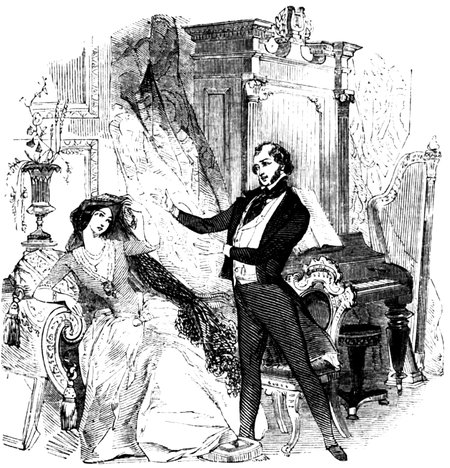
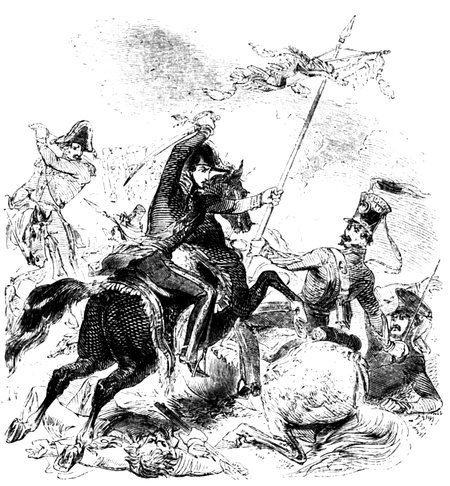
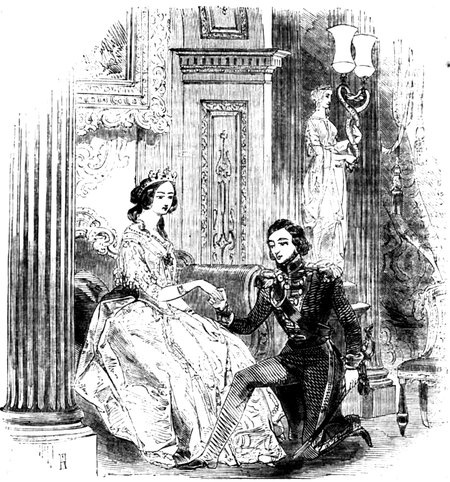
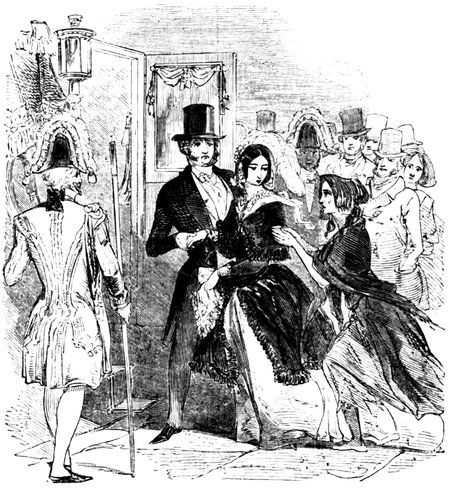
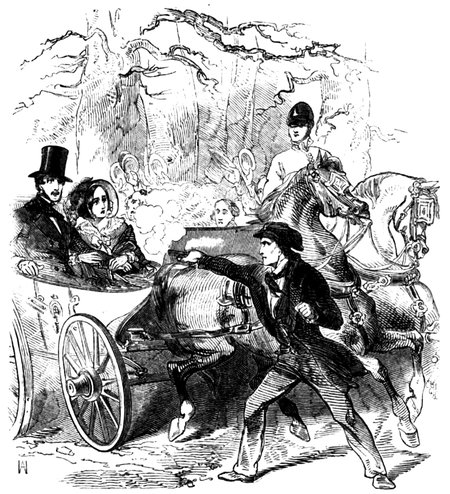
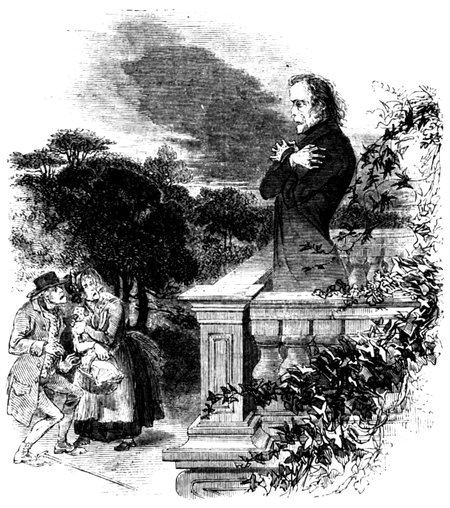
| For Woodcut on page | 1 | see page | 2 |
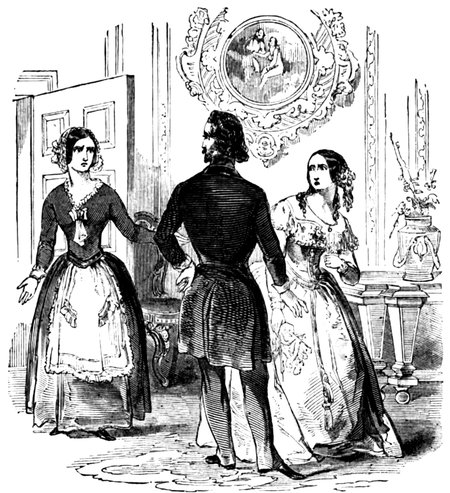
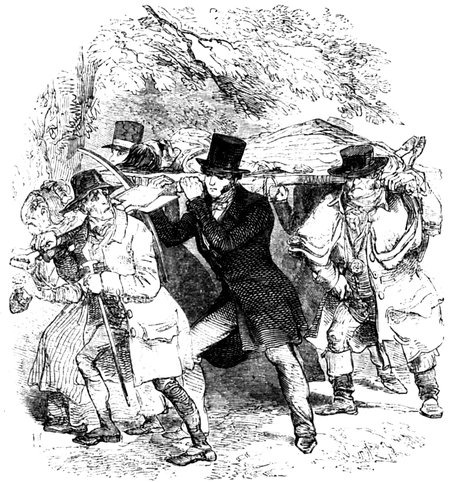
| For Woodcut on page | 9 | see page | 6 |
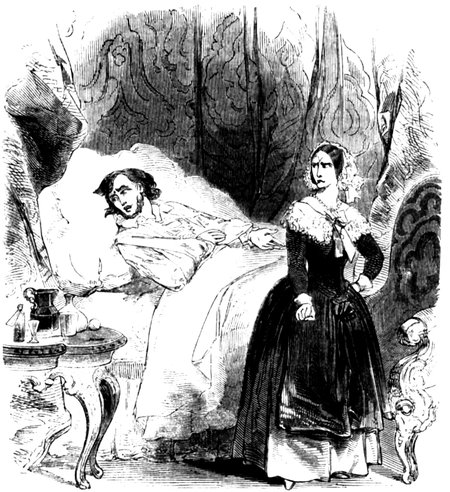
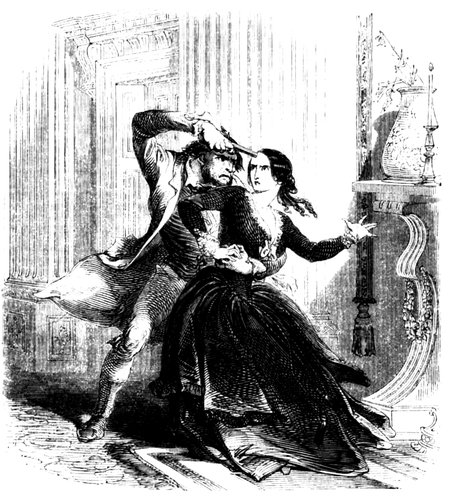
| For Woodcut on page | 17 | see page | 20 |
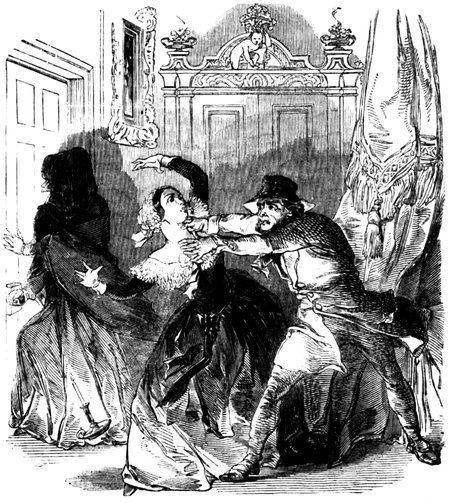
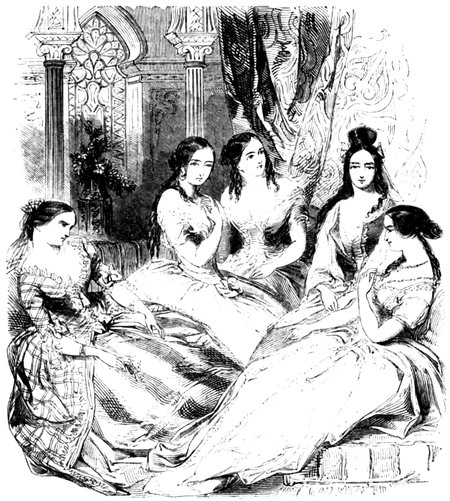
| For Woodcut on page | 25 | see page | 26 |
| For Woodcut on page | 33 | see page | 36 |
| For Woodcut on page | 41 | see page | 41 |
| For Woodcut on page | 49 | see page | 50 |
| For Woodcut on page | 57 | see page | 58 |
| For Woodcut on page | 65 | see page | 67 |
| For Woodcut on page | 73 | see page | 72 |
| For Woodcut on page | 81 | see page | 88 |
| For Woodcut on page | 80 | see page | 94 |
| For Woodcut on page | 97 | see page | 104 |
| For Woodcut on page | 105 | see page | 110 |
| For Woodcut on page | 113 | see page | 114 |
| For Woodcut on page | 121 | see page | 122 |
| For Woodcut on page | 129 | see page | 133 |
| For Woodcut on page | 137 | see page | 138 |
| For Woodcut on page | 145 | see page | 147 |
| For Woodcut on page | 153 | see page | 154 |
| For Woodcut on page | 161 | see page | 164 |
| For Woodcut on page | 169 | see page | 173 |
| For Woodcut on page | 177 | see page | 176 |
| For Woodcut on page | 185 | see page | 182 |
| For Woodcut on page | 193 | see page | 198 |
| For Woodcut on page | 201 | see page | 207 |
| For Woodcut on page | 209 | see page | 211 |
| For Woodcut on page | 217 | see page | 218 |
| For Woodcut on page | 225 | see page | 228 |
| For Woodcut on page | 233 | see page | 235 |
| For Woodcut on page | 241 | see page | 240 |
| For Woodcut on page | 249 | see page | 250 |
| For Woodcut on page | 257 | see page | 258 |
| For Woodcut on page | 265 | see page | 265 |
| For Woodcut on page | 273 | see page | 274 |
| For Woodcut on page | 281 | see page | 281 |
| For Woodcut on page | 289 | see page | 291 |
| For Woodcut on page | 297 | see page | 298 |
| For Woodcut on page | 305 | see page | 310 |
| For Woodcut on page | 313 | see page | 313 |
| For Woodcut on page | 321 | see page | 326 |
| For Woodcut on page | 329 | see page | 330 |
| For Woodcut on page | 337 | see page | 344 |
| For Woodcut on page | 345 | see page | 346 |
| For Woodcut on page | 353 | see page | 359 |
| For Woodcut on page | 361 | see page | 368 |
| For Woodcut on page | 369 | see page | 376 |
| For Woodcut on page | 377 | see page | 381 |
| For Woodcut on page | 385 | see page | 390 |
| For Woodcut on page | 393 | see page | 400 |
| For Woodcut on page | 401 | see page | 403 |
| For Woodcut on page | 409 | see page | 418 |
| For Woodcut on page | 417 | see page | 421 |
CHAPTER CXXXVII. RATS' CASTLE.
Richard Markham, though perfectly unpretending in manner and somewhat reserved or even sedate in disposition, possessed the most undaunted courage. Thus was it that, almost immediately recovering himself from the sudden check which he had experienced at the hands of the Resurrection Man, he hurried in pursuit of the miscreant, followed by the policeman and the people whom the alarm which he had given had called to his aid.
The people were, however, soon tired of running gratuitously for an object which they could scarcely comprehend; but the police-officer kept close to Markham; and they were speedily reinforced by two other constables, who, seeing that something was the matter, and with characteristic officiousness, immediately joined them.
From an inquiry put to the waterman of the adjacent cab-stand, who had seen a person running furiously along a moment or two before, Markham felt convinced that the object of his pursuit had plunged into the maze of Saint Giles's; and, though well aware of the desperate character of that individual, and conscious that should he encounter him alone in some dark alley or gloomy court, a fearful struggle must ensue between them, he did not hesitate, unarmed as he was, to dash into that thicket of dangerous habitations.
Soon outstripping the officers, who vainly begged 2him to keep with them, as they were unacquainted with the person of whom he was in pursuit,—forgetting every measure of precaution in the ardour of the chase, Richard rushed headlong through the dark and ill-paved streets, following the echo of every retreating footstep which he heard, and stopping only to scrutinise the countenances of those who, in the obscurity of the hour and place, seemed at first sight to resemble the exterior of the Resurrection Man.
Vain was his search. At length, exhausted, he sate down on the steps of a door-way to recover his breath, after having expended an hour in his fruitless search up one street, down another, and in every nook and corner of that district which we have before described as the Holy Land.
Accident shortly led the officers, who had originally entered upon the chase with him, to the spot where he was seated.
"Here is the gentleman himself," said one, turning the glare of his bull's-eye full upon our hero.
"No luck, I suppose, sir?" observed another. "You had much better have remained with us and given us some idea of the person that you want."
"Fool that I was!" exclaimed Markham, now perceiving his imprudence in that respect: "I have left you to pursue a shadow, instead of depicting to you the substance. But surely the name of Anthony Tidkins——"
"The Resurrection Man, as they call him," hastily remarked one of the constables.
"The same," answered Markham.
"Why—he blew himself up, along with some others and a number of our men, last year, down in Bethnal Green," said the constable who had last spoken.
"No—he lives, he lives," exclaimed Richard, impatiently. "My God! I know him but too well."
"And it was after him that you gave the alarm just now in Tottenham Court Road?"
"It was. I knew him at once—I could not be mistaken: his voice, laden with a curse, still rings in my ears."
"Well, since the gentleman's so positive, I 'spose it must be so," said the constable: "we musn't sleep upon it, mates. Ten to one that Tidkins has taken to burrow in one of the low cribs about here; and he means to lie quiet for two or three days till the alarm's blown over. I know the dodges of these fellers. You two go the round of Plumptre Street; and me and this gentleman will just take a promiscuous look into the kens about here."
The two constables to whom these words were addressed, immediately departed upon the mission proposed to them, and Richard signified his readiness to accompany the officer who had thus settled the plan of proceedings.
"We'll go first to Rats' Castle, sir, if you please," said the policeman: "that is the most likely place for a run-away to take refuge in at random."
"What is Rats' Castle?" asked Markham, as he walked by the officer's side down a wretched alley, almost as dark as pitch, and over the broken pavement of which he stumbled at every step.
"The night-house where all kind of low people meet to sup and lodge," was the reply. "But here we are—and you'll see all about it in an instant."
They had stopped at the door of a house with an area protected by thick wooden palings. All the upper part of the dwelling appeared to be involved in total darkness: but lights streamed through the chinks of the rude shutters of the area-windows; and from the same direction emanated boisterous merriment, coarse laughter, and wild hurrahs.
"You knock at the door, sir, if you please," said the policeman, "while I stand aside. I'll slip in after you; for if they twig my coat, and Tidkins really happens to be there, they'd give him the office to bolt before we could get in."
"Well thought of," returned Markham. "But upon what plea am I to claim admittance?"
"As a stranger, impelled by curiosity. You carry the silver key in your pocket."
The policeman withdrew a few paces; and our hero knocked boldly at the door.
A gruff voice challenged the visitor from the area.
"Who's here?"
"No one that will do you any harm," replied Richard. "I am anxious to witness the interior of this establishment; and here is half-a-crown for you if you can gratify my curiosity."
"That's English, any how," said the voice, softening in its tone. "Stop a minute."
Markham heard a door close in the area below; and in a few moments the bolts were drawn back inside the one at which he was standing.
"Now then, my ben-cull—in with you," said a man, as he opened the front door, and held a candle high up above his head at the same time.
Markham stepped into a narrow passage, and placed his foot against the door in such a way as to keep it open. But the precaution was unnecessary, for the policeman had glided in almost simultaneously with himself.
"Now, no noise, old feller," said the constable, in a hasty whisper to the man who had opened the door: "our business isn't with any of your set."
"Wery good," returned the porter of Rats' Castle: "you know best—it isn't for me to say nothink."
"Go first, sir," whispered the officer to Markham. "You seem to know him better than me, for I never saw him but once—and then only for a minute or two."
"Which way?" demanded Richard.
"Straight on—and then down stairs. You keep behind us, old feller," added the policeman, turning to the porter.
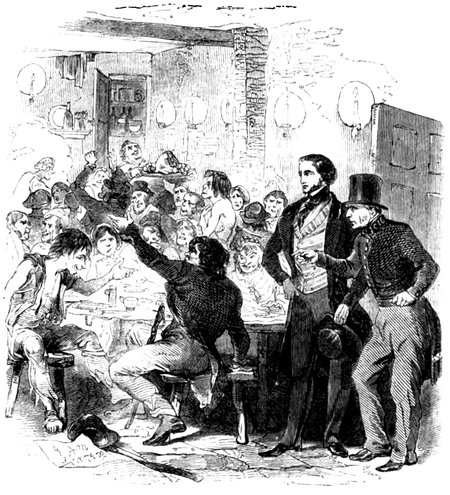
Markham descended a flight of narrow and precipitate steps, and at the bottom found himself in a large room formed of two kitchens thrown into one.
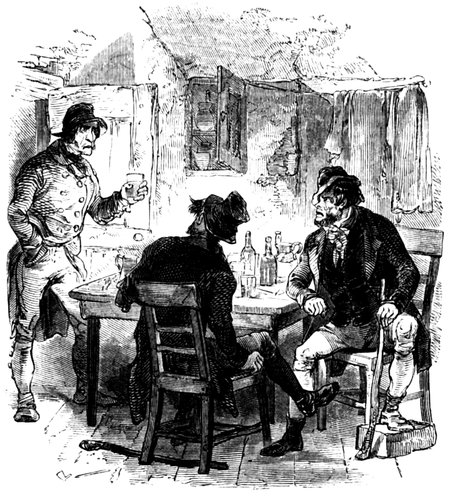
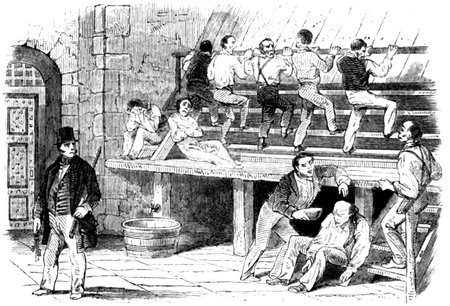
Two long tables running parallel to each other the entire length of the place, were laid out for supper,—the preparations consisting of a number of greasy napkins spread upon either board, and decorated with knives and forks all chained to the tables. Iron plates to eat off, galley-pots and chipped tea-cups filled with salt, three or four pepper-boxes, and two small stone jars containing mustard, completed the preparations for the evening meal.
The room was lighted by means of a number of candles disposed in tin shades around the walls; and as no one gave himself the trouble to snuff them, the wicks were long, and infested with what housewives denominate "thieves," while the tallow streamed down in large flakes, dripping on the floor, the seats, or the backs of the guests.
Crowded together at the two tables, and anxiously 3watching the proceedings of an old blear-eyed woman, who was occupied at an immense fire at the farther end of the room, were about thirty or forty persons, male and female. And never did Markham's eyes glance upon a more extraordinary—a more loathsome—a more revolting spectacle than that assemblage of rags, filth, disease, deformity, and ugliness.
Mendicants, vagabonds, impostors, and rogues of all kinds were gathered in that room, the fetid heat of which was stifling. The horrible language of which they made use,—their frightful curses,—their obscene jests,—their blasphemous jokes, were calculated to shock the mind of the least fastidious:—it was indeed a scene from which Markham would have fled as from a nest of vipers, had not a stern duty to society and to himself urged him to penetrate farther into that den.
The appearance of himself and the policeman did not produce any remarkable degree of sensation amongst the persons assembled: they were accustomed to the occasional visits of well-dressed strangers, who repaired thither to gratify curiosity; and the presence of the officers of justice was a matter of frequent occurrence when any great robbery had been perpetrated in the metropolis, and while the culprits remained undiscovered.
"He is not here," whispered Markham to his companion, after casting a hasty but penetrating glance around.
"He may come: this is the most likely place in Saint Giles's for him to visit," returned the policeman. "We will wait half-an-hour."
Richard would gladly have retired; but he was ashamed to exhibit a disgust which the officer might mistake for fear. He accordingly seated himself at a small side-table, in compliance with a sign from his companion.
A waiter, wearing an apron which, by its colour, seemed also to do the duty of dish-cloth, now accosted them, and said, "Please to order anythink, gen'lemen?"
"Two glasses of brandy-and-water," replied the constable.
This command was speedily complied with; and, a few minutes afterwards, supper was served up on the two long tables before described. The old woman who presided over the culinary department of the establishment had amply catered for those present. Legs of mutton, both roasted and boiled,—rounds of beef, flanked with carrots,—huge pies,—boiled legs of pork,—immense quantities of sausages,—and sheep's heads, constituted the staple of the banquet. These viands, accompanied by piles of smoking potatoes "in their jackets" and heaps of cabbages, were all served up on iron dishes, from which no thrifty hand ever removed the rust.
Then commenced the clattering of the knives and forks, the din of which upon the iron platters was strangely blended with the rattling of the chains that held them to the tables. The boisterous merriment and coarse conversation were for a time absorbed in the interest occasioned by the presence of the repast.
"What a strange assembly," whispered Markham to the constable.
"Strange to you, sir—no doubt," was the answer, also delivered in a tone audible only to him to whom the words were addressed. "That sturdy feller sitting at the head of the nearest table, with the great cudgel between his legs, is one of the class that don't take the trouble to clothe themselves in rags, but trust to their insolence to extort alms from females walking alone in retired parts. That feller next to him, all in tatters, but who laughs louder than any one else, is one of them whining, shivering, snivelling wretches that crouch up in doorways on rainy days, and on fine ones sit down on the pavement with 'Starving, but dare not beg,' chalked on the stone before them. The man over there in sailor's clothes tumbled down an area when he was drunk, and broke his leg: he was obliged to have it cut off; and so he now passes himself off as one of Nelson's own tars, though he never saw the sea in his life. That chap almost naked who's just come in, is going to put on his coat and shoes before he sits down to supper; he always goes out begging in that state on rainy days, and is a gentleman on fine ones."
"I do not understand you," said Markham, astonished at this last observation.
"Why, sir," replied the policeman, "there's certain beggars that always turn out half-naked, on rainy days, or when the snow's on the ground; and people pity them so much on those occasions that the rogues get enough to keep them all through the fine weather. If they have wives and children to go out with them, so much the better: but that feller there isn't married; and so he goes with a woman who frequents this place, and they hire three or four children from the poor people in this neighbourhood, at the rate of two-pence a day each child, and its grub. To see them go shivering and whining through the streets, with no shoes or stockings, you'd think they were the most miserable devils on the face of the earth; and then, to make the scene complete, the man and woman always pinch the little children that they carry in their arms, to make them cry, whenever they pass a window when several ladies are looking out."
"Is this possible?" whispered Markham, his face flushing with indignation.
"Possible, sir! Don't I see it all every day of my life? Look at them men and women blowing their hides out with all that good meat; and now look at the pots of porter that's coming in. Every soul there has sworn a hundred times during the day that he hasn't tasted food for forty-eight hours, and will repeat the same story to-morrow. But they all had good suppers here last night, and good breakfasts here this morning; and you see how they are faring this evening."
"But there are real cases deserving of charity?" said Markham, interrogatively,—for he almost felt disposed to doubt the fact.
"Certainly there are, sir," was the reply; "but it's very difficult for such as you to decide between the true and the false. Look at that man who carves at the second table: he can see well enough to cut himself the tit-bits; but to-morrow he will be totally blind in one of the fashionable squares."
"Totally blind!" said Richard, more and more astonished at what he heard.
"Yes, sir—totally blind; led by a dog, and with a placard upon his chest. He keeps his eyes fast shut, and colours the lids with carmine and vermilion. But that is nothing. That feller next to him, who uses his knife and fork so well, will to-morrow have lost his right arm at the battle of Salamanca."
"But how can that imposture be effected?"
4"His right arm is concealed under his clothes, and the coat-sleeve hangs down loose," replied the constable. "That tall stout man who has just jumped so nimbly over the form in his way back to his place, has walked on crutches in the streets for the last twenty years; and when you see him so, you would think he could hardly drag himself along. The feller over there is a frozen-out gardener in winter, and a poor Spitalfields' weaver in summer. The one next to him will have a black patch over his left eye to-morrow; and yet you may see that it is as good as his right. The short man opposite to him bends his left leg back, and has a wooden one to support the knee, when he is in the street. That woman there has been dressed in widows' weeds for the last fifteen years, and always has a troop of six children with her; but the children never grow any bigger, for she hires fresh ones every year or so."
"This is the most extraordinarily combined mass of contradictions and deceptions I ever gazed upon," whispered Markham.
"You may well say that, sir," said the policeman. "The ragged feller down at the bottom of the second table sits as upright as you or me: well, in the streets he crawls along the ground with two iron supporters in his hands. He is the most insolent feller in London. The man next to him goes about on a sort of van, or chaise, and the world believes that he has no legs at all; but they are all the time concealed in the body of the vehicle, and the stumps of the thighs which are seen are false. Those three hulking chaps over there, sitting with the three women that laugh so much, are begging-letter impostors. The eldest of the three men has been seventeen years at the business, and has been in prison twenty-eight times. One day he is a bricklayer who has fallen from a scaffold, and broken his leg, and has a wife and eleven young children dependent on him; another day he is a licensed clergyman of the Church of England, but unemployed for two years—wife and six children totally dependent on him. Then he changes into a stanch Tory, ruined by his attachment to the cause, and proscribed by all his friends on account of his principles: in this shape he addresses himself to the old Tory noblemen, and makes a good harvest. The very next day he becomes a determined and stanch Reformer, who lost his employment through giving his vote for the Tower Hamlets to the liberal candidate at the last election, and has since met with an uninterrupted series of misfortunes—sold up by a Tory landlord,—his wife been dead only a fortnight, and seven motherless children left dependent on him. This kind of letter always draws well. Then he becomes a paralytic with an execution in his house; or a Spitalfields' weaver, with nine children, two of which are cripples, and one blind; or else a poor Scotch schoolmaster, come to London on business, and robbed by designing knaves of the means of returning to his own country. The women are just as bad. They are either wives with husbands in hospitals and bed-ridden mothers; or daughters with helpless parents and sick brothers and sisters dependent on them;—and so on."
"But if you be aware of all these monstrous impositions, why do you not interfere to protect the public?" inquired Markham.
"Lord, sir!" said the constable, "if we took up all persons that we know to be impostors, we should have half London in custody. We only interfere when specially called upon, or when we see cases so very flagrant that we can't help taking notice of them. Some of these chaps that are eating here so hearty now, will seem to be dying in the streets to-morrow."
"Merciful heavens, what a city of deceit and imposture is this!" observed Richard, painfully excited by the strange details which he had just heard. "Were the interior of this den but once exposed to general view, charity would be at an end, and the deserving poor would suffer for the unprincipled impostor."
"True enough, sir. And now look—the cloth is removed, and every one is ordering in something strong to wash down the supper. There goes a crown-bowl of punch—that's for the begging-letter impostors: and there's glasses of punch, and cold spirits and water, and shrub, and negus. That's the way they do it, you see, sir."
Markham did indeed see, and wondered more and more at what he so saw—until his feelings of surprise changed into sentiments of ineffable abhorrence and disgust; and he longed to leave that odious den.
"The person whom we seek does not appear to come," he said, after a long interval of silence. "Two hours have elapsed—and we are only wasting time here."
"He must have taken refuge in some other crib, sir," returned the constable. "Let us leave this one, and make the round of the other lodging-houses in this street."
Markham was glad to hurry away from Rats' Castle, the mysteries of which had so painfully shocked his generous feelings.
CHAPTER CXXXVIII. A PUBLIC FUNCTIONARY.
Urged by that sense of duty to which we have before alluded, and which prompted him to neglect no step that might lead to the discovery of a great criminal's lurking-place, Richard accompanied the police-officer to various houses where the dregs of the population herded together.
The inspection of a plague-hospital could not have been more appalling: the scrutiny of a lazar-house could not have produced deeper disgust.
In some the inmates were engaged in drunken broils, the women enacting the part of furies: in others the females sang obscene songs, the men joining in the chorus.
Here a mother waited until her daughter should return with the wages of prostitution, to purchase the evening meal: there a husband boasted that his wife was enabled, by the liberality of a paramour, to supply him with ample means for his night's debauchery.
In one house which our hero and the constable visited, three sisters of the respective ages of eleven, thirteen, and fourteen, were comparing the produce of their evening's avocations,—the avocations of the daughters of crime!
And then those three children, having portioned out the necessary amount for their suppers and their lodging that night, and their breakfast next morning, laughed joyously as they perceived how much they had left to purchase gin!
5For Gin is the deity, and Intemperance is the hand-maiden, of both sexes and nearly all ages in that district of London.
What crimes, what follies have been perpetrated for Gin! A river of alcohol rolls through the land, sweeping away health, honour, and happiness with its remorseless tide. The creaking gibbet, and the prison ward—the gloomy hulk, and the far-off penal isle—the debtors' gaol, and the silent penitentiary—the tomb-like workhouse, and the loathsome hospital—the galling chain, and the spirit-breaking tread-wheel—the frightful mad-cell, and the public dissecting-room—the death-bed of despair, and the grave of the suicide, are indebted for many, many victims to thee, most potent Gin!
O Gin! the Genius of Accidents and the Bad Angel of Offences worship thee! Thou art the Juggernaut beneath whose wheels millions throw themselves in blind adoration.
The pawnbroker points to thee and says, "Whilst thy dominion lasts, I am sure to thrive."
The medical man smiles as he marks thy progress, for he knows that thou leadest a ghastly train,—apoplexy, palsy, dropsy, delirium tremens, consumption, madness.
The undertaker chuckles when he remembers thine influence, for he says within himself, "Thou art the Angel of Death."
And Satan rejoices in his kingdom, well-knowing how thickly it can be populated by thee!
Yes—great is thy power, O Gin: thou keepest pace with the progress of civilisation, and thou art made the companion of the Bible. For when the missionary takes the Word of God to the savage in some far distant clime, he bears the fire-water with him at the same time. While his right hand points to the paths of peace and salvation, his left scatters the seeds of misery, disease, death, and damnation!
Yes—great is thy power, O Gin: a terrible instrument of evil art thou. Thou sweepest over the world with the wing of the pestilence: thy breath that of a plague:—like the poisonous garment of Dejanira on the burning limbs of the Centaur, dost thou cling around thy victims.
And where the grave-yard is heaped up with mouldering bones—and where disease and death prevail in all their most hideous shapes—and where misery is most keenly felt, and poverty is most pinching—and where the wails of hapless children ascend to heaven in vain appeal against the cruelty of inhuman parents—and where crime is most diabolical,—there are thy triumphs—there are thy victories!
But to continue.
The clock of St. Giles's Church proclaimed the hour of midnight; and though our hero and the constable had visited many of the low dens and lodging-houses in the Holy Land, still their search was without success.
"Unless my mates have been more lucky than us," observed the policeman, halting at the corner of a street, "we must conclude that the bird is flown."
"And even if they should chance to enter a house where the miscreant has taken refuge, how would they be enabled to recognise him?" asked Richard.
"One of them knows him well," replied the constable.
At that moment a violent scream issued from the upper part of the house close to which Markham and the constable were standing.
The dwelling was high, narrow, and, if possible, more gloomy, when viewed by the feeble rays of a watery moon, than the neighbouring houses.
From the uppermost window streamed a strong light, which danced upon the black wall of the building opposite, making the sombre appearance of the locality the more sinister as it was the more visible.
That scream, which expressed both horror and agony, caused Markham to start with momentary consternation.
The constable did not, however, appear surprised; but merely observed with a strange coolness, "Ah! there's Smithers at his old tricks again."
"And who is Smithers?" inquired Richard.
But before the constable could reply to the question, the window, whence the light emanated, was thrown up with crashing violence, and a female voice shrieked for assistance.
"Had we not bettor ascertain what is the matter here?" exclaimed Markham, hastily.
"I dare not force an entry, unless there's a cry of 'Murder,'" answered the officer.
Scarcely were these words uttered when the sound of a heavy blow, like that of a thong or leathern strap upon a person's back, echoed along the street; and then terrific shrieks, mingled with cries of "Murder!" issued from the open window.
In another instant the female was dragged away from the casement by some one in the room where this scene occurred; then the blows were resumed with frightful severity, and the screams and cries continued in a more appalling manner than at first.
Immediately afterwards, and just as the constable was preparing to force an entry, some one was heard to rush precipitately down the stairs inside the house: the door opened, and a strange-looking being darted madly into the street.
"Now, Gibbet," cried the policeman, catching the hump-backed lad—for such Markham perceived him to be—by the collar, "what's all this about?"
"Oh! you are an officer!" exclaimed the hump-back, in a tone of surprise and delight: "for God's sake come up—father's murdering Kate!"
The screams and the sounds of the blows still continuing up stairs, the constable did not hesitate to comply with the request of the deformed lad whom he had saluted by the singular name of Gibbet; and Markham hastened after him, anxious to render any assistance that might be required at his hands.
The policeman and our hero hurried up the narrow stairs, lighted by the officer's bull's-eye; and speedily reached the room whence the screams had emanated.
But we must pause for a moment to describe that apartment, and to give the reader some idea of the inmates of the house to which we have introduced him.
The room was situated at the top of the house, and bore the appearance of a loft, there being no ceiling to conceal the massive beams and spars which supported the angular roof.
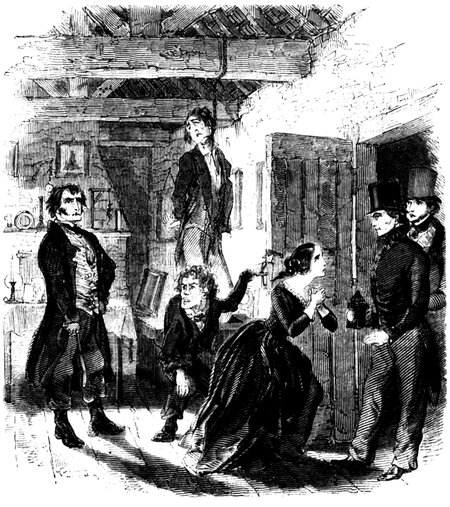
From one of the horizontal beams hung a stuffed figure, resembling a human being, and as large as life. It was dressed in a complete suit of male attire; and a white mask gave it the real but ghastly appearance of a dead body. It was suspended by a thick cord, or halter, the knot of which being fastened beneath the left ear, made the head incline 6somewhat over the right shoulder; and it was waving gently backwards and forwards, as if it had been recently disturbed. The arms were pinioned behind; and the hands, which were made more or less life-like by means of dingy white kid gloves, were curled up as it were in a last convulsion. In a word, it presented the exact appearance of a man hanging.
Markham started back when his eyes first fell on this sinister object; but a second glance convinced him that the figure was only a puppet.
This second survey brought to his view other features, calculated to excite his wonder and curiosity, in that strange apartment.
The figure already described was suspended in such a way that its lower extremity was about a foot from the ground; but it was concealed nearly up to the knees by a small scaffold, or large black box, it having been suffered to fall that much through a trap-door made like a drop in the platform of that diminutive stage.
From this strange spectacle,—which, in all respects, was a perfect representation of an execution—Markham's eyes wandered round the loft.
The walls—the rough brick-work of which was smeared over with white-wash,—were covered with rude pictures, glaringly coloured and set in common black wooden frames. These pictures were such as are sold in low neighbourhoods for a few pence each, and representing scenes in the lives of remarkable highwaymen, murderers, and other criminals who had ended their days upon the scaffold. The progress of Jack Sheppard to the gibbet at Tyburn,—the execution of Jonathan Wild,—Turpin's ride to York,—Sawney Bean and his family feasting off human flesh in their cave,—Hunt and Thurtell throwing the body of Mr. Weare into the pond,—Corder murdering Maria Martin at the Red Barn,—James Greenacre cutting up the corpse of Hannah Brown,—such were the principal subjects of that Gallery of Human Enormity.
But as if these pictorial mementos of crime and violent death were not sufficient to gratify the strange taste of the occupants of that apartment, some hand, which was doubtless the agent of an imagination that loved to "sup full of horrors," had scrawled with a burnt stick upon the wall various designs of an equally terrific nature. Gibbets of all forms, and criminals in all the different stages of their last minutes in this life, were there represented. The ingenuity of the draughtsman had even suggested improvements in the usual modes of execution, and had delineated drops, halters, and methods of pinioning on new principles!
Every thing in that spacious loft savoured of the scaffold!
Oh! had the advocates of capital punishment but been enabled to glance upon that scene of horrors, they would have experienced a feeling of dire regret that any system which they had supported could have led to such an exhibition!
But to proceed.
On a rude board which served as a mantel over the grate, was a miniature gibbet, about eight inches high, and suspended to the horizontal beam of which was a mouse—most scientifically hung with a strong piece of pack-thread.
The large silver watch belonging to the principal inmate of the house was suspended to a horizontal piece of wood, with an oblique supporter, projecting from the wall above the fire-place.
In one corner of the room was a bed, over which flowed curtains of a coarse yellow material; and even these were suspended to a spar arranged and propped up like the arm of a gibbet.
A table, on which the supper things still remained, and half a dozen chairs, completed the contents of this strange room.
And now a few words relative to the inmates of that house.
The hump-backed lad who had rushed down the stairs in the manner already described, was about seventeen or eighteen years of age, and so hideously ugly that he scarcely seemed to belong to the human species. His hair was fiery red, and covered with coarse and matted curls a huge head that would not have been unsuitable for the most colossal form. His face was one mass of freckles; his eyes were of a pinkish hue; his eyebrows and lashes were white; and his large teeth glittered like dominoes between his thick and blueish lips. His arms were long like those of a baboon; but his legs were short; and he was not more than four feet and a half high. In spite of his hideous deformity and almost monstrous ugliness, there was an air of good-nature about him, combined with an evident consciousness of his own repulsive appearance, which could not do otherwise than inspire compassion—if not interest.
The moment the policeman, who entered the room first, made his appearance upon the threshold, a young female precipitated herself towards him, exclaiming, "For God's sake protect me—but do not, do not hurt my uncle!"
This girl was about sixteen years of age, and, though not beautiful, possessed a countenance whose plaintive expression was calculated to inspire deep interest in her behalf. She was tall, and of a graceful figure: her hair was light chesnut; her eyes dark blue, and with a deep melancholy characterising their bashful glances; her teeth were small, white, and even. Though clad in humble attire, there was something genteel in her appearance,—something superior to the place and society in which we now find her.
The man from whose cruel blows she implored protection, was of middle height, rather stoutly built, with a pale countenance, and an expression of stern hard-heartedness in his large grey eyes and compressed lips. He was dressed in a suit which evidently had never been made for him,—the blue frock coat being too long in the sleeves, the waistcoat too wide round the waist, and the trousers scarcely reaching below the knees.
"For God's sake protect me!" exclaimed the young girl, as above stated; "but do not—do not hurt my uncle," she added in a tone which proved the sincerity of the prayer.
"Come, come, Master Smithers," said the constable, "this won't do: you musn't alarm the neighbourhood in this manner."
"Why, then, does she interfere between me and Gibbet?" cried the man brutally, at the same time flourishing a thick leathern thong in his right hand.
"She does it out of good-nature, I suppose," observed the constable. "Every one knows how shameful you treat your son Gibbet; and this poor gal takes her cousin's part."
7At these words the hump-back cast a timid but affectionate glance towards Katherine, who, on her part, threw a look of profound compassion upon the unfortunate lad.
"She does it out of good-nature, does she?" repeated the man: "then why won't he learn my business? He never can be fit for any other. But, no—the moment I leave him, he is off to the side of Miss there; and she makes him read in her outlandish books, so that he despises his father and the business that he must take to, sooner or later."
"But you ought not to beat Miss Katherine, Smithers," reiterated the policeman. "The next time I hear the cry of 'Murder' in your house I'll walk you off to the station—and that's all about it."
"I suppose that I may leather my own son if I choose?" said the man, savagely.
"You ought to remember that he is deformed through your cruelty," cried the constable, "and that his mother died of fright and grief——"
"Hold your tongue, blue-bottle!" interrupted Smithers, his lips quivering with rage. "It isn't for you to come and make mischief in a family. Get out with you!"
"But if we leave this poor girl to the rage of her uncle," said Markham to the constable, whom he drew aside and thus addressed in a whisper, "he will do her some injury."
"What is to be done with her, sir?" demanded the officer. "Smithers says she is his niece——"
"Is it not certain that she stands in such a degree of relationship towards him?" inquired our hero, whose humane heart was moved in favour of the suffering girl.
"Now, then, what are you chattering about there?" ejaculated Smithers. "I want to go to bed: Gibbet, you be off to your room—and, Kate, you go to yours. This is mine—and I should advise the blue-bottle with his spy in plain clothes to make themselves scarce."
"Remember, I shall report you to our serjeant," said the policeman; "and he will tell the Division to keep an eye on you."
"Tell him whatever you like," returned the man doggedly.
The hump-back and Katherine had already left the room in obedience to the command of Smithers.
The constable repeated a caution to the ruffian who had ill-used them, and then took his departure, followed by Richard Markham.
When they were once more in the street, our hero said to his companion, "Who is that man?"
"The Public Executioner," was the reply.
CHAPTER CXXXIX. THE CONFIDENCE.
So astounded was Markham by this information, that for some moments he was unable to utter a word.
"I see that you are surprised, sir," said the policeman; "but couldn't you guess where you was when you saw the room filled with gibbets, real or in pictures?"
"It never struck me who the owner of those terrific symbols might be," answered Richard. "I concluded that some man of morbid taste dwelt there; but not for one moment did I imagine that I was in the presence of the public executioner."
"Did you ever see such a horrible-looking object as his son is?" asked the policeman.
"Poor creature—he is greatly to be pitied! Surely his father cannot in reality have conferred upon him the name by which you called him?"
"I don't suppose that Gibbet is his real name, sir, but it is the only one I ever heard him called by. You see, sir, Smithers wishes to bring the lad up to the same line: he wants an assistant, and he thinks that Gibbet is old enough to help him. Besides, there's plenty of work always after Assizes in the country; and the London hangman may get the jobs if he likes. He's considered more skilful than any one else; and, after all, practice makes perfect. As it is, he is forced to refuse a good many offers, because he can't be here, there, and everywhere. Now if Gibbet would only take to the business kindly, he might help his father to earn a fortune!"
"But if the poor lad have a loathing for the horrible avocation—as well he may," observed Markham, with a shudder, "why should he be forced to embrace it?"
"Because he can never do himself good elsewhere," answered the constable. "Who will employ the son of Jack Ketch? Why, will you believe it, sir, that not a soul visits Smithers' family? Although he lives in this neighbourhood, where, God knows, people ain't over nice and partickler, not a human being would cross his threshold."
"Does that aversion arise from disgust or superstition?" demanded Markham.
"From both, sir," was the reply. "The people that live in this district are of two kinds—the poor and ignorant, and the rogues and vagabonds. The poor and ignorant are afraid of the public executioner; and the rogues and vagabonds hate him, although he's merely an instrument. Miss Kate goes to market for him; and the shop-keepers that know who she is, are scarcely civil to her. They seem as if they'd rather she'd keep away."
"And you say that she is the executioner's niece?" observed Markham.
"Smithers says so himself," was the reply; "and of course I know nothing to the contrary; but it does seem strange that so amiable, genteel, and clever, a young gal should belong to such a family!"
"Her own parents are dead, I presume?"
"Yes, sir,—she is an orphan. When Smithers is very dull and miserable with his lonely situation, he sometimes comes down to the station and has a chat with us constables; and then he's pretty communicative. He told me one day that Katherine's parents had died when she was very young, and so he was compelled to take care of her. All the while she was a child Smithers let her do pretty well as she liked; and it is a wonder that she has turned out a good gal. But she regularly frequented the School established in the parish of Saint David's by the Rev. Mr. Tracy; and in that way she picked up a tolerable smattering of knowledge. Since then she's instructed herself as much as she could, and has bought books with the little money that her needle has produced her."
"But who employs her as a sempstress, if, as you say, so terrible a stigma affixes itself to each member of the hangman's family?" inquired Richard.
"The old housekeeper at Mr. Tracy's is very 8friendly disposed towards the poor creature, and gives her work," answered the policeman. "Katherine does all she can to console that poor hump-back Gibbet; and she has taught him to read and write—aye, and what's more, sir, to pray."
"Policeman," said Richard, after a pause, "the manner in which you have spoken relative to that poor girl, shows me that you have a good heart. Is there any mode of ameliorating her wretched situation? I feel the deepest compassion for her miserable lot; and all you have told me of her excellent character makes me anxious to see her removed from the vile society of that ruffian under whose roof she lives."
"I believe she is anxious to go out to service, sir, or open a little school," answered the constable; "but her family connection is against her. Or else I don't think that Smithers would care about parting with her."
"What induces you to suppose that such are her wishes?" asked Markham.
"Because she told me so, sir," was the reply. "One evening I went to Smithers' house, with a certain message from the Sheriff of London—you can guess what, I dare say——"
"To acquaint him with the day fixed for some wretch's execution, no doubt?"
"Precisely, sir; but Smithers wasn't at home, and so I sate down and waited for him. It wasn't in Jack Ketch's own room up stairs where we went just now, and where he teaches his son how to hang by means of that puppet; but it was in a little parlour they have got down stairs, and which Miss Kate keeps as clean and comfortable as if they saw no end of company. Well, I got talking to the young gal; and though she never said a single word against her uncle, but spoke of him in a grateful and kind manner, she let out that if he could spare her, she should like to earn her own bread by her own exertions. And then the poor creature burst out crying, and said, that no one would take her as a servant, and that she should get no scholars even if she was to open a school."
Markham made no answer; but he reflected profoundly on all that he had just heard.
"Poor gal!" continued the policeman, after a few moments' silence; "she don't deserve to suffer as she does. My beat is about this quarter: and I know pretty well all that's going on. I see more than other people about here, because I've opportunity and leisure. Besides, it's my business. Well, sir, I can assure you that there isn't a more charitable or generous-hearted gal in all London than Miss Katherine. If a poor neighbour's ill, it's ten to one but some female muffled up in her shawl knocks at the door of the sick person's house, leaves a parcel, and runs away; and then there's tea, and sugar, and gruel, for the invalid—and no one knows who brought it, or where it comes from. Or if a family's in want, the baker calls with bread that's paid for, but won't say who sent it. Or may be it's the butcher with a small joint—but always sent in the same quiet manner. Then, while the poor creatures whose hearts are made glad by this unlooked-for charity, are wondering whether it was the parson, or the parson's wife, or this benevolent gentleman, or that good lady, who sent the things, Kate buries herself in her room, and doesn't even think that she has done any thing out of the way."
"Is this possible?" cried Markham.
"I know it, sir—for I've seen her do it all," answered the policeman, "when she couldn't see me and little thought that any body noticed her."
"And she the niece of the public executioner!" exclaimed Richard: "a pearl concealed in this horrible swamp!"
The conversation between Markham and the good-hearted constable was cut short by the sudden appearance of the other two policemen, who had undertaken to visit the low houses in Plumptre Street.
"Well, what news?" asked Richard's companion.
"None," was the reply. "We have been in every flash crib down yonder, and can't hear or see any thing of the Resurrection Man."
"Then we must abandon the search for to-night, I presume," said Richard. "The clock has struck one, and I begin to be wearied of this fruitless ramble."
"We will exert ourselves to discover the miscreant that blew up our comrades in Bethnal Green," observed the constable who had been our hero's companion that night. "Should we succeed in capturing him, sir, where can I wait upon you to communicate the tidings?"
"My name is Markham," was the reply, "and I live at Holloway. If you discover the villain Anthony Tidkins, lose not a moment in making me acquainted with the circumstance."
Richard then rewarded the three constables liberally for the trouble they had taken; and ere he departed from them, he drew aside the one who had been his companion.
"My good fellow," he said, slipping an additional sovereign into his hand, "you have too kind a heart for the situation which you fill. Should you ever require a friend, hesitate not to come to me."
"And should you, sir, ever need the humble aid of Morris Benstead, you know the Division I belong to, and a note to the chief station will always command my attention."
Markham thanked the officer for his civility, and then struck into the nearest street leading from the Holy Land to Tottenham Court Road, where he hoped to find a vehicle to take him home.
But scarcely had he proceeded twenty paces, when he heard hasty footsteps behind him; and, turning round, was accosted by a man whose slouched hat almost entirely shaded his countenance.
"I beg your pardon, sir," said the man; "but I heard you mention two names a few moments ago that are familiar to me."
"Indeed!" cried our hero, surprised at this strange mode of address.
"Yes:—I was lurking in a court, and I heard you say that you were Mr. Richard Markham," resumed the man: "and you mentioned a certain Anthony Tidkins."
"I did. Do you know him?" demanded Richard.
"But too well," answered the man bitterly.
"Who are you?" inquired Markham.
"No matter who I am: I know you—and I know him. I was in a certain place at the same time that you were there; though we were not in the same ward. But I heard all about you then; and when you mentioned your name just now, I felt sure you was the same person. Has Tidkins ever injured you?"
"Cruelly," replied Richard. "But I am not influenced by petty motives of revenge: I am anxious to deliver a monster into the grasp of justice."
"And what should you say if you heard that Tidkins was beyond your reach in this world?"
"I should rejoice that society was relieved from such a fiend."
"Then I think that I can make your mind easy on that score," said the man.
"What do you mean?" cried Richard, eagerly.
"I mean that this hand has done the law's work," responded the stranger.
"You mean—you mean that you yourself have acted the part of an avenger?" said Markham.
"Precisely what I do mean: in plain terms, I've killed him."
"My God! and you tell me this so coolly!" exclaimed Richard. "Whatever that man's crimes may be, you are not the less a murderer!"
"Pooh—pooh! I should have thought you'd more pluck than to talk in this way. What does it matter whether Jack Ketch or a private enemy did the job?"
"Where did this happen? when?—how long ago?" inquired Markham, not knowing whether to believe the statement thus strangely made to him, or not.
"If you really wish to know all about it," said the man, "step up this court, where we can talk in peace, and I will tell you. What! you think I am going to hurt you too? Well, be it so. Goodnight—or rather good morning."
At that moment Saint Giles's Church struck two.
"Stay," cried Richard, catching the man by the arm: "I will accompany you."
They walked together into a dark court, our hero keeping himself in readiness to resist any sudden hostility, were such a proceeding intended.
But the man appeared to have no such aim in view, for, leaning himself tranquilly against the wall, he said, "Can you keep a secret?"
"If I promise to do so," answered Richard.
"Then promise not to betray what I am going to tell you."
"I promise," said Markham, after some hesitation.
"You must know," continued the man, satisfied with this assurance, "that I have lately partaken 10of the hospitality of a race of persons, at whose head-quarters—not a hundred miles from where we are now standing—I met Anthony Tidkins——"
"When?" demanded Richard impatiently.
"About two hours ago."
"Ah! then it may be true——"
"True! what interest have I to tell you a lie? I have been some time in search of that villain; and accident threw us together to-night. This dagger——" here he took Markham's hand, and made him feel the point of the elastic poniard,—"this dagger drank his life's best blood!"
Richard could not suppress an ejaculation of horror.
The assassin laughed.
"Unhappy man," said our hero, "are you not aware that your life may be forfeited on account of this deed?"
"And this good blade should reach the heart of any one that attempted to take me," was the resolute and indeed significant reply.
"I promised to betray nothing that you might communicate to me, and I shall keep my word," rejoined Markham, in a firm tone, and without retreating a single step. "Did I wish to forfeit my pledge, your dagger would not intimidate me."
"You are a brave fellow," cried the stranger; "and all brave men may be trusted. Would you like to satisfy yourself, with your own eyes, that Anthony Tidkins has received his death wound?"
"I should," answered Markham; "both on my own account and on that of society."
"And you will not betray the place that I shall take you to, or the people that you may see there?"
"Most solemnly will I keep your secret."
"Come with me, then. I will leave you at the door; and your own ingenuity must obtain you admittance. But, one word more: you will not state to any one there that you have met me?"
"I will not even allow my motive for visiting the place you speak of to transpire."
"I believe all you say. Come!"
The man led the way out of the court, accompanied by our hero.
They threaded several narrow streets and alleys, and at length stopped at the door of a large house.
"Knock, and demand shelter: admittance will not, I fancy, be refused."
"Is there any danger to be encountered?" asked Markham: "not that I fear it—but I am unarmed."
"There is no danger. This is the head-quarters of the Gipsies, or Zingarees: they never use the dagger or the pistol. And, once more, remember your promise."
"I shall not forget it," said Richard. "But, before we separate, answer me one question."
"Speak—and be speedy," returned the man.
"In one word, then, why, when you overheard my conversation with the policeman, did you resolve upon making me the confidant of a deed which might send you to the scaffold?"
"Because I am proud of that deed," replied the man, grasping Richard forcibly by the wrist, and grinding his teeth in horrible triumph;—"because it is the result of four years of pent-up yearning after vengeance;—because, in avenging myself, I have avenged all who have suffered through that miscreant;—because I am anxious that those who have been injured by him should know the fate that has overtaken him at last."
With these words, Crankey Jem (whom the reader has doubtless already recognised) disappeared precipitately from the spot.
CHAPTER CXL. INCIDENTS IN THE GIPSY PALACE.
For a few moments Richard remained rooted to the spot where the returned convict had left him. He was uncertain how to proceed.
Warned by the desperate adventure which had nearly cost him his life at Twig Folly, he feared lest the present occurrence might be another scheme of the Resurrection Man to ensnare him.
Then he reflected that the individual who had just left him, had met him accidentally, and had narrated to him circumstances which had every appearance of truth.
We have before said that Markham was not a coward—far from it; and he moreover experienced a lively curiosity to satisfy himself concerning the fate of an individual whose inveterate malignity had so frequently menaced not only his dearest interests, but his life.
This reflection decided him; and, without farther hesitation, he knocked boldly at the front door of the Gipsies' Palace.
Some minutes elapsed ere his summons appeared to have created any attention within; and he was about to repeat it, when the door slowly moved on its hinges.
But to Markham's surprise no person appeared in the obscure lobby into which the pale moon threw a fitful light; in fact, the front door was opened by means of a simple mechanism which the porter worked in his lodge overhead.
While Markham was lost in wonder at this strange circumstance, the trap was suddenly raised above, and a strong light was thrown through it into the lobby.
"Who are you?" demanded the gruff voice of the porter.
"I seek a few hours' repose and rest," answered Markham.
"Who sent you here?"
"A person who is a friend to you."
"Do you know what place this is?"
"Yes—it is the head-quarters of the Zingarees."
"So far, so good," said the porter. "Well—wait a few moments—I must see."
The trap closed—the lobby was again involved in total darkness; and for the next ten minutes the silence of death appeared to reign within the house.
At the expiration of that time the inner door was opened:; and the porter, bearing a light, appeared.
"You may enter," he said. "The Zingarees never refuse hospitality when it can be safely granted."
Markham crossed the threshold without hesitation.
The porter closed both doors with great care.
"Follow me," said the man.
He then led the way up stairs to the first floor, and conducted our hero into a room where there were several beds, all of which were unoccupied.
"You have your choice of the downies," observed 11the porter, with a half smile; "and I shall leave you this light. Do you require any food?"
"None, I thank you."
"So I should think," said the man drily, as he surveyed Markham's appearance in a manner which seemed to express a wonder why a person in his situation of life had come thither at all.
We have, however, before observed that curiosity formed but a faint feature of the gipsy character; and, even when it existed, it was not expressed in verbal queries. Moreover, individuals in a respectable sphere not unfrequently sought in the Holy Land a refuge against the officers of the laws which they violated; and hence the appearance of a person had nothing to do with the fact of admission into the gipsies' establishment.
Nevertheless, the porter did survey Markham in a dubious way for a moment; but whether the preceding incidents of the night, or the calm tranquillity of our hero's manner,—so inconsistent with the idea that he was anxious to conceal himself from the eyes of justice,—excited the suspicions of the porter, it is impossible to say.
But that glance of curiosity was only momentary.
Averting his eyes from our hero, the porter placed the light upon the floor, wished him a good night's rest, and retired.
But to the surprise and annoyance of Markham, the gipsy locked the door of the apartment.
As the key turned with a grating sound, a tremor crept over Richard's frame; and he almost repented having sought the interior of an abode the character and inmates of which were almost entirely unknown to him. Indeed, all that he knew of either was derived from the meagre information of the man (and that man an acknowledged assassin!) who had induced him to visit the place where he now found himself.
"How weak I am to yield to this sentiment of fear!" he exclaimed. "Rather let me determine how to act."
He proceeded to examine the room in which he appeared to be a prisoner. The numerous beds seemed to indicate that he really was in a species of barrack, or lodging-house of some kind; and this circumstance, coupled with the fact that the porter who had admitted him was evidently a member of the Egyptian or Bohemian race, reassured him—for he felt convinced that he was actually in the abode of gipsies.
So far the stranger, who had been the means of his visit to that strange tenement, had not deceived him.
But how was he to satisfy himself in regard to the Resurrection Man? He tried the door—it was indeed fastened; he examined the windows—they were not barred, but were of a dangerous height from the back-yard on which they looked.
Markham paced the room uncertain how to act.
Suddenly his reverie was interrupted by the tread of many steps upon the stairs; and then a species of subdued bustle took place throughout the house.
The whispering of voices—the removal of heavy objects overhead—the running of persons hither and thither—and the opening and shutting of doors, announced that some extraordinary movement was taking place.
Richard listened with breathless anxiety.
At length the sounds of several heavy steps, in the landing outside his door, met his ears; and this noise was at short intervals varied by deep groans.
The groans seemed to accompany the tread of the heavy steps just mentioned.
These steps and those expressions of human suffering grew fainter and fainter, as they descended the stairs, until at length they were no longer audible.
Nevertheless Markham kept his ear fixed to the key-hole of his chamber-door.
Silence now once more reigned throughout the house; but in a few minutes the noise and bustle seemed to have been transferred to the yard.
Richard hurried to the window; but the moon had gone down and the darkness without was intense.
He concealed the light in a corner of the room, and then gently raised one of the windows.
But he could distinguish nothing with his eyes; and the sounds that met his ears were those of footsteps bustling to and fro. At length these ceased; a door was closed at the end of the yard; and almost immediately afterwards Richard heard, in the same direction, the rumbling noise of a vehicle moving heavily away.
When that din had ceased, the most profound tranquillity prevailed not only in the home but also in its neighbourhood.
That silence was interrupted only for a few moments by the sonorous bell of St. Giles's Church, proclaiming the hour of three.
"Time wears on," said Markham impatiently; "and no opportunity of satisfying myself upon the one point seems to present itself. To attempt to seek repose is impossible; to pass the dull hours in suspense like this is intolerable!"
Then he seated himself on one of the beds, and considered what course he should pursue.
Slowly—slowly passed the time; and though he revolved in his mind many plans, he could fix upon none.
At length the clock struck four.
"The hour for departure will come, and I shall leave this house as full of doubt and uncertainty as when I entered it!" he ejaculated, starting up.
His eye chanced to fall upon a long nail in the wall opposite to the bed from which he had just risen.
A scheme which had already suggested itself to his mind, now assumed a feasible aspect:—he knew that the door was only locked, and not bolted; and that nail seemed to promise the means of egress.
He, however, first examined the candle which had been left him, and which still burned in the corner where he had concealed it:—to his joy he found that there was an inch remaining.
"With the assurance of light for another half hour, and good courage," he said to himself, "I may yet accomplish my purpose."
Having extracted the nail from the wall, he proceeded to pick the lock of the room-door—an operation which he successfully achieved in a few minutes.
Without a moment's hesitation, he issued from the room, bearing the candle in his hand.
As he crossed the landing towards the staircase, which he resolved to ascend, his foot came in contact with some object.
He picked it up: it was an old greasy pocket-book, tied loosely round with a coarse string, and as Markham raised it, a letter dropped out.
12Richard was in the act of replacing the document in the pocket-book, which he intended to leave upon the stairs, so as to attract the notice of the inmates of the house, when the address on the outside of the letter caught his eyes.
The candle nearly fell from his hand, so great was the astonishment which immediately seized upon him.
That address consisted simply of the words "Anthony Tidkins!"—but the handwriting—Oh! there was no possibility of mistaking that! Markham knew it so well; and though years had elapsed since he had last seen it, still it was familiar to him as his own—the more so, as it remained unchanged in style;—for it was the writing of his brother Eugene!
With a hasty but trembling hand he opened the letter, the wafer of which had already been broken;—he did not hesitate to read the contents;—judging by his own frank and generous heart, he conceived that such a licence was permitted between brothers. Moreover, he experienced a profound and painful anxiety to ascertain what link could connect his brother with the terrible individual to whom the letter was addressed.
But all that the letter contained was this:—
"Come to me to-night without fail, between eleven and twelve. Knock in the usual manner."
Richard examined the handwriting with the most minute attention; and the longer he scrutinized it, the more he became confirmed in his belief that it was Eugene's.
But Eugene a patron or colleague of the greatest miscreant that had ever disgraced human nature! Was such a thing possible?
The letter bore no date—no signature—and was addressed from no place. It had no post-mark upon it, and had, therefore, evidently been delivered by a private hand.
"Oh!" thought Richard within himself, "if my unhappy brother have really been the victim, the associate, or the employer of that incarnate demon, may God grant that the wretch is indeed no more—for the sake of Eugene!"
And then his curiosity to ascertain the truth relative to the alleged assassination of Tidkins, became more poignant.
"It must be so!" reasoned Markham within himself; "that stranger has not deceived me:—the presence of this pocket-book here is an undeniable trace of the miscreant. Oh, how much it now behoves me to convince myself that he is indeed removed from the theatre of his crimes!"
Subduing as much as possible the painful emotions which that letter had suddenly excited within him, Markham secured the pocket-book about his person; for now that accident had revealed to him to whom it belonged, he did not consider himself called upon to part with an object which, in case the statement of Tidkins' death should prove untrue, might contain some paper calculated to afford a clue to his haunts or proceedings.
Scarcely decided in what manner to pursue his investigation in that house, and trusting more to accident than to any settled plan to aid him in testing the truth of the self-accused stranger's statement relative to Tidkins,—Markham stole softly up the staircase.
Arrived on the first landing to which it led, he listened attentively at the various doors which opened from it.
All was silent as death within the rooms to which those doors belonged.
Not even the sound of human respiration met his ears. Could it be possible that the house was deserted? Perhaps the bustle which he had heard ere now was caused by the departure of its occupants?
As this idea grew upon him, he was emboldened to try the latch of one of the doors at which he had already listened. It yielded to his hand; he pushed the door open with great caution, and entered the chamber.
Not a human soul was there.
He visited the other rooms upon that landing, the doors of which were all unlocked; and they were alike untenanted.
There was another storey above; and thither he proceeded.
The first three rooms which he entered were empty, like the preceding ones; but in the fourth there were three men. They were, however, fast asleep in their beds; and Richard's visit was so noiseless that they were not in the least disturbed.
Hastily retreating, and closing the door carefully behind him, Markham descended to the landing on which his own room opened, and where he had found the pocket-book.
On that floor were four apartments, as on each of the upper flats, in addition to the porter's lodge, which, it will be remembered, was precisely over the lobby below.
To avoid elaborate detail, we may state that Markham found the doors of the other three rooms (besides his own) on the first floor unlocked, and the chambers themselves untenanted.
He was about to leave the last room, when the appearance of one of the beds attracted his attention; and on a closer examination, he perceived that it was saturated with blood. Moreover, on a chair close by, there were pieces of linen rag, on which large stains of gore were scarcely dry, together with lint and bandages—unquestionable proofs that a wound had very recently been dressed in that apartment.
"No—that self-accuser has not deceived me!" thought Markham, as he contemplated these objects. "All circumstances combine to bear evidence to the truth of his assertion! Doubtless the gipsies have departed, carrying away the corpse with them!"
He stood gazing on the blood-dyed bed at his feet musing in this manner; and then he thought how fearful was the fate of the miscreant, the evidences of whose death he believed to be beneath his eyes, cut off in the midst of his crimes without a moment's preparation or repentance!
But suddenly he asked himself—"Am I certain that he is no more? That lint to stanch the blood—those bandages to bind the wound,—do they not rather bear testimony to a blow which was not fatal, but left life behind it? And yet, for what purpose could the body be removed—save for secret interment? Oh! if that man be yet alive—and if Eugene be indeed his accomplice or his patron——"
And Markham experienced emotions of the most intense anguish! He loved his brother with the most ardent affection; and the idea that the individual so loved could be a criminal, or the friend of criminals, was harrowing to his soul.
"But, after all," thought Richard, his naturally 13upright and almost severe principles asserting their empire in his mind,—"after all, ought I not to rejoice, if this man be indeed still alive, that he has survived the assassin's blow—that he is allowed leisure for repentance! My Maker, who can read all hearts, knows that I am not selfish; and yet it is a principle of our frail human nature to rejoice at the fall of a deadly enemy! Oh! when I think of all the wrongs and injuries I have experienced at the hands of that man,—exposures—persecutions—attempts upon my life,—I cannot pray that he may live to be the scourge of others—and perhaps of my brother—as he has been of me!"
Unwilling to contend longer with the varied emotions which agitated his breast, Markham hurried from the room.
The lower part of the house yet remained to be explored:—perhaps the body—if the Resurrection Man were indeed dead—had been removed to a room on the ground floor?
Determined to leave no stone unturned to satisfy his doubts, Markham cautiously descended the stairs, and visited the refectory-rooms, one after the other.
They were all empty.
His candle was now waxing dim; but he saw that his search was nearly over. A flight of steps, apparently leading to offices in the basement of the building, alone remained for him to visit.
To that part of the house he descended, and found himself in a small place which had the appearance of a scullery.
On one side was a massive door, secured with huge bolts, and evidently leading into a vault or cellar. But scarcely had Markham time to cast one glance around him in the subterranean, when the candle flickered and expired.
At the same moment a hollow groan echoed through the basement.
Richard started: he was in total darkness—and a momentary tremor came over him.
The groan was repeated.
His fears vanished; and he immediately concluded that the Resurrection Man, wounded and suffering, must be somewhere near.
At that idea, all sentiments of aversion, hatred, and abhorrence,—all reminiscence of injury and wrong, fled from the mind of that generous-hearted young man: he thought only that a fellow-creature was in anguish and in pain—perhaps neglected, and left to die without a soul to administer consolation!
Reckless of the danger which he might incur by alarming the inmates of the house, he determined upon rousing the porter in order to obtain a light.
He turned from the scullery, and was rushing up the stone steps in pursuance of his humane intention, when he suddenly came in violent contact with a person who was descending the same stairs.
CHAPTER CXLI. THE SUBTERRANEAN.
The violence of the concussion threw Richard backwards; and in a moment he felt the rough hand of a man grasp him by the throat.
"Who is it?" was the demand simultaneously put to him.
"I will answer you when we are on equal terms," replied Markham; and, hurling the man away from him, he sprang upon his feet. "Now—stand off," he cried; "for I am not to be injured with impunity."
"I don't want to injure you," said the man. "But who are you? I know by your voice that you're not one of us."
"You then are an inmate of this house?" observed Markham, fencing with the other's question.
At that instant another hollow groan echoed through the subterranean.
"She lives!" cried the man; and in another moment Markham heard him drawing back the bolts of the massive door which he had observed in the scullery.
Richard groped his way towards him, and said, "She lives? whom do you allude to? Surely there cannot be a female imprisoned——"
"Be silent, in the name of heaven!" interrupted the man, in a whisper. "The life of an unhappy woman depends upon your secrecy—whoever you may be."
"Then would I rather aid than harm you and her, both," answered Markham.
Another groan was heard; and Richard could now distinguish the direction from which it came.
But still the massive door remained unopened.
"This bolt,—this bolt!" muttered the man in a tone expressive of commingled rage and despair. "Oh! for a light!"
"Can you not procure one?" demanded Richard.
"Stay," said the man—"a good thought! There should be candles somewhere here—and matches. By Jove! here is a candle—and, on this shelf—yes—here are matches also!"
The man struck a light.
By a natural impulse he and Markham immediately cast scrutinising glances at each other.
"Ah! I thought so by your voice—you are a gentleman," said the man: "then you will not betray me?"
"Betray you!" repeated Markham, surprised at this observation.
"I will tell you what I mean presently: there is no time to be lost! Hark—another groan: she is dying!"
The man, who was tall and good-looking, and evidently not a scion of the Bohemian race—gave Markham the candle, and proceeded to open the massive door, the presence of the light enabling him to remove the fastenings with ease.
He then beckoned Richard to follow him into the cellar, where he instantly set to work to draw the bolts of a second door.
This task was speedily accomplished; and as the door grated upon its hinges, another heart-wrung moan emanated from the interior of the second vault.
The man rushed in; Markham followed with the light, and beheld a woman stretched almost lifeless upon the mattress.
The groans had all along emanated from her lips:—then where was the Resurrection Man?
"Margaret—cheer up—it's me—it's Skilligalee—I'm come to save you," said the protector of the Rattlesnake as he bent over her.
"How long has she been immured here?" inquired Markham.
"Only three or four hours," answered Skilligalee; 14"and so it must be fright that has half killed her. Pray get some water, sir—there's plenty in the scullery."
Markham hastened to comply with this request; and Skilligalee bathed the woman's face with the refreshing element.
She opened her eyes, and a smile came over her faded countenance as she caught sight of the friendly face that greeted her fearful glance.
"How long have I been here?" asked the Rattlesnake in a faint tone, while her whole frame was convulsed with terror as recent events rushed to her mind.
"Not many hours, Meg," answered Skilligalee.
"And you will not leave me here any longer?" she said. "Oh! do not let me die in this horrible place!"
"I am come to save you," returned Skilligalee. "Are you able to get up and walk?"
"Yes—for the sake of freedom," cried the Rattlesnake, rising from the mattress. "But who is that?" she added, as her eyes now fell upon Markham for the first time.
"That's exactly what I don't know myself," said Skilligalee. "The gentleman has, however, behaved himself as such; and that's enough for us. Hark! there's the clock on the staircase striking five? We haven't much time to lose: come on."
Markham led the way with the light: Skilligalee followed, supporting the Rattlesnake, who was weak and exhausted with the effects of extreme terror.
"Which way shall we go?" she inquired, as they paused for a moment in the scullery, to listen if all were quiet.
"By the back gate," answered Skilligalee. "I have secured the key. The porter keeps the keys of the front door."
"And what has become of him—that dreadful man who was the cause of all this misery?" asked the Rattlesnake. "Was he killed by the blow that the Traveller dealt him with his long dagger?"
These words struck a chord which vibrated to Markham's heart.
"Was any one wounded in this house during the night?" he demanded hastily.
Skilligalee hesitated: he knew not who Markham was, nor what might be the consequences of a reply consistent with the truth.
"Answer me, I conjure you," continued Richard, perceiving this unwillingness to satisfy his curiosity. "I have every reason to believe that a person whose name is Anthony Tidkins——"
"Oh! yes—yes," murmured the Rattlesnake, with a convulsive shudder.
"Then I have not been deceived!" cried Markham. "That individual, who is better known as the Resurrection Man, was dangerously wounded—if not killed—in this house a few hours since. "You," he continued, addressing himself to Skilligalee, "are evidently acquainted with the particulars of the occurrence: as I have assisted you to liberate this woman who seems dear to you, reward me by telling me all you know of that event."
"First tell me who you are," said Skilligalee. "And be quick—I have no time for conversation."
"Suffice it for you to know that I am one whom the Resurrection Man has cruelly injured. Twice has he attempted my life: once at his den in Bethnal Green, and again on the banks of the canal at Twig Folly——"
"Then you, sir, are Mr. Markham?" interrupted be Rattlesnake. "Oh! I know how you have been treated by that fearful man; and there is no necessity to conceal the truth from you! Yes—sir, it is true that the wretch who has persecuted you was stabbed in this house; and—if I did not believe that the wound was mortal——"
Here the Rattlesnake stopped, and leant heavily upon Skilligalee for support—so profoundly was she terrified at the mere possibility of Anthony Tidkins being still in existence.
Her companion perceived her emotion, and fathoming its cause, hastened to exclaim, "But he is no more! You need dread him no longer."
"Are you sure? are you well convinced of this?" demanded Markham.
"I saw him breathe his last," was the answer.
"Where? Not in this house?" cried Richard.
"No," returned Skilligalee. "Between two and three this morning the King, his family, and all the Zingarees, except those who stay to take care of this establishment, took their departure; and I was compelled to go along with them. In consequence of some communication between the person you call the Resurrection Man and Aischa, the Queen of the Zingarees, after he was badly wounded by the Traveller——"
"How do you call the individual who attacked him?" demanded Richard.
"The Traveller," answered the Skilligalee. "But, it appears, that he had another name—Crankey Jem: at least, he said so after he had stabbed the man."
"I should know that name," said Richard, musing. "Oh! I remember! Proceed."
"Well—in consequence of something that the Resurrection Man told Aischa, when she was attending to his wound, it was determined to take him along with us; and four of our men carried him down to the van which was waiting at the back gate. He groaned very much while he was being removed."
"I heard him," said Richard, instantaneously recalling to mind the groans which had met his ears when he was listening at his chamber door to the bustle of the gipsies' departure.
"You heard him?" repeated Skilligalee.
"Yes—I was in the house at the time. Proceed."
"We conveyed him down to the van, where we laid him on a mattress, and he seemed to fall asleep. Then we all divided into twos and threes, and got safe out of London, into a field near the Pentonville Penitentiary. But when the van, with Aischa, Eva, and Morcar,—those are some of our people, sir,—came to the place of appointment, we found," added Skilligalee, his voice assuming a peculiar tone, "that the Resurrection Man was dead."
"God be thanked!" ejaculated the Rattlesnake, with a fervour which made Markham's blood run cold.
"And now that I have told you all I know, sir," said Skilligalee, "you will have no objection if me and my companion here go about our business; for it is dangerous to both our interests to remain here any longer."
Skilligalee uttered these words in his usually jocular manner; for he was anxious to reassure his female companion, who still laboured under an 15excess of terror that seemed ready to prostrate all her energies.
"Yes—let us leave this fearful den," said Markham: "to me it appears replete with horrors of all kinds."
Skilligalee now took the candle and led the way, still supporting Margaret Flathers on his arm.
They all three effected their egress from the palace without any obstacle.
When they were safe in the alley with which the back gate communicated, Markham said to Skilligalee, "From what I can understand, you have fled from the gipsies in order to return and liberate your companion from the dungeon where we found her."
"That is precisely what I did," answered Skilligalee. "I gave them the slip when they had set up their tents in the field near the Penitentiary."
"It is probable that you are not too well provided with pecuniary resources," said Richard: "the contents of my purse are at your service."
"Thank you kindly, sir—very kindly," returned Skilligalee. "I am not in want of such assistance."
Markham vainly pressed his offer: it was declined with many expressions of gratitude. The truth was that Skilligalee had the greater portion of his share of Margaret's gold still remaining; and there was something so generous and so noble in the manner of Richard Markham, that he could not find it in his heart to impose upon him by taking a sum of which he did not stand in immediate need.
"At all events, let me advise you to avoid such companions as those with whom you appear to have been allied," observed Richard, "and who are cruel enough to immure a female in a subterranean dungeon."
"I shall not neglect your advice, sir," returned Skilligalee; "and may God bless you for it."
"And you," continued Richard, addressing himself to Margaret Flathers, "second your companion in his good intentions. I know not what deed on your part could have led to your incarceration in that cell—neither do I seek to know;—but to you I would give similar advice—avoid those whose ways are criminal, and whose vengeance is as terrific as it is lawless. Farewell."
"May God bless you, sir, for your good counsel!" said Margaret Flathers, weeping.
She had not merely repeated, with parrot-like callousness, the words uttered by her companion: that benediction emanated with fervid sincerity from a heart deeply penetrated by anxiety to renew a long-forgotten acquaintance with rectitude.
"Farewell, sir," said Skilligalee.
He and the Rattlesnake then struck into one of the streets with which the alley at the back of the gipsies' palace communicated.
Richard took another direction on his way homewards.
CHAPTER CXLII. GIBBET.
A fortnight had passed since the incidents just related.
It was a Monday morning.
The clock of St. Giles's had just struck six, when the faint, flickering gleam of a candle struggled through the uppermost windows of the hangman's house.
The few persons who were passing along at that hour, and on that dark winter's morning, shuddered as they caught a glimpse of the sickly glare through the obscurity and the mist—for they thought within themselves, "The executioner is up early on account of the man that's to be hanged at eight o'clock."
And such was indeed the case.
Smithers rose shortly before six; and, having lighted the solitary candle that stood upon the mantel, proceeded to the floor below to call his son.
"Gibbet, you lazy hound!" he cried, thundering with his fist at the door of the hump-back's room; "get up."
"I'm getting up, father," replied the lad, from the interior of the chamber.
"Well, make haste about it," said the executioner in a savage tone.
He then returned to the loft.
There was something horribly fantastic in the appearance of that place. The dim and sickly light of the candle did but little more than redeem from complete obscurity the various strange objects which we have already described. But as the penetrating eye of the executioner plunged into the visible darkness of the loft, and beheld the ominous figure balancing beneath the beam, while its mask of a livid white hue wore a ghastly appearance in contrast with the black body and limbs which it surmounted,—no sentiment of horror nor of alarm agitated his heart.
The avocations of the man had brutalized him, and blunted every humane feeling which he had once possessed.
He walked up and down the room impatiently for several minutes, until the door opened and his son entered.
The hideous countenance of the lad was ghastly pale, and distorted with horror. His eyes glared fearfully, as if terrific apparitions flitted before them.
"Gibbet," said his father, "you shall try your hand this morning on a living being instead of a puppet."
"This morning!" repeated the lad, his teeth chattering, and his knees knocking together.
"To be sure. Didn't I tell you so last night?" cried the executioner. "Why, you hump-backed scoundrel, you—you ought to have prayed that no reprieve might be sent for the chap that's to be tucked up this morning, instead of working yourself up to this state of cowardly nervousness. But I'll take it out of you, I will."
With these words, Smithers seized his leathern thong, and was advancing towards the hump-back, when the wretched lad threw himself on his knees, clasped his hands together, and cried, "No,—don't, father—don't! I can't bear that lash! You don't know how it hurts.—I'll do all you tell me."
"Well, that's speaking proper—that is," said the executioner, dropping the already uplifted thong.
"It's all for your good that I use it now and then, Gibbet. Don't I want to make a man of you? Look at the money you can earn if you'll only make yourself a name like me. D'ye think the sheriffs throughout England would all apply to me to do their work for them, if I wasn't celebrated for my skill? Why—even the criminals themselves must look upon it as a regular blessing to have such a 16knowing hand as me to tie their last cravat for them. I'd bet a pound that the man who's to be turned off presently, isn't half as miserable as people think—'cos why, he's well aware that I shan't put him to no pain."
"I know you've got a great name in your business, father——"
"We'll call it profession in future, Gibbet; it's more genteel. And, after all, it's as good as a barrister's; for the barrister gets the man hanged—and I hang him. That's all the difference."
"I know it's very respectable, father," resumed the lad, submissively; "but—still—I——"
"Still what?" cried Smithers, savagely, and taking up the thong again.
"Nothing—nothing, father," faltered Gibbet.
"So much the better. Now come to the model, and take and pinion the figure—'cos that's what I mean you to do presently down at Newgate. Begin by degrees, as the saying is; you shall pinion this man to day; you shall let the drop fall for the next—and you shall put the halter on the one that comes arter him, whoever he may be."
"Must I—pin—in—ion the man this morning, father?" inquired the lad, the workings of whose countenance were now absolutely terrific.
"Must you? Of course you must," answered Smithers. "Why, what the devil are you snivelling at now? I'd wager a crown to a brass farthin' that there's many a young nobleman who'd give fifty pounds to be able to do it. Look how they hire the winders opposite Newgate! Lord bless their souls, it does me good to think that the aristocracy and gentry patronises hanging as well as the other fine arts. What would become of the executioners if they didn't? Why—the legislature would abolish capital punishment at once."
Gibbet clasped his hands together, and raised his eyes in an imploring manner, as much as to say, "Oh! how I wish they would!"
Fortunately for him, his father did not perceive this expression of emotion, for the executioner had approached the candle to the model-gallows, and was now busily occupied in arranging the figure for his son's practice.
"I'll tell you who are the patrons of my business—profession, I mean," continued the executioner; "and if you had a grain of feeling for your father, you'd go down on your knees night and morning and pray for them. The old Tories and the Clergy are my friends; and, thank God! I'm a stanch Tory, too. I hate changes. What have changes done? Why swept away the good old laws that used to hang a man for stealing anything above forty shillings. Ah! George the Third was the best king we ever had! He used to tuck 'em up—three, four, five, six—aye, seven at once! Folks may well talk of the good old times—when an executioner could make his twenty or thirty guineas of a morning! I'd sooner take two guineas for each man under such an excellent system, than have the ten pounds as I do now."
While Smithers was thus talking, he had lowered the figure until it stood upon the drop. He then took off the halter; but the puppet still retained its upright position, because it was well stiffened and had heavy plates of lead fastened to the soles of its feet.
"Now what a cry the rascally radical Sunday papers make against the people they call the saints," continued Smithers, as he unfastened the cord which pinioned the arms of the puppet; "and yet those very saints are the ones that are most in favour of punishment of death. For my part, I adore the saints—I do. When Fitzmorris Shelley brought forward his measure to do away with capital penalty, didn't Dinglis and Cherrytree and all those pious men make a stand against him? And don't they know what's right and proper? Of course they do! Ah! I never read so much of House of Commons' business before, as I did then:—but I was in a precious fright, it's true. I thought of calling a public meeting of all the executioners in the kingdom to petition Parliament against the measure; but I didn't do it—because the House of Commons might have thought that we was interested."
Smithers paused for a moment, and contemplated the puppet and the model-gallows with great admiration. He had fashioned the one and built the latter himself; and he was not a little proud of his handiwork.
"Now, come, Gibbet," he at length exclaimed; "it's all ready. Do you hear me, you infernal hump-back?"
"And if I am a hump-back, father," returned the lad, bursting into tears, "you know——"
"What?" cried the executioner his countenance assuming an expression truly ferocious.
"You know that it isn't my fault," added the unfortunate youth, shrinking from the glance of his savage parent.
"None of this nonsense, Gibbet," said the man, a little softened by the reminiscence that he himself had made his son the object of the very reproach levelled against his personal deformity. "Come and try your hand at this work for a few minutes before breakfast; and then we'll go down yonder together."
Gibbet approached the model-gallows; but his countenance still denoted the most profoundly-rooted disgust and abhorrence.
"Let's suppose that the culprit is as yet in his own cell, Gibbet," continued the executioner. "Well, it's time to pinion him, we'll say; there's the sheriffs standing there—and here's the chaplain. Now, you go for'ard and begin."
Gibbet took the whip-cord which his father handed to him.
"That's right. Now you won't bounce up to the poor devil just like a wild elephant: remember that he's more or less in an interesting situation—as the ladies say. You'll rather glide behind him, and insinuate the cord between his arms, whispering at the same time, 'Beg pardon.' Mind and don't forget that; because we're under an obligation to him to some extent, as he's the means of putting money in our pocket, and we get the reversion of his clothes."
Here Gibbet cast a hasty but terrified glance towards his father's attire.
"Ah! I know what you're looking at, youngster," said Smithers, with a coarse laugh; "you want to see if I've got on my usual toggery? To be sure I have. I wear it as a compliment to the gentleman that we're to operate on this morning. This coat was the one that Pegsworth cut his last fling in: this waistcoat was Greenacre's; and these breeches was William Lees's. But go on—we mustn't waste time in this way."
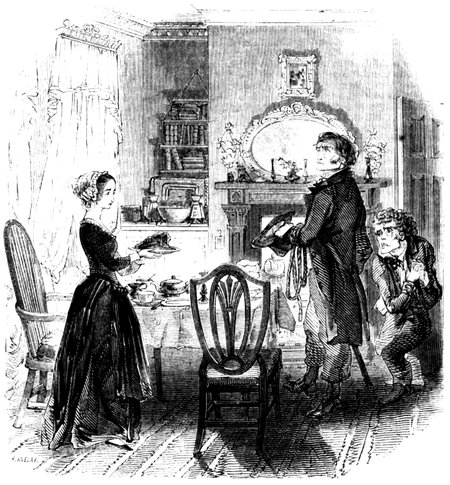
Gibbet approached the puppet, and endeavoured to manipulate the string as his father instructed him; but his hand trembled so convulsively that he could not even pass it between the arms of the figure.
While he was still fumbling with the cord, and vainly endeavouring to master his emotions, the leathern thong descended with tremendous violence upon his back.
An appalling cry burst from the poor lad; but the executioner only showered down curses on his head.
At length Gibbet contrived, through fear of another blow, to pinion the figure in a manner satisfactory to his brutal parent.
"There!" exclaimed Smithers; "I shall make something of you at last. What virtue there must be in an old bit of leather: it seems to put the right spirit into you, at all events. Well, that's all you shall do this morning down at Newgate; and mind and do it as if the thong was hanging over your head—or it will be all the worse for you when we get home. Try and keep up the credit of your father's name, and show the Sheriffs and the Chaplain how you can truss their pigeon for them. They always take great notice—they do. Last time there was an execution, the Chaplain says to me, says he, 'Smithers, I don't think you had your hand nicely in this morning?'—'Don't you, sir?' says I.—'No,' says he; 'I've seen you do it more genteel than that.'—'Well, sir,' says I, 'I'll do my best to please you next time.'—'Ah! do, there's a good fellow, Smithers,' says the Chaplain; and off he goes to breakfast with the Sheriffs and governor, a-smacking his lips at the idea of the cold fowl and ham that he meant to pitch into. But I only mention that anecdote, to show you how close the authorities take notice—that's all. So mind and do your best, boy."
"Yes, father," returned Gibbet.
"So now we've done the pinioning," continued Smithers, once more busying himself with the puppet, which he surveyed with an admiration almost amounting to a kind of love. "Well, we can suppose that our chap has marched from the cell, and has just got on the scaffold. So far, so good. We can't do better than polish him off decently now 18that he is here," proceeded Smithers, alluding to the figure, and rather musing aloud than addressing himself to his son. "Now all we've got to do is to imagine that the bell's a-ringing:—there stands the parson, reading the funeral service. Here I am. I take the halter that's already tied nicely round the poor devil's neck—I fix the loop on this hook that hangs down from the beam of the gibbet—then I leave the scaffold—I go underneath—I pull the bolt—and down he falls so!"
"O God!" cried Gibbet, literally writhing with mental agony, as the drop fell with a crashing sound, and the jerking noise of the halter met his ear a moment afterwards.
"Now, then, coward!" exclaimed the executioner; and again the leathern thong elicited horrible screams from the hump-back.
The lad was still crying, and his father was in the midst of sundry fearful anathemas, levelled against what he called his son's cowardice, when a knock was heard at the door of the loft.
"Come in!" shouted the executioner.
The invitation was obeyed; and an elderly man, dressed in a shabby suit of black, entered the room with an affected solemnity of gait.
CHAPTER CXLIII. MORBID FEELINGS.—KATHERINE.
"Holloa, Banks!" exclaimed the executioner. "Got scent of the morning's work—eh, old feller?"
"Alas! my dear Mr. Smithers," returned the undertaker, shaking his head in a lachrymose manner, "if men will perpetrate such enormities, they must expect to go to their last home by means of a dance upon nothing."
And, according to a custom which years had rendered a part of Mr. Banks's nature, he wiped his eyes with a dingy white pocket-handkerchief.
"There he is again, the old fool!" ejaculated Smithers, with a coarse guffaw; "always a-whimpering! Why, you don't mean to say, Banks, that you care two straws about the feller that's going to be tucked up this morning?"
"Ah! Smithers, you don't know my heart: I weeps for frail human natur', and not only for the unhappy being that's so soon to be a blessed defunct carkiss. But, Smithers—my boy——"
"Well?" cried the executioner.
"How much is it to be this time for the rope?" asked Mr. Banks, in a tremulous tone and with another solemn shake of the head.
"Five shillings—not a mag under," was the prompt reply.
"That's too much, Mr. Smithers—too much," observed the undertaker of Globe Lane. "The last one I bought I lost by: times is changed, Mr. Smithers—sadly changed."
"Ain't the morbid feelings, as the press calls 'em, as powerful as ever?" demanded the executioner savagely.
"The morbid feelings, thank God, is right as a trivet," answered Banks; "but it's the blunt that falls off, Smithers—the blunt! And what's the use of the morbid feelings if there's no blunt to gratify 'em?"
"Do you mean to tell me, Mr. Banks," cried the executioner, "that you can't get as ready a sale for the halters as you used to do?"
"I'm afraid that such is the actiwal case, my dear friend," responded Mr. Banks, turning up his eyes in a melancholy manner. "The last blessed wictim that you operated on, Mr. Smithers, you remember, I gived you five shillings for the rope; and I will say, in justice to him as spun it and them as bought it, that a nicer, stronger, or compacter bit of cord never supported carkiss to cross-beam. But wain was it that I coiled it neat up in my winder;—wain was it that I wrote on a half sheet of foolscap, 'This is the halter that hung poor William Lees;'—the morbid feelings was strong, 'cos the crowd collected opposite my house; but the filthy lucre, Smithers, was wanting. Well—there the damned—I beg its pardon—the blessed cord stayed for a matter of three weeks; and I do believe it never would have gone at all, if some swell that was passing quite promiscuously one day didn't take a fancy to it——"
"Well, and what did he give you?" demanded the executioner impatiently.
"Only twelve shillings, as true as I'm a woful sinner that hopes to be saved!" answered the undertaker.
"Twelve shillings—eh? And how much would you have had for the rope?"
"When the blunt doesn't fall short of the morbid feelings, I calkilates upon a guinea," answered Mr. Banks.
"Why, you old rogue," shouted the executioner, "you know that you sold William Lees's rope a dozen times over. The moment the real one was disposed of, you shoved a counterfeit into your winder; and that went off so well, that you kept on till you'd sold a dozen."
"No, Smithers—never no such luck as that since Greenacre's business," said the undertaker, with a solemn shake of his head; "and then I believe I really did sell nineteen ropes in less than a week."
"I only wonder people is such fools as to be gulled so," observed Smithers.
"What can they say, when they see your certifikit that the rope's the true one?" demanded Banks. "There was one old gen'leman that dealt with me for a many—many years; and he bought the rope of every blessed defunct that had danced on nothing at Newgate for upwards of twenty year! I quite entered into his feeling, I did—I admired that man; and so I always sold him the real ropes. But time's passing, while I'm chattering here. Come, my dear Smithers—shall we say three shillings for the rope and certifikit this morning?"
"Not a mag less than five," was the dogged answer.
"Four, my dear friend Smithers?" said the undertaker, with a whining, coaxing tone and manner.
"No—five, I tell you."
"Well—five then," said Banks. "I'll be there at a few minits 'afore nine: I s'pose you'll cut the carkiss down at the usual hour?"
"Yes—yes," answered Smithers. "I'm always punctiwal with the dead as well as the living."
The undertaker muttered something about "blessed defuncts," smoothed down the limp ends of his dirty cravat, and slowly withdrew, shaking his head more solemnly than ever.
"See what it is to be a Public Executioner!" cried 19Smithers, turning with an air of triumph towards his son: "look at the perk-visits—look at the priweleges! And yet you go snivelling about like a young gal, 'cos I want to make you fit to succeed me in my honourable profession."
"O father!" cried the lad, unable to restrain his feelings any longer: "instead of being respected, we are abhorred—instead of being honoured, our very touch is contamination! You yourself know, dear father, that you scarcely or never go abroad; if you enter the public-house tap-room, even in a neighbourhood so low as this, the people get up and walk away on different excuses. When I step out for an errand, the boys in the streets point at me; and those who are well-behaved, pass me with stealthy looks of horror and dread. Even that canting hypocrite who has just left us—even he never crosses your threshold except when his interest is concerned;—and yet he, they say, is connected with body-snatchers, and does not bear an over-excellent character in his neighbourhood. Yet such a sneaking old wretch as that approaches our door with loathing—Oh! I know that he does! You see, father—dear father, that it is a horrible employment; then pray don't make me embrace it—Oh! don't—pray don't, father—dear father: say you won't—and I'll do any thing else you tell me! I'll pick up rags and bones from the gutters—I'll sweep chimnies—I'll break stones from dawn to darkness;—but do not—do not make me an executioner!"
Smithers was so astounded at this appeal that he had allowed it to proceed without interruption. He was accustomed to be addressed on the same subject, but never to such a length, nor with such arguments; so that the manner and matter of that prayer produced a strange impression on the man who constantly sought, by means of rude sophistries, to veil from himself and his family the true estimation in which his calling was held.
Gibbet, mistaking his father's astonishment for a more favourable impression, threw himself at his feet, clasped his hands, and exclaimed, "Oh! do not turn a deaf ear to my prayer! And think not, dear father, that I confound you with that pursuit which I abhor;—think not that I see other in you than my parent—a parent whom——"
"Whom you shall obey!" cried the executioner, now recovering the use of his tongue: "or, by God!" he added, pointing with terrible ferocity towards the model-gallows, "I'll serve you as I did that puppet just now—and as I shall do the man down in the Old Bailey presently."
Gibbet rose—disappointed, dispirited, and with a heart agitated by the most painful emotions.
But why had not Smithers recourse to the leathern weapon as usual? why had he spared the poor hump-back on this occasion?
Gibbet himself marvelled that such forbearance should have been shown towards him, since he now comprehended but too well that his father was inexorable in his determination with regard to him.
The truth was that Smithers was so far struck by his son's appeal as to deem it of more serious import than any previously manifested aversion to his horrible calling; and he accordingly met it with a menace which he deemed to be more efficacious than the old discipline of the thong.
"Now, mind me," said the executioner, after a few moments' pause, "you needn't try any more of these snivelling antics: they won't succeed with me, I tell you before-hand. If you don't do as I order you, I'll hang you up to that beam as soon as yonder mouse in the noose on the mantel. So let one word be enough. Hark! there's seven o'clock: we've only just time to get a mouthful before we must be off."
Smithers proceeded down stairs, followed by Gibbet.
They entered a little parlour, where Katherine was preparing breakfast.
It being still dark, a candle stood on the table; and its light was reflected in the polished metal tea-pot, milk-jug, and sugar-basin. The table napkin was of dazzling whiteness: the knives and forks were bright as steel could be;—in a word, an air of exquisite neatness and cleanliness pervaded the board on which the morning's repast was spread.
Nor was this appearance confined to the table. The little room itself was a model of domestic propriety. Not a speck of dust was to be seen on the simple furniture, which was also disposed with taste: the windows were set off with a clean muslin curtain; and the mantel was covered with fancy ornaments all indicative of female industry.
Then Kate herself!—her appearance was in perfect keeping with that of the room which owed its cleanliness and air of simple comfort to her. A neat cap set off her chesnut hair, which was arranged in plain bands: her dark stuff gown was made high in the body and long in the skirt, but did not conceal the gracefulness of her slender form, nor altogether prevent a little foot in a neat shoe and a well-turned ankle in a lily-white cotton stocking from occasionally revealing themselves. Then her hands were so slightly brown, her fingers so taper, and her nails so carefully kept, that no one, to look at them, would conceive how much hard work Katherine was compelled to do.
Though so rigidly neat and clean, Kate had nothing of the coquette about her. She was as bashful and artless as a child; and, besides—whom had she, the executioner's acknowledged niece, to captivate?
Although she endeavoured to greet Smithers and the hump-back with a smile, a profound melancholy in reality oppressed her.
It was one of those mornings when her uncle was to exercise his horrible calling:—this circumstance would alone have deeply affected her spirits, which were never too light nor buoyant. But on the present occasion, another cause of sorrow weighed on her soul—and that was the knowledge that her wretched cousin was that morning to enter on his fearful noviciate!
She entertained a boundless compassion for that unfortunate being. His physical deformities, and the treatment which he experienced from his father, called forth the kindest sympathies of her naturally tender heart. Moreover, he had received instruction and was in the habit of seeking consolation from her: she was the only friend of that suffering creature who was persecuted alike by nature and by man; and she perhaps felt the more acutely on his account, because she was so utterly powerless in protecting him from the parental ferocity which drove him to her for comfort.
She knew that a good—a generous—a kind—and a deeply sensitive soul was enclosed within that revolting form; and she experienced acute anguish 20when a brutal hand could wantonly torture so susceptible a spirit.
And to that wounded, smarting spirit she herself was all kindness—all softness—all conciliation—all encouragement.
No wonder, then, if the miserable son of the public executioner was devoted to her: no wonder if she were a goddess of light, and hope, and consolation, and bliss to him! To do her the slightest service was a source of the purest joy which that poor being could know: to be able to convince her by a deed,—even so slight as picking up her thread when it fell, or placing her chair for her in its wonted situation,—this, this was sublime happiness to the hump-back!
He could sit for hours near her, without uttering a word—but watching her like a faithful dog. And when her musical voice, fraught with some expression of kindness, fell upon his ear, how that hideous countenance would brighten up—how those coarse lips would form a smile—how those large dull orbs would glow with ineffable bliss!
But when his father was unkind to her,—unkind to Katherine, his only friend,—unkind to the sole being that ever had looked not only without abhorrence, but with unadulterated gentleness on him,—then a new spirit seemed to animate him; and the faithful creature, who received his own stripes with spaniel-like irresistance, burst forth in indignant remonstrance when a blow was levelled at her. Then his rage grew terrible; and the resigned, docile, retiring hump-back became transformed into a perfect demon.
How offensive to the delicate admirer of a maudlin romance, in which only handsome boys and pretty girls are supposed to be capable of playing at the game of Love, must be the statement which we are now about to make. But the reader who truly knows the world,—not the world of the sentimental novel, but the world as it really is,—will not start when we inform him that this being whom nature had formed in her most uncouth mould,—this creature whose deformities seemed to render him a connecting link between man and monkey,—this living thing that appeared to be but one remove above a monster, cherished a profound love for that young girl whom he esteemed as his guardian angel.
But this passion was unsuspected by her, as its nature was unknown to himself. Of course it was not reciprocated:—how could it be? Nevertheless, every proof of friendship—every testimonial of kind feeling—every evidence of compassion on her part, only tended to augment that attachment which the hump-back experienced for Katherine.
"Well, Kate," said the executioner, as he took his seat at the breakfast-table, "I've drilled Gibbet into the art of pinioning at last."
The girl made no answer; but she cast a rapid glance at the hump-back, and two tears trickled down her cheeks.
"Come, Gibbet," added Smithers; "we've no time to lose. Don't be afraid of your bread-and-butter: you'll get nothing to eat till you come home again to dinner."
"Is John going with you this morning, uncle?" inquired Katherine timidly.
"Why, you know he is. You only ask the question to get up a discussion once more about it, as you did last night."
This was more or less true: the generous-hearted girl hoped yet to be able to avert her uncle from his intention in respect to the hump-back.
"But I won't hear any more about it," continued the executioner, as he ate his breakfast. "And, then, why do you call him John?"
"Did you not give him that name at his baptism?" said Kate.
"And if I did, I've also the right to change it," returned the executioner; "and I choose him to be called Gibbet. It's more professional."
"I think the grocer in High Street wants an errand boy, uncle," observed Katherine, with her eyes fixed upon her cup—she dared not raise them to Smithers' face as she spoke: "perhaps he would take John—I mean my cousin—and that would be better than making him follow a calling which he does not fancy."
"Mind your own business, Miss Imperence!" ejaculated the executioner; "and let me mind mine. Now, then—who knocks at the front door?"
Gibbet rose and hastened from the room.
In a few moments he returned, holding in his hand a paper, which he gave to his father.
"Ah! I thought so," said Smithers, as he glanced his eye over the paper: "my friend Dognatch is always in time. Here's the last dying speech, confession, and a true account of the execution of the man that I'm to tuck up presently—all cut and dry, you see. Well—it's very kind of Dognatch always to send me a copy: but I suppose he thinks it's a compliment due to my sitiwation."
With these words Smithers tossed off his tea, rose, and exclaimed, "Now, Gibbet, my boy, we must be off."
"Father, I don't feel equal to it," murmured the hump-back, who seemed fixed to his chair.
"Come—without another word!" cried the executioner, in so terrible a tone that Gibbet started from his seat as if suddenly moved by electricity.
"Uncle—uncle, you will not—you cannot force this poor lad—" began Katherine, venturing upon a last appeal in favour of the hump-back.
"Kate," said the executioner, turning abruptly upon her, while his countenance wore so ferocious an expression of mingled determination and rage, that the young girl uttered an ejaculation of alarm,—"Kate, do not provoke me; or——"
He said no more, but darted on her a look of such dark, diabolical menace, that she sank back, annihilated as it were, into her seat.
She covered her face with her hands, and burst into an agony of tears.
For some moments she remained absorbed in profound grief: the fate of the wretched hump-back, and the idea that she herself was doomed to exist beneath the same roof with the horrible man whom she called her uncle, were causes of bitter anguish to her tender and sensitive soul.
When she raised her head, and glanced timidly around, she found herself alone.
CHAPTER CXLIV. THE UNFINISHED LETTER.
The dawn was now breaking; and Katherine extinguished the candle.
21How gloomily does the young day announce itself to the dwellers in the narrow streets and obscure alleys of the poor districts of the metropolis! The struggling gleam appears to contend with difficulty against the dense atmosphere and noxious vapours which prevail in those regions even in the midst of winter; and as each fitful ray steals through the dingy panes, its light seems leaden and dull, not golden and roseate as that of the orb of day.
Kate wiped away her tears, and set to work to clear the table of the breakfast-things.
Having performed this duty, she slipped on her neat straw bonnet and warm shawl,—purchased by the produce of her own industry,—and repaired to market.
But, alas! poor girl—as she passed rapidly through the streets, she could not help noticing the people, that were lounging at their doors, nudge each other, as much as to say, "There goes the executioner's niece."
And no friendly voice welcomed her with a kind "Good morning:" no human being had a passing compliment,—not even one of those civil phrases which cost nothing to utter, mean perhaps as little, but still are pleasing to hear,—to waste upon the executioner's niece.
Some old women, more hard-hearted than the rest, exclaimed, as she hurried timidly by the spot where they were gossiping, "Ah! her uncle has got business on his hands this morning!"
And when the poor girl reached the shop whither she was going, her eyes were bathed in tears.
The shopkeeper was cool and indifferent in his manner towards her—not obsequious and ready as towards his other customers. He even examined with suspicion the coin which she tendered him in payment for her purchases—as if it were impossible that honesty could dwell in the heart of an executioner's niece!
The ill-conditioned fellow! He saw not the mild blue eyes, with a tear glittering in each like twin-drops of the diamond-dew;—he marked not the pretty lips, apart, and expressive of such profound melancholy;—he observed not the thick folds of the shawl across the gently-budding bosom rise and sink rapidly:—no,—he beheld not that interesting young creature's grief; but he treated her rudely and harshly, because she was the executioner's niece!
Kate retraced her steps homewards. She saw other girls of her own age nod familiarly to their acquaintances at the windows, as they passed;—but she had no friend to receive or return her smile of recognition!
Shrinking within herself, as it were, from the slightest contact with the world which despised her, the poor young creature felt herself an interloper upon the very pavement, and even stepped into the muddy street to make way for those who passed.
With a broken spirit she returned home, her fate weighing upon her soul like a crime!
And so it was with her always on those mornings when her uncle was called upon to exercise his fearful functions.
She was glad to bury herself once more in that dwelling the threshold of which a friendly step so seldom crossed: her little parlour, embellished with her own hands, appeared a paradise of peace after the contumely which she experienced in the bustling streets.
She had returned home in so depressed a state of mind that she had forgotten to close the front door behind her.
She opened her work-box, seated herself at the table, and commenced her toil of pleasure—for that young girl loved her needle, and abhorred idleness.
She then fell into a reverie as she worked.
"To be a hangman is something horrible indeed," she mused aloud; "but to be a member of a hangman's family is far worse. He knows that he merits what reproach is levelled against him, if indeed his office deserve reproach at all; but I, who abhor the bare idea, and never so much as witnessed an execution—why should shame and obloquy redound upon me? It is like suffering for a crime of which one is innocent! O God, is this human justice? What have I done that the vilest and lowest should despise me? Am I not flesh and blood like them? do my clothes carry pollution, that the ragged beggar draws her tatters close to her as she passes me? Oh! give me strength, heaven, to support my wretched fate; for there are moments when I despair!"
"You are wrong to mistrust the goodness of the Almighty," said a mild voice close behind her chair.
Kate started, and looked round.
It was the rector of St. David's who had entered he room, unperceived by the young maiden.
"Pardon me, reverend sir," answered Kate; "I know that I am often forgetful of the wholesome lessons which I have received from your lips; but——"
"Well, well, poor child," interrupted Reginald Tracy, to whose cheeks the phrase "wholesome lessons" brought a flush of crimson—for he remembered how he himself had deviated from the doctrines which he had long successfully and sincerely taught: "be consoled! I know how sad must be our lot; and I have called this morning to see if I cannot ameliorate it."
"What? better my condition, sir?" exclaimed Katherine. "Oh! how is that possible?"
"We will see," answered the rector, taking a chair near the young maiden. "You are not altogether so friendless as you imagine."
"I am aware, sir, that through your goodness I received an education at the school which your bounty founded; and your excellent housekeeper, Mrs. Kenrick, has furnished me with needle-work. Oh! sir, I am not ignorant how much I owe to you both!"
Kate raised her mild blue eyes towards the rector's countenance; but her glance drooped again instantaneously, for his looks were fixed upon her in a manner which she had never noticed in him before, and which excited a momentary feeling of embarrassment—almost of alarm—in her mind.
But that feeling passed away as rapidly as it had arisen; and she blushed to think that she should have experienced such a sentiment in the presence of so holy a man and so great a benefactor.
"I did not wish to remind you of any trifling services which myself or my housekeeper may have rendered you, Katherine," said Reginald. "I alluded to another friend who interests himself in you."
"Another friend!" ejaculated the young girl. "Is it possible that I have another friend in the whole world?"
"You have," replied Mr. Tracy. "Did not a 22gentleman, accompanied by a police-officer, visit this house about a fortnight ago?"
"Yes—I remember—late one night——"
And she stopped short, being unwilling to allude to that instance of her uncle's cruelty which had led to the visit mentioned by the rector.
"Well, that gentleman feels interested in you," continued Reginald. "He saw how you were treated—he knows that you are unhappy."
"And do strangers thus interest themselves in the wretched?" asked Katherine, her eyes swimming in tears.
"Not often," replied the rector. "But this gentleman is one of the few noble exceptions to the general rule."
"He must be indeed!" exclaimed Katherine, with an enthusiasm which was almost pious.
"That gentleman learnt from the policeman enough to give him a favourable impression of your character, and to render him desirous of serving you. He pondered upon the matter for some days, but could come to no determination on the subject. He heard that you were anxious to leave this house and earn your own bread."
"Oh! yes—how willingly would I do so!" exclaimed Katherine fervently. "But——"
"But what?" demanded Reginald, in whose eyes the young maiden had never been an object of peculiar interest until at present;—and now he observed, for the first time, that her personal appearance was far—very far from disagreeable.
The truth was, that, since his fall, he had viewed every woman with different eyes from those through which he had before surveyed the female sex. When he himself was chaste and pure, he observed only the feminine mind and manner:—now his glances studied and discriminated between external attractions. His moral survey had become a sensual one.
"But what?" he said, when Katherine hesitated. "Do you object to leave your uncle?"
"I should be a hypocrite were I to say that I object to leave him," was the immediate answer. "Nevertheless, if he demanded my services, I would remain with him, through gratitude for the bread which he gave me, and the asylum which he afforded me, when I was a child and unable to earn either. But he would not seek to retain me, I know; for he does not—he cannot love me! Still, there is one poor creature in this house——"
"My housekeeper has told me of him. You mean your uncle's son?" said Reginald.
"I do, sir. He has no friend in the world but me; and, though my intercessions do not save him from much bad treatment, still I have studied to console him."
"If he be grateful, he will feel pleased to think that you may be removed to a happier situation," said the rector.
"True!" exclaimed Kate. "And if I only earned more money than I do here, I should be able to provide him with a great many little comforts."
"Assuredly," replied the fashionable preacher, who during this colloquy had gradually drawn his chair closer to that of the young maiden. "The gentleman, to whom I have before alluded, called upon me yesterday. It appears he learnt from the policeman that you had been educated at the school in my district, and that my housekeeper was well acquainted with you. He nobly offered to contribute a sum of money towards settling you in some comfortable manner."
"The generous stranger!" exclaimed Kate. "What is his name, sir—that I may pray for him?"
"Mr. Markham——"
"Markham!" cried the young girl, strangely excited by the mention of that name.
"Yes. Have you ever heard of him before?" asked the rector, surprised at the impression thus produced.
Katherine appeared to reflect profoundly for some moments; then, opening a secret drawer of her work-box, she drew forth a small satin bag, carefully sewed all round.
She took her scissors and unpicked the thread from one end of the bag.
The rector watched her attentively, and with as much surprise as interest.
Having thus opened one extremity of the bag, she inserted her delicate fingers, and produced a sheet of letter-paper, folded, and dingy with age.
Handing it to the rector, she observed, with tears streaming down her cheeks, "These were the last words my mother ever wrote; and she had lost the use of her speech ere she penned them."
Reginald Tracy unfolded the letter, and read as follows:——
"Should my own gloomy presages prove true, and the warning of my medical attendant be well founded,—if, in a word, the hand of Death be already extended to snatch me away thus in the prime of life, while my darling child is * * * * and inform Mr. Markham, whose abode is——"
The words that originally stood in the place which we have marked with asterisks, had evidently been blotted out by the tears of the writer.
Reginald folded the letter as he had received it, and returned it to Katherine.
The young girl immediately replaced it in the little bag, which she sewed up with scrupulous care.
It was the poor creature's sole treasure; and she prized it as the last and only memento that she possessed of her mother.
"And you know not to whom that unfinished letter alluded?" said the rector, after a long pause, during which the bag, with its precious contents, had been consigned once more to the secret drawer in the work-box.
"I have not the least idea," answered Kate, drying her tears. "I was only four years old when my mother died, and of course could take no steps to inquire after the Mr. Markham mentioned in the letter. My uncle has often assured me that he took some trouble in the matter, but without success. Markham, you know, sir, is by no means an uncommon name."
"And your father, Katherine—do you remember him?"
"Oh! no, sir—he died before my mother. When I was old enough to comprehend how dreadful it is to be an orphan, Mr. Tracy, I made that little satin bag to preserve the letter which Death would not allow my poor mother to finish."
And again the young maiden wept bitterly.
The rector was deeply affected; and for some minutes his sensual ideas concerning the damsel were absorbed in a more generous sympathy.
"But did not the medical man who attended your mother in her last moments, and who is also alluded to in the letter," asked Reginald,—"did he not afford some clue to unravel the mystery?"
23"That question I have asked my uncle more than once," answered Kate; "and he has assured me that the medical man was a perfect stranger who was casually summoned to attend upon my poor mother only the very day before she breathed her last. Since then the medical man has also died."
"Your mother was your uncle's own sister, was she not?" asked the rector.
"She was, sir."
"And she married a person named Wilmot?"
"Yes—for my name is Katherine Wilmot."
"I remember that you were so entered upon the school-books," said the rector. "Your mother must have been a superior woman, for the language of that fragment of a letter is accurate, and the handwriting is good."
"The same thought has often struck me, sir," observed Katherine. "And now how strange it is that a person bearing the name of Markham should interest himself in my behalf!"
"Strange indeed!" exclaimed Reginald, whose eyes were once more fixed upon the interesting girl near him,—fixed, too, with an ardent glance, and not one of tender sympathy. "Mr. Richard Markham—the gentleman of whom I speak—called upon me, as I ere now stated, and besought me to exert myself in your behalf. He seems to think that my position and character enable me to do for you that which, coming from him, might awaken the tongue of scandal. The cause of my visit this morning is now at length explained."
"I am very grateful, sir, for Mr. Markham's good intentions and your kindness," said Katherine. "The coincidence in names, which led me to show you that letter, seems a providential suggestion to me to follow the counsel of such generous—such disinterested friends."
"I thought as I came along," resumed the clergyman, "that I would procure you a situation with some friends of mine in the country. But—" and he cast upon her a burning look brimful of licentiousness—"I have my doubts whether it would not be better for you to come to my house and assist Mrs. Kenrick in her domestic duties—especially as she is getting very old—and——"
He paused for a moment:—he hesitated, because at the back of the offer there was an unworthy motive at which his guilty soul quaked, lest it should betray itself.
But that pure-minded and artless girl only saw in that offer a noble act of kindness; and she frankly accepted it—upon the condition that her uncle approved of her conduct in doing so.
The rector rose—he had no farther excuse for protracting his visit.
The young girl thanked him for his goodness with the most heart-felt sincerity.
He then took his leave.
CHAPTER CXLV. HYPOCRISY.
Reginald Tracy proceeded from the dwelling of the hangman to the corner of Tottenham Court Road, where his carriage was waiting for him.
He stepped into the vehicle, and ordered the coachman to drive him to Markham Place near Lower Holloway.
Richard was not at home: he had gone for a short walk with Mr. Monroe, who was yet too feeble to move far without the support of a companion's arm. They were, however, expected to return in a short time;—besides, Miss Monroe was in the drawing-room; and the rector therefore decided upon walking in and waiting for Mr. Markham.
The name of Miss Monroe produced a powerful sensation in the breast of that man whose passions until lately dormant from his birth, now raged so furiously. He had seen her in a voluptuous negligee, attending by the sick-bed of her father;—he had heard her utter words of strange self-accusing import, in connection with that parent's illness;—and his curiosity, as well as his desires, was kindled.
He had been fascinated by that charming girl; and our readers will remember that he had felt himself capable of making any sacrifice to obtain her love!
His mind, too, entertained a distant suspicion—a very distant one, but still a suspicion—that she had strayed from the path of virtue;—for of what else could a daughter, whom he had seen hanging like a ministering angel over her father's couch, accuse herself?
This suspicion—and, at all events, that mystery which hung around the accusation alluded to, served to inflame the imagination of a man who now sought to place no bridle upon his passions. The idea suggested itself to him, that if another had revelled in her charms, why should not he? In a word, his heart glowed with secret delight when he learnt from Whittingham that Miss Monroe was alone in the drawing-room.
On his entrance, Ellen rose from the sofa, and welcomed him with a cordiality which originated in a sense of gratitude for the spiritual comfort he had rendered her father during his illness.
At a glance his eyes scanned the fair form of Ellen from head to foot; and his imagination was instantly fired with the thoughts of her soft and swelling charms—those graceful undulations which were all her own, and needed no artificial aids to improve the originals of nature!
"I am pleased to learn from the servant that your father, Miss Monroe, is able to take a little exercise once more," said the rector.
"Oh! all danger is now past," exclaimed Ellen cheerfully. "But at one time, Mr. Tracy, I had made up my mind to lose him."
"I saw how much you were afflicted," observed the rector; "and I was grieved to hear you reproach yourself to some extent——"
"Reproach myself!" interrupted Ellen, blushing deeply. "You heard me reproach myself?"
"I did," answered the rector. "And now, forgive me, if—by virtue of my sacred calling—I make bold to remind you that Providence frequently tries us, through the medium of afflictions visited upon those whom we love, in order to punish us for our neglectfulness, our unkindness, or our errors, towards those so afflicted. Pardon me, Miss Monroe, for thus addressing you; but I should be unfaithful towards Him whom I serve, did I not avail myself of every opportunity to explain the lessons which his wise and just dispensations convey."
"Mr. Tracy," exclaimed Ellen, cruelly embarrassed by this language, "do you really believe that Providence punished my father for some misconduct on my part?"
24"Judging by the reproach—the accusation which your lips uttered against yourself—perhaps in an unguarded moment—when you ministered with angelic tenderness at your father's sick-bed——"
"Sir—Mr. Tracy, this is too much!" cried Ellen, tears starting from her eyes, while her cheeks were suffused with blushes: "it is unmanly—it is ungenerous to take advantage of any expressions which might have been wrung from me in a moment of acute anguish."
"Pardon me, young lady," said the rector with apparent meekness: "heaven knows the purity of my intentions in thus addressing you. It is not always that my spiritual aid is thus rejected—that my motives are thus cruelly suspected."
"Forgive me, sir,—I was wrong to excite myself at words which were meant in kindness," said Ellen, completely deceived by this consummate hypocrisy.
"Miss Monroe," continued Reginald, "believe me when I assure you that I feel deep compassion—deep interest, wherever I perceive grief—especially when that sorrow is secret. And, if my eyes have not deceived me, methinks I have read in your young heart the existence of some such secret sorrow. My aim is to console you; for the consolation which I can offer is not human—it is divine! I am but the humble instrument of the supernal Goodness; but God imparts solace through even the least worthy of his ministers."
"I thank you sincerely for your friendly intentions towards me," said Ellen, now recovering her presence of mind; "but, since my father is restored to health, I have little to vex me."
"And yet that self-reproach, Miss Monroe," persisted the rector, determined not to abandon the point to which he had so dexterously conducted the conversation,—"that self-accusation which escaped your lips——"
"Is a family secret, Mr. Tracy, which may not be revealed," interrupted Ellen firmly.
"I ask you not for your confidence, Miss Monroe: think not that I seek to pry into your affairs with an impertinent curiosity——"
"Once more, sir, I thank you for the kindness which prompts you thus to address me; but—pray, let us change the conversation."
These words were uttered in so decided a tone, that Reginald dared not persist in his attempt to thrust himself into the young lady's confidence.
An awkward silence ensued; and the rector was thinking how he should break it, when the door opened.
Almost at the same moment, a female voice was heard outside the room, saying, in tender playfulness, "Come to mamma! come to mamma!"
Then, immediately afterwards, Marian entered the apartment, bearing an infant in her arms.
Whittingham had neglected to tell her that there was a visitor in the drawing-room.
Poor Marian, astounded at the presence of the rector, could neither advance nor retreat for some moments.
At length she turned abruptly away.
Ellen sank back upon the sofa, overcome with shame and grief.
The rector threw upon her a glance full of meaning; but she saw it not—for her own eyes were cast down.
This depression, however, lasted only for a moment. Suddenly raising her head, she exclaimed with that boldness and firm frankness which had been taught her by the various circumstances of the last few years of her life, "You now know my secret, sir: but you are a man of honour. I need say no more."
"Who has been base enough to leave this grievous wrong unrepaired?" asked Reginald, taking her hand—that soft, warm, delicate hand.
"Nay—seek to know no more," returned Ellen, withdrawing her hand hastily from what she however conceived to be only the pressure of a friendly or fraternal interest; "you have learnt too much already. For God's sake, let not my father know that you have discovered his daughter's shame!"
"Not for worlds would I do aught to cause you pain!" cried the rector, enthusiastically.
"Thank you—thank you," murmured Ellen, completely deceived in respect to the cause of Tracy's warmth, and mistaking for friendly interest an ebullition of feeling which was in reality gross and sensual.
With these words Ellen hurried from the room.
"I have discovered her secret!" said the rector triumphantly to himself, as he rose and paced the apartment, mad passions raging in his breast; "and that discovery shall make her mine. Oh! no sacrifice were too great to obtain possession of that charming creature! I would give the ten best years of my life to clasp her in my arms, in the revels of love! Happy—thrice happy should I be to feel that lovely form become supple and yielding in my embrace! But my brain burns—my heart beats—my eyes throb—my blood seems liquid fire!"
Reginald threw himself, exhausted by the indomitable violence of his passions, upon the sofa.
Scarcely had he time to compose himself, when Markham entered the room.
The rector communicated to him the particulars of his interview with Katherine Wilmot, and concluded by saying that, as the girl was known to his housekeeper, he had determined upon taking her into his service.
"With regard to the fragment of the letter," observed Richard, "allusion must have been made to some person of the name of Markham who is totally unconnected with our family. We have no relations of that name. I feel convinced that the mention of the name could not in any way refer to my father; and my brother and myself were children at the time when that letter must have been written."
"It is a coincidence—and that is all," observed the rector. "But as you have to some extent constituted yourself the benefactor of this young person, do you approve of the arrangement which I have made for her to enter my household?"
"My dear sir, how can I object?" exclaimed Richard, who, in the natural generosity of his heart, gave the rector credit for the most worthy motives. "I consider myself your debtor for your noble conduct in this instance. Under your roof, Mr. Tracy, the breath of calumny cannot reach that poor creature; and there no one will dare to make her family connexions a subject of reproach."
Some farther conversation took place between Reginald Tracy and Richard Markham upon this subject, and when the former rose to depart, they both observed, for the first time during their interview, 25that a violent shower of rain was pouring down.
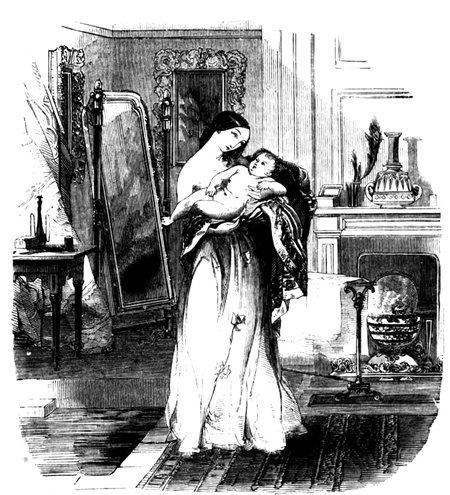
Richard pressed the rector to remain to dinner—an invitation which he, whose head was filled with Ellen, did not hesitate to accept.
The rector's carriage and horses were accordingly housed in the stables attached to Markham Place; and Whittingham was desired to make Mr. Tracy's coachman and livery-servant as comfortable as possible—instructions with which the hospitable old butler did not fail to comply.
Dinner was served up at five o'clock; and Reginald had the felicity of sitting next to Miss Monroe.
The more he saw of this young lady, the more did he become enraptured with her,—not, however, experiencing a pure and chaste affection, but one whose ingredients were completely sensual.
The evening passed rapidly away;—the rain continued to pour in torrents.
As a matter of courtesy—indeed, of hospitality, for Richard's nature was generosity itself—the rector was pressed to stay the night at the Place; and, although he had a good close carriage to convey him home (and persons who have such equipages are seldom over careful of their servants), he accepted the invitation.
There was something so pleasing—so intoxicating in the idea of passing the night under the same roof with Ellen!
CHAPTER CXLVI. THE BATH.—THE HOUSEKEEPER.
It was scarcely light when the rector of Saint David's rose from a couch where visions of a most voluptuous nature had filled his sleep.
Having hastily dressed himself, he descended from his room with the intention of seeking the fine frosty air of the garden to cool his heated brain.
But as he proceeded along a passage leading to the landing of the first flight of stairs, he heard a light step slowly descending the upper flight; and the next moment, the voice of Ellen speaking fondly to her child, fell upon his ear.
26For nurses and mothers will talk to babes of even a few months old—although the innocents comprehend them not!
Reginald stepped into the recess formed by the door of one of the bed-chambers in that spacious mansion; and scarcely had he concealed himself there when he saw Ellen, with the child in her arms, pass across the landing at the end of the passage, and enter a room on the other side.
She wore a loose dressing-gown of snowy whiteness, which was confined by a band round her delicate waist, and was fastened up to the throat: her little feet had been hastily thrust into a pair of buff morocco slippers; and her long shining hair flowed over her shoulders and down her back.
The licentious eyes of the clergyman followed her from the foot of the stairs to the room which she entered; and even plunged with eager curiosity into that chamber during the moment that the door was open as she went in.
That glance enabled him to perceive that there was a bath in the apartment to which Ellen had proceeded with her child.
Indeed, the young lady, ever since her residence at Markham Place, had availed herself of the luxury of the bathing-room which that mansion possessed: and every morning she immersed her beautiful person in the refreshing element, which she enjoyed in its natural state in summer, but which was rendered slightly tepid for her in winter.
When the rector beheld her descend in that bewitching negligee,—her hair unconfined, and floating at will—her small, round, polished ankles glancing between the white drapery and the little slippers,—and the child, with merely a thick shawl thrown about it, in her arms,—and when he observed the bath in that chamber which she entered, he immediately comprehended her intention.
Without a moment's hesitation he stole softly from the recess where he had concealed himself, and approached the door of the bath-room.
His greedy eyes were applied to the key-hole; and his licentious glance plunged into the depths of that sacred privacy.
The unsuspecting Ellen was warbling cheerfully to her child.
She dipped her hand into the water, which Marian had prepared for her, and found the degree of heat agreeable to her wishes.
Then she placed the towels near the fire to warm.
Reginald watched her proceedings with the most ardent curiosity: the very luxury of the unhallowed enjoyment which he experienced caused an oppression at his chest; his heart beat quickly; his brain seemed to throb with violence.
The fires of gross sensuality raged madly in his breast.
Ellen's preparations were now completed.
With her charming white hand she put back her hair from her forehead.
Then, as she still retained the child on her left arm, with her right hand she loosened the strings which closed her dressing-gown round the neck and the band which confined it at the waist.
While thus occupied, she was partly turned towards the door; and all the treasures of her bosom were revealed to the ardent gaze of the rector.
His desires were now inflamed to that pitch when they almost become ungovernable. He felt that could he possess that charming creature, he would care not for the result—even though he forced her to compliance with his wishes, and murder and suicide followed,—the murder of her, and the suicide of himself!
He was about to grasp the handle of the door, when he remembered that he had heard the key turn in the lock immediately after she had entered the room.
He gnashed his teeth with rage.
And now the drapery had fallen from her shoulders, and the whole of her voluptuous form, naked to the waist, was exposed to his view.
He could have broken down the door, had he not feared to alarm the other inmates of the house.
He literally trembled under the influence of his fierce desires.
How he envied—Oh! how he envied the innocent babe which the fond mother pressed to that bosom—swelling, warm, and glowing!
And now she prepared to step into the bath: but, while he was waiting with fervent avidity for the moment when the whole of the drapery should fall from her form, a step suddenly resounded upon the stairs.
He started like a guilty wretch away from the door: and, perceiving that the footsteps descended the upper flight, he precipitated himself down the stairs.
Rushing across the hall, he sought the garden, where he wandered up and down, a thousand wild feelings agitating his breast.
He determined that Ellen should be his; but he was not collected enough to deliberate upon the means of accomplishing his resolution,—so busy was his imagination in conjuring up the most voluptuous idealities, which were all prompted by the real scene the contemplation whereof had been interrupted.
He fancied that he beheld the lovely young mother immersed in the bath—the water agitated by her polished limbs—each ripple kissing some charm, even as she herself kissed her babe!
Then he imagined he saw her step forth like a Venus from the ocean—her cheeks flushed with animation—her long glossy hair floating in rich undulations over her ivory shoulders.
"My God!" he exclaimed, at length, "I shall grow mad under the influence of this fascination! One kiss from her lips were worth ten thousand of the meretricious embraces which Cecilia yields so willingly. Oh! Ellen would not surrender herself without many prayers—much entreaty—and, perhaps, force;—but Cecilia falls into my arms without a struggle! Enjoyment with her is not increased by previous bashfulness;—she does not fire the soul by one moment of resistance. But Ellen—so coy, so difficult to win,—so full of confidence in herself, in spite of that one fault which accident betrayed to me,—Ellen, so young and inexperienced in the ways of passion,—Oh! she were a conquest worth every sacrifice that man could make!"
The rector's reverie was suddenly interrupted by the voice of Whittingham summoning him to the breakfast-room.
Thither he proceeded; and there Ellen, now attired in a simple but captivating morning-dress, presided.
27Little did she imagine that the privacy of her bath had been invaded—violated by the glance of that man who now seated himself next to her, and whose sanctity was deemed to be above all question.
Little, either, did her father and friend suppose that there was one present who had vowed that she should be his, and who, in connection with that determination, had entertained no thought of marriage.
The ramble in the garden had so far cooled the rector's brain, that nothing in his behaviour towards Ellen was calculated to excite observation; but, from time to time, when unperceived, he cast upon her a glance of fervent admiration—a long, fixed, devouring glance, which denoted profound passion.
At length the hour for departure arrived; and his carriage drove round to the front door.
The rain of the preceding evening had changed to frost during the night;—the morning was fine, fresh, and healthy, though intensely cold; there was hence no shadow of an excuse for a longer stay.
The rector expressed his thanks for the hospitality which he had experienced, with that politeness which so eminently characterised his manners; and when he shook hands with Ellen, he pressed hers gently.
She thought that he intended to convey a sort of assurance that the secret which he had detected on the previous day, was sacred with him; and she cast upon him a rapid glance, expressive of gratitude.
Reginald then stepped into the carriage, which immediately rolled rapidly away towards London.
Upon his arrival at home, he proceeded straight to his study, whither he was immediately followed by the old housekeeper.
"Leave me—leave me, Mrs. Kenrick," said the rector; "I wish to be alone."
"I thought something had happened, sir," observed the old woman, fidgetting about the room, for with senile pertinacity she was resolved to say what she had upon her mind: "I thought so," she continued, "because this is the first time you ever stayed out all night without sending me word what kept you."
"I am not aware that I owe you an account of my actions, Mrs. Kenrick," said the rector, who, like all guilty persons, was half afraid that his conduct was suspected by the old woman.
"Certainly not, sir; and I never asked it. But after all the years I have been with you, and the confidence you have always reposed in me—until within the last week or two," added the old housekeeper, "I was afraid lest I had done something to offend you."
"No such thing," said the rector, somewhat softened. "But as the cares of my ministry multiply upon me——"
"Ah! sir, they must have multiplied of late," interrupted the old woman; "for you're not the same man you were."
"How do you mean?" demanded Reginald, now once more irritated.
"You have seemed restless, unsettled, and unhappy, for some two or three weeks past, sir," answered the housekeeper, wiping away a tear from her eye. "And then you are not so regular in your habits as you were: you go out and come in oftener;—sometimes you stay out till very late; at others you come home, send me up to bed, and say that you yourself are going to rest;—nevertheless, I hear you about the house——"
"Nonsense!" ejaculated Reginald, struck by the imprudence of which he had been guilty in admitting Lady Cecilia into his abode. "Do not make yourself unhappy, Mrs. Kenrick: nothing ails me, I can assure you. But—tell me," he added, half afraid to ask the question; "have you heard any one else remark—I mean, make any observation—that is, speak as you do about me——"
"Well, sir, if you wish for the truth," returned the housekeeper, "I must say that the clerk questioned me yesterday morning about you."
"The clerk!" ejaculated Reginald; "and what did he say?"
"Oh? he merely thought that you had something on your mind—some annoyance which worried you——"
"He is an impertinent fellow!" cried the rector, thrown off his guard by the alarming announcement that a change in his behaviour had been observed.
"He only speaks out of kindness, sir—as I do," observed the housekeeper, with a deep sigh.
"Well, well, Mrs. Kenrick," said the rector, vexed at his own impatience: "I was wrong to mistrust the excellence of his motives. To tell the truth, I have had some little cause of vexation—the loss of a large sum—through the perfidy of a pretended friend—and——"
The rector floundered in the midst of his falsehood; but the old housekeeper readily believed him, and was rejoiced to think that he had at length honoured her with his confidence in respect to the cause of that restlessness which she had mistaken for a secret grief.
"But no one else has made any remark, my dear Mrs. Kenrick?" said the rector, in a tone of conciliation "I mean—no one has questioned you—or——"
"Only Lady Cecilia Harborough sent yesterday afternoon to request you to call upon her, sir."
"Ah!—well?"
"And of course I said to her servant-maid that you were not at home. She came back in the evening, and seemed much disappointed that you were still absent. Then she returned again, saying that her mistress was ill and wished to consult you upon business."
"And what did you tell her, Mrs. Kenrick?"
"That you had not returned, sir," answered the housekeeper, surprised at the question, as if there were any thing else to tell save the truth. "The servant-maid seemed more and more disappointed, and called again as early as eight o'clock this morning."
"This morning!" echoed Reginald, seriously annoyed at this repetition of visits from Lady Cecilia's confidential servant.
"Yes, sir; and when I said that you had not been home all night, she appeared quite surprised," continued the housekeeper.
"And you told her that I had not been home all night?" mused Reginald. "What must Lady Cecilia think?"
"Think, sir?" cried the housekeeper, more surprised still at her master's observations. "You can owe no account of your actions, sir, to Lady Cecilia Harborough."
"Oh! no—certainly not," stammered the rector, 28cruelly embarrassed: "I only thought that evil tongues——"
"The Reverend Reginald Tracy is above calumny," said the housekeeper, who was as proud of her master as she was attached to him.
"True—true, Mrs. Kenrick," exclaimed the rector. "And yet—but, after all no matter. I will go and call in Tavistock Square at once; and then I can explain——"
Up to this moment the housekeeper had spoken in the full conviction that annoyance alone was the cause of her master's recent change of behaviour and present singularity of manners; but his increasing embarrassment—the strangeness of his observations relative to Lady Cecilia—his anxiety lest she should entertain an evil idea concerning his absence from home,—added to a certain vague rumour which had reached her ears relative to the lightness of that lady's character,—all these circumstances, united with the fact of Cecilia having sent so often to request Mr. Tracy to call upon her, suddenly engendered a suspicion of the truth in the housekeeper's mind.
"Before you go out again, sir," said the housekeeper, wishing to discard that suspicion, and therefore hastening to change the conversation to another topic, "I should mention to you that yesterday afternoon—between one and two o'clock—Katherine Wilmot arrived here——"
"Indeed! What, so soon?" exclaimed the rector.
"And as she assured me that you had only a few hours before offered her a situation in your household," continued Mrs. Kenrick, "I did not hesitate to take her in. Besides, she is a good girl, and I am not sorry that she should leave her uncle's roof."
"Then you approve of my arrangement, Mrs. Kenrick?" said Reginald.
"Certainly, sir—if I have the right to approve or disapprove," answered the old lady, who, in spite of the natural excellence of her heart, was somewhat piqued at not having been previously consulted upon the subject: then, ashamed of this littleness of feeling, she hastily added, "But the poor girl has a sad story to tell, sir, about the way in which she left her uncle; and, with your permission, I will send her up to you."
"Do so," said the rector, not sorry to be relieved of the presence of his housekeeper, in whose manner his guilty conscience made him see a peculiarity which filled his mind with apprehension.
In a few minutes Katherine Wilmot entered the rector's study.
Her story was brief but painful.
"After you left, sir, I sate thinking upon your very great kindness and that of Mr. Markham, and how happy I should be to have an opportunity of convincing you both that I was anxious to deserve all you proposed to do for me. The hours slipped away; and for the first time I forgot to prepare my uncle's dinner punctually to the minute. I know that I was wrong, sir—but I had so much to think about, both past and future! Well, sir, one o'clock struck; and nothing was ready. I started up, and did my best. But in a few minutes my uncle and cousin came in. My uncle, sir, was rather cross—indeed, if I must speak the truth, very cross; because his son had absolutely refused to assist him in his morning's work. I need not say, sir," continued the girl, with a shudder, "what that work was. The first thing my uncle did was to ask if his dinner was ready? I told him the whole truth, but assured him that not many minutes would elapse before it would be ready. You do not want to know, sir, all he said to me; it is quite sufficient to say that he turned me out of doors. I cried, and begged very hard to part from him in friendship—for, after all, sir, he is my nearest relation on the face of the earth—and, then, he brought me up! But he closed the door, and would not listen to me."
Katherine ceased, and wiped her eyes.
The poor girl had said nothing of the terrific beating which the executioner inflicted upon Gibbet the moment they returned home, and then upon Katherine herself before he thrust her out of the house.
"Have you brought away your mother's letter with you, Katherine?" inquired the rector, who during the maiden's simple narrative, had never taken his eyes off her.
"My uncle sent round all my things in the evening, by my unfortunate cousin," replied Katherine; "and amongst the rest, my work-box where I keep the letter. It is safe in my possession, sir."
"Take care of it, Kate," observed the rector; "who knows but that it may some day be of service?"
"Oh! sir, and even if it should not," ejaculated the girl, "it is at all events the only memento I possess of my poor mother."
"True—you told me so," said Reginald, prolonging the conversation only because the presence of an interesting female had become his sole enjoyment. "And now, my dear," continued the rector, rising from his seat, and approaching her, "be steady—conduct yourself well—and you will find me a good master."
"I will not be ungrateful, sir," returned Katherine.
"And you must endeavour to relieve Mrs. Kenrick of all onerous duties as much as possible," said the rector. "Thus, you had better always answer my bell yourself, when the footman is not in the way."
"I will make a point of doing so, sir," was the artless reply.
The rector gave some more trivial directions, and dismissed his new domestic to her duties.
He then hastened to Tavistock Square, to appease Lady Harborough, whose jealousy, he suspected, had been aroused by his absence from home.
CHAPTER CXLVII. THE RECTOR'S NEW PASSION.
To make his peace with Lady Cecilia was by no means a difficult matter; and it was accomplished rather by the aid of the rector's purse than his caresses.
He remained to dinner with the syren who had first seduced him from the paths of virtue, which he had pursued so brilliantly and triumphantly—too brilliantly and triumphantly to ensure stability!
In the evening, when they were seated together upon the sofa, Reginald implored her to be more cautious in her proceedings in future.
"Such indiscretion as that of which you have been guilty," he said, "would ruin me. Why send so 29often to request my presence? The most unsuspicious would be excited; and my housekeeper has spoken to me in a manner that has seriously alarmed me."
"Forgive me, Reginald," murmured Cecilia, casting her arms around him; "but I was afraid you were unfaithful to me."
"And to set at rest your own selfish jealousies, you would compromise me," said the rector. "Do you know that my housekeeper has overheard me moving about at night when I have admitted you, or descended the stairs to let you out before day-light? and, although she attributes that fact to restlessness on my part, it would require but little to excite her suspicions."
"Again I say forgive me, Reginald," whispered Cecilia, accompanying her words with voluptuous kisses, so that in a short time the rector's ill-humour was completely subdued. "Tell me," she added, "may I not visit you again? say—shall I come to you to-night?"
"No, Cecilia," answered the clergyman; "we must exercise some caution. Let a week or a fortnight pass, so that my housekeeper may cease to think upon the subject which has attracted her notice and alarmed me; and then—then, dearest Cecilia, we will set no bounds to our enjoyment."
Reginald Tracy now rose, embraced his mistress, and took his leave.
But it was not to return home immediately.
His mind was filled with Ellen's image; and, even while in the society of Lady Cecilia, he had been pondering upon the means of gratifying his new passion—of possessing that lovely creature of whose charms he had caught glimpses that had inflamed him to madness.
Amongst a thousand vague plans, one had struck him. He remembered the horrible old woman of Golden Lane, who had enticed him to her house under a pretence of seeing a beautiful statue, and had thereby led him back to the arms of Lady Cecilia Harborough.
To her he was determined to proceed; for he thought that he might be aided in his designs by that ingenuity of which he had received so signal a proof.
Accordingly, wrapping himself up in his cloak, he repaired directly from Lady Cecilia's house to the vile court in Golden Lane.
It was past seven o'clock in the evening when he reached the old hag's abode.
She was dozing over a comfortable fire; and her huge cat slept upon her lap. Even in the midst of her nap, the harridan mechanically stretched forth her bony hand from time to time, and stroked the animal down the back; and then it purred in acknowledgment of that caress which to a human being would have been hideous.
Suddenly a knock at the door awoke the hag.
"Business—business," murmured the old woman, as she rose, placed the cat upon the rug, and hastened to answer the door: "no idle visitor comes to me at this time."
The moment she opened the door the rector rushed in.
"Gently, gently," said the old hag: "there is nothing to alarm you in this neighbourhood. Ah!" she cried, as Reginald Tracy laid aside his hat and cloak; "is it you, sir? I am not surprised to see you again."
"And why not?" demanded the rector, as he threw himself into a chair.
"Because all those who wander in the mazes of love, sooner or later require my services," answered the hag; "be they men or women."
"You have divined my object in seeking you," said the rector. "I love a charming creature, and know not how to obtain possession of her."
"You could not have come to a better place for aid and assistance, sir," observed the harridan, with one of her most significant and, therefore, most wicked leers.
"But can I trust you? will you be faithful? what guarantee have I that you will not betray me to Lady Harborough, whose jealousy is so soon excited?" cried Reginald.
"If you pay me well I am not likely to lose a good patron by my misconduct," answered the old woman boldly. "In a word, my left hand knows not what my right hand does."
"Well spoken," said the rector; and, taking gold from his purse, he flung it upon the table, adding, "Be this your retaining fee; but it is as nothing compared to what I will give you if you succeed in a matter on which I have set my heart."
"You must be candid with me, and tell me every particular, sir," said the hag, as she gathered up the gold with avidity.
"I have seen the young lady to whom I allude, but on three or four occasions," continued the rector; "and yet I have discovered much concerning her. She has been weak already, and has a child of some six or seven months old. That child was not born in wedlock; nor, indeed, has its mother ever borne the name of wife."
"Then the conquest cannot be so difficult," murmured the hag.
"I am not sure of that," said Reginald Tracy. "Without knowing any thing of her history, I am inclined to believe that some deep treachery—some foul wrong must have entrapped that young lady into error. She lives in the most respectable way; and neither by her manner nor her looks could her secret be divined. Accident alone revealed it to me."
"It may serve our purpose—it may serve our purpose," cried the harridan, musing.
"She dwells with her father, at the house of a friend—a very young man——"
"Ah!" cried the hag, struck by this information. "What is her name?"
"Ellen Monroe," replied the rector.
"I thought so," exclaimed the old woman.
"You know her, then?" cried Reginald Tracy in astonishment. "Are you sure she is the same whom you imagine her to be?"
"She resides at the house of Mr. Markham in Holloway—does she not?"
"She does. But how came you to be acquainted with her? what cause of intimacy could exist between you and her?" demanded the rector.
"My left hand never knows what my right hand does," said the hag. "If I reveal to you the affairs of another, how could you put confidence in me when I declare that your own secrets shall not be communicated to Lady Harborough or any one else who might question me?"
"True!" said the rector: "I cannot blame your discretion. "But tell me—have you any hope that I may succeed?"
30"The business is a difficult one," answered the hag. "And yet greater obstacles than I can here see have been overcome—aye, and by me, too. Did I not tell Lady Harborough that I would bring you back to her arms? and did I not succeed? Am I then to be foiled now. Show me the weakness of a human being, and I direct all my energies against that failing. Ellen Monroe has two vulnerable points——"
"Which are they?" asked the rector eagerly.
"Her vanity and her love for her father," replied the harridan. "Leave her to me: when I am ready for you I will call upon you."
"And you will lose no time, good woman?" said the rector, overjoyed at the hopes held out to him.
"I will not let the grass grow under my feet," returned the hag. "But you must have patience; for the girl is stubborn—sadly stubborn. Art, and not entreaties, will prevail with her."
"In any case, manage your matters in such a way that I cannot be compromised," said the rector; "and your reward shall be most liberal."
"Trust to me," murmured the hag.
Reginald Tracy once more enveloped himself in his cloak, and took his departure.
"And so I have made a discovery this evening!" mused the hag, when she was once more alone. "Miss Ellen is a mother—she has a child of six or seven months old! She never told me that when she came to seek my aid, and I gave her the card of the Mesmerist;—she never told me that when she sought me after that, and I sent her to the Manager;—she never told me that when I met her at Greenwood's house in the country, and from which she escaped by the window. The cunning puss! She does not even think that I know where she lives;—but Lafleur told me that—Lafleur told me that! He is the prince of French valets—worth a thousand such moody, reserved Italians as Filippo! So now the rector must possess Miss Ellen? Well—and he shall, too, if I have any skill left—if I have any ingenuity to aid him!"
Then the hag concealed the five pieces of glittering gold which the rector had given her, in her Dutch clock; and having thus secured the wages of her iniquity, she proceeded to mix herself a steaming glass of gin-and-water to assist her meditations concerning the business entrusted to her.
"Yes," she said, continuing her musings aloud, "I must not fail in this instance. The rector is a patron who will not spare his gold; and Ellen may not be the only one he may covet. I warrant he will not keep me unemployed! These parsons are terrible fellows when once they give way; and I should think the rector has not been long at this game, or he could scarcely have contrived to maintain his reputation as he has. How the world would be astonished did it know all! But I am astonished at nothing—not I! No—no—I have seen too much in my time. And if I repent of any thing—but no I do not repent:—still, if I did sometimes think of one more than another, 'tis of that poor Harriet Wilmot! I should like to know what became of her. It must be sixteen or seventeen years since that occurred;—but the mention of the name of Markham just now, brought it all fresh back again to my mind. Well—it cannot be helped: it was in the way of business like any thing else!"
Let us leave the horrible old hag at her musings, and relate a little incident which occurred elsewhere, and which, however trivial the reader may deem it now, is not without importance in respect to a future portion of our narrative.
The rector had reached the door of his own house, after his interview with the old hag, and was about to knock when he perceived, by the light of the gas lamp, a strange-looking being standing on the step.
"What do you want, my good lad?" asked Reginald.
"Please, sir, I want to speak to Kate Wilmot, my cousin," answered Gibbet—for it was he.
"Indeed! I suppose, then, that you are the son of—of——" and Reginald stopped; for he did not like to wound the hump-back's feelings by saying "of the hangman," and at that moment he had forgotten the name of Katherine's uncle.
"My name is Smithers, sir," said the lad.
"Ah! Smithers—so it is," cried the rector. "Well, my good lad, I cannot think of preventing Katherine's relations from coming to see her if they choose; but, as she is now in a good place and respectably settled, it would perhaps be prudent that those visits should occur as seldom as possible—I mean, not too often."
"I'm sure, sir, I'm very sorry if I have offended you, by coming," sobbed the poor hump-back; "and I would not for all the world injure Kate in the opinion of those friends who have been so kind as to provide for her."
"Yon have done no harm—I am not angry with you," said the rector. "Only Mrs. Kenrick, my housekeeper, is very particular, and does not like the servants to have many visitors."
"Then I won't come any more, sir," murmured Gibbet, whose heart was ready to break at this cruel announcement.
"Yes—you may come and see your cousin every Sunday evening."
"Oh! thank you, sir—thank you kindly, sir!" ejaculated the hump-back, in a tone of touching sincerity.
"Every Sunday evening, then, let it be," continued the rector. "And now go round by the back way, and see her to-night, since you wish to do so."
The hump-back literally bounded with joy off the steps, and hurried to the stable-yard, whence there was a means of communication with the servants' offices attached to the rector's house.
As he drew near the back-door, he observed lights through the kitchen-windows; and he stopped for a moment to observe if Katherine were within.
In order to see into the kitchen, which, with its offices, formed a sort of out-house joining the main dwelling, the hump-back was compelled to climb upon a covered dust-hole standing in an obscure nook on the opposite side of the yard, and so shrouded in darkness that no one passing through the yard could observe a person concealed there.
The idea of ascertaining if Kate were in the kitchen at that moment, was not a mere whim on the part of the hump-back: he was afraid that, if she were not, he might not be allowed to return, and was therefore apprehensive of not seeing her that evening at all.
Accordingly, he clambered upon the dust-bin, which stood in a nook formed by the irregularity of the high wall that separated the yard of the rector's house from that of the stables; and from this point of observation, which his quick eye had thus detected, 31he commanded a full view of the interior of the kitchen.
Yes—Kate was there, seated at the table, and occupied with her needle.
She was alone too.
Gibbet remained in his hiding-place for some minutes, contemplating, with melancholy pleasure, the interesting countenance of the young girl.
At length it struck him that it was growing late, and that his visit must not last long.
He let himself gently down from the eminence to which he had clambered; and as he was about to turn away, to cross the yard to the kitchen door, he stopped short, as if an idea had suddenly entered his mind.
Casting a look back upon the obscure place from which he had just emerged, he muttered between his teeth, "No Kate—they shall not prevent me from seeing you of an evening when I will—and when, too, you will little suspect that I am so near."
He then walked over to the kitchen door, and knocked gently.
Kate herself rose to open it, and with unfeigned pleasure admitted the hump-back.
"Mr. Tracy says that I may come and see you every Sunday evening, Kate," were Gibbet's first words: "you won't say no—will you, Kate?"
"Certainly not, John," answered the maiden. "I shall always be glad to see you, my poor cousin," she added compassionately.
"Oh! I know you will, Kate," exclaimed the hump-back. "I have missed you so all yesterday afternoon, and all to-day; and father is more unkind to me than ever," he added, the tears trickling down his cheeks.
"We must hope that better times await you, John," said Katherine, in a soothing tone.
"Never for me," observed Gibbet, with a profound sigh. "Father does not cease to upbraid me for my conduct yesterday morning. But I could not help it. I went down to Newgate with the intention to do my best; but when I got there, and found myself face to face with the miserable wretch who was about to suffer,—when I saw his awful pale face, his wild glaring eyes, his distorted features, his quivering limbs,—and when I heard him murmur every other moment, 'O Lord! O Lord!' in a tone scarcely audible and yet expressive of such intense anguish,—I could not lay a finger upon him! When my father gave me the twine to pinion him, it fell from my hands; and I believe I felt as much as the unfortunate man himself. Oh! heavens—his face will haunt me in my dreams as long as I live. I never shall forget it—it was so ghastly, so dreadful! I would not have had any thing to do with taking that man's life away—no, not for all the world. I did not see a criminal before me—I only saw a fellow-creature from whom his fellow-creatures were about to take away something which God alone gave, and which God alone should have the right to recall. I thought of all this; and I was paralysed. And it was because my nature would not let me touch so much as the hem of that man's garment to do him harm, that my father upbraids and beats me. Oh! it is too cruel, Kate—it is too cruel to bear!"
"It is, my poor cousin," answered the girl; "but let me entreat you to submit patiently—as patiently as you can. Times must change for you—as they have for me."
These last words she uttered in a half-tone of self-reproach, as if she upbraided herself with having left her unfortunate cousin to the mercy of his brutal father.
But how could she have done otherwise, poor girl?
The conversation between that interesting young creature and the hump-back continued in pretty much the same strain for about half-an-hour, when Gibbet took leave of his cousin.
"You will come and see me next Sunday, John," said Katharine, as she shook him warmly by the hand.
"Next Sunday evening, dear Kate," he replied, and then departed.
CHAPTER CXLVIII. THE OLD HAG'S INTRIGUE.
On the morning after she had received the visit from the Reverend Reginald Tracy, the old hag rose early, muttering to herself, "I must lose no time—I must lose no time."
She then proceeded to dress herself in her holiday attire, each article of which was purchased with the wages of her infamous trade.
Female frailty—female shame had clothed the hag: female dishonour had produced her a warm gown, a fine shawl, and a new bonnet.
When she was young she had lived by the sale of herself: now that she was old she lived by the sale of others.
And she gloried in all the intrigues which she successfully worked out for those who employed her, as much as a sharp diplomatist triumphs in outwitting an astute antagonist.
It is said that when Perseus carried the hideous head of the Gorgon Medusa through the air, the gore which dripped from it as he passed over the desert of Libya turned into frightful serpents: so does the moral filth which the corruption of great cities distils, engender grovelling and venomous wretches like that old hag.
Well—she dressed herself in her best attire, and contemplated herself with satisfaction in a little mirror cracked all across.
Then, having partaken of a hearty breakfast, she sallied forth.
By means of a public conveyance she soon reached the vicinity of Markham Place.
She had never been in that neighbourhood before; and when she beheld the spacious mansion, with its heavy but imposing architecture, she muttered to herself, "She is well lodged—she is well lodged!"
The hag then strolled leisurely round Richard's miniature domain, debating within herself whether she should knock boldly at the front door and inquire for Miss Monroe, or wait in the neighbourhood to see if that young lady might chance to walk out alone.
The day was fine, though cold; and the hag accordingly resolved to abide by the latter alternative.
Perceiving a seat upon the summit of the hill, whereon stood the two trees, she opened the gate at the foot of the path which led to the top.
Then she toiled up the hill, and seated herself between the two ash trees—now denuded of their foliage.
32Presently, as her eyes wandered hither and thither, they fell upon the inscriptions engraved on the stem of one of the trees. Thus they stood:—
The old woman marvelled what that name, twice inscribed, and those dates could mean.
But she did not trouble herself much with conjecture on that point: she had other business on hand, and was growing impatient because Ellen did not appear.
At length her penetrating eyes caught a glimpse of a female form approaching from the direction of the garden at the back of the mansion.
The hag watched that form attentively, and in a few moments exclaimed joyfully, "It is she!"
Ellen was indeed advancing up the hill. She had come forth for a short ramble; and the clearness of the day had prompted her to ascend the eminence which afforded so fine a view of the mighty metropolis at a little distance.
When she was near the top, she caught sight of a female seated upon the bench between the trees, and was about to retreat—fearful that her presence might be deemed a reproach for what was in fact an intrusion upon private property.
But, to her surprise, she observed the female beckoning familiarly to her; and she continued her way to the summit.
Then, with profound astonishment and no little annoyance, she recognised the old hag.
"What are you doing here?" demanded Ellen, hastily.
"Resting myself, as you see, miss," answered the harridan. "But how charming you look this morning! That black velvet bonnet sets off your beautiful complexion; and the fresh air has given a lovely glow to your cheeks."
"You have not uttered that compliment without a motive," said Ellen, vainly endeavouring to suppress a half-smile of satisfaction. "But you must not suppose that your flattery will make me forget the part which you played when Mr. Greenwood had me conveyed to his house somewhere in the country."
"My dear child, do not be angry with me on that account," said the old hag. "Mr. Greenwood thought that you would prefer me as your servant instead of a stranger."
"Or rather, he hired you to talk me over to his wishes—or, perhaps, because he knew that you would wink at any violence which he might use. But I outwitted you both," added Ellen, laughing.
"Ah! now I see that you have forgiven me, my child," cried the hag. "And when I behold your sweet lips, red as cherries—your lovely blue eyes, so soft and languishing—and that small round chin, with its charming dimple, I feel convinced——"
"Nay—you are determined to flatter me," interrupted Ellen; "but I shall not forgive you the more readily on that account."
"How well this pelisse becomes your beautiful figure, my child," said the hag, affecting not to notice Ellen's last observation.
"Cease this nonsense," cried Miss Monroe; "and tell me what brings you hither."
"To see you once more, my child."
"How did you discover my abode?"
"A pleasant question, forsooth!" ejaculated the hag. "Do you think that I am not well acquainted with all—yes, all that concerns you?" she added significantly.
"Alas! I am well aware that you know much—too much," said Ellen, with a profound sigh.
"Much!" repeated the hag. "I know all, I say,—even to the existence of the little one that will some day call you mother."
"Who told you that? Speak—who told you that?" demanded Ellen, greatly excited.
"It cannot matter—since I know it," returned the hag: "it cannot matter."
"One question," said Ellen,—"and I will ask you no more. Was Mr. Greenwood your informant?"
"He was not," answered the hag.
"And now tell me, without circumlocution, what business has brought you hither—for that you came to meet with me I have no doubt."
"Sit down by me, my child," said the hag, "and listen while I speak to you."
"Nay—I can attend to you as well here," returned Ellen, laughing, as she leant against one of the trees—an attitude which revealed her tiny feet and delicate ankles.
"You seem to have no confidence in me," observed the hag; "and yet I have ever been your friend."
"Yes—you have helped me to my ruin," said Ellen, mournfully. "And yet I scarcely blame you for all that, because you only aided me to discover what I sought at the time—and that was bread at any sacrifice. Well—go on, and delay not: I will listen to you, if only through motives of curiosity."
"My sweet child," said the harridan, endeavouring to twist her wrinkled face into as pleasing an expression as possible, "a strange thing has come to my knowledge. What would you think if I told you that a man of pure and stainless life, who is virgin of all sin,—a man who to a handsome exterior unites a brilliant intellect,—a man whose eloquence can excite the aristocracy as well as produce a profound impression upon the middle classes,—a man possessed of a fine fortune and a high position,—what would you think, I say, if I told you that such a man has become enamoured of you?"
"I should first wonder how such a phœnix of perfection came to select you as his intermediate," answered Ellen, with a smile, which displayed her brilliant teeth.
"A mere accident made me acquainted with his passion," said the hag. "But surely you would not scorn the advances of a man who would sacrifice every thing for you—who would consent to fall from his high place for one single hour of your love—who would lay his whole fortune at your feet as a proof of his sincerity."
"To cut short this conversation, I will answer you with sincerity," returned Ellen. "Mr. Greenwood is the only man who can boast of a favour which involves my shame: he is the father of my child. I do not love him—I have no reason to love him: nevertheless, he is—I repeat—the father of my child! That expresses every thing. Who knows but that, sooner or later, he may do me justice? And should 33such an idea ever enter his mind, must I not retain myself worthy of that repentant sentiment on his part?"
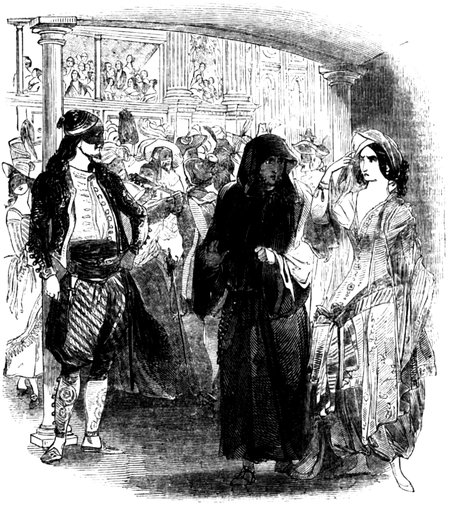
"You cherish a miserable delusion, my child," said the hag; "and I am surprised at your confidence in the good feelings of a man of whom you have already seen so much."
"Ah! there is a higher power that often sways the human heart," observed Ellen; and, as she spoke, her eyes were fixed upon the inscriptions on the tree, while her heart beat with emotions unintelligible to the old hag.
"You will then allow this man of whom I have spoken, and who has formed so enthusiastic an attachment towards you, to languish without a hope?" demanded the woman.
"Men do not die of love," said Ellen, with a smile.
"But he is rich—and he would enrich you," continued the old harridan: "he would place your father in so happy a position that the old man should not even experience a regret for the prosperity which he has lost."
"My father dwells with a friend, and is happy," observed Ellen.
"But he is dependant," exclaimed the old hag: "for you yourself once said to me, 'We are dependant upon one who cannot afford to maintain us in idleness.' How happy would you be—for I know your heart—to be enabled to place your father in a state of independence!"
"Would he be happy did he know that he owed the revival of his prosperity to his daughter's infamy?"
"Did he divine whence came the bread that was purchased by your services to the statuary, the artist, the sculptor, and the photographer? You yourself assured me that you kept your avocations a profound secret."
"Were I inclined to sell myself for gold, Greenwood would become a liberal purchaser," said Ellen. "All your sophistry is vain. You cannot seduce me from that state of tranquil seclusion in which I now dwell."
"At least grant your unknown lover an interview, and let him plead his own cause," exclaimed 34the hag, who did not calculate upon so much firmness on the part of the young lady.
"Ah! think not that he is unknown," cried Ellen, a light breaking in upon her mind: "a man of pure and stainless life, virgin of all sin,—a man endowed with a handsome person, and a brilliant intellect,—a man whose eloquence acts as a spell upon all classes,—a man possessed of a large fortune and enjoying a high position,—such is your description! And this man must have seen me to love me! Now think you I cannot divine the name of your phœnix?"
"You suspect then, my child——"
"Nay—I have something more than mere suspicion in my mind," interrupted Ellen. "Oh! now I comprehend the motive of that apparent earnestness with which he implored me to reveal the secret sorrow that oppressed me! In a word, old woman," added the young lady, in a tone of superb contempt, "your phœnix is the immaculate rector of St. David's!"
"And do you not triumph in your conquest, Miss?" demanded the hag, irritated by Ellen's manner.
"Oh! yes," exclaimed the young lady, with a sort of good-humoured irony; "so much so, that I will meet him when and where you will."
"Are you serious?" inquired the hag, doubtfully.
"Did I ever jest when I agreed to accept the fine offers which you made me on past occasions?" asked Ellen.
"No: and you cannot have an object in jesting now," observed the old woman. "But when and where will you meet him who is enamoured of you?"
"You say that he will make any sacrifice to please me?"
"He will—he will."
"Then he cannot refuse the appointment which I am about to propose to you. On Monday evening next there is to be a masked ball at Drury Lane Theatre. At ten o'clock precisely I will be there, dressed as a Circassian slave, with a thick veil over my face. Let him be attired as a monk, so that he may be enabled to shroud his features with his cowl. We shall not fail to recognise each other."
"Again I ask if you are in earnest?" demanded the old woman, surprised at this singular arrangement.
"I was never more so," answered Ellen.
"But why cannot the appointment take place at my abode?" said the hag.
"Oh! fie—the immaculate rector in your dirty court in Golden Lane!" ejaculated Ellen.
"That court was once good enough for you, my child," muttered the old woman.
"We will not dispute upon that point," said the young lady. "If I am worth having, I am worth humouring; and I must test the sincerity of the attachment which your phœnix experiences for me, by making him seek me at a masked ball."
"Oh! the caprices of you fair ones!" ejaculated the hag. "Well, my child, I will undertake that it shall be as you desire."
"Next Monday evening at ten o'clock," cried Ellen; and with these words she tripped lightly down the hill in the direction of the mansion.
The old hag then took her departure by the path on the opposite side; and, as she went along, she chuckled at the success of her intrigue.
CHAPTER CXLIX. THE MASQUERADE.
The evening of the masquerade arrived.
It is not our intention to enter into a long description of a scene the nature of which must be so well known to our readers.
Suffice it to say that at an early hour Old Drury was, within, a blaze of light. The pit had been boarded over so as to form a floor level with the stage, at the extremity of which the orchestra was placed. The spacious arena thus opened, soon wore a busy and interesting appearance, when the masques began to arrive; and the boxes were speedily filled with ladies and gentlemen who, wearing no fancy costumes, had thronged thither for the purpose of beholding, but not commingling with, the diversions of the masquerade.
To contemplate that blaze of female loveliness which adorned the boxes, one would imagine that all the most charming women of the metropolis had assembled there by common consent that night; and the traveller, who had visited foreign climes, must have been constrained to admit that no other city in the universe could produce such a brilliant congress.
For the fastidious elegancies of fashion, sprightliness of manners, sparkling discourse, and all the refinements of a consummate civilization, which are splendid substitutes for mere animal beauty, the ladies of Paris are unequalled;—but for female loveliness in all its glowing perfection—in all its most voluptuous expansion, London is the sovereign city that knows in this respect no rival.
In sooth, the scene was ravishing and gorgeous within Old Drury on the night of which we are writing.
The spacious floor was crowded with masques in the most varied and fanciful garbs.
There were Turks who had never uttered a "Bismillah," and Shepherdesses who had seen more of mutton upon their tables than ever they had in the fields;—Highlanders who had never been twenty miles north of London, and Princesses whose fathers were excellent aldermen or most conscientious tradesmen;—Generals without armies, and Flower-Girls whose gardens consisted of a pot of mignonette on the ledge of their bed-room windows;—Admirals whose nautical knowledge had been gleaned on board Gravesend steamers, and Heathen Goddesses who were devoted Christians;—Ancient Knights who had not even seen so much as the Eglintoun Tournament, and Witches whose only charms lay in their eyes;—and numbers, of both sexes, attired in fancy-dresses which were very fanciful indeed.
Then there was all the usual fun and frolic of a masquerade;—friends availing themselves of their masks and disguises to mystify each other,—witticism and repartee, which if not sharp nor pointed, still served the purpose of eliciting laughter,—and strange mistakes in respect to personal identity, which were more diverting than all.
There was also plenty of subdued whispering between youthful couples; for Love is as busy at masquerades as elsewhere.
The brilliancy of the dresses in the boxes, and the variety of those upon the floor, combined with the blaze of light and the sounds of the music, 35formed a scene at once gay, exhilarating, and ravishing.
At about a quarter before ten o'clock, a masque, attired in the sombre garb of a Carmelite Friar, with his cowl drawn completely over his face, and a long rosary hanging from the rude cord which girt his waist, entered the theatre.
He cast a wistful glance, through the slight opening in his cowl, all around; and, not perceiving the person whom he sought, retired into the most obscure nook which he could find, but whence he could observe all that passed.
At five minutes to ten, a lady, habited as a Circassian slave, and wearing an ample white veil, so thick that it was impossible to obtain a glimpse of her countenance, alighted from a cab at the principal entrance of the theatre.
Lightly she tripped up the steps; but as she was about to enter the vestibule, her veil caught the buttons of a lounger's coat, and was drawn partly off her face.
She immediately re-adjusted it—but not before a gentleman, masked, and in the habit of a Greek Brigand, who was entering at the time, obtained a glimpse of her features.
"What? Ellen here!" murmured the Greek Brigand to himself: "I must not lose sight of her!"
Ellen did not however notice that she had been particularly observed; much less did she suspect that she was recognised.
But as she hastened up the great staircase, the Greek Brigand followed her closely.
Although her countenance was so completely concealed, her charming figure was nevertheless set off to infinite advantage by the dualma which she wore, and which, fitting close to her shape, reached down to her knees. Her ample trousers were tied just above the ankle where the graceful swell of the leg commenced; and her little feet were protected by red slippers.
The Brigand who had recognised her, and now watched her attentively, was tall, slender, well made, and of elegant deportment.
Ellen soon found herself in the midst of the busy scene, where her graceful form and becoming attire immediately attracted attention.
"Fair eastern lady," said an Ancient Knight in a buff jerkin and plumed tocque, "if thou hast lost the swain that should attend upon thee, accept of my protection until thou shalt find him."
"Thanks for thy courtesy, Sir Knight," answered Ellen, gaily: "I am come to confess to a holy father whom I see yonder."
"Wilt thou then abjure thine own creed, and embrace ours?" asked the Knight.
"Such is indeed my intention, Sir Knight," replied Ellen; and she darted away towards the Carmelite Friar whom she had espied in his nook.
The Ancient Knight mingled with a group of Generals and Heathen Goddesses, and did not offer to pester Ellen with any more of his attentions.
"Sweet girl," said Reginald Tracy (whom the reader has of course recognised in the Carmelite Friar), when Ellen joined him, "how can I sufficiently thank you for this condescension on your part?"
"I am fully recompensed by the attention you have shown to the little caprice which prompted me to choose this scene for the interview that you desired," answered Ellen.
Both spoke in a subdued tone—but not so low as to prevent the Greek Brigand, who was standing near, from overhearing every word they uttered.
"Mr. Tracy," continued Ellen, "why did you entrust your message of love to another? why could you not impart with your own lips that which you were anxious to communicate to me?"
"Dearest Ellen," answered the rector, "I dared not open my heart to you in person—I was compelled to do so by means of another."
"If your passion be an honourable one," said Ellen, "there was no need to feel shame in revealing it."
"My passion is most sincere, Ellen. I would die for you! Oh! from the first moment that I beheld you by your father's sick-bed, I felt myself drawn towards you by an irresistible influence; and each time that I have since seen you has only tended to rivet more firmly the chain which makes me your slave. Have I not given you an unquestionable proof of my sincerity by meeting you here?"
"A proof of your desire to please me, no doubt," said Ellen. "But what proof have I that your passion is an honourable one? You speak of its sincerity—you avoid all allusion to the terms on which you would desire me to return it."
"What terms do you demand?" asked the rector. "Shall I lay my whole fortune at your feet? Shall I purchase a splendid house, with costly appointments, for you? In a word, what proof of my love do you require?"
"Are you speaking as a man who would make a settlement upon a wife, or as one who is endeavouring to arrange terms with a mistress?" demanded Ellen.
"My sweet girl," replied Reginald, "know you not that, throughout my career, I have from the pulpit denounced the practice of a man in holy orders marrying, and that I have more than once declared—solemnly declared—my intention of remaining single upon principle? You would not wish me to commit an inconsistency which might throw a suspicion upon my whole life?"
"Then, sir, by what right do you presume that I will compromise my fair fame for your sake, if you tremble to sacrifice your reputation for mine?" asked Ellen. "Is every compromise to be effected by poor woman, and shall man make no sacrifice for her? Are you vile, or base, or cowardly enough to ask me to desert home and friends to gratify your selfish passion, while you carefully shroud your weakness beneath the hypocritical cloak of a reputed sanctity? Was it to hear such language as this that I agreed to meet you? But know, sir, that you have greatly—oh! greatly mistaken me! By the most unmanly—the most disgraceful means you endeavoured to wring from me, a few days ago, a secret which certain expressions of mine, incautiously uttered over what I conceived to be my father's death-bed, had perhaps made you more than half suspect. Those words, which escaped me in a moment of bitter anguish, you treasured up, and converted them into the text for a sermon which you preached me."
"Ellen," murmured the rector; "why these reproaches?"
"Oh! why these reproaches?—I will tell you," continued the young lady, whose bosom palpitated violently beneath the dualma. "Do you think that you did well to press me to reveal the secret of my 36shame? Do you think that you adopted an honourable means to discover it? When you addressed me in that saintly manner—a manner which I now know to have been that of a vile hypocrisy—I actually believed you to be sincere; for the time I fancied that a man of God was offering me consolation. Nevertheless, think you that my feelings were not wounded? But an accident made you acquainted with that truth which you vainly endeavoured to extort from me! And now you perhaps believe that I cannot read your heart. Oh! I can fathom its depths but too well. You cherish the idea that because I have been frail once, I am fair game for a licentious sportsman like you. You are wrong, sir—you are wrong. I never erred but once—but once, mark you;—and then not through passion—nor through love—nor in a moment of surprise. I erred deliberately—no matter why. The result was the child whom you have seen. But never, never will I err more—no, not even though tempted, as I have been, by the father of my child! You sent to me a messenger—the same filthy hag who pandered to my first, my only disgrace,—you sent her as your herald of love. Ah! sir, you must have already plunged into ways at variance with the sanctity of your character—or you could not have known her! I told her—as I now assure you—that I do not affect a virtue which I possess not;—but if I henceforth remain pure and chaste, it is because I am a mother—because I love my child—because I will keep myself worthy of the respect of him who is the father of that child, should God ever move his heart towards me. Say then that I am virtuous upon calculation—I care not: still I am virtuous!"
The individual in the garb of the Greek Bandit drew a pace or two nearer as these words met his ears.
Neither the rector nor Ellen observed that he was paying any attention to them: on the contrary, he appeared to be entirely occupied in contemplating the dancers from beneath his impervious mask.
"Ellen, what means all this?" asked Reginald: "are you angry with me? You alarm me!"
"Suffer me to proceed, that you may understand me fully," said Ellen. "You mercilessly sought to cover me with humiliation, when you rudely probed that wound in my heart, the existence of which an unguarded expression of mine had revealed to you. Your conduct was base—was cowardly; and, as a woman, I eagerly embraced the opportunity to avenge myself."
"To avenge yourself!" faltered Reginald, nearly sinking with terror as these words fell upon his ears.
"Yes—to avenge myself," repeated Ellen hastily. "When your messenger—that vile agent of crime—proposed to me that I should grant you an interview, I bethought myself of this ball which I had seen announced in the newspapers. It struck me that if I could induce you—you, the man of sanctity—to clothe yourself in the mummery of a mask and meet me at a scene which you and your fellow-ecclesiastics denounce as one worthy of Satan, I should hurl back with tenfold effect that deep, deep humiliation which you visited upon me. It was for this that I made the appointment here to-night—for this that I retired early to my chamber, and thence stole forth unknown to my father and my benefactor—for this that I now form one at an assembly which has no charms for me! My intention was to seize an opportunity to tear your disguise from you, and allow all present to behold amongst them the immaculate rector of Saint David's. But I will be more merciful to you than you were to me: I will not inflict upon you that last and most poignant humiliation!"
"My God! Miss Monroe, are you serious?" said the rector, deeply humbled; "or is this merely a portion of the pastime?"
"Does it seem sport to you?" asked Ellen: "if so, I will continue it, and wind it up with the scene which I had abandoned."
"For heaven's sake, do not expose me, Miss Monroe!" murmured Reginald, now writhing in agony at the turn which the matter had taken. "Let me depart—and forget that I ever dared to address you rudely."
"Yes—go," said Ellen: "you are punished sufficiently. You possess the secret of my frailty—I possess the secret of your hypocrisy: beware of the use you make of your knowledge of me, lest I retaliate by exposing you."
There was something very terrible in the lesson which that young woman gave the libidinous priest on this occasion; and he felt it in its full force.
Cowering within himself, he uttered not another word, but stole away, completely subdued—cruelly humiliated.
Ellen lingered for a few moments on the spot where she had so effectually chastised the insolent hypocrite; and then hastily retired.
The Greek Brigand made a movement as if he were about to follow her; but, yielding to a second thought, he stopped, murmuring, "By heavens! she is a noble creature!"
CHAPTER CL. MRS. KENRICK.
The rector of Saint David's returned home a prey to the most unenviable feelings.
Rage—disappointment—humiliation conspired to make him mad.
The old hag had raised his hopes to the highest pitch; and at the moment when the cup of bliss seemed to approach his lips, it was rudely dashed away.
A woman had triumphed over him—mocked his passion—spurned his offers—read him a lesson of morality—taught him that proud man must not always domineer over feminine weakness.
Oh! it was too much for that haughty—that vain—that self-sufficient ecclesiastic to endure!
As he returned home in a hired cab, he threw from the window of the vehicle the Carmelite gown and cowl which he had worn; and bitterly did he reproach himself for his folly in having been seduced into the degradation of that masqued mummery.
Arrived at his own house, he rushed past the housekeeper who opened the door, and was hurrying up-stairs to the solitude of his chamber, when the voice of the old lady compelled him to pause.
"Mr. Tracy—Mr. Tracy," she exclaimed; "here is a note from Lady Harborough."
"Tell Lady Harborough to go to the devil, Mrs. Kenrick!" cried the rector, goaded almost to madness by this new proof of Cecilia's indiscretion.
37The old housekeeper dropped the candle and the note, as if she were thunderstruck.
Was it possible that she had heard aright? could such an expression have emanated from the lips of her master—of that man whom the world idolized?
"What is the matter now, Mrs. Kenrick?" asked the rector, suddenly recovering his presence of mind, and perceiving the immense error into which his excited feelings had betrayed him.
"Nothing, sir—nothing," answered the housekeeper, as she re-lighted her candle by means of a lamp which was standing on the hall-table; "only I thought that something very terrible had occurred to annoy you."
"Yes—yes—I have indeed been grievously annoyed," said Reginald; "and you must forgive my hasty conduct. I was wrong—very wrong. Do not think anything more of it, Mrs. Kenrick. But did you not observe that Lady Harborough had sent a message——"
"A note, sir. Here it is."
And as the housekeeper handed her master the perfumed billet, she cast a scrutinizing glance upon his countenance.
He was as pale as death—his lips quivered—and his eyes had a wild expression.
"I am afraid, sir, that something very dreadful has happened to you," she observed timidly. "Shall I send for the physician?"
"No—no, Mrs. Kenrick: I shall be quite well in the morning. I have received a violent shock—the sudden communication of ill news—the death of a dear friend——"
"Ah! sir, I was convinced that all was not right," observed the housekeeper. "If you would follow my advice you would take something to compose you—to make you sleep well——"
"An excellent thought, Mrs. Kenrick! If it be not too late, I wish you would send and procure me a little laudanum: I will take a few drops to ensure a sound slumber."
"I will do so, sir," answered the housekeeper.
She then repaired to the kitchen, while Reginald hurried up to his own chamber to read Lady Cecilia's letter, the contents of which ran as follow:—
"Nearly a week has elapsed, dearest Reginald, and I have not seen you! neither have I heard from you. What is the meaning of this? Is it neglect, or extreme caution? At all events the interval which you enjoined for the cessation of my visits to you, has nearly expired; and my impatience will brook no longer delay. I must see you to-night! Precisely as the clock strikes twelve, I will be at your front-door, when you must admit me as on previous occasions—or I shall imagine that you are already wearied of your
"After all," said the rector, "the presence of Cecilia will in some degree console me for my disappointment of this evening! I cannot remain alone with my reflections—it drives me mad to think of what I am, and what I have been! And laudanum is a miserable resource for one who dreads a sleepless night: it peoples slumber with hideous phantoms. Yes—I will admit Cecilia at the appointed hour:—my housekeeper does not suspect me—my guilty conscience alone makes me think at times that she reads the secrets of my soul?"
The rector seated himself before the cheerful fire which burnt in the grate, and fell into a long train of voluptuous meditation.
He had become in so short a time a confirmed sensualist; and now that his long pent-up passions had broken loose, they never left him a moment of repose.
His reverie was interrupted by a knock at the door; and Mrs. Kenrick entered.
"Kate was fortunate enough to find a druggist's shop open, sir," she said, "and procured some laudanum. But pray be cautious how you use it."
"Never fear," returned the rector: "I may not avail myself of it at all—for I feel more composed now."
The housekeeper wished her master a good night's rest, and withdrew.
The rector then took a decanter of wine from a cupboard, and tossed off two glasses full, one immediately after the other.
The idea that Cecilia would shortly be there and the effects of the wine inflamed his blood, and brought back the colour to his cheeks.
Midnight soon sounded: the rector threw off his shoes, took a candle in his hand, and hastened down stairs.
He opened the front-door with the utmost caution; and a female, muffled in an ample cloak, darted into the hall.
"Cecilia?" whispered the rector.
"Dearest Reginald," answered the lady, in the same under tone.
They then stole noiselessly up stairs, and reached the rector's chamber without having scarcely awakened the faintest echo in the house.
The remainder of the night was passed by them in the intoxicating joys of illicit love. Locked in Cecilia's arms, the rector forgot the humiliation he had received at the hands of Ellen, and abandoned himself to those pleasures for which he risked so much!
It was still dark—though at a later hour in the morning than Cecilia had been previously in the habit of quitting the rector's house—when the guilty pair stole softly down stairs, without a light.
"Hasten, Cecilia," murmured the rector: "it is later than you imagine."
"My God!" whispered the lady: "I hear a step ascending!"
The rector listened for a moment, and then said in a faint tone, "Yes: we are lost!"
A light flashed on the wall a few steps beneath those on which they were standing: it was too late to retreat; and in another moment Mrs. Kenrick made her appearance on the stairs.
"What! Mr. Tracy?" ejaculated the housekeeper, her eyes glancing from the rector in his dressing-gown to the lady in her cloak.
Then the good woman stood motionless and silent—her tongue tied, and her feet rooted to the spot, with astonishment.
Lady Cecilia drew her veil hastily over her countenance; but not before Mrs. Kenrick had recognised her.
A thousand ideas passed rapidly through the rector's brain during the two or three moments that succeeded this encounter.
At first he thought of inventing some excuse for his awkward situation;—next he felt inclined to spring upon his old housekeeper and strangle her;—then he conceived the desperate idea of rushing back to his room and blowing his brains out.
"Mrs. Kenrick," at length he exclaimed, "I hope you will say nothing of this."
38The housekeeper made no reply to her master; but, turning a contemptuous glance upon the lady, said, "Madam, allow me to conduct you to the front door."
Cecilia followed her mechanically; and Reginald rushed up the stairs to his room, a prey to emotions more readily conceived than described.
The housekeeper preceded Lady Cecilia in silence, and opened the front door.
"My dear Mrs. Kenrick," said the frail patrician, who had now nearly recovered her presence of mind, "I hope you will take no notice of this unpleasant discovery."
"I shall remain silent, madam," answered the housekeeper; "but through no respect for you. I however value the reputation of a master whom I have served for many years, too much to be the means of ruining him."
She then closed the door unceremoniously, and, seating herself on one of the mahogany benches in the hall, burst into tears.
That good woman loved her master with a maternal affection; and she was shocked at this dread confirmation of the faint suspicions which she had already entertained, and which had so sorely afflicted her.
"It is then true!" she thought within herself. "He has fallen! He is a living, breathing falsehood. His eloquence is a mere talent, and not the spontaneous outpouring of holy conviction! The world adores an idle delusion—worships a vain phantom. Oh! what a discovery is this! How can I ever respect him more? how can I ever talk with others of his virtues again? And yet he may repent—oh! God grant that he may! Yes—he must repent: he must again become the great, the good man he once was! It behoves me, then, to shield his guilt:—at the same time all temptation should be removed from his presence. Ah! now I bethink me that he has cast wistful eyes upon that poor girl whom he has taken into the establishment. I must remove her: yes—I will remove her, upon my own authority. He will thank me hereafter for my prudence."
Thus did the good woman reason within herself.
When she had somewhat recovered from the first shock which the unpleasant discovery of her master's criminality had produced upon her, she repaired to her domestic avocations.
Kate was already in the kitchen, occupied with her usual duties.
"Katherine, my dear child," said Mrs. Kenrick, "I am going to give you my advice—or rather to propose to you a plan which I have formed—relative to you——"
"To me, ma'am?" exclaimed the young maiden, desisting from her employment, and preparing to listen with attention.
"Yes, my dear girl," continued the housekeeper; "and when I tell you that it is for your good—entirely for your good—you would thank me——"
"Oh! I do, ma'am—I thank you in advance," said Kate; "for I have already experienced too much kindness at your hands not to feel convinced that all you propose is for my good."
"Well, then, my dear—without giving you any reasons for my present conduct—I am anxious that you should leave this house——"
"Leave, ma'am?" cried Kate, astonished at this unexpected announcement.
"Yes, Katherine: you must leave this house," proceeded Mrs. Kenrick. "But think not that you will be unprovided for. I have a sister who resides a few miles from London; and to her care I shall recommend you. She will be a mother to you."
"But why would you remove me from the roof of my benefactor?" asked Kate: "why would you send me away from London, where my only relations on the face of the earth reside?" she added, bursting into tears; for she thought of her poor persecuted cousin the hump-back.
"Do not ask me, my good child," returned Mrs. Kenrick: "my reasons are of a nature which cannot be communicated to you. And yet—if you knew them, and could rightly understand them—you would not object——"
"Alas! ma'am, I am afraid that I understand them but too well," interrupted the girl: "the executioner's niece brings discredit upon the house of her benefactor."
"Oh! no—no," exclaimed the good-natured housekeeper; "do not entertain such an idea! Not for worlds would I have you labour under such an error. You know I would not tell a falsehood; and I declare most solemnly that you have totally misunderstood me and my motives."
There was an earnestness in the way in which Mrs. Kenrick spoke that immediately removed from Katherine's mind the suspicion she had entertained.
"Why should you send the poor girl away, Mrs. Kenrick?" said the footman, now suddenly emerging from the pantry, which joined the kitchen.
"Have you overheard our conversation, then, Thomas?" exclaimed Mrs. Kenrick, angrily.
"I couldn't very well avoid it," answered the footman, "since I was in there all the time."
"It would have been more discreet on your part to have let us know that you were there, when you heard a private conversation begin," remarked the housekeeper.
"How should I know the conversation was private?" exclaimed Thomas. "I suppose you're jealous of the girl, and want to get rid of her."
"You must value your place very little by speaking to me in this way," said Mrs. Kenrick. "However, I scorn your base allusions. And you, my dear," she continued, now addressing herself to Katherine, "look upon me as your friend—your very sincere friend. What I am doing is for your good: to-day I will write to my sister—and to-morrow you shall, proceed to her abode."
The housekeeper then resumed her avocations with the complacency of one conscious of having performed a duty.
"Thomas," she said, after a pause, "go up and inquire if your master will have breakfast served in his own chamber, or in the parlour."
The footman hastened to obey this order.
"Master says he is very unwell, and desires no breakfast at all," was the information which the man gave on his return to the kitchen.
The housekeeper made no reply: she was however pleased when she reflected that the rector felt his situation—a state of mind which she hoped would lead to complete repentance and reform.
The morning passed: the afternoon arrived: and still Reginald Tracy kept his room.
The housekeeper sent the footman up to ask if he required any thing.
Thomas returned with a negative answer, adding 39"Master spoke to me without opening the door, and seemed by his tone of voice to be very unwell."
Again the housekeeper remained silent, more convinced than before that contrition was working its good effects with her master.
Hour after hour passed; the sun went down; and darkness once more drew its veil over the mighty city.
Mrs. Kenrick again sent up Thomas with the same inquiry as before.
The servant returned to the kitchen with a letter in his hand.
"This time master opened the door," he said; "and gave me this letter to take up to Mr. Markham at Holloway. But I shall take the omnibus there and back."
Thomas then departed to execute his commission.
Shortly after he was gone, the bell of the rector's room rang.
Mrs. Kenrick hastened to answer it.
She found Mr. Tracy sitting in a musing attitude before the fire in his bed-room.
"My dear Mrs. Kenrick," he said, "I wish to have some conversation with you—I need scarcely now explain upon what subject. I have sent Thomas out of the way with an excuse: do you get rid of Katherine for an hour; I am faint—and require refreshment; and I will take my tea with you in the kitchen."
"In the kitchen, sir!" exclaimed the housekeeper, in surprise.
"Yes—if you will permit me," answered the rector: "I can then converse with you at the same time."
Mrs. Kenrick left the room to execute her master's wishes; and, as she descended the stairs, she thought within herself, "I am right! he has repented: he will become the virtuous and upright man he once was!"
And the good woman experienced a pleasure as sincere as if any one had announced to her that she was entitled to a princely fortune.
To send Katherine out of the way for an hour was no difficult matter. The old housekeeper gave her leave to repair to Saint Giles's to visit her relatives; and the young girl, thinking that her uncle might repent of his recent harshness towards her, now that she was no longer dependant upon him, gladly availed herself of this permission.
Katherine accordingly proceeded to Saint Giles's; and the moment she had left the house Mrs. Kenrick spread the kitchen table with the tea-things.
CHAPTER CLI. A MYSTERIOUS DEED.
Katherine tripped lightly along towards Saint Giles's; but as she drew near her uncle's door, she relaxed her speed, and her heart grew somewhat heavy.
She was afraid of experiencing an unkind reception.
It was, therefore, with a pleasure the more lively as it was unexpected, that the poor girl found herself welcomed by a smile on the part of her dreaded relative.
"Come in, Kate," said he, when he perceived his niece; "I felt myself dull and lonely, and was just thinking of you as you knocked at the door. I'm almost sorry that I ever parted with you; but as you're now in a place that may do you good I shall not interfere with you."
"I am very much obliged to you for thinking so kindly of me, uncle," said Kate, wiping away a tear, as she followed Smithers into the little parlour, which, somehow or another, did not look so neat as it had been wont to do in her time.
"I can't help thinking of you now and then, Kate," continued Smithers. "But, I say," he added abruptly, "I hope you've forgotten all about the manner in which we parted t'other day?"
"Oh! indeed I have, uncle," answered the girl, more and more astonished at this unusual urbanity of manner.
"I am not happy—I'm not comfortable in my mind, somehow," said Smithers, after a short pause. "Since the night before last I haven't been myself."
"What ails you?" asked Kate, kindly.
"I think my last hour's drawing nigh, Kate," returned the public executioner, sinking his voice to a low and mysterious whisper; but, at the same time, his countenance grew deadly pale, and he cast a shuddering look around him.
"You are low-spirited, uncle—that's all," said Kate, surveying him attentively—for his peculiarity of manner alarmed her.
"No—that's not it, Kate," continued the executioner; then, drawing his chair closer towards that on which his niece was seated, he added, "I have had my warning."
"Your warning, uncle! What mean you?"
"I mean what I say, Kate," proceeded Smithers, in a tone of deep dejection: "I have had my warning; and I s'pose it will come three times."
"Uncle—dear uncle, I cannot understand you. You must be unwell. Will you have medical advice? Say—shall I fetch a physician?"
"Don't be silly, Kate: there's nothink the matter with my body;—it's the mind. But I'll tell you what it is," continued Smithers, after a few moments of profound reflection. "It was the night before last. I had been practising—you know how——"
"Yes—yes, uncle," said Katherine, hastily.
"And it was close upon midnight, when I thought I would go to bed. Well—I undressed myself, and as there was only a little bit of candle left, I didn't blow the light out, but put the candlestick into the fire-place. I then got into bed. In a very few minutes I fell into a sort of doze—more asleep than awake though, because I dreamt of the man that I hanged yesterday week. I didn't, however, sleep very long; for I woke with a start just as Saint Giles's was a striking twelve. The light was flickering in the candlestick, for it was just dying away. You know how a candle burnt down to the socket flares at one moment, and then seems quite dead the next, but revives again immediately afterwards?"
"Yes, uncle," answered Katherine; "and I have often thought that in the silent and solemn midnight it is an awful thing to see."
"So it struck me at that moment," continued the executioner. "I felt a strange sensation creeping all over me; the candle flared and flickered; and I thought it had gone out. Then it revived once more, and threw a strong but only a momentary light around the room. At that instant my eyes were 40fixed in the direction of the puppet; and, as sure as you are sitting there, Kate, another face looked at me over its shoulder!"
"Oh! my dear uncle, it was the imagination," said the young girl, casting an involuntary glance of timidity around.
"Is a man like me one of the sort to be deluded by the imagination?" asked Smithers, somewhat contemptuously. "Haven't I been too long in a certain way to have any foolish fears of that sort?"
"But when we are unwell, uncle, the bravest of us may perceive strange visions, which are nothing more than the sport of the imagination," urged Kate.
"I tell you this had nothing to do with the imagination," persisted the executioner. "I saw another face as plain as I see yours now; and—more than that—its glassy eyes were fixed upon me in a manner which I shall never forget. It was a warning—I know it was."
Kate made no reply: she saw the inutility of arguing with her uncle upon the subject; and she was afraid of provoking his irritable temper by contending against his obstinacy.
"But we won't talk any more about it, Kate," said the executioner, after a pause. "I know how to take it; and it doesn't frighten me; it only makes me dull. It hasn't prevented me from sleeping in my old quarters; nor will it, if I can help it. But you want to be off—I see you are getting fidgetty."
"I only received permission to remain out one hour," answered Kate. "Is my cousin at home?"
"The young vagabond!" ejaculated the executioner, whose irritability this question had aroused in spite of the depression of spirits under which he laboured; for he could not forget the unwearied repugnance which Gibbet manifested towards the paternal avocations:—"the young vagabond! he is never at home now of an evening."
"Never at home of an evening!" exclaimed Kate, surprised at this information.
"No," continued the executioner; "and at first I thought he went to see you."
"He can only visit me on Sunday evenings," observed the young maiden.
"So he told me yesterday. Howsumever, he goes out regular at dusk, and never comes back till between nine and ten—sometimes later."
"Then I am not likely to see him this evening?" exclaimed Kate, in a tone of disappointment.
"That you are not," replied the executioner. "But I must put a stop to these rovings on his part."
"Oh! pray be kind to him, uncle," said Katherine, rising to depart.
"Kind indeed!" grumbled the man, some of his old surliness returning.
Katherine then took leave of her uncle, and hurried towards Mr. Tracy's residence.
She reached her destination as the clock struck nine, and entered the house as usual, by the back way.
She proceeded to the kitchen, where, to her surprise, she observed Mrs. Kenrick sitting in her arm-chair, but apparently fast asleep. The old housekeeper's arms reposed upon the table, and formed a support for her head which had fallen forwards.
"Strange!" thought Katherine; "this is the first time I have known her sleep thus."
The young maiden moved lightly about the kitchen, while she threw off her bonnet and cloak, for fear of awaking the housekeeper.
Then she sate down near the fire, and fell into a profound reverie concerning the strange tale which her uncle had told her.
Presently it struck her that she did not hear the housekeeper breathe; and an awful suspicion rushed like a torrent into her mind.
For some moments she sate, motionless and almost breathless, in her chair, with her eyes fixed upon the inclined form of the housekeeper.
"My God!" at length Kate exclaimed; "she does not breathe—she does not move;—and her hands—oh! how pale they are!"
Then, overcoming her terror, the young maiden bent down her head so as to obtain a glimpse of Mrs. Kenrick's countenance.
"Oh! heavens—she is dead—she is dead!" cried the horror-struck girl, as her eyes encountered a livid and ghastly face instead of the healthy and good-humoured one which was familiar to her.
And Katherine sank back in her seat, overcome with grief and terror.
Suddenly the thought struck her that, after all, the housekeeper might only be in a fit.
Blaming herself for the delay which her fears had occasioned ere she administered succour, Kate hastened to raise the old lady's head.
But she let it fall again when she had obtained another glance of that ghastly countenance;—for the eyes were fixed and glazed—the under jaw had fallen—and the swollen tongue was lolling, dark and livid, out of the mouth.
Then Kate rushed into the yard, screaming for help.
The rector's groom (who also acted as coachman) was in the stable adjoining; and he immediately hastened to the spot.
"What is the matter?" he demanded, alarmed by the wildness of Katherine's manner and the piercing agony of her cries.
"Mrs. Kenrick is dead!" replied Katherine, sobbing bitterly.
"Dead!" ejaculated the man; and he instantly rushed into the kitchen.
In a few moments afterwards the rector made his appearance, and inquired the cause of the screams which had alarmed him.
"Mrs. Kenrick is dead, sir," said the groom.
Katherine had flung herself into a chair, and was giving full vent to her grief for the loss of her benefactress.
"Dead!" cried the rector. "No—let us hope not. Run for the nearest surgeon—it may only be a fit!"
"I'm afraid it's too late, sir," said the groom, who had now raised the housekeeper from her procumbent posture, and laid her back in the chair.
"Who knows? Run—run," exclaimed the rector impatiently.
The groom instantly departed; and during his short absence the rector was most assiduous in bathing the housekeeper's forehead with vinegar and water, and chafing her hands between his own.
In a few minutes the groom returned, accompanied by a surgeon; and the rector was found in the midst of his vain attentions.
The surgeon's examination was brief; but his 41words were decisive, as he said, "All human aid is vain, sir; and those appearances are most suspicious."
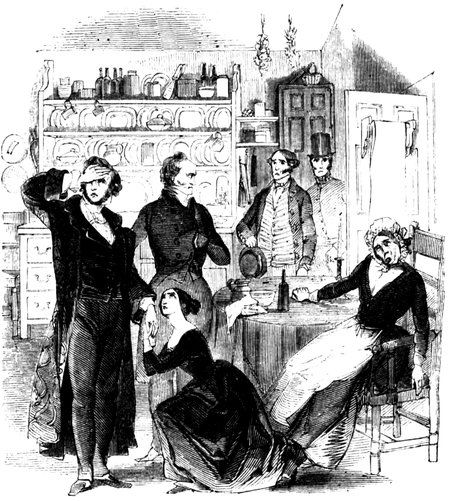
"What do you mean?" demanded Reginald.
"That your servant is poisoned," replied the surgeon.
"Poisoned!" exclaimed the rector. "Oh! no—you must mistake. She would not take poison herself, and I do not believe she has an enemy on the face of the earth."
"Nevertheless, Mr. Tracy," said the surgeon positively, "she is poisoned."
At these words Kate's sobs became more convulsive.
"But is it too late?" cried the rector: "can nothing be done? Is she past recovery?"
"Past all human succour, I repeat."
"My poor servant—my faithful friend," exclaimed Reginald Tracy, burying his face in his hands: "Oh! what could have induced her to commit suicide?"
"Suicide!" echoed Katherine, starting from her seat, and coming forward: "Oh! no, sir—do not wrong her memory thus! She was too good—too pious—too much bent upon the mercy of her Redeemer, to commit such a crime."
"Alas! suicide it must have been, my poor girl," said the rector; "for who could have administered poison to so harmless, so charitable, so humane a creature? Some secret grief, perhaps——"
At this moment Thomas returned from his mission to Markham Place. The poor fellow was deeply affected when the dreadful spectacle in the kitchen met his eyes, and when the few particulars yet known concerning the death of the housekeeper, or rather the first discovery of her death—were communicated to him.
"I never shall forgive myself as long as I live," exclaimed Thomas, "for having spoken cross to her, poor lady, this morning."
"Spoken cross to her!" cried the rector.
"Yes, sir," answered the man; "I said something to her—but I forget exactly what—because she told Katherine that she should send her away from London."
"Send Katherine away!" said Reginald, in unfeigned surprise.
42"Yes, sir; and because I saw the girl didn't like it, I took her part against Mrs. Kenrick; and I'm now heartily sorry for it," rejoined Thomas, wiping away an honest tear.
"Young woman," said the surgeon, who had been attentively examining Katherine for some moments, "did you not visit my shop last evening?"
"I, sir!" exclaimed the young girl, who was too deeply absorbed in grief at the death of her benefactress to have her ideas very clearly distributed in the proper cells of her brain.
"Yes," continued the surgeon: "the more I look at you, the more I am convinced you came last night to my establishment and purchased a small phial of laudanum."
"Oh! yes—I remember, sir," said Katherine: "Mrs. Kenrick sent me for it, and told me that it was for my master."
The surgeon threw an inquiring glance towards Reginald.
"For me!" ejaculated the rector.
"So Mrs. Kenrick said, sir," returned Katherine: "and the moment I brought it in, she went up stairs with it."
"You can in one moment set at rest that point, sir," said the surgeon, with another glance of inquiry towards the rector.
"The laudanum was not for me," answered Mr. Tracy, calmly: "nor did I order my poor housekeeper to obtain any."
"O Katherine!" ejaculated Thomas; "surely—surely, you have not done this dreadful deed!"
"I——a murderess!" almost shrieked the poor girl: "Oh! no—no. God forbid!"
And she clasped her hands together.
The surgeon shook his head mysteriously.
"Merciful heavens!" exclaimed the rector, who was evidently excited to a painful degree, "you do not suspect—you cannot suppose—you do not—cannot imagine that—this young person——"
"I regret to state that the matter is to my mind most suspicious," observed the surgeon, with true professional calmness. "This morning the housekeeper informs that young person she must leave your establishment——"
"But, according to your own admission, the laudanum was purchased last night," interrupted the rector.
"Your humanity in pleading on behalf of that young woman does honour to your heart, Mr. Tracy," said the surgeon; "but was it not likely that she knew yesterday of some circumstance which would induce the housekeeper to give her warning to-day? and——"
"Oh! my God!" cried the rector, striking his forehead forcibly with the open palm of his right hand.
"To a virtuous mind like yours I know that such a suspicion must be abhorrent," said the surgeon.
He then whispered a few words to the groom.
The groom immediately went out.
"Mr. Tracy—sir—you cannot surely entertain a suspicion against me!" cried Katherine, in a tone of the most piercing anguish. "Oh! that poor creature was my benefactress; and I would sooner have died myself than have done her wrong!"
"I believe you," exclaimed the rector,—"believe you from the bottom of my heart!"
"Thank you, Mr. Tracy," cried the poor girl, falling upon her knees before him, and grasping his hands convulsively in her own.
"You are too good—too generous," muttered the surgeon. "Be not deluded by that tragic acting. At all events I must do my duty."
"What do you mean?" cried the rector. "You cannot say that suspicion attaches itself to this young girl. I would stake my existence upon her innocence!" he added emphatically.
"You know not human nature as I know it," returned the surgeon coolly.
At this moment the groom returned, followed by a police-officer.
"A person has met with her death in a most mysterious manner," said the surgeon; "and strong suspicions point towards that young female."
Then followed one of those heart-rending scenes which defy the powers of the most graphic pen to delineate.
Amidst the wildest screams—and with cries of despair which pierced even to the stoic heart of the surgeon, who had acted in a manner which he had deemed merely consistent with his duty, the unhappy girl was led away in the custody of the officer.
"My God! who would have thought that it would have come to this?" exclaimed Reginald Tracy, as he precipitated himself from the kitchen.
"The surgeon is right," observed Thomas to the groom; "master is too good a man to believe in guilt of so black a nature."
CHAPTER CLII. THE DEATH BED.
Early on the morning which succeeded the arrest of Katharine Wilmot, Mr. Gregory paid a visit to Markham Place.
The moment he entered the room where Richard received him, our hero observed that some deep affliction weighed upon the mind of his friend.
"Mr. Markham," said the latter, in a tone of profound anguish, "I am come to ask you a favour—and you will not refuse the last request of a dying girl."
"My dear sir—what do you mean?" exclaimed Richard. "Surely your daughter——"
"Mary-Anne will not long remain in this world of trouble," interrupted Mr. Gregory, solemnly. "Hers will soon be the common lot of mortals—perhaps to-day, perhaps to-morrow! She must die soon—God will change her countenance and take her unto himself. Oh! where shall I find consolation?"
"Consolation is to be found in the conviction that the earth is no abiding place," answered Markham; "and that there is a world beyond."
"Yes, truly," said the afflicted father. "We stand upon the border of an ocean which has but one shore, and whose heavings beyond are infinite and eternal."
There was a pause, during which Mr. Gregory was wrapped up in painful reflections.
"Come," said he, at length breaking that solemn silence, and taking Richard's hand; "you will not refuse to go with me to the death-chamber of my daughter? You will not offend against the delicacy of that devotion which you owe to another; for she herself is also there."
43Richard gazed at Mr. Gregory in astonishment as he uttered these words.
"Yes, my young friend," continued the wretched father; "within the last four and twenty hours, Mary-Anne and I have had many explanations. By a strange coincidence, it was at the abode of Count Alteroni that Mary-Anne passed a few days at the commencement of last month, and to which visit I alluded the last time I saw you, but without particularising names. I did not then know that you were even acquainted with the Alteroni family—much less could I suspect that your affections were fixed upon the Lady Isabella."
"And your daughter and Isabella are acquainted?" ejaculated Markham, more and more surprised at what he heard.
"They are friends—and at this moment the Lady Isabella is by the bed-side of Mary-Anne. It seems that the young maidens made confidants of each other, during my daughter's visit to the Count's mansion; and they then discovered that they both loved the same individual."
"How strange that they should have thus met!" cried Markham.
"Then was it," continued Mr. Gregory, "that my daughter learnt how hopeless was her own passion! Oh! I need not wonder if she returned home heart-broken and dying! But your Isabella, Richard, is an angel of goodness, virtue, and beauty!"
"She is worthy of the loftiest destinies!" said Markham enthusiastically.
"She was present when my daughter poured forth her soul into my bosom," resumed Mr. Gregory; "and Mary-Anne was guilty of no breach of confidence in revealing to me the love which existed between the Signora and yourself. And Isabella, with the most becoming modesty, confirmed the truth of Mary-Anne's recital. But your secret, Mr. Markham, remains locked up in my breast. You are too honourable and the Lady Isabella is too pure-minded to act in opposition to the will of her father: but God grant that events may prove favourable to you, and that you may be happily united!"
Richard pressed the hand of his respected friend in token of gratitude for this kind wish.
"And now you cannot hesitate to take a last farewell of my daughter," said Mr. Gregory; "for all danger of contagion from her malady has passed."
Markham instantly prepared himself to accompany the unhappy parent.
Few were the words that passed between them as they proceeded to the dwelling which was the abode of sorrow.
On their arrival Markham was shown into the drawing-room for a short time; and then the nurse came to introduce him into the sick-chamber.
The room was nearly dark; the curtains of the bed were close drawn; and thus the dying girl was completely concealed from our hero.
But near the foot of the bed was standing a beauteous form, whose symmetrical shape Markham could not fail to recognise.
Isabella extended her hand towards him: he pressed it in silence to his lips.
Mary-Anne had heard his footsteps; and she also gave him her hand between the folds of the curtains.
"Sit down by the bed-side, Richard," whispered Isabella: "our poor friend is anxious to speak to you."
And Isabella wept—and Richard also wept; for those noble-minded beings could not know, without the liveliest emotion, that one so sweet, so innocent, and so youthful, was stretched upon the bed from which she was destined never to rise again.
Markham seated himself by the side of the bed; and Isabella was about to withdraw.
"Stay with us, my dear friend," said Mary-Anne, in a plaintive but silver tone of voice, which touched a chord of sympathy that vibrated to their very souls.
Alas! that dulcet voice could not move the tuneless ear of Death!
Isabella obeyed her friend's wish in silence.
"This is kind of you—very kind," continued Mary-Anne, after a brief pause, and now evidently addressing herself to Richard. "I longed to speak to you once again before I left this earthly scene for ever; and that angel who loves you, and whom you love, earnestly implored my father to procure for me that last consolation. And now that you are both here together—you and that angel, by my bed-side,—I may be allowed to tell you, Richard, how fondly—how devotedly I have loved you; and I know you to be the noble, the enduring, the patient, the high-minded, and the honourable being I always believed you to be. Oh! how rejoiced I am that you have not loved me in return; for I should not like to die and leave behind me one who had loved me as tenderly as I had loved him."
"You will not die—you will recover!" exclaimed Markham, deeply affected, while Isabella's ill-suppressed sobs fell upon his ears. "Yes—yes—you will recover, to bless your father and brothers, and to make us, who are your friends, happy! It is impossible that Death can covet one so young, so innocent, and so beautiful——"
"Beautiful!" cried Mary-Anne, with a bitterness of accent which surprised our hero, and which served to elicit a fresh burst of sorrow from the sympathising bosom of Isabella: "beautiful—no, not now!"
Then there was another solemn pause.
"Yes—I shall die; but you will be happy," resumed Mary-Anne, again breaking silence. "Something assures me that providence will not blight the love which exists between Isabella and yourself—as it has seen fit to blight mine! Such is my presentiment; and the presentiments of the dying are often strangely prophetic of the future truth. Oh!" continued the young maiden, in a tone of excitement, "brilliant destinies await you, Richard! All your enduring patience, your resignation under the oppression of foul wrong, will meet with a glorious reward. Yes—for I know all:—that angel Isabella has kept no secret from me. She is a Princess, Richard; and by your union with her, you yourself will become one of the greatest Princes in Europe! Her father, too, shall succeed to his just rights; and then, Richard, then—" she said, with a sort of holy enthusiasm and sybilline fervour,—"then how small will be the distance between yourself and the Castelcicalan throne!"
At that solemn moment, Isabella extended her hand towards Richard, who pressed hers tenderly; and the lovers thus acknowledged the impression which had been wrought and the happy augury 44which was conveyed by the fervent language of the dying girl.
"Oh! do not think my words are of vain import," continued Mary-Anne, in the same tone of inspiration. "I speak not of my own accord—something within me dictates all I now say! Yes—you shall be happy with each other; all obstacles shall vanish from the paths of your felicity; and when, in your sovereign palace of Montoni, you shall in future years retrospect over all you have seen and all you have passed through, forget not the dying girl who predicted for you all the happiness which you will then enjoy!"
"Forget you!" exclaimed Richard and Isabella in the same breath; "never—never!"
And the tears streamed down their cheeks.
"No—never forget me," said Mary-Anne; "for if it be allowed to the spirits of the departed to hover round the dwellings of those whom they loved and have left in this world, then will I be as a guardian angel unto you—and I shall contemplate your happiness with joy!"
"Oh! speak not thus surely of approaching death," exclaimed Richard. "Who knows that your eyes may not again behold the light!"
"My eyes!" repeated the invalid, with an evident shudder. "But for what could I live?" demanded the young maiden: "what attractions could life now offer to me?"
"You are young," returned Markham: "and hope and youth are inseparable. You can mingle with society,—you can appear in the great world—a world that will be proud of you——"
"Oh! Richard, Richard," murmured the soft tones of Isabella; "you know not what you say!"
At the same time that the Signora thus spoke in a low whisper, deep and convulsive sobs emanated from behind the curtains.
"Pardon me, Mary-Anne," said Richard, not comprehending the meaning of Isabella's words; "I have probably touched a chord——"
"Oh! I do not blame you," said Miss Gregory; "but my father ought to have told you all!"
"All!" echoed Richard. "What fresh misfortune could he have communicated?"
"Did he not tell you that I had been attacked with a grievous malady? that——"
"I remember! He spoke of a dangerous malady which had assailed you; and he remarked that all fear of contagion was now past. But I was so occupied at the time with the afflicting intelligence of your severe illness—so surprised, too, when I learnt that Isabella was here with you,—that I paid but little attention to that observation."
"Alas!" said Mary-Anne, in a faint and deeply-melancholy tone, "I have been assailed by a horrible malady—a malady which leaves its fatal marks behind, as if the countenance had been seared with red-hot iron—which disfigures the lineaments of the human face—eats into the flesh—and—and——"
"The small-pox!" cried Markham with a shudder.
"The small-pox," repeated Mary-Anne. "But you need not be alarmed: all danger of infection or contagion is now past—or I should not have sent to Isabella to come to me yesterday."
"I am not afraid," answered our hero: "I shuddered on your account. And even if there were any danger," he added, "I should not fly from it, if my presence be a consolation to you."
"You now understand," said the dying girl, "the reason why I could not hope for happiness in this world, even if I were to recover from my present illness,—and why death will be preferable to existence in a state of sorrow. How could I grope about in darkness, where I have been accustomed to feast my eyes with the beauties of nature and the wonderful fabrics raised by men? How could I consent to linger on in blindness in a world where there is so much to admire?"
"Blindness!" echoed our hero: "impossible! You cannot mean what you say!"
"Alas! it were a folly to jest upon one's death-bed," returned the young lady, with a deep sigh. "What I said ere now was the truth. The malady made giant strides to hurry me to the tomb: never had the physicians before known its ravages to proceed with such frightful celerity. It has left its traces upon my countenance—and it has deprived me of the blessing of sight. Oh! now I am hideous—a monster,—I know, I feel that I am,—revolting, disgusting," continued Mary-Anne, bitterly; "and not for worlds would I allow you to behold that face which once possessed some attraction."
"The marks left by the scourge that has visited you will gradually become less apparent," said Richard, deeply afflicted by the tone, the manner, and the communications of the invalid; "and probably the eye-lids are but closed for a time, and can be opened again by the skill of a surgeon."
"Never—never!" cried Mary-Anne, convulsively; and, taking Richard's hand, she carried it to her countenance.
She placed his fingers upon her closed eye-lids.
He touched them; they yielded to his pressure.
The sockets of the eyes were empty.
The eye-balls were gone!
"Oh! wherefore art thou thus afflicted—thou who art so guiltless, so pure, so innocent?" exclaimed our hero, unable to contain his emotions.
"Question not the will of the deity," said Mary-Anne. "I am resigned to die; and if, at times, a regret in favour of the world I am leaving enters my mind, or is made apparent in my language, I pray the Almighty to pardon me those transient repinings. Of the past it is useless now to think;—the present is here;—and the future is an awful subject for contemplation. But upon that I must now fix my attention!"
Markham made no answer; and during the long silence which ensued, the dying girl was wrapt up in mental devotion.
At length she said, "Give me your hand, Richard—and yours, Isabella."
Her voice had now lost all its excitement; and her utterance was slow and languid.
The lovers obeyed her desire.
Mary-Anne placed their hands together, and said, "Be faithful to each other—and be happy."
Richard and Isabella both wept plentifully.
"Adieu, my kind—my dear friends," murmured Mary-Anne. "You must now leave me; and let my father come to receive the last wishes of his daughter."
"Adieu, dearest Mary-Anne: we shall meet in heaven!" said Isabella, in a tone expressive of deep emotion.
"We will never—never forget you," added Richard.
45He then led the weeping Isabella from the apartment.
As they issued from the chamber of death, they met Mr. Gregory in the passage: he wrung their hands, and said, "Wait in the drawing-room until I come."
The unhappy parent then repaired to the death-bed of his daughter.
Markham and Isabella proceeded in silence to the drawing-room.
CHAPTER CLIII. PROCEEDINGS IN CASTELCICALA.
The scene, which they had just witnessed, produced a most painful impression upon the minds of the lovely Italian lady and Richard Markham.
For some moments after they were alone in the drawing-room together, they maintained a profound silence.
At length Richard spoke.
"It is a mournful occurrence which has brought us together to-day, Isabella," he said.
"And although this meeting between us be unknown to my father," answered Isabella, "yet the nature of the circumstance which caused it must serve as my apology in your eyes."
"In my eyes!" ejaculated Markham. "Oh! how can an apology be necessary for an interview with one who loves you as I love you?"
"I am not accustomed to act the prude, Richard," returned Isabella; "and therefore I will not say that I regret having met you,—apart from the sad event which led to our meeting."
"Oh! Isabella, if I do not now renew to you all my former protestations of affection, it is because it were impious for us to think of our love, when death is busy in the same house."
"Richard, I admire your feeling in this respect. But you are all our poor dying friend proclaimed you—high-minded, honourable, and generous. O Richard! the prophetic language of Mary-Anne has produced a powerful impression upon my mind!"
"And on mine, also," answered Markham. "Not that I esteem the prospective honours displayed to my view; but because I hope—sincerely hope—that my adored Isabella may one day be mine."
The Princess tendered him her hand, which he kissed in rapture.
"Do you know," said Isabella, after a few moments' silence, "that events are taking a turn in Castelcicala, which may lead to all that poor Mary-Anne has prophesied? There was a strong party in the state opposed to the marriage of the Grand Duke; and the military department was particularly dissatisfied."
"I remember that in the accounts which I read of the celebration of that marriage, it was stated that the ducal procession experienced a chilling reception from the soldiery."
"True," answered Isabella; "and early last month—a few days after the commencement of the new year—that spirit showed itself more unequivocally still. Three regiments surrounded the ducal palace, and demanded a constitution. The Grand Duke succeeded in pacifying them with vague promises; and the regiments retired to their quarters. It then appears that his Serene Highness wished to make an example of those regiments, and drew up a decree ordaining them to be disbanded, the officers to be cashiered, and the men to be distributed amongst other corps."
"That was a severe measure," remarked Richard.
"So severe," continued Isabella, "that General Grachia, the Minister of War, refused to sign the ducal ordinance. He was accordingly compelled to resign, the Duke remaining inflexible. The whole of the Cabinet-Ministers then sent in their resignations, which the Grand Duke accepted. Signor Pisani, the Under Secretary for Foreign Affairs, was charged with the formation of a new ministry—a fact which shows how completely the Duke has alienated from himself all the great statesmen of Castelcicala."
"So that he has been compelled to have recourse to an Under Secretary as his Prime Minister," observed Richard.
"Precisely," answered Isabella. "Signor Pisani formed an administration; and its first act was to carry into force the decree already drawn up against the three discontented regiments. The second proceeding of the new ministry was to banish General Grachia from the country."
"This was madness!" ejaculated Markham. "Does the Grand Duke wish to seal his own ruin?"
"It would appear that he is desperate," continued Isabella, "as I shall show you in a moment. General Grachia left Montoni, accompanied by his family, and followed by immense multitudes, who cheered him as the well-known friend of the Prince my father. The troops also crowded in his way, to show their respect for the veteran chief who had so often led them to conquest. The next morning a ducal ordinance appeared, which showed that the Grand Duke was resolved to throw off the mask, and proclaim a despotism. I have the Montoni Gazette in my reticule."
Isabella produced the newspaper, and, opening it, said, "I will translate the ordinance to you."
"Nay—rather allow me to read it for myself," returned Markham.
"How? But it is in Italian," exclaimed the Signora.
"And I will read it in that tongue," said Richard.
"I was not aware—I knew not until now——"
"No, dearest Isabella: until lately the Italian language was as Chinese to me," interrupted Richard: "but I have studied it intensely—without aid, without guidance; and if I cannot speak it fluently nor with the correct pronunciation, I can understand it with ease, and—I flatter myself—speak at least intelligibly."
The lovely Italian girl listened to this announcement with the most tender interest. She received it as a proof of boundless love for her; and sweet—ineffably sweet was the glance of deep gratitude which she threw upon her lover.
Richard took the Montoni Gazette from the fair hand which tendered it to him, and then read, with ease and fluency, the following translation of the ducal ordinance alluded to:—
"I. The censorship of the press is restored from this 46date: and no newspaper nor periodical work shall be published in our dominions, without the consent of the Minister of the Interior.
"II. Offences against this law, as well as all others connected with the press, shall henceforth be brought before the cognizance of the Captain-General of the province where such offences may occur, instead of before the ordinary tribunals.
"III. No assembly of more than seven persons will henceforth be allowed to take place, without the consent of the local authorities, save for the purposes of religious worship and ceremonial.
"IV. Our Captains-General are hereby authorised to declare martial law in their provinces, or any part of their provinces, should signs of insubordination appear.
"V. Our Minister Secretary of State for the Department of the Interior will see to the execution of this our ordinance.
"The Grand Duke has thus destroyed the freedom of the press, promulgated a law to suppress political meetings, and menaced the country with martial law," said Richard, when he had terminated the perusal of this ordinance.
"And it would appear, by the newspapers and by private letters which my father has received," added Isabella, "that the Grand Duke would have proceeded to extremes far more dangerous to his throne had not his amiable Duchess softened him. But even her intercessions—and I understand she is a most deserving princess—were ineffectual in a great measure."
"Know you the results of that despotic ordinance?" asked Markham.
"Several riots have taken place at Montoni," answered the Signora; "and the Captain-General of the province of Abrantani has proclaimed martial law throughout the districts which he governs."
"Matters are then becoming serious in Castelcicala," observed Richard. "What has become of General Grachia?"
"No one knows. He left Montoni within twenty-four hours after the receipt of the decree of exile; but my father has received no information of his progress or intentions. Oh! my beloved country," she exclaimed, in a tone of pious fervour, "may God grant that thou wilt not be the scene of anarchy, bloodshed, and civil strife!"
Richard surveyed his beautiful companion with the most enraptured admiration, as she uttered that holy wish,—a wish that spoke so eloquently of the absence of all selfishness from her pure soul.
The above conversation had been carried on in a subdued tone; and its topic had not excluded from the minds of the young lovers the recollection of the sad scene which they had ere now witnessed.
Indeed they only pursued their discourse upon that particular subject, because it was connected with the chain of events which seemed adapted to carry out the prophetic hopes of the dying girl.
Nearly an hour had passed since they had left the chamber of death.
At length the door opened slowly, and Mr. Gregory entered the drawing-room.
His countenance was deadly pale; and yet it wore an expression of pious resignation.
Isabella and Richard knew that all was over.
Mr. Gregory advanced towards them, and taking their hands, said, "She is gone—she died in my arms! Almost her last words were, 'Tell Isabella and Richard sometimes to think of Mary-Anne.'"
The bereaved parent could subdue his grief no longer: he threw himself upon the sofa and burst into tears.
Nor were the cheeks of Isabella and Richard unmoistened by the holy dew of sweet sympathy.
"Richard," said Mr. Gregory, after a long pause, "you must write to my sons and tell them of this sad affliction. Desire them to return home immediately from college: I was wrong not to have sent for them before; but—my God! I knew not that my sweet child's death was so near!"
Markham instantly complied with Mr. Gregory's request, and despatched the letter to the post.
Scarcely was this duty accomplished, when Count Alteroni's carriage drove up to the door. It was, however, empty, having been merely sent to fetch Isabella home.
The Signora took leave of Mr. Gregory, and bade a tender adieu to Richard, who handed her into the vehicle.
The carriage then drove away.
Richard passed the remainder of the day with Mr. Gregory, and returned home in the evening deeply affected at the misfortune which had overtaken an amiable family.
But Markham, on his arrival at his own house, was doomed to hear tidings of a most unpleasant nature.
"Mr. Tracy's footman has been here with very disagreeable news," said Ellen, the moment Markham entered the sitting-room. "Had I known whither you were gone, I should have directed him on to you."
"Mr. Tracy's footman!" exclaimed Richard. "Why—he was here last evening, with a letter from his master inviting me and Mr. Monroe to dine with him next Monday——"
"I am aware of it," interrupted Ellen. "And you declined the invitation."
"Yes—because I do not seek society," observed Richard. "I wrote a proper answer: what, then, did his servant require to-day?"
"It appears that a young person in whom you felt some interest——"
"Katherine Wilmot?" said Richard.
"That is the name," returned Ellen.
"What about her?" asked our hero.
"She has committed a crime——"
"A crime!"
"A crime of the blackest dye: she has poisoned Mr. Tracy's housekeeper."
"Ellen you are deceived—you are mistaken: it is impossible!" exclaimed Markham, "I never saw her but once, it is true: and still the impression she made upon me was most favourable. I did not mention any thing concerning her to either you or your father, because I sought to do an act of humanity in tearing her away from a wretched home; and I am not one who speaks of such a deed as that."
"I am not deceived—I am not mistaken, Richard," answered Ellen. "The footman came and narrated to me the particulars; and he said that his master was too unwell, through horror and excitement, to write to you upon the subject."
Ellen then related the few particulars yet known 47in connexion with the case, but the nature of which is already before the reader.
Richard remained silent for a long time, after Ellen had ceased to speak.
"If that innocent-looking girl be a murderess," he exclaimed at length, "I shall never put faith in human appearances again. But, until she be proved guilty, I will not desert her."
"Do you know," said Ellen, "that I do not like your Mr. Tracy at all! Not that I suppose him capable of falsely accusing any one of so heinous a crime as murder; but—I do not like him."
"A female caprice, Ellen," observed Richard. "The world in general adores him."
"Ah! those who stand upon the highest pinnacles often experience the most signal falls," said Ellen.
"The breath of calumny has never tainted his fair fame," cried Richard.
"Alas! we have so many—many instances of profound ecclesiastical hypocrisy," persisted Miss Monroe.
"Ellen, you wrong an excellent man," said Markham, somewhat severely. "I will call upon him to-morrow morning, and learn from his own lips the particulars of this most mysterious deed."
CHAPTER CLIV. REFLECTIONS.—THE NEW PRISON.
Richard Markham passed an uneasy night.
His thoughts wandered from topic to topic until the variety seemed infinite.
He pondered upon his brother, and again reflected for the thousandth time what connexion could possibly exist between him and the Resurrection Man. The fatal letter, desiring this terrible individual to call upon him, was too decidedly in Eugene's handwriting to be doubted. The other contents of the pocket-book, which Richard had found in the Gipsies' Palace, threw no light upon the subject; indeed, they only consisted of a few papers of no consequence to any one.
Then Richard's thoughts travelled to the Resurrection Man himself. Was this individual really no more? Had the truth been told relative to his death at the Gipsies' encampment near Pentonville prison?
Next our hero's imagination wandered to the death-bed of the innocent girl who had entertained so unfortunate a passion for him. What fervent love was that! what disinterested affection! And then to perish in such a manner,—with the darkness of the tomb upon her eyes, long ere death itself made its dread appearance!
But with what inspiration had she prophesied the most exalted destinies for him she loved! With her sybilline finger she had pointed to a throne!
And then how speedily were those predictions followed by the communication of events which portended grand political changes in Castelcicala,—changes which threatened the reigning sovereign with overthrow, and the inevitable result of which must be the elevation of Prince Alberto to the ducal throne!
And Isabella—how many proofs of her unvaried love for our hero had she not given? She had confessed her attachment to the deceased maiden—she had avowed it to that deceased maiden's father. Then, when Mary-Anne had prophesied the exalted rank which Isabella would be destined to confer, by the fact of marriage, upon Richard, the lovely Italian had ratified the premise by the gentle pressure of her hand!
Next our hero pondered upon the awful deed which had been ascribed to Katherine Wilmot; and here he was lost in a labyrinth of amaze, distrust, and doubt. Could it be possible that the blackest heart was concealed in so fair a shrine? or had circumstantial evidence accumulated with fearful effect to enthral an innocent girl in the meshes of the criminal law? Richard remembered how he himself had suffered through the overwhelming weight of circumstantial evidence; and this thought rendered him slow to put faith in the guilt of others.
Then, amidst other topics, Richard meditated upon the mysterious instructions which were conveyed to him in the document left behind by Armstrong, and which seemed to promise much by the solemn earnestness that characterised the directions relative to the circumstances or the time that would justify him in opening the sealed packet.
Thus, if some of our hero's thoughts were calculated to produce uneasiness, others were associated with secret hopes of successful love and dazzling visions of prosperity.
In three years and a half the appointment with his brother was to be kept. How would they meet? and would Eugene appear on the day named, and upon the hill where the two trees stood? Why had he not written in the meantime? Was he progressing so well that he wished to surprise his brother with his great prosperity? or was he so wretched that his proud heart prevented him from seeking the assistance of one of whom he had taken leave with a species of challenge to a race in the paths which lead to fortune? That Eugene was alive, Richard felt convinced, because the inscriptions on the tree—Eugene's own tree—and the letter to the Resurrection Man, proved this fact. The same circumstances also showed that Eugene had been several times in London (even if he did not dwell in the metropolis altogether) since he parted with Richard upon the hill.
Then Richard reflected that if he himself were eventually prosperous, his success would be owing to fair and honourable means; and he sincerely hoped that his brother might be pursuing an equally harmless career. Such an idea, however, seemed to be contradicted by the mysterious note to the Resurrection Man. But our hero remembered that bad men often enjoyed immense success; and then he thought of Mr. Greenwood—the man who had robbed him of his property, but whom, so far as he knew, he had never seen. That Greenwood was rising rapidly, Richard was well aware; the newspapers conveyed that information. So well had he played his cards, that a baronetcy, if not even a junior post in the administration, would be his the moment his party should come to power. All this Richard knew: the Tory journals were strenuous in their praise of Mr. Greenwood, and lauded to the skies his devotion to the statesmen who were aspiring to office. Then the great wealth of Mr. Greenwood had become proverbial: not a grand enterprise of the day could be started without his name. He 48was a director in no end of Railway Companies; a shareholder in all the principal Life Insurance Offices; a speculator in every kind of stock; chairman of several commercial associations; a ship-owner; a landowner; a subscriber to all charitable institutions which published a list of its supporters; President of a Bible Society which held periodical meetings at Exeter Hall; one of the stanchest friends to the Society for the Suppression of Vice; a great man at the parochial vestry; a patron of Sunday Schools; a part-proprietor of an influential newspaper; an advocate for the suppression of Sunday trading and Sunday travelling; a member of half a dozen clubs; a great favourite at Tattersall's; a regular church-goer; a decided enemy to mendicity; an intimate friend of the Poor Law Commissioners; and an out-and-out foe to all Reform. All this Richard knew; for he took some interest in watching the career of a person who had risen from nothing to be so great a man as Mr. Greenwood was. Then, while he reflected upon these facts, our hero was compelled to admit that his brother Eugene might appear, upon the appointed day, the emblem of infinite prosperity, and yet a being from whom the truly honest would shrink back with dismay.
But we will not follow Richard Markham any further in his reflections during that sleepless night.
He rose at an early hour, and anxiously awaited the arrival of the morning's newspaper.
From that vehicle of information he learnt that Katherine Wilmot had been examined, on the previous day, before the magistrate at the Marylebone Police Court, and had been remanded for one week, in order that the depositions might be made out previous to her committal to Newgate to take her trial for the murder of Matilda Kenrick.
We need not now dwell upon the evidence adduced on the occasion of that preliminary investigation, inasmuch as we shall be hereafter compelled to detail it at some length.
We must, however, observe that when Richard Markham perused all the testimony adduced against the girl before the magistrate, he was staggered; for it seemed crushing, connected, and overwhelming indeed.
Nevertheless, he remembered his own unhappy case; and he determined not to desert her.
He called upon Mr. Tracy, and found that gentleman unwilling to believe that so young and seemingly innocent a girl could be capable of so enormous a crime; yet the reverend gentleman was compelled to admit not only that the evidence weighed strongly against her, but that it was difficult to conceive how the housekeeper had come by her death unless by Katherine's hands.
Richard took his leave of the rector, in whom he saw only a most compassionate man—ready to allow justice to take its course, but very unwilling to utter a word prejudicial to the accused.
From Mr. Tracy's house our hero proceeded to the New Prison, Clerkenwell, to see Katherine.
The New Prison is situate in the midst of the most densely populated part of Clerkenwell. It was originally established in the reign of James I.; but in 1816 it was considerably improved and enlarged, at the enormous cost of £40,000. It is now destined to be levelled with the ground, and a new prison is to be built upon the same site, but upon a plan adapted for the application of the atrocious solitary system.
The infamy of the English plan of gaol discipline is nowhere more strikingly illustrated than in the New Prison, Clerkenwell. Between five and six thousand prisoners pass annually through this gaol; and not the slightest attempt at classification, save in respect to sex, is made. The beds are filthy in the extreme, and often full of vermin from the last occupant: thus prisoners who arrive at the prison in a cleanly state, find themselves covered with loathsome animalculæ after one night's rest in that disgusting place. A miserable attempt at cleanliness is made by bathing the prisoners; but the generality of them dislike it, and bribe the wardsmen to allow them to escape the ordeal. And no wonder—for the gaol authorities compel every six individuals to bathe one after the other in the same water, and it frequently happens that a cleanly person is forced into a bath containing the filth and vermin washed from the person of a beggar. The reader must remember, that highly respectable persons—even gentlemen and ladies—may become prisoners in this establishment, for breaches of the peace, assaults, or menaces, until they be released by bail; and yet the gentlemen are compelled to herd with felons, beggars, and misdemeanants—and the ladies with the lowest grade of prostitutes and the filthiest vagrants!
The prisoners pilfer from each other; and the entire establishment is a scene of quarrelling, swearing, fighting, obscenity, and gambling. The male prisoners write notes of the most disgusting description, and throw them over with a coal into the female yard. Riots and disturbances are common in the sleeping wards; and ardent spirits are procured with tolerable facility.
The degradation of mingling with the obscene and filthy inmates of the female Reception Ward was, however, avoided by poor Katherine Wilmot. The Keeper took compassion upon her youth and the deep distress of mind into which she was plunged, and sent her to the Female Infirmary.
When Richard Markham called at the New Prison, he was permitted to have an interview with Katherine in the Keeper's office.
The hapless girl flew towards our hero, as if to a brother, and clasping her hands fervently together, exclaimed, "Mr. Markham, I am innocent—I am innocent!"
"So I choose to believe you—unless a jury should pronounce you to be guilty," replied Richard; "and even then," he added, in a musing tone, "it is possible—I mean that juries are not infallible."
"Oh! Mr. Markham, I am most unfortunate—and very, very unhappy!" said Katherine, the tears rolling down her cheeks. "I have never injured a human being—and yet, see where I am! see how I am treated!"
At that moment Richard recalled to mind all that the policeman had told him relative to the unpretending charity of the poor girl,—her goodness even to the very neighbours who despised her,—her amiability towards her unfortunate cousin,—the pious resignation with which she had supported the ill-treatment of her uncle,—and her constant anxiety to earn her own bread in a respectable manner.
All this Richard remembered; and he felt an invincible belief in the complete innocence of the poor 49creature with respect to the awful deed now laid to her charge.
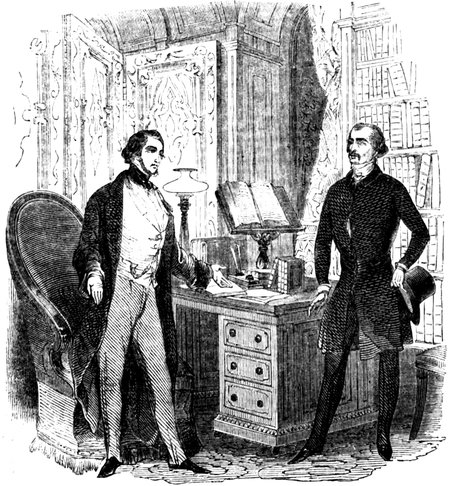
"It is not death that I fear, Mr. Markham," said Katherine, after a pause; "but it is hard—very hard to be accused of a crime which I abhor! No—I do not fear death: perhaps it would be better for me to die even at my age—than dwell in a world which has no charms for me. For I have been unhappy from my birth, Mr. Markham: I was left an orphan when I was young—so very young—oh! too young to lose both parents! Since then my existence has not been blest; and at the very moment when a brighter destiny seemed opened to me, through the goodness of yourself and Mr. Tracy, I am suddenly snatched away to a prison, and overwhelmed with this terrible accusation!"
"Katherine," said Richard, deeply affected by the young girl's tone and words, "I believe you to be innocent—as God is my judge, I believe you to be innocent!"
"And may that same Almighty Power bless you for this assurance!" exclaimed Katherine, pressing our hero's hands with the most grateful warmth.
"Although in asserting my conviction of your innocence, Katherine," continued Richard, "I leave the deed itself enveloped in the darkest mystery, still I do believe that you are innocent—and I will not desert you."
Richard remembered how grateful to his ears had once sounded those words, "I believe that you are innocent,"—when Thomas Armstrong uttered them in the prison of Newgate.
"Yes, Katherine—you are, you must be innocent," he continued; "and I will labour unceasingly to make your innocence apparent. I will provide the ablest counsel to assist in your defence; and all that human agency can effect in your behalf shall be ensured at any cost."
The poor girl could not find words to express her deep gratitude to this young man who so generously constituted himself her champion, and on whom she had not the slightest claim;—but her looks and her tears conveyed to our hero all she felt.
"Has your uncle been to see you?" he inquired.
"No, sir—nor my cousin," replied Katherine, with melancholy emphasis upon the latter words.
50"Perhaps they are unaware of your situation. I will call and communicate to them the sad tidings. As your relatives, it is right that they should know the truth."
He then took leave of the young creature, who now felt less forlorn since she knew that she possessed at least one friend who would not only exert himself in her behalf, but who also believed in her innocence.
From the New Prison Richard proceeded to Saint Giles's, and knocked at the door of the Public Executioner's abode.
But his summons remained unanswered.
He repeated it again: all was silent within.
At length a neighbour,—a man who kept a coal and potato shed,—emerged from his shop, and volunteered some information concerning the hangman and his son.
"It's no use knocking and knocking there, sir," said the man: "Smithers and his lad left London early yesterday morning for some place in the north of Ireland—I don't know the name—but where there's some work in his partickler line. The postman brought Smithers a letter, asking him to start off without delay; and he did so. He took Gibbet with him to give him another chance, he said, of trying his hand. Smithers told me all this before he went away, and asked me to take in any letters that might come for him, or answer any one that called. That's how I came to know all this."
"Do you happen to be aware when he will return?" asked Richard.
"I've no more idea than that there tater," answered the man, indicating with his foot a specimen of the vegetable alluded to.
Richard thanked the man for the information which he had been enabled to give, and then pursued his way towards the chief police station in the neighbourhood.
Arrived at that establishment, he inquired for Morris Benstead.
The officer happened to be on the premises at the moment.
Markham led him to a short distance, and then addressed him as follows:—
"You have doubtless heard of the extraordinary position in which poor Katherine Wilmot is placed. I, for one, firmly believe her to be innocent."
"So do I, sir," exclaimed the officer, emphatically.
"Then you will prove the more useful to my purposes in consequence of that impression," said Richard. "When I saw you on a former occasion, you offered me your services if ever I should require them. Little did I then suppose that I should so soon need your aid. Are you willing to assist me in investigating this most mysterious affair?"
"With pleasure, sir—with the sincerest pleasure," answered Benstead. "You know the respect I entertain for Miss Kate."
"And I know your goodness of heart," said our hero. "You must then aid me in collecting proofs of her innocence. Spare no expense in your task: hesitate not to apply to me for any money that you may need. Here are ten pounds for immediate purposes. To-morrow I will let you know whom I shall decide upon employing to conduct the poor girl's defence; and you can then communicate direct with the solicitor and barrister retained. Are you willing to undertake this task?"
"Need you ask me, sir?" cried the policeman. "I would do any thing to serve Miss Kate."
"Prudence renders it necessary for me to keep myself in the back-ground in this affair," said Richard; "for fear lest scandal should attach an unworthy motive to my exertions in her behalf, and thus prejudice her cause by injuring her character. Upon you, then, I throw the weight of the investigation."
"And I accept it cheerfully," returned Benstead.
Markham then took leave of the officer, and having paid a visit to Mr. Gregory, returned home.
CHAPTER CLV. PATRIOTISM.
It was late in the evening of the day on which Richard adopted the measures just recorded to ensure the most complete investigation into the case of Katherine Wilmot, that a foreigner called at Markham Place and requested a few moments' private conversation with our hero.
The request was immediately acceded to; and the foreigner was shown into the library.
He was a man of middle age, with a dark complexion, and was dressed with considerable taste. His air was military, and his manners were frank and open.
He addressed Richard in bad English, and tendered an apology for thus intruding upon him.
Markham, believing him, by his accent and appearance, to be an Italian, spoke to him in that language; and the foreigner immediately replied in the same tongue with a fluency which convinced our hero that he was not mistaken relative to the country to which his visitor belonged.
"The object of my visit is of a most important and solemn nature," said the Italian; "and you will excuse me if I open my business by asking you a few questions."
"This is certainly a strange mode of proceeding," observed our hero; "but you are aware that I must reserve to myself the right of replying or not to your queries, as I may think fit."
"Undoubtedly," said the Italian. "But I am a man of honour; and should our interview progress as favourably as I hope, I shall entrust you with secrets which will prove my readiness to look upon you in the same light."
"Proceed," said Richard: "you speak fairly."
"In the first place, am I right in believing that you were once most intimate with a certain Count Alteroni who resides near Richmond?"
"Quite right," answered Richard.
"Do you, or do you not, entertain good feelings towards that nobleman?"
"The best feelings—the most sincere friendship—the most devoted attachment," exclaimed our hero.
"Are you aware of any particulars in his political history?"
"He is a refugee from his native land."
"Does he now bear his true name?"
"If you wish me to place confidence in you," said Richard, "you will yourself answer me one question, before I reply to any farther interrogatory on your part."
51"Speak," returned the Italian stranger.
"Do you wish to propose to me any thing whereby I can manifest my attachment to Count Alteroni, without injury to my own character or honour?" demanded Richard.
"I do," said the stranger solemnly. "You can render Count Alteroni great and signal services."
"I will then as frankly admit to you that I am acquainted with all which relates to Count Alteroni," said Richard, dwelling upon the words marked in italics.
"With all which relates to Prince Alberto of Castelcicala?" added the stranger, in a significant whisper. "Do we understand each other?"
"So far that we are equally well acquainted with the affairs of his Highness the Prince," answered Richard.
"Right. You have heard of General Grachia?" said the foreigner.
"He is also an exile from Castelcicala," returned Markham.
"He is in England," continued the foreigner. "I had the honour to be his chief aide-de-camp, when he filled the post of Minister of War; and I am Colonel Morosino."
Richard bowed an acknowledgment of this proof of confidence.
"General Grachia," proceeded Morosino, "reached England two days ago. His amiable family is at Geneva. The general visited Prince Alberto yesterday, and had a long conversation with his Highness upon the situation of affairs in Castelcicala. The Grand Duke is endeavouring to establish a complete despotism, and to enslave the country. One province has already been placed under martial law; and several executions have taken place in Montoni itself. The only crime of the victims was a demand for a Constitution. General Grachia represented to his Highness Prince Alberto the necessity of taking up arms in defence of the liberties of the Castelcicalans against the encroachments of despotism. The reply of the Prince was disheartening to his friends and partizans. 'Under no pretence,' said he, 'would I kindle civil war in my native country.'"
"He possesses a truly generous soul," said Richard.
"He is so afraid of being deemed selfish," observed the Colonel; "and no one can do otherwise than admire that delicacy and forbearance which shrink from the idea of even appearing to act in accordance with his own personal interests. The Prince has every thing to gain from a successful civil war: hence he will not countenance that extremity."
"And what does General Grachia now propose?" asked Markham.
"You are aware that when Prince Alberto was exiled from Castelcicala for having openly proclaimed his opinions in favour of a Constitution and of the extension of the popular liberties, numbers of his supporters in those views were banished with him. We know that there cannot be less than two thousand Castelcicalan refugees in Paris and London. Do you begin to comprehend me?"
"I fear that you meditate proceedings which are opposed to the wishes of his Highness Prince Alberto," said Markham.
"The friends of Castelcicalan freedom can undertake what in them would be recognised as pure patriotism, but which in Prince Alberto would be deemed the result of his own personal interests or ambition."
"True," said Richard: "the distinction is striking."
"The Prince, moreover, in the audience which he accorded to General Grachia yesterday evening, used these memorable words:—'Were I less than I am, I would consent to take up arms in defence of the liberties of Castelcicala; but, being as I am, I never will take a step which the world would unanimously attribute to selfishness.'"
"Those were noble sentiments!" ejaculated Markham: "well worthy of him who uttered them."
"And worthy of serving as rules and suggestions for the patriots of Castelcicala!" cried Colonel Morosino. "There are certain times, Mr. Markham," he continued, "when it becomes a duty to take up arms against a sovereign who forgets his duty towards his subjects. Men are not born to be slaves; and they are bound to resist those who attempt to enslave them."
"Those words have often been uttered by a deceased friend of mine—Thomas Armstrong," observed Richard.
"Thomas Armstrong was a true philanthropist," said the Colonel; "and were he alive now, he would tell you that subjects who take up arms against a bad prince are as justified in so doing as the prince himself could be in punishing those who violate the laws."
"In plain terms," said Richard, "General Grachia intends to espouse the popular cause against the tyranny of the Grand Duke?"
"Such is his resolution," answered Colonel Morosino. "And now that you have heard all these particulars, you will probably listen with attention to the objects of my present visit."
"Proceed, Colonel Morosino," said Richard. "You must be well aware that, as one well attached to his Highness Prince Alberto, I cannot be otherwise than interested in these communications."
"I shall condense my remarks as much as possible," continued the officer. "General Grachia purports to enter into immediate relations with the Castelcicalans now in London and Paris. Of course the strictest secresy is required. The eventual object will be to purchase two or three small ships which may take on board, at different points, those who choose to embark in the enterprise; and these ships will have a common rendezvous. When united, they will sail for Castelcicala. A descent upon that territory would be welcomed with enthusiasm by nine-tenths of the population; and the result," added Morosino, in a whisper,—"the inevitable result must be the dethronement of the Grand Duke and the elevation of Alberto to the sovereign seat."
"That the project is practicable, I can believe," said Markham; "that it is just, I am also disposed to admit. But do you not think that a bloodless revolution might be effected?"
"We hope that we shall be enabled successfully to assert the popular cause without the loss of life," returned Morosino. "But this can only be done by means of an imposing force, and not by mere negotiation."
"You consider the Grand Duke to be so wedded to his despotic system?" said Markham interrogatively.
"What hope can we experience from so obstinate 52a sovereign, and so servile an administration as that of which Signor Pisani is the chief?" demanded the Colonel. "And surely you must allow that patriotism must not have too much patience. By allowing despots to run their race too long, they grow hardened and will then resist to the last, at the sacrifice of thousands of lives and millions of treasure."
"Such is, alas! the sad truth," said Richard. "At the same time a fearful responsibility attaches itself to those who kindle a civil war."
"Civil wars are excited by two distinct motives," returned the Colonel. "In one instance they are produced by the ambition of aspirants to power: in the other, they take their origin in the just wrath of a people driven to desperation by odious tyranny and wrong. The latter is a sacred cause."
"Yes—and a most just one," exclaimed Markham. "If then, I admit that your projects ought to be carried forward, in what way can my humble services be rendered available?"
"I will explain this point to you," answered Colonel Morosino. "General Grachia, myself, and several stanch advocates of constitutional freedom, met to deliberate last evening upon the course to be pursued, after the General had returned from his interview with the Prince at Richmond. We sat in deliberation until a very late hour; and we adopted the outline of the plans already explained to you. We then recognised the necessity of having the co-operation of some intelligent, honourable, and enlightened Englishman to aid us in certain departments of our preliminary arrangements. We must raise considerable sums of money upon certain securities which we possess; we must ascertain to what extent the laws of this country will permit our meetings, or be calculated to interfere with the progress of our measures; we must purchase ships ostensibly for commercial purposes; and we must adopt great precautions in procuring from outfitters the arms, clothing, and stores which we shall require. In all these proceedings we require the counsel and aid of an Englishman of honour and integrity."
"Proceed, Colonel Morosino," said Richard, seeing that the Italian officer paused.
"We then found ourselves at a loss where to look for such a confidential auxiliary and adviser; when one of our assembly spoke in this manner:—'I came to this country, as you well know, at the same time as his Highness the Prince. From that period until the present day I have frequently seen his Highness; and I became aware of the acquaintance which subsisted between his Highness and an English gentleman of the name of Richard Markham, who was introduced to his Highness by the late Thomas Armstrong. I am also aware that a misunderstanding arose between the Prince and Mr. Markham: the nature of that misunderstanding I never learnt; but I am aware that, even while it existed, Richard Markham behaved in the most noble manner in a temporary difficulty in which his Highness was involved. I also know that the motives which led to that misunderstanding have been completely cleared away, and that the Prince now speaks in the highest terms of Mr. Richard Markham. Address yourselves, then, to Mr. Markham: he is a man of honour; and with him your secret is safe, even if he should decline to meet your views.'—Thus spoke our friend last night; and now the cause and object of my visit are explained to you."
"You have spoken with a candour and frankness which go far to conquer any scruples that I might entertain in assisting you," said Richard. "At the same time, so important a matter demands mature consideration. Should I consent to accept the office with which you seek to honour me, I should not be a mere lukewarm agent: I should enter heart and soul into your undertaking; nor should I content myself with simply succouring you in an administrative capacity. Oh! no," added Richard, enthusiastically, as he thought of Isabella, "I would accompany you on your expedition when the time came, and I would bear arms in your most righteous cause."
"Generous young man!" cried the Colonel, grasping our hero's hand with true military frankness: "God grant that your answer may be favourable to us. But pray delay not in announcing your decision."
"This time to-morrow evening I will be prepared to give you an answer," returned Markham.
The Colonel then took his leave, saying, "To-morrow evening I will call again."
CHAPTER CLVI. THE DECISION.
Richard Markham retired to rest, but not to immediate slumber.
The proposal of Colonel Morosino was of a most perplexing nature.
Our hero longed to be enabled to show his devotion to Isabella by exerting himself in what must eventually prove her father's cause; but he was afraid of acting in a manner which might displease the Prince.
Then he reflected that the Prince had uttered those expressive words, "Were I less than I am, I would consent to take up arms in defence of the liberties of Castelcicala."
The more Richard pondered upon these words, the more was he inclined towards the service proposed to him; and when he remembered that he should be associated with some of the most gallant and disinterested of Italian patriots, he felt a generous ardour animate his bosom.
"Oh! if I could but achieve some deed that would render me worthy of Isabella," he thought, "how should I bless the day when I adopted the cause of those brave exiles who now seek my aid! Yes—I will join them, heart and soul; and in me they shall have no lukewarm supporter! The die is cast;—and this resolution must either make or mar me for ever!"
Richard then gradually fell into a profound slumber: but the subjects of his latest thoughts became the materials of which his dreams were woven.
Imagination carried him away from his native land, and whirled him on board a vessel which was within sight of the Castelcicalan coasts. Presently a descent upon the land was effected; and then Richard fancied himself to be involved in the thickest of a deadly fight. Next he saw himself entering Montoni at the head of a victorious army; and it seemed to him as if he were the object of attraction—as 53if the salutations of countless multitudes were addressed to him—and as if he returned them! Then the scene changed, by one of those rapid transitions so peculiar to dreams; and he found himself standing at the altar, the lovely Isabella by his side. A tiara of diamonds adorned her brow and on his own was a princely coronet. Then the ceremony was completed; and friends with smiling countenances gathered around to congratulate him and his lovely bride; and the swelling words "Your Highness" and "My Lord" echoed upon his ears. He turned to address his thanks to those who thus felicitated him—and awoke!
"A dream—a dream!" he exclaimed, as the gay pageantry of the vision yet dwelt vividly in his mind: "but will the most happy episode therein ever be fulfilled?"
Richard rose with depressed spirits; for a dream of that nature—by raising us to the highest eminence to which our aspirations ever soared, and then dashing us back again to the cold realities of earth—invariably leads to a powerful reaction.
The day passed without any incident of importance; and by the time the evening arrived, Richard had recovered his mental serenity.
Punctual to his appointment, Colonel Morosino made his appearance.
He came in a chaise, accompanied by another individual; but the latter did not alight from the vehicle.
"Mr. Markham," said the Colonel, when he was alone with our hero, in the library, "have you made up your mind?"
"I have," answered Richard, in a decided tone.
"And your decision——"
"Is to join you, heart and soul—to throw myself with enthusiasm into your cause—to co-operate with you as if I were a Castelcicalan subject," said Richard, his handsome countenance glowing with animation, his fine dark eyes flashing fire, and his nostrils dilating with the ardour which filled his soul.
"I am no prophet, if you ever repent this decision," said Colonel Morosino, pressing Richard's hands warmly. "Will you now permit me to introduce a gentleman who has accompanied me?"
"With much pleasure," answered Markham.
The Colonel stepped out, and at the expiration of a few moments returned, accompanied by a tall, thin, military-looking man, whose lofty bearing and eagle eye bespoke him as one who had been accustomed to command.
"Mr. Markham," said the Colonel, "may you soon become better acquainted with General Grachia."
The veteran proffered Richard his hand with true military frankness, and observed, "I rejoice to find that your decision is favourable to our views."
"You will also find that I shall be zealous and unwearied in your service," rejoined Markham.
"Our proceedings," continued General Grachia, "must be conducted with caution, so that no rumour prejudicial to our measures may reach Castelcicala."
"I believe it to be understood," said Markham, "that should the Grand Duke change his policy to such an extent that the Castelcicalans may obtain their just rights and privileges by means of his concessions, before our own projects shall be ripe for execution,—that, in this case, we at once abandon them."
"Assuredly," replied General Grachia. "God knows the purity of my motives, and that I would not plunge my country into civil war without the pressure of a dire necessity. Neither am I adopting extreme measures from vindictive motives because the Grand Duke has banished me not only from office but also from the territory. Had I assented to his despotic decrees I might have retained my high position in the cabinet, and aggrandized my own fortunes at the same time. As a proof of my integrity, Mr. Markham, read this document."
The General produced from his pocket-book a letter which had been sealed with the ducal signet, and was addressed "To His Excellency General Grachia, Minister Secretary of State for the Department of War."
This document he handed to Richard, who found that it was an autograph letter from the Grand Duke to the General, written at the time when the military disturbances occurred at Montoni. It remonstrated with General Grachia for refusing to countersign the ordinance decreeing the disbandment of the three regiments, and promising him the rank of Marquis and the Premiership if he would but consent to aid his Serene Highness in carrying out the proposed rigorous measures.
"To this letter I replied by sending in my resignation," said General Grachia; "and thus I wrecked my own fortunes, and made my wife and children exiles."
"You acted nobly—like a true patriot," cried Markham, contemplating the veteran with admiration. "If for one instant I entertained a scruple in embracing your cause, it is now annihilated; for you have honoured me with the most convincing proofs of your patriotism."
"I served the Grand Duke faithfully," said the General; "and I cannot reproach myself for any measure which I ever recommended to his Serene Highness. Although deeply attached to Prince Alberto, I did not oppose the marriage of the Grand Duke; because I believed that, upon principle, sovereigns are entitled to as much freedom in affairs so nearly touching their domestic happiness, as any of their subjects. I saw in the present Grand Duchess an amiable lady; and I knew that she was a virtuous one from the strong recommendations which she received from his Highness Prince Alberto and the Earl of Warrington to myself and my family. I supported, then, that marriage upon principle—upon a conviction which I entertain. I believe that sovereigns have a right to consult their own happiness in marriage; but I never will admit that they have a right to enslave their subjects. I will maintain the privileges of princes, when I consider them encroached upon by the people: with equal readiness will I protect the people against the tyranny of princes."
Richard listened with admiration to these noble sentiments; and he could not help exclaiming, "How blind sovereigns often seem to the merits and honesty of those who would counsel them wisely!"
"Such is too frequently the case," observed Colonel Morosino.
"The plan upon which I propose to act is simply this," resumed General Grachia:—"one of the most humble, but not the least sincere, of those 54refugees who support us, will take a house in London in his own name; and there shall our head-quarters be fixed. There shall we hold our meetings; and thence will our correspondence be expedited to those whom we can trust, and on whose support we can rely. In order to avoid all cause of suspicion, I shall take a house for myself and suite at the West End, where I shall, however, lead a comparatively secluded life. Fortunately, the greater portion of my property consisted in money in the public funds of Castelcicala; and for that I obtained securities which may be easily realised in London. My friend Morosino stands in the same position. Between us we can muster some twenty thousand pounds; and other exiles, who are favourable to our views, can throw ten thousand more into the common stock."
"To which I shall also be permitted to contribute my quota," interrupted Richard.
"Not if we can manage without it," answered General Grachia; "and I have no doubt that pecuniary resources will not be wanting in this good cause."
The General then proceeded to a more detailed development of his plans; but as we shall have to deal with them fully hereafter, we will take leave of the subject for the present.
Before we conclude this chapter we must record two or three little incidents that maintain the continuous thread of our narrative.
A week after the demise of Miss Gregory, the funeral took place at a suburban cemetery. The bereaved father and afflicted brothers were the chief mourners; but Richard also followed the remains of the departed girl to the tomb. An elegant but chaste and unassuming monument marks the spot where she reposes in her narrow bed.
At the expiration of the seven days during which she had been remanded, Katherine was examined a second time before the magistrate, and was fully committed for trial.
A Coroner's Inquest had in the meantime recorded a verdict of Wilful Murder against her.
She was accordingly conveyed to Newgate.
But Richard Markham did not neglect her interests; and Morris Benstead was busy in adopting every possible measure to fathom the deep mystery in which the awful deed was still shrouded.
CHAPTER CLVII. THE TRIAL OF KATHERINE WILMOT.
The March sessions of the Central Criminal Court commenced upon a Monday morning, as usual.
On the Wednesday Katherine Wilmot was placed in the dock, to take her trial for the murder of Matilda Kenrick.
The particulars of the case had produced a great sensation; and the door-keepers of the gallery of the court reaped a rich harvest by the fees for admission.
Katherine was deadly pale; but she had made up her mind to conduct herself with fortitude; and her demeanour was resigned and tranquil.
Richard Markham was in the gallery of the court; but his manner was uneasy and anxious:—he had heard nothing of Benstead, the policeman, for the preceding forty-eight hours; and not a fact had that individual communicated to the counsel for the prisoner which might tend to prove her innocence or even throw a doubt upon her guilt!
When called upon to answer to the indictment, Katherine pleaded, in a firm tone, "Not Guilty."
The counsel for the prosecution then stated the case, which was supported by the following testimony:—
Henry Massey deposed: "I am a surgeon, and reside in Great Coram Street. One evening, early in February, a young female came to my shop and purchased two ounces of laudanum. She brought no phial with her. I gave it to her in a phial of my own, which I labelled Poison. On the following evening I was summoned to the house of the Rev. Mr. Tracy. I was introduced into the kitchen, where I found the deceased lying back in her chair quite dead. A young female was there; and I recognised her to be the one who had purchased the poison at my shop. She is the prisoner at the bar. From this circumstance and others which transpired, I suspected her to have poisoned the deceased; and I had her given into custody. The Rev. Mr. Tracy was in the kitchen when I arrived. He was doing all he could to recover the deceased. He was deeply affected. On the following day I examined the deceased, and found that she had died by poison. That poison was laudanum. I discovered so large a quantity in her, by the usual tests, that she must have experienced a deep lethargy almost immediately after taking the poison, and could not have lived many minutes. I cannot say that she did not take it voluntarily, and with the object of committing suicide. There was nothing upon the table near her—no cup, glass, nor any drinking vessel. The phial produced is the one in which I sold the poison."
Thomas Parker deposed: "I am footman to the Rev. Mr. Tracy. On the morning of the day when the housekeeper was poisoned, I overheard a conversation between her and Katherine Wilmot. The deceased informed Katherine that she must leave the house, but would not assign any reason. The deceased, however, said that she would provide for Katherine at a sister's in the country. Katherine objected to leave London, because her relations live here. I thought Mrs. Kenrick was jealous of Katherine, and wished to get rid of her. I mean that deceased thought that Katherine would perhaps be entrusted to fulfil some of her duties as housekeeper. I came out of the pantry, where I was cleaning the plate, and observed that I supposed Mrs. Kenrick was jealous of Katherine. The housekeeper cut the matter short by saying that Katherine should leave. Katherine was very miserable all day afterwards. In the evening my master sent me with a letter to a gentleman at Holloway. When I came back, I found the housekeeper dead. The first witness was there, in the kitchen. So were my master, Katherine, and the groom. I alluded to the conversation which had taken place between the deceased and the prisoner in the morning. The surgeon mentioned about Katherine having bought the laudanum at his house. Katherine seemed very much confused. She was then given into custody."
James Martin deposed: "I am groom and coachman to the Rev. Mr. Tracy. On the evening in question I heard screams in the yard. I was in the stable adjoining. There is a communication between the yard of the house and the stable yard. I 55hastened to the yard of the house where the screams came from. I saw Katherine wringing her hands and crying. I asked her what was the matter? She said, 'Mrs. Kenrick is dead.' I hurried into the kitchen. Almost immediately afterwards Mr. Tracy came in. He had been alarmed by the screams too, he said. I found the housekeeper lying forward on the table, with her face resting on her arms, as if she had fallen asleep. I raised her, and laid her back in her chair. She seemed quite dead. Mr. Tracy was greatly affected. Katherine did not offer to help, but withdrew to the farther end of the kitchen. She cried very much. Mr. Tracy sent me for a surgeon. When I came back with the first witness, we found Mr. Tracy bathing deceased's head with vinegar, and doing all he could to recover her. Katherine was not assisting him." This witness then confirmed the previous statement relative to the immediate circumstances which led to Katherine's arrest. He concluded his testimony thus: "When I first went into the kitchen, there were no cups, nor glasses, nor any drinking vessels on the table. All the tea-things had been washed and put into their proper place."
The Rev. Reginald Tracy deposed: "I received the prisoner into my service through charity. I had no character with her. I had known her before, because she had attended the St. David's Sunday Schools. I considered her to be a most exemplary young person. I was not aware that Mrs. Kenrick intended to send her away. Mrs. Kenrick had the power, if she chose to do so, as she managed my household for me. I cannot say that Katherine had done any thing to offend Mrs. Kenrick. She had done nothing to offend me. In the evening I was alarmed by screams. I went down into the kitchen, and found the housekeeper in the position described by the last witness. I sent him for a surgeon, and adopted all the remedies within my reach to recover the housekeeper. I think I had observed that something had been preying upon the mind of the deceased. She had lately been melancholy and abstracted."
Cross-examined: "I am not aware that Katherine went out on the evening in question. I do not know that she visited her uncle on that evening. I cannot say that she did not. She would not have asked me for permission to do so. She would have applied to Mrs. Kenrick. I was unwell all day, and did not leave my room until I heard the screams. I was very loath to believe that Katherine could have perpetrated such a deed. I told the surgeon so."
A policeman deposed: "I was summoned to Mr. Tracy's house on the evening in question. I took the prisoner into custody. When I had conveyed her to the station-house, I returned to Mr. Tracy's house. I searched the kitchen. I found the phial, produced in court, upon a shelf. It was empty."
This testimony closed the case for the prosecution.
The general impression which prevailed amongst the auditory was unfavourable to the prisoner.
Richard Markham trembled for her: still his confidence in her innocence was unshaken.
But time wore on: the case was drawing to a close;—and not a sign of Morris Benstead!
Markham knew not what to think.
The manner in which Reginald Tracy gave his evidence was the subject of much comment in the gallery.
"What an amiable man he appears to be!" said one.
"How he endeavoured to create an impression in favour of the prisoner," observed another.
"He said that he was loath to believe her guilty," remarked a third, "and considered her to be an exemplary young person."
"Hush! hush!" said the first speaker: "the case is about to be resumed."
This was the fact. The Judges, having retired for a few minutes, had now returned to the bench.
The counsel for the defence rose.
He began by calling upon the jury to dismiss from their minds any prejudice which the statements in the newspapers in connexion with the case might have created. He then dissected the evidence for the prosecution. He insisted much upon the importance of the fact that the poison had been purchased the evening before the conversation took place between the deceased and the prisoner, relative to the removal of the latter from the house. His instructions were that the prisoner had purchased that poison by order of the deceased, and, as the prisoner understood at the time, for the use of her master who had returned home unwell. There was no proof that Katherine had done any thing wrong, and that she might have anticipated receiving warning from the housekeeper, and thus have actually contemplated murder when she procured the laudanum. It was stated that there was no cup nor glass upon the table—no drinking vessel in which poison could be traced. The inference thence drawn by the counsel for the prosecution was that the prisoner must have administered the poison—most probably in deceased's tea, and had then washed the cup. But might not the deceased have taken the poison with the intention of committing suicide, by drinking it from the phial which was found upon the shelf? Would not the prisoner have concealed or destroyed the phial, had she really administered the poison? The prisoner's account of the case was this. Mrs. Kenrick of her own accord had given her permission to visit her friends for an hour on the fatal evening. The prisoner availed herself of this kindness, and proceeded to her uncle's residence in St. Giles's. He (the counsel) hoped to have been able to prove the important fact of this visit, because it would show that the housekeeper had purposely sent Katherine Wilmot out of the way: but, unfortunately, the prisoner's uncle had not yet returned to town; and although a letter had been sent to the place whither it was supposed that he had proceeded——
At this moment a great bustle was observed in the body of the court; and a man, elbowing his way through the crowd, advanced towards the learned counsel for the defence.
Richard's heart leapt within him: at the first glance he recognised, in that man, his agent, Morris Benstead, dressed in plain clothes.
Benstead whispered to the barrister for some minutes, and then handed him a letter which the learned gentleman perused rapidly.
The most breathless suspense prevailed throughout the court.
"My lords," at length exclaimed the barrister, retaining the letter in his hand, and addressing the Judges, "this case is likely to take a most unexpected turn."
"Heaven be thanked!" murmured Richard to 56himself: "the poor creature's innocence will be made apparent—I feel that it will!"
Meantime Morris Benstead again forced his way through the crowd, and took his stand close by Reginald Tracy.
Poor Katherine knew not what all this meant; but her heart beat violently with mingled emotions of hope, uncertainty, and apprehension.
"My lords," continued the barrister, "I need not continue my speech in defence of the prisoner. I shall at once proceed to call my witnesses."
The anxiety of the audience grew more and more intense.
"Jacob Smithers!" cried the barrister.
The Public Executioner instantly ascended into the witness-box.
He deposed as follows: "The prisoner is my niece. She called at my house on the evening alluded to. She remained with me at least half an hour. She did not complain of Mrs. Kenrick; nor did she say that she was to leave the Rev. Mr. Tracy's house. I remember that I was very low-spirited myself that evening; and so I suppose she did not choose to annoy me by saying that she was to leave. Or else, perhaps, she thought that I should wish her to return home to me if I knew that she was to leave Mr. Tracy's service. I have been to Belfast where I was detained some days: then I accepted an engagement to go to the Isle of Man. I never received any letter informing me of what had occurred to my niece. The fact is, I do not go by my right name when I travel in that way, because I have to stop at inns, and do not like to be known. That is probably the reason why a letter addressed to me by the name of Smithers did not reach me. I did not see the account of this business in the newspapers until a few days since, when I was in the Isle of Man; and I returned home as quick as possible. I only reached London an hour ago."
"You may stand down," said the barrister: then, after a pause, he exclaimed, "Rachel Bennet!"
An elderly woman, decently attired in mourning, but evidently in a very sickly state of health, slowly ascended into the witness-box.
She deposed: "I am the sister of the deceased, and reside about three miles from Hounslow. I received a letter from my sister early in February. The letter now shown me is the one." (This was the same letter which Benstead had given to the barrister.) "On the following day I received a letter from Mr. Tracy informing me of my sister's death, and stating that it was supposed she had been poisoned by a young person then in custody. I was bed-ridden with illness at the time, and was supposed to be dying. I could not therefore come to London, or take any steps in the matter. Some one came to me yesterday, and induced me to come to town."
The counsel for the defence then passed the letter, which had been placed in his hands by Benstead, to the clerk of the court, by whom it was read.
Its contents were as follow:—
"I hope this will find you much improved in health: at the same time I am somewhat anxious at not having heard from you. My present object in writing to you is to request you to receive at your house a young person in whom I am interested, and who is at present in Mr. Tracy's service. Katherine Wilmot is a pretty and interesting girl; and it would be unsafe for her to remain here. You know, dear Rachel, that you and I have never had any secrets between us; and I am not now going to break through that rule of mutual confidence which has been the basis of our sincere attachment. The truth is, Mr. Tracy is not what he was. He has fallen from the pinnacle of virtue which he once so proudly occupied; and it was only this morning that I had the most convincing proof of his weakness and folly! O Rachel—I met him and his mistress face to face upon the stairs! But I will not dwell upon this: I sincerely pray to heaven that he may repent, and become the good man he once was. I know that this secret will be sacred with you. But I am determined to remove from him all temptations, as far as lies in my humble power; and you may now comprehend my motives for sending Katherine Wilmot away from this house. In a word, I shall despatch her to you by to-morrow's coach; and will write at greater length by her.
This letter produced a most extraordinary sensation in the court.
The Judges, the barrister, the prisoner, and the audience were astounded at this revelation of the weakness of that man whom the world almost worshipped as a saint.
"Ellen was right!" murmured Richard Markham to himself: "he is a hypocrite! But I never could have thought it!"
And what of Reginald himself?
The moment the clerk reached that paragraph which proclaimed the astounding fact of his unworthiness, a cold perspiration broke out upon his forehead; and he turned to leave the court.
But Morris Benstead caught him by the arm, and pointing to a seat, said, "You must remain here, if you please, sir: I am an officer."
The rector cast a look of unutterable dismay upon the policeman, and fell upon the bench in a state of mind bordering on distraction.
Meantime the case proceeded.
The counsel for the prosecution said that he should like to ask Rachel Bennet a few questions.
That witness accordingly returned to the box.
"Why did you not empower some one to produce that letter when the prisoner was examined before the magistrate?" inquired the prosecuting counsel.
"Because, sir, I did not conceive that it could be of any use. I never for a moment suspected that any other person besides the one accused could have taken away my poor sister's life. My husband proposed to send the letter to the magistrate; but as my sister had written to me in strict confidence, I would not consent to that step. And now, since you have asked me, sir, I will tell you what I really did think; and God forgive me if I have been unjust."
"We do not want to hear what you thought," exclaimed the prosecuting counsel. "You may stand down."
"No," cried the barrister for the defence: "as we are upon the subject, we will have the witness's impressions."
"I really thought, sir," continued the woman, "that the Katherine Wilmot alluded to was perhaps no better than she should be, and had become more intimate with Mr. Tracy than my poor sister suspected. That, I thought, was the reason why she had poisoned my sister in order to get her out of the way, and for herself to remain at Mr. Tracy's house. But I did not think that Mr. Tracy himself had any hand in the murder; and so I did not 57see the good of producing a letter which would only expose Mr. Tracy."
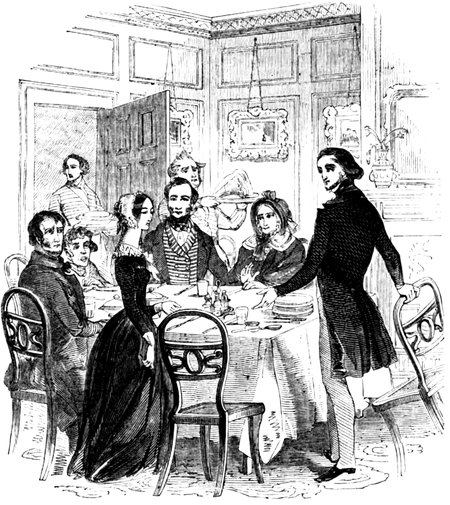
"Now you may stand down," said the counsel for the prisoner: then, in a loud tone, he called, "John Smithers!"
And Gibbet entered the witness-box.
His first glance was towards the dock; and that look, rapid, and imperceptible to others, conveyed a world of hope to the bosom of poor Katherine.
Richard Markham was at a loss to conceive what testimony the hump-back could bring forward in the prisoner's favour.
Every one present felt the deepest interest in the turn given to the proceedings.
The hump-back stood upon a stool that there was in the witness-box; and even then his head was alone visible. His hideous countenance, pale and ghastly through his intense feelings for Katherine's situation, was nevertheless animated with confidence and hope.
Amidst a dead silence of awe-inspiring solemnity, he deposed as follows:—
"I am the prisoner's cousin. She has ever been most kind to me; and I was always happy in her society. When she went to live at Mr. Tracy's house, I thought that I should be able to see her every evening; but on one occasion Mr. Tracy met me, and said that I might only visit her on Sundays. I had, however, discovered an obscure corner in his yard, where I could hide myself and see all that passed in the kitchen of his house. I went to that corner regularly every evening, Sunday excepted; and remained there an hour—sometimes more. I did not want to pry into what was going on in Mr. Tracy's house: all I cared about was to see Katherine."
A murmur, expressive of deep feeling—mingled surprise, sympathy, and admiration—on the part of the audience, followed this ingenuous announcement. Many an eye was moistened with a tear; and even the Judges did not look angrily when that murmur met their ears.
Gibbet continued:—
"One evening when I was concealed in the corner, I saw Mrs. Kenrick address something to Katherine, which I could not hear; but immediately afterwards Katherine put on her bonnet and went 58out. As I had sometimes seen her do so before, and return very shortly afterwards, I thought she had merely gone to execute some little commission; and I remained where I was. Although Katherine used to pass through the yard, and close by me, when she went out in that manner, I never spoke to her, for fear she should reprove me for what she might think was watching her actions. Immediately after she was gone, Mrs. Kenrick laid the tea things; and in a few minutes Mr. Tracy entered the kitchen. He and the housekeeper sate down to tea. Mrs. Kenrick was pouring out the tea, when Mr. Tracy said something which made her pause. She then put down the tea-pot, fetched a coffee-biggin, and made some coffee. She filled two cups, and then turned towards the shelves to fetch a small jug, which I thought contained milk. But while her back was turned, I saw Mr. Tracy hastily put his hand into his waistcoat pocket, and then as rapidly advance his hand to Mrs. Kenrick's cup. All that was the work of only one moment; and I could not distinctly see why he did so. In fact I did not think much of it, until afterwards. Mrs. Kenrick resumed her seat; and she and Mr. Tracy drank their coffee. I observed that Mrs. Kenrick took no milk, and drank hers very quickly. In a short time I saw her head begin to nod as if she was sleepy: she got up, and walked about. Then she sate down again, and placed her arms on the table as if to support herself. In a short time her head fell forward on her arms. I felt a little alarmed; but still scarcely knew why. Mr. Tracy watched her for some minutes after she had fallen forward in that manner, and then bent down his head to look at her face. In another moment he rose, and to my surprise washed up all the things on the table and placed them upon the shelves. Then I began to fear that something was wrong; and I stole away. When I got home I found my father rather cross with me for staying out; and I was afraid to tell him what I had seen. Early the next morning we left for Ireland; and I never had courage to speak to my father upon this subject until we read the account of the murder and of Katherine's arrest. That was in the Isle of Man."
The reader may imagine the profound sensation which this narrative created.
Richard Markham was literally astounded.
Katherine Wilmot wept abundantly.
Reginald Tracy was crushed, as it were, to the very dust, by this overwhelming exposure of his guilt.
The jury whispered together for a few moments; and the foreman rose and said, "My lords, it is rather as a matter of form than as the result of any deliberation, that we pronounce a verdict of Not Guilty."
"The prisoner is discharged," said the senior judge. "It will be the duty of the police to take charge of Reginald Tracy."
"I have him in custody, my lord," exclaimed Morris Benstead in a loud tone.
CHAPTER CLVIII. A HAPPY PARTY.
In a private room up stairs, at a tavern nearly opposite the Court-house of the Old Bailey, a happy party was assembled.
And yet the group was somewhat motley.
It consisted of Richard Markham, Katherine Wilmot, the Public Executioner, Gibbet, Rachel Bennet, and Morris Benstead.
The best luncheon which the house afforded was spread upon the table.
"And so you really thought I was lost, sir?" said Benstead. "I am not the man to neglect the business that is entrusted to me; neither do I excite hopes unless I know that they'll be realised."
"But you have not yet told me how you came to bring all your witnesses into court at one and the same moment," said Richard Markham.
"Well, sir, I'll soon satisfy your curiosity on that head," returned the policeman. "I made every exertion to sift the entire matter to the bottom; but the farther I went into it, the more mysterious it seemed. At last I was pretty nearly inclined to give it up in despair. One of the principal measures that I adopted was to endeavour to trace, step by step, all that either Mrs. Kenrick or Katherine did on the day when the murder took place. I have seen, in my time, so much important evidence come out of the most trivial—really the most ridiculous things, that I resolved to glean every minute particular I could relative to the motions of both the deceased and the accused on that day. My firm idea was that the housekeeper had committed suicide—saving your presence, ma'am," added Benstead, turning towards Mrs. Bennet. "Well, I found out the principal shops where Mr. Tracy dealt; and I visited them all to ascertain if Mrs. Kenrick had been there on that day; and if so, whether her words or manner had betrayed any thing strange. But I could learn nothing material. Various other schemes I thought of, and put into execution; but as they all failed, there's no use in mentioning them. At length, yesterday evening I happened to call at the post-office near Mr. Tracy's house. I got into conversation with the post-mistress, who seemed to be well acquainted with the late Mrs. Kenrick. In the course of comment and observation upon the mysterious event, the post-mistress said, 'I do really think there's some ground for supposing that the poor dear woman committed suicide; for she came here to pay a letter to her sister only a few hours before she was found dead; and then I saw that she wasn't as she usually was. Something appeared to hang upon her mind.'"
"That was no doubt the sorrow she experienced at having discovered the hypocrisy of her master," observed Richard.
"Most likely, sir," said Benstead. "Well, the moment I heard that Mrs. Kenrick had written to her sister only a few hours before her death, I felt more convinced than ever that it was a case of suicide. It was then nine o'clock; but I was determined to start off at once to investigate the business. The post-mistress knew that Mrs. Bennet lived at Hounslow; and this was fortunate. I thanked her for this information, and hurried away. I was obliged to go to St. Giles's, before I started for the country, to ask my Inspector's leave. As I passed by Mr. Smithers' house, I knocked to see if he had come home. But the green-grocer next door answered me, as on several former occasions when I had called. He told me that Mr. Smithers had not come back. I knew it was important for Miss Kate to prove that she had visited her uncle on the 59night of the supposed murder; and so I scribbled a note to Mr. Smithers, desiring him, in case he should return home in time to-day, to lose not a minute in coming to this very tavern and sending over into the Old Court to fetch me. This note I left with the green-grocer; and I then hastened to the station. I obtained permission to absent myself, and lost no time in hiring a post-chaise. But it was midnight before I reached Hounslow; and then I learnt that Mrs. Bennet lived three miles away from that town. So I was obliged to wait till the first thing this morning before I could see her. Then a great deal of time was wasted, because Mrs. Bennet and her husband could not rightly understand why I came, or on whose side I was engaged. I do not blame them for their caution:—I only mention the fact to account for our being so late in court. At length I succeeded in persuading Mrs. Bennet to show me her sister's letter to her; and when I read it, the whole affair wore another appearance in my mind. I saw through it in a moment. Then I resolved upon bringing Mrs. Bennet up to London with me; and to her credit, she did not hesitate an instant to accompany me, when I had communicated to her the suspicions which that letter had awakened in my mind, and impressed upon her the necessity of hastening to save an innocent person from the weight of an unjust accusation. To conclude this long and rambling story, we came up in the post-chaise; and, as luck would have it, just as we drove up to this tavern, Mr. Smithers and his son were stepping out of a cab at the door."
"Ah! Mr. Markham," said Katherine, "how can I ever sufficiently express my gratitude towards you; for it was by means of your generosity that Mr. Benstead was enabled to make those exertions which led to this happy result."
"I felt convinced of your innocence from the first," returned our hero; "and it was not probable that I should abandon you when such were my sentiments."
"A life devoted to your service, sir, could not repay the debt which I owe you," said Kate. "And you, my dear cousin," she continued, turning towards Gibbet, who was seated next to her,—"you also have been no unimportant instrument in rescuing me from infamy and death."
"Do not speak of it, Kate," said the hump-back, whimpering like a mere child. "I hope you won't scold me for watching you like a cat every evening as I did."
"Scold you, John! Oh! how can you make use of such words to me—and after the service you have rendered me?" exclaimed Kate, tears also streaming down her own cheeks. "I ought to bless God—and I do—to think that your friendship towards me led you to adopt a step to see me, which has turned so wonderfully—so providentially to my advantage."
"And now, Kate," said the executioner, "tell me one thing: why didn't you mention to me that evening when you called, that you were going to leave the rector's service?"
"Because, my dear uncle," answered the young maiden, "you made one observation to me which showed that you were pleased at the idea of me being in Mr. Tracy's service; and as you were so dull and low-spirited, I did not like to tell you any thing that might occasion you additional vexation. You said—oh! I shall never forget your words—they made me weep as I followed you from the street door into the parlour——"
"Yes—because I so seldom spoke kindly to you, poor Kate," exclaimed the executioner, as if struck by a sudden remorse.
"Do not say that, dear uncle! I owe so much—so very much to you, that even if you have been harsh to me now and then, I never think of it—and then, perhaps I have deserved it," she added slowly; for the amiable girl was anxious to extenuate her uncle's self-accusation in the eyes of those present.
"No—you did not deserve it, Kate!" cried the executioner, with resolute emphasis; "you are a good girl—too good ever to have been in such a den as mine!"
Smithers threw himself back in his chair, and compressed his lips together to restrain his emotions.
But nature asserted her empire.
A tear trickled from each eye, and rolled slowly down the cheeks of that man whose heart had been so brutalized by his fearful calling.
Kate rose from her chair, and threw herself into his arms, exclaiming, "Uncle—dear uncle, if you speak kindly to me, I am indeed happy!"
Gibbet cried, and yet laughed—sobbed, and yet smiled, in so strange a manner, as he contemplated that touching scene, that the result of his emotions presented the most ludicrous aspect.
"Sit down, Kate dear," said Smithers: "I am not used to be childish;—and yet, I don't know how it is, but I don't seem ashamed of dropping a tear now. I know I'm a harsh, brutal man: but what has made me so? God, who can read all hearts, has it written down in his book that I was once possessed of the same kind feelings as other people. However—it's no use talking: what I am I must remain until the end."
"Believe me," exclaimed Richard Markham, who was ever sensibly alive to the existence of generous feelings in others,—"believe me," he cried, grasping Smithers' hand, "society lost a good man when you undertook your present avocation."
"What, sir!" ejaculated Smithers, unfeignedly surprised; "do you shake hands with the Public Executioner?"
"Yes—and unblushingly would I do so before the whole world," replied Markham, "when I discover at the bottom of his soul a spark—aye, even the faintest spark of noble and exalted feeling yet unquenched."
The Public Executioner fixed upon the animated and handsome countenance of our hero a glance of the deepest gratitude—a glance of respect, almost of veneration!
He then cast down his eyes, and appeared to plunge into profound rumination.
"You were going to tell us, Miss Katherine," said Benstead, "what observation it was that prevented you from communicating to your uncle the notice Mrs. Kenrick had given you to leave."
"Oh! I remember," exclaimed the young maiden, upon whose heart the noble conduct of Richard Markham towards her despised and degraded relative had made a deep impression: "my uncle said to me, 'I am almost sorry that I ever parted with you; but as you are now in a place that may do you good, I shall not interfere with you.'"
"Ah! my dear young friend," exclaimed Mrs. Bennet, "how fatal might that place have been to 60you after all? But where are you going to live now? If you can make yourself happy with me, I will offer you a home and show you the kindness of a mother."
Katherine turned a look of deep gratitude upon the good woman who made her this generous offer; and then she glanced timidly towards her uncle and Richard Markham.
"If I may be allowed to speak my thoughts in this matter," said our hero, "I should counsel Katherine to accept a proposition so kindly, so frankly made; and it shall be my duty to see that she becomes not a burden upon the friend who will provide her with a home."
"I can give no opinion in the matter, sir," observed the executioner: "there is something about you which compels me to say, 'Deal with me and my family as you will.' Command, sir, and we will obey."
"I never command—but I advise as a friend," said Richard, touched by the strange gentleness of manner which was now evinced by one lately so rude, so brutal, so self-willed. "Katherine, then, has your consent to accompany Mrs. Bennet to Hounslow?"
"And I sincerely thank Mrs. Bennet for her goodness towards that poor girl who has undergone so much," said the executioner.
Mrs. Bennet now suggested that her husband would be uneasy if she remained long absent from home; and Richard immediately summoned the waiter, to whom he gave orders to procure a post-chaise.
This command was speedily executed. Katherine took leave of her relatives, Markham, and Benstead, with streaming eyes.
"God bless you, my girl," said the executioner, in a tone the tremulousness of which he could not altogether subdue.
Gibbet could say nothing: his voice was choked with sobs.
Katherine, however, whispered words of kindness in his ears; and the poor hump-back smiled as he wrung her hand with all the fervour of his affection.
"To you, Mr. Markham," said Kate, "no words can convey the gratitude—the boundless gratitude and respect which I entertain for you."
"Be happy, Katherine," returned Richard, shaking her warmly by the hand; "and remember that in me you have a sincere friend, always ready to aid and advise you."
The young maiden then tendered her thanks to the good-hearted policeman for the interest he had manifested in her favour.
The farewells were all said; good wishes were given and returned; and Mrs. Bennet hurried Katherine from the room. Those who remained behind, watched their departure from the window.
The moment the post-chaise had rolled away from the door of the tavern, Smithers accosted our hero, and said, "I am no great hand at making speeches, sir; but I can't take my leave of you, without saying something to convince you that I'm not ungrateful for what you've done for my niece. Your goodness, sir, has saved her from death; and more than that, has proved her innocence. You are the best man I ever met in my life: you are more like an angel than a human being. I didn't think that such men as you could be in existence. It makes me have a better opinion of the world when I look upon you. How happy would a country be if it had such a person as yourself for its sovereign! I cannot understand my own feelings in your presence: I seem as if I could fall at your feet and worship you. Then I think that I am unworthy even to breathe the same air that you do. But your words have made me happy to some extent: for years I have not felt as I feel to-day. I can say no more, sir: I don't know how I came to say so much!"
And the executioner turned abruptly aside; for he was weeping—he was weeping!
Markham had not interrupted him while he spoke, because our hero knew that it was well for that man to give way to the good feelings which the contemplation of humanity and philanthropy in others had so recently awakened.
But Richard did not perceive that, while the executioner was giving utterance to the invincible promptings of nature, Gibbet had drawn near,—had listened to his father with indescribable interest,—had drunk in with surprise and avidity every word that fell from his lips,—and had gradually sunk upon his knees in the presence of that benefactor whom even a rude, brutalized, and savage disposition was now compelled to believe to be something more than man!
"This, sir," said Benstead, glancing his eyes around, and touching Markham's arm to direct his attention to the scene,—"this, sir, is doubtless a welcome reward for all your goodness."
Richard hastily brushed away a tear, and raising Gibbet from his adoring posture, said, "You, my good lad, possess a heart worthy of a nobleman. Look upon me as your friend!"
Then our hero caught Smithers by the hand, and drawing him into the recess of a window, whispered in a low and rapid tone, "You are not insensible to the charms of being useful to one's fellow-creatures. I implore you to renounce your fearful calling—and I will supply you with the means to enter upon some other pursuit."
Smithers did not answer for a few moments: he appeared to reflect profoundly.
"Yes—I will follow your advice, sir," he at length said: "but not quite yet! I must hang up that rector—and then, then I will abandon the calling for ever!"
With these words the executioner turned abruptly away, caught Gibbet by the hand, and hurried from the room.
A few minutes afterwards Richard Markham and Benstead also took their departure, each in a different direction; but the police-officer's pocket contained substantial proofs of our hero's liberality.
CHAPTER CLIX. THE INTERVIEW.
A week passed away, during which the examination of Reginald Tracy took place before the police-magistrate, and terminated in the committal of the rector to Newgate.
The whole town rang with the extraordinary events which had led to this crisis in the career of a man whose very name had so lately inspired respect.
The clergy were horror-struck at the disgrace 61brought upon their cloth by this terrific explosion; for people grew inclined to look upon real ecclesiastical sanctity as nothing more nor less than a garb of rank hypocrisy.
Some ministers of the gospel, more daring and enthusiastic than the rest, boldly proclaimed from their pulpits that Reginald Tracy was a saint and a martyr, against whom a horrible conspiracy had been concocted in order to remove the imputation of murder from the young female who had been discharged, and fix it on him.
Other clergymen entered into learned disquisitions to prove that Satan must have obtained especial leave from God, as in the case of Job, to tempt the most holy and pious of men; and that, having failed to seduce him from the right path, the Evil One had accomplished a series of atrocities all so artfully arranged as to fix the stain upon the rector of St. David's.
But there were some reverend gentlemen, who, having always been jealous of Reginald Tracy's popularity, descanted in significant terms upon the shallowness of mere eloquence in the pulpit, and the folly of running after "fashionable preachers." One venerable and holy gentleman, who had been married three times, and had received from his wives an aggregate of seventeen pledges of their affection, bitterly denounced in his sermon the "whitened sepulchre," "tinkling cymbal," and "unclean vessel," who had dared to set his face against the sacred institution of matrimony.
The fashionable world was powerfully excited by the exposure of Reginald Tracy. Some wiseacres shook their heads, and observed that they had always suspected there was something wrong about the rector; others plainly asserted that they had even prophesied what would happen some day. The fair sex all agreed that it was a great pity, as he was such a charming preacher and such a handsome man!
The press was not idle in respect to the business. The newspapers teemed with "Latest Particulars;" and all the penny-a-liners in London were on the alert to collate additional facts. Nine out of ten of these facts, however, turned out to be pure fictions. One journal, conducted on more imaginative principles than its contemporaries, promulgated a new discovery which it had made in respect to the rector's history, and coolly fixed upon his back all the murders which had occurred in the metropolis during the previous dozen years, and the perpetrators of which had never yet been detected.
Heaven knows Reginald Tracy was bad enough; but if one believed all which was now said of him in the public journals, no monster that ever disgraced humanity was so vile as he.
Some of the cheap unstamped periodicals treated their readers with portraits of the rector; and as very few of the artists who were employed to draw them had ever seen their subject, and were now unable to obtain access to him, their inventive faculties were put to the most exciting test. And, as a convincing proof that no two persons entertain the same idea of an object which they have never seen, it may be observed that there was a most extraordinary variety in the respective characteristics of these portraits.
In a word, the rector's name engrossed universal attention:—a cheap romance was issued, entitled "The Murdered Housekeeper; or the Corrupt Clergyman;"—one of the minor theatres attracted crowded houses by the embodiment of the particulars of the case in a melodrama;—and Madame Tussaud added the effigy of Reginald Tracy to her collection of wax-works.
But what were the feelings of Lady Cecilia Harborough when the terrible announcement of the rector's arrest met her ears!
We must observe that when she first heard of the death of the housekeeper, she entertained a faint suspicion that Reginald, and not Katherine Wilmot, was the author of the deed. But while the young girl was yet in prison, before the trial, and when Cecilia and the rector met, the latter so eloquently expatiated upon the case, that Cecilia's suspicions were hushed; and she learnt to look upon the housekeeper's death following so shortly on the exposure of the rector's hypocrisy to that female, as a remarkable coincidence only. Moreover, the rector had all along declared his impression that the housekeeper had committed suicide, and that the innocence of Katherine would be made apparent before the judges.
Thus Cecilia's mind had been more or less tranquillised during the interval which occurred between the housekeeper's death and the day of trial.
But when, in the afternoon of the day on which that trial took place, the appalling news of Katherine's acquittal and Reginald's arrest reached her ears, she was thrown into a state of the most painful excitement.
It was true that she could not in the slightest degree be implicated in the enormous crime of which he was accused: but would her guilty connexion with him transpire?
Her conscience entertained the worst forebodings in this respect.
At one moment she thought of hastening to visit him in his prison: then she reflected that such a course would only encourage a suspicion calculated to proclaim that scandal which she was so anxious to avoid.
Fortunately Sir Rupert Harborough was still away from home, with his friend Chichester, and thus Lady Cecilia had no disagreeable spy to witness her distressing emotions and embarrassment.
Day after day passed; Reginald had been committed, as before stated, to Newgate; and Cecilia heard nothing from him.
At length at the expiration of a week from the day of his arrest, a dirty, shabby-looking lad called in Tavistock Square, and requested to see Lady Cecilia Harborough alone.
He was accordingly admitted to her presence.
"Please, ma'am," he said, "I've come with a message from Mr. Tracy, which is in Newgate. He is a wery nice gen'leman, and is certain sure to be hung, they say."
"Who are you?" demanded Cecilia, with ill-concealed disgust.
"Please, ma'am, I belong to an eating-house in the Old Bailey," returned the boy; "and I takes in Mr. Tracy's meals to him."
"And what do you want with me?"
"Please, ma'am, Mr. Tracy says will you go and see him to-morrow morning between ten and eleven?"
"In Newgate!" ejaculated Lady Cecilia, with an unaffected shudder.
"Oh! yes, ma'am: I goes in there three times 62every day o' my life; and so I'm sure you needn't be afraid to wisit it just for vonce."
"Well—I will think of it. Have you any thing else to say to me?"
"Please, ma'am, Mr. Tracy says that you've no call to give your own name at the gate; but if you pass yourself off as his sister, just come up from the country, you can see him alone in his cell. But if you don't do that you'd on'y be allowed to speak to him through the bars of his yard. He would have wrote to you, but then the letters must be read by the governor before they goes out; and so it would have been known that he sent to you. He never thought of speaking about it to me till this morning; and I promised to do his arrand faithful. That's all, ma'am."
"And enough too," said Lady Cecilia, in a tone of deep disgust, as she threw the lad a few shillings across the table in the room where she received him.
"Is there any message, ma'am, to take back to Mr. Tracy?" asked the boy; "'cos I shall see him the first thing in the morning."
"You may say that I will do as he desires," answered Cecilia: "but beware how you mention to a soul that you have been here. Forget my name as if you had never heard it."
"Yes, ma'am—to be sure," replied the boy; "and thank'ee kindly."
He then pocketed the money, and took his departure.
"Newgate, Newgate!" thought Lady Cecilia, when she was once more alone: "there is something chilling—menacing—awful in that name! And yet I must penetrate into those gloomy cells to see—whom? A murderer! Oh! who would have thought that the rich, the handsome, the renowned, the courted, the flattered rector of St. David's would become an inmate of Newgate? A murderer! Ah—my God, the mere idea is horrible! And that uncouth boy who said coolly that he was certain to be hanged! Reginald—Reginald, to what have you come? Would it not have been better to dare exposure—contumely—infamy—reproach, than to risk such an appalling alternative? But reputation was dearer to this man than aught in the world beside! And he is rich:—what will he do with his wealth? Perhaps it is for that he desires my presence? Who knows?"
This idea determined Lady Cecilia upon visiting Newgate on the following day.
She did not reflect that she herself was the first link in that chain which had so rapidly wound itself around the unhappy man, until it paralysed his limbs in a criminal gaol. She often asked herself how he could have been so mad as to commit the deed that menaced him with the most terrible fate; but beyond the abstract event itself she never thought of looking.
The morning dawned; Lady Cecilia rose, and dressed herself in as unpretending a manner as possible.
At half-past nine she went out, took a cab at the nearest stand, and proceeded to Newgate.
She ascertained, by inquiry, which was the prison entrance, and ascended the steps leading to the half-door, the top of which was garnished with long iron spikes.
A stout, red-faced turnkey, with a good-tempered countenance, admitted her into the obscure lobby, behind which was a passage where a gas-light burns all day long.
"Who do you want, ma'am?" said the turnkey.
"Mr. Tracy," was the reply.
"Are you any relation to him?"
"His sister. I have just arrived from the country."
"Please to write your name down in this book."
Lady Cecilia, who seldom lost her presence of mind, instantly took up the pen, and wrote down "Anne Tracy."
"Excuse me, ma'am," said the turnkey, "but if you have any knife in your pocket you must leave it here."
"I have none," answered Cecilia.
"Take that passage, ma'am, and you will find a turnkey who will admit you to Tracy's cell."
All titular distinctions are dropped in Newgate.
Lady Cecilia proceeded along the passage as she was desired, and at length reached a large stone vestibule, from which several doors opened into the different yards in that part of the building.
She accosted a turnkey, informing him whom she came to visit; and he bade her follow him.
In a few moments he stopped at a massive door, opened it, and said, "Walk in there, ma'am."
She advanced a few steps: the door closed behind her; and she found herself in the presence of Reginald Tracy.
But how changed was he! His cheeks were ghastly pale—his eyes sunken—his hair was in disorder—his person dirty and neglected.
"This is kind of you, Cecilia," he said, without rising from his chair. "Sit down, and lose no time in conversing—we have not much time to be together."
"Oh, Reginald!" exclaimed Cecilia, as she took a seat, "what a place for us to meet in!"
"Now do not give way to ejaculations and laments which will do no good," said Reginald. "If you can maintain your tranquillity it will be advantageous to yourself. You know that I am possessed of some property?"
"The world always believed you to be rich," observed Cecilia.
"I have lately been extravagant," continued Reginald: "still I have a handsome fortune remaining. As I am not yet condemned," he added bitterly, "I can leave it to whom I choose. Do you wish to be my heiress?"
"Ah! Reginald—this proof of your affection——"
"No superfluous words, Cecilia," interrupted the rector impatiently. "If you wish to possess my wealth you must render me a service—an important service, to merit it."
"Any thing in the world that I can do to benefit you shall be performed most faithfully," said Lady Cecilia.
"And you will not shrink from the service which I demand? The condition is no light one."
"Name it. Whatever it be, I will accept it—provided that it do not involve my safety," returned Cecilia.
"Selfishness!" exclaimed the rector contemptuously. "Listen attentively. To-morrow my solicitor will attend upon me here. To him I shall make over all my property—in trust for the person to whom I choose to bequeath it. He is an honourable man, and will faithfully perform my wishes. I have not a relation nor a friend in the world who 63has any particular claim upon me. I can constitute you my heiress: at my death," he added slowly, "all I possess may revert to you,—the world remaining in ignorance of the manner in which I have disposed of my wealth. But if I thus enrich you, I demand from your hands the means of escaping an infamy otherwise inevitable."
"I do not understand you," said Cecilia, somewhat alarmed.
The rector leant forward, fixed a penetrating glance upon his mistress, and said in a hollow and subdued tone, "I require poison—a deadly poison!"
"Poison!" echoed Cecilia, with a shudder.
"Yes: do you comprehend me now? Will you earn wealth by rendering me that service?" he asked eagerly.
"What poison do you require?" demanded Cecilia greatly excited.
"Prussic acid: it is the most certain—and the quickest," answered the rector. "If you are afraid to procure it yourself, the old hag in Golden Lane will assist you in that respect."
"And must it really come to this?" said Cecilia. "Is all hope dead?"
"My doom is certain—if I live to meet it," answered Reginald, who only maintained the composure which he now displayed by the most desperate efforts to subdue his emotions. "The evidence is too damning against me. And yet I imagined that I had adopted such precautions!" he continued, in a musing tone. "I felt so confident that the poor, old woman would appear to have died by her own hand! I sent the footman out of the way, not upon a frivolous cause, but on an errand which would bear scrutiny. I made the housekeeper herself get rid of Katherine. I did all that prudence suggested. But never—never did I anticipate that another would be charged with the crime! And yet, when suspicion attached itself so strongly to that poor innocent girl, what could I do? I had but two alternatives—to allow her to suffer, or to immolate myself by proclaiming her guiltlessness. Oh! Cecilia, you know not—you cannot conceive all that I have suffered since that fatal evening! Often and often was I on the point of going forward and confessing all, in order to save that innocent girl. But I had not the courage! When I gave my testimony, I rendered it as favourable towards her as possible. I laboured hard to encourage the suspicion that the deceased had been her own destroyer. But fate had ordained that all should transpire."
He paused, and buried his face in his hands.
A sob escaped his breast.
"This is childish—this is foolish in the extreme," he suddenly cried. "Time is passing—and you have not yet decided whether you will render me the service I require, upon the consideration of inheriting all my wealth."
"I will do what you ask of me," said Cecilia, in a low but decided tone.
"And do not attempt to deceive me," continued Reginald; "for if you bring me a harmless substitute for a deadly poison, you will frustrate my design, it is true—but I shall live to revoke the bequest made in your favour."
"I will not deceive you, Reginald—if you be indeed determined," said his mistress.
"I am determined. We now understand each other: to me the poison—to you the wealth."
"Agreed," was the answer.
"The day after to-morrow you will return—provided with what I require?" said Reginald.
"You may rely upon me."
"Then farewell, Cecilia, for the present."
The rector offered the lady his hand: Cecilia pressed it with affected fervour, though in reality she almost recoiled from the touch.
Profligate as she was, she had no sincere sympathy for a murderer.
Nor was she sorry when she once more found herself beyond the terrible walls of Newgate.
CHAPTER CLX. THE RECTOR IN NEWGATE.
Reginald Tracy awoke early on the morning when Cecilia was to return to him.
He had been dreaming of delicious scenes and voluptuous pleasures; and he opened his eyes to the fearful realities of Newgate.
He clasped his hands together with the convulsiveness of ineffable mental agony; and the smile that had played upon his lips in his elysian dream, was suddenly changed into the contortion of an anguish that could know no earthly mitigation.
"Fool—madman that I have been!" he exclaimed aloud, in a piercing tone of despair. "From what a brilliant position have I fallen! Wealth—pleasure—fame—love—life, all about to pass away! The entire fabric destroyed by my own hands! Oh! wretch—senseless idiot—miserable fool that I have been! But is it really true?—can it be as it seems to me? Have I done the deed? Am I here—here, in Newgate? Or is it all a dream? Perhaps I have gone suddenly mad, and my crime and its consequences are only the inventions of my disordered imagination? Yes—it may be so; and this is a mad-house!"
Then the rector sate up in his bed, and glanced wildly around the cell.
"No—no!" he cried with a shriek of despair; "I cannot delude myself thus. I am indeed a murderer—and this is Newgate!"
He threw himself back on the rude bolster, and covered his face with his hands.
But though he closed his eyes, and pressed his fingers upon the lids until the balls throbbed beneath, he could not shut out from his mind the horrors of his position.
"Oh! this is insupportable!" he cried, and then rolled upon his bed in convulsions of rage: he gnashed his teeth—he beat his brow—he tore his hair—he clenched his fists with the fury of a demon.
His emotions were terrible.
He seemed like a wild beast caught in a net whose meshes were inextricable.
Then a rapid reaction took place in that man of powerful passion; and he grew exhausted—humble—and penitent.
"O God, have mercy upon me!" he said, joining his hands in prayer. "I have grievously offended against thee: oh! have mercy upon me. Why didst thou permit me to fall? Was I not enthusiastic in thy cause? O heaven, have mercy upon me!"
This short prayer, in which reproach and intercession were commingled, was said with profound sincerity.
64But the image of Cecilia suddenly sprang up in the rector's imagination; and then his entire form once more became convulsed with rage.
"That wretch—that adulteress was my ruin!" he exclaimed, clenching his fist so violently that the nails of his fingers almost penetrated into his palms. "I was virtuous and untainted until I knew her. She led me astray: she taught me the enjoyment of those pleasures which have proved so fatal to me! The wretch—the adulteress! And to be condemned the day before yesterday to maintain a forced calmness towards her! Oh! I could tear her limb from limb: I could dig my nails into the flesh whose dazzling whiteness and whose charms were wont to plunge my soul in ecstacies. The foul—the vile creature! May she die in a dungeon, as I shall die: no, may she rot upon the straw—may she perish by degrees—of starvation,—a cruel, lingering death of agony! Had I never known her, I should yet be on the pinnacle of pride and fortune,—yet be respected and adored! Ah! these thoughts drive me mad—mad."
And again he beat his forehead and his breast: again he tore his hair, and writhed convulsively on his bed.
"Senseless idiot that I have been!" he continued. "Better—better far were it to have thrown off the mask—to have dared the world! I was rich—and I was independent. I might have lived a life of luxury and ease, pleasure and enjoyment;—but I was too weak to risk exposure. And that poor old woman whom I destroyed—was she not devoted to me! would she have proclaimed my hypocrisy? My conscience made me behold every thing in its worst light. I anticipated complete security in her death. And now I must die myself,—give up this bright and beautiful world in the prime of my existence,—abandon all earth's pleasures and enjoyments in the vigour of my days! Senseless idiot that I was to suppose that murder could be perpetrated so easily—to imagine that the finger of God would not point to me, as much as to say 'That is the man.' Yes—though millions be assembled together in one vast crowd, the hand of the Almighty will single out the ruthless murderer!"
The rector ceased, and lay for some instants still and motionless.
But his mind was fearfully active.
"Had not all this occurred," he thought within himself, "I should now be awaking, in my comfortable chamber, to a day which would be marked with the same happiness and security that other men are now enjoying. I should be free to go out and come in at will—free to walk hither and thither as I might choose. I should not have death staring me in the face, as at present! I should be able to say with confidence, 'To-morrow I will do this,' and 'Next day I will do that.' I should be my own master, possessed of all that can make man happy. But, now—now what a wretch I am! Confined to these four walls—a mere automaton that must eat and drink when a gaoler chooses!"
These thoughts were too heart-rending for the miserable man to endure; and, starting from his bed, he threw on his clothes with a rapidity that denoted the feverish state of his mind.
The clock struck eight; and his breakfast was brought to him.
"How many times more shall I hear that sound?" he asked himself. "Once how welcome were the notes of bells to my ears! With what happiness did I obey their summons to that church to which crowds flocked to hear me! Oh! what calm, what peaceful enjoyments were mine then—in the days of my innocence! And those days are gone—never to return! No human power can restore me to those enjoyments and to that innocence; and God will not do it!"
Thus passed the time of this truly wretched man.
At length the clock struck nine—next ten.
"Will she come?" he said, as he paced his cell with agitated steps. "Or will she be afraid of compromising herself? And yet she must have confidence in me: I have acted in a manner to inspire it. I suffered her to believe that it was out of regard for her that I did not write to her, and that I recommended her to pass in as my sister. The vile wretch! she little knows that all this was the result of calculation on my part! If I had shown myself indifferent to her reputation—careless of her name,—she would not have so readily consented to do my bidding. Perhaps she would never have come to me at all! Now she believes that I am anxious to avert the breath of scandal from herself; and she will serve me: yes—I feel convinced that she will come!"
Nor was Reginald mistaken.
Scarcely had he arrived at that point in his musings, when the bolts of his cell were drawn back, and Lady Cecilia entered the dungeon.
"You are true to your promise," said the rector.
"Yes—I would not fail you," answered Cecilia, throwing herself into a chair: "but I tremble—oh! I tremble like a leaf."
"Have you brought—it?" asked Reginald in a hollow tone.
Cecilia drew from her bosom a small crystal phial, and handed it to the rector.
He greedily withdrew the cork, and placed the bottle to his nostrils.
"Yes—you have not deceived me! Now—now," he exclaimed, as he carefully concealed the phial about his person, "I am the master of my own destinies!"
And, as he spoke, his countenance was animated with an expression of diabolical triumph.
Cecilia was alarmed.
"My God, what have I done?" she cried; "perhaps I have involved myself——"
"Set aside these selfish considerations," said the rector; "you have earned wealth—for I have kept my promise—I have bequeathed all my fortune to you."
"Do not imagine that I shall ever receive enjoyment from its possession, dear Reginald," returned Cecilia, affecting a tenderness of tone and manner which she did not feel.
"Oh! I know your good heart, beloved Cecilia," exclaimed the rector; and as she cast down her eyes beneath his looks, he glared upon her for a moment with the ferocity of a tiger. "But you will be surprised—yes, agreeably surprised," he added composedly, "when you call upon my solicitor—which you must do to-morrow! Here is his address."
"To-morrow!" echoed Cecilia, turning deadly pale. "You cannot mean to——to——"
"To take this poison to day?" said Reginald. "Yes—this evening at seven o'clock you may pray for my soul!"
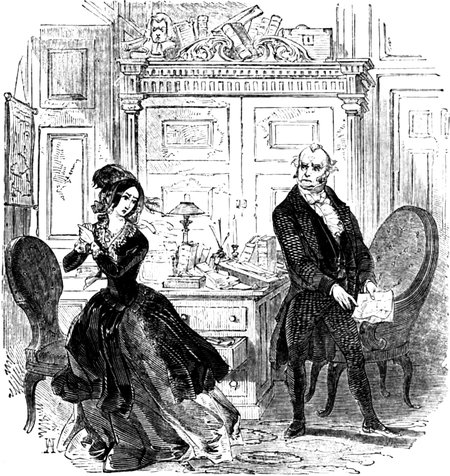
"Oh! this is, indeed, dreadful!" cried Cecilia. "Give me back that phial—or I will raise an alarm!"
"Foolish woman! Will you not be worth twenty thousand pounds!" ejaculated Reginald. "And fear not that you will be compromised. I shall leave upon this table a letter that will exculpate you from any suspicion of having been the bearer to me of the means of self-destruction—even if it be discovered who it was that visited me here as my alleged sister."
"This consideration on your part is truly generous, Reginald," said Cecilia, in whose breast the mention of the twenty thousand pounds had stifled all compunction.
"We must now part, Cecilia—part for ever," observed the rector. "Go—do not offer to embrace me—I could not bear it!"
"Then farewell, Reginald—farewell!" exclaimed Cecilia, who was not sorry to escape a ceremony which she had anticipated with horror—for the idea that her paramour was a murderer was ever present in her mind.
"Farewell, Cecilia," added the rector; and he turned his back to the door.
In another moment she was gone.
"Thank heaven that I was enabled to master my rage," cried Reginald, when he was once more alone. "Oh! how I longed to fall upon her—to tear her to pieces! The selfish harlot—as if I could not read her soul now—as if I were any longer her dupe. But I shall be avenged upon her—I shall be avenged! My death will be the signal of her exposure—my dissolution will be the beginning of her shame! Oh! deeply shall she rue every caress she has lavished upon me—every accursed wile that she practised to ensnare me! Her blandishments will turn to moans and tears—her smiles to the contortions of hell. The fascinating syren shall become the mark for every scornful finger. Fool that she is—to think I would die unavenged! If my existence be cut short suddenly—hers shall be dragged out in sorrow and despair."
Then the rector paced his cell, while from his breast escaped a hoarse sound like the low growling of a wild beast.
66But we will not dwell upon the wretched man's thoughts and words throughout that long day.
Evening came.
Six o'clock struck; and Reginald feared no farther interruption from the turnkeys.
He then sate down to write two letters.
Having occupied himself in this manner for a short time, he sealed the letters, and addressed them.
When this task was accomplished, he felt more composed and calm than he had done during the day.
He walked three or four times up and down his cell.
Then he fell upon his knees, and prayed fervently.
Yes—fervently!
Seven o'clock struck.
"Now is the hour!" he exclaimed, rising from his suppliant posture near the bed.
He took the bottle from his pocket: a convulsive shudder passed over him as he handled the fatal phial whose contents were to sever the chain which bound his spirit to the earth.
Then he felt weak and nervous; and he sate down.
"My courage is failing," he said to himself: "I must not delay another moment."
But he still hesitated for a minute!
"No—no!" he exclaimed, as if in answer to an idea which had occupied him during that interval; "there is no hope! My fate would be——the scaffold!"
This thought nerved him with courage to execute his desperate purpose.
He raised the phial to his lips, and swallowed the contents—greedy of every drop.
In a few seconds he fell from his chair—a heavy, lifeless mass—upon the floor of the dungeon.
CHAPTER CLXI. LADY CECILIA HARBOROUGH.
Cecilia passed a sleepless and agitated night.
Wild hopes and undefined fears had banished repose from her pillow.
She thought the morning would never come.
At length the first gleam of dawn struggled through the windows of her bed-room; and she instantly arose.
She was pale—yet fearfully excited; and there was a wildness in her eyes which denoted the most cruel suspense.
The minutes seemed to be hours; for she was now anxiously awaiting the arrival of the morning paper.
She descended to the breakfast parlour; but the repast remained untouched.
At length the well-known knock of the news-boy at the front door echoed through the house.
The moment the journal was placed on the table by her side, Cecilia took it up with trembling hands, and cast a hasty glance over its contents.
In another instant all suspense relative to the rector's fate ceased.
The following words settled that point beyond a doubt:—
"Shortly after eight o'clock last evening a rumour was in circulation, to the effect that the above-mentioned individual, whose name has so recently been brought before the public in connection with the murder of Matilda Kenrick, had put a period to his existence by means of poison. It appears that the turnkey, on visiting his cell, according to custom, at eight o'clock, found him stretched upon the floor, to all appearances quite dead. Medical aid was immediately procured; but life was pronounced by the gaol-surgeon to be totally extinct. We have been unable to learn any further particulars."
"It is better so, than to die upon the scaffold," said Cecilia to herself. "Now to the lawyer's: Reginald expressly told me that I was to call upon him this morning."
The heartless woman did not drop a tear nor heave a sigh to the memory of her paramour.
She rang the bell and desired the servant to fetch a cab without delay.
By the time it arrived Cecilia was ready.
During the rapid drive to the City, she arranged a thousand plans for the employment and enjoyment of the wealth which she believed herself to be now entitled to, and the bequest of which she was resolved to conceal from her husband.
When she alighted at the solicitor's door, she assumed a melancholy and solemn air, which she thought decorous under the circumstances.
The solicitor, who was an elderly man, and whose name was Wharton, received her in his private office, and politely inquired the nature of her business.
"Did you not expect a visit from Lady Cecilia Harborough this morning?" asked the frail woman.
"Lady Cecilia Harborough!" exclaimed the lawyer, his countenance assuming a severe tone the moment that name fell upon his ears. "Are you Lady Cecilia Harborough?"
"I am Lady Cecilia Harborough," was the reply.
"So young—and yet so powerful to work evil!" observed Mr. Wharton, in a musing tone, and with a sorrowful air.
"I do not understand you, sir," exclaimed Cecilia somewhat alarmed, yet affecting a haughty and offended manner.
"Do not aggravate your wickedness by means of falsehood," said the lawyer sternly. "Think you that I am a stranger to your connexion with that unhappy man who died by his own hands last night? I have known him for many years—I knew him when he was pure, honourable, and respected: I have seen him the inmate of a dungeon. The day before yesterday I was with him for the last time. He then revealed to me every particular connected with his fall. He told me how you practised your syren arts upon him—how you led him on, until he became an adulterer! He explained to me how he repented of his first weakness, and how you practised a vile—a detestable artifice, by the aid of an old hag in Golden Lane, to bring him back to your arms."
"Spare me this recital, sir, which has been so highly coloured to my prejudice," exclaimed Lady Cecilia. "I confess that I was enamoured of that unhappy man; but——"
"You cannot palliate your wickedness, madam," interrupted Mr. Wharton, sternly. "Mr. Tracy detailed to me every blandishment you used—every art you called into force to subdue him. And as for your love for him, Lady Cecilia Harborough—even that excuse cannot be advanced in extenuation of your infamy."
"Sir—that is a harsh word!" cried Cecilia, red with indignation, and starting upon her chair.
67"Nay, madam—sit still," continued the solicitor: "you may yet hear harsher terms from my lips. I say that you cannot even plead a profound and sincere attachment to that man as an excuse for the arts which you practised to ensnare and ruin him:—no, madam—it was his gold which you coveted!"
"Sir—I will hear no more—I——"
"Your ladyship must hear me out," interrupted the lawyer, authoritatively motioning her to retain her seat. "When alone in his gloomy cell, your victim pondered upon all that had passed between him and you, until he came to a full and entire comprehension of the utter hollowness of your heart. He then understood how he had been duped and deluded by you! Moreover, madam, it was by your desire that he admitted you into his own house—that fatal indiscretion which, being often repeated, at length led to the terrible catastrophe. Now, then, madam," cried Mr. Wharton, raising his voice, "who was the real cause of my friend's downfall? who was the origin of his ruin? who, in a word, is the murderess of Reginald Tracy?"
"My God!" ejaculated the wretched woman, quivering like an aspen beneath these appalling denunciations; "you are very severe—too, too harsh upon me, sir!"
"No, madam," resumed the lawyer; "I am merely placing your conduct in its true light, and giving your deeds their proper name. You had no mercy upon my unfortunate friend;—you sacrificed him to your base lust after gold;—you hurried him on to his doom. Why should I spare you? You have no claims upon my forbearance as a woman—because, madam, your unmitigated wickedness debars you from the privilege of your sex. To show courtesy to you, would be to encourage crime of the most abhorrent nature."
"Was it to be thus upbraided, sir—thus reviled," demanded Lady Cecilia, endeavouring to recover her self-possession, "that I was desired to call upon you this morning?"
"Desired to call upon me, madam!" exclaimed the solicitor: "who conveyed to you such instructions?"
"Mr. Tracy himself," answered Cecilia in a faint tone—for she now trembled lest Reginald had deceived her.
"Then my poor friend must have been aware of the reception which you would meet at my hands—of the stern truths that you would hear from my lips," said Mr. Wharton; "for to no other purpose could this visit have been designed."
"But—are there no written instructions—with which you may be as yet unacquainted—no papers, the contents of which you have not read——"
"Madam, I am at a loss to comprehend you," said the lawyer. "If you allude to any papers of Mr. Tracy's now in my hands, I can assure you that they bear no reference to any affairs in which you can possibly be interested."
"And you have read all those papers—every one—the last that was placed in your hands, as well as any others?" inquired Cecilia, in a tone of breathless excitement.
"Merciful heavens, madam!" ejaculated the lawyer, on whose mind a light seemed suddenly to break: "surely—surely you cannot be in expectation of a legacy or a boon from that man whom you hurried to his ruin—aye, even to murder and suicide? Surely your presumption is not so boundless as all that?"
Cecilia sank back, almost fainting in her chair: her sole hope was now annihilated; and in its stead there remained to her only the bitter—bitter conviction that she had been deceived by Reginald in that last transaction which took place between them.
"No, madam—no," continued the lawyer, with a smile of the most cutting contempt: "if that unhappy man had bequeathed you any thing, it would have been his curse—his withering, dying curse!"
"Oh! do not say that," screamed Cecilia, now really appalled by the energetic language of that man who was so unsparing in his duty to the memory of his friend.
"Ah! I am rejoiced that your ladyship at last feels the full force of that infamy which has accomplished the ruin of a man once so good, so upright, so honourable, so happy! But you are, no doubt, curious to know how your victim has disposed of that wealth of which you would have plundered him had he not been so suddenly stopped in his mad career? I will tell you. He has bequeathed it to that young girl who so nearly suffered for his crime—to Katherine Wilmot, who was so unjustly accused of the enormity which he perpetrated!"
Lady Cecilia wept with rage, shame, and disappointment.
"Weep, madam, weep," rang the iron voice of that stern denunciator once more in her ears: "weep—for you have good cause! Not for the wealth of the universe would I harbour the feelings which ought to be—must be yours at this moment."
A pause ensued, which was interrupted by the entrance of a clerk who whispered something in the lawyer's ear, and then withdrew.
"I request your ladyship to have the goodness to remain here until my return," said Mr. Wharton. "I shall not keep you long."
The lawyer passed into the outer office; and Cecilia was now alone.
The reader can scarcely require to be reminded that this lady was not one who was likely to remain long depressed by a moral lesson, however severe its nature.
Scarcely had the lawyer left her, when she raised her head, and thought within herself, "I have been deceived—cruelly deceived; and if I did Reginald any wrong, he is amply avenged. One thing seems certain—he has retained the secret of the means by which he obtained the poison. He has not compromised me there; or else this harsh man would have been only too glad to throw that also in my teeth. Thus, my position might have been worse!"
Such was the substance of Lady Cecilia Harborough's musing during the absence of the lawyer.
This absence lasted nearly a quarter of an hour; and then he returned to the office.
He held an open letter in his hand.
"Lady Cecilia Harborough," he said, in a tone of increased sternness, "the measure of your guilt is now so full, that justice demands an explanation at your hands."
"Justice, sir!" faltered the frail woman, an icy coldness striking to her heart.
"Yes, madam," answered the lawyer; "and even from the grave will the wrongs of Reginald Tracy cry out against you."
"My God! what do you mean?" she exclaimed, her pallor now becoming actually livid.
"Before Reginald Tracy took the poison which 68hurried him to his last account," continued the solicitor in a low and solemn tone, "he wrote two letters. These were found upon the table in his cell. One was to Katherine Wilmot—the other was to me. The governor of Newgate has just been with me, and has delivered to me this last communication from my poor friend."
"The governor of Newgate!" repeated Cecilia, now overwhelmed with vague terrors.
"Yes, madam: and the contents are to inform me that you—you, madam, with an assumed name, and passing yourself off as Mr. Tracy's sister, visited him twice in his cell, and, on the latter occasion, furnished him with the means of self-destruction."
"Heaven protect me! it is but too true!" cried Cecilia; and, throwing herself upon her knees before the lawyer, she almost shrieked the words, "You would not give me up to justice, sir—you will not betray me?"
"No, madam," answered Mr. Wharton; "I had punished you sufficiently when these tidings arrived."
"Thank you, sir—thank you," cried Cecilia, rising from her knees. "But the governor of Newgate——"
"Is gone, madam. I did not tell him that you were here. I must, however, warn you that I communicated to him, as in duty bound, the contents of this letter."
"Then he is aware that I——"
"He is aware that you conveyed the poison to Reginald Tracy; and the officers of justice will be in search of you in another hour," replied the lawyer, coldly.
"My God! what will become of me?" ejaculated Cecilia, now pushed to an extremity which she never had contemplated.
"I would not say that you were here, madam," continued the lawyer, "because Reginald Tracy had contemplated making me the means of handing you over to the grasp of justice; and I am sorry that he should so far have misunderstood me. I now comprehend why he directed you to come hither. He thought that his letter would reach me earlier—before you came, and that I should be the willing instrument of his vengeance. I will not show you the letter, because he has mistaken me—he has misunderstood me; and for this reason alone—and for no merciful feeling towards you—have I shielded you thus far. Now go, madam: when once you are away from this house, you must adopt the best measures you can devise to ensure your safety."
"But can you not counsel me, sir—will you not direct me how to act?" cried Cecilia: "I am bewildered—I know not what step to take!"
"I have no counsel to offer, madam," returned the lawyer, briefly.
Cecilia could not mistake the meaning conveyed by this tone.
She rose; and bowing in a constrained manner to the solicitor, left the office.
But when she found herself in the street, she was cruelly embarrassed how to act.
She dared not return home; the paternal door had long been closed against her; she had not a friend—and she had not a resource.
A few sovereigns in her purse were all her available means.
She thought of quitting the country at once, and proceeding to join her husband, whom she knew to be in Paris.
But how would he receive her? The newspapers would soon be busy with her name; and Sir Rupert was not the man to burden himself with a woman penniless in purse and ruined in reputation.
For an instant she thought of Greenwood; but this idea was discarded almost as soon as entertained. She was aware of his utter heartlessness, and felt confident that he would repulse her coldly from his dwelling.
To whom could she apply? whither was she to betake herself?
And yet concealment was necessary—oh! she must hide somewhere!
The feelings of this woman were terrible beyond description.
And now she was walking rapidly along the streets towards London Bridge; for the idea of quitting the country was uppermost in her mind.
Her veil was drawn carefully over her countenance; and yet she trembled at every policeman whom she passed.
She was hurrying down Gracechurch Street, when she heard herself called by name.
She knew the voice, and turned round, saying to herself, "Help may come from this quarter!"
It was the old hag who had spoken to her.
"My good woman," said Lady Cecilia hastily, "all is known—all is discovered!"
"What is known?" asked the old hag, in her usual imperturbable tone.
"It is known that I conveyed the poison, which you procured for me, to Reginald Tracy," replied Cecilia, in a hoarse whisper. "You have heard that he is dead?"
"I heard that last evening," said the hag. "What are you going to do?"
"To hide myself from the officers of justice," returned Cecilia. "But step into this court, or we shall be observed."
The old woman followed the unhappy lady under an archway.
"I must conceal myself—at least for the present," resumed Cecilia. "Will you grant me an asylum?"
"I! my dear lady!" ejaculated the hag, shaking her head ominously: "I am in danger myself—I am in danger myself! Did I not procure you the poison?"
"True. But I would not betray you."
"No—we must each shift for ourselves—we must each shift for ourselves, as best we can," replied the hag flatly. "Indeed, I may as well remind you, Lady Cecilia, that your day is gone—you are ruined—and, if you had any spirit, you would not survive it!"
"My God! what do you mean?" faltered Cecilia, in a faint tone.
"The river is deep, or the Monument is high," answered the hag, in a significant tone; "and you are near both!"
The wrinkled old harridan then hobbled out of the court as quickly as her rheumatic limbs would carry her.
"Even she deserts me!" murmured Cecilia to herself, and with difficulty suppressing an ebullition of feeling which would have attracted notice, and probably led to her detection: "even she deserts 69me! My God—is there nothing left to me but suicide? No—nothing!"
Her countenance wore, beneath her veil, an expression of blank despair, as she arrived at this appalling conviction; and for some moments she stood as if rooted to the spot.
"No—nothing left but that," she murmured, awaking from her temporary stupefaction: "nothing—nothing!"
And although these words were uttered in the lowest whisper, still it seemed as if she shrieked them within herself.
Then she hurried from the court.
"The river—or the Monument," she said, as she continued her rapid way: "the river is near—but the Monument is nearer. Drowning must be slow and painful—the other will be instantaneous. From the river I might be rescued; but no human power can snatch me from death during a fall from that dizzy height."
And she glanced upwards to the colossal pillar whose base she had now reached.
At that moment two men, evidently belonging to the working classes, passed her.
A portion of their conversation met her ears.
"And so she was not his sister, then?" said one.
"No such thing," replied the other. "I heard the governor of Newgate tell all about it to one of the City officers scarcely half an hour ago. The governor was coming out of a lawyer's house—Tracy's lawyer, I believe—and the City officer was waiting for him at the door. He then told him that it was a lady of fashion—with a name something like Cecilia Scarborough, I think——"
The men were now too far for the wretched woman to hear any more of their conversation.
"Merciful heavens!" she said, scarcely able to prevent herself from wringing her hands; "even at this moment I am not safe!"
Then, without farther hesitation, she passed round the base of the Monument, and crossed the threshold.
"Sixpence, if you please, ma'am," said the man who received the fees from visitors.
Lady Cecilia exercised an almost superhuman power over her distracted feelings, so as to appear composed, while she drew forth the coin from her purse.
"It's a fine day to view London, ma'am," said the man, as he took the money.
"Beautiful," answered Cecilia.
She then began the tedious ascent.
And now what awful emotions laboured in her breast as she toiled up that winding staircase.
"My God! my God!" she murmured to herself; "is it indeed come to this?"
Once she was compelled to stop and lean against the wall for support.
Then she wrung her hands in agony—indescribable agony of mind.
"And yet there is no alternative!" she thought; "none—none! But my mother—my poor mother! what will be her feelings? Oh! better to know that I am dead, than an inmate of Newgate!"
And, somewhat encouraged in her dreadful purpose by this idea, she pursued her way.
In a few moments the fresh air blew in her face.
She was near the top!
A dozen more steps—and the brilliant sun-light burst upon her eyes.
It was indeed a lovely morning; and the Thames appeared like a huge serpent of quicksilver, meandering its way amidst the myriads of buildings that stretched on either side, far as the eye could reach.
The din of the huge city reached the ears of the wretched woman who now stood upon that tremendous eminence.
All was life—bustle—business—activity below!
And above was the serene blue sky of an early spring, illuminated by the bright and cloudless sun.
"But yesterday," thought Cecilia, as she surveyed the exciting scene spread beneath her, "had any one said to me, 'Thou wilt seek death to-morrow,' I should have ridiculed the idea. And yet it has come to this! Oh! it is hard to quit this world of pleasure—to leave that city of enjoyment! Never more to behold that gorgeous sun—never more to hear those busy sounds! But if I hesitate, my heart will turn coward; and then—Newgate—Newgate!"
These last words were uttered aloud in the shrill and piercing tones of despair.
She clasped her hands together, and prayed for a few moments.
Then, as if acting by a sudden impulse,—as if afraid to trust herself with the thoughts that were crowding into her mind,—she placed her hands upon the railing.
One leap—and she stood upon the rail.
For a single instant she seemed as if she would fall backwards upon the platform of the Monument; and her arms were agitated convulsively, like the motions of one who endeavours to gain a lost balance.
Then she sprang forwards.
Terrific screams burst from her lips as she rolled over and over in her precipitate whirl.
Down she fell!
Her head dashed against the pavement, at a distance of three yards from the base of the Monument.
Her brains were scattered upon the stones.
She never moved from the moment she touched the ground:—the once gay, sprightly, beautiful patrician lady was no more!
A crowd instantaneously collected around her; and horror was depicted on every countenance, save one, that gazed upon the sad spectacle.
And that one wretch who showed no feeling, was the old hag of Golden Lane.
"She cannot now betray me for procuring the poison," thought the vile harridan, as she calmly contemplated the mangled corpse at her feet.
CHAPTER CLXII. THE BEQUEST.
Two days after the suicide of Lady Cecilia Harborough,—an event which created a profound sensation in the fashionable world, and plunged the Tremordyn family into mourning,—Richard Markham was a passenger in a coach that passed through Hounslow.
At this town he alighted, and inquired the way to the residence of Mr. Bennet, a small farmer in the neighbourhood.
A guide was speedily procured at the inn; and after a pleasant walk of about three miles, across a 70country which already bore signs of the genial influence of an early spring, Richard found himself at the gate of a comfortable-looking farm-house.
He dismissed his guide with a gratuity, and was shortly admitted by a buxom servant-girl into a neat little parlour, where he was presently joined by Katherine.
The young maiden was rejoiced to see her benefactor; and tears started into her eyes, though her lips were wreathed in smiles;—but they were tears of pleasure and gratitude.
"This is kind of you, Mr. Markham," she said, as he shook her hand with friendly warmth.
"I am come to see you upon important business, Katherine," observed Richard. "But first let me inquire after the good people with whom you reside?"
"I am sorry to say," answered Katherine, "that Mrs. Bennet experienced a relapse after her return from London; and she is not able to leave her chamber. She is, however, much better. Her husband is a kind-hearted, good man, and he behaves like a father to me. He is now occupied with the business of his farm, but will be in presently."
"And now, Katherine, listen to the tidings which I have to communicate," said Markham. "Have you received any news from London within the last day or two?"
"No—not a word," returned Katherine, already alarmed lest some new misfortune was about to be announced to her.
"Compose yourself," said Richard; "the news that I have for you are good. But first I must inform you that your late master, Mr. Reginald Tracy, is no more."
"Dead!" exclaimed Katherine.
"He put a period to his own existence," continued Markham; "but not before he made you all the amends in his power for the deep injury which his own guilt entailed upon you."
"Then he confessed his crime, and thus established my innocence beyond all doubt?" said Katherine.
"And he has bequeathed to you his whole fortune, with the exception of a small legacy to Mrs. Bennet, whom his guilt deprived of a sister," added our hero.
"Oh! then he died penitent!" exclaimed Katherine, weeping—for her goodness of heart prompted her to shed tears even for one who had involved her in such a labyrinth of misery as that from which she had only so recently been extricated.
"He died by his own hands," said Richard; "and the world will not generally admit that such an act can be consonant with sincere penitence. That he attempted to make his peace with heaven ere he rushed into the presence of the Almighty, let us hope:—that he did all he could to recompense those whom his crime had injured, is apparent. But this letter will probably tell you more on that head."
Richard handed to Katherine a letter, as he uttered these words.
It was addressed, "Miss Katherine Wilmot."
With a trembling hand the young girl opened it; and with tearful eyes she read the following words:—
"To you, Katherine Wilmot, a man about to appear before his Maker appeals for pardon. That man is deeply imbued with a sense of the injury—the almost irreparable injury which his enormous guilt caused you to sustain. But in confessing that this guilt was all and solely his own,—in proclaiming your complete innocence,—and in offering you the means of henceforth enjoying independence, and fulfilling the dictates of your charitable disposition,—that great criminal entertains a hope that you will accord him your forgiveness, and that you will appreciate his anxiety to do you justice in his last moments. My solicitor is already acquainted with my intentions; and he will faithfully execute my wishes. This letter will be forwarded to him, to be delivered to you, through your benefactor—that noble-hearted young man, Mr. Richard Markham. The bulk of my fortune, amounting to eighteen thousand pounds, I have made over to my solicitor in trust for yourself, and under certain conditions which I have devised exclusively for your benefit. The sum of five hundred pounds I have, in addition, bequeathed to Rachel Bennet, with the hope that she will extend her pardon also to the man who deprived her of an affectionate sister. This letter is written in a hurried manner, and under circumstances whose appalling nature you may well conceive. May heaven bless you! Refuse not to pray for the soul of
Katherine perused this letter, and then handed it to Richard Markham.
While he read it, the young maiden prayed inwardly but sincerely for the eternal welfare of him whose course had been dazzling like a meteor, but had terminated in a cloud of appalling blackness.
"Those conditions, to which the unhappy man alluded, I can explain to you," said Richard, after a long interval of silence, during which he allowed Katherine to compose her thoughts. "This letter was placed in the hands of Mr. Tracy's solicitor, by the governor of Newgate, the day before yesterday. The lawyer immediately wrote to me, being unacquainted with your address. I saw him yesterday afternoon; and he gave me the letter to convey to you, entrusting me at the same time with the duty of communicating to you this last act of Reginald Tracy. Mr. Wharton acquainted me with the conditions which Mr. Tracy had named. These are that you shall enjoy the interest of the money until you attain the age of twenty-one, when the capital shall be placed at your whole and sole disposal; but should you marry previous to that period, then the capital may also be transferred to your name. And now I must touch upon a more delicate point—inasmuch as it alludes to myself. Mr. Tracy was pleased to place such confidence in me, as to have stipulated that should you contract any marriage previous to the attainment of the age of twenty-one, without my approval of the individual on whom you may settle your affections, you will then forfeit all right and title to the fortune, which is in that case to be devoted to purposes of charity specified in the instructions given by Mr. Tracy to his solicitor."
"Oh! I should never think of taking any step—however trivial, or however important—without consulting you, as my benefactor—my saviour!" exclaimed Katherine.
"You are a good and a grateful girl, Katherine," said Richard; "and never for a moment did I mistake your excellent heart—never did I lose my confidence in your discretion and virtue."
"No—for when all the world deserted me," said the maiden, "you befriended me!"
"I have yet other matters of business to consult you upon," continued Markham. "Yesterday evening your uncle called upon me. Never—never have I seen such an alteration so speedily wrought in any living being! He said that certain representations which I had made to him at the tavern in the 71Old Bailey, after you had departed with Mrs. Bennet, had induced him to reflect more seriously upon the course of life which he had been for years pursuing."
"Oh! these news are welcome—welcome indeed!" ejaculated Katherine, clasping her hands together in token of gratitude.
"I communicated to him your good fortune, Katherine," proceeded Markham; "and he wept like a child."
"Poor uncle! His heart was not altogether closed against me!" murmured Katherine.
"I desired him to call upon me to-morrow, and I assured him that in the meantime I would devise some project by which he should be enabled to earn a livelihood whereof he need not be ashamed."
"You are not content with being my benefactor, Mr. Markham: you intend to make my relatives adore your name!" cried Katherine, her heart glowing with gratitude towards our hero.
"I now intend that you shall be the means of doing good, Katherine," said Richard, with a smile.
"Oh! tell me how!" exclaimed the amiable girl, joyfully.
"You shall draw upon the first year's interest of your fortune, for a sufficient sum to enable your uncle to retire to some distant town, where, under another name, he may commence a business at whose nature he will not be forced to blush."
"Oh! that proposal is indeed a source of indescribable happiness to me," said Katherine.
"Then I will carry the plan into effect to-morrow," continued Richard. "Your uncle and cousin shall both visit you here, when they leave London."
"Poor John!" said Katherine. "Do you think that his father——"
"Will treat him better in future?" added Markham, seeing that the maiden hesitated. "Yes: I will answer for it! A complete change has taken place in your uncle: he is another man."
"He contemplated your benevolence, and he could not do otherwise than be struck by the example," said Kate.
"I asked him if he desired you to live with him in future; and he replied, 'Not for worlds!' He then continued to say that dwell where he might, conceal his name how he would, there would be danger of his ancient calling transpiring; and he would not incur the chance of involving you in the disgrace that might ensue. This consideration on his part speaks volumes in favour of that change which has been effected within him."
"The tidings you have brought me concerning my uncle, Mr. Markham," said Katherine, "far outweigh in my estimation the news of my good fortune."
"Your uncle and your cousin will yet be happy—no doubt," observed Richard. "In reference to yourself, what course would you like to adopt? Would you wish me to seek some respectable and worthy family in London, with whom you can take up your abode in entire independence? or——"
"Oh! no—not London!" exclaimed Katherine, recoiling from the name in horror.
"My counsel is that you remain here—in this seclusion,—at least for the present," said Richard. "The tranquillity of this rural dwelling—the charms of the country—the unsophisticated manners of these good people, will restore your mind to its former composure, after all you have passed through."
"This advice I have every inclination to follow," said Katherine; "and even were I otherwise disposed—which I could not be—your counsel would at once decide me."
"Remember, Katherine," resumed Markham, "I do not wish you to pass the best portion of your youth in this retirement. With your fortune and brilliant prospect, such a proceeding were unnatural—absurd. I only feel desirous that for a short time you should remain afar from society—until recent events shall be forgotten, and until your own mind shall become calm and relieved from the excitement which past misfortunes have been so painfully calculated to produce."
"I will remain here until you tell me that it is good for me to go elsewhere," said Katherine.
At this moment an old man, dressed in a rustic garb, but with a good-natured countenance and venerable white hair, entered the room.
This was the farmer himself.
Katherine introduced Richard to him as her benefactor; and the old man shook hands with our hero in a cordial manner, saying at the same time, "By all I have heard Miss Kate tell of you, sir, you must be an honour to any house, whether rich or poor, that you condescend to visit."
Richard thanked the good-natured rustic for the well-meant compliment, and then communicated to him the fact that his wife was entitled to a legacy of five hundred pounds, which would be paid to her order in the course of a few days.
The old man was overjoyed at these tidings, although his countenance partially fell when he heard the source whence the bequest emanated; but Richard convinced him that it would be unwise and absurd to refuse it.
Mr. Bennet hastened up-stairs to communicate the news to his wife.
While he was absent, the farmer's servant-girl entered to spread the table for the afternoon's repast.
On the return of the old man to the room, the dinner was served up; and our hero sat down to table with the farmer and Katherine.
A happy meal was that; and in the pure felicity which Katherine now enjoyed, Richard beheld to a considerable extent the results of his own goodness. How amply did the spectacle of that young creature's happiness reward him for all that he had done in her behalf!
It was four o'clock in the afternoon when our hero took his leave of the old farmer and Miss Wilmot, in order to retrace his steps to Hounslow.
CHAPTER CLXIII. THE ZINGAREES.
The old farmer had offered to convey Richard to Hounslow in his own spring-cart, or to provide him with a guide to conduct him thither; but our hero felt so confident of being enabled to find his way back to the town, that he declined both offers.
He walked on, across the fields, pondering upon various subjects,—Isabella, his brother, Katherine, Reginald Tracy's crimes, and the frightful suicide of Lady Cecilia Harborough,—and with his mind so 72intent upon these topics, that some time elapsed ere he perceived that he had fallen into a wrong path.
He looked around; but not an object of which he had taken notice in the morning, when proceeding to the farm, could he now discover.
Thus he had lost the only means which could assist his memory in regaining the road.
As he stood upon a little eminence, gazing around to find some clue towards the proper direction which he should follow, a light blue wreath of smoke, rising from behind a hill at a short distance, met his eyes.
"There must be a dwelling yonder," he said to himself; "I will proceed thither, and ask my way; or, if possible, obtain a guide."
Towards the light blue cloud which curled upwards, Markham directed his steps; but when he reached the brow of the hill, from the opposite side of which the smoke at first met his eye, he perceived, instead of a cottage as he expected, an encampment of gipsies.
A covered van stood near the spot where two men, two women, and a boy were partaking of a meal, the steam of which impregnated the air with a powerful odour of onions.
The caldron, whence the mess was served up in earthenware vessels, was suspended by means of stakes over a cheerful wood-fire.
We need attempt no description of the persons of those who were partaking of the repast: it will be sufficient to inform the reader that they consisted of King Zingary, Queen Aischa, Morcar, Eva, and this latter couple's son.
They were, however, totally unknown to Richard: but the moment he saw they were of the gipsy tribe, he determined to glean from them any thing which they might know and might choose to reveal concerning the Resurrection Man.
He therefore accosted them in a civil manner, and, stating that he had lost his way, inquired which was the nearest path to Hounslow.
"It would be difficult to direct you, young gentleman, by mere explanation," answered Zingary, stroking his long white beard in order to impress Richard with a sense of veneration; "but my grandson here shall show you the way with pleasure."
"That I will, sir," exclaimed the boy, starting from the ground, and preparing to set off.
"But perhaps the gentleman will rest himself, and partake of some refreshment," observed Morcar.
"If you will permit me," said Markham, whose purpose this invitation just suited, "I will warm myself for a short space by your cheerful fire; for the evening is chilly. But you must not consider me rude if I decline your kind hospitality in respect to food."
"The gentleman is cold, Morcar," said Zingary: "produce the rum, and hand a snicker."
The King's son hastened to the van to fetch the bottle of spirits; and Markham could not help observing his fine, tall, well-knit frame, to which his dark Roman countenance gave an additional air of manliness—even of heroism.
Richard partook of the spirits, in order to ingratiate himself with the gipsies; and King Zingary then called for his "broseley."
"You appear to lead a happy life," observed Richard, by way of encouraging a conversation.
"We are our own masters, young gentleman," answered Zingary; "and where there is freedom, there is happiness."
"Is it true that your race is governed by a King?" asked Markham.
"I am the King of the united races of Bohemians and Egyptians," said Zingary, in a stately manner. "This is my beloved Queen, Aischa: that is my son, Morcar; here is my daughter-in-law, Eva; and that lad is my grandson."
Richard started when these names fell upon his ears; for they had been mentioned to him by Skilligalee in the Palace of the Holy Land. He also remembered to have been informed that it was in consequence of something which the Resurrection Man told Aischa, when she was attending to his wound, that the gipsies took him with them when they removed from the Palace to the encampment near the Penitentiary at Pentonville.
"I feel highly honoured by the hospitality which your Majesty has afforded me," said Richard, with a bow—an act of courtesy which greatly pleased King Zingary. "On one occasion I was indebted to some of your subjects for a night's lodging at your establishment in St. Giles's."
"Indeed!" exclaimed the King; and now all the gipsies surveyed Richard with some interest.
"Yes," continued our hero; "and I may as well state to you frankly and candidly under what circumstances I became your guest—for you were all inmates of the house at the time I entered it."
"Speak, young gentleman," said Zingary: "we will listen with attention to all you may please to tell us; but we do not seek your confidence of our own accord, as curiosity is forbidden to our race."
"I must inform you," resumed Richard, "that I have sustained great and signal injuries at the hands of a miscreant, whom I one night traced to your dwelling in St. Giles's."
"Call it the Palace, young gentleman," said Zingary, smoking his pipe, and listening with great complacency.
"On that night, the man to whom I allude was desperately wounded——"
"Ah!" ejaculated the gipsies, as it were in a breath.
"And you removed him with you, away from the Palace during the night—or rather very early in the morning."
"Then you, young gentleman," said the King, "were the stranger whom the porter locked in the room to which you were shown, and who escaped from the Palace by some means or other? The matter was duly reported to us by letter."
"It is perfectly true that I liberated myself from the room in which I was imprisoned," said Markham. "But, answer me—I implore you—one question; did that vile man die of the wound which he received?"
"Before I reply to you," observed Zingary, "you will have the goodness to inform me why you left the Palace by stealth on that occasion, and whether you saw or heard any thing remarkable after we had taken our departure?"
"I will answer you frankly," returned Markham. "I left my room on that occasion, because I wished to discover whether Anthony Tidkins, to whom I have alluded, was in the house——"
"The Palace," said Zingary.
"I beg your Majesty's pardon—the Palace," continued Richard; "and I thank God that I was more 73or less instrumental in releasing from a horrible dungeon a poor woman——"
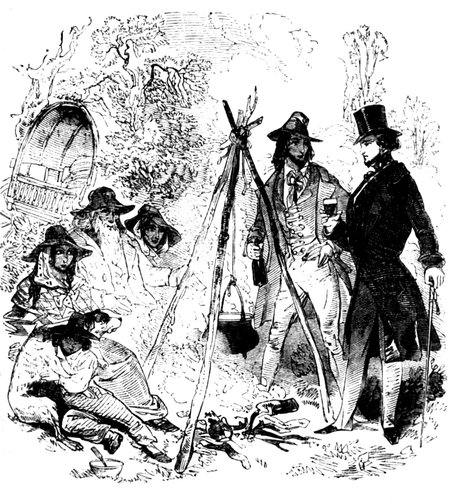
"We know whom you mean," interrupted Zingary, sternly. "Did you see a tall young man——"
"Who called himself by the strange name of Skilligalee?" added Markham, concluding the King's question for him. "I did;—I helped him to release that woman he named Margaret."
"And whom the laws of the Zingarees had condemned to the penalty from which you freed her," said the King. "Was it right, young man, thus to step between the culprit and the decree of justice?"
"I acted in accordance with the dictates of humanity," replied Richard firmly; "and under such circumstances I should act in a similar way again."
"The young gentleman speaks well," said Morcar, who admired the resolution evinced in our hero's tone and manner.
"And he showed a good heart," observed Eva, now speaking for the first time since Richard's arrival, and displaying her brilliant teeth.
"Well—well," exclaimed Zingary: "I will not upbraid the young man more, since even my pretty Eva takes his part. You see," he continued, addressing himself especially to the gipsies, "it is as we thought. Skilligalee deserted us in order to liberate Margaret Flathers. I always believed that such was the case, from the moment we received the account of her escape. But I have one more question to ask our guest. Let him satisfy us how he traced Anthony Tidkins to the Palace, and how he learnt that Anthony Tidkins was wounded in the Palace."
"On that head I must remain silent," said Richard. "I will not invent a falsehood, and I cannot reveal the truth. Be you, however, well assured that I never betrayed the secrets and mysteries of your establishment in Saint Giles's."
"Our guest is an honourable man," observed Morcar. "We ought to be satisfied with what he says."
"I am satisfied," exclaimed the King. "Aischa, answer you the questions which it is now the young man's turn to put to us."
"I wish to know whether Anthony Tidkins died of the wound which he received?" said Richard.
74"It was my lot to attend to his wound," began Aischa. "When he was so far recovered as to be able to speak—which was about half an hour after the blood was stanched—he implored me to have him removed from the Palace. He told me a long and pathetic story of persecutions and sufferings which he had undergone; and he offered to enrich our treasury if we would take him beyond the reach of the person who had wounded him. His anxiety to get away was extreme; and it was in consequence of his representations and promises that I prevailed upon the King to issue orders to those who were to leave London with us, to hurry the departure as much as possible. That accounts for the abrupt manner in which we left at such an hour, and for the removal of the wounded man with us. In answer to your direct question, I must inform you that he did not die of the wound which he received."
"He did not die!" repeated Markham. "Then he is still alive—and doubtless as active as ever in purposes of evil."
"Is he such a bad man?" asked Aischa.
"He belongs to the atrocious gang called Burkers," answered Richard emphatically.
"Merciful heavens!" cried Eva, with a shudder. "To think that we should have harboured such a wretch!"
"And to think that I should have devoted my skill to resuscitate such a demon!" exclaimed Aischa.
"The vengeance of the Zingarees will yet overtake him," said the King calmly.
"Wherever I meet him, there will I punish him with the stoutest cudgel that I can find ready to hand," cried Morcar, with a fierce air.
"Have you then cause to complain against him?" asked Richard.
"The wretch, sir," answered Morcar, "remained nearly a month in our company, until his wound was completely healed by the skill of my mother. We treated him with as much kindness as if he had been our near and dear relative. One morning, when he was totally recovered, he disappeared, carrying away my father's gold with him."
"The ungrateful villain!" ejaculated Richard. "And he was indebted to your kindness for his life?"
"He was," returned Morcar." Fortunately there was but little in the treasury at the time—very little;—nevertheless, it was all we had—and he took our all."
"And you have no trace of him?" said Richard, eagerly.
"Not yet," replied Morcar. "But we have adopted measures to discover him. The King my father has sent a description of his person and the history of his treachery to every chief of our race in the kingdom; and thousands of sharp eyes are on the look-out for him through the length and breadth of the land."
"Heaven be thanked!" exclaimed Markham. "But when you discover him, hand him over to the grasp of justice, and instantly acquaint me with the fact."
"The Zingarees recognise no justice save their own," said the King, in a dignified manner. "But this much I promise you, that the moment we obtain a trace of his whereabouts, we will communicate it to you, and you may act as seemeth good to yourself. We have no sympathy in common with a cowardly murderer."
"None," added Morcar, emphatically.
"I thank you for this promise," said Richard, addressing himself to the King. "Here is my card; and remember that as anxious as I am to bring a miscreant to justice, so ready shall I be to reward those who are instrumental in his capture."
"You may rely upon us, young gentleman," said Zingary. "We will not shield a man who belongs to the miscreant gang of Burkers. To-morrow morning I will issue fresh instructions to the various district chiefs, but especially to our friends in London."
"And is it possible that, with no compulsory means to enforce obedience, you can dispose of thousands individuals at will?" exclaimed Markham.
"Listen, young man," said the King, stroking his beard. "When the great Ottoman monarch, the Sultan Selim, invaded Egypt at the beginning of the sixteenth century, and put to death the Mameluke sovereign Toumanbai,—when the chivalry of Egypt was subdued by the overwhelming multitudes of warriors who fought beneath the banner of Selim and his great Vizier Sinan-Pacha,—then did a certain Egyptian chief place himself at the head of a chosen body of Mamelukes, and proclaim death and destruction to the Ottomans. This chief was Zingarai. For some time he successfully resisted the troops of Selim; but at length he was compelled to yield to numbers; and Selim put him to death. His followers were proscribed; and those who did not fall into the hands of the Turkish conquerors escaped into Europe. They settled first in Bohemia, where their wandering mode of life, their simple manners, their happy and contented dispositions, and their handsome persons soon attracted notice. Then was it that the Bohemian maidens were proud to bestow their hands upon the fugitive followers of Zingarai; and many Bohemian men sought admittance into the fraternity. Hence the mixed Egyptian and Bohemian origin of the gipsy race. In a short time various members of this truly patriarchal society migrated to other climes; and in 1534 our ancestors first settled in England. Now the gipsy race may be met with all over the globe: in every part of Asia, in the interior of Africa, and in both the Americas, you may encounter our brethren, as in Europe. The Asiatics call us Egyptians, the Germans Ziguener, the Italians Cingani, the Spaniards Gitanos, the French Bohemians, the Russians Saracens, the Swedes and Danes Tartars, and the English Gipsies. We most usually denominate ourselves the united races of Zingarees. And Time, young gentleman, has left us comparatively unchanged; we preserve the primitive simplicity of our manners; our countenances denote our origin; and, though deeply calumniated—vilely maligned, we endeavour to live in peace and tranquillity to the utmost of our power. We have resisted persecution—we have outlived oppression. All Europe has promulgated laws against us; and no sovereigns aimed more strenuously to extirpate our race in their dominions than Henry the Eighth and Elizabeth of England. But as the world grows more enlightened, the prejudice against us loses its virulence; and we now enjoy our liberties and privileges without molestation, in all civilised states."
"I thank you for this most interesting account of your origin," said Richard.
"Henceforth you will know how to recognise the real truth amongst all the wild, fanciful, and ridiculous tales which you may hear or read concerning 75our race," proceeded Zingary. "From the two or three hundred souls who fled from Egypt and took refuge in Bohemia, as I have ere now explained to you, has sprung a large family, which has increased with each generation; and at the present moment we estimate our total number, scattered over all parts of the earth, at one million and a half."
"I was not aware that you were so numerous," said Richard, much interested by these details. "Permit me to ask whether the members in every country have one sovereign or chief, as those in England?"
"There is a King of the Zingarees in Spain; another in France; a third in Italy; and a fourth in Bohemia. In the northern provinces of European Turkey, in Hungary, and in Transylvania, there is a prince with the title of a Waiewode: the Zingarees of Northern Europe are governed by a Grand, or Great Lord."
Richard now rose to take leave of the hospitable and entertaining family in whose society he had thus passed an hour; and, as it was growing dark, Morcar himself offered to conduct our hero as far as Hounslow.
This proposal was gladly accepted; and Markham, having taken leave of the King, Aischa, and Eva, set out with Morcar.
In the course of three-quarters of an hour they reached the precincts of the town.
Richard forced a handsome remuneration upon the gipsy, and reminded him of the promise made by his father concerning the Resurrection Man.
"You may rely upon us," said Morcar: "it cannot be very long before you will hear from us, for there are many on the alert to discover the haunt of the villain."
The gipsy then turned to retrace his steps towards the encampment; and Richard proceeded to the inn, where he obtained a conveyance for London.
CHAPTER CLXIV. THE EXECUTIONER'S HISTORY.
On the following evening Smithers presented himself, according to appointment, at Markham Place.
Richard received him in the library, and treated him altogether with a condescension and a degree of kindness which made a deep impression on the mind of the executioner.
Our hero then proceeded to acquaint him with the good fortune of Katharine, and the arrangement which had been made to supply him with the means to establish him in business.
"But do not imagine that this is all which you are to expect at Katherine's hands," said Richard. "As time progresses, and I find that you are determined not only to persevere in a respectable course of life, but also to make amends, by your altered manner, for the harshness which you have exhibited towards your son on so many occasions,—it will be my pleasing duty to recommend Katherine's trustee, who is disposed to place implicit confidence in me, to grant you such occasional pecuniary succour as may enable you to extend the business, whatever it may be, in which you intend to embark."
"I cannot find words to express my gratitude to you, sir," said Smithers; "and I hope that when you see Kate again, you will ask her forgiveness in my name for all the unkindness I have shown her at different times."
"You shall see her yourself—she wishes you and your son to call upon her," answered Richard; "and Mr. Bennet, to whom I communicated every thing, has sent you both an invitation to pass an entire day at his farm so soon as you can find leisure to avail yourself of the offer."
"Then that shall be to-morrow, sir," exclaimed Smithers; "for now that Katherine has such good prospects, I may as well communicate something to her which she probably will not regret to hear."
And for a few moments Smithers appeared to be absorbed in deep thought.
"And I don't know why I should keep any secret away from you, sir," he continued, suddenly breaking silence; "you have done so much for Kate, and you have produced so great a change in my mind, that I ought to conceal nothing from you. In one word, then, sir—Katherine Wilmot is no more my niece than she is yours."
"Not your niece!" ejaculated Richard.
"No relation whatever in the world to me," replied Smithers. "I never had either brother or sister; neither had my wife: and thus you see, sir, Kate cannot be my niece."
"But she believes herself to be so related to you," said Markham, who was not altogether displeased to learn that the young female for whom he experienced a fraternal interest, was not even a connexion of the Public Executioner.
"The story is somewhat a long one—and to me a melancholy subject," continued Smithers; "but if you will have patience to listen to it, I shall have nerve to relate it."
"Proceed," said Markham. "I feel deeply interested in the topic which now occupies us."
"You will then excuse me, sir, if I begin by telling you something about myself," resumed Smithers; "because it is more or less connected with Kate's early history."
Smithers settled himself in a comfortable position in his chair, and then related the following history:—
"My father was a grocer, in a large way of business, at Southampton. He was a widower; and I was his only son. I was considered to be a steady, exemplary young man; and I can safely say that I attended studiously to my father's business. I never frequented public-houses, but went to church regularly of a Sunday, and was fond of reading good books. Next door to us there lived a corn-dealer of the name of Wilmot;—he also was a widower, and had one child. This was a beautiful girl, about a year or two younger than myself, and whose name was Harriet. The two families had been acquainted for a long, long time; and Harriet and myself were playmates in our infancy. We were therefore very intimate together; and the friendship of childhood ripened into love as we grew up. And, oh! how I did adore that girl! From amidst all the coarse, worldly, and abominable ideas which have of late years crowded in my brain, I have ever singled out that one bright—pure—and holy sentiment as a star that points to a blissful episode in my life. And she loved me in return! Our parents were pleased when they saw our attachment; and it was understood that our marriage should take place on the day that I attained my one-and-twentieth year. It only wanted seven or eight months to that period, 76when an event occurred which quite changed the prospect of affairs. The local bank failed, and old Wilmot was ruined."
Smithers paused for a moment, heaved a deep sigh, and then continued thus:—
"Wilmot immediately came to my father and addressed him in these words: 'The failure of the bank will throw me into the Gazette, if I cannot raise twelve or fifteen hundred pounds within a week to sustain my credit. That difficulty being overcome, I have no doubt of retrieving myself altogether.' My father expressed his great delight at hearing this latter announcement, but instinctively buttoned up his breeches-pockets. Wilmot proceeded to state that he could raise the sum he required if my father would guarantee its repayment. My father was a money-making, close man; and this proposal astounded him. He refused it point blank: Wilmot begged and implored him to save him from ruin;—but all in vain. In the course of ten days the name of Joseph Wilmot, corn-dealer, figured in the list of Bankrupts."
Again Smithers paused for a few moments.
"I must tell you, sir," he continued, "that I did all I could to persuade my father to help Wilmot in this business; but my prayers and entreaties had been poured forth entirely without effect. I, however, took an opportunity of seeing Harriet, and assuring her that my affection was based upon no selfish motive, but that her father's misfortunes endeared her more than ever to me. My father viewed matters in quite a different light, and spoke to me openly of the impossibility of my marrying a girl without a penny. I remonstrated with him on the cruelty, injustice, and dishonour of such conduct; but he cut me very short by observing that 'his money was his own—he had made it by his industry—he could leave it to whom he chose—and that if I insisted upon marrying Harriet Wilmot I need not darken his threshold afterwards.' I replied that I was resolved to consult my own inclinations, and also to do honour to my vows and promises towards Harriet."
"You acted in a generous manner," observed Markham; "although you opposed the wishes of your own father."
"I had no secrets from Harriet," said Smithers; "and I assured her that if she would espouse a man who had nothing but his honest name and exertions to depend upon, I was ready to make her mine. She answered me, with tears in her eyes, that she could never consent to be the cause of marring all my prospects in life, and that, much as she loved me, she would release me from my vows. I wept in concert with her;—for I was not then hard-hearted, sir,—nor had my countenance become impressed with that brutal severity which I know—I feel, it has long, long worn."
"As the countenance is more or less the index of the soul," said Markham, "so will yours resume all its former serenity of expression."
"Well—well, sir: let me hope so! I do not wish to die with the word 'Executioner' traced upon my features. But I will continue my story. Harriet seemed firm in her generous purpose not to be the cause of my ruin: I however implored her to reflect upon the misery into which her decision would plunge me. I then left her. The next morning I heard that Wilmot and his daughter had departed from their house, and had gone—no one knew whither. Malignant people said that the old man was afraid to face his creditors in the local Bankruptcy-court: I thought otherwise. I felt persuaded that Harriet had prevailed upon her father, by some means or another, to leave;—and I now considered her lost to me for ever. My sorrow was great; but I redoubled my attention to business in order to distract my mind from contemplating the misfortune that had befallen me. Weeks and months passed away; and the wound in my heart was closed, but it was still painful. One day, during a temporary indisposition which confined my father to his room, I was turning over some papers in his desk, seeking for an invoice which I required, when I perceived a letter addressed to my father and signed Joseph Wilmot. The date especially attracted my attention, because I remembered that this letter must have been written on the very day that I had the last interview with Harriet. I hesitated not a moment to read it; and its contents revealed to me the cause of that precipitate departure which has so distressed me. Indeed, the letter was in answer to one which Wilmot acknowledged to have just before received from my father. It appears that my father had written to offer old Wilmot two hundred pounds if he would quit the town, with his daughters, and that Wilmot should give a note of hand for this amount, which security my father engaged himself not to enforce so long as Wilmot remained away and left me in ignorance of his future place of residence. Wilmot consented to this arrangement: he was a ruined man without a shilling; and he gladly availed himself of the means of embarking in business elsewhere. This stratagem on the part of my father I discovered through Wilmot's letter. I said nothing about the letter to my father: I concluded that he had merely acted under the impression that he was consulting my welfare; and moreover the injury appeared to be irrevocable. Well, sir—six months passed away after the departure of Wilmot and his daughter, and my father, who was usually so cautious and prudent, was induced to embark some money in the purchase of smuggled goods. The excise officers discovered the transaction; and a fine was imposed which swept away every farthing of the sum which my father had been accumulating by the industry and toil of years. It broke his heart: he died, and left me a ruined business, instead of a decent competence. I struggled on for a year, just keeping my head above water, but dreadfully crippled for want of capital. At length I learnt, from a friend, that I had found favour in the sight of a wealthy neighbour's daughter, who was some six or seven years older than myself. I made the best of this circumstance; and, to save myself from total ruin, in a short time married the female alluded to. The fruit of this union was a son—the poor deformed creature whom you have seen. He was not, however, so afflicted at his birth: how he come to be so, I will presently tell you."
Smithers uttered these words in a tone of deep feeling.
"I had married for money, sir," he continued; "and I married unhappily. My wife was of a temper befitting a demon. Then she was addicted to drink; and in her cups she was outrageous. My home grew miserable: and I began to neglect the business; and, to avoid my wife in her drunken humours, I went to the public-house. Then also my temper was 77so sorely tried that it gave way under the accumulated weight of domestic wretchedness. I grew harsh and uncourteous to my customers; I retaliated against my wife in her own fashion of ill-treatment—by means of stormy words and heavy blows; and, when I was weary of all that, I rushed to the public-house, where I endeavoured to drown my cares in strong drink. In a word, three years after my marriage, I was compelled to abandon my business in Southampton; and, with about a hundred pounds in my pocket—the wrecks of all that my wife had brought me—I removed, with her and the child, to London. On our arrival, I took a small tobacconist's shop in High Street, St. Giles's, and exerted myself to the utmost to obtain an honest livelihood; and for some time my wife seemed inclined to second me. The ruin which our disputes and evil courses had entailed upon us appeared to have made a deep impression upon her mind. She carefully avoided strong drink, and declared her resolution never to take any thing stronger than beer. But one day she was prevailed upon by a female friend to accept a little spirits; and a relapse immediately followed. She came home intoxicated; we had fresh quarrels—renewed disputes; and I myself went in an evil hour to the nearest public-house. From that moment we pursued pretty well the same courses that had ruined us in Southampton; and this conduct led to similar results. I was forced to give up the snuff and cigar shop; and we moved into that identical house in St. Giles's which I now inhabit, and where you first saw me."
Smithers passed his hand over his forehead, as if to alleviate the acuteness of painful recollections.
He then pursued his narrative in the following manner:—
"Our sole hope and only resource now consisted in being able to let the greater portion of the house; and as we had managed to save our little furniture from the wreck of the business in High Street, we had still a decent prospect before us. My wife again promised reformation; and, as I never took to drink except when driven to it by her conduct, I was by no means unwilling to second her in her resolutions of economy. We soon let our lodgings, and I did a little business by selling groceries on commission for a wholesale house to which I managed to obtain an introduction. In this way we got on pretty well for a time; and now I come to the most important part of my story."
Richard drew his chair, by a mechanical movement as it were, closer to that of the executioner, and prepared to listen with redoubled attention, if possible.
"It was twelve years ago last January," continued Smithers, "that I returned home one evening, after a hard day's application to business, when the first thing my wife told me was that our back room on the second floor, which had long been to let, was at length taken. She added that our new lodger was a female of about eight-and-twenty or thirty, and had a little girl of four years old. My wife also stated that she was afraid the poor creature was in a dreadful state of health, and was not very comfortably off, as all her own and her child's things were contained in a small bundle which she brought with her. When my wife asked for a reference she evaded the inquiry by paying a week's rent in advance; and this pittance was taken from a purse containing a very slender stock of money. I inquired if the new lodger had given any name; but my wife replied that she had not asked her for it. The next day I was taken unwell, and was compelled to stay at home; but my wife went out with our boy, who was then six years old, to pass a few hours with a friend. I was sitting in the little parlour all alone, and thinking of the past, when I heard a gentle knock at the door. I opened it, and saw a nice little girl, about four years old, standing in the passage. She asked me to let my wife step up to her mother, who was very ill. I took the child in my arms, and went up to my new lodger's room, to say that my wife was out, but that if I could render any assistance I should be most happy to do so. I knocked at the door; it opened—but the female who appeared uttered a piercing scream, and fell back senseless on the floor. She had recognised me; and I, too, had recognised her,—recognised her in spite of her altered appearance and her faded beauty. It was Harriet Wilmot!"
The executioner paused, averted his head for a moment, and wiped away a tear.
He then continued his narrative.
"I instantly did my best to recover her. I fetched vinegar, and bathed her forehead; and in a few minutes she opened her eyes. I laid her upon the bed; and she motioned me to give her the child. This I did; and she pressed it rapturously to her bosom. I stood gazing upon the affecting scene, with tears in my eyes; but I said nothing. She extended her hand towards me, and murmured in a faint tone, 'Is it then in your home that I am come to breathe my last?'—I implored her to compose herself, and assured her that she should meet with every attention. She glanced tenderly upon her child, and large tears rolled down her faded cheeks. Oh! she was so altered that it was no wonder if my wife, who had known her years before at Southampton, had not recognized her! I asked her if I should procure medical attendance. She could not answer me: a dreadful faintness seemed to come over her. I told her that I would return immediately; and I hurried for a doctor. The medical man came with me; and we found the poor creature speechless, but still sensible. He shook his head with significant hopelessness at me: I understood him—she was dying! The surgeon hastened back home, and speedily returned with various drugs and medicines. But all was of no avail; the poor creature was on the threshold of the grave. The doctor told me what to do, and then took his leave, promising to return in a couple of hours. I seated myself by the side of the bed, and anxiously watched the patient, who had gradually sunk into a deep slumber. I also amused myself with, and pacified the little girl. In this way hour after hour passed; and at length my wife came home. But in what a state did she return? Her friend—the same, as I afterwards learnt, who had before seduced her away from the paths of temperance—had accomplished this feat a second time. My wife was in a disgusting state of intoxication. Not finding me in our sitting-room, she came up stairs to search for me. The moment I heard her, I stepped out of Harriet's chamber to meet her, and request her assistance in behalf of the dying woman—for as yet I knew not the state in which my wife had returned. But when she saw me come from that room, she rushed upon me like a tigress: her jealousy was suddenly excited to an ungovernable fit of passion. She tore 78my face with her nails, and dragged out my hair by handfuls. I implored her to hear me; she raved—she stormed—she declared she would have the life of the woman in whose chamber I had been. Then my own anger was fearfully roused: I caught her by the throat, and I do believe that I should have strangled her, had not John—our boy—at that instant caught hold of my legs and begun to kick and pinch me with all his might—for he always took his mother's part. I was now rendered as infuriate as a goaded bull: I hurled my wife away from me, and with one savage blow—may God forgive me!—I knocked the child backwards down the stairs."
Here Smithers covered his face with his hands, and the tears trickled through his fingers.
"The lodgers rushed up to the floor where this horrible scene took place," he continued, after a long pause; "and I, in that moment of my excited and bewildered senses, justified my conduct by declaring that the woman who lay dying in the next room was my own sister. My wife was insensible, and could not contradict me; and thus the tale was believed. The lodgers removed my wife and my child to their bed-room; and the same surgeon who had attended upon Harriet was instantly sent for. Alas! his skill was all in vain. My wife never rallied again, save to give way to dreadful hysterical fits: in a few weeks, during which she lingered in that manner, she breathed her last;—and my son became deformed, as you have seen him!"
Again the miserable man paused, and gave way to his emotions.
Several minutes elapsed ere he continued his narrative; and Markham also remained wrapped in a profound silence.
At length the executioner proceeded thus:—
"The condition into which my rage had thrown my wife and child on that memorable day, did not prevent me from watching by the death-bed of Harriet Wilmot. I even attended to her little girl as if she had been my own. I felt my heart yearn towards that poor woman whom I had once known so beautiful and had loved so tenderly. She slept on,—slept throughout that long and weary night; and there I remained, watching by her bed-side. In the morning the doctor came: Harriet awoke, and smiled when she saw me. Then she made signs that she wished to write. Her powers of speech had deserted her. The medical man addressed her in a kind tone, and said that if she had any thing to communicate she had better do so, as she was very, very ill. She thanked him with a glance for his candour, and for the delicate manner in which he bade her prepare for death. I placed writing materials before her; and she wrote a few lines, which were, however, so blotted by tears——"
"I have already been made acquainted with the contents of the only legible portion which still remains of that letter," interrupted our hero.
"And you are, then, aware, sir, that allusion is made to a certain Mr. Markham?" said Smithers.
"Perfectly," replied Richard. "The late Mr. Reginald Tracy communicated that fact to me."
"The poor creature breathed her last ere she could terminate that letter," continued the executioner. "She suddenly dropped her pen, turned one agonising glance upon her child, fell back, and expired. I buried her as decently as my means would permit; and I determined to take care of Katherine. I repeated my original statement that the little girl was my niece; and, in order not to throw shame upon the memory of her mother, I represented her as having been a widow when she came to my house. I have before said that my wife never sufficiently recovered her senses to contradict this story; and my son John was too young at the time to be aware that it was a fiction."
"And did you never institute any inquiries into the meaning of that allusion to Mr. Markham in the letter?" inquired Richard.
"I obtained various Directories and Guides, and found that there were thirty or forty persons of that name residing in London, and whose addresses were given in those books. I called upon several; but none knew any thing of the business which took me to them. Then I abandoned the task as hopeless: for I reflected that there might be others of the same name who were not to be found in the Directories; and I was not even assured that the Mr. Markham alluded to dwelt in London."
"Thus you never obtained any farther clue to Katharine's parentage?"
"Never," answered Smithers. "The little child herself, when questioned by me soon after her mother's death, did not recollect having ever seen any one whom she called Papa; and from all I could learn from the orphan girl, her mother must have been living for some time in London before she came to my house. But where this residence was, I could not ascertain. One thing, however, I discovered, which seemed to proclaim the illegitimacy of Katherine's birth: she said that her mamma's name was Wilmot. That was her maiden name!"
"Poor Katherine!" said Richard.
"And now I have told you all, sir, that concerns her early history—at least all that I know. Some time after my wife's death, evil reports got abroad concerning me. It was said that my brutality had produced her death; and my son was a living reproach against me. No one would employ me—no one would lodge in my house. It was then that I accepted the office of Public Executioner,—to save myself from starving, and to give bread to my own son and the little orphan girl. By degrees my temper, already ruined by the conduct of my wife, became confirmed in its ferocity and cruel callousness. I grew brutal—savage—inhuman. I felt the degradation of my calling—I saw that I was shunned by all the world. I was looked upon as a monster who had murdered his wife and made his son deformed;—but the provocation and the circumstances were never mentioned to palliate the enormity of that double crime. At length I heard all the reproaches, and did not take the trouble to state facts in order to justify myself. But all this was enough to brutalize me,—especially when added to the duties of my new calling. In time I even began to ill-treat that poor orphan girl whom I had at first looked upon as my own child. But, bad as I have been towards her when I thought that she encouraged my son to thwart my will,—shamefully as I used her at times, I never would have abandoned her;—for when she thought that I turned her out of my house the day she went to Mr. Tracy's, it was only my brutal way of letting her go to a place which I knew would be creditable to her, and which, by what she told me, I saw she wished to take. Then I thought within myself, 'Yes, even she will now gladly leave me;'—and, in order to conceal what I felt at that idea—and I did feel deeply—I took refuge 79in my own brutalized temper. But I sent her round all her things in the evening—not forgetting her work-box, which I knew contained the fragment that her poor mother wrote upon her death-bed. Moreover, when she came to see me, I received her with no constrained kindness; for I always liked her—even when I ill-used her;—and I was sorry to have parted with her."
"The world, my good friend, has not altogether read your heart correctly," said Richard.
"Thank you, sir,—thank you for that assurance," exclaimed Smithers; "and when you good friend me, sir—you, who are so noble-hearted, so generous, so truly grand in your humanity—I could burst into tears."
"If my example please you," said Markham, kindly, "you will make me happy by profiting by it. Oh! you shall yet live long to convince the world that the human heart never can be so deadened to all good feelings as to be beyond redemption!"
"I do not think I shall live to an old age, sir," observed Smithers, sinking his voice to a mysterious whisper: "I have already had one warning!"
"One warning!" repeated Richard, surprised at this strange announcement.
"Yes, Mr. Markham. One night I was lying in bed;—the candle was flickering in the fire-place;—I happened to turn my eyes towards that puppet which hangs in the loft where I used to sleep until within the last few days,—and I saw another face looking over its shoulder at me."
"Another face!" ejaculated Markham: "what do you mean?"
"I mean, sir, that Harriet Wilmot's countenance appeared above the shoulder of the figure!" answered Smithers, with a shudder.
"My good friend," said Markham, "your imagination was disordered at the moment. The days of spectres and apparitions are gone by. The Almighty does not address himself to man by means of terrors which nurses use to frighten children. I will show you, by a simple process of reasoning, that it is impossible to see a ghost—even if such a thing should exist. You do not see with the eye precisely in the way in which you may imagine. Strictly speaking, the eye does not see at all. The effect is this: substantial objects are reflected in the retina of the eye as in a mirror; and the impression is conveyed from the retina into the brain, where it assumes a proper and suitable shape in the imagination or conception. But in order that objects should so strike the retina of the eye, they must be substantial: they must have length, breadth, and thickness;—they must displace so much air as to leave the void filled up by their own forms. Now, even if the spirits of the departed be allowed to revisit this earth, no mortal eye can see them, because they are unsubstantial, and they cannot be reflected in the retina of the eye. I have only entered into this explanation to convince you that an unsettled mind or a disordered imagination—arising from either moral or physical causes—can alone conjure up phantoms."
"Well, sir, we will not talk any more upon this subject, if you please," said Smithers. "I understand what you say; and I thank you for your goodness in explaining the matter to me. I now wish to ask you whether you would rather that I should communicate all I have told you to Katherine; or whether you will yourself?"
"My good friend," said Richard, "you acted so noble a part towards her mother that this duty will better become you. Katherine will thank you for your goodness towards her parent—especially as that goodness arose from no interested motives; and you will rejoice in the grateful outpourings of the heart of that orphan whom you reared, and to whom you gave a home. To-morrow you and your son can visit her: the day after to-morrow, in the evening, I wish both of you—yourself and your son—to call upon me."
Smithers promised to obey our hero's desires in all respects, and then took his leave,—wondering how any human being could possess such influence over the heart, to humanize and reclaim it, as Richard Markham.
CHAPTER CLXV. THE TRACE.
In order to avoid unnecessary details we shall now concisely state that Smithers and his son paid the visit agreed upon to Katherine Wilmot.
Smithers communicated to her, when they were alone together for half an hour, so much of his own history as involved all the particulars with which he was acquainted concerning her parentage.
The grateful girl expressed a deeper sense of obligation than she had ever yet experienced towards the individual who had supported her for so many years, although she had no claims of relationship upon him.
After one of the most agreeable days which the late executioner and his son had ever passed in their lives, they took leave of Katherine and the worthy people of the farm, and returned to London.
Poor Katherine Wilmot! she had that day learnt more concerning her parentage than she had ever known before; but she would have been happier, perhaps, had her original impressions on that subject never been disturbed!
Still Markham had conceived it to be a duty which was owing to the young maiden, to permit Smithers thus to reveal to her those circumstances which seemed to fix her with the stigma of illegitimacy.
That night her pillow was moistened with abundant tears, as she lay and reflected upon her lamented mother!
On the appointed evening Smithers and his son called at Markham Place.
They were conducted by Whittingham to a parlour, where the table was spread with a handsome collation, places being arranged for three persons.
"Sit down, my friends," said Richard Markham, who received them with a warmth far more encouraging than mere courtesy: "after supper we will transact the business for which I have requested your presence here."
"What, sir!" ejaculated Smithers; "can you condescend to have me at your table?"
"Not as you lately were," answered Richard: "I receive you as a regenerated man."
John Smithers (for we shall suppress his nickname of Gibbet, as his father had already done so) cast a glance of profound gratitude upon our hero, in acknowledgment of a behaviour that could not do otherwise than confirm his father in his anxious endeavours to adopt a course of mental improvement.
Smithers' confidence increased, when he had imbibed a glass or two of generous wine; and he related 80to Markham the particulars of his interview with Katharine.
Then was it for the first time the hump-back learnt that Katherine was not his cousin.
He said nothing; but, as he drank in all that fell from his father's lips, two large tears rolled down his cheeks.
When the supper was over, Richard addressed Smithers in the following manner:—
"The narrative which you revealed to me the day before yesterday materially alters the position in which Katherine stands with respect to you. When I first proposed that she should advance you at once a small sum, I believed her to be your near relative. But as she is in no way akin to you, it results that you have for years supported one who had no claim upon you. Accident has made her rich; and it is but fair and just that you should be adequately rewarded for your generosity. I have communicated with Katherine's trustee upon the subject; and we have agreed to furnish you with five hundred pounds at once, to enable you to embark in a respectable and substantial line of business. This pocket-book," proceeded Markham, "contains that sum. Take it, my worthy friend—it is your due; and, should you succeed in the career that you are now about to enter upon, you can with satisfaction trace your prosperity to the humanity which you showed to a friendless orphan."
After some hesitation, Smithers received the pocket-book. He and his son then took leave of Richard Markham, with the most sincerely felt expressions of gratitude, and with a promise from the father to write to him soon to state where and how they had settled themselves.
Scarcely had those two individuals, now both made happy, taken their departure, when Whittingham informed his master that a person with a dark complexion, and who gave the name of Morcar, requested to speak to him.
Richard ordered the gipsy to be instantly admitted to his presence.
Morcar was accordingly shown into the parlour.
The moment he found himself alone with Markham, he said in a low and somewhat solemn tone, "We have traced him!"
"I expected as much, the moment your name was announced," said Richard. "Where is he?"
"He has taken refuge in a barge on the river," answered Morcar. "That is all I have been able to learn; but I am confident he is there."
"And do you know where the barge is moored?" asked Richard.
"Close by Rotherhithe. But there are several other barges off the same wharf; and I cannot single out which he is in. I, however, know that he is concealed in one of them."
"It is important to discover which," said Markham. "Were we to make our appearance in that vicinity with a body of police, he might escape us altogether."
"And therefore it will be better to take him by means of stratagem," observed Morcar.
"What can have induced him to seek refuge there?" said Richard, in a musing tone. "Some new crime, perhaps?"
"Or else some fresh scheme of villany," returned Morcar. "But perhaps you are not aware, sir, that river piracy still flourishes to some extent?"
"I certainly imagined that with our system of Thames police, that species of depredation was completely ruined."
"No such thing, sir!" exclaimed Morcar. "The man who gave me the information about Tidkins, told me more than ever I knew before on that subject."
"You may as well acquaint me with those particulars, Morcar," said our hero. "They may assist me in devising some scheme to entrap the Resurrection Man, and enable justice to receive its due."
"River piracy, sir," continued Morcar, "is carried on by a set of vagabonds who for the most part have been sailors, or in some shape or another engaged amongst barges and lighters. They are all leagued with the marine-store dealers and people that keep old iron and junk shops on both sides of the river below London bridge. The river pirates usually possess a barge or lighter, which every now and then makes a trip up and down the river between Greenwich and Putney, but with no other freight than bales of sawdust, old rags, or even dung. This they do to keep up appearances and avoid suspicion. But all day long they maintain a good look out in the pool, and take notice of particular ships which they think can be easily robbed. For instance, sometimes a steamer is left with only a boy on board to take care of it; or else a lighter has only one man to look after it. Then these pirates go on board in the night, master the boy or the man, and plunder the steamer or lighter of any thing worth carrying away."
"I begin to understand how these villains may reap a profitable harvest in this manner," observed Richard.
"Oh! you don't know half their pranks, yet," said Morcar. "Sometimes two or three of the gang will go and hire themselves as bargemen or lightermen; and then they easily arrange with their pals how to plunder the vessels thus entrusted to them, while the owners never suspect that their own men are at the bottom of the robbery. When times are bad, and these fellows are driven to desperation, they think nothing of cutting away great pieces of ships' cables, or even weighing the anchors of small craft; and with these heavy materials they will get clean off in their boats to their own barge; and next morning they convey them as coolly as possible to the marine store dealers. Sometimes they cut lighters adrift, when the tide is running out, and follow them in their boat; then, under pretence of helping those on board, they cut away bales of cotton or any other goods that are easily thrown into their boats in dark nights."
"The villain Tidkins has no doubt transferred his operations from the land to the river," observed Markham; "seeing that, by means of a little address and a great deal of courage, such depredations can be effected."
"These river-pirates are of several kinds," continued Morcar. "There's the light-horsemen, or men who board the unprotected vessels in the night. Then there's the heavy-horsemen, who wear an under-dress, called a jemmy, which is covered by their smocks: these fellows obtain employment as lumpers,—that is, to load or discharge ships in the pool, during which they contrive to stow away every thing portable in the large pouches or pockets of their under-dress. Afterwards, the heavy-horsemen, give information to their pals, and put them 81on the scent which ships to rob at night. Next there's the mud-larks, who get on board stranded lighters at low water, and carry off what they can when the vessels are unprotected, or ask some question to lull suspicion if they find any one on board. This mode of river-piracy is very profitable, because numbers of lighters and barges are often left for hours alongside the banks, without a soul on board. Game lightermen are those pirates that are in league with dishonest mates and sailors belonging to vessels that come up the river to discharge: and they receive at night from their pals on board, through the port-holes or over the quarter, any thing that's easy to move away in this manner. Last of all there's the scuffle-hunters, who put on smocks, and obtain work as porters on the wharfs where a ship is loading: then, if they can't contrive to steal any thing by those means, they can at all events carry some useful information to their pals—so that the ship is generally robbed in one way or another."
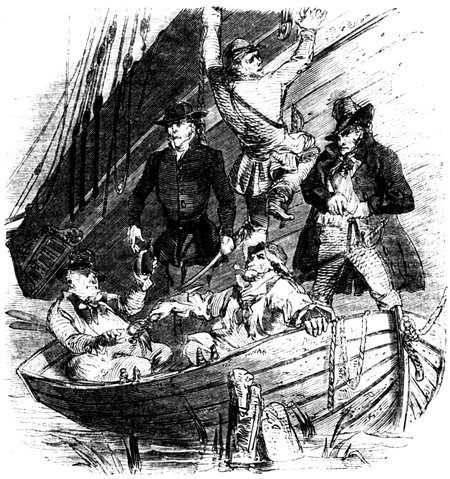
"With so well organised a fraternity and such means of operation," said Markham, who had listened with interest and astonishment to these details, "Tidkins is capable of amassing a fortune in a very short time. But we must stop him in his criminal career. At the same time, let us do nothing without mature consideration. Are you willing to assist? Your reward shall be liberal."
"The Zingaree may not of his own accord deliver up any one to justice," answered Morcar; "but he is allowed to serve an employer who pays him. Moreover," he added, as if ashamed of that sophistical compromise with the rules of his fraternity, "I shall gladly help to punish the miscreant who treated us with such base ingratitude."
"Then you consent to serve me?" said Richard.
"I do, sir," was the reply.
"To-morrow, at mid-day, I will meet you somewhere in the eastern part of London," continued Richard. "I have already a project in my head; but I must consider it more maturely."
"Where shall we meet, sir?" asked Morcar.
Markham reflected for a moment, and then said, "On the Tower wharf."
"I will be punctual, sir," answered the gipsy; and he took his departure.
CHAPTER CLXVI. THE THAMES PIRATES.
Moored at a wharf at the Rotherhithe side of the river Thames, nearly opposite Execution Dock, were several lighters and barges, all lying together.
Along the upper part of the buildings belonging to the wharf were painted, in rude but gigantic letters, the following words:—"Mossop's Wharf, where Goods are Received, Housed, or Carted."
Mr. Mossop, the sole proprietor of this wharf, was by no means particular what goods he thus received, whence they came when he housed them, or whither they were going when he carted them. He asked no questions, so long as his commission and charges were duly paid.
For the convenience of his numerous customers, he kept his office constantly open; and either himself or his son Ben Mossop was in constant attendance.
Indeed, Mr. Mossop did more business by night than by day. He was, however, a close man: he never put impertinent questions to any one who called to patronise him; and thus his way of doing business was vastly convenient for all those who used his wharf or his store-houses.
If a lighter arrived at that wharf, ostensibly with a freight of hay, but in reality with divers bales of cotton or other goods concealed beneath the dried grass, Mr. Mossop did not seem to think that there was any thing at all strange in this; and if next day he happened to hear that a barge at a neighbouring wharf had been robbed of divers bales of cotton during the night, Mr. Mossop was too much of a gentleman to question the integrity of his customers. Even if every wall in Rotherhithe, Horselydown, and Bermondsey, were covered with placards announcing the loss of the bales, describing them to a nicety, and offering a reward for their recovery, Mr. Mossop never stopped to read one of them.
On two or three occasions, when a police-officer called at his wharf and politely requested him just to honour the nearest magistrate with a visit, and enter into an explanation how certain goods happened to be found in his store-rooms, the said goods having been lost by other parties in an unpleasant manner, Mr. Mossop would put an enormous pair of spectacles upon his nose and a good face on the matter at the same time; and it invariably happened that he managed to convince the bench of his integrity, but without in any way compromising those persons who might be in custody on account of the said goods.
His son Ben was equally prudent and reserved; and thus father and son were mighty favourites with all the river pirates who patronised them.
Moreover, Mossop's Wharf was most conveniently situate: the front looked, of course, upon the river; the back opened into Rotherhithe Wall; and Mossop's carts were noted for the celerity with which they would convey goods away from the warehouse to the receivers in Blue Anchor Road or in the neighbourhood of Halfpenny Hatch.
The father and son were also famous for the regularity and dispatch with which they executed business on pressing occasions. Thus, while Mossop senior would superintend the landing of goods upon the wharf, Mossop junior was stationed at the back gate, where it was his pleasing duty to see the bales speedily carted as they were brought through the warehouses by the lumpers employed.
Mossop senior was also reputed to be a humane man; for if any of his best customers got into trouble (which was sometimes the case) and were short of funds, a five pound note in a blank envelop would reach them in prison to enable them to employ counsel in their defence; and this sum invariably appeared as "money lent" in Mossop's next account against them when they were free once more, and enabled to land another cargo at the wharf.
But to continue our narrative.
It was the evening after the one on which Morcar had called at Markham Place; consequently the evening of that day when the gipsy was to meet our hero on the Tower wharf.
Over the particulars of that meeting we, however, pass; as the plans then arranged will presently develop themselves.
It was now about nine o'clock.
The evening was beautiful and moonlight.
Myriads of stars were rocked to and fro in the cradle of the river's restless tide; and the profiles of the banks were marked with thousands of lights, glancing through dense forests of masts belonging to the shipping that were crowded along those shores.
At intervals those subdued murmurs which denoted that the river was as busy and active as the great city itself, were absorbed in the noise of some steamer ploughing its rapid way amidst the mazes of vessels that to the inexperienced eye appear to be inextricably entangled together.
Then would arise those shouts of warning to the smaller craft,—those rapid commands to regulate the movements of the engines,—and those orders to the helmsman, which, emanating from the lips of the captain posted on the paddle-box, proclaim the progress of the steamer winding its way up the pool.
A wondrous and deeply interesting spectacle, though only dimly seen, is that portion of the Thames on a moonlight night.
Then indeed is it that even the most callous mind is compelled to contemplate with mingled astonishment and awe, one of the grandest features of the sovereign city and world's emporium of trade.
The gurgling water, and the countless masts,—the vibration of mighty engines on the stream, and the myriads of twinkling lights along the shores,—the cheering voices of the mariners, and the dense volumes of smoke which moving colossal chimneys vomit forth,—the metallic grating of windlasses, and the glittering of the spray beneath revolving wheels,—the flapping of heavy canvass, and the glare from the oval windows of steamers,—the cries of the rowers in endangered boats, and the flood of silver lustre which the moon pours upon the river's bosom,—these form a wondrous complication of elements of interest for both ear and eye.
The barge that was farthest off from Mossop's wharf, of all the lighters moored there, and that could consequently get into the stream quicker than any other near it, was one to which we must particularly direct our readers' attention.
It was called the Fairy, and was large, decently painted, and kept in pretty good order. It had a spacious cabin abaft, and a smaller one, termed a cuddy, forward. The mast, with its large brown sail that seemed as if it had been tanned, was so fitted as 83to be lowered at pleasure, to enable the vessel to pass under the bridges at high water. The rudder was of enormous size; and the tiller was as thick and long as the pole of a carriage.
The waist, or uncovered part of the lighter in the middle, was now empty; but it was very capacious, and adapted to contain an immense quantity of goods.
On the evening in question two men were sitting on the windlass, smoking their pipes, and pretty frequently applying themselves to a can of grog which stood upon the deck near them.
One was the Resurrection Man: the other was John Wicks, better known as the Buffer.
"Well, Jack," said the Resurrection Man, "this is precious slow work. For the last four days we've done nothing."
"What did I tell you, when you fust come to me and proposed to take to the river?" exclaimed the Buffer. "Didn't I say that one ought to be bred to the business to do much good in it?"
"Oh! that be hanged!" cried the Resurrection Man. "I can soon learn any business that's to make money. Besides, the land was too hot to hold me till certain little things had blown over. There's that fellow Markham who ran against me one night;—then there's Crankey Jem. The first saw that I was still hanging about London; and the other may have learnt, by some means or another, that I didn't die of the wound he gave me. Then again, there's those gipsies whose money I walked off with one fine day. All these things made the land unsafe; and so I thought it best to embark the gold that I took from old King Zingary, in this barge, which was to be had so cheap."
"I suppose we shall do better in time, Tony," said the Buffer, "when we get more acquainted with them light and heavy horsemen that we must employ, and them lumpers that gives the information."
"Of course. When you set up in a new business, you can't expect to succeed directly," returned the Resurrection Man. "The regular pirates won't have confidence in us at first; and as yet we don't know a single captain or mate that will trust us with the job of robbing their ship. How do they know but what we should peach, if we got into trouble, and tell their employers that it was all done with their connivance? But old Mossop begins to grow more friendly; and that, I'm sure, is a good sign that he thinks that we shall succeed."
"So it is," said the Buffer. "Besides, this barge is so good a blind, that business must come. What should you say to getting into the skiff presently, and taking a look out amongst the shipping for ourselves?"
"Well, I've no objection," answered Tidkins. "But we've already a connexion with several lumpers; and they have put us on to all that we have done up to the present time. P'rhaps we should do better to wait for the information that they can give us. They begin to see that we pay well; and so they'll only be too anxious to put things in our way."
"True enough," observed the Buffer.
At this period of the conversation, a woman's head appeared above the cabin hatchway.
"Supper's ready," she said.
"We're coming, Moll," returned the Buffer.
The two villains then descended into the cabin, where a well-spread table awaited them.
Scarcely had the trio concluded their repast, when a man, who had come from the wharf and had walked across the barges until he reached the Fairy, called to Tidkins, by the appellation of "Captain," from the hatchway.
"Come below," answered the Resurrection Man.
The person thus invited was the foreman in Mr. Mossop's employment. He was short, stout, and strongly built, with a tremendous rubicundity of visage, small piercing grey eyes, no whiskers, and a very apoplectic neck. His age might be about fifty; and he was dressed in a light garb befitting the nature of his calling.
"Well, Mr. Swot," said the Resurrection Man, as the little fat foreman descended the ladder; "this is really an unusual thing to have the honour of your company. Sit down; and you, Moll, put the lush and the pipes upon the table."
"That's right, Captain," returned Mr. Swot, as he seated himself. "I came on purpose to drink a social glass and have a chat with you. In fact, my present visit is not altogether without an object."
"I'm glad of that," said the Resurrection Man. "We want something to do. It was only just now that I and my mate were complaining how slack business was."
"You know that Mossop never has any thing to do with any schemes in which chaps of your business choose to embark," continued Mr. Swot: "he receives your goods, and either keeps them in warehouse or carts them for you as you like; but he never knows where they come from."
"Perfectly true," observed the Resurrection Man.
"But all that's no reason why I should be equally partickler," proceeded Swot.
"Of course not," said the Resurrection Man.
"Well, then—we are all friends here?" asked Swot, glancing around him.
"All," replied Tidkins. "This is my mate's wife; she answers to the name of Moll, and is stanch to the back-bone."
"Well and good," said Swot. "Now I've as pretty a little idea in my head as ever was born there; but it requires two or three daring—I may say desperate fellers to carry it out."
"You couldn't come to a better shop for them kind of chaps," remarked the Buffer.
"And if it's necessary, I'll deuced soon dress myself up like a lighterman and help you," added Moll.
"I am very much pleased with your pluck, ma'am," said Mr. Swot; "and I drink to your excellent health—and our better acquaintance."
Mr. Swot emptied his mug at a draught, lighted a pipe, and then continued thus:—
"But now, my fine fellers, s'pose I was to start some scheme which is about as dangerous as walking slap into a house on fire to get the iron safe that's full of gold and silver?"
"Well—we're the men to do it," said Tidkins.
"That is," observed the Buffer, "if so be the inducement is equal to the risk."
"Of course," returned Mr. Swot. "Now one more question:—would you sleep in the same room with a man who had the cholera or the small-pox, for instance—supposing you got a thousand pounds each to do it?"
"I would in a minute," answered the Resurrection Man. "Nothing dare, nothing have."
"So I say," added the Buffer.
"And you wouldn't find me flinch!" cried Moll.
84"Now, then, we shall soon understand each other," resumed Swot, helping himself to another supply of grog. "Please to listen to me for a few minutes. A very fine schooner, the Lady Anne of London, trades to the Gold and Slave Coasts of Guinea. She takes out woollens, cottons, linen, arms, and gunpowder, which she exchanges for gold dust, ivory, gums, and hides. A few days since, as she was beating up the Channel, homeward bound with a fine cargo, something occurs that makes it necessary for her to run for the Medway, instead of coming direct up to London. But the night before last it blew great guns, as you may recollect; and as she was but indifferently manned, she got out in her reckoning—for it was as dark as pitch—and ran ashore between the mouth of the Medway and Gravesend. Now, there she lies—and there she's likely to lie. She got stranded during spring-tide; and she does not float now even at high water. The gold dust would be very acceptable; the gums, ivory, hides, and such like matters, may stay where they are."
"Then the fact is the owners haven't yet moved out the cargo?" said the Resurrection Man, interrogatively.
"No—nor don't intend to, neither—for the present," answered Swot. "And what's more, there's a police-boat pulling about in that part of the river all day and all night; but I can assure you that it gives the schooner a precious wide berth."
"Well, I can't understand it yet," said the Buffer.
"The fact is," continued Swot, "the Lady Anne was on its way to Standgate Creek in the Medway, when it got ashore on the bank of the Thames. Do you begin to take?"
"Can't say I do," answered the Resurrection Man. "Is the crew on board still?"
"The crew consisted this morning, when I heard about it last, of three men and a boy," returned Swot; "and one of them men is a surgeon. But the Lady Anne has got the yellow flag flying;—and now do you comprehend me?"
"The plague!" ejaculated the Resurrection Man and the Buffer in the same breath.
"The plague!" repeated Moll Wicks, with a shudder.
"Neither more or less," said Swot, coolly emptying his second mug of grog.
There was a dead silence for some moments.
It seemed as if the spirits of those who had listened with deep attention to the foreman's narrative, were suddenly damped by the explanation that closed it.
"Well—are you afraid?" asked Swot, at length breaking silence.
"No," returned the Resurrection Man, throwing off the depression which had fallen upon him. "But there is something awful in boarding a plague-ship."
"Are you sure the gold dust is on board?" demanded the Buffer.
"Certain. My information is quite correct. Besides, you may get the newspapers and read all about it for yourselves."
"The thing is tempting," said Moll.
"Then, by God, if a woman will dare it, we mustn't show the white feather, Jack," exclaimed the Resurrection Man.
"That's speaking to the point," observed the foreman. "You see there's a guard on land, to prevent any one from going near the vessel on that side; and the police-boat rows about on the river. The plan would be, to get down to Gravesend to-morrow, then to-morrow night, to drop down with the tide close under the bank, and get alongside the vessel."
"All that can be done easy enough," said the Resurrection Man. "But we want more hands. Of course you'll go with us?"
"Yes—I'll risk it," answered Mr. Swot. "It's too good a thing to let slip between one's fingers. If you'll leave it to me I'll get two or three more hands; because we must be prepared to master all that we may meet on the deck of the schooner, the very moment we board it, so as not to give 'em time even to cry out, or they'd alarm the police-boat."
"Well and good," said the Resurrection Man. "But you don't mean to go in the lighter?"
"No—no: we must have a good boat with two sculls," answered Swot. "Leave that also to me. At day-break every thing shall be ready for you; and I shall join you in the evening at Gravesend."
"Agreed!" cried Tidkins.
Mr. Swot then took his departure; and the three persons whom he left behind in the lighter, continued their carouse.
In this way the Resurrection Man, the Buffer, and Moll Wicks amused themselves until nearly eleven o'clock, when, just as they were thinking of retiring for the night,—Tidkins to his bed in the after cabin where they were then seated, and the other two to their berth in the cuddy forward,—the lighter was suddenly shaken from one end to the other by some heavy object which bumped violently against it.