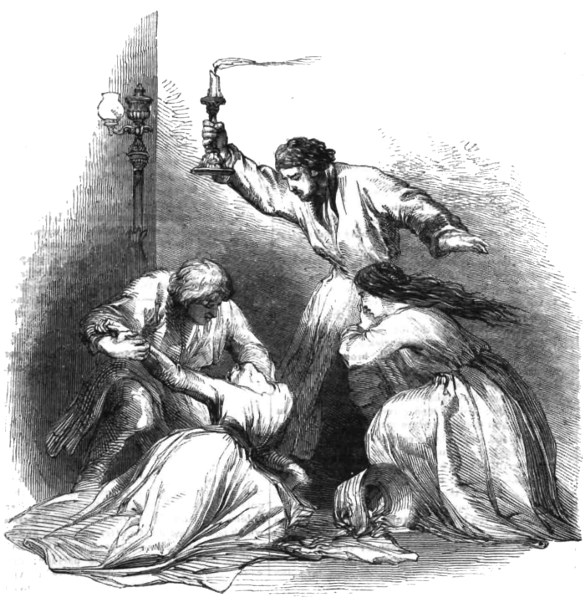
“It was between nine and ten o’clock on a dark and
rainy night, in the month of November, 1834, that a
young female, plainly but decently attired, was wending
her way along Oxford Street. She had a large
parcel beneath her cloak;—and this parcel she protected
against the rain with the most jealous care,—thinking
more, in fact, of the object of her solicitude
than of picking her path with sufficient nicety to
enable her to avoid the puddles of water that were
ankle-deep in some parts of the pavement—but more
especially at the crossings. For, in sooth, it was a
bitter—bitter night:—the windows of heaven appeared
to be indeed opened, and the rain fell in torrents.
The streets seemed to be positively covered in
with an arcade of umbrellas, on which the quick drops
rattled down with the violence of hail. The young
female whom I have mentioned, had an umbrella;—but
she found it rather a difficult task to hold it comfortably
with one hand, while her left arm encircled
as it were the precious parcel beneath her cloak. For
the passengers in the streets of London are never over
remarkable for their civility to each other—still less
so on such a night as the one I am describing. The
consequence was that there was an incessant struggle
amongst the strong to push their umbrellas safely
through the mass, and amongst the weak to prevent
their own umbrellas from being dragged out of their
hands;—but it naturally happened that the latter
fared the worst.
“The young female was meek, timid, and unobtrusive.
She only sought to be permitted to pursue
her way in peace, without being molested;—for,
heaven knows! she had not the least desire on her
part to inconvenience a soul. But first some rude,
hulking fellow would thrust her against the houses—almost
through the shop windows; then, if she
moved over to the kerb-stone of the pavement, she
found herself speedily pushed into the mud. To
pursue a middle course was impossible; because the
two streams of persons carrying umbrellas were the
monopolists there;—and so the young female began to
lament the necessity which had sent her forth into the
streets on such a night as this. At length she reached
the iron gates leading into Hanover Square; and she
rejoiced—for she thought within herself that she had
now got clear of the crowd, and need entertain no
farther apprehension of having the precious parcel
knocked out of her hands. But just as she entered
the Square, a rude, coarse fellow rushed against her as
he was running hastily round the corner; and such
was the violence of the concussion, that the parcel
was knocked from beneath her arm. The ruffian who
had caused the accident, burst into a ferocious laugh,
as if he had just performed a most humorous or clever
feat, and darted away. But the young female was
disconsolate at what had occurred; and tears started
into her eyes. Though bruised and hurt by the man’s
violence, she thought not of herself—she felt no pain:—it
was on account of the parcel that she was so
deeply grieved. Hastily picking it up, she hurried to
the nearest lamp; and the moment she examined the
packet beneath the gas-light, she found her worst
apprehensions confirmed. For the parcel contained a
costly silk dress, well wrapped up in brown paper;—but
the side on which it had fallen was dripping wet
and covered with mud!
“‘O heavens! no food again to-night!’ exclaimed
the young female aloud—for in her despair she paused
not to notice whether she were noticed or overheard.
And she was both noticed and overheard,—and by a
tall, handsome individual, of gentlemanly appearance,
and muffled in a capacious cloak. He had issued from
the nearest house at the moment the accident occurred;
and, perceiving the brutality of the encounter, though
too late to prevent it or to chastise the perpetrator, he
stood still to observe the young female, whose countenance,
as the rays of the lamp fell upon it, struck
him as being remarkably beautiful. In that rapid
survey, partial as it was by the flickering light, which
was moreover dimmed by the mist of the falling rain,
the stranger fancied that he perceived—independently
of the despair which that countenance now wore—a
certain settled melancholy expression, that at once
rivetted his interest and excited his sympathies. But
when those words—so terrible in their meaning,—‘O
heavens! no food again to-night!’ fell upon his
ears, he accosted the young female, and said, in a
tone of respectful though somewhat condescending
pity, ‘My poor girl, it appears that a sad accident
has befallen you.’—The young woman, or rather girl—for
she was not more than eighteen years of age—looked
up into the face of the individual who
thus addressed her; and, perceiving that it was no
insolent coxcomb who spoke, she replied in a tone of
deep melancholy, ‘Yes, sir: it is to me a great misfortune!’—The
stranger read, or fancied he read, an
entire history in those few and plaintively uttered
words,—how, perhaps, a young dress-maker had toiled
to finish a particular piece of work in the hope of receiving
instantaneous payment on taking it home,—how
the article had been thrown down, soiled, and
rendered at least unfit to be delivered that night to its
owner, even if it were not spoilt altogether,—and how
the poor girl had lost her only chance of obtaining the
wherewith to procure a meal. Upon more closely,
though still with great delicacy, questioning the young
female, the stranger found all his surmises to be correct;
but she could not tell whether the silk dress
were injured beyond redemption or not. ‘In any case,’
she added, still weeping bitterly, ‘I shall tell the lady
the truth when I take home the dress to-morrow.’—These
words, uttered with the most unquestionable sincerity,
made a deep impression upon the gentleman who
was addressing her; for they denoted an unsophisticated
uprightness of character which augmented the interest
he already felt in the poor young creature.—‘And who
is the lady you speak of?’ he enquired.—‘The Dowager
Marchioness of Wilmington,’ was the reply.—‘Ah!’
ejaculated the stranger: then, after a moment’s pause,
he said, ‘Pardon me, young woman, for having asked
you so many questions: but it has not been through
motives of idle curiosity. Here is a small sum that
will procure you immediate necessaries;’—and thrusting
a coin into her hand, he hurried away. The deed
took the poor girl completely by surprise;—for although
it has occupied me some time to relate all that passed
between her and the generous stranger, yet in reality
their dialogue was of scarcely more than two minutes’
duration; and the dress-maker had not yet recovered
from the grief into which the accident to her parcel
had plunged her. When, therefore, the light of the
lamp flashed upon a bright yellow coin, she could
scarcely believe her eyes:—she fancied that her benefactor
had made a mistake, and intended to give her a
shilling,—and then, in spite of the cold night, the warm
blood rushed to her cheeks, at the idea of any one
treating her as a mendicant—for she had her little
feelings of pride, poor though she were! But her next
thought was that the stranger might really have intended
to present her with a sovereign; and—so
strange a sentiment is human pride, even in the most
virtuous bosoms—her soul revolted not from receiving
that amount. And now, lest this circumstance should
induce you to form an evil opinion of my heroine, I
must inform you that it was no selfish nor avaricious
feeling that made her draw a distinction between the
gift of a shilling and that of a sovereign:—but she had
been tenderly and genteelly brought up—and the comparison
which her mind drew, was simply as between
the alms that one would toss to a mendicant, and the
pecuniary aid which a delicate benevolence would
administer to a person in temporary embarrassment.
“Of all these things she thought as she retraced
her way along Oxford Street,—holding her umbrella
with her right hand, and with her left arm encircling
the parcel more carefully than before. She came to
the conclusion that the sovereign was not given by
mistake; and she resolved to avail herself of the
bounty which Providence itself had appeared to bestow
upon her in the hour of her bitterest need. She
thought of the little brother who was anxiously expecting
her return, and who had fared so scantily for
the last few days,—that little brother of only eight
years old, whom the sudden, premature, and almost
simultaneous death of their parents, about two years
previously, had left so completely dependant upon
her! As she drew near the street in which she lived,
she stopped at the baker’s where she was accustomed
to deal, and purchased some nice buns;—and then she
hurried on until she reached the house wherein she
rented a small back room on the third floor. On entering
the little chamber, which, though poorly furnished,
was very clean and neat, a beautiful boy, with
light brown curly hair and fine blue eyes, but with
cheeks somewhat pale, sprang towards her, exclaiming
‘Oh! dear sister Julia, I am so glad you have
come back: for I cannot bear to be left alone so long!’—‘I
have brought you something nice, Harry,’ said the
kind girl, smiling sweetly upon him; and, she placed
the bag containing the buns in his hand. Joy
sparkled in his eyes;—but in another moment he observed
that his sister had brought back the parcel,
which she had opened, and was carefully examining
the silk-dress to ascertain the amount of injury done
to it. Throwing the cakes upon the table, the boy
hastened to question her; but poor Julia could not
answer him—scalding tears were trickling down her
cheeks—a suffocating grief filled her bosom,—for she
found, to her dismay, that the dress was completely
spoilt!
“She sate down, and gave full vent to her anguish;—and
then little Harry threw his arms round her
neck, and endeavoured to console her. The flood of
tears which she shed, and the affectionate conduct of
her little brother at length considerably soothed her;—and
the poor girl made up her mind to meet her
misfortune with resignation. ‘You are dripping wet,
dear Julia,’ said Harry: ‘and there is not a morsel
of coal left,’ he added, looking at the miserable remnant
of a fire which was fast extinguishing in the
grate.—‘Poor boy! you have been cold,’ exclaimed
the dress-maker, not thinking of herself.—‘No, dear
Julia,’ he answered; ‘for I have been walking up and
down the room, to keep myself awake till you came
back. I was only afraid that the candle would not
last.’—‘Nor will it many minutes longer, Harry!’
cried Julia, starting from her seat. ‘But do not be
afraid, my dear little fellow; for I have plenty of
money to buy all we want for the moment. A good
kind gentleman took compassion upon me, and—and——’;
she did not choose to say, ‘and gave me some
money;’—for, somehow or another, her pure soul revolted
from the idea that she had been the object of
eleemosynary benevolence on the part of a stranger:—so,
cutting the matter short, she kissed her little brother
tenderly, bade him eat his cakes, and, promising
to return in a few minutes, hurried away. She ordered
up coals and wood from the nearest shed,—thence
she repaired to the grocer’s, where she purchased
a few articles,—and lastly, she sped to the
baker’s, to buy bread. But the moment she entered
this shop, the master rushed from behind the counter,
seized her rudely, called her by many opprobrious
names, and, raising an alarm, attracted the attention
of a policeman who was passing by. The constable
entered the shop, and enquired the cause of the disturbance;
but poor Julia had fainted;—and she,
therefore, heard not the charge that was made against
her. When she came to her senses, she gazed wildly
around, thinking that she had just awoke from a
horrid dream;—but, alas! it was all too true! She
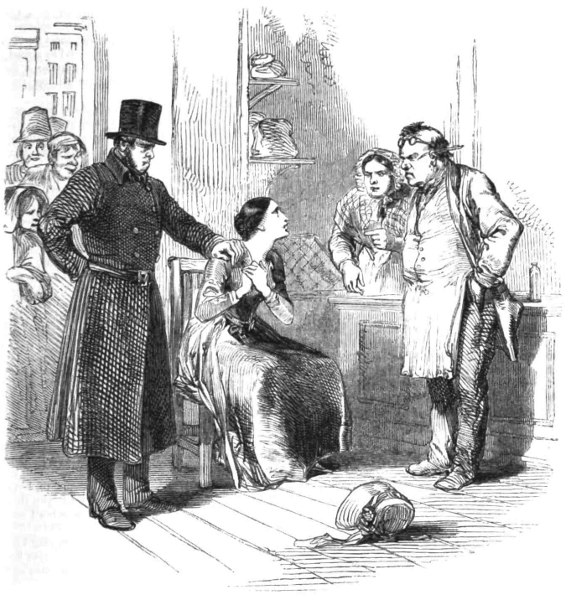
was seated in a chair in the middle of the
shop—a policeman standing near her—and a gaping,
curious crowd collected at the door. ‘Now,
young woman,’ said the officer, ‘come along with
me!’—Julia cast upon him a look so full of horror
and amazement, that the man’s heart was for an
instant touched;—but, being accustomed to endless
varieties of imposture on the part of offenders, he
speedily recovered the cold indifference so characteristic
of his class, and said sternly, if not brutally, ‘None
of this nonsense: you must tramp off to the station-house!’—‘But
what have I done? what offence have
I committed?’ asked Julia, in a tone of the most pathetic
entreaty. ‘Oh! there must be some dreadful
mistake in all this!’—‘No mistake at all,’ said the
officer; ‘and you’ll know all about it in the morning,
when you go before the magistrate!’—‘The magistrate!’
repeated the girl, with the emphasis of despair.
‘But my poor little brother, what will become of him?’—‘That’s
no business of mine,’ returned the constable:
’come along!’—and he dragged the half-fainting Julia
from the shop.
“Away to the nearest station-house was the unhappy
young woman rather borne than conducted;—and
so stunned—so stupefied was she by this sudden,
unaccountable, and overwhelming misfortune, that her
tongue refused to give utterance to the questions
which her suspense prompted her lips to frame. The
station was close by; and thus was it that before she
had leisure to recover from her bewilderment and
terror, she found herself thrust into a dark cell—all
dripping wet from head to foot as she was. When full
consciousness returned, and she was enabled to look
her misfortune in the face, she found that all the articles
she had purchased at the grocer’s and all the remainder
of her money were gone. Yet she could not
possibly conceive on what charge she had been thus
rudely treated;—and her conscience inspired her with
the hope that her complete innocence must become
apparent in the morning. But the thought of her
little brother excited the most painful sensations in
her bosom:—her heart was rent with pangs that
seemed to threaten her very existence! The poor
little fellow!—she fancied she saw him sitting in the
cold, lonely chamber, crying bitterly at his sister’s prolonged
absence:—and then a thousand fears haunted
her—all distracting in the extreme. Might he not
take it into his head to go out to look after her?—he,
who was so ignorant of London!—and then might he
not be lost in the mazes of the mighty metropolis, and
on a night when it would be almost death to him to
wander about the flooded streets? Oh! all these
fears—these thoughts were terrible;—for she dearly
loved her little brother—loved him, perhaps, the more
affectionately, the more tenderly, because their orphan
condition rendered him so completely dependant upon
her,—and because he was so much attached to her,
and his ways were so winning—his disposition so
cheerful!
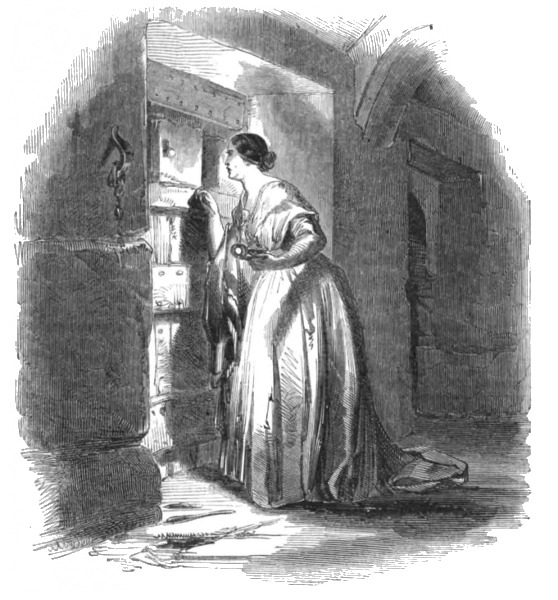
“In the midst of these harrowing meditations a
policeman opened the trap in the door of the cell, and
called her by name—‘Julia Murray!’ She answered
in a faint and feeble tone; and the officer was about
to close the trap, satisfied that his prisoner was not ill
nor had attempted suicide,—when the young woman
suddenly exclaimed, ‘Stop one moment!’—‘Well,
what is it?’ demanded the constable.—In a few hurried
words Julia explained to him how she had a
little brother expecting her return, how he would be
overwhelmed with grief at her unaccountable absence,
and how grateful she should feel if any one could be
sent to inform the child that his sister would be certain
to return in the morning. The constable, who
was a kind-hearted man, promised that her request
should be complied with; and he was about to depart
when, a thought striking him, he said, ‘But are you
so sure, young woman, of getting off so easy as you
imagine. The charge is a serious one, mind!’—‘The
charge!’ she repeated: ‘I do not even yet know what
it is!’—‘Oh! that’s all gammon,’ cried the constable,
closing the trap abruptly; and now, his opinion of the
prisoner being that she was a hardened impostor,
and had some sinister motive in view in sending a
message to her lodgings, determined to trouble himself
no more concerning the matter. It was, however,
some consolation to the poor girl to believe
that her commission would be duly executed;—for,
though she had heard the officer’s unfeeling, cutting
observation relative to her ignorance of the accusation
against her, she could not for an instant suppose that
he would neglect to fulfil his promise regarding her
little brother. But wearily—wearily passed away that
night—not once did the poor dress-maker close her
eyes—and she counted every hour that was proclaimed
from the neighbouring church-clock—often saying
to herself that never, never had time travelled with
such leaden pace before! She had not tasted food for
many hours—and yet she was not hungry; but she
experienced a terrible faintness at the chest, and an
oppressiveness on the brain, that at intervals made
her mind wander. Her cloak was dripping wet when
she had been locked up, and her shoes, stockings, and
the lower part of her dress were saturated;—but she
had thrown her cloak aside, and her garments had
dried upon her;—and now she felt not positively cold—only
a numbness in her limbs, which gave her however
no pain.
“At length the dull, misty, wintry morning
dawned upon the metropolis—though all was still
dark in her gloomy cell. Presently an officer entered,
and gave her a cup of hot coffee and a piece of
bread. She asked him if the message had been sent
to her brother;—but he was not the same constable
who had made the round of the cells at midnight, and
therefore knew nothing about the matter. Moreover,
he was a stern, sulky man; and she dared
not speak farther to him—much as she longed to
ascertain the real nature of the charge against her.
She drank the coffee, which seemed to do her good;—but
she could not force a single mouthful of the
bread down her throat—though the cravings of hunger
now began to oppress her cruelly. But, to use a common
phrase, her heart heaved against food. A couple
of hours more passed away, and then the same policeman
who had arrested her on the preceding evening
came to conduct her to the police-office. While
they were proceeding thither, Julia enquired the
nature of the charge against her; and she now learnt
for the first time that the coin which she had changed
at the bakers, and which she had believed to be a
sovereign, was only a gilt counter, of the kind used at
card tables in genteel society. She was cruelly
shocked at this information, and frankly and candidly
explained to the officer the manner in which she had
become possessed of it; but he only shook his head,
and seemed to put but little faith in her story. Julia
was, however, too much absorbed in the vexation and
ignominy she had thus been subjected to, and was still
enduring, to notice the man’s incredulity;—but she
clung to the hope that her tale would be believed by
the magistrate before whom she was about to appear.
It happened that the usual charges of drunkenness
were just disposed of, at the moment when the young
female entered the court; and she was accordingly at
once placed at the bar—the baker being already in
attendance to prefer his charge against her. This he
did in a plain and straight-forward manner,—showing
no ill-feeling against the prisoner—but, on the contrary,
alleging that he had always believed her to be
a highly respectable, industrious, and praise-worthy
young woman until the present transaction took place.
He added that he had given her into custody in a
moment of irritation, believing himself to have been
duped; and that he should be truly delighted if she
could make her innocence apparent. Julia’s courage
was somewhat restored by the forbearing conduct of
the baker—for her own good sense told her that the
case was really one involving much unpleasant suspicion;—and
she now told her tale with an artlessness
and sincerity that produced no inconsiderable effect
upon the bench. Nevertheless, as the magistrate observed,
it certainly appeared strange that a gentleman
should have given her a gilt counter in mistake for a
sovereign,—strange also that a mere stranger should
have intended to bestow upon her a sovereign at all.
The magistrate proceeded to state that the prisoner
must be remanded, in order that the gentleman of
whom she spoke—if her story were true—might come
forward, upon seeing the report of the case in the newspapers,
and tender his evidence. Julia burst out into an
agony of weeping, when she heard that she must go to
prison for a week; and the baker requested the magistrate
to re-consider his decision. This appeal was, however,
made in vain; but it was intimated that bail would
be received for the prisoner’s re-appearance. The baker
gave a whispered assurance to the unhappy girl that
he would get two of his friends to become security for
her; and this promise consoled her. When she was
removed from the office, on her way to a cell in the
rear of the establishment, the baker told her that his
wife had taken care of her brother, who had passed the
night at their house: and he expressed his deep regret
that he should have proceeded against her, as he had
learnt from her landlady that she was a young woman
of most exemplary character. To be brief, the baker
performed his promise of procuring bail for the prisoner;
and at about two o’clock in the afternoon she was enabled
to return home.
“Little Harry was speedily brought back to her by
the baker’s wife, who, it appeared, had bitterly reproached
her husband on the preceding evening for his
conduct towards Miss Murray, and, with considerate
kindness, had at once sent for her brother, whom the
good woman consoled with some plausible tale accounting
for his sister’s absence. Julia was not however
happy, even though restored to liberty; for the charge
still hung over her—and so much depended on the
chance of the appearance of her unknown benefactor,
who, she still firmly believed, had accidentally and
most unintentionally given her the gilt counter
which had led to so much wretchedness and serious
embarrassment. Her first care was now, however,
to proceed to the house of the old Marchioness
of Wilmington, with the silk-dress, which was completely
spoiled; and Julia’s heart was heavy as she
hurried along Oxford Street. The weather was dull
and gloomy; but the rain had ceased, and the two
streams of people flowed on, in different directions,
without the hurry, bustle, and struggling that had
prevailed on the preceding evening. Julia’s bosom
palpitated nervously when she reached the spot where
the accident had occurred—that accident to which
her present sorrows might be traced. On reaching the
house of that marchioness in Hanover Square, the poor
girl was conducted into the presence of the dowager—a
proud, stately dame whose age exceeded fifty,
but who endeavoured by means of rouge, false hair,
false teeth, and the appliances of the toilette, to appear
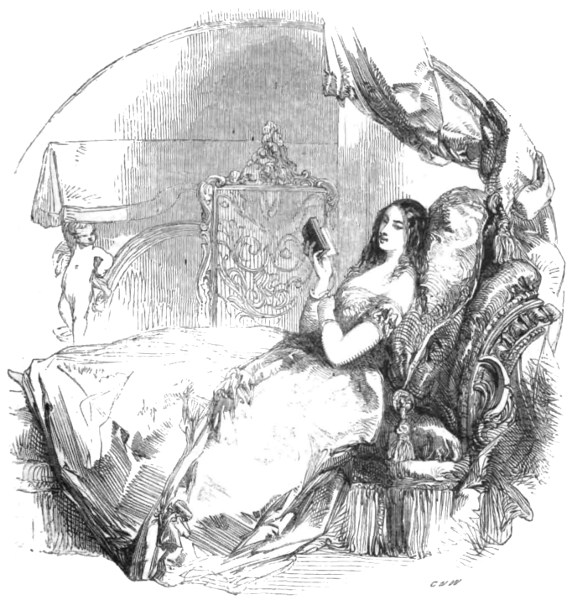
at least twenty years younger. Her ladyship was
seated in a small, but elegantly furnished parlour, and
was occupied in reading—no, in skimming—the last
new novel, which, according to the usual fashion, had
been carefully spun out into three volumes, though
all the incidents it contained might with advantage
have been condensed into one. At a beautiful little
work-table, sate a lovely creature of two-and-twenty,
with hair as dark as jet, fine large black eyes, and a tall
symmetrical, but rather robust figure. On this fair
young lady’s countenance there was a slight shade of
melancholy; and her cheeks were somewhat pale—but
apparently through a secret care, and not ill-health.
This was Lady Caroline Jerningham, the
only daughter of the marchioness, and consequently
sister to the Marquis of Wilmington, her ladyship’s
only son.
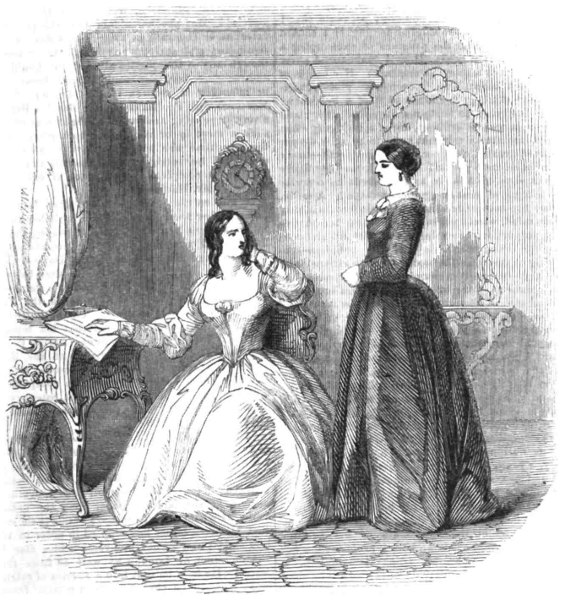
“On entering the presence of these ladies, Julia,
who had previously arranged in her own imagination
the precise terms in which she proposed to tell her
tale,—with a strict adherence to truth,—forgot all her
studied task, and became overwhelmed with confusion.
The marchioness looked so stately—so prim—so queen-like
in her deportment, not to say positively austere,
that the poor girl was seized with vague apprehensions
and unknown terrors, as if she had committed a great
and grievous fault. Lady Caroline, however, cast
upon her a look of such kind encouragement, and also
of such significance, that it almost struck Julia at
the moment that the young patrician lady had a
fore-knowledge of the disaster which had occurred to
the dress. Yet how was that possible?—and as the
absurdity of such an idea forced itself upon the girl’s
mind the instant after the idea itself was entertained,
her confusion and embarrassment were increased, and
she burst into tears. The dowager uttered an ejaculation
of surprise; and Julia, hastily wiping her
eyes, cast an appealing glance on Lady Caroline, who,
to her relief and amazement, she beheld gazing upon
her with an expression of reassurance and deep—almost
tender interest. Encouraged by the evident
graciousness of the young lady, Julia proceeded to
open the parcel; and, while so doing, she began an
explanation of the accident which had occurred to
the dress. The countenance of the marchioness, to
whom she glanced timidly, lowered and contracted;—but
Lady Caroline hastened to observe, in a kind and
condescending manner, ‘Whatever has happened to
the dress, Miss Murray, I am confident my mother
will attribute to a misfortune, and to no blameable
neglect on your part.’—‘Permit me to answer for myself,
Lady Caroline,’ said the dowager, in a tone of
haughty remonstrance to her daughter, and with an
austere look at the trembling Julia. ‘Young woman,’
she continued, now addressing herself direct to the
poor girl, ‘you were recommended to me by Lady
Lumley, as an efficient, honest, careful, and deserving
person,—one, who, having been brought up tenderly
and by parents moving in a genteel sphere until the
time of their decease, was suddenly compelled to have
recourse to the needle to earn a subsistence. Under
such circumstances, and with this recommendation, I
sent for you—I agreed to give you a trial—and, as I
perceive, you have spoilt for me a dress that will
cost me ten guineas to replace it.’—‘I admit, my lady,’
said Julia, ‘that you have great cause to be dissatisfied.
But heaven is my witness that it was an accident;
and if your ladyship will permit me, I will toil
day and night until I shall have obtained the wherewith
to make good the loss.’—‘No, young woman,’
observed the marchioness, somewhat mollified by the
artlessness and respectful demeanour of Julia Murray;
‘I cannot, being rich, oppress you, who are poor. All
that I can do in the case is to decline giving you any
farther employment. You may retire:’ and, having
thus spoken with a sententious pomposity that would
have become a statesman, the noble lady waved her
hand authoritatively.
“Julia’s eyes filled with tears, which nearly blinded
her—so that she observed not how peculiar was the
interest with which Lady Caroline Jerningham was
surveying her:—but, having vainly endeavoured to
stammer forth a few words imploring a continuance of
the patronage of the marchioness, she hurried from
the room. On the landing outside she paused for a
few moments to wipe away the traces of tears from
her countenance and somewhat compose herself; for
she shrank from the idea of attracting unpleasant
notice on the part of the lacqueys lounging in the hall
through which she must pass to reach the street-door.
Suddenly she felt a gentle touch upon the shoulder;
for she had seated herself in a chair on the landing,
being overcome with grief and physical exhaustion;—and
starting up, she beheld Lady Caroline standing by
her side. ‘Hush!’ said the fair patrician, placing her
finger upon her lip, and glancing towards the parlour-door,
as much as to imply that she had stolen away
from her mother’s presence and would not have her
motive suspected: ‘here, my poor girl, take this—and,
when you require a friend, fear not to apply to
me—but by letter, remember, in the first instance!’—Thus
speaking, Lady Caroline thrust five sovereigns
into Julia’s hand, and instantly returned to the parlour,
not waiting a moment to receive the thanks of
the astonished and delighted girl.
“Julia Murray now hurried home, and found little
Harry anxiously expecting her return;—for, although
he was too young to comprehend the nature of the
alarms which she had experienced, when sallying
forth, on account of the spoilt dress, yet he was fearful
lest she might remain away from him for several
hours again. He had no cares—that poor little fellow—when
his sister was with him; and he now asked
her, in so sweet yet earnest a manner, not to leave
him any more during a whole night, that she felt as if
she would go through fire and water for that darling
boy. But she had no work in hand; and though she
possessed five sovereigns,—real sovereigns, and no gilt
counters this time,—yet she could not bear the idea of
being idle. She however promised to remain at home
all that day; and she prepared a nice little dinner,
which made Harry so happy that she wished—Oh!
how sincerely she wished—she could always provide
for him in the same manner. She endeavoured to
appear as cheerful as she could;—but there was a
weight upon her spirits—for the accusation still hung
over her head, and she was in suspense whether the
unknown would see her case in the papers, and appear
to justify her. Besides, would not the publicity given
to the affair injure her with those kind patronesses
who had hitherto taken such an interest in the orphan
girl? and, should the stranger-gentleman not be forthcoming,
would not a stigma be affixed upon her character,
even though the magistrate (as the baker
assured her must be the alternative) should dismiss
the case? Of all these things she thought;—and
when Harry noticed her not, a pearly tear would
trickle down her pale but beauteous face. For Julia
was very beautiful. Her hair was of a rich dark
brown—her eyes of melting blue—her teeth of pearly
whiteness—and her shape elegant, graceful, and sylph-like.
“On the ensuing morning, after breakfast, Julia
had just put on her bonnet and shawl to go out for
the purpose of calling upon her various patronesses
and enquiring whether they needed her services,
when the landlady of the house in which she lodged,
entered the room and said, ‘Miss Murray, a gentleman
wishes to speak to you: he will not walk
up to your apartment, as he does not know whether
you may choose to receive him here; and he is accordingly
waiting in my parlour.’—A ray of hope
flashed to the mind of the young woman: what if
it were the unknown who had given her the gilt
counter? The suspicion was strengthened by the
delicacy of his behaviour in not ascending to her
chamber; for, during the brief discourse which she
had with him on the night so fatal to her, he had
manifested a disposition quite in accordance with
the propriety of conduct and considerate proceeding
adopted by the individual who now waited to see
her. Telling Harry that she should not be long,
Julia hurried down stairs; and in a few moments
she found herself in the presence of the individual
who was uppermost in her thoughts. Yes:—it
was indeed he—the unknown,—the same tall,
handsome man,—and enveloped, too, in a cloak
richly lined with sables. He was about eight-and-twenty
years of age; and there was something noble
and commanding, though gracious and encouraging,
in his air and demeanour. The moment Julia made
her appearance, he rose from the chair in which he
had been seated, and taking her hand, said in a tone
of the most earnest sincerity, ‘Miss Murray, I know
not in what terms to express the shame and grief
which I experience at the misfortune that has overtaken
you. It was not until I saw this mornings
newspaper, that I even dreamt of the mistake—the
dreadful mistake I had made: and the instant the
case met my eyes, I hurried hither. The explanation
which I have to give, you can of course anticipate:—I
had purchased some gilt counters only half-an-hour
before I met you in Hanover Square, and
I put them loose into the same pocket which contained
my money.’—‘I never for an instant imagined,
sir,’ said Julia, ‘that you had purposely trifled with
my feelings.’—‘Generous young woman, to put such
a construction upon a matter which has caused you
so much suffering!’ exclaimed the unknown. ‘But
it is now my duty to accompany you at once to the
police-court, and place your character in the same
honourable light in which it originally stood.’—Julia
was overjoyed at this announcement; and the
gentleman, giving her his arm, escorted her to the
police-court, calling however on the baker in their
way to desire him to attend immediately before the
magistrate. During the walk, the stranger asked
the young woman a great many questions—not of
an impertinent nature, nor denoting an idle curiosity,—but
rather evincing an interest in the orphan girl.
It however struck Julia as somewhat singular that
he did not put a single query to her relative to the
spoilt dress: it seemed as if he had quite forgotten
that incident!
“On their arrival at the police-office, the gentleman
immediately handed his card to the magistrate,
to whom he whispered a few words at the same
time; and his worship became all civility and politeness.
The case was called on without a moment’s
delay: the gentleman concisely but effectually explained
the affair of the gilt counter; and the magistrate,
on declaring Julia to be discharged, assured
her that she would leave the court without the
slightest stain on her character. The stranger
placed ten pounds in the magistrate’s hands for the
use of the poor-box, and then departed in company
with Julia, whom he escorted back to the house in
which she dwelt. On reaching the door, he paused,
and taking her hand, said, ‘Miss Murray, I shall
not insult you by offering a pecuniary recompense
for the mortification, annoyance, and distress you
have undergone through that gilt counter. But I
shall endeavour to serve you in another way. Farewell
for the present: you will shortly see me again;
for, be assured,’ he added, gazing earnestly upon
her for a moment, ‘I shall never forget you.’—Thus
speaking, he pressed her hand and hurried away;—and
it was not until he had disappeared from her
view that she remembered she was still in profound
ignorance of who or what he was. It, however,
struck her that the case would be again reported
in the newspapers; and she therefore hoped that
the morrow would clear up the mystery. But it
was with some degree of anxiety and painful suspense
that she thus awaited the publication of the
journals of the ensuing day;—and she could not
account to herself for the feelings that thus agitated
her. Although her character had been completely
cleared from the imputation thrown upon it, and
her innocence was made unquestionably apparent,—although
she had ample funds, through the generosity
of Lady Caroline Jerningham, to provide for
all present wants,—and although a secret voice
seemed to whisper in her soul that she possessed a
good friend in the stranger-gentleman,—yet, somehow
or another, poor Julia was not entirely contented.
Was it that the handsome countenance of
her unknown benefactor had made any impression
on her heart?—was it that his kind and sympathising
conduct had touched a tender chord in her
pure and innocent bosom? It is impossible to
answer these questions at present: but it is very
certain that Julia experienced a disappointment almost
amounting to a positive shock, when she found
that the morning papers seemed to be in as much
ignorance as herself relative to her unknown benefactor.
The report merely alluded to him as ‘a gentleman
whose name did not transpire;’—and this
mystery in which her friend evidently wrapped himself,
became a source of secret trouble to the young
dress-maker. Wherefore had he not revealed his
name to her? Disreputable that name could not be;
else how could it have produced so magical an effect
upon the magistrate? Was it, then, a great—a
famous—or a noble name? Julia sighed—and dared
not hazard any conjectures: but in her heart there
suddenly appeared to arise a hope—a secret wish,
that the stranger was not so very highly exalted
above her own social sphere!
“Again was Julia preparing to sally forth and visit
the various ladies for whom she was accustomed to
work, when her landlady brought her up a note. It
was from Lady Caroline Jerningham, requesting Miss
Murray to call upon her in the evening at a stated hour,
as her ladyship had a quantity of work to place in her
hands. The young maiden was overjoyed at the receipt
of this missive, which not only promised her employment,
but likewise seemed to be an assurance of the
tender interest which the charming Lady Caroline had
taken in her. She did not therefore stir out until the
evening;—and little Harry was delighted that his sister
remained at home with him. But when the appointed
hour drew near, she tranquillised her brother with a
promise of a speedy return; and away she sped, with
a heart full of hope, towards Hanover Square. On
reaching the splendid mansion occupied by the Dowager-Marchioness,
Julia was received by Lady Caroline’s
own maid, and was forthwith conducted to the chamber
of her fair patroness, who treated her in the most
kind and condescending manner. ‘I regret, Miss
Murray,’ she said, ‘that I am forced to admit you
thus stealthily into the house; but my mother is of
a peculiar temper, although in reality possessed of a
good heart.’—‘I understand your ladyship,’ returned
Julia: ‘the Marchioness cannot forgive me for what
she considers neglect. I am however deeply grateful
to your ladyship for thinking otherwise, and for
giving me such substantial proofs that you entertain
so favourable an opinion.’—‘My dear Miss Murray,’
observed Lady Caroline, ‘I will do any thing I can
to serve you; for I can well imagine how grateful
must be the sympathy of a friend to one who is acquainted
with sorrow!’—These words were uttered
with almost a mournful emphasis, as if the fair speaker
craved that sympathy and friendship for herself
which she proffered to another;—and Julia could not
help regarding her with mingled surprise, gratitude,
and tender interest. They were alone together—that
elegant patrician lady and that beautiful milliner,—the
maid having retired; and it appeared as
if a species of sisterly feeling suddenly sprang up
between them, inspiring them with mutual confidence,
and for the time annihilating the barrier that
social distinctions had raised up between them in
the eyes of the world. Thus was it that when Lady
Caroline saw Julia’s looks fixed upon her in so earnest
and plaintive a manner, she felt herself irresistibly
urged to respond to that tacit yet eloquent
proffer of sympathy and affection. ‘Ah! my dear
Miss Murray,’ she said, ‘you must not imagine that
unhappiness exists only with those who have to toil
for their daily bread. Perhaps, indeed, their lot is
preferable to that of the rich who have causes of
grief;—for you have a constant occupation which
allows little leisure for disagreeable reflection;
whereas I have so much time——’.—Lady Caroline
checked herself, turned away, and hastily passed a
handkerchief across her face. She had perhaps said
more than she intended: for, from speaking of the
richer and poorer classes in general terms, she had
been carried into personal illustration of the truth
of her remarks by pointedly placing herself and
Julia in juxta-position. Miss Murray, though totally
devoid of artfulness, was yet endowed with an
intellect keen enough to perceive this fact: and she
now learnt, then—as indeed she had previously
suspected—that Lady Caroline was unhappy. But
it was not for her to invite a revelation of the fair
patrician’s cause of sorrow: she therefore remained
silent.
“‘Julia,’ said her ladyship, suddenly turning towards
her again, and taking her hand as she thus
spoke,—‘Julia,’ she repeated, in an earnest, appealing
tone, ‘I will be a friend to you; but it may happen
that I also shall require the aid and sympathy of a
friend——’; and, once more checking herself, she
sighed profoundly.—‘I would serve you night and
day, dear lady!’ exclaimed the young milliner,
pressing to her lips the hand which still grasped her
own.—‘I have not read your disposition inaccurately,
dearest girl,’ responded Lady Caroline: then,
assuming a more cheerful tone, she said, ‘Be it understood,
we are friends! And now you must leave
me, as my mother will be enquiring after me.’—Julia
received a parcel containing a variety of costly
stuffs, which she was to make up into dresses for
her fair patroness, and which would furnish her
with work for at least a month; and, as she was
leaving the room, Lady Caroline said, ‘My own
maid will call upon you every Saturday evening
and bring away whatever you may have finished,
until the whole be complete.’—They then separated,
Lady Caroline pressing Julia’s hand warmly at parting;
and the young dressmaker hurried homeward,
her heart beating with joy at the kindness which she
had experienced and the friendship she had formed.
‘After all,’ she murmured to herself, as she ascended
the stair-case to her chamber, where little Harry
was sitting up to await her return.—‘after all, the
adventure of the spoilt dress has proved a service,
rather than an injury, to me: and perhaps,’ she
added,—but it was her heart, and not her lips, that
now spoke,—‘the affair of the gilt counter may
likewise bring me good luck!’
“Julia now addressed herself to the work of
which she had such profusion; and while she sate
plying her needle, with little Harry playing about
the room, she often thought of the handsome unknown.
Every day, after the frugal dinner, she took
her brother out to walk for an hour, that a little
exercise and fresh air might benefit them both; and,
of an evening, when she laid aside her work, she
gave him instruction in many useful branches of
education. During the day, too, he learnt his lessons;
and never did she suffer him to go out alone
into the streets—no, not even on the slightest
errand. In fact, this excellent young woman took
as much care of her little orphan brother as if she
had been his parent, instead of his sister; and it was
a charming as well as touching sight to behold them
repairing to the parish church on a Sabbath-morning,—each
attired with so much neatness, and yet
in a plain and unobtrusive manner. Well, three
weeks had passed since the interview between Julia
and Lady Caroline; and on each Saturday evening
her ladyship’s maid called to receive and pay for the
work that was finished. The domestic was sure to
have some pretty present from her mistress for
Julia, and a handsome toy—such as a transparent
slate, or puzzle, or a miniature carpenter’s tool-box—for
Harry; and the grateful milliner sent back
her kindest but most respectful regards to her good
patroness. But during those three weeks she had
neither seen nor heard any thing of the handsome
stranger;—and yet, had he not promised that he
would shortly call again? Wherefore should he
call? Julia never paused to ask herself that question;—but
she did sometimes admit, within the
secret recesses of her own heart, that she thought
it somewhat unkind he did not fulfil his promise,
after the distress she had endured in consequence
of the mistake he had made respecting the gilt
counter. One day the landlady tapped at Julia’s
door; and, on being desired to enter, the good woman
informed her that ‘the gentleman in the cloak,’
was waiting in the parlour below. A blush instantly
spread itself over Julia’s cheeks; whereupon the
landlady said in a low but impressive tone, ‘you
need not be ashamed of an honest attachment, Miss;
and I know you are too good a girl to form any
other. In fact, I told the gentleman what an excellent
creature you were, and how well you behaved
to your little brother.’—‘You told him all that?’
exclaimed Julia, looking up in a surprise mingled
with secret pleasure, while the blush upon her
beauteous countenance deepened.—‘Certainly I did,
Miss,’ replied the landlady: ‘but not to-day. It was
when he called on account of that unpleasant little
affair, you know; and before he sent me up to fetch
you down, he asked no end of questions about you;
and he seemed so pleased when I told him that you
were such a good, industrious young person, and so
kind to your orphan brother; and how you kept
yourself so quiet and respectable, having no acquaintances
scarcely, and certainly no visitors except
your lady-customers or their maids.’—‘But the
gentleman did not ask all those questions?’ said
Julia, in a hesitating manner and with a tremulous
voice, while her heart palpitated with emotions of
unknown pleasure.—‘Indeed he did, Miss,’ returned
the landlady. ‘But, dear me! now I think of it, he
charged me not to tell you that he had asked any
thing at all concerning you: and by the same token,
he gave me a sovereign to hold my tongue in this
respect; and therefore, Miss, you must not even
look as if you knew a syllable of what occurred on
that occasion. I am sure he is some great person
in disguise; and I am also certain that he has fallen
in love with you.’—Julia’s countenance now became
scarlet; and she was about to make a remonstrative
reply, when little Harry, who began to grow impatient
of so much mysterious whispering between
his sister and the landlady, approached them, saying,
‘Is any thing the matter, dear Julia?’—‘Nothing,
my darling boy,’ was the cheerful reply: ‘I shall
return in a few minutes;’—and Julia hastened down
stairs, the landlady remaining with Harry.
“Though the young maiden endeavoured to compose
herself as much as possible, yet all that the
landlady had told her rushed to her mind with renewed
force and stronger significancy just as she
crossed the threshold of the parlour and appeared in
the presence of the gentleman in the cloak. He
observed her confusion—noticed the blush that
mantled on her cheeks—and, mistaking the cause
said, as he took her hand, ‘I am afraid, Miss Murray,
that you consider it indiscreet for me thus to
pay my respects to you; and indeed, that fear has
prevented me from calling sooner.’—Julia started,
cast down her eyes, and made no reply; for in her
artless innocence, it had never before struck her that,
an evil construction might be placed upon the visits
of the gentleman: but now the conviction that such
was indeed the result to be apprehended, was forced—yes,
painfully forced—upon her sensitive mind.
The stranger read what was passing in her imagination;
and if he were delighted to observe that the
danger which he had specified was previously unsuspected
by her ingenuous soul, he was not the
less gratified to acquire the certainty that her pure
thoughts were shocked by the idea of compromising
her reputation.—‘Fear not, Miss Murray,’ he continued,
again taking her hand; ‘I should be the last
person on the face of the earth to do you a wilful
injury in any way. I have merely called, as in duty
bound, to assure myself that you have perfectly recovered
from the effects of the distressing ordeal
through which you were compelled to pass in consequence
of my carelessness. But innocence, Miss
Murray,’ he added, emphatically, ‘will invariably
triumph in the long run; and virtue will not ever
languish unrewarded. Your exemplary conduct,
Miss Murray, must sooner or later be adequately
recompensed: your tenderness towards your orphan
brother must ensure for you the esteem and respect
of all liberal and honest persons. May I request,
as a particular favour, that you will presently call
on Mr. Richardson, the solicitor, in Berners Street,
close by; as I know that he has some tidings, of
rather an agreeable character, to impart to you.’—With
these words, the stranger pressed the young
maiden’s hand, and respectfully took his leave of
her.
“Julia hastened back to her own chamber, and
related to the worthy, well-meaning, but garrulous
landlady, every thing that the gentleman in the cloak
had said to her. ‘Ah! Miss,’ cried the woman, ‘I
seemed to have a fore-knowledge that something
good was to happen to you; and now I am sure of
it. But pray make haste and see what the lawyer
wants with you.’—Julia did not require to be pressed
upon this point: she herself was too anxious to
solve this new mystery to permit any unnecessary
delay to take place; and, having dressed little
Harry in his Sunday apparel, she put on her best
bonnet and shawl, and away the sister went with
her little brother to the lawyer’s. They entered an
office in which there were a great many clerks, who
all left off writing to turn round and have a look at
the pretty young lady—for a lady did Julia really
seem, as she actually was by birth, education, and
manners;—but when she timidly mentioned her
name, she found herself the object of the most respectful
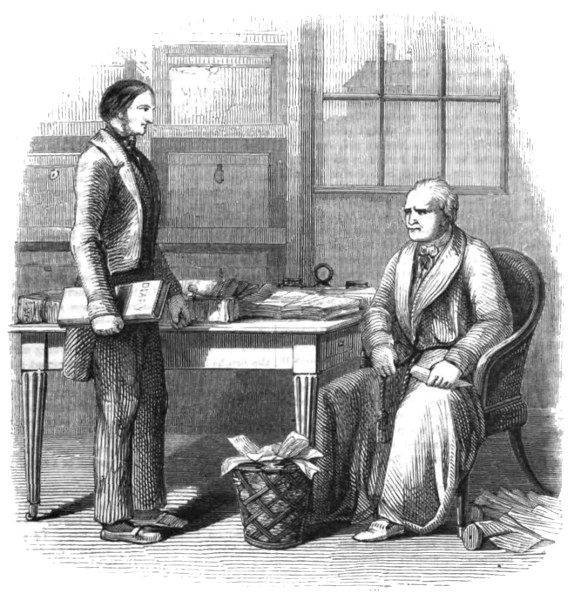
attention. The head clerk ushered her and
her brother into a handsome apartment, where an
elderly gentleman, with a benevolent countenance,
was seated at a desk covered with papers; and the
reception which he gave Julia Murray was more
than courteous—it was cordial and, as it were, paternally
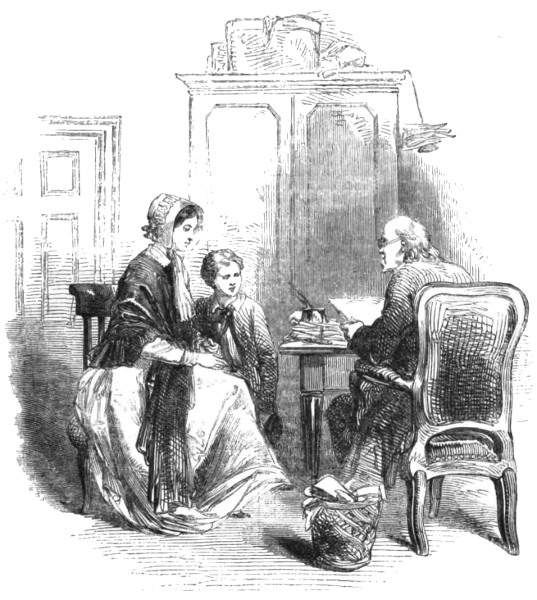
kind. ‘Sit down, young lady,’ he said, handing
her to a chair: ‘and you, my little fellow, place
yourself near your sister. And now, Miss Murray,’
he continued, raising his large silver spectacles from
his eyes to his forehead, ‘I have some good news
to communicate to you; and I am sure, after all I
have heard of you, I am proud and happy to be the
medium of conveying any thing agreeable to your
ears.’—‘You are very kind, sir,’ murmured the
young maiden, still in the deepest suspense.—‘Did
you ever hear your late father speak of any one who
owed him a sum of money?’ enquired the lawyer.—Julia
reflected for a few moments, and then replied
in the negative.—‘Well, perhaps he did not mention
his private affairs before you,’ observed the lawyer;
‘it is nevertheless a fact, that many years ago he advanced
a certain sum to a friend who was in difficulties;
but these embarrassments continued, ending
in bankruptcy or something of the sort; and so
your poor father lost the whole amount thus advanced.
The friend went abroad; and he has latterly
returned to England, a rich man—having retrieved
his fortunes in a foreign clime. He made
enquiries after your parents, and to his sorrow
learnt that they were no more; but he could not
succeed in tracing you out. At length he saw a report
of a certain case in the newspaper, and ascertained
that you were the young lady therein mentioned.
His sorrow at the first appearance of the
affair was only equalled by his joy when he beheld
the result; for he has your interest deeply at heart.
He has, however, been compelled to leave London
in a great hurry;—but before he went away, he gave
me certain instructions, which I have fulfilled with
all possible despatch. The sum which he borrowed
of your father, with compound interest, amounts
to six hundred pounds; and this money I have laid
out for you in the purchase of a neat little house,
with good, serviceable furniture, in Camden Town.
There is an excellent young gentlemen’s school
close by; and my client has paid a year in advance
for Master Harry’s tuition. He also intends that you
shall be at no expense for the boy’s education.
Over and above all this, I am instructed to place
these fifty pounds in your hands; and if my client
has thus done more than his actual liability to your
father required, it is simply as a recompense for the
long delay which has occurred in refunding a loan
so generously advanced and so vitally necessary to
him at the time. Now, my dear young lady, I have
no more to say, farther than that this card furnishes
the address of your house, of which I likewise
present you the key; and may this little gleam
of good fortune encourage you to pursue the course
which has hitherto won for you so much esteem,
and which may yet lead you to the highest pinnacle
of happiness and prosperity.’—With these words,
the kind-hearted man shook Julia warmly by the
hand; the young maiden endeavoured to express
her heart-felt gratitude for the unexpected benefits
thus showered upon her: but tears—tears of happiness
flowed down her cheeks—and her bosom was
so full of strange and conflicting emotions, that her
powers of utterance were suspended. Even as she
took up the bank notes, the key, and the card, and
thrust them all together into her little silk bag, her
hands trembled so that she could scarcely perform
those simple acts; and when in a few minutes she
found herself walking along the street, with little
Harry by her side, she could not remember leaving
the lawyer’s office. She fancied that she had been
giving way to some wild hallucination—some absurd
delusion of the brain: but when she felt in her
bag, there were the proofs of the reality!
“It was no easy task to make little Harry comprehend
the altered nature of their circumstances.
He could not conceive how his sister had possibly
obtained a house of her own, and fancied that she
was joking with him; for he had not been able to
understand very much of what the lawyer had said
to Julia. However, all doubts on the boy’s part
vanished, when he heard his sister explain to their
landlady every thing that had taken place at Mr.
Richardson’s, and conclude by requesting that good
woman to accompany her forthwith to Camden
Town. This desire was complied with; and away
they all three went in a cab to the address designated
upon the card. In due time the vehicle drew
up opposite a neat house forming one of a terrace
recently built; and the little party entered the
dwelling with the least possible delay. It was all
new from top to bottom,—the furniture, which was
substantial and good, was new likewise;—the hangings
to the windows and the carpets had been
selected with admirable taste in reference to the
colour and pattern of the paper on the walls:—in
fact, the abode was fitted up in the most comfortable
manner! ‘I congratulate you, my dear Miss Murray,’
exclaimed her companion; ‘and I am sure I
am as delighted as yourself, although I shall lose
you as a lodger. But you do not, then, think that
it was the gentleman in the cloak who has done all
this?’—‘No,’ answered Julia; ‘that cannot be, because
I am sure the gentleman you speak of never
knew my father; and moreover the kind friend
who has thus handsomely repaid the money my
father lent him, has gone out of town.’—‘Then
how came the gentleman in the cloak to call and tell
you, Miss, that the lawyer wished to see you?’—‘Ah!
I never thought of that!’ exclaimed Julia.
‘And yet,’ she added, after a few moments’ serious
reflection, ‘Mr. Richardson said that my father’s
debtor had found me out through the medium of
the newspaper report; and this circumstance may
have brought him and the gentleman in the cloak together.’—‘True!’
ejaculated the garrulous woman.
‘Oh! what a sweet place this is, to be sure!’—‘It
is too good for me,’ said Julia, in a mournful tone,
the first feelings of delight now yielding to sober
reflection: ‘the occupant of such a house as this
requires a servant, and should possess a certain income;
whereas I cannot afford the former, not possessing
the latter.’—‘Oh! Miss, are you blind to all
the advantages now spread before your eyes?’ demanded
the woman. ‘Here you are in your own
house, rent free, and with fifty pounds in your
pocket—Harry’s schooling to be paid into the bargain!
All your kind patronesses will give you as
much work as you can possibly manage, now that
they will see how you are getting on in the world;
and the number of your customers must increase.
Then you can have the assistance of one or two
respectable young girls; and you will not only obtain
a good living, but be able to save money.’—Julia
saw the truth of these observations; and
her heart was relieved from a heavy load.—‘Besides,’
said the talkative but well-meaning woman,
’it would seem like flying in the face of Providence
not to be thankful for such bounties.’—‘Yes,’
ejaculated Julia, touched more profoundly by this
remark than by the worldly reasoning previously
advanced by her companion: ‘I do sincerely and
firmly believe that He, who watches all our ways
and knows all our steps, has taken compassion upon
me and my darling brother; and I receive in thankfulness
the blessings thus showered upon me!’—Thus
speaking, the young maiden turned aside for a
few moments; and heart-felt though short was the
prayer which she breathed in silence to the Almighty
Ruler of the Universe!
“On the following day Julia and her little
brother removed to their new house. It would be
vain to attempt to describe the joy and delight experienced
by little Harry at this change, the more
so inasmuch as there was a large piece of ground
attached to the back part of the dwelling, where he
could play when the weather was fine. Through
the agency of her late landlady, a poor widow-woman,
of middle age, steady habits, and great respectability,
was recommended to Julia as servant
or housekeeper; and thus commenced the economy
of the little household. Julia’s first care was to
address a note to all her kind patronesses to acquaint
them with her removal; and Lady Caroline
Jerningham was not forgotten. Harry commenced
his attendance at the neighbouring school, the
master of which called upon Miss Murray and informed
her that he had received from Mr. Richardson
a year’s payment in advance for the boy’s
tuition; and the preceptor being a kind, worthy
man, Harry soon became a great favourite with him.
Several weeks passed away; and it was astonishing
how Julia’s business increased. Carriages were
constantly stopping at her door, the number of her
patronesses rapidly augmenting; and, on enquiry,
she usually found that the new recommendations
emanated from Lady Caroline, who appeared, by
these results, to be constantly thinking of her
friend, the young milliner. In fact, Julia had so
much work upon her hands that she was compelled
to give a great portion out to respectable needle-women
in the neighbourhood; for she preferred
this mode of fulfilling her engagements, rather than
by taking assistants into the house.
“Four months had thus passed away; and during
this interval Julia had never once seen the gentleman
in the cloak; nor had she received a visit from her
father’s debtor, to whose honesty and generosity she
owed so much. She called once upon Mr. Richardson
to express a hope that the individual thus
alluded to would give her an opportunity of thanking
him personally; but the lawyer assured her,
and, as she thought, somewhat abruptly, that he
had left the country on a long voyage; and she returned
home, much vexed at the tidings she had
received. One evening—it was a Saturday evening,
and at about nine o’clock—a cab stopped at the
door, and a double-knock immediately announced
some visitor. It happened that the housekeeper was
absent on a visit of two or three days to some relations
in the country—the girl who had been temporarily
hired to do her work, and who did not sleep
in the house, had gone for the night—and Harry
was in bed in his own little room adjoining his
sister’s bed-chamber up-stairs. Julia was accordingly
compelled to answer the door herself; and her
surprise was only equalled by her delight, when she
found that her visitress was Lady Caroline Jerningham,
who had arrived thus mysteriously in a common
street-cab, which she had dismissed on alighting at her
young friend’s house. Miss Murray received her with
the most sincere manifestations of joy, and conducted
her into the parlour, where a cheerful fire was burning
in the grate; for though it was now the month of
April, yet the evenings had not entirely lost the
chill of winter. You must remember that Julia had
not seen Lady Caroline since that evening when the
latter sent for her to the mansion in Hanover Square,
and on which occasion they had exchanged vows of
friendship. Nearly five months had passed since
that date; and it struck Julia, as the light of the
candles flashed upon the fair patrician’s countenance,
that she was much altered. Her face was pale
and care-worn; and her eyes beamed not with their
wonted fires. ‘My dear Julia,’ she said, seating her
self near the fire, ‘I had intended to call upon you
long ago; but I have been ill and suffering, in mind
and body. However,’ she added, hastily, ‘I have
never once forgotten you; and I am delighted to
find that your business has prospered so well.’—‘I
am under obligations to your ladyship which I
can never repay,’ exclaimed Julia, taking the patrician’s
hand, and conveying it to her lips.—‘Do not
address me in that formal style, Julia,’ said Lady
Caroline. ‘My God!’ she cried, bitterly, ‘would
that I were not of noble birth: would that I were
a daughter of toil; for then I should not have the
thousand Argus-eyes of the world upon me!’—and
she clasped her hands in a manner indicative of deep
mental anguish.—‘Dearest Lady Caroline,’ exclaimed
Julia, ‘what ails you? Oh! tell me, and show me
how I may minister to you in your sufferings!’—‘You
once assured me, Julia, that you would serve
me by day and by night,’ said Lady Caroline, speaking
in a low and almost hollow tone, and casting
anxious glances around as if she were afraid of being
overheard.—‘Yes, dearest lady,’ returned Julia,
emphatically; ‘and I renew that pledge! By day
and by night can you command me.’—‘Are we in
danger of intrusion?’ demanded Lady Caroline
anxiously.—‘Not in the least, dear lady: excepting
my little brother, who is asleep in his own chamber,
we are alone in the house.’—‘Heaven be thanked!’
ejaculated Caroline Jerningham, speaking as if at
least some portion of the heavy weight that lay
upon her heart, were removed by this assurance.—‘My
generous friend,’ said Julia, ‘I see that you
have a terrible but secret cause of grief; make me
your confidant, I implore you! If I can aid you, I
shall rejoice indeed to have the opportunity of
proving my gratitude for all the kindness I have
received at your hands; and if I cannot assist, I
may at least be able to console you!’—‘Dearest
Julia, I do indeed require a friend at this moment;
for surely never was wretched woman in such
dreadful embarrassment as myself! For the last
few weeks I have lived only like one distracted—keeping
my chamber, and affecting an illness,
though steadily refusing to receive the advice of
the family physician! And now, fortunately my
mother has gone on a visit for a few days to some
friends in the country; and my own maid is in my
confidence and is trustworthy. Thus my absence
from home will not be suspected; and in this is
now my only hope! O Julia, Julia—can you not
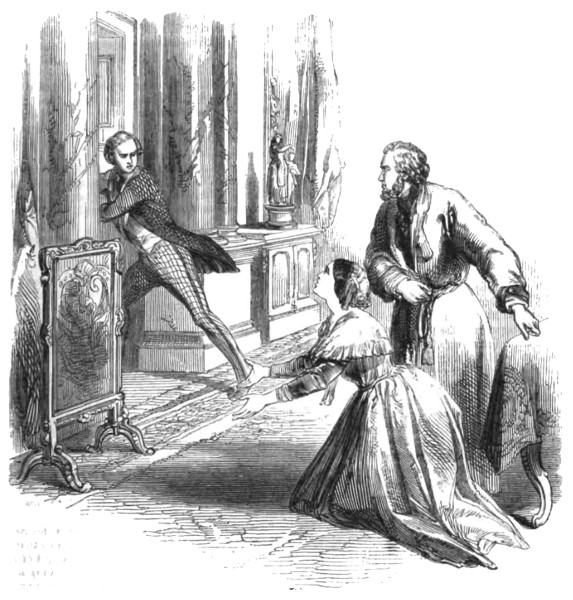
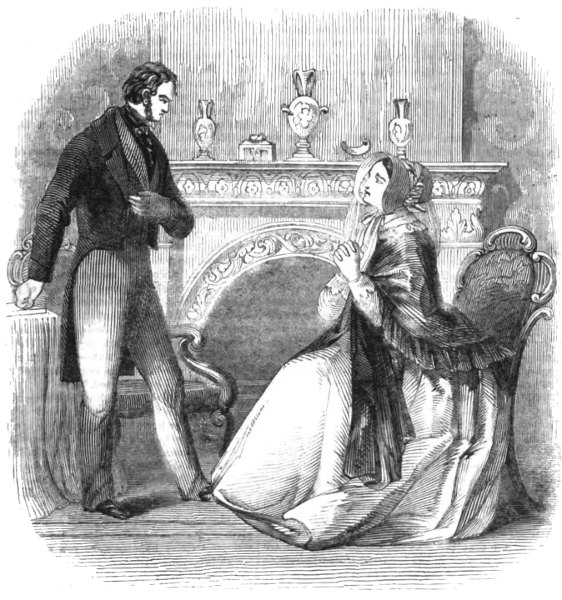
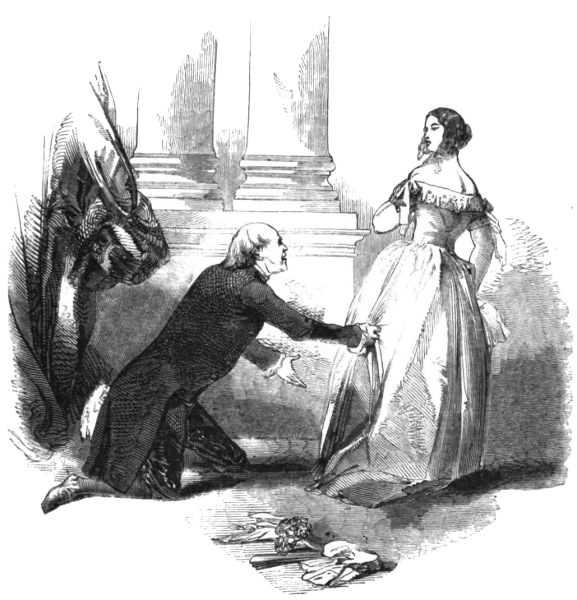
understand my meaning?’—then, casting herself at
the feet of the young milliner, the almost heart-broken
Lady Caroline exclaimed, in the wildest
paroxysm of bitter, bitter grief, as she joined her
hands imploringly, ‘Save my honour, Julia—save my
reputation,—and by so doing you save my life: for
I would perish by my own hand rather than endure
exposure!’—‘My God! dearest lady, what do you
mean?’ demanded Julia, fearful lest her friend’s
senses were leaving her, and that she was uttering
meaningless phrases in the incipient aberration of
the intellect: ‘tell me, how can I save you in any
way? for you know that you may depend upon me
to the utmost!’—‘How can you save me!’ repeated
the agonising young lady, in a voice of the most
plaintive appeal: ‘Oh! do you not comprehend my
condition, Julia? And yet I am about to become a
mother!’
“These words fell with stupefying, astounding
effect upon the ears of Julia Murray: indeed, she
could scarcely believe that she had rightly interpreted
their meaning. The unhappy Caroline mistook
the cause of the young milliner’s silence and
amazement; and, rising from her suppliant posture,
she exclaimed, while the proud patrician blood
rushed to her cheeks, ‘I understand you, Miss: you
are shocked at the announcement I have made, and
you are indignant that I should apply to you to
screen me. I will drag myself away from your
house, therefore; imploring you only to keep the
secret which I have been so foolish, so inconsiderate
to reveal to you.’—‘Just heaven! what do I hear?
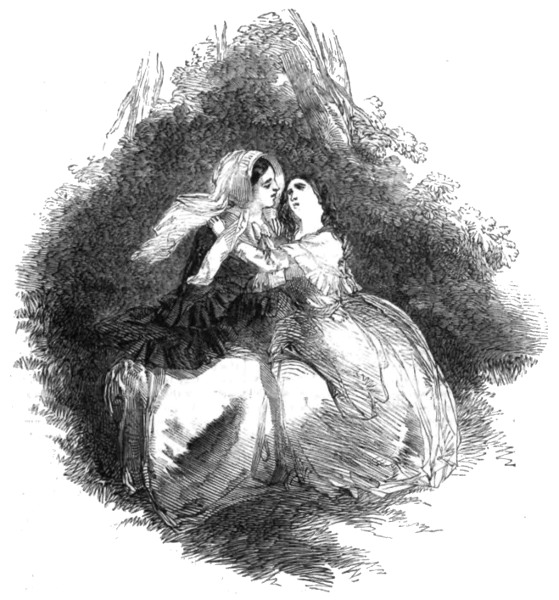
reproaches from your lips!’ cried Julia; and embracing
the unhappy lady with sisterly warmth, she
said, ‘No, no: you have misunderstood me! Grief
and surprise for a moment sealed my lips: but you
find me ready to succour you, dearest benefactress,
to the utmost of my power!’—‘Thank you, kind
friend,’ murmured Lady Caroline, falling back exhausted
into her seat; for the agitated state of her
feelings, and the harrowing emotions which the
dread of Julia’s coldness had just caused her to experience,
produced effects of a most perilous nature.
The young milliner knew not how to act: she was
bewildered; and, wringing her hands, exclaimed,
‘Oh! what shall I do? how can I aid her?’—Lady
Caroline partially recovered her presence of mind
as these words fell upon her ears; and giving a few
hasty instructions, these were instantly obeyed.
Julia conducted, or rather supported her to her
own bed-chamber; and then, throwing on her bonnet
and shawl, hurried away to fetch the nearest
surgeon. The medical man whom she sought was
at home; and he accompanied the milliner to the
house, where he arrived just at the moment that
his services were required. In a word, Lady Caroline
Jerningham that night became the mother of
a fine boy, although the birth was premature by
nearly a month, and she had risked much by the
necessity of adopting the indispensable means in regard
to dress to conceal her situation for many
weeks past.
“The surgeon, who had every reason to be satisfied
with the liberality of Julia on behalf of her unhappy
friend, and who was moreover a discreet man,
perceived that his patient was a young lady of
superior grade in society, and therefore volunteered
his aid in ensuring the concealment of the affair.
In fact, he stated that he was acquainted with a
poor woman in the neighbourhood, who, having just
lost her own infant, would be delighted to take
charge of the newly-born babe. Lady Caroline was
so far recovered as to be able to take part in this
conference; and, without suffering the slightest
hint to transpire as to who she was, she nevertheless
intimated her readiness and ability to remunerate
in the most liberal manner those who might be
instrumental in completing the arrangement suggested.
The surgeon accordingly undertook the
settlement of the business; and, after an hour’s
absence, he returned, accompanied by a young,
good-looking, healthy woman, who was willing to
embrace the proposal that had been made to her.
She was married to a labouring man; her name was
Porter; and she lived at the distance of about half
a mile from Julia’s house. Lady Caroline had a
well-filled purse; but even if the contrary had been
the case, her friend the milliner could have supplied
the funds required. As it was, the young
mother gave Mrs. Porter twenty pounds in advance;
and having mentioned a feigned name and address,
when questioned on that point, Lady Caroline
parted with her babe—though not without many a
bitter pang and a torrent of heart-wrung tears!
“That was a wretched night for poor Julia Murray.
In the warmth of her gratitude and friendship,
she had become an accomplice in what she fancied,
when she had leisure for sober reflection, to be something
bordering upon the nature of a crime. Her
pure soul shrank from the idea of the unnatural
abandonment by a mother of her child to the mercy
of a stranger, rendered necessary even though the
proceeding were by the peculiar circumstances in
which that mother was placed. Moreover, the readiness
with which Lady Caroline had given a false
name and address had somewhat shocked the truth-loving
Julia;—and then she feared lest the whole
matter should by any possibility become known, and
compromise her own reputation. All these thoughts
and apprehensions swept across her mind, after the
surgeon and Mrs. Porter had taken their departure,
and while Lady Caroline slept. But the generous
girl strove to banish from her mind reflections which
tended to diminish her respect for the patrician lady
who had manifested so much kindness towards her:
moreover, the natural feelings of a woman towards
one of her own sex placed in such interesting though
embarrassing, not to say alarming circumstances,—the
sentiments of commiseration, deep sympathy, and
tender friendship, soon triumphed over all other
considerations;—and when Caroline awoke, just as
the grey dawn of morning was breaking into the
chamber, she found the young milliner watching by
her bedside. The suffering lady was considerably
refreshed and strengthened by the long sleep she
had enjoyed: her mind was moreover relieved from
the most excruciating anxieties:—and she poured
forth her gratitude to Julia Murray in the most sincere
and heartfelt manner. Then, in the fulness of
the tender confidence which had arisen between
them, Caroline told her friend how she had loved
her cousin, a young lieutenant in the Navy,—how
their union was forbidden by her proud mother
though assented to by her generous brother, the
Marquis of Wilmington,—how her mother had used
her interest privately to get the young man appointed
to a ship and sent to sea with only a few days’ warning,—and
how, in the anguish of parting, she—Lady
Caroline—had fallen a victim to her fatal passion!
This narrative moved Julia to tears;—for the
young milliner now comprehended what love was—and
she felt that she also loved,—and that when she
sorrowed in secret at the protracted absence of the
stranger who had given her the gilt counter, it was
in consequence of the impression which he had made
upon her heart! Thus did Julia Murray at length
obtain the reading of the mysterious sensations that
stirred within her own soul.
“Fortunately there was a means of egress from
little Harry’s room, without the necessity of the boy’s
passing through his sister’s chamber; and thus was
the presence of Lady Caroline retained a profound
secret from him. You must also recollect that the
incidents just related occurred on the Saturday
night; and Harry had by chance received an invitation
to pass the Sunday with his schoolmaster’s
family. Every circumstance thus appeared to favour
the complete concealment of Lady Caroline’s confinement.
But it was now necessary that Julia should
repair to the mansion in Hanover Square, and acquaint
the young lady’s confidential maid with the
event which had taken place, as well as to arrange
for Caroline’s unobserved return home on the Monday
evening;—for though at the risk of her life, she
was resolved to remain away no longer than the
time specified. This commission Julia faithfully
performed; and after an absence of upwards of two
hours, she reached her own abode once more. The
patient was improving rapidly; and when the surgeon
called a second time on that Sunday, he was
astonished to find her so strong and in the possession
of so much physical and moral energy. To be
brief, on the Monday evening, according to agreement,
Lady Caroline, well wrapped up, disguised in
the attire of a daughter of the middle class, and with
a dark green veil drawn carefully over her countenance,
accompanied Julia in a hackney-coach to
Hanover Square; and the two were admitted into
the mansion, the hall-porter believing his young
mistress to be a friend and equal of the milliner. In
this manner they reached Caroline’s own chamber
without the truth being for an instant suspected;
and the confidential maid was in readiness to receive
her lady. Julia remained there until the maid had
ascertained that the hall-porter had been relieved by
another domestic during the supper-hour; and then
the milliner took her departure, accompanied by the
fervent gratitude and blessings of the fair patrician
whom she had thus extricated from a maze of the
most frightful difficulties.
“The very next morning, while Julia was seated
at work in her parlour, reflecting upon the incidents
of the three preceding days, she heard the iron gate
in front of the house groan upon its hinges; and,
looking up, she beheld from the window the tall,
handsome gentleman approaching the door. The
day was fine; and he no longer wore his cloak;—and
his garb was plain, unpretending, and perfectly
genteel. The housekeeper having returned home
that same morning, Julia awaited with a beating
heart in the parlour the presence of her visitor; and
when he entered, she felt so confused—for a variety
of reasons—that she could not utter a word. In the
first place she knew that she loved him;—secondly
she remembered all the enquiries he had put to her
late landlady concerning her;—and thirdly, she
recalled to mind the gentle, good, and almost
paternal way in which he had addressed her when
last they met; and she fancied that in her conduct
respecting Lady Caroline she had deviated
somewhat from the strict line of integrity, truth,
and virtue for pursuing which he had so emphatically
commended her, and in which he had with equal
earnestness enjoined her to persevere. Taking her
hand, he said, ‘Miss Murray, have you completely
forgotten me?’—‘Oh! no, sir,’ she cried, with a
start as if at an imputation of ingratitude: ‘that
were impossible!’—‘And yet why should you remember
me?’ he asked, gazing intently upon her:
’have I ever done you any service that deserves a
thought? The only incident which is likely to dwell
in your mind respecting me, is the wretchedness
and embarrassment to which my thoughtless conduct
exposed you. But for all that you then endured,
have I ever made you the slightest recompense?’—‘Oh!
sir,’ cried Julia, the blood rushing
to her cheeks, ‘do you think for a moment that I
ever sought or looked for a pecuniary indemnification?
Heavens, how have you mistaken my character!’—and
she burst into tears. The stranger
gazed upon her, and even smiled as if in satisfaction:
but he said nothing.—‘No, sir,’ resumed the young
milliner, hastily passing her handkerchief across
her countenance and wiping away the traces of her
grief; ‘I am not a mercenary person, such as you
appear to suppose me. I did remember you with
gratitude,’ she continued, her voice becoming mournful
and plaintive in spite of herself; ‘because you
spoke kindly to me on that evening when the accident
occurred to the silk dress—because you proffered
me assistance at a moment when I and my
little brother really needed it—because I always
believed and still believe that it was on your part
entirely an error which led me into such a serious
difficulty—because you then told me that you would
not insult me by offering me any pecuniary recompense—and
because, when you called again, you
spoke kindly to me as before, gave me good advice,
and also brought me intelligence from Mr. Richardson,
which has led to my present prosperity. For
all these reasons, sir,’ she added emphatically, ‘I
have thought of you often and often; and I considered
myself to be deeply your debtor.’—‘Excellent
girl!’ exclaimed the gentleman, surveying her
with mingled admiration and interest: ‘not for
worlds would I insult your feelings, nor wound
your generous heart! And it was precisely through
delicacy in those respects, that I never did openly
proffer you any pecuniary assistance, since that one
unfortunate occasion in Hanover Square. Again,
let me observe, that if I have not visited you for
four long months, I have not been unmindful of
your welfare. I have, as it were, watched over you
from a distance; and I have learnt with supreme
satisfaction, that your conduct has continued most
exemplary. Miss Murray, I am perhaps singular
and eccentric in my notions; and, though highly
placed in the social sphere, yet I have determined
to consult only my own happiness, at least for the
future, in the most important step which a man can
adopt in life. I allude to marriage.’—Julia started,
blushed, and cast down her eyes; and this confusion
on her part seemed to encourage her visitor to proceed.—‘I
must candidly inform you,’ he resumed,
’that I have been a husband already, and that the
alliance which I formed almost in my boyhood, and
in obedience to the dictates of an imperious mother,
was an unhappy one. My wife was a heartless coquette—vain—frivolous—and
possessing no mind.
I sought by gentleness and kindness to render her
attached to her home, although I never really loved
her; but all was useless. At last she caught a
severe cold when returning from a rout, early on
a winter’s morning; and a rapid decline soon carried
her to the tomb. This occurred two years ago.
I then vowed that if I should ever contract a second
union, it must be where the heart alone was interested.
This resolve I declared to my mother; and
it has in a measure, I regret to say it, incensed her
against me. The very first time I ever saw you, I
felt myself suddenly and mysteriously attracted towards
you. All that I have since heard or seen of
you has tended to confirm that favourable impression;
and I am come this morning to offer you my
hand, as you already possess my heart.’
“A faintness—an indescribable sensation of mingled
joy and apprehension came over Julia, as these
last words met her ears,—joy in the hope that she
had heard aright, apprehension lest she were the
prey of a delightful vision which was too soon to be
dissipated. But when she felt her hand pressed to
the lips of that handsome suitor who now knelt at
her feet, and listened to the tender assurances of an
honourable and lasting affection which he breathed
with manly sincerity in her ears, she exclaimed,
under the sudden impulse of her heart’s emotions,
‘Is it possible that so much happiness can be in
store for me?’—Her suitor received those words as
an assent to his proposal; and, pressing the young
maiden to his bosom, he said, ‘Then without knowing
my name you have loved me, dearest Julia?’—She
murmured an affirmative; and a rapid interchange
of questions and replies convinced him that
the young maiden had all along remembered him not
with gratitude, but with affection! Thereupon, seating
himself by her side, and retaining her pretty
hand in his, he said, ‘Then henceforth, Julia, there
need exist no mystery on my part. I am the pretended
debtor to your deceased father; and Mr.
Richardson, my own attorney, followed my secret
instructions in providing for yourself and your
brother. My object was to place you in comfort, yet
still leave you in a condition that rendered you to a
certain degree dependant on your own honest industry;
and I have been overjoyed to find that prosperity
has not induced you to relax your energies,
nor led you into extravagances, nor in any way
proved injurious to your fair fame, your amiable
disposition, and your steady perseverance. With
delight, then, shall I accompany so worthy a woman
to the altar; and with pride shall I present you to
the world as the Marchioness of Wilmington!’—‘Oh!
my lord,’ murmured Julia, a greater faintness
than before now coming over her, as the lofty rank
of her suitor was thus announced to her, ‘is it possible
that you can be the brother of that young lady
to whom I owe so much?’—and then she blushed
deeply, and a cold shudder passed over her frame as
she remembered what a tremendous secret she had
retained in her bosom, and must retain inviolably
concerning the sister of him who offered to make
her the partner of his rank and fortune.—‘Yes,’
said the marquis, attributing her emotions to the
happiness as well as the maidenly confusion which
it was natural for her to experience under existing
circumstances; ‘that Lady Caroline whom you
know, is my sister. You may judge my surprise
when, on the night that I first encountered you in
Hanover Square, you informed me that the spoilt
dress was my mother’s. The very next morning I
called at her residence and privately acquainted
Caroline with the little adventure, casually saying
that I had been a witness of the accident which was
occasioned through no neglect nor carelessness on
your part, and desiring her when you presented
yourself to mitigate as much as possible my mother’s
certain resentment against you. Since that period
my sister has frequently spoken to me concerning
you, and has recommended you extensively to her
numerous fashionable acquaintances. But, much as
I love and would trust Lady Caroline, I have never
informed her of the attachment I experienced for
you, nor of the fact that I was your father’s pretended
debtor. This reserve originated merely in
the determination to watch your conduct,—I may
tell you all this now, dear girl,—from a distance;
so that time might decide whether I should lay my
coronet at your feet, or renounce all farther idea of
an alliance with you. Thank, heaven! the former is
the happy destiny; and now I have explained all
that may have seemed strange or mysterious in your
estimation.’
“Julia could scarcely find words to express her
gratitude for all the delicate attentions and generous
acts of which the nobleman had thus been the
hitherto unknown author: but he sealed her lips
with a fond kiss, and then proceeded to address her
in the following manner:—‘I propose, dearest girl,
that our union shall take place in six months from
the present time. The reason that I suggest so long
a delay is that I may visit you occasionally, in company
with my sister, be it understood, so that you
may learn to know me better than you now do; and
as I shall at once make a confidant of Caroline, and
am well acquainted with the generosity of her disposition,
you need not apprehend any coolness or
hostility on her part. Quite the contrary: she will
love you as a sister. Ah! I observe that you sigh
and experience an agitation of feeling, my Julia; but
you have no cause to dread any exhibition of foolish
pride with Caroline. Relative to my mother, I say
nothing—promise nothing: at the same time I cannot
permit her will to rule my happiness. And now I
shall take my leave of you for the present, Julia;
and I shall at once hasten to Hanover Square, to
confide all that has occurred between us to my
sister, who, I regret to state, has been confined for
some days past to her own chamber. Alas! she,
poor girl, has suffered in her best and holiest affections
through her mother’s pride; but I rejoice to say
that happiness awaits her yet. By the sudden death
of a young cousin, Lieutenant Quentin has become
Lord Hartley, and his ship will return in a few
months to England. This most unexpected succession
to title and wealth, will smooth down all
the difficulties which my mother has hitherto interposed
in the way of her daughter’s happiness; and
who knows, Julia,’ added the marquis, smiling, ‘but
that the two marriages may be celebrated at the
same time?’—‘God grant that they may!’ exclaimed
the young milliner, with a strange emphasis; then,
immediately afterwards she observed, ‘For, believe
me, I have your sister’s happiness most sincerely at
heart.’—‘I shall not fail to tell Caroline all you
say,’ returned the marquis; ‘and she will be prepared
to love you the more tenderly. And now,
dear Julia,’ he added, rising to depart, ‘I must bid
you farewell for the present. The next time I call
I shall give you due notice beforehand, so that you
may have little Harry here to see me. But permit
me, before I depart, to request you to divest yourself
by degrees of the business and occupations
which have accumulated upon you. To speak
plainly, you need receive no more work from any
person; and you will permit my solicitor, Mr.
Richardson, to supply you monthly with such sums
as you may require for your expenditure.’—All this
was said by Lord Wilmington in so delicate yet
tender a manner, that it increased Julia’s attachment
to him, as well as her high esteem of his character;
and they parted, more than ever pleased
with each other.
“In the afternoon, Julia was sitting at her work,
pondering upon all that had occurred, and scarcely
able yet to convince herself that she was not a prey
to some delusive vision, when Lady Caroline’s maid
called with a note from her mistress. In this billet
the fair patrician said, ‘My brother has told me all,
dearest Julia; and believe me when I assure you, that
it will afford me unfeigned delight to hail you as a
sister. Never, never can I forget all your goodness
towards me in the hour of my bitter extremity. But,
for heaven’s sake! guard well my secret! This injunction,
however, I need scarcely give you. And yet,
there is one thing which now affects me; this is——shall
you not blush to acknowledge ME as your sister-in-law,
since you are acquainted with my disgrace? My
heart tells me that you commiserate and sympathise:
but my fears—Oh! until I receive from you an assurance
that may calm them—those fears are truly painful!’—The
generous Julia hastened to pen a reply, conveying
in the tenderest terms the assurance solicited;
and, having ascertained that the young lady was progressing
rapidly towards complete convalescence,
she dismissed the maid with the letter entrusted to
her. Three weeks, however, elapsed before Lady
Caroline was sufficiently recovered to call upon her
friend Julia; and then she came alone—for her mother’s
heart yearned to visit her child. Under the
influence of this feeling, she was moved to tears
when she learnt that every alternate day Miss Murray
had made it a point to call at Mrs. Porter’s residence
and assure herself that the poor babe was duly
cared for. ‘This is another proof of your goodness,
Julia!’ exclaimed Lady Caroline, falling upon her
friend’s neck and weeping with mingled gratitude
and joy. They presently proceeded together to
the good woman’s abode; and the young mother
was charmed to find her child thriving to her
heart’s best satisfaction. On the following day
Lady Caroline revisited Julia; but this time it
was in company with her brother the Marquis;—and
little Harry was at home to see them. You may
suppose that the party was a happy one; and it gave
the nobleman ineffable delight to observe that his
sister and his intended wife were on the best possible
terms with each other. But he little suspected
the tremendous secret that had thus cemented their
friendship;—and it cost poor Julia many a pang
when she reflected that she was compelled to retain
any secret at all from the knowledge of the generous
man who reposed such confidence in her! There
was however no help for it;—and yet Julia felt as
if she were acting with blameable duplicity in veiling
a circumstance which for her friend’s sake, she would
nevertheless rather die than reveal: and after her
noble visitors had taken their departure, she did
not experience that amount of happiness which,
with her present brilliant prospects, she knew she
ought to enjoy.
“I must not dwell upon this portion of my narrative.
Let us suppose five months to have passed
away; during which period the marquis had been
constant in his visits to Julia, but always in the
company of his sister. So delicate was his behaviour
in respect to the reputation of his intended
bride, that he avoided every chance of compromising
her; and although the neighbours saw a gentleman,
whose name they did not know, call three
times a-week upon the beautiful milliner, they
never beheld him repair thither alone. Thus there
was no scope for scandal; and Julia’s conduct was
always so circumspect as to prove a complete antidote
to calumny. I should observe that during the
five months mentioned, the attachment subsisting
between the pair increased, and warmed into the
most ardent love; and I must not forget to state
that Lady Caroline visited her child at Mrs.
Porter’s house as frequently as she was able. But
Julia seldom failed to call there every alternate
day; and thus the rearing of the poor infant
was strictly watched by its mother, and that
mother’s bosom friend. Sometimes Harry accompanied
his sister in her walk to Mrs. Porter’s cottage;
but the little fellow was always made to wait in
one room while Julia was shown the baby in another—and
thus the real motive of her visits there
was unsuspected by him. Not that she feared he
would reveal any thing which he was enjoined to
keep secret; but Julia believed—and rightly believed—that
it was alike more prudent and delicate
to leave him in total ignorance of the object which
took her to the cottage. Thus time wore on, as I
have already mentioned; and now I must remark
that in compliance with the wishes of Lord Wilmington,
Julia had by this time altogether ceased
to receive work; but instead of drawing on the
funds placed at her disposal in the hands of Mr.
Richardson, she subsisted upon the savings which
she had been enabled to accumulate. I mention all
these little circumstances, to afford you as good an
idea as I can convey of the excellence of her disposition,
and the total absence of selfishness from her
character. In fact, the more the marquis saw of
her, the more enamoured of her did he become, and
the greater grew his admiration of her amiable
qualities. It was therefore with joy the most unfeigned
that he at length considered himself justified
in fixing the day for the bridal; and this ceremony
was settled to take place precisely on the completion
of the six months from the hour in which he had
offered her his hand.
“While Julia was occupied in preparing her own
wedding-dress, the Marquis busied himself in rendering
his splendid mansion in Belgrave Square as suitable
as possible for the reception of his bride. In the
meantime he had communicated to the Dowager-Marchioness
his intended marriage; but, as he had
feared, his design experienced the most decided disapproval
on her part. Vainly did he reason with her
on the subject—uselessly did he represent that his
happiness was seriously involved: his mother refused
to listen to him;—and he had the mortification to incur
her most serious displeasure. The bitterness of
her hostility to the match he however concealed from
Julia; and, much as he deplored the breach which
now existed between himself and his only surviving
parent, not for a moment did he entertain the thought
of yielding to her tyranny. Thus the time passed on;
and it was now within three days of the one fixed for
the bridal ceremony, when an incident occurred which
produced a terrible change in the aspect of affairs.
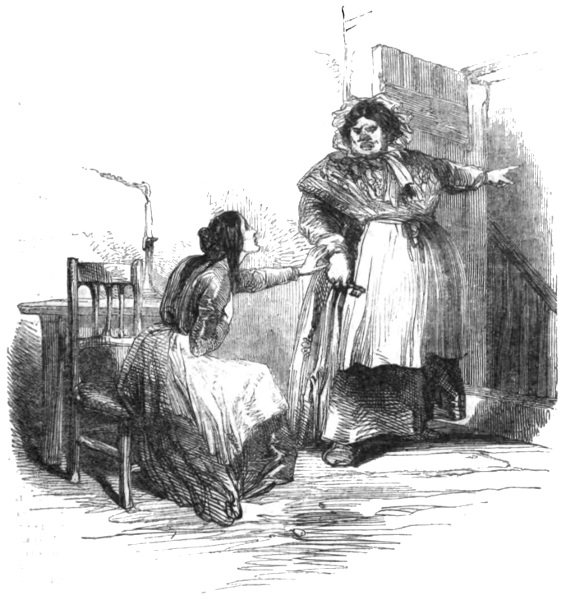
“It was a fine summer morning, and the clock was
striking eight just as Julia and little Harry were
sitting down to breakfast, when the old housekeeper
entered to inform her mistress that a woman by the
name of Porter desired to speak to her without delay;—for
you most remember that the housekeeper was
entirely ignorant of the transaction which so nearly
concerned Lady Caroline Jerningham, and to some
extent involved Miss Murray, at least as an accessory,
in the mysterious business. Mrs. Porter was instantly
admitted into the parlour; and when she appeared,
and the housekeeper had retired, Julia approached her
in an agitated manner and with an enquiring look,—for
it struck her that this visit—the first which the
woman had ever paid to the house since that night
when the infant was entrusted to her—augured something
unpleasant. In her excitement she forgot the
presence of her brother Harry—whom the woman herself
likewise overlooked; and, to the anxious glance
darted upon her, Mrs. Porter verbally replied by exclaiming,
‘Oh! Miss, the dear child has been suddenly
taken dangerously ill!’—‘The child dangerously ill!’
repeated Julia, who had learnt to love the infant almost
as much as if it were her own: ‘I will accompany
you directly;’ and, hurrying from the room, she
presently reappeared with her bonnet and shawl.
Then, noticing Harry, it flashed to her mind that he
had overheard what had been said: but a second
thought told her that more harm would be done by
attempting to explain away any impression that might
have been made upon his mind, than by leaving the
matter as it then stood;—and, having merely observed
to him that she should return shortly, Julia hastened
away in company with Mrs. Porter. Harry finished
his breakfast, not thinking much of the few words
which had caught his ears, but which he could not
rightly understand; and, as it was holiday-time, he
was about to repair to play in the garden at the back
of the house, when a double knock at the front door
made him hasten to the window. Perceiving that the
visitor was the Marquis, he ran to give him admittance;
and the nobleman entered the parlour. ‘Where
is your sister, Harry?’ he asked, caressing the boy in
a kind manner.—‘She is gone out, my lord,’ was the
reply.—‘This early!’ exclaimed the Marquis; ‘and I
had promised myself the pleasure of breakfasting with
you both. The morning was so fine, and as I am a
very early riser, I rode out as far as the turnpike, and
have sent my horse back with the groom.’—The nobleman
spoke this rather in a musing tone, than actually
addressing himself to the boy; and, after a pause, he
observed, ‘I suppose your sister will not be long?’—‘I
do not know, my lord,’ answered Harry. ‘A
woman came just as we were sitting down to breakfast,
and Julia seemed much vexed at what she told
her.’—‘I hope that nothing disagreeable has occurred?’
cried the Marquis, in a tone of alarm.—‘The woman,
whose name is Porter, informed Julia that the child
was dangerously ill,’ responded Harry; ‘and then they
went away together.’—‘Oh! I understand,’ said the
Marquis: ‘the child of some poor woman named Porter
is unwell, and your sister has gone to see it.’—‘No,
my lord, I don’t think the child is Mrs. Porter’s,’ returned
Harry, ingenuously, and with boyish communicativeness;
’for I have often called at her cottage with
Julia, and I have heard Mr. Porter say that his wife’s
own baby died last winter.’—‘And Julia has often
called there?’ exclaimed the Marquis, a horrible suspicion
suddenly arising in his mind.—‘Very often
indeed,’ answered Harry, totally unconscious of the
tremendous amount of mischief he was occasioning.
‘When we have been out walking together, we have
come round that way, and stopped at the cottage; and
then I have waited in the kitchen with Mr. Porter,
who used to give me cakes or marbles, while Julia
went up stairs with Mrs. Porter.’—‘And did you ever
see the child?’ asked the nobleman, assuming as much
composure as he could possibly call to his aid.—‘No;
Julia never told me a word about it.’—‘And how did
you first hear of it?’—‘Just now, when Mrs. Porter
rushed in and said that the child was ill’—‘And was
Julia very, very sorry?’ demanded the Marquis.—‘Oh!
yes, indeed!’ cried the boy, who saw nothing
strange nor unusual in the nobleman’s tone or manner,
and regarded this dialogue as mere chit-chat.—‘And
whereabout is Mrs. Porter’s cottage?’ asked Wilmington,
in whose bosom a perfect hell was now raging.—‘Shall
I show your lordship the way?’ said Harry.
The nobleman nodded his head affirmatively; and the
little fellow hastened to fetch his cap. They then
proceeded in silence until they came within sight of
the cottage, which Harry pointed out.—‘You may
now go home again,’ said the Marquis; and Harry
obeyed the hint, still totally unsuspicious of the harm
which his candid garrulity had accomplished.
“The nobleman, when thus left alone, could no
longer restrain the emotions which agitated within
him. Turning aside from the path leading towards the
cottage, he rushed into the fields, exclaiming aloud,
‘Just heavens! on what an abyss was I hovering!
But can such diabolical perfidy exist on the part of
one so young? Oh! yes—it is too apparent; and my
mother was right when she counselled me never to
bestow my hand on a woman moving in a sphere beneath
my own!’—Having thus given vent to his
excited feelings, Wilmington grew more composed;
and he now approached the cottage. The door stood
open; and, entering without any ceremony, he saw a
woman at the same instant descend from a staircase.
‘Is your name Porter?’ he enquired, speaking in as
mild a tone as possible.—‘Yes, sir,’ she answered.—‘And
it is here that a child who has been, as it were,
abandoned by its unnatural mother, is lying dangerously
ill?’ he said, fixing his eyes keenly upon the
woman’s countenance.—‘Thank God, the dear innocent
is better!’ exclaimed Mrs. Porter, taken completely
off her guard, and even entertaining a suspicion
that the gentleman himself might be the father of her
nursling.—‘Now, confess every thing,’ cried the Marquis,
’or it will be the worse for you! Was it not
Miss Murray who engaged your services——’.—‘No,
sir: it was the surgeon who attended the lady in her
confinement,’ interrupted Mrs. Porter, terrified by the
stern tone which her querist had suddenly adopted;
’but it was at Miss Murray’s house——’.—‘Enough!
enough!’ ejaculated. Wilmington; and he hurried away
from the cottage.
“In the meantime Julia had returned home, having
assured herself that the child was out of danger;
and as she retraced her way by means of a bye-path,
it happened that she did not encounter her brother
and the marquis. But little Harry was light of foot;
and he, having been dismissed by the nobleman in
the way above stated, reached the front door at the
same instant as his sister. She was surprised to
find that he had been out—still more so when she
learnt that Lord Wilmington had called so early.
But a frightful sensation seized upon her, when Harry
ingenuously observed that the nobleman had taken
him to lead the way to the cottage. Subduing her
emotions, however, as well as she could, she proceeded
to question her brother; and in a short time she ascertained
all that had passed between him and the
Marquis. Each answer that he gave—each detail
that he mentioned, increased the horrible fears which
now oppressed her; and, at last—comprehending the
full extent of her misfortune,—perceiving the nature
of the suspicions which were sure to have seized upon
her intended husband,—she uttered a piercing cry,
pressed her hands in anguish to her throbbing brow,
and exclaimed in a piercing tone, ‘Oh! Harry, Harry,
you know not what you have done!’—The boy was
frightened; and, darting towards his sister, he threw
his arms around her neck, imploring her to forgive
him if he had acted improperly. Even in the midst
of her bitter, bitter anguish, she could not find it in
her heart to continue angry with her little brother,
who had not wantonly nor wickedly inflicted this
appalling injury upon her; and, assuming an appearance
of calmness, she became the consoler. In the
depth of misery there is a crisis that makes even despair
the immediate precursor of hope; and Julia
began to reason to herself that all might not be so
dark as she had feared. But while she was thus endeavouring
to persuade her inmost soul to render
itself accessible to consolation, a note was put into
her hand by the housekeeper. She glanced at the
address which was hurriedly—almost illegibly written,
and the ink of which was scarcely dry,—so that
she knew it had been penned somewhere in the
neighbourhood. With trembling hands she tore it
open; and her strength and mental energy sustained
her sufficiently to permit the entire perusal of the
letter. Its contents ran thus:—‘I have discovered
your frailty, your guilt, your hypocrisy, just in time
to save myself from an alliance which would have
brought dishonour on my name, and heaped endless
miseries on my head. I shall not attempt to reproach
you at any length for your conduct towards me: my
generous confidence has been met by the blackest duplicity—the
most diabolical ingratitude; and your conscience
will punish you more—oh! far more severely
than any words that I may address to you. Neither
shall I adopt the mean and petty revenge of exposing
you: but if you ever dare to boast that you were once
engaged to be married to the Marquis of Wilmington,
then shall I consider that it would be a sin to
spare you.’
“The letter dropped from Julia’s hand; and, with
a wild shriek, she fell senseless on the floor. The
housekeeper administered restoratives, while little
Harry, who was himself a prey to the liveliest grief
he had ever yet known, hurried to fetch the surgeon.
It was the same medical man who had attended upon
Lady Caroline Jerningham; and he was prompt in
repairing to a house where his former services had
been so liberally rewarded. Julia had somewhat recovered
in the meantime; but he pronounced her to
be in a dangerous state—and, indeed, she seemed
quite unconscious of every thing that was passing
around her. She was conveyed to her chamber,—medicine
was prescribed,—and the surgeon recommended
the housekeeper not to leave her mistress
alone more than was absolutely necessary, inasmuch
as he feared that her brain was affected. Little Harry
was inconsolable at his sister’s illness—the more especially
that he reproached himself with having been
the cause of it all; though how he had done the
harm he could not by any means understand. Seated
by Julia’s bed-side, he fixed his tearful eyes on her
pale countenance, as she slumbered uneasily; and
when hours had passed, and evening came, and still
she awoke not, he was afraid that she was dead. The
housekeeper, however, assured him to the contrary;
and then he bent softly over his sister, to whom the
surgeon had administered an opiate, and gently kissed
her lips. She murmured a name—it was his own name—and
opened her eyes. Complete consciousness returned
in a few minutes; and as she rapidly surveyed
her misfortune and calculated its extent, she shuddered
at the idea of even attempting to meet it with
resignation. But for that little brother’s sake—the
sake of him whom she had found bending over her,
and whose name was the first that her lips breathed
on her waking,—for his sake she nerved herself to
wage war with the world once more. Though a word
of explanation—the mere revelation of Lady Caroline’s
secret would at once restore her to that position
so full of hope which she had occupied in the morning,—still
her generous heart would not allow her to
betray her friend. No: she would sooner pine away
and go down to an early grave, heart-broken and
spirit-crushed, than proclaim to the Marquis the secret
of his noble sister’s dishonour!
“It was about seven o’clock in the evening of this
dreadful day that a hasty and impatient double-knock
at the front door was heard; and a few moments afterwards
Lady Caroline Jerningham was ushered into
the chamber where Julia was lying. The moment she
entered, the patient made a signal for the housekeeper
and little Harry to withdraw; and when the two
friends were alone together, a most affecting scene took
place. It appeared that the marquis had that afternoon
written a letter to his sister, of which the following
were the enigmatical contents:—‘I am almost
heart-broken, my dearest Caroline, and cannot see
you at present. I shall retire into the country for a
few weeks—perhaps months—to hide my grief from
every eye, and endeavour to regain somewhat of that
mental composure which has been almost completely
wrecked this day. Julia is unworthy of my love and
of your friendship: what the proof of this may be,
ask not—seek not to learn;—but I charge you to visit
her no more. Your afflicted brother,’ &c.—On the
receipt of this note, Lady Caroline, who could not help
suspecting that this suddenly wrought change in the
sentiments of the Marquis arose from some fearful
misunderstanding or some partial discovery respecting
the child, had hastened, almost distracted and a
prey to intolerable suspense, to Julia’s abode; and there
she was shocked to find her generous-hearted friend
stretched upon a bed of sickness. Embracing each
other affectionately, they gave mutual explanations;
and Lady Caroline perceived that her worst fears were
confirmed. The Marquis had indeed made a discovery
relative to the infant; but he was deceived with regard
to its maternity. And now who can describe the
admiration which Lady Caroline experienced for the
character of her friend, when she learnt that the poor
girl would rather lie under the dread suspicion of the
Marquis—rather resign all her brilliant prospects, and
see her heart’s fondest affections blighted,—rather, in
fact, resign herself to immolation than betray her
whose secret she deemed so sacred!
“‘No—no!’ exclaimed the fair patrician, throwing
herself upon Julia’s bosom, and weeping plenteously;
’this may not be! Never can I permit you, noble-hearted
girl, to endure infamy, reproach, and wretchedness
for my sake! I will at once follow my brother
into the country, throw myself at his feet, confess all,
and bring him back to you!’—‘And then what will
become of you, Caroline?’ asked Julia, mingling her tears
with those of her friend.’—‘Oh! I shall retire from
the world, and bury myself, with my innocent babe,
in some solitude—in some far-off village, perhaps,
where, under a feigned name, I may escape the world’s
scorn for this fatal weakness which has caused so much
misery!’—and, as she spoke, Lady Caroline’s voice indicated
the most acute anguish of heart. ‘Unless,’
she added, her tone suddenly becoming hoarse and
hollow, and her manner unnaturally subdued,—‘unless,
indeed, my brother, in the first ebullition of his rage
should stretch me dead at his feet; and that is the
most probable result!’—‘Then, dearest Caroline,’ exclaimed
Julia, speaking in a tone of mingled alarm
and earnest entreaty, ‘for heaven’s sake renounce this
mad project! Do not think of seeking your brother
and thus exposing yourself to his rage. I owe you a
deep, deep debt of gratitude; and now let me pay it
by enduring that weight of suspicion against which I
may haply bear up, but which would crush and overwhelm
you. For never, never can I forget that when
I appeared, full of terror and trembling, with the spoilt
dress in your mother’s presence, your looks gave me
encouragement, and your kind words reassured me.
Then, when I was leaving your dwelling without the
means of even procuring a loaf for my dear little
brother and myself, you put gold into my hand. Oh!
dear lady, these are manifestations of generosity which
never can be forgotten; and, noble as you are by name,
you are nobler in heart. It will be my joy—my pride
to screen you, who have proved so kind a friend to
me; and there is no sacrifice that I am unprepared to
make in order to save you from unhappiness and
shame!’—‘It is an angel that speaks!’ murmured
Lady Caroline, overpowered by this generosity on the
part of Julia Murray. ‘But nothing, nothing,’ she
continued, with reviving energy, and after a few moments’
pause, ‘shall induce me to yield to your desire.
I recognise all that is great and noble in your conduct;
and so long as I remain possessed of intellect and
memory, I shall pray night and morning for the
Almighty to bless you, my dearest Julia. I have been
frail, and I must bear the consequences. Seek not to
wean me from this intention: I should never know a
happy moment, were I to permit you to become the
victim of my shame!’9—‘One word!’ exclaimed Miss
Murray, after a minute’s profound reflection: ‘I will
no longer urge you to act contrary to your heart’s
dictates; but promise me that you will not take a
single step towards revealing every thing to your
brother and exculpating me, until four-and-twenty
hours shall have elapsed. During that interval we
shall both have time for serious and calm meditation;
and no advantage will result from precipitate haste.’—‘Yes;
I make you this promise, Julia,’ returned Lady
Caroline; ‘on the condition that when we meet again
to-morrow evening, it shall not be to argue whether I
am to confess or not, but in what manner the confession
can be most suitably and safely made.’—‘Agreed!’
cried Miss Murray: ‘and to-morrow evening, at seven
o’clock, you will visit me again?’—‘I will,’ answered
Lady Caroline Jerningham; and she then took her
leave of her friend, whom she embraced with the
warmth of the most sincere affection.
“On the following day, at about three o’clock in the
afternoon, a letter, addressed to Lady Caroline Jerningham,
was delivered at the mansion in Hanover
Square by a porter, who hurried away the moment he
had placed it in the servant’s hands. The contents of
this note ran as follow:—‘Dearest Caroline, it is useless
for you to call this evening at the house which I
have occupied for so many months, and which was
purchased by your excellent brother’s money. I shall
no longer be the occupant of that house, when this note
reaches you. My mind is made up to endure every
thing for your sake; and I therefore this day withdraw
myself, in company with Harry, into a retirement
and an obscurity whither you cannot follow me.
It will therefore be unnecessary and ridiculous—I may
almost say wicked—for you to make any revelations
to your brother. By sacrificing yourself, you would
confer no benefit upon me; as nothing shall induce
me to alter the plans I have formed respecting the
future. Retain profoundly secret all those circumstances
the confession of which can have no useful
result; and think sometimes of me—for I shall often,
often think of you, my well-beloved friend,—although
we may never, never meet again!’—This letter, on
which were the traces of weeping, produced a stupefying
sensation on the part of Lady Caroline. Was it
possible that Julia, in the zeal of her ardent friendship,
had outwitted the fair patrician, and had won
the generous game at which they were playing? No
wonder that Miss Murray had requested Caroline to
suspend all proceedings for twenty-four hours: in that
time, the noble-hearted girl had consummated the
sacrifice of herself! And now nothing could exceed
the sincerity and the depth of that grief which seized
upon the lady: for an hour after she received the note,
she was as one demented; and her confidential maid
experienced the utmost difficulty in restraining her
from manifestations of feeling which would have excited
the strangest suspicions in the household. At
length, when she had grown comparatively calm, Lady
Caroline, attended by her maid, repaired to Camden
Town; but there they only beheld those appearances
which corroborated the statements contained in Julia’s
letter. For the house was shut up; and, on enquiry
being made of a neighbour, it was ascertained that
Miss Murray, her servant, and her little brother had
taken their departure soon after mid-day, although,
according to the same authority, the young milliner
was evidently suffering from indisposition. The fair
patrician’s last hope of seeing her friend and weaning
her from her intention, was thus destroyed; and the
poignancy of her grief was renewed. She proceeded
to Mrs. Porter’s cottage, where she learnt that Julia
had called in the morning to assure herself of the
child’s convalescence and imprint upon its little countenance
a farewell kiss. This touching instance of
Julia’s goodness of heart moved Lady Caroline to
tears; and she reproached herself bitterly for having
been the cause of all her friend’s present sorrows.
“There, however, appeared to be a remedy which
might yet be adopted; and to this measure did the
lady make up her mind. She resolved, in fact, to
write to her brother without delay, inform him of
every thing, and urge him to lose no time in discovering
the retreat of Julia, that justice—full and ample
justice—might be done to her. Accordingly, on the
following morning she penned a long letter to the Marquis
of Wilmington, imploring him to forgive her for
the dishonour she had brought upon the family, and
drawing such a picture of Julia’s generosity in sacrificing
herself for a friend, that she wept long and plentifully
over the pages as she perused them. When
this epistle had been despatched to the post, Caroline’s
heart felt easier; and she said to herself, ‘Even if my
brother should wreak the bitterest vengeance upon me,
I can endure his resentment with resignation; for I
now have the consciousness of performing a sacred and
solemn duty.’—The Dowager-Marchioness, in the
meantime, had been suffering through indisposition
which confined her much to her chamber; and she did
not therefore perceive any particular variations in the
manner and aspect of her daughter.