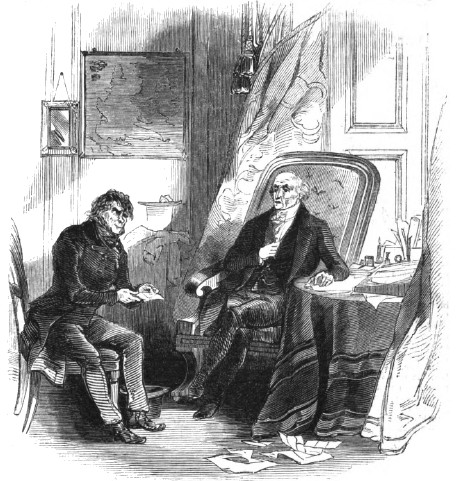
MR. Greenwood was seated in his study the morning after the event which
occupied the last chapter.
He was dressed en negligé.
A French velvet skull-cap, embroidered with gold, sate upon his curled
and perfumed hair: a sumptuous brocade silk dressing-gown was confined
around the waist by a gold cord with large tassels hanging almost to his
feet: his shirt collar was turned down over a plain broad black riband,
the bow of which was fastened with a diamond broach of immense value;
and on his fingers were costly rings, sparkling with stones of
corresponding kind and worth.
On the writing-table an elegant French watch attached to a long gold
chain, lay amidst a pile of letters, just as if it had been carelessly
tossed there. A cheque, partly filled up for a thousand
guineas,—several bank-notes, and some loose gold, were lying on an open
writing-desk; and, at one end of the table lay, in seeming confusion, a
number of visiting cards bearing the names of eminent capitalists,
wealthy merchants, peers, and members of Parliament.
All this pell-mell assemblage of proofs of wealth and tokens of high
acquaintance, was only apparent—and not real. It was a portion of Mr.
Greenwood's system—one of the principles of the art which he practised
in deceiving the world. He knew none of the capitalists, and few of the
aristocrats whose cards lay upon his table: and his own hand had
arranged the manner in which the watch, the cheque-book, and the money
were tossing about. Never did a coquet practise a particular glance,
attitude, or mannerism, more seriously than did Mr. Greenwood these
little artifices which, however trifling they may appear, produced an
immense effect upon those with whom he had to deal, and who visited him
in that study.
Every thing he did was the result of a calculation, and had an aim:
every word he spoke, however rapid the utterance, was duly weighed and
measured.
And yet at this time the man who thus carried his knowledge of human
nature even to the most ridiculous niceties, was only in his
twenty-eighth year. How perverted were great talents—how misapplied an
extraordinary quickness of apprehension in this instance!
Mr. Greenwood contemplated the arrangements of his writing-table with
calm satisfaction; and a smile of triumph curled his lip as he thought
of the position to which such little artifices as those had helped to
raise him. He despised the world: he laughed at society; and he cared
not for the law—for he walked boldly up to the extreme verge where
personal security ceased and peril began; but he never over-stepped the
boundary. He had plundered many—he had enriched himself with the wealth
of others—he had built his own fortunes upon the ruins of his fellow
men's hopes and prospects: but still he had so contrived all his schemes
that the law could never reach him, and if one of his victims accused
him of villany he had a plausible explanation to offer for his conduct.
If a person said to him, "Your schemes have involved me in utter ruin,
and deprived me of every penny I possessed,"—he would unblushingly
reply, "What does the man mean? He forgets that I suffered far more than
he did; and that where he lost hundreds I lost thousands! It is
impossible to control speculations: some turn up well, some badly; and
this man might as well blame the keeper of a lottery-office because his
ticket did not turn up a prize, as attempt to throw any odium upon me!"
And this language would prove satisfactory and seem straight-forward to
all by-standers, save the poor victim himself, who nevertheless would be
struck dumb by the other's assurance.
Greenwood had commenced his ways of intrigue and pursuits of duplicity
in the City, where he was known as George Montague. The moment he had
obtained a considerable fortune, he repaired to the West End, added the
name of Greenwood to his other appellations, and thus commenced, as it
were, a new existence in a new sphere.
He possessed the great advantage of exercising a complete control over
all his feelings, passions, and inclinations—save with respect to
women. In this point of view he was a complete sensualist—a heartless
voluptuary. He would spare neither expense nor trouble to gratify his
amorous desires, where he formed a predilection; and if in any case he
would run a risk of involving himself in the complexities of civil or
criminal law, the peril would be encountered in an attempt to satisfy
his lustful cravings. There are many men of this stamp in the
world,—especially in great cities—and, more especially still, in
London.
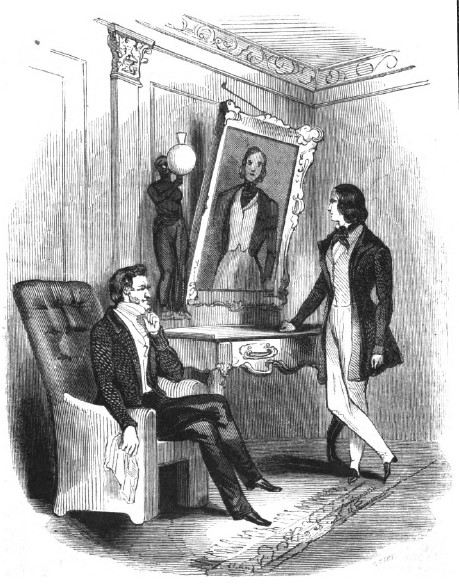
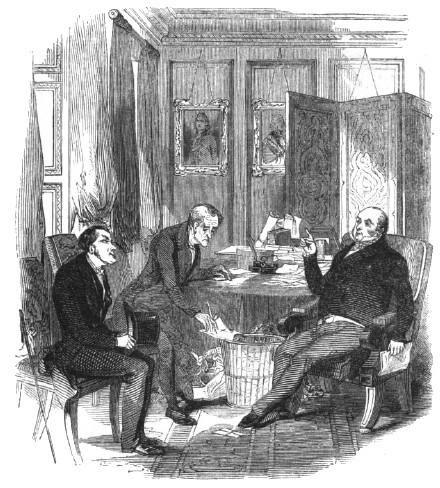
Mr. Greenwood, having completed the arrangements of his study in the
manner described, rang the bell.
His French valet Lafleur made his appearance in answer to the summons.
Mr. Greenwood then threw himself negligently into the arm-chair at his
writing-table, and proceeded to issue his instructions to his dependant.
"Lafleur, the Count Alteroni will call this morning. When he has been
here about ten minutes, bring me in this letter."
He handed his valet a letter, sealed, and addressed to himself.
"At about twelve o'clock Lord Tremordyn will call. Let him remain
quietly for a quarter of an hour with me; and then come in and say,
'The Duke of Portsmouth has sent round, sir, to know whether he can
positively rely upon your company to dinner this evening.' Do you
understand?"
"Perfectly, sir," answered Lafleur, without the slightest variation of
countenance; for he was too politic and too finished a valet to
attempt to criticise his master's proceedings by means of even a look.
"So far, so good," resumed Mr. Greenwood. "Sir Rupert Harborough will
call this morning: you will tell him I am not at home."
"Yes, sir."
"Lady Cecilia Harborough will call at one precisely: you will conduct
her to the drawing-room."
"Yes, sir."
"And all the time she is here I shall not be at home to a soul."
"No, sir."
"At four o'clock I shall go out in the cab: you can then pay a visit to
Upper Clapton and ascertain by any indirect means you can light upon,
whether Miss Sydney still inhabits the villa, and whether she still
pursues the same retired and secluded mode of existence as when you last
made inquiries in that quarter."
"Yes, sir."
"And you can ride round by Holloway and find out—also by indirect
inquiries, remember—whether Mr. Markham is at home, and any other
particulars relative to him which you can glean. I have already told you
that I have the deepest interest in being acquainted with all that that
young man does—his minutest actions even."
"I will attend to your orders, sir."
"To-night, you will dress yourself in mean attire and repair to a low
public-house on Saffron-hill, known by the name of the Boozing Ken by
the thieves and reprobates of that district. You will inquire for a man
who frequents that house, and who is called Tom the Cracksman. No one
knows him by any other name. You will tell him who your master is, and
that I wish to see him upon very particular business. He must be here
to-morrow night at nine o'clock. Give him this five-pound note as an
earnest of good intentions."
"Yes, sir."
"And now take these duplicates and that bank-note for five hundred
pounds, and just go yourself to V——'s the pawnbroker's in the Strand,
and redeem the diamonds mentioned in these tickets. You will have time
before any one comes."
"Yes, sir."
"And should Lord Tremordyn happen to be here when you return, hand me
the packet, which you will have wrapped up in white paper, saying 'With
the Duke's compliments, sir.'"
"Yes, sir."
Thus ended the morning's instructions.
The valet took the letter (which Mr. Greenwood had written to himself,)
the duplicates, and the bank notes; and retired.
In half an hour he returned with a small purple morocco case containing
a complete set of diamonds, worth at least twelve hundred guineas.
He again withdrew, and returned in a few minutes;—but this time it was
to usher in Count Alteroni.
Mr. Greenwood received the Italian noble with more than usual affability
and apparent friendship.
"I am delighted to inform you, my dear count," he said, when they were
both seated, "that our enterprise is progressing well. I yesterday
received a letter from a certain capitalist to whom I applied relative
to the loan of two hundred thousand pounds which I informed you it was
necessary to raise to carry out our undertaking, in addition to the
capital which you and I have both subscribed; and I have no doubt that I
shall succeed in this point. Indeed, he is to send me his decision this
very morning."
"Then I hope that at length the Company is definitively formed?" said
the count.
"Definitively," answered Mr. Greenwood.
"And the deed by which you guarantee to me the safety of the money I
have embarked, let the event be what it may?" said the count.
"That will be ready to-morrow evening. Can you dine with me to-morrow,
and terminate that portion of the business after dinner? My solicitor
will send the deed hither by one of his clerks at half-past eight
o'clock."
"With pleasure," said the count, evidently pleased at this arrangement.
"There has been some delay," said Mr. Greenwood; "but really the fault
has not existed with me."
"You will excuse my anxiety in this respect: indeed, I have probably
pressed you more than I ought for the completion of that security; but
you will remember that I have embarked my all in this enterprise."
"Do not attempt an apology. You have acted as a man of prudence and
caution; and you will find that I shall behave as a man of business."
"I am perfectly satisfied," said the count. "I should not have advanced
my money unless I had been so perfectly satisfied with your
representations; for—unless events turn up in my favour in my own
country, I must for ever expect to remain an exile from Castelcicala.
And that good fortune will shine upon me from that quarter, I can
scarcely expect. My liberal principles have offended the Grand-Duke and
the old nobility of that state; and now that the aristocracy has there
gained the ascendancy, and is likely to retain it, I can hope for
nothing. I would gladly have aided the popular cause, and obtained for
the people of Castelcicala a constitution; but the idea of
representative principles is odious to those now in power."
"I believe that you were a staunch adherent of the Prince of
Castelcicala, who is the nephew of the reigning Grand-Duke and the
heir-apparent to the throne?" said Mr. Greenwood.
"You have been rightly informed; but if the Pope and the Kings of Naples
and Sardinia support the aristocracy of Castelcicala, that prince will
be excluded from his inheritance and a foreigner will be placed upon the
grand-ducal throne. In this case, the prince will be an exile until his
death—without even a pension to support him; so irritated are the old
aristocracy against him."
"I believe that Castelcicala is a fine state?"
"A beautiful country—extensive, well-cultivated, and productive. It
contains two millions of inhabitants. The capital, Montoni, is a
magnificent city, of a hundred thousand souls. The revenues of the
Grand-Duke are two hundred thousand pounds sterling a-year; and yet he
is not contented! He does not study his people's happiness."
"And where at the present moment is that gallant prince who has thus
risked his accession to the throne, for the welfare of his
fellow-countrymen?" inquired Greenwood.
"That remains a secret," answered the count. "His partisans alone know."
"Of course I would not attempt to intrude upon matters so sacred," said
Greenwood, "were I not deeply interested in yourself, whom I know to be
one of his most staunch adherents."
At that moment the door opened; and Lafleur entered, bearing a letter,
which he handed to Mr. Greenwood. He then retired.
"Will you excuse me?" said Greenwood to the count; then, opening the
letter, he appeared to read it with attention.
At the expiration of a few moments, he said, "This letter is from my
capitalist. He gives me both good and bad news. He will advance the
loan; but he cannot command the necessary amount for three months."
"Then there will be three months' more delay?" exclaimed the count in a
tone of vexation.
"Three months! and what is that? A mere nothing!" cried Mr. Greenwood.
"You can satisfy yourself of my friend's sincerity."
With these words he handed to the count the letter which he had written
to himself in a feigned hand, and to which he had affixed a fictitious
name and address.
The count read the letter and was satisfied.
He then rose to depart.
"To-morrow evening, at seven o'clock punctually, I shall do myself the
pleasure of waiting upon you. In a few days, you remember, I and my
family are coming up to town to pass some time with Lord Tremordyn."
"And I shall then be bold and presumptuous enough," said Greenwood, "to
endeavour to render myself acceptable to the Signora Isabella."
"By the bye," exclaimed the count, "I forgot to inform you of the
villany of that Richard Markham, whom I received into the bosom of my
family, and treated as a son, or a brother."
"His villany!" ejaculated Greenwood, in a tone of unfeigned surprise.
"Villany the most atrocious!" cried the count. "He is a man branded with
the infamy of a felon's gaol!"
"Impossible!" said Greenwood, this time affecting the astonishment
expressed by his countenance.
"It is, alas! too true. The night before last, he invited thieves to
break into my dwelling: and to those miscreants had he boasted of his
intentions to win the favour of my daughter!"
"Oh! no—no," said Greenwood emphatically; "you must have been
misinformed!"
"On the contrary, I have received evidence only too corroborative of
what I tell you. But when I come to-morrow evening, I will give you the
details."
The count then took his departure.
"Thank God!" said Mr. Greenwood to himself, the moment the door had
closed behind the Italian nobleman: "I have succeeded in putting off
that bothering count for three good months. Much may be done in the mean
time; and if I can secure his daughter—all will be well! I can then
pension him off upon a hundred and fifty pounds a year—and retain
possession of his capital. But this deed—he demands the deed of
guarantee: he presses for that! I must give him the security to show my
good-will; and then neutralise that concession on my part, in the manner
already resolved upon. How strange was the account he gave me of Richard
Markham! That unhappy young man appears to be the victim of the most
wonderful combination of suspicious circumstances ever known; for guilty
he could not be—oh! no—impossible!"
Mr. Greenwood's meditations were interrupted by the entrance of Lord
Tremordyn.
This nobleman was a short, stout, good-tempered man. Being a large
landholder, he exercised considerable influence in his county, of which
he was lord-lieutenant; and he boasted that he could return six members
to parliament in spite of the Reform-bill. His wife was moreover allied
to one of the richest and most important families in the hierarchy of
the aristocracy; and thus Lord Tremordyn—with no talent, no knowledge,
no acquirements to recommend him, but with certain political tenets
which he inherited along with the family estate, and which he professed
for no other reason than because they were those of his ancestors,—Lord
Tremordyn, we say, was a very great man in the House of Lords. He seldom
spoke, it is true; but then he voted—and dictated to others how to
vote; and in this existed his power. When he did speak, he uttered an
awful amount of nonsense; but the reporters were very kind—and so his
speeches read well. Indeed, he did not know them again when he perused
them in print the morning after their delivery. Moreover, his wife was a
blue-stocking, and dabbled a little in politics; and she occasionally
furnished her noble husband with a few hints which might have been
valuable had he clothed them in language a little intelligible. For the
rest, Lord Tremordyn was a most hospitable man, was fond of his bottle,
and fancied himself a sporting character because he kept hounds and
horses, and generally employed an agent to "make up a book" for him at
races, whereby he was most amazingly plundered.
"My dear lord," exclaimed Mr. Greenwood, conducting his noble visitor to
a seat; "I am delighted to see your lordship look so well. So you have
parted with Electricity? I heard of it yesterday at Tattersalls'."
"Yes—and a good price I had for him. But, by the way, my dear
Greenwood, I must not forget to thank you for the Hock you sent me. It
is superb!"
"I am delighted that your lordship is pleased with it. Have you seen Sir
Rupert Harborough lately?"
"My scapegrace son-in-law? I wish I had never seen him at all!"
ejaculated his lordship. "He is over head and ears in debt again: and I
swear most solemnly that I will do nothing more for him—not to the
amount of a penny-piece! Cecilia, too, has quarrelled with her mother;
and, even if she had not, Lady Tremordyn is the last woman on earth to
advance them a shilling."
"It is a pity—a great pity!" said Mr. Greenwood, apparently musing;
then, after a brief pause, he added, "You never can guess, my dear lord,
why I wished to see your lordship so particularly this morning?"
"About the match between Electricity and Galvanism? The odds are
three to four."
"That was not exactly my business," said Greenwood, with a bland smile:
"the fact is, the representation of Rottenborough will be vacant in a
few weeks. I know positively, that the present member intends to accept
the Chiltern Hundreds."
"I have received a similar intimation," observed his lordship.
"At present the matter is a profound secret."
"Yes—a profound secret: known only to the member's friends, and me and
my friends, and you and your friends," added the nobleman, seriously
meaning what he said without any attempt at irony or satire.
"Of course there will be an election in February, shortly after the
Houses meet," continued Greenwood. "I was going to observe to your
lordship that I should be most happy to offer myself as a candidate——"
"You, Greenwood! What—are you a politician?"
"Not so profound nor so well versed as your lordship; but I flatter
myself that, aided by your lordship's advice——"
"Lady Tremordyn would never consent to it!"
"And by Lady Tremordyn's suggestions——"
"It would never do! She will have a man of rank and family;
and—excuse me, Greenwood—although you are no doubt rich enough far a
lord, and well educated, and clever, and so on—the deuce of it is that
we don't know who the devil you are!"
"An excellent family—an excellent family, my dear lord," exclaimed Mr.
Greenwood; "and although nothing equal to your own, which I know to be
the most ancient in England——"
"Or Scotland, or Ireland, either."
"Or Scotland, or Ireland, or even Europe—still——"
"No—it cannot be done, Greenwood;—it cannot be done," interrupted the
nobleman. "I would do any thing to oblige you;—but——"
At that moment the door opened, and Lafleur entered the study.
"If you please, sir," said the French valet, "the Duke of Portsmouth has
sent round to know whether he can positively rely upon your company to
dinner this evening?"
"My best compliments to his grace, Lafleur," said Mr. Greenwood,
affecting to meditate upon this message for a moment, "and I will do
myself the honour of waiting on his grace at the usual hour."
"Very good, sir."
And Lafleur retired.
"Well, after all," resumed Lord Tremordyn, who had not lost a word of
this message and the answer, "I think I might undertake to arrange the
Rottenborough business for you. You have high acquaintances—and they
often do more good than high connexions. So we will consider that matter
as settled."
"I am deeply obliged to your lordship," said Greenwood, with the
calmness of a man who had never entertained a fear of being ultimately
enabled to carry his point: "you will see that I shall imitate in the
Lower House your lordship's admirable conduct in the Upper, to the very
best of my ability."
"Of course you will always support the measures I support, and oppose
those which I may oppose?"
"Oh! that is a matter of course! What would become of society—where
should we be, if the Commons did not obey the great landholders who
allow them to be returned?"
"Ah! what indeed?" said the nobleman, shaking his head ominously. "But
really, Greenwood, I wasn't at all aware that you were half so clever a
politician as I see you are."
"Your lordship does me honour. I know how to value your lordship's good
opinion," said Greenwood, in a meek and submissive manner: then, after a
moment's silence, he added, "By the bye, I understand that our mutual
friend Alteroni, and his amiable wife, and beautiful daughter, are going
to pass the first few weeks of the new year with your lordship and Lady
Tremordyn?"
"Yes: we shall be very gay. The signora must pick up a husband amongst
the young nobles or scions of great families whom she will meet this
winter in London."
"Do you not know, my lord," said Greenwood, sinking his voice to a
mysterious whisper, "that Count Alteroni detests gaiety? are you not
aware that he and the ladies have accepted your kind invitation under
the impression that they will enjoy the pleasing society of your
lordship and Lady Tremordyn, and a few select friends only?"
"I am glad you have told me that!" exclaimed the nobleman "We will have
no gaiety at all."
"The count has honoured me with his utmost confidence, and his sincere
friendship," said Greenwood.
"Oh! of course you will be welcome on all occasions: do not wait for
invitations—I give you a general one."
"I am more than ever indebted to your lordship."
After a little more conversation in the same strain, the nobleman took
his leave, more pleased with Mr. Greenwood than ever.
This gentleman, the moment he was alone, threw himself into his chair,
and smiled complacently.
"Gained all my points!" he said, musing. "I shall be a member of
parliament—the fair Isabella will stand no chance of captivating some
wealthy and titled individual who might woo and win her—and, I have
obtained a general invitation to Lord Tremordyn's dwelling! I alone
shall therefore have an opportunity of paying court to this Italian
beauty."
The French valet entered the room.
"Lady Cecilia Harborough is in the drawing-room, sir."
Mr. Greenwood thrust the morocco case containing the diamonds into the
pocket of his dressing-gown; and then proceeded to the apartment where
the lady was waiting.
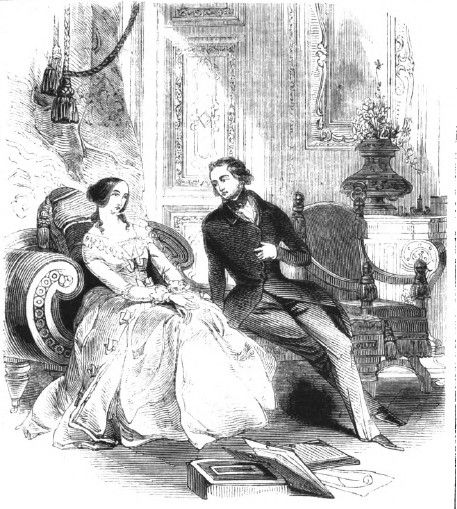
Lady Cecilia Harborough was about two-and-twenty, and very beautiful.
Her hair was auburn, her eyes blue, and her features regular. Her figure
was good; but she was very slightly made—a perfect sylph in symmetry
and model. Nursed amidst fashionable pleasure and aristocratic
dissipation, she was without those principles which are the very basis
of virtue. If she were true and faithful to her husband, it was only
because she had not been strongly tempted to prove otherwise: if she had
never indulged in an intrigue, it was simply because one to her taste
had never come in her way. Her passions were strong—her disposition
decidedly sensual. Thus was it that she had become an easy prey to Sir
Rupert Harborough; and when she had discovered that she was in a way to
become a mother in consequence of that amour, she only repented of her
conduct through dread of shame, and not for the mere fact of having
deviated from the path of virtue. Her disgrace was concealed by a
patched-up marriage with her seducer, a trip to the Continent, and the
death of the child at its birth; and thus there was no scandal in
society attached to the name of Lady Cecilia Harborough.
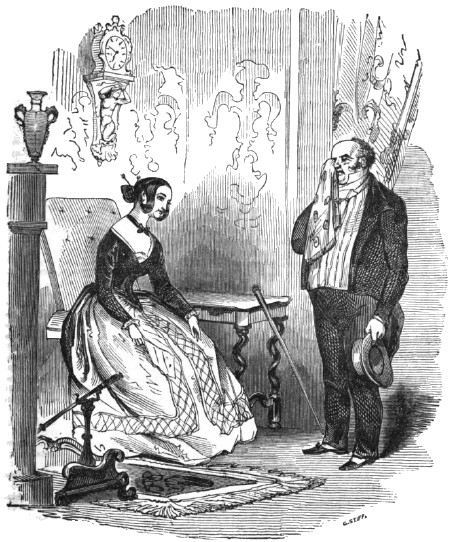
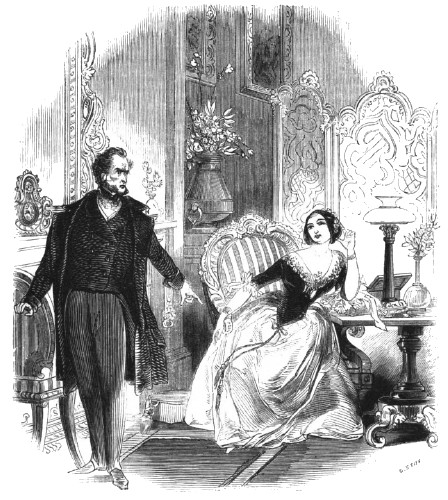
Mr. Greenwood had not made her wait many moments when he entered the
drawing-room.
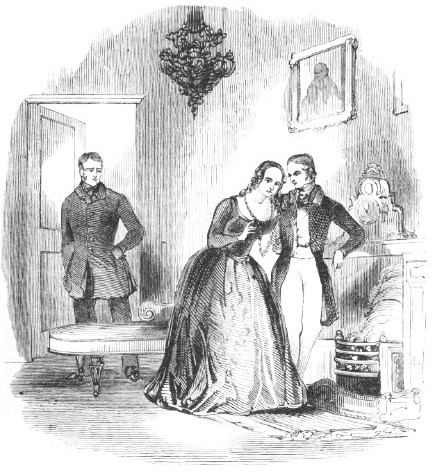
Lady Cecilia rose, and hastening towards him, said, "Oh! Mr. Greenwood,
what can you think of me after the imprudent step I have taken in coming
alone and unattended?"
"I can only think, Lady Cecilia," said Greenwood, handing her to a seat,
and taking a chair near her, "that you have done me an honour, the
extent of which I can fully appreciate."
"But why insist upon this visit to you? why could you not have called
upon me?" inquired the lady impatiently.
"Your ladyship wishes to consult with me upon financial affairs: and
every capitalist receives visits, and does not pay them, when they
refer to business only."
"Thank you for this apology for my conduct. I fancied that I was guilty
of a very great imprudence; you have reassured me upon that head;"—and
a smile played upon the fair patrician's lips.
"In what manner can I be of service to your ladyship? You perceive that
I will save you the trouble of even introducing a disagreeable subject."
"Well, Mr. Greenwood," said Lady Cecilia, with that easy familiarity
which is always shown towards those who are confidants in cases of
pecuniary embarrassment,—"you are well aware of Sir Rupert's
unfortunate situation; and of course his position is also mine. We are
literally without the means of paying the common weekly bills of the
house, and the servants' wages. I have quarrelled with my mother; and my
father will not advance another sixpence."
"Your ladyship is well aware that Sir Rupert Harborough has no security
to offer; and if he had, I would scarcely advance money to him—since
I know that your ladyship seldom profits by any funds which he may
possess."
"Oh! that is true, Mr. Greenwood!" ejaculated Lady Cecilia,
emphatically. "Would you believe it—even my very diamonds are gone? Sir
Rupert has made away with them!"
"In plain terms he pawned them."
"He did:—but that is such a horrid avowal to make! When one thinks that
it is generally supposed that the poor alone have recourse to such
means, and that we in the upper class do not even know what is meant
by a pawnbroker's—— Oh! how false is that idea! how erroneous is that
impression!"
"It is, indeed," said Greenwood. "The jewels of half the high-born
ladies in London have been deposited at different times in the hands of
the very pawnbroker where yours were."
Lady Cecilia stared at Mr. Greenwood in profound astonishment: then, as
a sudden idea seemed to flash across her brain, she added, "But Sir
Rupert must have told you of this?"
"He did."
"Do you know," continued the lady, "that I have actually lost the
receipts or duplicates—or whatever you call them—which the pawnbroker
gave when Harborough sent the diamonds by a trusty servant of ours."
"Those duplicates Sir Rupert Harborough handed over to me," said
Greenwood. "I lent him a hundred pounds upon them yesterday morning!"
"Oh! how ungrateful he is—how unworthy of one particle of affection!"
exclaimed Lady Cecilia. "He knew how distressed—literally distressed I
was for ready money; and he never offered me a guinea!"
"Are you so distressed as that?" inquired Mr. Greenwood, drawing his
chair closer to that of his fair visitor.
"Why should I conceal any thing from you, when I come to consult you
upon my embarrassments?" said Lady Cecilia, tears starting into her
eyes. "I am literally disgraced! I cannot go to court, nor appear at any
grand réunion, for the want of my jewels; and I am indebted to old
Lady Marlborough to the amount of two hundred pounds which she lent me.
Yesterday she wrote for the sixth time for the money, and actually
observed in her letter that she considered my conduct unlady-like in the
extreme. If I do not pay her this day, I shall be
ruined—exposed—ashamed to show my face in any society whatever!"
"You would therefore make any sacrifice to relieve yourself from these
embarrassments?" said Greenwood interrogatively.
"Oh! any sacrifice! To obtain about eight hundred or a thousand pounds,
to redeem my jewels and pay my most pressing debts—Lady Marlborough's,
for instance—I would do any thing!"
"You would make any sacrifice? You would do any thing, Lady Cecilia?"
repeated Greenwood emphatically. "That is saying a great deal; and an
impertinent coxcomb—like me, for instance—might perhaps construe your
words literally, and be most presumptuous in his demands."
"My God, Mr. Greenwood—what do you mean?" exclaimed the lady, a slight
flush appearing upon her cheeks. "My case is so very desperate—I have
no security to offer at present—and yet I require money,—money I must
have! Tell me to throw myself into the Thames a year hence, so that I
have money to-day, and I would willingly subscribe to the contract. I
could even sell myself to the Evil One, like Dr. Faustus—I am so
bewildered—so truly wretched!"
"Since you have verged into the regions of romance and mentioned
improbabilities, or impossibilities," said Mr. Greenwood, "suppose
another strange case;—suppose that a man threw himself at your
feet—declared his love—sought yours in return—and proffered you his
fortune as a proof of the sincerity of his heart?"
"Such generous and noble-minded lovers are not so easily found
now-a-days," returned Lady Cecilia: "but, if I must respond to your
question, I am almost inclined to think that I should not prove very
cruel to the tender swain who would present himself in so truly romantic
a manner."
Greenwood caught hold of Lady Cecilia's hand, fell at her feet, and
presented her with the purple morocco case containing the diamonds.
"Heavens!" she exclaimed, half inclined to suppose that this proceeding
was a mere jest,—"what do you mean, Mr. Greenwood? Surely you were not
supposing a case in which you yourself were to be the principal actor?"
"Permit me to lay my heart and fortune at your feet!" said Greenwood.
"Nay—you cannot repulse me now: you accepted the alternative; your own
words have rendered me thus bold, thus presumptuous!"
"Ah! Mr. Greenwood," exclaimed the fair patrician lady, abandoning her
left hand to this bold admirer, and receiving the case of diamonds with
the right; "you have spread a snare for me—and I have fallen into the
tangled meshes!"
"You can have no compunction—you can entertain no remorse in
transferring your affections from a man who neglects you, to one who
will study your happiness in every way."
"But—merciful heavens! you would not have me leave my husband
altogether? Oh! I could not bear the éclat of an elopement:
no—never—never!"
"Nor would I counsel such a proceeding," said Greenwood, who was himself
astonished at the ease with which he had obtained this victory: "you
must sustain appearances in society; but when we can meet—and when we
are together—oh! then we can be to each other as if we alone existed in
the world—as if we could indulge in all the joys and sweets of love
without fear and without peril!"
"Yes—I will be yours upon these terms—I will be yours!" murmured
Cecilia. "And—remember—you must be faithful towards me; and you must
never forget the sacrifice I make and the risk I run in thus responding
to your attachment! But—above all things—do not think ill of me—do
not despise me! I want something to love—and some one to love me;—and
you sympathise with my distress—you feel for my unhappiness—you offer
me your consolations: oh! yes—it is you whom I must love—and you will
love me!"
"Forever," answered the libertine; and he caught that frail but
beauteous lady in his arms.
* * * * *
An hour elapsed: Lady Cecilia had taken her departure, richer in purse
but poorer in honour;—and Greenwood had returned to his study.
The flush of triumph was upon his brow; and the smile of satisfaction
was upon his lip.
Lafleur entered the room.
"While you were engaged, sir," said the valet, "Sir Rupert Harborough
called. He was most anxious to see you. I assured him that you were not
at home. He said he would call again in an hour."
"You can then admit him."
The valet bowed and withdrew.
Mr. Greenwood then wrote several letters connected with the various
schemes which he had in hand. His occupation was interrupted by the
entrance of Sir Rupert Harborough.
With what ease and assurance—with what unblushing confidence did the
libertine receive the man whose wife he had drawn into the snares of
infamy and dishonour!
"You really must excuse my perseverance in seeing you this day," said
Sir Rupert, who perceived by Greenwood's attire that he had not been out
of the house that morning; "but I am in such a mess of difficulties and
embarrassments, I really know not which way to turn."
"I was particularly engaged when you called just now," said Greenwood;
"and you are aware that one's valet always answers 'Not at home' in
such cases."
"Oh! deuce take ceremony," exclaimed Sir Rupert. "See if you can do any
thing to assist me. Lord Tremordyn has literally cut me; and Lady
Tremordyn is as stingy as the devil. Besides, she and Lady Cecilia have
quarrelled; and so there is no hope in that quarter."
"I really cannot assist you any farther—at present," observed
Greenwood. "In a short time I shall be enabled to let you into a good
thing, as I told you a little while ago: but for the moment—"
"Come, Greenwood," interrupted the baronet; "do not refuse me. I will
give you a post-obit on the old lord: he is sure to leave me something
handsome at his death."
"Yes—but he may settle it upon your wife in such a manner that you will
not be able to touch it."
"Suppose that Lady Cecilia will join me in the security?"
"Insufficient still. Lord Tremordyn may bequeath her ladyship merely a
life interest, without power to touch the capital."
"Well—what the devil can I do?" exclaimed the baronet, almost
distracted. "Point out some means—lay down some plan—do any thing you
like—but don't refuse some assistance."
Mr. Greenwood reflected for some minutes; and this time his thoughtful
manner was not affected. It struck him that he might effect a certain
arrangement in this instance by which he might get the baronet
completely in his power, and lay out some money at an enormous interest
at the same time.
"You see," said Mr. Greenwood, "you have not an atom of security to
offer me."
"None—none," answered Sir Rupert: "I know of none—if you will not have
the post-obit."
"The only means I can think of for the moment," pursued Mr. Greenwood,
"is this:—Get me Lord Tremordyn's acceptance to a bill of fifteen
hundred pounds at three months, and I will lend you a thousand upon it
without an instant's delay."
"Lord Tremordyn's acceptance! Are you mad. Greenwood?"
"No—perfectly sane and serious. Of course I shall not call upon him to
ask if it be his acceptance—neither shall I put the bill into
circulation. It will be in my desk until it is due; and then—if you
cannot pay it—"
"What then?" said the baronet, in a subdued tone, as if he breathed with
difficulty.
"Why—you must get it renewed, that's all!" replied Mr. Greenwood.
"I understand you—I understand you," exclaimed Sir Rupert Harborough:
"it shall be done! When can I see you again?"
"I shall not stir out for another hour."
"Then I shall return this afternoon."
And the baronet departed to forge the name of Lord Tremordyn to a bill
of exchange for fifteen hundred pounds.
"I shall hold him in iron chains," said Greenwood to himself, when he
was again alone. "This bill will hang constantly over his head. Should
he detect my intrigue with his wife, he will not dare open his mouth;
and when I am tired of that amour, and care no more for the beautiful
Cecilia, I can obtain payment of the entire amount, with interest, from
Lord Tremordyn himself; for his lordship will never allow his
son-in-law to be ruined and lost for fifteen or sixteen hundred pounds."
Again the study door opened; and again did Lafleur make his appearance.
"A person, sir, who declines to give his name," said the valet,
"solicits an interview for a few minutes."
"What sort of a looking person is he?"
"Very pale and sallow; about the middle height; genteel in appearance;
respectably clad; and I should say about forty years of age."
"I do not recollect such a person. Show him up."
Lafleur withdrew, and presently introduced Stephens.
For a few moments Greenwood surveyed him in a manner as if he were
trying to recollect to whom that pale and altered countenance belonged;
for although Stephens had made considerable improvement in his attire,
thanks to the contents of Eliza's purse, he still retained upon his
features the traces of great suffering, mental and bodily.
"You do not know me?" he said, with a sickly smile.
"Stephens! is it possible?" exclaimed Greenwood, in an accent of the
most profound surprise.
"Yes—it is I! No wonder that you did not immediately recognise me: were
I not fearfully altered I should not dare thus to venture abroad by
daylight."
"Ah! I understand. You have escaped?"
"I have returned from transportation. That is the exact truth. Had it
not been for an angel in human shape, I should have died last night of
starvation. That generous being who relieved me was Eliza Sydney."
"Eliza Sydney!" cried Greenwood. "She received you with kindness?"
"She gave me food, and money to obtain clothes and lodging. She moreover
promised to supply me with the means to reach America. I am to return to
her this evening, and receive a certain sum for that purpose."
"And she told you that I was residing here?" said Greenwood inquiringly.
"Yes. I thought that you might be enabled to assist me in my object of
commencing the world anew in another quarter of the globe. I shall
arrive there with but little money and no friends;—perhaps you can
procure me letters of introduction to merchants in New York."
"I think I can assist you," said Greenwood, musing upon a scheme which
he was revolving in his mind, and which was as yet only a few minutes
old: "yes—I think I can. But, would it not be better for you to take
out a few hundred pounds in your pocket? How can you begin any business
in the States without capital?"
"Show me the way to procure those few hundreds," said Stephens, "and I
would hold myself ever your debtor."
"And perhaps you would not be very particular as to the way in which you
obtained such a sum?" demanded Greenwood, surveying the returned convict
in a peculiar manner.
"My condition is too desperate to allow me to stick at trifles,"
answered Stephens, not shrinking from a glance which seemed to penetrate
into his very soul.
"We understand each other," said Greenwood. "I have money—and you want
money: you are a returned transport, and in my power. I can serve and
save you; or I can ruin and crush you for ever."
"You speak candidly, at all events," observed Stephens, somewhat
bitterly. "Try promises first; and should they fail, essay threats."
"I merely wished you to comprehend your true position with regard to
me," said Greenwood, coolly.
"And now I understand it but too well. You require of me some service of
a certain nature—no matter what: in a word, I agree to the bargain."
"The business regards Eliza Sydney," proceeded Greenwood.
"Eliza Sydney!" exclaimed Stephens, in dismay.
"Yes; I love her—and she detests me. I must therefore gratify two
passions at the same moment—vengeance and desire."
"Impossible!" cried Stephens. "You can never accomplish your schemes
through my agency!"
"Very good:" and Mr. Greenwood moved towards the bell.
"What would you do?" demanded Stephens, in alarm.
"Summon my servants to hand a returned convict over to justice,"
answered Greenwood, coolly.
"Villain! you could not do it!"
"I will do it:" and Greenwood placed his hand upon the bell-rope.
"Oh! no—no—that must not be!" exclaimed Stephens. "Speak—I will do
your bidding."
Mr. Greenwood returned to his seat.
"I must possess Eliza Sydney—and you must be the instrument," he said
in his usual calm and measured tone. "You are to return to her this
evening?"
"I am. But I implore you—"
"Silence! This evening I am engaged—and to-morrow evening also. The day
after to-morrow I shall be at liberty. You will invent some excuse which
will enable you to postpone your departure; and you will contrive to
pass the evening after to-morrow with Eliza Sydney. Can you do this?"
"I can, no doubt: but, again, I beg—"
"No more of this nonsense! You will adopt some means to get her faithful
servant Louisa out of the way; and you will open the front-door of the
villa to me at midnight on the evening appointed."
"You never can effect your purpose!" cried Stephens emphatically. "Were
you to introduce yourself to her chamber, she would sooner die herself,
or slay you, than submit to your purpose!"
"She must sleep—sleep profoundly!" said Greenwood, sinking his voice
almost to a whisper, and regarding his companion in a significant
manner.
"My God! what an atrocity!" ejaculated Stephens, with horror depicted
upon his countenance.
"Perhaps you prefer a return to the horrors of transportation,—the
miseries of Norfolk Island?" said Greenwood satirically.
"No—death, sooner!" cried Stephens, striking the palm of his right hand
against his forehead.
Greenwood approached him, and whispered for some time in his ear.
Stephens listened in silence; and when the libertine had done, he
signified a reluctant assent by means of a slight nod.
"You understand how you are to act?" said Greenwood aloud.
"Perfectly," answered Stephens.
He then took his departure.
Scarcely had he left the house when Sir Rupert Harborough returned.
The baronet was deadly pale, and trembled violently. Greenwood affected
not to observe his emotions, but received the bill of exchange which the
baronet handed to him, with as much coolnessas if he were concluding a
perfectly legitimate transaction.
Having read the document, he handed a pen to the baronet to endorse it.
Sir Rupert affixed his name at the back of the forged instrument with a
species of desperate resolution.
Mr. Greenwood consigned the bill to his desk, and then wrote a cheque
for a thousand pounds, which he handed to the baronet.
Thus terminated this transaction.
When the baronet had taken his departure, Mr. Greenwood summoned
Lafleur, and said, "You need not institute any inquiries relative to
Miss Sydney, at Upper Clapton. My orders relative to Mr. Markham remain
unchanged; and mind that the fellow known as Tom the Cracksman is here
to-morrow evening at nine o'clock."
Mr. Greenwood having thus concluded his morning's business, partook of
an elegant luncheon, and then proceeded to dress for his afternoon's
ride in the Park.