MYCENÆ A NARRATIVE OF RESEARCHES AND DISCOVERIES AT MYCENÆ AND TIRYNS.
PLATE V.
THE TREASURYCLOSETOTHE LIONS' GATE. Excavated by Mrs. SCHLIEMANN. Frontispiece.
BY DR. HENRY SCHLIEMANN
CITIZEN OF THE UNITED STATES OF AMERICA:
AUTHOR OF 'TROY AND ITS REMAINS,' 'ITHAQUE, LE PÉLOPONNÈSE ET TROIE,'
AND 'LA CHINE ET LE JAPON.'
THE PREFACE
BY THE RIGHT HON. W. E. GLADSTONE, M.P.
MAPS, PLANS, AND MORE THAN 700 OTHER ILLUSTRATIONS. A NEW EDITION, WITH IMPORTANT ADDITIONS AND NEW PLATES.
NEW YORK:
CHARLES SCRIBNER'S SONS,
1880.
(All Rights Reserved.)
Copyright, 1877,
SCRIBNER, ARMSTRONG & CO.
Copyright, 1880,
BY CHARLES SCRIBNER'S SONS.
PRESS OF J. J. LITTLE & CO.,
Nos, 10 TO 20 ASTOR PLACE, NEW YORK.
Dedicated
TO
HIS MAJESTY DOM PEDRO II.,
EMPEROR OF BRAZIL,
WITH THE PROFOUND RESPECT OF
THE AUTHOR.
᾽Επὶ δ᾽ ἐγδούπησαν ᾽Ἀθηναίη τε καὶ ῞Ἥρη
Τιμῶσαι βασιλῆα πολυχρύσοιο Μυκήνης.
HOM. Il. XI. 45, 46.
Πρὸς ἡμῶν
κάππεσεv, κάτθανε, ἡμεῖς καὶ καταθάψομεν
οὐχ ὑπὸ κλαυθμῶν τῶν ἐξ οἴκων.
ÆSCH. Agam. 1552-1554.
῏Ω τοῦ στρατηγήσαντος ἐν Τροίᾳ ποτὲ
Ἀγαμέμνονος παῖ, νῦν ἐκεῖν᾽ ἔξεστί σοι
παρόντι λεύσσειν, ὧν πρόθυμος ἦσθ᾽ ἀεί.
Τὸ γὰρ παλαιὸν ῎Αργος ὁὺπόθεις τόδε,
τῆς οἰστροπλῆγος ἄλσος Ἰνάχου κόρης·
αὕτη δ᾽, Ὀρέστα, τοῦ λυκοκτόνου θεοῦ
᾽Αγορὰ Λύκειος· οὑξ ἀριστερᾶς δ᾽ ὅδε
Ἥρας ὁ κλεινὸς ναός· οἷ δ᾽ ἱκάνομεν,
ϕάσκειν Μυκήνας τὰς πολυχρύσους ὁρᾶν·
πολύϕθορόν τε δῶμα Πελοπιδῶν τόδε,
SOPHOCLES, Electra, 1-10.
PREFACE. — DR. SCHLIEMANN'S ACCOUNT OF A TOMB AT SPATA, IN ATTICA. — THE FALL OF MYCENÆ AS DESCRIBED BY DIODORUS SICULUS.
It has been with much reluctance that, at the persevering
request of Dr. Schliemann, I have undertaken to write
a Preface to his Mycenean volume. I have managed
perhaps, though with long intermissions of the pleasant
labour, to maintain a tolerable acquaintance with the text
of Homer; and the due establishment of the points of
contact between that text and the remains from Mycenæ is
without question one of the essential aims, to which comment
on this work requires to be addressed. But I have
a horror of all specialism which travels beyond its proper
province; and in this matter I am at best no more than a
specialist, probably, too, not one of very high pretensions.
I have not that practised skill, that comprehensive outlook
over the whole field of Hellenic, and other than Hellenic
archæology, which has conferred upon Mr. Newton his
well-earned fame. The just conclusion from these premises
appears to be, that I ought to have declined a charge quod
ferre recusent humeri.[1] But there was, in ancient poetry, a
Destiny stronger than the will of gods. To me, on this
occasion, Dr. Schliemann is the vicegerent and organ of
that Destiny. In view of the splendid services which he has
conferred upon classical science, a power, that thrusts argument
out of court, brings me to perceive, that I cannot but
accede to his desire. I have however given the reader
fair warning where and why he should be on his guard:
and I shall make all the use I can of the landmarks laid
down in the report which Mr. Newton, after an ocular
inspection of these remains, published in the Times of
April 20, 1877; and of the valuable papers of Mr.
Gardner in the Academy (April 21 and 28). I believe that
the interest, excited by Dr. Schliemann's discoveries, has
been by no means confined to classical scholars. I shall
therefore endeavour to be as little technical as possible, and
to write, so far as may be, for a circle wider than that of
the persons among us who are acquainted with the Greek
tongue.
When the disclosures at Tiryns and Mycenæ were announced
in England, my own first impression was that of a
strangely bewildered admiration, combined with a preponderance
of sceptical against believing tendencies, in regard
to the capital and dominating subject of the Tombs in the
Agora. I am bound to say, that reflection and a fuller knowledge
have nearly turned the scales the other way. There
are indeed, not only gaps to be supplied, but difficulties to be
confronted, and to be explained; or to be left over for future
explanation. Yet the balance, I will not say of evidence,
but of rational presumption, seems as though it might
ultimately lean towards the belief that this eminent
explorer has exposed to the light of day, after 3000 years,
the memorials and remains of Agamemnon and his companions
in the Return from Troy. But let us endeavour
to feel our way by degrees up to this question, gradually
and with care, as a good general makes his approaches to a
formidable fortress.
I find, upon perusing the volume of Dr. Schliemann,
that the items of evidence, which connect his discoveries
generally with the Homeric Poems, are more numerous,
than I had surmised from the brief outline, with
which he favoured us upon his visit to England in the
spring.
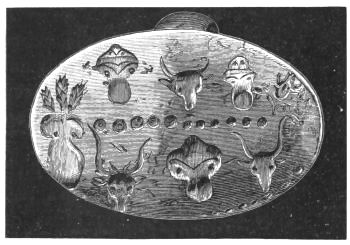
1. He presents to us the rude figures of cows; and
upon a signet ring (No. 531) and elsewhere, cow-heads
not to be mistaken. He then points to the traditional
worship, from the first, of Hera in Argolis; and he
asks us to connect these facts with the use of Boöpis
(cow-eyed) as a staple epithet of this goddess in the
Poems; and he might add, with her special guardianship
of Agamemnon in his interests and his personal safety
(Il. I. 194-222).
This appears to me a reasonable demand. We know
that upon some of the Egyptian monuments the goddess
Isis, mated with Osiris, is represented in human figure with
the cow's head. This was a mode of exhibiting deity congenial
to the spirit of an Egyptian immigration,[2] such
as might, compatibly with the text of Homer, have
taken place some generations before the Troïca. But
it was also a mode against which the whole spirit of
Hellenism, according to the authentic type of that
spirit supplied in the Poems, utterly revolted. We find
there a Hera, who wore, so to speak, the mantle of Isis,
besides carrying the spoils of one or more personages
enrolled in the Golden Book of the old Pelasgian dynasties.
Nothing could be more natural than a decapitation of the
Egyptian Isis, not penally but for her honour. She might
consequently appear with the human head; but, not to break
sharply with the traditions of the people, the cow-head, and
even the cow figure, might nevertheless be retained as
symbols of religion. And the great Poet, who invariably
keeps these symbols so to speak at arms' length, in order
that he may prevent their disparaging the creed of which he
was the great doctor, might nevertheless select from the
bovine features that one which was suited to his purpose,
and give to his Hera, who was never a very intellectual
deity, the large tranquil eye of the cow. The use of the
epithet for Hera in Homer is not, indeed, exclusive, and I
admit that he may have inherited that use. But, though
not exclusive, it is very special, and this speciality is
enough to give a sensible support to the doctrine of our
famous explorer.
2. The buildings improperly called Cyclopean, and
still more improperly endowed with the alternative name
of Pelasgian, have long been known, more or less, to
exist in Argolis; but Dr. Schliemann has thrown some
light on what I may perhaps be allowed to call their
diversity of style. He admits three forms found in this
kind of building. I have objected to the current names,
the first because it does not inform; the second because it
misleads, for these buildings have no true connection with
the Pelasgian tribes. What they indicate is the handiwork
of the great constructing race or races, made up of several
elements, who migrated into Greece, and elsewhere on the
Mediterranean, from the south and east, and who exhibit
an usual, though perhaps not an invariable connection
with the Poseidon-worship, a worship, with which the
Cyclopean name is, through the Odyssey, perceptibly
associated, and which is one of the main keys, as I have
long been persuaded, wherewith in time to unlock, for
Hellenic and Homeric regions, the secrets of antiquity.
The walls of Troy were built by Poseidon; that is, by a
race who practised the worship of the god. How far those
walls conform to any of the minuter points of the descriptions
of 'Cyclopean' architecture by Dr. Schliemann,
(pp. 42, 123), I cannot say. But if he is right, as seems
probable, in placing Troy at Hissarlik, it is important to
notice that this work of Poseidon had a solidity, which
bore it unharmed through the rage of fire, and kept it
well together amidst all the changes which have buried
it in a hill of rubbish and promiscuous remains. And
of course the modes, used by the very same race in the
business of building, could not but vary much with the
circumstances of each case, and especially with the material
at hand. I am tempted, at least until a better name can be
found, to call this manner of building Poseidonian; at any
rate, whatever it be called, to note it as a point of correspondence
between the Poems and the discoveries, admitting
at the same time that the matter is not sufficiently developed
to warrant me in laying upon it any considerable
stress.
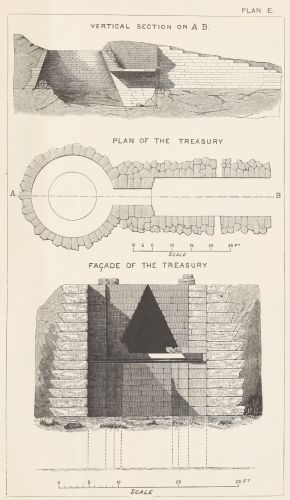
3. The beehive-like building, which is rather loosely
called the Treasury of Atreus, presents to us over the
doorway (p. 43) two enormous slabs, one of them
supposed to weigh from 130 to 135 tons. I only refer to
them for the sake of reminding the reader that, as I think,
we must be prepared, in this and other matters, freely to
recognise the hand of the foreigner at work; who brought
with him into Greece attainments, not to be despised, of
material civilisation. More pointedly I wish to observe that
in the interior of the Treasury, from the fourth course
upwards, there are visible (p. 44) in each stone two bored
holes, and in many of them the remains of 'bronze' nails
still existing. Similar holes, it appears, are found (p. 45)
in the Treasury of Minyas at Orchomenos. The purpose
of these nails, says our author, could only be to attach
to the wall what in one place he calls the bronze, and in
another the brazen plates, with which the whole interior
was once decorated. On the secondary question, what was
the exact material employed, let me here observe that of
brass those ages knew nothing, and that bronze, particularly
in that stage of material development, was wholly unsuited
for sheeting. But, as to the structural point, we have here
a remarkable point of contact with the Homeric text.
For in the palace of Alkinoös, king of the Phaiakes, a
splendour as of sun or moon dazzled the eye, for the walls
were of chalkos (Od. VII. 86, cited p. 44), which I hope
I may now boldly translate copper: a metal unlike bronze
(a) in being readily malleable, (b) in being throughout the
Poems most usually lustrous, a character I do not suppose
we should assign to bronze. On the other hand, the
comparative softness of copper was not well suited for the
nails, so bronze might very well be employed. Nor does
this conjunction of the two metals, pure and mixed, in
the same work, carry us away from the text of Homer:
for his wall-sheets of copper in Scheriè were crowned with
a cornice of his dark kuanos, which I take to be bronze.
This copper sheeting is a feature of the supreme Olympian
Palace (Il. I. 426, Od. VIII. 321), built by Hephaistos
of the skilful mind. I think I could show that it also
adorned the palaces of Menelaos and Odysseus, and could
point out, moreover, why all this is in accordance with the
distinctly foreign and eastern character of the embellishment:
but an exhibition of the evidence would lead me
into too great length; and I note only for the present
purpose the remarkable correspondence of the archæology
with the Poems.
4. Passing from architectural to moveable objects, I
observe that Dr. Schliemann found both knives and keys
of iron in Mycenæ, but that from their form he assigns
them to a later and strictly historic period. Old Mycenæ,
therefore, in accordance with Hissarlik, has afforded us, up
to the present time, no remains of this metal. In the
Poems it is freely mentioned, but as a rare and valuable
substance, used where great hardness was required, and for
objects comparatively small and portable; except, indeed,
in the case of the Gates of Tartaros (Il. VIII 15), where
the Poet could dispose of as much material as he pleased.
The aggregate quantity, then, was small; and the instruments
were likely to be carried away on the abandonment or
destruction of a city. Its absence may therefore be
accounted for, in part by its value, but also, and more
especially, because it so readily corrodes.[3] Therefore,
although we cannot here establish a positive correspondence,
neither have we any occasion to admit a discrepancy.
5. Neither need we, I think, suppose any variance
between the chariot, as our author found it on the second
tombstone of the Acropolis (p. 84), and the Homeric
picture. True, he finds a wheel of four spokes, and the
Olympian car of Hera had eight (Il. V. 723); but this
diversity of structure is probably introduced, like the
diversity of material, by way of divine distinction, and to
show the superior elaboration and strength of the vehicle.[4]
6. We have at Mycenæ the Agora, or place of
Assembly, in full agreement with the Poems on the two
points, first of its circular form (pp. 338, 339), and
secondly of the smoothed horizontal slabs, bounding the
circle, on which the Elders sate. I do not dilate upon
these, as they are fully noticed in the text: but I shall
return to the subject, in connection with the situation
chosen for the tombs, and the inferences which are to be
drawn from this important circumstance.
I will now hazard, before proceeding further with my
list, one or two general remarks on the works of art and
ornament, referring again to the reports of Mr. Newton
and Mr. Gardner, as the most trustworthy comment on
the text of our author concerning them.
First, I have to offer some reflections on the general
character of the discoveries, and on its relation to the state
of Art exhibited in the Poems. It seems reasonable
to believe, especially after what has been shown by
Mr. Gardner respecting the four tombstones, that they
constituted the contemporary seal of a great deposit. It
results, I think, from the evidence before us that it is
impossible to reduce to one school or style or stage of
art the whole of the objects exhumed. But on this I
would observe first that, although they were simultaneously
deposited in honour of the dead, they might have
been the productions of more than one generation:
secondly, that not only are we not required, but, in so
far as we draw light from the Homeric Poems, we are
hardly permitted, to refer them collectively to a domestic
origin.
I gather from Mr. Gardner's report that the Art
exhibited on the Pottery is more uniformly backward,
than that exhibited by the works of metal. But this
pottery, which was, whether wheel made or hand-made, of
an early stage in the manufacture, was far more likely to be
domestic; while the works in the precious metals might be
imported. Or they might be the productions of foreign
artists, attracted to the Court of Agamemnon; in the
same manner as we find that Daidalos, whose name, however
mythical, represents a foreign influence, executed in
Crete, for Ariadne, the representation of a dance in
metal.
The discovery, or the inspection, of the works must
without doubt in the first instance suggest a reference of
them to a local school of goldsmiths. But, considering
the numerous points of contact between the discoveries
and the Homeric Poems, it is important to know whether,
and how far, they really favour such a supposition. This is
not the place for an examination in detail of all the works
of Art mentioned by Homer. I believe there is no one
of them, of which the purely Greek origin can be established
by proof from the text, while the manufacture
abroad and importation are frequently mentioned. At the
same time, there are some considerations which tend to
show that, if there were local workmen in Greece capable
of producing objects such as those now exhumed, it is at
Mycenæ that we should expect to find them. First, on
account of the wealth of the city, and of its position as the
capital of the country. Secondly, on account of the
wealth of Agamemnon personally, and his acquisitiveness
if not his avarice, which made him eager to spoil those
whom his spear had slain, and which is the subject of
varied allusions in the Iliad. It must be remembered that
in those days works of art were not merely ornamental,
but were a favourite form, as their name (keimelia) shows,
of stored wealth: and of these, even in Troas, Agamemnon
possessed many (Il. IX. 330). Thirdly, an indication,
perhaps, more significant, may be drawn from the
remarkable passage in the Eleventh Book (15-46), which
describes the arming of Agamemnon for the field. The
first portion of the armour, that attracts observation, is an
elaborately wrought breast-plate, which had come from
Cyprus, a seat of Phœnician settlement. We next come
to the sword, which I shall presently describe. This is
followed by the shield, adorned with many bosses of
metal, but also carrying a representation of the Gorgon
with the heads or figures of Fear and Panic. This shield
must be considered as a work of art; and the same may
be said of its band or strap, which carried the figure of a
three-headed snake. There is nothing said to connect
these works with foreign manufacture. The family of
Agamemnon was of a foreign origin comparatively recent;
but it may remain an open question, whether these arms
are presumptively referable, or not, to a domestic manufacture.
The deposits appear, again, to differ extremely in point of
merit. I set aside the objects directly symbolical, because,
where religion, or idolatry, is in question, excellence in
workmanship becomes secondary, or even ceases to be
desired. Among the other objects, I gather that none
exhibit a very high order of technical qualities. But, if
we may rely upon photographic representation, they surely
exhibit lively and forcible movement, as well as many
of the elements of nobleness, beauty, and fertility of
invention; particularly in ornamentation, as distinguished
from the representation of life, either animal or vegetable.
Some of this diversity may be due to difference of date;
some, perhaps much, to the superiority of the immigrant
hand, or of imported works. That there were foreigners
resident in Greece at the time of the Troïca, we have every
reason to infer from one conspicuous case, that of Echepolos,
a son of Anchises, who was allowed to present the
mare Aithè to Agamemnon, as the price of his exemption
(Il. XXIII. 296) from service against Troy. If there be
anywhere in the Poems an account of a work of art produced
in Greece or by a Greek, it is the bedstead of Odysseus,[5]
wrought by himself (Od. XXIII. 190-201); and to him,
after a good deal of consideration, I am inclined to ascribe
a close connection with the immigrant or Phœnician stock;
though this representation might also be due to his unequalled
versatility and universality of accomplishment.
There was indeed a Chrusochoös or gold-plater at the Court
of Nestor (Od. III. 425); but the very same man goes by
the name of Chalkeus or coppersmith (Ibid. III. 432). And it
would even seem that working in metals cannot have been
a principal or prominent employment in an Achaian community,
for no such person is named in the remarkable
passage of the Odyssey (XVII. 384) which supplies
a sort of list, and where the wood-worker, or carpenter,
appears.
The list of these objects, and of their ornaments, is on the
whole richer and more diversified than the Poems, with the
exception of the famous Shield of Achilles, would have led us
to expect. Possibly a knowledge of the Mycenean treasures
may have prompted or aided a vigorous imagination, in that
wonderful anticipation of excellences which had not been
realized in practice. The most remarkable feature, I think,
of all Homer's delineations of art is the force and reality
with which he confers animation on things inanimate. And
perhaps the eye may be struck, in examining Schliemann's
illustrations, with the vigour of life and motion which asserts
itself in many of the Mycenean works, where the delineation
is technically most imperfect. But we cannot compare the
text with these remains alone; we are bound also to avail
ourselves of such light as can be had from Hissarlik, whatever
its effect upon our prepossessions or our arguments.
Now I, for one, am struck with the wealth of Mycenæ, and
the comparative poverty of what is probably Troy. I do not
mean merely as to the small number of valuable remains,
for this may be due to chance; though, indeed, fortune, for
once renouncing her caprice, seems in both cases to have
obeyed the dictates of archæological justice, and to have
treated Dr. and Mrs. Schliemann as her favourite children.
But I mean that there is far less of luxe in the ornamentation
of the works at Hissarlik; I might, perhaps, say no
representation at all of life, except in the rudest and most
barbarous form. There seem to be very good forms in the
gold and silver objects of Hissarlik, but always associated
with plain work; no animal or even vegetable representation
calling for notice from the present point of view, none of
the repoussé work, nothing resembling the (apparently)
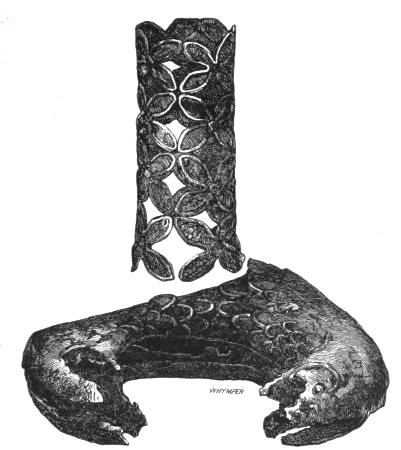
beautiful cylinder (p. 287), or the elaborate rings photographed
in this volume. How are we to account for this?
And does an argument hence arise, that the Hissarlik remains
belong to a period different from, and anterior to, that
which produced the works at Mycenæ? That the adverse
case may be made as strong as possible, let it be borne in
mind that while Homer indicates Orchomenos, and above
all Egyptian Thebes, as the wealthiest cities of his little
world, he seems designedly to assign the very same stage of
opulence to Troy, which he gives to Mycenæ; for he
describes by one and the same epithet, poluchrusos, which
means gold-abounding, these two cities and these two alone.
Troy has it in Il. XVIII. 289. For Mycenæ it was
almost a formula; see Il. VII. 180, XI. 46; Od. III. 305.
We have now before us, as is not improbable, the
choicest samples of what the two cities had to boast of;
and the question is, can we account for the difference in
opulence, and stage of art, between them? I conceive that
we can, at least in a considerable degree; but it is only by
that acknowledgment, which some are still indisposed to
make, of the broad vein of historic reality, that runs
through the delineations of the Iliad and Odyssey.
Three passages of the Iliad, in particular, convey to us
that the city of Troy was suffering great impoverishment
by the War. Indeed, if there be a grain of fact in the tale,
it could not be otherwise. For the means of resisting the
truly national attack of the Achaians, she was dependent
neither on a good cause, nor on a soldiery commensurate
with theirs. She had to seek strength from without; first
from the grudging support of Dardania, secondly from the
neighbouring tribes both of Europe and of Asia. It might
even be inferred from the text that nine-tenths of the
fighting power (Il. II. 123-33) were other than strictly
domestic. But this support from without could only
be got by paying for it. Accordingly Hector, in the
Seventeenth Book speaks with the authority (220-32) of
a general addressing allies, who are duly compensated for
their services. So also we know that the great Eurupulos
and his Keteians,[6] or Hittites (Od. XI. 520), fall in numbers
on the plains of Troy, "serving for gifts." "I wear out
the Trojans," says Hector, "with presents and with
victualling for you." Again in the Twenty-fourth Book,
Achilles, compassionately addressing Priam, says, "We
hear that you once were prosperous, and exceeded in wealth,
as well as in the number of your sons, all the neighbouring
countries" (543-6). The inference is obvious; that at the
time, though the city had not been captured, it was becoming
comparatively poor. But the most express testimony
is that of Il. XVIII. 288-92, when Hector stimulates his
countrymen to sally out, by reminding them that they are
already well-nigh ruined. Once, he says, all men were
wont to celebrate the wealth of Troy; "but now the fine
valuables have utterly disappeared from our mansions."
νῦν δὲ δὴ ἐξαπόλωλε δόομων κειμήλια καλά
And, under the wrath of Zeus, multitudes of their possessions
had been sent in exchange to Phrygia and Mæonia; in
exchange, that is, as I presume, for necessaries. But the
great Mycenean deposit, if Schliemann be right in his view,
was made before the time of any sack or depopulation
of the city. Upon such an issue of life and death, as that
offered to the Trojans, the best objects would naturally be
parted with, as the most effective for their purpose (see
Il. XXIV. 234-7); and accordingly, if we are comparing
Troy and Mycenæ at all, we are comparing Troy in its
exhaustion with Mycenæ in its prosperity.
We have among the remains in the precious metals
from Hissarlik, I believe, no representation of an animal,
either chased or in the round. But the Poems give us
several examples of such works in the possession of Greeks;
though commonly under presumptions of foreign production,
as it would not be difficult to show.
It is true, indeed, that Troy, in immediate contact with
the large fertile districts of Asia Minor, had means of
material growth by land-trade, which Greece, split by
her mountain chains into comparatively narrow tracts of
cultivable soil, did not possess. But it seems likely that
even in those days the maritime commerce, stimulated by
Phœnician ships and settlements, may have compensated,
or more than compensated, for this disadvantage. Of the
trade in metals and in corn, carried on by their race, we
have distinct information in the Poems (Od. I. 183-4,
XIV. 333-5). They had, in all likelihood, already been
followed by the Greeks. The voyage of the ship Argo
seems to have been of a mixed character. The ships of
the armament against Troy could hardly have been supplied
by a people, who had not made a substantial beginning
in maritime trade. The navigation of the coasts, without
reference to purposes of war, is evidently a familiar idea in
the Odyssey. But, in the Iliad, the construction of the
ships of Paris is noted as the remarkable work of a remarkable
man (Il. V. 59-64); nor do we, except in this one
ill-omened case, ever hear of Trojan navigation.
Once more. We are given to understand[7] that signs
of the art of writing have been discovered at Hissarlik;
whereas the new volume supplies us with nothing of the
kind for Mycenæ. But nothing, I apprehend, can be
affirmed of its existence either in Greece or Troas during
the Homeric age, except as the secret of a few; in Greece
it was manifestly exotic, and perhaps it may have been
the same in Troas. As long as the evidence remains in
this state, we cannot infer from it with confidence any
important proposition as to comparative advancement.
I now resume the list of points of contact between the
Mycenean discoveries and the Poems, by noticing such of
them as are found in movables.
1. As the first of these I take the free use of copper
for large utensils (pp. 274-277). We have also the analysis
supplied by Dr. Percy of a sword and a vase-handle of
bronze (pp. 372-5). In my judgment, we have no sign
whatever from the Poems of the fusion of metals together
as a domestic practice; while we have abundant proof of the
importation and foreign production of works of art and
implements in bronze. This vase, then, may probably
have been foreign. The same is likely with respect to the
sword. We know that swords were exported and imported
between different countries. Thrace was a seat of manufacture
both for fine works of art (Il. XXIV. 234) and
for weapons (Il. XXIII. 808): and we find a sword,
"beautiful and long," from Thrace, in the possession of
the Trojan Prince Helenos (Il. XIII. 577). Moreover,
copper was an abundant metal, tin a rare one. Bronze
weapons, therefore, must have been expensive. And the
swords of bronze found in the tombs, in conjunction with
all other costly objects, are just where we should have
expected them. Even so at Hissarlik, two battle-axes
found in the Treasure, and presumably belonging therefore
to distinguished persons, were of bronze.[8] But axes made
of pure copper may be seen in the Museum of the Irish
Academy; and the great layer of copper-scoriæ at Hissarlik,
without any tin, seems effectually to show that copper
was the staple metal of the heroic period, and that our
archæologists will have to insert a copper age in their lists,
between their age of stone and their age of bronze. If
weapons of copper were to be discovered in the tombs at
Mycenæ, no circumstance could more enhance the proofs
afforded by the Poems of the general use of copper;
because the weapons in the tombs are weapons of the
persons most likely to be able to command the use of
bronze. I hope that the analysis, already begun, will be
applied to a much larger number of objects. In the meantime,
as to large utensils, I find the discoveries already in
close correspondence with the Poems.
2. The most remarkable, perhaps, in themselves, of all
the objects discovered at Hissarlik, were the two elaborate
head-dresses of gold, which for the first time enabled us to
construe, with reasonable confidence, the entire passage in
the Iliad (XXII. 468-72), which describes the head-dress
cast away by Andromachè in the agony of her grief. The
print will not have been forgotten, which exhibits the plektè
anadesmè.[9] It was a series of gold plaits, hanging down,
over the forehead and the ears, from the broad band
(ampūx) which ran round the head, and which constituted
as it were the base of the ornament. With these objects,
and with the Poems, Schliemann associates, incontestably as
it would appear, the ornament No. 357 (p. 248); a band or
frontlet adorned "with rosettes and crosses. It has two
perforations in the rim, a little way from either end, from
one of which is still hanging the fragment of a very fine
chain." The only variation in the fashion of the thing
seems to be, that the plaits have not been continued over
the forehead.
3. Hissarlik did nothing for us towards explaining the
kredemnon; an article of head-dress worn by many or
some women of the heroic age, who could not add to it the
splendid decorations then reserved for princesses. But the
definitions of this commodity are supplied for us by the
Poems, piecemeal indeed, yet with adequate clearness. In
the first place, it crowned the head like the battlements
of a walled city; for the destruction of the walls of Troy is
described as the ruin of its sacred kredemna (Il. XVI. 100).
It was not, however, a metallic or solid object; for the
deified Ino, to save Odysseus from the fury of the storm,
throws to him her own kredemnon and bids him bind it
round his chest (Od. V. 346). It used to be made of
delicate and glossy material (Od. I. 334), and was worthy
even to be a marriage gift from Aphroditè to the bride of
Hector (Il. XXII. 470). But finally, it had a long wing,
tail, or lappet (I am not skilled or confident in this vocabulary),
descending from behind, perhaps more than one.
This is shown indirectly, but I think conclusively, by the
information given us in Od. VI. 100, that the handmaidens
of Nausicaä, when about to play at ball, first put away their
kredemna, evidently lest the free movement of their arms
should be embarrassed by the long lappets. Again, it is
evident that Penelopè, when she used her kredemna to
cover her face, brought the lappets round and employed
them as a veil; on any other ground the use of the plural
can hardly be explained (Od. I. 334). And now this part
of the prehistoric lady's toilette is as complete as I can
make it from the Poems.
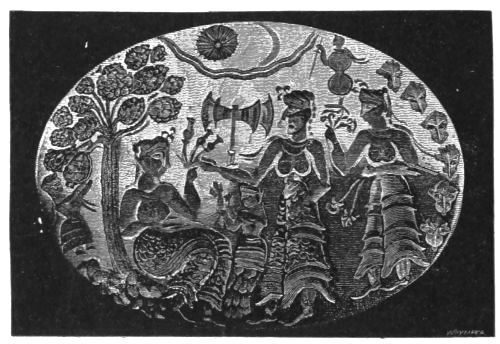
I turn, then, to Dr. Schliemann's volume, and call
attention to the signet ring at p. 354, which, though
apparently not of a high order in art, combines so many
objects of interest. On the extreme left of the picture
stands a child, or small woman, who is picking fruit from
a tree. Behind her head appear to descend long tresses of
hair. What if these should prove on further examination
to be lappets from a head-dress which the head seems to
carry? Passing to the right of the tree, first comes a tall
seated woman in a turban, which carries in front, says our
author, a diadem and behind a "tress of hair" from the
point into which the turban runs. I cannot but suppose
this "tress" to be a lappet of the kredemnon. She offers
poppies to another tall woman, again dressed in a turban
running out into a point (p. 356), "from which a long
ornament hangs down on the back," a third time, in all
likelihood, the lappet of the kredemnon. Below her outstretched
right arm we have another small figure, probably
of a child, again in a turban, and with "a long tress of
hair, or some ornament, hanging down its back:" yet once
more, I conjecture, the lappet indicated by Homer. There
is also a fifth: we have still the figure to the right of the
picture (p. 357); and she, too, wears a turban terminating in
a point "from which a long band-like ornament hangs
down on her back." Now let us go aloft; and we find a
small figure, towards the right of the picture. This figure
(p. 357) is described by Schliemann as female, from his
observing breasts upon it: and again, "from the back
project the long bands." Thus, in all the six cases, we
appear to have the same remarkable form described for the
main article of female head dress, which is also given us by
Homer.
It may, however, be said that the female figures on
this ring are foreign, rather than Hellenic, in their
character and habiliments. But it happens that the
evidence of the Poems more copiously establishes the use
of the kredemnon among foreigners, than in Greece. We
hear indeed of the kredemna of Penelopè; and Hera,
when about to inveigle Zeus, assumes the kredemnon
(Il. XIV. 184). But it is worn, as we have seen, by
Andromachè in Troy; by Ino, a deity of Phœnician
extraction; and by the maidens attendant on Nausicaä in
Scheriè.
4. In the upper region, or what we might call the sky
of the picture, are presented to us, apparently in very
rough outline, the sun and a thinly horned moon.[10] Below
them is an uneven band, forming rudely an arc of a circle.
This, I am led to suppose, is an indication of mother-earth,
with its uneven surface of land and its rippling sea, in
the proper place, beneath the sun and moon. If this be
so, it greatly confirms the conjecture of Mr. Newton respecting
the six objects on the rim of the picture to the
right. He asks whether these can be the teirea (Il.
XVIII. 485), the stars of heaven, which are described by
Homer as placed upon the Shield of Achilles, together
with the sun, moon, sky, earth, and sea. Schliemann
assigns to this sestetto heads and eyes: Mr. Newton says
they are thought to be heads of lions. That they should
be things animate is not, I imagine, in conflict with the
conjecture that they may be stars. The spirit of
Hellenism transmuted the older Nature-worship by impersonations,
of which we have an Homeric example in the
astral Orion (Il. XVIII. 486, Od. XI. 572). Should
these conjectures be confirmed, the matter will be of
peculiar interest: for we shall then have before us, in
actual collocation, the very objects, which people the first
compartment of the god-wrought Shield of Achilles: the
earth (of land and sea), sun, moon, and all the stars of
heaven. The ouranos or heaven itself, which the Poet
also includes, is here in all likelihood represented by the
curvature of the picture.
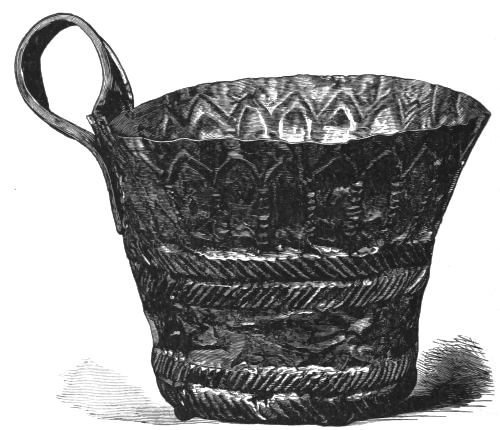
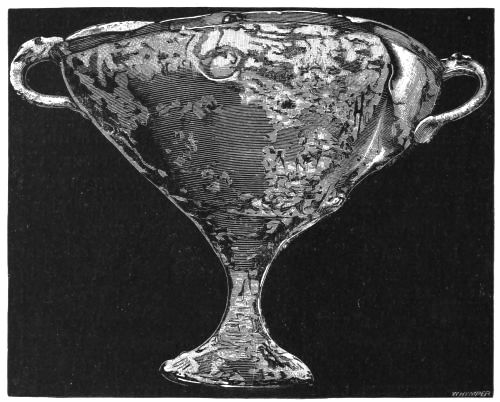
5. The goblet (No. 346 of the volume) has on each of
its two handles, we are told, the carved figure of a dove in
gold. Schliemann observes on the correspondence with the
goblet of Nestor (Il. XI. 632-635). We are not indeed
told that this was of gold; probably a different material is
to be supposed from the mention of gold as the material of
these parts or appendages. But it had four handles, and
on each handle were two doves. We are also told that he
did not get it in Troy, which may remind us of the argument
already presented, but brought it from home. It
was probably a foreign work; for the Phœnician associations
of Nestor are attested by his descent from Poseidon
(Od. XI. 254). This is fairly to be noted for an instance
of equable development in art, as between the discoveries
and the Poems.
6. We frequently hear in the Poems of the golden
studs or buttons which were used as ornamental adjuncts.
In many passages we have the silver-studded sword, xiphos
or phasganon arguroëlon (Il. II. 45, III. 334 et al.). This,
I say, is common. We have also studs, or bosses, of gold
upon the staff or sceptre of Achilles (Il. I. 246), upon the
cup of Nestor XI. 632-635: and upon a sword, only once
it is true, but then that sword is the sword of Agamemnon,
king of gold-abounding Mycenæ (Il. XI. 29). On this
sword, says the Poet, there were gilt, or golden, bosses; and
the expression he uses about them (pamphainon) is worthy
of note. It is not easy to represent by any one English
word. It means not merely shining brightly, but shining
all over; that is to say, apparently, all over the sheath to
which they were attached, so as to make it seem a shining
mass. Is not this precisely what must have been the effect
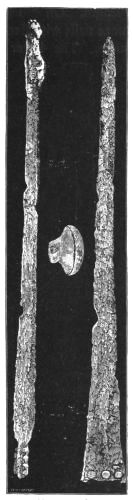
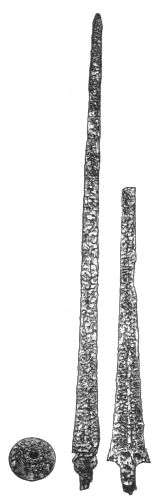
of the line of bosses found lying by the sword in p. 303,
which lie closely together, are broader than the blade,
and probably covered the whole available space along the
sheath of wood, now mouldered away? And is it not now
startling, to descend into the tombs with Dr. Schliemann,
and to find there lying silently in rows these gold studs or
bosses, when the wooden sheaths they were attached to have
for the most part mouldered away, but by the very sides
of the very swords which they adorned like binding on a
book, and of the slight remains of warriors by whom, there
need be little doubt, those swords were wielded?
"Expende Annibalem; quot libras in duce summo
Invenies?"[11]
They also appear on the sword-handle knobs. The helos
of Homer is commonly rendered a nail or stud, which
has a head of small size; but the word probably includes
the larger buttons or bosses, which lie in lines along some
of the swords. (See on this point pp. 281, 2; 303, 5, 6.)
I will not attempt to pursue further an enumeration
which, growing more and more minute, would be wearisome.
If porcelain and glass have been found, I should at once
assign them to foreign importation. The art of casting
and tooling in the precious metals, of which the examples
would appear, both from our author and from Mr. Newton,
to be few, are probably to be referred to a like source.
The hammer and the pincers are the only instruments for
metallic manipulation, of which Homer appears to be
aware (Il. XVIII. 477, Od. III. 434-5). As regards the
pottery mentioned by our author, if some of the goblets
were of light green (p. 285), we have a colour developed
in their manufacture of which Homer had certainly no
distinct conception, though it may still be true that, as in
nature, so in human art, objects bearing that colour may
have met his eye. Of the scales in the third sepulchre there
seems no reason to doubt that we may find the interpretation,
by referring them to the Egyptian scheme of doctrine with
regard to a future life (pp. 197, 8). In the Books of the
Dead, we have an elaborate representation of the judgment-hall,
to which the departed soul is summoned. Here the
scales form a very prominent object;[12] and it seems very
possible that the Poet, who was Greek and not Egyptian in
his ideas of the future state, may have borrowed and transposed,
from this quarter, the image of the balances displayed
on high, which he employs with such fine effect in some
critical passages of the Iliad. As regards the emblem of the
double-headed or full-formed axe, I venture to dispense with
the cautious reserve of Schliemann. As the usual form of
a weapon familiar to the age, it seems to require no special
explanation (p. 252). But where we find it conjoined with
the ox-head (p. 218), or on the great signet ring in conjunction
with a figure evidently representing Deity, I cannot
hesitate to regard it as a sacrificial symbol. We have
only to remember the passage in the third Odyssey, where
the apparatus of sacrifice is detailed, and Thrasumedes, who
was to strike the blow, brought the axe (III. 442):—
πέλεκυν δὲ μενεπτόλεμος Θρασυμήδης
ὀξὺν ἔχων ἐν χερσὶι παρίστατο, βοῦν ἐπικέψων.
The boar's teeth (p. 273) supply a minor, perhaps, but
a clear and significant point of correspondence to be added
to our list (Il. X. 263-264). Another is to be noticed in
the manner of attaching, by wire, lids and covers. On
these subjects, I refer to the text of the volume.
By the foregoing detail I have sought to show that there
is no preliminary bar to our entertaining the capital question
whether the tombs now unearthed, and the remains exposed
to view, under masks for the faces, and plates of gold covering
one or more of the trunks, are the tombs and remains of
the great Agamemnon and his compeers, who have enjoyed,
through the agency of Homer, such a protracted longevity
of renown. For the general character of the Mycenean
treasures, I take my stand provisionally on the declaration
of Mr. Newton (supported by Mr. Gardner), that, in his
judgment, they belong to the prehistoric or heroic age, the
age antecedent to his Greco-Phœnician period; and in important
outlines of detail I have endeavoured to show that
they have many points of contact with the Homeric Poems,
and with the discoveries at Hissarlik. But this Preface
makes no pretension whatever to exhibit a complete catalogue
of the objects, or to supply for each of them its interpretation.
We encounter, indeed, a certain number of
puzzling phenomena, such as the appearance of something
like visors, for which I could desire some other explanation,
but which Schliemann cites as auxiliaries to the masks of
the tombs, and even thinks to prove that such articles were
used by the living, as well as for the dead (p. 359).
Undoubtedly, in my view, these masks constitute a great
difficulty, when we come to handle the question who were
the occupants of the now opened sepulchres? It may be,
that as Mr. Newton says, we must in the main rest content
with the "reasonable presumption" that the four tombs
contained Royal personages, and must leave in abeyance
the further question, whether they are the tombs indicated
to Pausanias by the local tradition; at any rate, until the
ruins of Mycenæ shall have been further explored, according
to the intention which the government of Greece is said
to have conceived.
At the same time this is a case where the question
before us, if hazardous to prosecute, is not easy to let
alone.
It is obviously difficult to find any simple, clear, consistent
interpretation of the extraordinary inhumation
disclosed to us by these researches. Such an interpretation
may be found hereafter: it does not seem to be forthcoming
at the present moment. But the way towards it
can only be opened up by a painstaking exhibition of the
facts, and by instituting a cautious comparison between
them and any indications, drawn from other times or
places, which may appear to throw light upon them. For
my own part, having approached the question with no
predisposition to believe, I need not scruple to say I am
brought or driven by the evidence to certain conclusions;
and also led on to certain conjectures suggested by those
conclusions. The first conclusion is that we cannot refer
the five entombments in the Agora at Mycenæ to any
period within the historic age. The second is that they
are entombments of great, and almost certainly in part of
royal, personages. The third, that they bear indisputable
marks of having been effected, not normally throughout,
but in connection with circumstances, which impressed
upon them an irregular and unusual character. The conjecture
is, that these may very well be the tombs of
Agamemnon and his company. It is supported in part by
a number of presumptions, but in great part also by the
difficulty, not to say the impossibility, of offering any other
suggestion which could be deemed so much as colourable.
The principal facts which we have to notice appear to
be as follows:—
1. The situation chosen for the interments.
2. The numbers of persons simultaneously interred.
3. The dimensions and character of the graves.
4. The partial application of fire to the remains.
5. The use of masks, and likewise of metallic plates, to adorn or shelter them, or both.
6. The copious deposit both of characteristic and of valuable objects in conjunction with the bodies.
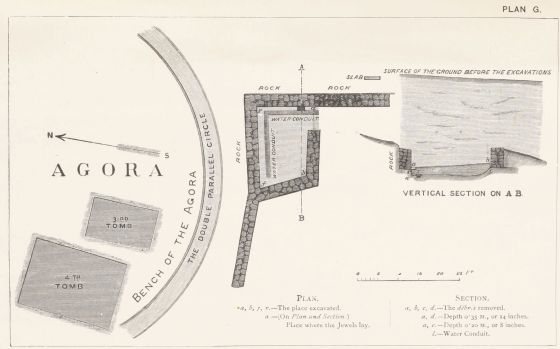
1. Upon the situation chosen for the interments,
Dr. Schliemann opines that they were not originally within
the Agora, but that it was subsequently constructed around
the tombs (p. 340). His reasons are that the supporting
wall, on which rest, in double line, the upright slabs,
formerly, and in six cases still, covered by horizontal slabs
as seats for the elders, is careless in execution, and inferior
to the circuit wall of the Acropolis. But, if it was built
as a mere stay, was there any reason for spending labour
to raise it to the point of strength necessary for a work of
military defence? Further, he finds between the lines of
slabs, where they are uncovered, broken pottery of the prehistoric
period more recent than that of the tombs. But
such pottery would never have been placed there at the
time of the construction; with other rubbish, it would only
have weakened and not strengthened the fabric of the
inclosure. Nor can we readily see how it could have come
there, until the work was dilapidated by the disappearance
of the upper slabs. If so, it would of course be later in
date than the slabs were.
It appears to me that the argument of improbability
tells powerfully against the supposition that the Agora was
constructed round the tombs, having previously been elsewhere.
The space within the Acropolis appears to be very
limited: close round the inclosures are 'Cyclopean' houses
and cisterns. When works of this kind are once constructed,
their removal would be a work of great difficulty:
and this is a case, where the earliest builders were followed
by men who aimed not at greater, but at less, solidity.
Besides which, the Agora was connected with the religion
of the place, and was, as will be shown, in the immediate
neighbourhood of the palace. In addition to these material
attractions, every kind of moral association would grow up
around it.
It can be clearly shown that the ancient Agora was
bound down to its site by manifold ties, other than those
of mere solidity in its construction. It stands in Mycenæ,
says our author (p. 341), on the most imposing and most
beautiful spot of the city, from whence the whole was overlooked.
It was on these high places that the men of the
prehistoric ages erected the simple structures, in many cases
perhaps uncovered, that, with the altars, served for the
worship of the gods. In Scheriè, it was built round the
temple, so to call it, of Poseidon (Od. VI. 266). In the
Greek camp before Troy the Agora was in the centre of
the line of ships (Il. XI. 5-9, 806-8). There justice was
administered, and there "had been constructed the altars of
the gods." Further, it is clear, from a number of passages
in Homer, that the place of Assembly was always close to
the royal palace. In the case of Troy we are told expressly
that it was held by the doors of Priam (Il. II. 788, VII.
345, 6). In Scheriè, the palace of Alkinoös was close to
the grove of Athenè (Od. VI. 291-3); and we can hardly
doubt that this grove was in the immediate vicinity of
the Posideïon, which was itself within the Agora. In
Ithaca (Od. XXIV. 415 seqq.), the people gathered before
the Palace of Odysseus, and then went in a mass into the
Agora. While it was thus materially associated with
those points of the city which most possessed the character
of fixtures, it is not too much to say, considering the
politics of early Greece, that it must, in the natural course,
have become a centre around which would cling the fondest
moral and historical associations of the people. Into the
minor question whether the encircling slabs are the remains
of an original portion of the work or not, I do not think
it needful for me to enter.
But, while I believe that the Agora is where it was, the
honour paid to the dead by the presence of their tombs
within it is not affected by either alternative; but only the
time of paying it. If this be the old Agora, they were
honoured by being laid in it; if it is of later date, they
were honoured by its being removed in order to be built
around them; if at least this was done knowingly, and
how could it be otherwise, when we observe that the five
tombs occupy more than a moiety of the whole available
space? We know, from the evidence of the historic period,
that to be buried in the Agora was a note of public honour;
we cannot reasonably doubt, with the five graves before us,
that it was such likewise in the historic age.
It was a note of public honour, then, if these bodies
were originally buried in the Agora. If we adopt the less
probable supposition that the Agora was afterwards constructed
around them by reason of their being there, the
honour may seem even greater still.
2. Next, the number of persons simultaneously interred,
when taken in conjunction with the other features of the
transaction, offers a new problem for consideration. An
argument in p. 337, to show that the burials were simultaneous,
seems quite conclusive. They embraced (ibid.)
sixteen or seventeen persons. Among the bodies one
appears to be marked out by probable evidence as that of
the leading personage. Lying in the tomb marked as
No. 1, it has two companions. Now Agamemnon had
two marshals or heralds (Il. I. 320), whose office partook
of a sacred character. There might, therefore, be nothing
strange in their being laid, if so it were, by their lord. The
most marked of the bodies lay to the north of the two
others, all three having the feet to the westward. It was
distinguished by better preservation, which may, at least not
improbably, have been due to some preservative process at
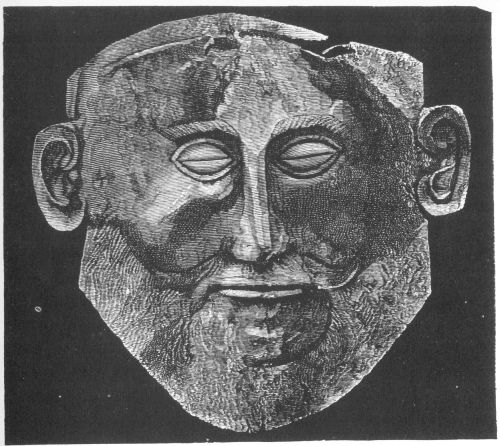
the time of interment. It carried, besides a golden mask
(p. 296), a large golden breastplate (15⅗ by 9½ in.), and
other leaves of gold at various points; also a golden belt
across the loins, 4 ft. long and 1¾ in. broad. By the side
of the figure lay two swords, stated by Dr. Schliemann to
be of bronze (p. 302), the ornamentation of one of them
particularly in striking accordance with the description in
the Iliad of the sword of Agamemnon (Il. XI. 29-31).
Within a foot of the body, to the right, lay eleven other
swords (p. 304), but this is not a distinctive mark, as the
body on the south side has fifteen, ten lying at the feet,
and a great heap of swords were found at the west end,
between this and the middle body.
The entire number of bodies in the five tombs (p. 337),
which is stated at sixteen or seventeen, seems to have
included three women and two or three children. The
local tradition recorded by Pausanias (inf. p. 59) takes
notice of a company of men with Agamemnon, and of
Cassandra, with two children whom she was reported to
have borne. This is only significant as testifying to the
ancient belief that children were buried in the tombs:
for Cassandra could only be taken captive at the time
when the city of Troy was sacked, and the assassination
immediately followed the arrival in Greece. But it is
likely enough that these children may have been the
offspring of another concubine, who may have taken the
place Briseïs was meant to fill. This is of course mere
speculation; but the meaning is that there is nothing in
these indications to impair the force of any presumptions,
which the discoveries may in other respects legitimately
raise.
3. Like the site in the Agora, so the character of the
tombstones, which is in strict correspondence with the
style of many of the ornaments,[13] and the depth of the
tombs, appear with one voice to signify honour to the
dead. As I understand the Plans, they show a maximum
depth of 25 feet (see, e.g., p. 155) below the surface, hollowed
for the most part out of the solid rock. But then
we are met with the staggering fact that the bodies of full-grown,
and apparently (p. 295) tall, men have been forced
into a space of only five feet six inches in length, so as to
require that sort of compression which amounts almost to
mutilation.
We seem thus to stand in the face of circumstances that
contradict one another. The place, the depth, the coverings
of the tombs, appear to lead us in one direction; the forcing
and squeezing of the bodies in another. But further, and
stranger still, there seems to have been no necessity for
placing the bodies under this unbecoming, nay revolting,
pressure. The original dimensions of the tomb (p. 294)
were 21 ft. 6 in. by 11 ft. 6 in. These are reduced all round,
first by an inner wall two feet thick, and secondly by a
slanting projection one foot thick (at the bottom) to 5 ft.
6 in. and 15 ft. 6 in. Why, then, were the bodies not laid
along, instead of across, it? Was not the act needless as
well as barbarous? And to what motive is a piece of
needless barbarism, apparently so unequivocal, to be
referred? I hardly dare to mention, much less, so scanty is
the evidence, to dwell upon the fact that their bodies lie
towards the west, and that the Egyptian receptacle for the
dead lay in that quarter.[14] The conflict of appearances, at
which we have now arrived, appears to point to a double
motive in the original entombment; or to an incomplete
and incoherent proceeding, which some attempt was subsequently
made to correct; or to both. But let us pay a
brief attention to the remaining particulars of the disclosures.
4. We have next to observe (a) that fire was applied to
these remains; (b) that the application of it was only partial;
(c) that the metallic deposits are said to show marks[15] of the
action of it (pp. 158, 165, 188, 198, 201,
208, 215, 218, 260,
266, 321, 330): so do the pebbles (p. 294). We see, therefore,
that the deposition of the precious objects took place
either at the same moment with the fire, or, and more
probably I suppose, before it had entirely burned out.
The partial nature of the burning requires a more
detailed consideration. In the Homeric burials, burning is
universal. It must be regarded, according to the Poems, as
the established Achaian custom of the day, wherever inhumation
was normally conducted. And for burial there was
a distinct reason, namely, that without it the Shade of the
departed was not allowed to join the company of the other
Shades, so that the unburied Elpenor is the first to meet
Odysseus (Od. XI. 51) on his entrance into the Underworld;
and the shade of Patroclos entreats Achilles to
bury him as rapidly as may be, that he may pass the gates
of Aïdes (Il. XXIII. 71). I think the proof of the universal
use of fire in regular burials at this period is conclusive.
Not only do we find it in the great burials of the
Seventh Book (429-32), and in the funerals of Patroclos
(XXIII. 177) and Hector (XXIV. 785-800), but we have
it in the case of Elpenor (Od. XII. 11-13), whom at first
his companions had left uninterred, and for whom therefore
we must suppose they only did what was needful under established
custom. Perhaps a yet clearer proof is to be found
in a simile. Achilles, we are told, wept while the funeral
pile he had erected was burning, all night long, the bones
of Patroclos, "as a father weeps when he burns the bones
of his youthful son" (XXIII. 222-5). This testifies to a
general practice.
In the case of notable persons, the combustion was not
complete. For not the ashes only, but the bones, were
carefully gathered. In the case of Patroclos, they are
wrapped in fat, and put in an open cup or bowl (phialè)
for temporary custody (XXIII. 239-44) until the funeral
of Achilles, when with those of Achilles himself, similarly
wrapped, and soaked in wine, they are deposited in a golden
urn (Od. XXIV. 73-7). In the case of Hector, the bones
are in like manner gathered and lodged in a golden box,
which is then placed in a trench and built over with a mass
of stones (Il. XXIV. 793-8). Incomplete combustion,
then, is common to the Homeric and the Mycenean
instances. But in the case of the first tomb at Mycenæ,
not only was there no collection of the bones for deposit in
an urn, but they had not been touched; except in the
instance of the middle body, where they had simply been
disturbed, and the valuables perhaps removed, as hardly
anything of the kind was found with it. In the case of the
body on the north side, the flesh of the face remained
unconsumed.
But though the use of fire was universal in honourable
burial, burial itself was not allowed to all. Enemies, as a
rule, were not buried. Hence the opening passage of the
Iliad tells us that many heroes became a prey to dogs and
birds (Il. I. 4). Such says Priam, before the conflict with
Hector, he would make Achilles if he could (XXII. 42);
and he anticipates a like distressing fate (66 seqq.) for himself.
In the Odyssey, the bodies of the Suitors are left to
be removed by their friends (XXII. 448; XXIV. 417).
Achilles, indeed, buried Eëtion, king of Asiatic Thebes, with
his arms, in the regular manner. "He did not simply spoil
him, for he had a scruple in his mind" (Il. VI. 417); and
no wonder; for Eëtion, king of the Kilikes, was not an
enemy: that people does not appear among the allies of
Troy in the Catalogue. Thus there was a variance of use;
and there may have been cases of irregular intermediate
treatment between the two extremes of honourable burial
and casting out to the dogs.
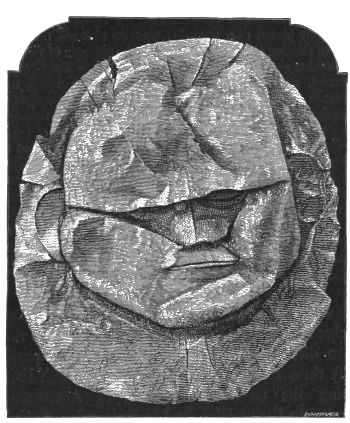
5. With regard to the use of masks of gold for the
dead, I hope that the Mycenean discoveries will lead to a
full collection of the evidence upon this rare and curious
practice. For the present, I limit myself to the following
observations:
(1.) If not less than seven of these golden masks
have been discovered at Mycenæ by Dr. Schliemann,
then the use of them, on the occasion of these entombments,
was not limited to royal persons, of whom it is
impossible to make out so large a number.
(2.) I am not aware of any proof at present before
us that the use of such masks for the dead of any rank
or class was a custom prevalent, or even known, in
Greece. There is much information, from Homer
downwards, supplied to us by the literature of that
country concerning burials; and yet, in a course of
more than 1200 years, there is not a single allusion to
the custom of using masks for the dead. It seems to
be agreed that the passage in the works of Lucian,
who is reckoned to have flourished in the second half
of the second century, does not refer to the use of such
masks. This might lead us to the conjecture that,
where the practice has appeared, it was a remainder
of foreign usage, a survival from immigration.
(3.) Masks have been found in tombs, not in
Greece, but in the Crimea, Campania, and Mesopotamia.
Our latest information on the subject is, I
believe, the account mentioned in Dr. Schliemann's
last report from Athens (pp xlvii, xlviii), of a gold
mask found on the Phœnician coast over against
Aradus, which is of the size suited for an infant only.
It is to be remembered that heroic Greece is full of
the marks of what I may term Phœnicianism, most of
which passed into the usages of the country, and contributed
to form the base of Hellenic life. Nor does
it seem improbable, that this use of the metallic
mask may have been a Phœnician adaptation from the
Egyptian custom of printing the likeness of the dead
on the mummy case. And, again, we are to bear in
mind that Mycenæ had been the seat of repeated
foreign immigrations.
(4.) We have not to deal in this case only with
masks, but with the case of a breastplate in gold,
which, however, could not have been intended for use
in war; together with other leaves or plates of gold,
found on, or apparently intended for, other portions of
the person.
6. Lastly, with regard to the deposit of objects which,
besides being characteristic, have unchangeable value, the
only point on which I have here to remark is, their extraordinary
amount. It is such, I conceive, as to give to
these objects, and particularly to those of the First Tomb,
an exceptional place among the sepulchral deposits of
antiquity. I understand that their weight is about one
hundred pounds troy, or nearly that of five thousand
British sovereigns. It is difficult to suppose that this
deposit could have been usual, even with the remains of a
King; and it is at this point that I, for one, am
compelled to break finally and altogether with the supposition,
that this great entombment, in the condition
in which Dr. Schliemann found it, was simply an entombment
of Agamemnon and his company effected by
Ægisthus and Clytemnestra, their murderers.
So far, with little argument, I have endeavoured fairly
to set out the facts. Let me now endeavour to draw to a
point the several threads of the subject, in order to deal
with the main question, namely, whether these half-wasted,
half-burned remains are the ashes of Agamemnon and his
company? And truly this is a case, where it may be said
to the inquirer, in figure as well as in fact,
Let us place clearly before our eyes the account given
by the Shade of Agamemnon, in the Eleventh Odyssey
(405-434), of the manner of his death. No darker picture
could be drawn. It combined every circumstance of
cruelty with every circumstance of fraud. At the hospitable
board, amid the flowing wine-cups, he was slain like
an ox at the stall, and his comrades like so many hogs for
a rich man's banquet; with deaths more piteous than he
had ever known in single combat, or in the rush of armies.
Most piteous of all was the death of Cassandra, whom the
cruel Clytemnestra despatched with her own hand while
clinging to Agamemnon; nor did she vouchsafe to her
husband the last office of mercy and compassion, by
closing his mouth and eyes in death. Singularly enough,
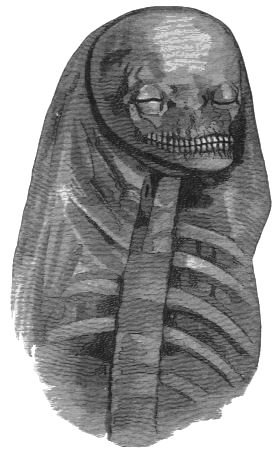
Dr. Schliemann assures me that the right eye, which alone
could be seen with tolerable clearness, was not entirely
shut (see the engraving at p. 297); while the teeth of the
upper jawbone (see the same engraving) did not quite
join those of the lower. This condition, he thinks, may
be due to the superincumbent weight. But if the weight
had opened the jaw, would not the opening, in all likelihood,
have been much wider?
Now, as we are told that Ægisthus reigned until
Orestes reached his manhood, we must assume that the
massacre was in all respects triumphant. Yet there could
hardly fail to be a party among the people favourable to
the returning King, who had covered his country with
unequalled glory. There might thus be found in the circumstances
a certain dualism, a ground for compromise, such as
may go far to account for the discrepancies of intention,
which we seem to find in the entombments. There was this
division of sentiment among the people, in the only case
where we know the return of the prince from Troy to have
been accompanied with a crisis or conflict, I mean the case
of Ithaca.
The assassins proceeded in such a way, that the only
consistent accomplishment of their design would have been
found in casting forth the bodies of the slain like the
bodies of enemies. But this may have been forbidden by
policy. In the Julius Cæsar of Shakespeare, Brutus says
(III. 1.)—
"We are contented Cæsar shall
Have all due rites and lawful ceremonies.
It shall advantage more than do us wrong."
Ægisthus was not Brutus. Even fury was apparent in
the incidents of the slaughter. Yet there might be a desire
to keep up appearances afterwards, and to allow some semblance
of an honourable burial. There is one special
circumstance that favours the idea of a double process,
namely, that we readily find the agents for both parts of it;
the murderers for the first, with necessity and policy controlling
hatred; Orestes on his return for the second, with
the double motive of piety and revenge.
We are now on the road not of history, but of reasonable
conjecture. I try to account for a burial, which
according to all reasonable presumption is of the heroic
age, and of royal and famous personages, but which
presents conflicting features of honour and of shame. That
there is no conflicting hypothesis, is not a good reason for
precipitate assent to the hypothesis which we may term
Agamemnonian. Conjecture, to be admissible, ought to
be consistent with itself, to meet the main demands of the
known facts, and to present no trait at actual variance with
any of them. In this view I present the hypothesis of a
double procedure, and a double agency: and I submit, that
there is nothing irrational in the following chain of suppositions
for the First Tomb, while the others are probably included
in the argument. That the usurping assassins, from
the same policy, granted the honour of burial in the Agora;
hewed the sepulchre deep and large in the rock; and built
the encircling wall within it. That honour stopped with the
preparation of the tomb, and the rest, less visible to the
public eye, was left to spite or haste. That the bodies were
consequently placed in the seemingly strange and indecent
fashion, which the tomb has disclosed. That, as they were
protected by the rock, and by the depth from the surface,
their decomposition was slow. That Orestes, on his return,
could not but be aware of the circumstances, and, in the
fulfilment of his divinely ordered mission, determined upon
reparation to the dead. That he opened the tombs and
arranged the means of cremation. That, owing to the
depth, it was imperfect from want of ventilation; we may
remember that in the case of Patroclos the winds were
specially summoned to expedite the process (Il. XXIII.
192-218). In calling it imperfect, I mean that it stopped
short of the point at which the bones could be gathered;
and they remained in situ. That the masks, breastplate,
and other leaves of gold were used, perhaps, in part with
reference to custom; in part, especially as regards all
beside the masks, to replace in the wasted bodies the
seemliness and majesty of nature, and to shelter its dilapidation.
That the profuse deposits of arms and valuables
were due to filial piety. That the same sentiment carried
the work through even to the careful sculpturing of the
four tombstones (others have been found (p. 100), but
without sculpture); and sought, by their means, to indicate
for renown and reverence, and to secure from greedy violation,
the resting-place of the dead.
A complex solution, perhaps; but one applicable to
very complex facts, and one of which the ground at least
is laid in those facts; one also, which I offer as a contribution
to a most interesting scrutiny, but with no claim or
pretension to uphold it against any other, that may seem
better entitled to fill the vacant place.
W. E. G.
HAWARDEN, November, 1877.
Athens, 1st Oct., 1877.
For some months past it has repeatedly been asserted in
the Press by travellers that there exists a very great
similarity between the Mycenean antiquities and those
recently discovered in a tomb at Spata. Having now
visited the latter, in company with my esteemed friend
Professor E. Castorches, of the University of Athens, and
his daughter Helen, and having carefully examined the
objects found in it, I think it in the interest of science to
offer the following remarks on the subject. The village of
Spata, which is exclusively inhabited by Albanians, lies
about nine miles to the east of Athens, on the further side
of Mount Hymettus, on the road to Marathon. Close to
that village is a small mount, whose circular summit has
evidently been artificially levelled; it is covered to a
depth of about three feet with débris, in which we see now
and then fragments of archaic vases with painted parallel
horizontal bands. The villagers assert that until very
recently the summit was surrounded by the ruins of
fortress walls, which have now altogether disappeared, the
stones having been used for the building of the new village.
The name of the settlement which existed here in antiquity
is altogether uncertain. Colonel Leake[17] recognises in the
present name, Spata, a corruption of the ancient demos of
Sphettus (Σϕῆττος or Σϕηττός), which is mentioned by
Aristophanes,[18] Strabo,[19] Pausanias,[20] Stephanus Byzantinus,[21]
and others.
In the south-west side of the mount, which slopes at an
angle of 52 degrees, there occurred last winter in one place
a sudden breaking down of the ground, and in the hollow
thus formed there was discovered a sepulchre cut out
in the sandstone rock. The Archæological Society had
the place explored, and it was found that an inclined road,
cut in the rock, 74 feet long, led into the tomb. The
road is 8¼ feet broad up to the entrance, which is 10 feet
long and 3⅓ feet broad. The sepulchre consists of three
quadrangular chambers, which are united by two passages
6½ feet long and 3⅓ feet broad; and the ceilings of these
chambers are cut out in the rock in the form of roofs with
two slanting sides. The primitive architect had evidently
intended to give to each of these three chambers exactly the
shape of a house, because the slanting sides of the roof-like
ceiling do not converge directly from the vertical walls, but
hang over by 8 inches like the eaves of a house. The
height of the first chamber is 16½ feet, its breadth 15, and
its length 20 feet; the two other chambers are 12½ feet
high, 12 feet long, and 11½ feet broad. Of the existence
of wooden doors there are no traces, except in the passage
from the first to the second chamber. Seen from the
extremity of the "dromos" this tomb reminds us of the
Egyptian sepulchres.[22]
In each of the three chambers was found a human skeleton,
with a quantity of ashes and charcoal, which seems to
prove that each body had been burnt on the pyre in the very
spot where it lay, but so superficially that the bones were
preserved. In this respect, as well regarding the burning
of the bodies in the tombs, we find a resemblance to the
mode of burial of the bodies in the five royal sepulchres at
Mycenæ. But here the bones crumbled away on being
exposed to the air. This tomb had evidently been already
rifled in ancient times, for but a few objects were found
with the bodies; nearly all of them lay dispersed in the
débris, in and before the entrance. They consisted of bone
or ivory, glass, bronze, stone, and terra-cotta. Only a few
flowers of very thin gold-leaf having been found, whose
aggregate weight cannot exceed the eighth part of a pound,
it appears that the tomb-robbers only aimed at the golden
ornaments, and that they threw away all the rest.
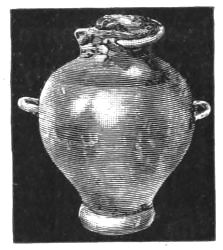
The few terra-cotta vessels found here are all wheel-made;
among the number there is one which perfectly
resembles the vase represented under No. 25, p. 64; it is
ornamented with red and black circular bands, and is in
the shape of a globe with a flat foot; it terminates above
in a very pretty narrow neck, without an opening, the top
of which is joined on each side by a beautifully shaped
handle to the upper part of the body. The real mouth of
the vase is in the shape of a funnel, and near to the closed
neck. There was also found the upper part of a similar
vase. I remind the reader that forty-three vases of exactly
the same form were found in a sepulchre at Ialysus in
Rhodes, and are now in the British Museum; that they
sometimes, though but seldom, occur in Attica, and that
some specimens of them have also been found in the
Egyptian tombs and in Cyprus.
Another vase found in the tomb of Spata is ornamented
with black spirals.
I also mention among the findings at Spata the large
quantity of small ornaments which Professor Landerer's
analysis has proved to consist of glass alloyed with much
protoxide of lead, the latter having the property of
breaking the rays of light; these ornaments present a
silvery mirror-like glimmer. Landerer observes that it is
soda-glass (in German, Natrum-Glas), and that it has the
property of dividing into small leaves or splinters. It is
very remarkable that all these ornaments of glass have
evidently been cast in moulds, and that many of them
resemble more or less the types which we see in the
Mycenean moulds represented under No. 162 and No.
163, p. 107 and p. 109. On the reverse side of most of
these objects are one, two, or three small holes, or tubular
rings, for fastening them on other objects, probably on
clothes. A most frequent object here is that which we
recognise in the type on the lower side of the mould, No.
162, p. 107. There also occur small cones of a much
weather-beaten glass, which have the very greatest similarity
to the type which we see in that side of the mould,
No. 163, which is represented on page 109 in the upper
row to the right of the spectator; it also resembles very
much the small cone, No. 164, p. 109, of which a large
number were found at Mycenæ; the only difference is
that the cones of Spata have an impressed spiral line,
whereas the cones of Mycenæ show impressed concentric
circles. However, it deserves attention that the mould,
No. 163, represents the type of such a cone with a spiral
line. But then, again, there is the greatest difference in
the substance, for whilst at Spata all these small ornaments
are of glass, the Mycenean cones and other objects,
such as Nos. 164, 165, 166 and 167, are of a hard-baked
clay, which has been varnished with a lead glaze; no trace
of glass having been found at Mycenæ except some small
glass beads, the small object, No. 177, and the almost
microscopical tubes of cobalt glass described at pages 157
and 158. As, on the other hand, there have been found a
large quantity of small ornaments of hard-baked clay
varnished with a lead-glaze, we cannot reasonably doubt
that the manufacture of glass at Mycenæ was only in its
first beginning, that until the capture of the city (468 B.C.)
it made no progress there, and that all the types contained
in the Mycenean moulds served merely for the casting of
similar ornaments of baked clay varnished with a lead-glaze.
But there also occur in the tomb at Spata objects of
blue cobalt glass, some of which are identical in shape with
the object of stone represented under No. 172, p. 111.
All these objects of glass lead us to the conclusion that
the sepulchre of Spata belongs to a much later time than
the royal tombs of Mycenæ. But we find a much stronger
proof of this in the carved works discovered in the Spata
sepulchre, which are generally thought to consist of ivory,
but which by the investigation of Professor Landerer are
proved to consist of common bone. All these carved
works appear to belong to a late period of Assyrian art;
perhaps the most remarkable object among them is a
beardless man's head covered with a very high Assyrian
mitre, the lower part of which is ornamented all round with
a diadem, whilst the upper part is divided by three double
bands into four compartments. As usual in the Assyrian
hair-dress, the hair hangs down on the neck in three tresses,
lying the one on the other. I also mention a comb 5·8 in.
long, 3·4 in. broad, the upper part of which is divided by
narrow borders into two horizontal compartments; the
upper one containing in the midst a flower and on either
side a female sphinx; the lower one containing three
female sphinxes. There are also two bone plates with
female sphinxes. All these sphinxes have very large and
broad wings and exhibit a most excellent Assyrian style of
art. In comparison with them the golden sphinxes of the
Mycenean tombs, of which I have represented one under
No. 277, on p. 183, show a most ancient and very primitive
style of art.
Among the carved works found in the tomb at Spata
particular attention is due to a plate of bone, on which is
represented a lion devouring an ox; the whole body of the
former is represented as hovering in the air, and his long
outstretched hind-legs vividly remind us of the representation
of the lions on the Mycenean goblets and plates
of gold. On the other hand the lion's head and the ox
which he devours most decidedly show an Assyrian style
of art.
I repeat here that no trace of Assyrian art was found at
Mycenæ.
Another of the carved works from Spata which
deserves attention is a disk of bone of 4·6 in. in diameter,
with a border formed by two double lines, the whole
interior space being in the form of a net, divided by treble
wave-like lines into small triangles.
Professor Landerer asserts that these large plates and
disks of bone prove beyond any doubt that the art of
softening bone in water, and pressing it, and thus preparing
very large pieces of bone, was known in Attica at a remote
antiquity.
I still call attention, among the objects found at Spata,
to the small disks of stone, which have on one side in the
centre a small tube, and may have been used as ornaments
on the house doors. They are mostly similar to objects
which I found at Mycenæ;[23] but they were also found in
the sepulchre at Ialysus, and may be seen in the British
Museum.
Of bronze arrow-heads several specimens were found
in the sepulchre at Spata, but no trace of them occurred
in the Mycenean tombs. On the other hand there were
found in one of the latter the thirty-five arrow-heads of
obsidian represented under No. 435, p. 272, and arrow-heads
of the same stone also occurred in the débris above
the tombs; it was only in the upper layers of débris at
Mycenæ that I found some arrow-heads of bronze.[24]
Among the objects found at Spata I further mention
the fragment of a vase of black granite, with two holes for
suspension; fragments of similar vases occurred also at
Mycenæ.
Close to this tomb was discovered another, consisting
of but one small chamber, approached by a dromos which
has but half the length of that which leads to the large
tomb. In the small tomb was found the skeleton of a
man which had evidently likewise been burned on a pyre
on the very spot where it lay; there was also found the
skeleton of a stag, but nothing more.
Colonel Leake is in all probability right in proclaiming
the identity of Spata with the ancient demos of Sphettus
(Σϕῆττος or Σϕηττός), and as, according to Plutarch,[25] the
fifty Pallantides, sons of Pallas, the brother of Ægeus,
marched from Sphettus against Athens; and as Colonel
Leake, guided by an inscription published by Finlay,
identifies the site of the demos of Pallenæ, which the
Pallantides inhabited, with a spur of mount Hymettus,
which bars the road to Probalinthus and Marathon, and
is thus in the immediate neighbourhood of Sphettus—for
all these reasons it has been supposed that the tombs
of Spata might possibly belong to the Pallantides killed
by Theseus. But this opinion is contradicted by the
objects discovered, which make it impossible for us to
attribute the large tomb to an earlier period than the
eighth century, B.C., whilst the royalty at Athens belongs
to a very remote antiquity, and must be contemporaneous
with royalty at Mycenæ.
The use of masks in antiquity being a question very
important for Archaeology, I cannot conclude without
mentioning that my esteemed friend Professor A. Rhousopoulos,
of the University of Athens, reminds me of a very
small golden mask found last spring in a sepulchre on the
coast of ancient Phoenicia, just opposite to the island of
Aradus. It had been bought there by a trader in antiquities,
who brought it first to Athens, and showed it to me
at Boulogne-sur-Mer, on his way to London, where he
intended to sell it. It is of thin gold plate, and so small
that it could apparently only fit on the face of a new-born
child. It represents a human face with shut eyes, in very
rude repoussé work.
I give, at my worthy friend Professor F. A. Paley's
suggestion, a literal translation of the account which
Diodorus Siculus (xi. 65) gives us of Mycenæ's tragic
end:
"In the seventy-eighth Olympiad (B.C. 468) a war was
set on foot between the Argives and the people of
Mycenæ, on the following grounds. The Myceneans,
proud of the high renown which their own country had
formerly enjoyed, refused to obey the Argives as the other
cities in that territory had done, but took up an independent
position and paid no regard to the Argives. They
had disputes with them also about the worship of the
goddess Hera, and put in a claim to have the sole conduct
and management of the Nemean games. And still
further they were at variance with them because, when the
Argives had passed a resolution not to aid the Spartans at
Thermopylae, unless they should be allowed a share in the
command, the Myceneans alone of all the inhabitants of
Argolis joined the ranks of the Lacedæmonians. The
Argives had besides a general suspicion that some day their
rivals might become too powerful and dispute with them
the sovereignty, from the former greatness of their city.
Such being the motives for hostility, they had long been
watching an opportunity to raze Mycenæ to the ground;
and they thought the fitting time had now arrived, as they
saw the Lacedæmonians had been defeated and were unable
to bring any aid to the Myceneans. Accordingly they
collected a strong force from Argos and the other states in
alliance, and led them to the attack. The Myceneans were
beaten, driven into the walls of their city, and besieged.
For some time they defended themselves with spirit against
the besieging hosts; but at length, partly because they had
been worsted in the war, partly because the Lacedæmonians
were unable to aid them, from having wars of
their own on hand, as well as through the disastrous effects
of the earthquakes, and having no one now to help them,
through mere deficiency of aid from without they were
taken by assault. The Myceneans were thus made slaves
by the Argives, a tithe of their property was consecrated
to the service of religion, and their city was razed to the
ground. Thus a state that had been great and wealthy
in times of old, had numbered many illustrious men and
performed many glorious actions, met with its final
overthrow, and it has remained desolate up to our times"
(i.e., to the time of Augustus).
TABLE OF CONTENTS. — CHAPTER I. — CHAPTER II. — CHAPTER III. — CHAPTER IV. — CHAPTER V. — CHAPTER VI. — CHAPTER VII. — CHAPTER VIII. — CHAPTER IX. — CHAPTER X. — CHAPTER XI.
Situation of the City—Description by Pausanias—Cyclopean Walls:
meaning of the epithet—The Quarry—The rock of Tiryns and its
bordering Wall—Galleries, Gate, and Tower—Walls and Terraces
of the Acropolis—Mythical traditions and History of Tiryns—Its
destruction by the Argives—Its connection with the myth of
Hercules—Morasses in the Plain of Argos—The Walls of Tiryns the most
ancient monument in Greece—Pottery a test of antiquity—Beginning
of the Excavations—Cyclopean house-walls and conduits—Objects
discovered—Terra-cotta cows, and female idols with cow's-horns—Both
represent the goddess HERA BOÖPIS—A bird-headed idol—A
bronze figure, the only piece of metal at Tiryns, except lead—No stone
implements found—Pottery—Hellenic remains outside the citadel, which
was the primitive city—Proofs of different periods of habitation—The
later city of Tiryns—The archaic pottery of Tiryns like that of
Mycenæ—Its forms and decoration denote higher civilisation than the
rude walls would lead us to expect—Older pottery on the virgin soil, but
no cows or idols—Probable date of the second nation at Tiryns, about
1000 to 800 B.C.; of the Cyclopean walls, about 1800 to 1600
B.C.—No resemblance to any of the pottery in the strata of
Hissarlik, except the goblets—A human skeleton found—Whorls—Estimate
of soil to be moved at Tiryns—Greater importance of MYCENÆPage1
The road from Argos to Mycenæ—The Plain of Argos: its rivers and
hills, horses and vegetation—Myth regarding its arid nature—Swamps
in the southern part; and fable of the Lernæan hydra—Early social
develop-ment here—Legend of Phoroneus—The Pelasgian Argos—The Achæan
states of Argos and Mycenæ—Situation of Mycenæ—The Citadel and
its Cyclopean walls—The term defined—"Gate of the Lions"—The postern
gate—Cisterns—Poetical confusion of Argos and Mycenæ.
The Lower City: its house-walls, bridge, treasuries, and
pottery—Its partially enclosing wall—The undefended suburb, and its
large buildings—Its extent—The only two wells in Mycenæ—Three
Treasuries in the suburb—Treasuries in the Lower City—Description of
the "Treasury of Atreus"—Dodwell's Argument for regarding the building
as a Treasury—Uniqueness of these structures—Excavation of the
Treasury by Veli Pasha 23
HISTORYOF MYCENÆANDTHE FAMILYOF PELOPS.
THE SEPULCHRES OF AGAMEMNON AND HIS COMPANIONS.
Traditional foundation of Mycenæ by Perseus—His dynasty succeeded by the
Pelopids—The legend of their crimes unknown to Homer and Hesiod—The
Homeric story of Agamemnon's murder by Ægisthus and Clytemnestra, avenged
by Orestes—Cycle of crimes devised by the later bards—Dominion of
Agamemnon—End of the Dynasty at Mycenæ with Ægisthus—Orestes and his
sons—The Dorian invasion—Part taken by Mycenæ in the Persian wars—The
Argives besiege and take Mycenæ—The walls of the citadel preserved from
religious reverence—Homeric epithets of Mycenæ—Its "abundance of gold"
confirmed by Thucydides—The Treasuries of the Pelopids mentioned by
Pausanias—Treasury at the Heræum, near Mycenæ—Probable existence of
another Treasury at Mycenæ.
The Royal Sepulchres described by Pausanias—General
misinterpretation of the passage—Experimental shafts sunk there in
February, 1874—Excavations begun, August 7, 1876—Porter's lodge at the
Lions' Gate—The later habitation of the city after 468 B.C.—No
coins of Mycenæ known—Remains below this first stratum—Painted
archaic vases, like those at Tiryns—The vases almost all made on the
Potter's wheel—Female idols and cows of terra-cotta—Other idols
and animals—Iron knives and curious keys of a later period—Bronze
knives and arrow-heads—Stone implements and other objects—A little
gold and much lead found—Fragments of a lyre and flute—Plates of
ornamented terra-cotta for lining walls—Cyclopean house-walls—A
remarkable water-conduit—Twelve tomb-like reservoirs—Two tombstones
with bas-reliefs, probably of the same epoch as that over the Lions'
Gate 52
EXCAVATIONSINTHE CITADELOF MYCENÆ—continued.
Wages and worth of labour at Mycenæ—The double circle of slabs—Two
more sculptured stêlæ—Unsculptured stêlæ—Ashes and bones,
probably of sacrifices—Fragments of other sculptured tombstones—The
style of these stêlæ unique—Their probable age about 1500
B.C.—A Cyclopean house filled with ashes, bones, &c.—Objects
found there and in the twelve reservoirs—Great significance of the
tombstones found in the Acropolis—They mark the Royal Tombs, mentioned
by Pausanias from tradition only—Excavation of the Treasury close to
the Lions' Gate: about as large as that of Atreus—Antiquity of the
covering-up proved by the ancient vases, idols, &c. in the débris
above—Hera-idols, and others, found in the dromos, and in the
Acropolis—Their vast abundance—Cow-heads on handles of vases, as
at Troy—Moulds for earrings and other ornaments of gold and silver,
and curious clay cones—Other ornaments of glazed clay, potstone,
&c.—Numerous objects of bronze—Curious wheels—Necklace beads of
various stones, with intaglios of animals, and similar objects of other
shapes—Two-handled goblets; the δέπας ἀμϕικύπελλον of Homer—Depth of
the débris—Breach in the great Cyclopean wall, repaired by an
ancient wall of small stones—The quarry of Mycenæ 86
EXCAVATIONSINANDNEARTHE ACROPOLIS—continued.
THE LIONS' GATE AND THE AGORA.
The Treasury excavated by Mrs. Schliemann—Older and less sumptuous than
that of Atreus—The entrance, its ornaments—Archaic pottery found in the
passage—Necklace beads—Fragment of a marble frieze—Threshold of the
Lions' Gate—The great double row of parallel slabs, probably not of a
remote antiquity—The Acropolis only partly accessible to chariots—The
gateway double, like the Scæan Gate at Troy—Corridors of Cyclopean
house-walls—Hera-idols and arrow-heads of bronze and iron—Door-keeper's
lodge—Retaining walls—Tower of the Acropolis resting on a massive
wall—The double circle of slabs formed the enclosure of the royal
tombs and the Agora—Arguments in proof of this view—Objects of
interest found there—A vast Cyclopean house with cisterns and water
conduit, probably the ancient Royal Palace—The spring Perseia—No
windows in the house—Objects of art and luxury found there—An onyx
seal-ring—Vase-paintings of mail-clad warriors—Hand-made pottery in the
Acropolis 118
The SECOND GREAT TREASURY; ACROPOLIS; AND CYCLOPEAN REMAINS IN THE NEIGHBOURHOOD OFMYCENÆ.
Further excavations of Mrs. Schliemann's Treasury—The dromos,
doorway, and threshold—Objects found there—Hera-idols—Cyclopean
water-conduits and cisterns in the Acropolis—Bronze rings—Pottery
with marks like letters—Earrings like those found at Troy—Hand-made
painted pottery—New forms of Hera-idols—Terra-cotta tripods and
cradles, probably votive offerings—A comb, stilettos of opal, beads and
buttons—A bronze sword—Iron tongs of late date—State of the débris
left at the Lions' Gate—The excavations visited by the Emperor of
Brazil—Ascent of Mount Eubœa—The Cyclopean enclosure on its summit;
was probably a very ancient sanctuary—Other Cyclopean remains near
Mycenæ—State of the excavations 139
THE FIRST, SECOND, AND THIRD TOMBSINTHE ACROPOLIS.
Discovery of the Tomb indicated by the three sculptured
stêlæ—Curious gold-covered buttons, objects of ivory, baked clay,
gold, glass, bronze, &c.—Pottery, both wheel and hand-made—Second
Tomb below the unsculptured stêlæ—Discovery of three human bodies,
which had been partially burnt where they lay—Fifteen diadems
of thin gold plate found on the bodies—Also crosses of golden
laurel-leaves—Other curious objects, proving a knowledge of the art
of glass-working and colouring—Knives of obsidian—A silver vase
with a bronze mouth plated with gold, and other objects—Terra-cotta
vases—The horned Hera-idols found in the tomb, a proof of that symbolic
worship in the earliest times at Mycenæ—Its duration to the last age
of the city—Primitive painted wheel-made vases of terra-cotta—Further
discovery of sepulchral slabs—Various objects found with them—The
Third Tomb—Several skeletons of men, not burnt, and objects found
with them—A curious double-bladed bronze dagger—Narrow escape from a
falling rock—Internal walls of the tomb—Three skeletons of women in
it, evidently burnt where they lay—Laden with jewels of gold—Layers
of round plates of gold with ornamentation of repoussé work under
and over the bodies—Description of their many types—The other jewels
described—Other chased and embossed beads—Golden griffins—Legend
of the griffins of Indian origin—Heart-shaped and lion-draped gold
ornaments—Curious brooches formed of palm-trees, stags, and lions—Women
with pigeons—Golden cuttle-fish, butterflies, swans, hippocampi,
eagles, sphinxes, trees, and birds—The splendid gold crown on the head
of one of the bodies—Signs upon it—The second gold crown—Five more
diadems of gold—Crosses of double leaves of gold—Golden stars—A gold
brooch, and other ornaments—Necklaces and bracelets—Two pairs of golden
scales—Golden plates—A child's mask of gold—Other ornaments—Balls,
&c. of rock crystal, silver, and bronze, probably the handles of
sceptres—Lentoid gems of agate, sardonyx, &c., with intaglios—A lentoid
gem of amethyst engraved with a cow suckling her calf, as on the old
coins of Corcyra—Gold wheels—A gold comb with bone teeth, &c.—Amber
beads—Other ornaments—Pieces of gold-leaf strewn below and about the
bodies—A gold goblet—A curious gold box, and gold vases with lids
fastened on by wires—A silver vase and golden sceptre-handle—Boxes of
copper-plate filled with wood, perhaps pillows for the dead bodies—Other
objects found in the third sepulchre—Hand-made and very ancient
wheel-made pottery 150
THE FOURTH TOMBINTHE ACROPOLISOF MYCENÆ.
Further search within the Agora, without the guide of
tombstones—Discovery of an altar of Cyclopean masonry, over the centre
of the great Fourth Tomb, containing the bodies of five men, burnt
where they lay, laden with jewels, and covered with a layer of white
clay—Objects found—Copper caldrons, one containing 100 gold-plated
buttons with intaglio work—Homeric mention of caldrons—A silver cow's
head with gold horns and a gold sun on its forehead: it represents
Hera—Cow-heads with axes—Swords and lances of bronze—Gold-plated
wooden sword-sheaths and hilts with gold pins—Three masks of gold
covering the faces of the bodies—A fourth mask, representing a lion's
head—Two seal-rings and a bracelet, with ornaments—The state of art
corresponds with that described in Homer—Golden breastplates on two
of the bodies—Golden crown by the head of another—Golden ornament of
the greaves—Borax used then, as now, for soldering gold—More than
one δέπας ἀμϕικύκελλον, and other vessels of gold and silver—The
large gold goblet, with doves on the two handles, like Nestor's cup in
the Iliad—Two-handled terra-cotta vases, hand-made, like those at
Troy—Ornaments of alabaster—Gold shoulder-belts (τελαμῶνες)—Other
objects found in the tomb, of rock crystal, amber, alabaster—Golden
diadems, some seemingly for children; also a child's belt and
frontlet, or "belle Hélène," and other ornaments of gold—Double
edged battle-axes—Their use by the Greeks as a symbol, especially at
Tenedos—A funeral fork of copper—Vase-lids of bone—Vessel of silver
and lead in shape of an animal—Buttons of wood, plated with gold,
splendidly ornamented—Their patterns and workmanship—Hundreds of gold
flowers, plain buttons, and other ornaments of gold—Larger gold buttons,
splendidly ornamented—Leaves of gold strewn under, over, and around the
bodies—Wooden comb with gold handle—Gold models of temples—Many golden
cuttle-fish—Gold knobs for sword hilts, highly ornamented—Arrow-heads
of obsidian—Boars' teeth—Large copper vessels—Custom of placing such
vessels in tombs—A copper tripod—Uses of tripods in Homer—Bronze
swords, lances, and knives—Some swords with parts of their wooden
sheaths, alabaster handle-knobs, golden studs, &c.—Remnants of linen
sheaths—Oyster-shells and unopened oysters—Broken pottery, indicative
of a still existing funeral custom—The bones of the deceased—Alabaster
vases—Hand-made and very ancient wheel-made pottery—Fragments of a
characteristic form of goblet, both of terra-cotta and of gold—Another
type of goblets—Two whetstones—A handle of unique work, gold encrusted
with rock crystal, "θαῦμα ἰδέσθαι." 211
At length again a guard and watchfire on the Acropolis of
Mycenæ—Exploration of the Fifth Tomb—Its sepulchral stêlæ—The tomb
described; containing only one body—Golden diadem and other objects
found in the tomb—Hand-made vases of terra-cotta; one with female
breasts, like the prehistoric vases at Santorin and Troy—Wheel-made
pottery—Excavation of the First Tomb completed—Its position and
construction. Three bodies in it: the middle one has been disturbed
and rifled of its ornaments—Large size of the bodies—Golden mask and
state of the first—Wonderful preservation of the third—Its ponderous
gold mask, face, and teeth—Description of the body—its remarkable
compression—Golden breast-plate, and leaves of gold on the forehead,
eyes, and breast—Excitement caused by the discovery—Measures taken
to preserve and remove the body—Its shoulder belt and bronze sword
with crystal ornament, and disks of gold for the sheath: all special
funeral ornaments, and not for ordinary use—Description of the golden
breast-covers of this and the first body—Highly-decorated bronze swords
and other objects found with the third body—Ornamented golden leaves,
a wooden comb, and bronze swords, with the second body—A large heap of
broken bronze swords, with knives and lances—Other weapons, chiefly
in fragments—Amber and gold beads, and various objects of gold and
silver—An alabaster vase—Wonderful plates of gold—The two massive
golden masks of the first tomb—The skilled work argues a long-trained
school of artists—Several large goblets of gold and silver—Objects
in this sepulchre—A silver vase, with copper and gold plating—A
drinking-cup of alabaster—Plates of gold, in form of double eagles,
&c.—Fragments of silver vases; one with a gold mouthpiece and handle—A
splendidly ornamented plate of gold, covering a cylinder of charred
wood—Hundreds of gold-button-plates, large and small, with various
ornamentation—The new types shown—Gold plates, ribbons, and ornaments
for greaves—Tubes and buttons of bone; their probable use—An ivory
plate, and a curious object of glazed Egyptian porcelain—Hand-made and
wheel-made pottery—Seven large copper vessels, caldrons and cans—A
quadrangular wooden box, with most interesting reliefs Page289
CONNECTION OF THE FIVE TOMBS WITH THE ROYAL HOUSE OF PELOPS; AND DATE OF THE AGORA.
Discussion of the identity of the five tombs with those mentioned
by Pausanias as the tombs of Agamemnon and his companions—Opinions
of scholars about the Trojan War—The ancients unanimous for its
reality—The author's faith in the traditions led to his discovery of
Troy and of the five Royal Tombs at Mycenæ—The civilisation of Mycenæ
higher than that of Troy—The pottery of both very primitive—Alphabetic
writing known at Troy, but not at Mycenæ—The different civilisations
may have been contemporaneous—The appearances in the tombs prove
the simultaneous death of those interred, certainly in each tomb,
and probably in all the five—Traditional veneration for the
sepulchres—Monuments repeatedly placed over them—No tombs between the
two circular rows of slanting slabs which formed the enclosure of the
Agora and its benches—Agora probably erected when the tombstones were
renewed, and the altar built over the fourth tomb, under the influence
of the enthusiasm created by the Rhapsodists—These monuments buried in
the course of time, but the memory of the site was fresh by tradition
long after the destruction of the new city of Mycenæ—Testimony of
Pausanias—The enormous treasures prove the sepulchres to be royal, but
royalty at Mycenæ ended with the Dorian invasion—This must have been
much earlier than the received date, 1104 B.C.—An objection
answered—Honours paid to the remains of murdered princes even by
their murderers—Custom of burying the dead with their treasures—The
sepulchral treasure of Palestrina—The sepulchre of Nitocris at
Babylon—Case of Pyrrhus and the royal sepulchres at Ægeæ—The sepulchre
at Corneto 333
TREASUREOFTHE TOMB SOUTHOFTHE AGORA.
Discovery and description of another tomb in the Acropolis outside the
Agora—Its Cyclopean masonry like that of the five sepulchres—The
golden trinkets of this tomb—Double-handled goblets—A plain gold cup
(φιάλη)—Spirals and rings of gold and silver wire, like those of the
Egyptian tombs—A golden seal-ring covered with intaglio-work—Its full
description—The face-covers of the female figures prove the use of masks
during life—A figure meant for a Palladium—Six other rude figures
resembling the Trojan idols: their likeness to the "Corinthian helmet" of
Athena—The work of this ring calls to mind Homer's description of the
shield of Achilles—A smaller golden signet-ring, with four Palladia
and three Hera-idols—A beautiful lion of massive gold—Gold necklace
beads—Bones of animals found in this tomb—The human remains probably
removed when the water conduit was built, but the small jewel-recess
escaped being rifled—Three curious lentoid gems of necklaces, one found
on the site of Phœnicé, the others near the ancient Heræum—The first
represents Phœnician figures—Description of the other two—The Cyclopean
foundations of the ancient Heræum, probably as old as the walls of Tiryns
and Mycenæ—It was destroyed by fire in 423 B.C., and its site
deserted—Professors Sayce and Mahaffy on the Date of the Capture of
Mycenæ—Views of M. Emile Burnouf 350
Telegrams to and from the King of Greece—Conclusion 380
With reference to the visit paid to the excavation at Mycenæ by the
Emperor of Brazil, I feel bound to mention the renewed mark of his
Majesty's interest in the discoveries, when he did me the signal honour
of visiting my lodgings in London on June 22, 1877. His Majesty spent
two hours in examining with great attention my large Album of Mycenean
photographs, and repeatedly congratulated me on the results of my
excavations. H. S.
COMPARATIVE TABLE OF FRENCH AND ENGLISH MEASURES, EXACT AND APPROXIMATE.
Metric.
Inches.
Ft.
Inch.
Approximate.
Millimètre
0·0393708
"
·03937
·04 or 1⁄25 of inch.
Centimètre
0·393708
"
·39371
4" ⅖ "
Décimètre
3·93708
"
3·9371
4 inches.
Mètre
39·3708
3
3·3708
3⅓ feet.
2
78·7416
6
6·7416
6⅔ "
3
118·1124
9
10·1124
10 "
4
157·4832
13
1·4832
13 "
5
196·8540
16
4·8540
16⅓ "
6
236·2248
19
8·2248
19⅔ "
7
275·5956
22
11·5956
23 "
8
314·9664
26
2·9664
26¼ "
9
354·3372
29
6·3372
29½ "
10
393·7089
32
9·7080
33 "
11
433·0788
36
1·0788
36 (12 yds.)
12
472·4496
39
4·4496
39⅓ feet.
13
511·8204
42
7·8204
42⅔ "
14
551·1912
45
11·1912
46 "
15
590·5620
49
2·5620
49¼ "
16
620·9328
52
5·9328
52½ "
17
669·3036
55
9·3036
55¾ "
18
708·6744
59
0·6744
59 "
19
748·0452
62
4·0452
62⅓ "
20
787·416
65
7·4160
65⅔ "
30
1181·124
98
5·124
98½ "
40
1574·832
131
2·832
131¼ "
50
1968·54
164
0·54
164"
100
3937·08
328
1·08
328 (109 yds.)
N. B.—The following is a convenient approximate rule:—"To turn
Metres into Yards, add 1-11th to the number of Metres."
No. 460. Two Bronze Swords with golden handles; Golden Buttons belonging to the destroyed Wooden Sheaths;
two gold plates, &c.; found lying beside a body in Sepulchre I.
Situation of the City—Description by Pausanias—Cyclopean Walls:
meaning of the epithet—The Quarry—The rock of Tiryns and its
bordering Wall—Galleries, Gate, and Tower—Walls and Terraces of
the Acropolis—Mythical traditions and History of Tiryns—Its
destruction by the Argives—Its connection with the myth of
Hercules—Morasses in the Plain of Argos—The Walls of Tiryns
the most ancient monument in Greece—Pottery a test of antiquity—Beginning
of the Excavations—Cyclopean house-walls and conduits—Objects
discovered—Terra-cotta cows, and female idols
with cow's-horns—Both represent the goddess HERA BOÖPIS—A
bird-headed idol—A bronze figure, the only piece of metal at
Tiryns, except lead—No stone implements found—Pottery—Hellenic
remains outside the citadel, which was the primitive
city—Proofs of different periods of habitation—The later city of
Tiryns—The archaic pottery of Tiryns like that of Mycenæ—Its
forms and decoration denote higher civilisation than the rude walls
would lead us to expect—Older pottery on the virgin soil, but no
cows or idols—Probable date of the second nation at Tiryns, about
1000 to 800 B.C.; of the Cyclopean walls, about 1800 to 1600 B.C.—No
resemblance to any of the pottery in the strata of Hissarlik,
except the goblets—A human skeleton found—Whorls—Estimate of
soil to be moved at Tiryns—Greater importance of MYCENÆ.
Tiryns, August 6, 1876.
In the south-east corner of the Plain of Argos, on the
lowest and flattest of a group of rocky hills, which rise
like islands out of the marshy lowlands, only eight stadia or
one mile from the Gulf of Argos, was situated the ancient
citadel of Tiryns, now called Palæocastron.[29] It was celebrated
as the birthplace of Hercules and was famous for its
gigantic Cyclopean walls, of which Pausanias says, "The
circuit wall, which is the only remaining ruin (of Tiryns)
was built by the Cyclopes. It is composed of unwrought
stones, each of which is so large that a team of mules
cannot even shake the smallest one: small stones have been
interposed in order to consolidate the large blocks."[30]
THE CYCLOPEAN WALLS.
The usual size of the stones is 7 feet long and 3 feet
thick, but I measured several which were 10 feet long and
4 feet thick. Judging by the masses of fallen stones, I think
it probable that the walls, when entire, were not less than
60 feet high. Had the circuit wall consisted of wrought
stones it would doubtless have disappeared ages ago, because
its stones would have been used for the buildings in
the neighbouring cities of Nauplia and Argos. But the
wall was preserved on account of the enormous size of the
blocks, for the later builders found it much more easy and
convenient to cut the material they needed at the foot of
the rocks than to destroy the wall and break up the blocks.
I may here mention that the name "Cyclopean walls"
is founded on an error, being derived from the mythic
legend that the Cyclopes were distinguished architects.
According to Strabo (VIII. 6), the Cyclopes, seven in
number, came from Lycia and erected in the Argolid
walls and other buildings, which were known under
the denomination "Cyclopean walls." According to
Apollodorus (II. 2, 1) and Pausanias (II. 16, 4) they built
the walls of Tiryns and Mycenæ. Probably in consequence
of this the whole of Argolis is called "Cyclopean land."[31]
There is of course no historical foundation for calling walls
of huge blocks "Cyclopean," after the mythical giant race
of the Cyclopes. But as the word has come into general
use, I cannot avoid employing it.
It must be distinctly understood that not every wall
built of stones, without any binding material, may be called
"Cyclopean;" and that under that denomination are only
comprised, firstly, the walls of large unwrought blocks, the
interstices of which are filled in with smaller stones;
secondly, the walls composed of large polygonal stones
well fitted together; and, thirdly, the very ancient walls
(such as we see in the Lions' Gate at Mycenæ) where immense
quadrangular blocks, rudely wrought, are roughly
put together in horizontal layers, but the joints not being
quite straight, there remain small interstices between the
stones. House or fortress walls of well-cut quadrangular
slabs, which are closely joined without mortar, can never
be called "Cyclopean;" and thus, even the large subterranean
Treasuries at Mycenæ and Orchomenus can in no
way claim this denomination, though they may belong to
the remotest antiquity.[32]
The quarry from which these walls were built can
easily be distinguished at the foot of a rock one mile
distant, which is crowned by a chapel of the prophet Elias.
But this quarry does not form a pit, such as we see at
Syracuse, Baalbec, or Corinth. At Tiryns, as at Mycenæ,
the Cyclopean builders have contented themselves with
cutting away the blocks from the rocky surface.
THE CITADEL OF TIRYNS.
The flat rock of Tiryns, which is 900 feet long, from
200 to 250 feet broad, and from 30 to 50 feet high,
extends in a straight line from north to south, and its
margin is lined by the aforesaid Cyclopean circuit wall,
which is from 25 to 50 feet thick, and in a pretty good
state of preservation; but it is not always massive, being
traversed by interior passages or galleries with ogival
vaults, of which four can easily be discerned. One of
these galleries, which is 90 feet long and 7 feet 10 inches
broad and high and free from débris, has in its external
wall six gate-like recesses or window openings, which
reach down to the bottom. Their pointed arches are
formed like the angle in the passage, merely by overlapping
the ends of the courses of the masonry.[33]
These niches were most probably intended for archers,
whilst the galleries themselves must have served for
covered communications leading to armouries, guard-chambers,
or towers. Of the other three galleries, two
are in the south-eastern corner and run parallel to each
other; the third, which traverses the western wall, seems
to have served as a sally-port, and was probably concealed
in some way or other.[34]
On the eastern side is the only gate, which is
15 feet broad. It is approached by a ramp 20 feet wide,
which is supported by a wall of Cyclopean masonry.[35]
The right flank of the gate is defended by a tower 43
feet high and 33 feet broad, which may have procured
for the Tirynthians the credit of having been the first
to build towers.[36] In this place the walls are better
preserved than anywhere else, and they rise considerably
above the flat summit of the mount within the Acropolis
or citadel.
This citadel consists of an upper enclosure on the
south, and a lower one on the north side; both are of
about equal size, and are divided by an abrupt slope, 14
feet high, which was fortified by a Cyclopean wall of minor
proportions. In this wall I perceive some stones shaped
by art, and some even rectangular, which leads me to
think that it belongs to a later time than the Cyclopean
circuit walls. In the upper enclosure are a number of
terraces supported by Cyclopean walls.
Through all antiquity the Greeks themselves looked
upon the walls of Tiryns as a work of the demons.
Pausanias[37] regards them as a structure more stupendous
than the Pyramids of Egypt; and Homer manifests
his admiration of them by the epithet "τειχιόεσσα,"
which he applies to Tiryns.[38]
HISTORY OF TIRYNS.
According to ancient tradition, Tiryns was founded
(about 1400 B.C.) by Prœtus, who was its first king, and
whose son Megapenthes ceded the town to Perseus, the
builder of Mycenæ. Perseus gave it to Electryon, whose
daughter Alcmena, the mother of Hercules, married
Amphitryon, who was expelled by Sthenelus, the king of
Mycenæ and Argos. Hercules conquered Tiryns and inhabited
it for a long time, in consequence of which he is
often called the Tirynthian.[39] On the return of the
Heraclidæ (80 years after the Trojan war) Mycenæ itself,
as well as Tiryns, Hysiæ, Mideia, and other cities, were
forced to increase the power of Argos, and were reduced
to the condition of dependent towns. Tiryns remained
nevertheless in the hands of its Achæan population, and,
together with Mycenæ, took part in the battle of Platææ
with 400 men.[40] In consequence of this event the name
of Tiryns was engraved, among those of the other Greek
cities which had fought there, on the bronze column with
the golden tripod-stand, which the Spartans dedicated as the
tithe of the booty to the Pythian Apollo at Delphi. The
glory which Tiryns thus acquired excited the envy of the
Argives, who had taken no part in the Persian war, and
who also began to consider that city as a very dangerous
neighbour; particularly when it had fallen into the hands
of their insurgent slaves (Γυμνήσιοι), who maintained themselves
for a long time behind its Cyclopean walls and
dominated the country.[41] The insurgents were finally subdued,
but soon afterwards (Ol. 78, 1; 468 B.C.) the Argives
destroyed the city, demolished part of its Cyclopean walls,
and forced the Tirynthians to emigrate to Argos.[42] But
according to Strabo[43] they fled to Epidaurus. Pausanias[44]
mentions that between Tiryns and the gulf are the
"θάλαμοι" of the insane daughters of Prœtus, of which
no vestige is to be seen now; they cannot have been
underground buildings on account of the morass. Theophrastus[45]
speaks of the laughing propensities of the Tirynthians,
which rendered them incapable of serious work.[46]
The myth of the birth of Hercules at Tiryns and the
twelve labours he performed for Eurystheus, the king of
the neighbouring Mycenæ, may, I think, be easily explained
by his double nature as hero and as sun-god.[47] As the
most powerful of all heroes, it is but natural that he should
be fabled to have been born within the most powerful
walls in the world, which were considered as the work of
supernatural giants. As sun-god he must have had numerous
sanctuaries in the plain of Argos and a celebrated
cultus at Tiryns, because the marshy lowlands by which it
is surrounded, and which even at present are nearly unproductive
from want of drainage, were in remote antiquity
nothing but deep swamps and morasses, which extending
far up the plain engendered pestilential fevers, and could
only be made to disappear gradually by incessant human
labour and by the beneficent influence of the sun.
For the existence of the immense morasses in the plain
of Argos we have no less an authority than Aristotle, who
says,[48] "At the time of the Trojan war, the land of Argos
being swampy, it could only feed a scanty population,
whilst the land of Mycenæ was good and was therefore
highly prized. But now the contrary is the case, for the
latter has become too dry and lies untilled, whilst the land
of Argos, which was a morass and therefore lay untilled,
has now become good arable land." Thus it will
appear but natural that Hercules, as sun-god, should be
fabled to have performed for Eurystheus, the king of
Mycenæ, who possessed the whole plain of Argos, the
twelve labours which have been long known to mean
nothing else than the twelve signs of the zodiac, through
which the sun appears to pass in the annual revolution of
our globe.
The topography of the plain south of Tiryns appears
not to have changed since the time of Aristotle, for the
northern shore of the gulf consists of deep swamps,
which even now extend for nearly a mile inland.
BEGINNING OF WORK AT TIRYNS.
I perfectly agree with the common opinion that the
Cyclopean walls of Tiryns are the most ancient monument
in Greece; but, having the conviction that no city or
fortress wall can be more ancient than the most ancient
pottery of the site it surrounds, I was very anxious to investigate
the chronology of the Tirynthian walls by systematic
excavations. I therefore proceeded to Tiryns on the
31st ultimo, in company with Mrs. Schliemann and my
esteemed friends, Castorches, Phendikles and Pappadakes,
Professors of Archæology in the University of Athens.
There I engaged fifty-one workmen, and dug a long
broad and deep trench in the highest part of the citadel,
and sank besides this thirteen shafts 6 feet in diameter.[49]
I further sank three shafts in the lower part of the fortress,
and four more at a distance of 100 feet outside the walls.
In the higher citadel I struck the natural rock at a depth
of from 11½ to 16½ feet; in the lower citadel, at from 5 to
8 feet; and outside the citadel I reached the virgin soil
at from 3 to 4 feet.
In seven or eight of the shafts sunk in the upper citadel
I brought to light Cyclopean house-walls built on the natural
rock, and in three shafts I found Cyclopean water-conduits
of a primitive sort, being composed of unwrought stones,
laid without any binding material. Though these water-conduits
rest on the rock, yet I cannot conceive how water
can ever have run along them without getting lost through
the interstices between the stones.
Neither in the long trench nor in the deep twelve or
thirteen shafts did I find any stones at all. I conclude from
this that the majority of the houses consisted of unburnt
bricks, which still form the building material of most of
the villages in the Argolid. The houses can hardly have
been of wood, for, if so, I should have found large quantities
of ashes. All my excavations in Tiryns remain of
course open, and visitors are invited to inspect them.
COWS OF TERRA-COTTA.
Among the objects discovered I must first mention the
small terra-cotta cows, of which I collected eleven,[50] for they
seem to solve a great problem, and are, at all events, of
capital importance to science. Nearly all of them are
covered with painted ornaments of red colour; one only
has a black ornamentation.
No. 2. Terra-Cotta Cow, from Tiryns. (1½ M.) Actual size.
IDOLS OF HERA.
At the same time I found nine female idols, seven of
which are painted with red and two with black or dark
yellow ornaments.[51] They have a very compressed face,
no mouth, and a "polos" on the head; of the idol No. 8
the head is missing, and the idol, No. 10, has a broader
face and an uncovered head. The breasts of all these
idols are in high relief, and below them on each side
protrudes a long horn, in such a way that both horns
together must either be intended to represent the moon's
crescent or the two horns of the cow, or both the one
and the other at the same time. I found cows and idols
perfectly similar, three years ago, in the thirty-four shafts
I sank in the Acropolis of Mycenæ, which city was close
to the great Heræum and was celebrated for its cultus of
Hera, whose cow-character and identity with the Pelasgic
moon and cow-goddess Io, with the Bœotian goddess
Demeter Mycalessia, and with the Egyptian moon-goddess
Isis,[52] I have already sufficiently proved.[53] My opinion is
also shared by the high authority of the Right Honourable
W. E. Gladstone, who says in his celebrated work,
'Homeric Synchronism,' p. 249: "The goddess Isis, mated
with Osiris, is represented with the cow's head on some of
the Egyptian monuments.[54] She is identified by Herodotus
with Demeter: but Demeter and Herè are very near, and
Herè seems in Homer to be the Hellenic form which had
in a great degree extruded Demeter from many of her
traditions, and relegated her into the insignificance which
belongs to her in the poems. The epithet Boöpis seems
therefore possibly to indicate a mode of representing Herè
which had been derived from Egypt, and which Hellenism
refined.
Nos. 3-7. Terra-Cotta Cows, from Tiryns. Actual size.
Nos. 8-11. Terra-Cotta Idols from Tiryns. Actual size.
EXCAVATIONS AT TIRYNS.
"It must, however, be borne in mind that the Egyptian
representation was not with the eyes, but with the full
countenance and head, of the ox or cow; and further, that
the Homeric epithet is not confined to Herè, but is applied
to Klumené, one of the attendants of Helen,[55] and to Philomedousa,
wife of Areithoos.[56] It is likewise given to Halié,
one of the Nereid Nymphs.[57] The inference, probable
though not demonstrative, would seem to be that in Homer's
time the epithet had come to bear its later and generalised
sense, and that the recollection of the cow had worn away."
I therefore do not hesitate to declare that both the
cows and the horned female figures found at Mycenæ
and Tiryns must needs be idols of Hera, who was the
tutelar deity of both cities.
All the above idols, in the form of a cow and of a
horned female, were found at a depth of from 3 to 11½
feet below the surface, and none at a greater depth.
Several terra-cotta idols of a different form were found;
one of them at a depth of 8 feet.[58] This also seems to be a
female idol; its two hands are joined on the breast, as if
in the attitude of prayer; the head, which is uncovered,
exactly resembles a bird's head, and at the first glance
one is involuntarily struck by the resemblance of this idol
to those on one of the many painted figures of the Attic
vases with geometrical patterns which are preserved in the
small collection of antiquities in the Ministry of Public
Instruction at Athens,[59] and which have been
until now considered to be the most ancient
pottery in Greece. But I hope to prove in
the subsequent pages that this is a great
mistake, and that they must belong to a
later period.
Of the idol No. 11 there remain only
the neck and the head, which very much
resembles an owl's head.
No. 12. Bronze figure,
from Tiryns. (3 M.)
Actual size.
Except lead, the only piece of metal
found was a beautiful archaic male figure of
bronze, wearing a Phrygian cap, and seemingly
in the attitude of throwing a lance
(see No. 12). But copper or bronze at
least, if not iron, must have been extensively
used at Tiryns, for I did not find there a
single implement of stone.
The surface of the citadel is scantily
strewn with potsherds of the Middle Ages,
and probably of the time of the Frank
dominion, for that period seems to be indicated
by the chalk floors of a villa and its
dependencies. These potsherds, as well as entire vases of the
same fabric, are sometimes found as far down as 3 feet, but
immediately below them follow archaic potsherds, which are
usually met with at as little as a few inches under the surface;
and thus it is evident that the site of the citadel of Tiryns
was never inhabited from the time of the capture of the
city by the Argives (468 B.C.) to about 1200 A.D.
POTTERY AND COINS FOUND AT TIRYNS.
But in the four shafts which I sank outside the citadel I
found nothing but remains of Hellenic household vessels,
which, judging by the potsherds, I am inclined to attribute
to the 2nd, 3rd, and 4th centuries B.C. I am confirmed
in this conjecture by quite a treasure of small Tirynthian
copper coins, discovered some years ago at the foot of the
citadel, and evidently of the Macedonian time. These
medals, which are of splendid workmanship, show on one
side the head of Apollo with a diadem, on the other a palm-tree
with the legend ΤΙΡΥΝΣ. Thus there can be no
doubt that the most ancient city of Tiryns was confined to
the small space within the walls of the citadel, and that a
new city, with the same name, was built outside of it some
time after the capture by the Argives, and probably in the
beginning of the 4th century B.C. This city seems to have
extended especially to the east and still more to the north
side of the citadel, where a number of its house-walls may
be seen on the road to Mycenæ. From the absence of
pottery of a later period I conclude that the new town
was already abandoned before the Roman rule in Greece.
It seems to have been quite insignificant, for it is not
mentioned by any ancient author.
The Tirynthian archaic pottery is of precisely the same
fabric, and has the same painted ornamentation, as the
pottery of Mycenæ. There are the same tripods, with from
one to five perforations in each foot; the same large vases,
with perforated handles and holes in the rim of the bottom
for suspension by a string; the same fantastically-shaped
small vases, jugs, pots, dishes, and cups—all made on the
potter's wheel, and usually presenting, on a light red dead
ground, the most varied painted ornamentation of a lively
red colour, which seems to be quite indestructible; for the
thousands of potsherds with which the site of Mycenæ is
covered have lost nothing of their freshness of colour,
though they have been exposed for more than 2300 years
to the sun and rain.
I dug up at Tiryns a large quantity of fragments of
terra-cotta goblets, which, like those found at Mycenæ,
are of white clay, and without any painted ornaments;[60]
but they are not found beyond a depth of 8 feet below
the surface. At a depth of from 8 to 10 feet I found only
goblets of a greenish or dark red colour. All of them
have the form of the large modern Bordeaux wine-glasses.
PROBABLE DATE OF THE POTTERY.
All this splendid pottery denotes a high civilisation, such
as the men who built the Cyclopean city walls can hardly
have reached. Hence, all this beautiful pottery was either
imported, or (and this appears more likely) it has been
manufactured by the nation which succeeded the Cyclopean
wall-builders, and to these latter must belong all the hand-made
monochromatic pottery which I found in Tiryns on
and near the virgin soil. The colour of this pottery is that
of the clay itself, which on the vast majority of the smaller
vases has been wrought by hand-polishing to a lustrous
surface; nearly all the black vases have been hand-polished
both on the inside and outside, and are very pretty. All
the larger jars are bulky, as well as many of the other large
vases; and many of them have on each side a very short
handle placed horizontally, with a broad hole, which may
have been used for suspension by a string. In this stratum
I found neither cows nor female idols. Of this hand-made
pottery I have been fortunate enough to take out, besides
hundreds of fragments, two entire vases, of which I give
the drawings annexed (Nos. 13 and 14).[61]
No. 13. Terra-Cotta Vessel, from Tiryns. (3 M.) About half-size.
No. 14. Terra-Cotta Vessel, from Tiryns. (3½ M.) Size 2:3 about.
With regard to the chronology of the Tirynthian pottery,
if the date of about 1400-1200 B.C., generally attributed
to the most ancient Attic vases, were correct, we might
perhaps assign a like date to the establishment in Tiryns of
the second nation; for to the same period must be ascribed
the bird-headed idol described above,[62] and a quantity of
fragments of very ancient painted vases with similar patterns.
But for several reasons, which will hereafter be explained,
I am unable to attribute these vases to a remoter age than
from 1000 to 800 B.C., and I cannot therefore admit the
settlement of the second nation at Tiryns to have taken
place at an earlier epoch. It will probably for ever remain
mere guesswork to what date belongs the stratum of hand-made
pottery on and near the virgin soil; but if we suppose
that the most ancient examples of this pottery are older,
by 800 years, than the most ancient painted vases of the
second nation, and that, consequently, the building of the
Cyclopean walls of Tiryns was from 1800 to 1600 B.C., I
think we shall be very near the right date. I have vainly
endeavoured to recognise an affinity between the primitive
Tirynthian pottery and that of any one of the four prehistoric
cities of Troy. After mature consideration, I find
that there is no resemblance whatever, except in the goblets
whose form is also found in the oldest prehistoric city on
Mount Hissarlik.
Not the least interesting object I discovered at Tiryns
was the skeleton of a man at a depth of 16½ feet. The
bones are partly petrified, but I attribute this merely to the
nature of the soil in which the skeleton has been imbedded.
Some of the bones had swollen considerably owing to the
damp, and this may also be the case with the lower jawbone,
which is enormously thick. Unfortunately I have
been able to save only part of the skull.
I have still to mention that in all the prehistoric strata I
found very small knives of obsidian; but, as before stated,
no weapon or implement of stone. Many small conical
whorls of blue or green stone[63] were found in the strata
of the nation second in succession, but only two very rude
ones of baked clay.
Taking the average depth of the virgin soil in the upper
and lower citadels, as ascertained by my shafts, to be 11·66
feet, I find by accurate calculation, that the quantity of
débris to be removed at Tiryns does not fall short of
36,000 cubic metres. From this, however, are to be deducted
the cubic contents of the Cyclopean house-walls, of the
curious water-conduits and of a couple of cisterns (only one
of which, however, I have been able to find), on the south
side. I hope to accomplish this work some day, but first
of all I must finish the much more important excavation
in the Acropolis of Mycenæ, and of the Treasury close to
the Lions' Gate, which I intend to commence forthwith. I
know that, after Troy, I could not possibly render a greater
service to science than by excavating at Mycenæ; because
if, as is probable, the Cyclopean walls of its Acropolis
belong to the same remote antiquity as the walls of Tiryns,
the architecture of its Treasuries is at all events more
modern, and there can be no doubt whatever that such
was in general use in the time of Homer, who describes
it by the phrase θάλαμοι ξεστοῖο λίθοιο ("chambers of
polished stone").
My esteemed friends, Professors Castorches, Phendikles,
and Pappadakes return to-day to Athens.
NOTE A.—"HERA BOÖPIS."
NOTE ON HERA BOÖPIS.
I extract the following from my Paper on Troy, read on the 24th of
June 1875, before the Society of Antiquaries in London.
It has been said by a great scholar,[64] that, whatever else the
Homeric epithet γλαυκῶπις may mean, it cannot mean owl-headed,
unless we suppose that Ἡρη Βοῶπις was represented as a cow-headed
monster. I found in my excavations at Troy three splendid cow-heads
with long horns of terra-cotta,[65] and I believe them to be derived
from Hera idols, but I cannot prove it. But it is not difficult to
prove that this goddess had originally a cow's face, from which her
Homeric epithet βοῶπις was derived. When in the battle between the
gods and the giants, the former took the shape of animals, Hera took
the form of a white cow, "nivea Saturnia vacca."[66] We find a cow's
head on the coins of the island of Samos, which had the most ancient
temple of Hera, and was celebrated for its worship of this goddess.[67]
We further find the cow's head on the coins of Messene, a Samian
colony in Sicily.[68] The relation of Hera to the cow is further proved by
the name Εὔβοια, which was at once her epithet,[69] the name of one
of her nurses,[70] the name of the island in which she was brought up,[71]
and the name of the mountain at the foot of which her most celebrated
temple (the Heræon) was situated.[72] But in the name Εὔβοια is contained
the word βοῦς. Hera had in Corinth the epithet βουναία,[73] in which the word
βοῦς is likewise contained. White cows were sacrificed to Hera.[74] The
priestess rode in a car drawn by white bulls to the temple of the
Argive Hera.[75] Iö, the daughter of Inachus, the first king of Argos,
was changed by Hera into a cow.[76] Iö was priestess of Hera,[77] and she
is represented as the cow-goddess Hera.[78] Iö's cow-form is further
confirmed by Æschylus.[79] The Egyptian goddess Isis was born in
Argos, and was identified with the cow-shaped Iö.[80] Isis was represented
in Egypt as a female with cow-horns, like Iö in Greece.[81]
The cow-shaped Iö was guarded in Hera's sacred grove at Mycenæ by
the hundred-eyed Argus, who was killed by Hermes, by order of Zeus;
and Hera next persecuted Iö by a gad fly, which forced her to wander
from place to place.[82] Thus Prometheus says: "How should I not hear
the daughter of Inachus, who is chased around by the gad fly?" But
the wandering of Iö is nothing else than the symbol of the moon, which
restlessly moves in its orbit. This is also shown by the very name of Iö
(᾽Ιώ), which is derived from the root I (in εἶμι, I go). Even in classical
antiquity Iö was still frequently represented as a cow; as at Amyclæ.[83]
Iö continued to be the old name of the moon in the religious mysteries
at Argos.[84] Apis, king of the Argive realm, was the son of Phoroneus,
and thus the grandson of Inachus, and the nephew of Iö. From Apis,
the Peloponnesus and also Argos were called Apia; after his death he
was worshipped under the name Serapis.[85] According to another
tradition, Apis ceded his dominion in Greece to his brother, and
became king of Egypt,[86] where, as Serapis, he was worshipped in the
shape of a bull. Æschylus makes the wanderings of Iö end in Egypt,
where Jove restores her to her shape, and she bears Epaphus, another
name for the bull-god Apis. The cow-horns of the Pelasgian moon-goddess
Iö, who became later the Argive Hera and is perfectly
identical with her, as well as the cow-horns of Isis, were derived from
the symbolic horns of the crescent representing the moon.[87] No doubt
Iö, the later Hera, had at an earlier age, besides her cow-horns, a cow's
face. Hera, under her old moon-name Iö, had a celebrated temple on
the site of Byzantium, which city was said to have been founded by her
daughter Keroëssa—i.e., "the horned."[88] The crescent, which was in all
antiquity and throughout the Middle Ages the symbol of Byzantium,
and which is now the symbol of the Turkish empire, is a direct inheritance
from Byzantium's mythical foundress, Keroëssa, the daughter of
the moon-goddess Iö (Hera); for it is certain that the Turks did not bring
it with them from Asia, but found it already an emblem of Byzantium.
Hera, Iö, and Isis, must at all events be identical also with Demeter
Mycalessia, who derived her epithet "the lowing," from her cow-shape,
and had her temple at Mycalessus in Bœotia. She had as door-keeper
Hercules, whose office it was to shut her sanctuary in the
evening, and to open it again in the morning.[89] Thus his service is
identical with that of Argus, who in the morning unfastens the cow-shaped
Iö, and fastens her again in the evening to the olive tree,[90] which
was in the sacred grove of Mycenæ, close to the ῾Ἡραῖον.[91] The Argive
Hera had, as the symbol of fertility, a pomegranate, which, as well
as the flowers with which her crown was ornamented, gave her a telluric
character.[92]
In the same way that in Bœotia the epithet Mycalessia, "the lowing,"
a derivation from μυκᾶσθαι, was given to Demeter, on account of her
cow-form, so in the plain of Argos the name of Μυκῆναι, a derivative
from the same verb, was given to the city most celebrated for the cultus
of Hera, and this can only be explained by her cow-form. I may here
mention that Μυκάλη was the name of the mount and promontory
directly opposite to and in the immediate neighbourhood of the island
of Samos, which was celebrated for the worship of Hera.
In consideration of this long series of proofs, certainly no one will
for a moment doubt that Hera's Homeric epithet βοῶπις shows her to
have been at one time represented with a cow's face, in the same way as
Athena's Homeric epithet γλαυκῶπις shows this goddess to have once
been represented with an owl's face. But in the history of these two
epithets there are evidently three stages, in which they had different
significations. In the first stage the ideal conception and the naming of
the goddesses took place, and in that naming, as my esteemed friend
Professor Max Müller rightly observed to me, the epithets were figurative
or ideal, that is, natural. Hera (Iö), as deity of the moon, would
receive her epithet βοῶπις from the symbolic horns of the crescent
moon and its dark spots, which resemble a face with large eyes; whilst
Athena, as goddess of the dawn, doubtless received the epithet γλαυκῶπις
to indicate the light of the opening day.
In the second stage of these epithets the deities were represented by
idols, in which the former figurative intention was forgotten, and the
epithets were materialised into a cow-face for Hera, and into an owl-face
for Athena; and I make bold to assert that it is not possible to
describe such cow-faced or owl-faced female figures by any other
epithets than by βοῶπις and γλαυκῶπις. The word πρόσωπον for 'face,'
which is so often used in Homer, and is probably thousands of years
older than the poet, is never found in compounds, whilst words with the
suffix ειδης refer to expression or likeness in general. Thus, if Hera
had had the epithet of βοοειδής, and Athena that of γλαυκοειδής, we
should have understood nothing else but that the former had the shape
and form of a cow, and the latter that of an owl.
To this second stage belong all the prehistoric ruins at Hissarlik,
Tiryns, and Mycenæ.
The third stage in the history of the two epithets is when, after Hera
and Athena had lost their cow and owl faces, and received the faces of
women, and after the cow and the owl had become the attributes of
these deities, and had, as such, been placed at their side, βοῶπις and
γλαυκῶπις continued to be used as epithets consecrated by the use of
ages, and probably with the meaning "large-eyed," and "owl-eyed."
To this third stage belong the Homeric rhapsodies.
PLATE II.
THE WEST SIDEOFTHE ACROPOLISOF MYCENÆ.
In the background is the principal summit of Mount Eubœa, 2500 feet high, crowned with an open Chapel of the Prophet Elias. To face page 23.
No. 16. Ruins of the Cyclopean Bridge at Mycenæ.[93]
CHAPTER II.
TOPOGRAPHYOF MYCENÆ.
GATE OF THE LIONS AND TREASURY OF ATREUS.
The road from Argos to Mycenæ—The Plain of Argos: its rivers and
hills, horses and vegetation—Myth regarding its arid nature—Swamps
in the southern part; and fable of the Lernæan hydra—Early social
development here—Legend of Phoroneus—The Pelasgian Argos—The
Achæan states of Argos and Mycenæ—Situation of Mycenæ—The
Citadel and its Cyclopean walls—The term defined—"Gate of
the Lions"—The postern gate—Cisterns—Poetical confusion of
Argos and Mycenæ.
The Lower City: its house-walls, bridge, treasuries, and pottery—Its
partially enclosing wall—The undefended suburb, and its large
buildings—Its extent—The only two wells in Mycenæ—Three
Treasuries in the suburb—Treasuries in the Lower City—Description
of the "Treasury of Atreus"—Dodwell's Argument for regarding the
building as a Treasury—Uniqueness of these structures—Excavation
of the Treasury by Veli Pasha.
Mycenæ, August 19, 1876.
I arrived here on the 7th inst. by the same road which
Pausanias[94] describes. The distance from Argos is only
50 stadia, or 5·8 English miles. Pausanias saw, on that
side of Argos which looked toward Mycenæ, the temple of
Lucina (Εἰλείθυια), and next an altar of the Sun, which
appears to have been on the bank of the Inachus. After
having passed this river he saw, to his right, the temple
of the Mysian Demeter, and further on to his left the
mausoleum of Thyestes, the brother of Atreus and uncle
of Agamemnon. This monument was crowned with a ram
of stone, in commemoration of the adultery of Thyestes
with his brother's wife. Still further on he saw, to his right,
the temple (ἡρῷον) of Perseus, the founder of Mycenæ.
But of all these monuments not a vestige now remains.
The first river I passed, in coming from Argos, was the
ancient Χαράδρος, now called Rema, an affluent of the
Inachus, on the banks of which, as Thucydides[95] informs
us, the Argives were in the habit of holding a military
court on the return of their armies from abroad, before
allowing them to enter the city. Soon afterwards I passed
the very wide bed of the famous river Inachus, now called
Bonitza, which traverses the plain of Argos in its entire
length. The beds of both these rivers are dry except when
heavy rain falls in the mountains; and this appears to have
been the case also in the time of Pausanias, who says[96]
that he found the sources of the Inachus on Mount Artemisium,
but that the quantity of water was very insignificant
and it only ran for a short distance. This seems to
prove beyond any doubt that the Arcadian mountains were
then already as bare of trees as they are now.
ROAD FROM ARGOS TO MYCENÆ.
But as the Inachus plays so important a part in the
mythic legends of the Argolid, which make him the
husband of Meleia and father of Phoroneus, the first king
of Argos, and of the moon-goddess Iö (the later Hera),
there can be no doubt that in prehistoric times the Inachus
was a river of some consequence. This, however, seems to
be only possible if we suppose the Arcadian mountains
to have been at that time overgrown with forests. That
the Inachus was once, and for ages, an abundant river, is
proved also by the fact that the whole plain of Argos has
been formed by the alluvia of its rivers, but principally by
those of the Inachus.
Further upon the road from Argos to Mycenæ I
passed another smaller river-bed, which seems to be the
Cephisus mentioned by Pausanias.[97] In speaking of the
rivers of the plain of Argos, I must further mention the
two streams Eleutherion and Asterion, between which was
situated the celebrated Heræum on the lower slope of
Mount Eubœa. Both are now dry and have no water
except in heavy and long-continued rains, but they seem
still in classical antiquity to have had an abundance of
water all the year round, for the Eleutherion was the
sacred water used in the religious ceremonies at the
temple, whilst the water of the Asterion fed the asterion-plant
(a kind of aster), sacred to Hera, from the leaves of
which wreaths and festoons were made for the goddess.
The very name also of Mount Eubœa seems to indicate
that it was once a rich pasture ground, whilst now it is as
completely barren of all vegetation as are the beds and
banks of the two rivers.
The plain of Argos is enclosed on the west and north
by the highlands of Artemisium, on the east by those of
Arachnæon. From the former several parallel ridges of
hills advance for some distance into the plain; the most
northerly of them is Mount Lycone, which terminates in
Mount Larissa, 900 feet high, with the Acropolis of Argos,
the city itself being situated at the foot of the mount, in
the plain. The second ridge is the Chaon, at the foot of
which the river Erasinus issues in a copious stream and
falls into the Argolic Gulf, turning many mills. This river
was in all antiquity considered to be identical with the
Stymphalus, which disappears by two subterranean channels
under Mount Apelauron in Arcadia. The third
parallel ridge is the Pontinus. On the east side much
smaller and more detached hills slope gently into the plain.
To the north the mountains are very rough and abrupt.
On the north and south-east of the Acropolis of Mycenæ
are the two highest peaks of Mount Eubœa;[98] the northern
one, which is crowned with an open chapel of the prophet
Elias, is 2500 feet high.
In all antiquity the plain of Argos was celebrated for
the breeding of horses, and Homer,[99] seven times in the
Iliad, praises its splendid horse-pasture grounds by the
epithet "ἱππόβοτος."
Owing to the great dryness of the land, wine and cotton
can now be grown only in the fertile lower plain, and a
little corn and tobacco is all that can be produced in the
highlands. Even as late as the Greek war of independence
(1821) there must have been much more moisture
here, because at that time the whole plain, and even a large
portion of the highlands, were thickly planted with mulberry,
orange, and olive trees, which have now altogether
disappeared.
THE PLAIN OF ARGOS.
The epithet πολυδίψιον, "very thirsty," which Homer
gives to the plain of Argos, agrees perfectly with its present
condition, and also with the myth told by Pausanias:[100]
"Poseidon and Hera disputed about the possession of the
land (the plain of Argos), and Phoroneus, son of the river
Inachus, Cephisus, Asterion, and Inachus himself, had to
decide; they adjudged the plain to Hera, whereupon
Poseidon made the waters disappear. Hence neither
Inachus nor any other of the aforesaid rivers have any
water, except when Jove sends rain (Ζεὺς ὕει); in summer
all the rivers are dry except the (springs of) Lerna." The
epithet πολυδίψιον, however, does not agree with the
passage already cited from Aristotle,[101] which asserts that
at the time of the war of Troy the land of Argos was
swampy, whilst that of Mycenæ was good.
The most southern part of the plain of Argos has at all
times had a great abundance of water, but with little or no
profit to agriculture; for the sea-shore is lined with vast
and almost impassable swamps, and the river Erasinus,
which pours down from Mount Chaon, soon empties itself
into the Gulf of Nauplia. Further, the springs at the foot
of Mount Pontinus form the famous swamps of Lerna,
where Hercules is fabled to have killed the Hydra. Probably
this myth is the symbolic account of an attempt
once made to drain the swamps and to convert them into
arable land.
Owing to its exuberant fertility and exceptional situation
on the splendid gulf, this plain has been the natural
centre and the point of departure for the whole political
and social development of the country, and for this reason
it deserves the appellation "ancient Argos."[102] Here Phoroneus,
son of the river Inachus and the nymph Meleia,
was said, with his wife Niobe, to have first united the inhabitants,
who till then had lived dispersed, into one
community, and to have founded a city which he called
῎Αστυ ϕορωνικόν,[103] which was renamed by his grandson
Argos, and became the centre of a powerful Pelasgic state.[104]
Indisputable proofs of this Pelasgic settlement are found in
both the names Argos and Larissa, which are Pelasgic,
the former meaning "plain," the latter "fortress"; further,
in the myth of the ancient Pelasgic moon and cow-goddess
Iö, who, as has been said above, was fabled to have been
born here, her father being the river Inachus. The
Pelasgic state comes afterwards under the dominion of the
Pelopids, under whom the country is divided into two
states, as we find it still in the Iliad; the northern part,
with the capital Mycenæ, being under the sceptre of
Agamemnon; the southern, with Argos as its capital,
under the dominion of Diomedes, who was, however, only
a vassal of the former. At all events, at the time of the
invasion of the Peloponnesus by the Dorians, Argos was
the mightiest state in the peninsula, and thus tradition
allots it to the Heraclid Temenus, the firstborn son of
Aristomachus.
SITUATION OF MYCENÆ.
The situation of Mycenæ is beautifully described by
Homer,[105] "In the depth of the horse-feeding Argos,"
because it lies in the north corner of the plain of Argos,
in a recess between the two majestic peaks of Mount
Eubœa, whence it commanded the upper part of the great
plain and the important narrow pass, by which the roads
lead to Phlius, Cleonæ, and Corinth. The Acropolis
occupied a strong rocky height, which projects from the
foot of the mountain behind it in the form of an irregular
triangle sloping to the west.[106] This cliff overhangs a
deep gorge, which protects the whole south flank of the
citadel. Through the abyss below winds the bed of a torrent
usually almost dry, because it has no other water than that
of the copious fountain Perseia, which is about half a mile
to the north-east of the fortress. This gorge extends first
from east to west, and afterwards in a south-westerly direction.
The cliff also falls off precipitously on the north side
into a glen, which stretches in a straight line from east to
west. Between these two gorges extended the lower city.
The cliff of the citadel is also more or less steep on the
east and west side, where it forms six natural or artificial
terraces.
No. 17. Walls of the First Period.
The Acropolis is surrounded by Cyclopean walls, from
13 to 35 feet high, and on an average 16 feet thick.
Their entire circuit still exists, but they have evidently been
much higher. They are of beautiful hard breccia, with which
the neighbouring mountains abound. They follow the
sinuosities of the rock, and show three different kinds of
architecture. By far the greater portion of them is built
exactly like the walls of Tiryns, although not so massively;
and as this kind of architecture is generally thought to be the
most ancient, I have marked it on the adjoining cut (No. 17)
with the words, "Walls of the first period." A large piece
of the western wall I have marked on the accompanying cut
(No. 18) as "Walls of the second period," because it consists
of polygons, fitted together with great art, so that, in spite
of the infinite variety of the joints, they formed as it were
one solidly united and neat wall, as if of rock; and this
sort of building, which can be seen in so many places in
Greece and Southern Italy, is universally acknowledged to
be generally of a later period than the former. I have
marked here (No. 19) as "Walls of the third period" those
walls to the right and left of the great gate, which consist
of almost quadrangular blocks arranged in horizontal layers;
but their joints are not always vertical and they present
lines more or less oblique.
No. 18. Walls of the Second Period.
No. 19. Walls of the Third Period.
THREE KINDS OF PRIMITIVE WALLS.
I have made this division into three periods merely to
point out the different architecture of the walls, and with
no intention of maintaining that the one must be more
ancient than the other. On the contrary, after mature
consideration, I cannot think that the one kind of wall
should be considered older than the other, for, after the
circuit walls had once been built of rough stones of enormous
size, it is hardly possible that in after times part of
them should have been destroyed in order to replace them
by walls of another type. Or if part of the primitive walls
had been razed by an enemy, there could have been no
reason why they should not be restored in the same style,
which was quite as solid as the other, and was besides much
cheaper and easier, because only the wall could have
been destroyed, but not the stones, which lay ready to be
put up again. It appears also to have been the custom of
the primitive builders to pay a little more attention to symmetry
and regularity in the more monumental portions of
their work. I conclude, therefore, that the three kinds
of architecture existed simultaneously in that remote age
of antiquity when the walls of Mycenæ were built, but
that in later times the style of architecture marked as of
the "first period" went out of fashion, and the two other
modes of building alone remained in use. Walls of polygonal
blocks continued in use in Greece until the time
of the Macedonian dominion; a proof of which is seen,
for instance, in the masonry of the sepulchres at the Hagia
Trias in Athens, as well as the fortifications on the island
of Salamis, of which we know with certainty that they
were erected in the fourth or fifth century, B.C.[107] Within
the last sixteen years walls of polygonal blocks have come
extensively into use in Sweden and Norway, particularly
for the substructions of railway bridges.
The first western terrace is bordered on its east side, for
a distance of 166 feet, by a Cyclopean wall 30 feet high,
which is crowned by the ruins of a tower, and runs parallel
with the great circuit wall; it is no doubt part of a second
enclosure.[108] Remnants of other enclosures are visible a little
higher up the mount to the left, as well as on the eastern
side. A second interior tower appears to have stood at the
south-western corner of the summit.
Near the north-western corner the circuit wall is traversed
by an ogive-like passage 16½ feet long, like those
of Tiryns (see No. 20). Traces of Cyclopean house-walls
and foundations can be seen on all but the first eastern
and western terraces.
No. 20. Entrance to the ogive-like Gallery in the
Walls of the Citadel of Mycenæ.
Notwithstanding the remote antiquity of Mycenæ,
its ruins are in a far better state of preservation than
those of any of the Greek cities which Pausanias saw in a
flourishing condition, and whose sumptuous monuments
he describes (about 170 A.D.); and, owing to its distant
and secluded position, and to the rudeness, magnitude, and
solidity of the ruins, it is hardly possible to think that any
change can have taken place in the general aspect of
Mycenæ since it was seen by Pausanias.
No. 21. Gate of the Lions.
PLATE III.
GATEOFTHE LIONS. The Principal Entrance to the Acropolis of Mycenæ. To face page 32.
In the north-western corner of the circuit-wall is the
great "Lions' Gate," of beautiful hard breccia.[109] The opening,
which widens from the top downwards, is 10 ft. 8 in.
high, and its width is 9 ft. 6 in. at the top, and 10 ft.
3 in. below. In the lintel (15 feet long and 8 feet broad)
are round holes, 6 inches deep, for the hinges, and in the
two uprights, which it roofs over, are four quadrangular
holes for the bolts. Over the lintel of the gate is a triangular
gap in the masonry of the wall, formed by an oblique
approximation of the side courses of stone. The object of
this was to keep off the pressure of the superincumbent
wall from the flat lintel.
GATE OF THE LIONS.
This niche is filled up by a triangular slab of the same
beautiful breccia of which the gateway and the walls consist:
it is 10 feet high, 12 feet long at the base, and 2 feet
thick. On the face of the slab are represented in relief two
lions, standing opposite to each other on their long outstretched
hind-legs, and resting with their fore-paws on
either side of the top of an altar, on the midst of which
stands a column with a capital formed of four circles
enclosed between two horizontal fillets. The general belief
that the heads of the lions are broken off is wrong, for
on close examination I find that they were not cut out
of the same stone together with the animals, but that
they were made separately and fastened on the bodies
with bolts. The straight cuts and the borings in the
necks of the animals can leave no doubt as to this fact.
Owing to the narrowness of the space, the heads could
only have been very small, and they must have been
protruding and facing the spectator. I feel inclined to
believe that they were of bronze and gilded. The tails
of the lions are not broad and bushy, but narrow, like
those which are seen in the most ancient sculptures of
Egypt.
No. 22. Plan of the Gate of Lions.
(a) Wall of Acropolis on E. side. (b) Face of projecting masonry on W. side.
(c) Gateway and Cill. (d) Inner Gateway.
It is universally believed that this sculpture represents
some symbol, but many different conjectures have been made
as to its meaning. One thinks that the column alludes to
the solar worship of the Persians; another believes that it is
the symbol of the holy fire, and a pyratheion or fire altar, of
which the lions are the guardians; a third conjectures that
it represents Apollo Agyieus, that is, the "guardian of the
gateway." I am of this last opinion, and firmly believe
that it is this very same symbol of that god which Sophocles
makes Orestes and Electra invoke when they enter
their father's house.[110] As to the two lions, the explanation
is still more simple. Pelops, son of the Phrygian
king Tantalus,[111] migrated hither from Phrygia, where the
mother of the gods, Rhea, whose sacred animal is the lion,
had a celebrated worship. Most probably, therefore, Pelops
brought with him the cultus of the patron deity of his
mother-country, and made her sacred animal the symbol of
the Pelopids. Æschylus compares Agamemnon himself
to a lion;[112] he also compares Agamemnon with Ægisthus
as a lion with a wolf.[113] Thus here above the gate the two
lions, either as the sacred animals of Rhea or as the symbol
of the powerful dynasty of the Pelopids, have been united
to the symbol of Apollo Agyieus, the guardian of the gateway.
To the left of the
sculpture of the lions is a
large quadrangular window
in the wall.
No. 22a. The Right and Left Door Posts of
the Gate of Lions.
No. 23. Elevation and Plan of the
Postern Gate.
The great gate stands at
right angles to the adjoining
wall of the citadel, and is
approached by a passage,
50 feet long and 30 feet
wide, formed by that wall
and by another exterior wall, which runs nearly parallel to
it, and which forms part of a large quadrangular tower
erected for the defence of the
entrance.[114] Within these walls the
enemy could advance only with a
small front of perhaps seven men,
exposed on three sides to the arrows
and stones of the defenders. A
zigzag road on immense Cyclopean
substructions, now covered with
large blocks which have fallen
from the wall, led up to the
entrance of the gateway. Leake
rightly says that the early citadel
builders bestowed greater labour
than their successors on the approaches
to the gates, and devised
various modes of protracting
the defence of the interior by
numerous enclosures and by intricacy of communication.
THE POSTERN GATE.
The postern-gate[115] consists likewise of three large slabs,
namely, two uprights and the lintel by which these are
roofed. The opening of this gateway likewise widens from
the top downward; at the top it is 5 ft. 4 in. wide and
5 ft. 11 in. at the bottom. On the lintel stands a triangular
slab, inclusive of which the gate is 14 feet high. The
grooves for the bolts in the jambs of the door are square
and of large dimensions. The situation of this gate is not
very favourable, because the enemies who attacked it would
have their left arm, which was guarded by the shield, on
the side of the Acropolis. On the slope on the west side
are several subterranean cisterns.
According to Plutarch, the first name of the mount of
the citadel was Argion.[116] It is significant that it is never mentioned
by ancient authors under the appellation of "acropolis."
Sophocles (Electra) calls it δῶμα Πελοπιδῶν or 'residence
of the Pelopids,' also οὐράνια τείχη, 'heavenly walls.'
Euripides[117] also calls it, "stone Cyclopean heavenly walls,"
and further[118] "Cyclopean heavenly walls," and this must
refer to the hugeness of the walls and towers. Strabo[119]
justly observes that, on account of the close vicinity
of Argos and Mycenæ, the tragic poets have made a
confusion regarding their names, continually substituting
the one for the other. But this is to be excused, because
in antiquity travelling was both difficult and very unsafe.
Besides, people were not archæologists, and though every
one took the very deepest interest in the ancient history of
Greece, no one cared to submit to the trouble and hardship,
or to incur the danger, of visiting even the places which
had been the scene of his country's most glorious actions.
This could not possibly be better proved than by the fact
that no ancient author mentions the reconstruction of
Mycenæ after its capture and destruction in 468 B.C.
MYCENÆ AND ARGOS.
Homer himself is seemingly guilty of making a confusion
regarding the names of Argos and Mycenæ, because
he puts into the mouth of Agamemnon the words concerning
Chryseis:
But by the name Argos Homer understands here the
Argolid territory and perhaps the whole Peloponnesus; a
sense of which another passage can leave no doubt:[121]
"O'er all the Argive coast and neighbouring isles to reign."
The same may be the case, more or less, with the later
tragic poets, and at all events it must be so with Euripides,
because he knew Mycenæ too well to mistake it for Argos.
Thus he calls Mycenæ[122] "the altars of the Cyclopes;"
"the Cyclopean Mycenæ";[123] and "the handiwork of the
Cyclopes":—[124]
"Do you call the city of Perseus the handiwork of the Cyclopes?"
In other passages he says, "O Cyclopean houses, O
my country, O my dear Mycenæ!"[125] Again, "Standing
on (or at) the stone steps, the herald calls aloud 'To the
Agora, to the Agora, ye people of Mycenæ, to see the
portents and the terrific signs of the blessed kings."[126]
Again, "O mother-country, O Pelasgia, O my home,
Mycenæ."[127] Again, "Dear ladies of Mycenæ, first in
rank in the Pelasgic settlement of the Argives.[128] Again,
"I will go to Mycenæ; crow-bars and pickaxes will I
take to destroy with twisted-iron the town, the foundations
of the Cyclopes, which are well fitted together
with the chisel and the purple rule."[129]
This description can only refer to Cyclopean walls
composed of well-fitted polygons, such as we see in the
western part of the great circuit walls.[130] Besides Euripides
knew accurately that the Agora, with the Royal sepulchres,
was in the Acropolis; and thus it appears certain that
Euripides visited Mycenæ, and that the grand Cyclopean
walls of the Acropolis, as well as the sacred enclosure of the
circular Agora, with the mysterious tombs of the most
glorious heroes of antiquity, made a profound impression
upon him, for otherwise we cannot explain his so often
speaking of the gigantic Cyclopean walls, describing also
their structure and mentioning even the Agora situated
in the Acropolis (see Chapter V.).
"Ulixes ad Ithacæ suæ saxa sic properat, quemadmodum
Agamemnon ad Mycenarum nobiles muros."
THE LOWER CITY.
Over the space of about a square mile to the west-south-west
and south of this Acropolis, and exactly between
the aforesaid deep ravines, extended the Lower City,[132] the
site of which is distinctly marked by the remnants of
numerous Cyclopean substructions of houses, by a Cyclopean
bridge, by five Treasuries, and finally by the fragments
of beautifully painted archaic pottery with which
the ground is strewn. The site of the lower town is traversed
in its whole length by a ridge, which to the right falls
off gradually into the plain, and to the left more steeply into
the deep ravine, which issues from between the south end
of the citadel-cliff and the second peak of Mount Eubœa.
The summit of this ridge has evidently been artificially
levelled for two purposes; firstly, for the principal street of
the town, which commenced at the Lions' Gate and ended
at the Cyclopean bridge, an engraving of which forms
the vignette to this chapter;[133] and secondly, for the city
wall, which ran to the right of the street as far as the
same bridge, and undoubtedly united it with the Acropolis
at its north-west corner, near the Lions' Gate.
Another branch of this wall extended all along the
western bank of the torrent which the bridge spanned,
and doubtless connected the latter with the south-western
corner of the Acropolis. Of both branches of this wall
very numerous traces remain, though with difficulty perceptible.
Thus a part of the lower town, but scarcely one-third
of it, was enclosed by a circuit wall. This was very
insignificant, because its thickness on the ridge is only
6 feet, and it is still less on the bank of the torrent; so
that it cannot have been high, and it was probably intended
only to impart greater strength to the great Cyclopean
walls of the Acropolis, and to prevent the Lions' Gate
leading directly into the open country. After carefully
examining the remnants of this city wall in numerous
places, I see, in consideration of its weakness, no reasonable
ground to object to regarding it as of later date than the
walls of the citadel.
The remaining part of the town has been, as the remnants
of the house-walls show, a vast and well-built suburb,
whence, when attacked by the enemy against whom their
own means of defence were insufficient, the inhabitants
could retire into the fortified part of the city and into the
citadel. Some of the buildings of this suburb are very
large, and show a most splendid Cyclopean masonry. I
call particular attention to the vast building on the very
bank of the deep glen in a westerly direction from the
Lions' Gate, of which all the four walls are still visible. It
is 93 feet long and 60 feet broad, and may have been a
temple. I call attention also to the foundations of a large
Cyclopean building, perhaps a temple, on the crest of a
hill S.S.W. of the Acropolis and north of the village of
Charvati. This hill appears to have been at the extremity
of the suburb in this direction, for the Mycenean potsherds
cease beyond it. I found there two well-polished
axes of diorite.
In two glens in the immediate vicinity of this hill are
the only two wells of Mycenæ. The ruins of Cyclopean
buildings close to them, and the Mycenean potsherds which
extend beyond them, can leave no doubt that both wells
were within the suburb. Strange to say, Professor E.
Curtius has thought the ancient quarry of Charvati to be
ruins of the city wall, and he has therefore put this village
on his map still within the site of Mycenæ; but this is a
great mistake; the city never extended so far.
But not all the Cyclopean walls in the suburb are
house-walls, for many of them are only intended for the
support of the terraces.
TREASURIES IN THE SUBURB.
Much more interesting than all the other buildings in
the suburb are the "Treasuries," which, owing to their
great resemblance to ovens, are now called φοῦρνοι by the
country people. One of them is just without the line of
the town wall, on the slope of the hill near the Gate of the
Lions. The doorway is visible, but it is nearly buried; the
entrance is roofed with three large thick slabs; and the
length of the passage is 18 feet, its width 7 ft. 9 in. Only
a small part of the lower circular wall of the dome-shaped
building can now be seen, the upper part having fallen in,
probably ages ago.[134]
Descending the slope in a south-westerly direction, we
come to a smaller Treasury, the entrance passage of which
is 15½ feet long, and likewise roofed with three large
slabs. The width of the door is 7½ feet; part of the lower
circular wall of the dome-like building is here also above
ground, and shows at the height of the top of the entrance
a diameter of 25 feet; so that the diameter on the ground
floor may be 32 feet. Turning thence to the south, and
ascending the slope, we come, near the crest of the ridge,
to a third Treasury, of which only the entrance passage
remains. This is 20 feet long, and only 5 ft. 3 in. broad;
and is roofed by five large slabs.
The whole site of the vast suburb being on slopes, and
having been but scantily inhabited, on account of its
vast extent, the accumulation of débris is everywhere small,
and seldom exceeds a foot and a half in depth. A much
greater accumulation is found only on the terraces immediately
to the west and north-west of the Lions' Gate.
Though the site of the enclosed city is also on slopes,
yet, as it is but small and must at all times have been more
densely inhabited, the accumulation of débris is in general
more considerable there, and particularly on the western
and south-western side of the Acropolis. But at points
more distant from the Acropolis, and particularly on the
steeper slopes whence the remains of houses have been
washed away by the rains, the accumulation does not exceed
the quantity general in the suburb. It deserves particular
attention that, except close to the western circuit-wall of
the citadel, the site of the enclosed city shows far less of
Cyclopean substructions or remnants of house-walls than
the suburb; but immediately beyond the Cyclopean bridge
on the opposite bank of the ravine are the ruins of two
vast buildings which may have been forts and may have
served for the defence of the bridge. I may here mention
that traces of the ancient Cyclopean highway from Mycenæ
to Tiryns are still visible for some distance beyond the
bridge.
On the site of the enclosed city are the two largest
Treasuries. One of these is the famous Treasury which
tradition attributes to Atreus. The other, which is close to
the Lions' Gate, appears to have been entirely under ground,
and was therefore unknown in historical times; the upper
part of its dome has fallen in, but I have not been able to
ascertain whether, as some of the inhabitants of the Argolid
affirm, this has occurred accidentally, or whether, as others
maintain, it is the sacrilegious work of Veli Pasha, the son
of the notorious Ali Pasha, who towards the end of 1820
attempted to force an entrance this way, but was prevented
by the outbreak of the Greek revolution from proceeding
much further.
The "Treasury of Atreus," which is about 400 yards
further south, was entirely subterranean, being constructed
under the eastern slope of the ridge which traverses the
city, and towards the ravine of the same torrent which
passes the south side of the cliff of the citadel. On the
slope below the Treasury is a large platform of Cyclopean
masonry, from which the dromos, or approach—20 ft. 7 in.
broad, and lined with walls of wrought stones—leads to the
doorway of the building, which is 8 ft. 6 in. wide at the
top and 9 ft. 2 in. at the bottom. Its height is 18 feet; it
is roofed by two enormous slabs, beautifully cut and polished,
of which the inner one measures 3 ft. 9 in. in thickness, and
27½ feet in length on its lower and 29 feet on its upper
surface; its breadth is 17 feet, and it is computed that it
weighs approximately 300,000 English pounds.[135]
The great chamber, which resembles a dome or a vast
beehive, is 50 feet high and 50 feet in diameter. It is
built of well-wrought blocks of hard breccia, placed in
regular layers, and joined with the greatest precision without
any binding material. The stones, which on the inside are
smooth and well-fitted, are on the outside very irregular,
and, contrary to the general belief, they are not immediately
covered with earth, but with enormous masses of stone, which,
by their ponderous weight, keep all the stones of the circular
layers of masonry in their position. Thus the principle of
this construction is, as Colonel Leake justly remarks, that
of an arch-shaped wall resisting a great superincumbent
weight, and deriving its strength and coherence from the
weight itself. The same idea, which suggested the circular
shape to the Cyclopean architect, induced him also to curve
the sides vertically, as they derived from that form an additional
power of resistance to the lateral pressure.
The blocks of the lower courses are 1 ft. 10 in. high
and from 4 to 7 ft. long; but towards the top of the dome
the courses become gradually narrower. The floor of the
vast chamber, which is entirely excavated, is the natural
rock. A number of large stones, which have remained in
the Treasury, make on travellers the erroneous impression
that there is still a great deal of débris left.
From the fourth course of stones upwards there are
visible in each stone two bored holes, and in many of these
can still be seen remnants of bronze nails which, according
to Sir W. Gell ("Argolis"), contain 88 per cent. of copper
and 12 per cent. of tin. These nails, of which several have
been found entire, had broad flat heads, and they can have
had no other purpose than to retain the bronze plates,
with which the whole interior was once decorated. We
know by the testimony of the ancient authors that the
Greeks in a remote antiquity ornamented their buildings
in this manner, because in no other way can we explain
the bronze houses and chambers which they mention.[136]
TREASURY AT ORCHOMENUS.
The only other example extant of walls which had once
this kind of decoration is presented by the Treasury of
Minyas in Orchomenus, which is built of beautiful white
marble, but shows in other respects the very greatest
resemblance to the Treasury of Atreus. It is constructed
on the same principle, and appears to be of the same age
and to have been erected for the same purpose. Each
stone of this treasury likewise shows two or more holes,
with frequent remnants of the bronze nails which once
retained the brazen plates that decorated the inner walls of
the edifice.[137] Thus it is certain that in a remote antiquity,
before sculpture or painting came into use for wall
decoration, polished metal plates were employed to give
both splendour and dignity to the houses of the rich.
In the Treasury of Atreus, the exterior of the door-lintel
is decorated with two parallel mouldings, which are
also carried down the jambs of the door. Above the lintel
numerous holes can be discerned, to which bronze ornaments
must have been attached. There are more such
holes in the flat wall above the entrance, and all testify to
the elaborate exterior ornamentation of the edifice. Above
the entrance is an equilateral triangular niche, each side of
which measures 10 feet. It is constructed like the triangular
niche over the Lions' Gate; namely, the courses of masonry
are shaped to the form of the niche, and it can have had
no other purpose than to bear up the weight which would
otherwise have pressed on the lintel.
On the outside, before each door-post, there stood formerly
a semi-column, having a base and capital with
fantastical sculptures in the Persepolitan style. In the
middle of the doorway can be seen the holes for the bolts
and hinges of the doors, and in the same line are a number
of round holes, 2 inches in diameter and half an inch
deep; in these are two small holes for bronze nails, of which
fragments still exist, to fasten on ornaments of a circular
form.
To the right of the great circular hall, a doorway, 9½ ft.
high and 4 ft. 7 in. broad, leads to a second dark chamber,
which is nearly square, being 27 feet long and broad, and
19 feet high. It is entirely cut out in the rock. Over the
door is a triangular niche, which is likewise intended to
bear up the weight of the masonry from the lintel. In this
chamber is an accumulation of rubbish, from 3½ to 4 feet
deep, mostly consisting of the detritus of bats' dung. By
means of the two trenches, which I dug three years ago in
this chamber, I found in the centre a circular depression, in
the form of a large wash-bowl, 1 ft. 9 in. deep, and 3 ft. 4 in.
in diameter. Near this I found some large wrought calcareous
stones, which seem to indicate that some monument
once existed in this chamber, for otherwise their presence
is inexplicable.
This Treasury is the most important and the only complete
monument of prehistoric times in Greece, and the
interest attached to it is so much the greater, as tradition
assigns it to Atreus, the father of Agamemnon, king of men.
PURPOSE OF THE TREASURY.
Dodwell,[138] in speaking of this treasury and the smaller
ones, says:—"There is moreover complete evidence that
these structures were called θησαυροί, and belong to ages
prior to the origin of that architecture of which the Doric
temple in Europe and the Ionic in Asia are the crowning
invention. As this latter architecture advanced, temples
served for treasuries, or, when buildings were erected solely
for treasuries, they had the ordinary forms of that later
style of architecture, as we learn from the description which
Pausanias has given of the treasuries at Olympia and
Delphi.[139] Nevertheless subterranean buildings, similar in
construction to the treasuries of the heroic ages, continued
to serve for containing oil or corn or water, and when
attached to private houses might often be employed for
depositing property of any kind. These are very numerous
in Greece, but in no instance are they entered at the side.
The largest I know of is in the Acropolis of Pharsala.
But the strongest reason for designating the constructions
at Mycenæ as treasuries is the evidence of Pausanias,[140]
unless it be denied that he intended those buildings by the
words ὑπόγαια οἰκοδομήματα, which can hardly be alleged,
as the ruins agree too well with his words to render such
a supposition reasonable. Seventeen hundred years ago,
therefore, those buildings were believed to be the Treasuries
of Atreus and his sons. Nothing had then occurred to
interfere with the course of the mythology or history of
Greece, as transmitted to the Greeks by their ancestors:
and although on many occasions the reports received by
Pausanias from the ἐξηγηταί may have been inventions of
a date comparatively recent, no such suspicion can well
attach to the principal traditions of Mycenæ, which accord
with all that has reached us concerning that city in poetry
or prose. The extant edifice was the largest of the treasuries,
and bears proofs of having been a costly building,
highly decorated at the entrance and lined within with
metallic plates. To Atreus himself, therefore, the most
opulent and powerful of the kings of the πολύχρυσος
Μυκήνη, and not to either of his sons, this greatest of extant
treasuries may, with a high degree of probability, be attributed.
Agamemnon dissipated the wealth of Atreus in the
expedition to Asia, passed the greater part of his reign
abroad, and returned home poor and powerless, leaving
Μυκῆναι to be, after his time, no more than a secondary
town of Argolis. Nor is it likely, under these circumstances,
that the sepulchre of Agamemnon was a monument
of any great magnificence. Pausanias, who saw it, does
not mention it as such, but gives us clearly to understand
that the Treasury and the Gate of the Citadel were the
most remarkable antiquities at Mycenæ."
I think that nothing could better prove the remote
antiquity of this majestic underground Treasury and its
companions, than their very singularity and dissimilarity to
other ancient buildings in Greece and Asia Minor; besides,
the barbarian method of securing treasures by burying
them argues a very early state of society.
As a further proof of these underground buildings
having been used as treasuries, I may mention that Mycenæ
and Orchomenus are the only cities which can boast
of such edifices, and also the only cities to which Homer
gives the epithet πολύχρυσος, or to which he attributes
great wealth.
EXCAVATION BY VELI PASHA.
The Professor of Medicine in Athens, Johannes P.
Pyrlas, has kindly called my attention to an article he published
in the Tripolis newspaper, "Βελτίωσις," of the 19th
November, 1857, on the first excavation of the Treasury
of Atreus (commonly called in the Argolid the "Tomb of
Agamemnon"), of which I give here the translation with
all reserve.
"THE TOMBOF AGAMEMNONIN MYCENÆ.
"In 1808, as old people relate, in the month of April,
a Mahomedan of Nauplia presented himself before Veli
Pasha, who was at that time governor of the Peloponnesus,
and told him that he knew there were several statues
hidden in the 'Tomb of Agamemnon.' Veli Pasha, who
was energetic and ambitious, at once began to excavate
the space in front of the tomb with forced labour. When
he had dug down to a depth of three fathoms, the workmen
descended by means of a ladder into the interior
of the dome, and found there a great many ancient tombs,
and having opened these they found in them bones covered
with gold, which was no doubt derived from the gold
embroidered drapery. They found there also other gold- and
silver- ornaments, also precious stones in the form
of those called 'antiques' (gems), but without any incised
work. Outside of the tombs they found about twenty-five
colossal statues and a marble table, all of which Veli
Pasha transported to the Lake of Lerna (the Mills), and
having got them washed and cleaned and wrapped up in
mats, he sent them on to Tripolis, where he sold them to
travellers and obtained for them about 80,000 gros (then
worth about 20,000 francs). Having gathered the bones
and all the débris contained in the tombs, he got these
also transported to Tripolis, and entrusted them there to
the most notable goldsmiths, D. Contonicolacos and P.
Scouras, who, after having cleaned the débris and scraped
off the gold from the bones, collected about 4 okes (4800
grammes) of gold and silver. The stones in form of antiques
as well as the bones were thrown away. I had this
account from the mouth of the two goldsmiths when
they were still alive, and from my own father, who saw
the statues at the Mills."
Now not to speak of the improbability that statues of
the heroic age should have been found, the above account
is in no way confirmed by the old men of Charvati, the
village nearest to the site of Mycenæ, nor by those of the
other villages of the plain of Argos, all of whom agree
that the excavation took place in 1810, and that the sole
objects found in the Treasury were some half-columns
and friezes, a marble table, and a long bronze chain suspended
from the top of the dome, at the end of which was
hanging a bronze candelabrum.[141] I have heard this account
repeated so many hundred times by the old people of the
Argolid that I believe it to be perfectly correct, except, of
course, as to the candelabrum; because, not to speak of
candles, even lamps were totally unknown to Homer, and
I never found them either at Troy, or at Tiryns or
Mycenæ, in the strata of prehistoric house remains. Nay,
lamps appear not to have existed at Tiryns or Mycenæ
before their capture by the Argives in 468 B.C., because I
only found them in the latter place in the débris of the
more modern city, and none were found at Tiryns. Thus
the object which the villagers had regarded as a candelabrum
must necessarily have been something else.
Moreover, this whole story of the excavations by Veli
Pasha seems to relate to a spoliation of the treasury which
took place at a much more remote period; for Dodwell,
who began his journeys in Greece in 1801, and ended them
at all events not later than 1806, gives a description and
plans of both the exterior and interior of the great chamber.
Gell (Argolis), who visited Mycenæ about 1805, also gives
exact drawings of the exterior and interior of the Treasury.
Clarke (Travels), who visited Mycenæ at the same period,
says of the treasury of Atreus (vi. 492): "This chamber
has evidently been opened since its construction, and its interior
thus revealed; but absolutely nothing certain is known
as to the time when this may have occurred. To judge by
the present appearance of the edifice,
it must have been at a very remote
epoch." Dodwell, Colonel Leake,
and Ernst Curtius speak also of excavations
made by Lord Elgin in the
treasury of Atreus. But in the collection
of Lord Elgin's drawings preserved
in the British Museum, nothing
is found which relates to this
treasury.
No. 23a. A Terra-cotta Vase. (3 M.) Actual size.
OBJECTS FOUND AT THE ENTRANCE.
According to Professor E. Curtius
('Peloponnes,' II. p. 408), the following fragments of ancient
ornaments were found before the entrance of the Treasury:—
"The basis of a semi-column of greenish marble with wreathed stripes in relief;
further, the fragment of a half round column with a zigzag decoration; stone
tables, the one of greenish, the other of lustrous red colour, a third of white marble,
all with a relief ornamentation in the form of muscles, fans or spiral lines, which
are distinguished by sharply and neatly chiselled outlines; finally, a red marble
slab, which Gell found in a neighbouring chapel."
No. 24. The first of the Tombstones found above the Sepulchres in the Acropolis. Size 8:100.
Traditional foundation of Mycenæ by Perseus—His dynasty succeeded
by the Pelopids—The legend of their crimes unknown to Homer
and Hesiod—The Homeric story of Agamemnon's murder by Ægisthus
and Clytemnestra, avenged by Orestes—Cycle of crimes
devised by the later bards—Dominion of Agamemnon—End of
the dynasty at Mycenæ with Ægisthus—Orestes and his sons—The
Dorian invasion—Part taken by Mycenæ in the Persian wars—The
Argives besiege and take Mycenæ—The walls of the citadel
preserved from religious reverence—Homeric epithets of Mycenæ—Its
"abundance of gold" confirmed by Thucydides—The Treasuries
of the Pelopids mentioned by Pausanias—Treasury at the
Heræum, near Mycenæ—Probable existence of another Treasury at
Mycenæ.
The Royal Sepulchres described by Pausanias—General misinterpretation
of the passage—Experimental shafts sunk there in February
1874—Excavations begun, August 7, 1876—Porter's lodge at the
Lions' Gate—The later habitation of the city after 468 B.C.—No
coins of Mycenæ known—Remains below this first stratum—Painted
archaic vases, like those at Tiryns—The vases almost
all made on the potter's wheel—Female idols and cows of terra-cotta—Other
idols and animals—Iron knives and curious keys
of a later period—Bronze knives and arrow-heads—Stone implements
and other objects—A little gold and much lead found—Fragments
of a lyre and flute—Plates of ornamented terra-cotta
for lining walls—Cyclopean house-walls—A remarkable water-conduit—Twelve
tomb-like reservoirs—Two tombstones with bas-reliefs,
probably of the same epoch as that over the Lions' Gate.
Mycenæ, August 19, 1876.
THE PERSEIDÆ AND ATREIDÆ.
Tradition attributes the foundation of Mycenæ to
Perseus, son of Danaë and Jove, who had by Andromeda
a son Sthenelus, to whom he left the kingdom. Sthenelus
married Nicippé, the daughter of Pelops, by whom he
had a son Eurystheus, who succeeded him. The dynasty
of Perseus ended with Eurystheus, who was succeeded by
his uncle Atreus, the son of Pelops. The latter left the
kingdom to his brother Thyestes, who left it to his
nephew Agamemnon, son of Atreus.
According to tradition, Atreus and his brother Thyestes
contended for the dominion of Mycenæ. Atreus was
married to Aëropé, who was seduced by his brother Thyestes.
Atreus, in revengeful fury at this, butchered the
two (or three) sons of Thyestes, and served them up at a
banquet to their father. When Thyestes learnt the fact,
in his horror he overturned the table, vomited the dreadful
meal, and ran off, cursing the whole race of the Pelopids.[142]
Aëropé is thrown into the sea. Thyestes consults the
oracle how he can revenge himself on his brother, and
gets the answer that, if he begets a son by his own
daughter, Pelopia, this son will avenge him. To avoid
the incest, he intended to leave for Lydia; but when he was
sacrificing in the night to Athena at Sicyon, his daughter
joined him there, and unwittingly he begat by her the
future avenger, Ægisthus, who, exposed by his mother
immediately after his birth, was found by shepherds, and
was nursed by a goat, whence his name.[143] He was afterwards
sought for by Atreus, who brought him up as his
son, for Atreus had married Pelopia in the very beginning
of her pregnancy and thought the child belonged to him.
But Ægisthus killed Atreus when he was sacrificing on the
sea-shore, because Atreus, thinking him to be his own son,
had ordered him to kill his brother Thyestes. Ægisthus
then, with Thyestes, took possession of the realm.
But Homer knows nothing at all of the bloody brawl
in the house of the Pelopids, for according to him[144] Jove
sent the royal sceptre to Pelops, by Hermes, as a symbol
of dominion; Pelops gave it to Atreus, who dying left
it to Thyestes; Thyestes left it to Agamemnon, and there
is not even an allusion to dispute or violence. Hesiod
speaks of the proverbial wealth and the royal majesty of
the Atridæ, but he knows nothing of their crimes. Homer
knows only the outrage of Ægisthus and Clytemnestra.
During Agamemnon's absence in Troy, Ægisthus had
succeeded in seducing Clytemnestra, and he was insolent
enough to make thank-offerings to the gods for having
succeeded.[145] To avoid being taken unawares by Agamemnon,
he stationed a watchman on the shore, and
when at length he heard of the king's arrival, he invited
him to a meal and, in concert with Clytemnestra, killed
him at table.[146] Ægisthus then reigned seven years over
Mycenæ, until in the eighth, as the gods had foretold to
him,[147] Orestes appeared and avenged his father by killing
Ægisthus and his own mother Clytemnestra.[148]
The later Homeric bards, who were followed by the
tragic poets, seem to have formed the myths of the horrid
deeds of Atreus and Thyestes by carrying back the outrages
in the house of Agamemnon into the former generation;
and, by the help of other traditions, and particularly from
the history of the kings of Thebes, they devised a concatenation
of crimes and mischief, which had its first origin
in the murder of Myrtilus or in that of Chrysippus.[149]
AGAMEMNON'S DOMINION.
It appears from Homer[150] that Agamemnon had
brought under his sceptre nearly all the Peloponnesus. But
according to another passage[151] it would appear that he
reigned only over its whole northern part. The dynasty of
the Pelopids appears to have ceased in Mycenæ with the
death of Ægisthus, for tradition says that Agamemnon's
son Orestes reigned in Arcadia and Sparta, but not that
he succeeded his father. According to Strabo,[152] he died
in Arcadia. Pausanias[153] states that his tomb was at first
on the roadside between Sparta and Tegea; at a later time
his bones were buried in Sparta.[154] Neither of the two sons
of Orestes, Penthilus and Tisamenus, seems to have reigned
at Mycenæ. Strabo[155] says that they remained in the
Æolian colonies in Asia Minor, which had been founded
by their father. According to Pausanias,[156] the invasion of
the Dorians had already occurred in the time of Orestes;
according to Thucydides,[157] it took place eighty years after
the Trojan war.
Pausanias seems probably to be in the right, because
only a fearful political revolution and catastrophe can have
prevented Orestes from becoming king in Mycenæ, which
was the richest and most powerful state of Greece, and
which belonged to him as only son to the glorious and
universally lamented Agamemnon.
Strabo[158] confirms the statement that the decline of
Mycenæ; began with the death of Agamemnon and particularly
from the return of the Heracleidæ. But, though the
city had decayed in power and population and had sunk to
the rank of a small provincial town, yet it kept up a certain
independence; and, inspired by the reminiscences of its
glorious past, it equipped eighty men as its contingent at
Thermopylæ,[159] and a year later, in conjunction with Tiryns,
it sent 400 men to Platææ.[160] The name of Mycenæ was
engraved, together with those of the other cities which had
participated in this glorious campaign, on the brazen
column representing three serpents sustaining a golden
tripod, which the Spartans dedicated to the Delphian Apollo
as a tithe of the booty taken from the Persians. This
brazen column stands now on the old hippodrome (the
present Maidan) in Constantinople, whither it was probably
brought by Constantine the Great. The Argives,
who had remained neutral, envied the Myceneans the
honour of having participated in these battles, and they
feared besides, considering the city's ancient glory, that
Mycenæ might usurp the dominion of the whole Argolid.
For these reasons, in league with the Cleoneans and
the Tegeatans, they besieged Mycenæ in Ol. LXXVIII.
(468 B.C.). The powerful walls of the citadel, behind
which the inhabitants had retired, withstood all assaults of
the enemy, but at last the Myceneans were forced to surrender
for want of food. It appears that, in consideration
of the past glory of the city, the victors treated the Myceneans
with clemency, for they allowed them to emigrate
whither they pleased; and they settled partly at Cleonæ,
partly in Cerynia in Achæa, but principally in Macedonia.[161]
But this account is not quite confirmed by Diodorus
Siculus,[162] who says that on the surrender of Mycenæ the
Argives enslaved all the inhabitants. If this is correct, then
it is to be supposed that the Argives forced the Myceneans
to settle at Argos, because it was very material to them
at that time to increase the population of their city. At
all events, as Dodwell says, a religious fear seems to have
prevented the Argives from destroying the huge Cyclopean
walls of the citadels of Mycenæ and Tiryns, because these
were considered as sacred enclosures, and were revered as
sanctuaries of Hera, who was worshipped with equal adoration
by all the inhabitants of the Argolid. The Argives
therefore contented themselves with dismantling only a very
small part of the walls of the citadel, whilst they razed
those of the lower city completely to the ground.
HOMERIC EPITHETS OF MYCENÆ.
Homer gives to Mycenæ the epithets of the "well-built
city,"[163] "with broad streets,"[164] and "rich in gold."[165]
The second of these epithets can only apply to the wide
street which led from the Lions' Gate, along the ridge,
through the enclosed town, to the bridge over the torrent of
the ravine; for all the remaining part of the town as well as
the suburb being on slopes, the other streets must have
been more or less steep, and cannot have been alluded to
by the epithet εἐρυάγυια. Regarding the third epithet
πολύχρυσος, we have the great authority of Thucydides[166]
that Mycenæ had immense wealth under the dominion of
the Pelopids, for he says: "Pelops, having brought from
Asia large treasures to the indigent people (of the peninsula),
soon acquired great power, and, though a foreigner,
he nevertheless gave his name to the country, and his descendants
(the Pelopids, Atreus and Agamemnon) became
still much more powerful." Thucydides adds that it appears
to him "that the other Greeks joined Agamemnon's
expedition to Troy less out of good will than from fear
of his power; for not only did he himself bring the greatest
contingent of ships, but he also gave ships to the Arcadians,
as Homer says, if he can be considered a trustworthy witness.
But in speaking of Agamemnon's inheritance of the
sceptre, he says that he (Agamemnon) reigned over many
islands and over the whole Argolid (πολλῇσιν νήσοισι καὶ
῎Αργεï παντὶ ἀνάσσειν); but as he lived on the continent, he
could not have reigned over islands, except those in the
immediate neighbourhood (but of these there could not be
many) if he had not had a fleet. From this expedition (to
Troy) we must therefore form an opinion of the nature of
those which preceded it. If Mycenæ was small, and if
several other cities of that age do not appear to us now to
be considerable, we could not cite this as a valid reason
to doubt that the expedition was as great as the poets
have represented it and as tradition confirms it to have
been."
The port of Mycenæ was not Nauplia, but Eïones
(Ηïόνες), which was likewise situated on the Gulf of Argos,
to the south-east of Nauplia. It seems to have been destroyed
as far back as the Dorian invasion. Strabo[167] mentions
that it was entirely destroyed, and was no longer a
port in his time. According to Homer,[168] ᾿Ηïόνες took part
in the Trojan war, and belonged to Diomedes, the king of
Argos and vassal of Agamemnon.
Of the power and riches of the Pelopids we see
the most substantial and unmistakable proofs in the many
vast subterranean buildings which Pausanias,[169] following
the tradition, calls their Treasuries, and which cannot have
served for any other purpose than to hoard up the royal
wealth.
I must here mention that, besides the Treasuries before
described in Mycenæ proper and in its suburb, there is still
another Treasury close to the great Heræum, which is, according
to Strabo,[170] 10 stadia, but according to Pausanias,[171]
15 stadia from Mycenæ. Besides, the conformation of the
slopes between the Treasury of Atreus and the Lions' Gate
leads me to think that there is still one more large treasury
hidden about halfway between these two points.
PAUSANIAS ON THE ROYAL SEPULCHRES.
Pausanias[172] writes: "Amongst other remains of the
wall is the gate, on which stand lions. They (the walls and
the gate) are said to be the work of the Cyclopes, who built
the wall for Proteus at Tiryns. In the ruins of Mycenæ is
the fountain called Perseia and the subterranean buildings of
Atreus and his children, in which they stored their treasures.
There is the sepulchre of Atreus, and the tombs of the
companions of Agamemnon, who on their return from
Ilium were killed at a banquet by Ægisthus. The identity
of the tomb of Cassandra is called in question by the Lacedæmonians
of Amyclæ. There is the tomb of Agamemnon
and that of his charioteer Eurymedon, and of Electra.
Teledamus and Pelops were buried in the same sepulchre,
for it is said that Cassandra bore these twins, and that, while
as yet infants, they were slaughtered by Ægisthus together
with their parents. Hellanicus (495-411 B.C.) writes that
Pylades, who was married to Electra with the consent of
Orestes, had by her two sons, Medon and Strophius.
Clytemnestra and Ægisthus were buried at a little distance
from the wall, because they were thought unworthy to
have their tombs inside of it, where Agamemnon reposed
and those who were killed together with him."
Strange to say, Colonel Leake,[173] Dodwell,[174] Prokesch,[175]
Ernest Curtius,[176] and all others who have written on the
Peloponnesus, have interpreted this passage of Pausanias
erroneously; for they thought that, in speaking of the wall,
he meant the wall of the city, and not the great wall of the
Acropolis; and they therefore understood that he fixed the
site of the five sepulchres in the lower city, and the site of
the tombs of Clytemnestra and Ægisthus outside of it.
But that such was not his intention, and that he had solely
in view the walls of the citadel, he shows by saying that in the
wall is the Lions' Gate. It is true that he afterwards speaks
of the ruins of Mycenæ, in which he saw the fountain
Perseia and the treasuries of Atreus and his sons, by which
latter he can only mean the large treasury described above,
which is indeed in the lower city, and perhaps some of the
smaller treasuries in the suburb. But as he again says
further on that the graves of Clytemnestra and Ægisthus
are at a little distance outside the wall, because they were
thought unworthy to be buried inside of it, where Agamemnon
and his companions reposed, there cannot be any
doubt that he had solely in view the huge Cyclopean walls
of the citadel. Besides, Pausanias could only speak of such
walls as he saw, and not of those which he did not see. He
saw the huge walls of the citadel, because they were at his
time exactly as they are now; but he could not see the
wall of the lower city, because it had been originally only
very thin, and it had been demolished 638 years before his
time; nor was he an archæologist, to search for its traces
or still less to make excavations to find them.
The site of Mycenæ presented in the time of Pausanias
just the same bare wilderness of rugged pasture land, interspersed
with slopes and precipitous cliffs, as at the present
day. No change can have taken place there, and the
remnants of the lower city wall were undoubtedly in his
time as trifling as they are now. Nay, such is their insignificance,
that only the traces of the wall on the ridge
seem to have been remarked by travellers, and nobody
before me appears to have ever noticed the traces of
the wall on the opposite side, which runs along the bank
of the ravine torrent.
MEANING OF PAUSANIAS.
For these decisive reasons, I have always interpreted
the famous passage in Pausanias in the sense that the five
tombs were in the Acropolis. I proved this in my work
'Ithaque, le Péloponnèse et Troie,' which I published
in the beginning of 1869, page 97. In February, 1874,
therefore, I sank there thirty-four shafts in different places, in
order to sound the ground and to find out the place where I
should have to dig for them. The six shafts which I sank
on the first western and south-western terrace gave very
encouraging results, and particularly the two which I dug
within 100 yards south of the Lions' Gate; for not only did
I strike two Cyclopean house-walls, but I also found an
unsculptured slab resembling a tombstone, and a number
of female idols and small cows of terra-cotta. I therefore
resolved at once on making extensive excavations at this
spot, but I was prevented by various circumstances which
I need not explain here, and it is only now that I have
found it possible to carry out my plan.
I began the great work on the 7th August, 1876, with
sixty-three workmen, whom I divided into three parties. I
put twelve men at the Lions' Gate, to open the passage
into the Acropolis; I set forty-three to dig, at a distance
of 40 feet from that gate, a trench 113 feet long and 113
feet broad; and the remaining eight men I ordered to dig a
trench on the south side of the Treasury in the lower city,
near the Lions' Gate, in search of the entrance. But the
soil at the Treasury was as hard as stone, and so full of
large blocks, that it took me two weeks to dig only as far
down as the upper part of the open triangular space above
the door, from which I could calculate that the threshold
would be 33 feet lower.
I had also very hard work at the Lions' Gate, owing to
the huge blocks by which the passage was obstructed, and
which seem to have been hurled from the adjoining walls
at the assailants, when the Acropolis was captured by the
Argives in 468 B.C. The obstruction of the entrance must
date from that time, for the débris in which the boulders
are imbedded has not been formed by a series of successive
habitations, but it has evidently been gradually washed
down by the rain water from the upper terraces.
Immediately to the left, on entering the gate, I brought
to light a small chamber, undoubtedly the ancient doorkeeper's
habitation, the ceiling of which is formed by
one huge slab. The chamber is only 4½ feet high, and it
would not be to the taste of our present doorkeepers; but
in the heroic age comfort was unknown, particularly to
slaves, and being unknown it was unmissed.
No ancient writer mentions the fact that Mycenæ was
reinhabited after its capture by the Argives and the expulsion
of its inhabitants. On the contrary, Diodorus Siculus,
who lived at the time of Julius Cæsar and Augustus, after
having described the tragic fate of Mycenæ, adds: "This
city, which was in ancient times blessed with wealth and
power, which produced such great men and accomplished
such important actions, was thus destroyed and remained
uninhabited till the present time."[177] That Mycenæ was
uninhabited at the time of Strabo (that is, under Augustus),
we must conclude from his remark, "So that of the city of
the Myceneans not even a vestige can now be found."[178] It
was certainly also uninhabited at the time of Pausanias
(A.D. 170), who describes its ruins.
REOCCUPATION OF MYCENÆ.
But I have brought to light most positive proofs that
it had been again inhabited, and that the new town must
have existed for a long period, probably for more than two
centuries; because there is at the surface of the Acropolis
a layer of débris of the Hellenic time, which goes to an
average depth of three feet. Though I cannot fix by the
fragments of pottery the precise period of the re-occupation of
the town, yet as painted pottery of the best Hellenic period
is missing, and as the numerous terra-cotta figures and
fluted vases which I find are evidently of the Macedonian
age down to the second century B.C., I presume that the
new colony may have been founded in the beginning of the
fourth, and may have been abandoned in the beginning of
the second century B.C. These two limits seem to be
confirmed by the bronze medals found, nearly all of which
show on one side a Hera head with a crown, on the other a
column, having to its left a helmet and to its right a .
This character is generally thought to be a , and thus
the coin is attributed to the Argolic city of Thyrea. But,
in the opinion of my worthy friends A. Postolaccas and P.
Lampros, which I accept, the is the spiritus asper, and
belongs to the still unknown word which records the value
of the coin. This coin belongs to the city of Argos, and
is of the Macedonian age, which makes it utterly impossible
that the sign should be a , the with this meaning
having only come into use at the time of the Roman conquest.
There was an entire absence of Roman or Byzantine
coins. I may here remark that Mycenæ proper appears
to have struck no coins; at least none has ever been found.
No. 25. Terra-cotta Vase. (3 M.) Size, 3:4, about.
ARCHAIC PAINTED VASES.
Below the comparatively modern Hellenic city I find
by thousands the fragments of those splendidly-painted
archaic vases, which I have already mentioned when speaking
of Tiryns. The type of vase which I most frequently
find here is in the shape of a globe with a flat foot, and
terminating above in a very pretty narrow neck, without an
opening, the top of which is joined on each side by a beautifully-shaped
handle to the upper part of the body. The
real mouth of the vase is in the shape of a funnel, and
always near to the closed neck.[179] These vases always show
the most variegated painted ornamentation of horizontal
circular bands, spiral lines, or other fanciful decorations,
which vary on each vase. In the centre of the flat top of
the closed neck is usually a white point, surrounded by
three, four, six or more red circles; but sometimes there is
a cross painted in the middle of the circles.
Vases of the same form sometimes occur in Attica;
some specimens of them have also been found in Cyprus
as well as in Egyptian tombs. Mr. Charles T. Newton
has called my attention to forty-three vases of exactly the
same form, which have been found in a tomb at Ialysus on
the island of Rhodes, together with other objects which
also occur in Mycenæ; but in the same tomb was also
found an Egyptian scarabæus with the cartouche of
Amunoph III., who is thought by Egyptologists to have
reigned not later than B.C. 1400.
No. 27. Vase of Yellow Ware, with black and yellow lines. (3 M.) Actual size.
No. 28. A Vase of Black and Yellow Ware. (6 M.) Size 4:5, about.
No. 29. A Terra-Cotta Vase. The bands yellow and reddish, the lines black. (1·15 M.) Actual size.
MYCENEAN PAINTED VASES.
As there are almost as many varieties of painted ornamentation
as there are vases, and as in most instances this
ornamentation is most complicated and has never been
found before, it would be a vain attempt on my part
to describe it, and I therefore simply refer to the engravings.[180]
But generally speaking, I may remark that the
decoration with spiral lines prevails; that fragments like
the so-called Attic vases with geometrical patterns are
numerous; that flowers, branches, and leaves occasionally
occur; and that bands of wedge-shaped signs, resembling
fish-spines, are frequent, as well as zigzag lines and
circular bands. The cross with the marks of four
nails may often be seen; as well as the 卍, which is
usually also represented with four points indicating the
four nails, thus . These signs cannot but represent
the suastika, formed by two pieces of wood, which were
laid across and fixed with four nails, and in the joint of
which the holy fire was produced by friction by a third
piece of wood.[181] But both the cross and the 卍 occur for
the most part only on the vases with geometrical patterns.
No. 80. Painted Vase. Ground yellow,
lines black, shields reddish.
(2 M.) Actual size.
Representations of birds and quadrupeds sometimes
occur on vases; all are very archaic, particularly the
quadrupeds, of which it is sometimes difficult to find
out what the artist intended to represent.[182] Thus there
often occur animals with very long legs, a body resembling
that of a horse and the head like the beak of a
stork, but with two horns like those of a gazelle.[183] Usually
these animals have a uniform red colour; but sometimes
they have an ornamentation of spiral lines. In a few
instances animals are represented
which perfectly resemble
gazelles or he-goats.[184] The
bird, in the representation of
which the Mycenean artist has
succeeded best is the swan.[185]
Of the other birds the species
is difficult to discern.[186] In
the representation of men also
the artist may be said to have
succeeded; but the vases are
broken into so many fragments
that there are but few entire
painted human figures. The small vase (No. 80) shows
warriors with large round shields; and on a fragment
(No. 47) is represented a man with a helmet on his head,
leading with his right hand a horse, and holding in his left
a lance. On other fragments are only the bodies of men
without heads. No. 81 is the mouth-piece of a jug, on which
a human head is modelled. There is also a human head
painted on a fragment of pottery (No. 82); it has a very
large eye, and a head-dress in the form of a Phrygian
cap. All these representations are very archaic.
No. 81. Human Head on the mouth of a jug.
(5 M.) Actual size.
No. 82. Human Head on a potsherd.
(6 M.) Half size.
PAINTED POTTERY OF MYCENÆ.
The greater number of the vases with a large opening
are painted both outside and inside; and in many instances
the internal paintings by far exceed those on the outside
in originality and profusion of colours. Thus, for example,
I found the fragment of a vase decorated outside with
representations of deer, and inside with those of men and
women.
I often find fragments of tripods of terra-cotta with
two large handles, of which the three feet as well as the
handles have two, three, four, or even five perforations,
which can only have served for suspension with a string.
On many vases without feet, the rim of the base is perforated
on either side as many times as the handles.
No perforated lids were found, but I have no doubt that
they existed, and that, as with nearly all those found in
Troy, the perforations in the vases served not only for
hanging them up, but also for fastening the lids, so as to
secure the contents.
All the painted vases hitherto found have been made
on the potter's wheel, except the very small ones, which are
evidently hand-made. It is true that I found two fragments
of coarse hand-made pottery, which can only be compared
to the rudest pottery of the Danish "kitchen-middens"
(Kjökkenmöddinge); but they had evidently been transported
hither from another place.
As at Tiryns, the goblets are for the most part of white
clay, and in the shape of large Bordeaux wine-glasses;
nearly all have one handle (see No. 83). But there are a
great many other goblets of the same form which have a
uniform bright red colour, and others which, on a light red
dead ground, have an ornamentation of numerous parallel
dark red circular bands (see Nos. 84, 88).
No. 83. A Goblet of Terra-cotta. (3 M.) Size 5:8, about.
It deserves very particular attention that goblets of
perfectly the same form were found by me in Troy at a
depth of 50 feet (see my 'Atlas des Antiquités Troyennes,'
Plate 105, No. 2311); further, that fourteen goblets of
exactly the same form were found in the tomb at Ialysus in
Rhodes, already mentioned, and are now in the British
Museum. Only the painted ornamentation of these latter
goblets is different, for it represents mostly the cuttle-fish
(sepia), but also spirals, or that curious sea-animal which
so frequently occurs on the pottery of Mycenæ (see No.
213, a, b, p. 138), but never on the Mycenean goblets.
Nos. 84-89. Fragments of Painted Pottery. Half-size.
HERA-IDOLS IN TERRA-COTTA.
Since the 7th inst. I have been able to gather here more
than 200 terra-cotta idols of Hera, more or less broken, in
the form of a woman or in that of a cow.[187] Most of the
former have ornaments painted in bright red on a dead
ground of light red, two breasts in relief, below which protrudes
on each side a long horn, so that both horns together
form a half-circle; and, as I have said regarding the idols in
Tiryns, they must either be intended to represent cow-horns,
or the symbolic horns of the crescent moon, or both at once.
The head of those idols is of a very compressed shape, and
usually covered by a large "polos." The lower part is in
the form of a gradually widening tube. It deserves particular
attention that a terra-cotta idol of exactly the same
form was found in the aforesaid tomb in Ialysus, and is
now in the British Museum.
No. 111. Terra-cotta Idol. (4 M.) Actual size.
But there were also found idols of this sort with a very
low polos (No. 111), and perhaps a dozen idols without
any horns; the whole upper part of the body, as far as
the neck, being in the form of a disk (Nos. 90, 91, 92,
93, 112[188]); the head is uncovered, and the hair is often
indicated by a long tress on the back. There have also
been found some idols with a bird's head, covered or
uncovered, large eyes, no horns, but two well-indicated
hands joined on the breast (Nos. 99, 100, 101[189]). I also
found the terra-cotta figure (six inches high) of an old
and ugly woman, probably a priestess (No. 113); the
features are certainly neither Assyrian nor Egyptian; the
hands are broken off, but they have evidently been protruding;
the figure has a very rude ornamentation of
black lines on a dead ground of strong red; the waist is
ornamented with a number of zigzag lines, which may
possibly represent fire. The fragment (No. 110) seems,
from its attitude, to have represented a rider on horseback.
No. 122. Terra-cotta Idol.
Actual size. No. 123. Terra-cotta Figure.
(1 M.) Size 5:6.
HERA-IDOLS IN TERRA-COTTA.
Of idols in the form of a cow hundreds were found, but
all are more or less broken. It is very remarkable that in
the sepulchre at Ialysus there were also found two such
cow-idols, which are now in the British Museum; they are
very well preserved, and have the same painted ornamentation
as the cow-idols from Mycenæ.
No. 114-119. Terra-cotta Figures of Animals.
No. 120. Objects in Bronze, Lead, and Iron. Size, 1:3.
IMPLEMENTS OF BRONZE AND STONE.
Iron was already known to the Myceneans, for I found
some knives of this metal; also some curious keys, one of
which is very thick, is 5·6 inches long, has four teeth,
each 1·6 inch long, and has a ring at the other end
(see No. 120). But judging by the form of these
knives and keys, I make bold to express the opinion that
they belong to a late period in the history of Mycenæ,
and that they date even from the beginning of the
5th century B.C.
No. 121. (4 M.) No. 122. (3 M.) No. 123. (3½ M.) No. 124. (7 M.) No. 125.
Nos. 121-125. Bronze Knives. Actual size.
I also found a large number of button-like objects
which seem to have served as ornaments in the house-doors
or elsewhere.[190] They have a lustrous blackish
colour, and according to the analysis of my esteemed friend
Mr. Xavier Landerer, Professor of Chemistry at Athens,
they consist of a strongly-burnt clay varnished with a lead
glazing. Of bronze I discovered several well-preserved
knives, one of which (No. 125) still has part of its bone
handle; further, two arrow-heads of a pyramidal form
without barbs (γλωχῖνες), like the Carthaginian arrow-heads,
which I gathered last year in my excavations at
Motyë, in Sicily.
No. 126. Arrow-heads, hatchets, and other objects of stone. (3 M.) Actual size.
Of stone implements, I found two beautifully-polished
hatchets of serpentine (see No. 126, in the lower row);
further, a number of weights of diorite and a number of
hand millstones of trachyte, 8 inches long and 5¼ inches
broad, in the form of an egg which has been cut lengthwise.
The grain was bruised between the flat sides of two of these
millstones; but only a kind of groats can have been produced
in this way, not flour; the bruised grain could not
have been used for making bread. In Homer,[191] we find it
used for porridge, and also for strewing on the roasted
meat.[192] Of gold only a small particle has been found; of
silver none as yet; of lead a large quantity.
I also found a small and thick terra-cotta disk, with a
furrow all round for suspension by a string; on one side,
which is well polished, and seems to have been covered
with wax, are engraved a number of 卍's, the sign which
occurs so frequently in the ruins of Troy. Whorls are
found here by hundreds; nearly all are of a beautiful blue
stone without any ornaments (see No. 15, p. 17). Whorls
of exactly the same kind were also found in the tomb at
Ialysus. As yet only five whorls of terra-cotta have been
found, and without any ornaments.
No. 127. Fragment of a Lyre of Bone. (3½ M.) Size, 7:8, about.
No. 128. (3 M.) No. 129. (6 M.)
Nos. 128, 129. Lower and Upper Ends of a Flute. Actual size.
MUSICAL INSTRUMENTS.
The Myceneans seem to have been musicians, for I
found the beautifully ornamented fragments of a lyre of
bone (No. 127), and a flute, of which we have the three
pieces (Nos. 128, 129, 130), which were found at the same
place, though at different depths, and evidently belong to
the very same instrument. No. 129, which is the upper
piece of the flute, consists, according to Professor Landerer,
of bone; No. 128, which is the lower piece, consists of
very hard-baked clay: both have a very symmetrical intaglio
ornamentation. The fragment of the tube of the flute
(No. 130a) consists of potstone, the lapis ollaris of Pliny,
and we therefore have here a marvellous Mycenean flute
consisting of bone, baked clay, and stone. But potstone
seems to have been frequently used for flutes in antiquity,
for I myself possess a flute of lapis ollaris found in a
tomb in Ithaca: it bears the inscription ἱερῶθ,[193] and seems
to belong to the 6th or 7th
century B.C. Also a fragment
of a crystal vase was
found; and a comb (No. 130), which, by the analysis of
Professor Landerer, consists of very hard white baked clay.
130. (3·6 M.)
130a. (2 M.) 131.
(4 M.) 132.
(3 M.) 133.
(7 M.) 134.
(3 M.) 135.
(5 M.) 136.
(3 M.)
Nos. 130-136. Comb and Needles of Terra-cotta. Size 5:8.
NOTE.—No. 130a is part of the Flute to which Nos. 128 and 129 also belong.
No. 137. (5 M.) No. 138.No. 139. (3 M.)
Nos. 137, 139. Terra-cotta Ornaments. Actual size. No. 138 is a Gold Button.
VARIOUS OBJECTS FOUND.
It was found at a depth of 12 feet; it has in the middle a
hole for suspension with a string. I frequently find here flat
pieces of terra-cotta with painted or impressed ornaments,
which must have served for coating the interior walls of the
houses (Nos. 137 and 139). At a depth of from 10 to
11 feet, and sometimes of only 6½ feet, below the surface, I
am bringing to light Cyclopean house-walls, built of unwrought
stones, joined without clay or cement, and
founded on the natural rock, from 20 to 24 feet below the
surface. The corner-stones of these mansions are remarkable
for their massiveness.
SCULPTURED TOMBSTONES.
At the north end of my trench I have brought to light
part of a Cyclopean water-conduit, which is still more remarkable
than those of Tiryns, for there at least the water-conduit
rests on the natural rock, while here it is imbedded
in the débris, and, as the uncut stones are joined without
any binding material, it is really wonderful how a current
of water could have passed along them without being
lost through the interstices. Close to the Cyclopean water-conduit
are twelve recesses, consisting of large slabs of
calcareous stone and covered by smaller ones; in my
opinion they cannot possibly be anything else than small
cisterns. A few yards south of these reservoirs I have
brought to light two tombstones, which stand in a
direct line from north to south, and are ornamented
with bas-reliefs of the highest interest. Unfortunately
the tombstone to the north consists of a soft calcareous
stone, in consequence of which it is broken in several
places, and its upper part has not been preserved. It is
6 inches thick, 4 feet high, 4 ft. 2 in. broad below, and
3 ft. 8½ in. above; it shows one undivided picture,
encompassed below as well as on both sides by a broad
border, which is formed in the simplest way into rows,
and it represents a hunting scene.[194] On a chariot, drawn
by one horse, stands the hunter, who holds in his left
hand the reins, in his right a long broad sword. Owing
to fractures in the stone the upper part of the chariot
is not distinctly visible, but the wheel can be well seen,
with its four spokes forming a cross. The outstretched
fore and hind legs of the horse appear to indicate his
great speed. Below to the left is a tolerably well-formed
dog, with a curved tail, chasing a flying deer, probably
a roe, whose tail however is by far too long. Just above
the roe's back, and between the horse's feet, lies an object
which cannot be recognised; it may equally well represent
a man lying prostrate, or a cart with two wheels.
On either side, in the broad border formed by two vertical
parallel fillets, are three ovals or cartouches, containing a
very curious ornamentation, which at first sight seems to
have a symbolic signification; but on close examination
one finds that it is nothing more than a beautiful ornamentation
of spiral lines. At the base are three horizontal
fillets. Behind the chariot is a row of signs resembling
letters, but this also is probably nothing more than ornamentation.
No. 140. The Second Tombstone, found above the Sepulchres in the Acropolis. (4 M.)
About one-twelfth of the actual size.
At a distance of one foot from this sepulchral stêlé
and in the same line with it is the other (No. 140), which
is of much harder calcareous stone, and has been therefore
much better preserved. It is only damaged at the top,
where a piece 6 to 8 inches high may be missing; its
breadth at bottom is 3 ft. 10 in., and at top 3 ft. 7 in.; its
height is 6 feet. It is divided into an upper and a lower
compartment, which are separated by a horizontal fillet,
and enclosed on three sides by two parallel bands. The
upper compartment shows four horizontal parallel rows,
each of six spirals, two complete and two imperfect; making
in all twenty-four spirals united with each other and representing
a band in relief, which covers the whole field
with a network, and which, as my friend the well-known
archæologist, Dr. Fr. Schlie, rightly observes, is in principle
the same as the filling up with straight lines, horizontally
and vertically combined, into what is called a fret or key-pattern
(see p. 83).
No. 140a. Pattern of straight and spiral Frets.
MYCENEAN AND HOMERIC CHARIOTS.
The lower part of the sculpture represents a warrior
in a chariot, rather in a sitting than in a standing posture,
for the lower part of his body is not visible; and whilst,
in a very primitive manner, his head is represented in
profile, the front side of his breast is given almost without
any perspective diminution. He holds in his left hand
a sword which is still in the sheath, its handle ending
in a large knob. In his right he holds a long object,
which ends at the horse's mouth, and which, being at
first thick and becoming gradually thinner, resembles
much more a lance than the reins; and it is difficult
to say which of the two the artist intended to represent.
The chariot is drawn by a stallion, whose outstretched
legs seem to indicate that he is running at great speed.[195]
The tail of the animal stands upright, and its end only
forms a curve. The legs and the tail are so thick in
proportion to the body that, were it not for the head,
one would think that the sculptor intended to represent
a lion; the stallion's ears also appear more like horns
than like real horse-ears. Just before the horse is standing
a warrior, apparently naked, who grasps the animal's head
with his right hand, and holds in his uplifted left hand a
double-edged sword; he seems to be full of anguish; his
head is represented in profile, while the rest of his body is
shown without the slightest perspective reduction.
To fill up the vacant space, there is represented below
this figure and below the horse a pattern of volutes, whose
second, third, and fourth spirals are much larger, in proportion
to the space, than the other five spirals. Mr.
Postolaccas calls to my notice that the curious relief-band
above the horse resembles the pelta lunata of the Amazons
on the ancient vases; this relief-band consists of two
horizontal spirals opposite to each other. The chariot gives
us a unique and most precious specimen of the Homeric
chariot, of which we had before but a confused idea. The
body of the chariot (πείρινς) does not form a semicircle, as
we were wont to imagine from the sculptures of classical
antiquity and from the ancient chariot preserved in the
museum at Munich, but it is quadrangular; according to
the Iliad,[196] the chariot-box was fastened on the chariot every
time it was used. We see on three sides of the chariot-box
a band or fillet, which is what Homer[197] doubtless means by
the word ἄντυξ, translated by the Earl of Derby 'rail.'
Unlike Homer's chariot of the gods, the wheels of which
(κύκλα) had eight spokes, the wheels of the chariot before
us have only four spokes, which form a cross around the
axle (ἄξονι ἀμφίς).[198] Just behind the warrior in the chariot
there is a very curious sign, the lower part of which forms
a long hook, the upper part a spiral line. M. Postolaccas
reminds me that this same sign very frequently occurs
on the medals of Roman families, as, for example, on those
of Julius Cæsar, Marcus Antonius, and so forth, and in his
opinion it is nothing else than the augur-staff, in Latin
"lituus."
CHARACTER OF THE SCULPTURE.
On carefully examining the sculpture of the tombstones,
I find such a marvellous accuracy and symmetry in all the
spiral ornamentation, that I feel almost tempted to think
such work can only have been produced by a school of
sculptors which had worked for ages in a similar style. On
the other hand, the men and the animals are made as rudely
and in as puerile a manner as if they were the primitive
artist's first essay to represent living beings. But still there
is a great resemblance between the bodies of the animals
and those of the two lions on the gate; there is the same
style of art, and much of the coarseness in the animals
on the tombstones may be due to the inferiority of the
calcareous stone; probably the primitive sculptor who
chiselled them would have produced something better if he
had had to work on the beautiful hard breccia of which
the sculpture above the Lions' Gate consists. I have
therefore not the slightest objection to admit that the
sculptured sepulchral slabs may be of nearly the same epoch
as the lions over the gate.
No. 141. The Third Tombstone, found above the Sepulchres in the Acropolis. (4 M.)
About one-tenth of the actual size.
CHAPTER IV.
EXCAVATIONSINTHE CITADELOF MYCENÆ—continued.
Wages and worth of labour at Mycenæ—The double circle of slabs—Two
more sculptured stêlæ—Unsculptured stêlæ—Ashes and bones,
probably of sacrifices—Fragments of other sculptured tombstones—The
style of these stêlæ unique—Their probable age about 1500
B.C.—A Cyclopean house filled with ashes, bones, &c.—Objects
found there and in the twelve reservoirs—Great significance
of the tombstones found in the Acropolis—They mark the Royal
Tombs, mentioned by Pausanias from tradition only—Excavation
of the Treasury close to the Lions' Gate: about as large as that of
Atreus—Antiquity of the covering-up proved by the ancient
vases, idols, &c. in the débris above—Hera-idols, and others,
found in the dromos, and in the Acropolis—Their vast abundance—Cow-heads
on handles of vases, as at Troy—Moulds for earrings
and other ornaments of gold and silver, and curious clay cones—Other
ornaments of glazed clay, potstone, &c.—Numerous
objects of bronze—Curious wheels—Necklace beads of various
stones, with intaglios of animals, and similar objects of other
shapes—Two-handled goblets; the δέπας ἀμφικύπελλον of Homer—Depth
of the débris—Breach in the great Cyclopean wall, repaired
by an ancient wall of small stones—The quarry of Mycenæ.
Mycenæ, Sept. 9, 1876.
WORK AND WAGES AT MYCENÆ.
Since the 19th of August I have continued the excavations
with an average number of 125 workmen and 4 horse-carts,
and have made good progress. As it may interest
the reader to know what wages are paid here, I mention
that the daily wages of a common labourer are 2½
drachmas,[199] the wages of my overseers 5 to 6 drachmas, and
the cost of each cart 8 drachmas, but the labourers here
work much better and are much more honest than those
in the Troad.
In the trench close to the Lions' Gate I have been
obliged to stop the work for a time, the Archæological
Society of Athens having promised to send an engineer to
repair the Cyclopean wall above and beside the gate, and to
fasten the sculpture of the two lions with cramp-irons, so
as to secure it against the shock of an earthquake.
In the large second trench I have brought to light a
second wall of smaller stones, 12 feet high, which runs
parallel with the great circuit wall, and thus forms a curve
of about the third part of a circle. It enters the adjoining
field, which is now being excavated, and its direction parallel
with the great circuit wall seems to have been unintentional.
It is not, however, vertical, but its western face slopes at an
angle of 75 degrees with the horizon, like the great tower
of Ilium. It deserves attention that here and there we see in
this wall wrought flat slabs, which give the impression that
the wall belongs to a later period than the Cyclopean circuit
wall. On this wall are two parallel rows of large, closely-joined
slabs of a calcareous stone, which show the same
inclination as the wall, and appear to form, with the part in
the adjoining field, a full circle. If so, the wall, on which
these rows of slabs stand, can only have been built for the
purpose of supporting them in this lower part of the Acropolis,
and of raising them to the level of their prolongation
on the much higher neighbouring ground. It deserves
particular attention that on the inner side of the supposed
circle, namely, on the side towards which the parallel rows of
slabs incline, the vacant space has evidently been filled up
with débris to the very top of the wall immediately after
its completion.[200]
THE THIRD SCULPTURED TOMBSTONE.
I frequently found here, at a depth of from three to four
feet, ashes of burnt animal matter, also masses of bones of
animals, but no bones which I can identify as human, for
no skull has turned up. The space between the two
slanting parallel rows of slabs was filled with débris, mixed
with innumerable fragments of beautiful archaic pottery,
and a great many Hera-idols, but no bones were found
there. Within the curve, and very near to the two parallel
rows of slabs, I brought to light two more sculptured
tombstones of a hard calcareous stone (see Nos. 141, 142),
one of which is in the same line with the two sculptured
slabs which I have already described, and only 1 ft. 5 in.
south of them. It is 3 ft. 8¾ in. broad at the base, and
3 ft. 7½ in. at top; 6 in. thick, and 4 ft. 2 in. long; and
thus the line of the three tombstones together is 13 ft. 8 in.
long. This newly discovered third tombstone (No. 141)
shows, like the two others, on its western side, a sculpture
in bas-relief, which is divided by a horizontal fillet into
two compartments, and is encompassed on all sides by two
parallel fillets. Of the upper part of the stone a piece,
apparently about one foot high, is missing. In the upper
compartment is represented a warrior, whose head and neck
are not now visible on account of the breaking of the
stone. He is represented standing on a chariot drawn
apparently by only one horse[201], the outstretched hind and
fore legs and the uplifted tail of which seem to indicate that
he is running with great velocity, just as on the two tombstones
already described; the fore and hind legs of the horse
are not separated, but appear as one broad leg. In this case
the reins with which the warrior guides the horse are well
indicated by one broad band; also the horse's tail is less
bushy and better proportioned, but the rest of the animal's
body is a perfect copy of that of the horse on the preceding
bas-relief. The chariot-box is here exceedingly low, and
very small when compared with that of the chariot on the
other tombstone, but it is not less remarkable, because it
is surrounded by a band or fillet (ἄντυξ), which is double
on the lower part. Just behind this chariot-box is represented
an enormously broad two-edged knife, the handle
of which terminates in a very thick knob. As such a
knife can never have existed, I presume that the artist
intended to represent here a two-edged sword with a
thick knob at the end of the handle, but that for want of
space he made it very short, without however diminishing
its breadth, for which there was room enough. The one
wheel which is visible is much like that of the chariots
on the other tombstones, for it has also only four spokes,
forming a cross round the axle. The adversary on foot,
who is visible on the right side, and whose upper part is
likewise missing owing to the breaking of the stone, does
not stand on the same level as the horse and the chariot,
but he appears as if hovering in the air, on a level with
the warrior in the chariot. He assaults the latter with a
long lance, on which can be seen an object of a peculiar
form, which much resembles one of the plain Trojan idols,[202]
and must have served to attach the lance to the shoulder.
In the lower compartment we see two large circles,
forming a figure of eight, lying horizontally, and in each
of the two circles six spirals, of which the adjacent parts
are linked together alternately, on the inside and outside,
by curved bands in relief. Below the sculpture at the
foot of the tombstone we see two spiral ornaments imperfectly
scratched in the stone, as if the artist had made
a trial sketch of what he was going to carve on the tablet.
Our present artists make their sketches on paper, but the
early Mycenean sculptor had neither paper and pencil nor
pen and ink at his disposal, and so he made his trial sketch
on the stone itself, but on its lower part, which was to be
sunk into the ground and was therefore hidden from the
eye.
No. 142. The Fourth Tombstone, found above the Sepulchres in the Acropolis. (4 M.)
About one-ninth of the actual size.
At a distance of only 10 feet south of the sculptured
tombstone last described, and almost in a straight line
with the three slabs, is the fourth tombstone (No. 142),
carved with a bas-relief which likewise faces the west.
This stêlé is also a trapezium, 6 in. thick, 6 ft. high, 4 ft.
broad at the lower end, and 3 ft. 10½ in. at the upper
end. Of the upper end a piece, probably about a foot
long, is missing. That side of the stêlé which faces the
west has a broad border to the right and left, and the
remaining space is divided into three vertical compartments
of equal breadth, which reach down to more than
half the height of the stone. With the exception of two
vertical lines, which form a border to the right and left,
the middle compartment is left unsculptured, and was
probably intended to represent a column. The two side
compartments contain a broad wave-pattern, which represents
the coils of a serpent, and descends vertically from
the top to the bottom, following the direction
of the fillets. Though it is only in
low-relief, it appears to be vigorously carved.
If, as Dr. Fr. Schlie observes to me, we had
to show this pattern (a) by broken straight
lines, we should do it in the manner shown
by the pattern (b).
Immediately to the south of this tombstone, in the
same line with it, and separated from it by only one foot,
is another tombstone, unsculptured. Two more unsculptured
sepulchral slabs
stand close to each
other, 23 feet to the
east of the first three
sculptured tombstones;
and at a
distance of 40 feet
directly to the south
of the former, stand
two more unsculptured
tombstones, 4
feet apart. All the unsculptured
slabs likewise
stand vertically
and face the west.
No. 143.
Piece of a Tombstone. (4 M.) Size 1:5, about.
ASHES OF SACRIFICES.
At the foot of the
sculptured tombstone
first described I
found a handful of
black ashes, and among them a large button of wood,
covered with a thick leaf of gold, on which is engraved ·
a circle, and within it a triangle containing the representations
of three long broad knives, the handles of
which are formed by beautiful spiral lines. I also found
at the feet of most of the tombstones grey ashes of burnt
animal matter, which I at first thought was from human
bodies; but as I found together with them bones which on
closer investigation turn out to be those of animals, I
now think the ashes must be from sacrifices. There
certainly appear to have been some more sculptured tombstones
here, for I find in this and in the adjoining field,
at a depth of 10 to 13 feet below the surface, a number
of fragments of sepulchral stêlæ.
No. 144. Piece of a Tombstone. (4 M.) Size 1:7, about.
Of these the most interesting (No. 143) consists of
hard calcareous stone, and is 15 in. long, 11 in. broad, and
6½ in. thick. It represents a boy, apparently naked, who
had no doubt been made standing on a chariot, for he
holds in his left hand the reins, indicated by a broad band:
his right hand is also stretched out, but not holding anything:
his head-dress is indicated by two curved lines on
the head: the two vertical lines to the left were part of the
border of the stêlé. A second fragment is 22 in. long,
17 in. broad, and 6 in. thick, and consists of a soft calcareous
stone, in consequence of which the sculpture is
much defaced and quite indistinct.
No. 145. Piece of a Tombstone. (3¾ M.) Size 1:5, about.
FRAGMENTS OF STÊLÆ.
The third fragment (No. 144), 2 ft. 6 in. long, 2 ft.
broad, and 6 in. thick, is evidently the upper right-hand
part of a stêlé. This also consists of a soft calcareous
stone, and the sculpture is consequently much defaced. It
is divided by broad fillets into three compartments, of
which the upper one as well as that to the right contain
spirals, whilst we see the fore-part of two horses in that
to the left below.
Nos. 146, 147, 148. Three pieces of Tombstones. (3·4 M.) Size 1:6, about.
Another fragment (No. 145) is apparently the left
upper part of a stêlé: it is 1 ft. 8 in. broad, 2 ft. 2 in.
high, and 4 in. thick, and likewise consists of a soft
calcareous stone. It has to the left a border of two
fillets, at the top the slight remnant of one fillet, and is
divided by a horizontal fillet into two compartments, of
which the upper one has beautiful spirals, forming the same
pattern as on No. 140, whilst of the lower compartment
only a small part remains, the sculpture of which is
effaced.
I also show three fragments of tombstones, all of a
harder calcareous stone, and therefore better preserved.
The upper one (No. 146), which is 1 ft. high, 10¾ in.
broad, and 4¾ in. thick, has a border of two broad and
three narrower bands, above which only the foot of a horse
is visible. The two lower fragments (Nos. 147, 148) show
spirals; the former is 10¾ in. long and broad, and 4¾ in.
thick; the latter is 10¾ in. long, 10 in. broad, and 4¾ in.
thick. Of two more fragments of stêlæ of a soft calcareous
stone (Nos. 149, 150), the first represents to
the left spirals, to the right a horse; the second, which
has only spirals, is 1 ft. 6 in. high, 16 in. broad, and 4 in.
thick.
Nos. 149, 150. Fragments of Tombstones. (3·4 M.) Size 1:12, about.
COLUMNS OF PORPHYRY.
I have also been fortunate enough to discover, only
3 ft. below the surface, a piece of a quadrangular column
of red porphyry, 12⅔ in. long, 10⅔ in. broad, and 8 in.
thick, ornamented with a splendid low relief of palmettos
lying horizontally (No. 151). Two of these stand opposite
to each other, and are united by a rectangular middle piece,
which, within an upper and a lower horizontal border, is
divided on both sides, to the right and left, by three vertical
band-like cuts into seven upright rectangular fields, of
which the middle one is as broad as the three on either side.
This middle piece reminds one of the Doric triglyphs. To
the right and left of the palmettos we see the fragments of
other ornaments of a similar kind, and it seems that the
whole column has been decorated in this way. Above the
palmettos there is a row of denticles, and there has no doubt
been a similar row below. The two middle palmettos resemble
a saloon furnished with seats all round. I further
found at a depth of about 11 ft. 6 in. the fragment of
another column or frieze of red porphyry, 8¾ in. long, 10 in.
broad, and 4¼ in. thick, carved with a beautiful spiral (see
No. 152).
No. 151. Piece of a quadrangular Column of Red Porphyry. (1 M.) Size 1:4, about.
STYLE OF THE SCULPTURES.
Although, as Dr. Fr. Schlie thinks, the technical
treatment of the low-relief of all these stêlæ may not
be vastly different from a whole series of archaic reliefs
of ancient Greek art, yet such figures and such an ornamentation
have never been found yet on Greek sculptures.
The stêlæ of Mycenæ are, therefore, unique in
their kind. It is true that the manner of filling up with
manifold beautiful spiral ornaments the space not covered
by the forms of men and animals reminds us of the principles
of the painting on the so-called orientalizing vases.
But nowhere do we see on the sculptures of Mycenæ the
ornamentation of plants, which is so characteristic of this
class of ancient Greek representations. The whole style is
rather a linear ornamentation with forms in powerful low-relief,
and herein we obtain an interesting guide to that
epoch in the development of Greek art, which preceded the
so-called Græco-Phœnician period, that is the time when
its course was determined by oriental influences. The
beginning of this latter period Mr. Newton fixes with
certainty not later than B.C. 800. But these Mycenean
representations, which are decorated exclusively with linear
ornamentation in relief, are again remarkable because we
see in them living beings such as man, the horse, the dog,
and the deer, which are not reduced to a more or less
linear design, such as those on the Trojan whorls,[204] but
which are given, though rudely, and in a puerile way, in
full bodily form, precisely as the nature of the relief
requires.
Nos. 151, 153, 154. Fragments of Friezes. Size 1:5, about.[203]
These reflections lead us to the conviction that the
Mycenean reliefs must be brought into relation with the
ancient architecture of Mycenæ. Let us compare with
them only the preserved remnants of the ornamentation of
the gateway of the "Treasury of Atreus" and its semi-column,
as restored by Professor Donaldson.[205] Therefore it
cannot appear an unfounded assumption, if we claim for
these ancient monuments the middle of the second millennium
B.C., and if we insert them for the future as an
important link into the history of art. As Mr. A. S.
Murray, of the British Museum, justly observed to me,
the spiral ornamentation is no proof whatever of an orientalizing
influence, because every wire must have given to
the early artist the idea of the spiral ornamentation; nay,
we find the spiral ornamentation even on the ancient
Mexican and Peruvian monuments.
Close to the twelve small reservoirs on the north side
of my second trench, is a Cyclopean house without
a roof, which even now is on its south side 24 ft. high.
It contains only one chamber, 17 ft. long and 9½ ft.
broad; its east wall is 3 ft. 4 in., and its west wall 3 ft.,
thick. On the south side it has two walls, the inner one
3 ft. 4 in., the outer one 3 ft. 8 in., thick; against its north
wall, which is 3 ft. thick, leans another, 6½ ft. thick; and
thus the passage of the door, which is on this side, is not
less than 9½ ft. long. I excavated in this house, and found
it filled with ashes both of wood and of animal matter,
intermixed with bones, particularly of swine, and with
millions of fragments of painted archaic vases. But I found
nothing worth mentioning, except a certain quantity of
baked wheat and vetches, a weight of jasper with a perforated
handle for suspension (No. 155), some well-preserved
archaic vases, the fragment (No. 156) of a vase with sieve-like
perforations, and a certain number of whorls of blue
stone. One of these vases is particularly interesting for its
painted ornamentation, showing two swans, which hold
their heads together, much like the two eagles in the
Russian arms.
No. 155. A Jasper Weight, with a hole for suspension. (5½ M.) Actual size.
I have not been more lucky with the twelve small
reservoirs formed of four large slabs, for they contain
nothing else than the remnants of household utensils, and
particularly fragments of archaic vases.
The four sculptured and five unsculptured sepulchral
slabs undoubtedly mark the sites of tombs cut deep in the
rock, the exploration of which, however, I must needs delay
until I have terminated all my excavations in the northern
part of the Acropolis.
TOMBS IN THE ACROPOLIS.
The presence of these numerous sepulchres near the
Lions' Gate, and thus in the most prominent part of the
citadel, in a place where one would have expected to
find the king's palace, is very significant; the more so, as
the slabs of the two parallel rows perfectly resemble the
five unsculptured tombstones and the slabs of the twelve
small reservoirs, and all these monuments appear to have
been erected simultaneously.
No. 156. Fragment of a perforated Terra-cotta Vase. (2½ M.) Actual size.
I know of no example in history of an acropolis having
ever served as a burial place, except the small building of
the Caryatides in the Acropolis of Athens, which was called
the Sepulchre of Cecrops, the first king of Athens. But
we now know with certainty that Cecrops is nothing else
than Kacyapa or Cacyapa, who was a sun-god, and thus
the story of Cecrops having been buried in the Acropolis is
a pure myth. But here in the Acropolis of Mycenæ the
tombs are no myth, they are a tangible reality. But who
have the great personages been, and what immense services
did they render to Mycenæ, to have received the signal
honour of such a burial place?
I do not for a moment hesitate to proclaim that I have
found here the sepulchres which Pausanias, following the
tradition, attributes to Atreus, to the "king of men" Agamemnon,
to his charioteer Eurymedon, to Cassandra, and
to their companions. But it is utterly impossible that
Pausanias should have seen these tombstones, because,
when he visited Mycenæ, about 170 A.D., all the
sepulchral monuments had for ages been covered by
a layer of prehistoric débris, from 8 to 10 ft. thick,
on which an Hellenic city had been built and had again
been abandoned about four centuries before his time,
after having added a layer of Hellenic ruins, 3 ft. thick,
to the deep stratum of prehistoric remains. Thus he
could only have known of the existence of these sepulchres
by tradition.
In the Treasury close to the Lions' Gate the work advances
but very slowly, the soil being as hard as stone, and
only to-day has my trench reached a sufficient depth to
enable me to begin the excavation of the triangular space
above the door. My supposition that this Treasury would
turn out to be nearly of the same size as the Treasury of
Atreus seems to be confirmed by the width of the
approach ("dromos"), which is in the latter 20 ft. 7 in., in
the former 19 ft. 8 in., broad.
These conical buildings, 50 ft. high, were constructed
under the slope of a hill, and were destined to remain subterranean:
for, as before stated, the outside surface of the stones
is quite irregular, and the whole building is covered all
round with a thick layer of stones, the weight of which
holds the masonry fast together. I feel certain that the
tradition is correct which says that these mysterious buildings
served as the store-houses of the wealth of the early
kings; but there can be no doubt that as long as they
served as treasuries the "dromos" and the entrance gate
were unobstructed, and the great question, therefore, arises,
why and when were the "dromos" and the gate hidden
under the tremendous masses of débris?
No. 157. Piece of a Painted Vase, from the "dromos" of
the Treasury near the Lions' Gate. (2½ M.) Half-size.
No. 158. Fragment of the same Pottery from
the "dromos". (5 M.) Half-size.
GEOMETRICALLY PAINTED POTTERY.
It has been asserted that they were buried at the time of
the Dorian invasion; but did the excavation of the Treasury
of Atreus in 1810 by Veli Pasha, the son of Ali Pasha,
produce anything else
than a stone table, a
few sculptured slabs,
and fragments of
brazen plates? and
was it worth while to
bury empty treasuries?
But it is a fact that
they were buried, and,
as to the chronology
of the event, the
pottery in the layer of
débris, which covers
the "dromos" of each,
gives us fortunately
some clue, for I find
there continually very
ancient painted pottery
with geometrical patterns, resembling the Attic vases which
until now have been considered as the most ancient terra-cottas
in Greece; as well as
very rude terra-cotta idols
of Hera in the female and
cow forms. The style of the
pottery is seen in the annexed
piece (No. 157), which
shows to the right of the
handle a 卍 of which only
part is visible, and then
follows a row of the frequently
recurring animal in
form of a crane, but which may have been intended to
represent a horse, and after that follows a beautiful band
of key-patterns. On another fragment (No. 158) is
only a row of the same birds or horses between two
bands, each of three parallel circular lines; also a small
can, ornamented with vertical lines, was found there. Of
course it is perfectly certain that the débris which covers
the entrance has been brought there from other places,
but as it contains solely fragments of very ancient painted
terra-cottas nearly all of them with geometrical patterns,
the filling-up of the entrance must have been already
effected in a remote antiquity, and the Treasury itself
is doubtless more ancient than the Treasury of Atreus.
No. 159. Idol of Terra-cotta, with a Cow's head, on the handle of a Vase. (4 M.) Actual size.
Of the idols found in the "dromos" before the Treasury
now in question the most ancient Hera-idols, in the shape
of a woman, are very rudely made, sometimes without painted
ornaments, and they have a head either oblong or round, with
or without a diadem, and large eyes. Some are with breasts,
others without; the hands are either protruding or folded
on the breast. To the same epoch no doubt belong the
female idols with a very
compressed bare head,
large eyes, outstretched
hands, and no breasts; or
with two breasts, below
which a horn protrudes
on each side, so that both
horns together form a
semicircle;[206] also the male
idol, with its head ornamented
in front with a
diadem, bearing a star, a
long aquiline nose, large
eyes, and a long protruding
beard;[207] and some
very archaic cow idols,
with painted red or black
ornamentation (see No.
118, p. 74); also the
fragment of a vase of
granite, and a small female
figure in silver with long
hair.
No. 160. Idol of Terra-cotta with a Cow's head.
(2 M.) Actual size.
No. 161. Cow-headed Idols of Hera. (1-5 M.) Half-size.
No. 163. The two faces of a Granite Mould for casting various Ornaments. (4 M.) Actual size.
HERA-IDOLS COMMON IN ACROPOLIS.
COW-HEADS ON VASE-HANDLES.
In the Acropolis the most common idols are those
of Hera as a woman with horns or in the shape of a
cow. In fact, they are so abundant that up to this time I
have been able to gather more than (say) 700 of them, but
all are more or less mutilated. Among the forms of the idols
found abundantly in the Acropolis I must further mention
that with a round uncovered bird's head,[208] and that with
a very compressed head, with large eyes, and a polos in the
form of a bowl, on which is often painted a cross; both
these idols hold their hands on the breasts, and have no
characteristic of the cow.[209] I may further mention the
very frequently occurring idol, the whole middle part of
which is in the form, or nearly so, of a disk,[210] and which
may have been intended primitively to represent the full
moon, because Hera was originally the moon-goddess, and
her cow-horns, and subsequently her whole cow-character,
cannot but be derived from the symbolic horns of the
crescent moon. Lastly, I have to mention the less frequent
female idol with a perfectly modelled cow-head; but
this type is only found on the handles of vases, and the
body of the woman is always incomplete, never reaching
further down than the breast, and frequently finishing
with the neck, on which the necklace is never forgotten.[211]
By a strange coincidence the three or four terra-cotta
cow-heads found in Troy were likewise on the handles of
vases.[212] One headless Hera-idol was found, with two well
preserved horns and two breasts. The head is not broken
off, for it was never intended to have a head. I may also
mention that many perfectly flat idols were found, showing
on each side a head with a long muzzle and large eyes in
profile, but no indication of horns. (See No. 161.[213])
ORNAMENTS OF GLAZED CLAY.
Except the button with a gold plate, already mentioned,
no objects of gold or silver have been found yet; but that
these metals were in extensive use cannot be doubted. I
found a mould consisting, according to Professor Xavier
Landerer, of very fine dark red granite; it shows on both
sides together fourteen different fanciful types of earrings
and other ornaments, all of which were probably cast in
gold or silver (see No. 162). I found also a smaller
mould, which consists, according to the same Professor, of
basalt, and is in form of a cube (see No. 163): it has on
all the six sides moulds for casting ornaments, of which
the types may be seen in the engravings; amongst others,
it has a type for casting small cones with parallel horizontal
circles, of which I find here a large number. (See No. 164.)
They consist of a lustrous blackish mass, which Professor
Landerer has analysed and found to consist of a hard-baked
clay which has been varnished with a lead glaze.
Mr. Newton also kindly showed me, among the objects
found in the tomb at Ialysus, very small cones with parallel
horizontal circles of the very same composition as these
Mycenean cones. I also very frequently find here small
disks of the same composition, with impressed flowers or
other ornamentation, which must have served as ornaments
on the doors or elsewhere (No. 165), and these also figure
in the British Museum among the objects from the tomb
of Ialysus. The quadrangular piece (No. 166), on which
may be seen a very well-represented cuttle-fish between two
vertical borders with teeth-like cuts, has four perforations
for attaching it with pins. As I have already mentioned,
the object No. 167, which has the form of a mushroom,
but a perforation in its whole length, is of the same
material; this also must have served as an ornament,
while the whole tube-like lower part was sunk into the
object which was to be ornamented, so that the head
alone protruded, and may have served to put in a flower
or something else. Of the same baked clay with a varnished
lead glaze there was further found a large perforated
bead (No. 168).
No. 163. Four faces of a six-sided Mould of Basalt. (5 M.) Actual size.
Nos. 164, 165, 166. Ornaments of Glazed Clay. (3-4 M.) Actual size.
Nos. 167, 168, 169. Ornaments of Glazed Clay. (3-4 M.) Actual size.
VARIOUS ORNAMENTS.
I also very often find small objects in the form of a
cone or with points more obtuse, and in this case perforated;
they are turned from a mineral, which, according to Professor
Landerer, is the Siphnian stone (lapis ollaris), commonly
called potstone. The same scholar calls my attention to a
passage of Pliny, who says: "On the island of Siphnos there
is a stone which is hollowed out and turned for vases; these
latter are very useful for cooking victuals or for the preservation
of eatables, which, as we know, is the case with
the Comnes stone in Italy. The Siphnian stone has the
peculiarity that, being heated, it becomes black by the
contact of oil and much harder, it being naturally soft. It
can be turned and used for ornaments." The small cones
of this stone have in the lower border two small holes on
either side, which must have been made for the pins by
which the object was fastened. A likeness of such a
cone is No. 172; of another object of the same material,
No. 169. The curious object, No. 171, which has almost
the form of a Trojan idol, is of decomposed glass, but its
use is inexplicable to me; it has on its lower side a tubular
hole for fastening it to something else, and may have
served as an ornament. The little ball, No. 170, on which
we see curious incised drawings, is of very hard baked
clay. I also find very frequently button-like objects, like
those already shown under No. 126,[214] which, according
to Professor Landerer, have been turned out of a stone
called "lapis serpentinus." I cannot explain the use of
them otherwise than that they have served as ornaments
in the doors and on the walls, like No. 167. There was
also found a large perforated bead of white glass, and
further a large block of diorite, with circular moulds for
casting various objects.
Nos. 170, 171, 172. Ornaments of Glazed Clay, &c. (3-4 M.) Actual size.
No. 173. A double-edged Hatchet of Bronze. (3 M.) Half-size.
A treasure of bronze objects was found at a depth of
13 feet. It consists of five knives (like Nos. 121-125),[215]
two small wheels and an inexplicable object with a ring,[216]
two lances, two double-edged hatchets (No. 173), hair-pins,
two vases, and remnants of four others, and a tripod.
It is incomprehensible to me for what purpose the wheels
may have served; they can never have been intended for
rotation, for, as may be seen by the engraving,[217] there is
attached to them a quadrangular handle, which proves that
they can never have been turned round. From one of the
wheels[218] this handle is broken off; as for the rest, the
wheels perfectly resemble those represented on the chariots
in the sculptures, for there are four spokes, which form a
cross round the axle. Also two very small and exceedingly
curious wheels of lead were found, the one at the depth of
11 ft. 8 in., the other at 16½ ft.[219]
Nos. 174-181. Lentoid Gems. (4-7 M.) Actual size.
LENTOID GEMS.
There were also found a certain number of lentoid gems
of steatite, onyx, or agate, polished, nearly round, and
somewhat convex, with intaglios of animals, which are very
archaic, but show in several instances an advanced art; all
of these have evidently belonged to necklaces. No. 176
is of steatite (lapis ollaris); it gives us a very rude and
primitive representation of an animal with a very long tail,
long legs, and a pointed head, which is turned backward,
and on which we see a horn standing vertically: probably
we must understand that this horn covers the second horn:
the body of the animal resembles the body of a horse, the
head that of an antelope. No. 178 is of red agate, and
this also gives a rude representation of an animal with its
head turned backward; above its hinder part is a trident,
and it is difficult to distinguish whether the primitive
artist intended to represent by this
the animal's uplifted tail or something
else. The most beautiful of
all the intaglios is of red onyx
(No. 174), showing an antelope
perfectly true to nature. Both
horns are well represented, and the
head and body are beautiful; the
animal seems to kneel on its two
fore-legs; the tail is lifted sideways
above the back. I call particular attention to the object
above the back of this animal; it looks like an overturned
flower-pot, with a long plant lying horizontally. The object
on the lentoid gem (No. 183) cannot be recognised; this
gem consists of serpentine. On No. 184, which is of black
agate, we again see a very rudely-engraved animal with the
head turned back, but without horns. No. 185 is a bead.
No. 182-185. Lentoid Gems and a
bead. (3-6 M.) Size 3:4.
Nos. 186-189. Lentoid Gem, cylinder and beads. (3-6 M.) Size 3:4.
Another beautiful intaglio (No. 186), on black serpentine,
represents an animal with the head turned back and
very large eyes; it seems to run with great speed. The
object No. 189 is also of black serpentine, and has no
intaglio. Similar lentoid gems, with rudely-incised animals,
found in the Greek islands, are in the gold room of
the British Museum, and I call particular attention to
them, as well as to the lentoid gem of rock crystal, representing
in intaglio a goat, which turns her head. This
gem, again, was found in the repeatedly-mentioned
sepulchre of Ialysus, and is also in the British Museum.
Very pretty is the small parallelopiped (No. 182), likewise
of serpentine, ornamented on two sides with fourteen
lines which cross each other, and on the other two sides
with two incised squares, in each of which we see a small
circle with a point in the centre. No. 187 represents
a light green cylinder of opal, on which a human head
is rudely carved, with closed eyes, a very broad nose, a
large mouth, and a necklace, and very much in the ancient
Egyptian style of art. It is cylindrical, and has no hole,
and it seems therefore not to have served as a stick-handle.
No. 188 is a bead of white glass; No. 180 is an object of
blue glass cast in the form of a long but narrow mussel-shell,
surrounded by horizontal parallel cuts; it is coloured
with cobalt; No. 179 is a small bead of blue glass twice
perforated. There is also a well-polished brown onyx,
without any intaglio, and it deserves attention that a
similar one was found in the tomb of Ialysus. No. 181 is
of an artificial glass paste. I repeat that, with the exception
of Nos. 175, 180, 187, all these objects are perforated and
are beads or lentoid gems of necklaces.
INSCRIPTIONS AT MYCENÆ.
Of combinations of signs resembling inscriptions, I
have hitherto only found three or four; one of them is on
both sides of a mutilated Hera-idol in the form of a woman
(see No. 102); another inscription is on a mutilated cow-idol[220];
and a third is on a disk (No. 190). Of all of them
I have sent copies to Professor Max Müller, who considers
them too indistinct and fragmentary to warrant any expression
of opinion for the present.
No. 190. A Disc of Terra-Cotta, with an uncertain appearance of an Inscription. (5 M.) Actual size.
I found at a depth of 6 feet a short Greek inscription:
TOHEROOS
for which, however, I cannot claim a higher antiquity than
the 6th century B.C.; in fact, the fragment of a vase on
which it is scratched is of the usual black Hellenic pottery,
which is so widely different from the archaic pottery
of Mycenæ that I could not venture to attribute it to a
remoter epoch than the 5th century, were it not for the
archaic characters which are decidedly of the 6th century.
But this fragment of black pottery again gives us an idea
of the age of the ancient Mycenean pottery. I suppose
that the first Ο stands for ΟΥ, the second Ο for Ω and
that the sign ] is merely a comma. I read it thus: τού
ἥρωός εἰμ(ι), "I belong to the heros."
Besides the goblets already mentioned in the form of large
Bordeaux wine-glasses with one handle,[221] which continue to
be found in enormous quantities, there are also frequently
found goblets of the same form with two handles. Although
these goblets have not the slightest resemblance to the
splendid Trojan goblets,[222] yet, like the latter, those with two
handles can fully claim to represent the Homeric δέπας
ἀμφικύπελλον. I think Aristotle[223] is wrong in his theory
that the ἀμφικύπελλον had the shape of a bee's cell. The
best judge, nay, the highest authority, for the form of the
Homeric δέπας ἀμφικύπελλον must necessarily be Homer
himself; and according to him the δέπας ἀμφικύπελλον is
always synonymous with ἄλεισον ἄμφωτον,[224] which latter
cannot possibly mean anything else than a simple goblet
with a large handle on each side. In speaking of the shape
of the Homeric δέπας ἀμφικύπελλον, Athenæus[225] does not
even mention the opinion of Aristotle, but he cites the
opinion of Asclepiades of Myrlea, who says that ἀμφικύπελλον
does not mean anything else than that the goblet
is ἀμφίκυρτον. But the following phrase leaves no doubt
that the latter word signifies "with two handles," and this is
confirmed by Passow's Greek Lexicon (ed. Rost and Palm).
As far as my excavations have proceeded, I nowhere find
an accumulation of débris exceeding 26 ft.; and even this
depth is only found near the great circuit wall. Thence
the rock rises rapidly, and further on the depth of the
débris is not more than from 13 to 20 ft. On the west
side the Cyclopean wall has been nearly demolished for
a distance of 46 ft., and on its interior side a wall of
small stones joined with earth has been built to sustain its
ruins. It must remain mere guesswork when the Cyclopean
wall was destroyed and the small wall built, but at all
events this must have occurred long before the capture of
Mycenæ by the Argives in 468 B.C., because the small wall
was buried deep in the prehistoric débris.
THE QUARRY AT CHARVATI.
The great quarry, whence all the stones for the Cyclopean
walls, the Treasuries, and other buildings, were cut, is
on the site of and around the village of Charvati, a little
over a mile from this place; but the rock has in no instance
been cut away deeper than the surface. I give a view of
this village, in which the greater part of the ancient
quarry is visible.[226] The name Charvati is no doubt derived
from the Arabic word خراب (ruins), which has passed over
into the Turkish language.
Mrs. Schliemann and I superintend the excavations
from morning till dusk, and we suffer severely from the
scorching sun and incessant tempest, which blows the
dust into the eyes and inflames them; but in spite of these
annoyances, nothing more interesting can be imagined than
the excavation of a prehistoric city of immortal glory,
where nearly every object, even to the fragments of pottery,
reveals a new page of history.
No. 190a. PATTERN OF THE SLABS, FORMING THE DOUBLE PARALLEL CIRCLE ENCLOSING THE AGORA.
A. One of the vertical inner and outer slabs, both being inclined inwards, towards the enclosed
space of the Agora, at an angle of 75°.
B. One of the cross slabs with the tenons, b, b, to drop into the notches a, a.
N.B.—The slabs are not all of the dimensions here shown, but vary in size in different parts of the
circle. (See p. 124.)
The slabs of the double circle, which serves both as the enclosure of the Agora and for its benches,
are in a slanting position from the entrance on the north side all along the east side until a few yards
before the point on the south side where the double circle passes from the rock on to the wall which
supports it in the lower part of the Acropolis. At this point the slabs have the maximum size, which
seems to have been maintained by all the slabs which stood on the supporting wall, and which have
now nearly all fallen; but their inclination can be recognised by observing those still standing on the
north-west side of the circle. On the north, on both sides of the entrance, where the Agora is bordered
by those tomb-like recesses in which we have recognised small reservoirs, the slabs of these recesses are
of necessity all perpendicular, because, had they been slanting, they would not have sustained the
pressure of the water.
No. 191. The Village of Charvati, with the ancient Quarry of Mycenæ.
CHAPTER V.
EXCAVATIONSINANDNEARTHE ACROPOLIS—continued.
THE LIONS' GATE AND THE AGORA.
The Treasury excavated by Mrs. Schliemann—Older and less sumptuous
than that of Atreus—The entrance, its ornaments—Archaic
pottery found in the passage—Necklace beads—Fragment of a
marble frieze—Threshold of the Lions' Gate—The great double
row of parallel slabs, probably not of a remote antiquity—The
Acropolis only partly accessible to chariots—The gateway double,
like the Scæan Gate at Troy—Corridors of Cyclopean house-walls—Hera-idols
and arrow-heads of bronze and iron—Door-keeper's
lodge—Retaining walls—Tower of the Acropolis resting
on a massive wall—The double circle of slabs formed the enclosure
of the royal tombs and the Agora—Arguments in proof of this view—Objects
of interest found there—A vast Cyclopean house with
cisterns and water conduit, probably the ancient Royal Palace—The
spring Perseia—No windows in the house—Objects of art and
luxury found there—An onyx seal-ring—Vase-paintings of mail-clad
warriors—Hand-made pottery in the Acropolis.
Mycenæ, Sept. 30, 1876.
Since the 9th inst. I have continued the excavations with
the greatest energy, employing constantly 125 workmen
and five horse-carts, and the weather being beautiful I
have made excellent progress. In the Treasury, in which
Mrs. Schliemann is excavating, we work with thirty
labourers and two horse-carts, and find the very greatest
difficulty in removing the hundreds of huge wrought stones
which have fallen from the vault.
MRS. SCHLIEMANN'S TREASURY.
The interior walls of this Treasury have never been
covered with brazen plates like the Treasury of Atreus here
and the Treasury of Minyas in Orchomenus; at least, I
see nowhere in the stones the holes of the bronze nails by
which the metal plates were fastened; but I cannot avoid
mentioning that on the inner east side of the Treasury,
there protrudes from between the stones the fragment
of a bronze plate, which sticks so fast that it cannot be
drawn out; I therefore suppose that it was fastened there
when the Treasury was built. It appears hardly possible
that this could have happened merely by accident, but on
the other hand I find it difficult to believe that this bronze
plate could be a remnant of an ancient wall-coating of
bronze plates, which were not fastened to the stones with
nails but were attached in the joints between them, because
in this case, I presume, we ought to find remnants of those
plates in many places.
This Treasury is less sumptuous, and appears to be
more ancient, than the Treasury of Atreus here, or the
Treasury of Minyas at Orchomenus.
The entrance, which is 13 ft. long and 8 ft. broad, is
roofed with four slabs 18½ ft. in length; the holes for the
upper door-hinges are 5 in. deep. From certain traces in the
walls it appears that the entrance has been ornamented on
the right and left with two semi-columns, which we hope to
find by digging deeper. A remnant of an ornamentation
with semicircles is visible on the slab above the entrance,
and the same can easily be distinguished in the engraving
of the Treasury.[227] After having been buried for ages in
the damp débris, the large wrought stones of the walls of
the approach (dromos) and of the façade of this Treasury
have contracted by exposure to the sun, and, as may be
seen from the engraving, a great number of them have
crevices.
As in the Treasury of Atreus and in the Lions' Gate,
the triangular space above the entrance is formed by an
oblique approximation of the ends of the courses of stone.
On all three sides of this triangle can be seen cuttings,
which make it highly probable that it has once been filled
up by a triangular piece of sculpture similar to that above
the Lions' Gate.[228]
Among the archaic pottery found in the "dromos"
before the Treasury, the very rudely modelled men on
horseback holding the horse's neck with both hands, of
which also several were found in the tomb at Ialysus,
deserve particular attention; further, the fragments of
large painted vases profusely covered with an ornamentation
of key patterns, zigzag lines, stripes of ornaments like
fish-spines, bands with very primitive representations of
cranes or swans, or circles with flowers, and occasionally
with the sign 卍.[229] Vases with such geometrical patterns
are sometimes found in Athens, and have hitherto been
universally considered to be the most ancient pottery of
Attica, but I perfectly share my learned friend Mr. Chas.
T. Newton's opinion, that the vases with geometrical
patterns are later than all the different sorts of terra-cottas
found in the five Royal tombs, and hereafter to be
described. Of vases with other patterns I have found but
very few fragments. Together with these fragments of
pottery there was found part of a necklace with a large
bead of white glass (No. 205), two beads of fluor-spar of
a transparent bluish, and three of a red-bluish colour, all
perforated and strung on a thin copper wire (Nos. 206,
207, 208, 209); also the fragment of a white marble frieze
with an ornamentation.[230] Just above the lower part of
the "dromos" are the foundations of an Hellenic house,
apparently of the Macedonian period.
Nos. 205-209. Beads of Glass and Fluor-spar. (4 M.) Actual size.
No. 210. Threshold of the Gate of Lions.
THRESHOLD OF THE LIONS' GATE.
The Archaeological Society in Athens has not yet sent
an engineer to consolidate the sculpture above the Lions'
Gate, and to repair the Cyclopean wall close to it; but
they intend still to do so. Meanwhile they have allowed
me to continue the excavations
at the Lions' Gate
on the condition that I leave
to the right and left of it
a considerable portion of the
débrisin situ in order to
facilitate the raising of the
blocks which are necessary
for the repairs. Therefore
I have been able to resume
the excavations at the Lions'
Gate, and I have brought to
light its enormous threshold. Two exact drawings of this
are appended. It consists of a very hard block of breccia
15 ft. long and 8ft. broad. The ruts caused by the chariot-wheels,
of which all guide books speak, exist only in the
imagination of enthusiastic travellers, but not in reality.
The immense double parallel row of closely joined slabs,
which I have brought to light in close proximity to the
Lions' Gate, would now altogether bar the access of
chariots to the Acropolis. But as I cannot ascribe a very
remote antiquity to the wall which sustains the double row
of slabs in the lower part of the Acropolis, so neither can I
claim a high antiquity for the circle of slabs itself, and before
its erection chariots could certainly have had access to the
Acropolis. But on account of the precipitous slopes of
the cliff, it is impossible that chariots should ever have
penetrated further than the first or lowest of the six natural
or artificial terraces. Thus it is obvious that chariots were
but little in use here, and that beasts of burden, horses,
mules, or asses, were employed in their stead. No doubt
the fifteen small straight parallel furrows, which are cut
all along the surface of the threshold to prevent the beasts
of burden from slipping, might have been mistaken for ruts
of chariot-wheels. But again, the threshold having been
deeply buried in the débris for ages, and at all events since
the capture of the Acropolis by the Argives (468 B.C.), no
mortal eye can have seen it for more than 2300 years.
There is a quadrangular hole, 1 ft. 3 in. long and 1 ft.
broad, in the middle of the threshold, where the two doors
of the gate met. The threshold further shows on its
east side a straight furrow, artistically cut, 1 ft. broad, and
on its west side another which forms a curve. Both these
seem to have served as channels for rain water, the rush of
which must have been great, the threshold being lower than
the natural rock forming the floor of the passage, which rises
gradually. In the side of the threshold which faces the
north is a long artificial hole of a peculiar form, which
must have been connected with the gate in some way or
other, for a cutting of exactly the same form exists in the
large flat stone in the middle of the gate at Troy. At
a distance of 11½ ft. from the threshold on either side
of the passage there is, as at Troy,[231] a quadrangular mass
of Cyclopean masonry, 2 ft. broad and high, and 3 ft.
long, which marks the site of a second gate of wood.
A CYCLOPEAN HOUSE.
Further on to the right I have brought to light, below
the foundations of an Hellenic house, quite a labyrinth of
Cyclopean house-walls, forming a number of parallel corridors
from 4 ft. to 6½ ft. broad, filled with stones and
débris, which I am now clearing out. One of the corridors
leads straight into the Cyclopean house already
described.[232] In several places the walls retain traces of
their clay-coating. I found here many Hera-idols, also
three arrow-heads, all of bronze; two have barbs (γλωχῖνες);
the third has the form of a pyramid, like the Carthaginian
arrows which I found last year in my excavations in
Motyë in Sicily.
To the left of the entrance is, first, the small chamber
of the door-keeper, and then follows a wall of huge stones,
intended merely to sustain the masses of débris (24 ft.
to 26 ft. high) which have been washed down from the
mount in the course of ages. Further on, in the same
line, is a Cyclopean wall (166 ft. long and 30 ft. high)
of enormous stones joined together with small ones, which,
as already mentioned, is crowned by the ruins of a tower,
and gives the Acropolis a peculiarly grand aspect.[233] This
wall was imbedded from 10 ft. to 12 ft. deep in the débris,
and has now been brought to light down to the rock on
which it is founded.
My supposition that the double parallel row of large
slabs would be found to form a complete circle has been
proved correct. One-half of it rests on the wall which was
intended to support it in the lower part of the Acropolis, the
other half is founded on the higher flat rock, and touches
the foot of the Cyclopean wall before mentioned; the
entrance to it is from the north side.[234]
At first I thought that the space between the two rows
might have served for libations or for offerings of flowers in
honour of the illustrious dead. But I now find this to be
impossible, because the double row of slabs was originally
covered with cross-slabs, of which six are still in situ; they
are firmly fitted in and consolidated by means of notches,
1¼ to 3⅓ in. deep, and 4 in. broad, in the upper edges of
the aslant standing slabs of the two parallel rows, which
received similar projections on the cross stones, forming a
mortice and tenon joint.[235] As these latter exist on all
the slabs, there can be no doubt that the whole circle was
originally covered in the same way. The vertical slabs
are from 4 ft. 2 in. to 8 ft. 2 in. long and 1 ft. 8 in.
to 4 ft. broad, and the largest are in the two places
where the double row descends from the rock to the
supporting wall. Inside, there is first a layer of stones
1 ft. 4 in. thick, for the purpose of holding the slabs in
their place; the remaining space is filled up with pure earth
mixed with long thin cockle shells in the places where the
original covering remains in its position, or with household
remains, mixed with innumerable fragments of archaic
pottery wherever the covering is missing. This circumstance
can leave no doubt that the cross slabs were only
removed after the city had been captured and deserted,
because all the fragments of archaic pottery must necessarily
have been washed down by the rain from the five natural
or artificial upper terraces of the Acropolis, and this can
of course only have taken place after Mycenæ had been
abandoned by its inhabitants.
PLATE VI.
ICHNOGRAPHYOFTHE ROYAL TOMBSWITHINTHE CIRCLEOFTHE AGORA. To face page 124.
It must be particularly observed that the whole arrangement
of slabs slopes inwards at an angle of 75°; so that,
the ground within the circle being raised, as just described,
the horizontal slabs formed a
continuous bench, on which
people could sit, looking towards
the enclosure, the inclination
leaving convenient
room for the feet, as is the
case also with the stone seats
for the priests in the theatre
of Dionysus at Athens.
No. 210a. Bench of the Agora.
My esteemed friend, Professor
F. A. Paley, has been
the first to advance the
opinion, accepted by Mr. Charles T. Newton and by myself,
that the double parallel circle of slabs, having been in the
most solid way covered with cross slabs, must necessarily
have served as a bench to sit upon and as the enclosure
of the Agora of Mycenæ. He thinks that the first idea
for the form of an Agora was given by the circular-dances
(κύκλιοι χοροί) and the recitation of the dithyrambs.[236]
The assembled people sat in a circle, and the orator stood
in the centre, as we see in Homer,[237] and in Sophocles[238];
and just in the centre of this enclosure at Mycenæ I found
a rock forming a slight elevation, which might well have
served as the platform (βῆμα), from which the speakers
addressed those sitting on the circular bench.[239]
We therefore know with certainty, in the first place,
that the Agora was round, and, secondly, that people used
to sit there. The circular form of the Agora is also proved
by Euripides,[240] who speaks of the "circle of the Agora"
(ἀγορᾶς κύκλον). Professor Paley infers from the passage
of Euripides already cited (Electra, 710), that the poet
had known this Agora in the Acropolis of Mycenæ
from personal inspection, and that by πέτρινα βάθρα he
means the enormous circular stone bench by which the
Agora is enclosed, and that consequently on this bench he
makes the herald stand, when in a loud voice he calls the
people of Mycenæ to the Agora; he also believes that
Euripides had perhaps in mind the βῆμα in the Athenian
Pnyx. I should not hesitate to accept Professor Paley's
opinion, had I not found the Agora deeply buried in the
prehistoric débris. But it may very well be that at the
time of Euripides the Agora was not yet entirely covered,
and that the greater part of the prehistoric débris, with
which I found it covered, was only after his time washed
down by the heavy winter rains from the five upper natural
or artificial terraces of the Acropolis. At all events it appears
from the pottery of the later Hellenic city that the
latter was not built till after the time of Euripides.[241]
Mr. Charles T. Newton calls my attention to the
passage in Thucydides, who says of Corcyra, "the houses
which lie in a circle around the Agora."[242] Also to the following
passages in Pausanias, which prove that the heroic
tombs were in the Agora of Megara. "Here they built the
place for council in order that they might have the tomb
of the heroes within the place for council;"[243] for there can
be no doubt that this βουλευτήριον was in the Agora. (It
must be borne in mind that this was done at Megara by
the advice of the Delphic oracle.) Further: "also the
tomb of Coroebus is in the Agora of the Megarians."[244]
ROYAL TOMBS IN THE AGORA AT CYRENE.
Another esteemed friend also calls my attention to the
passage in Pausanias: "Here is the tomb of Opheltes,
with an enclosure of stones and altars in the walls; (here)
is also the tumulus, the sepulchre of Lycurgus, the father
of Opheltes."[245] But Opheltes was a son of the Nemean
King Lycurgus and Eurydice, and he was killed by a
serpent whilst his nurse, Hypsipyle, showed a spring to the
seven heroes when on their expedition to Thebes. Owing
to this event the people of Nemea founded in his honour
the Nemean games, and he, as well as his father, was
interred in the sacred grove of the Nemean Jove, where
their tombs were seen by Pausanias, who mentions nothing
of an Agora.[246]
Professor Paley reminds me of Pindar's Pythian Ode
(V. 69-98), in which we read:[247] "(Apollo) caused the
valorous descendants of Hercules and Aegimius to dwell
in Lacedaemon, and at Argos, and at sacred Pylos.
Now they say that from Sparta came my own much
cherished race. Sprung from thence the heroes called
Aegidae came to Thera, even my ancestors,—not indeed
without the guidance of the god, but a certain destiny
brought thither a festive rite attended with much sacrificing;
and from thence receiving thy Carnea, Apollo, we
honour at the banquet the grandly built city of Cyrene,
possessed as it is by the brass-loving strangers, Trojan
descendants of Antenor. For they came thither with
Helen, after they had seen their native city become a
smoking ruin in the war. And the horse-driving race is
religiously received with sacrifices, and propitiated by
offerings (at their tombs), by the men whom Aristoteles
(Battas) brought, when he opened the deep highway of the
sea for his swift vessels. He founded also larger groves of
the gods, and laid down a paved road, cut straight through
the plain, to be smitten with the feet of horses in processions
to Apollo for averting evil from mortals; and there he lies
in death, apart from the rest, at the furthermost end of the
Agora. Happy did he live while among men, and afterwards
he was blessed as a hero worshipped by the people.
And away from him, in front of their palaces [but of
course also in the Agora], lie other consecrated kings that
have their lot with Hades."
From this passage in Pindar we see that Battas, also
called Aristoteles, the founder of Cyrene, 640 B.C., and its
first king, descended from Hercules, and that his ancestors,
the Heracleids or Dorians, had emigrated from Sparta to
Thera. As Pindar saw his tomb, as well as those of other
consecrated kings (probably the successors of Battas), in
the Agora of Cyrene, Professor Paley thinks that it was an
ancient Doric and not an Achæan custom to bury the
kings in the Agora. But this is in contradiction with the
above statement of Pausanias (I. 43, §§ 4, 8), that the
Megarians had the sepulchres of Coroebus and other
heroes in their Agora, because Coroebus was an Elian
Olympic victor in the stadium (Ol. I.), and, according to
tradition, he killed Ποινή, sent by Apollo to the Argives.[248]
Besides the Megarians had nothing whatever to do with
Doric customs.
In like manner as at Megara and Cyrene, so in the
Acropolis of Mycenæ, in honour of the illustrious personages
who lie buried here, the Agora was erected in a circle
around their tombs. Had the circle of slabs served only as
an enclosure for the five royal tombs there would have
been no necessity either to make it double and slanting and
to cover it horizontally, or to build a huge wall for the
sole purpose of sustaining it in the lower part of the Acropolis,
and of raising it to the level of that part which rested
on the rock in the higher part of the Acropolis; nay, one
single circular enclosure, following the sinuosities of the
rock, would in my opinion have done just as much honour
to the five royal sepulchres as the artificially levelled and
covered double row.
No. 211. A fish of Wood. (3½ M.)
Actual size.
No. 212.
A curious Idol.
(4 M.) Actual size.
CURIOUS IDOLS.
It deserves particular notice that between and on both
sides of the double circular row of slabs, there were found
many objects of interest, such
as a fish of wood (No. 211),
and a large number of Hera-idols
of the various forms already
described; also some in the
shape of a standing or a sitting
cow without horns, but with a female head-dress,[249] or
with the neck perforated for suspension with a string,[250]
which seems to indicate that they were worn
as amulets. Also a female idol having two feet
instead of a tube as usual; it has an uncovered
bird's head, no mouth, very large eyes, protruding
hands, and a necklace; the hair is
well represented on the back; the dress is
marked with a red colour.[251] There was also
found an unpainted male figure of clay, with
large eyes, an aquiline nose, and no mouth;
the head is covered with a cap in form of a
turban. I doubt if this is an idol. There was also found
a very primitive idol, with an uncovered bird's head and
two ears; the hands are on the breast, but not joined; the
head is turned towards heaven (No. 212). I here call
attention to the large number of idols of Aphrodite in
the British Museum, which are represented touching both
breasts with the hands, probably as symbols of fecundity.
There were also found two knives of lever-opal and
three arrows of obsidian,[252] which are of rare occurrence
here; further, a number of small perforated glass necklace
beads, and three whorls of terra-cotta.
I frequently find here, in the prehistoric débris, fragments
of a wall-coating of chalk with painted archaic ornamentations
of red, blue, green, or yellow spiral lines. As
no trace of chalk is found in any of the Cyclopean houses,
I cannot claim for these wall-coatings a remote antiquity;
and I fancy they are derived from frame houses of the last
century before the capture of the city by the Argives.
To the south of the circular double row of slabs my
excavations have brought to light a vast Cyclopean
house, which, so far as it has been uncovered, contains
seven chambers intersected by four corridors of four feet
in breadth (see Plans B and C). Here and there the walls
still retain their clay coating, which, however, nowhere
shows a trace of painting. The walls are from 2 to 4½ ft.
thick, and the same wall is in some places 6 to 8 in.
thicker than in others. The largest room is 18½ ft. long
by 13½ ft. broad, and its east side is cut out in the rock
to a depth of 16 in.
Below this and the adjoining room is a deep cistern cut
out in the rock. Into it runs a Cyclopean water-conduit,
which comes down the hill, and probably brought water
from the spring Perseia, half a mile east of the Acropolis,
which has a well-deserved celebrity in the plain of Argos for
its purity and its salubrious properties. Pausanias (II. 16)
saw this spring in the ruins of Mycenæ; but the city never
extended so far east. I suppose, therefore, that what he
saw of the water of the Perseia was nothing but the discharge
of an artificial conduit from the natural source
above the citadel. This would also perfectly agree with
the word κρήνη, which he constantly employs with that
meaning, in opposition to πηγή, a natural spring.
PROBABLE ROYAL PALACE.
Although there are no windows in the Cyclopean
house—and although the scanty daylight through the
doors must have been still further diminished by the
Cyclopean circuit-wall, which is only separated from the
west side of the house by a corridor 4 ft. broad—yet there
can be no doubt that it served as a dwelling-house, and
further as the dwelling house of the most prominent family
of Mycenæ, for it is only such a house that we can imagine
close to the Agora in the most imposing part of the
Acropolis, within which the space was very scanty and therefore
precious. Professor Paley thinks that the passage so
often cited from Euripides (Electra, 710) proves beyond
any doubt that it must be the Royal Palace, because the
people of Mycenæ are there called to the Agora to see the
wonderful lamb with the golden fleece. But this lamb
(which was a portent symbolical of the monarchy) had
been conveyed to the palace by Aëropé, wife of Atreus.
Thyestes then and there told the people that he had it in
his house (ἔχειν κατὰ δῶμα), consequently the palace was
close to the Agora.
If at the time of Euripides the Agora was still partly
visible above the débris, such must have been still much
more the case with the ruins of that Cyclopean house, and
it is more than probable that tradition pointed to it as the
Palace of the Atridæ, in which Agamemnon and his companions
had been murdered, and that it was shown under this
denomination to Euripides. The objects discovered in this
house prove that its inmates had pretensions even to luxury;
for in one of the chambers, at a depth of 20 feet below
the surface, was found a finger-ring cut out of a splendid
white onyx, with a seal, on which are represented in intaglio
two animals without horns. At first sight they certainly
appear to be hinds, but on attentive examination we see that
the artist's intention has been to represent cows; both have
their heads turned round looking at their calves, which
suck the milk from their udders.[253] Though in a very
archaic style, the intaglio is nevertheless well wrought; the
anatomy of the animal is tolerably observed, and one feels
astonished how it could have been possible to do the work
without a magnifying glass. On seeing this intaglio, and
reflecting that it belongs to an antiquity preceding Homer
by centuries, we are ready to believe that all the works of
art mentioned by Homer, such as the wonderful shield of
Achilles,[254] the dog and the deer in the mantle-brooch of
Ulysses,[255] Nestor's goblet,[256] and others, all existed in his
time, and that he merely describes what he saw with his
own eyes. Mr. Achilles Postolaccas calls my attention to
the most ancient didrachms of Corcyra, of the 7th century
B.C., on which a cow is giving milk to her calf, this representation
being similar in style to the cows and calves on
the onyx ring.
No. 213. Fragments of a painted Vase, representing armed Warriors. (5 M.) Size 1 : 3, about.
A PAINTED VASE.
There were further found in the Cyclopean house some
beautiful axes of diorite or serpentine,[257] and many whorls
of blue stone, and a great many painted terra-cottas, among
which the fragments of a large vase, with two or three
handles, the ends of which have been modelled into the
shape of cowheads, deserve particular attention. Some of
the fragments which I have been able to readjust represent
six full-armed warriors, painted with a dark red colour on
a light yellow dead ground; they are evidently setting out
on a military expedition, and all wear coats of mail which
reach from the neck down to below the hips. (See
No. 213). These coats of mail consist of two distinct
parts, which are fastened round the waist by a girdle,
and their lower edge is fringed with long tassels. Each
warrior's back is covered with a large round shield, which
seems to be fastened on the left shoulder, for, though
the shield protrudes far on both sides, it does so much
more on the left than on the right. Its lower end is cut
out in the form of a crescent. In their right hands the
warriors hold long lances, to each of which is attached that
curious object resembling a Trojan idol, which I have
already mentioned in describing one of the bas-reliefs.[258]
Though it certainly appears to us that this curious object
can have served for no other purpose than for fixing the
lances on the right shoulder, yet it deserves particular
attention that the primitive Mycenean artist has taken care
to represent it a little above the shoulder, in order that it
might be seen separately, for had he represented it leaning
on the shoulder, it would have been confounded with, and
partly covered by, the shield, and it would have been impossible
to recognise its shape. For the rest, the shape of
the lances is such as we were led to expect from the Homeric
"δολιχόσκιον ἔγχος,"[259] for they are very long. We further
see that the spear-head has a tube in which the shaft is
fixed, and this appears also to have been the case with the
Homeric lances.[260]
Very peculiar are the greaves (κημῖδες) which appear
to be of cloth, and reach from a little above the knee down
nearly as far as the ankles; their upper end is attached by
means of a string, which is turned three times round the
lower part of the thigh. In my opinion this string is in
itself a proof that the greaves are of cloth. All the warriors
wear sandals fastened on by straps reaching as far up as
the greaves. Of the highest interest are the helmets, dotted
all over with a large number of points, which may be
intended to represent the lustre of the bronze. The lower
part of the helmets is nearly in the form of a crescent,
and protrudes both in front and behind; the upper part of
the helmet is no doubt the Homeric φάλος.[261] On the top
of this φάλος was the λόφος or tube, in which the horsetail
crest (ἵππουρις) was fastened.[262] But unfortunately no
space was left for this λόφος, and thus the artist has been
obliged to leave it out and to represent the crest as fastened
on the φάλος itself. What this crest consists of is not
clear, but as it is here shewn in the form of a long leaf, it
is highly probable that the artist meant to represent it as a
horsetail.
THE HOMERIC HELMET.
From the fore part of the helmet rises a long and
very curious object, which forms a curve, and is much
like a horn. It is altogether inexplicable to me what it
can have been used for, and there is no word in Homer
which might be interpreted so as to indicate its existence
on the Homeric helmet.
Now, with regard to the physiognomy of the six warriors,
it is most decidedly not Assyrian or Egyptian. All
have exactly the same type—very long noses, large eyes,
small ears, and a long well-dressed beard, which ends in a
point. Thus, except the beard, there is nothing Asiatic
about them. Five of the warriors are followed by a
woman, seemingly a priestess, who is dressed in a long gown
fastened at the waist by a girdle; her forehead is ornamented
with a diadem, and she seems to wear some kind
of a head-dress. Only her right arm remains, which is
uplifted, and by the curve it forms it appears that the woman
has lifted her joined hands and is praying to the gods to
be propitious to the departing warriors, and to grant them
a safe return. This custom of lifting both hands when
praying is continually found in Homer.[263]
On other fragments of the same vase (No. 214[264]) are
represented two warriors, who cover their left side with
their shields and hold in their uplifted right hand a lance,
which they thrust at their enemies, of whom, however, the
figure of only one is partly preserved. The armour of the
two warriors and that of the opponent is perfectly identical
with that of the six warriors described before, except the
head-dress, which, instead of bronze helmets, consists here
seemingly of a low helmet of boarskin, with the bristles outside.
In fact, these helmets vividly remind us of the low
helm of oxskin which Ulysses put on his head when he
and Diomed went in the night as spies to the Trojan
camp.[265] I may here remark that the word κυνέη means
dogskin, and that consequently the low helmets must originally
have been made of dogskin. But at the epoch of
Homer the original conception of the word had long disappeared,
and he not only uses κυνέη for a low helm, but
also for a large bronze helmet. Behind the warrior to the
left is seen part of the coat of mail and the shield of another
man, and behind the other warrior is seen a shield; thus
it seems that many warriors were here represented fighting
together. Below the first handle is represented a flying
bird. On the two cow-heads, in which the handles terminate,
only the place of the horns is marked, because the
artist knew that, if he made them, they would at once break
when the vase was to be used. The clay of this vase, which
has been made on the potter's wheel, is unusually bad and
mixed with coarse sand; the fabric also is extremely rude;
inside it is painted red.
There were further found in the Cyclopean house other
vases of excellent fabric, and ornamented with rows of
circles, containing numerous signs which at first sight
appear to be written characters, but from the continual
repetition of the same signs one soon sees the mistake.
There were also found in the Cyclopean house two copper
vessels, one of which is a tripod of very large size.
HAND-MADE POTTERY.
I now find here in the Acropolis numerous fragments
of hand-made pottery, but not in distinct layers as at Tiryns.
It is evident that the layer of prehistoric hand-made pottery
(for there must have been such a layer) has been
disturbed; and I think it probable that it was disturbed
when the huge wall was built, which sustains the circular
double parallel enclosure of the Agora in the lower part
of the Acropolis, because this wall is at all events later than
the hand-made pottery. What I find of this pottery has
usually an ornamentation of black horizontal bands or
spiral lines on a light green dead ground; but fragments of
monochromatic lustrous black vases also occur.
MYCENEAN POTTERY.
I have explained on pp. 3 and 4 that the name "Cyclopean
walls" is founded on an error, being derived from the
mythic legend that the Cyclopes were distinguished architects,
but that the name having come into use, we cannot
help employing it for the different kinds of walls of huge
blocks which I have specified. But in Tiryns as well as
here in Mycenæ, where I am surrounded by the grandest
Cyclopean walls in the world, I am, for brevity's sake and
in order to avoid misunderstandings, bound to use the
name "Cyclopean" even for the smallest walls of houses
or water conduits which show the same kind of masonry.
But it must be distinctly understood that I should of
course not think of calling them so if I found them in
places where there are no huge walls of that kind, for the
name "Cyclopean" can only be applied to the gigantic.
No. 213 a, b. A very frequent type of Mycenean painted Pottery. Half-size.
NOTE.—The pattern on the two fragments here shown, evidently
representing a sea animal, a sort of cockle, is the most common pattern at
Mycenæ; but it never occurs either in the five royal tombs, or in the
dromos before the Treasury, which circumstance leads me to conclude
that it came into use at Mycenæ both after the epoch of the tombs and
after the covering up of the dromos of the Treasury. The pottery with
this pattern has nearly always a light yellow dead ground, only in a few
instances a light red dead ground, and the pattern itself is always of
a black (or dark red) colour. Now it is a remarkable fact that this
pattern, which has never been found yet elsewhere, is to be seen, of
exactly the same form, on nearly all the terra-cotta goblets, and on
some of the terra-cotta vases from the sepulchre of İalysus, which are
now in the British Museum. At the same time I remind the reader
that these İalysus goblets have exactly the same shape as all the terra-cotta
goblets of Mycenæ, and that this form has never yet been found
elsewhere, except in the first and most ancient of the four prehistoric
cities at Hissarlik. But then again it deserves particular notice that
this pattern never and in no instance occurs on the Mycenean goblets,
and solely on the Mycenean vases.
No. 214. Other Fragments of the Vase (No. 213). (5 M.) Size 1:6.
CHAPTER VI.
THE SECOND GREAT TREASURY; ACROPOLIS; AND CYCLOPEAN REMAINS IN THE NEIGHBOURHOOD OF MYCENÆ.
Further excavations of Mrs. Schliemann's Treasury—The dromos,
doorway, and threshold—Objects found there—Hera-idols—Cyclopean
water-conduits and cisterns in the Acropolis—Bronze
rings—Pottery with marks like letters—Earrings like those found
at Troy—Hand-made painted pottery—New forms of Hera-idols—Terra-cotta
tripods and cradles, probably votive offerings—A comb,
stilettos of opal, beads and buttons—A bronze sword—Iron tongs
of late date—State of the débris left at the Lions' Gate—The
excavations visited by the Emperor of Brazil—Ascent of Mount
Eubœa—The Cyclopean enclosure on its summit; was probably a
very ancient sanctuary—Other Cyclopean remains near Mycenæ—State
of the excavations.
Mycenæ, October 30, 1876.
Since the 30th of September I have continued the excavations
with the utmost vigour, employing constantly 125
labourers and 5 horse-carts. In the Treasury the difficulties
were far greater than I had anticipated, particularly as the
delegate of the Greek Government opposed the removal of
the foundations of the Hellenic house just above the lower
part of the "dromos," which I have mentioned before.
Thus we have been unable to clear the latter of the débris,
9 ft. deep, which still covers its pavement, and have only
succeeded in clearing out the entrance passage, which is
13 ft. long and 8 ft. broad, and the central part of the Treasury;
but we have left a border of huge stones and rubbish,
7 ft. to 9 ft. high, and 10 ft. to 15 ft. broad.
The two semi-columns to the right and left of the
entrance were fluted; one of them (4 ft. 3 in. high and
1 ft. 4 in. broad) was found in the passage near the door.
At 9½ ft. before the latter the "dromos" is shut up by a
wall of square blocks of calcareous stones, 5 ft. high. The
door of the Treasury has the enormous height of 18 ft.
5 in., and is 8 ft. 4 in. broad. On the threshold, which consists
of a very hard breccia, and is 2 ft. 5 in. broad, we found
a very thin round leaf of gold. The floor of the Treasury
is the levelled rock covered with a coating of sand and
chalk, traces of which are visible in many places; it slopes
towards the centre, which is 1 ft. lower than the threshold.
Nos. 215, 216. Fragments of Friezes of blue and white marble, found in the Treasury near the
Lions' Gate. Size 1:4 about.
There was found in the
Treasury a large fragment of
a frieze of blue marble, carved
with a circle and two rows of
a wedge-like ornamentation
in the form of fish-spines;
it is 9 in. high, 10 in. broad,
and 2 in. thick (No. 215).
There was further found the fragment of a beautiful frieze
of white marble, which is 1 ft. 4 in. long, 8 in. broad, and
3½ in. thick. The engraving here given (No. 216) represents
the broad side of the frieze with an ornamentation of spirals
between two small borders. We have already given the
small face, on which we see, between two fillets on each side,
an ornamentation of the same kind of spirals, which are,
however, deeper cut and better preserved.[266] There were
further found five unornamented blades of copper or
bronze, 5½ to 6½ in. long, and a Hera-idol of the usual
form, with two horns.
Treasure may be hidden in the large border of stones
and débris which I have been forced to leave behind, but I
scarcely believe it. Considering that very ancient fragments
of pottery with geometrical patterns were found exclusively
in the "dromos," and, on the other hand, a
variety of potsherds of different ages in the Treasury itself,
I am convinced that only the "dromos" and the entrance
were covered up in remote antiquity, that the Treasury
remained empty, and that the fragments of vases now found
in it were contained in the thick layer of rubbish which
covered the upper vault when, fifty-six years ago, Veli
Pasha tried to force an entrance by this way.
WATER-CONDUITS AND CISTERNS.
In the Acropolis I brought to light, at a few yards from
the second gate, a very curious Cyclopean water-conduit
leading into one of the long narrow corridors. I
therefore suppose that at least one, and perhaps two, of
these are nothing else than cisterns. There is another
Cyclopean water-conduit and another cistern immediately
south of them; and the latter seems to be connected with the
twelve recesses, in which I also recognize nothing but six
small cisterns. These water-conduits, like that which runs
into the two cisterns below the Cyclopean house, have
doubtless brought the water from the copious spring
"Perseia," whose name seems to be derived from Perseus,
the founder of Mycenæ.
In clearing out the masses of débris, 13 ft. to 20 ft.
deep, which obstructed the passage of the gate, I found
three bronze rings. Two of these (Nos. 217 and 219),
which were found close to the surface, may be of the
Hellenic time, but it is impossible to say this with
certainty. The former (No. 217), as shown by the
hollow, has had a stone, which is now missing. The third
ring is a seal-ring, and the intaglio is too archaic not to be
derived from a period preceding the conquest of the city
(468 B.C.). On it we see a young woman in a sitting
posture, with extended arms; her head, which is turned
aside, has luxuriant hair; to the right, a little further down,
is a male figure, with a broad chest and extended arms.
Nos. 217-220. Bronze Rings (two with intaglio engravings), and a twisted Gold Wire. Actual size.
There were also found many Hera-idols in the form of
a cow or a horned female, and among the former a fragment
showing on a light yellow dead ground a number of dark
red signs, which may be letters, like those shown on the
coloured plate B, fig. h; also large quantities of melted
lead; further a very primitive golden earring (see No. 220),
consisting of a quadrangular golden wire turned twice
round. Mr. Chas. T. Newton concludes from the sharp
angles of this and all the other quadrangular gold wires
which I shall hereafter describe, that they have been a
strip or riband cut out of a plate. But it is altogether
inexplicable to me how the primitive goldsmith can have
performed this operation, particularly as his knives must
necessarily have been of bronze. The same form of
earrings occurs also in the second of the four prehistoric
cities at Troy,[267] with the sole difference that the wire there
is round.
There were also found here, in a hollow of the rock, a
great many fragments of hand-made vases, coloured either
of a plain black or red, both inside and outside, or, on the
outside only, of a light green, with black spiral ornamentation.
At only 6 ft. behind the Cyclopean wall, on the
east side of the passage, I have brought to light the remnants
of an evidently much more ancient wall of huge
blocks.
OBJECTS FOUND IN THE PALACE.
In the large Cyclopean house, which tradition seems to
have indicated as the palace of the Atridæ, immediately
to the south of the circular Agora, were found Hera-idols
of new forms: for example, a perfectly flat cow
with only one big hind-leg and two fore-legs;[268] a female
idol, with a very compressed bird's face, and with a
Phrygian cap, instead of the usual "polos;" and a headless
idol, with two protruding breasts, but with two long
cow-horns. There was likewise found a terra-cotta cow-horn,
3½ in. long, which shows that there must have
been much larger idols than those hitherto found. I
further collected there a number of small terra-cotta
tripods in the form of arm-chairs and cradles, in one or
two instances even cradles containing children: all are gay-coloured
and may have served as offerings. Among the
other objects found there I may mention two perforated
parallelopipeds of variegated colours, 4 in. long, the use
of which I cannot explain;—a comb, which, according
to Professor Landerer, consists of a very hard white clay
paste;—several pointed sticks (stilettos) for female needlework,[269]
which the same scholar recognises to consist of
opal;—six small perforated round flat transparent beads
of white stone, belonging to a necklace; and a large
button of alabaster, which seems to have been
on the handle of a sword. There was also found
the bronze sword (No. 221). A pair of tongs of
iron was found near the Lions' Gate close to the
surface, and may be of the Macedonian period.
No. 221.
Bronze Sword.
Size 1:6.
THE LIONS' GATE.
To my very greatest annoyance and displeasure,
but by the most urgent demand of the
Greek Archæological Society in Athens, I have
been forced to leave in the Acropolis, on either
side of the Lions' Gate, a large block of débris
untouched in situ, because this Institution has
not yet sent, as it intended to do, an engineer
to consolidate the sculpture of the two lions with
cramp-irons, and to repair the Cyclopean walls to
the right and left of it. But they still intend
to do this work sooner or later, and they believe
that the two masses of débris will facilitate the
raising of the blocks and their insertion in the
walls. I hope that this work will be done
promptly, so that the two blocks of débris may
not have long to wait for their removal, for they
give the excavations a miserable aspect, and
particularly the mass of débris to the right on
entering, because this latter consists of loose
ashes, and, should it be left for a few years more
as it is, it will be washed away by the rains and spread
over my excavations. I call particular attention to this,
because every visitor will naturally attribute the leaving
behind of these two blocks of débris to my negligence.
VISIT OF THE EMPEROR OF BRAZIL.
Yesterday and to-day my excavations have had the
honour of being visited by his Majesty Dom Pedro II.,
Emperor of Brazil. Coming from Corinth, his Majesty rode
direct up to the Acropolis, and remained for two hours in my
excavations, which he attentively examined and re-examined.
The immense double parallel circle of slanting slabs, within
which are the three lines of tombstones, and particularly the
four sculptured ones, seemed to be of paramount interest to
him, and he requested me to send him photographs of
them to Cairo. The great Lions' Gate, through which the
king of men (ἄναξ ἀνδρῶν) passed when he left for the
most glorious expedition of the heroic age, the wonderful
threshold of this gate, the large Cyclopean house, the three
Cyclopean water-conduits, the immense Cyclopean circuit
walls and all the other monuments of prehistoric times,
seemed also to be of very great interest to his Majesty,
who went thence to the Treasury which we have excavated,
and afterwards to the Treasury of Atreus, where dinner
was served. This meal, in the midst of the mysterious,
dome-like underground building nearly forty centuries old,
seemed to please his Majesty exceedingly. He afterwards
examined with the deepest interest, in the village
of Charvati, the large collection of prehistoric Mycenean
antiquities produced by my excavations, and he particularly
admired the enormous mass of differently-shaped Hera-idols,
the intaglios, the marvellous Mycenean pottery, and
the archaic sculptures. His Majesty also examined attentively,
in and around Charvati, the ancient quarry whence
all the stones for the Cyclopean walls, the Treasuries, and
other buildings, have been extracted, and went thence to
Argos and Nauplia. His Majesty called here again to-day,
to see once more the Mycenean museum and the excavations,
and returned hence by Corinth and Calamaki to
Athens.
After the departure of his Majesty, Mrs. Schliemann and
I ascended, not without the very greatest difficulty, the very
steep northern peak of Mount Eubœa, now called Hagios
Elias, which is situated immediately north of the Acropolis,
and is crowned by an open chapel of the prophet Elias
(see Plate II.). The summit forms a very small triangle,
the eastern side of which is 35 ft., the two other sides,
which converge due west, each 100 ft. long. It is full of
rugged and pointed rocks, between which it is difficult even
to move, and it can therefore never have been inhabited by
men, the more so as there is no water. The only even and
level place on the summit is in the south-east corner; it is
but 10 ft. broad and 23 ft. long, and is occupied by a very
small open shrine, dedicated to the prophet Elias. But in
spite of its small dimensions, the summit is surrounded by
Cyclopean walls, which are on an average 4 ft. 2 in. thick,
and from 3 ft. to 6½ ft. high; but the masses of stones which
lie beside them can leave no doubt that they were once
much higher.
The entrance, which is on the eastern side, leads to
a short passage. In the large stone which forms the
threshold of the door is still visible the hole in which the
lower hinge turned. At a distance varying from 16 ft. to
53 ft. lower are, on all the three sides by which the summit
is accessible, Cyclopean walls, varying from 133 ft. to 266 ft.
in length, and 5 ft. thick, which are still now on an
average 10 ft. high, and appear to have once been much
higher. From between the stones of all these walls I have
been able to collect a large number of fragments of hand-made
light green vases with black ornaments, which I consider
as old as the walls of Tiryns and Mycenæ, because
in the former place I found them in situ on and near the
virgin soil, in the latter in situ only on the natural rock in
the recesses of the gate-passage, and in the tombs. I conclude
from this that the Cyclopean fortifications on Mount
Eubœa (Hagios Elias) must be contemporaneous with the
walls of both cities, and may perhaps claim even a still
higher antiquity.
SANCTUARY OF THE SUN-GOD.
The question now naturally arises, for what purpose all
these fortifications have been built. The mountain being so
high and steep, and the summit so exceedingly small and
encumbered by protruding rocks, it can never have served
as a fortress. Therefore the only explanation I venture to
give of the origin of these Cyclopean walls is that there
must have existed on the summit a small temple of great
sanctity and immense importance, and by a curious coincidence
we may even find in the present cultus on the
summit the name of the deity who was worshipped there
in antiquity. In times of great drought the inhabitants of
the surrounding villages are in the habit of going thither
on a pilgrimage in large crowds, the priests leading, to
invoke the prophet Elias to give rain. And it appears
likely that the very site of the present open shrine of the
prophet Elias was in ancient times occupied by a sanctuary
of the Sun-god, who had a celebrated cultus there, and who
has given way to the prophet Elias, with hardly any change
in the orthography or pronunciation of the name, the Sun-god
having been originally called ᾽Ηέλιος, pronounced Eëlios.
This is a wonderful coincidence, because, as the name of
the prophet is purely Hebrew (הײלא or יהולא, meaning
"Jehovah is God") it can have no affinity with the
Homeric name of the Sun-god, ᾽Ηέλιος' which is probably
derived from the primitive name of the moon's husband
(perhaps Σείριος) and is at all events purely Greek.
Only half an hour's walk in a westerly direction from
the Lions' Gate, and close to the village of Phichtia, are
the ruins of a small Cyclopean building, in the same style
of architecture as the walls to the right and left of that
gate, and probably belonging to the same epoch. This
also appears to have been a temple. We likewise see,
at an hour's distance in a north-westerly direction from the
Lions' Gate, in a secluded valley, on the border of a deep
glen, the well-preserved ruins of a quadrangular Cyclopean
tower, of which every side measures 40 ft. in length; the
walls are 10 ft. to 11 ft. high. At the south-westerly
corner is the door, which leads into a small corridor and
two chambers. On the outer walls are seen two gutters.
The architecture is also very similar to that of the walls
close to the Lions' Gate. Most likely this tower served
the Myceneans for dominating the narrow pass by which
the road leads from Argos to Corinth.
STATE OF THE EXCAVATIONS.
The present state of the excavations is represented by
the engraved Plate VII. First we see, to the left of the
spectator, the inner side of the great Cyclopean circuit wall,
which is terminated in the background by the Lions' Gate,
of which, however, there is only visible the reverse side
of the great triangular slab, on the exterior side of
which is the famous bas-relief of the two lions. The
Cyclopean wall seen in the background to the right was
part of an interior enclosure.
Further down, just behind the last man, is a Cyclopean
wall, of which, however, only the small portion close to the
Lions' Gate, with the chamber of the ancient door-keeper,
can claim the age of the circuit walls; the remainder is
much later, but anterior to the capture of the city by the
Argives (468 B.C.). Before this wall is the labyrinth of
corridors, two of which, at all events, are cisterns. To the
left, close to the circuit wall, is the small Cyclopean house
so often referred to, containing only one chamber.
PANORAMIC VIEW.
In the foreground, below the feet of the workmen who
stand upon it, can be seen the great double parallel circular
row of slanting slabs, inclined inwards, which were covered
with cross slabs, and served as benches of the Agora and as
its enclosure. In the same line with this double circular
row of slabs are the twelve small tomb-like water-reservoirs
which we see in the direction of the Lions' Gate, and between
which is the entrance to the Agora, 7 feet broad. Thence
the circle of slabs slopes to the left of the spectator, from
the rock to the Cyclopean wall (12 feet high), which
has been built with no other intention than to sustain it,
and to raise it almost to the level of its continuation on
the rock; but as will be seen, nearly all the slabs in this
part have tumbled down, and only a few have remained in
situ. The wall which supports the parallel double row
can be well seen, slanting down at an angle of 15° from
the perpendicular, to the left of the spectator. The four
sculptured stêlæ are hidden behind the large standing slab
just in front; of the unsculptured tombstones, two can be
seen to the right, on the side of the entrance to the Agora,
and two more on the side of the two horses. Therefore
the ancient Agora of Mycenæ comprises the whole space
which we see enclosed by the great circle of slabs.
PLATE VII.
PANORAMIC VIEWOF DR. SCHLIEMANN'S EXCAVATIONSINTHE ACROPOLISOF MYCENÆ, WITHTHE CIRCULAR AGORAINTHE FOREGROUND, WITHINWHICHCANBESEENFOUROFTHE TOMBSTONES; ASDESCRIBEDIN CHAPTER VI.
In the middle is seen, in the background to the left,
part of the steep slope of Mount Eubœa, on whose
summit is the open chapel of the prophet Elias. In front,
more to the right, is the great interior Cyclopean wall,
crowned by the ruins of a tower, which gives to the
Acropolis a particularly grand aspect. It forms part of a
second enclosure. To the right there is a good view of
the Mount of the Acropolis, on the slope of which
remnants of inner enclosures can be seen in many places.
All the walls which are seen lower down are those of
Cyclopean houses, except the large supporting wall of the
double parallel row of slabs, of which a small part may be
seen in the lower left-hand corner. Below, to the right,
are the ruins of the vast Cyclopean house, to which I
have repeatedly referred, and which, though we cannot
of course form a definite opinion, may well represent to
an imagination enlightened by the vivid descriptions of
Homer and the tragedians, the Royal Palace of Agamemnon
and his forefathers.
NOTE.—I call the reader's particular attention to the Sectional Plan,
B B, which shows the depths of the Five Royal Sepulchres, which are
described fully in the two following chapters, beneath the surface of the
soil, as it was before my excavations.
No. 222. Fragment of a wooden Box (νάρθηξ). (5 M.) Size 6:7.
CHAPTER VII.
THE FIRST, SECOND, AND THIRD TOMBSINTHE ACROPOLIS.
Discovery of the Tomb indicated by the three sculptured stêlæ—Curious
gold-covered buttons, objects of ivory, baked clay, gold, glass,
bronze, &c.—Pottery, both wheel and hand-made—Second Tomb
below the unsculptured stêlæ—Discovery of three human bodies,
which had been partially burnt where they lay—Fifteen diadems
of thin gold plate found on the bodies—Also crosses of golden
laurel-leaves—Other curious objects, proving a knowledge of the art
of glass-working and colouring—Knives of obsidian—A silver vase
with a bronze mouth plated with gold, and other objects—Terra-cotta
vases—The horned Hera-idols found in the tomb, a proof
of that symbolic worship in the earliest times at Mycenæ—Its
duration to the last age of the city—Primitive painted wheel-made
vases of terra-cotta—Further discovery of sepulchral slabs—Various
objects found with them—The Third Tomb—Several
skeletons of men, not burnt, and objects found with them—A
curious double-bladed bronze dagger—Narrow escape from a
falling rock—Internal walls of the tomb—Three skeletons of
women in it, evidently burnt where they lay—Laden with jewels of
gold—Layers of round plates of gold with ornamentation of repoussé
work under and over the bodies—Description of their many types—The
other jewels described—Other chased and embossed beads—Golden
griffins—Legend of the griffins of Indian origin—Heart-shaped
and lion-draped gold ornaments—Curious brooches
formed of palm-trees, stags, and lions—Women with pigeons—Golden
cuttle-fish, butterflies, swans, hippocampi, eagles, sphinxes,
trees, and birds—The splendid gold crown on the head of one of
the bodies—Signs upon it—The second gold crown—Five
more diadems of gold—Crosses of double leaves of gold—Golden
stars—A gold brooch, and other ornaments—Necklaces and
bracelets—Two pairs of golden scales—Golden plates—A child's
mask of gold—Other ornaments—Balls, &c. of rock crystal, silver,
and bronze, probably the handles of sceptres—Lentoid gems of agate,
sardonyx, &c., with intaglios—A lentoid gem of amethyst engraved
with a cow suckling her calf, as on the old coins of Corcyra—Gold
wheels—A gold comb with bone teeth, &c.—Amber beads—Other
ornaments—Pieces of gold-leaf strewn below and about the
bodies—A gold goblet—A curious gold box, and gold vases with
lids fastened on by wires—A silver vase and golden sceptre-handle—Boxes
of copper plate filled with wood, perhaps pillows for the dead
bodies—Other objects found in the third sepulchre—Hand-made
and very ancient wheel-made pottery.
Mycenæ, December 6, 1876.
No. 223. Plan of Tombstones in the first Tomb.
THE FIRST SEPULCHRE.
The four sculptured tombstones having been removed to
the village of Charvati, in order to be sent to Athens, I
excavated on the site of the three with the bas-reliefs representing
the warriors and the hunting scene,[270] and found
a quadrangular tomb, 21 ft. 5 in. long and 10 ft. 4 in.
broad, cut out in the slope of the rock. The earth in this
tomb consisted of the detritus of house remains mixed
with natural soil, which latter had been brought here from
another place. At a depth of 3 ft. 3 in. below the place
where the tombstones had stood I found a curious sort of
monument, consisting of two long and narrow slabs
5 ft. long, 7 in. thick, and 12 in. broad, lying the one
upon the other, and at their south end a smaller slab
2½ ft. long in an oblique position, as if to serve for a
pillow to the corpse laid down on the upper slab. (See
No. 223.) The latter stone had a border, and belongs
evidently to another monument, of which the other two
slabs may likewise have formed part. Most probably there
was once on this tomb a large monument, ornamented
with the three sculptured tombstones which now marked
its site.
Nos. 224-229. Objects of ivory, bone, or metallic composition. Sepulchre I. Size 7 : 9.
OBJECTS OF IVORY, BONE, ETC.
In digging lower down I found from time to time a very
small quantity of black ashes, and in this very frequently
some curious objects; such as a bone button covered
with a golden plate, with a beautiful intaglio ornamentation,
or an imitation of a ram's horn cut out of ivory, having one
flat side with two holes, by which the object must have
been attached to something else, or other ornaments of
bone or small plates of gold. I collected in this way twelve
gold buttons covered with gold plates ornamented with
intaglio work, one of which is as large as a five-franc piece.
The ornamentation of the gold plates consists either of
spiral lines or that curious cross , with the marks of four
nails, which so frequently occurs on the whorls in Ilium,
and which I believe to be the symbol of the holy fire.[271] All
the buttons are in the form of our shirt-buttons, but larger,
and similar to those shown in a later part of this work.
I collected there, besides the buttons, two objects of ivory
in the form of ram's-horns, like No. 225; and four pieces
of ivory in the form of a crescent, one side being convex,
the other flat, in which are four holes for fixing it to
something else (see No. 224); six long and narrow pieces
of ivory, like 227, having for ornamentation five vertical
incisions, and in the reverse side two deep vertical cuts for
attaching them on another object. Very probably all these
objects have served as ornaments on horse-trappings.
There was found besides the ivory needle, No. 229;
further, six buttons of hard white stone with a circular
hole in the centre, into which is stuck a small blue stone
(No. 226). The round hole in the centre as well as the
presence of the small stones in it are inexplicable to me.
There were also found a small button of the same sort, the
gold-plated head of a bronze nail, eight long thin pieces
and four large disks of thin gold plate, two small tube-like
pieces of a glassy substance, containing in the interior a
small tube of real blue glass, of which I shall have occasion
to speak hereafter. I also found there the green object
(No. 228), which has small horizontal flutings all round:
according to Professor Landerer it consists of an artificial
substance containing oxide of copper, which has been
pressed into its present form. The earth was intermixed
with numerous fragments of very ancient wheel-made
pottery, with a variegated painted ornamentation, and others
of hand-made monochromatic lustrous black or red or
light green pottery with black spiral ornamentation; but
to my astonishment I found also from time to time some
fragments of painted vases made on the potter's wheel, of
those sorts which are found even in the upper prehistoric
strata, and which most decidedly belong to a much later
period.
No. 230. Foot of a black hand-made Goblet.
Sepulchre I. Size 6:7.
Among the most interesting of the hand-made pottery are the large
lustrous black goblets, with a hollow foot and horizontal flutings in the
middle (No. 230), which are frequent in the first prehistoric city of
Troy; also the light green or yellow ones, with a most fantastical black
ornamentation; and the larger vases of a light red dead colour, with dark
red circles, or with two protruding female breasts surrounded by circles
of small black strokes.
Having dug down to a depth of 10½ ft.,
I was stopped by heavy rain, which turned the soft earth
in the tomb to mud, and I therefore took out the two
unsculptured tombstones of the second line, which stood
due east of the three sculptured ones, and at a distance
of 20 ft. from them. One of these tombstones was 5 ft.,
the other 5 ft. 4 in., long. In excavating around them I
found another tomb cut in the rock, 11 ft. 8 in. broad, and
in length 21 ft. 3 in. on one side, and 19 ft. 8 in. on the
other. It was entirely filled with unmixed natural earth,
which had been brought from another place. At from
2 to 2½ ft. below the two tombstones I found the fragments
of two other tombstones, also unsculptured, which appeared
to be older.
THREE BODIES IN THE SECOND TOMB.
At a depth of 15 ft. below the level of the rock, or of
25 ft. below the former surface of the ground, as I found
it when I began the excavations, I reached a layer of
pebbles, below which I found, at a distance of three feet
from each other, the remains of three human bodies, all
with the head turned to the east and the feet to the west.
They were only separated from the surface of the levelled
rock by another layer of small stones on which they were
lying, and they had evidently been burned simultaneously in
the very same place where they lay. The masses of ashes of
the clothes which had covered them, and of the wood which
had partially or entirely consumed their flesh, as well as the
colour of the lower layer of stones and the marks of the
fire and the smoke on the stone wall, which at the bottom
of the sepulchre lined all the four sides—can leave no
doubt whatever on this point; nay more, there were the
most unmistakable marks of three distinct funeral piles.
The wall, which at the bottom of the tomb lined its four
sides, consisted of pretty large stones joined without any
binding material; it was 5 ft. high and 1 ft. 8 in. thick.
The small stones with which the bottom of the sepulchre
was strewn can, in my opinion, have had no other object
than to procure ventilation to the funeral pyres. These
could not have been large, and had evidently been intended
to consume merely the clothes and partly or entirely the
flesh of the deceased; but no more, because the bones and
even the skulls had been preserved; but these latter had
suffered so much from the moisture, that none of them
could be taken out entire.
On every one of the three bodies I found five diadems
of thin gold-plate, like those to be presently described,[272]
each 19½ in. long, and 4 in. broad in the middle, from
which it gradually diminishes to a point at both ends. The
pointed ends have been broken off, but, as several of the
other diadems have such points, there can be no doubt that
all had been fashioned in the same way. All the diadems
were piped with copper wires in order to give them more
solidity, and a great many fragments of those copper wires
were found. All the fifteen diadems show the very same ornamentation
of repoussé work, consisting of a border of two
lines on either side, between which we see a row of treble
concentric circles, which increase or diminish in size according
to the breadth of the diadem, the largest circle being
in the middle. Between these treble circles is on either
side a row of smaller double concentric circles, which likewise
increase or diminish in size in proportion to the breadth
of the diadems. As well in the larger treble as in the
smaller double circles, the central or innermost circle is
always hammered so as to protrude, which gives to the
diadems a splendid aspect. The diadems had at one end a
pin (ἔμβολον), and at the other a tube (αἀλίσκος) by means
of which they were fixed round the head; of course in
such a way that the largest treble circle was just in the
middle of the forehead.
I further found with two of the bodies ten very thin
golden crosses (five with each body), formed of laurel leaves
(No. 231); with the third body there were only four of
them. Each of these crosses is 7½ in. long; the breadth
of the leaves is 1⅔ in. The leaves of all the fourteen crosses
have also been piped with thin copper wire, to give them
more firmness. The ornamentation of the leaves is likewise
of repoussé work. It presents all round the leaves a small
border formed by a line, on which lies an uninterrupted
row of double concentric ovals in a slanting position, which
are probably also meant to represent leaves. In this way
the whole leaf is encircled by a broad band of such double
ovals or leaves, and the space left is filled up with three
double concentric circles.
No. 231. A cross of golden laurel leaves. Sepulchre II. Size 4:5, about.
TUBES OF COBALT GLASS.
I also found with the bodies many curious objects; for
example, small cylinders with a small tube throughout their
length, as well as square pieces composed of four such
cylinders, of which however only those at the two extremities
have perforations. All these things have a greyish-white
colour, and consist of a very soft matter, which falls
into dust when pressed but softly with the hand. In the
interior of each cylinder there is a hard, blue transparent
tube, which Professor Landerer has analysed and found to
consist of cobalt glass. Within the blue tube again is a
small thin white tube, which shines like silver, and Professor
Landerer has found it to consist of a glassy substance containing
lead (bleihaltig). According to Professor Landerer,
this discovery proves that the ancient Myceneans knew the
colouring of glass as well as the art of encompassing a
tube of glass with a second and a third one.[273] He assures
me that the analysis of Egyptian glass has given the same
result, and he supposes that the cobalt-glasses were derived
from Egypt. He further mentions that all present blue-coloured
glasses are of such cobalt-glass. All these cylinders
and square pieces of four cylinders must have served as
ornaments of the corpses.
The fabrication of glass was evidently in its very
beginning at the time the tombs were constructed; but it
seems to have made no progress here, for, except a few white
glass pearls and some small ornaments of a glass paste,
nothing was found of this article even in the upper strata,
and it appears certain that at the capture of Mycenæ by
the Argives (468 B.C.) even the small glass bottles, often
found elsewhere, were still entirely unknown.
I further found a number of small knives of obsidian,
many fragments of a large silver vase with a mouth of
copper, which is thickly plated with gold and splendidly
ornamented with intaglio work; unfortunately it has
suffered too much from the funeral fire to be photographed.
It appears that the Mycenean goldsmiths found it much
easier to plate on copper than on silver; hence they made
the mouth of this silver vase of copper. I also found a
long and a short rusted bronze knife; a silver cup (φιάλη)
with one handle, much damaged by the fire; four long
perforated necklace-beads (two of agate and two of a
glassy composition); a bronze vase handle; two horned
Hera-idols of terra-cotta, of the usual form; and finally,
many fragments of beautiful hand-made and of very ancient
wheel-made pottery, among which was part of a vase with
two tubular holes on either side for suspension with a
string, like the vases in the lowest prehistoric city of Ilium.[274]
There are also fragments of terra-cotta tripods, of which I
found such an enormous quantity at Troy,[275] but which are
less frequent at Mycenæ, nearly all the vases having a flat
bottom. In this tomb was also found the fragment of
a vase, ornamented with a sign which is nothing else than a
卍, the four arms of which have merely been converted
into a spiral form.
ANTIQUITY OF HORNED FEMALE IDOLS.
The most important objects found in this tomb are no
doubt the two two-horned Hera-idols previously mentioned,
because they prove to us that the goddess was already worshipped,
in this shape, in that remote antiquity to which the
sepulchre belongs. As the very same type of the idol is
found in all the strata of prehistoric ruins, and even in the
débris of the houses which just preceded the later Hellenic
city, it appears certain that it was still in use at the time of
the capture of Mycenæ by the Argives (468 B.C.), and
consequently it remained here unchanged for more than a
thousand years. It is true that in all the prehistoric strata
of débris above the tombs there are also found female
idols of a different shape, which we cannot but assign to
Hera; but, as their number is only very small as compared
to the mass of horned idols, we may take it for
granted that the horned idol was the most ancient, and
that therefore the Myceneans clung with tenacity to that
form.
The most remarkable wheel-made terra-cottas found
in this tomb represent the lower parts of birds, in black
colour on a light yellow dead ground. I also found two
fragments of a hand-made vase belonging to the upper part
of the bulge, with two female breasts; a large fragment
of a most ancient wheel-made vase, presenting on a light
yellow dead ground a beautiful and fantastic ornamentation
of plants, circles or wave-like lines, painted in a very dark
red colour (see Nos. 232, 233). These two fragments give
a good illustration of Mr. Chas. T. Newton's remarks on
the 9th June in the Royal Institution of London: "The
floral ornaments of the Mycenean vases have a certain
vague freedom and straggling lawless luxuriance, which
seems to imply the facility of hand which long practice
gives. The animal forms are ungainly and constrained in
action, and the anatomy is for the most part entirely
ignored or most feebly rendered. The floral and animal
patterns seem to be the result of impressions from nature
sufficiently vivid to awaken the mimetic faculty in an
uncultivated mind, but which the untrained hand was
unable to render in art."
Nos. 232, 233. Fragments of a very ancient wheel-made Vase. Sepulchre II. Size 1:3, about.
I also found here five fragments of very ancient
wheel-made vases, having an ornamentation, in similar
colours, of network, waving lines, plants, lines of points,
&c.; and finally some fragments of very ancient wheel-made
vases. Six of these fragments, which evidently
belong to the same vase, have, on a light red dead ground,
an ornamentation of crosses with four points. One has
in its pointed bottom a perforation, and may have served
as a sort of funnel. Another has the most curious ornamentation
of all; it shews above what appears to be intended
for the head of a serpent; to the right is a circle surrounded
by points, and in its centre a crescent and six
points; to the left of this is another circle, filled with and
surrounded by points.
THE THIRD SEPULCHRE.
Encouraged by the success obtained in the second tomb,
I took out the two large unsculptured tombstones of the
third line, which stood almost due south of the former.
One of them is 6 ft. 4 in. long, and 4 ft. broad; the other
is 4 ft. 10 in. long and 4 ft. 4 in. broad. They were extremely
well fastened by square blocks, so that they could
not be got out without great efforts. These tombstones
stood precisely 13 ft. 4 in. below the surface, as I found it
when I began the excavations. Two feet below them, and
thus 15 ft. 4 in. below the former surface, I found two
large slabs in the form of sepulchral monuments, lying
horizontally. At a depth of 5 ft. lower I brought to light
three more slabs, the one lying, the other two standing, as
follows:—
No. 234. Plan of Tombstones above the Third Tomb.
The soil consisted of black earth, intermixed with
fragments of hand-made and very ancient wheel-made
pottery, and masses of small knives of obsidian. Besides a
small number of Hera-idols, I found there a solid piece of
ivory, one inch high and broad, in the form of a beehive,
having in the lower flat side a tubular hole for suspension
with a thread; while on the convex or globular side is an
engraved cross, embellished with five gold pins with flat
heads, each of which has a small hole in the
centre of its head (see No. 235); also a piece
of wood, 4 in. long and 2 in. broad, with
beautifully carved spiral lines (No. 222),[276]
which seems to belong to a box (νάρθηξ);
also two well-polished pieces of wood with
sharp points, but otherwise almost in the form of long
thin cones.
No. 235.
Piece of ornamented
ivory. (5 M.) Size 3:4.
In digging deeper I found that, at a distance of 33 ft.
from the east side of the circular double parallel row of
large slabs which encloses the Agora, the rock suddenly
slopes, for a space of 30 ft. in length and width, at an
angle of 30 degrees, the perpendicular height of the
slope being 16½ ft. Further to the west the rock forms
a platform 30 ft. long and broad, with two sepulchres,
of which I shall first describe the smaller one, because
the aforesaid two tombstones stood at a height of
16½ ft. above its mouth. This sepulchre, which in the
Plan B I call the Third Tomb, is 16 ft. 8 in. long,
and 10 ft. 2 in. broad, and it is cut into the rock, on
the west side 2 ft. 4 in., on the south side 3 ft. 4 in.,
on the east side 7 ft., and on the north 5 ft. deep.[277]
These different depths find their explanations in the
slope and in the unevenness of the rock, because the
bottom of the tomb is of course perfectly horizontal. At
about 9 ft. above the mouth of this tomb I discovered
close to it, on the slope of the rock, at a depth of 21 ft.
below the former surface, a number of skeletons of men,
which had evidently not been on the funeral pyre, but were
so much destroyed by the moisture that none of the skulls
could be taken out entire. The only objects I found with
them were knives of obsidian and five very pretty hand-made
vases, two of which are of plain light yellow, the
three others of a light green colour, with a rude black
ornamentation (see Nos. 236, 237).
Nos. 236, 237. Hand-made Vases of Terra-cotta. Depth 20 ft. Half-size.
ROCK IN CENTRE OF THE AGORA.
Immediately to the north of the tomb in question, and
thus in the centre of the Agora, I brought to light the
before-mentioned rock which protrudes from the plateau,
and has, in my opinion, served as the platform or pulpit
(βῆμα) for the orators. It had been split and was overhanging
the great hollow in which are the two tombs
just referred to. Below this rock, at a depth of 22 ft.
below the surface, many Hera-idols, whorls, and other
objects were found; also a very curious sort of bronze
dagger (No. 238), consisting of two separate two-edged
blades, which had been soldered together in the middle,
so that the four edges are separated from each other by a
quarter of an inch; both blades are 10 in. long, the whole
dagger being 13 inches long. The handle has evidently
been inlaid with wood or bone, fastened by three small
nails of bronze, which are preserved. As I considered
one of the overhanging rocks particularly dangerous, I did
all I could to keep my workmen back from it; however,
as, in order to stimulate the workmen to be very attentive,
I am in the habit of giving them a drink-penny for all
objects, even the most trifling, which have any interest for
science, and as so many small objects were found just
below the dangerous rock, two of my workmen always
returned to the spot. But seeing that the rock had a
crack which widened, I literally dragged the two men
from their perilous position, when all at
once the rock fell with a thundering crash,
and we were all three knocked down by
its splinters, but none of us was injured.
The four walls of the tomb which now
occupies us were lined with pieces of
schist of irregular size, which were joined
with clay, and formed a slanting wall 5 ft.
high and 2 ft. 3 in. broad.
I found in this sepulchre the mortal
remains of three persons who, to judge
by the smallness of the bones and particularly
of the teeth, and by the masses
of female ornaments found here, must
have been women. As the teeth of one
of these bodies, though all preserved, were
evidently much used and were very irregular,
they appear to belong to a very
old woman. All had the head turned to
the east and the feet to the west. As
in the former tomb, the bodies lay at a
distance of 3 ft. from each other; they
were covered with a layer of pebbles and
reposed on another layer of similar stones,
on which the funeral piles had been
raised; this last stratum lay on the
bottom of the tomb, which, as is shown
on Plan B B, was 29 ft. 8 in. deep below
the former surface of the mount.
No. 238.
A large bronze dagger,
with two blades soldered
together in the middle.
(6½ M.) Size 7:20.
SEVEN HUNDRED GOLD PLATES.
Precisely as in the former tomb, all the three bodies
had been burnt simultaneously, but separately and at
equal distances from each other, nay, in the very place
where they now lay. This was proved by the evident
marks of the fire on the pebbles below and around every
one of the bodies, as well as by the marks of the fire and
the smoke on the walls to the right and left, and by the
masses of wood ashes which lay on and around the bodies.
The bodies were literally laden with jewels, all of which
bore evident signs of the fire and smoke to which they had
been exposed on the funeral piles.
No. 239. Plate of Gold. Sepulchre III.
No. 240. Plate of Gold: a Cuttle-fish. Sepulchre III.
No. 241. Plate of Gold: a Flower. Sepulchre III.
No. 242. A Plate of Gold. Sepulchre III.
No. 243. Plate of Gold: a Butterfly. Sepulchre III.
No. 244. Plate of Gold. Sepulchre III.
PLATES OF GOLD.
The ornaments of which the greatest number was
found were the large, thick, round plates of gold, with
a very pretty decoration of repoussé work, of which I
collected 701. I found them as well below as above and
around the bodies, and there can consequently be no
doubt that part of them were strewn all over the bottom
of the sepulchre before the funeral pyres were dressed,
and that the rest were laid on the bodies before the fire
was kindled. In the following engravings[278] I give all the
different types of these wonderful plates. It is difficult to
say how the Mycenean goldsmiths executed the repoussé
work. Professor Landerer thinks they laid the gold-plate
on a block of lead, and hammered and pressed the
ornamentation into it. No. 239 contains broad round
waving bands much resembling those on the fourth
sculptured tombstone.[279] The curious ornamentation in
the centre, which so often recurs here, seems to me to be
derived from the , the more so as the points which
are thought to be the marks of the nails, are seldom
missing; the artist has only added two more arms and
curved all of them. No. 240 represents an octopus or
cuttle-fish (sepia), whose eight arms have been converted
into spirals, the head with the two eyes being distinctly
visible. No. 241 represents a flower; No. 242 a splendid
spiral ornamentation; No. 243, a beautiful butterfly; this
type is exceedingly frequent. Whether, as in the later
Greek art, the butterfly is here the symbol of immortality, as
Mr. Chas. T. Newton reminds me, I do not dare to decide.
No. 244 presents a curious ornamentation of spirals in the
form of six serpents, round a central circle. In No. 245
we at once recognise again the ornamentation of the
sepulchral stêlé (No. 142), as in No. 239, which this one
very much resembles. No. 246 has a most curious pattern,
which shows within a broad circular border six spirals,
all very cleverly finished off, each of them surrounding
seven concentric circles, and all united around an ornament
likewise of seven concentric circles, which the artist seems
to have vainly tried to unite at the upper part. Each of
the spirals separately very much resembles the hair-springs
of our watches, at least at the first glance, but on closer
examination we find that all the interior lines form separate
circles. Nos. 247-250 represent beautiful leaves, all of
a kindred pattern. No. 251 represents a beautiful star-flower;
No. 252 shows within a border of three circles a
splendid ornamentation of spirals and concentric circles,
such as we have not seen yet on the Mycenean antiquities.
No. 245. A Plate of Gold. Sepulchre III.
No. 246. A Plate of Gold. Sepulchre III.
No. 247. A leaf in Gold Plate. Sepulchre III. Actual size.
No. 248. A leaf-pattern in Gold Plate. Sepulchre III.
No. 249. A leaf-pattern in Gold Plate. Sepulchre III.
No. 250. A leaf-pattern in Gold Plate. Sepulchre III.
No. 251. A Star in Gold Plate. Sepulchre III.
No. 252. A Plate of Gold. Sepulchre III.
I suppose that all these golden leaves are miniature
copies of shields, for though there were shields with a
central boss,[280] yet the majority of them were smooth
(ἐΐση)[281]: further most shields were round (εὔκυκλος),[282]
and many of them, if not all, were works of art and beautifully
ornamented.[283] We further find around the Homeric
shields a border (ἄντυξ), which may have been sometimes
single, but which certainly was usually treble,[284] and such a
border we also find represented on several of these golden
plates.
HERCULES AND THE NEMEAN LION.
In proceeding to describe the masses of other jewels
which had covered the bodies on the pyres and which still
lay partly on them and partly around them, I begin with
three perforated massive ornaments of gold, belonging to
necklaces, of which the first (No. 253) appears to represent,
in intaglio, Hercules killing the Nemean lion. The hero is
represented here with long hair (καρηκομόων) and with a
long beard; his dress appears to reach only from the
waist to the middle of the loins, and the rest of the body
seems to be naked. Having stepped forward with his left
foot, he leans the whole weight of his body on it to deal
a deadly blow at the lion with a sword which he holds
in his uplifted right hand, whilst with his left he seizes the
lion's throat. The animal stands before him on his hind-legs,
and has pounced with his fore-feet on the left leg of the
hero, whom he is going to bite in the breast when he
receives the deadly blow. The body of the lion appears
to me to be faithful to nature, but not the head, which
resembles more a bear's head; the mane is engraved with
true art. I call particular attention to the large round
knob at the end of the handle of the sword, because many
such, all of alabaster or wood with golden nails, and frequently
plated with gold, were found in the tombs successively
discovered.
Nos. 253, 254, 255. Perforated Ornaments of Gold, with engravings in intaglio. Sepulchre III.
Actual size.
ACHILLES AND HECTOR?
The intaglio on the following smaller ornament (No. 254)
represents two warriors fighting a deadly duel. The one to
the left of the spectator is a tall, powerful beardless young
man with an uncovered head, whose loins only are covered,
the rest of the body being naked. He leans with all the
weight of his body on his advanced left leg, and with his
uplifted right hand he has just plunged his double-edged
sword into the throat of his antagonist, who falls mortally
wounded. This latter is represented with a long beard.
His head is covered with a helmet, over which we see a
half-circle, which appears to be fastened into the fore-part of
the helmet and to represent the long curved horn which
we see protruding from the fore-part of the helmets of the
five warriors (No. 213).[285] The horn seems here to be
nothing else than a λόφος, into which the crest was sunk,
for this appears also to be visible. But should this conjecture
not be correct, then we can only explain the half-circle
above the warrior's helmet by supposing that the
middle part of the crest was fastened on the top of the φάλος
of the helmet, so that there were properly two crests waving.
On the wounded man's body we see a round shield with a
circle of small points, probably meant to represent the glitter
of the brass. The shield being divided into an upper and
a lower compartment, it may be that the artist intended to
represent two shields, of which the lower one belonged to
the wounded man, who had just let it fall, and that the
upper shield belonged to the victor, whose left hand still
holds it. The anatomy of the two warriors is represented
clearly, though rudely, and we wonder how this was at all
possible without the aid of magnifying glasses. I ask
whether we do not see here in the young, powerful,
handsome man, Achilles, the most beautiful man in the
Greek army; and in his antagonist, "Hector of the
dancing helmet-crest;"[286] for, just as we see represented on
this bead, Hector was slain by Achilles by a stab in the
throat. It is true that the fatal stab was given, according
to Homer,[287] with a lance, but the artist may have substituted
a sword for want of space.
The third ornament (No. 255) represents, in good
intaglio, a lion kneeling with his fore-feet on an uneven
rocky slope, and turning his head round to the right;
though, like the two other ornaments, this intaglio is very
archaic and rude, it is, like them, tolerably executed, and
the anatomy of the animal is carefully observed. Mr.
Achilles Postolaccas calls my attention to the fact that
this lion in its style perfectly resembles the fore-part of
the lion which we see on the gold staters of Sardis in
Lydia, which Borrel attributes to Crœsus (560 B.C.).
Nos. 256-260. Golden Ornaments. Sepulchre III. Actual size.
Of the other golden ornaments here shown, No.
256 represents a butterfly of gold, which has, no doubt,
served as an ornament on the dress; but, as it has no
perforation, it is not clear to me how it may have been
fastened; probably it has been glued or pasted on the
drapery. Further, ten golden grasshoppers[288] with chains, of
which Nos. 259 and 260 represent two; they appear to
have been used as ornaments of the breast or hair. I
collected also eleven very curious large globular ornaments,
of which Nos. 257 and 258 give the engravings of two; all
have a tubular hole at the top, and are evidently from necklaces.
These ornaments, as well as the crickets, are of repoussé
work, and consist of two halves, which were soldered
together.
No. 261. Golden Ornament.
A Griffin. Sepulchre III.
Actual size.
GOLDEN GRIFFINS.
I further collected there three griffins of gold, of which
I represent one (No. 261); the upper part of their
bodies is that of an eagle, the lower
that of a lion; the wing is ornamented
with spirals. Each of these
objects has three perforations, which
can leave no doubt that they have
been sewn on the clothes as ornaments.
The griffins are mythic
animals belonging to India, whence
they came over to the West. We
find the griffin on the most ancient fictile vases of a
rude Egyptianising style, in company with sphinxes and
winged lions. This fantastical animal has become the
central point of a curious legendary cycle, for we find it
already mentioned in Hesiod and Herodotus as watcher
of the gold in the far north of Europe.[289] Pliny describes
the gryphi as ferarum volucre genus, which mira cupiditate
dig up the gold ex cuniculis and watch it, likewise
in the north of Europe, that is, in the land of the
Scythians.[290] Damis Olear[291] maintains that the griffins have
been derived from India, and gives the following description
of them: "The gold which the griffins dig up consists of
stones incrusted with golden drops like fiery points, which
they beat off by the power of their hard beak. These
animals are found in India, where they are sacred to the
sun, whence the Indian painters represent Helios riding on
teams of four griffins. The griffin has the size and strength
of the lion, but is superior to the latter by its wings, and
vanquishes even elephants and large serpents. But he
cannot overpower the tiger, who excels by his rapid
motion." Böttiger[292] explains these monsters as simple
productions of the Indian carpet-manufacture, because
from a remote antiquity the Indians delight in compounding
their sacred animals. It appears certain that the
griffin came in the retinue of Dionysus from India to
Greece, and that it therefore became here the symbol of
wisdom and enlightenment.
Nos. 262, 263. Golden Ornaments. Heart and Lion.
Sepulchre III. Actual size.
I further found with the three bodies of the third tomb
three ornaments in the shape of hearts, of which I give the
engraving of one (No.
262). As they have no
perforations, they must
have been glued on to
the drapery. There
were also found four
golden ornaments (see
No. 263) representing
crouching lions, with four or five perforations in the
margin for sewing them on the clothes or drapery.
Though rather roughly made, the body of the animal is
true to nature, and particularly the head. The passion of
the Mycenean artist for spirals is shown in the form of the
lion's tail. As Mr. A. S. Murray, of the British Museum,
justly observed to me, the spiral is no proof whatever of
oriental influence, because it is a form which every curling
wire would naturally suggest, and its general existence and
independent use is attested by the spiral ornamentations of
the ancient Mexicans, Peruvians, and Egyptians.
Nos. 264, 265. Golden Ornaments. Sepulchre III. Actual size.
GOLDEN BROOCHES WITH STAGS.
I further found on the three bodies of the third
sepulchre twelve ornaments of gold, each representing
two stags lying down, with long three-branched horns,
leaning with the necks against each other and turning
the head in opposite directions, but so that the horns of
both touch each other and seem intended to form a
sort of a crown. The two stags repose on the top of a
date-palm tree with three fronds, of which the two to the
right and left extend below the bodies of the animals,
whilst the third stands upright. Two of these ornaments,
with double stags, were soldered together, and in the hollow
thus formed at the lower end was stuck a thick silver pin,
with circular horizontal flutings, which represented the
stem of the palm-tree, and which was fastened by a pin.
The hole through which this pin was stuck is seen at the
bottom of No. 264, and part of the silver pin in No. 265,
where we also recognise the horizontal flutings, which seem
to have been intended to imitate the rough bark of the
palm-tree. Thus we see before us a beautiful brooch,
presenting on either side two stags lying on a palm-tree.
But, the brooch being rather heavy, the silver pin was
perforated, as we see at the lower end of No. 265, to be
fastened with a thread or otherwise. Two of these ornaments
had besides two perforations. Reckoning two such
ornaments as one brooch, there were found in this sepulchre
in all six brooches with a pair of stags on either side.
There were also found two golden
ornaments (see No. 266), representing
a similar date-tree with
three larger fronds, on which
two lion-cubs sit opposite each
other and are holding their
muzzles together; the tails of
the four cubs form spirals, just
as the ornaments with the double
stags. These two ornaments with
the cubs were also stuck together,
either by soldering or by pins, through the two perforations
which we see in each of them; and in the hollow
below was fixed a silver brooch, and thus this ornament,
like the former, served as a breast-pin (πόρπη).
No. 266. Golden Ornament.
Sepulchre III. Actual size.
Nos. 267, 268. Golden Ornaments. Women with Doves. Sepulchre III. Actual size.
GOLDEN WOMEN WITH PIGEONS.
I further found with the three bodies of the third tomb
two golden ornaments, representing two women, each
having a pigeon on her head. One of them (No. 268)
has also a pigeon attached to each arm. Both women
are of the same type and have a long pointed nose, which
protrudes in a straight line from the forehead, and large
eyes. The heads of both are crowned with a diadem.
Each has a hollow in the left cheek, which is alone visible;
both touch their breasts with the hands, and this must be
a symbol of fertility or abundance. I call attention to the
resemblance in the attitude of these women to that of the
numerous terra-cotta idols of Aphrodite from Cyprus, as
well as to the so-called statue of Niobe on the rock of
Sipylos, which also touch their breasts with both hands.
The four pigeons are represented with spread wings, as if they
were flying. The first woman (No. 267) has four perforations
and her bird has two, by which this ornament was
sewn on the clothes or drapery. On the other hand, the
woman with the three pigeons has evidently been fixed to
something else with two small gold
pins, the broad heads of which we
see, the one between the knees of the
woman, the other on her belly.
No. 269. Golden Ornament.
Sepulchre III. Actual size.
Nos. 270, 271. Two Golden Cuttle Fish. Sepulchre III. Actual size.
I further found in the same tomb
golden ornaments like No. 269, but
I find it difficult to explain whether
the artist intended to represent a
horse, a hippocampus, or a dog.
Of golden ornaments in the form of cuttle-fish, or sepias,
I found not less than twenty-seven of the shape of
those represented under Nos. 270 and 271. All of them
are double, that is to say, two sepias are always soldered
together, so that the ornament represents a sepia on either
side. The Mycenean goldsmith, always eager to convert
everything into spirals, has done so here with all the feet of
the sepias, every one of which forms a beautiful spiral.
Some of the sepias, like No. 270, have in addition four
perforations for fixing them with thread. How these ornaments
may have been used is altogether a riddle to me.
No. 272 represents a flying griffin of gold. Like No. 261, it
has the body of a lion, the head and wings of an eagle,
and is ornamented with spirals. As it has no perforations,
it must have been fastened with glue on the drapery.
No. 272. A Flying Griffin of Gold. Sepulchre III. Actual size.
No. 273. Golden
Ornament.
Sepulchre III.
Actual size.
Of the highest interest are two little golden figures, one
of which is given under No. 273, each having four perforations
in exactly the same places; they
appear, therefore, to have been attached to
each other, so that the same figure appeared
on either side. They exactly resemble
each other. Regarding the type of the
features nothing can be said with certainty,
for it may as well be Hellenic as Asiatic.
Nor is there any indication whether the
figures represent men or women, though
their rich female dress leads us to suppose
the latter to be the case. Both have the
hands joined on the breast like Aphrodité, but below
them we see an object in the form of a disk, which seems
to be suspended from the neck. On each side of the
breast, as well as on the lower part of the gowns, we see
a number of straps, which probably represent ribbons or
gold lace; also two rows of twelve small circles in each,
which are no doubt intended to represent gold buttons
with intaglio work, like those of which such large quantities
were found, as we shall see, in two of the tombs.
Nos. 274-280. Golden Ornaments. Sepulchre III. Actual size.
VARIOUS GOLDEN ORNAMENTS.
I further gathered in the same tomb eight golden
ornaments in the form of butterflies, of which I represent
one under No. 275. Some of them have two, others have
four, perforations; and, as all are exactly of the same size
and shape, I presume that these also have been fastened
together in pairs with pins, so that there was a butterfly on
each side. This supposition seems to be warranted by the
reverse side, which is hollow. I think the same must
have been the case with the other objects here engraved,
of which duplicates were found, but not with No. 274,
which represents two eagles. Very curious are the ornaments
represented by No. 279, of which four were found;
two of them have two perforations each, the other two have
none. All of them represent two swans standing opposite each
other with the heads joined. There is something between
the feet of the two swans which has the shape of a table,
but I cannot say what it may be. There were found seven
golden ornaments like No. 280, representing hippocampi;
all have the head turned backward, and the tail is curved;
all have perforations.
The golden ornament (No. 274) has also perforations
for attachment to another object; it represents, as before
mentioned, two eagles, which stand opposite each other
with the heads turned round. There were found in the
same tomb six sphinxes, like No. 277. They are winged
lions, with beardless human heads, covered with a Phrygian
cap, from which a long crest seems to stretch out; but it
cannot be distinguished here whether the artist intended to
represent a female or a male sphinx. I may here observe
that, according to Hesiod, Apollodorus, and Euripides, the
Sphinx is a daughter of Typhon and the Echidna or the
Chimæra, or of Orthos and the Chimæra, and that it has,
at all events, been imported from Egypt into Greece. But
the Egyptian Sphinx is male, being the symbol of a king,
while the sphinx in the Theban legend of Œdipus is
female. The golden ornament (No. 278), of which four
were found, seems to represent a tree; all of these have
two perforations. Of the small golden jewels of this
tomb, I may mention No. 276, representing two birds,
the species of which cannot be distinguished. They stand
against each other, their heads leaning over in opposite
directions, the two being joined by spirals.
No. 281. The splendid Crown of Gold found on the head of one of the three persons interred in the Third Sepulchre. Size, rather more than 1:4.
SPLENDID CROWN OF GOLD.
On the head of one of the three bodies was found the
splendid crown of gold (στέμμα, No. 281), which is one of the
most interesting and most precious objects that I collected
at Mycenæ. It is 2 ft. 1 in. long, and profusely covered
with shield-like ornaments. The work being repoussé, all
the ornaments protrude and appear in low relief, giving to
the crown an indescribably
magnificent aspect,
which is still further augmented
by the thirty-six
large leaves, ornamented
in a like manner, which
are attached to it. It
deserves particular attention
that the crown was
bound round the head so
that its broadest part was
just in the middle of the
forehead, and of course
the leaves were standing
upright around the upper
part of the head, for had
it been otherwise it would
have shaded the eyes and
the greater part of the
face. Near each extremity
can be seen two small
holes, through which the
crown was fastened by
means of a thin golden
wire. I call particular
attention to the curious
signs between the shield-like
ornaments of the
lowest row; five of these
signs resemble beautiful
flowers, the heads of which
give an additional proof
that the crown was worn
with the leaves upwards,
and so I found it on the head of one of the bodies. The
four other signs resemble the κηρύκειον, or caduceus, the
herald's staff of Hermes.
No. 282. Golden Diadem found on the head of
another body in the Third Sepulchre.
Size 1:5, about.
GOLDEN DIADEM.
Around the head of another of the three bodies was
found the magnificent golden diadem (No. 282), to which
was still attached part of the skull; it is finely worked.
It has a border, formed by parallel lines and a line of
protruding points, which is broadest in the middle and
gradually diminishes towards both ends. This border is
ornamented with spiral signs, accompanied by small lines
of deep or protruding points. The space between the two
borders is filled up with a row of shield-like ornaments,
the size of which varies according to the breadth of the
diadem, containing a number of concentric circles around
a central boss. The space between the circles is filled up,
in the five larger ones, with a circular row of small leaves
or of protruding points. We also see between the shield-like
ornaments all along the border two rows of small
bosses encircled by protruding points. At each end of the
diadem is a perforation, which must have served to fasten it
round the head by means of a thin wire of gold or copper.
This diadem being of thick gold plate, it was not piped.
I further found with the three bodies five diadems of
gold, of which I represent two under Nos. 283 and 284.
Two of them (see No. 283) have an ornamentation similar
to the foregoing, but less rich. Both are piped with copper
wire, and have no border; and both consist of two halves,
which seem not to have been soldered together, but
merely joined by the piping wire. As neither of them
has perforations in the extremities, there must have
been attached to them thin wires of copper or gold,
now broken off, by which they were fastened around the
head. Both these diadems have suffered much from the
funeral fire, which has blackened them so that the photographs
could not take well. The diadem (No. 284),
though not piped, has no border; it is also ornamented
with shield-like circles representing beautiful flowers. We
see an ornamentation in the form of a star at each end, and
small shield-like bosses on both sides between the circles.
At the right extremity is still preserved part of the gold wire
with which the diadem was fastened round the head. On
all these six diadems we recognise the fine black ashes of the
funeral pyre sticking to the gold. I may here mention that
we find round shields with an ornamentation of crescents
and stars represented on Macedonian coins; but these can,
of course, have no relation whatever to the Mycenean
diadems, which may be twelve centuries older. Although
similar diadems with an ornamentation of rosettes have
never been found before, yet there can be no doubt that
they were in extensive use in a remote antiquity, for the
British Museum contains six idols of Aphrodite from Cyprus,
two of terra-cotta and four of marble—all of which have
the head ornamented with similar diadems. I see further
in the Assyrian collection of the same museum four
figurettes of ivory representing Hercules, whose head is
likewise ornamented with such diadems.
Nos. 283, 284. Diadems of Gold. Sepulchre III. Size 2:9, about.
No. 285. A Cross in Gold Plate. Sepulchre III. Actual size.
APHRODITE IDOLS WITH DIADEMS.
There are two other diadems with a still simpler shield-like
ornamentation, and having in the middle two vertical
rows of spirals. Both these diadems consist of halves,
which were seemingly joined only by the copper wire
with which they are piped. The thin wires at the extremities
are here also broken off.
Nos. 286, 287, 288. Ornaments of Gold. Sepulchre III. Size 3:4, about.
GOLDEN CROSSES.
I found further with the three bodies of the third tomb
six crosses formed of double golden leaves, of which I
give engravings of four. The richest ornamentation is on
those represented by No. 285; the leaves resemble laurel
leaves, ornamented with beautiful flowers in repoussé work;
and there is an ornamentation of spirals at both ends of
each leaf. In the centre of each of these crosses is fixed
a cross of small unornamented gold-plate. The cross
(No. 286) shows a similar pattern, and I suppose it has
been fixed in the centre of the star-like golden ornament
(No. 288); but, not being quite certain in this respect, I
give separate engravings of both. No. 287 represents a
small golden ornament with three flowers. Very curious
is the small golden cross (No. 289), whose leaves show a
magnificent ornamentation of circles and spirals, and in
the centre of which is attached another cross of small
richly-ornamented gold leaves. The large gold cross (No.
290) shows a shield-like ornamentation, and also at the
end of each leaf three small circles containing two inner
ones.
Nos. 289, 290. Golden Crosses. Sepulchre III. Size 4:5.
No. 291. A Cross of Gold. Sepulchre III. Size 4:7, about.
In several places we see in the leaves of this latter cross
very small holes, which seem to prove that another
ornament was attached in the centre, probably a cross, as
we see in No. 285, or a star, such as No. 288. I also
found in this tomb the two large and beautiful golden
stars, of which I represent one (No. 291). They consist
of two differently-shaped crosses, with a magnificent ornamentation
in repoussé work; both crosses are fastened
together with a golden pin with a large round flat head,
which is still preserved on the one shown in the engraving.
In the centre of the other star there is only the impression
which the pinhead, now lost, has made on the gold
plate. It is perfectly impossible for me to say how these
crosses served as ornaments of the dead, for I found none
of them in situ.
No. 292. A Golden Brooch (πόρπη). Sepulchre III. Actual size.
GIGANTIC GOLD BROOCH.
On one of the bodies I found a gold brooch (πόρπη),
with a very thick silver pin, 8 in. long (see No. 292),
which, having seemingly been in contact with saline
matter, has been turned into chloride of silver, and has,
therefore, broken in two. Thus only the upper part of
the pin is seen in the engraving. In the brooch we
see a woman with extended arms, turning her face to the
left of the spectator; her features are decidedly Greek.
She has a long nose, which protrudes straight from the
forehead, and large eyes; her hair only reaches down to
the neck, which is ornamented with a necklace; her large
breasts are well shown. On her head we see a spiral
ornamentation, from the middle of which rises a beautiful
palm-tree, and from this there hang down to the right and
left long tresses with tassels in the shape of flowers.
No. 293. Golden Ornament from the Third Sepulchre. Size five-sixths.
I also found in this tomb the two very curious golden
ornaments (see No. 293), which are too large and heavy
to have been worn as pendants of earrings
and have probably been used as breast ornaments.
Each consists of two pieces of
repoussé work, which are soldered together,
and thus these objects present the same
ornamentation on either side.
No. 294.
A Golden Cross.
Sepulchre III.
Actual size.
There was also found a small golden
cross, represented under No. 294, having
an ornamentation of spirals on either side. It deserves
particular mention that the last-named ornaments (Nos.
291-294), as well as some of the smaller ornaments of
this sepulchre,[293] though of gold, have a reddish bronze-like
colour, so that, if I had found them alone, I should
decidedly not have claimed for them a very remote
antiquity; but the conditions under which they lay in
the sepulchre make it impossible to suppose that the
objects found there were of different ages.
GOLDEN HAIR-HOLDERS.
There were also found on each of the three bodies two
golden ornaments (six in all) almost in the form of earrings,
of which two are represented in the engravings Nos.
295 and 296. But as the two ends of each of these objects
are in the form of spirals turned round four or five times,
they can, of course, not have been used for the ears; besides
they would be by far too heavy for that use, because they
are of solid gold. The only use which, in my opinion, can
have been made of them is to hold together the locks, and
I think they perfectly explain the passage in Homer:[294]—
"Those locks, that with the Graces' hair might vie,
Those tresses bright, with gold and silver bound,
Were dabbled all with blood."
LORD DERBY.
I also collected on the three bodies eleven very curious
golden ornaments, of which I give three engravings (Nos.
297, 298, and 299). All of them have in the middle a
narrow tube, by which they appear to have been strung on
a cord, for they can, in my opinion, only have been used
for necklaces. They were made in the following way: to
both ends of a small tube, which, as we see in the engravings,
is ornamented with circular incisions, was soldered a
thin golden wire, which was on either side turned eleven
times round, and these spirals were soldered together, the
outside turn of each also being soldered to the tube. Of
the same pattern were found six bracelets like No. 300,
each of which consists of twelve spirals made of the same
fine gold wire; they were fastened round the arm by the
small golden staff at the right, and by the spiral at the left
extremity, which latter served as a clasp.
Nos. 295-300. Golden Hair-holders, Bracelets, and Ornaments of Necklaces. Size 5:6, about.
Nos. 301, 302. Golden Balances (τάλαντα). Sepulchre III. Size 5:7, about.
GOLDEN BALANCES.
There were further found two pairs of golden scales,
which I represent in the engraving (Nos. 301 and 302),
but I have been able to photograph the beam of only
one pair, the other beam being too much compressed and
out of shape. Both beams consist of tubes of thin gold-plate,
through which was undoubtedly stuck a wooden stick
to give them more solidity; débris of charred wood were even
found in some pieces of the golden tubes. The beams
were attached to the scales by long and very thin straps of
gold. Two of the scales are ornamented with flowers, the
others with beautifully-represented butterflies. Of course
these scales can never have been used; they were evidently
made expressly to accompany the bodies of the
three princesses into the grave, and they have, therefore, undoubtedly
a symbolic signification. I may here call attention
to the scales in the wall-paintings of the Egyptian sepulchres,
in which are weighed the good and bad deeds of the
deceased. At all events these scales vividly recall to our
remembrance the beautiful passage of Homer,[295] where Jove
takes golden scales and weighs the "lots of doom" of
Hector and Achilles.
"But when the fourth time in their rapid course
The founts were reached, the Eternal father hung
His golden scales aloft, and placed in each
The lots of doom, for great Achilles one,
For Hector one, and held them by the midst:
Down sank the scale, weighted with Hector's death,
Down to the shades, and Phœbus left his side."
LORD DERBY.
CHILD'S MASK AND GOLD PLATES.
There were further found with the three bodies the
golden ornaments here represented. The golden plate
(No. 303) must have been glued on something else, because
otherwise its use is inexplicable. It has a beautiful
ornamentation of repoussé work, such as we have not seen
before in Mycenæ. The child's mask (No. 304) consists
of very thin gold plate; the places for the eyes are
cut out, and even in the present crumpled condition of
the mask the nose is slightly protruding. It appears,
therefore, very probable that, together with the bodies of
the three women, a child was burnt and buried in this
tomb, and this would perfectly agree with the tradition cited
by Pausanias.[296]
Nos. 303-306. Golden Ornaments. Sepulchre III. Half-size.
I also found thirteen splendidly-ornamented objects of
gold plate, of which one is represented under No. 305;
their style of ornamentation has never been seen by me
here before. At the upper extremity we see a perforation,
which makes it probable that these objects have served as
pendants of earrings. The gold plate (No. 306) must also
have been cemented on some other object, for it shows no
perforations. It represents in defective repoussé work two
men, of whom the one, who is winged and has horse's-feet
and appears to play the flute, stands with his right foot on
the head of the other, whose arms are extended and whose
feet are wide apart. Both men have two horns on the
head, and those of the lower figure are particularly conspicuous.
To the right of the two men, and thus to the left
of the spectator, is a very strange ornament, which at first
sight appears to consist of written characters, but, on closer
examination, we find that it is mere ornamentation.
Nos. 307, 308. Objects of Rock Crystal. Sepulchre III. Actual size.
There was further found here the perforated ball of
beautifully-polished rock crystal (No. 307), which has
evidently formed part of the handle of a sceptre or some
weapon, for we see in the perforation a long piece of metal
which appears to be gold, but which is probably only gold-plated
bronze or silver.
The object, No. 308, is also of well-polished rock
crystal; it has a large mouth, and a perforation on the
opposite side; the interior has a lively ornamentation
painted in red and white. The use of this object is altogether
a riddle to me.
There were also found two objects of bronze, of which
the one appears to be a fragment and the other the handle
of some weapon.
CURIOUS SCEPTRES.
I also picked up there the two objects, Nos. 309 and
310, which appear to be sceptres. The silver staff of
each has been plated with gold,
as we see on that part of it
which sticks in the beautifully-turned
knobs of rock crystal.
The crystal ball of No. 309 is
ornamented with small vertical
furrows and quite perforated,
and there are evident signs that
another object, probably of gold,
has been attached to its lower
end; and such a piece of gold
was found lying separately and
is added in the engraving (a),
the more so as its upper end
had evidently been broken off;
it is ornamented on both sides
with repoussé work representing
lions.
Nos. 309, 310.
Sceptres of silver plated with gold, with
handles of rock-crystal.
Sepulchre III. Size 1:3, about.
a. A ball of gold found separately, but
belonging to the handle.
I call the reader's attention
to the size of these presumed
sceptres, which is here only
about one-third of the actual
size. I beg further to observe
that the enormous gold plated
silver rods were doubtless stuck
in wooden staves covered with gold plate. For the
abundance here of such staves with gold covers we can
have no better testimony than the numerous tubes of
gold plate found in these tombs, many of them still containing
charred remnants of the wood which they once
covered; a few even contained remnants of the wood pretty
well preserved.
Further I found fifteen perforated beads of brown
agate, like No. 311, which evidently belong to a necklace;
also a number of beads like No. 312: further the magnificent
lentoid gem of sardonyx (No. 313), on which are
represented two men, the one sitting, the other standing.
The latter seems to seize the former with his right hand by
the hair, while he thrusts with his left a long sword into his
breast.
Very characteristic is the immense shield which we
see on the standing man's back, and which resembles two
shields joined at the border; it is not unlike the shield which
we see on the fallen warrior, p. 174, No. 254.
No. 314 is a whorl-like ornament of black agate, with
a spiral ornamentation on its lower side; it has no perforation.
No. 311. Perforated bead of brown agate.—No. 312. Agate bead.—No. 313. Lentoid
gem of sardonyx, cut in intaglio.—No. 314. Ornament of black agate.—No.
315. Lentoid gem of amethyst. All from Sepulchre III.
Actual Size.
Very curious is the lentoid gem of amethyst, No. 315,
which is of a transparent violet-blue colour, with an
intaglio, representing an animal turning round its head to
look at its calf, which is sucking the milk from its
udders. The body and legs of the animal, and even its
head and horns, are decidedly those of a stag; but I
may remind the reader that the most ancient didrachms
of Corcyra represent in a similar style a cow turning her
head and looking at her calf, which sucks the milk from
her udders.
ORNAMENTED GOLDEN WHEELS.
I also found there six golden ornaments in the form of wheels, of
one of which I give the engraving (No. 316). Like the wheels of bronze
which we have passed in review, these six wheels have only four spokes,
forming a cross around the closed axle, which is merely indicated; but
the spokes are here curved, so as to form four semicircles. All of them
are ornamented with horizontal incisions; the felloes are very broad, and
have a spiral ornament all round.
No. 316. A Golden Wheel. Sepulchre III. Actual size.
I also found in this sepulchre a lady's comb of gold,
with teeth of bone; but the latter are so much damaged
that I cannot give an engraving of them; further, a large
silver seal-ring, which, having been in contact with saline
matter, has become chloride of silver, so that the engraving
on it has disappeared. Also, twelve tubes of gold plate,
which had evidently once been filled with wood to give them
solidity; in some of the tubes there were still remains of
charred wood. The use of these tubes is difficult to explain;
they may have belonged either to sceptres or to distaffs.
Further, a large quantity of small or larger gold beads
of necklaces, and an enormous quantity of amber beads,
likewise from necklaces. These beads have grown dark-brown,
probably owing to their great antiquity, so that we
at first mistook them for resin, but the analysis of Professor
Landerer has shown that they consist of the purest amber.
It will, of course, for ever remain a secret to us whether
this amber is derived from the coast of the Baltic or from
Italy, where it is found in several places, but particularly on
the east coast of Sicily; but it is highly probable that it
was brought to Greece by the Phœnicians, its name in Greek
being electrum (ἤλεκτρον), and elek signifying resin in Arabic,
and probably also in Phœnician. Amber was well known
to Homer, who mentions it three times in the Odyssey, as
fitted, in lieu of precious stones, in gold ornaments.[297]
Amongst other objects found with the three bodies of
the third tomb, were a square leaf ornament, two golden
breast-pins, a golden flower on a silver stalk, many very
small golden ornaments, a large number of beads of a transparent
red stone from a necklace, a gold-plated brooch of
bronze; seven ornaments of gold representing lions, of
which, however, only two are with heads; also, a golden
ornament representing an ox attacked by two lions. I
collected there a large quantity of small pieces of very thin
beaten gold, with which the whole tomb, below and above
the bodies, was strewn.
GOLD GOBLET AND BOX WITH LID.
With the three bodies of the third sepulchre were
also found the gold goblet (No. 317) and the gold box
(No. 318). The goblet has only one handle, and its outside
is divided, by a band in relief of three stripes, into an
upper and a lower compartment, and both are ornamented
with repoussé work of fish, which are very faithful to
nature. Very curious is the gold box (No. 318), with
a well-fitting lid, which was fastened on it with two gold
wires, by means of four perforations, one wire being on
either side of the lid, and one on either side of the rim
of the box. A similar contrivance is found in the box
which Arêtê, wife of King Alcinoüs, fills with presents for
Ulysses, for she recommends to him:—
"Look now thyself to the lid and tie quickly a knot on it, lest any
one should rob thee on the way, when thou reposest again in sweet
slumber, going in the black ship."[298]
Nos. 317, 318. A Goblet and a Box of Gold. Sepulchre III. Size 3:8, about.
Homer says in the verses immediately following:—
"But as soon as the much-enduring, divine Ulysses heard this, he
forthwith fitted on the lid, and quickly put upon it a manifold knot,
which venerable Circe had once prudently taught him."[299]
These passages can leave no doubt that chests and
boxes with a similar contrivance were in general use in the
time of Homer. They were also in general use at Troy,
for I collected there hundreds of terra-cotta vases, and
also a box, which shows the same principle.[300] Similar
terra-cotta vases are also to be seen in the small collection
of prehistoric pottery in the French school at Athens.
They were found in a prehistoric city on the island of
Thera, below a layer of pumice-stone and volcanic ashes,
60 ft. deep, thrown out by that great central volcano,
which, in the opinion of competent geologists, must have
sunk into the sea and disappeared about 1700-1800 B.C.
No. 319.
Golden Vase, with lid attached by a golden wire.
Sepulchre III. Size 7:10.
Chests and boxes
fashioned in the same
way, namely, with perforations
in the rim
and in the lid through
which they were fastened
by means of
a string, must have
been in general use in
Mycenæ, because all
the gold vessels with
lids found here show
exactly the same contrivance.
The box
before us has no ornamentation.
GOLD VESSELS WITH LIDS.
The beautiful globular
gold vase (No.
319) has a handle on
each side and one on the lid, in which latter can be seen the
golden wire by which it was attached to the vase through
the perforation in the rim. The only ornaments of this
vase are the two rope-like bands in relief, with which its
upper part is encircled. I also found with the three
bodies of the third sepulchre the three gold vessels here
engraved, all of which have holes in the rim and in the
lid, for tying them together with a gold wire. No. 320
has a small handle on either side, and a large one on the
lid; it is decorated with curved lines in relief. The handsome
box (No. 321) has only a small handle on the lid,
and no ornamentation. The beautiful vase (No. 322) has
a handle on each side, and a very large one on the lid. It
has no ornamentation. There can be seen protruding
from it the long golden wire, by which the lid was bound
to the rim of the vessel. All these and the former golden
vases and boxes are of repoussé work. I likewise found
in this tomb a plain silver vase with one handle.
Nos. 320, 321, 322. Three Golden Vessels. Sepulchre III. Size 2:3, about.
There were found on the eastern side of this sepulchre
four boxes of copper-plate (see No. 323) all filled with
wood, which is pretty well preserved, only the upper part
of it being partly charred by the funeral fire. Each of
these boxes is 10 in. long, 5 in. high, and 4½ in. wide.
The side plates of the boxes are soldered together, and
nowhere are nails visible except in the rim of the upper
side, which is open, where we see twenty long copper nails
beaten in from the outside and projecting far on the
inside; and the question naturally arises why they are
there. I cannot explain their presence in any other way
than by supposing that there has been on this side a
thick wooden plate, which was fastened by the twenty nails,
and which has been burned in the funeral fire. I conjecture
that these copper cases, filled with wood, served
probably as head-pillows for the dead, and perhaps also for
the living, because they are, at all events, not harder, and
even a little softer, than the pillows of alabaster or marble
found in the Egyptian tombs, of which several are in the
British Museum. I at first supposed that the wood in the
boxes might be sandal-wood, which might have served
to perfume the sepulchre whilst the funeral pile was burning,
but I have given up this idea, considering that there would
have been no use in preserving the odoriferous wood in
the boxes and shutting it up in them with long nails;
besides that, for such a purpose more of it would have
burned. But again, it may be that the sandal-wood has
been imported from India in these small boxes. In the
present deteriorated state of the wood it is utterly impossible
to recognise the species of tree that it belongs to.
All these boxes were lying near the heads of the dead, but
none under any of them.
No. 323. A Box of Copper Plate, filled with wood. Sepulchre III. Size 3:10, about.
No. 324. Vessel of Terra-cotta. Sepulchre III. Size 7:10.
HAND-MADE VASE OF TERRA-COTTA.
There were also found
with the three bodies of
the third sepulchre the
small hand-made vessel of
terra-cotta (No. 324),
which shows, on a light
yellow dead colour, the
following ornamentation of
a dark red colour: three
circular bands and a spiral
line interlacing eight circles,
each of which contains a
palm-leaf; every two circles
are further intersected by
two large round spots.
No. 325. An object of Alabaster. Sepulchre III.
Size 7:10.
No. 325 is of alabaster,
but looks as if it were of
shell; it represents two hands joined together in juxtaposition
and forming a hollow; all the fingers are distinctly
visible. The use of this object is difficult to
explain, it being too heavy to have served as a spoon or
trowel.
In the same tomb I found a second piece of splendidly
polished rock-crystal; its form is more than a hemisphere;
it has a perforation in the middle of the bottom, and
another on each side. Its interior has paintings of a
lively red colour. Its use is altogether inexplicable to me;
were it not for the paintings I should believe it to be the
handle of a sceptre; but as it is, it can never have served
as such.
There were found in the same sepulchre an entire but
quite plain silver vase, with one handle; a broken silver
vessel with a spiral ornamentation, and a broken plain silver
goblet; also a silver vase ornamented with a horizontal row
of twelve golden stars of repoussé work, but unfortunately
so much broken that it cannot be photographed. I may
further mention a large bronze knife with a wooden handle.
I also found in this third tomb the copper-plated
mouthpiece of a large vase, which consists, according to
Professor Landerer, of a composition of silver and lead;
the mouthpiece has probably only been plated with copper
in order to plate this latter again with gold. Further, an
alabaster cup, a fragmentary bronze vase, two very large
copper vases with two handles, a large copper caldron
(λεβης), with two handles, and two others with three
handles. All these objects are similar to those found in the
fourth tomb, of which the engravings will be given in
the next chapter.
There were also found here a large mass of fragments
of hand-made or very ancient wheel-made terra-cotta vases;
and lastly, a long well-polished stone of nearly oval form,
which, in the opinion of Mr. Eustratiades, may have served
as a weight to draw to a door.
No. 326. Golden Mask in the form of a Lion's Head. Sepulchre IV. Size 3/10, about.
CHAPTER VIII.
THE FOURTH TOMBINTHE ACROPOLISOF MYCENÆ.
Further search within the Agora, without the guide of tombstones—Discovery
of an altar of Cyclopean masonry, over the centre of the
great Fourth Tomb, containing the bodies of five men, burnt where
they lay, laden with jewels, and covered with a layer of white clay—Objects
found—Copper caldrons, one containing 100 gold-plated
buttons with intaglio work—Homeric mention of caldrons—A silver
cow's head with gold horns and a gold sun on its forehead: it represents
Hera—Cow-heads with axes—Swords and lances of bronze—Gold-plated
wooden sword-sheaths and hilts with gold pins—Three
masks of gold covering the faces of the bodies—A fourth mask, representing
a lion's head—Two seal-rings and a bracelet, with ornaments—The
state of art corresponds with that described in Homer—Golden
breastplates on two of the bodies—Golden crown by the
head of another—Golden ornament of the greaves—Borax used
then, as now, for soldering gold—More than one δέπας ἀμφικύπελλον,
and other vessels of gold and silver—The large gold goblet, with
doves on the two handles, like Nestor's cup in the Iliad—Two-handled
terra-cotta vases, hand-made, like those at Troy—Ornaments
of alabaster—Gold shoulder-belts (τελαμῶνες)—Other objects
found in the tomb, of rock crystal, amber, alabaster—Golden
diadems, some seemingly for children; also a child's belt and
frontlet, or "belle Hélène," and other ornaments of gold—Double
edged battle-axes—their use by the Greeks as a symbol, especially
at Tenedos—A funeral fork of copper—Vase-lids of bone—Vessel
of silver and lead in shape of an animal—Buttons of
wood, plated with gold, splendidly ornamented—Their patterns and
workmanship—Hundreds of gold flowers, plain buttons, and other
ornaments of gold—Larger gold buttons splendidly ornamented—Leaves
of gold strewn under, over, and around the bodies—Wooden
comb with gold handle—Gold models of temples—Many golden
cuttle-fish—Gold knobs for sword-hilts, highly ornamented—Arrow-heads
of obsidian—Boars' teeth—Large copper vessels—Custom
of placing such vessels in tombs—A copper tripod—Uses of
tripods in Homer—Bronze swords, lances, and knives—Some
swords with parts of their wooden sheaths, alabaster handle-knobs,
golden studs, &c.—Remnants of linen sheaths—Oyster-shells and
unopened oysters—Broken pottery, indicative of a still existing
funeral custom—The bones of the deceased—Alabaster vases—Hand-made
and very ancient wheel-made pottery—Fragments of
a characteristic form of goblet, both of terra-cotta and of gold—Another
type of goblets—Two whetstones—A handle of unique
work, gold encrusted with rock crystal, 'θαῦμα ἰδέσθαι.'
Mycenæ, December 6, 1876.
Encouraged by my success, I resolved upon excavating
the whole remaining space within the great parallel circle
of slabs by which the Agora is enclosed, and my attention
was particularly directed to the spot immediately west of
the sepulchre last excavated, although the site was marked
by no tombstone. But, at marked variance with the colour
of the soil elsewhere, I found here only black earth, which,
at a depth of 15 ft., was already intermixed with nothing
else than hand-made and most ancient wheel-made pottery,
showing that the site had not been disturbed since a
remote antiquity; and this increased my hopes of making
an interesting discovery.
At a depth of 20 ft. below the former surface of the
mount I struck an almost circular mass of Cyclopean
masonry, with a large round opening in the form of a
well; it was 4 ft. high and measured 7 ft. from north to
south, and 5¼ ft. from east to west.[301] I at once recognised
in this curious monument a primitive altar for funeral rites,
and was strengthened in this belief by two slabs, in the
form of tombstones, 2 ft. 9 in. long, and 1 ft. 6 in. broad,
and a short column, which lay in a horizontal position
below the altar, and which, in my opinion, must have once
been erected on the spot to mark the site of a sepulchre.
Fragments of beautiful hand-made or very archaic wheel-made
pottery and knives of obsidian continued to be the
only objects of human industry I met with.
AN ALTAR UPON A TOMB.
At last, at a depth of 26½ ft., and at a distance of only
4 ft. 7 in. from the tomb last described, I found a sepulchre,
24 ft. long, and 18½ ft. broad, which had been cut into
the rock to the depth of 6 ft. on its west side, 10 ft. on the
north side, 8 ft. on the south side, and on the east side
6½ ft. deep, its bottom being 33 ft. below the former
surface of the mount.[302]
It deserves particular notice that the funeral altar
marked precisely the centre of this tomb, and thus there
can be no doubt that it had been erected in honour of
those whose mortal remains reposed therein. All round the
four sides of the bottom of this tomb was, on a foundation
of large common stones, a slanting wall, 7 ft. 8 in. high, of
large pieces of schist, of irregular form, which had been
joined with clay. This wall projected 4 ft., and thus
considerably diminished the size of the sepulchre. As in
all the other tombs, the bottom was covered with a layer
of pebbles, on which, at about equal distances from each
other, lay the bodies of five men; three of them were
lying with the head to the east, and the feet to the west;
the other two were lying with the head to the north and
the feet to the south. The bodies had evidently been
burned on the very spot on which each lay; this was
shown, as well by the abundance of ashes on and around
each corpse, as by the marks of the fire on the pebbles
and on the wall of schist. The cremation of all the
bodies on the layer of pebbles on the very bottom of
this, as well as of all the other tombs, has been officially
authenticated by the three government clerks, whom
the Director-General of Antiquities at Athens, Professor
Panagiotes Eustratiades, has sent here to assist me in
guarding the treasures, as well as by the Professor of
Archæology, Phendikles, who remained here two weeks
with me, and by the thousands of people who flock hither
from all parts of the Argolid to see these wonders; and,
therefore, any one who doubts the exactness of my statements
as to the cremation is requested to apply to the
said Director-General or to the Ministry of Public Instruction
at Athens.
The five bodies of this FOURTH TOMB were literally
smothered in jewels, all of which—as in the other tombs—show
unequivocal marks of the funeral fires.
Here, as well as in the first and third tombs, I have
noticed that, for a reason unknown to me, the burned
bodies, with their golden ornaments, had been covered,
after the cremation, with a layer (3 in. to 4 in. thick) of
the same white clay which has been employed to join the
pieces of schist of the slanting internal wall. On this
layer of clay was put the second layer of pebbles. Down
to about one foot above the upper layer of pebbles, the
work of excavation is not difficult, for we have merely
to direct our labourers to dig here or there. But from
that point we have to do the work ourselves; the task
is exceedingly difficult and painful to us, particularly in the
present rainy weather, for we cannot dig otherwise than on
our knees, and by cutting the earth and stones carefully
away with our knives, so as not to injure or lose any of the
gold ornaments.
COPPER VESSELS: NO SOLDERING.
Beginning the excavation of the lower strata of this
tomb from the south side, I at once struck on five large
copper vessels (λέβητες, 'caldrons'), in one of which were
exactly one hundred very large and smaller buttons of
wood, covered with plates of gold, with a splendid intaglio
work of spirals and other ornamentation. Three of the
copper vessels measure 14 to 20 in. in diameter each, and
have two upright handles; the fourth is of the same form,
but has three handles; the fifth is a can, 1 ft. 9 in. high,
with two handles, of which the one is nailed to the mouth-piece
and the upper part of the body of the vessel, and the
other to its lower part. These five copper vessels stood
all upright, close to the southern interior wall.
We find copper vessels (λέβητες) continually referred
to in the Iliad, together with tripods, as prizes in the games
or as presents.[303] But they are generally referred to in the
Odyssey as basins, in which the hands were washed at the
sacrifice or before dinner.[304] They were also used for the
foot-bath.[305] It deserves particular attention that three of
the five copper vessels, and particularly the large can, show
unequivocal marks of long use on the fire. It deserves
particular attention that there is no soldering in any one
of the large copper vessels found in this or any other of
the Mycenean tombs; these large vessels consist merely
of copper plates, solidly joined together with innumerable
small pins. All the handles are likewise attached with
broadheaded nails.
Close to the copper vessel with the gold buttons, I
found a cow's head of silver, with two long golden horns,
which I represent in the engravings Nos. 327 and 328.
No. 327. The Cow's Head of silver, with horns of gold. Sepulchre IV.
Size 7:20, about.
(NOTE.—The slight difference of size between this and No. 328 is merely accidental, the
engravings being by different hands.)
WONDERFUL COW-HEAD.
It has a splendidly ornamented golden sun, of 2⅕ in. in
diameter, on its forehead; in the middle of the head is a
round hole, which may have served for flowers. I here
remind the reader that the Egyptian Apis is represented
with a sun between its horns.
No. 328. Another view of the Cow's Head of silver, with horns of gold. Sepulchre IV.
The Mycenean goldsmith evidently did not understand
the art of plating silver with gold, for, whenever he had to
do it, he first plated the silver with copper, and then plated
the copper with gold. He has done so with this silver cow-head,
whose mouth, eyes and ears he had to plate, and,
therefore, he first plated them with copper and then plated
the copper with gold. On the mouth the gold plating
is very well preserved, but from the eyes and ears it has
almost entirely disappeared. There can be no doubt that
this cow-head was intended to represent the goddess Hera,
the patron deity of Mycenæ.
There were also found here thirty-five cowheads of very thin gold
plate, like Nos. 329 and 330, which have a double axe between the horns.
Six of these heads are quite well preserved; the other twenty-nine
are all more or less mutilated. I also collected a great quantity of
fragments of similar cowheads.
Nos. 329, 330. Two Golden Cow-heads with double axes. Actual size.
I shall discuss hereafter the symbol of the double axe,
which occurs repeatedly in these tombs. I would here call
particular attention to the three cowheads with long horns,
two of which are of gold, and one seemingly of silver, which
figure among the offerings in the wall paintings of an
Egyptian tomb in Thebes, conserved in the British Museum;
the two of gold are brought by Asiatics on golden vases,
whilst the silver cow-head is offered by Egyptians. I further
call attention to Mr. G. A. Hoskins's 'Travels in Æthiopia,'
p. 330, where a copy is given of a wall painting of a tomb
in Thebes, representing a grand procession, in which, among
other presents, are rings and four cowheads with long horns,
seemingly all of gold.
HEAP OF SWORDS AND LANCES.
In further excavating from east to west I struck a
heap of more than twenty bronze swords and many lances.
Most of the former had had wooden sheaths and handles
inlaid with wood, of which numerous remnants could be
seen. Lying all along and in the heap of swords I found a
large quantity of round plates of gold with beautiful intaglio
work, and remnants of flat round pieces of wood,
which had once, in unbroken series, adorned both sides of
the sword-sheaths. The largest plate was at the broad end
of the sheath, the smallest at the opposite extremity. The
wooden handles of the swords had likewise been ornamented
with large round plates, covered with rich intaglio
work. The remaining space has been studded with gold
pins, and gold nails can be seen in the large alabaster or
wooden hilt-knobs of the swords. On and around the
swords and the remnants of the sheaths could be seen a
great quantity of fine gold-dust, which can leave no doubt
that the handles and sheaths had also been gilded.
Some of the lance-shafts seemed to be well preserved,
but they crumbled away when exposed to the air. Unfortunately
the skulls of the five bodies were in such a state
of decomposition that none of them could be saved; the
two bodies with the head to the north had the face covered
with large masks of gold-plate in rude repoussé work, one
of which, unfortunately, has been so much injured in the
funeral fire and by the heavy weight of the stones and
débris, and, besides, the ashes stick so firmly to it, that
it was impossible to get a good photograph of it. However,
by looking at it for some minutes, one gets a
tolerable idea of the features. It represents a large oval
youthful face with a high forehead, a long Grecian nose,
and a small mouth with thin lips; the eyes are shut, and
the hairs of both eyelashes and eyebrows are well marked.
No. 331. Mask of Gold, found on the face of a body. Sepulchre IV. Size 1:3, about.
Quite a different physiognomy is represented by the
second mask (No. 331), which shews a round face, with
full cheeks and a small forehead, with which the nose does
not range in a straight line, as on the other mask; the
mouth is but small, and has thick lips; the eyes are
shut, and the eyelashes, as well as the eyebrows, which
are joined, are tolerably represented.
A third mask of much thicker gold-plate was found
covering the face of one of the three bodies which lay
with the head to the east.
No. 332. Gold Mask. Sepulchre IV. Size 3:8, about.
GOLDEN PORTRAIT MASKS.
This mask, of which I give the engraving (No. 332),
exhibits again a totally different physiognomy: the wrinkles
to the right and left above the mouth, and the expression
of the very large mouth with thin lips, can leave no doubt
that we have here the portrait of a man of more advanced
age. The forehead is very large and so are the eyes, which
are open and have neither lashes nor brows marked:
the nose has been much pressed by the stones and is
out of shape. In this mask is preserved part of the skull
of the man whose face it covered.
The physiognomies represented by these three masks
are so widely different from each other, and so altogether
different from the ideal types of the statues of gods and
heroes, that there cannot be the slightest doubt that every
one of them represents the likeness of the deceased whose
face it covered. Had it not been so, all the masks would
have represented the same ideal type.
A fourth heavy golden mask was found at the head of
another of the three bodies which had their heads turned to
the east. This object was bent double, and looked so little
like a mask that I took it for a helmet, and described
it as such in my letter published in the Times of the 27th
December last; but, having unbent it, I see that it has
nothing of the shape of a cap and can only have been
intended for a mask to cover the face of the body: it
had probably been accidentally removed in the process of
cremation. At first sight its engraving (No. 326, p. 211)
resembles more a jacket than anything else; but, on closer
examination, we find that it represents a lion's head, whose
ears and eyes are distinctly seen. Being of the purest
gold, it is so soft that several pieces have been broken away,
as, for example, one from the vertex of the head, another
from the nose, a third from the jaws, and a fourth from
the mane, to the left of the spectator; but they are
preserved, and can easily be added by an able goldsmith.
But still, even in its present defective condition, the nose
and the large upper jaws of the lion are distinctly seen.
To the right of the spectator we see in the rim two small
round perforations, and there are similar perforations in
the missing piece of the left side. They must certainly
have been used to fasten the mask on another object. I
call particular attention to the disproportionately small and
but very rudely represented eyes and ears of the lion's head.
Neither in Homer nor in any of the later classics
do we find any allusion to the custom of burying the dead
with masks representing their portrait, or with any masks at
all. Masks of wood, which however represent but an
ideal type and no portrait, are sometimes found in Egyptian
tombs.[306] In a tomb near Kertch there was also found the
mask of a woman, which may represent a portrait.[307] A
bronze mask was found at Nola.[308]
Nos. 333, A, B. Two Gold Signet Rings. Sepulchre IV. Actual size.
Nos. 334, 335. Intaglios on the Signet Rings. Sepulchre IV. Actual size.
ARCHAIC SEAL-RINGS.
I further found, with the three bodies whose heads were
laid towards the east, the two large golden signet rings
(Nos. 334 and 335) and the large golden bracelet (No.
336). Nos. 333 A and B show the inverse side of the
rings. The surfaces of both signets are slightly convex;
the one (No. 334) represents in very archaic intaglio a
hunter with his charioteer in a chariot drawn by two
stallions, whose eight feet are in the air and in a line
parallel with the ground, to indicate the great speed with
which they are dashing forward. Their bushy tails are
uplifted, and are very natural, as are also their bodies,
except the heads, which are more like camels' than horses'
heads. There are no straps visible to attach the horses to
the chariot, which is of a different shape from the chariots
which we see on the Mycenean sculptures, for here the
sides are cut out in the form of a crescent and are consolidated
by three projecting beadings, which probably go
round the chariot, at least on three sides. But the wheel
is exactly like those on the sculptures, for it has only
four spokes, which form a cross round the axle.
The two men are naked, and wear merely a belt round
the loins; their uncovered heads show thick but not long
hair; both wear earrings; their faces are much protruding,
and are very archaic, particularly that of the charioteer,
of whose body we see the full front view, though his
head is turned to the right: his shoulders are too
broad and angular, and are disproportionate to the rest
of the body. The hunter, who appears to be much
younger than his companion, leans over the chariot,
holding in his left hand a bow; with his right he has
drawn the cord, and is just in the act of shooting an
arrow at a stag with long horns, which is running before
the chariot, and seems to turn its head back, full of
anguish. It deserves particular attention that the stag is
represented in the air, and that its hind-feet are on the
same level with the men in the chariot, while its fore-feet
are much higher still. Otherwise the body of the stag
is made true to nature. The object just before the horses'
feet is meant to represent the flat ground, though it looks
rather like a tree on account of the curve of the ring.
The object above the stag and above the archer is a mere
ornament, and is perhaps intended to represent the clouds;
Mr. Newton thinks it represents mountains.
BATTLE SCENE ON A RING.
Still more interesting is the battle-scene on the other
signet-ring (No. 335); where we see four warriors, of
whom the one has evidently vanquished the other three.
One of the latter, who is wounded, sits on the ground to
the right of the victor, supporting himself with his hands.
He has only a short helmet (κυνέη) on his head, and is
otherwise completely naked. His beard is well shown, and
the Mycenean engraver has taken great pains to represent
the anatomy of the body; though he is sitting and with
his feet stretched sideways to the spectator, yet we see
the full upper part of his body in front without any perspective
diminution.
The second vanquished warrior seems also to be
wounded, for he is kneeling on one knee before the victor,
whilst his other foot is stretched on the ground; but still he
is fighting against his antagonist, whose breast he has seized
with his left hand, endeavouring to stab him with the long
sword which he holds in his right hand. I call particular
attention to the large knob at the end of the sword-handle.
The wounded man is not quite naked, because we
distinctly see on him a pair of trousers, which, however,
reach only down to the middle of the thighs. His head
would, no doubt, have been quite well proportioned had
not the artist forgotten to remove a small particle of gold;
by this a small white line is produced in the photograph,
which makes it appear as if there were only a helmet and
no head. If we imagine this small white line removed, we
at once recognise the true proportions of the head, with its
small helmet, which has an upper part (φάλος), but no
λόφος or crest. Though this man is also kneeling sideways
to the spectator, still we see his whole body in front without
any perspective diminution.
The third warrior seems to have taken to flight; we
see only his head and his feet, the rest of his body
being hidden by an enormous shield, of a peculiar form,
which, if the man were standing upright, would cover his
whole body from head to foot. We see a border all
around this shield, and there appears to be also some
ornament on it, which, however, is difficult to distinguish.
It is only owing to the curve of the ring that he is not
shown standing upright. This shield represents to us, no
doubt, one of the large Homeric shields, which were so
enormous that the poet compares them to towers:[309]
"Ajax approached; before him, as a tower,
His mighty shield he bore, seven-fold, brass-bound,
The work of Tychius, best artificer
That wrought in leather; he in Hyla dwelt."
LORD DERBY.
This warrior's head is covered with a helmet, having a
broad border and a large φάλος and attached to it the
λόφος, from which a long and well-represented crest
(ἵππουρις) is waving. He appears to have stopped in his
flight, and, having turned his head, he is trying to thrust
his long lance at the victor. This latter is of gigantic
proportions, and has on his head a helmet similar to that
of the other man with the tower-like shield; only the
crest is different, consisting here of three straps which
may represent ostrich feathers. He appears to wear a
broad belt, because four long straps are hanging down
from his loins: his body is the best proportioned of all.
He seizes with his left hand the vanquished man before him,
whilst with his uplifted right hand he deals him a deadly
blow with a broad two-edged sword, on the handle of which
we again see one of those very large knobs, of which we
find here so many of alabaster or wood. The posture of
the victor is perfectly faithful to nature; he is stepping with
his left foot forward and leaning on it the whole weight of
his body, in order to strike a more powerful blow. Above
the four warriors is an ornament in which Mr. Newton
may be right in seeing a rude representation of mountains.
I may here add that both signet-rings are but very small,
and could only fit on ladies' fingers.
When I brought to light these wonderful signets, I
involuntarily exclaimed: "The author of the 'Iliad' and
the 'Odyssey' cannot but have been born and educated
amidst a civilisation which was able to produce such works
as these. Only a poet who had objects of art like these continually
before his eyes could compose those divine poems."
Mr. Gladstone has already proved beyond any doubt in
his celebrated 'Homeric Synchronism' that Homer was
an Achæan, and I am constantly bringing to light in the
depths of Mycenæ thousands of additional proofs that he
is perfectly right.
No. 336. A Bracelet of Gold. Sepulchre IV. Actual size.
MASSIVE GOLDEN BRACELET.
Highly interesting is also the very heavy, massive,
golden bracelet, which I represent under No. 336. In
remarkable contrast with the size of the signet-rings, it is
so enormously large that it would fit on the loins of
an ordinary man. It is ornamented with vertical strokes
between two margins formed by two circular bands; and
further with a beautiful flower of gold, which is not
soldered directly on the bracelet, but is fastened with a
silver pin to a plate of the same metal, and this latter is
soldered on the ring. The silver plate, part of which is
broken off all round, appears to have represented four
flowers, and there are signs of its having been plated with
copper, which has no doubt been plated with gold;
because, as I have before stated, the Mycenean goldsmiths
did not know the art of plating silver with gold.
The two bodies which are turned with the head to the
east, whose faces were covered with gold masks, had also
the breasts covered with large golden breast-plates. The
one is of massive gold, but without any ornamentation;
the other is of a much thinner gold plate and decorated
with a repoussé work of two borders of small circles, within
which are five rows of shield-like ornaments with concentric
circles. This latter breast-cover has, at each of its
extremities, a hole for fastening it to the body. Close to
the head of another body, I found the beautiful golden
crown (στέμμα, No. 337), but it must be distinctly understood
that it is represented here head downward, because to
that side which is shown here as the lower, were attached,
with very small pins, of which six can be seen, a number of
leaves, a few of which still remain; and if, therefore, the
crown had been put round the head as it is shown here,
the leaves would have hung over the eyes, which can never
have been the case.[310] Thus, this crown had on its upper
side the leaves, and on its lower a small border with small
oblique strokes, the intervening space being filled up in the
middle with three rosettes, intersected by vertical rows of
very small shield-like circles, and at both ends with similar
circles or with larger ones. At each extremity, there is
a very small perforation, through which the crown was
fastened by means of a thin gold wire. This crown resembles
the one already shown (see No. 281), but its ornamentation
is much less sumptuous.
No. 337. A splendid Crown of Gold found close to the head of one of the bodies in the fourth Sepulchre. Size 1:4, about.
No. 338.
A Human Thigh-bone, with a gold ornament of the
greaves still attached to it.
Sepulchre IV. Size 1:4, about.
SPLENDID GOLDEN CROWN.
No. 338 represents
the thigh-bone of one
of the bodies of this sepulchre,
around which
was still attached the
golden band, which
served both for fastening
and ornamenting
the greave (κνημίς).
The band consists of
two parts, the lower
horizontal and the upper
vertical; the former
being attached by
a fine gold wire, the
latter by means of the
ring which we see at its
extremity and which
must have been fastened
to a button fixed to the
short trousers, of which
we have seen a specimen
on the ring (No.
335). We have already
seen[311] that the greaves
were attached above
the knee, and the existence
of this greave-holder
on the thigh-bone
can leave no
doubt that such was
the general custom.
The lower band is decorated all round with an imitation
of leaves, and in front with two rosettes. On the upper
band we see soldered a smaller and thicker one, with the
unmistakeable intention to give it more substance.
GOLD SOLDERED WITH BORAX.
While speaking of soldering, I may mention that Professor
Landerer informs me that the Mycenean goldsmiths
soldered gold with the help of borax (borate of soda), which
is still used at the present day for the same purpose. He
adds that he was lucky enough to discover this salt on the
border of an ancient false medal from Ægina; that it was
called in antiquity χρυσόκολλα ("gold cement"), and that
it was imported from Persia and India under the name
of Baurac-Pounxa-Tinkal. In the Middle Ages, it was
imported by the Venetians from Persia to Venice, where
it was purified and exported under the denomination of
Borax Venetus.
No. 339. A Golden Goblet with two handles (δεπας αμφικυπελλον). Sepulchre IV.
Size 5:8 about.
No. 340. Golden Goblet with one handle. Sepulchre IV. Size 5:6, about.
No. 341.
A Golden Wine-Flagon (οἰνοχόη). Sepulchre IV.
Size 7:10.
CURIOUS GOLDEN GOBLETS.
There were further found with the five bodies of this
sepulchre nine vessels of gold; the first (No. 339) being a
large massive golden goblet with two handles, and, therefore,
an Homeric δέπας ἀμφικύπελλον; it has no ornamentation.
The two golden goblets, one of which is shown
(No. 340), are, as Professor A. Rousopoulos observed to
me, of the pattern called in Greek αὐλακωτά ("furrowed"),
each of them being encircled by nine parallel furrows;
each has only one handle.
Another gold vessel (No.
341) found in this sepulchre,
is a beautiful œnochoë,
with a large handle, and
decorated in repoussé work,
with three parallel horizontal
rows of spirals, united
with each other and forming
an interwoven ornamentation,
which fills the
whole body of the flagon
with a net-work, and which,
as Dr. Schlie remarked to
me regarding the perfectly
similar spiral net-work on
the sepulchral stêlé (No.
140)[312] is in principle the
same as the filling up with frets or spirals combined
horizontally and vertically. The foot of the œnochoë
is ornamented with small slanting strokes. I also found
a gold goblet with one handle (No. 342), the body
of which is encircled with a broad band of a plain ornamentation
in repoussé work, resembling blades of knives.
Further, a plain massive golden goblet of a new shape
(No. 343) having one handle, which, like all the other
handles, is fastened to the vessel with gold nails with broad
convex heads, which can be seen on the inner side of
the rim. If we take away the handle, this goblet resembles
our present water-glasses, but its cup is larger and its
foot smaller.
No. 342. A Golden Cup. Sepulchre IV. Size 4:5.
No. 343. A plain massive Cup of Gold. Sepulchre IV. Size 2:5, about.
No. 344. A large massive Gold Goblet with two handles (δέπας ἀμφικύπελλον), weighing 4 lbs.
troy. Sepulchre IV. Half-size.
I would here call very particular attention to the fact that
this golden goblet more or less exactly represents the form
of all the goblets of terra-cotta found at Mycenæ (see No.
83, p. 70, and Nos. 84 and 88 on p. 71). It further deserves
special notice that, as before stated, the British Museum
contains, of perfectly the same shape, fourteen terra-cotta
goblets found in the tomb of Ialysus. It is also worthy of
particular notice that exactly the same form of goblet was
found by me at Troy (Hissarlik), in a depth of 50 feet, in
the most ancient of the four prehistoric cities.[313]
WONDERFUL DEPAS AMPHIKYPELLON.
But the most remarkable of the vessels deposited in this
sepulchre is an enormous massive golden goblet with two
handles—δέπας ἀμφικύπελλον—weighing four pounds troy
(No. 344).[314] It is one of the most splendid jewels of
the Mycenean treasure; but, unfortunately, it has been
crumpled up by the ponderous weight of the stones
and débris, and its body has been compressed upon the
foot, so that the spectator cannot fully realise from the
engraving the magnificence of this royal cup. Any goldsmith
might easily restore it to its former shape, but I
think it would be far better to leave it as it is, because
it has thus a far higher value to science; and, as a general
rule, I may remark that the less ancient jewels of gold
are touched and handled, the better, because their great
value lies in the tarnish of antiquity—the "patina"—which
no human hand can imitate, and which, when once
lost, can never be restored.
The body of this costly goblet is encircled by a row of
fourteen splendid rosettes, between an upper band of three
lines, and a lower one of two; the foot, by a band of large
protruding globular points. Not only the flat sides of the
handles, but even their edges, are ornamented. Here also
may be seen the heads of the golden pins with which the
handles are attached to the rim and body.
No. 345 (p. 236) represents a plain, large, massive golden
goblet, with one handle, of which the side turned to the
spectator is much crumpled and compressed; it has no
other ornament than a thick, protruding band, by which
the body is encircled.
The splendid massive golden goblet (No. 346, p. 237)
is also defaced, having been pressed over to the left side of
the spectator. It has two horizontal handles, each formed
by thick plates, which are joined by a small cylinder. The
lower plate of each of these handles is attached to the large
round foot by a long broad thick gold band, whose upper
part is embellished with a long opening, the upper end
of which is pointed, the lower being round. The lower part
of the band is, for a like purpose, cut out into three straps,
which join again on the foot of the goblet, where the band
is fastened with two golden pins, with broad flat round
heads, which can be seen in the engraving. On each upper
plate of the two handles is soldered a beautiful little golden
pigeon, apparently of cast-work, with the beak turned
towards the goblet, so that the two pigeons are looking at
each other. This goblet vividly reminds us of Nestor's
cup.[315]
No. 345. Gold Cup with one handle. Sepulchre IV. Size 11:12, about.
No. 346. A Golden Goblet (δέπας ἀμφικύπελλον) with two doves on the handles. Sepulchre IV.
Size 3:8.
THE NESTORIAN GOBLET.
Homer's description of this Nestorian goblet fully
answers to the vase before us, except that the former is
much larger and has four handles, each with two pigeons,
instead of only two handles, each with but one pigeon,
as our engraving shows. The Nestorian goblet had two
bottoms, and so has our goblet, because it is impossible
to understand by "two bottoms" anything else than the
bottom of the goblet and the bottom of its foot. The
usual explanation of the Nestorian goblet, as having an
upper and a lower cup (the form also attributed to all
the Homeric δέπα ἀμφικύπελλα), is altogether erroneous.
A goblet of such a shape would have only one bottom
common to its two cups, and it could not, therefore, answer
the requirements of the Homeric description. Further, as
such a double goblet could at all events be filled only on
one side at a time, there would be no raison d'être for
the two cups in opposite directions. Besides, whenever a
goblet with wine is presented by one person to another,
Homer clearly always means it to be understood that it
is a δέπας ἀμφικύπελλον, namely, that it is double-handled,
and that, being presented with the one handle, it is received
by the other. I may mention, besides, that no goblet with
an upper and a lower cup has ever yet been found, while
I found twenty differently-shaped goblets with two handles
at Troy, and a large number of double-handled goblets at
Mycenæ, all of which can be nothing else than δέπα
ἀμφικύπελλα.
Athenæus[316] lays great weight on the explanation of
the Nestorian goblet, as given by a certain Apelles, who
maintained that it was nothing else than a goblet with
a foot, on two sides of which latter were soldered two
bands (of metal), which had a common base, and stood
vertically not far from each other. These bands reached to
above the mouth of the goblet, and were bent over and
joined again in one sole piece, which was soldered to the rim.
Apelles maintained that by the four handles of the Nestorian
goblet, Homer could mean nothing else than these
handles, which were properly but two, but were called four,
in consequence of being divided. Thus, as there were only
two pigeons at the juncture of each of those two metal
bands, the Nestorian goblet had in all only four pigeons.
This explanation of Apelles very nearly answers to the
shape of the goblet before us.
I would also suggest that the shape of the Nestorian
goblet may be imagined as perfectly similar to the goblet
before us, because this really has four handles; namely,
the two horizontal ones, on which the pigeons lie, and the
two lower ones which are produced by the thick vertical
straps, which join them at the foot. If so, the only
difference would be that Nestor's goblet had one more
pigeon on each of these double handles. But the question
is what that goblet was made of. Probably it was of wood
and studded with gold nails; because, if it had been of gold
or some other metal, it is difficult to suppose that it could
have been studded with gold nails.
SPLENDIDLY ORNAMENTED CUP.
I further picked up in this tomb the beautiful large
golden goblet represented by No. 347. It has a broad
handle, which is attached to the rim and body by three
pins with large flat heads. The outside of the goblet
is divided by vertical lines into seven compartments, in
each of which is represented, in magnificent repoussé
work, a flower which fills the whole space between the rim
and the bottom. I found in this tomb still another large
golden goblet with splendid repoussé ornamentation, but, by
a mistake quite inexplicable, it has not been photographed.
No. 347. A large Gold Cup. Sepulchre IV. Size 4:5.
No. 348. Large Silver Goblet, richly plated with gold. Sepulchre IV. Size 4:7.
No. 349. Hand-made Vase of Terra-cotta. Sepulchre IV. About half-size.
With the five bodies of the fourth tomb was further
found the beautiful heavy massive silver goblet (No. 348)
which is exceedingly well preserved, and has only one
handle, in the form of the golden handle of the cup
No. 346. This handle is fastened to the rim and body of
the goblet by four gold nails having large round flat heads.
The piece of metal, which we see on the body of the vessel,
was accidentally soldered to it by the fire of the funeral
pile, and does not belong to it. The whole body was
plated with copper, and this plating was again plated with
gold, and the gold was covered with a splendid ornamentation
of intaglio work, which seems to be very well preserved,
but only very little of it can be seen, on account
of the dirt with which the goblet is covered. Mr. A.
Postolaccas reminds me that the spiral band, of which a
small part is visible in the engraving, is also found on the
medals of Tarentum, and represents there the waves of
the sea.
Nos. 350, 351. Objects of Egyptian Porcelain, of unknown use. Sepulchre IV. Size 2:5.
OBJECTS OF EGYPTIAN PORCELAIN.
There were further found in the same tomb three hand-made
terra-cotta vases with two handles, one of which is
represented (No. 349); this form is very common in Troy,
but it is very often set on three small feet.[317]
No. 352. Model of a sort of scarf tied in a noose. Egyptian porcelain. Sepulchre IV. Size 2:3, about.
I also found the two objects (Nos. 350 and 351) which
Mr. Newton holds to be of Egyptian porcelain; their use
is altogether unknown to me. The smaller piece has an
ornamentation of white and black parallel lines; the other
has, on a dead green ground, parallel bands of four white
lines, which cross each other so as to form a number of
small squares. The lower part of No. 351 has an impressed
ornamentation, representing tassels painted black, in each of
which we see a noose perfectly similar in form to the object
represented in No. 352, which is also of Egyptian porcelain.
The perforations show this object to have been an ornament
nailed on something else. These scarfs also have, on a light-green
dead ground, an ornamentation, now nearly obliterated,
of parallel bands of two white lines, which cross each other at
right angles and form small squares. At the lower end of
the front piece of both are represented tassels in very low
relief, which are painted black. Both these objects can be
nothing else than ornaments, but the question is how they
have been used as such.[318]
No. 353. A Silver Flagon (οἰνοχόη). Sepulchre IV. Nearly half-size.
SILVER WINE-FLAGON.
The silver flagon, or œnochoë (No. 353), has a long
vertical handle and a beautiful form, but no ornamentation,
at least none that is visible; but there may be some
in repoussé below the dirt with which the vessel is covered.
There were further found three shoulder-belts (τελαμῶνες)
of gold, of which I represent one. Of the other two, the
one is a broad but thin band, without any ornamentation,
and it appears to have been expressly made for the funeral,
for it is not solid enough to have been used by living men;
its length is 4½ ft., its breadth is 2 in. to 2⅓ in.
The golden shoulder-belt here shown (No. 354) is
much thicker and more solid; it is 4 ft. 1½ in. long and
1⅞ in. broad, and has on either side a small border produced
by the turning down of the gold plate, and is ornamented
with an uninterrupted row of rosettes. At one
extremity are two apertures in the form of keyholes, which
served to fasten the clasp which was attached to the other
extremity, as is shown by two small cuts and a small hole.
The third golden shoulder-belt presents exactly the same
model and ornamentation, as well as the same keyhole-like
apertures at one end, and cuts where the clasps were
fastened at the other extremity; only this one has suffered
much from the fire, and therefore the ornamentation is less
distinct. There were further found in the same tomb
fourteen objects of very pure rock crystal, but their use is
unknown; also a thin disc of alabaster, which must have
been the bottom of a vase.
No. 354. Gold Model of a shoulder belt (τελαμών). Sepulchre IV. Size 3:16, about.
AMBER BEADS.
At the left side of the head of the middle body of the
three which lay with the heads turned to the east, I found
a heap of more than 400 large and small beads of amber,
of which I represent eight (No. 355). About the same
number of similar amber beads were found with one of the
bodies the head of which lay to the north. All these amber
beads had, no doubt, been strung on thread in the form of
necklaces, and their presence in the tombs among such
large treasures of golden ornaments seems to prove that
amber was very precious and was considered as a magnificent
ornament in the time of the early Mycenean kings.
No. 355. Amber Necklace-beads. Sepulchre IV. Actual size.
Among the finest objects found in this tomb were a vase
and three handles of alabaster, which are put together in
the engraving (No. 356). Each of the handles has two or
three perforations by which they were attached to the vase,
on which similar perforations are found. But, judging by
the smallness of the perforations, which are only large
enough for slight pins, the fragility of the elaborate handles,
and the heaviness of the vase itself, we become convinced
that it can never have been used for anything else than an
ornament, and that it can never even have been lifted up
by the handles.
No. 356. A large three-handled Vase of Alabaster. Re-composed from the Fragments.
Sepulchre IV. Half-size.
CURIOUS GOLDEN DIADEMS.
There were further found four golden diadems, two
large and two small ones, similar to those already represented.[319]
The larger one is 1 ft. 8½ in. long and 4 in.
broad in the middle. Between two borders of zigzag lines
it has an ornamentation of shield-like double circles in
repoussé work, the space between them being on either
side filled up by small circles of the same pattern, whilst
both extremities are covered with a beautiful spiral ornamentation.
At the one end is a pin (ἔμβολον) and at the
other a small tube (αἀλίσκος), by which the diadem was
fastened round the head. The smaller diadems are only
1 ft. 5½ in. long, and 2⅘ in. broad in the middle, and appear
to have adorned a child's forehead. Their ornamentation
in repoussé work is most varied and curious. Between two
borders, each of two lines, we see in the middle a circle
surrounded by thirteen small ones, on either side of which
follow two vertical bands filled with small horizontal
strokes; next a vertical row of three circles, and again two
vertical bands filled with horizontal strokes; after that a
vertical band of spirals, and two concentric circles, surrounded
by smaller ones of the same shape; then again
a vertical band filled with horizontal strokes; and, lastly,
two vertical bands of concentric circles, between which a
horizontal band with oblique strokes goes to the extremity.
Only one end, with a perforation, is preserved. The other
end, probably, was similarly fashioned, and the diadem
was fastened with a fine gold wire round the child's head.
No body of a child was found, but the number of small
ornaments which would only fit a child lead me to think
that there has been one, or even more than one, in this
sepulchre. None of these diadems were piped.
There were further found two golden diadems which,
like the former, are of thin gold plate, but neither of
them is piped. Both are so small that they could only
fit round the heads of children; one is 1 ft. 4½ in., the
other 1 ft. 1/3 in., long. The former is ornamented, between
two borders of points, with five shield-like circles in the
middle, of which three represent rosettes, the other two a
wheel in motion. The remaining space to the right and
left is filled up with small shield-like circles, together with
two larger ones representing again a wheel in motion, and
with spirals. The other diadem has, between two borders
of concentric circles, in the middle a shield-like circle
representing a wheel in motion,
and to the right and
left a similar circle representing
rosettes. Above the
second circle from the middle
one, to the right of the spectator,
is represented a bird.
The remaining space is filled
up with a beautiful and very
symmetrical ornamentation
of spirals, with two shield-like
circles representing wheels
in motion, and again with
spirals or concentric circles.
Both these diadems have at
each end a fine wire for
fastening them round the
head.
Nos. 357, 358.
A Belt and "belle Hélène" of gold.
Sepulchre IV. Size ⅓ (one-third size).
Nos. 357 and 358 represent
from the same sepulchre
a small beautifully-ornamented
golden belt and a
golden "belle Hélène," that
is, a fillet or frontlet. Both
are of strong plate, but so
short that they also seem to
have been used as ornaments
for a child. The belt is ornamented
with seven shield-like
circles, representing
wheels in motion; it has at
either end a perforation for
fastening it with fine wires.
ORNAMENTED GOLD RIBBON, ETC.
The "belle Hélène" is
ornamented with rosettes
and crosses of repoussé
work; it has two perforations
in the rim, a little way from either end, from one of which
is still hanging the fragment of a very fine chain (a),
and a similar one has, no doubt, been suspended to the
other perforation.[320] Both the chains must have been much
longer, and ornaments must have been attached to them,
as to the Trojan diadems,[321] which Mr. Gladstone is right
in identifying with the Homeric "πλεκταὶ ἀναδέσμαι."
Attached to each extremity of this frontlet is a fine golden
wire for fastening it round the head. I also picked up in
this tomb a small golden belt-ornament, a golden greave-ornament,
two golden ribbons, and two golden leaves, all
with an ornamentation in repoussé work, such as we have
repeatedly passed in review, and therefore I do not give
the engravings of them here.
There were further found with the five bodies of the
fourth sepulchre the following objects of gold: the
richly-ornamented ribbon (No. 359), having at either extremity
five perforations for nailing or sewing it to some
other object. The decoration forms two compartments,
one of which is divided by a multitude of vertical lines
into a number of smaller and larger fields. Three of these
show a waving line, having on either side small strokes which
give it the appearance of a feather. In the other compartment,
between two borders, each composed of three or
four horizontal lines, are two rows of beautiful spirals and
two straps ornamented with small oblique strokes. The
two objects, Nos. 360 and 361, are heavy massive golden
pins, which may equally well have served as breast-pins or
as hair-pins, because Homer's countrymen, the Achæans,
wore very long hair, and were therefore called καρηκομώοντες
᾽Αχαιοί by the poet. The heads of both these
brooches have almost the shape of helmets, and each of
them has a vertical perforation, which may have been used
for putting in an additional ornament, or perhaps a
flower. Both these brooches appear to be much worn.
Much thinner is the third golden pin (No. 362), which
is ornamented with an admirably-represented ram with
long horns.
Nos. 359-365. Various ornaments of Gold. Sepulchre IV. Actual size.
The rings (Nos. 363 and 364) are also of gold; the
former, which is massive and has no ornamentation, seems
to have been a finger-ring; the latter is a small ornamented
ribbon, which was turned round and fastened in the form
of a ring, and may have been used as an earring, similar to
which there were found two.
No. 365 is a lion's cub; it is of massive gold, very
heavy, and I share Mr. Newton's opinion that it is cast and
tooled.
No. 366. Highly decorated Golden Cylinder, probably the handle of a sword or sceptre.
Sepulchre IV. Size 4:5.
ORNAMENTED GOLD CYLINDER.
The golden cylinder (No. 366) belonged no doubt,
to the wooden handle of a sword or sceptre, because we see
all along its middle part the row of pin-holes, and even
four flat heads of pins, and in the centre the head of a
very large pin, by which it was attached. It is ornamented
at both ends with a broad border of wave-lines, and the
whole remaining space is filled with interwoven spirals, all
in magnificent intaglio work.
There was also found an ornament consisting of three
double leaves of gold, which are soldered together in the
middle, representing a magnificent star, ornamented all
over with shield-like concentric circles of repoussé work.
The primitive artist has not forgotten to ornament the
borders with small strokes, no doubt with the intention
of making the leaves still more conspicuous. There were
found two other stars, each of two double leaves of gold,
which are soldered together in the middle, and, as the
perforation shows, were fastened by a pin on some other
object. The leaves of both stars are ornamented with
a repoussé work of shield-like concentric circles, interspersed
with pear-like designs; the borders of the leaves
are also ornamented with small strokes. In what manner
all these stars have been used as ornaments, it is difficult
to say.
I further found with the five bodies of this tomb two
small rings (see No. 367), which have an impressed ornamentation
of small circles. There were further found two small
double-headed battle-axes, of thin gold plate (No. 368).
Of the handle of the one shown, only part remains; that of
the other is almost entirely gone. Double-headed battle-axes
of precisely the same form are seen on all the medals
of the island of Tenedos; we see them also on some of
the gold ornaments from Mycenæ, on a lentoid gem from
the great Heræum, which will be passed in review in the
subsequent pages, and between the horns of the two small
cow-heads on gold-leaf found in this sepulchre.[322] Mr.
Postolaccas calls my attention to the passage in Plutarch:[323]
"But the Tenedians have taken the axe from the crabs,
which are with them abundant about the so-called
Asterion, because it appears that the crabs alone have the
figure of the axe in their shell." The same friend reminds
me, besides, that the double battle-axe is the symbol of the
Labrandian Jove, who was worshipped in Labranda, and it
is represented on the medals of the ancient kings of Caria,
as on those of Maussollus[324] (353 B.C.), Idrieus (344 B.C.),
Pixodarus (336 B.C.) and Othomtopatos (334 B.C.). I also
find in Plutarch[325] that the axe, πέλεκυς, was called in the
Lydian language λάβρυς.
Nos. 367-370. Golden Ornaments. Sepulchre IV. Size 2:3.
SYMBOL OF THE DOUBLE AXE.
Professor A. Rhousopoulos writes to me on this subject:
"I suppose the double-edged axe on the coins of
"Tenedos to be a sacrificial or a warlike symbol. I believe
"this from analogy with other coins of a superior class.
"There was a proverb in ancient Greece, Τενέδιος πέλεκυς,
"'Tenedian axe,' for those who resolve questions in a
"harsh or in a rather short way. The Tenedian Apollo
"held in his hand the double axe, namely, that which is
"represented on the coins of Tenedos; but the interpretation
"of this symbol in antiquity was twofold. Some
"regarded it as the symbol of Tennes, others (and so
"Aristotle) maintained that a certain king of Tenedos
"made a law, that he who surprised an adulterer and adulteress
"had to kill both with an axe. Now, it happened
"that his own son was surprised as an adulterer, and the
"father decreed that the boy should be punished according
"to the common law. In consequence of this event, the
"double axe was put on the medals of Tenedos, in memory
"of the prince's tragic fate." However, as to the signification
of this symbol in the remote antiquity to which the
Mycenean tombs belong, I do not venture to express an
opinion.
The magnificent golden object (No. 369) resembles very
much the usual ornaments for fastening the greaves round
the thigh, just above the knee; but it cannot have served
as such, the gold plate being by far too thick for that
purpose; besides, this ornament is perfectly straight, and
has evidently never been bent. It must, therefore, be
something else. As we see the object before us, it resembles
a man such as children draw; the ring above the head
may represent a crown. The splendid ornament in repoussé
work on the body we have seen, though less beautiful, in
the border of the sepulchral stêlé (No. 24).[326] The legs
show, between two narrow borders, rows of small signs
resembling the letter koppa, which we see on all the
Corinthian medals.
There were further found three golden objects, of
which I represent one under No. 370. I do not venture
to give an explanation of them; they cannot have served
as brooches, the pin at the foot being too short and fragile
for that use. All three have a border all round, and in
the middle a rosette formed by points.
FUNERAL FORK.
There were further found the two objects of copper
here represented. For what purpose the first (No. 371)
may have been used, it is difficult to say; it has a quadrangular
hole, which cannot, however, have served to put
in a handle, because the copper-plate is not thick enough.
The second object is a large fork, with three curved
prongs, and a tube into which the wooden handle was
stuck; this fork has evidently served to rake the fire of the
funeral piles.
Nos. 371, 372. Objects of Copper. Sepulchre IV. Size 1:3, about.
There were also found in this tomb the objects shown
in the following cut. Nos. 373 and 374 are of bone and
have the same shape. Both have on one side a carved
ornamentation of spirals, a border, and two or three concentric
circles, and two perforations; in the centre there
seems to have been a knob, which is broken off. On the
reverse side, in the border, are three protruding cones in
the form of feet. I represent in the engraving the upper
end of one of these objects, and the reverse side of the
other. The use of them would be almost impossible to
explain had I not found similar ones, but of terra-cotta, and
with four feet of conical shape, in Troy, and one of them
still in situ, as a lid on the mouth of a large can or jar.
The two perforations served to fasten the lid with a string
to the jars.[327] Four such vase-lids of bone were found in
this tomb.
Nos. 373-375. Two Bone Lids of Jars and a piece of an Alabaster Vase. Sepulchre IV. Size 5:6.
No. 375 represents a fragment of an alabaster vase,
on which a beautiful ornamentation is carved, displaying,
between two parallel stripes, a row of spirals, and, below,
a row of vertical flutings.
STAG OF SILVER AND LEAD.
No. 376. A Stag, of an alloy of silver and lead. Sepulchre IV. Size 3:7, about.
In a copper vessel in the south-eastern corner of this
sepulchre was found the animal represented under No.
376, which Professor Landerer has found to consist of a
mixture of two-thirds silver and one-third lead. It is
hollow, and seems to have served as a vase, the mouth-piece,
in the form of a funnel, being on the back. The
whole body of the animal is very coarse and heavy, particularly
the feet, which resemble the feet of a buffalo, but
the head resembles a cow's-head. As, however, the head is
crowned with two stag-horns, of which one is preserved,
there can be no doubt that the artist intended to represent
a stag. He may be excused for having made the animal
so coarse, because had he given exactly the form of a
stag, the vase he intended to make would have been too
fragile. Vases of terra-cotta in the form of animals were
frequent at Troy.[328]
Nos. 377-381. Buttons of Wood, covered with plates of gold, highly ornamented. Sepulchre IV.
Actual size.
Nos. 382-386. Buttons of Wood, covered with plates of gold, highly ornamented. Sepulchre IV.
Actual size.
WONDERFUL CROSS-BUTTONS.
There were further found with the five bodies of the
fourth sepulchre twelve buttons of wood, in the form of
crosses, plated with gold, which present a most magnificent
ornamentation of intaglio and repoussé work (see Nos.
377-386).[329] The largest of them (No. 377) is a little
more than 3½ in. in length and is 2⅛ in. broad. The most
curious thing is, that all the wooden buttons present exactly
the same beautiful ornamentation as the gold plate which
covers them, as can be seen on the aforesaid large button
in the place where part of the gold plate is missing. The
question, therefore, naturally arises, in what manner this
effect can have been produced. On mature reflection, we
arrive at the conviction that it cannot possibly have been
done in any other way than the following. The pieces
of wood were first shaped, and on them was carefully and
artistically carved in low-relief all the ornamentation which
we now see on the gold plate in repoussé work. After
that, the wooden buttons were covered with the gold plate,
which, having been well attached on the reverse side, was
hammered on the buttons, and in this manner the low-relief
ornamentation of the wood was reproduced in the
gold plate. When this had been done, the intaglio work
was made in the gold plate, which being very thin, all
the cuts were at once impressed as deeply into the wood
as into the gold. I think this is the only way to explain
this wonderful work.
The form of all these cross buttons is that of a lozenge;
nine of them being ornamented at each acute, as well as
at each obtuse angle, with two protruding globular pieces,
each of which has four concentric circles in intaglio.
Only two of the cross buttons (Nos. 382 and 384) have
on each acute angle three such protruding globular pieces,
and one (No. 380) has three of them at all four corners.
The button (No. 378) has, in its interior lozenge, a broad
border, adorned with thirty-two beautiful little crosses, each
of which has a point in the centre, and within this border,
two spirals in the form of an Omega, which stand
opposite each other, and are crowned with branches,
apparently, of a date tree; to the right and left are small
rosettes. On the large button (No. 377), the border of
the interior lozenge is filled all round with small circles
in intaglio, and within we see in the middle a double circle,
filled with a spiral ornamentation, likewise in intaglio, and
on each side of the circle a spiral, in the form of an Omega,
and some smaller spirals and signs, all in repoussé work.
No. 379 has simply a border of two lines, within which is
a circle with a spiral ornamentation, and in each acute
angle a spiral in the form of an Omega. On this button
only the last-named spiral is repoussé, the rest is intaglio.
Still more simple is the ornamentation of No. 381, in
which the border consists also of two lines, and the
internal space is filled by two signs in form of Omegas,
and by four small flowers, which latter alone appear to be
repoussé, the rest intaglio work. The button (No. 380)
has no border; the whole space is filled by concentric
circles in intaglio, with only two or three small ornaments
in repoussé.
On the other hand, on the button (No. 382) all the
ornamentation is produced by repoussé work; even to the
border line of the interior lozenge, within which we see
a circle filled with small ones, and above and below it a
curious sign, which is very frequent on the Trojan whorls.
On the large button (No. 383) we again see a border filled
with twenty-eight crosses, and in the interior lozenge, in
the middle, a double circle, a 卍 with curved arms, in each
of which, as well as in the centre, is a point to mark the
nails by which the two pieces of wood for the production
of the sacred fire were fastened. The two acute angles are
here again filled up with the same sign which we noticed
on the preceding figure. The border with the crosses is of
repoussé work; the circle, with the 卍, of intaglio.
In the figure No. 384, the border of the interior lozenge
is ornamented with horizontal strokes; in the interior we
see, in the middle, two spirals like Omegas, standing opposite
each other, and in each acute angle a small ornament,
perhaps a flower; the latter and the border are here the only
work in repoussé, the remainder being intaglio. The button
(No. 386) has an identical ornamentation of two spirals which
stand opposite each other, and resemble Omegas. Finally,
the large button (No. 385) has a broad border filled with
twenty-eight small circles in repoussé work, and of the same
work is also the small encircled cross in each acute angle,
whilst the large circle with the in the centre is of
intaglio work. On the reverse side, the wood of all these
twelve cross-like buttons is carved much like our shirt-studs,
with the sole difference that the lower side is here
of an oval form. Thus, there can be no doubt that all
of them were used as ornaments on the clothes, but, of
course, they can never have served as real buttons. All
these buttons show unmistakeable marks of the funeral
fire, but as the wood has been preserved, there can be no
doubt that the fire was not intended to reduce the bodies
to ashes, or to destroy the ornaments with which they
were laden.
There were further found with the five bodies of the
fourth tomb 110 small golden flowers, in the shape of
the four represented under Nos. 387-390, and 68 gold
buttons without any ornamentation like Nos. 391 and
392; 134 round pieces of gold plate with a border,
like Nos. 395 and 396; and 98 large shield-like pieces of
gold plate in repoussé work, with two rope-like borders,
like No. 402 (p. 264). Not one of these 410 round pieces
of gold plate shows any sign of having been fastened on
wooden buttons, and we conclude from this that they
must have been merely attached with glue to the clothes
and drapery of the deceased.
Nos. 387-401. Plates of Gold. Sepulchre IV. Actual size.
CURIOUS GOLD BUTTONS.
In the same place were found 118 gold buttons with
intaglio work of seventeen different types of ornamentation
which are represented in the specimens shown under Nos.
393-401 and Nos. 403-413. All of them consist of gold
plate, fastened either on wood buttons like our shirt-studs,
or merely on flat round pieces of wood; but of a large part
of them the wooden button has disappeared, and only the
gold plate remains. I need not describe the ornamentation
of every one of these buttons, because the reader
sees what they represent. I would here only call attention
to the beautiful intaglio on the button, No. 397, which
represents four long broad knives, whose handles are prolonged
into spirals.
Nos. 402-413. Gold Buttons. Sepulchre IV. Actual size.
I further found there 130 large gold buttons with
splendid intaglio work, some like Nos. 414-420, which represent
beautiful stars, flowers, or crosses, and others like
No. 421, which has a beautiful spiral ornamentation. As
with the smaller buttons, many of these 130 buttons have
still retained their wooden button, shaped like a shirt-stud;
while many others have only flat pieces of wood, and of a
great many others the wood has disappeared and the gold
plate alone remains.
Nos. 414-422a. Gold Buttons. Sepulchre IV. Actual size.
MAGNIFICENT GOLD BUTTONS.
Finally I found eight gold buttons of very large size,
with beautiful intaglio work, of two of which I give the
engravings (Nos. 422 and 422a). The former represents
a sun, in the centre of which is a beautiful transformed
into spirals, without, however, losing the marks of
nails with which it was fastened. The other represents also
a sun with his rays, in the interior of which is the spiral
ornamentation which we have so often passed in review.
All these eight very large buttons have merely flat pieces
of wood; and, as I sometimes find rows of buttons so
shaped, and which gradually diminish in size, lying along the
swords, I feel certain that they were glued in uninterrupted
rows to the wooden sheaths of these weapons, the largest
button being fixed where the sword was broadest and the
rest gradually diminishing in size according to the breadth
of the sword-sheath.[330] It also deserves particular attention
that, wherever the gold buttons have retained their pieces
of wood, whether flat or shirt-stud-like, these wooden
moulds have, without any exception, exactly the same
intaglio ornamentation which we see on the gold plating;
and there can, therefore, be no doubt whatever that all the
intaglio work was made on the gold plate after it had been
fastened on the wooden buttons, on which the intaglio
made on the gold plate was reproduced by the pressure
of the artist's hand.
The whole immense sepulchre was strewn with small
gold leaves, of which I collected about 200 grammes, or
more than half a pound troy. I found them in masses
even below the bodies, and I have, therefore, no doubt
that they were spread in the tomb before the funeral piles
were dressed there. I also collected from this sepulchre
two silver goblets, two silver bowls, ten silver vases, which
latter are all broken, and finally three large silver vessels
and a small one, which are plated with copper, and are
very flat. I presume, therefore, that they have been used
as basins or as a kind of saucers for large silver vases. I
further found a wooden comb, with a large curved golden
handle, which has evidently served for the forehead, to hold
back the hair.
No. 423. Model of a Temple, in Gold. Sepulchre IV. Actual size.
GOLD MODEL OF A TEMPLE.
Perhaps the most curious objects of all are five small
edifices of gold in repoussé work, of which I represent one
(No. 423). They are too small for dwelling-houses, and I
suppose, therefore, that they were intended to represent small
temples or sanctuaries. In this belief I am strengthened,
alike by the four horns on the top, by the pigeons with
uplifted wings which are sitting at either side, and by
the column with a capital, which is represented in every
one of the three door-like niches. I call the reader's
particular attention to the similarity of these columns to
the column represented between the two lions above the
Lions' Gate. It is also deserving of special notice that
the slanting lines to the right and left of the columns
give to these niches a striking resemblance with the
tombs and their slanting walls. Below the three niches we
see distinctly indicated four courses of masonry of large
wrought stones. Of capital interest is the tower-like upper
part of the building, which appears to represent a wooden
structure, and in the middle of which are three curious
signs resembling letters. I would remind the reader of
the coins of Paphos, on which is represented a temple
of Aphrodité, with a pigeon sitting on each gable-end.
No. 424. A Cuttle-fish in Gold. Sepulchre IV.
Actual size.
I also collected from the tomb not less than fifty-three golden
cuttle-fish (sepias), of which I represent one (No. 424). All these
fifty-three sepias are perfectly alike, and have a curious ornamentation
in relief representing spirals; all their arms are likewise curved into
spiral forms. It is difficult to say how these sepias may have been used
as ornaments; probably they were fastened on clothes and drapery; all
appear to have been cast in the same mould, otherwise their perfect
resemblance is inexplicable.
Nos. 425, 426. The two halves of a whorl-shaped object of thick Gold Plate. Sepulchre IV.
Actual size.
There were further found two objects of thick gold
plate in the form of tops, each consisting of two halves;
their use is altogether inexplicable to me.
No. 427. Gold Cover of the Knob of a Sword-handle. Sepulchre IV. Actual size.
No. 428. Gold Cover of the Knob of a Sword-handle. Sepulchre IV. Actual size.
GOLD SWORD-HANDLE KNOBS.
I further found there ten golden plates, with beautiful
intaglio ornamentation, intended to cover the wooden or
alabaster knobs of sword-handles, of which I represent
eight (Nos. 427-434). On No. 427 is represented a
lion; No. 428 is profusely covered with a magnificent
intaglio ornamentation, and there is no space as large as a
quarter of an inch vacant. In the centre we see a double
circle containing the beautiful spiral which often occurs
at Mycenæ, but here represented with sextuple lines.
Around this circle is another; the
space between the two being filled
up with miniature circles. Then
follows a circle of a beautiful spiral
ornamentation; after that, a circle
filled with small separate spirals;
then a border of three lines, and
another circle with curious spirals;
then again a circular band of three
lines, and after that a broad circle
of spirals. The golden object (No. 429) evidently
belongs to the upper part of the hilt. The golden plate
(No. 430) has evidently also covered the knob of a sword-handle,
and we see in it the round holes of the gold
nails with which it was fastened; it is ornamented with
intaglio work representing beautiful spirals.
No. 429.
Gold Cover of a Sword-handle.
Sepulchre IV. Actual size.
No. 430. Gold Cover of the Knob of a Sword-handle. Sepulchre IV. Actual size.
GOLDEN SWORD-HANDLE KNOBS.
Not less sumptuous are the golden covers of sword-handle
knobs (Nos. 431, 432), the former being ornamented
in intaglio work with a number of concentric circles and
spirals; the latter also in intaglio work, with a border of
small beautiful spirals and several concentric circles, the
innermost of which has a border of spirals in the shape
of fish, the internal space being filled with ornaments in
the form of horse-shoes. In a similar way the two golden
objects, Nos. 433 and 434, have served as covers of
sword-handle knobs; the former being ornamented with a
double band in the form of ropes, the latter with vertical
flutings.
Nos. 431-434. Gold Covers of the Knobs of Sword-handles. Sepulchre IV. Actual size.
There were further found in this tomb, in a heap
together, thirty-five arrow-heads of obsidian, which were
probably mounted on wooden shafts and contained in a
wooden quiver which has disappeared. I represent under
No. 435 the fifteen different types of these arrow-heads.
Nothing could give a better idea of the great antiquity of
these tombs than these stone arrow-heads, for the Iliad
seems to know only arrow-heads of bronze.[331] Probably
there had also been bows deposited in the tomb; but, being
of wood, like the quivers and arrow-shafts, they would
have decayed.
No. 435. Arrow-heads of Obsidian. Sepulchre IV. Size 7 : 8, about.
There were further found here sixty boars'-teeth; of
all which the reverse side is cut perfectly flat, and has two
borings, which must have served to fasten them on another
object, perhaps on horse-trappings. But we see in the
Iliad[332] that they were also used on helmets, either as a
protection or as an ornament.
BOARS'-TEETH AS ORNAMENTS.
I found there also a large quantity of flat quadrangular
pieces cut out of boars' teeth. They are from 1 to 2 inches
long and from ½ in. to ¾ in. broad; and they have two
perforations, one at each extremity, by which they were
attached to other objects, most probably to horse-trappings.[333]
I also found a piece of bone, flat and almost circular, with
a round hole in the centre, and with six small perforations;
its use is unknown to us.
I also found there two large copper handles with
unequivocal marks that they had once been plated with
gold, and thus it is probable that they belong to a large
silver vase.
Besides the five large copper vessels found (as I have
already said) at the southern end of the sepulchre, I found
five more at the eastern side, behind the heads of the bodies;
further, ten on the west side, at their feet, and twelve at
the northern extremity, towards which the heads of two
of the bodies were turned. Thus, the sepulchre contained
in all thirty-two copper vessels, some of which, however,
were too fragmentary to be preserved. The chief types
of these copper vessels are shown in the following engravings.
No. 436 represents a large can, 1 ft. 8 in. deep, and
1 ft. 4 in. in diameter; it has two handles, of which the
one, which is upright,
unites the rim to the
body, and the other,
which is horizontal, is
on the lower part of the
can. Both handles are
fastened with large pins
to the vessel. Of this
type seven specimens
were found in this tomb.
No. 436.
A large Copper Vessel. Sepulchre IV. Size 1:8.
No. 437 shows one
more can of the very
same form, but only its
upper part can be seen,
because it sticks fast in
another large copper
vessel, and seems to
have been welded to it
by the funeral fire. Of the form of the lower vessel
seven specimens were found; it has two handles standing
vertically, each of which is attached to the rim by four
large pins.
COPPER VESSELS.
No. 438 represents a large and deep vessel, with three
vertical handles, which are likewise fastened to the rim with
thick nails; of this form also four were found, besides two
specimens of a similar form of vessel, but with only two
handles. No. 439 represents a large vessel with two vertical
handles, of which eight or nine specimens were found.
No. 437. Two large Copper Vessels stuck together. Sepulchre IV. Size 1:8, about.
No. 438. Large Copper Vessel with three handles. Sepulchre IV. Size 1:8.
Other forms, of which engravings are not given, are
the following. First, a basin, or deep pan, with only one
handle in the form of a tube, into which a wooden
handle had been fixed; it is 2 ft. in diameter.
Next, a very large kettle with three vertical handles;
it measures 2 ft. 6 in. in diameter, and, as is clear from the
perforations in the rim of the bottom, the latter has been
fastened with pins. This vessel is so large that it can only
have served for heating water for the bath, and it would,
therefore, have been called λέβης λοετροχόος; but the poet
mentions only such large vessels for heating the water
for the bath with three feet, and calls them, therefore,
τρίπους λοετροχόος.[334] There was also a beautifully-fashioned
copper basin of oval form; it has probably had two handles
in the two places where the rim is broken away. Of the
last described three vessels no other specimens were found.
No. 439. A large two-handled Vessel of Copper. Sepulchre IV. Size 1:4.
Most of these copper kettles, basins or cans, bear the
most unmistakeable signs of having been for a long time
used on the fire; whilst a few have the appearance of
having never been on the fire.
The custom of placing a large number of copper
kettles or large copper vases in the tombs belongs to a great
antiquity. The museum of the Warwakeion at Athens
possesses seven funeral urns of copper, with lids turning
on hinges, which contained the ashes of the deceased.
This small number shows how rarely copper vessels were
used in Greece, even for this purpose; but that additional
copper kettles should have been placed in a tomb merely
in honour of the dead, is a thing unheard of in Greek
tombs. But that such was the custom in a very remote
antiquity is proved by these Mycenean sepulchres, and by
the tomb of Corneto, as well as by the newly discovered
tomb at Palestrina, of which I shall have occasion to
speak hereafter. Copper vessels, as ornaments of the
tombs, were found in the cemetery of Hallstatt, in Austria,[335]
which belongs, however, to a much later period than the
Mycenean tombs.
HOMERIC TRIPODS.
Of capital interest is the copper tripod (No. 440). It
has three handles, of which two are horizontal and one
vertical; to the right of the spectator is a small mouth.
The tripod was used in the Homeric times for various purposes.
In the Odyssey,[336] as well as in the Iliad,[337] we find it
used for presents of honour. In the Iliad,[338] it is given as
a prize in the games, and it also occurs as an ornament of
the rooms,[339] and, further, for the heating of water and for
cooking.[340] To indicate its use for these latter purposes,
Homer[341] gives also the epithet ἐμπυριβήητης to the tripod.
There was further found in this tomb a mass of small
thin round pieces of copper plate, having all around the
rim perforations, which show that they have been used as
ornaments, probably on horse-trappings; also, a copper
vase-handle, plated with gold.
No. 440. A Copper Tripod. Sepulchre IV. Size 1:4.
I collected in this tomb, forty-six bronze swords more
or less fragmentary, also four lances and three long knives,
of which I shall describe the most remarkable. One of
the lances is represented under No. 441; like all the Mycenean
lances, it has a tube, in which the wooden lance-shaft
was fixed, but, as an exception, there is here a ring
on either side, by which the lance-head was attached to the
shaft by means of a cord, to prevent its being lost. As
I have already stated, all Homeric lances seem to have
had a similar tube, in which the shaft was fixed; on the
outside of the tube of the lance we see the broad flat head
of the nail with which the shaft was fastened.
No. 441.
A Lance-head of Bronze.
Sepulchre IV. Size 1:5, about.
Nos. 442, 442a.
Small one-edged Bronze Swords.
Sepulchre IV. Size 3:16, about.
WEAPONS OF BRONZE.
Among the swords, ten were short and one-edged, of
which I represent two under No. 442 and 442a; they consist
each of one solid piece of bronze, and measure, when
entire, from 2 ft. to 2 ft. 3 in.
in length. The handle is too
thick to have been covered
with wood, and must have
been used as it is: the end
of it forms a ring, by which
the sword was suspended to
the shoulder-belt (τελαμών)
or to the girdle (ζωστήρ or
ζώνη). As these short one-edged
swords are, properly
speaking, nothing else than
long knives, they evidently
represent the original meaning
of the Homeric word,
φάσγανον,[342] which is derived,
by a euphonic transposition
of the letters, from the same
root as that of σφάγη and
σφάζω (slaughter), and thus
this weapon must primitively
have been used chiefly for
slaughtering animals, and, perhaps,
also for killing in close
fight; but the name gradually
lost its original signification,
and in Homer it is perfectly synonymous
with ξίφος and ἄορ.
There was also found a double-edged weapon with a
long tube (αὐλός); but this latter being very narrow, it is
hardly possible that it can be a lance,
and I think it is a long dagger-knife,
the handle of which has been made
hollow, merely to make the weapon less
heavy. No. 443 is a fragment of the
blade of a two-edged bronze sword,
whose ridge is serrated on both sides,
either for the sake of ornamentation, or
for the purpose of making the wounds
inflicted with the sword more dangerous.
Another weapon (No. 444) is
formed by soldering two or three long
narrow thick plates of bronze; and in
the interior of the lower part, which
is round, we see a great many small
bronze pins, whose presence is just as
inexplicable as the use of the weapon
itself. From the point where the lower
crevice ends, it is quadrangular; but its
thickness gradually diminishes towards
the end, which forms a small but sharp
horizontal edge. There are sixteen
marks of small nails or pins in the left
border of the lower crevice, which lead
me to venture the opinion that the lower
round part must have been fixed in a
handle of wood or bone, and that the
weapon may have been used as a dagger.
I may here mention that the Trojan
Treasure contained two weapons similar
in form but of one solid piece of metal.[343]
Nos. 443, 444.
Fragment of a two-edged
Bronze Sword, and another
weapon, probably a Dagger.
Sepulchre IV. Half-size.
Nos. 445, a, b, c.
Two-edged Bronze Swords and
an Alabaster Sword-Knob.
Sepulchre IV.
Size, 1:6, about.
There is also a lance-head, with a tube for the shaft, but
without rings such as those of the lance, No. 441; also
a very peculiar fragment of the blade of a double-edged
sword, on which the high protruding
middle part or ridge is very conspicuous;
further, the fragment of a blade
of a short two-edged sword, on which
we still see remnants of the wooden
sheath. At its lower end there are,
on either side, three large round flat
golden pin-heads, by which it was
fastened to the handle. I also mention
the fragments of three very
long two-edged sword-blades, of
which two have retained remnants
of their wooden sheaths. The first
is 2 ft., the second 2½ ft., the third
1 ft. 9 in. long; but when entire,
every one of them has probably
been more than 3 ft. in length.
All show, at either side of their
lower end, the flat heads of the pins
by which they were attached to the
handles. On all three we see the
protruding ridge. I must still notice
two sword-blades and an alabaster
sword-handle knob adorned with two
large flat golden nail-heads (Nos.
445, a, b, c). Perfectly similar alabaster
knobs, but without golden
nails, were found by me at Troy,
but I did not know then that they
belonged to sword-handles, and I
fancied they had served as handles
to house doors, or on walking-sticks.[344] The two-edged
sword-blade (No. 445a), at the top of which are still
attached remnants of the wooden sheath, measures 2 ft. 7 in.
in length. On either side of its lower end we see the four
bronze nails with flat heads, by which it was fastened to the
handle. The lower end of the sword-blade, No. 445c, is
adorned with three flat golden pin-heads
on each side.
I further mention a long knife,
with part of its bone handle, the extremity
of which has evidently had
a curve; also, the blade of a short
two-edged sword, showing at the
lower end, on each side, four large
flat golden pin-heads (No. 446). A
gold plate extends all along the middle
part of the blade on both sides,
and remnants of the wooden sheath
are visible in the middle as well as
at the end. I need only mention
the fragments of four two-edged
sword-blades. The middle part of
the one is serrated all along. The
lower extremity of another is, on
either side, plated with gold and
adorned with three large flat golden
pin-heads; the gold-plated part is
very distinct. No. 447 represents
one of several alabaster sword-handle
knobs, each ornamented with two
golden pins or nails. Nos. 448 and
449 are sword-blades, of which the
longer one (No. 448) is very well
preserved, and is 2 ft. 10 in. long.
No. 449 has retained part of its
handle, which is plated with gold and attached by gold pins;
all along the surface of the blade we see vertical lines of intaglio
work, which give to the weapon a beautiful aspect.
Nos. 447-449.
Two-edged Bronze Swords and an
Alabaster Sword-Knob.
Sepulchre IV. Size 1:8, about.
MYCENEAN SWORDS LIKE RAPIERS.
Another fragment of a large beautiful bronze sword has
the blade plated with gold in its entire length, the handle
being also thickly plated with gold and adorned with
magnificent intaglio work. But it has suffered so much in
the funeral fire, and it is so dirty
from the smoke and ashes, that the
ornamentation cannot be discerned
in the photograph, and, therefore, I
cannot give an engraving of it. Mr.
Newton justly remarks regarding the
Mycenean swords: "The ridge or
thread on some of the swords is
raised so high down the centre of
the blade as to suggest the idea that
this weapon was used like a rapier,
only for thrusting."
I here call particular attention to
the extreme narrowness of nearly all
the Mycenean swords, and to the
enormous length of most of them,
which seems in a great many cases
to have exceeded 3 feet; in fact,
they are, in general, not broader than
our rapiers. So far as I know, swords
of this shape have never been found
before.
With some of the swords I found
traces of well-woven linen, small
particles of which were still attached
to the sword-blades; and there can
consequently be no doubt that many
swords had sheaths of linen.
I further collected in this tomb a large quantity of
oyster-shells and many entire oysters, which had never
been opened, from which I conclude that, as in the funeral
customs of ancient Egypt, food was laid in the tombs
of the deceased. There was found in this sepulchre, as well
as in all the other tombs, a large quantity of broken
pottery, on seeing which, Mr. Panagiotes Eustratiades,
Director-General of Antiquities, reminded me of the habit
still existing in Greece, of breaking vases filled with water
on the tombs of departed friends. Mr. Eustratiades also
mentioned to me that copper kettles and vases were the
great ornaments of the houses, not only in antiquity, but
throughout all the Middle Ages until the Greek revolution.
This is, so far, very well; but, except these
Mycenean sepulchres, the cemetery of Hallstatt, and the
tombs of Corneto and Palestrina, we have not yet found
an example to prove that they served to ornament the
abodes of the dead.
One handle of a hand-made vase found in this tomb
particularly attracted my attention by its six perforations,
one of which was large enough for a thick string to pass
through, and it may, therefore, have served for suspension;
but the other five would be too small even for a fine
thread, and they can, therefore, never have served for
suspension, and I suppose they were merely used to put
flowers in, as an ornament.
BONES FROM THE TOMBS.
Of the bones of the five bodies of this tomb, as well as
of those of the bodies in the other sepulchres, I collected
all which were not too much decayed, and they will
be exhibited in the National Museum at Athens together
with the treasures. Of course the contents of each
sepulchre are to be kept separate. I give here an engraving
of only the best-preserved jaw (No. 450), with thirteen well-preserved
teeth; three only are missing.
There were further found two broken alabaster vases,
and a pedestal of alabaster to stand vases on, besides a
very large quantity of fragments of hand-made or very
ancient wheel-made pottery. To the former category
belongs a vase, which has been wrought to a lustrous
surface by hand-polishing. It has had two handles, but
only one is preserved. Another vase is a beautiful
specimen of the most ancient Mycenean wheel-made
pottery. It has four handles, and on a light yellow dead
ground an ornamentation of dark-red colour representing
spirals, circular bands, and circles, filled with a network of
lines.
No. 450. Human Jawbone. Sepulchre IV. Size 3:4.
In this tomb, as well as in the four others, were found
many fragments of that kind of terra-cotta goblet which
maintained its form here for more than 1,000 years
without any modification; only its colour and mode of
fabrication varied, for, while in the sepulchres we find
it of a light green colour with a beautiful black spiral
ornamentation, we find it afterwards of a plain light green
colour, but still hand-made. In later times we find it
either of a uniform lustrous plain dark red colour or of
a light yellow dead colour with numerous dark red and
black bands, as shown in previous illustrations.[346] In still
later times we find it with no other colour than the light
yellow or white of the clay itself.[347] Goblets of this
latter sort must have been in use here for a great number
of centuries and until the capture of the city, because
their fragments are found in enormous quantities, and of
their feet I could have collected thousands of specimens.
We have also a number of specimens of this
goblet in gold, such as that shown under No. 343.[348] In
Troy I found this very same form of goblet in the first and
most ancient of the prehistoric cities, at a depth of about
50 ft.[349]
As a specimen of the only other type of terra-cotta
goblet I refer the reader to one already mentioned as
found in the first tomb.[350] It represents the lower part of a
large hand-made lustrous black goblet, with a hollow foot
and horizontal flutings in the middle. But fragments of
this sort of goblets were found also in the four other
sepulchres. This form of goblet is very rarely found
outside of the tombs, and only here and there in the lowest
strata. But I found it in the ruins of the most ancient
prehistoric city at Troy.
In this fourth tomb were found two whetstones of
fine hard sandstone. Both have at the top a perforation
for suspension with a string.
GOLDEN DRAGON, WITH CRYSTAL SCALES.
I have further to mention among the objects discovered
in this tomb the beautiful golden cylinder (No.
451), and the splendid golden handle terminating in a
dragon's head (No. 452). Both these objects undoubtedly
belong to each other, and most probably composed the
handle of a sceptre, an augur's staff, or something of
similar importance, for both offer the unique example
among the Mycenean antiquities of gold incrusted with a
sort of mosaic of rock-crystal. To examine first the
golden cylinder (No. 451); it consists of four-leaved
flowers united at the points of the leaves. Each of the
latter shows in all its length a flat oval hollow incrusted
with a piece of rock-crystal, which exactly fits into it.
Between every two flowers is a square space with
curved sides, which is also filled up with well-fitting pieces
of rock-crystal. Of these latter only one can be seen in
the engraving before us in the middle of the right side of
the cylinder, as it is represented; the other pieces, which
are mostly preserved, will be put in again as soon as
the Archæological Society shall be able to exhibit the
Mycenean collection.
Nos. 451, 452. A Golden Tube; and a Golden Dragon with scales of rock crystal, both being
probably pieces of a sceptre-handle. Sepulchre IV. Size 3:4.
The appearance of the cylinder, when all the transparent
crystal pieces were in their places, must have been
of marvellous beauty. The golden handle with the dragon's
head (No. 452), which belongs to the cylinder, is hollow,
and still contains débris of the wood with which it was
filled. The head of the dragon, with its large eyes, of
which one only appears in the engraving, as well as its open
jaws, can be distinctly seen. The scales of the dragon have
been skilfully imitated by means of small beautifully-cut
pieces of rock-crystal, which fit so well into the small
symmetrical hollows prepared for them in the gold, that
only one of them has as yet fallen out. This is the more
astonishing as the handle represents the most unmistakable
marks of the fire to which it has been exposed on the
funeral pile. If Homer had seen this extraordinary handle
when it was entire, he would undoubtedly have ascribed it
to the skilful hand of Hephæstus, and would have uttered
his sense of its beauty in the words θαῦμα ἰδέσθαι, "a
wonder to look upon."
NOTEONTHE ROYAL PALACE.
I omitted to mention, in Chapter V., that in my opinion the ruins
extant to the south of the Agora, in which we see no windows, can be
only the substructions of the Royal Palace. I would further suggest
that all these substructions reached only to the level of the great
Cyclopean circuit wall, and that upon them was built the palace proper,
of wood. This opinion seems to be corroborated by the tremendous
quantities of yellow wood-ashes with which the interior of those substructions
was filled up, as well as by the impossibility of admitting
that the Royal Palace should have had no windows, and should have
been built in the deep hollow, so as to be shut out by the great
Cyclopean wall from any view of the lower city and the plain.
No. 474. Massive Golden Mask of the body at the south end of the First Sepulchre. Size 1:3,
about. (For description, see page 312.)
CHAPTER IX.
THE FIFTH SEPULCHRE, ANDTHE FIRST AGAIN.
At length again a guard and watchfire on the Acropolis of Mycenæ—Exploration
of the Fifth Tomb—Its sepulchral stêlæ—The tomb
described; containing only one body—Golden diadem and other
objects found in the tomb—Hand-made vases of terra-cotta; one
with female breasts, like the prehistoric vases at Santorin and Troy—Wheel-made
pottery—Excavation of the First Tomb completed—Its
position and construction—Three bodies in it: the middle one
has been disturbed and rifled of its ornaments—Large size of the
bodies—Golden mask and state of the first—Wonderful preservation
of the third—Its ponderous gold mask, face, and teeth—Description
of the body—its remarkable compression—Golden breast-plate, and
leaves of gold on the forehead, eyes, and breast—Excitement caused
by the discovery—Measures taken to preserve and remove the
body—Its shoulder-belt and bronze sword with crystal ornament,
and disks of gold for the sheath: all special funeral ornaments,
and not for ordinary use—Description of the golden breast-covers
of this and the first body—Highly-decorated bronze swords and
other objects found with the third body—Ornamented golden leaves,
a wooden comb, and bronze swords, with the second body—A
large heap of broken bronze swords, with knives and lances—Other
weapons, chiefly in fragments—Amber and gold beads, and various
objects of gold and silver—An alabaster vase—Wonderful plates
of gold—The two massive golden masks of the first tomb—The
skilled work argues a long-trained school of artists—Several large
goblets of gold and silver—Objects in this sepulchre—A silver
vase, with copper and gold plating—A drinking-cup of alabaster—Plates
of gold, in form of double eagles, &c.—Fragments of silver
vases; one with a gold mouth-piece and handle—A splendidly ornamented
plate of gold, covering a cylinder of charred wood—Hundreds
of gold button-plates, large and small, with various ornamentation—The
new types shown—Gold plates, ribbons, and ornaments for
greaves—Tubes and buttons of bone; their probable use—An
ivory plate, and a curious object of glazed Egyptian porcelain—Hand-made
and wheel-made pottery—Seven large copper vessels,
caldrons and cans—A quadrangular wooden box, with most interesting
reliefs.
Mycenæ, 6th December, 1876.
For the first time since its capture by the Argives in
468 B.C., and so for the first time during 2,344 years,
the Acropolis of Mycenæ has a garrison, whose watch-fires
seen by night throughout the whole Plain of Argos
carry back the mind to the watch kept for Agamemnon's
return from Troy, and the signal which warned Clytemnestra
and her paramour of his approach.[351] But this time the
object of the occupation by soldiery is of a more peaceful
character, for it is merely intended to inspire awe among
the country-people, and to prevent them from making
clandestine excavations in the tombs, or approaching them
while we are working in them.
Already while engaged in the excavation of the large
Fourth Tomb, the results of which I have described, I
explored the Fifth and last Sepulchre, which is immediately
to the north-west of it (see Plan B and the Ichnography,
Plate VI.), and which had been marked by the large stêlé with
the bas-relief of frets or key-patterns resembling two serpents,
and by an unsculptured tombstone, both of which
were 11 ft. 8 in. below the surface of the mount, as it was
when I began the excavation. At a depth of 10 ft. below
the two sepulchral stêlæ, or of 21 ft. 8 in. below the former
surface, I found two unsculptured stêlæ, evidently much
older; and, only 3 ft. 4 in. below these, I found a tomb
11 ft. 6 in. long and 9 ft. 8 in. broad, which had been cut
out in the calcareous rock to a depth of only 2 ft., so that
its bottom is 27 ft. below the former surface of the mount.
Unlike the other tombs, the four inner sides of this
sepulchre were not lined with walls, but merely with large
pieces of schist, which were placed in a slanting position
against the low border of the tomb, and had not been
joined with clay.
ONLY ONE BODY IN THE TOMB.
As usual, the bottom of the tomb was strewn with a
layer of pebbles, on which I found the mortal remains
of only one person, with the head turned towards the
east, which, like all the other bodies, had been burned
on the precise spot where it lay. This was proved by the
calcined pebbles below and around the corpse, as well as
by the undisturbed masses of ashes with which it was
covered, and finally by the marks of the funeral fire on the
walls of rock. Around the skull of the body, which was
unfortunately too fragile to be saved, was a golden diadem,
similar to those already represented, with an ornamentation
in repoussé work, showing in the middle three shield-like
circles, with flowers or a wheel in rotation; the remaining
space being filled up with beautiful spirals.
On the right side of the body I found a lance-head with
a ring on either side, like that already shown;[352] also, two
small bronze swords and two long knives of the same metal.
On its left was found the gold drinking-cup now represented
(No. 453). It has only one handle, and its ornamentation
in repoussé work exhibits four horizontal bands,
joined two and two, and ornamented with slanting strokes
which converge in the form of wedges, so that the ornamentation
of every two bands conjointly resembles fish-spines;
and in order to enhance still more the beauty of
these bands, the wedges of each two bands point in opposite
directions. The whole upper part is ornamented with a
continuous row of pointed arches, the joined sides of
which are adorned with nine horizontal strokes. The
handle is fastened with four nails to the rim and the body
of the goblet. With the swords were found small rags of
beautifully-woven linen, which, doubtless, belonged to the
sheaths of these weapons.
No. 453. A richly ornamented Cup of Gold. Sepulchre V. Size 9:10, about.
In the same tomb was found a fragmented light green
vase, 6½ in. high, of Egyptian porcelain, ornamented with
two rows of protruding bosses, three in each row; also
fragments of a light red vase of terra-cotta, ornamented
with black spiral lines, and with two female breasts surrounded
by circles of black strokes. Professor Landerer,
who has examined and analysed a fragment of the former
vase, writes me that the porcelain is very calcareous, and
would be called in mineralogy "Thonmergel-schiefer"
(clay-marl-slate); that the borders, examined with a magnifying
glass in the sun, exhibit a gold-like and silvery glaze,
produced by a lead varnish with which the vase was
covered and which was afterwards burned in.
VASE LIKE THOSE OF THERA.
With regard to this vase with the female breasts,
similar vases were found on the islands of Thera (Santorin)
and Therassia, in the ruins of the prehistoric cities which,
as before stated, were covered by an eruption of that great
central volcano which is believed by competent geologists
to have sunk and disappeared about 1,700 to 1,800 B.C.
They are also very frequent in the ruins of Troy, where,
however, most of them have also a navel and an owl-face.[353]
There were further found in this tomb, besides a mass
of fragments of hand-made pottery, fragments of beautiful
wheel-made pottery, ornamented with plants turned into
spirals; and other fragments, which present on a light
yellow dead colour a magnificent ornamentation of dark
red spirals.
The mud in the First Sepulchre, whose site had been
marked by the three stêlæ with low reliefs, having dried
up in the fine weather, I continued the excavation there,
and struck at last the bottom of the tomb, which is cut
out in the rock, 17½ ft. deep on the north side, and 17 ft.
deep on the south-east side. But from these points the
slope is so abrupt that, although the upper breadth of
the sepulchre does not exceed 10 ft. 10 in., yet the greater
part of its west side needed only to be cut 11 ft. deep into
the rock to make a level bottom. This west side is close
to the Cyclopean wall, with the parallel double row of large
calcareous slabs, which forms the enclosure and benches
of the Agora, and rises vertically over the sepulchre. (See
Plans B and C.) For all these reasons it appeared to me,
on first excavating this tomb, that the wall passed through
its north-west angle. But, by propping up with planks and
beams the earth and stones which cling to the wall and
overhang the north-west corner of the tomb, I have now
cleared the latter in its entire length, and visitors will perceive
that the wall does not pass through the tomb but
merely touches its brink in the north-west corner.
The length of the tomb is 21 ft. 6 in., its breadth at
the bottom is 11 ft. 6 in., and thus 8 in. more than at the
top. The four inner sides were lined with a Cyclopean
wall, 3 ft. high and 2 ft. broad; and this had superposed
on it a slanting wall of schist plates joined with clay,
which reached to a height of 6½ ft., and projected on all
sides a foot more than the Cyclopean wall, and thus in
all 3 feet on the bottom of the tomb. The latter was
covered with the usual layer of pebbles, which were, however,
more irregularly strewn than in the other tombs,
there being places without any pebbles; which circumstance
made me at first believe that there was no layer
of pebbles at all in this tomb. But on careful examination,
I found such a layer, and below the bodies I found it just
as regular as in any other tomb, which circumstance appears
to give an additional proof that those layers of pebbles
were merely intended to procure ventilation for the pyres.
The three bodies which the sepulchre contained lay at
a distance of about 3 ft. from each other, and had been
burnt in the very same place where I found them. This
was evident from the marks of the fire on the pebbles and
on the rock below and also around the bodies, and to the
right and left of them on the walls, as well as from the
undisturbed state of the ashes. Only with the body which
lay in the midst the case was different. The ashes had
evidently been disturbed; the clay with which the two
other bodies and their ornaments were covered, and the
layer of pebbles which covered the clay, had been removed
from this body. As, besides, it was found almost without
any gold ornaments, it is evident that it had been rifled.
This opinion is also confirmed by the twelve golden
buttons, the small golden plates, and the numerous small
objects of bone, which had been found together with small
quantities of black ashes at different depths below the
three sculptured tombstones which adorned this sepulchre.
It is further confirmed by the fragments of the usual
Mycenean pottery of later times, which in this tomb were
mixed up with the very ancient hand-made or wheel-made
vases. Most likely some one sank a shaft to examine
the tomb, struck the body in question, plundered it
recklessly, and for fear of being detected, carried off his
booty in such a hurry that he only thought of saving the
large massive gold ornaments, such as the mask, the large
breast-cover, the diadems and the bronze, swords, and, in
remounting to the surface, dropped many of the smaller
objects, such as the twelve golden buttons, etc., which I
found at intervals in digging down. There can be no
doubt that this larceny occurred before the capture of
Mycenæ by the Argives (468 B.C.); for, if it had been
committed while the later Greek city stood on the top
of the prehistoric ruins, I should also have found fragments
of Greek pottery in the tomb; but of these I saw
no vestige.
THREE BODIES IN THE TOMB.
The three bodies of this tomb lay with their heads to
the east and their feet to the west; all three were of large
proportions, and appeared to have been forcibly squeezed
into the small space of only 5 ft. 6 in. which was left
for them between the inner walls. The bones of the
legs, which are almost uninjured, are unusually large.
Although the head of the first man, from the south side,
was covered with a massive golden mask, his skull
crumbled away on being exposed to the air, and only a
few bones could be saved besides those of the legs. The
same was the case with the second body, which had been
plundered in antiquity.
But of the third body, which lay at the north end of
the tomb, the round face, with all its flesh, had been
wonderfully preserved under its ponderous golden mask;
there was no vestige of hair, but both eyes were perfectly
visible, also the mouth, which, owing to the enormous
weight that had pressed upon it, was wide open, and
showed thirty-two beautiful teeth. From these, all the
physicians who came to see the body were led to
believe that the man must have died at the early age of
thirty-five. The nose was entirely gone. The body
having been too long for the space between the two inner
walls of the tomb, the head had been pressed in such a
way on the breast, that the upper part of the shoulders
was nearly in a horizontal line with the vertex of the head.
Notwithstanding the large golden breast-plate, so little had
been preserved of the breast, that the inner side of the
spine was visible in many places. In its squeezed and
mutilated state, the body measured only 2 ft. 4½ in. from
the top of the head to the beginning of the loins; the
breadth of the shoulders did not exceed 1 ft. 1¼ in., and
the breadth of the chest 1 ft. 3 in.; but the large thigh-bones
could leave no doubt regarding the real proportions
of the body. Such had been the pressure of the débris
and stones, that the body had been reduced to a thickness
of 1 in. to 1½ in. The colour of the body resembled very
much that of an Egyptian mummy. The forehead was
ornamented with a plain round leaf of gold, and a still
larger one was lying on the right eye; I further observed
a large and a small gold leaf on the breast below the large
golden breast-cover, and a large one just above the right
thigh.
No. 454. The upper part of a Body found in the First Tomb.
From an Oil Painting made directly after its discovery.
A WELL PRESERVED HUMAN BODY.
The news that the tolerably well preserved body of a
man of the mythic heroic age had been found, covered
with golden ornaments, spread like wildfire through the
Argolid, and people came by thousands from Argos,
Nauplia, and the villages to see the wonder. But, nobody
being able to give advice how to preserve the body, I sent
for a painter to get at least an oil-painting made, for I was
afraid that the body would crumble to pieces. Thus I am
enabled to give a faithful likeness of the body, as it looked
after all the golden ornaments had been removed. But to
my great joy, it held out for two days, when a druggist
from Argos, Spiridon Nicolaou by name, rendered it hard
and solid by pouring on it alcohol, in which he had dissolved
gum-sandarac. As there appeared to be no pebbles
below it it was thought that it would be possible to lift it
on an iron plate; but this was a mistake, because it was
soon discovered that there was the usual layer of pebbles
below the body, and all of these having been more or less
pressed into the soft rock by the enormous weight which
had been lying for ages upon them, all attempts made to
squeeze in the iron plate below the pebble-stones, so as to
be able to lift them together with the body, utterly failed.
There remained, therefore, no other alternative than to
cut a small trench into the rock all round the body, and
make thence a horizontal incision, so as to cut out a slab,
two inches thick, to lift it with the pebble-stones and the
body, to put it upon a strong plank, to make around the
latter a strong box, and to send this to the village of
Charvati, whence it will be forwarded to Athens as soon
as the Archæological Society shall have got a suitable
locality for the Mycenean antiquities. With the miserable
instruments alone available here it was no easy task to
detach the large slab horizontally from the rock, but it was
still much more difficult to bring it in the wooden box
from the deep sepulchre to the surface, and to transport
it on men's shoulders for more than a mile to Charvati.
But the capital interest which this body of the remote
heroic age has for science, and the buoyant hope of
preserving it, made all the labour appear light.[354]
No. 455. A Golden Shoulder-belt (τελαμών), with a fragment of the two-edged Sword.
Sepulchre I. Size 1:4.
GOLDEN SHOULDER-BELT.
The now nearly mummified body was decorated with a
golden shoulder-belt (τελαμών), 4 ft. long and 1¾ in. broad,
which, for some cause or other, was not in its place, for it
now lay across the loins of the body, and extended in a
straight line far to the right of it. In its midst is suspended,
and firmly attached, the fragment of a double-edged bronze
sword (see No. 455), and to this latter was accidentally
attached a beautifully-polished perforated object of rock
crystal, in form of a jar (πίθος), with two silver handles.
It is pierced in its entire length by a silver pin. This little
object has unfortunately been detached in removing the
treasure from Charvati to Athens, and thus I represent
it separately (No. 456). Together with the shoulder-belt
and the little crystal jar was found the small object of
rock-crystal (No. 457), which has the
shape of a funnel. In the extremity
of the shoulder-belt, to the left of the
spectator, are two perforations; at the
other end there has probably been a
clasp, because there are no perforations;
on the fragment of the sword we see
one of those small shield-like or button-like
golden disks, with an ornamentation
of repoussé work, which have
decorated the sheaths of the swords in uninterrupted rows,
their size being always determined by the breadth of the
sheaths. The disk before us is divided by
three concentric circles into three circular
compartments, of which the outer and the
central one represent a number of ornaments
resembling horse-shoes. A glance at this
shoulder-belt will convince every one that it
is by far too thin and fragile to have been
worn by living men. Besides, I feel certain
that no living warrior has ever gone to battle
with swords in sheaths of wood ornamented
on either side with rows of gold plates, which are merely
glued on the wood. Thus, we may consider it beyond
all doubt that a great part of all the golden ornaments
have been expressly prepared for funeral use. There was
also found an alabaster stand for a vase.
No. 456.
A small Jar of rock crystal.
Sepulchre I. Actual size.
No. 457.
A funnel-shaped
object, of rock crystal.
Sepulchre I.
Actual size.
GOLDEN BREAST-COVER.
The massive golden breast-plate of this same body is
perfectly plain, and it is therefore unnecessary to engrave
it. It is 15⅗ in. long and 9½ in. broad; it has no ornamentation,
but two protruding breasts can be distinctly
seen; they are not, however, in the middle, as they ought
to be, but more to the right of the spectator. While
speaking of breast-covers, I may as well give here the
breast-cover of the body at the southern end of this first
tomb (No. 458). It is 1 ft. 9 in. long and 1 ft. 2⅗ in.
broad. Here the two breasts are well represented by
two protruding shield-like bosses, and the whole remaining
space is richly ornamented with beautiful spirals
in repoussé work.
No. 458. Ornamented Breast-cover of massive gold. Sepulchre I. Size 26:100, about.
The best preserved parts of the same body, at the
southern end of the tomb, are two large bones and a
small bone. On the latter, which is
probably an arm-bone, is still attached
a broad golden ribbon, with a splendid
ornamentation of repoussé work (No.
459).
No. 459.
Small Bone, with the fragment of
a splendidly ornamented Gold
Ribbon. Sepulchre I. Size 3:8.
I return to the body at the northern
extremity. To its right lay the two
bronze swords represented under No.
460, and close to them all the other
objects just as we see them in this
engraving. The handle of the upper
sword is of bronze, but thickly plated
with gold, which is all over covered
with a magnificent intaglio work of
the most varied description. On the
upper part of the handle, where the
blade issues from it, is fastened a
broad curved gold plate with splendid
intaglio work, similar to that represented
below (No. 462),[355] of which we
only here recognise the exact use.
No doubt this sword has had a wooden
sheath, which must have been ornamented
with the long gold plate, with a ring and much
resembling the shape of a man, which we see to the right of
it. This gold plate is similar to that represented under
No. 369.[356] The sheath must have been further adorned
with the golden button, with engraved concentric circles,
which we see close to the blade. Much still richer has evidently
been the ornamentation of the other bronze sword,
for its wooden sheath must
evidently have been adorned,
in its entire length, on both
sides, with a series of those
large golden buttons with a
magnificent intaglio work of
spirals which we see below
and on the right side of the
sword. The sheath has evidently
been also adorned with
the tubular golden plate, ornamented
with spirals in intaglio
work, which we still see
around the sword.
No. 460. Two Bronze Swords with golden handles; golden buttons belonging to the destroyed wooden sheaths; two gold plates, &c.; found lying beside a body in
Sepulchre I. Size 1:3, about.
WONDERFULLY ORNAMENTED SWORDS.
The handle of this sword
must have been of wood,
because it has entirely disappeared,
and it must necessarily
have been adorned
with the two quadrangular
golden plates which we see
lying, still closely joined together,
in the very place
where the knob of the handle
ought to have been; only on
the small side, which is turned
towards the spectator, the two
plates are slightly disjoined.
They are perfectly similar in
size and shape to that shown
a little later under No. 472;[357]
both have exactly the same
ornamentation in repoussé
work of interwoven spirals;
and, as on No. 472, we see
in their long sides the marks of a number of small pins,
which must have served to attach both plates to a piece
of wood which stuck between them, and of which some
traces remain. This piece of wood must have been very
thin, for otherwise the two plates
could not after its disappearance
have fallen together so exactly as
to appear still joined. Certainly
they must have served as ornaments
of the sword-handle, but
how this was done is altogether
inexplicable to me. I find it impossible
to suppose that the sword-handle
terminated in a thin piece
of wood, so as to be fastened
between the two plates; besides,
this is contradicted by their raised
borders. With the two plates
was found a bead of amber, the
presence of which here must be
only accidental, for of course it
can have nothing in common
with the swords. To one of these
swords was doubtless attached the
golden tassel represented under
No. 461, which I found near them.
Probably all these weapons had
been suspended on a belt of embroidered
work which has disappeared.
No. 461.
A Gold Sword-tassel.
Sepulchre I. Size 5:8.
At a distance of hardly more
than one foot to the right of the body I found eleven
bronze swords, of which nine had suffered more or less
from moisture; but the other two were pretty well preserved.
One of them has the enormous length of 3 ft.
2 in., the other of 2 ft. 10 in. With the swords I found
the two golden plates represented under No. 462, both of
which have belonged to sword-handles; that to the left
having been on the upper part of the handle, to which
it was attached with no less than twelve gold pins, of
which five with large globular heads are still visible. This
object is so thickly covered with ashes of the funeral fire
that but little of its spiral ornamentation in intaglio can
be discerned. The other golden plate has been used as
the cover of the wooden sword-handle, and it is perfectly
similar to those which we passed in review in describing
the discoveries in the fourth tomb (see Nos. 430, 431).
No. 462. Golden Covers of Sword-handles, with intaglio ornamentation. Sepulchre I.
Size 4:9.
OBJECTS FOUND WITH THE SWORDS.
I further found with the swords three tubes of gold
plate, one 12½ in. long, another 10½ in. long, both containing
remnants of wood, and the third 5⅗ in. long.
There were also 124 large round gold buttons, plain or
with splendid intaglio work, two of which are two inches in
diameter, and four of the size of five-franc pieces; the other
118 are smaller. Further, six large splendidly-ornamented
golden buttons in the form of crosses, three of which are
3 in. long and 2¼ in. broad. All these buttons consist
either of flat pieces of wood covered with gold plates, and
in this case they have invariably been pasted or soldered
as embellishments on sword-sheaths or other objects, or
they are real wood buttons resembling our present shirt-studs
and covered with gold plates, and in this case they
must have been used on clothes. The magnificently
engraved ornamentation of both these kinds of buttons
can leave no doubt as to the importance attached to them.
I may add that in this tomb not only all the cruciform
gold buttons, but also all the very large round gold
buttons, have on their lower side a flat piece of wood.
Nos. 463-466. Bronze Battle-axe and Swords. Sepulchre I. Size 1:4, about.
With the body which lay in the middle of the tomb
were found some round leaves of gold with an impressed
ornamentation, and the remnants of a wooden comb.
With the body at the south end of the sepulchre I found
fifteen bronze swords, ten of which lay at his feet. Eight
of them are of very large size, and tolerably well preserved.
A HEAP OF BRONZE WEAPONS.
A large heap of more or less broken bronze swords,
which may have represented more than sixty entire ones,
was found on the west side, between the last-mentioned
body and the middle one; also a few bronze knives and
lances. Very remarkable is the battle-axe, No. 463, for I
have never yet found this shape here, but I very frequently
found it in Troy, and fourteen of them were contained in
the Trojan treasure.[358] Compared with our present axes,
this Mycenean and the
Trojan battle-axes have no
hole in which the wooden
handle could be fixed, and
thus they had evidently
been fastened in or on
the handle instead of the
handle being fastened in
them. Some of the swords
show traces of having been
gilded; several of them have
golden pins at the handle.
The other weapons shown
under Nos. 464, 465, and
466, are short swords. At
the lower end of No. 465
are remnants of gold-plating.
No. 467.
Sword-handle, plated with gold, richly ornamented.
Sepulchre I. Half-size.
I also found, with the
body at the south end of
the tomb, the large handle with a fragment of a bronze
sword represented under No. 467. This handle is covered
with thick gold plate richly ornamented with intaglio work,
which can be well distinguished, though the handle is
very dirty from the smoke and ashes of the funeral pyre.
The ornamentation is exactly the same on both sides. In
the hollow of the handle is still preserved part of the wood
with which it was once filled.
I also found with the body at the southern end a large
quantity of amber beads and five small plain cylinders of
gold plate (in one of which still sticks a piece of wood),
which have evidently covered a stick, perhaps a sceptre;
further seven large sword-handle knobs of alabaster and
one of wood, all ornamented with gold
nails; a small piece of gold in the form of a
bar of a watch-chain (see No. 468), which
cannot but have served as a sort of clasp
to a shoulder-belt (τελαμών); thirty-seven
round gold leaves of various sizes, twenty-one
fragments of gold leaves, two fragmentary
silver vases, a pair of silver tongs
or tweezers (see No. 469), and a large vase
of alabaster, with a mouthpiece of bronze,
plated with gold. The perforations on three
sides in the upper part of the body can
leave no doubt that this vase has had three
handles, and the large round hole with four
small perforations in front show that it has
had a pipe. In this vase I found thirty-two
small and three large round gold buttons
with rich intaglio patterns, as well as two
gold buttons in the shape of crosses, each
with two very small golden handles; further
a large gold button of conical shape, and a wedge-shaped
golden tube.
Nos. 468, 469.
A curious Object of
Gold, and Silver
Tongs. Sepulchre I.
Actual size.
The following engravings represent three more of those
wonderful gold plates, two of which we have already passed
in review in explaining the objects engraved under No. 460.
There were found twelve of them in all, to the right and
left of the body at the northern extremity of the tomb.
No. 470 represents a lion chasing a stag; the four feet of
the former are in a horizontal line to show the great speed
with which he is running; he has just overtaken the stag,
which sinks down before him, and his jaws are wide open
to devour it. The head of the lion, as well as the mane,
are pretty well represented. On the other hand, the representation
of the stag, which has no horns, is clumsy and
indistinct; beyond it we see an animal with spines and a
long fishtail, probably a sea monster. Above the lion are
represented two long palm-fronds, and below it the crowns
of two palm-trees and a palm-frond.
No. 470. A Gold Plate, with Intaglio of a Lion chasing a Stag. Sepulchre I. Actual size.
No. 471. A Gold Plate, with Intaglio of a Lion catching a Stag. Sepulchre I. Actual size.
WONDERFUL GOLD PLATES.
No. 471 represents nearly the same subject: we see
again a lion running at full speed and catching a stag,
which is represented with the body turned towards his
pursuer and with his head in the opposite direction; he
stands on his hind-legs, into which the lion, with open
jaws, is just biting. The fore-feet of the stag are uplifted,
and his lower feet protrude at a right angle from the knee.
Just before the uplifted loins of the stag we see the wide-open
jaws of a large cow-head with two long horns of the
crescent form and two enormous eyes, to which I call
particular attention. Between the two large horns we see
two smaller ones, the space between which is filled with
small objects in the form of figs; similar objects are seen
between the small and the large horns. Though the artist
has given us a front view of the cow-head, yet he represents
its jaws in profile. To the right of the cow-head we see
five long palm-fronds, below which, in the corner to the
right of the spectator, is an object which I cannot recognise;
it resembles a bird's foot.
The whole scene certainly appears to be symbolic.
I think there can be no reasonable doubt that the cow-head
represents Hera Boöpis,[359] the patron deity of Mycenæ,
and that when, in later times, this goddess received a female
head, her enormous cow's eyes alone survived of her former
cow-shape; because her sole characteristic epithet βοῶπις,
consecrated as it was by the use of ages, was thenceforward
indiscriminately used for both goddesses and mortal women
to designate large eyes. Thus, for example, Clymene, one
of Helen's female servants, is called by Homer ox-eyed[360]
(βοῶπις). Hera's representation here, with a double pair
of horns and the fruits between the four horns, can, I think,
have no other purpose than to glorify her. I further
believe that the lion represents the house of the Pelopids,
and perhaps Agamemnon himself, and that the stag represents
a sacrifice offered by the lion (the house of the
Pelopids or Agamemnon himself) to the patron deity of
the town, and the open jaws of the cow-head may have
the meaning that she benignantly receives the sacrifice.
The remaining plate (No. 472) represents the same
spiral ornamentation which we have so frequently passed
in review.
To the reverse side of these wonderful golden plates
there sticks a good deal of a blackish matter, perhaps a
sort of cement, which must have served to attach them to
flat pieces of wood, on each side of which must have been
one plate. This opinion seems also to be confirmed by
the marks of nails which we see in the rims of the plates,
for the nails can, of course, only have been used to fasten
them to a softer substance.
No. 472. Gold Plate, with a spiral ornamentation in Intaglio. Sepulchre I. Actual size.
MASSIVE GOLD MASK.
No. 473 represents the massive golden mask of the
same body at the north end of the first tomb;[361] unfortunately,
the lower part of the forehead has been so much
pressed upon the eyes and the nose, that the face is disfigured,
and the features cannot be well distinguished.
Highly characteristic is the large round head, the enormous
forehead, and the small mouth with the thin lips.
In a perfect state of preservation, on the other hand,
is the massive golden mask of the body at the south end of
the tomb (No. 474).[362] Its features are altogether Hellenic
and I call particular attention to the long thin nose,
running in a direct line with the forehead, which is but
small. The eyes, which are shut, are large, and well
represented by the eyelids; very characteristic is also the
large mouth with its well-proportioned lips. The beard
also is well represented, and particularly the moustaches,
whose extremities are turned upwards to a point, in the
form of crescents.[363] This circumstance seems to leave
no doubt that the ancient Myceneans used oil or a sort
of pomatum in dressing their hair. Both masks are of
repoussé work, and certainly nobody will for a moment
doubt that they were intended to represent the portraits of
the deceased, whose faces they have covered for ages.
The question now naturally arises:—have they been
made in the lifetime, or after the death, of the persons?
Probably after their death: but then we wonder again how
the masks can have been made so quickly; because here, as
in all hot climates, the dead are buried within twenty-four
hours after their decease; and this must have been the
custom here at all times. If Homer leaves the bodies of
Patroclus and Hector for ten or twelve days unburied, it
was owing to peculiar circumstances; and if they remained
well preserved, it was that Thetis dropped ambrosia into
the veins of the former, and Apollo into those of the latter.
However that may have been with the bodies before us,
we are amazed at the skill of the ancient Mycenean goldsmiths,
who could model the portraits of men in massive
gold plate, and consequently could do as much as any
modern goldsmith would be able to perform.
But this skill of the early Mycenean goldsmiths
shows a great practice in similar work, and it can leave
no doubt that they were preceded by a school of artists
which had flourished for ages before such work could be
produced.
CURIOUS GOLD CUPS.
There was further found to the right of the body at
the north end of the sepulchre the very large gold
drinking-cup, with one handle, represented under No. 475.
It is 6 in. in diameter, and as much in height; it has
a beautiful ornamentation in repoussé work, divided by a
rope-like horizontal band into two compartments. The
upper one represents a row of arches, founded as it were
on high pilasters of square cut stones, and much resembling
a Roman aqueduct; the lower compartment contains
a wedge-like ornamentation.
No. 475. Large Gold Cup. Sepulchre I. Size 3:7, about.
In the same tomb I found another very large golden
cup, which likewise has only one large broad handle
(No. 476). It is 5⅗ in. in diameter, and is likewise divided
by a horizontal band into two compartments, both of
which are decorated in repoussé work with two parallel
horizontal rows of beautiful spirals. In these occur a
large number of that curious cross, which is so frequently
met with in the ruins of Troy, and which is thought
to be the symbol of the holy fire, the Arani of the
Brahmans.[364]
Another large and splendid thick gold goblet found
here is represented under No. 477. It is ornamented in
repoussé work with three lions, which are represented as
running with great velocity. This goblet represents again
the type of all the terra-cotta goblets at Mycenæ, with
but one exception. (See Nos. 83, 84, 88.) The handles of
all these golden goblets are fastened to the rim and body
of the vessels by gold pins with large flat heads.
No. 476. Large Gold Cup. Sepulchre I. Half-size, about.
There were further found two golden goblets, one of
which is likewise of thick gold plate, but it is nevertheless
much crumpled; it has a beautiful massive handle, of a
shape which we have repeatedly passed in review in the
fourth tomb. The other gold goblet has an ornamentation
in repoussé work of two double parallel rope-like
bands; the upper compartment representing a horizontal
zigzag line, united by vertical bands of horizontal strokes
to the upper double rope-like band. The ornamentation
has a remarkable resemblance to the form of the ogive-like
passages in Mycenæ and Tiryns. In this latter goblet
sticks a very thin and much crumpled smaller golden
drinking-cup.
No. 477. A Golden Goblet. Sepulchre I. Size 7:10, about.
GOLD AND SILVER GOBLETS.
There were also found four silver goblets; one of them
has a handle, but no ornamentation; the second is ornamented
in repoussé work with bands of double lines, which
terminate at the top in bows. The other two goblets are
very large, but broken and defaced; the one, whose sole
ornamentation is a raised horizontal band, is still filled
with ashes of the funeral pyre. The second of these is
ornamented with a number of furrow-like horizontal bands,
and in it sticks a smaller silver cup. To the bottom of
this goblet is still attached one of the pebbles with which
the bottom of the tomb is strewn.
No. 478. The top and lower part of a large Silver Vase, from the First Sepulchre.
Size 4:10, about.
A SPLENDID SILVER VASE.
There was also found in this first sepulchre, close to
the body in question, a large silver vase, 2 ft. 6 in. deep and
1 ft. 8 in. in diameter in the body; but, unfortunately, it
had been in contact with a saline substance, which had
converted the silver into chloride, in consequence of which
the vase is broken into many pieces. No. 478 represents
the upper and the lower part of it, put together. Its whole
body was ornamented with a repoussé work of interwoven
spirals; the lower part with
horizontal parallel flutings;
but it must be distinctly
understood that we see in
the engraving only the inner
side of the lower part. The
mouth, as well as the band
marked with strokes on the
upper part of the body,
are plated with copper, and
the copper had been plated
with gold. The bottom is
entirely of copper, probably
in order to give more
solidity to the vessel; very
likely the rim of this copper
bottom had also been plated
with gold. Of this vase,
therefore, it may be said that
the early artist endeavoured
to the utmost to combine
solidity with splendour.
There was also found the
large drinking-cup of alabaster represented under No. 479;
it is 10¼ in. high, and its form is not unlike our present
glasses.
No. 479.
A large Goblet of Alabaster. Sepulchre I.
Size 3:8, about.
There were further found five plates of gold in the
form of double eagles, of which I represent two under No.
480; all of them are of repoussé work, and have exactly
the same size and shape. The figures of the eagles are true
to nature, except for a spiral line which protrudes from
their neck; just below this spiral we see a long serpent
across the bodies of the two eagles: both the serpent and
the spiral may have a symbolic meaning. The eagles are
leaning against each other with their whole body, and even
with their claws, but are turning their heads in opposite
directions; above the heads we see a long tube, which can
only have served to draw the ornaments on a string for a
necklace.
No. 480. Double Eagles in Gold Plate. Sepulchre I. Actual size.
No. 481. Gold Plate, with a pattern in repoussé work. Sepulchre I. Actual size.
GOLDEN SHIELD-LIKE DISKS.
There were also found five large shield-like disks, and
a small one, of thin gold plate, with an ornamentation in
repoussé work, representing in the centre a star, and around
it, within a border of two double circles of points, an
ornamentation of spirals (see No. 481). Further, two
whorl-shaped, hollow objects of gold, which fit together,
but whose use is unknown to us. Perfectly similar objects
have been represented under Nos. 425 and 426.[365] Further,
a fragmentary silver vase, with the beautiful golden mouthpiece
(No. 482) and the golden handle (No. 483); both
having an ornamentation of repoussé work. In the mouthpiece
we see the six perforations by which it was fastened
with pins to the neck of the silver vase, of which we see a
fragment still attached to the handle. There were further
found two fragmentary plain silver vases, of one of which
the lower half is preserved: also a fragmentary silver
vase, with a copper bottom and mouthpiece, which latter
may have probably been plated with gold. Also, a large
fragmentary silver vase, with a repoussé work of spirals;
and two large disks of copper, plated with silver, which
probably belong to silver vases.
No. 482. Golden Mouthpiece of a Vase. Sepulchre I. Size 5:7, about.
No. 483.
Golden Vase-handle.
Sepulchre I. Actual size.
From the same tomb came
the small cylinder of gold plate
(No. 484), which is profusely
covered with intaglio work, and
still contains a piece of charred
wood, to which the cylinder
was attached below with three
gold pins; one of these can
still be seen to the right of the
spectator. If we look from the
top of the cylinder downward,
we see that its upper part is divided by horizontal bands
of three or four lines into four compartments, of which
the upper one has an ornamentation of small concentric
circles[366] the second of vertical strokes, the third again of
concentric circles, and the fourth of vertical strokes; on
both sides of this fourth compartment were golden pins, of
which the one to the right is still in its place. The space
below is divided by vertical bands into three compartments,
of which those to the right and left are filled with an ornamentation
of spirals, and the middle one with a tree-like
band, from the top of which project, to the right and left,
branch-like spirals forming circles, in
which we again see small spirals: the
remaining space is filled up with spirals
and closely joined wedge-like ornaments.
Thus we see on this cylinder not the
tenth part of an inch unornamented.
No. 484.
A Cylinder of Gold Plate.
Sepulchre I. Actual size.
NUMEROUS GOLD BUTTONS.
Inclusive of the gold buttons already
mentioned, there were found in this first
tomb in all 340 such buttons, from most
of which the wooden mould has disappeared,
so that only the gold plates remain.
Of these, eighty-four are plain
and without any ornamentation; namely,
thirty-five very large ones, being 2 in.
in diameter, thirty-six of a less size,
measuring 1½ in. in diameter, and thirteen
small ones, measuring 1 inch or less.
The remaining 256 gold buttons are
ornamented with intaglio work. The total number consists
of thirteen very large ones of 2 in. in diameter, thirty-nine
of about 1½ in. and 194 of 1 in. or less, and eight large
and two smaller ones, in form of crosses; making in all
ten cross-shaped buttons, all of which have retained their
wooden moulds. As before-mentioned, two of the cross-like
buttons have each two small gold handles. Not to
fatigue the reader, I give no engravings of the plain buttons,
and even of the richly ornamented ones I represent in the
accompanying plates only those whose ornamentation shows
a variance from that of the types of the buttons of the
Fourth Tomb. The reader may therefore take it for
granted that, of the large buttons of this First Tomb, those
represented under Nos. 485-491 are the only ones whose
ornamentation exhibits new types.
On No. 485, we see around three concentric circles, and
within a border of two circles, a star-like ornament with
curved sides and obtuse points, each of the latter containing
a small circle, the space between each curve and the border
being filled up by a crescent and a small circle. In 486 we
see six concentric circles around a magnificent central ornamentation
of spirals of a new form; in the border an uninterrupted
row of a sign which resembles the letter koppa.
Nos. 485, 486. Ornamented Gold Buttons. Sepulchre I. Actual size.
ORNAMENTED GOLD BUTTONS.
In No. 487, we see in the centre two spirals standing
opposite each other, and surrounded by five concentric
circles, then by an ornamentation of four signs in the form
of a cornucopia, and by four circles, which form the border.
In the following button (No. 488) we see in the middle a
figure approaching the oval form, within which are spirals
impossible to describe, the remaining space being filled up
by a small border and a large number of curved lines and
two signs resembling hand-saws, with handles of a spiral
form. In No. 490, we see around the central circle two
borders, of which the outer one is filled with a circular
row of double circles, the inner one with a circular row of
signs resembling a sling with a stone in it. The ornamentation
of No. 491 is very beautiful, but I find it impossible
to describe. As to the gold buttons of the second size, the
only new pattern I found is No. 489; it represents in the
centre a beautiful spiral in the shape of a coiled-up serpent,
whose head is distinctly visible; around it are three concentric
circles, and a border filled up with an ornamentation
resembling a row of figs.
Nos. 487-491. Ornamented Gold Buttons. Sepulchre I. Actual size.
Nos. 492-506. Ornamented Gold Buttons. Sepulchre I. Actual size.
Of the small buttons, I represent the new types under
Nos. 492-499 and 501-512. I have added a couple of those
whose patterns the reader has seen before, because of
superior beauty. In No. 492 we see, within a small border
of two circles, a flower-like ornament, with three inner and
three outer circles; in No. 493, within a border with round
or square signs, a spiral in the form of a serpent; in No.
494, two concentric denticulated circles; in No. 495, a
spiral ornament, which very frequently occurs both here
and at Troy; in No. 496, we see two concentric circles of
small triangles; in No. 497, we again see a flower. No.
498 is a massive gold button, and represents a beautiful
flower; it is perforated, and it may be that it never served
as a button, but as a lid of a small golden can or bottle.
In No. 499, we recognise the shape of a beautiful flower
with two denticulated circles; No. 501 represents the very
same ornament as No. 495; No. 502 and No. 503 represent
flowers. The ornamentation of No. 504 is difficult to
describe; if we turn the figure to the right it resembles the
bust of a man; in No. 505, we see two spirals of a new shape;
in No. 506 again a flower. No. 507 exhibits a treble 卐,
with the arms converted into spirals, each of them terminating
in a round point, which is joined by a stroke to the
usual points, the marks of the four nails. No. 508 has no
other ornament than four concentric circles; in No. 509,
we see only a single 卐, with curved arms and the marks
of the four nails; No. 510 exhibits an ornamentation
resembling three knives with handles in the form of
spirals; No. 511 is identical with No. 501; and finally
No. 512 shows us a figure similar to that of No. 507, with
the sole difference that it is here but single and there
treble.
Of the ten large cross-like buttons I give the engraving,
under No. 500, of the only new pattern. As with the
cross-like buttons of the fourth tomb, the wooden moulds,
beneath the gold plates of the ten buttons have exactly the
same intaglio ornamentation which we see on the latter,
and there can consequently be no doubt that the intaglio
work was made when the gold plate was already fastened on
the wooden buttons, and that the engraving made on the
former was reproduced on the latter by the pressure of the
artist's hand. The ornamentation of the cross-like button,
No. 500, is as follows: it has at each acute angle of the
lozenge three and at each obtuse angle two globular projections
ornamented with concentric circles, and in the
interior lozenge two spirals in the form of omegas standing
opposite each other; the four angles being filled up by
small circles.
ORNAMENTED GOLD RIBBONS.
Of the other cross-like buttons, not sufficiently different
to require engraving, we have the following patterns. One
has at each angle three globular projections, but the ornamentation
consists solely of circles, which stand together,
forming flowers. On another large button there are only two
globular projections at each corner, and the lozenge has a
broad border filled with an uninterrupted row of small circles;
in the centre we see a double circle filled with spirals, of the
form we have so frequently passed in review; the remaining
space in each acute angle being filled up with an omega-like
spiral and three small figures similar to those in No. 501.
Identical with this is the ornamentation of another cross-like
button, with the sole difference that its border is
wider and that, instead of the sign in No. 500, it has only
one small circle in each acute angle of the interior lozenge.
I have no observations to make on the other cross-buttons,
for their patterns are perfectly similar to those already
represented.
In the same sepulchre I found the broad golden
ribbons represented under Nos. 513-518, with a magnificent
ornamentation in repoussé work.
There was also found a round gold plate, having in its
centre a star, surrounded by three concentric circles, a
circular row of small spiral ornaments, and a border of
three circles. Also another double gold plate, which has
probably formed a cylinder.
No. 519. Golden Ornament of the Greaves. Sepulchre I. Size 10:13.
Nos. 520-524. Bone Tubes and Buttons. Sepulchre I. Actual size.
Of objects of gold there were further found in this
tomb two ornaments for greaves (κνημίδες), of which I
represent one under No. 519. It consists of an upper
golden band, terminating in a ring which must have served
to attach it to a button, and a lower golden band, broad
in the middle and gradually diminishing in breadth towards
the two extremities, which has served to fasten the greave
round the thigh. There is no ornamentation on the upper
band, where we see only a thicker tube-like gold plate,
which, being soldered to the rim of the ring, becomes
gradually smaller, and is fastened with
small pins to the lower end of the
upper band, which it is intended to
make more solid. The lower horizontal
band is decorated with repoussé
work, showing in the middle three
ornaments, composed of treble concentric
circles of protruding points,
and at each end a branch with leaves.
OBJECTS OF BONE AND IVORY.
I have further to mention among
the objects found in this tomb the
three tubes of bone, Nos. 520, 521,
and 522, and the two bone buttons,
Nos. 523 and 524, the latter still
having a fragment of the bone-stick,
which must have served as a syringe-handle
in the three tubes, which have
undoubtedly been fastened together.
We therefore have here in all probability
an ancient Mycenean clyster-pipe.
No. 525.
Piece of Ivory: perhaps
Handle of a Dagger.
Sepulchre I. Actual size.
The object, No. 525, is a thick flat
piece of ivory, and may have served as
handle to an ornamental dagger. The upper rounded end
is slightly concave, and we see engraved on it a double
concentric circle with that beautiful type of spiral ornamentation
which so often occurs here. Below it are four
treble concentric circles and a band of three horizontal
lines.
The object, No. 526, in the form of a horse-shoe,
is, according to Professor Landerer, of Egyptian porcelain,
which has been rubbed with a lead-glazing before
being put into the oven; by this process it has got a
glancing greenish colour. On the reverse side it is hollow,
and must therefore have been fastened on something
else. All the objects now described have evidently been
much exposed to the funeral fire.
No. 526. An object of Egyptian Porcelain. Sepulchre I. Actual size.
This tomb contained a vast quantity of fragments both
of beautiful hand-made and wheel-made pottery. Among
the former, particular attention is claimed by the goblets of
the usual Mycenean type, but of a light greenish colour
with black spiral ornaments; also, the much larger black
goblets with a large hollow foot and deep horizontal
furrows in the middle; further, the splendidly-fashioned
small monochromatic lustrous red or black vases, whose
fabrication is far superior to any painted wheel-made vases
to be found here; further, the light green vases with black
spirals, likewise hand-made; these vases are rather rudely
made, and their painted ornamentation is still ruder.
I found fragments of the last-named vases in all the
tombs, and also among the stones of the Cyclopean walls
on Mount Eubœa. Of the painted wheel-made vases
the most interesting are those with a dark red ornamentation
on a light red or yellow dead ground, of which I
represent a specimen under No. 527.
No. 527. A wheel-made Vase of Terra-cotta. Sepulchre I. Size 1:3, about.
POTTERY AND COPPER VESSELS.
Of large copper vessels I found in this tomb only seven,
all of which stood on the west side; one of them, a λέβης
λοετροχόος, or kettle for heating water for the bath, like the
one already represented (No. 438, p. 275.) It has three
vertical handles, and measures 22 in. in diameter. There is
another smaller one of the same form and also with three
vertical handles, and three of the same shape with only two
handles; also two enormous cans with two handles, of
which the one joins the rim to the body, while the other is
fastened below. As perfectly similar cans, found in the
fourth tomb, have been already represented, I abstain from
giving any more engravings of them. (See Nos. 436, 437,
pp. 274, 275.)
I may further mention the copper bottom of a vessel;
and, among other objects, a marble disk which may have
served as the bottom to a vase of alabaster, and a large
whetstone of very fine sandstone; also 16 flat quadrangular
pieces of bone, having at each end two perforations; they
are 110⁄12 in. long and 7⁄12 in. broad, and must have served
somehow as ornaments, probably on horse-trappings.
Especially characteristic of this tomb was the large quantity
of wood it contained. Besides a number of half-burnt
pieces of wood of the funeral fires, I found there a piece of
cypress-wood, 9 in. long and 41⁄2; in. broad, which had not
been touched by the fire, though apparently it had been on
the pyre. There was also collected in this tomb a very
large quantity of cloven wooden instruments or handles,
and three lids of wooden boxes, as well as remnants of
sword-sheaths or domestic utensils.
Perhaps still more important and interesting than all
the jewels found in this tomb was a small quadrangular
wooden box (νάρθηξ), of which I picked up two sides, on
each of which are carved in relief a lion and a dog. Small
as these sculptures are, they are nevertheless of capital
interest to science, because they prove to us that the art of
carving in wood flourished in the mythic heroic age.
When first taken out of the grave all this wood was
moist and soft like a sponge, but it is now dry, and I hope
that with proper care it can be preserved. There were also
found many larger and smaller pieces of cork, several of
them with a curved border, from which I conclude that all
must have belonged to shields; otherwise their use is quite
inexplicable. Food seems also to have been deposited
with the three bodies of this tomb, for I gathered in it a
large quantity of oyster-shells, and among them several unopened
oysters. A very large number of boars' teeth were
also found.
No. 473. Massive Golden Mask of the body at the north end of the First Sepulchre. Size 1:5, about.[367]
CHAPTER X.
CONNECTION OF THE FIVE TOMBS WITH THE ROYAL HOUSE OF PELOPS; AND DATE OF THE AGORA.
Discussion of the identity of the five tombs with those mentioned by
Pausanias as the tombs of Agamemnon and his companions—Opinions
of scholars about the Trojan War—The ancients unanimous
for its reality—The author's faith in the traditions led to
his discovery of Troy and of the five Royal Tombs at Mycenæ—The
civilisation of Mycenæ higher than that of Troy—The pottery
of both very primitive—Alphabetic writing known at Troy, but not
at Mycenæ—The different civilisations may have been contemporaneous—The
appearances in the tombs prove the simultaneous
death of those interred, certainly in each tomb, and probably in all
the five—Traditional veneration for the sepulchres—Monuments
repeatedly placed over them—No tombs between the two circular
rows of slanting slabs which formed the enclosure of the Agora and
its benches—Agora probably erected when the tombstones were
renewed, and the altar built over the fourth tomb, under the
influence of the enthusiasm created by the Rhapsodists—These
monuments buried in the course of time, but the memory of the
site was fresh by tradition long after the destruction of the new city
of Mycenæ—Testimony of Pausanias—The enormous treasures
prove the sepulchres to be royal, but royalty at Mycenæ ended with
the Dorian invasion—This must have been much earlier than the
received date, 1104 B.C.—An objection answered—Honours paid
to the remains of murdered princes even by their murderers—Custom
of burying the dead with their treasures—The sepulchral
treasure of Palestrina—The sepulchre of Nitocris at Babylon—Case
of Pyrrhus and the royal sepulchres at Ægeæ—The sepulchre
at Corneto.
Having in the preceding pages described the five great
sepulchres and the treasures contained in them, I now proceed
to discuss the question, whether it is possible to
identify these sepulchres with the tombs which Pausanias,
following the tradition, attributes to Agamemnon, to
Cassandra, to Eurymedon, and to their companions.
The Trojan war has for a long time past been regarded
by many eminent scholars as a myth, of which, however,
they vainly endeavoured to find the origin in the Rig-Vêdas.
But in all antiquity the siege and conquest of
Ilium by the Greek army under Agamemnon was considered
as an undoubted historical fact, and as such it is
accepted by the great authority of Thucydides.[368] The
tradition has even retained the memory of many details of
that war which had been omitted by Homer. For my
part, I have always firmly believed in the Trojan war; my
full faith in Homer and in the tradition has never been
shaken by modern criticism, and to this faith of mine I am
indebted for the discovery of Troy and its Treasure.
THE AUTHOR'S FAITH IN THE TROJAN WAR.
However, the want of ornamentation on the Trojan
jewels, the hand-made uncoloured pottery with impressed
or engraved ornamentation, and, finally, the want of iron
and glass, convinced me that the ruins of Troy belong to
such a remote antiquity, as to precede by ages the ruins of
Mycenæ, the date of which I thought I could fix by the
result of the 34 shafts which I sank in the Acropolis in
February 1874. I therefore believed that Homer had only
known the siege and destruction of Troy from an ancient
tradition commemorated by preceding poets, and that, for
favours received, he introduced his contemporaries as actors
in his great tragedy. But I never doubted that a king of
Mycenæ, by name Agamemnon, his charioteer Eurymedon,
a Princess Cassandra, and their followers had been
treacherously murdered either by Ægisthus at a banquet,
"like an ox at the manger," as Homer[369] says, or in the
bath by Clytemnestra, as the later tragic poets represent;[370]
and I firmly believed in the statement of Pausanias,[371] that
the murdered persons had been interred in the Acropolis,
differing in this respect, as I have said before, from Leake,
Dodwell, O. Müller, E. Curtius, Prokesch, and other
travellers in the Peloponnesus, who had all misunderstood
the statement of Pausanias, and thought that he
meant the murdered persons to have been buried in the
lower town.
My firm faith in the traditions made me undertake my
late excavations in the Acropolis, and led to the discovery
of the five tombs, with their immense treasures. Although
I found in these tombs a very high civilisation, from a technical
point of view, yet, as in Ilium, I found there only
hand-made or most ancient wheel-made pottery, and no iron.
Further, writing was known in Troy, for I found there a
number of short inscriptions, in very ancient Cypriote
characters; and, so far as we can judge, in a language
which is essentially the same as Greek;[372] whereas we have
the certainty now that the alphabet was unknown in
Mycenæ. Had it been known, the Mycenean goldsmiths,
who were always endeavouring to invent some new
ornamentation, would have joyfully availed themselves
of the novelty to introduce the strange characters in
their decoration. Besides, in the remote antiquity, to
which the Homeric rhapsodies and the tradition of the
Mycenean tombs refer, there was as yet no commercial
intercourse. Nobody travelled, except on warlike or piratical
expeditions. Thus there may have been a very
high civilisation at Mycenæ, while at the very same time
the arts were only in their first dawn in Troy, and
writing with Cypriote characters may have been in use in
Troy more than 1000 years before any alphabet was known
in Greece.
I have not the slightest objection to admit that the
tradition which assigns the tombs in the Acropolis to
Agamemnon and his companions, who on their return from
Ilium were treacherously murdered by Clytemnestra or
her paramour Ægisthus, may be perfectly correct and
faithful. I am bound to admit this so much the more, as
we have the certainty that, to say the least, all the bodies
in each tomb had been buried simultaneously. The
calcined pebbles below each of them, the marks of the fire
to the right and left on the internal walls of the tombs,
the undisturbed state of the ashes and the charred wood
on and around the bodies, give us the most unmistakable
proofs of this fact. Owing to the enormous depths of these
sepulchres, and the close proximity of the bodies to each
other, it is quite impossible that three or even five funeral
piles could have been dressed at different intervals of time
in the same tomb.
VERACITY OF THE TRADITION.
The identity of the mode of burial, the perfect similarity
of all the tombs, their very close proximity, the impossibility
of admitting that three or even five royal personages
of immeasurable wealth, who had died a natural death at
long intervals of time, should have been huddled together
in the same tomb, and, finally, the great resemblance of all
the ornaments, which show exactly the same style of art
and the same epoch—all these facts are so many proofs that
all the twelve men, three women, and perhaps two or three
children, had been murdered simultaneously and burned at
the same time.
The veracity of the tradition seems further to be
confirmed by the deep veneration which the Myceneans
and in fact the inhabitants of the whole Argolid, have
always shown for these five sepulchres. The funeral pyres
were not yet extinguished when they were covered with a
layer of clay, and then with a layer of pebbles, on which
the earth was thrown at once. To this circumstance
chiefly are we indebted for the preservation of so large a
quantity of wood and the comparatively good preservation
of the bodies; for in no instance were the bones consumed
by the fire, and on several bodies, which were covered with
golden masks and thick breast-plates, even much of the
flesh had remained. The site of each tomb was marked
by tombstones, and when these had been covered by the
dust of ages and had disappeared, fresh tombstones were
erected on the new level, but precisely over the spot where
the ancient memorials lay buried. Only on the large
fourth sepulchre with the five bodies, instead of new tombstones,
a sacrificial altar of almost circular form was built.
As before explained, the first tomb had, according to
all appearance, been originally decorated with a large
monument, from which came the three tombstones with
the bas-reliefs, and these sculptured tombstones must have
been taken out and erected on the new level.
Before proceeding to what I have further to say of
the Agora, I must here add to the discussion opened in
Chapter V. the testimony of Homer himself to the form
and use of the Agora in the heroic age. In that beautiful
passage in which he depicts the trial of a suit, as represented
on the Shield of Achilles, he expressly describes the
Agora as a sacred circle, with the elders sitting round it on
polished stones, or—as we may now venture to translate—on
smoothed slabs, like those in the Acropolis of Mycenæ:—[373]
"But the townsmen, all assembled
In the forum, thronging stood;
For a strife of twain had risen,
Suing on a fine of blood.
All was paid, the first protested,
Pleading well to move the crowd;
Nought was had, upheld the second:
Each to obey an umpire vowed;
And the hearers, as they sided
This or that way, cheered aloud:
And the heralds ordered silence;
And, on chairs of polished stone,
Ranged in venerable circle
Sate the Elders. One by one
Each the clear-toned herald's sceptre
Took, and standing forth alone
Spake his mind. Two golden talents
Lay before them, to requite
Only him, among the Judges,
Straightliest who should judge the right."
THE AGORA IN HOMER.
What reader can follow this vivid picture, in the light
furnished by my discovery of the Agora at Mycenæ,
without feeling that the poet had often witnessed such a
scene, perhaps on this very spot?
Homer makes the Trojan Agora, the assembly of all
the people, old and young, with the elders, meet in the
citadel of Ilium, at the gates of Priam.[374]
In several passages of the Odyssey he describes the
Agora of the Phæacians, which was also in the citadel, near
the port. Hither the people were led by Alcinous, to
hear the wonderful adventures of Ulysses, and they also
"coming, seated themselves near on polished stones (or
smoothed slabs); and the spaces of the Agora and the seats
were quickly filled by the thronging people."[375]
To complete the parallel, this Phæacian Agora (that is,
its circular enclosure) was "fitted together with stones
dragged to their places and sunk in the ground," like the
slabs of the Agora at Mycenæ; and it surrounded "a
beautiful Posideüm," which we must naturally suppose to
have been a small open sanctuary in the centre of the
Agora.[376]
I may add, as a proof of the great importance of the
Agora in the civic life of the Heroic age, that its absence
among the Cyclopes is cited by Homer to characterize
their barbarous state.[377]
I at first thought that every one of the large slabs of
the circular double parallel row, which forms the enclosure
of the Agora and its benches was a tombstone, and
marked a grave; but this could not be the case. There
are no real tombs either between the two parallel rows or
on either side of them. The twelve quadrangular tomb-like
recesses which form part of the enclosure of the Agora on
the north side, have turned out to be nothing else than small
reservoirs or cisterns. They were filled with household
remains and bones of animals. At all events the Agora
appears to have been erected in honour of those who
were buried in the five sepulchres, but evidently at a later
period, though undoubtedly centuries before the capture of
Mycenæ by the Argives. I infer this from the irregular
and careless architecture of the Cyclopean wall which
supports the double parallel row in the lower part of the
Acropolis, and from the number of slabs which it contains
resembling those of that enclosure.
As a further proof, I may mention that between the
stones of this wall, as well as between the two double
circular rows of slabs which form the enclosure and
benches of the Agora, and in the tomb-shaped cisterns, I
find only fragments of the usual Mycenean pottery, and no
trace of that ancient hand-made and wheel-made pottery
which is found in the royal tombs. I think it therefore
highly probable that the erection of the Agora coincides
with the renewal of the tombstones on the 1st, 2nd, 3rd,
and 5th tombs, and the erection of the sacrificial altar on
the 4th tomb; and that this renewal was occasioned by
the immense enthusiasm which the Rhapsodists, who went
from house to house chanting the Homeric hymns, roused
among the people for the heroes of the Iliad and the
Odyssey. Very likely the glorious acts of the king of men,
Agamemnon, and his companions, were frequently chanted
here in the Agora on their very sepulchres. I may here
observe that while the whole Acropolis is covered with
remnants of Cyclopean house-walls, I found no trace
whatever of any prehistoric building within the sacred
precincts of the circular Agora.
DATE OF THE AGORA.
But, nevertheless, the accumulation of débris continued,
and in the course of time the new tombstones, as
well as the Agora itself, were buried and disappeared, while
the site of the tombs remained always fresh in the memory
of the inhabitants. I think, however, we may consider it
as perfectly certain that the Agora continued to serve for
the National Assembly until the capture of Mycenæ by
the Argives (468 B.C.), because not only were the Myceneans
attached to those sacred precincts by the most
glorious and most affectionate reminiscences, but also
because the Agora was the most imposing and most beautiful
situation in the whole city, whence the Assembly
overlooked not only the whole lower city, but also the
whole plain, with Argos, Tiryns, Nauplia, as well as the
splendid Gulf of Nauplia. It is therefore equally certain
that until 468 B.C. the Agora was kept clean, and that the
accumulation in it only began after the Myceneans had
been forced to emigrate. I think I have proved by the
passages in Euripides[378] that this poet must necessarily have
visited Mycenæ; for he was fully acquainted with the
peculiar architecture of its Cyclopean walls, he perfectly
knew the Agora in the Acropolis, and he was well aware
that close to it was the building, laid bare by my spade,
to which tradition pointed as the ancient Royal Palace.
To the above testimony might also be added the passage
where the messenger says to Orestes, "Even if thou camest
within the walls (the Acropolis) thou wouldst not be able"
(to kill Aegisthus)[379]; further, the passage where the messenger
says of a person that he "seldom comes to the city
(Mycenæ) and to the circle of the Agora."[380]
From the former of these passages we also infer that
Euripides knew the Palace of Aegisthus to be in the
Acropolis, and from the latter we have an additional proof
that he knew the Agora to be of circular form. I think
we might, as a further proof of Euripides' acquaintance
with Mycenæ, also adduce the passage: "I see the people
go and sit down on the height (no doubt the Acropolis)
where, as tradition goes, Danaus first assembled the people on
common seats when he was brought to trial for the offence
against Aegyptus."[381] Mr. Newton thinks that the poet
speaks here of Argos, and so it certainly appears by the
names of Aegyptus and Danaus, of whose visit to Mycenæ
there is no tradition; besides, the walls of the Acropolis
of Argos were attributed to Danaus. But after reading all
that precedes, I think the passage can only refer to the
Acropolis of Mycenæ. However that may be, at all events
the passage gives us an additional proof that the people
were sitting in the Agora.
It is impossible to say how many years after its capture
by the Argives (468 B.C.) Mycenæ was visited by Euripides,
who was born in 480 and died in 402 B.C. But the
particulars he gives us of the Agora, as well as his allusions
to the royal palace, seem to leave no doubt that he saw
these monuments, and that consequently they were not yet
totally buried in the débris when he visited the Acropolis.
EURIPIDES SAW MYCENÆ.
On the other hand, my excavations have proved that the
Agora was already covered by a deep accumulation of
débris when the later Greek city was built on its top, and
for the various reasons I have adduced[382] there can be
no doubt that the new settlement was founded about
400 B.C. But as all the débris which covered the Agora
must necessarily have been washed down by the rain from
the five upper natural or artificial terraces of the steep
mount of the Acropolis, we are led to the conclusion that
Euripides visited Mycenæ in his younger years, and thus
shortly after the city's capture, for otherwise the enormous
accumulation of débris in about 400 B.C. would be altogether
inexplainable.
But though buried deep below the new city, the
precise site of each tomb was perfectly remembered by the
inhabitants of the Argolid. After an existence of about
200 years, the new city was, for some cause or other, again
and finally abandoned. But still the tradition remained so
fresh, that nearly 400 years after the destruction of the
new town the exact place of each tomb was shown to
Pausanias. Nay, the interest which the inhabitants of the
Peloponnesus felt in the sepulchres was still so great
sixteen or eighteen centuries after the tragic event, that, as
Pausanias states, the Lacedæmonians of Amyclæ disputed
with Mycenæ the honour of having Cassandra's tomb,
which they thought they possessed in their own city. At
all events, Pausanias[383] says that the Amycleans had in their
village the sanctuary and the statue of Alexandra, whom
they identified with Cassandra.
The five tombs of Mycenæ, or at least three of them,
contained such enormous treasures, that they cannot but
have belonged to members of the royal family. But the
period of the kings of Mycenæ belongs to a very remote
antiquity. Royalty ceased there at the Dorian invasion, the
date of which has always been fixed at 1104 B.C. Thucydides
says that it took place eighty years after the war
of Troy, which has been hitherto supposed to have ended
in 1184 B.C. But, in agreement with all archæologists, I
hold to the conclusion that, on the evidence of the monuments
of Troy, the capture and the destruction of that
city, and consequently also the Dorian invasion, must have
occurred at a much earlier date.
It has been objected that the five sepulchres cannot
possibly contain the bodies of Agamemnon, Eurymedon,
Cassandra, and their followers, for the reason that they were
killed by their enemies, Ægisthus and Clytemnestra, who
had usurped the power, and who would neither have buried
them nor have permitted them to be buried with immense
treasures. But this objection falls to the ground before the
testimony of Homer, that even he who killed his enemy
burned him in his full armour, with all his weapons. Thus,
for example, Andromache says to Hector:[384]
... "Father I have none,
Nor honoured mother; for divine Achilles
My father slew, and sacked Cilician Thebes,
Fair-peopled city of the lofty gates.
Yet stript he not Eëtion of his arms,
Through the restraint of a religious awe,
But burning him with all his panoply,
Heaped high his tomb." I. C. WRIGHT
That it was the custom in the heroic age to bury the
dead with those objects which had been dear to them in
life, is further proved by Homer, where the soul of
Elpenor begs Ulysses to bury his body with his weapons,
and to erect a mound over him.[385] My esteemed friend
Professor Semiteles reminds me that Ajax, in the tragedy
of Sophocles, prays to be buried with his arms.[386]
It would therefore appear that, in burying the fifteen
royal personages with immense treasures, the murderers
merely acted according to an ancient custom, and consequently
only fulfilled a sacred duty.
AGAMEMNON'S IGNOMINIOUS BURIAL.
On the other hand, the usage of the age appears to
have left the murderers at full liberty regarding the form
of the sepulchres and the mode of the burial, which were
consequently as ignominious as possible. The graves were
merely deep irregular quadrangular holes, into which the
royal victims were huddled by three and even by five, and
on the bottom of which they were burnt, but each separately,
so that their bones might not be mixed together.
I perfectly share Mr. Newton's opinion, that all the
five immense and magnificent Treasuries in the lower city
and in the suburb must necessarily be more ancient than
the five royal tombs in the Acropolis; and if we reflect that
princes, who used such magnificent underground palaces as
store-houses of their wealth, should have been huddled away
like impure animals into miserable holes, we find in this
ignominious burial alone a powerful argument in favour of
the veracity of the tradition which points to these sepulchres
as those of the king of men, Agamemnon, and his
companions, who on their return from Ilium were treacherously
murdered by Aegisthus and Clytemnestra.
Professor Paley reminds me that the excellent Greek
scholar, Miss A. Swanwick, the translator (among other
works) of the Oresteia of Aeschylus, has already made the just
remark, that the ancient tradition made Agamemnon to be
buried in silence and ignominy; and the same friend calls
my attention to the following passages in the tragic poets
to show how all of them agree upon this. Thus we read in
Aeschylus: "By our hands has he fallen and died, and we
shall bury him not with the lamentations of his household."[387]
But we see continually in Homer that the lamentations
of relations and of all those who belonged to the
household were regarded as quite essential to the honour as
well as the peace of the dead. So, for instance, we read in
the Iliad[388]: "So spoke (Briseïs) weeping, and the women
(the other female slaves) broke out into lamentations,
seemingly for Patroclus, but in reality every one of them
was merely lamenting over her own misfortune."
We further read in Aeschylus: "O insolent mother,
with the funeral of an enemy thou hast dared to bury your
lord, a king without the tear of his citizens, a husband
without his wife's"[389]: and "O father, who hast not died in
the manner of kings."[390] Also in Sophocles: "Having
ignominiously slain him like an enemy, she chopped and
hacked his limbs."[391] Likewise in Euripides: "Certainly
like a criminal thou wilt be buried ignominiously by night,
not in the daytime."[392]
I may here observe that Sophocles seems never to have
visited Mycenæ, for he fancied Agamemnon's sepulchre to
have the form of a tumulus[393]: "On the mound of this
grave I proclaim this to my father."
CUSTOM OF BURIAL WITH TREASURES.
That in a remote antiquity it was the custom to bury
kings with their treasures is proved by various classics.
Thus, for instance, we are told by Diodorus Siculus[394] that
Sardanapalus, the last king of Assyria, erected in one of
his courts an immense pyre, on which he burnt himself
together with all his treasures, his royal ornaments, his wives
and his eunuchs.
We further read in Herodotus:[395] "This same queen,
Nitocris, committed the following fraud: Above the most
frequented gate of the city (Babylon) she erected for herself
a sepulchre, which projected from the upper part of
the gate. And on this sepulchre she engraved an inscription
of the following tenour: 'Whichever of the kings of
Babylon who succeeds me may stand in need of money,
let him open the sepulchre and take treasure as much as he
likes. But let him open it in no other case than when he
really needs money; because that would not be good.'
This sepulchre remained intact until the kingdom passed
over to Darius. Darius was vexed that he could never
use the gate, and that, though treasures were lying there,
and though the treasures themselves invited him, he should
not be allowed to take them. But this gate he could not
use, because in passing through he would have had the
corpse above his head. Now, on opening the tomb he
found no treasures, but only the corpse, and an inscription
which was as follows: 'If thou wert not insatiable and
greedy for treasures, thou wouldst not have opened the
tombs of the dead.'"
This account of Herodotus proves two things; first, that
it was the custom at Babylon to bury the royal dead with
treasures, and, secondly, that the people were prevented by
a religious fear from plundering the abodes of the dead.
We further read in Diodorus:[396] "When Pyrrhus
had pillaged Ægeæ, which was the residence of the Macedonian
kings, he left there the Galatians. These having
learned from some people that, according to an ancient custom,
large treasures were buried in the royal tombs together
with the deceased, they excavated all the sepulchres, and
having rifled them, they divided the treasures among
themselves, but the bones of the dead they threw away.
Pyrrhus upbraided them on account of this sacrilegious act,
but he did not punish them because he needed them in
his wars." This proves again to us that it was an ancient
custom in Macedonia to bury the dead of royal houses
with treasures, and that the people were deterred by a religious
fear from touching them, because, although it had
been known for ages that the tombs contained treasures,
yet nobody had dared to plunder them.
I may further remind the reader of the large treasure
of elaborately ornamented gold and silver vases and
other jewels, as well as of bronze vessels and vases, arms,
etc., recently discovered in a tomb at Palestrina in Italy
(the ancient Præneste), and attributed to the seventh century
B.C.,—"that period at which the influence of the
civilization and industry of the East dominated in Etruria
and Latium, before those countries became subject to the
force of Hellenic genius—the period when the two currents
of Assyrian and Egyptian luxury and thought had become
intermingled in their effect upon art, and spread by the
Phœnician artisans and traders through the Western countries
whither they carried their productions, ornamented
according to the ideas they had imbibed, from the banks of
the Euphrates on the one side, and the Nile on the other."[397]
I also call attention to the sepulchre of Corneto, the
contents of which, as I have before stated, are in the
Museum of Berlin. This tomb, which belongs to an epoch
anterior to the influence of Greek culture in Italy, and
therefore anterior to the seventh century B.C., contains not
only the armour and weapons, but also the whole household
furniture, copper kettles, drinking vessels, and so forth, of
a rich warrior. I hardly think it necessary to remind the
reader of the custom in ancient Egypt of burying the dead
with treasures, for all the collections of Egyptian antiquities
in the world are procured from Egyptian tombs.
My learned friend Dr. Karl Blind, in his excellent
pamphlet, entitled 'Fire Burial,' cites the Odin Law in
Scandinavia, which reads as follows:—"Odin ordained
that the dead should be burnt, and that everything that
had been theirs should be carried to the pyre. He said
that every one should go up to Walhalla with as many
riches as would be heaped upon his pyre, and that he
should enjoy in Walhalla all those things also which he
had hidden away in the earth. The ashes should be
thrown into the sea, or be buried deep in the soil; but
for illustrious men a mound should be raised as a token of
remembrance."
Dr. Blind also gives in the same pamphlet the description
of Beowulf's funeral, to prove that it was also the habit with
the Anglo-Saxons to burn their dead with treasures:—
"Geatland's men for him then made
A pyre broad, most firmly built,
With helms bedeckt, with war-shields hung,
And armour bright, as he them bade.
In the midst they laid, the sorrowing heroes,
Their mighty ruler, their beloved lord."
Thus we have the proof that in a remote antiquity it
was the custom in Babylon, Egypt, Italy, Macedonia,
Scandinavia, and Germany, to bury the rich with their
treasures, and my excavations have proved that this custom
existed also at Mycenæ in the time of the Atridæ.
No. 528. A Golden Goblet (δέπας ἀμφικύπελλον), with dog's-head handles.
From the Tomb south of the Agora. Half-size.
CHAPTER XI. — APPENDIX A. — APPENDIX B. — APPENDIX C. — APPENDIX D. — ANALYSIS OF MYCENEAN METALS. — I.—ARGENTIFEROUS GOLD FOIL. (No. 542.) — II.—SHEET GOLD. (No. 543.) — III.—PART OF A SILVER VASE. — IV.—PORTION OF A BRONZE SWORD. (No. 546.) — V.—FRAGMENT OF A BRONZE VASE-HANDLE. — VI.—FRAGMENT OF A COPPER KETTLE.
TREASUREOFTHE TOMB SOUTHOFTHE AGORA.
Discovery and description of another tomb in the Acropolis outside the
Agora—Its Cyclopean masonry like that of the five sepulchres—The
golden trinkets of this tomb—Double-handled goblets—A plain
gold cup (φιάλη)—Spirals and rings of gold and silver wire, like
those of the Egyptian tombs—A golden seal-ring covered with
intaglio-work—Its full description—The face-covers of the female
figures prove the use of masks during life—A figure meant for a
Palladium—Six other rude figures resembling the Trojan idols:
their likeness to the "Corinthian helmet" of Athena—The work of
this ring calls to mind Homer's description of the shield of Achilles—A
smaller golden signet-ring, with four Palladia and three Hera-idols—A
beautiful lion of massive gold—Gold necklace beads—Bones
of animals found in this tomb—The human remains probably
removed when the water conduit was built, but the small
jewel-recess escaped being rifled—Three curious lentoid gems of
necklaces, one found on the site of Phœnicé, the others near the
ancient Heræum—The first represents Phœnician figures—Description
of the other two—The Cyclopean foundations of the ancient
Heræum, probably as old as the walls of Tiryns and Mycenæ—It
was destroyed by fire in 423 B.C., and its site deserted.
Telegrams to and from the King of Greece—Conclusion. Athens, March 1, 1877.
DISCOVERY OF THE TOMB.
My engineer, the Lieutenant Vasilios Drosinos, of Nauplia,
having proceeded on the 20th of January to Mycenæ,
in company with the painter D. Tountopoulos, who had
to make for me an Ichnography of the five large
sepulchres and the circular Agora by which they are
surrounded, in verifying the plans he had made for me,
recognised, due south of the Agora the form of a tomb,
the site of which is marked with the letter P on the
Flan B, and of which I give a most accurate separate
plan.[398] By the latter it will be seen that the construction
of this tomb differs from that of the five
sepulchres within the Agora, for on its north side the
rock is cut vertically for a distance of 2 metres
(6 ft. 8 in.) only, whilst on its east side it is cut for more
than double the distance required for it; the vertical
height of this rock being 1 m. 70 c. (5 ft. 8 in.) The
eastern rock, which is cut vertically, is lined with a
roughly built wall of stones joined without cement, and
the same is the case with the northern rock, but here the
Cyclopean wall continues in a straight line for 6 metres
(20 feet), and thus for 13 ft. 4 in. farther west than the
extent of the rock. On the west and south sides there
is no rock at all, but merely the same kind of rude wall,
which is so irregularly built that, whilst the north side
of the tomb is 20 ft. and the eastern side 13 ft. 4 in. long,
its southern side is 17 ft. 4 in. and its west side 12 ft. long.
In the south-east corner of the tomb the Cyclopean
masonry has been demolished for a distance of 1 m. 80 c.
(6 feet), apparently by those who laid the water conduit,
which, built of uncut stones without cement, runs all
along the eastern and northern sides of the tomb, and is
doubtless much later than the latter.
As will be seen by Plan G, I had excavated this site to
a depth of 6 m. 70 c. or 22 ft. 4 in., and had penetrated
on one side 5 ft., on the other 5 ft. 4 in. deep within the
walls of the tomb, in which I had left a layer of débris
only 1 ft. 10 in. deep. But as the tomb is immediately
east of the large Cyclopean house, of which I had excavated
many rooms down to the rock without finding
anything particular, I had considered the sepulchre as a
dependency of the house, and had not cared to excavate
the little débris which still covered its site.
But my most excellent engineer was more keen-sighted.
Being struck by the appearance of the walls built in a
much ruder way than those of the Cyclopean house, he at
once recognised the identity of the masonry with that of
the masonry in the large tombs, and as he saw the northern
wall partly and the eastern entirely leaning against the
rock, he had the firm conviction that it was a sepulchre.
Therefore on his return to Nauplia he communicated his
important discovery to a government clerk of the name
of Stamatakes, who had been sent that very day by the
Director-general, Mr. P. Eustratiades, to Nauplia, in order
to choose a place in the Acropolis of Mycenæ on which to
build a wooden hut for the watchmen. Mr. Drosinos
indicated to him on my plans the precise site of the tomb,
and gave him the most minute information in relation to
it, so that the clerk found the place at once, and engaged
a workman, at whose first or second blow of the pickaxe
a golden vessel came to light, and in less than half an
hour the following objects were gathered. First, four large
golden goblets with two handles, of which I represent one
as the vignette to this chapter (No. 528). All the four
goblets have exactly the same form and are nearly of the
same size. All of them represent the Homeric δέπας
ἀμφικύπελλον, because all have two handles. These are
attached with golden nails to the body and rim, and all
of them terminate in a dog's head, which holds the rim in
his jaws and seems to drink from the cup. Besides the
dogs' heads, these four goblets have no ornamentation
whatever, and their form is identical with that of the cup
No. 343,[399] with the sole difference that the latter has only
one handle.
No. 529. Gold Rings, gold wire (round and quadrangular) in spirals, and one Silver Ring.
All of the double size.
TWO-HANDLED GOBLETS.
Together with the four goblets was found a large plain
gold cup (φιάλη). It has only one handle, which is
fastened to the rim and body with four gold pins with
large flat heads. There were further found four spirals of
thick quadrangular, and seven spirals of thick round gold
wire, five plain gold rings, and a similar one of silver, of
which a selection is represented under No. 529. I remind
the reader that similar spirals and rings of thick gold
wire occur in the wall paintings of the Egyptian tombs.
They are supposed to have served as presents, or perhaps
as a medium of exchange.
No. 530. Gold Signet-ring, from the tomb to the south of the Agora. Double size.
MARVELLOUS SIGNET-RING.
In this tomb was further found a gold seal-ring of the
same form, but more than twice as large, as those which I
discovered in the fourth sepulchre.[400] From the engraving
of this new ring, which is represented in double size
under No. 530, it will be seen that it is entirely covered
with intaglio work. To the left of the spectator is represented
a tree, whose stem certainly resembles that of
a palm-tree; it has fifteen short branches on which we
see no leaves, but large clusters of a small fruit, each
cluster resembling a pine apple; below the tree stands a
small female, who is leaning over a little backwards and
extends both her hands just below the lowest cluster of
fruit, as if in the act of plucking it. My esteemed friend
the Professor of Botany, Mr. T. Orphanides, of Athens,
says that of all trees in Greece this tree resembles most
a pine, but that, as the little woman is going to pluck
one of its fruits, the fruit must necessarily be eatable, and
he thinks therefore that it must be a breadfruit-tree,
because of all the fruits of India the breadfruit most
resembles that of the tree before us. But I do not
remember having ever seen the breadfruit-tree in India. I
have only seen it in Central America. My other esteemed
friend, the Professor of Botany, von Heldreich, in Athens,
thinks that the Mycenean artist intended to represent here
simply a vine laden with bunches of grapes, and that,
merely by his ineptitude, the vine has been represented as a
thick tree; and this is also my opinion.
Two long tresses of hair are hanging from the little
woman's head down on the back; her dress below the
waist is divided by two horizontal bands into three compartments,
probably to make us aware of its richness;
from her arms there project two bands, which may be
intended to represent the sleeves.
On the other side of the tree, and leaning with her
right arm against it, is sitting a tall woman, with noble
Grecian features. Her eyes are large and her nose projects
in a straight line with the forehead, just as we see it on
the sculptures in the Parthenon; her head is covered with
a turban running out into a point, from beneath which a
tress of hair is hanging down on her back; just above this
tress we see two ornaments on the turban. I call particular
attention to the curious sign just above her forehead,
which is no doubt meant to represent her diadem;
but I have not found a diadem of this kind in any of the
five tombs. The upper part of her dress is tightly fitted
to the body, but nevertheless the woman's two breasts protrude.
The lower part of her dress is ornamented with
a large number of horizontal bands, and is in the form of
wide pantaloons which end at the ankles in crescents. Her
right hand rests on her waist, and she holds in her uplifted
left hand three poppies, which she appears to offer
to a tall woman, splendidly dressed, who is standing before
her and extends her right hand towards the flowers.
The head of this tall standing woman is covered with a
sort of turban, which strikingly resembles the turbans now
worn in India, with the difference that here the turban
runs out into a point, from which a long ornament hangs
down on the back. A further difference is that from the
forepart of the turban there projects a sort of mask, on
which the two eyes and the nose are well represented, but
here this mask is lifted, and we see the woman's eyes from
below it; a third difference between this and an Indian
turban is that from its right side, on the left of the
spectator, hangs down a band which must also represent
an ornament; a fourth difference is the strange ornament
which we see just above the forehead, and which must be a
sort of diadem. The features of this woman are certainly
masculine and her hair is cut short, but the artist wished
her sex to be distinctly understood and gave her two large
protruding breasts. Just above her breasts we see two
horizontal bands, which may be intended to represent
necklaces; but we ought not to leave unnoticed the long
band which hangs from her right shoulder. Her lower
dress seems also to be in the shape of enormously wide
pantaloons, and from the loins downward we see on the
dress of each leg five large curved parallel bands, which
can have no other object than to represent the splendour
and costliness of her attire: these bands become more
curved the lower they are, and the lowest is exactly in the
form of a crescent. Below the extremity of the pantaloons
we see that the woman wears drawers, which are
fastened with clasps. Above the forepart of this woman's
turban is again represented an ornament, the nature of
which cannot be discerned.
Just below her outstretched right arm we see another
small female figure, probably a child, holding in each of
its extended hands an object, the nature of which we are
unable to discern, and which it seems to offer to the seated
woman. The child's head is covered with a turban, and a
long tress of hair, or some ornament, is hanging down
its back. It wears a necklace, and its dress is divided
by horizontal parallel bands into three or four compartments.
The features of the child are very expressive.
Just above the extended hand of the tall standing
woman we see two double axes on one handle, exactly
like those on the Tenedian medals and those between the
horns of the cows (Nos. 329, 330), but richly ornamented.
The second double axe is seen projecting on both sides
from behind the first one. The handle of these axes,
which runs out into a sharp point, is artistically made.
Behind this tall standing woman stands another, whose
dress I shall not describe, as it is perfectly identical with
that of her companion, and above the forepart of her
turban we see the same strange ornament, the nature of
which cannot be recognised. Very visible is her Indian
turban which also terminates in a point, and from which
a long band-like ornament hangs down on her back. The
mask, which projects from the forepart of her turban,
closely covers the upper part of her face and her nose; it
contains openings for the eyes, for her large left eye is
glancing out from it. I call very particular attention to
the vizors of both these women, because they give us the
most unmistakable proof that masks were not only used
for the dead but that they were also worn by the living.
She holds in her uplifted right hand three objects, whose
form certainly resembles that which we see on the forepart
of the turban of the seated woman. In her left she holds
two flowers with long stalks, which Professor Orphanides
thinks to be lilies. From her left shoulder we see projecting
two bands, and another from her left elbow. Like her
tall companion, she is barefooted, but wears drawers, and
on her right foot is distinctly visible the ornament with
which the drawers are fastened.
Just above the strange objects which this second tall
standing woman holds in her right hand, we see a curious
figure holding a long staff, meant probably to represent a
lance; her head is shown in profile; the rest of her body,
which is given in full view, consists of two circles, of which
the upper one represents the upper part of the body from
the neck to the waist, and the lower one the lower part of
the body as far as the loins; no legs are shown and only
one arm is seen; from the back project two long bands.
The two circles of which the body consists have a small
border, and look altogether like shields; but that shields
were not intended to be represented is shown by the two
points indicating the breasts.
This rudely represented figure, in the presence of the
splendidly dressed women, can in my opinion be nothing
else than a Palladium of a very ancient and primitive type,
which, like that of the cow-headed or horned Hera-idols,
was, on account of the sanctity attached to it, subject to no
caprice of fashion and remained for ages unchanged.
The border of the seal, between the Palladium and the
feet of the second tall woman, is filled up by six objects of a
strange form with heads and eyes, also with a kind of
helmet. From the great resemblance of these six objects
to the Trojan idols[401] we believe that they also are meant
to represent Palladia. But Professor Rhousopoulos reminds
me of the great similarity of these six figures to
the κράνος κορινθιακόν, or Corinthian helmet of Pallas
Athena, as represented on the Corinthian coins of the fourth
century B.C., and to the same helmet on the three bronze
busts of that goddess, in natural size, of which one is in the
British Museum, the second in the Ministry of Public
Instruction at Athens, and the third in a private house in
the Piræus. The forepart of the helmet is represented,
on the Corinthian coins and on the bust of the goddess, as
drawn up, because she only drew it over her face when she
was fighting. On this forepart of the helmet we see the two
eyes, the nose, and the mouth; consequently it represents
a mask, and gives an additional proof that it was customary
to wear masks.
The resemblance between the six figures and the κράνος
κορινθιακόν is certainly striking; the latter was assuredly not
invented in the fourth century B.C., but it has certainly been
copied from a very ancient idol, and I have not the slightest
doubt that the six figures represent this very same idol.
Finally, we see near the top two waving lines which
cannot possibly represent anything else than the sea,
which is represented in like manner on the coins of
Tarentum. From the sea rises to the left the sun in full
splendour, the rays being well represented, and to his left
(to the right of the spectator) rises the crescent of the
moon. On seeing this marvellous ring, Mrs. Schliemann
and I involuntarily exclaimed, "This ring must have been
seen by Homer before he described all the wonders which
Hephæstus wrought on the shield of Achilles."[402]
Mr. Sayce writes me that in his opinion the seated woman
is in the act of adoration; that the two tall figures are men
dressed in the characteristic costume of early Babylonian
priests, and that the sun and half-moon seen above are ordinary
ancient Babylonian symbols. He declares further that
the figures, their grouping and ensemble, are a repetition of
what we see on Babylonian gems of the most remote period,
and he decides that this ring must also belong to that epoch.
In his opinion, this period (in so for as regards its influence
upon foreign art) ends with the 13th century B.C., when Assyrian
influence began to be predominant.
I call attention here to two Babylonian figures on pp. 318 and
319 of Rawlinson's Herodotus; they also wear turbans and
robes like those of the figures upon our ring. It appears that at
Babylon the engravers made use of magnifying glasses in cutting fine
gems; at all events, they were already used in Nineveh (Rawlinson's
Herodotus, I. 512).
No. 531. Second Gold Signet-ring. Same tomb. Double size.
Lying together with this was found another smaller golden
signet-ring, which I likewise represent in double size (No.
531). We see on this signet not less than four Palladia and
three Hera-idols in good intaglio work. The former perfectly
resemble the Trojan idols of Pallas Athena;[403] only
there is a slight difference in the head, which is here a little
less obtuse, and may be intended to be represented with a helmet.
The Palladium in the lower row to the left is exactly
like the Trojan idols; but it is a little effaced, and above it
we see three ears of corn. Of the Hera-idols in the form of
cow-heads with two horns, we see one in the upper and two
in the lower row; the horns of the two latter are particularly
long, and between those of the head to the left of the spectator
we see two smaller ones; therefore this cow-head has four
horns. At the right end of the upper row is represented a
curious object which I cannot well distinguish; if we turn
the engraving to the right, it looks like a bird. Between the
two rows are eleven signs, resembling eyes.
GOLDEN LION AND BEADS.
Together with the two signet rings was found the
beautiful massive golden lion, which is represented in
double size (No. 532). It is fastened on a thick golden
wire, and is represented lying down, with the head facing
the spectator; and both the head and the rest of the body
are perfectly faithful to nature. I share Mr. Newton's
opinion that the lion has been cast and tooled.
No. 532. Golden Lion, from the same tomb. Double size.
There were further found fourteen golden beads of a
necklace, of which I represent six (Nos. 533-538); they
are ornamented all round with four rows of globular projecting
points.
Nos. 533-538. Gold Beads of a Necklace from the same tomb. Double size.
As will be seen by Plan G, all the above-described
jewels were found together in one spot, which was only
2 ft. long and 8 in. broad, and precisely 6 m. 90 c., or
23 ft., below the surface of the soil before the beginning
of my excavations, or only 8 in. below the surface of my
excavation, as I left it on the 6th of December last. It
further appears by Plan G, that the débris below the site
of the jewels was still 1 ft. 2 in. deep.
There were found bones in this tomb, which were at
first thought by us to be human bones, but my esteemed
friend Dr. Theodoros Aretæos, the celebrated Athenian
surgeon, who has examined them, declares them to be the
bones of animals. As before stated, the Cyclopean water-conduit,
represented in Plan G, was evidently built at a
later prehistoric period than that to which the tomb
belongs, and its builders, who necessarily had to excavate
the tomb down to the virgin rock, no doubt robbed it of
its contents and threw away the bones of the skeleton;
but, luckily that small place near the wall (only 2 ft. long
and 8 in. broad), where the above jewels lay, was not dug
up by them, and therefore the jewels have been saved for
science.[404]
Lastly, I represent three lentoid gems of necklaces
which I have bought in Chonika, a village situated in the
Plain of Argos, close to the site of the ancient city of
Phœnicé (Φοινίκη), and at a distance of one English mile
from the ancient Heræum. I call the attention of the
reader to the name Chonika, which is nothing but a
corruption of the name Φοινίκη.
Nos. 539-541. Three Lentoid Gems of Serpentine and Agate with intaglio-work, found on the site
of Phœnicé and of the Heræum. Actual size.
The two peasants, who sold me the three lentoid gems,
said that they had found the middle one in labouring on
the site of Phœnicé, and the other two close to the site
of the ancient Heræum. I have no reason to doubt their
statement to be correct, because, as the name sufficiently
proves, Phœnicé was a Phœnician colony, and the middle
gem (No. 540) which is said to have been found there, most
decidedly represents two Phœnician figures, probably very
ancient types of idols. Their heads are marked by a mere
horizontal hollow, and no face is shown; their necks are
very long, and their shoulders, which, like all the rest of
their bodies, are rectilinear, are enormously broad. Very
characteristic are their long legs and their feet, which
rather resemble horse-hoofs than human feet; one man
holds in his right hand, and the other in his left, a zigzag,
probably intended to represent a symbol of fire and perhaps
lightning. The very short left hand of the man to the
left of the spectator is uplifted, and seems to hold some
object, whilst the left hand of the other figure is very long
and nearly touches the ground. Over the right shoulder
of the man to the left of the spectator is a strange sign,
perhaps a written character, and an arrow-like sign is close
to the neck of the other man; to both these signs I call
particular attention. This lentoid gem is of dark red
agate, semi-globular, and has a horizontal perforation.
LENTOID GEMS BOUGHT IN CHONIKA.
The lentoid gem to the left of this (No. 539), as seen
by the spectator, is of greenish serpentine. It is convex on
both sides and has likewise a horizontal perforation. It
represents, in beautiful intaglio, two horses standing on
their hind-legs opposite each other, their heads leaning
over in opposite directions. The tail of the horse to the
left of the spectator is represented by a mere band; that
of the other is bushy; to the head of each horse is attached
an ornament, which probably belongs to the trappings.
Between the heads of the horses we see two human figures,
of which that to the left of the spectator has a Phrygian
cap on its head, and extends its hands towards the other
figure, whose head seems to be uncovered, and which is
holding a round object in its only hand which is visible.
On the third lentoid gem (No. 541), which is an agate
of variegated white and brown colour, also convex and
horizontally perforated, we see a much more artistic
intaglio work, representing a Hera-idol, in the form of a
cow-head, with two long horns, in perfectly faithful imitation
of nature. Between the two horns we see, head
downward, an ornamented double-edged axe, with its
handle, the extremity of which is ornamented with two
rings or turned buttons. To the right and left of the
cow-head we see a beautifully ornamented object, the
nature of which we are unable to explain; it resembles a
cornucopiæ.
I remind the reader that this lentoid gem, as well as
the other with the two horses, was found close to the
ancient Heræum, of which the foundations, consisting
of various courses of Cyclopean masonry of enormous
uncut blocks, still exist, and may be as old and even
older than the walls of Mycenæ and Tiryns. But my
explorations on the site, in February, 1874, have shown
that the accumulation of débris there does not exceed
1½ to 3 ft. in depth, and consequently excavations there
are impossible. The ancient Heræum was accidentally
destroyed by fire in 423 B.C., and its site has remained
deserted, the new Heræum being built on the slope, about
50 ft. below the ancient one.
Mr. A. H. Sayce writes to me:—"I am inclined to believe
that the antiquities of Mycenæ are of a much earlier
date than that which you have attributed to them. I should
place the most ancient as far back as the epoch when Babylonian
influence began to prevail in the western Mediterranean
basin, after the conquests of the Chaldean king
Naram Sin of Agana (whose successor was the victorious
Elamite Khamuragas, who extended his power to the borders
of the Mediterranean, 2000-1700 B.C.). Further, I believe
that the treasuries, the Gate of Lions, etc., are of prior
date to the tombs and the Cyclopean walls. Assyrio-Babylonian
civilization came into Greece not only through
Phœnicia, but through Asia Minor. The drawings of M.
Perrot, and of several other explorers, are like links in the
chain which joins ancient Greek to Assyrian (or rather
Babylonian) art. Perhaps in exploring Sardis an art and
types similar to those of Mycenæ will be found. But the
great centre from which this art spread through Asia Minor
was Karkhemish, the rich capital of the Hittites, the ruins
of which have been discovered at Jerablus (near Birajik on
the Euphrates) by Messrs. Skene and George Smith. By
making excavations, a second Nineveh might be found there,
with sculptures which would show the transition of Assyrian
art to the form which may be called the Greek, or that of
Asia Minor. These are not mere conjectures, for pieces of
sculpture have already been discovered which present this
character. The Hittite domination extended to Cilicia and
Lycaonia, as is proved by recently discovered carvings, and
especially by that found at Ibreez, bearing an inscription in
Hittite hieroglyphs. This fact, which I have pointed out to
Mr. Gladstone, confirms the evidences which he has furnished
in favor of the identity of the Hittites and the Keteians
(Κήτειοι).
DATE OF THE CAPTURE OF MYCENÆ.
"I see in the Mycenæan antiquities one point of decisive
importance: the art of carving on stone in Western Asia
and Europe came from Babylon, where stone was rare and
precious. In archaic Babylon (prior to the sixteenth century
B.C.) civilization had made great progress; yet it was still in the
bronze age. Iron was not used in Babylon, and was probably
unknown. How then can we explain the relatively advanced
state of civilization in ancient Mycenæ, although iron was
unknown there, without supposing that this civilization had
its origin in that of archaic Babylon, or that it was connected
with it in some way or other? If it had been related
to the civilization of Assyria, of Egypt, or of the Babylon
of a period later than the sixteenth century B.C., we should
assuredly have found at Mycenæ some trace of a knowledge
of iron."
Mr. A. H. Sayce further calls my attention to the learned
article of J. P. Mahaffy, professor in Trinity College, Dublin.
This article, published in the Hermathena, V., is entitled
"On the Date of the Capture of Mycenæ by the Argives."
I reproduce it here.
"No one seems to have found any difficulty in the statement
of Diodorus, which Pausanias repeats, that the town
of Mycenæ was destroyed by the people of Argos after the
Persian Wars, though I fancy most scholars, when they
first come to attend to it, are surprised that the ancient city
of Mycenæ should have lasted so long in close neighbourhood
to Argos, and made so little figure in Greek history. I
suppose any doubt of this kind is allayed by the recollection
that Herodotus mentions eighty Mycenæans as having joined
the Greeks at Thermopylæ, and that he also enumerates both
Tirynthians and Mycenæans among the cities or tribes of
Greeks which were inscribed on the pedestal of the tripod at
Delphi as joining in the repulse of the Persians. The actual
pedestal at Constantinople confirms him, for we read in the
list Μυκᾶνες, and thus the existence of Mycenæans up to the
year 470 B.C. is beyond all doubt.
"I have, nevertheless, grave suspicions whether either historian
has given us a true account of the matter, and therefore
propose the following hypothesis, to invite discussion.
If I have overlooked any decisive evidence, I hope it will
be put forth in refutation of my conjecture. I will first
quote all Pausanias' statements on the point, but will group
them into two classes, irrespective of their order, for the sake
of more convenient discussion:—
"Then follows the famous passage about the ruins, and
about the tombs of Agamemnon and his party, which M.
Schliemann has brought into such fresh notoriety.
V. 23, 2.
"[In the list of cities inscribed on the monument of the
victory over the Persians, which Pausanias saw at Olympia,
and which appears not to have been an exact duplicate of
that at Delphi.]
"Nothing seems more precise than this. Pausanias was
evidently quite sure of his facts, though one of them—the
participation of the Mycenæans in the battle of Thermopylæ—was
certainly wrong according to Herodotus. They
went there, indeed, but retired with the other Greeks, who
left the Spartans and Thespians with Leonidas. Apart from
this, it seems, then, that the Argives were so jealous of the
fame of Mycenæ on account of this glorious battle (at which
Mycenæans never fought), that they undertook the siege of
the great Cyclopean fort, and having starved out the population
of the place, which they could not storm, they drove
them out of the land to Kleonæ, Kerynea, and to Macedonia.
The same lot befell the Tirynthians for the same
reason, though Pausanias adds no details about the siege of
their equally wonderful fort, which excited his loudest admiration.
"Herodotus corroborates the participation of Mycenæ
and Tiryns in the Persian War, and says they together furnished
four hundred men to the army of the Greeks, which
fought at Platæa. He is perfectly silent as to the consequences
of this act.
"This passage is corroborated by II. 25, 6 and 8, in
which the destruction of Omeæ and of Tiryns are mentioned
in the same way. Thus, in § 8, ἀνέστησαν δὲ καὶ
Τιρυνθίους ᾽Αργ., συνοίκους προσλαβεῖν καὶ τὸ Α. ἐπαυξῆσαι
θελήσαντες.
"This account appears not only inconsistent with the
former, but contradictory to it. There, the inhabitants of
Mycenæ are expelled, and added to the strength of other
cities; here, the special reason of the dispute is to secure
more citizens for Argos, and to increase and consolidate its
power. Any one who considers the conditions of the question
for one moment will not hesitate to prefer this latter—a
sound political view—to the sentimental story about
Argive jealousy. The συνοικισμός of the Argive territory
was like that of Thebes, of Athens, and of Megalopolis; and
there can be no doubt that the importance of Argos in
Greek history was wholly due to its early success in this
most difficult and unpopular revolution.
DATE OF THE CAPTURE OF MYCENÆ.
"But is it possible that it took place after the Persian
Wars? I think not. In the face of the patriotic conduct
of Tiryns and Mycenæ, and at the moment of Argos'
greatest national unpopularity, any such attempt to destroy
free Greek cities would have brought down the vengeance
of all Greece. Moreover, early historians are silent about
it. Herodotus and Thucydides never allude to it. What
is still more remarkable, the contemporary Æschylus, though
composing plays which ought to have had their scene laid
at Mycenæ, never once mentions Mycenæ, and transfers the
palace of Agamemnon to Argos.[405] If the more ancient
city, whose inhabitants had fought with him in the great
Persian struggle, had only lost its independence in his mature
age, is such a curious ignorance on his part conceivable? I
think, then, that the συνοικισμός of the Argive territory
must have taken place long before, and that Pausanias was
misled by the monuments of the Persian War to transfer it
to an impossible period.
"If we look back into earlier history, and consider at
what time Argos was daily expecting an attack from Sparta,
and found it necessary to strengthen its power, I think the
most natural period will be not immediately after the Persian,
but immediately after the Messenian Wars, that is, the
second Messenian War, which was concluded in Ol. 29.
According to our revised chronology, the development of
Phidon's power at Argos must be placed close to this time,
and it was probably the twenty-eighth Ol. which he celebrated
with the Pisatans at Olympia to the exclusion of the
Eleans. Of course the Spartans were bound to interfere,
but the Messenian War must have greatly hampered their
vigour. When this war was over, and Sparta had acquired
new territory and prestige, the Argives must have expected
that they would be the first to suffer. Hence I attribute to
Phidon, and to his policy, the consolidation of all the
smaller towns in Argos, and perhaps this may have been the
secret of his greatness.
"But how then is the existence of Tiryns and Mycenæ
during the Persian War to be explained? I suppose that
these towns, though conquered, and their gods transferred
to Argos, nevertheless continued to exist as κῶμαι or villages,
but inhabited by Argive citizens, and that accordingly
these descendants of the old inhabitants, who took the patriotic
side, and had not forgotten their history, joined the Hellenic
army under these obsolete names, which the nation
was glad to sanction as a slight to the neutral Argives.[406]
The very small number of men they were able to muster
(80 from Mycenæ at Thermopylæ, 400 from Mycenæ and
Argos together at Platæa) strongly corroborates this view;
for in that day the smallest Greek towns had a considerable
armed population—Platæa, for example, had 600. It
is very likely that the Argives were nettled at this conduct,
and determined to efface these places altogether; and this
change, which was very unimportant, as the real συνοικισμός
had been long accomplished, attracted no notice at the time,
but gave rise afterwards to a distortion of history.
DATE OF THE CAPTURE OF MYCENÆ.
"I will quote, in conclusion, what seems to me a parallel
case. Pausanias says (IV. 27, 10), that the Minyæ of Orchomenus
were expelled by the Thebans after the battle of
Leuctra. We know very well that the power of Orchomenus
was gone long before, but the increased strength of Thebes,
and some offence on the part of the subject city during the
struggle with Sparta, determined its complete extinction
by the Thebans. But this was no great siege or subjugation
of a free city. That had been done by the Thebans
long before. So I believe the capture of the great fort at
Mycenæ probably occurred long before the Persian Wars.
"The explicit passage in Diodorus (xi. 65), which seems
at first sight a conclusive corroboration of the ordinary
view, only strengthens my conviction that it is wrong.
Diodorus is precise about the date. He says that in the
78th Ol. (468-4), while the Spartans were in great trouble
on account of a destructive earthquake and rising of the
Helots and Messenians, the Argives took the opportunity
of attacking Mycenæ. But they did so because Mycenæ
alone of the cities in their territories would not submit to
them. This distinctly asserts that all the other towns, such
as Tiryns and Midea, had been formerly subdued, and contradicts
Pausanias. Diodorus then enumerates the various
claims of Mycenæ to old privileges about the Heraeon and
the Nemean Games, and adds what Pausanias says about
their joining the Greeks at Thermopylæ, alone among the
Argive cities. The share taken by Tiryns with Mycenæ at
Platæa seems unknown to both authors. But after long
waiting for an opportunity, the Argives now collected a
considerable force from Argos and the allied cities, and
made war upon Mycenæ—upon Mycenæ, which was only
able, jointly with Tiryns, to supply 400 men at Platæa, and
which, when unaided, sent 60 men to Thermopylæ! The
Argives first defeated them in battle, and then besieged the
fortress, which, after some time, through lack of defenders
(which is indeed credible), they stormed. Here again
Pausanias is contradicted. Diodorus concludes with stating
that they enslaved the Mycenæans, consecrating a tenth of
the spoil, and levelled the town with the ground.
"I think my theory is perfectly consistent with the critical
residue which may be extracted from this passage. It
is probably true that the Argives chose the opportunity of
a Messenian war to make this conquest, but it was the
second, not the third, Messenian war. It is probably true—nay,
I should say certainly true—that they levelled Mycenæ
with the ground in the 78th Ol.; but this was not their first
conquest of it. If they enslaved the then inhabitants, this
harsh measure was probably by way of punishment for the
impertinence of a subject town in sending an independent
contingent to a war in which the sovereign city had determined
to maintain a strict neutrality. That the facts related
by Diodorus should have caused no general comment
throughout Greece, or that no echo of it should have reached
us, seems to me almost incredible. There is a possible corroboration
of Diodorus' statement that Mycenæ was the last
conquered of the subject cities in the Homeric catalogue,
where Tiryns is mentioned as already subject to Argos, while
Mycenæ is the capital of Agamemnon. But even when
that catalogue was compiled, Argos had conquered all the
seaboard of the Argolic peninsula, and Mycenæ lies at the
extreme south of the territory (chiefly Corinthian and Sicyonic)
which is assigned to Agamemnon. Possibly the traditions
were still too strong for the poet to make Mycenæ
subject to Argos, but he plainly denies any hegemony of
Mycenæ over the Argive plain."
DATE OF THE CAPTURE OF MYCENÆ.
Mr. A. H. Sayce further directs my attention to a passage
of Homer, which, in my opinion, also seems to favor
this hypothesis, and which seems categorically to contradict
the stories which Pausanias and Diodorus have borrowed
from Ephorus.[407] This last has seemingly made an error as
to the epoch of Pheidon. The passage pointed out by Mr.
Sayce is in the Iliad, IV., 50-56:
"Τὸν δ´ ἠμείβετ´ ἔπειτα βοῶπις πότνια ῞Ἡρη:
῎Ητοι ἐμοὶ τρεῖς μὲν πολὺ φίλταταί εἰσι πόληες,
῎Αργος τε Σπάρτη τε καὶ εὐρυάγυια Μυκήνη·
τὰς διαπέρσαι, ὅτ´ ἄν τοι ἀπέχθωνται περὶ κῆρι·
τάων οὔτοι ἐγὼ πρόσθ´ ἵσταμαι οὐδὲ μεγαίρω.
Εἴπερ γὰρ φθονέω τε καὶ οὐκ εἰῶ διαπέρσαι,
οὐκ ανύω φθονέους´, ἐπειὴ πολὺ φέρτερός ἐσσι."
"To whom the stag-eyed Juno thus replied:
'Three cities are there dearest to my heart;
Argos and Sparta and the ample streets
Of rich Mycenæ; work on them thy will;
Destroy them, if thine anger they incur;
I will not interpose nor hinder thee;
Mourn them I shall; reluctant see their fall,
But not resist; for sovereign will is thine.'"[408]
In the opinion of Mr. Sayce, it is clear that Homer meant
in this passage to refer to the destruction of at least one of the
three cities which he names, and as Argos and Sparta were
not destroyed, the city which was destroyed could have been
no other than Mycenæ. Mr. Sayce believes that it may be
inferred from the word διαπέρσαι that the destruction of
Mycenæ must have been complete. If it was so, nothing
can better prove the great antiquity of the event than this
citation from Homer.
I must say that this hypothesis of Messrs. Sayce and
Mahaffy, according to which Mycenæ must have been destroyed
at a period of great antiquity, is but too strongly
confirmed by the monuments. I recall to the reader here
what I said on this subject near the end of Chapter IV.:—"On
the west side the Cyclopean wall has been nearly demolished
for a distance of 46 feet, and on its interior side a
wall of small stones joined with earth has been built to sustain
its ruins. It must remain mere guesswork when the
Cyclopean wall was destroyed and the small wall built, but
at all events this must have occurred long before the capture
of Mycenæ by the Argives in 468 B.C., because the
small wall was buried deep in the prehistoric débris."
I also recall the fact that the following inscription
which we know positively to belong to the sixth century
B.C., is cut upon a fragment of that black Greek pottery
which seems to be of at least three centuries' later date than
the archaic Mycenian pottery, even the most modern, which
is found at Mycenæ just at the bottom of the bed of débris
of the Macedonian city.
Further, I call the special attention of archæologists to the
immense number of idols in the form of cows or of women
with cows' horns or heads, which I collected at Mycenæ
(see, for example, figs. 2-11, 111-119, 212, 327-330, 531).
These are beyond contradiction the most ancient types of
idols which have been found in Greece. All of them are
discovered down as far as the surface of beds of archaic
débris; it is therefore very certain that they were still in
use at the time of the taking of Mycenæ. But it seems to
us quite impossible that here the tutelary divinity of Mycenæ
should have been represented as late as the fifth century
B.C., under the form of a cow or of an idol showing the
characteristic features of a cow.
It is evident that in the Homeric poems Hera is a woman,
without any of the attributes of a cow; the only trace
of them that she has preserved is in the epithet βοῶπις,
consecrated to her by the usage of centuries, but certainly
not signifying in Homer more than "the large-eyed" goddess.
DATE OF THE CAPTURE OF MYCENÆ.
It seems certain that at the time of Homer the habit
of representing Hera under the form of a cow, or with the
attributes of a cow, had fallen into disuse and been abandoned;
and that, consequently, the catastrophe of the complete
destruction of Mycenæ should be referred to an ante-Homeric
epoch. In fact, considering the character of the
monuments I have discovered, I see no objection whatever
to referring it to the period of the invasion of the Heraclides.
And indeed, the destruction of Mycenæ by the Heraclides
would explain also the singular fact that Orestes never reigned
at Mycenæ.
I cannot discover any trace of Egyptian influence in the
art of Mycenæ; but the multitude of objects which certainly
came from Egypt—like the immense golden cow-heads, the
ostrich egg, the sphinx (see fig. 277), and the pieces of
Egyptian porcelain—forces us to the conclusion that there
must have been relations between the city and that country.
The strongest testimony that such relations existed is the
worship of the lunar divinity Hera under the form of a cow—a
divinity whom I have proved (see the note on Hera
Boöpis at the end of Chapter I.) to be identical with the
Egyptian goddess Isis, who was similarly worshipped in
Egypt in the form of a woman with the horns of a cow.
Further, I may recall the fact that Isis was said to have been
born at Argos (Diodorus Sic., I. xxiv. 25; Apollodorus, II.
i. 3), and that Apis, grandson of the Argive river-god Inachos,
and nephew of the cow-faced lunar goddess Io, was at
first king of Argos; that from his name this town and the
whole Peloponnesus was called Apia; that Apis at length
made over to his brother his Grecian dominion, and became
king of Egypt (Eusebius, Chron. I. 96, 127, 130, edit.
Aucher; Augustine, de Civ. Dei, xviii. 5); that after his
death he was worshipped in Egypt under the name of Serapis
and the form of a bull. In the same way the Greek myth
makes the Argive cow-faced goddess to migrate to Egypt,
where she brings into the world Epaphos, which is only a
second name for the bull Apis. But, according to Diodorus
Sic. (I. xxiv. 25), Apollodorus (II. i. 3) and Hygin (145),
Io was identical with Isis. All these Greek myths seem to
prove, not that the worship of the cow-faced moon-goddess
came into Argos from Egypt, but that, on the contrary, it was
carried into Egypt from Mycenæ or Argos; and perhaps
Egyptologists, by determining the period at which the worship
of Isis began in Egypt, can give us an idea of the antiquity
of the relations between that country and Mycenæ.
In fact, the worship of the moon-goddess under the form of
a cow could not have been brought from Egypt to Mycenæ,
but necessarily must have been introduced from Mycenæ into
Egypt, since Io was distinctly a Pelasgian goddess; she had
a celebrated temple at Byzantium, and the legend even attributes
the foundation of that city to her daughter Keroessa,
also called "she who wears horns." The worship of Io
seems to have been brought from Asia by the Pelasgians; at
all events they introduced it at a very remote epoch into
Argolis. I would note also that even in classic times the
name of Io continued to be given to the moon in the religious
mysteries of Argos, and that this name is purely Greek
(see the note on Hera Boöpis at the end of Chapter I.).
In conclusion, let me call attention to the fact that in
consequence of the discovery of a sixth tomb in the Agora
of Mycenæ, after my departure, there has been an attempt to
deny the identity of these tombs with those which the tradition
reported by Pausanias points out as the burial-places
of Agamemnon, Cassandra, Eurymedon, and their companions.
But one need only re-read the famous passage of
Pausanias (II. xvi. 6) to see that it does not clearly give
the number of the tombs. It speaks distinctly of six; but
one may admit that there were even more than six, and
yet do no violence to Pausanias's text:—τάρος δὲ ἔστι μὲν
᾽Ατρέως, εἰσὶ δὲ καὶ ὅσους συν ᾽Αγαμέμνονι ἐπανήκοντας ἐξ
᾽Ιλίου δειπνίσας κατεφόνευσεν Αἴγισθος.
DATE OF THE CAPTURE OF MYCENÆ.
My esteemed friend, the celebrated Orientalist, M. Émile
Burnouf, honorary director of the French school at Athens,
writes to me:
"I do not think it would be difficult to prove that the
tombs at Mycenæ are certainly those of the Pelopides;
their position in the Acropolis and the quantity of precious
objects with which they were filled show clearly that they
are the burial-places of royal and not of private personages.
The circular enclosure, built on a higher level than its surroundings,
at a time when these princes had fairly become
tutelary heroes, proves the same thing; it may have served
as an agora, as the texts indicate; but it was certainly also
a burial enclosure where sacrifices were celebrated in honor
of the dead buried below. You have found traces of these
national ceremonies. I do not think that the skeletons
found can be considered the remains of members of dynasties
earlier than the Pelopides; these have no historic character,
and belong altogether to the mythology of the Aryan
races. It may be objected that a very considerable part of
the legend of the Pelopides is itself mythological; but this
is common to all the prehistoric dynasties of the Aryan
peoples—dynasties whose real existence is nevertheless not
contested by any scholar. Besides, this particular one actually
touched the historic period; for it was brought to an
end by the Dorian invasion, the date of which can be very
closely approximated.
"You ask me also my opinion with regard to the objects
found by you at Mycenæ. There are several categories of
these, which it would be unwise to confuse and consider as
one—for they bear marks of different origins. It is impossible
to mistake the Assyrian or Assyrio-Babylonian character
of the gold objects which your fine excavations have brought
to light in such great numbers. These ornaments are identical
with those which we see on the Assyrian carvings in the
museums of London and Paris; they have no resemblances
to Egyptian jewelry. Two among them are characteristic,
and may give rise to important discussions,—these are the
two golden signet rings which you have published as figures
530 and 531. The seal of the first represents a religious ceremony,
that of the plucking of the sacred plant: everything
is Assyrian; the sun, with the crescent moon and the waters
of heaven, the six days, the tree, the costume of the persons
represented. The second is a kind of Asiatic hieroglyph,
such as is often met with on the cylinders and carved
stones of the countries along the Euphrates and the Tigris;
it relates, beyond doubt, to some event which happened during
the first of the great months of the year—that is to say,
after the vernal equinox; the object at the left seems to indicate
that it refers to some agricultural operation—reaping
or sowing. However this may be, these two signets seem to
me to have come to Mycenæ from an Asiatic country—perhaps
from the banks of the Euphrates or Tigris.
"I can tell you nothing in regard to the mass of fragments
of pottery which you have taken from the excavations.
They have a great resemblance to those found on all the
shores of the Mediterranean. Their origin is now attributed
to the commerce of the Phœnicians, or, more exactly, of the
Sidonians; but perhaps there is some exaggeration in this.
It is not probable that Sidon furnished all the pottery of the
Mediterranean; and the character of the clay used by its
manufacturers varied in different places; but the process of
manufacture is nearly the same, and the character of the ornamentation
changes but little. One is thus led to believe that
the potter's art first came to the Mediterranean from the
East, but that it was almost everywhere established in local
factories at a very early period.
DATE OF THE CAPTURE OF MYCENÆ.
"The idols and cows, found in such numbers by you in
the ruins of Mycenæ are, evidently, of local origin. If these
rude statuettes had been Phœnician, and had represented
Astoreth, it would not have been Hera, but Aphrodite, who
would have been the principal goddess of Argolis; there
would have been not a Heræum, but an Aphrodisium. Moreover,
the coiffure of many of the Mycenæan idols characterized
Hera all through the succeeding centuries; and, as
you very rightly note, the form of the crescent in others indicates
that ancient goddess of the moon, who bore the
name of Io, and who was, au fond, identical with Hera.
I should say the same of the terra-cotta cows; it is a manifest
error to identify them with the Egyptian bull. The
museums of Europe contain a great number of specimens
of the Apis; they have very distinct forms and characteristics
which are not wanting in a single case;—such are especially
the three large black spots on the crupper, the back,
and the hinder part of the body. The Mycenæan cows are
more often yellow, striped with red. It is true that they
have no udders; but neither have they the male organs.
"Apropos of this, permit me to correct an error which
has fairly become classic; the words βοῦς and bos of Greek
and Latin mythology are almost always translated ox; but
they are generally feminine in the classic authors, and mean
cow—the cows of the sun-god, the cows stolen by Cacus—abstractæque
boves, abjuratæque rapinæ; and we know
also the great supreme cow of the Indian hymns—i. e., the
heavens considered as the source of cosmic life, and identical
with the Hera of Greek tradition. I would call your
attention to the fact that the ancient agricultural peoples of
Asia and Europe did not raise oxen, but cows; that they
yoked bulls to the plough; and that the ox was almost
never used among them. Thus the absence of sex in the
Mycenæan terra-cottas leaves only the choice between bulls
and cows; while religious tradition, as well as the epithet
βοῶπις, constantly point out the cow as the symbol of Juno.
It is this goddess, therefore, who is meant by the terra-cotta
images. And as you have found them in great numbers in
your excavations, this is a new proof of the importance
given in Argolis to that divinity. These conclusions are
moreover in perfect agreement with the Homeric texts and
with the religious traditions of all Greek antiquity. I may
add that they come to the support of the often-combated
assertion, that the Trojan idols were meant to signify Athena
Glaukopis. The Mycenæan cow and the Trojan owl are
two facts of the same order, which occupy corresponding
places in Greek mythology, and relate to the same epoch of
linguistic development in the religious symbolism of antiquity."
M. Burnouf also informs me that he has sent to the
Révue des deux Mondes an extended article on the excavations
at Mycenæ.
On the discovery of the Treasures of the Royal Sepulchres,
I had the honour of addressing a telegram to His
Majesty, the King of the Hellenes, which I insert here,
with His Majesty's gracious reply:
"A SA MAJESTÉLE ROI GEORGE DES HELLÈNES, ATHÈNES.
"Avec une extrême joie j'annonce à Votre Majesté
que j'ai découvert les tombeaux que la tradition, dont
Pausanias se fait l'écho, désignait comme les sépulcres
d'Agamemnon, de Cassandra, d'Eurymédon et de leurs
camarades, tous tués pendant le repas par Clytemnestre et
son amant Egisthe. Ils étaient entourés d'un double
cercle parallèle de plaques, qui ne peut avoir été érigé
qu'en honneur des dits grands personnages. J'ai trouvé
dans les sépulcres des trésors immenses en fait d'objets
archaïques en or pur. Ces trésors suffisent à eux seuls à
remplir un grand musée, qui sera le plus merveilleux du
monde, et qui, pendant des siècles à venir, attirera en
Grèce des milliers d'étrangers de tous les pays. Comme je
travaille par pur amour pour la science, je n'ai naturellement
aucune prétention à ces trésors, que je donne, avec
un vif enthousiasme, intacts à la Grèce. Que Dieu veuille
que ces trésors deviennent la pierre angulaire d'une immense
richesse nationale! "HENRY SCHLIEMANN.
"MYCÈNES, 16 (28) Novembre 1876."
His Majesty's Reply:—
"MONSIEURLE DOCTEUR SCHLIEMANN, ARGOS.
"J'ai l'honneur de vous annoncer que Sa Majesté le
Roi, ayant reçu votre dépêche, a daigné me charger de
vous remercier de votre zèle et amour pour la science,
et de vous féliciter de vos importantes découvertes, et Sa
Majesté espère que vos efforts seront toujours couronnés
d'aussi heureux succès.
"Le Secrétaire de S.M. Hellénique, "A. CALINSKIS."
GIFT OF THE TREASURES TO GREECE.
I cannot conclude without mentioning the names of
my esteemed friends, Professor Euthymios Castorches, Professor
Stephanos Coumanoudes, and Professor Kokkides,
of Athens, and thanking them here publicly for all the
kindness they have shown me during the time of my toilsome
excavations at Mycenæ.
I also deem it my agreeable duty to thank here
publicly my excellent engineer, the sagacious Lieutenant
Vasilios Drosinos, for his scrupulous care and attention
in making all the plans of Mycenæ, as well as for the
great service he has rendered to archæology by promptly
indicating to the government clerk the tomb which he
had discovered in my excavations, so that its contents
could be saved for science.
I further fulfil an agreeable duty in warmly recommending
to all visitors to Athens the most excellent
photographers, Messrs. Romaïdes Brothers, from whose
wonderful photographs all the engravings of this work
have been made;[409] in fact, I do not exaggerate if I assure
the reader that their photographs can hardly ever be
excelled.
CONCLUSION.
It is also my pleasant duty to thank publicly the
celebrated printers, Messrs. William Clowes and Sons,
of London, who printed this book, as well as the most
excellent engravers, Messrs. J. W. Whymper and J. D.
Cooper, who made all the engravings, for the superior
skill and the unremitting zeal and scrupulous attention
with which they have executed their part in the work.
Lastly, I here express my warmest gratitude to the
learned publisher of this work, my most esteemed friend,
Mr. John Murray, as well as to my most excellent learned
friend Mr. Philip Smith, for all the kind services they have
rendered me and all the valuable assistance they have lent
me in carrying out the present work.
In a careful re-reading of Pausanias and Herodotus, I have
found a considerable number of passages proving that the
Agora often served as a burial-place for persons of very great
distinction. For example, the tomb of Orestes was in the
Agora of Sparta, near the temple of the Fates; and near this,
in the same Agora, were the tombs of Epimenides of Crete and
Aphareus, son of Perieres. The tomb of Talthybios, Agamemnon's
herald, was pointed out to Pausanias in the Agora of
Ægium, in Achaia; and that of Oxylos in the Agora of Elis.
In the Agora of Phigalia was the vast common burial-place
(πολυάνδριον) of the chosen Oresthasians, to whom funeral
sacrifices were offered. The tomb of Podares was in the Agora
of Mantinæa. In that of Tegea Pausanias was shown the graves
of Lycaon and his wife Mæra, and in that of Elæa, the tomb of
Thersandros. It is very interesting to notice that the same
honor was conferred upon Herodotus, for he was buried in the
Agora of Thyrium (Θουρία), where his tomb was preserved for
ages. The Agora of Sikyon contained the heroön of Adrastus;
and that of Thebes the Mausoleum of Euphron.
My lamented friend Dr. Moss, of Arctic celebrity, when
serving as staff-surgeon on board H. M. S. Research, which for
some months in the fall of 1878 lay in the Gulf of Besika,
visited me daily in my excavations at Troy. He afterward
served as staff-surgeon on board the Atalanta, and with that
unfortunate vessel came to an untimely end. Under date of
November 5, 1879, he wrote to me from the Atalanta, "My
dear Friend: I cannot leave England without asking you—with
reference to the most curious object attached to the
spears of the warriors depicted on the vase No. 213, p. 133,
in your Mycenæ—whether the ancient warriors carried their
water-flasks slung on their spears, for the strange object
can mean nothing else, I think. If so, we can understand
why David took Saul's spear and water-bottle (I. Samuel, xxvi.
11 and 16). I fear I may be suggesting what is perfectly well
known."
Mycenæ must have had commercial relations with Egypt,
especially as, according to Pausanias (IV. xxxv. 2), Nauplia was
an Egyptian colony.
M. Hubert, professor in the gymnasium at Posen, Prussia,
writes to me on this subject: "I find in the Deutsche Revue,
edited by R. Fleischer (Berlin, Jaake publisher, second year,
number for April 7, 1878, p. 42), the following passage at the
end of an essay by Brugsch-Bey on the religious mysteries of
the ancient Egyptians:—'It was customary for the Egyptians
who had been initiated into the mysteries to carry a
token or badge, which consisted of a ribbon tied in
a running noose (as represented in the accompanying
engraving). In visiting Egyptian museums, it will
be noticed that a great many of the statues representing
kings, priests, and other prominent personages,
carry this mystic ribbon in the hand, to signify by this
outward sign that they have been initiated into the mysteries.'
The idea at once occurred to me that I had lately seen a similar
ribbon elsewhere; and a search confirmed my recollection. It
was in your work on Mycenæ (figs. 351 and 352, objects of
Egyptian porcelain). In your engraving, it is true, the upper
part of the noose is more curved, it being represented in the
hieroglyph as entirely upright; still the forms of the two objects
seem to present a close analogy. The three holes in figure 352
may have served to fasten the noose with nails to the hand of
a statue; but no hand was found in the fourth tomb.
"It seems to me doubtful, but not impossible, that some connection
may be established between these knots and the alabaster
object in figure 325, which comes from the third tomb,
and represents two hands placed side by side, leaving a hollow
between them. This hollow may have held two of these alabaster
nooses, and it might be important to see if there are any
traces of nails.
"You, in your book, and Mr. Gladstone in his preface, show
that your discoveries establish in many directions numerous relations
between Mycenæ and Egypt. You will have determined
a decisive point, if you can prove that your alabaster nooses
are really the mystic Egyptian badges."
The sword represented in figure 446, having been carefully
cleaned by my friend the assistant keeper, Mr. Athanasios
Koumanoudes, it was found to be plated with gold on both
sides, and to be ornamented on one side with an incised representation
of a lions' hunt, on the other with the representation
of a lion devouring an animal, probably a roe or stag, and chasing
four others. I represent here both sides. Hardly anything
more interesting can be imagined than the lions' hunt, which
occupies five men armed with the same sort of shields as we
have seen on the gem No. 313, or with quadrangular ones such
as we saw on page 223, No. 335, and with long lances. There
are three lions; two are running away. The third has become
furious by the wound it received in the haunch, has turned
against its aggressors, one of whom it has already killed;
curiously enough the dead man is represented as having both
his feet against the falling shield. The following man is holding
his shield before him so that only his head is visible above it.
The third man's shield is represented as hanging on his back,
and so is the shield of the fifth man. The second, the third, and
the fifth men are in the act of throwing their lances against the
furious lions. Not so the fourth man, who seems to have no
lance, and who is represented as kneeling with one foot and
shooting an arrow from the drawn bow which he holds in his
hand. I call particular attention to the short breeches of the
men, and to their curious decoration; also to the curious signs
on one of the shields, as well as to the crosses with which the
bodies of the roes or stags are ornamented.
Two-edged Bronze Sword. Sepulchre IV. Half size. After cleaning.
DR. PERCY'S ANALYSIS.
Mr. P. Eustratiades, the Director of the Antiquities of
Greece, having kindly given me some specimens of the Mycenean
metals, I thought I could not do better than submit
them for analysis to the celebrated chemist and metallurgist,
Dr. PERCY, in London, to whom I cannot adequately express
my gratitude for his invaluable Report. I would especially
direct the reader's attention to the evidence, which is suggested
by the analysis, of the extensive use at Mycenæ of what is probably
native gold,—to that use of gold largely alloyed with silver which,
when carried somewhat further, produced the well-known electrum,
of which I found several goblets in the ruins of prehistoric Troy,—and
to the new light thrown on the question of the Homeric
χαλκός (so largely discussed by Mr. Gladstone) by the proof
that both copper and bronze were in use in the heroic age of
Mycenæ, but that the weapons (and some of the vases) were
of bronze, while the domestic utensils, such as kettles, were of
copper. Thus the metal of a sword from one of the royal sepulchres
contains a little more than 86 per cent. of copper and
above 13 per cent. of tin, and that of a vase-handle contains
nearly 90 per cent. of copper and above 10 of tin; whereas that
of a kettle contains 98·47 per cent. of copper, and a mere trace
of tin. I would remind the reader that of the Trojan bronze
battle-axes the one contained only 4 per cent., the second 8 per
cent., and the third about 9 per cent. of tin.[410]
The course taken by Dr. Percy to effect the analysis is described
in the following letter with which he has favoured me:—
DEAR DR. SCHLIEMANN, London, August 10, 1877.
I have now the pleasure of communicating to you the results of the
examination of the various specimens of metal which you placed in my
hands for that purpose. A considerable time and very great care have
been required to complete this work; and I must ask you to be so good as
to state that the analytical investigation, with two exceptions, has been
wholly conducted by my able assistant, Mr. Richard Smith, in the Metallurgical
Laboratory of the Royal School of Mines, London. Mr. Smith, I
can assure you, has laboured most earnestly and heartily in this investigation;
and whatever credit there may be is due to him. Some of the
results are, I think, both novel and important, in a metallurgical as well as
archæological point of view.
I remain, yours very truly, JOHN PERCY, M.D., F.R.S. Lecturer on Metallurgy at the Royal School of Mines, London, &c.
Dr. SCHLIEMANN.
No. 542.
A piece of Argentiferous Gold Foil.
Sepulchre IV. Actual size.
The whole of the specimen weighed 2·177 grains, and its
thickness varied from 1-500th to 1-600th of an inch. It
was one of those gold leaves which were found strewn in vast
numbers about the bodies. It was much crumpled, of a reddish
yellow colour, and both surfaces appeared as if they had been
varnished or lacquered. A sketch of the specimen is annexed
of the actual size. By heating,
the metal becomes much paler in
colour and assumes a greenish
yellow tinge, a volatile substance,
probably organic, being given off
at the same time. The colour
of the metal is not affected by
digestion in warm alcohol, ether,
or benzole; but by boiling it in a
strong aqueous solution of caustic
potash, it loses its red tinge, and
becomes paler, though not so pale
as when heated. 1·168 grain of the metal, by cleaning with
warm water, dilute hydrochloric acid, and finally gentle rubbing,
lost 0·015 grain, which is equal to a loss of 1·28 per cent. The
1·153 grain of cleaned metal was submitted to analysis, with
the following results:—
ARGENTIFEROUS GOLD FOIL COMPOSITIONPER CENT.
Gold
73·11
Silver
23·37
Copper
2·22
Lead
0·35
Iron
0·24
99·29
From the composition of the specimen it may be inferred
that it was an artificial alloy, as the amount of copper and lead
present is, so far as we know, much larger than has ever been
found in "native gold" from any locality. The presence of the
lead is probably owing to the fact of the silver used in preparing
the alloy having been refined, though imperfectly, by means of
lead. The large proportion of silver present may have been used
to economise the gold. An alloy composed of 75 per cent. of gold
and 25 per cent. of silver has a distinct gold-yellow colour; but
when the silver amounts to 33·33 per cent. the alloy is much paler
in colour, and alloys containing more than about that proportion
of silver would cease to be designated as gold; the presence of
copper would tend to counteract the paleness imparted by silver
to gold.
The alteration in colour produced by heating the metal
may possibly be due not only to the removal of a coating of
organic matter from its surface, but also to the following action.
It is well known that an alloy of silver and gold, which contains
so much of the former metal as to resemble it in colour, may
be made to acquire the colour of gold by superficially removing
the silver. This may be effected by various processes, some of
which, there is reason to believe, were known to the ancients.
When such alloys of silver and gold as those above mentioned
are heated to redness for a certain time, after having acquired
superficially the colour of gold by any of the processes in question,
they resume their original silvery colour. The large oval
medal-like coins of the Japanese furnish an excellent illustration
of this fact. Such a coin has been found in the Laboratory of
the Royal School of Mines to consist of about two parts by
weight of silver, and one part of gold. On heating such an alloy
sufficiently, it becomes almost silver-white; and on subsequently
treating it with hot sulphuric acid the original golden colour is
restored.
No. 543.
A piece of Sheet
Gold. Sepulchre IV.
Actual size.
The total weight of the specimen was 1·702 grain, and its
thickness was about 1-100th of an inch. Its specific gravity at
60° Fahr. was 18·867. Annexed is a sketch of
the specimen, of the actual size. It was yellow,
soft, ductile, and marked or indented on the
surface, which appeared as though slightly
tarnished. After cleaning with warm water,
dilute hydrochloric acid, and gentle rubbing,
the metal weighed 1·698 grain, which is equal to a loss of
0·235 per cent. 1·4 grain of the cleaned metal was analysed
with the following results:—
COMPOSITIONPER CENT.
Gold
89·36
Silver
8·55
Copper
0·57
Iron
0·20
98·68
The absence of lead suggests that possibly the metal may
have been native gold, or prepared with native gold, of which
silver is always a constituent in varying proportions.
A sketch of this, of the same size as the original, is annexed;
it was distinctly curved, having formed part of a hollow thin
vessel.
No. 544. No. 545.
Fragments of a Silver Vase.
No. 544. Convex Surface.
Sepulchre IV. Actual size.
No. 545. Concave Surface.
The total weight of the specimen was 44·36 grains. The
metal was much corroded on both surfaces. The convex
or outer surface was
completely covered
with a somewhat irregular
crust while
the concave or inner
surface was only
partly covered with
a similar crust, and
partly with a yellowish
tarnishlike film.
When broken across, the fractured surface of the crust on both
sides of the metal was found to be in two distinct layers;
that next the metal was black, dull, somewhat sectile, and easily
broken; while the other, or outer layer, was light-grey, soft, sectile,
and wax-like. In some places the metal was corroded completely
through. The crust was removed by warm dilute
ammonia-water and gentle rubbing; the residual metal was
found to be very brittle, much pitted on the surface, dull white
in fracture, granular, and containing minute irregular cavities;
no appearance of fibre or crystalline structure was observed,
even with the aid of the microscope. By annealing, the softness
and malleability of the metal were restored in a marked degree.
The thickness of the specimen, inclusive of the crust on one
surface only, was 1-25th of an inch; and where the crust was
thickest it was 1-20th of an inch. The thickness of the metal,
after the removal of the crust by dilute ammonia-water and
rubbing, was 1-40th of an inch.
A portion of the specimen was selected for analysis to which
the crust was attached on the convex or outer surface only, and
which was comparatively free from crust on the opposite surface;
the quantity operated on was 15·786 grains. By repeated treatment
with warm moderately strong ammonia-water, gentle
rubbing, and washing with warm water, the crust was easily
removed; most of it being dissolved by the ammonia-water,
which became pale blue, while the insoluble part was left as
a brownish black powder, intermixed with some particles of
metallic silver. The metal, after this treatment and drying,
weighed 11·823 grains. The metal itself (a), the portion of the
crust soluble in ammonia-water (b), and the residue insoluble in
ammonia-water (c) were separately analysed, with the following
results:—
COMPOSITIONPER CENT.
(a) Metal.
Silver
71·60
Gold
0·22
Copper
2·42
Lead
0·33
Iron
0·09
Chlorine
traces
74·66
(b) Crust.
Chloride of Silver
19·98
Portion soluble in ammonia-water.
Protoxide of Copper (Black Oxide)
}
0·56
Chlorine
0·15
Copper
0·13
Sulphuric Acid
traces
Carbonic Acid Water
}
1·15
21·97
(c) Crust.
Gold
0·05
Portion
Silver
1·36
insoluble in ammonia-water.
Protoxide of Copper (Black Oxide)
}
0·09
Carbonate of Lime
1·36
Silica Peroxide of Iron Alumina
}
0·30
3·16
99·79
The composition per cent. of the metal, exclusive of the crust,
as calculated from the above analysis, is given underneath; but it
certainly cannot be inferred that the original metal had the exact
composition shown in that analysis, because some of the ingredients
may not have been carried away during corrosion in
the same relative proportions in which they were present in the
original alloy.
COMPOSITIONPER CENT.
Silver
95·59
Gold
0·30
Copper
3·23
Lead
0·44
Iron
0·12
99·68
A portion of the crust when heated in a glass tube gave off
water, and the glass was stained yellow.
A portion of the crust treated with dilute hydrochloric acid
effervesced, the acid became pale blue, and was found to contain
copper and lime.
The crust was examined under the microscope, but no trace
of crystalline structure could be detected. A qualitative
examination was made of a portion of the inner crust, from
which it appeared that its composition was similar to that of the
outer crust.
The weight of the specimen, inclusive of the incrustation, was
585 grains; it was about 1½ inch in length, and varied from about
5-8ths to 7-8ths of an inch in thickness. A
sketch of a section of the specimen is annexed.
No. 546.
Piece of a Bronze
Sword. Sepulchre IV.
Dimensions stated in
fractions of an inch.
The whole of the specimen was coated with
an irregular layer or layers of matter, varying
in chemical and physical characters and in
thickness. In the centre, where the crust was
removed, the solid metal varied from about
4-8ths to 5-8ths of an inch in thickness.
DR. PERCY'S ANALYSIS.
One side was chiefly incrusted with irregular
patches of dull earthy non-crystalline
matter, of varying shades of green and brown, which were found
to consist of green carbonate and oxychloride of copper in
different proportions; a few minute pale green needle-like
crystals were noticed on the other surface; there were also
observed irregular thin layers or patches of green (found to be
green carbonate of copper, in some places containing more
or less of oxychloride of copper) and blue crystals (found
to be blue carbonate of copper) of varying tints and lustre.
One end of the specimen was covered with a dark green crust
with a velvety lustre, which was found to consist of minute
transparent crystals of oxychloride of copper; the opposite end,
which was flat, and had the appearance of having been cut or
rubbed, was chiefly coated with deep red non-crystalline red
oxide of copper; and a depression on the surface was lined with
the dark green velvety crust; on the edges, where the outer
part of the crust had been broken off, was a dull white opaque
layer of peroxide of tin, and on either side of it were layers of
dark red compact red oxide of copper, having cavities here and
there filled with ruby-red brilliant transparent crystals of the
same substance. When the outer incrustation had been subsequently
removed, these substances were found to extend more
or less over the surface underneath.
The specimen was cut across in the centre when portions of
the incrustation were detached; by this means the structure
of the specimen, and the nature of the substances forming the
incrustation, could be well observed. The substances were
generally found to occur in the following order, from within
outwards.
I.—Solid metal.
II.—Particles of metal resembling filings, tarnished on the
surface, and intermixed more or less with a dull
greenish-grey substance, which was found to contain
chlorine, copper, and tin.
III.—A pale green dull soft compact layer, which was found
to consist chiefly of carbonate of copper, containing
chlorine, probably in combination as oxychloride of
copper, and a little peroxide of tin.
IV.—Red oxide of copper, varying in colour from brick-red
to dark red, compact, dull and opaque, and in part
crystalline.
V.—Peroxide of tin: examined under the microscope it was
found to be veined with minute thin layers of red
oxide of copper.
VI.—Red oxide of copper similar in character to No. IV.
VII.—Irregular patches of amorphous and crystalline substances
of various shades of green, blue, and brown,
as before described.
The above order of superposition was not always observed;
thus, in some places there was a layer of red oxide of copper in
No. III.
When the incrustation had been removed by sawing the
specimen across the middle, and filing, the metal was found to
be very sound and free from cavities. The fracture was yellowish
copper red, and finely granular.
Portions of the solid metal perfectly free from incrustation
were selected for analysis.
COMPOSITIONPER CENT.
I.
II.
Mean.
Copper
86·41
86·31
86·36
Tin
13·05
13·07
13·06
Lead
—
0·11
0·11
Iron
0·17
—
0·17
Nickel
0·15
—
0·15
Cobalt
traces
—
traces
99·85
The specific gravity of the metal was 8·858 at 60° Fahr.
A portion of clean solid metal weighing 24·811 grains was
employed for the experiment.
The substances forming the incrustation could not possibly
be separated from each other with sufficient accuracy to allow
of their being separately analysed.
Sketches of this, of the actual size, are annexed (Nos. 547-549).
It is curved, and on the convex side there are three parallel
indented lines, which doubtless were connected with ornamentation.
It was everywhere incrusted with the products of weathering
action. On the convex surface the prevailing colour was green,
with here and there patches of grey and dark blue; on the concave
surface the incrustation was much thinner and more uniformly
green. It is quite impossible to describe accurately in words
these appearances. The portion analysed was freed by filing
from incrusting matter. This analysis was made in the laboratory
of the Royal School of Mines by Mr. W. F. Ward.
Nos. 547-549. Plan, side elevation, and end elevation, of a Bronze Handle of a Vase.
Sepulchre IV. Actual size.
COMPOSITIONPER CENT.
Copper
89·69
Tin
10·08
9·77
This is the most usual composition of ancient bronze. The
metal seems to have been exceptionally pure.
FROM THE FOURTH SEPULCHRE.
This specimen was in a single piece, much crumpled, irregular
in shape, and ragged at the edges; it weighed about 800 grains,
and varied from 1-25th to 1-30th of an inch in thickness. There
were three rivets in the metal, the ends of which protruded on
one side to the extent of about 1-8th of an inch; and there was
one rivet-hole without its rivet. After filing, the colour of the metal
forming the rivet appeared to be the same as that of the sheet
metal. There was no trace of the article which had been attached
by means of those rivets. On one surface the specimen seems
originally to have been pretty generally encrusted with blue and
green matter, between which and the metal was, as usual, a thin
coating of red oxide of copper; on the other surface, or that
showing the protruding ends of the rivets, the metal was coated
first with the red oxide of copper and then with dark greenish
brown matter, with here and there patches varying from light
green to dark blue and dark green, especially round the ends of
the rivets.
Portions of the sheet metal were heated to redness in a current
of hydrogen, whereby they acquired a coppery colour and lustre.
The water evolved in this process was found to contain both
copper and chlorine, thus indicating the existence of oxychloride
of copper in the incrusting matter, a portion of the subchloride
of copper (cuprous chloride) having escaped decomposition by
the hydrogen. A piece of the metal, free from incrustation, was
boiled in a flask containing hydrochloric acid and perchloride of
iron, and the vapour evolved was passed into a refrigerating
vessel, when a liquid was obtained in which arsenic was found in
considerable quantity. This process was used for the quantitative
determination of the arsenic as ammoniacal arseniate of
magnesia, and the result was confirmed by several repetitions.
The metal taken for analysis was that which had been heated
in hydrogen as stated above. The analysis was made in the
laboratory of the Royal School of Mines by Mr. W. F. Ward.
Pausanias, his description of the tombs of Agamemnon and his companions, 59;
general misunderstanding, and true meaning, of the passage, 60, 61, et passim.
Pebbles, layers of, below and above the bodies, to aid in ventilating the funeral pyres, and bearing marks of fire, in all the Sepulchres, 155, 164, 213, 214, 291, 294, 337.
1, 1.—Shafts sunk by Dr. Schliemann. 2.—Trench dug by the same.3.—The Tower.
4.—Ruins of two parallel ogive-like Galleries. 5.—Ogive-like Gallery.6.—Ogive-like Gallery.
7.—Gateway to the Acropolis.
Note.—(1) The letters A, B, &c., indicate the lines along which the appended Sections are taken.
(2) To each Vertical Section is appended its exact proportional scale.
[2] Since this Preface was put in type, the fragments of an ostrich
egg, originally mistaken for an alabaster vase, have been tested and
verified. This object seems to afford a new indication of prehistoric
relations between Mycenæ and Egypt.
[3] In the remarkable Museum of the Royal Academy of Ireland are
two swords referred to the Danish period, which were taken out of a
bed of mud. After a repose of perhaps a thousand years, they do not
exhibit corrosion to the common eye. But the case is considered
exceptional, and probably due to some peculiar ingredient in the
moisture.
[4] I do not think it proved that, as Schliemann seems to convey
(p. 84), the chariot-box was removed and fastened on each occasion of
using it. The passages in Il. XXIV. 190 and 267 refer to the peirins
of the waggon. In Od. XV. 131, it is simply mentioned as a portion of
the carriage, with no reference to detaching it.
[5] Ikmalios is mentioned in Od. XIX. 57 as the maker of a chair
inlaid with ivory and silver. I cannot doubt that this was foreign, since
it is marked as the work of a former age: ἥν ποτε τέκτων ποίης᾽ ᾽Ικμάλιος,
"which erewhile Ikmalion with cunning hand had made" (Norgate).
'Erewhile' will not be found in Todd or Latham: but it is in Shakespeare,
and the Dictionary of Worcester and Webster contains it.
[6] 'Homeric Synchronism,' pp. 171 seq. I do not here enter on
the curious question what is the precise meaning of γυναῖα δῶρα.
[10] I wish here to call attention to the fact that, as always (I believe)
in the Egyptian and Assyrian monuments, the moon is on this ring also
distinguished from the sun, not by its size, but by its being a crescent
moon. In truth, the distinction of size, to the common eye, is variable;
and is sometimes against the sun. Two full-formed globes of equal
diameter would have presented a picture alike defective in composition
and in meaning: and ancient art, not content with this, seized, more
poetically as I think, upon the distinction of character in the two bodies
respectively. Homer, as I contend, has exactly followed this form of
representation in his σελήνην τε πλήθουσάν: and I venture to hope that
the sense of growing, filling, waxing, or crescent moon will now be
allowed to prevail over the more customary rendering of 'full' moon
(Il. XVIII. 434).
[29] See Plan A. and Plate I. The etymology of the name Tiryns
(probably a Pelasgic word) is difficult to explain. It is very probable
that the city was originally called Licymnia, for Strabo (VIII. p. 373)
says that a citadel with that name is twelve stadia from Nauplia, and
this distance perfectly agrees with that of Tiryns from the latter city.
He does not distinctly say that he alludes to Tiryns; but this is very
probable, because Pindar says (Olymp. 7, v. 47):
καὶ γὰρ ᾽Αλκμήνας κασίγνητον νόθον σκάπτῳ θένων,
σκληρᾶς ἐλαίας ἔκταν᾽ ἐν Τί-
ρυνθι Λικύμνιον, ἐλθίντ᾽ ἐκ θαλάμου Μιδέας,
τῖς δέ ποτε χθονὸς οικιστὴρ χολωθείς.
'Because he (Tlepolemus) killed in wrath with a stick of the hard olive-tree
Alcmena's bastard brother Licymnius, who descended from Midea's
nuptial chamber and was the builder of the city.' Apollodorus (II. 8, 2)
confirms this, but says that he killed him accidentally: Τληπόλεμος οὖν,
κτείνας οὐχ ἑκὼν Λικύμνιον τῇ βακτηρίᾳ γὰρ αὐτοῦ θεραπεύοντα πλήσσοντος
ὑπέδραμε, 'Tlepolemus involuntarily killed Licymnios, who approached
him when he was chastising his servant with a stick.'
Eustathius (ad loc.) says that the first name of Tiryns was Haliis or
Haleis, fishermen having been the first settlers on the rock; this is also
confirmed by Stephanus Byzantinus (s.v. Τίρυνς). Pausanias (II. 25, 8)
says that the city received its name from the hero Tiryns, a son of
Argos.
[32] Cf. Ch. II. p. 28. It should also be observed that these forms of
construction do not invariably denote successive steps of antiquity and
the art of building. Unhewn boulders, rough quarried stones, and those
which had a polygonal cleavage due to their nature, were often used for
convenience by builders who were quite able to work quadrangular blocks,
as is proved by walls in which the former kinds are placed above the last.
See Mr. E. H. Bunbury's "Cyclopean Remains in Central Italy," in the
'Classical Museum,' 1845, vol. ii. pp. 147. seqq., and the article MURUS
in Dr. Smith's 'Dictionary of Greek and Roman Antiquities.'
[34] Dodwell ('A Classical and Topographical Tour through Greece')
and Prof. Ernst Curtius (Peloponnes) consider this gallery to be a
second gate, which I think impossible, as it leads straight out into the
plain.
[35] Colonel Leake states ('Travels in the Morea,' Vol. II. p. 351) that
the principal entrance of Tiryns is on the south side, adjacent to the south-east
angle. He is right if he speaks of the present day, for there has
indeed been made at that point in modern times a zigzag roadway,
leading up the steep slope; but there was most decidedly no gate or
entrance whatever here in ancient times.
[36] Aristotle and Theophrastus, ap. Plin. H. N. VII. 56. Pliny says
that the former of these authors attributes the building of towers to the
Cyclopes, the latter to the Tirynthians.
[46] Theophrastus adds that, desirous to get rid of their propensity
to laugh, the Tirynthians consulted the oracle at Delphi, and got the
god's answer that, if they could sacrifice an ox to Poseidon and throw
it into the sea, without laughing, the evil would at once cease. The
Tirynthians, who feared to fail in the execution of the god's command,
forbad the children to be present at the sacrifice. But one of them
having heard this, and having mixed in the crowd, they cried out at
him to drive him away, on which he exclaimed, "How, are you afraid
that I shall upset your sacrifice?" This excited universal laughter, and
they became convinced that the god intended to show them by experience
that an inveterate evil custom cannot be remedied.
[59] Published by Dr. G. Hirschfeld ('Vasi Arcaici Ateniesi, estratto
dagli Annali dell' Instituto di Corr. Archeol.,' 1872. Roma).
[60] Such as the goblet represented on p. 70, No. 83.
[61]To each object is attached a number denoting the exact depth in meters
at which it was found; so e.g. 3½ M. means 3½ meters; each meter has
about 3⅓ feet. I call particular attention to this. In order to retain the
precision of these numbers, and to avoid the labour and chance of
error in converting them into feet and inches, a comparative table of
French and English measures is prefixed to the book.
[84] Eustath. ap. Dionys. Perieg. 92, 94, Ιὼ γὰρ ἡ σελήνη κατὰ τὴν τῶν ᾽Αργείων
διάλεκτον, on which Heyne, ad Apollod. p. 100, says: "fuisse suspicor nomen hoc
caputque feminæ cornutum symbolum Lunæ apud Argivos antiquissimum." See also
Jablonsky, Panth. II. p. 4 ff.
[85] Apollod. II. 1, 1; Schol. Lykophr. 177; Schol. Apoll. Rhod. IV. 263;
Steph. Byz.
[86] Euseb. Chron. Pars I. pp. 96, 127, 130, ed. Aucher; Augustin. de Civit. Dei,
XVIII. 5.
[87] Diod. Sic. I. 11; Plut de Is. et Os. 52, compare c. 39; Macrob. Sat. I. 19;
Ælian, Hist. Anim. X. 27.
[88] O. Müller, Dorier, I. 121; Steph. Byz. s.v. Βυζάντιον.
[92] Panofka, 'Argos Panoptes,' tab. ii. 4; Cadalvène, 'Recueil de Méd. Gr.' Pl.
III. 1; Müller, 'Denkmäler,' XXX. 132; Duc de Luynes, 'Études Numismat.'
pp. 22-25.
[93] In the background is the second peak of Mount Eubœa, 2000
feet high, which rises immediately south of the Acropolis of Mycenæ.
[106] See the large Plate II. and Plan B of the Acropolis.
[107] See Émile Burnouf, 'La Ville et l'Acropole d'Athènes.'
[108] A good view of this wonderful wall is seen in the background of
Plate VI., which represents the Ichnography of the tombs discovered
in the Acropolis. (See Chap. V.)
[109] See Plan B., Plate III., and Nos. 21, 22 (p. 34)
"Like the sun or the moon beam in bright splendour, so beamed the high palace of
the magnanimous Alcinoüs; for the brazen walls extended from the threshold of the
gate to the innermost part of the building; their entablature was of blue steel."
Further the palaces of the immortal gods on Olympus must have
been thought to be also ornamented with brazen plates, because Homer
says (Iliad, I. 426): Διὸς ποτὶ χαλκοβατὲς δῶ, "To the brazen house
of Jove."
We also read in Pausanias (II. 23):
῎Αλλα δέ ἐστιν ᾽Αργείοις θέας ἄξια · κατάγαιον οἰκοδόμημα, ἐπ᾽ αὺτο δὲ ἦν ὁ χαλκοῦς
θάλαμος, ὃν ᾽Ακρίσιός ποτε φρουρὰν τῆς θυγατρὸς ἐποίησεν. Περίλαος δὲ καθεῖλεν αὐτὸν
τυραννήσας · τοῦτό τε οὖν τὸ οἰκοδόμημά ἐστι. "In Argos there are still other
remarkable objects: a subterranean vault, over which was the brazen chamber which
Acrisius made for his daughter (Danaë's) prison; it was destroyed under the
dominion of Perilaüs, but the building still exists."
Further in Horace (Carm. III. 16):
"Inclusam Danaën turris ahenea
Robustæque fores et vigilum canum
Tristes excubiæ munierant satis
Nocturnis ab adulteris."
"A bronze tower, solid doors, and the severe watch of the dogs, had been for the
imprisoned Danaë a sufficiently strong protection against nocturnal lovers."
Another case is the temple of Athena Chalciœcus at Sparta, where
King Pausanias was put to death. The name of this sanctuary can of
course refer to nothing else than to the brazen plates with which the
walls were decorated.
My esteemed friend, Mr. Chas. T. Newton, of the British Museum,
calls my attention to Colonel Mure's article in the Rheinisches Museum,
VIII. 272, in which the author states that General Gordon told him he
had in his collection in Scotland fragments not only of the bronze nails,
but also of the brazen plates of the Treasury of Atreus. At the same time
Colonel Mure quotes the passage of Sophocles (Antigone, 944-947):
ἔτλα καὶ Δανάας οὐράνιον φῶς
ἀλλάξαι δέμας ἐν χαλκοδέτοις αὐλαῖς·
κρυπτομένα δ' ἐν τυμβήρει θαλάμω κατεζεύχθη.
("The body also of Danaë endured to exchange the heavenly light against the darkness
in the halls covered with brazen plates; hidden in a sepulchral chamber, she
was fettered").
[137] Pausanias (ix. 38) says of this Treasury: "The Treasury of
Minyas is the most wonderful edifice in Greece, and is second to no
work of art abroad; it is built in the following manner: it consists
of stone and has a circular form; the summit is not very pointed; it is
said that the topmost stone holds together the whole building."
[138] 'A Classical and Topographical Tour through Greece.'
[194] See the Vignette to this Chapter, No. 24, p. 52.
[195] As we never hear of heroic chariots with one horse, this may be
an imperfect representation of two. The same remark applies to the
next tombstone. See p. 86.
[196] XXIV. 190 and 267. Homer also uses πείρινθα (the word only
occurs in the accusative) for the wicker-basket which held the load
fastened on to a cart (ἅμαξα); and this, its original sense, may be a
guide to its form in the chariot also (comp. Od. xv. 131).
[198] My friend, Mr. W. S. W. Vaux, calls my attention to the fact that
this four-spoked chariot wheel, seen also in the cut No. 120 (p. 74) and
on the Mycenean intaglios hereinafter described, is characteristic of the
earliest Greek coins. The early Egyptian and Ethiopian and Assyrian
wheels have six spokes. The Persian Achæmenid sculptures show
chariots with eight-spoked wheels.
[199] The Greek drachma is worth about 8½d. English.
[200] This most curious enclosure will be more fully described, and the
important question of its use discussed, in the following Chapter.
[213] I call particular attention to the Egyptian sepulchral paintings
published by Mr. G. A. Hoskins in his 'Travels in Ethiopia and Upper
Egypt,' where we see among the offerings some vases from which
similar heads look out.
[219] Also engraved under No. 120. I here again call particular attention
to the fact, that the depth in which each object has been found is
always marked in metres below each object in the engravings.
[236] The Dithyramb was an ancient Bacchanalian performance, as
early at least as Archilochus, who says "he knows how to lead off the
dithyramb, the beautiful song of Dionysus, when his mind is inflamed
with wine" (Frag. ap. Athen. XIV. p. 628). It seems to have been a
hymn sung by one or more members of a κῶμος, or irregular band of
revellers, to the music of the flute. Arion, at Corinth, first gave a regular
choral or antistrophic form to the dithyramb (Herodot. I. 24; Pindar,
Olymp. XIII. 18-25). The choruses, which ordinarily consisted of
fifty men or youths, danced in a ring round the altar of Dionysus.
Hence they were termed cyclic choruses (κίκλιοι χοροί), and dithyrambic
poets were understood by the term κυκλιοδιδάσκαλοι.
"Drawing his silver-studded sword and lifting up his arm, Atreides struck the
φάλος off the helmet."
[262] The following passage of the Iliad, XIX. 379-383, can leave
no doubt on this point:—
ὥς ἀπ᾽ ᾽Αχιλλῆος σάκεος σέλας αἰθέρ᾽ ἵκανε
καλοῦ, δαιδαλέου· περὶ δὲ τρυϕάλειαν ἀείρας
κρατὶ θέτο βριαρήν· ἡ δ᾽, ἀστὴρ ὣς ἀπέλαμπεν
ἵππουρις τρυϕάλεια· περισσείοντο δ᾽ ἔθειραι
χρύσεαι, ἃς ῞Ἡϕαιστος ἵει λόϕον ἀμϕὶ θαμειάς.
"So shone up to the sky the glance of the beautiful artistic shield of Achilles.
Lifting then up the powerful helmet, he put it on his head, and the plumed helmet
glanced like a star, and the hairs of gold waved, which Hephæstus had thickly set
round the cone (λόφον)."
See the description of these parts of the Homeric helmets in 'Troy
and its Remains,' pp. 279-281, and 334.
[288] More properly the tree cricket (τέττιξ, Lat. cicada, It. cigaia, Fr.
cigale), of which the Athenians wore golden images in their hair, to
denote their autochthonic origin. Hence it was probably the common
badge of the cognate Achæan and old Ionian races.
"He brought immediately to Eurymachus an artistic golden necklace, set with
amber like the sun."
In both cases the plural agrees exactly with the sense of amber-beads
set in a gold mounting.
The third passage, Odyss. IV. 73—
χρυσοῦ τ᾿ ἠλέκτρου τε καὶ ἀργύρου ἠδ᾿ ἐλέφαντος—
occurs in the description of the palace of Menelaus; and here the yellow
gold and amber seem placed in poetic parallelism with the white silver
and ivory.
In Od. II. 354, Telemachus, preparing for his voyage to Sparta, bids
his nurse Euryclea to fill twelve amphoræ with wine and fit them all
with lids, but these would need to be very close-fitting for liquids (cf.
p. 256):
Δώδεκα δ᾽ ἔμπλησον, καὶ πώμασιν ἄρσον ἃπαντας.
[300] See my 'Troy and its Remains,' p. 286, No. 200, p. 310, Nos. 222
and 223, and Plate XVII. Nos. 243 and 244.
[301] See Plan F for a ground plan, and view of this altar, and a section
of the ground, the altar itself, and the fourth sepulchre.
[310] This explanation is rendered necessary by the way in which the
photograph was taken. To invert the position would require complete
recomposition of the light and shadows; and this has been done by our
artist in the case of No. 281, on account of the importance of the object.
"She placed beside them a splendid goblet, which the old man had brought with
him from home; it was studded with golden pins; it had four handles, on each
of which pecked two golden pigeons; the goblet had two bottoms."
[327] See 'Atlas des Antiquités Troyennes,' Plate 21, Nos. 583 and
584. This explains how the nurse Euryclea fastened on the lids of the
amphoræ for Telemachus. (Hom. Odyss. ii. 354):—
Δώδεκα δ᾽ ἔμπλησον, καὶ πώμασιν ἄρσον ἅπαντας.
[328] See 'Troy and its Remains,' pp. 160, 208, 209, 214, 352.
[329] The two remaining buttons have similar patterns.
[353] See 'Troy and its Remains,' p. 35, No. 13; p. 106, No. 70;
p. 307, No. 219.
[354] I think it my duty to state here that the Archæological Society in
Athens has alone incurred all the trouble and expense of drugging the
body so as to render it hard and solid, and raising it from the sepulchre
and carrying it to the village of Charvati, and that I have had no
trouble or expense from this operation.
[359] Homer's βοῶπις πότνια ῞Ἡρη, "our lady Hera with the head of a
cow;" hence "cow-faced;" and then, with large eyes like a cow, or
"ox-eyed." (See Note at the end of Chapter I.)
[377]Odyss. IX. 112:—τοῖσιν δ᾽ οὔτ᾽ ἀγοραὶ βουληφόροι οὐδὲ θεμίστες,
"But they have neither assemblies for council nor laws"—each ruling apart in his
own family.
[378] Iphig. Taur. 845; Iphig. Aul. 152 and 1498-1499; Hercul.
Furens, 944; Orest. 1246-47; Troad, 1088; Electra, 710-712 and
1158. See Chapter II., pp. 37-38.
"Do not leave me behind, unwept for, unburied, when you go away, lest I should
become the cause of the wrath of the gods against thee; but burn me with all the
arms which belong to me, and erect over me a mound on the shore of the hoary sea."
[404] The spot where the jewels were found is marked by the letter (a),
both on the plan and section (Plan G).
[405] This mistake seems to have been noted by critics of an early
date, for both Sophocles and Euripides mention and distinguish the
two cities, though they seem to confuse the inhabitants. I was unable,
when on the spot, to make out the picture suggested at the opening of
Sophocles' Electra, which seems, as it were, drawn on the spot, but is
more probably a fancy sketch. But Mycenæ is very prominent in it.
Sophocles even wrote a play called Μυκηναται.
[406] Of course they need not have come directly from Mycenæ, but
may have been exiles, who came together under the name of their
old city.
[407] According to Sayce, who has carefully studied the fragments of
Ephorus, these and certain other indications prove that Diodorus has
almost copied his relation literally from that of Ephorus, and that he
has only reproduced a large part of what Ephorus wrote.
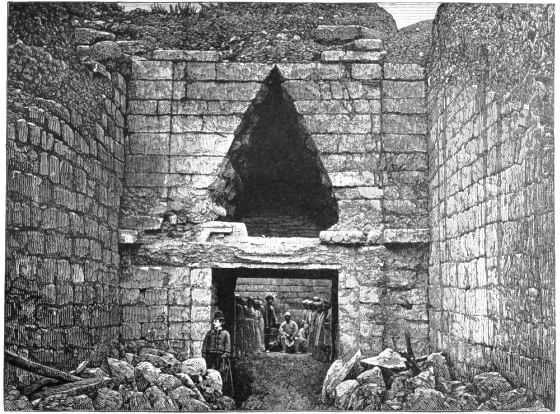
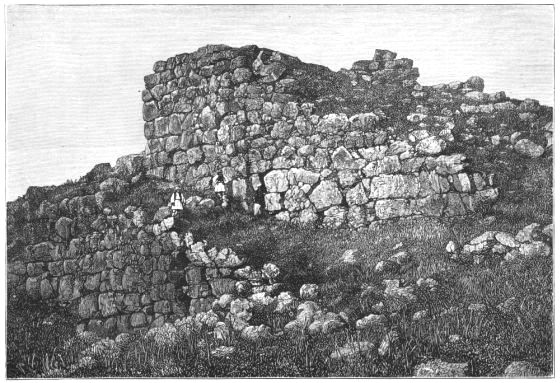
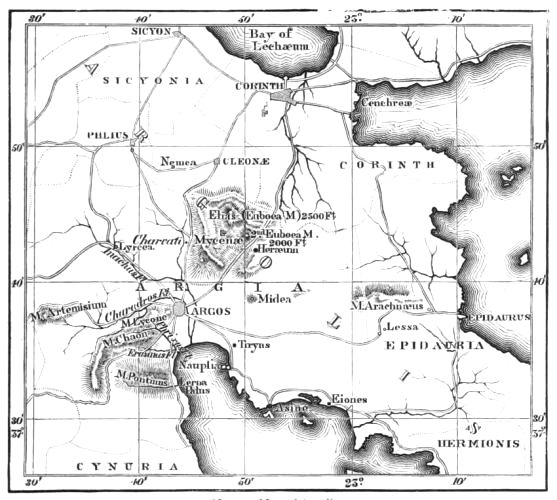
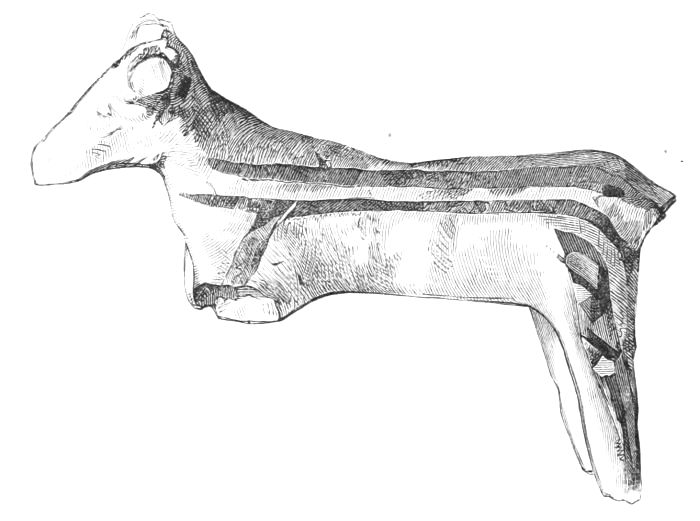
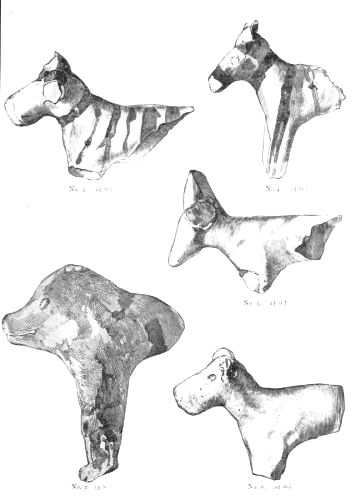
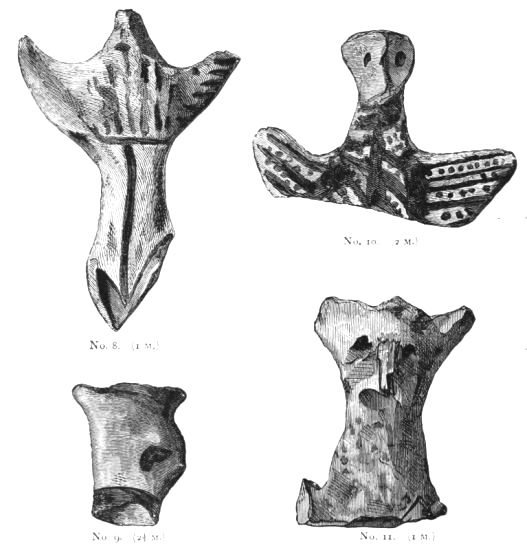
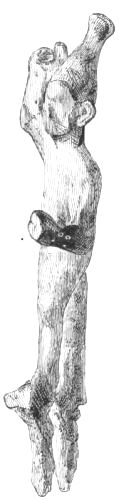
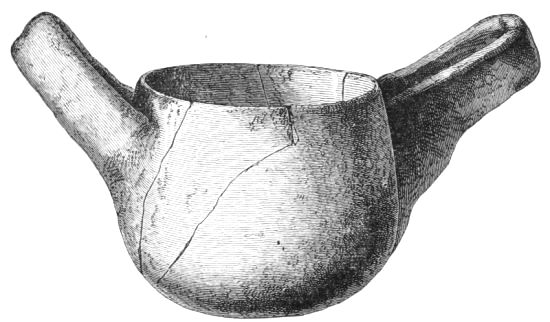
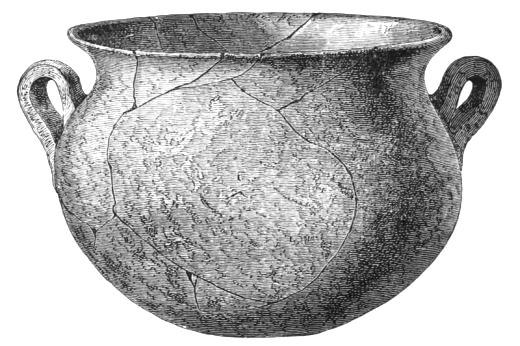
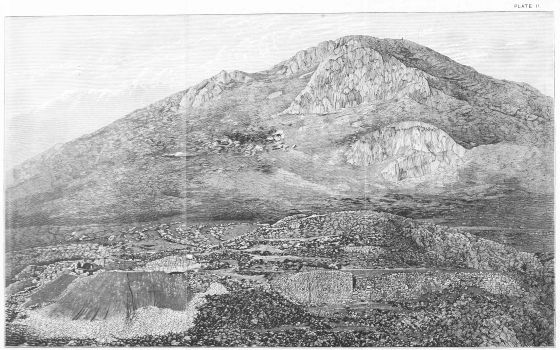
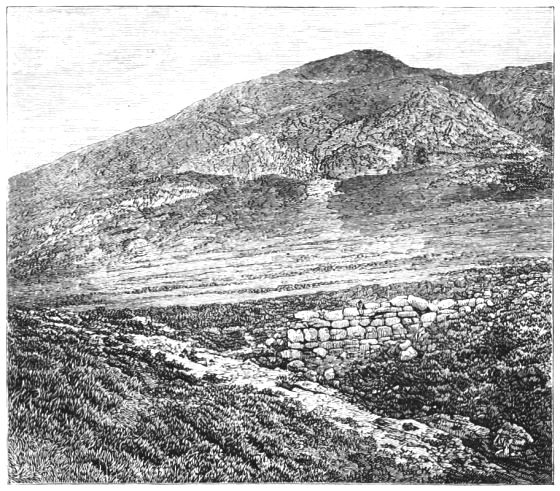
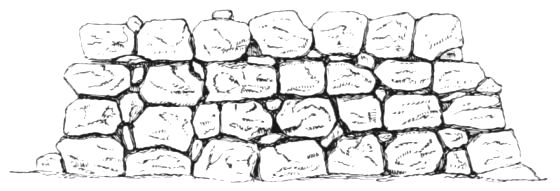
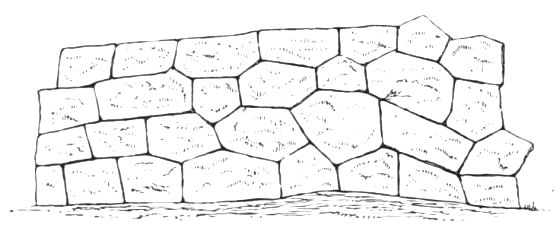
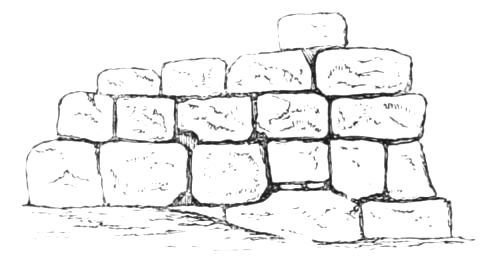
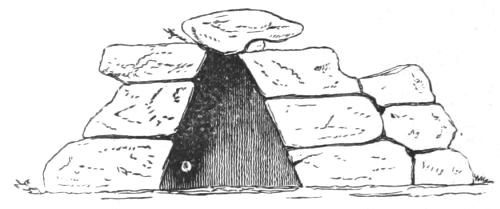
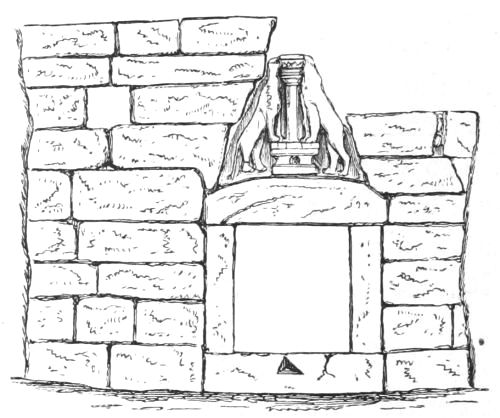
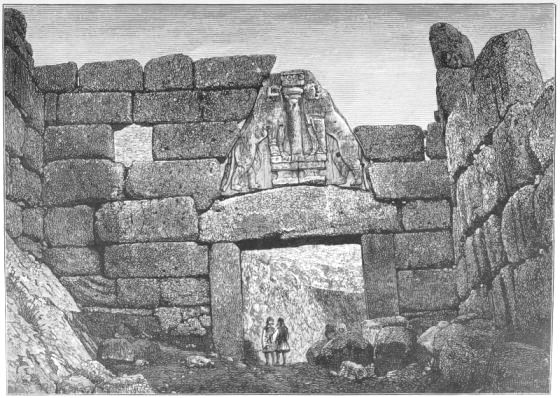
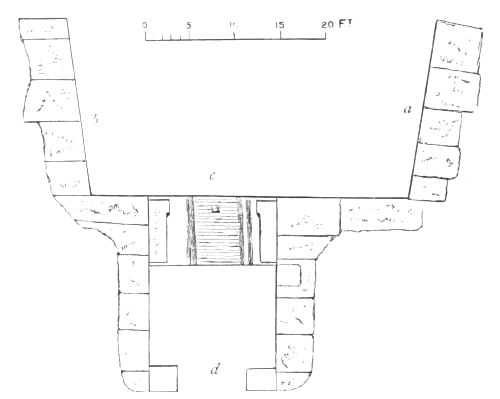
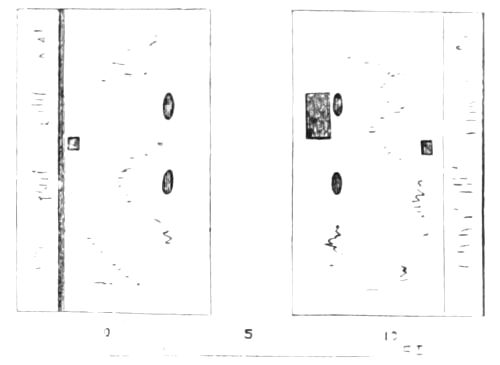
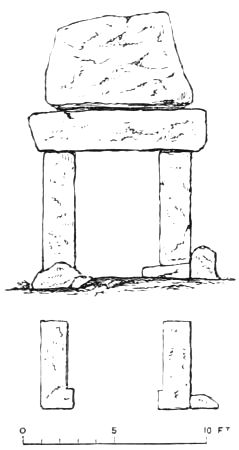
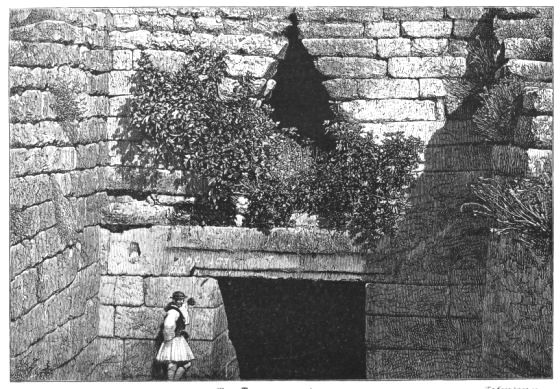
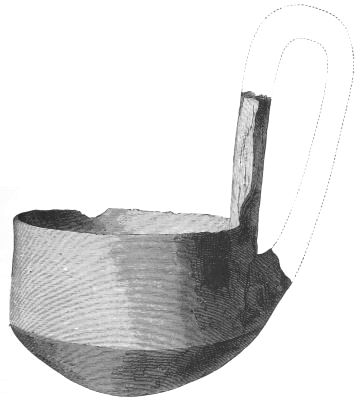
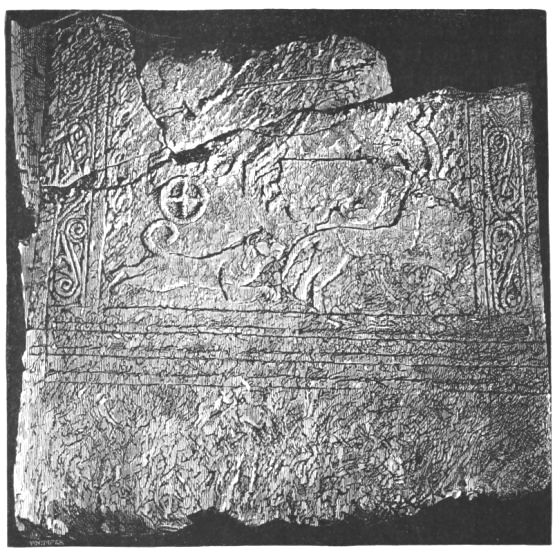
 .
This character is generally thought to be a
 , and thus
the coin is attributed to the Argolic city of Thyrea. But,
in the opinion of my worthy friends A. Postolaccas and P.
Lampros, which I accept, the
 is the spiritus asper, and
belongs to the still unknown word which records the value
of the coin. This coin belongs to the city of Argos, and
is of the Macedonian age, which makes it utterly impossible
that the sign should be a
 , the
 with this meaning
having only come into use at the time of the Roman conquest.
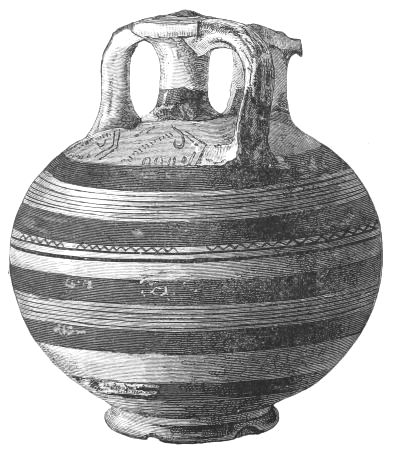
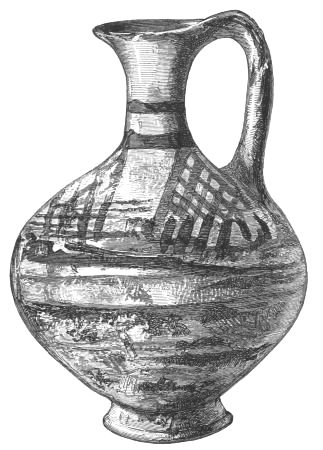
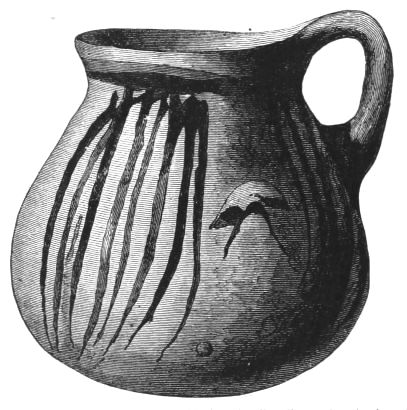
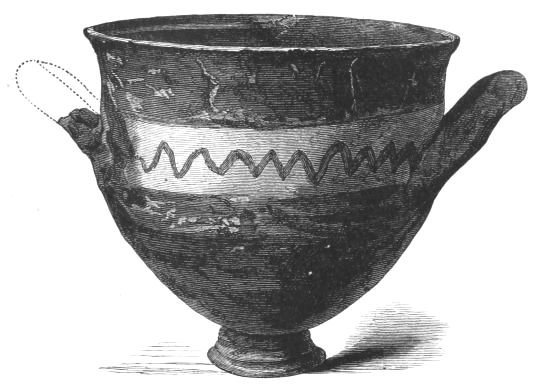
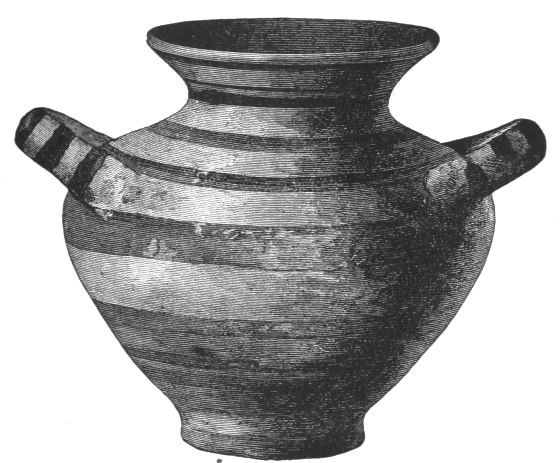
 . These signs cannot but represent
the suastika, formed by two pieces of wood, which were
laid across and fixed with four nails, and in the joint of
which the holy fire was produced by friction by a third
piece of wood.
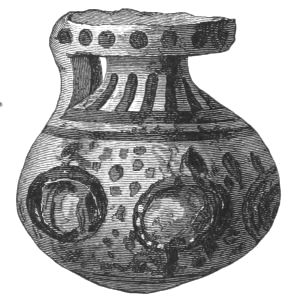
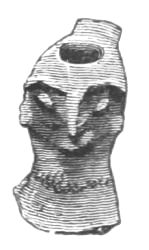
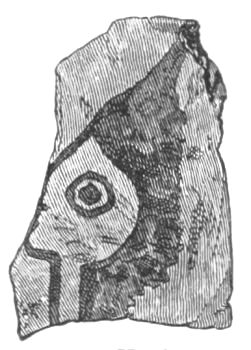
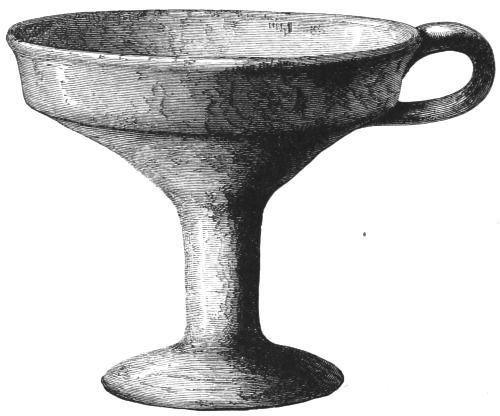
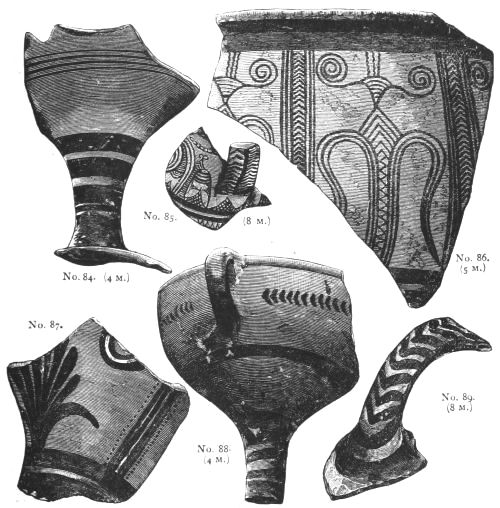
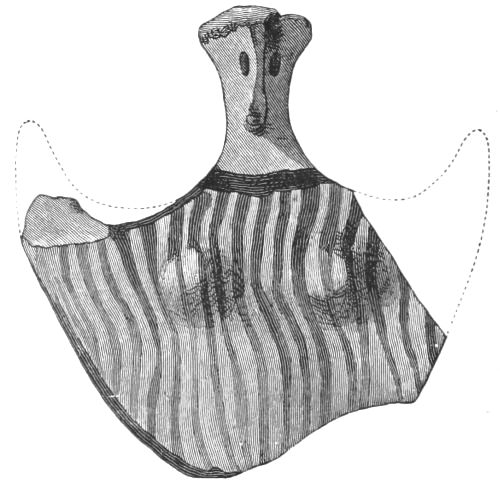
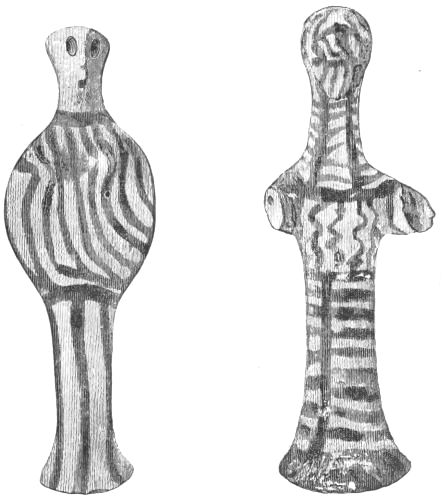
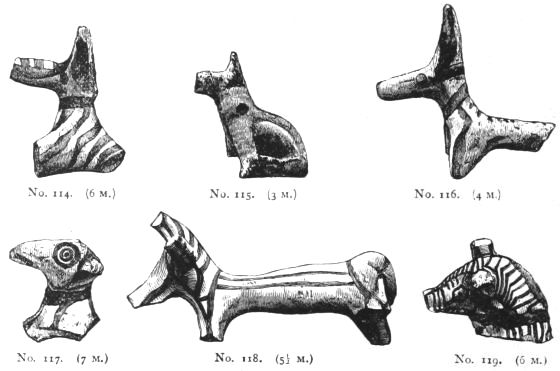
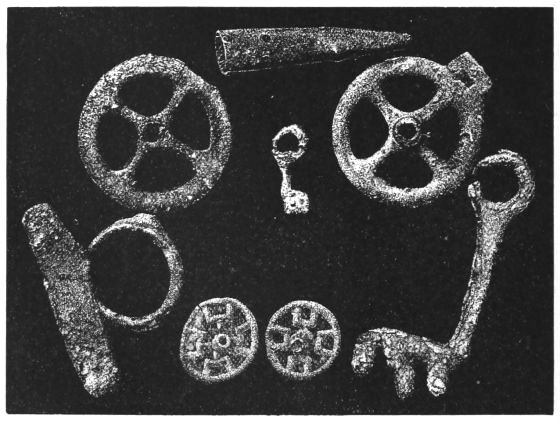
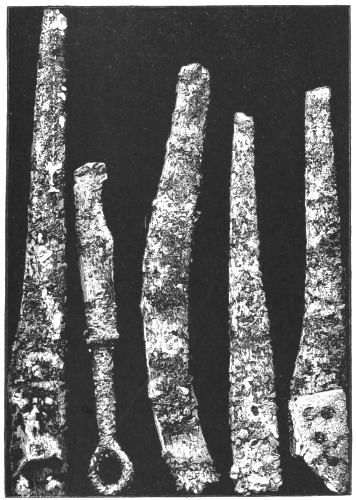
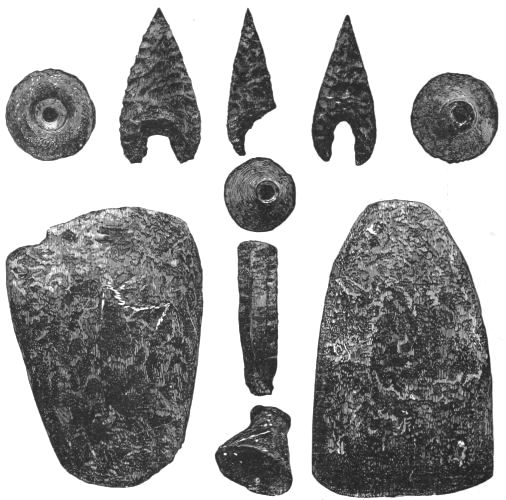
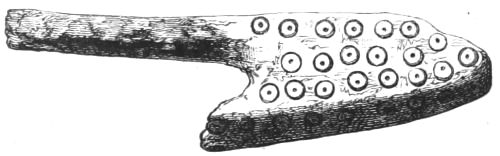
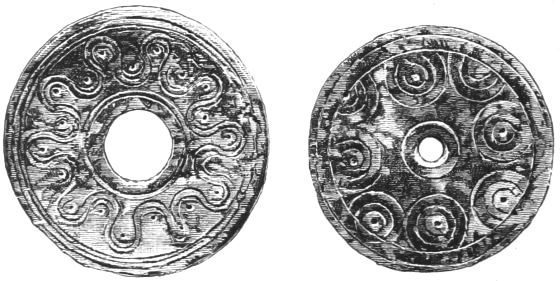
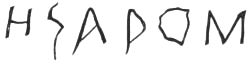
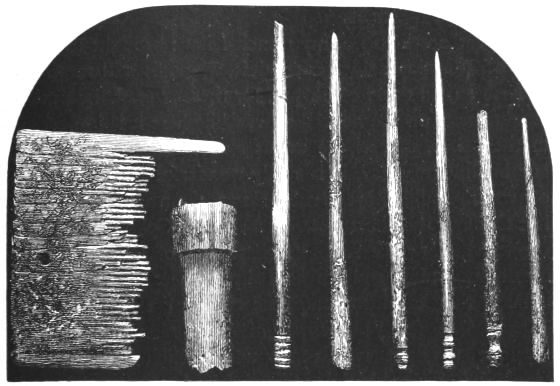
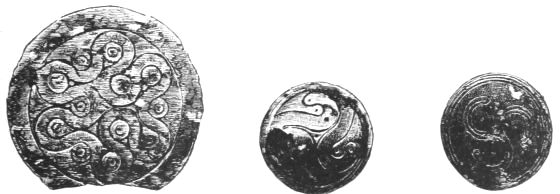
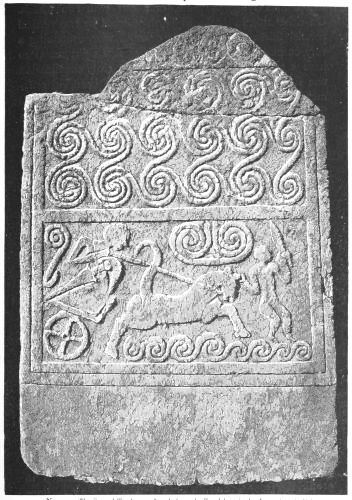
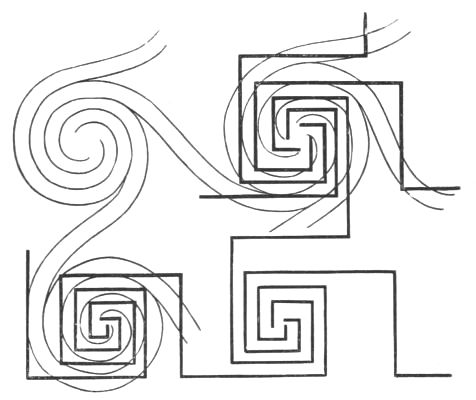
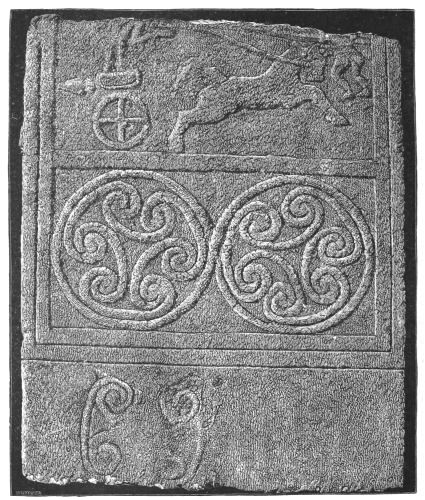
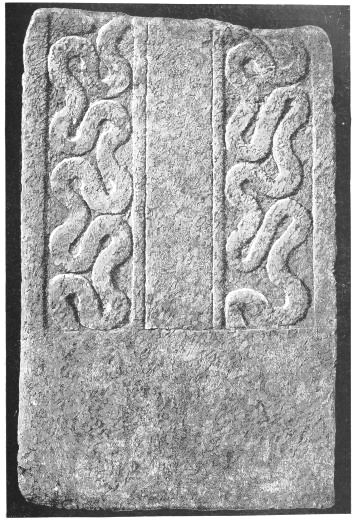
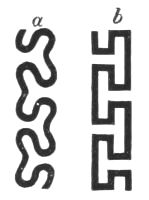
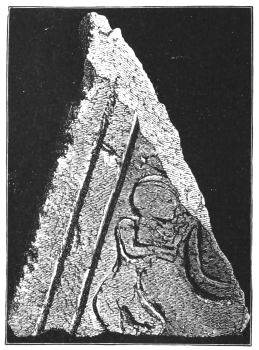
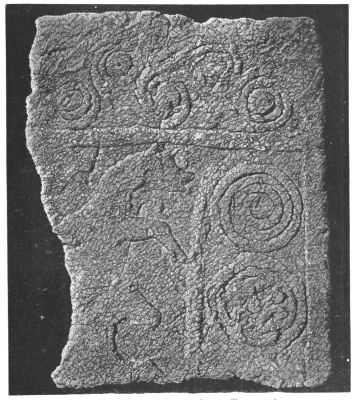
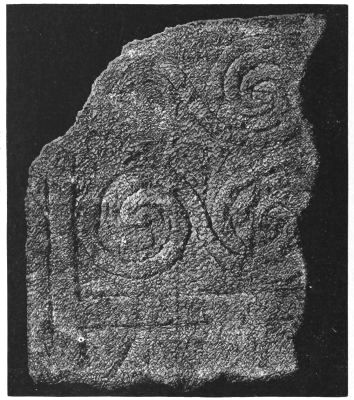
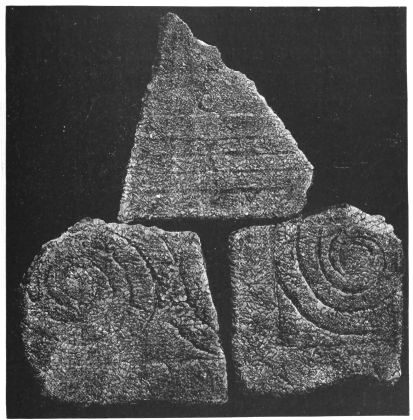
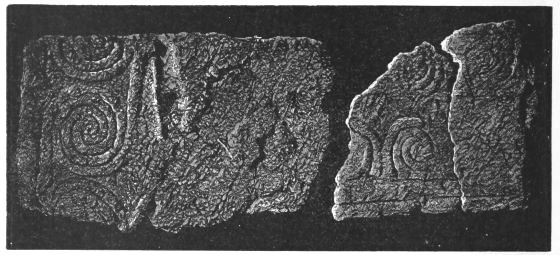
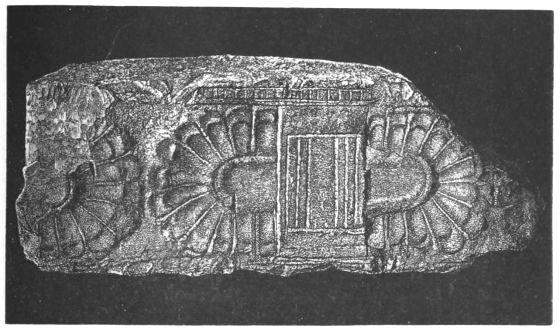
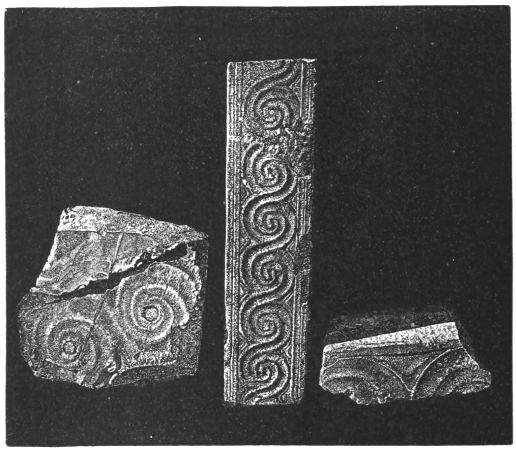
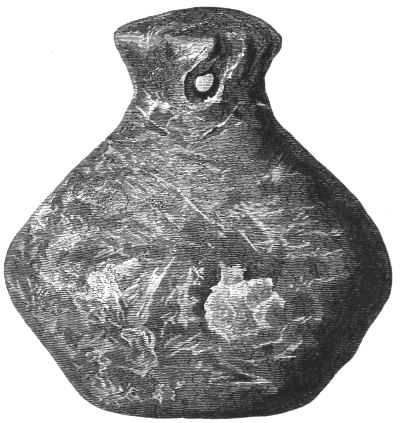
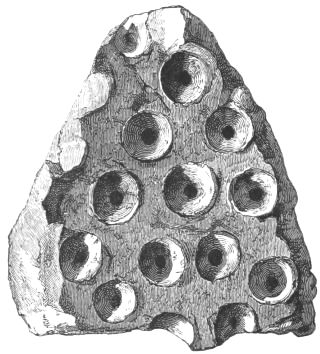
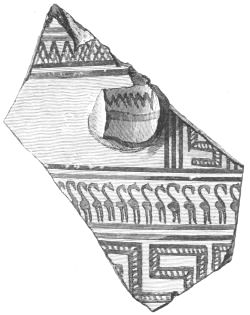
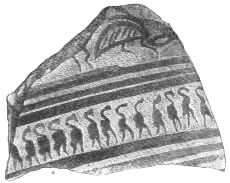
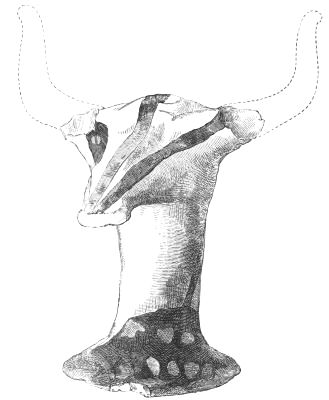
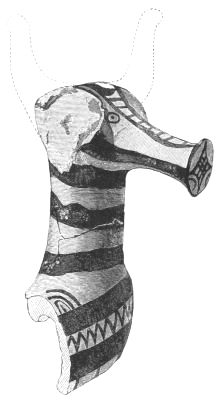
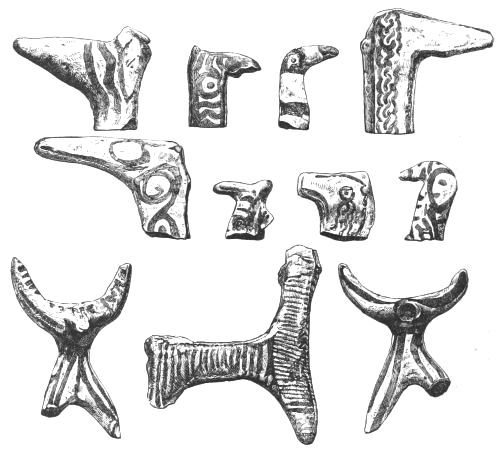
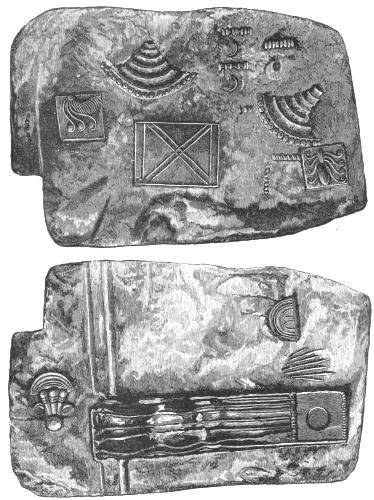
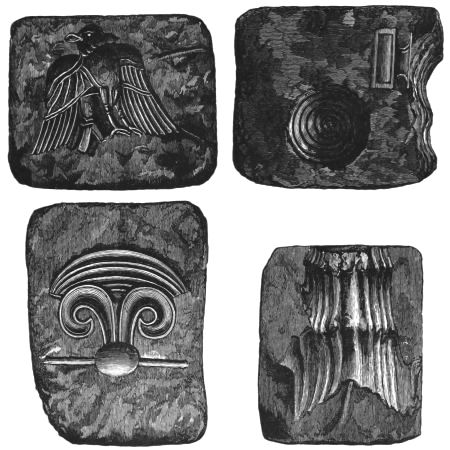
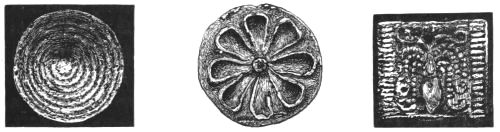
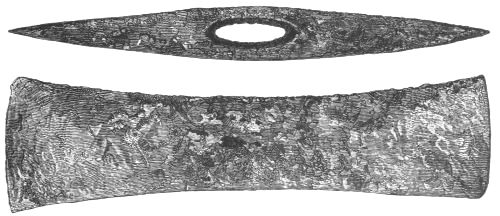
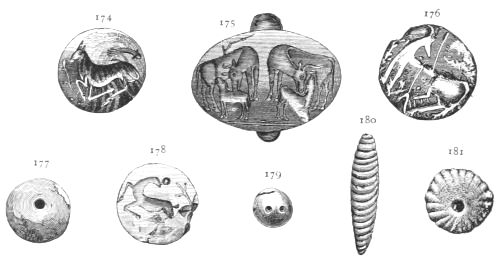
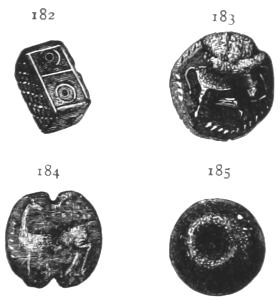
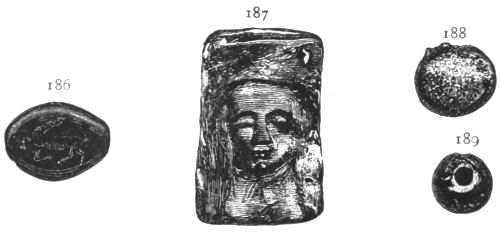
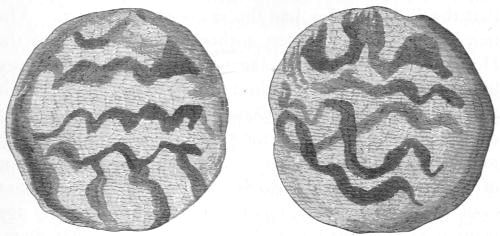

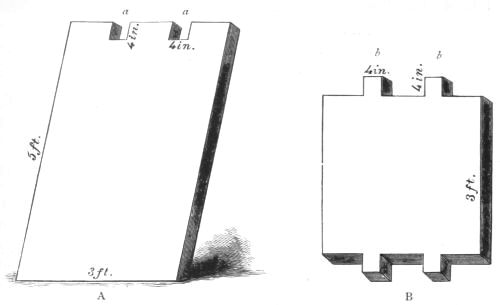
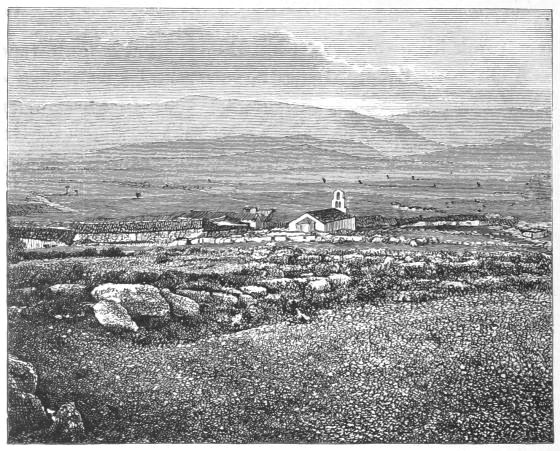
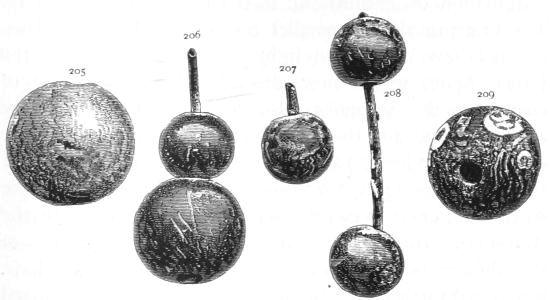
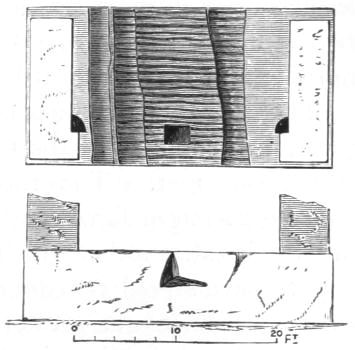
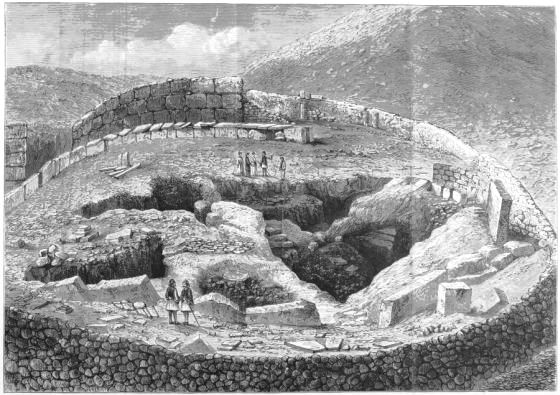
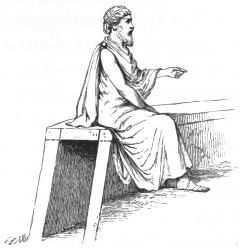
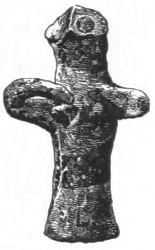
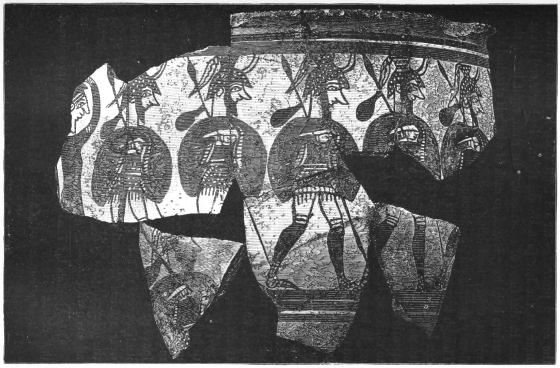
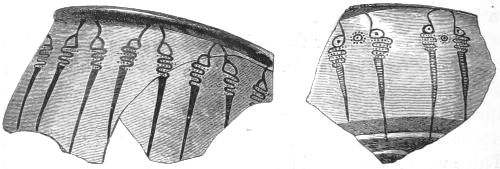
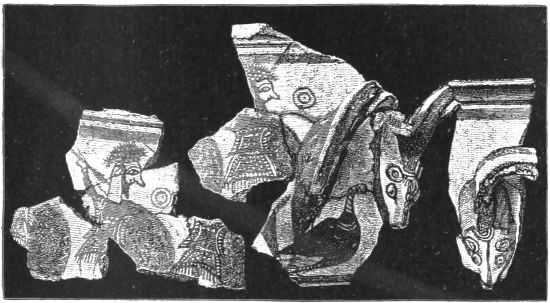
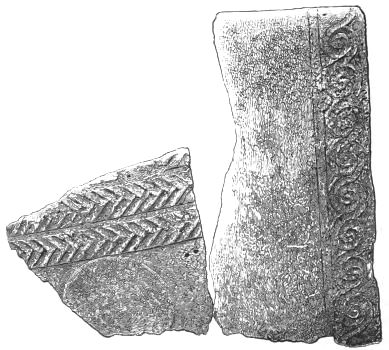
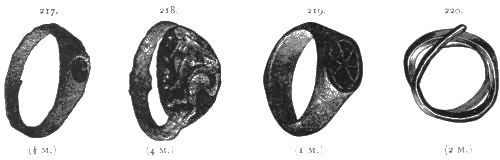

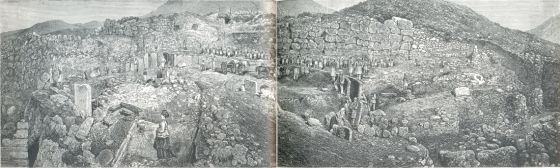
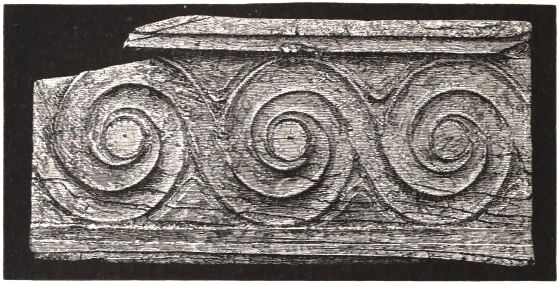
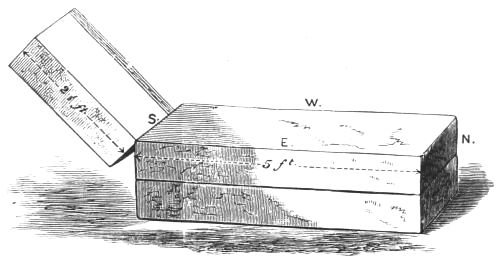
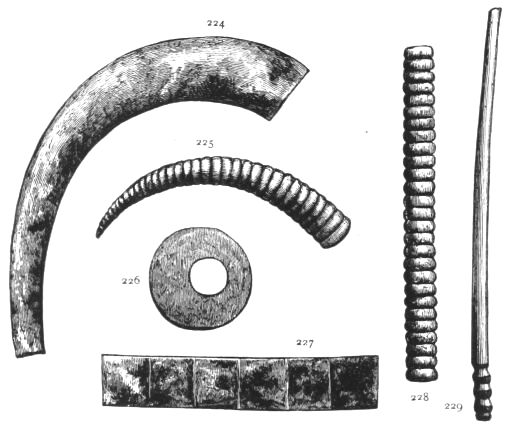
 , with the marks of four
nails, which so frequently occurs on the whorls in Ilium,
and which I believe to be the symbol of the holy fire.
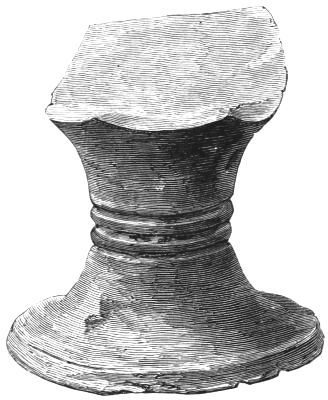
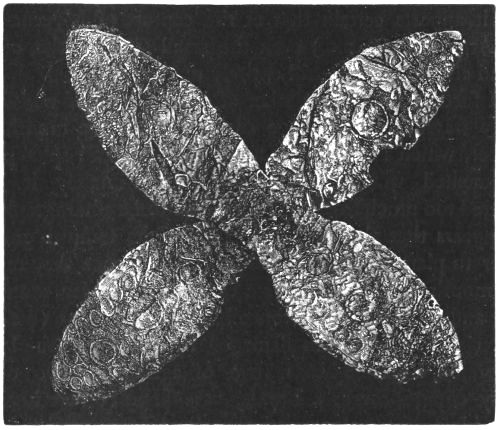
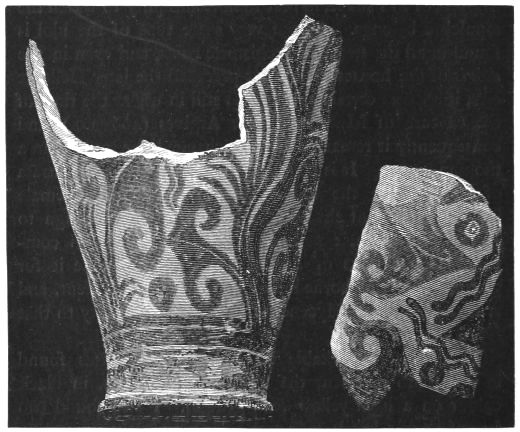
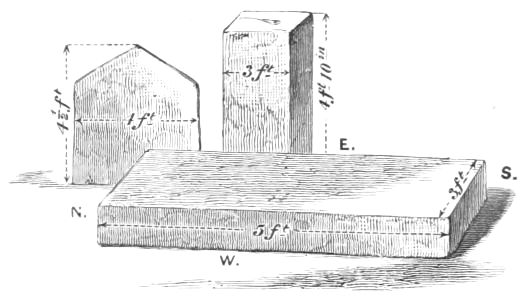
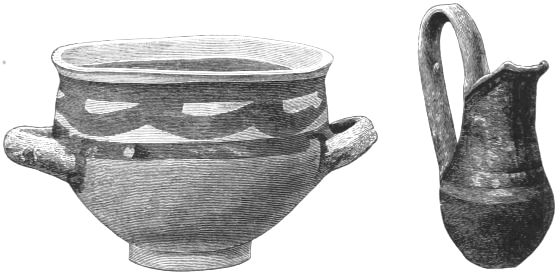
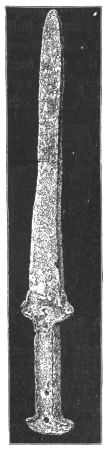
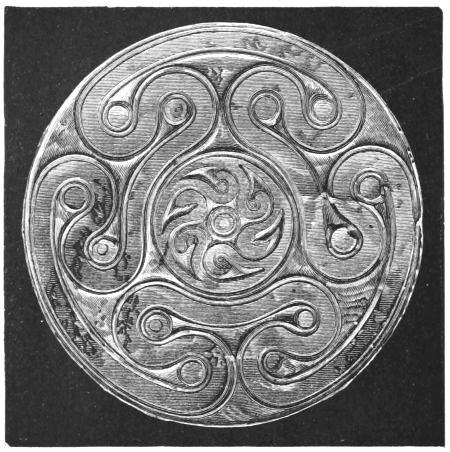
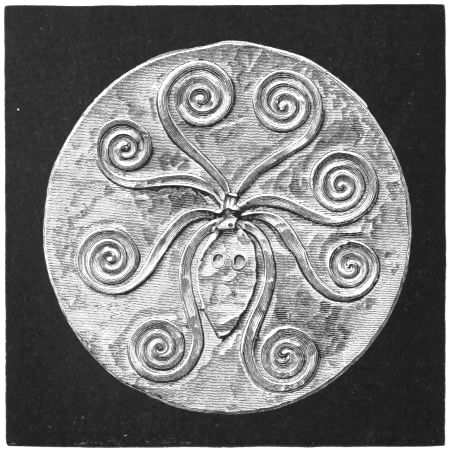
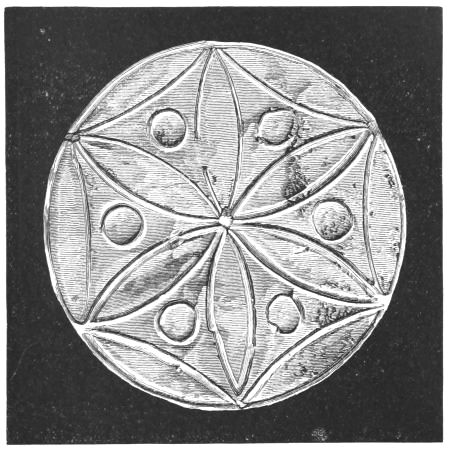
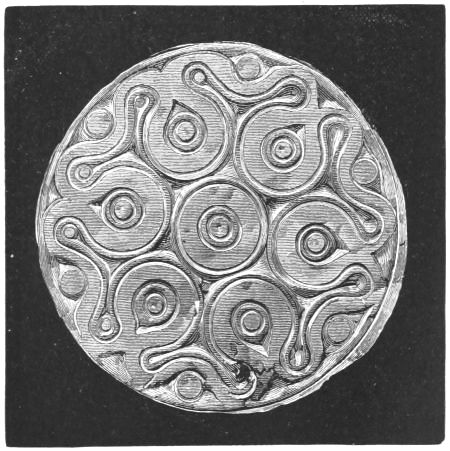
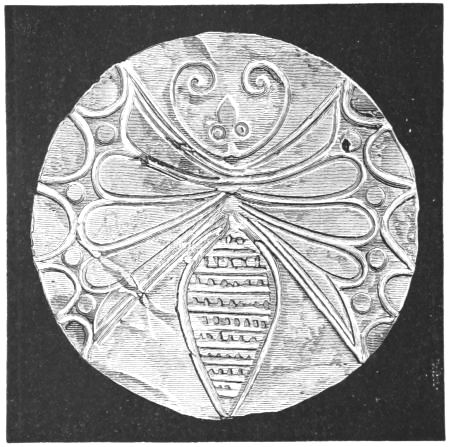
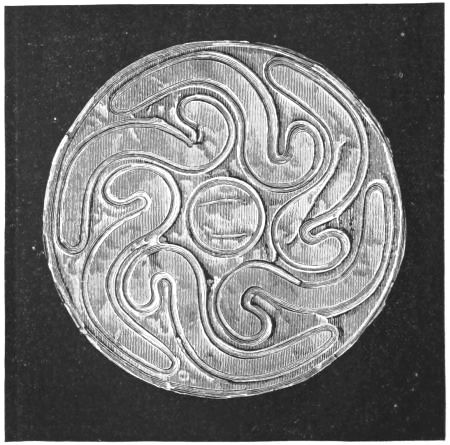
 , the more so as the points which
are thought to be the marks of the nails, are seldom
missing; the artist has only added two more arms and
curved all of them. No. 240 represents an octopus or
cuttle-fish (sepia), whose eight arms have been converted
into spirals, the head with the two eyes being distinctly
visible. No. 241 represents a flower; No. 242 a splendid
spiral ornamentation; No. 243, a beautiful butterfly; this
type is exceedingly frequent. Whether, as in the later
Greek art, the butterfly is here the symbol of immortality, as
Mr. Chas. T. Newton reminds me, I do not dare to decide.
No. 244 presents a curious ornamentation of spirals in the
form of six serpents, round a central circle. In No. 245
we at once recognise again the ornamentation of the
sepulchral stêlé (No. 142), as in No. 239, which this one
very much resembles. No. 246 has a most curious pattern,
which shows within a broad circular border six spirals,
all very cleverly finished off, each of them surrounding
seven concentric circles, and all united around an ornament
likewise of seven concentric circles, which the artist seems
to have vainly tried to unite at the upper part. Each of
the spirals separately very much resembles the hair-springs
of our watches, at least at the first glance, but on closer
examination we find that all the interior lines form separate
circles. Nos. 247-250 represent beautiful leaves, all of
a kindred pattern. No. 251 represents a beautiful star-flower;
No. 252 shows within a border of three circles a
splendid ornamentation of spirals and concentric circles,
such as we have not seen yet on the Mycenean antiquities.
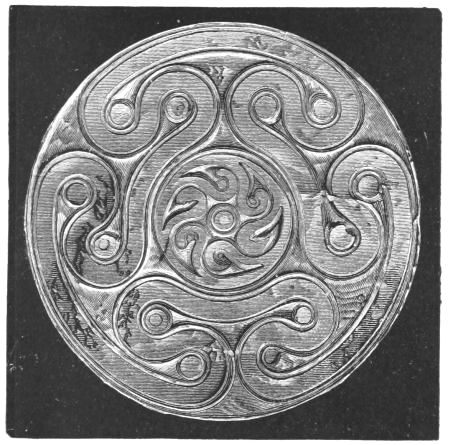
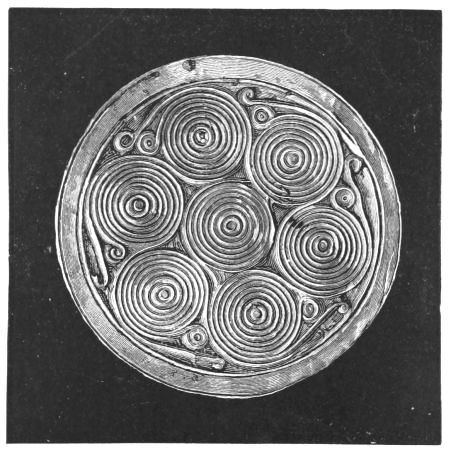
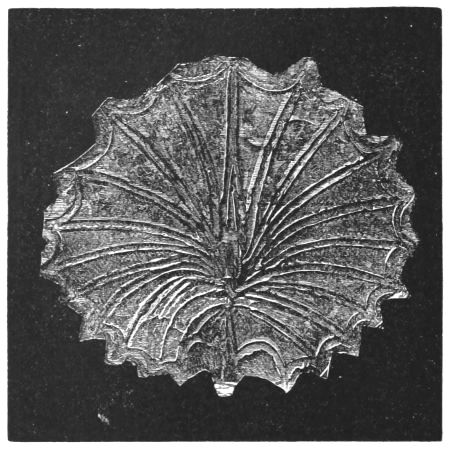
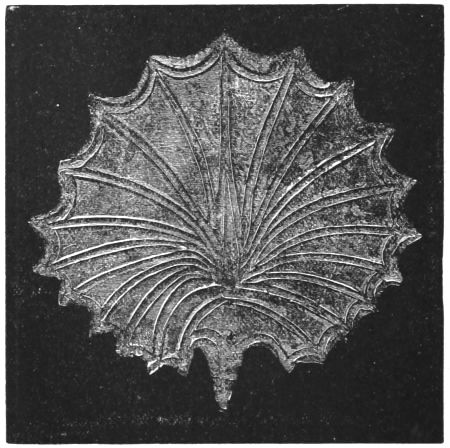
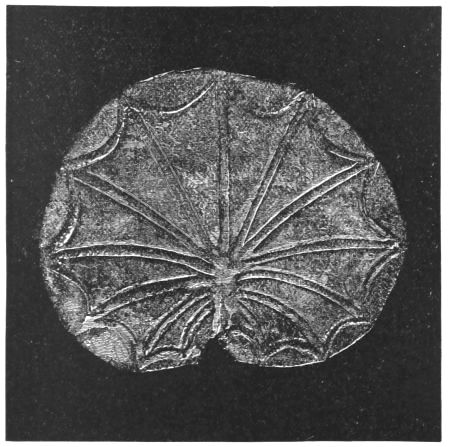
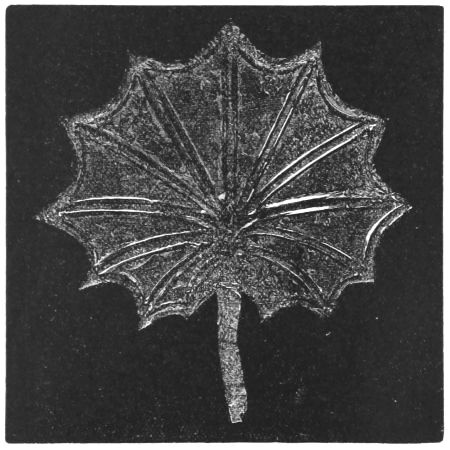
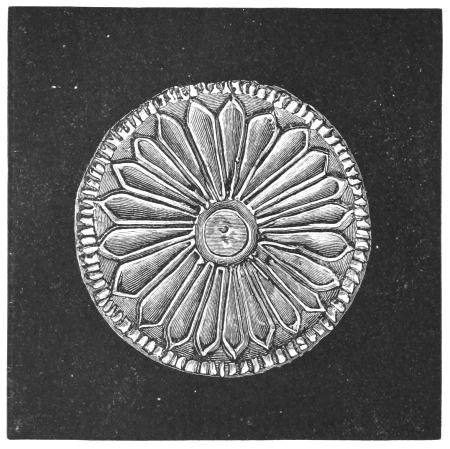
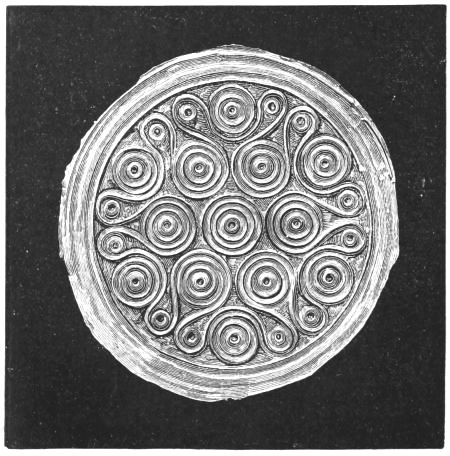
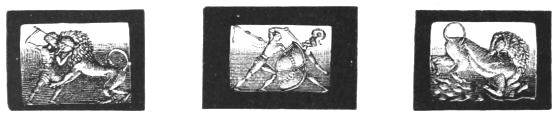
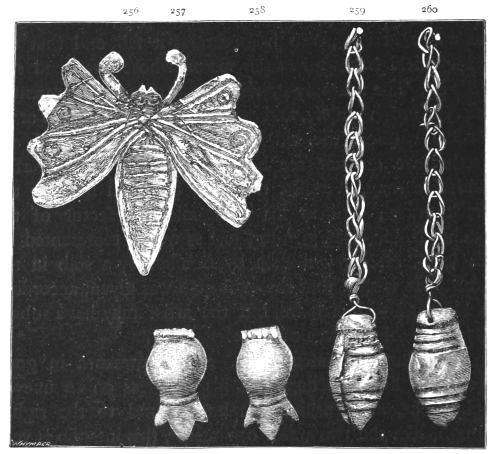
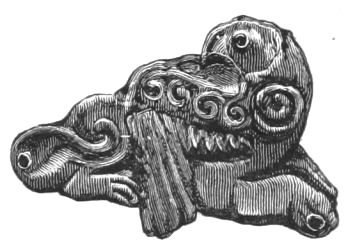
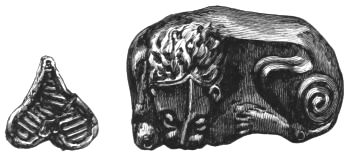
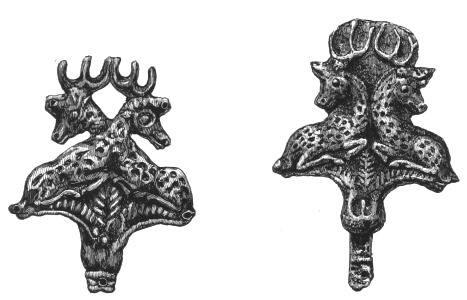
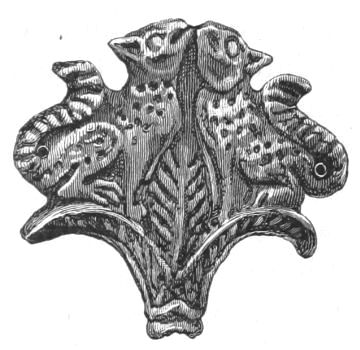
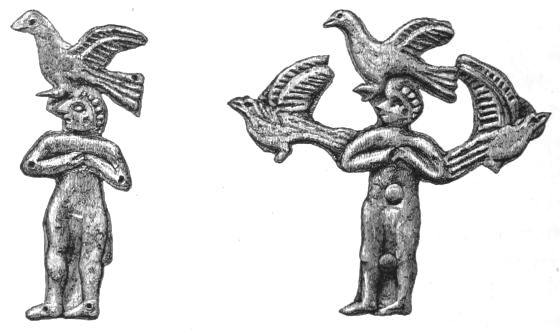
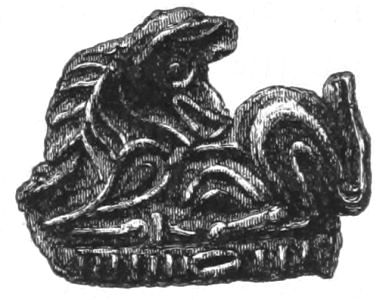
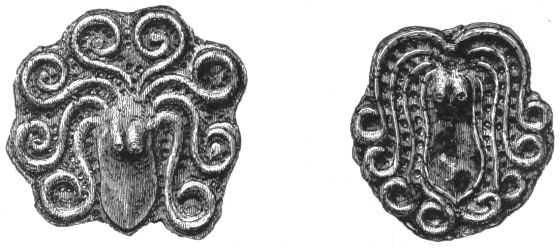
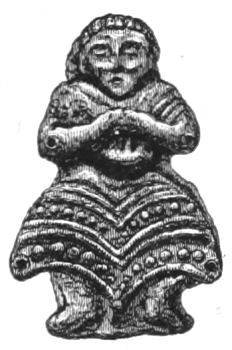
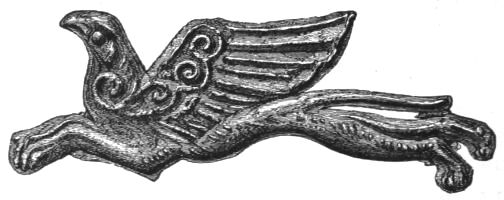
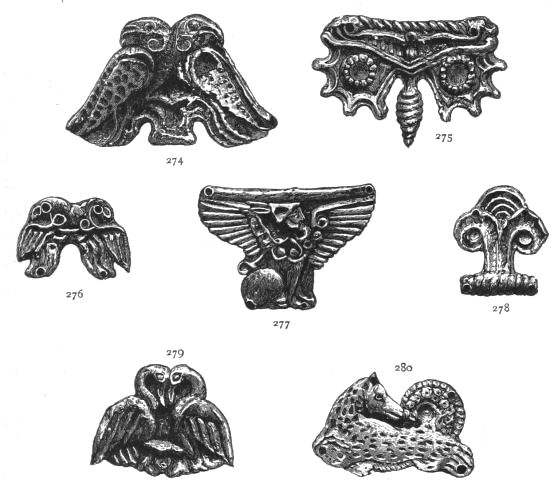
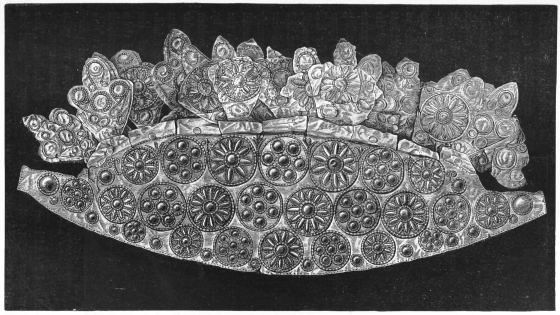
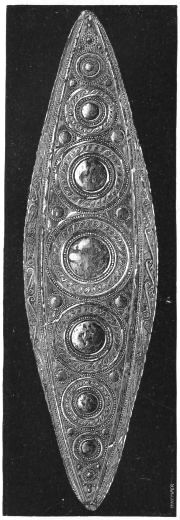
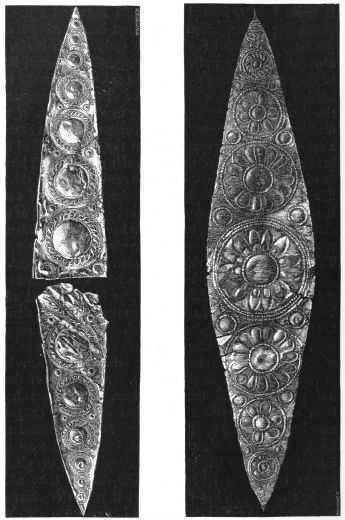
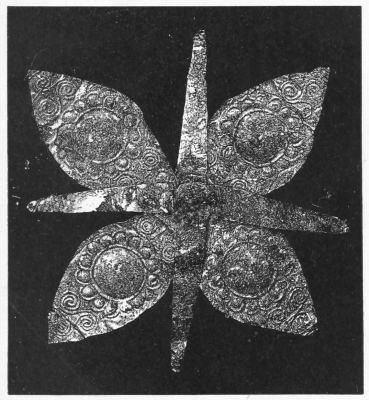
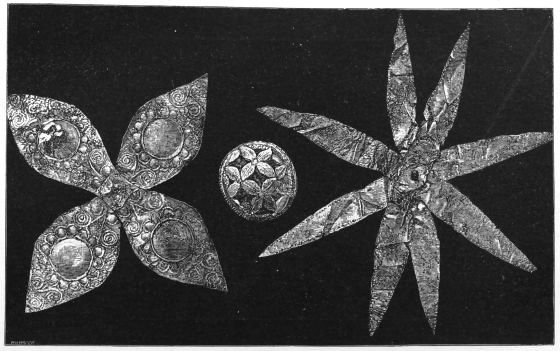
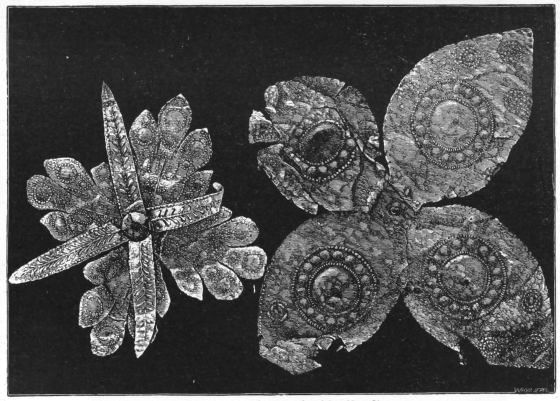
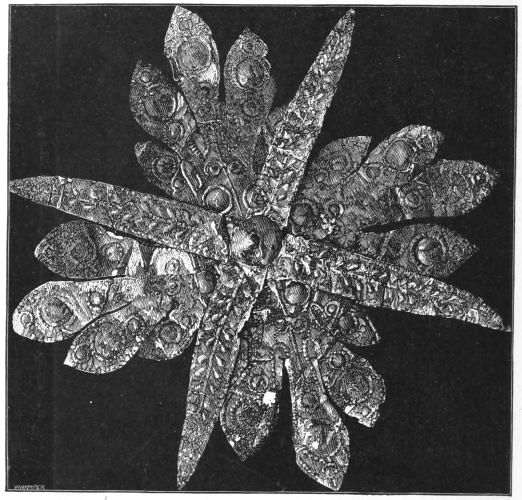
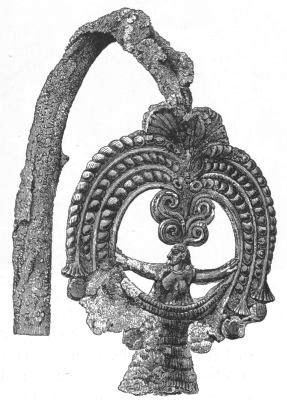
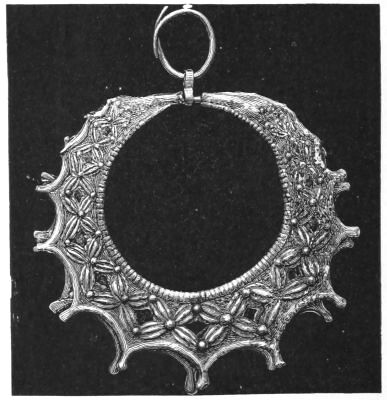
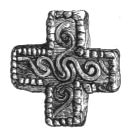
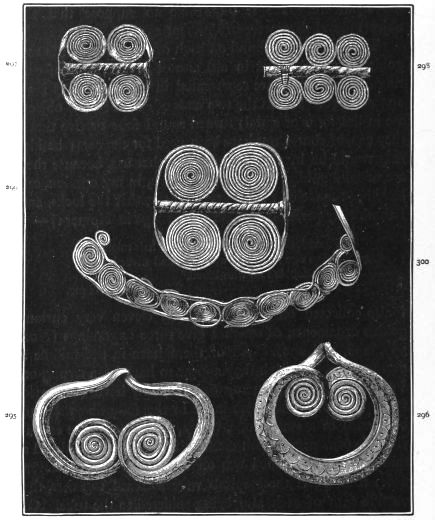
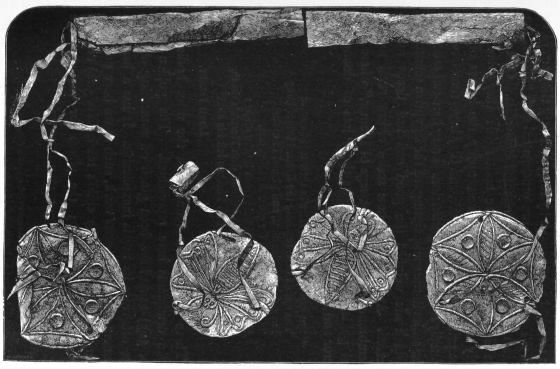
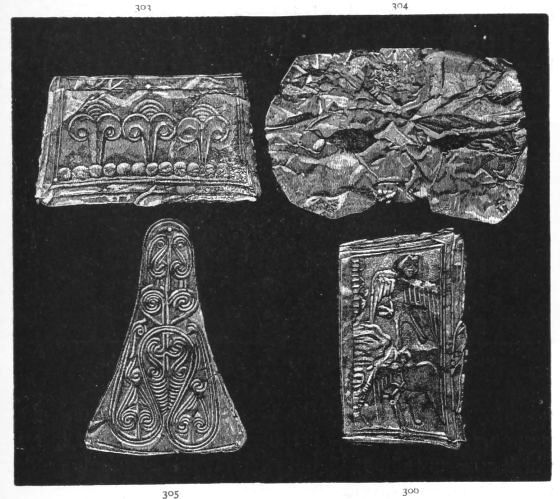
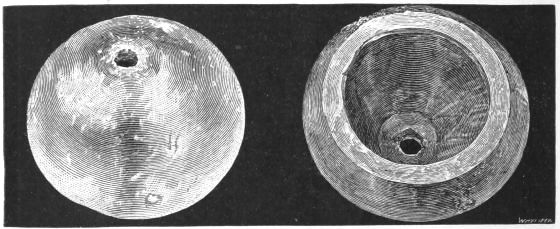
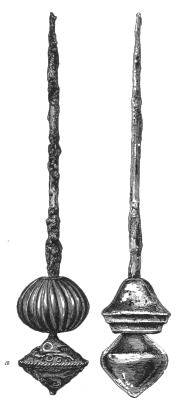
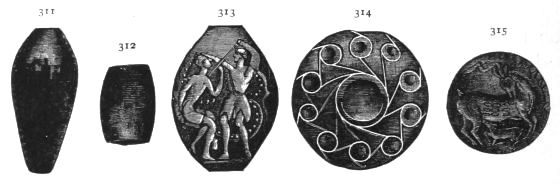
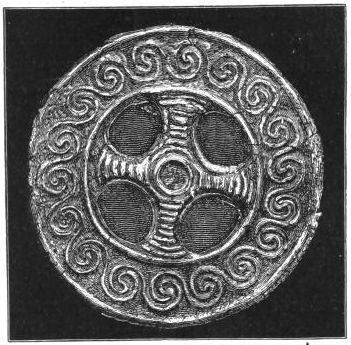
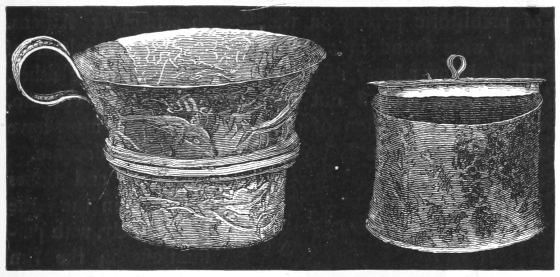
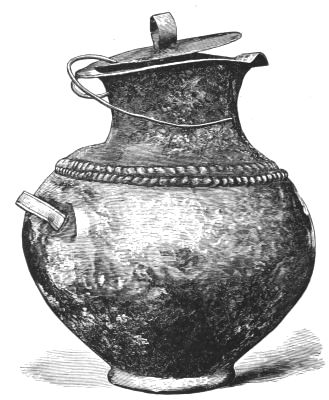
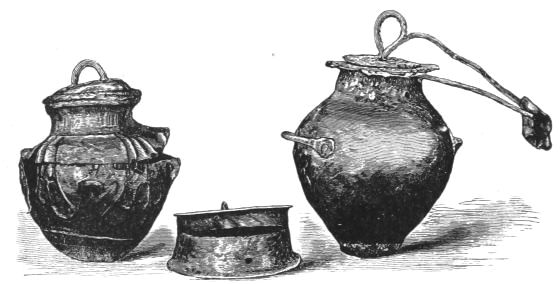
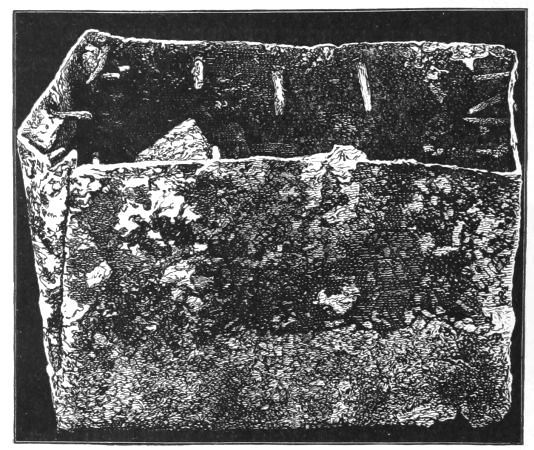
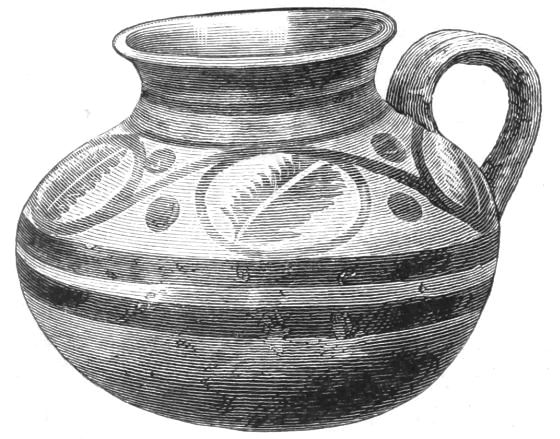
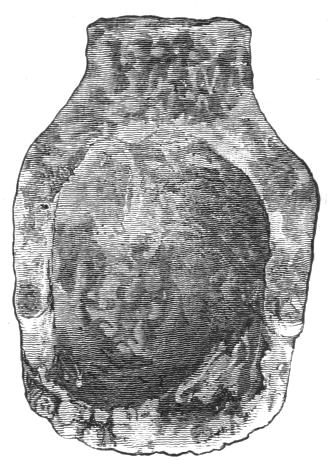
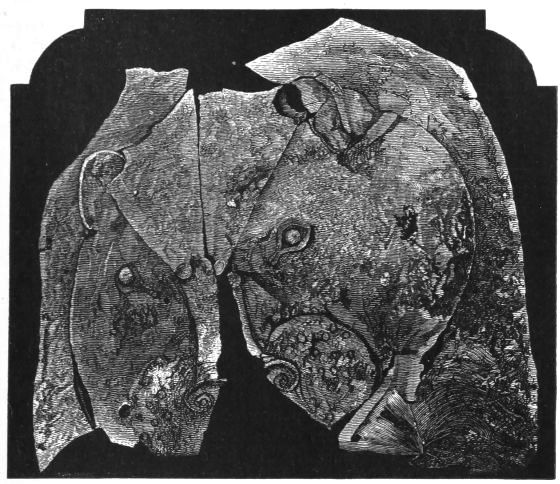
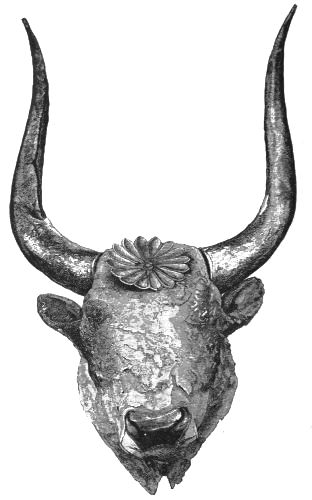
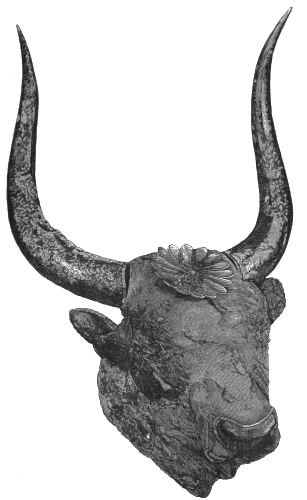
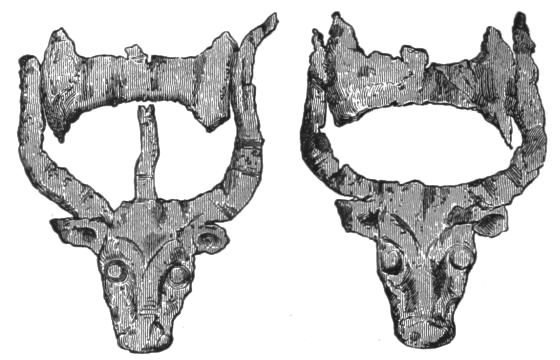
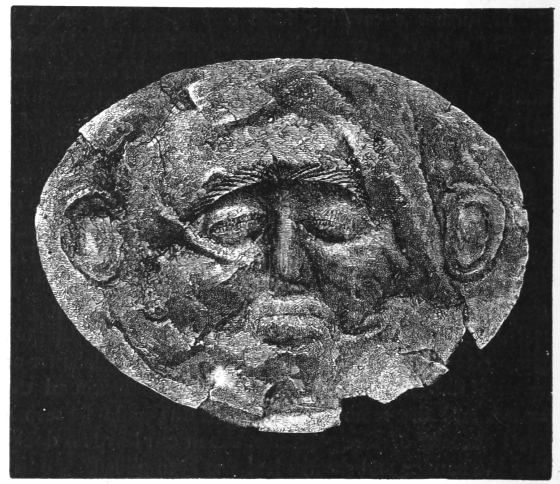
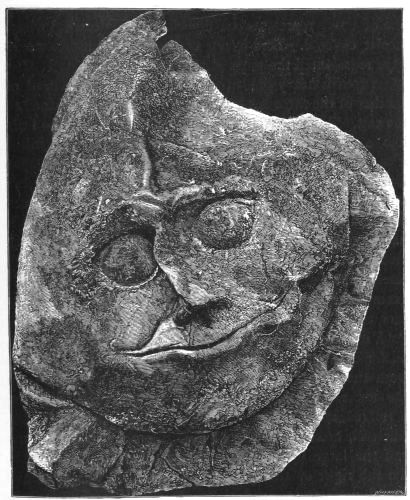
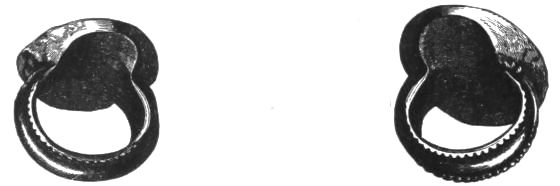
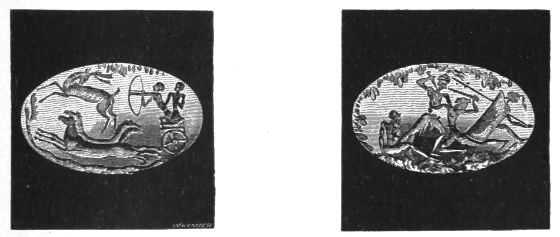
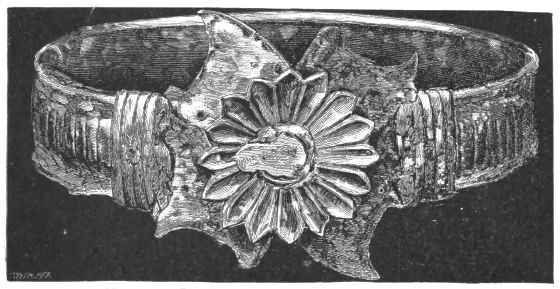
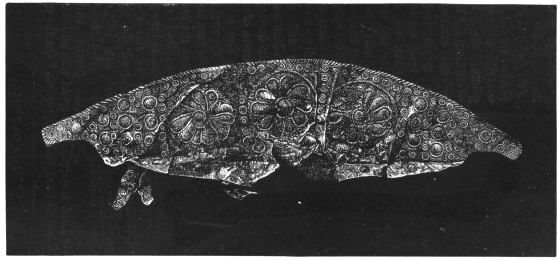
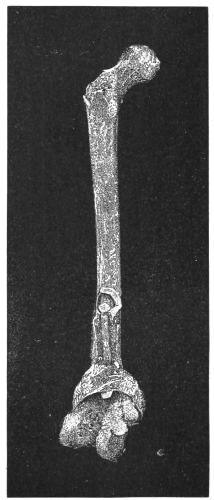
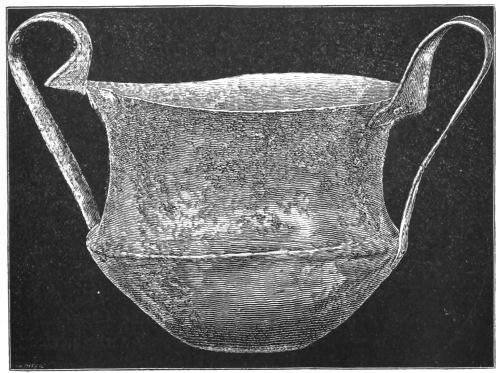
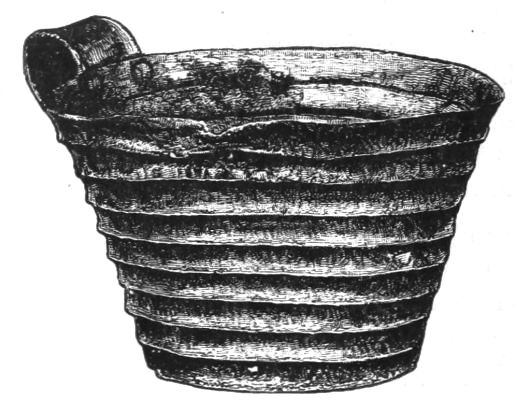
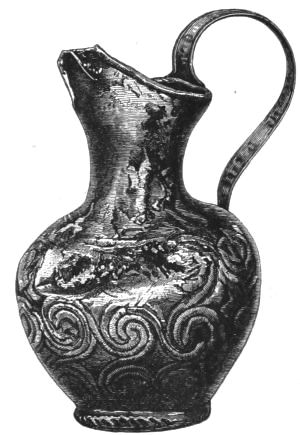
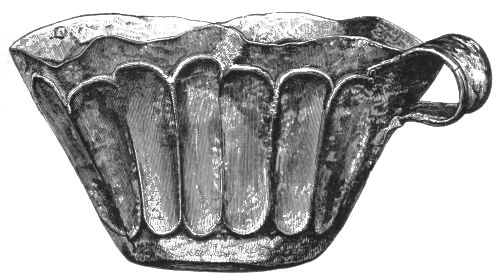
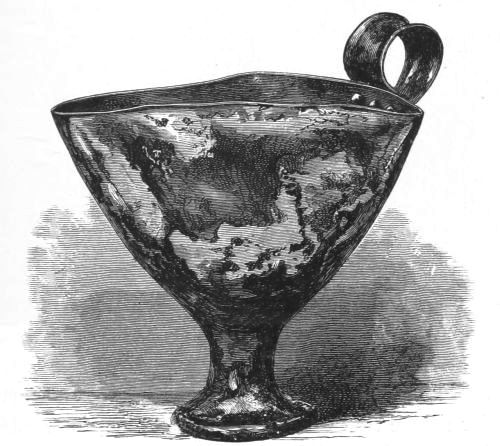
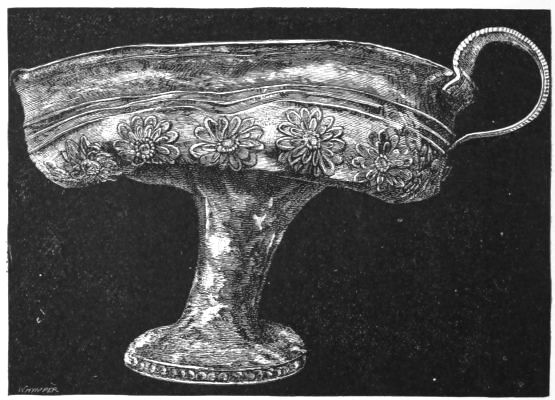
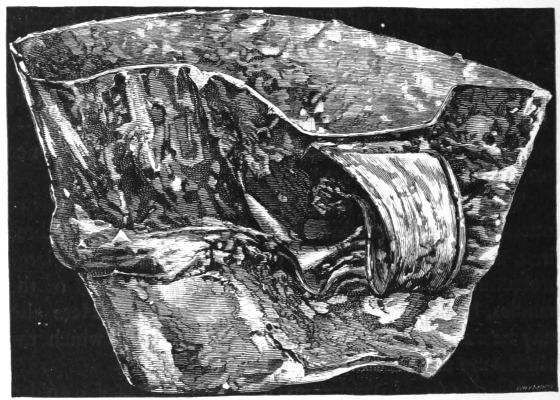
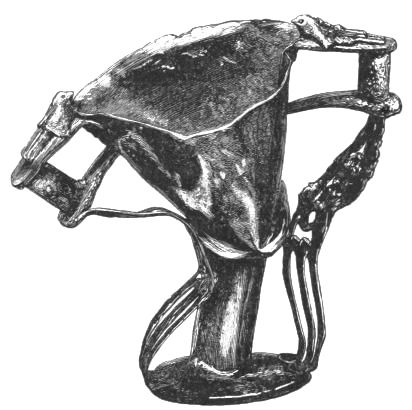
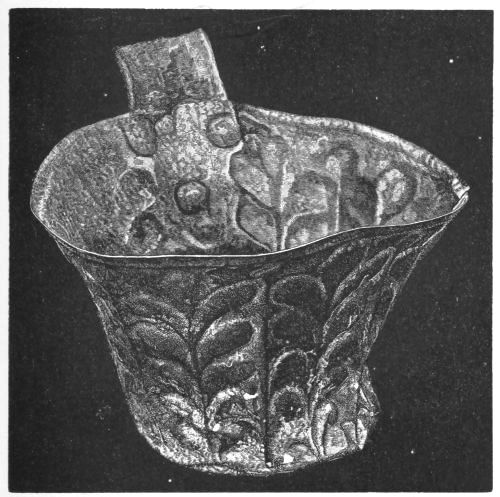
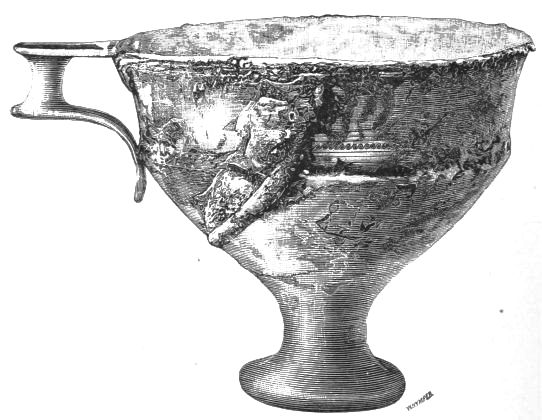
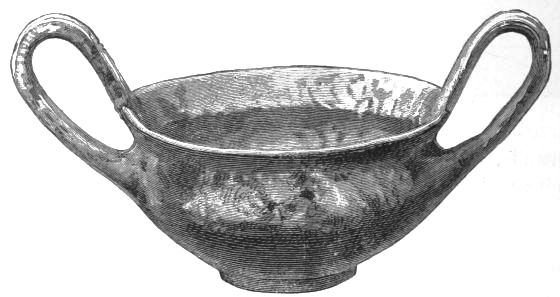
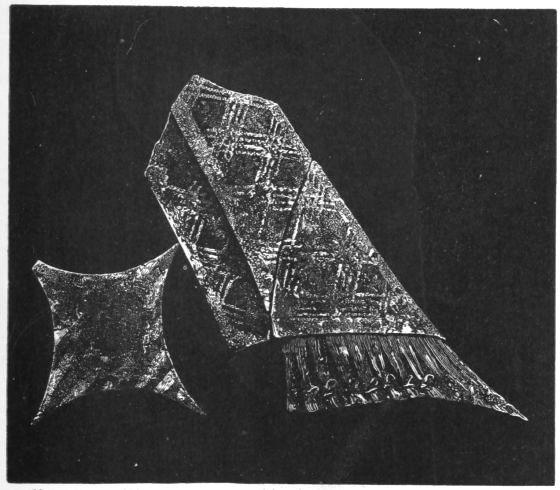
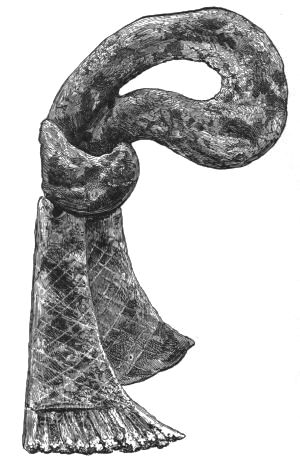
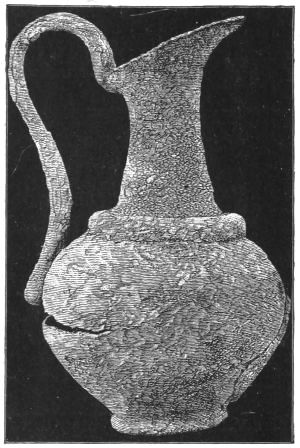
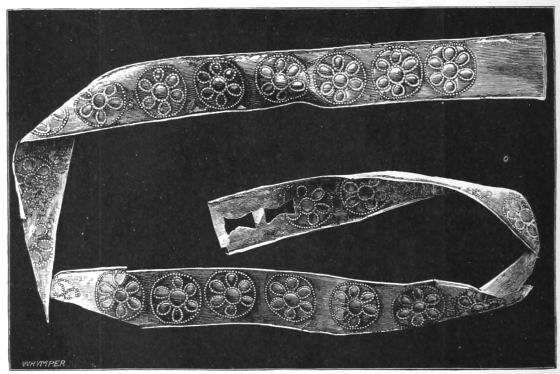
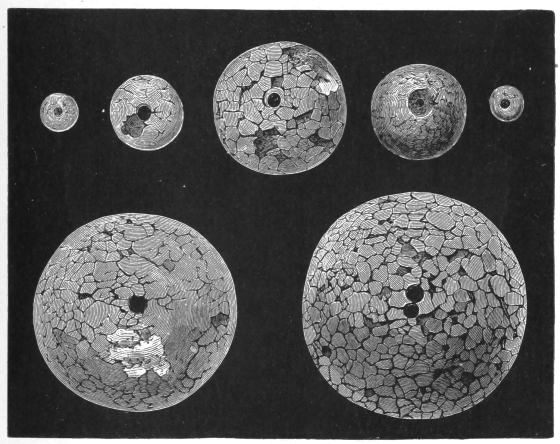
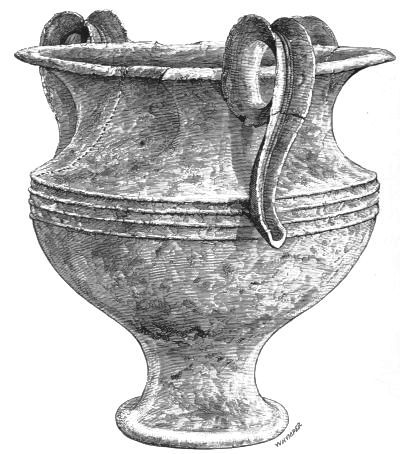
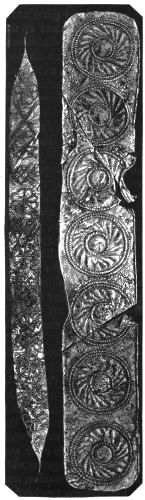
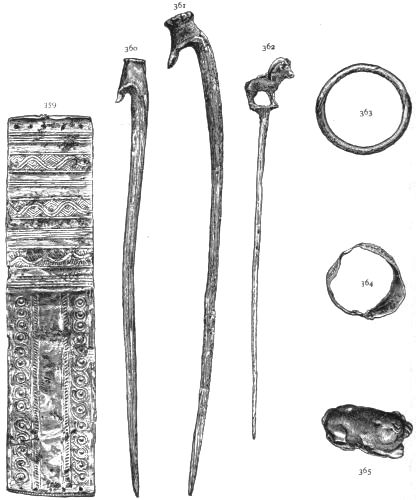
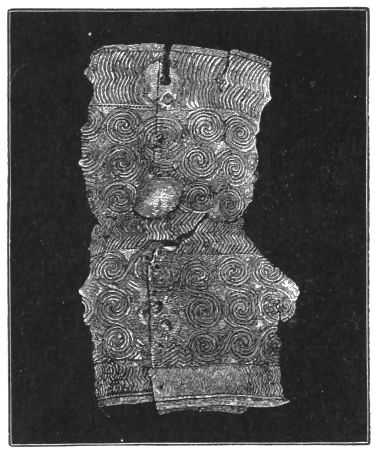
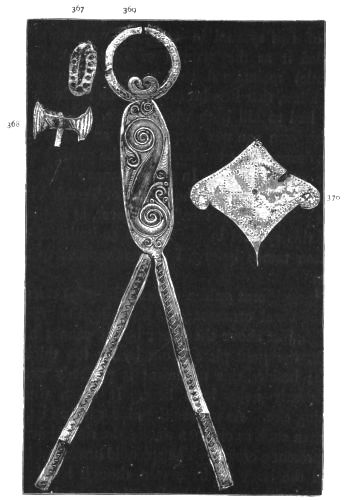
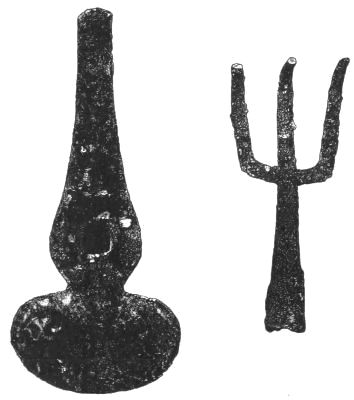
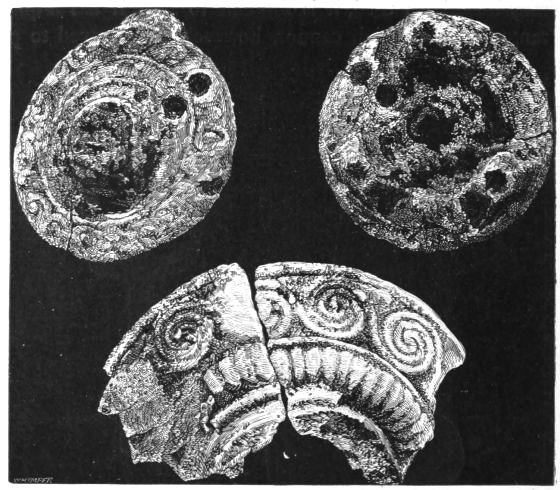
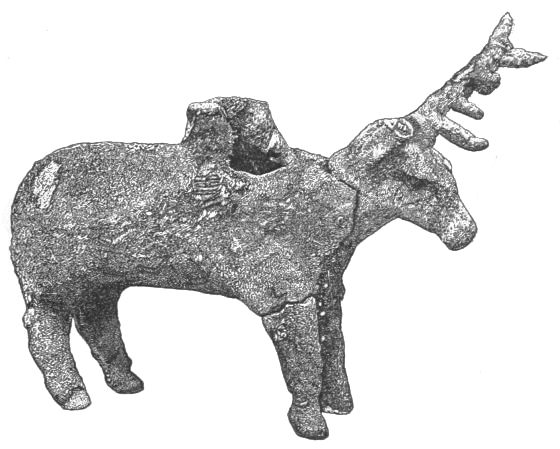
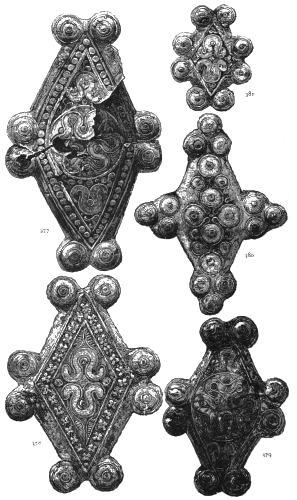
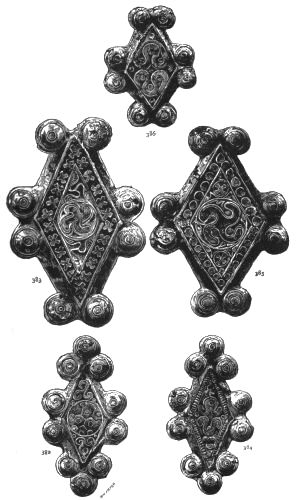
 in the centre is of
intaglio work. On the reverse side, the wood of all these
twelve cross-like buttons is carved much like our shirt-studs,
with the sole difference that the lower side is here
of an oval form. Thus, there can be no doubt that all
of them were used as ornaments on the clothes, but, of
course, they can never have served as real buttons. All
these buttons show unmistakeable marks of the funeral
fire, but as the wood has been preserved, there can be no
doubt that the fire was not intended to reduce the bodies
to ashes, or to destroy the ornaments with which they
were laden.
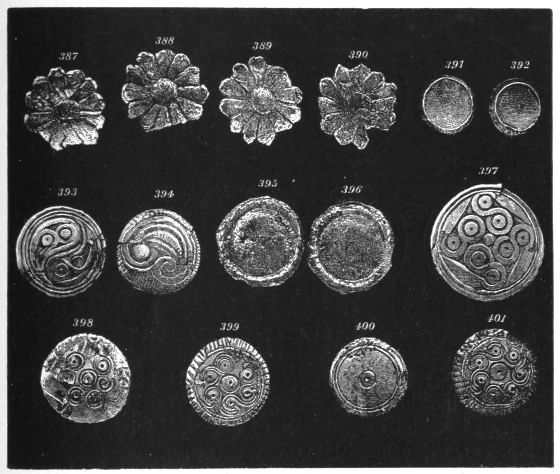
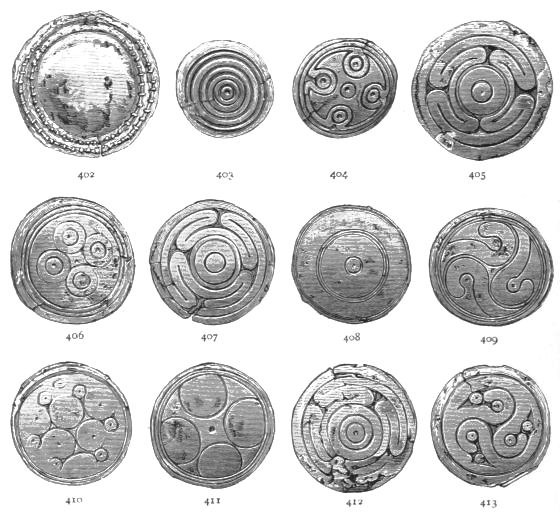
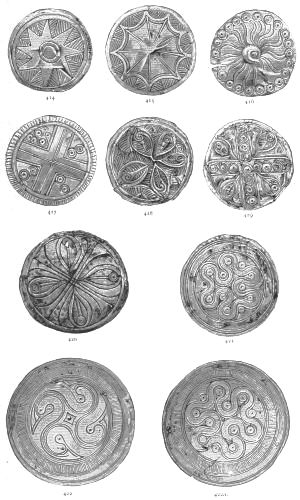
 transformed
into spirals, without, however, losing the marks of
nails with which it was fastened. The other represents also
a sun with his rays, in the interior of which is the spiral
ornamentation which we have so often passed in review.