Between Tiber and Arno there flourished, while Rome was
still a collection of mud huts above the Tiber ford, a rich,
energetic, and mysterious people, the Etruscans, whose
civilization was to influence Rome profoundly. Their riches
have been known to the modern world ever since the systematic
looting of the fabulous wealth of their underground
tombs began, as early as 1489. Visitors to the Vatican and
Villa Giulia Museums in Rome, and, better still, the Archaeological
Museum in Florence, can marvel at the splendid
weapons, rich gold-work, and handsome vases with which
more or less scientific grave-robbers have enriched the collections
in the last hundred years. Travellers to Tarquinia,
on the Tuscan seaboard, can wonder at the strange, vivid
paintings and seemingly indecipherable inscriptions on the
walls of mysterious and intricate underground chambers.
Etruscan bronze-work inspired the sculptors of the Renaissance,
Etruscan tombs were drawn by the pen of the great
engraver Piranesi, Etruscan cities and cemeteries were described
by perhaps the most interesting author, certainly
the best stylist, who ever wrote on archaeology, the Englishman
George Dennis.
Dennis’ Cities and Cemeteries of Etruria, though its last
edition appeared in 1883, is still the best general introduction
to Etruscology. His achievement is the more remarkable
in the light of the conditions under which he worked:
execrable roads, worse lodging, and malaria stalking the
whole countryside. In his day Etruscan tombs were exploited
exclusively in the interest of the art dealers, with
methods utterly unscientific. Artifacts without commercial
value were ruthlessly destroyed: it is heart-rending to read
Dennis’ account of the rape of Vulci:
“Our astonishment was only equalled by our indignation
when we saw the labourers dash [coarse pottery of unfigured
and ... unvarnished ware, and a variety of
small articles in black clay] to the ground as they drew
them forth, and crush them beneath their feet as things
‘cheaper than seaweed.’ In vain I pleaded to save some
from destruction; for though of no remarkable worth,
they were often of curious and elegant forms, and valuable
as relics of the olden time, not to be replaced; but
no, it was all roba di schiocchezza—‘foolish stuff’—the
[foreman] was inexorable; his orders were to destroy
immediately whatever was of no pecuniary value, and
he could not allow me to carry away one of these relics
which he so despised.”
Unfortunately, looting of this kind produced much of the
material in our museums, whose precise findspots (from
the German Fundort, the precise place where an archaeologically
significant object was found) are consequently
often not known. On the other hand scientific excavation,
when it came, in the mid-nineteenth century found still
some tombs unplundered.
Our knowledge of Etruscan civilization is almost entirely
a triumph of this modern scientific archaeology, since written
Etruscan, with no known affinities, is still largely undeciphered,
though scientific methods have made large strides
possible. In the last three generations archaeologists have
attacked and in great measure solved the problem of the
origin of the Etruscans, the nature of their cities, their
political organization, their religious beliefs and practices,
the degree of originality in their creative arts, their life and
customs. The result is a composite picture of the greatest
people to dominate the Italian peninsula before the Romans.
* * * * *
As to origins, the Etruscans might have been indigenous,
or come down over the Alps, or, as most of the ancients
believed, have come by sea from Asia Minor. The difference
of their burial customs and, probably, their language
from those of their neighbors makes it unlikely that their
ruling class was native like, for example, the Villanovans;
the archaeological evidence for their links with the North
is very late, and the Northern theory has tended to fall
along with the discrediting of Pigorini’s notions (based,
as we saw, on unwarranted reconstruction of the terremare)
about a single line of descent for Etruscan and Italic peoples.
There remains the theory of Near Eastern origin, first stated
in the fifth century B.C. by the Greek historian Herodotus,
and recently (in the 1930’s) given some slight support by
Italian excavators’ discovery of an inscription dated about
600 B.C. on the island of Lemnos, off the coast of Asia Minor
opposite Troy. Though the Lemnian dialect is non-Indo-European,
and therefore, like Etruscan, cannot be read, its
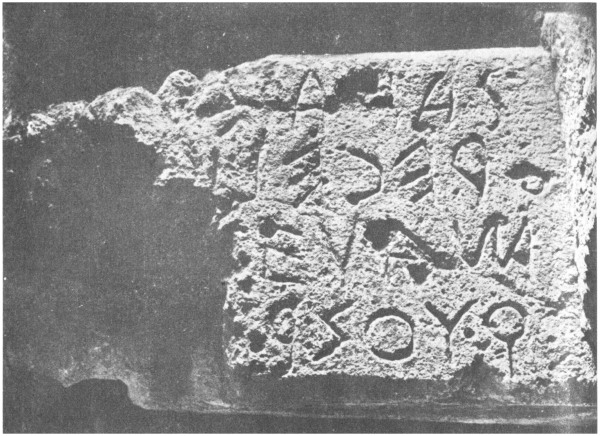
archaic letters can be transliterated. Beginning with the
bottom center line (Fig. 2.1), continuing with the line on
the far left, and reading boustrophedon (alternately from
right to left and from left to right, like an ox plowing), it
reads evistho zeronaith zivai/ sialchveiz aviz/ maraz mav/
vanalasial zeronai morinail/ aker tavarzio/ holaiez naphoth
ziazi. The resemblance to the alphabet and the art-forms
of the Aules Feluskes stele from Etruscan Vetulonia (Fig. 2.2)
is obvious. The particular letter-form transcribed as
th occurs elsewhere only in Phrygia in Asia Minor. The
very words and word-endings of the Lemnian stele can
be found on Etruscan inscriptions. Thus the inscription
shows at the very least that on an island “geographically
intermediate between Asia Minor and Italy a language
very similar to Etruscan was employed by some persons.”
The ancient tradition localizing the original home of the
Etruscans somewhere in or near northwest Asia Minor receives
here some archaeological support.
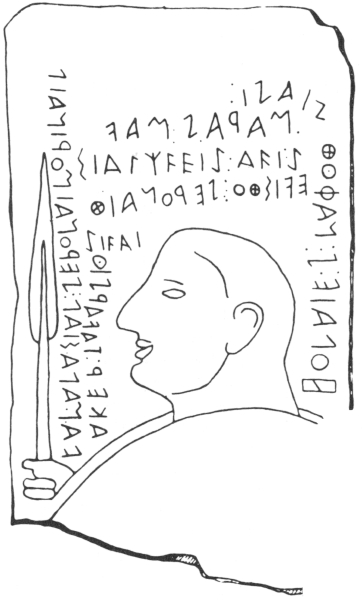
Fig. 2.1
Lemnos. Inscription in local dialect,
similar to Etruscan.
(M. Pallottino, Etruscologia, Pl. 4)
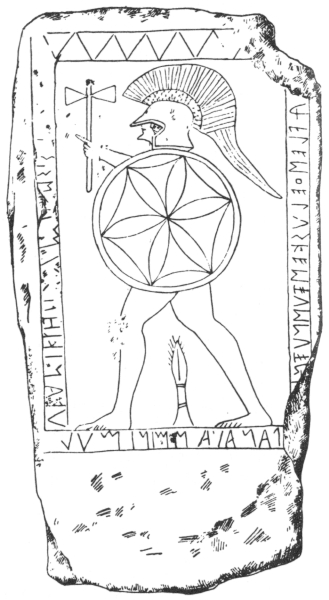
Fig. 2.2
Vetulonia. Aules Feluskes stele.
(M. Pallottino, Etruscologia, Pl. 21)
But the important thing is not where they came from,
but how their culture was formed. The archaeological evidence
justifies the hypothesis that they were a small but
vigorous military aristocracy from the eastern Mediterranean,
established in central Italy, where they built, by
borrowing and merging, upon a structure created by the
Villanovans. A new approach, the analysis of bones from
Etruscan tombs to ascertain the blood types of their ancient
occupants, may, by comparison with the persistent blood
types of modern Tuscans, enable the archaeologist to determine
what proportion of the ancient population was
native and what intrusive.
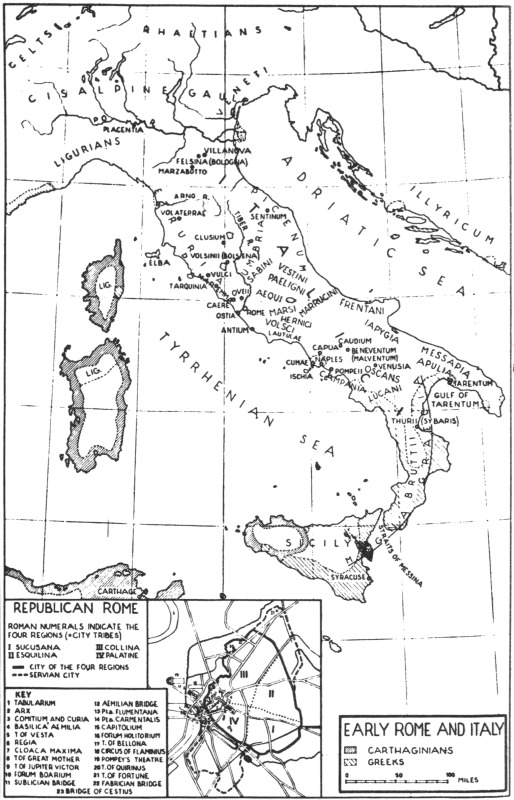
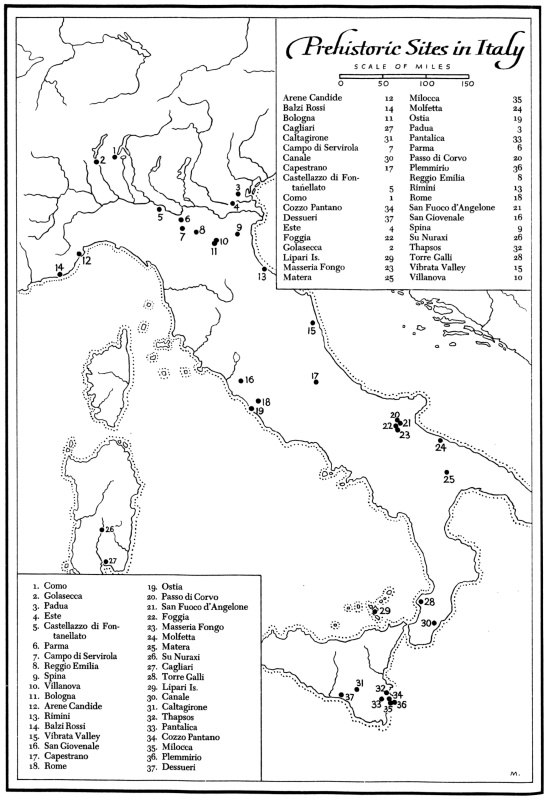
Fig. 2.3 Early Italy, to illustrate Etruscan and other sites. Inset: early Rome.
(V. Scramuzza and P. MacKendrick, The Ancient World, Fig. 32a)
REPUBLICAN ROME
ROMAN NUMERALS INDICATE THE FOUR REGIONS (*CITY TRIBES)
I SUCUSANA
II ERSQUILINA
III COLLINA
IV PALATINE
— CITY OF THE FOUR REGIONS
---- SERVIAN CITY
KEY
1 TABULARIUM
2 ARX
3 COMITIUM AND CURIA
4 BASILICA ÆMILIA
5 T. OF VESTA
6 REGIA
7 CLOACA MAXIMA
8 T. OF GREAT MOTHER
9 T. OF JUPITER VICTOR
10 FORUM BOARIUM
11 SUBLICIAN BRIDGE
12 ÆMILIAN BRIDGE
13 Pta. FLUMENTANA
14 Pta. CARMENTALIS
15 CAPITOLIUM
16 FORUM HOLITORIUM
17 T. OF TELLONA
18 CIRCUS OF FLAMINIUS
19 POMPEY’S THEATRE
20 T. OF QUIRINUS
21 T. OF FORTUNE
22 FABRICIAN BRIDGE
23 BRIDGE OF CESTIUS
EARLY ROME AND ITALY
* * * * *
Archaeology tells us, too, that Etruscan civilization is a
culture of cities. Ancient literary sources speak of a league
of twelve Etruscan places (Fig. 2.3), most of which have
yielded important archaeological material: from Veii, the
great terracotta Apollo; at Cerveteri, Vetulonia, Orvieto,
and Perugia, the remarkable rock-cut tombs; at Tarquinia,
Vulci, and Chiusi, strikingly vivid tomb-paintings; at Bolsena,
Roselle, and Volterra, mighty fortification walls; at
Populonia, the slag-heaps from the iron works which made
Etruria prosperous. But the most interesting, and some of
the latest, evidence for Etruscan city-planning and fortifications
comes from three sites, two in the northern Etruscan
sphere of influence: Marzabotto on the River Reno, fifteen
miles south of Bologna; Spina, near one of the seven mouths
of the Po; and one in northern Etruria itself, Bolsena,
ancient Volsinii.
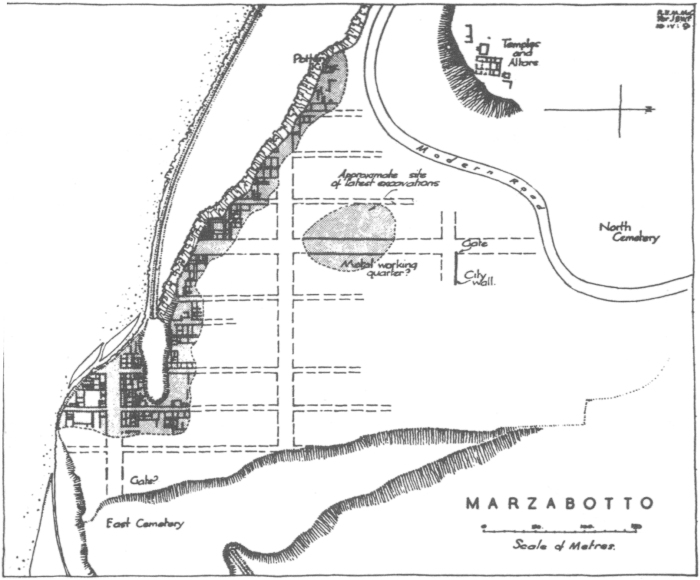
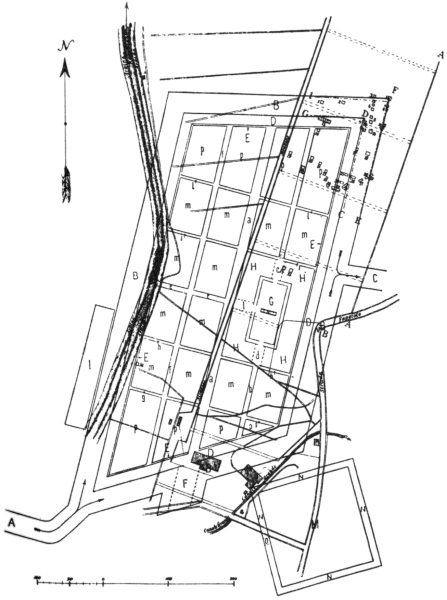
Fig. 2.4 Marzabotto: grid plan.
(J. B. Ward Perkins, “Early Roman Towns in Italy,” Fig. 5)
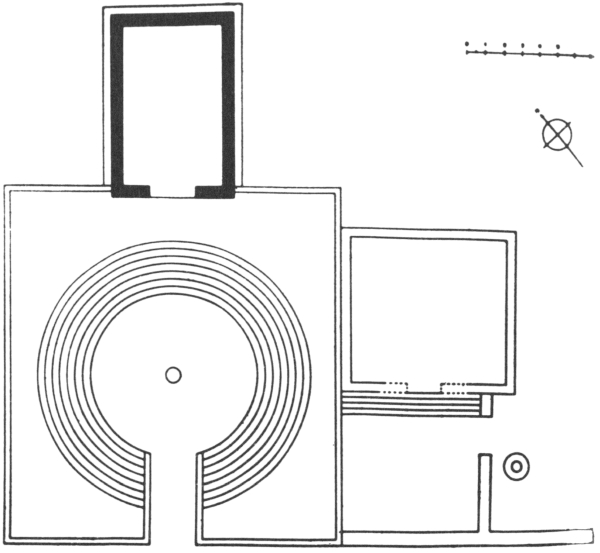
The first recorded excavations at Marzabotto date from
the 1860’s, but the ruins had been known since 1550. The
striking discovery at Marzabotto was that the site (dated
by pottery in its necropolis to the late sixth or early fifth
centuries B.C.) had a regular, oriented, rectangular grid of
streets (Fig. 2.4), enclosing house-blocks (insulae) averaging
165 × 35 yards. The main north-south street, or cardo,
and the main east-west street, or decumanus, were each
over forty-eight feet wide, the minor streets one third as
broad. The streets were paved, as they were not in Rome
until 350 years later. Drains ran beneath all the streets
except the reserved area (the Romans were to call it the
pomerium) just inside the circuit-wall. The house-plans
resemble closely the fourth-century ones discovered in the
1930’s at Olynthus, on the Chalcidice Peninsula in Greece,
by an American expedition. The house-doors had locks and
keys. A number of the buildings were recognizable as shops,
with back rooms for living quarters.
Bearing in mind the sobering experience of Pigorini’s
unwarranted claims about a grid plan for the terremare, we
might be tempted to scepticism about Marzabotto, except
for two facts: Brizio, the excavator, himself expressed
doubts, as early as 1891, about Pigorini’s reconstruction;
furthermore, a re-examination of the site in 1953 confirmed
the authenticity of Brizio’s findings.
The city is dominated, on the high ground to the northwest,
by an arx, bearing the footings, some of considerable
size with impressive moldings, of five structures, temples
or altars. One of them, facing south, and divided at the
back into three cellae, is the prototype of the Roman Capitolium,
decorated by an Etruscan artist, and dedicated to
the triad Jupiter, Juno, Minerva (in Etruscan, Tin, Uni,
Menerva). Until World War II, when they were wantonly
destroyed, the finds in terracotta from the arx were preserved
in the local museum. There were revetments, plaques
forming a thin veneer of fired clay, with nail-holes for
affixing them to the wooden frame of a typical Tuscan
temple. They included archaic antefixes: ornamental terracotta
caps to mask the unsightly ends of half-round roof
tiles. Terracotta revetments like these, for wooden construction,
continue to be canonical in Roman temples down to
the first century B.C.: marble as a building material does
not come into use until after the middle of the second century
B.C. Under the lee of the arx was a necropolis with
contents like those found in Gallic graves, mute evidence
of the occupation of Marzabotto by the wave of Gauls that
brought terror into Italy early in the fourth century B.C.
In sum, Marzabotto is so perfect an example of an Etruscan
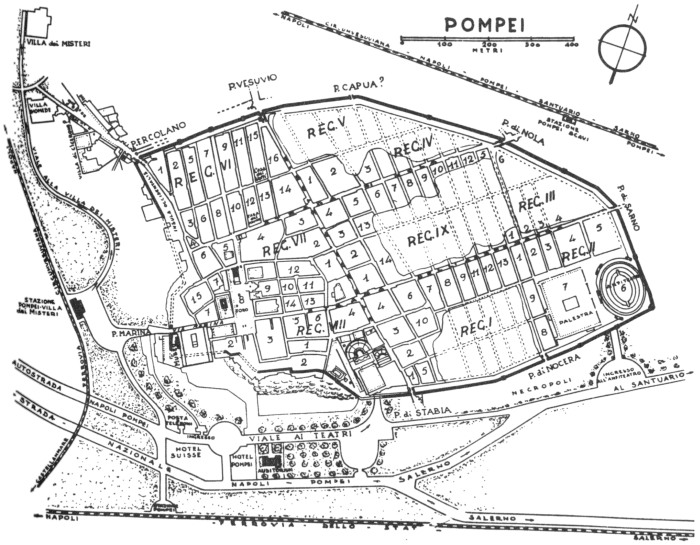
town-site that it merits the name of the Etruscan Pompeii.
Marzabotto remained for many years the only known
Etruscan site with a grid plan. Lying as it does outside
Etruria proper, it was clearly the product of Etruscan expansion
northward. Since 1922 reclamation by drainage
canals has revealed the necropolis of another northern outpost,
Spina, near one of the mouths of the Po. Working
under the greatest difficulties from mud and seepage, archaeologists
had unearthed the contents of no less than
1213 tombs, often finding golden earrings and diadems
gleaming in the mud against the skulls in the burials. These
precious ornaments, together with necklaces of northern
amber, perfume-bottles in glass paste and alabaster from
Egypt, and Greek black- and red-figured vases, are now the
pride of the Ferrara Museum. Though the vases are Greek,
both Etruscans and Greeks lived in the site together, as is
proved by graffiti in both languages scratched on the pottery.
The spot, commanding the Adriatic, would be the
ideal port of entry for foreign luxury goods imported to
satisfy the taste for display of wealthy Etruscans. Wealthy
as they were, they were all equal in the sight of Charun:
the skeletons were regularly found with small change, to
pay the infernal ferryman, clutched in the bony fingers of
their right hands. Pathetic graves of children contained
jointed dolls and game counters.
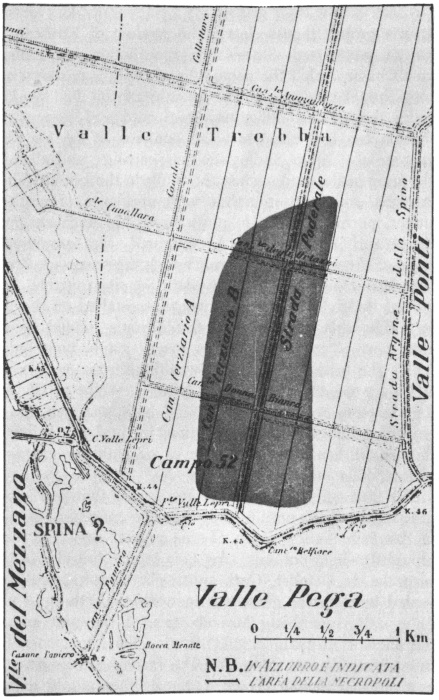
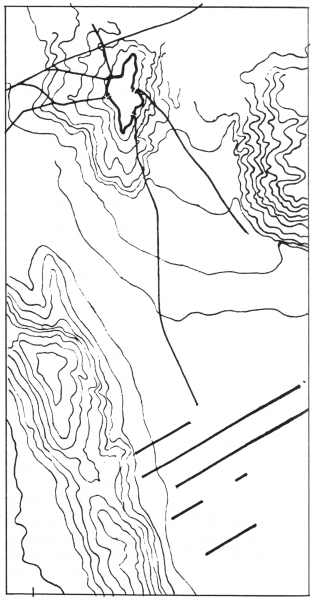
Fig. 2.5 Spina, plan.
(S. Aurigemma, Il R. Museo di Spina in Ferrara, Pl. 4)
This rich and crowded cemetery was all that was known
of Etruscan Spina until further drainage operations in 1953,
in the Pega Valley, south of the original site (Fig. 2.5),
brought to light not only 1195 new tombs, but also further
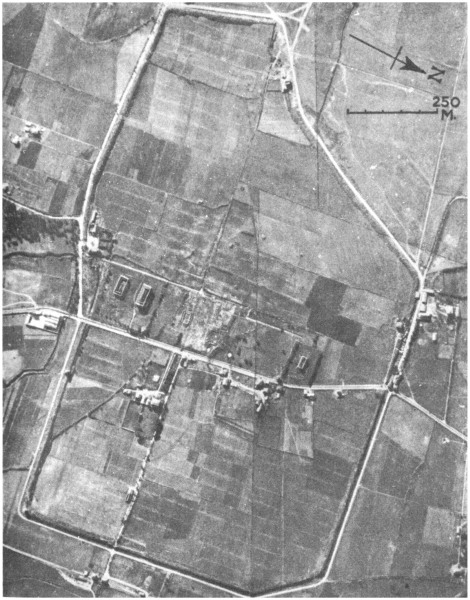
surprises. In October, 1956, an air-photograph in color revealed
beneath the modern irrigation canals the grid plan
(Fig. 2.6), resembling Marzabotto’s, of the port area of
the ancient Etruscan city. This time the decumanus is a
canal, sixty-six feet wide, and the marshy site is revealed
as a sort of Etruscan Venice. Later air-photographs showed
evidence of habitation over an area of 741 acres, large
enough for a population of half a million. Since the artifacts
of this vast city are a little later in style than those
of Marzabotto, we assume that Spina flourished a little
later. Almost no weapons were found in the graves: Spina
apparently felt secure on her landlocked lagoon, but she
reckoned without attacks from the landward side. Few
vases datable later than the late fifth century are found
in the graves: the inference is that Spina fell, about 390 B.C.,
before the same Gallic invasion that despoiled Marzabotto.
The two sites together reinforce each other in giving evidence
for the use by Etruscan city-planners of the kind
of square or rectangular grid of streets later made famous
by Roman colonies and Roman camps; unfortunately the
question is still open whether the Etruscans invented the
grid used in Italy or whether it was a Greek import.
Archaeology tells us something about Etruscan fortifications,
too, not least important being some recent negative
evidence: many polygonal walls in Etruria and Latium,
formerly believed Etruscan, are now proved to be of Roman
date. But excavations conducted since 1947 at Bolsena by
the French school in Rome have unearthed walls that are
genuinely Etruscan, surrounding an Etruscan site, and with
Etruscan letters hacked on the blocks. The marks, concentrated
on strategic sections of the wall, were probably
apotropaic, intended to work as magic charms against the
enemy. One section of the wall was only one block thick.
It could not have been self-standing; it must have been
intended as the spine of an agger or earthwork. Just such
a spine was a part of Rome’s earliest walls, and a similar
technique is to be seen in early earthworks at Anzio and
Ardea. The discovery of these walls has clinched the identification
of Bolsena with Etruscan Volsinii, one of the
twelve cities, and the scene of regular meetings of the
Etruscan League. On the same site were found some temple
foundations, but the district is rich farmland, and it
proved impossible to dig over a wide enough area to discover
whether Volsinii, like Marzabotto and Spina, had a
grid plan.
Grid plans suggest a sophisticated, if rigid, political organization
for Etruscan cities. Evidence for the political
life of a civilization normally comes from literature and
inscriptions, very little from artifacts. Yet the Aules Feluskes
stele from Vetulonia, already mentioned, shows a figure
carrying a double-headed ax. Later, axes were carried by
the consul’s twelve bodyguards whom the Romans called
lictors. There seems to be a connection between the number
twelve and the twelve cities of the Etruscan confederacy.
Vetulonia has yielded another object of great interest
to those who would understand Etruscan political organization
and Rome’s debt to it. In the Tomb of the Lictor was
found, besides a chariot and a metal coffer containing gold
objects wrapped in gold leaf, a double-headed iron ax
(Fig. 2.7) hafted onto a single iron rod surrounded by
eight others. This is obviously the prototype of the Roman
fasces, and indeed Silius Italicus, a Roman epic poet of
the Silver Age, assigns the origin of the fasces to Vetulonia.
Such artifacts suggest that the ruler of an Etruscan city,
whether king or aristocrat, was surrounded by considerable
pomp.
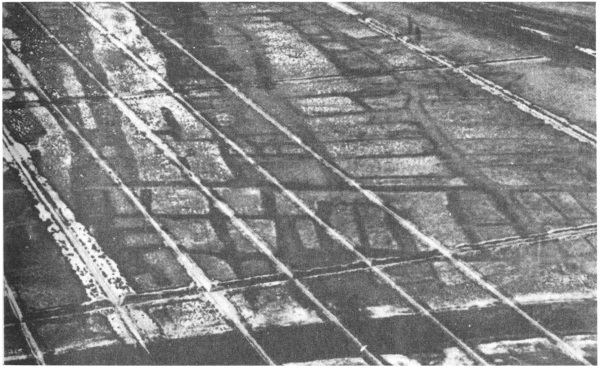
Fig. 2.6 Spina: grid plan, air-photograph. (ENIT, Italy’s Life, p. 91)
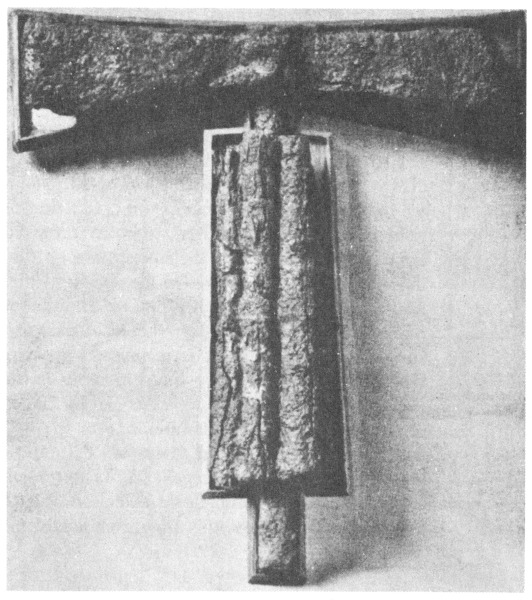
Fig. 2.7 Vetulonia: fasces from the Tomb of the Lictor.
(M. Pallottino, Etruscologia, Pl. 22)
Etruscan political organization, according to Latin literary
sources, at one stage embraced Rome, and an Etruscan
inscription on a shiny black dish of the ware called
bucchero, in Rome, goes a little way to confirm this. More
impressive confirmation comes from a frescoed Etruscan
tomb in Vulci, discovered by A. François in 1857. The
fresco has a historical subject, a battle scene, portraying
two camps, populated with figures labelled in Etruscan
letters. The figures in one camp are labelled Aule and Caele
Vipina (in Latin, Vibenna), and Macstrna (in Latin, magister);
in the other, a figure labelled Cneve Tarchunies
Rumach (in Latin, Cn. Tarquinius Romanus), a member
of the dynasty of Roman kings which in the historical tradition
is alleged to have come from Etruria. Aule Vipina’s
name recurs in a votive inscription, from a context dated
in the sixth century B.C., found at Veii on a bucchero sherd.
The conclusion is inescapable that A. and C. Vibenna were
actual historical figures, Etruscan leaders involved in a
political struggle for the domination of Rome. Macstrna is
identified in Roman tradition with Servius Tullius, a good
king whose rule falls, according to the literary tradition,
between the tyrannical reigns of the two Tarquins. The
fresco may represent an episode in Servius Tullius’ life unknown
to the Roman tradition, before he became king in
Rome; he is represented rescuing C. Vibenna from the
Romans, and killing Tarquin. Thus archaeology here not
only confirms the literary tradition of Rome’s Etruscan
kings; it suggests something about the internal policy of
sixth-century Etruscan cities, the existence in them, perhaps
by a constitutional transformation from an archaic
kingship, of a strong military authority, like that of the
magister populi or dictator of the later Roman Republic.
Etruscan tomb inscriptions, with their many personal names,
show that official Etruscan nomenclature included—as did
the later Roman—the name of the clan. Clan organization
is in origin aristocratic. As later in Rome aristocrats with a
clan organization overthrew the original monarchy, so too,
we may suppose, the clans operated in Etruria.
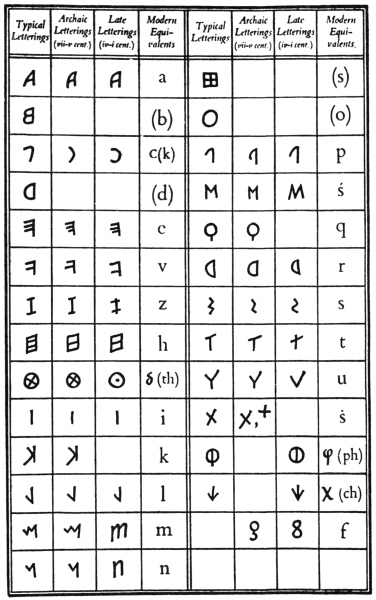
Fig. 2.8
Etruscan alphabet.
(M. Pallottino,
The Etruscans, p. 259)
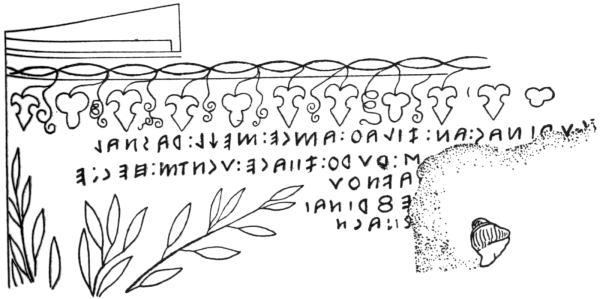
Fig. 2.9 Tarquinia: Tomb of Orcus, inscription.
(Corpus Inscriptionum Etruscarum, no. 5360)
In the example just cited, light is thrown on Etruscan
political organization by the inscriptions on the fresco, and
it is in fact to inscriptions in the Etruscan alphabet (Fig. 2.8)
that we owe most of what we know about Etruscan
politics. For, paradoxically, though Etruscan, as a non-Indo-European
language, is technically indecipherable (in
the sense that the longest inscriptions in it cannot be entirely
translated), valid inferences can be made about some
of the short ones. For example, one of the inscriptions on
the wall of the Tomb of Orcus at Tarquinia, discovered
in 1868 (Fig. 2.9), reads in part zilath : amce : mechl : rasnal,
at first sight a most unlikely combination of letters. Another
Tarquinian inscription, this time from a sarcophagus in the
local museum (splendidly installed in the fifteenth century
Vitelleschi palace) reads in part zilath rasnas. If we extrapolate
from the Roman practice of recording on funerary
monuments the official career (cursus honorum) of the
deceased (beginning with the highest offices held), it appears
likely that the term zilath refers to a magistracy. It
occurs often, and, when it occurs in a series, it occurs early;
this warrants the inference that it refers to an important
magistracy. Certain late Latin inscriptions from Etruria
refer to a praetor Etruriae. Might not the zilath be the
Etruscan official corresponding to the Roman praetor? This
is the more likely since the words rasnal, rasnas closely
resemble the word Rasenna, which a Greek historian tells
us is what the Etruscans called themselves in their own
language. There remains the word mechl. A similar word,
methlum, occurs next to the word spur in a curious text,
the longest we have in Etruscan, written on the cloth of a
mummy wrapping now preserved in the museum of Zagreb,
in Jugoslavia. The context appears to list the institutions
for whose benefit certain religious ceremonies were performed.
Several names of offices are accompanied, and
probably modified, by the words spureni, spurana. It looks
as if the word means “city.” Suppose the other institution,
the methlum, mentioned next to the spur, were of larger
size. Might it not be the Etruscan for “League”? The Tomb
of Orcus inscription, then, might mean, “He was the chief
magistrate of the Etruscan League.” It is by inferences like
these that we force a language technically indecipherable
to tell us something about the political organization of the
mysterious people who spoke and wrote it.
Another example comes from a long inscription on a
scroll held in the hands of a sculptured figure on another
sarcophagus in the Tarquinia museum. It contains the word
lucairce. In the text of the Zagreb mummy-wrapping mention
is made of ceremonies celebrated lauchumneti, presumably
a noun with an ending showing a place relation,
and obviously related in root to lucairce. And both seem
connected with the word lucumo, used in Latin to refer
to Etruscan chiefs or kings. Lucairce contains the ending
-ce which we interpreted on the Tomb of Orcus inscription
as verbal; it might mean “was king (or chief).” In that case
lauchumneti, with its locative ending, might mean “in the
(priest)-king’s house” (Latin Regia). Thus by reasoning
from the known to the unknown we can find evidence from
the Etruscans themselves that at some stage they were
ruled by kings. Since the Tarquinia sarcophagus with the
scroll is on the evidence of artistic techniques dated late
(second century B.C., a date at which the Roman Republic
fully controlled Etruria), we must suppose that by that
date the lucumo had been reduced to a mere priestly function,
much as in Rome itself the priest who in Republican
times discharged the sacred duties once performed by
Rome’s kings (reges) was still called the rex sacrorum.
A final example. On Etruscan inscriptions occurs a root
purth-, with by-forms purthne, purtsvana, eprthne, eprthni,
eprthnevc. This looks like the root which occurs in the
name of the king of Clusium, transliterated by the Romans
Lars Porsenna, he who in the Lays of Ancient Rome swore
by the Nine Gods. The same root probably occurs in the
Greek prytanis, which means something like “senator.”
Clearly another official of importance is referred to here.
In sum, archaeologists looking for evidence of Etruscan
political organization have found such outward signs of
pomp as fasces, plus evidence for magistrates resembling
the later Roman dictator, praetor, priest-king, senator, and
for cities probably combined into a league.
* * * * *
If inscriptions can be made to yield this kind of evidence,
what can we say about the state of our knowledge about
the Etruscan language in general? The same kind of combinatory
method applied to other inscriptions yields with
patience results justifying the statement that progress,
though agonizingly slow, is being made. Many short inscriptions
can be read entire: they are usually funerary,
and give the names, filiation, and age of the deceased. Here
is an example, from yet another sarcophagus in the Tarquinia
museum:
partunus vel velthurus satlnal-c ramthas clan
“Partuni Vel of Velthur and of Satlnei Ramtha the son,
avils XXIIX lupu
of years 28, dead.”
Here for translation one assumes that Etruscan, while not
Indo-European in its roots, is an inflected language, where
an -s or -l ending shows possession, and the enclitic -c,
like the Latin -que, means “and.” Another example shows
similar case-endings, uses vocabulary we have seen before,
and adds a place-name:
Alethnas Arnth Larisal zilath Tarchnalthi amce
“Alethna Arnth (son) of Laris praetor at Tarquinia was.”
Altogether some 10,000 Etruscan inscriptions are known.
Of these only three are of any length: the Zagreb mummy-wrapping,
a tile from Capua, and the previously mentioned
scroll from Tarquinia. The next seven taken together total
less than 100 words. Given this material, there is some bitter
truth in the statement that if we could unlock the secret
of Etruscan, we would have the key to an empty room.
But whole cities in Etruria remain to be dug; there is no
knowing what new inscriptions excavations now in progress
at Vulci, Roselle, or Santa Severa may turn up, including
perhaps a bilingual, where identical texts in Etruscan
and a known language like Latin may solve the puzzle,
as the Greek of the Rosetta Stone made possible the deciphering
of Egyptian hieroglyphics. Etruscan loan-words
in Latin tell us something: antemna, “yard-arm”; histrio,
“actor”; atrium, “patio”; groma, “plane-table” suggest Etruscan
predominance on the sea and the stage, in domestic
architecture and surveying. But we know more than loan-words:
the known vocabulary in Etruscan amounts now to
122 words, in seven categories, including time-words (e.g.,
the names of several months), the limited political vocabulary
already discussed, names for family relationships, some
three dozen verbs and nouns, and the same number of
words from the field of religion.
* * * * *
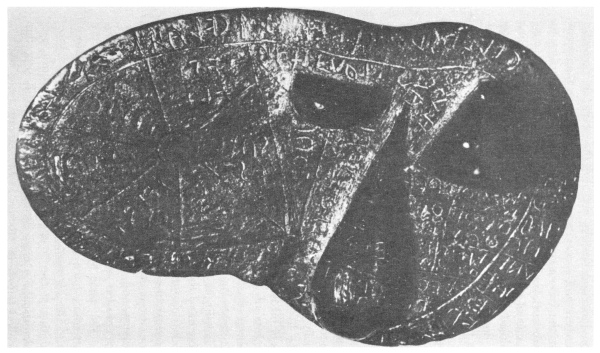
Fig. 2.10 Piacenza, Civic Museum. Bronze model of sheep’s liver, used in foretelling the future.
(ENIT, Italy’s Life, p. 37)
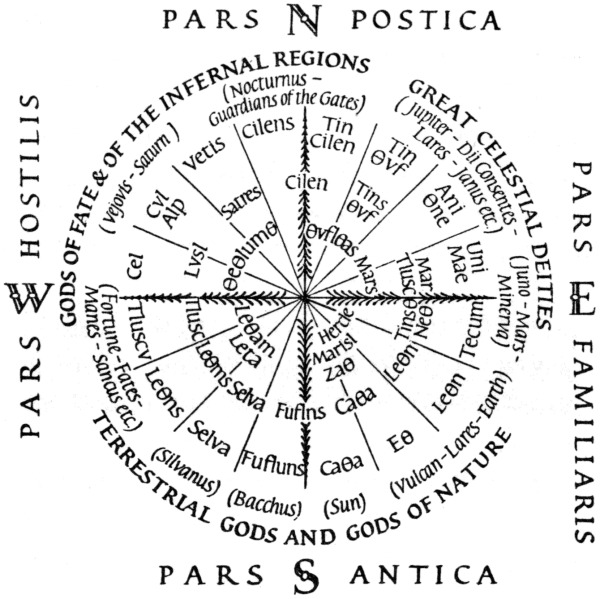
Fig. 2.11 Piacenza liver, schematic representation.
(M. Pallottino, The Etruscans, p. 165)
It is about Etruscan religion, and especially funerary
rites, that we are best informed. The Etruscans had the
reputation of being the most addicted to religious ceremonial
of any people of antiquity, and we learn much
about Etruscans living from Etruscans dead. We know
what sort of documentation to expect on religious matters
from an Etruscan tomb, by extrapolating back from rites
which the Romans believed they had inherited from Etruria,
especially in the area of foretelling the future by examining
the livers of animals (hepatoscopy) or observing the
flights of birds (augury). One of the most curious surviving
documents of Etruscan superstition is the bronze model
of a sheep’s liver (Fig. 2.10) found in 1877 near Piacenza,
on the upper Po, and now in the Civic Museum there. The
liver is split in two lengthwise. From the plane surface
thus provided three lobes project. The plane surface itself
is subdivided into sixteen compartments (Fig. 2.11); over
each compartment a god presides. The same sixteen subdivisions
were used in the imaginary partition of the sky
for augury, and the same principle governed the layout
and orientation of cities like Marzabotto and probably
Spina. The same superstition found in Babylonia directs
our attention once more to the probable Near Eastern
origin of the Etruscan ruling class. The priest would take
his position at the cross-point of the intended cardo and
decumanus of the city, facing south (we recall that the
three-celled temple on the arx at Marzabotto faces south).
The half of the city behind him was called in Latin the
pars postica (posterior part), the part in front of him the
pars antica (anterior part); on his left was the pars familiaris
(the lucky side; hence thunder on the left was a good
omen) on his right the pars hostilis (unlucky). To the subdivision
of the earth below corresponded a similar subdivision
of the sky above; either was called in Latin (using
a concept clearly derived from Etruscan practice) a templum,
“part cut off,” a sacred precinct, terrestrial or celestial.
From the Piacenza liver and the orientation of Marzabotto
we can deduce both the orderliness of the Etruscan mind
and the ease with which it degenerated into rigidity and
superstition. For this deadly heritage the Etruscans apparently
found in the Romans willing recipients; often, but
not always, for old Cato said, “I cannot see how one liver-diviner
can meet another without laughing in his face.”
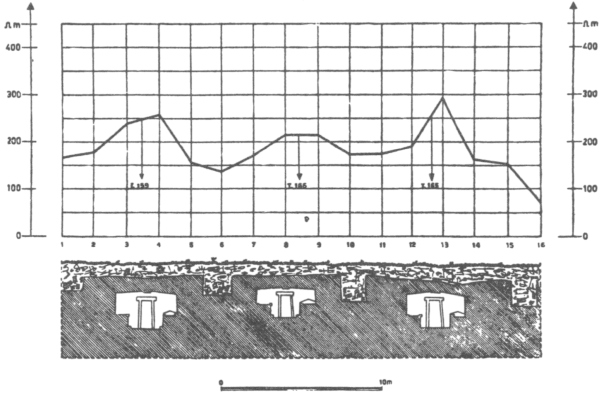
Fig. 2.12 Potentiometer profile. The high points on the graph show
where hollowed tomb-chambers exist under ground. (ENIT, Italy’s
Life, p. 106)
The vast number of Etruscan tombs and the richness of
their decoration and furnishings tell us much about another
aspect of the Etruscans’ religion: their view of the afterlife.
About this the fabulous painted tombs of Tarquinia
tell us most, and bid fair to tell us more as new methods
are applied to their discovery and exploration. The ubiquitous
Bradford has been at work in Etruria too; his quick
eye has detected on air-photographs over 800 new tomb-mounds
at Tarquinia alone, and new methods of ground
exploration, worked out by the dedicated Italian engineer
C. M. Lerici, have enormously speeded the work of exploration.
Electrical-resistivity surveying with a potentiometer,
sensitive to the difference between solid earth and empty
subterranean space, makes possible the rapid tracing of a
profile showing where the hollows of Etruscan tombs exist
underground (Fig. 2.12). A hole is then drilled large enough
to admit a periscope; if the periscope shows painted walls,
or pottery, a camera can be attached to make a 360-degree
photograph. By this method Lerici reports exploring 450
tombs in 120 days. This work, rapid as it is, is being done
none too soon; land redistribution schemes, good for the
farmer, bad for the archaeologist, are changing the face of
south Etruria day by day; deep plowing and the planting
of vines and fruit trees are destroying or obscuring the
archaeological picture.
Dennis would hardly lament the passing of the conditions
he so graphically describes: “Among the half-destroyed
tumuli of the Montarozzi [at Tarquinia] is a pit, six or
eight feet deep, overgrown by lentiscus; and at the bottom
is a hole, barely large enough for a man to squeeze himself
through, and which no one would care to enter unless
aware of something within to repay him for the trouble,
and the filth unavoidably contracted. Having wormed myself
through this aperture, I found myself in a dark, damp
chamber, half-choked with the debris of the walls and
ceiling. Yet the walls have not wholly fallen in, for when
my eyes were somewhat accustomed to the gloom, I perceived
them to be painted, and the taper’s light disclosed
on the inner wall a banquet in the open air.” Modern gadgetry
like Lerici’s has destroyed some of the romance; there
is something graphic about descriptions like Mengarelli’s
of opening a tomb at Cerveteri in 1910, in the presence of
the local and neighboring landlords, the Prince and Princess
Ruspoli and the Marchese Guglielmi. As the blocks of the
entrance were removed one by one, and sunlight was reflected
into the tomb by mirrors, there were to be seen
against the black earth objects of gleaming gold, and priceless
proto-Corinthian vases resting on shreds of decomposed
wood, which were all that was left of the funeral bed,
while other vases were to be seen fixed to the wall with
nails.
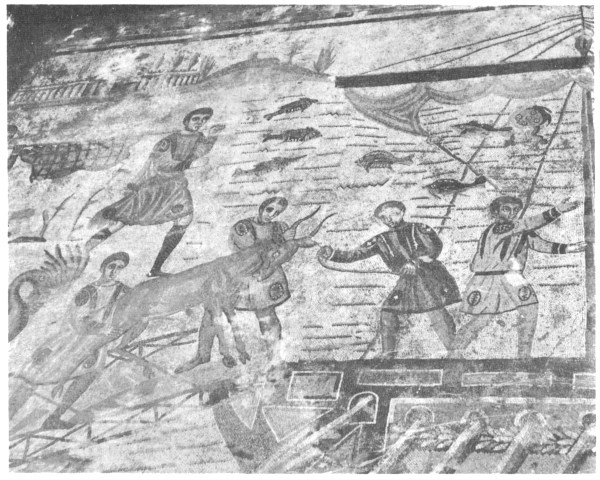
The Tomb of Hunting and Fishing at Tarquinia, discovered
in 1873, gives us our most attractive picture (Fig. 2.13)
of how Etruscans in their palmiest days viewed the next
world. The tomb is dated by the black-figured Attic vases
it contained in the decade 520–510 B.C., when the Etruscan
ruling class was still prosperous. A more charming invitation
to the brainless life could hardly be imagined. The most
vivid scene is on the walls of the tombs inner room, which
are conceived as opening out into a breezy seascape, with
a lively population of bright birds in blue, red, and yellow,
frisky dolphins, and boys, friskier still, at play. Up a steep
rock striped in clay-red and grass-green clambers a sun-burnt
boy in a blue tunic, who appears to have just pushed
another boy who is diving, with beautiful form, into the
hazy, wine-dark sea. On a nearby rock stands another boy
firing at the birds with a slingshot. Below him is a boat
with an eye painted on the prow (to ward off the evil eye;
fishing boats are still so painted in Portugal). Of the boat’s
four passengers, one is fishing over the side with a flimsy
handline, while beside the boat a fat dolphin turns a mocking
somersault. All is life, action, humor, vitality, color;
such is the notion of blessed immortality entertained by
a people for whom Gods in his heaven, all’s right with
the world.
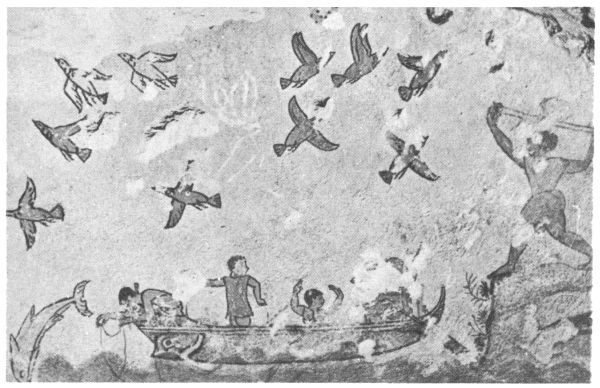
Fig. 2.13 Tarquinia: Tomb of Hunting and Fishing, fresco.
(M. Pallottino, Etruscan Painting, p. 51)
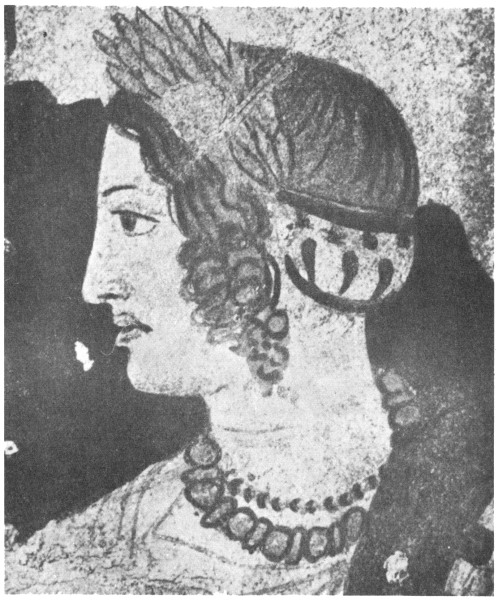
Fig. 2.14 Tarquinia: Tomb of Orcus, portrait of the lady Velcha. (MPI)
A quarter of a century or so after the Tomb of Hunting
and Fishing was painted, the Etruscans suffered a major
naval defeat at the hands of Greeks off Cumae. Rome, expanding,
eventually took over the iron mines of Elba and
the iron-works of Populonia, and Etruscan prosperity declined
agonizingly to its end. Let us look at a Tarquinian
tomb of the period of the decadence; e.g., the Tomb of
Orcus again. There, beside one of the loveliest faces ever
painted by an ancient artist (Fig. 2.14), is portrayed one
of the most hair-raising demons a depressed imagination
could conceive (Fig. 2.15). Its flesh is a weird bluish-green,
as though it were putrefying. Its nose is the hooked beak
of a bird of prey. The fiend has asses’ ears; its hair is a
tangled mass of snakes. Beside its monstrous wings rises
a huge crested serpent, horribly mottled. In its left hand
the demon holds a hammer handle. An inscription identifies
him as Charun, the ferryman of the dead; it is to pay
this monster that the skeletons of Spina clutch their bronze
small change in their right hands. The contrast between the
gaiety of the scenes in the Tomb of Hunting and the gloomy
prospect of the lovely lady—her name is Velcha—in the
clutches of this grisly demon has been held to epitomize
the contrast between the views of an after life entertained
by a prosperous and by an economically depressed people.
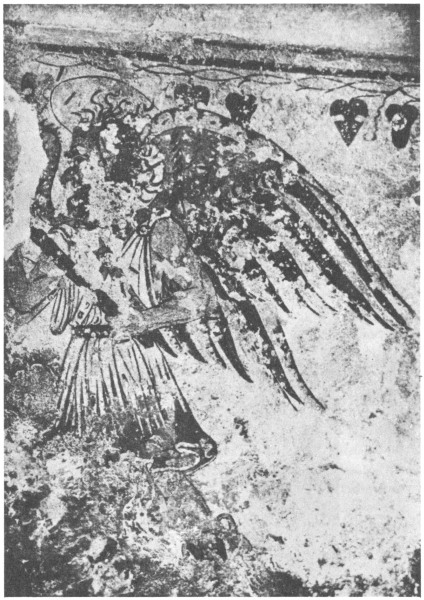
Fig. 2.15 Tarquinia: Tomb of Orcus, the demon Charun. (MPI)
Other finds cast further light. The Capua tile prescribes
funerary offerings to the gods of the underworld. An inscribed
lead plaque from near Populonia is a curse tablet,
in which a woman urges Charun or another infernal deity,
Tuchulcha, to bring his gruesome horrors to bear on members
of her family whose death she ardently desires. Bronze
statuettes give details of priestly dress (conical cap tied
under the chin, fringed cloak) or show Hermes, Escorter
of Souls, going arm-in-arm with the deceased to the world
below. The total picture is one of a deeply religious, even
superstitious people, attaching particular importance to the
formalities of their ritual relations with their gods, and
obsessed with the after life, of which they take a progressively
gloomier view as their material prosperity declines.
* * * * *
What can archaeology tell us about Etruscan cultural
life? Of art for art’s sake there seems to have been very
little, of literature none, except for liturgical texts. The
Etruscans excelled in fine large-scale bronze work, like the
famous Chimaera of Arezzo or the Capitoline Wolf, but
their minor masterpieces in bronze deserve mention also,
especially the engraved mirrors, the cylindrical cosmetic
boxes called ciste, and the statuettes whose attenuated
bodies appeal strongly to modern taste. Their painting at
its best shows in its economy of line how intelligently they
borrowed from the Greeks, in its realism how sturdily they
maintained their own individuality. In architecture, Etruscan
temples, having been made of wood, do not survive
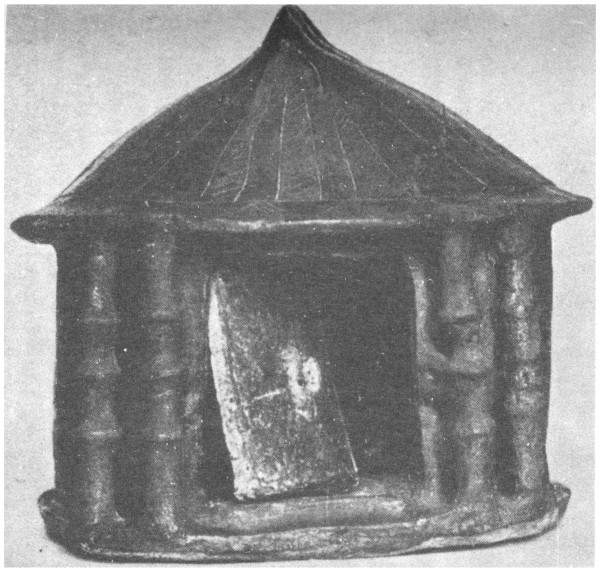
above their foundation courses, but recent discoveries of
terracotta temple-models at Vulci tell us something about
their appearance, and masses of their terracotta revetment
survive, brightly-painted geometric, vegetable, or mythological
motifs, designs to cover beams, mask the ends of
half-round roof tiles, or (in pierced patterns called à jour
crestings) to follow the slope of a gable roof. Made from
molds, the motifs could be infinitely repeated at small expense,
an aspect of Etruscan practicality which was to appeal
strongly to the Romans.
But the Etruscans’ artistic genius shows at the best in
their architectural sculpture in painted terracotta, free-standing
or in high relief. Their best-known masterpiece
in this genre is the Apollo of Veii (Fig. 2.16), designed for
the ridgepole of an archaic temple. Discovered in 1916,
it is now in the Villa Giulia museum in Rome. The stylized
treatment of the ringlets, the almond eyes, the fixed smile
are all characteristic of archaic Greek art, and the fine edges
of the profile, lips, and eyebrows suggest an original in
bronze. But this is no mere copy. It is the work of a great
original artist, probably the same Vulca of Veii who was
commissioned in the late sixth century B.C. to do the terracottas
for the Capitoline temple in Rome. The sculptor is
telling the story of the struggle between Apollo and Hercules
for the Hind of Ceryneia: the god is shown as he
tenses himself to spring upon his opponent; the anatomical
knowledge, the expression of mass in motion, and the craftsmanship
required to cast a life-size terracotta (a feat which
even now presents the greatest technical difficulties) are
all alike remarkable.
A set of antefixes (used, as we have seen, to cover the
ends of half-round roof-tiles), from the archaic temple at
Satricum in Latium, in the same museum, are noteworthy
for their humor. They represent a series of nymphs pursued
by satyrs. The satyrs are clearly not quite sober, and the
nymphs are far from reluctant. In a particularly fine piece
(Fig. 2.17) the satyr frightens the nymph with a snake
which he holds in his left hand, while he slips his right
hand over her shoulder to caress her breast. Her gestures
are almost certainly not those of a maiden who would
repel a man’s advances.
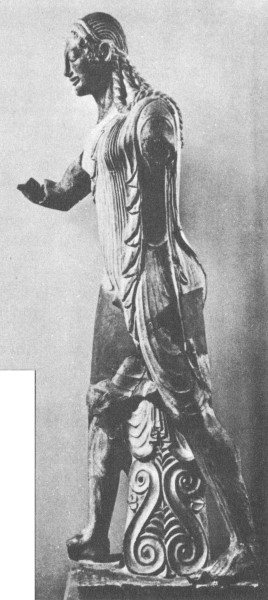
Fig. 2.16 Rome, Villa Giulia Museum.
Apollo of Veii, terracotta. (MPI)
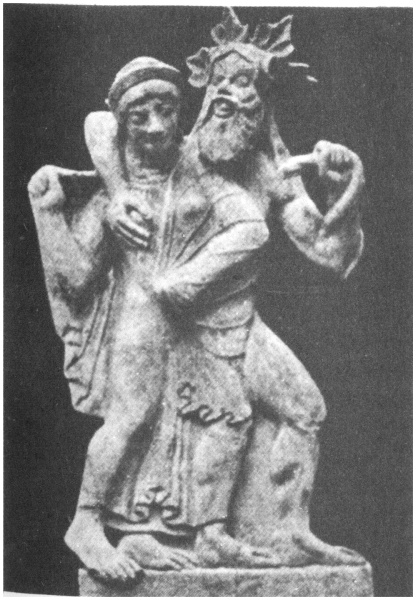
Fig. 2.17 Rome, Villa Giulia Museum. Terracotta antefix
of satyr and nymph, from Satricum. (MPI)
A third Etruscan masterpiece in terracotta, of later date,
but still showing the same striking vitality as the two pieces
just described, is the pair of winged horses in high relief
(Fig. 2.18), first published in 1948, which come probably
from the pediment of the temple called the Ara della
Regina, on the site of the Etruscan city (as opposed to
the necropolis) of Tarquinia, and now in the Tarquinia
museum. The proud arching of the horses’ necks, their
slim legs, their rippling muscles are rendered to make them
the quintessence of the thoroughbred, so that we forget
that the delicate wings would scarcely lift their sturdy
bodies off the ground. In these three masterpieces art is
none the less vibrant for being put at the service of religion.
Here is created a new Italic expressionistic style, so
admirable that many would hold that Italian art did not
reach this level again until the Renaissance.
* * * * *
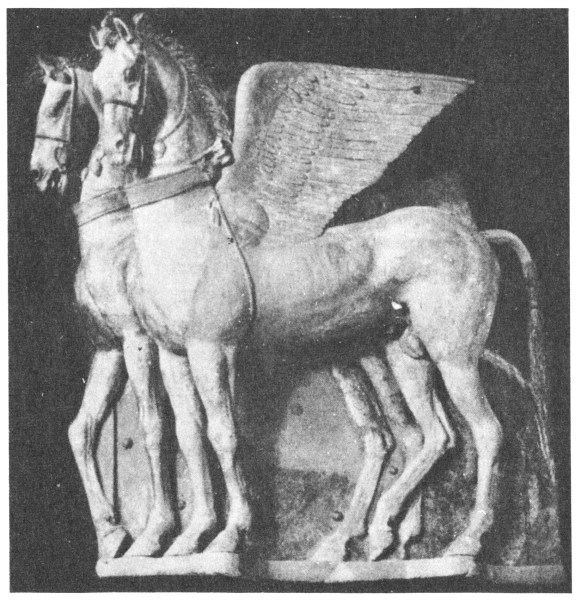
Fig. 2.18 Tarquinia, Museum. Winged horses, terracotta relief,
from Ara della Regina. (MPI)
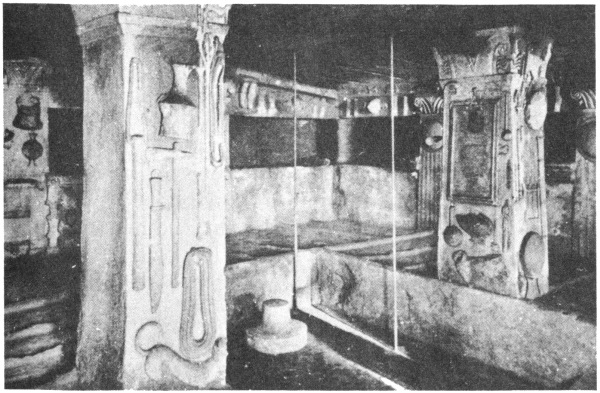
Fig. 2.19 Cerveteri: Tomb of the Reliefs, interior. (MPI)
Just as archaeology’s finds can convince us of the vitality
of Etruscan art, so they can bring to life ancient Etruscan
life and customs. Most illuminating in this area are two
tombs from Cerveteri, ancient Caere, one of the great cities
of the Etruscan dodecapolis, twenty-five miles up the coast-road
from Rome, and close, too, in cultural relations. Here
again Bradford has been at work, spotting over 600 new
tombs, but the one that tells us most about Etruscan everyday
life has been known since 1850. It is the fourth-century
Tomb of the Reliefs (Fig. 2.19), with places for over forty
bodies. The front and back walls of this tomb, and two
pillars in the middle, are covered with representations in
low relief of Etruscan weapons and objects in daily use;
here, as elsewhere in Etruscan tombs, but in far more detail,
the tomb-chamber reproduces the look of a room in
an Etruscan house. Such chambers served again as shelters
in modern times—against bombs in World War II. In the
central recess in the farthest wall is a bed for a noble
couple. It is flanked by pilasters bearing medallions of
husband (on the left) and wife (on the right). On the
husband’s side appears the end of a locked strongbox, covered
with raised studs or bosses, with a garment lying
folded on top. On the wife’s side is a sturdy knotted
walking-staff, a garland, necklaces, and a feather fan. The
couch has lathe-turned legs; it is decorated with a relief
of Charun and the three-headed dog Cerberus, with a serpent’s
tail. The couch rests on a step on which a pair of
wooden clogs awaits their master’s need. Above the couch,
and continuing all the way around the room, is a frieze
of military millinery: helmets with visors, helmets with
cheek-pieces, the felt cap worn under the helmet to keep
the metal from chafing, swords, shields, greaves or shin
guards, and a pile of round objects variously interpreted
as missiles, decorations for valor, or balls of horse-dung.
The central pilasters, with typical Etruscan economy, are
decorated only on the sides visible from the door. What is
represented is the whole contents of an Etruscan kitchen.
Identifiable objects include a sieve, a set of spits for roasting,
a knife-rack, an inkpot, a dinner gong, a game board
(not unlike those provided in English pubs for shove-ha’penny)
with a bag for the counters, and folding handles;
a ladle, mixing spoons, an egg-beater, pincers, a duck, a
tortoise, a cat with a ribbon around its neck, playing with
a lizard; a belt, a pitcher, a long thin rolling pin for making
macaroni, a pickaxe, a machete, a coil of rope, a pet weasel
teasing a black mouse, a lituus (the augur’s curved staff),
a wine-flask of the familiar Chianti shape, a knapsack, and
a canteen. Over and flanking the door are bucrania (ox-skulls),
wide, shallow sacrificial basins, and a curved war-trumpet
or hunting-horn. Surely never a household embarked
better equipped for the next world. This tomb is
as good as a documentary film; nothing ever found by
archaeology brings Etruscan daily life more vividly before
our eyes.
While the Tomb of the Reliefs is full of homely details
of Etruscan life, the Regolini-Galassi tomb, also at Cerveteri,
was crammed with objects of conspicuous consumption
and conspicuous waste. The tomb is named for its discoverers,
General Alessandro Regolini and Fr. Vincenzo Galassi,
arch-priest of Cerveteri in 1836. Its contents are datable in
the eighth or seventh century B.C. It consists of a long
narrow entrance-way or dromos, two oval side-chambers,
and a long narrow main tomb-chamber roofed with a false
vault, “now,” says Dennis, “containing nothing but slime
and serpents.” When it was entered through a hole in the
roof on April 21, 1836, an incredible treasure of gold, silver,
bronze, and ceramics, over 650 objects in all, burst upon
the workmen’s gaze. All was cleared with feverish haste
in less than twenty-four hours, and no detailed inventory
was compiled until seventy years later. The riches are fabulous;
to quote Dennis again, “here the youth, the fop, the
warrior, the senator, the priest, the belle, might all suit
their taste for decoration—in truth a modern fair one need
not disdain to heighten her charms with these relics of a
long past world.” In those days, Etruscan objects were not
allowed to languish in a museum. A report of 1839 states,
“a few winters ago the Princess of Canino [wife of Lucien
Bonaparte] appeared at some of the [British] ambassador’s
fêtes with a parure of Etruscan jewellery which was the
envy of the society, and excelled the chefs-d’oeuvre of Paris
or Vienna.” Though the contents of the tomb have been
now for many years the pride of the Gregorian Museum
in the Vatican, the definitive publication did not appear
until 1947.
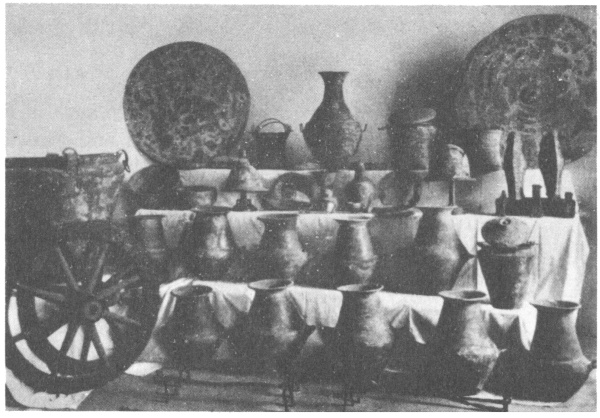
The tomb contained three burials, including one of a
woman of princess’ rank. With one of the males was buried
his chariot (which was first dismantled and its wooden
parts ceremoniously burned); his funeral car, plated with
bronze in a sword-like leaf design; and his bronze bier, with
a raised place for the head and a latticework of twenty-nine
thin bronze bars. With the woman was buried a priceless
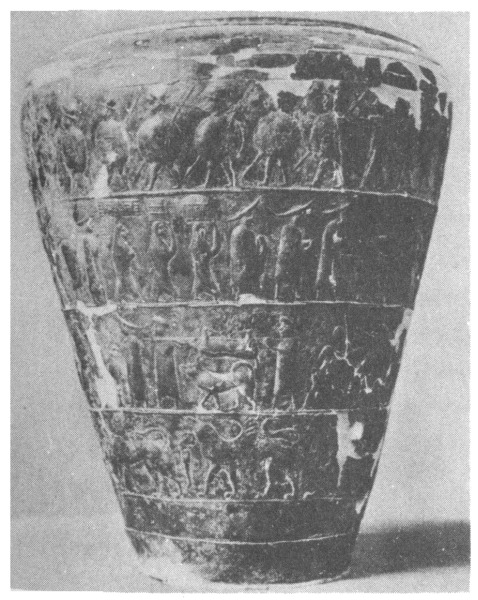
treasure of gold, of baroque barbarity: a magnificent golden
fibula; a great gold pectoral (Fig. 2.20) decorated in repoussé
with twelve bands of animal figures (this, one would
like to think, was what the Princess of Canino wore to the
ambassador’s party); gold and amber necklaces; massive
gold bracelets and earrings to match the pectoral; silver
bracelets, rings, pins, a spindle, and buckets, the latter
decorated with fantastic animals; ivory dice; a bronze wine-bowl,
with a beautiful green patina, decorated with six
heads of lions and griffins, turned inwards; and (reconstructed)
a great bronze-plated chair of state with footstool,
the whole ornamented with vegetable and animal
motifs; the arms end in horse’s heads, the back legs in cow’s
hoofs. To the second male burial belonged a set of splendid
bronze parade-shields; a bronze incense-burner on wheels,
with a rim of lotus-flowers in bronze; a bronze vase-stand,
with a conical base surmounted by two superimposed oblate
spheroids, supporting a bronze container for the vase, the
whole ornamented in repoussé with bulls and winged and
wingless lions; bowls in silver and silver-gilt, decorated
with horsemen, footsoldiers, archers, lancers, chariots, lions,
dogs, bulls, vultures, and palm trees, in a style that might
be Egyptian, Cypriote, or Syrian. Such of the treasure as
is imported from the Near East bespeaks the wealth of
Etruscan overlords; such as is of local manufacture bespeaks
the Skill of Etruscan craftsmen.
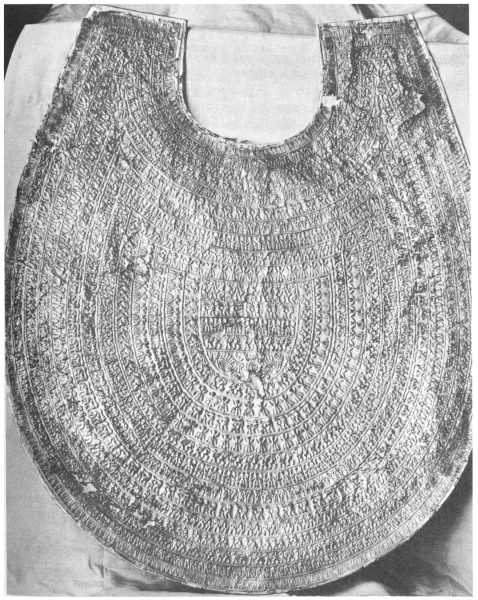
Fig. 2.20 Vatican City, Vatican Museum: gold pectoral from the
Regolini-Galassi tomb, Cerveteri. (Musei Vaticani)
From other places, other clues to Etruscan life and customs.
We may end with two observations, both taken from
tombs in Tarquinia: Etruscan women were treated on a
par with men; Etruscan sports were sometimes of barbaric
cruelty. The Tomb of the Leopards in Tarquinia (fifth
century B.C.) shows women (with dyed hair) reclining on
the same dining-couch with men; later (Tomb of the
Shields, third century B.C.) women sat at meals, while men
reclined, but the sexes dined together; there was no Oriental
seclusion. The Tomb of the Chariots, also in Tarquinia,
shows women along with men in the stands watching athletic
events: horse-racing, the pole-vault, boxing, wrestling,
discus-throwing, and running. A tomb discovered by Lerici
just in time to be restored for the 1960 Olympic Games in
Rome is called the Tomb of the Olympic Victors, and shows
similar events.
But Etruscan spectator sports were not always so innocent.
On the right wall of the Tomb of the Augurs in Tarquinia,
a masked figure, in a false beard, a blood-red tunic,
and a conical cap, is portrayed inciting a fierce hound to
attack a hairy-chested figure, nude but for a loin-cloth and
carrying a club; his eyes are blinded by a sack tied over
his head, and his movements are impeded by a cord held
by a bystander. The victim is already bleeding from several
savage bites. Unless, handicapped as he is, he can
club the dog to death, he will surely be torn to bits. Perhaps
this sanguinary and savage scene represents human
sacrifice (and, if so, it is none the less forbidding), but
it is a tempting hypothesis that what we have pictured
here is a predecessor of the kind of spectacle the Romans
later enjoyed in their amphitheaters, when gladiators fought
to the death. Gladiatorial contests were in fact traditionally
of Etruscan origin, first imported from Etruria for certain
funeral games in 264 B.C.
We end, then, where we began, with archaeological evidence
for Etruscan influence, for good or for ill, upon Rome.
As with the story of prehistoric man in Italy, the Etruscan
story is one of influences in part originating in the Near
East, in part indigenous, creating a civilization with durable
elements that could be and were transmitted, playing a
predominant rôle in forming the culture of ancient Italy.
The Etruscans are important in themselves, of course, but
it is a mistake to assume, because their language, unique
on the Italian peninsula, is non-Indo-European, that their
culture is isolated, too. As a culture of cities, Etruria must
have had its effect, not without cross-fertilization from Greek
practice, upon Roman town-planning. Etruscan political
forms and practice recur in Roman usage. The language
claims our attention for the light it throws, however dimly,
on Etruscan politics, religion, and family life, and for the
challenge it has presented to modern scientific scholarship
to penetrate its mystery. Etruscan religion, as illuminated
by archaeological finds, has its own fascination, foreshadows
Roman formalism, and is noteworthy for changing, under
the stress of political and economic decline, from an optimistic
to a pessimistic view of the after-life. Etruscan art,
especially terracotta sculpture, shows a striking vitality,
humor, and independence; Etruscan architecture makes its
impact upon Roman. Finally, the evidence of artifacts as
to Etruscan daily life shows a standard of material comfort,
and even of luxury, not to be achieved again on the
peninsula for two hundred years. Etruscan equality of sexes
foreshadows the independence of Roman women; the brutality
of Etruscan games is to strike an answering chord in
sadistic Roman breasts. Etruria has its own intrinsic fascination,
yet for the Western world its major interest must
lie in its legacy to Home. When Etruscan culture was at
its brilliant, golden height, Rome was a primitive village
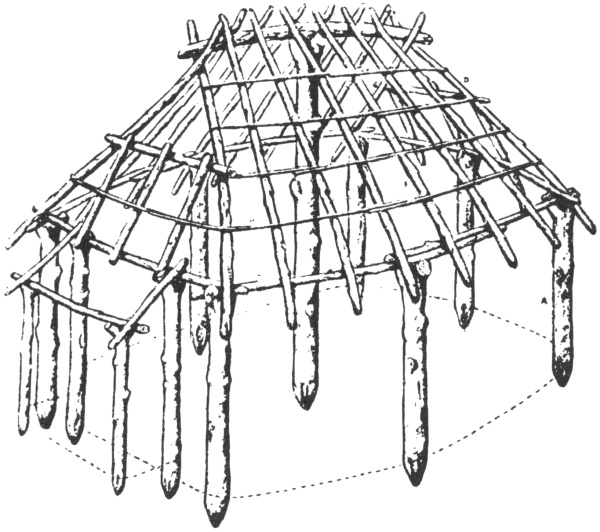
of wattle-and-daub huts. Archaeology has been able to trace
the metamorphosis of those huts into palaces, with all the
concomitant story of grandeur and barbarity; to that metamorphosis
the rest of this book will be devoted.