The book cover has been modified by the Transcriber and was added
to the public domain.
The spelling of Spanish names and places in Spain mentioned in the text
has been adjusted to the rules set by the Academia Real Española.
A number of words in this book have both hyphenated and non-hyphenated
variants. For the words with both variants present the one more used
has been kept.
Punctuation and other printing errors have been corrected.
The Music of Spain
BOOKS BY CARL VAN VECHTEN
MUSIC AFTER THE GREAT WAR 1915
MUSIC AND BAD MANNERS 1916
INTERPRETERS AND INTERPRETATIONS 1917
THE MERRY-GO-ROUND 1918
THE MUSIC OF SPAIN 1918
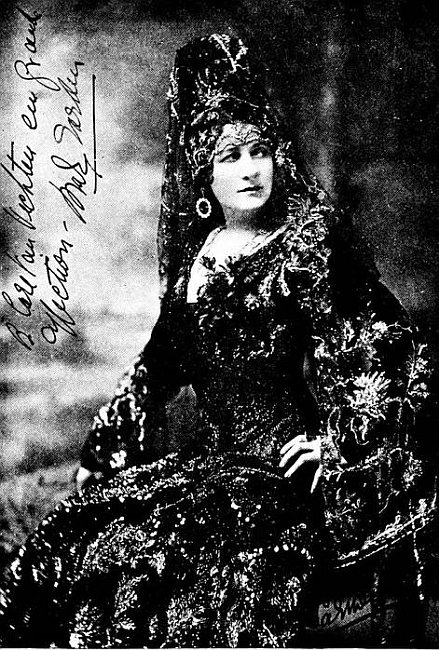
from a photograph by Mishkin
Mary Garden As Carmen, Act IV
The Music of Spain
CARL VAN VECHTEN
New York Alfred A. Knopf
MCMXVIII
COPYRIGHT, 1918, BY
ALFRED A. KNOPF, INC.
PRINTED IN THE UNITED STATES OF AMERICA
Pour Blanchette
Preface
When the leading essay of this book, "Music
and Spain," first appeared it was, so far as I have
been able to discover, the only commentary attempting
to cover the subject generally in any
language. It still holds that distinction, I believe.
Little enough has been published about
Spanish music in French or German, little enough
indeed even in Spanish, practically nothing in
English. It has been urged upon me, therefore,
that its republication might meet with some success.
This I have consented to although no one
can be more cognizant of its faults than I am.
The subject is utterly unclassified; there is no
certain way of determining values at present. It
is almost impossible to hear Spanish music outside
of Spain; not easy even in Spain, unless one
is satisfied with zarzuelas. Worse, it is impossible
even to see most of it. Many important scores
remain unpublished and our music dealers and
our libraries have not an extensive collection of
what is published. Under the circumstances I
have worked under great difficulties, but my enthusiasm
has not slackened on that account. My
main purpose has been to open the ears of the
world to these new sounds, to create curiosity regarding
the music of the Iberian Peninsula.
When more of this music is familiar will be time
enough to write a more critical and more comprehensive
work.
As "Music and Spain" is printed from the
original plates I have made only slight typographical
changes in the text; some of these are
important, however. But I have added very
voluminous notes incorporating information that
has come to me since I wrote "Music and Spain."
There is much new material included therein about
Spanish dancing and modern composers and the
index will make it possible for any one to find
what he may be looking for in short order. The
essay on Carmen, too, was written for this book
and that on The Land of Joy, being entirely apposite,
I have lifted from "The Merry-Go-Round."
Mr. John Garrett Underhill has suggested many
valuable changes and additions and I am deeply
indebted to him.
The preparation of this book has given me an
extraordinary interest in and a real love for the
Iberian Peninsula. If I have succeeded in communicating
a little of this feeling to my reader I
shall be content.
It has seemed to me at times that Oscar Hammerstein
was gifted with almost prophetic
vision. He it was who imagined the glory of
Times (erstwhile Longacre) Square. Theatre
after theatre he fashioned in what was then a
barren district—and presently the crowds and
the hotels came. He foresaw that French opera,
given in the French manner, would be successful
again in New York, and he upset the calculations
of all the wiseacres by making money even with
Pelléas et Mélisande, that esoteric collaboration
of Belgian and French art, which in the latter
part of the season of 1907-8 attained a record
of seven performances at the Manhattan Opera
House, all to audiences as vast and as devoted as
those which attend the sacred festivals of Parsifal
at Bayreuth. And he had announced for presentation
during the season of 1908-9 (and again
the following season) a Spanish opera called La
Dolores. If he had carried out his intention (why
it was abandoned I have never learned; the scenery
and costumes were ready) he would have had
another honour thrust upon him, that of having
been beforehand in the production of modern
Spanish opera in New York, an honour which, in
the circumstances, must go to Mr. Gatti-Casazza.
(Strictly speaking, Goyescas was not the first
Spanish opera to be given in New York, although
it was the first to be produced at the Metropolitan
Opera House. Il Guarany, by Antonio Carlos
Gomez, a Portuguese born in Brazil, was performed
by the "Milan Grand Opera Company"
during a three weeks' season at the Star Theatre
in the fall of 1884. An air from this opera is
still in the répertoire of many sopranos. To go
still farther back, two of Manuel García's operas,
sung of course in Italian, l'Amante Astuto and
La Figlia dell'Aria, were performed at the Park
Theatre in 1825 with María García—later to
become the celebrated Mme. Malibran—in the
principal rôles. More recently an itinerant Italian
opéra-bouffe company, which gravitated from
the Park Theatre—not the same edifice that
harboured García's company!—to various playhouses
on the Bowery, included three zarzuelas
in its répertoire. One of these, the popular La
Gran Vía, was announced for performance, but
my records are dumb on the subject and I am not
certain that it was actually given. There are
probably other instances.) Mr. Hammerstein
had previously produced two operas about Spain
when he opened his first Manhattan Opera House
on the site now occupied by Macy's Department
Store with Moszkowski's Boabdil, quickly followed
by Beethoven's Fidelio. The malagueña
from Boabdil is still a favourite morceau with
restaurant orchestras, and I believe I have heard
the entire ballet suite performed by the Chicago
Orchestra under the direction of Theodore
Thomas. New York's real occupation by the
Spaniards, however, occurred after the close of
Mr. Hammerstein's brilliant seasons, although
the earlier vogue of Carmencita, whose celebrated
portrait by Sargent in the Luxembourg Gallery
in Paris will long preserve her fame, the interest
in the highly-coloured paintings by Sorolla and
Zuloaga, many of which are still on exhibition in
private and public galleries in New York, the success
here achieved, in varying degrees, by such
singing artists as Emilio de Gogorza, Andrés de
Segurola, and Lucrezia Bori, the performances of
the piano works of Albéniz, Turina, and Granados
by such pianists as Ernest Schelling, George
Copeland, and Leo Ornstein, and the amazing
Spanish dances of Anna Pavlowa (who in attempting
them was but following in the footsteps
of her great predecessors of the nineteenth century,
Fanny Elssler and Taglioni), all fanned the
flames.
The winter of 1915-16 beheld the Spanish
blaze. Enrique Granados, one of the most distinguished
of contemporary Spanish pianists and
composers, a man who took a keen interest in the
survival, and artistic use, of national forms, came
to this country to assist at the production of his
opera Goyescas, sung in Spanish at the Metropolitan
Opera House for the first time anywhere,
and was also heard several times here in his interpretative
capacity as a pianist; Pablo Casals, the
Spanish 'cellist, gave frequent exhibitions of his
finished art, as did Miguel Llobet, the guitar virtuoso;
La Argentina (Señora Paz of South
America) exposed her ideas, somewhat classicized,
of Spanish dances; a Spanish soprano, María
Barrientos, made her North American début and
justified, in some measure, the extravagant reports
which had been spread broadcast about her
singing; and finally the decree of Paris (still valid
in spite of Paul Poiret's reported absence in the
trenches) led all our womenfolk into the wearing
of Spanish garments, the hip-hoops of the Velasquez
period, the lace flounces of Goya's Duchess
of Alba, and the mantillas, the combs, and the
accroche-coeurs of Spain, Spain, Spain.... In
addition one must mention Mme. Farrar's brilliant
success, deserved in some degree, as Carmen, both
in Bizet's opera and in a moving picture drama;
Miss Theda Bara's film appearance in the same
part, made with more atmospheric suggestion
than Mme. Farrar's, even if less effective as an
interpretation of the moods of the Spanish cigarette
girl; Mr. Charles Chaplin's eccentric burlesque
of the same play; the continued presence
in New York of Andrés de Segurola as an opera
and concert singer; María Gay, who gave some
performances in Carmen and other operas; and
Lucrezia Bori, although she was unable to sing
during the entire season owing to the unfortunate
result of an operation on her vocal cords; in Chicago,
Miss Supervia appeared at the opera and
Mme. Koutznezoff, the Russian, danced Spanish
dances; and at the New York Winter Garden Isabel
Rodríguez appeared in Spanish dances which
quite transcended the surroundings and made that
stage as atmospheric, for the few brief moments in
which it was occupied by her really entrancing
beauty, as a maison de danse in Seville. The
tango, too, in somewhat modified form, continued
to interest "ballroom dancers," danced to music
provided in many instances by Señor Valverde, an
indefatigable producer of popular tunes, some of
which have a certain value as music owing to their
close allegiance to the folk-dances and songs of
Spain. In the art-world there was a noticeable
revival of interest in Goya and El Greco.
But if Mr. Gatti-Casazza, with the best intentions
in the world, should desire to take advantage
of any of this réclame by producing a series of
Spanish operas at the Metropolitan Opera House—say
four or five more—he would find himself
in difficulty. Where are they? Several of the
operas of Isaac Albéniz have been performed in
London, and in Brussels at the Théâtre de la Monnaie,
but would they be liked here? There is
Felipe Pedrell's monumental work, the trilogy,
Los Pireneos, called by Edouard Lopez-Chavarri
"the most important work for the theatre written
in Spain"; and there is the aforementioned La Dolores.
For the rest, one would have to search
about among the zarzuelas; and would the Metropolitan
Opera House be a suitable place for the
production of this form of opera? It is doubtful,
indeed, if the zarzuela could take root in any
theatre in New York.
The truth is that in Spain Italian and German
operas are much more popular than Spanish,
the zarzuela always excepted; and at Señor
Arbós's series of concerts at the Royal Opera in
Madrid one hears more Bach and Beethoven than
Albéniz and Pedrell. There is a growing interest
in music in Spain and there are indications that
some day her composers may again take an important
place with the musicians of other nationalities,
a place they proudly held in the
sixteenth and seventeenth centuries. However,
no longer ago than 1894, we find Louis Lombard
writing in his "Observations of a Musician" that
harmony was not taught at the Conservatory of
Málaga, and that at the closing exercises of the
Conservatory of Barcelona he had heard a four-hand
arrangement of the Tannhäuser march performed
on ten pianos by forty hands! Havelock
Ellis ("The Soul of Spain," 1909) affirms that
a concert in Spain sets the audience to chattering.
They have a savage love of noise, the Spanish,
he says, which incites them to conversation.
Albert Lavignac, in "Music and Musicians"
(William Marchant's translation), says, "We
have left in the shade the Spanish school, which
to say truth does not exist." But if one reads
what Lavignac has to say about Moussorgsky,
one is likely to give little credence to such extravagant
generalities as the one just quoted.
The Moussorgsky paragraph is a gem, and I am
only too glad to insert it here for the sake of
those who have not seen it: "A charming and
fruitful melodist, who makes up for a lack of
skill in harmonization by a daring, which is sometimes
of doubtful taste; has produced songs,
piano music in small amount, and an opera, Boris
Godunow." In the report of the proceedings of
the thirty-fourth session of the London Musical
Association (1907-8) Dr. Thomas Lea Southgate
is quoted as complaining to Sir George Grove
because under "Schools of Composition" in the
old edition of Grove's Dictionary the Spanish
School was dismissed in twenty lines. Sir George,
he says, replied, "Well, I gave it to Rockstro
because nobody knows anything about Spanish
music."—The bibliography of modern Spanish
music is indeed indescribably meagre, although a
good deal has been written in and out of Spain
about the early religious composers of the Iberian
peninsula.
These matters will be discussed in due course.
In the meantime it has afforded me some amusement
to put together a list (which may be of
interest to both the casual reader and the student
of music) of compositions suggested by Spain
to composers of other nationalities. (This list is
by no means complete. I have not attempted
to include in it works which are not more or
less familiar to the public of the present day;
without boundaries it could easily be extended into
a small volume.) The répertoire of the concert
room and the opera house is streaked through and
through with Spanish atmosphere and, on the
whole, I should say, the best Spanish music has
not been written by Spaniards, although most of
it, like the best music written in Spain, is based
primarily on the rhythm of folk-tunes, dances and
songs. Of orchestral pieces I think I must put
at the head of the list Chabrier's rhapsody,
España, as colourful and rhythmic a combination
of tone as the auditor of a symphony concert is
often bidden to hear. It depends for its melody
and rhythm on two Spanish dances, the jota, fast
and fiery, and the malagueña, slow and sensuous.
These are true Spanish tunes; Chabrier, according
to report, invented only the rude theme given
to the trombones. The piece was originally written
for piano, and after Chabrier's death was
transformed (with other music by the same composer)
into a ballet, España, performed at the
Paris Opéra, 1911. Waldteufel based one of his
most popular waltzes on the theme of this rhapsody.
Chabrier's Habanera for the pianoforte
(1885) was his last musical reminiscence of his
journey to Spain. It is French composers
generally who have achieved better effects with
Spanish atmosphere than men of other nations,
and next to Chabrier's music I should put Debussy's
Iberia, the second of his Images (1910).
It contains three movements designated respectively
as "In the streets and roads," "The perfumes
of the night," and "The morning of a
fête-day." It is indeed rather the smell and the
look of Spain than the rhythm that this music
gives us, entirely impressionistic that it is, but
rhythm is not lacking, and such characteristic
instruments as castanets, tambourines, and xylophones
are required by the score. "Perfumes of
the night" comes as near to suggesting odours
to the nostrils as any music can—and not all of
them are pleasant odours. There is Rimsky-Korsakow's
Capriccio Espagnole, with its alborado
or lusty morning serenade, its long series of
cadenzas (as cleverly written as those of Scheherazade
to display the virtuosity of individual
players in the orchestra; it is noteworthy that
this work is dedicated to the sixty-seven musicians
of the band at the Imperial Opera House of
Petrograd and all of their names are mentioned
on the score) to suggest the vacillating music of
a gipsy encampment, and finally the wild fandango
of the Asturias with which the work comes
to a brilliant conclusion. Engelbert Humperdinck
taught the theory of music in the Conservatory
of Barcelona for two years (1885-6), and
one of the results was his Maurische Rhapsodie
in three parts (1898-9), still occasionally performed
by our orchestras. Lalo wrote his Symphonie
Espagnole for violin and orchestra for the
great Spanish virtuoso, Pablo de Sarasate, but
all our violinists delight to perform it (although
usually shorn of a movement or two). Glinka
wrote a Jota Aragonese and A Night in Madrid;
he gave a Spanish theme to Balakirew which the
latter utilized in his Overture on a theme of a
Spanish March. Liszt wrote a Spanish Rhapsody
for pianoforte (arranged as a concert piece
for piano and orchestra by Busoni) in which he
used the jota of Aragón as a theme for variations.
Rubinstein's Toreador and Andalusian
and Moszkowski's Spanish Dances (for four
hands) are known to all amateur pianists as
Hugo Wolf's Spanisches Liederbuch and Robert
Schumann's Spanisches Liederspiel, set to F.
Giebel's translations of popular Spanish ballads,
are known to all singers. I have heard a song
of Saint-Saëns, Guitares et Mandolines, charmingly
sung by Greta Torpadie, in which the instruments
of the title, under the subtle fingers of that
masterly accompanist, Coenraad V. Bos, were
cleverly imitated. And Debussy's Mandoline and
Delibes's Les Filles de Cadix (which in this country
belongs both to Emma Calvé and Olive Fremstad)
spring instantly to mind. Ravel's Rapsodie
Espagnole is as Spanish as music could be.
The Boston Symphony men have played it during
the season just past. Ravel based the habanera
section of his Rapsodie on one of his piano pieces.
But Richard Strauss's two tone-poems on Spanish
subjects, Don Juan and Don Quixote, have not a
note of Spanish colouring, so far as I can remember,
from beginning to end. Svendsen's symphonic
poem, Zorahayda, based on a passage in
Washington Irving's "Alhambra," is Spanish in
theme and may be added to this list together with
Waldteufel's Estudiantina waltzes.
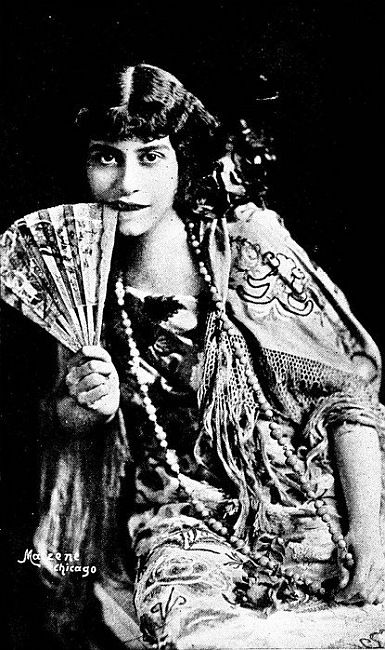
from a photograph by Matzene
Tarquinia Tarquini as Conchita
I — II — III
Four modern operas stand out as Spanish in
subject and atmosphere. I would put at the top
of the list Zandonai's Conchita; the Italian composer
has caught on his musical palette and transferred
to his tonal canvas a deal of the lazy restless
colour of the Iberian peninsula in this little
master-work. The feeling of the streets and patios
is admirably caught. My friend, Pitts Sanborn,
said of it, after its solitary performance at
the Metropolitan Opera House in New York by
the Chicago Opera Company, "There is musical
atmosphere of a rare and penetrating kind; there
is colour used with the discretion of a master;
there are intoxicating rhythms, and above the orchestra
the voices are heard in a truthful musical
speech.... Ever since Carmen it has been so
easy to write Spanish music and achieve supremely
the banal. Here there is as little of the Spanish
of convention as in Debussy's Iberia, but there is
Spain." This opera, based on Pierre Louÿs's
sadic novel, "La Femme et le Pantin," owed some
of its extraordinary impression of vitality to the
vivid performance given of the title-rôle by Tarquinia
Tarquini. Raoul Laparra, born in Bordeaux,
but who has travelled much in Spain, has
written two Spanish operas, La Habanera and La
Jota, both named after popular Spanish dances
and both produced at the Opéra-Comique in
Paris. I have heard La Habanera there and
found the composer's use of the dance as a pivot
of a tragedy very convincing. Nor shall I forget
the first act-close, in which a young man, seated
on a wall facing the window of a house where a
most bloody murder has been committed, sings a
wild Spanish ditty, accompanying himself on the
guitar, crossing and recrossing his legs in complete
abandonment to the rhythm, while in the
house rises the wild treble cry of a frightened
child. I have not heard La Jota, nor have I seen
the score. I do not find Emile Vuillermoz enthusiastic
in his review ("S. I. M.," May 15, 1911):
"Une danse transforme le premier acte en un
kaléidoscope frénétique et le combat dans l'église
doit donner, au second, dans l'intention de l'auteur
'une sensation à pic, un peu comme celle d'un
puits où grouillerait la besogne monstreuse de
larves humaines.' A vrai dire ces deux tableaux de
cinématographe papillotant, corsés de cris, de
hurlements et d'un nombre incalculable de coups de
feu constituent pour le spectator une épreuve physiquement
douloureuse, une hallucination confuse
et inquiétante, un cauchemar assourdissant qui le
conduisent irrésistiblement à l'hébétude et à la
migraine. Dans tout cet enfer que devient la
musique?" Perhaps opera-goers in general are
not looking for thrills of this order; the fact remains
that La Jota has had a modest career when
compared with La Habanera, which has even been
performed in Boston. Carmen is essentially a
French opera; the leading emotions of the characters
are expressed in an idiom as French as that
of Gounod; yet the dances and entr'actes are
Spanish in colour. The story of Carmen's entrance
song is worth retelling in Mr. Philip Hale's
words ("Boston Symphony Orchestra Programme
Notes"; 1914-15, P. 287): "Mme. Galli-Marié
disliked her entrance air, which was in 6-8 time
with a chorus. She wished something more audacious,
a song in which she could bring into play
the whole battery of her perversités artistiques,
to borrow Charles Pigot's phrase: 'caressing
tones and smiles, voluptuous inflections, killing
glances, disturbing gestures.' During the rehearsals
Bizet made a dozen versions. The singer
was satisfied only with the thirteenth, the now familiar
Habanera, based on an old Spanish tune
that had been used by Sebastian Yradier. This
brought Bizet into trouble, for Yradier's publisher,
Heugel, demanded that the indebtedness
should be acknowledged in Bizet's score. Yradier
made no complaint, but to avoid a lawsuit or a
scandal, Bizet gave consent, and on the first page
of the Habanera in the French edition of Carmen
this line is engraved: 'Imitated from a Spanish
song, the property of the publishers of Le Ménestrel.'"
There are other operas the scenes of which are
laid in Spain. Some of them make an attempt
at Spanish colouring, more do not. Massenet
wrote no less than five operas on Spanish subjects,
Le Cid, Chérubin, Don César de Bazán, La Navarraise
and Don Quichotte (Cervantes's novel has
frequently lured the composers of lyric dramas
with its story; Clément et Larousse give a long
list of Don Quixote operas, but they do not include
one by Manuel García, which is mentioned in John
Towers's compilation, "Dictionary-Catalogue of
Operas." However, not a single one of these lyric
dramas has held its place on the stage). The
Spanish dances in Le Cid are frequently performed,
although the opera is not. The most famous of
the set is called simply Aragonaise; it is not a jota.
Pleurez, mes yeux, the principal air of the piece,
can scarcely be called Spanish. There is a delightful
suggestion of the jota in La Navarraise.
In Don Quichotte la belle Dulcinée sings one of her
airs to her own guitar strummings, and much was
made of the fact, before the original production at
Monte Carlo, of Mme. Lucy Arbell's lessons on
that instrument. Mary Garden, who had learned
to dance for Salome, took no guitar lessons for
Don Quichotte. But is not the guitar an anachronism
in this opera? In a pamphlet by Don
Cecilio de Roda, issued during the celebration of
the tercentenary of the publication of Cervantes's
romance, taking as its subject the musical references
in the work, I find, "The harp was the aristocratic
instrument most favoured by women and
it would appear to be regarded in Don Quixote as
the feminine instrument par excellence." Was
the guitar as we know it in existence at that
epoch? I think the vihuela was the guitar of the
period.... Maurice Ravel wrote a Spanish opera,
l'Heure Espagnole (one act, performed at
the Paris Opéra-Comique, 1911). Octave Séré
("Musiciens français d'Aujourd'hui") says of it:
"Les principaux traits de son caractère et l'influence
du sol natal s'y combinent étrangement. De
l'alliance de la mer et du Pays Basque (Ravel was
born in the Basses-Pyrénées, near the sea) est née
une musique à la fois fluide et nerveusement rythmée,
mobile, chatoyante, amie du pittoresque et
dont le trait net et précis est plus incisif que profond."
Hugo Wolf's opera Der Corregidor is
founded on the novel, "El Sombrero de tres Picos,"
of the Spanish writer, Pedro de Alarcón (1833-91).
His unfinished opera Manuel Venegas also
has a Spanish subject, suggested by Alarcón's "El
Niño de la Bola." Other Spanish operas are Beethoven's
Fidelio, Balfe's The Rose of Castile, Verdi's
Ernani and Il Trovatore, Rossini's Il Barbiere
di Siviglia, Mozart's Don Giovanni and Le Nozze
di Figaro, Weber's Preciosa (really a play with incidental
music), Dargomijsky's The Stone Guest
(Pushkin's version of the Don Juan story. This
opera, by the way, was one of the many retouched
and completed by Rimsky-Korsakow), Reznicek's
Donna Diana—and Wagner's Parsifal! The
American composer John Knowles Paine's opera
Azara, dealing with a Moorish subject, has, I
think, never been performed.
The early religious composers of Spain deserve
a niche all to themselves, be it ever so tiny, as in
the present instance. There is, to be sure, some
doubt as to whether their inspiration was entirely
peninsular, or whether some of it was wafted from
Flanders, and the rest gleaned in Rome, for in
their service to the church most of them migrated
to Italy and did their best work there. It is not
the purpose of the present chronicler to devote
much space to these early men, or to discuss in detail
their music. There are no books in English
devoted to a study of Spanish music, and few in
any language, but what few exist take good care
to relate at considerable length (some of them with
frequent musical quotation) the state of music in
Spain in the sixteenth, seventeenth, and eighteenth
centuries, the golden period. To the reader who
may wish to pursue this phase of our subject I
offer a small bibliography. There is first of all
A. Soubies's two volumes, "Histoire de la Musique
d'Espagne," published in 1889. The second
volume takes us through the eighteenth century.
The religious and early secular composers are
catalogued in these volumes, but there is little attempt
at detail, and he is a happy composer who
is awarded an entire page. Soubies does not find
occasion to pause for more than a paragraph on
most of his subjects. Occasionally, however, he
lightens the plodding progress of the reader, as
when he quotes Father Bermudo's "Declaración
de Instrumentos" (1548; the 1555 edition is in
the Library of Congress at Washington):
"There are three kinds of instruments in music.
The first are called natural; these are men, of
whom the song is called musical harmony. Others
are artificial and are played by the touch—such
as the harp, the vihuela (the ancient guitar, which
resembles the lute), and others like them; the
music of these is called artificial or rhythmic. The
third species is pneumatique and includes instruments
such as the flute, the douçaine (a species of
oboe), and the organ." There may be some to
dispute this ingenious and highly original classification.
The best known, and perhaps the most
useful (because it is easily accessible) history of
Spanish music is that written by Mariano Soriano
Fuertes, in four volumes: "Historia de la Música
Española desde la venida de los Fenicios hasta el
año de 1850"; published in Barcelona and Madrid
in 1855. There is further the "Diccionario Técnico,
Histórico, y Biográfico de la Música," by
José Parada y Barreto (Madrid, 1867). This,
of course, is a general work on music, but Spain
gets her full due. For example, a page and a half
is devoted to Beethoven, and nine pages to Eslava.
It is to this latter composer to whom we must turn
for the most complete and important work on
Spanish church music: "Lira Sacro-Hispana"
(Madrid, 1869), in ten volumes, with voluminous
extracts from the composers' works. This collection
of Spanish church music from the sixteenth
century through the eighteenth, with biographical
notices of the composers is out of print and rare
(there is a copy in the Congressional Library at
Washington). As a complement to it I may mention
Felipe Pedrell's "Hispaniae Schola Musica
Sacra," begun in 1894, which has already reached
the proportions of Eslava's work. Pedrell, who
was the master of Enrique Granados, has also issued
a fine edition of the music of Victoria.
The Spanish composers had their full share in
the process of crystallizing music into forms of
permanent beauty during the sixteenth and seventeenth
centuries. Rockstro asserts that during
the early part of the sixteenth century nearly all
the best composers for the great Roman choirs
were Spaniards. But their greatest achievement
was the foundation of the school of which Palestrina
was the crown. On the music of their own
country their influence is less perceptible. I think
the name of Cristofero Morales (1512-53) is the
first important name in the history of Spanish
music. He preceded Palestrina in Rome and
some of his masses and motets are still sung in the
Papal chapel there (and in other Roman Catholic
edifices and by choral societies). Francisco
Guerrero (1528-99; these dates are approximate)
was a pupil of Morales. He wrote settings of the
Passion choruses according to St. Matthew and
St. John and numerous masses and motets.
Tomás Luis de Victoria is, of course, the greatest
figure in Spanish music, and next to Palestrina
(with whom he worked contemporaneously) the
greatest figure in sixteenth century music. Soubies
writes: "One might say that on his musical
palette he has entirely at his disposition, in some
sort, the glowing colour of Zurbaran, the realistic
and transparent tones of Velasquez, the ideal
shades of Juan de Juanes and Murillo. His mysticism
is that of Santa Theresa and San Juan de
la Cruz." The music of Victoria is still very
much alive and may be heard even in New York,
occasionally, through the medium of the Musical
Art Society. Whether it is performed in churches
in America or not I do not know; the Roman choirs
still sing it....
The list might be extended indefinitely ... but
the great names I have given. There are Cabezón,
whom Pedrell calls the "Spanish Bach," Navarro,
Caseda, Gomes, Ribera, Castillo, Lobo, Durón,
Romero, Juarez. On the whole I think these
composers had more influence on Rome—the
Spanish nature is more reverent than the Italian—than
on Spain. The modern Spanish composers
have learned more from the folk-song and
dance than they have from the church composers.
However, there are voices which dissent from this
opinion. G. Tebaldini ("Rivista Musicale," Vol.
IV, Pp. 267 and 494) says that Pedrell in his
studies learned much which he turned to account in
the choral writing of his operas. And Felipe Pedrell
himself asserts that there is an unbroken chain
between the religious composers of the sixteenth
century and the theatrical composers of the seventeenth.
We may follow him thus far without
believing that the theatrical composers of the seventeenth
century had too great an influence on the
secular composers of the present day.
All the world dances in Spain, at least it would
seem so, in reading over the books of the Marco
Polos who have made voyages of discovery on the
Iberian peninsula. Guitars seem to be as common
there as pea-shooters in New England, and strumming
seems to set the feet a-tapping and voices
a-singing, what, they care not. (Havelock Ellis
says: "It is not always agreeable to the Spaniard
to find that dancing is regarded by the foreigner
as a peculiar and important Spanish institution.
Even Valera, with his wide culture, could
not escape this feeling; in a review of a book about
Spain by an American author entitled 'The Land
of the Castanet'—a book which he recognized as
full of appreciation for Spain—Valera resented
the title. It is, he says, as though a book about
the United States should be called 'The Land of
Bacon.'") Oriental colour is streaked through
and through the melodies and harmonies, many of
which betray their Arabian origin; others are
flamenco, or gipsy. The dances, almost invariably
accompanied by song, are generally in 3-4
time or its variants such as 6-8 or 3-8; the tango,
of course, is in 2-4. But the dancers evolve the
most elaborate inter-rhythms out of these simple
measures, creating thereby a complexity of effect
which defies any comprehensible notation on paper.
As it is on this fioritura, if I may be permitted
to use the word in this connection, of the
dancer that the sophisticated composer bases some
of his most natural and national effects, I shall
linger on the subject. La Argentina has re-arranged
many of the Spanish dances for purposes
of the concert stage, but in her translation she has
retained in a large measure this interesting complication
of rhythm, marking the irregularity of
the beat, now with a singularly complicated detonation
of heel-tapping, now with a sudden bend
of a knee, now with the subtle quiver of an eyelash,
now with a shower of castanet sparks (an instrument
which requires a hard tutelage for its
complete mastery; Richard Ford tells us that even
the children in the streets of Spain rap shells together,
to become self-taught artists in the use of
it). Chabrier, in his visit to Spain with his wife
in 1882, attempted to note down some of these
rhythmic variations achieved by the dancers while
the musicians strummed their guitars, and he was
partially successful. But all in all he only succeeded
in giving in a single measure each variation;
he did not attempt to weave them into the
intricate pattern which the Spanish women contrive
to make of them.
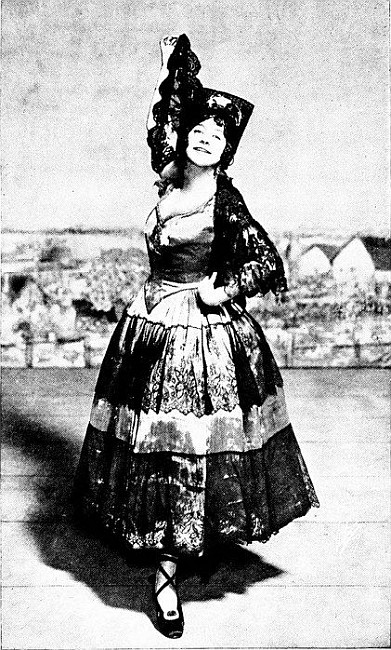
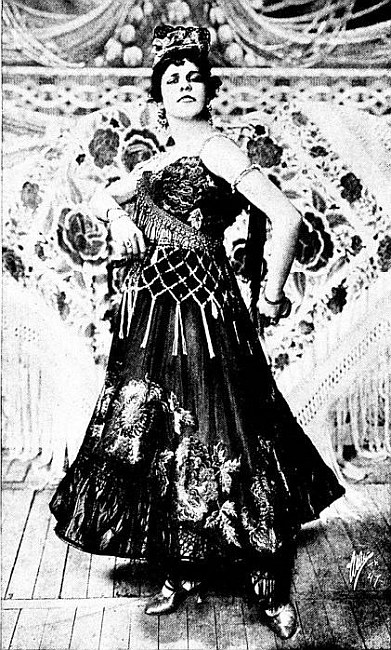
from a photograph by White
La Argentina
IV — V — VI
There is a singular similarity to be observed between
this heel-tapping and the complicated drum-tapping
of the African negroes of certain tribes.
In his book "Afro-American Folksongs" H. E.
Krehbiel thus describes the musical accompaniment
of the dances in the Dahoman Village at
the World's Columbian Exposition in Chicago:
"These dances were accompanied by choral song
and the rhythmical and harmonious beating of
drums and bells, the song being in unison. The
harmony was a tonic major triad broken up
rhythmically in a most intricate and amazingly ingenious
manner. The instruments were tuned
with excellent justness. The fundamental tone
came from a drum made of a hollowed log about
three feet long with a single head, played by one
who seemed to be the leader of the band, though
there was no giving of signals. This drum was
beaten with the palms of the hands. A variety of
smaller drums, some with one, some with two
heads, were beaten variously with sticks and fingers.
The bells, four in number, were of iron and
were held mouth upward and struck with sticks.
The players showed the most remarkable rhythmical
sense and skill that ever came under my notice.
Berlioz in his supremest effort with his
army of drummers produced nothing to compare
in artistic interest with the harmonious drumming
of these savages. The fundamental effect was a
combination of double and triple time, the former
kept by the singers, the latter by the drummers,
but it is impossible to convey the idea of the
wealth of detail achieved by the drummers by
means of exchange of the rhythms, syncopation of
both simultaneously, and dynamic devices. Only
by making a score of the music could this have
been done. I attempted to make such a score by
enlisting the help of the late John C. Filmore, experienced
in Indian music, but we were thwarted
by the players who, evidently divining our purpose
when we took out our notebooks, mischievously
changed their manner of playing as soon as we
touched pencil to paper."
The resemblance between negro and Spanish
music is very noticeable. Mr. Krehbiel says that
in South America Spanish melody has been imposed
on negro rhythm. In the dances of the people
of Spain, as Chabrier points out, the melody
is often practically nil; the effect is rhythmic (an
effect which is emphasized by the obvious harmonic
and melodic limitations of the guitar, which invariably
accompanies all singers and dancers).
If there were a melody or if the guitarists played
well (which they usually do not) one could not
distinguish its contours what with the cries of Olé!
and the heel-beats of the performers. Spanish
melodies, indeed, are often scraps of tunes, like
the African negro melodies. The habanera is a
true African dance, taken to Spain by way of
Cuba, as Albert Friedenthal points out in his book,
"Musik, Tanz, und Dichtung bei den Kreolen
Amerikas." Whoever was responsible, Arab, negro,
or Moor (Havelock Ellis says that the dances
of Spain are closely allied with the ancient dances
of Greece and Egypt), the Spanish dances betray
their oriental origin in their complexity of rhythm
(a complexity not at all obvious on the printed
page, as so much of it depends on dancer, guitarist,
singer, and even public!), and the fioriture
which decorate their melody when melody occurs.
While Spanish religious music is perhaps not distinctively
Spanish, the dances invariably display
marked national characteristics; it is on these,
then (some in greater, some in less degree), that
the composers in and out of Spain have built their
most atmospheric inspirations, their best pictures
of popular life in the Iberian peninsula. A good
deal of the interest of this music is due to the important
part the guitar plays in its construction;
the modulations are often contrary to all rules of
harmony and (yet, some would say) the music
seems to be effervescent with variety and fire. Of
the guitarists Richard Ford ("Gatherings from
Spain") says: "The performers seldom are
very scientific musicians; they content themselves
with striking the chords, sweeping the whole hand
over the strings, or flourishing, and tapping the
board with the thumb, at which they are very expert.
Occasionally in the towns there is some
one who has attained more power over this ungrateful
instrument; but the attempt is a failure.
The guitar responds coldly to Italian words and
elaborate melody, which never come home to Spanish
ears or hearts." (An exception must be made
in the case of Miguel Llobet. I first heard him
play at Pitts Sanborn's concert at the Punch and
Judy Theatre (April 17, 1916) for the benefit of
Hospital 28 in Bourges, France, and he made a
deep impression on me. In one of his numbers,
the Spanish Fantasy of Farrega, he astounded
and thrilled me. He seemed at all times to exceed
the capacity of his instrument, obtaining a variety
of colour which was truly amazing. In this particular
number he not only plucked the keyboard
but the fingerboard as well, in intricate and rapid
tempo; seemingly two different kinds of instruments
were playing. But at all times he variated
his tone; sometimes he made the instrument sound
almost as though it had been played by wind and
not plucked. Especially did I note a suggestion
of the bagpipe. A true artist. None of the music,
the fantasy mentioned, a serenade of Albéniz,
and a Menuet of Tor, was particularly interesting,
although the Fantasia contained some fascinating
references to folk-dance tunes. There is
nothing sensational about Llobet, a quiet prim
sort of man; he sits quietly in his chair and makes
music. It might be a harp or a 'cello—no striving
for personal effect.)
The Spanish dances are infinite in number and
for centuries back they seem to form part and
parcel of Spanish life. Discussion as to how they
are danced is a feature of the descriptions. No
two authors agree, it would seem; to a mere annotator
the fact is evident that they are danced
differently on different occasions. It is obvious
that they are danced differently in different provinces.
The Spaniards, as Richard Ford points
out, are not too willing to give information to
strangers, frequently because they themselves lack
the knowledge. Their statements are often misleading,
sometimes intentionally so. They do not
understand the historical temperament. Until recently
many of the art treasures and archives of
the peninsula were but poorly kept. Those who
lived in the shadow of the Alhambra admired only
its shade. It may be imagined that there has been
even less interest displayed in recording the folk-dances.
"Dancing in Spain is now a matter
which few know anything about," writes Havelock
Ellis, "because every one takes it for granted
that he knows all about it; and any question on
the subject receives a very ready answer which is
usually of questionable correctness." Of the music
of the dances we have many records, and that
they are generally in 3-4 time or its variants we
may be certain. As to whether they are danced
by two women, a woman and a man, or a woman
alone, the authorities do not always agree. The
confusion is added to by the oracular attitude of
the scribes. It seems quite certain to me that this
procedure varies. That the animated picture almost
invariably possesses great fascination there
are only too many witnesses to prove. I myself
can testify to the marvel of some of them, set to
be sure in strange frames, the Feria in Paris, for
example; but even without the surroundings, which
Spanish dances demand, the diablerie, the shivering
intensity of these fleshly women, always wound
tight with such shawls as only the mistresses of
kings might wear in other countries, have drawn
taut the real thrill. It is dancing which enlists the
co-operation not only of the feet and legs, but of
the arms and, in fact, the entire body.
The smart world in Spain today dances much
as the smart world does anywhere else, although it
does not, I am told, hold a brief for our tango,
which Mr. Krehbiel suggests is a corruption of the
original African habanera. But in older days
many of the dances, such as the pavana, the sarabande,
and the gallarda, were danced at the court
and were in favour with the nobility. (Although
presumably of Italian origin, the pavana and gallarda
were more popular in Spain than in Rome.
Fuertes says that the sarabande was invented in
the middle of the sixteenth century by a dancer
called Zarabanda who was a native of either Seville
or Guayaquil.) The pavana, an ancient dance of
grave and stately measure, was much in vogue in
the sixteenth and seventeenth centuries. An explanation
of its name is that the figures executed
by the dancers bore a resemblance to the semi-circular
wheel-like spreading of the tail of a peacock.
The gallarda (French, gaillard) was usually
danced as a relief to the pavana (and indeed
often follows it in the dance-suites of the classical
composers in which these forms all figure). The
jacara, or more properly xacara, of the sixteenth
century, was danced in accompaniment to a romantic,
swashbuckling ditty. The Spanish folias
were a set of dances danced to a simple tune treated
in a variety of styles with very free accompaniment
of castanets and bursts of song. Corelli in
Rome in 1700 published twenty-four variations in
this form, which have been played in our day by
Fritz Kreisler and other violinists.
The names of the modern Spanish dances are
often confused in the descriptions offered by observing
travellers, for the reasons already noted.
Hundreds of these descriptions exist, and it is difficult
to choose the most telling of them. Gertrude
Stein, who has spent the last two years in Spain,
has noted the rhythm of several of these dances by
the mingling of her original use of words with the
ingratiating medium of vers libre. She has succeeded,
I think, better than some musicians in suggesting
the intricacies of the rhythm. I should
like to transcribe one of these attempts here, but
that I have not the right to do as I have only seen
them in manuscript; they have not yet appeared in
print. These pieces are in a sense the thing itself—I
shall have to fall back on descriptions of
the thing. The tirana, a dance common to the
province of Andalusia, is accompanied by song.
It has a decided rhythm, affording opportunities
for grace and gesture, the women toying with their
aprons, the men flourishing hats and handkerchiefs.
The polo, or ole, is now a gipsy dance.
Mr. Ellis asserts that it is a corruption of the
sarabande! He goes on to say, "The so-called
gipsy dances of Spain are Spanish dances which
the Spaniards are tending to relinquish but which
the gipsies have taken up with energy and skill."
(This theory might be warmly contested.) The
bolero, a comparatively modern dance, came to
Spain through Italy. Mr. Philip Hale points out
the fact that the bolero and the cachucha (which,
by the way, one seldom hears of nowadays) were
the popular Spanish dances when Mesdames Faviani
and Dolores Tesrai, and their followers, Mlle.
Noblet and Fanny Elssler, visited Paris. Fanny
Elssler indeed is most frequently seen pictured in
Spanish costume, and the cachucha was danced by
her as often, I fancy, as Mme. Pavlowa dances Le
Cygne of Saint-Saëns. Marie-Anne de Camargo,
who acquired great fame as a dancer in France in
the early eighteenth century, was born in Brussels
but was of Spanish descent. She relied, however, on
the Italian classic style for her success rather than
on national Spanish dances. The seguidilla is a
gipsy dance which has the same rhythm as the
bolero but is more animated and stirring. Examples
of these dances, and of the jota, fandango,
and the sevillana, are to be met with in the compositions
listed in the first section of this article, in
the appendices of Soriano Fuertes's "History of
Spanish Music," in Grove's Dictionary, in the
numbers of "S. I. M." in which the letters of Emmanuel
Chabrier occur, and in collections made by
P. Lacome, published in Paris.
The jota is another dance in 3-4 time. Every
province in Spain has its own jota, but the most
famous variations are those of Aragón, Valencia,
and Navarre. It is accompanied by the guitar,
the bandarria (similar to the guitar), small drum,
castanets, and triangle. Mr. Hale says that its
origin in the twelfth century is attributed to a
Moor named Alben Jot who fled from Valencia to
Aragón. "The jota," he continues, "is danced
not only at merrymakings but at certain religious
festivals and even in watching the dead. One
called the 'Natividad del Señor' (nativity of our
Lord) is danced on Christmas eve in Aragón, and
is accompanied by songs, and jotas are sung and
danced at the crossroads, invoking the favour of
the Virgin, when the festival of Our Lady del Pilar
is celebrated at Saragossa."
Havelock Ellis's description of the jota is worth
reproducing: "The Aragonaise jota, the most
important and typical dance outside Andalusia, is
danced by a man and a woman, and is a kind of
combat between them; most of the time they are
facing each other, both using castanets and advancing
and retreating in an apparently aggressive
manner, the arms alternately slightly raised
and lowered, and the legs, with a seeming attempt
to trip the partner, kicking out alternately somewhat
sidewise, as the body is rapidly supported
first on one side and then on the other. It is a
monotonous dance, with immense rapidity and vivacity
in its monotony, but it has not the deliberate
grace and fascination, the happy audacities
of Andalusian dancing. There is, indeed, no
faintest suggestion of voluptuousness in it, but it
may rather be said, in the words of a modern poet,
Salvador Rueda, to have in it 'the sound of helmets
and plumes and lances and banners, the roaring
of cannon, the neighing of horses, the shock of
swords.'"
Chabrier, in his astounding and amusing letters
from Spain, gives us vivid pictures and interesting
information. This one, written to his friend,
Edouard Moullé, from Granada, November 4,
1882, appeared in "S. I. M." April 15, 1911 (I
have omitted the musical illustrations, which, however,
possess great value for the student): "In a
month I must leave adorable Spain ... and say
good-bye to the Spaniards,—because, I say this
only to you, they are very nice, the little girls! I
have not seen a really ugly woman since I have
been in Andalusia: I do not speak of the feet, they
are so small that I have never seen them; the hands
are tiny and well-kept and the arms of an exquisite
contour; I speak only of what one can see,
but they show a good deal; add the arabesques, the
side-curls, and other ingenuities of the coiffure,
the inevitable fan, the flower and the comb in the
hair, placed well behind, the shawl of Chinese
crêpe, with long fringe and embroidered in flowers,
knotted around the figure, the arm bare, and the
eye protected by eyelashes which are long enough
to curl; the skin of dull white or orange colour,
according to the race, all this smiling, gesticulating,
dancing, drinking, and careless to the last degree...
"That is the Andalusian.
"Every evening we go with Alice to the café-concerts
where the malagueñas, the Soledas, the
Sapateados, and the Peteneras are sung; then the
dances, absolutely Arab, to speak truth; if you
could see them wriggle, unjoint their hips, contortion,
I believe you would not try to get away!...
At Málaga the dancing became so intense that I
was compelled to take my wife away; it wasn't even
amusing any more. I can't write about it, but I
remember it and I will describe it to you.—I have
no need to tell you that I have noted down many
things; the tango, a kind of dance in which the
women imitate the pitching of a ship (le tangage
du navire) is the only dance in 2 time; all the others,
all, are in 3-4 (Seville) or in 3-8 (Málaga and
Cadiz);—in the North it is different, there is
some music in 5-8, very curious. The 2-4 of the
tango is always like the habanera; this is the picture:
one or two women dance, two silly men play
it doesn't matter what on their guitars, and five
or six women howl, with excruciating voices and in
triplet figures impossible to note down because
they change the air—every instant a new scrap
of tune. They howl a series of figurations with
syllables, words, rising voices, clapping hands
which strike the six quavers, emphasizing the third
and the sixth, cries of Anda! Anda! La Salud!
eso es la Maraquita! gracia, nationidad! Baila,
la chiquilla! Anda! Anda! Consuelo! Olé, la
Lola, olé la Carmen! qué gracia! qué elegancia! all
that to excite the young dancer. It is vertiginous—it
is unspeakable!
"The Sevillana is another thing: it is in 3-4
time (and with castanets).... All this becomes
extraordinarily alluring with two curls, a pair of
castanets and a guitar. It is impossible to write
down the malagueña. It is a melopœia, however,
which has a form and which always ends on the
dominant, to which the guitar furnishes 3-8 time,
and the spectator (when there is one) seated beside
the guitarist, holds a cane between his legs
and beats the syncopated rhythm; the dancers
themselves instinctively syncopate the measures in
a thousand ways, striking with their heels an unbelievable
number of rhythms.... It is all
rhythm and dance: the airs scraped out by the
guitarist have no value; besides, they cannot be
heard on account of the cries of Anda! la chiquilla!
qué gracia! qué elegancia! Anda! Olé!
Olé! la chiquirritita! and the more the cries the
more the dancer laughs with her mouth wide open,
and turns her hips, and is mad with her
body...."
As it is on these dances that composers invariably
base their Spanish music (not alone Albéniz,
Chapí, Bretón, and Granados, but Chabrier,
Ravel, Laparra, and Bizet, as well) we may linger
somewhat longer on their delights. The following
compelling description is from Richard Ford's
highly readable "Gatherings from Spain":
"The dance which is closely analogous to the
Ghowasee of the Egyptians, and the Nautch of
the Hindoos, is called the Olé by Spaniards, the
Romalis by their gipsies; the soul and essence of
it consists in the expression of a certain sentiment,
one not indeed of a very sentimental or correct
character. The ladies, who seem to have no
bones, resolve the problem of perpetual motion,
their feet having comparatively a sinecure, as the
whole person performs a pantomime, and trembles
like an aspen leaf; the flexible form and Terpsichore
figure of a young Andalusian girl—be
she gipsy or not—is said, by the learned, to
have been designed by nature as the fit frame for
her voluptuous imagination.
"Be that as it may, the scholar and classical
commentator will every moment quote Martial,
etc., when he beholds the unchanged balancing of
hands, raised as if to catch showers of roses, the
tapping of the feet, and the serpentine quivering
movements. A contagious excitement seizes the
spectators, who, like Orientals, beat time with
their hands in measured cadence, and at every
pause applaud with cries and clappings. The
damsels, thus encouraged, continue in violent
action until nature is all but exhausted; then
aniseed brandy, wine, and alpisteras are handed
about, and the fête, carried on to early dawn,
often concludes in broken heads, which here are
called 'gipsy's fare.' These dances appear, to a
stranger from the chilly north, to be more marked
by energy than by grace, nor have the legs less
to do than the body, hips, and arms. The sight
of this unchanged pastime of antiquity, which excites
the Spaniard to frenzy, rather disgusts an
English spectator, possibly from some national
malorganization, for, as Molière says, 'l'Angleterre
a produit des grands hommes dans les
sciences et les beaux arts, mais pas un grand
danseur—allez lire l'histoire.'" (A fact as true
in our day as it was in Molière's.)
On certain days the sevillana is danced before
the high altar of the cathedral at Seville. The
Reverend Henry Cart de Lafontaine ("Proceedings
of the Musical Association"; London, thirty-third
session, 1906-7) gives the following account
of it, quoting a "French author": "While
Louis XIII was reigning over France, the Pope
heard much talk of the Spanish dance called the
'Sevillana.' He wished to satisfy himself, by actual
eye-witness, as to the character of this dance,
and expressed his wish to a bishop of the diocese of
Seville, who every year visited Rome. Evil
tongues make the bishop responsible for the primary
suggestion of the idea. Be that as it may,
the bishop, on his return to Seville, had twelve
youths well instructed in all the intricate measures
of this Andalusian dance. He had to choose
youths, for how could he present maidens to the
horrified glance of the Holy Father? When his
little troop was thoroughly schooled and perfected,
he took the party to Rome, and the audience
was arranged. The 'Sevillana' was danced
in one of the rooms of the Vatican. The Pope
warmly complimented the young executants, who
were dressed in beautiful silk costumes of the
period. The bishop humbly asked for permission
to perform this dance at certain fêtes in the
cathedral church at Seville, and further pleaded
for a restriction of this privilege to that church
alone. The Pope, hoist by his own petard, did
not like to refuse, but granted the privilege with
this restriction, that it should only last so long as
the costumes of the dancers were wearable. Needless
to say, these costumes are, therefore, objects
of constant repair, but they are supposed to
retain their identity even to this day. And this
is the reason why the twelve boys who dance the
'Sevillana' before the high altar in the cathedral
on certain feast days are dressed in the costume
belonging to the reign of Louis XIII."
This is a very pretty story, but it is not uncontradicted....
Has any statement been made
about Spanish dancing or music which has been
allowed to go uncontradicted? Look upon that
picture and upon this: "As far as it is possible
to ascertain from records," says Rhoda G. Edwards
in the "Musical Standard," "this dance
would seem always to have been in use in Seville
cathedral; when the town was taken from the
Moors in the thirteenth century it was undoubtedly
an established custom and in 1428 we find the six
boys recognized as an integral part of the chapter
by Pope Eugenius IV. The dance is known as
the (sic) 'Los Scises,' or dance of the six boys
who, with four others, dance it before the high
altar at Benediction on the three evenings before
Lent and in the octaves of Corpus Christi and La
Purissima (the conception of Our Lady). The
dress of the boys is most picturesque, page costumes
of the time of Philip III being worn, blue
for La Purissima and red satin doublets slashed
with blue for the other occasion; white hats with
blue and white feathers are also worn whilst
dancing. The dance is usually of twenty-five
minutes' duration and in form seems quite unique,
not resembling any of the other Spanish dance-forms,
or in fact those of any other country.
The boys accompany the symphony on castanets
and sing a hymn in two parts whilst dancing."
From another author we learn that religious
dancing is to be seen elsewhere in Spain than at
Seville cathedral. At one time, it is said to have
been common. The pilgrims to the shrine of the
Virgin at Montserrat were wont to dance, and
dancing took place in the churches of Valencia,
Toledo, and Jerez. Religious dancing continued
to be common, especially in Catalonia up to the
seventeenth century. An account of the dance
in the Seville cathedral may be found in "Los
Españoles Pintados por si Mismos" (pages
287-91).
This very incomplete and rambling record of
Spanish dancing should include some mention of
the fandango. The origin of the word is obscure,
but the dance is obviously one of the gayest
and wildest of the Spanish dances. Like the
malagueña it is in 3-8 time, but it is quite different
in spirit from that sensuous form of terpsichorean
enjoyment. La Argentina informs me
that "fandango" in Spanish suggests very much
what "bachanale" does in English or French.
It is a very old dance, and may be a survival of
a Moorish dance, as Desrat suggests. Mr. Philip
Hale found the following account of it somewhere:
"Like an electric shock, the notes of the
fandango animate all hearts. Men and women,
young and old, acknowledge the power of this air
over the ears and soul of every Spaniard. The
young men spring to their places, rattling castanets,
or imitating their sound by snapping their
fingers. The girls are remarkable for the willowy
languor and lightness of their movements,
the voluptuousness of their attitudes—beating
the exactest time with tapping heels. Partners
tease and entreat and pursue each other by turns.
Suddenly the music stops, and each dancer shows
his skill by remaining absolutely motionless,
bounding again in the full life of the fandango as
the orchestra strikes up. The sound of the guitar,
the violin, the rapid tic-tac of heels
(taconeos), the crack of fingers and castanets,
the supple swaying of the dancers, fill the spectators
with ecstasy.
"The music whirls along in a rapid triple time.
Spangles glitter; the sharp clank of ivory and
ebony castanets beats out the cadence of strange,
throbbing, deafening notes—assonances unknown
to music, but curiously characteristic,
effective, and intoxicating. Amidst the rustle of
silks, smiles gleam over white teeth, dark eyes
sparkle and droop, and flash up again in flame.
All is flutter and glitter, grace and animation—quivering,
sonorous, passionate, seductive. Olé!
Olé! Faces beam and burn. Olé! Olé!
"The bolero intoxicates, the fandango inflames."
It can be well understood that the study of
Spanish dancing and its music must be carried on
in Spain. Mr. Ellis tells us why: "Another
characteristic of Spanish dancing, and especially
of the most typical kind called flamenco, lies in its
accompaniments, and particularly in the fact that
under proper conditions all the spectators are
themselves performers.... Thus it is that at
the end of a dance an absolute silence often falls,
with no sound of applause: the relation of performers
and public has ceased to exist.... The
finest Spanish dancing is at once killed or degraded
by the presence of an indifferent or unsympathetic
public, and that is probably why it cannot be
transplanted, but remains local."
At the end of a dance an absolute silence often
falls.... I am again in an underground café
in Amsterdam. It is the eve of the Queen's birthday,
and the Dutch are celebrating. The low,
smoke-wreathed room is crowded with students,
soldiers, and women. Now a weazened female
takes her place at the piano, on a slightly raised
platform at one side of the room. She begins to
play. The dancing begins. It is not woman with
man; the dancing is informal. Some dance together,
and some dance alone; some sing the
melody of the tune, others shriek, but all make a
noise. Faster and faster and louder and louder
the music is pounded out, and the dancing becomes
wilder and wilder. A tray of glasses is kicked
from the upturned palm of a sweaty waiter.
Waiter, broken glass, dancer, all lie, a laughing
heap, on the floor. A soldier and a woman stand
in opposite corners, facing the corners; then without
turning, they back towards the middle of the
room at a furious pace; the collision is appalling.
Hand in hand the mad dancers encircle the room,
throwing confetti, beer, anything. A heavy stein
crushes two teeth—the wound bleeds—but the
dancer does not stop. Noise and action and
colour all become synonymous. There is no
escape from the force. I am dragged into the
circle. Suddenly the music stops. All the
dancers stop. The soldier no longer looks at the
woman by his side; not a word is spoken. People
lumber towards chairs. The woman looks for a
glass of water to assuage the pain of her bleeding
mouth. I think Jaques-Dalcroze is right when
he seeks to unite spectator and actor, drama and
public.
In the preceding section I may have too
strongly insisted upon the relation of the folk-song
to the dance. It is true that the two are
seldom separated in performance (although not
all songs are danced; for example, the cañas and
playeras of Andalusia). However, most of the
folk-songs of Spain are intended to be danced;
they are built on dance-rhythms and they bear
the names of dances. Thus the jota is always
danced to the same music, although the variations
are great at different times and in different
provinces. It is, of course, when the folk-songs
are danced that they make their best effect, in the
polyrhythm achieved by the opposing rhythms of
guitar-player, dancer, and singer. When there is
no dancer the defect is sometimes overcome by
some one tapping a stick on the ground in imitation
of resounding heels.
Blind beggars have a habit of singing the songs,
in certain provinces, with a wealth of florid ornament,
such ornament as is always associated with
oriental airs in performance, and this ornament
still plays a considerable rôle when the vocalist
becomes an integral part of the accompaniment
for a dancer. Chabrier gives several examples of
it in one of his letters. In the circumstances it
can readily be seen that Spanish folk-songs written
down are pretty bare recollections of the real
thing, and when sung by singers who have no
knowledge of the traditional manner of performing
them they are likely to sound fairly banal.
The same thing might be said of the negro folk-songs
of America, or the folk-songs of Russia or
Hungary, but with much less truth, for the folk-songs
of these countries usually possess a melodic
interest which is seldom inherent in the folk-songs
of Spain. To make their effect they must be
performed by Spaniards, as nearly as possible
after the manner of the people. Indeed, their
spirit and their polyrhythmic effects are much
more essential to their proper interpretation than
their melody, as many witnesses have pointed out.
Spanish music, indeed, much of it, is actually
unpleasant to Western ears; it lacks the sad
monotony and the wailing intensity of true oriental
music; much of it is loud and blaring, like the
hot sunglare of the Iberian peninsula. However,
many a Western or Northern European has found
pleasure in listening by the hour to the strains,
which often sound as if they were improvised, sung
by some beggar or mountaineer.
The collections of these songs are not in any
sense complete and few of them attempt more than
a collocation of the songs of one locality or people.
Deductions have been drawn. For example it is
noted that the Basque songs are irregular in
melody and rhythm and are further marked by
unusual tempos, 5-8, or 7-4. In Aragón and
Navarre the popular song (and dance) is the
jota; in Galicia, the seguidilla; the Catalonian
songs resemble the folk-tunes of Southern France.
The Andalusian songs, like the dances of that
province, are the most beautiful of all, often truly
oriental in their rhythm and floridity. In Spain
the gipsy has become an integral part of the
popular life, and it is difficult at times to determine
what is flamenco and what is Spanish. However,
collections (few to be sure) have been attempted
of gipsy songs.
Elsewhere in this rambling article I have
touched on the villancicos and the early song-writers.
To do justice to these subjects would
require a good deal more space and a different
intention. Those who are interested in them may
pursue these matters in Pedrell's various works.
The most available collection of Spanish folk-tunes
is that issued by P. Lacome and J. Puig y
Alsubide (Paris, 1872). There are several collections
of Basque songs; Demófilo's "Colección
de Cantos Flamencos" (Seville, 1881), Cecilio
Ocón's collection of Andalusian folk-songs, and
F. Rodríguez Marín's "Cantos Populares Españoles"
(Seville, 1882-3) may also be mentioned.
After the bull-fight the most popular form of
amusement in Spain is the zarzuela, the only
distinctive art-form which Spanish music has
evolved, but there has been no progress; the form
has not changed, except perhaps to degenerate,
since its invention in the early seventeenth century.
Soriano Fuertes and other writers have
devoted pages to grieving because Spanish composers
have not taken occasion to make something
grander and more important out of the zarzuela.
The fact remains that they have not, although,
small and great alike, they have all taken a hand
at writing these entertainments. But as they
found the zarzuela, so they have left it. It must
be conceded that the form is quite distinct from
that of opera and should not be confused with it.
And the Spaniards are probably right when they
assert that the zarzuela is the mother of the
French opéra-bouffe. At least it must be admitted
that Offenbach and Lecocq and their precursors
owe something of the germ of their inspiration
to the Spanish form. Today the melody
chests of the zarzuela markets are plundered
to find tunes for French revues, and such popular
airs as La Paraguaya and Y ... Como le Vá?
were originally danced and sung in Spanish theatres.
The composer of these airs, J. Valverde
fils, indeed found the French market so good that
he migrated to Paris, and for some time has been
writing musique mélangée ... une moitié de
chaque nation. So La Rose de Grenade, composed
for Paris, might have been written for
Spain, with slight melodic alterations and tauromachian
allusions in the book.
The zarzuela is usually a one-act piece
(although sometimes it is permitted to run into
two or more acts) in which the music is freely
interrupted by spoken dialogue, and that in turn
gives way to national dances. Very often the
entire score is danced as well as sung. The subject
is usually comic and often topical, although
it may be serious, poetic, or even tragic. The
actors often introduce dialogue of their own,
"gagging" freely; sometimes they engage in long
impromptu conversations with members of the
audience. They also embroider on the music after
the fashion of the great singers of the old Italian
opera (Dr. de Lafontaine asserts that Spanish
audiences, even in cabarets, demand embroidery
of this sort). The music is spirited and lively,
and in the dances, Andalusian, flamenco, or Sevillan,
as the case may be, it attains its best results.
H. V. Hamilton, in his essay on the subject
in Grove's Dictionary, says, "The music is
... apt to be vague in form when the national
dance and folk-song forms are avoided. The
orchestration is a little blatant." It will be seen
that this description suits Granados's Goyescas
(the opera), which is on its safest ground during
the dances and becomes excessively vague at other
times; but Goyescas is not a zarzuela, because
there is no spoken dialogue. Otherwise it bears
the earmarks. A zarzuela stands somewhere between
a French revue and opéra-comique. It is
usually, however, more informal in tone than the
latter and often decidedly more serious than the
former. All the musicians in Spain since the form
was invented (excepting, of course, certain exclusively
religious composers), and most of the
poets and playwrights, have contributed numerous
examples. Thus Calderon wrote the first zarzuela,
and Lope de Vega contributed words to entertainments
much in the same order. In our day
Miguel Echegaray, brother of José Echegaray,
has written one of the most popular zarzuelas,
Gigantes y Cabezudos (the music by Caballero).
The subject is the fiesta of Santa María del Pilar.
It has had many a long run and is often revived.
Another very popular zarzuela, which was almost,
if not quite, heard in New York, is La Gran Vía
(by Valverde, père), which has been performed in
London in extended form. The principal theatres
for the zarzuela in Madrid are (or were until recently)
that of the Calle de Jovellanos, called the
Teatro de Zarzuela, and the Apolo. Usually
four separate zarzuelas are performed in one evening
before as many audiences.
La Gran Vía, which in some respects may be
considered a typical zarzuela, consists of a string
of dance-tunes, with no more homogeneity than
their national significance would suggest. There
is an introduction and polka, a waltz, a tango, a
jota, a mazurka, a schottische, another waltz, and
a two-step (paso-doble). The tunes have little
distinction; nor can the orchestration be considered
brilliant. There is a great deal of noise and
variety of rhythm, and when presented correctly
the effect must be precisely that of one of the
dance-halls described by Chabrier. The zarzuela,
to be enjoyed, in fact, must be seen in Spain.
Like Spanish dancing it requires a special audience
to bring out its best points. There must be
a certain electricity, at least an element of sympathy,
to carry the thing through successfully.
Examination of the scores of zarzuelas (many of
them have been printed and some of them are to
be seen in our libraries) will convince any one that
Mr. Ellis is speaking mildly when he says that
the Spaniards love noise. However, the combination
of this noise with beautiful women, dancing,
elaborate rhythm, and a shouting audience, seems
to almost equal the café-concert dancing and the
tauromachian spectacles in Spanish popular affection.
(Of course, as I have suggested, there
are zarzuelas more serious melodically and dramatically;
but as La Gran Vía is frequently mentioned
by writers as one of the most popular
examples, it may be selected as typical of the
larger number of these entertainments.)
H. V. Hamilton says that the first performance
of a zarzuela took place in 1628 (Pedrell gives
the date as October 29, 1629), during the reign
of Felipe IV, in the Palace of the Zarzuela (so
called because it was surrounded by zarzas,
brambles). It was called El Jardín de Falerina;
the text was by the great Calderon and the music
by Juan Risco, chapelmaster of the cathedral at
Cordova, according to Mr. Hamilton, who doubtless
follows Soriano Fuertes on this detail.
Soubies, following the more modern studies of
Pedrell, gives Jóse Peyró the credit. Pedrell, in
his richly documented work, "Teatro Lírico Español
anterior al siglo XIX," attributes the
music of this zarzuela to Peyró and gives an example
of it. The first Spanish opera dates from
the same period, Lope de Vega's La Selva sin
Amor (1629). As a matter of fact, many of the
plays of Calderon and Lope de Vega were performed
with music to heighten the effect of the
declamation, and musical curtain-raisers and
interludes were performed before and in the midst
of all of them. Lana, Palomares, Benavente and
Hidalgo were among the musicians who contributed
music to the theatre of this period. Hidalgo
wrote the music for Calderon's zarzuela,
Ni Amor se Libre de Amor. To the same group
belong Miguel Ferrer, Juan de Navas, Sebastian
Durón, and Jerónimo de la Torre. (Examples
of the music of these men may be found in the
aforementioned "Teatro Lírico.") Until 1659
zarzuelas were written by the best poets and composers
and frequently performed on royal birthdays,
at royal marriages, and on many other
occasions; but after that date the art fell into a
decline and seems to have been in eclipse during
the whole of the eighteenth century. According
to Soriano Fuertes the beginning of the reign of
Felipe V marked the introduction of Italian opera
into Spain (more popular than Spanish opera
there to this day) and the decadence of nationalism
(whole pages of Fuertes read very much like
the plaints of modern English composers about
the neglect of national composers in their country).
In 1829 there was a revival of interest in
Spanish music and a conservatory was founded
in Madrid. (For a discussion of this later period
the reader is referred to "La Opera Española en
el Siglo XIX," by Antonio Peña y Goñi, 1881.)
This interest has been fostered by Fuertes and
Pedrell, and the younger composers today are
taking some account of it. There is hope, indeed,
that Spanish music may again take its place in
the world of art.
Of course, the zarzuela did not spring into being
out of nowhere and nothing, and the true origins
are not entirely obscure. It is generally agreed
that a priest, Juan del Encina (born at Salamanca,
1468), was the true founder of the secular
theatre in Spain. His dramatic compositions are
in the nature of eclogues based on Virgilian
models. In all of these there is singing and in
one a dance. Isabel la Católica in the fifteenth
century always had at her command a troop of
musicians and poets who comforted and consoled
her in her chapel with motets and plegarias
(French, prière), and in the royal apartments
with canciones and villancicos. (Canciones are
songs inclining towards the ballad-form. Villancicos
are songs in the old Spanish measure; they
receive their name from their rustic character, as
supposedly they were first composed by the
villanos or peasants for the nativity and other
festivals of the church.) "It is necessary to
search for the true origins of the Spanish musical
spectacle," states Soubies, "in the villancicos and
cantacillos which alternated with the dialogue in
the works of Juan del Encina and Lucas Fernández,
without forgetting the ensaladas, the jácaras,
etc., which served as intermezzi and curtain-raisers."
These were sung before the curtain, before
the drama was performed (and during the
intervals, with jokes added) by women in court
dress, and later created a form of their own (besides
contributing to the creation of the zarzuela),
the tonadilla, which, accompanied by a
guitar or violin and interspersed with dances, was
very popular for a number of years. H. V. Hamilton
is probably on sound ground when he says,
"That the first zarzuela was written with an express
desire for expansion and development is,
however, not so certain as that it was the result
of a wish to inaugurate the new house of entertainment
with something entirely original and
novel."
We have Richard Ford's testimony that Spain
was not very musical in his day. The Reverend
Henry Cart de Lafontaine says that the contemporary
musical services in the churches are not
to be considered seriously from an artistic point
of view. Emmanuel Chabrier was impressed with
the fact that the music for dancing was almost
entirely rhythmic in its effect, strummed rudely
on the guitar, the spectators meanwhile making
such a din that it was practically impossible to
distinguish a melody, had there been one. And
all observers point at the Italian opera, which is
still the favourite opera in Spain (in Barcelona at
the Liceo three weeks of opera in Catalan is given
after the regular season in Italian; in Madrid
at the Teatro-Real the Spanish season is scattered
through the Italian), and at Señor Arbós's concerts
(the same Señor Arbós who was once concert
master of the Boston Symphony Orchestra), at
which Brandenburg concertos and Beethoven symphonies
are more frequently performed than works
by Albéniz. Still there are, and have always
been during the course of the last century, Spanish
composers, some of whom have made a little
noise in the outer world, although a good many
have been content to spend their artistic energy
on the manufacture of zarzuelas—in other
words, to make a good deal of noise in Spain. In
most modern instances, however, there has been
a revival of interest in the national forms, and
folk-song and folk-dance have contributed their
important share to the composers' work. No one
man has done more to encourage this interest in
nationalism than Felipe Pedrell, who may be said
to have begun in Spain the work which the "Five"
accomplished in Russia. Pedrell says in his
"Handbook" (Barcelona, 1891; Heinrich and
Co.; French translation by Bertal; Paris, Fischbacher):
"The popular song, the voice of the
people, the pure primitive inspiration of the
anonymous singer, passes through the alembic of
contemporary art and one obtains thereby its
quintessence; the composer assimilates it and then
reveals it in the most delicate form that music
alone is capable of rendering form in its technical
aspect, this thanks to the extraordinary development
of the technique of our art in this epoch.
The folk-song lends the accent, the background,
and modern art lends all that it possesses, its conventional
symbolism and the richness of form
which is its patrimony. The frame is enlarged
in such a fashion that the lied makes a corresponding
development; could it be said then that the
national lyric drama is the same lied expanded?
Is not the national lyric drama the product of the
force of absorption and creative power? Do we
not see in it faithfully reflected not only the artistic
idiosyncrasy of each composer, but all the
artistic manifestations of the people?" There
is always the search for new composers in Spain
and always the hope that a man may come who
will be acclaimed by the world. As a consequence,
the younger composers in Spain often receive
more adulation than is their due. It must be remembered
that the most successful Spanish music
is not serious, the Spanish are more themselves
in the lighter vein.
I hesitate for a moment on the name of Martin
y Solar, born at Valencia; died at St. Petersburg,
1806; called "The Italian" by the Spaniards on
account of his musical style, and "lo Spagnuolo"
by the Italians. Da Ponte wrote several opera-books
for him, l'Arbore di Diana, la Cosa Rara,
and La Capricciosa Corretta (a version of The
Taming of the Shrew) among others. It is to
be seen that he is without importance if considered
as a composer distinctively Spanish and I have
made this slight reference to him solely to recount
how Mozart quoted an air from one of his operas
in the supper scene of Don Giovanni. At the time
Martin y Solar was better liked in Vienna than
Mozart himself and the air in question was as
well known as say Musetta's waltz is known to us.
Juan Chrysostomo Arriaga, born in Bilbao
1808; died 1828 (these dates are given in Grove:
1806-1826), is another matter. He might have
become better known had he lived longer. As it
is, some of his music has been performed in London
and Paris, and perhaps in America, although I
have no record of it. He studied in Paris at the
Conservatoire, under Fétis for harmony, and
Baillot for violin. Before he went to Paris even,
as a child, with no knowledge of the rules of harmony,
he had written an opera! Cherubini declared
his fugue for eight voices on the words in
the Credo, "Et Vitam Venturi" a veritable chef
d'œuvre, at least there is a legend to this effect.
In 1824 he wrote three quartets, an overture, a
symphony, a mass, and some French cantatas and
romances. García considered his opera Los
Esclavos Felices so good that he attempted, unsuccessfully,
to secure for it a Paris hearing. It
has been performed in Bilbao, which city, I think,
celebrated the centenary of the composer's birth.
Manuel García is better known to us as a
singer, an impresario, and a father, than as a
composer! Still he wrote a good deal of music
(so did Mme. Malibran; for a list of the diva's
compositions I must refer the reader to Arthur
Pougin's biography). Fétis enumerates seventeen
Spanish, nineteen Italian, and seven French
operas by García. He had works produced in
Madrid, at the Opéra in Paris (La mort du, Tasse
and Florestan), at the Italiens in Paris (Fazzoletto),
at the Opéra-Comique in Paris (Deux
Contrats), and at many other theatres. However,
when all is said and done, Manuel García's
reputation still rests on his singing and his daughters.
His compositions are forgotten; nor was
his music, much of it, probably, truly Spanish.
(However, I have heard a polo [serenade] from
an opera called El Poeta Calculista, which is so
Spanish in accent and harmony—and so beautiful—that
it has found a place in a collection
of folk-tunes!)
Miguel Hilarión Eslava (born in Burlada, October
21, 1807, died at Madrid, July 23, 1878)
is chiefly famous for his compilation, the "Lira
Sacra-Hispana," mentioned heretofore. He also
composed over 140 pieces of church music, masses,
motets, songs, etc., after he had been appointed
chapelmaster of Queen Isabella in 1844, and several
operas, including El Solitario, La Tregua del
Ptolemaide, and Pedro el Cruel. He also wrote
several books of theory and composition: "Método
de Solfeo" (1846) and "Escuela de
Armonía y Composición" in three parts (harmony,
composition, and melody). He edited
(1855-6) the "Gaceta Musical de Madrid."
There is the celebrated virtuoso, Pablo de Sarasate,
who wrote music, but his memory is perhaps
better preserved in Whistler's diabolical portrait
than in his own compositions.
Felipe Pedrell (born February 19, 1841) is
also perhaps more important as a writer on musical
subjects and for his influence on the younger
school of composers (he teaches in the conservatory
of Barcelona, and his attitude towards
nationalism has already been discussed), than he
is as a composer. Still, Edouard Lopez-Chavarri
does not hesitate to pronounce his trilogy Los
Pireneos (Barcelona, 1902; the prologue was performed
in Venice in 1897) the most important
work for the theatre written in Spain. His first
opera, El Último Abencerraje, was produced in
Barcelona in 1874. Some of his other works are
Quasimodo, 1875; El Tasso á Ferrara, Cleopatra,
Mazeppa (Madrid, 1881), La Celestina (1904),
and La Matinada (1905). J. A. Fuller-Maitland
says that the influence of Wagner is traceable in
all his stage work. (Wagner is adored in Spain;
Parsifal was given eighteen times in one month at
the Liceo in Barcelona.) If this be true, his case
will be found to bear other resemblances to that
of the Russian "Five," who found it difficult to
exorcise all foreign influences in their pursuit of
nationalism.
He was made a member of the Spanish Academy
in 1894 and shortly thereafter became Professor
of Musical History and Æsthetics at the Royal
Conservatory at Madrid. Besides his "Hispaniae
Schola Musica Sacra" he has written a
number of other books, and translated Richter's
treatise on Harmony into Spanish. He has made
several excursions into the history of folk-lore
and the principal results are contained in "Músicos
Anónimos" and "Por nuestra Música."
Other works are "Teatro Lírico Español anterior
al siglo XIX," "Lírica Nacionalizada," "De
Música Religiosa," "Músiquerias y más Músiquesias."
One of his books, "Músicos Contemporáneos
y de Otros Tiempos" (in the library of
the Hispanic Society of New York) is very catholic
in its range of subject. It includes essays on
the Don Quixote of Strauss, the Boris Godunow
of Moussorgsky, Smetana, Manuel García, Edward
Elgar, Jaques-Dalcroze, Bruckner, Mahler,
Albéniz, Palestrina, Busoni, and the tenth symphony
of Beethoven!
In John Towers's extraordinary compilation,
"Dictionary-Catalogue of Operas," it is stated
that Manuel Fernández Caballero (born in 1835)
wrote sixty-two operas, and the names of them
are given. He was a pupil of Fuertes (harmony)
and Eslava (composition) at the Madrid Conservatory
and later became very popular as a
writer of zarzuelas. I have already mentioned his
Gigantes y Cabezudos for which Miguel Echegaray
furnished the book. Among his other works in
this form are Los Dineros del Sacristán, Los
Africanistas (Barcelona, 1894), El Cabo Primero
(Barcelona, 1895), and La Rueda de la Fortuna
(Madrid, 1896).
At a concert given in the New York Hippodrome,
April 3, 1911, Mme. Tetrazzini sang a
Spanish song, which was referred to the next day
by the reviewers of the "New York Times" and
the "New York Globe." To say truth the soprano
made a great effect with the song, although
it was written for a low voice. It was Carceleras,
from Ruperto Chapí's zarzuela Las Hijas de
Zebedeo. Chapí was one of the most prolific and
popular composers of Spain during the last century.
He produced countless zarzuelas and nine
children. He was born at Villena March 27,
1851, and he died March 25, 1909, a few months
earlier than his compatriot Isaac Albéniz. He
was admitted to the conservatory of Madrid in
1867 as a pupil of piano and harmony. In 1869
he obtained the first prize for harmony and he continued
to obtain prizes until in 1874 he was sent
to Rome by the Academy of Fine Arts. He remained
for some time in Italy and Paris. In
1875 the Teatro Real of Madrid played his La
Hija de Jefté sent from Rome. The following is
an incomplete list of his operas and zarzuelas:
Vía Libre, Los Gendarmes, El Rey que Rabió (3
acts), El Cura del Regimiento, El Reclamo, La
Tempestad, La Bruja, La Leyenda del Monje, Las
Campanadas, La Czarina, El Milagro de la Virgen,
Roger de Flor (3 acts), Las Naves de Cortés,
irce (3 acts), Aqui Hase Farta un Hombre,
Juan Francisco (3 acts, 1905; rewritten and presented
in 1908 as Entre Rocas), Los Madrileños
(1908), La Dama Roja (1 act, 1908), Hesperia
(1908), Las Calderas de Pedro Botero (1909)
and Margarita la Tornera, presented just before
his death without success.
His other works include an oratorio, Los
Ángeles, a symphonic poem, Escenas de Capa y
Espada, a symphony in D, Moorish Fantasy for
orchestra, a serenade for orchestra, a trio for
piano, violin and 'cello, songs, etc. Chapí was
president of the Society of Authors and Composers,
and when he died the King and Queen of
Spain sent a telegram of condolence to his widow.
There is a copy of his zarzuela, Blasones y Talegas
in the New York Public Library.
I have already spoken of La Dolores. It is one
of a long series of operas and zarzuelas written by
Tomás Bretón y Hernandez (born at Salamanca,
December 29, 1850). First produced at Madrid,
in 1895, it has been sung with success in such distant
capitals as Buenos Ayres and Prague. I
have been assured by a Spanish woman of impeccable
taste that La Dolores is charming, delightful
in its fluent melody and its striking rhythms, thoroughly
Spanish in style, but certain to find favour
in America, if it were produced here. Our own
Eleanora de Cisneros at a Press Club Benefit in
Barcelona appeared in Bretón's zarzuela La Verbena
de la Paloma. Another of Bretón's famous
zarzuelas is Los Amantes de Teruel (Madrid,
1889). His works for the theatre further include
Tabaré, for which he wrote both words and music
(Madrid, 1913); Don Gil (Barcelona, 1914);
Garín (Barcelona, 1891); Raquel (Madrid,
1900); Guzmán el Bueno (Madrid, 1876); El
Certamen de Cremona (Madrid, 1906); El Campanero
de Begoña (Madrid, 1878); El Barberillo
en Orán; Corona contra Corona (Madrid, 1879);
Los Amores de un Príncipe (Madrid, 1881); El
Clavel Rojo (1899); Covadonga (1901); and El
Domingo de Ramos, words by Echegaray (Madrid,
1894). His works for orchestra include:
En la Alhambra, Los Galeotes, and Escenas Andaluzas,
a suite. He has written three string
quartets, a piano trio, a piano quintet, and an
oratorio in two parts, El Apocalipsis.
Tomás Bretón
Bretón is largely self-taught, and there is a
legend that he devoured by himself Eslava's
"School of Composition." He further wrote the
music and conducted for a circus for a period of
years. In the late seventies he conducted an
orchestra, founding a new society, the Unión
Artística Musical, which is said to have been the
beginning of the modern movement in Spain. It
may throw some light on Spanish musical taste
at this period to mention the fact that the performance
of Saint-Saëns's Danse macabre almost
created a riot. Later Bretón travelled. He appeared
as conductor in London, Prague, and
Buenos Ayres, among other cities outside of
Spain, and when Dr. Karl Muck left Prague for
Berlin, he was invited to succeed him in the Bohemian
capital. In the contest held by the periodical
"Blanco y Negro" in 1913 to decide who
was the most popular writer, poet, painter, musician,
sculptor, and toreador in Spain, Bretón as
musician got the most votes.... He is at present
the head of the Royal Conservatory in Madrid.
No Spanish composer (ancient or modern) is
better known outside of Spain than Isaac Albéniz
(born May 29, 1861, at Comprodon; died at
Cambo, in the Pyrenees, May 25, 1909). His
fame rests almost entirely on twelve piano pieces
(in four books) entitled collectively Iberia, with
which all concert goers are familiar. They have
been performed here by Ernest Schelling, Leo Ornstein,
and George Copeland, among other virtuosi.... I
think one or two of these pieces must be
in the répertoire of every modern pianist.
Albéniz did not imbibe his musical culture in Spain
and to the day of his death he was more friendly
with the modern French group of composers than
with those of his native land. In his music he
sees Spain with French eyes. He studied at Paris
with Marmontel; at Brussels with Louis Brassin;
and at Weimar with Liszt (he is mentioned in the
long list of pupils in Huneker's biography of
Liszt, but there is no further account of him in
that book); he studied composition with Jadassohn,
Joseph Dupont, and F. Kufferath. His
symphonic poem, Catalonia, has been performed
in Paris by the Colonne Orchestra. I have no
record of any American performance. For a
time he devoted himself to the piano. He was a
virtuoso and he has even played in London, but
later in life he gave up this career for composition.
He wrote several operas and zarzuelas,
among them a light opera, The Magic Opal (produced
in London, 1893), Enrico Clifford (Barcelona,
1894; later heard in London), Pepita
Jiménez (Barcelona, 1895; afterwards given at
the Théâtre de la Monnaie in Brussels), and San
Antonio de la Florida (produced in Brussels as
l'Ermitage Fleurie). He left unfinished at his
death another opera destined for production in
Brussels at the Monnaie, Merlin l'Enchanteur.
None of his operas, with the exception of Pepita
Jiménez, which has been performed, I am told, in
all Spanish countries, achieved any particular
success, and it is Iberia and a few other piano
pieces which will serve to keep his memory green.
Juan Bautista Pujol (1836-1898) gained considerable
reputation in Spain as a pianist and as
a teacher of and composer for that instrument.
He also wrote a method for piano students entitled
"Nuevo Mecanismo del Piano." His further
claim to attention is due to the fact that he
was one of the teachers of Granados.
The names of Pahissa (both as conductor and
composer; one of his symphonic works is called
The Combat), García Robles, represented by an
Epitalame, and Gibert, with two Marines, occur on
the programs of the two concerts devoted in
the main to Spanish music, at the second of which
(Barcelona, 1910; conductor Franz Beidler) Granados's
Dante was performed.
E. Fernández Arbós (born in Madrid, December
25, 1863) is better known as a conductor and
violinist than as composer. Still, he has written
music, especially for his own instrument. He was
a pupil of both Vieuxtemps and Joachim; and he
has travelled much, teaching at the Hamburg
Conservatory, and acting as concertmaster for the
Boston Symphony and the Glasgow Orchestras.
He has been a professor at the Madrid conservatory
for some time, giving orchestral and
chamber music concerts, both there and in London.
He has written at least one light opera, presumably
a zarzuela, El Centro de la Tierra (Madrid;
December 22, 1895); three trios for piano
and strings, songs, and an orchestral suite.
I have already referred to the Valverdes, father
and son. The father, in collaboration with Federico
Chueca, wrote La Gran Vía. Many another
popular zarzuela is signed by him. The son has
lived so long in France that much of his music is
cast in the style of the French music hall; too it
is in a popular vein. Still in his best tangos he
strikes a Spanish folk-note not to be despised.
He wrote the music for the play, La Maison de
Danses, produced, with Polaire, at the Vaudeville
in Paris, and two of his operettas, La Rose de
Grenade and l'Amour en Espagne, have been performed
in Paris, not without success, I am told by
La Argentina, who danced in them. Other modern
composers who have been mentioned to me are
Manuel de Falla, Joaquín Turina (George Copeland
has played his A los Toros), Usandizaga
(who died in 1915), the composer of Las Golondrinas,
Oscar Esplá, Conrado del Campo, and Enrique
Morera.
Enrique Granados was perhaps the first of the
important Spanish composers to visit North
America. His place in the list of modern Iberian
musicians is indubitably a high one; though it
must not be taken for granted that all the best
music of Spain crosses the Pyrenees (for reasons
already noted it is evident that some Spanish
music can never be heard to advantage outside of
Spain), and it is by no means to be taken for
granted that Granados was a greater musician
than several who dwell in Barcelona and Madrid
without making excursions into the outer world.
In his own country I am told Granados was admired
chiefly as a pianist, and his performances
on that instrument in New York stamped him as
an original interpretative artist, one capable of
extracting the last tonal meaning out of his own
compositions for the pianoforte, which are his
best work.
Shortly after his arrival in New York he stated
to several reporters that America knew nothing
about Spanish music, and that Bizet's Carmen was
not in any sense Spanish. I hold no brief for
Carmen being Spanish but it is effective, and that
Goyescas as an opera is not. In the first place,
its muddy and blatant orchestration would detract
from its power to please (this opinion might
conceivably be altered were the opera given under
Spanish conditions in Spain). The manuscript
score of Goyescas now reposes in the Museum of
the Hispanic Society, in that delightful quarter
of New York where the apartment houses bear the
names of Goya and Velasquez, and it is interesting
to note that it is a piano score. What has
become of the orchestral partition and who was
responsible for it I do not know. It is certain,
however, that the miniature charm of the Goyescas
becomes more obvious in the piano version,
performed by Ernest Schelling or the composer
himself, than in the opera house. The growth of
the work is interesting. Fragments of it took
shape in the composer's brain and on paper seventeen
years ago, the result of the study of Goya's
paintings in the Prado. These fragments were
moulded into a suite in 1909 and again into an
opera in 1914 (or before then). F. Periquet, the
librettist, was asked to fit words to the score, a
task which he accomplished with difficulty. Spanish
is not an easy tongue to sing. To Mme. Barrientos
this accounts for the comparatively small
number of Spanish operas. Goyescas, like many
a zarzuela, lags when the dance rhythms cease. I
find little joy myself in listening to La Maja y el
Ruiseñor; in fact, the entire last scene sounds
banal to my ears. In the four volumes of Spanish
dances which Granados wrote for piano (published
by the Sociedad Anónima Casa Dotesio in
Barcelona) I console myself for my lack of interest
in Goyescas. These lovely dances combine in
their artistic form all the elements of the folk-dances
as I have described them. They bespeak a
careful study and an intimate knowledge of the
originals. And any pianist, amateur or professional,
will take joy in playing them.
Enrique Granados y Campina was born July
27, 1867, at Lerida, Catalonia. (He died March
24, 1916; a passenger on the Sussex, torpedoed in
the English Channel.) From 1884 to 1887 he
studied piano under Pujol and composition under
Felipe Pedrell at the Madrid Conservatory. That
the latter was his master presupposed on his part
a valuable knowledge of the treasures of Spain's
past and that, I think, we may safely allow him.
There is, I am told, an interesting combination of
classicism and folk-lore in his work. At any rate,
Granados was a faithful disciple of Pedrell. In
1898 his opera María del Carmen was produced
in Madrid and has since been heard in Valencia.
Barcelona, and other Spanish cities. Five
years later some fragments of another opera, Foletto,
were produced at Barcelona. His third opera,
Liliana, was produced at Barcelona in 1911.
He wrote numerous songs to texts by the poet,
Apeles Mestres; Galician songs, two symphonic
poems, La Nit del Mort and Dante (performed by
the Chicago Symphony Orchestra for the first time
in America at the concerts of November 5 and 6,
1915); a piano trio, string quartet, and various
books of piano music (Danzas Españolas, Valses
Poéticos, Bocetos, etc.).
New York, March 20, 1916.
The Land of Joy
"Dancing is something more than an amusement
in Spain. It is part of that solemn ritual which
enters into the whole life of the people. It expresses
their very spirit."
Havelock Ellis.
The Land of Joy
An idle observer of theatrical conditions
might derive a certain ironic pleasure from
remarking the contradiction implied in the
professed admiration of the constables of the
playhouse for the unconventional and their almost
passionate adoration for the conventional. We
constantly hear it said that the public cries for
novelty, and just as constantly we see the same
kind of acting, the same gestures, the same Julian
Mitchellisms and George Marionisms and Ned
Wayburnisms repeated in and out of season, summer
and winter. Indeed, certain conventions
(which bore us even now) are so deeply rooted in
the soil of our theatre that I see no hope of their
being eradicated before the year 1999, at which
date other conventions will have supplanted them
and will likewise have become tiresome.
In this respect our theatre does not differ materially
from the theatres of other countries except
in one particular. In Europe the juxtaposition
of nations makes an interchange of conventions
possible, which brings about slow change or
rapid revolution. Paris, for example, has received
visits from the Russian Ballet which almost assumed
the proportions of Tartar invasions.
London, too, has been invaded by the Russians
and by the Irish. The Irish playwrights, indeed,
are continually pounding away at British middle-class
complacency. Germany, in turn, has been
invaded by England (we regret that this sentence
has only an artistic and figurative significance),
and we find Max Reinhardt well on his way toward
giving a complete cycle of the plays of Shakespeare;
a few years ago we might have observed
Deutschland grovelling hysterically before Oscar
Wilde's Salome, a play which, at least without its
musical dress, has not, I believe, even yet been performed
publicly in London. In Italy, of course,
there are no artistic invasions (nobody cares to
pay for them) and even the conventions of the
Italian theatre themselves, such as the Commedia
del'Arte, are quite dead; so the country remains
as dormant, artistically speaking, as a rag rug,
until an enthusiast like Marinetti arises to take it
between his teeth and shake it back into rags
again.
Very often whisperings of art life in the foreign
theatre (such as accounts of Stanislavski's accomplishments
in Moscow) cross the Atlantic.
Very often the husks of the realities (as was the
case with the Russian Ballet) are imported. But
whispers and husks have about as much influence
as the "New York Times" in a mayoralty campaign,
and as a result we find the American theatre
as little aware of world activities in the drama as
a deaf mute living on a pole in the desert of
Sahara would be. Indeed any intrepid foreign
investigator who wishes to study the American
drama, American acting, and American stage decoration
will find them in almost as virgin a condition
as they were in the time of Lincoln.
A few rude assaults have been made on this
smug eupepsy. I might mention the coming of
Paul Orleneff, who left Alla Nazimova with us to
be eventually swallowed up in the conventional
American theatre. Four or five years ago a company
of Negro players at the Lafayette Theatre
gave a performance of a musical revue that
boomed like the big bell in the Kremlin at Moscow.
Nobody could be deaf to the sounds. Florenz
Ziegfeld took over as many of the tunes and gestures
as he could buy for his Follies of that
season, but he neglected to import the one essential
quality of the entertainment, its style, for
the exploitation of which Negro players were indispensable.
For the past two months Mimi
Aguglia, one of the greatest actresses of the world,
has been performing in a succession of classic and
modern plays (a répertoire comprising dramas by
Shakespeare, d'Annunzio, and Giacosa) at the
Garibaldi Theatre, on East Fourth Street, before
very large and very enthusiastic audiences, but
uptown culture and managerial acumen will not
awaken to the importance of this gesture until they
read about it in some book published in 1950....
All of which is merely by way of prelude to what
I feel must be something in the nature of lyric outburst
and verbal explosion. A few nights ago a
Spanish company, unheralded, unsung, indeed almost
unwelcomed by such reviewers as had to
trudge to the out-of-the-way Park Theatre, came
to New York, in a musical revue entitled The
Land of Joy. The score was written by Joaquín
Valverde, fils, whose music is not unknown to us,
and the company included La Argentina, a Spanish
dancer who had given matinées here in a past season
without arousing more than mild enthusiasm.
The theatrical impressarii, the song publishers,
and the Broadway rabble stayed away on the first
night. It was all very well, they might have reasoned,
to read about the goings on in Spain, but
they would never do in America. Spanish dancers
had been imported in the past without awakening
undue excitement. Did not the great Carmencita
herself visit America twenty or more years ago?
These impressarii had ignored the existence of a
great psychological (or more properly physiological)
truth: you cannot mix Burgundy and Beer!
One Spanish dancer surrounded by Americans is
just as much lost as the great Nijinsky himself
was in an English music hall, where he made a
complete and dismal failure. And so they would
have been very much astonished (had they been
present) on the opening night to have witnessed
all the scenes of uncontrollable enthusiasm—just
as they are described by Havelock Ellis, Richard
Ford, and Chabrier—repeated. The audience,
indeed, became hysterical, and broke into wild
cries of Olé! Olé! Hats were thrown on the stage.
The audience became as abandoned as the players,
became a part of the action.
You will find all this described in "The Soul of
Spain," in "Gatherings from Spain," in Chabrier's
letters, and it had all been transplanted to New
York almost without a whisper of preparation,
which is fortunate, for if it had been expected,
doubtless we would have found the way to spoil it.
Fancy the average New York first-night audience,
stiff and unbending, sceptical and sardonic, welcoming
this exhibition! Havelock Ellis gives an
ingenious explanation for the fact that Spanish
dancing has seldom if ever successfully crossed the
border of the Iberian peninsula: "The finest
Spanish dancing is at once killed or degraded by
the presence of an indifferent or unsympathetic
public, and that is probably why it cannot be
transplanted, but remains local." Fortunately
the Spaniards in the first-night audience gave the
cue, unlocked the lips and loosened the hands of
us cold Americans. For my part, I was soon yelling
Olé! louder than anybody else.
The dancer, Doloretes, is indeed extraordinary.
The gipsy fascination, the abandoned, perverse
bewitchery of this female devil of the dance is not
to be described by mouth, typewriter, or quilled
pen. Heine would have put her at the head of his
dancing temptresses in his ballet of Méphistophéla
(found by Lumley too indecent for representation
at Her Majesty's Theatre, for which it was written;
in spite of which the scenario was published
in the respectable "Revue de Deux Mondes").
In this ballet a series of dancing celebrities is exhibited
by the female Méphistophélès for the entertainment
of her victim. After Salome had twisted
her flanks and exploited the prowess of her abdominal
muscles to perfunctory applause, Doloretes
would have heated the blood, not only of Faust,
but of the ladies and gentlemen in the orchestra
stalls, with the clicking of her heels, the clacking of
her castanets, now held high over head, now held
low behind her back, the flashing of her ivory teeth,
the shrill screaming, electric magenta of her smile,
the wile of her wriggle, the passion of her performance.
And close beside her the sinuous Mazantinita
would flaunt a garish tambourine and
wave a shrieking fan. All inanimate objects,
shawls, mantillas, combs, and cymbals, become inflamed
with life, once they are pressed into the service
of these señoritas, languorous and forbidding,
indifferent and sensuous. Against these rude gipsies
the refined grace and Goyaesque elegance of
La Argentina stand forth in high relief, La Argentina,
in whose hands the castanets become as potent
an instrument for our pleasure as the violin does in
the fingers of Jascha Heifetz. Bilbao, too, with
his thundering heels and his tauromachian gestures,
bewilders our highly magnetized senses. When, in
the dance, he pursues, without catching, the elusive
Doloretes, it would seem that the limit of dynamic
effects in the theatre had been reached.
from a photograph by White
Doloretes
Here are singers! The limpid and lovely
soprano of the comparatively placid María Marco,
who introduces figurations into the brilliant music
she sings at every turn. One indecent (there is
no other word for it) chromatic oriental phrase is
so strange that none of us can ever recall it or
forget it! And the frantically nervous Luisita
Puchol, whose eyelids spring open like the cover
of a Jack-in-the-box, and whose hands flutter
like saucy butterflies, sings suggestive popular
ditties just a shade better than any one else I
know of.
But The Land of Joy does not rely on one or
two principals for its effect. The organization as
a whole is as full of fire and purpose as the original
Russian Ballet; the costumes themselves, in
their blazing, heated colours, constitute the ingredients
of an orgy; the music, now sentimental (the
adaptability of Valverde, who has lived in Paris, is
little short of amazing; there is a vocal waltz in the
style of Arditi that Mme. Patti might have introduced
into the lesson scene of Il Barbiere; there is
another song in the style of George M. Cohan—these
by way of contrast to the Iberian music),
now pulsing with rhythmic life, is the best Spanish
music we have yet heard in this country. The
whole entertainment, music, colours, costumes,
songs, dances, and all, is as nicely arranged in its
crescendos and decrescendos, its prestos and
adagios as a Mozart finale. The close of the first
act, in which the ladies sweep the stage with long
ruffled trains, suggestive of all the Manet pictures
you have ever seen, would seem to be unapproachable,
but the most striking costumes and the wildest
dancing are reserved for the very last scene
of all. There these bewildering señoritas come
forth in the splendorous envelope of embroidered
Manila shawls, and such shawls! Prehistoric
African roses of unbelievable measure decorate a
texture of turquoise, from which depends nearly a
yard of silken fringe. In others mingle royal purple
and buff, orange and white, black and the
kaleidoscope! The revue, a sublimated form of
zarzuela, is calculated, indeed, to hold you in a
dangerous state of nervous excitement during the
entire evening, to keep you awake for the rest
of the night, and to entice you to the theatre the
next night and the next. It is as intoxicating as
vodka, as insidious as cocaine, and it is likely to
become a habit, like these stimulants. I have
found, indeed, that it appeals to all classes of taste,
from that of a telephone operator, whose usual
artistic debauch is the latest antipyretic novel of
Robert W. Chambers, to that of the frequenter of
the concert halls.
I cannot resist further cataloguing; details
shake their fists at my memory; for instance, the
intricate rhythms of Valverde's elaborately syncopated
music (not at all like ragtime syncopation),
the thrilling orchestration (I remember one dance
which is accompanied by drum taps and oboe,
nothing else!), the utter absence of tangos (which
are Argentine), and habaneras (which are Cuban),
most of the music being written in two-four and
three-four time, and the interesting use of folk-tunes;
the casual and very suggestive indifference
of the dancers, while they are not dancing, seemingly
models for a dozen Zuloaga paintings, the
apparently inexhaustible skill and variety of these
dancers in action, winding ornaments around the
melodies with their feet and bodies and arms and
heads and castanets as coloratura sopranos do with
their voices. Sometimes castanets are not used;
cymbals supplant them, or tambourines, or even
fingers. Once, by some esoteric witchcraft, the
dancers seemed to tap upon their arms. The
effect was so stupendous and terrifying that I
could not project myself into that aloof state of
mind necessary for a calm dissection of its technique.
What we have been thinking of all these years
in accepting the imitation and ignoring the actuality
I don't know; it has all been down in black
and white. What Richard Ford saw and wrote
down in 1846 I am seeing and writing down in
1917. How these devilish Spaniards have been
able to keep it up all this time I can't imagine.
Here we have our paradox. Spain has changed
so little that Ford's book is still the best to be procured
on the subject (you may spend many a delightful
half-hour with the charming irony of its
pages for company). Spanish dancing is apparently
what it was a hundred years ago; no wind
from the north has disturbed it. Stranger still,
it depends for its effect on the acquirement of a
brilliant technique. Merely to play the castanets
requires a severe tutelage. And yet it is all as
spontaneous, as fresh, as unstudied, as vehement
in its appeal, even to Spaniards, as it was in the
beginning. Let us hope that Spain will have no
artistic reawakening.
Aristotle and Havelock Ellis and Louis Sherwin
have taught us that the theatre should be an outlet
for suppressed desires. So, indeed, the ideal
theatre should. As a matter of fact, in most
playhouses (I will generously refrain from naming
the one I visited yesterday) I am continually
suppressing a desire to strangle somebody or
other, but after a visit to the Spaniards I walk out
into Columbus Circle completely purged of pity
and fear, love, hate, and all the rest. It is an
experience.
November 3, 1917.
From George Borrow to Mary Garden
"Les femmes disent qu'elle est laide,
Mais tous les hommes en sont fous:
Et l'archevêque de Tolède
Chante la messe à ses genoux."
Théophile Gautier's "Carmen."
From George Borrow to Mary Garden ( Histoire sommaire de Carmen )
Alice, it will be recalled, adventured into
Wonderland bearing a morsel of mushroom
in each hand; now she munched one piece,
which made her grow tall, now the other, which
diminished her height. In this manner she adjusted
her size to that of the various doorways
and gates of the place as well as to that of the
creatures she encountered. In somewhat the same
fashion George Borrow, sent by the British Bible
Society to distribute the Holy Word in the papalized
peninsula, advanced into Spain. In one hand
he held a Castilian version of the New Testament;
in the other his very considerable curiosity.
Doubtless he made many valiant attempts to hawk
Bibles, but it is quite as certain that he never restrained
his natural aptitude for the companionship
of thieves, gitanos, contrabandists, and bandits.
More than once his zeal in behalf of the
Scriptures landed him in jail, but I can scarcely
accept this as proof of his devotion to a holy
cause when I remember that he had been attempting
in vain to persuade certain Madrid officials to
permit him to voluntarily incarcerate himself so
that he might have such further opportunities for
the pursuit of his studies of the "crabbed gitano"
as intercourse with the prisoners might offer. As
a matter of fact when he was arrested the English
Ambassador secured his pardon before the day
was done, but this Borrow refused to consider.
He was in jail and he proposed to remain there,
and remain he did, a matter of several weeks, during
which period he had lengthy talks with all the
prisoners, adding substantially to his foreign vocabularies....
His sympathy, indeed, was with
the gitanos; he ate and drank and slept with them,
sometimes in stables, sometimes in dirty lofts. If
he himself did not connive at the "affairs of
Egypt," at least he travelled with those who did;
if he did not assist at robberies or murders, he
was often aware that they were about to be committed.
On one occasion he held converse, which
is delightfully recorded, with Sevilla, the picador,
whom Prosper Mérimée met and who is referred to
in Richard Ford's "Gatherings from Spain."...
We must, on the whole, thank the British Bible
Society for giving Borrow the opportunity to
write two strangely charming books, one of them
a masterpiece, but over what Borrow did for the
Bible Society it is perhaps just as well to draw
a shade.
The production of two such books as "The
Zincali" and "The Bible in Spain" may be regarded,
however, as sufficient justification for the
incorporation and continued existence of the British
Bible Society. If all the information he gives
us concerning the gipsies in these books is not authentic
we may at least be certain that Borrow had
a better opportunity for making it so than that
afforded any other writer. If, therefore, he has
sometimes distorted facts it is because he is first
of all an artist and "The Bible in Spain" is first
of all a work of art. These books appeared in
the early forties and were read and admired all
over Europe, awakening an interest in the Iberian
Peninsula, and more especially in the Spanish gipsies,
which has never since died. In the preface
to the second edition of "The Zincali" Borrow
relates his astonishment at the success of his
book: "the voice not only of England but of the
greater part of Europe, informing me that I had
achieved a feat—a work in the nineteenth century
with some pretensions to originality." And when
a writer in "The Spectator" called "The Bible
in Spain" "a 'Gil Blas' in water-colours" Borrow
fairly bubbled.
"The Zincali" was translated into several languages,
among others into French, and among
those influenced and affected by it was Prosper
Mérimée; indeed it now seems probable that without
the spur of this suggestive book Mérimée
would never have written "Carmen," assuredly
not in its present form. Here are the facts:
Mérimée visited Spain in 1830 and it was during
this tour that the Condessa de Teba related to him
a story of jealousy and murder, substantially that
of "Carmen," in which, however, the gipsies
played no part. This material offered scant inspiration
for the production of a masterpiece.
Mérimée, indeed, seems to have dropped the idea
out of his mind entirely until Borrow's books appeared,
reviving his interest in the gipsies and
suggesting to him the possibility of transferring
the Condessa's tale into a gipsy setting. Borrow's
translation of the Gospel of Luke into Caló
was issued in 1837. There is evidence that Mérimée
read it. "The Zincali" came out in London
in 1841; "The Bible in Spain" in 1842. "Carmen"
first appeared, without the final chapter on
the gipsies, in the "Revue des Deux Mondes" for
October 1, 1845. The proofs of Mérimée's indebtedness
to Borrow are manifold; one of the
best is his own admission in his correspondence
with his Inconnue: "You asked me the other day
where I had obtained my acquaintance with the
dialect of the gipsies. I had so many things to
tell you that I forgot to reply. I got it from
Mr. Borrow; his book is one of the most curious
I have read." But the internal evidence is even
stronger: all but two of the gipsy proverbs in
"Carmen" are to be found in "The Zincali" as
is many a detail in plot and description. Professor
George T. Northup of the University of Toronto
has traced a number of such resemblances
and you may find his account of them in "Modern
Philology" for July, 1915. "When he (Mérimée)
set out to manufacture local colour he seldom
dispensed with literary aid. He did indeed
frequently dispense with direct observation,"
writes Professor Northup. "In his study of the
Gipsies Borrow was Mérimée's important, although
not his sole, literary guide; and of that a
careful comparison of the two works leaves not
the slightest doubt."
On one point, however, Mérimée is at variance
with Borrow, and this is a most important point,
so important, indeed, that the French author, in
spite of (perhaps because of!) his obligation to
the Englishman, points the finger of scorn at him
in the added chapter (largely made up of facts to
be found in "The Zincali"!) of "Carmen."
Here is the passage: "M. Borrow, missionaire
anglais, auteur de deux ouvrages fort intéressants
sur les bohémiens d'Espagne, qu'il avait entrepris
de convertir, aux frais de la Societé biblique, assure
qu'il est sans exemple qu'une Gitana ait
jamais eu quelque faiblesse pour un homme
étranger à sa race." Borrow does not say sans
exemple: "The Gitanas have in general a decided
aversion to the white men; some few instances,
however, to the contrary are said to have occurred."
Let us continue with Mérimée: "Il
me semble qu'il y a beaucoup d'exagération dans
les éloges qu'il accorde à leur chasteté. D'abord,
le plus grand nombre est dans le cas de la laide
d'Ovide: Casta quam nemo rogavit. Quant aux
jolies, elles sont comme toutes les Espagnoles,
difficiles dans le choix de leurs amants. Il faut
leur plaire, il faut les mériter."
This is what Borrow has to say about the matter
in "The Zincali": "There is a word in the
Gipsy language to which those who speak it attach
ideas of peculiar reverence, far superior to
that connected with the name of the Supreme Being,
the creator of themselves and the universe.
This word is Lácha, which with them is the corporeal
chastity of the females; we say corporeal
chastity, for no other do they hold in the slightest
esteem; it is lawful amongst them, nay praise-worthy,
to be obscene in look, gesture, and discourse,
to be accessories to vice, and to stand by
and laugh at the worst abominations of the Busné
(Busno is the term used by the Spanish gipsies
for the Spaniard or indeed any person not a
gipsy), provided their Lácha ye trupos, or corporeal
chastity remains unblemished. The Gipsy
child, from her earliest years, is told by her strange
mother, that a good Calli need only dread one
thing in this world, and that is the loss of Lácha,
in comparison with which that of life is of little
consequence, as in such an event she will be provided
for, but what provision is there for a gipsy
who has lost her Lácha? 'Bear this in mind, my
child,' she will say, 'and now eat this bread, and
go forth and see what you can steal.'
"A Gipsy girl is generally betrothed at the age
of fourteen to the youth whom her parents deem
a suitable match, and who is generally a few years
older than herself. Marriage is invariably preceded
by betrothment.... With the Busné or
Gentiles, the betrothed female is allowed the freest
intercourse, going whither she will, and returning
at all times and seasons. With respect to the
Busné, indeed, the parents are invariably less cautious
than with their own race, as they conceive
it next to an impossibility that their child should
lose her Lácha by any intercourse with the white
blood; and true it is that experience has proved
that their confidence in this respect is not altogether
idle. The Gitanas have in general a decided
aversion to the white men; some few instances,
however, to the contrary are said to have
occurred."
The gitanas, Borrow goes on to explain, are
never above exciting passion in the Busné which,
however, they refuse to satisfy. Their dances
for the most part are lascivious and obscene.
They often act as procuresses. But let no Busno
presume from these facts that he may count on
a more intimate acquaintanceship. Richard Ford
in "Gatherings from Spain" in his description
of the romalis supports Borrow in his theory:
"However indecent these dances may be, yet the
performers are inviolably chaste, and as far at
least as ungipsy guests are concerned, may be
compared to iced punch at a rout; young girls go
through them before the applauding eyes of their
parents and brothers, who resent to the death any
attempt on their sisters' virtue."
Mérimée refers to the matter in a letter to the
Inconnue: "What he (Borrow) relates of the
gipsies is perfectly true, and his personal observations
are entirely in accord with mine save on a
single point. In his capacity of clergyman (sic),
he may very well have deceived himself where I,
in my capacity of Frenchman and layman, was
able to make conclusive experiments." In spite
of the weight of Mérimée's personal experience it
may be noted that the majority of Spanish writers
are in accord with Borrow, who was not a clergyman.
And, as Professor Northup slyly points
out, the man who taught Isopel Berners of
Mumpers Dingle to conjugate the verb "to love"
in Armenian may not have been so naïve an observer
after all.
Whether gipsies are corporeally chaste or not[1]
is, however, a matter of the slightest moment in
relation to the masterpiece that Mérimée based
on the theory that they are not. As Havelock
Ellis so precisely puts it: "Art is in its sphere
as supreme over fact as Science in its sphere is
supreme over fiction. The artist may play either
fast or loose with Science, and the finest artist
will sometimes play loose." It may be remarked
that in general Borrow was more inclined to play
loose than Mérimée.
It is interesting enough to realize that "The
Bible in Spain," in itself a masterpiece, was the
inspiration for another masterpiece, one of the
great short stories of all literature. Curiously
enough still a third masterpiece emerged from the
activities of the British Bible Society, Carmen,
the opera. In transferring the story to the stage
Messrs. Meilhac and Halévy, in searching for dramatic
emphasis, have thrown overboard a good
deal of the wild and wanton atmosphere, the calid
passion, the brutal austerity of the original tale.
Carmen, in their version, becomes a mixture of
Spanish gipsy and Parisian cocotte. In certain
scenes, such as that of the Seguidilla and the duet
in the last act a good deal of Mérimée's feeling
has been preserved but the scene of the quintet
in which the other gipsies taunt Carmen with
being amoureuse is probably essentially Parisian.
So, too, perhaps, is the scene of the Habanera.
Spaniards have long protested against the work
because, as nearly as I can discover, they consider
it an idealization. Spanish women as a rule make
the worst Carmens, although they have often
achieved notable successes in another Spanish
character, Rosina in The Barber of Seville.[2] An
understanding of the French opéra-comique form
is essential to a fine interpretation of this gipsy
heroine; even a good deal of the music is not essentially
Spanish. If it were it would probably
not be great because Bizet was a Frenchman and
must perforce in writing French opera hear Spain
with French ears.... Nevertheless I see no reason
why a singer should not go to Mérimée for
many hints; indeed I think she might even go
farther and study Borrow's conception of the
Spanish gipsy character. One line alone in Mérimée
would suggest a new interpretation to an
actress capable of realizing it. José is speaking:
"Monsieur, quand cette fille-là riait, il n'y avait
pas moyen de parler raison. Tout le monde riait
avec elle." But an actress must conceive any part
in terms of her own personality and this effect
could be made only by a very complete
charmeuse.
In the original story the bull-fighter, Lucas,
scarcely appears and he is a picador not an espada
as he becomes in the opera under the new name
of Escamillo. Why was this name changed? I
have a theory, unsupported by any evidence, that
Bizet asked his librettists to furnish him with a
name which would fit the music of the marvellous
duet in the last act. He probably had achieved
the phrase which now accompanies Ah! je t'aime,
Escamillo, only to discover that it could not be
married to the name Lucas. Jealousy remains the
motive for the murder of Carmen although the
scenes are quite differently arranged in the tale
and in the lyric drama.... Micaela is new.
The only suggestion of her in Mérimée's story is
the following line of José's: "J'étais jeune alors;
je pensais toujours au pays, et je croyais pas
qu'il y eût de jolies filles sans jupes bleues et sans
nattes tombant sur les épaules." Carmen's second
meeting with José does not take place at
Lillas Pastia's but the third does, and ever so
many details such as the "chaine avec du fil de
laiton," the cassia which the hussy removes from
her lips to toss at José's feet, the rejected ring,
etc., are incidents from Mérimée. Why, one wonders,
does not some interpreter remember that the
original Carmen broke a plate and from the pieces
fashioned castanets to play while she danced the
romalis for José?... The brutal García le
Borgne, Carmen's rom, disappears completely.
He is not essential to the intrigue devised by the
librettists. They have also blotted out Carmen's
very diverting adventures with the Englishman at
Gibraltar.
Carmen was produced at the Paris Opéra-Comique
March 3, 1875. The first performance
was coldly received. Charles Pigot (Bizet's biographer)
informs us that the prelude to the second
act was repeated; the air of the Toreador and the
quintet were applauded: that was all. The curtain
fell on each act to complete indifference.
The discouragement of the composer seems to have
been deep. We do not wonder at it. Vincent
d'Indy told Edmond Galabert that after the first
act he and a group of young musicians met Bizet
on the sidewalk near the stage entrance of the theatre
and felicitated him on the life and colour in
the music. Bizet responded: "Vous êtes les
premiers qui me disiez ça, et je crains bien que
vous ne soyez les derniers." Carmen was a failure.
The reviews were bad. There were, curiously
enough, many charges of immorality.
Pigot assures us that Camille du Locle, the director
of the theatre, who never believed in Carmen,
was more or less responsible for these. To a minister
who wrote in asking for a loge for the first
night he replied that it would perhaps be better if
he came to the general rehearsal to see if he found
the piece sufficiently respectable for his wife and
daughters!... Possibly these charges of immorality
awakened curiosity. At any rate it is certain
that after the fifth performance the receipts
rose and the apathy of the audiences became less
marked. The piece was given for the thirty-seventh
time on June 13, just before the theatre
closed for the summer. Bizet had died June 3.
In the fall Carmen was revived and given thirteen
representations; then not again in Paris until
1883.
At various times attempts have been made to
prove that Carmen did not fail when it was first
produced. The most notable of these is an article
contributed to the "Ménestrel" (1903; p. 53)
by Arthur Pougin entitled "La Légende de la
Chute de Carmen et la Mort de Bizet" in which
he quotes Mme. Galli-Marié: "L'insuccès de
Carmen à la création, mais c'est une légende!
Carmen n'est pas tombée au bout de quelques représentations,
comme beaucoup le croient....
Nous l'avons jouée plus de quarante fois dans la
saison, et quand ce pauvre Bizet est mort, le succes
de son chef d'œuvre semblait definitivement assis."...
Pigot scoffs at this, pointing out that the
exigencies of the répertoire often make it necessary
for a director to perform a work oftener
than it will pay to do so. His evidence is cumulative
and for the most part convincing.
According to H. Sutherland Edwards, who
seems to have acquired this information from
Marie Roze, in its original form the opera included
two complete airs for Carmen which, in
the end, the composer and his librettists decided
to suppress. The gipsy was to have been represented
as capable of remorse (!) and after the
scene in which she foretells her death by the cards
was to be left alone to give vent to her feelings
in a pathetic air! The other omitted air occurred
in the last act.
Mr. Edwards gives us more details: The bull-fight,
according to the original design of the authors,
was to be shown in the form of a tableau,
occupying all the back of the stage with live
chorus figures and "supers" in the front of the
picture and painted figures behind them. Escamillo
was to have been seen triumphing over the
figure of the fallen bull, while the crowd of spectators
overlooking the arena shouted vociferously
the air of the Toreador. In a dark background
(the back of the stage alone being illuminated)
the figures of Carmen and Don José were to be
seen.
Charles Pigot tells us that Micaela's song was
composed originally for Griselidis (an opera for
which Sardou supplied the book and which Bizet
never completed). The score of Carmen would
be perfect without it. The story of the Habanera
is related elsewhere in this volume (p. 27), and
need not be repeated here.
Carmen originally contained a good deal of
spoken dialogue, which is still to be heard at the
Paris Opéra-Comique. Guiraud (not Godard, as
Clara Louise Kellogg has it) wrote the music for
the recitatives and it is with these that the work is
usually performed in foreign theatres, including
the Metropolitan Opera House. In some theatres,
however, a bastard version, a combination of
these two forms, is given.
It is probable that Spaniards base their main
objection to Carmen on the idealization of a national
type offered by the libretto. It is not
likely that they object to the music. At any rate
they have always found Italian, French, and German
music pleasant to their ears and many Spanish
composers have been less Spanish than Bizet,
who after all, was a Jew, and something of an
oriental himself! The dances and some of the
entr'acte music, then, of this opera may be considered
thoroughly Spanish. But Spanish or not
there is no denying that Bizet succeeded in writing
one of the most delightful of operas. When
I first read Nietzsche's "The Case of Wagner"
I was inclined to feel that the German in his rage
against Wagner had put up the silliest of opponents
against him in order to make his ex-hero
more ridiculous. I do not feel that way today.
I humbly subscribe to all of Nietzsche's outpourings:
"This music seems to me to be perfect.
It approaches lightly, nimbly, and with courtesy.
It is amiable, it does not produce sweat. 'What
is good is easy; everything divine runs with light
feet'—the first proposition of my Æsthetics.
This music is wicked, subtle, and fatalistic; it remains
popular at the same time,—it has the
subtlety of a race, not of an individual. It is rich.
It is precise.... It has borrowed from Mérimée
the logic in passion, the shortest route, stern necessity.
It possesses, above all, what belongs to
the warm climate, the dryness of the air, its limpidezza....
This music is gay; but it has not a
French or a German gaiety. Its gaiety is African;
destiny hangs over it, its happiness is short,
sudden, and without forgiveness." Has any one
ever described Carmen so well? And there is
much more. I pray you, turn to "The Case of
Wagner" and read it all ... and perhaps begin
to believe, as I do, that aside from Tristan Wagner
himself never penned so complete a masterpiece.
Before we begin to glance at some of the ladies
who have attempted to do justice to the Spanish
gipsy it might be well to pause for a few seconds
on two descriptions of the cigarrera type. Gautier
visited the celebrated Fábrica de Tobacos in Seville,
where Carmen was employed until she began
to stick knives into her co-workers. Here is what
he says of it:
"L'on nous conduisit aux ateliers où se roulent
les cigares en feuilles. Cinq où six cents femmes
sont employées à cette préparation. Quand nous
mîmes le pied dans leur salle, nous fûmes assailis
par un ouragan de bruits: elles parlaient, chantaient
et se disputaient toutes à la fois. Je n'ai
jamais entendu un vacarme pareil. Elles étaient
jeunes pour la plupart, et il y en avait de fort
jolies. Le négligé extrême de leur toilette permettait
d'apprécier leurs charmes en toute liberté.
Quelques-unes portaient résolûment à l'angle de
leur bouche un bout de cigare avec l'aplomb d'un
officier de hussards; d'autres, ô muse, viens à mon
aide! d'autres ... chiquaient comme de vieux
matelots, car on leur laisse prendre autant de
tabac qu'elles en peuvent consommer sur place....
La cigarrera de Séville est un type, comme la
manola de Madrid."
I also append Edmondo de Amicis's description:
"The women are almost all in three immense
rooms, divided into three parts, by three rows of
pilasters. The first effect is stupendous. Eight
hundred girls present themselves at once to your
view. They are divided into groups of five or
six, and are seated around work-tables, crowded
together, those in the distance indistinct, and the
last scarcely visible. They are all young, but few
are children; in all, eight hundred dark heads of
hair, and eight hundred dusky faces from every
province of Andalusia, from Jaen to Cadiz, and
from Granada to Seville. You hear the buzzing
that you would in a square full of people. The
walls, from one end of the three rooms to the
other, are covered with skirts, shawls, handkerchiefs,
and scarfs, and, curiously enough, the
whole mass of rags, which would be sufficient to
fill a hundred second-hand shops, presents two
predominating colours, both continuous, one above
the other, like the stripes of a flag. The black of
the shawls is above, the red of the dresses below,
and mixed with the latter, are white, purple, and
yellow, so that you seem to see an immense fancy
costume shop, or a large dancing-room, in which
the ballet girls, in order to obtain more freedom
of movement, have hung everything on the wall
which is not absolutely necessary to cover them
decently. The girls put on these dresses when
they leave, but wear old things while at work,
which, however, are white and red like the others.
The heat being insupportable, they lighten their
clothing as much as possible, so that among those
five thousand there may be hardly fifty whose
arms or shoulders the visitor will not have the
opportunity of admiring at his leisure, without
counting the exceptional cases which present themselves
quite unexpectedly in passing from one room
to the other, behind the doors, columns, or in distant
corners. There are some very beautiful
faces, and even those that are not absolutely beautiful,
have something about them which attracts
the eye and remains impressed upon the memory—the
colouring, eyes, brows, and smile, for instance.
Many, and especially the so-called
gitane, are dark brown, like mulattoes, and have
protruding lips; others have such large eyes that
a faithful likeness of them would seem an exaggeration.
The majority are small, well made, and
all wear a rose, pink, or a bunch of field flowers
among their braids."[3]
Mlle. Célestine Galli-Marié was the first Carmen.
She is said to have been delightful, but the
first interpreter of a part always has an advantage
over those who follow her; she need not fear
comparison. She was charged with immorality
but it is not likely that she allowed herself as many
gipsy liberties as some of her successors. Charles
Pigot tells us that she took advantage of Mérimée's
vigorous etching: "elle avait pris modèle
sur ce portrait d'une ressemblance qui donne le
frisson de la vie au personnage évoqué. Oeillades
assassines, regards chargés de volupté qui livrent
la victime pieds et poings liés, déhanchements lascifs,
poings sur la hanche, rien ne manquait à
la ressemblance; et ce déploiement de perversités
physiques, refletant à merveille l'âme de cette bohémienne
ehontée, cette crudité de tons dans le
rendu du geste et de l'allure qui choquèrent bien
des personnes et firent crier a l'immoralité, étaient
indiqués par l'effronterie du personnage, et,
j'ajouterai, nécessaires à la verité du drame, à
l'explication de l'ensorcellement subit du navarrais."
Arthur Pougin says of her: "Mme. Galli-Marié
should take rank with those numerous artists
who, although endowed with no great voice,
have for a century past rendered to this theatre
services made remarkable by their talent for acting
and their incontestable worth from a dramatic
point of view.... Equally capable of exciting
laughter or of provoking tears, endowed with an
artistic temperament of great originality ...
which has permitted her making out of parts confided
to her distinct types ... in which she has
represented personages whose nature and characteristics
are essentially opposed."... She died
at Vence, near Nice, September 22, 1905.
Fräulein Ehnn seems to have been the second
Carmen; as Vienna was the second city to produce
Bizet's opera; the date was October 23, 1875.
Brussels had the honour of being the third city;
the date was February 8, 1876; Mlle. Maria
Dérivis enacted the rôle of the gipsy here.
Thereafter the opera made the grand tour of the
world, and firmly established itself in the répertoire
of the meanest singing theatres. Scarcely
a singer but has at one time or other sung one
of the rôles in this work. Sometimes it has been
Micaela (Mme. Melba, among others, has sung this
rôle); sometimes Frasquita, in which Emma Trentini
made an instantaneous impression in New
York, more often than not Carmen herself, for
contraltos and sopranos have both appeared in
the part.
Adèle Isaac, a soprano, sang the part when
Carmen was revived at the Opéra-Comique in
1883. She did not make a very good impression
but the opera was received much more favourably
than it had been in 1875. When Mme. Galli-Marié
reappeared she was again deemed matchless.
Then came Mme. Nardi. About 1888 Mme.
Deschamps-Jehin sang the rôle. Mme. Tarquini
d'Or succeeded her. In December, 1892, Mme.
Calvé disclosed her characterization. It has been
the custom in America to signalize a vast distinction
between her early and late performances of
the rôle; it has been said that she became self-conscious
and wayward. Paris always found her
so, but it must be remembered that tradition must
be followed in the French theatre. Charles Darcourt's
criticism in "Le Figaro" the next morning
is enough to give a Parisian impression: He
reproached her "d'être allée trop loin dans ses
gestes et ses attitudes, d'avoir été trop peu comme
il faut, d'être sorti des limites du bon goût et
surtout du bon ton."... Mlle. Charlotte Wyns
sang Carmen in 1894. Mme. Nina Pack, Mme.
de Nuovina and Mme. Marie Brema followed her.
In 1898 came Georgette Leblanc, who subsequently
became the wife of Maurice Maeterlinck.
Mlle. Leblanc's interpretation was a new one and
she inspired one critic (Fierens-Gevaert) to put
on paper the following ecstatic lines about her appearance
in the second act:
"Mlle. Leblanc is clothed in a long robe of
plaited tulle, ornamented with spangles. Her
body, finely proportioned, is revealed by this indiscreet
drapery. Her nobly modelled shoulders
and arms are bare. Her hair is confined by three
circles of gold, arranged in Grecian fashion.
Alma, gipsy, daughter of the East, princess of
the harem, Byzantine empress or Moorish dancer?
All this is suggested by this fantastic and seductive
costume. But a more ideal image pursues us.
The singer is constantly urged by feminine visions
of our ultra-modern poets. She finds absolute
beauty in the exquisite body of a woman animated
by a Florentine robe. And it is through this
imaginary figure that she composes her other incarnations;
and in a tavern where gipsy women
meet soldiers, she evokes the apparition of a woman
of Mantegna or Botticelli, degraded, vile, who
gives the idea of a shameless creature that has not
lost entirely the gracefulness of her original rank.
She is never weary of cheapening her original
model. She is sensual, impudent, voluptuous,
gross, but in her white diction, in her blithe walk,
you divine her desire of evoking something else....
Carmen is, according to Mlle. Leblanc, a hybrid,
monstrous creature. You look upon her with
eager curiosity and infinite sadness.... Mlle.
Leblanc makes light of her voice. She maltreats
it, threshes it, subjects it to inhuman inflections.... Her
singing is not musical, her interpretation
lacks the naïveté necessary to true dramatic
power. Nevertheless, she is one of the most emotional
interpreters of our period. Her limited
abilities, hidden by a thousand details in accentuation,
remind one of the weak and ornate poetry
of artistic degeneration.... Thanks to her, Antioch
and Alexandria, corrupt and adorable cities,
live again, for an hour."
Perhaps Philip Hale's description of Carmen
owes something to this picture of Mlle. Leblanc.
At any rate it is striking enough to reproduce:
"Carmen lived years before she was known to
Mérimée. She dies many deaths and many are
her resurrections. When the world was young,
they say her name was Lilith, and the serpent for
her sake hated Adam. She perished that wild
night when the heavens rained fire upon the cities
of the plain. Samson knew her when she dwelt
in the valley of Sorek. The mound builders saw
her and fell at her feet. She disquieted the blameless
men of Ethiopia. Years after she was the
friend of Theodora. In the fifteenth century she
was noticed in Sabbatic revels led by the four-horned
goat. She was in Paris at the end of the
last century and she wore powder and patches at
the dinner given by the Marquis de Sade. In
Spain she smoked cigarettes and wrecked the life
of Don José."
Georgette Leblanc's successors were Mme.
Delna, Zélie de Lussan, Marié de l'Isle (who sang
Mercedes before she sang Carmen), Cécile Thévenet,
Jenny Passama, Claire Friché, Marguerite
Sylva, Mme. Lafargue, Mlle. Vix, Mlle. Brohly,
Mlle. Charbonnel, Sigrid Arnoldson, Mlle. Mérentié,
and Lucienne Bréval, whom Zuloaga painted
twice in the part. One of these painting hangs in
the Metropolitan Museum of Art in New York.
The other belongs to Mme. Bréval. I have not
seen Mme. Bréval in Carmen but I have seen her
in other operas and I think I am safe in saying
that Zuloaga's conception of her is more gipsy-like
than her performance.... One of the latest
of the Paris Carmens has been Mary Garden.
By permission of the Hispanic Society of America
Zuloaga's Portrait of Lucienne Bréval as Carmen. Act II
I think Col. Mapleson brought Carmen to London.
The first performance was given June 22,
1878, at Her Majesty's Theatre. He was fortunate
in having as his leading interpreter Minnie
Hauk of Brooklyn, who, I believe, had been heard
in the part in Brussels before she sang it in London.
She is said to have been fascinating in the
rôle and straightway made it pretty much her own.
Mapleson in his "Memoirs" tells what a time he
had with the other interpreters. Campanini returned
the part of José, giving as his explanation
that he had no romance and no love duet except
with the seconda donna. Del Puente suggested
that the part of Escamillo must have been intended
for one of the chorus. Mlle. Valleria made
a similar remark in regard to Micaela. However,
the wily Colonel managed to get the singers
to come to a rehearsal or two and in a short time
they became infatuated with their rôles.
It has been generally taken for granted and indeed
you will find it so stated in most of the books,
that Minnie Hauk was the first American Carmen,
but Clara Louise Kellogg in her "Memoirs" denies
this, asserting that she preceded Miss Hauk
here in the rôle by several months.[4] One thing is
certain, that Miss Hauk made more of an impression
as Carmen on her contemporaries than Mme.
Kellogg. An early international exponent of the
rôle was Marie Roze, who according to H. Sutherland
Edwards, at first could scarcely be persuaded
to undertake a character of so vile a nature. She
finally succumbed to the lure, however. Edwards
says of her: "Marie Roze brought forward the
gentle side of the character. Carmen has something
of the playfulness of the cat, something also
of the ferocity of the tigress; and the ferocious
side of Carmen's disposition could not find a sympathetic
exponent in Madame Marie Roze."
Clara Louise Kellogg gives us, as is her wont, a
more forceful description: "When she (Marie
Roze) was singing Carmen she was the gentlest
mannered gipsy that was ever stabbed by a jealous
lover—a handsome Carmen but too sweet
and good for anything."
Christine Nilsson is said to have decided that
the rôle was not pure enough for her, but Adelina
Patti, who has stated publicly that Wagner wrote
Parsifal for her and that she had refused the rôle
of Kundry, could not forego the chance to appear
as the Mérimée-Bizet gipsy. Her failure was
abysmal. H. E. Krehbiel says she was seen "and
occasionally heard" in the part. She "ignored
its dramatic elements entirely, and cared only for
the music, and only for the music in which she
sang alone." But Pauline Lucca sang the part
with success, I believe.
Carmen was a rôle that Lilli Lehmann had frequently
sung in Germany before she came to
America and she made her American début in the
part. Here is Mr. Krehbiel's description of her
performance ("Chapters of Opera"):
"Lehmann as the gipsy cigarette maker, with
her Habanera and Seguidilla, with her errant
fancy wandering from a sentimental brigadier to
a dashing bull-fighter, is a conception which will
not come easy to the admirers of the later Brünnhilde
and Isolde; and, indeed, she was a puzzling
phenomenon to the experienced observers of that
time. Carmen was already a familiar apparition
to New Yorkers, who had imagined that Minnie
Hauk had spoken the last word in the interpretation
of that character. When Fräulein Lehmann
came her tall stature and erect, almost military,
bearing, were calculated to produce an effect
of surprise of such a nature that it had to be
overcome before it was possible to enter into the
feeling with which she informed the part. To the
eye, moreover, she was a somewhat more matronly
Carmen than the fancy, stimulated by earlier performances
of the opera or the reading of Mérimée's
novel, was prepared to accept; but it was
in harmony with the new picture that she stripped
the character of the flippancy and playfulness
popularly associated with it, and intensified its
sinister side. In this, Fräulein Lehmann deviated
from Mme. Hauk's impersonation and approached
that of Mme. Trebelli.... In her musical performance
she surpassed both of those admired and
experienced artists."
Mme. Trebelli, referred to in the last paragraph,
was a popular Carmen here in the eighties,
but it was not until Emma Calvé appeared at the
Metropolitan Opera House in 1893-4 that Carmen
became a fetish. The Frenchwoman so completely
fascinated the public in this rôle that she
was seldom allowed to appear in any other, although
her Santuzza, her Cherubino, her Anita,
and her Ophélie were probably more artistic
achievements. She was beautiful and wanton and
wayward and thoroughly fascinating when she
first appeared here in the rôle. Whether she became
enamoured of herself in it later, or merely
tired of it, does not appear to be certain; at any
rate she allowed her mannerisms full sway and
soon completely stepped out of the picture, the
more completely as she frequently distorted the
rhythms of the music. Calvé had the power, as
few singers have possessed it, to colour her voice
to express different emotions, and her vocal treatment
of the part in the beginning was a delight.
Her costumes were very wonderful. I have read
criticisms of her and other Carmens, bearing on
this point. But Carmen was a smuggler, a thief,
even a murderess; she often had plenty of money,
and she frequently dressed extravagantly. Mérimée
does not leave us any room for doubt in this
matter. The second time José sees her she is described
thus: "Elle était parée, cette fois,
comme une châsse, pomponnée, attifée, tout or et
tout rubans. Une robe à paillettes, des souliers
bleus à paillettes aussi, des fleurs et des galons
partout."
How many Carmens have we seen since Calvé!
Zélie de Lussan, who gave an exquisite opéra-comique
performance, with a touch of savagery
and a charming sense of humour! Fanchon
Thompson, who attempted to sing the part in English
with Henry W. Savage's company at the
Metropolitan Opera House but who broke down
and left the stage after she had sung a few bars.
Olive Fremstad, who had appeared in the part
many times in Munich (all contraltos sing the part
in Germany; even Ernestine Schumann-Heink has
sung it there) was the Metropolitan Opera House
Carmen for a season or two. Her interpretation
followed that of Lilli Lehmann. It was very
austere, almost savage, and with very little
humour. Olive Fremstad was applauded in the
rôle but she never succeeded in making the opera
popular.
from an early photograph by Lützel, Munich
Olive Fremstad as Carmen. Act I
But Clotilde Bressler-Gianoli sang the part fifteen
times in Oscar Hammerstein's first Manhattan
Opera House season; the performance of Carmen
at this theatre, indeed, saved the first season, as
Mary Garden and Luisa Tetrazzini saved the second.
Mme. Bressler-Gianoli, who had been heard
at the Paris Opéra-Comique in the rôle, and indeed
once with the New Orleans Opera Company
at the New York Casino, gave a delightful interpretation;
its chief charm was its absolute freedom
from self-consciousness; it was so natural
that it became real. Calvé sang the part four
times at the end of this season. Mme. Gerville-Réache
was another Manhattan Opera House
Carmen and Lina Cavalieri was a fourth. Mme.
Cavalieri was particularly charming in the dances,
but she made a very unconvincing gipsy. In no
part that she has ever played before or since has
she produced such an impression of girlish innocence.
Mariette Mazarin sang Carmen here before
she was heard in Elektra. Her Carmen was
brazen and diabolic, electric and strident; I think
it might be included among the great Carmens; it
was very original. Marguerite Sylva's Carmen
is traditional and pleasant; in tone very like
that of Zélie de Lussan. It has been sufficiently
appreciated.... María Gay, the Spanish Carmen,
attempted realistic touches such as expectoration;
a well-sung, well-thought-out, consistent
performance, but lacking in glamour.
Although the Century Theatre with Kathleen
Howard and others, and sundry small Italian companies
had offered Carmen in New York the work
was missing from the répertoire of the Metropolitan
Opera House for several seasons until Geraldine
Farrar brought it back in 1914-15.[5]
The scenery and costumes were new. By way of
caprice the Spanish army was dressed in Bavarian
blue although José is several times referred to as
canari in the text. Caruso sang José, as he had
with Mme. Fremstad, and Mr. Toscanini conducted.
With the public Carmen has become one
of Mme. Farrar's favourite rôles, sharing that
distinction with Butterfly.
Other Carmens who may be mentioned are Anna
de Belocca, Stella Bonheur, Kirkby-Lunn, Ottilie
Metzger, Emmy Destinn, Marie Tempest, Selina
Dolaro, Camille Seygard, Alice Gentle, Eleanora
de Cisneros, Jane Noria, Ester Ferrabini, Margarita
d'Alvarez, Tarquinia Tarquini.... It
might be said in passing that some Carmens do not
get nearer to the Giralda Tower in Seville than
Stanford White's imitation in Madison Square.
Although Mary Garden brought to America
three of the best parts in her répertoire, Mélisande,
Thais, and Louise, six rôles, at least, she has sung
for the first time in this country, Sapho, Natoma,
Dulcinée in Don Quichotte, Prince Charmant in
Cendrillon, Salome, and Carmen. She first identified
herself with the Spanish gipsy at the Philadelphia
Opera House on November 3, 1911. On
February 13, 1912, with the Philadelphia Company,
she was heard in Bizet's opera in New York.
I attended both of these performances and found
much to admire in each of them. Something,
however, was lacking; something was wrong; nobody
seemed to know exactly what. The general
impression was that Mary Garden had failed at
last and it was generally bruited about that she
would never sing Carmen again. However, Miss
Garden is not one of those who permits herself to
fail; it may be that she remembers Schumann's
saying, "He who sets limits to himself will always
be expected to remain within them."... In any
case I was not surprised to learn that Miss Garden
was singing Carmen at the Opéra-Comique in
Paris during the season of 1916-17. In the fall
of 1917 she sang the part in Chicago and on February
8, 1918, with the Chicago Opera Company,
she reappeared in the part in New York. This
occasion may be regarded as one of the greatest
triumphs a singer has ever achieved. For Mary
Garden had so entirely reconceived the rôle, so
stepped into its atmosphere, that she had now
made it not merely one of her great parts (it
ranks with her Mélisande, her Monna Vanna, and
her Thais) but also she had made it her part.
There is indeed no Carmen of the moment who can
be compared with her.
A feral gipsy from Triana, this apparition; a
cigarrera in the Fábrica de Tobacos for the sake
of the "affairs of Egypt"; a true gitana in her
saya "with many rows of flounces." Any day in
the streets of Seville could you have seen her like,
peering through the gratings into the patios,
ready to tell bahi. "Eyes of a gipsy, eyes of a
wolf" is a Spanish proverb, according to Mérimée,
and Borrow tells us that a gitano can always be
detected by his eye: "Its peculiarity consists
chiefly in a strange staring expression, which to
be understood must be seen, and in a thin glaze
which steals over it when in repose, and seems to
emit phospheric light."... So, did it seem to
me, had become the eyes of Mary Garden. This
discinct creature, instinctively paradoxical, would
be equally at home in the spinnies of the arid
Spanish plains, on the dirty stage of a maison
de danses at Triana, or, gaily bedecked and spangled,
like a "bedizened butterfly of commerce" in
a box of the Plaza de Toros. Sensuous and
caline, as in the Seguidilla, rubbing her velvet back
against the canari; proud and magnetic (she must
have carried a piece of the bar lachi about with
her), she drew her lovers to her side; she did not
advance to meet them. White hot in anger: other
Carmens have hurled the helmet after the departing
José; Mary Garden shot it at him like a bursting
hand grenade. Fatalist: cabalistic signs
smouldering in purple flame on her breast, in the
end published this motto in Roman letters: "Je ne
crains rien!" When she danced she scarcely
lifted her feet from the floor, tapping her heels
rhythmically and sensuously into the hidden chambers
of our brains; so the inquisitors maddened
their victims with the endless drop, drop, drop of
water. Her manipulation of her fan, a monstrous
Spanish fan, coral on one side and with tauromachian
decorations on the other, was in itself a
lesson in diabolic grace. She made the fan a part
of herself, a part of her movement, as a Spanish
woman would.... The climax was fitting enough;
her answer to José in the last act, "Non, je ne
t'aime plus," sung not with force, not in anger, but
with a sort of amused contempt.... So does the
gipsy regard the busno ... with a sort of amused
contempt. Fatalist, humourist, enchantress, panther,
savage, gamine, in turn, this Carmen suggested
the virgin brutality of Spain, the austere
portentous passion of Persephone, the frivolous
devilments of Hell itself.
June 20, 1918.
FOOTNOTES:
[1] It must be remembered that Mérimée and Borrow were
writing nearly a century ago; what was true then may not
be true today. Borrow, himself, says (in "The Zincali"):
"It is, of course, by inter-marriage alone that the two races
will ever commingle, and before that event is brought about,
much modification must take place amongst the Gitanos, in
their manners, in their habits, in their affections, and their
dislikes, and, perhaps, even in their physical peculiarities;
much must be forgotten on both sides, and everything is
forgotten in the course of time."
[2] Nevertheless Carmen is frequently sung in Spain, even
in Seville, although probably more often in Italian than in
French or Spanish.
[3] There is a picturesque account of this Fábrica de Tobacos
in Baron Ch. Davillier's "l'Espagne" (Hachette; Paris;
1874).
[4] According to W. J. Henderson (in his introduction to
Carmen; Dodd, Mead and Co., 1911), who is usually as accurate
as anybody can be about such matters, "Carmen
was first performed in New York (in Italian) at the Academy
of Music, October 23, 1878, under the management of
Col. J. H. Mapleson. The principal singers were Minnie
Hauk as Carmen, Italo Campanini as Don José, and
Giuseppe del Puente as Escamillo." However it should be
noted that Mme. Kellogg does not say that she was the
first New York Carmen.
[5] Mr. Henderson gives an interesting and probably authentic
reason for the disappearance of Carmen from the répertoire of the
Metropolitan Opera House: "It has not been performed as much in America
in recent seasons as it has in Europe because American audiences have
learned to expect a very striking impersonation of the heroine and do
not eagerly go to hear the opera when such an impersonation is not
offered." And again: "Mme. Calvé's bold, picturesque and capricious
impersonation of the gipsy became the idol of the American imagination,
and thereby much harm was wrought, for whereas the gifted performer
began the season with a consistent and well-executed characterization,
she speedily permitted success to turn her head and lead her to
abandon genuine dramatic art for catch-penny devices directed at the
unthinking. The result has been that opera-goers have found correct
impersonations of Carmen uninteresting."
Notes on the Text
Notes on the Text
P. 13. "why it was abandoned I have never
learned": Oscar Hammerstein has since told
me: "The score called for a large number of
guitar players, more than I could get together
readily. I should have been obliged to have engaged
all the barbers in New York."... Raoul
Laparra has spoken to me with enthusiasm about
the orchestration of La Dolores: "The guitars
produce an extraordinary effect."
P. 14. "There are probably other instances":
During the season of 1916-17 at least two attempts
were made by Spanish companies to give
New York a taste of the zarzuela. In December
at the Amsterdam Opera House Arrieta's Marina
and Chapí's El Puñao de Rosas were sung on one
evening and Valverde's El Pobre Valbuena and
somebody else's America para los Americanos on
another. In April a company came to the Garden
Theatre and gave Chapí's La Tempestad and
perhaps some others. Both of these experiments
were made in the most primitive manner and were
foredoomed to failure.... The Land of Joy was
the first Spanish musical piece of any pretension
(save the dull Goyescas) to be presented in New
York.
P. 14. "La Gran Vía": I heard a performance
of this zarzuela in Italian at the People's
Theatre on the Bowery, July 1, 1918. The work
is a favourite with itinerant Italian opéra-bouffe
companies, probably on account of the very delightful
Pickpockets' Jota in which the rogues outwit
policemen in a dozen different ways. This
strikes a truly picaresque note, redolent of folklore.
The music of this number, too, is the best
in the score, aside from the Tango de la Menegilda.
This performance was primitive and certainly
not in the Spanish manner but it was very
gay and delightful from beginning to end.
P. 15. "the earlier vogue of Carmencita":
This list could be extended almost indefinitely. I
have made no mention of Lola Montez, who danced,
acted, lectured, and died in this country. However,
her pretensions to Spanish blood were mostly
pretensions. Her father was the son of Sir Edward
Gilbert of Limerick, although she had some
Spanish blood on her mother's side. She spent
some time in Spain and studied Spanish dancing
there, but there is no evidence that she ever
achieved proficiency in this art.... I believe
both Otero and La Tortajada have appeared in
this country. But neither of these women could
help the cause abroad of Spanish music or dancing.
Of these two I can speak personally as I
have seen them both. Elvira de Hidalgo, a Spanish
soprano, sang a few performances at the Metropolitan
Opera House and the New Theatre at
the end of the season of 1909-10. One of her
rôles was Rosina, which is a greater favourite with
Spanish women singers than Carmen. Margarita
d'Alvarez, a Peruvian contralto born in Liverpool,
sang in Oscar Hammerstein's last Manhattan
Opera House season. Tortola Valencia danced
for a short time during the season of 1917-18 in
a revue at the Century Theatre. As for painters
Francis Picabia, the Cuban, and Henry Caro-Delvaille,
who is almost wholly Spanish in sympathy
and appearance, but quite French in his art,
are both living in this country at present ... and
the work of Pablo Picasso is well-known here.
P. 16. To these should be added Juan Nadal,
tenor with the Chicago Opera Company, José
Mardones, bass, Hipolito Lazaro, tenor, and
Rafaelo Diaz, tenor, with the Metropolitan Opera
Company.
P. 18. "Where are they?": Pedrell's La
Celestina has found many admirers. Camille Bellaigue
in "Notes Brèves" recommends it warmly
to the director of the Opéra-Comique in Paris:
"Aussi bien, après tant de 'saisons' russes,
italiennes, allemandes, pourquoi ne pas en avoir
une espagnole?"... Manuel de Falla's La Vida
Breve was produced in Paris before it was heard
in Madrid. G. Jean-Aubry praises it highly.... And
José María Usandizaga's Las Golindrinas
has proved immensely popular in Spain.
Pianists have not been slow to realize the value
and beauty of Spanish music which they have
placed on their programs, if not in profusion,
at least in no niggardly manner ... but so far
as I know no Spanish music has yet been played
by our New York symphony societies, although
works of Granados, and possibly those of other
Spanish composers, have been heard elsewhere in
America. This neglect is not only lamentable;
it is stupid. Whether the music is good or bad,
interesting or dull, New York should be permitted
to hear some of it. I should suggest, to begin
with, Albéniz's Catalonia, Joaquín Turina's La
Procesión del Rocio, Conrado del Campo's Divina
Comedia, Pérez Casas's Suite Murcienne, and Manuel
de Falla's Noches en los Jardines de España.
Of these I should prefer to hear the second and
last.
P. 18. "It is doubtful, indeed, if the zarzuela
could take root in any theatre in New York":
No longer doubtful. Now that we have heard
The Land of Joy it is certain that a group of
zarzuelas, presented by a good company with a
good orchestra in the Spanish fashion, would be
greeted here with enthusiasm.
P. 18. "in Spain Italian and German operas
are much more popular than Spanish": This
situation must be quite familiar to any American
or Englishman, for neither in America nor in England
has English opera any standing. See note
to Page 70.
P. 24. "Don Quixote": Anton Rubinstein
wrote a tone-poem with this title.... This list
could be made much longer. The second of Debussy's
Estampes for piano, La Soirée dans
Grenade should certainly be mentioned here....
Pablo Casals ('cellist) and Ruth Deyo (pianist)
played Loeffler's Poème Espagnol at a concert in
Boston March 24, 1917.
P. 25. "Raoul Laparra": This composer,
of Basque blood, has been almost constantly
obsessed with the idea of Spain and has probably
written more consistently Spanish music than some
Iberian composers who might be mentioned.
There is to be another dance-opera, he writes me,
to add to La Habanera and La Jota, to be called
Le Tango et la Malagueña, thus completing the
series of "three dramas suggested by three
dances." Mr. Laparra married an American and
is at present living in America. He has completed
an opera entitled Le Conquistador, which
obviously has do with the Spanish occupation of
America. He has also written a book, "La
Musique Populaire en Espagne" (Delagrave;
Paris). "The best Spanish composer is the people,"
is his phrase.
At a concert in Aeolian Hall, January 6, 1917,
Harold Bauer played Laparra's Rhythmes
Espagnols (announced as the first performance
in New York). These proved to be a series of
characteristic dance impressions. The composer
supplied the following comment:
"There exists a world in Spain, little known
outside the Iberian peninsula itself, made up of
these people with their schools, their traditions.
That is what I have tried to seize, that is what
I am passionately interested in. Without the
use of native tunes I have moulded my music on
the native rhythms and forms and thereby endeavoured
to interpret the spirit of the people.
Thus Petenera is conceived in the characteristic
style and rhythm created by the singer of that
name, an Andalusian woman, who lived in the last
century. Old singers who had heard her told me
that she sang 'like an angel.' Nobody could tell
the date of her birth or death, and she has become
a legendary character for whom all Andalusia
wept and still weeps, although her beauty and her
voice caused many men much unhappiness.
"Tientos reproduces the impression of those
mysterious comments of the guitar before or during
the singer's sobbing melodic figures. The
singer and the guitar-player improvise together
and, strangely enough, always in harmony, as
though animated by a single impulse.
"The Sevillanas is authentic in form. Its four
figures portray the dance. In the Sevillana two
dancers, one in red, the other in yellow, chase each
other like two big butterflies, amidst the rattle
of the castanets. It is at once the most graceful
and the proudest dance I know.
"Rueda is built up on the rhythm of the Castilian
dance of that name in 5-8 time. We are
no longer in Andalusia, but in another scene: high
plateaus, where, grave as the natural surroundings,
massive beings dance who seem to have come
out of the past. It is a dance of dead cities,
Ávila, Burgos and many others sleeping in the
sublime sadness of old Castile where the great
winds weep.
"Solea belongs to a world of magic, a world
of gipsies. Each of these gipsies seems to have
in his heart and in his eyes some grief, some unrecognized
fatality. Hence the motive of my Habanera
and the character of its hero, Ramón.
"Paseo: sun, copper, red, gold—such are the
vibrations of sound and sight of the Spanish fête.
It is especially at the bull-fights that they dazzle
you, when, amid the wild acclamations of an excited
assembly the Cuadrilla—the troop of combatants
and caparisoned horses and mules—makes
its entry into the arena. Such is the subject
of this musical 'note.'"
Mr. Laparra elaborated this suite, adding other
piano pieces and songs and on April 24, 1918, in
Aeolian Hall, with the assistance of Helen Stanley,
soprano, he gave a concert at Aeolian Hall, New
York, which he entitled "A Musical Journey
Through Spain." "They are not songs as they
are sung in Spain," said Mr. Laparra, "but they
are the musical forms of that country expressed
through the vision of a French traveller and
treated by him with complete imaginative freedom."
Mr. Laparra was born May 13, 1876, and
studied at the Paris Conservatoire with Massenet
and Gabriel Fauré. He secured the Prix de Rome
in 1903.
P. 26. "the dances and entr'actes are Spanish
in colour": According to M. Sterling Mackinlay,
Manuel García, who attended the first performance
of Carmen in London, June 22, 1878,
was "astounded and delighted at the Spanish
colour in the music."
P. 28. "Clément et Larousse give a long list
of Don Quixote operas, but they do not include
one by Manuel García": This opera is mentioned
in Hugo Riemann's "Opern Handbuch"
together with others on the same subject by Purcell,
Paesiello, Salieri, and Piccinni.
P. 29. "El Sombrero de tres Picos": This
amusing novel of Alarcón, translated by Jacob S.
Fassett, jr., has recently been published by Alfred
A. Knopf.
P. 29. "Il Trovatore": We are not accustomed
to think of Verdi's opera as Spanish today.
But read Henry Fothergill Chorley
("Thirty Years Musical Recollections"):
"One of the points in Il Trovatore,—which may
be found worthy of remembering—after this or
the other tune has passed into the limbo of old
tunes—is Signor Verdi's essay at vocal Spanish
gipsy colour. The chorus of waifs and strays
opening the second act has an uncouthness,—a
bar or two of Oriental drawl,—before the Italian
anvils begin,—which must remind any one of such
real gipsy music, as can be heard and seen in
Spain.—Thus, also, is the monotonous, inexpressive
narration of the gipsy mother, Azucena, to
be animated only by her own passion,—all the
more truthful (possibly) from its want of character.
No melody really exists among those people,—and
the wild cries which they give out could
not be reduced to notation, were it not for the
dance which they accompany.—Signor Verdi may
have comprehended this—though with insufficient
means of expression; at all events, some notion of
the kind is to be found in what may be called the
characteristic music of Il Trovatore."
P. 29. "Don Giovanni and Le Nozze di Figaro":
"Seville, more than any city I have ever
seen, is the city of pleasure ... and in living
gaily, and in the present, it is carrying on a tradition:
it is the city of Don Juan, the city of
Figaro." Arthur Symons in "Cities."
P. 30. To this list of operas add Cherubini's
Les Abencérages, Donizetti's La Favorita, Camille
Erlanger's La Sorcière, Lecocq's Giroflé-Girofla,
Wallace's Maritana, d'Albert's Tiefland,
Verdi's Don Carlos, Sir Arthur Sullivan's The
Chieftain, and Julius Eichberg's The Doctor of
Alcántara.
P. 36. Probably Pastora Imperio is the foremost
of all contemporary Spanish dancers. She
is a gipsy, the daughter of the dancer, La Mejorana,
and Víctor Rojes, a tailor to bull-fighters,
and she married the torero, El Gallo. She made
her début at the Japonés, the best variety theatre
in Madrid, opened in 1900. In 1902 she went to
the Novedadés in the Calle Alcala, where La Argentina,
then known as Aidá, and the famous
Amalia Molina first appeared in Madrid. The
Brothers Quintero have inscribed a sonnet to Pastora
Imperio and they wrote their "Historia de
Sevilla" for her use. Julio Romero de Torres has
painted her. And Benavente, himself, the greatest,
perhaps, of modern Spanish writers, has written
a description of her dancing: "Her flesh
burns with the consuming heat of all eternity, but
her body is like the very pillar of the sanctuary,
palpitating as it is kindled in the glow of sacred
fires.... Watching Pastora Imperio life becomes
more intense. The loves and hates of other
worlds pass before our eyes and we feel ourselves
heroes, bandits, hermits assailed by temptation,
shameless bullies of the tavern—whatever is highest
and lowest in one. A desire to shout out horrible
things takes possession of us: Gitanaza!
Thief! Assassin! Then we turn to curse. Finally,
summing it all up, in a burst of exaltation
we praise God, because we believe in God while
we look at Pastora Imperio, just as we do when
we read Shakespeare." Recently La Imperio has
been appearing in a one act piece, the music of
which was arranged from de Falla's El Amor
Brujo.
Amalia Molina, mentioned above, was in her
prime ten years or so ago.... Zuloaga has
painted several portraits of Anita Ramirez and
other Spanish dancers. One of his most admired
pictures is of a gipsy dancer in torero costume.
Here, too, I may speak of La Goya, a delightful
music-hall singer who has won fame not only
in Spain but in South America as well. She has
made a special study of costumes. Of a more
popular type, but not more of a favourite, is
Raquel Meller.
P. 43. "the tail of a peacock": In Catulle
Mendès's song, La Pavana, set to music by Alfred
Bruneau, he compares the pavane to a peacock.
P. 46. "its origin in the twelfth century":
Tomás Bretón writes me that he considers it ridiculous
to attribute any such age to the jota.
His researches on the subject are embodied in a
pamphlet (1911) entitled "Rápida ojeada histórica
sobre la música española."
P. 49. Curiously enough in a music critic's
account of a voyage in Spain (H. T. Finck's
"Spain and Morocco") only a single page is devoted
to a discussion of Spanish music or dancing.
The author is not sympathetic. The rhythmic
and dynamic features of the performance which
so aroused the delight of Chabrier only annoy Mr.
Finck. I quote his account which begins with an
experience at Murcia: "In the evening I came
across an interesting performance in the street.
A woman and a man were singing a duet, accompanying
themselves with a guitar and a mandolin,
making a peculiarly pleasing combination, infinitely
superior to the performances of the Italian
bards who accompany themselves with hand-organs
or cheap harps, not to speak of the horrible German
beer-bands which infest our streets. It was
indeed so agreeable that I followed the couple for
several blocks. But with the exception of a students'
concert in Seville, it was almost the only
good music I heard in Spain. Madrid and Barcelona
have ambitious operatic performances in winter,
and the Barcelonese go so far as to claim that
they sing and understand Wagner better than the
Berliners; but as the opera-houses were closed
while I was there, I have no comments to offer on
this boast. In a café chantant which I visited in
Seville I heard, instead of national airs, vulgar
French women singing a French version of 'Champagne
Charley' and similar vulgar things; no one,
it is true, cared for these songs, whereas a rare
bit of national melody in the program was wildly
applauded; but fashion of course must have her
sway. At another café the music was thoroughly
Spanish, with guitar accompaniment; but, according
to the usual Spanish custom, there were a
dozen persons on the stage who clapped their
hands so loudly, to mark the rhythm, that the
music degenerated into a mere rhythmic noise accompanying
the dancing. These dances interest
the Spanish populace much more than any kind
of music, and I was amused occasionally to see a
group of working men looking on the grotesque
amateur dancing of one or two of their number
with an expression of supreme enjoyment, and
clapping their hands in unison to keep time."
Seeing indifferent dancing performed, he affirms,
by women who were no longer young, in the
early part of his Spanish sojourn, Théophile
Gautier, too, at first was inclined to treat Spanish
dancing as a myth (P. 31): "Les danses
espagnoles n'existent qu'à Paris, comme les coquillages,
qu'on ne trouve que chez les marchands de
curiosités, et jamais sur le bord de la mer. O
Fanny Elssler! qui êtes maintenant en Amérique
chez les sauvages, même avant d'aller en Espagne,
nous nous doutions bien que c'était vous qui aviez
inventé la cachucha!"... This was at Vitoria.
In Madrid he writes: "On nous avait dit à Vitoria,
à Burgos et à Valladolid, que les bonnes
danseuses étaient à Madrid; à Madrid, l'on nous
a dit que les véritables danseuses de cachucha
n'existaient qu'en Andalousie, à Séville. Nous
verrons bien; mais nous avons peur qu'en fait de
danses espagnoles, il ne nous faille en revenir à
Fanny Elssler et aux deux soeurs Noblet."... In
Andalusia he capitulated: "Les danseuses
espagnoles, bien qu'elles n'aient pas le fini, la correction
précise, l'élévation des danseuses françaises,
leur sont, à mon avis, bien supérieures par
la grâce et le charme; comme elles travaillent peu
et ne s'assujetissent pas à ces terribles excercises
d'assouplissement qui font ressembler une classe
de danse à une salle de torture, elles évitent cette
maigreur de cheval entrainé qui donne à nos ballets
quelque chose de trop macabre et de trop
anatomique; elles conservent les contours et les
rondeurs de leur sexe; elles ont l'air de femmes
qui dansent et non pas de danseuses, ce qui est
bien différent.... En Espagne les pieds quittent
à peine la terre; point de ces grands ronds de
jambe, de ces écarts qui font ressembler une femme
à un compas forcé, et qu'on trouve là-bas d'une
indécence révoltante. C'est le corps qui danse,
ce sont les reins qui se cambrent, les flancs qui
ploient, la taille qui se tord avec une souplesse
d'almée où de couleuvre. Dans les poses renversées,
les épaules de la danseuse vont presque
toucher la terre; les bras, pâmés et morts, ont une
flexibilité, une mollesse d'écharpe dénouée; on
dirait que les mains peuvent à peine soulever et
faire babiller les castagnettes d'ivoire aux cordons
tressés d'or; et cependant, au moment venu, des
bonds de jeune jaguar succèdent à cette langueur
voluptueuse, et prouvent que ces corps, doux
comme la soie, enveloppent des muscles d'acier...."
P. 50. "the malagueña": Gautier thus describes
this dance: "La malagueña, danse locale
de Málaga, est vraiment d'une poésie charmante.
Le cavalier paraît d'abord, le sombrero sur les
yeux, embossé dans sa cape écarlate comme un
hidalgo qui se promène et cherche les aventures.
La dame entre, drapée dans sa mantille, son
éventail à la main, avec les façons d'une femme
qui va faire un tour à l'Alameda. Le cavalier
tâche de voir la figure de cette mystérieuse sirène;
mais la coquette manoeuvre si bien de l'éventail,
l'ouvre et le ferme si à propos, le tourne et le retourne
si promptement à la hauteur de son joli
visage, que le galant, désappointé, recule de
quelques pas et s'avise d'un autre stratagème. Il
fait parler des castagnettes sous son manteau. A
ce bruit, la dame prête l'oreille; elle sourit, son
sein palpite, la pointe de son petit pied de satin
marque la mesure malgré elle; elle jette son
éventail, sa mantille, et paraît en folle toilette de
danseuse, étincelante de paillettes et de clinquants,
une rose dans les cheveux, un grand peigne
d'écaille sur la tête. Le cavalier se débarrasse de
son masque et de sa cape, et tous deux exécutent
un pas d'une originalité délicieuse."
P. 51. "the Romalis": Arthur Symons has
written a very beautiful passage to describe a
gipsy dancing. If you have seen Doloretes you
may think of her while you read it: "All Spanish
dancing, and especially the dancing of the gipsies,
in which it is seen in its most characteristic
development, has a sexual origin, and expresses,
as Eastern dancing does, but less crudely, the
pantomime of physical love. In the typical gipsy
dance as I saw it danced by a beautiful Gitana at
Seville, there is something of mere gaminerie and
something of the devil; the automatic tramp-tramp
of the children and the lascivious pantomime of a
very learned art of love. Thus it has all the excitement
of something spontaneous and studied,
of vice and a kind of naughty innocence, of the
thoughtless gaiety of youth as well as the knowing
humour of experience. For it is a dance full of
humour, fuller of humour than of passion; passion
indeed it mimics on the purely animal side,
and with a sort of coldness even in its frenzy. It
is capable of infinite variations; it is a drama, but
a drama improvised on a given theme; and it might
go on indefinitely, for it is conditioned only by the
pantomime which we know to have wide limits. A
motion more or less and it becomes obscene or innocent;
it is always on a doubtful verge, and thus
gains its extraordinary fascination. I held my
breath as I watched the gipsy in the Seville dancing-hall;
I felt myself swaying unconsciously to
the rhythm of her body, of her beckoning hands, of
the glittering smile that came and went in her eyes.
I seemed to be drawn into a shining whirlpool, in
which I turned, turned, hearing the buzz of water
settling over my head. The guitar buzzed,
buzzed, in a prancing rhythm, the gipsy coiled
about the floor, in her trailing dress, never so
much as showing her ankles, with a rapidity concentrated
upon itself; her hands beckoned,
reached out, clutched delicately, lived to their finger-tips;
her body straightened, bent, the knees
bent and straightened, the heels beat on the floor,
carrying her backwards and round; the toes
pointed, paused, pointed, and the body drooped or
rose into immobility, a smiling, significant pause
of the whole body. Then the motion became again
more vivid, more restrained, as if teased by some
unseen limits, as if turning upon itself in the vain
desire of escape, as if caught in its own toils;
more feverish, more fatal, the humour turning
painful, with the pain of achieved desire; more
earnest, more eager, with the languor in which
desire dies triumphant."
P. 54. Another account of this dance in the
cathedral may be found in de Amicis's "Spain and
the Spaniards."... H. T. Finck saw this dance
and he devotes a short paragraph to it on P. 56
of his "Spain and Morocco." Arthur Symons's
description in his essay on "Seville" in "Cities"
is charming enough to quote: "There was but
little light except about the altar, which blazed
with candles; suddenly a curtain was drawn aside,
and the sixteen boys, in their blue and white costume,
holding plumed hats in their hands, came
forward and knelt before the altar. The priests,
who had been chanting, came up from the choir;
the boys rose, and formed in two eights, facing
each other, in front of the altar, and the priests
knelt in a semi-circle around them. Then an unseen
orchestra began to play, and the boys put
on their hats, and began to sing the coplas in honour
of the Virgin:
'O mi, O mi amada
Immaculada!'
as they sang to a dance measure. After they had
sung the coplas they began to dance, still singing.
It was a kind of solemn minuet, the feet never
taken from the ground, a minuet of delicate stepping
and intricate movement, in which a central
square would form, divide, a whole line passing
through the opposite line, the outer ends then repeating
one another's movements while the others
turned and divided again in the middle. The first
movement was very slow, the second faster, ending
with a pirouette; then came two movements
without singing, but with the accompaniment of
castanets, the first movement again very slow, the
second a quick rattle of the castanets, like the
rattling of kettle-drums, but done without raising
the hands above the level of the elbows. Then the
whole thing was repeated from the beginning, the
boys flourished off their hats, dropped on their
knees before the altar, and went quickly out.
One or two verses were chanted, the Archbishop
gave his benediction, and the ceremony was over.
"And, yes, I found it perfectly dignified, perfectly
religious, without a suspicion of levity or
indecorum. This consecration of the dance, this
turning of a possible vice into a means of devotion,
this bringing of the people's art, the people's
passion, which in Seville is dancing, into the
church, finding it a place there, is precisely one
of those acts of divine worldly wisdom which the
Church has so often practised in her conquest of
the world."
P. 55. "the fandango": I found the following
reference to the fandango in Philip Thicknesse's
remarkably interesting and exceedingly
curious book, "A Year's Journey through France
and Part of Spain" (London; 1777): "In no
part of the world, therefore, are women more
caressed and attended to, than in Spain. Their
deportment in public is grave and modest; yet
they are very much addicted to pleasure; nor is
there scarce one among them that cannot, nay
that will not dance the Fandango in private, either
in the decent or the indecent manner. I have
seen it danced both ways, by a pretty woman, than
which nothing can be more immodestly agreeable;
and I was shewn a young lady at Barcelona who in
the midst of this dance ran out of the room, telling
her partner she could stand it no longer;—he
ran after her, to be sure, and must be answerable
for the consequences. I find in the music of
the Fandango, written under one bar, Salido,
which signifies going out; it is where the woman is
to part a little from her partner, and to move
slowly by herself; and I suppose it was at that
bar the lady was so overcome, as to determine her
not to return. The words Perra Salida should
therefore be placed at that bar, when the ladies
dance it in the high goût."
Philip Thicknesse is one of the undeservedly
forgotten figures of the eighteenth century. He
wrote twenty-four books, including the first Life
of Thomas Gainsborough, whom he claims to have
discovered and which contains accounts of pictures
which have disappeared, "A Treatise on the Art
of Decyphering and of Writing in Cypher with an
Harmonic Alphabet," and the aforementioned account
of a journey through France and Spain
which contains one of the earliest sympathetic
descriptions of Montserrat. Thicknesse led far
from a dull life and its course was marked by a
series of violent quarrels. Born in 1719 he was
in Georgia with General Oglethorpe in 1735.
Later he fought wild negroes in Jamaica and
cruised in the Mediterranean with Admiral Medley.
In 1762 he had a dispute with Francis Vernon
(afterwards Lord Orwell and Earl of Shipbrooke)
then Colonel of the Suffolk militia; and
having sent the Colonel the ridiculous present of a
wooden gun became involved in an action for libel
with the result that he was confined three months
in the King's Bench Prison and fined £300. He
was married three times. For his son, by his second
marriage, Baron Audley, he conceived a deep
hatred of which there is an echo in his will wherein
he desires his right hand to be cut off and sent to
Lord Audley to remind him of his duty to God after
having so long abandoned the duty he owed to
his father. The title of his last book also bears
witness to this feud: "Memoirs and Anecdotes of
Philip Thicknesse, late Lieutenant Governor of
Land Guard Fort and unfortunately father to
George Touchet, Baron Audley." In 1774 his
twenty year friendship with Gainsborough ended
in a wretched squabble. In 1775 a decree of
chancery ratified by the House of Lords, to which
he appealed, deprived him of what he considered
his right to £12,000 from the family of his first
wife. Feeling himself driven out of his country,
accompanied by his third wife, two children and a
monkey, he went to live in Spain, but he was back
in England in a year and published the book from
which I have quoted. His third wife, Anne Ford,
was celebrated as a musician and you may find
some account of her in the old Grove's Dictionary.
She played the guitar, the viola de gamba, and the
"musical glasses" and sang airs by Handel and
the early Italians. The customs inspector at
Cette on the way to Spain found "a bass viol, two
guittars, a fiddle, and some other musical instruments"
in Thicknesse's baggage. Thicknesse
died in 1792 and was buried in the Protestant
Cemetery in Boulogne. The greater part of his
work in Spain is devoted to an account of Montserrat,
which he visited before its despoliation.
P. 56. "Mr. Philip Hale found the following
account of it (the fandango somewhere"): In
the anonymous, incomplete, and somewhat incorrect
translation of Gaston Vuillier's "La Danse"
(Hachette et Cie., 1898). In the original work
this description of the fandango seems to be attributed
to Tomás de Iriarte although the text is
a little ambiguous, In the English translation
called, "A History of Dancing," Chapter VIII
is mainly devoted to Spanish dancing; in the original
work it is Chapter IX. Vuillier derived most
of his material from the Baron Charles Davillier's
elaborate work, "l'Espagne," which is illustrated
by Gustave Doré. Vuillier quotes Davillier very
freely. Davillier's chapters on Spanish dancing
(Chapters XIV and XV) are extremely interesting
and much of their material the Baron gathered
himself. There is for example a description of
La Campanera dancing to the indifferent music
provided by a blind violinist whose tunes prove so
uninspiring that Doré seizes the violin from his
trembling old fingers and plays it himself with
great effect. Davillier describes Doré as a violinist
of the first order who had won praise from
Rossini. On another occasion Davillier and Doré,
stimulated by the dancing of gipsies, enter into
the sport themselves, wildly tap their heels, wave
their arms, and circle with the gitanas while a
large group applauds. This book which was published
by Hachette in Paris in 1874 was brought
out in New York, in J. Thomson's translation, with
the original illustrations, by Scribner, Welford,
and Armstrong in 1876. In the American edition
the two French chapters are rolled into one,
Chapter XIV.
P. 57. "cannot be transplanted, but remains
local": James Huneker's Spanish experiences as
related in the chapter on Madrid in "The New
Cosmopolis" seem to have been unfortunate.
There are those who would disagree with every
separate statement in the following paragraph:
"The best Spanish dancing is not to be found in
Spain today. You must go to Paris for Otero
and Carmencita. Nor is the most characteristic
cookery in Spain; at least not in Madrid. The
greatest Spanish opera was composed by the
Frenchman Bizet."
P. 62. "Spanish folk-tunes": The Spanish
catalogue of the Victor Phonograph Company
offers a splendid opportunity for the study of
Spanish and gipsy folk-music. You may find
therein even examples of gipsy songs, conceived in
esoteric scales, sung by gipsies, accompanied by
the guitar. Mr. Caro-Delvaille has brought to
my attention Nos. 62365 (Petenaras) and 62289
(Soleares). Nos. 62078 (Sevillanos and Ferruca)
and 62077 (Jotas Nuevas), sung by Pozo,
are also good. Most of Pozo's records will be
found to be interesting.
P. 62. When Dmitri Slaviansky visited Barcelona
with his Russian choir in 1895, introducing
Russian folk-music to Spain, he became very much
interested in the folk-music of Catalonia. His enthusiasm
was contagious and Spanish musicians
themselves caught the fever. In that very year
Enrique Morera made a harmonization of the first
verse of Sant Ramón, a traditional melody from
the island of Mallorca, which was performed by
the Russian Choir. Later Amadeo Vives founded
the Orfeó Catalá, a choral society which devotes
itself for the most part to the exploitation of the
old folk and religious music, arranged by Morera,
Pedrell, and other Spanish composers. Lluis
Millet is now the director of this organization,
which visited Paris and London in the spring of
1914. In both these cities the Choir was received
with enthusiasm. Henry Quittard wrote in "Le
Figaro": "We must confess that we have never
heard anything that could approach this extraordinary
ensemble." Emile Vuillermoz said, "A
most varied program showed all the resources of
this miraculous instrument, which ravishes and at
the same time humiliates us profoundly. The
comparison of our most reputed French choruses
with this splendid phalanx is singularly sad for
our own pride. Never have we had such discipline
in a group which unites voices of such quality.
Now we know what can be done. It is impossible
to imagine the degree of technical perfection, of
collective virtuosity, which human voices can attain,
before one has heard the colossal living organ
which Lluis Millet has presented Barcelona."
Lluis Millet has issued a book with musical illustrations
on "The Religious Folk-Song of Spain."
On January 15, 1918, the Schola Cantorum of
New York under the direction of Kurt Schindler
gave a concert at Carnegie Hall in which the
major part of the program was devoted to songs
in the répertoire of the Orféo Catalá, sung in the
original tongues. Strictly speaking these can no
longer be called folk-songs as they have all been
re-arranged. In some instances, aside from an occasional
use of a folk-melody, they may be considered
original compositions. Several of the songs
were arranged, in some instances one might almost
say composed, by Kurt Schindler and presented
for the first time in their new form. One of these,
A Miracle of the Virgin Mary, a fourteenth century
canticle of Spanish Galicia, in which Mabel
Garrison's lovely voice was assigned an important
rôle, proved to be very beautiful. The whole program,
indeed, aroused the deepest interest.
P. 62. "After the bull-fight": E. E. Hale
("Seven Spanish Cities") achieved the almost impossible
feat of writing a book about Spain without
having seen a bull-fight. One might as well
attempt to write a history of opera, after refusing
to listen to Wagner's Ring. H. T. Finck ("Spain
and Morocco") was satisfied and disgusted with
half a bull-fight. His attitude is quoted and reflected
in Baedeker.... More sympathetic and
detailed accounts of this very popular Spanish
diversion may be found in Richard Ford's "Gatherings
from Spain," Gautier's "Voyage en
Espagne," Havelock Ellis's "The Soul of Spain,"
and de Amicis's "Spain and the Spaniards." Edward
Penfield has illustrated a bull-fight in his
"Spanish Sketches." The chapter on the bull-fight
in John Hay's "Castilian Days" is very
readable. The best descriptions in fiction of the
tauromachian sport that I know of are in Frank
Harris's very vivid story "Montes the Matador"
(Gautier, by the way, devotes many nervous pages
to Montes) and in Edgar Saltus's early novel,
"Mr. Incoul's Misadventure."
P. 64. "often introduce dialogue of their
own": This is no longer true, Mr. John Garrett
Underhill informs me, as the Sociedad de Autores
has forbidden such interpolations.
P. 64. "The Zarzuela": I am indebted to
Mr. John Garrett Underhill for the following remarks
anent the zarzuela: "The zarzuela was
originally a three act romantic operetta, partly
sung and partly spoken, and it continued in this
form until the introduction of the one act form
in the early eighties. The performances given at
the Teatro de Zarzuela were mostly in the more
elaborate form, while the género chico (lesser
genre) made its home at the Apolo. With the
change to one act, the zarzuelas became more
realistic—minute pictures of local customs, etc.,
built up around characteristic songs and dances,
so that now the name has come to be pretty well
synonymous with this species of entertainment,
while the longer older form is generally spoken of
as operetta. In other words a zarzuela is rather
a musico-dramatic entertainment that is strongly
Spanish than merely a mixed form. The Land of
Joy illustrates precisely this quality, although,
having no dramatic element, it is not a zarzuela.
"The most popular zarzuelas are all strongly
coloured. They are La Alegría de la Huerta,
music by Federico Chueca, built up about a scene
of provincial merry-making, La Verbena de la
Paloma by Bretón, dealing with a popular religious
festival in Madrid, Manuel Nieto's Certamen
Nacional, Fernández Caballero's El Cabo Primero
and Gigantes y Cabezudos, and Chapí's El Puñao
de Rosas. All these are in one act and the spoken
parts are broad low comedy. To these must be
added Emilio Arrieta's Marina, in three acts, the
best example of the old form, showing strong
Italian influence. Marina is the sort of operatic
classic with Spaniards that Pinafore—another
nautical work—is with us.
"What is most distinctive in the zarzuela is
its low comedy and Spanish sal, together with that
peculiar indiscipline so well exemplified by The
Land of Joy. In other words, the zarzuela is a
state of mind, just as Spanish music is an expression
of Spanish life, and unintelligible without some
understanding of its symbols.
"It would be safe to say that every zarzuela has
either a realistic low comedy element or otherwise
exhibits some direct form of theatricalism, differentiating
it in this respect from works of a purely
artistic category. Yet it is difficult to draw the
line. The zarzuela is not without a tang similar
to that of our burlesque stage. The analogue
would be American burlesque written by playwrights
of high intelligence. Had Harrigan's
Mulligan Guards Ball been compressed into one
act, it would have been a typical zarzuela."
P. 65. "Usually four separate zarzuelas are
performed in one evening before as many audiences": At
the Apolo. "The evening is divided
into separate sections—four or five are the usual
number," writes Mr. Underhill. "These are
called funciones, each consisting of a single play.
If the first función begins at eight, the second will
follow at nine or nine-fifteen, the third at ten, the
fourth shortly after eleven, and the last, which is
commonly a farce, appealing perhaps to the less
puritanical elements in the community, at twelve
or a quarter after twelve. A similar system prevails
in the afternoons. There is considerable
variation in the hours of the funciones in different
cities, according to the character and habits of
the population. In some theatres performances
are practically continuous.... A separate admission
is charged to each función.... Spacious
and comfortable waiting rooms are provided in
which the audience gathers for the succeeding
función previously to the conclusion of that
actually in progress, so that the delay incident
to the necessary change is reduced to a minimum,
never exceeding a quarter of an hour. Meanwhile
ushers circulate through the aisles and boxes taking
up the tickets of those who remain, although
in these popular theatres the reconstitution of the
audience is practically complete."
P. 69. "villancicos": On the program of the
second historical concert given by M. Fétis in
Paris, November 18, 1832, devoted to music of the
sixteenth century, I find: "Vilhancicos espagnols,
à 6 voix de femmes, avec 8 guitars obligées, composés
par Soto de Puebla et exécutés dans un concert
à la cour de Philippe II (1561)."
P. 70. George Henry Lewes gives some account
of the drama in Spain, touching on the
zarzuela, in Chapter XIV of "On Actors and the
Art of Acting."
P. 70. "the Italian opera": In Gautier's
day Bellini was the favourite composer (see P. 215,
"Voyage en Espagne").
John Hay writes in "Castilian Days" (1871):
"It (Madrid) has a superb opera house, which
might as well be in Naples, for all the national
character it has; the Court Theatre, where not a
word of Castilian is ever heard, nor a strain of
Spanish music.... The champagny strains of
Offenbach are heard in every town of Spain oftener
than the ballads of the country. In Madrid there
are more pilluelos who whistle Bu qui s'avance
than the Hymn of Riego. The Cancan has taken
its place on the boards of every stage in the city,
apparently to stay; and the exquisite jota and
cachucha are giving way to the bestialities of the
Casino Cadet."
It is well to remember in this connection that
the Metropolitan Opera House in New York and
Covent Garden Theatre in London "might as well
be in Naples" too, "for all the national character"
they have. Our symphony orchestras, too,
perform works by native composers as infrequently
as those in Madrid.
P. 75. To fill in the period between 1850-70
four names, inadvertently omitted from the original
text of "Spain and Music," are necessary,
those of Joaquín Gaztambide, Emilio Arrieta,
Baltasar Saldoni, and Francisco A. Barbieri.
Joaquín Gaztambide, born February 7, 1822, was
a pupil of the Madrid Conservatory, and conductor
of the "Pensions" concerts at the Conservatory.
He was the composer of at least forty
zarzuelas of which some of the titles follow: La
Cisterna Encantada, La Edad en la Boca, Matilda
y Malek Adel, El Secreto de la Reina, Las Señas
del Archiduque, and El Valle de Andorra. He
died March 18, 1870.
Emilio Arrieta, born October 21, 1823, was a
pupil of the Milan Conservatory from 1842 until
1845. Many of the best Spanish musicians have
received their training outside of Spain. His first
opera, Ildegonda, was produced at Milan. He returned
to Spain in 1848. In 1857 he became a
teacher of composition in the Madrid Conservatory
and later became director of that institution.
He died February 11, 1894. The extensive list
of his zarzuelas and operas (there are about fifty
altogether) includes the following titles: La Conquista
de Granada, La Dama del Rey, De Madrid
à Biarritz, Los Enemigos Domesticos, La Tabernera
de Londres, Un Viaje á Cochinchina, and La
Vuelta del Corsario.
Francisco Asenjo Barbieri, born at Madrid,
August 3, 1823, studied in the Conservatory there
and after a varied career as member of a military
band, a theatre orchestra, and an Italian opera
troupe, became secretary and chief promoter of
an association for instituting a Spanish national
opera and encouraging the production of zarzuelas,
in opposition to the Italian opera. Gloria
y Peluca (1850), Jugar con Fuero (1851) were
the first of these zarzuelas, of which he wrote
seventy-five in all. He was also a teacher and a
critic. He died in Madrid, February 19, 1894.
Baltasar Saldoni (1807-1890), born at Barcelona
and educated at the monastery of Montserrat,
was organist and teacher as well as composer.
His works include a symphony for orchestra, military
band and organ, A mi patria, a Hymn to the
God of Art, operas and zarzuelas, and a great
quantity of church and organ music.
P. 76. "Felipe Pedrell": El Último Abencerraje
was sung in Italian when it was produced
in Barcelona in 1874. Quasimodo is an operatic
version of Victor Hugo's "Notre-Dame de Paris."
Mazeppa (after Byron) is in one act as is Tasso;
Cleopatra is in four acts. Los Pireneos is the
first part of a triptych of which La Celestina is
the second. The three parts are named respectively,
Fatherland, Love, and Faith. So far as I
know the third part has not yet appeared. La
Matinada is called "a musical landscape," for
solo, chorus, and an invisible orchestra.
Henri de Curzon, who translated La Celestina
into French, has an exhaustive and extremely interesting
account of Pedrell in "La Nouvelle Revue,"
Vol. 25, P. 72, under the title "Un maître
de la Musique Espagnole." A highly laudatory
essay on La Celestina by Camille Bellaigue may be
found in his book entitled, "Notes Brèves." Bellaigue
tells how he received the score in 1903 but
only found time to study it during the rainy summer
of 1910. His enthusiasm is unrestrained although
he has not heard the work performed.
The title of the essay is "Un Tristan Espagnol"
and he says: "la joie et la douleur, l'amour et
la mort partout se touchent et se fondent ici.
De leur contact et de leur fusion, jamais encore
une fois, depuis Tristan, l'art lyrique n'avait aussi
fortement exprime le sombre mystère." He calls
the work "le plus originale et le plus admirable
peut-être, après Boris Godunow, qui, depuis les
temps déjà lointains de Falstaff, nous soit venu
de l'étranger."
P. 78. "La Bruja": Manrique de Lara says
of this work: "This score of our greatest composer
broke abruptly with the Italian tradition
which, in form at least, had enslaved our musical
productions until that time. A new influence,
having its high origin in works of pure classical
style whether symphonic or dramatic, led our steps
down fresh pathways in La Bruja."
P. 80. "La Verbena de la Paloma": Raoul
Laparra told me that Saint-Saëns admired this
work so much that he had committed it to memory
and played and replayed it on his piano.
P. 81. A name that should be inserted here is
that of Emilio Serrano, born in the Basque city
of Vitoria. He went early to Madrid, where he
studied the piano under Zabalza and composition,
at the Conservatory, with both Eslava and Arrieta.
While very young he began to write zarzuelas,
the best of which belonging to this period
is probably El Juicio de Friné. His opera, Mithradates,
in the Italian manner, was produced in
1882 at the Teatro Real in Madrid. Later he
produced at the same house Doña Juana la Loca
and Irene de Otranto, for which José Echegaray
supplied the libretto. He wrote his own book for
Gonzalo de Córdoba, an opera in a prologue and
three acts (1898). His latest opera, La Maja de
Rumbo, designed for the Lírico (now the Gran)
has been performed only in Buenos Ayres. He
has written a quartet, a symphony, a piano concerto and
at least two symphonic poems, La Primera
Salida de Don Quijote and Los Molinos de
Viento. Emilio Serrano succeeded Arrieta as professor
of composition at the Madrid Conservatory
and there are few Spanish composers of the past
two decades who have not been his pupils.
P. 82. "Albéniz": G. Jean-Aubry writes of
this composer: "One and all the young composers
of Spain owe to him a debt. Albéniz is
Spain, as Moussorgsky is Russia, Grieg Norway,
and Chopin Poland.... Iberia marks the summit
of the art of Albéniz. Albéniz alone could
venture to place this title, both simple and proud,
at the head of the twelve divisions of this poem.
One finds here all that emotion and culture can
desire. The composer here reached a sureness of
touch and grasped an originality of technique
which demand much attention and which have no
ulterior object. He even at times sacrificed perfection
of form. There are no doubt fastidious
critics who will find blemishes, but such blemishes
as exist are not detrimental to expression, and
this alone is important. In music there are many
excellent scholars but few poets. Albéniz has all
the power of the poet—ease and richness of style,
beauty and originality of imagery, and a rare
sense of suggestion.... The Preludes and
Studies of Chopin, the Carneval and Kreisleriana
of Schumann, the Years of Pilgrimage of Liszt,
the Prelude, Choral and Fugue, and the Prelude,
Aria and Finale of Franck, the Islamey of Balakirew,
the Estampes and Images of Debussy, and the
twelve poems of Iberia will mark the supreme
heights of music for the pianoforte since 1830."
P. 82. "Catalonia": Henry J. Wood conducted
a performance in London, March 4, 1900.
P. 84. Tradition and often necessity have
driven many Spanish composers out of the peninsula
to make their careers abroad. Victoria went
to Rome; Arrieta to Milan; Albéniz, Valverde, de
Falla (and how many others!) to Paris. Of late,
indeed, Paris has been the haven of ambitious
Spanish composers who have been received with
open arms by their French confrères and where
their music has been played by Ricardo Viñes, the
Spanish pianist, and by J. Joachim Nin, the Cuban
pianist. Viñes, indeed, has been friendly to the
moderns of all nations. His programs embrace
works of Satie, Albéniz, and Ravel ... doubtless,
indeed, Leo Ornstein.
As a result some of the zarzuela writers who
have stayed at home have produced more characteristic
Spanish music than some of their more
ambitious brethren. One of the reasons is explained
by Mr. Underhill in his essay on the Spanish
one-act play: "Spaniards are very particular
about these things (the strict Spanish tradition
without foreign influence). They insist upon
the national element, upon the perpetuation of
indigenous forms of expression, both in the matter
of literary type and convention, and in mere questions
of speech as well. Few writers of the first
rank belonging to the past generation have escaped
reproach upon this score. They were expected
not only to spring from the soil but to taste of it."
Equal demands are made upon the zarzuela writers.
As a consequence the zarzuela, although
scarcely taken seriously by either Spanish musicians
or public, and always, according to the
pedants, in a tottering decadent stage, may be
considered the most national form of Spanish
musical art.
I have referred to Joaquín Valverde in the text
and his music has become comparatively familiar
to Americans through The Land of Joy. José
Serrano is another of the popular zarzuela writers.
Perhaps his best-known work is El Mal de Amores
for which the Brothers Quintero furnished the
book. Serrano's home is in Madrid where he belongs
to Benavente's tertulia. In the season of
1916-17 he organized a company for the purpose
of presenting his operas and zarzuelas and conducted
a campaign in the provinces. He was
especially successful in Valencia. His three-act
opera, La Canción del Olvido, was first performed
during this tour. He recently rented the Zarzuela
Theatre in Madrid and has continued to give his
own and other composers' works there, including
Usandizaga's posthumous La Llama. Other
works of Serrano are La Reina Mora (zarzuela in
one act, book by the Quinteros) and La Canción
del Soldado.
Here also I might mention Gerónimo Giménez,
who was born in Seville. As a boy he went to
Cadiz, studying with his father and singing in the
cathedral. At sixteen he conducted a performance
of an opera by Petrella at Gibraltar, and in
consequence became the conductor of a number
of Italian opera companies touring Spain and
Portugal. The Province of Cadiz granting him
a pension for foreign study, he entered the Paris
Conservatory under Ambroise Thomas. He also
lived for a time in Milan. Returning to Spain he
was engaged by Chapí, who then controlled the
Teatro Apolo at Madrid, to direct the orchestra
at the production of his new El Milagro de la
Virgen. Later at the Zarzuela Theatre he conducted
the first performance of Chapí's La Bruja.
Still later he succeeded Luigi Mancinelli as conductor
of the Sociedad de Conciertos in Madrid;
he held this post for twelve years. He is a member
of the Academia de Bellas Artes and composer
of María del Pilar and numerous other zarzuelas,
including Las Panderetas, El Baile de Luis Alonso,
La Tempranica, El Húsar de la Guardia, and
Cinematógrafo Nacional.
Amadeo Vives
Other light composers who may be listed are
Rafael Calleja, Enrique Brú, Alberto Foglietti,
Pablo Luna, Vicente Lleó, and Arturo Saco del
Valle.
Of a more serious character is the music of
Amadeo Vives, born at Collbato. At the age of
10 he went to Barcelona to study with his brother,
a musician in a regimental band. He became an
acolyte in a church and his first compositions
were written under the influence of the organ
music which he then heard. From Barcelona he
strayed to Málaga where he became a conductor,
and from there he went to Madrid where he played
in churches and cafés indifferently, it would seem.
At times he was even reduced to peddling on the
streets and to writing musical criticism for a
Barcelona paper. Artús (after a Breton legend),
produced in Barcelona in 1897, established his
fame. He founded the celebrated Orfeó Catalá
in Barcelona, afterwards directed by Millet, and
his male choruses written for this organization
are said to be among his best works. The list of
his operas includes Don Lucas del Cigarral, his
first attempt at the traditional classic Spanish
zarzuela, produced in Madrid in 1899, Enda
d'Uriach, for which Angel Guimerá wrote the book
(Barcelona; 1900); Colomba (Madrid; 1910);
Maruxa, "égloga lírica en 2 actos" (1914); and
Tabaré (1914), and about thirty zarzuelas including
El Tesoro, El Señor Pandolfo, and Bohemios.
Joaquín Larregla was a native of the mountain
town of Lumbier in Spanish Navarre. After some
schooling at Pamplona he entered the Madrid Conservatory
under Zabalza and Arrieta. He has
made somewhat of a name both as pianist and composer.
He is especially, according to Manuel
Manrique de Lara, the composer of Navarre, his
works "evoking the landscapes, songs, and traditions
of his province." He is a member of the
Bellas Artes and an instructor in the Conservatory.
His works include Navarra Montañesca,
Miguel Andrés, and I Viva Navarra!
The war, it may be suggested, has had a most
salutary effect on Spanish music, while it has
killed the tonal art in most other countries. It
has driven the Spaniards, however, back into their
own country and thus may be directly responsible
for the foundation of a definite modern school of
Spanish music. One of those to leave Paris in
1914 was Manuel de Falla, of whom G. Jean-Aubry
says, "Today he is the most striking figure of the
Spanish school, tomorrow he will be a composer of
European fame, just as is Ravel or Stravinsky."
Manuel de Falla was born at Cadiz, November
23, 1877. He studied harmony with Alejandro
Odero and Enrique Broca; later he went to Madrid
where he studied piano with José Trigo and composition
with Felipe Pedrell. He was still under
fourteen when the Madrid Academy of Music
awarded him the first prize for his piano playing.
Between 1890 and 1904 he divided his time between
composing and piano playing, both as soloist and
in concerted chamber music. The compositions
of this period were not published, however, and
now de Falla cannot be urged to speak of them.
In 1907 he went to Paris, where, from the very
first, he received a warm welcome from Paul Dukas.
Debussy was also friendly. His only published
works at this time were Quatres Pièces Espagnoles:
Aragonesa, Cubana, Montañesa, and Andaluza,
for piano, and Trois Mélodies: Les Colombes,
Chinoiserie, and Seguidille, words by Théophile
Gautier. In 1910 he made his début as a pianist
in Paris and the following year in London....
On April 1, 1913, the Casino at Nice produced
his first opera, La Vida Breve (which so early as
1905 had won a prize at the Madrid Academy of
Fine Arts) with Lilian Grenville as Salud; on
December 30, 1913, the work was performed at
the Opéra-Comique in Paris with Marguerite Carré
as Salud. The first performance of this lyric
drama in Spain occurred at the Teatro de la Zarzuela
in Madrid, November 14, 1914. La Vida
Breve has been compared to Cavalleria Rusticana,
"a Cavalleria written by a consummate musician
penetrated with a keen desire to express his
thoughts without making easy concessions to the
mob."... The orchestration has been warmly
praised. "In the first act he has linked the two
scenes with an admirable evocation of Granada at
dusk; faint sounds of voices rise from the distant
town and all the atmosphere is laden with nonchalance,
fragrance, and love."
With the beginning of the war de Falla left
France for his native land. He launched La Vida
Breve in Spain with some success and on April 15,
1915, his second opera, El Amor Brujo, was produced
at the Lara Theatre in Madrid. Aubry
tells us that this work was a failure. However,
the composer suppressed the spoken and sung
parts, enlarged the orchestration, and made of it
a symphonic suite, "semi-Arabian" in style.
Pastora Imperio, too, has used this music for her
dances.
Aubry pronounces de Falla's Nocturnes, produced
in Madrid in 1916, the most important orchestral
work yet written by a Spaniard. The
Spanish title reads: Noches en los Jardines de
España. There are three parts described by these
subtitles: En el Generalife, Danse Lejana, and En
los Jardines de la Sierra de Córdoba. The piano
plays an important part in the orchestration but
is never heard alone. "The thematic material is
built, as in La Vida Breve or in El Amor Brujo
on rhythms, modes, cadences, or forms inspired
by but never borrowed from Andalusian folk-song."
When the Russian Ballet visited Spain Serge de
Diaghilew was so much interested in the work of
de Falla that he commissioned him to write a ballet
on the subject of Alarcón's novel, "El Sombrero
de tres Picos."
Joaquín Turina is another important figure in
the modern school. Debussy compared his orchestral
work, La Procesión del Rocio, to a luminous
fresco. In an article in "The Musical Standard,"
January 6, 1917, Guilhermina Suggia
writes: "This work, composed in 1912 and dedicated
to Enrique Fernández Arbós, depicts one of
those striking processions in honour of the
Blessed Virgin Mary of which Richard Ford
writes in such picturesque fashion in the old edition
of Murray's 'Handbook of Spain' (1845)."
Every year in the month of June, la procesión del
rocio takes place, and all the grandees in the town
of Seville come out in their carriages to take part
in the festivity. Turina has also composed an
opera, Fea y con Gracia (1905), a string quartet,
and numerous works for piano, among which may
be mentioned Trois Danses Andalouses (Petenera,
Tango, and Zapateado), Sevilla, a suite, and
Recuerdos de mi rincón (Tragedia cómica para
piano).
José María Usandizaga, one of the most promising
of the younger composers, died in 1915. He
was born in 1888 at San Sebastian and died therefore
at the age of 27, one year after his opera,
Las Golindrinas, was successfully produced at
Madrid (February 4, 1914) with the tenor Sagi-Barba
in the leading rôle. Usandizaga was a man
of exceedingly frail physique, weak and lame, and
he died of tuberculosis. He was a pupil, I believe,
of Vincent d'Indy. His posthumous opera, La
Llama, was produced at San Sebastian and Madrid
during the winter of 1917-18. Gregorio Martínez
Sierra, one of the foremost writers of the younger
generation, furnished the books for both his
operas.
Enrique (more properly Enrich or Enric;
Enrique is the Castilian form of this Catalan
name) Morera is, perhaps, the leading Catalan
composer. He is best-known for his choral arrangements
of folk-songs, some of which have been
heard in New York through the medium of the
Schola Cantorum, but he has written music for
Guimerá's plays, and a lyric drama entitled
L'Alegría que passa, the book for which was furnished
by Santiago Rusiñol.
Conrado del Campo has written a Divina
Comedia for orchestra and Bartolomé Pérez Casas
a Suite Murcienne which G. Jean-Aubry includes
in a list of modern Spanish orchestral music.
Pérez Casas is at present the conductor of the
Philharmonic Orchestra of Madrid. He and
Turina conducted the orchestra for the Russian
Ballet during the May, 1918, visit of that organization
to Madrid.
I have the very pretty Impressions Musicales
for piano of Oscar Esplá. The subtitle is Cuentos
Infantiles; composición escrita en 1905 para
una fiesta de niños. There are five parts which
are entitled, respectively, En el Hogar, Barba
Azul, Caperucita Roja, Cenicienta, and Antaño.
This music is not very Spanish; indeed it reminds
me strongly of the music of Rebikof.
R. Villar has written many pieces for piano, including
Páginas Románticos, Nereida, Foot-Ball,
several songs, and pieces for violin and piano and
'cello and piano. V. Costa y Nogueras is the composer
of Flor de Almendro (1901), Inés de Castro
(1905) and Valieri (1906). J. Gómez is the
composer of a Suite in A for orchestra which has
been arranged for the piano. It includes Prelude,
Intermezzo, Popular Song, and Finale-Dance.
P. 85. "perhaps the first of the important
Spanish composers to visit North America":
Albéniz came to the United States as a pianist in
the seventies when he was about fifteen years old.
Mr. Van Vechten has written and Alfred A. Knopf has
published two other books which should appeal to those who
like "The Music of Spain." The first of these, "Music
and Bad Manners," contains the following seven essays:
Music and Bad Manners, Music for the Movies, Spain and
Music, Shall We Realize Wagner's Ideals? The Bridge
Burners, A New Principle in Music, Leo Ornstein.
"Interpreters and Interpretations" contains the following
fourteen essays: Olive Fremstad, Geraldine Farrar,
Mary Garden, Feodor Chaliapine, Mariette Mazarin, Yvette
Guilbert, Waslav Nijinsky, The Problem of Style in the
Production of Opera, Notes on the Armide of Gluck, Erik
Satie, The Great American Composer, The Importance of
Electrical Picture Concerts, Modern Musical Fiction, and
Why Music is Unpopular.
Here is what Henry Blackman Sell of "The Chicago
Daily News" has to say of Mr. Van Vechten's work:
As one of that annoying clan who don't know anything
about music except that we know what we like, I hereby
raise my voice to hymn Mr. Van Vechten's intelligent pronouncements
as a boon, a joy and a liberation. Henceforth
when I peruse the ponderous passages, which so often
pass for erudition in contemporary music criticism, I shall
not sorrow with myself in the mortification of ignorance, as
of yore. No, no, I am free. I have read of music and
musicians in articles and essays written by a man who is
accredited in the most trustworthy quarters as being a
fellow well up in the nice points of his delicate trade—and
I have understood.
For two years I have avoided Mr. Van Vechten's annual
volume ("Music After the Great War" was published in
1915 and "Music and Bad Manners" in 1916) for no more
worthy reason than a convinced aversion for books on
music; their tangled sobriety seems such a poor guide to
the joys of the concert, the opera or the performer.
Wholly by chance, fortunate accident, I flipped open his
latest, "Interpreters and Interpretations," and this is what
greeted my astonished gaze:
"... Johanna Gadski, a coughing, raucous name....
Geraldine Farrar, tomboyish and impertinent, Melrose with
French sauce.... Edyth Walker, a militant suffragette
name.... Scalchi—Ugh! Further evidence could be
brought forward to prove that singers succeed in spite of
their names rather than because of them.... Until we
reach the name of Mary Garden.... The subtle fragrance
of this name has found its way into many hearts. Since
Nell Gwynne no such scented cognomen, redolent of cuckoos'
boots, London pride, blood red poppies, purple foxgloves,
lemon stocks, and vermilion zinnias, has blown its delightful
odour across our scene.... Delightful and adorable
Mary Garden, the fragile Thais, pathetic Jean ... unforgettable
Mélisande...."
Such things written by a critic! Impossible! Why, that
is the way one feels after an exquisite Mary Garden performance.
And what have critics to do with feelings? Yet
there it was all set down in print. Oh, well, I thought, he
may be able to capture emotion, but when he gets down to
that critic business he'll be like the rest. Straight to the
first page of the Mary Garden article—here's what I found:
"The influence of Ibsen on our stage has been most subtle.
The dramas of the sly Norwegian are infrequently performed,
but almost all of the plays of the epoch bear his
mark. And he has done away with the actor, for nowadays
emotions are considered rude on the stage. Our best playwrights
have striven for an intellectual monotone. So it
happens that for the Henry Irvings, the Sarah Bernhardts
and the Edwin Booths of a younger generation we must
turn to the operatic stage, and there we find them: Maurice
Renaud, Olive Fremstad and Mary Garden.
"There is nothing casual about the art of Mary Garden.
Her achievements on the lyric stage are not the result of
happy accident. Each detail of her impersonations, indeed,
is a carefully studied and selected effect, chosen after a
review of the possible alternatives. Occasionally, after
trial, Miss Garden even rejects the instinctive. This does
not mean that there is no feeling behind her performances.
The deep burning flame of poetic imagination illuminates
and warms into life the conception wrought in the study
chamber. Nothing is left to chance, and it is seldom and
always for some good reason that this artist permits herself
to alter particulars of a characterization during the course
of a representation."
Enough! I began at the beginning and read the book
through. Olive Fremstad, Geraldine Farrar, Yvette Guilbert,
Mary Garden, Waslav Nijinsky.... "Why Music is
Unpopular," a delightful and timely slap at contemporary
music criticism; "The Great American Composer" (Van
Vechten's first choice is Irving Berlin); "The Problem of
Style in the Production of Opera" and others, all in the
same happy, sensible, "modern" vein.
Have you bought your opera tickets? Very good, now
go, phone or wire to the nearest book store and get all three
of Carl Van Vechten's books. You'll thank me at the close
of every chapter if you really care a whoop for real music.
MUSIC AND BAD MANNERS
[12mo., 244 pages, $1.60 net.]
"When Carl Van Vechten's first book, 'Music After the
Great War,' was published a year or so ago, I lifted a
modest hymn in praise of it, and at the same time denounced
the other music critics of America for the fewness of their
books, and for the intolerable dulness of that few.... Now
comes his second book, 'Music and Bad Manners'—thicker,
bolder, livelier, better. In it, in fact, he definitely establishes
a point of view and reveals a personality, and both
have an undoubted attractiveness. In it he proves, following
Huneker, that a man may be an American and still give
all his thought to a civilized and noble art, and write about
it with authority and address, and even find an audience that
is genuinely interested in it ... a bird of very bright
plumage, and, after Huneker, the best now on view in the
tonal aviary."—H. L. Mencken in "The Smart Set."
"Mr. Van Vechten is well known in the musical and literary
worlds, and, while 'clever,' he is just and sound in his
critical verdicts. He inspires students and entertains general
readers.... His theory about the development of
music appropriate to and especially for the 'movies' is
unique.... There are many clever suggestions one can cull
from a careful study of the book."—"The Literary Digest."
"'Music and Bad Manners,' by Carl Van Vechten, tells
many amusing stories to show what stupidities and brutalities
may be perpetrated by persons of the so-called
'artistic temperament,' and on the other hand, what rudeness
may be shown by an audience. These stories ... are
vastly entertaining, but the title essay gives a misleading
impression of Mr. Van Vechten's book, of its weight and
poise, for it has much serious discussion and criticism and
much historical information of value and significance. Music
readers will skim with a smile the essay on 'Music and Bad
Manners,' but they will read with absorbed attention the
other half dozen essays of the volume. Mr. Van Vechten
writes sound and not too technical English, and has the
good taste and good temper to write without rancour."—"Vogue."
"Carl Van Vechten is one of the relatively few people in
America to write about music neither as a press agent nor
as a pedant, but as an essayist.... 'Music After the Great
War' and 'Music and Bad Manners' are delightful reading
whether the reader is a musician or not. 'Music and Bad
Manners' ranges from a pretty thorough, if discursive, outline
of the national music of Spain to the collection of lively
anecdotes forming the essay from which the volume takes its
name. The comments, always shrewd and based on wide
experience, betray the rare quality of clear and independent
thought. Moreover, Mr. Van Vechten, by the more than
occasional heterodoxy of his ideas, stimulates a healthy
desire to climb out of deep-worn ruts. The essays, in particular,
on present musical tendencies are none the less
illuminating because they are never ponderous.... The
charm of the book is mainly due to the author's keen enjoyment
of the grotesque, illustrated in scores of incisive
phrases, and in a wealth of vivid anecdote."—Henry Adams
Bellows in "The Bellman."
"This very interesting book is in the style of the essays
of Charles Lamb. It breathes a very human spirit and is
told in a very entertaining fashion. It is in the form of a
series of essays and from the opening one regarding bad
manners in music and musicians to the closing article on
Leo Ornstein it is spicy and intensely personal in its style.
Really it is one of the most interesting, as well as thoughtful
and yet expository, books I have seen."—"The Music
News."
"Of all the books that have been sent to me this past
musical year none is so entertaining as 'Music and Bad
Manners,' a little work in a violent green cover with a
vivid blue edge from the house of Knopf. Mr. Van Vechten
is a delightful young iconoclast who writes things about
music that many people think but very few have courage
enough to say, and his exaggerations so often contain
trenchant truths, his style is so easy and merry, his ideas
so sprightly, that you, if you are at all in sympathy with
the 'moderns' will have a most agreeable hour if you devote
it to this work."—"The Baltimore Evening Sun."
"'Music and Bad Manners' by Carl Van Vechten is one
of the most readable books dealing with music that has been
issued in a long time. The writer, a decidedly clever one,
does not spend his energy on themes and theories that would
prove interesting only to absorbed students of music but he
writes in a delightful style that gives a universal interest
to his themes. It is the kind of book that the average lover
of music will find most invigourating and that will stimulate
his love of music to a further examination of the thesis
set forth by Mr. Van Vechten. It is sound and discriminating
in its judgments and it is unique in its subject matter.
There is always an eye for selecting the things of highest
interest.... This is a book that will prove pleasing to all
who read it. Its exhibition of the knowledge of music is not
pedantic, and the author is one of the new forces in music."—"The
Springfield (Mass.) Union."
"From the opening chapter until the final page the book
is replete with interesting matter."—"The Buffalo (N. Y.)
Commercial."
"'Music and Bad Manners' by Carl Van Vechten is a
series of seven essays on musical topics that is intensely
interesting.... The book will be of deepest interest to all
musicians."—"New York Herald."
"Mr. Van Vechten considers modern tendencies with an
open mind. He is to be no more deceived into disapproval
of innovators by their apparent disregard for tradition
than awed by tradition itself (in this case the Bayreuth
tradition) into accepting the present specious and old-fashioned
methods of staging Wagner as the sacred intention
of the master.... Mr. Van Vechten is a well informed
specialist, a bold champion, and an entertaining gossip."—"The
New York Evening Sun."
"This volume of musical essays may be cordially commended
to music-lovers who neither bow down to the youngest
nor the eldest composer, but seek to listen honestly according
to their powers. The author is a critic of discernment
and sincerity."—"The Providence (R. I.) Journal."
"This study of music and music makers is as lively as
some of the new tunes that have been given to us recently,
but it is not at all commonplace. It sets a new mark in
musical criticism."—"The Portland (Oregon) Telegram."
"Carl Van Vechten, whose book, 'Music After the Great
War,' excited considerable interest in artistic circles last
year and drew upon him the censure of certain conservatives
because he did not agree with them as to the entertaining
value of chamber music, has published a new volume, that is
bound to extend his reputation as an original thinker and
investigator."—"The Evening News" (Newark, N. J.).
INTERPRETERS AND INTERPRETATIONS
[12mo., 368 pages, $2.00.]
"Mr. Van Vechten has a liking for the queer, the new,
the perverse, and the personal. He is as gossipy as Samuel
Pepys, Jr. (and is in the way of being a Pepys in the
musical world).... Another distinguishing characteristic
of Mr. Van Vechten is his forehandedness. He has a perfect
genius for being on the side of the street where the
car stops—which for most of us is the other side.... He
in short is doing his best to throw a bomb into that parlour
of musicians described by Charles Lamb, in which they sat
all silent and all damned. He apparently sees no reason
why music should not be a cheerful business."—N. P. D. in
"The New York Globe."
"Carl Van Vechten is now in fair alignment with James
Huneker and H. L. Mencken in the field in which both have
done their most entertaining work.... 'Interpreters and
Interpretations' is bright, lively, snappy reading; no part
is dull."—Frederick Donaghey in "The Chicago Tribune."
"In these papers some of the questions of the day are
spicily and fearlessly discussed. The last paper is misnamed.
It should have been called 'Why Some Musical
Critics are Not Liked by the Author of This Book.'"—H. T.
Finck in "The New York Evening Post."
"Carl Van Vechten is always an intelligent and stimulating
critic. You may not always agree with his point of
view, but it is an original point of view and he always sets
you a-thinking. He shakes up your conventional ideas on
art and music in 'Interpreters and Interpretations,' a vivacious
and entertaining book. Nothing better has come
our way since James Huneker's books ceased being events
in our life."—"The Brooklyn Eagle."
"Mr. Van Vechten is always stimulating, because he has
a mind which functions on a vast amount of material, and
the ability to express himself incisively. He praises with
discrimination, when he praises; and when he hits, he hits
hard and with a manifest endeavour to be fair.... Mr.
Van Vechten writes live criticism which is more than most
music critics can do; his ideals are the highest; and great
art does not suffer from his pen, but is made more secure
of place by his discriminating praise."—W. K. Kelsey in
"The Detroit News-Tribune."
"Carl Van Vechten opens a new field of adventure for the
music-lover. Of the many biographers of musicians none
has entered into so close an intimacy with the singer and
dealt with the mental grip of her artistic conception of
character."—"Reedy's Mirror."
"There would be less profound cant and meaningless
ceremony about the art of music if more musical critics
wrote with the simplicity and directness of Carl Van Vechten....
His critical creed is nicely stated in the essay on
'Why Music is Unpopular.' No musical writer in America,
save James Huneker, comes nearer to this ideal than Mr.
Van Vechten himself. He says divertingly what he has to
say; and, agree with him or not, you feel the mental stimulation
which only a keen ardent intelligence can bring to a
subject. Moreover, he is young and in sympathy with
modern tendencies in music. He is not too prudish to say
a good word for ragtime, nor to confess that one hearing
a year of the Beethoven Fifth is enough for him. He is
as unaffected in discovering the æsthetic virtues of a
'movie' concert as in painting those sympathetic portraits
of Mary Garden, Nijinsky, Chaliapine, Erik Satie and other
artists, celebrated or obscure."—"The Philadelphia Press."
"Mr. Van Vechten has achieved that which, as a rule,
appears to be past accomplishment. That is to say, he has
proved himself able to be both simple and interesting upon
a subject which, highly specialized in itself is held commonly
by both artists and critics to the exclusions of an
unknown tongue."—"Washington (D. C.) Evening Star."
"Carl Van Vechten is temperamentally more of an interpretative
artist than an analytical critic whose emotions are
subservient to the reasoning faculties. He is subjective
rather than objective in mind and method and consequently
he must differ from the critics who can see and hear great
operas without having their emotions stirred. His gibes at
the professional critic spring therefore from the same
sources as the melodies of a composer."—"The Musical
Courier."
"In his new book, 'Interpreters and Interpretations,'
Mr. Van Vechten is off on another joust against the orthodox
and the dull, and the reader who follows him will have
an enlivening experience."—"The Louisville (Ky.) Courier
Journal."
"'Interpreters and Interpretations' is Carl Van Vechten's
latest volume of essays on music. Don't reach for
your hats. This is going to be fun. Carl Van Vechten
writes essays so delightfully that they seem like stimulating
conversations.... He could write about a cuneiform syllabary
and give it the charm of a sophisticated chat on the
Boul Michigander. He can talk about singers and dancers
and artists of all sorts in a way that makes them all seem
like the folks next door.... 'Music and Bad Manners'
was the most entertaining volume on music that came to my
jaded notice last year. 'Interpreters and Interpretations'
is a fit sequel to it. Neither of the books is a volume for
the musician alone.... A person who had never heard an
opera would have a vicarious joy in Pelléas et Mélisande
when Carl Van Vechten tells how Mary Garden interpreted
it.... Perhaps the secret of the charm of his essays is
that they're really very learned in material but not the
least bit in treatment. We all like to know that we're listening
to the word of authority, even when it's sweet music
to the ear."—Fanny Butcher in "The Chicago Tribune."
"Regardless of how much or how little you may know
of music and its interpreters you cannot fail to enjoy the
delightful manner in which Carl Van Vechten tells you of
them in his book, 'Interpreters and Interpretations.'...
Without stirring from your easy chair or making the slightest
effort to entertain you may share a pleasant intimacy
with Mary Garden, Olive Fremstad, Geraldine Farrar,
Waslav Nijinsky, and others equally interesting. Carl Van
Vechten discourses on the art of music in a way that even
the tired business man can understand and enjoy."—"The
Argonaut" (San Francisco).
"There is nothing pedagogic in Mr. Van Vechten's volume
entitled 'Interpreters and Interpretations.' The interpreters
who are sketched with literary facility and genuine
interest are Fremstad, Farrar, Garden, Chaliapine,
Mazarin, Guilbert, and Nijinsky.... Much the better part
of his book is that about interpretations. His best essay is
'The Problem of Style in the Production of Opera,' which
is both practical and ideal and which is, above all, interesting
and suggestive. Next in importance is 'Why Music
is Unpopular,' a refreshing bit of personal temper."—W. J.
Henderson in "The New York Sun."