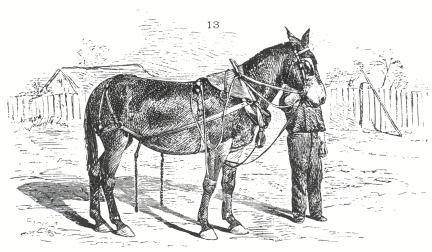
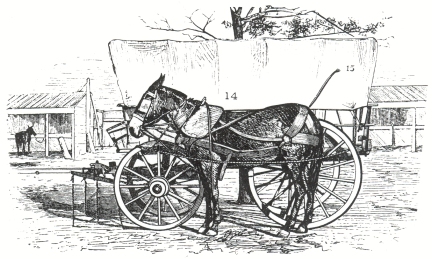
The mule does not differ materially from the horse in the
diseases he is afflicted with. He however suffers less from
them, owing to lack of sensibility. It may be useful here to
make a few remarks on the various diseases he is subject to,
and to recommend a course of treatment which I have practiced
and seen practiced, and which I believe is the best that can
be applied.
This disease is peculiar to young mules. Its symptoms
develop with soreness and swelling of the glands of the
throat, a cough, difficulty of swallowing, discharging at
the nostrils, and general prostration. If not properly
treated it is surely fatal.
TREATMENT:--Give light bran mashes, plenty of
common salt, and keep the animal in a warm and dry stable.
You need not clothe, for the mule, unlike the horse, is not
used to clothing. If the swelling under the throat shows a
disposition to ulcerate, which it generally does, do nothing
to prevent it. Encourage the ulcer, and let it come to a
head gradually, for this is the easiest and most natural
way that the trouble, which at first seems to pervade the
whole system, can be got rid of. When the ulcer appears
soft enough to lance, do so, and be careful to avoid the
glands and veins. Lance through the skin in the soft spot,
which appears almost ready to break. If the throat is at
any time so swollen as to render swallowing difficult,
give water frequently, about milk warm, with nourishing
feed of oats, corn, or rye meal--the last is the best.
If this treatment, which is very simple, be carefully
carried out, few animals will fail to recover.
This disease seldom attacks the mule. We have had
many thousands of them in camp, and out of the whole number,
I do not recollect of a case where it either destroyed
or disabled a single animal. In fact, it is a question
with me whether mules will take cold when kept as the
Government keeps them--camped out, or standing in sheds
where the temperature is the same as outdoors.
This is one of the most destructive of diseases
with which the horse family is afflicted, and one that
has set the best veterinary skill of the world at defiance.
A remedy for it has yet to be discovered. I have deemed
it proper here, however, to carefully describe its
symptoms, and to recommend that all animals showing
symptoms of it be kept by themselves until their case
be definitely ascertained. When you have ascertained to
a certainty that they are afflicted with the disease,
destroy them as quick as possible. See, too, that the
place where they have been kept is thoroughly cleansed
and sprinkled with lime, for the disease is contagious
and the slightest particle of virus will spread it anew.
Farcy is but one stage of this terrible disease,
but is not necessarily fatal while in this stage.
It should, however, be treated with great care and
caution. Farcy can also be conveyed to others by
inoculation. Any one who has had the field for observation
the author has for the last four years, would become
convinced that the recommendations I am about to make
describe the only course to be taken with this contagious
disease. The number of its victims under my observation
were counted by thousands. All that can be done is to
prevent, if possible, the disease taking place, and
to destroy when ascertained to a certainty that the
animal has contracted it. I would say here, however,
that this subject will soon be thoroughly handled in
a work soon to be published by Doctor Braley, head
veterinary surgeon of the army. He will undoubtedly
throw some light on the subject that has not yet
appeared in print.
First:--When it appears in a natural form, without the agency of contagion or inoculation, dryness of the skin, entire omission of insensible perspiration, starring of the coat. Sometimes slight discoloring can be observed about the forehead and lower part of the ears. Drowsiness, want of lustre in the eye, slight swelling on the inside of the hind legs, extending up to the bu-boa. This condition of things may continue for several days, and will be followed by enlargement between the legs. The inflammation incident to this may entirely subside, or it may continue to enlarge, and break out in ulcers on the lactiles of the lymphatic, which accompanies the large veins. In the last case it has appeared in the form of Farcy. This being the case, the countenance assumes a more cheerful look, and the animal otherwise shows signs of relief from the discharges of poisonous matter. If it remain in this state, death is not generally the result. If the system be toned up it will sometimes heal, and the animal will seem to be in a recovering state of health. Yet, from watching the symptoms and general health of the animal afterwards, you will be convinced that the disease is only checked, not eradicated. Acting in the system, it only waits a favorable opportunity to act as a secondary agent in colds, general debility, or exposure, when it will make its appearance and produce death.
But in the first case, as shown by the swelling in the hind legs, if the swelling disappear, and general debility of the system continues; if the eyes grow more drowsy, and discharge from the lower corners; and if this is followed by discharge from the nostrils, slight swelling and hardening of the sub-maxillary glands, which are between the under jaws, then it is clearly developed glanders. All the glands in the body have now become involved or poisoned, and death must follow in the course of ten or fifteen days, as the constitution of the animal may not be in a condition to combat the disease.
If this disease be annoyed by inoculation from the farcy heads of farcied animals into suppurating sores on other animals, it will be very slow in its progress, especially if it attack the other in a region remote from the lymphatic. If in a saddle-gall, it will make sores very difficult to heal. If there is any such thing as checking the disease in its progress, it is in these three cases.
I have observed that when it has been taken in a sore mouth it has followed down the cheek to the sub-maxillary gland, and ended in a clear case of glanders or farcy. There is another form in which this disease can be taken, and which is, of all others, the most treacherous and dangerous, yet never producing death without the agency of other diseases--always carrying with it the germs of infection, and ready to convey it to debilitated subjects and cause their death. The animal will still live himself, and show no sign of disease further than I am about to describe in the position. It is that which is taken in at the nostrils and attacks the sub-maxillary glands, which become enlarged and will remain so. When these become overloaded there will be a discharge at the nose. That being thrown off, it may be some time before any further discharge will be seen from the same source. In some cases, when the discharge is constant, this can be easily distinguished from gleet or ozena, from the healthy and natural appearance of the membranes of the nose, which at first are pale, then become fiery red or purple. In gleet the discharges from the nostrils, as in ozena, are of a very light color. In glanders they are first of a deep yellow, then of a dirty gray--almost slate color.
Mules affected with glanders of this kind, although it may seem hard from their otherwise healthy appearance, should be destroyed. They indeed carry with them the germs of infection and death, without any visible marks in their appearance to warn those who have the care of animals against their danger.
As mules seldom change hands to any great extent until two or three years old, it is not deemed necessary here to say any thing of their age until they have reached two years, so as to give the inexperienced a wider scope. The mule's mouth undergoes exactly the same changes as the horse's. Between the ages of two and three these changes begin to take place in the mule's mouth. The front incisor teeth, two above and two below, are replaced by the horse for permanent teeth. These teeth are larger than the others, have two grooves in the outer converse surface, and the mark is long, narrow, deep, and black. Not having attained their full growth, they are somewhat lower than the others, the mark in the two next nippers being nearly worn out, and is also wearing away in the corner nippers.
A mule at three years old ought to have the central permanent nippers growing, the other two pairs uniting, six grinders in each jaw, above and below, the first and fifth level with the others, and the sixth protruding. As the permanent nippers wear and continue to grow, a narrow portion of the cone-shaped tooth is exposed to the attrition; and they look as if they had been compressed. This is not so, however; the mark of some gradually disappears as the pit is worn away. At the age of three and a half or four years the next pair of nippers will be changed, and the mouth at that time cannot be mistaken. The central nippers will have nearly attained their full growth, and a vacuity will be left where the second stood; or, they will begin to peep above the gum, and the corner ones will be diminished in breadth and worn down, the mark becoming small and faint. At this period also the second pair of grinders will be shed. At four years the central nippers will be fully developed, the sharp edges somewhat worn off, and the marks shorter, wider, and fainter. The next pair will be up, but they will be small, with the mark deep and extending quite across. Their corner nippers will be larger than the inside ones, yet smaller than they were, and flat, and nearly worn out. The sixth grinder will have risen to a level with the others; and the tushes will begin to appear in the male animal. The female seldom has them, although the germ is always present in the jaw. At four years and a half, or between that and five, the last important change takes place in the mouth of the mule. The corner nippers are shed, and the permanent ones begin to appear. When the central nippers are considerably worn, and the next pair are showing marks of wear, the tush will have protruded, and will generally be a full half inch in height. Externally it has a rounded prominence, with a groove on either side, and is evidently hollow within. At six years old the mark on the central nippers is worn out. There will, however, still be a difference of color in the center of the tooth. The cement filling up the hole made by the dipping in of the enamel, will present a browner hue than the other part of the tooth. It will be surrounded by an edge of enamel, and there will remain a little depression in the center, and also a depression around the case of the enamel. But the deep hole in the center of the enamel, with the blackened surface it presents, and the elevated edge of the enamel, will have disappeared. The mule may now be said to have a perfect mouth, all the teeth being produced and fully grown.
What I have said above must not be taken as a positive guide in all cases, for mules' mouths are frequently torn, twisted, smashed, and knocked into all kinds of shapes by cruel treatment, and the inexperience, to use no harsher term, of those who have charge of them. Indeed, I have known cases of cruelty so severe that it were impossible to tell the age of the animal from his teeth.
At seven years old the mark, in the way in which I have described it, is worn out in the four central nippers, and is also fast wearing away in the corner teeth. I refer now to a natural mouth that has not been subjected to injuries. At eight years old the mark is gone from all the bottom nippers, and may be said to be quite out of the mouth. There is nothing remaining in the bottom nippers by which the age of the mule can be positively ascertained. The tushes are a poor guide at any time in the life of the animal to ascertain his age by; they, more than any other of the teeth, being most exposed to the injuries I have referred to. From this time forward, the changes that take place in the teeth may be of some assistance in forming an opinion; but there are no marks in the teeth by which a year, more or less, can be positively ascertained. You can ascertain almost as much from the general appearance of the animal as from an examination of the mouth. The mule, if he be long-lived, has the same effect in changing his general appearance from youth to old age as is shown on the rest of the animal creation.
There are few if any diseases to which the mule's teeth are subject, after the permanent teeth are developed; but during the time of their changes I have been led to believe that he suffers more inconvenience, or at least as much as any other animal--not so much on account of the suffering that nature inflicts upon him, as through the inexperience and cruelty of those who are generally intrusted with his care. I will here speak first of lampass. The animal's mouth is made sore and sensitive by teething; and this irritation and soreness is increased by the use of improper bits. As if this were not enough, resort is had to that barbarous and inhuman practice of burning out lampass. This I do, and always have protested against. If the gums are swollen from the cutting of teeth, which is about all the cause for their inflamed and enlarged appearance, a light stroke of a lancet or sharp knife over the gums, at a point where the teeth are forcing their way through, and a little regard to the animal's diet, will be all that is necessary. It must not be forgotten, that at this time the animal's mouth is too sore and sensitive to masticate hard food, such as corn. With the development of the teeth, however, the lampass will generally disappear.
Mules are remarkable for having good eyes. Occasionally they become inflamed and sore. In such cases the application of cold water, and the removing of the cause, whether it be from chafing of the blinders, forcing the blood to the head through the influence of badly fitting collars, or any other cause known, is all I can recommend in their case.
Mules suffer much from injury to the tongue, caused by the bad treatment of those who have charge of them, and also from sore month, produced in the same manner. The best thing for this is a light decoction of white-oak bark, applied with a sponge to the sore parts. Charcoal, mixed in water, and applied in the same manner, is good. Any quantity of this can be used, as it is not dangerous. If possible, give the animal nourishing gruels, or bran mashes; and, above all, keep the bit out of the mouth until it is perfectly healed.
This is a disease the mule more than all other animals is subject to. This is more particularly so with those brought into the service of the Government unbroken. It will be very easily seen that the necessary course of training, halter-breaking, &c., will expose them to many of the causes of this disease. Aside from this, the inhuman treatment of teamsters, and others who have charge of them, frequently produces it in its worst form. It begins with an ulcer or sore at the junction where the head and neck join; and from its position, more than any other cause, is very difficult to heal. The first thing to be done, when the swelling appears, is to use hot fomentations. If these are not at hand, use cold water frequently. Keep the bridle and halter from the parts. In case inflammation cannot be abated, and ulceration takes place, the only means to effect a cure, with safety and certainty, is by the use of the seton. This should be applied only by a hand well skilled in the use of it. The person should also well understand the anatomy of the parts, as injuries committed with the seton-needle, in those parts, are often more serious and more difficult of cure than the disease caused by the first injury.
This is a disease the mule is more subject to than any other animal in Government use. And this, on account of his being used as a beast of burden by almost all nations and classes of people, and because he is the worst cared for. Fistula is the result of a bruise. Some animals have been known to produce it by rolling on stones and other hard substances. It generally makes its appearance first in the way of a rise or swelling where the saddle has been allowed to press too hard on the withers, and especially when the animal has high and lean ones. As the animal becomes reduced in flesh, the withers, as a matter of course, are more exposed and appear higher, on account of the muscle wasting from each side of the back-bone. This, under the saddle, can be remedied to a great extent, by adding an additional fold to the saddle blanket, or in making the pad of the saddle high enough to keep it from the withers. In packing with the pack-saddle this is more difficult, as the weight is generally a dead, heavy substance, and as the animal steps low or high, the pack does the same. Much, however, might be done by care in packing, to prevent injury to the withers and bruising of the back-bone. When the withers begin to swell and inflammation sets in, or a tumor begins to form, the whole may be driven away and the fistula scattered or avoided by frequent or almost constant applications of cold water--the same as is recommended in poll-evil. But if, in despite of this, the swelling should continue or become larger, warm fomentations, poultices, and stimulating embrocations should be applied, in order to bring the protuberance to its full formation as soon as possible. When full, a seton should be passed, by a skillful hand, from the top to the bottom of the tumor, so that all the pus may have free access of escape. The incision should be kept free until all the matter has escaped and the wound shows signs of healing. The after treatment must be similar to that recommended in the case of poll-evil. The above treatment, if properly administered, will in nearly all cases of fistula effect a cure.
Sore necks, saddle-galls, and stilfasts, are a species of injury and sore, which are in many cases very difficult of cure, especially saddle-galls on mules that have to be ridden every day. One of the best remedies for saddle gall is to heighten the saddle up as much as possible, and bathe the back with cold water as often as an opportunity affords. In many cases this will drive the fever away and scatter the trouble that is about to take place. This, however, does not always scatter, for the trouble will often continue, a root forming in the center of what we call the saddle-gall. The edges of this will be clear, and the stilfast hold only by the root. I have had many cases of this kind occur with the mule, both on his back and neck, mostly caused on the latter part by the collar being too loose. And I have found but one way to effectually cure them. Some persons advise cutting, which I think is too tedious and painful to the animal. My advice is to take a pair of pincers, or forceps of any kind, and pull it out. This done, bathe frequently with cold water, and keep the collar or saddle as much free of the sore as possible. This will do more towards relieving the animal and healing the injury than all the medicine you can give. A little soothing oil, or grease free from salt, may be rubbed lightly on the parts as they begin to heal. This is a very simple but effective remedy.
This is another trouble with which the mule is afflicted. Cut away the parts of the frog that seem to be destroyed, clean the parts well with castile-soap, and apply muriatic acid. If you have not this at hand, a little tar mixed with salt, and placed on oakum or tow, and applied, will do nearly as well. Apply this every day, keeping the parts well dressed, and the feet according to directions in shoeing, and the trouble will soon disappear.
Mules are not subject to this disease. Some persons assert that they are, but it is a mistake. These persons mistake for founder in the chest what is nothing more than a case of contraction of the feet. I have repeatedly seen veterinary surgeons connected with the army, on being asked what was the trouble with a mule, look wise, and declare the complaint chest founder, swelling of the shoulders, &c. I was inclined to put some faith in the wisdom of these gentlemen, until Doctor Braley, chief veterinary surgeon of the department of Washington, produced the most convincing proofs that it was almost an impossibility for these animals to become injured in the shoulder. When mules become sore in front, look well to their feet, and in nine cases out of ten, you will find the cause of the trouble there. In very many cases a good practical shoer can remove the trouble by proper paring and shoeing.
It was always a subject of inquiry with me, who originated the system of bleeding; and why it was that all kinds of doctors and physicians persist in taking the stream of life itself from the system in order to preserve life. In the case of General Washington, which I copy from the Independent Chronicle of Boston, January 6, 1800, the editor, using "James Craik, physician, and Elisha C. Dick, physician," as authority, states that a bleeder was procured in the neighborhood, who took from the General's arm from twelve to fourteen ounces of blood, in the morning; and in the afternoon of the same day was bled copiously twice. More than that, it was agreed upon by these same enlightened doctors, to try the result of another blood-letting, by which thirty two ounces more was drawn. And, wonderful as it may seem to the intelligent mind at this day, they state that all this was done without the slightest alleviation of the disease. The world has become more wise now, and experience has shown how ridiculous this system of bleeding was. What is true in regard to the human system is also true in regard to the animal. There are some extreme cases in which I have no doubt moderate bleeding might render relief. But these cases are so few that it should only be suffered to be done by an experienced, careful, and skillful person. My advice is, avoid it in all cases where you can.
The mule is quite subject to this complaint. It is what is commonly known as belly-ache. Over doses of cold water will produce it. There is nothing, however, so likely to produce it in the mule as changes of grain. Musty corn will also produce it, and should never be given to animals. I recollect, in 1856, when I was in New Mexico, at Fort Union, we had several mules die from eating what is termed Spanish or Mexican corn, a small blue and purplish grain. It was exceedingly hard and flinty, and, in fact, more like buckshot than grain. We fed about four quarts of this to the mule, at the first feed. The result was, they swelled up, began to pant, look round at their sides, sweat above the eyes and at the flanks. Then they commenced to roll, spring up suddenly, lie down again, roll and try to lie on their backs. Then they would spring up, and after standing a few seconds, fall down, and groan, and pant. At length they would resign themselves to what they apparently knew to be their fate, and die. And yet, singular as it may seem, the animal could be accustomed to this grain by judicious feeding at first.
We did not know at that time what to give the animal to relieve or cure him; and the Government lost hundreds of valuable animals through our want of knowledge. Whenever these violent cases appear, get some common soap, make a strong suds and drench the mule with it. I have found in every case where I used it that the mule got well. It is the alkali in the soap that neutralizes the gases. There is another good receipt, and it is generally to be found in camp. Take two ounces of saleratus, put it into a pint of water, shake well, and then drench with the same. Above all things, keep whisky and other stimulants away, as they only serve to aggravate the disease.
This is another of those imaginary cures resorted to by persons having charge of mules. Very many of these persons honestly believe that it is necessary to clean the animal out every spring with large doses of poisonous and other truck. This, they say, ought to be given to loosen the hide, soften the hair, &c. In my opinion it does very little good. If his dung gets dry, and his hair hard and crispy, give him bran mashes mixed with his grain, and a teaspoonful of salt at each feed. If there is grass, let him graze a few hours every day. This will do more towards softening his coat and loosening his bowels than any thing else. When real disease makes its appearance, it is time to use medicines; but they should be applied by some one who thoroughly understands them.
This sometimes occurs in the mule. It is a sudden, nervous, quick jerk of either or both of the hind legs. In the mule it frequently shows but little after being worked an hour or so. It is what I regard as unsoundness, and a mule badly affected with it is generally of but little use. It is often the result of strains, caused by backing, pulling and twisting, and heavy falls. You can detect it in its slightest form by turning the animal short around to the right or to the left. Turn him in the track he stands in, as near as possible, and then back him. If he has it, one of these three ways will develop its symptoms. There are a great many opinions as to the soundness or unsoundness of an animal afflicted with this complaint. If I had now a good animal afflicted with it, the pain caused to my feelings by looking at it would be a serious drawback.
I have now under my charge several mules that are subject to this complaint. It does not really injure them for service, but it is very disagreeable to those having them in charge. It frequently requires from half an hour to two hours to get them rubbed so as the blood gets to its proper circulation, and to get them to walk without dragging their legs. In cases where they are attacked violently, they will appear to lose all use of their legs. I have known cases when a sudden stroke with a light piece of board, so as to cause a surprise, would drive it away. In other cases sudden application of the whip would have the same effect.
It is generally believed that the mule does not inherit this disease. But this is not altogether true. Small, compact mules, bred after the jack, are indeed not subject to it. On the contrary, large mules, bred from large, coarse mares, are very frequently afflicted with it. The author has under his charge at the present time quite a number of those kind of mules, in which this disease is visible. At times, when worked hard, they are sore and lame. The only thing to be recommended in this case is careful treatment, and as much rest at intervals as it is possible to give them. Hand rubbing and application of stimulant liniments, or tincture of arnica, is about all that can be done. The old method of firing and blistering only puts the animal to torture and the owner to expense. A cure can never be effected through it, and therefore should never be tried.
These appear on the same kind of large, bony mules as referred to in cases of spavin, and are incurable. They can, however, be relieved by the same process as recommended in spavin. Relief can also be afforded by letting the heels of the affected feet grow down to considerable length, or shoeing with a high-heeled shoe, and thus taking the weight or strain off the injured parts. The only way to make the best use or an animal afflicted with this disease, is to abandon experiments to effect a cure, as they will only be attended with expense and disappointment.
Mules are subject to this disease when kept in large numbers, as in the army. This is peculiarly a cuticle disease, like the itch in the human system, and yields to the same course of treatment. A mixture of sulphur and hog's lard, one pint of the latter to two of the former. Rub the animal all over, then cover with a blanket. After standing two days, wash him clean with soft-soap and water. After this process has been gone through, keep the animal blanketed for a few days, as he will be liable to take cold. Feed with bran mashes, plenty of common salt, and water. This will relieve the bowels all that is necessary, and can scarcely fail of effecting a cure. Another method, but not so certain in its effect, is to make a decoction of tobacco, say about one pound of the stems to two gallons of water, boiled until the strength is extracted from the weed, and when cool enough, bathe the mule well with it from head to foot, let him dry off, and do not curry him for a day or two. Then curry him well, and if the itching appear again, repeat the bathing two or three times, and it will produce a cure. The same treatment will apply in case of lice, which frequently occurs where mules are kept in large numbers. Mercury should never be used in any form, internally or externally, on an animal so much exposed as the mule.
Clean the parts well with castile-soap and warm water. As soon as you have discovered the disease, stop wetting the legs, as that only aggravates it, and use ointment made from the following substances: Powdered charcoal, two ounces; lard or tallow, four ounces; sulphur, two ounces. Mix them well together, then rub the ointment in well with your hand on the affected parts. If the above is not at hand, get gun-powder, some lard or tallow, in equal parts, and apply in the same manner. If the animal be poor, and his system need toning up, give him plenty of nourishing food, with bran mash mixed plentifully with the grain. Add a teaspoonful of salt two or three times a day, as it will aid in keeping the bowels open. If the stable bottoms, or floors, or yards are filthy, see that they are properly cleaned, as filthiness is one of the causes of this disease. The same treatment will apply to scratches, as they are the same disease in a different form.
To avoid scratches and grease-heel during the winter, or indeed at any other season, the hair on the mule's heels should never be cut. Nor should the mud, in winter season, be washed off, but allowed to dry on the animal's legs, and then rubbed off with hay or straw. This washing, and cutting the hair off the legs, leave them without any protection, and is, in many cases, the cause of grease-heel and scratches.
The foot, its diseases, and how to shoe it properly, is a subject much discussed among horsemen. Nearly every farrier and blacksmith has a way of his own for curing diseased feet, and shoeing. No matter how absurd it may be, he will insist that it has merits superior to all others, and it would be next to impossible to convince him of his error. Skillful veterinarians now understand perfectly all the diseases peculiar to the foot, and the means of effecting a cure. They understand, also, what sort of shoe is needed for the feet of different animals. Latterly number of shoes have been invented and patented, all professing to be exactly what is wanted to relieve and cure diseased feet of all kinds. One man has a shoe he calls "concave," and says it will cure contraction, corns, thrush, quarter-crack, toe-crack, &c., &c. But when you come to examine it closely, you will find it nothing more than a nicely dressed piece of iron, made almost in the shape of a half moon. After a fair trial, however, it will be found of no more virtue in curing diseases or relieving the animal than the ordinary shoe used by a country smithy. Another inventive genius springs up and asserts that he has discovered a shoe that will cure all sorts of diseased feet; and brings at least a bushel basket full of letters from persons he declares to be interested in the horse, confirming what he has said of the virtues of his shoe. But a short trial of this wonderful shoe only goes to show how little these persons understand the whole subject, and how easy a matter it is to procure letters recommending what they have invented.
Another has a "specific method" for shoeing, which is to cut away the toe right in the center of the foot, cut away the bars on the inside of the foot, cut and clean away all around on the inside of the hoof, then to let the animal stand on a board floor, so that his feet would be in the position a saucer would represent with one piece broken out at the front and two at the back. This I consider the most inhuman method in the art of shoeing. Turn this saucer upside down and see how little pressure it would bear, and you will have some idea of the cruelty of applying this "specific method." Sometimes bar-shoes and other contrivances are used, to keep the inside of the foot from coming down. But why do this? Why not get at once a shoe adapted to the spreading of the foot. Tyrell's shoe for this purpose is the best I have yet seen. We have used it in the Government service for two years, and experience has taught me that it has advantages that ought not to be overlooked. But even this shoe may be used to disadvantage by ignorant hands. Indeed, in the hands of a blacksmith who prefers "his own way," some kinds of feet may be just as badly injured by it as others are benefited. The United States Army affords the largest field for gaining practical knowledge concerning the diseases, especially of the feet, with which horses and mules are afflicted. During the late war, when so little care was given to animals in the field, when they were injured in every conceivable manner, and by all sorts of accidents, the veterinary found a field for study such as has never been opened before.
Experience has taught me, that common sense is one of the most essential things in the treatment of a horse's foot. You must remember that horses' feet differ as well as men's, and require different treatment, especially in shoeing. You must shoe the foot according to its peculiarity and demands, not according to any specific "system of shoe." Give the ground surface a level bearing, let the frog come to the ground, and the weight of the mule rest on the frog as much as any other part of the foot. If it project beyond the shoe, so much the better. That is what it was made for, and to catch the weight on an elastic principle. Never, under any circumstances, cut it away. Put two nails in the shoe on each side, and both forward of the quarters, and one in the toe, directly in front of the foot. Let those on the sides be an inch apart, then you will be sure not to cut and tear the foot. Let the nails and nail-holes be small, for they will then aid in saving the foot. It will still further aid in saving it by letting the nails run well up into the hoof, for that keeps the shoe steadier on the foot. The hoof is just as thick to within an inch of the top, and is generally sounder, and of a better substance, than it is at the bottom. Keep the first reason for shoeing apparent in your mind always--that you only shoe your mule because his feet will not stand the roads without it. And whenever you can, shoe him with a shoe exactly the shape of his foot. Some blacksmiths will insist on a shoe, and then cutting and shaping the foot to it. The first or central surface of the hoof, made hard by the animal's own peculiar way of traveling, indicates the manner in which he should be shod. All the art in the world cannot improve this, for it is the model prepared by nature. Let the shoes be as light as possible, and without calks if it can be afforded, as the mule always travels unsteady on them. The Goodenough shoe is far superior to the old calked shoe, and will answer every purpose where holding is necessary. It is also good in mountainous countries, and there is no danger of the animal calking himself with it. I have carefully observed the different effect of shoes, while with troops on the march. I accompanied the Seventh Infantry, in 1858, in its march to Cedar Valley, in Utah, a distance of fourteen hundred miles, and noticed that scarcely a man who wore regulation shoes had a blister on his feet, while the civilians, who did not, were continually falling out, and dropping to the rear, from the effects of narrow and improper shoes and boots. The same is the case with the animal. The foot must have something flat and broad to bear on. The first care of those having charge of mules, should be to see that their feet are kept in as near a natural state as possible. Then, if all the laws of nature be observed, and strictly obeyed, the animal's feet will last as long, and be as sound in his domestic state as he would be in a state of nature.
The most ordinary observer will soon find that the outer portion or covering of the mule's foot possesses very little animal life, and has no sensibility, like the hair or covering of the body. Indeed, the foot of the horse and mule is a dense block of horn, and must therefore be influenced and governed by certain chemical laws, which control the elements that come in contact with it. Hence it was that the feet of these animals was made to bear on the hard ground, and to be wet naturally every time the horse drank. Drought and heat will contract and make hard and brittle the substance of which the feet is composed; while on the other hand cooling and moisture will expand it, and render it pliable and soft. Nature has provided everything necessary to preserve and protect this foot, while the animal is in a natural state; but when brought into domestic use, it requires the good sense of man, whose servant he is, to artificially employ those means which nature has provided, to keep it perfectly healthy.
When, then, the foot is in a healthy state, wet it at least twice a day; and do not be content with merely throwing cold water on the outside, for the foot takes in very little if any moisture through the wall. In short, it absorbs moisture most through the frog and sole, particularly in the region where the sole joins the wall. This, if covered by a tight shoe, closes the medium, and prevents the proper supply. Horses that are shod should be allowed to stand in moist places as much as possible. Use clay or loam floors, especially if the horse has to stand much of his time. Stone or brick is the next best, as the foot of the animal will absorb moisture from either of these. Dry pine planks are the very worst, because they attract moisture from the horse's foot. Where animals have to stand idle much of the time, keep their feet well stuffed with cow manure at night. That is the best and cheapest preservative of the feet that you can use.
Let me enjoin you, for humanity's sake, that when you first undertake to shoe a young animal, you will not forget the value of kind treatment. Keep its head turned away from the glaring fire, the clinking anvil, &c., &c. Let the man whom he has been accustomed to, the groom or owner, stand at his head, and talk to him kindly. When you approach him for the first time, let it be without those implements you are to use in his shoeing. Speak to him gently, then take up his foot. If he refuse to let you do this, let the person having him in charge do it. A young animal will allow this with a person he is accustomed to, when he will repel a stranger. By treating him kindly you can make him understand what is wanted; by abusing him you will only frighten him into obstinacy. When you have got the animal under perfect subjection, examine the foot carefully, and you will find the heels, at the back part of the frog, entirely free from that member, which is soft and spongy. When the foot is down, resting on the ground, grasp the heels in your strong hand, press them inwards towards the frog, and you will immediately find that they will yield. You will then see that what yields so easily to the mere pressure of the hand will expand and spread out when the weight of the body is thrown on it. This should give you an idea of what you have to do in shoeing that foot, and your practical knowledge should stand you well in an argument with any of those "learned professors," who declare the foot of the mule does not expand or contract. In truth it is one of its necessary conditions. After being a long time badly shod, nearly or all of this necessary principle of the foot will be lost. You should therefore study to preserve it. And here let me give you what little aid experience has enabled me to do. You will observe the ground surface of the foot, no matter how high the arch may be, to be at least half an inch wide, and sometimes more than an inch, with the heels spread out at the outside quarter. Do not cut away this important brace. It is as necessary to the heel of the animal, to guard him against lateral motion, on which the whole of the above structure depends, as the toes are to the human being. Curve the outside of the shoe nearly to fit the foot, and you will find the inside heel a little straighter, especially if the animal be narrow-breasted, and the feet stand close together. Nature has provided this safeguard to prevent its striking the opposite leg. After the shoe is prepared to fit the foot, as I have before described, rasp the bottom level--it will be found nearly so. Do not put a knife to the sole or the frog. The sole of the foot, remember, is its life, and the frog its defender. In punching the shoe, two nail-holes on a side, on a foot like this, are sufficient to hold on a shoe. Three may be used, if set in their proper places, without injury to the foot. Practice will teach you that any more nailing than this is unnecessary. I have used two nails on a side on an animal with not the best of a foot, and very high action, and he has worn them entirely out without throwing either of them off. Previous to punching the shoe, observe the grain of the foot. It will be seen that the fibres of the hoof run from the top of the foot, or coronary border, towards the toe, in most feet, at an angle of about forty-five degrees. It will be plain, then, that if the nails are driven with the grain of the horn, they will drive much easier, and hold better, and be less liable to cut and crack the fibers.
Another benefit can be derived from this process of nailing. When the foot comes to the ground, the nails act as a brace to keep the foot from slipping forward off the shoe. This renders that very ingenious foot destroyer, the toe-clip, unnecessary. Then, in punching the shoe, hold the top of the pritchell toward the heel of the shoe, so as to get the hole in the shoe on an angle with the grain of the hoof. Punch the holes large enough, so that the nails will not bind in the shoe, nor require unnecessary hammering or bruising of the foot to get them up to their proper place. Prepare the nails well, point them thin and narrow; and, as I have said before, use as small a nail as possible.
When you proceed to nail on the shoe, take a slight hold at the bottom, so as to be sure that the nail starts in the wall of the foot instead of the sole. Let it come out as high up as possible. You need not be afraid of pricking with nails set in this way, as the wall of the foot is as thick, until you get within half an inch of the top, as it is where you set the nail. Nails driven in this way injure the feet less, hold on longer, and are stronger than when driven in any other way. If you have any doubt of this, test it in this manner: when you take off an old shoe to set a new one, and cut the clinches (which should be done in all cases), you will find the old nail and the clinches not started up; and in drawing the nail out you will also find the foot not slipped or cracked; and that the horn binds the nail until it is entirely drawn out. Indeed, I have known the hole to almost close as the nail left it.
Set the two front nails well towards the toe, so as not to be more than two inches apart when measured across the bottom of the foot. Let the next two divide the distance from that to the heel, so as to leave from two to two and a half inches free of nails, as the form of the foot may allow. Lastly, before nailing on the shoe, and while it is cold on the anvil, strike the surface that comes next to the foot on the outside, a few blows with the hammer, right across the heels, and see also that the outside of the heels is a shade lowest, so that the animal in throwing his weight upon them will spread out, and not pinch in his feet.