The Kobunsha’s Japanese Fairy Tale Series. — THUMBNAILS
The illustration borders may not display correctly in all browsers. The thumbnails at the end of the file show the original page layout.
The background pattern is taken from the original book, but has been lightened for readability. The inconsistent hyphenization of “cuttle-fish” is in the original.
|
|
||
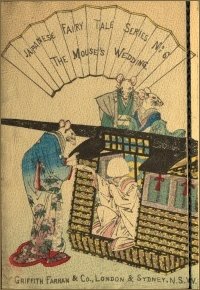
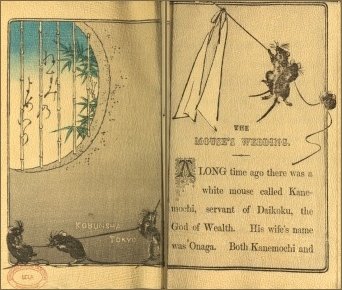
 long time ago there was a white mouse called Kanemochi, servant of
Daikoku, the God of Wealth. His wife’s name was Onaga. Both
Kanemochi and
long time ago there was a white mouse called Kanemochi, servant of
Daikoku, the God of Wealth. His wife’s name was Onaga. Both
Kanemochi and|
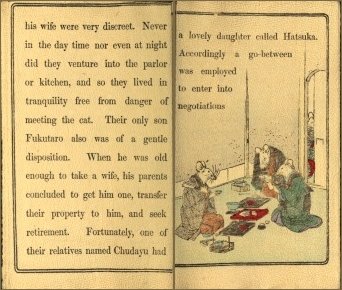
his wife were very discreet. Never in the day time nor even at night did they venture into the parlor or kitchen, and so they lived in tranquility free from danger of meeting the cat. Their only son Fukutaro also was of a gentle disposition. When he was old enough to take a wife, his parents concluded to get him one, transfer their property to him, and seek retirement. Fortunately, one of their relatives named Chudayu had |
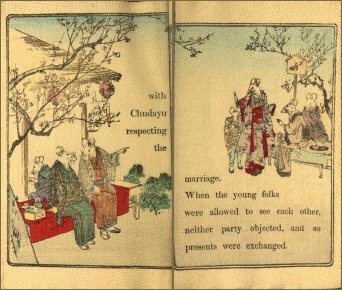
a lovely daughter called Hatsuka. Accordingly a go-between was
employed to enter into |
|||||
|
with |
marriage. |
|||||
|
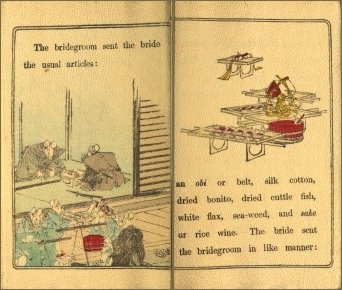
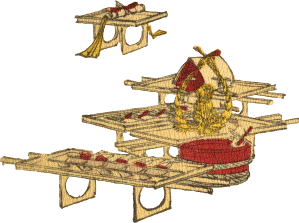
The bridegroom sent the bride the usual articles: |
an obi or belt, silk cotton, dried bonito, dried cuttle fish, white flax, sea-weed, and sake or rice wine. The bride sent the bridegroom in like manner: |
||||
|
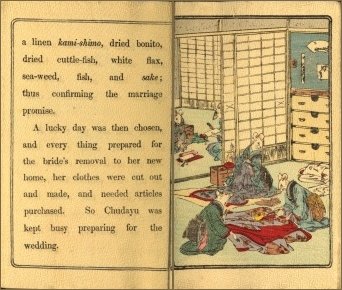
a linen kami-shimo, dried bonito, dried cuttle-fish, white flax, sea-weed, fish, and sake; thus confirming the marriage promise. A lucky day was then chosen, and every thing prepared for the bride’s removal to her new home, her clothes were cut out and made, and needed articles purchased. So Chudayu was kept busy preparing for the wedding. |
|||
|
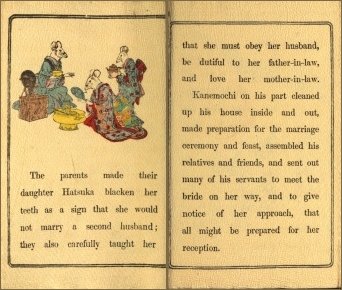
The parents made their daughter Hatsuka blacken her teeth as a sign that she would not marry a second husband; they also carefully taught her |
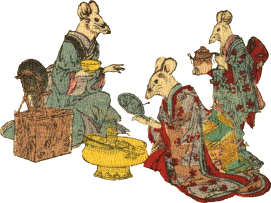
that she must obey her husband, be dutiful to her father-in-law, and love her mother-in-law. Kanemochi on his part cleaned up his house inside and out, made preparation for the marriage ceremony and feast, assembled his relatives and friends, and sent out many of his servants to meet the bride on her way, and to give notice of her approach, that all might be prepared for her reception. |
||||
|
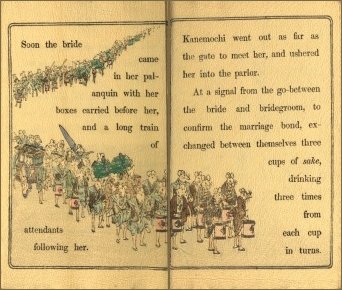
Soon the bride |
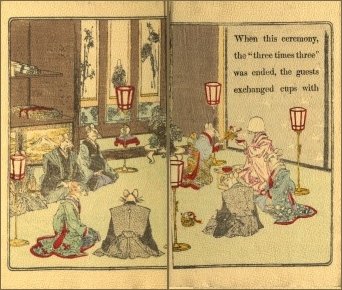
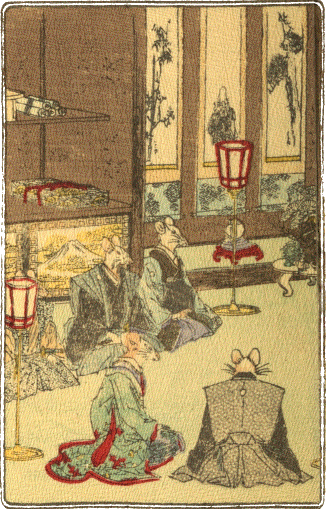
Kanemochi went out as far as the gate to meet her, and ushered her into the parlor. At a signal from the go-between the bride and bridegroom, to confirm the marriage bond, exchanged between themselves three |
|||||
|
attendants |
cups of sake, |
|||||
|
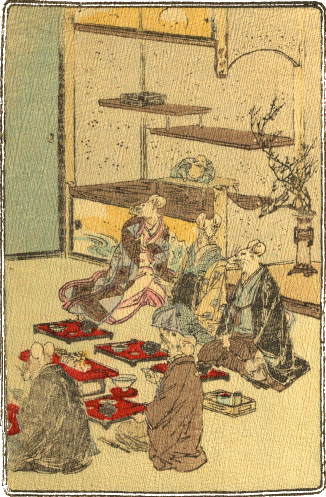
When this ceremony, |
|
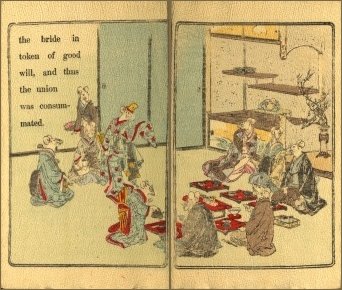
the bride in token |
|
|
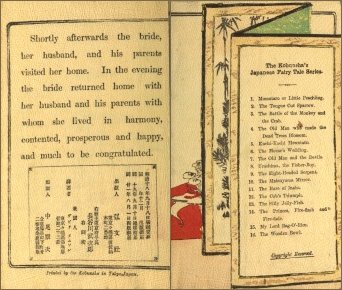
Shortly afterwards the bride, her husband, and his parents visited her home. In the evening the bride returned home with her husband and his parents with whom she lived in harmony, contented, prosperous and happy, and much to be congratulated.
|
||
Printed by the Kobunsha in Tokyo, Japan
|
1. Momotaro or Little Peachling. 2. The Tongue Cut Sparrow. 3. The Battle of the Monkey 4. The Old Man who made the 5. Kachi-Kachi Mountain. 6. The Mouse’s Wedding. 7. The Old Man and the Devils. 8. Urashima, the Fisher-Boy. 9. The Eight-Headed Serpent. 10. The Matsuyama Mirror. 11. The Hare of Inaba. 12. The Cub’s Triumph. 13. The Silly Jelly-Fish. 14. The Princes, Fire-flash 15. My Lord Bag-O’-Rice. 16. The Wooden Bowl.
Copyright reserved
|
||||