The drowsy calm of a balmy afternoon at the
Motor Rangers’ wireless camp on Goat Island
was abruptly shattered by a raucous, insistent
clangor from the alarm-bell of the wireless outfit.
Nat Trevor, Joe Hartley and Ding-dong
Bell, who had been pretending to read but were
in reality dozing on the porch of a small portable
wood and canvas house, galvanized into the full
tide of life and activity usually theirs.
“Something doing at last!” cried Nat. “It
began to look as if there wouldn’t be much for
us on the island but a fine vacation, lots of sea-breeze
and coats of tan like old russet shoes.”
6“I ter-told you there’d be ser-ser-something
coming over the a-a-a-a-aerials before long,”
sputtered Ding-dong Bell triumphantly, athrill
with excitement.
“What do you suppose it is?” queried Joe
Hartley, his red, good-natured face aglow.
“Don’t go up in the air, Joe,” cautioned Nat,
“it’s probably nothing more thrilling than a
weather report from one of the chain of coast
stations to another.”
“Get busy, Ding-dong, and find out,” urged
Joe Hartley; “let’s see what sort of a message
you can corral out of the air.”
But young Bell was already plodding across
the sand toward a small timber structure about
fifty yards distant from the Motor Rangers’
camp. Above the shack stretched, between two
lofty poles, the antennæ of the wireless station.
Against these the electric waves from out of
space were beating and sounding the wireless
“alarm-clock,” an invention of Ding-dong’s of
which he was not a little proud.
7Ding-dong had become inoculated with the
wireless fever as a result of the trip east which
the Motor Rangers had taken following their
stirring adventures in the Bolivian Andes in
Professor Grigg’s air-ship—which experiences
were related in the fourth volume of this series,
The Motor Rangers’ Cloud Cruiser. On their
return to California—where all three boys lived,
in the coast resort of Santa Barbara—nothing
would suit Ding-dong but that they take a vacation
on Goat Island and set up a wireless plant
for experimental purposes.
“I want to try it and away from home where
a bunch of fellows won’t be hanging about and
joking me if I make a fizzle,” he explained.
As the lads while in the east had done a lot
of business, some of it connected with Nat’s gold
mine in Lower California and some with interests
of Professor Griggs, they decided that
8they were entitled to at least a short period of
inactivity, and Ding-dong’s idea was hailed as
a good one. Goat Island, a rugged, isolated spot
of land shaped like a splash of gravy on a plate,
was selected as an ideal camping place. The
wireless appliances, shipped from San Francisco,
were conveyed to the island on board the
Rangers’ sturdy cabin cruiser Nomad, and three
busy, happy weeks had been devoted to putting it
in working order. Since the day that it had been
declared “O. K.” by Ding-dong, the lads had
been crazy for the “wireless alarm” to ring in,
and when it failed to do so Ding-dong came in
for a lot of good-natured joshing.
For some further account of the three chums,
we must refer our readers to the first volume
of this series, The Motor Rangers’ Lost Mine.
This related how Nat, the son of a poor widow,
unexpectedly came into his own and from an employé’s
position was raised to one of comparative
affluence. For a holiday tour when they returned
9from Lower California, where Nat by accident
had located his mine, the chums took an eventful
trip through the Sierras. What befell them
there, and how they combated unscrupulous enemies
and had lots of jolly fun, was all set forth
in the second volume devoted to their doings,
The Motor Rangers Through the Sierras. Some
sapphires found by them on this trip led to a
strange series of incidents and adventures attendant
on their efforts to restore them to their
rightful owner. The precious stones were stolen,
recovered, and lost again, only to be delivered
safely at last. These exciting times, passed by
the lads on their cruiser, the Nomad, which took
them half across the Pacific, were described in
the third volume of the young rangers’ doings,
The Motor Rangers on Blue Water. Their
voyage in Professor Grigg’s wonderful air-ship,
the Discoverer, has been already referred to.
With this necessarily brief introduction to the
young campers, let us return to Goat Island.
10Directly Ding-dong reached the hut housing
the apparatus, he flung himself down before the
instruments and hastily jammed the head-piece,
with its double “watch-case” receivers, over his
ears. He picked up a pencil and placing it conveniently
above a pad of paper that was always
kept affixed to the table holding the sending and
receiving appliances, he began to send a storm
of dots and dashes winging out in reply to the
wireless impulse that had set the gong sounding.
“This is Goat Island!” he banged out on the
key, while the spark leaped and writhed in a
“serpent” of steel-blue flame between the sparking
points. It whined and squealed like an animal
in pain as Ding-dong’s trembling fingers alternately
depressed and released the “brass.”
“Goat Island! Goat Island! Goat Island!”
he repeated monotonously, and then switched the
current from the sending to the receiving instruments.
11Against his ears came a tiny pattering so faint
as to be hardly distinguishable. Yet the boy
knew that the instruments must be “in tune,” or
nearly so, with whatever station was sending
wireless waves through space, else the “alarm”
would not have been sprung.
He adjusted his instruments to take a longer
“wave” than he had been using. Instantly the
breaking of the “wireless surf” against the antennæ
above the receiving shed became plainer.
“This is the steamer Iroquois, San Francisco,
to Central American ports,” was what Ding-dong’s
pencil rapidly transcribed on the pad,
while the others leaned breathlessly over his
shoulder and watched the flying lead. “A passenger
is dangerously hurt. We need assistance
at once.”
The young operator thrilled. The first message
that had come to the island was an urgent
one.
“Where are you?” he flashed back.
“Thirty miles off the coast. Who are you?”
came back the reply.
12“Thirty miles off where?” whanged out Ding-dong’s
key, while he grumbled at the indefiniteness
of the operator on the steamer.
“Off Santa Barbara. Who are you and can
you send out a boat to take our injured passenger
ashore? Hospital attention is necessary.”
“Wait a minute,” spelled out the young Motor
Ranger’s key.
He turned to the others.
“You see what I’ve got,” he said indicating
the pad and speaking perfectly plainly in his excitement;
“what are we going to do about it?”
The lads exchanged glances. It was evident
as their eyes met what was in each one’s mind.
The Nomad lay snugly anchored in a cove on the
shoreward side of the island. A run of thirty
miles out to sea was nothing for the speedy,
sturdy gasolene craft, and the call that had come
winging through the air from the steamer was
an appeal for aid that none of them felt like refusing
to heed. It was clear that the case was
13urgent. A life, even, might be at stake. Each
lad felt that a responsibility had been suddenly
laid at their door that they could not afford to
shirk.
“Well?” queried Ding-dong.
“Well?” reiterated Joe Hartley as they turned
by common consent to Nat Trevor, the accepted
leader of the Motor Rangers at all times.
“You’d better tell the man on that ship that
we’ll be alongside within two hours,” said Nat
quietly; and that was all; Ding-dong, without
comment, swung around to his key again. Like
Joe, he had known what Nat’s decision would be
almost before he gave it. Nat was not the lad
to turn down an appeal like the one sent out
from the Iroquois. The sea was smooth, the
weather fair, but even had it been blowing half
a gale it is doubtful if Nat would have hesitated
a jiffy under the circumstances to perform what
he adjudged to be a duty.
Ding-dong speedily raised the Iroquois.
14“We’ll take your injured man ashore,” he
flashed out. “Lay to where you are and we’ll
pick you up without trouble. Expect us in about
two hours.”
“Bully for you, Goat Island,” came the rejoinder,
which Ding-dong hardly waited to hear
before he disconnected his instruments and
“grounded” them.
“Now for the Nomad,” cried Nat. “Hooray,
boys! It’s good to have something come along
to relieve the monotony.”
“Di-di-didn’t I ter-ter-tell you so!” puffed
Ding-dong triumphantly, as the three lads set out
at top speed for their hut to obtain some necessary
clothing and a few provisions for their run
to the vessel that had sent out the wireless appeal
for help.
CHAPTER II.
15
A PASSENGER FOR THE SHORE.
“All right below, Ding-dong?” hailed Nat, as
he took his place on the little bridge of the
Nomad with Joe by his side. The anchor was
up, and astern towed the dinghy, which had been
hastily shoved off the beach when the boys embarked.
Through the speaking tube came up the young
engineer’s answer, “All ready when you are,
captain.”
Nat jerked the engine room bell twice. A
tremor ran through the sturdy sixty-foot craft.
Her fifty-horse-power, eight-cylindered motor
began to revolve, and with a “bone in her teeth”
she ran swiftly out of the cove, headed around
the southernmost point of the island and was
steered by Nat due westward to intercept the
steamer that had flashed the urgent wireless.
16As the long Pacific swell was encountered, the
Nomad rose to it like a race-horse that after
long idleness feels the track under his hoofs
once more. Her sharp bow cut the water like a
knife, but from time to time, as an extra heavy
roller was encountered, she flung the water back
over her forward parts in a shower of glistening,
prismatic spray. It was a day and an errand to
thrill the most phlegmatic person that ever lived,
and, as we know, the Motor Rangers were assuredly
not in this category. Their blood glowed
as their fast craft rushed onward on her errand
of mercy at fifteen miles, or better, an hour.
Nat, his cheeks glowing and his eyes shining,
held the wheel in a firm grip, his crisp black hair
waved in the breeze and his very poise showed
that he was in his element. Joe, clutching the
rail beside him, was possessed of an equal fervor
of excitement. The Motor Rangers all felt that
they were on the threshold of an adventure; but
into what devious paths and perils that wireless
17message for aid was to lead them, not one of
them guessed. Yet even had they been able to
see into the future and its dangers and difficulties,
it is almost certain that they would have
voted unanimously to “keep on going.”
“What a fine little craft she is,” declared Nat,
as the Nomad sped along.
“She’s a beauty,” fervently agreed Joe, with
equal enthusiasm; “and what we’ve been through
on board her, Nat!”
“I should say so. Remember the Magnetic
Islands, and the Boiling Sea, and the time you
were lost overboard?”
Chatting thus of the many adventures and
perils successfully met that their conversation recalled
to their minds, the two young Motor
Rangers on the bridge of the speeding motor
craft kept a bright lookout for some sign of the
vessel that had sent the wireless appeal into
space.
18Nat was the first to catch sight of a smudge
of smoke on the horizon. “That must be the
steamer! There, dead ahead!”
“Reckon you’re right, Nat,” agreed Joe.
“The smoke seems stationary, too. That’s the
Iroquois beyond a doubt.”
Nat sent a signal below, to apply every ounce
of speed that the engines were capable of giving.
The Nomad, going at a fast clip before, fairly
began to rush ahead. In a few minutes they
could see the masts of the steamer, and her black
hull and yellow funnel rapidly arose above the
horizon as they neared her.
At close range the Motor Rangers could see
that the white upper works were lined with passengers,
all gazing curiously at the speedy
Nomad as she came on. As they ranged in alongside,
the gangway was lowered and Nat was
hailed from the bridge by a stalwart, bearded
man in uniform.
“Motor boat, ahoy!” he cried, placing his
hands funnel-wise to his mouth, “did you come
off in response to our wireless?”
19“We did, sir,” was Nat’s rejoinder. “What
is the trouble?”
“A job with a good lot of money in it for you
fellows,” was the response. “Range in alongside
the gangway and Dr. Adams, the ship’s surgeon,
will explain to you what has happened.”
Nat maneuvered the Nomad up to the lower
platform of the gangway and Joe nimbly sprang
off and made the little craft fast. She looked as
tiny as a rowboat lying alongside the big black
steamer, whose steel sides towered above her
like the walls of a lofty building.
The vessel’s surgeon, a spectacled, solemn-looking
young man, came down the gangway
stairs.
“This is a matter requiring the utmost haste,”
he said; “the man who has been injured must be
taken to a shore hospital at once.”
“We’ll take the job. That’s what we came out
here for,” rejoined Nat briskly. “Who is your
man and how was he hurt?”
20“His name is Jonas Jenkins of San Francisco.
As I understand it, he is a wealthy man with big
interests in Mexico. He booked passage for Mazatlan.
Early to-day he was found at the foot
of a stairway with what I fear is a fracture of
the skull.”
“It was an accident?” asked Nat, for somehow
there was something in the voice of the
ship’s doctor which appeared to indicate that
he was not altogether satisfied that Jonas Jenkins’
injury was unavoidable.
The doctor hesitated a minute before replying.
Then he spoke in a low voice:
“I have no right to express any opinion about
the matter,” he said, “but certain things about
the case impressed me as being curious.”
“For instance?”
The question was Nat’s.
“The fact that Mr. Jenkins’ coat was cut and
torn as if some one had ripped it up to obtain
from it something of value or importance.”
21“You mean that you think Mr. Jenkins was
pushed down the flight of stairs and met his
injury in that way?”
“That’s my theory, but I have nothing but the
tear in the coat to base it on.”
The surgeon was interrupted at this point by
the appearance at the top of the gangway of a
singular-looking individual. He was tall, skinny
as an ostrich and had a peculiar piercing expression
of countenance. His rather swarthy features
were obscured on the lower part of his face
by a bristly black beard.
“Are these young men going to take Mr. Jenkins
ashore?” he asked in a dictatorial sort of
tone.
“That is our intention,” was Nat’s rejoinder.
“Where are you going to land him?”
The words were ripped out more like an order
than a civil inquiry. Nat felt a vague resentment.
Evidently the black-bearded man looked
upon the Motor Rangers as boys who could be
ordered about at will.
22“We are going to run into Santa Barbara as
fast as our boat will take us there,” was Nat’s
reply.
“I want to go ashore with you,” declared the
stranger. “I received word early to-day by wireless
that makes it imperative that I should return
to San Francisco at once. Land me at Santa
Barbara and name your own price.”
“This isn’t a passenger boat,” shot out Joe.
“We only came out here as an accommodation
and as an act of humanity,” supplemented Nat.
His intuitive feeling of dislike for the dictatorial
stranger was growing every minute.
Perhaps the other noticed this, for he descended
the gangway and took his place beside
the ship’s doctor on the lower platform of the
gangway.
“You must pardon me if my tone was abrupt,”
he said in conciliatory tones; “the fact of the
matter is, that I must return as soon as possible
to San Francisco for many reasons, and this ship
does not stop till she reaches Mazatlan. It was
my eagerness that made me sound abrupt.”
23“Oh, that’s all right,” rejoined Nat, liking the
cringing tone of the man even less than he had
his former manner, “I guess we can put you
ashore.”
The man reached into his pocket and produced
a wallet. He drew several bills from it.
“And here’s something to pay for my passage,”
he said eagerly.
“Never mind that,” said Nat, waving the proffered
money aside. “As I told you, we are not
running a passenger boat. If we land you in
Santa Barbara it will be simply as an accommodation.”
“And one for which I will be grateful,” was
the reply. “I’ll have a steward put my baggage
on board your boat at once. I may be of aid
to you in caring for Mr. Jenkins, too, for I am a
physician.”
24“Yes, this is Dr. Sartorius of San Francisco,”
rejoined Dr. Adams, as the other ascended the
gang plank with long, swift strides and was
heard above giving orders for the transfer of his
belongings.
“You know him, then?” asked Nat of the ship’s
doctor.
“Well, that is, he is registered with the purser
under that name,” was the reply, “and I have
had some conversation on medical subjects with
him. As a matter of fact, I think it is an excellent
thing that he wishes to go ashore, for Mr.
Jenkins is in a serious way and really needs the
constant watching of a physician.”
“In that case, I am glad things have come out
as they have,” rejoined Nat. “Joe, will you go
below and fix up the cabin for the injured man’s
use, and then, doctor, if you will have him
brought on board I’ll be getting under way
again.”
25Dr. Adams reascended the gangway and in a
few minutes two sailors appeared carrying between
them a limp form. The head was heavily
bandaged, rendering a good look at the man’s
features impossible. But Nat judged that he
was of powerful build and past middle age. He
descended into the cabin with Dr. Adams, and
under the surgeon’s directions Mr. Jenkins was
made as comfortable as possible. His baggage,
as well as that of Dr. Sartorius, was brought below,
and then everything was ready for a start.
Dr. Sartorius bent over the injured man and
appeared really to take a deep and intelligent interest
in the case. The ship’s doctor indorsed
one or two suggestions that he made and the
boys, for Ding-dong had joined the party, began
to think that they might have been mistaken in
their first estimate of the doctor’s character.
“After all,” Nat thought, “clever men are
often eccentric, and this black-whiskered doctor
may be just crusty and unattractive without
realizing it.”
26When everything had been settled, Nat and
Joe made their way to the bridge and bade farewell
to the doctor. The two sailors who had carried
Mr. Jenkins on board cast off the Nomad’s
lines, and the steamer’s siren gave a deep booming
note of thanks for their act.
“You’d better lose no time in getting ashore,”
hailed the captain, after he had thanked the boys
for their timely aid.
“We shan’t, you may depend on that,” cheerily
called back Nat, as the Nomad’s engines began to
revolve and the big Iroquois commenced to churn
the water.
“We’re in for a sharp blow of wind, or I’m
mistaken,” came booming toward them through
the captain’s megaphone, for the two craft were
by this time some little distance apart.
Nat looked seaward. Dark, streaky clouds
were beginning to overcast the sky. The sea had
turned dull and leaden, while a hazy sort of veil
obscured the sun. He turned to Joe.
27“Hustle below and tell Ding-dong to get all
he can out of the engines, and then see that all
is snug in the cabin.”
“You think we’re in for a blow?”
“I certainly do; and I’m afraid that it’s going
to hit us before we can get ashore. It is going
to be a hummer, too, from the looks of things,
right out of the nor’west.”
“But we’re all right?”
“Oh, sure! The Nomad can stand up where
a bigger craft might get into trouble.”
Nat’s tone was confident, but as Joe dived below
on his errand he glanced behind him at the
purplish-black clouds that were racing across the
sky toward them. The sea began to rise and
there was an odd sort of moaning sound in the
air, like the throbbing of the bass string of a
titanic viol.
“This is going to be a rip snorter,” he said in
an undertone. “I’ll bet the bottom’s tumbled out
of the barometer.”
CHAPTER III.
28
IN THE GRIP OF THE STORM.
“Phew! Hold tight, Joe; here she comes!”
Under the dark canopy of lowering clouds the
leaden sea about the Nomad began to smoke and
whip up till the white horses champed and
careered, tossing their heads heavenward under
the terrific onslaught of the wind.
“Some storm, Nat,” gasped Joe, clutching the
rail tightly with both hands as the Nomad began
to pitch and toss like a bucking bronco.
“About as bad a blow as we’ve had on this
coast in a long time,” agreed Nat, raising his
voice to be heard above the shrieking tumult of
wind and sea.
“I’ll go below and get the oilskins, Nat,” volunteered
Joe.
“You’d better; this will get worse before it’s
better.”
29Grabbing at any hand-hold to prevent himself
being thrown violently on his back, Joe made his
way below once more.
“Goodness, this is fierce,” he muttered, as he
went down the companionway and entered the
cabin. Ding-dong had switched on the current
from the dynamo in the engine-room and the
place was flooded with light.
The injured man lay on the lounge where he
had been placed and was breathing heavily. At
the table sat Dr. Sartorius. He was bending
over a bundle of papers and perusing them so intently
that, above all the disturbance of the elements
without, he did not hear Joe enter the
cabin. He looked up as the boy’s shadow fell
across the papers. Startled by some emotion for
which Joe could not account, he jumped to his
feet, at the same time thrusting the papers into
an inner pocket.
“What do you want?” he breathed angrily,
glaring at the boy with fury in his dark eyes.
30“Why, I came below for the oilskins. What’s
the matter, did I startle you?” asked Joe, regarding
the man curiously. On his face was an odd
blend of alarm and ferocity.
“Yes,—that is, no. I am very nervous. You
must forgive me. I—there is bad weather outside?”
he broke off abruptly.
“It’s blowing pretty hard,” Joe informed him,
while he still noted the man’s odd manner.
“It will delay us in reaching shore?” demanded
the other, sinking back into his chair
and staring at the heavily breathing form of Mr.
Jenkins.
“I’m afraid so. If the weather gets any worse
we shall have to slow down. It’s too bad, for it
is important that we get Mr. Jenkins to the hospital
as quickly as possible. He needs immediate
medical aid.”
Dr. Sartorius ignored this remark. Instead
he fixed his queer eyes on Mr. Jenkins.
“How much shall we be delayed?” he asked
eagerly the next minute.
31“Impossible to say,” rejoined Joe; and then
he added, with his accustomed frank bluntness,
“You don’t speak as if you were in any particular
hurry about landing.”
“It’s Jenkins yonder I’m thinking of,” was the
reply in a semi-musing tone. “He may die if we
are delayed, and you say that the storm is a
severe one?”
“We’ll have to slow down, I guess,” rejoined
Joe, and then, as the gong in the engine-room
rang for reduced speed, he nodded his head.
“There’s the slow-up signal now. It must be
getting worse. I’ve got to get on deck.”
So saying, he rummaged two suits of oilskins
out of a locker and hastened on deck. Spume and
smoky spray were flying over the Nomad in
clouds. The craft looked like an eggshell amidst
the ranges of watery hills. Joe slipped into his
oilskins and then took the wheel while Nat donned
his foul-weather rig.
Presently Ding-dong, grimy from his engines,
joined them.
32“How is everything running below, Joe?”
asked Nat, as the figure of the young engineer
appeared.
“Fur-fur-fine as a h-h-h-hundred dollar war-watch,”
sputtered Ding-dong; “ber-ber-but I’ve
got her slowed down to ten knots. How about
the sick man?”
“That can’t be helped,” declared Nat. “If I
were to make any more speed in this sea, we’d
all be bound for Davy Jones’ locker before many
minutes had passed.”
“Hum! That is certainly a fact,” assented
Joe, as a big green sea rose ahead of them like a
watery hillock and the Nomad drove her flaring
bow into it. The water crashed down about them
and thundered on the deck.
“There’s a sample copy,” sputtered Joe, dashing
the water from his eyes and giving a grin;
but, despite his attempt to make light of the matter,
he grew very sober immediately afterward.
Stout craft as the Nomad was, she was being
33called upon to face about as bad a specimen of
weather as the Motor Rangers had ever encountered.
What made matters worse, they had a
badly—perhaps mortally—injured man on their
hands. Delay in reaching harbor might result
fatally. They all began to look worried.
Ding-dong dared to spend no more time on
deck away from his engines. If anything happened
to the motor, things would be serious indeed.
He dived below and oiled the laboring motor
most assiduously. Every now and then the
propeller of the storm-tossed Nomad would lift
out of the water, and then the engine raced till
Ding-dong feared it would actually rack itself
to pieces. But there was no help for it; they
must keep on now at whatever cost.
For an hour or more the wind continued to
blow a screaming gale, and then it suddenly increased
in fury to such a degree that Nat and
Joe, who were taking turns relieving each other
at the wheel, could feel it pressing and tearing
34against them like some solid thing. Their voices
were blown back down their throats when they
tried to talk. Their garments were blown out
stiff as boiler iron.
“How much longer can we stand this——”
Joe was beginning, shouting the words into Nat’s
ears, when suddenly there was a jarring quiver
throughout the fabric of the motor craft and the
familiar vibration of the engines ceased. Simultaneously
the Nomad was lifted on the back of
a giant comber and hurled into a valley of green
water, from which it seemed impossible that she
could ever climb again. But valiantly she made
the ascent in safety, only to go reeling and wallowing
down the other side in a condition of terrifying
helplessness.
“Get below and see what’s happened,” bawled
Nat at Joe.
The other hastened off on his errand, clinging
with might and main to whatever projection offered.
He had just reached the engine room
when he saw something that made him utter a
cry of astonishment.
35Slipping from behind a door which communicated
with the cabin beyond was Dr. Sartorius.
In his hand he had a monkey wrench. As for
Ding-dong Bell, he was nowhere to be seen.
CHAPTER IV.
36
WHEN THE ENGINE FAILED.
Joe Hartley’s mind, while not as active as
Nat’s, worked quickly, and he sensed instantly a
connection between the presence in the engine
room of Sartorius and the stoppage of the
motor. And this, although he could not imagine
what possible purpose the man could have in
such actions. Sartorius had tiptoed back into
the cabin, where lay Mr. Jenkins, without casting
a glance behind him. Joe crept forward with the
same caution till he gained a point of vantage
from which he could see into the lighted cabin.
Lounging back in a swivel chair with a magazine
in his hand and a cigar in his mouth was
the black-bearded doctor. On his face was a
look of content and repose. Apparently he was
utterly oblivious to the wild tossing of the Nomad37in the rough sea, and had not Joe been certain
that it was their more or less unwelcome guest
whom he had seen sneak out of the engine room,
he would have been inclined to doubt his own
eyesight.
Ding-dong’s sudden reappearance chased these
thoughts swiftly out of his mind.
“Where on earth have you been?” he demanded,
staring open-mouthed at Ding-dong as
if he had been a ghost.
“Wer-wer-what’s happened to the engines?”
sputtered Ding-dong anxiously.
Joe drew him aside.
“I came down here the instant they stopped,”
he said. “I caught our black-whiskered friend
sneaking out of the engine room into the cabin
with a monkey wrench in his hand. I’m sure he
tampered with the engine.”
“Phew! That’s rer-er-right in line with what
I went on deck to tell Nat about.”
“What do you mean?”
38“Just this. Happening to pe-pe-peek into the
c-c-c-cabin a while back, I sus-sus-saw Wer-Wer-Whiskers
kneeling in front of one of Jer-Jer-Jenkins’
trunks. He couldn’t get it open, and then
I saw him tip-toe over to Jer-Jenkins and start
to go through his pockets. I ber-ber-beat it up
on deck to tell Nat.”
“Then you must have been going up the port
companionway while I was coming down the
starboard, and that’s how we missed running into
each other.”
“Ther-ther-that’s about it.”
“What did Nat say?”
“To ger-ger-get the engines going and not
mind anything else just now.”
“That’s right; we’re in a bad fix. I’ll stay
down here and help you go over the motor. I
can be of more use down here than up on deck.”
While the Nomad took sickening swings and
plunges, at times rolling over on her beam ends,
the two lads went over the motor painstakingly.
39It was no light task in that turmoil and fury of
wind and wave. Every once in a while, when
the little craft took an exceptionally bad plunge,
they exchanged glances which plainly said:
“Are we going to get out of this alive?”
Once in a while Joe stole away to take a look
at the doctor, whom he suspected of tampering
with the motor. Each time he discovered no difference
in the man’s strange repose. He might
have been taking his ease on a Pullman drawing-room
car instead of being on board a craft with
which the elements were playing battledore and
shuttlecock, for all the signs he showed of uneasiness.
Joe did notice, though, that from time
to time he cast glances from the magazine in
which he appeared so much interested toward
the lounge on which lay extended Mr. Jenkins’
senseless form.
It was on his return from one of these excursions
that Joe was hailed by Ding-dong in an
excited voice. Above the racket of the storm
40and the shouting of the voice of the wind there
was not much danger of their being heard in the
cabin.
“Lul-lul-look here, Joe; the pur-pur-precious
rascal!”
The young engineer pointed to the carburetor
of the two forward cylinders.
“What’s the matter with them?”
“The auk-auk-auk-auxiliary air valves have
been tampered with, that’s what, and lul-lul-look
on the stern cylinders; the spark plugs have been
tightened on till the porcelain cracked. No wonder
she went out of business.”
“Crackers! The fellow who did that was no
greenhorn round an engine.”
“Well, I gug-guess not. Just watch me get
busy. We’ll attend to his nu-nu-nibs later on.”
Joe got fresh spark plugs from the locker
where the extra parts were kept, and, while Ding-dong
fitted them, he started adjusting the carburetor
which had been so skillfully tampered
41with. They were in the midst of this work when
the tall form of Dr. Sartorius appeared in
the doorway between the cabin and the engine
room.
“What is the matter? What has happened?”
he asked, as if noticing for the first time the
stoppage of the engines.
“The motor stopped, that’s all,” spoke up Joe
sarcastically.
“Dear me, in this storm that might have been
serious,” said the doctor, holding on to the casement
of the doorway to steady himself.
“I guess the fellow that did it didn’t know
that we might all have gone to the bottom, or
maybe he’d have thought a second time,” sputtered
Joe, red-hot with indignation and not caring
a snap if he showed it. He stared straight
at the other as he spoke, and he could have sworn
that under his steady, accusing gaze the doctor
paled and averted his eyes.
42“But you have it fixed now?” inquired the
doctor after a second, ignoring Joe’s peppery remark.
“Oh, yes, we’ve got it fixed all right, and we’ll
take precious good care it doesn’t get out of
order again for any cause,” exploded Joe; “and
another thing, doctor, we boys regard this engine
room as private property. Will you please retire
to the cabin?”
With a shrug of his shoulders, the doctor
turned, and Joe shut and locked the door behind
him.
“We’ll have no more meddling on board here,”
he muttered.
In a few minutes Ding-dong announced that
all was ready to try the motor once more. Joe
switched on the electric self-starting appliance
and the cylinders began to cough and chug welcomely.
But it took some time longer to get
them properly adjusted. At last the task was
completed, however, and once more the Nomad
was able to battle for life. No longer a helpless
plaything of the giant rollers, she fought
them gallantly, with her heart beating strong and
true again.
43Joe brewed coffee and got cold meat and bread
from a locker, and the boys took turns relieving
each other at wheel and engine. In the driving
spume and under the dark clouds that went
whistling by above their heads it was impossible
to see more than a few yards before them. They
had not the slightest idea how far they might be
off the coast.
In the middle of all this anxiety and turmoil,
Joe got the fright of his life. He was on the
bridge, holding the Nomad to her course as well
as he could—considering the drift she had made
when the motor was idle—when, out of the storm,
terror, real and thrilling, swept down upon him.
Above the crest of a big wave there suddenly
appeared the wallowing hull of another motor
boat! She was smaller than the Nomad and was
making dangerously bad weather of it.
44Joe had hardly time to see the other craft before
she was flung toward the Nomad like a stone
out of a catapult. Joe spun the spokes of the
Nomad’s wheel furiously, but with her rudder
clear out of the water half the time the motor
craft did not respond as obediently to her wheel
as usual.
“Look out! You’ll run us down!” bawled Joe
to a figure he saw crouching behind the cabin of
the other boat.
“Our engine’s broken down!” came the answer,
flung toward the young helmsman by the
wind. “Help us!”
Above the bulwarks of the other boat, as the
two small craft swept by in the storm rack within
a few inches of each other, appeared two other
heads. Joe caught their shouts for aid and frantically
rang the signal bell to summon the others
on deck. Nat and Ding-dong came tumbling up
to ascertain what fresh accident had happened.
They arrived just in time to see the other motor
boat, a white-painted, dainty-looking craft, swept
onward amid the towering seas.
45“They’ve broken down—need help—what can
we do?” bawled Joe into Nat’s ear.
The leader of the Motor Rangers looked
troubled. The other craft was by this time wind-driven
some distance from them. To try to
overtake her would be a most risky maneuver.
Nat saw in his first glance at the other boat that
she was not fitted at all for outside work. She
was evidently a mere pleasure craft which had
probably been overtaken unexpectedly by the
northwester before she had had time to make
port.
It was a trying dilemma that faced those on
the Nomad. Below, they had what was in all
probability a dying man. At any rate, his life
depended upon the speed with which they could
make port. On the other hand, three human beings
equally doomed to destruction, if help did
not speedily reach them, had just been driven
by, the helpless victims of the storm.
46Nat and his chums found themselves facing a
question which comes to few men, and assuredly
to still fewer lads of their ages. As usual, the
others looked to Nat for a decision. But it was
longer than usual in coming. Young Trevor felt
to the full the heavy responsibility that lay upon
him in this crisis. If he took after the storm-wracked
pleasure craft with its human cargo, he
was running a grave risk of losing all their lives
without saving the others. On the other hand,
the appeal for help from the powerless victims
of the storm had struck a chord in Nat’s heart
which was never unresponsive. In the course of
their adventurous careers the Motor Rangers had
aided and benefited many a human being, but
never before had they encountered any in such
urgent need of succor as those who had just flung
their prayer for aid broadcast on the wings of the
wind.
“Well, what’s the decision?” shouted Joe, as
the three lads stood side by side on the wildly
swaying bridge.
47“To put her about. We’ll go after them,” was
Nat’s response, as with firm hands on the wheel
he swung the Nomad full into the teeth of the
gale.
CHAPTER V.
48
NAT TO THE RESCUE.
There followed moments of the most intense
and thrilling anxiety. Clouds of salt water broke
thunderously over the plucky little Nomad as she
battled her way on the path of rescue. Her
framework quivered and groaned, and she was
flung upward on mountains of water and dashed
into liquid abysses till the boys’ heads began to
swim. But still Nat, with cool, steady eyes,
gazing straight ahead through all the wildly flying
smother, held her toward the spot where an
occasional high-leaping wave surged and showed
the little craft that they were following. Down
below Ding-dong had returned to his engines and
was urging them to their best efforts.
49Bit by bit they overhauled the other motor
boat, but it was killing work. Time and again
it seemed that they would have to give it up, but
each time the Nomad drove on, and at last they
were close to the other boat. She was a pitiful
sight. From the water-logged way in which she
behaved, it was clear that she was half full of
water and utterly unable to keep up the fight any
longer.
Nat crept up to windward of her and then
shouted that he would stand by. The wind
hurled away any reply that might have come,
but Nat was pretty sure that the men on the other
boat could hear him, which was all that he
wanted.
“We dare come no closer,” he bellowed, “but
we’ll chuck you a life-ring on the end of a rope.
Jump overboard and grab it, and we’ll haul you
aboard!”
A wave of the arm from one of the three figures
crouched under the bulwarks of the other
boat for protection against the breaking seas
showed him that his message had been heard and
50understood. On the bridge rail of the Nomad
were three life-rings, with plenty of light, strong
rope attached. Nat ordered all three of these
cut loose and flung toward the other boat.
Joe worked like a beaver getting them loose
and chucking them out toward the storm-battered
crew. They were heavy, but the wind helped in
propelling them, and they drifted down in the
right direction.
“Now!” yelled Nat, as the first of them came
close alongside the distressed launch. Without
hesitation, except to shake his comrades’ hands,
one of the men mounted the bulwarks and
dropped into the boiling sea.
He fought for a few seconds and finally succeeded
in reaching the bobbing, dancing life-ring.
The way in which he got into it, by pressing on
one edge and then tipping it till it encircled his
head, showed that he was familiar with the trick
of getting into a life-ring so as to make it most
efficient.
51Joe began hauling in with might and main.
Nat, one hand on the wheel, helped him. Slowly
but surely in the teeth of the storm they drew
the rescued man toward them. When he was
alongside and in the comparatively smooth water
of the Nomad’s lee, Joe sent the bridge “Jacob’s
ladder” snaking down; and in a few seconds
more the man, a stalwart-looking young fellow in
a blue sweater and rough serge trousers, stood
dripping beside them. There was no time to ask
questions, for by this time another of the distressed
party had plunged into the sea. Like his
predecessor, he, too, grasped a life-ring, and,
with the added strength of the rescued sailor
(for such appeared to be the rank of the first man
saved), the boys made good time getting him on
board.
“For heaven’s sake,” he panted, as he was
hauled to safety on the Nomad’s bridge, “lose no
time in getting Doc Chalmers off. Nate,” he
added excitedly, turning to the roughly dressed
young fellow, “the gasolene tank is leaking. The
whole boat reeks of the stuff.”
52“Good land o’ Goshen, and that lantern in the
cabin be alight!” cried the other, an expression of
alarm coming over his sunburned, weather-beaten
face.
“Look, he’s on the rail now!” cried Joe, as the
third figure, the one of the man still remaining
on the launch, was seen to mount the coamings.
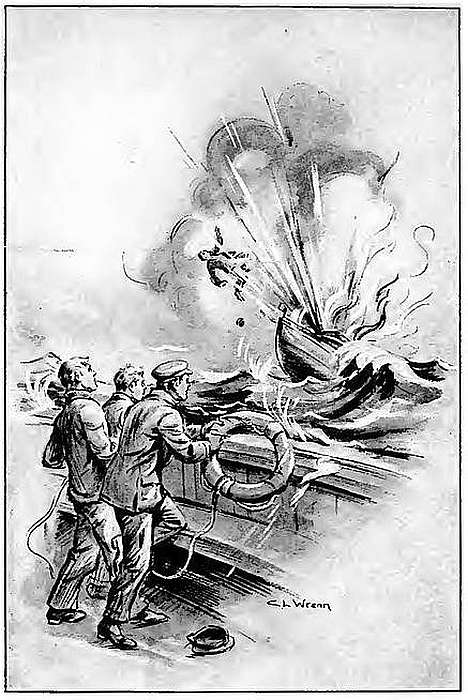
There was a sudden flash of flame and the roar
of an explosion. Flames shot up from the launch
and the lead-colored waters grew crimson under
the angry glare.
“The doctor! Nate, do you see the doctor?”
asked the other survivor of the sailor.
“No, sir, Mr. Anderson! Land o’ Beulah, I
don’t!” wailed the other.
“There he is! Look! Off there!” cried Joe
suddenly.
He pointed to a black speck, the head of a
human being, in the midst of the blood-red waves.
53“He’s missed the life-ring!” groaned the man
who had been addressed by the sailor as Mr. Anderson.
“Is he a good swimmer?” demanded Nat anxiously.
“No, he can only handle himself in the water
a little,” was the reply.
They all gazed as if fascinated at the struggle
on the flame-lit waters surrounding the blazing
launch. The face of the castaway was toward
them now and they could see his agonized features
as he struggled amidst the surges.
“Joe, take the wheel. One of you throw another
life-ring after me!” came suddenly in Nat’s
voice. “Bear down after me, Joe, and look lively
to chuck the second ring if I miss the first!”
Before they could lay hands on him or utter
one word of remonstrance, Nat was overboard.
On the bridge lay his oilskins, shoes and outer
garments. While they had been gazing, horror-stricken,
at the struggle for life going on apparently
beyond the power of human aid, Nat had
acted. But it was a chance so desperate as to
seem suicidal.
54“Nat! Nat! Come back!” shouted Joe, but it
was too late. Nat was already struggling in the
towering seas, fighting his way toward the hapless
man. The next instant Joe flew to the
wheel. In the moment that it had been neglected
the Nomad had yawed badly. He signaled Ding-dong
to come ahead slowly, and as well as he
was able he kept after Nat, in a tremble of fear
lest by over-eagerness he might run him down.
“Stand by with those life-rings!” he ordered
curtly to the two men already rescued, who did
not appear to be so much the worse for their
immersion. The sailor and the man addressed
as Anderson each picked up a life-ring, and,
leaning over the starboard rail, eagerly scanned
the water for the moment when they were to
fling them out.
55“Whatever made Nat take such a mad
chance?” groaned Joe to himself as he steadied
the Nomad as best he could. “But it was like
him, though,” he added, with a quick glow of
admiration for his young leader. “He’s the stuff
real heroes are made of, is Nat.”
Suddenly the man who had been battling for
life in the glare of the burning launch was seen
to throw up his hands, and, with a wild cry of
despair on his lips, which was echoed by his
friends on the Nomad, he vanished.
“Good heavens!” cried Joe in an agonized
voice. “Has Nat sacrificed his life in vain?”
He scanned the waters for a glimpse of his
chum, but not a sign of the plucky young leader
of the Motor Rangers rewarded him.
Like the man he had set out to save, Nat Trevor,
too, was apparently engulfed by the seething
waters.
CHAPTER VI.
56
SAVED FROM THE SEA.
Joe, till the last day of his life, never forgot
the ensuing period of time. It appeared to be
years that he stood there amidst the pandemonium
of the storm, with his nerves on blade
edge and his heart beating suffocatingly with
anxiety. The Nomad struggled and plunged like
a wild horse, and it required all his muscular
strength to hold her within control.
A sudden shout from Nate caused him to look
up hopingly.
“There! There they both are!” yelled the
sailor excitedly.
The next instant Joe, too, saw them. Right
ahead of the Nomad was Nat, apparently buoying
up the limp form of Dr. Chalmers on the life-ring
which the latter had missed, but which a
57lucky accident had brought within Nat’s grasp
at the very instant almost that Dr. Chalmers
sank. Nat had seen that the only chance of saving
him was to dive swiftly after him and trust
to luck. He had done so, and on coming to the
surface had managed to grasp the life-ring. All
this, however, they did not know till afterward.
From the bridge of the Nomad the two spare
life-rings were flung with right good will, and
Nat encased himself in one of the hooplike devices.
But it was not till he and his dripping
companion were hauled to the Nomad and were
safe on board that they realized how great the
strain on muscle and nerve had been. Nat
swayed and would have reeled against the rail
but for the young sailor from the boat, who
caught him. As for the man Nat had saved, he
lay exhausted on the bridge while his friend bent
over him.
58Luckily, Nat’s youthful, strong frame was as
elastic as a chilled steel spring, and, after boiling
hot coffee had been poured into him till he laughingly
protested that he was “a regular three-alarm
fire,” he was almost as spry and active
as usual. Dr. Chalmers, a man of middle age,
did not rally from his immersion so quickly, however.
He had swallowed quantities of salt water
and had had a narrow escape of being overcome
altogether.
Ding-dong was summoned from his engines to
look after the rescued ones as soon as Nat was
ready to “trick” Joe at the wheel, and the latter,
in his turn, relieved Ding-dong. Dr. Sartorius
held aloof while the stuttering boy explained to
his interested auditors the day’s adventures and
learned how they came to be in such a fix. Dr.
Chalmers, who, it appeared, was an Eastern physician
of note spending a short vacation at Santa
Barbara, had gone out fishing earlier that afternoon
in Nate Spencer’s boat, the Albicore. His
friend, Rufus Anderson, an engineer connected
with the Government, had accompanied him.
59Time passed so pleasantly, with the fish biting
their heads off, that all thought of time and distance
from shore had been lost. It was not till
the sun was obscured that any of the party gave
heed to the weather, and then it was too late.
“We owe our lives to you boys,” declared the
doctor gratefully, “and we can never repay you
for what you have done.”
Rufus Anderson warmly echoed the doctor’s
praise, and Nate, the sailor, shyly seconded the
gratitude. Dr. Chalmers had already agreed to
help Nate purchase another boat in place of the
Albicore, and so the fisherman felt happier than
he might have done at the thought of his trim
craft lying a blackened shell in the Pacific.
The doctor expressed great interest in Mr.
Jenkins’ case, and, after examining him, declared
that in his opinion the surgeon of the Iroquois
had exaggerated the nature of his injuries. In
his estimation, he said, Mr. Jenkins would pull
through all right. Ding-dong stole a look at Dr.
60Sartorius as his brother physician announced this
opinion, and detected an expression of hawklike
eagerness on the black-bearded man’s features.
He showed an interest beyond that of a perfect
stranger in Dr. Chalmers’ opinion.
“Then he will not die, after all?” he asked in
his raspy voice, coming forward to the other physician’s
side.
Dr. Chalmers turned and scrutinized him
quickly.
“Dr. Sartorius,” explained the other, introducing
himself. “I have a professional interest in
the case. You think this man will live?”
“I do, unquestionably,” was the reply of Dr.
Chalmers. Ding-dong saw his eyebrows lift in
astonishment at the other’s tone. It was plain
that he liked the black-bearded man no better
than did the boys.
When Ding-dong, shortly afterward, poked his
head above the companionway for a breath of
air, he found that the storm was rapidly abating.
61In fact in the cabin it had been apparent that
the movements of the Nomad were becoming less
and less erratic and violent. He told Nat of what
had occurred below, and Nat, after a moment’s
thought, replied:
“There’s something about all this that I can’t
fathom, Ding-dong. In fact, things have been
moving so swiftly since we left the Iroquois that
I haven’t had time to think. Of two things I’m
pretty sure, though, and one of them is that Dr.
Sartorius came aboard us because he didn’t want
Mr. Jenkins out of his sight; and the other is
that he had a good reason for wanting to delay
the Nomad’s reaching port when he tampered
with the engines.”
“Y-y-y-y-you think he der-der-did it, then?”
asked Ding-dong.
“Who else could have? I didn’t, you didn’t,
and Joe didn’t. The injured man certainly didn’t;
and, besides that, didn’t Joe see his Whiskers
coming out of the engine room with a monkey
wrench? What was he doing in there at all if
he hadn’t been tinkering with the motor?”
62“Ther-ther-that’s so,” assented the other. “It’s
all like a Cher-cher-Chinese puzzle. What are
you going to do about it, Nat?”
“If suspicions were legal evidence, I’d hand
this fellow over to the authorities as soon as we
landed; but I can’t do that very well. They
would only laugh at us. Recollect, we’ve got
nothing tangible to bring against the man——Hullo,
Joe, what’s up now?”
Nat turned quickly as Joe came on deck. His
face was troubled.
“The engines are acting awfully queerly
again,” he said seriously; “I can’t make out what
ails them. Everything appears to be all right,
but still they’re not running as they ought.”
“Guess you’d better skip below and look at
them, Ding-dong,” said Nat. “No offence meant,
Joe, but Ding-dong is the mechanical crank of
this outfit.”
63Joe and Ding-dong were below some time,
during which period the black squall about blew
itself out, leaving only a heavy, blind swell to
tell of its passing.
When the two lads came on deck again Nat
saw at once that they had bad news.
“We’re pretty nearly out of gasolene, Nat,” announced
Joe ruefully; “none of us thought to
look at the main tank before we started out, and
now we’ve only a few gallons left. We’ve pumped
that into the auxiliary, and I guess we can limp
along a few knots on it.”
“Great mackerel! That’s nice!” exclaimed
Nat, shoving back his cap and scratching his
curly forelock, a way he had when perplexed.
“This is sure our day for troubles,” he added
with a grin.
“Well, gee-whillakers, I don’t see what else
can happen right off,” declared Joe.
“Unless we bub-bub-blow up,” said Ding-dong
ominously.
“Shucks, we haven’t gasolene enough even for
that!”
64“And there’s none nearer than the island,”
put in Nat. “Tell you what, boys, it’s tough on
Mr. Jenkins, but there’s no help for it. We’ll
have to try and reach the island and then see
what is best to be done.”
“Well, there’s one good thing—we have a
reputable physician on board now instead of that
old Sartorius.”
“Gug-gug-glory! I dur-dur-don’t believe he’s
a dur-dur-doctor at all,” snorted Ding-dong.
“Unless he’s a horse doctor,” quoth Joe, “and
then any self-respecting steed would kick those
whiskers off him.”
“All of which doesn’t help us in solving our
problem,” struck in Nat. “We’re a good long
distance from the island, but at that it’s nearer
than any other place where we could get gas, by
my calculations. Can we make it on what we’ve
got in the tank?”
“We’ve gug-gug-got to,” rejoined the Nomad’s
engineer with conviction.
CHAPTER VII.
65
ON “WIRELESS ISLAND.”
The rugged outlines of Goat Island loomed
over the Nomad’s bow an hour or more after the
conversation just recorded. But the pace of the
stalwart craft was pitifully slow compared to
her usual rapid mode of progression. The entire
ship’s company, some of them recruited under
such strange circumstances, were on deck, with
the exception, of course, of Mr. Jenkins and Dr.
Sartorius. The latter had elected to remain below,
but you may be sure that he was closely
watched.
It was growing rapidly dusk. Nat noted with
increasing uneasiness the slow gait of the Nomad
and the still considerable distance to be covered
by her before she reached her haven.
66“I’ll tell you,” he said to Joe, who stood beside
him, “we’ll put a wireless plant on the Nomad,
and then in future if we get stuck we can at least
flash word of our plight and get aid from some
source or other.”
“That’s a good idea,” agreed Joe; “if only we
had such a plant on board now we could send out
a message for the gasolene boat that supplies
the fishing fleet and be all right in a jiffy.”
But, fortunately for the boys, their troubles
for the day at least appeared now to be over.
The Nomad made her cove without further difficulty,
although, as Joe remarked, “there was
hardly another turn left in her.”
The party landed in the dinghy which had been
towed safely by its stout hawser. Mr. Jenkins,
thanks to the care of Dr. Chalmers, showed signs
of rallying, and not long after he had been comfortably
bestowed on a cot in the Motor Rangers’
hut he regained consciousness. Although the
boys were burning to ask questions which would
aid in elucidating the puzzling problem into which
they had blundered, they were warned by Dr.
Chalmers not to do so at the time.
67“Let us give him time to collect his thoughts
and not pester him by talking now,” he said.
“Since I have heard your stories, I am just as
curious as you are to find out the truth of the
matter, and just where this Dr. Sartorius fits into
the puzzle; for I am sure that he is a factor, and
no beneficent one, in the case.”
A little later Dr. Chalmers decided that it
would not be necessary to remove the injured
man to the mainland that night. In fact, he was
inclined to think that such a course might prove
harmful. They all, therefore, determined to remain
on the island all night. The boys were perfectly
willing to adopt this course. They were all
dog tired by the strenuous day which they had
passed through, as were, indeed, all of the party.
Dr. Sartorius sat sullenly in one corner of the
shanty all the evening, only speaking in monosyllables,
but the boys did not trouble themselves
68about him. After a hearty supper, all hands
turned in and slept the sleep of the exhausted till
morning.
The first thing when he awoke Nat looked
around for their queer guest. He was not in the
shanty, and, leaving the others still asleep, Nat
set out on a tour of investigation. Somehow he
deeply mistrusted and suspected this black-bearded
stranger, and when he found him missing
he at once surmised that all was not well.
He bitterly regretted that they had not openly
voiced their suspicions the night before, or at
least kept a watch on the man. But it was too
late now.
Full of apprehension, but of what he did not
know, Nat hastened to the cove. The boat in
which they had come ashore was gone, and,
worse still, the Nomad was missing from her
moorings!
69“The scoundrel!” cried Nat indignantly. “This
is some of his work, I’ll bet a dollar. Oh, what
wouldn’t I give to get my hands on him! But
what are we going to do now? Here we are
practically marooned on this island. Thank goodness
we have the wireless; otherwise we’d be in
a bad fix. Nobody comes near this place but
fishermen, and they don’t put in frequent appearances.”
As he hurried back to the hut, burning with
indignation, Nat formed a theory concerning the
disappearance of the small boat and the larger
craft. It was plain that Sartorius wished to get
ashore without landing with the party. Nat believed,
in the light of recent events, that the man
had a notion that the boys meant to communicate
their suspicions to the authorities. But how he
had succeeded in running the Nomad alone and
single-handed was a mystery which was not
solved till later.
70When he burst into the hut, full of the story
of the vanishing of the two boats, Nat found Dr.
Chalmers bandaging Mr. Jenkins’ head and placing
fresh dressings upon it. The bandages had
been extemporized from a stock of clean linen
the boys had along with them. The group within
the hut was listening eagerly to something that
the injured man was saying; but Nat’s news,
which he blurted out as soon as he entered, quite
drew away attention from their wounded guest,
whose hurt, it transpired, was nothing more than
a bad scalp wound.
“Boys, the boats have gone!” was the way Nat
announced his news.
The others stared at him only half understandingly.
“Gone!” echoed Joe, the first to find his voice.
“Gug-gug-gone!” sputtered Ding-dong.
“Do you mean they have been stolen?” demanded
Dr. Chalmers.
“That’s just what I do mean, sir.” And Nat
proceeded to impart all that had occurred, not
forgetting, of course, the disappearance of Dr.
Sartorius.
71“Well, this is a nice kettle of fish,” blurted out
Joe angrily. “Oh, but weren’t we the chumps to
take that fellow on board! I wish we’d left him
to continue his way to Mexico, and let it go at
that!”
“Too late now to cry over spilt milk,” declared
Nat. He was going to say more when Mr. Jenkins,
who had been listening to their talk, interrupted.
“Did I hear you mention the name of Sartorius?”
he inquired in a feeble voice, although
one that vibrated with a keen interest.
“Yes,” said Nat, and rapidly told how they
came to include the name of the black-bearded
man in their conversation.
“And he was here and is gone?” demanded Mr.
Jenkins so excitedly that Dr. Chalmers had to
beg him to calm himself.
The others stared at Mr. Jenkins. His hands
clenched and unclenched.
72“Oh, the precious scoundrel!” he choked out;
and then added quickly, “Look in my coat and
see if you can find some papers, a thick bundle
held together with an india rubber band!”
Then, and not till then, did the Motor Rangers
recall what the ship’s doctor had told them about
a slashed coat. In the rush of events following
the start of the return run, this fact had completely
slipped their minds. A glance at the coat
showed a slash over the breast pocket. Inside
there were no such papers as the injured man
described. The pocket was empty, in fact.
Mr. Jenkins groaned when he heard this.
“Oh, why didn’t I recover consciousness sooner?”
he exclaimed, lying back weakly. “That rascal
has taken the result of years of work and
thought with him. I am ruined!”
Dr. Chalmers happened to have with him, in
a sort of pocket emergency case, some soothing
tablets. He crushed one of these in a tin cup of
water and gave it to Mr. Jenkins. In a few seconds
he spoke to him in a quiet tone:
73“Suppose you tell us what you know about
this man Sartorius, and how you came to be on
the same ship, and also how you met with your
accident—if it was an accident.”
“It was not an accident,” rejoined Mr. Jenkins
emphatically, “the man Sartorius—who is not a
doctor, but only styles himself such—came behind
me on the companionway and shoved me so
suddenly that I lost my balance and fell headlong.
I turned in time to see him, but not to
save myself. I had been on guard against attack,
but not against such an attack as that.
Then, having rendered me unconscious by the
fall, he robbed me of the papers I have mentioned,
for which he had tracked me across the
continent.”
“Did you know that he was on board the Iroquois?”
asked Nat, while the others formed an
interested circle.
74“Not till the ship had sailed. Then I encountered
him suddenly in a passageway. From that
moment I was on my guard, but, as you know, I
did not succeed in warding off the attack I
apprehended. In fact, I never dreamed that it
would come in that way.”
“What were these papers he was so anxious
to get hold of?” asked the doctor; and then, as
the other hesitated, “You may speak with confidence.
I am sure that no one here will disclose
anything confidential you may tell us.”
Mr. Jenkins scanned all their faces eagerly.
It seemed as if he wanted to satisfy himself that
what the doctor had said was right, that he
could rely on them to retain his secret.
“Gentlemen,” he said in low tones, “those
papers were the plans of an invention which I
had just brought to perfection after years of
labor and research. You have heard, of course,
of the reward offered by the Government to the
man who could perfect a dirigible torpedo? That
is to say, a torpedo that would be under the control
of the operator who sent it on its death mission,
from the moment it left the side of the ship
that launched it to the instant that it exploded.”
75The boys nodded. They all read several scientific
papers and magazines and had, of course,
heard of the reward that Mr. Jenkins mentioned.
“Well, I had invented and perfected such a
projectile,” continued Mr. Jenkins, his eyes glowing
like two coals in his pale cheeks as he talked.
“What, you had invented a torpedo which
could be governed from a ship’s side and absolutely
controlled by the operator?” Nat could
not help asking. The thing seemed fantastic,
improbable; he even thought that possibly the
man’s mind might be wandering. But before Mr.
Jenkins could reply, Dr. Chalmers struck in with
an exclamation.
“Pardon me, but you are not the Professor
Jonas Jenkins, late instructor of physics and
chemistry at Columbia University, New York
City, who withdrew from the faculty to perfect
some experimental work, the nature of which
was kept a profound secret?”
76“I am,” was the quiet reply, “and that experimental
work was identical with the plans and
papers of which I have just been robbed.”
“Namely, a dirigible torpedo wholly under control
at all times?”
“Yes, sir. My torpedo was governed by a
principle entirely novel in such lines. Torpedoes
have been experimented with which have been
governed by wires, at best a clumsy and inefficient
device. My torpedo was controlled by a
new principle entirely—namely, by wireless!”
“We’ve got a plant here, which Ding-dong—William
Bell, I mean—erected,” struck in Nat.
“A wireless here on this island?”
The question came from the injured man in
anxious, almost quavering tones.
77“Yes, sir.”
“Then we’ve a chance to head off that rascal
yet!”
Mr. Jenkins raised himself on his cot.
“Can’t you send out a message to all coast stations
to alarm the authorities to be on the lookout
for the man when he lands? He can hardly
escape notice in that boat.”
“Jumping ginger snaps! The very thing!”
cried Nat. “What a fine lot of dummies we were
not to think of that before; but I guess losing the
boats turned us all topsy-turvy. Get busy, Ding-dong!”
But Ding-dong was already at his instruments.
He flashed on his sending current and presently
the whine and crackle of the urgent message “To
All Stations” was audible even in the living hut
through the open door of the wireless shed.
CHAPTER VIII.
78
AN AERIAL APPEAL.
While Ding-dong was sending his wireless appeal
flashing and crackling into the ether, Dr.
Chalmers turned to Professor Jenkins again.
“You have not yet told us what connection this
man Sartorius has with the case?” he hinted.
“Sartorius is no more his name than it is
mine,” was the rejoinder. “His right name is
Miles Minory, and he was dismissed from the
University shortly before I left for being engaged
in some shady financial transactions. He had
worked as my assistant once, and in some way
learned of my secret researches. Of a singularly
acute mind, he perceived at once the financial
possibilities of the device. After approaching
some capitalists, he came to me with a proposition
to sell out, he, of course, to get a large reward
from the capitalists for persuading me to
79do so. I refused, and told him that I would
market my wireless torpedo, when completed, in
my own way. Not long after, my rooms were
broken into in my absence and my papers tampered
with; but, luckily, long before this I had
removed the important ones to a place of safety,
knowing Minory’s character and that he was
likely to adopt crooked methods when others
failed to gain his end.
“From time to time I became unpleasantly
aware that I was being watched. The secret surveillance
got on my nerves, but I persisted with
my work until I perfected it. I carried out my
last experiments in a remote coast town on the
north shore of Long Island. One night I was
attacked on my way from my experiment station
to my home. Minory did not appear in this outrage,
but I knew he instigated it. As in his other
efforts to obtain my papers, he failed in this
also.
80“But it decided me that the vicinity of New
York was too dangerous a place for me to carry
on my work. I was not sure even that my life
was safe if I persisted in holding out against the
ring that wanted to seize my invention. In this
dilemma I turned to a friend who owns a small
ranch in Mexico, not far from Mazatlan. He
offered me freely the use of this secluded spot
for as long a time as I wished to use it, and I
jumped at the offer. Without loss of time I
booked passage for San Francisco through a
third party, in order to throw my enemies off my
trail. When I embarked on the Iroquois it was
with a light heart, but, as I told you, I was not
long left undisturbed in my fancied security. Although
that beard Minory wears is as false as
the name he traveled under, I knew him even in
the disguise he had adopted. I was on guard,
but—well, the rest you know.”
81During the recital of this remarkable story
they had listened without a word of interruption.
Now, however, everyone had questions to ask, all
of which Mr. Jenkins readily answered. We shall
not detail the conversation here, as Professor
Jenkins’ narrative as already set down appears
fully to cover it. In the midst of the talk, and
while Joe was fixing up the best breakfast he
could on the hut stove, Ding-dong, his face red
with excitement, came running in.
“I’ve sent out a full description of the
m-m-man and the two b-b-boats to all coast stations
within reach,” he exclaimed. “But tell me
one thing, professor, could this Sus-ar-Sartorius
run a mum-mum-motor boat?”
“I don’t know,” was the rejoinder, “but one
thing I can tell you, he is a slick enough customer
to be able to do almost anything.”
“From the way he fixed that carburetor and
those plugs it certainly appears that way,” commented
Joe, looking up from the frying pan;
“why do you suppose he wanted to delay the
Nomad, anyhow?”
82“To mum-mum-make a further sus-sus-search
through the Professor’s trunks, I guess,” was
Ding-dong’s reply.
“What! He was looking in my trunks?” cried
Mr. Jenkins.
“Yes, sir; Ding-dong caught him at it,” put in
Joe.
“The cunning scoundrel! He is cleverer than
even I thought,” cried the professor. “In one of
my trunks was a working model of the wireless
torpedo. If he secured that it would be of invaluable
aid to whoever had the plans. In fact,
without it as a key they would have some difficulty
in following out my calculations and designs.”
“So that was the reason he was so anxious to
come ashore with us!” cried Nat, a light breaking
in on him; for it would have appeared more reasonable
to suppose that, having rifled the professor
of his papers, the thief would desire to keep
on the high seas. “I see it all now. He knew
83that your trunks would be shipped ashore with
you, Professor, and in some way he also knew
that they held what he hadn’t yet obtained, the
working model. He must have calculated that on
the way between the Iroquois and the shore he
would have time to ransack your baggage and
get hold of it.”
“And his desire to lay hands on it gave him
nerve enough to tamper with the engine and endanger
his own life as well as ours in that gale,”
supplemented Joe.
“It is all as clear as day now,” cried Nat; and
then in a chagrined voice he muttered, “What a
pack of boneheads we’ve been! Just think, we
had him right in our power and he’s slipped
through our fingers like so much water!”
“Never mind,” consoled Dr. Chalmers, “you
couldn’t very well have acted on what knowledge
you had up to the time that Professor Jenkins
recovered consciousness. I think, in fact, that——Hark!”
84It was Ding-dong’s “wireless alarm” clanging
out the call for Goat Island.
“On the jump! Run like a jack-rabbit now,
Ding!” cried Nat excitedly. “This may be news
of the rascal!”
But it was not; however, it was news of a still
more astonishing nature, and, so far as the boys
were concerned, almost as gratifying, dearly as
they would have loved to catch Sartorius—or
Minory, as we must now call him. Nat and Joe,
who had followed Ding-dong to the wireless shed,
bent over him while he answered the call and
then switched to his receiving instruments.
“It’s the fishing steamer, Hattie and Jane,” he
explained hastily. “You know, Capt. Eli Thompson’s
boat, the one that collects fish from the
fleet. She carries wireless so that she can get
quotations and instructions from her owners even
at sea.”
He broke off, and as the dots and dashes began
to beat into his ears from the Hattie andJane, he wrote swiftly with nervous, flying fingers.
85As they bent over him with open mouths and
wide eyes, Nat and Joe burst into a joyous
“whoop!” of delight as they read the message
Joe’s pencil transcribed on the pad.
“Your motor boat, Nomad, found drifting.
No one on board. Are you all right?—Thompson,
S. S. Hattie and Jane.”
“Gee! I’ll bet the captain thought we were
all murdered or something!” cried Joe, gripping
Nat’s shoulder, while Ding-dong sent back a
reassuring message.
“Hush!” cried Nat. “Here’s more coming.”
“Hawser has been cut. How can you explain?”
“The hawser cut?” shouted Nat. “Cracky! I
see it all now. That fellow couldn’t run the Nomad
himself and means to row ashore. He figured,
though, that we might swim out to her and
start in pursuit, so he cut the mooring rope and
set her adrift.”
86“Oh, for five minutes alone with him!” panted
Joe.
“What’ll I say?” asked Ding-dong, half turning.
“Say that we will explain when we see him.
Ask him if he will bring the Nomad to Goat
Island. Tell him we are marooned here and
will pay him well for the job.”
Ding-dong obediently rapped out the message
and then switched to the receiving set again.
They saw him give a reassuring nod as he wrote
down on his pad:
“Will be at Goat Island within three hours.
Catch light, and can spare the time. Is fifty dollars
too much?”
“The old rascal!” grinned Nat, too delighted
to be angry at this somewhat steep figure. “He
knows he’s got us under his thumb and sees a
chance to make a good wad of salvage. Tell him
‘all right,’ Ding-dong, there’s nothing else for
it.”
87“Satisfactory. Make all haste you can,” was
flashed back, and then came “Good-byes.”
As soon as Ding-dong had grounded his instruments
and taken off his head receivers there
was a scene of wild jubilation in the wireless
hut. The boys whooped and cheered like Indians
and joined in a wild war dance.
“Whoopee!” yelled Joe, “there may be a
chance of catching that old fake-whiskered cuss,
after all. He’s got a good long start, but what
with our wireless warnings and with the long
row ahead of him, we have a fighting chance of
overhauling him.”
“And I reckon he won’t be in a desperate
hurry, because he’ll never figure that we could
have such blind luck as to have the Nomad
picked up by about the only wireless craft along
the coast that knew her and her owners and could
notify them at once of the recovery,” cried Nat.
“Boys, it’s one chance in a thousand, but it looks
as if luck was beginning to run our way again
after all our set-backs.”
88Within a very few minutes those at the living
hut were apprised of the state of affairs. The
effect on every one’s spirits was wonderful. Even
Dr. Chalmers and his friend became infected with
the excitement of the chase after a man who had
proved himself as consummate a rascal as could
be found on earth.
But in the midst of the jubilation, Joe propounded
a sudden question that came like a dash
of cold water on their hopes.
“Suppose before he cut the Nomad adrift he
rifled the trunks and got the model?” he exclaimed.
It was a possibility that, strange to say, in the
general excitement, had not yet occurred to any
one of them.
“In that case, if we don’t find him I am in
as bad a fix as ever,” declared the professor
blankly. “With the model it wouldn’t take a
clever fellow like Minory more than a few days
to understand the principles of my invention,
89rush patent papers to Washington and reap his
reward from the unscrupulous capitalists employing
him. You see I was so afraid of possible
leaks that I was waiting till I had every
detail complete before I filed application for a
patent. With nobody in my confidence concerning
my work, I have absolutely no proof nor
witnesses that the wireless torpedo is the product
of my brain. Minory, on the other hand,
has the backing of almost unlimited money and
influence.”
“Humph!” grunted Nat, in a low aside to Joe,
“we may be euchered after all, then.”
“We!” rejoined Joe in a rather astonished tone.
“Yes,” was the sturdy reply. “I like this professor
and I hate to see such a rascal as Minory
getting away with a thing to which a man has
devoted the best efforts of his life. We, Joe—I
said we—are going to help him in every way in
our power.”
90“Bully for you, Nat. I’m with you to a crisp!”
cried Joe, while he gave Nat a slap on the back
that almost drove the breath out of the young
leader’s body.
CHAPTER IX.
91
A STERN CHASE.
In the meantime, from station to station, within
a radius in which it was reasonable to suppose
the fugitive would land, the wireless was sending
out its waves of alarm. The various stations attached
to life-saving headquarters along the coast
took the message and, in turn, telephoned the
local authorities of near-by towns. Ding-dong
received these assurances through the ether and
transmitted them to his friends. Excitement was
rife. It looked as if by means of the wireless
they had spread a net that left not a mesh for the
fugitive to slip through.
Nor was this all on which they based their
hopes of overhauling him. It was a long, weary
row to the shore, and, as Nat had pointed out,
Minory, deeming himself secure from pursuit,
92would probably be in no particular hurry, but
conserve his strength. From the bridge of the
Nomad such an object as a rowboat would be
conspicuous for a long distance. If only Captain
Thompson hastened his return with the wandering
motor craft, they stood about an even
chance of capturing Minory themselves. It was
a situation that thrilled them, and the time
dragged wearily till smoke on the horizon announced
the approach of the Hattie and Jane.
She anchored off the island and flashed ashore
a message of greeting. Attached to her stern
by a stout hawser was the errant Nomad. At
sight of the returned wanderer the boys set up a
ringing cheer. Captain Thompson, a weather-beaten
old salt, rowed ashore in the dory that the
Hattie and Jane lowered, and received his reward.
He pocketed it with a grin, as much as to
say, “A pretty good morning’s work”; but the
boys did not grudge it to him. The return of the
Nomad meant much more to them than that.
93The dory was loaded up with gasolene, and
after two trips between the shore and the Nomad,
the latter was ready, with full fuel tanks, “to
receive passengers.” Professor Jenkins, still so
weak that he had to be supported to the boat, was
the first to be taken off. Then the boys closed
up the shanty and the wireless station and within
half an hour were under way, with the Hattie
and Jane flying a bunting salute in response to
the boys’ string of flags which spelled out to the
fishing steamer “Good luck.”
“Now, Joe, keep your eyes peeled,” ordered
Nat. “I’d give a whole lot to run that fellow
down and land him ourselves. If once he gets
ashore, he’s slippery enough to get clear away.”
Dr. Chalmers, who had gone below with his
patient, and also to make an examination of the
professor’s trunks, came on the bridge at this
moment with a dismal report.
94As they had apprehended, Minory, before cutting
the Nomad loose, had ransacked the trunks.
The model was gone, and the doctor feared that
to inform the professor of the loss might cause
a serious relapse in his condition.
It was agreed, therefore, to reply only vaguely
to any questions he might ask. But fortunately
the inventor, completely worn out by excitement
and weakness, sank into a deep sleep almost as
soon as he was laid on the divan below, and they
were spared the necessity of evasive replies to
the questions he would have been sure to ask
about the safety of the model.
It must be confessed that when Nat learned
the clever and thorough way in which Minory
had carried out the last part of his desperate
plan for stealing the fruits of the professor’s inventive
faculty, his heart rather sank. Somehow,
he did not feel quite so sanguine as he had
at first that they would succeed, either themselves
or through their wide-flung messages, in
capturing the fellow. The remarkable ingenuity
he had shown in his attempts on the wireless torpedo
in New York, in his successful espionage of
95the inventor across the continent, and in his
last coup of getting himself on board the craft
on which the man he had injured was being conveyed
ashore all showed an acute intellect, a depraved
sort of genius for carrying out whatever
nefarious ends its possessor had in view. Nat
didn’t underrate his antagonist. He knew by this
time that they had a wily and perhaps a desperate
foe to fight.
The sea was as smooth as glass, and, although
the sun beat hotly down, there was yet a refreshing
breeze. These factors would aid Minory in
his long row, supplementing the work of his
muscles, which, despite his scrawny form, Nat
judged to be wiry and powerful.
The Nomad was crowded along to every ounce
of her speed capacity. Ding-dong never left his
engines a second, but watched them with anxious
solicitude. He was fully aware of how much
depended now upon the performance of the motor.
So far it was running sweet and true, with
96a humming song that delighted the watchful boy
engineer. Oil can in hand, he doused the bearings
and moving parts with lubricant from time
to time, feeling a shaft collar or an eccentric
band to detect symptoms of overheating.
The distant coast range, faintly blue and luminous,
loomed up through the heat haze before
long, but although Nat stationed Joe with the
binoculars to keep active and constant watch for
the skiff, nothing appeared in the field of the
powerful glasses to warrant Joe in giving the
alarm.
Once he saw something black and was on the
point of crying out. The next minute he was
glad that he hadn’t. The object proved to be only
a floating log with a solemn line of seagulls bobbing
up and down on it as it rose and fell on the
swells.
“Begins to look bad, Nat,” commented Joe, as
the outlines of the rugged, bare coast range became
clearer and still no sign of a boat swam
within the horizon of the glasses.
97“I must admit that it does,” rejoined Nat, “but
it’s up to us to keep hoping against hope.”
Suddenly a thought came to Joe.
“See here, Nat, unless that fellow is as skillful
a boat handler as he is a crook he couldn’t land
on the bare coast. The surf would be rolling too
high even on a calm day like this to permit him
to do so even if he tried to.”
“That’s so, Joe; you do have a bright thought
once in a while.”
“Thank you,” grinned Joe; “and now let me
go on to say that in my opinion he’ll make for
some cove.”
“Of which there are none too many hereabouts,”
responded Nat. “Let’s see, which one
is the nearest?”
“Why, Whale Inlet, in the salt meadows beyond
Point Conception.”
98“That’s right, but he’d hardly know of that
unless he is more familiar with this coast than
it is reasonable to suppose.”
“But having observed what the conditions
were along the beach and realizing that he
couldn’t negotiate the surf, he’d be likely to go
hunting for such an inlet, wouldn’t he?”
“Sounds reasonable. But the point is just this,
why wouldn’t he go toward Santa Barbara itself?”
“Why, because, if he’s as shrewd as I think he
is, he will have guessed that we have sent out a
wireless alarm for him by this time.”
“But how does he know we have such an apparatus?”
“Just this. If for no other reason, he knows
we picked up that wireless from the Iroquois,
that message that got us into all this pickle.”
Before Nat could reply, the sailor whom they
had rescued with his employers the night before,
and who had been standing with Mr. Anderson
on the bridge, gave an exclamation.
99“I don’t want to give a false alarm, gentlemen,
but what’s that object off there?”
“Where?” demanded Nat. “Give me the
glasses, Joe, quick.”
Something in the sailor’s voice had made him
alert and active in an instant.
He applied the glasses to his eyes and gazed
through them for a few seconds.
“It’s a boat, a rowboat,” he announced after
his brief scrutiny.
“Our boat?” asked Joe almost tremulously.
“I think so,” was the reply, as the Nomad’s
course was altered and she was headed directly
for the distant speck that the sailor’s sharp eyes
had espied.
CHAPTER X. — CHAPTER XI.
100
MORE BAD LUCK.
“Oh, thunderation!”
It was Ding-dong who uttered the exclamation
as a sharp crack sounded in the engine room and
he sprang forward to shut off the motor. An
eccentric band had snapped with a report like a
pistol, and the Nomad was temporarily out of
commission.
Down the speaking tube came an impatient
query.
“What’s up? What’s happened?”
Ding-dong shouted up a reply.
“How long will it be before you can fix it?”
“About fifteen minutes. Luckily I’ve an extra
band handy.”
The stammering boy, as was usual with him in
stress of circumstances, had temporarily overcome
his impediment in speech.
101“Bother!” exclaimed Nat in a vexed tone. And
there was good reason for his impatient intonation.
Bit by bit the Nomad had been creeping
up on the solitary rowboat.
Hardly more than a few hundred yards now
separated them, and they could see Minory, with
white, anxious face, straining at his oars—as if
any human power could get him beyond reach of
the fast motor cruiser! Ahead of him lay an
inlet meandering up among some salt marshes.
It was Whale Creek, so called because a huge
whale had once been stranded there.
Nat knew that at the mouth of Whale Creek
lay shoals and quicksands among which the Nomad
could not navigate. If they could not cut
off Minory before he gained the entrance to the
creek, his escape appeared certain, for the Nomad
carried no dinghy and Minory had the whip
hand of them in the shallow water.
102“You’d better give up!” Nat had hailed to
Minory across the water. “Even if you get
ashore the authorities are already on the lookout
for you, warned by wireless. You don’t stand
the chance of a rat in a trap.”
Minory’s answer had been to stand up in the
skiff, holding aloft in one hand the model and in
the other the plans and calculations that had cost
the sleeping inventor below so much effort.
“If you come any closer, down these go to
Davy Jones!” he had yelled desperately.
“To do such a thing would be only to increase
the sentence you will get in a court of law!” Mr.
Anderson had shouted back indignantly.
“He’s only bluffing!” Joe had rejoined.
It was just at this instant that the unlucky disaster
in the engine room had occurred. Joe could
have cried with vexation.
“Of all the luck!” he exclaimed as the Nomad
lost way and came to a standstill, swinging seaward
with the outgoing tide. Minory stood up
in his skiff and shook a triumphant fist at them.
They turned away from him, and the next moment
something came buzzing and singing past
their ears.
103It was followed by a sharp, cracking report.
Then came a yell of defiant laughter.
“The rascal’s shooting at us!” exclaimed Nat.
“Yes; duck quick!” cried Joe, as the revolver
was once more leveled.
“You’ll have to get up early to get ahead of
me, you whelps!” was the insulting cry borne
over the waters.
Nat’s teeth clenched; his cheeks flamed red.
He did not often lose his temper, but the ruffian’s
audacity had made him mad clear through.
Regardless of his danger, he sprang erect and
faced the man in the skiff.
“We’ll get you yet, Minory!” he shouted.
For an instant the occupant of the small boat
appeared taken aback, and that for a good reason.
Obviously, if they knew his real name, the
professor must have not only discovered his loss,
but recovered sufficiently to tell the whole story.
104His acute mind reasoned this out in a jiffy, and
it gave him pause. But only for a fraction of
time. The next minute, with a cry, “Take that,
you young cub!” another bullet came singing and
whinging through the air.
“I’ll go below and get the rifle!” cried Joe furiously.
“We’ll show him two can play at this
game; we’ll——”
“Do nothing of the sort,” said Nat calmly;
“he can hardly get much of an aim standing up
in that cranky skiff, and if he wants to get away
he’ll do better by taking to his oars than by
blazing away at us.”
“There he goes now,” cried the sailor. “I
guess he was so plumb mad clear through at the
quick tracks we made after him that he just naturally
had to blaze away at us.”
As the man spoke they saw Minory, with another
mocking laugh, bend to his oars once more
and row rapidly toward the creek mouth.
“Once let him get in there and we’ve lost him,”
cried Nat despairingly.
105“Better lose him than have any bloodshed,”
declared Mr. Anderson. “That fellow is a desperate
man, and wouldn’t hesitate to use firearms
to protect himself from capture.”
“It looks that way,” commented Joe. “Whee!
Look at him row!”
“Consarn him, I wish he’d bust an oar!”
growled out the sailor gloomily.
“No, all the busting seems to be done on this
ship,” was Joe’s dismal response.
“Now, Joe, no grumbling,” warned Nat, always
optimistic even when things appeared blackest;
“we may get him yet. ‘There’s many a
slip——’”
“‘’Tween the law and the crook,’” growled
out Joe, finishing the quotation for him.
“Oh, put it the other way round,” advised Nat.
Just then Ding-dong appeared on deck.
He held up the broken eccentric ring which he
had just detached.
“Here it is,” he said; “that’s what has crippled
us.”
106“Broken?” asked Joe.
“Yes, snapped clean through.”
“And it was a new one not long ago!” exclaimed
Nat.
“Yes, and the best made. It beats me how it
came to fly off the handle that way.”
“Good thing it didn’t wreck the whole engine,”
was Joe’s comment.
“Yes; lucky I was below, or it would have,”
rejoined Ding-dong, stammerless in his excitement.
“Let me look at that eccentric strap a minute,
Ding-dong,” said Nat quietly, but with a strange
ring in his voice.
Ding-dong, looking rather surprised, handed it
over to the young captain of the Nomad. Nat
didn’t often have anything much to say about the
machinery. He left that part of the running of
the boat to Ding-dong and Joe, although he was
quite conversant with it.
They watched him while he examined it carefully
at the broken ends.
107“It’s a wonder this lasted as long as it did,”
he said.
“Why! It was new and——”
“Yes, I know, but see these marks on it. What
are they?”
“Cantering cantilevers, the marks of a file!”
cried Joe.
“That is what I thought. That fellow was too
slick not to have turned some trick like that.”
108
“THERE’S MANY A SLIP.”
Ding-dong accomplished his repairs in a shade
under the fifteen minutes he had allowed for the
operation.
“All ready!” he reported up the speaking tube.
“Come ahead!” cried Nat eagerly.
The skiff was once more a diminished speck,
alarmingly close in to the shoals that Nat
dreaded. Moreover, during the wait, while they
had fretted and fumed, the outsetting tide had
carried them further out to sea. Thus it appeared
as if the very forces of nature were allied
with Minory.
But the boys set up a triumphant shout as once
more the bow of the Nomad began to cleave the
water and all fixed their gaze eagerly on the object
of their pursuit. He, for his part, must have
109been watching them closely, for Joe observed
through the glasses that, as soon as they began to
move once more, he quickened his stroke.
On and on rushed the Nomad, and the water
began to grow yellow and green in patches about
her, marking spots where there was shoal water.
Between these patches threaded narrow streaks
of blue which showed deep channels that could
be safely traversed.
The man they were pursuing evidently knew
the surface indications of the water as well as
they did, for it was seen that he carefully navigated
the skiff over the shallowest water where
the yellow color showed that sand bars lay close
to the surface. As the passages grew more and
more intricate, Joe fairly gasped as Nat kept
right on. But Nat showed not the slightest sign
of relinquishing the chase, although all about
them as the tide ran out the bars grew more and
more numerous.
“Say,” Joe ventured to remark presently,
“hadn’t we better slow down?”
110“Not yet,” came through Nat’s gritted teeth.
Joe saw the well-known forward thrust of Nat’s
jaw that betokened that he was in deadly earnest,
but he made no further comment.
Every minute, though, he expected to feel the
grating jar that would announce the end of the
chase and the grounding of the Nomad. So far
everything was going smoothly and they were
steadily overhauling the skiff, although their loss
of way by the eccentric breakage and tide drift
had been considerable.
Things were still in this condition when the
skiff entered the mouth of the creek, and suddenly,
after proceeding a few yards, vanished as
if she had sunk. But Nat knew that no such
thing had occurred.
“He’s turned up into a side channel where he
knows we won’t stand the ghost of a chance to
nail him,” cried Nat. “Bad luck and more of
it.”
111“Nothing to do but to turn back, eh, Nat?”
asked Joe, secretly rather relieved at this termination
to the chase. He didn’t want to see the
Nomad aground and helpless till high tide set
her afloat again, or, worse still, till tackles had
to be rigged or help sent for to drag her into
deep water.
“Yes,” sighed Nat, “that’s about it.”
He was preparing to turn around in a rather
larger patch of blue water than the others which
lay amidst the yellow and green “danger signals,”
when Joe tugged at his sleeve excitedly.
“Nat! Nat! Look there!”
Coming down the creek was a low, racy-looking
motor boat without a cabin, but with a high,
sharp cutwater that indicated that she was built
for speed.
Nate, the sailor, gave a quick gasp of astonishment.
“Jee-hos-phat! That’s Israel Harley’s boat!
Him as was suspected of smuggling opium for
the Chinese smugglers but was acquitted on his
trial.”
112“I’ve heard of him,” said Nat, “but I didn’t
know he lived back in there.”
“Yes, Whale Creek, or a tributary of it, runs
miles back, right up to Martinez almost. It’s a
cinch for Israel to get that light-draught craft of
his’n back up there. He lives in a sort of shanty
town with a lot of other fishermen, and they say
that, although all the crowd are hard and tough,
Israel is the toughest of ’em.”
“I know he has a bad reputation. He must
have made a lot of money, though, to buy that
boat. She’s a beauty, and fast, I’ll bet,” said
Nat, casting admiring glances on the high-bowed
motor boat which could be seen threading the
intricacies of Whale Creek as it wound in and
out among the greenish-gray salt meadows.
“Yes, they say that Iz would do anything for
money and wasn’t no ways partic’lar,” was the
response. “I’ve hearn, too, that in old days he
and his gang made a lot of coin by setting false
lights on the shore and then looting the ships
113that was wrecked on that account. But that’s
all long ago. I guess opium smuggling from
South Sea schooners is more in his line now.”
“How has he kept out of the clutches of the
law so long?” asked Joe.
“He’s got some sort of political pull,” was the
rejoinder, “and besides that, there ain’t hardly
nobody would testify against him, they’re so all-fired
scared of what would happen to them if they
did. There’s a whole clan of Harleys back there
at Martinez, and they’re all about as hard as old
Israel, and that’s saying a heap.”
“Hullo! What’s up now? They’re slowing
down!” cried Nat suddenly.
“So they are, and right by that little side passage
that Minory vanished into.”
“Maybe he’s in trouble and they’ve stopped to
see what’s up,” suggested Joe.
“No; look, they’ve stopped! Look there!
Minory is rowing up to them and talking to them.
Put the glasses on ’em, Joe, and see what they’re
up to.”
114Joe clapped the binoculars to his eyes.
“Crickey!” he cried excitedly, “I saw him pass
something to old Harley, and he’s getting on
board the black motor boat.”
“I’ll bet he’s cooked up some fairy story and
that old Israel has agreed to take him some place
down the coast, maybe Santa Barbara, and set
him ashore where he can hit a railroad or a
steamer,” suggested Mr. Anderson.
“That may be so,” was Nat’s thoughtful rejoinder;
“from what Joe saw, it looks as if
money had been passed. If he had kept on to
Martinez he would have found himself miles out
of civilization. It’s wild country back there, and
I guess he is anxious to hit the railroad or the
ocean right now.”
The black motor boat got under way again,
leaving an abandoned skiff behind. What story
the rascally genius had concocted, of course they
did not know, but Joe could see old Israel, or a
man whom he guessed was he, pointing at the
Nomad as if she were the subject of the conversation
on board the fast, rakish craft.
115On she came with a bone in her teeth, and,
heading round, threaded her way rapidly out of
the intricate passageway and across the Nomad’s
bow. Nat almost groaned aloud in his chagrin.
“Can’t we overtake her?” asked Mr. Anderson.
Nat shook his head despairingly as he watched
the black craft cut smoothly through the water
at a rate that he estimated at fully eighteen knots
or over an hour.
“Not a chance on earth, sir,” he said.
“There’s not a boat round here can touch her,”
declared the sailor with grim confidence. “I
reckon old Israel uses her in his opium smuggling.
He needs a fast boat for that, and maybe
some of that political ring helped him put those
speedy engines in her, for they must have cost a
pretty penny.”
116Suddenly one of the figures on the black craft
was seen to move toward the stern. Then came
a mocking wave of farewell and a shouted something
that they could not catch.
Nat set his teeth forcefully.
“There’s one chance in a thousand that she’ll
break down or something,” he said with grim determination,
“and I’m going to follow her as long
as I can.”
“Good for you, my lad,” exclaimed Mr. Anderson.
“The luck’s bound to turn some time. So
far it has favored them—maybe it will be our
turn now.”
CHAPTER XII.
117
THE SMUGGLER AT BAY.
But it didn’t look much as if Mr. Anderson’s
words were to be verified. Dr. Chalmers came
on deck, as he had been doing from time to time
to learn what was going on. He was told of the
startling turn that affairs had suddenly taken,
and Nat asked him if it was important that Mr.
Jenkins should be set ashore speedily.
“I think not,” was the reply. “Thanks to your
medicine chest, I have the antiseptics I require
for treating the wound, and, so far, he is still
asleep, which is an encouraging sign. Keep on,
my boy, and get that rascal if you can.”
He went below once more to watch his patient,
and the others concentrated their minds on the
chase. Ding-dong came on deck for a breathing
spell and was placed in possession of the facts.
118“If w-w-w-we only had wur-wur-wireless on
board, we’d soon stop their little ger-ger-game,”
he groaned.
“We’ll have it just as soon as possible,” Nat
assured him. “All this has shown me what a
useful thing it would be to have an installation
made right on board.”
The black motor boat zipped through the water
like a streak. So fine were her lines that she
left hardly any wake, except a churned up streak
of white that marked where her powerful propellers
were biting into the water and driving her
onward at twelve hundred revolutions a minute.
“The only chance we stand is if she breaks
down,” muttered Nat, as he watched the rapidly
receding outlines of the craft.
“And we stand as good a chance of doing that
as she, to judge by past performances,” grunted
Joe.
“I’m afraid it looks that way, Joe; still, we can
only keep on and hope for the best. We won’t
give up the chase now, whatever happens.”
119“That’s the talk,” said Mr. Anderson approvingly;
“they must be driving her cruelly to keep
up that pace, and machinery is only machinery
and something may give.”
“Well, I hope it does soon,” commented Joe,
“or she’ll be out of sight.”
This looked as if it was entirely likely to happen.
Diminished to a mere speck, the speedy
craft made the Nomad, fast as she was for her
sturdy, sea-going build, look like a stone barge
chasing a canoe.
“If it would come on to blow, there would be
a different tale to tell,” said Nat, “but it’s ‘set
fair’ by the look of it and we’ve nothing to hope
from in that quarter.”
Then what they had feared happened. The
fast craft vanished over the horizon. They were
hopelessly outclassed.
“Beaten to a frazzle,” choked out Joe indignantly,
“and by a miserable opium-smuggling,
piratical old thief at that.”
120“We’ll keep right on,” repeated Nat, and he
grimly steered the same course he had been holding
when their speedy quarry vanished from
view.
Half an hour later he was to be mighty glad
he did. Up over the rim of the horizon came the
form of the fleeing black craft. Clearly, it had
been compelled to slow up from some cause or
other.
“Hurray!” yelled the excitable Joe. “We’ve
got a chance now!”
“Have they broken down?” asked Mr. Anderson
anxiously.
“Looks that way. They wouldn’t slow up after
having given us such a clean pair of heels,” said
Nat, his voice aquiver with suppressed excitement,
“but she’s an awful long way off yet, and
may get under way again long before we catch
up with her.”
121Joe looked sober again. The chase was pursued
in almost total silence. As they neared her
it could be seen that the black craft was moving,
but slowly.
Nat fairly held his breath as he watched her.
What had happened on board? Through the
glasses Joe could see the four men on her gesticulating
excitedly and working over the engine.
Presently clouds of blue smoke and sharp reports
like those of a rapid-fire gun burst from the crippled
craft.
“Just keep on that way fifteen minutes longer
and we’ve got you, my hearties,” exclaimed the
sailor.
“What’s up, do you think?” asked Joe.
“Carburetor troubles. Too rich a mixture.
Look at that smoke; it’s coming out as black as
ink now.”
Nat said nothing, but his flushed cheeks and
trembling hands spoke for him. It looked for
once as if the tortoise had caught up with the
hare in real life.
122“What are your plans if we do catch up with
her?” asked Joe in a subdued tone as they bore
down on the black craft.
“Call on them to give up their passenger. If
they don’t, we’ll have to board her.”
“But we’ve no guns.”
“Man alive, we don’t need them.”
“But they are just as strong a party as we
are, and they are probably armed, and we know
that one, at least, doesn’t hesitate to shoot on
provocation.”
“Well, we’ll pack monkey-wrenches in our hip
pockets. If trouble comes we’ll use them, but
I’m thinking that old Israel Harley, from all accounts,
will give up his passenger without trouble.
He’s been too badly singed by the law to want
to come near it again.”
“Maybe there’s something in that,” rejoined
Joe resignedly. “I’ll go below and pick out a few
likely-looking wrenches.”
He turned and went down to the engine-room,
where he related to Ding-dong all that had happened
in the last exciting moments.
123In the meantime the Nomad had crept up to
the black craft, and those on the bridge could
now see that the hood above the engine was
raised and that an old, rugged-looking man in
rough clothes with three younger men were working
over the motor.
“They’ve broken down, sure enough,” chuckled
Nat exultingly as the Nomad drew nearer.
“Our turn at last,” chortled Joe, as he came on
deck and slipped a wrench to Nat and another to
the sailor. Mr. Anderson said that, in case of a
tussle, he preferred to rely on his fists.
The old man looked up in apparent surprise as
the Nomad came alongside the thin, sharp motor
boat.
“That’s old Iz,” whispered the sailor to Nat.
But Nat hardly heard him, for he was face to
face with the surprise of his life.
The motor boat was an open one. There was
no cabin. All was open except the engine space,
which was forward under the high bow and
124hooded in. All was plainly exposed to the view
from the Nomad’s bridge, which was considerably
higher than the low, swift craft she had overhauled.
There was old Israel, there were his three companions,
but of Minory nothing was to be seen.
He had vanished as completely as if he had evaporated
into air!
CHAPTER XIII.
125
TRAPPED!
“Wall?” hailed Israel, raising his bushy eyebrows,
which overhung his steely-blue eyes like
pent-houses. “Wall? What might you be wanting?”
“That fellow you took on board in Whale
Creek,” snapped out Nat decisively.
“What feller?” demanded the old man. “Say,
young feller, has ther heat gone to yer brain?”
“It’s no use temporizing,” chimed in Mr. Anderson,
“we saw you take on a passenger. We
want him for a grave crime.”
“Do tell!” exclaimed the old man, while the
others, whom the sailor whispered to Nat were
the elder Harley’s two sons and his nephew, suspended
their work and gazed up as astonished
apparently as old Israel appeared to be.
126“Wall, you shore must hev sharp eyes in yer
head, young feller,” said one of the old man’s
sons, a fellow named Seth Harley, who bore as
bad a reputation as his father. “So you saw us
take on a passenger, eh? Wall, this is the first
I hearn on it. Say, Jake, or you, Hank, did you
notice any passenger embarking on this packet?”
A contemptuous laugh was the only rejoinder
and then old man Harley struck in again in his
harsh, rasping voice, like the dragging of a rough
file over metal.
“’Spect you be the loonies thet hev stuck up
thet thar birdcage contraption on Goat Island,
beant yer?”
“If you mean the wireless station, yes,” responded
Nat.
“Wall, thet accounts fer ther bees in yer bonnet,
then,” scoffed old Israel, while his relatives
chuckled in a peculiarly irritating manner; “an’
anuther thing, lemme tell yer,” the old man went
on, “you’d better be gittin’ ready to quit that thar
island, anyhow.”
127“Why is that?” asked Nat, striving to keep his
temper, while Joe hopped about, first on one foot
and then on another in his irritation.
“’Cos we hev a prior claim to it, thet’s why,”
retorted the old man, a sudden fiery gleam coming
into his cold eyes. “We don’t want none of you
spies an’ interferers comin’ from the mainland
and mixin’ up in our affairs.”
“We’ve no intention of mixing up in your affairs,”
flung back Nat, with an emphasis on the
last word. “You’ve just as legitimate a right to
use the island as we have and we’ll concede you
that, but, as for quitting it at your orders—well,
that’s another story.”
“See here, Harley,” interpolated Mr. Anderson,
“we suspect you of having on board your
boat one Miles Minory. He is wanted for several
grave offences. You’ll save yourself a lot
of trouble by giving him up. We know he paid
you well to help him escape, but the jig is up and
we mean to have him.”
128The old man stared at him with what appeared
to be absolute bewilderment.
“Lan’s sake!” he exclaimed, “you’re as loony
as the kids are. Do you see any signs of anyone
on this yer craft but me, my two sons and my
nevvy here? We’re on a peaceable run to Santa
Barbara ter git terbaccy, and so forth, and then
you overhauls us and springs this line of talk on
us. It’s an insult, that’s what it is! I ain’t harborin’
no criminals. If there was one on board
here, d’ye think I wouldn’t give him up? My
name’s as good as the next man’s, and I ain’t
mixin’ up in that sort of business.”
“He certainly appears to be telling the truth,
and yet it isn’t possible we could have been deceived,”
said Nat to his companions, in sore bewilderment.
“Do you think he could have slipped overboard
into another boat while we lost sight of them?”
queried Joe.
Nat shook his head.
129“I hardly see how that is possible,” he said.
“In the first place, we must have sighted a second
craft, if there was one, and, in the second
place, there’s nowhere they could land between
Whale Creek and Santa Barbara.”
“See here, young feller,” hailed old Harley, addressing
himself to Nat, “come aboard if you like
and take a look around. If you find anyone here
but me an’ the boys, I’ll make you a present of
the boat. I can’t speak no fairer than that.”
“What do you think?” asked Nat, turning to
his companions.
“I don’t see what harm there can be in accepting
that proposal,” said Mr. Anderson. “The
boat is broken down and if this was a trap they
still couldn’t work you any harm while we are
on hand.”
“Then I’m going to go ahead and take him up,”
declared Nat. “There’s a bare chance that they
may have him in some secret hiding place.”
“Be careful, Nat,” urged Joe.
130“Yes, they’re a bad lot,” supplemented the
sailor.
“They certainly look it,” agreed Nat; “but, as
Mr. Anderson says, they can’t get away from
here in their crippled boat, so I don’t see what
harm they can do me.”
“All right, go ahead then. We’ll watch carefully
and see that no harm comes to you,” said
Joe, and Nat swung himself over the side and
dropped lightly into the black motor boat.
“Go ahead! Look around all you want to,”
said old Harley, squinting at the boy with his
odd, twinkling little eyes.
Nat looked around the interior of the hull. It
had lockers on each side, far too narrow, however,
to hide the body of a man. There were
cross seats, too, but these were mere thwarts laid
from side to side of the craft and couldn’t have
concealed a ten-year-old child.
131He examined the floor, but no cracks appeared
in it which might indicate a trap-door leading to
some place of hiding within the hull. Only the
big space under the raised hull forward that
housed the engines remained unexamined. Nat
hardly thought it worth while, but just the same
he decided to make his search thorough. Nevertheless,
against his better judgment and against
his certain knowledge that Minory had boarded
the motor craft, he was beginning to believe that,
in some extraordinary way, a mistake must have
been made, or else by some inexplicable means
Minory had managed to evade them.
He examined the engine-space with due care,
but could see nothing within the dark machinery
cabin to warrant him in assuming that Minory
was concealed within.
“Wall, what did I tell yer?” cried old Harley
triumphantly, as Nat looked perplexed and chagrined.
“You’re a nice one, you are, to come
accusing a respectable old man who makes an
honest livin’ of hidin’ criminals and avadin’ the
law, ain’t you?”
132“I’ll have to accept your statement as true,”
said Nat slowly, “but I’m still convinced that
there is some trickery about this affair.”
“Hark at him!” cried old Harley, throwing his
hands high in the air in apparently righteous indignation.
“But say, son,” he went on, placing
a grimy, gnarled hand on Nat’s shoulder, “I don’t
bear no malice, not me. To prove it, I’m going to
ask you a favor. You’re summat of a ingine
sharp, I’ve heard tell; will you take a look at our
motor an’ see what ails it? I can’t fix it, no more
can the boys here.”
“Oh, I’ll look it over, if that’s all you want,”
said Nat, who, truth to tell, had rather a hankering
to inspect the piece of machinery that could
force a boat through the water at the pace that
old Harley’s was driven. “I won’t guarantee to
be able to remedy the trouble, though.”
“That’s all right, lad; jes look at it, an’ if you
can’t fix it I’ll hev to ask you fellows for a tow
into Santa Barbara, I reckon, fer we’re plumb
busted down now.”
133Nothing could have appeared more open and
above board than this. Nat, without hesitation,
stooped to crawl in under the whaleback hood
that protected the motor from spray.
As he stooped he heard a sudden shout from
above.
“Look out, Nat!”
But it was too late. The boy was felled by a
terrific blow from behind. All the world went red
about him and then faded into blackness amidst
which a humming noise like that of a speeding
motor rang vibrantly.
CHAPTER XIV.
134
NAT A PRISONER.
“Is he coming round, Seth?”
These words in old Israel’s voice were Nat’s
next conscious impression. They were coupled
with the dousing in his face of a bucket of sea
water.
“He’s coming out of it all right, Pop,” was the
rejoinder. “Hooky, though, that was a whaler
of a crack you gave him.”
“Wall, it had to be a hard one. He’s a powerful
strong kid and we couldn’t have afforded to
have a tussle with him. He! he! he!” chuckled
the old man, “how plumb flabbergasted those
looneys on that Nomad was when they saw the
kid knocked out and us gliding away like sixty!”
“Yes, that was a slick trick, pretending to
break down. We’ve got ’em whar we want ’em
now. They can’t do anything to us fer fear uv
causing trouble fer the kid here.”
135“That’s so,” struck in a third voice, that of old
Israel’s other son, “but jes the same, it ’pears to
me like we’ve bitten off more’n we kin chew this
trip.”
“Sho!” exclaimed the old man scornfully.
“Ain’t we a-gittin’ paid fer it?”
“Yes, and enough to git us right out of these
diggins if they git too hot to hold us,” chimed
in Seth reassuringly. “Ain’t no call to be narvous.”
“Of course there isn’t,” struck in another voice,
which Nat recognized as Minory’s. He lay perfectly
still, feigning that he was still unconscious.
He wanted to hear all that he could. From what
he had already caught, he realized that a trick
had been played on them and that the motor craft
owned by old Harley had not been injured at all;
and that the pretended breakdown was only a deception
to get him on board and divert the hunt
from Minory to himself.
136“You’re perfectly safe in this,” Minory went
on, addressing old Harley and the others; “the
interests I represent would go to a good deal more
expense than this to get me safely on my way
with what I have in my possession. As for the
boy there, you’d best keep him out of the way for
a while. That’ll keep his friends busy chasing
around after him instead of bothering me.”
“Say, mister, you’re a slick ’un, all right,” declared
old Harley in an admiring tone. “It was
a good thing we had that little cubby hole up in
the bow to stow you in, though, or your scheme
might hev fallen through.”
“Phew! I thought I’d die cooped up in there,”
declared Minory. “How did you ever come to
have a secret hiding place on your boat?”
“Wall, guv’ner, that’s our business,” responded
the old man; “but once in while we have stuff on
board that it might be inconvenient for the Customs
officers to find, an’ so we just rigged up
that little stowage fer safe keeping.”
137Nat guessed that the “cubby hole” referred to
and in which Minory had evidently been hidden
while he vainly searched the boat for him, was
used in old Israel’s illicit trade for the convenient
and safe hiding of the opium he smuggled.
“Well, I’ve fallen into the hands of a fine lot
of rascals,” he thought to himself, “but they’ll
hardly dare to do more than keep me a prisoner,
and maybe I’ll find some way of getting out before
long. I wonder where we’re headed for?
Gracious, how my head aches!”
“Reckon I’ll douse the kid with some more
water,” humanely suggested Seth; “he don’t appear
to be coming around very fast.”
But Nat saved him this trouble. He opened
his eyes and assumed a look as if he had just
come out of a stupor. It wouldn’t do to let the
Harleys know that he had overheard their conversation
and was conversant with the situation.
“Where am I?” he asked in as bewildered a
voice as he could assume.
138“On board the Rattlesnake, my hearty,” piped
up old Israel. “Reckon your head aches pretty
well, don’t it?” he added with a grin.
“Sort of,” rejoined Nat, in the easy tone he
had decided to assume. He knew that with the
odds against him it would be of no use to struggle,
and by remaining apparently indifferent to
the situation he might stand a chance of bettering
it, or at least of gaining some valuable information.
“You see what comes of meddling in other people’s
affairs,” struck in Minory meaningly. “You
young cub, you! I’d like to——”
He started toward Nat, who was still recumbent,
with the apparent intention of striking him
a vicious blow in the face. But old Israel interposed.
“Stop that,” he said gruffly; “the boy’s been
man-handled enough already.”
139“Bah! Not half enough to suit me,” snarled
Minory. “If it hadn’t been for the interference
of him and the other whelps, I’d have been safely
away now.”
“I should think that if you are the honest man
you pretend to be, you’d be ashamed to be associated
with such a rascal,” declared Nat indignantly,
addressing old Israel.
“They’re being well paid for what they’re doing,”
scoffed Minory, “and money will buy almost
anybody.”
“You ought to know,” retorted Nat stingingly,
and he saw the rascal wince under the thrust.
“Where are you taking me to?” demanded Nat,
sitting up and looking about him.
They had reached a point of the coast that he
knew lay below Santa Barbara, which they must
have passed while he was still unconscious.
“Plenty of time for that when we get there,”
grinned old Israel; “but you can bet your boots
it’ll be a place where you can’t make any trouble
till we get ready to let you.”
140“For the last time, Harley, I’ll give you a
chance to set me ashore and let me bring that
rascal to book,” cried Nat.
Harley’s answer was not unexpected by the
boy, who had already formed a pretty fair estimate
of the old reprobate’s character.
“How much’ll you give?” he demanded.
“Not a penny of blackmail, you can rest assured
of that,” declared Nat warmly. “If you
don’t want to do your duty as honest men, then
I’m not going to pay you to do so.”
Harley did not reply but went forward and
said something to Seth, who had the wheel. The
course of the black motor boat was changed and
she began to head in toward the shore. Nat took
advantage of this opportunity to gaze astern. He
hardly expected to see any sign of the Nomad,
yet somehow, he was disappointed when he didn’t.
What was going to be the outcome of it all,
he wondered as he rapidly ran over in his mind
the events that had taken place since the afternoon
before, when they had set out to answer
141that wireless call from the Iroquois. How little
had any of them dreamed into what a strange
tangle the wireless was to plunge them when
Ding-dong Bell had enthusiastically enlisted them
in “the cause”! For a moment or so Nat almost
wished that they had never engaged in the enterprise,
but before long his naturally buoyant spirits
asserted themselves. He recalled the many
seemingly hopeless situations in which he and
his chums had been before during their adventurous
careers. With such thoughts came a conviction
that buoyed and strengthened his flagging
spirits. Come what might, he would face it manfully
and try to win out against seemingly desperate
odds.
Although his head still ached with a racking
pain, Nat concentrated his faculties on observing
the movements of those on the speedy black motor
boat. It was plain enough now that they were
heading in landward, and Nat noticed with astonishment
that their objective point appeared to
142be the foot of a blank wall of cliffs, where no
sign of a landing place was visible. But, after
running straight toward the land till they were
not more than a quarter of a mile from the forbidding
bastion of rocky escarpments, the motor
craft was headed southward again, skirting along
the coast.
Old Israel stood by Seth in the bow directing
him, apparently, in his steering. It appeared to
Nat as if the old man was looking for some familiar
landmark. At last it hove in sight. Nat
saw old Israel point to a lone pine tree on the
summit of the cliff. It towered like a signal vane
from the midst of a wind-racked tangle of scrub
oak and madrone. Beneath it, the cliff dropped
sheer and precipitous for a hundred and fifty feet
or more.
Once this bearing had been taken, the motor
boat was headed in straight for the cliff at a
smart speed.
143“Looks like he means to run bang into the
cliff,” commented Nat to himself, as, with no
abatement of speed the black craft rushed onward
toward the wall of solid rock.
But, just as it appeared as if Nat’s surmise
might be verified, something occurred which the
boy, familiar as he was with the coast, would
never have suspected to be possible. Before them
loomed an opening in the cliff, rising in a horseshoe
shape above the sea level. It was partially
screened from seaward by some clumps of trailing
bushes, but was plainly enough to be seen on
close inspection.
“It’s a cave!” exclaimed Nat under his breath.
“I’ve heard of such places along the coast here
in the limestone cliffs, but this is the first one
I’ve seen.”
In spite of his precarious and uncertain position,
Nat felt a keen interest as old Harley’s craft
headed straight for the cave mouth. In another
moment it had penetrated the dark entrance and
was within the natural tunnel. There was a click
144and sputter of blue flame from forward and a
scimitar of brilliant light slashed the curtain of
gloom within. It came from the motor boat’s
powerful searchlight.
“Well, at any rate, this is a novel experience,”
thought Nat to himself, as, moving swiftly, the
craft on which he was held prisoner still kept
her headway. It was plain enough that old Harley
knew the cave well, and perhaps in this lay
the secret of some of his seemingly miraculous
escapes from officers despatched to look for him.
At such times he vanished mysteriously and did
not reappear till public sentiment had died down
and his case had been “fixed” by his political
friends.
Suddenly Harley gave an order:
“Slow her down, Seth.”
The end of this strange journey was evidently
close at hand.
CHAPTER XV.
145
UNDER THE EARTH.
The boat’s pace decreased and then came another
sharp command:
“Stop her!”
The light flashed on a sort of platform of rock
ahead of them, a natural dock in this subterranean
harbor. The white rays showed numerous
bales and boxes piled all about and also a rough
sort of table with tin cups and dishes on it, and
in one corner, blackened with smoke, was a pile
of rocks apparently dedicated to use as a cooking
range.
“Well, of all the odd adventures,” thought Nat
to himself as the motor craft was run alongside
the rock shelf, “this is the queerest I’ve encountered,
and all within striking distance of home,
too, that’s the strangest part of it.”
146But he was not given much time for reflection.
Old Israel, in a gruff voice, bade him get out
and climb up on the rock platform. There was
nothing to do but to obey and Nat clambered
up on the natural dock and was followed by the
others. The searchlight was extinguished and
the place was momentarily plunged into an abysmal
darkness. But presently old Israel produced
some matches and lit a large lamp that stood on
the rude table.
“Better make yourself at home,” he gruffly advised
Nat, “you may be here for quite a while.”
Nat gave a sigh of resignation. Had it not
been for the anxiety he knew his friends must be
feeling about him he could easily have found it
in his heart to rather enjoy this weird adventure.
As it was, though, he felt anxious and worried
over what they must be thinking.
Seth and his brother set about preparing a
meal consisting of fried fish, potatoes and coffee,
with flapjacks. When it was ready they were
147all summoned to sit down and eat, and Nat took
his place with the rest of them. He had the
hearty appetite of energetic, healthy youth, which
even his dilemma had not dulled.
During the meal old Israel and Minory sat
apart conversing in wrangling tones. Nat judged
that there was some hitch over the payment of
the money that had been promised by the latter
as the price of the Harleys’ aid. However, at
length everything must have been patched up
amiably, for the two shook hands as though cementing
a bargain. Nat caught them looking
at him once or twice, but deemed it wisest not
to let them know that he was aware of this fact.
After the fish and the rest of the food had been
disposed of, Nat was told that he could do what
he liked. Having found an old newspaper, the
boy sat down close to the lamp and began perusing
it. But it was dull work and speedily palled,
and he amused himself by exploring the cavern.
The rock shelf extended back about twenty feet
148and was some forty feet across the front. It
might, in fact, be compared to the stage of a
theater as aptly as anything else, with the rock
walls of the cave forming the proscenium arch.
Whether it was altogether natural in formation
Nat could not, of course, say, but he recollected
having heard that many such caves existed,
and that in the days of the Spanish occupation
they were used by the coast Indians as
hiding places from their masters. In one or two
places on the walls of the cavern he thought he
saw traces of rough carvings which appeared to
bear out this idea.
Another thing that he noticed, and one which
set a bold plan buzzing in his head, was a small
boat moored to the front of the rock platform
not far from where the black motor boat had
been tied. The boy was careful, however, not to
let his eyes dwell too long upon this, as the desperate
scheme he had half formed in his mind
might have been killed in the making had his captors
suspected that he had observed it.
149Hour after hour went by; it seemed like an
eternity to Nat, and at last he began to find himself
getting sleepy. Finally he could fight off his
drowsiness no longer, and, giving in to it completely,
he flung himself on a pile of old sacking
in a corner of the cave and immediately dropped
off into profound slumber.
How long he slept he had no means of knowing,
but when he awakened again the cave was
empty, save for Seth, who sat at the table whiling
away the time by hacking something out of a
bit of wood with his knife. At last Seth began
to blink and wink, and apparently in order to
keep awake, he walked over to where Nat lay,
seemingly still wrapped in slumber.
“Humph!” Nat heard him say to himself after
a long inspection, “that younker’s good for twelve
hours’ snoozing after that stuff pop gave him to
make him sleep. I reckon there’s no harm if I
take forty winks myself. Anyhow, there’s no
chance of his getting away.”
150So saying, he slouched back to the table, and
burying his face in his hands, dropped off into
what, to judge by his snores, must have been a
sleep as deep as the one from which Nat had
just awakened. Nat waited for a while to let
Seth get well into the land of Nod and then, with
his heart beating like a pneumatic riveter, he
arose and crept cautiously toward the small boat
he had observed earlier in the night.
For one moment the wild idea of taking the
motor boat had flashed through his mind, but he
abandoned the idea as it was pretty certain that
either Seth or old Israel had pocketed the switch
blade or otherwise made it impossible to start
her without their knowledge. As he cautiously
made his way to the edge of the platform and
toward the small boat, Nat found himself wondering
what had become of the others. The motor
boat was still there, so that obviously they could
not have used her in their departure.
Nat dropped into the small boat and cast her off without Seth’s stirring.—Page 151.
151“There must be some other way out of the
cave,” thought Nat. “Don’t I wish I knew where
it is? But with luck this way will prove just as
well, provided Seth doesn’t take it into his head
and wake up.”
Nat dropped into the small boat and cast her
off without Seth’s stirring.
The tide must have been setting out, for the
boat at once drifted away from the platform
toward the mouth of the cavern. The boy had
drifted some distance before he thought it safe to
take to the oars. Right there and then he made
a startling discovery. Small wonder the boat
had been left unguarded. There were no oars
in it!
“Great Scotland!” exclaimed Nat in a voice of
consternation, “this is worse and then some!
However, I’m in for it now and must make the
best of it, but, in case Seth wakes and takes after
me with the motor boat, I’m a goner, sure.”
152Drifting along on the outsetting tide, the boat
rapidly got beyond the glow diffused by the lamp
beneath which Seth was sleeping, and glided with
its helpless occupant into the pitchy darkness of
the sea cavern.
CHAPTER XVI.
153
DRIFTING THROUGH THE NIGHT.
“Talk about crossing the Styx! I’ll bet it had
nothing on this business of bumping along blindly
in an oarless boat in a dark cave,” thought Nat
as, sitting in the bottom of the small craft and
using the seat for a back rest, he reviewed the
situation.
Every minute he dreaded to hear the roaring of
the motor boat’s exhaust, which would tell him
that he was being pursued. But nothing of the
sort occurred, and before long he saw the stars
shining at the mouth of the strange subterranean
tunnel.
“Thank goodness, it’s a calm night, anyhow,”
he thought, as he observed the placid, unclouded
sky; “if it had come on to blow, or if a big sea
was running, I’d stand a good chance of going
to Davy Jones before my time.”
154The tide ran stronger at the mouth of the cave
and in a very few minutes Nat was out under the
stars and drifting seaward, whither he had no
idea. He tore out a grating from the bottom
of the boat and tried to use it as a paddle, but
he made no progress with this crude substitute
for an oar and soon gave up the attempt in sheer
weariness and disgust.
“I’ll have to let her drift at her own sweet
will,” thought the boy, “and trust to luck to being
picked up. Wow! but I feel sleepy and heavy.
Must be the after effects of that stuff Seth
said his amiable parent gave me to put me to
sleep.”
The boy fought against his drowsiness for
some time; but, try as he would, his eyes simply
refused to stay open. The eyelids felt as if they
had been weighted with lead, and ere long the
lone passenger of the drifting boat was sleeping
under the stars as peacefully as if in his cot at
home or on the Wireless Island.
155He was awakened by a rough jolt. For a few
minutes he had not the least idea where he was,
and when his senses did begin to flow back into
his sleepy brain he was considerably mystified.
The boat was bumping against a huge dark bulk
which Nat, in the dimness, at first thought must
be a cliff. He was scrambling to his feet a-tingle
with astonishment, when a gruff voice hailed him
from above:
“Ahoy, there! Who may you be?”
At the summit of the “cliff” appeared a head.
The boy could see it blackly outlined against the
star-sprinkled sky.
In his astonishment at being accosted Nat could
think of nothing to reply but: “Nat Trevor of
Santa Barbara. Who are you, and where am I?”
“I’m Captain Sim Braithwaite of the Pancake
Shoals Lightship, and this is the Lightship. Now,
if you’re tired of boating, you’d better come on
board and explain yourself more explicitly.”
“The Pancake Shoals Lightship!” gasped Nat
156blankly. “Why, I’ve drifted much further than
I thought possible.”
“Drifted!” echoed Captain Sim in a gruff voice.
“For the love of Father Neptune, you don’t mean
to say you’re skyhooting around the ocean without
oars at one o’clock in the morning?”
“That’s just what I do,” responded Nat, with
an inward chuckle at the captain’s evident amazement.
“Dear land of Beulah, you must be fond of salt
water to take such cruises! A sort of sea-going
lunatic, be you now?”
“I’ll come on board and explain. It’s a long
story,” said Nat.
“All right; the accommodation ladder is just
for’ard of where you are. Hitch yer boat up
and come on board. Suffering tom-cats, I
thought you was a whale or something at first!
We don’t git many visitors out here, but you’re
the rummest one I ever heard tell on.”
157As he hitched his boat to the foot of the ladder
and then began to climb up the Lightship’s
high, steep sides, Nat could hear the captain
mumbling and grumbling good-naturedly to himself.
“What’s the world coming to?” he was saying
over and over. “Sea-going lun-atics a-wandering
round the good Lord’s ocean in boats without
oars, an’ bumping into lightships an—so here you
are!” he broke off as Nat nimbly climbed on
board. “Why, you’re nothing but a kid! If this
ain’t the beatingest I ever heard tell of. Well,
anyhow, welcome to the Lightship and then spin
us yer yarn, fer I know you have one.”
“I certainly have,” laughed Nat, “and I’m no
lunatic, either, as I hope to convince you. But
you said this was a Lightship. I see the masts
and the big light cages on top, but where are the
lights?”
“Ah, that’s just it, my lad. I was near crazy
with worriment when you come bumping along.
Hen Coffin, he’s my partner out here, went ashore
158last night on leave. He’s a fine mechanic, Hen is,
and if he’d been here the lights would have been
going all right, but, Lord bless you, when something
went wrong with the engine that drives the
dynamos I was helpless as a babe unborn.”
“Maybe I can help you,” said Nat, sympathizing
with the old man’s distress. “Does a gasolene
engine furnish your power?”
“Yes, consarn the pesky thing’s hide. Thank
goodness, there ain’t no steamers due up or down
to-night; nothing but some coasters and steam
schooners, and they know the coast well enough
to smell their way out of trouble. But if some
big steamer had come blundering along with a
foreign skipper on the bridge, phew!” And the
old man wiped his forehead on which the perspiration
had broken out at the thought of the tragedy
for which the failure of the light might have
been responsible.
“How do you know that no foreign vessels or
big steamers are due to-night?” asked Nat curiously.
159“Why, by the wireless, of course. We gets reports
from all up and down the coast. They’re
relayed from one station to another, just as we
notify all stations of the ships that pass here.”
Nat gave a joyful exclamation.
“What a bit of luck that I bumped into you!”
he exclaimed jubilantly.
“It will be for me, if you can fix the engine,”
said the captain, “but I don’t see any reason for
you holding a service of thanksgiving.”
“I’ll explain about that later,” said Nat. “Now
let’s go below, or wherever this engine is, and I’ll
do my poor best to get it started up again for
you.”
“Bully for you, my young rooster,” cried the
bluff old captain, clapping the boy on the back.
“Come this way. Right down the hatch here.
Look out for the ladder, it’s steep.”
160Descending a steep flight of stairs which the
captain referred to as “a ladder,” Nat found himself
in a cozy, well-lighted cabin, the illuminant
being an oil lamp which had been lighted by the
captain when the dynamo failed. There were
book shelves, easy-chairs and plenty of minor
comforts all about. Evidently the Lightship
men made themselves as comfortable as possible
in their lonely post.
Nat now saw that his host was a ruddy-faced,
stout old seaman, weather-beaten and bluff. A
peculiarity in his gait was now also explained, for
Nat saw that one of his legs was a wooden one.
But he had small time to dwell on these details,
for the captain ushered him into a compartment
opening off the “sitting room,” if it can be so
called, which smelled of oil and machinery.
“Thar she is. Thar’s the ornary, all-fired,
cussed critter that won’t turn a wheel fer old
Cap’n Sim,” he said indignantly, holding aloft a
lamp.
161Nat looked the engine over. It was a stationary
gasolene affair of about twenty horse power.
Taking the lamp from the captain he examined
it carefully.
“Why, so far as I can see, a loose nut on the
sparker has caused your trouble,” he said, setting
down the lamp, “but we’ll soon make sure.”
The boy took a wrench from the tool-rack and
tightened up the loose part. Then, throwing the
switch, he tested for a spark and found that it
appeared to be all right. With a turn of the flywheel
he started the engine, a welcome “pop”
greeting his first effort. In a few seconds he had
the engine whirring steadily away and the dynamo
purring as it resumed work.
“Glory be!” shouted the skipper, dancing about
on his good leg. “Boy, you’re a genius, that’s
what you are. Now, let’s go on deck and start
up the lights again. It’s a wonder my hair hasn’t
turned gray from worriment, but everything’s all
right now, thanks to you, my bucko.”
162They soon gained the deck and the captain
started to throw on the switch that connected the
lights with the dynamo below. He was in the act
of doing this, when not more than a few yards
off he saw gleaming through the dark, like brilliant
jewels, a red and a green light. They were
the side lamps of a large steamer and she was
coming straight for the Lightship!
“Quick!” shouted Nat, at the top of his voice.
“Cap, look! Look, there!”
“Hallelujah!” exclaimed the captain, “if those
lights won’t light, there’ll be a bad night’s work
on Pancake Shoals!”
With hands that trembled he threw the
switch, and the next instant the captain and Nat
set up a simultaneous and joyous shout. From
the twin mast-heads of the Lightship a brilliant
glare shone out.
From the ship came shouts and hasty orders,
and they saw her turn and swing off like some live
thing that had been suddenly alarmed.
163“Boy,” said the captain very solemnly, “it was
Providence that sent you here to-night. You’ve
done more’n help me. You’ve saved a valuable
ship and maybe some human lives, for no craft
that ever went ashore on the Pancake Shoals
sailed the seas again.”
CHAPTER XVII.
164
ABOARD THE LIGHTSHIP.
“Waal, I want to know!” exclaimed the captain.
Nat had just explained to him his eagerness
about the wireless equipment of the Lightship.
The explanation had followed Nat’s story of how
he came to be adrift in the Harleys’ boat, which
story had frequently been compelled to halt while
the captain interjected such remarks as “Great
whales and little fishes!” “Land o’ Goshen!” and
“Shiverin’ top-sails!” When Nat had related the
villainy of the Harleys and Minory, the old man
had thumped the table savagely with his fist.
“I’d like to have had ’em in the foc’sle of my
old ship, the Sarah Jane Braithwaite!” he had
exploded. “I’d have shown ’em. Keel-hauling
would have been too good for such a bunch of
sojers.”
165At the conclusion of his story, Nat had asked
to be allowed to utilize the Lightship’s wireless
in trying to raise his friends.
“Waal, I want to know!” was the skipper’s exclamation,
already recorded above. “Anything
you want on this ship is yours, young feller, even
down to my wooden leg, although I wouldn’t wish
that on yer. Come ahead, I’ll show you whar the
contraption is. Lord! Lord! these are wonderful
days, when lads who can use wireless and fix
busted gas engines come drifting along, a-bumping
into just the folks that needs ’em.”
The wireless room was on deck, enclosed in
a small cabin at the foot of the forward mast of
the Lightship. Nat saw that it contained a set
of the latest and best instruments, and he soon
was sending out broadcast an appeal to locate the
Nomad. Following this, he tried on a chance to
raise Goat Island. He had not much idea that
there would be anybody there, but he thought it
was worth an effort anyway.
166To his amazement when he switched to the receiving
apparatus and adjusted the telephones to
his ears, out of space came a reply that almost
made him fall off his chair. It was sent in a
hesitating, unskillful way, very unlike Ding-dong’s
expert key-handling, or even Joe’s.
“Who wants Goat Island?”
“I do, Nat Trevor!” he rejoined. “Who is
this?”
“Nemo,” came back out of the ether.
“Nemo! Why, that’s the Latin for ‘nobody’”
exclaimed Nat, in an amazed tone.
“Are you Goat Island?” flashed back Nat.
“Answer at once!”
“This is Goat Island,” trickled into Nat’s ears
in the same awkward, hesitating fashion; and
then came silence. Try as he would, Nat couldn’t
raise it again.
“Well, this is a wireless mystery for fair,” he
muttered to himself, for the captain had left the
wireless room to get some hot coffee and food;
167“that wasn’t Ding-dong and it wasn’t Joe; now
who on earth was it? Some beginner, that’s
plain, for he couldn’t send worth a cent. But
then to cap the climax, telling me it’s ‘Nemo’! It
must be spooks, that’s the only way I can account
for it—wireless spooks.”
A minute later there came another message.
“Somebody trying to raise the Lightship,” exclaimed
Nat, listening with all his might. “Maybe
this is news of the Nomad.”
“Nomad put in at Santa Barbara last night,”
was the message coming from the wireless man
at the Santa Barbara station, which handled
commercial messages. “Have found out that all
on board are at Arlington Hotel. Shall I send
message?”
“Yes. Tell them, please, that this is Nat
Trevor, well and able. Am aboard the Lightship
at Pancake Shoals. Tell them to come for
me as soon as possible.”
168Nat informed the man that the messages
would be paid for at the land end and bade him
good-night. With a light heart, troubled only
by the mystery of the message from Goat Island,
he joined the captain below and told him his good
news.
“Waal, I’m glad you found your friends,” said
Captain Sim, “but I’ll be sorry to lose you, my
lad. You’re a boy after my own heart. I don’t
know what I should have done without you.”
“Oh, that’s all right,” said Nat easily. “It
just needed a little monkey-wrench sense, that’s
all, and I happened to have given a lot of attention
to that branch of science.”
The captain had prepared an appetizing meal,
to which they both did ample justice.
“Now, lad,” said he, when it was completed,
“you just turn in and take a good sleep and I’ll
stand watch.”
As Nat was feeling drowsy again, doubtless
owing to the far-reaching influence of Israel Harley’s
opiate, he was nothing loath to accept this
169proposition, and turned in and was speedily in
the land of dreams. When the captain awakened
him he felt that the last traces of the drug had
vanished, and his senses were as clear as a bell.
The sun was high and the sea smooth and sparkling.
Nat had some coffee and rolls and then
joined the captain on deck. He gazed anxiously
toward Santa Barbara, eager to catch the first
glimpse of the Nomad.
Near by the Lightship several triangular fins
were cruising about.
“Sharks!” cried Nat, and recalled with a shudder
his terrible experience with these tigers of
the sea when he was cast adrift in a sinking boat
in mid-Pacific.
“So they be. Thar’s lots of them hereabouts,”
said the captain, “but Lor’ bless yer, they’re only
little fellows. Very different to the fellers that
attacked me when the Sarah Jane Braithwaite
was down among the Andaman Islands. Like to
hear the yarn?”
170“Why, yes,” said Nat, and added with a smile,
“I’ve got a yarn of my own about them, too.”
“Waal,” began the skipper, exhaling a cloud
of blue smoke as he withdrew his blackened old
briar pipe from his mouth, “it was a good many
years ago but I had a wooden pin even at that
time, for d’ye see my port main brace was taken
off when a spar fell on me during a typhoon in
the Yaller Sea.
“But, to get to ther particlar day I’m talking
of. We was becalmed among the Andamans. A
dead flat calm with the pitch boiling in the seams,
and there we lay under the broiling sun as ‘idle
as a painted ship upon a painted ocean’, as the
poet says. My first mate proposed to me that
we should take a swim. Now, although I’m
minus one of my spars, I’m a right smart swimmer,
and I agreed.
“We had a fine time sporting round thar in
the cool water, but suddenly somebody on deck
hollers, ‘Sharks!’
171“Now that’s a hail you want to act quick on,
and you take my alfired-davy on it that we made
good time getting back to the ship’s side. But
just as we reached it, what d’ye suppose?”
“A shark got you?” demanded Nat.
“No, he didn’t get me, but he got my wooden
leg. Yes, sir, bit it right off where it was
strapped on. Took it off whole and entire. Waal,
they hoisted me on deck and the carpenter rigged
up a jury spar for me and I made out all right,
although not so comfortable as I was with my
old one.
“The next day it was still flat calm, and I was
leaning over the rail whistling for a wind, when
what should I see but the most caterwampus disturbance
in the water a short distance away. The
thing that was making it, whatever it was, was
coming toward the ship, and it didn’t take me
long to make out that it was a shark.
172“But I never saw a shark act like that before
or since. First it would jump out of the water
like a trout and then come sploshing down again
with a thump that sent the spray scattering for
yards in all directions. Then it would roll over
and over and snort and plunge and wrastle about
like all possessed.
“I calls my mate over and points it out to him,
and by this time all the men was leaning over the
bulwarks watching the critter. It came nearer
and nearer and I thought I cotched it looking at
me with a sort of reproachful look, if you can
imagine a fish looking that way.
“‘Bill,’ says I to the mate, ‘get a shark line,’
we carried them in those latitudes, ‘bait it up with
a bit of fat pork and we’ll find out what ails that
critter.’
“‘Acts to me like it’s got a tummy ache,’ says
Bill, as he goes below to get the tackle, ‘maybe it’s
been a-eatin’ of green sea apples.’
“Waal, we chucks the line over, an’ afore long
the shark bolts the pork whole and the hook gets
embedded in his jaw and we haul him on board.
173Waal, sir,” and here the weather-beaten old seaman
looked very hard at his young listener,
“would you believe me when I tells you that what
had been making that shark act so scandolus was
my wooden leg?”
“Your wooden leg?” asked Nat seriously.
“Yes, sir, my wooden leg. You see, that shark
was the same as bit off my port spar, and the
blooming thing had wedged itself right across its
gullet. It’s a wonder it hadn’t choked to death.
It couldn’t swallow nothing and that was why it
was cutting up such didos.”
“No, sir; not a solitary morsel,” rejoined the
captain, wagging his head.
“Then how did it take the bait?” asked Nat,
fairly bursting into laughter. But the captain
never smiled.
174“I reckon that was one of the inscrutable ways
of Providence to help me get my leg back,” he
said. “See here,” he held up the wooden leg for
inspection, “see those marks? Those were made
by shark’s teeth—yes, siree, it was sure a terrible
experience.”
“Well,” chuckled Nat, “I don’t want to doubt
your word, captain, but I guess that yarn is about
what the Andaman shark found your leg,—hard
to swallow!”
The captain looked as if he meant to defend
his story, but Nat cut him short with a joyful
cry:
“Here comes the Nomad! Hooray!”
And the Nomad it was, and a few minutes later
there was a reunion of the Motor Rangers that
made the old captain chuckle and stamp his shark-marked
leg and yell:
“Bully for you, boys! You sure ought to be
glad to see yer messmate again. He’s a boy to
be proud of.”
175Not long after, the Nomad with her crew of
three, for Dr. Chalmers, Mr. Anderson and Nate,
and Prof. Jenkins had been left ashore—the latter
in a hospital,—headed for Santa Barbara.
For some days thereafter, during which the professor
rapidly regained health, they awaited anxiously
for news of Minory, but none came.
A visit to the cave by the authorities, guided
by Nat, resulted in their finding that “the birds
had flown,” doubtless immediately after Nat’s
escape was discovered. They also found a door
in the floor which had been hidden by boxes when
Nat was in the cave. This door led to a flight
of steps, which in turn led to a passage, which,
on being followed, was found to open in a rift
in the cliffs. To any active person it would have
been an easy matter to gain the top, and this
doubtless was the way Minory escaped. But, although
for the present all trace of both the Harleys
and Minory appeared to be lost the boys were
destined to hear from them again and that at no
very distant time.
CHAPTER XVIII.
176
JOE RECEIVES VISITORS.
It was some days later that Joe was sitting
alone in the station on Wireless Island, as the
boys had come to re-christen their temporary
abiding place. Nat was ashore helping Ding-dong
construct a wireless plant on his own place,
as the Bell boy, whose father was a well-to-do
business man, needed his son to help him in
stock-taking, an operation which would take
some time. Ding-dong didn’t much relish the
idea of being cut off from his chums entirely for
even that length of time, so it had been decided
to put up a light-powered plant at his place, that
he might be in touch with Nat and Joe whenever
he or they desired.
177Nat was not to be back till night-fall when he
would bring with him Nate Spencer, the owner of
the destroyed Albicore, to help cook and make
himself handy around the place. Nate had not
yet bought another boat and jumped at the chance
of spending a short time on the island.
Joe was reading a book dealing with the wonders
of wireless when a quick, sharp step on the
gravel outside the hut aroused his attention.
“Now, who in the world can that be?” he
exclaimed half aloud.
He rose from his chair to go to the door, but
before he reached it two men blocked the entrance.
Both were strangers to him and Joe did
not much care for their looks.
“Hey, kid, who’s in charge around here?” demanded
one of them, a rough, unshaved customer
with a red face and shifty eyes. His companion
was furtive-faced and had little blinky, red-rimmed
eyes like a ferret’s. He suggested a man
who was always on the lookout for something.
“Yes, who’s the boss?” came from this second
individual.
178“I am just at present,” rejoined Joe; “what do
you want?”
“We want to send a message,” was the gruff
rejoinder, “and dern quick, too.”
“We don’t handle any commercial business,”
replied Joe; “this is a private plant.”
“Oh, we know all about that. That’s just the
reason we took the trouble to get a boat and come
here,” was the reply.
“Yes, our business is private and confidential,
and we don’t want no nosy operator at a public
station ashore to know nothing about it,” supplemented
the ferret-eyed man.
“Where do you want to send the message?”
asked Joe, who by no means liked the situation.
The men spoke in a dictatorial, bullying sort of
way and appeared prepared to enforce their
wishes by violence if no other way offered. Joe
had no weapon on him, and the only revolver on
the island was in Nat’s trunk.
In reply to Joe’s question, the red-faced individual
pointed seaward.
179“You mean you want to send a message to a
ship?”
“Yes, a message in cipher.”
Joe shook his head.
“If it had been some really urgent matter I
might have helped you out, but as it is, I’m afraid
I can’t do anything. You’d better try one of the
stations ashore.”
The red-faced man scowled; but an instant
later he assumed what was meant to be an ingratiating
manner. He drew out a wallet and
tapped it meaningly.
“I’ll make it worth your while,” he said.
“Sorry, but I can’t do it,” was Joe’s rejoinder.
“I’ll make it right with you, kid,” urged the
other.
“Nothing doing,” said Joe firmly. “Sorry
you’ve had this trip out here for nothing, but
you’ll have to go back again if you want to send
a cipher message to any ship.”
The ferret-eyed man came close to his companion.
180“Bill, you do it yourself,” he whispered, but
not so low that Joe didn’t hear him.
“Oh, I’m too rusty. Haven’t tapped a key since
I was fired for selling information on that Wall
Street pool.”
“Oh, you can do it all right enough,” insisted
the other.
“Well, if the kid won’t do it, I guess I’ll have
to try,” was the reply, and the two men started
out of the shanty and walked toward the wireless
hut.
“Hold on there!” cried Joe, springing forward
and laying a detaining hand on one man’s arm.
“I can’t allow any interference with the apparatus
yonder.”
The red-faced man whipped round like a shot.
“Can’t, eh?” he sneered. “I’d like to see you
stop me. Ed, grab him!”
The ferret-eyed man seized Joe and pinioned
his arms before the boy had a chance to resist.
181“There, that’ll be about all from you, my rooster,”
grinned the red-faced man. “Bring him
along, Ed, we may need him.”
Struggling in the man’s grasp, Joe was dragged
to the wireless hut. In one corner of the structure
was a closet with a stout oak door in which
some of the valuable parts of the plant were
locked up when the island was left for any considerable
period. The door had a strong padlock
and, having thrust Joe inside, the men
banged the door and snapped the padlock. The
door had a small slit in it, which was lucky, or
Joe might have suffocated in the stuffy place.
Through this slit he wrathfully watched the men
as they went up to the table on which the apparatus
was adjusted.
The red-faced man inspected it a bit dubiously.
“I’m all right pounding brass on the regular
key and I know a bit of wireless, although I
hadn’t learned very much when I was canned for
that deal you know about.”
“Oh, you can work it all right,” his companion
assured him.
182He drew out a paper and handed it to the ex-operator.
“Here’s the cipher code and the message. Now
get busy and tap it out and then we can vamoose.”
Joe was entirely powerless to aid himself. The
door was thick and strong and there was no possibility
of his being able to open it; and, even
had he been able to, it wouldn’t have done any
good. His captors were burly, strong men and
looked vicious to a degree, and had he managed
to get out they would assuredly have given him
rough treatment. No; there was nothing for it
but to remain quiet and be keenly alert to what
was going forward in the room outside.
The red-faced man sat down to the key and at
first fiddled clumsily with it. But he soon acquired
confidence and then began to flash out his
message. By listening Joe readily learned that
he was trying to raise the steamer Vesta from
San Diego for Vancouver, Canada. After a long
interval Joe saw a grin of satisfaction come over
the man’s face.
183“He’s raised her,” thought Joe, and he was correct
in his conjecture. Flash-crackle-bang! went
the spark, and Joe by close listening heard the
man instruct the operator on the Vesta to deliver
a message to a man named Albert Carter. Then
followed a jumble of code words utterly meaningless
to Joe.
The sender repeated his message and then rose
from the table.
“Well, I’ve done the best I can,” he said, “and
I guess it’s all right.”
“Sure it is. Anyhow, he can’t kick. You’ve
done what you could to help out a pal.”
“Let’s be getting along, then. I’ve no fancy
for sticking around here.”
“What about him?”
The ferret-eyed man nodded his head in the
direction of the closet where Joe was confined.
“Leave him where he is. We want a start,
don’t we? Some one will be along and let him
out, I guess.”
184“Well, so long, sonny,” cried the ferret-eyed
man with a chuckling laugh that made Joe’s blood
boil, “much obliged for the accommodation.”
“You’ll get in trouble over this,” roared out
Joe furiously, “you see if you don’t.”
“Oh, I guess not,” said the man who had sent
the message, with a coarse laugh. “Well, shake
a day-day, kid. You might have made some
money and have saved me the bother of showing
you that I could work your wireless without your
aid.”
Joe knew it would be useless to reply, so he
bottled up the vials of his wrath and remained
silent. The men left the hut and no doubt made
their way back to their boat in which they had
come from the mainland.
“Well, of all the nerve,” sputtered Joe in his
prison. “If that isn’t the limit! There’s something
mighty crooked about all this,” he went on
to himself. “They got word to some one on
board that ship bound for Canada, and the trouble
they took to do it shows that there is something
mighty suspicious about the whole affair.”
185He went on thinking—there was nothing else
to do,—and racked his brain to recollect what he
could of the message. But this wasn’t much, for
of course the code words were as meaningless as
Greek to him.
“I do wish I could figure out what it was,” he
said to himself, “if only I could and get word to
that ship about the manner in which the message
was sent, I might be the means of preventing
some grave wrong being done to somebody; for
I am sure those men are no good. You could tell
that by their faces, let alone their actions.
Hello!”
Joe stared through the slit in the door at the
entrance to the wireless hut. It had been suddenly
darkened by the figure of a man.
“Anybody around here?” came a voice.
“Yes, I’m here,” cried Joe eagerly, for he
knew by the voice that it was neither of the men
who had treated him so roughly.
186“Where the dickens are you?” came the natural
inquiry.
“Here in the closet.”
“Well, what in Sam Hill!——”
The figure came forward and Joe almost
dropped with surprise right there and then. He
had good reason.
The newcomer was Hank Harley, old Israel’s
nephew. It certainly was an afternoon of surprises
for Joe.
CHAPTER XIX.
187
AND ALSO GETS A SURPRISE.
“Let me out of here,” cried Joe, rattling the
door.
He felt that his liberty came first and that the
time for questioning Hank would come later.
“Sure, I’ll let you out,” responded Hank, “but
how under the sun did you get in there?”
“I was shoved in here and then the door was
locked.”
“Who by?”
“Let me out first. I’ll tell you that later.”
“All right. The key is in the padlock. I’ll
have you out in a jiffy.”
Hank’s behavior puzzled Joe. He did not appear
to be belligerent or threatening. On the
contrary, he seemed to be only too anxious to do
a good turn to another youth in distress.
188“Well, this beats rooster fighting!” exclaimed
Hank, as Joe stepped out into the room. “You
surely couldn’t have locked yourself in there.
How did you happen to get in such a fix?”
“I’ll tell you all about that later,” said Joe
hurriedly; “but I want to thank you, Hank Harley,
for what you’ve done for me. It’s a big
favor and I’m grateful for it.”
“That’s all right,” murmured Hank rather
shamefacedly, “I reckon it was up to me to do
something for you fellows after the other day’s
work.”
Joe looked at him in surprise. What did this
new attitude mean? True, Hank had taken no
active part in the kidnapping of Nat, but he had
made no move to prevent it; and yet here he
was, apparently seeking their friendship. But
the boy had no time to devote to speculation or
questioning right then.
189His sharp eyes had spied two pieces of paper
lying on the floor near the wireless instruments.
He eagerly picked them up and then gave an exclamation
of delight.
“Why, those fellows have dropped the cipher
and the key to it,” he exclaimed as he scanned
the two sheets, “and here’s the message written
out, too. Well, if this isn’t real luck!”
Knitting his forehead in thought, Joe went
painstakingly over the message. It contained
words he recollected having heard the intruding
operator use. Then he took a pencil and with
the help of the key managed to turn the meaningless
message into plain English. This is what
he wrote down:
“Leave Vesta before arrival at Vancouver.
San Diego police have wired to arrest you there.”
“Phew!” whistled Joe, “so that was the game,
eh? No wonder those fellows didn’t want to
send their despatch from a land office! They
were warning a friend, apparently a confederate
of theirs in crime. Well, the rascals! I’ll fix it
so that their warning will fall flat.”
190He began sending out calls broadcast for the
Vesta. It was some time before he raised her a
hundred miles or more to the north of Goat Island.
When he finally got in connection with the
steamer, he requested the operator to transmit
a private and confidential message to the captain.
Then he sent word that the man to whom
the two confederates had wirelessed was in all
probability a criminal, and that it would be wise
to keep him under surveillance and hand him
over to the police at the first opportunity. When
he had done this and received warm thanks for it,
Joe began to try to raise the authorities ashore.
He succeeded in getting a message into Santa
Barbara police headquarters, which replied that
they would be on the lookout for the two men who
had visited the island. The information concerning
the passenger on the Vesta was transmitted
by the local authorities up the coast as far as
Vancouver.
191“Well, that’s a good job done,” sighed the lad
contentedly, as he shoved his chair back and
grounded his instruments. “Now then, if only
they can nail those two fellows ashore, the wireless
on Goat Island will have justified its existence
for this day at any rate.”
All this time Hank Harley, a tall, raw-boned
youth with big awkward hands and feet, had
been looking on at Joe’s activities with much the
same expression as a small boy gazing at a magician.
It was plain that to Hank the whole thing
savored of mystery. He stared at Joe with such
wonderment and admiration that the boy could
not help smiling.
“Were you talking to some one with that
thing?” he asked incredulously.
“I certainly was. I was giving some information
to a ship more than a hundred miles off.”
“Sho! Go on, now. Was you, honest?”
“Just as true as I’m sitting here,” replied Joe,
but he saw that Hank’s face bore an expression
of disbelief, and doubted if he would be able to
192explain to the unsophisticated youth the rather
intricate theory of the wireless. He contented
himself, therefore, by replying:
“I felt just the same way as you do about it,
Hank, till I found out for myself just what wonderful
things the wireless could accomplish.”
Hank, with a look of keen curiosity on his
rough features stepped close to the instruments.
He cautiously stretched out his gnarled fingers
and touched the detector. The next instant he
gave a howl of pain and bounded up till his head
almost touched the roof of the shanty.
“Wow! Ow! Ouch!” he yelled at the top of
his voice.
“What on earth is the matter?” demanded Joe,
who had not seen Hank’s movement.
“Ouch! She bit!”
“She? Who?”
“Them things thar,” and Hank pointed to the
instruments.
193Joe couldn’t help laughing at Hank’s woebegone
and alarmed expression as the young fisherman
rubbed his arm.
“That wasn’t a bite, Hank, that was an electric
shock. I wouldn’t advise you to tamper with
the instruments again. Come here and I’ll show
you how to work the key.”
“What, me? No, siree bob,” and Hank shook
his head with deep conviction. “Let sleeping
dawgs lie, says I. I wouldn’t touch that thar
thing ag’in fer a new fishing boat. Wow, but
the sparks flew!”
“It was lucky for you that we are not operating
a high power station,” declared Joe. “Had we
been doing so you might have been knocked out.”
“Sho! Killed dead?”
“Maybe. At the big stations the electric forces
in the atmosphere are so strong that visitors cannot
bring their watches into the operating room,
unless they want to run the risk of seriously disarranging
the mechanism.”
Hank looked prepared to believe anything by
this time.
194“Say, Joe,” he said, “now that we’ve buried the
hatchet, s’pose you tell me something about how
this contraption works.”
“It’s rather hard to explain in simple language,
Hank, and I guess there are heaps of fellows just
like you who’d like to understand the first principles
of wireless without tackling a lot of dry
text books, so here goes.”
“Let her go,” said Hank, knitting his brows
and preparing to assimilate knowledge with a
determined look on his rugged features.
“Of course you know about the waves of the
sea,” began Joe. “Well, the air, or more properly
the ether, is full of just such waves. But
they are not set in motion till a disturbing element
answering to a storm or a wind at sea is set
loose among them. For instance, when I depress
this key, I set loose an electric shock that agitates
the ether and sends out waves. These waves may
be long or short as I desire, according to the
power of the shock sent out.
195“In 1888 a Professor Hertz began the first attempts
to utilize these waves to send messages
through the air. In a crude way he succeeded,
and paved the way for his followers along these
lines. Hertz found that heat and light are all
electric waves. The waves that he set in motion
from his apparatus bear his name, Hertzian
waves.”
“Then all the air is full of waves?” asked
Hank, looking about him in a rather scared sort
of way, as if he rather expected to be engulfed
in some atmospheric disturbance at any time and
was preparing to swim for his life.
“That’s it, Hank, you’re catching on fine. But
understand, the waves require some force to
agitate them. It’s like a mill pond, the air is,
quite smooth till you chuck a stone into it, and
then waves begin spreading out in all directions.”
Hank nodded as if he quite understood this
homely illustration.
“Heave ahead,” he said, settling back in his
seat.
196“All right,” smiled Joe. “Now you see my
detector here,—quite an elaborate bit of mechanism,
isn’t it?”
“Yep, that’s what bit me,” muttered Hank,
rubbing his arm once more at the recollection.
“Well, Hertz had to make his detector just out
of a circle of wire with a gap in it. A screw adjustment
lengthened or shortened the distance
between the ends of the wire, making the gap
larger or smaller. The waves, as they came in,
were registered on this detector in the form of
minute sparks. Is this all clear to you?”
“Oh, as clear as mud,” was the non-committal
reply, with a wave of the hand.
“In 1895, Sir Oliver Lodge detected waves
from an oscillator over a distance of forty yards,
using a filings tube coherer, a galvanometer and
a cell.”
“Hey, hey, hard aport there!” cried Hank.
“You’re out of soundings, mate.”
197“Well, that is a little technical, I’ll admit,”
smiled Joe. “I’ll try and get down to plainer
language.”
“Yep, my head ain’t tough enough to take
in all that. It’s swimming now as if you’d
chucked a dictionary at it,” growled Hank. “Tell
me the names of them biting jiggers on the table
thar, and what they’re supposed to do.”
“Very well. This,” touching it, “is the coil
or transformer. That produces the spark that
slips up into the aerials, those wires over our
heads, and sends it shooting off into space just
like that stone you might chuck in the pond.”
“Um-hum, that’s all clear enough. Heave
ahead.”
“Now you see this little appliance? That is
the vibrator. By that I can regulate the length
and ‘fatness’ of my spark. Now when I press
down the key like this——”
S-s-scrack!
Hank almost jumped from his seat as the green
spark whined and leaped between the terminals.
198“——well, that is a dot. If I make the contact
longer, it forms a dash. Of course you know the
Morse alphabet is made up of dots and dashes.
For instance the letter A is .—.”
To illustrate Joe made the dot-dash sign, at
which Hank blinked his eyes, but resolutely suppressed
other symptoms of nervousness.
“And so on through the alphabet. Each letter
has its own combination of dots and dashes.
The only instruments needed in a simple set are
the coil, spark-gap, wireless key and batteries;
that is, for a sending set. Now we come to the
receiving part of it.
“Suppose another operator miles away has
been sending out into space the dot-dash just as
I have been doing. If I had my receivers on,
that is, those telephone-like things that I put on
my head and over my ears, why then I’d have
heard it, providing my apparatus was tuned to
his wave lengths.”
“Hold hard! Hold hard! I don’t quite get
that.”
199“Simple enough. As I told you, various shocks
of current produce various wave lengths. Well,
suppose my receiving apparatus is only adjusted
to receive a wave length of one thousand feet,
and he is sending a wave of one thousand two
hundred feet, then my apparatus will not be ‘in
tune’ with his. That is, I shouldn’t be able to
hear him.”
“Wa’al, how d’ye fix that—by touching off
them biting things?” asked Hank. “Look a’out!”
he added, as he saw Joe’s hand move toward the
receiving tuning coil, “you ought’er have them
things muzzled. If they bit you in the dog-days
you’d git hydrophoby, sure as cock-fightin’.”
“Now then, Hank, a receiving tuning coil is
used to adjust the wave lengths of the receiving
circuits. This tuning, as it is called, is very
simple. See, I move these sliding contacts along
a bar, at the same time listening in. As soon as
I am ‘in tune,’ I hear the dots and dashes from
the other chap begin beating into my ears. Easy,
isn’t it?”
200“Humph, ’bout as easy as walkin’ a tight
rope or running an air-ship! Joe, I couldn’t larn
nothun’ ’bout such didoes in a billion, trillion of
years.”
“In order to get the waves from the aerials
into the receivers at my ears, they have to filter
through the detector——”
“That’s the thing that bit me, that d’tector.”
“——through the detector, which consists of
two mineral points in very delicate contact.”
“But is the blamed thing of any real use?”
Hank wanted to be informed.
CHAPTER XX.
201
HANK EXPLAINS.
Joe laughed at Hank’s last question.
“Of use? Why, man alive, since wireless has
been introduced, it has averted some great sea
disasters and been the means of saving thousands
of lives, not to mention its commercial
value.”
“Do tell! It’s saved a lot of ships, hey?”
Hank looked really interested now.
“It certainly has. Some time ago the Prinz
Joachim, of the Atlas Line, from New York to
the West Indies, grounded on a remote island
of the Bahama group more than a thousand miles
south of New York. In the old days she’d have
stuck there, while the passengers took to the
boats or played Robinson Crusoe on the island.
But nowadays what happened? Why, Henry
202Muller, her wireless man, was sent for by the
captain, and he at once began pumping out the
call for the home office of the line in a Broadway
skyscraper.
“Almost by the time the last of the passengers,
aroused by the shock, had come on deck to learn
the cause of it, the captain was able to assure
them that New York had the news and that the
home office had flung out a call for rescue ships
along the whole length of the Atlantic Coast. At
the same time, of course, the vessel’s own wireless
was on the job, too.
“Well, several ships were quickly located in
the vicinity, and before long a small fleet was
rushing to the Joachim’s aid. There was no fear
on board. In fact, William Jennings Bryan, who
was a passenger, could not resist the opportunity
to make a speech. He suggested that they form
a republic on the island, and that, as he could
not be elected president of the United States, they
make him chief executive of the island realm.
203“Then take the case of the steamer Momus,
carrying one hundred and twelve passengers, that
caught fire off Cape Hatteras. Every effort was
made to fight the blaze, which started among
cotton bales in the forward hold; but to no avail.
In this emergency, wireless signals were flashed
in all directions.
“Before long they were answered. The Comus,
a sister ship, heard them and informed the
Momus that she was seventy-eight miles away
and would come at top speed to the rescue. The
two ships, by constant interchanging of their positions
through the night, came together at two
o’clock in the morning. Naturally, every passenger
was up and about, but on the other hand
there was no panic. The fact that wireless was
on board gave a feeling of security to all, which
they certainly would not have had otherwise.
“All the passengers were taken off in safety,
and the relief ship stood by till the Momus was
beached in shallow water and the fires drowned
204out. Twelve hours afterward the water was
pumped out. The passengers re-embarked and
the ship resumed her voyage. Incidentally, the
ship and her cargo, valued at three million dollars,
were saved. Not the least remarkable feature
of this rescue was that throughout the whole
affair the general manager of the line at his
desk in New York was kept in constant touch
with the situation and directed the operations.
“But I’m preaching a regular sermon,” broke
off Joe.
“No, no; heave on, Joe. I like to hear about
it,” declared Hank, who, to tell the truth, was
anxious to stave off the inevitable time of explanation
of his presence on the island, which
he felt was close at hand.
“To switch to the naval uses of the wireless,
then. The torpedo boat Beale was overtaken by
a heavy storm off the Virginia capes. The waves
were mountain high and it soon became clear that
unless assistance came, and that speedily, the
205long, lean craft would be unable to ride out the
gale. The S. O. S. signal, which means ‘in dire
distress,’ was sent out, and was read by the wireless
station at Norfolk. It was quickly passed on
to Washington and received by the assistant secretary
of the navy, who at once got into communication
with the Beale. He asked for further
details so that he could despatch relief intelligently.
The Beale responded, and all this within
a few minutes, that she was awash and making
bad weather of it. This reply was in the secretary’s
hands in time to enable him to send relief
ships out from Norfolk, and the Beale and her
crew were saved.
“There is one other field in which the wireless
plays an important part. That is in the capture
of criminals. A runaway now stands a much
greater chance of being caught at sea than he
does ashore. In former years the exact reverse
was true. A man who tries to flee from America
to Europe to avoid the consequences of a crime
206is, so to speak, like a runner caught between
bases. The wireless spreads a net about him
from which he cannot escape.
“One notable case occurred in 1911. A crime
had been committed in London, and the search
for the man who did it was carried on by an
immense corps of police and detectives all over
Europe working in harmony. London, Paris,
Berlin were all searched, but without results.
The runaway had vanished utterly.
“While the search was at its height and hope
of capturing the man had been about given up,
a wireless call was picked up one night at a station
on the Irish coast from the captain of a
trans-Atlantic steamer in mid-ocean. It asked
for a detailed description of the man who was
wanted. It was sent, and the captain of the vessel
replied that he believed that he had the man,
for whom a fine-tooth comb search had been conducted,
on board his ship.
207“Excitement ran high. People on both sides
of the Atlantic awaited more details, but the ship
got out of range for a time and was not heard
from till the station at Cape Race, Newfoundland,
picked up a message from the captain to
say that he was sure he had the criminal wanted
on board. He asked that detectives be ready
when the ship came into quarantine on the St.
Lawrence River, for she was bound for Quebec.
“The criminal was trapped like a wild beast.
While the ship was still three days from port,
the police began to gather. Newspapers from all
over the country rushed men to the place where
it had been arranged by wireless to board her.
And all this time, the man wanted had no idea
that the net was being drawn about him. It
was not till he was actually under arrest that he
learned what wireless had done toward his capture.
And this is only one of a number of such
cases.”
“Do tell,” exclaimed Hank amazedly; “that
thing is a sort of a conjurer, be’ant it?”
208“It is all of that,” smiled Joe; “but now tell
me, Hank,” he said, “how did you happen to
come here in the nick of time to let me out? What
brought you here, anyhow?”
Hank looked grave. A troubled expression
came over his sunburned face.
“I allowed I’d just sail out here and straighten
matters out,” he stammered.
“What matters?”
“Why, that thing about soaking your chum on
the head and carrying him off to the cave. I had
no part in it. Honest Injun, I didn’t, and I was
too scared of old Israel and the rest to do anything.”
“Humph,” remarked Joe, “but you didn’t try
to help him at all.”
“I was going to after we got back from taking
Minory out of the cave, but when we did he had
gone. Got clear away in that little old boat. It
was all old Israel’s fault. He’d do anything for
money, Iz would. When the Minory chap flashed
a big roll on him, it was all off. It’s lucky things
didn’t turn out worse.”
209“Where are your uncle and the others now?”
demanded Joe.
“Honest, I don’t know,” rejoined Hank, looking
Joe straight in the eyes. “They haven’t
shown up at Martinez. I reckon they are scared
and are waiting till things blow over a bit before
they show their heads.”
“That sounds plausible,” answered Joe. “Are
you through with them?” he added.
“Yes, sir,” was the emphatic reply. “I want
to live straight. I never had much use for old
Israel, but this last bit of business sickened me.
I came out here to see you fellows to tell you
that I was your friend, and that if I hear anything
about that bunch I’ll tell you.”
“That’s good of you, Hank,” said Joe warmly.
“No, tain’t, but I’m glad you believe. I was
afraid that maybe you’d have me arrested.”
“But you wanted to put yourself right, so you
came anyway.”
210“Yes, I jes’ had to.”
“Well, that was brave of you, Hank,” declared
Joe, “and from now on we’ll count you as our
friend.”
“You sure can do that. I’ll do anything I can
for you.”
“You showed that this afternoon. But, as you
came over, did you see anything of a boat leaving
the island?”
“A launch?”
“I guess that’s what they came in,” responded
Joe, and he then related all that had occurred
that afternoon. Hank exclaimed angrily and
blamed himself for not stopping the launch as he
heard Joe tell of the escape of the men after locking
him in the closet.
“I could have stopped that launch plum easy,
if I’d only known,” he said, “but I thought that
they were just visitors.”
211“So they were and very unwelcome ones, too,”
laughed Joe, who, now that his troubles were
over, could, as usual, see the humorous side of
them as well as the serious.
“There’s something else I want to tell you,”
said Hank, as he picked up his hat and prepared
to go.
“What’s that?”
“Well, you remember what old Israel said
about you fellows not having any rights on this
island?”
“Yes, what of it?”
“Just this, that if it hadn’t been for that affair
of Minory’s, they meant to attack you.”
“They did!”
“Yes, siree. Old Israel, he allowed he’d drive
you off the island even if he had to drive you into
the sea.”
“Well, that’s pleasant.”
“And the first step was to be the wrecking of
your wireless contraption.”
212“Thank goodness, they are where they can’t
do us any harm now! I guess they’ll lie low if
they’re wise. There’s a law in California, you
know.”
“Old Israel, he never took no account of the
law, nohow,” declared Hank with a sort of grudging
admiration, “and if you’re wise you’ll keep a
good lookout for him. When he gits sot on a
thing, he most generally always put it through,
and he’s sure determined to drive you off Goat
Island.”
CHAPTER XXI.
213
IN THE MIDST OF ALARMS.
Joe had plenty to ponder after Hank had left.
Of course, he had heard from Nat of the mysterious
“Nemo” call, and, in view of what he
had heard from the reformed member of the Harley
family, it looked to him very much as if old
Israel had had some hand in the affair. Then,
too, there was Hank’s remarkable change of
front. Joe had at first questioned the youth’s sincerity
but after a time his manner left no room
to doubt that his proffer of friendship was genuine.
Joe was very glad that this was so, for,
in case old Israel returned and tried to make
trouble, Hank would prove a valuable ally.
“I reckon I’ll see if I can raise the Nomad and
flash Nat the news of the afternoon,” thought
Joe, upon whose hands the time was beginning to
hang heavily.
214If anyone was on board the Nomad, this would
be an easy thing for Joe to do, for by this time
the wireless outfit, that the boys had agreed
would prove a valuable addition to the Nomad’s
equipment, had been installed.
But before Joe could reach his instruments the
wireless “alarm clock” began ringing loudly,
sounding the Goat Island call. Joe hastened to
the apparatus and sent out a reply. Then he adjusted
the head band and the receivers and began
listening. The message that came made his
cheeks tingle with pleasure. It was from the
Chief of Police of Santa Barbara and was as
follows:
“Congratulations. Good work. Man on Vesta
bank robber badly wanted. Probably a reward
case.”
Joe felt a distinct feeling of pleasure over the
despatch. It demonstrated in no uncertain way
the practical utility of their plant. But the boy
felt somewhat disappointed that the two miscreants
who had so roughly used him had not
215been apprehended. He was not a revengeful lad
but he would certainly have liked to learn of the
men’s capture.
Presently he set about the task of raising the
Nomad by wireless. But, although he tried for
more than an hour to get some response, he failed
to do so.
“That’s queer,” thought the boy. “Nat said
that he would surely be on his way back before
dark. Well, I suppose I’ve got to make up my
mind to spend a solitary evening of it.”
As it grew dark he cooked his supper and ate
it with a hearty appetite. Afterward he read
for a while and then, feeling drowsy, determined
to turn in.
“I guess there’s no chance of Nat’s coming
back to-night,” he thought as he extinguished the
light.
216How much later it was that he awakened, he
did not know, but some impulse made him go to
the window and look over toward the wireless
hut. To his astonishment a light was shining
in the casement of the structure that housed the
instruments.
Joe’s heart gave a great bound.
“It’s Israel Harley!” he exclaimed under his
breath. “What am I to do? He’s sure not to be
alone and Nat’s revolver is locked in his trunk.”
The boy was no coward, as those who have followed
the Motor Rangers’ adventures know, but
the situation was one that might have tried
stronger nerves than Joe Hartley’s, gritty as he
was.
He saw a shadow cross the lighted window as
whoever was within the wireless hut moved
about.
“I don’t like this a bit,” muttered Joe to himself,
as he cast about for the best means of coping
with the situation. “Those fellows are just
about as bad as bad can be and I’ve had one experience
with ruffians already to-day. I don’t
feel like having a second struggle.”
217The light burned steadily on, but whoever was
within the hut did not pass the window again.
“They may be demolishing the instruments and
smashing things up generally right now,” said
Joe to himself as he watched and waited.
The thought was like a tonic to him. He determined
to delay no longer but, come what
might of it, to surprise the intruders and trust
to luck for the outcome. He selected a short,
heavy oar from some that lay outside the shanty.
It made quite a formidable weapon when wielded
by a muscular lad like Joe, and as his fingers
closed on it he felt ready to give battle to a whole
tribe of Harleys.
In a quiver of excitement and suspense, he
crept forward almost noiselessly over the soft
sand. What the outcome of the affair would be
he did not know nor did he dare to think. But
he was determined at all hazards to guard the
valuable equipment of the wireless station.
218“At any rate, I’ll give a good account of myself,”
he thought as he advanced toward the
lighted hut.
Nevertheless he caught himself wishing more
than once that his chums were with him. About
twenty feet from the hut he paused and listened
intently. He fully expected to hear the noise
of breakage as the vandals destroyed the instruments.
But to his astonishment all was utter silence.
The only sound to be heard was the breaking of
the waves on the sandy beach below.
“Funny I don’t hear any voices, either,” he
muttered. “There must be more than one of
them. Old Israel’s not the sort of man to come
alone on an enterprise of this kind.”
Once more he paused after advancing a few
steps, but as before no suspicious sounds broke
the stillness.
“It can’t be spooks,” he thought, and the next
minute had to smile at himself for entertaining
such a silly notion.
219“No, it’s human beings all right, and ones who
have no good intentions toward us or they
wouldn’t come sneaking around here like thieves
in the night. I suppose that they saw that the
Nomad had gone from her moorings and that the
shanty was dark and assumed that there was no
one here.”
He advanced still further and was now quite
close up to the hut. Still all was silence within.
Had it not been for the light in the window he
would have deemed that he was the victim of a
delusion. But there was no mistaking the fact
of the light, and no mistaking, also, that it was
a human agency that had kindled it.
“Thought there was no one here, eh?” muttered
Joe, gritting his teeth. “Well, Harley and
Co., here’s where you get the surprise of your
young lives.”
He stepped forward with brisk determination
and prepared to thrust the closed door open.
But the next instant he stopped dead.
220“Well!” he ejaculated in startled amazement.
From within the hut had come the last sound
in the world he expected to hear. It was the
whine and crackle of the spark. Somebody was
sending a message!
CHAPTER XXII.
221
AN UNEXPECTED STUDENT.
“Open the door!”
Joe spoke in an authoritative voice as he rattled
the portal of the hut. It was locked inside,
and at the first turn of the handle the crackling
and sputtering of the spark had ceased.
“Hurry up, now,” hailed Joe again as a scuffling
sound followed his first order, but no audible
reply issued from within.
“It can’t be old Israel and his crowd,” thought
the boy as he listened, “and it can’t be those two
rascals who were here this afternoon. Either
one of those lots would have flung the door open
long ago and rushed out on me. Who in the
world can it be, then? Somebody trying to play
a joke? They’ll find it a pretty unpleasant one.”
222Joe waited a minute or two and then as no
move was made by whoever was within to open
the hut door, he hailed again in an angry voice.
“You’d better obey. It will be all the worse for
you if you don’t.”
Footsteps sounded inside and Joe gripped his
oar, prepared to bring it down with a crash on
the head of whoever appeared. He was not going
to take any chances. There followed the
sounds of fumbling with a lock and the next minute
the door opened. Out stepped a figure so
utterly unlike any one that Joe had expected to
see that he almost dropped his oar in his astonishment.
The intruder who had caused Joe so much disquietude
was a slender stripling of a youth of not
more than fifteen. He had a pale, studious face,
big, frightened eyes and walked with a limp.
“Don’t hit me! Don’t!” he begged as he saw
Joe standing there with lips grimly compressed
and the oar raised ready to strike.
“Caught you right in the act, haven’t I?” spoke
Joe, as fiercely as he could.
223“Yes, sir,” said the lad in a thin, wavering
voice.
“What do you mean by trespassing here?” demanded
Joe.
The lad stammered something and Joe, touched
in spite of himself by the youth’s wan, pale look,
spoke more kindly.
“I’m not an officer or a judge,” he said, “but
I’m in charge here, and you are trespassing on
private property.”
The boy looked alarmed.
“I’m—I’m sorry,” he said, “I suppose I’d better
get out.”
“Tell me what you came here for before you do
that,” said Joe. “I’m interested in knowing.”
“I didn’t think there’d be any harm. I came
over in my sailboat.”
A sudden thought struck Joe.
“Is this the first time that you’ve been here?”
he demanded.
224“No,” confessed the lad, hanging his head;
“I’ve often come over here when you were all
away.”
“And you thought that was the case to-night?”
The lad nodded.
“But what object brought you?”
The boy’s eyes kindled and his pale cheeks
flushed.
“I love the wireless,” he said, speaking more
firmly; “I wanted to use it and I had no other
opportunity.”
“You can operate?”
The boy nodded and once more his eyes brightened.
“Yes, a little bit. I’m not very good at it yet.”
“You’re good enough to sign your name
‘Nemo,’ though, aren’t you?” shot out Joe on a
hazard. A conviction had been growing in his
mind that this sickly-looking lad must be the
“Nemo” who had so mystified them. The
stranger’s face turned crimson. He hung his
head and looked embarrassed.
225“How did you guess it?” he asked, after a considerable
pause. And then he went on, “It’s no
use beating about the bush. My name is Jim
Dolliver; I come from Powell’s Cove. My dad is
a small rancher and hasn’t much use for me because
with this game foot I’m not able to do
much work. I begged him to let me take up
wireless telegraphy and make a future for myself,
but he says that it’s ‘all foolish rot.’ I
heard about you boys building this plant out
here, and one night when I knew you weren’t
here I sneaked over in my boat and began
practice on a real key. You see I’d learned the
Morse alphabet and the theory of wireless at
home and practiced with a home-made key. I
found it came easier than I expected, and the
habit of coming over here kind of grew on me.
That night when I got the call for Goat Island,
I just couldn’t help answering it, but I got scared
and cut off. It was wrong of me, I know, to
sneak in and use your apparatus this way, but I
just couldn’t help it.”
226“And what are you going to do now?” asked
Joe, watching the lad keenly.
“Say good-bye, I guess; that is, if you don’t
arrest me for trespassing. I’ve always been very
careful with your instruments, and I know I
haven’t injured them, but I see now that I ought
never to have come here at all.”
He was starting toward the beach, but Joe detained
him.
“Look here, sonny,” he said, “I don’t see why
there should be any objection to your using our
plant for practice if you want to. Of course,
I’d have to consult my chums and——”
“Then you’re not angry?”
“Not a bit. I think you’ve shown a whole lot
of grit and pluck in taking all the pains you have
to get real practice on a real wireless set. I mean
to tell Nat and Ding-dong—those are my chums—about
you, and we’ll see what can be done.”
“Oh, that’s awfully good of you!”
227“Not a bit, and now you’d better be getting
back home. It’s quite a sail from here to Powell’s
Cove, and your folks will be wondering
where you are.”
“I haven’t got any folks, only just my dad,”
was the pathetic reply; “and dad, he don’t take
no account of where I go. He’s got a friend stopping
with him, though, that’s powerfully interested
in you fellows over here.”
“Is that so?” asked Joe rather indifferently.
“Yes, he’s always talking about you and about
the wireless. From what I’ve heard him telling
dad, he hasn’t got much use for you, either.”
“How is that, Jim?”
“Why, he says that you are interfering busybodies,
and that if it wasn’t for you, he’d be out
of the country by this time instead of having
to hide his head.”
Joe grew suddenly interested.
“What sort of a looking fellow is this friend
of your father’s, and when did he come to stop
with him?” he asked.
228“Oh, about two weeks ago. I don’t like him
a bit. He’s got a big, black beard and looks at
you ever so fiercely. He don’t go out much, and
whenever there’s a rig or anything coming along
the road, he beats it for the cellar. ’Pears to me
like he’s scared of something, and——Why!
what’s the matter?”
There was reason for the question, for Joe
had suddenly developed a wild fit of excitement
and was clasping Jim Dolliver’s hand.
“Your coming here to-night was the best thing
that ever happened, Jim,” he cried. “Gracious,”
he added to himself, “there isn’t a doubt in the
world but that Jim’s father’s friend is Miles
Minory.”
CHAPTER XXIII.
229
A CALL FROM THE SHORE.
It was early the next morning that the “wireless
alarm” summoned Joe from his couch.
Sleepily he made his way to the wireless hut and
was soon in communication with Nat. Something
had gone wrong with the Nomad’s wireless, it
appeared, and Ding-dong’s new station was not
in working order. This was the reason that Joe
had not been called up the night before.
“Anything happened?” asked Nat.
“Lots,” tapped out Joe sententiously, “but
you’ll have to wait to hear all about it till you
get over here.”
Nat rejoined that he would be over about
noon, and then Joe, in order to keep his mind
occupied, set about a general cleaning up of the
wireless instruments and a thorough “spring
cleaning” of the shanty.
230This work occupied him so busily that he had
little time to notice the weather, and it was not
till a sudden downpour of rain beat a tattoo on
the roof of the wireless hut that he looked out.
The sky was overcast and quite a brisk sea was
running. The wind, too, was blowing pretty
strong.
“Nasty weather,” thought Joe, “but that won’t
worry the Nomad.”
Just then came another call from Nat. The
Nomad was about half an hour away from the
island and making good time despite the big seas.
“Will be home to dinner,” flashed Nat, and
Joe flashed back “M-M-M,” which, in telegrapher’s
language, signifies “laughter.”
The Nomad came into the cove on schedule
time. Her white sides were wet and glistening
with spray, and Nat and Nate Spencer in their
oilskins looked every inch the young seamen
when they came ashore in the dinghy, the same
one, by-the-way, that had been recovered from
Whale Creek.
231Over the meal that followed their arrival, Joe
told his story amid frequent interruptions. When
he came to the narrative of young Dolliver and
the mysterious man who was dwelling in the
elder Dolliver’s ranch house, Nat agreed with
him that in all probability they had, by an extraordinary
coincidence, crossed Minory’s trail
once more. Of course it might be a mistaken
supposition, but Nat agreed with Joe that it was
at least worth while investigating.
“I’ll take a stroll around after dinner and look
at the weather,” said Nat. “If it isn’t too rough
we can run over in the Nomad, but after all, possibly
it would be just as effective to call up Ding-dong
and let him communicate with the authorities.”
While Joe and Nate washed dishes and otherwise
set things to rights, Nat started out on his
tramp. It was still raining hard and blowing
harder, with a nasty, choppy gray sea running.
“Pretty dusty,” commented Nate, looking out
of the window on the dreary seascape.
232But within the shanty all was snug and warm
and cheerful, and when Nat returned in half an
hour or so, he found a picture of comfort awaiting
him. He divested himself of his wet oilskins
and heavy boots before he spoke, and then he
had some remarkable news to impart.
“There’s a small schooner of not more than
thirty-five or forty tons anchored off the southerly
end of the island,” he said.
Nate looked up instantly. It was clear that to
his seaman’s mind the news was puzzling.
“What in the world will she be anchored there
for?” he asked in an astonished voice. “If she’s
hove to to ride out the storm, why doesn’t she
come into the cove?”
“Just what puzzled me,” said Nat. “I watched
her from behind some sand dunes, but not a
sign of life could I see on her decks. She looks
like a fishing schooner, and yet there are no
dories piled up on her deck, which makes it look
all the more odd.”
“They’ve let go the anchor with all sails set,” murmured Nate, “and they dropped that mudhook like a cat stalking mice.”—Page 232.
233“It does that,” agreed Nate; “and anyhow,
fishermen wouldn’t heave to for this bit of a
blow.”
“I’ll tell you what, Nate,” said Nat presently,
“suppose you go and take a look at her. Then
come back and tell us how you size her up. You’re
sailorman enough to know a craft by the cut of
her jib, and maybe you will know what vessel
this is.”
“All right,” assented Nate cheerfully. “I’ll
slip into my oilers, get around there and be back
in two shakes of a duck’s tail.”
“And, oh, Nate, don’t show yourself if you can
help it. There’s plenty of cover behind the salt
grass that grows on the dunes.”
“Don’t worry about that,” Nate assured him,
“I’ll be as invisible as Mort Kennedy, who owes
me ten dollars, is every payday.”
The sturdy fellow strode out into the storm,
leaving the two boys alone.
234“Are you troubled because that fishing
schooner is lying to off the island?” asked Joe,
as Nate slammed the door behind him.
“Frankly, I don’t quite like the look of it,” rejoined
Nat; “if she is lying to because of the
storm, the cove is the natural place for her to
seek shelter and not the open sea.”
“That’s right, it has a funny look. Say, Nat,
you don’t think that old Israel Harley can be on
board, do you?”
“I don’t know, Joe; I don’t know what to
think. He is a daring old villain, and he has no
reason to love us. After what Hank told you
yesterday, it behooves us to be on the watch constantly.
Till that schooner goes away, we can’t
leave the island.”
“Then I’d better send a flash to Ding-dong.
I wonder if his station is working yet?”
“It ought to be, but in that case I should think
he’d have given us a call.”
“Well, we can try it, anyhow. Come on down
to the hut while I get busy with the instruments.”
235The two boys tried for a long time to raise
Ding-dong, sending out the call “D-B,” the prearranged
signal, incessantly. But no answer
came for a long time, and when it did it was
hardly satisfactory. It was from the Santa Barbara
operator, who had been listening in.
He cut into Joe’s waves with a sharp summons
for “G. I.”
“Right here,” flashed back Joe eagerly, thinking
that it might be Ding-dong at last. He was
soon undeceived.
“This is station O at Santa Barbara talking,”
came through the air to the Motor Rangers’
aerials. “You been trying to get young Bell’s
station?”
“Yes, what’s the trouble?” inquired Joe.
“I don’t know exactly, but something was the
matter with his wave lengths this morning. He
was trying to get you, but couldn’t succeed. But
he reached me all right and left a message for
you fellows.”
236“A message? What is it?” flashed back Joe.
“Here it is,—all ready?”
“Go ahead.”
“Dear Nat and Joe. Don’t worry. I have left
Santa Barbara on a hot clew to you know who.
I expect to recover everything before night.—Ding-dong.”
“We-el, what do you know about that?” gasped
Nat, as Joe said “Good-bye” and cut off.
“That kid is off along the trail of trouble
again as sure as you are a foot high,” exclaimed
Joe. “Now what are we going to do? Where do
you suppose he’s gone?”
“Looks a good deal as if he might have found
out something about Minory, doesn’t it, and is
anxious to keep all the credit of recovering the
plans and the models to himself,” commented
Nat.
“But in that case he may run into grave
danger,” protested Joe excitedly. “That fellow
wouldn’t stop at a trifle. What are we going to
do about it, Nat?”
237“There’s only one thing to be done now,” declared
Nat.
“And that is?”
“Raise Santa Barbara, notify the authorities
of the place where we suspect Minory may be
found, and let them take after him. If Ding-dong
has gone to the right place, they may arrive
in time to get him out of trouble. If he’s
gone somewhere else, why, I don’t see that there’s
anything we can do but hope for the best.”
“That’s about all,” said Joe, as he turned to
his instruments. At that moment the door was
flung open and in came Nate with a burst of rain
and wind at his back.
“That feller off the point is no fisherman,”
he declared positively. “I think that it’s up to
us to keep our weather eyes open to-night.”
“For what?” asked Joe, as he tapped out the
Santa Barbara call.
“For trouble,” was the brief reply. “Got any
shootin’ irons on the island?”
238“Only an old revolver,” said Nat. “We’ve
never needed them.”
“S’pose you’ve heard about the cowpuncher,”
said Nate dryly. “He had never needed a revolver
for forty years, but when he did need it,
he needed it durn bad!”
“And you think that is our position?” asked
Nat.
“I ain’t saying,” was the response; “but that
schooner’s got other business off this island than
riding out this ten-cent blow.”
CHAPTER XXIV.
239
WHAT JOE DID.
Joe raised Santa Barbara and flashed out the
news which he wanted transmitted to the local
authorities. In a short time a word of thanks
came back and positive assurance that they would
set out without delay for the Dolliver ranch.
Nat and Joe felt somewhat relieved at this. They
knew only too well Ding-dong’s proclivities for
getting into trouble, and if he was off after
Minory by himself he had done a peculiarly fool-hardy
thing.
“We’ve done all we can, anyhow,” said Nat,
“and now the best thing to turn our minds to, is
that schooner. I think there is not much doubt
now that she is here to do harm to us.”
“All the indications point that way,” agreed
Joe.
240Twice during the afternoon Nate tramped
down to the point to see if the schooner was still
hove to, and both times he returned with the report
that she was still in the same position, although
the rain flaws were blowing over the
ocean so thickly that at times it was hard to
make her out.
Not until the evening meal had been despatched
was anything said about laying out the work for
the night. It was Nat who broached the subject.
“Joe,” he said, “it has just occurred to me that
something may be known of this schooner in
Santa Barbara. Suppose you connect with the
operator there and see if you can get hold of
old Captain Merryweather. He’s a sort of port
official and should know if this schooner left
there recently.”
“That’s a good idea,” indorsed Joe; “but in
the meanwhile what will you be doing, for I see
that you have some plan in your head?”
241“Well, this is the way I’ve figured it out,” said
Nat. “If the folks on that schooner mean to
make a landing to-night, depend upon it they’ll
come ashore in the cove.”
“Not a doubt of it,” struck in Nate.
“With the sea that is running, there’s not
another place on the island where they could land.
Within the cove, however, is quiet water and an
easy sloping beach to run a boat ashore.”
“Then you think the schooner is still there,
Nat?” asked Joe.
“Not a doubt of it in my mind. However, I
mean to make sure in a very short time. Nate,
I want you to go down to the point and see what
you can make out of the suspicious craft. I’ll
go down to the cove and turn the skiff over to
make a shelter. You can report back to me there.
Joe will remain by the wireless till he gets some
reply to his message to Captain Merryweather.
Then he’ll join us there, too, unless something
new and unexpected has turned up by that time.”
242Joe would much rather have accompanied Nat,
but he said nothing and turned cheerfully to his
duty. Like Ding-dong, he had grown accustomed
to look upon Nat as a leader, and he obeyed unhesitatingly
his orders. Nat and Nate trudged
out into the storm and Joe seated himself at the
apparatus to carry out his appointed task.
The operator was able to inform him that the
authorities had already set out for the Dolliver
ranch, and that he would keep him posted as to
further developments. Joe then transmitted his
message to Captain Merryweather. This done,
he disconnected and sat down to await a reply.
Above him he could hear the wind screaming
and screeching through the aerials and the steady
downpour of the rain on the roof. It seemed
hours, and was, in reality, about an hour and a
half, before he got a reply to his message.
“Captain Merryweather has learned that a
small schooner put into Santa Barbara last
night,” was the dispatch. “She must have left
some time before dawn. A dockman reports that
he saw three strange men being rowed out to her
in a dory a short time before she sailed. That is
all he can find out.”
243“Three men; that sounds like old Captain Israel
and his two sons,” mused Joe, as he cut off.
“The schooner may either belong to them or to
some of their friends; it’s hard telling, but at
any rate Captain Merryweather’s information
sounds important. I’ll hurry down to Nat
with it.”
He extinguished the light and slipped out into
the storm. He half ran, half stumbled to the
cove, filled with the importance of his mission.
But somewhat to his alarm, there was no Nat and
no Nate there. Joe began to feel seriously uneasy.
It was not like Nat to fail to be at the
place he had appointed for a meeting, more particularly
as Joe knew his chum would be waiting
for a reply to the Santa Barbara message with
some anxiety.
244However, there was nothing for it but to wait,
and Joe, with what resignation he could muster,
sat down in the dark under the shelter of the dory,
while about him the storm raged and howled.
Under the upturned boat he was snug and dry,
and if he could have lighted a fire of driftwood
he would have been quite warm. But he knew
that was out of the question. To do such a thing
would be to betray at once that they were on the
watch.
Presently there came the sound of hurrying
footsteps on the sand. Joe’s heart gave a quick
leap, but the next instant he was reassured. It
was Nat and Nate.
“Where have you been?” asked Joe anxiously.
“You gave me a fine scare when I came down
here and found you gone. I thought old Israel
must have kidnapped you again.”
“I’ve been down to the point with Nate,” rejoined
Nat. “The schooner has just got under
way. From her tactics we both believe that she
is heading round for the cove.”
245“Wow! It looks like trouble then.”
“I’m afraid so. No vessel would lie to in an
open roadstead all day and then run into a sheltered
cove at night unless she wished the cover
of darkness for her work, whatever it is.”
“Humph, I haven’t much doubt what that work
is,” grunted Nate laconically.
“Heard from Santa Barbara?” inquired Nat
of Joe, as he and Nate joined him under the
boat.
“Yes; that’s what brought me down here. A
small schooner answering the description of the
one that lay at anchor all day off the island left
the port last night after taking on three men.”
“Three men; that surely sounds like old Israel
and his two precious sons.”
“That is what I thought. It clinches the matter
in my mind.”
“Coupled with the actions of the schooner, I’ve
reached the same conclusion,” said Nat.
“How long will it take the schooner to get
around here, do you think?” asked Joe presently.
246“Oh, quite a while yet,” responded Nate.
“She’s got to beat up against the wind and take
several tacks to make it.”
“To my mind that fact again puts this up to
Harley,” said Nat. “He knows this island like a
book, Nate says, and could get into the cove at
any hour of the day or night. A stranger would
never take a chance on running in in the dark.”
“Particularly on a night like this,” said Joe,
as a long, shuddering blast of wind swept over
the upturned boat.
Nat crept out from the shelter and made his
way toward the cove. He was back in a short
time with information that thrilled them all.
“The schooner is coming into the cove,” he
announced in a tense voice.
“Now the show is a-goin’ to begin to commence,”
muttered Nate under his breath. “Better
get that gun of yours, Nat. Joe and I will
do the best we can with our fists and oars in case
there’s a scrimmage.”
CHAPTER XXV.
247
LIKE A THIEF IN THE NIGHT.
The wind was dropping, and against the scurrying
clouds, behind which shone a pale and
sickly moon, they could see outlined a pyramid
of canvas—the schooner!
“Don’t talk more than you have to,” said Nat,
who had secured his firearm and brought oars
for Joe and Nate. “If they come ashore, just
follow them without exposing yourselves to view.
There’s a chance that they may, after all, be
honest fishermen, and we don’t want to attack
the wrong men.”
“That chance is a pretty long one, I’m after
thinking,” said Nate under his breath.
“We’ll see how they come to anchor,” he said
presently. “If they let go their mudhook with a
rush and a rattle, it may be that they are all
248right. But if they sneak in and let it go easy so
as not to alarm anybody, why, then, it’ll look as
if we’ve had ’em sized up right.”
The watchers crawled out and made their way
through the spiky grass along one arm of the
cove. They gained a point where it was possible
even in the darkness to see the tall spars of the
schooner and the black bulk of her canvas as,
noiselessly as a phantom craft, she glided into
the cove. Suddenly her “way” was checked and
she came to a stop with all her canvas still standing.
“They’ve let go the anchor with all the sails
set,” murmured Nate, “and they dropped that
mudhook like a cat stalking mice. I reckon
they’re honest fishermen—not. That’s a regular
smuggler’s trick, that is, all right.”
“Why don’t they lower the sails?” was Joe’s
not unnatural question.
249“’Cos they don’t want the rattling of the
blocks and the cordage to be heard,” rejoined
Nate. “Seein’ no lights up above, I suppose
they’ve figured that we are all asleep and dreaming.
But we ain’t, not by a jugful,” he chuckled.
Then came the sound of oars as they creaked
in the rowlocks of a small boat. Joe’s heart beat
wildly with excitement, and even Nat felt a
thrill, as there no longer remained any doubt that
hostile men were about to land on the island.
When Hank had told Joe the day before of old
Israel’s plans of vengeance, he had not taken
them very seriously. Now, however, they faced
the fact, and faced it to all intents and purposes
unarmed.
“Lie down,” ordered Nat, as the sound of the
oarsmen became more distinct; “we don’t want
them to see us yet.”
They all threw themselves flat amidst the spiky
dune-grass and waited for what was to come.
Presently they saw a small boat grounded on the
beach, and five men leaped out. They grouped
themselves about one figure, which Nat instinctively
felt must be that of old Israel himself.
250At any rate, he appeared to be giving orders
to the others. The group split up. Two of the
men started in the direction of the shanty, while
three, including the one suspected to be old Israel,
set out to the southward.
“Now what in the name of time does that
mean?” demanded Nate in an astonished voice.
“It means that our job is just twice as hard,”
rejoined Nat. “I can’t make out myself exactly
the object of it, but I reckon we shan’t be long
in finding out.”
“We’d better follow them,” suggested Nate.
“Yes, we had better. Nate, you take the two
men that went toward the hut. Joe and I will
trail that group of three.”
“All right, Nat; and say, if you’re in trouble,
just fire a shot from that shootin’ iron of yours
and I’ll come on the jump.”
“All right, Nate, I won’t forget. We might
need you badly in case of a mix-up.”
251“You can sure count on me,” the sturdy waterman
assured them.
Then they parted, Nate striking off toward the
shanty, whither two of the strangers had preceded
him, and Nat and Joe taking the trail after
the trio, one of which they firmly believed was
none other than old Israel himself.
Through the darkness they made the best
speed they could after the old smuggler and his
two sons, for they now knew by the sound of
the voices that had been flung back to them on
the wind that their surmise had been correct. It
was old Harley himself and his rascally offspring
who had landed on Goat Island under the cover
of night.
At first their motive in so doing had been
plain enough to Nat, or at least he had thought
it was. Now, however, he was by no means so
certain that the destruction or injury of the wireless
was the sole object of their call. This striking
off through the dark to the southerly point
252of the island was inexplicable to the boy, and
as they made their way along, sometimes stumbling
over rocks and clumps of beach-plum
bushes, he confided his bewilderment to Joe.
“I wonder what all this means?” he said.
“There’s nothing to the south, so far as I know,
but some low cliffs and waste land.”
“I’ve no more idea than you have,” rejoined
Joe, equally puzzled. “One thing is sure and certain,
though, they are not out for a pleasant
stroll.”
“No, they’ve got some definite object in view,
and I’m inclined to believe that we don’t figure
in it as prominently as we thought we did,” was
Nat’s rejoinder.
They paced on in silence, always keeping the
three figures in front of them in view, but creeping
along as close to the ground as they could
and taking advantage of every bit of cover that
offered.
253“Say, Nat,” exclaimed Joe after a while, “it’s
my belief that they are making for those old
ruins!”
“You mean the remains of that mission that
the early missionaries from Spain built here?”
asked Nat, referring to a jumbled pile of adobe
ruins which were supposed to mark the site of
one of the early religious houses of California.
“That’s what. See, they’re striking off to the
right.”
“That is the direction, sure enough, but what
would they want there?”
“We can only find out by following them.
Hullo, what are they doing now?”
The group ahead had halted not far from the
pile of debris and heaped-up stone and wood that
marked the remains of the monks’ establishment.
One of them stooped low while the others
shielded him from the wind. Then came a sputter
of flame as a match was struck, and then the
steady glow of a lamp or lantern. With this
means of illumination kindled, the party that the
boys were breathlessly trailing proceeded once
more.
254Suddenly Nat stopped short and seized Joe’s
arm.
“The lamp, Joe, it’s gone!” he cried, pointing
to the midst of the ruins where the lamp had
been last seen.
Sure enough, the lantern had suddenly vanished,
leaving the boys deeply mystified as to
the cause of its sudden disappearance.
“They must have some hiding place among
the ruins,” exclaimed Nat excitedly, “That is
why old Israel was so mad about our being on
the island! What shall we do?”
“Follow them,” said Joe determinedly. “We’ve
started on this thing, let’s see it through.”
They struck out toward the ruins at a half
run. In their excitement, prudence was temporarily
thrown to the winds. Soon they were
stumbling and barking their shins amidst the
ruinous pile. In the dark it was almost impossible
to see their way. All at once Nat, who was
in the lead, gave a sharp exclamation:
255“Get back, Joe! Back, as quick as your legs
will let you!”
CHAPTER XXVI.
256
DING-DONG’S CLUE.
Ding-dong Bell, released early from the, to
him, irksome task of stock-taking in his father’s
store, was making the last adjustments on the
new shore wireless station which was to place
him in communication with his chums on Goat
Island. He hummed away at the work he loved,
as busy as a bee and as active as a squirrel. The
new station was in the backyard of his home and
at some distance from the house, owing to Mrs.
Bell’s nervous fears that it would attract lightning.
The boy had tried to explain to her that a
properly grounded apparatus presents no such
danger, but the good lady would not be convinced;
so Ding-dong had been compelled to set
up his instruments in an old tool shed, rather
257than in his own room as he had fondly hoped.
He was now rigging up a “wireless alarm-clock,”
connecting it with his room so that when anyone
called him he could be summoned day or night.
He was stringing the wires for this when,
from the road outside, came the sharp “chug-chug-chug”
of a motorcycle. It stopped at the
back of the shed and a cheery voice hailed:
“Hello, Ding!”
“He-he-hello, yourself, Pepper,” cried Ding-dong,
as, hurrying out of the shed at the summons,
he came face to face with a lad of about
his own age whose head was thatched with a
mop of brilliant red hair. He had been nicknamed
Red Pepper, shortened to Pepper, and his
last name was Rodman.
The newcomer wore motor-cycling togs and
was hatless. He had dismounted from a spick-and-span-looking
two-cylindered machine which
stood leaning against the fence.
“Come on in,” invited Ding-dong cordially.
258“I wouldn’t mind a drink of ice-water,” responded
Pepper. “I’ve just come back from a
long spin in the country and I’m mighty thirsty,
I can assure you.”
“I’ll do bub-bub-better than ice-water,” promised
Ding-dong hospitably; “how about some
lemonade?”
“Oh, yum-yum,” exclaimed young Pepper
joyously; “lead me to it.”
“In a jiffy. This way,” said Ding-dong, leading
the way into the house, where he soon set
before his guest a big glass pitcher full to the
brim of the cold and refreshing drink. Pepper
did full justice to it, tossing off three glasses.
“My goodness, Pup-Pup-Pepper, but you must
be as hot as your nu-nu-nickname,” exclaimed
Ding-dong as he watched.
“Well, I was mighty dry, for a fact,” agreed
Pepper, smacking his lips; “I feel a lot better
now. I’ve ridden all the way in from beyond
Powell’s Cove, and it’s a mighty dusty trip.”
259“How’d you get that tut-tut-tear in your coat?”
asked Ding-dong, regarding a rent in Pepper’s
neat khaki motor-cycling coat.
“Why, that happened out at Powell’s Cove,”
was the response. “I meant to tell you about it.
I was dry as an old crust out there, and I saw a
small ranch house standing quite a way back
from the road. It was a lonesome-looking sort
of a place, but I judged I could get a drink there,
so I chugged up to the door.
“It was open, and not seeing anyone about, I
went in uninvited. From a room in the back I
heard voices, and so I walked in there, too.
There were two men sitting at a table. One of
them was explaining something to the other,
and they had on the table what looked to me like
a model of a torpedo, or something of that sort.”
Ding-dong pricked up his ears.
“A mu-mu-model of a tut-tut——”
“Yes, of a torpedo. Then, too, there were a
lot of plans.”
260“Her-her-hold on!” cried Ding-dong, his words
tripping all over each other in his excitement.
“Wer-wer-what did the men lul-lul-look like?”
Pepper looked rather astonished.
“How do you expect me to get on with my
story if you keep butting in?” he asked in an
aggrieved tone of voice.
“I’ve a per-per-particular reason,” cried Ding-dong.
“Well, one had a big black beard, an ugly-looking
customer, and the other——”
But he got no further.
“Hokey!” yelled Ding-dong, while Pepper
looked on in a rather alarmed way, as if he
thought his young companion had gone suddenly
insane; “it’s Minory for a bet! Minory,
the fellow that swiped the wireless torpedo!”
“What, the one you told me about? That invention
of the Professor What’s-his-name?”
“The same fellow,” cried Ding-dong. “What
a shame the professor has gone East! I’ll wire
him at once.”
261“Wouldn’t it be better to wait and see if you
haven’t made a mistake?” asked Pepper soberly.
“You know it might not be the same at all.
Other men than Minory have black whiskers.
My pop has, for instance.”
“That’s so,” said Ding-dong in a chastened
voice. “But go ahead, Pep, and tell me the rest.”
“All right, I’d have finished by this time if
it hadn’t been for you,” said Pepper. “Well, the
minute I appeared, both men jumped up and
glared at me as if I’d been a mountain lion or
something. The black-bearded fellow made a run
for me and shouted out to know what I wanted
there. I told them I was after a drink of water,
but the fellow grabbed me by the arm. I
wrenched free, but I tore my coat in doing it.
That was the rent you saw.
“You can bet I lost no time in running for
the door where I’d left my motorcycle. The
black-whiskered chap came after me, but the
other one held him back.
262“‘Don’t grab him, Miles,’ I heard him say.
‘He’s nothing but a fool kid. You’re so nervous
I think you’d be suspicious of a cat’.”
“Mum-Mum-Miles!” shouted Ding-dong Bell.
“That was Minory’s first name! Oh, Eureka!
We’ve got him! But I beg your pardon, Pep;
how did you get away?”
“Well, they told me that if I ever said anything
about them, they’d find me out and kill
me,” went on Pepper, “and they looked fierce
enough to carry out their threat. One of them
asked me if I’d seen anything on the table, and
of course I said ‘No.’ I guess if I’d admitted
seeing that model or anything, I’d have been
there yet.”
“I don’t der-der-doubt that a ber-ber-bit,”
agreed Ding-dong. “So after that they let you
go?”
“Yes, and told me never to come near there
again, and not to do any talking if I valued my
life. Of course that was just a bluff, but I made
out to be scared to death by it.”
263“The wisest thing to do,” agreed Ding-dong,
and then he began to speak earnestly and
rapidly.
“Say, Pepper,” he said, losing as he often did
in moments of stress his impediment of speech,
“are you game to help me out on a big enterprise?”
“What do you mean?” asked the other.
“Just this. Your motorcycle will carry two,
won’t it?”
“Yes, I’ve got an extension seat behind. I take
my brother out on it once in a while.”
“Will you ride me out to that ranch house
while I reconnoiter?”
“When?”
“To-night.”
“Gee whiz, Ding, it’s a pretty risky thing to
do, isn’t it?”
“I don’t think so. I’m not going into the
house or anything. I just want to prowl around
and see what I can find out. Then if everything
is O. K. and Minory’s there, I’ll notify the police
and he can be arrested at once.”
264“That sounds reasonable,” admitted Pepper,
“but say, Ding, don’t go putting your head into
a hornet’s nest. I’ve heard you’ve got a kind
of habit of doing that.”
“Who says so? I’m as careful as—as an old
lady carrying eggs to market!”
“All right then, I’ll do it. I’ll be here at seven
o’clock.”
“Good boy. I won’t be able to keep still till
that time arrives.”
The boys ... fell in a heap down the steep steps.—Page 264.
CHAPTER XXVII.
265
A LONELY TRAIL.
The hours crept by with leaden feet for Ding-dong
until the chugging of Pepper’s motorcycle
was heard soon after supper. The young wireless
operator had tried to communicate with Goat
Island in the meantime, but, as we already know,
had failed in his attempt. As a last resource,
therefore, he had entrusted a message to the
operator at Station O.
“All ready?” demanded Pepper, as he came
dashing up.
“Been rur-rur-ready ever since you left,” declared
Ding-dong; “let’s get off as soon as possible.”
“All right, run along behind, and when I tell
you to, swing into the seat,” ordered Pepper.
266He started his motor with a whirr and a bang
and the speedy machine dashed off down the
street, with Ding-dong clinging on behind with
all his might. But he enjoyed the ride and waved
to several of his young acquaintances as the
motorcycle sped through the town and then out
upon the country road.
“How far is it out there?” asked Ding-dong of
Pepper, as they chugged along at a fast gait.
“Not more than ten or twelve miles, but it is
in a lonesome canyon near the sea, and as the
ground is very unproductive out that way, there
isn’t another ranch within miles. It makes a
fine hiding place for a man like you describe this
fellow Minory to be.”
“Yes, I’ll ber-ber-bet he thought he could stay
there for a year without being found out. It’s
a lot less rer-rer-risky for him than to ter-ter-try
to take a train, for he knows all the depots
and steamers are watched.”
267“What puzzles me is how he came to take up
his residence there. He’d hardly be likely to
stumble on such a place by accident,” said Pepper,
“especially as he is an Eastern product.”
“That’s all b-b-b-beyond me,” declared Ding-dong,
“but I g-g-g-guess after his arrest that will
be straightened out.”
“Gracious, talk about counting chickens before
they’re hatched! You’ve got the handcuffs
on him already.”
“If it’s Mum-Mum-Minory he’ll be in safe
hands before long,” declared Ding-dong stoutly.
“Well, don’t you go messing up in it,” implored
the cautious Pepper. “From what I saw
of those fellows this afternoon, they wouldn’t
stop at much if they thought they were going to
be betrayed to the authorities.”
“Oh, I’ll be c-c-c-careful,” promised Ding-dong.
The motorcycle began to hum along roads that
grew wilder and less inhabited. It was still twilight,
and they could see lone ranches setting
back among dismal bare hills, with a few scrawny
cattle or sheep grazing behind apparently interminable
stretches of barb-wire fences.
268“Nice cheerful sort of country,” commented
Pepper. “I don’t wonder your friend figured that
nobody would come nosing around here unless
they had to.”
“But you rode out here this afternoon,” said
Ding-dong; “go-g-g-g-good thing you did, too.”
“That remains to be seen,” commented Pepper
laconically.
It grew dark. They came to a cross-roads
where stood the ruins of what once had been a
store. But it had long since fallen into decay
and stood there deserted and ruinous like the
tombstone of past prosperity.
“Are we near there now?” asked Ding-dong.
“Yes, it’s about half a mile up this road and
then quite a distance back from the sea-beach.”
“Then as we’re so close, you’d better shut
down your machine. They might hear it and be
on the lookout.”
269“That’s so. Get ready to dismount then. All
right? Whoa!”
The motorcycle stopped and the boys jumped
off. Pepper leaned his machine up against
the ruined store and prepared to follow Ding-dong
and guide him. But the latter protested.
There was no sense in Pepper’s running the risk
of being captured, he argued; and besides, if he
(Ding-dong) got into trouble, it would be the
better plan to have Pepper out of harm’s way
so that he could go back and give the alarm.
Pepper was forced to agree to this logic, and it
was decided that if Ding-dong didn’t return in
an hour Pepper was to ride at full speed back
to town and get help. The boys shook hands and
parted, Pepper assuring Ding-dong that he
could not mistake the house, as there was only
one in that direction.
It would be idle to deny that Ding-dong felt
a thrill that was not wholly excitement as he
struck off down the dark road alone. To make
270matters worse, it began to drizzle and blow; the
storm which had already struck Goat Island was
sweeping inland.
“Suppose this should all turn out to be a wild
goose chase,” the boy thought as he trudged
along, “I’d look like a fine idiot. But somehow
I don’t think it will be. I’ve got a strong feeling
that Minory’s jig is up at last. However, we’ll
soon see.”
At length, to his right, and back from the
road, he spied a solitary light.
“I guess that is the place,” he thought with a
sudden sensation of tightness in his throat as if
his heart had just taken up quarters there. To
the boy there appeared something sinister, something
like the evil glare of a one-eyed man in
this solitary light in that lonely part of the country.
But Ding-dong didn’t hesitate long.
271“I’ve got to take the bull by the horns if we
ever want to get Minory by his whiskers,” he
said to himself, and struck into a narrow sort of
cow-track that appeared to lead toward the distant
light. Behind him the sea moaned and
crashed on the beach; ahead of him towered the
solitary house in the gloomy canyon.
It was a rough track, little more than a trail,
that the boy had decided to follow, but he found
that it was steadily bringing him nearer to the
light. Once he almost turned heel and ran for
his life, such was the tension on his nerves. Out
of the darkness before him had loomed suddenly
a white face. It looked like a ghostly skull, and
Ding-dong was so startled that he almost cried
out aloud. The next minute he got mad with
himself, for with a “Whoof!” the “baldy” steer,
for that was what the white-faced apparition
was, turned and clattered off.
“Wow! I’m getting as nervous as a girl on
graduation day,” said Ding-dong to himself.
“Bother this rain! I’ll catch one thing sure out
of this, and that’s a fine young cold.”
272The light was quite close now, and he advanced
more cautiously. At last he could see
the outlines of the ranch house bulking blackly
against the slope of the bare hillside beyond.
Like a cat stalking a mouse, Ding-dong crept
forward. His heart beat so loudly that it
sounded to him like the banging of a hammer
against his ribs.
“Wish I could muffle it,” he said, in vain trying
to compose his nerves.
It was a risky thing that the boy was doing,
and one which a lot of men would have hesitated
at. He knew Minory’s character, and was
pretty sure that the man who would harbor him
could not be much better than his guest. He
might expect small mercy if he fell into their
hands. Yet he was doing what he deemed to be
his duty, and that thought gave him courage to
proceed.
273At last he reached a point of vantage where he
could creep up on the window sidewise, and very
slowly and patiently he did so. The casement
was open, for the night was warm, and crouching
under the open sash he listened attentively to
the growl of masculine voices which was audible
from within.
With a sharp thrill he recognized one of them
as being Minory’s. The other was unknown.
He had just made this discovery when something
happened so entirely unexpected that the boy
was for an instant almost deprived of his wits.
Without knowing it, he had been standing on
a board. Suddenly it snapped in two without the
slightest warning. As it broke, it gave a loud
“crack!” almost as loud as a pistol shot.
“What’s that?” came a shout from within, and
Ding-dong heard a heavy-footed rush for the
window.
“It’s a spy!” came a shout, and then an oath.
Ding-dong’s activities returned with a rush.
Like a jack rabbit he darted off, running as he
had never run before. Behind him came shouts:
274“It’s one of those kids! Get him! Get him
if you have to shoot him! Don’t let him get
away!”
Ding-dong’s fear lent him wings. As he fled,
he heartily wished he had informed the police
and let them attend to the case. But it was too
late for such wishes now. All at once his foot
caught in a root and he fell headlong. He was
up in a second, but in that brief fraction of time
his pursuers had gained on him.
Bang! A report sounded behind him and a
bullet whistled somewhere near his head.
“Gracious, pretty close shooting, considering
they’re on the run!” thought the boy.
Panting and desperate, he pressed on, while
behind him still came the rapid beat of feet.
Then came another sound that caused his terror
to redouble. It was the sharp rattle of a horse’s
hoofs coming forward at top speed! Ahead of
the boy lay the sea. He could go no further.
275“Gracious! It’s all over now!” he thought,
when suddenly the earth appeared to drop out
from under his feet and he felt himself falling,
clutching frantically at the air, through space.
Above him somewhere, heard dimly as if in a
dream, came shouts and hoarse cries mingled
with the trampling of hoofs.
Ding-dong gave a desperate shout, and it was
still on his lips when he struck something solid
but soft and yielding.
CHAPTER XXVIII.
276
AT THE OLD MISSION.
When Nat saw the light, carried by the men
whom they had been following, vanish as if it
had been a Will o’ the Wisp, it will be recalled
that both he and Joe started forward suddenly.
It was an ill-advised move, for the instant that
they advanced from behind a still up-standing
section of the ruined mission wall, which had obscured
the lantern, old Israel and his two sons
sprang upon them.
Entirely unprepared for such a move, the two
boys were taken off their guard, but nevertheless
the oar which Joe carried came into effective
play. Seth Harley grabbed him, but as his hands
clutched the Hartley boy’s clothing, “Whack!”
came Joe’s oar on his arm, temporarily disabling
him.
277With a howl of mingled rage and pain, Seth
held back, leaving the field to his father and
brother. Old Israel, although of great age,
demonstrated his ability in a rough and tumble,
leaping at Nat and pinioning his arms before
the boy had a chance to defend himself. Joe
having disposed of Seth for the time being,
dashed to the rescue, but he was, in turn, tackled
by old Israel’s other son and borne to the ground
almost as soon as he interfered.
The unequal contest came to a speedy conclusion,
with the Harleys victorious. Nat and
Joe found themselves bound and secured, hand
and foot, within a few seconds from the time
that they had engaged the smuggler’s crowd.
“Thought we wasn’t on the lookout, did yer?”
scoffed old Israel, as he made some lashings of
rope fast about the boys’ wrists and ankles.
“Wa’al, you got another guess comin’ now, ain’t
ye? What’ll we do with ’em, boys?”
278It was useless to make any outcry, and both
lads knew it, so in silence they awaited the verdict
that was to decide their fate. It was Seth
Harley who delivered it:
“That pesky kid, thar’, got away from us once
and I ain’t calculatin’ to hev him do it agin,” he
said. “Let’s put ’em in the old Booty Hole. It’ll
be a long time afore they git out of thar’, I’m
thinkin’.”
Naturally enough, neither of the boys had the
least idea of what the “Booty Hole” was, but
Nat opined that it was some sort of a cellar or
excavation amidst the ruins, and in this he was
not mistaken. The two lads were roughly seized
and pushed forward among the ruins without
any regard to their feelings. As they were half-dragged,
half-shoved over the rough ground and
piled-up debris, old Israel kept up a running fire
of satirical comment on their plight.
“Wa’al, this is sure a fine fix fer two bright
byes to be in, ain’t it?” he grinned. “Two nice
young fellers that thought they knew it all, hum?
279This is the one time that you don’t git away,
kid,” he added, addressing Nat with a vicious intonation.
“We’re a-goin’ ter put yer where you
won’t git out till Kingdom Come, and maybe not
then.”
The boys did not reply. To have given utterance
to their feelings in words would have been
as useless as to have made active resistance.
Seth, who was slightly in advance, while old Harley
and his other son held the boys, paused suddenly.
“Here we are,” he said, and stooping, he raised
a big flat stone which in turn disclosed a door,
apparently a part of the cellarage of the former
mission building.
There was a ring in the door which the
younger Harley gripped, and then flung the
portal back. It revealed a steep flight of steps
and beyond them abysmal darkness. It was plain
enough to the boys that they were to be thrust
into this place as prisoners.
280If any doubt of this fact had existed in their
minds it was speedily dissipated.
“Git down thar’,” growled old Harley with an
oath, as he gave Nat a vicious shove.
“See here, Harley,” exclaimed the boy.
“What useful purpose do you think you’re serving
by treating us this way? You know as well
as I do that you are amenable to the law for
your conduct. Don’t think for a minute that you
can ever escape your just punishment.”
“Talk like a striplin’ preacher, don’t yer?”
sneered the old man. “Jes’ let me tell yer one
thing, young feller, thar’ ain’t a law in Santy
Barbary County that kin touch ole Iz Harley; so
put that in your pipe an’ smoke it.”
The boys were suddenly jerked forward, and
toppling over, fell in a heap down the steep steps
of the cellarage. Then they heard the door above
them slammed to with a bang, and they were
alone in the darkness, lying, luckily uninjured,
at the foot of the steps.
281“Nat, are you all right?” spoke Joe.
“Sure, but I feel a bit dizzy after that plunge.”
“What are we going to do?”
“Get out of here if possible.”
“I like that ‘if possible’! There doesn’t look
to me to be a chance on earth.”
“If only we could get these ropes off! Say,
mine are kind of loose around the wrists! Maybe
I can wriggle out of ’em. If I can, we can at
least get the use of our hands and feet again.”
Nat worked hard for half an hour or more on
his wrist bonds and finally succeeded in stretching
them till he could get his hands free. In
their haste, the Harleys had not bothered to tie
the ropes really tight or the boys’ plight would
have indeed been a desperate one.
“Whoopee! I’m loose,” he cried presently.
“Lucky the Harleys didn’t bother to search us
or we might have more hard work ahead of us,
but I reckon this knife will help some.”
282He reached into his pocket, pulled out his knife
and slashed at his leg bonds. In another minute
he was free, and Joe’s liberty followed immediately.
He struck a lucifer and a yellow flame flared
up, illumining their surroundings. They saw that
they were in a smallish excavation with bricked-up
sides. From the walls hung moldering chains
suggesting that at one time the place might have
been used as a prison for rebellious Indians or
fractious monks. But the boys didn’t waste much
time in looking at their prison. By common consent
they made for the stairway.
“I guess old Harley must have used this place
to store his smuggled goods at some time or
other,” hazarded Nat, as they ascended the steps;
“it must have made an ideal place for the purpose,
too.”
“Well, I hope it wasn’t made to store two boys
in,” commented Joe.
283“Not these two, anyhow, let’s hope,” added
Nat.
They were not surprised to find that the door
at the head of the steps did not yield to their
shovings.
“I’ll bet they’ve weighted it down with old
rocks and debris,” cried Nat, recalling sundry
noises he had heard on the door after it was
slammed shut.
“What shall we do now?” wondered Joe, with
a note of despair in his voice.
“Let’s look around down below and see if we
can’t find something that we can use to force
the door in some way,” said Nat.
They descended the steps once more, this time
in the darkness, for it was necessary to husband
their stock of matches. When they reached the
floor of the old cellar Nat struck a light, and
after one or two matches had been expended they
were fortunate enough to discover in a corner of
the place a stout oaken plank, which had apparently
once formed part of a flooring.
284“Good!” exclaimed Nat.
“I don’t quite see how that solves our problem,”
commented Joe.
“Wait and you’ll see,” was the reply, and Nat
once more led the way up the steps.
At one point the door did not fit closely, and it
was here that Nat inserted one end of the plank.
“Catch hold,” he told Joe, and then using the
plank as a pry the two boys bent all their strength
toward raising the door.
As the portal sloped outward the stones with
which the Harleys had weighted it slipped back,
and it was not long before the two lads were free
once more.
“Thank goodness, we’ve seen the last of that
place,” said Joe, as they stood in the open with
the wind howling furiously about them and the
rain beating across the sands, for the storm had
once more revived with more fury than ever.
“Not the last of it, Joe, for we’re coming back
there.”
285“What for, I’d like to know? Just for old acquaintance
sake?”
“No; for a more material reason. Didn’t you
notice those boxes and bales in one corner? Old
Harley must have used it as a storehouse for his
smuggled stuff just as he did the cave, and I
think they were intending to visit it to-night when
we surprised them.”
“Ginger! Nat, I guess you’re right. Maybe
those things are valuable.”
“Not a question of that. But now let’s get on
our way back to the wireless station. Nate may
need our help by this time.”
Putting their best pace forward, the two boys
headed for the huts. They were not more than
half way there, when out of the storm a figure
appeared. It was Nate. He gave a shout of relief
at seeing them unharmed.
“From the talk of those fellows I thought you
were in a living tomb,” he explained; “they said
they’d buried you alive where you’d never get
out.”
286Nat laughed.
“I guess a good many folks have thought that
they had the Motor Rangers down and out,” he
said, “but they are here yet. Now, tell us what
happened over at the station, Nate.”
“If it hadn’t a’ bin fer this storm, I reckon
there’s a whole lot of things would a’ happened,”
was the reply; “but it come on to blow so hard
that they was scared their ground tackle would
drag and put the schooner on shore,—you know
the wind’s shifted and is blowing right inter the
cove. The two fellers I was shadowin’ made
straight fer the wireless hut and I reckon calkerlated
to smash things up generally, but I got on
the job with my oar,—by the way, I busted it,—and
persuaded ’em it would be healthier for them
some other place.”
“What, you routed two of them?” cried Nat.
“Don’t know about routed ’em, but I sure got
’em on the run. Then the others come along and
hollered to ’em, and, as by that time it was blowing
great guns, I reckon they thought it ’ud be
287a sight better to vamoose than to bother after
me; so they all piled inter the boat and rowed off
to the schooner. She’s been gone about an hour.
Then I set out to look fer you, fer I heard ’em
boasting about how they’d got you bottled up.”
By the time Nate had finished his narrative
they were almost at the huts.
“Now for a good, hot supper and bed!” cried
Joe luxuriously, as they came in sight of the
structures. “We’ve had just about enough excitement
for one night, I guess.”
But they were not destined to slumber uninterruptedly.
It was past midnight when the loud
and insistent clangor of the wireless gong routed
them out of bed.
“News of Ding-dong, I’ll bet a cookie,” cried
Joe, slipping on a bathrobe and slippers and running
for the wireless shack. But it was not any
information concerning Ding-dong that came
winging through the storm-stressed air. Instead,
288it was a message for assistance of the most urgent
kind. Nat, who was listening in at the extra
receivers, gave a gasp as he heard it.
The message was from the Pancake Shoals
Lightship and called for immediate assistance.
“We are adrift after collision with a schooner,”
was the despatch. “Send help at once. Braithwaite.”
“That’s the old skipper who was so kind to me
the night I escaped from the cave,” cried Nat.
“Tell him we’ll get on the job at once, Joe. Ask
him to give us his position.”
“Why, we can’t tow him with the Nomad,”
objected Joe.
“We’ll try to. There isn’t a steam tug in the
harbor now. I happen to know, for I saw the last
one, the Sea King, steaming north with a tow
when I was over there. It’s up to us to help
out.”
289Joe turned to his instruments, while the wind
howled and screamed about the little shanty.
Briskly he tapped out the message and then
waited for the answer. Both boys felt the wonder
of it as they listened to the manifold noises of
the storm. The marvel of an electric wave that
could penetrate the disturbed elements and carry
a message of hope and succor to a distressed
craft! The answer was not long in coming.
“We are drifting south rapidly. About ten
miles off shore. Come with all speed you can.”
The situation was hastily explained to Nate,
who had joined them, and in less time than would
have seemed possible the trio were in oil skins
and rowing out to the Nomad. Joe acted as engine
tender while Nate and Nat held the bridge.
Out into the storm pushed the stout little craft
with her engines going full speed.
As she rounded the point that terminated the
cove, however, Nat had to signal, “Slow down.”
The seas were running furiously, lashed by the
gale into watery mountains. Into the vortex of
the battling, unrestrained elements the Nomad290plunged like a gladiator. A huge wave hurtled
over the bow dousing the occupants of the bridge
with blindfolding, choking spray. Nat realized
that they were bent on a desperately dangerous
adventure.
CHAPTER XXIX.
291
CORNERED AT LAST.
“See any lights ahead?”
Half choked and blinded by the spray, Nat put
the question to Nate as under reduced speed the
Nomad fought her way through the storm.
“Not yet, but I’m keeping a bright lookout for
them.”
“That’s right. We ought to sight her before
long, if she hasn’t gone ashore.”
Fifteen, twenty, thirty minutes passed and the
stout little craft still plunged forward in the
night, at times almost entirely obscured by spume
and flying spray. With anxious eyes they
peered through the blackness.
“She can’t have gone down!” suggested Nate
in his blunt way.
“Oh, surely not that!” cried Nat. “There,—there,—look!”
292“Good!” shouted Nate with stentorian lungs
and sublime disregard of grammar, “it’s her, for
sure.”
Directly ahead of them a brilliant rocket had
pierced the gloom of the tempestuous night and
burst in a shower of rubicund radiance high in
air.
“Hold the wheel, Nate, and head direct for her.
I’m going to get busy with the wireless!” cried
Nat, and dived below.
Presently across the tossing waves a message
went flashing to the Lightship.
“This is the Nomad. We have seen your
rocket. Will be alongside in a short time.”
“Bully for you,” came back the blunt answer
from old Captain Braithwaite, “we need you dern
bad.”
“How did you get adrift?” flashed Nat.
“A schooner bumped into us and the force of
the collision broke us loose.”
“What became of the schooner?”
293“We rescued the crew but the craft is a wreck
on the Pancake Shoals,” was the rejoinder.
Nat cut off the instruments and visited Joe
with the news. Having imparted his information
to the young engineer, after bidding him pay
strict attention to signals from the bridge, he
went on deck again. The sea was still running
high, but the wind appeared to be less boisterous.
Ahead of them the tossing lights of the Lightship
could now be seen. He took the wheel from Nate,
tackling it with renewed vigor. The thought that
their wireless was to be the means of saving human
lives inspired him with a sort of desperate
courage. Nat felt at that moment that he could
have dared anything and won out.
Another rocket cut the night and spattered
against the black sky like an egg chucked at a
blackboard.
“There she goes!” cried Nate exultingly, and
Nat, taking a chance, signalled to Joe for more
speed. Under her increased momentum the Nomad
dived into the seas fearfully. Her occupants
294were doused from head to foot, but at the moment
they did not care about that. All their
energies were bent on reaching the side of the
stricken Lightship as quickly as possible.
“Go it! Whoop la! Beats automobiling!”
yelled Nate in his excitement.
“Wow! what a dive!” cried Nat. “Go it, my
beauty! Down we go!”
Then across the water came a rousing cheer as
Nat snapped the switch that turned on the Nomad’s
searchlight. The circle of light showed
the big Lightship tumbling about in the high seas
as helplessly as a skiff. The light showed, too,
something else that gave Nat a wild thrill.
Leaning over the rail beside Captain Braithwaite
was a familiar figure. It was that of Israel
Harley! Like a flash it dawned upon Nat
that it was his schooner that had collided with the
Lightship and cut her adrift. The storm, by a
coincidence little short of miraculous, had delivered
his enemy into his hands!
295It was the next morning and Santa Barbara
was buzzing with excitement. The storm had
died out and the sea was calm and the air mild.
Everyone who could get there was on the waterfront
gazing seaward. The wireless had flashed
ashore the story of the Nomad’s daring rescue
of the Lightship, and the news had spread like
wild fire.
With it, too, had come information for the
authorities. Israel Harley and his two sons, as
well as two men who had formed the crew of the
wrecked schooner, were on board and under
guard, and would be delivered to the police as
soon as the Nomad and the cumbrous craft she
was towing arrived.
Among all the crowd there were none so excited
as a red-headed youth whom our readers
will recognize as Pepper, and a lad with an impediment
in his speech, who couldn’t keep still a
minute. Yes, the latter was really Ding-dong
296Bell. It will be recalled that Ding-dong in his
flight from the lone ranch house stumbled into
what appeared to be an unfathomable pit. In
reality it was a fish-pond, long unused, which was
partially filled up with soft sand and sea-weed.
This broke the force of his fall and, except for
a few bruises, he was uninjured. He had, however,
to wait a long time before help arrived.
But, thanks to his lusty lungs, his cries for aid
were heard by the police, who arrived at the
ranch-house while Minory and Dolliver were still
searching for him.
Both men were arrested and Dolliver made a
complete confession, admitting that Minory and
he had been friends in the east many years before,
and that knowledge of a crime he had committed
in his youth had given Minory a power
over him which he could not resist. Minory
seemingly knew of Dolliver’s whereabouts and
utilized his ranch as a hiding place, holding Dolliver
powerless by his knowledge of his past.
297The model and the plans of the wireless torpedo
were recovered, and Ding-dong sent a message
winging eastward to Professor Jenkins informing
him of their safety. We perhaps may
look ahead a little here and inform our readers
that before many months had passed the Jenkins
Wireless Torpedo was an accomplished fact, with
headquarters on Goat Island. Prominent in the
company formed to promote it were Nat Trevor,
Joe Hartley, and William Bell.
But that is decidedly looking into the future.
Just at present we must turn seaward and behold
the Nomad struggling like a pigmy ant with
a huge beetle at her task of bringing the Lightship
into port. The authorities had already sent
for a tug to tow the guardian craft back to the
shoals, so that when the two vessels dropped anchor
in the harbor, the Nomad’s part was over.
298Two boats from the new arrivals were on their
way shoreward when a messenger thrust a note
into Ding-dong’s hand. It was addressed to Joe
Hartley and was from the Chief of Police of the
town. Ding-dong opened it, as the messenger
had informed him that it was for the first of the
three chums that he encountered.
“‘Thanks to your wireless, the two men who
annoyed you have been arrested,’” he read. “‘The
criminal they warned is also under arrest. I am
authorized to inform you that a reward of five
hundred dollars awaits you for your clever work
in their apprehension’.”
It may be said here that Joe devoted the reward
to the education of young Jim Dolliver, who, following
the arrest of his father, was left homeless.
He was taken on as an assistant at Goat
Island when the Wireless Torpedo Company was
formed and proved a valuable help to the boys
and their elders in their work.
299As for Minory and the Harleys, they all received
heavy sentences for their evil doings, although
the elder Harley and his sons did not receive
as heavy penalties as that meted out to
Minory, who, it transpired, had a long criminal
record reaching back to his youth.
And now, amidst the enthusiastic crowd of
their fellow townsmen, let us for the present take
our leave of the Motor Rangers. Their Wireless
Island, at first looked upon as a mere boyish
freak, had proved its value in no uncertain way,
and certified the worth of their training in the
science of aerial telegraphy.
Busy, happy days lay ahead of them, and Goat
Island,—its name now changed to Wireless Island,—became
the scene of activities which attracted
the attention of the scientific world. The
wireless torpedo is now an assured success, and,
thanks to the boys, the United States is the only
country which possesses its secret. Had Minory
and the promoters back of him succeeded in filching
the secret, it was their intention to sell the
valuable implement of war to a foreign power
which had offered a large sum for it.
300The boys often talk of that first message that
came to them that drowsy afternoon when it
seemed that there was, to use Joe’s phrase, “nothing
doing.” The remarkable series of adventures
that grew out of that sharp summons to the Iroquois
forms a never-failing topic of conversation
with them and with their friends.
And so, wishing the boys good fortune and
pleasant times, we bring the tale of their Wireless
Island to a close. Ahead of them, along the trail
of life, lie new adventures and experiences in a
novel field. Those who choose to do so may read
of these in a succeeding volume devoted to the
interests of the Motor Rangers.
THE END.
BOY AVIATORS’ SERIES
BY CAPTAIN WILBUR LAWTON
Absolutely Modern Stories for Boys
Cloth Bound Price 50c per volume
The Boy Aviators in Africa
Or, An Aerial Ivory Trail
In this absorbing book we meet, on a Continent made
famous by the American explorer Stanley, and ex-President
Roosevelt, our old friends, the Chester Boys and
their stalwart chums. In Africa—the Dark Continent—the
author follows in exciting detail his young heroes,
their voyage in the first aeroplane to fly above the mysterious
forests and unexplored ranges of the mystic land.
In this book, too, for the first time, we entertain Luther
Barr, the old New York millionaire, who proved later
such an implacable enemy of the boys. The story of his
defeated schemes, of the astonishing things the boys discovered
in the Mountains of the Moon, of the pathetic
fate of George Desmond, the emulator of Stanley, the
adventure of the Flying Men and the discovery of the
Arabian Ivory cache,—this is not the place to speak. It
would be spoiling the zest of an exciting tale to reveal
the outcome of all these episodes here. It may be said,
however, without “giving away” any of the thrilling
chapters of this narrative, that Captain Wilbur Lawton,
the author, is in it in his best vein, and from his personal
experiences in Africa has been able to supply a striking
background for the adventures of his young heroes. As
one newspaper says of this book: “Here is adventure in
good measure, pressed down and running over.”
Sold by Booksellers Everywhere
HURST & CO. Publishers NEW YORK
BOY AVIATORS’ SERIES
BY CAPTAIN WILBUR LAWTON
Absolutely Modern Stories for Boys
Cloth Bound Price 50c per volume
The Boy Aviators’ Treasure Quest
Or, The Golden Galleon
Everybody is a boy once more when it comes to the
question of hidden treasure. In this book, Captain Lawton
has set forth a hunt for gold that is concealed neither
under the sea nor beneath the earth, but is well hidden
for all that. A garrulous old sailor, who holds the key
to the mystery of the Golden Galleon, plays a large
part in the development of the plot of this fascinating
narrative of treasure hunting in the region of the Gulf
Stream and the Sargasso Sea. An aeroplane fitted with efficient
pontoons—enabling her to skim the water successfully—has
long been a dream of aviators. The Chester
Boys seem to have solved the problem. The Sargasso,
that strange drifting ocean within an ocean, holding ships
of a dozen nations and a score of ages, in its relentless
grip, has been the subject of many books of adventure
and mystery, but in none has the secret of the ever
shifting mass of treacherous currents been penetrated as
it has in the BOY AVIATORS’ TREASURE QUEST.
Luther Barr, whom it seemed the boys had shaken off,
is still on their trail, in this absorbing book and with a
dirigible balloon, essays to beat them out in their search
for the Golden Galleon. Every boy, every man—and
woman and girl—who has ever felt the stirring summons
of adventure in their souls, had better get hold of this
book. Once obtained, it will be read and re-read till
it falls to rags.
Sold by Booksellers Everywhere
HURST & CO. Publishers NEW YORK
BOY AVIATORS’ SERIES
BY CAPTAIN WILBUR LAWTON
Absolutely Modern Stories for Boys
Cloth Bound Price 50c per volume
The Boy Aviators in Record Flight
Or, The Rival Aeroplane
The Chester Boys in new field of endeavor—an attempt
to capture a newspaper prize for a trans-continental flight.
By the time these lines are read, exactly such an offer
will have been spread broadcast by one of the foremost
newspapers of the country. In the Golden Eagle, the
boys, accompanied by a trail-blazing party in an automobile,
make the dash. But they are not alone in their
aspirations. Their rivals for the rich prize at stake try
in every way that they can to circumvent the lads and
gain the valuable trophy and monetary award. In this
they stop short at nothing, and it takes all the wits and
resources of the Boy Aviators to defeat their devices.
Among the adventures encountered in their cross-country
flight, the boys fall in with a band of rollicking cow-boys—who
momentarily threaten serious trouble—are attacked
by Indians, strike the most remarkable town of the
desert—the “dry” town of “Gow Wells,” encounter a
sandstorm which blows them into strange lands far to the
south of their course, and meet with several amusing
mishaps beside. A thoroughly readable book. The sort
to take out behind the barn on the sunny side of the haystack,
and, with a pocketful of juicy apples and your heels
kicking the air, pass happy hours with Captain Lawton’s
young heroes.
Sold by Booksellers Everywhere
HURST & CO. Publishers NEW YORK
BOY AVIATORS’ SERIES
BY CAPTAIN WILBUR LAWTON
Absolutely Modern Stories for Boys
Cloth Bound Price 50c per volume
The Boy Aviators’ Polar Dash
Or, Facing Death in the Antarctic
If you were to hear that two boys, accompanying a South
Polar expedition in charge of the aeronautic department,
were to penetrate the Antarctic regions—hitherto only
attained by a few daring explorers—you would feel interested,
wouldn’t you? Well, in Captain Lawton’s latest
book, concerning his Boy Aviators, you can not only read
absorbing adventure in the regions south of the eightieth
parallel, but absorb much useful information as well.
Captain Lawton introduces—besides the original characters
of the heroes—a new creation in the person of Professor
Simeon Sandburr, a patient seeker for polar insects.
The professor’s adventures in his quest are the
cause of much merriment, and lead once or twice to
serious predicaments. In a volume so packed with incident
and peril from cover to cover—relieved with laughable
mishaps to the professor—it is difficult to single out any
one feature; still, a recent reader of it wrote the publishers
an enthusiastic letter the other day, saying: “The
episodes above the Great Barrier are thrilling, the attack
of the condors in Patagonia made me hold my breath,
the—but what’s the use? The Polar Dash, to my mind,
is an even more entrancing book than Captain Lawton’s
previous efforts, and that’s saying a good deal. The aviation
features and their technical correctness are by no
means the least attractive features of this up-to-date
creditable volume.”
Sold by Booksellers Everywhere
HURST & CO. Publishers NEW YORK
OAKDALE ACADEMY SERIES
Stories of Modern School Sports
By MORGAN SCOTT.
Cloth Bound. Illustrated. Price, 60c. per vol., postpaid
BEN STONE AT OAKDALE.
Under peculiarly trying circumstances
Ben Stone wins his way at
Oakdale Academy, and at the
same time enlists our sympathy,
interest and respect. Through the
enmity of Bern Hayden, the loyalty
of Roger Eliot and the clever work
of the “Sleuth,” Ben is falsely accused,
championed and vindicated.
BOYS OF OAKDALE ACADEMY.
“One thing I will claim, and that
is that all Grants fight open and
square and there never was a sneak among them.” It was
Rodney Grant, of Texas, who made the claim to his friend,
Ben Stone, and this story shows how he proved the truth
of this statement in the face of apparent evidence to the
contrary.
RIVAL PITCHERS OF OAKDALE.
Baseball is the main theme of this interesting narrative,
and that means not only clear and clever descriptions of
thrilling games, but an intimate acquaintance with the
members of the teams who played them. The Oakdale
Boys were ambitious and loyal, and some were even disgruntled
and jealous, but earnest, persistent work won out.
OAKDALE BOYS IN CAMP.
The typical vacation is the one that means much freedom,
little restriction, and immediate contact with “all outdoors.”
These conditions prevailed in the summer camp of
the Oakdale Boys and made it a scene of lively interest.
THE GREAT OAKDALE MYSTERY.
The “Sleuth” scents a mystery! He “follows his nose.”
The plot thickens! He makes deductions. There are
surprises for the reader—and for the “Sleuth,” as well.
NEW BOYS AT OAKDALE.
A new element creeps into Oakdale with another year’s
registration of students. The old and the new standards
of conduct in and out of school meet, battle, and cause
sweeping changes in the lives of several of the boys.
Any volume sent postpaid upon receipt of price.
HURST & COMPANY — Publishers — NEW YORK
FRANK ARMSTRONG SERIES
Twentieth Century Athletic Stories
By MATTHEW M. COLTON.
Cloth Bound. Illustrated. Price, 60c. per vol., postpaid
FRANK ARMSTRONG’S VACATION.
How Frank’s summer experience
with his boy friends make
him into a sturdy young athlete
through swimming, boating, and
baseball contests, and a tramp
through the Everglades, is the
subject of this splendid story.
FRANK ARMSTRONG AT QUEENS.
We find among the jolly boys
at Queen’s School, Frank, the student-athlete, Jimmy, the
baseball enthusiast, and Lewis, the unconsciously-funny
youth who furnishes comedy for every page that bears
his name. Fall and winter sports between intensely rival
school teams are expertly described.
FRANK ARMSTRONG’S SECOND TERM.
The gymnasium, the track and the field make the background
for the stirring events of this volume, in which
David, Jimmy, Lewis, the “Wee One” and the “Codfish”
figure, while Frank “saves the day.”
FRANK ARMSTRONG, DROP KICKER.
With the same persistent determination that won him
success in swimming, running and baseball playing, Frank
Armstrong acquired the art of “drop kicking,” and the
Queen’s football team profits thereby.
Any volume sent postpaid upon receipt of price.
HURST & COMPANY — Publishers — NEW YORK
DREADNOUGHT BOYS SERIES
Tales of the New Navy
By CAPT. WILBUR LAWTON
Author of “BOY AVIATORS SERIES.”
Cloth Bound. Illustrated. Price, 50c. per vol., postpaid
THE DREADNOUGHT BOYS ON BATTLE PRACTICE.
Especially interesting and timely
is this book which introduces the
reader with its heroes, Ned and Herc,
to the great ships of modern warfare
and to the intimate life and surprising
adventures of Uncle Sam’s sailors.
THE DREADNOUGHT BOYS ABOARD A DESTROYER.
In this story real dangers threaten
and the boys’ patriotism is tested in
a peculiar international tangle. The scene is laid on the
South American coast.
THE DREADNOUGHT BOYS ON A SUBMARINE.
To the inventive genius—trade-school boy or mechanic—this
story has special charm, perhaps, but to every reader its
mystery and clever action are fascinating.
THE DREADNOUGHT BOYS ON AERO SERVICE.
Among the volunteers accepted for Aero Service are Ned
and Herc. Their perilous adventures are not confined to the
air, however, although they make daring and notable flights
in the name of the Government; nor are they always able
to fly beyond the reach of their old “enemies,” who are also
airmen.
Any volume sent postpaid upon receipt of price.
HURST & COMPANY — Publishers — NEW YORK
BUNGALOW BOYS SERIES
LIVE STORIES OF OUTDOOR LIFE
By DEXTER J. FORRESTER.
Cloth Bound. Illustrated. Price, 50c. per vol., postpaid
THE BUNGALOW BOYS.
How the Bungalow Boys received
their title and how they retained the
right to it in spite of much opposition
makes a lively narrative for lively boys.
THE BUNGALOW BOYS MAROONED IN THE TROPICS.
A real treasure hunt of the most
thrilling kind, with a sunken Spanish
galleon as its object, makes a
subject of intense interest at any
time, but add to that a band of desperate men, a dark plot
and a devil fish, and you have the combination that brings
strange adventures into the lives of the Bungalow Boys.
THE BUNGALOW BOYS IN THE GREAT NORTH WEST.
The clever assistance of a young detective saves the boys
from the clutches of Chinese smugglers, of whose nefarious
trade they know too much. How the Professor’s invention relieves
a critical situation is also an exciting incident of this book.
THE BUNGALOW BOYS ON THE GREAT LAKES.
The Bungalow Boys start out for a quiet cruise on the
Great Lakes and a visit to an island. A storm and a band
of wreckers interfere with the serenity of their trip, and a
submarine adds zest and adventure to it.
Any volume sent postpaid upon receipt of price.
HURST & COMPANY — Publishers — NEW YORK
MOTOR RANGERS SERIES
HIGH SPEED MOTOR STORIES
By MARVIN WEST.
Cloth Bound. Illustrated. Price, 50c. per vol., postpaid
THE MOTOR RANGERS’ LOST MINE.
This is an absorbing story of the
continuous adventures of a motor
car in the hands of Nat Trevor and
his friends. It does seemingly impossible
“stunts,” and yet everything
happens “in the nick of time.”
THE MOTOR RANGERS THROUGH THE SIERRAS.
Enemies in ambush, the peril of
fire, and the guarding of treasure
make exciting times for the Motor
Rangers—yet there is a strong flavor of fun and freedom,
with a typical Western mountaineer for spice.
THE MOTOR RANGERS ON BLUE WATER; or, The Secret of the Derelict.
The strange adventures of the sturdy craft “Nomad” and
the stranger experiences of the Rangers themselves with
Morello’s schooner and a mysterious derelict form the basis
of this well-spun yarn of the sea.
THE MOTOR RANGERS’ CLOUD CRUISER.
From the “Nomad” to the “Discoverer,” from the sea to
the sky, the scene changes in which the Motor Rangers figure.
They have experiences “that never were on land or sea,”
in heat and cold and storm, over mountain peak and lost
city, with savages and reptiles; their ship of the air is attacked
by huge birds of the air; they survive explosion and
earthquake; they even live to tell the tale!
Any volume sent postpaid upon receipt of price.
HURST & COMPANY — Publishers — NEW YORK
BORDER BOYS SERIES
Mexican and Canadian Frontier Series
By FREMONT B. DEERING.
Cloth Bound. Illustrated. Price, 50c. per vol., postpaid
THE BORDER BOYS ON THE TRAIL.
What it meant to make an enemy
of Black Ramon De Barios—that is
the problem that Jack Merrill and
his friends, including Coyote Pete,
face in this exciting tale.
THE BORDER BOYS ACROSS THE FRONTIER.
Read of the Haunted Mesa and its
mysteries, of the Subterranean River
and its strange uses, of the value of
gasolene and steam “in running the gauntlet,” and you will
feel that not even the ancient splendors of the Old World
can furnish a better setting for romantic action than the
Border of the New.
THE BORDER BOYS WITH THE MEXICAN RANGERS.
As every day is making history—faster, it is said, than
ever before—so books that keep pace with the changes
are full of rapid action and accurate facts. This book
deals with lively times on the Mexican border.
THE BORDER BOYS WITH THE TEXAS RANGERS.
The Border Boys have already had much excitement
and adventure in their lives, but all this has served to
prepare them for the experiences related in this volume.
They are stronger, braver and more resourceful than ever,
and the exigencies of their life in connection with the
Texas Rangers demand all their trained ability.
Any volume sent postpaid upon receipt of price.
HURST & COMPANY — Publishers — NEW YORK
BOY INVENTORS SERIES
Stories of Skill and Ingenuity
By RICHARD BONNER
Cloth Bound. Illustrated. Price, 50c. per vol., postpaid
THE BOY INVENTORS’ WIRELESS TELEGRAPH.
Blest with natural curiosity,—sometimes
called the instinct of investigation,—favored
with golden
opportunity, and gifted with creative
ability, the Boy Inventors
meet emergencies and contrive
mechanical wonders that interest
and convince the reader because
they always “work” when put to
the test.
THE BOY INVENTORS’ VANISHING-GUN.
A thought, a belief, an experiment; discouragement,
hope, effort and final success—this is the history of many
an invention; a history in which excitement, competition,
danger, despair and persistence figure. This merely suggests
the circumstances which draw the daring Boy Inventors
into strange experiences and startling adventures,
and which demonstrate the practical use of their vanishing
gun.
THE BOY INVENTORS’ DIVING TORPEDO BOAT.
As in the previous stories of the Boy Inventors, new
and interesting triumphs of mechanism are produced
which become immediately valuable, and the stage for
their proving and testing is again the water. On the
surface and below it, the boys have jolly, contagious fun,
and the story of their serious, purposeful inventions
challenge the reader’s deepest attention.
Any volume sent postpaid upon receipt of price.
HURST & COMPANY — Publishers — NEW YORK
MOLLY BROWN SERIES
College Life Stories for Girls
By NELL SPEED.
Cloth Bound. Illustrated. Price, 60c. per vol., postpaid
MOLLY BROWN’S FRESHMAN DAYS.
Would you like to admit to your
circle of friends the most charming
of college girls—the typical college
girl for whom we are always looking
but not always finding; the type
that contains so many delightful
characteristics, yet without unpleasant
perfection in any; the
natural, unaffected, sweet-tempered
girl, loved because she is lovable?
Then seek an introduction to Molly
Brown. You will find the baggage-master, the cook, the
Professor of English Literature, and the College President
in the same company.
MOLLY BROWN’S SOPHOMORE DAYS.
What is more delightful than a reunion of college girls
after the summer vacation? Certainly nothing that precedes
it in their experience—at least, if all class-mates
are as happy together as the Wellington girls of this
story. Among Molly’s interesting friends of the second
year is a young Japanese girl, who ingratiates her “humbly”
self into everybody’s affections speedily and permanently.
MOLLY BROWN’S JUNIOR DAYS.
Financial stumbling blocks are not the only things that
hinder the ease and increase the strength of college girls.
Their troubles and their triumphs are their own, often
peculiar to their environment. How Wellington students
meet the experiences outside the class-rooms is worth the
doing, the telling and the reading.
Any volume sent postpaid upon receipt of price.
HURST & COMPANY — Publishers — NEW YORK
GIRL AVIATORS SERIES
Clean Aviation Stories
By MARGARET BURNHAM.
Cloth Bound. Illustrated. Price, 50c. per vol., postpaid
THE GIRL AVIATORS AND THE PHANTOM AIRSHIP.
Roy Prescott was fortunate in
having a sister so clever and devoted
to him and his interests that
they could share work and play
with mutual pleasure and to mutual
advantage. This proved especially
true in relation to the manufacture
and manipulation of their aeroplane,
and Peggy won well deserved
fame for her skill and good
sense as an aviator. There were
many stumbling-blocks in their terrestrial path, but they
soared above them all to ultimate success.
THE GIRL AVIATORS ON GOLDEN WINGS.
That there is a peculiar fascination about aviation that
wins and holds girl enthusiasts as well as boys is proved
by this tale. On golden wings the girl aviators rose for
many an exciting flight, and met strange and unexpected
experiences.
THE GIRL AVIATORS’ SKY CRUISE.
To most girls a coaching or yachting trip is an adventure.
How much more perilous an adventure a “sky
cruise” might be is suggested by the title and proved by
the story itself.
THE GIRL AVIATORS’ MOTOR BUTTERFLY.
The delicacy of flight suggested by the word “butterfly,”
the mechanical power implied by “motor,” the ability to
control assured in the title “aviator,” all combined with
the personality and enthusiasm of girls themselves, make
this story one for any girl or other reader “to go crazy
over.”
Any volume sent postpaid upon receipt of price.
HURST & COMPANY — Publishers — NEW YORK
MOTOR MAIDS SERIES
Wholesome Stories of Adventure
By KATHERINE STOKES.
Cloth Bound. Illustrated. Price, 50c. per vol., postpaid
THE MOTOR MAIDS’ SCHOOL DAYS.
Billie Campbell was just the type
of a straightforward, athletic girl
to be successful as a practical
Motor Maid. She took her car, as
she did her class-mates, to her
heart, and many a grand good time
did they have all together. The
road over which she ran her
red machine had many an unexpected
turning,—now it led her
into peculiar danger; now into contact
with strange travelers; and again into experiences
by fire and water. But, best of all, “The Comet” never
failed its brave girl owner.
THE MOTOR MAIDS BY PALM AND PINE.
Wherever the Motor Maids went there were lively times,
for these were companionable girls who looked upon the
world as a vastly interesting place full of unique adventures—and
so, of course, they found them.
THE MOTOR MAIDS ACROSS THE CONTINENT.
It is always interesting to travel, and it is wonderfully
entertaining to see old scenes through fresh eyes. It is
that privilege, therefore, that makes it worth while to join
the Motor Maids in their first ’cross-country run.
THE MOTOR MAIDS BY ROSE, SHAMROCK AND HEATHER.
South and West had the Motor Maids motored, nor
could their education by travel have been more wisely
begun. But now a speaking acquaintance with their own
country enriched their anticipation of an introduction to
the British Isles. How they made their polite American
bow and how they were received on the other side is a
tale of interest and inspiration.
Any volume sent postpaid upon receipt of price.
HURST & COMPANY — Publishers — NEW YORK
Transcriber’s Notes:
Punctuation has been standardized. Minor spelling and typographic errors
were corrected silently, except as noted below.
"some one" and "someone" appear several times each; it has been
standardized to "some one" which appears more frequently in books
of the time period.
On page 8, "employé" has been left as is;
although that spelling is not frequently used in that
time period, it does occur occasionally.
On page 126, changed "Hartley" to "Harley", because
several other references to "Seth" and his father use "Harley".
Inconsistent use of the apostrophe in the names of book
series in the advertisements at the back of the book has been
retained as in the original publication.