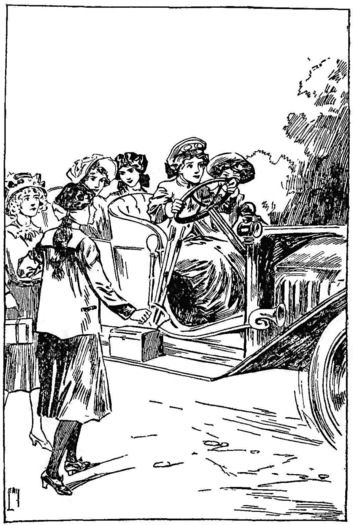
“Pile in any old way and make yourselves as
comfy as you can,” said Billie, from the chauffeur’s
seat, while seven boys and girls packed
themselves into “The Comet” as tightly as sardines
in a box.
“Ben, I look to you to take good care of my
girls,” called Miss Helen Campbell, from the
front door steps of her home. “And all of you
promise me three things: Don’t go too fast;
don’t stay too late, and don’t go too far.”
“We promise,” came eight voices in a chorus.
“Good-by, Cousin Helen, dearest,” called Billie,
kissing her hand affectionately to the little lady
who was fast coming to fill an aching void in
Billie’s heart.
“Good-by, Miss Campbell,” called the others,
while she smiled and bowed and waved her handkerchief
148
like a favorite actress before an enthusiastic
audience.
What a difference the young people had made
in her life, she thought, as the carload of boys
and girls flashed down the street and the sound
of their talk and laughter, growing fainter and
fainter, floated back to her like a pleasant memory.
It was a real seaside October day. Nothing
could have been bluer than the bay, unless it was
the sky. A warm, dry land breeze swept over
the moors about West Haven. Wild asters and
golden rod colored the roadside, and the stillness
of Indian summer pervaded the whole country.
“There was no need of the top to-day,” observed
Billie, looking up at the cloudless sky. “I
am glad we decided not to put it on. We might
as well have left the rugs and wraps behind, too.
They take up room and won’t be used, I am certain.”
“I hope not,” answered Ben. “I see only one
cloud on the horizon and that’s no larger than a
man’s hand; but clouds do grow.”
“Don’t borrow trouble, Rain-in-the-Face,” exclaimed
149
Percy. “The last time you looked into
the future we had a fire.”
“All right, dummy,” answered his friend. “I
am not predicting anything. I only mentioned the
possibilities of a very small cloud. And the night
of the Shell Island fire I said what certainly
proved to be perfectly true—that the hotel was a
regular fire trap.”
“Are you really a good weather prophet, Ben?”
asked Billie anxiously. She did not like to have
her parties turn out disastrously.
“He—he’s the poorest ever,” cried Merry.
“Don’t go on what he says, Billie,” put in
Percy. “The last camping trip we went on, he
predicted fair weather and it rained for a week.”
“Well, just to prove that I know what I’m
talking about,” cried Ben, “I predict that it rains
before night.”
This unpopular prophecy was greeted by hoots
of derision from the others.
“What makes you think so, Ben?” asked Elinor.
“It’s as clear as a bell now.”
“Certain signs,” he answered.
“Now, Ben Austen,” ejaculated Nancy. “Don’t
150
go spoil our day before it’s begun. You know
just as well as I do that it’s Indian summer, and
it never rains in Indian summer.”
“Never, Miss Nancy-Bell?” repeated Ben,
smiling. He minded as little being teased by his
friends as a big, good-natured dog minds the
antics of a lot of puppies.
“All right, Big Injun Ben,” said Merry, “let
it rain before night. We’ve got a good many
hours to enjoy ourselves in and get home, too, before
dark. We’ll be at the ferry-boat landing in
an hour, and if we’re lucky enough to catch the
boat, we’ll reach Seven League Island by eleven
o’clock. That will give us plenty of time to eat
everything in sight, see Smugglers’ Cave, and all
the other sights, and get home by seven o’clock.”
“Of course, we can,” replied Ben. “I was only
teasing Percival Algernon St. Clair, because he
hates the rain worse than poison. I never saw a
finer day in my life.”
“Thank goodness!” exclaimed Billie, in tones
of relief. She really had great faith in Ben’s
judgment about most things.
Seven League Island, a rocky strip of land some
151
twenty-one miles long, was one of the most romantic
places in the vicinity of West Haven. It
was three miles from the mainland and, during
the season when the summer resorts and camps
which clustered on its shores were open, several
ferry-boats carried passengers back and forth
from the mainland to the island. In winter the
place was almost deserted. The land was too
poor for farming and few people cared to remain
on that lonely, mournful island, where, in stormy
weather, the waves thundered through the caves
in the cliffs, and the wind in the pine trees made
a mournful sound like the wail of a lost soul.
To-day, however, it was as serene and smiling
as the Islands of the Blest. The southwest wind
stirred the pine needles gently, making a pleasant
quiet song. The tiny waves, as they lapped
the sides of the ferry, gave out a “cloop, cloop”
sound that still water makes against the bow of
a canoe.
“What time does the last ferry go back, Captain?”
asked Ben, of the old ferryman, whose
face was as weather beaten and seamed as the
hide of a hippopotamus.
152
“Six, in good weather.”
“What time in bad?”
“Depends on the weather,” answered the old
man briefly.
“How many other ferry stations are there?”
asked Charlie.
“Three.”
“Good,” exclaimed happy-go-lucky Americus
Brown. “We’ll take the one that’s nearest when
the time comes to go back and ride before the
wind, and beat the rain and put old Ben out of
business as a weather prophet.”
The ferryman said nothing, but his small eyes
twinkled with amusement.
They were the only passengers on the boat that
trip, and as the motor whirled up the hard-beaten
road from the ferry landing, they noticed that
the bungalows and summer cottages along the
shore were closed for the season.
“It’s because it’s so hard to get food,” Percy
explained. He had once visited some friends
at Flag Point, the first settlement, and was to be
their guide this morning to the great cave, which
153
had been used, it was said, in the days when
smugglers were common in the land.
The others were familiar only with the shore,
where they had come on bathing and fishing excursions,
and the boys and girls were eager to
explore the rocky caverns, the fort, the little inlets,
where pirates were supposed to have anchored
their ships, and above all the smugglers’
cave, which Percy told them was a great vaulted
chamber in the rocks, with an entrance no broader
than a narrow door.
“Take the road going to the right,” called
Percy, as Billie paused at the top of the cliff for
directions. “It’s the best one for motoring and
it goes past the old rifle-pit where we can eat
lunch. We can leave the car there and climb
down to the caves afterwards.”
“The Comet” turned obediently to the right
and shot down the interminable expanse of empty
white road, like a shooting star on the milky way.
Even Mary, who had been pale and silent all
morning, regained her spirits on that glorious
ride, when Merry, with head thrown back, began
to sing:
154
“The sailor’s wife the sailor’s star shall be,
Yo-ho, yo-ho-ho, yo-ho, yo-ho-ho!”
and she joined in the chorus with the others, her
clear, sweet voice piping out like the notes of a
field lark in a chorus of birds.
At last Billie pulled up at the side of the road
under a cliff, on top of which was an old grass-grown
fort used during the Indian wars.
“This must be it,” she said. “It’s peaceful
enough looking now to make a good picnicing
ground, but I don’t suppose it was much of a picnic
for the people who built it to shoot Indians
from.”
“Nor much of a picnic for the Indians, either,”
said Ben, helping Billie out while Charlie Clay
assisted the other girls to the ground and Percy
and Merry unstrapped the luncheon hamper.
“Let’s eat up high,” suggested Billie. “That is,
if you can carry the basket up that steep incline.”
“The pack mules are here for that work,” said
Ben, pointing to Merry and Percy. “Charlie, you
bring the rugs for the ladies to sit on and I’ll
help the ladies.”
155
“Will you listen to Nervy Nat,” cried Percy,
as he obediently shouldered his end of the luncheon
hamper and followed Merry up the hill.
How they laughed and scrambled and shoved
as they clambered up the pebbly path. Once
Mary, with a shrill cry, slipped and stumbled
back on Nancy who fell against Charlie, who, in
his turn, tumbled against Ben, and that pillar of
strength, grasping a branch of a pine tree with
each hand, supported the whole human weight
without a tremor.
It was like picnicing in the tops of the trees,
when they finally spread the cloth in the grass-grown
enclosure of the fort, and beyond them
stretched the entire expanse of the ocean glimmering
blue in the sunshine, with an occasional
ship outlined on the horizon.
“I hope the ginger ale is still cold,” cried
Merry.
“And the mayonnaise hasn’t melted,” said
Nancy.
“What, nothing to eat but victuals and drink?”
exclaimed Percy.
When they had waded through the piles of
156
sandwiches and pyramids of cake, and drained
the last drop of ginger ale, silent Charlie, who had
an enormous appetite, remarked:
“How hungry this piney-salty combination does
make a fellow!”
“Why, Charlie,” said Billie, “don’t say you are
still hungry. You remind me of the elephant in
Merry’s song:
“‘The elephant ate all night,
The elephant ate all day,
And feed as they would, as much as they could,
The cry was still more hay.’”
Charlie pulled out his mouth organ and began
to play such a rollicking dance tune that the boys
and girls, almost before they knew it, were two-stepping
over the grass as madly as a lot of wild
young colts. Then Charlie, seizing Mary about
the waist and still playing vigorously on his
“harp,” as it was called in that section, joined the
dancers himself.
If they had not all of them been so absorbed in
executing the Dutch twirl, or racing over the
ground like Cossack dancers on the Russian
Steppes, they would have been somewhat disturbed to
157
have seen a man peering down at them
from the top of a mound. He had crawled up the
steep incline and was lying flat on his stomach in
the tall grass. His face is familiar enough to us
by now, for he had only one eye, but that one, like
the eye of the three mythological witches, gleamed
brilliantly and wickedly and nothing escaped its
range. He smiled as if he rather enjoyed watching
the dancers, and especially his one wicked eye
followed the movements of Ben and Charlie and
Billie Campbell. Presently when the whirling
couples had tumbled breathlessly on the grass,
fanning themselves with their hats and Ben had
called out: “We’d better be getting along now,”
the man slipped away as silently as a snake and
disappeared somewhere below.
“To the caves,” cried Percy, as they gathered
up the rugs and cushions and hastened down the
cliff to the motor.
“I suppose it’s safe to leave ‘The Comet’ here
without any one to look after him,” Billie had observed,
and the others had agreed that it was.
“As safe as on any other desert island,” Ben
had answered.
158
It seemed impossible that anything could happen
in that lonely, quiet place, which was like a
deserted paradise to the girls and boys that beautiful
afternoon. There was nothing about the locality
or the weather to arouse uncomfortable
suspicions. The patch of sky, which was revealed
to them just overhead between the tall,
straight pine trees, was like a beautiful deep
blue canopy. Even the watchful Ben could not
have told that the cloud, so short a time ago no
larger than a man’s hand, now stretched itself
across the horizon in a long, thick line of black.
“The caves are the most fun of all,” said Percy,
leading the way to the cliffs overlooking the
ocean. “There are dozens of them, some little
and some very large. The lower ones fill up at
high tide, but the upper ones are safe enough.”
The cliff was honeycombed with small rocky
chambers, and as they clambered, Indian file,
along the narrow path which nature had so
thoughtfully cut in the rocks they heard the
boom of the incoming tide thundering through
the caves on the beach.
“I suppose people could live in these little caverns,”
159
Percy continued, “if it wasn’t so all-fired
lonely and inconvenient; but wait until you see
Smugglers’ Cave. It has as many natural conveniences
as a real house built by human beings.”
“Here it is,” he cried at last, to the others who
had run all the way down a steep embankment to
see this romantic place.
Certainly it might well have been a favorite
spot for smugglers and robbers on the high seas.
Too high for the tide to reach and still well hidden
from above by a thick growth of scrubby
pine and oak trees, the cave was as secret and
safe a place as could be imagined. Rock-hewn
steps led up from the smooth pebbly beach
below and the curve of the coast made a charming
little haven for ships and a natural landing
place for small boats. The eight friends stood in
a row on the beach.
“This is called ‘Pirates’ Cove,’ you know,” went
on Percy. “They say the pirates used to anchor
their ships in this little haven and come ashore
and have pirate tea parties on the beach.”
“Here comes a sea rover now,” called Merry,
160
scanning the entrance to the harbor where a
ship could be seen outlined against the blue.
“Oh, she isn’t coming this way, Old Tar,” answered
Percy. “It’s too late in the season, for
yachts and ships rarely come in here unless there
is a storm. There’s nothing to come for and it
takes them out of their course.”
“She’s headed this way,” continued Merry, not
taking any notice of Percy’s interruption, while
he scanned the ship with his far-seeing sailor’s
eyes. “She’s a brigantine, and she’s making for
this cove.”
“Oh, well, what of it?” put in Billie. “Perhaps
she is coming here for the rest cure. But
she doesn’t interest me half as much as Smugglers’
Cave. Let’s not waste any more time
here,” and she ran up the steps, followed by the
others.
The entrance to the cave had been as cleverly
concealed as if nature had conspired with the
outlaws to provide them with a safe hiding place
for their contraband goods. The steps appeared
to lead to nothing more than a blank wall, but,
following Percy around the edge of an enormous
161
rock which, in ages past must have slipped its
fastenings above, they presently came to a narrow
opening between the rock and the side of the
cave, just large enough for a man to go through.
“The smugglers must have had to do up their
bales of silk pretty flat to get them through
here,” said Ben, measuring the opening with his
handkerchief, as he stooped to keep from bumping
his head on the top.
“How beautiful! How wonderful!” cried the
four girls, when their eyes had become used to the
change from the brilliant sunlight outside to the
semi-twilight of the great vaulted chamber where
they now found themselves.
“Now, I’ll show you what a jim-dandy architect
nature is,” said Percy. “Here’s the bathroom.
No hot water, of course, but a perfectly
good tub and cold water always on tap.”
He pointed out a natural basin, probably worn
in the rocks by the constant dripping of water
from a spring that trickled down the wall of the
cave.
“Here’s the bedroom, that nice, comfortable
shelf over there. Here’s your easy chair,” he
162
continued, showing them a curious formation of
rocks really resembling a big armchair with a
high back.
“It’s a rocky chair and not a rocking chair,”
observed Charlie, taking a seat and rising quite
suddenly. “Nature is as mischievous as a little
boy if she is a good architect. Look at this,”
and he pointed to a very sharp, almost needle-like,
piece of stone in one corner of the seat.
The others laughed gayly as they hurried after
Percy and a hundred reverberating echoes
startled them into silence.
“And now, ladies and gentlemen, I have saved
the most interesting sight for the last. You are
about to see the store-room of the smugglers.”
He led the way down two steps into another
chamber.
“By Jove!” he cried suddenly and stopped
short.
“What is it?” exclaimed the others, peering
over his shoulder into the darkness.
“Don’t you see?” he said, in a low voice.
“They are still using it for a store-room.”
They blinked their eyes with amazement, when
163
presently there loomed up in the shadows a pile
of long, flat packing boxes.
Ben lit a candle, which he had thoughtfully
brought along in his coat pocket, and they examined
the boxes, which crowded one entire end of
the smugglers’ store-room.
“Will you look at this?” he called. “Elinor,
you are in this.”
Ben held the candle high and pointed to a
sign on the nearest box, which read: “Automobile
Supplies—Butler Brothers—West Haven——”
“Why,” cried Elinor, “you surely don’t suppose
Uncle Tom and Uncle Richard could be
storing their goods here, do you?”
No one answered her for a moment. Their
thoughts were busy searching for an explanation
to this strange discovery.
“Elinor,” said Mary presently, “don’t you remember
what those men who borrowed Billie’s
automobile said about killing every Butler in the
county who interfered?”
“Yes,” said Elinor, in a frightened voice, “but
what could these boxes have to do with it?”
“They may have a great deal,” said Ben.
164
“Those men are probably smuggling your
uncles’ auto supplies out of the country. The
boxes are smuggled up to this cave by degrees, I
suppose, and then loaded on some ship when they
have got enough to make it worth while. And, if
it’s the same man we had dealings with that
night, he is a pretty desperate kind of an individual.”
“I don’t want any more fights,” exclaimed
Billie. “Both of those men carried pistols and
knives; I suppose all first-class smugglers do, but
I don’t propose that my party is going to be
ruined by any bloodshed. It is getting late, and
we had better be going.”
They quite agreed with Billie, although the
boys would have liked to linger in the Smugglers’
Cave for a while.
The outer air seemed very warm and oppressive
after the cold damp atmosphere of the cave.
They blinked their eyes and shivered as they hurried
along the path which led to the road and in
the change from dark to light they did not at
first notice that the sun was hidden by a great
cloud, as black as ink, which stretched from horizon
165
to horizon. A hot, heavy wind stirred the
pine needles and that sense of impending trouble
which always comes before a great storm sobered
the spirits of the boys and girls.
Nobody spoke of the cloud. It seemed to be
a question of honor with them not to mention it,
but they hurried on silently, and in a few minutes
reached the automobile.
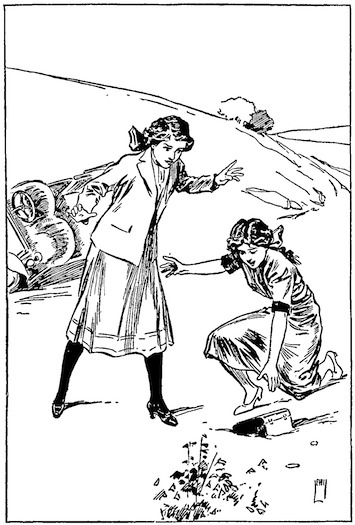
With a sigh of relief, the four girls were about
to jump in, while Ben cranked up, when suddenly
Nancy gave a little, pent-up scream.
“Look!” she cried, pointing to a piece of paper
stuck on the cushion of the back seat.
This message was printed with a lead pencil
on the paper:
“He laughs best who laughs last.”
“It was that man,” said Billie, examining the
tires ruefully, each one of which had been slashed
with a sharp knife.