“Mr. Ignatius Donahue’s compliments, and
will the ladies take a ride in his motor-boat this
afternoon? Mr. Donahue is sorry he cannot go
too, but a business engagement prevents his being
at Palm Beach.”
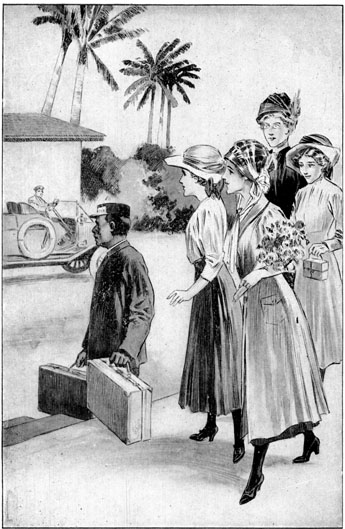
This was the message brought to Miss Campbell
the morning after their arrival at Palm
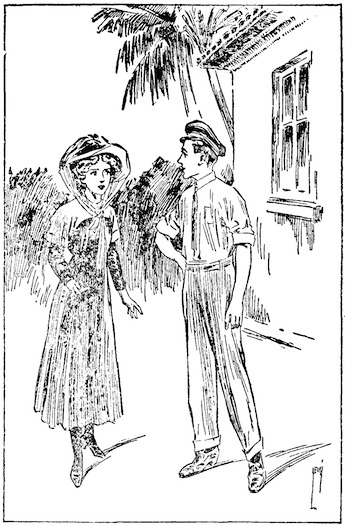
Beach. The bearer of the message was Edward,
the young chauffeur, who stood at a respectful
distance while she read the note.
“But if Mr. Donahue isn’t here, how did the
note come?” asked Miss Campbell, much mystified.
“I can’t say, ma’am,” replied Edward, turning
his face away so that they could not see the
smile which twitched the corners of his mouth.
“Perhaps he telegraphed it,” observed Billie.
20
“But it’s written on note paper,” replied Miss
Campbell, rather irritably. “Would you like to
go, girls?”
“Oh, yes,” chorused the four voices.
“Very well, Edward, there seems no one to tell
it to but you. We shall accept the invitation with
pleasure. It would be absurd, I suppose, to telegraph
this important communication to Mr. Donahue
at Kamschatka or Boston or wherever he
is, but he is very kind to offer us his boat and
you may expect us on the pier this afternoon at
four. Is that a good time for sailing?”
“Yes, ma’am,” replied Edward, withdrawing
down the corridor just as the door of an adjoining
room opened and an angry voice cried:
“How dare you meddle with anything in this
room? Leave it instantly.”
Some one replied in a low musical voice,
“I am very sorry. I was only looking at a
picture. I noticed a likeness——”
“You are here to clean up and not to notice.
21
You are a servant and not a visitor. Another
time and you will be reported. You may go.”
At this point a girl was thrust out into the hall
so roughly that she fell on her knees. It was
only a chambermaid, and perhaps she was accustomed
to being spoken to harshly, although
she did not appear to be, for she covered her
face with her hands and crouched against the
wall.
“How could any one be so brutal?” exclaimed
Billie indignantly as she ran to the trembling little
figure and helped her to her feet. “Won’t
you come into our room until you calm down?
It was cruel to have spoken to you so roughly.”
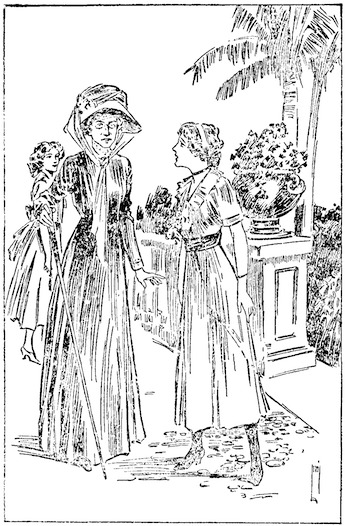
The door opened again and an old woman
stood on the threshold, leaning on a cane. There
was something rather regal in her appearance,
in spite of her plain black dress and grotesque-looking
old garden hat with its flapping brim
which half concealed her face.
“Don’t interfere, young woman,” said the formidable-looking
22
personage. “Young American
girls are far too impertinent.”
Billie, who all her life had been the champion
of the oppressed, was not frightened by the glare
from the old woman’s steely blue eyes. She
made no reply, however. Her father had taught
her never to engage in a battle of words if she
could possibly avoid it, especially with an older
person.
Putting her arm around the little chambermaid’s
waist, she drew her into Miss Campbell’s
room and closed the door. The other girls who
had been silent witnesses of the scene gathered
around them.
“What a dreadful old person,” Billie burst out
at last, giving vent to her indignant feelings,
when the girl staggered and almost fell on the
floor.
“Oh, the poor dear is fainting,” cried Miss
Campbell, hurrying to the dressing-table for her
smelling salts, while the others quickly lifted the
little maid to the bed. They opened her dress
23
at the throat and moistened her lips with water
and performed the numberless little services a
woman, with any kindly sympathy in her nature,
will never withhold from another woman who
needs her help.
“She is much too young and pretty to be a
servant,” observed Miss Campbell, looking down
with pity into the white, tired face of the chambermaid,
who appeared hardly older than her
own girls, although her fluffy blond hair was
drawn up into a knot on top of her head. Presently
the color came back to her face, and she
opened her eyes which were large and very deep
blue.
“Are you better now?” asked Billie, waving a
palm-leaf fan gently over her head.
The girl sat up and looked about her in bewilderment.
“Where am I?” she asked. Then her eyes
caught Billie’s kind gray ones and memory came
back to her. “It was so good of you to take my
part and so stupid of me to faint! I was frightened,
24
I suppose, and a little tired. I must be
going, now,” she looked toward the door uneasily.
“It would be dreadful to lose my place on
the first day I began to work.”
“But you are not going back to work when you
are ill, child?” exclaimed Miss Campbell.
“I’m afraid I must. It will be only a few
hours more. I am off at twelve. My work isn’t
hard. I only sort and distribute the fresh linen,”
she added with a note of apology in her voice,
which was soft and beautiful. The girls were
struck also with her lady-like manner. They
could see that she was not accustomed to being
a maid because she never said, “Yes, Miss,” and
“No, Miss,” like the usual chambermaid. But
they were too polite to ask any questions, and
presently she withdrew without their knowing
much more about her than they had at first.
But they soon forgot the chambermaid and
her troubles in the joys of Palm Beach. Probably
nobody in the world can have a better time
than four intimate young friends on a pleasure
25
trip, and many admiring glances were turned in
the direction of the Motor Maids as they sat in
a row on the hotel veranda after breakfast, while
Miss Campbell composed a letter in the writing-room.
They were entirely unconscious of the
attention they attracted, however, so interested
were they in watching the rippling waters of
Lake Worth already dotted with white sails.
Groups of people, dressed in white, strolled
about the hotel grounds or sat on garden seats
under the palm trees. It was that delicious lazy
time in the morning when one is on a holiday and
there is only pleasure to anticipate.
“Billie,” whispered Nancy, “there is that
brutal old woman who was so rude to the chambermaid
this morning. I honestly believe she
would have struck you with her stick if you had
answered a word.”
“If she had,” replied Billie, laughing, “and I
had cabled it to Papa, he would have taken a
flying leap across the Atlantic Ocean and got
26
here before midnight. But I really don’t think
she would have dared go that far.”
“Be careful, here she is upon us,” warned
Elinor, and the four girls, without intending to
be rude, turned their eyes toward the approaching
figure.
The old woman still wore her flapping garden
hat tied under the chin with brown silk strings.
She leaned on her cane heavily as she walked,
and noticed no one until she saw the four pairs
of eyes regarding her with evident curiosity.
She paused in front of the group and brandished
her stick in their faces.
“Well, what do you think you are looking at,”
she cried, “a chimpanzee or an elephant or one
of your own native wild people?”
“Oh, grandmamma,” cried a tall, slender girl
walking at her side. “How can you talk in that
way? You mortify me terribly.” And she led
the old woman into the hall.
“What a fierce old party,” exclaimed a young
man in white flannels, who was sitting so low
27
in a deep chair that he appeared all legs and
arms. “‘Native wild people,’” he repeated,
laughing gaily. “We look like native wild people
in this civilized place, don’t we?”
“Now, Timothy,” said a girl sitting next to
him, “she meant you, I am sure. You resemble
a native wild person more than any one here,
with your absurd bristling red hair.”
The young man laughed good-naturedly, and
the girls could not resist joining in, for Timothy
might have been taken for a human porcupine
any day. And that was how the Motor Maids
came to make friends with Timothy Peppercorn,
whose ridiculous name and funny appearance
never failed to set them laughing.
“But who is this old lady?” asked the girl who
had spoken to Timothy, and whom they came to
know later as Miss Genevieve Martin of Kentucky.
“I don’t know,” answered Billie, smiling.
“I’ve only seen her once before, and the meeting
wasn’t very friendly then.”
28
“Did she beat you with her stick?” asked Timothy
Peppercorn.
“If I had said anything, she would have tapped
me on the head with the gold knob, I believe, but
I kept very still.”
“What happened?” asked Miss Martin, turning
to Elinor who was nearest her.
Elinor related the story of the poor little chambermaid
or “linen sorter,” as she was careful to
call her.
“What a brutal old wretch!” exclaimed the
other indignantly. “Does she expect to teach
manners to Americans by treating them like
this?
“Timothy, run quick and look at the hotel register
and see who she is.”
Timothy gathered his loose frame together
and rose to his feet. He was really not so tall
as he appeared when sitting, but he seemed all
arms and legs like a grand-daddy-long-legs.
“After I come back, will you have that swim?”
he demanded.
29
The girl nodded her head gaily.
“No one can ever resist that funny red-headed
boy,” she exclaimed to the others. “I don’t know
quite what it is about him. He is really one of
the best natured creatures alive, and he has had
a great deal to make him unhappy, too, but he
is always in a good humor.”
“What has happened to him?” asked Nancy,
who had a childish curiosity and was still young
enough to ask questions.
“His mother and his brother and sister have
all died of consumption. Timothy would be
delicate, too, but he is determined not to be, and
when he finishes college he is going to be an
engineer and live out of doors.”
“We are engineers,” put in Billie, “Papa and I
and it’s the nicest work in the world.”
Miss Martin laughed. She had taken a tremendous
fancy to these four nice young girls
who seemed so unaffected and natural. But Timothy
returned before she could reply.
“The military lady in the flap-brimmed hat,”
30
he announced, “is registered as Mrs. Paxton-Steele.
The meek young person at her side is
Miss Georgiana Paxton, and there appear to be
also in the family Edward Paxton and Clarence
Paxton, all of England.”
“Steele is a good name for such a stern old
personage,” said Genevieve.
“Well, ‘her is naught to we, nor we to she,’”
added Timothy, “so let’s go in bathing and forget
all about her.”
“Are you sure you feel strong enough, Timothy?”
asked his friend, looking at him critically.
“Of course I do, Genie,” answered the boy,
flushing as red as his ruddy upstanding hair.
“But I don’t want to lose my new friends just
as I have made them,” continued the charming
girl, changing the subject quickly and smiling
into Billie’s face. “Perhaps you will go with
us?”
“Oh, may we?” cried Billie and Nancy in one
voice.
Mary and Elinor were no swimmers.
31
“Where are your mammas, then, so that I may
ask permission first?” demanded Miss Martin.
“We haven’t but one with us and she’s a
cousin, but here she is,” replied Billie.
Miss Martin had the easy gracious manners
of the South and she never permitted any one
in her company to feel awkward or strange for
long. She introduced herself and her friend,
Timothy Peppercorn, to Miss Campbell simply
and gracefully, and after a moment’s pleasant
chat she had learned Miss Campbell’s name and
the names of the four girls, and the swimming
party was arranged.
“How quickly things do happen once they begin,”
thought Billie, as she ran lightly into the
surf where they chose to bathe instead of going
to the pool which most people preferred. “If
old Mrs. Paxton-Steele, of England, hadn’t been
so quarrelsome with the chambermaid this morning,
we should never have stared at her on the
piazza. She would probably have passed us by
without noticing us at all. Then, we should not
32
have made friends with Miss Martin and that
funny Timothy-boy, and no one would have suggested
this glorious morning swim.”
She plunged under the foamy crest of a cool
green wave, rose breast high on another, shook
herself like a young water spaniel and made for
the raft with long overhand strokes.
Swimming was a real accomplishment with
Billie, although her father, who had brought her
up very much as he would have reared a son, had
not taught her this particularly boyish pastime.
She had learned to swim at the age of five from
an old peasant woman in a village on the coast
of Brittany, where they had spent a summer.
These old fisherwomen were the only swimming
masters on that sequestered beach. Billie could
still remember with something of a shiver the
ancient, gnarled creature with her skirts tucked
up about her wrinkled limbs, who, standing
waist-high in the water, had taught her the first
strokes. Hard as it had seemed at the time, she
33
had never ceased to be thankful for those early
lessons.
“My, but you’re a corker,” exclaimed Timothy
Peppercorn, breathlessly. “I thought Genevieve
was pretty good, but you’re the best I have ever
seen.”
“Thank you,” answered Billie, as she swung
herself on the raft.
Many other swimmers dotted the surf that
morning and groups of people in light clothes sat
about on the shining strand. Splendid palm trees
and poincianas made a cool green background to
the lovely shore, and Billie half closed her eyes
as she lay on the raft, so as to make a picture she
might carry in her mind always. She had not
noticed that Timothy was too winded to hoist
himself on the raft.
Her attention was presently attracted by a
frolicking group of swimmers coming toward the
raft. In the midst of them, puffing and snorting
like a Triton, was a jolly big fat man whom they
called Duffy. Mr. Duffy had a red rubber ball—not
34
much redder or rounder indeed than his own
face—which he was tossing ahead of them on
the water while the others raced to get it.
“Let’s get in the game,” called Timothy as the
ball skipped toward them over the waves.
Billie dived off the raft and came up just
where she had seen the ball strike, but some one
seized it and tossed it a score of yards away.
There is always a swimmer in a water party who
does reckless and dangerous things. This time it
was the individual who had seized the ball before
Billie could get it. One by one the other
swimmers left off chasing and made for shore.
Mr. Duffy, turning his immense frame over,
floated away on his back in happy oblivion. But
the stranger, pitching the ball again as far as
he could send it, challenged Timothy to race for
it.
It was in vain that Genevieve, who had at that
moment reached the raft, protested and looked
coldly at the man whose back was turned. Timothy
darted off in the water while the two girls
35
watched his red head uneasily as it rose and fell
on the white-tipped waves.
Both swimmers reached the ball at the same
moment, struggled over it, and then that reckless,
inhuman stranger tossed it further out to
sea.
“Idiots!” cried Genevieve, beating her hands
helplessly together as she sat on the side of the
raft.
All the other swimmers had gone ashore now
and were making for the bath houses, while loiterers
on the beach were scattering to the tennis
courts and golf links or the morning concert in
Cocoanut Grove.
Suddenly Billie saw the strange man throw up
both hands with a loud cry, which sounded very
much like “Sharks!” and start to shore as fast as
he could go.
“Oh! Oh!” cried Genevieve, covering her face
with her hands.
Some twenty yards beyond Timothy they could
36
just make out the ugly square nose and upstanding
fin of a big fish sticking above the water.
“Hurry, Timothy, hurry,” called the girl in an
agony of anxiety.
“I’m all right,” he answered faintly, but each
movement seemed to be weaker than the last and
suddenly he sank beneath the waves.
While Genevieve was calling for help toward
the now almost empty beach, Billie made a running
dive off the raft, and with long, clean
strokes, swam for the red head which appeared
on the surface once more.