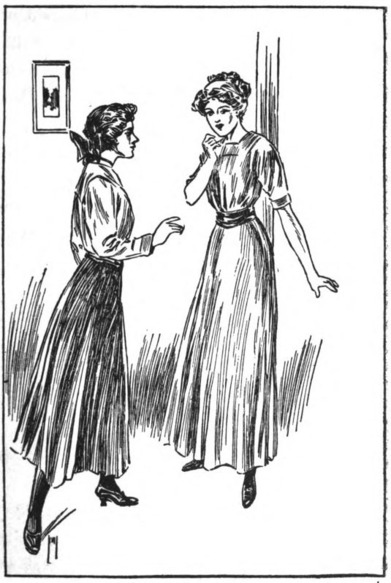
“It’s a queer thing,” declared Nancy, when
Takamini had shown them into two neat bare-looking
bedrooms upstairs, “it’s really a very
strange thing indeed.”
“What?” demanded her friends.
“That our wish has come true, just as if we
had rubbed Aladdin’s lamp. We wished for a
dinner and we got it.”
“We haven’t got it yet,” said Elinor sceptically.
But Nancy was a very superstitious young person,
who put infinite faith in the Rule of Three.
“We shall have it in an hour. That’s what
Takamini told us just now. And if two wishes
come true, three will, so I’m going to make another.”
49
“But what is the second wish, Nancy-Bell?”
they asked.
“Didn’t we all of us wish not to be homesick?”
“We didn’t say so.”
“Well, anyway, we thought so. And thinking
is the same as speaking. That wish has come
true because the homesickness has all gone, hasn’t
it?”
They were obliged to admit that it had. The
adventure had dispelled their doleful vapors.
“We should all unite on the third wish, then,”
said Mary, “seeing that the other wishes were
common to everybody.”
“What shall it be, then?” demanded Nancy.
“Quick, before the luck gets by.”
“Foolish child,” said Miss Campbell, “I believe
that little head of yours is cramful of nonsense.”
“You are a doubter, Miss Campbell,” objected
Nancy. “We shall have to banish you from the
magic circle if you feel that way. You cast a
dark shadow over the spell.”
50
“Oh, no, dear, don’t make me an outsider, I
beg of you. I promise not to scoff.”
The truth is, Miss Campbell was slightly superstitious
herself.
“But what is to be the wish?” they asked.
“Something we all of us want.”
It is difficult to make one wish common to five
separate and distinct individualities.
“I might wish to get my fifty dollars back,”
observed Miss Campbell, “only I don’t look for
miracles.”
“We might wish for a safe journey to San
Francisco,” laughed Billie; “but that would cover
too much ground for one wish.”
“Suppose we wish to see Peter Van Vechten
again soon,” suggested Nancy.
Not one of the five ladies who would not have
been pleased, secretly of course, to meet once
more that strange adventurer of the skies, in
spite of the grave suspicion which rested upon
him.
51
“You might ask him for your purse, Cousin
Helen,” suggested Billie.
“I shall always believe there was some mistake,”
answered her cousin.
“Anyhow, let’s take the chances and wish for
another meeting,” said Elinor, “then Miss Campbell
can say, ‘Mr. Van Vechten, kindly restore
my property.’ Only she won’t, because she hates
to hurt other people’s feelings.”
“Very well, then, all at once,” cried Nancy,
forcing them into a close circle. “Now join hands
and close your eyes and make the silent wish.
Concentrate two minutes.”
“Nancy, dear, I think you have been studying
dream books,” exclaimed Miss Campbell, amused
at this ridiculous mummery.
Nevertheless, at precisely two minutes to one
o’clock by the timepiece on the mantel, five pairs
of hands joined together and five identical and
simultaneous wishes went forth into space. Five
little thought messengers linked together by a
single wish, went out together into the vast universe.
52
Then they separated and each took a different
direction in search of that mysterious birdman,
whose eyes at least were clear and brown
and honest. And the first little winged thought
who found Peter Van Vechten was to summon
his aerial brothers from the ether. Promptly
they would join hands and dancing in a circle
about his head, as each passed an ear would
whisper the message.
When the clock struck one the Motor Maids
and Miss Campbell unlocked hands, and smiling
quite gravely, considering it was all a joke, proceeded
with their toilet for the luncheon of glorious
anticipation.
That Mr. Daniel Moore’s establishment was
guiltless of any woman’s touch was plainly evident.
There was not a sign of femininity about
it. It was as bare as a barracks and as plain as
an old shoe. But the beds were soft and comfortable,
as Miss Campbell could testify, for she
took a nap on one of them in the interval which
must be spent before lunch was announced.
53
After the girls had fluffed up their front hair
or smoothed it out according to custom, and had
brushed every fleck of dust from their neat traveling
skirts, and washed the stains of the journey
from their fresh young faces, they began to look
about the rooms, to peer from the windows and
peep into the hall, while they talked in whispers.
On a shelf in one of the rooms were some
books, the one human touch they noticed. Mary,
always a bookworm, began dipping her inquisitive
little nose into these immediately. She had
opened a volume of Kipling’s poems and was
reading aloud in a sing-song voice:
“On the road to Mandalay,
Where the flying fishes play——”
when something fell from between the pages into
her lap. It was a souvenir postcard, which had,
apparently, been serving as a book-mark. Without
meaning to pry, Mary picked it up and turned
it over to look at the picture on the other side,
54
which proved to be a photograph of a lovely girl
holding a Boston bull terrier on a leash. She
was tall and slender, and seemed to sway toward
them from the picture like a young tree in the
wind. It had evidently been quite breezy when
the picture was taken, for one hand grasped her
broad-brimmed felt hat, while the other held the
dog leash. She was smiling, too, and there was
a gay light in her eyes which seemed to challenge
the whole world to make her sad.
Mary had not meant to read the message written
across the picture, but is it ever possible to
examine a picture on a postcard without taking
in the words at the bottom? Besides, it was a
harmless message:
“A snapshot smile from Evelyn.
Salt Lake City, Utah.”
Now, Salt Lake City was a place of intense
interest to the Motor Maids. They regarded it
as a traveler in the Orient might look upon one
55
of those mysterious Eastern cities where women
went veiled and faces peeped at one from behind
obscure gratings.
“Do you suppose this pretty girl is a Mormon?”
exclaimed Mary, exhibiting the photograph.
“She is much too pretty to be a Mormon,” said
Nancy decisively.
“Can’t Mormons be handsome?” asked Billie,
looking at the postcard over Nancy’s shoulder.
“They are just like other people, goosie,” put
in Elinor, nevertheless looking at the picture with
extreme interest.
“I always imagined the men were tall and thin
with lantern jaws and long white beards, and the
women were small and plain with straight hair
twisted into scraggy little knots behind.”
They were still laughing over Nancy’s vague
idea of the citizens of Salt Lake City when the
Japanese servant gave them a start by appearing
at the door as noiselessly as one who walked on
air.
56
“Luncheon is served,” he announced rapidly in
a funny high voice.
It was almost impossible to conceal from him
their eagerness to be at table. Nancy secretly
hoped there would be fried chicken, but she didn’t
care really if only there were no canned vegetables
in bird-seed dishes. They all wondered if
their host would be able to appear despite his
maimed leg.
But he was there to meet them, waiting in the
living room of the farmhouse, which was fitted
up quite comfortably with big easy chairs, an immense
writing table, and many books on shelves
lining the walls. Mr. Moore’s wholesome, manly
face showed not a trace of the pain he had endured
an hour ago, and when he led the way to
the dining room, it was with only a slight limp.
“But I thought you had a bad sprain, Mr.
Moore,” said Miss Campbell, “and here I find you
walking as well as any of us.”
“It’s all gone,” he answered. “I—” he hesitated
a moment. “I——”
57
But the fragrance of the viands about to be set
before them drove all other thoughts from their
minds.
It was all a curious adventure, indeed. Here
was an entire stranger dispensing hospitality to
them most graciously, and here were they, even
that fastidious and dainty little lady, eating with
appetites of starving people.
There was no fried chicken, but there were
beefsteak and mushrooms and new potatoes and
asparagus, a very fine expensive salad made of
grapefruit, and as a last perfect touch, strawberries
and cream.
The motor party had planned to leave Mr.
Moore’s place half an hour after lunch and start
on their travels again, but while they feasted
black clouds had been piling themselves into a
formidable storm and now came flashes of lightning
and the rumble of thunder. The house
grew so dark that Takamini lit some candles and
placed them on the table.
Then came the rain, pouring in torrents.
58
Miss Campbell looked uncomfortable.
“I am afraid, Mr. Moore, you have undertaken
more than you expected,” she said.
But Mr. Moore was quite equal to this call
upon his hospitality. “I hope it will be one of our
three-day storms,” he said smiling cordially.
“The roads would be far too muddy for motoring
then, and I should have the pleasure of entertaining
you longer.”
“Oh, we couldn’t let you do that, Mr. Moore.
You are too kind. We must go to the next town
and stop at the hotel.”
“I assure you, Miss Campbell, you are like
messengers from heaven. You came in the nick
of time to keep me from being plunged into such
a state of gloom I might never have come out
of it.”
“But you don’t look gloomy,” protested Nancy.
“I know,” he replied. “People of my complexion
never get the credit for being melancholy.
But occasionally, you know, we are subject to
spasms due chiefly to loneliness, I think.”
59
They had drifted back into the sitting room
now and the rain was beating on the windows
in torrents. It was chilly, and they were glad to
see Takamini light a wood fire in the open brick
fire-place. Miss Campbell, seated in a big leather
chair in the chimney corner, dozed off in the
warmth of the firelight, her head drooping to one
side like a tired little bird’s.
The four girls gathered around the table, while
Mr. Moore taking a large atlas from a
shelf, opened at the map of the United States
and spread it on the table.
“Now,” he said, “tell me about the trip. Are
you the captain of the expedition, Miss Billie?”
“Yes,” replied the others in unison.
“Cousin Helen is the general,” said Billie, “and
we are just her staff. I am chief guide because
I know how to run the motor, but everybody has
a place. We could never give these parties if
one of us dropped out.”
“Well, it’s a jolly party,” said their host. “You
60
are five very brave ladies, I think. I only know
one other as brave.”
“Does she live in Salt Lake City?” asked
Nancy innocently.
The other girls looked annoyed and Nancy herself
was sorry after she had made this impulsive
speech. But Daniel Moore was not at all annoyed.
He was only a little surprised.
“Why, yes,” he answered, “you guessed right
the very first time. How did it happen?”
“Well,” began Nancy and paused, greatly embarrassed,
“I just guessed,” which was a perfectly
true statement.
“You are a very good guesser, then, Miss
Nancy. Perhaps you would like to see a picture
of the young lady who is as brave as you are.”
“Do show it to us,” they exclaimed with enthusiasm.
Mr. Moore opened a table drawer and produced
a large photograph of the same beautiful girl
whose face they had seen hardly an hour before
smiling at them from the postcard.
61
“How pretty she is!” ejaculated Nancy.
“Isn’t she?” he answered quite frankly.
“And is she a Mormon?” demanded Mary.
“She isn’t; but her father is,” he answered, a
frown wrinkling his brow. “Her father is the
most confounded old Mormon that ever grew up
in the faith. He thinks that all non-Mormons are
just kittle-kattle.”
“And is that the reason—” began Nancy,
while her friends trembled for fear of what the
inquisitive child would ask next.
“The reason I was so blue?” he asked gently.
“It certainly was. You guessed right again. If
you had six guesses, I believe you would get six
secrets from me, Miss Nancy,” he laughed.
“Then you are not a Mormon?” asked Billie.
“Most assuredly not. I was born in Kentucky,
educated at Harvard and settled on this farm
my uncle left me three years ago. But before
that I spent some time in Salt Lake City.”
“What a shame!” exclaimed Mary.
“What’s a shame?” he asked.
62
Mary blushed and stammered.
“That you—that she—I mean, that the
father——”
“It is a shame,” he interrupted, evidently enjoying
his confession to the four earnest young
girls immensely. “And the worst of it is that I
can’t even write to her and as for seeing her, I
might as well try and see the Empress of China.
I can’t get a letter to her because all her mail is
opened by that old dragon of a father.”
“And can’t Evelyn write to you?” asked Nancy,
her eyes as big as saucers.
Daniel Moore began laughing joyfully.
“I’ve caught you,” he cried, his handsome face
lit up with merriment. Nancy could have bit her
tongue for having thoughtlessly mentioned the
girl’s name. The other girls could not help joining
in the laughter. Miss Campbell waked up a
moment, smiled sleepily at the group and closed
her eyes again. The thunder of the rain on the
roof and the whistle of the wind as it blew
63
around the corner of the house muffled their
voices into far-away sounds.
“Confess, now, Miss Nancy. You know this
young lady.”
“Only by sight.”
He looked at her puzzled.
“You’ve met her somewhere perhaps?”
“Only her snapshot smile.”
“Oh, ho!” he cried. “You’ve been reading
Kipling.”
Nancy bowed her head.
“We couldn’t help reading the message at the
same time we saw the postcard. We know it was
impolite.”
“I only wish it had been more of a message,”
said Daniel Moore. “It was the last one I have
ever had from her.”
“Why don’t you go and find her?” suggested
gallant Billie.
“I have been,” he answered. “I’ve almost
camped out in front of her house. I’ve done
about everything I could do without breaking
64
down the door and abducting her. If I could
only get one more message to her, somehow——”
“Why couldn’t we take it?” asked Billie.
“We’re going to Salt Lake City.”
Daniel Moore rested his chin on his hand and
sat thinking.
“Why, you could,” he said at last. “You could
do that thing for me and I would be everlastingly
in your debt. It could be done in this way without
any risk for any one concerned. You could
write her a note as if you were an old school
friend and ask her to meet you.”
“But she wouldn’t know who I was,” protested
Billie.
“No; I’m thinking of that, too. But she would
recognise this line: ‘Have you forgotten that
jolly day at Fontainebleau?’”
“Oh,” said Billie.
“Then you could give her the note from me and
that would be all you had to do.”
At this moment the master of the house was
called away by one of the servants, and the girls
65
began discussing in low voices the romantic errand
which was to cast a glamour of even greater
interest around Salt Lake City. As they leaned
over the maps chatting together there was a
blinding flash of lightning and a terrific clap of
thunder. Miss Campbell, frightened from her
nap, hurried to them. They waited a moment in
silence. Presently far down the avenue they
heard the whirr of a motor car. There was something
ominous and terrifying in the sound. Another
moment, it had stopped in front of the
house. The hall door was flung open; there was
the noise of hurrying footsteps; then the living-room
door was opened and in the dim light there
stood before them, just for the fraction of a second,
Peter Van Vechten. There was a wild look
in his eyes which searched their faces without
recognition. The door closed as suddenly as it
had opened, and he was gone.
“The third wish came true,” whispered Nancy
as they pressed together in frightened wonder.
Presently there was a noise of footsteps and
66
low voices in the hall. All the household must
have been gathered there speaking in muffled
tones. Tramp, tramp, tramp down the hall went
the footsteps. A door closed somewhere and all
was as still as death. Then came the sound of
the motor again, gradually dying out as it flew
down the avenue.
Had anything happened, they wondered. They
were frightened and uneasy. The house seemed
to be filled with a mysterious silence.
Their host did not come back to them that afternoon,
but retiring to their rooms they put on
their prettiest frocks to do honor to his dinner,
where he joined them at seven o’clock, looking a
little pale and worried, they thought.