“Are we gaining on them, Jerry?” asked the
professor eagerly, when the chase had been on
for several minutes.
“Oh, I can easily catch up to them, and pass
them; but that’s just the trouble, I don’t want to
do that,” replied the tall lad. “If we get beyond
them we’d have to turn, and then we might lose
sight of them. I don’t know what to do if they
won’t be friendly and let us come aboard.”
“They could easily fool us by just sinking,”
spoke Ned. “I don’t see why they don’t do that
instead of trying to run away from us on the surface.
If that submarine captain knows anything
about physics he must know that an object can
travel through the air quicker than it can in
water.”
“That’s right,” agreed Bob, “but he’s going
along at a pretty good clip.”
This was indeed so. The submarine was fairly
flying over the surface of the sea, a smother of
foam at her stern showing where the propeller, or
whatever form of propulsion she used, was working,
while at her blunt nose was a long ripple as
the water was pushed away on either bow.
“She is certainly making time,” conceded Jerry.
“She must have powerful engines.”
“I guess those aboard her were watching us all
the time,” came from Ned. “They just waited
until they saw us getting too close, and then they
started off.”
“Yes, but what I can’t understand,” observed
Jerry, “is why they don’t dive, if they want to
have us guessing. If she went down, even a few
feet, we couldn’t see her, and she might come up
ten miles from here. Then we would be out of
it.”
“That’s right,” admitted Ned. “But perhaps
they had to come up for fresh air, and their tanks
aren’t quite filled yet. Of course oxygen can be
manufactured aboard a submarine, but you can’t
breathe artificial air forever—you’ve got to have
fresh air, especially if they run gasoline engines,
as they probably do, though the main ones may be
operated by electricity from a storage battery.”
“Why do they need so much air for gasoline
engines?” asked Bob.
“Because gasoline won’t explode unless it’s
mixed with air. The engine simply must have it.
So that’s why they’re probably staying on the surface
so long—to renew the air in the compression
tanks to feed to the motors.”
On and on rushed the submarine, but there was
no more sign of life from without than there had
been at first. Nor could the boys understand how
they themselves had been observed.
“Well, something will happen, sooner or later,”
said Jerry, as he followed the course of the craft
below them. “And if nothing else does it will be
darkness coming on, so we’ll lose sight of her.”
“What about the search-light?” asked Bob.
“That will help some, but this submarine is
about the color of water, anyhow, and it isn’t
going to be the easiest thing in the world to follow
her after dark, even with our powerful light.”
“Oh, boys, I do hope we won’t lose her!” exclaimed
Professor Snodgrass. “I may never have
such a chance again to get in a submarine and look
for those hermit crabs. Don’t lose her if you can
help it.”
“I won’t,” answered Jerry, “but it isn’t going
to be easy. Besides, she may, as I said, dive any
minute!”
But at present the submarine seemed to have no
such intention. She spun along through the water,
with the airship following her overhead, Jerry
keeping the speed of his craft at such a point as
would not cause him to over-run the boat.
“Say, we’re forgetting all about my uncle!”
exclaimed Bob at length. “What are we going
to do about him?”
“I don’t see that we can do anything, Chunky,
my boy!” exclaimed Jerry. “There’s no doubt
that he and his daughter have been picked up by
some steamer, and they may be in port before we
get back home. In fact, after we try out this submarine
a bit I think the best thing we can do is to
put back to Cresville. I’m sure you’ll find your
uncle and cousin waiting there for you.”
“I’m sure I hope so,” returned Bob. “Well,
as long as there’s nothing for me to do, I think
I’ll——”
“Get something to eat!” interrupted Ned.
“Now, don’t get mad, Chunky, I’d like some myself;
how about it, Jerry?”
“Yes, go as far as you like in the galley, Bob.
I’ll eat when grub is ready, but just now I’m anxious
to see how this chase is coming out.”
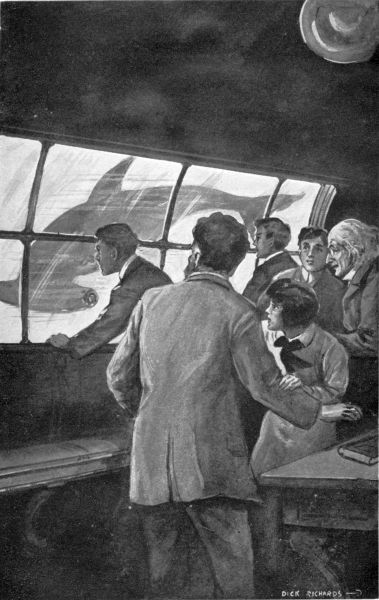
“Look!” cried Ned, suddenly. “I guess this
ends it!”
As he spoke he pointed below. They all looked,
and as they did so they saw the submarine suddenly
sink. Her blunt nose seemed to poke itself beneath
the waves, and in a few seconds all that
showed where the strange craft had been were
some bubbles and foam on the surface of the heaving
sea.
“She’s gone!” cried the professor, in disappointed
tones.
“I thought she’d do that,” murmured Jerry.
“Well, that settles it as far as we are concerned.”
“You’re not going to give up; are you?” Professor
Snodgrass wanted to know. “I simply
must have a submarine to get those hermit crabs.”
“Well, it will all be a matter of luck, anyhow,
finding this one again,” spoke Ned. “I guess, Professor,
it will be easier for us to build you one, or
buy a second-hand boat, if there are any such.”
“Anything, so as I can get to the bottom of the
sea,” sighed the scientist, still looking at the place
where the mysterious submarine had disappeared.
“Get busy with supper, Bob!” called Jerry, as
he set the automatic steering gear. “There’s nothing
else to do now except eat.”
“And after that?” asked Ned.
“Oh, we’ll hang around here for a few days,
and then, if we don’t see any more of the Hassen’s
lifeboats, with some of the passengers or crew, or
if we don’t sight the submarine once more, I think
we may as well go back home,” replied Jerry.
“Bob will want to see his uncle, and the folks will
get anxious about us if we stay out too long.”
“You seem pretty sure my uncle is safe ashore,”
spoke the stout lad.
“I am,” declared Jerry. “You’ll soon be able
to satisfy your curiosity regarding that valuable
object he brought over with him.”
“I have been wondering what it could be,” admitted
Bob. “It’s a family secret, I know that
much, and it’s valuable. Well, I may as well get
supper, I suppose,” and he finished his remarks in
such a naive way that Ned and Jerry laughed.
As for Professor Snodgrass, now that his hope
of getting on the submarine was dashed, he went
back to his beloved labor of catching any stray
bugs and insects that might be aboard the Comet,
or which he could net out of the air.
Supper was progressing satisfactorily, various
appetizing odors that came from the galley testifying
to Bob’s activities. Jerry and Ned looked
to see if the machinery was running properly and
then they kept watch down below for a possible
sight of the boat that had eluded them.
But it would soon be too dark to see, and Jerry
decided that the chances of picking up the craft in
the rays of the powerful search-light were too
small to make up for the discomfort that would be
caused by standing watch all night.
“We’ll just let her go, and trust to luck for finding
her again,” he said. “Evidently she is cruising
about in these waters, and the chances are just
as good for finding her again by accident as they
would be if we made a search. Luck goes in
threes, anyhow, you know, fellows. We’ve seen
her twice when we least expected it, and I believe
we’ll see her again. Now I’m going to take it
easy,” and he stretched out on a sofa in the living
cabin, through the glass floor of which glimpses
could be had of the ocean below them.
Preparations for the evening meal were well
under way, and the Comet was shooting along at
good speed. The boys were thinking of many
things. Ned and Jerry were wondering if it
would be possible for them to get a submarine,
while Bob, during such time as his attention was
taken from his cooking, was wondering if his
uncle and cousin were safely home, and what it
was Mr. Sheldon had brought from Germany.
Suddenly from the bow of the ship, where Professor
Snodgrass had gone to look for specimens,
there came a cry of pain. Ned and Jerry leaped
to their feet.
“What is it?” cried the tall youth, running forward.
“Have you caught something?” asked Ned
eagerly.
“Ha! It would be more correct to say that
something has caught me!” returned the professor.
“Hurry, boys, it’s a great big beetle, and
he’s pinching me. I daren’t knock him off because
I want him for a specimen. Oh, how he pinches!”
The two chums saw a comical sight—or, it
would have been funny had it not been for the look
of pain on the face of the scientist.
He stood near the pilot house, an insect net
under one arm, and a cyanide bottle—for painlessly
killing his specimens—under the other. His
left hand was tightly closed, while, dangling from
the other was a large, black and squirming bug,
that seemed to be hanging on by the simple process
of making his pincers meet in the flesh of the professor’s
thumb.
“Oh, boys! Take him off! He is hurting me
dreadfully!” cried the scientist. “But be very
careful, as he is a most rare and valuable specimen.”
“Why don’t you take him off yourself—you
know how to handle those creatures,” suggested
Ned, who did not much fancy plucking off the vicious-looking
black beetle.
“I—I can’t,” said the professor. “I have a
new kind of upper-air fly in this other hand, and
if I open it he’ll get away. I had caught that, and
was reaching for the beetle, when he pinched me.
I’m glad he’s holding on, though, for it will give
you a chance to get him.”
“Uh—I don’t know as I want to,” replied Ned,
hanging back. “He might transfer his affections
to me.”
“Oh, please get him!” begged the scientist.
“I’ll show you how,” said Jerry. “Let me get
that cyanide bottle from under your arm, Professor.
I’ll open it and hold it near the beetle. The
fumes will stupefy him, and he’ll drop in. Then
I can cork him up.”
“Good!” cried Professor Snodgrass.
Jerry took the poison bottle, which contained in
the bottom plaster of Paris, mixed with the deadly
cyanide of potassium. The fumes of this are deadly
to all insects in a very short time, killing them
without pain.
Holding the open bottle close under the beetle
that was clinging to the professor’s thumb, but
taking care to keep his own face well away from
the vial, Jerry waited. In a few seconds the pincers
of the beetle relaxed. A few seconds more
and it fell off into the wide-mouthed bottle. Jerry
quickly corked it up, and handed it to the professor.
“Ah, thank you, my boy, thank you!” exclaimed
the scientist. “That is a very rare specimen. I
am glad to get it.”
“As glad as he was to get you,” said Jerry with
a smile. “It certainly is a large beetle.”
“And he certainly pinched,” murmured the professor,
rubbing his thumb, on which were a few
drops of blood. “I think I had better use a little
peroxide to avoid infection.”
This excitement over, supper was served. As
they all stood on the main deck, with darkness settling
down, Jerry, looking over to the west, while
the motorship moved slowly along, remarked:
“I think we’re in for a storm. I saw a flash of
lightning just then.”
“Bur-r-r-r!” exclaimed Ned with a little shiver.
“I don’t fancy a blow in this exposed place.”
“Oh, I guess we can weather it,” spoke Jerry.
“Anyhow, I’m glad my uncle and cousin are not
out in an open boat,” added Bob.
Jerry’s prophecy of a storm was borne out. It
came up rapidly and soon there was quite a gale of
wind, while the lightning flashes grew more and
more frequent. The accompanying thunder roared
alarmingly.
It grew darker rapidly, and the storm seemed
likely to last through the night. Rain began to
fall, but the boys did not mind that.
Everything was made snug aboard the craft,
which scudded along through the blackness of the
night, illuminated by the flashes from the sky.
“I wonder where that submarine is now?” said
Bob musingly.
“Probably far down beyond the influence of the
waves,” answered Jerry.
It must have been about midnight, when none of
those on the Comet had cared to turn in that, following
several slight flashes, there came one of
vivid brilliancy. There was that same crackling
sound at first, as the boys had noticed once before,
and then a terrific crash, that seemed to split right
through the airship.
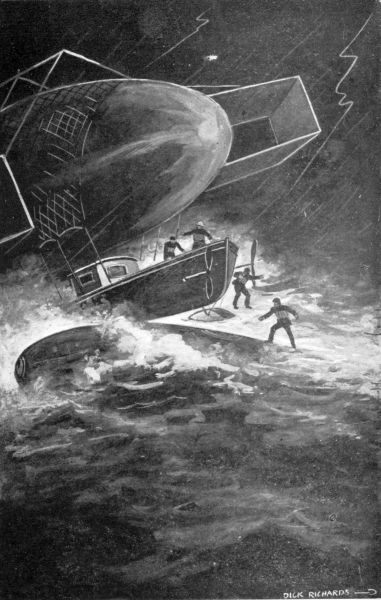
In an instant the hum of the propeller motor
ceased, and the benumbed boys and Professor
Snodgrass, unable to move for a second, so paralyzing
had been the shock, felt the craft sinking
with them toward the ocean.
“We’ve been struck!” cried Jerry. “We’re
disabled!”
“Yes, and we’re going down!” yelled Ned.
Down and down went the crippled Comet, down
through the storm that was crashing all around
her.