At last came the day for the races. It was early
in July, and the weather though warm, was not oppressive.
Early in the morning a big crowd started
out toward the grounds of the Cresville Athletic
Club, which were about a mile outside of the
town proper.
Ned, Bob and Jerry reached the track about ten
o’clock, and found it pretty well occupied.
“It will give us good practice in wheeling in a
crowd,” observed Jerry as he stripped off his sweater
and, in regular racing costume, began to make
the circuits.
His two friends soon followed his example. A
little later Noddy and Jack arrived. The two
cronies kept to themselves and spoke no word to
our three heroes.
About noon-time there was a general stopping
and all the contestants who were warming up went
to get something to eat. Under Jerry’s advice
Ned and Bob ate and drank sparingly.
The races were to begin at two o’clock. Long
before that hour most of the best seats were
filled, and there was a crowd on the way to the
athletic grounds that would tax the capacity of the
bleachers.
About half-past one o’clock a rather gaunt individual
might have been seen making his way toward
the athletic grounds. He wore a pair of
patched trousers and a green coat, with a red patch
on either elbow.
“Hi there!” called some boys. “Look at the
hobo going to enter the races.”
“Oh, I may be a hobo, but I’m not a dodo; put
that in your pipe and smoke it till night. That
ain’t a good rhyme, but it’ll do this time,” recited
the man in a sing-song tone.
“Ha! Ha! Isn’t he funny!” laughed some
small boys.
Hearing the sound of laughter Ned, Bob and
Jerry, who were walking together in the fields, a
short distance away from the athletic grounds,
came over.
“Why it’s Old Pete!” cried Bob. “Hello
Pete! I say, Old Pete Bumps!” he called,
waving his hand to the man with a green coat and
a red patch on either elbow.
“Oh, I say, is that you, why how do you do?”
said Mr., otherwise Old Pete Bumps, who was a
general man of all work about Mr. Baker’s place.
He did everything from feeding the chickens to
taking out the ashes.
“Hello Pete!” called Jerry and Ned in chorus.
“What did you come for? Are you going to
race?”
“Am I going to race? Well not in this place,”
replied Pete gravely. “I came to watch over you
boys. Be a sort of general overseer as it were.
Look after the wheels and see that they get full
meals,” he added without a smile.
From which it may be inferred that Mr. Bumps
was something of a character.
Indeed at one time he had been a well educated
man. But an injury to his head, caused by a fall,
and a number of misfortunes, had displaced him
from a life of comparative wealth, and had made
him a sort of foolish, though very loving, elderly
man. Mr. Baker had taken pity on him and made
a place for him, for which poor Old Pete Bumps,
as he called himself, was very grateful. He was
very fond of children, especially boys, and was always
looking after the interests of Bob and his
chums.
“Now Pete can look after our wheels,” said
Bob. “I was wondering who we could leave in
charge between the heats, and while we were
dressing. He’ll be the very one.”
“Surely will I, e’en though I die,” said Pete
gravely, for he had a habit of making extemporaneous
rhymes on all occasions, which jingles sometimes
fitted and sometimes did not.
“All right, Pete,” said Bob. “Come on over
here,” and he led the hired man to where the boys
had left their three wheels in charge of a lad of
their acquaintance, who had agreed to stand guard
at the rate of five cents a half hour. Pete gravely
squatted down on the grass near the bicycles.
Relieved of the responsibility of guarding their
mounts, the trio of lads wandered about the
grounds of the club. There was much bustle and
excitement. New riders were constantly arriving
and going out on the track to warm up. Hundreds
of spectators were coming afoot, or in carriages
or automobiles. Flags waved gaily in the
wind, and the whole scene was a spirited one. A
bevy of girls coming up the road that led to the entrance
of the grounds attracted the attention of
our three heroes.
“Looks like my sister Susie with that red dress
on,” said Bob.
“And that seems to be Julia, in that green hat,”
observed Jerry. “Yes, that’s her,” he went on.
“I can tell by her laugh,” he added, as a merry
peal floated over the green field.
“Who are the girls with them?” asked Ned,
who had no sisters, but who was as fond of girls as
they were of him.
“There’s Mollie Horton, who lives near me,”
said Ned. “She’s jolly enough. And Alice
Vines. I don’t know who the other one is.”
“That’s Helen Gale,” put in Bob. “I know
her. She made that silk flag with our foot-ball
colors on last year for me.”
“Good for her!” exclaimed Ned.
The girls soon came up, and there was merry
talk for a little while. The boys wanted to take
the girls over and buy some ice-cream sodas.
“We haven’t time,” objected Julia. “We
want to get our seats before the races begin. We
don’t want to miss a one.”
“You won’t miss anything,” assured Ned.
“Oh but we might,” interposed Alice. “And
it is not every day we can come to such a big event
as this. If you boys want to get the sodas afterward—”
“Of course we will,” broke in Jerry. And so
they agreed to treat the girls after the races.
Not long after Pete had been left in charge of
the cycles a man, wearing a slouch hat, who had
been but a few minutes before in close consultation
with Jack Pender, shuffled up to where Pete was
lying in the grass.
“Arternoon, mate,” said the roughly dressed
man in a growling voice.
“How do you do, I’m glad to see you,” replied
Pete, in his sweetest tones.
“What yer givin’ us?” demanded the stranger.
“Me? I gave you nothing, sir,” replied Pete.
“Come off your high perch then, an’ talk United
States,” went on the stranger gruffly. “My
name’s Bill Berry, what’s yours?”
“My name’s Pete Bumps, I’m full of humps,”
recited Pete gravely.
“You look it,” commented Bill Berry. “But I
say, mate,” he went on, “how would you like to
go off and get a good smoke? Come, I’ll pay for
it?”
“I’d like it first rate, but I must stay here quite
late,” said Pete.
“Why so? Oh, I don’t know,” mocked Bill,
falling into the eccentric mood of his companion.
“To guard the wheels against the steals,” replied
Pete.
“Don’t let that worry you,” went on Bill, eagerly.
“I’ll stay here. You go get yourself something
to smoke, and take your time. I’ll stand
guard while you’re away.”
If there was one thing more than another that
Old Pete liked, it was to smoke. Usually he had
to forego this pleasure because of lack of funds.
Now here was a chance to indulge. So, after receiving
twenty-five cents from Bill Berry, Pete
started over to the grand stand, near which was a
booth where cigars and refreshments were sold.
Bill looked narrowly about as soon as Pete was
out of sight. There were plenty of people around
him, but no one seemed to be noticing what he was
doing. Quickly Bill pulled a wrench from his
pocket and used it on each of the three bicycles.
Then he brought out a stick of something black.
“This graphite is well doctored,” he muttered.
“I guess it won’t be healthy for the chains.”
He rubbed a liberal supply on the chain of each
wheel, and also on the sprockets. Then he rapidly
opened the tool bags on each machine, took out the
graphite he found there, and substituted some of
his own.
“I guess that will do the trick,” he said softly.
“And I guess I’ve earned my two dollars, Jack
Pender.”
He hurried off, mingled with the crowd, and a
little later was in conversation with Jack Pender.
A little later Pete came hurrying back. He was
smoking a cheap cigar, and his pockets bulged with
others.
“Here you go, Bill, now smoke with a will,” began
Pete, when he drew near where he had left
his new friend in charge of the boys’ bicycles.
“Why, he’s gone,” he went on, seeing the deserted
mounts. “Wonder where he went?” However,
he did not give much thought to it, and went on
smoking happily.
“Wheels all right?” asked Ned a few minutes
after, as he, Jerry and Bob came up.
“Right as a fiddle, come high-diddle,” recited
Pete.
“Hark! What’s that?” asked Chunky suddenly.
“Sounds like an announcement.”
The three boys ran nearer the grand stand where
the official announcer stood. The man was using
a small megaphone and went on to say that there
had been a slight change in the program, and that
the race for those who had never been in a contest
before would be the first number instead of the
third.
“Great Scott, Chunky! That’ll mean you’ll
have to hustle for all you’re worth!” cried Jerry.
“Here, get your wheel out, strip off your sweater
and get around to the track entrance and have
your number pinned on.”
Jerry grabbed up his chum’s wheel, while Ned
assisted the lad in pulling his sweater over his head.
Then, cautioning Pete to keep a strict look-out, the
three boys ran with Bob to the track entrance.
They were only just in time, and found a lot of
other contestants ahead of them. Bob received
his number, and then, for the first time, thought of
his wheel.
“Just spin it for me, to see if it don’t need a
drop more of oil,” Bob asked Jerry. “My hands
shake so I can’t undo the tool bag.”
Obligingly Jerry spun the wheels. The rubber-tired
circle went around swiftly for several turns,
and then came a sudden slowing down.
“That’s funny,” remarked Bob. “I had that
all adjusted this noon.”
Jerry bent down and looked at the bearings.
“The cones have been tightened,” he announced.
“Why I can feel the friction,” and he moved the
front wheel slowly with his hands.
“Try the back wheel!” urged Ned.
Holding that clear of the ground Jerry spun it
by placing his foot on the pedal. There was a
woeful squeak, and, after a few revolutions that
wheel, too, slowed down. Jerry rubbed his finger
over the sprocket chain. It came away black from
the graphite, but mingled with the blackness were
many shining specks.
Just then there came the crack of a revolver.
“That means three minutes to the start,” cried
Bob. “What will I do? I can’t fix the wheel
in that time!”
“Some one’s put iron filings in the graphite,” announced
Jerry, rubbing the stuff between his fingers.
“There’s trickery here!”
“And I’ll lose the race!” cried Bob. “I know
I have a good chance of winning!”
“Let me get my wheel!” exclaimed Ned.
“It wouldn’t do any good,” interposed Jerry.
“We haven’t time to run after them. Besides, the
chances are our wheels are doctored too.”
“All ready, boys!” warned the starter.
“Minute and a half more before the final gun!”
“I might as well quit,” cried Bob.
“Don’t you do it!” said some one suddenly at
his side. “Here, you take my wheel. It’s a
racer, and I’ve just oiled it.”
As he spoke a boy, of about thirteen years, who
had a slight acquaintance with our three heroes,
shoved a handsome new wheel over toward Bob.
“Oh, thank you, Sam Morton,” said Bob.
“But don’t you want it yourself?”
“Not a bit,” said Sam. “I’m not going to
race. Take the wheel.”
“All right, I will,” assented Bob. “And I’ll
square things with you afterward, Sam. Some one
has doctored mine. I—”
But Bob did not have time to say any more.
“Half a minute!” warned the starter.
“Get on the track!” cried Jerry.
“Line up! Do your best and win!” counseled
Ned.
“I will!” shouted back Bob, and the next instant
he was lined up with the others, waiting for
the pistol shot that would start them off.
“Crack!”
A little puff of smoke, a sliver of flame, and a
slight report. Then the whirr of rubber tires on
the track sounded like the wind rushing through
the trees.
The race, while it was of much interest to the
contestants and their friends, was not very important
to the general public. It was only a mile
sprint and there were ten starters.
Bob’s heart beat wildly at first and his wheel
wobbled from side to side. Then the fever of
fear left him. He saw that he was not being left
behind and he picked up courage. He shut his
teeth tightly, took a long breath, and let out a
burst of speed that carried him to within three of
the leader.
There was a cheer at this, which gave him new
courage, and he struggled harder and harder.
Gradually he passed two of those ahead of him.
There now remained but one lad between himself
and the lead. He gave one quick glance.
“It’s Jack Pender,” he thought. “I know he’s
been in races before. But I’m going to beat him.”
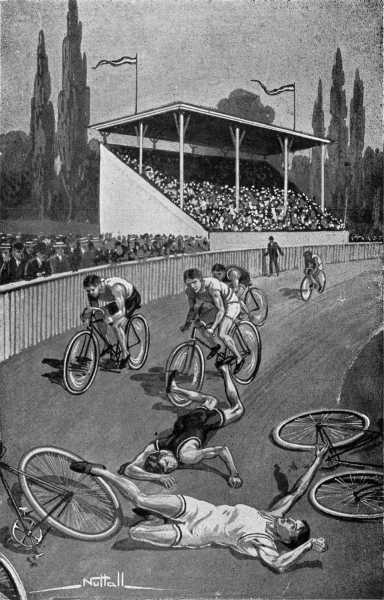
Once more Bob clenched his teeth and let out
another burst of speed. But he had a good rider
to contend against. Jack, looking behind and seeing
the boy he hated, redoubled his efforts.
The race was half done. Already several who
had no chance had dropped out. The struggle
was between Bob and Jack. Bob could hear the
band playing, as if it was a mile away. He drew
one long breath, threw into his leg muscles another
ounce of strength and then, with an effort that surprised
even himself he found that he was on even
terms with Jack.
“Confound you! What are you trying to do,
beat me?” snapped Jack.
“That’s what I am.”
“Well, you’re not going to!”
Jack gave his wheel a sudden turn. His intention
was to upset Bob. But the latter was too
quick for him.
“Foul! Foul!” cried several who had seen
the attempt.
The two passed the post set an eighth of a mile
from the finish, neck and neck. Bob could see that
Jack was almost winded. As for Bob, though in
distress he still had some reserve strength.
Then, with a last final burst of speed, with a
frenzied effort that sent the blood singing to his
head, Bob passed his rival, and came under the tape
a winner by two good lengths.
“Hurrah!” cried thousands.
“Hurrah!” cried Ned and Jerry, though Bob
could not hear them.
And Bob, almost tumbling from his wheel, felt
happier than he ever had in his life before. He
had won the race.
He could see Jack Pender scowling at him, but
he did not mind that.
“I didn’t know you were an amateur, Jack,”
Bob heard one of the toady’s friends address him.
“I’m not any more,” laughed Jack. “That
was my last amateur race. I’m going in with the
professionals on the next race, and I’m going to
win.”
“You are if we let you,” was the response.