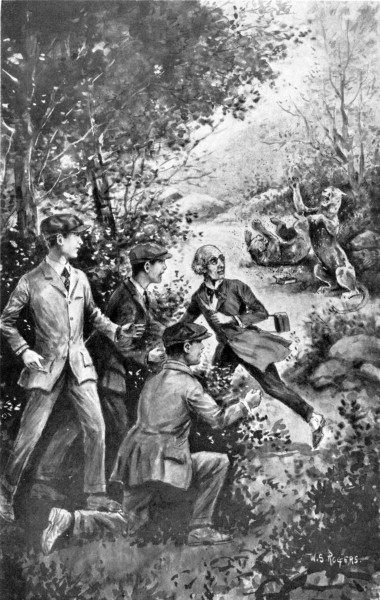
Rushing toward the edge of the cliff, but with
due regard for the danger they knew existed at
the abrupt descent, the Motor Boys looked down
the steep side of the place where a construction
concern had been getting out gravel. It was the
taking away of this material that had made a cliff
where, previously, there had been but a gradual
slope.
Looking down to the bed of Limestone Creek,
twenty feet below them, the boys caught sight of
Professor Uriah Snodgrass floundering about in
the water, which was quite deep. The little scientist
seemed able to keep his head above the
surface, but that was about all.
“Come on! We’ve got to get down there!”
cried Ned.
“Here’s a path,” said Jerry, pointing to one
a short distance off to the side of the spot where
Professor Snodgrass had had his abrupt fall.
Slipping, sliding, scrambling, and all but tumbling,
the three boys made their way to the bottom
of the cliff and to the edge of the creek, which
really was a small river.
By this time Professor Snodgrass had begun
to help himself, having got back the breath that
was knocked from him in his fall, and he was
striking out for shore.
In another instant Jerry had waded in, not
stopping to take off any of his garments, and
was pulling the little man to safety.
“Why—bless my soul—why, it’s the Motor
Boys!” cried the professor.
“Nobody else!” exclaimed Ned.
“Didn’t you hear us yelling to you to keep
away from here?” asked Bob.
“No, Bob, my dear boy, I didn’t hear a thing,”
was the answer. “I was after a very rare specimen
of a yellow-winged butterfly. I chased it
to the edge of the cliff and, just as I was reaching
out for it, I noticed, too late, that there was
an abrupt descent. I couldn’t help myself—I
went over.”
“Yes, we saw you,” replied Jerry, as he helped
the professor to a flat, raised rock on which he
could take a seat. Jerry’s feet were making
queer squidgy sounds caused by the water in his
shoes. He was wet to his arm pits, but the professor
had gone in over his head.
“You boys didn’t see anything of that yellow-winged
butterfly, did you?” asked the professor,
gazing at the trio through his water-dimmed
spectacles which, fortunately, had not come off.
“It had blue spots.”
“No, we didn’t see it,” answered Bob.
“Um! Too bad! I guess it must have gotten
away,” said the little bald-headed man, with a
sigh. His hat had come off and was floating
downstream. Ned rescued it with a long stick.
“Better take off some of your things and wring
the water out,” suggested Jerry, as he looked
at the little puddle collecting at the feet of the
professor, who sat on the rock. “This is a secluded
place—nobody will see you here. You
can strip down to your underwear and dry your
clothes a bit. We can go to my house by a back
way and no one will see us.”
“Oh, do you live around here, Jerry?” asked
Professor Snodgrass.
“Why, of course I do—we all live here! This
is Cresville!”
“Is this Cresville? Well, I started out for
here—I was coming to see you boys, in fact—but
I didn’t know I had reached here. I got
off the train because I saw a very valuable, large
red butterfly fluttering about the station. I caught
it, and then I wandered on after that yellow
one. I chased it to the edge of the cliff and——”
“Yes, we saw the rest of what happened,” put
in Bob. “But better do as Jerry says, Professor.”
“I will. Thank you for the suggestion.” The
bald-headed little scientist began taking off his
outer garments, and was down to his underclothing
when he suddenly made a jump and cried:
“There it is! I see the yellow butterfly! Lend
me a hat, somebody!”
He caught Ned’s from the head of that astonished
lad and then, presenting a most ridiculous
sight, Professor Snodgrass raced along the edge
of the stream, following a flitting insect.
“I’ve got it!” he suddenly cried, clapping the
hat down over a milkweed plant, and Ned groaned
as he saw the treatment to which his hat was
subjected. “I’ve got it! Jerry, please bring me
a specimen box from my coat. It’s waterproof
and won’t be wet inside. Hurry, please!”
There was no resisting the appeal of Uriah
Snodgrass, and a little later, fondly gazing at
the butterfly which was now enclosed in a sealed
glass box containing cyanide that had instantly
and painlessly put it to death, the professor
walked back to his rock.
Glad, indeed, were the boys that it was a secluded
place, for had any one gazed at the antics
of the half-clothed gentleman racing along after
a yellow butterfly, no doubt the police would have
been notified that a lunatic had escaped.
“My, but I’m glad I caught it!” said the professor
fervently, as he pressed the water from
his coat and trousers. “It’s worth all the trouble
it caused me. A most valuable specimen!”
“How is it you aren’t at Boxwood Hall?” asked
Bob, as the professor’s garments were hung about
on bushes to dry in the hot sun and wind, for it
was decided to let some of the moisture get out
before having him put them on again.
“Oh, I’ve given up the zoölogy chair at Boxwood,”
was the answer. And, in reply to the
surprised looks of the boys, the professor went
on: “I did so on the advice of my doctor. He
said I was indoors too much. I must spend all
this summer and fall in the open. I am going
to travel. In fact, I have just started. And
when I found I had some time on my hands, I
decided to come and see my old pupils. My,
but you’ve changed a lot since I last saw you!”
he said, looking at the lads.
“We’ve been to war,” said Jerry.
“Oh, yes, there was a war,” murmured Uriah
Snodgrass, as if he could have forgotten it! As
a matter of fact, he had been on the transport
on which Ned, Bob and Jerry returned home.
“Well, at any rate, I am away from Boxwood
Hall on a year’s leave of absence,” said the professor.
“And what are you going to do?” Bob wanted
to know.
“Travel and collect specimens,” was the answer.
“Why don’t you come with us, as you’ve done
before?” burst out Ned. “We’re going out West
to a place called Thunder Mountain, in Montana.
Why not come along, Professor?”
Professor Snodgrass shook his head as he
turned over his wet coat so that the sun and wind
might better dry it.
“I’m afraid that’s too far for me,” he said.
“The doctor said I must take it easy.”
“Well, come with us as far as Chicago,” suggested
Jerry. “We are going that far, at least,
in a motor car. You’ll get plenty of fresh air
that way.”
“I shall be delighted!” announced Professor
Snodgrass. “It will suit me to perfection. In fact,
I was going to ask you boys to let me accompany
you if you contemplated any short trips this summer.
But to Thunder Mountain in Montana—well,
that’s a bit too far, I’m afraid.”
“Perhaps you won’t find it so after you get
started,” suggested Ned. “At any rate, we’ll
count on you as far as Chicago.”
“Yes, you may do that, thank you,” was the
answer.
A little later, when the professor’s clothing was
dry enough to allow him to squeeze himself into
it, the party started for Jerry’s house by a little-frequented
path.
The professor was a queer-looking sight, but,
then, as he nearly always was in this condition,
caused by crawling and climbing after bugs and
butterflies wherever he saw them, it did not much
matter.
Mrs. Hopkins made him welcome, as she always
did, and the boys offered to go to the railroad
station to inquire about the professor’s
trunk, which he said he had checked to Cresville.
“Though it might be to any other station that
happened to enter his head,” chuckled Jerry to his
chums.
However, they found that for once, at least,
Uriah Snodgrass had had his wits about him,
and the trunk was waiting for him. Engaging
an expressman to take it to Jerry’s house, the
boys found themselves without any special plan
in view until supper time. Jerry had invited Ned
and Bob to eat supper with him, when they could
again meet their friend, the scientist.
“What say we go out to the place where the
farmhouse was on fire?” suggested Ned, as they
walked along. “I’d like to see that old miner
again. We can tell him we’re about ready to go
out West ourselves, and as he said he was going
back, we might meet him out in Montana.”
“Yes,” agreed Jerry, “we might. Let’s go.”
They were not far from Ned’s house, and as
he owned a small car they piled into that and
were soon approaching the burned house. Carpenters
were at work repairing the damages of
the fire, and limping about in the yard, watching
them, was Bill Cromley.
“Hello, boys!” he cordially greeted them as
they alighted. “Glad to see you! Just had some
friends of yours here about an hour ago.”
“Friends of ours?” asked Ned, wondering
whether Professor Snodgrass had been out after
bugs.
“Yes. In fact, I think they’re here yet. They
came to get some potatoes of my sister. She’s
having one of the men dig them. Yes, there they
are! They came in an auto, same as you did.”
Bill Cromley pointed down a lane that bordered
a potato field in which a man was digging. Standing
near the fence, alongside of which a car was
drawn up, were two lads. At the sight of them
the Motor Boys uttered exclamations of surprise,
and Jerry said:
“They aren’t friends of ours!”
“Noddy Nixon and Jack Pender—I should say
not!” cried Bob.
“Did they tell you they were, Mr. Cromley?”
asked Ned.
“Well, I don’t know as they exactly said they
were friends of yours,” admitted the old miner
slowly. “They said they knew you.”
“Oh, that’s different!” remarked Jerry. “Yes,
we know them, but we don’t——”
“Cut it out, Jerry, they’re coming up this way,”
said Bob in a low voice, as he saw Noddy and
Jack getting into the car with a sack of potatoes.
“We don’t want another row here.”
“No, that’s right,” added Ned.
“All right, I won’t so much as look at them,”
promised the tall lad.
Having purchased the vegetables they had
come after, Noddy and Jack drove on out of the
lane. As they passed the place where the Motor
Boys stood with Bill Cromley, the bully and his
crony cast suspicious glances at Jerry and his
chums and Noddy said something in a low voice
to Jack.
On their parts, the Motor Boys spoke not a
word, but, as Ned remarked later, “we looked
plenty at them!”
Mr. Cromley seemed to sense that there was a
strained feeling between the parties of lads, and
he said nothing to bring on hostilities.
“So they aren’t friends of yours, eh?” questioned
the old miner when Jack and Noddy were
speeding off down the road after a backward look
at the three chums.
“I should say not!” declared Jerry. “Anything
but that!” and his face showed his disgust.
“Hum! I’m sorry,” went on Mr. Cromley.
“We aren’t!” laughed Jerry. “We don’t enjoy
knowing such contemptible characters.”
“No, I mean I’m sorry for what I told them.
Are you certain they aren’t to be relied upon?”
“They most certainly aren’t!” burst out Ned.
“What would you think of a fellow who, while
in the army, would shoot himself, inflicting a
minor wound, so he wouldn’t have to fight but
could go to the hospital?”
“I’d think he was a—dirty skunk!” burst out
the miner. “Did that Noddy Nixon do that?”
“He sure did! And Jack Pender is as bad,”
declared Bob.
“Um! Um! I certainly have made a mess of
it!” exclaimed the miner, with a worried air. “I
certainly have!”
“What did you do?” asked Jerry in curiosity.
“Why, those fellows came here this morning.
They talked pretty slick, said they knew you and
all that. Heard I knew something about gold
mining. They heard, somewhere, about the treasure
chest of Blue Rock, which isn’t surprising, as
I’ve told the story often enough down in the
village store. Well, to sum it all up, Noddy
Nixon offered me a good sum if I’d pilot him
and his chum out West to the place where the
stage coach went over the cliff down into the
canyon.”
“Did you accept his offer?” asked Jerry quietly.
“In a sense I did, yes. I’m thinking of going
back out West, anyhow, and I thought this a
good chance to make some money. But if I
had known what sort of fellows those two
are——”
“Did you tell them all the particulars?” asked
Bob.
“Yes, I think I did—about everything! Like
an old fool I blurted out all I knew—how the
horses ran away, how they went over the cliff,
and how it looked like the end of everything.”
“But did you tell them where Blue Rock is—where
the accident happened?” asked Jerry
eagerly.
“I reckon I did. That Noddy Nixon is a
slick one. He kept on asking me questions—worming
things out of me. And I told them all!
Even about the exact spot where the treasure
chest fell. My! My! But I wish I hadn’t! I
certainly wish I hadn’t!” groaned the old miner.