“Better fly low,” said Ned to Jerry, who was
guiding the airship. “If you go up too high,” he
went on, as they were approaching the location of
the mysterious gorge, “they may see you.”
As far as they could learn by looking down and
sweeping the landscape through powerful glasses,
they were not seen, and the airship settled down
at the entrance of the defile, to give the boys and
the professor a chance to find the secret door before
the cowboys arrived.
“We’ve got about three hours,” Jerry said. “It
will take them that long to ride here.”
They entered the V-gorge, and when they came
to the place where, always before, they had been
stopped by the lack of the cattle signs, they examined
the ground with new interest.
“Look at those splinters of wood!” exclaimed
Ned. “That shows where the big stone-boat was
pulled along over the stones, laden with cattle.”
“That’s right,” agreed Jerry. “Probably those
splinters were there all the while.”
“It’s queer we didn’t notice ’em!” cried Ned.
“I don’t believe they were as plain before. I’m
sure we would have taken some notice of them if
they had been. More likely they put more cattle
on the wooden drag this time, so as to hurry them
through the passage, and because of the greater
weight more splinters were rubbed off.”
“That’s right,” agreed Jerry. “Anyhow, the
thing is plain now, and if we follow the splinter
trail to where it ends it ought to bring us right to
the secret door. Where the splinters end there
is the entrance.”
“That was my idea,” said Professor Snodgrass
with a smile.
They followed the “splinter trail,” as they
called it, until it came to an end right where the
two sides of the big stony V came together.
“Here ought to be the door—here or hereabouts,”
the professor said as he drew a geologist’s
hammer from his pocket, for he was a geologist
as well as a botanist and a “bugologist.”
He began to tap gently on the walls of the defile.
They were of rough stone, and so cunningly
had the concrete coating been made for the
wooden door that it could not be detected by an
difference in hue or texture.
But suddenly the hammer, instead of giving
back a sharp, thudding sound, produced a hollow
boom.
“There it is!” cried Jerry.
“Right,” assented the scientist. “And you can
see the outline of the door,” and he pointed to an
irregular crack starting at the floor of the gorge,
rising up about five feet, always irregular, then
down again until it reached the rocky floor once
more, the space between being roughly shaped like
an inverted U with about ten feet distance between
the two points.
“But how does it open?” asked Ned. “If we
can’t get through we aren’t much better off than
before.”
“It is only a light wooden door, covered on the
outside with expanded metal lath and that, in
turn, with concrete,” said the professor. “It
was made in this irregular shape so that the crack,
where it fitted into the opening of the tunnel,
would look like a crack in the wall. But now we
know what the crack means we can pry the door
open.”
Ned ran to get the necessary tools, and while
he was coming back with them Jerry and Bob
looked at the secret door. It was so cunningly
devised that from the gorge few would have
guessed its existence. They, in their previous
searches, had probably stared right at the crack
but uncomprehendingly.
Ned returned with a short iron bar, sharp and
flat at one end. With this, and an axe, they attacked
the secret door. As the professor had
said, having gained his knowledge from overhearing
the thieves talk while he was a captive, the
portal was really but a shell. It was quickly
forced open, the secret lock on the inside being
broken.
Though they worked quickly they made as little
noise as possible, for they feared, from what
Professor Snodgrass had said about the two entrances
being guarded, that someone would be stationed
near the secret door.
But no alarm was raised, for while it was true
that a guard was usually kept at the farther end
of the tunnel, where it opened into the valley, on
this occasion the man had been called away to
help in re-branding the cattle.
So, thus favored by fortune, the Motor Boys
and the professor were able, undetected by those
whom they sought to capture, to force open the
door. As it swung back on iron hinges set in the
inner face of the rock, a dark tunnel was revealed.
Hesitating a moment, to make sure none of the
rustlers was there, they stepped in.
“Look! here’s the stone-boat and the ropes and
pulleys they used to haul the cattle over a space
so all trace of them would be lost,” exclaimed
Bob, pointing to the contrivance that was at the
opening of the tunnel, which, in reality was a large
cave.
“Yes, that’s what I had my midnight ride on,”
laughed Professor Snodgrass, who seemed to take
huge delight in leading a raid on his former captors.
“This is a new one they had just finished
making in the woods when, unexpectedly, they
caught me.”
“Hadn’t we better wait for the cowboys?”
asked Bob, as Jerry and Ned seemed inclined to
lead the way farther along the tunnel. “Besides,
it’s so dark we can’t see more than a few feet,”
and he pointed to the black void beyond.
“Yes, it is dark, and we’ll need lanterns,” said
the scientist. “But we have time to go along a
little way and explore. The raiding party won’t
be here for some time yet.”
“We have plenty of electric flashes on the airship,”
Jerry said. “We’ll get them and have a
look.”
Presently they were going forward. It was
new ground to the professor, as well as to the
others, for he had never been in the tunnel. This
latter was evidently a hollow shaft under the
mountain, caused by an earthquake perhaps, or,
more probably, by the erosion of an underground
river.
The tunnel was about ten feet high and about
as broad, being oval in shape. There was room
to drive many cattle along it, and there were evidences
that many had been so driven.
“Go a bit easy,” advised Ned. “We don’t want
to burst out of the other end of this shaft into the
midst of the rustlers.”
“Oh, the tunnel is about a mile long,” said the
professor. “And the end is screened by bushes,
so you’ll have plenty of chance to be on your
guard.”
They hurried silently along the big rocky shaft,
their electric flashlight casting queer, flickering
shadows on the walls. The professor took the
lead when they judged they had covered nearly
the distance estimated, and presently he came to
a halt.
“We’re near the end,” he said, indicating a
glimmer of daylight. “Better put out your electrics.”
This the boys did. Then, proceeding still more
cautiously, they presently found themselves looking
through a screen of bushes at a curious sight.
Down in a sort of gigantic bowl of a valley,
the presence of which they had not detected in
their wanderings, as it was the depressed top of
a big, deeply wooded hill, they saw a score or more
of cowboys and a herd of steers, the latter being
driven hither and yon in the process of having the
brand of the Square Z ranch obliterated, and another
substituted.
“The rustlers!” whispered Jerry.
“There they are!” murmured Bob.
“The secret solved at last!” cried Ned, in a
suppressed voice. “Now dad will say we’re some
pumpkins, I guess!”
“Only we haven’t got ’em yet,” remarked Jerry,
cautiously.
“I guess they won’t get away,” came grimly
from the professor. “And then I can get back my
precious specimens I had to abandon. I hope
they haven’t destroyed them.”
Marking the conformation of the valley, and
noting the spot the professor pointed out as the
egress, the boys and the scientist returned to the
tunnel entrance. They had not long to wait before
Hinkee Dee and the other cowboys came riding
up.
“Are they there?” the assistant foreman asked
eagerly, and he addressed Ned, Bob and Jerry in
the most cordial tones he had ever used.
“All ready to go in and get,” Jerry replied.
“That’s good! Come on now, fellows!”
The situation was quickly explained, and plans
for a rush made. The cowboys rode their horses
into the tunnel, preceded by the boys and the professor
with lights. At the far end they halted and
then, after some whispered instructions from Hinkee
Dee, the whole force went cautiously out and
was posted behind the screening bushes.
“All ready now?” asked Hinkee Dee, as he
scanned his waiting horsemen.
“All ready,” was the answer. Bob, Ned and
Jerry had managed to get places in the front
rank. The professor, as soon as he saw the preparations
completed, went to one side in a quiet
chase after some big bug he saw.
“Let her go!” said Hinkee Dee. “But don’t
begin to yell or ride hard until they’ve seen us.
Then rush ’em!”
This advice was followed. And so busy were
the rustlers branding the steers that the attacking
cowboys had ridden a quarter of the way toward
them before the alarm was given.
And then it was too late to make a strong resistance.
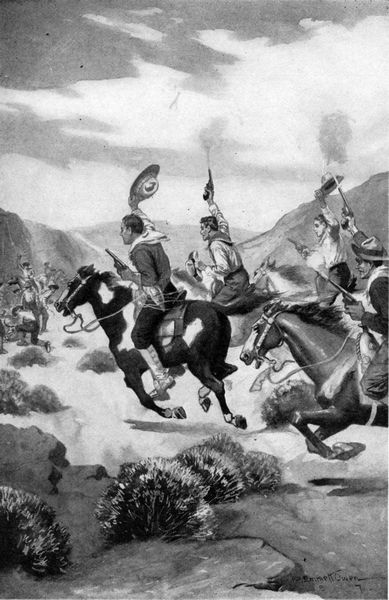
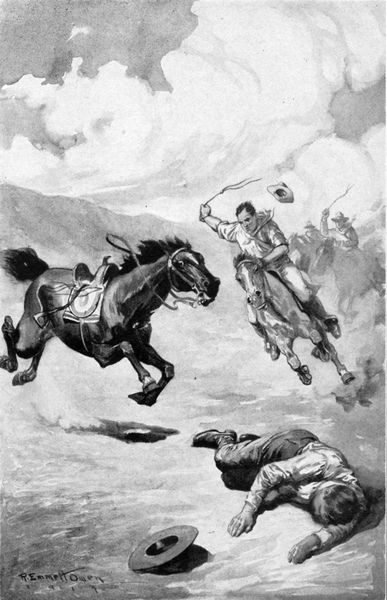
With a fusillade of revolver shots, with
wild yells and waving of hats, while the ponies
galloped on unguided by rein, the raiders rushed
to the attack. The rustlers could not have been
taken at a greater disadvantage. Not one of them
was armed, all having laid aside their guns to
work at the branding.
“Throw up your hands!” came the stern order
from Hinkee Dee, his two guns pointed at the
outlaws, and the order was sullenly obeyed. One
rustler tried to make a dash for his horse, probably
intending to seek the egress. But a shot fired
over his head caused him to stop, and in a short
time the whole gang was captured.
“Well, we’ve got you at last!” exclaimed Hinkee
Dee, as he and his friends looked around the
discomfited gang, many of whom were known, at
least by reputation, to the cowboys. “Caught you
in the act, too.”
“Yes, I guess you’ve got the goods on us,” admitted
one of the outlaws. “But I’d like to know
how you found us.”
“I showed them the way!” exclaimed a mild
voice at Hinkee Dee’s stirrup. “And now I’d
thank you for my specimens. They’re very valuable.
There’s one red bug that——”
“Jumpin’ molasses barrels!” cried Black Henderson,
the leader. “It’s the bug-house chap! So
you got away, did you?”
“Yes. And I came back again. Now for my
specimens,” and the professor hurried off to the
shack where he had been held prisoner, coming
back presently with several boxes under his arms
and a happy smile on his face. He had done his
part to aid his friends, and the specimens he secured
afterward proved to be of great scientific
value.
“Got them—every one!” he called, and from
then on he took no more interest in the raid.
The prisoners were bound and driven out of the
tunnel and eventually to town where they were
locked up. The stolen cattle were gathered together,
and headed for their home range.
“Well, boys,” said Hinkee Dee to Ned, Bob
and Jerry as they were on their way to the ranch
after the prisoners had been disposed of, “I want
to congratulate you and say I was wrong in calling
you tenderfeet. You’re one of us from now
on. I was hopin’ to assimilate these rustlers myself,
but you and the professor got ahead of me.
“Hello, what was the reason you didn’t come
along with us, Munson?” he asked, as he dismounted
at the corral and saw the cattle buyer
standing near. “We needed all the help we could
get.”
“I had business elsewhere.”
“Couldn’t have been more important business
than roundin’-up the rustlers, to my way of
thinkin’.”
“I was doing a little rounding-up myself,” was
the smiling answer.
“You! Who’d you round up?”
“The Parson,” was the quiet answer.
“The Parson!” was yelled by a score.
“Yes, the head of the rustling gang, its prime
mover and the man who gave them information
when and where to make their raids on Square Z
ranch.”
“Whew!” whistled Hinkee Dee; and the others
expressed their surprise in different ways.
“How’d you come to do that, Munson?”
“Peck’s my name,” was the quiet rejoinder.
“Henry Peck, and I’m a detective. I was sent out
here from New York.”
At this the boys started and looked at one another.
“I was sent on by your father,” said Mr. Peck,
smiling at Ned, “to see what I could do. Evidently
he didn’t take much stock in your efforts.
But I shall tell him he was wrong. I did only a
little end of it.”
“And you got the Parson,” murmured Gimp,
amazed.
“Yes, I got the Parson! He is one of the most
notorious cattle swindlers known, and the authorities
have been looking for him a long time.
I heard of him in Des Moines, and then I came
on here. I guess you boys didn’t think much of
me at first, did you?” Mr. Peck asked Jerry.
“No; not an awful lot. We thought you were
a rustler yourself.”
“Especially after that fake about your leg,”
added Ned.
“Well, that was a fake—part of it, anyhow,”
admitted the detective. “I did see the rustlers
drive off the cattle and they fired at me. They
didn’t hit me; but I saw a chance to pretend to be
wounded so I could have a good excuse for staying
around the place here. That’s what I did, and
in that way I got evidence against the Parson. I
intercepted some messages he sent to the rustlers,
made copies of them and they’ll be used for evidence.
He was the real head of the gang.”
“Whew!” exclaimed Ned. “And we thought
he was so good!”
“I guess you thought I was sort of mean, didn’t
you?” asked Hinkee Dee.
“Yes,” admitted Jerry.
“But I want to say it wasn’t me who changed
horses on you that time,” went on the assistant
foreman. “I saw the Parson do it, but I wasn’t
going to squeal. I didn’t know what his game was
but I see now. He wanted to discourage you.”
“Of course not,” Jerry agreed. “I guess he
had his reasons for trying to get us away from
here.”
“The very best!” laughed Henry Peck. “And
now I think you’d better send word home. The
main credit belongs to you boys, for if you hadn’t
rescued the professor you’d never have known
where the rustlers’ headquarters were. I doubt if
I could have forced the Parson to tell.
“I stayed away from the raid to-day to get the
last bit of evidence against him I needed. And
I got it—and him. He’s in jail with the rest of
his gang now.”
There is little more to tell. The workings of
the cattle thieves were revealed with the arrest
of the entire gang. As has been related, they
would run off a bunch of cattle when the signal was
sent them by the Parson, who, working at the
ranch, knew all its operations. Then the steers
would be held in the secret valley until a favorable
time to send them out to innocent buyers.
The detective’s boast that he had bought Square
Z stock under the market price was not a vain
one, as he had done so in order to get evidence,
though it was worthless at the time. Eventually,
the lawless men received their punishment.
Mr. Peck, or Mr. Munson, a name he often
went by, had been sent out to Square Z ranch by
Mr. Baker as soon as the boys started. He traveled
faster than they, and knew when they were
to arrive in Des Moines. His attempt to make
friends with them was more a joke than anything
else, so as to be able to send word back to their
parents that they were all right.
He learned of their arrival at the ranch, and,
after having worked up some clues himself, he
came on, surprising them at their airship. The
detective tried to solve the mystery of where the
stolen cattle were hidden, but was unsuccessful.
He did, however, suspect the Parson, and with
good reason, and laid his plans to trap him. The
latter was a “slick” rustler, though, and, for a
time, baffled the efforts of Mr. Peck.
It was soon learned that one of the rustlers,
who had been sent by the others to spy on the deserted
camp of the cowboys on the mountain top
had fired at the airship.
“Well, I suppose we’ll have to be going back to
Boxwood Hall soon now,” said Bob one day, following
the receipt of letters from home, in which
were many congratulations on their achievements.
“Yes, but there are worse places,” commented
Ned, and Jerry nodded.
“I’m glad that dad and Mr. Slade decided not
to sell the ranch, and that Mr. Slade found funds
for his new business enterprise somewhere else,”
observed Bob.
“Well, while we have a chance, let’s take
a trip in the airship,” said Jerry. “Want to come,
Professor?”
“No, I’m going to stay on the ground to-day.
I lost a valuable jumping spider from one of my
boxes and I must search for it.”
And while the three chums are enjoying one of
their last trips over Square Z ranch we will take
leave of them for a time, to meet them again in
the next volume, which will be entitled, “The
Motor Boys in the Army, or Ned, Bob and Jerry
as Volunteers.”
It was about a week after the capture of the
rustlers that Ned, Bob and Jerry prepared to
make their leisurely way back East in their big
car. The airship, after a last wonderful flight,
which was witnessed by a number of cowboys
from neighboring ranches, had been taken apart
and shipped to Cresville.
“Well, come again, boys,” urged the foreman,
as he shook hands with the travelers. “Always
glad to see you, though I can’t offer you any more
excitement like that you just went through.”
“We’ll be glad to see you, anyhow,” put in Hinkee
Dee, and this was a great deal, considering
the way he had formerly regarded the boys.
The ranchmen gave them a cheer as the big car
moved away, and the last sight the boys had of
Square Z ranch was the waving hats of their
friends.
“Well, it turned out all right,” remarked Ned,
after a period of silence.
“Yes, we succeeded better than I expected we
would at one time,” agreed Jerry. “It looked as
though we were going to fail. What are you
thinking of, Chunky?” he asked the stout lad who
had not said much.
“Something to eat!” challenged Ned.
“I was not! I was just thinking how the Parson
fooled us all. No one would ever have taken
him for a rustler.”
“That’s the reason—he was so different,” commented
Jerry, as he guided the car over the trail
toward the distant East.
THE END
THE BASEBALL JOE SERIES
By LESTER CHADWICK
12mo. Illustrated. Price per volume, $1.00, postpaid
- BASEBALL JOE OF THE SILVER STARS
or The Rivals of Riverside
Joe is an everyday country boy who loves
to play baseball and particularly to pitch.
- BASEBALL JOE ON THE SCHOOL NINE
or Pitching for the Blue Banner
Joe’s great ambition was to go to boarding
school and play on the school team.
- BASEBALL JOE AT YALE
or Pitching for the College Championship
Joe goes to Yale University. In his second
year he becomes a varsity pitcher and pitches in several big games.
- BASEBALL JOE IN THE CENTRAL LEAGUE
or Making Good as a Professional Pitcher
In this volume the scene of action is shifted from Yale college
to a baseball league of our Central States.
- BASEBALL JOE IN THE BIG LEAGUE
or A Young Pitcher’s Hardest Struggles
From the Central League Joe is drafted into the St. Louis
Nationals. A corking baseball story all fans will enjoy.
- BASEBALL JOE ON THE GIANTS
or Making Good as a Twirler in the Metropolis
How Joe was traded to the Giants and became their mainstay
in the box makes an interesting baseball story.
- BASEBALL JOE IN THE WORLD SERIES
or Pitching for the Championship
The rivalry was of course of the keenest, and what Joe did to
win the series is told in a manner to thrill the most jaded reader.
- BASEBALL JOE AROUND THE WORLD
or Pitching on a Grand Tour
The Giants and the All-Americans tour the world, playing in
many foreign countries.
- BASEBALL JOE: HOME RUN KING
or The Greatest Pitcher and Batter on Record
Joe cultivates his handling of the bat until he becomes the
greatest batter in the game.
Send For Our Free Illustrated Catalogue
CUPPLES & LEON COMPANY, Publishers New York
THE KHAKI BOYS SERIES
By CAPT. GORDON BATES
12mo. Cloth. Illustrated. Jacket in full color
Price per volume, 65 cents, postpaid
True-to-life stories of the camp and field
in the great war.
- 1. THE KHAKI BOYS AT CAMP STERLING
or Training for the Big Fight in France
Two zealous young patriots volunteer and
begin their military training. Together they
get into a baffling camp mystery.
- 2. THE KHAKI BOYS ON THE WAY
or Doing Their Bit on Sea and Land
Our soldier boys having completed their training at Camp
Sterling are transferred to a Southern cantonment from which
they are finally sent aboard a troopship for France.
- 3. THE KHAKI BOYS AT THE FRONT
or Shoulder to Shoulder in the Trenches
The Khaki Boys reach France, and, after some intensive
training in sound of the battle front, are sent into the trenches.
- 4. THE KHAKI BOYS OVER THE TOP
or Doing and Daring for Uncle Sam
A spirited tale, telling how the brave soldier boys went over
the top in the face of a fierce fire from the enemy.
- 5. THE KHAKI BOYS FIGHTING TO WIN
or Smashing the German Lines
Another great war story, showing how the Khaki Boys did
their duty as fighters for Uncle Sam under tremendous difficulties.
- 6. THE KHAKI BOYS ALONG THE RHINE
or Winning the Honors of War
Telling of the march to the Rhine, crossing into Germany and
of various troubles the doughboys had with the Boches.
Send For Our Free Illustrated Catalogue
CUPPLES & LEON COMPANY, Publishers New York
THE COLLEGE SPORTS SERIES
By LESTER CHADWICK
12mo. Cloth. Illustrated. Jacket in Colors
Price per volume, $1.00, postpaid
Mr. Chadwick has played on the diamond
and on the gridiron himself.
- 1. THE RIVAL PITCHERS
A Story of College Baseball
Tom Parsons, a “hayseed,” makes good on
the scrub team of Randall College.
- 2. A QUARTERBACK’S PLUCK
A Story of College Football
A football story, told in Mr. Chadwick’s best style, that is bound
to grip the reader from the start.
- 3. BATTING TO WIN
A Story of College Baseball
Tom Parsons and his friends Phil and Sid are the leading players
on Randall College team. There is a great game.
- 4. THE WINNING TOUCHDOWN
A Story of College Football
After having to reorganize their team at the last moment, Randall
makes a touchdown that won a big game.
- 5. FOR THE HONOR OF RANDALL
A Story of College Athletics
The winning of the hurdle race and long-distance run is extremely
exciting.
- 6. THE EIGHT-OARED VICTORS
A Story of College Water Sports
Tom, Phil and Sid prove as good at aquatic sports as they are
on track, gridiron and diamond.
Send For Our Free Illustrated Catalogue
CUPPLES & LEON COMPANY, Publishers New York
THE JACK RANGER SERIES
By CLARENCE YOUNG
12mo. Cloth. Illustrated. Jacket in Colors
Price per volume, $1.00, postpaid
Lively stories of outdoor sports and adventure
every boy will want to read.
- 1. JACK RANGER’S SCHOOLDAYS
or The Rivals of Washington Hall
You will love Jack Ranger—you simply can’t
help it. He is bright and cheery, and earnest
in all he does.
- 2. JACK RANGER’S WESTERN TRIP
or From Boarding School to Ranch and Range
This volume takes the hero to the great West. Jack is anxious
to clear up the mystery surrounding his father’s disappearance.
- 3. JACK RANGER’S SCHOOL VICTORIES
or Track, Gridiron and Diamond
Jack gets back to Washington Hall and goes in for all sorts of
school games. There are numerous contests on the athletic field.
- 4. JACK RANGER’S OCEAN CRUISE
or The Wreck of the Polly Ann
How Jack was carried off to sea against his will makes a “yarn”
no boy will want to miss.
- 5. JACK RANGER’S GUN CLUB
or From Schoolroom to Camp and Trail
Jack organizes a gun club and with his chums goes in quest of
big game. They have many adventures in the mountains.
- 6. JACK RANGER’S TREASURE BOX
or The Outing of the Schoolboy Yachtsmen
Jack receives a box from his father and it is stolen. How he regains
it makes an absorbing tale.
Send For Our Free Illustrated Catalogue
CUPPLES & LEON COMPANY, Publishers New York
Transcriber’s Notes:
A List of Illustrations has been provided for the convenience of
the reader.
Punctuation and spelling inaccuracies were silently corrected.
Archaic and variable spelling has been preserved.
Variations in hyphenation and compound words have been preserved.
The Author’s em-dash and long dash styles have been retained.
The Chapter XVI title in the Table of Contents (The Wrong Way) was
changed to reflect the title within the contents (The Wrong Pony).