The carnival was now in full swing, though not
all the exhibits and flying machines had arrived.
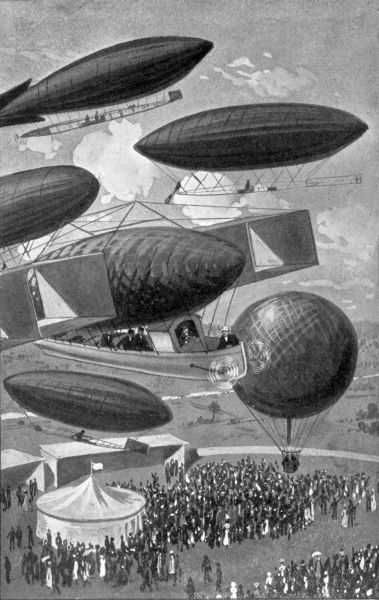
There was plenty to attract attention beside the
airships, for there were several amusement enterprises
on the grounds, and the usual devices to catch
the dimes and nickels of the throng.
“Well, let’s take a look around. I guess we
saw all we wanted to of Noddy,” said Bob. “Are
there any more queer machines?”
“Plenty of them,” replied Jerry, “to judge by
the tents where they are charging admission.”
“Let’s take ’em in,” suggested Ned. “We want
to get all the ideas we can.”
“Why?” inquired Andy Rush. “Are you going
to build one?”
“Maybe—some day,” replied Ned.
“So you’re getting the fever too, eh?” asked
Jerry with a smile. “Well, it’s not a bad idea. I
want to see the aeroplane trials. I’m interested
in them.”
“They’ll come off at ten o’clock,” said Bob,
looking at a program he had purchased. “We’ve
got an hour yet, and likely more, for they’ll never
start on time.”
“Then let’s look at some more of the freaks,”
suggested Jerry.
They found several odd machines housed in
tents, or hastily constructed buildings, where from
ten cents to a quarter was charged for viewing the
product of some inventive brain.
One machine was merely a double bicycle, with
a sort of roof overhead made of canvas, and a
motor attached, which revolved a two-bladed propeller
in front. Another was a sort of aeroplane
affair, with two propellers in the rear, and still
another was the one modeled after a flying grasshopper,
shown by Morris Abernot.
The boys noticed that, as a general thing, the
propeller or propellers of all the machines were
mounted in front, to pull the ships through the
air, instead of acting on a boat principle, and pushing
them. But, even with all the power that large
motors could impart to the blades, it was difficult
to see how some of the machines could rise from the
earth, so heavy were they.
The boys concluded, and they were not far
wrong, that the machines were merely the output
of some freakish brain, that was rather warped on
the side of air navigation. Some of the affairs
had one or more correct principles, but as for ever
being practical they were so far from it as to be
laughable.
Nor did the crowd hesitate to laugh whenever
it saw anything that seemed grotesque, for some
of the affairs were weird in the extreme. There
were machines built on the models of birds, fishes
and insects, which the inventors had doubtless
studied with a firm belief that they could successfully
imitate nature.
Probably some of the inventors knew their machines
would never leave the earth, but, having
gone to the expense of making them, they wanted
to get a little money back by charging for a sight
of them. And, very likely, the management of
the carnival knew that the machines would not
work, but probably reasoned that the crowd would
like to look at them and derive some fun from the
crude attempts to navigate the upper regions.
Certainly Noddy’s efforts furnished considerable
amusement, and not a little excitement.
It was about ten o’clock when, having made the
rounds of the “freaks,” as they called them, the
boys strolled toward the section devoted to the
aeroplanes. Not all of these machines had arrived
yet, but several were on hand, and it was announced
that at least one inventor would give his
a trial, preparatory to the races the next day, when
there were to be competitions for prizes.
“Let’s get good places to see,” proposed Bob.
“The starting platform would be the best place,”
said Jerry. “We can get up there for a quarter
each, and we’ll have a good view of how they start
and manage the planes.”
As is well known, aeroplanes need a sort of flying
start in order to become effective. They must
get some distance up into the air, like a kite, before
they can sustain themselves.
Some machines accomplish this by gliding forward
on wheels until they have enough momentum
to shoot upward on a plane of air, which catches
under the big wings, while others are launched
from a high platform or framework by means of
men pulling on a long rope, or by weights, springs
or similar devices.
At this carnival a high platform had been
erected, from which the aeroplanes could shoot off,
and once they were started the motor operating
the propellers was depended on to keep them in
motion, and so up in the air.
The platform was made quite large, to accommodate
a crowd, and thither the boys went, getting
good places, as they were among the first comers.
“Say, we’ll get a fine view from up here,” declared
Bob as he gazed about.
“That’s right—see everything—watch the human
birds skim about—swoop this way and that—over
our heads—up to the clouds—out of sight—down
again——”
“That’ll do, Andy,” spoke Jerry. “Save your
wind; you’ll need it later.”
There were to have been tests of two aeroplanes,
but at the last minute one inventor sent word that
his motor was out of order, and he would have to
postpone his trial until the afternoon. There was
some disappointment and murmuring by the crowd,
but when the canvas front of a shed near the platform
opened and a curious machine was wheeled
into view, there were exclamations of satisfaction.
“They’re going to have some sort of a test,
anyhow,” remarked Bob.
The aeroplane which was being wheeled toward
the platform was like many others which you boys
have either seen in pictures or actually observed.
It consisted of a structure like an immense box-kite,
canvas being stretched over a bamboo frame.
In front of the main part was a smaller box-kite
arrangement, that could be tilted, so as to cause
the plane to shoot upward or downward. In the
rear was a triangular rudder, and in front, below
the device which governed the elevation, were two
wooden propellers, worked by a small gasolene
motor amidships. There was a sort of box in
which the operator could sit.
“This machine,” announced the chairman of the
arrangement committee, “is the invention of Professor
Dundlass——”
“Seems to me everybody around here is a professor,”
murmured Ned. “We’ll have to tack
some titles to our names, Professor Hopkins.”
“Listen to what he says,” counseled Jerry.
“He has made successful flights with it,” went
on the chairman, “and he will now attempt another.
He asks your indulgence, as in a test last
week he strained some of the guy wires and bent
the rudder, but he will do the best he can. Later
he will enter a race.”
“Seems as though there was always some excuse
for these airship men,” murmured Ned. “I guess
each wants to have something ready to spring on
the crowd in case his machine doesn’t work.”
But the boys were now too interested in what
was going on to indulge in much talk. They
watched the inventor and his men wheel the aeroplane
to the foot of the platform, and then, by
means of ropes and pulleys, it was hoisted up to
where there was a sort of inclined track, whence
it could glide off.
The machine looked as if it would work. Certainly
if a big box-kite can not only sustain itself
in the air but also support heavy flags, banners
and even dummy figures, as is often done, a machine
built on the same principle, only much larger,
ought to hold up a man and a small engine.
“This is more like it,” said Jerry when Professor
Dundlass was adjusting his motor. “It’s a
wonder Noddy didn’t try something like this.”
“Oh, he wanted to be different,” observed Bob.
“Well, he was,” commented Ned dryly.
The aeroplane was now resting on its runners
upon the inclined track, which had been made very
slippery with soap and grease, as are the ways
when a ship is launched. Several men were detailed
to give it a push when the inventor was
ready to glide off.
But Professor Dundlass seemed in no hurry.
He moved slowly about, looking at wires here,
braces there, testing his propellers with his hand,
looking at the rudder and putting some more oil
on the motor.
“Oh, move the boat!” cried an impatient one.
“I go pretty soon quick now,” replied the inventor,
speaking with a German accent. “But
first I must be sure I am all rights. It iss no jokes
to fall down from der clouds.”
“That’s right,” agreed the throng in a chorus,
and thereafter no one urged him to hurry.
There was a big crowd down on the ground
around the platform, and as many on that elevated
place as could get upon it and still leave room for
the aeroplane. The structure was about sixty feet
high.
At last the professor announced that all was
in readiness. There was not a little nervous feeling
among those in the throng, for though some
had seen balloon ascensions, this was different—to
see a man trust himself to a machine that was
much heavier than air.
“Now, you had betterness stant from under ven
I start,” called the inventor to those directly in
front of the platform. “If I falls on you I might
hurt some of you.”
He seemed very cool, in spite of what was
evidently a dangerous undertaking that was before
him. There were some final instructions to
the men who were to shove the plane off, and then
the inventor, taking his seat in the little box-like
car, told one of his assistants to start the motor.
The long-bladed propellers began to whirl around
so rapidly that they looked like a yellow haze of
light, and the motor, from not being muffled, as
that would have made it too heavy, made a terrific
racket.
“Shove!” cried the professor suddenly, as he
yanked on a lever, and the ten men behind the
machine gave a vigorous push.
With a graceful motion, like some great, white-winged
bird sailing on a flight from the sky, the
aeroplane swooped from the platform. There
was a yell from the crowd, and those who, in their
enthusiasm, had gathered beneath where it now
was hovering over their heads, scrambled to get
out of the way, fearing it was falling down on
them.
But with a wide sweep, the plane began to
ascend. The air caught under the forward box-kite
arrangement, and the airship slid upward in
a long, graceful curve.
“He’s going up! He’s going up!” cried Jerry
in his enthusiasm. “This one works all right!”
“He’s higher than the platform now!” added
Ned, and this was so, for the man in the aeroplane
was now about seventy feet above the earth. The
speed of the motor increased, to judge by the more
rapidly recurring explosions, and then, with a shift
of the rudder, the inventor changed the course
of his machine.
He was now gliding broadside to the platform,
and those upon it had an excellent view. There
was a great cheer to gladden the heart of the
professor.
Once more he shifted his course and made a
complete circle. Then he turned and sailed off,
directly away from the platform. When several
hundred yards off he turned again, and came
straight for it.
“He has it under good control,” remarked Ned.
He had spoken quietly, but so great was the
silence maintained by those watching the airship
in flight that his voice almost startled him.
“He’s going to make a landing,” observed
Jerry. “He’s coming right for the platform. I
wonder if he can come down safely. I should
think he’d rather land on the ground.”
They could see the inventor busy with various
wheels and levers. The device for changing the
elevation of the plane was lowered. On and on
came the big affair, right for the platform.
Suddenly there came a powerful gust of wind,
which was most unexpected, as there had not been
so much of a breeze before that. Those watching
the aeroplane saw it tilt to one side.
“It’s going to turn over!” cried several.
Indeed, it did seem so, for it was gliding along
at an angle of forty-five degrees. The inventor
appeared to be in trouble, and was now clinging
with both hands to the sides of his little car.
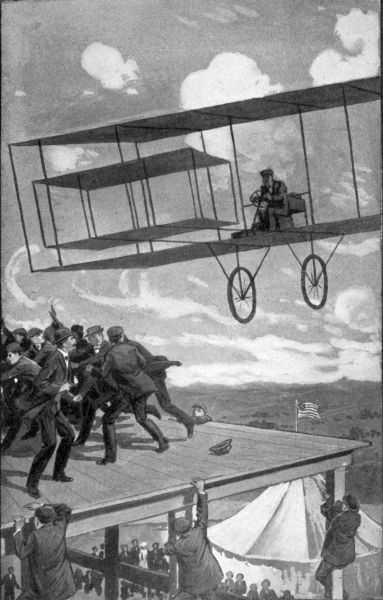
There came a stronger puff of wind. The aeroplane
dived downward and then sailed upward,
as does a kite when the tail is not properly adjusted.
Then, with a swoop like some gigantic
eagle, hurling itself upon its prey, the aeroplane
dashed right toward the platform, which was now
thronged with people. The inventor had lost control
of it in the powerful wind that was now blowing.
“Look out! Here she comes!” was the general
cry.
There was a scramble on the part of the throng
to get to a place of safety, but there was no place
to go. The narrow flight of steps, more like a
ladder than anything else, leading from the ground
to the top of the platform, was jammed by those
seeking to escape.
“It’s going to land right here where we are!”
cried Andy Rush. “Let’s jump off!”
“Stand still!” shouted Jerry. “If you jump
you’ll be killed. Stand still! He may get control
of it again.”
But it did not seem possible, though the inventor
was working frantically to change the course of his
plane, which was now almost upon the platform,
over which it appeared likely to sweep, and only
a few feet above it.
In another moment it seemed as if scores of
people would be either swept off the high place
and dashed to the ground, sixty feet below, or
would be hit by the aeroplane. The motor boys
and those about them were in great peril.