“Bless my soul!” exclaimed Professor Snodgrass.
Bob, with a catching of his breath, and a nervous
tremor, started to run in a panic. But Jerry
caught him by the shoulder.
“Hold on!” the tall lad cried. “It’s only a
man.”
“A—a man!” gasped the fat lad. “I
thought——”
“Stop thinking!” commanded Jerry.
The man in the cave advanced, and the boys
and the professor saw that he carried a torch
made from some resinous wood that burned with
much smoke.
“Who are you?” again demanded the man,
holding his torch on high. “Who comes here
to disturb me? Why can’t you let me die in
peace?”
The professor took a sudden resolve. Afterward
he said he did not know why he did it.
“Hartley Bentwell!” cried the scientist, “we
have come to save you. You are not going to
die. We have come to take you away from Snake
Island!”
The effect of these words on the unfortunate
man was indescribable. He fairly leaped forward,
and a cry came from his lips.
“You know me!” he exclaimed. “You have
come to save me? Oh, the dear Lord be thanked!
Yes, I am Hartley Bentwell, but in a few days
more I would not have known myself. I—I fear
I was going mad. It was almost the end. Oh,
what a life I have lived on this island! Unable
to escape! Menaced by the snakes! Not a soul
to speak to! In fear of the floods! Oh, even
now, my mind is not right!”
“There, there!” exclaimed the professor
soothingly, as he would have talked to a child.
“You are with friends. You will soon be away
from here, and in your own home. We are going
to restore you to the world again. You have
seen the last of Snake Island.”
“The last of Snake Island! Oh——” but the
unfortunate castaway could say no more, for he
had fainted, and would have fallen, had not Jerry
and Ned caught him.
“Quick! Carry him to the Comet,” directed
the professor. “When he comes to, he must
find himself in brighter surroundings.”
This was quickly done, and, as the rain soon
stopped, and the sun came out, when Mr. Bentwell
became conscious, he found himself in a
pleasant cabin, surrounded by his new friends.
A look of wonder came over his face, and the
wild, half-insane stare faded from his eyes.
“Here, drink this,” commanded Uriah Snodgrass,
and he held out a bowl of nourishing soup.
And, following a refreshing sleep, that afternoon,
while seated in the airship cabin, Mr. Bentwell
told his story. He had been with the scientists
who, about a year before, had come to search
for the radium on Snake Island. There had been
an accident, one boat was wrecked, and the unfortunate
man was cast alone on the island. His
companions escaped, and got back to civilization,
believing him drowned.
The cargo of the boat, consisting of a considerable
quantity of provisions, stores and tools, was
washed up on the island.
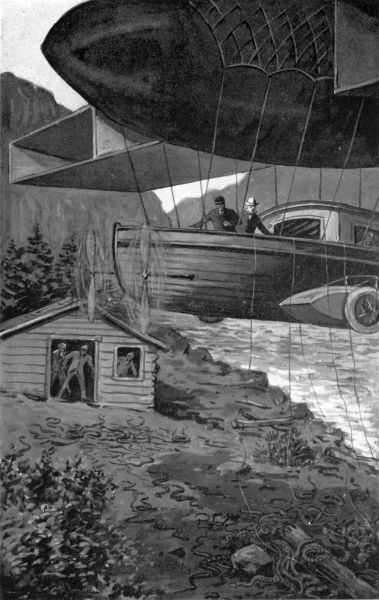
He built the hut, and rudely furnished it.
Then, having nothing else to do, being unable to
escape from the island, he began a search for the
radium, as told in his torn notebook. But he
could not find it.
Then floods came, there were several visitations
of snakes, and, in terror, he fled to the hill,
where he found the cave that he made his home,
only going occasionally to the hut. He had been
away from it for several days when Noddy and
his companions took up their abode there. So
despondent and gloomy was Mr. Bentwell over
his plight that he withdrew to the cave altogether,
and stayed there, living on scanty food. He did
not come out, and so did not see the airship making
trips over the island.
“But now I am saved!” he cried. “Let us
get away from this awful place!”
“I am willing,” agreed the professor. “I
have my valuable toad.”
“But we haven’t the radium,” said Jerry.
“I do not believe it is here,” said Mr. Bentwell.
“I searched all over for it, and found not
a trace.”
“Yes, we saw your notes,” spoke the professor.
“I saved what were left of them for
you.”
The weather soon became pleasant again, and
the river went down. But the boys in their airship
remained on the hill, as they liked it better
there. Jerry asked for three days more in which
to search for the radium treasure, and the others
agreed to this.
“Well, I give up,” admitted Jerry, on the
afternoon of the third day, when, after a wearying
search, he and his two chums were returning
to the Comet. “We’ll start for home to-morrow
morning. Mr. Bentwell is well enough to
travel now.”
“I sort of hate to go back empty handed,”
spoke Ned regretfully. “It’s the first time we
ever had a real failure.”
“We can’t always be successful,” commented
Bob. “Whew! I’m tired. I’m going to have
a rest.”
He sat down on a grassy spot. Just below
them was the Comet, which had been fully repaired,
and was all ready for the homeward trip.
Ned and Jerry walked on a little way, and then
took a seat on a log, for they, too, were weary.
They talked over their adventures, agreeing that,
even though they had not found the radium treasure,
they had had a good vacation.
Bob suddenly jumped up, and rubbed his thigh.
“What’s the matter; sit on a thorn?” asked
Ned with a laugh.
“Something like that,” answered the stout lad.
“Or else a bee stung me. Well, come on. It’s
all over.”
They were packing up that night, ready for
the trip home in the morning, when Bob complained
of a burning sensation in his leg.
“Better let me look at it,” suggested the professor,
who knew something of medicine. “You
may have been poisoned by some insect.” But,
when he had looked at a peculiar red spot on
Bob’s leg he cried out:
“Boys, that’s the most wonderful thing I ever
heard of! Bob has solved the riddle for us!”
“What riddle?” demanded Jerry eagerly.
“The radium riddle! That’s a blister caused
by emanations from radium!” went on the professor.
“Look at it, Mr. Bentwell, and see if
you don’t think so!”
The castaway, who had had his hair cut, and
who had shaved himself, being attired in a spare
suit of the professor’s, looked at the red spot.
“That is undoubtedly a radium burn,” he said
quickly. “How did it happen?”
“It must have been when I sat down to rest,”
explained Bob. “On the hill out there. I felt
something sting me, and——”
“It was the radium!” cried Mr. Bentwell.
“Where is the place? Let us go to it at once!”
“We can’t find it in the dark,” objected Jerry,
but the professor and the castaway hurried out
on the deck of the airship leading Bob with them.
“Point out, as nearly as you can, where it was,”
begged Uriah Snodgrass.
Bob raised his hand, and, as he did so, he uttered
a cry.
“Look! Look!” he gasped. “The ghosts!
The ghosts again!”
There, floating down toward the airship, were
tall whitish objects, wrapped in a bluish haze,
like the tall forms of willowy beings shrouded in
mist.
“The ghosts!” cried Bob.
“Yes, radium ghosts!” fairly shouted Professor
Snodgrass. “I understand it now. I wonder
I didn’t guess it the first time. The ghosts
we saw before were vapors, caused by radium.
It is the same now. Boys, we have at last found
the radium treasure! We will get it in the morning!”
They were up at dawn, after an almost sleepless
night. Bob pointed out the spot where he
had rested, and digging there, under a thin layer
of sod, was found the peculiar hornblende rock
mixed with pitchblende, which contained the radium.
It needed but a simple test to demonstrate
this.
“And the peculiar thing about it is this,” said
Professor Snodgrass. “Usually it takes tons of
rock to produce even a grain of radium, but in
this case there is almost pure radium in this sample.
We must be careful of it, for, not only is
it very valuable, but it may seriously harm us if
left exposed.”
Accordingly the first sample was put in the
lead receptacle prepared for it, and the work of
digging the rock for more was begun.
But if our friends hoped to find an enormous
fortune of radium on Snake Island they were disappointed.
For, after they had dug a little distance
down, the rock disappeared, and there was
no more of it. Search as they did, there was
only a comparatively small quantity. But that
was of great value, sufficient to more than compensate
them for the trip, for the radium, being
almost pure, commanded an exceptionally high
price.
“But there must be some where we first saw
the strange ghosts,” suggested Bob. They went
to the place, but found nothing. As there was a
deep hollow, where before there had been none,
they concluded that the flood had washed the
precious radium away.
“But we have enough to satisfy almost anyone,”
said Jerry, one evening a few nights later.
In the days following Bob’s unexpected discovery
of the precious stuff they had searched
diligently, but no more was located.
“I think we have all there is here,” was the
professor’s opinion, and Mr. Bentwell agreed
with him. There was no longer any use in remaining
in that desolate place, and so they arose,
and left behind Snake Island, and the rushing
river cutting its way through the mighty chasm,
a mile below the surface of the earth.
Then, with her nose pointed toward Denver,
the return trip began. Little worth mentioning
occurred on it. Mr. Bentwell continued to improve
and after a short stay in Denver, at the
Montrose home, nearly all traces of his terrible
year on the lonely island disappeared. Of course
the story of the boys caused much comment, and
they were regarded as heroes.
They received many offers for their radium,
but they refused nearly all of them, giving a share
of the stuff to Mr. Bentwell, some to Professor
Snodgrass, and a portion to Mr. Montrose. The
latter was interested in a Denver hospital that
very much wanted some of the precious metal for
medical purposes.
As for their portions the boys kept some for
themselves for future use, and some they gave to
the academy they attended. The rest they sold
for a large sum.
Nothing more was heard from Noddy Nixon,
save that he and Bill got safely home, after much
hardship. As for the renegade professor he
and Noddy quarreled, and separated.
“Let’s go all the way home by airship,” proposed
Bob as they were about to leave Denver.
“We can have the auto shipped to Cresville, and
it’s much easier to get meals in the Comet than
at hotels.”
“Bob, if you mention eating again, until we
get home, we’ll put you on a bread and water
diet,” threatened Ned, and Bob went off to the
galley in a huff. But he was soon heard whistling
as he made himself some sandwiches.
The airship trip was voted the best, and accordingly,
it was undertaken. All went well,
and in due time they were near their home town.
At his request, Mr. Bentwell was allowed to leave
the ship at a place where he could get a train to
his home, for he did not want to take his new
friends out of their way. He had telegraphed,
at the first opportunity, to his relatives, telling
them of his rescue. To say that they, and the
world at large, were surprised by his wonderful
story, is putting it mildly.
“Well, we got the radium treasure, after all,”
remarked Jerry, one day a week or so later, when
they were all assembled at his house.
“And I caught the two-tailed toad,” added the
professor. “My college has conferred additional
honors upon me for that. I am indeed
a lucky individual.”
“I wonder what you’ll look for next?” spoke
Bob.
“And I wonder what we’ll do?” added
Ned.
Those of you who care to know, may learn by
reading the next volume of the series, which will
be called “The Motor Boys on the Border; Or,
Sixty Nuggets of Gold,” a strange tale of the Far
West and of Canada.
“Well,” remarked the professor, “I think I
will——” He stopped suddenly, sprang to a
small table, and clapped his hand down on it so
suddenly that he upset a pitcher of lemonade,
which spilled all over Bob.
“Ouch! Ugh!” gasped the fat lad. “What’s
the matter?”
“I just caught a most rare specimen of a red-winged
fly,” answered the professor, pulling out
a specimen box and imprisoning the luckless insect.
“But—l-l-look at me!” gasped Bob. “I’m
all wet!”
“Never mind, it’s a hot day, and you aren’t
the only lemon in the house,” laughed Jerry, as
he helped his chum dry himself.
Of course Professor Snodgrass apologized, and
made amends by helping squeeze more lemons.
And then, sitting about, he and the boys discussed
their adventures on the trip after the radium
treasure. And now, for a time, we will say good-bye
to them.
THE END
A New Line By the Author of the Ever-Popular
“Motor Boys Series”
The Racer Boys Series
by CLARENCE YOUNG
Author of “The Motor Boys Series”, “Jack Ranger Series”, etc. etc.
Fine cloth binding. Illustrated. Price per vol. 60 cts. postpaid.
The announcement of a new series of stories by Mr. Clarence Young is
always hailed with delight by boys and girls throughout the country,
and we predict an even greater success for these new books, than that
now enjoyed by the “Motor Boys”. The stories are in Mr. Young’s
best vein, full of vim and vigor from start to finish, and of a high
moral order. They are in the same style that has made “The Motor
Boys Series” the most popular young people’s line on the market.
The Racer Boys
or The Mystery of the Wreck
This, the first volume of the new series, tells who the Racer Boys were
and how they chanced to be out on the ocean in a great storm. They
rescue another boy in a wrecked motor-boat and take him to their
home only to discover later that the stranger has lost his mind and cannot
remember who he is or where he comes from. Adventures follow each
other in rapid succession, and the Racer Boys finally solve the mystery
in a manner that only our author, Mr. Young, can describe.
The Racer Boys At Boarding School
or Striving for the Championship
When the Racer Boys arrived at the school they found everything at a
stand-still. The school was going down rapidly and the students lacked
ambition and leadership. They lacked even the heart to take part in
any athletic contests. The Racers took hold with a will, and got their
father to aid the head of the school financially, and then reorganized
the football team. Much to the astonishment of everybody, the school
won the championship of the league.
The Racer Boys To The Rescue
or Stirring Days in a Winter Camp
Here is a story filled with the spirit of good times in winter—skating,
ice-boating and hunting. How the lads went out after big game, how
they stumbled upon a queer trail and made a great discovery, and how
they came to the rescue of a crippled boy who was virtually held a
prisoner in a wilderness cabin, are related in a manner to chain the attention
of the reader from beginning to end.
Other Volumes to Follow
CUPPLES & LEON CO., Publishers NEW YORK
The Webster Series
By Frank V. Webster
Mr. Webster’s style is very much like
that of the boys’ favorite author, the late lamented
Horatio Alger Jr., but his tales are thoroughly
up-to-date. The stories are as clean as they are
clever, and will prove of absorbing interest to
boys everywhere.
Cloth. 12mo. Over 200 pages each. Illustrated.
Stamped in various colors. Price
per volume, 40 cents, postpaid.
- Only A Farm Boy
or Dan Hardy’s Rise in Life
- Tom The Telephone Boy
or The Mystery of a Message
- The Boy From The Ranch
or Roy Bradner’s City Experiences
- The Young Treasure Hunter
or Fred Stanley’s Trip to Alaska
- Bob The Castaway
or The Wreck of the Eagle
- The Newsboy Partners
or Who Was Dick Box?
- Two Boy Gold Miners
or Lost in the Mountains
- The Young Firemen of Lakeville
or Herbert Dare’s Pluck
- The Boy Pilot of the Lakes
or Nat Morton’s Perils
- The Boys of Bellwood School
or Frank Jordan’s Triumph
- Jack The Runaway
or On the Road with a Circus
- Bob Chester’s Grit
or From Ranch to Riches
- Airship Andy
or The Luck of a Brave Boy
- The High School Rivals
or Fred Markham’s Struggles
- Darry The Life Saver
or The Heroes of the Coast
- Dick The Bank Boy
or A Missing Fortune
- Ben Hardy’s Flying Machine
or Making a Record for Himself
- Harry Watson’s High School Days
or The Rivals of Rivertown
- Comrades of the Saddle
or The Young Rough Riders of the Plains
- The Boys of the Wireless
or a Stirring Rescue from the Deep
CUPPLES & LEON CO., Publishers, NEW YORK
Transcriber’s Notes:
A List of Illustrations has been provided for the convenience of the
reader.
Printer, punctuation and spelling inaccuracies were silently
corrected, except as noted below.
Archaic and variable spelling is preserved.
Variations in hyphenation and compound words have been preserved.
Variant spellings of Pittsburg for Pittsburgh (PA.) and Allegany
for Allegeny (River) have been retained as these have been used
consistently throughout the book.