If the grave New Jersey Presbyterian tutor—who
has given us so faithful a picture of
domestic life in the Northern Neck—saw fit
to burn his candles at night while he described the
dresses, dinners, and dances of his day, surely it is
worth our while to pause in our history to consider
them.
The planter's daily life began betimes with an
early breakfast. The planter was an early riser.
He had retired early. The myrtle-berry candle—the
costly spermaceti—were not brilliant enough
to tempt late hours. Often before daybreak in the
winter, when the nights were long, he might be found
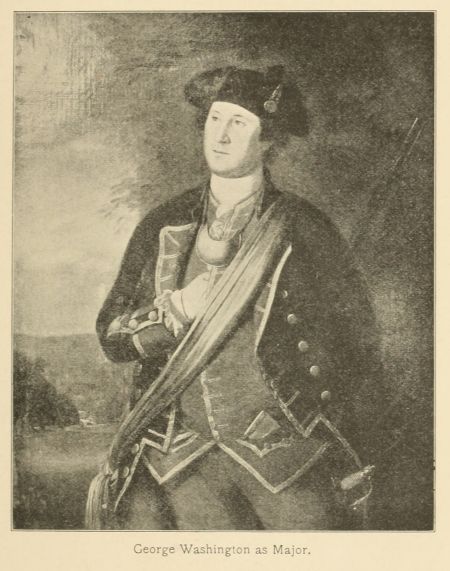
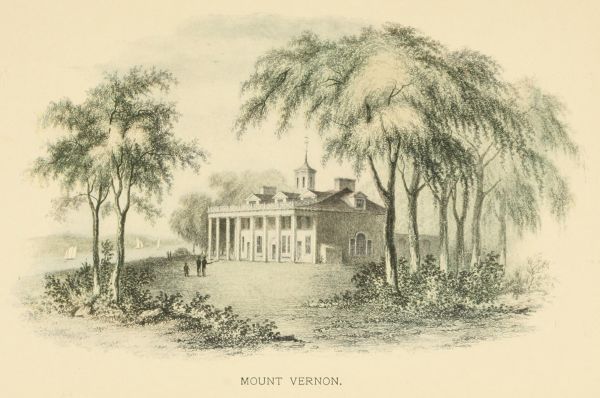
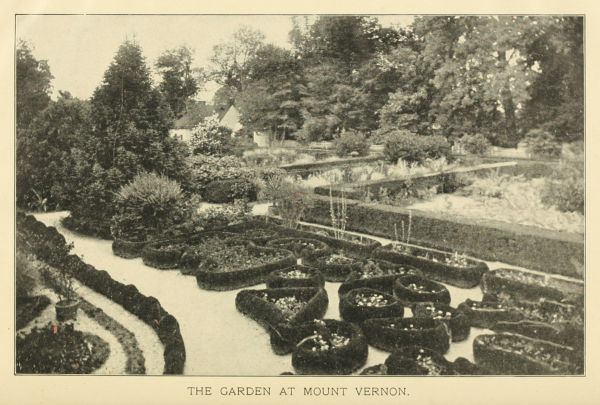
at his secretary arranging the work of the day. Washington
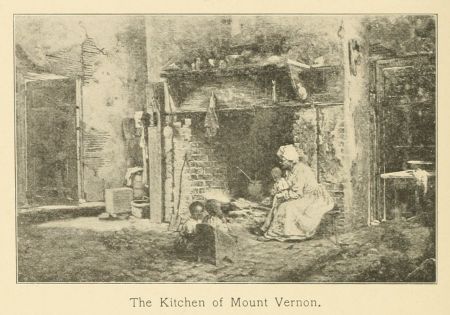
at Mount Vernon would light his own fire
and read by candle-light, then breakfast on tea and
Indian-meal cakes at eight o'clock. But to all rules
he and his mother were exceptions! The usual life
of the planter admitted more luxury. His breakfast
was a good one! But first, having risen early,
he mixed with his own hands the great beaker of
crushed ice, peach-brandy, and mint to be sent
around to all the rooms as an appetizer. Even the
children were admitted to this morning loving-cup.
Virginians believed in it!
Luckily the breakfast is not left to a twentieth-century
imagination—which would probably suggest
an orange, coffee, and roll. The Rev. Andrew
Burnaby, Vicar of Greenwich, London, had the
pleasure of eating a Virginia breakfast in 1759:
"The ancient custom of eating meat for breakfast
still continues. At the top of the table where the
lady of the house presides, there is constantly tea
and coffee, but the rest of the table is garnished out
with roasted fowls, ham, venison, game and other
dainties. There is scarcely a Virginia lady who
breakfasts without ham!"
Dinner at home or abroad was served not later
than three, and was preceded by at least one mint
julep all around. At one home dinner we read of
four kinds of fish, "Sheeps-head, Bass, Perch, Picked
Crab: Ham, Mutton, vegetables, pudding, fruits,
cheese, old Madeira," which to be presentable must
have crossed the ocean more than once. A dinner
included three courses,—soup, then the whole
dinner placed on the table at once, then dessert.
Ducks were served at the fish feasts. The delicious
canvasback duck was by no means so highly
appreciated as it is now. They were left in comparative
peace to feed upon the tender wild celery
of the Potomac marshes. The diamond-backed terrapin
was much too abundant to be considered a
dainty. To save the scarcer and costlier pork, terrapin
was fed to the negroes. Laws were enacted
in Maryland forbidding the slaves' rations to be
exclusively of terrapin!
At one of General Washington's ceremonious
dinners there was soup, fish roasted and boiled,
"gammon of bacon" and fowl. The middle of the
table was decorated with artificial flowers and small
images. The dessert was a pudding and apple pie,
ice-cream, jellies, melons, apples, peaches, nuts.
This dinner was recorded as "a great dinner." Today
it would be considered "a good enough dinner,
to be sure, but not a dinner to ask a man to!" Some
of the receipts for these old Virginia dinners have
been preserved in the Randolph family—notably
the receipts for English plum pudding, and for the
Christmas mince pie.
Tables were richly furnished with burnished pewter
and handsome silver. So many articles of silver—bowls,
cups, and salvers—were imported from
England that the thrifty planter was constrained to
import an engraver as well, in order that his arms
and crests might be engraved under his personal
supervision. The china was, of course, English or
of English importation. We manufactured no china,
imported none from the East—probably none from
France. Mary Washington's china we know was
blue and white. Knives were of fine Sheffield steel,
and served other uses than cutting. How else did
the colonial dames eat their peas? Surely not
with the little steel fork with two wide-apart prongs.
This is a painful reflection, but we must remember
that a good many ladies whom the world has
admired—Helen of Troy, the Mother of the
Gracchi, all of its earth-born goddesses, in fact,
until Queen Elizabeth—had to content themselves
at dinner with the utensils God had given them.
They had no forks at all—not even a chop-stick!
Hence the early need for napkins.
There was no lack of good napery in Mary
Washington's time, but the usage of napkins differed
somewhat from the usage of to-day, at least
at General Washington's dinners.
The destruction of cattle by Tarleton's Red Dragoons
caused almost a famine of cream and butter,
immediately after the war, so that "trifle" and ice-cream
were articles of prime luxury. To obtain
sufficient cream for the dish known variously as
trifle, syllabub, or floating island, it was sometimes
necessary to save it until it soured or grew
rancid.
Mrs. Morris tells of such a misfortune at one of
Washington's state dinners. She did not hesitate
to consign her own unswallowed morsel to her napkin,
but records with wicked glee that "poor Lady
Washington ate a whole plate-full without wincing."
At dinner much ceremony was observed. "I have
fortunately learned by heart all the ceremonies of the
table, and will make no mistakes," says the tutor exultantly,
when he finds it necessary to preside in the
illness of the mistress and absence of the master.
Toasts were regularly drunk at dinner if there were
guests—but postponed to the evening bowl of
"toddy" or punch when the family was alone.
No day passed without these toasts. "To the
King and Queen, the Governor of Virginia and
his Lady, and success to American Trade and
Commerce." After these each person was called
upon by the master for his toast. "I gave the
Lovely Laura," says our tutor—Laura being the
name in Cupid's court for Miss Betty Beatty.
One might trace the changes in political feeling
by these toasts. At first, after the royal family
and success to Virginia commerce, only the respective
favorites among the ladies. Presently we observe
that "The Sons of Liberty" have crept into
the company to demand a toast. Then an ominous
toast follows the king and all the rest, "Wisdom and
Unity to the Conference now assembled." Then
the royal family, governor, and his lady are dropped
altogether, and the toast, praying for "Wisdom and
Unity," takes their places. The Prince de Broglie
records the toasts at General Washington's table,—"The
United States of America, the King of France,
the Queen"; "Success with our Enemies and the
Ladies"; "Success in War and Love." After these,
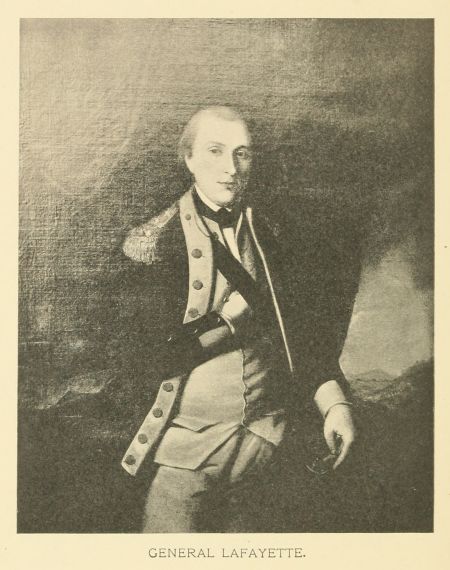
the Marquis de Lafayette and the military heroes of
the war. General Washington, when President,
discontinued this custom, contenting himself with
grave bows, and "Your Health, Sir; your Health,
Madam," all around the table, until every one was
thus honored.
One can hardly repress a shudder at the accounts
given by Robert Maclay and others of the deadly dulness
and formality of General Washington's state dinners.
He kept up this formal coldness to the end.
Free and easy manners came in with Mr. Jefferson
and long trousers. Fancy this incident occurring
at General Washington's table: "Here's to thy
Absent Broad-brim Friend Hollingworth," from
Dolly Madison. "Here's to thy Absent Kerchief,
Friend Dorothy," from the Quaker.
At informal dinners among neighbors the company
"sat until sunset," then coffee, and at nine
o'clock supper,—artichokes, crabs, oysters, strawberries
and cream, the punch-bowl again. Record
is made of "Sudden Pains and Sickness at the
Stomach at night."
The dancing class was held in succession at all
the mansions along the Potomac as far as Mount
Vernon. Mr. Christian—stern but elegant—taught
minuets and country-dances, first politely
requesting each guest "to step a minuet." He
does not hesitate to rap two young misses across
the shoulder for a fault, and to inform "one young
Fellow" that he has observed him "through the
course of the Dance," to be "insolent and wanton,"
and shall require him to alter his manner or leave
the school. Then, when candles are lighted, having
danced all day, Mr. Christian winds up with
another minuet and country-dance, and at seven is
glad to retire. But fun holds awhile longer. They
all "play Button to get Pauns for Redemption, and
carry it on with sprightliness and Decency." The
tutor is in luck. "In the course of redeeming my
Pauns I had several Kisses of the Ladies." Then
Colonel Philip Ludwell Lee arrives in a travelling
chariot from Williamsburg. "Four candles on the
table make the room luminous and Splendid." There
is a fine supper with four instructed waiters. After
supper all gather around the fire and "play 'break
the Pope's neck'" until ten o'clock, and then to
bed.
"Almost every lady wears a red cloak,"[10] says our
tutor; "and when they ride out they tye a red handkerchief
over their Head and face, so that when I first
came to Virginia I was distressed whenever I saw a
Lady, for I thought she had a Tooth-Ach." At a five-days'
ball at Squire Lee's "the Ladies were dressed
Gay and splendid, and when Dancing their Skirts and
Brocades rustled and trailed behind them. For five
days and nights they Danced minuets, reels, marches:
Giggs (an exaggerated dance resembling the Trescone
of Italy) and, last of all, Country Dances to the Music
of a French Horn and two Violins, for," says the astonished
tutor, "Blow high, Blow Low, the Virginians
are genuine blood—they will Dance or die!"
The plantation fiddler belonging, as did the barber,
shoemaker, and carpenter, to each establishment,
seems to have sufficed for Mr. Christian's
class. At this the gentlemen were "drest in black,
superfine broadcloth, laced Ruffles, Black silk Stockings,
buckles at knee and instep. They wore powder
on their Hair, or the short Wig now in fashion."
The ladies, well, the principal ladies, must each
sit for her own portrait.
First, Mary Washington's granddaughter, "Miss
Jenny Washington,[11] about seventeen, not a handsome
face, but neat in her Dress, well-proportioned,
and has an easy, winning Behaviour. She is not forward
to begin a conversation, yet when spoken to
is extremely affable without assuming any girlhood
affectation or pretending to be overcharged with
Wit. She moves with propriety when she dances a
Minuet, and without any Flirts or vulgar Capers
when She dances a Reel or Country-Dance. She
plays well on Harpsichord and Spinet, understands
the principles of Musick and therefore performs
her Tunes in perfect time—a neglect of which always
makes music intolerable, but it is a fault almost
universal in young Ladies. She sings likewise to
her instrument, has a strong, full voice and a well-judging
Ear. Most of the Virginia Girls think it
labour quite sufficient to thump the Keys of a Harpsichord,"
etc. "Her Dress is rich and well-chosen,
but not tawdry, nor yet too plain. She appears to-day"
(at the dancing class in the morning) "in a
chintz cotton gown with an elegant blue Stamp, a
sky-blue silk Quilt" (petticoat over which the gown
opens), "a spotted apron. Her Hair is a light
Brown, it was craped up high with two Rolls at
each Side, and on the top a small cap of beautiful
Gauze and rich lace, with an artificial flower interwoven."
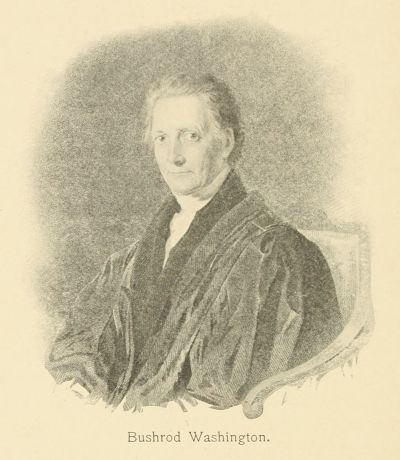
Very satisfactory indeed for Mary Washington's
granddaughter, sister of Bushrod Washington, afterwards
judge of the Supreme Court.
Next, Miss Betsy Lee: "She is a well-set maid
of a proper Height, neither high nor low. Her
Aspect when she is sitting is masculine and Dauntless:
she sits very erect; places her feet with great
propriety, her Hands she lays carelessly in her lap
and never moves them but when she has occasion to
adjust some article of her dress, or to perform some
exercise of her Fan. Her Eyes are exactly such as
Homer attributes to the Goddess Minerva and her
arms resemble those which the same Poet allows
to Juno. Her Hair which was a dark Brown was
craped up very high and in it she had a Ribbon
interwoven with an artificial Flower. At each of
her ears dangled a brilliant jewel. She was pinched
up rather too near in a long pair of new-fashioned
Stays, which I think are a nuisance both to us and
themselves—For the late importation of Stays, said
to be now most fashionable in London, are produced
upwards so high that we can have scarce any view
at all of the Ladies' Snowy Bosoms; and on the
contrary they are extended downwards so low that
Walking must, I think, cause a disagreeable friction
of some parts of the Body. I imputed the Flush
which was visible in her Face to her being swathed
up Body and Soul and Limbs together. She wore a
light chintz gown with a blue stamp elegantly made
which set well upon her. She wore a blue Silk
Quilt. Her dress was rich and fashionable and her
behaviour was such as I should expect to find in a
Lady whose education had been constructed with
some care and skill."
So much for Miss Lee. Now for the country
beauty, Miss Aphia Fauntleroy (afterwards married
to Captain John Champe Carter of the Revolution).
"Is the best dancer of the whole absolutely!—And
the finest Girl! Her head powdered as white as
snow and craped in the newest taste. She is the
copy of the Goddess of Modesty—very handsome.
She seemed to be loved by all her Acquaintances
and Admired by every Stranger."
"Miss Priscilla Carter is 16—small of her
age, has a mild winning Presence, a sweet obliging
Temper, never swears which is here a distinguished
virtue, dances finely, plays well on key'd Instruments,
is never without what seems to have been a
common Gift of Heaven to the fair Sex, the Copia
Verborum, or readiness of Expression." (This
sweet-tempered fifteen-year-older, a pupil of the
Presbyterian tutor, was a young lady of spirit.)
"Miss Prissy is much offended! She retains her
anger and seems peculiarly resentful, refusing to
walk over to the school. Indeed she is much
affronted. Monday afternoon by chance I tapp'd
her on the Head and wholly in Jest." Five days
later the Diary records, "At last Prissy is reconciled,"
having punished him sufficiently.
Next, Miss Hale, fourteen years old. "She is
dressed in a white Holland gown, quilt very fine,
a Lawn Apron, has her hair craped high, and upon
it a Tuft of Ribbon for a cap. Once I saw her
standing. I rose immediately and begged her to
accept my Chair. She answered most kindly, 'Sir,
I thank you,' and that was all I could extract from
this Wonder of her Sex for the two days of the
dance, and yet I seemed to have an equal Share
in the Favours of her Conversation."
Miss Sally Panton, lately come from England to
teach Mr. Turberville's daughters French and English,
creates a sensation because she is supposed to
have brought with her the latest London fashions.
"Her stays are huge, giving her an enormous long
Waist. These stays are suited to come up to the
upper part of her shoulders, almost to her chin; and
are swaithed round her as low as they can possibly
be, allowing her no liberty to walk at all. To be
sure this is a vastly Modest Dress!" The stays are
all right, but "her Head-Dress not to the liking
of the Virginia Ladies" being arranged low on the
neck, of which they can, on no account approve.
"Nevertheless," quoth the tutor, "if her Principles
of Religion and her Moral Manner be unexceptionable
I shall think her Agreeable."
The last picture thrown on the canvas must be
another Miss Lee. "A tall, slim, genteel Girl
thirteen years old. She is free from the taciturnity
of Miss Hale, yet by no means disagreeably forward.
She dances extremely well, and is just beginning
to play on the Spinet. She is drest in a neat
shell Callico Gown, has very light hair done up
high with a feather, and her whole carriage is easy
and graceful, and free of formality and Haughtiness,
the Common foible here."
For aught we know to the contrary this charming
young lady was the beauty who roused an anonymous
poet to alliterative verse.
"May mild meridian moonbeams mantle me
With laughing, lisping Lucy Lightfoot Lee."
The ingenuous tutor is delightful. Not once
does he interpret the freezing manner, the haughtiness
and formality of the maidens to any dislike
of himself. Perhaps it did not exist; his successor,
also a Presbyterian tutor, married one of
them. But not so, I fancy, did these ladies treat
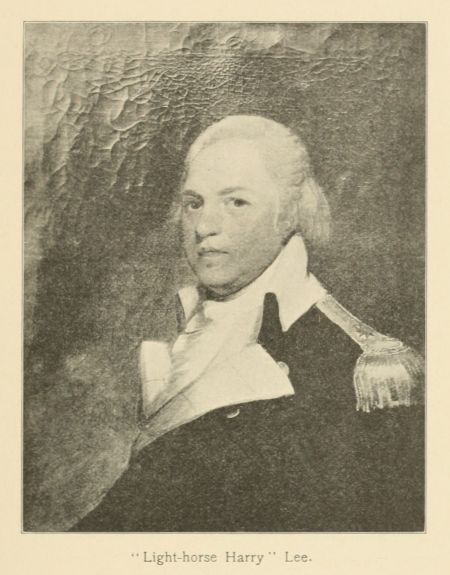
young Harry Lee—"our Light-horse Harry," the
son of the "Lowland Beauty"—when they met him
at the Squire's ball; and surely not thus would the
young junior from Princeton College have been
impressed by them. One peep within the leaves
of that Diary,—a thing impossible to the veriest
madcap in his school,—and all would have been
over for the Presbyterian tutor, albeit he and young
Harry had been college mates.
Two things were absolutely necessary in the
etiquette of the minuet,—the pointed foot must be
so firm, so straight, that not a crease or wrinkle
appeared in the quilted petticoat, and, of course,
this quilt must be of a
strength and richness: so
rich, indeed, that it would
"stand alone," yielding
not in dance and courtesy.
Evidently Miss Hale at
fourteen, and Miss Lee at
thirteen, were already in
society. In a few years,
doubtless, they were all
married to Revolutionary
officers, two or three,
sometimes five, of them
falling in course of time
to his lot, as was usual in
that day of short-lived women. As we have seen,
Catherine Willis—afterwards Princess Murat—married
at thirteen.
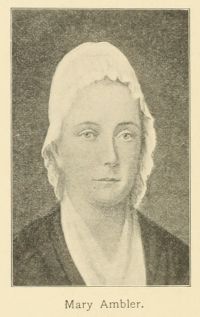
The wife of Chief Justice Marshall, Mary
Ambler, was only fourteen years old when she
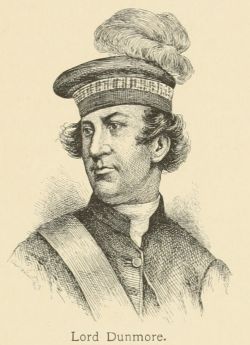
attended the Dunmore ball and captured the
young Captain Marshall, who gave the only guinea
he possessed to a clergyman for marrying him soon
after.
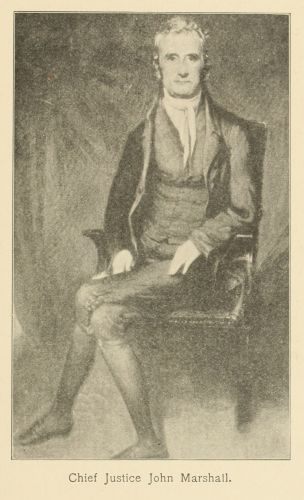
Chief Justice John Marshall.
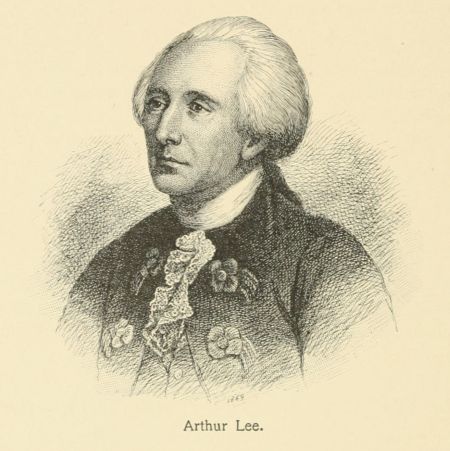
Arthur Lee said, "In Virginia a man is old at
thirty and a woman at twenty." A certain little
Alice Lee, twelve years old, wrote this remarkable
letter from Stratford in 1772 to a kinsman in
London. (Doubtless Miss Alice was one of the
dancers at Squire Lee's ball two years later.)
"So you threaten me if I prove deficient in the
deference I owe you as a married man, with the
power you have of forwarding or retarding my
success in the Matrimonial Way.[12] This would be
a tremendous threat indeed were I as fond of Matrimony
as my young Mistress, as you call her, but
happily I am little more than twelve years old and
not so eager to tye a Knot which Death alone can
Dissolve. And yet I pretend not to ridicule the
holy sacred institution, but have all due reverence
for that and the worthy people who have entered
into the Society, from good and generous motives.
It is only those who chuse to be married at all
events that I think deserve raillery.... I never
saw Westmoreland so dull. I was at Squire Lee's
when your letter came. He is the veriest Tramontane
in nature; if ever he gets married, if his wife
civilizes him, she deserves to be canonized.
"So you can't forbear a fling at femalities;
believe me Curiosity is as imputable to the Sons as
the Daughters of Eve. Think you there was ever
a Lady more curious than our Cousin the Squire?
He himself is the greatest of all curiosities, but
hang him, how came he to pop twice in my head
while I was writing to you!
"The Annapolis Races Commence the 6th of
October. The American Compy of Players are
there and said to be amazingly improved. I
should like to see them, as I think Theatrical
Entertainments a rational amusement."
Clever little Mistress Alice! Twelve years old,
and already flirting with the sixty-year-old Squire
Richard Lee Burgess from Westmoreland, member
of the Continental Congress, giver of five-day balls;
who yet found time to gather rosebuds, for he
actually married sixteen-year-old Sally Poythress
after he was sixty-two years old.
It is a great misfortune to us that our observant
tutor was not invited to Mount Vernon. Mr.
Christian's class met at Mount Vernon, also at
"Gunston Hall"—the fine residence of the George
Mason who wrote the famous Declaration of Rights
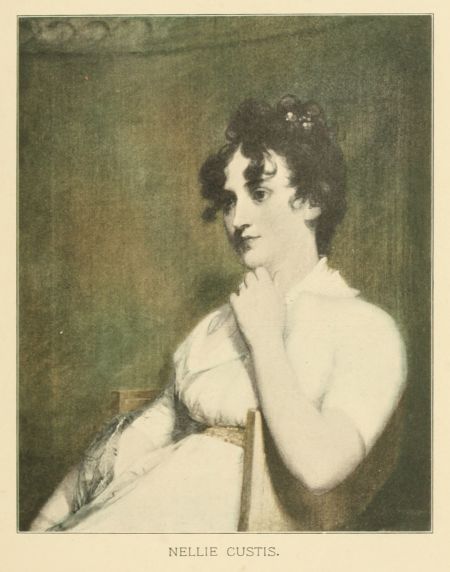
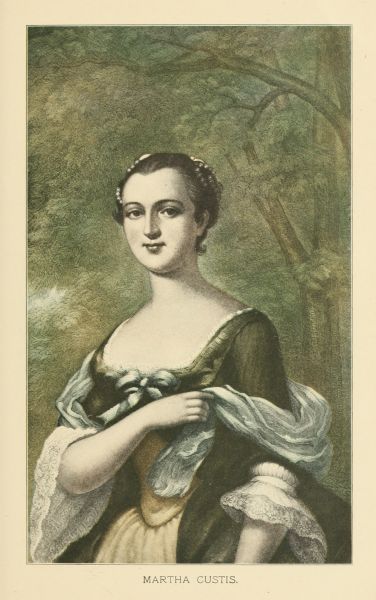
in 1776. Mrs. Martha Washington's lovely
daughter, Martha Custis, was then just thirteen
years old, and there is no doubt, not the least, that
she wore a blue silk quilt and had her hair
"craped" (crépé) high and interwoven with a
feather. On the 18th of April, 1770, Washington
records, "Patsy Custis and Milly Posey went to
Col. Mason's to the Dancing School."
The discipline of children was stern. Their
duties included the courtesies of life as religiously
as its business. "I have no Stockings and I swear
I won't go to the Dancing School," says fifteen-year-old
Bob, who is at the awkward age and dreads
society. "'Are Bob and Nancy gone to Mr.
Turberville's?' said the Colonel at Breakfast—'Nancy
is gone, Sir, Bob stays at Home, he has no
shoes!' 'Poh—what nonsense,' says the Colonel.
He sends the clerk to the Plantation Store for a
pair of Shoes. Bob he takes to his Study and floggs
severely for not having given seasonable notice, and
sends him instantly to the Dance" in a suitable and
proper frame of mind to enjoy himself!
Balls, fish feasts, christenings, cock-fights, horse-races
and church-going filled the time as well as
visiting and dancing. Everybody went to church
through all weathers. In winter the churches
were bitterly cold. No provision of any kind for
heating them was ever dreamed of. The church
was one of the rallying places for the neighborhood.
"There are," says the tutor, "three grand
divisions of time at the church on Sundays; Viz:
before Service giving and receiving letters of business,
reading Advertisements" (affixed to the church-doors)
"consulting about the price of Tobacco,
Grain, &c., and settling either the lineage, Age or
qualities of favourite Horses. 2. In the church at
Service, prayers read over in haste, a Sermon, seldom
under and never over twenty minutes, but always
made up of sound morality, or deep-studied Meta-physicks.
3. After Service is over, three quarters
of an hour spent in strolling round the church
among the crowd in which time invitations are
given by gentlemen to go home with them to
dinner."
The christenings were seasons of large family
gatherings—the silver christening bowl, like the
punch-bowl, descending from generation to generation.
There were no "poor whites"—the helpless,
hopeless, anæmic race now numerous in Virginia.
There were well-instructed men and women in the
industrial classes who filled situations as visiting
shoemakers, weavers, or housekeepers. The Virginia
woman in "The Golden Age" had need of
all the help she could get. She married while yet
a child—often less than fifteen years old. Her
housekeeper was her tower of strength. She
helped generally throughout the family, nursing
the sick, caring for the children's comfort, and
standing sponsor for them in baptism.[13] A letter
from one of these humble retainers, a housekeeper
at Stratford, somewhere about 1774, has been preserved
by which we perceive she represented the
wife of Governor Fauquier at a christening.
(Dated) "Stratford, September 27.
"To Miss Martha Corbin—Dear Miss. I gladly
embrace this oppertunity of writing to you to put you in
mind there is such a being as mySelfe. I did not think
you two would have slited me so. Your little cosen
matilda was made a cristan the 25th of September. The
godmothers was mrs washington miss becy Tayloe Miss
Nancy Lawson Stod proxse for Miss Nelly Lee and I for
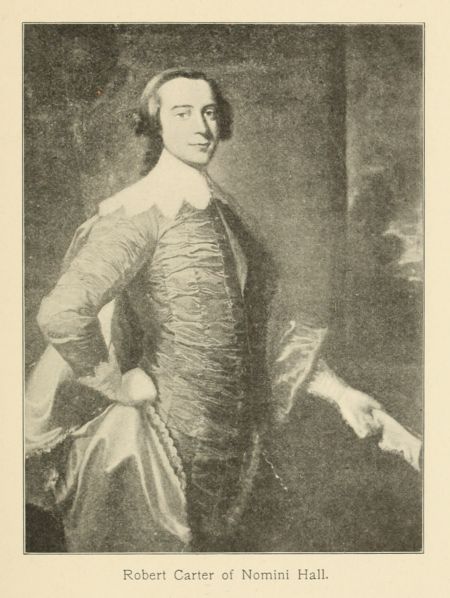
Mrs Fauquer, godfathers was col. Taloe Mr Robert Carter
mrs washington Col Frank Lee, the Esq: mr washington
and your ant Lee Dessers there Love to you I am your
very humble servant Elizabeth Jackson."
It is easy to understand why Miss Jackson
should have dignified all the Lees who employed
her with large capitals, but why she should thus have
honored Miss Nancy Lawson above "mrs. washington"
we shall never know in this world, only, as
everybody knows, no married lady—even Mrs.
John Augustine Washington, our Mary's daughter-in-law—could
possibly be as important as that most
worshipped of all creatures, a Virginia young lady.
As to the race-horses, we cannot begin to reckon
their increased importance. Janus and Yorick are
among the immortals! So also should be General
Washington's horses,—Ajax, Blueskin, Valiant, and
the royal Arabian Magnolia. Nor should Silver-eye
be forgotten, nor the lordly Shakespeare, for
whose service a groom was appropriated to sleep
near him at night in a specially built recess, that his
Lordship's faintest neigh might find response.
The men who settled the Northern Neck of Virginia
were cavaliers from "Merry England," with
an inherited love of horse-racing, and, indeed, all
sporting. There was not a Roundhead among
them! They liked cards and dancing. Nobody
could make them believe that the devil hunted
with the hounds and ran with the race-horses.
The early Virginia historians wrote at length
about the pedigrees and qualities of horses and the
skill of their riders. The old court records have
many quaint entries of disputes about "faire starts,"
and citizens' depositions were taken to settle them;
for instance, "Richard Blande, aged 21 yeares
Deposeth that in the Race run between John
Brodnax and Capt. William Soane now in tryall,
the horse belonging to Henry Randolph on w'ch
Capt. Soane layed, came after the Start first between
the Poles agreed on for their comeing in," etc.
William Randolph's task was more difficult. He
"Deposeth in ye race between Wm. Epes and
Mr. Stephen Cocke," that the latter "endeavoured
to gett the other's path, but he did not gett it at
two or three jumps nor many more, upon w'ch he
josselled on Mr. Epes' path all most part of ye
Race."
People took all these things very seriously, and
they formed the subjects of conversation until the
time came for horse and rider to distinguish themselves
in a sterner field.
The horses bred in Virginia were small, fleet, and
enduring, varying little from the early English racers,—the
immediate descendants of the Arabian
horses. There was a fine race-course at Fredericksburg,
and Mary Washington's relatives and friends
appear in the contests—her sister-in-law's husband,
Roger Gregory, always among the foremost. He
ran a famous mare, Dimple; Mr. Spotswood, Fearnaught,—a
name reasonably to be expected from
John Spotswood's horse. Then there were Fashion,
Eclipse, Selima, Ariel, Why Not? (why, indeed?),
and many more. Purses from ten to two hundred
guineas or pounds were the prizes; also "Saddles,
Bridles, Cups and Soop Ladles."
Lewis Willis, General Washington's first cousin,
worked his farm principally with blooded plough-horses.
The dams of Maid of the Oaks and Betsy
Blue were plough-horses. Maid of the Oaks—the
most splendid creature ever seen—sold for £15,000
to pay, alas! a security debt. For this astonishing
statement I have as authority Lewis Willis's son,
Byrd Willis,—father of the Princess Murat and
brother of the Jack Willis so loved by everybody
and by none more than General Washington himself.
These were splendid, jovial fellows, full of
anecdote and inexhaustible humor. Colonel Byrd
Willis left a diary of the good times of his day.
But, alas for all the good times, the little cloud
no bigger than a man's hand in 1766 was now
darkening the Northern sky. The Gazette, that
had chronicled so many merry days, gave its columns
to a warning note (July 21, 1774) from "a
Virginian," recommending that Fredericksburg suspend
its races and contribute purses to the people
of Boston; and, indeed, there was no more record
of a race before the Revolution.
The Presbyterian tutor, from whom we must now
part, was a candidate for the ministry, but saw much
to admire and little to condemn in the social life of
the Virginians. He had been warned "that Virginia
is sickly—that the people there are profane,
and exceeding wicked. That there I shall read no
Calvinistic Books, nor hear any Presbyterian Sermons."
He finds himself under no more nor
stronger temptations to any kind of vice—perhaps
not so great—as at home, "unless sometimes
when I am solicited to dance I am forced to
blush" not because of its wickedness—Oh, no!—but
"because of my Inability! I Wish it had
been a part of my Education to learn an innocent
and ornamental qualification for a person to appear
even decent in Company!"
This impartial observer of the times in which
Mary Washington lived sums up the Virginians
thus: "The people are extremely hospitable and
Polite—universal characteristics of a gentleman in
Virginia. Some swear bitterly, but the practice
seems to be generally disapproved. I have heard
that this Country is notorious for Gaming, however
this may be I have not seen a Pack of Cards,
nor a Die since I left home, nor gaming nor Betting
of any kind except at the Races. The Northern
Neck is a most delightful country—the best people
are remarkable for regularity and economy, civil
and polite and of the highest quality in Virginia—well
acquainted with the formality and ceremony
which we find commonly in High Life—sensible,
judicious, much given to retirement and study,"
etc., at length, of which the above extract is a fair
example.
Another tutor, one John Davis, presumably a
Welshman, who spent, and wrote of, "Four and
a Half Years in America," described the Virginians
of George Washington's time and neighborhood
and the church he attended:—
"No people could exceed these men in politeness.
On the piazza of Mr. Thornton's tavern I
found a party of gentlemen from the neighboring
plantations carousing over a bowl of toddy and
smoking cigars. On my ascending the steps to the
piazza, every countenance seemed to say, 'This man
has a double claim to our attention, for he is a
stranger in the place.' In a moment room was
made for me to sit down; a new bowl was called
for, and every one who addressed me did it with a
smile of conciliation. But no man questioned me
whence I had come, or whither I was going. A
gentleman in every country is the same—and if
good breeding consists in sentiment, it was found in
the circle I had got into.
"The higher Virginians seem to venerate themselves
as men! I am persuaded there was not one
in that company who would have felt embarrassed
at being admitted to the presence and conversation
of the greatest monarch on earth. There is a compound
of virtue and vice in every human character.
No man was ever faultless; but whatever may be advanced
against Virginians, their good qualities will ever
outweigh their defects; and when the effervescence
of youth has abated, when reason reasserts her empire,
there is no man on earth who discovers more exalted
sentiments, more contempt of baseness, more love
of justice, more sensibility of feeling, than a Virginian....
I found at the taverns every luxury
that money can purchase; the richest viands covered
the table, and ice cooled the Madeira that had
been thrice across the ocean. About eight miles
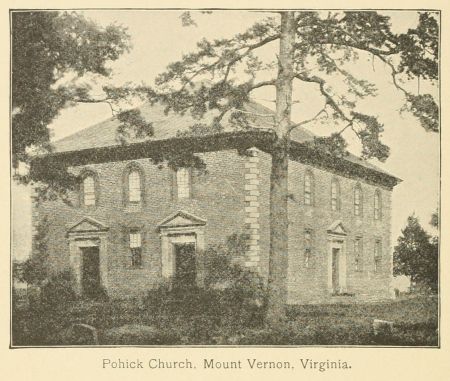
away was Powheek (Pohick) church—a name it
claims from a run that flows near its walls. Hither
I rode on Sundays and joined the congregation of
Parson Weems" [our friend of the hatchet and cherry
tree!] "a minister of the Episcopal persuasion, who
was cheerful in his mien that he might win men to
religion. A Virginian church-yard on a Sunday,
resembles rather a race-course than a sepulchral
ground. The ladies come to it in coaches, and the
men, after dismounting from their horses, make
them fast to the trees. The steeples to Virginia
churches were designed not for utility but ornament;
for the bell is always suspended to a tree
a few yards from the church. I was confounded on
first entering the church-yard at Powheek to hear
'Steed threaten steed with high and boastful neigh,'
nor was I less stunned with the rattling of wheels,
the cracking of whips, and the vociferations of the
gentlemen to the negroes who accompanied them.
One half the congregation was composed of white
people, the other of negroes, and Parson Weems
preached the great doctrines of salvation as one who
had experienced their power."
The Welsh tutor, Davis, and the American tutor
and patriot, Fithian, wrote thus of the Virginians
of Mary Washington's day, as they saw and knew
them. Their horizon was limited to a few representative
families in one or two neighborhoods.
But a great and good man of the present generation—wise,
truthful, candid—has thus recorded his
opinion of the Virginians of that period. Says John
Fiske: "On the whole it was a noble type of rural
gentry that the Old Dominion had to show. Manly
simplicity, love of home and family, breezy activity,
disinterested public spirit, thorough wholesomeness
and integrity,—such were the features of the society
whose consummate flower was George Washington."
This section of Virginia could boast a society,
more exclusive, if possible, than that of the James
River region. It was free from the mixed and
motley crowd which infested Williamsburg. Somewhat
remote from the commercial centre, the life was
that of the landed gentry in England; quieter, more
conservative, more leisurely and elegant than the
society gathered in towns.
Thomson Mason of the Northern Neck, providing
in his will for the education of his sons, adds,
"but I positively direct that neither of my sons
shall reside on the South Side of James River until
the age of twenty-one years, lest they should imbibe
more exalted notions of their own importance than
I could wish any child of mine to possess." Already
there was a protest against a certain lofty manner in
vogue among the planters. Fashions that had lasted
long began to change.
With the passing of the century Virginia's picturesque
Golden Age passed, never to return in the
history of this country.
Even while Washington lived and held his stately
court,—powdered, in full court-dress, sword at side,
and no "hand-shake" for the crowd at his levees,—even
then the Golden Age, the age dominated by
English influence, had passed. England was no
longer the authority in manner and dress. The
people wished none of her customs, traditions, or
principles. Naturally their hearts had turned to the
French. The emancipated Englishman cared no
more for family trees, still less for armorial bearings.
When Bishop Meade travelled through Virginia
to cull material for his history of the old
families, he found them reluctant to acknowledge
the possession of a coat of arms or to confess a
descent from English nobility. "They seemed
ashamed of it. Everybody became a 'Democrat,'
a 'patriot,' and in the abstract at least 'an advocate
of the rights of man.' Many families who were
properly entitled to arms, lost the evidence of it in
the general neglect which blighted the tree of pedigree."
The manner in which Jefferson, in the
opening of his autobiography, almost sneers at armorial
bearings reflects the feeling of Virginia for many
years after the Revolution.
Judge N. Beverley Tucker prefaces a family history
with these words, "At this day it is deemed arrogant
to remember one's ancestors." Nous avons changé
tout cela! At this day it is suicidal to forget them!
In presenting these pictures of social life in Virginia
in the eighteenth century, I have been careful
to accept the testimony only of those who were
actually a part of it. It has become the fashion to
idealize that old society as something better than our
own. It had its charm of stateliness, of punctilious
etiquette, of cordial hospitality; its faults of pompous
manner, of excess and vanity, differing as
conditions have changed, only in type and expression,
from similar blemishes in our own manners
of to-day; neither better nor worse, perhaps, as the
years have passed. In all that is understood by the
word "society" we find many points of resemblance,
a family likeness, in fact, to metropolitan society in
the nineteenth century.
Has the reader ever sought an intelligent definition
of the term "society"?
"Society," says Noah Webster, "is specifically
the more cultivated portion of any community, in
its social relations and influence; those who give
and receive formal entertainments mutually." This
sounds reasonable enough, but the literary world of
to-day, if we may credit some of its shining lights,
takes exception at the word "cultivated."
"Society," says Bishop Huntington, in his "Drawing-room
Homily," "is something too formless for
an institution, too irregular for an organization, too
vital for a machine, too heartless for a fraternity, too
lawless for a school. It is a state wherein all realism
is suppressed as brutal, all natural expression or
frank sign of true feeling as distasteful and startling.
Its subjects are more prostrate than the slaves of
the East before the Padishah! The individual finds
everything decided for him. Provided he imitates
copies, and repeats his models, he knows all that he
need know, and has entered into salvation."
Evidently, neither now, nor in the Arcadian days
of Virginia's Golden Age, has society seen fit to
adopt the motto inscribed on the palace gates of the
young Alexander Severus, "Let none enter here
save the pure in heart." One, than whom none
knows it better, has declared it to be to-day "a
garden of flowers where 'sweets compacted lie.'
But underneath the roses lurks a subtle and venomous
serpent whose poison already threatens the fair
and beloved of the land."
These eminent satirists are part of the society
they condemn. They know it well. And yet we
would fain find comfort in the summing up of
another who also knew it well. "Society," says
Emerson, "is something too good for banning, too
bad for blessing. In attempting to settle its character,
we are reminded of a tradition in pagan mythology.
'I overheard Jove,' said Silenus, 'talking
of destroying the earth. He said he had failed;
they were all rogues and vixens going from bad to
worse. Minerva said she hoped not; they were
only ridiculous little creatures with this odd circumstance,—if
you called them bad, they would
appear so; if good, they would appear good,—and
there was no one person among them which would
not puzzle her owl—much more all Olympus—to
know whether it was fundamentally good or bad.'"
But whether or no society be fundamentally good
or bad, its doings have been in all ages interesting.
Max O'Rell declares that the upper ten thousand
are alike all over the world; that the million only—as
affording original types—are interesting. He
is wrong. The world cares more for the fortunate
few than for the ordinary mass of mankind. Why
do we find in every journal of the day long columns
filled with the comings and goings, the up-risings
and down-sittings of our wealthy classes?
Why do readers never complain of the monotonous
round of their travels? People prick up their ears
and listen whenever the word "society" is uttered,
although fully aware that half we read is invented
to meet the hunger of the multitude for society
news.
Everybody wants a glimpse of that gallant vessel
bearing the elect so gayly down the stream of time,—the
stream so full of bitter waters to many. They
are more interesting, these voyagers in the painted
pleasure boat, than the poor man who shades his
eyes with his rough hand to gaze as they pass.
They are even more interesting than the crowd
running along to cheer, or swimming in the wake
for the possible chance of being taken on board.
There they go!—the happy hundreds—a "merry
chanter" at the prow, a merry crew in the rigging;
music, song, the flash of jewels, the perfume of
flowers mingling with everyday sights, and sounds
of everyday life.
We may assure ourselves that it is possible to be
happy on board some other vessel, with a better
pilot, and bound for a better port, but life is serious
on that vessel. We like to be amused, and are
keenly interested in those gayer voyagers.