BY
INIGO JONES Esquire.
BEing naturally inclined in my younger years to study the Arts of
Designe, I passed into forrain parts to converse with the great
Masters thereof in Italy; where I applied my self to search
out the ruines of those ancient Buildings, which in despight
of Time it self, and violence of Barbarians are yet
remaining. Having satisfied my self in these, and returning to my
native Countrey, I applied my minde more particularly to the
study of Architecture. Among the ancient monuments whereof,
found here, I deemed none more worthy the searching after, then this of
Stoneheng; not only in regard of the Founders thereof,
the Time when built, the Work it self, but also for the
rarity of its Invention, being different in Forme from
all I had seen before: likewise, of as beautifull Proportions,
as elegant in Order, and as stately in Aspect, as any.
King James, in his progresse, the year one thousand six
hundred and twenty, being at Wilton, and discoursing of this
Antiquity, I was sent for by the right Honourable William
then Earl of Pembrook, and received there his Majesties
commands to produce out of mine own practise in Architecture,
and experience in Antiquities abroad, what possibly I could
discover concerning this of Stoneheng. What mine opinion was
then, and what I have since collected in relation thereunto; I intend
to make the subject of this present Treatise. And certainly, in the
intricate, and obscure study of Antiquity it is far easier (as
Camden very well observes) to refute and contradict a false,
then to set down a true and certain resolution. For mine own part,
in what I shall here deliver, I intend not to struggle against any
opinion commonly, and long since received. Let every man judge as it
pleaseth him. What opinion soever the Reader inclines to, I shall not
make much materiall, my aime being, a desire only to vindicate, as much
as in me lies, the Founders of this venerable Antiquity
from oblivion, and to make the truth, as far forth as possibly I may,
appeare to all men.
Severall Writers, both Strangers, and our own Countreymen, have treated
of Stoneheng. Before recite whole opinions, I think not amisse
to seek this subject from the most ancient times, endevouring thereby
to give satisfaction whether or no, the Druides, aliàs
Druidæ (in Authors indifferently written, and in old time
the Priests of the Britans and Gauls) or the
ancient Britans, for the Druid’s use, might not be the
Founders of so notable a monument; which if they were, there is
then no cause why bestow farther study or pains, in searching who the
Founders were, but acquiesce in the honour of our own Nations
first erection of it.
As far neverthelesse, as from History ancient or moderne may be
gathered, there is little likelyhood of any such matter, considering
especially what the Druid’s were; also, what small experience
the Britans, anciently inhabiting this Isle, had, in knowledge
of what ever Arts, much lesse of building, with like elegancy
and proportion, such goodly works as Stoneheng.
Concerning the Druid’s in the first place, true it is, they
are reported in ancient times, to have been in great esteeme in this
Island, where their discipline, and manner of learning, was supposed
to be first invented, and from hence translated into Gaul.
Disciplina in Britannia reperta (saith Cæsar)
Cæsar. Commen. lib. 6.
atque
inde in Galliam translata esse existimatur. They are said in
like manner no have ordered and disposed all divine matters, as well
in relation to their severall kinds of Sacrifices, as to expounding
whatever rites of their idolatrous superstition;Plin. lib. 16.
insomuch, you may call them (if you please) the Bishops and Clergy of that Age.
Their power moreover, and preheminence was not confined within the
strict limits of sacred matters, but enjoying a more large prerogative,
temporall negotiations, and affairs of State were transacted by them:
the managing of Peace and War was usually remitted to their Authority,
even when Armies were ready to joyn in Battell. Publica iis
(saith StraboStrab. lib. 4.) & privata judicia committuntur, & aliquando
causis bellorum disceptandis jam acie congressuros composuerunt.
Judges they were (saith CæsarCæsar. lib. 6. also) in almost all civill and
criminall causes: sentence they gave in case of life and death: decide
they did controversies, and debates betwixt party and party: finally,
whatever else was requisite and convenient to keep the people in due
obedience to their Princes, they wholly took the care and charge
of.
These were the maine affaires wherein the employment of the
Druides consisted, and whereunto they wholly addicted
themselves. Whosoever desires to know more of them, may read
Cæsar, Diodorus Siculus, Strabo, Pliny,
Diogenes Laertius, Ammianus Marcellinus, and such like
ancient Authors. But, whatsoever these, or other Historians have
written of the Druides, certainly, Stoneheng could
not be builded by them, in regard, I find no mention, they were at
any time either studious in Architecture, (which in this
subject is chiefly to be respected) or skilfull in any thing else
conducing thereunto. For, Academies of Designe were
unknown unto them: publique Lectures in the Mathematiques not
read amongst them: nothing of their Painting, not one word
of their Sculpture is to be found, or scarce of any Science
(Philosophy and Astronomy excepted) proper to informe
the judgement of an Architect; who, (as Vitruvius Vitr. li. 1. saith)
should be peritus Graphidos, eruditus Geometria, & Optices non
ignarus &c. perfect in Designe, expert in Geometry, well seen
in the Opticks, skilfull in Arithmetick, a good Historian, a diligent
hearer of Philosophers, well experienced in Physick, Musick, Law and
Astrologie.
Of all that have written of the Druid’s, no Author knew them
better then Cæsar, neither hath any more fully described them;
who after a large discourse of their discipline, priviledges, and
Theologie,Cæsar. li. 6. Multa de sideribus (saith he) atque eorum motu,
de mundi ac terrarum magnitudine, de rerum natura, &c. disputant,
& juventuti transdunt. They make much dispute, and instruct their
Scholars in many things concerning the Stars, and their motion, the
greatnesse of Heaven and Earth, of the nature of things &c. As
for other Arts relating to the Mathematiques, or any works
of this kind, he makes no manner of mention, though himself an
Architect, glorying in his own, and much more extolling others
invention in that Art.
The truth is, those ancient times had no knowledge of publique works,
either Sacred or Secular, for their own use, or honour of their
Deities. Besides, they us’d not any buildings of Stone, or (for
ought is manifest) knew so much, as how to order working therein.
The Druid’s led a solitary contemplative life, contenting
themselves with such habitations, as either meer necessity invented, to
shelter them from contrariety of seasons, without Art, without
Order, without any whatever means tending to perpetuity: or,
such as Nature alone had prepared for them in dens, and caves
of desert and darksome woods; esteeming it, questionlesse, the highest
secret of their mystery, rather to command in caves and cottages, then
live like Kings, in Palaces, and stately houses. They were too wise,
knew too well, ’twas their humility, integrity, retired manner of life,
and pretended sanctity possest the people with an awfully reverend
esteem of them; and which fed, and kept up their reputation throughout
the Countrey, when outward appearances of State and magnificence
would either have brought them into envy, and their superstition
into contempt, or themselves and Religion both to be wholly
extirpated and laid aside.
Pomponius MelaPomp. Mela lib. 3. discoursing of the Druides, Docent
multa (saith he) nobilissimos gentis clam & diu vicenis annis
in specu, aut in abditis saltibus, They teach the Nobility, and
better sort of their nation, many things, even twenty years together,
secretly in caves, or close coverts of obscure woods and forrests.
Such, and no other were their habitations, such their Universities, and
publique Schooles.
As for their Temples and sacred structures, they consisted
not in variety of formes, costlinesse of materials, or perfection of
humane Arts, but were of Natures own framing in like
manner, being no other then groves of Oke. The Druid’s chose
of purpose (saith Pliny)Pliny lib. 16. such groves for their divine
Service, as stood only upon Okes; nay they solemnized no Sacrifice,
nor performed any sacred Ceremonies without the branches, and leaves
thereof; from whence they may seem well enough to be named Dryadæ
in Greek, which signifies as much as Oke Priests.
The Romans having forced their passage, and gained victory
over the Druid’s in Anglesey, cut down their woods and
groves, amongst them reckoned holy, and consecrated to their execrable
superstitions. Excisi luci (saith Tacitus)Tacit. Ann. lib. 14. sævis
superstitionibus sacri.
To this purpose, Humphrey Lloid, in his history of Wales,
The vast woods growing in that Island, were not only by the
Romans, but afterwards, when the Christian Faith took
place in this Nation, by the Christians also fell’d and
rooted out. And why? because of the idolatry (saith he) and absurd
Religion used in them. Again, in his Epistle to Ortelius
concerning the Isle of Anglesey, the same Author affirmes;
Though there is little wood now growing there, yet every day the roots
and bodies of huge trees of a wonderfull length and bignesse are by the
inhabitants found, and digged out of the earth, in divers places in low
grounds, and champion fields.
Now, if in stead of these roots, and bodies of trees, the ruines of
ancient Structures had been there found, it might peradventure, with
some probability, have been presumed either that the Druid’s
used Temples, or some other buildings of stone. For, their
ancient seat was in the Isle of Mona, now Anglesey,
whence modern Writers style it Insulam Druidum, the
Island of the Druid’s, and sedem Druidum, the
seat of the Druid’s. And from hence, questionlesse, it came to
passe, the Romans, with such difficulty, under the conduct of
Suetonius Paulinus, brought that Island under their power; nor
was it wholly subdued to their Empire, untill Julius Agricola’s
time. For, whereas in other parts of Britain, the people
contended for Liberty only, there, they fought pro aris & focis,
for Liberty, and Religion both.
There it was the British armies (saith Tacitus)Tacit. Ann. lib. 16. being
imbattailed, the women ran to and fro amongst them in sable weeds,
their hair about their ears, and fire-brands in their hands, like
infernall furies, the Druid’s round about them also, lifting up
their hands to Heaven, and pouring forth deadly curses; the novelty
of which sight bred such amazement in the Roman Legions, (the
Romans here, it seems, were unacquainted with the Druid’s
till then) that they stood stock still, and close together, not once
moving a foot, as if possessed with a resolution to act nothing at all,
but receive their deaths tamely and without any great resistance.
Wherefore, besides, that History hath not remembred the ruines of
any ancient buildings digged up in Anglesey; if either, this
Antiquity had been remaining in that Island, or any
Author delivered such Actions of the Druid’s, as aforesaid,
performed about the place, where Stoneheng remains standing,
there might have been some advantage made thereof to the purpose now in
hand. But Anglesey excepted, ancient Writers give them residence
in no part of Britain beside, nor are they remembred by any, to
have been found elswhere, throughout the whole Nation. With respect
whereunto, if the Druid’s had knowledge, either to build the
like magnificent structures, or use, for any such, they would, without
all peradventure, have erected them upon the same place rather where
themselves resided, then elswhere.
Neither are we to wonder, they chose such an out-nook or corner as
Anglesey, to reside in; in regard, there, they lived remote,
and solitary; there, were store of caves, and dens to instruct their
Scholars in, close and retired places for their own habitations, and
plenty of groves to perform their sacred mysteries in. Moreover, they
past their days there, like the Hermits of old time, according to
their own desire, in full contentment, and with free liberty to study,
and contemplate what they pleased. For, Anglesey (we must
know) in those times of yore, was wholly overgrown with desert Woods,
and obscure forrests, from whence the ancient Britans call’d
it Ynis Dowil, the shadowy or dark Island. Which name
it still retains, and is well known thereby to the now inhabitants,
who are, even at this day, likewise enclined, (yea, they usually
accustome themselves) to commit things more to Memory, then Writing;
and, as having received it by tradition from their Ancestors, living
in those ancient times, still endevour to observe that custom of the
Druid’s, who held it unlawfull to commit any thing to writing.
As CæsarCæs. Com. lib. 6. (in the sixth book of his Commentaries of the Gaulish
war) delivers.
Concerning the Britans in the next place, The condition of those
ancient inhabitants of this Island in the Druid’s time duly
considered, (viz. in what manner they lived, how unskilfull in
all Sciences, and civill customs, what Deities they had, in what places
they adored them, and what manner of buildings, or sacred or secular,
were used by them) as little reason appears, that this Antiquity was by
them erected.
As for their manner of living, the Britans were then a savage
and barbarous people, knowing no use at all of garments. Vestis
usum non cognoscunt (saith Herodian.)Herodian. lib. 3. Now, if destitute of
the knowledge, even to clothe themselves, much lesse any knowledge
had they to erect stately structures, or such remarkable works as
Stoneheng. What fashions they used to adorn their bodies with,
the same Author tells us. As a rare and rich habiliment, they wore
about their wasts and necks ornaments of iron (saith he) and
did pounce and colour their bodies with sundry forms, in rude manner
representing severall creatures. In which regard, they would not be
otherwise clothed, lest constrain’d thereby to hide such their simple
(though with them much esteemed) bravery.
Again, in other their civill customs, they were no lesse rude and
ignorant; yea, so barbarous, even in things appertaining to common
sustenance, and whatever husbandry; that (as Strabo)Strabo li. 4. Quidam
eorum ob imperitiam caseos nullos conficiant, cum tamen lacte abundent:
alii hortos colendi, & aliarum partium agriculturæ ignari sunt.
Many of them, though they had great plenty of milk, yet their
want of skill was such, they knew not how to make cheese: others so
simple, they knew not to order their gardens or orchards, or any thing
belonging thereunto.
Their Countrey also then lay uncultivated, no corn sown: Quævis
herba & radix cibus est, Their food was herbs and roots
(saith Dion Cassius.)Dion li. 62. Hence Sir Walter Raleigh cals them
the British Nomades.Ral. li. 3. c. 5. And (by the way) it may not inappositely be
observ’d, milk, roots, and fruit were the chief banquetting dishes; and
skins of beasts (if clothed) the most costly habits of our Forefathers.
Now who can, in reason imagine, that any great knowledge, practice,
or delight of Arts and Sciences, wherein the elegancy of Architecture
consists, should be in use or esteem, amongst a people, wholly devoted
(as I may so say) and given over to such barbarity?
There were then no publick roads, or common high-ways to passe from one
place to another, no constant habitations, Nec mœnia, nec urbes,
Nor towns nor walls (as DionDion li. 76. out of Xiphiline
hath it) much lesse Temples, or other buildings made of stone,
composed by Art, with Order, and Proportion.i
Moreover, who cast their eies upon this Antiquity, and examine the same
with judgement, must be enforced to confesse it erected by people,
grand masters in the Art of building, and liberall sciences, whereof
the ancient Britans utterly ignorant, as a Nation wholly
addicted to wars, never applying themselves to the study of Arts, or
troubling their thoughts with any excellency therein. Omnis arbor
domus.Dion lib. 62. Every tree being in stead of a house to them.
In the wars which Bunduica (whom Tacitus cals
Boadicia) Queen of the Iceni, undertook against the
Romans, wherein seventy thousand of their Citizens, and
allies perished; in disdainfull contempt of the experience in Arts,
wherein the Romans flourished, She accounted it her
chiefest glory (saith Dion Cassius)Dion lib. 62. to command over the
Britans, in regard, a people they were, who had not learned,
or knew, what belonged to the cultivating and manuring of lands;
or the practice of Arts, or to be craftsmen in any thing, save
war. Qui non agros colere, non opifices esse, sed bella gerere
optimè didicerunt. Where you see, their having nor experience nor
practice in any kinde of Sciences, war excepted, was enforc’d, by
Bunduica, as redounding greatly to the Britans honour,
much advantage being made thereof by Her, towards advancing
Her designs, as the Historian plainly tells us.
But certain it is, however barbarous in other affairs, a most warlike
people they were. Never, untill the forces of the whole world united in
the Roman Empire conspiring to subdue them, liable to conquest:
neither could all that power, till after numbers of years spent in
the attempt, with infinite expence of men and treasure, ever prevail
against them. Now, as their sole skilfulnesse was in war, so they
idoliz’d principally what had relation thereunto, their Dea optima
maxima, being Victoria, whom they worshipped under the name
of Andates. Another Goddesse they had in much esteem, called
Adraste, which some imagine (as the Nemesis amongst the
Greeks) was their Goddesse of Revenge. These, according to their
savage manner of living, they adored in groves, and woods, the only
Temples in use amongst them, to perform their Sacrifices, and
divine mysteries in. (as from severall Authors I have already proved)
Neither find I any particular place mentioned, to which any of these
their Temples (if they may so be called) were assigned; only
Andates (it seems from Dion Cassius) had a grove sacred
to her in the Countrey of the Iceni, anciently containing
Norfolk, Suffolk, Cambridge, and Huntingdon
Shires, farre enough from Stoneheng.
Besides, it is not to be past over in silence, how Tacitus
expresseth himself in the before cited fourteenth Book of his Annals,
telling us; The Romans overthrew not the Temples, or
razed to the Foundations, any of the sacred structures of the
Druid’s and Britans made of stone, or other materials,
which he might as readily have done, if they had used any such: but
positively, the Romans cut down the Britans woods and
groves, amongst them reckoned holy, and consecrated to their execrable
superstitions. True it is, other Temples, of greater magnificence
then already spoken of, I find none: Ornaments of Art to enrich
them they were not acquainted with: such orderly composed works as
Stoneheng, they had not any: yea, no kind of sacred structures
of stone were in use amongst them: their idolatrous places being
naturally adorned, only with wild, and overgrown shades, designed and
brought to perfection by Dame Nature her self, she being Architect
generall to all their Deities. Nor did it consist with their vain
Religion to use any other, they making their worship, performing their
Ceremonies, offering their Sacrifices in dark and obscure groves, most
conformable unto their barbarous, and inhumane, humane oblations.
Neither must it seem strange, they used no other Temples then these,
it not being their custom alone; for the ExcelsiMayer. 1 K. 1. Ch. or high places
mentioned in the sacred Story, wherein the Heathen performed idolatrous
rites unto their Idols, were commonly groves, affectedly sited upon
some mountainous place, without any House or Temple. The
Persians of old, (of whom Herodotus)Herod. li. 1. Neque statuas,
neque templa, neque aras extruere consuetudo est, Erected
neither Images, nor Temples, nor Altars: quinimo hoc facientibus
insaniæ tribuere, accounting it great folly and madnesse in
those that did: but ascending to the tops of the highest, and most
lofty hils, on them offered sacrifices to their Gods. From hence,
Xerxes, in his expedition, burnt down the Temples of the
Greeks, because they shut up their Gods therein, to whom all
things are open and free, and to whom the whole Universe serves for a
Temple. The Abasgians also (inhabiting Mount Caucasus)
did worship, even till Procopius his time, groves and woods;
and in a barbarian simplicity esteemed the very trees themselves
to be Gods. In like manner, the Northern and Southern people of
America, made all their Invocations and Exorcisms in woods. The
ancient Germans likewise consecrated woods and forests. Lucos
ac nemora consecrant, saith Tacitus of them. And the like
places for idolatrous superstition, did divers other barbarous Nations
use, before reduced to order, and civility of life, Tacitus
giving this reason for it: They thought it a matter ill beseeming the
greatnesse of their Deities, to enclose them within Temples made by
Art. His words are, Nec cohibere parietibus Deos arbitrantur,
They thought it not fit to restrain their Deities within compacted
walls: id est, neque templis, neque domibus, viz. neither
within Temples or Houses made with hands, as C. Pichenas
commenting thereon more fully interprets.
Touching the manner of the buildings of the ancient Britans,
and of what materialls they consisted, I find them so far short of
the magnificence of this Antiquity, that they were nor stately,
nor sumptuous; neither had they any thing of Order, or
Symmetry, much lesse, of gracefulnesse, and Decorum in
them, being only such as OvidOvid. Met. lib. 1. (relating to the first Age of the
world) makes mention of.
———————domus antra fuerunt,
Et densi frutices, & junctæ cortice virgæ.
Thus Englished by Arthur Golding.
———————their houses were the thicks,
And bushy queaches, hollow caves, and hardles made of sticks.
To like purpose Vitruvius.Vitru. lib. 2. In the first Age of the World
(saith he) men lived in woods, caves, and forests, but after they
had found out the use of fire, and by the benefit thereof were invited
to enter into a certain kind of society, cœperunt alii de
fronde facere tecta, alii speluncas fodere sub montibus, nonnulli
hirundinum nidos, & ædificationes earum imitantes, de luto & virgultis
facere loca, quæ subirent. Some of them began to make themselves
habitations of boughs, some to dig dens in mountains; other some,
imitating the nests of birds, made themselves places of lome and twigs,
and such like materials, to creep into, and shroud themselves in.
Directly after which manner of workmanship, were the houses of the
ancient Britans.
Domos ex calamis aut lignis ut plurimum habent compactas.
Their houses for the most part are of reed and wood, saithDiodo. li. 6.
Diodorus Siculus.
In the Northern parts they live in tents. Degunt in tentoriis,
(saith Dion, epitomis’d by Xiphiline.)
Their Cities were without walls, the Country without Towns. Urbium
loco ipsis sunt nemora, (saith Strabo)Strab. lib. 4. woods stand them
in stead of Cities or Towns. Arboribus enim dejectis ubi amplum
circulum sepierunt, ipsi casas ibidem sibi ponunt, & pecori stabula
condunt, ad usum quidem non longi temporis. For when by felling
of trees, they have inclosed, and fenced therewith a large circuit
of wood, therein they raise cabbins and cottages for themselves, and
hovels for their cattell, of no great continuance, but only to supply
their present use and occasion.
Opidum Britanni vocant (saith Cæsar)Cæsar. lib. 5. quum silvas
impeditas vallo atque fossa munierunt, quo incursionis hostium vitandæ
causa, convenire consueverunt, The Britans call a thick
wood, enclosed about with a ditch and rampire, made for a place of
retreat to avoid the invasion and assault of their bordering enemies, a
Town.
Thus, you see, in what condition the Inhabitants of this Island lived
in those ancient times, having of themselves, neither desire, nor
ability to exercise, nor from others, encouragement to attain whatever
knowledge in the Art of Building. Precepts, and rules therein, the
Druid’s neither could, nor would impart unto them. That they
could not, appears from what is formerly said, and in what skilfull
above others, they communicated nothing, but to those of their own
society, taking speciall order (as Cæsar affirms)
their discipline might not be divulged.
As for Colonies of any Nation practised in Arts, from whom they might
receive or knowledge, or civil conversation, there were none setled
amongst them: neither had they commerce, or traffique, with any
people experienced therein, much lesse acquaintance with any other,
except those of Gaul, welnear as barbarous as themselves.
None of the Gauls in a manner, had any knowledge (saith
Cæsar)Cæsar. lib. 4. of the nature and quality of the people of
Britain, or of the places, ports, or passes of the Countrey.
Neque enim temerè præter mercatores illò adit quisquam, neque iis
ipsis quidquam, præter oram maritimam, atque eas regiones quæ sunt
contra Galliam, notum est. For, not any went thither without
eminent danger, except merchants, and they also could give accompt
of nothing, save only the Sea-coast, and those Countreys which were
opposite to Gaul. Never any Colony of the Greeks, for
ought I know (saith Ortelius)Ortel. descr. Fr. was seated in Britain.
And Cæsar, the first of all the Romans that discovered
it, saith Camden.Camden fo. 2.
If desire neverthelesse, to know in what times the ancient
Britans began to be civilized, when to learn the knowledge
of Arts, to build stately Temples, Palaces,
publick Buildings, to be eloquent in forrain languages, and by
their habits, and attire, attain the qualities of a civil, and well
ordered people, Tacitus shall relate the same.
Sequens hiems saluberrimis conciliis absumpta &c. The
winter ensuing (being the second year of Julius Agricola
his Proprætorship, or Leivtenancy in Britan; Titus
Vespasian Emperour, about one hundred thirty three years after
the first discovery thereof by Cæsar) was spent in most
profitable, and politick Councels (saith Tacitus.)Tacit. in vit. Agr. For,
whereas the Britans were rude, and dispersed, and thereby
prone, upon every occasion, to warre; Agricola, to induce
them by pleasure to quietnesse and rest, exhorted in private, and
helpt them in common to build Temples, Houses, and places of publick
resort, commending those, that were forward therein, and punishing
the refractory. Moreover, the Noblemens sons he took, and instructed
in the liberall Sciences, preferring the wits of Britain, to
the students in Gaul, as being now eagerly ambitious to attain
the eloquence of the Roman tongue, whereas lately they utterly
rejected that language. After that, our attire grew in account, and
the gown much used amongst them, and so by little and little they
proceeded to provocations of vices, to sumptuous galleries, baths,
and exquisite banquettings. Thus far Tacitus. Now had
there been but the least mention made, by any Author, concerning the
Druid’s instructing, and training up the ancient Britans
in any such matters, as these, (which Tacitus remembers the
Romans to have done) what conclusions might have been rais’d
from them? what presumptive reasons drawn, to prove, Stoneheng a
work of the Druid’s, or at least erected for their use?
To conclude, if this authority from Tacitus only, (an Author
esteem’d the Polybius of the Latines) be throughly
weighed, it will evidently manifest, (whatever else hath formerly
been delivered) there was no such thing in Britain, before the
Romans arrived here, as that which we now call Stoneheng.
What credit else with posterity could Tacitus expect to gain, in
affirming the Britans were taught and instructed in the liberall
Sciences by the Romans; if those Arts acknowledg’d, to
be practis’d amongst the Britans before? What need to have
told us, the Romans made them skilfull in erecting sumptuous
Palaces, stately Portico’s, and publick places, if the
inhabitants here, accustomed to enjoy such noble buildings, before the
Romans arrivall in this Land? Why, tell succeeding Ages, when
gentle persuasions not prevail, to make the Britans innovate,
and admit of sacred structures to whatever Deities, Agricola
compelled them to found magnificent Temples, and assist therein,
if this Antiquity Stoneheng extant before those times? Why
also, should the Britans look upon the Temple erected
by the Romans at Camalodunum, (supposed Maldon
in Essex) in honour of Claudius sacred memory, as an
Altar of perpetuall dominion over them, if been used to such
structures before? yea, such an eye-sore the Britans accounted
it, as, that Temple was one of the principall causes, which gave
birth to that fatall insurrection under Boadicia. Neither would
Tacitus have magnified the introducing those customs amongst
them, as admirable policy in Agricola, and the true and only
rule to bring them from their rude, and dispersed manner of living to
civility, if the Britans attain’d such discipline before, or any
knowledge in the excellency of Architecture preceding the time
of the Romans government here. No, for what saith Camden?Cam. fo. 63.
It was the brightnesse of that most glorious Empire, which chased
away all savage Barbarism from the Britans minds, like as from
other Nations, whom it had subdued.
Furthermore, in the time of this Agricola, Britain was
fully discovered, the Romans had circumnavigated it, and knew,
for certain, it was an Island, formerly doubted of till his time; yea,
there was not a Port (as I may so say) a bay, mountain, valley, hill,
plain, wood, or forest, either any custom, rite, ceremony, or what else
belonging to the knowledge of the Countrey, or manners of the People,
but the Romans were then as well acquainted with (especially, in
that part of the Island now call’d England) as, at this day, the
Inhabitants themselves are. Neverthelesse, what mention soever is made
by their Historians, concerning other matters of the Britans,
not one word is to be found of this Antiquity, or any building of this
kind in use amongst them. But, because some curiously learned have
desired somwhat to be spoken for their better satisfaction touching
this particular, I have been too prolixe. In a word therefore, let it
suffice, Stoneheng was no work of the Druid’s, or of the
ancient Britans; the learning of the Druid’s consisting
more in contemplation then practice, and the ancient Britans
accounting it their chiefest glory to be wholly ignorant in whatever
Arts. Neither could it be otherwise, seeing their life so uncivil,
so rude, so full of wars, and consequently void of all literature.
(as Camden relateth)Cam. fo. 4.
Yet, before I come to speak of this middle Age (if I may so call it)
wherein the Romans prevailed, and to compleat their victories
gave first rise to civility in this Island; as, I began with times of
great Antiquity, so must I now descend to those lesse ancient, and
modern, wherein, as posterity hath suffered an irreparable damage,
through want of writing in those first times, so hath it been almost
at as great a losse, by too much writing in later times; so many
Authors, so much contrariety, so little certainty is found amongst
them. Who, when they could not search out the truth in deed, laboured
to bring forth narrations invented by themselves, without or reason, or
authority: delivering (saith Camden) their severall opinions,
rather with a certain pleasant variety to give contentment to their
Readers, then with any care or judgement to find out the truth
of things.
THOSE ancient Historians who (among other actions of the
Britans) treat of this Antiquity, differ much in their severall
reports. And, as it is usuall with Historiographers of other
Nations, where, they cannot give a just and rationall accompt of
unwonted accidents, beyond the common course of things, to fill up
their stories with fabulous, and incredible relations; so, no marvell,
if we hear the like in our own Histories.Leyland. de assert. Arth. fo. 35. Credibile enim est
calamitatem bellicam, quæ ecclesias unà cum bibliochecis exhauserat
infinitis, clara vetustatis monumenta abrasisse. For evident it is,
through the calamities of wars (saith Leyland) which
together with infinite Libraries ruined the Churches themselves,
the certain records of our Antiquities, are utterly lost. Unde
scripturienti de antiquitate Britannica occultissima, pleraque
omnia. Whereby the Writers of the British Stories, are all of
them, for the most part, very obscure and doubtfull.r
Some others again, especially the most ancient and authentick
British Historians, who liv’d in Ages next succeeding those,
wherein, Stoneheng might probably be first erected, have wholly
passed it over with silence. In like manner venerable Bede,
William Malmesbury, Roger Hoveden, and others, speak
nothing thereof, as happily, willing rather to decline it altogether,
then deliver it upon frivolous conjectures, and in so doing cast a
blemish upon their other labours. Neither is it improbable, that the
most ancient Authors, considering the times wherein they wrote, upon
the first springing up of Christian Religion here, might through
zeal unto the true God, forbear to commemorate unto posterity, places
designed for idolatrous uses; endeavouring rather, to suppresse the
memory thereof, and make succeeding generations sollicitous therein;
then, in that infancy of Divine worship, to illustrate the magnificence
of the Heathens, for building such notable structures to their false
Gods. Insomuch, I find very little, or no mention at all thereof in
the British Stories, except by Geffrey Monmouth, with
some who follow him, and by such Authors only, as our most judicious
Writers hold in many things, either meerly fabulous, or overladen with
malicious, or accidentary untruths. Such relations neverthelesse,
as they make thereof, I shall endeavour to deliver in their own
words, reduceable into two conjectures, viz. either that
Stoneheng was erected by A. Ambrosius (in ancient times
King of the Britans) in memory of the British Nobility
perfidiously slain at a treaty by Hengist the Saxon: or
else, set up by the Britans themselves in honour of Him their
said King.
Giraldus Cambrensis, curiously diligent in his relations of
the miracles in Ireland, amongst other strange things in those
parts, reckons up this Antiquity Stoneheng.Gir. Camb. de adm. Hib. Cap. 18. Fuit antiquis
temporibus in Hibernia, lapidum congeries admiranda, (saith
he) quæ & Chorea Gigantum dicta fuit, quia Gigantes eam ab
ultimis Africæ partibus in Hiberniam attulerunt &c.
There was in Ireland in ancient times, a pile of stones worthy
admiration, called the Giants Dance, because Giants, from the
remotest parts of Africa, brought them into Ireland, and
in the plains of Kildare, not farre from the Castle of the
Naase, as well by force of Art, as strength, miraculously set them
up. These stones (according to the British story) Aurelius
Ambrosius, King of the Britans, procured Merlin by
supernaturall means to bring from Ireland, into Britain. And,
that he might leave some famous monument of so great a treason to
after ages, in the same order, and art, as they stood formerly, set
them up, where the flower of the British Nation fell by the
cut-throat practice of the Saxons, and where under the pretence
of peace, the ill secured youth of the Kingdom, by murdrous designs
were slain.
Rainulph Monk of Chester, speaking of Aurelius,Polychr. li. 5.
alias Aurelianus Ambrosius (by others called Ambrosius
Aurelianus) saith (as Sir John Trevisa the Priest in old
English laid it down) His brother Uter Pendragon by help of Merlin
the Prophet brought Choream Gigantum, that is Stonehenges out of
Ireland. Stonehenge is now in the plain of Salisbury: of that bringing
of Stonehenge out of Ireland, speaketh the British story, if it should
lawfully be ytrowed.
It appears, Rainulph of Chester, as easie credit as he
gave to strange stories, had not much confidence in this: and if,
according to Geffrey Monmouth, or Matthew Westminster, I
should set it down, I presume you would be of his mind. But, I affect
not such conceits, they are neither fitting my discourse, nor your
perusall. Neverthelesse, seeing none of them tell us, by what ways,
or Arts, Giants (as they will have it) brought them from the remotest
parts of Africk into Ireland (for it seems they could
not hansomly find a Merlin to help them therein also) I shall
take so much leave, following Geffrey Monmouths steps, as to
give you, at least, some part of the story, and relate (according
to their opinions) how they came from Ireland hither. After
Geffrey Monmouths discourse of Uter Pendragons victory
over the Irish, who with Merlin forsooth and a great
Army, were sent by A. Ambrosius to fetch the Giants dance,
Lapidum structuram adepti (saith he) gavisi sunt & admirati;
circumstantibus itaque cunctis, accessit Merlinus & ait, utimini
viribus vestris juvenes, ut in deponendo lapides istos, sciatis utrum
ingenium virtuti, aut virtus ingenio cedat, &c. i.e. Having
found the structure, from joy they fell into admiration, and standing
all of them at gaze round about it, Merlin draws near, and
thus bespeaks them: Use now your utmost strength young men, that in
taking away these stones, you may discover, whether Art to strength,
or strength gives place to Art. At his command therefore, they bring
severall sorts of engines, and addresse themselves to pulling it down.
Some ropes, some cables, some had made lathers ready, that what they
so much desired, might be effected, but in no wise able to atcheive
their purpose. Deficientibus cunctis, solutus est Merlinus in
risum (saith Geffrey) & suas machinationes confecit.
Denique cum quæque necessaria apposuisset; leviùs quàm credi potest
lapides deposuit: depositis autem, fecit deferri ad naves, & introponi:
& sic cum gaudio in Britanniam reverti cœperunt. All of them
tired, Merlin breaks out into laughter, and provides his
engines. Lastly, when he had set all things in a readinesse, hardly to
be beleev’d it is, with what facility he took them down: being taken
down, he caused them to be carried to the Ships, and imbarqued; and so
with joy they began their return towards Britain. Leaving it for us
to suppose, with as small labour they were imbarqued, dis-imbarqued,
and brought from their landing place to Salisbury plain: all (it
seems) done by Merlins spels. But of this too much.
Neverthelesse, as I contemne fables, so doe I imbrace, and take
pleasure in the truth of History: and therefore, that which
concerns the slaughter of the British Nobility by treason of
Hengist commander of the Saxons, as of greater moment,
and truth, I shall more fully relate. And Geffrey Monmouth’s
Authority in this treacherous slaughter of the Britans,
though I respect not so much, as Ninnius, Malmsbury,
Sigebert, and others that affirm the same; yet, because he
was the first, after so many, and so ancient Authors, that father’d
Stoneheng their monument, and A. Ambrosius founder
thereof, and therefore must trace him, and his followers therein.
I will give you the history likewise from him, and thus it was:
Hengist, upon his return with new supplies into Britain,
finding Vortigern beyond expectation restored to the Crown,
and withall greatly alienated in his affections towards him, prepared
for his defence, with force of arms. But, whether he thought himself
too weak; or, that he rather sought to be especially revenged on the
British Nobility, who had wholly unriveted his designs, or both;
he thought it no difficult matter to delude him by a Treaty, whom
formerly he had so easily beguiled with his Neece Rowena. To
which purpose, he makes an overture, to compose the enmities betwixt
them at a Parley; and the King accepting it, appoints Ambresbury
Town their meeting place, Nec mora, statuta die instante convenerunt
omnes intra nominatam urbem (saith Geffrey)G. Mon. li. 6. & de pace
habenda colloquium inceperunt. Ut igitur horam proditioni suæ idoneam
inspexisset Hengistus, vociferatus est, Nemet oure
saxas: & ilico Vortigernum accepit, & per pallium
detinuit. Audito ocyùs signo, abstraxerunt (i.e. eduxerunt)
Saxones cultros suos, & astantes principes invaserunt, ipsósque
nihil tale præmeditantes jugulaverunt circiter quadringentos sexaginta
inter Barones & Consules. The prefixed day being come, they all,
without delay, met in the aforesaid Town, and began their Treaty for
Peace; when therefore Hengist saw fit time for execution of his
intended Treason, he cried out, giving the word, Nemet oure
saxas (Nem eowr seaxes (saith Verstegan)Verstegan Ch. 5. that is, Take
your seaxes; a kind of crooked knives, which each of the
Saxons then carried closely in his pocket) and forthwith
seised upon Vortigern, and held him by his robe. The Saxons
quickly hearing it, drew forth their knives, and fell upon the
Britans standing by, of whom, part Noblemen, part officers of State,
expecting no such design, they slew four hundred and sixty. Quorum
corpora beatus Eldadus postmodum sepelivit, atque Christiano
more humavit, haud longè à Kaer-caradane, quæ nunc
Salesberia dicitur, in cœmeterio, quod est juxta cœnobium
Ambrii. Whose corpses holy Eldad, according to custome, after
Christian manner interred, not far from Kaer-caradane,
now called Salisbury, in the Churchyard adjoyning to the
monastery of Ambresbury.
With this relation of the Saxons treachery, Mathew
WestminsterMa. West. fo. 84. (in his Flores historiarum) seems to agree.
And it wholly destroys the opinion commonly received, That the said
Treaty with the Saxons, the massacre of the Britans,
and likewise their interment, were at Stoneheng; and that in
memory, those matters so transacted there, A. Ambrosius in
the same place erected this Antiquity. Wherefore, I much wonder, our
modern historians should cite the aforesaid AuthorsHollinsh. l. 5.
Speed lib. 7.
Stow fo. 53. 4to. in confirmation
thereof, especially, when they affirm directly, the treaty was held in
Ambresbury Town, and that the British Nobility fell by
Treason there. Jussit Vortigernus & cives & Saxones Maiis
Kalendis, quæ jam instare incipiebant, juxta Ambrii cœnobium
convenire (saith G. Monmouth)G. Monm. lib. 5. Vortigern commanded both
his own people, and the Saxons, upon the Calends of May
then approaching, to appear near to the Monastery of Ambresbury.
In Pago Ambri convenire, to meet in the Town it self of
Ambresbury (saith Mathew Westminster) In order to which summons,
(that I may proceed with Geffrey Monmouths story explaining
himself positively concerning the place) statuta die instante
convenerunt omnes intra nominatam urbem, &c. the appointed day being
come, all of them met together within the forenamed Town, and there
treated. The issue whereof was, that upon the word given (as before
related) The Saxons drew their knives, and falling upon
the Britans standing by, slew them. And, lest posterity
should doubt those sacrificed for their Countreys cause neglected in
their funerals, he leaves not there, but gives us the direct place,
and manner of their buriall, affirming plainly they were buried by a
Metropolitane of those times, even in a Church-yard, as Christians
should. In cœmeterio, quod est juxta cœnobium, In the Church-yard,
close by the Monastery. (saith he) There is not one word mentioned
(I pray observe) of Salisbury plain, where this Antiquity
Stoneheng remains, throughout all their Story.
But, it’s objected, although they were buried at the Monastery, the
monument for their memory might be set up elsewhere, in a place more
proper, and more conspicuous; even, as in the most properly conspicuous
places where great actions happened Trophies were erected by
the Romans, whose customs A. Ambrosius living long
time amongst them, knew very well. I answer, A. Ambrosius,
is suppos’d by Bede, and the best Authors, descended from
the Romans; who, living many years under their subjection,
in forrain parts, had fully inform’d his judgement, no doubt, with
whatever customs, civill or martiall, then in use amongst them.
For, though the Romans in those times, had utterly lost all
knowledge of Arts, questionlesse civill, and martiall customs in
some sort continued with them. Neverthelesse, if A. Ambrosius
did erect any monument for the British Nobility, he rather,
doubtlesse endeavoured to observe the rules of his own Religion, being
a Christian, then the Heathenish customs of his Ancestors. However, in
erecting it, at the place of their interment, he pursued both. As for
the Christians honouring to posterity their famous men after death,
it being so well known, I need not relate it. And, as concerning the
ancient Romans manner in burying their Emperours, and those that
had triumphed, or otherwise deserved well of the Common-wealth, though
they burned their bodies abroad, the place for sepulture of their
Ashes,Thomas. Procachio fo. 46. was within the City, monuments to their memory being erected,
upon the same place where buried; so was Publicola honoured, so
the Fabritii, the Cæsars, and others. And, after the same
fashion it seems, was the monument for the British Nobility (if
any) set up where they were interred; as in the place of all others
most proper for it, all the considerable circumstances touching their
deaths, happening there in like manner.
It’s true the Romans set up Trophies for great Victories,
in the most eminent places where those victories were obtained by
them; as the Trophy for Caius Marius his vanquishing
the Cimbrians, in the most notable place where that memorable
field was fought. Also, the Trophy dedicated to the memory of
Augustus Cæsar that by his happy conduct, all the Alpine
Nations, were reduced to Roman obedience, was erected in the
most conspicuous place of the Alps. Now, this martiall custome
considered, the British Nobility being (as the aforesaid
Historians maintain) slaughtered in the Town, and buried at the
Monastery adjoyning. Some one of those high hils, on either side
Ambresbury, had certainly for site been more eminent, and
the monument it self more exposed to the daily view of travellers,
then about two miles from the Town, in a place remote, where this
Antiquity stands. Which, though indeed eminent of it self, and
overlooking the plains adjoyning; yet, at a large distance, especially
on that side towards Ambresbury, and Salisbury-ward, is
so surrounded with hils; as it appears with an Aspect of Religious
horror, rather then as carrying any form of whatever sepulture.
This, though sufficient to refute the preceding objection (the
former reasons being grounded upon customs only) I shall yet, from
the histories of those times, further answer thereunto; Mathew
Westminster tels us,Math. West. fo. 92. A. Ambrosius having compleated his
victories over Hengist, and subdued his sons at York;
Deinde porrexisse ad monasterium Ambri, ubi principes
defuncti jacebant, quos Hengistus prodiderat; from thence
came to the Monastery at Ambresbury, where the deceased
Nobles, whom Hengist betrayed, lay buried. And Geffrey
Monmouth,G. Mon. li. 8. prosecuting the same story, affirms also, that A.
Ambrosius being come to the Monastery, ut locum quo defuncti
jacebant circumspexit, pietate motus in lachrymas solutus est, dignum
namque memoria censebat cespitem, qui tot nobiles pro patria defunctos
protegebat. So soon as he cast his eyes upon the place where the
slaughtered Princes lay interred, deplored them; esteeming that very
ground which covered so many Nobles, dying for their Countreys cause,
worthy eternall memory. Upon this consideration, Præcepit
Merlino (saith the same Author) lapides circa sepulturam erigere,
quos ex Hibernia asportaverat. A. Ambrosius commanded
Merlin, that the stones brought out of Ireland (for he still
troubles himself and readers therewith) should be erected about the
place of their buriall. Whereby it clearly appears their Sepulchre
was set up about the same place where they were buried, and not
elsewhere. Also, as fully that their buriall place (as both the said
Historians have told us) was at the Monastery of Ambresbury,
or Churchyard adjoyning to it. All which former circumstances duly
weighed, ’tis not possible Stoneheng should be supposed their
Monument; except Geffrey Monmouth, having made so formall a tale
of their easie transportation from Ireland, would compell us
also to imagine, posterity might as easily be induced to assent, they
were in like manner removed from the Churchyard at Ambresbury
to Salisbury plain, the one being equally as ridiculous as the
other, and no manner of credit to be given to either.
Wherefore, laying all the aforesaid Authorities together. First, that
Giraldus Cambrensis formerly cited, tells us, (in that part
of his story which carries most likelihood of truth) a Monument was
set up by A. Ambrosius, in memory of the Britans, slain
at a Treaty by the Saxons, upon the very same place where
slain; and in order thereunto the aforesaid British
Historians unanimously affirming the place at which that treaty was
held, and where those Britans were slain was the Town it self of
Ambresbury, not where this Antiquity Stoneheng remains:
again, if suspect Cambrensis authority, and allow rather what our
Historiographer of Monmouth saith, That the Monument was erected
by A. Ambrosius, upon that plat of ground, where the slaughtered
Britans lay buryed; he telling us also, their buriall
place was in the Churchyard of the Monastery at Ambresbury
(at the Monastery it self, saith Matthew Westminster) certainly
then their Monument (whatsoever it was) being set up at the place,
where they were both slain and buried, and (according to the aforesaid
Authors) they being nor slain nor buryed at Stoneheng, it must
necessarily follow, this Antiquity was not erected in Honour
of those Britans. Unlesse any man will undertake to prove
(which most certain it is none can) Stoneheng stands now, where
Ambresbury stood of old: or that the Monastery and Churchyard
thereof were not at Ambresbury, but at Stoneheng.
That the Monastery of three hundred Monks,Cam. fo. 254. stood there, (to wit
at Ambresbury) Camden, out of the Book called
Eulogium, affirms. And, that the Churchyard was close adjoyning
to it, there’s no question to be made. First, because in all times
since Monasteries erected, it was always in use, to lay out places for
Churchyards belonging to them, near to the Monasteries themselves.
Secondly, because divers Sepulchres, upon severall occasions, broken
up at Ambresbury Monastery, manifest the same. Thirdly,
because Geffrey Monmouth plainly tels us, they were buried in
cœmeterio, quod est juxta cœnobium; in the Churchyard which
is close by the Monastery. Lastly, it is further confirmed by
these his formerly recited words,G. Monm. lib. 6. & 8. A. Ambrosius being come unto the
Monastery, cast his eyes upon the place where the slaughtered Princes
lay interred. Which is not possible he should have done, if the
Churchyard had been at Stoneheng; it being very well known
Stoneheng cannot be discerned, even from the highest hils, upon
those parts especially, that next surround Ambresbury, much
lesse from the Monastery it self, sited in the bottome of a deep vale
by the river Avons side.
Among other Sepulchres found at the said Monastery, it’s worthy memory,
that about the beginning of this Century, one of them hewn out of a
firm stone, and placed in the middle of a wall, was opened, having upon
its coverture in rude letters of massie gold,
The originall Inscription I could not procure; such relation
thereof neverthelesse as came to my hands, I have, upon credit of those
persons of quality from whom received, inserted it here.
R. G. A. C. 600.
The bones within which Sepulchre were all firm, fair yellow coloured
hair about the scull, a supposed peece of the liver, near upon the
bignesse of a walnut, very dry and hard, and together therewith,
were found severall royall habiliments, as jewels, veils, scarfs,
and the like, retaining even till then, their proper colours. All
which were afterwards, very choicely kept, in the collection of the
Right honourable Edward, then Earl of Hertford: and of
the aforesaid gold divers rings were made and worn by his Lordships
principall Officers. Concerning which Tomb (though I list not dispute)
why might it not be the Sepulchre of Queen Guinever, wife
of King Arthur; especially the Letters R G. as much
to say, Regina Guinevera, declaring her title and name; and
the date An. Chr. 600. (if truly copied) agreeing (possibly
well enough) with the time of her death? Besides, Leyland
affirms,Leyl. de assert. Arth. severall Writers make mention, she took upon her a Nuns
veil at Ambresbury, died, and was buried there. To which
he gives so much credit, that (whatever Giraldus Cambrensis
delivers to the contrary) he will by no means allow, either her body
to be afterwards translated from Ambresbury, or, at any time,
buried by her husband King Arthur at Glastonbury. Unto
Leylands reasons for her interment at Ambresbury,
Camden (it seems) inclines also, because wholly silent of
her Sepulchre, discovered any where else: though he at large sets
down all the circumstances of her Husbands body, its being found at
Glastenbury. For, had Camden apprehended any thing
inducing him to beleeve, her body had been together with his there
found, he would never, certainly, have concealed it from posterity.
Whether the aforesaid Tomb so found, were her monument, yea or no,
enough concerning the slaughter and sepultures of the afore mentioned
Britans; as also, that Stoneheng was not erected in
memory of them. Let us come now to Aurelius Ambrosius, and see
whether Polydore Virgill’s story in relation to Stoneheng
agrees with what other Authors have delivered of Aurelius.
For from Polydore’s authority, our modern Writers raise their
second, and quite contrary opinion:Speed lib. 7.
Stow fo. 53. namely, that the Britans
erected this Antiquity for A. Ambrosius his Sepulchre.
Polydore VirgillPolyd. Virg. lib. 3. treating of the actions of those times betwixt
the Britans and Saxons; Britanni, Duci suo
Ambrosio de republica bene merito magnificum (saith he)
posuerunt sepulchrum &c. The Britans in memory of
his great atchievements for the Commonwealth, erected a magnificent
Sepulchre to their Chieftain Ambrosius, made of great square
stones in form of a Crown, even in that place, where fighting, he was
slain, that the prowesse of so great a Commander, should neither be
forgotten amongst themselves, who then lived, or left unremembred to
posterity. Which Monument remains even to this day, in the Diocese
of Salisbury, near unto the village called Amisbery.
This opinion of Polydore is grounded (as I conceive) upon
no great likelihood. For, should the British Nobles, far
inferiour to A. Ambrosius, in honour, and dignity, be
buried in the Churchyard of a Monastery, and a Sepulchre assigned
for Ambrosius himself in the open fields? Should that
Christian King, who had accomplished so many great atchievements
victoriously against the Pagans, enemies to Christ?
Caused Churches to be repaired, which the Barbarism of the
Saxons had destroyed? pulled down and demolished idolatrous
places of the Heathen, and (as is more probable) rather, then
erected by him, whilst living, to others, or by others, to his memory
after dead, the very first that began to deface this Heathenish sacred
structure (for, though a Roman, yet a Christian, and
zeal to true Religion might, no doubt, cause him dispense with ruining
idolatrous Temples though formerly built, and consecrated to
false Gods by his seduced Auncestors) should he, I say, be buried
Pagan-like, in unsanctified, unhallowed ground, and others far lesse
eminent, lesse conspicuous, in more noble, and sacred places? It could
never be. Neither reason of State, nor fervor of piety, in those more
scrupulous times, could ever admit thereof.
Leyl. de assert. Art.
Had Polydore, or any other, told us some Pagan-Saxon-Commander
lay there intombed, ’twould have carried a shew of much more credit,
and the ancient custome of that Peoples burying their dead might
have been produced, at least as a probable argument, to confirm the
same. For the Saxons a Pagan Nation, if any of their Princes or
Nobility died, in their houses at home of sicknesse, were buried in
pleasant, and delightfull gardens; if from home, and in the wars, not
far from their camps, in heaps of earth cast up in the fields, which
heaps they called Burrows: and the promiscuous common people in medows
and open fields. Saxones Nobiles gens Christi ignara, in hortis
amœnis, si domi forte ægroti moriebantur: si foris & bello occisi,
in egestis per campos terræ tumulis quos Burgos appellabant, juxta
castra sepulti sunt: vulgus autem promiscuum etiam in pratis & apertis
campis. As Leyland, who laid a good ground-work towards the
discovery of British Antiquities, delivers.
Polydore neverthelesse, had great reason to imagine A.
Ambrosius famed the restorer of his Countrey (and Bulwark of War,
as Camden cals him) worthy an everlasting Monument, Extat
etiam nunc id monimentum in diœcesi Sarisberiensi prope pagum
quam Amisberiam vocant, Which monument is yet extant in the
diœcese of Salisbury (saith he) not far from Ambresbury
Town: and so was the Churchyard of the Monastery too. He also
tels us, Factum fuisse ad formam coronæ, it was made in form of a
Crown. An elegant expression (I confesse) of a no lesse elegant
work, if he meant Stoneheng; yet no argument thereby to prove
A. Ambrosius or buried, or slain there. For, as touching
A. Ambrosius his death, severall Authors, of as good credit
as Polydore (his integrity neverthelesse I question not,
others have been busie enough therein) affirm,G. Monm.
M. Westm.
Polychron.
Caxton.
Leyland. that Pascentius
Vortigerns son, with many rewards corrupted a certain Saxon
called Eopas (Clappa, saith Caxton) who, taking
upon him the habit of a Monk, under pretence of Physick (A.
Ambrosius being then sick) gave him poyson, whereof he died at
Winchester. And no wonder he was so poysoned, many examples
of the like kinde being recorded in History. As in later times,Knolls in vit. Ba. the
Turkish Emperour Bajazet the second, under pretence
of Physick poysoned by a Jew: also Conrad third of that namePed. Mexia in vit. Con.
Emperour of Germany, by an Italian: and, in times of old,
under the same pretence, Pyrrhus that famous EpirotPlutarch in vit. Pyrr. had been
poysoned by his own Physitian, if C. Fabricius the Roman Consul
would have enclined to such ignoble resolutions, as Pascentius
after put in act against A. Ambrosius in our story.
Amongst other, who relate this disaster of A. Ambrosius,
Matthew WestminsterMa. West. fo. 94. tels us, The said pretended Monk, tandem
ad Regis præsentiam perductum, venenum ei porrexisse, &c. being at last
admitted to the Kings presence, administered poyson unto him, which
having drunk, the wicked Traytor advised him to sleep, and in so doing
suddenly should recover health! Nec mora, illabente per poros corporis
& venas veneno, mortem pariter subsecutam esse. But, ere long, the
poyson being dispersed through the pores and veins of his body, death
seizes upon him.
Concerning the buriall of A. Ambrosius, if give credit to
Geffrey Monmouths affirming A. Ambrosius on his death-bed
gave command, and was accordingly buried, in the Sepulchre by him
(whilst living) prepared in the Churchyard adjoyning to the Monastery
at Ambresbury, then was A. Ambrosius nor buried
at Stoneheng, nor consequently this Antiquity erected to
his memory. Geffrey Monmouth tels us; His death being known,
the Bishops, Abbats, and all the Clergy of that province, assembled
together in the City of Winchester.G. Monm. lib. 8. Et quia vivens adhuc
præceperat, ut in cœmeterio prope cœnobium Ambrii, quod ipse
paraverat sepeliretur, tulerunt corpus ejus, eodem atque cum regalibus
exequiis, humaverunt. And with respect to his command, whilest living,
that in the Churchyard adjoyning to the Monastery at Ambresbury,
prepared by him, he would be buried, they took his body and with
royall solemnities enterred him there.
Furthermore, at Ambresbury, that is, Ambrose his Town,
(Camden tels us)Cam. fo. 254. certain ancient Kings, by report of the
British story, lay interred. Whether A. Ambrosius
was one of them, or no, I argue not; yet the same Author saith,
Ambrose Aurelianus gave name unto the place. And why not, he
being buried there, as well, as upon the translation of the body of
Edmund that most Christian King, the Town of Edmundsbury
in Suffolk was so called?
It manifestly hence appears, Stoneheng no Sepulchre, either
erected by A. Ambrosius, or by the British Nobility, or
to any of their memories. Some Monument there was, perhaps, anciently
set up in honour of them, at the Monastery of Ambresbury.
Which, the fury of the Saxons when victorious, or violence of
time, which destroyeth all things, utterly consuming, might happily
be the reason, Historians in succeeding Ages, finding so notable an
Antiquity as Stoneheng, not far from thence, and not
apprehending for what use it was first built, suppos’d no other thing
worthy A. Ambrosius, or those Britans, then such an
extraordinary structure. Whereas, the Monuments in those ancient times,
made for great Princes here in Britain, were onely two Pyramids
between which interred, of no extraordinary bignesse erected to their
memory in whate’re Religious places those Princes lay buried. Moreover,
if seriously take notice of the severall sorts of Sepulchres used by
divers Nations, none are found bearing like Aspect with this
work Stoneheng, but of other kinde of Architecture, far
different in Form, Manner, and Composure. Some,
made of one Columne onely; or, if otherwise, only a vase erected on
the place of buriall, as amongst the Athenians: Some, had a
Columne whereon the shields used in War by the deceased, whilst living,
were fixt, as in those medals of silver, which the Roman Senate
dedicated to Vespasian: Some, a Columne with a Statue thereon;
so the famous Columne of Trajan had a Colossus on the
top thereof, as by his medals also appears. Again, the Gauls on
the tops of Mountains, erected Pyramid’s or Columnes,
as Monuments to their Princes. The Saxons were buried (as said
before) in huge heaps of earth, to this day visible among us. The
Keep of the now Castell S. Angelo at Rome
was the Sepulchre of the Emperour Adrian. (such mighty moles
were the Monuments of the Romans) The Greeks erected
Altars, and instituted Sacrifices to the memory of their
Chieftains, as the Spartans to Lysander: The
renowned Carian Queen made the Mausoleum for her husband,
a massie bulk of building, 140 foot high: The huge Pyramid’s
in Ægypt causing such wonder in the world, were Sepulchres of
Ægyptian Kings. In a word, amongst all Nations, Sepulchres
whether little or great, were always reall and solid piles; not airous,
with frequent openings, and void spaces of ground within, exposed to
Sun and wind, neither uncovered like this Antiquity; or in any
manner so built, as may enforce the least presumption, that this our
Stoneheng was ever a Sepulchre.
I have given you a full relation what concerning Stoneheng hath
been delivered by Writers, in respect of us though ancient, yet in
regard of the great antiquity of this Work, indeed but modern,
Geffrey Monmouth living not full five hundred years ago, and
Polydore Virgill long after him, in King Henry the
eighths reign: Who, as they are the principall Authors that write any
thing of Stoneheng; so, upon what authority deliver the same,
they make not appear. Insomuch, Camden gives no more credit to
their relations in this very particular, then unto common sayings,
(so he cals them) as if grounded upon Fame only, or invented
by themselves. And it may the rather be so presumed, because, as they
lived not in ancient times, and consequently could not themselves
bear testimony of any such things; so, neither the Britans nor
Saxons for a long time after their first arrivall here, had any
Records or Writings to convey whatever actions, either of their own, or
others to posterity. Ninnius a British Historian, living
about one thousand years ago, telling us, Britannos doctores nullam
peritiam habuisse, &c. The great Masters and Doctors of Britain
had no skill, nor left memoriall of any thing in writing:
confessing, that himself gathered whatsoever he wrote, out of the
Annals and Chronicles of the holy Fathers. Nec Saxones amusi
quicquam penè de rebus inter ipsos, & Britannos eo tempore
gestis scriptum posteritati reliquerint, &c. Neither did the
Saxons being unlearned (saith Leyland)Leyland. de assert. Art. fol. 25. leave almost
any thing in writing to posterity, of the actions performed in those
times betwixt themselves and Britans: whatsoever, remembred
after Christ taught in this Island, of the first victories of the
Saxons, being both taken up upon trust from the mouth of the common
people, and committed to writing from vulgar reports only. Neither
the Britans, utterly worn out with so many wars, had (as the
same Author hath it) or desire, or opportunity, had they desired it,
to bestow their pains in compiling any whatever history, that might
commend their actions to succeeding Ages.
But, it maybe objected: If Polydore Virgill, and Geffrey
Monmouth could neither be eye-witnesses themselves, nor have
authority from other more ancient Authors for what related by them
concerning Stoneheng: and that from whatever writings ancient
or modern, not any thing of certainty can be found out concerning
the same; from whence then appear, for what use, or by whom
Stoneheng erected? I answer, though not appear from Histories
written either by the Britans or Saxons; yet, as
Gildas professing he wrote his History (for the former reasons)
by relations from beyond Sea: and, as Ninnius his out
of the Annals and Chronicles of the holy Fathers as aforesaid: so,
severall other ways a possibility of truth may be gathered, namely,
from the authority of other Nations; from the concurrence of time for
such undertakings; from the customs of forepassed Ages in like works;
from the manner and form of building proper to severall Countries; from
the use to which such buildings applied, and the like. Upon which, as
occasion serves, intending hereafter more largely to insist, I shall
in the mean while set down the judgement our late Writers give of this
Antiquity.
Camden, a diligent searcher after Antiquities of our Nation,
having, in his Chorography of Wiltshire, collected
all the aforesaid opinions, together with his own, gives a summary
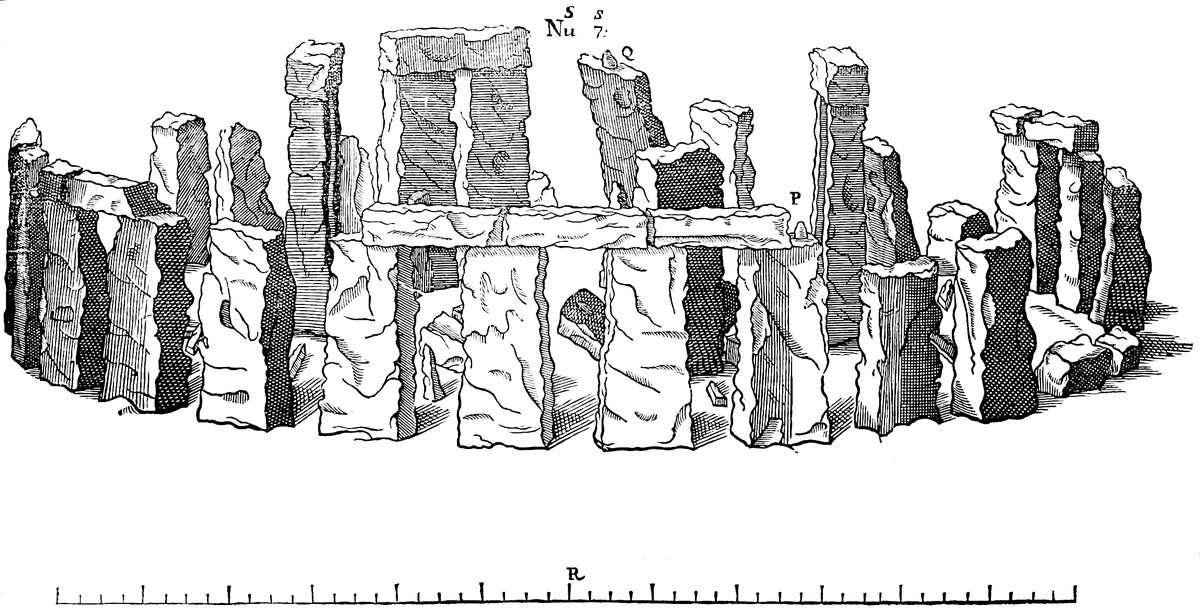
description of Stoneheng, in words as follow. Cam. fo. 251. Towards
the North, about six miles from Salisbury, in the plain, is
to be seen a huge and monstrous peece of work, such as Cicero
termeth insanam substructionem. For, within the circuit
of a ditch, there are erected in manner of a Crown, in three ranks
or courses one within another, certain mighty and unwrought stones,
whereof some are twenty eight foot high, & seven foot broad, upon
the heads of which others, like overthwart peeces, do bear and rest
cross-wise, with a small tenon and mortaise, so as the whole frame
seemeth to hang; whereof we call it Stoneheng, like as our old
Historians termed it for the greatness the Giants dance. Our Countrimen
reckon this for one of our wonders, and miracles. And much they
marvell, from whence such huge stones were brought, considering that in
all those quarters bordering thereupon, there is hardly to be found any
common stone at all for building: as also, by what means they were set
up. For mine own part about these points I am not curiously to argue
and dispute, but rather to lament with much grief, that the Authors
of so notable a Monument are thus buried in oblivion. Yet some there
are, that think them to be no naturall stones hewn out of the rock,
but artificially made of pure sand, and by some glewy and unctuous
matter knit and incorporate together, like as those ancient trophies or
monuments of victory which I have seen in Yorkshire. And what
marvell? Read we not I pray you in Pliny, that the sand or dust
of Puteoli, being covered over with water, becometh forthwith a
very stone, that the cisterns in Rome of sand, digged out of the
ground, and the strongest kind of lime wrought together grow so hard,
that they seem stones indeed? and that statues and images of marble
scalings, and small grit grow together so compact and firm, that they
were deemed entire and solid marble? The common saying is, that
Ambrosius Aurelianus, or his brother Uther did rear them up,
by the art of Merlin, &c. Thus far Camden, it being
needlesse to repeat more from him, having already delivered the story
from the Authors themselves. Yet here neverthelesse, as necessarily
induced thereunto, I shall take leave to observe something more
remarkable to our purpose in hand, upon his words.
In the first place then, Stoneheng is by him called a
huge and monstrous peece of work, terming it from Cicero,
insanam substructionem. To which I say, had Camden as well
attained other abilities of an Architect, as he was skilfull
in Antiquities: or been as conversant in Antiquities
abroad, as learned in those of his own Nation, he would have given a
far different judgement hereof. For, whosoever is acquainted with the
ancient ruines yet remaining in and about Italy, may easily
perceive this no such huge building, either for the circuit of the
work, or bignesse of the stones, they being as manageable to the
Roman Architects, as amongst us to raise a May-pole, or mast
of a Ship. And, if this styled huge and monstrous, what
may be said of Diocletians baths? the great Cirque?
Marcellus his Theater? Vespasians Temple of Peace? and
other prodigious works of the Romans? the very remainders
whereof now lying in the dust, breed amazement and wonder (not without
just reason too) in whosoever beholds them with attentivenesse and
judgement. Nay, whereas he styles it insanam substructionem,
it’s demonstrable, that betwixt this Island of great Britain,
and Rome it self, there’s no one structure to be seen, wherein
more clearly shines those harmoniacall proportions, of which only the
best times could vaunt, then in this of Stoneheng.
Moreover, Our Countreymen marvell (saith he) from whence
such huge stones were brought, considering that in all those quarters
bordering thereupon, there is hardly to be found any common stone
for building. Upon what trust Camden (his extraordinary
judgement otherwise considered) took this relation, I know not. For
there is not onely common stone thereabouts, for ordinary uses, but
stone of extraordinary proportions likewise, even for greater works (if
occasion were) then Stoneheng: the Quarries of Hasselborough
and Chilmark, both of them not far from the borders of the plain,
having of a long time furnished all the adjacent parts with common
stone for building. And (to come nearer the matter) it is manifest,
that in divers places about the Plain, the same kinde of Stone
whereof this Antiquity consists may be found, especially about
Aibury in North-Wiltshire, not many miles distant from
it, where not onely are Quarries of the like stone, but also stones of
far greater dimensions then any at Stoneheng, may be had.
They wonder also (saith he) by what means they (that,
is such huge stones) were set up. What may be effected by that
Mechanicall Art, which Dee in his Mathematicall
Preface to Euclyde, cals Menadry, or Art of
ordering Engines for raising weights; those (it seems) of whom
Camden speaks took little notice of, when Archimedes
during the siege of Syracuse,Plut. in Marcel. raised out of the Sea, and turned
in the air at pleasure, the Ships and Gallies of the Romans,
full fraught as they were with Souldiers, Mariners, and their ordinary
lading: and if King Hieron could have assigned him, a fit place
to firm his engines on, he would have undertaken to remove, even the
terrestriall Globe out of the worlds center, so high,
perfection in this Art transported him. What should I say of
the Obelisk in Ages so far past, brought from the Mountains of
Armenia, and erected in Babylon by Semiramis, one
hundred & fifty foot high, and at the base twenty four foot square of
one entire stone? Est in fano Latonæ (saith HerodotusHerod. lib. 2. of
his own knowledge) delubrum ex uno factum lapide, cujus parietes
æquali celsitudine ad longitudinem quadragenum cubitorum, cujus
lacunari, pro tecto impositus est alius lapis quatuor cubitorum per
oras crassitudine. In the Temple of Latona (in Ægypt)
is a Chappell formed of one stone, whose walls being of equall
height, are in length forty cubits, covered in like manner with one
sole stone four cubits thick. Those, which made this wonder would
have much more admired, if they could have seen the Obelisk
raised in times of old by King Ramesis at Heliopolis,Ptol. lib. 4.
Plin. lib. 36.
in that part of Ægypt anciently called Thebais, in
height one hundred twenty one Geometrical feet (which of our measure
makes one hundred thirty six feet) of one entire stone: and so little
wonder made they of raising it, that the Architect undertook and did
effect it, the Kings own son being at the same time bound to the top
thereof. Amongst the Romans, Augustus Cæsar erected in
the great Cirque at Rome, an Obelisk of one stone, one
hundred and twenty foot, nine inches long: another also, was set up
in Mars field, nine foot higher then it, by the said Emperour.
And it seems also, neither they, nor Camdens self had ever seen
that Obelisk, which even in these our days, in the year one
thousand five hundred eighty six, Sixtus Quintus caused to be
erected in the Piazza of S. Peter at Rome,Dom. Font. lib. 1. one
hundred and eight Roman palms high, and at the base twelve palms
square, (according to our Assise, fourscore and one foot high, and
nine foot square) of one entire stone also: Dominico Fontana
being Architect. But, there are more strange things (as Sir
Walter Raleigh hath it) in the world, then betwixt London
and Stanes. It is want of knowledge in Arts makes such
admirers, and Art it self have so many Enemies. Had I not
been thought worthy (by him who then commanded) to have been sole
Architect thereof, I would have made some mention of the great
stones used in the work, and Portico at the West end of S.
Pauls Church London, but I forbear; though in greatnesse
they were equall to most in this Antiquity, and raised to
a far greater height then any there. What manner of Engines the
Ancients used for raising; and what secure ways they had, for
cariage and transportation of their huge weights, is more proper for
another subject.
Some there are (saith Camden) that think them to be
no naturall stones, hewn out of the rock, but artificially made of
pure sand, and by some glewy and unctuous matter, knit and incorporate
together, like those ancient trophies, or monuments of victory, which
I have seen in Yorkshire. As for these Monuments (for my part)
I have not seen, otherwise I would give my sense upon them, and
happily they may be found as far from being artificiall, as those at
Stoneheng. And what marvell? (saith he) read we not,
I pray you, in Pliny, that the sand or dust of Puteoli,
being covered over with water, becometh forthwith a very stone
&c. He might as well have told us the Rocks in Portland
are artificiall. But it’s true, this sand of Puteoli, was much
used by the Ancients, and it is such a kind of earth, as is
very famous for its admirable effects in building, being tempered
with the cement of Cuma: For, it not onely yeelds strength
to all other buildings, but thereby also, all works made in the Sea
under water, are most firmly consolidated. Yet, doe I not find,
that ever the Ancients made any artificiall stones thereof,
or that Vitruvius hath any thing to that purpose, to him the
credit given to Pliny, and others, concerning the Earth of
Puteoli, being only due; posterity being in the first place
beholding unto him for finding out the nature of that earth, he giving
us not only the effects thereof, but the cause also from whence those
effects proceed. Hoc autem fieri hac ratione videtur, quòd sub his
montibus (i.e. in regionibus Baianis,Vitr. lib. 2. cap. 6. & in agris, quæ
sunt circa Vesuvium montem) & terræ ferventes sunt, & fontes
crebri, qui non essent, si non in imo haberent, aut de sulphure, aut
alumine, aut bitumine ardentes maximos ignes. Which is (saith
he) by reason in those mountains (to wit, in the regions
of Baiæ, and fields about mount Vesuvius) the grounds are
hot, and full of springs, which heat could not be, but that from the
bottome, are nourished mighty great fires, arising from sulphur, alume,
or brimstone there. Indeed, according to Pliny, the sand
upon the side of the hill of Puteoli, being opposed to the Sea,
and continually drenched, and drowned with the water thereof, doth (by
the restringent quality, no doubt, of the salt water) become a stone
so compact, and united together, that scorning all the violence of the
surging billows, it hardeneth every day more and more.
Neverthelesse, whosoever could find out any kind of earth in this
Island, naturally apt, to make artificiall stones of such greatnesse
as these; and, like them so obdurate also, that hardly any tool enter
them: or, that our Auncestors in times of old, did make use of such
a cement, and in what manner composed by them. The benefit thereof
doubtlesse, would amount so ample to this Nation, that Records could
not but render him deservedly famous to all posterity. In the mean
while, as it is most certain those stones at Stoneheng are
naturall; so, am I as clearly of opinion, the very Quarries from whence
hewn, were about Aibury beforementioned: where, no small
quantities of the same kind, are even at this day to be had; vast
scantlings, not only appearing about the Town it self, but throughout
the plain and fields adjoyning, the Quarries lying bare, numbers also
numberlesse of stones, are generally seen. (being no small prejudice
to the bordering inhabitants) As also, not far from the edge of
Wiltshire, in the ascent from Lamborn to Whitehorse
hill, the like stones are daily discovered. To mention, more places
in particular is needlesse, the Quarries at and about Aibury
(without relating to Lamborn, or what ever other) distant but
fifteen miles or thereabouts from Stoneheng, being of themselves
sufficient to clear the doubt. These, having through long time, got
the very same crustation upon them, are in like manner coloured,
grained, bedded, weighty, and of like difficulty in working, as those
at Stoneheng. Some of which, being of a whitish colour, are
intermixt and veined here and there with red: some, of a lightish
blew, glister, as if minerall amongst them: some, for the most part
white, perplexed (as it were) with a ruddy colour: some, dark gray and
russet, differing in kinds as those stones at Aibury do. Some
of them again, of a grayish colour, are speckled or intermixt with
dark green, and white, together with yellow amongst it, resembling
after a sort, that kind of marble which the Italians (from the
valley where the Quarries are found) call Pozzevera; nothing,
notwithstanding, so beautifull, though naturally much harder, and
being weathered by time, as in this work; disdain the touch even of
the best tempered tool. Insomuch, that if nothing else, the more then
ordinary hardnesse of them is such, as will in part convince any
indifferent judgement in the nature and quality of stones; those, in
this Antiquity, are not (as Camden would have them)
artificiall, but naturall.
Whatsoever, worthy admiration concerning Stoneheng, either in
relation to the greatnesse of the work in generall, the extraordinary
proportion of the stones in particular, the wonder the people make,
from whence brought, by what Arts or Engines raised, and in such
order placed, Camden delivers; certainly, in his judgement he
was wholly opposite to the opinions of the aforesaid British
Historians. He would never else, with so much regret have complained,
The Authors of so notable a Monument lay buried in oblivion, had
he given any the least credit, this Antiquity had been built,
either by A. Ambrosius, or the British Nobility, or to
eternize either of their names, or actions to succeeding generations.
Let Geffrey Monmouth and his followers, say what they please,
Henry Huntingdon (his Contemporary, if not more Ancient) is
mine Author,H. Hunting, lib. 1. Nec potest aliquis excogitare, qua arte tanti lapides
adeo in altum elevati sunt, vel quare ibi constructi sunt. No man
knows (saith Huntingdon) for what cause Stoneheng
erected, or (which is fully answered already) by what Art
such huge stones were raised to so great a height. Take with you
also Draytons judgement in his Poly-olbion couched
under the fiction of old Wansdikes depraving Stoneheng.
(Wansdike being a huge Ditch in Wiltshire so called,
anciently, as Camden opines,Cam. fo. 241. dividing the two Kingdomes of the
Mertians and West Saxons asunder)
Poly-olbion Cant. 3.
Whom for a paltry ditch, when Stonendge pleas’d t’upbraid,
The old man taking heart, thus to that Trophy said;
Dull heap, that thus thy head above the rest doth reare,
Precisely yet not know’st who first did place thee there;
But Traytor basely turn’d to Merlins skill dost flie,
And with his Magicks dost thy Makers truth belie.
For, as for that ridiculous Fable, of Merlins
transporting the stones out of Ireland by Magick, it’s an idle
conceit. As also, that old wives tale, that for the greatnesse it was
in elder times called the Giants dance. The name of the dance
of Giants by which it is styled in Monmouth, hath nothing
allusive, no not so much as to the tale he tels us, saith a
modern Writer in the life of Nero Cæsar.
Furthermore, our modern Historians Stow and Speed,Speed lib. 7.
Stow fo. 58. in 4o. tell
us, in severall parts of the Plain adjoyning, have been by digging
found, peeces of ancient fashioned armour, and the bones of men,
insinuating this as an argument, for upholding the opinions of the
British Writers. To which, if they would have those to be the
bones of the slaughtered Britans, how came those Armours to
be found with them, they coming to the Treaty unarmed, and without
weapons? Howsoever, what is done in the Plains abroad, concerns not
Stoneheng, Neither can any man think it strange, that in a
place, where Fame hath rendred, so many memorable and fierce
battels, fought in times of old, rusty armour, and mens bones should be
digged up. It is usuall throughout the world in all such places, and
(if I mistake not) Sands in his Travels, relates, that even in
the Plains of Pharsalia, such like bones and Armour, have lately
been discovered: and Sir Henry Blunt in that notable relation of
his voyage into the Levant, speaks with much judgement of those
Pharsalian fields. Likewise, the aforesaid Writers,Cam. fo. 194. Speed lib. 7. might well
have remembred, some of themselves deliver, that at Kambulan,
or Cambula in Cornwall, such habiliments of War have
been digged up, in tillage of the ground, witnessing either the fatall
field, sometimes there fought, where Mordred was slain by
Arthur, and Arthur himself received his deaths wound:
or else, the reliques of that battel betwixt the Britans and
Saxons, in the year eight hundred and twenty. ’Tis true, the
relation conduces much towards confirming, that ancient custome of the
Saxons, formerly recited out of Leyland, considering
especially, not far from this Antiquity, lie certain hillocks,
at this day commonly called the seven Burrows, where it may be
presumed, some Princes, or Nobles of the Saxon
Nation lie interred. But, that Stoneheng should therefore be
a place of buriall, the aforesaid relation to maintain the same is
nothing worth.
They adde moreover, the stones yet remaining are not to be numbred,
according as our Noble Sydney in his Sonnet of the wonders of
England.
Near Wilton sweet, huge heaps of stone are found,
But so confus’d, that neither any eye
Can count them just, nor reason reason try,
What force brought them to so unlikely ground.
This, though it scarcely merits an answer, yet, to satisfie those
which in this point may be curious, let them but observe the orders
of the Circles, as they now appear, and not passe from one to another
confusedly (noting neverthelesse where they begin) and they’ll find the
just number easie to be taken.
Now, though whether in order to the Place it self where this
Antiquity stands, or Persons, by whom Stoneheng
pretended to be built, enough laid, to wave the reports upon fancy,
or common Fame, formerly delivered: to the state of Time
neverthelesse, wherein the British Histories would have it
erected, because nothing by me hath yet been spoken, I will therefore
adde, ’tis not probable such a work as Stoneheng could be then
built. For, although our Britans, in ancient time possessed,
together with the Roman civility, all good Arts, it
is evident during the reign of A. Ambrosius (about the first
coming in of the Saxons here, and towards the later end of
the fifth Century, as Historians and Chronologists compute it) in
the last declining of the Roman Empire, the Arts of
Design, of which Architecture chief, were utterly lost
even in Rome it self, much more in Britain, being
then but a Tempest-beaten Province, and utterly abandoned by
the Romans. Britain, therefore, being over-run with
enemies, and the knowledge of Arts then lost amongst them:
none, questionlesse, can reasonably apprehend so notable a work as
Stoneheng could in such times be built.
That, amongst the Romans and Britans both, A.
Ambrosius governing here, all Sciences were utterly perished,
is evidently manifest. For, the Goths had then invaded
Italy; and that vast Empire drooping with extreme Age, by the
fatall irruption of strange Nations, was not only torn in peeces,
but Barbarisme having trod learning under foot, and the sword
bearing more sway then letters, or learned men, all Sciences were
neglected; and particularly that of Building fell into such
decay, that till of late about the year one thousand five hundred and
ten, it lay swallowed up, and (as I may so say) buried in oblivion.
When one Bramante of the Dutchy of Urbin,Serl. lib. 3. attaining
admirable perfection in Architecture, restored to the world
again, the true rules of building, according to those Orders, by
the ancient Romans in their most flourishing times observed.
Furthermore, not onely liberall Sciences and Architecture, but
Art military also, about the time of A. Ambrosius, was so
far lost amongst the Romans, that they were ignorant, yea, in
the very rudiments of War. Insomuch, (as Procopius in his second
Book of the Gothick Wars relate) Barbarism had bereft
them of the skill, even in what manner to sound a retreat.
With us here also, the Saxons domineer’d over all, and A.
Ambrosius with the Britans had enough to do, in endeavouring
the recovery of their lost Countrey from a mighty prevailing Enemy,
that in few years afterwards (maugre all the ways which force or policy
could invent) conquered the whole Nation. Among other calamities
attending that miserable Age, Camden (from William of
Malmsbury) directly to the purpose in hand tels us.W. Malmes. fol. 8.
Camden fo. 87. Cum
Tyranni nullum in agris præter semibarbaros, nullum in urbibus præter
ventri deditos reliquissent: Britannia omni patrocinio juvenilis
vigoris viduata, omni Artium exercitio exinanita, conterminarum
gentium inhiationi diu obnoxia fuit. When the Tyrants (to wit, the
Romans) had left none in the Countrey but half Barbarians,
none in the Cities and Towns, but such as wholly gave themselves to
belly-cheer; Britain, destitute of all protection, by her
vigorous young men, bereaved of all exercise, and practice of good
Arts, became exposed for a long time to the greedy, and gaping jaws
of Nations confining upon her.
Here you have it from an Author, more ancient then G. Monmouth
a little, though both lived in one age, the times about A.
Ambrosius government, whether before, during his reign, or after,
were so full of miseries, that he complains, none then employed,
or exercised in any whatever works belonging to Art. They
had somthing else (as appears by divers Writers) to think upon, all
their abilities being insufficient to defend their Countrey from
forein servitude, their Cities and Towns from ruine, and destruction,
and their habitations from rage of cruell and insolent enemies,
robbing, spoiling, burning, wasting, all before them: to which,Gildas.
plague, pestilence, and famine being joyned, the inland part of the
Island, even to the Western Ocean was welnear totally
consumed.
Besides, the Countrey was so oppress’d, what with outward hostile
miseries, what with intestine tumults and troubles: that, had they not
lost the practice of all Arts (as the former Historian saith
they had) so far were they from erecting any work of this kind, that
they were compelled to abandon their Towns, and houses, built in times
foregoing by their Auncestors, and betake themselves to mountains,
caves, and woods for shelter. Now, if the calamities of those times
hung over the Britans heads, in so generall manner, that not one
amongst them had leisure to put pen to paper, (as from Leyland
before remembred) much lesse able were they, without all peradventure,
to undertake so great a work as Stoneheng, wherein, as all
rationall men must grant, numbers of men employed, and many years taken
up, before brought to its absolute perfection.
But, nothing can better expresse the ignorance of that Age, then
the barbarous manner of inscription upon the Tomb of the British
Hector King Arthur, nephew to A. Ambrosius, found
long since in the Churchyard of the Abbey at Glastenbury,
the letters whereof, being exactly represented to our view by
Camden,Cam. fo. 228. do, as by demonstration, fully discover to us the
Barbarism of those times. As, barbarous in those characters, so were
they ignorant in, and had lost the use of all other Arts.
Nor exercise nor practice of good Arts, was then amongst them,
saith the Historiographer of Malmsbury. And well he might so
deliver himself, not withstanding Matthew Westminster tels
us, A. Ambrosius repaired Churches, which the rage of
Saxons, enemies to Christian Religion, spoiled. For,
besides, the vast difference betwixt such works as Stoneheng,
where Art overmasters the common skill of man, and making up
the decaies of ruinated buildings, is apprehensive even to the meanest
capacities: Gildas and Bede (whose Antiquity and learning
the greater it is, the more is their authority acceptable) affirm,
the Britans in those times knew not in what manner to bring
up bare wals of stone. When, the Roman Legion sent to aid the
Britans by Valentinian the third, under the conduct of
Gallio of Ravenna, was remanded hence, for defence of
France; before departing, they exhorted the Britans
to make a wall overthwart the Island, to secure themselves
from the Barbarians, Picts, and Scots: which
wall, Bede tels us, was made not so much with stone, as
turffes, considering they had no workmen to bring up such works of
stone; and so, (saith the venerable Historian) they did set up
one, good for nothing. ’Twas made by the rude, and unskilfull common
multitude, not so much of stone, as turffes (saith Gildas
also) none being found able to give direction for building works
of stone. This was about thirty six years preceding A.
Ambrosius government. In which time, the Romans abandoning
Britain, Vortigern usurped; call’d in the Saxons
to his aid; was deposed by his Nobility; and Vortimer his son
set up. Whom Rowena having made away; Vortigern was
re-enthronis’d. Him A. Ambrosius invades, and having burnt him,
together with Rowena in Wales, assumes the Crown as his;
holding continuall war with the Saxons, untill poysoned by
Pascentius as aforesaid.
It being thus, that nothing but universall confusion, and destructive
broyls of war, appeared then in all parts; more ancient, and far more
propitious times, must be sought out for designing a structure, so
exquisite in the composure as this: even such a flourishing Age, as
when Architecture in rare perfection, and such People
lookt upon, as by continuall successe, attaining unto the sole power
over Arts, as well as Empires, commanded all. I say, such
Times, and Persons, because those things, which accord
not with the course of time, which by a generall consent of Authors
agree not; which by the approved customes of ancient Ages, and votes
of learned men, are not received and allowed, and consequently no ways
probable; I easily admit not of.
Another fiction there is concerning Stoneheng, not to be past
over; and though the cause upon which it’s grounded, be far more
ancient then the government of Ambrosius, or aforesaid slaughter
of the Britains: neverthelesse, in respect it is a new conceit,
not thirty years being past since hatch’t, I suppose this the most
proper place to discourse thereof, having ended with Geffrey
Monmouth, Polydore Virgill, and their followers.
The Author thereof is Anonymus, unlesse known in being
Translator of Lucius Florus. His opinion, (in his Nero
Cæsar) Stoneheng the Tomb of Boadicia (formerly
remembred) Queen of the Iceni.Ner. Cæs. fo. 181. His reasons, first, because that
memorable battell betwixt her, and Suetonius Paulinus fought
upon a Plain. Secondly, in respect the Britans buried her
magnificently. For confirming this, he tels us, Had the pretieus
volumes of the Cornelian Annals, and Dio Cassius, and
John Xiphiline been within the spheare of Geffrey Monmouths
studies, not Aurelus Ambrosius, nor those four hundred and
sixty Noblemen of Britain, murthered in Vortigerns reign,
should have carried away with him the fame of this materiall wonder,
but magnanimous Boadicia. It seems, he would not be behinde-hand
with Monmouth; for, as the one finding no story more famous
then of A. Ambrosius and the slaughtered Britans,
fathered Stoneheng upon them: so, to make the inventive
faculty, as apparently predominant in himself; this other, respecting
Boadicia’s heroicall actions, would as willingly make the world
beleeve this Antiquity her Monument.
His principall argument I delivered before; to wit, the battell
betwixt Her and the Romans, wherein Boadicia utterly
overthrown too, being fought upon a Plain. Was there in old time
(did he think) no Plain in Britain to fight a battell on
but Salisbury Plain? How came Boadicia and her Army
thither? I find indeed, Boadicia leading one hundred and twenty
thousand fighting men out of the Icenian Countries, and like
a terrible tempest, falling upon Camalodunum, that famous
Roman Colony of old, (where the first fury of the War was felt)
she surprised it and razed it to the ground; Suetonius Paulinus
then in Anglesey: Intercepting Petilius Cerealis, who
advanced with the ninth legion to relieve that Colony, she cut all his
Infantry in peeces: Putting to the sword all those, which imbecillity
of sex, tediousnesse of age, or pleasure of the place detained from
following Suetonius in his march from London: And taking
Verulamium, sackt and burnt it down to ashes. But, how she
marcht from thence to Salisbury Plain is neither apparent nor
probable; not the least inkling being left in the world, what hostile
acts she committed, which way she moved, or what done by her, after the
ruine of Verulam, till utterly overthrown.
Can it be imagined, she that destroyed so great a Colony, together
with a free-borough of the Romans, slain seventy or eighty
thousand persons in such horrid manner as scarce credible; reserving
not one Prisoner alive, but killing, hanging, crucifying, and burning
whatsoever Romane, or to that party enclined: that was yet
victorious, and her Army encreasing daily; can it be imagined, I say,
she marcht to Salisbury Plain with so huge an Army invisibly?
or stole from Verulam thither by night, lest notice should
be taken of her proceedings? Anonymus self cannot think so
unworthily of his Boadicia, yet certainly after such manner
she went, if ever went thither at all: Otherwise, Boadicia
marching in the height of glory, and bearing down all before her
till rancountred by Suetonius. Those faithfull Historians
Tacitus, and Dion, (both so sedulous in delivering
her Fame to posterity) would never have omitted so notable a march,
through such a large tract of enemies Countrey, as of necessity she
was to make from Verulam, to Salisbury Plain; but would
have prosecuted her War, by recording the spoyls, rapines, burnings,
and devastations made therein; as particularly, as from the first
fomenting the rebellion, till her advance to Verulam, they
have done. Upon which Town, and the aforementioned places only, the
aforesaid Historians directly tell us the whole burden of the War fell.Tacit. Ann. lib. 14.
Ad Septuaginta millia civium & sociorum iis quæ memoravi locis
occidisse constitit, saith Tacitus. It was manifest,
there were slain in the places, I have remembred, the number of
seventy thousand Citizens and Allies. Bunduica duas urbes
(saith Xiphilines DionDion. Cas. lib. 62. also) populi Romani expugnavit
atque diripuit, in iísque cædem infinitam, ut supradixi, fecit.
Bunduica took and razed to the ground two Towns of the Romans,
and in them made that infinite slaughter, I have mentioned before,
of fourscore thousand persons. At Verulam then, it fully
appears, the course of her Victories stopt, the inhumane butchery of
the Romans, and their confederates, ended with the massacre
in that Town; which could not possibly have hapned, if with such a
firm resolution to extirpate the Roman name in Britain,
and such a numerous Army to effect it, she had gone on victoriously
unfought with, so far as where this Antiquity stands. And
therefore the Plain of Salisbury could not be the place of
battell, as Anonymus would fain enforce it. Who having so
largely, and with so good advice, discoursed the motions, and actions
of this rebellion, with all the circumstances thereof, from the first
rise, till she destroyed Verulam, should either have found some
warrantable authority for Boadicia’s so great an undertaking
afterwards, else never engaged her so far within the Roman
Province; otherwise, some may imagine, he framed it, only out of
ambition for a meer pretence, rather, then stated it, from a reall
endeavour, to make discovery for what cause Stoneheng at first
erected.
Furthermore, Suetonius Paulinus was too well skilled in the
discipline of war, to make the seat thereof in a Countrey so absolutely
Roman, as betwixt the British Ocean and the River
Thames. He had it’s true (being return’d from Anglesey)
abandoned London, no colony. But upon what result? finding
his accesse of strength disproportionable to the War in hand, and
thereforeTacit. Ann. lib. 14. determined with the losse of one Town to preserve the rest
whole, (whether London or Camalodunum is not to the
purpose) and, by attending the motions of the enemy, wait all fair
occasions to give Boadicia battell,Dion. Cass. lib. 62. being unwilling to try
his fortune too suddenly, multitude and successe making the Britans
outrageously daring. In the interim neverthelesse, raising what
forces, the exigency of so important affairs would permit.
Which way Suetonius marched from London is altogether
omitted, yet if lawfull to conjecture, why not? to draw off the
Forces of Catus Decianus Procurator, (not long before fled
into Gaul, for fear of this War) together with the remains
of Petilius Cerealis troops; quartered, as Anonymus
confesseth,Ner. Cæs. fo. 105. in those very camps yet appearing about Gildsbrough
and Daintry in Northamptonshire, then, confining the
Icenian Dominion to the Westward. Which Troops therefore, lay
doubtlesse, in very great danger if not timely relieved; especially in
case Boadicia should conduct her Army that way; as, ere long
afterwards she did so far as Verulam; this course being taken
by her, not improbably, in pursuit of Suetonius. Neither was
it very dangerous for the Roman Generall to lead his Forces
that way, the Enemies main strength lying about Camalodunum.
Howsoever, whether he marched up to them or no, concluded it is,
he made his retreat towards Pœnius Posthumus encamped with
the second Legion in the borders of the Silures,
(now Herefordshire, Radnorshire &c.) for which
Legion, Suetonius sending to have it brought up to
his Rendezvouz, his commands being slighted, that strength failed
him. The way which Suetonius took,Ner. Cæs. fo. 154. after his departure,
was in mine opinion (saith Anonymus) towards
Severn, where Pœnius Posthumus encamped with the second
Legion among the Silures. So also Spencer our famous
English Poet finds it. Whereby it appears, Suetonius
retreat was not Westward to Salisbury Plains, but Northerly
towards that second Legion. In this retreat, I may not omit,
Anonymus conducts him over the Thames at London;Ner. Cæs. fo. 155.
which if granted, and, that he kept the river upon his right hand
still, untill engaging Boadicia, as Anonymus saith
he did: then was Suetonius march far away indeed from
Salisbury Plain. The course of that River winding, as we
all know, through Barkshire out of Oxfordshire, where
Tame from the County Buckingham, and Isis from
the edge of Glocester Province, make their conjunction a little
beneath Dorchester. And, if keeping this course still
by the Rivers side, Suetonius marcht alongst the banks of
Cherwell also, then must Anonymus, whether he will or
no, bring him up close to Gildsbrough and Daintry, as
aforesaid;Ner. Cæs. fo. 166. and thereby (for it is admitted Cerealis horse-troops
were at the fight) reconciling all opinions, upon his direct way
towards the second Legion.
How far on, neverthelesse, toward Pœnius Posthumus Camp
Suetonius advanced is uncertain; but, that the battell might be
fought in some Plain about Verulam, or upon that rode, is not
altogether improbable. (Especially considering part of Suetonius
strength consisted of Londoners, who, as Auxiliaries
followed him in this War, and would not stay behind). For, the
Roman Generall when marshalling his Army for fight, had with
him (saith Tacitus) the aids of the places adjoyning.
What places were these? the last place named by him was
Verulam, the next place before it London; and, if the
Historian intends either of these two, by the places adjoyning
to the field, where the battell fought; then, may Anonymus
prove the desarts in Africa, as soon as the Plains of
Salisbury, to be the place of Battell.
Spencer saith,Cant. 10. the battell was fought near Severn:
Which seeing stout Bunduca up arose,
And taking arms, the Britons to her drew;
With whom she marched straight against her foes,
And them vnwares besides the Seuerne did enclose.
Suetonius, when resolving for fight,Tacit. Ann. lib. 14. deligit locum artis
faucibus, & à tergo silvâ clausum, satis cognito, nihil hostium nisi
in fronte, & apertam planitiem esse sine metu insidiarum. Choosed
a place with a narrow entrance, enclosed behind with a wood, being
well assured, he had no enemies but before him, and the Plain being
open was without fear of Ambush. Thus Tacitus describes
the field, the Roman Army consisting of scarce ten thousand
armed men. In what part of Britan soever this Plain lay, it
was, for certain, of no great extent, being hardly able to contain
the vast multitudes of Boadicia’s Army; computed two hundred
and thirty thousand fighting men, by Dion, and therefore could
not possibly be Salisbury Plain. For, the Britans
placing their carts and wagons supra extremum ambitium campi, in
the utmost borders of the field, had so environed their Army
therewith, that upon the rout given, they could hardly flee away,
quia circumjecta vehicula sepserant abitus, by reason the carts
(saith Tacitus) hedged in the passages on every side,
and (to use Anonymus own words)Ner. Cæs. fo. 179. were like a wall against
evasion. Now, if the Britans had so surrounded the utmost
borders of Salisbury Plain, and in such manner barricado’d
up all the passages thereof, their numbers should rather have been
millions then thousands, as every man knowing those Plains must needs
confesse. Besides, Anonymus self tels us,Ner. Cæs. fo. 178. after the
Britans in the head of their battel began to shrink and turn, that
alone was a blow to all behind, who being many score of thousands,
remain’d untoucht, during the fight, because they could never come up
to handy-strokes, for want of room in the narrowings of the
field. He told us even now there was scope enough. Whereabout
in these parts of Britain, (saith he)Ner. Cæs. fo. 161. that very place was,
unlesse it were upon Salisbury Plain, where there is a black
heath, and scope enough, is not for me to imagine. Now,
on the contrary, when coming to the issue, he tels us the Plain was
narrow, and they wanted room. Did the Britans want
room in the field, and were on Salisbury Plain? Surely, in
the heat of his describing the Battel Anonymus forgot his
own invention; the fury of the Romans, in beating down the
British squadrons, therewith dasht the main force of his conceit
to peeces. Suspicious and jealous men had need of good memories. Upon
the aforesaid situation he might rather have observed, the great
experience of the Romane Generall in martiall affairs, then
from thence suggested, the Britans in point of honour erected
Stoneheng to the memory of Boadicia, Suetonius
not onely choosing to make good a straight enclosed behinde with a
wood, for securing his own small Troops, but such a straight also,
where the Plain, or field before it, was not of sufficient extent
for Boadicia to marshall her great Army in. Furthermore,
Anonymus determining (it seems) to parcell out his ground
proportionable to the numbers, undertakes to give posterity an exact
survey of this Plain, telling us, it was a Plain of five or six
miles over: This makes it more apparent ’twas not Salisbury
Plain, which far and wide so expatiates it self through the middle
of Wiltshire, that it is not onely five or six miles,
but (as I may say) five times six miles over. This famous battell
then, being struck upon a Plain hardly capable of Boadicia’s
Army, was not fought upon Salisbury Plain; but, on some other,
which Suetonius Paulinus found best for his own advantage, and
therefore Stoneheng (as Anonymus would fain have it)
could not be the Sepulchre of Boadicia.
Dion. Cass. lib. 62.
Concerning Boadicia’s magnificent obsequies; a mighty Prince may
be buried with great solemnity, yet no materiall Monument dedicated
to his memory. Examples of this kinde are so frequent, there needs no
mention of them. Humaverunt magnificè, (they are Dions
words) the Britans laid her into the earth magnificently, with
as much pomp, happily, and honour, attending her to the grave, as their
barbarous customs for their glorious Chieftain would admit; but, that
they raised any Monument, or erected whatsoever kinde of Sepulchre
for her, much lesse so notable a structure as Stoneheng, he no
where tels us. Which had the Britans done, the Historian could
not avoid, taking more knowledge thereof, then of her bare enterment,
and would undoubtedly have recorded it. Again, grant Salisbury
Plain the place of Battell, yet, Dion saith not, they buried
her magnificently where the battell fought, only, Humaverunt
magnificè: adding withall, those, that escaped the field, prepared
to re-enforce themselves for a new triall, in the mean while a disease
seizing on Bunduica, she died. Now then, after so terrible
an overthrow, wherein ’tis reported she lost fourscore thousand
Britans; Boadicia, in all likelihood, endevoured to
recover the Icenian Countreys, her principall strength; having
in her speech before the Battell insinuated the fenny parts thereof, as
a refuge if the worst should happen. In what Countreys else could they
recruit? where falling sick she died, (whether by violent or naturall
death is not materiall) and as ever observed among all Nations, was, no
doubt, buried in her own territories, among the graves of her renowned
Ancestors.
That the Britans, untill Julius Agricolas time,Ner. Cæs. fo. 117. had
learned nothing (as Anonymus takes speciall notice) but to
fight, and were no handicraftsmen, whereby they might be capable
of erecting such works as Stoneheng, being already fully
proved from Tacitus, I will adde, the ringleaders or heads of
commotions against Empires and Commonwealths were anciently, (in many
Countreys at this day) not only themselves punishable by the Laws
with death, but their whole families and kindred though guiltlesse,
suffered in like manner; their very houses also, being razed to the
ground, lest any knowledge of such pernicious undertakings should
remain visible to posterity: and a capitall crime it was, in whomsoever
that restor’d them. How comes it then, Boadicia the principall
promoter,Sueton. in Ner. and Head of an insurrection so fatall, as accounted by
Suetonius Tranquillus, among the infortunate losses of the
Roman Empire,Dion. Cas. lib. 62. and the more ignominious by a womans conduct,
should be permitted by the conquering Romans, a monument to
eternize her fame to succeeding Ages? Boadicia, that ript up the
bellies of the Roman Legionaries, and cutting out their bowels
impal’d their bodies upon burning stakes; that hanged up the most noble
and honourable Roman Dames naked, and slicing off their paps,
sowed them to their mouths, as in act of eating them; that in scalding
water boiled the Roman infants, and young children to death;
their Parents, Husbands, and Commanders unable to relieve them, but
enforced to give way, and happy in so saving themselves from the cruell
inhumanities of the Conqueresse. We fought for to live,
saith Tacitus. Yet, when ere long afterwards, victoriously
recovering Britain to Cæsar, by so memorable a battell as
compared to their victories of old, should the Romans suffer
the enthralled Britans to erect a Trophy to her memory, whose
purpose was absolutely to root out all that was Roman here?
what greater infamy to the Roman name, except the permission
of it? They, who rased and broke in peeces whatever titles and
inscriptions, bearing the names of their Cæsars; pulled down and
demolished the royall Ensigns, Trophies, Statues,
Temples, or whatever else sacred, to their own Emperors,
when actively administring to the prejudice of the Romane
State; would they permit any publick monuments be erected to the
memory of a conquered Prince, of an Enemy so barbarously cruell as
Boadicia? That she lives in History, they could not prevent; so
live their worst of Emperors. Moreover, publick Monuments were in all
ages set up in honour of the Vanquishers, not vanquished; respecting
which, Anonymus should also, either have made Boadicia
Victresse, or never supposed Stoneheng her Sepulchre.
The time assigned by Anonymus,Ner. Cæs. fo. 182. for erecting these orderly
irregular, and formlesse uniform heaps of massive marble, (as
he cals them) to the everlasting remembrance of Boadicia, is
much above fifteen hundred years since: Petronius Turpilianus
succeeding Suetonius Paulinus in the Leivtenancy of
Britain; who by his idle and lazy life, making the world beleeve
there was peace here: Anonymus will have it a proper time, for
permitting such an office to the Britans, in Boadicia’s
honour. Times of peace, ’tis confest, when Arts flourish under
nobly minded Governours, are chiefly proper for erecting magnificent
buildings. The Government under Petronius was guilty of none of
these. As for the State of Britain in generall, Tacitus
in the life of Agricola tels us, Petronius had composed
the former troubles; but in what sort, the fourteenth book of his
Annals declares; non irritato hoste, neque lacessitus,
neither the Enemy, incensed him; nor he, provoked the Enemy:
otherwise Petronius durst not do. And, if peace setled, why
doth the Historian call them Enemies? Concerning his own person in
particular, Petronius gave himself over to an unprofitable
life, disguising it under the honourable name of peace. Honestum
pacis nomen segni otio imposuit, saith Tacitus. And,
the Britans (as said before) were not then civilized, nor
friends to such Arts as either nourish or are nourished by peace,
therefore such a work of wonder as this Antiquity famed, not
to be expected from them. For, as through the malignities of the
Age, wherein Aurelius Ambrosius lived, the Britans had
utterly lost the practice of all those Sciences, in times
foregoing, learned by their Auncestors from the Romans: so,
through the neglect of civil policy in the preceding Roman
Governours, in this Leivtenancy of Petronius, the Britans
had not attained the knowledge of any those Arts, not many
years afterwards, taught their posterity by the Romans. Whole
imperiall Eagles took not wing in Britain with such lofty
speed, as over other Countreys; The Britans being a fierce
Nation, slowly giving ear to any peace,Tacit. Ann. lib. 14. the Romans had
work enough in subduing them. Julius Cæsar rather shewed
the Island to his successors, then left them possession of it:
Augustus and Tiberius held it policy to neglect it:
Caligula intending to invade Britain, was diverted by
his Wars in Germany: Claudius first prosecuting the
conquest with effect, established the colony at Camalodunum,
and his Leivtenants Aulus Plautius, Flavius Vespasianus,
Ostorius Scapula, and Didius Gallus by little and little,
after much contest, and various successe, subdued certain Countries;
and reducing the nearest part of the Island to the form of a Province,
built also, or rather cast up some few fortifications further within
the land: Nero’s Generals had much to do in keeping, what their
predecessors gained; Suetonius Paulinus (under him) struck
that fortunate battell with Boadicia, else the Romans
beaten out of all. So that, in the time of Petronius, the
Romans having obtained no such assured dominion over the
Britans, as might make them, themselves confident to undertake
great and stately buildings here, for their own either publick, or
private accommodations; (the ruine of Camalodunum being too
fresh in memory) occasion was not offered, nor the time yet come, to
let the Britans know by what Arts all civill Nations
of the world, did erect their excessive, rather then not magnificent
structures, for eternizing their names to succeeding generations.
And therefore, the Leivtenancy of Petronius Turpilianus, not
proper for building this stony marvell, as Anonymus
suspects. For, beside what’s delivered, whensoever Stoneheng
built, the preparation only of materials for the work, and bringing
them to the place, what Engines or Arts soever used,
necessarily, spent more time, then Petronius consumed in the
whole continuance of his government here. What tumults succeeded him,
let others declare.
Furthermore, if those times of Petronius would not,
yet (saith Anonymus) other ensuing seasons might
permit such an office to the Britans, her name for ever glorious
among them. The hainousnesse of her Rebellion, horridnesse of
her cruelties, and inveterate hatred Boadicia bore to the
Romans, whereby her name for ever infamous among them,
clearly manifest all other ensuing seasons, equally improper for
those ancient inhabitants of this Island, to erect Stoneheng.
If the Britans, once attaining the Romane manner
of Architecture, in any succeeding times had expelled the
Romans, and been triumphant; some probable reason, at least,
Anonymus might have alledged, towards advancing his opinion.
But Boadicia and her Complices overthrown, the
Roman Power in this Island encreasing dayly, and the liberty
of the Britans as fast declining, no following season
could be opportunely favourable, for undertaking such a work by
them; the erecting whereof, yea the sole endeavouring to commemorate
by such publick means, so mortall an enemy to the Romans
as Boadicia: nothing but the dearest lives of the bold
attempters, could, certainly, expiate. The Temple upon Mount
Cœlius at Rome, begun to ClaudiusSuet. in Vespas. sacred memory by
Agrippina, was destroyed to the very foundations by Nero.
If then, insulting Agrippina might not erect a memorable
structure, to the glory of her deceased Cæsar; whom the
Senate and People of Rome, in all solemne manner
deified: What oppressed Britan, durst undertake the raising a
publick Monument to the honour of vanquished Boadicia, whom the
State (in all reason) for ever declared enemy to the Roman
Empire? And though, after a long succession of years, the Romans
abandoned this Island, yet, when departed, the Britans were left
in such deplorable condition, (at large declared before) that, albeit
her name never so glorious among them, they had much more to
do, in saving their own miserable lives from plague, famine, and the
sword, then any opportunity, or ability to erect whatever Monument
to the glory of Boadicia. But, of this enough; the invalidity
of Anonymus opinion especially respected. The discovering the
originall foundation of an Antiquity so famous, being not to
be enforced by jealous suspicions, raised upon bare and groundlesse
conjectures.
THIS Antiquity (call’d by Henry Huntingdon, The second:
by Poly-olbion
——First wonder of the land)
because the Architraves are set upon the heads
of the upright stones, and hang (as it were) in the air, is
generally known by the name of Stone-heng. It is sited upon
the Plain in the County of Wiltshire in England,
not far from Ambresbury (the foundations of whose ancient
buildings, frequently digged up, render it to have been in times
past a Town of no small fame) six miles at least from new
Salisbury northwards.
The whole work, in generall, being of a circular form, is one
hundred and ten foot diameter, double winged about without a roof,
anciently environed with a deep Trench, still appearing about thirty
foot broad. So that, betwixt it, and the work it self, a large and
void space of ground being left, it had, from the Plain, three open
entrances, the most conspicuous thereof lying North-east. At each
of which, was raised, on the outside of the Trench aforesaid, two
huge stones gate-wise, parallel whereunto, on the inside two others
of lesse proportion. The inner part of the work, consisting of an
Exagonall figure, was raised, by due symmetry, upon the bases
of four equilaterall triangles, (which formed the whole structure)
this inner part likewise was double, having, within it also, another
Exagon raised, and all that part within the Trench sited upon a
commanding ground, eminent, and higher by much, then any of the Plain
lying without, and, in the midst thereof, upon a foundation of hard
chalk, the work it self was placed. Insomuch, from what part soever
they came unto it, they rose by an easie ascending hill.
Which, that it may be the more clearly demonstrated, (being by me,
with no little pains, and charge measured, and the foundations thereof
diligently searched) I have reduced into Design, not onely as
the ruine thereof now appears, but as (in my judgement) it was in its
pristine perfection. And that the groundplot, with the uprights, and
profyle of the whole work may the more distinctly be understood, I have
purposely countersigned each Design of them with Numbers,
and the particular parts thereof with Letters.
Nu. 1
Signifies the Plant of the whole work in generall, with the Trench
round about it, drawn by a small scale, that it may be seen all at one view.
A
The Trench.
B
The Intervall betwixt the Trench and Work.
C
The Work it self; in the inmost part whereof, there is a stone
appearing not much above the surface of the earth, (and lying towards
the East) four foot broad, and sixteen foot in length. Which, whether
it might be an Altar or no, I leave to the judgement of others,
because so overwhelmed with the ruines of the Work, that I could make
no search after it, but even with much difficulty, took the aforesaid
proportion thereof. Yet for my part, I can apprehend no valid reason
to the contrary, except that the whole constructure being circular in
form, the Altar should rather have been placed upon the center of the
Circle, then enclining to the circumference. Neverthelesse it cannot
be denied, but being so sited, the Cell (as I may call it) was
thereby left more free, for the due performance of those severall
superstitious rites, which their Idolatry led them to. Besides,
though the Altare amongst the Ancients was exalted
and raised somwhat high above the earth; yet, their Ara was
made quadrangular, not very high, and as some will have it close to
the ground, being consecrated as well to the supernall as infernall
Deities:Rosin. lib. 2. and therefore in respect of the form, it may hold well enough
it was anciently an Altar.
D
The supposed Altar.
E
The great stones which made the entrances from the outside of the
Trench, seven foot broad, three foot thick, and twenty foot high.
F
The parallel stones, on the inside of the Trench, four foot broad, and
three foot thick; but they lie so broken, and ruined by time, that
their proportion in height cannot be distinguisht, much lesse exactly
measured.
G
The scale of fifty foot.
The Design follows.
Nu. 2
The Groundplot of the work, as when first built, in a greater form,
with the foure equilaterall triangles making the Scheame, by
which the whole work was composed.
H
The six principall entrances, three whereof directly opposite to those
of the Trench.
I
The stones which made the outward Circle, seven foot in breadth;
three foot and an half thick, and fifteen foot and an half high:
each stone having two tenons mortaised into the Architrave,
continuing upon them, throughout the whole circumference. For, these
Architraves, being joynted directly in the middle of each of the
perpendicular stones that their weight might have an equall bearing,
and upon each side of the joynt a tenon wrought, (as remains yet to be
seen) it may positively be concluded thereby, the Architrave
continued round about this outward circle.
K
The smaller stones of the inner circle, one foot and an half in bredth,
one foot thick, and six foot high. These had no Architraves upon
them, but were raised perpendicular, of a pyramidall form. That, there
was no Architrave upon these, may be hence concluded, the stones
being too small to carry such a weight, the spaces being also too wide,
to admit of an Architrave upon them without danger of breaking,
and being but six foot high, there could not, possibly, be a convenient
head-height remaining for a passage underneath, especially, considering
fully the greatnesse of the whole work.
L
The stones of the greater Hexagon, seven foot and an half in
breadth, three foot nine inches thick, and twenty foot high, each stone
having one tenon in the middle.
M
The stones of the Hexagon within, two foot six inches in
breadth, one foot and an half thick, and eight foot high, in form
pyramidall, like those of the inner circle.
The Scale which hath this mark, X, is of thirty foot, by which
likewise all the ensuing Designs are drawn.
The Design follows.
Nu. 3
The upright of the work, as when entire, in which the perpendicular
stones of the outward circle, are countersigned with the Letter
I, as in the groundplot.
N
The Architrave lying round about upon them, being mortaised into
them, and joynted in the middle of each of the perpendicular stones.
This Architrave is three foot and an half broad, and two foot
and an half high.
O
The Architrave lying on the top of the great stones of the
Hexagon, and mortaised also into them, sixteen foot long,
three foot nine inches broad, and three foot four inches high. This
Architrave continuing onely from stone to stone, left betwixt
every two and two, a void space free to the Air uncovered. For, if
they had been continued throughout the whole Hexagon, then
necessarily there must have been two tenons upon each of the said
stones, as those of the outward circle had, but being disposed as
aforesaid, that one, which was in the middle, and yet remains apparent,
was sufficient for the thing intended.
Nu. 4
The Profyle, or cut, through the middle of the work, as entire,
countersigned with the Letters of the Groundplot.
The Designs follow.
Nu. 5
The whole work in Prospective, as when entire, whereby the
generall composure of the particular parts of the uprights, are
together all seen: and, by which also, the stately Aspect, and
magnificent greatnesse thereof, are fully, and more apparently
conspicuous.
Nu. 6
The Groundplot of the work, as it now stands, countersigned with the
same Letters by which the Plant marked Nu. 2 is described. The
stones of the greater Hexagon, and outward circle, after so
long contest with the violence of time, and injury of weather, are for
the most part standing at this day; which, though not all at their
full height, as when first set up, yet the Footsteps neverthelesse, of
so many of them as exprest in the Design, are still remaining
in their proper places. Those of the inner circle, and lesser
Hexagon, not only exposed to the fury of all devouring Age, but
to the rage of men likewise, have been more subject to ruine. For,
being of no extraordinary proportions, they might easily be beaten
down, or digged up, and at pleasure, made use of for other occasions.
Which, I am the rather enduced to beleeve, because, since my first
measuring the work, not one fragment of some then standing, are now to
be found.
Nu. 7
The Ruine yet remaining drawn in Prospective.
P
The manner of the tenons, of a round form, mortaised into the
Architrave of the outward Circle.
Q
The tenons of like form in the middle of the stones of the greater
Hexagon.
R
The English foot (by which the work it self was measured) divided into
twelve inches, and each inch subdivided into four parts.
The Designs follow.
Hitherto, upon what occasion Stoneheng built (you may easily
perceive) is very doubtfull, the true History of those times, when
first erected, and by which the memory of things especially made over
to succeeding Ages, being either not written, or if written, utterly
lost. Likewise, as for what use set up, not yet known; so, by whom also
founded, is equally uncertain.
You cannot but remember, in what manner the ancient Inhabitants of
this Island lived, before reduced to civility by the Romans
I have formerly delivered: also, how they were first instructed
by them, in severall Arts and Sciences, whereof the
Britans wholly ignorant, before the Romans arrivall
here, and teaching them. I have given you in like manner, a full
description of this Antiquity, whereby doubtlesse it appears to
you, as in truth it is, a work built with much Art, Order
and Proportion. That the ancient Britans, before the
discovery of this Island by the Romans, could not be the
Founders thereof, by the former reasons, I suppose, is clearly
manifested. For, where Art is not, nothing can be performed by
Art. As, for that which concerns the British Nobility,
Aurelius Ambrosius, or Boadicia, enough already.
It rests now, to endeavor the discovering by whom Stoneheng
built; in what time, and, for what use anciently erected. But, it is
not expected (I hope) any absolute resolution should be given by me, in
so doubtfull a matter; for, as it hath been always lawfull for every
man in such like matters (saith Camden) both to think
what he will, and relate what others have thought: So pardon me, if
I take upon me, what others have done before me, and interpose mine own
opinion also, grounded neverthelesse upon such Authorities, customes,
and concurrence of time, as very probably may satisfie judicious and
impartiall Readers.
Touching the Founders of Stoneheng. Among the Ægyptian
Antiquities, or those Eastern Nations from whom the
Græcians deduced their learning, I find not any such composure
ever used: or with the Greeks themselves, mention made of
any work conformable to this, in point of Order, (as the mod
conversant in those Histories cannot contradict) I read neverthelesse,
in Pausanias,Pausan. fo. 392. of a Temple amongst the Eleans
erected without walls: novam quandam in Eleorum foro templi
formam vidi. I saw (saith he) in the market place of the
Eleans, a Temple of a new form. Modicæ est ædes altitudinis, sine
parietibus, tectum è quercu dolatis fulcientibus tibicinibus. A low
thing, without walls, having the roof supported with props of oaken
timber (instead, it seems, of Columnes) neatly wrought. He
remembers a Temple also in AtticaIdem fo. 75: sacred to Jove
without a roof. The Thracians (as I read likewise) used to
build Temples dedicated to Sol, of a round form,
open in the middle, and also without a roof: by the form,
or roundnesse thereof, they signified the Suns figure; by making them
open, and rooflesse, they expressed his surmounting, and dilating light
equally to all things. Thraces soli rotunda templa faciebant
(saith Daniel Barbaro)In Vitr. lib. 4. in medio sub divo, & aperta erant: hac
forma Solis figuram innuebant: quòd autem aperta essent, & sine tecto,
innuebant Solem supra omnia esse, & lumen suum diffundere.
Howsoever, considering what magnificence the Romans in
prosperous times anciently used in all works, both publick, and
private: their knowledge and experience in all Arts and
Sciences: their powerfull means for effecting great works:
together with their Order in building, and manner of workmanship
accustomed amongst them: Stoneheng in my judgement was a work,
built by the Romans, and they the sole Founders thereof.
For, if look upon this Antiquity, as an admired and magnificent
building, who more magnificent then the Romans?Scamoz. lib. 1. fo. 9. Essi
soli frà i populi dell’ vniverso, con ogni termine di magnificenza
edificarono tutti i generi d’edifici. They only amongst all the
Nations of the Universe, erecting all sorts of buildings, with all
kinds of magnificence, saith Scamozzo in the first Book
of his Architecture. If consider the Art, and elegant
disposition thereof, all Arts and Sciences (we must
know) were in full perfection with them, and Architecture,
which amongst the Greeks was youthfull only, and vigorous;
under the Romans their Empire grown to the full height
became manly and perfect, not in inventions, and elegancy of forms
alone, but also in exquisitenesse of Art, and excellency of materials.
Salito al colmo l’imperio Romano, ella pure divenne virile e
perfetta: non solo nelle inventioni, e nella elleganza delle forme,
mà parimente nell’ esquisitezza dell’ artificio, e nella singolarità
della materia. As the same Author hath it. If take notice of their
power and ways by which they effected such goodly structures, their
means were not ordinary according to the common custome of other
People; and why? because, besides particular Artisans
practised in severall Arts, they employed in those their works
whole bodies of their own Armies, and whatever Nations subdued
by them. The Romans were wont to exercise therein (saith
Camden)Camden fo. 64. their Souldiers, and the common multitude, upon great
policy doing the same, left being idle they should grow factious, and
affect alteration in the State. The Britans complained
(saith Tacitus likewise) corpora & manus contrivisse, that
their bodies and hands were worn out, and consumed by the Romans,
in bringing to effect their great and admired undertakings: in
that kind employing their slaves and prisoners also, as holding it,
rather then by violent deaths to cut them off; more profitable for
the Commonwealth, more exemplary for others, and far greater
punishment for their Prisoners, to enjoyn them continuall labour.
If observe their Order in building; the only Order
of Architecture, which Italy may truly glory in the
invention of, is the Tuscane Order, so called, because first
found out by the Tuscans, that in a more then ordinary manner
they might reverence their Deities in Temples composed
thereof.Choul. fo. 5. (Janus their first King, according to the common
opinion of divers ancient Historians, being the first of all others,
that built Temples to the Gods) Which Order, though first
used by the Tuscans, certain it is, the Romans took from
them, and brought it in use with other Arts, in severall parts
of the world, as their conquests led them on. Now of this Tuscan
Order, a plain, grave, and humble manner of Building, very
solid and strong Stoneheng principally consists. So that,
observing the Order whereof Stoneheng built, there being
no such Elements known in this Island as distinct Orders
of Architecture, untill the Romans introduced them,
the very work it self, of so great Antiquity, declares the
Romans Founders thereof. Who, that hath right judgement in
Architecture, knows not the difference, and by the manner of
their works how to distinguish Ægyptian, Greek, and
Roman structures of old, also Italian, French and
Dutch buildings in these modern times? Is not our Shipping by
the mould thereof, known throughout the world English built?
Who did not by the very Order of the work, assure himself, the
body of the Church of S. Paul London, from its Tower to the
West end anciently built by the Saxons: as the Quire thereof,
from the said Tower to the East end by the Normans, it being
Gothick work? yet that there might be a Roman Temple
in old time standing in that place, I will not deny, the numbers of
Oxeheads digged up and anciently sacrificed there, setting all other
reasons aside, so probably manifesting the same. And in all likelihood,
the Romans for so notable a structure as Stoneheng, made
choice of the Tuscane rather then any other Order, not
only as best agreeing with the rude, plain, simple nature of those they
intended to instruct, and use for which erected; but also, because
presuming to challenge a certain kind of propriety therein, they might
take occasion thereby, to magnifie to those then living the virtue of
their Auncestors for so noble an invention, and make themselves
the more renowned to posterity, for erecting thereof, so well ordred a
building.
Besides, the Order is not only Roman, but the
Scheam also (consisting of four equilaterall triangles,
inscribed within the circumference of a Circle) by which this work
Stoneheng formed, was an Architectonicall ScheamVitr. lib. 5. used by
the Romans. Whereof, I shall have more occasion to speak, when I
come to set down, for what use this Antiquity at first erected.
Again, the Portico at Stoneheng, is made double, as in
structures of great magnificence the ancient Romans used; so
at the foot of the Capitol the Temple to Jove the
Thunderer, built by Augustus Cæsar; so the Pantheon
at Athens, royally adorned with one hundred and twenty vast
columnes of rich Phrygian marble, by the Emperour Adrian.
But, some may alledge, the Romans made the Pillars of their
double Portico’s, of one and the same symmetry, or very little
different, which in this Antiquity otherwise appearing, cannot
be a Roman work. To as much purpose it may be alledged the
Temple of Diana at Magnesia, was no Greek
work, because the Pillars of the inner Portico were wholly
left out. Yet it’s true, the Romans usually made them as is
objected, and the reason was, because of the weight the inner Pillars
carried: now, in this work, no roof being to be sustained, nor any
manner of weight born up, though the judgement of the Architect,
thereby to save labour and expence, ordered the stones making the
Portico within, of a far lesse proportion then those of the
outward circle, it retains neverthelesse the proper Aspect
(principally aim’d at by the ancient Architects) in use amongst
the Romans, and consequently for ought alledged to the contrary
by them built.
In this Antiquity, there is a Portico also (as I may
rightly term it) within the Cell, or greater Hexagon,
reduced likewise into the same figure. Now, that the Romans
used to make Portico’s on the inside of their buildings, as
well sacred as secular, by the ruines of their Basilicaes or
Courts of Judicature; by that Temple without a roof
anciently dedicated to Jove in Mount Quirinalis, now the
Horse Mount in Rome; by the Temple of Bacchus
there of a round form, at this day consecrate to S. Agnes
without the gate Viminalis, manifestly appears. But in what
ever structures else the Romans used them, certain it is,
within their most stately Temples which lay uncovered, and had
no roofs, they always made such Portico’s; and though in other
Temples they sometimes dispos’d them, yet from Vitruvius
it may be gathered, they properly belonged to the Aspect
Hypæthros, which was uncovered and rooflesse as this Antiquity
Stoneheng, he peremptorily assigning Portico’s to be made
on the inside of no kind of
Temples,Vitr. lib. 3. cap. 1. but those; His words are,
Hypæthros in interiore parte habet columnas, remotas à parietibus ad
circuitionem (ut porticus) peristyliorum. Temples open to
the air, and without roofs, have columnes on the inside, distant from
the walls, as Courts Portico’s about them. Even, after the same
decorum as at Stoneheng.
Furthermore, if cast an eye upon their artifice and manner of
workmanship, Stoneheng appears built directly agreeable to
those rules, which the Romans observed in great works. For,
the Roman Architects, in distinguishing the manner of their
Temples, always observed (as Vitruvius in his third book
teacheth us) the greater the Columnes were, the closer they set them
together; so in this Antiquity, the stones being great, the
spaces betwixt them are likewise narrow.
The Architraves also, in this work were all of them set without
morter, and fixed upon the upright stones by tenons (as formerly
described) in the very same manner, as in great structures, where the
stones solid, and of more then ordinary greatnesse, the Romans
were wont to doe.Leo Bap. Alber. lib. 3. They laid them without any unctuous incorporating
matter, nullo fulta glutino, saith Leo Baptista Albertus.
And divers examples of this kind might be brought, I my self amongst
other Antiquities have seen the ruines of an Aquaeduct,
built by the Romans in Provynce, running through a
deep valley, and raised in height equall to the adjacent Mountains,
upon huge Arches fifty eight foot wide, the stones whereof, being of
extraordinary scantlings, were laid without any cement or morter, to
incorporate them with the rest of the work. And, where occasion guided
their judgements to the observance of this rule, they united and
compared the stones together, by certain ligatures or holdfasts, (the
Italians call them Perni, pegs or tops, for such they
resemble, and we, from the verb tenere to hold, not improperly
calling them tenons) quæ inferiores, & unà superiores in
lapides infixæ, cavatæ fuere, ne quid fortè protrusi ordines alteri
ab alteris distrahantur. Which (saith Albertus)Leo Bap. Alber. lib. 3. being
formed in the inferiour stones, were hollowed or mortaised into those
above, left by any chance they should start one from another, and break
the order of the work. Here the Florentine Architect gives
us the self same manner of banding stones, when the Romans
laid them without morter, as if he had seen this very Antiquity
Stoneheng.
Moreover, what ever footsteps of the Romans found in other
places of this Island, it’s not inconsiderately to be past over,
that in Wiltshire, the County (as is said before) where
our Stoneheng remains, Roman Antiquities are most
perspicuous, not only, by the apparent testimonies of the coyns of
their Emperors in divers places digged up, but by severall their
encamping places yet to be seen, as Leckham,Camden. in times of yore a
seat of the Romans: the place also where old Salisbury
now sheweth it self, within six miles of Stoneheng: and within
three miles thereof Yanesbury Castle, supposed a work of
Vespasians when he conquered, and after kept in subjection the
Belgæ, ancient inhabitants of that tract. Likewise the mines
nearer yet to Stoneheng,Speed. of a fortresse our Historians hold
anciently a garrison of the Romans, and in many other forts of
that Shire (both by their form and manner of making well known to have
been Roman) the tract of their footing is yet left.
But it is objected, If Stoneheng a Roman work, how
comes it, no Roman Author makes mention of it? I answer, their
Historians used not to commit to writing every particular work, or
action the Romans performed: if so, how vast would their
volumes have been? Stoneheng ’tis granted, is much admired
by us, yet, how far more admirable works were the Romans
Founders of, not mentioned in any of their ancient stories? That
notable bridge invented and built by Cæsar, for passing his
Army over the Rhine, himself at large describes, remembring
little or nothing neverthelesse concerning divers other as great works
in Gaul and Batavia, suppos’d to be performed by him
also. Dion, Herodian, Eutropius and other their
Historians tell us, the Romans built the so famed wall, commonly
by us called the Picts wall, extending crosseover our Island
from the Irish Sea to the German Ocean, above fourscore
Italian miles in length, with many towers and fortresses erected
upon it; when works of as great admiration in Britain they
have past in silence: those wonderfull causeys made throughout the
land, by dreining and drying up Fens, levelling hils, raising valleys,
and paving them with stones of such breadth, that Wains might without
danger passe one by another, not any ancient Roman Author (for
ought appears) directly mentioning. Yet, who doubts them Roman
works?Cam. fo. 64. I dare confidently avouch, the Romans by little and little
founded and raised them up, saith Camden. And why? mark
I pray, because, whilst Agricola governed Britain,
Tacitus tels us, severall ways were enjoyned. If then,
because Tacitus affirms in generall terms only, severall
ways enjoyned, Camden confidently concludes them Roman
works, no Roman History otherwise remembring them; Why may
it not, the same Tacitus telling us in like manner, Agicola
exhorted the Britans in private, and helpt them in common, to build
Temples, Houses, and Places of publick resort, as peremptorily
be inferr’d, Stoneheng was a work built by the Romans,
though not particularly remembred by them in their stories? In a word,
Temples and places of publick resort,Tacitus.
Beda. the Romans built
here, and were the first that did so, leaving it to after ages to
find out by their Manner of building, Order in
building, and Power and Means for building,
such lofty ruines, as appears in this Antiquity, could be
remains of none but Roman building.
The next thing to be enquired after, is, in what time Stoneheng
built. Happily, about those times, when the Romans having
setled the Country here under their own Empire, and, together
with bringing over Colonies reduced the naturall inhabitants
of this Island unto the society of civill life, by training them up
in the liberall Sciences. For, then also (saith Camden)Camden fo. 63.
did they furnish the Britans, with goodly houses, and stately
buildings, in such sort, that the reliques and rubbish of their ruines,
cause the beholders now, exceedingly to admire the same, and the common
sort of People plainly say, those Roman works were made by
Giants, of such exceeding great admiration, and sumptuous magnificence
they are.
This relation of Camdens, reflects chiefly upon the time of
Agricola; neverthelesse, that Stoneheng (though fabled
Giants work) was then built, I dare not affirm: the great works of
the Romans, brought to perfection in this Island, being not
the work of a day. It hath been the invention of wise Romans
of old, affecting civility, to raise goodly buildings here: but the
precise times when, in things so far from all knowledge, cannot be
with any certainty avouched. For my part, I should choose to assign
those times for building thereof, when the Romans in their
chief prosperity most flourished here, and refer the first erection
to the time betwixt Agricolas government formerly mentioned,
and the reign of Constantine the Great: in order to which, the
times rather somwhat after Agricola, if not during his own
Lievtenancy, then next preceding Constantine. For, long before
Constantine acquired the Soveraignty (which was not till the
year of our Lord three hundred and ten) the magnificent splendor of
that mighty Empire began sensibly to wane, and the ambition of
the great Captains of Rome, (some few excepted) tended rather
to make parties for obtaining the Purple Robe, then (after
the manner of their ancestors) to eternise their names by great and
admirable works, or patronizing good Arts, for want whereof they
began likewise to decay apace; Serly in his third Book speaking
of those times, telling us, that id temporis Architecti, si cum
superioribus conferantur, rudiores & ineptiores extitisse videntur. In
those days although there were many Architects, yet, compared with such
as lived in the preceding Ages, they were very rude and unskilfull.
Besides, the condition wherein this Island was, divers years preceding
Constantine, would not admit such undertakings. For, by the
civil discord of the Romans, the Britans taking occasion
to make frequent revolts, in hope to recover their lost liberty, the
Romans were put upon other manner of Councels then to think
of building; namely to reduce the Britans to their wonted
obedience, and keep the Province in some reasonable quiet, by expelling
the Scots and Picts (savage and perfidious People
even from times of old)
making daily inroads and incursions thereunto.
Now, as for these reasons, it’s not likely Stoneheng could
be built in the times next before Constantine, so, by what
follows, it will manifestly appear, it was not erected after his Reign.
For, after his transplanting the seat of the Empire into the East,
and the government of the then known world, under the Romans,
distinguished by East and Western Emperours, a deluge of
barbarous Nations (like so many Locusts) swarmed over all. Who, as with
their vast multitudes they oft had formerly attempted it, so, thence
forward, till bringing that mighty Empire unto its finall and fatall
period; and thereby utterly destroying in like manner all Arts
and Sciences, together with Architecture, (not restored
again, even in Italy it self, untill, as formerly remembred)
they never desisted. Moreover, in the times after Constantine,
no Temples to Heathen Deities (such as I shall make
appear this Antiquity Stoneheng was) were erected here, they
being times of defacing, rather then erecting idolatrous places.
For, most of the succeeding Emperors becoming Christians, the
tempestuous storms of perfection were over, and the thick clouds of
superstition beginning to be dissolved by the bright beams of the
Gospel, and true light of CHRIST, every where Temples were
shut up against false Gods, and set open to the true GOD. According
to that of Gildas,Gildas. No sooner was the blustering tempest,
and storm of persecution blown over, but the faithfull Christians,
who in the time of trouble and danger had hidden themselves in woods,
deserts, and secret caves, being come abroad in open sight, renovant
Ecclesias ad solum usque destructas, basilicas sanctorum martyrum
fundant, construunt, perficiunt &c. Churches ruinate to the very
ground they reedifie, Temples of holy Martyrs they found, build, and
finish &c. So that, in stead of idolatrous Temples, built
in the Ages preceding Constantine, during his reign and after,
whilst the Romans continued in any prosperous state here, by
erecting Christian Churches, they began generally to neglect,
and suffer fall to decay, rather then new build Temples to their
Pagan Gods.
These pressing occurrences therefore, to wit, civill broyls amongst the
Romans themselves, frequent insurrections of the Britans,
daily inrodes by the Picts and Scots, together with the
downfall of Paganism, decay of Arts, and
fatall ruine of the whole Empire, making the times both
long before and after Constantine incompatible for undertaking
such works as this Antiquity, it may safely enough be concluded,
if Stoneheng not founded by Agricola, yet created it
might be about fifteen hundred and fifty years ago, in the times
somewhat after his government,Tacit. in Vit. Agr. the Province being formerly
left by him in good and peaceable state, the Britans
reduced from Barbarity to order and civill conversation,
and the Romans flourishing in all manner of Arts and
Sciences.
Now, concerning the use for which Stoneheng at first erected,
I am clearly of opinion, it was originally a Temple, it
being built with all accommodations properly belonging to a sacred
structure. For, it had an intervall or spacious Court lying round
about it, wherein the Victimes for oblation were slain, into
which it was unlawfull for any profane person to enter: it was
separated from the circumadjacent Plain, with a large Trench in stead
of a wall, as a boundary about the Temple, most conformable
to the main work, wholly exposed to open view: Without this Trench,
the promiscuous common multitude, with zeal too much, attended the
ceremonies of their solemne though superstitious Sacrifices,
and might see the oblations, but not come within them: It had likewise
its peculiar Cell, with Portico’s round about, into
which Cell, as into their Sanctum sanctorum (pardon the
expression) none but the Priests entred to offer Sacrifice,
and make atonement for the People: Within the Cell an
Ara or Altar was placed, having its proper position
towards the East, as the Romans used. Aræ spectent ad
Orientem, saith Vitruvius.Vitr. lib. 4. cap. 8. And, that there hath been the
heads of Bulls, or Oxen, of Harts, and other such beasts digged up, or
in, or near this Antiquity (as divers now living can testifie)
is not to be omitted; for who can imagine, but these were the heads of
such, as anciently there offered in Sacrifice? together with which
also, were heaped up great quantities of Charcole, happily used about
the performance of their superstitious ceremonies. That the ancient
Romans had Charcole in use amongst them, Pliny affirms.Plin. lib.16.
Tom. 1. lib. 33.
Tom. 2.
And when I caused the foundations of the stones to be searched, my self
found, and yet have by me to shew the cover of a Thuribulum, or
some such like vase (I suppose) wherein Choul in his discourse
of their Religion, reportsRosin. lib. 3.
Choul fol. 217, 229. the ancient Romans used to carry
Incense, wine or holy water, for service in their Sacrifices, lying
about three foot within the ground, near one of the stones of the
greater Hexagon.
The Order whereof this Temple consists, according to the
rules of Art observed by the ancient Romans in works of
this kinde, is mingled of Greek and Tuscane work. For,
as the plainnesse and solidnesse of the Tuscane Order, appears
eminently throughout the whole Antiquity: so the narrownesse
of the spaces betwixt the stones, visibly discovers therein, the
delicacy of the Corinthian Order. Which commixture amongst the
Roman Architects was very usuall, in regard Vitruvius
(in his fourth Book and seventh Chapter) treating somwhat largely
(his method otherwise considered) of severall sorts of the like
composed Temples, mixt of the Greek and Tuscane
manners tels us:Vitr. lib. 4. cap. 7. that, Nonnulli de Tuscanicis generibus sumentes
columnarum dispositiones, transferunt in Corinthiorum & Ionicorum
operum ordinationes. Some taking the qualities of the columns of the
Tuscane Order, transfer them into the symmetry of the Corinthian and
Ionick works. Whereby (to please themselves it seems in their
own inventions) efficiunt Tuscanicorum & Græcorum operum communem
ratiocinationem. They make of the Tuscane and Greek works one common
composure. As the same Author likewise remembers.
The Aspect of this Temple; by which we understand that
first shew which Temples make to those that draw near unto them,
is Dipteros Hypæthros, which is double winged about uncovered.
Dipteros circa ædem duplices habet columnarum ordines (saith
Vitruvius)Vitr. lib. 3. cap. 1. Dipteros hath double orders of columnes about the
Temple. Hypæthros sub divo est, sine tecto, (as the same Author)
Hypæthros is open to the air, without a roof.
The Manner of this Temple is Pycnostylos, or narrow
spaces. Pycnostylos is that kinde of Temples,Vitr. lib. 3. cap. 2.
which hath the columnes set thick, and close together crebris
columnis, as Vitruvius also hath it.
But it may be objected, though it appears from very good Authorities,
the Artifice, and workmanship of this Antiquity, together
with the Scheam which formed it, were Roman: and the
Order of which consisting, invented in Italy, and so
consequently Roman in like manner: as also, by the severall
peculiar accommodations, the probable reliques of Heathenish
Sacrifices, and determinate rules of Architecture, it was
anciently a Temple: Neverthelesse it appears not, the
Romans ever used any whatever profane structure like this, much
lesse any manner of Temples of this kinde of invention, Where
the Temple lies open without walls, surrounded only with pillars.
For, that the upright stones which make this work Stoneheng, are
in stead of them, may well enough be granted.
To this I answer, the learned in Antiquities very well know,
those things which oblivion hath so long removed out of mind, are
hardly to be discovered. Yet, as to the first part of the objection,
that the Romans never used any whatever profane structure
like this, Varro de re rustica (as I find him cited by
Philander) tels us,Phil. in Vitr. lib. 4. that they had in use amongst them a round
building without any wals, having a double Order of columns
round about, this he cals by the name of Tholus, ædificium
rotundum, columnatum duplici columnarum ordine. A round edifice
(saith he) environed about with a double order of columns.
Which double Order of Columns Pyrrho Ligorio
a famous Neapolitane Architect, and great discoverer of
Antiquities, in his description thereof designes without a roof also.
But to come to their sacred works, which in regard of this
Antiquity, are (it’s true) of most concernment, I find the
Romans used (as Vitruvius witnesseth)Vitr. lib. 4. cap. 7. such manner of
Temples. For (in his fourth Book, and seventh Chapter) he
delivers, there were amongst others two forms of round Temples,
commonly in use amongst them, the one called Monopteros; the
other Peripteros. This, had the Cell enclosed about
with a continued wall, and at a proportionate distance from it, the
columns placed which made a Portico round about it, clean
different from Stoneheng: the other made open, and in stead
of a wall encompassed with a row of pillars only, having no enclosed
Cell within it at all, as much conducing to our purpose in
hand. His words are these,Ædes sacræ Templa dicta fuerunt, quòd essent quasi ædes
Deorum.
Rosin. lib. 2. cap. 2. Fiunt autem ædes rotundæ, è quibus aliæ
sine cella columnatæ constituuntur. They make also (saith he)
round Temples, of which some are built without a Cell, environed
with Pillars only. These were without any wals, (as his Commenter
hath it) lying open to the Air. And truly (as I may presume to say)Dan. Barbar.
from this very manner the invention of Stoneheng was principally
taken, in ordering whereof, the Architect disdaining usuall and
common forms, of both the aforesaid forms composed one. For, taking
the outward circle from the Monopteros, he made it open also
as in that, but in stead of the continued wall circularly enclosing
the Cell of the Peripteros, at Stoneheng he made
only an Hexagon about the Cell, leaving the same open
in like manner. And, as Hermogenes (whom I shall have occasion
to remember again) to illustrate his work, leaving out the inner row
of Pillars, made a single Portico about the Temple at
Magnesia, whereby it came to be a new invention, for which he
is famous to posterity: so the subtile Architect, whosoever he
was, to ennoble this his work, adding the said Hexagon here,
made a double Portico round about this Temple, and
thereby a new invention likewise, no lesse famous to succeeding Ages.
Our Antiquity Stoneheng had otherwise been of the self same
Aspect without a Cell, as Vitruvius hath before
delivered. That Temple Monopteros, was environed with a row of
pillars; this Temple Stoneheng, in stead of them, supplied with
a rank of pillasters (as they may well be called) continuing round
about it. That, lay open to the air without any walls: so doth this
at Stoneheng. That, had over the pillars an Architrave,
Freese, and Cornice, the Order being delicate:
this at Stoneheng, over the pillasters an Architrave
only, as most conformable to the solidnesse of the Order and
plainnesse of the work.
Thus it fully appears, the ancient Romans used to erect
Temples, which lay open without walls, surrounded only with
pillars; in invention like this at Stoneheng. But, let
us see whether the form Monopteros, had any roof over it.
That the Romans had Temples uncovered, and without
roofs, like Stoneheng, is in part already, and shall more
manifestly be hereafter proved: and searching curiously into their
Antiquities, it will be found the greatest, most splendid, and
most magnificent work of all others, which the Ancients made for
service of their Deities, were those kinde of Temples
of the Aspect Hypæthros. Whether the Monopteros was one
of that kind, appears not yet, and Vitruvius is very obscure
therein; neverthelesse, that it was built without a roof, I shall
illustrate by these reasons.
First, Vitruvius tels us not it had a roof; for, in his precepts
of all severall kinds of Temples, after he hath delivered
the Aspect, Form, and Manner of them with much
exactnesse, he omits not throughout his fourth Book to demonstrate
aswell the contignation, as proportion of timbers of the roofs,
belonging to all those Temples, which had any, and when vaulted
he gives us likewise the form thereof, if the Temples so
covered: but, in the description of the form Monopteros, there
is no manner of timber work, nor form of vault, nor the least word
mentioned of any roof at all, in what place soever throughout his whole
work speaking thereof. In which respect, considering all Temples
having roofs, those roofs are described by Vitruvius, and that
he describes no roof belonging to this, it must necessarily follow, the
Temples in form Monopteros had no roofs over them.
Again, after giving the proportion of the Architrave over the
columnes of the Monopteros, he saith, Zophorus & reliqua
quæ insuper imponuntur, ita uti in tertio volumine de symmetriis
scripsit. The Freese and other ornaments laid upon them, are as in
his third Book of symmetries made mention of. Now, in his third
Book, he only treats of proportions, and not one word is so much as
mentioned by him of any manner of roofs at all, only in the close of
the said Book, he gives the proportion of frontispices belonging to
quadrangular Temples: the same referment in like manner he makes
for the ornaments of the Peripteros, and withall proceeds to a
full description, in what manner the roof of its Cell was made,
which questionlesse, he would likewise have done in the other form, if
it had been covered. For, he saith, whatever is to be laid above the
Freese of the Monopteros, is, as set down in his third
Book: but, in his third Book, there is not One word mentioned of any
roofs; the conclusion then follows the Monopteros was without a
roof.
Lastly, he positively tels us it was sine Cella, without a Cell:
now the Cell (and which for distinction sake I have so called in
describing this Antiquity, because it was applied to the same
use, to perform their sacred rites in) was indeed properly, the inner,Bern. Baldo.
or chief part of the Temple, quam nos corpus Templi vulgò dicimus,
we commonly call it the body of the Church, which enclosed with
wals, was covered with a roof, as Vitruvius declares in the form
Peripteros, tecti ratio ita habeatur &c. The manner of a roof
(saith he) was thus &c. But, the Monopteros was without a
Cell, and consequently without a roof also, as having no walls
to bear it. For, in regard of the manner of the Architecture,
the pillars standing in Island (as we say) the work could not
securely bear a roof, if made of any great capacity: either therefore,
they made Temples of this form very little (in which respect
only, Palladio supposeth it might be vaulted) inconsistent
with the Roman greatnesse, or else, like Stoneheng they
were wholly uncovered and rooflesse. Howsoever, it is manifest, the
Aspect was just the same. And if I should say, the ruines of one
after the same form also, remains yet in Oxfordshire, which the
common people usually call Rolle-rich-stones, take it but as my
conjecture only, as likewise one or two built after the like manner in
Scotland, no man unlesse Hector Boetius knowing by what
Kings.
Moreover, the proportions appearing in this Antiquity Stoneheng,
are much conformable to those, assigned by Vitruvius to the
parts of the Monopteros: He tels us, Tribunal habent &
ascensum ex suæ diametri tertia parte: they had the Tribunal, (by
which is understood that levell upon which the Temple placed)
and the ascent, consisting of one third part of the Diameter.
So at Stoneheng, the work it self is one third part of the
Diameter of the circumvallation: And, acording to the proportion
allowed by him to the Ascent, it seems those Temples
were sited more stately then others, (by consequence great also) and
certain it is, whosoever views this Antiquity attentively
with judgement, upon the place where remaining (for the Folio
being too little I could not expresse it in Design) and doth allow a
proportionate depth to the Trench surrounding it; considering also,
together therewith, the levell of the plain lying without, he will then
finde it standing upon such a rising ground, that the Ascent
unto it, was not much lesse magnificent, then what Vitruvius
hath declared.
Furthermore, besides the aforementioned round Temples, Vitruvius
in the same Chapter tels us, that, generibus aliis constituuntur
ædes, ex iisdem symmetriis ordinatæ, & alio genere dispositiones
habentes. The Romans built them after other manner of
inventions, following the same proportions, and having their disposures
after another kinde. Of which, if vouchsafed to posterity the
descriptions, some of them might have been found, not only agreeable
in Aspect, but happily of the very self same form also, as this
Temple Stoneheng doth appear.
Now considering this discourse may happen into the hands of those, who
cannot by words so easily apprehend things of this Art, I have
for their satisfaction brought into Design, the plants of both
the aforesaid Temples mentioned by Vitruvius, whereby
their conformity with Stoneheng, and the invention thereof taken
from them, is more clearly manifested.
A
The Plant of the Monopteros.
B
The Order of Pillars which continued round about it,
to which the outward circle (of Pillasters) in this Antiquity
Stoneheng, directly corresponds, as will appear in the second
Figure thereof, formerly described by the Letter I.
The Design follows.
C
The Plant of the Peripteros.
D
The Portico continuing about the Cell.
E
The Circular Cell enclosed with a wall, which in the Temple
Stoneheng, to vary the invention, was converted into an
Hexagonall form, and in stead of walling it round about, the
Architect as said before, left it wholly open, as most agreeing
with the nature of the Deity to whom consecrate.
The Design follows.
By the Plants of which said Roman Temples, although it is
plainly manifest, from whence the invention of Stoneheng was
taken: yet, that it may more clearly be understood, I have, unto the
Order of pillars which makes the Portico of the last of
those Temples, applied the Architectonicall Scheam by
which our Antiquity was formed; whereby the intersection of the
severall triangles fully demonstrates after what manner the greater
Hexagon made open at Stoneheng, was raised from the solid
wall environing the Cell of the Peripteros.
F
The Rank of Pillars which made the Portico of the
Peripteros.
G
The Architectonicall Scheam by which Stoneheng formed.
H
The circular wall environing the Cell of the Peripteros.
I
After what manner the stones of the greater Hexagon at
Stoneheng, were raised from the circumference of the said wall.
The Design follows.
But, before deliver my judgment, unto which of their
Deities this Temple Stoneheng was anciently dedicated
by the Romans, I shall give you some customs in force amongst
the Ancients, relating the Decorum used by them, in
building their particular Temples: whereby, those several
opinions seemingly conclusive to whom Stoneheng sacred, may
more evidently appear invalid, and my own more apparently probable.
Those therefore that endevour the searching out Antiquities
of Architecture, must amongst others, especially prescribe
to themselves five things to be guided by. viz. The
Situation, Aspect, Manner, Form, and
Order of the work as in use amongst the Ancients. For,
inventing the severall ornaments of Architecture, at first for
honour and distinction onely of their Deities, they appropriated
to each of them particular situations, precise forms,
peculiar Orders, according to the severall qualities, in regard
whereof adored by them.
The situation of the Temples to Venus,
Mars, Vulcan, they ordained to be chosen without their
Cities, as those which moved mens minds to lasciviousnesse, wars, and
devastations. Within their Cities they placed the Temples of
the Patrons of Chastity, Peace, good Arts: and of
such Gods also, to whom the Protection of their Cities committed. To
Pallas, Mercury, and Isis the chief Presidents of
Artificers, and Merchants, they built Temples near the Market
places, or upon the Market places themselves. To Apollo and
Bacchus near the Theater. To Hercules near the
Cirque or Amphitheater. Unto Æsculapius and Salus,
in places most of all others healthfull, and near to pure streams,
and waters; because the infirm people, coming out of a pestilent and
contagious Aire, to that which was good and healthfull, by
drinking those waters might the sooner, and with lesse difficulty be
recovered, whereby zeal to those supposed Deities encreased.
The Aspect Hypæthros, mentioned before, of which
Stoneheng appears built, was proper only to some of their
Gods, as shall be remembred in due time: the other five
(needlesse here to name) were indifferently disposed, sometime to
one, and sometime to another Deity, as the magnificence of
the Temples to be built required, and, as to be made with
Portico’s or without.
The Manner, which Vitruvius distinguishes into five
kinds, according as the intercolumnes are of five severall proportions,
was only so far forth peculiarly appropriated to their Deities,
as it was agreeable to the proper Order, otherwise they followed
the greatnesse of the Work.
But, to each of them appropriating particular forms of Temples;
to some of their Gods, they made them of a round form, to others
quadrangular, to others of many angles: some of them having their
Temples covered, with roofs over them; others again built
uncovered, without any manner of roofs at all: As, our Antiquity
Stoneheng.
Lastly, the Order of which they built them, was so diligently
observed, according to the peculiar qualities of their Deities,
that seldom or never they varied: as in fit place I shall remember.
These aforesaid rules also were so firmly observed by the
Ancients, that even at first sight the Roman Architects
of old were able to judge, to what Deity, this, or that
Temple sacred: and the modern Italian Architects, by the
ruines of them at this day, give such notable testimonies towards the
discovery of them, as are very hardly to be contradicted. Whosoever
desires more of this, may read Vitruvius, Leo Baptista
Albertus, and other Authors writing of Architecture.
That then we may arrive to a degree of certainty unto whom our
Stoneheng anciently dedicated; some such Deitie of
the Romans is to be found out, in whose honour they built
Temples, not only in such situations as this at
Stoneheng; but with whole nature or quality the Form
and Aspect thereof may be agreeable also; and the Order
proper. For, whosoever goes about to enforce other reasons,
do as I conceive but beat the air, neither can they reduce this
Antiquity to any probable Originall.
To which of the Roman Deities Stoneheng consecrated,
are, as I said before, severall opinions. Some presume it sacred
to Diana, but upon what ground their conjecture is raised,
considering both the Aspect and Manner of this
Temple utterly different from those the Ancients used
to dedicate to Her, I cannot conceive;Vitr. lib. 3. cap. 1 & 2. for, the Manner of the
Temples erected to Diana, was Diastylos, i.e.
columnis ampliùs patentibus, made with large and void spaces:
the Aspect of that at Ephesus was Dipteros; that
at Magnesia Pseudodipteros: which Manner Hermogenes
inventing to save expence and labour, though he left out the
Order of pillars within, and thereby the Portico came to
be more large, yet the Aspect continued still the same. And, as
in the Aspect and Manner, so likewise in the Order
and Form it’s different: that, at Ephesus aforesaid being
of the Ionick Order, the Order peculiarly appropriated
to Diana, and quadrangular: of the same Form also, was
that at Magnesia aforesaid, and so likewise the Romans
built them, as by the now Church of S. John Evangelist at
the Latian, or Latine Port, anciently the Temple of
Diana; and that in Mount Aventine also,Fab. Cal. the chief of her
Temples in Rome, fully appears. The situation of
the Temples dedicated to her, was in groves, whence Vitruvius
calsVitr. lib. 4. cap. 7. her grovy Diana.
Ecce suburbanæ templum nemorale Dianæ, saith Ovid.
See where Diana’s grovy Temple stands.
In which sort Virgil, Pliny, and
other Authors also tell us her Temples were always sited. The
Architecture therefore of the Temples to Diana, and this
at Stoneheng being so far different, there is no probable reason
Stoneheng should be suppos’d dedicated to her.
Moreover, whether or no this opinion maybe consistent with any of
those qualities, the Ancients endowed this Goddesse with, let us
examine further the Nature of the Deity it self. Is StonehengNat. Com. lib. 3. cap. 18.
consecrated to Diana because she presided over ways? what
publick roads then, or common high-ways are to be read of, which
anciently led over the Downs near this Antiquity? The most
ancient ways we meet with, and which the Romans first made
in this Island, as CamdenCamden fo. 64. sets them down, are four,
Watling-street, Ikemild-street, Ermin-street, and
the Fosse. Watling-street led through Verolamium
directly as it were by a streight line to the West side of
Leicestershire,Camden fo. 517. and from thence through the Northerly Counties
into Wales. Ikemild-street began in the Countrey of
the Iceni, tending Eastward. Ermin-street in the same
quarter, running through Cambridgeshire, Huntingdonshire,
and so on towards Lincolnshire led the right way into the
Northern Countreys on that side: (this street-way, happly, may be
that which among the inhabitants passeth now by the name of High
Dike.) The Fosse passing through Warwickshire,Ibid. fo. 366. came
down to Stow on the Would, thence to Cirncester,
from Cirncester continuing on towards Bath and beyond it
to Somerton into the Western Provinces: the ridge whereof is yet
to be seen in divers places of that tract. All of them lying so far
from Stoneheng that none of them are remembred to come nearer
then Cirncester to any part of the Plains whereon it stands,
and therefore in this respect there can be no cause to imagine this
Antiquity should be dedicated to her. Or, is Stoneheng
sacred to Diana, because she was the Patronesse of Gates? for
which reason the Ancients built her Temples, either near to them within
their Cities, or not far from them in the pleasant suburbs. But what
Cities, or places having any such Gates, were ever found anciently so
near Stoneheng, as might cause the dedication of so great a work
to her? surely none. Or, is Stoneheng hallowed to Diana
because she had the tutelage of Mountains? if so, then where are those
Mountains to be found near this Antiquity on Salisbury
Plains? which Plains, North, South, East and Westward through the midst
of Wiltshire are so open, that they terminate the Horizon. If
any such Mountains there, why do all Historians call them Plains? But
admit Mountains somtimes on Salisbury Plain, what then became of
them? were they removed by Earthquakes, swallowed into the ground by an
Hiatus of the earth, or levell’d by inundations? then let it be
made apparent when such like accidents fell out. Or is Stoneheng
dedicated to Diana, because she delighted to bath her self
in fountains and fresh springs? where are those fountains and
fresh springs to be found? haply, in the utmost borders they may be
had, none certainly in the body of the Plains, or any thing near
Stoneheng: spring veins being not there to be found, unlesse by
sinking wells or pits very deep, which the inhabitants are enforced
to make in severall places for watering their sheep, and as glad they
are there, as the Patriarchs of old in the deserts of Canaan to
come by them. Or is Stoneheng sacred to Diana, because
reputed Goddesse of hunting? then, who ever desirous of a Temple for
her, may finde it in Daphne, the anciently famous suburbs of
Antiochia, where was not onely a Temple dedicated to her,Strab. li. 16. but
an Asylum also, as Strabo witnesseth: such places only
being held proper for her mysteries, where interven’d variety of
pleasures, goodly shadowy groves, delicate walks, and pleasant springs
of most cool and fresh waters. In the midst of these delights the
Ancients sited her Temples, not in wilde Downs, or vast Plains, so wide
and open that hardly see from one side of them to another, affording
neither shelter for travellers against canicular heats, nor succour
for cattell against the boisterous blasts of blustering Boreas.
Lastly, is Stoneheng dedicated to Diana, because the
supposed guardian of woods? then remains it to be made apparent by
them, those Plains in ancient times bore another countenance then
at present. That they were full of Forrests, woods and groves, with
variety of lawns, replenished and stored with such sorts of game, and
wilde beasts in chase whereof Diana and her companions are said
to recreate themselves: from whence some are of opinion she was called
Diana, as much to sayRosin. lib. 2. cap. 7.
Deviana, quoniam venantes per devia &
silvas deviare solent, captantes feras. Because of huntsmens deviating,
or wandring out of the way, through uncouth paths and woods in pursuit
of their game. That those Plains afforded as much pleasure and
delights as the Thessalian Tempe, the Syrian Daphne, or
what place else as famous where her Temples anciently stood:
and, in what unknown age they were disafforrested and laid wast. Which,
if ever so, certainly some signs thereof would remain, or at least
be found there, as well as in other parts of the Island, in times
past overgrown with woods. As in Anglesey formerly mentioned;
in Cheshire, where, in digging their marlepits are often found
huge trees, demonstrating to posterity the forrests there anciently
growing; in the Isle of Axholm in Lincolnshire, where
the inhabitants have hardly any fewell, but what such trees afford so
digged out of the earth; in Somersetshire, where I my self have
seen trunks of trees lying under ground, and expressing the places in
times past overgrown with trees, very few or none being in those places
now standing. Besides, some remembrance of the aforesaid forrests and
woods History questionlesse would yeeld; now what occasion soever
Historians take for mentioning this tract, not one word is delivered
by them to that purpose, all unanimously consenting ’twas never other
then at present an open and champion Countrey. A Theater on which
Bellona often displayed her bloody ensigns, and acted severall
tragedies in times of old: A field of Mars, where Romans,
Saxons and after Danes for obtaining the dominion of
this Island decided their ambitious controversies. Of which actions
we have visible testimony unto this day, witnesse those burrows, and
places where they cast the bodies of their slain, over all quarters
of the plain dispersed, which in long time are so shrowded by nature
with ever growing grasse, that their memory will remain by their
sepulchres to all posterity; that which consumes all works of Art,
making them still more fresh and flourishing: witnesse spoils of war
there frequently digged up, as formerly remembred: severall encamping
places of those severall Nations in all parts of the plain even yet
appearing, no place in the whole Island, respecting the circuit, having
more remains of them: Also that huge Trench, mentioned before by the
name of Wansdike, running through the very bowels of them, such
manner of trenches appearing no where in any part of England
beside, saving where the like plains interveen; so at Newmarket
Heath the like trench vulgarly called Devils Dike, as if
made by Devils not by men, is to be seen; though in ancient
times it was the limits of the Kingdome of the East Angles,Camden fo. 490.
and it took end, as Camden very well observes, where the
passages by reason of woods grew cumbersome: Which, if the like
be granted for Wansdike (as is very probable, it ending also
with the Plains) then without controversie there were no more woods in
times of old on Salisbury Plains then at this day; it running
overthwart them, as in a direct line from East to West. And who knows
not, that other manner of fortifications then running trenches upon
direct lines are to be cast up for defence of woody situations? But why
urge more Authorities, when the Inhabitants of the Countrey tell us,
the soil or ground being hot, dry, and chalky is altogether improper
for the growth of trees. Thus then the situation of the place, so
antipathizing in all respects with the nature and qualities anciently
attributed to Diana, and the Manner, Form, and
Order of this Antiquity, so contrary to the custome used
by the Ancients in erecting her Temples, no reason wherefore
this Temple Stoneheng should be conceiv’d as erected for
celebration of the superstitious ceremonies anciently ascribed unto her
Worship.
Some, again, would have Stoneheng consecrated to Pan;
because Pan a Greek word signifying the Universe,
under him the whole frame of Nature was adored. And therefore,
the Ancients made his statues with horns, saith Servius,
expressing thereby the beams of the Sun, and horns of the
Moon; those issuing from his forehead, and turning upwards
towards Heaven, as Boccace will have it, signified the
Celestiall bodies: feigning also, as the world moves with extraordinary
swiftnesse, he excelled likewise in speed of running. By the purple,
ruddy, and enflamed face, attributed to Pan, that pure fire,
above all other Elements holding his place in the confines
of the Celestiall Sphears was demonstrated: by his large long beard
descending down upon his breast, the two superiour Elements Aire
and Fire of a masculine nature, sending down their impressions
upon the other two naturally feminine was shewed: by the spotted skin
covering his breast and shoulders, the eighth sphear wholly embelished
with glorious stars; inveloping in like manner all appertaining to the
nature of sublunary creatures was represented: by the sheep-hook which
he held in one hand, Natures dominion over all things (according to
Boccace) was signified: and as Servius saith, because
this staffe, or rod was crooked, the year revolving into it self, was
thereby expressed: in the other hand holding a Pipe, consisting of
seven reeds, whereby, the Celestiall harmony conceived by some to have
seven sounds, and seven different tunes, according to the number of the
Planets, and their Sphears which are seven, was so set
forth.
After this manner Mythologists discourse of Pan,
with various opinions, according to the subtile niceties of their
severall fancies: and in these respects as having relation to the
Heavens, this Antiquity Stoneheng is imagined sacred to
Him. ’Tis true, if Mythologie, and not demonstrative
reasons were to be fixt upon in matters of Architecture,
the former conceptions might be some ground to frame conjectures
Stoneheng sacred to Pan. But, Architecture
depending upon demonstration, not fancy, the fictions of
Mythologists are no further to be embraced, then as not
impertinently conducing to prove reall truths. Wherefore, the aforesaid
ancient rules for building Temples considered, and comparing the
Order, Form, Aspect and Situation of the
Temples to Pan, with the like in this Antiquity,
so much contrariety is found betwixt them, as may convince any
reasonable judgement Stoneheng not dedicated to Him.
Pan pastorum, venatorum, & universæ vitæ rusticanæ præsidem
crediderunt Antiqui, saithNat. Com. lib. 5. Natalis Comes. Pan was the
reputed God amongst the Ancients, of Shepherds, Huntsmen, and
all those that led an agrestick life. The same Author also calling
him Piscatorum Deum, the God of Fishermen as well as
Shepherds. Arcadibus Deorum antiquissimus & honoratissimus
est Pan, saith Dionysius.Dion. Hali. lib. 1.
Rosin. lib. 2. Pan is the most ancient, and
most honoured Deity of the Arcadians. And in Arcadia itself
where he was principally adored, they built his Temples for the
most part in Towns of the same Form and Order as to
Juno: In the Town of Heræa, habet Pan templum suum
(saith PausaniasPausan. fo. 496. in his description of Arcadia) quod
olim Junoni dicatum fuit, Pan had his Temple which
anciently was dedicated to Juno. Now, the Order appropriated
to Juno by the Romans, was the Ionick, as is
manifest from Vitruvius, who tels us, To Juno, Diana, and
Bacchus, and to the other DeitiesVitr. lib. 1. cap. 2. of the same quality,
they built Temples of the Ionick Order. The Form in
like manner of her sacred structures was quadrangular, as in Mount
Aventine, in foro Olitorio (or the herb Market) in
Mount Quirinal, and elswhere amongst the Romans theAlexan.
Don.
Pomp. Totti.
ruines of her Temples do evidently witnesse: as also,
her Temples anciently at Argos, and amongst the
Elians in Greece, built of the like Form, and
of the Dorick Order. But this AntiquityPausan. fo. 114. & 317. is of the
severe Tuscane work, and of a round figure. The Temples
to Pan had a Portico onely in front, at
Stoneheng it continues round about the Cell. The
Temples to Pan were not exposed to the open Aire,
and built uncovered as Stoneheng was, but had roofs upon
them. For, Ignis ei perpetuus ardebat, therein they kept
perpetuall fire,Ibid. fo. 516. as at Acacesium a Town also of
Arcadians; all Temples wherein they kept such fires
being covered, as the Temple to Apollo at Delphos
amongst the Greeks, and to Vesta at Rome amongst
the Romans. But, if at any time they did erect them distant
from a Town, reserving always the Form and Order,
they chose such situations as wholly environed with trees; for
example, the Temple to Pan in Mount Lycæus, was
compassed in with a thick wood, condenso circumseptum luco, as
Pausanias hath it: so likewise, that Temple sacred to
Him in the Parthenian Forrest, according to the said
Author. Now, this Temple Stoneheng is sited in an open champion
Countrey, where scarce a bush or tree, much lesse thick woods, or
forrests to be seen throughout the whole Plain; nor was there ever any
in times of old as History remembers, and the nature of the soil, as
I am informed, is no wise prosperous for their growing there, as is
sufficiently before declared.
But Pan (say they) being the God of Shepherds, why might
not Stoneheng to gratifie them be erected, and consequently
by the Romans dedicated to their God Pan? no place in
the whole Island more abounding with sheep, then the circumadjacent
Plains; the almost innumerable flocks whereof, not only most
plentifully satisfying the bordering inhabitants for food; but, from
their delicate fleeces, a great part of the known universe are clad
also. I answer, amongst the Romans (declared at large before
to be Founders of Stoneheng) I do not finde any one
Temple, Holy House, Sanctuary, Grove,
Altar, or any such like sacred structure consecrated to
Pan in their own Country; much lesse any Temple dedicated
unto Him by them in Britain: and therefore, utterly improbable
this Temple Stoneheng should be erected by the Romans
unto Pan.
There was a Temple indeed,Dion. Hal. lib. 1.
Rosin. lib. 2. cap. 20. built to Pan Lycæus on
Mount Palatine, by those Arcadians which accompanied
Evander into Italy; in which, though the Romans
in succeeding times performed the same rites, as the Arcadians
anciently had instituted; yet, He passed with the Romans
under the name of Lupercus,Justin. lib. 43. and in honour of Him,
as some Authors of opinion, certain festivals or games called
Lupercalia, at Rome onely, not in Provinces conquered
by them, were solemnized by the Romans; Noblemens sons running
in those games,Plutarch. in Rom.
Rosin. lib. 3. cap. 2. according to the primitive institution setting forth
and beginning their course at Mount Palatine, and so round
about the City to the same place again. I may not omit, neverthelesse,
that severall Authors deliver the Lupercalia were instituted
in thankfulnesse to Lupa, or the wolf that gave Romulus
suck, and the course of those games beginning at Mount Palatine
(not so much in remembrance it seems of Pans Temple there,
as) from the Lupercal or the very place they say wherePlut. in Rom.
Romulus was cast out.
Dionysius of Halicarnassus tels usDion. lib. 1. the Arcadians
built the aforesaid Temple to Pan, idoneo invento
loco &c. when they had found out a convenient place for
it adjoyning to their habitations: the condition or nature of which
place is not unworthy your observation; for by his description
thereof we shall easily perceive what manner of situation was by the
Arcadian Shepherds held proper for performing the ceremonies of
their God Pan. His words are, Erat tum, ut fertur, spelunca
sub tumulo magna, denso querceto contecta, & sub petris profundi
fonticuli, solúmque rupibus contiguum nemorosum, & frequentibus ac
proceris opacum arboribus: ibi ara deo extructa, more patrio sacra
fecerunt. Under the Hill (to wit, Mount Palatine) was
anciently, as report goes (saith he) a great cave or den,
covered over by a thick grove, deep wells or riverets running amongst
the stones of the cave, and round about it a wood, by the many and
tall trees growing therein very dark and obscure: there the Altar of
the God was placed, and his Sacrifices after their Country manner
performed. Now is Stoneheng thus sited, or was there ever
any such like place near this Antiquity? of all the places
in England that I know, none comes nearer that cave, then
Ochy-hole in Somersetshire: And if the Ancients held such
dismall situations only proper for Pans Temples, then without
peradventure Stoneheng was never erected in honour of him, they
being no innovators in their superstitions.
A further observation may be made to our purpose, upon the aforesaid
description, Erat tum antrum magnum, it was anciently (saith
Dionysius)Dion. lib. 1. a great cave. But in his own time, which was
under Augustus, the Romans had so choked up the place
with building, that the manner how Pans Temple in old time
stood, was hardly to be discovered: nunc quidem ædificiis (saith
he) fanum circumquaque sepientibus, difficilis conjectura est qualis
olim loci natura fuerit. At this present, verily, the Temple being
every way environed with buildings, it is hardly to be conjectured
in what manner of place it anciently stood. This was the cause
which enforced him to deliver to posterity the former description
meerly upon report. Certainly then, the Romans employing the
place to profaner uses, Pans Deity was little esteemed by them;
otherwise, they would never have polluted it, by setting up private
houses upon the place consecrated to him. Now the Romans
slighting him after this manner at home, little reason appears so
magnificent a structure as Stoneheng, should be erected by them
for adoration of Pan in other Countreys.
Furthermore, the Sacrifices in times of old offered to Pan
were milk and honey, offered up in simple Shepherds crocks or earthen
pitchers: quare non ritè sacrificabant, qui tauros illi immolabant,
aut qui in aureis poculis lac aut vinum offerebant &c.Nat. Com. lib. 5. Wherefore, they
sacrificed not aright, saith Natalis Comes, who immolated Buls
or Oxen unto him, or out of golden cups poured forth milk or wine upon
his Altars; for goblets of that metall were proper onely for the
supernall and celestiall Deities, not to terrestriall, and such
as had care of Heardsmen or Shepherd Swains. To which purpose also, the
same Author out of Apollonius Smyrnæus remembers Pan,
thus speaking of himself.
Sum Deus agrestis, cur his sunt aurea sacris
Pocula? quo vinum funditis Italicum?
Ad petram cur stat taurus cervice ligatus?
Parcite: non hæc est victima grata mihi.
Pan montanus ego sum, ligneus, ipsáque vestis
Pellicea est: mustum è fictilibúsque bibo.
In English thus:
A rurall God am I, in golden cup
The Falern wine, why then d’yee offer up?
Why at mine Altar, stands the stern Bull bound,
Or Oxe that’s fat, with laurell girland crown’d?
Spare ye such cost: no gratefull victimes these
Are unto me, others lesse costly please.
A Mountaineer, a wood-man clad in skin
Am I: your wine in earthen vessels bring.
But the Sacrifices anciently offered at Stoneheng
(already remembred) were Buls or Oxen, and severall sorts
of beasts, as appears by the heads of divers kinds of them, not many
years since there digged up.
As for that of the Pantheon, it is very well known the
Ancients so called it, not in any relation to Pan,
but because it was sacred to Jove the Revenger, and
according to others to Cibele, and all Gods. For which
reason, Boniface the fourth obtained licence from the
Emperour Phocas,Platin. in Bon. to consecrate it to the Virgin Mary,
and all Saints. And who knows not the Architecture thereof
wholly different from this of Stoneheng? The Pantheon
hath its Cell enclosed with a continued solid wall, and
the Portico only in front, of the delicate Corinthian
Order; of which Order the inner part consisted likewise,
being vaulted in most admirable and magnificent manner. From whenceDion. lib. 53.
Dion Cassius delivers his opinion, inde id nominis habere,
quod forma convexa fastigiatum, cœli similitudinem ostenderet, it
to be called the Pantheon, because by the form of that vault
wherewith covered, it represented the concave of Heaven, or (as
others will) the figure of the world; for the world being mans house,
the firmament is as the vaulted roof thereof. At the crown of the vault
it had an opening, by which only it received light and air. But, this
Antiquity Stoneheng built of a grave and humble Order
(as is said before) had a double Portico continuing round about
it, the Cell thereof free and open, and every way exposed to the air,
received light from all parts.
Wherefore leaving these, Stoneheng was dedicated, as I conceive,
to the God Cœlus, by some Authors called Cœlum, by others
Uranus, from whom the Ancients imagined all things took their
beginning. My reasons are, First, in respect of the situation
thereof; for it stands in a Plain, remote from any Town or
Village, in a free and open air, without any groves or woods
about it.
Secondly, in regard of the Aspect; for Stoneheng
was never covered, but built without a roof. Which Decorum
the Romans ever observed, both in the Situation and
Aspect of the Temples dedicated to this their God, and to
Jove the Lightner, the Sun, and the Moon.Vitr. li. 1. cap. 2.
Jovi fulguratori, & Cœlo, & Soli, & Lunæ, ædificia sub divo
Hypæthráque constituuntur. To Jove the Lightner, and to Cœlus,
and to the Sun, and to the Moon, they erected buildings in the open
air and uncovered, saith Vitruvius in the second Chapter of
his first Book. Take with you also his reason. Horum enim Deorum
& species & effectus in aperto mundo atque lucenti præsentes
videmus, because both the forms and effects of these Deities, we behold
present before our eyes, in a clear and open view. Another reason
I find also why they built their Temples to Cœlus,Godw. Antiq. l. 1. cap. 20. and those
other Deities uncovered as Stoneheng: because they counted it
an hainous matter to see those Gods confined under a roof, whose doing
good consisted in being abroad.
Thirdly, in regard of the Form of Stoneheng, which is
circular.Pier. Valer.
Hier. lib. 39. This figure was proper to the Temples of
Cœlus and Tellus, whom the Ancients called Vesta,
as Valerianus (in his Hieroglyphicks) affirms. Non
solamente la palla, ma una simplice piegatura di ruota, appresso
gli Egizziani demostrava il Cielo. Not only (saith he) the
circular form, but the meer segment of a circle amongst the Egyptians
was an Hieroglyphick of Cœlus. And to this purpose also, Leo
Baptista Albertus useth these words.Leo Bapt.
Alb. lib. 7. Ædem Vestæ, quam esse
terram putarent, rotundam ad pilæ similitudinem, faciebant. Unto Vesta,
whom they reputed to be the Earth, they built Temples of a round form
globelike. Besides, observe what Philander commenting on
Vitruvius tels us.Philand. in 4. lib. Vitr. cap. 7. Templorum quanquam alia fiant quadrata,
alia multorum angulorum, Cœli naturam imitati veteres, imprimis
rotundis sunt delectati: Although (saith he) the Ancients made
some Temples square, some of six sides, others of many angles, they
were especially delighted with making of them round, as representing
thereby the Form or Figure of Cœlum, Heaven.
Fourthly, in respect of the Order whereof Stoneheng
built. The severity of this Tuscane work, retaining in it a
shew (as it were) of that first face of Antiquity (as A.
Palladio terms it)An. Pal. li. 1. being most agreeable to the nature of this
their God, reputed the ancientest of all their Deities, and
Father of Saturn. For, it was the custome of the Ancients (as
in part I remembred before) to appropriate the severall Orders
of Architecture, according to the particular qualifications
of those they deified.Vitr. lib. 1. cap. 2. Minervæ, & Marti, & Herculi, ædes Doricæ
fient: his enim diis propter virtutem, sine deliciis ædificia constitui
decet. To Minerva, and Mars, and Hercules, Temples of the Dorick
Order were made; for, to these Deities in respect of their valiant
actions, it was requisite to build without delicacy. Veneri, Floræ,
Proserpinæ, Fontium Nymphis, Corinthio genere constitutæ, aptas
videbuntur habere proprietates, quòd his diis propter teneritatem,
graciliora & florida, foliísque & volutis ornata opera facta augere
videbuntur justum decorem. To Venus, Flora, Proserpina, the Fountain
Nymphs, the Corinthian Order was thought most proper: because unto
these in regard of their tender natures, the work seemed to advance
a just decorum, when made delicate and flourishing, and adorned with
leaves and volutes. Junoni, Dianæ, Libero Patri cæterísque diis qui
eadem sunt similitudine, si ædes Ionicæ construerentur, habita erat
ratio mediocritatis, quod & ab severo more Doricorum, & à teneritate
Corinthiorum, temperabitur earum institutio proprietatis. To Juno,
Diana, Bacchus, and to the other Deities of the same quality, building
Temples of the Ionick Order, they had regard unto the mean, that from
the severe manner of the Dorick, and delicacy of the Corinthian, the
condition of their indowments might be duly moderated, saith
Vitruvius. To Jupiter, Sol, and Luna,
though they made Temples sub divo open to the air and without
roofs like this Antiquity; yet were they not built of severe
and humble but most delicate Orders, and accordingly were
adorned with costly ornaments, and beautified with various enrichments
in severall sorts of sculpture, as by the ruines of them in divers
parts of Italy remaining to this day, evidently appears.
Respecting therefore, this Decorum used by the Ancients
in building their Temples, and that this work Stoneheng
is principally composed of a most grave Tuscane manner, by just
proportions of an agreeable form; it is in mine opinion, as I said
before, most agreeable to the quality and condition of that ancient
Cœlus, whom Antiquity reputed the very stem whence all those
Deities in the succeeding Ages proceeded. Cœlus ex eadem conjuge
(scilicet Tellure) procreavit Oceanum, Cœlum, Hyperionem &c. &
Apollod. lib. 1.
novissimum omnium Saturnum suscepit. Cœlus, by the same
wife (to wit Tellus) had Oceanus, Cœlum, Hyperion
&c. and last of all begat Saturn. To which purpose also
Lactantius, I finde Uranius by his wife Vesta had
Saturn and Ops: Saturn attaining the government, called his
father Uranius, Cœlus, and his mother Terra; that by
this change of names, he might the more magnifie the splendor of his
originall &c. Further, I conceive it will not be impertinent to our
purpose in hand, to deliver what the Ancients have reported of
Cœlus; and wherefore they ascribed divine Honours unto Him.
According to the Poets, Cœlus was not that huge machine
adorned with stars, which Orpheus saith was composed for
habitation of the Planets, and other Deities, and which
we behold moving with continuall revolution: but a certain man so
called, son to Æther and Dies, that, is della virtù
ardente, & della luce famosa, of transcendent influence and resplendent
brightness, as Boccace hath it.Boccace lib. 3.
By Historians, especially Diodorus Siculus,Diodor. lib. 4. it’s thus delivered.
Scribunt primùm regnasse apud Atlantides Cœlum: Hominésque
antea per agros dispersos, ad cœtum, condendásque urbes exhortatum, à
fera eos agrestíque vita ad mitiorem cultum extitisse &c. They write,
he which first reigned over the Atlantides was Cœlus, and
that he invited men living dispersedly before throughout the fields,
to convene, and dwell in companies together, exhorting them to build
Towns, and reducing them from wild and savage to the conversation of
civill life: Taught them also to sow corn and seeds, and divers other
things belonging to the common use of mankind; Ruled likewise over a
great part of the world from East to West; Was a diligent observer of
the stars, and foretold men divers things to come: The year (before
confus’d) bringing into Order, according to the course of the Sun,
reducing it also into moneths after the Moons course, and appointing
likewise the severall seasons of the year. Whereby many ignorant of the
perpetuall course of the stars, and amazed at his future predictions,
did verily believe he participated of Divine Nature, and therefore
after his death, as well for benefits received from him, as great
knowledge of the stars, they conferred on him immortall honours, and
adored him as a God. And, as appears, called Cœlus in regard of
his skill in the celestiall bodies, as also, for divers other causes
eternall King of all the world. Thus Diodorus. It being an
ordinary custome among the Heathens to deifie, and esteem for Gods,
such excellent personages, as either had well ruled, or governed them,
or done any notable thing among them to their especiall benefit, or
good liking. Such, were they men, or women, remained with the name,
reputation, and reverence of Gods or Goddesses after
their deaths.
Furthermore, according to the Philosophers; Men (they
knew not how) by nature soon wanting, and by instinct as soon seeking
some God (in stead of apprehending better) deified the best
to sense. Whereupon, out of all Entities as most glorious to
the eye, they first made choice of Heaven, and Heavenly
bodies; considering again, as the most beneficiall objects,Plut. Phil. opin. lib. 1. those
living creatures, and fruits which the Earth beneath brought
forth, to make compleat generations, they coupled Cœlus to
Tellus, adoring Heaven as Father, and Earth
as Mother to these; the pouring down of showers from Heaven
seeming in stead of naturall seeds, and the Earth as a Mother to
conceive, and bring forth the same.
Fifthly, the Sacrifices in times of old offered to Cœlus
were Bulls or Oxen, their great God Jupiter himself, as I
find in Rosinus, offering such Victimes unto him.Rosin. lib. 2. cap. 5. Ante
pugnam, que cum Gigantibus in Creta habita est, Jovem
sacrificasse dicunt Soli, Cœlo, ac Terræ bovem.
Before the battell struck with the Giants in Crete, they
say Jupiter sacrificed an Oxe to Sol, Cœlus, and
Terra. Now that there hath oftentimes been digged out of the ground
at Stoneheng, the heads of such beasts, in all probability
anciently in that place sacrificed; I need not again remember, being it
is so well known.
Sixthly, all the upright stones in this Antiquity are
Pyramidall like flames, in imitation of those Ætheriall
fires, wherewith the Heaven is adorned.Pier. Valer. Hier. lib. 60. Now, that Fire
hath the form of a Pyramis is evident, percioche, essendo
largo da basso, intorno alla materia & esca, da che si pasce, finisce
in acuta fiammache riguardo al Cielo. Because, being large at the
bottome, in respect of the matter and fewell, by which it is fed, it
finishes in an acute flame tending upwards towards Heaven. And,
that the Heavens are adorned with fires, Natalis Comes in his
Mythology, out of Orpheus, makes apparent. Nihil aliud esse
Cœlum existimans, nisi hunc æthera qui constat ex altissimis illis
ignibus. Supposing the Heaven to be no other thing, but this Air which
consisteth of those transcendent Fires.
Lastly, that Stoneheng was anciently dedicated to Cœlus
I collect from the Conformation of the work. For the
conformation of the Cell and Porticus in
the Plant, was designed with four equilaterall Triangles,
inscribed in a Circle, such as the Astrologers use in
describing the twelve celestiall signs in musicall proportions.
According to that of Vitruvius;Vitr. lib. 5. In ea conformatione quatuor
scribantur trigona paribus lateribus & intervallis, quæ extremam lineam
circinationis tangant; In the conformation thereof let four triangles
be inscribed of equall sides and intervals, which may touch the extreme
part of the circumference: quibus etiam in duodecim signorum cœlestium
descriptione, Astrologi ex musica convenientia astrorum ratiocinantur;
by which figures also, Astrologers from the musicall harmony of the
stars ground their reasonings, as concerning the description of the
twelve celestiall signs. Besides the Cell it self in the
formation thereof, is cast into an Exagon, one of the three
figures, likewise used by Astrologers in their aforesaid
arguments of the sympathy of the stars. Figuris tribus
(saith Philander) utuntur Astrologi, Trigono, Tetragono
& Hexagono. The Astrologers make use of three sorts of figures;
the Triangle, Tetragon, and Hexagon. Furthermore, the three
entrances leading into the Temple from the Plain, were comparted by an
equilaterall triangle; which was the figure whereby the Ancients
expressed what appertained to Heaven, and divine mysteries
also.Pier. Valer.
Hier. lib. 39. Aggiungono i Magi (saith Pierius Valerianus)
che un triangolo semplice di lati uguali, è indizio di divinità,
overo effigie di cose celesti. The Magi adde that a triangle
of equall sides is a symbole of Divinity, or sign of celestiall
matters. Now this Antiquity consisting of severall stones,
orderly disposed into one entire work, in imitation, as it were, of
those severall stars which appearing to us in the Heavens in form of
a circle, are called the celestiall Crown; and wholly designed
by those Scheams wherewith Astrologers use to describe
celestiall bodies, which figures, usually applied by them to
particular accidents onely, being all joyntly made use of by the
Architect for conformation of this sacred structure, it is not
improbable Stoneheng was so composed, because dedicated to
Cœlum. Yea further, (if lawfull to compare an idolatrous place
with so divine a work) was not the Temple at Hierusalem
adorned with the figures of Cherubims; that thereby the
Nations of the Earth might know it was the habitation of the living
God? and, why not in like manner this Temple composed by
Astrologicall figures, that after Ages might apprehend, it was
anciently consecrated to Cœlus or Cœlum Heaven?
But in this conjuncture; concerning such kinde of Temples as
this at Stoneheng, what saith the learned Patriarch
of Aquileia?Dan. Barba. in lib. 4.
Vitr. cap. 7. in Ven. 1584. Io credo, che quel Tempio senza parete
significava alcune cose del Cielo, gli effetti delle quali sono
nelle scoperto. I beleeve that Temple without walls (speaking
of the Monopteros aforesaid) had a relation to Cœlum
(Heaven) because the effects thereof are openly displaied to
the full view of all men.
Camden tels us he had heard, that in the time of King
Henry the eighth, a table of metall was found, not far from this
Antiquity, engraven with divers strange characters, which being
not legible, was neglected and lost: had, indeed, that Table been found
within the work it self it might happily have brought to light somwhat
in relation to Stoneheng. And by all likelihood, in time some
inscriptions may therein be found, it being the custome as well of
Greeks as Romans, in times of greatest Antiquity,
to lay inscriptions (usually) under the first stones set in what works
soever; especially, those of any great magnificence. Wherefore, I
advise mine honoured Friend Laurence Washington Esquire in whose
demeasnes this Antiquity stands, to whom I am much obliged, for
his friendly notice of what things have been there of late years digged
up, that he would be solicitous upon any search made there, to enquire
after them, and if any found not to neglect, or curiously conceal them,
but preserve and willingly produce the same.
I suppose, I have now proved from Authentick Authors, and the rules
of Art, Stoneheng anciently a Temple, dedicated to
Cœlus, built by the Romans; either in, or not long
after those times (by all likelihood) when the Roman Eagles
spreading their commanding wings over this Island, the more
to civilize the Natives, introduc’d the Art of Building
amongst them, discovering their ambitious desire, by stupendious
and prodigious works, to eternize the memory of their high minds to
succeeding Ages. For, the magnificence of that stately Empire,
is at this day clearly visible in nothing more, then in the ruines
of their Temples, Palaces, Arch’s Triumphals,
Aquæducts, Thermæ, Theaters, Amphitheaters,
Cirques, and other secular, and sacred structures.
History affords only Contemplation, whereby their great Actions
are made conceivable alone to reasoning: but the ruines of their
buildings Demonstration, which obvious to sense, are even yet as
so many eye-witnesses of their admir’d atchievements.
Roma quanta fuit, ipsa ruina docet,
How great Rome was, her ruines yet declare.
Opinions fancied to the contrary, I have rendred
improbable, the Authors of them in respect of this Antiquity
being not only modern; but also, what said by them Romance-like
hatched out of their own brains,Camd. fo. 8. even as other fables invented by
them, touching the Britains of old. Men possest neverthelesse,
with a former conceit of things, endure not by any means new opinions,
having not commonly patience to search long after the truth thereof.
To them, ever the more generally received, the truer things seem,
accounting all of their own time despicable; insomuch, as some are so
far in love with vulgarly receiv’d reports, that it must be taken for
truth, whatsoever related by them, though nor head, nor tail, nor foot,
nor footstep in it oftentimes of reason or common sense. They that
beleeve Geffrey Monmouths ipse dixit, may make themselves merry
therewith; in pleasing their own fancy, they displease not mine. As I
have delivered my own judgement freely, all reason they should enjoy
theirs. But such as sail in the vast Ocean of time, amongst the craggy
rocks of Antiquity, steering their course, betwixt anciently
approved customs, and convincing arguments, guided by good Authority,
and sound judgement, arrive much safer, and with better repute, in
the secure Haven of undoubted Truth. For mine own part, I had
rather erre happily with venerable Antiquity, then so much as
trouble my thoughts with modern conceits. Whether, in this adventure,
I have wasted my Barque into the wished Port of Truths
discovery concerning Stoneheng, I leave to the judgement of
skilfull Pilots. I have endevoured, at least, to give life to
the attempt, trending perhaps, to such a degree, as either may invite
others to undertake the Voyage anew, or prosecute the same in more
ample manner, in which, I wish them their desired successe, and that
with prosperous gales they may make a more full and certain discovery.
FINIS.