The Wheels Begin to Move
"Ezra, this is a morning long to be remembered,"
said Mrs. Tweedie, as she looked up from
the undulating top of a huge cake which, with the
skill of a professional plasterer, she was bedaubing
with a dark brown paste.
"I hope so, my dear," her husband replied,
smilingly, as he put his paper aside.
"Sometime this house may bear a tablet of
bronze," continued Mrs. Tweedie, "on which,
in effect, will be graven that here was founded
by the women of Manville an organization that
startled the community."
"My only regret is that I shall not be here to
see it—I mean the tablet, of course," said Ezra.
"We shall prove," Mrs. Tweedie went on with
her eyes fixed dreamily on a distant corner of the
kitchen, "we shall prove that the accusation
which you made in anger one week ago to-night,
that 'women are the cause of all of the trouble in
the world,' is false! False as the affection of
men!"
Ezra's smile faded to a look that suggested a
complication of homesickness and mal de mer.
The incident to which Mrs. Tweedie referred was
not their first quarrel. The first had taken place
years before, and ever since Ezra had been different.
"My dear," he replied, weakly, attempting not
to let his feelings show in his voice, "you always
accomplish whatever you attempt."
"And why, Ezra, why do I succeed?" (Mrs.
Tweedie was given to boasting when alone with
her little, ladylike husband.) "Because," she
continued, replying to her own question, "I possess
and use that rare virtue called tact."
"True, my dear, very true," Ezra acknowledged,
meekly. "I have known always that you had
enough for two." He might have added truthfully
that, had it not been for her remarkable tact, and
the fact that one of her relatives had indiscreetly
died intestate during their courtship, he would not
have married her.
The income which "dear cousin John's" carelessness
and the statutes gave them was small; only
Mrs. Tweedie's tact made it possible for her
family of four to exist in the sham style which they
affected. Despite her tact, their credit was constantly
stretched and perilously near to the C.O.D.
point; in fact, the feelings of all the tradesmen of
Manville were correctly described when the milkman
vowed that the Tweedies would be supplied
from the bottom of the can until they had settled for
the top. Considered from every point of view the
Tweedies were strange people.
The idea of a club for women was not new to
the world, but to the New England town of Manville
it was as new as the newest baby. The germ
had taken up its abode in Mrs. Tweedie's head a
week before, and since its arrival had buzzed so
furiously that she was conscious of nothing else.
Two hours after her conversation with Ezra,
Mrs. Tweedie was ready to meet the ladies whom
she had invited to take part in the materialization
of her idea. When the door-bell rang announcing
the first arrival, she hastened to the parlour and
assumed a becoming attitude, while Ezra, who
impersonated Dora, their maid, when she was
otherwise occupied, went to the door.
"Mrs. Flint, my dear," Ezra announced a moment
later, as he bowed the lady named into the
parlour, and then vanished. Mrs. Tweedie was
very fond of Mrs. Flint, her beloved pastor's wife,
and greeted her with as much cordiality as it was
possible for her to display. The chief reason for
her fondness was the fact that Mrs. Flint belonged
to one of the oldest families in the State. Her
blood was as blue as the bluest blue, and her ancestry
could be traced back into a delightful abyss
of years. Mrs. Tweedie had a profound respect
for such things—she had ancestors herself.
"Tell me," said Mrs. Flint, after they had
chatted about little nothings for five minutes,
"how have you succeeded? Was your club idea
well received?"
"Oh, yes, indeed," replied Mrs. Tweedie.
"And did many promise to come?"
"Every one on whom I called was delighted,
and promised to be here this morning," said Mrs.
Tweedie, proudly.
"Very encouraging, I'm sure," murmured Mrs.
Flint, as she glanced about the room and noticed
that there was dust on the family Bible. Mrs.
Tweedie knew it was there. She also knew that
Mrs. Flint knew, and was annoyed.
"I have heard that your son William has returned,"
observed Mrs. Tweedie, hoping to divert
Mrs. Flint's mind from the dusty Bible to a subject
that could not be wholly agreeable to the
minister's wife, if the rumours which had reached
Mrs. Tweedie were founded on fact.
"Yes, college life is so trying for a young man
at William's critical age. He seems to have broken
down completely," sadly replied the fond mamma
of one hundred and eighty pounds of beef, bone,
and deviltry.
"Indeed! I am very sorry to hear of his condition,
but rejoiced to know that I have been incorrectly
informed concerning his reason for
leaving college," said Mrs. Tweedie. "You must
be very happy with him at home again after such
a long absence."
"Yes," replied Mrs. Flint, telling one of those
weak little lies that we all indulge in when it seems
to be really necessary.
Mrs. Tweedie's feminine instinct told her the
truth, and she generously dropped William for
something more closely related to the club idea.
"Oh, I have invited Mrs. Stout to join. What
do you think of her?" she asked, suddenly.
"She does not attend our church—of course
that would make no difference, but—" The
minister's wife hesitated, and raised her eyes significantly.
"Her grammar is shocking—she speaks so
plainly," said Mrs. Tweedie, her nose in air.
"And her manners and dress are—"
"Extraordinary," prompted Mrs. Flint.
"The very word."
"She has, probably, admirable qualities, but—"
"No doubt, except—there's the bell!" And
then Mrs. Tweedie added in a whisper, "I would
not have this repeated for worlds."
Just then Mrs. Stout entered the room unannounced.
"My dear Mrs. Stout, good morning," said
Mrs. Tweedie. "We were just this moment
speaking of you."
"Was you now?" smilingly responded Mrs.
Stout, as she sat down in the largest chair in the
room and began fanning herself with a photograph
that she took from a table. "How d'y do,
Mis' Flint. I ain't set eyes on you since our Fast
Day union meetin'. How's the parson? I heard
he was feelin' kinder streaked."
"Quite well, thank you," replied Mrs. Flint,
rather coldly.
Mrs. Stout was the wife of Peter Stout, grocer,
and the mother of three boys. Though her grammar,
manners, and dress did not reach to Mrs.
Tweedie's lofty ideals, she had many friends in
Manville among those who did not pretend to be
more than they were. Her family—of course
she had a father and mother, but her grandfathers
and grandmothers—no one had ever taken the
pains to draw the likeness of a tree and write on
its naked branches the names of her ancestors.
Despite the lack of grandfathers and grandmothers,
she had a large measure of common
sense, and a big heart.
"We don't seem to be crowded here," remarked
Mrs. Stout, after a moment's pause. "Anybody
else comin'?"
"We hope so, but it is early yet, you know, only
half-past ten," explained Mrs. Tweedie.
"Early? Good land!" exclaimed Mrs. Stout.
"I've been up these five hours and done all my
work. Oh, there was somethin' I wanted to ask
perticler. Is Lizzie Sawyer goin' to join?"
"Yes," replied Mrs. Tweedie, and wondered
what was coming next.
"Well," said Mrs. Stout, confidentially, "the
reason I wanted to know was that she and I don't
get along very well together, but there, I guess we
can manage somehow to keep from clashin'."
Mrs. Tweedie saw rough weather ahead, and
proceeded to pour oil upon the waters before the
storm broke.
"Miss Sawyer was one of the first asked to
join," she replied. "She is an exceptionally
well-educated woman, and has signified her willingness
to read several papers on vital topics before
the club when we are ready for such work."
"Papers? Newspapers?" Mrs. Stout asked,
with a puzzled look.
"No, indeed! Papers—essays on—on—"
Mrs. Tweedie tried to reduce her language to
Mrs. Stout's mental level in vain.
"Oh, how stoopid I am!" Mrs. Stout interrupted,
thereby unconsciously rescuing Mrs.
Tweedie from her difficulty, "I understand now.
I s'pose she'll try to tell us a lot about religion,
and—"
"Pardon me," said Mrs. Tweedie, quickly,
"I think not. Would it be wise to discuss religion
at our meetings? I am sure that the other sex
never tolerate it in their organizations."
"I s'pose you mean the men?" queried Mrs.
Stout.
"I do."
"Well, that's true enough, I guess, but it ain't
because they don't think it's wise. It's because
men don't naturally hanker after religion. There's
my husband, a good 'nough man, but I can't get
him to go to meetin' to save me, though he will go
fishin' spite of all I can say or do."
"Really!" gasped Mrs. Flint. "Does he
really fish on the Sabbath?"
"He certainly does," replied Mrs. Stout,
"jest as reg'lar as he eats his vi't'ls."
Mrs. Tweedie and Mrs. Flint were horribly
shocked, and to their cultured minds perhaps
"vi't'ls" was quite as shocking as Sabbath fishing.
"And what else are we goin' to do besides
havin' papers read?" continued Mrs. Stout.
"We hope," replied Mrs. Tweedie, "to spend
our time in the study and discussion of subjects
which will be uplifting, that will make ourselves,
and aid us in helping others, to be stronger, morally
and intellectually."
"You don't mean it!" said Mrs. Stout, with
mock gravity. "And when we ain't doin' that I
s'pose we'll be talkin' about other folks and their
businesses."
"I trust not," replied Mrs. Tweedie, much distressed.
"Of course, some people are improperly
interested in the affairs of others, but we hope that
those so inclined will not become members of our
club."
"Well, I hope so, too," said Mrs. Stout, with a
suspicious twinkle in her eyes. "But it's hard,
dreadful hard, Mis' Tweedie, to get a crowd of
women folks together without some one sayin'
somethin' about somebody that they wouldn't
have said if she was there."
Mrs. Tweedie was as near to tears of mortification
as a woman of her kind ever gets. She had
never realized before how brutally truthful Mrs.
Stout could be.
"Oh!" exclaimed Mrs. Stout, abruptly changing
the subject, "is Miss Wallace, the schoolteacher
that boards with you, goin' to belong?"
"Yes," replied Mrs. Tweedie. "She is heartily
in sympathy with us, but will not be able to attend
many meetings because of her work."
"I'm real glad that she's goin' to join, I like
her," said Mrs. Stout, simply, and she meant it.
Miss Wallace was likable, but not many in Manville
had discovered her good qualities. "There's
somebody else!" exclaimed Mrs. Stout, as she
heard the bell which rang at that moment, and
then added, quickly, "Excuse me, of course you
don't go to the door when you have a girl."
A soft voice was heard asking for Mrs. Tweedie,
and then the masculine tones of Dora inviting
some one to come in.
"Oh, is it you, Miss Sawyer?" said Mrs.
Tweedie, all smiles, when the newcomer appeared
in the doorway. "We are so glad that you could
come. Of course, you know Mrs. Stout, and—"
Miss Sawyer bowed stiffly.
"Glad to see you," said Mrs. Stout, telling the
lie that has been told oftener than any other.
Miss Elizabeth Sawyer was a lady of—her
age does not matter. She was tall and very slight,
her hair was gray, and her eyes were the bulging,
staring kind that always seemed about to jump
from their sockets, caused in some degree, perhaps,
by the black-rimmed eye-glasses secured
by a heavy cord which she constantly wore. She
had the reputation of being very intellectual.
The very person, Mrs. Tweedie thought, to shine
in a woman's club.
When Miss Sawyer spied Mrs. Flint she rushed
into her arms. She considered Mrs. Flint as near
her equal mentally as it was possible for any
woman in Manville to be. They sat down together,
and cooed for several minutes in the most impolite
manner possible, so Mrs. Tweedie thought,
probably because she could not hear a word that
they said. Mrs. Stout moved uneasily, and Mrs.
Tweedie coughed several times, but with no
effect.
"Ain't it most time we was doin' somethin'
about this club we came here to get up?" Mrs.
Stout asked, impatiently, when she could contain
herself no longer.
"Yes," replied Mrs. Tweedie, "when the
others are ready; and I was waiting—I had
hoped that my daughter Fanny, she is to be one
of us, you know, would be here by this time. I
can't imagine—" Mrs. Tweedie was interrupted
by the entrance of her son Thomas, the
bad angel of the Tweedie household.
"Ma," he blubbered, "Dora won't give me a
piece of cake. Can't I have some, ma?" This
exhibition of domestic turmoil made Mrs. Tweedie
very angry, and it was with difficulty that she
controlled herself.
"Thomas, leave the room immediately," she
commanded, sternly.
"Am I goin' to have any cake?" the young
man demanded when he saw that tears were of
no avail.
"Thomas, I insist upon your leaving the room
at once," replied his mother, firmly. The ladies
were watching breathlessly the contest between
mother and son.
"I won't go 'less I can have some cake," said
the boy, defiantly. Mrs. Tweedie went to the
door, and called for Dora. The silence that followed
was so impressive that Thomas would have
succumbed had it lasted a moment longer than
it did. When Dora came Mrs. Tweedie, with
much determination and latent anger, said:
"Dora, assist Thomas from the room." Dora
was delighted; here was an opportunity for revenge.
Her hand went out quickly toward her
prey, but Thomas dodged.
"I won't go!" he screamed.
"Thomas," said Mrs. Tweedie, sadly, "shall
I call your father?" A broad grin spread over
the boy's face, and Dora snickered.
"I ain't 'fraid of him," he said, saucily.
"Take him away instantly, Dora!" Mrs.
Tweedie ordered, angrily. Dora was more successful
in her next attempt to capture Thomas,
though a vase was broken and two chairs were
overturned while she was dragging him from the
room.
"Ladies," said Mrs. Tweedie, in a choking
voice, as she removed her glasses and wiped them,
"I cannot tell you how grieved I am to have our
meeting interrupted—" A crash was heard at
that moment, the sound coming from the direction
of the kitchen.
"I guess somebudy's dropped somethin'," suggested
Mrs. Stout. Her surmise was correct. Dora
had dropped Thomas, and dropped him hard.
Mrs. Tweedie wiped her eyes, put on her glasses,
and wondered how much damage had been done.
"Thomas is a very impulsive child," she said,
"I hope that you will overlook this rare breach
in his customary commendable deportment. And
now, had we not better make a start at least on the
work for which we are gathered?"
"I should say it was time," replied Mrs. Stout.
"Up to now we've talked about everything from
here to Halifax 'cept business."
"The other sex," continued Mrs. Tweedie, after
listening a moment to be sure that her domestic
affairs were running smoothly, or, at least, noiselessly,
"the other sex," she repeated, "have their
lodges and clubs, why should not we band ourselves
together in a similar manner, and become,
in the community, a great power for good?"
"Excuse me," interrupted Mrs. Stout, "but
don't you think it's terrible hot here? I'm 'most
melted."
Miss Sawyer looked up in astonishment.
"Why, Mrs. Stout, I am positively chilly," she
said, coughing dismally.
"I will open a window." Mrs. Tweedie spoke
impatiently as she got up and attempted to raise
a window. It resisted her efforts. "Really, I
can't imagine why it will not open—I'll try the
other." She did so, but again her efforts were
unsuccessful.
"I guess it's the damp weather," suggested
Mrs. Stout.
"I suppose it is," replied Mrs. Tweedie, as she
went to the door and called for Dora, and then by
way of explanation turned to the ladies and added,
"Dora is very strong."
"Did you call, ma'am?" asked Dora, a moment
later, as she appeared in the doorway.
"Yes, I want you to open a window," Mrs.
Tweedie replied, shortly. Dora advanced on one
of the stubborn windows and exerted all her
strength. Conversation ceased, all eyes were
upon Dora. Failing at one window, she attempted
another with the same result. The windows could
not be opened by woman.
"I can't do it, ma'm," said Dora, her face very
red.
"Call Mr. Tweedie," Mrs. Tweedie commanded.
"One of those windows shall be opened!"
Dora hurried from the room, and then Mrs.
Stout laughed irritatingly.
"Tell us, pray," said Mrs. Tweedie, haughtily,
"the cause of your mirth."
"You must excuse me, ladies," Mrs. Stout
began, but another burst of laughter that she
could not control prevented her from continuing
for several minutes. "It struck me as awful funny
that we should come here to get up a woman's
club, and then have to call in a man the first
thing," she explained.
"Were not the other sex created physically
stronger than woman because it was intended that
they should perform just such labour?" Mrs.
Tweedie asked quickly, but before Mrs. Stout had
time to reply Mr. Tweedie came into the room.
"How can I serve you, ladies?" he asked as
he bowed low and smiled.
"Open a window, please," said Mrs. Tweedie.
"Certainly, my dear," Mr. Tweedie replied as
he went to a window, and, without any apparent
effort, raised it. "There you are," he said, smilingly.
"Anything else to-day?" (Once upon a
time Mr. Tweedie had been a salesman in a dry
goods store.)
"No," Mrs. Tweedie replied, sharply. She was
displeased with him because of his untidy appearance,
and wished him to leave at once. He did
so, making some senseless remark about the
weather as he crossed the room on his way out.
"Now for goodness' sake let's begin," said
Mrs. Stout when the window was open and the
incident closed.
"Yes, do," echoed Mrs. Flint.
"Well," Mrs. Tweedie began, "I have been
reading recently a treatise on parliamentary procedure,
and if I am not in error the selection of a
presiding officer should be our first business. Am
I not right, Miss Sawyer?"
"Yes," replied Miss Sawyer. "And I do hope
that you will be our first president, Mrs. Tweedie."
"Oh, but I am not competent," Mrs. Tweedie
protested, modestly.
"Never mind," said Mrs. Stout, "take the
place, we'll never get anything done if you don't."
"But, really—" Mrs. Tweedie insisted upon
weakly resisting.
"You, Mrs. Tweedie, above all others," interposed
Mrs. Flint, "are the best qualified to lead
us."
Mrs. Tweedie appeared to be resigned to her fate.
"I suppose," she sighed, "that if you all
insist (there were three who represented the
ladies of Manville), it is my duty to comply with
your wishes. We will immediately proceed to
ballot."
"Ought we to hold a caucus?" inquired Miss
Sawyer while Mrs. Tweedie was passing paper
and pencils to the ladies.
"Why, what is a caucus?" asked Mrs. Tweedie
in astonishment.
"A caucus," replied Miss Sawyer, "is a meeting
held previous to an election. The men invariably
hold them."
"Then I am very sure that they are not proper,"
said Mrs. Tweedie, positively. "Do you know
anything about them, Mrs. Flint?"
The pastor's wife rolled her eyes skyward
before replying.
"I have heard Mr. Flint say that caucuses were
not proper for decent men to attend," she replied.
"And my husband," Mrs. Stout retorted,
quickly, "says that a caucus is the only place
where a vote counts."
"It surely cannot be necessary in a woman's
club," said Mrs. Tweedie. "Now if you will
write on your slips of paper the name of the one
whom you wish to be our president, I will appoint
Mrs. Stout a committee to collect and
count the ballots."
"All right, but I can't pass my hat," replied
Mrs. Stout, "because if I took it off I'd never
get it on straight again. Put them in my hand,
I promise not to look." Mrs. Stout proceeded
to collect and count the ballots.
"Ladies," said Mrs. Flint while they were
awaiting the result, "this is a day long to be remembered.
We have voted for the first time."
"But not the last," said Mrs. Stout, "our time
is comin'. Now if you're ready I'll tell you who's
been elected. Mrs. Tweedie has got all the votes
and is elected president. Speech!"
"Really," responded Mrs. Tweedie, "there is
no time for a speech even if I could make one. Of
course I am very grateful. We will now ballot
for a secretary and treasurer."
The performance of voting was twice again
enacted with the following result: Mrs. Stout was
elected treasurer, and for the office of secretary there
was a tie between Miss Sawyer and Mrs. Flint.
"There's a conundrum for you to settle, Mis'
President," chuckled Mrs. Stout.
"I am sure that I have no idea what should be
done," replied Mrs. Tweedie, much perplexed.
"S'pose we call in Mr. Tweedie and let him
vote," suggested Mrs. Stout, who was bubbling
with mirth.
"Preposterous!" exclaimed Mrs. Tweedie.
"Give to one of the other sex the privilege of
suffrage in a woman's club? Never!"
"Never!" piped Mrs. Flint and Miss Sawyer
in chorus.
"Why not let the president vote again?" said
Mrs. Flint. "I am sure that I would willingly
abide by her decision. Would that method be
satisfactory to you, Miss Sawyer?"
"I was about to suggest," replied Miss Sawyer,
"that I would gladly withdraw in your favour."
"Oh, no, indeed, Miss Sawyer, I could not let
you make such a sacrifice."
"Really, Mrs. Flint, it would be no—"
"No, no, don't speak of it again, I beg of you."
"But, my dear Mrs. Flint, it seems to me that
you—"
"I'm sure it is very good of you to say so, but
I really could not allow—"
"Please, Mrs. Flint."
"No, in fact I insist upon withdrawing in your
favour. There, now please let us not say anything
more about it."
"That's right, give in, Miss Sawyer, we ain't
gettin' ahead fast enough to suit me," said Mrs.
Stout. Miss Sawyer succumbed with a sigh.
"Now," Mrs. Stout continued, "I'd like to ask
why nobody's made a motion."
"Motions are necessary," replied Mrs. Tweedie,
"when action on any question is contemplated.
The chair awaits a motion."
"Mis' President, I—" said Mrs. Stout.
"Mrs. Stout," gravely acknowledged Mrs.
Tweedie.
"I motion," continued Mrs. Stout, "that we
have a committee to get up some rules."
"It is MOVED" (Mrs. Tweedie said "moved"
in capitals, hoping that Mrs. Stout would profit
by it) "that a committee on rules be appointed.
Are you ready for the question?"
"There ain't any question about it as I can
see," said Mrs. Stout, indignantly. Mrs. Tweedie
patiently explained. Then the motion was "seconded,"
"put" (real man-fashion), and carried
unanimously, and Mrs. Stout, Mrs. Flint, and
Miss Sawyer were appointed on the committee.
"Good land!" exclaimed Mrs. Stout when
the announcement was made, "I don't know
anything about makin' rules 'cept for boys. Can
I ask my husband to help?"
"Certainly not," replied Mrs. Tweedie, firmly.
"He would only laugh at you and us; besides, we
need no assistance from the other sex."
"Madam President," said Mrs. Flint as she
arose and smoothed down her dress. (Where
she got the "Madam President" idea no one
knew, but it pleased the ladies immensely.) "I
have read that in Congress they have a committee
on ways and means. Will it be necessary for us
to have a similar one?"
"Well, I declare!" unceremoniously interrupted
the uncontrollable Mrs. Stout. "The
idea, and three of us married women with children.
I say that when our first baby was born we was
each of us appointed a committee on ways and
means by the Lord."
The laughter that followed was suddenly
terminated upon the second entrance of Tommy
Tweedie.
"Ma," he bellowed, "Dora slapped my face
and made my nose bleed, and pa laughed at me,
and said it served me right."
"My poor, dear, little son!" exclaimed Mrs.
Tweedie as she rushed to him. "Tell mother how
it happened," she added anxiously as she wiped
the blood from the little villain's face. Tommy
evaded the question by asking another.
"Can I have some cake now, ma?"
"Certainly you may. Ladies, if you will excuse
me for a moment," said Mrs. Tweedie as
she and Tommy left the room in quest of revenge
and cake.
"Did you ever!" exclaimed Mrs. Stout after
the ladies had exchanged knowing glances for a
moment.
"I should say so!" piped Mrs. Flint. "I
knew that he behaved badly in Sabbath
school—"
"Is Mrs. Tweedie's method the wisest?"
asked Miss Sawyer.
"Well," whispered Mrs. Flint, "Mrs. Tweedie
is a lovely woman, but—"
"My experience is," interrupted Mrs. Stout,
"that all boys have got just so much bad and
noise in 'em, and if it don't come out one way
'twill another."
This interesting chatter was cut short by the
return of Mrs. Tweedie.
"Ladies," she said, "I must again apologize
for an irritating interruption. As I suspected,
Dora was wholly to blame. She had the audacity
to tell me that Thomas attempted to steal cake.
The idea, my son steal, and with such blood in
his veins."
"Folks that have boys must expect 'em to make
some trouble," said Mrs. Stout, and then turning
to Mrs. Flint, added, "I hear that your Willie's
come home from college."
"Yes," replied Mrs. Flint, as a pink flush
spread over her face, "William has returned, and
is soon to enter upon a mercantile career."
"Drivin' a wagon, or a job in the factory?"
asked Mrs. Stout, innocently. Mrs. Flint became
red with rage, Miss Sawyer was disgusted, and
Mrs. Tweedie mentally vowed that Mrs. Stout
should be gotten rid of, because if she continued
saying things there was no telling at what moment
the club would fly to pieces.
"It don't make much difference what a boy
works at," Mrs. Stout continued, wholly unaware
of the passion that she had aroused, "so long's
he don't do anything mean. I saw Willie Flint
goin' by my house this mornin'—he was walkin'
with Miss Wallace, too, if anybody'd like to
know, they made a nice lookin' couple—and I
must say that he's a fine lookin' feller, too fine
lookin' to follow in his father's footprints. But
there, we're 'way off the track, ain't we?"
"We have digressed slightly," replied Mrs.
Tweedie, with icy sarcasm. "Our next business
will be the selection of a name for our organization.
Suppose that each of us suggest a name,
beginning with you, Miss Sawyer."
"Our meetings are to held in the morning—Wednesdays,
I suppose?" asked Miss Sawyer.
"Yes; that was my intention," Mrs. Tweedie
replied. "It's a new idea, but if any of the ladies
object—"
"I don't object," interrupted Mrs. Stout, "only
it's a time of day when most of us ought to be
doin' somethin' else."
"I had thought," continued Miss Sawyer,
completely ignoring Mrs. Stout, "that 'The
Wednesday Morning Association' would be appropriate."
"Very good," said Mrs. Tweedie. "And what
do you suggest, Mrs. Flint?"
"My choice," replied Mrs. Flint, with her eyes
find on the ceiling, "would be 'The Manville
Anti-Male Club.'"
Mrs. Stout snickered, whereupon the others
glared at her contemptuously.
"I feel that it is my duty to object, Mrs. Flint,
to your suggestion," Mrs. Tweedie began. "We
are all married—excepting one," she added,
with an apologizing smile for the benefit of Miss
Sawyer, who was blushing with embarrassment.
"Would the name be appropriate when we consider
that our life companions are of the other
sex? Would it not reflect on our judgment in
choosing a career in married life?"
"Perhaps we didn't choose," said Mrs. Stout,
quickly. "Perhaps—" there is no telling what
Mrs. Stout would have said if she had not been
interrupted by the entrance of a plump, pink-faced
young woman.
"Why, Mrs. Thornton!" exclaimed Mrs.
Tweedie, as she advanced to greet the newcomer.
"I am so glad that you came. Ladies: Mrs.
Thornton. You are just in time to assist us in
the naming of our club. How is that dear
baby?"
"Teething," replied Mrs. Thornton, sadly, as
she sat down.
"Oh, that's too bad," said Mrs. Tweedie, sympathetically.
"Yes, I'm all worn out, and I can't find a thing
for the poor child to eat that agrees with him."
"What have you tried?" Miss Sawyer asked,
wishing to show some interest, though she knew
nothing of babies or their food.
"Everything," replied the perplexed mother.
"Last week my husband brought home from town
a dozen samples of prepared foods; we have tried
them all, but baby's stomach is still in a wretched
condition."
"Samples," sniffed Mrs. Stout, contemptuously.
"Have you tried cow's milk?"
"The idea!" the ladies exclaimed, indignantly.
"Oh, I know it ain't fashionable," Mrs. Stout
retorted, "but I've learned from experience that
cow's milk comes next to the best thing for babies."
"Pardon me, ladies," said Mrs. Tweedie, "but
I must call your attention to the fact that, admitting
at the same time the necessity for babies, our club
is still nameless. Mrs. Thornton, what name
do you suggest?"
"Oh, dear," replied Mrs. Thornton, "don't ask
me. I'm too tired to think. Whatever name is
chosen will suit me."
Just then Fanny Tweedie rushed into the room
with the energy of an infant cyclone. Mrs.
Tweedie gazed in astonishment at her pretty,
light-headed, light-hearted, impulsive daughter,
as though her entrance was out of the ordinary.
"Why, Fanny!" she exclaimed. "What has
detained you?"
"I've been over to Gertrude's to see her wedding
things," Fanny replied, in a rather disrespectful
manner, without noticing who was present,
and then, in her quick, impulsive way, continued:
"They're just lovely! Really, I never saw such
awfully swell things before anywhere. She ought
to be happy if any girl ever was. I couldn't begin
to tell you about them in a week; and— Oh, I
heard the worst stories about Billy Fl—!" A
warning look on her mother's face stopped Fanny
on the edge of a precipice. But Billy Fl—'s
mother guessed—so did the others. Mrs.
Tweedie came quickly to the rescue.
"Fanny," she said, "we are trying to find a
name for our club; please save your stories for
another time. Mrs. Stout, have you any suitable
name in mind?"
"How would 'The Manville Woman's Club'
do?" replied Mrs. Stout.
"Very good," said Mrs. Tweedie, "only I am
prejudiced in regard to the name of our town;
it is so suggestive of the other sex."
"Well," replied Mrs. Stout, "we've all tried,
now what do you think we ought to call ourselves,
Mis' Tweedie?"
"I have considered the matter with care," replied
Mrs. Tweedie. "Many names have come
into my mind, but for one reason or another, all
excepting one were rejected. The one that appeals
to me as being the most appropriate and beautifully
poetic is 'The Morning Glory Club.'"
"Beautiful," murmured the ladies, excepting
Mrs. Stout, who laughed until her fat body shook.
"Excuse me," she said, as soon as she could
control her mirth. "It's an awful pretty name,
but what a beautiful bunch of morning glories us
old women will make." If the ladies had been
profane what opportunities Mrs. Stout had given
them. She continued to laugh, however, despite
their frowns.
"Madam President," said Miss Sawyer, when
Mrs. Stout's laughter had subsided to a gurgling
chuckle. "The name that you have suggested
is admirable. The only question in my mind is
concerning the word 'club.' Is 'club' more appropriate
than association, or some other
word?"
"You might say congregation," replied Mrs.
Stout, "or aggregation."
"Club," replied Mrs. Tweedie, "is the term
generally used, I believe, to—"
"What difference does it make, anyway?"
Mrs. Stout interrupted. "We'll never get anything
done if we don't 'tend to business better'n
we have. We've done about as much in two hours
as the men would have done in ten minutes."
"Indeed," retorted Mrs. Tweedie, "but would
they have done it as well?" She asked the question
in tones approaching anger. (Blue blood
boils at 180° F.)
"Better," snapped Mrs. Stout, who was fast
losing patience.
"And why?" pressed Mrs. Tweedie, determined
this time to utterly squelch Mrs. Stout if
such a thing were possible.
"Because," replied Mrs. Stout, "they wouldn't
have talked about everything under the sun while
they was doin' it."
"No, my dear Mrs. Stout" (Mrs. Tweedie
knew the irony of "my dear" perfectly), "it
would be because the other sex are more experienced
than woman. And they are more experienced
because for centuries it has been their exclusive
right to organize and govern. In the meantime,
we women have been kept under foot and in
darkness."
"Good land!" exclaimed Mrs. Stout, "perhaps
you have been stepped on, Mis' Tweedie, but
I'm mighty sure that I ain't! It would take an
awful big foot to keep me in darkness." An embarrassing
silence followed, after which Mrs.
Tweedie put the question, on motion of Miss
Sawyer, and the name, "The Morning Glory
Club," was adopted unanimously. At the moment
Mrs. Tweedie announced, "It is a vote,"
Ezra Tweedie, unmistakably labouring under
some great excitement, appeared in the doorway.
"What is it?" asked Mrs. Tweedie.
"Mrs. Brown, next door, needs you at once,"
he stammered.
"Oh!" exclaimed the ladies in a stage whisper.
Mrs. Tweedie alone seemed not to understand.
"What has happened?" she demanded, forgetting
for the moment those present. Ezra
blushed, and looked about for some means of
escape. (What foolishly sensitive, over modest
fools we all are at times.) "Why don't you answer?"
Mrs. Tweedie almost thundered.
"It's a new baby!" Ezra blurted, and then fled.
The Morning Glory Club adjourned without
form.
Late that afternoon when Mrs. Tweedie returned
home she found Ezra asleep on a couch in
the sitting-room, while in the kitchen her son,
Thomas, and two of his chums, were trying to tar
and feather a fourth urchin with molasses and the
contents of a pillow. The uplifting of our morals
and intellect is trying, and some personal sacrifice
is necessary, she thought, as she drove the boys
out of the house, and awoke her sleeping husband.
"Where's Dora?" she asked, when Ezra sat up
and rubbed his eyes.
"I—I," he yawned. "Dora? Oh, she asked
me if she could go out for a few moments, and I
gave my consent. I hope, my dear, that I was
right in so doing."
"Right? Certainly not, Ezra. How are we
to have any dinner? The fire is out, Dora is
out—"
"And you have been out," Ezra chuckled.
"Three out—all out!" yelled Thomas. "And
say, ma, I'm awful hungry."
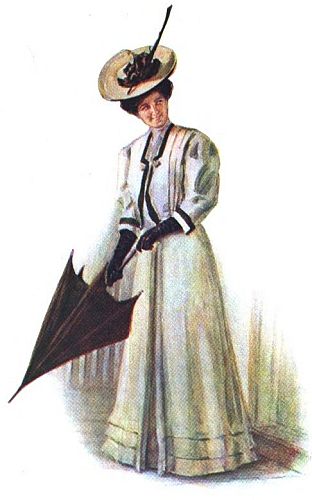 Barbara Wallace


 L.C. Page and

