Arrival of the New Federal Officers in July, 1862.—Colonel
Connor arrives with his Command.—The Message of Gov.
Harding.—The Mormons Indignant.—The Legislature refuse to
print the Message.—Action of the United States Senate
thereon.—Forgery in the Mormon Legislature.—Bill of Judge
Waite to amend the Organic Act.—Indignation
Meeting.—Governor Harding and Judges Waite and Drake
requested to leave the Territory.—Their
Replies.—Brigham.—The Federal Officers.
Judges Drake and Waite arrived in Salt Lake City on the 11th of July,
1862. Governor Harding had arrived a few days previous.
For several months everything passed off smoothly, and Brigham was more
than once heard to say the officers now in the Territory were "good
men." No circumstances occurred to develop any differences, and it was
hoped by the federal officers themselves that none would arise.
In the mean time, in October of the same year, Colonel (now General)
Connor marched into and through Salt Lake City with his command, and
established his camp on the "bench," or high land, about three miles
east of the city. His forces at that time consisted of the Third
Regiment of Infantry, California Volunteers, and the Second Regiment of
Cavalry, under command of Col. George S. Evans.
Some little excitement was caused by the entrance of the troops, and
rumors were rife of threats having been made by the Mormons that the
volunteers should never "cross the Jordan," a stream a few miles south
of the city, and which was directly on their line of march. But the
Jordan was crossed, the camp established, and everything went on as
usual, until the meeting of the Territorial Legislature in December.
Then the pent-up fires began to break forth. The first pretext used by
the Mormons for indulging in words and acts of hostility was the Message
of Governor Harding to the Legislature. Therein he called the attention
of the people, through their representatives, to the practice of
polygamy in their midst, to the anomalous state of society it tended to
establish, to its incompatibility with our free institutions, and
especially to its violation of an Act of Congress recently passed.
The following are the portions of the Message which gave most offence:—
"Polygamy.
"It would be disingenuous if I were not to advert to a
question which, although seemingly it has nothing to do in the
premises, yet is one of vast importance to you as a people,
and which cannot be ignored. I mean that institution which is
not only commended but encouraged by you, and which, to say
the least of it, is an anomaly throughout Christendom. I mean
polygamy, or, if you prefer the term, plurality of wives. In
approaching this delicate subject, I desire to do so in no
unkind or offensive spirit; yet the institution, founded upon
no written statute of your Territory, but upon custom alone,
exists. . . .
"I lay it down as a sound proposition, that no community can
happily exist with an institution so important as that of
marriage wanting in all those qualities that make it
homogeneal with institutions and laws of neighboring civilized
communities having the same object.
"Anomalies in the moral world cannot long exist in a state of
mere abeyance; they must, from the very nature of things,
become aggressive, or they will soon disappear, from the force
of conflicting ideas.
"This proposition is supported by the history of our race, and
is so plain that it may be set down as an axiom. If we grant
this to be true, we may sum up the conclusion of the argument
as follows: either the laws and opinions of the communities by
which you are surrounded must become subordinate to your
customs and opinions, or, on the other hand, yours must yield
to theirs. The conflict is irrepressible.
"But no matter whether this anomaly shall disappear or remain
amongst you, it is your duty at least to guard it against
flagrant abuses. That plurality of wives is tolerated and
believed to be right, may not appear so strange; but that a
mother and her daughters are allowed to fulfil the duties of
wives to the same husband, or that a man could be found in
all Christendom who could be induced to take upon himself such
a relationship, is, perhaps, no less a marvel in morals than
in matters of taste.
"The bare fact that such practices are tolerated amongst you
is sufficient evidence that the human passions, whether
excited by religious fanaticism or otherwise, must be
restrained and subjected to laws, to which all must yield
obedience. No community can long exist, without absolute
social anarchy, unless so important an institution as that of
marriage is regulated by law. It is the basis of our
civilization, and in it the whole question of the descent and
distribution of real and personal estate is involved.
"Much to my astonishment, I have not been able to find any law
upon the statutes of this Territory regulating marriage. I
earnestly recommend to your early consideration the passage of
some law that will meet the exigencies of the people.
"Act of Congress against Polygamy.
"I respectfully call your attention to an Act of Congress,
passed the 1st day of July, 1862, entitled 'An Act to punish
and prevent the practice of polygamy in the Territories of the
United States, and in other places, and disapproving and
annulling certain Acts of the legislative assembly of Utah,'
(chap. cxxvii. of the Statutes at Large of the last session of
Congress, page 501.) I am aware that there is a prevailing
opinion here that said Act is unconstitutional, and therefore
it is recommended by those in high authority that no regard
whatever should be paid to the same; and still more to be
regretted, if I am rightly informed, in some instances it has
been recommended that it be openly disregarded and defied,
merely to defy the same.
"I take this occasion to warn the people of this Territory
against such dangerous and disloyal counsels. Whether such Act
is unconstitutional or not, is not necessary for me either to
affirm or deny. The individual citizen, under no
circumstances whatever, has the right to defy any law or
statute of the United States with impunity. In doing so he
takes upon himself the risk of the penalties of that statute,
be they what they may, in case his judgment should be in
error.
"The Constitution has amply provided how and where all such
questions of doubt are submitted and settled, namely, in the
courts constituted for that purpose. To forcibly resist the
execution of that Act would be, to say the least, a high
misdemeanor; and if a whole community should become involved
in such resistance, would call down upon it the consequences
of insurrection and rebellion.
"I hope and trust that no such rash counsel will prevail. If,
unhappily, I am mistaken in this, I choose to shut my eyes to
the consequences.
"Liberty of Conscience.
"Amongst the most cherished and sacred rights secured to the
citizen of the United States, is the right to worship God
according to the dictates of conscience. . . .
"Religion was left a matter between man and his Maker, and not
between man and the Government.
"But here arises a most important question,—a question
perhaps that has never yet been asked or fully answered in
this country,—How far does the right of conscience extend? Is
there any limit to this right?—and if so, where shall the
line of demarcation be drawn, designating that which is not
forbidden from that which is? This is, indeed, a most
important question, and from the tendency of the times, must
sooner or later be answered. I cannot, and will not, on this
occasion, pretend to answer this question; but will venture
the suggestion, that when it is answered, the same rules will
be adopted as if the freedom of speech and of the press were
involved in the argument.
. . . "There can be no limit beyond which the mind may not
dwell, and our thoughts soar in our aspirations after truth.
We may think what we will, believe what we will, and speak
what we will, on all subjects of speculative theology. . . . But
when religious opinions assume new manifestations, and pass
from the condition of mere sentiment into overt acts,—no
matter whether they be acts of faith or not,—they must not
outrage the opinions of the civilized world, but, on the
other hand, must conform to those usages established by law,
and which are believed to underlie our very civilization."
In the same Message, the Governor, after giving his views upon the
national topics of the day, fully sustaining the Administration and the
war, proceeded to discuss all the more prominent subjects of local
interest in the Territory. He referred to the attempts to procure the
admission of the State of Deseret into the Union,—giving it as his
opinion that those attempts were premature. He referred to provisions of
the Organic Act, and claimed the right to nominate to the Council all
general territorial officers. These had formerly been elected by the
Legislature.
He recommended a thorough revision and codification of the statutes; a
change in the mode of voting; referred to the financial condition of the
Territory; adverted to the Indian troubles; advised the organization of
a common-school system, and closed by assuring them of his willingness
and desire to work with them for the common good and welfare of the
people of the Territory.
The question of polygamy was boldly met and temperately discussed in
this Message, and the people warned against the consequences of
disobedience to the Act of Congress. Anything less than this on the part
of the Governor would have been simply a neglect of duty.
Yet the Mormons were very indignant, and professed to look upon that
portion of the Message as exceedingly hostile and offensive in its
character. Their religion had been attacked by the federal authorities!
It may be well here to remark, for the benefit of the tender-footed upon
this subject, that polygamy is no part of the Mormon religion, so far as
the same has any history, and can be distinguished from the personal
edicts of Brigham Young. It is not only not permitted but explicitly
condemned in the "Book of Mormon" and the "Book of Doctrines and
Covenants," which are the Old and New Testaments of Mormonism. This
subject is more fully examined in the last chapter of this work.
From the delivery of this Message, the treatment which the Governor
received at the hands of the Mormons was entirely changed. From respect
it was immediately changed to disrespect and contumely. No contemptuous
treatment was too marked, no indignity was too great, to be heaped upon
him, for this simple performance of his duty as a sworn officer of the
United States Government.
The Message was never printed by the Legislature. The Journals did not
even show that the Governor ever appeared before that body for any
purpose whatever.
The fact that the Message was not published having been communicated to
Washington, a resolution was introduced into the Senate of the United
States on the 16th of January, 1863, instructing the Committee on
Territories to inquire and report whether the publication of the Message
of the Governor of the Territory of Utah to the Territorial Legislature
had been suppressed, and if so by what causes, and what was the Message.
In response to this resolution Mr. Wade, chairman of the Committee, on
the 13th of February, submitted a Report, accompanied by a resolution,
which was adopted, that one thousand copies of the Message be printed,
and sent to the Governor for distribution.
This Report of the Committee was less complimentary to the Mormons than
the Message itself.
The following extracts will indicate the character of the document:—
"In pursuance of the instruction contained in this resolution,
your committee have the honor to report, that they have
collected all the facts, and taken all the testimony within
their reach,—the substance of which, together with a copy of
the Message, is herewith presented.
"These sources of information disclose the fact, that the
customs which have prevailed in all our other Territories in
the government of public affairs have had but little
toleration in the Territory of Utah; but in their stead there
appears to be, overriding all other influences, a sort of
Jewish theocracy, graduated to the condition of that
Territory.
"This theocracy, having a supreme head who governs and guides
every affair of importance in the Church, and, practically, in
the Territory, is the only real power acknowledged here, and
to the extension of whose interests every person in the
Territory must directly or indirectly conduce. . . .
"We have here the first exhibition, within the limits of the
United States, of a Church ruling the State. . . .
"Another opinion—the subject of both public and private
teaching—is, that the Government of the United States will
not and ought not to stand. They make a difference between the
Constitution and the Government of the United States; to the
Constitution they claim to be very loyal.
. . . "Because the Governor, in his Message, has animadverted
upon some of the customs of the Mormons, and has recommended
that steps be taken to Americanize the same, he has given
offence, and has had his Message suppressed.
"Polygamy of the most unlimited character, sanctioning the
cohabitation of a man with the mother and her daughters
indiscriminately, is not the only un-American thing among
them.
. . . "The Message, on examination, is found to contain nothing
that should give offence to any legislature willing to be
governed by the laws of morality.
"It is the opinion of your Committee that the Message is an
able exposition of the manners and customs of the people in
that Territory, and as such, brought down the censure of the
leaders of the Mormon Church, and were it not for the
animadversions therein contained, it would not have been
suppressed."
The printing and distribution of the Message is then recommended.
During the session of the Legislature an event occurred which caused
much indignation among the federal officers, and served to render
somewhat mutual the feelings of hostility which the leading saints
already entertained. This was nothing less than a forgery committed in
the Legislature upon a bill relating to the terms of one of the District
Courts.
The facts were as follows:—
The Territory was divided into three judicial districts. The First,
sometimes called the Provo District, comprised a number of counties
carved out of the centre of the Territory. This had been assigned to
Judge Drake. The Second, called the "Cotton District," was assigned to
Judge Waite, and consisted of the three southernmost counties, Beaver,
Iron, and Washington. The Third District, Chief Justice Kinney's,
comprised the northern part of the Territory, including Salt Lake City.
On the 14th of January, 1863, the Legislature passed a bill, which was
signed by the Governor, changing the county seat of Washington County
from Washington to St. George, and in the same bill it was provided that
the United States Court for the transaction of territorial business,
should be held at St. George, on the third Monday of May. This time was
the same as that provided by the law previously in force.
This was before the assignment of the Judges had been made.
After Judge Waite had been assigned to the Second District [in which
many murders had been committed, and the murderers still at large], the
Legislature concluded they did not want court held in that district
until fall. They accordingly passed a bill, providing, among other
things, for holding the court at St. George on the third Monday of
October. But as they had already passed a bill fixing the term of court
in May, and as the Judge preferred to hold the term in May, that being
near the time when he was intending to hold court for the transaction of
United States business in the same district, the Governor declined
signing the second bill.
Soon after, having occasion to examine the first bill for another
purpose, he went to the Secretary's office and called for the bill, and
behold, the word May had been erased, and the word October inserted
instead! It appeared to have been done by the same hand which had
penned the body of the bill. This had been written by one of the clerks
of the House of Representatives. The Governor, after signing the bill,
had inadvertently returned it to the Legislature, and it had been sent
from that body to the Secretary's office, where it should have been sent
by the Governor. It had been recorded in that office before the forgery
was discovered.
The Governor immediately caused the record to be corrected, changed the
bill back from October to May, by erasing the word "October" and
interlining the word "May." He then made a statement of the forgery and
its detection, over his own signature, on the margin of the bill.
He then sent a special Message to the Legislature, calling their
attention to the fact that a forgery had been committed; but, instead of
taking steps to ferret out the guilty party, the Legislature made an
issue of fact with the Governor, and endeavored to make out that it was
all the time October, and that no forgery had been committed. When the
matter was up in the House the second time, one member actually produced
a paper which he averred was the original draft, and which had October
in it. And this in the face of the fact, that five persons had seen the
bill in the Governor's office when the word May was in it, and that the
bill showed plainly, upon inspection, that it had been changed; the
outline of the letter "y," in the word erased, being distinctly visible.
Thus the Legislature, by their collective action, implicated themselves
all in the forgery.
On the 16th of January the Legislature adjourned, without printing the
Governor's Message, or sending any appropriation bills for his
signature.
The day following, "the Legislature of the State of Deseret" met, and
commenced doing business under Brigham Young, as Governor. A Message was
delivered, and all the forms of legislation gone through with; in
reality, this de facto government was the only one for which the
Mormons maintained even the show of respect.
The judicial system of the Territory was manifestly very defective, and
as constituted under the Organic Act of 1850, as the same had been
construed by the Federal Judges, was inadequate to the administration of
justice.
The greatest difficulty was experienced in the formation of juries, and
in the extraordinary jurisdiction assumed by the Probate Judges, all of
whom were Mormons.
The jurisdiction of the Probate Court, in the words of the Organic Act,
was to be "as prescribed by law." Under this provision several of the
United States Judges had held that it was competent in the Legislature
to confer upon the Probate Courts any jurisdiction they pleased. The
Mormons, never behind in availing themselves of all advantages, had
accordingly granted to the Probate Courts concurrent jurisdiction with
the District Courts, in all cases civil and criminal.
Again; the juries had been selected by these courts acting with other
county authorities, and it was contended that the United States Courts
could only try causes before juries thus selected.
To remedy these defects, and to remove all doubt as to these complicated
questions, a bill was drawn by Judge Waite, for an Act of Congress
amendatory of the Organic Act of 1850. It provided for the selection of
United States juries by the Marshal, under the direction of the court,
as in other district and territorial courts of the United States.
The question of jurisdiction was to be settled by an express provision
that the Probate Court should have no jurisdiction to try any civil
action whatsoever. It was to do the usual probate business, and have a
limited criminal jurisdiction, subject to appeal to the District Court.
The bill also provided for an organization of the militia of the
Territory, under the Governor, and contained several other wholesome and
salutary provisions.
The bill was carefully drawn, and was submitted to the inspection of his
associate, Judge Drake, and of Governor Harding,—Judge Kinney being
absent from the Territory. It received the unqualified approval of Drake
and Harding, and, with their indorsement upon it, was sent to
Washington. In due time it was introduced in Congress by Senator
Browning, and referred to the proper committee.
The introduction of this bill was the signal for another outbreak. The
news was telegraphed to Salt Lake, and immediately Brigham called a
meeting at the Tabernacle.
The meeting was held on the 3d of March 1863. Notice having been
extensively circulated, some two or three thousand persons assembled,
excited by exaggerated statements concerning attempts upon the part of
the federal officers to "interfere with their rights."
Speeches of the most inflammatory character were made at this meeting,
and the resentment and indignation of the ignorant masses of the people
were excited to the highest pitch. The following will serve as a
specimen of these harangues.
Elder John Taylor said:—
"It has already been stated that these documents speak for
themselves. They come from those who are ostensibly our
guardians, and the guardians of our rights. They come from men
who ought to be actuated by the strictest principles of honor,
truth, virtue, integrity, and honesty, and whose high official
position ought to elevate them above suspicion,—yet what are
the results?
"In relation to the Governor's Message, enough, perhaps, has
already been said. . .
"We had a right to look for a friend in our Governor, who
would, at least, fairly represent us. Instead, we have had a
most insidious foe, who, through misrepresentations, base
insinuations, and falsehood, is seeking with all his power,
privately as well as officially, not only to injure us before
the Government, but as well to sap the very foundations of our
civil and religious liberties; he is, in fact, in the
furtherance of his unhallowed schemes, seeking to promote
anarchy and rebellion, and dabbling in your blood. [Cries of
'hear, hear.'] Such, it would seem, were the Governor's
feelings and intentions when he concocted his Message, and
such his purposes when he read it before the Legislature. That
document was not hastily written, as it shows upon its face
that it had been well digested, and every word and sentence
carefully weighed.
. . . "That he is the most vindictive enemy we have, is shown by
the statement of our representatives at Washington.
"He is the only man, it would seem, who is industriously
striving to sap the interests of our people, and to injure
their reputation, and yet, as our Governor, he professes to
feel a deep interest in our welfare, and to represent our
wishes.
"Let us, for a short time, investigate the results of his
acts, should his purposes be successful, leaving the
allegations of treason from our consideration. [It was
contended that the Governor and Judges had committed Treason
against the Territory.]
"We have thought that we were living under a republican form
of government, and had the right of franchise; that we had the
privilege of voting for whom we pleased, and of thus saying
whom we would have represent us; but it may be that we are
laboring under a mistake, and that it is but a political
illusion. We have likewise thought that if any one among us
was accused of crimes, it was his privilege to be tried by a
jury of his peers, among whom he had lived, who would
undoubtedly be the best judges of his actions.
"We have further been of the opinion that while acting in a
military capacity, when called into service to stand in
defence of our country's rights, we had the right of selecting
our own officers. We have always had this privilege, in
accordance with republican usage; but we can do so no longer
should the plotting of Governor Harding and our Honorable
Judges be carried into effect. We shall be deprived of
franchise, of the right of trial by an impartial jury, and
shall be placed, in a military capacity, under the creatures
of Governor Harding, or of his successors. In other words, we
shall be forever deprived of all the rights of freemen, and
placed under a military despotism; such would be the result of
the passage of this Act.
"Again, in regard to juries, already referred to, you know
what, as regards this matter, the usage has always been. The
Governor and Judges want to place the power in the hands of
the United States Marshal of selecting such jurors as he
pleases, and that, too, without reference as to who they are,
or whence they come. This is what is attempted to be done by
our honorable Judges and Governor. Your rights as freemen, and
your liberties, are aimed at; and you are to be disfranchised,
and your liberties trampled under foot, by strangers, and you
will have blacklegs and cut-throats sit upon your juries. Mr.
Harding wants to select his own military, and have officers of
his own selection to lead them, and then if you do not submit,
he will have the authority to say, 'I will make you.'
[Uproarious applause, and cries all over the house of 'Can't
do it.'] We all know he can't do it, but this is what he is
aiming at [Clapping of hands, and great cheering.] When these
rights are taken away, what rights have we left? [Cries of
'None.']
"It can scarcely be credited or believed, that any man in his
position could so far degrade himself as to introduce such
infamous principles, and it is equally a lamentable fact to
reflect upon, that men holding the high and responsible
position of United States Judges could so far forget
themselves as to descend to such depravity, corruption, and
injustice. [Applause.] These things are so palpable, that 'he
that runneth may read,' and any man with five grains of common
sense can readily comprehend them. It is for you to say
whether you are willing to sustain such men in the capacity
they act in, or not." [Loud clapping of hands, and a universal
and emphatic cry of "No!" on the part of the audience.]
Brigham Young's Speech.
At the close of Elder Taylor's speech Brigham arose, and on advancing to
the speaker's desk was greeted with vociferous applause, and immediately
proceeded to address the assemblage as follows:—
"I have no intention of delivering a lengthy address, but
while I am speaking I desire the audience to remain quiet. I
know well your feelings, but much prefer that you should
suppress any demonstrations of applause to other times and
places, when you may have less business and greater leisure.
"You have just heard read the Message of Governor Harding,
delivered to the last Legislative Assembly of this Territory.
You will readily perceive that the bread is buttered, but
there is poison underneath. When he came to Utah last July,
the Governor sought to ingratiate himself into the esteem of
our prominent citizens, with whom he had early intercourse,
and professed great friendship and attachment for the people
of the Territory. He was then full of their praises, and said
he was ready to declare that he would stand in the defence of
polygamy, or that he should have to deny the Bible; and stated
that he had told the President, prior to leaving Washington,
that if he were called upon to discuss the question, he would
have to take the side of polygamy, or to renounce the
authority of the Scriptures.
"In the face of all these professions, what has been his
course? While being fair of speech, and specious of promise,
and lavish in his expressions of good-will toward us, he has
been insidiously at work to prejudice the General Government
against us, and in the secrecy of his private room has
concocted measures which he urged upon Congress to pass,
which, if successful, would deprive us of the dearest rights
of freemen, and render us the abject subjects of this man, who
has been sent here to govern the Territory. Man, did I
say?—thing, I mean,—a nigger-worshipper,—a black-hearted
abolitionist is what he is, and what he represents; and that I
do naturally despise. He wants to have the telegraph torn
down, and the mails stopped and turned by the way of Panama.
Do you acknowledge this man Harding for your Governor? [Voices
all through the audience responded, 'No, you are our
Governor.'] Yes, I am your Governor; and I will let him know
that I am Governor; and if he attempts to interfere in my
affairs, 'Woe, woe unto him!' [Shaking his uplifted fist in a
very excited manner, which was responded to with loud
applause, and cries of 'Yes, you are our Governor.']
"Will you allow such a man to remain in the Territory?
[Voices, 'No; put him out.'] Yes, I say put him out. Judges
Waite and Drake are perfect fools, and the tools of Governor
Harding, and they too must leave. If all three do not resign,
or if the President does not remove them, the people must
attend to it.
"If they could get the power, as they want to do, to have the
Marshal choose jurors of cut-throats, blacklegs, soldiers, and
desperadoes from California, and we are to be tried by such
men, what would become of us?
"In regard to the war now desolating the country, it is but
the fulfilment of the prophecies of Joseph Smith, which he
told me thirty years ago. Brother Joseph said that the South
would rise against the North, and the North against the South,
and that they would fight until both parties were destroyed;
and for my part I give it God speed; for they have spilt the
blood of the Prophet. [To which the audience responded
vociferously, 'Amen!']
"I would like to live in peace with the Government of the
United States, but have no desire to live with the people who
have brought ruin and disgrace upon their own heads. I do not
wish to live in, or have anything to do with the United
States; I will have a free and independent government for
myself, where I may live and enjoy my civil and religious
liberties. [Loud cries of 'Amen,' and 'Yes, yes,' on the part
of the entire assemblage.]
"When our rights, and the protection of our liberties are
taken from us, what is there remaining? [Voices, 'Nothing,'
'Nothing.'] Yes, service to despots,—service to tyrants."
Brigham also said that money had been appropriated for the purpose of
turning the mail by the way of Panama; and these men were not above
taking money for such a purpose, under pretence of other business.
The injustice and falsity of these statements concerning the bill
introduced into Congress, and which was the immediate cause of this
outbreak, will be manifest, when it is stated that so far from
authorizing soldiers to sit as jurymen, it was expressly prohibited in
the bill itself. Again; the right of suffrage was actually extended by
the bill, because, while by one section the militia officers were to be
appointed by the Governor, the bill in other sections provided that
nearly all civil officers of the Territory, who were before elected by
the Legislature, should be elected by the people.
The effect of the bill would have been, to enable the people, when they
became generally dissatisfied with the spiritual tyranny to which they
were submitting, as many of them were already, to throw off the yoke of
despotism, by having every question that might arise fairly and
impartially adjudicated upon in the courts. This was foreseen by
Brigham. He saw that he was about to lose the powerful enginery of the
judicial system of the Territory, then under his control. Hence the
demonstration.
There are but two ways in which this theocratic despotism can be met and
overthrown. One is, by the people of the Territory, aided by some such
legislation as that proposed. The other is by the strong arm of military
power. The former would be more congenial to our institutions.
Time only can determine which must be resorted to. Doubtless the
employment of force will become necessary in either case,—as the course
taken by Young and his associates on this occasion shows that a
peaceable remedy will be forcibly resisted.
After listening to such speeches, the audience were, of course, ready to
adopt or approve of anything; and the following resolutions, prepared
for the occasion, were passed without a dissenting voice:—
"Resolved, That we consider the attack made upon us by His
Excellency Governor Harding, wherein our loyalty is impugned,
as base, wicked, unjust, and false; and he knew it to be so
when uttered.
"Resolved, That we consider the attempt to possess himself
of all military authority and dictation, by appointing all the
militia officers, is a stretch of military despotism, hitherto
unknown in the annals of our Republic.
"Resolved, That we consider his attempt to control the
selection of juries as so base, unjust, and tyrannical, as to
deserve the contempt of all free men.
"Resolved, That we consider the action of Judges Waite and
Drake, in assisting the Governor to pervert justice, and
violate the sacred palladium of the people's rights, as
subversive of the principles of justice, degrading to their
high calling, and repulsive to the feelings of honest men.
"Resolved, That we consider that a serious attack has been
made upon the liberties of this people, and that it not only
affects us as a Territory, but is a direct assault upon
Republican principles in our own nation and throughout the
world; and that we cannot either tamely submit to be
disfranchised ourselves, nor witness, without protest, the
assassin's dagger plunged into the very vitals of our national
institutions.
"Resolved, That while we will, at all times, honor and
magnify all wholesome laws of our country, and desire to be
subservient to their dictates, and the equitable
administration of justice, we will resist, in a proper manner,
every attempt upon the liberties, guaranteed by our fathers,
whether made by insidious foes or open traitors.
"Resolved, That a committee be appointed by the meeting to
wait upon the Governor, and Judges Waite and Drake, to request
them to resign their offices and leave the Territory.
"Resolved, That John Taylor, Jetu Clinton, and Orson Pratt,
Sen., be that committee.
"Resolved, That we petition the President of the United
States to remove Governor Harding, and Judges Waite and Drake,
and to appoint good men in their stead."
The following is the petition to the President, which was signed by
several thousand persons:—
"To His Excellency Abraham Lincoln, President of the United States:—
"Sir,—We, your petitioners, citizens of the Territory of
Utah, respectfully represent that,
"Whereas, From the most reliable information in our
possession, we are satisfied that His Excellency Stephen S.
Harding, Governor, Charles B. Waite and Thomas J. Drake,
Associate Justices, are strenuously endeavoring to create
mischief and stir up strife between the people of the
Territory of Utah and the troops now in Camp Douglas,
(situated within the limits of Great Salt Lake City,) and, of
far graver import in our nation's difficulties, between the
people of the aforesaid Territory and the Government of the
United States:
"Therefore, We respectfully petition your Excellency to
forthwith remove the aforesaid persons from the offices they
now hold, and to appoint in their places men who will attend
to the duties of their offices, honor their appointments, and
regard the rights of all, attending to their own affairs and
leaving alone the affairs of others; and in all their
conduct demeaning themselves as honorable citizens and
officers worthy of commendation by yourself, our Government,
and all good men; and for the aforesaid removals and
appointments your petitioners will continue most respectfully
to pray.
"Great Salt Lake City, Territory of Utah, March 3, 1863."
The best reply to the charges contained in the foregoing petition, is
the counter-petition sent to the President by the military officers of
General Connor's command, of which the following is a copy:—
"Headquarters, Column for Utah, Camp Douglas,
Utah Territory, near Salt Lake City, March 8, 1863. |
|
"To His Excellency Abraham Lincoln, President of the United
States:—
"It is an unusual proceeding for officers of the army to join
in representing to the Government their knowledge of facts and
opinion of proceedings, having reference to civil authority,
or to the actions of the people for expressing their
displeasure at the conduct of their officers.
"The condition of affairs in the Territory of Utah, however,
and the result of this condition of affairs, which culminated
in a mass meeting in Salt Lake City on the 3d inst., in our
opinion demands from us a respectful statement to your
Excellency of the matter having allusion to ourselves, simply
as an act of duty we owe to our Government.
"We do not propose to inquire into recommendations affecting
the laws of the Territory, made by the Governor and Associate
Judges of the Supreme Court of Utah. The Government must know,
as regards the justice or injustice of the proposed amendments
to existing laws, made by the officers above named.
"But when the community residing in Salt Lake City solemnly
declare in their petition to your Excellency, that Governor
Harding, and Judges Waite and Drake are studiously endeavoring
to create mischief and stir up strife between the people of
the Territory and the troops now at Camp Douglas (situated
within the limits of Salt Lake City), they simply assert a
base and unqualified falsehood.
"On the contrary, it has been the aim of these gentlemen to
preserve friendly relations between the people of Utah and the
troops, who have also labored to the same end, now stationed
at Camp Douglas.
"And further; during a period of nearly five months, we know
that Governor Harding, and Judges Drake and Waite 'have
attended to the duties of their offices, honored their
appointments, regarded the rights of all, attended to their
own affairs,' and have not disturbed or interfered with the
affairs of others, outside of their legitimate duty to the
Government; 'and in all their conduct,' His Excellency
Governor Harding, and Judges Drake and Waite, have, during our
acquaintance with them, 'demeaned themselves as honorable
citizens, and officers worthy of commendation by your
Excellency, our Government, and all good men.'
"And we further represent to your Excellency that these
officers have been true and faithful to the Government, and
fearless in the discharge of their duties to all. They have,
on all proper occasions, spoken plainly to the people of their
duty. They have not been subservient to any person or persons,
and they stand proudly preëminent as in contrast with other
officers who have represented in the past, and who do now
represent, the Federal Government in this Territory.
"Our respectful opinion is, that there is no good and true
cause for the removal of His Excellency Governor Harding, and
Judges Drake and Waite, from the offices they now hold.
"With much respect, we have the honor to remain your
Excellency's obedient servants,—
"P. Edward Connor, Colonel 3d Infantry, California Volunteers,
commanding District of Utah; Geo. S. Evans, Colonel 2d
Cavalry, Cal. Vol.; P. A. Gallagher, Major 3d Infantry, C. V.;
J. M. Williamson, Surgeon, 2d Cavalry, C. V.; Robert K. Reid,
Surgeon 3d Infantry, C. V.; George Wallace, Capt. and Asst. Q.
M. U. S. A.; Thomas B. Gately, 1st Lieut. and Reg. Q. M.;
William L. Ustick, 1st Lieut. and Adjt. 3d Infantry, and A. A.
A. G.; T. S. Harris, 1st Lieut. and Adjt. 2d Cavalry, C. V.;
Henry R. Miller, 2d Lieut. and Reg. C. S., 2d Cavalry, C. V.;
F. A. Peel, 2d Lieut. and Reg. Q. M. 2d Cavalry, C. V.;
Charles Tupper, Captain 3d Infantry, C. V.; John B. Urmy,
Captain 3d Infantry, C. V.; Samuel N. Hoyt, Captain 3d
Infantry, C. V.; David Black, Captain 3d Infantry, C. V.; S.
P. Smith, Captain 2d Cavalry, C. V.; Daniel McLane, Captain
2d Cavalry, C. V.; George F. Price, Captain 2d Cavalry, C.
V.; David J. Berry, Captain 2d Cavalry, C. V.; Josiah Hosmer,
1st Lieut. 3d Infantry, C. V.; James W. Stillman, 1st Lieut.
3d Infantry, C. V.; Lysander Washburn, 2d Lieut. 3d Infantry,
C. V.; Michael McDermott, 1st Lieut. 3d Infantry, C. V.; John
Quinn, 1st Lieut. 2d Cavalry, C. V.; Cyrus D. Clark, 1st
Lieut. 2d Cavalry, C. V.; Francis Honeyman, 2d Lieut. 3d
Infantry, C. V.; S. E. Joslyn, 2d Lieut. 3d Infantry, C. V.;
James Finnerty, 2d Lieut. 3d Infantry, C. V.; Edward Ingham,
2d Lieut. 3d Infantry, C. V.; Anthony Ether, 2d Lieut. 2d
Cavalry, C. V.; J. Bradley, 2d Lieut. 2d Cavalry, C. V.; Geo.
D. Conrad, 2d Lieut. 2d Cavalry, C. V."[97:A]
But to return to the meeting, and subsequent proceedings:—
The next morning, the Committee appointed to wait upon the officers and
"request" them to resign and leave the Territory, called upon Governor
Harding, at his residence, and presented him with a copy of the "Deseret
News," containing the reported proceedings of the meeting.
The Governor treated them with much courtesy, and after examining the
paper, addressed the Committee, as follows:—
"Gentlemen, I believe I understand this matter perfectly. You
may go back and tell your constituents that I will not resign
my office, and will not leave this Territory, until it shall
please the President to recall me. I came here a messenger of
peace and good-will to your people, but I must confess that my
opinions have changed in many respects. But I came also, sirs,
to discharge my duties honestly and faithfully to the
Government, and I intend to do so to the last. It is in your
power to do me personal violence,—to shed my blood; but this
will not deter me from my purpose. If the President can be
made to believe that I have been unfaithful to the trust he
confided to me, he will doubtless remove me; and I then shall
be glad to return to my home in the States, and will do so,
carrying with me no unjust resentments towards you or any one
else.
"But I will not be driven away; I will not cowardly abandon
my post. I may be in danger in staying; but my purpose is
fixed. I desire to have no trouble; I am anxious to live and
again meet my family,—but if necessary, an administrator can
settle my affairs.
"Your allegations in this paper are false,—without the shadow
of truth. You call my Message insulting, and you dare not
print it for fear your people may read it for themselves. To
say that I have wronged you when I said that you are disloyal,
is simply preposterous. Your own people—your public teachers
and bishops—admit the fact.
"Let me say to you in conclusion,—and as this is said to be a
land of prophets, I too will prophesy,—If, while in the
discharge of my duties, one drop of my blood be shed by your
ministers of vengeance, that it will be avenged, and not one
stone or adobe in this city will be left upon another. I have
now done, and you understand me."
During this reply the Committee sat quiet, with the exception of Elder
Taylor, who several times attempted to make some explanation; but the
Governor refused to hear him, and went through with his remarks without
stopping to listen, or reply to any new matter.
Elder Taylor then turned to Judge Drake, and remarked that he might
consider the resolutions as addressed also to him.
The Judge responded as follows:—
"The communications you have made are of some importance, and
as they are intended to affect me, I desire to say something
before you go.
"It is no small thing to request a citizen to leave his
country. Are you aware of the magnitude or of the baseness of
what you have undertaken? I deny that you have any cause for
such conduct toward me. I am an American citizen, and as such
have a right to go to every part of the Republic. I have the
right to petition, or ask the Government to pass laws; or to
amend them. You, Taylor and Pratt, are men of experience, and
reputed to be men of learning, and ought to know better than
to insult a man by such means.
"It is mean and contemptible. On your part, Taylor, a
foreigner, it is impudence unequalled; and Pratt, a citizen,
ought to know better than to trample on the rights of a
citizen by engaging in such a dirty enterprise. Your
resolutions are false, and those who drafted them knew them to
be so; and I am informed that in the meeting at the
Tabernacle, Brigham Young called me a fool, and a tool of the
Governor. [Here Taylor admitted that such was the fact.]
"Go back to Brigham Young, your master,—that embodiment of
sin and shame and disgust,—and tell him that I neither fear
him, nor love him, nor hate him,—that I utterly despise him.
Tell him, whose tools and tricksters you are, that I did not
come here by his permission, and that I will not go away at
his desire, or by his directions. I have given no cause of
offence to any one. I have not entered a Mormon's house since
I came here; your wives and daughters have not been disturbed
by me, and I have not even looked upon your concubines and
lewd women.
"I am no skulk from the punishment of crimes. I tell you, if
you, or the man whom you so faithfully serve, attempt to
interfere with my lawful business, you will meet with trouble
of a character you do not expect.
"A horse-thief or a murderer has, when arrested, a right to
speak in court; and unless in such capacity, or under such
circumstances, don't you ever dare to speak to me again."
The Committee rose to depart, and one of them said, "We have our
opinions." "Yes," replied the Judge, "thieves and murderers can have
opinions;" and thus closed the interview.
The Committee then proceeded to call on Judge Waite at his residence,
where they were received politely and with due consideration. In answer
to their request for his resignation and withdrawal from the Territory,
he replied as follows:—
"To comply with your wishes, gentlemen, under such
circumstances, would be to admit, impliedly at least, one of
two things,—either that I was sensible of having done
something wrong, or that I was afraid to remain at my post and
perform my duty.
"I am not conscious either of guilt or fear. I must therefore
respectfully decline to accede to your request."
These replies were published in California, and in the Eastern papers,
and gave general satisfaction. The people rejoiced that at last the
Government had representatives in Utah who could neither be wheedled nor
bullied out of their rights, nor frightened from the performance of
their duty.
In Utah the excitement for a time ran high, and doubtless nothing but
the presence of the military saved the federal officers from personal
violence.
The state of popular feeling there is well shown by the following
extracts from the correspondence of the "Chicago Tribune":—
"Excitement ran high, and groups of men were to be seen on the
corners of the various streets, busily engaged in canvassing
the subject, their earnest gestures and eager attitudes
portraying the depth and intensity of the frenzied feeling
which actuated them.
"One of the Judges sought to be ostracised (Judge Waite) was
accosted, while passing quietly along the sidewalk, by a group
of excited men, and threats of an alarming character made use
of to intimidate him.
. . . "The few 'gentiles' resident here were also to be observed
in earnest discussion of the question, and with compressed lip
and countenance, on which 'thought sat sedate,' awaited, cold
and determined, the approach of coming events. I opine that
many a bowie and revolver were hastily examined and adjusted,
of which the passer-by had no thought or knowledge, which, in
an emergency, might have been made useful.
"It was a spectacle of true courage to see these federal
officers, clothed with important duties, stand up and assert
their rights, when they knew but too well that this 'request'
upon the part of the meeting and the Committee had a far more
grave significance, if that request were not complied with.
"They have been called on by a number of citizens and
gentlemen since the visit of the Committee, and have received
but one expression of opinion as to what has passed; and that
is, that the proceedings throughout were an outrage, and only
intended to get rid of men who cannot be used against the
interest of the General Government, and whose fidelity to duty
makes them alike hated and feared by the Mormon leaders."
The following, from the same correspondence, will show the conduct of
Young during this emergency:—
"While the objects of all this wrath pursue the even tenor of
their way, and sleep soundly, with scarce a casement barred,
unmindful of the threatened storm without, yet not so with
him, 'the Lord's Anointed,' who appears to dream dreams and
see visions, that to his distempered fancy seem to foreshadow
the 'handwriting on the wall,' at the great day of his
judgment which is to come. Like unto the great magician, the
famous Fakir, who upon a time, by his incantation, raised a
demon which he could not control, which would not 'lay' at the
conqueror's command, and from which he fled in dismay; so, in
the present instance, the 'Lion of the Lord' is sorely
affrighted at the hideous aspect of the devil ('of a muss') he
has raised, which, he has the sagacity to see, may not 'down'
at his bidding, but may return to plague the inventor.
"There is abundant evidence to show that he is alarmed at his
own creation, and foreseeing that he has provoked justice,
incensed mercy, seeks to guard against the retribution which
he knows the offended majesty of loyalty and law should visit
upon him.
"The night succeeding the action of the mass meeting, some
fifty armed sentinels or guards were on duty, in and about
Brigham's premises, which number has since been augmented to
several hundreds, a portion of whom serve as pickets, or
night-patrol, on the different streets leading toward Camp
Douglas. It has been currently reported that orders have been
issued to arrest Brigham and his counsellors, and hence these
precautionary measures to guard against any sudden inroad of
troops from Col. Connor's command. . . .
"On the 8th inst., the Sabbath succeeding the date of the mass
meeting, Brigham delivered a very treasonable and violent
harangue in the Tabernacle, to an immense audience, which
filled almost to suffocation that capacious structure. . . . 'We
have always,' he said, 'done everything in our power to show
our loyalty. Is there anything that could be asked that we
would not do? Yes; let the present Administration ask us for a
thousand men, or even five hundred, and I'd see them damned
first, and then they couldn't have them! What do you think of
that? [Loud cries of "Good, good!" and great applause.] We
have liars, murderers, and thieves among us, who are watching
us, to report something against our loyalty. Their object is
to send another army here to "wipe us out"; but let me tell
them that cannot be done; "they can't come it,"—putting his
thumb to his nose, and making the peculiar gyrating movement
with the fingers, so very expressive among rowdies and
shoulder-hitters. At this antic, a long, and loud, and
universal shout and laughter went up from all parts of the
house, joined with clapping of hands, and stamping of the
feet, in one general din and uproar.
"'It was said that we were disloyal because we burned some
seventy government wagons, at the time Johnston's army came
here. Well, let me ask, what the devil were they doing out
here? Coming here to destroy, and wipe us from the face of
the earth; and we only took and destroyed some of their good
things, so that they had to gnaw mules' bones, and eat
cattle which had frozen to death; that's what they did.
"'I swear some, my brethren and sisters; but it is always in
the pulpit,—never anywhere else.'
"Following Brigham came 'brother Heber,' a large, gross man,
bald-headed, and with a harsh and disagreeable voice, and
apparently fast approaching the age of 'the lean and slippered
pantaloon.' His remarks were in the main but a re-hash of
those made by Brigham, save in one or two noticeable points,
as follows:—'They say I am a secessionist, but that's a
lie. Then they say I have more than one wife; well, I have
several wives, and lots of children, and by the help of the
Lord I'll have many more of them!'
"Speaking about anticipated trouble with the General
Government, he said:—'The entire power of the United States
cannot destroy us, for the Lord will fight our battles.'
"Brigham fears Arrest.
"Yesterday Col. Connor rode into the city, and called on Judge
Waite at his residence, and made a stay of perhaps an hour or
so. Immediately after his departure, a signal of distress was
hastily thrown to the breeze, from a small flag-staff on
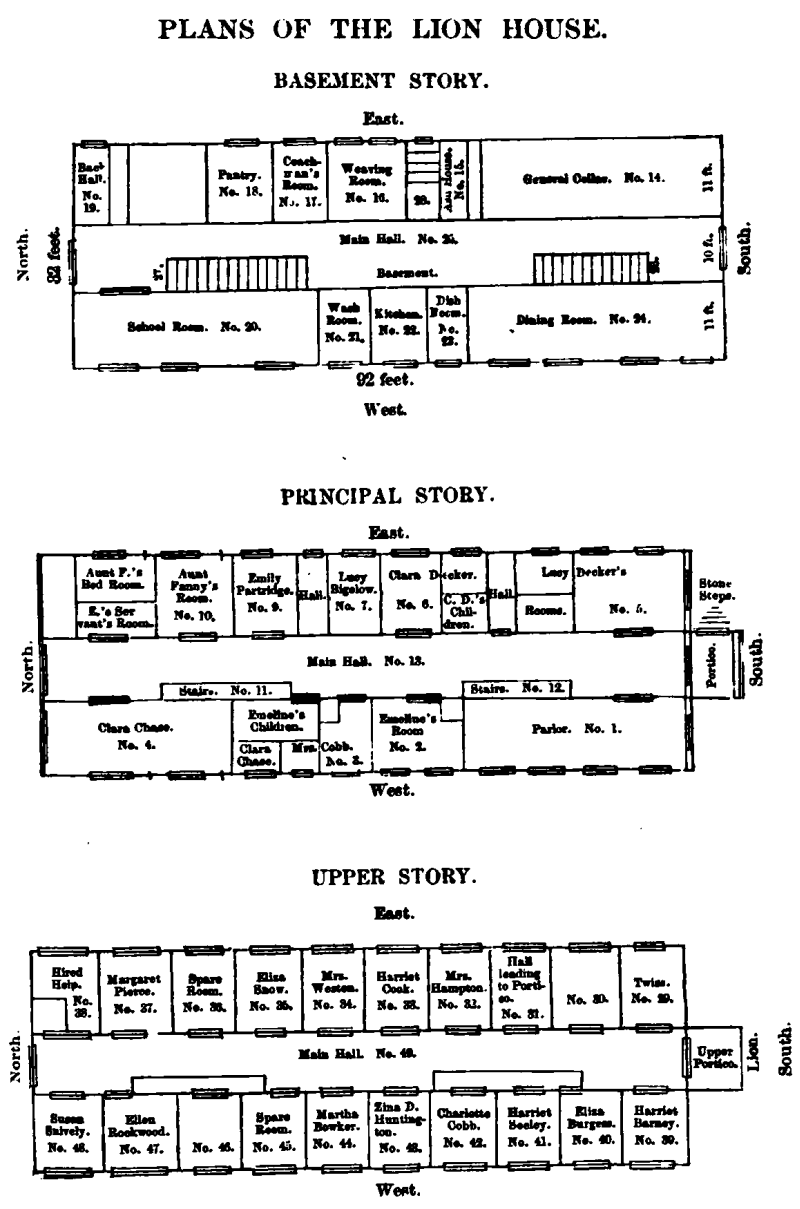
Brigham's 'Lion House.' . . . . Immediately a commotion was seen,
and soon armed men began to pour along the different streets,
and the report was carried, as on the wings of lightning, to
the uttermost parts of the city, that an order was being made
out for the arrest of Brigham and his counsellors, and that
Col. Connor had been down to make arrangements for enforcing
the writ. Men with muskets and rifles,—some few with
antiquated swords,—of all ages, from the brawny youth to the
old white-haired sexagenarian, came pouring along, singly and
in groups, by twos, by threes, and the half-dozen or more,
pressing hurriedly on towards Brigham's premises, zealous, and
ready to yield up life, if need be, in defence of the 'Prophet
of the Lord.' Altogether some two thousand 'citizen soldiery'
collected, and stood guard during the watches of the night,
over the beloved Brigham and his harem. Verily, 'The wicked
flee when no man pursueth.'"
That Brigham really feared arrest at this time, and believed that a
movement was on foot for that purpose, is evident from the following,
taken from the "Latter Day Saints' Millennial Star," published in
London. It is a portion of a letter written for that magazine by David
O. Calder, a clerk in the tithing-office:—
"America. Great Salt Lake City, March 13th, 1863.
"President G. Q. Cannon:
"Dear Brother,—You of course have learned through the New
York press of our 'expected collision between the military and
citizens of Utah,' and will learn through Capt. Hooper, (he
being just informed by telegraph to write to you,) that
comparative peace is restored. I shall now give you some
details of the trouble.
"As you are aware, we have been of the opinion that the
mission of the troops despatched from California last year was
not altogether to be confined to the guarding of the mail and
telegraph lines, and the protection of the California
emigration, and consequently have been watchful of their
proceedings; the more so, that they made their winter-quarters
within the city limits, and on one of the most commanding
benches above the city, instead of being distributed at the
several posts along the line of travel.
"We also have been made acquainted with the doings of Governor
Harding, and Judges Waite and Drake; that they were
corresponding with the authorities at Washington, and moving
everything that could be moved to bring the army here in
contact with the people, and to have the War Department send
on two or three thousand more troops.
"These and other movements compelled the citizens to be on
their guard, and prepared for any emergency. On Monday last, a
reliable person overheard Colonel Connor and Judge Waite in
conversation. The Colonel says, 'These three men must be
surprised.' The Judge replied, 'Colonel, you know your duty.'
In half an hour after, from a signal given, which was
previously understood, about one thousand citizens were armed,
and on duty, and in another half hour another thousand men
were on duty. This sudden demonstration proved to them that
their secret was known, and that we were fully prepared for
them. In the mean time our 'outside' friends in this city
telegraphed to those interested in the mail and telegraph
lines, that they must work for the removal of the troops,
Governor Harding, Judges Waite and Drake, else there would be
difficulty, and the mail and telegraph lines would be
destroyed. Their moneyed interest has given them great energy
in our behalf. They have placed their line at the disposal of
President Young, to be used to Washington, or New York. We
fully expect the Colonel, Governor, and Judges will be
recalled."
Here, it will be noticed, is the same covert threat contained in Brigham
Young's speech, that the mail and telegraph lines would be destroyed, if
the federal officers should be retained at their posts. It is to be
regretted that this standing menace should so far have had its effect,
as to induce the President, some two or three months afterward, to
recall Governor Harding from his position. It is true, by transferring
him to the Chief Justiceship of Colorado Territory, his removal was
disconnected with any censure of his administration. It still remained,
however, a substantial yielding to the arbitrary demands of Brigham
Young, and as such, had a direct tendency to encourage him in his
lawless proceedings, and to postpone for years the solution of the Utah
problem.
Judges Waite and Drake had, immediately after the demonstration of the
3d of March, written to the President, giving it as their opinion that
the laws were nugatory, and the Organic Act entirely inoperative in the
Territory, and declining to hold any terms of the District Court in
their respective districts until they should be properly supported by
the military power of the Government; at the same time giving it as
their opinion, that such a support should be at least five thousand men,
well armed, equipped, and provided.
The failure to furnish this force, and the subsequent change in the
governorship of the Territory, satisfied them that the Government was
not then prepared to meet the questions which had arisen in such a
manner as the dignity and honor of the nation required, and accordingly
all effort to further counteract the evil effects of this intolerant
theocracy were, for the time, abandoned.
Judge Waite, after holding, with his associates, in July, 1863, a term
of the Supreme Court, at which there was not a single case on the
docket, left the Territory in disgust, and established himself in the
practice of his profession in Idaho City, Idaho Territory. He resigned
his office, and was succeeded, in the spring of 1864, by Judge McCurdy,
the present incumbent.
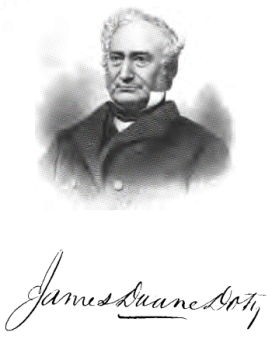
Governor Harding was succeeded, in May, 1863, by James Duane Doty, who,
at the time of his appointment, was Superintendent of Indian Affairs.
Governor Doty is a man of sound judgment, and of large experience in
public affairs; and does as well as any man could in his embarrassing
position. But his governorship is merely nominal. With the form and
semblance, he lacks all the substance of power; and where he should
order, he must satisfy himself with request and expostulation.
Judge Drake still remains in Utah, and with all the talent, energy, and
experience necessary to fill his position to the great benefit of the
people, he is obliged to remain entirely inactive, and goes through the
forms of holding court, with scarcely an attempt to administer justice
to the whole people, so well persuaded is he that all such attempts are
futile in the present condition of affairs.
Gen. Connor also remains, and, considering the small force at his
command, has accomplished wonders. By his bold and fearless vindication
of the rights and interests of the Government, guided, at the same time,
in all his acts by great discretion and moderation, he has compelled
some show of respect for the federal authority.
Neither Gen. Connor nor Judge Waite had the slightest intention of
arresting Brigham Young at the time alluded to in March, 1863. The
astute leader of the Mormons had a spy listening to the conversation of
those gentlemen, and the spy aforesaid heard some things, and thought he
heard others. He reported to headquarters the supposed result of his
discoveries, and it must be admitted that those who had been placed
under this insulting espionage took no great pains to correct the
impression which prevailed, and which so quickly and so thoroughly
developed the disloyal sentiments which the people had imbibed under the
infamous teachings of Brigham and his corrupt priests, apostles, and
bishops.
Mark the language used by Mr. Calder. "On Monday last, a reliable person
overheard," &c. Here the infamous system of espionage maintained over
the federal officers by Young, stands plainly confessed. But the fact
was well known, and he reaped no great benefit from it.
So thoroughly was he frightened, that, to save himself the ignominy and
humiliation of a public and forcible arrest, he went privately to his
friend, Chief Justice Kinney, and gave his bonds for his appearance at
Kinney's court, to answer to any indictment that might be found
against him for polygamy.
The grand jury, of course, found no indictment, and the incident is only
worth mentioning as curiously illustrative of the extent to which he was
operated on by his fears on that occasion.
A brief notice of the federal officers stationed and residing in Utah,
while the writer was living in that Territory, will close the present
chapter.
Hon. Stephen S. Harding, who was Governor from the spring of 1862 for
about one year, is from Milan, Indiana. He is about fifty years of age;
is a sound lawyer, and a man of extraordinary energy and decision of
character. These traits are modified, in some degree, by considerable
ambition, and great love of approbation. In his administration of Utah
affairs, so far as he was governed by this feeling, he labored for the
respect and approval of the great body of the American people, rather
than of the masses by whom he was immediately surrounded.
That he possesses much personal courage is evidenced by many of his
official acts, some of which he had reason to believe would subject him
at once to personal danger. The presence of the military in the
immediate neighborhood was sufficient to prevent any open outbreak;
still there were many ways in which his personal safety might be
jeopardized, without subjecting the perpetrators of the acts to
punishment.
So well is this understood in Salt Lake, that it requires a high degree
of moral courage to enable one to do any act offensive to "the powers
that be" in the Holy City.
Every attempt was made to seduce him from the path of duty, not omitting
the same appliances which had been brought to bear upon Steptoe and
Dawson, but all in vain.
His family remained at Milan, except his son, Attila, who was with the
Governor at Salt Lake, and acted as his private secretary.
Hon. James Duane Doty, the successor of Harding, and the present
Governor of the Territory, was, for nearly two years previous to
receiving the appointment of Governor, Superintendent of Indian Affairs
for the Territory. He was appointed to succeed Harding in April or May,
1863.
James Duane Doty, Governor of Utah, was born at Salem, in the County of
Washington and State of New York, on the 5th day of November, A. D.
1799, the last year of the last century.
He emigrated to Detroit, Michigan, where he was admitted to the Supreme
Court, and settled in the practice of the law in the year 1818, and was
one of the earliest emigrants to that State.
The next year he was elected Clerk of the Common Council of the City,
and appointed Secretary to the Legislature, which was then composed of
the Governor and Judges of the Supreme Court; and was also appointed a
Notary Public, and soon afterwards Clerk of the Supreme Court of the
Territory by the Judges of that court.
In 1820 he accompanied Governor Cass, as Secretary, in his expedition to
the sources of the Mississippi, travelling a distance of over four
thousand miles through the Indian Country in a birch-bark canoe, from
the 20th of May to the 20th of November.
In this year he revised the laws of the Territory, which were published
by the authority of the Legislature.
In 1821 he was admitted an attorney of the Supreme Court of the United
States at Washington.
In 1823 the country north of lakes Huron and Michigan, and west of lakes
Michigan and Superior, was made by Congress a judicial district, and he
was appointed by James Monroe its Judge, with the title of "an
additional Judge of the Territory of Michigan." He performed the duties
of this office until the year 1832,—having married, and fixed his
residence at Green Bay, then the largest settlement in the country north
or west of Detroit.
In 1832 he was appointed by the Secretary of War a Commissioner to
locate Military Roads from Fort Howard, at Green Bay, to Fort Crawford
on Prairie du Chien, and to Fort Dearborn at the mouth of Chicago Creek,
now the site of the city of Chicago,—between which points there were
then scarcely twenty white inhabitants.
In 1834 and 1835 he served in the Legislative Council of Michigan,
having been elected by the voters west of the Lake; and introduced the
measure of a State government, which was adopted by the Council.
He contended for the right of the people to form a government for
themselves, under the provisions of the Ordinance of 1787.
By this measure a territorial government was obtained for Wisconsin, and
a permanent separation from Michigan of the country west of Lake
Michigan, which had been attached to that Territory in 1818, when
Illinois was admitted into the Union. It had been sought in vain of
Congress from the year 1825,—the application having been successfully
opposed by the party averse to laying the foundation of new
non-slaveholding States.
In 1837 he was elected Delegate to Congress from Wisconsin, and
continued to serve in that office by reëlection until the year 1841,
when he was appointed Governor and Superintendent of Indian Affairs in
that Territory; and as Commissioner held treaties at Oeyoowurah, on
Minnesota River, with the Dakotahs, and with the bands of that nation on
the Mississippi River.
It was in 1837 that he laid out the town of Madison, and succeeded in
making it the seat of government,—one of the most valuable services
which he ever rendered that State. It is now considered one of the most
beautiful sites for a town. When selected by him there was not a white
settler within forty miles, and it was occupied by Winnebago Indians.
He was elected and served as a member of the Convention to form a State
Constitution in 1846 for Wisconsin.
In 1849 he was elected in the Third District of Wisconsin a
Representative in Congress, and was reëlected in 1851,—serving on
several committees. It was during his first term as a member that he was
declared an Abolitionist—now no longer a term of reproach—by Father
Ritchie and the Southern leaders, because he declined to vote for a
repeal of the duty on lead.
In 1861 he was appointed Superintendent of Indian Affairs in the
Territory of Utah; and in 1862 was appointed a Commissioner to negotiate
treaties with the Shoshonees,—which were held by him in 1863. These
were the first treaties ever made by the United States with this nation
of Indians.
In May, 1863, he was appointed Governor of the Territory of Utah. During
his long public service he has had the acquaintance, and enjoyed the
friendship, of most of the eminent men connected with the Government of
our country. Of those who were on the stage when he entered public life,
it is believed that but one is now living,—Gen. Cass, who was his
generous patron in boyhood, and has been his friend during this long
period of an eventful life.
He is now believed to be the oldest pioneer living west of Lake
Michigan. In the performance of his duties he has traversed the
Continent,—having stood on the shores of the Atlantic and Pacific; on
the latter of which he reached the point in his westward march, where,
when the eye is directed over that vast ocean towards the East Indies,
the West appears to terminate and the East begins.
Hon. Thomas J. Drake, Associate Justice, is from Pontiac, Michigan,
where he had resided from early manhood. He is now over sixty years of
age. He has a thin, wiry frame, dark hair, and a nervous, bilious
temperament.
His mind is vigorous and clear, and his virtue and integrity of the old
Roman order. Of blameless life and manners, all the shafts of his
accusers fall harmless at his feet.
The wrongs and iniquities he has witnessed, added to personal
ill-treatment, has engendered an intense hatred of the despots who sit
enthroned over the people of Utah, but he has the most kindly feelings
toward the great body of the people.
Lacking all adequate power, he is obliged to sit quietly by, and see
wrongs perpetrated, which he is utterly unable to redress.
Judge Waite, the Associate of Harding and Drake, was from the State of
Illinois, where he had resided since the year 1840.
At the time of his appointment, in February, 1862, he was thirty-eight
years of age. He was then living near Chicago, in which city he had
resided and practised law since 1853.
Of Chief Justice Kinney mention has already been made. Suffice it to
add, he was, in the summer of 1863, elected as Delegate to Congress from
Utah, and took his seat the following winter. He doubtless aspires to
still higher honors from the same Territory.
Hon. John Titus, who succeeded Kinney, and is the present Chief Justice
of the Territory, is somewhat past fifty years of age,—a gentleman of
much dignity and urbanity of manners. He is large and well formed, and
has an active temperament.
His duties as yet have been exceedingly light, and will probably
continue so while he remains in the Territory. The Mormons withhold from
him all the cases they can control. He is outspoken against polygamy,
making no reserve whatever of his opinions on that question.
Chief Justice Titus was appointed from the Philadelphia bar.
Dr. Frank Fuller was Secretary of the Territory about two years, and was
succeeded by Mr. Reed, in the fall of 1863.
Dr. Fuller is from New Hampshire, and a dentist by profession and
practice. He was attentive and obliging in his official intercourse with
all parties. He is a polished gentleman also in social intercourse.
He was one of the few federal officers in Salt Lake at that time who was
so fortunate as never seriously to offend Brigham Young. Doubtless his
position brought him less in collision with that gentleman than was the
case with other officers. If he saw any difficulties approaching, by a
little shrewd management he carefully avoided them. If in thus steering
between Scylla and Charybdis he did not always meet the approbation of
his fellow-officers, he managed at least to avoid any open differences,
and thus kept up the appearance of friendship with all.
He enjoyed for a long time the confidence and apparent respect of
Brigham, to a greater degree, perhaps, than Kinney himself.
From Salt Lake he went to San Francisco, where he engaged in dealing in
mining stocks.
From the time of Dawson's hasty departure in the fall of 1861, until
Governor Harding's arrival in July, 1862, he acted as Governor of the
Territory, and his administration gave general satisfaction to the
Mormons.
Amos Reed, Esq., who succeeded Dr. Fuller as Secretary in 1863, and who
now holds that position, came into the Territory with Governor Doty from
Wisconsin.
During the winter of 1863-64, while Governor Doty was absent in
Washington, Reed was the acting Governor, and as such evinced a high
order of administrative talent. The affairs of the Territory were,
during that time, conducted with much discretion and judgment, and so
far as was in his power, the rights and interests of all classes were
respected.
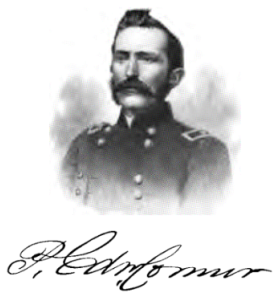
General P. Edward Connor was born in County Kerry, Ireland, and migrated
to the United States, with his parents, at a very early period of life.
Having reached the age of manhood, he enlisted in the regular army of
the United States, and served an honorable term, as private, for five
years, on the frontier.
At the breaking out of the Mexican War, he raised a company of Texas
Volunteers, and as captain, led them with distinguished success and
heroism at the battle of Buena Vista. He was mentioned in official
dispatches, with high encomiums for bravery. At this battle he was
severely wounded, and received a pension from the Government. At the
close of the war he settled upon the Pacific coast.
Captain Connor resided in Stockton, California, for ten years, prior to
the rebellion, engaged in private business, wherein he attained a
handsome competence.
He was married at Stockton, and now has two children living. During his
residence in Stockton, Captain Connor took an active interest in
military affairs, and commanded a uniform company.
At the breaking out of the present rebellion, he was tendered the
appointment of Colonel of the Third Regiment of Infantry, California
Volunteers. With the expectation that his regiment was to be sent East,
he promptly raised and organized it.
The exigencies of the service, however, required his presence in Utah,
and in the summer of 1862 he led the 3d Infantry, and part of the 2d
Cavalry, Cal. Vol., across the Plains, in a most successful, though
arduous march, and established his camp where it would command the City
of the Saints.
Amid the snows and storms of the winter of 1862-63, he planned and
prosecuted a successful campaign against hostile Indians, and on the
29th of January, 1863, fought the hard battle of Bear River, defeating
and almost annihilating the savages, under the leadership of Bear Hunter
and Lehigh.
For the brilliancy of this action, Col. Connor was promoted by the
President to be Brigadier-General of United States Volunteers, which
rank he now retains.
He is a man of strong common sense, excellent and quick judgment,
invincible energy and determination, firmness amounting to obstinacy,
and the strictest integrity.
His administration in Utah has been eminently successful. By Brigham
Young he is at once hated and feared. He is but little past forty years
of age.
FOOTNOTES: