The Battalion had opened a wagon road to the Pacific, but had arrived
too late to participate actively in the conquest of California. It was
useful, however, in the performance of garrison duty at San Diego, San
Luis Rey, and Los Angeles; and, in connection with the New York
volunteers, recently arrived under command of Col. Jonathan D.
Stevenson, via Cape Horn to San Francisco Bay, also in connection with
the constantly increasing naval forces along the coast, they assisted in
making secure the conquest achieved.
While performing garrison duty many members of the Battalion at San
Diego obtained permission to accept employment of the inhabitants of the
town, such as making adobes, digging wells, building houses, and making
bricks. The first bricks in San Diego, and for matter of that in
California, were made and burned by members of the Mormon
Battalion.[58:a] They made an enviable reputation for industry and
frugality.
Efforts to Re-Enlist the Battalion.—As the expiration of the term of
the Battalion's enlistment drew near, strong efforts were made for their
re-enlistment by General Kearny, before departing for the east in May.
"On the 4th of May," writes Tyler, "an order was read from Col. Cooke,
giving the Battalion the privilege of being discharged on condition of
being re-enlisted for three years as U. S. Dragoons; but under the
circumstances the generous proposition could not consistently be
accepted." General Kearny addressed the Battalion on the 10th of May:
"He sympathized with us in the unsettled condition of our people," says
Tyler, "but thought, as their final destination was not definitely
settled, [in this of course the General's information was defective] we
had better re-enlist for another year, by which time the war would
doubtless be ended, and our families settled in some permanent location.
In conclusion he said he would take pleasure in representing our
patriotism to the President, and in the halls of congress, and give us
the justice our praiseworthy conduct had merited." It was on this
occasion, according to Tyler, that Gen. Kearny in praising the Battalion
said: "Bonaparte crossed the Alps, but these men have crossed a
continent."[59:b]
Col. Jonathan D. Stevenson of the New York volunteers, who succeeded
Col. Cooke in command of the Battalion by being given command of the
southern district of California—Col. Cooke having been detailed to
accompany Kearny on his return to the east—made an effort to induce the
Battalion to re-enlist. Stevenson's effort was prompted by Governor
Richard B. Mason's instructions. Stevenson represented among the
advantages of the Battalion's re-enlistment, the privilege of choosing
their own officers, "and the fact that the Mormon commander would be the
third in rank among the officers of California, and might become first."
The Battalion's officers quite generally favored re-enlistment, but not
so the men, who, under the leadership of "Father" Pettegrew, William
Hyde, and Sergeant Tyler, were in favor of returning to their families
and the body of their people.
The result of the effort at re-enlistment was, that a company of
eighty-one, officers and men, re-enlisted for six months, and performed
garrison service at San Diego.
Homeward Bound.—The rest of the Battalion, on being mustered out of
service, in July, began their march for the Great Basin of the Rocky
Mountains, going via Sutter's Fort, at the juncture of the American and
Sacramento rivers, north-eastward from San Francisco about seventy-five
miles, and now the site of Sacramento, capital of the state. About
one-half of these returning volunteers arrived in Salt Lake Valley on
the first of October. The reason for not more than one-half of this
number reaching Salt Lake Valley that fall—they numbered about 240 when
leaving Los Angeles—arose from the following circumstances: Arriving at
Sutter's Fort, and finding opportunity for employment at good wages, a
number desired to take advantage of that opportunity, and accordingly,
with the consent and approval of their associates, "a few" remained. On
the sixth of September, when the returning volunteers were leaving the
basin of Lake Tahoe, they met Samuel Brannan,—leader of the "Brooklyn
Colony" of Mormons to San Francisco Bay via Cape Horn, in 1846. Brannan
was returning to California from his visit to Brigham Young, whom he had
met at the Green River Crossing, and accompanied to Salt Lake Valley. He
gave the Battalion members a doleful account of the semi-desert region
where the Mormon people were settling, and predicted their final removal
to California. He urged all, except those known to have families in Salt
Lake Valley, to return to California and work until spring. This without
avail. The next day, however, the volunteers met Captain James Brown,
ranking officer of the Pueblo detachment of the Battalion, and a small
party enroute for California. He brought with him letters from many of
the families of the Battalion; also an epistle from the Mormon leaders
advising those who had no means of subsistence to remain in California
and labor during the winter, and make their way to Salt Lake valley in
the spring, bringing their earnings with them. About one-half of the
volunteers accepted this suggestion and returned to Sutter's Fort where
they found employment.
The rest of the company continued their journey to Salt Lake valley
where they arrived at the time already stated.
The Discharge and Payment of the Pueblo Detachment.—Captain Brown took
with him to California the muster rolls of the Pueblo detachment of the
Battalion, and also had a power of attorney from all its members to draw
their pay. The Pueblo detachment had drawn its pay per Captain Brown up
to May at Santa Fe, at which time he received orders to resume the march
to California, via Fort Laramie. The detachment arrived in Salt Lake
valley on the 29th of July, where they were disbanded, since the term of
their enlistment had expired on the 16th of that month. On the
presentation of the claims for the three months' pay still due to this
detachment to Governor Mason of California, they were allowed.
"Paymaster Rich," says the Governor, "paid to Captain Brown the money
due to the (Pueblo) detachment up to that date, according to the rank
they bore upon the muster rolls, upon which the Battalion had been
mustered out of the service."
The Purchase of Ogden Site with Battalion Money.—Sometime early in 1848
the Goodyear claim to a tract of land at the mouth of Weber Canyon, said
to be twenty miles square, was purchased by Captain James Brown out of
the Battalion money collected by him, and "by the advice of the
Council," meaning the high council at Salt Lake City. The sum paid was
$1,950.00, cash down. In this statement I follow the Journal History of
Brigham Young, which under date of March 6th, 1848, contains a letter
from "Father" John Smith, President of the Salt Lake high council,
giving to the Mormon leader,—absent at the time in Winter Quarters—the
above information.[62:c]
The Goodyear tract is specifically described as commencing at the mouth
of Weber Canyon, thence following the Wasatch Mountains north to the Hot
Springs; thence westward to the shores of the Salt Lake; along the
shores southward to a point opposite Weber Canyon; thence eastward to
the point of beginning.[62:d] Goodyear was supposed to have held this
tract of land on which Ogden City now stands by virtue of a Mexican
grant. This, however, it was subsequently discovered, was not the case.
Goodyear's title amounted to no more than a squatter's claim, as there
were evidently no Mexican grants of land in the eastern and northern
parts of the territory ceded to the United States by Mexico that rested
upon any clearly valid evidence of title from Mexico; and the government
of the United States, in subsequent years, refused to recognize the
so-called Mexican grant of Goodyear's, and held that title inhered in
the government of the United States alone, and that by virtue of the
cession of the territory to the United States.
Such title, however, as Goodyear claimed, was purchased, as above
related, and by Battalion money. And while the title of Goodyear was not
valid, the purchase quit-claimed his title, such as it was, and gave a
sense of security to the colonists who first settled upon one of the
most desirable tracts of land in the Salt Lake Valley.
The Battalion's Contribution of Seeds to Utah Colonies.—These returning
members of the Battalion brought to Utah various kinds of garden and
fruit seeds, as well as grain from California, all which were found to
be very useful in the new colonies where both variety and quantity of
seeds were limited. Lieutenant James Pace introduced the club-head
wheat, which proved to be hardy and of thrifty growth in Utah soil.
Daniel Tyler brought the California pea which in the early years grew so
prolific as the field pea of Utah. The detached members of the Battalion
who wintered at Pueblo brought with them to Salt Lake Valley the variety
of wheat known as "taos," which, mixed with the club-head, became for
many years the staple seed wheat sown in Utah fields.
The Battalion's Part in the Discovery of Gold in California.—As already
stated a number of the Mormon Battalion members found employment at
Sutter's Fort, with Mr. John Sutter himself, in fact, who was a rather
enterprising Swiss; one "who had houses and land, flocks and herds,
mills and machinery. He counted his skilled artisans by the score," says
the account I am following, "and his savage retainers by the hundred. He
was, moreover, a man of progress." Among his pressing needs and the
needs of the country at large, was a saw mill. The flour mills he then
had in course of construction needed timbers, and there would be large
profit in shipping lumber to San Francisco. Accordingly his foreman, a
Mr. James W. Marshall, a native of New Jersey, and then about
thirty-three years of age, and a carpenter, took in hand the task of
building a saw mill. After considerable exploration the requisite
combination of water power, timber, and the possibility of easy access
to the Fort, was found in the Coloma valley, on the south fork of the
American River, and about forty-five miles due east of the Fort.
In the latter part of August, or the first of September, Mr. Marshall
with a party of about a dozen white men, nine of whom were discharged
members of the Mormon Battalion,[64:e] and about as many Indians, went
to Coloma valley and began the construction of the proposed mill. A
brush dam was built in the river and a mill race constructed along a
dry channel, to economize labor. The largest stones were thrown out of
this and during the night the water would be turned in to carry off the
dirt and sand. On the 24th of January while sauntering along the tail
race inspecting the work, Mr. Marshall noticed yellow particles mingled
with the excavated earth, which had been washed by late rains. Sending
an Indian to his cabin for a tin plate Marshall washed out some of the
soil and obtained a small quantity of yellow metal. During the evening
he remarked to his associates of the camp that he believed he had found
gold, which was received with some doubts, the expressions being "I
reckon not;" and, "no such luck." But Henry W. Bigler, one of the
Battalion members, made the following entry in his journal that day:
"Monday 24 (January): This day some kind of metal was found in the tail
race that looks like gold."
"Jan. 30th: Clear, and has been all the last week. Our metal has been
tried and proves to be gold. It is thought to be rich. We have picked up
more than a hundred dollars' worth this week."
The Date of the Discovery of Gold.—Thus it is the journal of a member
of the Mormon Battalion which determines the date of the event which
startled the world. Usually the 19th of January is given as the date,
but in his History of California, Bancroft discusses the subject as
follows:
"The 19th of January is the date usually given; but I am satisfied it is
incorrect. There are but two authorities to choose between, Marshall,
the discoverer, and one Henry W. Bigler, a Mormon engaged upon the work
at the time. Besides confusion of mind in other respects, Marshall
admits that he does not know the date. On or about the 19th of
January," he says (Hutchings' Magazine, II, 200); "I am not quite
certain to a day, but it was between the 18th and 20th." Whereupon the
19th has been generally accepted. Bigler, on the other hand, was a cool,
clear-headed, methodical man; moreover he kept a journal, in which he
entered occurrences on the spot, and it is from this journal I get my
date. If further evidence be wanting, we have it. Marshall states that
four days after the discovery he proceeded to New Helvetta [identical
as to the location with Sutter's Fort] with specimens. Now, by reference
to another journal, New Helvetta Diary, we find that Marshall arrived at
the Fort on the evening of the 28th. If we reckon the day of discovery
as one of the four days, allow Marshall one night on the way, which
Parsons gives him, and count the 28th one day, we have the 24th as the
date of discovery trebly proved.
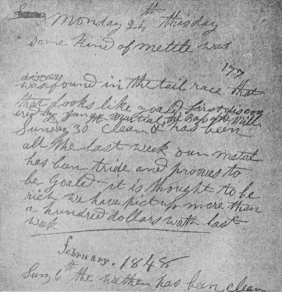
Facsimile of Henry W. Bigler's Journal, from a photograph
The Tide of Western Civilization Started.—The discovery of gold is the
historical event that turned the eyes of the civilized world to
California. Within a year it started that mighty wave of western
emigration from all parts of the United States, many parts of Europe,
and even from Asia. It was to be a subject of the President's message to
Congress before the close of the year; within two years it would make
California one of the sovereign states of the American Union, with a
population of nearly one hundred thousand; in seven years it would
result in adding nearly five hundred million dollars to the world's
store of gold; and then as the gold from soil and sand was exhausted,
and costly operations upon gold-bearing quartz ledges, and delving into
the earth were required to secure the precious metal, many men who had
come to the mines turned their attention to agriculture and to
horticulture and found in the grain fields, vineyards and orchards of
the Pacific slope, even a greater source of wealth than in the gold
mines.
For a time an effort was made to keep the discovery of gold quiet, but
gradually it became known, and the secret of the Sierras was revealed to
the world, with the result already noted. San Francisco, however, was
indifferent for some time, the final conversion of that town to the
discovery of gold did not take place until Samuel Brannan, the leader
of the Brooklyn Colony of Mormons to California, came down from Sutter's
Fort—where he had a store—to San Francisco, in company with a number
of others who had with them specimens of collected gold in both dust and
nuggets. Brannan, holding in one hand a bottle of yellow dust, and with
the other swinging his hat, rushed down the street shouting, "Gold!
Gold! Gold! from the American River." This in May; and soon afterwards
San Francisco was deserted for the gold-fields.
The Mormon Battalion "Diggings" on the American River.—The spare time
of the Mormons at Sutter's saw-mill was devoted to washing out gold in
the millrace and from the deposits of the sand bars along the river.
Henry Bigler on the 21st of February wrote to members of the Battalion
at Sutter's Fort, telling them of the discovery of gold, but cautioned
them to impart the information only to those who could be relied upon to
keep the secret. They entrusted it to three other members of the
Battalion. Six days later three of the number, Sidney Willis, Levi
Fifield, and Wilford Hudson, came up to the saw-mill, and frankly told
Mr. Sutter they had come to search for gold, and he gave them permission
to mine in the tail of the millrace. The next day they began work and
were fairly successful. Hudson picked out one piece of gold worth six
dollars. After a few days, however, these men felt under obligations to
return to the Fort as they had given it out that they were merely going
to the saw-mill on a visit and a few days' shooting. Returning, Willis
and Hudson followed down the stream for the purpose of prospecting.
Fifield, accompanied by Bigler, followed the wagon road. About half way
between the saw-mill and the Fort, Hudson and Willis, on a bar opposite
a little island in the river, found a small quantity of gold, not more
than half a dollar in value; and while the smallness of the find filled
the two prospectors with disgust, the other Battalion members at the
fort insisted upon being taken to the point where the gold had been
found, that "together they might examine the place." "It was with
difficulty that they prevailed upon them to do so," remarks Bancroft;
but finally Willis and Hudson consented, "and the so lately slighted
spot," continues the historian of California, "presently became famous
as the rich 'Mormon Diggins:' the island, 'Mormon Island,' taking its
name from these Battalion boys who had first found gold there."
But notwithstanding this new discovery by these members of the
Battalion, and notwithstanding their development of the discovery of Mr.
Marshall, and the huge excitement which followed, and the fact that
whenever they could get released a day from their duty to their employer
they could usually obtain in gold several times over their day's wages,
history has to record that they were true to their engagement to Mr.
Sutter. "They had promised Sutter," says Bancroft, "to stand by him and
finish the saw mill, this they did, starting it running on the 11th of
March. Henry Bigler was still there. On the 7th of April Bigler,
Stephens and Brown presented themselves at the fort to settle accounts
with Sutter."
The Call of Duty.—The call of duty was also pressing upon these
Battalion men from another direction. The instructions from the Mormon
leaders, to the members of the Battalion, as we have seen, was that they
should remain in California during the winter, but make their way to the
Salt Lake Valley in the spring, bringing their earnings with them. Hence
when settling with Sutter on the 7th of April, the preliminaries were
arranged for this prospective journey to the Great Basin of the Rocky
Mountains. The first of June was fixed upon as the time of their
departure. Notice was given to Sutter accordingly, so that by that time
he could replace the Mormon workmen in his employ by others. Horses,
cattle and the seeds they intended taking with them were to be bought of
him; also two brass cannons to be a defense against possible Indian
attacks enroute, and for defensive use against a like foe in Salt Lake
valley. At first a company of eight went into the mountains to explore a
route, but found the snow too deep for passage at that time. The
constantly growing gold excitement, also, in consequence of its general
unsettling of things, delayed their departure a month beyond the time
fixed upon for starting. Meantime many of the Battalion members availed
themselves of the opportunity to search for gold. Bigler and two others
of the Battalion followed up the American river from the Fort about
fifteen miles, finding gold as they went. Arriving at Mormon Island they
came upon the seven members of the Battalion mining there who that day
had taken out two hundred and fifty dollars. Bigler and his associates
mined for two months about one mile below the saw-mill, dividing with
Sutter and Marshall, who furnished tools and provisions. The land owners
demanded one-half the product for a time; this was finally reduced to
one-third.
In the midst of this prosperous mining activity, and the daily growing
gold fever, the mad rush from San Francisco and other parts of
California, the members of the Battalion sought out a rendezvous for
their gathering preparatory to the journey across the mountains. The
place of rendezvous was called by them "Pleasant Valley," near the
present site of Placerville, a short distance up the south fork of the
American river, and not far from the place where gold was first
discovered on that stream. Parties came in one after another until the
3rd of July, when about forty-five men and one woman, the wife of one of
the party, had assembled, bringing with them wagons, horses, cattle, and
other effects. On the 3rd a start was made. "As the wagons rolled up
along the divide between the American river and the Cosumnes, on the
national 4th," writes H. H. Bancroft, "their cannon thundered
independence before the high Sierras." "Thus," as further remarked by
the author here followed, "amidst the scenes now every day becoming more
and more absorbing, bringing to the front the strongest passions in
man's nature, * * * at the call of what they deemed duty, these devotees
of their religion unhesitatingly laid down their wealth-winning
implements, turned their back on what all the world was just then making
ready with hot haste and mustered strength to grasp at, and struggle
for, and marched through new toils and dangers to meet their exiled
brethren in the desert."
The fame of having discovered gold may not be claimed for members of the
Mormon Battalion, that belongs to Mr. Marshall, unquestionably, though
the Mormons in camp when it was found, of white men, were in the
majority; and the shovels in their industrious hands it was which threw
up the gold-laden soil; and they were the first to extend the discovery;
and theirs the honors to first chronicle the date and fact of the event
that was to mean so much to the Pacific coast of America, and to the
world. But while the honor of making the mere discovery of gold may not
be claimed for them, that which is infinitely better may be claimed for
them, the honor of writing into the annals of California and of the
world's history this fine example of fidelity to duty, detailed above;
and which is not over-matched in any of the records written by men.
Ascent of the Sierras from the Western Side.—It was a difficult task to
cut a wagon road from the west side through the lofty Sierras that faced
them. A task of infinite toil and in the presence of great danger from
the lurking savages. Three pioneers who had insisted upon going in
advance to blaze the route for the main company had been murdered by the
Indians. These pioneers were named Daniel Browett, Ezra H. Allen, and
Henderson Cox. The main camp came upon their mutilated bodies at a
spring which, because of this event, still bears the name "Tragedy
Spring." What numbers of these savages the main company would encounter,
what their mood would be—murderous or friendly—of course could not be
conjectured, it was of the dangers they must risk. By almost incredible
toil and patience, however, this company of Mormon Battalion men
conquered the ascent of the Sierras from the western side, hewing a
roadway for their seventeen wagons through stony heights, and in like
manner down steep declivities and narrow gorges, until the eastern
sloping deserts beyond were reached, and finally the valley of the Great
Salt Lake,—about the first of October, 1848,—to them, for the time,
the place to which duty had called them.
Wagon Trail From Los Angeles to Salt Lake.—The company that re-enlisted
at Los Angeles for six months beyond the Battalion's original term of
enlistment, served eight months and then were mustered out of the
service. Some of these on being disbanded went by way of the coast to
the mines or engaged in other industries in California for a time, but
most of them finally made their way to Salt Lake valley in the course of
one or two years, though a few remained permanently in California. A
squad of twenty-five from this company, however, on being mustered out
of the service, organized at once for the journey to Salt Lake valley,
taking with them one wagon and a band of one hundred and thirty-five
mules. They went by way of what was called the "southern route;"
hitherto, however, traveled only by packers, and the wagon of this
Battalion company was the first to make the journey over the pack trail.
This company reached Salt Lake valley on the 5th of June, 1848.
Evidence of Appreciation of the Battalion's Services.—The best evidence
that the service of the Mormon Battalion was honorable and appreciated
by both the people of California and the U. S. government, exists in the
fact of the efforts that were made on the part of both the people and
the government to prolong their service, some of which efforts have
already been noted in these pages. As the time approached for the
company that had re-enlisted to be mustered out of service—known as the
"Company of Mormon Volunteers,"—the people of San Diego drafted a
petition, begging the governor to use his influence to keep the company
in the service. The petition was signed by every citizen in the town,
and Governor Mason tried hard to induce the company to remain in the
service another year; failing in that, then to stay six months longer;
all to no purpose, however; the "Volunteers" were determined to join
their friends and families in Salt Lake valley, and made the journey as
stated above.
Efforts to Raise a Second Mormon Battalion.—When the Battalion proper
was mustered out of service in July, 1847, efforts were set on foot at
that time to raise a second "Mormon Battalion," of which Captain
Jefferson Hunt was to be given the command, with the office of
Lieutenant-Colonel, the office held by its first commander Allen, and
later by Col. Cooke. It is learned from a report made by Governor Mason
that the war department, and hence the national administration, also
sought the enlistment of this second Battalion.
In his report to the Adjutant General of September 18th, 1847, Governor
Mason says:
"Of the service of this Battalion, of their patience, subordination, and
general good conduct, you have already heard; and I take great pleasure
in adding that as a body of men they have religiously respected the
rights and feelings of these conquered people, and not a syllable of
complaint has reached my ears of a single insult offered or outrage done
by a Mormon volunteer. So high an opinion did I entertain of the
battalion and of their special fitness for the duties now performed by
the garrisons in this country, that I made strenuous efforts to engage
their service for another year."[74:f]
The month following, after Governor Mason had met Captain Brown of the
Pueblo detachment, and received his report, and paid off that division
of the command; also after Captain Hunt, who had been for some time
acting as Indian agent at Luis del Rey, was well on his way to Salt Lake
valley to raise the proposed 2nd Battalion of Mormon Volunteers,
Governor Mason wrote to Washington:
"Captain Brown (after making his report and receiving the pay of the
Pueblo detachment) started immediately for Fort Hall. * * * He reported
that he had met Captain Hunt, late of the Mormon Battalion, who was on
his way to meet the emigrants and bring into the country this winter, if
possible, a battalion, according to the terms offered in my letter to
him of the 16th of August, a copy of which you will find among the
military correspondence of the department. In my letter I offered
Captain Hunt, the command of the battalion, with the rank of
lieutenant-colonel, with an adjutant; but I find, by the orders lately
received, that a battalion of four companies is only entitled to a major
and acting adjutant. I will notify Captain Hunt of this change at as
early a moment as I can communicate with him. I am pleased to find by
the despatches that in this matter I have anticipated the wish of the
department."[75:g]
When, however, the subject of raising a second Battalion was presented
to Brigham Young, both through Col. Jonathan D. Stevenson, of the New
York regiment of volunteers, prompted by Governor Mason, also through
Captain Hunt in person, the proposition was declined. Regarding the
first enlistment from the standpoint alone of the sacrifices it
involved, President Young saw no occasion to make like sacrifices a
second time, and no effort was made in Utah to raise a second Mormon
Battalion.
FOOTNOTES: