Also eleven drawings in black and white introducing the chapters.
13
CHAPTER I HOW THE MOON PRINCESS CAME TO THE EARTH
The heavens were a stainless blue, and the
Moon shone out of them arrayed in silvery
garments. One by one the sky’s matchless
jewels, the stars, peeped out, studding that great
ceiling with flashing diamond-points, until the whole
dome was a glittering mass of blue and silver. The
Ocean below seemed a big mirror, made to catch
and reflect the bewildering beauty above, for, shimmering
softly, he carried in his shining depths all
those myriad lights.
14
Calm and majestic the Moon glided over her star-studded
pathway; but, in spite of her glorious beauty
and brilliancy, she was really sad and sick at heart.
Ethelda, her best beloved, the youngest and dearest
of her children, had just made a request the granting
of which caused her that night bitterest sorrow.
There was an old custom among the Moon maidens
that on her marriage each one of them might ask
whatever she most desired, and the thing which she
asked could not be denied her. Now, Ethelda of the
starry eyes and the shining spun-gold hair had asked a
fearful gift at her mother’s hands. She was betrothed
to the Sun Prince Dorion, a handsome youth, strong
of limb, and a goodly sight to look upon, and he had
long loved her. He had seen this dainty maiden in
all her varying moods, so he knew her well. Sometimes,
with her Moon maidens merrily engaged at
play, she romped happy as a child; or later, with the
stately tread of a young princess, she came and went
in her big white palace. She often wore a pale blue
gown with silver trimmings, and a crown of flashing
stars upon her head, and then it was the brilliantly
beautiful girl looked the daughter of the skies.
15
Prince Dorion had watched the slender maiden
until every strand of her glittering hair was dear to
his heart. Later his father’s golden chariot brought
him daily to her palace.
How Ethelda loved to watch him as he drove
the fiery steeds with a master’s hands, guiding them
surely and steadily to her palace gates! He was the
finest of the Sun God’s sons, and Ethelda’s heart beat
proudly as she looked upon her chosen one. The
Moon Mother was happy too, in her daughter’s choice,
and all would have been well in the wedding festivities
save for Ethelda’s unheard-of request. How the
Moon hated to grant it! But she had reasoned with
Ethelda long and patiently without effect. For the
wilful little Princess was bent upon this mad whim.
“Alas! no good can come of it,” sighed the Moon
heavily, and she gazed down sadly upon the Earth
as she spoke. “No good can come of it,” she repeated.
“What could have possessed the child to
want it?”
For Ethelda had asked no less than this: to visit
the Earth and spend her honeymoon there!
16
The young Sun Prince, though at first reluctant
to take his beautiful bride upon such a wild trip,
had finally yielded to her persuasions, and now,
being won by her tender pleadings, was as anxious
to go as she.
But the Moon Mother had no such faith in the
foolish journey. Her mind misgave her, and as she
swung around the great circle in celestial glory, her
heart grew tremulous with fear for her daughter’s
safety. The request must be granted: that she knew;
but she was devoutly thankful for a wise law requiring
a Moon maiden to revisit her own home yearly. At
most, then, they could stay but a twelvemonth upon
the Earth. Reason as she would, however, the Queen
Mother’s heart was heavy, for with the daughter upon
the Earth the mother’s happiness would be gone. But
the maiden’s joy at the consent consoled her somewhat,
and with an unselfish mother’s love the Queen
determined to hide her own grief and make the wedding
trip a brilliant and a joyous one.
Prince Dorion came with a great retinue of
knights, all dressed in shining gold wrought in the
Sun’s fiery furnace, and bringing wonderful jewels to
his bride. The Moon Queen, not to be outdone in
magnificence, showered silver in plenty upon them
both, and bade one hundred of her loveliest maidens
accompany the bridal pair upon their journey.
17
The wedding was so brilliant that the skies grew
bright as day, and the splendor was reflected for
many miles across the heavens. When the ceremony
was over, the bride, in shining white and silver garments,
came forth from the circle of her bridesmaids
to bid her mother farewell.
Long-limbed and graceful was this daughter of the
skies. Her finely cut features showed her high-bred
race. Her blond hair hung in yellow masses to her
knees, while her tender blue eyes, looking smilingly
upon her mother’s face, were radiant with happiness.
Gliding swiftly forward she reached the throne, and
there, sinking on her knees, she begged her mother’s
blessing.
Very tenderly the Queen watched her graceful
child approach and kneel, and then leaning forward
she raised her to her breast and showered caresses
upon her.
18
“Ethelda, best beloved,” she began, “stay not beyond
your allotted time upon the Earth. My heart
misgives me when I think of your departure, and will
be heavy until you return. But see, my daughter, I
have provided for your safety as best I can, and you
may come back to me whenever you choose.” So
saying, she drew the bride gently toward the window
of her white palace, and there, looking down, Ethelda
saw a wonderful sight indeed. A beautiful shimmering
ladder of moonlight stretched in infinite splendor
down to the Earth. Whichever way she looked, the
majestic sweep of that brilliant ladder was before
her. It reached the Ocean, whose gigantic waves of
foaming white rose to meet it, and it quivered in dazzling
glory upon the green-clad forests of the land.
Ethelda was amazed and delighted at the wonderful
sight, and throwing her arms around her mother’s
neck, she poured forth her gratitude in loving words.
“We will return soon, sweet mother,” she whispered
tenderly; “those shining steps will lead us safely
back to you.” Then, as her husband joined them,
she stepped forward smilingly to greet him, saying
she was ready.
19
One hundred of the Sun Prince’s knights, in trappings
of gold made by the Sun himself, and with
bright shades of crimson trimmings, joined them as
she spoke. Ethelda’s maidens, in their glittering
dresses of whitest silver, followed; and joining hands
with the knights, began their magnificent wedding
march to the Earth.
Never was there a more kingly sight. Preceding
the bride and bridegroom, the gay cavalcade descended
the glorious ladder of silver beams. Step by
step they wandered down the moonglade toward the
Earth, and the Moon, smiling lovingly at them,
sighed again heavily as she spread her bright pathway
of silver before them.
Now, the Earth knew of their coming, and she determined
to give them a welcome befitting their high
and mighty rank. She already owed a great debt to
the Sun King, for it was his shining rays that warmed
and nourished her and made her fruitful. Most of her
splendid fertility was due to the warmth of the Sun.
So she invited the whole world to meet the bridal
party, giving a grand ball in their honor.
20
Her invitations were taken by the winds and
swiftly carried to the four corners of the globe. Hundreds
of noble personages were asked to meet the
distinguished strangers, and all came to do them
honor, bringing cordial greetings and invitations to
visit the different parts of the world.
The night of the ball had come. The Earth, resplendent
in jewels, awaited the arrival of her guests.
The forest back of them was aglitter with lights, for
all the glow-worms and fireflies had been summoned
for the occasion, and for days they had been decorating
the trees. An orchestra of birds sang delicious
music, and overhead the sky was spangled with
twinkling stars gazing in silent wonderment upon the
Earth’s splendor.
By the side of the Earth Queen stood Prince
Dorion. His suit of pure gold shone like the Sun
himself, and next to him was his beautiful bride,
the Moon Princess. She was dressed in white garments
embroidered in silver, and she was certainly
a charming vision. Her gleaming yellow hair was
caught back from her forehead with a crown of flashing
stars. Her clear blue eyes, with their deep sky
tints, were dancing in lights as brilliant as her star
crown itself.
21
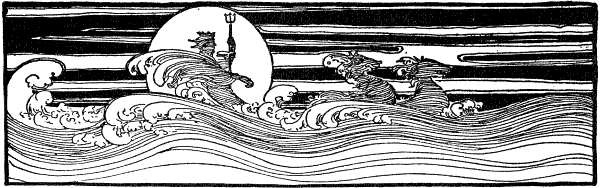
First came the Earth’s eldest son, the Ocean King,
to greet them. The Sea was a mass of fire with
gleaming phosphorus, and King Ocean and his mermaid
daughters seemed to be floating in red flames as
they approached. The maidens’ long and wonderfully
beautiful hair floated behind them as they swam, and
they sang the most entrancing songs. They bore an
invitation to Prince Dorion and his bride to visit
them in their marine home. And this invitation was
at once accepted by the strangers. Another invitation,
accepted at once, came from Prince Dorion’s
only sister, Princess Kuldah, who lived upon the
Earth with her husband. Many more charming invitations
were given them, but of course it was impossible
to accept them all.
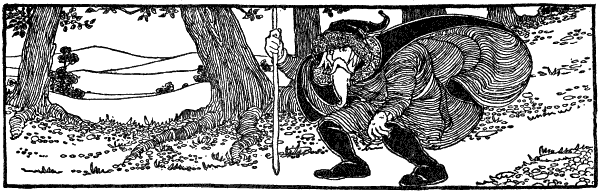
At last one distinguished-looking person strode
forward, small of stature and ugly to look upon. His
body was dwarfed, and he had a big hump on his
back. His face was dark and glowering, and he wore
a suit of yellow leaves. All the guests moved aside
to let him pass, as though they feared him. He
lived in the vast depths of the forest, amidst huge
mountains; his daily work, with his thousands of
imps, was to build those mountains big and high.
Stone by stone he raised them, bleak and barren, to
the clouds. He limped as he walked, and he glared
angrily at the shrinking faces avoiding him; but he
gave his invitation to the fair guests, as the others
had done, and bowed low before them as he gave it.
22
An involuntary shudder ran through the lovely
Princess as she heard his words, and she clung suddenly
to her husband in terror, as the black dwarf’s
eyes dwelt admiringly upon her. She felt a cold thrill
of fear at his bold glance.
But Prince Dorion, reassuring her with a tender
smile, turned to the ugly creature, and to the astonishment
of the Earth Queen and her court, replied: “Sir
Dwarf, we accept your invitation, and will gladly ride
forth with you whenever our hostess wills. The Sun
King, my father, and her Majesty the Queen of the
Moon, have each sent the Earth a gift as a glad token
of our visit here, and we must place our precious gold
and silver deep within the bosom of your great mountains.
There will it best thrive and grow, increasing
and benefiting the world.”
The Moon Princess turned very pale when she
heard her husband’s reply, but the black dwarf limped
away with a gratified smile upon his ugly face.
23
CHAPTER II HOW THE WEDDING GUESTS VISITED THE CAVES OF OCEAN
The Ocean King and his daughters came early
for their guests. They had driven fast, and
their sea-horses were covered with a lather of
white foam. As they came shoreward the rising Sun
dyed the sky a brilliant pink, and for a moment the
water caught its color. And then it was delightful to
watch the great rolling waves of the Sea blushing a
delicate rosy shade. Ethelda with Prince Dorion and
their friends stood on the creamy sands awaiting them.
The Moon Princess wore a gown to match her blue
eyes, and its exquisite train, embroidered in silver
crescents, hung in heavy folds behind her.
24
Stepping lightly into the Ocean King’s chariot,
Ethelda sat beside him. Prince Dorion followed, and
very soon the whole party were comfortably seated
among the mermaids. Away they started. Some
snowy birds, watching them off, rose suddenly, and
outstretching their long white wings, floated lazily
away.
Billions of sapphire waves rolled in to meet them,
but the horses sped easily through, leaving only a
broad roadway of foam behind. The shining sun
spread now over the wide expanse, and they seemed
to be flying through golden mists, while their great
frothy path glittered in as many colors as the rainbow.
Farther and farther they went, deeper and deeper grew
the rich color of the great deep, until it seemed impossible
it could become bluer. Then slowly that
brilliant blue changed, becoming a clear cool green,
the shade of the coldest waters. Not until then did
the Ocean King draw rein, and slowly descending,
they finally stopped at the gates of his palace.
The palace was a wonder to behold. Its walls
were built of richest mother-of-pearl, and shaded from
purest white to the most delicate rose. Its broad
staircases and wide halls were all of the same costly
material, while its trimmings and ornamentations were
pearls and diamonds of priceless worth.
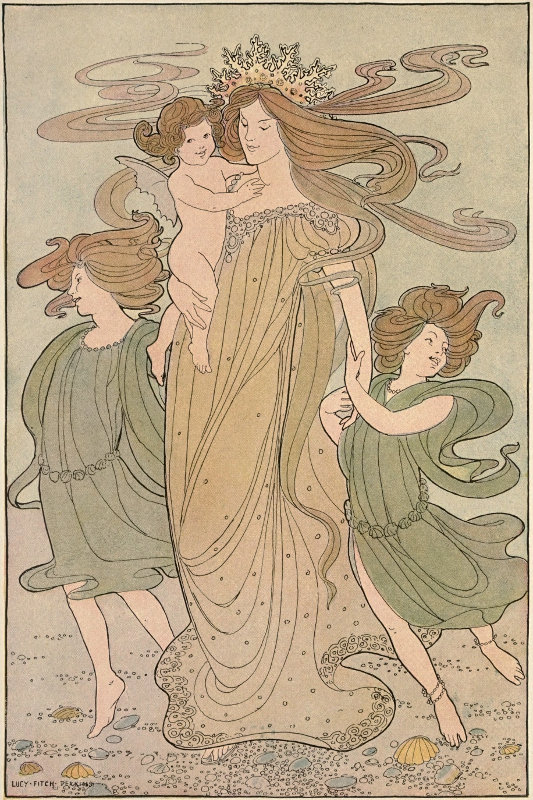
The Ocean Queen came forth, with her younger children, to greet them.(Page 25)
25
To keep the white light from dazzling with its
splendor, the tall green seaweeds waved about, lending
a delicious, cool shade, like the green trees on
the dry land, so that everything was agreeable to
the eye.
The Ocean Queen came forth, with her younger
children, to greet them, and Ethelda thought she had
never seen anything so delicately beautiful as the
Queen. Her eyes were clear as crystal pools, and her
hair—a bewildering mass of gold—floated about her,
covering her almost completely. She wore a pale
green dress trimmed with magnificent pearls, and on
her head a crown of diamonds. She glided up to the
strangers, and in the softest voice bade them welcome.
A magnificent banquet was served immediately,
and then they were shown the wonders of the sea
palace. Rooms filled with costly treasures were
opened; chests of brilliant jewels were examined.
26
But while the guests were enchanted with so much
splendor, the King explained that to the mermaid
kingdom these heaps of diamonds and emeralds and
rubies were really not worth a single piece of coral;
for at these huge coral beds in the bottom of the sea
the baby mermaids received their education. They
were taught to swim and play games and amuse
themselves, and later they lent their deft fingers to
build and carve those exquisite mountains of the sea.
When the Moon maidens saw the coral beds, they
too shared the mermaids’ belief.
The party were walking through the clear smooth
waters, when presently, ahead, they noticed a slight
ruffle, and almost immediately they saw a long pink
line. It was the coral reef. As they approached they
saw great sheets of roaring foam sweep over the slippery
coral, and as they passed by the hissing white
wall of foam they saw that the tiny builders had
raised their rose-colored mountains to a great height.
The delicate work was a marvel to see; it was like
the weaving of finest lace-work, and only the smartest
of the mermaids were employed to carve the coral
beds.
“Can the Earth exhibit greater wonders?” exclaimed
Prince Dorion.
27
“We think not,” answered the Ocean King; “but
perhaps it is because we love our home so much. We
have many more wonderful things we could show you,
but our time is limited, and we can only briefly display
our favorites.”
Turning, he took from the hand of one of his
daughters a beautiful shell. Creamy and shining like
satin was the outside of the curving piece of mother-of-pearl,
but its lovely lining was as pink as a rose-leaf.
Presenting it to Ethelda, the King bade her
keep it to remind her of her visit to his dwelling.
“This beautiful shell, fair Princess,” continued the
King, “shares with the mermaid kingdom its great
love of home, and it carries deep in its heart the sound
of the waves. It will never lose it. No matter
where it goes or how long it stays, if you but hold
it to your ear it will speak to you of us. For the
deep musical sound of the waves will always be heard
singing within its depths.”
28
Ethelda, delighted, thanked him for the charming
gift, which she gratefully accepted. Then continuing
their walk, they arrived at the door of a handsome
palace, where the Ocean King’s only sister lived. She
was called the Princess Sea Foam, and her palace was
built entirely of pearls. Great oysters were constantly
employed making these pearls for her, and day after
day they opened their wide mouths and deposited
fresh beauties at her doors. Her apartments were
very elegant and all in white, and the Ocean King’s
guests were especially astonished at the magnificence
of the Princess’s clothes. She was very beautiful, for
her skin was clear and white and her features delicate
and pretty. She was small of stature, and looked
more like a fairy than a mermaid, but her dress
amazed them by its beauty. It was snow-white, and
was studded with the largest and purest diamonds
they had ever seen. Even her hair was covered with
precious stones, and wherever she moved, sparkles of
light burst forth. When she approached closer they
discovered that the shining jewels were not really
diamonds at all, but clear and brilliant raindrops!
29
The Princess Sea Foam was in reality also the
Rain Princess. Her duty was to lie frequently upon
the top of the waves and travel about, watching the
dry land and the sky. Often one sees the broad blue
waters flecked with white specks; then one knows
that Sea Foam and her companions, in their white
dresses, are watching the world, to determine when
rain is needed. It is a great responsibility for such
a tiny Princess, but she has guided her millions of
followers wisely, and the Earth is well pleased with
her lovely daughter’s work.
They make the precious raindrops and then store
them away in a big room in the pearl palace. When
rain is needed the doors are opened and the skies
absorb the moisture. The heavens fill with clouds,—at
first glorious, shining masses, lying against the
blue sky as white and foamy as the Princess herself
on the blue waves, but later, gathering force, they
darken to a gray or black, and fall upon the Earth
in a shower of glittering drops. Over and over again
must Sea Foam do this wonderful work, but it is a
work of joy, because she loves those glittering drops
of shining water.
The Sun warms the world and gives it heat, but
the Ocean must cool and freshen it with raindrops;
for all the rain that falls from the skies must first
be gathered on the Earth, and this responsibility
rests on the Ocean King’s sister, dainty little Sea
Foam.
30
CHAPTER III HOW THE FAIRIES WERE CHANGED INTO MOCKING-BIRDS
They were most reluctant to leave the beautiful
world under the water, but the Sun
Prince and the Moon Princess must keep
their engagements, and there were many journeyings
for them yet. The Ocean King had kept them as long
as possible in his dominions, but now he felt obliged
to let them go, and so regretfully bade them adieu.
31
He had arranged in their travels about his strange
and wonderful possessions to land them in a beautiful
southern country. From this spot they would travel
north toward the Valley of Enchantment, to visit the
Sun Princess, that lovely sister of Prince Dorion who
was making her home in this world. They all looked
forward with much pleasure to this visit; it seemed,
in fact, to be one of their chief topics of conversation,
for they naturally desired to see the only sister of
Prince Dorion, who was famous for her great beauty.
Now and then, however, in the midst of their joyous
travels, a black shadow seemed to cross the pretty
Moon Princess’s face: it was when she remembered
the promised visit to the black dwarf. Somehow she
could not overcome her horror of him, and was never
reconciled to making him a visit.
Reluctantly the company bade adieu to the Ocean
King and his charming family, and rose through the
clear, limpid waters of a big Gulf. It was a beautiful
sight that met their eyes as they came to the surface
in the open sunlight. A wonderful land lay before
them. Its shores were shaded with spreading branches
of magnificent live-oak trees which grew down to the
water’s edge, planting their splendid trunks in the
very midst of the curving line of yellow sand. Farther
back pink crêpe-myrtles, yellow acacias, and white
Spanish daggers were scattered, and a long row of
pecan-trees kept dozens of chattering squirrels busy.
Cherokee roses bloomed in thousands, their yellow
hearts showing in brilliant contrast to their dazzling
white petals. “How beautiful this country is!” said
the Princess, and every one echoed her words.
32
As they landed they were greeted by the Sun
Princess’s messenger, who would guide them northward
to the Valley of Enchantment. This guide
belonged to the company of Sun people who had
accompanied the Sun Princess to her new home. He
proved a charming companion indeed, for he knew
everything about the countries through which they
passed, and in their travels told them many interesting
facts. They learned that they were in a southern
land, on the borders of a great Gulf. They could
see, beside the live-oaks, some superb trees growing
to great heights,—trees with great long green leaves,
holding big creamy blossoms that opened like white
chalices to catch the sun. One tree especially stood
out in magnificent strength. Its rough old trunk
was enormous and knotted with age, and its broad
branches spread out protectingly covered with big
waxen leaves. The great tree had a dignity about it
that fascinated the Princess. As the little company
walked nearer to examine it, they noticed how the
grass—soft as velvet—stretched away like a green
carpet toward the yellow marsh beyond. The nearer
they came to the tree the bigger the tree looked, and
they found a round hollow in one side the trunk,
where a squirrel had hidden his nuts. “It is a
magnolia-tree,” the guide replied, in answer to their
questions, “and there are many thousands like it
scattered through this southern country.”
33
At that moment a sound rose upon the air, so
soft and exquisite in its melody that they held their
breath to listen. It came from the branches of the
tree, and was a song of welcome from the mocking-birds.
In a moment a thousand of these little
feathered songsters had joined the chorus. Their
notes rang out joyously, for they warbled and
trilled in an ecstasy of delight until the strangers
thought they had never heard a more beautiful
concert. Then suddenly, while the Moon Princess
listened entranced, the music ceased as abruptly as
it had begun. They heard a flutter of soft wings,
and saw above their heads a flock of tiny birds.
The birds were lovely,—a soft gray in color, with
a splash of white on the wings and tail, and as
they flew away and disappeared in the distance all
became silent again.
34
What a silence it was! Not a sound broke the
stillness. The brilliant sunshine danced along the
ground like little sparks of fire, but not a leaf
stirred. It grew warm. The blue gulf lay like a
sheet of glass in a sort of golden mist. The heat
was intense; it seemed to shimmer in a yellow haze
over everything; and then suddenly a little movement
broke the profound stillness. It came from the
green-eyed, red-throated lizards as they ran through
the grass. They stopped to watch the strangers wonderingly,
but as the Moon Princess moved slightly,
the timid little creatures, affrighted, took the color
of the leaf on which they were, and lay as motionless
as death!
Then the Princess spoke softly: “This world is
very wonderful; I have never seen so many bewildering
things before.”
As they resumed their journey the guide told
them the history of the bird.
35
“The mocking-bird is really the southern fairy,
you know,” he began, “and the entrancing song it
sings is only the story of its life. It tells the tale over
and over again, in a delicious burst of song; as the
little children alone understand the fairies’ speech, I
cannot tell all it says, but I will repeat exactly what
I have heard. Once upon a time there dwelt in the
midst of that great magnolia grove we have just left
a band of fairies. They were the lightest-hearted and
happiest little band in the world, and they had just
celebrated a splendid marriage. One of their most
beautiful Princesses had married a nephew of the
Queen. He was as handsome as his bride was beautiful,
and everything went merry as a marriage bell.
Now, Prince Adelstan, in spite of his high rank and
station, was always playing some prank upon some
one, but his tricks were generally good-natured, and
the fairies seemed to love him the better for his fun;
he was, indeed, a great favorite with them all. Now,
when he married the dignified and beautiful Princess
Verdande, every one predicted that he would become
more sober, and, as a married man, put aside his
boyish manners.
36
“It really seemed just about as they prophesied.
Of course, a fairy’s life is a brilliant round of pleasure,
but Prince Adelstan seemed contented to travel the
world over with his lovely wife and act just as all
well-behaved fairies should. The little people were all
delighted, of course, with the change in their favorite,
and said among themselves he was even more attractive
than ever. In reality Prince Adelstan was so
absorbed in a plan he was forming for himself and
bride that he had no time to think of playing foolish
pranks on others. Fairies, as you know, are free to
do exactly as they please, except for one rule, and that
rule can never be broken. Their life must be lived at
night, amid moonshine and starlight, and then they
pass many gladsome hours together; from dusk until
dawn they are the merriest little people in the world.
But at the first streak of light every fairy must
vanish,—under a leaf, in the heart of a rose, behind
a dewdrop, the fairy may hide; but hide he must, and
there remain sleeping until darkness again falls upon
the world. This rule in Fairyland has been enforced
for centuries, and no one, however brave, has had
the hardihood to break it. Sometimes (but very
rarely), on a day when the Sun does not shine and
the Earth is covered with a white veil of mist, a fairy
can peep out, but he must be extremely careful that
he is only in the mist, for he must never see a ray
of sunshine for a moment.
37
“Well, can you imagine what Prince Adelstan
decided to do? He determined upon a terribly rash
thing, and planned it for months. He lay awake
thinking of it, for in his excitement he could not
sleep. He whispered it at last to his beautiful bride,
who trembled in his arms as she listened. She was
horrified at first, and pleaded with him to give up his
rash plan; but he was bent upon it, and after weeks
of pleading from him, she finally yielded and consented
to help him. Together they decided to elude the
fairies and break the law; for their rash determination
was no less than this—to see the Sun rise.
“Night after night they discussed it, and one
beautiful moonlight one, when they had danced until
dawn, and the other fairies, exhausted, had slipped
into the hearts of the magnolia blossoms to sleep,
Prince Adelstan and Princess Verdande stole carefully
down to the waters of the Gulf, and, breathless
with curiosity, awaited the coming of the Sun.
38
“Never shall they forget that morning. The
waters of the Gulf looked steely gray in the first faint
light of dawn. A pearly white mist was lifting slowly
from them, and melting as it lifted. The little bride
caught her breath with admiration as the cold steel-gray
of the water slowly changed into a delicate,
warm pink, for the Gulf, like a great mirror, was
reflecting all the lights in the sky. The sea-shell
pink of the faint dawn heralded the approach of the
Sun. Gradually the delicate coloring grew a deeper
rose, until the white clouds overhead seemed dyed
in crimson. The waters lay still and silent; hardly
a ripple disturbed their serenity. Presently long,
piercing rays crept across the sky, while all the
colors of the rainbow seemed to blend and mix
together. Gradually the world grew brighter and
brighter. Then suddenly out of the shining water
rose a great red ball of fire! The Princess clung
to her husband, for, beautiful as it was, she was
surprised and frightened. The Sun mounted slowly
into the sky, casting his brilliant rays across the
heavens, and at the same time great slanting streaks
of yellow beams danced before their bewildered eyes.
The waters of the Gulf were marvellous to see, for
they glistened like millions of flashing diamonds.
The two fairies stood amazed at the magnificent
sight before them, for even Fairyland has nothing
more beautiful than the sunrise.
39
“Presently a flock of white sea-gulls rose shrieking
from the sands, and Prince Adelstan and his
wife (startled by the sudden noise, and abashed by
their terrible disobedience) tried to hide behind a
blade of grass. Alas! what was their horror to
discover that they could not. They had grown
much larger, and they realized in despair that they
could no longer hide under the flowers; their wings,
too, had disappeared, and they knew they were banished
from Fairyland. Then their sorrow began, for,
try as they did, they could find no trace of their
brother and sister fairies.
40
“There was a dreamy stillness everywhere, and
the flowers were very tempting in the early morning
dew; but alas! those flowers no longer formed a
home for the disobedient fairies. Hand in hand
they wandered, and for miles they stumbled sadly
along, until at last they reached the edge of a great
marsh. The green and yellow grasses there were
scarcely moving, and lovely tints were shimmering
in a hazy amber splendor. The unruffled waters of
the bayou, as it ran curling around the rushes,
gleamed in spots of silver. The world took on new
beauties beneath the Sun, but the unhappy Princess
and her husband could not enjoy them. They
journeyed about in misery until they found the
gnarled old magnolia-tree. They hid themselves in
its hollow trunk.
“The fairies, of course, had missed them, and
knew perfectly well of their misfortunes, but the
Queen’s heart was hardened against them because
of their dreadful disobedience. However, the band
of little fairies, in spite of all, united in deep
sympathy for their erring brother and sister, and
they prayed the Queen to grant them pardon. The
Queen’s heart softened a little at last, for after all
the Prince was a beloved nephew; but even she had
not full power to restore them to Fairyland. The
law once broken, full penance must be done; for
disobedience is a dreadful crime in Fairyland.
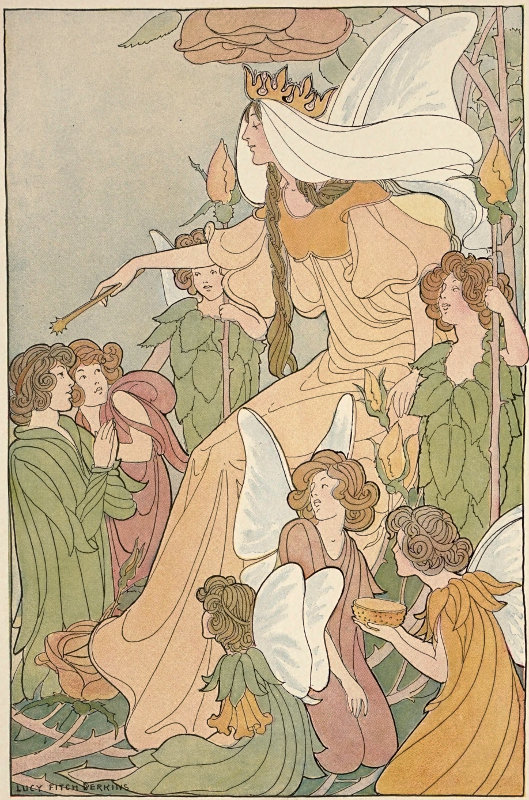
“They threw themselves at her feet, begging for pardon.”
(Page 41)
41
“Late one night, when the Moon was high in
the blue sky, and the world was flooded with silver,
when the bright stars flashed out like millions of
dancing points of fire, the two unhappy culprits
crept out from the hollow of the magnolia-tree.
The fairies were holding high festival, feasting on
rose-leaves and drinking the dew from tiny acorn
cups. Thousands of them were dancing in and out
of the moonlight, and their bright wings flashed
gold and silver lights wherever they moved. Their
wands, too, sparkled and glittered as if they were
on fire. The exiled Prince and Princess gazed sadly
upon it all, seeing now fully what they had lost;
but alas! it was too late. They knew quite well
their bulky forms without wings could never again
become as light and airy as before their disobedience.
Swiftly, however, they ran forward, and
before the astonished Queen had time to escape,
they threw themselves at her feet, begging for
pardon. The Queen frowned as she listened to the
story of their disobedience, and the other fairies
shuddered when they heard of the great crime.
Still, her Majesty loved her nephew and his bride,
and her heart was heavy as she heard the sad tale.
The Queen was unusually handsome that night, and
seated on a throne of moss-rose buds, she seemed
very far above the culprits at her feet. Her white-and-silver
dress sparkled brilliantly against the bright
pink of the rosebuds, and the green leaves about
them were so covered with dew that they seemed to
be made of frosted silver.
42
“‘Alas! my dear children,’ she began sadly, ‘I
have not the power to make you fairies again. You
have lost Fairyland forever by your act of disobedience.
Once banished, you cannot be recalled; beside,
were it possible for me to admit you again
to Fairyland, you would never be happy with us
again. You have seen the glorious sunrise once,
and nothing in Fairyland is so beautiful. You
would constantly long for that magnificent sight
again. But,’ she added thoughtfully, ‘perhaps I
can render you perfectly happy in some other form
upon the Earth, and in this way restore your contentment.’
43
“Tremblingly Prince Adelstan and his bride bade
her change them, for, miserable as they were, they
knew she spoke the truth. They would never be
happy in Fairyland again; they would always long
to see the sunrise. Then silence fell upon them all,
as the Queen slowly raised her glittering wand.
“Presently there arose upon the stillness of the
night a most glorious sound. It was the mocking-bird
raising its voice in thanksgiving and praise for
happiness found again. Again and again those delicious
sounds floated out on the air, filling the night
with sweetness, until the very fairies stood breathless
to listen. It seemed marvellous that so much
sweetness of sound could be contained in such a
tiny body; but the little songsters trilled and sang
in glorious delight.
44
“Only in this land of sunshine and magnolias
will you find this wonderful bird. It never wanders
far from the Gulf. It flourishes best amid the magnolias,
and it fills the southern woods with music.
It sings at all hours; at night, when the Moon is
looking kindly down upon the Earth, and the Earth
is serenely smiling to the Moon, its clear notes ring
out joyously, until even the stars from their glittering
palaces lean down to listen. But it is at the
witching hour of dawn that the most wonderful of
its melodies is heard. Then it awakens to watch
again that miracle of the world, the mystery of the
rising Sun, and as the golden spears of light streak
the heavens, cutting away the white veil of mist
and coloring the skies with rainbow hues, its glorious
voice rings out and floods the world with music;
for at that hour the mocking-bird is telling over and
over again the story of that magnificent sight—the
sunrise.”
45
CHAPTER IV THE LITTLE DWELLERS IN THE MARSH
As the guide finished his charming description
of the southern nightingale, he pointed out
to them the marsh. It was a strange-looking
place, and Ethelda asked many questions
concerning it. Why was it dangerous to cross?
Why must they skirt the marsh and go around it,
as they were doing? It was much the shorter way to
cut right across it, but instead, they walked miles out
of their way to reach the other side. Their guide
assured them that the marsh was not so charming as
it looked. Down amid its dark cypresses, where the
jagged palmetto fans and latanier grew, and where
the tall rushes and reeds were so fine that, swaying
softly under the breeze, they looked like moving
water, but water dyed in emerald and topaz tints—lurked
many dangers. Rattlesnakes and toads and
deadly insects made it their home, and the ground
was all a quagmire, so that stepping on it they would
sink deep in mud and slime, and perhaps die there.
46
“Oh,” said the Princess, “how awful! Does
nothing nice live there? Those beautiful tiger-lilies
and big purple passion-flowers bloom so
charmingly, surely there must be something there
to enjoy them.”
“Well,” answered the guide, “the birds frequently
nest there, and the great pelicans and cranes
hide in it; but beside them there are only three respectable
families that I know of who ever enter it.”
“Who are they?” asked Ethelda, deeply interested
at once.
47
“Why, the first family I mean,” replied the Sun
messenger, “is the Crayfish family. Deep down
in the black slime live this family, who delight in
digging and burrowing in the mud. They live in
very black dirt, but a happier family it would be
hard to find. They are splendid little housekeepers,
too, and spend most of their mornings in their own
homes, trying to build up and beautify their houses,
and they never meddle with any one else. Any time
of day you can see their bright eyes peering out
of their mud windows wonderingly. The Crayfish
babies are very tiny, and are carefully and tenderly
watched. They never are allowed to play with
others, and cannot leave their mother’s side a single
minute until they are five years old. Indeed, they
hold on to her sides until that age. By that time
they are considered grown, and can care for themselves
and choose their own friends. On this
account, perhaps, the Crayfishes don’t visit much,
because with a dozen children clinging to her the
mother is hardly a welcome guest anywhere; the
Crayfishes have few friends in consequence. The
Mud-Turtles, I believe, are about their only callers,
and only through them do they occasionally hear
of the outside world.”
“How comical!” laughed a pretty Moon maiden.
“Now tell us about the other families.”
48
“The head of the other family,” said the guide,
“is very interesting indeed. He is a queer little
animal called Opossum; he looks like a rat, but is
larger than a cat. He spends the day lazily, sleeping
among the foliage of trees, or in hollows of their
trunks or boughs. His fur is nearly black, but little
white patches about his face give him a most wise
appearance. He brought his family, consisting of a
wife and sixteen small babies, and started housekeeping
on the edge of the swamp. The babies
are not as big as mice, but they are the sweetest
little furry things you ever saw. They cuddle up so
nicely together, and just wait to be fed. Of course
Mother ’Possum has her hands pretty full watching
and caring for sixteen small children, so it devolves
on the father to provide food for them; and every
night he runs around the country looking for something
to eat. He is really a devoted father, but he is
not fond of work; and how to feed a wife and sixteen
babies without work is a very hard problem to
solve. So I am sorry to tell you Mr. ’Possum often
steals his food, that being the easiest way to get it,
and nothing appeals to him so strongly as a tender
young chicken.
49
“Now, the third family dwelling in the marsh are
the Raccoons. Mrs. ’Possum has a great contempt
for this same neighbor of hers, and they are not on
very friendly terms. Mrs. ’Possum is a splendid housekeeper,
but Mrs. Raccoon cares nothing at all about
her home. True, she builds her house carefully in
the topmost branches of a tree, but having done that,
she considers her duty ended, and seldom occupies it.
‘Any old place is good enough to sleep in,’ she says;
and just so she can find a spot with water enough
to moisten her food before eating it, she is content.
Therefore she wanders around, with the little Raccoons,
anywhere and everywhere, and when they get
tired they just creep under some old log and go to
sleep. Of course Mother ’Possum, with her strict
ideas of housekeeping, thinks this careless habit no
way to live or to bring up children; but whenever
Mrs. ’Possum reproaches Mrs. Raccoon with being a
slipshod housekeeper and a gadabout, Mrs. Raccoon
invariably replies, ‘Have you ever noticed how soft
and fine my fur is, and how many beautiful rings I
wear on my tail?’—for she is awfully vain. Then
she flourishes her tail around, and whisking about,
shows off the pretty black and white rings she carries,
to the best possible advantage, until Mrs. ’Possum
in disgust sends all the little ’Possums scurrying
away, fearing lest they become vain and worldly like
the Raccoons. But with the exception of the Raccoons
and the Crayfishes, the Opossum family own
the big yellow and green marsh.”
51
CHAPTER V THE RAINBOW SISTERS
As the guide messenger told all these tales of
the marsh, the Moon Princess and her companions
noticed they were gradually leaving
the southern land; for of course such wonderful
beings as Moon Princesses and messengers of Sun
Princesses travel much faster than mortals, and they
were travelling rapidly. They seemed to be in the
midst of a charming forest of long, cool shadows
and crystal springs.
“What place is this?” asked Prince Dorion,
stopping to admire the long, cool vista of trees
ahead.
“O, this,” replied the guide carelessly,—“this
forest was once the abode of the Rainbow Sisters.”
52
“Who were they?” innocently inquired a dainty
Moon maiden, tripping lightly along.
“Would you like to hear about them?” asked
the guide.
“O, yes,” replied all the Moon maidens in chorus,
“do tell us all about them.”
“Once upon a time, in a charming country, a
delightful people lived. The skies were clear as crystal,
and the Sun shone brightly out of them. Great
palm groves grew green and beautiful, and curious
flowers sprang up in marvellous bits of color. There
was a strange and fascinating beauty about this land.
Even the rocky hills edging the big broad desert
that stretched for miles away, barren of the smallest
green blade of grass to make them pretty, were not
ugly. Yellow as gold they sparkled in the bright
sunshine, rich and mellow against the paler sand
beyond. The country lay near a large blue sea,
and through its many cities ran a splendid shining
river. Now, every one of the clear, cool drops of
this smiling stream was precious as diamonds to the
people, for, beautiful as their land was (and it was
superb with its splendid mosques and temples and
rich with jewels and carvings), it lacked one thing
that the rest of the world enjoyed,—never a drop
of rain fell there.
53
“For more years than you could count, the trees
and the flowers had never tasted a cool sweet drink
from the skies. The heavens were always blue and
clear, for the Sun shone brilliantly out of them every
day. Sometimes a cloud might form, but if it did,
it floated by white as the foam on the sea, never
dark or black.
54
“Now, you may think that golden sunshine and
blue skies are very lovely things to possess, but the
people tired of having them all the time. They felt
that a nice shower of rain occasionally, even if it
came out of an ugly black cloud, would be better
than all the pink and violet and green shades of
their clear heavens. The only thing that saved their
trees and their gardens from burning up as in the
dry heat of the desert, and that gave them water,
was the glorious big river flowing by. No wonder,
then, they loved and prized its drops. Broad and
long, it ran through the country, and curled in silver
splashes about the banks. Twice every year it
overflowed, and then, with feasting and joy, they
caught it in pools and canals dug to hold and preserve
the precious liquid. In this way they kept
the gardens green and lovely, but oh, the work was
so hard! Thousand of poor slaves labored day and
night to accomplish it. The kind-hearted king
offered a big reward to any one who would devise
some way to make rain fall in his country, and
many wise men spent days and nights studying over
the great question. Big trees were planted to catch
and draw the moisture, and many other means were
tried, but in spite of all these doings the clouds
sailed by, as fleecy and white as snow.
55
“So things went on for many years, and still no
rain ever came. Now, the king had an only son, to
whom he was perfectly devoted. The child was
very beautiful, and was also wise, as a prince should
be. It was a common thing to see the handsome
little fellow standing in the midst of a grave council
of men, listening to their words of wisdom. He
never seemed to tire of their long discussions, and
would remain, solemn and silent, among them, instead
of playing with the children about him. Thus he
grew in wisdom and strength to manhood, but he was
seldom seen at the court balls and festivals, preferring
to wander about among the beautiful mosques
of his father’s city, or to stand on one of their daintily
carved minarets and gaze across the yellow
sands of the desert. Often he would remain thus
for hours, and though his eyes were looking far out
over the appalling yet wonderful beauty of the desert,
his thoughts were always only of how he might
solve the riddle of his country, and bring it the cool
drops of rain it so earnestly wanted. This one idea
absorbed him utterly, he could think literally of
nothing else, for he noticed with sorrow how terribly
hard his father’s slaves toiled to carry the precious
water from the river when they tilled the ground.
“One day, shortly after he was grown, he was
sitting beneath the shadow of a great pyramid, and
was planning and musing on the one question always
uppermost in his mind. The day was warm;
the desert around him shimmered in a golden haze.
The yellow hills were so bright beneath the noonday
sun that his eyes fairly ached as he watched
them, and it was a relief to turn from their glittering
lights toward the cool, flowing river, and watch a
fringe of feathery, waving palms. ‘Oh, for the dark
shadow of a cloud,’ he murmured, ‘to soften all
this glare!’
56
“They circled together, dressed in the vivid colors of the rainbow.”
(Page 57)
57
“He had not spoken aloud, and yet he heard a
musical sound as though in answer to his wish. He
turned quickly, and saw a wonderful sight. The
desert had disappeared, and he was looking into a
shadowy green forest, with crystal springs. Clear,
limpid streams of water ran through the woods, and
beautiful flowers were blooming. Farther along in
the distance he saw a big mountain, dark and gray,
and yet all about its sides grew pretty green ferns.
Looking closely, he observed that there was an opening
in its side, and through this opening came the
music of a flute. As he watched more closely he saw
a lovely maiden come slowly forth. She was dressed
in a brilliant gown of orange color, and her flowing
robes floated softly about her. Her hair hung in
waves of gold, and on her forehead flashed a beautiful
star. In her hand she carried a wand, but the
wand was so curious that he forgot the beauty of the
maiden in noticing it. It was long and slender, and
seemed to be made of pure gold and laden with jewels;
but it was not this wealth of glistening gold
that attracted him, it was a curious cloud of white
mist that curled and floated away from it each time
that she waved it aloft. He had never seen anything
so peculiar before. Each white cloud that floated
away nestled among the hollow places in the hills
like a thin veil, or hovered over the babbling streams
in the forest. While he was watching the mysterious
cloudlets from the magical wand, a second maiden,
more beautiful than the first, followed, dressed in a
pale blue gown, and having, like the first, a brilliant
star on her forehead. She also carried a jewel-laden
wand, and it sent forth similar mysterious white
clouds. Then came a third, dressed in a brilliant
red; and another, in soft green; and still another, in
charming violet; and so on, until seven beautiful
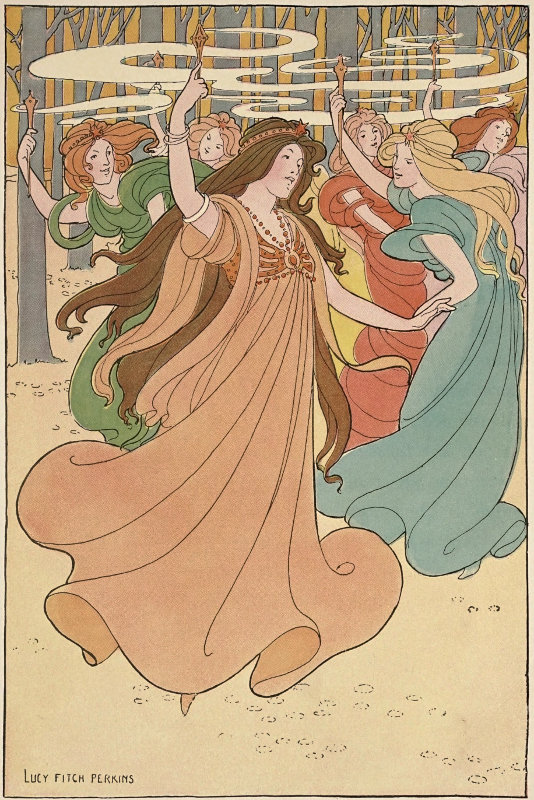
creatures stood together, dressed in the seven vivid
colors of the rainbow. They formed a ring, and
slowly moved together in a circle about an open
space before the mountain. Lightly stepping, thus
they danced, always in a circle, and always gazing
intently toward the opening in the mountain through
which they had come.
58
“Presently, as they gazed expectantly, Prince
Asgard saw coming toward them the most exquisite
creature he had ever beheld. She was tall and
slender, and her graceful form seemed to dance along
rather than walk. She was dressed in some soft,
clinging material of pure white, shading to a glittering
silver, and the girdle confining her waist looked
like a bit of the blue sky itself, it was so dainty.
Her hair was like that of the other maidens, and
looked like spun gold, and it was so fine that it
glistened wonderfully as she moved. Her slippers
were pale blue, and embroidered with silver threads.
A brilliant star on each slipper flashed like a big diamond
as she danced along. A tiny golden crown
held her hair in place, and seven glittering stars
encircled her head. Her wand was of frosted silver,
and as she waved it, the soft vapor rolled away in
white clouds, as it did before the wands of the other
maidens. As she appeared, the seven other maidens
broke into a song of gladness, singing in a clear,
high tone these words:—
59
Little Sister, fair and dear,
Born of seven colors clear,
Welcome! In our round of pleasure
You’re to us the dearest treasure;
Out into the world we’ll send
Mist and clouds of white that blend.
The silver maid replied, singing:—
Dearest sisters of my race,
I come forth to your embrace;
Faithful, tender, always true,
Shall my love be unto you.
Then they all danced a wonderful dance while singing
together:—
Let the foaming clouds on high
Fall in raindrops from the sky;
Let the lightning’s fire flash,
Come, with thunder’s awful crash!
Let the cooling rains thus sink,
Giving earth her crystal drink!
60
“As they moved together in graceful steps and
in perfect rhythm to the music of the song, Prince
Asgard saw a wonderful arch or bow form across the
cloudlets that had arisen from their wands. It was
a magnificent rainbow, and each of the seven distinct
colors was matched in shade by a dress worn by
one of the maidens. Their flowing draperies blended
bewitchingly and mixed together in pretty confusion
as they danced, making thus a complete circle of
rainbow colors. It was an exquisite sight, and the
Prince marvelled at it, and wondered what it all
meant. Presently the maiden who had first appeared,
and who seemed to be the eldest and the leader of
the sisters, waved her wand aloft and approached the
silver maid, and taking her hand, led her into the
middle of the circle. The circle then formed again,
and continued dancing around the little white Princess.
For several minutes they danced; then each
in turn, beginning with the eldest, tenderly clasped
the silver maiden in her arms and kissed her on the
brow, and then ran lightly into the opening in the
side of the mountain.
61
“The silver maid stood one moment longer, smiling
and lovingly watching her sisters, then she, too,
tripped lightly toward the mountain, as though to
follow them. But, as if a sudden thought had come
to her, she turned abruptly and glided toward Prince
Asgard. His heart was beating with excitement as
he watched her, and he held his breath with admiration,
for he had never seen any one before so wondrously
beautiful.
“In a moment she was beside him, and he noticed
her eyes were sparkling and blue as the girdle she
wore.
“‘O, Prince of the Southern Lands,’ she began, in
musical tones, ‘you have witnessed the dance of the
Rainbow Sisters—a sight forbidden to mortals. We
live in an enchanted mountain in the heart of a great
forest. Our mother is the beautiful Sea Foam, whom
you have often watched in her white dress upon the
ocean. We help our mother with her work, but our
home is in the deep recesses of these lovely woods.
Never before has a mortal eye seen these woods nor
witnessed our sacred dance in them. From our magical
wands float out the mists to form the cloud-world.
Upward they travel, gathering moisture as
they go, and floating across the blue heavens, they
fall again in refreshing rain upon the earth. But
our precious mist-clouds never fall in your country.
We will never send them there again unless, unless—’
and she hesitated in the most charming and
provoking manner in the world.
62
“‘Unless what, O beautiful Princess of the Silver
Gown?’ eagerly asked the Prince.
“‘Alas, that I may not tell you,’ replied the little
Princess, growing grave. ‘This only may I add:
Once, in the long ago, your people did a great wrong,
and were very rude to my sisters. It was their
custom then to dance publicly, once a year. Always,
your people gathered to watch them, and with pleasure
my sisters danced before them, and with their
magical wands they sent out the mist-clouds far and
wide. Refreshing rain fell in your midst then as
elsewhere, and everything was joyous and charming.
But your people were rude and offended my sisters
sorely, and never again will they visit you or dance
before mortals. All your methods to bring rain into
your country will fail, your schemes will come to
naught, and until my sisters relent and forgive, the
clouds will continue to sail across your blue skies as
white as the flecks of foam on the sea.’
63
“‘Never shall the rain fall in my country?’
echoed the young man sadly. ‘Never? Then, O
beautiful Princess,’ he added despondently, ‘shall I
never see you again?’ For at that moment the
Prince forgot his great problem, how to bring rain
to his country, and thought only (with a heavy heart)
that he would lose sight of the little Princess of the
Silver Dress.
“‘Never, O Prince,’ replied the Princess gravely,
‘unless—’ then she smiled suddenly, showing her
teeth like gleaming pearls between her red lips,—‘never
unless you find us again, and—’
“‘And what?’ the Prince demanded earnestly.
“‘Alas,’ replied the silver maid, again grave, ‘I
cannot tell you. There is one thing alone that might
cause them to return to your country, but it seems
so impossible, that it will never happen, I am sure;
and beside, I cannot tell you what it is.’
“‘O,’ replied the Prince earnestly, ‘I will find it
out. No obstacle on earth will prove too hard, and
you may be sure nothing will prevent my finding
you, beautiful Princess.’
“‘I wish you success,’ sweetly replied the Silver
Princess, and then, as she spoke these words, she
blushed a vivid crimson.
64
“She was so beautiful as she stood thus before
him, blushing and smiling at the same time, that the
Prince, falling on his knees, begged her to give him
a sign by which he might hope to see her again and
win her love.
“She tore off a piece of her blue girdle, and
dropping it on the earth, put her foot lightly upon
it. ‘I leave you a flower,’ she said, ‘may it comfort
you. Forget me not’; and saying this, she disappeared.
“The Prince rubbed his eyes, for as she vanished
he found himself again gazing at the feathery green
palms across the big river, and looking around, found
the yellow desert stretching in boundless sands to
meet the horizon. The forest, the mountain, all had
gone. But as he turned away from the great tawny
hills in despair, he saw at his feet a tiny bit of blue.
Stooping, he picked up the prettiest flower he had
ever seen. It was as blue as the silver maid’s eyes,
and as he held it to his lips he repeated her words,
‘Forget me not’; and since that day the little flower
has always been called the forget-me-not.
65
“Now, as Prince Asgard went home he pondered
deeply on what he had seen, and gaining the consent
of his father and the wise men of the country, he
gathered together a great army and started out into
the world in quest of the unknown princesses. No
person believed he would succeed in finding the Rainbow
Sisters or in bringing rain into the country.
The story of the Rainbow Maidens was well known
to the wise men, but they counted it a myth, a fairy
tale, and they smiled among themselves when they
heard that Prince Asgard believed it firmly. But
they did not object to his trying: it would do no
harm; and in the meanwhile they would still study
and devise other methods.
“Prince Asgard said good-bye to his father and
the people, and at the head of a great army sparkling
in gold and silver helmets and shields, he
started on his journey. He was going to look for
the Rainbow Sisters because his country needed rain,
yet in his heart he knew it was because of love for
the youngest and prettiest of those sisters that he
was so eagerly searching.
66
“The army travelled everywhere throughout the
world. By sea and by land they went, and they
had many wonderful adventures. Tigers and wolves,
bears and panthers, attacked them, and strange people
told them they were on a foolish quest, but they
did not heed such remarks, and continued on their
way. But after several years had passed, and they
seemed no nearer the Rainbow Mountain, the soldiers
became discontented, and said it was a foolish trip
after all, and begged to be allowed to return to
their own homes. The strange countries through
which they passed taught them much, and they often
saw rain and splendid storms; yet when some of
their fine ships were wrecked and lost at sea, many
of them felt that perhaps it was pleasanter after all
to be in a country where only sand-storms of the
desert were known. One by one the soldiers were
released by Prince Asgard from their promises; they
returned to their homes, and at last the Prince was
entirely alone. But he was not discouraged. Determined
and brave, he vowed he would never give up
the search, and he started out again with renewed
courage to find the beautiful Princess of the Silver
Dress.
67
“He wandered many months, but without success.
At last one night he stood, almost despairing, on
the edge of a dark forest. He had just made up his
mind that he would live and die in a foreign country,
because he would never go back to his own
home until he found the Silver Princess. ‘O beautiful
Princess,’ he said aloud, ‘some way I shall find
you and prevail upon you to marry me, for I can
never be happy without you’; and yet as he said it,
it seemed to him almost an impossibility.
“He entered the forest and sat down within its
gloomy depths to rest a while. The Moon was just
rising, and in a little while her bright rays penetrated
the black density of the trees. Little patches of silver
lay along the ground, and a light wind stirring
the trees made the silver rays dance along, until
the earth seemed sprinkled with millions of shining
jewels. He was watching the pretty sight intently,
for it made him think of the dress of silver that the
little Princess wore. He was so absorbed that he
was considerably startled when he heard a musical
sound such as he had heard on the edge of the
desert.
68
“Looking up quickly, he beheld, to his amazement
and joy, the same big mountain, and heard the
rippling waters of the crystal streams flowing over
the rocks. He could hardly breathe, he was so excited,
and so fearful lest it should prove a dream.
“But again the beautiful sister emerged as before.
Her magical wand sent forth its cloud-vapors
as she danced forward; again the other lovely maidens
followed, and again they formed a ring of rainbow
brilliancy. The Prince sat expectant and trembling.
Would the Silver Princess appear? A moment
more and the little Princess tripped out, more
beautiful than ever. Her silver dress gleamed and
sparkled in shining light as she floated forward.
Her eyes were tender and blue, and her dainty
girdle, with its touch of color, bound her slender
waist. Her lovely arms shone white and firm through
the thin gauze of her dress. Butterflies floated about
her, airy, exquisite things, marvellous in color, and
lighting on her hair and shoulders, gave a curiously
beautiful touch to the picture.
69
“Her sisters greeted her lovingly and tenderly,
as before, and they then began their graceful and
mysterious dance. Clouds of vapor rolled about
them as they moved, until the forest was enveloped
in a misty veil; but through it all the dazzling
dresses and graceful forms could be plainly seen.
Then, as the dancing drew to a close, the rainbow
circle shining lovely through the mist, the seven
dancers, each in turn, stooped, and clasping the Silver
Princess in their arms, kissed her caressingly.
“Prince Asgard remembered with an aching heart
that this parting kiss was a signal for their disappearance,
and fearing he might lose the beauteous
maid again, he darted forward impulsively. He
hardly knew what he intended to do; he had formed
no idea beyond the fact that he would speak to her,
appeal to her to remain by his side. At the moment
he sprang forward there was a fearful cry from the
seven sisters, and turning, they fled to the mountain
side, urging the Silver Princess to follow. She stood
dismayed, and trembling in every limb, and then,
with a little low cry of terror, she followed swiftly.
But whether she was confused or frightened, she
stumbled as she ran, and fell upon the earth.
70
“At that moment Prince Asgard reached her side
and lifted her gently to her feet. She turned so
pale as he assisted her that he held her for a moment
in his arms to support her, fearing she would
faint, and anxiously asked if she were ill.
“‘Alas, no,’ she replied, as she drew away from
him, ‘but you have done a very terrible thing.’
“At that moment a sad and mournful cry arose
from the heart of the mountain, and the seven sisters
floated out slowly and surrounded the Silver Princess.
She threw herself on her knees before them, but
they did not touch her. It seemed as though they
feared to do so. She implored them to touch her
with their hands, to kiss her, but they only sang a
sad refrain in answer to her prayers.
Little sister, mortal now,
Alas, we cannot kiss your brow.
Still for ever shall abide
In your sky a rainbow guide;
And the love we have for you
Now and always shall be true.
Then, tenderly kissing their hands to her, they
floated off and disappeared in the mist.
71
“‘What does it mean?’ said Asgard tenderly,
lifting the Silver Princess from her knees. ‘Why
are you so unhappy? I love you with all my heart,
little Princess. Will you not consent to marry me?
Ask your sisters to spare you, for I cannot live
without you.’
“‘Alas,’ she replied, ‘my sisters have gone for
ever from my sight. When you first touched me I
became a mortal like you, and I cannot now return
to them.’
“‘O, little Princess, do not be sad,’ replied the
Prince, ‘for you have made me so happy by remaining.
Surely you will not refuse now to marry me?’
72
“‘No,’ replied the Silver Princess, smiling through
her tears. ‘I am an earth maiden now, and I love
you. But though I am happy to be with you, I am
sorry to lose them. Our dear mother warned them
that some day I would love a mortal, and they have
feared you since the night I spoke to you in the
desert. That was the condition I could not tell
you,’ she added shyly. ‘Your touch would make me
mortal, and as you lifted me in your arms when I
fell, I became an earth maiden and lost my fairy
nature. But you have solved the riddle of your
country, for when we enter it together, you will find
that rain will follow. My sisters love me dearly,
and for my sake will forgive your people. They
will follow me to my new home, and though we
shall never see them again, the reflection from their
brilliant dresses will glow in the sky. As the rainbow,
they will arch the heavens when we arrive, to
show me they are near to welcome us.’ And sure
enough, when Prince Asgard and the beautiful
maiden of the silver dress (who was called Hyndla)
entered the land of lotus flowers and acacias, they
saw, arching the heavens, a magnificent rainbow.
“The people greeted them with cries of joy, and
gave them a magnificent wedding, for they were
grateful to Princess Hyndla and her seven sisters,
and they had learned all about her in messages from
Prince Asgard. On the day he and the Princess
Hyndla appeared, a great white cloud hovering over
the city suddenly turned black, and fell in millions
of sparkling drops upon their fields, and the splendid
rainbow soon afterward arched the skies.
73
“The Princess Hyndla grew more beautiful each
day, and as she was wise as she was charming, you
may be sure her husband loved her dearly. Together
they planted row after row of handsome trees
to remind them of Hyndla’s forest home; those green
trees brought cool shadows, and when the clouds
floated low to kiss them, the broad branches caught
and held the moisture. Ever after, rain frequently
fell in the land.
“Years later, when the children of Hyndla and
Asgard were old enough, they played in the palace
gardens, and romped merrily beneath those same
shade trees, and sometimes they whispered lovingly
to each other the romantic story of their beautiful
mother and her rainbow sisters.”
74
CHAPTER VI HOW THE SUN PRINCESS CAME TO THE EARTH
“Oh, how charming the Rainbow Sisters must
be!” said Ethelda, “and how I love to
hear you tell these wonderful stories of
the Earth! Do you know any more?”
“Yes,” replied the guide, smiling, “a good many
more, but what would you like to hear about?”
“Won’t you tell us of how the Sun Princess happened
to come to this world?” interrupted a dainty
little Moon maiden; “I really have never heard it
exactly, and as we are going to visit her, perhaps
Princess Ethelda will let us all hear about it?”
75
“Most willingly,” replied Ethelda; “I know the
wonderful story almost by heart, of course, but I
never tire of it,” she added, looking tenderly at
Prince Dorion the while.
So the guide, with this permission, began:—
“In the Land of the Sun there was once a
Palace of Wisdom, where all the science in the universe
could be studied. Of course this Palace of
Wisdom became very famous. Far and wide it was
heard of, so that from all parts came representative
young men to study and become wise. Now, the
ruler of the Sun lands was a powerful king, possessing
many sons, but only one daughter, the Princess
Kuldah. She was a maiden of wonderful beauty.
Her countenance was so exquisitely lovely, that all
who looked upon her immediately fell in love with
her. This caused the young Princess, as well as her
father, great annoyance, because her suitors became
legion. One day, however, with the help of her
maidens she wove a veil of delicate texture, which
completely concealed her features. In this way, she
was enabled to go and come throughout her father’s
vast possessions in comparative ease.
76
“Notwithstanding her great indifference toward
her lovers, kings and princes sought her hand in
marriage, but her father (who adored her and could
deny her nothing) was secretly well content that
she chose none of them, but remained always in his
dominions with him.
“Tall and of majestic appearance, the Princess
Kuldah looked the daughter of the Sun King. Her
eyes were brown and large, with brilliant lights
within, and her curling brown hair, falling below her
waist, had caught a little of the golden fire of the
Sun. Her gleaming white teeth looked like pretty
little pearls when she smiled. Indeed, she was a
queenly sight as she drove in her handsome chariot
toward the Fire Mountains.
“These mountains were a great range of gorgeous-hued
stones, piled very high. Rising in blazing
splendor, they perpetually sent forth their red
beams in dazzling streams of light across the Sun
country. But the heat and glare of her home—which
would have burned and killed an earth maiden—were
but life-giving elements to the Sun Princess.
She loved the glitter of her country, and no glare
seemed too great for her. The palace where she
dwelt was built of the brightest, yellowest gold to
be found, and she moved through it a splendid vision
of beauty.
77
“Her favorite ride was toward the Fire Mountains.
One morning as she drove the fiery steeds
toward their flaming heights her horses became unmanageable.
Pull as she would, she could not control
them; they went like the wind at his greatest
fury. She had outrun all her companions in her
mad race, and she was in the most imminent danger
of being killed. At this critical moment there arose
in her path a tall and handsome young man. The
horses were as startled as the young Princess at this
sudden appearance, and for a moment, in alarm,
slackened their speed. It was in this second of hesitation
that the young man leaped into the chariot
beside Kuldah, and snatched the reins from her
hands. It took but a few moments of his great
strength to subdue the enraged animals completely,
and in a little while they were trotting along quietly,
as if nothing had happened.
78
“Then of course the grateful Princess turned to
thank her preserver. In her excitement (when she
had lost control of the horses), she had thrown back
her veil, and the young man found himself steadily
gazing into her beautiful countenance. Strive as he
would, he could not resist the love that surged in
his heart as he looked upon her. But although he
was falling in love rapidly, he had heard too much
of the haughty Princess’s coldness and indifference
to feel sure of winning her. He guessed at once it
was she, because he had heard she was the loveliest
being in the Sun world, but he determined he would
not yield to her influence and become one of her
suitors. The Princess’s own feelings, when she looked
at the young man, surprised her very much. He
was so modest and dignified, and withal so handsome
and charming, that she could not help wondering
who he was. He was certainly not one of her
suitors, for she had never seen him before. This
young man, too, seemed quite indifferent to her attractions,
and talked to her very seriously about driving
her horses, and showed her how to manage the
reins in case they tried to run away again. She
might have been just a plain girl for all the admiration
he showed. At first this indifference pleased
her; later she rebelled a little against it.
79
“She learned he was a young Prince who had
been studying in the Palace of Wisdom. This
astonished her still more, for although he had been
in her country some time he had never sought her
out at all. He had come to the land of the Sun to
study its fire and flame, and he was evidently absorbed
only in that study. The Princess was so
astonished to learn all these facts, and to observe
his indifference to her famous beauty (which was
proved by his not seeking her hand in marriage),
that she forgot to lower her veil, and sat talking
to him much longer than she otherwise would have
done. Finally remembering, she covered her face,
but not before she had asked him to call at the
palace and let her father thank him properly for
having saved her life.
“The young man secretly determined he would
not accept her invitation, for he had already learned
to love her, and feared the usual fate of her suitors.
However, when the hour approached the next day
he could not resist the temptation to see once more
the lovely Princess; after that he found many excuses
to call, and managed each day to see her.
80
“But the wonderful part of it all was, that
Kuldah took as much pleasure in his company as
he did in hers. So later, when he asked her to
marry him she said yes, right on the spot, fearing
to delay, lest he might go off and become as indifferent
as he was at first, and never come back again.
“He was very happy when she said yes, and
thus far everything had gone very smoothly for
them both; but when they went in to see the old
King their troubles began. Kuldah was wreathed
in smiles, and Prince Minio looked very happy and
proud. The old King, who had never supposed for
one minute that his daughter would accept any man,—having
refused so many,—had one day rashly
promised all the suitors that, if she ever made a
choice, they should each have a fair chance to win
her. This, of course, was the cause of the lovers’
trouble now. The Princess was indignant that her
father should have made such a promise about her.
She considered herself free to choose for herself.
So she stormed and wept about it as only a Sun
Princess could do, and declared she would never,
never marry any man but the man she loved.
81
“But her old father, who was so indulgent and
yielding with her usually, remained firm in his decision,
and said he could not break a promise once
made, for that would not be honorable. Therefore,
the very next day he announced to everybody that
a contest in skill and science should take place between
the suitors for her hand. The Princess was
very unhappy, of course, during the days that followed,
but Prince Minio cheered her by saying he
felt equal to winning her in a fair contest. His
love was far greater than that of the others, and
therefore he felt assured he would learn a way to
win her for his bride in spite of them all.
82
“When the great day for the contest came, a
large gathering of the suitors was held in an open
field at the foot of the Fire Mountains. They were
a fine and noble company of young men who contended
for Kuldah’s hand, and her father said she
should have felt proud and glad at such a sight.
But she was too sad to feel proud. She had dressed
as became a Sun Princess, and her gown was of
finely spun gold, embroidered in diamonds. Her
white arms and throat gleamed through the thin
gauze dress, and a girdle of diamonds encircled her
slender waist. From her shoulders fell a train, which
swept for yards behind her, and a narrow gold band
held her beautiful hair in place. For her hair hung
about her in loose masses, falling far below her
waist, and mingling its burnt-gold color with that
of her brilliant dress, so that one could hardly tell
where one ended and the other began. As she
stood she looked like a golden Princess, except that
her face was as pale as the fleecy clouds overhead.
“In her majestic beauty she let them kneel and
kiss her hand. Each one, as he touched her hand,
swore in turn to be faithful and true to the knight
who should win her, but each one believed secretly
he himself would be the winner. Then began the
tournament of skill. One showed how he could
ride; another how he could mount and dismount,
or how he could unhorse an enemy; a third used
the gloves or the sword with wonderful dexterity;
another engaged in a trial of strength, or swiftness
in running; and so on until the long list was completed.
83
“It seemed to the Princess, as she watched in
despair their wonderful deeds, that there was nothing
left for her beloved even to attempt. The suitors
had all done such marvellous things; and her heart
ached within her when she learned from one of her
handmaidens that her lover was the last to appear
on the lists. Yet, when he did step forth, calm and
serene, her heart leaped again to her throat, her
confidence returned; for he looked strong and handsome,
and it was only with pride and pleasure she
gazed upon him. She leaned forward with a smiling
face to listen to his words, for he was speaking.
“‘O mighty King of the Sun,’ he was saying.
‘I have one request to make of you before beginning
my experiment. If successful in what I undertake,
I want your consent to take the Princess away
with me from the Sun lands. What I shall try to
accomplish to-day is but the beginning of a great problem
I wish to work out. It may take thousands of
years to complete, and I wish to live in a land of my
own choosing, that I may be able to accomplish it.’
84
“The Sun King, astonished at these words, hesitated
to grant such a remarkable request, but the
Princess threw herself at her father’s feet, and added
her pleadings to the Prince’s. Finally the Sun
King reluctantly consented; but the other suitors
smiled broadly among themselves, as they heard the
words, for no matter what the Prince might do they
believed he never could show more skill or wisdom
than they had already displayed.
“Having bowed smilingly to the King and kissed
Kuldah’s hand, Prince Minio turned to his competitors
and said: ‘I have made a close study of the
Sun’s fire, and I am convinced that, no matter
where this fire is sent, it will continue to burn and
hold its remarkable glint and its quickening power.
It will never be extinguished, but glow brilliantly
for ever. Therefore, my experiment in skill to-day
shall be made from it alone; it will serve my purpose
better than anything else.’ So saying, he picked
up a huge bowlder from the Fire Mountain nearest
him. The stone was so big that it seemed impossible
for any one to lift it. But the Prince gathered
it up in his arms with a terrific effort, and balancing
it perfectly threw it far out into the heavens.
It bounded away and rolled into space with tremendous
force, making a whirring noise as it dashed
along. Again and again he lifted out the big rocks
and tossed them off in the distance. It seemed as
if he would never tire of this remarkable exhibition
of strength. Hundreds and thousands of the brilliantly
burning stones went whizzing through space,
before the eyes of the astonished spectators. Yet he
continued, calmly throwing more and more stones,
until the heavens fairly gleamed with millions of
burning lights. Thus were the star fires first kindled,
and they were truly a magnificent sight, even to the
Sun people, accustomed as they were to splendid
spectacles.
85
“As the Prince predicted, the stars have never
lost their brilliancy, the Sun’s power to warm and
enliven all creatures has proved very strong and
lasting, and those splendid, flaming signals light the
turquoise-blue skies every night, even to this day.
“Finally, Prince Minio selected with great care
seven superb stones, even brighter than the rest, and
threw them not quite so far from the Sun. In this
way they felt the Sun’s influence more strongly;
though they flew to a good distance they always
revolved about their old home. Whizzing and whirling
continually, yet never flying away from the Sun,
they appeared to the spectators to be the prettiest
of all the stars in the sky. Then the Prince, turning
to the Princess, who was bewildered with the
joy of his brilliant success, bade her choose from
the seven stars the one that should be their home.
She chose what she thought the loveliest of all the
seven, and they named it the Earth!
86
“The old King unhesitatingly pronounced Prince
Minio the victor. For he acknowledged that, beside
the great strength the Prince had displayed in
lifting the stones from Fire Mountain, the Sun people
had never before witnessed such a glorious sight
as the star-studded heavens; and even the suitors,
though much disappointed, consented in a manly
way that he should take Princess Kuldah as his
bride, saying he had fairly won her.
“Shortly afterward a marriage of magnificence
and splendor followed, and Prince Minio and his
charming wife came to the Earth to spend many
years. The Earth, owing allegiance to the Sun, never
loses sight of him, and though she continues to rush
through space at a terrible rate, yet the Sun King
always sees her.
87
“Out of the white mist on the Earth came trooping
a wonderful band of little creatures to greet the
Sun people. They were very tiny; their skirts of
silver glistened like the moonlight, and their jewelled
wands sparkled like the dew. These little creatures
were fairies, and ever after dwelt among the Earth
children, helping to beautify the world. They wander
about us in the moonshine and are sometimes caught
in the mist, but they can never come out in the
sunlight. One of the laws in Fairyland is to be in
bed before the dawn. From dusk until dawn the
fairies lead a gay life. They hold their revels, they
dance, and they travel the world over, frolicking like
mad sometimes, but only the Moon’s white light
shines on their silver dresses.
88
“Many other charming people adopted the Earth
as their home, for it was beautiful to live upon.
The Sun Princess and her husband did not object
to others coming to their home at all, only, as the
strangers came in great numbers, they finally decided
to set apart a great space for themselves alone.
They reserved, therefore, a charming bit of country
for the Prince’s workshop, otherwise there would
have been so many interruptions Prince Minio could
never hope to accomplish his scientific work. Charming
as the Earth people were, they interfered with
the Prince’s heart’s desire. Therefore, he and his
friends from the Sun chose a wonderful valley which
lay in the heart of a great range of mountains. The
valley covered many miles of ground, and it had the
most sublime scenery in the world. Rivers ran
through it, and big mountains rose suddenly in its
midst. Small silver lakes also shone like crystal
mirrors. Wonderful springs abounded there; boiling
water came out of one, while from the next shot up
cool and deliciously sparkling drops. They called
the bubbling, spouting springs geysers, and people
come from all over the world to see and study them.
89
“After the Sun people had reserved the country,
the Earth people never remained long on that spot;
they recognized the law and accepted it, only making
short visits to the marvellous place. Sometimes,
if one mortal, more daring than the rest, determined
to live there, and built him a house, he was promptly
punished, for the fairies at once opened a geyser directly
under the carefully chosen home and destroyed
it entirely. So this beautiful valley of yellow stones
and brilliant lights and rushing waters is left to the
Sun Princess and her people. It is certainly a valley
of enchantment, for it is never very cold and never
very hot there, but is an ideal workshop for a Prince.
The geysers and boiling pools are just the escaping
gas and steam of his big furnaces; for the fires in
his furnaces under the earth are kept burning day
and night. It is all very mysterious. In one part
he has a big hot lake, and in another an ice-cold
one. The cold lake is shaped like a human hand,
and near it is a big fountain that dashes up clouds
of white spray, hundreds of feet high, flecking the
green surface of the water with foam.
90
“Nothing can be more beautiful than this enchanted
valley. The fairies are busy beautifying it
all the time. They have painted the colors of the
rainbow in the rocks, and the great canyon looks
now as if millions of jewels were piled up there.
For it is a bewildering mass of color. Amethyst,
topaz, and emerald tints sparkle everywhere, and
when the sunshine pours down on it you feel as if
all the wealth of the world must be hidden in the
rocks, for they sparkle like diamonds and rubies. As
the years go on the valley grows more beautiful, for
the Sun Prince and his bride watch it by day,—and
of course as the fairies have charge at night it is
never neglected.
“When the Sun Prince has finished his great
labors and solved his problem, of course, he will
close his workshop, and with his lovely bride go
back to their home in the Golden Palace of the Sun.
But until then his workshop fires will burn. The
geysers and fountains will spout up great volumes
of water and steam, making the valley one of the
wonders of the world. And all the Earth mortals
who go there will be made welcome by the fairies.”
91
CHAPTER VII THE STORY OF THE JEWELLED BEACH
“Do you wonder that I love the story?” said
Princess Ethelda, as the guide finished.
“Oh,” replied the Moon maidens, almost
in one voice, “it is an enchanting history, indeed.”
“See,” replied the guide messenger, pointing in
the distance to a high mountain, “beyond that
mountain lies the Beautiful Valley of which I have
just told you.”
92
In a little while the merry party had reached
the mountain top, and stood gazing in a bewilderment
of pleasure at the wonderful valley below.
Exquisite lakes and shining silver rivers lay beneath;
beautiful hills stretched away in the distance; and
the glorious colors in the rocks, which the fairies
had painted so vividly, reflected the pinks and yellows
in a growing radiance that lighted up the whole
valley in splendor. Innumerable rays flashed out in
little threadlike flames, flooding the world below in
a blaze of color.
“How magnificent it is!” exclaimed the visitors;
and the guide was well pleased with their admiration.
I could never describe to you properly the entertainments
that followed their arrival, nor the joy of
Dorion and Ethelda in meeting the beautiful Sun
Princess. Princess Kuldah was as beautiful as
ever, and spared no pains to make her brother and
his bride and their companions welcome. The
Prince, her husband, showed them his wonderful
workshop, and they marvelled over the geysers, and
listened with awe to the description of his great
problem.
93
The days seemed all too short, and the guests
were surprised when the time for their departure
arrived. The feasting and dancing and sight-seeing
were at last ended in the valley of enchantment; one
glorious morning they rose with the Sun, and bidding
good-bye to Princess Kuldah and her people, started
to meet the black dwarf of the mountains. The
same guide would accompany them to the place
where they were to meet him. The Princess saw
none of them felt much desire to go; Ethelda was
particularly downcast, still she bore up bravely, and
with a smiling face she began the journey.
Although Ethelda and her companions were
charmed with the splendors of the deep, they were
still more impressed with delight over the new
beauties they discovered upon the land. They had
seen the glittering mountains of the Moon and the
fiery craters of the Sun, and had wondered at such
magnificence, but the Earth’s fresh coloring was a
revelation. And the Earth had decked herself right
royally to receive them. The month was April,
and the world, rioting in flowers, was aflame with
color. The poppies, yellow and scarlet, burst forth
from the meadows’ tenderest green. The white petalled,
yellow centred daisies came out in thousands
to greet them, while the roses, pink and white and
red, flashed everywhere. The trees, too, dressed in
the earliest Spring green, nodded and waved their
long branches in a glad welcome, and the tiny
wood violet, modest and sweet, sent forth its perfumed
breath in waves of delight, filling the air
with sweetness.
94
“Wonderful—wonderful!” cried Ethelda, throwing
herself in an ecstasy of pleasure upon the soft
greensward, and gathering handfuls of the flowers to
weave into garlands. “I should like to live here
always,” she said. The Sun Prince shared his
bride’s delight, but he whispered cautiously: “Take
care, sweetheart. Remember a Moon maiden and a
Sun Prince can only visit for a twelvemonth. A
longer stay would be dangerous; it would keep us
here for ever.”
“O, yes,” answered Ethelda; “I was hardly in
earnest when I spoke, for I could not leave my
beloved mother sorrowing. Yet I am very happy
here.”
Days of pleasure passed, on the journey. Days
of wonderment too. When the strangers saw how
the small seed planted in the ground—warmed by
the sun and watered by the rain—throve and became
a tiny blade of grass, a delicate flower, or a magnificent
tree, this seemed a miracle to them, for
nothing ever grows out of the soil of the Moon or
the Sun.
95
One day as they stood on the top of a high
mountain they saw a very strange sight. A great
sea lay shining in the distance, sparkling and glittering
in gold and blue. It washed the shores of
magnificent valleys and rich gardens. Fruits and
flowers grew in abundance, but the strange sight lay
in the fact that the valleys and fruit gardens stretching
out so broadly suddenly stopped at a line of
yellow sand,—stopped so abruptly that it seemed
almost a straight line, it was so clean cut,—and the
sand covered hundreds and hundreds of miles of the
Earth.
“How queer it looks!” they said among themselves;
“not a blade of grass, not a tree, on the barren waste!
We have never seen anything like it
before. What is it?”
“It will take two stories to explain that wonderful
view lying before us,” replied the guide.
“Oh, do tell them!” cried the Moon people in
chorus; “we love stories”; and they settled themselves
to listen.
96
“Well,” began the guide, “the first relates to
the Princess Ethelda.”
“To me?” asked the Princess in astonishment.
“Yes,” answered the messenger; “look closely at
the sea beach and tell me what you see.”
“Why, great shining jewels seem strewn over the
yellow sands,” said the Princess, perfectly amazed;
and in turn each of the Moon people saw the same.
“Well,” continued the messenger, turning to the
Princess, “when her Imperial Majesty of the Moon
consented to your coming to visit the Earth on your
bridal trip, she ordered many wedding presents for
you, and in finishing the loveliest that she gave you,
it came about that that beach was formed. But I
will begin the story of the Jewelled Beach.
“The Moon was shining through a turquoise-blue
sky. Now and then a baby cloud passed before her
face, but it was so white and airy that it did not
even hide the dazzling lights of her silver palace.
One could see them perfectly well, shining through
the handsome windows.
97
“Serenely beautiful the Moon Queen moved
through her star-studded pathway. She was calm
and majestic. As she swung around the celestial
circle that night she leaned down lower to watch
the golden gleam of a small star shining far in the
distance. For many reasons that particular star had
occupied her mind of late, and that evening she
seemed even more intent upon it than ever. How
beautiful it was! Of all the millions of glittering
points embroidered on the sky, that small one stood
out the brightest. In bold relief its dancing lights
sped out over the heavens in friendly twinkle toward
the Moon.
“The Moon Queen smiled to herself as she
watched, and then out from the jewelled windows of
her home suddenly leaped a brilliant crystal light to
meet the star rays. From that moment her Imperial
Majesty made up her mind on a subject she had
long thought of. Turning to one of her handmaidens
who stood near, she bade her summon the
master mechanic of her empire; when this had been
done, and the man stood before her, she asked, in
liquid tones, ‘How many workmen do I employ in
the silver mountains?’
98
“‘Ah, your Majesty,’ was the reply, ‘you have
so many thousands employed there, that it is almost
impossible to say.’
“‘Good,’ replied the Queen thoughtfully, ‘I have
sore need of thousands now. Bid them all meet me
to-morrow. Call them together at the foot-hills of
the mountains. Let no man be missing; from the
greatest artist in your shops to the humblest workman,
let not a sprite dare to forget my command!’
“The master mechanic promised obedience, and
bowing low left her presence.
“When the hour arrived that the Queen had
named, there gathered at the foot-hills of the mountains
all her little workmen. Thousands and thousands
of tiny sprites were there, and they glittered
from head to toe in shining silver garments; silver
dust powdered them until their clothes looked white
as frost, and when they moved their sheen was like
costly jewels. Talking together, they were wondering
why the Queen should have commanded them to
meet her at their busiest hour. Except that she was
not fond of idlers, and required prompt and vigorous
work from her people, she was a gentle mistress;
but now, when they were rushing with the wedding
presents for the marriage of her favorite daughter
(which was soon to occur), she had called them
from their shops. It surely seemed unwise. All
work had ceased, for not a sprite in all Moonland
was missing. What could it mean?
99
“At last her Majesty appeared. Her great retinue
of nobles and gorgeously dressed maidens
accompanied her, and with music and gay laughter
they came nearer. Presently the sprites saw the
Queen bid her attendants stop where they stood,
and unaccompanied she approached the gallant army
of her little workmen. She was well worthy the
cheers of admiration that broke from their lips as
she neared them. Tall and magnificent in form, she
looked every inch a Queen, yet her bright blue eyes
glowed with a tender light of love, showing a gentle
nature, as she bowed her thanks for their affectionate
greetings. Her long, fair hair floated softly
about her, sometimes clinging to her white dress like
threads of gold, and at her slender waist was gathered
a graceful silver girdle, caught with a diamond
crescent. At last, in all her splendor, she stood
among them, and as she raised her hand asking for
silence, absolute silence fell upon them.
100
“‘My good and loyal subjects,’ she began, ‘I
have come to-day to intrust you with an important
but secret work. No one in all the kingdom save
yourselves must know of it. When all is completed,
I myself will divulge the secret to my people, and I
believe it will gladden them. But until then will you
faithfully promise to help me and to keep my counsel?’
“‘Beloved Queen,’ they answered in one loud
voice, ‘your will is ours; we will obey you gladly.’
“‘Then listen, friends and subjects,’ the Queen
continued with smiling face, ‘for this is my command:
That you make me a splendid silver ladder!
Step by step must it be wrought, and with greatest
care, for it must stretch out miles and miles in
length. Strong as bands of steel each round must
be, but finer in its texture than the gossamer web
of the spider. Weave it with the fairies’ touch,
making it exquisitely light, yet so bright withal
that it can easily be seen for thousands of miles.
Spare neither care nor labor, beloved subjects, for
the ladder must be mine within the week.’
101
“Days and nights the hammers of the little
workmen rang out clearly, like notes of merry music,
and the Moon people said among themselves, ‘What
gorgeous wedding presents our little Princess will
receive!’ But they never dreamed of the mysterious
ladder of glistening silver steps. And the Queen
Mother kept her counsel. Only, each night as she
sailed across the jewel-laden heavens, she leaned
closer to the Earth Star and studied it.
“She saw great valleys and snow-clad mountains,
barren deserts and limpid blue seas. She saw,
too, great forests and boundless plains; but though
her searching eye looked upon every inch of that
beautiful bright ball whirling through space, she
thought the loveliest spot on the whole globe was
on the borders of the largest ocean. That ocean
was so big that it measured just one half the star
itself. All the other oceans and the land together
could be taken up and put upon its broad blue
surface.
102
“This splendid body of water washed the foot
of a glorious country. Big mountains, raising their
purple heads among the clouds, crept down to feel
its cooling depths. Or, higher still, they reared their
lofty peaks and held them scornfully aloft; and
thus, capped with perpetual snow, they stood beautiful
and glorified. Great plains stretched back from
its curving yellow beach, and all the fruit one could
name grew in the rich valleys. It was the garden
spot of the world. Amid its groves of yellow
oranges and lemons birds sang deliciously; flowers
bloomed throughout the year, and the skies were
nearly always sunny. In this earthly paradise palms
lazily waved their feathery green arms, and trees
grew so big that houses could be cut out of a single
trunk. Here it was that the Moon Queen’s eye
lingered longest, and it was almost with a child’s
delight she saw the big blue waves roll in and
break upon the sand in a fringe of soft white foam.
“The week had passed, and the Queen’s ladder
was ready. One by one its silver steps were tested;
ring by ring its loops were firmly fastened and bound
together; for, dainty as it looked, the ladder must
be strong for constant use.
103
“When all was ready the sprites were cautiously
sent with it on a secret mission to the Earth. None
but the Moon Queen knew their errand; but she
smiled to herself, for after all, when completed, it
was to be a wedding present and surprise to her
favorite daughter.
“Down from the palace crept the little people,
carrying their silver treasure. The night being dark,
they reached the Earth without being discovered.
In a little while they found the ocean beach the
Queen so loved,—for it was here the first jewelled
rounds of that sparkling ladder should be laid. By
the soft light of the stars, the sprites saw that the
Earth was very beautiful; but what were those queer,
sad sounds they heard, mingling with the breaking
of the waves upon the beach? The workmen
stopped to listen, and caught the strains of music;
then, looking closely at the water, they saw a line of
lovely maidens, with flowing golden hair, which they
continually combed as they sang. The Moon sprites
were quite astonished at the sight. The maidens
were surpassingly beautiful, but their song was very
sad.
“‘Who are you, and why do you sing so sadly?’
they called.
104
“‘Alas!’ replied the charming creatures, ‘we are
mermaids. Our father is the Sea King. We have
always been as happy as the day is long, until a few
years ago, when a terrible misfortune came upon us.
One of the prettiest of our sisters was about to be
married. We were busy with the preparations for
her wedding, gathering the seaweed and the pretty
mother-of-pearl shells that float up on the land, to
decorate her palace. We had searched carefully our
large and magnificent sea-gardens for the finest specimens
of weed and shells. But a beautiful shell,
brilliantly tinted in every shade of rose and green
and blue combined, had been thrown high upon the
sandy beach, out of our reach. Our dear sister became
too venturesome, and floating on a big wave
she grasped the shell she coveted.
105
“‘At that moment, the hideous Gnome King
sprang suddenly from behind a rock, and snatching
her in his arms ran off. In vain we pleaded with
him to restore our lost darling. The cruel monster
only laughed, and swore she should become his wife.
Her bridegroom of the Sea was almost beside himself
with grief when he learned the awful news. He
offered his life in exchange for hers, and we gathered
together all our jewels for her ransom. But nothing
would move the hard heart of the wicked Gnome
King, and he still keeps our beloved sister in his
power. That is why we sing so mournfully. The
monster, finding she would not marry him, carried
her to the top of a high mountain, where she could
see her beloved home, but never reach it.
“‘She is helpless upon the land, and though she
can look down at the foot of the mountains and see
the curling waters of her home, she cannot reach it.
Her lover sits below, encouraging her with words of
love, but he is helpless to reach her. Miserable and
longing for home, she watches all the ships that
pass, and with her lute sings the most wonderful
songs, begging the sailors to rescue her. Many have
tried, and the mountain-side is white with the bones
of those who have perished in the attempt. For the
Gnome King makes mad those who try to save her;
they lose their way and die.
“‘Alas, kind friends, unless you will help us, we
fear she is lost to us for ever.’
106
“The kind-hearted Moon sprites were certainly
touched by this pathetic tale, and they determined
among themselves that they would form a plan to
outwit the cruel Gnome King, and rescue the sea
maid. Of course to do this they would have to
delay a little the planting of the Moon ladder, but
they felt that her Imperial Majesty would certainly
have consented to delay in such a case. So, gathering
up their precious burden, they climbed the mountain
to seek the sea maid.
“Knowing that she could never reach her sisters
alone, and enchanting all the mortals who tried to
rescue her, the Gnome King had no guard to watch
the maiden. She was left entirely alone upon a big
rock overlooking the ocean. The wicked king came
at rare intervals to see if she would consent to
marry him, but otherwise she was left undisturbed.
“A glimmering figure sitting on a high cliff.”
(Page 106)
107
“The Moon sprites, however, were not affected
by the King’s enchantments, so they had no difficulty
in reaching her. Suddenly the mermaid saw a gleam
of brilliant silver flooding the darkness behind her,
and in a moment she was surrounded by a thousand
little silver-dressed creatures. At the same moment
the Moon sprites caught sight of a glimmering
figure of matchless beauty sitting on a high cliff.
The maiden was a vision of loveliness. Long, waving,
golden hair floated about her, and her eyes
were the color of the sea. She held a lute in her
hand; as her fingers moved softly across it, it gave
forth a weird but beautiful sound, and to this accompaniment
she sang charmingly. Quickly the Moon
sprites told her of the plan for rescuing her, and
joyfully she listened.
“They carefully suspended the silver ladder from
her mountain cliff. Holding it tight between them
to steady it, they flung it swiftly down until its brilliant
steps touched the trembling water. At this
moment they heard a faint noise like rumbling thunder,
and the affrighted maiden bade them hurry
with their work, as it was the signal that the
Gnome King would soon visit her. In a twinkling
they seized the maiden in their arms, and carried
her down the brilliant steps. They were not a
moment too soon, for hardly had they placed the
maiden in her bridegroom’s arms and picked up their
ladder, when the Gnome King and his legion of
wicked gnomes were swarming on the mountain-top.
108
“The rage of the wicked King was fearful to
see, but it was useless. He could not regain the
mermaid and he could not harm a Moon sprite; but
in his anger he pelted the beach with stones, venting
his fury in destroying its beauty. Small but
ugly, they fell in thousands, covering the golden yellow
of the sand, and hiding its glistening splendor.
Thus he showered his spite upon the beautiful playground
of the mermaids.
“But the Sea King’s daughters were too happy
over the return of their beloved sister to fret very
much. True, their charmingly beautiful beach seemed
ruined, but their beloved sister was home again.
Thousands, indeed millions, of little stones were piled
about in ugly confusion, and marred the soft, bright
sand the sea people so loved, but they were powerless
to prevent it. The Moon sprites went back to
their work of fastening the moon-ladder to the
Earth, and the Sea King invited them to remain for
his daughter’s wedding the next night.
109
“The wedding spectacle was certainly a grand
one, for the Ocean Monarch had ordered the greatest
fireworks in his kingdom in honor of the event.
The sea blazed up as though it were burning.
Flames seemed to leap and flare up everywhere, and
thousands of brilliant colors mixed and trembled in
its depths. The phosphorescence was wonderful, and
wherever the eye could reach, the brilliant lights
shone and sparkled. The Moon sprites were amazed
at such magnificence. The night was as brilliant
and beautiful as day; and they felt that the wonders
of the Earth world were great indeed.
“Just then a messenger arrived from her Imperial
Majesty of the Moon, saying that she had watched
her workmen rescuing the maiden, and had seen the
wedding festival and the splendid illumination, and
before recalling her little people to the Moon, she
wished to give the bride a present. The wicked
Gnome King had tried to ruin the playground of the
mermaids, but she would restore it, making it more
interesting and fascinating than ever.
110
“It was a royal gift the Moon Queen gave. She
said that henceforth the beach should be enchanted.
The hideous stones the gnomes had thrown should
not ruin it after all, but should make it more precious
to the world, for they should all turn to shining
jewels. She chose to make the white pebbles the
loveliest of them all, and so change them that the
sea people could never forget her. These stones
shone as clear as crystal, and in the pure depths of
each one there trembled a moon-ray, a memento
of her crystal kingdom. This brilliant ray glistened
like a diamond, caught and held a prisoner, and
was from that day called the moonstone. But it was
hard indeed to choose the prettiest of the beach
jewels. For opals clear as water, and with fire from
the sea, sparkled beside the moonstones; sardonyx,
chrysoprase, and emerald, jasper, aquamarine, and
topaz, were piled so high that the beach was soon
most widely known.
111
“The Earth people come in hundreds to seek
these treasures, making them into precious necklaces
and charms. But though they carry thousands
and thousands away with them each day, the mermaids
smile and do not mind at all, because the
Moon-ladder, uncoiling every night in sparkling brilliancy,
reaches down from the silver palace and
touches the beach like a magician’s wand, and the
mermaids know that so long as the shining steps
of brilliant silver shall rest upon these sands, just
so long will the beach continue enchanted, and
splendid jewels be formed in such glittering quantities
that they will last for ever.”
112
CHAPTER VIII THE LOST OCEAN
The little company seemed well pleased with
the explanation of the jewelled beach, but
as soon as the messenger ceased, they asked
for the explanation of the trackless sands.
“That is a longer story; shall I tell it now?”
was the reply.
“O yes, do,” said the Princess Ethelda. “We
are not a bit tired, and it is so pleasant to look
down on the very spot while you tell us.”
Thus encouraged, the guide messenger began:—
113
“Ages ago, when the world was young, three
great Kings ruled in the universe, the Sun King, the
Ocean King, and the Earth King. The Earth King
owned all the land of the world, and often travelled
over it, watching it and caring for it. He was frequently
accompanied by his favorite daughter, the
beautiful Princess Selene. She was a graceful
maiden of about eighteen. Her lovely brown eyes
and long, wavy, golden-brown hair, and her white
skin and pink cheeks, made her a very charming
picture indeed. Being a fun-loving, merry little
maiden, her cheerful disposition made her a delightful
companion, so her father was always pleased to
have her travel with him.
“On one of these journeys the young Princess
seemed more serious than usual, and one morning
she came to her father with a request which greatly
surprised him. However, when he found her heart
quite set upon it, he made up his mind to grant it.
She said she had long contemplated doing her share
of work in the world, and that she did not think
she wished always to remain just a fun-loving and
pleasure-seeking young woman. She asked her father
to give her a portion of his vast kingdom to cultivate
as a garden, declaring she would make it the
most beautiful garden in the world, a sort of earthly
paradise.
114
“As soon as her father consented to her wish, she
chose a charming spot. It was on the borders of a
great sea, and back of it were magnificent mountains.
A large gulf, too, stood near, whose waters flowed
into a shimmering sea beyond. Here Princess Selene,
having chosen hundreds of companions, took up her
abode. She planted trees for shade and sowed grass
for a quiet, restful color, and then she laid out her
garden according to a well-thought-out plan.
“I could never begin to tell you in a short story
how wonderfully beautiful she made it. Fruit trees
of all descriptions grew there; lemons and oranges,
citrons and bananas, peaches and apricots, flourished—everything
nice you can think of. She did not
forget the flowers, either. Magnolias and acacias,
poinsettias and jasmines, and every Southern flower
you could name, bloomed beautifully. Lovely birds
flocked there, and rested in the cool trees, singing
to the flowers and filling the garden with delicious
music. The Princess and her companions worked
hard and faithfully, and the garden became the most
charming spot imaginable. All the world talked
about it and came to visit it.
115
“The country about was very attractive. Great
snow-capped mountains rose abruptly from the sea,
and white clouds, nestling down to touch them,
hovered like angels’ wings above the rich valleys as
though in protection. The clouds were seldom dark,
for it rarely rained there, and the sunny blue skies
seemed to smile perpetually.
“Now, the powerful Sun King had many sons,
but one of them was especially handsome, and,
better than that, he was the soul of honor and
truth. He was called Prince Corus. He often came
to Earth to visit the Ocean King’s family, for one
of the sons was his favorite companion. The two
young men were inseparable; they were devoted to
each other, and fond of the same sports.
116
“When the Ocean King’s son, Prince Fronto,
grew to manhood, his father gave him control of a
smaller kingdom, a beautiful sea that washed the
shores of Princess Selene’s famous gardens. This
sea was reached by sailing through the blue waters
of the gulf; shining and beautiful, it stretched for
miles and miles through a magnificent country. It
was on the shores of this sea that the two Princes
spent most of their time, and it was here one day
that they came across the lovely Selene and her
maidens. Both the young men felt at once that
they had never before seen anything so perfectly
charming as the Princess, and they lost no time in
learning to know her.
“She treated them with the greatest courtesy;
and in a little while the three had become firm
friends, and spent many happy hours together. The
young men did not attempt to disguise from themselves
the fact that they both loved this royal
maiden; but the Sun Prince, in a spirit of nobleness,
offered to leave his friend Fronto alone to win her
hand, though in losing her he would become the
most miserable man in the world. Up to this point,
however, Fronto apparently showed a similar generosity
of spirit, and putting his arm about his friend,
urged him to remain, saying: ‘We will abide by the
decision of the Princess. Let her choose between
us, and whoever wins her love shall marry her, letting
the other suitor swear friendship to them both.’
117
“‘So be it,’ replied the generous Prince Corus,
for it seemed a fair proposition. ‘Much as I care
for her, I will promise to give her to you gladly if
she loves you; for, after her, I love you best in
the world.’
“They clasped hands, and swore a solemn oath
to abide by this agreement.
“Selene was in no hurry to choose, and seemed
equally fond of them both. Never by word or sign
did she show which she preferred. Always together,
the three wandered through her gardens, plucking
the fruit or listening to the songs of the birds. The
two young men came every day to see her, and strove
to invent plans for her amusement. Corus brought
his father’s golden chariot, and often the three took a
mad race across the sky. But the maiden was never
afraid. She loved the spirited, prancing steeds, and
their flashing golden harness; and the wild ride
brought a glorious color to her cheeks. She thrilled
with pleasure when the rushing wind blew back her
flowing hair, and her eyes caught a deeper blue from
the heavens, and sparkled and danced with delight, so
that Corus and Fronto thought her more bewitching
than ever.
118
“Again, Fronto would invite them to see his
father’s famous sea-gardens, and they would ride
across the sapphire-blue waves until they reached a
rocky island. Here they would rest, to watch the
seals climbing over the rocks. They amused themselves
long, laughing at the awkward antics of the
fat baby seals, who would tumble with loud splashes
into the water, and then frolic about noisily. The
Princess loved these famous sea-gardens; they were
very different from her own, but wonderfully interesting,
nevertheless. Every sea-plant grew there.
Huge trees of seaweed were plainly seen, and curious
water-flowers in abundance. Magnificent shells bordered
the walks, shells dyed with the mystic colors
of the sea,—blue and green and opalescent,—others
pink-lined, like the sky at sunset, or brilliant red,
like the coral reef. Charming gold-fishes swam about
these water-gardens, and their scales, glowing like
fire, sent out great sparks of light. Mermaids floated
through, with long golden hair and starry blue eyes,
singing low to the music of their lutes. Thus many
days and weeks were passed, and each hour the young
Princes grew more madly in love with the charming
Princess Selene.
119
“At last a day came when they could no longer
resist asking her to choose between them. But when
they stood before her, and waited for her answer in
silence, the fun-loving little Princess suddenly became
grave, and said most seriously: ‘Why make me
choose at all? Your friendship may be broken if I
do, and I could not bear that.’
“‘You need not fear for us, sweet Princess,’ said
Fronto, ‘for we have sworn an oath, and will not
break it.’
“Selene gazed earnestly at them, not understanding
this reply. Then Corus, pale as death, nodded
assent, saying: ‘It is even true, fair Selene; as you
cannot choose but one, we both have promised allegiance
to the one you favor. We love you too
sincerely to do otherwise.’
“A brilliant color dyed Selene’s cheek as she
heard these words, and turning to Prince Fronto she
began softly: ‘So be it. We have passed many
happy hours together, and in my heart, Prince Fronto,
I have a deep affection for you.’
120
“Hearing her speak thus, Prince Corus grew very
white, and turned away to hide his pain, whispering
to himself: ‘They shall not see how I suffer. I have
sworn an oath, and I will keep it.’
“But whatever the Princess continued to say to
the Ocean Prince, it seemed not to please him.
Finally she said to him, while she turned and beckoned
to his friend: ‘Therefore, kind brother of the
shimmering sea, you must forgive me; for, though I
love you as a friend, my heart belongs to Corus,
and him I choose to be my husband.’
“The Sun Prince could hardly believe he heard
aright; but as the beautiful girl turned shyly toward
him, he caught her hand, and kneeling, kissed it,
thanking her for his great happiness.
“The Ocean Prince showed great surprise at
Selene’s words, because he had always thought she
preferred him to Corus; indeed, it was because of this
he had made the compact so readily. Swiftly now
his thoughts grew black with anger, but the two
lovers were talking together and did not notice it.
Soon he grew calmer; outwardly he seemed to be
peaceful, and stooping, he too kissed Selene’s hand,
and swore friendship to the two.
121
“Preparations began for the wedding, and each
day, as the ceremony drew nearer, Fronto seemed
happier. He really acted as though he had forgotten
his wish to marry Selene. This, of course, made
Corus and his bride more contented; they could not
bear to be merry, and feel that Fronto was suffering.
But the Ocean Prince was only pretending. Instantly,
on leaving the lovers on the day of their betrothal,
he had gathered together all the little demons and
wicked imps he knew, and employed them to build
big mountains on the shores of his sea. Soon precipitous
mountains gathered in clusters about the
water’s edge. They seemed only barren rock, as they
loomed up from the flat sand, like watch-towers
guarding a prison. Selene and Corus teased the Ocean
Prince for building such ugly peaks, but he did not
mind their jests. Finally he had his dominions hedged
in with a dark-hued rocky range.
122
“Then, one day when the Sun Prince was absent,
he deliberately carried out the plan he had so carefully
concealed: he stole the Princess and hid her in
the caverns of his great mountains. When Corus
returned, broken-hearted and distressed over the loss
of his bride and the treachery of his friend, and
demanded her release, the Sea Prince absolutely
refused to give her up—laughing to scorn his
friend’s demand.
“War, of course, immediately followed. The Sun
Prince was no slight enemy, for all his father’s powerful
forces were at his command. The heavy bowlders
piled up by the wretched little fiends the Ocean Prince
had employed were not easily surmounted, however,
for they were splendidly built. It would take years
to pull them down. So Corus determined he would
not even try. He would rescue his beloved bride in
a simpler but more powerful manner, and in less time.
“A great river ran through the country, from the
inland sea down to the blue waters of the ocean.
Now, the Sun Prince closed up that river, shutting off
all communication between the ocean and the inland
sea. The Sea Prince laughed at first when he saw
this. He had so much water in his own sea he never
dreamed it could be exhausted.
123
“But now the Sun Prince tried new measures.
As the tides could not bring the water to the foot
of the big mountains to replenish them, he sent down
burning rays upon the sea to dry it up. Evaporation
began. Day by day the water decreased, and shrunk
away slowly from the white face of the sand and the
red sides of the mountains.
“A hundred feet of the water fell quickly, and
then Fronto saw that the Sun Prince, in drying up
the water, could doom him and his followers to death.
Panic-stricken, he restored the Princess, and begged
for mercy.
“Corus, though happy to have his beloved bride
again, felt that the awful crime Fronto had committed
should not be treated lightly. His punishment must
serve as a warning to the world. Still, at the request
of his gentle-hearted bride, he forgave his false friend,
and sent him back safe with his companions to the
Ocean King. However, he forced Fronto to remain
in his father’s dominions for ever, saying that he had
proven, by his treachery, he was unfit to govern a
kingdom of his own. Moreover, that kingdom should
exist no longer. He would dry it up and make it a
huge desert, to mark the spot of a false friend’s
perfidy.
124
“So the Sun never relaxed his fierce gaze, nor
the wind its hot breath. Together they scorched the
seabed until the water disappeared, and the bottom
looked like a huge white bowl. Then slowly the
desert formed. The fierce heat became so intense
that even the rains refused to fall there, and the earth
was too salty to allow anything to grow. Every living
creature shunned it. Neither bird nor beast would
visit it, and thus it remained for thousands of years.
“When you are in the bottom of this bowl, you
are nearly three hundred feet below the ocean. Upon
all sides are great mountains, some over ten thousand
feet high; and this spot is the hottest place in the
world. The desert looks like a great plain leading out
to the horizon. The soil is almost as fine as white
flour.
“But, silent and deserted as it is, the Sun Prince
declared that, because his beloved bride had been kept
there, it should still be sacred in his eyes—still retain
a certain fascination. So, in all its desolation, it
does possess a weird beauty of its own. The sand
dunes reflect the light of the sky. They are sometimes
deep blue, sometimes topaz yellow, and again,
at sunset, a brilliant rose.
125
“The quiet of the desert is profound, save when
some whirling sand-storm blows. Then all living
creatures caught there are lost unless they lie flat
and cover heads and mouths. Except for this, the
air is always magnificent. At times, it is all covered
with a pink mist; at other times, it is a pure golden
haze. The mountains, too, are in changing shades of
purple and lilac and blue, with golden and blood-red
colors mingled.
“All these years the place has remained a desert,—a
monument to the treachery of Prince Fronto.
Yet the bitterness of the Sun Prince seems to be
lessening. Perhaps the sweet pleading of the beautiful
Selene has won forgiveness, for of late that awful
waste shows signs of life. True, its great mesas, in
gray and gold, bordering its lonely hundreds of miles,
are rocky and barren still; but now and then a green
bush of elder arises on the sands, and the cacti and
greasewood are beginning to flourish well. This is
the first sign of life, but it means surely that Prince
Corus has relented, and will remove the curse that
‘nothing shall ever live there.’
126
“Occasionally, too, an animal has been seen running
across the dry, parched sands, and birds that
once flew hundreds of miles to avoid the hot plains
now skim lightly across them. Then, at times, trees
and green grass and cool fresh lakes of water are
visible. These last disappear quickly when one approaches
and tries to drink from their curling waves.
Wise people call these sights mirages, but perhaps,
after all, they are real, and foreshadow what the desert
will become.
“The Sun Prince is wise and merciful, and though
justice must be done, when justice is appeased he can
restore the cooling streams and vegetation to the
parched sands. Some day, perhaps, the magic spell
will be withdrawn from the mysterious desert, and its
shining seas again smile beneath sunny skies. Even
now, Prince Corus occasionally sends a great cloudburst
to drench the scorching plains. At first, we
know, he did not love the barren waste. It brought
back too keenly the sorrow of his stolen bride; but time
has softened that feeling, and with his beloved Princess
by his side, he looks down and smiles upon its glare
and glitter. He shows this in the wonderful sky effects
above it. They are things of beauty. If clouds gather,
he tips them with rainbow colors,—brilliant reds and
oranges, purples and greens, melting into delicious
pinks, soft lilacs, and grays. The sunset there is a
glorious sight never to be forgotten.
127
“Its mountains, too, are beautiful. Often the ridges
are clear-cut and sharp. Again, when the Sun pours
his heat upon them, they seem as flat as the palm of
your hand. They change color frequently, for at times
startling reds and yellows and pinks are painted in
stripes all over them. Later the canyons are flashing
in brilliant needle-like points of superb color, but again
they are a dull blue or gray, and lose their splendor.
“But most sublime of all the sights is still the
mirage. Trembling and glowing in the sea, lie trees and
mountain peaks, reflected clear and beautiful. Maybe
it is only the reflection of the golden haze that lies in
the canyons at sunset; but whatever it is, it is one of
the desert’s splendors. And though the lilac mist and
the purple shadows that creep between the valleys and
climb the mountains seem more natural to its desolation
and its silence, yet the glory of that mirage—glittering
with its dazzling hue, and flashing its strange lights like
the rays from a fire-opal—will cling the longest in
one’s memory.”
128
CHAPTER IX THE STORY OF PRINCESS SUNSET
When the story of the great desert or the
lost ocean had been told, the little company
of Moon people thanked the guide
for his tales, and again started on their journey. Soon
they approached the borders of a beautiful wood. The
guide told them that he would turn back when they
had travelled through the forest, for on the other side
of the forest the black dwarf awaited them.
Princess Ethelda shuddered as she heard, but being
a brave little Princess, she turned laughingly to the
guide and said, “Well, Sir Guide, cannot you tell us
another pretty story before you go?”
“Willingly,” replied the guide, and he at once
began the story of Princess Sunset.
129
“Once upon a time there lived in the heart of a
great forest, something like this we are passing through,
a young Prince with his two elder brothers. They
lived in a splendid palace, and were fond of hunting
and shooting; but they were also frequently at war
with their neighbors, so that fighting of some sort
always seemed to be going on. This youngest was
named Oswald; though he always accompanied his
brothers to war, and was the very bravest of all the
knights, he thought it was useless to fight about everything.
Life would be much happier if people were
kind and peace-loving; and unless there were a serious
question to fight about, he did not believe in fighting
at all. He much preferred to roam the forest, studying
the sky and the trees, or the lovely waters of the clear
blue lakes. He would spend hours thus, musing on
the wonderful works of Nature, and wondering where
she kept her marvellous paint-box.
130
“Now, Prince Oswald was very good-looking. He
was tall and slender as the young saplings about him,
but he was powerful and strong of limb, too; and when
his brothers told him to choose a wife among the
pretty maidens of the land, almost any of the princesses
would have been glad to be chosen. But Prince
Oswald was in no hurry to choose; he did not fall in
love very easily, and he thought he would just wait
until the right princess came along.
“One day, when lying on the shore of a beautiful
body of water, he noticed that the sky was suddenly
tinged with red. He rubbed his eyes with amazement,
but the red hue tinged every object that he looked
upon; the treetops, the lake, and the deer that glided
along the edge of the forest had a delicate crimson
splendor. In the midst of this fairy spectacle he heard
a musical voice sigh, and turning around saw a
radiantly beautiful woman standing near him. Her
countenance was lovely, and her glorious brown eyes
were sparkling with light. She smiled as she looked
upon him, and for a minute her teeth gleamed white
as little pearls between her red lips. Her splendid
golden hair hung in soft masses below her waist, and
the wind was blowing it softly about. Her garments
were loose and flowing, and variegated in color, shading
from the tenderest pink to the deepest crimson. The
wonderful dyes of her dress seemed to float away from
her in rosy clouds, and blend in the air until the rich
rose-color around glowed and deepened to a magnificent
red.
“Turning around he saw a radiantly beautiful woman near him.”
(Page 130)
131
“As Oswald stood gazing upon this gorgeous
maiden, she addressed him in a low and charming
voice: ‘O, dreamer of the woods, am I not worth
seeking? Why do you waste your life in idleness here?
Look for me in the land that lies westward, beyond the
setting of the sun. There may be many obstacles in
your path, but, overcoming them, you will find your
bride awaiting you. Am I not worth the winning?’
“For answer, Oswald sprang forward to clasp her
in his arms, but at that instant the red light glowed
more brightly about her, flaring to a brilliant flame;
and thus standing in its midst, she disappeared in a sea
of fire, leaving the sky and water a dull, heavy gray.
132
“Prince Oswald returned to the palace deeply
wrapped in thought, and indeed he could think of
nothing but the beautiful maiden he had seen. The
next morning he determined he would seek and find
her, because until he did he felt he could never be
happy again. After making preparations to go, and
bidding his brothers good-bye, he started alone to seek
the Land of the Setting Sun. First he found the spot
by the lake where, the evening before, he had watched
the glorious beauty of the strange maiden, and he sat
down in silence. Again the sky took on its delicate rose,
deepening until the ruby splendor of the clouds piled
themselves into gold and crimson palaces. From one
of these palaces Oswald felt confident his beautiful lady
would emerge, and tremblingly he sat expectant. Suddenly
the same peculiar sigh met his ears, and turning
to greet the lovely stranger, he saw to his disappointment
only a glittering sword. The blade was, of
course, of shining steel, but the handle was formed
of one magnificent ruby. The radiance from this
superb jewelled handle was magnificent. It gleamed
and sparkled in flaming red, until the whole western
world glowed with the bright reflection.
133
“Oswald realized with a beating heart that it was
a message from the mysterious lady, and he lifted the
sword to his side. Then feeling brave enough to meet
any dangers because she had sent him the sword, he
started on his travels to the Land of the Setting Sun.
Over hills and prairies, but always toward the west,
Prince Oswald travelled. He rested by night only,
and at early dawn was off again. On the third night
he saw a bright light ahead, and on approaching it
found it to be a beautiful princess. She was dressed
in a gown of spun silver, and on her forehead there
shone one magnificent star. She greeted him kindly,
and told him she was the Evening Star, and would
light him through the dark forest. He thanked her
gratefully, and accompanied her in among the dark
and gloomy trees. She glided ahead, and the light
from the beautiful star crown showed him the way,
even in the darkest places. Evening Star told him
she recognized him in the distance by the ruby-hilted
sword he wore. ‘You seek the Princess Sunset,’ she
continued, ‘do you not?’
“‘Yes,’ replied Oswald, ‘and I shall never rest
until I find her.’
“‘Alas!’ said Evening Star, ‘though I sincerely
wish you success, I must tell you that many difficulties
will beset you, for of all the young men who have
passed this way in quest of the golden-haired Princess
not one has ever returned. The obstacles that have
beset them have proven too great, and they have
never yet been able to rescue her.
134
“‘She is wonderfully beautiful, though, and I am
not surprised that you seek her. Once I met her face
to face, and I could never forget what a vision of
beauty she was. It was a charming evening, and I
had risen over the purple hills a little earlier than
usual. Tall and majestic the Princess stood upon the
hilltop, clothed in her marvellous dress of crimson.
Her great brown eyes looked questioningly into mine,
and her splendid hair floated back from her lovely face
in a sort of golden mist, while the breeze blew her
long, trailing robes across the sky. Her exquisite form
stood plainly outlined thus for several minutes, and
the crimson colors from her garments tinged the
heavens from a delicate pink to a brilliant ruby-red.
Then suddenly stretching forth her arms toward me,
she greeted me with a tender smile of welcome, and
vanished. Never shall I forget her charm. She was
the daughter of a great king and lived in a splendid
palace, but she was as gentle and tender-hearted as a
child. Her great delight was to roam the woods,
gathering flowers and weaving them into a gorgeously
colored robe. The brighter the flower the better she
loved it. Red, yellow, blue, all were gathered and
woven together, until the dress was a miracle of beauty
and brightness. Her gown was so brilliant, that when
she wore it the very skies reflected the colors, and she
would stand upon the hilltop and let the flowing
skirts trail out in long, loose lines across the heavens.
This was her delight.
135
“‘People came from far and wide to see the Sunset
Princess in her flower dress, for when she wore it she
was marvellously beautiful. Among them once came
a wicked magician, and the moment his eyes fell upon
her he determined to marry her. So, to gain his end,
he killed her father and her brothers, and destroyed
all her people. Then he stole her, and hid her in his
western palace; and there he has kept her a prisoner
ever since. But she declares she will never, never
marry such a cruel monster, even if she should never
escape, and he cannot marry her without her consent.
136
“‘Now, the poor Princess has the power to appear
in a dream to any one she wishes to come and deliver
her from the wicked old magician’s power. But this
is her only privilege. She can never stir from his
palace (except in dreams) unless by his especial invitation.
Once every day he invites her to come forth.
At the sunset hour he calls her, and with her maidens
she walks out upon a spacious balcony. But she is a
brave princess, and she courageously wears her crimson
flower dress, and gives him only scornful looks.
“‘The magician occasionally invites her out on the
balcony for a cruel purpose—to show her the fate of
each brave knight who tries to rescue her. Sometimes
the gallant youth is already dead. Sometimes the
wicked magician changes him into some four-footed
creature before her eyes, making him wander upon the
earth afterward as an animal. Alas! dear Prince,’ continued
Evening Star, sadly, ‘I dread to see you go
upon this dangerous expedition.’
“‘Do not fear for me,’ answered Oswald, bravely.
‘At last, I have learned where the beautiful Princess
of my dreams is imprisoned. No matter what the
dangers are, I will find her and rescue her.’
“Indeed, he was so rejoiced at the news brought
by Evening Star that he slept with a light heart that
night, and at early dawn started again toward the
Setting Sun. Every evening the sky was tinged with
the lovely red, but he had no other sign from the
Princess.
137
“One night he stopped at a castle where he met
the beautiful daughter of a wealthy and powerful duke.
After a handsome banquet and ball given in his honor,
where the young countess paid him the highest honors,
the duke approached him, and offered to give him her
hand in marriage if he would remain and help to
govern the people.
“Now, Oswald was very grateful for all this kindness,
but his heart was too full of the Sunset Princess
to think of any other maiden. So, after thanking the
duke courteously, he declined the honor. The young
countess tossed her pretty head in disdain when she
heard he loved another, and told him he was a fool for
his pains, and that he would never rescue the Sunset
Princess.
“But Oswald was not discouraged by her words,
and continued his journey.
“That night he approached another forest, so dark
and gloomy that he could not see his hand before him.
But he remembered the red light that shone from his
ruby-handled sword, and when he held it up he saw
the path quite plainly before him. He heard dreadful
squeaking noises all about him; groans and sudden
cries and many dangers beset him.
138
“Presently a hideous giant arose. He was tall,
and had green eyes, which he rolled awfully, and
he gnashed his long white teeth as Oswald came
along.
“‘You cannot enter my country,’ he growled
loudly, and for a moment Oswald felt he didn’t want
to enter it, because he saw (by the red light of his
sword) a man being bitten to death by two horrid
snakes. One snake was blue and one was white.
“But Prince Oswald was brave as could be, and he
could not see the man being killed, without helping
him; so he dashed forward, and in one instant had
killed both snakes with his shining blade, and rescued
the man.
“But just as he thought he had won a victory,
a great swirling current of water appeared at his feet,
and he leaped back only in time to escape a blow from
the tail of a great black dragon. Now he knew the
forest was bewitched; but he continued his journey,
and all day long he fought for his life. Sometimes it
was with wild beasts, and sometimes with the magician
in person; but Oswald never let go his sword for one
minute, and the great magic of its blade protected him.
At last the cool shadows of evening began to fall, and
the goblins became less and less troublesome.
139
“Then suddenly he perceived in his path a beautiful
maiden. She seemed almost a phantom, for floating
around and about her was a ghostly mist. But for all
that, she was wondrously fair, with an unearthly sort
of beauty. Her eyes shone like stars out of her snowy
draperies, and her voice had a far-away sound, like the
tinkle of silver bells.
“‘O Prince of the Wonderful Sword,’ she said, ‘you
have done me a great favor. I am the White Lady of
the Mist, and my golden shuttle was stolen by the
wicked old magician who stole the Sunset Princess. I
could do nothing without it, for all my power lies in
its magic. In fighting and overcoming the magician’s
imps in the forest to-day you have restored it to me;
his snares can never more affect me. So, now, I will
prove that my power is restored, and that I am free
again, by serving you. I will blind these wicked enemies
of yours, so that they will seek you in vain, and
I will conduct you safe this night through the Forest
of Terrors.’
140
“So saying, she began weaving with the shuttle,
and a wondrous weaving it was, for long streamers of
mist floated like a white veil over the forest. Little
by little the ghostly vapor covered everything. Faster
and faster she wove, singing softly as she did so a
curious kind of rhyme:—
“‘Wonderful Shuttle, weaving for me,
Cover each shrub and cover each tree;
Then, while my fairies dance and sing,
Straight through the forest this brave knight bring!’
“Gradually great clouds of white formed everywhere.
Their gauzy vapor thickened as they rolled
away and enclosed the whole forest. Nothing could be
seen but the wonderful little Lady of the Mist, and she
stood shining and gleaming like silver in the centre
of the ghostly shroud. At last, when all was snowy
white, she stopped singing, and bade the knight follow
her. Always through the thick veil he could see her
shining bright and clear, and thus she conducted him
through the dark forest. But the magician’s imps could
not see a thing, and though Oswald heard them fighting
and snarling, they did not trouble him again.
141
“At break of day, on the edge of a beautiful lake,
she left him; but he was in full view of the magician’s
elegant palace. The Lady of the Mist bade him remain
in hiding until the sunset hour, and when the
Princess came out to view his dead body (or the
wicked magician’s skill in changing him into some
animal), he must hold his gleaming sword in front of
him, and boldly advance to her side. The White Lady
of the Mist promised to aid him at the critical moment,
and she would give him a sign to advance and rescue
the Princess: it would be a veil of mist descending the
mountain. He must not rush forward until the mist
appeared, however, as she could not help him while
the sun shone.
“The Prince promised faithfully to follow her
instructions, though it was hard to wait all day. He
walked around the lake, keeping well in the bushes, and
finally hiding himself beneath the Princess’s balcony.
142
“The magician’s palace was truly magnificent, for
it was built all of solid black ebony. It was very
gloomy and terrible to look upon, but also very
costly, Oswald could see. The great arches of ebony
that upheld the balcony were inlaid with glittering
gold and diamonds, so that the palace sparkled brilliantly
in the sunlight. But a black palace was an
unusual sight, and one felt at a glance that it was the
abode of a magician. The floor of the balcony was
inlaid with a border of splendid white pearls, and
precious rugs lay on the floor. Costly jewels were
scattered carelessly about in quantities, for the magician
felt if he lost anything his magic could easily restore
it. Enticing fruit gardens grew down to the borders
of the lake, and handsome trees spread out their cool
green branches. The place was so lovely it seemed a
shame that such a wicked old magician should own it.
“Toward evening, when the sun was low, the
magician came out and angrily called for the Princess.
It was plain to see he was in a very bad humor. He
had heard of the golden shuttle being restored to the
White Lady of the Mist, and he was fearful of her
power against him. He did not know, however, that
Oswald was the knight who had been successful in
restoring it, for he had given such strict instructions
to his imps of the forest, that he felt sure Oswald had
not escaped death.
143
“Prince Oswald’s heart beat very fast as he saw the
palace door open. When the lovely Princess, pale but
proud and noble in her bearing, stepped forth, he could
hardly restrain himself from falling at her feet. He
was bewitched by her beauty, for she was far lovelier
than he had supposed. But he dared not venture
forth without the signal from the White Lady of the
Mist. Presently, as he waited impatiently, he saw
creeping down the mountain-side the thin white veil.
It rolled out in clouds, for the White Lady realized
she had a great work to do. The old magician, however,
did not see the mist, because his face was turned
the other way. He could not understand why his imps
did not hurry across the lake with Prince Oswald, as
they had done with the other knights. They should
suffer for this delay on the morrow, he growled.
“But Prince Oswald understood the delay. The
little imps had not caught him; and he also knew by
the thickly forming mist it was time to act. Grasping
his shining sword firmly in his right hand, in one swift
bound he reached the Princess’s side. He caught her
hand in his, and she clung to him in pure joy and
delight. At that moment the magician turned and saw
them standing together. With a loud cry of rage he
sprang toward them, but it was too late.
144
“At this minute great clouds of mist rolled over
them and completely covered their forms. Everything
was shrouded in ghostly white, and volumes of vapor
continued to roll down the mountain-sides. Faster and
faster came the heavy veil, completely blinding the
magician. But Oswald picked the Princess lightly up
in his arms, and holding his gleaming ruby sword before
him as a lantern, ran easily through the fog. He
reached the lake and found it as clear as crystal, and
saw no sign of the mist except behind them. Evening
Star shone brightly in the heavens to light them across
the dimpling waters, and she had placed a lovely canoe
in the green bushes for them. All this time the White
Lady of the Mist was hanging her curtains behind the
lovers, while her golden shuttle was weaving them so
thick, that even the magician’s sharp eyes could not
penetrate their folds.
“Prince Oswald and his Princess now saw clearly,
and Evening Star directed their footsteps. When far
from the wicked magician, and safe, they sat down to
rest. Oswald told the Princess how much he loved
her, and begged her to marry him; she in gentle tones
thanked him for what he had done, and gladly consented.
145
“Just then Evening Star approached, and begged
them to rest in her beautiful country. Gorgeous palaces
awaited them, and a splendid people wanted to be governed,
she said. ‘And,’ she added, ‘if you consent,
each night I will come and visit you, for I love the
Sunset Princess as a sister, and my greatest happiness
will be to watch yours.’
“Then the Sunset Princess, who also loved Evening
Star, begged Oswald to consent. They lived ever afterward
in that charming country on the banks of a great
and lovely lake. The waters of the lake were so clear
that the pebbles many feet below glistened like fire-opals.
There they lived in great happiness; and as the
years went by Oswald loved his beautiful wife more,
for she was charming to see.
146
“Each evening, as the sun went down, Oswald and
his lovely family (for there were many little children)
met on the shores of the lake, and the Princess always
wore her bright flower dress. Even now, if you will
but watch for their coming, you will see them yourself.
First comes the Princess, proud and graceful as on that
first evening when Oswald discovered her. Prince
Oswald is close beside, and the children troop down
in brilliant flower dresses like their mother’s. The red
sandstone cliffs on the high banks of the lake are the
first to catch the glow of the children’s garments.
Suddenly the dull sandstone reflects a brilliant light,
gleaming out like burning fire. The glowing cliffs
tinge with magic colors the soft fleecy clouds above,
and one by one these colors deepen. Purple, gray,
pink, gold, and crimson lights blend together, in
glorious confusion. The calm surface of the water
reflects the brightly colored heavens, and gradually
the whole western world is aflame.
“Thus each evening, in this glorious field of color,
Oswald and his family watch the sky, and await the
nightly visit of the splendid Evening Star.”
147
CHAPTER X HOW THE MOON PRINCESS WAS TAKEN CAPTIVE BY THE BLACK DWARF
As the guide finished his story of the Sunset
Princess, Ethelda noticed they had passed
through the forest, and it was with a little
thrill of terror she saw the black dwarf and his
companions a short distance ahead.
148
After thanking their kind messenger for his guidance
and the delightful stories he had told them,
Prince Dorion and his party joined the dwarf. He
seemed more hideous than ever, but his manner was
perfectly respectful as he greeted his guests, and he
hardly looked at the Princess. Two days of travel
followed,—days during which new beauties of the
earth were revealed; and because of her interest in
these beauties the lovely Moon Princess almost forgot
her sad forebodings. She did not see the black
dwarf during that time, and the horror of his presence
almost passed. He kept out of her sight, and
remaining in front with his imps, led the way.
Gold and silver had been scattered as they travelled,
and for each piece that fell there formed
later a splendid mine. The precious metal, melting
and filtering through the earth in slender veins, reached
finally the heart of the deepest mountains. There it
spread and grew, until to-day the earth is full of its
treasures in gold and silver mines.
One day, Ethelda, light-hearted and happy, had
loitered behind for a moment, to gather some tiny
green ferns creeping between the rocks. She was
stooping to pluck one, when suddenly she felt herself
rudely seized. Looking up, she saw it was the black
dwarf who had her within his grasp. She tried to
get away, but his grip was like iron on her delicate
arm. She could not move, and realizing her utter
helplessness, she screamed aloud. Her agonizing call
reached her husband, but too late for him to aid her.
For the black dwarf stamped violently upon the
ground, which opened wide, and with her in his arms
he sank into the opening, which immediately closed
over them. Then Ethelda fainted.
149
When she recovered, she found she was in a large
vaulted chamber, in a big cave. The light was very
poor, but she could see the ugly black dwarf watching
her steadily. For a moment she thought she
would die of fright, and then she remembered that,
as a Moon maiden, she had the power to protect
herself from harm. In that instant her courage returned
and strengthened her. Softly she repeated the
words of the charm she had learned in the nursery
of the Moon palace, and had sung at her mother’s
knee. In a low, musical voice she chanted:—
Rays of the Moon, brilliant and bright,
Protect me by day, protect me by night.
Naught can harm me when in your embrace,
Protect me you must, as child of your race.
Send but the halo seen often about you,
And I promise, sweet mother, I never shall doubt you.
As she sang, a beautiful halo formed gradually
about her, such as you sometimes see about the moon,
and in the centre of this great shining space Ethelda
stood alone.
150
When she moved, her white and silver dress flashed
in long sparkling rays, like the moonlight on the
water. The black man covered his eyes to shield
them at first from the blinding light, for it was like
the sudden flashing of midday into the darkest night,
and the cave became very bright. He looked on
surprised, not understanding Ethelda’s words, and
on finding what she had done he was completely
astounded. He stepped forward quickly to snatch her
from the glowing circle, but found he could not reach
her side. Then he became furious and called his imps,
who swarmed to his assistance; but when they approached
the maiden, a barrier of iron seemed to stand
before them. They could not break it down at all,
nor could they penetrate the beaming circle. Ethelda
was safe from any harm except imprisonment.
The dwarf soon abandoned all thought of reaching her,
and in truth he never really meant to harm
her, but had stolen her to marry her. So he determined
to try kindness to win her love, and though
he kept her a prisoner, he was not otherwise unkind.
In many ways he tried to please her.
151
For years he had been fitting up a wonderful cave,
hoping some day to induce a lovely maiden to accept
and marry him. But he was so ugly and repulsive
that all the Earth maidens shunned him. Still he
had gone on decorating the cave, determined to steal
a wife if necessary.
He had gone to the Earth festival with the intention
of finding a wife there, but when his eyes fell on the
Princess Ethelda he forgot all the other maidens. He
thought her gloriously beautiful, and determined to steal
her, although she was already married. Therefore, he
made up his mind that the Moon Princess should love
him and forget her husband. On that account he tried
to be kind. Every morning he sent her a beautiful
gift, and then soon after paid her a visit and asked
her to marry him. Each day her reply was the same,—that
she loved her husband and hated him, but if he
would restore her to her husband, and show her her
home in the starry skies, she would forgive his stealing
her. At these words the dwarf would go into a great
rage and leave the room, but every day he would return,
hoping she had changed her mind.
152
At last he conceived a great idea by which he
thought he could win her. Day and night he worked
over it, and one morning, when it was completed, he
invited her in to see a room he had fitted especially for
her to occupy. He thought she would be so pleased
at what he had done for her that she could no longer
refuse him.
When he opened the door and bade her enter,
she was amazed and delighted in spite of herself.
Round and beautiful in shape was the room. Great
stalactites and stalagmites hung from the ceiling and
grew from the floors,—all a mass of shining light, for
they were of purest white crystal, and shone like the
sun. The room was richly furnished, and every comfort
seemed there; but all of this was not what
she saw to admire. It was a darker room beyond
that absorbed and enchanted her. Her eyes beheld
what she thought at first was her own beautiful
home again. Quickly she passed into it. Blue as the
heavens she had left was the lofty ceiling she gazed
into. She stared with fresh wonder at the bejewelled
stars, and with beating heart watched their brilliant
rays. She expected every moment to see the Moon
sail past in silver glory. But the radiant splendor
of her mother’s Moon palace was absent, and then
Ethelda recognized with a great pang that it was not
really the sky she saw at all.
153
The countless clusters of stars overheard had been
gathered only with untold labor. The dwarf had
stationed his numerous slaves to watch the heavens all
the night, and when a shooting star fell they seized
and brought it straight to him. Gradually, therefore,
toiling and working in this way, they built the famous
Star Chamber in the great black cave for the Moon
Princess.
Ethelda’s disappointment was very keen when she
learned the truth. Still she loved the Star Chamber
better than any other spot in her prison, and she visited
it often.
154
CHAPTER XI HOW THE SUN PRINCE RESCUED THE MOON PRINCESS
In the meanwhile Prince Dorion, distracted with
grief, was trying in every way to dig down deep
enough to rescue his beloved bride. But the
stones would not yield. He had seen his darling
disappear in the hands of the hideous black dwarf,
and he often came to that place to mourn. Night
after night he visited it, hoping a miracle would restore
Ethelda to him there. But all day he searched the
world for her.
155
The Earth, mortified by this outrage to her hospitality,
tried to help him. Her granddaughters, the
mermaids, had sought information from every part of
the globe, but as yet without success. The Moon
Princess had disappeared from the face of the Earth
completely. The year passed, and sorrowful and sick
at heart the Sun Prince bade his companions adieu.
He determined to abide upon the Earth until he found
Ethelda. What was his amazement, therefore, when
the knights and maidens refused to leave him. They
would wait with him, they said. The loss of his bride
had bound them more closely together. The Sun’s
rays looked down appealingly and the Moon ladder
glittered temptingly, but they bravely turned their eyes
away. They built a beautiful city near the Ocean,
where they could see the Moon ladder more plainly,
but they had lost the right to climb its shining steps,
for the twelve months had expired.
Prince Dorion searched every day for his bride.
He consulted a wise witch living alone in a deep forest,
but she shook her head sadly, and always replied in
these curious words:—
“Search as you please,
But not among trees
Shall the fair Princess be found.
Go from the water
To the Moon’s daughter;
There lies she in prison bound!”
156
Never a word more would she utter, and the poor
Prince would puzzle himself about how he could reach
the Princess. But he continued his search. He would
often go to the spot where his beloved had disappeared.
A stately tree, as slender as the Princess, had sprung
up there. Its waving green branches swayed gently,
and stretched out with delicate, tender leaves. Its
trunk wore the white and silver dress of the Moon
maiden, and stood like a ghost to mark the place.
The Earth people ever after called it the Silver
Birch. At its foot a beautiful little spring had bubbled
up, and its crystal-clear waters had formed a tiny
stream that gurgled over the rocks, seeking to reach
the sea. In its shining depths he sometimes saw the
Moon’s ladder, and he fancied the clear blue eyes of
Ethelda looked out wistfully at him. But it was only
the blue patches of sky overhead.
One night, sad and depressed, he sat beside the
Ocean. The great throbbing sea seemed to soothe
him a little. While he sat there thinking of Ethelda,
and almost despairing, a mermaid floated shoreward.
Resting her beautiful arms on the white gleaming sand,
she spoke to him.
157
“O, Prince of the Sun,” she began, “I have news
for you—news of your lost bride.”
“News of my beloved Ethelda?” cried the Prince,
joyously.
“Yes,” answered the mermaid, “your Ethelda is
safe and unharmed. I have seen her.”
“You have seen her?” cried the Prince. “O favored
mermaid, take me to her at once.”
“Mighty Prince,” replied she, “I have come to
show you the way. Do you remember the bubbling
stream you have often sat beside? It was formed
from Ethelda’s tears. Those crystal drops arose even
through the rocks to comfort you; but deeper down
ran the stream, cutting into the Earth until it formed a
dark and gloomy river to lead you back to her. I
found this stream and followed it—straight from the
crystal spring into a dark and gloomy cave. There
Ethelda lives and waits for you.”
A moment more and Prince Dorion was swimming
beside the little mermaid. They swam along the coast
until a dark line showed them where the river joined
the ocean. And after many a turn and twist in the
black river, they reached Ethelda’s cave.
158
The Moon Princess sat within the vaulted Star
Chamber alone. What a radiant creature she was!
Her silver halo surrounded her, and she was chanting
in a musical voice the pretty words which had caused
it to form. The Sun Prince’s eyes dwelt lovingly upon
her, but he was amazed to see overhead the stars
shining in the clear blue vault of heaven.
“Ethelda,” he cried softly; and his heart leaped
with love at the sight of his bride, and bounding
forward he reached her side. In another moment she
lay in his arms, sobbing and laughing for joy.
“Beloved, you are unhurt?” he questioned
anxiously.
“Yes,” she answered, growing calmer. “I am unharmed;
and in a way he was not unkind. But he
wished me to marry him, and so kept me in this
gloomy cave, hoping I would consent.
159
“See, beloved, even the stars above us he stole to
comfort me and win my love. Every shooting star
that fell from the heavens was brought here and placed
in that high ceiling. They shine so brightly there
that the blackness of the ceiling seems almost blue,
and sometimes I almost believe I am gazing into the
skies. But, beloved, nothing comforted me in your
absence. I have sat weeping here, forming this river
of tears to bring you to me.”
Prince Dorion pressed her tenderly to his breast
at these words, and whispered: “Dry your tears
now, sweetheart, you will not need them longer, for
I shall take you for ever away from this hideous
prison.”
Silently he carried her to the mermaid’s side, and
softly they slipped away.
But before Ethelda left, feeling herself safe again
within her husband’s arms, she slipped out of the
Moon’s halo and left it in the famous Star Chamber
of the black cave. There it stays for every one to
see, lighting the room with its silver rays in company
with the glorious stars which the black dwarf
stole and placed there.
Back again into the golden sunshine Ethelda came,
and once more the beautiful Moon shone down caressingly
upon her. Freed from the black dwarf’s spell,
and with her loved companions, she soon recovered
from her long imprisonment, and was lovelier and
more joyous than ever. She had almost forgotten
those trying days and the black dwarf’s cruelty,
but the Earth Queen had not.
160
Her Majesty summoned the dwarf and all his
wicked followers to court for trial, and he did not dare
to disobey her summons. Ethelda and the Sun Prince
were invited to hear his sentence; and an awful
punishment it was that was put upon him. He was
condemned to live always in the dark cave where
he had kept Ethelda prisoner. With his followers
he would never again be allowed to see the Sun or
the Moon; never again could he behold the face
of the Earth.
The Moon Princess shuddered as she heard the
dreadful sentence, for to her darkness was the worst
of punishments. She turned to the Earth Queen and
said impulsively: “Oh, your Majesty, be not so cruel!
Sentence them to anything rather than eternal darkness.”
161
So the Earth Queen, listening to the tender pleadings
of the gentle Moon maiden, relented; but still the
dwarf’s crime must not be dealt with lightly. She
consented, however, to allow the culprits to see the Sun
and the Moon, but they were destined to become the
slaves of the mermaids, and live always in the water.
Then, fearing they might forget they were put into the
water to expiate their crime (for the mermaids were
kind-hearted and good), she changed them into fishes,
and marked every one with the shining colors of the
Sun and Moon. Even now, if you notice carefully the
pretty fish swimming in the sparkling water, you will
see the fiery red color of the sun blending with the
delicate silver tints of the moon. These markings of
gold and silver they must carry for ever as evidence
of their slavery, and in punishment of their wicked
deed. In other respects they are not unhappy.
162
Ethelda and the Sun Prince dwelt always after upon
the Earth, but they loved it, as you know. The Moon
Mother, looking down and seeing their joy, and how
contented they were, gradually became reconciled to
their remaining. As a proof of her forgiveness and
friendliness to them and their descendants, she has
left the Moon ladder down. She has never taken it
away since the night the bridal party walked down
its shimmering silver stairs. Every night, between
the mystic hours of dusk and the rosy dawn, somewhere
in the heavens, that splendid white palace is
shining, and its bright ladder is stretching down in
a flood of glory.
Since then, maybe (who knows?) other Moon
maidens have walked down those jewelled steps to a
honeymoon on the Earth.
THE END.
Mrs. Harrison’s Previous Successful Fairy Books
Prince Silverwings, and Other Fairy Tales. Fourth Edition.
The Star Fairies, and Other Tales. Second Edition.
Both volumes illustrated in color by Lucy Fitch Perkins. Small 4to, $1.25 net.
A. C. McClurg & Co., Publishers, Chicago.
By Edith Ogden Harrison, Author of
“The Moon Princess”
Prince Silverwings and Other Fairy Tales
THIRD EDITION
Mrs. Harrison made her literary
debut in this very attractive
volume, which is of the kind that
is sure to be always popular. There are
seven stories in the book, and they are
all told in a singularly direct and unaffected
manner, with the engaging
simplicity that is so appreciated by
young readers. The pictures by Mrs.
Perkins are in delicate tints, and show
a charming fancy and imagination.
“The stories are set forth in simple and
serene English. They have a great deal of
prettiness, and a delicate fancy wavers over
them as the sun glints on a wall. The book
is in pictorial ways extraordinary ... delicately
colored, exquisitely executed fancies that
make palpable the illusive dreams of fairy
land.”—Chicago Tribune.
Illustrations in Color by Lucy Fitch Perkins $1.25 Net
A. C. McClurg & Co., Publishers
By Edith Ogden Harrison, Author of
“The Moon Princess”
The Star Fairies and Other Tales
Mrs. Harrison’s first book,
“Prince Silverwings,” captured the
public completely because it was, in a
way, a revival of the old-fashioned fairy
book, the simple little tales that young
children really enjoy. This second collection
of stories is written with the same
idea of pleasing the smallest of readers,—direct,
simple language and always, of
course, the “happy ending.” The book
is dedicated to “the little readers of
‘Prince Silverwings,’” and they are
sure to find it quite as delightful as that
charming collection. Mrs. Perkins’
pictures are original and artistic in coloring,
and go admirably with the text.
“The child who has not known the delight
of an acquaintance with the bright little
twinkling sky fairies may be introduced by
these dainty little tales unearthed by Mrs.
Harrison. The illustrations are exquisite
little mural plates by Lucy Fitch Perkins, and
the cover design and its treatment are very
attractive.”—Chicago Evening Post.
Illustrations in Color by Lucy Fitch Perkins $1.25 Net
A. C. McClurg & Co., Publishers
Transcriber’s Notes
Copyright notice provided as in the original—this e-text is public domain in the country of publication.
Silently corrected palpable typos; left non-standard (or amusing) spellings and dialect unchanged.
In the text versions, delimited italics text in _underscores_ (the HTML version reproduces the font form of the printed book.)