I
"It's time we were off," announced Bennie presently, glancing at his
watch. "We've been here over two hours, and Medusa is coming on fast."
Rhoda went to the glass port-hole and looked out.
"By the way, where is she now?" she asked.
"Below us," answered Bennie. "We're on the earth-side of the moon. The
asteroid is away off in space on the other side."
"Then we shall see the other side of the moon," exclaimed Rhoda, "the
side we never see from the earth!"
"Not much of it, I'm afraid," said Bennie. "It's nearly full-moon now,
and the other side will be in darkness. Start up the dynamo, Atterbury,
and run slow at first. We've got to rise from the surface without a
starting-stage, and there may be trouble."
Burke took his place at the control-lever, and presently the Ring
pulsated again with the throb of the machinery. A dense cloud of dust
arose around them, and loosened fragments of rock beat a thunderous
tattoo against the under surface of the machine. The din and uproar
increased second by second, the giant ray, as it bored down upon the
moon's surface, making a sort of hole, into which the Ring, at first,
seemed inclined to settle. Then the glare grew brighter, and the
machine suddenly lifted itself out of the turmoil into full sunlight
again. Once more they were pressed heavily toward the floor, and knew
that the full acceleration of the tractor had been developed. They were
off—off into space again, bound for the tilting sward of the celestial
tournament, ready for the fiery joust, with their burning lance at rest!
Below them, the surface of the moon shone like a desolate ruin in
the midst of a sandy desert. Rhoda could see the entire plain which
had been the scene of her adventure, and her heart beat strangely
as she picked out the pinnacle and the ridge where she had given
herself up for lost. Thirty or forty miles to the north, Copernicus
raised its glistening cone. Again the hollows of its surrounding
craters, the crevasses, the valleys glowed with weird, phosphorescent
colors—reddish, sapphire, and green.
The moon began to lose its metallic hardness and to gain a mellow
luster that was almost friendly. Each moment, new beauties revealed
themselves—vast concentric mountain chains gleaming like jewels;
strange gulfs, dried-up seas, former islands, and archipelagoes;
odd, luminous streaks or furrows, shining as if with snow; patches
of grayish yellow, like autumn forests; great peaks, twenty thousand
feet in height, their circumferences geometrically perfect, concentric
circles with a dazzling world of soft, ineffable beauty—our moon! And
how swiftly it was dropping away!
"We're high enough up now, I think," said Bennie. "Navigate her around
to the other side, where we can get our bearings."
Burke slanted the tractor gradually, while Bennie watched the surface
below them with a field-glass. This maneuver had to be executed with
some care, for the atmospheric valve, which controlled the angle of the
helium blast and insured the horizontal flight of the Ring at a fixed
elevation over the surface of the earth, could not be used over the
moon, devoid as it was of atmosphere. Everything had to be controlled
by hand, as in the case of the first aeroplanes.
"Better keep her rising a little all the time," directed Bennie,
watching a crater intently. "We can't judge our elevation when we get
over the dark part, and it would be bad if we had to descend without
knowing what it was. That's about right. Hold her there! Now give her a
touch more of the vertical force. There! The crater is getting a little
smaller."
The glowing surface of the moon was now sliding rapidly along below
them as they circled around it. Over the Mare Tranquillitatis they
passed, its gray lava-beds glistening in the sunlight like black
glass or obsidian. So rapid was the play of light on its uneven crust
that the surface itself seemed in motion—like water rippling in the
moonlight. Then came a rough region of jumbled rocks, and beyond, in
the distance, the great, gray basin of the Mare Crisium opened before
them.
They were now nearing the line along the lunar surface at which the sun
was setting, as they could tell from the long shadows of the volcanic
cones beneath them, and presently there appeared on the distant horizon
a wall of blackness, where the illuminated surface ended abruptly
on the inky background of the sky. Nearer and nearer came the dark
curtain, studded along the edge with countless brilliant spots and
points of light.
"The terminator!" cried Rhoda. "Just see the light of the setting sun
on the tops of those mountain peaks! Did you ever see anything so
beautiful?"
The vast, luminous plain below slowly drew away and shrank into a great
crescent of light which, with the sun blazing close to its edge, ran
half-way around the distant horizon. They were now over the dark side
of the moon—the side that is turned always from the earth, the side
which no human eye had ever gazed upon before. The room was flooded
with sunlight, which came in through the side deadlight.
"Bother it all!" cried Bennie. "One can't see anything in this glare."
He pressed his face against the glass in the floor and shielded his
eyes with his hands. "One might be able to see something of the surface
by starlight."
"Wait a minute!" said Rhoda. "I'll get a black cloth to throw over your
head."
But, even as she spoke, a change came. The light faded away as when
a thunder-cloud crosses the sun, and in a second or two they were in
complete darkness. Burke groped about for the switch that turned on the
lights.
"What's happened?" gasped Rhoda. "Are we falling?" And she reached out
in the dark and clutched Bennie's hand. "Has anything gone wrong?"
"No," he reassured her; "we've merely entered the moon's shadow—that's
all. Give her some more lift, Burke. We mustn't take any chance of
dropping back. Don't turn on the light. We're all right, and I want to
have a look at the moon."
Again they felt the upward push of the floor and knew that they were
rising. Bennie, flat on his face, gazed into the blackness beneath
them. Nothing was visible, however, and he called for the lights.
"Now for our bearings," he remarked, climbing to his perch under the
telescope. Looking up through the window above, he saw the greenish
globe of the asteroid nearly overhead. "Hello," he commented, as he
focused his telescope; "it's been coming on fast while we were camping
on the moon! All the surface markings are perfectly visible through the
glass. And every minute they're growing more distinct."
"What does it look like?" asked Rhoda.
"Looks more like an English walnut than anything else," he mumbled.
"There's a funny big spot—perfectly smooth—right in the center of the
disk, and hundreds of queer ridges and furrows running from it in every
direction."
Rhoda bade farewell to the moon and, throwing herself on her back on
a wicker lounge, gazed up through the window overhead, watching the
asteroid grow steadily larger. In something over an hour it had nearly
doubled in size—a venomous-looking creature glowing with a sulphurous
luminosity that filled her with a certain vague apprehension. The
crescent earth was now close to the fast-subsiding horizon of the
moon, and hung a silvery target for the projectile, which, if not
interrupted in its flight, would inevitably annihilate it. Her
pulses stirred at the realization that they could avert—if all went
well—this catastrophe. Theirs was surely the greatest "still hunt"
ever undertaken—if they only could bag their celestial game—bring
down their quarry, like a quail!
"It's time to get ready," announced Bennie, from the observation-stage.
"Burke, stand by to turn over!"
"Aye! Aye!" replied Burke, his fingers on the lever.
"Start the dynamo, Atterbury!" ordered the master of the Ring.
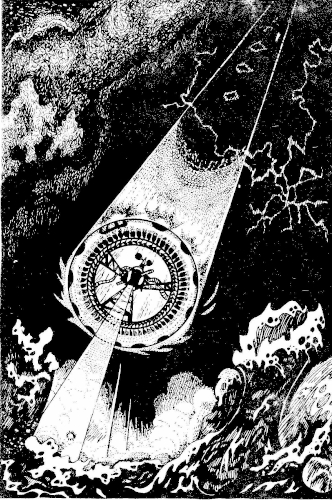
Outside, the glare of the helium ray once more poured down through the
center of the machine.
"Hard alee!" called Bennie.
Burke threw over the control-lever, and the great car slowly inverted
itself. Then the engines stopped, and silence reigned again. Bennie
joined Rhoda at the deadlight. Medusa was now about the size of the
full moon as seen from the earth, while the real moon had shrunk away
until it was apparently about the size of the earth itself. Through the
windows they could see sun, moon, and earth, all at once, surrounded
by millions of constellated stars against a background of darkness.
Beneath them hung Medusa—the sidereal battle-ship which they hoped to
torpedo—not more than twelve hundred miles away!
"At what range are you going to fire?" asked Rhoda. "I suppose the
longer you wait and the nearer we get, the greater will be the effect
of the ray?"
"On the contrary," he replied. "The distance from which the ray is
discharged is immaterial, so long as the rays are concentrated upon the
object to be destroyed."
"How far are we away from Medusa now?" she asked.
"Judging by the observed diameter of the asteroid, I should say about a
thousand miles. Of course, the nearer we are the better target Medusa
will make, but we shall have to attack at a sufficiently great distance
to avoid danger from the radioactive discharge from its surface which
the ray will produce."
"Particularly as Medusa is a 'uranium planet,'" she agreed. "Of course,
I don't suppose you quite know what will happen when the ray strikes?"
"No," he answered; "everything depends on the nature of the material.
If it is a pure ore of uranium, there will be no explosion but only a
radioactive discharge from the surface, which will drive the asteroid
out of its present path. If there are other materials present, things
will fly. Medusa is about one hundred and fifty miles in diameter. It
is scarcely conceivable that our ray could actually break it up. But
I'm not going to take any chances. Medusa may be within range now. I
think we had better try her at this distance."
Through their glasses, they could easily see that on one side the
surface of the asteroid was pitted with holes and craters similar to
those upon the moon, while the other, which had been subjected to the
fierce erosion of the dense gases of the comet, was worn almost smooth
and plowed into furrows. The Ring was now moving on a course parallel
to that of Medusa, which floated apparently motionless in space at a
distance which Bennie estimated to be less than five hundred miles.
Both, drawn by the combined attraction of the sun and earth, were in
reality rushing on toward the latter. The three men were busy with
their preparations for the projection of the great ray, and Rhoda
drew herself over to the side deadlight, through which streamed the
pale-yellow beams from the runaway planet. Now that they were running
alongside, but one-half of the illuminated hemisphere was visible, and
Medusa appeared like the moon at the half-phase, but fifty times as big.
Monstrous and sinister it looked to her, and she shuddered
involuntarily as she thought of its distant target, peopled with
millions of helpless human beings, doomed to be wiped out of existence
in a blinding flash of fire. Could they do aught to prevent it—four
insects in a flying pellet of metal, aspiring to stop a runaway
world? Had not perhaps the thing been put in motion by some Supreme
Intelligence which controlled the universe, and might not the
destruction of the world be a part of the Great Plan, a cog in the
great wheel of destiny? If so, what could they hope to do to alter
the plan? And then she thought of the taming of the thunderbolt by
the lightning-rod, and drew a long breath and clenched her hands. Man
had, from the beginning, devised ways and means of averting impending
disasters due to the forces of nature. The present case differed in
no respect from the others except in magnitude. The evolution of
defense against nature had been steady and progressive, from the stone
age, when prehistoric man sought shelter in caves from the pelting
hailstones, to the present one in which they were about to whip out of
its course a planet that was running wild through the solar system.
There in front of her, just outside the deadlight through which she was
gazing, and silhouetted against the shining disk of the asteroid, was
that terrible weapon, the generator of the disintegrating ray. In a few
minutes, it would be hurling its mysterious beam across the void of
space. She would be present, and would see what happened. Already, the
Ring was reverberating with the noise of the machinery for generating
the electric current that fed the coils of the inductor. Both dynamos
were running at full-speed, and the scream of the radio-turbines filled
the air. Through the din, she heard Bennie's voice—"Clear for action!"
Burke brushed past her and took his post at the switchboard beside
the deadlight, from which the motors that swung the inductor on its
trunnions were operated. She clutched the rail in front of her, with
her eyes fixed on the black cylinder of metal that hung, pivoted on its
skeleton supporting-frame, not five yards from her face. Womanlike, she
wanted to put her fingers in her ears, but she was afraid to let go of
the rail.
"All ready!" called Bennie. "Get your aim, Burke!"
Burke immediately closed the switch that started the elevating
motor, and slowly the huge cylinder turned on its trunnions like a
siege-mortar. In the control-room, Atterbury stood at the great copper
switch, the closing of which would throw the full force of the current
into the coils and liberate the ray.
The moment had at last arrived for the electrocution of Medusa—the
crucial moment of their journey! In spite of their seeming nonchalance,
there was not one of the four but felt his pulses quicken at the
realization that on the result of the movement of Atterbury's right
hand depended the continuance of human life upon the earth. They looked
at one another mutely. Then Bennie smiled a curious, hesitating smile,
and turned from the window through which he was watching the asteroid.
"You may fire when ready, Gridley!" he shouted.
Framed in the doorway of the control-room, Rhoda saw Atterbury throw
over the switch, and heard the hum of the alternating current in the
coils of the inductor.
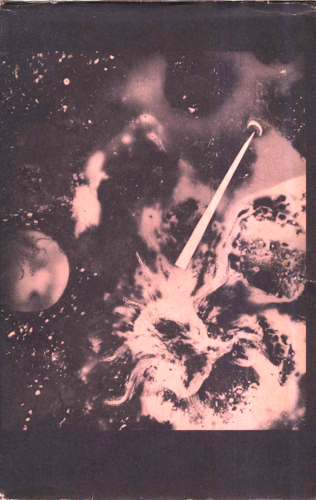
For a minute—two minutes—nothing happened; then the outer shell of
the inductor turned a dull red, glowed brighter, and rose to white
heat. They observed no ray; yet even then the ray was traveling
out into the abyss of space. They had seen but the "smoke of the
discharge." A sudden flash of light burst like a bomb a little to one
side of the asteroid.
"Low and to the left!" yelled Bennie. "But we caught a meteorite! It
passed through the ray and exploded."
"Gives me the direction," nodded Burke. "R-3."
He pressed a small button, closed a second switch, and the cylinder
outside swung slowly on its vertical axis. Almost instantly, a misty
splash of yellow fire appeared upon the dark side of the asteroid and
shot off into space.
"Hit!" cried Bennie. "Hold it, Burke; hold it! Rhoda, don't miss that!"
Gradually, the luminous discharge from Medusa increased in brilliancy
until the planet became a ball of fire. Giant sheets of yellow light,
like aurora streamers, drove off from its surface as the deadly ray
bored against it until the asteroid resembled a vast volcanic eruption.
Under the fierce blast from the Ring, its surface was melting away,
and driving out into space a glowing mass of incandescent gas. Burning
thus, out in the blackness of space, it resembled a conflagration—the
burning-up of a powder factory—seen at a safe distance through the
night.
A safe distance? Unexpectedly, out of the darkness, a shower of moving
points of light appeared in the ether, around the asteroid, darting
hither and yon, growing larger momentarily as, shining in the light
of the sun, they traced luminous lines across the sky. Medusa was
returning the attack! The explosions upon the planet's surface were
hurling great fragments of rock and stone in every direction, filling
space with flaming missiles, contact with the smallest of which meant
death to the daring voyagers in the Ring. Several of these molten
fragments hurtled by the windows, blazing fiercely but making no sound,
while some, encountering others in their flight, exploded silently,
like distant rockets breaking in the zenith.
Everywhere the heavens were a mass of shooting-stars of every
conceivable color—green, purple, blue, orange, yellow, red, and
lilac—a kaleidoscopic display of surpassing beauty, of fearful
wonderment. It was as if some demigod had emptied a furnace into the
heavens, scattering its glowing contents throughout the sky, or as if
a million bombs at pointblank range were bursting on every side and
discharging showers of fireworks about the Ring. But already Medusa
had commenced her retreat, already her disk appeared smaller, and to
prolong the bombardment meant only unnecessary danger to the occupants
of the car.
"I guess we've given her 'what for,'" commented Burke. "She's running
away from us. Shall we let up?"
Bennie signaled to Atterbury to throw off the current, and the
conflagration on the asteroid ceased as suddenly as it had started. The
volcanic bombs continued to fly by them at occasional intervals, but
presently the last one passed, and they breathed freely again. They had
escaped. Their work was done. The earth was saved. They could return.
II
"They could return." How easy to say the words—as easy as it had been
to fly off by means of their radioactive power from the surface of
the earth! But, now that the necessity of returning whence they had
come presented itself, they suddenly realized difficulties which had
hitherto not suggested themselves. While they had paralleled the course
of Medusa, they had been headed straight for the earth, which hung in
the sky above them, a gigantic crescent of a dazzling bluish white,
its oceans and continents barely discernible through the haze of its
atmosphere.
Even as they watched it, they could observe its rotation as one can
detect the movement of the minute-hand of a clock. The moon had
presented no such problem. It was dead, almost without axial motion.
But the earth was very much alive, whirling on its axis with a speed
at the equator of a thousand miles an hour—nearly that of a shell
from a rifled cannon. How could they land upon it? Theirs seemed to be
the superhuman task of the clown who tries to climb upon the revolving
table at the circus—an impossibility. When they had left the earth,
they had assimilated this axial motion, and, in steering their course
through the ether, they had allowed for it, as the navigator allows for
the tide or the set of the current. But now, on their arrival at the
globe's surrounding atmosphere, they would be attempting to land upon
a ball revolving with a velocity of ten or fifteen times that of the
fastest express-train.
"We could land at either of the poles," suggested the research
professor. "Of course there wouldn't be any motion there!"
"Yes; we might do that," agreed Bennie; "or"—and he scratched his
head—"we can navigate the Ring toward the earth in a spiral orbit.
Anyhow, the Ring has got to follow the earth in her orbit around the
sun."
"There's something funny about it," interrupted Burke. "Suppose you
started at the poles and drove the Ring toward the equator, how would
you keep up with the increasing surface-velocity of the earth?"
"Why," answered the master of the Ring, "it's the—the—let me see—it
must be the atmosphere that would drive you eastward all the time."
"Of course!" exclaimed Rhoda. "What a lot of sillies we are! It's
perfectly simple. You don't need any spiral orbits or anything
else. All you've got to do is to bring the Ring down into the upper
atmosphere and hover at a fixed elevation until we are swept along at
the full speed of the earth."
Burke, who was lighting his pipe, paused and pursed his lips.
"Wouldn't we be coming down into a terrific wind?" he inquired.
"Fourteen hundred feet a second! My word! Some blow!"
"Depends on the latitude, of course," answered Bennie. "We've got
to run around the earth as we descend, or else we'll be on the dark
side—that is, the night side—when we land. Believe me, I want light
for that!"
"Quite right!" agreed Atterbury, who had joined the group. "Just look
at the earth now, will you?"
They all craned their necks to follow his gesture. Through the
observation-window, the shining crescent of the globe seemed to
fill the whole sky. Burke pressed the control-lever, and they swung
leftward, boring through space toward the invisible black wall where
the earth's shadow reached out among the stars. Nearer and nearer it
drew, then—darkness. Steering by the steady gleam of the friendly
planets, as a coasting steamer steers by the distant bead of light that
marks the headland, the Ring soared on, bursting at length into full
sunlight again.
They were now comparatively close above the earth and, in going
around it, had gained the incidental advantage of having acquired
the velocity of the planet in its journey around the sun. Only the
problem of descent remained. But it was the most serious of all their
problems—how to lower themselves in safety into that swirling, boiling
mass of vapor that was shooting by so fast as to seem little more than
a hideous blur, and left them sick and dizzy at the sight of it.
And now, as they sank lower, the blur disintegrated into flying banks
of cloud, shot through and through with flashing lights and darting
shadows. Poised there, as they were, in space, it was a terrifying
thing to watch this fearful rush of the earth's surface from west to
east. Could they ever manage to break safely into the circumambient
atmosphere and go whirling along with it? How—how, without having
their delicate machine wrenched and torn in pieces?
"We must break our descent with the tractor, come down gradually," said
Bennie, "and trust to luck."
Burke inverted the Ring, and they gathered about the deadlight, the
cloud-banks sweeping by below them with a thousand times the velocity
with which a toy globe can be spun by a playful child. Nearer and
nearer rose the clouds toward them. A faint, humming sound filled
the car—the wind! They had entered the earth's outer atmosphere.
The hum rose gradually to a whine and then to a roar. The car shook,
and the steel covering thundered. The noise increased to the crash
of a hurricane, and they could scarcely hear one another's voices.
Cautiously they descended, increasing the lift of the tractor when the
movement of the clouds seemed too fast, and slacking off a bit when
their speed held constant, until the Ring, gradually acquiring the
velocity of the gale, was carried swiftly along by the atmosphere, and
the cloud-banks below them began to move more slowly and at length not
at all. They had pierced the envelope of the earth and were once more
in the life-giving element of the air.
Slowly, they dropped through the masses of cumulo-cirrus which,
suddenly opening beneath them, revealed the rollers of a sunlit ocean.
The breaking crests seemed perilously near after limitless distances of
the firmament through which they had been voyaging, and they gave the
Ring more lift and rose to a safer distance above the waves. Far to the
west, close to the horizon, they could see a distant mountain peak, and
for it they steered their craft.
They were flying now with a speed a hundred times greater than that
of the swiftest gull, the ray churning the sea into a boiling vortex
that followed them like a white foam-monster, spurting great geysers of
froth and steam fifty feet into the air. The mountain reared its head
higher and higher, and soon the shore of a green island, sprinkled with
white houses, rose toward them.
"Fayal!" shouted Atterbury, from the control-room. "I've been there!"
"Bear away and look out for boats!" directed Bennie, and they took a
wide sweep and left the islands far to the south. Ahead of them, Rhoda
saw a small black dot from which arose a dark smudge.
"That must be one of the Cunard steamers!" she cried. "Oh, do let's
go down where we can watch the people! I should so like to see a human
being again!"
Burke laughed, and the Ring dipped like a swallow and skimmed along
only half a mile above the surface of the Atlantic. Soon the liner was
just in front of them, and they veered to avoid striking her with the
ray. Her decks swarmed black with people, and, through the glasses,
sailors could be seen working at the life-boats.
"I wonder what they think we are!" exclaimed Rhoda, looking for Burke,
who had left his post.
"He's going to wireless them not to be afraid. They're precious near a
panic down there," explained Bennie.
By the time the aviator reappeared, the steamer was four or five miles
behind them.
"That's the Saxonia," he told them. "Captain says they recognized us,
and only got the boats ready for fear the ray might make trouble. What
course, Professor? Shall we run across to Florida and up the coast, or
follow the lanes to Nova Scotia and work down?"
"The shortest," urged Rhoda, and Burke laid their course by compass and
called Atterbury to the lever while they snatched some breakfast, for
the sunlight and sight of the sea combined to make them all ravenously
hungry.
They had lifted to a height of about three miles. The white crests of
the rollers had melted into the vast expanse of blue, and only the
smoke patches showed where steamers lay everywhere about them.
"How crowded the ocean is!" remarked the girl. Picking their way with
care, lest the ray should do some unintentional damage, they continued
westward until a dark line on the horizon suddenly appeared and began
to creep toward them. Then they swung to the south to avoid the Bay
of Fundy and found themselves, owing to the rapid falling-away of the
coast-line, out in the bosom of the vast Atlantic again. Once more
turning west, they came down to less than a mile and soon picked up a
barrier of sand-dunes edged by a white rim of surf. There were ships
everywhere about them—the coastwise trade of the New England seaboard.
"This won't do!" declared Burke. "If we don't get over land, we'll be
bound to do damage."
They slanted and soared shoreward. A lighthouse broke the line of
dunes and beach, rising out of a group of small white buildings and
surrounded by the wire enclosure of a chicken-yard.
A woman in a calico bonnet was feeding the chickens, and, at sight of
the Ring, to the ecstasy of the fowls, she dropped the contents of her
apron and rushed to the door of the lighthouse. In a moment, a man in
his shirt-sleeves and smoking a corn-cob pipe appeared on the upper
parapet. He looked at the Ring lazily, and then waved his hand. They
lifted again, following the shoreline, and flew over a dreary waste of
scrub-oak, cranberry-bog, and sandy beaches until they saw a light-ship
tugging at her chains a mile offshore. Then the coast turned, and they
recognized Martha's Vineyard and, farther off, Nantucket. Once they
had got their bearings, they rose higher and flew at an elevation of
several miles over Nantucket Sound, Gardiner's Bay, and Long Island to
Westchester, and thence over the Hudson to Jersey City, whence they
followed the line of the railway toward Philadelphia.
They were all in the highest spirits and, as Burke noted, there had
not been a single case of sickness on the voyage. The brown fields and
green woodlands crept slowly along below them. The air was sweet. There
was still an hour to sunset. Overhead, the sky was a soft, impenetrable
blue. The world was full of light. Tiny trains hurried along like
little harmless snakes. Lilliputian men, horses, cows, and dogs crawled
about the fields and roads.
"Isn't it nice?" whispered Rhoda, seeking Bennie's hand.
"You bet it is!" he answered heartily.
"Lots better than the stars!" she murmured.
He pressed her fingers.
"I didn't let on," he confessed; "but I was scared to death."
"And so was I," she acknowledged. "I never want to leave the earth
again!"
They stood there silent for several minutes.
"But it is jolly!" she said unexpectedly, in a tiny voice. "You
know—I might take just a little trip again—if you asked me!"
They passed high over Philadelphia and Baltimore and, just as the sun
sank blazing among the tumbled cloud castles in the west, caught sight
of the Washington Monument—a flashing spire—and then the Capitol, its
dome burning golden in the afterglow. The silver Potomac wound toward
the city, as it rose toward them. The avenues and boulevards gleamed
amid the soft verdure of trees and shrubbery.
And, as they settled earthward, from a parade-ground came faintly
upward the call of a bugle—like a jewel in the dusk.
Rhoda waved her hand toward the smiling earth below.
"Do you remember 'Marpassa'?" she whispered.
And when he shook his head, she quoted from Stephen Phillips'
masterpiece the wonderful declaration of Apollo in answer to the wish
of his earth-love when she said,
... "Fain would I know
Yon heavenly wafting through the heaven wide,
And the large view of the subjected seas,
And famous cities, and the various toil of men."
..........
"And I will carry thee above the world,
To share my ecstasy of flinging beams,
And scattering without intermission joy.
And thou shall know the first leap of the sea
Toward me; the grateful upward look of earth,
Emerging roseate from her bath of dew--
We two in heaven dancing. Babylon
Shall flash and murmur, and cry from under us.
And Nineveh catch fire, and at our feet
Be hurled with her inhabitants, and all
Adoring Asia kindle and hugely bloom--
We two in heaven running--continents
Shall lighten, ocean unto ocean flash,
And rapidly laugh till all this world is warm."
Bennie listened, as Rhoda spoke the lines, spellbound at the poet's
imagination.
"By golly," he cried, in admiration, "that's more wonderful than—than
actually doing it!"
III
Bentham T. Tassifer had paused, as usual, at the Metropolitan Club,
on his way home from the Department of Justice, and, as a natural
consequence, was exuding his regular post-meridian benignity. In his
own little official occupation of the day—the joker in the contract
for the new post-office at Pocalla, Texas—he had entirely forgotten
the disappearance of his niece, as well as the anticipated collision
between the wandering asteroid and the earth which he so honored by
living upon it. He had followed his ordinary custom of going directly
to the bar and consuming a sherry and bitters with an audible, guzzling
satisfaction, something between the gurgles of a dying bathtub and the
intake of a hippopotamus. Then his lordly little eye fell upon the lank
form of his golfing friend Judson, of the Department of Agriculture,
leaning in contemplation before a tumbler from which o'erlapped a sprig
of mint.
"'Lo!" he remarked, with an intonation signifying 'Behold, minion; King
John, your king and England's, doth approach!'
"'Lo yuhself!" returned Judson. "Djuh see somethin' happened to that
comet?"
"Eh?" demanded the solicitor. "Comet? You mean the asteroid, I suppose?
What's happened to it?"
Judson took a sip from the tumbler and turned savagely upon Tassifer.
"Ass-eroid!" he shouted.
"Don't get excited, Judson," commented Bentham patronizingly.
"You make me tired!" retorted his agricultural friend. "What difference
does it make what it is, if it's been put out of business?"
"What do you mean?" cried Bentham. "Has anything unusual occurred?"
"Haven't you seen the papers?" inquired Judson. "Huh! If you're so
blamed slow, lemme—I mean, let me—read it to you."
"Sure!" nodded Bentham. "Another sherry and bitters—and another mint
julep," he added to the bartender, after a moment's reflection.
"Listen here," began Judson, elevating a newspaper which had been lying
flat on the bar: "'Extry'! Collision between ass—ass—what d'you call
it?"
Tassifer grabbed the paper quickly out of his hand.
"As-ter-oid," he articulated snappishly. "Let me see it. I can read."
He read:
EXTRA—Four O'Clock—EXTRA!
COLLISION BETWEEN ASTEROID AND EARTH AVERTED!
PROBABLE SUCCESS OF HOOKER EXPEDITION!
MEDUSA NOW OUR SATELLITE!
There is every reason to believe that Professor Benjamin Hooker
and his daring companions have achieved their stupendous object of
diverting the falling asteroid from its course toward the earth, and
have thus saved the human race from destruction. Professor Thornton,
of the National Observatory, announced the receipt, early this
morning, of a cable-despatch from an amateur astronomer at Honolulu,
stating that, about ten hours after the time set for the departure
of the Hooker Expedition in the Flying Ring, he suddenly observed a
yellow glow surrounding the asteroid Medusa. This glow increased in
volume and intensity for perhaps five minutes, and then as suddenly
ceased, drawing away from the planet like a puff of smoke. No trace
of the phenomenon was observed either at the Lick Observatory or in
the great one-hundred-inch telescope at Mount Wilson, near Pasadena,
the unfavorable position of the asteroid, low down in the western sky,
probably accounting for this. All other observatories of note were on
the daylight side of the earth at the time.
Professor Thornton further announces, however, that the observations
upon Medusa's position which were made last night at the various
European observatories show conclusively that the path of the asteroid
has been changed and its flight toward the sun checked. It is now
moving in an elliptical orbit around the earth, with a period of
approximately four months and twelve days. The astronomer states
that, at the time of the asteroid's nearest approach to us, it will
be a conspicuous object—its apparent diameter being nearly one-half
that of the moon. Professor Hooker and his associates have thus not
only averted the impending catastrophe but have presented the earth
with a new moon as a lasting monument to the boldest enterprise ever
conceived by the human brain.
There were several columns more, but Bentham did not proceed further.
"Gee whiz!" he exploded. "He's really done it!"
"Tush!" returned Judson. "You don't believe that, do you? No matter
how big a fool you are, you don't honestly suppose anyone can go
sailin' around in the air blowin' comets—I mean ass-eroids—out of
their orbits, like Buffalo Bill shootin' glass balls?"
"Look here, Judson," shrieked Tassifer: "You keep a civil tongue in
your head! I know all about that flying machine; I've been in it, and,
what's more, my niece Rhoda—" He stopped unexpectedly.
"What about your niece?" inquired Judson.
"Nothing! Why, you saw the machine that day on the golf-course—don't
you remember? That was Hooker."
"Sure, I saw it!" assented the agriculturalist. "But that thing could
only fly round in the air! The most it could do would be to go up
five or six miles. You see, when you go higher up than that, there
ain't any more air—and you'd die! Besides, the machine wouldn't
float unless there was air—any more'n a ship without water. That's
why all this is just bunk."
Tassifer glared disgustedly at Judson.
Really, the fellow was too insignificant—too big a nincompoop to
bother with!
"Darn it, Judson," he said, with slow emphasis; "I don't want to
quarrel with you, but what you don't know about flying machines would
fill the Congressional Library. I've got to go home in a minute, but
I've known you long enough not to want you to go around making an ass
of yourself."
"Don' say!" sneered Judson.
"Now," continued Tassifer, "this flying machine hasn't anything to do
with air at all. It goes up, air or no air. It goes up through the
air and through the nothingness above the air, and it can go up easier
without air than with air, because then there isn't any resistance."
"But what makes it go up?" inquired Judson.
"What makes a rocket go up?" retorted Tassifer.
"But it ain't a rocket!"
"I didn't say it was. It's like a rocket."
"But a rocket has gunpowder."
"Well, this has something or other—I forget what—to make it go—"
concluded Tassifer lamely. "Anyhow—"
"Rats!" snorted Judson. "You know a lot about it—you do! You—"
They might have landed under the bar in the tightly locked embrace of
those defending their honor had not an unusual clamor from the avenue
interrupted them. What seemed like the confused shoutings of a mob came
through the closed windows.
"What's that?" gasped Bentham.
They paused, intent. Evidently, something had happened—an accident,
maybe. They could hear a subdued, distant roar, in which were mingled
the tooting of motors, the clanging of bells, the bellowing of
whistles, and the cries and yells of excited humanity. A multitude
of black shadows rushed by. The bartender threw open the window. The
avenue was filled with a hurrying crowd—all gazing skyward.
"Hooray!" yelled the crowd. "Hooray! Hooker's back! Hooray!"
Tassifer and Judson looked at one another mutely. Suddenly, the
bartender leaped out the window and joined the mob. The whole city was
in the streets.
"Come on, Judson!" cried Bentham. "If there's anything doing, let's
be on the wagon!" And he climbed upon the sill and leaped after the
bartender.
Judson hesitated, emptied his glass, and followed. Over in the west,
across the park, a great cloud of smoke and dust was rising against the
crimson sky.
"What's happened?" asked the now thoroughly sober Judson of a man who
was hurrying by.
"Don't know," panted the other. "People say comet's struck us!"
"Comet Nothin'!" shouted a policeman. "It's Hooker's flying machine!"
Judson grabbed Tassifer by the arm, and they hastened cheerfully along
with the crowd.
IV
At the moment her husband thus undignifiedly surrendered to mob
psychology, Mrs. Bentham T. Tassifer was taking her Saturday-afternoon
bath—thus leaving the tub free for Bentham before going to bed.
She had closed the windows, which fact, coupled with the noise of
her puffings and splashings, had prevented her from hearing the
demonstration going on in the street below. She was just reaching for
her towel when she heard the door-bell ring and hurried footsteps upon
the stairs.
"Is that you, Bentham?" she shrilled.
"No; it's me—Rhoda!" came back the voice of her niece.
"Where on earth have you been?" cried her aunt. "You scared us almost
to death!"
"Oh, flying around!" answered Rhoda. "I want my tooth-powder and
nail-brush."
"What are you going to do now?" shouted Mrs. Tassifer, through the door.
"I'm going to get married," replied Rhoda. "Please hand me my things."
There were but two passengers to come down the gangplank when the
Washington boat docked the next morning at Old Point Comfort. Trade had
been, in fact, very light for several weeks, and the hotels had been
practically closed owing to the defection of the colored help, who in
a frenzy of religious fervor, had abandoned their jobs to prepare, by
prayer and chanting, for the day of Judgment.
Carrying their grips, Bennie and Rhoda walked along the wooden pier and
entered a hotel. A decrepit clerk assigned them rooms and handed Bennie
a pen freshly dipped in ink. With his hand poised above the blank page
of the register, our hero hesitated. They had come there to avoid
the pestering crowds, the adulation, the publicity, the reporters.
Should he sign as was befitting—"Professor and Mrs. Benjamin
Hooker, Washington, D.C."? In that case, even that old dormouse of a
hotel-clerk would recognize his identity and the hotel would swarm with
interviewers. Yet—did he dare? He had only been married a few hours.
He glanced apprehensively at Rhoda, who was examining some needlework
in a showcase. Then he resolutely gripped the pen and scrawled, B.
Hooker and wife, Camb. Mass.
All that day, the two star-voyagers wandered over the white beach,
drinking in the odoriferous breath of the coming spring and talking
over their experiences of the past seventy-two hours.
And, in the evening, they sat on the sand and watched the sea darken
and caught the first glint of the moon's edge as it pushed up over the
horizon. They neither saw the throng of reporters who poured off the
afternoon train nor suspected that they were the marked-down quarry of
a pack of ravenous wolves.
In ignorance of what was in store for them, Bennie and Rhoda strolled
further and further up the beach, away from the hotel. The moon came
up round and full, smiling like an old and familiar friend. The breeze
had died away, and the silver-edged waves lapped the soft sand gently
at their feet as they threw themselves at full-length under some stray
pines and gazed up through the branches at the blue arch with its
thousands of twinkling lights.
"I like them so much better that way!" she murmured. "If they don't
wink at you, it seems so unfriendly!"
"It was awful up there!" he assented.
The moon swam higher and higher, turning the beach into a white
snow-drift, along which, save for that of the pines under which they
lay, no shadow could be seen for miles. Toward this single possible
hiding-place moved Diggs, a newspaper reporter from New York. The
crunch of his steps made them sit up hurriedly.
"Sh! Somebody's coming!" he whispered.
They were motionless—two hunted creatures—scarcely breathing, in a
black island surrounded by a deluge of moonlight.
But Diggs had spied them. Fifty feet away, he paused and lit a warning
cigarette. Then he walked down to the water's edge, gazed pensively at
the moon and remarked,
"I say, Professor Hooker?"
"It's no use," growled Bennie; "he's got us! Hello!" he answered.
The reporter coughed and came slowly toward the patch of shadow.
"Excuse me," he remarked briskly; "but you understand there's a whale
of a story in all this, and it's up to me to get it? You can't blow up
a meteor and knock the solar system topsyturvy and get away without
even being interviewed, you know. Sorry—but it isn't done. What do you
suppose they would do to me? And then there's Mrs. Hooker, you see! If
it hadn't been for Mrs. Tassifer—"
Rhoda suddenly spoke up.
"What has she said?" she demanded.
"Oh, she gave us the romance stuff," he answered. "Look here, now: It's
ten o'clock, and I've got to 'phone this to New York in time for the
early edition. Do you mind my asking just a few questions?"
"But I haven't anything to say," expostulated Professor Hooker.
"Just listen to the man!" groaned Diggs. "Let me ask you: Is this
story about landing on the moon perfectly straight?"
Rhoda pointed up through the trees to the great yellow circle of the
lunar orb.
"Do you see that bright spot with the shadow on the left-hand side of
it?"
"Sure," answered Diggs.
"Well," she continued, "I was standing right there less than thirty-six
hours ago."
"Great stuff!" Diggs exclaimed. "But how could you prove it? What
evidence have you got?"
"I've got plenty of photographs," she answered. "Dozens of them—of the
moon, of the crescent earth—"
"Beg pardon! Of the—what?"
"The crescent earth," she explained, "at about the first quarter. I
suppose the phrase seems a little strange."
"Oh—like the moon. I get you," he nodded. "But pictures might be
faked."
"These weren't," she retorted wearily.
"Of course not," he agreed. "But they're open to attack."
"I suppose so," she conceded. "But it doesn't matter."
"Of course it matters!" he expostulated. "Now if you only, had
something you got on the moon—brought away with you—that didn't
exist on earth—"
"People would just say it did," put in Bennie. "Who cares? We
don't!"
"Sure you don't!" he answered sympathetically. "But it means a heap to
me. Don't you see what a scoop it would be for us to be the only paper
to prove you'd been to the moon?"
Even as Diggs spoke, far out on the black, heaving horizon, a dull
luminosity became suddenly apparent. Brighter it grew, and some stray
wisps of cirrus cloud above smoldered in the sky.
"What's that over there?" asked the reporter. "It looks as if the moon
were coming up—only it is up!"
He turned and gazed into the heavens, where the moon was rolling
through the clouds like a great golden wheel.
Bennie was lighting his pipe, and Rhoda vouchsafed no reply.
Then, on the edge of the distant, watery world, a bead of fire rose and
sent toward them a flittering beam. An orange disk thrust itself above
the waves—a brilliant, dazzling shield of gold marked with strange
wrinkles like a corrugated orange.
"Good heavens, what's that?" exclaimed Diggs. "Am I seeing double?"
"No more—than anybody—else," retorted Bennie puffing. "That is our
evidence—the proof you were asking for. That is Medusa—the earth's
new satellite—the wandering asteroid that will wander hereafter around
the earth."
"Two moons?" demanded Diggs.
"Yes, Mr. Diggs; you can telephone to New York that hereafter you have
arranged for two moons—a big one for the grownups; a little one,
half-size, for the children."
"And not such a bad little moon at that," added Bennie.
"Our honeymoon," whispered Rhoda. "Goodnight, Mr. Diggs."
THE END