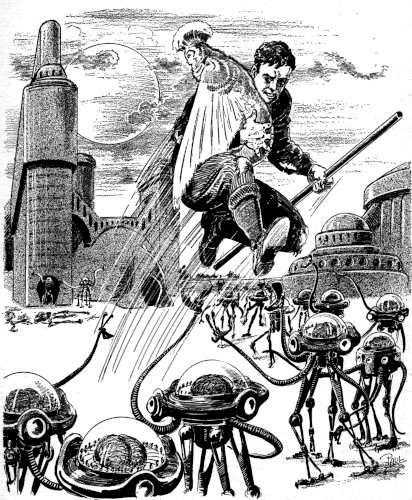
The Moon Era
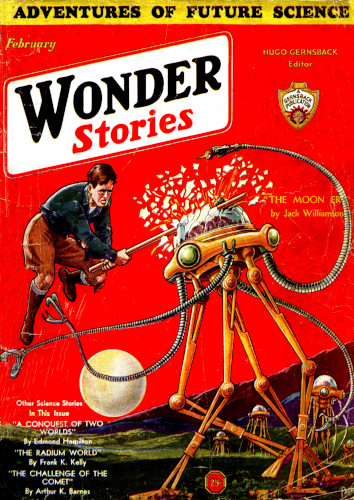
By JACK WILLIAMSON
By the author of "The Alien Intelligence,"
"Twelve Hours to Live," etc., etc.,
Illustration by Paul
[Transcriber's Note: This etext was produced from
Wonder Stories February 1932.
Extensive research did not uncover any evidence that
the U.S. copyright on this publication was renewed.]
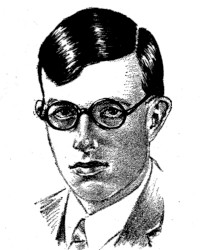
JACK WILLIAMSON
Jack Williamson has properly been called a first-rate writer of colorful tales. His "Alien Intelligence" published in the early days of Science Wonder Stories placed him, in the estimation of our readers, in the class of A. Merrit and other masters. The present story carries on Mr. Williamson's gripping portrayal of the possibilities of science on other worlds.
It is quite within reason that our moon, now dead and barren, was once the scene of flourishing life. Although no water now exists there, nor air shields from the moon the intense solar rays, in another age the moon may have been bountifully endowed by nature. If that is true, then the picture of the Eternal Ones drawn by our author is certainly a colorful portrayal of what the lunar civilization may have been like. And the picture of the Mother, and her exciting and bizarre adventures with our hero, are, in our opinion, among some of the best drawn by any author of science fiction.
We were seated at dinner in the long dining room of my uncle's Long Island mansion. There was glistening silver plate, and the meal had been served with a formality to which I was unaccustomed. I was ill at ease, though my uncle and I sat alone at the table. The business of eating, without committing an egregious blunder before the several servants, took all my attention.
It was the first time I had ever seen my uncle, Enfield Conway. A tall man, stiffly erect, dressed severely in black. His face, though lean, was not emaciated as is usual at his age of seventy years. His hair, though almost perfectly white, was abundant, parted on the side. His eyes were blue, and strong; he wore no glasses.
A uniformed chauffeur had met me at the station, in the afternoon. The butler had sent an entirely unnecessary valet to my luxurious room. I had not met my uncle until he came down to the dining room.
"I suppose, Stephen, you are wondering why I sent for you," he said in his precise manner, when the servants had carried away the last course, leaving cigars, and a bottle of mineral water for him.
I nodded. I had been instructor of history in a small high school in Texas, where his telegram had reached me. There had been no explanation; merely a summons to Long Island.
"You are aware that some of my patents have been quite profitable."
Again I nodded. "The evidence surrounds me."
"Stephen, my fortune amounts to upwards of three and a half million. How should you like to be my heir?"
"Why, sir—I should not refuse. I'd like very much to be."
"You can, if you wish, earn that fortune. And fifty thousand a year while I live."
I pushed back the chair and rose to my feet in excitement. Such riches were beyond my dreams! I felt myself trembling.
"Anything—" I stammered. "I'll do anything you say, to earn that! It means—"
"Wait," he said, looking at me calmly. "You don't know yet what I require. Don't commit yourself too soon."
"What is it?" I asked, in a quivering voice.
"Stephen, I have been working in my private laboratory here for eleven years. I have been building a machine. The best of my brains have gone into that machine. Hundreds of thousands of dollars. The efforts of able engineers and skilled mechanics.
"Now the machine is finished. It is to be tested. The engineers who worked with me refused to try the machine. They insist that it is very dangerous.
"And I am too old to make the trial. It will take a young man, with strength, endurance, and courage.
"You are young, Stephen. You look vigorous enough. I suppose your health is good? A sound heart? That's the main thing."
"I think so," I told him. "I've been coaching the Midland football team. And it isn't many years since I was playing college football, myself."
"And you have no dependents?"
"None.—But what is this machine?"
"I will show you. Come."
He rose, agilely enough for one of his seventy years, and led the way from the long room. Through several magnificent rooms of the big house. Out into the wide, landscaped grounds, beautiful and still in the moonlight.
I followed silently. My brain was confusion. A whirl of mad thought. All this wealth whose evidence surrounded me might be my own! I cared nothing for luxury, for money itself. But the fortune would mean freedom from the thankless toil of pedagogy. Books. Travel. Why I could see with my own eyes the scenes of history's dramatic moments! Finance research expeditions of my own! Delve with my own hands for the secrets of Egypt's sands, uncover the age-old enigmas of ruined mounds that once were proud cities of the East!
We approached a rough building,—resembling an airplane hangar,—of galvanized iron, which glistened like silver in the rays of the full moon.
Without speaking, Uncle Enfield produced a key from his pocket, unlocked the heavy padlock on the door. He entered the building, switching on electric lights inside it.
"Come in," he said. "Here it is. I'll explain it as well as I can."
I walked through the narrow doorway and uttered an involuntary exclamation of surprise at sight of the huge machine that rested upon the clean concrete floor.
Two huge disks of copper, with a cylinder of bright, chromium-plated metal between them. Its shape vaguely suggested that of an ordinary spool of adhesive plaster, from which a little has been used—the polished cylinder, which was of smaller diameter than the disks, took the place of the roll of plaster.
The lower of the massive disks rested on the concrete floor. Its diameter was about twenty feet. The cylinder above it was about sixteen feet in diameter, and eight feet high. The copper disk above was the same size as the lower one.
Small round windows stared from the riveted metal plates forming the cylinder. The whole was like a building, it burst on me. A circular room with bright metal walls. Copper floor and copper roof projecting beyond those walls.
My uncle walked to the other side of this astounding mechanism. He turned a projecting knob. An oval door, four feet high, swung inward in the curving wall. Four inches thick. Of plated steel. Fitting very tightly against cushions of rubber.
My uncle climbed through the door, into the dark interior. I followed with a growing sense of wonder and excitement. I groped toward him through the darkness. Then I heard the click of a switch, and lights flashed on within the round chamber.
I gazed about me in astonishment.
Walls, floor, and ceiling were covered with soft, white fiber. The little room was crowded with apparatus. Clamped against one white wall was a row of the tall steel flasks in which commercial oxygen is compressed. Across the room was a bank of storage batteries. The walls were hung with numerous instruments, all clamped neatly in place. Sextants. Compasses. Pressure gauges. Numerous dials whose functions were not apparent. Cooking utensils. An automatic pistol. Cameras. Telescopes. Binoculars.
In the center of the room stood a table or cabinet, with switches, dials, and levers upon its top. A heavy cable, apparently of aluminum, ran from it to the ceiling.
I was gazing about in bewilderment. "I don't understand all this—" I began.
"Naturally," said my uncle. "It is quite a novel invention. Even the engineers who built it did not understand it. I confess that the theory of it is yet beyond me. But what happens is quite simple.
"Eleven years ago, Steven, I discovered a new phenomenon. I had happened to charge two parallel copper plates, whose distances apart had a certain very definite relation to their combined masses, with a high tension current at a certain frequency.
"The plates, Stephen, were in some way—how, I do not pretend to understand—cut out of the earth's gravitational field. Insulated from gravity. The effect extended to any object placed between them. By a slight variation of the current's strength, I was able to increase the repulsion, until the plates pulled upward with a force approximately equal to their own weight.
"My efforts to discover the reason for this phenomenon—it is referred to in my notes as the Conway Effect—have not been successful. But I have built this machine to make a practical application of it. Now that it is finished, the four engineers who helped design it have deserted. They refused to assist with any trials."
"Why?" I asked.
"Muller, who had the construction in charge, somehow came to the conclusion that the suspension or reversal of gravity was due to motion in a fourth dimension. He claimed that he had experimental proof of his theory, by building models of the device, setting the dials, and causing them to vanish. I would have none of it. But the other men seemed to accept his ideas. At any rate, they refused with him to have any part in the tests. They thought they would vanish, like Muller says his models did, and not come back."
"The thing is supposed to rise above the ground?" I asked.
"Quite so." My uncle smiled. "When the force of gravitation is merely suspended, it should fly off the earth at a tangent, due to the diurnal rotation. This initial velocity, which in these latitudes, amounts to considerably less than one thousand miles per hour, can be built up at will, by reversing gravitation, and falling away from the earth."
"Falling away from the earth!" I was staggered. "And where is one to fall?"
"This machine was designed for a trip to the moon. At the beginning of the voyage, gravitation will be merely cut out, allowing the machine to fly off on a tangent, toward the point of intersection with the moon's orbit. Safely beyond the atmosphere, repulsion can be used to build up the acceleration. Within the gravitational sphere of the moon, positive gravitation can be utilized further to increase the speed. And reversed gravitation to retard the velocity, to make possible a safe landing. The return will be made in the same manner."
I was staring at him blankly. A trip to the moon seemed insane, beyond reason. Especially for a professor of history, with only a modicum of scientific knowledge. And it must be dangerous, if those engineers—. But three million—what dangers would I not face for such a fortune?
"Everything has been done," he went on, "to insure the comfort and safety of the passenger. The walls are insulated with a fiber composition especially worked out to afford protection from the cold of space, and from the unshielded radiation of the sun. The steel armor is strong enough not only to hold the necessary air pressure, but to stop any ordinary meteoric particles.
"You notice the oxygen cylinders, for maintaining that essential element in the air. There is automatic apparatus for purifying it. It is pumped through caustic soda to absorb the carbon dioxide, and through refrigerator tubes to condense the excess moisture.
"The batteries, besides energizing the plates, are amply powerful to supply lights and heat for cooking.
"That, I believe, fairly outlines the machine and the projected voyage. Now it is up to you. Take time to consider it fully. Ask me any questions you wish."
He sat down deliberately in the large, cushioned chair, beside the central table, which was evidently intended for the operator. He stared at me alertly, with calm blue eyes.
I was extremely agitated. My knees had a weak feeling, so that I desired to sit down also; though I was so nervous that I kept striding back and forth across the resilient white fiber of the floor.
Three millions! It would mean so much! Books, magazines, maps—I should have to economize no longer. Years—all my life, if I wished—abroad. The tombs of Egypt. The sand-covered cities of the Gobi. My theory that mankind originated in South Africa. All those puzzles that I had longed to be able to study. Stonehenge! Angkor! Easter Island!
But the adventure seemed madness. A voyage to the moon! In a craft condemned by the very engineers that had built it. To be hurled away from the earth at speeds no man had attained before. To face unknown perils of space. Dangers beyond guessing. Hurtling meteors. The all-penetrating cosmic ray. The burning heat of the sun. The absolute zero. What, beyond speculation and theory, did men know of space? I was no astronomer; how was I to cope with the emergencies that might rise?
"How long will it take?" I demanded suddenly.
My uncle smiled a little. "Glad you are taking it seriously," he said. "The duration of the voyage depends on the speed you make, of course. A week each way is a conservative estimate. And perhaps two or three days on the moon. To take notes. Photograph it. Move around a little, if possible; land in several different places. There is oxygen and concentrated food to last six months. But a fortnight should see you nearly back. I'll go over the charts and calculations with you."
"Can I leave the machine on the moon?"
"No. No atmosphere. And it would be too hot in the day, too cold at night. Of course an insulated suit and oxygen mask might be devised. Something like diving armor. But I haven't worked at that. You will be expected just to take a few pictures, be prepared to describe what you have seen."
I continued to pace the floor, pausing sometimes to examine some piece of apparatus. How would it feel, I wondered, to be shut up in here? Drifting in space. Far from the world of my birth. Alone. In silence. Entombed. Would it not drive me mad?
My uncle rose suddenly from the chair.
"Sleep on it, Stephen," he advised. "See how you feel in the morning. Or take longer if you wish."
He switched off the light in the machine. Led the way out into the shed. And from it into the brilliant moonlight that flooded the wide, magnificent grounds about the great house that would be one of the prizes of this mad adventure.
As he was locking the shed, I gazed up at the moon.
Broad, bright disk. Silvery, mottled. Extinguishing the stars with argent splendor. And all at once it came over me—the desire to penetrate the enigmatic mystery of this companion world, that men have watched since the race began.
What an adventure? To be the first human to tread this silver planet. To be the first to solve its age-old riddles. Why think of Angkor, or Stonehenge, of Luxor and Karnak, when I might win the secrets of the moon?
Even if death came, what did it matter against the call of this adventure? Many men would trade their lives eagerly for such a chance.
Suddenly I was strong. All weakness had left me. All fear and doubt. A few moments before I had been tired, wishing to sit down. Now vast energy filled me. I was conscious of an extraordinary elation. Swiftly I turned to my uncle.
"Let's go back," I said. "Show me as much about it as you can tonight. I am going."
He gripped my hand tightly, without a word, before he turned back to the lock.