EXPRESSION AND INTERPRETATION
Reading begins in the "Children's House" as soon
as the children reread the word they have already composed
with the movable alphabet. This early effort is
not indeed the true reading of the word, since interpretation
is lacking. The children, it has been seen, know
the word because they have actually put it together. They
have not gained an understanding of it from the simple
recognition of the graphic symbols. What they have done
is, nevertheless, an important contribution to real reading.
As one considers all of the details of this period of
development, it is apparent that its mechanism is closely
allied with that of the spoken language.
When the child's attention has been intensively applied
to the recognition of the written word, it can easily be
fixed on the analysis of the sounds which make up the
word. At a certain age the child's interest was aroused
by "touching" the letter. He can now be interested in
hearing the sounds of the word when pronounced by others
and in pronouncing it himself. We have shown that the
work on the written language in the exercises with the
alphabet was necessary for developing and perfecting the
spoken language. It is by so doing that we make it possible
to correct defects in speech and to pass naturally over
the period when such defects are formed.
We now aim at finding an exercise in the actual mechanism
of pronunciation which can be started at the moment
of its natural development in such a way that its growth
to perfection will follow as a matter of course. It is a
question of bringing the children rapidly to pronounce
without hesitation. In so pronouncing well, in performing
extensive exercises in hearing words and in the interpretation
of them from graphic signs, the child brings
together in a unit of effect the basic processes of reading
and writing.
A good pronunciation of the word read is of great importance.
We may say that in the elementary schools of
our day this is the principal purpose of reading. Nevertheless,
it is very difficult to obtain a good pronunciation
when defects have been allowed to develop and become
habitual in the child's previous work. In fact, the elimination
of these defects, which have been the result of a
fundamental error in education, comes to absorb all of the
energies of the reading class in ordinary primary schools.
So far along as the fifth grade we see teachers struggling
to make the children read, that they may acquire a good
"pronunciation," and in our reading books there are graduated
exercises constructed on the basis of "Difficulties in
Pronunciation." It is apparent that all of this stress on
the physiological mechanics of pronunciation is foreign to
true reading. It is, rather, an impediment to the development
of true reading. Such reading exercises constitute,
as it were, a foreign body, which operates like a disease
to prevent the development of the high intellectual activity
which interprets the mysterious language of written
symbols and arouses the child's enthusiasm with the fascinating
revelations they can give. The eagerness of the
child to learn is curbed and cheated when he is compelled
to stop his mind from working because his tongue refuses
to act properly and must be laboriously trained to work
right. This training, if begun at the proper time, when
the child's whole psychic and nervous organism yearns for
the perfection of the mechanism of speech, would have
been a fascinating task; and once started along the right
path, the pupil would have continued to follow it with
alacrity and confidence. When the time comes for the
intelligence to try its wings, its wings should be ready.
What would happen to a painter, if at the moment of inspiration,
he had to sit down and manufacture his
brushes!
Our first publication on the methods used in the "Children's
House" made clear two distinct operations involved
in reading: the interpretation of the meaning and
the pronunciation aloud of the "word." The stress we
laid on that analysis as a guide to the development of
reading was the result of actual experience. Those who
followed this work during its initial stages saw how the
children, when they read for the first time, interpreting
the meaning of the words before them, did so without
speaking,—reading, that is, mentally. Interpretation, in
fact, is a question of mental concentration. Reading is an
affair of the intelligence. The pronunciation aloud is
quite a different thing, not only distinguished from the
first process, but secondary to it. Talking aloud is a question
of speech, involving first hearing and then the mechanical
reproduction of sounds in articulate language.
Its function is to bring into immediate communication
two or more people, who thus exchange the thoughts
which they have already perfected in the secret places of
their minds.
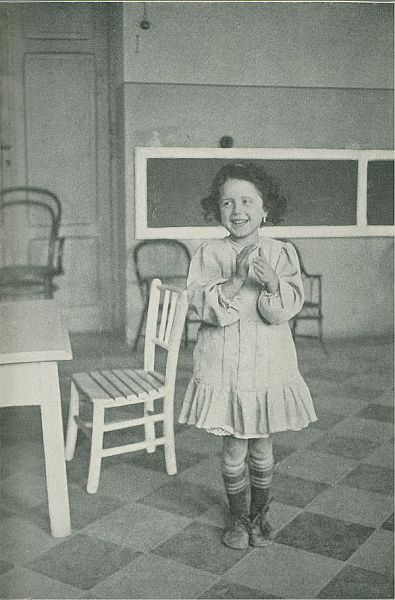 Interpreted reading: "Smile and clap your hands." The child reads silently
an order written on a slip of paper; then proves that she understands
by acting the direction given. (A Montessori School in Italy.)
Interpreted reading: "Smile and clap your hands." The child reads silently
an order written on a slip of paper; then proves that she understands
by acting the direction given. (A Montessori School in Italy.)
But reading stands in a direct relation with writing.
Here there are no sounds to be heard or pronounced. The
individual, all by himself, can put himself into communication
not only with human beings actually alive on the
earth, but also with those who lived centuries and centuries
ago down to the dawn of history. Such communication
is made possible not by sound but by the written
symbol. The mind takes in these symbols in silence.
Books are mute, as far as sound is concerned.
It follows that reading aloud is a combination of two
distinct operations, of two "languages." It is something
far more complex than speaking and reading taken separately
by themselves. In reading aloud the child speaks
not to express his own thoughts, but thoughts revealed by
the written symbol. The "word" in this case no longer
has that natural stimulus from within which creation
gives it. In fact, it is something forced and monotonous,
something like the language of the deaf-mute. Words
which are the product of the interpretation of individual
alphabetical symbols come with effort, and the meaning
which comes from the interpretation of the entire sentence,
as the eye reads word by word, and translates into
sound, is apprehended and reduced to expression with
great difficulty. To give a fairly intelligible expression
to the meaning, the eyes have been obliged rapidly to
traverse the sentence as a whole, while the tongue has been
laboriously and monotonously pronouncing one word after
another. Just imagine adding to such a complex problem
for the child of the primary schools the additional task
of correcting his pronunciation! It is no wonder that
reading is one of the rocks on which the rudderless ship
of elementary education inevitably runs aground.
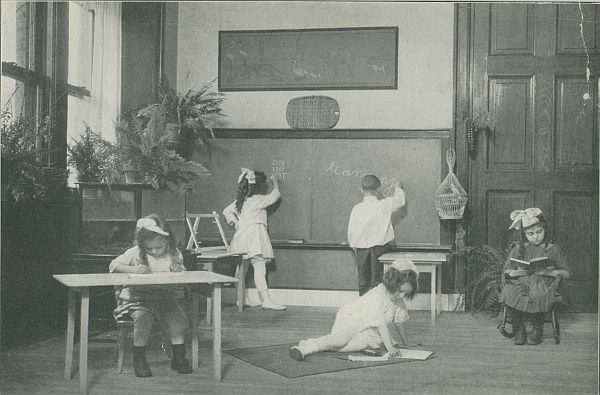
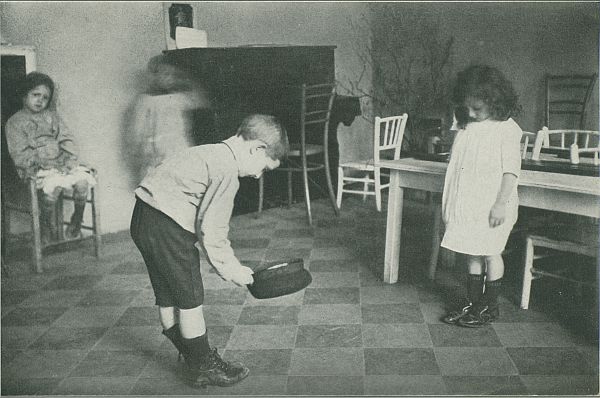 Interpreted reading: "Take off your hat and make a low bow." (A Montessori School in Italy.)
| Composition of words |
|
writing |
|
mechanical
grammatical (controlled by translation into action)
narration and description |
| reading |
|
mechanical
interpretative
expressed (aloud) |
|
grammatical (translations into action)[5]
declamatory (elocution) |
The experiments we have succeeded in conducting on
the subject of reading are perhaps among the most complete
we have made. We found the key to the problem
when we discovered that the child passed from the mental
reading of the words written on the cards directly to interpretation
in action. This interpretation, ready and
facile, as all the acts of children are, reveals to us what the
child has understood and accordingly what he is capable
of understanding. We have thus been able to obtain an
experimental graduation of passages for reading, which
on being gathered together, show the nature of the difficulties
which successively present themselves to the child.
The children have made for themselves specimen clauses
and sentences which an expert grammarian could not have
devised better for facilitating the study of language. As
we went on with this work, we became more and more convinced
that the study of grammar may be made a help in
the up-building of the child's language and that it makes
its influence felt in reading and in the written composition.
The table (p. 175) may be useful in showing the
successive steps actually traversed by the child in the
phenomena of reading.
The fundamental point to realize is that interpretation
alone constitutes true reading. Reading aloud, on the
other hand, is a combination of reading and articulate
expression, in other words, a combination involving the
two great mechanisms of the spoken language and the
written language. Reading aloud permits an audience to
take part in the reading communicated to it by means of
articulate speech. Even here, the mental effort required
to listen to the voice of a man passionately interested in
the narration of things which he himself has experienced
is not the same as that demanded in listening to a reading
of the same things by a person who has not experienced
them, and who, to narrate them, must perform the rapid
and intense effort of interpretation. In this reading, so
to speak, by "transmission," the most serious difficulties
are encountered. We all know by experience how difficult
it is to endure a reading, and how rare an endowment
the "gift of reading" is. However, the person who is
thus gifted can get a hearing almost as well as the person
who speaks. The teaching of reading, then, in this sense,
is not merely the teaching of the interpretation of the
meaning,—all that would be necessary, if the sole function
of reading were to gain new ideas for the reader.
Reading, thus conceived, represents really the addition
of an art of expression to simple reading, and since this
expressive art is purely dramatic, the teaching of reading
involves the development of dramatic art. Only through
dramatic art can the transmission of reading to a group
of people be made possible.
It is clear that the oftener the exercise of identifying
oneself with what is read is repeated and perfected, the
greater the possibility of expression becomes. It follows
that in the perfection of this art we should be less concerned
with timbre, with tone of voice and gestures, all
extrinsic aspects of this art, than with intense vivid interpretation
which brings the child to an identification
of himself with what he reads. And this interpretation
will realize its objects if it is practised as a habit and as
a form of reading.
The proof of correct interpretation was the child's
ability to reproduce in action what was described in the
words he read. Similarly, the proof of the interpretation
in reading aloud is the repetition of the things heard
by means of the spoken language. That is, the children,
in order to prove to us that they have understood something
read aloud, should be able to repeat in narrative
form what they have heard.
The practical results of our efforts in this direction were
very interesting to watch. Some children can say nothing.
Others offer to tell the whole story. Their story
is not clear or perhaps it is defective in some respect. Immediately
other children are ready to correct the ones
telling the story: "No, no, that's not what happened,
that's not what happened," or, "Wait, you have forgotten
something," and so on. In fact, to understand and to be
able to narrate what has been understood is not the same
thing. In telling a story there is a successive unfolding
of very complex mental activities which are based on and
added to the primal activity of "having understood." It
is a question again of the three different stages noted by us
in the first lessons given to children:
First stage, the causing of the perception: (That is
red, that is blue);
Second stage, the perfection of recognition: (What is
red or blue?);
Third stage, the provocation of expression: (What
about this or that?).
Thus, the child who succeeds in expressing, even in an
imperfect way, what he has understood of the passage he
has read, is in a more advanced state of development than
other children who are unable to tell the story. However,
these children who are not able to relate what they have
heard said may very well be in the preceding stage in
which they are capable of "recognition." These latter
are the relentless critics, the constant "hecklers" of those
who are trying to relate—"No, no,—that's not so,"
"You have forgotten this, or that." Let one of us
teachers try to tell the story in the most perfect and complete
manner, and these tiny impetuous hecklers listen to
us in ecstasy, showing their approval in every form of
approbation of which they are capable. By studying such
manifestations in the children, we can get sufficient psychological
data for determining what reading is adapted to
children of different ages, the best ways of reading aloud,
and the line of development followed by each child in that
hidden mental world of his which is cut off from our gaze.
But to derive these benefits from reading, it is perfectly
clear that the children must be left absolutely free in the
expression of what goes on in their minds.
According to the method used in ordinary schools a child
is called upon to read aloud, and the teacher herself continually
interrupts, either to correct the pronunciation, or
to assist by explanations and suggestions in the interpretation
of the meaning. This is all useless for experimental
purposes. We have no certain means of determining
whether the pupil has understood either what he has read
or the explanations of the teacher. Furthermore the corrections
of pronunciation have centered the child's attention
on this detail which is entirely without relation to
the meaning of the text he is interpreting. Another situation
not infrequently arises. A child is selected at random
to tell in his own words what he has been read. Often
the selection is not made at random, but some pupil is
called on because he has shown himself the most inattentive,
the least interested in what is being done—the recitation
thus becoming correctional in character! While
the child is telling his story, there is a constant suppression
of interruptions: "Hush, I did not call on you,"
"Wait till you are called on," "It is not polite to interrupt
some one who is talking," etc. It is clear that the
teacher will never learn anything about her pupils in this
way.
This explains why, from the psychological point of
view, our present-day schools have not been able to contribute
anything new to a reformed scientific pedagogy of
reading.
Although we lay all possible stress on interpretative
reading, we nevertheless put into the hands of the child
a little reading book which he can go over by himself first
in a low voice, and then, when he has grasped the meaning,
aloud, provided he can express himself clearly and
easily.
The simplicity of these texts occasions surprise when
one observes how completely and enthusiastically absorbed
in them the children become. They find them so delightful
that the books get literally worn out with the reading
and rereading to which they are subjected. Sometimes a
book is read from beginning to end. Again the child
opens it by chance and reads the page he happens on.
Some children like to read the whole book over and over.
Others prefer to read some particular page a great many
times. One frequently sees these tiny things suddenly
rise with great decision and read aloud one of the pages
which has been so seriously examined.
The little book was composed very carefully on the
basis of rigid experimentation. As the book is opened
only one page of print appears, the tergo of the right
hand page being always blank. Nor does the text always
cover the entire page. The spaces above and below the
print are decorated with designs.
The twenty pages of this beginners book are as follows:
Page 1. My school is the "Children's House."
Page 2. In the "Children's House" there are ever so many
little chairs and tables for us.
Page 3. There are also some pretty cabinets. Each child has
his own drawer.
Page 4. There are green plants and beautiful bouquets of
flowers everywhere about the rooms in our school.
Page 5. I often stop to look at the pictures which are hanging
on the walls.
Page 6. We are busy all the time. We wash our faces and
hands. We keep everything where it belongs. We
dust the furniture. We study and try to learn all
we can.
Page 7. Can you guess how we learned to dress ourselves?
We kept our fingers busy working on the canvas
frames, lacing and unlacing, fastening and unfastening
the hooks and eyes, buttoning and unbuttoning,
tying and untying knots.
Page 8. Then are ten blocks for this tower, all of different
sizes. First I spread them around on this carpet.
It is great fun to put them together again, taking
one after the other and choosing the largest each
time.
Page 9. I use the tower too in a balancing game. Just try
to carry the tower around the room without letting
it fall to pieces! Sometimes I succeed and then
again I sometimes fail.
Page 10. I like the long rods, too! I must put the rods near
each other according to their length. I must be
careful to place the blue sections near the blue ones
and the red ones near the red. Thus, I build
some pretty stairs with red and blue steps.
Page 11. But to get a real stair case I use the brown prisms.
These prisms are of different size, and I get some
fine stairs with ten steps.
Page 12. I have also some solid insets of wood into which I fit
little cylinders of different dimensions. They differ
in length and breadth. The game is to put
these cylinders in their places after looking at them
and touching them carefully.
Page 13. We often make mistakes in working with the insets.
When we put a cylinder where it doesn't belong,
we find that at the end of the game we have one
cylinder left over and it won't fit in anywhere.
Then the exercise becomes very exciting. We look
at the inset carefully; we find the mistake and begin
all over again. The most skilful pupils work
the insets with their eyes closed.
Page 14. These colors are called: red, black, green, yellow, blue,
brown, pink and violet.
Page 15. I amuse myself by picking out and pulling together
pieces of the same color from the collection spread
out over my table. I get thus a long strip of different
colors.
Page 16. We learn to arrange sixty-four different colors by
graduations. We get eight beautiful blends of
colors, each formed by eight tints of different tones.
When we become skilful we can make a pretty rug
with blending strips.
Page 17. We also have two little chests full of pieces of cloth.
The cloths are of all kinds from the roughest and
hardest to the smoothest and softest: canvas, cotton,
linen, wool, flannel, velvet, etc. If we keep
our hands clean, we can learn to recognize all sorts
of things with the tips of our fingers!
Page 18. A child is blindfolded. He mixes the pieces of cloth
with his little hands. He feels about among the
pieces of cloth. At last he smiles and holds up his
hands with two pieces of cloth, both alike. Though
he could not see, the child has found out, just by
using his fingers, that the two pieces were of the
same cloth.
Page 19. These are my plane insets. Here are the blue tablets.
I must fit them into the frames, which have just
enough room for them. I run two fingers, the fore-finger
and the middle-finger, around the edge of
the tablet, and then around the edge of the frames.
Next I fit the tablet into its proper place. After
a little practise I can put the six tablets in their
places even with my eyes blindfolded.
Page 20. With the plane insets I have learned to recognize
many figures: the square, the circle, the rectangle,
the ellipse, the triangle, the oval, the pentagon, the
hexagon, the heptagon, the octagon, the enneagon,
the decagon. I learned all these hard names very
easily because the insets are so amusing!
Reading with the object of interpretation is conducted
as in the first experiments of the "Children's House,"
with cards. From the graduated series we have prepared
the child selects a card. He reads it mentally and then
executes the action indicated on the card. Our later experiments
became very interesting when they were based
upon a more rigorous method. When we gave a card describing
two actions to a child of five years, he would
execute only one of the actions. Take the following for
example:
—She leaned over the back of a chair.
—She covered her face with her hands and wept.
The child would act out either the first sentence (She
leaned over the back of the chair) or the second (She
covered her face with, her hands and wept). In spite
of the fact that this child seemed extraordinarily eager
to get the cards into his hands and to interpret them, those
containing two sentences always aroused in him less enthusiasm
than those containing a single sentence or indicating
a single action (for instance, The boy ran away
as fast as he could). In this latter case the enthusiasm
of the little ones, their care in interpreting the action
vividly, their eagerness to repeat it, their flushed faces
and shining eyes, told us that at last we had the reading
adapted to their psychology.
Our first series of readings accordingly is entirely
"tested" or experimental. It is made up of simple sentences
something like those analyzed in the lessons on
grammar (Verb to Pronoun).
Series I
—She gazed slowly around the room.
—He looked at them out of the corners of his eyes.
—The boy ran away as fast as he could.
—She threw herself on her knees before him.
—The man paced slowly up and down the room.
—The little girl stood with lowered head.
—The teacher nodded her approval.
—The little child sat with folded arms.
—He started rapidly toward the door.
—He began to walk to and fro about the room.
—His mother tenderly stroked his head.
—She motioned to him to keep away.
—He whispered in her ear.
—She placed her hand on his shoulder.
—They knocked at the door.
—The little girl frowned.
The children carry out the indicated action after they
have read mentally, but they put what amounts to artistic
expression into their interpretations, which are never
executed listlessly. For them it becomes a real "interpretation."
They often "study" the action, trying it
over and over again, as though rehearsing for a play.
Their aptitude for this is something remarkable.
Furthermore the words have, for the most part, already
been studied in the grammatical exercises, so that the
meaning of each word is becoming more and more clear.
This helps in the interpretation. For example, the sentence
The little girl stood with lowered head does not
mean simply "she lowered her head." If the child has
understood he will stand for some time with lowered head
in an attitude more or less expressive according to the
vividness of his feeling of the situation. In the sentence
She threw herself on her knees before him there will not
be a simple act of kneeling, but something more dramatic.
The child will assume the kneeling posture with some indication
of emotion. The children take no end of interest
in each other's interpretations.
In a second series of readings we have two coordinated
clauses, the children executing two consecutive actions instead
of one.
Series II
—He opened the door and came in.
—He left the room and locked the door behind him.
—He went on tiptoe to the door and carefully opened it.
—She covered her face with her hands and began to sob violently.
—She gave a cry of joy and ran to the door.
—She burst into a laugh and clapped her hands.
—He took off his cap and made a low bow.
—She shook her head sadly and smiled.
—He threw the window wide open and looked into the garden.
—He hurried to the table and rang the bell.
—With a sigh of relief he stretched himself out on the sofa, and lay there looking at the ceiling with his mouth open.
—He shut his eyes and fell asleep.
In the third series, there are sentences with one or more
coordinate clauses.
Series III
—She opened the door, smoothed her hair slowly and came in.
—He went to the window, opened it a little and peered into the
street.
—He closed the window, went back to his desk and then began
to walk hurriedly up and down the room.
—The doctor bent over the sick man, felt his pulse with one
hand and placed the other on his forehead.
—He took a key out of his pocket, opened the door and came in.
—She uttered a cry of joy, ran to her mother and sank on her
knees before her.
—He put his left elbow on his knee, rested his forehead in his
left hand and began to stroke his beard with his right.
—She leaned over the back of the chair, covered her face with
her hands and wept.
—He went to the table, found the picture and joyfully took it
in his hands.
—She took her handkerchief out of her pocket, unfolded it and
wiped the tears from her eyes.
—The child was sleepy. He rested his head on his arms on
the table and went to sleep.
—He looked toward the door fixedly, with an expression of terror
on his face and waited for the man to come in.
Series IV
(Complex sentences with one subordinate clause)
—While he was making the drawing, he kept examining the
flower very carefully.
—She covered her eyes with her hands, as if she were trying to
collect her thoughts.
—She closed her eyes so that she could feel more intensely the
softness of the piece of velvet.
—She looked tenderly after the little boy, till he disappeared
through the door.
—When he had succeeded in turning the knob without making
any noise, he stealthily opened the door and peered into
the room.
—George held the book before his face so that no one could see
him laughing.
—She walked slowly across the room and with bowed head, as
though she were in great sorrow.
—The old man stroked the little boy's head as though he were
much amused.
—After she had motioned to the child to be silent, the lady
smilingly approached and took him by the hand.
—They stopped suddenly and listened, as though wondering
what it could be.
—When Mary opened the door, George went to meet her with
a cheery smile of welcome.
Series V
(Sentences somewhat more involved; descriptions more
complex; an exact interpretation sometimes requires
the pronunciation of words aloud)
—The child rose from her seat, and with her face buried in her
handkerchief, walked slowly, sadly, toward the window.
—He lay back in his chair, his head sunk between his shoulders,
while his arms were pressed tightly across his breast, as
though he were cold.
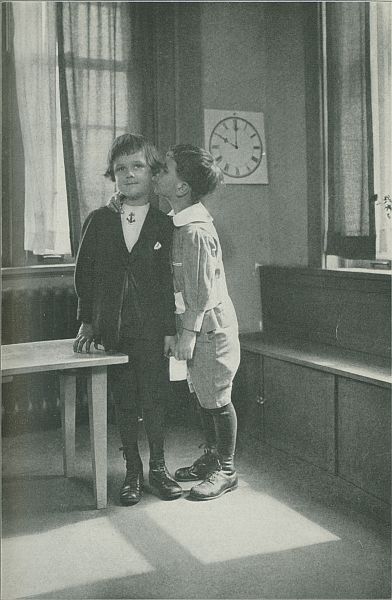 Interpreted reading: "Whisper to him." (The Lenox School, Montessori
Elementary Class, New York.)
Interpreted reading: "Whisper to him." (The Lenox School, Montessori
Elementary Class, New York.)
—He dropped wearily into a chair and sat there looking at the
floor, his right elbow on his knee and his chin resting on
his hand.
—He stood at the open window, with figure erect, and his hands
resting on the window-sill, while in deep breaths he took
into his lungs the delicious fresh air that was coming into
the room.
—The boy lowered his head, and rubbed his forehead with his
hands as though he were trying to collect his thoughts.
—There she knelt, her face turned heavenward, her hands
crossed in her lap, while her body drooped gently as though
she were very, very tired.
—When he reached the door of his house, he hastily unlocked
the door, opened it, went in, and carefully locked the door
again behind him; and in his eagerness to confide his secret
to some one he could trust, he went down the hall calling
"Mother, Mother!"
—His eyes filled with tears as he went to the wall where the
picture of his father hung, and there with his head resting
on his arm against the wall, he sobbed bitterly.
—Rizpah spread the cloth on the ground at the foot of the tree,
seated herself upon it, and with her arms resting limp upon
her knees, her eyes set in unutterable woe, watched the
birds and thought about her lost children.
—The man was lying, sprawling, on the couch, but he jumped
up and ran to the door and angrily motioned to his servant
to come to him.
—The old lady sat shivering near the stove, holding out her
hands to get the warmth and nervously opening and closing
them so that the tips of her fingers kept rubbing her palms.
—"I see," thought the boy as he stood with folded arms looking
fixedly at the floor.
—He took the handkerchief, examined it a moment and said:
"It doesn't belong to me!"
—He stooped over and picked up a pencil that was lying on the
floor: "Pshaw," said he, "it is broken!"
—Pecopin, feeling that all was over, threw himself face downward
on the ground, and moaned: "I shall never see her
again!"
—On waking, Rip Van Winkle rubbed his eyes and looked
around for his gun; as he rose to walk he found himself
stiff in the joints and wanting in his usual agility.
—The clergyman folded his hands before his breast and, bending
his head above them, prayed fervently.
—The girl knelt beside the fallen soldier, while with her right
hand she waved her handkerchief to and fro in the air.
—As the door opened, Florence ran to meet him, crying, "Oh,
dear, dear papa!" and she held out her arms to him; but,
as he paid no attention to her, she put her handkerchief to
her face and burst into tears.
—Beatrice came through the door holding her skirt with one
beautiful arm, while with the other she held a candlestick
above her head, so that the light shone upon her face.
—She advanced holding forward her head as if she would have
him kiss her as he used to when she was a child; but then
remembering herself, she made him a deep curtsy, sweeping
down to the ground almost, looking up meanwhile with
the sweetest smile.
—She closed the door very carefully behind her, and then leant
back against it, her hands folded before her, looking at the
boy who was kneeling beside his trunk to pack it.
—He took the paper and stepped to the window; then holding
the sheet so that the light fell full upon it, he examined it
carefully, folded it as though musing on its contents and
put it into his vest pocket.
—My Lord was lifting the glass to his lips, when Esmond entered;
but at the sight of the familiar face, the movement
of his arm ceased when the glass was on a level with his
chin; he held it there a moment in astonishment, then,
suddenly setting it on the table he rushed toward Esmond
with outstretched arms, and would almost have embraced
him: "I thought you were in France," he exclaimed.
—The Prince was lying on the bed, but at the sound of the
footsteps, he rose on his elbow in alarm, while he reached
under the pillow for his pistols: "Who goes there?" he
shouted sternly.
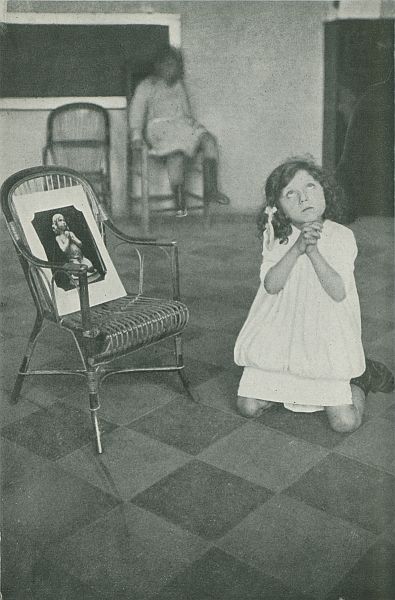 In a similar manner, the children set out or interpret poses and expressions
in pictures. (A Montessori School in Italy.)
In a similar manner, the children set out or interpret poses and expressions
in pictures. (A Montessori School in Italy.)
—The child playfully drew his cap down over his eyes as though
he were a very fierce bandit, and rushed into the room
holding out his arm and pointing his fore-finger like a
pistol.
—As the ladies rode up, the old gentleman raised his hat and
stood with bowed head till they had passed.
—The young man picked up the glove from the floor, pressed it
fervently to his lips and clasped it tenderly against his
bosom, as though it were a priceless treasure.
Series VI
(More difficult interpretations with occasional speaking)
—Dunsey threw himself into a chair by the window, drew another
chair before him, threw one leg over it, and began to
beat on the window sill with the points of his fingers.
—Godfrey stood with his back to the fire, moving his fingers
uneasily among the contents of his side-pockets and looking
at the floor.
—Aaron replied by rubbing his head against his mother's skirt,
passing the backs of his hands over his eyes and peeping
through his fingers at Master Marner.
—Mr. Macey screwed up his mouth, leaned his head further on
one side and twirled his thumbs rapidly, with his two
hands resting on his lap and touching at the finger-tips.
—Silas sat with his elbows on his knees, his forehead pressed
rigidly into his two palms, his eyes closed, deep sighs that
were almost groans shaking his slender frame.
—The little tot squatted on the coat and spread out her hands
to the fire; but the little eyes refused to stay open, and
finally the golden head sank down upon the floor fast asleep.
—Presently the child slipped from his knee and began to walk
about; but suddenly she fell into a sitting posture and
began to pull at her little boots, as though she were trying
to get at her toes.
—"At last," he said, stretching back in the arm chair, crossing
his legs and joining his hands behind his head: "I can
now have a minute to myself!"
—"Ssshh," said the boy, frowning, and waving his right arm
with hand outspread towards his companion.
Series VII
(Interpretation requiring more than one person)
—As Rip Van Winkle approached the town, the people all
stared at him with marks of surprise and invariably stroked
their chins, so that Rip was induced involuntarily to do
likewise: his beard was a foot long.
—A self-important old gentleman pushed through the crowd,
shoving the people to the right and left with his elbows as
he passed; and planting himself before Van Winkle, with
one hand on his side, the other resting on his cane, he demanded
with an austere tone: "What are you doing
here?"
—As Rip Van Winkle told his story, the bystanders began to
look at each other, nod, and wink significantly and tap
their fingers against their foreheads.
—An old woman came tottering forward, put her hand to her
brow and peering under it into his face for a moment, exclaimed:
"Sure enough, it is Rip Van Winkle!"
—As the Emperor stepped into the court-yard, the ladies were
all so busy crowding about the young prince, holding his
hands and counting the kisses, that they did not see the
old gentleman: "What's all this, what's all this?" he
shouted in rage; and they all scampered off in every direction.
—Trotty sat down in his chair and beat his knees and laughed;
he sat down in his chair and beat his knees and cried; he
got out of his chair and hugged Med; he got out of his
chair and hugged Richard; he got out of his chair and
hugged them both at once. He was constantly getting up
and sitting down, never stopping in his chair a single
minute, being beside himself with joy.
—"Here, little girl, can you tell us the way to town?" "That's
not the way. The town is over in this direction!" But
as the little girl was turning to point out the road, one of
the men seized her by the waist and lifted her from the
ground. Lucia looked back over her shoulder terrified and
gave a shriek. (Manzoni.)
(The children were delighted with this little action and rehearsed
it over and over again.)
—With a start, Evangeline looked wildly about her: "Where
is Gabriel?" she asked dazedly. "Where is Gabriel?
Where is Gabriel?" "He is on that ship that is just
sailing out of the harbor!" some one answered. For a
few moments Evangeline stood shading her eyes with her
palm, gazing after the vessel, fast disappearing into the
horizon. At last she spoke half aloud: "I will follow
you and find you wherever they may take you, Gabriel,"
she said, as though taking a vow. Then she turned to the
soldier and said: "Lead on to the boat, I am coming. I am coming."
—"Give me the bow," said Tell. Tell chose two arrows: one
he fitted to the bow-string, the other he thrust into his
girdle. Then for a moment he stood, a little bowed of
shoulder, with his eyes downward: he was praying. You
might have heard a leaf fall, so still was the place. Then
Tell raised his head; his eyes were steady, his hands had
become still; his face was like iron; he brought the cross
bow to his shoulder and laid his eye to the feather of the
shaft: "Twang," the apple fell. A cheer arose from the
crowd. Tell laid his hand upon the arrow in his girdle.
"If the first had hurt my child," he said, "this one by now
would have been through your heart, O Gessler!"
The children by no means restrict themselves to acting
out these little scenes and poses. In a second stage they
read aloud all these slips which they have interpreted, and
in view of the preparation they have had, their reading
shows considerable power of expression. They tend to
read the slips over and over again, many times, and not
infrequently commit them to memory. To take advantage
of this new activity we got together a number of
poems, making up a little book of children's verse. The
pupils read them both mentally and aloud, ultimately
committing them to memory and reciting them. Here
are some specimens of our Italian collection:
| IL BACIO |
THE KISS |
| Dormiva nella cuna un bel bambino, |
"A pretty child was sleeping |
| E la mamma lo stava a rimirare; |
in his cradle; its mother was |
| Voleva dargli il bacio del mattino, |
looking at it. She wanted to |
| Ma il bacio lo poteva risvegliare; |
give it the morning kiss; but the |
| Svegliarlo non voleva, e con la mano |
kiss might awaken it. To avoid |
| Gli buttò cento baci da lontano. |
this, she threw it a thousand |
| |
kisses with her hand." |
| |
| UN SOGNO |
A DREAM |
| Vidi una fata un giorno |
I saw a fairy one day, with |
| Che avea le trecce d'oro |
golden hair and a dress of pearls, |
| E un abito di perle |
richer than a treasure. |
| Più ricco d'un tesoro |
| "Vieni con me," mi disse, |
"Come with me," the fairy |
| "Che ti farò regina." |
said, "and I'll make you a |
| "Non vengo, bella fata; |
queen." "I cannot, pretty fairy," |
| Io sto con la mammina." |
I replied, "I must stay with mother." |
| |
| LA NEVE |
THE SNOW |
| Lenta la neve fiocca, fiocca, fiocca, |
The flakes of snow are falling, |
| Senti, una culla dondola pian piano. |
falling, falling. Listen, a cradle |
| Un bimbo piange, il piccol dito in bocca, |
is gently, gently rocking; a baby |
| Canta la vecchia, il mento in su la mano. |
cries, his finger in his mouth; |
| |
the old nurse sings, her chin in her hand. |
| |
| LA GALLINA |
THE HEN |
| Io vi domando se si può trovare |
I leave it to you: is there a |
| Un più bravo animal della gallina. |
nicer animal than the hen? If |
| Se non avesse il vizio di raspare |
only she wouldn't scratch, I |
| |
would like to have one with me |
| Ne vorrei sempre aver una vicina. |
all the time. Every day, at a |
| Tutti i giorni a quell'ora: "Coccodè!" |
certain hour: "Cut-cut-cut-cut-cadakut!" |
| Corri a guardar nel covo e l'ovo c'è! |
Run and look in the nest, and |
| |
an egg is there! |
| |
| LA POVERA BAMBINA |
THE POOR ORPHAN CHILD |
| Disse: "Mia madre è morta! |
She said: "My mother is |
| Io son digiuna |
dead; I have nothing to eat; the |
| E la stagion è cruda: |
weather is cold. There is no one |
| In terra a me non pensa anima alcuna: |
left to think of me. I am a ragged |
| Sono orfanella e ignuda." |
orphan girl." |
| |
| IL PESCE |
THE FISH |
| Un dì fuor della vasca del giardino |
One day a little fish jumped |
| Guizzò imprudentemente un pesciolino. |
imprudently out of the garden |
| Gigi lo vide, e tutto disperato |
pool. Gigi saw it and all excitedly |
| Gridò alla mamma: un pesce s'è annegato! |
cried out: "Mamma, mamma, |
| |
a fish has drowned himself." |
| |
| QUEL CHE POSSIEDE UN BAMBINO |
A CHILD'S POSSESSIONS |
| Due piedi lesti lesti per correre e saltare. |
Two little lively feet to run and jump with. |
| Due mani sempre in moto per prendere e per fare. |
Two busy hands to take and do things. |
| La bocca piccolina per tutto domandare. |
One little mouth to ask questions with. |
| Due orecchie sempre all'erta intente ad ascoltare. |
Two ears always awake to hear everything with. |
| Due occhioni spalancati per tutto investigare. |
Two bright eyes always open to see everything with. |
| E un cuoricino buono per molto, molto amare. |
One little heart to love with. |
| |
| IL BUON ODORE |
THE FLOWER'S FRAGRANCE |
| "Ma, bimbo mio, perchè |
"Why spoil that pretty flower, |
| Sciupar questo bel fiore?" |
my child?" |
| "Cercavo il buon odore, |
"I was looking for the sweet |
| Non so capir dov'è." |
smell and I haven't been able to |
| |
find it." |
| Lina Schwarz. |
| |
| NINNA-NANNA DI NATALE |
CHRISTMAS LULLABY |
| Ninna-nanna, gelato è il focolare; |
Lullaby, the fire is out, my |
| fanciul, non ti svegliare. |
child, do not awaken. To keep |
| Per coprirti dal freddo, o mio |
you warm, my little child, I |
| bambino, |
must make you a little dress |
| Cucio in un vecchio scialle un |
from this old shawl. |
| vestitino. |
| Ma il lucignolo trema e l'occhio |
But the lamp is dim and my |
| è stanco, |
eyes are tired, O child of the |
| bimbo dal viso bianco. |
white face. Who knows if even |
| Chi sa se per domani avrò finito |
by tomorrow I can have this |
| Questo che aspetti povero vestito! |
poor dress for you. |
| Ada Negri. |
A corresponding book of English verse might include
something like the following:
THE WHOLE DUTY OF A CHILD
A child should always say what's true,
And speak when he is spoken to,
And behave mannerly at table—
At least so far as he is able.
Stevenson.
THE RAIN
The rain is raining all around,
It falls on field and tree,
It rains on the umbrella here
And on the ships at sea.
Stevenson.
THE COW
Thank you, pretty cow, that made
Pleasant milk to soak my bread,
Every day and every night
Warm and fresh and sweet and white.
Ann Taylor.
THE RAIN
The rain is raining all around,
Kittens to shelter fly,
But human folk wear over-shoes
To keep their hind-paws dry.
O. Herford.
FISHES
How very pleasant it must be
For little fishes in the sea!
They never learn to swim at all:
It came to them when they were small.
"Swim out like this," their mother cried,
"Straight through the water, foam and tide."
They waved their fins and writhed their scales,
And steered their little rudder tails.
Already they know what to do—
I wish that I could do it too!
Alice Farwell Brown.
THE LITTLE COCK SPARROW
A little cock-sparrow sat on a green tree,
And he chirruped, he chirruped, so merry was he;
A naughty boy came with his wee bow and arrow,
Determined to shoot this little cock-sparrow.
"This little cock-sparrow shall make me a stew,
And his giblets shall make me a little pie too."
"Oh, no!" said the sparrow, "I won't make a stew";
So he flapped his wings and away he flew.
Book of Knowledge.
THE TREE
What do we do when we plant the tree?
We plant the houses for you and me;
We plant the rafters, the shingle, the floors,
We plant the studding, the laths, the doors,
The beams and siding—all parts that be!
We plant the house when we plant the tree.
Henry Abbey.
THE LAMB
Little lamb, who made thee?
Dost thou know who made thee,
Gave thee life and bade thee feed
By the stream and o'er the mead;
Gave thee clothing of delight,
Softest clothing woolly bright;
Gave thee such a tender voice,
Making all the vales rejoice?
Little lamb who made thee?
Dost thou know who made thee?
W. Blake.
Let dogs delight to bark and bite,
For God hath made them so;
Let bears and lions growl and fight,
For 'tis their nature too.
But, children, you should never let
Such angry passions rise:
Your little hands were never made
To tear each others' eyes.
Watts.
The sunshine flickers through the lace
Of leaves above my head,
And kisses me upon the face
Like Mother before bed.
The wind comes stealing o'er the grass
To whisper pretty things;
And though I cannot see him pass
I feel his careful wings.
Stevenson.
After this preparation the children are able to "understand"
what they read. All their difficulties in grasping
the sentences and their most complicated constructions
have been overcome. They have an insight into the grammatical
form of language; and the construction of a sentence,
as well as the meaning of the words in it, interests
them. There has been created within them a fund of suppressed
energy which will very soon break forth into intense
activity. In fact, in our school, after these exercises
the passion for reading began to show itself. The
children wanted "reading, reading, more reading." We
got together hastily a few books but never enough to satisfy
the eagerness of the children. We found a surprising
lack of reading for little children in Italian. The
American system of opening special rooms in public
libraries for the use of little readers seems to me an excellent
thing.
But to take full advantage of this awakened enthusiasm
for reading and to cultivate at the same time the art of
reading aloud we must not neglect another element in
reading: audition.
When the child has advanced to some extent in the
exercises of interpretation, the teacher may begin reading
aloud. This should be done as artistically as possible.
We recommend for the training of teachers not only a
considerable artistic education in general but special attention
to the art of reading. One of the differences between
the traditional teacher of the past and the teachers
we should like to create is that the former used to speak
of an "art of teaching," which consisted of various devices
to make the child learn, in spite of itself, what the
teacher wanted to teach. Our teachers, rather, should be
cultivators of the fine arts. For in our method art is considered
a means to life. It is beauty in all its forms which
helps the inner man to grow. We have repeatedly emphasized
that both in the environment at school and in
the materials used, everything should be carefully considered
in its artistic bearings, to provide ample room for
development for all the phenomena of attention and persistence
in work which are the secret keys of self-education.
The Montessori teacher should be a cultivator of music,
drawing and elocution, responsive to the harmony of
things; she must, that is, have sufficient "good taste" to
be able to lay out the school plant and keep it in condition;
and sufficient delicacy of manner—the product of a sensitive
nature—to be alive to all the manifestations of the
child spirit.
In the matter of reading aloud the teacher has an important
task to accomplish. We found the drawing hour best
adapted for this work. It was our experience that it is
easier to gain a hearing when the children are busy with
something which does not require great concentration and
which is not sustained by any particular inspiration.
During the drawing lesson, in the placid silence which
comes from work, and while the children are intent on
their designs, the teacher may begin her reading aloud.
It sometimes happens that the substance of what she reads
will be sufficient to engage the interest of the whole school.
But this is not always an easy task. It is more often the
musical quality of the teacher's execution which will attract
the little ones with a sense for art and bring them to
that motionless attention which is the evidence of eager
enjoyment. Possibly a really perfect reader might be able
so to hold the whole group of children with some absorbing
selection.
The readings we used were numerous and of great variety:
fairy tales, short stories, anecdotes, novels, historical
episodes. Specifically there were the tales of Andersen,
some of the short stories of Capuana, the Cuore of De
Amicis, episodes of the life of Jesus, Uncle Tom's Cabin,
The Betrothed (I promessi sposi of Manzoni), Fabiola,
stories from the Italian wars for independence (Nineteenth
Century), Itard's Education of the Young Savage of
Aveyron.
In general the child will listen to anything that is really
interesting. But certainly some surprises will be occasioned
by our discovery that the children liked above everything
else the readings on Italian history and the Education
of the Savage of Aveyron. The phenomenon is
sufficiently curious to merit further consideration. The
history we used was not one commonly thought adapted
to young readers. Quite the contrary: it was Pasquale
de Luca's I Liberatori (Makers of Freedom, Bergamo,
1909), written to arouse a feeling of patriotism among
the Italian emigrants of Argentina. The special feature
of this publication is its contemporary documents reprinted
in fac-simile. There are, for instance, telegrams, notices in
cipher published on the walls of the towns on the eve of uprisings,
commemorative medals, a receipt given by an executioner
for whipping publicly an Italian patriot, etc.
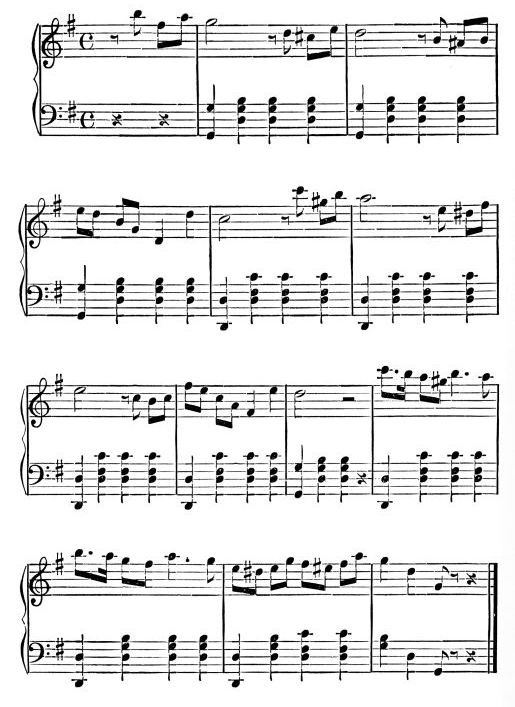
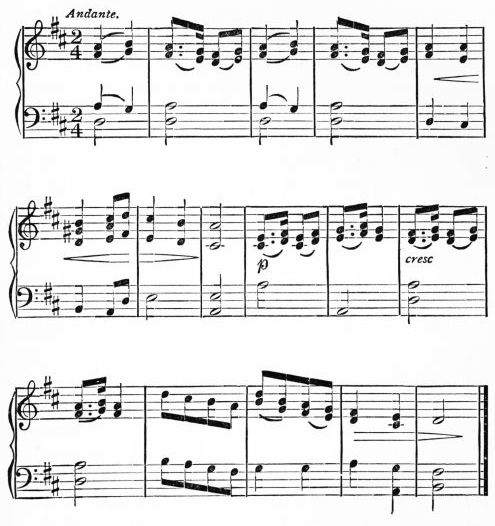
Patriotic songs are given with the music (these the children
learned by heart, following the piano); there are also
copious illustrations.
This documented history was so absorbing that the
children became entirely possessed by the situations.
They started animated discussions on various subjects,
arguing and deciding. They were particularly outraged
at an edict of the king of Naples which was intended to
mislead the public. They raged at unjust persecutions,
applauded heroic deeds, and ended by insisting on acting
out some of the scenes. They formed little companies of
three or four and "acted" the episodes with a most impressive
dramatic sense. One little girl was moved to bring to
school a collection of all the Italian patriotic songs. It
fascinated many of the children, who learned several by
heart and sang them in chorus. In a word, the Italian
Risorgimento came to live in those little hearts with a freshness
it has long since lost in the souls of their elders.
Many of the children wrote down their impressions of their
own accord, often giving surprisingly original judgments.
Finally they began to "take notes." They asked the
teacher to give an outline of the principal events, which
they took down in their copy-books. This whole experience
corrected many of my own ideas on the teaching of
history. I had thought of preparing moving-picture films
and giving historical representations. But that, naturally,
being beyond my resources, I had been compelled to give
up the plan. The reading of De Luca's book was a revelation.
To teach history to children it is sufficient to give
a living documented truth. We need, not more cinematographs,
but different school books. Children are much
more sensible to the true and beautiful than we. They
suggest fact and situation. De Luca, moved by affection
for his distant brothers, tried to write a book flaming both
with truth and with love, which would awaken them and
bring them back to live among us as Italians. Our task
is the same. We must be filled with a similarly intense
human zeal: we must call back to us the distant souls of
the children. They too are brothers living far away in
a distant country. We must arouse them, bring them
back to us as partners in our own life.
After our readings from Itard's Savage, the parents
of the children kept coming to us with inquiries:
"What have you been reading to our children? We
should like to hear it ourselves." The little ones had told
of hearing an extraordinary story about a child who had
lived with the animals, beginning little by little to understand,
to feel, to live like us. All the psychological details
of his study, his attempts at education, seemed to have
touched the children deeply. It occurred to us to take the
older of such children to a "Children's House" and show
them our educational method. They took the greatest interest
in it, and some of them are now collaborators in the
foundation of other "Children's Houses." Such children
are able to follow the development of the child mind with
extraordinary sympathy. However, if we reflect that the
best teachers for children are children themselves, and that
little tots like the company of another child much better
than that of an adult, we need not be surprised at the downfall
of another prejudice.
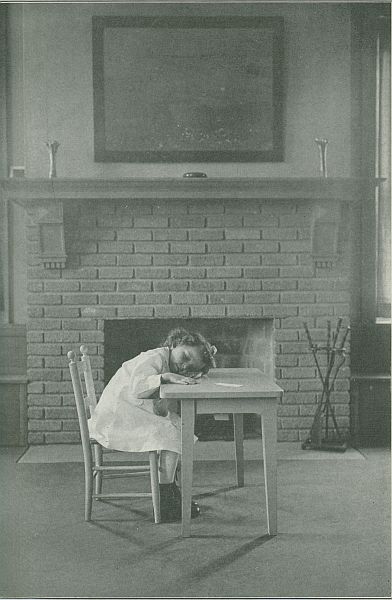 Interpreted reading: "She was sleepy; she leaned her arms on the table,
her head on her arms, and went to sleep." Notice the slip of paper
which the child has just read. (The Lenox School, Montessori Elementary
Class, New York.)
Interpreted reading: "She was sleepy; she leaned her arms on the table,
her head on her arms, and went to sleep." Notice the slip of paper
which the child has just read. (The Lenox School, Montessori Elementary
Class, New York.)
We have conceived of children according to a fantastic
idea of our own, making of them a sort of human species
distinct from that to which adults belong. As a matter
of fact, they are our children, more purely human than
we ourselves. The beautiful and the true have for them
an intense fascination, into which they plunge as into
something actually necessary for their existence.
The results here witnessed led us to many a reflection.
We succeeded in teaching history and even pedagogy by
means of "reading." And, in truth, does not reading
embrace everything? Travel stories teach geography;
insect stories lead the child into natural science; and so
on. The teacher, in short, can use reading to introduce
her pupils to the most varied subjects; and the moment
they have been thus started, they can go on to any limit
guided by the single passion for reading. Our task is to
offer the child the instruments of education, to keep pure
within him the springs of his intellectual growth, of his
life of feeling. The rest follows as a matter of course.
As the ancients said: "Necessary education is the three
'r's': reading, writing and arithmetic," for these are
things which the child cannot discover by himself. We
can only add that "method" must be scientifically determined
only at the points where it becomes necessary to
assist the "formation of man," that he may develop his
activities by strengthening them and not by repressing
them, that he may receive essential help without losing any
pure freshness of his interior activities. But this
does not mean that "a rigorous method must guide the
child at all times and in every step that he takes." When
he has become strong and is in possession of his tools for
discovery, he will be able to uncover many of life's secrets
by himself. We tied the child to the materials in his sensory
exercises, but we left him free to explore his environment.
This must be the method for all his later steps in
advance: he must be given the instrument and the strength
to use it, and then left free to find things out for himself.
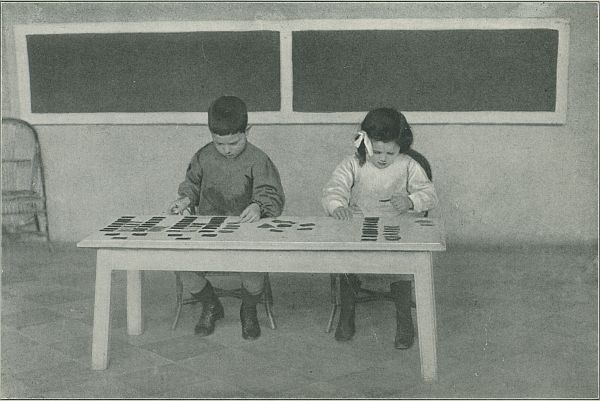
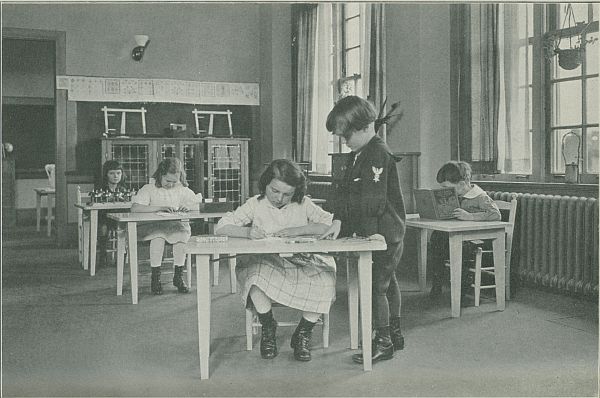
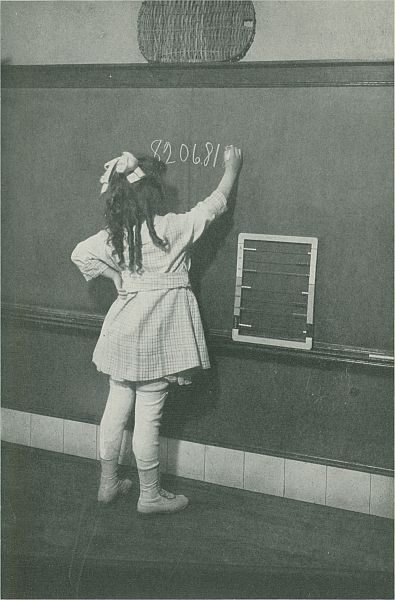
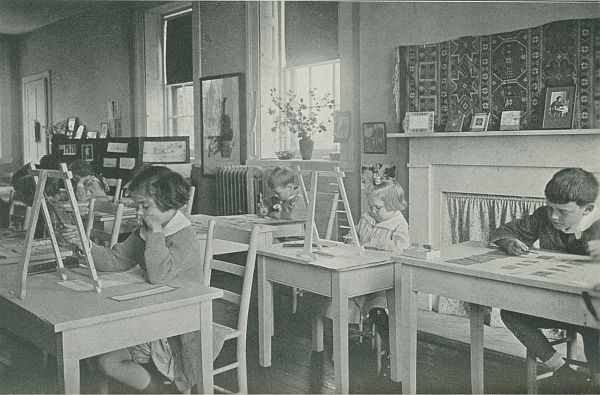
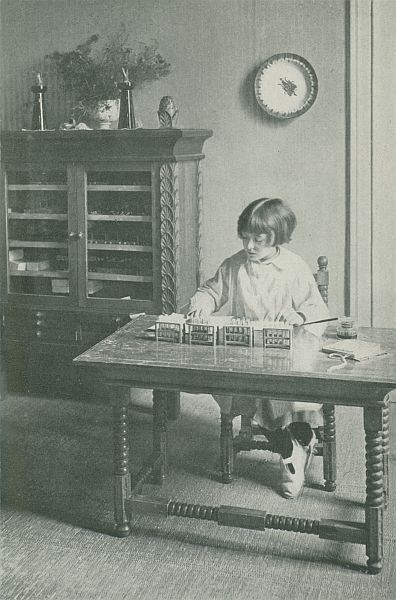
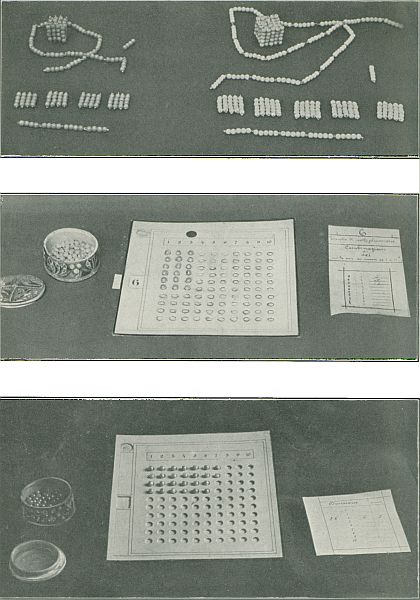
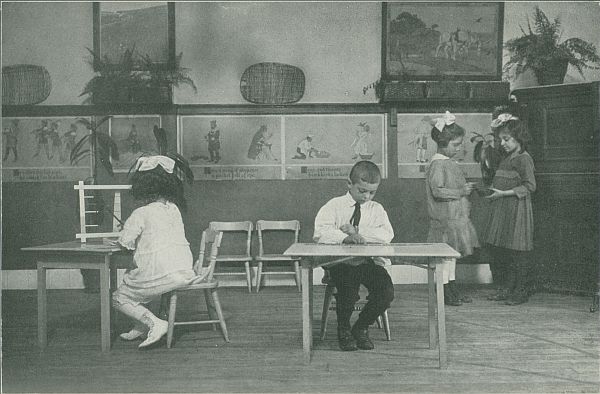 Exercises in interpreted reading and arithmetic. (The Rivington Street Montessori School, New York.)
The fondness of children for reading and their preference
for the "true" is something already demonstrated
by experiments conducted elsewhere. I may refer here to
the investigations on readings for children conducted by
the "Education" section of the Federation for School
Libraries of the province of Emilia (Italy). The questionnaire
was as follows:
Do you remember what books you have read and which you
liked best?
How did you get them?
Do you know the title of some book you would like to read?
Do you prefer fairy-tales, or rather stories of true or probable
facts? Why?
Do you prefer sad or humorous stories?
Do you like poetry?
Do you like stories of travel and adventure?
Do you subscribe to any weekly or monthly newspaper? If
so, to which?
If your mother were to offer you a choice between a subscription
to a weekly or monthly and an illustrated
book, which would you take? And why?
The answers, very carefully sifted, showed that the vast
majority of children preferred readings which dealt with
fact. Here are some of the reasons alleged by the children
in support for their preference for "truth": "Facts
teach me something; fairy-tales are too improbable; true
stories don't upset my thinking; true stories teach me history;
true stories always convey some good idea; fairy-stories
give me desires impossible to satisfy; many
good ideas come from actual experiences; fantastic tales
make me think too much about supernatural things"; etc.,
etc. In favor of the fairy-tales we find: "They amuse
me in hours free from work; I like to be in the midst of
fairies and enchantments"; etc. Those who preferred
sad or serious stories justified themselves as follows: "I
feel that I am a better person, and realize better the wrong
I do; I feel that my disposition becomes more kindly; they
arouse in me feelings of kindness and pity." Many supported
their preference for humorous tales on the ground
that "when I read them, I am able to forget my own little
troubles." In general, a great majority denied any
educational value to joy and humor. In this conviction—or
rather this feeling—so widely diffused among children,
have we not evidence that something must be wrong
in the kind of education we have been giving them?





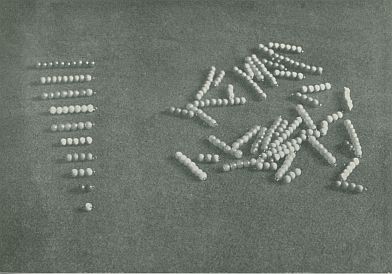
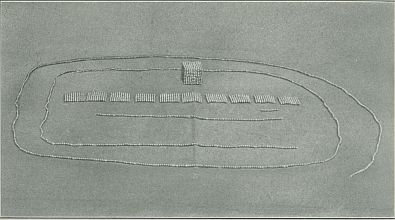
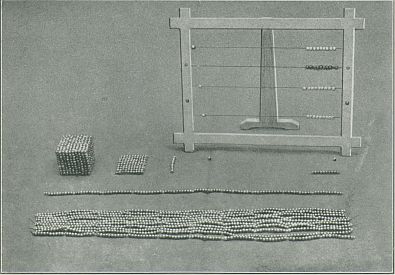


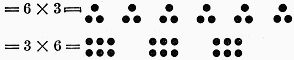
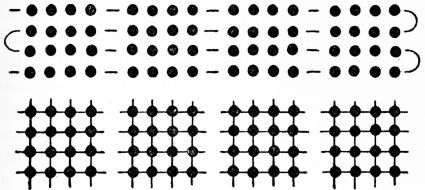
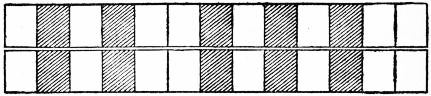
 By joining two like bars, the chains represent 2 × 2.
There is another combination of these same objects—the
two bars are joined together not in a chain but in the
form of a square:
By joining two like bars, the chains represent 2 × 2.
There is another combination of these same objects—the
two bars are joined together not in a chain but in the
form of a square:




































 and
and
 )
have therefore the greatest value.
)
have therefore the greatest value.


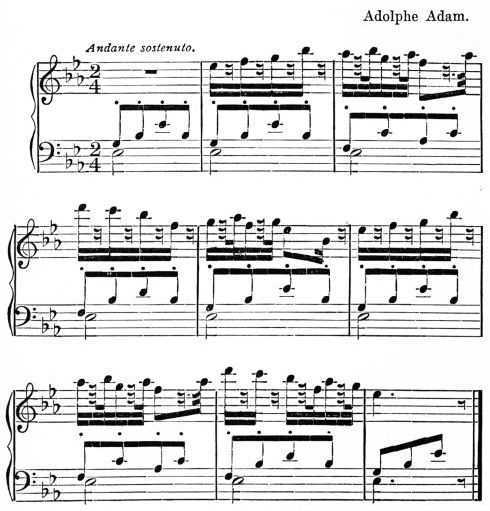
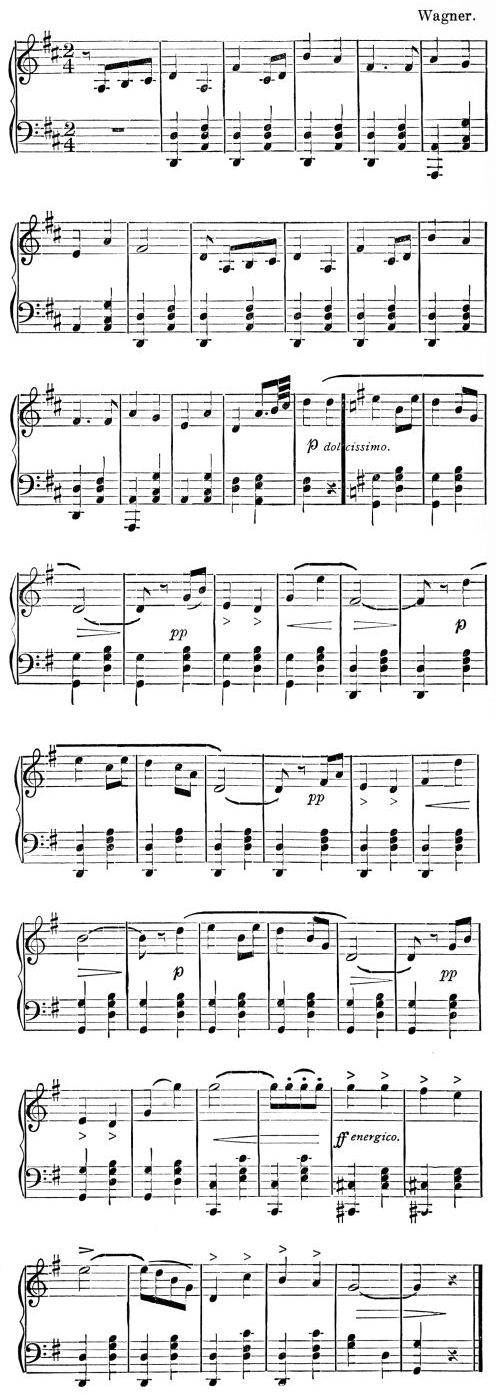
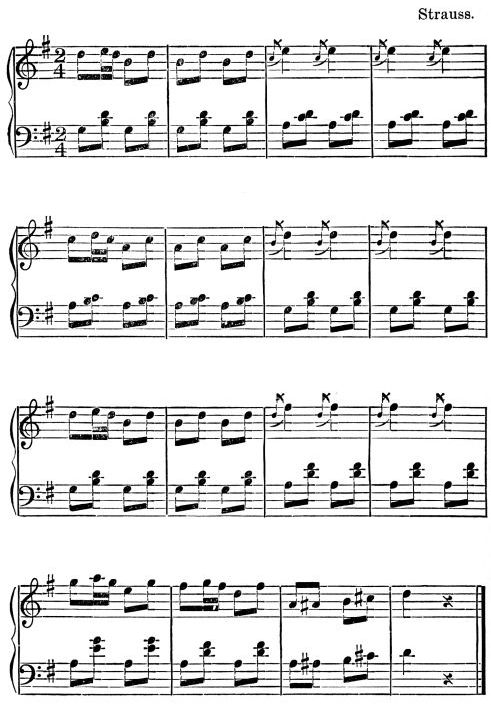
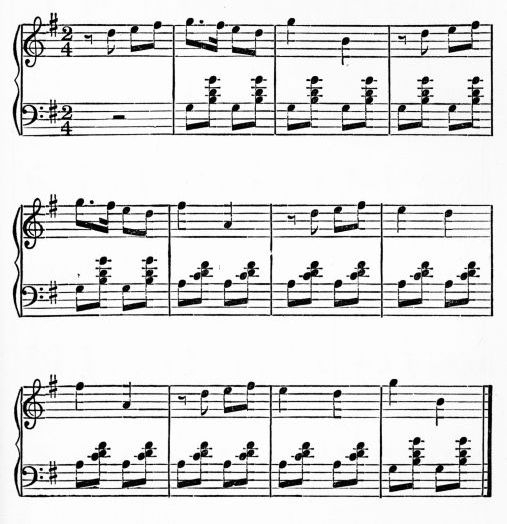
 , verso piano). The iambic (
 , verso tronco)
and the dactyllic (
, verso tronco)
and the dactyllic ( , verso sdrucciolo) endings (requiring
respectively one syllable less and one syllable more
than the verso piano) constitute occasional variations. We
have found that these rarer lines are recognized rather as
curiosities than as difficulties by the children who easily
refer them to their respective normal types. They are accordingly
presented in our material along with the common
verses of trochaic endings. Our illustration of the
five syllable line given above showed specimens of the dactyllic
ending (sdrucciolo,
, verso sdrucciolo) endings (requiring
respectively one syllable less and one syllable more
than the verso piano) constitute occasional variations. We
have found that these rarer lines are recognized rather as
curiosities than as difficulties by the children who easily
refer them to their respective normal types. They are accordingly
presented in our material along with the common
verses of trochaic endings. Our illustration of the
five syllable line given above showed specimens of the dactyllic
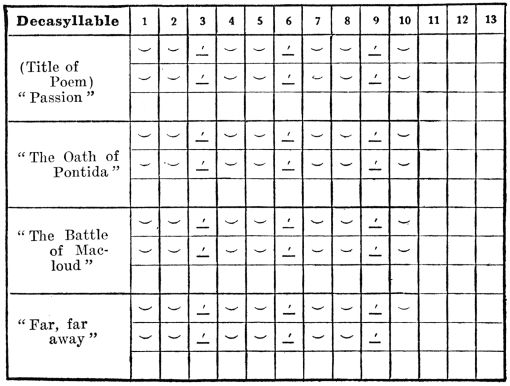
ending (sdrucciolo, 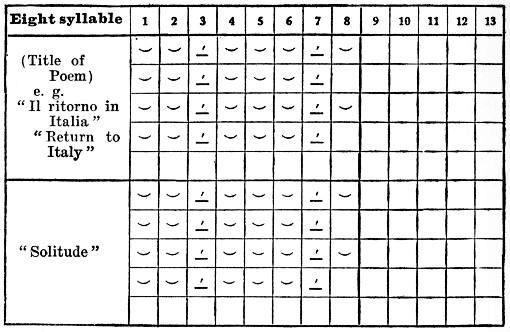

 iambus
 trochee
 anapest